

Please support the authors by reading the Manhwas on the official websites. This is where you can read the manhwa: Jinx But be aware that the Manhwa is a mature Yaoi, which means, it is about homosexuality with explicit scenes. Here is the link of the table of contents about Jinx. Here is the link where you can find the table of contents of analyzed Manhwas. Here are the links, if you are interested in the first work from Mingwa, BJ Alex, and the previous essay about Jinx Jinxed: Behind The Scenes
It would be great if you could make some donations/sponsoring: Ko-fi.com/bebebisous33 That way, you can support me with “coffee” so that I have the energy to keep examining manhwas. Besides, I need to cover up the expenses for this blog.

1. A World in 3 colors: Pink, Black and Orange
Like the illustration is revealing it, for me, two colors were dominant in the special episode: pink and black. Yet, if you pay more attention to the self-made picture,  you will notice a third shade: orange which is represented by the Chow-chow and the comedian’s robe. Since the latter plays a minor role in the last chapter, it is normal to examine this pigment first. Moreover, its explanation is even necessary to grasp the significance of the other colors: pink and black.
1. 1. The predator is showing his true colors
First, Choi Heesung was wearing an orange bathrobe.  (Special episode) Then he cooked a spicy ramen for the young fighter.
 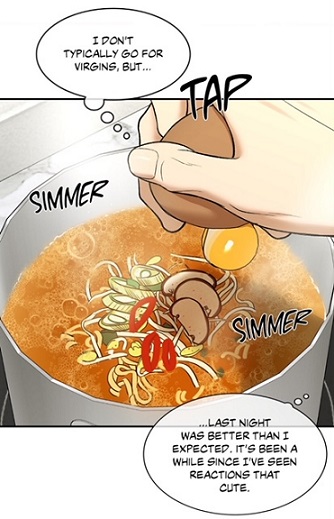 (Special episode) This color contrasts so much to the pigments from the artist’s flat: black and white.

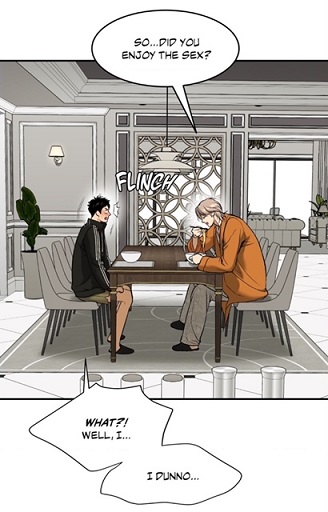 (Special episode) Grey is a combination of black and white. One might think that tangerine appeared for the first time in episode 35
 (chapter 35), but it is just a deception. In fact, there were traces of this pigment, when Choi Heesung was introduced for the first time.
 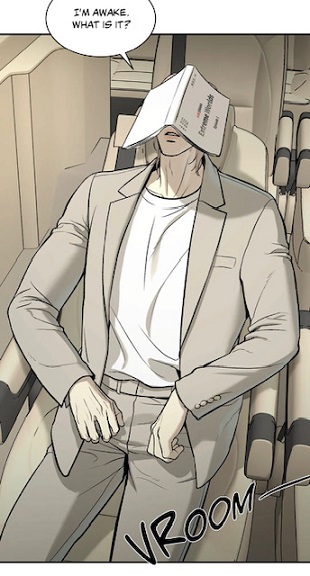 (chapter 29) Yes, we should perceive beige as a washed-out orange. So what does it mean? First, the cursed Romeo was not true to himself. Let’s not forget that in my eyes, Choi Heesung is a fox, and the fur of this animal is orange which is similar to the chow chow’s pigment. This means that both second leads would have a color in common: orange. Moreover, from my perspective, the comedian is a nine-tailed fox, a gumiho. In case, you didn’t read the analysis “Calculated Craziness (locked)“, I am giving a short explanation about this Korean mythical creature again. The nine-tailed fox, has a complex personality due to his dual nature. He is fighting between its animalistic instincts and its human aspirations.
- Shape-shifting Ability: The gumiho can transform into a beautiful woman, often to seduce or deceive humans.
- Predatory Nature: Traditionally, it is depicted as malevolent, preying on humans, sometimes consuming their hearts or livers to survive or gain power.
- Longevity: The gumiho is often considered immortal or possesses an extremely long lifespan.
- Desire for Humanity: Some stories depict the gumiho as striving to become human, which it can achieve through various means, such as abstaining from consuming human flesh for a certain period or performing good deeds.
- Ambiguity: The nature of the gumiho can vary from malevolent to benevolent, depending on the story. In modern adaptations, the gumiho is sometimes portrayed more sympathetically, struggling with its dual nature.
Then I noticed another detail. From a clear white t-shirt (chapter 29), it became a white-off shirt  (chapter 30), before becoming beige.
 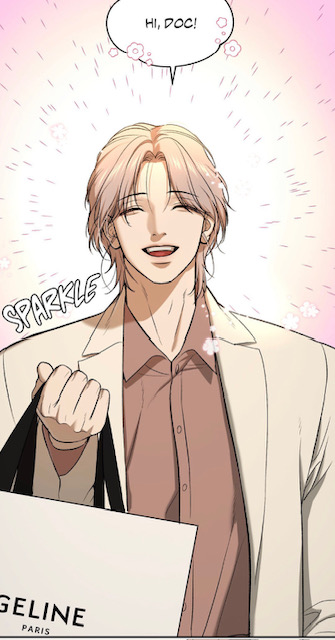 (chapter 31) This observation helped me to recognize that the more Heesung appeared, the more colorful his clothes became. So this discovery exposes that
  (chapter 35), white is not his true color! Whereas Potato represents black outside and white inside, his partner embodies the opposite values: white outside and black inside. In addition, the switch of colors indicates not only his transformation, but also that his world is becoming more colorful and as such less boring. Yes, Mingwa was applying the principle: clothes make the man. To conclude, the colors beige and orange are mirroring his gradual maturity.
Furthermore, Manhwaworms can observe that the switch of beige to orange is strongly connected to honesty. The darker the color is, the more the artist opens up. When the celebrity met the physical therapist in the café (chapter 53), beige had become darker and as such more pronounced, compared to the scene in the van (episode 29). Therefore, it is no coincidence that in front of the “angel”, he decided to divulge his true intentions. He desired to date the main lead. Then he admitted his trick and confessed to the innocent doctor that the champion had developed feelings for him.  (chapter 35) To conclude, the darker beige is and as such the closer it is to orange, the more sincere Heesung is.
Interesting is that the actor selected different types of beige: Pale taupe combined with sand (chapter 31), peach 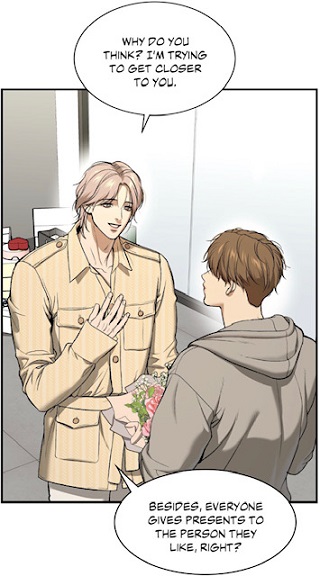 (chapter 31) and finally camel
 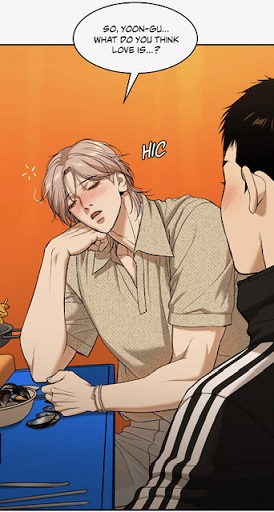 (chapter 35) Here, I added a screenshot of 57 different types of beige.
 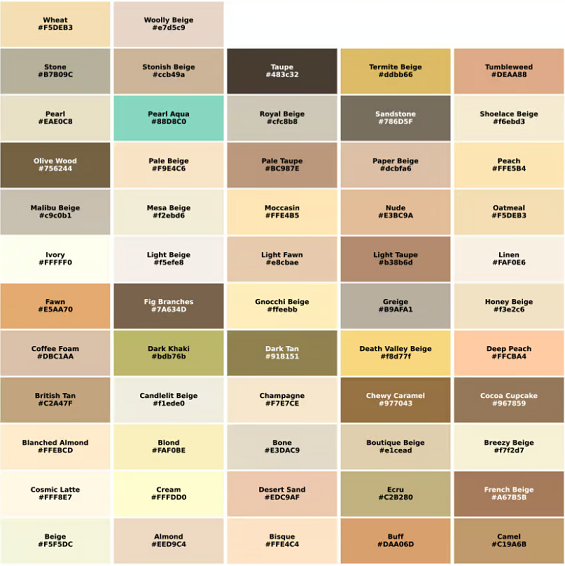 https://artincontext.org/beige-color/ It exposes more than the character’s personality, it divulges his fear!! 😮 How did I come to this interpretation? It is important to keep in mind that beige is considered as neutral.
“Along with beige, neutral colors include white, black, cream, and gray. Beige is also seen as a metaphor for bland things.” Quoted from https://artincontext.org/beige-color/
His flat and clothes are indicating that the actor is leading a bland and insipid life. No wonder why the actor is often feeling bored. 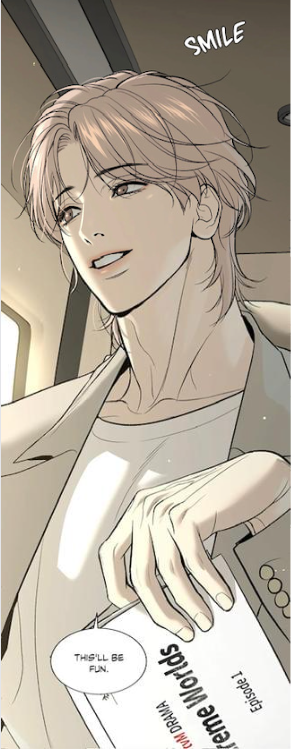 (chapter 29) From my point of view, he doesn’t desire to stand out, to make a statement. Therefore it is not astonishing why he hides behind sunglasses, a hat and a mask.
  (chapter 35) He didn’t want to be recognized. One might argue about this perception (not standing out), for he is writing a vlog
 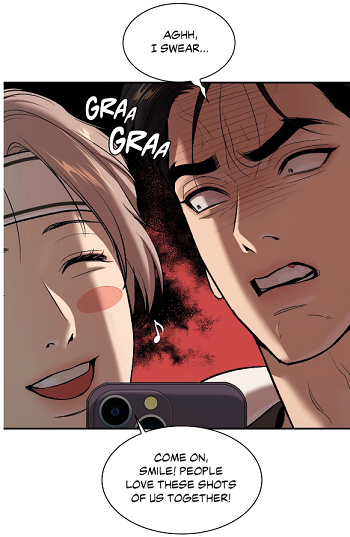 (chapter 30) and giving lunches to the fighters. Besides, he is a celebrity. But notice that he is not delivering the meals to the members of Team Black himself, just like he is not interacting with fans directly too.
  (chapter 30) The social medias serve as a way to control his image and keep people at arms’ length, exactly like his frenemy Joo Jaekyung.
  (special chapter) Therefore he is sleeping while hugging a beige and pastel pink pillow. This exposes his need for warmth and support. On the other hand, he is not realizing that he is his own enemy, for the pillow represents a hindrance. He is not allowing people to get closer to him. It looks like he fears embraces in the end.
  (chapter 33) Thus he would voice such a reproach: too clingy!
Moreover, I also noticed his preference for pastel colors: 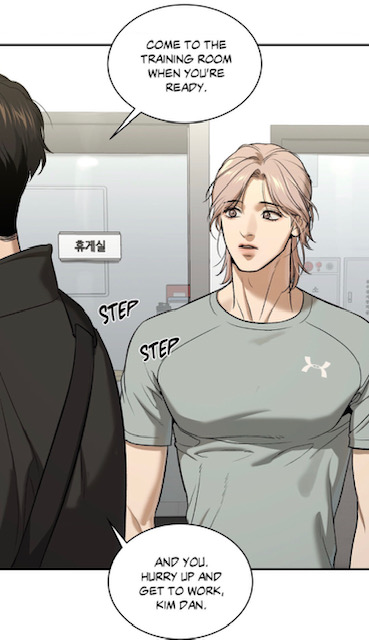 (chapter 31)
  (chapter 32, the lavender suits) This observation reinforces my previous statement. Heesung is looking for neutrality.
If you have created a pastel mood in your home, you are probably someone who is friendly, sensitive, gentle and caring. You do not like confrontation and drama in your life so you do not decorate your home in bold or dramatic colors. Quoted from https://www.empower-yourself-with-color-psychology.com/pastel-colors.html#:~:text=Defining%20Pastel%20Colors&text=If%20you%20have%20created%20a,in%20bold%20or%20dramatic%20colors.
He is avoiding conflict. At the same time, I believe that Heesung is simply trying to imitate people. He is simply seeking conformity which stands in opposition to his own mind-set:  (chapter 33) He is amoral and to a certain extent immoral. We could say that he is a free spirit, but fears rejection. Hence he faked an injury and lied to people. The pastel colors are not reflecting his true mind and choices. We have the perfect example in this scene:
 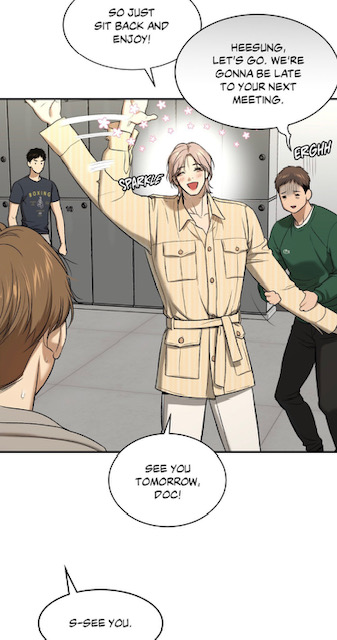 (chapter 31) While he was wearing a peach jacket, his manager had put a vivid green with dark black pants. Shortly after, the comedian was seen with this beige/khaki shirt and grey shorts.
  (chapter 31) Interesting is that his hair shade reflects my previous remarks perfectly. He chose pink which indicates his desire to break social norms, on the other hand, his pink is so faded that it almost looks like beige. He wishes to be “neutral” and somehow “conformist”. Yes, his pink hair mirrors his inner conflict: trying to break free from social norms, yet not standing out too much. The antonym for neutrality is “commitment”, an indication why he was not capable of being committed in a relationship in the end.
To conclude, with such colors (beige and pastel colors), he is trying to validate the image of a friendly, sensitive and gentle celebrity. Hence I was not surprised why he came to deceive himself. I come to the following conclusion. The moment the actor started wearing the orange bathrobe, he chose not only to be true to himself, but also to give up gradually on neutrality. This signifies that he is one step closer of getting committed and as such responsible. Moreover, it means too that in the next future, he won’t be avoiding conflict and drama. This represents a huge step in his emancipation from his “family” and as such “agency”. He will have to stand up for his own values and love life: homosexuality, his younger partner Potato and even BDSM. But I will elaborate the last point further below.
1. 2. Pink, orange and soulmate
Now, let’s return our attention to the scene at the café with the beige shades. (chapter 35) Striking is that the pattern on the wallpaper were roses. The latter has for synonym “pink”. As you can see, the color orange (beige = faded orange) is strongly connected to “pink”. And this leads me to my next observation. When the celebrity interacted with Kim Dan, Mingwa had already combined pink with the artist 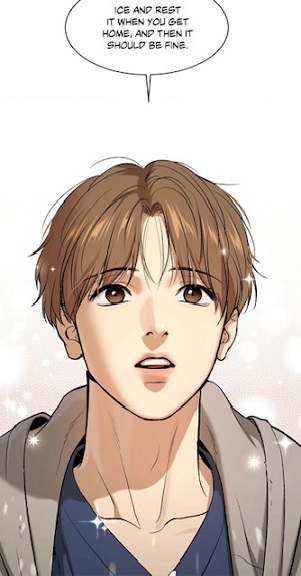 (chapter 30). However, if you compare the pink from
  (chapter 30) episode 30 and 31
 (chapter 31)
 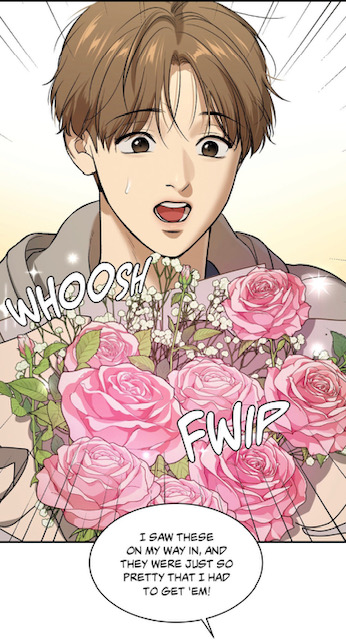 (chapter 31) to the ones from the special episode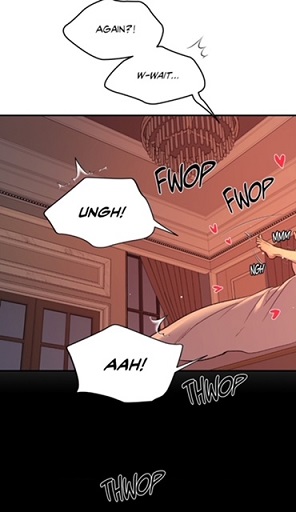
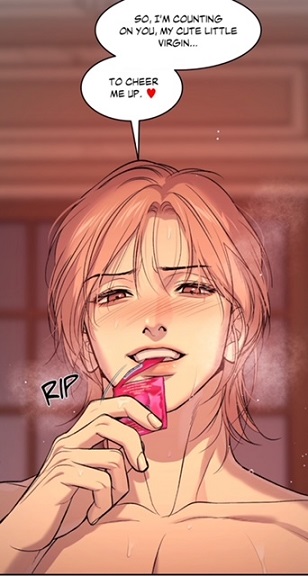
 (special chapter), you will notice a huge change in the shade. While in the past, the Webtoonist selected pastel pink or coral, in the special episode, we have now fuchsia as pigment. This is no coincidence that the color is now more pronounced, exactly like with beige/orange.
It shows that Heesung’s emotions are stronger compared to the past. This pink night corresponds to his union with his soulmate. In addition, the shade insinuates that Heesung could act more freely with Potato. Let’s not forget that the former had stated that he would become responsible for the sexual initiation (“leave everything to me”).  (special episode) Consequently, it is not astonishing that he wore an orange bathrobe the next morning. It liberated him from his hidden fears. On the other hand, the transition of the pink indicates that the more Heesung interacted with the main leads and Potato, the more his feelings came to the surface. As time passed on, his true personality came to light. Under this new light, it becomes understandable why honesty played a bigger role, the more the comedian interacted with the main characters from Jinx. Consequently, in the special episode he is more honest to himself than before. Therefore by wearing the orange bathrobe, he is indicating that he is finally accepting his true nature. Simultaneously, Jinx-philes can grasp why in the dining room, he is finally admitting that so far, he had been playing with his sex partners.
 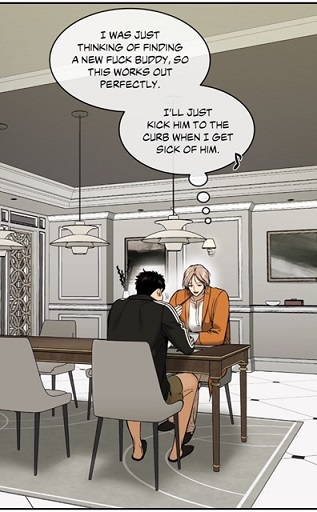 (special episode) While in the past, he told his sex partners, he was looking for his soulmate (chapter 33), in reality he just viewed them as his fuck buddies or sex toys. For me, he was not just deceiving his companions, but also himself. This explicates why after getting rejected by the physical therapist, he didn’t give up on his dream and ambition: to find his soulmate.
  (chapter 35) This shows how important it was for him to have a lover. He fears of being abandoned and being alone. Therefore he asked this from his new lover:
  (special episode) Notice that he is smiling with open eyes, a sign that his joy is genuine. He is imagining that he is in control of this relationship. Under this perspective, it becomes comprehensible, that (chapter 35) he started thinking about a soulmate, as soon as he got rejected by Kim Dan. He needed to keep this goal in order not to feel despaired and scared. Simultaneously, his reaction shows that his feelings towards the doctor were not that deep. Additionally, his statement (“whatever they’ll figure it out”) stands for “neutrality”. As you can see, he is refusing to assist the main couple.
That’s how I detected another connection: noninterference and soulmate. The artist rejected to help the doctor and the champion. We could perceive such an attitude at the restaurant.  (chapter 32) Not only he didn’t want to be confronted with the champion’s anger, but also he didn’t care if the doctor had to suffer because of him! To conclude, Heesung prefers watching from the side line with the excuse: he is seeking his soulmate.
 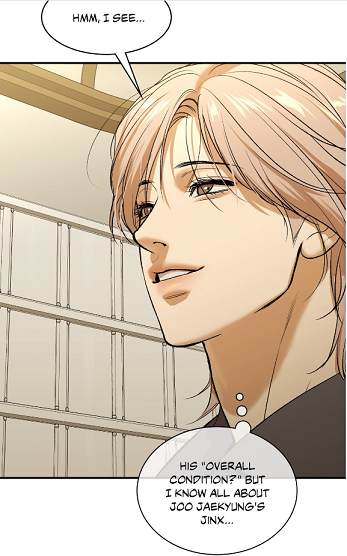 (chapter 32) It is not his “problem”. Hence he was totally absent, when the scandal with Joo Jaekyung broke out. His AWOL corresponds to his passivity and even indifference. However, there is no doubt that this incident will affect his relationship with Potato greatly.
  (chapter 52) The latter looks not only sad, but also frustrated. Let’s not forget that Potato fought against MMA artists from a different gym.
 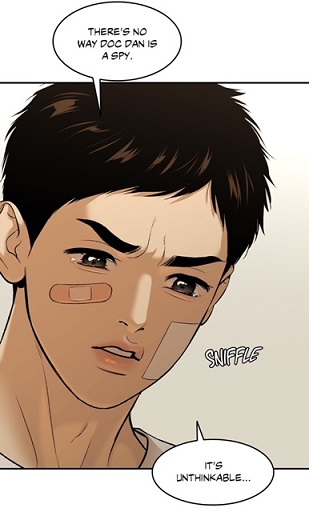 (chapter 52) Besides, Yoon-Gu embodies the opposite notions: loyalty and meddling. He doesn’t fear argument and criticism!
 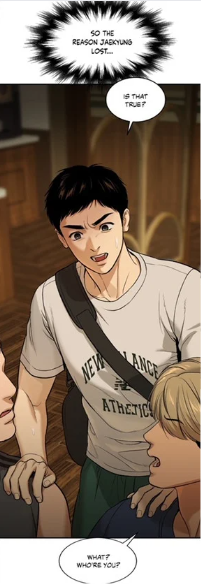 (chapter 52) Heesung’s indifference and selfishness contrast so much to his new lover’s interest and selflessness. This shows that the young maknae is superior to the actor despite his lack of experience and ignorance. How do we explicate this divergence? It is because Potato had been showered with support and love at the gym. Kim Dan was even willing to risk his safety for him, a sign that he was lovable and worthy. Hence he is a confident man which is not the actor’s case. That’s the reason why the young man stated that he would become responsible for Heesung.
 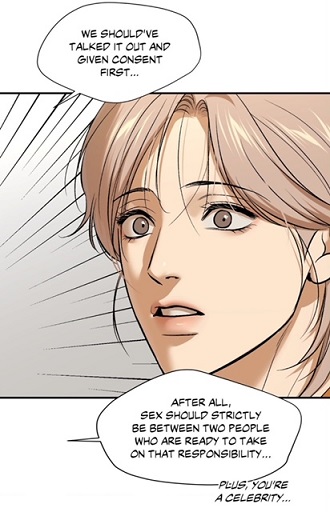 (special episode) Thus I sense that Potato will force the actor to drop all his past believes: passivity, indifference, irresponsibility and as such betrayal. We could witness this in the special episode partially. (special episode) When he discovered how young his lover was, he got shocked for one reason. He could get into trouble, for his relationship could be vilified like this: an adult seduced a minor, a virgin! This late realization forces him to become responsible for their relationship. He has to ensure secrecy, he can no longer ask his manager to assist him.
  (chapter 31) That’s how he is encouraged to separate private life from his work and public life. Thus he is pushed to distinguish between “idolization” and “love”.
Moreover, through the previous remarks, I came to develop the following prediction: Heesung’s karma will be to be neglected by Potato. Since the actor didn’t care for the doctor and fighter, though he knows that Kim Dan has feelings for the celebrity, and the former left, I believe that Potato won’t have the time and motivation to become responsible for Heesung’s needs. Moreover, Heesung will quickly realize that Potato is not contacting him on his own!! Heesung is in reality the needy one!! Expect a new version of episode 5:  (chapter 5) This is just another trick from goddess Mingwa to push him to become more responsible for his new relationship. My idea is that in order to discover that Potato is his soulmate, Heesung needs to help Potato and as such the main couple to be together. Only when the doctor and the champion are an item, he will have his partner.
However, after spending one night with the young fighter, (special episode) Manhwaphiles can notice a change in the actor’s mentality. He is more focused on the moment (special episode), which contrasts so much to the idea of soulmate. The latter embodies eternity and destiny. The celebrity is describing his relationship with Potato as momentary and deliberate. It is his own choice and not the work of “gods” playing with humans. In other words, he is dropping his old principle: “soulmate”. He’s enjoying the present, he is not really thinking about the future. In fact, he is expecting that at some point, Yoon-Gu will get tired of him and leave his side. He is lowering his “expectations”. He has the impression that he has the upper hand in this relationship. (special episode)
While many Jinx-philes saw the celebrity as the better lover compared to Joo Jaekyung, I had a different impression. They are equals. We should compare the intercourse in the special episode 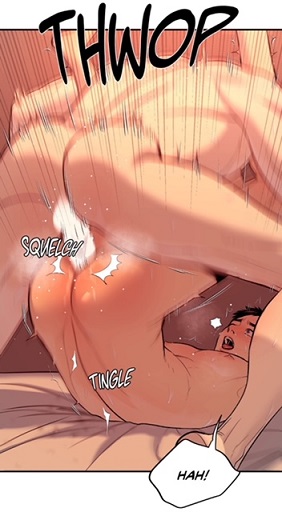 (special episode) with the one from episode 39
 (chapter 39), as the shades are very similar. Heesung was as rough and selfish as the fighter. Notice that this whole sex session was focused on the actor’s needs and desires,
  (special episode) exactly like with the champion. He needed “comfort”, as he was in a depressed mood. (special episode) It was not about giving love and warmth to Yoon-Gu either. Thus the gumiho thrusted quite roughly, he removed the fighter’s hand suddenly, he didn’t caress his butt, but grabbed it.
 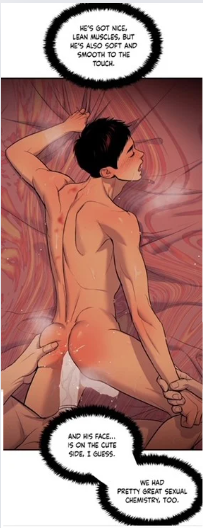 (special episode) The champion has a similar habit:
 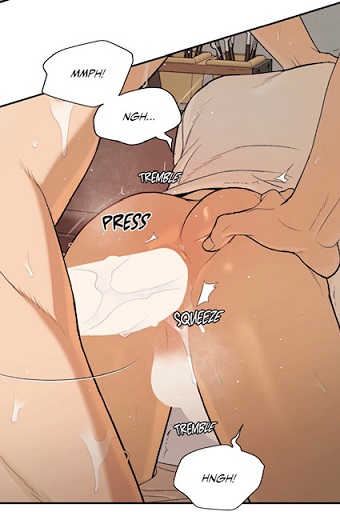 (chapter 36) Besides, note that Yoon-Gu’s buttocks are red, a sign that the comedian focused on them!! The irony is that Potato felt pleasure right away, hence he had more climaxes than Heesung. (special episode) Yoon-Gu embodies honesty exactly his role model: Joo Jaekyung. That’s how the gumiho gets affected in the end. Though the latter is here smiling in the last picture, his words are divulging his discontentment. For me, the actor’s smile is not the symbol of happiness and sincerity, rather dissatisfaction and duplicity. Contrary to the physical therapist, the other uke is more genuine about his physical reactions and body. Hence he showed curiosity and not fear to this new experience.
  (special episode) This panel is interesting, because it shows that Potato was not focusing on Heesung at all. It was all about himself and his own pleasure. He was not recognizing that he was actually mirroring the actor’s thoughts and desires. Yes, from my perspective, the young man was in truth treating the actor as his sex toy or fuck buddy. There was no string attached, this explains why Heesung had to ask this to Yoon-Gu: (special chapter) He desired to be recognized by Yoon-Gu. Besides, he is not selfless enough to become the comedian’s fun toy. There’s a reason for that. MMA fighting means a lot to him. Moreover, he will only assist people who showed him kindness and care: Kim Dan and Joo Jaekyung.
That’s how it dawned on me what was Heesung’s major flaw. He is behaving similarly to the main lead, Joo Jaekyung. While the latter treated sex as a surrogate fighting in the past, the gumiho is thinking that life is a stage, therefore he is acting all the time. His pastel colored clothes are his disguises. He is totally immersed in the role: Choi Heesung the celebrity. Therefore I believe that in his mind, love is like in a romantic movie 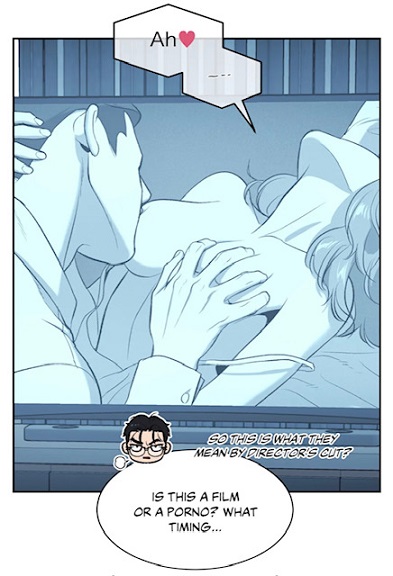 (chapter 29: black and white movie!!) and fairy tale: the end shows their blissed union and they lived happily ever after. This explicates why the comedian compared Kim Dan to an angel…
 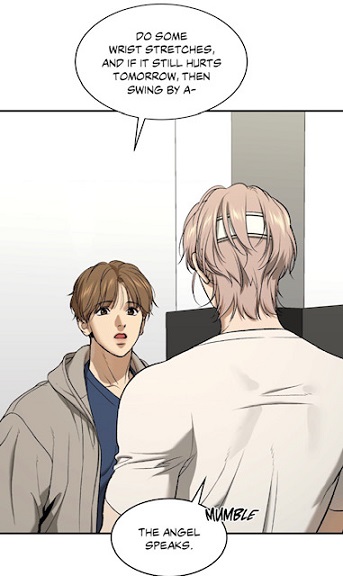 (chapter 30) The latter stands for eternity and immortal love. But this is just an illusion, for humans are mortals. They are destined to die. And this leads me to my following remark. Why was black so present in the special episode? It is because this pigment often represents DEATH!
To conclude, his increasing honesty allowed him to divulge more his true emotions and thoughts. However, while Manhwaworms can discover the actor’s duplicity in the special episode, Potato is left in the dark concerning Heesung’s true intentions. The alcohol helped Heesung to show his amorality and selfishness, yet the maknae was too overwhelmed by his own sensuality and tipsiness to notice the comedian’s hypocrisy and selfishness. (special episode) His ignorance helped him not to get wounded. In my eyes, Yoon-Gu’s suffering is strongly connected with Team Black’s fate. That’s why he is spared by not knowing the gumiho’s true thoughts. Finally, there’s no doubt that these selfish thoughts will change very quickly.
1. 3. The mystery behind black
Since Choi Heesung mentioned the champion’s jinx, this shows that he is aware of its existence. (chapter 32) So what does it indicate? Initially, I thought that he could know about the involvement of others behind the jinx. Let’s not forget that he is working for the same agency, and based on the English translation, the Entertainment company seems to belong to his family. 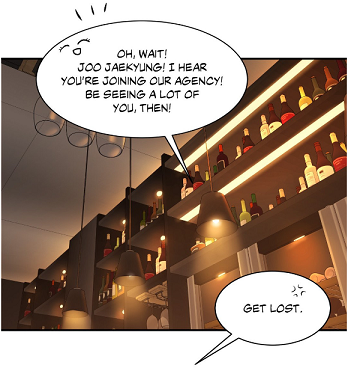 (chapter 33). He can also hear rumors there. Moreover, for me, the actor stands for power, control and as such knowledge… hence he was able to pull tricks on the star on multiple occasions. He is able to make the athlete angry, he can arrange a meeting without Joo Jaekyung’s consent
 .(chapter 34) or make a deal at his expense
  (chapter 32.). Interesting is that these values (influence, dominion, competence and insight) are associated with the shade black!
In color psychology, black means power and control, hanging on to information and things rather than giving out to others. Quoted from https://www.empower-yourself-with-color-psychology.com/color-black.html
That’s why I thought that he could know the truth behind the jinx. Nevertheless, since I portrayed him as passive and noncommittal, I deduce that Choi Heesung could have heard about the jinx and never investigated the matter. It was not his problem anyway. In other words, I feel like Heesung might know a part of the truth, but not everything. Since his career is not directly linked to MMA, I doubt that the actor felt the need to question the origins of the jinx and the role of the agency. Thus the color “black” could symbolize ignorance and negligence as well, which is reflected in the idiom “left in the dark”. Besides, he doesn’t need to know the whole truth, some information is already enough to “get a glimpse of the verity”. Because of this interpretation, I was even wondering if this trick 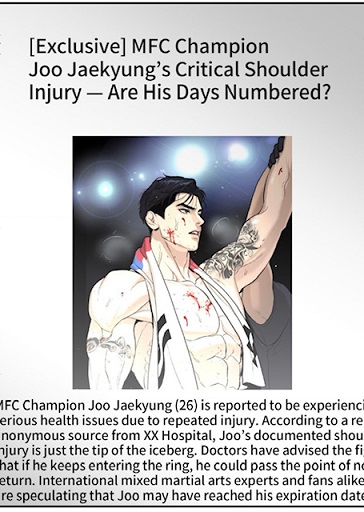 (chapter 35) was not a punishment against Joo Jaekyung for the actor’s injury which happened with the support of MFC.
  (chapter 31) Officially, he had wounded the actor, therefore his physical therapist had to take care of his treatment. Besides, I believe that MFC desired to corner the champion in order to force him to give up on his new lover. He was no longer hiring a prostitute. As you can see, black is an ambiguous color: it can symbolize knowledge as well ignorance. Thus this shade represents mystery. Thus it is no coincidence that the past and family of Joo Jaekyung, who is also associated with black, remain a riddle
So far, obsidian was only implied with Heesung’s personality, as darkness can symbolize evilness or guilt.  (chapter 31) While Joo Jaekyung condemned him for his deception and constant switching of partners
 (chapter 33), his manager accepts him despite his messy love life and flaws. (chapter 31) Funny is that he just considers this as a curse. Interesting is that Potato sensed his dark side too, but he has no idea about his past love life. While people mistakes Choi Heesung for a Samaritan, in reality, he is cunning, selfish and even ruthless, for he is a gumiho.
And now, you are wondering where black was present in the special episode. He was exposing his dark side to the readers. In truth, he is also a “selfish jerk”, a name that many Jinx-philes would use for the main lead.  (special chapter) Potato is a sex toy, just like the doctor was a tool against the champion’s jinx. Secondly, the artist discovered a whole new world thanks to Potato’s purity and ignorance
  (special episode). Yes, the black color related to the universe is visualizing the actor’s own “ignorance”. He can not predict the maknae’s next moves and thoughts. It was, as if a big bang had just happened. 😂 Potato’s pure innocence could only disarm and even defeat the slick comedian. Hence the latter was left totally speechless. Finally, since Potato embodies the shade “black”
 , we have to envision that his role during the night was to absorb the actor’s negative energy.
Black absorbs negative energy. It is useful to carry something black with you to protect you from harm and negativity when traveling or when going about your usual daily activities outside your home. Quoted from https://www.empower-yourself-with-color-psychology.com/color-black.html
Choi Heesung was definitely depressed after experiencing the main lead’s rejection. His drinking 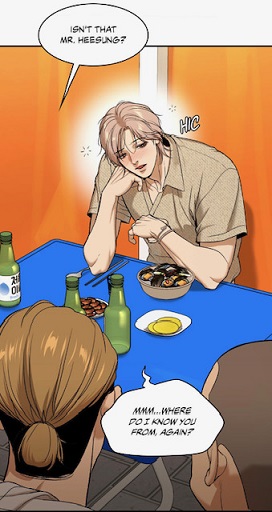 (chapter 35) reminded me of Kim Dan who used to drink in order to numb his pain. By meeting the black and yellow Chow-Chow, the fox was able to see light in his sorrow. Potato could absorb his negative thoughts and even enlighten his night. Therefore it is not surprising that Heesung made such a statement: (special episode). That’s how it dawned on me why the artist could move on so quickly after dumping his last companion in chapter 33.
  (chapter 33) First, the VIP club is painted with dark colors. Secondly, the athlete was wearing a dark brown jacket with a black pullover. For me, Choi Heesung’s true personality comes to light in the dark!! We could say that he shines in a black room. Surrounded by darkness, he feels more protected. Thus at the club, he revealed his immorality and hypocrisy… He didn’t stand out. The more white the room is, the less the actor is honest! His preference for neutral colors expresses his need for “conformity and passivity”. They are an evidence for his hypocrisy and acting. Under this perspective, Manhwaworms can grasp why the mysterious man has a hidden dark room!
  [I am assuming that Mingwa didn’t change the flat] Only there, he exposes his true nature: BDSM. In my eyes, there he can voice all his desires and thoughts. His true self can come to the surface. I saw another evidence for this hypothesis (BDSM) in this expression: “kick him to the curb” (Special episode). This expression exposes the second lead’s hidden ruthlessness, selfishness and disregard. Naturally, since BDSM focuses on power dynamics, role-playing, and the exchange of control, often incorporating physical restraints, sensory stimulation, and psychological techniques, it signifies that consent, communication, and safety are paramount in BDSM relationships and activities. Hence if this expectation is correct, I deduce that such a sex session can only happen, when both are on the same wave length.
Finally, the reference to Black was palpable in this comment:  (special episode): DEATH! This notion contrasts to the actor’s belief: soulmate! What is Potato’s goal in life? So far, it was to follow Joo Jaekyung’s foot steps! He wants to be a MMA fighter. He is destined to fight and as such to be exposed to danger. In the ring, he can die. He already fought for the physical therapist’s sake.
 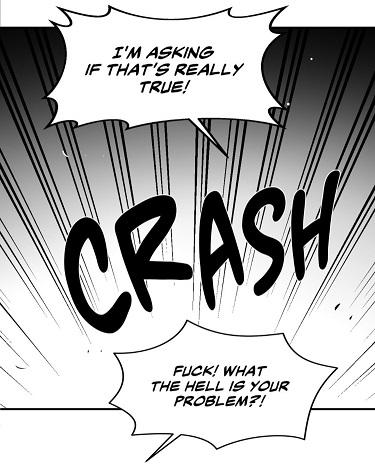 (chapter 52) This means, he is already one step closer to the MMA arena. With the last incident, the young fighter must have caught the attention of opponents. He created himself “enemies”. Therefore he could become the next target for a plot as a revenge. In other words, with such a companion, Heesung is confronted with reality. His destined partner can be wounded and even die. Thus he has to ensure his safety. He can no longer be indifferent and passive. As you can see, Heesung will be put in a similar position than the physical therapist:
 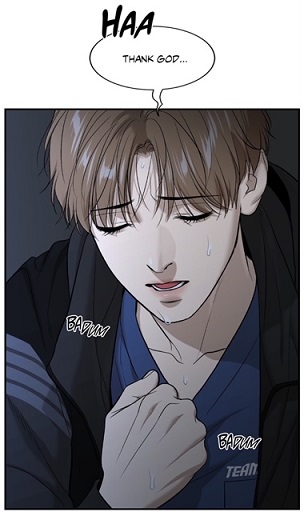 (chapter 40) And this observation leads me to my second part, the explanation for the title: La Vie En Rose.
2. Heesung and La Vie En Rose
While reading the special episode from Jinx, I couldn’t help myself connecting the actor Choi Heesung to the expression “La Vie En Rose”. (special episode) (special episode) I am not sure if anyone is familiar with this French expression. The latter means “life in pink” or “life through rose-colored glasses.” It is a philosophy that emphasizes finding beauty, joy, and positivity in every aspect of life. This philosophy encourages a mindset that focuses on gratitude, mindfulness, and the appreciation of both the small and significant moments. As you can see, it is strongly connected to the heart and as such to love.
But where does this idiom come from? The expression “La Vie En Rose” originates from the famous French song of the same name by Edith Piaf in 1947. Piaf co-wrote the lyrics with Louis Guglielmi, who composed the music.
Interesting is that this song is associated with the rose and the colors black and white. First, the flower and shade in French have the same name. Moreover, back then colored pictures and videos were inexistent. After reading my first part, Jinx-philes can recall that the second lead, Heesung, is strongly connected to pink, black and white too.
But why did Edith Piaf write such a song? “La Vie en Rose” was released at a time, when France was recovering from the devastation of World War Two. The song quickly became a symbol of hope and resilience.
| La Vie En Rose Edith Piaf – Original version | Translation |
| Des yeux qui font baisser les miens Un rire qui se perd sur sa bouche Voilà le portrait sans retouche De l’homme auquel j’appartiens Quand il me prend dans ses bras Il me parle tout bas Je vois la vie en rose Qu’il me dit des mots d’amour Des mots de tous les jours Et ça me fait quelque chose Il est entré dans mon cœur Une part de bonheur Dont je connais la cause C’est lui pour moi Moi, pour lui, dans la vie Il me l’a dit, l’a juré pour la vie Et dès que je l’aperçois Alors, je sens en moi Mon cœur qui bat Des nuits d’amour à ne plus en finir Un grand bonheur qui prend sa place Des ennuis, des chagrins, s’effacent Heureux, heureux à en mourir Quand il me prend dans ses bras Il me parle tout bas Je vois la vie en rose Il me dit des mots d’amour Des mots de tous les jours Et ça me fait quelque chose Il est entré dans mon cœur Une part de bonheur Dont je connais la cause C’est toi pour moi Moi, pour toi, dans la vie Il me l’a dit, l’a juré pour la vie Et dès que je t’aperçois Alors, je sens dans moi Mon cœur qui bat | Eyes that make mine lower A laugh that is lost on his lips This is the unretouched portrait Of the man to whom I belong When he takes me in his arms He speaks softly to me I see life in pink He tells me words of love Everyday words And it does something to me He’s entered my heart A piece of happiness The cause of which I know It’s him for me Me for him, in life He told me, he swore it for life And as soon as I see him Then I feel inside me My heart beating Nights of endless love Great happiness takes its place Troubles and sorrows fade away Happy, happy to death When he takes me in his arms He speaks softly to me I see life in pink He tells me words of love Everyday words And it does something to me He’s entered my heart A piece of happiness The cause of which I know It’s you for me Me for you in life He told me, he swore it for life And as soon as I see you Then I feel inside me My heart beating |
The lyrics describe a state of bliss brought on by being in love, where everything seems beautiful and radiant. If you read the analysis “The Art Of Loving”, you will realize that the author is advocating the same ideas than the German-American philosopher and psychologist Erich Fromm’: love leads to happiness. At the same time, the verse “my heart beating” is referring to the notion of “life”. The fictive narrator feels alive and full of energy thanks to his affection. This interpretation brings me to my next observation. Choi Heesung has a similar mind-set. Without love, he feels that he is not existing. That’s why he keeps looking for his soulmate. (chapter 33) I can comprehend how he came to develop this mentality. It is related to his work. He is an actor. If he was not famous, he couldn’t work. He is relying on fans and their admiration. However, this kind of affection is superficial, for the stans only know the face and the man as actor. To conclude, his definition of love is linked to his job and as such veneration. That’s the reason why his “soulmate” has to be perfect (“perfect in every way”). His words imply that his companion has to be a celebrity himself as well. Why? It is because humanity embodies imperfection, but not a star. And the moment a celebrity’s flaws are exposed, the latter loses his special status as “star” and “god”. He is now just a human. 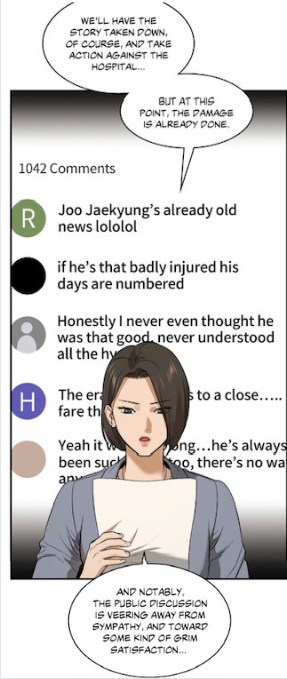 (chapter 36) That’s what the athlete experienced at the end of season 1. I could describe the fans’ devotion and appreciation as idolization and veneration which can have terrible consequences.
- Loss of Objectivity: Idolization can lead to a lack of critical thinking about the idolized person or thing, making it difficult to see their faults or mistakes.
- Unrealistic Expectations: Placing someone on a pedestal can create unrealistic expectations that the idolized figure may ultimately fail to meet, leading to disappointment.
- Dependency: Excessive idolization can result in emotional dependency, where an individual’s sense of self-worth or happiness is tied to the actions or opinions of the idolized figure.
In this panel (chapter 33), we could see a reference to dependency. The comedian dumped his last boyfriend, for the latter had become too clingy. His words (“perfect in every way”) also display that Heesung’s love life was affected by unrealistic expectations. After he got rejected by Kim Dan, the comedian opened up to Potato and confessed this: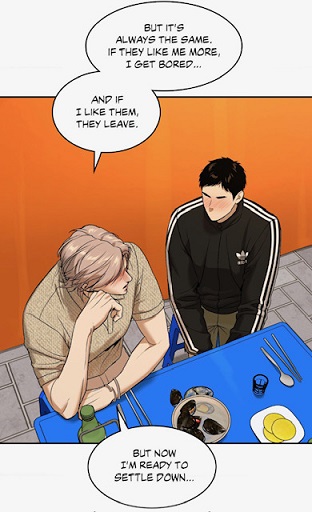 (chapter 35) Either he would break up, as he felt no excitement for his boyfriend, or when he would finally reveal his true side, the latter would leave him. Why? Both were disappointed, neither of them would fit the portrait they had from each other. The smiling and generous actor is in fact selfish, childish and probably apathetic. I am even suspecting that he has been suffering from depression too. Not only the choice of his colors indicates blandness, boringness and lifelessness, but also his body language. He is often seen resting his head on his hand.
 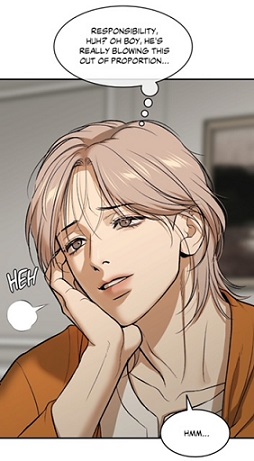 (special episode)
  (chapter 33) or sighing, the symbols for boredom. Thus I have the feeling that his job as actor is not procuring him any joy. That’s how I realized why Heesung is the champion’s frenemy. While the latter stands for training and routine (he hates surprises and novelties), the other embodies the exact opposite notions: he loves adventure, spontaneity and variations. (chapter 33) This explicates why he became an actor, why he moved from the building, but at the same time why his job is not truly fulfilling too. There is still a routine and there is no real thrill. This remark brings me to my next observation: Heesung must believe that affection is an emotion and sensation. He is reducing it to “thrill, excitement and butterflies in the stomach”. Thus it is normal that he felt bored with his sex partners quickly. In addition, since Heesung selected neutral colors for his clothing and apartment, I deduce that until he met Kim Dan and Potato, he was avoiding emotions. Yes, in the end, he was similar to his frenemy. He was refusing to open his heart to others out of fear. Yes, he was afraid of getting wounded and broken. And now, you comprehend why his path had to cross the physical therapist’s first! The latter stands for selflessness and gratitude. He is the perfect “worshiper” (Halmoni and Joo Jaekyung). Heesung couldn’t be mad at Kim Dan for his rejection. He understood why the man could not reciprocate his feelings. Yes, the doctor taught him to respect his counterpart. Hence there was no resent from Choi Heesung contrary to the other Choi:
  (chapter 48) As you can see, the main lead announced a turning point in the gumiho’s life. Exactly like his frenemy, he was taught that money and fame can not buy affection. Moreover, for the first time, the young man learned the existence of boundary and respect.
In my opinion, Heesung only feels alive, when he is provoking reactions and emotions in his counterpart. He needs them, as he has been controlling his own heart this entire time. That’s why he likes being with the champion (chapter 30) or having sex with someone! He is reducing love to lust and physical responses. Under this new light, it becomes clear why his bedroom was colored with pink colors: 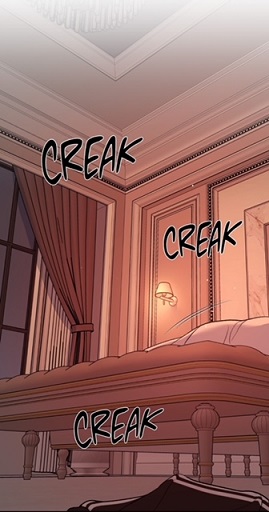 (special episode) (special episode) He felt his heart beating, and sensed so many emotions. Without LOVE, his world becomes colorless and insipid again: black or white. Here, he was following the flow.
Because Heesung hates boredom and as such routine, this signifies that he enjoys novelties, trips and adventures. And now, the actor is destined to fall in love with the sweet “Potato”! It is because each time, the chow chow is able to “surprise and even scare” the keen second lead. Observe his reactions each time Yoon-Gu voices his thoughts:  (chapter 35) (special episode) (special chapter)
  (special chapter) He is constantly caught by surprise! (special episode) That’s why he is often left speechless and paralyzed. He can not use his skills like with other people. Hence his interactions with Potato remain memorable. And now look at this memory:
 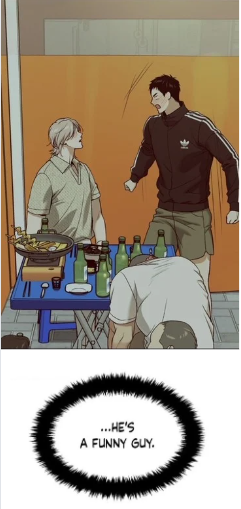 (special chapter) He sees Yoon-Gu as fun! Simply because he is allowing himself to express his emotions. He is never hiding his thoughts and emotions, the exact opposite of Heesung. He is so transparent, on the other hand, totally unpredictable. Yes, in the end, Yoon-Gu represents a huge riddle for Heesung. What caught my attention is how Yoon-Gu didn’t mind to yell his affection and admiration in front of people. He doesn’t mind people’s judgement and gaze. He is strong enough to bear this kind of attention… the exact opposite of the actor. He is not afraid of committing, making a different statement, he can diverge from majority. Hence he left the restaurant in front of others.
 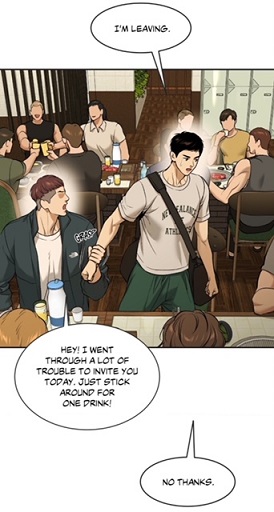 (chapter 52) He can make his own judgement and choice. To conclude, though Yoon-Gu is the younger one, he has so much to teach his fated partner who chose conformity and ended up bored and half-dead!
And this brings me to my next remark. How did these two meet? By coincidence!! They bumped into each other. 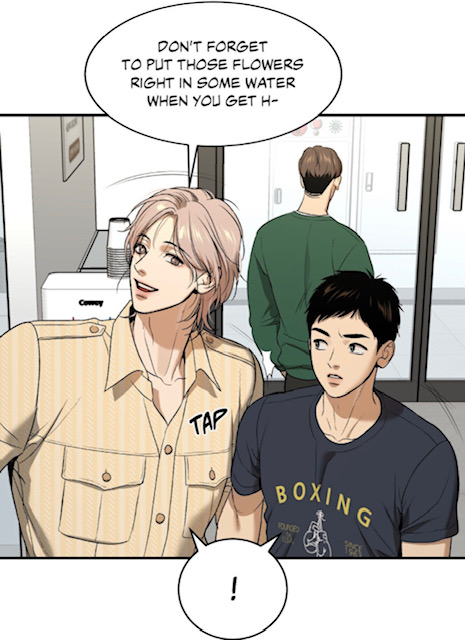 (chapter 31) We could say, their meeting was like a big bang, an explosion! Caught by surprise and annoyed by such an incident, the actor couldn’t help himself voicing his thoughts about Potato:
 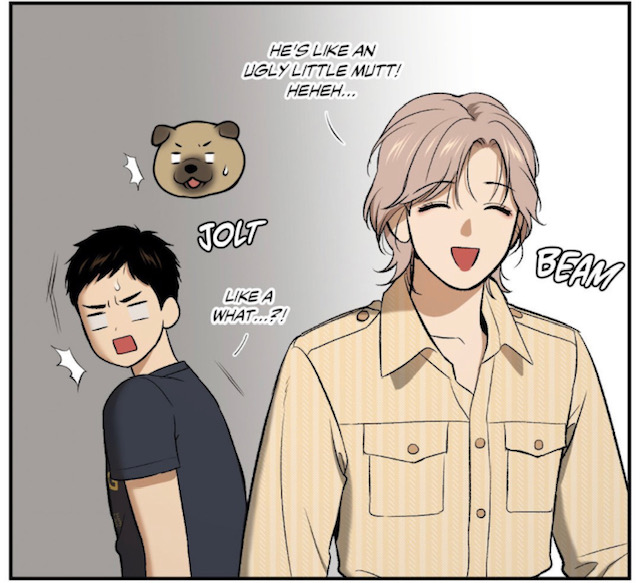 (chapter 31) For a short moment, he dropped his mask and expose his true personality. And for the first time, he received such a gaze: 8chapter 31) Yoon-Gu glared at him, which left a deep impression on the actor.
 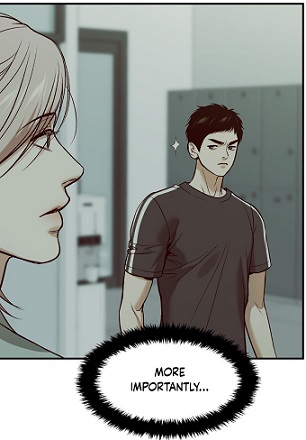 (special episode) That’s how both ended up creating unforgettable moments. Under this perspective, my attentive and patient readers can grasp why I created such an illustration for this essay: The pink in the middle symbolizes the collisions of two stars, spontaneity, shock, surprise, the birth of love and life… So the moment the actor will recall their first meeting, he can only remember it as “fate”. If Potato hadn’t crossed his path, he would have never met his soulmate… I come to the deduction that the actor was not able to find his soulmate, for he always picked up guys similar to him. They would prefer normality, social norms and “conformity”. With Potato, he is taking a risk. (special episode)
But let’s return our attention to the song “La Vie En Rose”. Notice that the lyrics are also referring to death: “happy to death”. What does it mean? Edith Piaf’s “La Vie en Rose” captures the essence of seeing life through love and beauty, a perspective that can also apply to how we view death. Embracing this philosophy can help us approach death with peace, acceptance, and appreciation. Recognizing the finite nature of life enhances our appreciation of each moment and encourages mindful living. Accepting death as a natural part of life reduces fear and transforms it into a peaceful transition. This perspective also inspires us to create meaningful legacies and honor the memories of those who have passed. Practical steps include setting meaningful goals, savoring everyday moments, having open conversations about death, and engaging in end-of-life planning. Celebrating the lives of deceased loved ones and performing acts of kindness in their memory keeps their spirit alive. Integrating the “Vie en Rose” philosophy with our understanding of death brings a profound sense of peace and appreciation to both life and mortality, allowing us to live with love, gratitude, and positivity. And now, you comprehend why this chapter appeared after the separation of the main couple. Joo Jaekyung and Kim Dan are on their way to practice this philosophy La Vie En Rose” (chapter 53), for the grandmother’s death is imminent.
The egocentrism from the crazy fox was truly palpable in the special episode. (special episode 1) Here, he made sure that Yoon-Gu wouldn’t reject him and leave him. (special episode) In the second picture, he believes to have the upper hand. He imagines that he will keep the maknae by his side, as long as he feels like it. However, keep in mind that Heesung hates routine and normality. But if Yoon-Gu becomes a star and MMA fighter, his life will never be “normal”, as he is risking his health and life. Besides, the young maknae admires other people, Kim Dan and Joo Jaekyung, so he has other interests. Heesung needs to learn that not everything is revolving around him. In order to catch Yoon-Gu’s interests, he will have to change his mind-set and way of life. He will be forced to “catch his attention”, do things out of ordinary and as such to make a committment.
But there’s one detail that caught my attention: (special episode) He described Potato as easy”, a sign that Heesung is linking love to conquest. And now, you comprehend why Heesung had no problem to woo someone in a relationship. (chapter 33) He saw it as a challenge… he enjoyed the thrill to earn the prey’s heart. But once they were together, the second lead got bored, as there was no longer this tension and fever. In other words, he confused excitement and lust with love. However, according to Erich Fromm, love is care, knowledge, respect and responsibility. That’s the reason why Heesung had to drop this belief of “soulmate” first! This principle helped him to avoid responsibility in the end. Secondly, with Potato, Heesung has lowered his expectations. (special episode) Moreover, he is not lying to Potato with fake promises and illusions: fated love etc. (special chapter)
The character from Jinx reminded me a lot of Edith Piaf, for the latter is famous of having many lovers. Moreover, she had a terrible childhood which explains why she tried through her lovers to overcome her traumatic childhood. Moreover, it makes one wonder if the artist hadn’t false perception of love too, similar to Heesung. There is no doubt that the latter fears commitment and as such responsibility. But there’s more to it. Edith Piaf fell in love with Marcel Cerdan, a French-Algerian boxer. Marcel Cerdan tragically died in a plane crash on October 28, 1949, while flying from Paris to New York City. His death deeply affected Edith Piaf, and she mourned him for the rest of her life. And now, you comprehend why I couldn’t help myself connecting Heesung with the French singer. This is what Edith Piaf sang 3 years before her death:
| Je ne regrette rien from Edith Piaf – Original version | Translation |
Non, rien de rien Non, je ne regrette rien Ni le bien qu’on m’a fait Ni le mal Tout ça m’est bien égal Non, rien de rien Non, je ne regrette rien C’est payé, balayé, oublié Je me fous du passé Avec mes souvenirs J’ai allumé le feu Mes chagrins, mes plaisirs Je n’ai plus besoin d’eux Balayé les amours Avec leurs trémolos Balayé pour toujours Je repars à zéro Non, rien de rien Non, je ne regrette rien Ni le bien qu’on m’a fait Ni le mal Tout ça m’est bien égal Non, rien de rien Non, je ne regrette rien Car ma vie Car mes joies Aujourd’hui Ça commence avec toi | No, nothing No, I do not regret anything Nor the good that was done to me Nor the evil, all that doesn’t matter to me! No, nothing No, I do not regret anything It is paid, swept away, forgotten I don’t care about the past! With my memories I started the fire my sorrows, my pleasures I do not need them anymore! Swept away the loves With their tremolos Swept away forever I go back to zero No, nothing No, I do not regret anything Nor the good that was done to me Nor the evil, all that doesn’t matter to me! No, nothing No, I do not regret anything Because my life, because my joys Today, it begins with you! Share as link |
And that’s exactly what Choi Heesung will think about this night and their relationship! Life begins with Yoon-Gu!
PS: There will be a new essay about the special chapter.
Feel free to comment. If you have any suggestion for topics or manhwas, feel free to ask. If you enjoyed reading it, retweet it or push the button like. My Reddit-Instagram-Twitter-Tumblr account is: @bebebisous33. Thanks for reading and for the support, particularly, I would like to thank all the new followers and people recommending my blog.
 Bebebisous33s' analyses in K-Dramaland and Manhwas