
Please support the authors by reading the Manhwas on the official websites. This is where you can read the manhwa: Jinx But be aware that the Manhwa is a mature Yaoi, which means, it is about homosexuality with explicit scenes. Here is the link of the table of contents about Jinx. Here is the link where you can find the table of contents of analyzed Manhwas. Here are the links, if you are interested in the first work from Mingwa, BJ Alex, and the previous essay about Jinx Passions in Purple : Jealousy and Joy – part 2
It would be great if you could make some donations/sponsoring: Ko-fi.com/bebebisous33 That way, you can support me with “coffee” so that I have the energy to keep examining manhwas. Besides, I need to cover up the expenses for this blog.
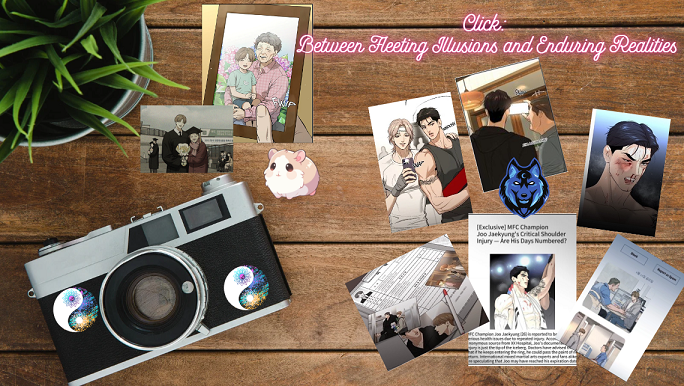
Like the illustration is indicating it, the topic of this composition are the photographs in Jinx. To be more precise, I would like to divulge its different symbolisms. The trigger for this study was a sudden thought, which came to my mind this morning.
1. The ghost’s invisible photos
When Kim Dan left his home, he only took this picture. 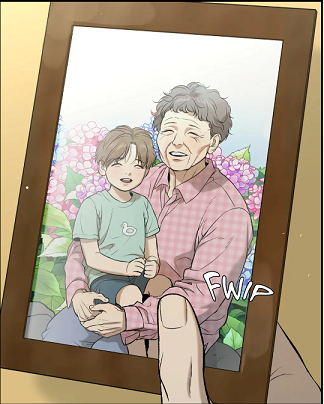 (chapter 19) However, in chapter 47, Mingwa revealed that in the past, Kim Dan had many pictures taken with his grandmother
 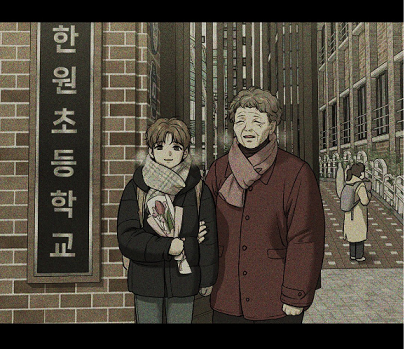 (chapter 47) .
  (chapter 47)
  (chapter 47)
 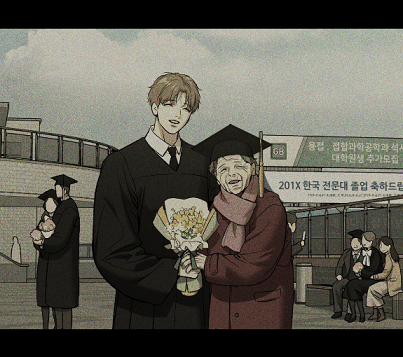 (chapter 47) One might argue about this interpretation, as these panels are presented as “memories”. However, the author left three important clues that these memories were pictures in reality. First, the perspective is not from the protagonist’s, but from an invisible third person’s. Then in the last image, in the background, you can observe a family posing for a picture in front of a person with a cellphone. This was the allusion that someone must have taken these pictures. The last evidence is the bouquet of flowers, the symbol for congratulations, but also affection!! After this realization, I couldn’t help myself wondering about the whereabouts of these photographs. Where are they?
And now, take a closer look at the doctor’s home:  (chapter 17)
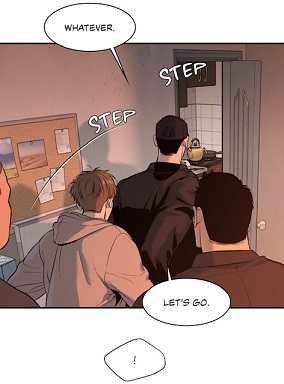 (chapter 17)
 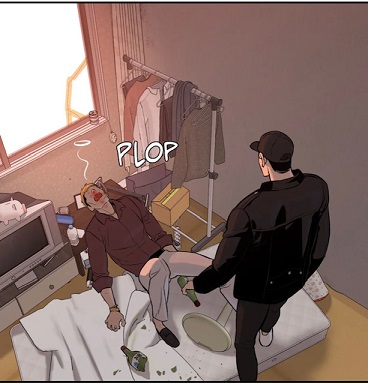 (chapter 17) They are nowhere to be seen!! I would even add that this place contains no traces of Kim Dan’s presence! (chapter 17) The pictures and the papers on the board are all connected to the grandmother. The images of the beach were revealing her wish to go back to the West coast, which was only revealed in the final chapter
 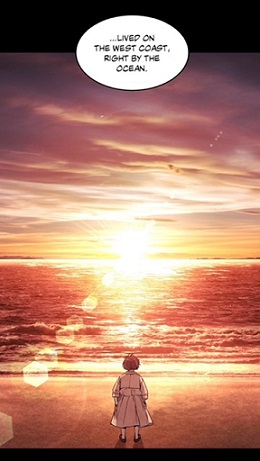 (chapter 53). And here, I feel the need to correct my past interpretation. Back then, I had assumed that this was the doctor’s repressed wish to go to the beach. It turns out that this was Shin Okja’s. Thus I deduce that the papers on the board are related to her health issues. Then in this image (chapter 17), the white shirt, the pink and dark green jackets are definitely belonging to the physical therapist’s relative. Finally, observe where his framed picture was placed: in a chest drawer!
  (chapter 19) The framed photograph isn’t visible on the chests or the shelves, when Joo Jaekyung confronts the loan shark and his minions (chapter 17). Then the next day, there is a box placed on the chest, while he is taking his belongings, while two drawers are open.
  (chapter 19) This exposes that this “souvenir” was not put on display in this house contrary to his stay in the expensive penthouse:
 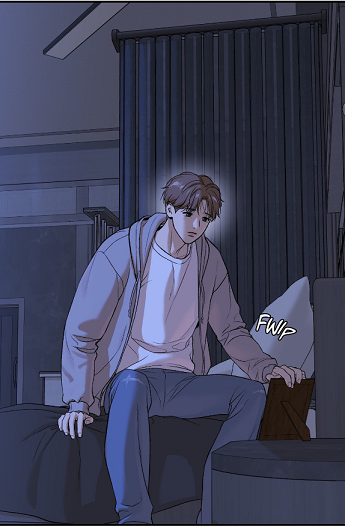 (chapter 47) Thus I conclude through the absence of his pictures and belongings that nothing was exposing the presence of Kim Dan in this small flat. We could say that he had been living as a ghost child (the piggy bank) in his halmoni’s place. It implies the existence of an invisible wall between himself and his grandmother. This perception reinforces my previous interpretation. This place was like a “cursed place, where the “Sleeping beauty” was waiting for his “prince charming”. 😉 Therefore, when the doctor removed the framed picture from the drawer, it symbolizes his own “release”. It is no coincidence that one week later, he became “a man and as such an adult”.
 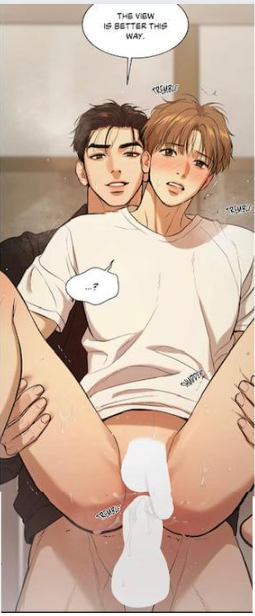 (chapter 19) He was slowly detaching himself from his halmoni’s shadow. The mirror is a reflection of a photograph. Here, he is facing reality: he has a long phallus and he can have a climax.
Furthermore, this new discovery (the absence of his commemoration pictures) helps us to grasp the origin of Kim Dan’s low self-esteem. He was not truly loved by his grandmother. Yes, the absence of his pictures represents a source of his suffering. IT was, as if the grandmother was not proud of her grandchild, because these photos were not exposed. The way these pictures were treated reveals the discrepancy between her words 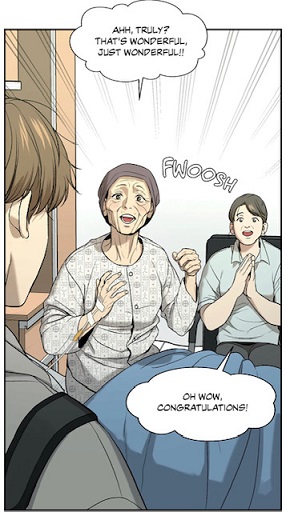 (chapter 7) and actions.
However, I haven’t answered the question yet: where are the other pictures? My assumption is that they were thrown away!!  (chapter 46) I might shock my avid readers with this hypothesis, but the fact that Kim Dan could only remember his childhood’s pictures in chapter 47 shows that he had long forgotten these moments. If he had seen the pictures constantly, he would have been confronted with reality and as such grasped that he was not alone in this world. He had his halmeoni by his side this entire time. He was cherished. Finally, keep in mind that this story is written like a kaleidoscope, so such a scene must have occurred in the past. Thanks to my chingu @@Milliformemes24, I can even be more precise. Note that in the last panel, the photos were taken with a cellphone. (chapter 47) So I deduce that these pictures were never printed and remained in the cellphone. One might say that the woman didn’t have money to print these images. But this explanation falls too short. How so? It is because she could have sent a copy to her grandson, especially when he became a PT. He was old enough to have his own cellphone. These pictures were never shared to her grandson! They remained in her cellphone. If so, he wouldn’t just have looked at the framed picture. The other proof for this deduction is the absence of a grandmother’s picture in her grandson’s screen:
  (chapter 38)
To conclude, their vanishing is exposing that these pictures were not TREASURED!! It was, as if they had been erased. But the doctor can not be the one who erased them or kept them hidden, as he associates these important moments in his life with his grandmother as sign of love and support!! Yes, this recollection reveals how much the doctor valued these moments. In other words, he would have “treasured” these pictures. He has none of them. Besides, when he entered elementary school, he was definitely too young to have a cellphone. That’s why I believe that they were all taken by the grandmother’s cellular phone. From my point of view, they were taken, because it was the custom. This would also explain why these “pictures” had no value for the grandmother. And now, you comprehend why I linked their disappearance to Shin Okja. So why did she not treasure and share them with her grandson? Why did she “erase” them symbolically?
2. Okja’s vanishing
My answer to these questions is the following. Halmeoni couldn’t stand the photographs, because she could see herself aging. From this (chapter 47) to this (chapter 47) And you all know that according to me, this elderly woman is suffering from Peter Pan Syndrom. Thus I feel like at some point, the halmeoni must have “thrown away” the pictures. Besides, I am quite certain that for the woman, these images had a different signification than for the doctor. She connected them to her suffering. She had to raise her grandchild on her own: these pictures represent her suffering from poverty and struggling mentally and emotionally. They mean hardship and aging for her. This explicates why she didn’t value these “souvenirs”. However, observe that all these pictures are related to Kim Dan’s school career path! (chapter 47) (chapter 47) The absence of these pictures signifies denial! It was, as if Kim Dan had never visited school and even never become a physical therapist. Under this new light, it becomes comprehensible why Kim Dan had no pride “as PT” and was willing to take odd jobs like “courier” 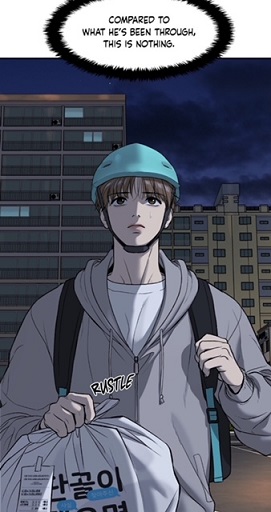 (chapter 42) or “waiter”. As my avid readers can detect, there is a strong link between “pictures” and “pride and love”. Their absence is the expression of neglect from the grandmother, who was definitely too focused on herself and her own suffering. At the same time, it lets also transpire the low self-esteem from the grandmother. In her humble dwell, there is no picture of her as well. (chapter 17) Thus I come to the following deduction: the grandmother dislikes pictures in general and was not living herself as well. Since she couldn’t love herself, she was not capable to love her grandson either. How so? For that, it is necessary to quote Erich Fromm from the Art of Loving (1956):
“If I can say to another: “I love you”, I must also be able to say: “I love everyone else in you too, I love the whole world through you, I love myself in you too”.
Loving someone means loving loving oneself first. In addition, where is the halmeoni running to? To the West coast, where she knows no one and desires to watch the sunset alone. (chapter 53) This image exposes not only her rejection of reality, but also her isolation. This decision stands in opposition to the quote above. She can not love Kim Dan, for she is rejecting the world and humans. This quote made me realize why Kim Dan felt so insecure the whole time, it is because he has never heard such a love confession from his grandmother. As you can see, the trigger with the photos gave me a lot of insight about the grandmother and the main lead.
In addition, one might wonder why the framed image was not put on display. (chapter 19) Why was this photo not treasured by Shin Okja? In my eyes, the picture was taken, when both were happy. There was a garden, and the boy’s happiness was genuine. However, I believe that this photo is linked to loss and this mysterious phone call.  (chapter 19) She was wearing the same shirt, when Kim Dan was speaking on the phone. In other words, the photo was also bringing painful memories to the grandmother. My theory is that the grandson’s parents vanished after that day. But this was not the same for the boy. He remembers the warmth from his relative. He is not making the link between this moment and his abandonment. In addition, this picture represents a frozen moment in time. It was, as if the woman desired to turn back time or hoped to stay in that moment forever. This explains why she kept the picture and continued treating her grandson as a child. For her, he was still the little boy from that time. However, at the end of season 1, it is no longer possible for her to treat Kim Dan as a child, because she needs him to move to the West coast.
 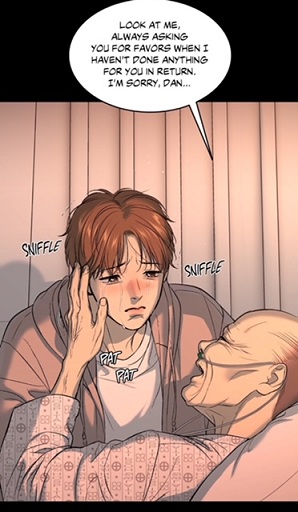 (chapter 53) It requires money, sacrifice and energy, but she is no longer paying attention to these aspects. Her time is now limited, thus she doesn’t feel responsible for any future debt. Striking is that she is not recognizing him as a man, but as a puppy dog.
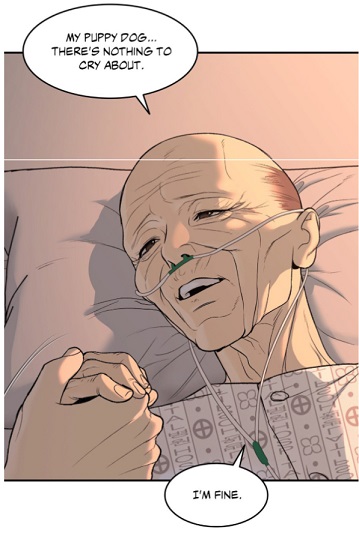 (chapter 47) Why? By acknowledging him as an adult man, she would give him a choice. He could refuse to do her a favor. As a puppy, he can not live on his own. Besides, by turning him into a dog and as such animal, she is denying him his right as a human being. She is appealing to his instinctive nature, his loyalty. And the moment I thought of a dog and death, I couldn’t help myself thinking of the famous dog Hachiko who kept waiting for his owner’s return at the train station, unaware that the latter had died a long time ago. As you can see, doc Dan’s pictures are strongly intertwined with reality and confrontation. Therefore the pictures with her grandson were not shown or treasured. The grandmother has been avoiding mirror and even pictures. As a person suffering from “Peter Pan Syndrome”, she is trying to do anything to escape “death and responsibility”. How ironic is that she just needed a picture to express her wish to move to the West Coast!
 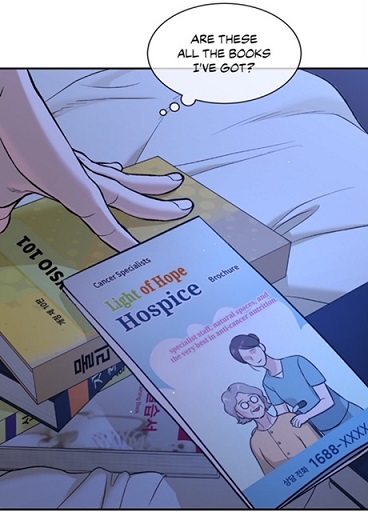 (chapter 53) Yes, the image from the brochure is creating the illusion that the woman on the wheelchair is her. She is smiling and “looking healthy”. It looks like she will have a better life there, less painful than at the hospital. In other words, this photo represents the exact opposite: illusion and fakeness. This
  (chapter 53) is the reality. The grandmother is not looking at Kim Dan contrary to the woman on the prospect. He is reduced to his role as caretaker. He has become her “servant”. In addition, the PT is not smiling like the nurse in the photo. In verity, he doesn’t want to do it. Deep down, he wished to stay at the penthouse.
  (chapter 53) The words “I should go” displays that he is doing it out of obligation. To conclude, photographs in Jinx are also embodying dream and illusion. (chapter 53). They only symbolize truth and reality, when the doctor is present.
3. The pictures in Joo Jaekyung’s world
What caught my attention are the similarities between Kim Dan and the champion. Both have no photo on their cellphone screen: 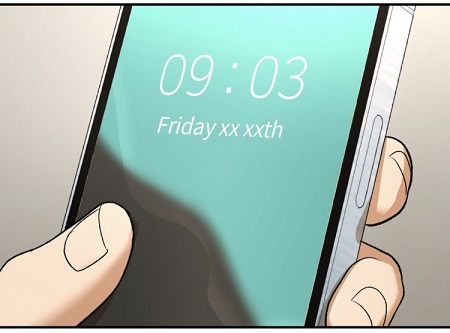 (chapter 38) Clouds are a reference to heaven and dream, while the green display displays loneliness and emptiness. They have no one by their side. Furthermore, just like Kim Dan, Joo Jaekyung has no family pictures in his house
 , (chapter 19) which could be seen as a clue that he is an orphan. Or in the best case, they live, but there is a huge wall and gap between them and the fighter. I would even add that no one could even identify the owner of the penthouse. He is a famous MMA fighter, yet there exist no picture of himself in this flat! Not even this one:
  (chapter 1) That’s why I had compared the penthouse to a hotel room in a previous essay. So we could say that he also lived like a ghost. However, since he is a celebrity, he should be rather compared to a god. He has no home and privacy. Thus the penthouse contained no memories, until the doctor started living with the champion.
Another important aspect is that the fighter doesn’t even have any picture of his manager or his children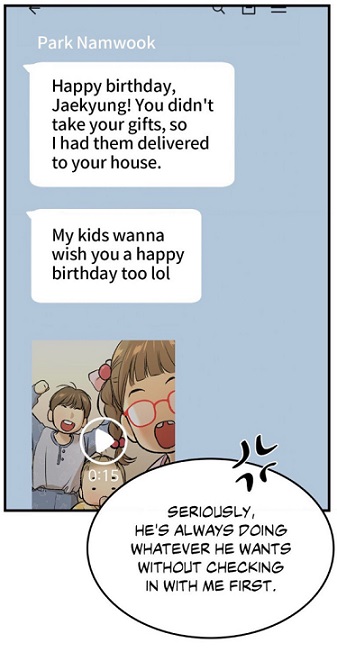 (chapter 43), a sign that their relationship has always been more businesslike, thought the boss somehow considered him as his “older brother”, as he keeps calling “hyung”.
 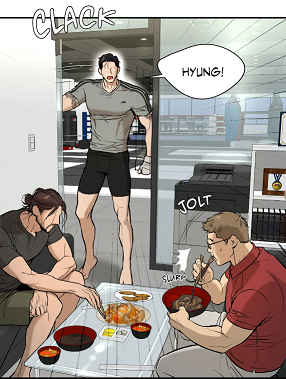 (chapter 5) The first personal video and message from his manager only appeared in chapter 43. This shows that the owner of Team Black had no family at all and not even friends. This observation brings me to my next remark. What about the gym Team Black? (chapter 1)
 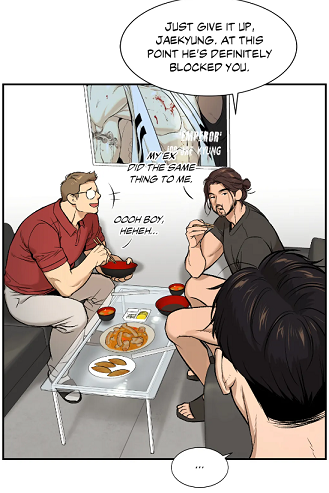 (chapter 5) There are only pictures of the champion and of no one else. Not even from Park Namwook or the ex-professional fighter Jeong Yosep. Everything is revolving around the celebrity. The absence of pictures from others is indicating neglect. The gym was not advertised as a great place to have fun! It is all about fame, wealth and glory! Therefore it is not astonishing why the rats left the sinking ship.
  (chapter 52) The champion’s image is tarnished, he will get less admiration and sponsoring. The decoration of the gym exposed the mentality of the owner, Park Namwook. The gym is about the celebrity, money, fame and sponsoring! Under this new light, it becomes comprehensible why the other members were neglected and why the athlete disliked it so much to be taken in pictures.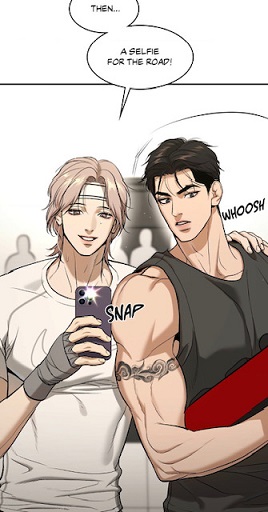
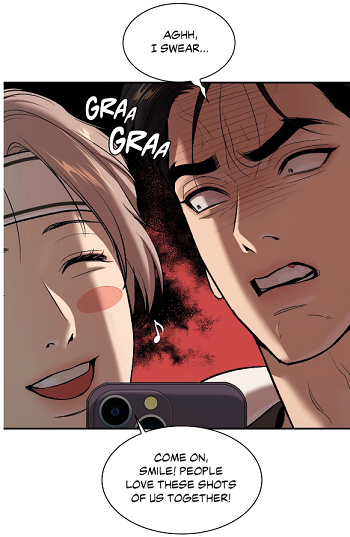 (chapter 30) It is because the photographs are a synonym for “money, glory and fame”. Choi Heesung was using him to get attention. His name
 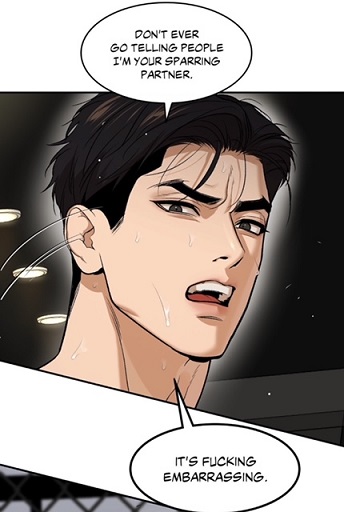 (chapter 46), his face and body are like “merchandises”.
  (chapter 43) That’s why he disliked the idea that Seonho would advertise that he was his sparring partner. The pictures in the god’s world have nothing to do with memories or love, but with work! It is about making business and getting sponsors and making his fans happy. That’s why the author included the magazines in the same chapter with the actor.
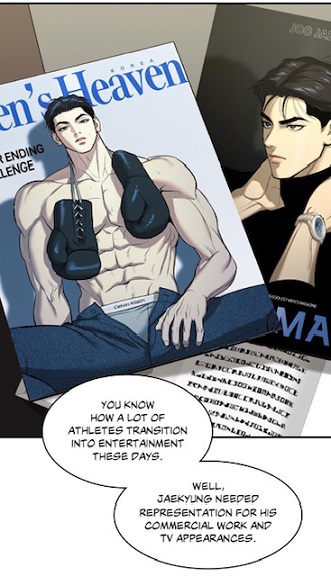 (chapter 30) Naturally, Heesung’s picture is not only related to business, they have a frenemy relationship. The photos with Joo Jaekyung stand in opposition to Kim Dan’s values: glorification, illusion, superficiality and futility. Under this new light, it becomes comprehensible why Joo Jaekyung would never put any framed picture of himself or others in his flat. His gym and the photographs are related to work. Who would like to be “reminded” of work and money in his own home? No one…
Under this new light, I came to understand why the celebrity reacted so violently about the presents and Kim Dan’s.  (chapter 45)
  (chapter 45) Imagine that the doctor had to work to exhaustion to give him an expensive gift! Yes, his gift was strongly intertwined with money, business and work! However, birthday is a symbol for home, pleasure, joy, simplicity and genuine gratitude. This has nothing to do with work and “replacement”. Yet, contrary to the other presents, the champion did open the hamster’s gift, for the latter had brought it personally.
  (chapter 45) Yes, his birthday was turned into a business event, a merchandise where he even had to pay for his own birthday party.
  (chapter 43) His popularity among the staff was based on his spending: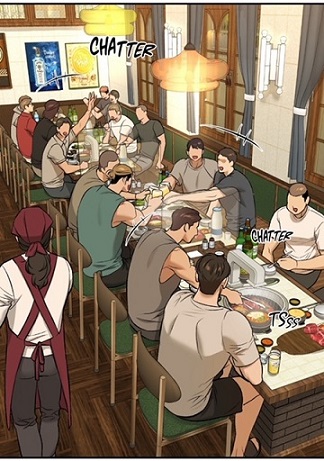
 (chapter 35) Such a success and glorification could only drive an edge between himself and others. In addition, the images could never boost the fighter’s low self-esteem. Yes, the absence of his own picture in his home is another important clue for his unhappiness and self-loathing. Because the doctor brought “work” home, Joo Jaekyung started avoiding the physical therapist:
 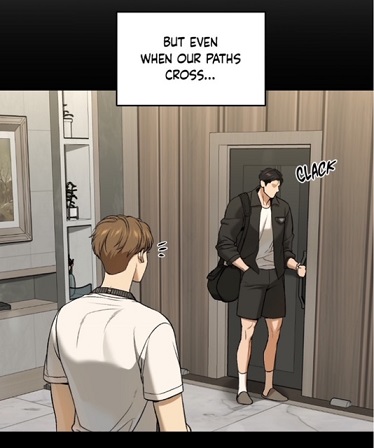 (chapter 47) It was not just because the athlete had been encouraged by his mentor to trust no one, to see relationship as a business.
  (chapter 46) This remark leads me to the following conclusion. Since the manager started sowing distrust in the champion’s heart, we can see it as another proof that this man has never truly loved “his boy”:
“If I can say to another: “I love you”, I must also be able to say: “I love everyone else in you too, I love the whole world through you, I love myself in you too”. (Erich Fromm, The Art Of Loving, 1956)
He just considers him as a toy and possession. 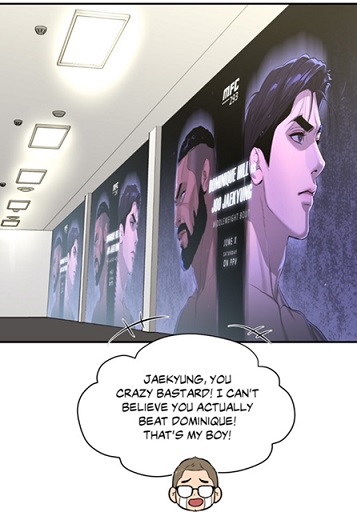 (chapter 40) Thus he can mistreat him, if he is not pleased.
But there’s another evidence that the pictures with the fighter are strongly linked to idolization, illusion and deception. 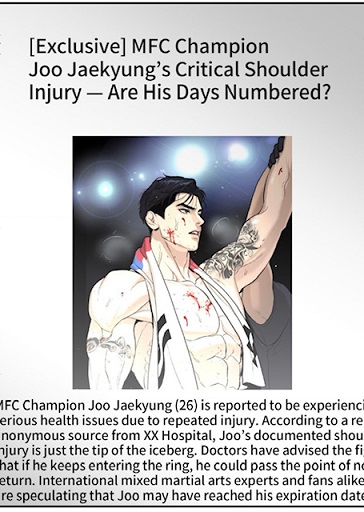 8chapter 35) When this article was released, the author selected a photograph exposing the champion in good health! He was raising his arm and as such using his “injured shoulder”. The content of the article contradicts so much the image which can only raise doubts among the readers. By using such a picture, they created the illusion that the athlete was hiding something. And this remark brings me to the last articles about the fallen legend:
 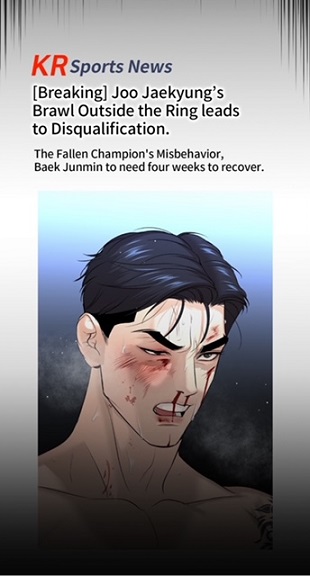 (chapter 52) His beaten face is exposed to destroy his “good image”: he appears not only as weak, but also as a bully. This shows how the medias are trying to manipulate the public with pictures. His face and body are damaged, therefore he has less value. This deceptive trick becomes more visible, when you include Baek Junmin.
  (chapter 52) The article utilized a picture of the fake fighter taken right after the match. He is smiling and barely injured… yet, the reality is that he got so wounded by the champion that he needs a long time to recover. As you could observe, all these photographs symbolizes money, business, work, superficiality and publicity. Thus they are strongly intertwined with temporality, fake love and emptiness. No meaningful moment…
It is important, because the moment the athlete started interacting with the physical therapist, a new kind of photograph started appearing: 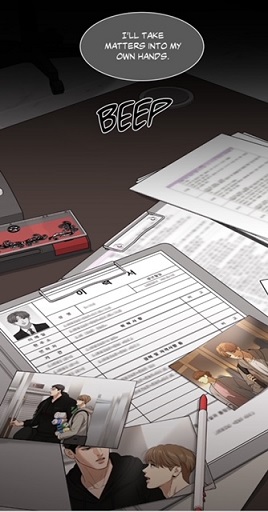 (chapter 46) The ones in this panel ooze privacy, selflessness and intimacy. The champion is seen carrying bottles and opening the door for the doctor, a sign of Joo Jaekyung’s respect for the doctor. Yes, these images expose the truth about the athlete: he really treasures his physical therapist. He is also seen listening to the doctor. This observation corroborates my previous interpretation. The pictures with the physical therapist symbolizes verity and reality. The problem is that Joo Jaekyung never got to see them, hence he didn’t realize his affection for the doctor. However, Choi Gilseok could notice it. In fact, the celebrity was delivered a different kind of truth:
 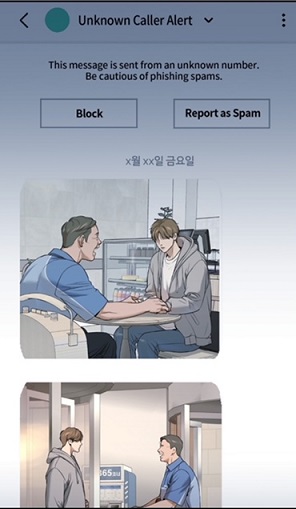 (chapter 48) Kim Dan’s meeting with director Choi Gilseok! However, note that these photographs were also a deception, for they never expose the outcome of the meeting. These pictures display the negative notions of privacy and intimacy, it is about plotting, betrayal and as such about “business”. How so? It is because they met at a café. As a conclusion, the photographs have a total different meaning in the athlete’s world. They represent coldness, superficiality, temporality, deception and work. This new interpretation reinforces my hypothesis that the main lead’s car must have been followed by a paparazzi during that night:
  (chapter 33) A black car was following him. But they couldn’t take any picture, for the windows of his car were tainted.
Interesting is that at the end of season 1, Kim Dan had a recollection of this scene  (chapter 53) which left him deeply impressed. Joo Jaekyung was turning around his head and looking at him! This shows that the star was paying attention to him. And what had happened in that moment? What is the light next to the protagonist? Yes, these were the flashes from the cameras!
 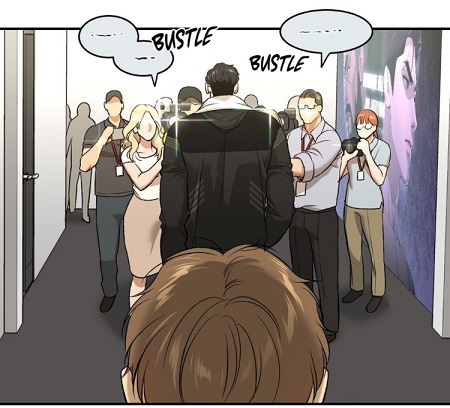 (chapter 40) It is no coincidence. Though he had no memory of the previous night, he felt this moment as magical. He had saved him and claimed him as a part of Team Black. Then he had look at him back, though he was facing journalists. However, the journalists didn’t take a picture of such a moment, for this was not relevant to them. It shows not only the true value of “memories”, but also that both were now truly living! During that night and day, both created wonderful memories.
  (chapter 41) Kim Dan experienced that he was not alone, he was part of “Team Black”, while the other heard a love confession for the first time. This memory displays (chapter 53) not only admiration, but also intimacy and TRUST!
Because the MMA fighter has been constantly surrounded by fake people in his world, it is not surprising that he doesn’t value “money” or glory. These didn’t make him truly happy. But there is more to it. Due to photographs, the fighter learned the wrong lessons. He judged people on prejudices and impressions!! Yes, this explains why Joo Jaekyung imagined to see Kim Dan selling his body., while he was about ti get raped. 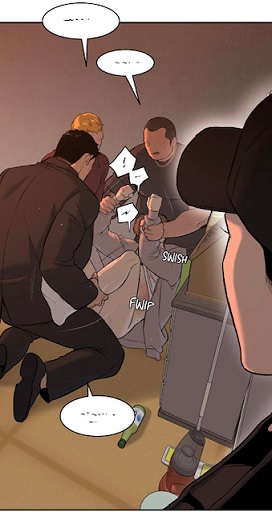 (chapter 17) He is relying too much on his eyes. He paid no attention to details and their words. Hence their words are not visible. In addition, the author created such a panel.
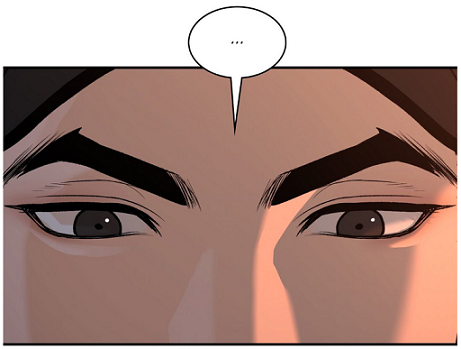 (chapter 17) in that scene.. But why is he trusting too much his eyes? It is because he adopted this poor habit from his mentor and hyung, Park Namwook. who judges people based on prejudices and impressions. When the manager faces a problem or some criticism
  (chapter 17), he prefers blaming his “boy”
  or delegating responsibilities to others:
 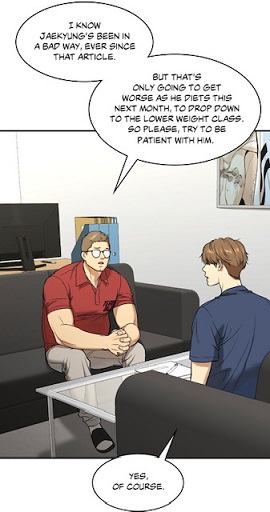 (chapter 36) Furthermore the man with the red tee-shirt has always been by his side for a long time. The time spent together is a proof of his “loyalty”, yet if the athlete had paid more attention to his words, he should have noticed his hypocrisy, lack of empathy and disrespect:
  (chapter 49)
  (chapter 52) The slap is the expression of lack of faith and disrespect. Besides, he kept badmouthing him in front of the other members, creating a huge gap between the celebrity and the other members.
This is no coincidence why Joo Jaekyung didn’t listen to doctor Lee’s recommendations as well. He never saw the results of his examination.  (chapter 27) In addition, he had to rely on the expertise of doctors, but he only trusts himself, his hyung and no others. But let’s return our attention to Kim Dan and his letter.
When the doctor left the penthouse, he left a memory and treasure to the athlete: a letter full of kindness and care! 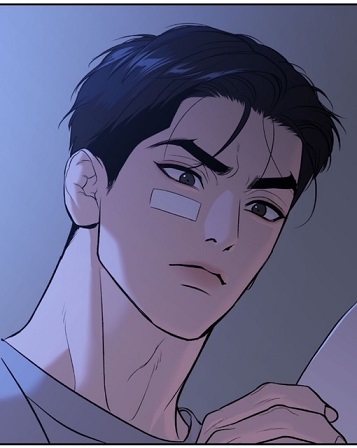 (chapter 53) The letter stands in opposition to the articles and photographs. Through the letter, the main lead is teaching to the wolf this important life lesson. He needs to use his mind and as such his heart to see the truth and reality.
“It is only in the heart that one can see rightly, what is essential is invisible to the eye” (The Little Prince from Antoine Saint-Exupéry”
The doctor is now perceived correctly, because for the first time, the athlete listened to his words and opinion. Here, I mean, he believed in his confession (apology, convalescence). Interesting is that after listening to his words, Joo Jaekyung started reflecting on his own actions and emotions. 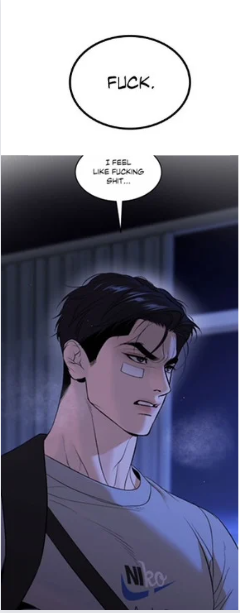 (chapter 53) Thus he voiced his discomfort and annoyance. However, this time, he is not questioning the origins of his actions. He knows now that the doctor means a lot to him. He is not a waste of time. It is no coincidence that the moment he paid attention to Kim Dan’s thoughts and emotions, he opened up his own heart and mind, because according to Erich Fromm
Being able to listen to oneself is a prerequisite for being able to listen to others; being at home with oneself is the necessary condition for relating to others. Erich From from The Art Of Being
And now, look at the expression “home with oneself”. Home is strongly connected with inner harmony, meditation and well-awareness as the foundation for genuine communication and understanding of others.. Let’s not forget that home is also a synonym for “family”. Thanks to the support of a loving family and friends, one can become true to oneself. At the same time, home with oneself helps to communicate better with others. And because the MMA fighter listened to Kim Dan words, he became more aware of himself. The doctor has become the key to the champion’s heart. He has also become his home as well. Thus Joo Jaekyung came to associate the penthouse to his loved one:  (chapter 53) The latter might have no photograph of Kim Dan, but his face is now engraved in his memory. To conclude, the letter should be perceived as a mirror of truth to the athlete. He needed to hear the hamster’s words without seeing his face in order to see him properly.
Finally, I conclude that in season 2, photographs will have a different meaning in the champion and doctor’s life. They will stand for privacy, love, friendship, recognition and selflessness. Yes, I am expecting that the doctor and his lover start taking pictures of memorable events, like this day:  (chapter 26)
 (chapter 26) The gym will face some changes.
Feel free to comment. If you have any suggestion for topics or manhwas, feel free to ask. If you enjoyed reading it, retweet it or push the button like. My Reddit-Instagram-Twitter-Tumblr account is: @bebebisous33. Thanks for reading and for the support, particularly, I would like to thank all the new followers and people recommending my blog.

 (chapter 131) Hence the police officers found the governor’s seat deserted.
 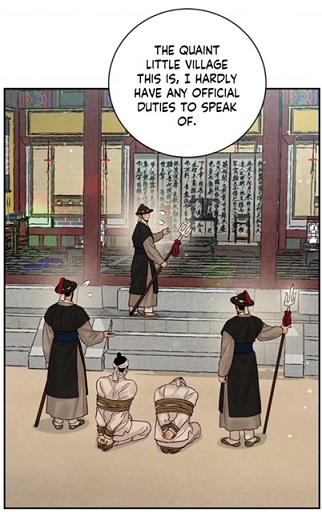 (chapter 131) By contrasting the statement from the governor and the panel, the readers could easily catch his lie. He was a lazy governor, preferring to keep his lover company rather than attend to his official duties. On the one hand, it exposes the main lead’s true mind-set. He is not longing for power or glory. To conclude, he has no ambition. This implies that he is not determined to gain attention either. One might add that he selected this region on purpose. No one would willingly go to that place. The norm was that officials would go there, because they were demoted.
 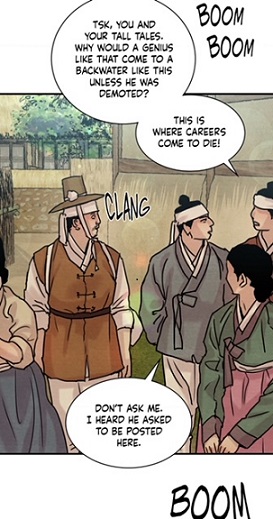 (episode 129) Thus I deduce that Yoon Seungho made the opposite choice to his father. The latter longed for a high position at the government so that the family’s reputation would become famous and powerful again.
  (chapter 86) It is because Yoon Chang-Hyeon was thinking of getting the attention or support from noble families. What he truly wanted was to get recognition from people among his own social class. But with such a decision (join the painter’s side), Yoon Seungho seems to have turned the former patriarch’s nightmare into a reality. Yoon Seungho is about to ruin the family. The name “Yoon” is destined to become forgotten, right? However, I believe that this interpretation is not correct. How so? Let me ask you this.
 (chapter 127) No one has such a wealth! That’s the reason why no official would select such a place. Yes, Jung In-Hun’s words from chapter 6
  (chapter 6)
  (chapter 37). It is about a crime, treason. In season 4, we know that the plot was true and there was an evidence, the paper with the signatures from lord Yoon and lord Song. Since in season 1 the wrongdoing was true and heavy, I deduce that it is not the case in the final chapter. Because there is an evidence of the crime in the past, I can’t help myself thinking that in the final chapter, there was no evidence. Additionally, I feel the need to expose my other interpretation about this man:
 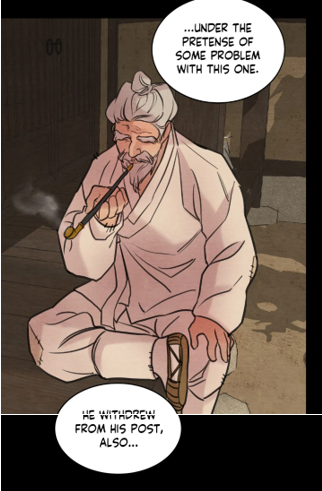 (chapter 37) I have always stated that this man couldn’t be a servant, for he was smoking a pipe and we saw a glimpse of his memory. No commoner would be allowed to enter the courtyard, when three noblemen are tortured and interrogated. Moreover, notice that in both scenes (37 and 131), the magistrate is absent. That’s how it dawned on me that this nameless man could have been a former “governor” who lost his position.
 (chapter 94) Here, the officers went to the mansion before visiting him at the gibang.
  (chapter 97) Back then, it was about the death of a commoner, a servant. If there’s an urgency, they would look for him. The comparison exposes that the “wrongdoing” from the peasants in the final chapter was no huge deal. Yet, many readers already condemned them due to the guards and the protagonist’s behavior. Funny is that the lord was portrayed as a huge liar, but not “the officers”.
  (chapter 101) His statement displays another aspect: the governor and the guards are not working together. Jihwa would have been sent to jail without being able to talk to the superior, similar to this scene:
  (chapter 126) The guards’ own interests are not necessarily aligned with the governor’s. And now, take a closer look at this scene:
 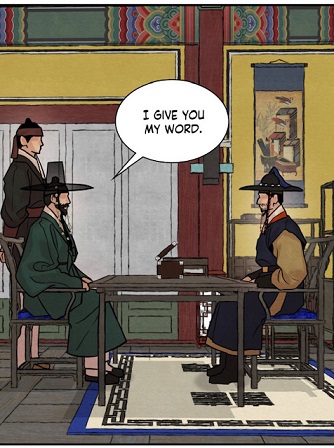 (chapter 127) The official received the patriarch in his office alone. The reason is simple. That way, he wouldn’t have to share the money with others.
 (chapter 129). He was not sitting on a horse with a few musicians contrary to Jung In-Hun. He was carried by four men, and other people were announcing his arrival with flags and music.
  (chapter 111) Moreover, Yoon Seungho had a inauguration banquet organized, where the local inhabitants could join.
 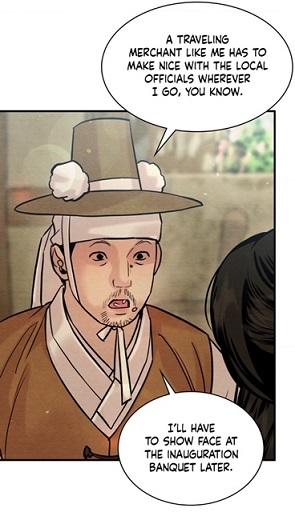 (chapter 129) There was no social exclusion at all. This stands in such opposition to the lord’s statement in season 1, where he distinguished between nobles and commoners.
 (chapter 129) This signifies that the arrest could lead to trouble to the guards too. So was the lord lazy in the end?
  (chapter 131) Yes and no… By acting that way, he put an end to the abuse of authority in that place!! Thus I deduce that the governor is destined to gain recognition and admiration from the local inhabitants. He is generous (inauguration banquet where anyone could join), humble, loyal (he is not forgetting his lover)
  (chapter 131), but also well organized! He had planned to join this place a long time ago. The peach trees were planted about 3 years ago. He is no longer making any distinction between nobles and commoners, and that’s how he will get the respect from the peasants. As a conclusion, we should envision that the lord will become famous. Therefore the son didn’t turn the father’s nightmare into a reality. He didn’t contribute to the family’s ruin at all. Yet, there exists a huge divergence. Yoon Seungho is about to make a name on his own. It is not about the Yoons. On the one hand, the father’s dream was illusory and superficial, especially due to the treason
 (chapter 86). Since Lord Song had been forced to resign, there’s no doubt that the man would resent the Yoons to become successful again. This explicates why lord Song saw Yoon Seungwon as a problem
  (chapter 107) and tried to tarnish the younger son’s reputation. But let’s return our attention to the patriarch. His vision was based on Confucianism. However, he had a very narrow-minded perception of it.
 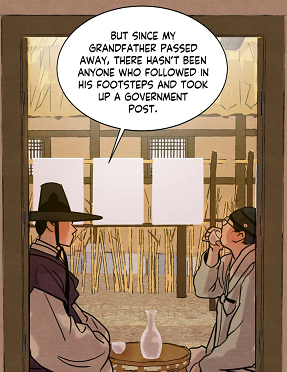 (chapter 7) This shows that the tradition was to “vanish behind the family name, the Yoons”. Under this new light, my avid readers can grasp why the main lead was destined to suffer immensely
  (chapter 57). His reputation was already outshining his father’s. Secondly, by being stigmatized as a homosexual, he was endangering this principle. His role was to continue the lineage and as such produce a heir.
  (chapter 116) or even Min could commit crimes in the open. They felt safe, for they knew that the authorities belonged to the same social class than them. However, this could only work, as long as the nobles would cover for each other. Should a yanbang denunciate a noble family, it was a different story. Therefore I assume that lord Lee was the one who reported the treason to the authorities (the painting in the bedroom was the evidence). But such a painting couldn’t represent a proof. However, since human justice was corrupted, the gods decided to give justice to the protagonists. That’s how Yoon Seungho became the hand of justice. Everyone involved in the protagonists’ suffering had to pay for their crimes.
  (chapter 102) That’s the reason why Baek Na-Kyum’s martyrdom was strongly intertwined with the young master’s. Yoon Seungho only received this power through Baek Na-Kyum, the character embodying fairness, sincerity, hard work, home and equity. This was particularly perceptible in this scene:
  (chapter 27) The lord couldn’t kill anyone randomly.
  (chapter 102) However, I consider it as a first step to the lord’s emancipation and life lesson. The latter is indirectly learning not to pay attention to status and power. That’s why the author portrayed him as blind and deaf to their plea and special status. While his behavior in the shrine was rather impulsive and influenced by deeply rooted fears, we should consider lord Song’s execution as a true act of justice.
  (chapter 123)
  (chapter 123) The latter had confessed all his crimes: the ones from the past (the lies in order to fool the father)
  (chapter 123) and the painter’s murder. Funny is that lord Song didn’t feel threatened by the young master at all despite the sword.
 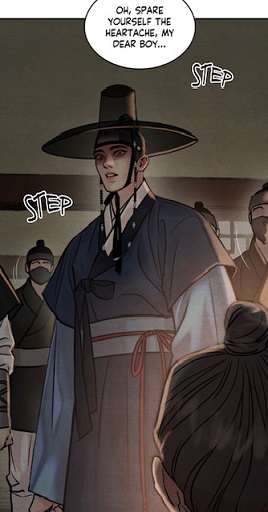 (chapter 123) Why? It is because he feels, he is the one with the upper hand. First, he has the petition, hence he is already projecting himself in the future (he can get a high position again). Secondly, he thinks, Yoon Seungho is outnumbered. He is surrounded by 4 guards. But more importantly, he views himself superior to the main character due to his age. He is an elder. That’s the reason why he calls “my dear boy”. This implies that he is underestimating the main figure. The latter would never dare to raise his hand against a senior!! However, true justice is also blind to age.
 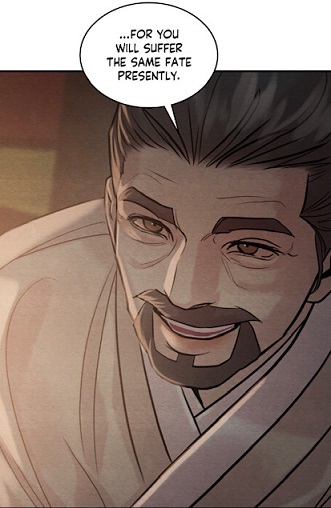 (chapter 123) His smile at the end of the episode should be perceived as a reflection from Min’s vanishing.
  (chapter 103) One might even add that the lord’s action could have been seen as self-defense. However, don’t forget that we are here in Joseon, where a commoner’s life means nothing. Because of this new association, I came to the following deduction: lord Song was the one behind lord Shin’s death.
  (chapter 103) The latter couldn’t imagine that an elderly yanbang, an official, would raise the sword against another noble. After this new realization, it dawned on me why Yoon Seungho had to get separated from his loved one.
 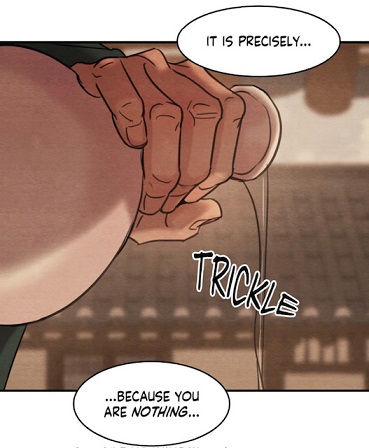 (chapter 126) This humiliation made Yoon Seungho realize that he needed to have his power on his own. He learned through the hard way that he was not just a Yoon, but Seungho. Yes, this helped him to differentiate himself from his father and to become stronger mentally. His religion was now his lover, Baek Na-Kyum, whom he needed to protect. But he could only do it, if he had himself a powerful position. But he needed to witness the corruption of the authorities to realize that in Joseon, there exists no justice.
  (chapter 6): neglect and indifference towards the commoners. And this new observation brings me to my other topic, Jung In-Hun.
 (chapter 129), therefore he couldn’t select one position contrary to the main lead. This means that when he celebrated his “victory” in episode 111, it was not official. He had no post. I would even add, his name had not been announced on the official board, like we could witness it in this scene.
 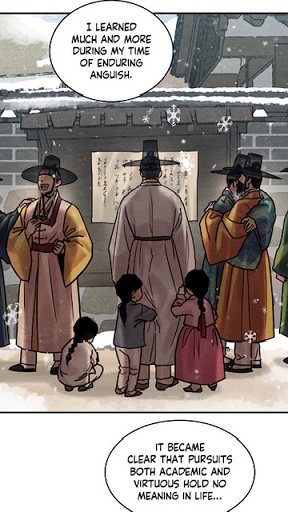 (chapter 121) Here, he is informed that he didn’t pass the exam, for his name was not written there. We can detect this, because people are congratulating each other. His name was left out due to the intervention from lord Song. This means that when Yoon Seungho made him this offer
 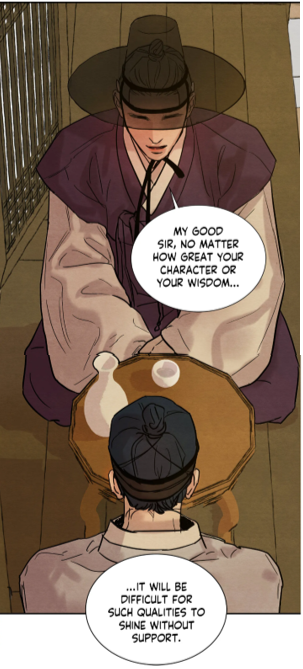 (chapter 7), these were not empty words. He did help the learned sir to pass the civil service exam. But the scholar didn’t succeed like anticipated. The absence of his success explicates why Jung In-Hun received such an offer from lord Song later.
 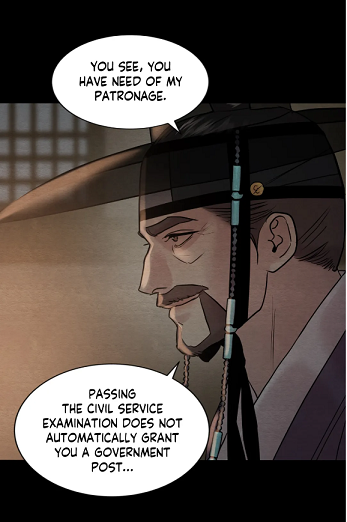 (chapter 117) He had no post, he couldn’t choose it, for he was not the best. Thus I deduce that the scholar had just proven his mediocrity. He was just an average man. That’s how it dawned on me that the ceremony in the street was more a simulacre!
 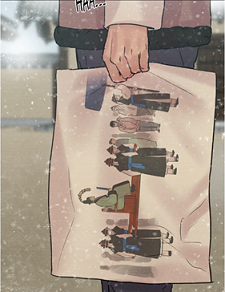 (chapter 44) Only one thing was real: Jung In-Hun was wearing an official uniform, that way no one would doubt his “victory”. Moreover, observe that lord Song only approached the learned sir after the parade. So he was not behind the parade. Besides, keep in mind that the main couple was informed about the parade through the tailor
 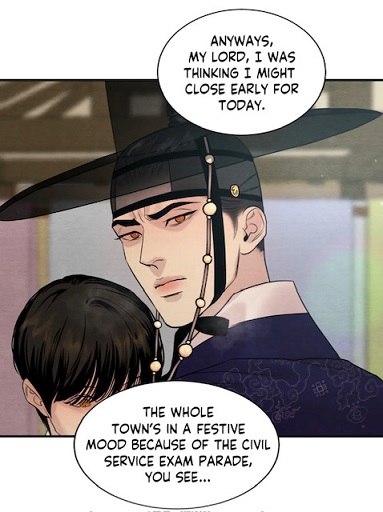 (chapter 111) and not from the official board. His reaction shows not only his displeasure, but also his ignorance. If he had known about the cortege, he would have avoided the place in the first place. Thus I suspect that the tailor had been encouraged to leak this information in front of the couple. Let’s not forget, as a tailor, he was definitely involved in the cortege. It is no coincidence that he informed Yoon Seungho about this “sudden parade”. At the same time, I come to the following deduction: someone must have paid for this spectacle, and it was not Yoon Seungho, for he had been kept in the dark until the last moment. I doubt that the learned sir had the connections and money for this. This new perception corroborates my previous interpretation: the show was sponsored by someone, and it was definitely inspired by the drawing (the hat and the green uniform).
  (chapter 111). Yet this was just a cheap trick, for the person didn’t send a sedan chair with carriers. Under this new light, I realized why Jung In-Hun ended up stigmatized as a criminal.
 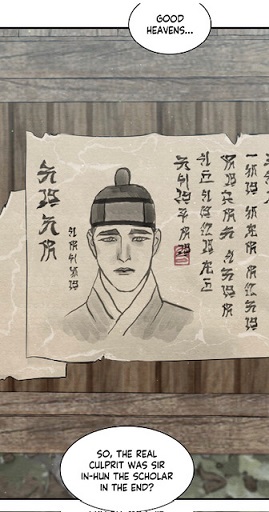 (chapter 127) It was his karma, for he had deceived the painter with his lies. His success was not his own.
 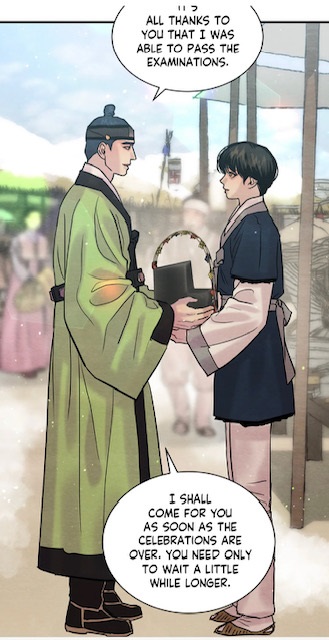 (chapter 111) He realized that even after passing the exam, he needed the assistance of people, a sponsor for the spectacle, a noble with connections. Besides, when in season 1, the painter was accused of a crime (ruining the picture), the learned sir did nothing at all. He didn’t protect his student, for he desired to keep his sponsor. When the latter was sick, he neglected him as well. He wouldn’t have sent a doctor for him. Hence in season 4, the sponsor Na-Kyum decides to end his “sponsorship” for the learned sir. We could say that the former teacher is confronted with a similar situation. He ends up being abandoned and framed for a crime, which he didn’t commit. Yet, contrary to his pupil, he is not entirely blameless, for he played a huge role in the death of the nobles lord Song, lord Shin, lord Min and others. Because Baek Na-Kyum embodies hard work, justice, equity, love and honesty, I deduce that his surrogate father embodies the negative notions: laziness, corruption, partiality, hierarchy, ambition and hypocrisy. That’s why his face ended up on the official board, while the painter’s accusation just remained rumors.
  : (chapter 125) versus
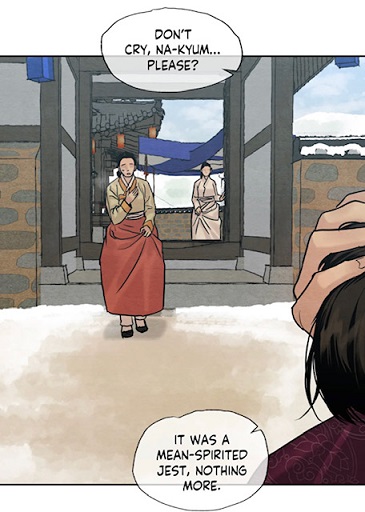 (chapter 105) IMO, she had to use another mean in order to achieve her goal: the scholar. Let’s not forget that the artist had confided to her this:
  (chapter 68) He was simply waiting for the learned sir’s return. And she was present during the cortege.
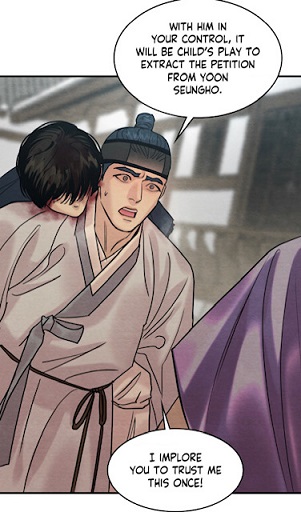 (chapter 121), he put the painter in a position which led him to take for the fall for his loved one. It was like framing an innocent. Exactly like in season 3
 (chapter 99), Yoon Seungho had been forced to take the sword because of the scholar. And the trigger for the massacre
 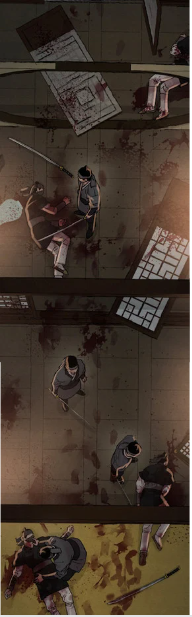 (chapter 124) was always Jung In-Hun. And now, you comprehend why Jung In-Hun became the scapegoat for the last incident. But there’s more to it.
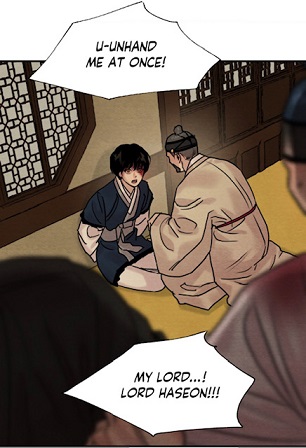 (chapter 121) His final lesson was to learn that he was exactly like the others: he is just a human despite his education. All humans are equal in front of death. In fact, during his confrontation with lord Song, he came to give up on his integrity. His true face came to the surface: he was just an opportunist, a lazy scholar who relied on fate and his arrogance.
  (chapter 6) This brings me to my next interpretation. Jung In-Hun learned through the hard way that there is nothing like fate (“right time”), but life is the result of decisions. However, because the scholar always regretted all his past choices, he decided to blame others for his wrong choices. That’s the reason why he ends up to take the whole crime. We should see this paper
 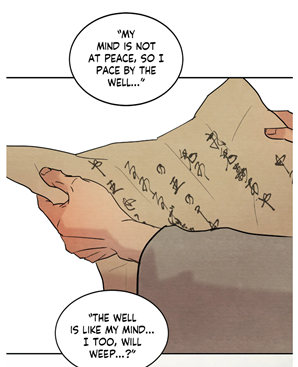 The author from this sijo was the poet and official Wang Bang-Yeon who is said to have lived in the time of Joseon’s sixth king Danjong (1441-1457) and his successor king Sejo (1417-1468). As the official of the state tribunal, he followed the young king Danjong into his exile and gave him poison to drink by royal command. Yes, both are symbols of power, corruption, partiality and injustice. Yet, there exists one divergence. While Wang Bang-Yeon left a poem revealing his yearning for the king, the learned sir had no deep attachment towards the artist. Hence it is no wonder why the paper “Wanted” is not connected to affection. It really reflects the emotions and thoughts of Baek Na-Kyum. Due to the last incident, the latter no longer cares for this man.
 (chapter 6) He couldn’t enjoy it at all. It is no coincidence that the synonyms for ambitious person are “busy person” and “workhorse”. Yes, this mirrors the expression “laziness”. A true ambitious person is actually proactive and not really relying on sponsors and bribes. So when we see the learned sir on the horse
  (chapter 107) Though he passed the civil service exam too, he is not able to fulfil his father’s wish either.
 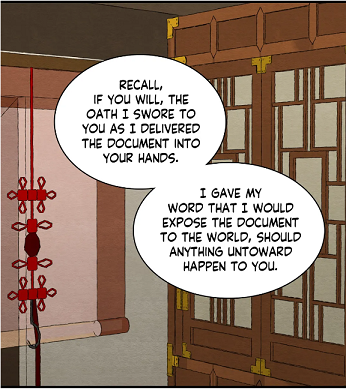 (chapter 118) His intention was to protect not only his brother, but also their family. It was to ensure that lord Song would get blackmailed. That’s how this investigation
  (chapter 118) It is because he knows that with the petition in his brother’s hands, lord Song represents a hindrance to his own career. The latter can only see the Yoons as a threat. Besides, he can only resent the family, if they are able to gain reputation and power, while he can not return to Hanyang and occupy a high position. As you can see, the young master’s success can only irritate lord Song. You can sense a rivalry between Seungwon and lord Song Haseon
  (chapter 116) in this scene:
  (chapter 116) The latter has already sensed that the traitor is sitting next to them, thus he raised this question. That’s why I come to the following conclusion that the young master must have realized that he also needed his brother’s assistance. First, if Yoon Seungho returns the petition to the father, the investigation about the traitor in the mansion would be no longer necessary. Secondly, Yoon Seungwon needs to create new connections in Hanyang, but he can only achieve it with his elder brother. Under this new light, you comprehend why Seungwon asked his relative to move on from the past and as such “forgive their father”
 . (chapter 118) In other words, the young man embodies the notion of “fake forgiveness, fake promise, fake understanding”. He is an opportunist, exactly like the scholar. Yet, there exists a huge divergence between them. His affection for Yoon Seungho was not fake. He is feeling sympathy for his brother. But that’s it. This explains why he didn’t help his brother before. In my eyes, Seungwon represents a different notion of family: bloodline. In my eyes, he embodies traditions and Confucianism. His goal is to turn his father’s dream and life motto into a reality: glory and power for the Yoons. Besides, he must have experienced himself the downfall for the family. And this observation leads to my next interpretation. This means that Yoon Seungwon must have lied to his father by omission as well.
  (chapter 128) What about Yoon Seungwon then? Though he succeeded too, there is no mention about engagement or marriage proposals. However, it is clear that this achievement is connected with adulthood and marriage, therefore the elder Song Haseon brought up the topic sex!
 What was the reason for Yoon Seungwon’s embarrassment? First, it is because his brother selected the backward place, though he had passed the exam with flying colors. Yoon Seungwon imagined that once his brother had passed the exam, he would get married and establish new connections. That way, Seungwon would be able to get married with a properous and famous family. In other words, Yoon Seungho would turn the father’s dream into a reality: the return of the Yoons’ glory and power. And Seungwon would benefit a lot from this. So in the gibang, his advices might have sounded well meant,
 (chapter 126), his karma is not only to end up alone, but also not to receive any support from his brother.
 (chapter 117), because his career was still insecure due to lord Song’s influence. He needed his brother’s help in the end. At the same time, Seungwon had already long internalized the values from his father: Yoons’ honor and reputation were top priorities. In other words, the younger brother stands for social norms and fake righteousness. He desires to maintain his perfect image (loyalty, filial piety),
 (chapter 118), hence he left the document at the mansion. He wanted his brother to return the papers on his own so that his past action would remain undetected. Returning the paper was like an admission that he had stolen it in the first place. Yet he still barged in his brother’s house twice.
 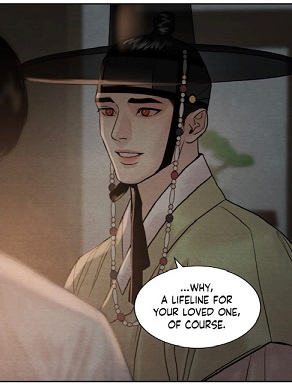 (chapter 117) Here, he exposed the existence of the “petition” to Baek Na-Kyum for one reason. The latter should be used as a way to pressure the main lead to give up on the paper. Notice that this topic was brought up in the gibang:
 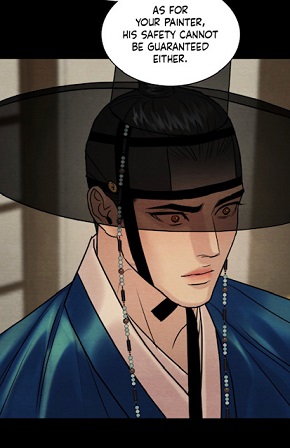 (chapter 119) However, the reality is that Seungwon is not just trying to fulfil his father’s dream, but also he has his own ambition. He wants to make a name on his own. That’s why he confessed this to his brother:
  (chapter 119) He doesn’t associate himself with the father and his sins. In his eyes, he is blameless. The reality is that he is guilty like his father, for he failed to care for Yoon Seungho. He failed to listen to him and his suffering. He didn’t try to understand him. Like mentioned above, he only sympathized with him and that’s it. Thus he condemned him for his debauchery in the gibang, but this was no longer the case.
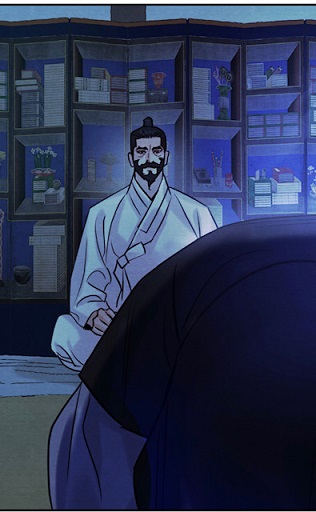 (chapter 127)
  (chapter 127) the former only made a promise to his father and not to the brother. With his death, Yoon Seungho is no longer bound by a promise. Since the main lead had been living properly for 3 years and even passed the civil service exam, it is clear that for the brother, Yoon Seungho must have forgotten his past lover. He must have judged his brother based on appearances, just like he was behaving himself. However, this was just a subterfuge. He was waiting for the right time too. He had no change of heart, he had just been copying his brother’s behavior.
  (chapter 78) Let’s not forget that at the gibang, Yoon Seungwon never revealed his true intentions towards his brother. The latter always said that his advices were for his best interests. He should become involved in the government. But everything was for the Yoons, or better said, for Yoon Seungwon’s sake. And there exists another reason why the sibling must have been embarrassed: This marriage!
  To conclude, Yoon Seungwon embodies the opposite values of Baek Na-Kyum and Yoon Seungho: ambition, corruption, forgetfulness, hierarchy/social norms, traditions and reality versus understanding, forgiveness, simplicity, closeness, modern family and happiness. Selfishness versus Selflessness. This explicates why the main lead gave up his success for the artist. However, though it looks like an exile, the reality is that he will gain popularity and admiration among the inhabitants. Why? It is because he is no longer making distinctions between nobles and commoners, he doesn’t see this place as a punishment, but as a heaven and as such he has a better perception of humans in general. In my eyes, he is bringing progress and change in the region. Baek Na-Kyum is already teaching the kids how to draw… so it is only a matter of time, until his lover takes care of the education for these children. This means that these words will become a reality:
  (chapter 6) He will think of the futures of those children because of his lover.
 Bebebisous33s' analyses in K-Dramaland and Manhwas