

Please support the authors by reading Manhwas on the official websites. This is where you can read the Manhwa: Jinx But be aware that the Manhwa is a mature Yaoi, which means, it is about homosexuality with explicit scenes. Here is the link of the table of contents about Jinx. Here is the link where you can find the table of contents of analyzed Manhwas. Here are the links, if you are interested in the first work from Mingwa, BJ Alex, and the 2 previous essays about Jinx “What Are You Doing here? Between Crisis and Opportunity” and The Director 🐺 🐐 and Me 🐺(part 1) (locked)
It would be great if you could make some donations/sponsoring: Ko-fi.com/bebebisous33 That way, you can support me with “coffee” so that I have the energy to keep examining Manhwas. Besides, I need to cover up the expenses for this blog.
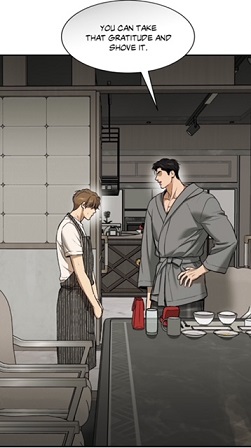
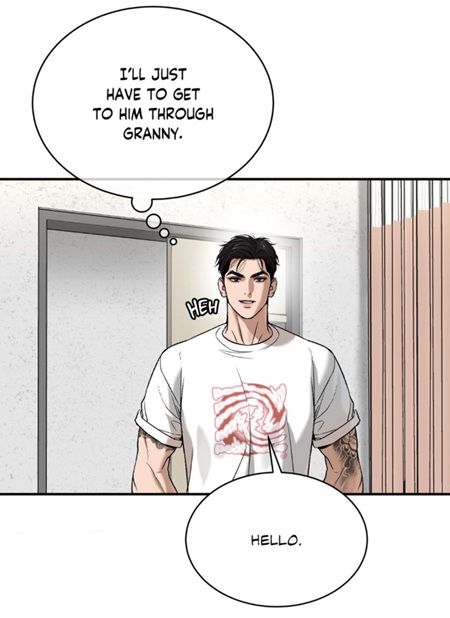
In the two most recent chapters of Jinx, Kim Dan finds himself caught between two “directors.”: one from the hospice where he works  (chapter 70), the other a former “boxing” coach and Jaekyung’s ghostly mentor figure, now terminally ill and confined to a shared room.
 (chapter 71)These two older men mirror different systems of power: the current director, a seemingly kind authority figure who represents institutional control masked as care; and the former coach, a fallen patriarch whose past decisions shaped Jaekyung’s identity and pain. This part of the essay focuses first on the hospice director, and how his interaction with Kim Dan reveals the young man’s invisible burden and social isolation. In the final section, we will turn to the old coach, now reduced to a ghost in his own story, and explore how the symbolism of owls, coots, and crickets illuminates his emerging relationship with Kim Dan.
A Sick Day or a Day Off?
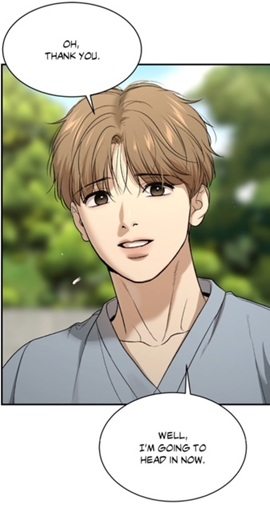
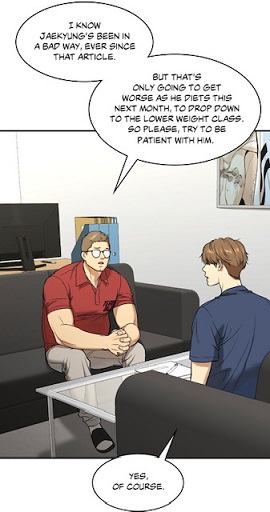
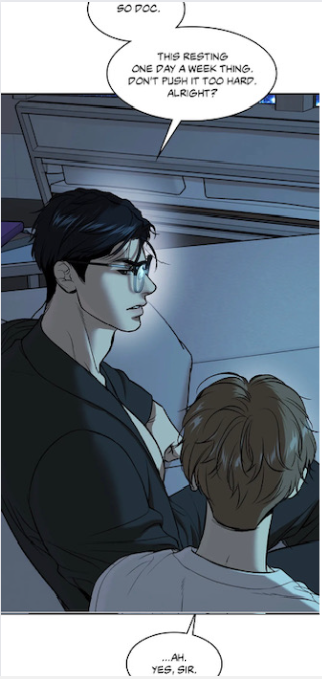
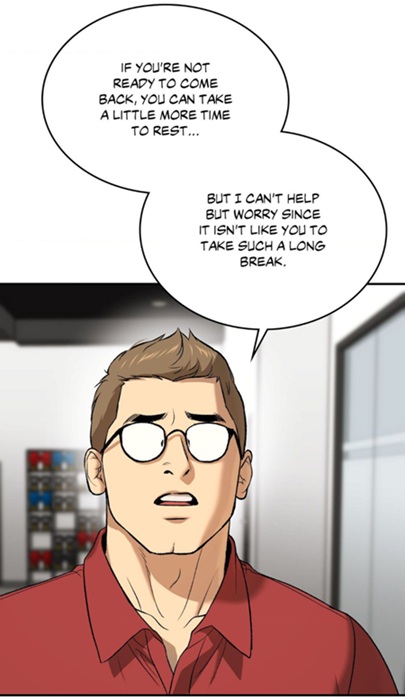
The hospice director’s words to Kim Dan may seem caring at first glance. He comments on his exhaustion—  (chapter 70) his dark circles, his nodding off—and suggests him to take a day off.
  (Chapter 70) But look closely: he notes that Dan has never used a sick day, and yet deliberately avoids recommending one now. Instead, he offers the less costly alternative: a personal day off, unpaid.
This language shift is strategic. A formal sick day would require the hospice to compensate Dan for rest. By subtly placing the burden back on him—“Why don’t you take better care of yourself?”—the director protects the institution’s budget while maintaining a façade of concern. His framing pathologizes Dan’s exhaustion as a personal failure (chapter 70), not a consequence of institutional neglect or overwork.
The very conversation betrays that Dan’s employment terms are different from those of the full-time staff. Unlike the nurses, who are likely on standard contracts with structured shifts, Dan is spoken to as someone expected to self-manage his workload and well-being. He’s the one deciding when he picks up a shift.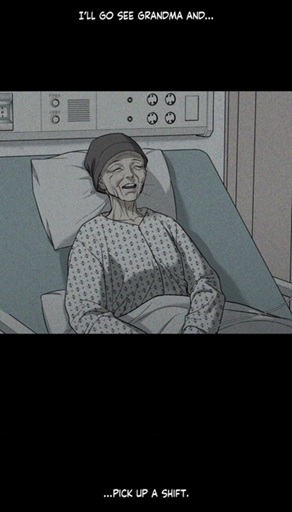 (Chapter 70) The director doesn’t say, “We’ll adjust your schedule,” or, “Let me talk to HR.” He simply tells Dan to take a day off (chapter 70), as if the responsibility for that decision—both logistically and financially—rests solely on him. This means that he is working exactly like he did in the past as a waiter or courier: paid by the hour.
 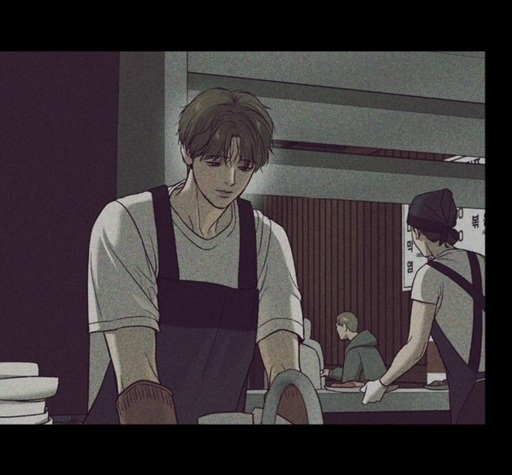 (Chapter 59) This reinforces the idea that Dan is not covered by the same protections, and that he operates outside the stable framework of regular employment.
Ironically, the director’s comment comes after Kim Dan has already taken a first step toward recovery. (Chapter 70) In episode 66, Jaekyung dragged Dan to Seoul over the weekend  (chapter 66) to visit a sleep specialist, where Dan received a diagnosis and first treatment for his “sleepwalking” condition. The two spent the night in Seoul. Upon returning to the seaside town, Jaekyung received a call
  (chapter 69) and left again the next morning for Seoul in order to meet the CEO, marking a separation between the two after their return.
During this gap, Kim Dan must have returned to work, most likely resuming his afternoon shift. In episode 71, his presence is later noted during both afternoon  (chapter 71) and night hours
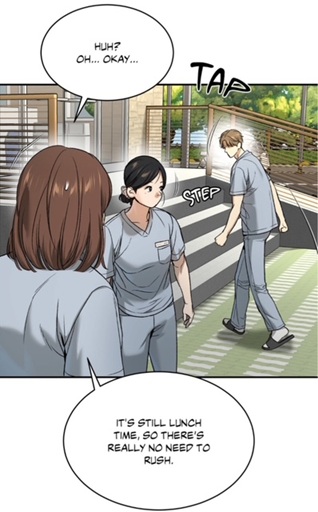
  (chapter 71), suggesting his ongoing pattern of overworking. In episode 71, Kim Dan is seen walking alone through the hospice hallway—unaccompanied, unnoticed. This quiet image stands in stark contrast to the earlier scene when, after nearly drowning, he was carried in by Joo Jaekyung and immediately met by a nurse and the hospice director, both actively working together that night.
  (chapter 60) Back then, his suffering was visible, his crisis institutionalized. Striking is that after that night, the hospital director never asked doc Dan to take a sick leave or to a day off. In fact, it took some time before making such a suggestion. Moreover, as if a single day off would make a huge difference. But now, despite his clear exhaustion and illness, doc Dan moves through the same space in silence (chapter 71) Nothing has changed: no one beside him, no one monitoring him. This comparison exposes the hospice director’s hypocrisy and superficial care.
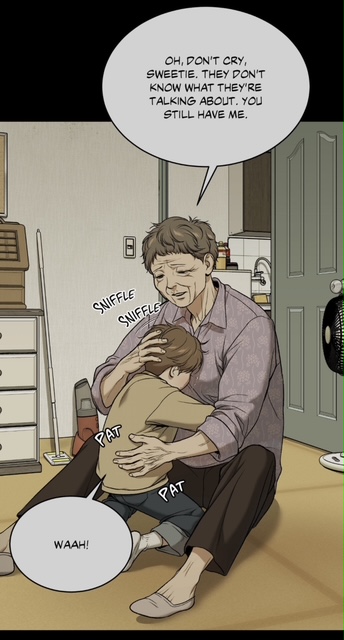
His loneliness has been institutionalized. That he is left to walk alone, reflects how thoroughly his pain has been folded into the daily background noise of the hospice—a place that is supposed to care, yet chooses to remain passive. Finally, don’t forget that the nurse 1 blamed doc Dan for not taking care of himself properly, because 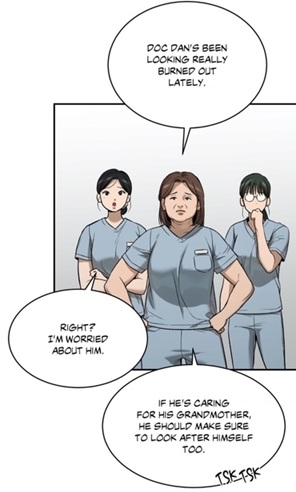 (Chapter 57) his grandmother would worry about him. Yet, during that night, Shin Okja doesn’t seem to be plagued by worries for her own grandson’s health. She sleeps peacefully.
But let’s return our attention to the conversation between the physical therapist and his boss. When did this recommendation take place? The timeline becomes crucial here. We learn that Kim Dan told his landlord he was taking the day off 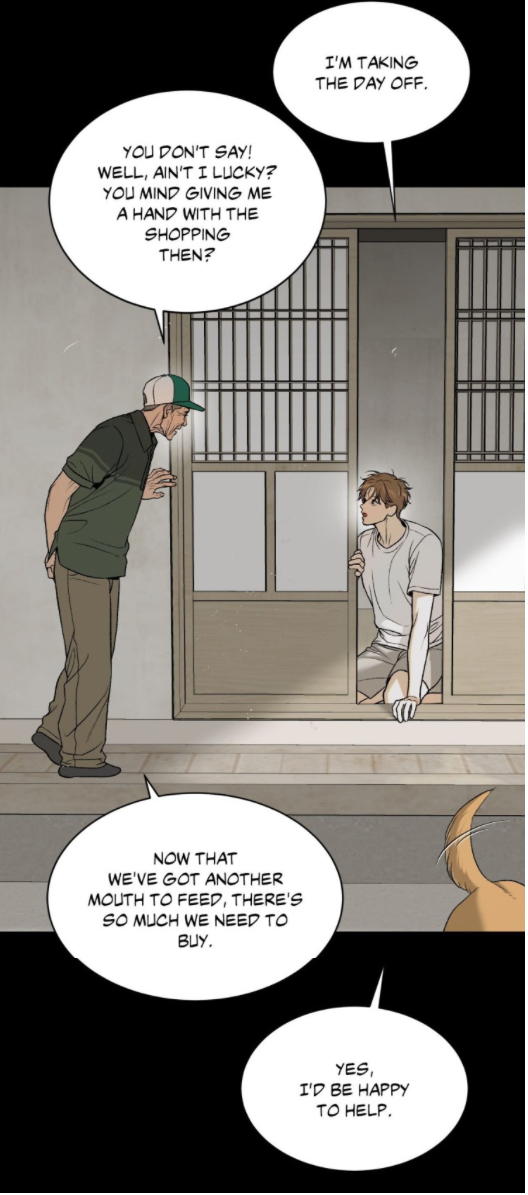 (chapter 70) only after the Seoul trip. This must mean that his conversation with the hospice director—where he was urged to rest—took place between his return from Seoul and the announced day off. We also know that
 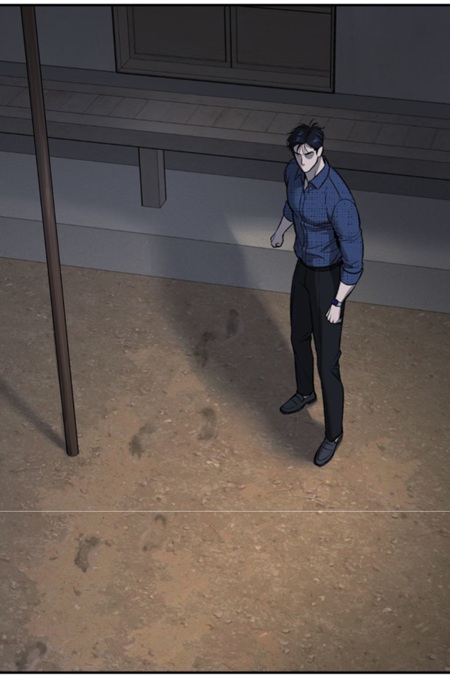 (chapter 69) the champion came back from Seoul in the evening and found footprints near the house, suspecting Dan had wandered to the ocean while drunk. These prints were left that same day
  (chapter 70), when Kim Dan chased the puppies that had stolen the shoes. Based on the shadows and the position of the sun
 (chapter 70), I am deducing that this scene took place during the afternoon. I used these images as a contrast, where the author made it clear that these scenes took place in the morning.
  (Chapter 65)
  (chapter 57) We can determine the time based on the position of the sun and the shadows.
Thus, it is clear: the director judged Dan as neglectful after he had met the sleep specialist and as such sought medical treatment. (Chapter 70) Thus his reproach is not entirely correct.
Furthermore, observe the vocabulary the man employed in front of his employee. They are all revolving around visual symptoms (dark circles, nodding off) but he does not ask questions. His response is based entirely on appearances—looking instead of examining, noticing instead of investigating. I also noticed that he is using the same expressions than his own staff. (Chapter 57) My idea is that the staff are his eyes and ears. Hence he doesn’t examine the physical therapist closely. He never offers a health check or having him tested. 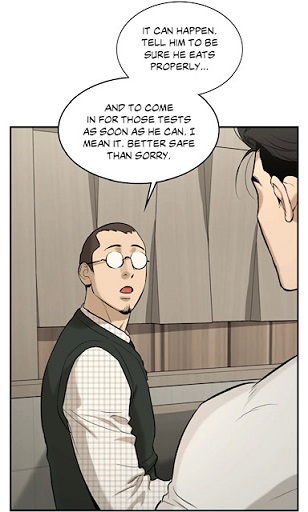 (Chapter 13) But when Kim Dan drops a patient Dan by mistake
  (chapter 59), the director acts immediately—not because of concern for the elderly man,
  (chapter 59) but because he fears that the patient’s family might sue the hospice. The elderly man’s condition was formally assessed, documented, and protected. This scene exposes that they can act in an emergency (taking tests). In contrast, Kim Dan—who is visibly unwell—is not offered even a basic check-up. His illness is reduced to tired eyes and missed sleep, framed as personal negligence rather than systemic failure. He is looked at, not truly seen. While the patient is treated as a legal liability, Dan is treated as disposable labor—an expendable worker whose wellbeing doesn’t justify institutional resources. Thus in my opinion, the director of the hospice suggested that doc Dan took a day off in order to ensure that he had done his duty, taking care of his employee.
Another striking detail appears when we notice that the elderly patient (chapter 59) who fell due to Kim Dan’s dissociative state in episode 59 seems to reappear in episodes 70 and 71. 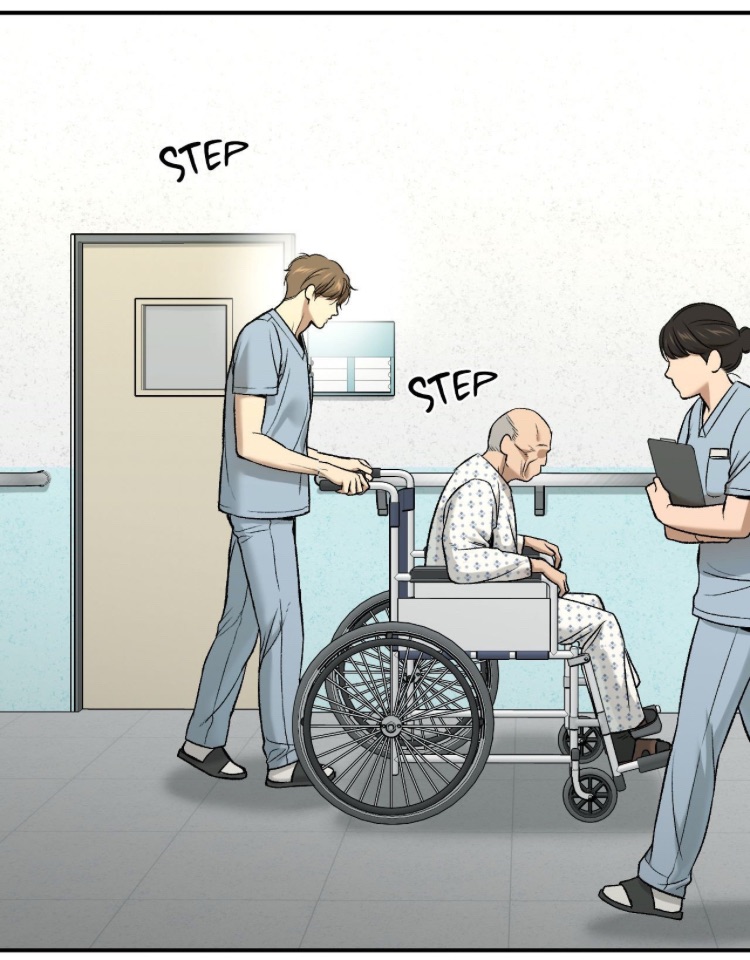 (Chapter 70) His distinct appearance—bald with tufts of grey hair—makes him easily recognizable. What stands out this time is not the accident, but the aftermath of it.
  (Chapter 70) When Kim Dan, again lost in thought, almost bypasses his room, it is this very patient who gently brings him back to reality with the teasing words, “Earth to Doc Dan.” His tone is not accusatory. On the contrary, it’s forgiving—light-hearted even.
This interaction subtly reshapes the narrative of the earlier fall. Rather than harboring resentment, the patient acknowledges Kim Dan’s humanity and affirms his worth with humor and patience. He doesn’t define the physical therapist by his mistakes. This response contrasts sharply with the institutional culture around Dan, where overwork and exhaustion are framed as incompetence and emotional suffering is ignored.
The recurrence of this particular patient also bridges episode 59 with the present, suggesting that we are circling back—this time not just to repeat the past, but to re-examine it. The closer we get to this patient, the closer we move to the emotional core of the narrative: that dignity and recognition are often found not in the powerful, but in those who share space quietly and see clearly. Moreover, this elderly man, like the old coach, becomes another unexpected mirror—reminding both Dan and the viewer that grace can come from unexpected places, and that sometimes, even in a failing system, individuals choose not to perpetuate its cruelty.
2. The Reality of Double Shifts and a Different Contract
Dan’s return to work was not just symbolic—it was physically demanding. Clues throughout the chapters suggest that Dan has been working double shifts. In episode 62, the champion came to the hospice thinking that his morning shift had ended. :  (chapter 62) However, the main lead was still working, thus the athlete concluded that he had made a mistake. He probably assumed that he had the afternoon shift. Hence Joo Jaekyung only returned to the landlord’s house at sunset! So during that day, he must have worked for the morning and afternoon shift. Even here, the doctor was suggested to give a special treatment to the star.
  (Chapter 62) Then in episode 71, we see him working in both afternoon
  (chapter 71) and night scenes, (chapter 71) always present, never resting. This points to a likely hourly contract with minimal protection. He is not integrated into the regular team of nurses.
  (Chapter 71) Therefore we see him in company of different nurses.
  (Chapter 57) He moves between teams, unanchored and isolated. This also explicates why the nurses still have no name. To conclude, his contract implies that Dan is paid by the hour or per shift, without salary-based benefits. I am suspecting, the regular nurses likely operate under different contracts, which could include fixed shifts, team integration, and better protections.
This difference is subtly confirmed in the way the director speaks to him—not as a protected employee, but as a freelancer or temp worker who must self-regulate. The fact that the director doesn’t mention adjusting his workload or seeking support through institutional channels reinforces this. Dan is expected to disappear and reappear without institutional backup, like a shadow on call.
How could this happen? For me, there exist different causes. First, we shouldn’t forget the impact of the incident with the switched spray, doc Dan definitely blamed himself. Thus it undermined his confidence to ask for a higher salary. In addition, in the locker room, the celebrity had made the following reproach. He was obsessed with money, he was greedy.  (Chapter 51) Then the main lead was thinking that he was only staying there temporarily.
  (Chapter 57) Finally, we shouldn’t overlook that his job is strongly intertwined with his grandmother’s situation. He needed to get a job there, hence he couldn’t negotiate his contract. As long as he had a job as physical therapist, he could only be “happy”.
And crucially, he is funding someone else’s comfort.
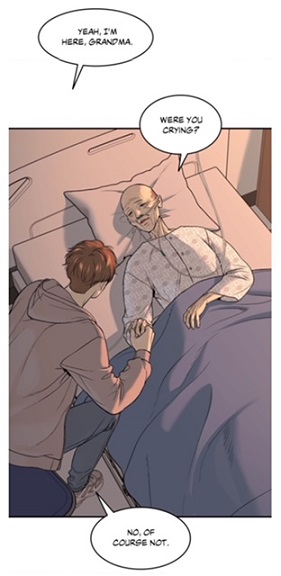
His grandmother, Shin Okja, lives alone 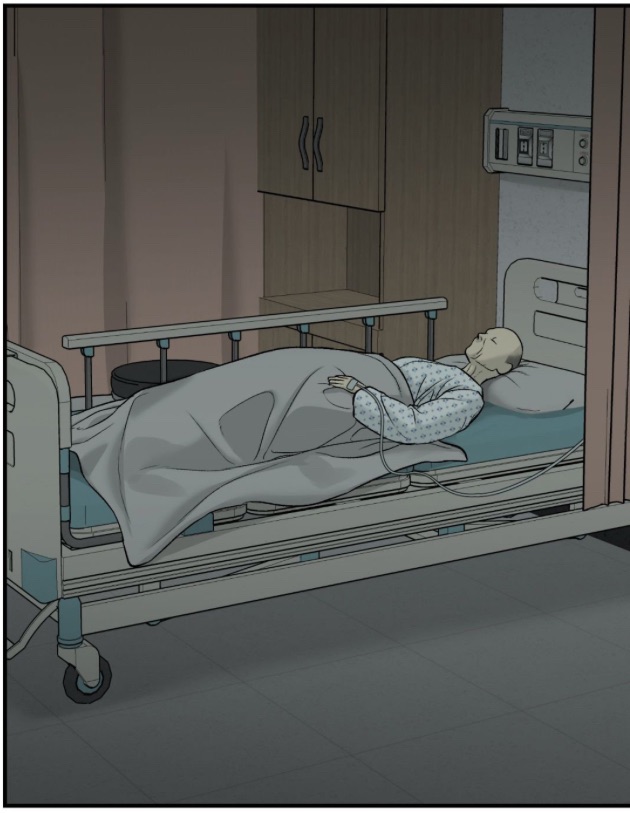 (Chapter 71) in a room designed for six patients—indicated by the six plastic protections outside the door. (Chapter 71) She has her own care taker
 (chapter 65), while the former coach shares a room with three others and lacks personal care.
  (Chapter 71) Shin Okja lives like a VIP. Yes, the new version of this situation:
 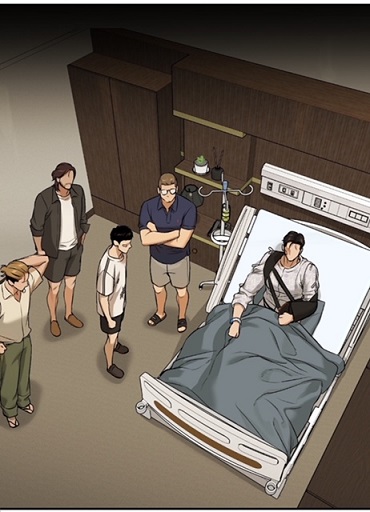 (chapter 52) That’s the reason why Mingwa made another allusion to this particular scene (chapter 52) in episode 71:
 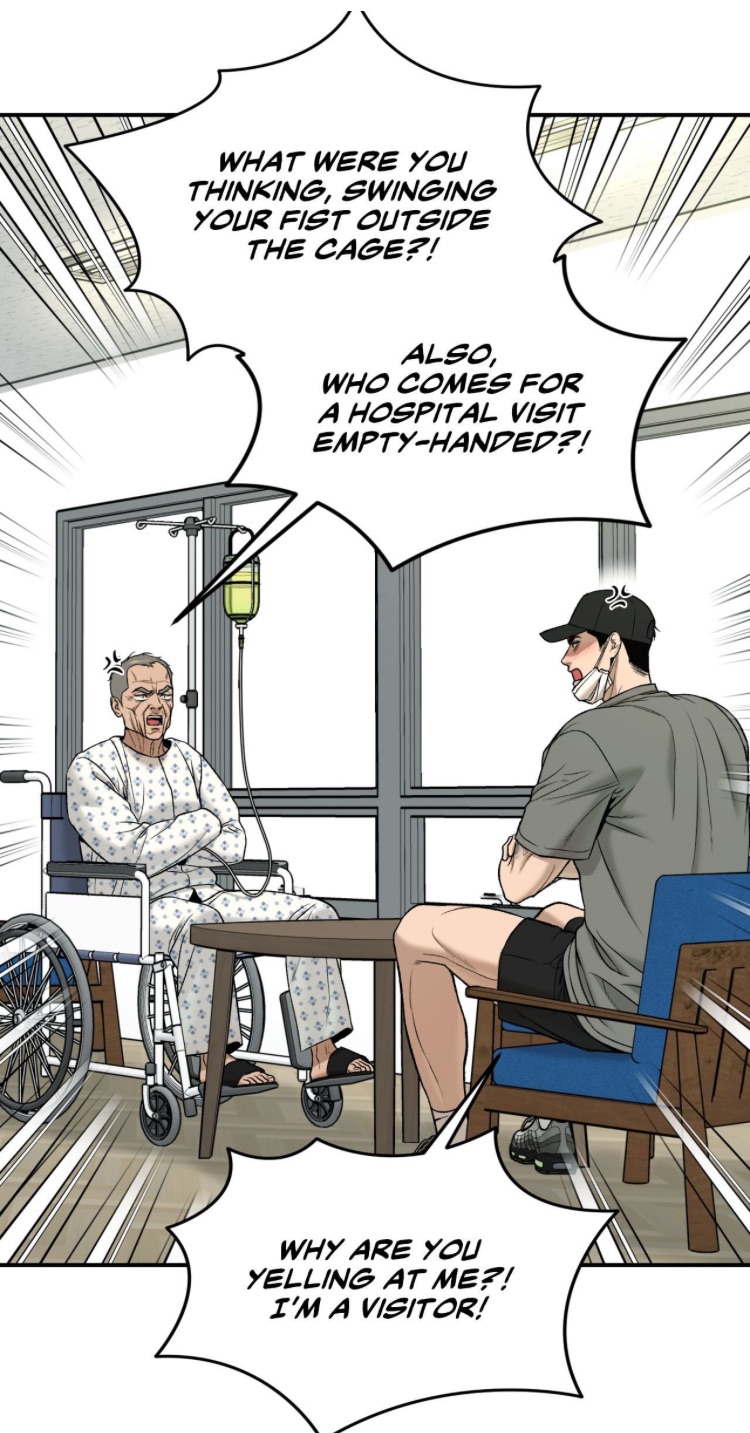 (chapter 71) The members from Team Black visited him not only empty-handed, but didn’t try to cheer him up at all. This shows the rudeness from Park Namwook and the others. But let’s return our attention to the gentle grandmother.
This kind of arrangement requires money—and Kim Dan is paying for it with his body. The overwork, the lack of sleep, the burnout—it all goes to ensure that she is kept comfortable, while he is silently collapsing.
And yet, when the director lectures him about self-care (chapter 70), overlooking the burden doc Dan is going through. No one is asking him about his finances.
Dan, in contrast, has no one yelling for him. Not even his grandmother advocates on his behalf. Instead, she goes around him and asks Joo Jaekyung for help—ignoring the staff and the institution altogether. 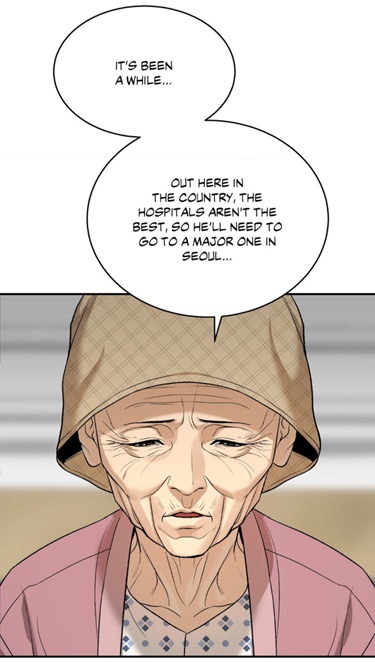 (Chapter 65) She even portrays the hospital in a rather negative light. The irony is that she asked someone who was in recovery
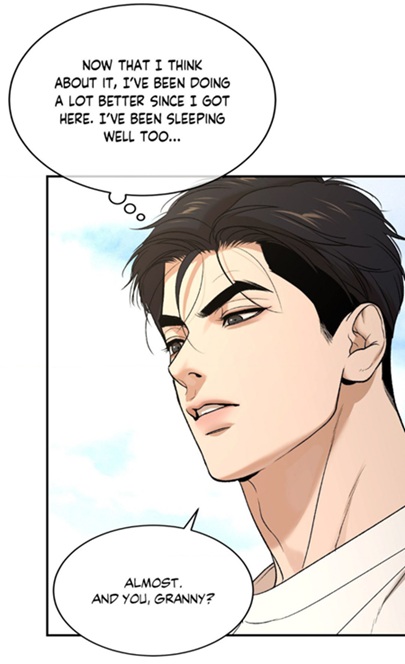 (chapter 65), and he has now a cold.
 (Chapter 70) If something were to happen to the physical therapist, who is responsible? This means, there’s no one at the Light of Hope paying attention to doc Dan. It is, as if Dan has no family, and within the hospice structure, no voice. Yet, I saw a change in the following panel.
 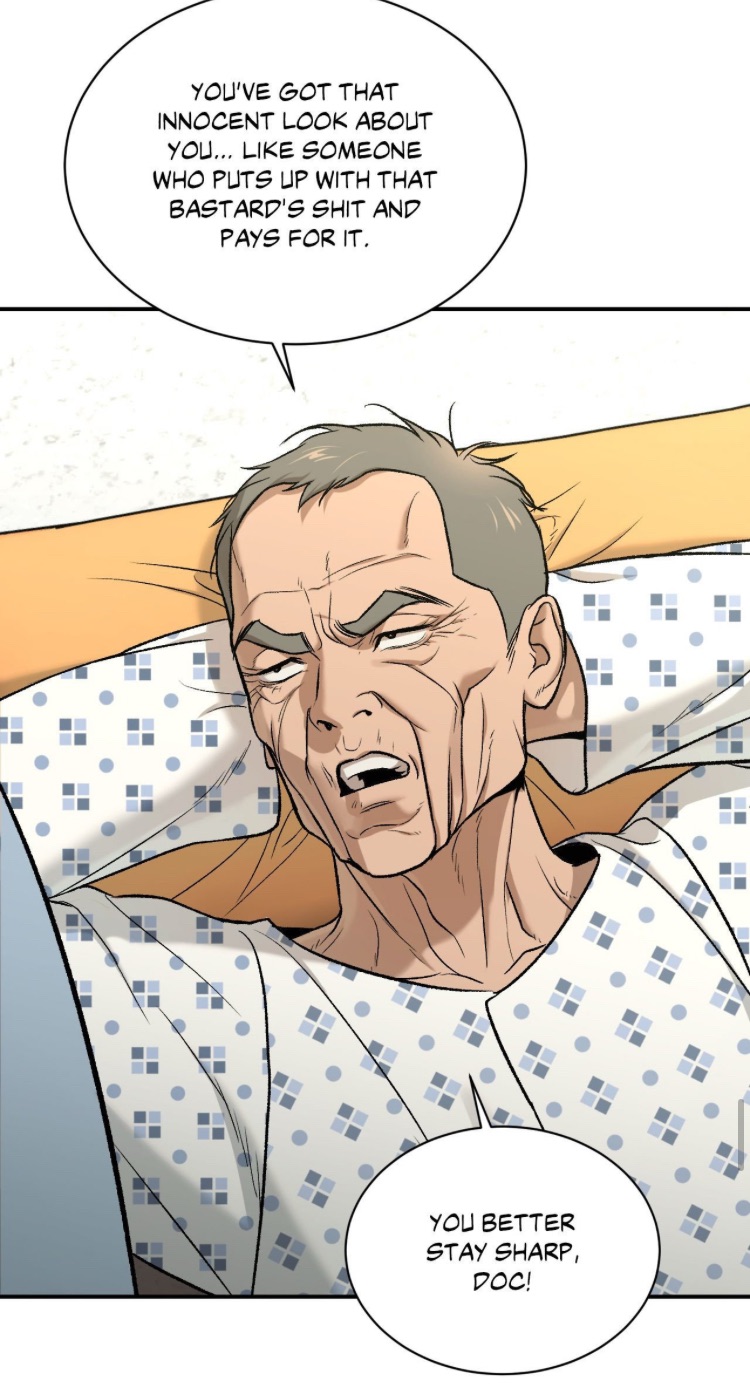 (Chapter 70) For the first time, someone spoke on the physical therapist’s behalf. He should make sure not to be taken advantage of. Secondly, when he pointed out
  (chapter 70) that the star was staying there because of him, he was already implying that doc Dan had power over the athlete. He should voice his own opinion and thoughts to ensure to protect his own interests. From my point of view, this “former fighter” will definitely side with the young man and protect him.
The conversation between Kim Dan and the hospice director might, at first glance, read as kind-hearted concern. The reality is that the day off allows the institution to appear humane while avoiding any financial or legal responsibility for Dan’s well-being. At the same time, this situation appears to confront Shin Okja with a bitter truth: that even though her grandson became a physical therapist—a role associated with education, skill, and respectability—his social standing hasn’t changed. He still works long hours, earns little, and lives on the margins of the system. His body is as exploited as when she sold vegetables on the street. 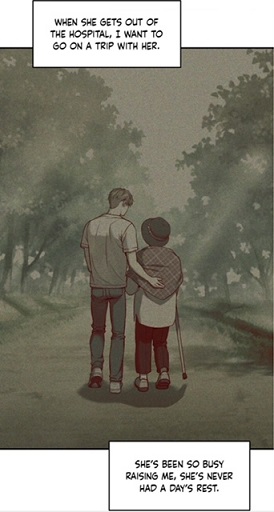 (Chapter 47) The uniform may be different, but the precarity remains the same.
  (Chapter 65) This revelation may fuel her decision to send him back to Seoul—not just out of care, but as a reflection of her lifelong obsession with money and upward mobility. Crushed by the burden of the loan and haunted by her own failures, she sees Seoul not only as a place of opportunity but as the only terrain where financial survival is possible. In her logic, professional success is meaningless without wealth, and in the seaside town, doc Dan’s work brings neither. So she urges him to leave—not because she doesn’t care, but because she has equated worth with earning power. Her mindset, forged by debt and despair, blinds her to the emotional and physical toll this cycle continues to take on her grandson.
Blamed for His Own Collapse
In this way, Dan becomes the perfect target for blame. (Chapter 70) Everyone—from the director to the celebrity 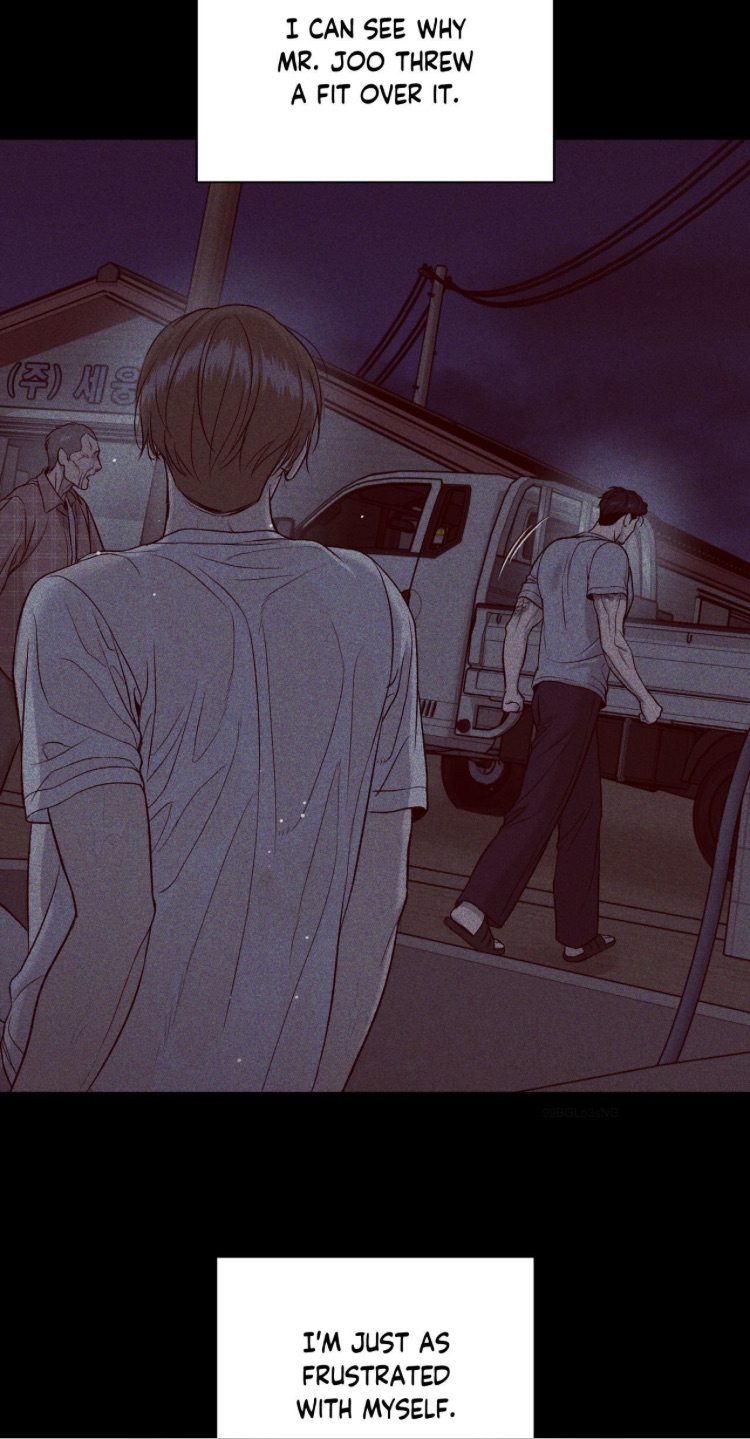 (chapter 71) to even the grandmother—assumes he is responsible for his condition. They blame him for drinking, for being tired, for looking unwell. But no one looks beyond the surface and investigates the causes. No one is wondering about the financial burden, the trigger for his fears
  (chapter 71), the emotional isolation, or the systemic overwork that drive him there. Let’s not forget that the young man drank again after hearing that Joo Jaekyung would return to the ring soon. This shows that the incident with the switched spray and its consequences left deep wounds in his heart and soul.
This is the core injustice: Dan is punished for the symptoms of a system that depends on his silence. He is structurally invisible, morally judged, and emotionally abandoned. And he accepts it—because he believes he has no right to ask for more.
A Misread Life: Misinterpretation from All Sides
The tragedy is that no one fully understands Dan’s emotional or physical condition:
- The hospice director, while not malicious, interprets Dan’s exhaustion as neglect rather than the result of a crushing schedule, sickness and unresolved traumas
- Joo Jaekyung, still unaware of Dan’s grueling double shifts, wrongly assumes that Dan returns home at the end of the day. (Chapter 71) This explains why, after returning sick, he told Dan not to share the bed that night—he thought Dan was coming home to rest. In reality, Dan was remaining at the hospice for his second shift.
- Even the former athlete, now living at the hospice, overlooks Dan completely (chapter 71) when his former student takes him to the rooftop, too focused to nagging to Joo Jaekyung. Dan, standing in the hallway, is ignored—another ghost drifting through an institution that doesn’t truly see him. He doesn’t wonder why this young man is working during the night later.
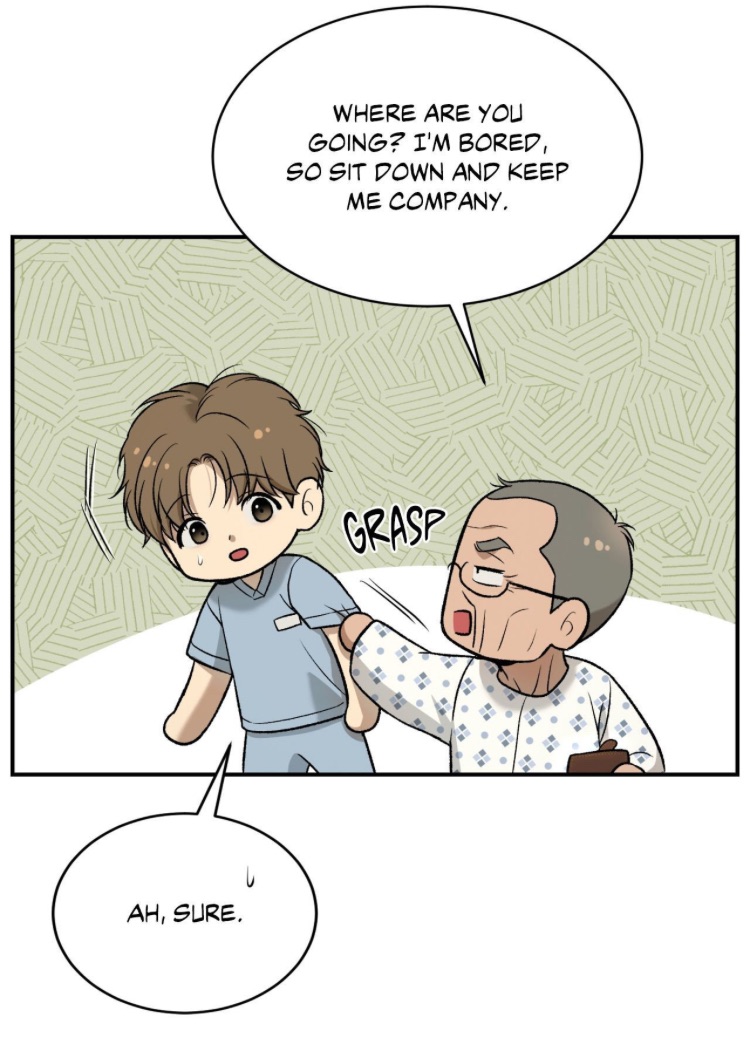 (Chapter 71) He even asks him to stay by his side, not noticing his dark circles and paleness.
This lack of recognition is not incidental. It stems from Kim Dan’s quiet, damaging belief that love must be earned through sacrifice. His philosophy confuses devotion with self-erasure, service with affection.
There’s a kind of loneliness that hurts more than being alone: feeling invisible when surrounded by people you’ve helped countless times. You’re there, you do everything possible to be present and available. To make life easier for others. But no one asks how you’re doing. No one stops to thank you. It’s not that you don’t exist… it’s that they’ve become so accustomed to your presence that you’ve become invisible. If you feel this way, you’re not overreacting or being “overly sensitive.” You’re experiencing a real form of emotional burnout that occurs when you give so much, so unconditionally, that others begin to take it for granted. They don’t mean any harm – or at least, not always – but the effect is the same: your value goes unnoticed, your needs fade into the background, and you begin to disappear. Quoted from https://psychology-spot.com/being-unconditional-makes-you-invisible/
But being constantly available—emotionally, physically, professionally—without acknowledgment carries a cost. As the article “Being Unconditional Makes You Invisible” explains, this kind of unreciprocated availability leads to silent emotional fatigue, internalized resentment, and, most painfully, a growing disconnection from the self. Dan is always the one listening, giving, enduring. But in doing so, he becomes invisible in the very systems he sustains. His self-esteem quietly erodes under the weight of one-sided expectations. His relationships, especially with the hospice and his grandmother 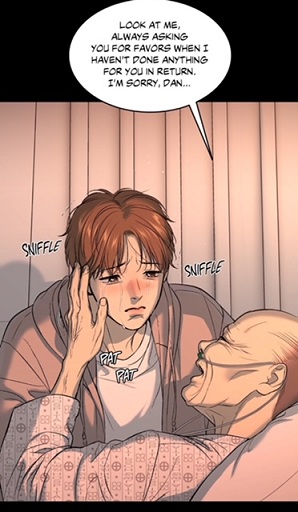 (chapter 53), become lopsided forms of dependency. And his unspoken needs—his own exhaustion, grief, and longing—are never tended to, not even by himself. He is present for everyone, yet no one is truly present for him. That’s the reason why Shin Okja knows nothing about her own grandson’s interests and dreams.
  (Chapter 65)
The hospice director’s mistake is not his tone, but his timing and framing. He tells Dan to rest after Dan has already taken responsibility for his condition—after he has gone to Seoul, received a diagnosis, and returned to work. The true mistake lies not in what the director says, but in what he doesn’t offer:
- No formal sick leave
- No referral to an in-house physician
- No acknowledgment of Dan’s effort to heal
- And most importantly, no long-term security—no shift to a better contract or stable position
Instead, Dan receives a moral correction disguised as care. And that is perhaps the most painful form of erasure—when a system offers you compassion only after it has ensured your exhaustion was cost-free.
An Old Coot, a Cricket, and an Owl
In the first part, I had compared the nameless coach to a wolf and ibex. Strangely, in translation, the former coach is called an “old coot” (in English), (chapter 71) or a cricket (in Japanese). 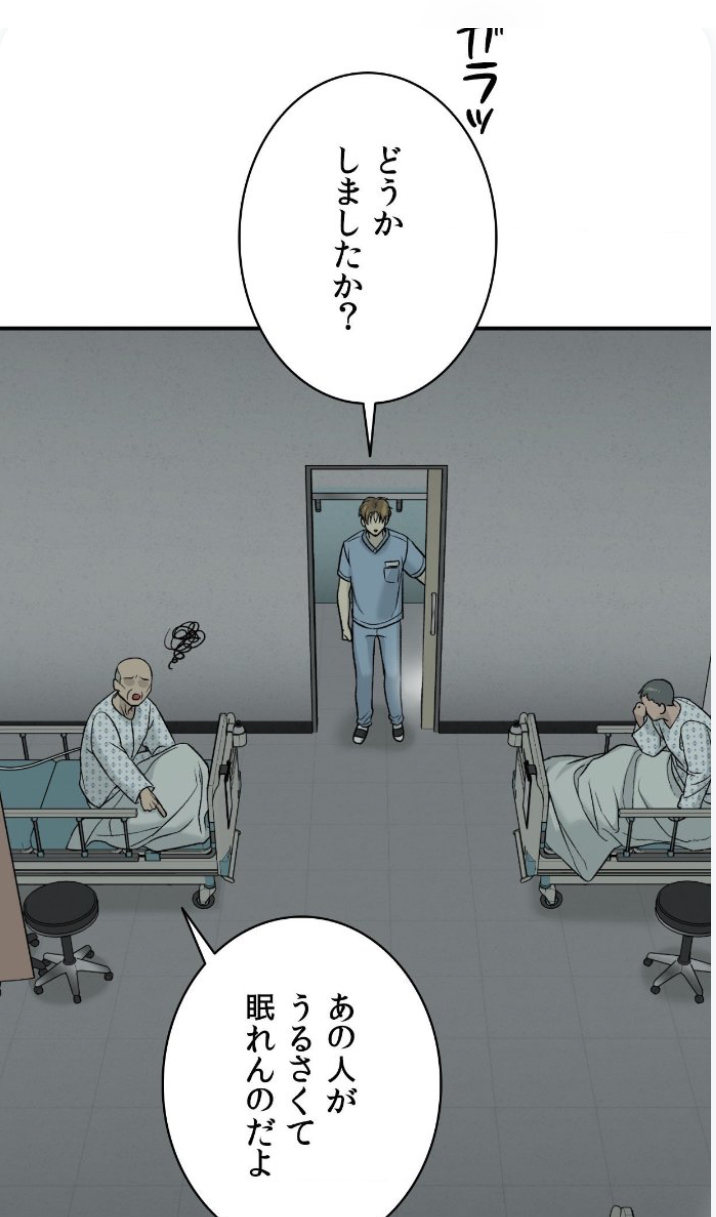 (Chapter 71) In German, he would be an “alter Kauz”—an eccentric owl. But this metaphor reaches deeper than mere strangeness or aging.
The owl is a nocturnal bird, often linked to solitude, silent observation, and hidden knowledge. In chapter 71, an owl is heard in the seaside town next to the champion’s hostel—an eerie presence that coincides with Kim Dan’s visible exhaustion and isolation.  (Chapter 71) The constant appearance of the owl connected with the champion’s house implies that Joo Jaekyung is now connected to this nightbird, as if the latter was his guardian of the night. In addition, in chapter 65,
 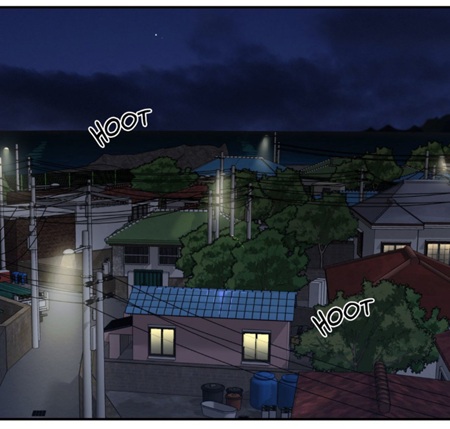 (chapter 65) Dan was found wandering the night in his sleep, pulled by unconscious fears.
 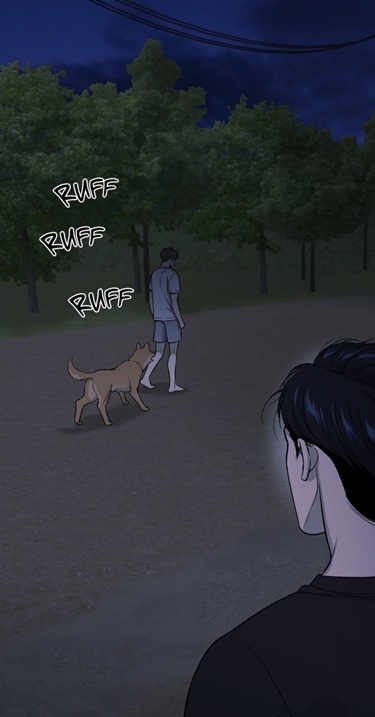 (Chapter 65) These moments mirror the owl’s behavior: navigating darkness, moving alone, and being misunderstood. Thus, the owl becomes a powerful symbol not only of the former coach but of Kim Dan himself—both are creatures of the night, shaped by what they see and endure in silence. In contrast to the chattering coot, the owl watches and remembers. And perhaps, the presence of both birds suggests that the coach, once a loud and reckless coot, is beginning to see with the quiet eyes of the owl—finally noticing the suffering he once overlooked. Their shared nocturnality ties them together: one hoots and curses, the other drifts wordlessly—but both are left behind by the daylight world.Doc Dan’s nightly behavior made me think of an owl. (Chapter 65) during that night, Joo Jaekyung caught him wandering in sleep outside. In addition, Moreover, I interpret the presence of the owl as an allusion to the presence of the former director in the couple’s life. As you can see, I have already made a parallel between the physical therapist and the nameless coach. These metaphors evoke not only eccentricity but specific traits tied to nocturnal birds and fragile aging.
The coot,  (quoted from https://www.oiseaux.net/birds/eurasian.coot.html) though a water bird like the duck, is a poor flyer, often flapping frantically just above the water’s surface. It tends to migrate or travel by night, preferring the cover of darkness to avoid predators. The coot is socially awkward yet persistent—an outsider among graceful birds. In this sense, the coach mirrors the coot: once active, now awkwardly grounded, watching from the margins, no longer able to soar.
Yet the coach’s resemblance to the Eurasian coot extends beyond his weakened condition. This bird stands for versatility, adaptability, or hidden talents, attributes similar to the ibex because of their long slender toes with round lobes of skin on them.
These lobes allow the Coot to swim through the water similarly to a duck, but whilst on land these feet are much more effective for navigating terrain. Quoted from https://worldbirds.com/coot-symbolism/
Coots are noisy 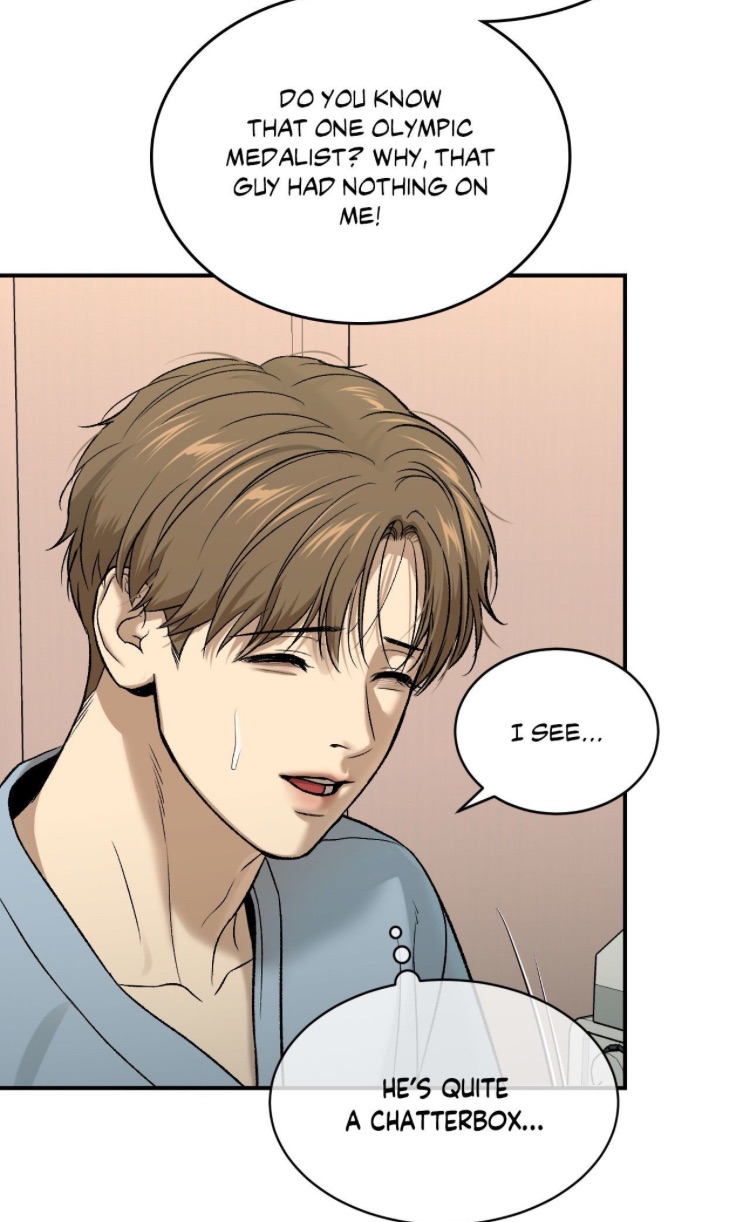 and socially awkward birds—notorious for their harsh, repetitive calls that sound more like chiding than song. Unlike the poetic silence often associated with owls, the coot communicates through blunt, raspy cries. This parallels the coach’s incessant chatter and verbal outbursts. Kim Dan even refers to him as a “chatterbox,” a man who yells, curses, and grumbles without reserve. And yet, strangely, Dan is not repulsed. On the contrary—he appears comforted by the company. For perhaps the first time, someone talks to him without judgment or restraint. (Chapter 71) The coach, in asking Dan to stay and keep him company, reveals a loneliness behind the noise—a need for genuine presence, not just a match on TV. And Dan, who so often listens in silence, responds and is interested in his past..
The Eurasian coot, with its stark black plumage and distinctive white frontal shield, is not merely an odd, noisy water bird—it carries deep symbolic resonance. Visually, it evokes the image of yin within Taoist philosophy: the dark feathered body representing shadow, receptivity, and introspection, while the bright beak and forehead suggest presence, guidance, and emergent clarity. This interplay of black and white echoes the taijitu, the yin-yang symbol, where opposing forces coexist, define, and balance each other. In this metaphorical framework, Kim Dan has long embodied yin: passive in appearance, enduring in silence, emotionally responsive, and often eclipsed by the assertive, solar force of Jaekyung—his yang counterpart. The coot, then, becomes an avatar of Kim Dan’s latent feminine principle, one often neglected or undervalued in the harsh masculine domains of fighting, survival, and ambition.
But the coot is not merely passive. Across several Native American traditions, it plays the mythic role of the “earth-diver”—the humble, overlooked creature who succeeds where stronger animals fail. Diving to the bottom of primordial waters, the coot resurfaces with the vital clump of mud that births new land. This act of grounding creation through immersion in emotional depths positions the coot—and by extension, the coach—as a quiet redeemer. If we follow this myth, then the coach, once the yelling coot who flapped at the surface of a hypermasculine world, now dives inward through his illness and regret. And by getting acquainted with Kim Dan, he begins to recover something essential: the knowledge that nurturing, not domination, is what builds real legacy. A side that he has all this time neglected.
Just as the coot in myth brings forth land from formless water, the coach now nudges Kim Dan to settle—to plant roots, recognize his own value, and reimagine his path. This is the deeper function of their encounter: not only to pass on knowledge, but to give Dan permission to claim space, stop drifting, and become whole.
This raw vocality—the coot’s instinct to call out, the coach’s refusal to quiet down—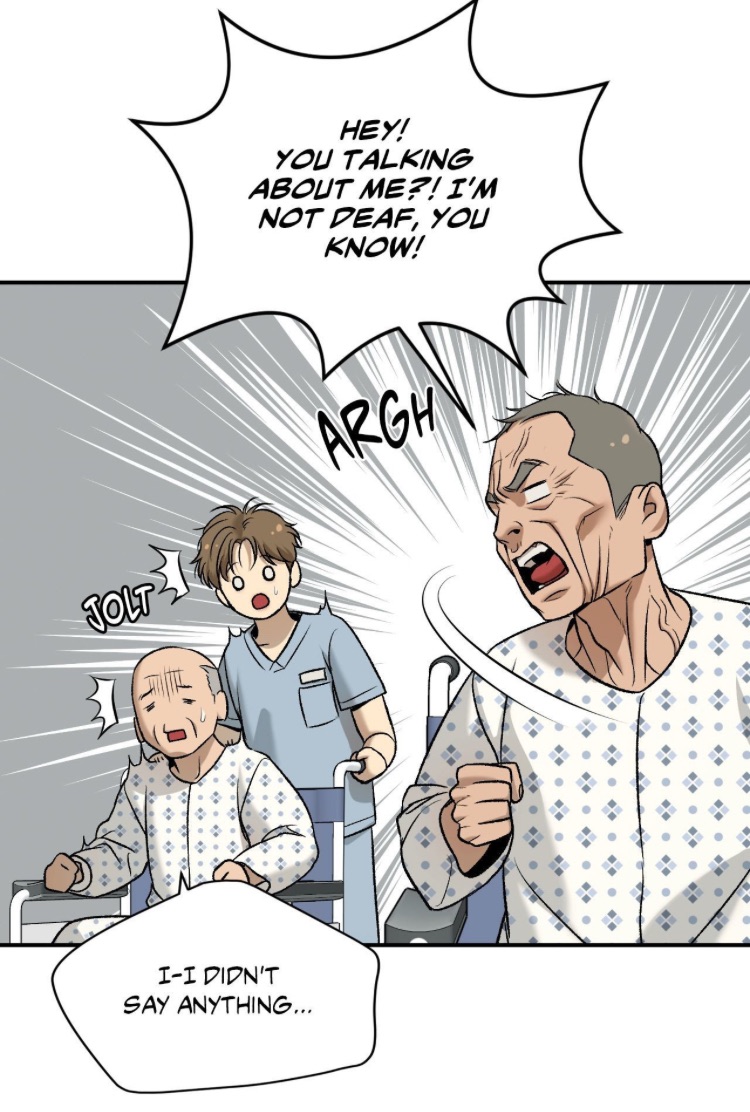 (chapter 71) suggests that communication doesn’t always have to be soft to be sincere. It is precisely the coach’s lack of elegance that makes him relatable to Dan.
 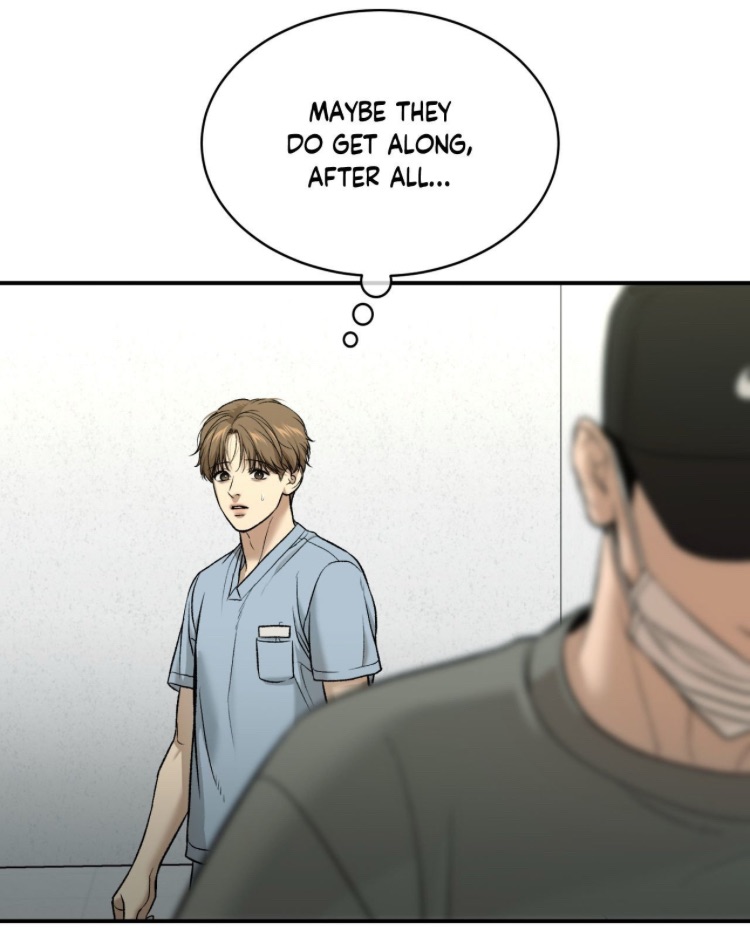 (Chapter 71) This dynamic becomes especially meaningful when we recall that Kim Dan’s symbolic animal is the duck—a creature often seen as passive or domesticated, gliding over water while paddling furiously underneath. As discussed above, the duck stands for Dan’s silent endurance, his ability to move between unstable emotional terrains without ever making a splash.
In contrast, the coot is noisy and awkward, incapable of flight yet unwilling to be silent. In a world that expects the duck to swim gracefully through silence, the coot becomes a strange, stuttering guide—blunt, awkward, but unmistakably alive.
This is especially interesting because, as previously argued, Kim Dan’s symbolic animal is the duck— (chapter 65) a creature that moves between water, land, and air. While he is still learning to navigate the spaces between systems, he too lacks institutional power. If the former coach is a coot, then his narrative function may be to pass on his remaining knowledge to the duck—turning his interactions with the coach and his use of the notebook into an unofficial MMA trainer seminar he once wished to attend
  (chapter 22).
Like the ibex metaphor used in Part I—creatures tied to rocky isolation and dangerous heights—the coot further enriches the theme of aged survivors perched on the margins of community. But unlike the ibex, the coot may still transmit wisdom before its final flight.
The cricket, (chapter 71) on the other hand, introduces a different symbolic register. Crickets are night creatures, associated with melancholy songs and liminal moments—summer nights, silence interrupted by delicate rhythm. In literature, the cricket is often the last to speak when others fall silent. Beyond eccentricity or noise, this insect also evokes themes of temporality and mortality. It is a creature of the twilight—its song a reminder of fleeting seasons, of warmth that will pass. In many cultures, the cricket’s chirping signals the passage of time, each note a marker of transience. Its presence in literature often accompanies deathbeds, soliloquies, or irreversible turning points. If the coach is a cricket, then he is not merely a grumbler—he is a living metronome, ticking down the last hours of his own life, while reminding those around him—like Kim Dan—that time is limited. And perhaps this is why he talks so much: not to annoy, but to assert his presence before the silence swallows him.
In this light, the coach becomes a kind of dying bell—a cracked oracle whose purpose is not clarity but urgency. His role is to remind Dan that life cannot be deferred forever. Settling down, speaking up, asking for more—these are not things to postpone. The cricket’s metaphor, then, marks the threshold between invisibility and emergence, between survival and meaning. Though overlooked, its chirping suggests persistence and a strange form of endurance. To conclude, if the coach is a cricket, then his voice—grating, unwanted, but steady—becomes a metaphor for what remains when relevance fades. Crickets continue to sing even when ignored, echoing the idea that the coach, however diminished, still has something to say. His grumbling is the residue of meaning in a life otherwise stripped of its stage. And for Kim Dan, who has been rendered voiceless by respectability, the cricket’s harsh cadence may sound like truth.
These metaphors evoke age, eccentricity, and irrelevance. A coot is a harmless, grumpy old man. A cricket sings into the void, unheard. An owl is wise, but solitary and ignored.
These metaphors tell us how others see him: a relic, a burden (chapter 71), a joke. But there’s another side to the owl—the side that watches the night, that sees what others do not. And in this hospice, maybe for the first time, the former coach becomes something more: a witness who is no longer silent. An old man who still has eyes.
And perhaps, in seeing Dan, he finally sees what was lost when he failed to protect Jaekyung. 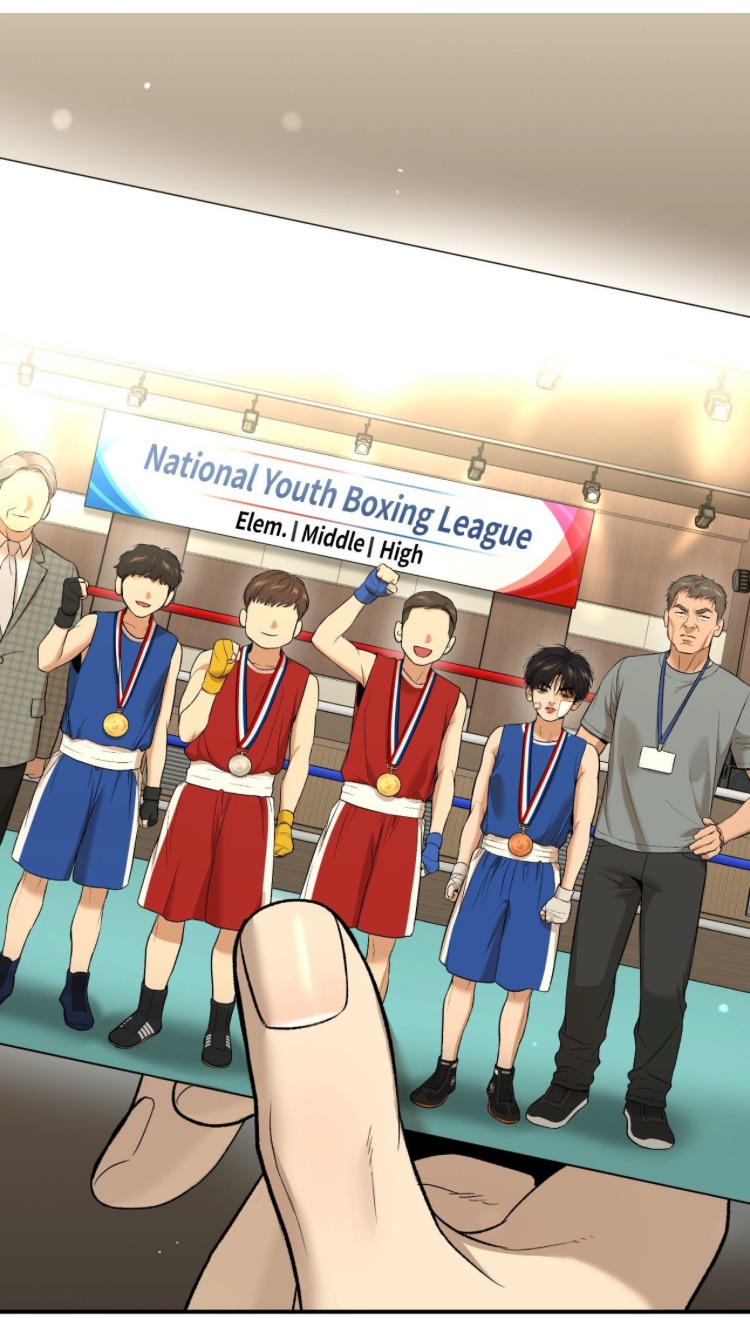 (Chapter 71) The latter didn’t receive proper treatment for his woundsAnd this brings me to my final interpretation, the absence of a physical therapist or doctor in the director’s world and life! His body got broken so many times, indicating that he never had a doctor by his side! .
 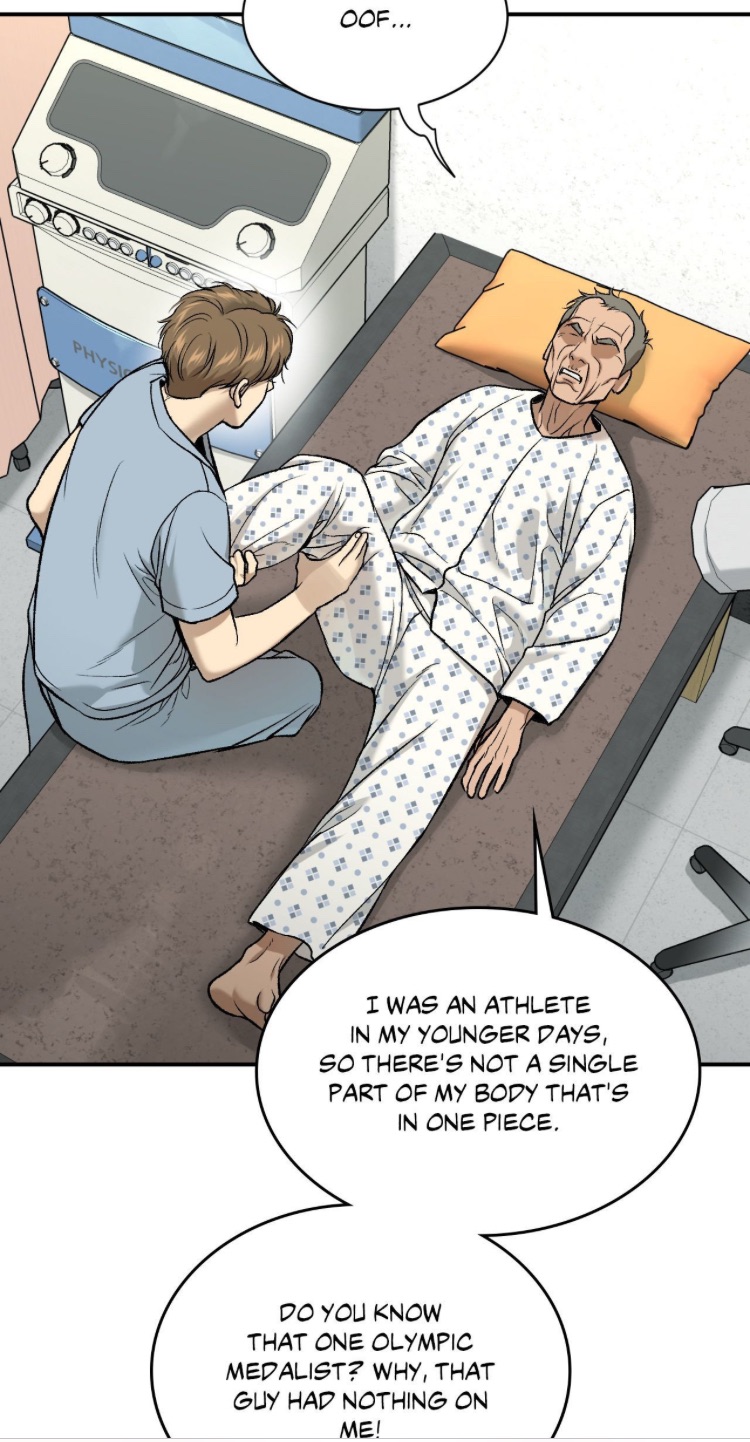 (Chapter 70)He never had a companion or friend in his life, which is also mirrored in the picture.
Together, these two owls—the worker and the watcher—form a quiet alliance of the unseen. One carries the weight of silence. 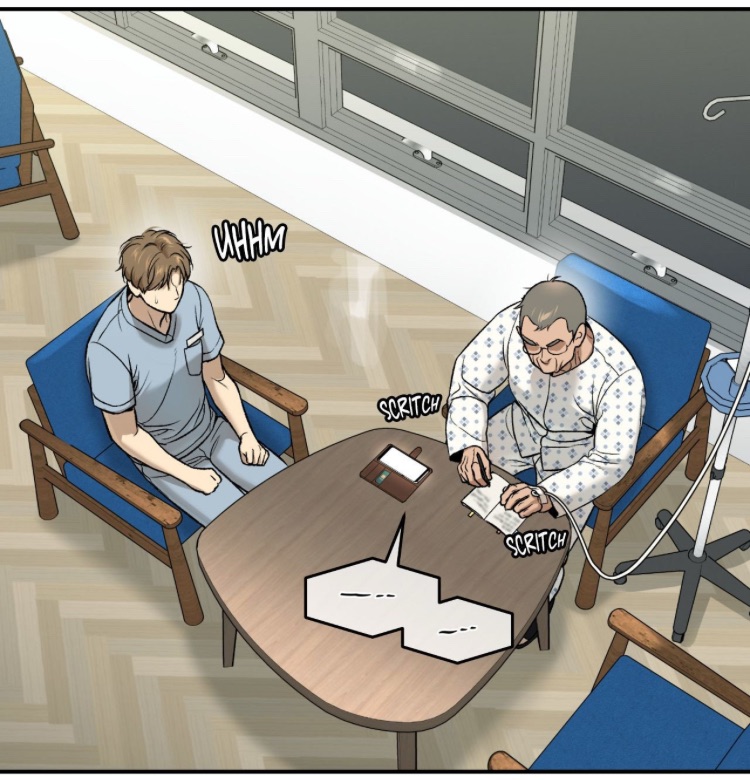 (Chapter 71) The other carries bitterness and the guilt of watching too long without speaking. In this dim hallway of illness and endurance, their connection becomes a muted call for dignity.
And maybe, this time, someone will hear it.
Feel free to comment. If you have any suggestion for topics or Manhwa, feel free to ask. If you enjoyed reading it, retweet it or push the button like. My Reddit-Instagram-Twitter-Tumblr account is: @bebebisous33. Thanks for reading and for the support, particularly, I would like to thank all the new followers and people recommending my blog.
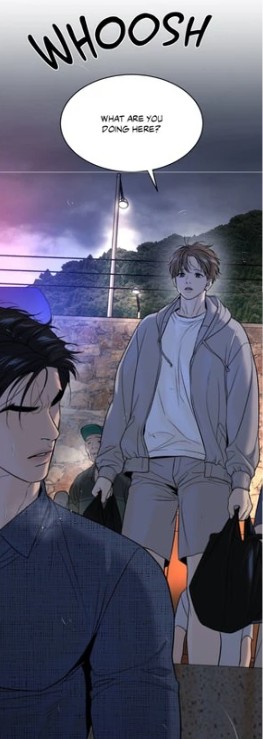 (Chapter 69) from the physical therapist is more than a startled greeting — it marks a critical shift in the psychological and emotional trajectory of both Kim Dan and Joo Jaekyung. Standing at the dock, doc Dan, still recovering from his depression and trauma of the switched spray incident, sees the champion not as an invincible athlete, but as someone equally unmoored. He is surprised and confused by such a behavior. Why would he act that way? Hence the author added right after this image:
  (chapter 69) Striking is that the champion has a similar reaction. He never expected that he had misjudged his fated partner. Both characters are forced to face their own prejudices and bias.
  (Chapter 69) This moment is less about resolution and more about recognition: two men, shaped by different paths of burnout, collide again — but this time not as patient and caregiver, predator and prey, but as human beings in crisis.
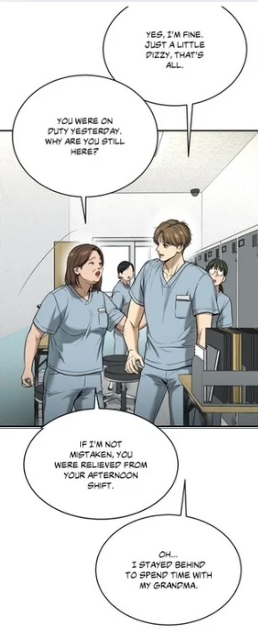 (chapter 57) that go unnoticed to dealing with the emotional numbness of detachment, Kim Dan begins to resemble the article’s description of someone silently breaking down.
  (Chapter 59) Although he didn’t face difficult patients at the hospice
 (chapter 57), he approaches his work like a robot, emotionally disconnected from those in his care. The burnout is not only shaped by the hospital environment — it’s also deeply tied to his role with Joo Jaekyung. The champion became, in many ways, his most demanding patient
 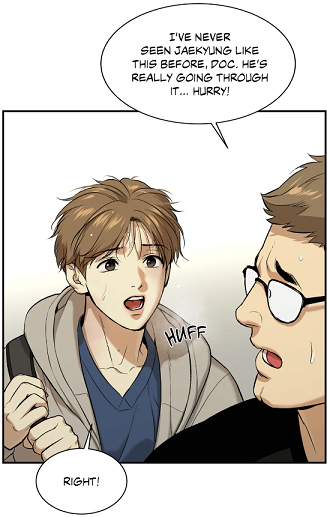 (Chapter 14), with unrealistic expectations
  – chapter 41 (such as pushing for a premature return to the ring), and an emotional climate of pressure and perfectionism
  f (chapter 45) rom superiors, he fits the article’s description of someone burdened by a toxic professional environment. More importantly, in episode 57, a nurse casually mentions that he might be suffering from burnout.
  (chapter 56) and isolates himself emotionally. Therefore he doesn’t engage in a conversation with the nurses.
  (Chapter 56) No wonder why the readers still don’t know the names of the three “angels in blue”’. Their presence is functional, but remains impersonal. They remain silent observants.
  (Chapter 27) He operates in an industry with crushing expectations, where performance is equated with survival.
  (Chapter 29) That’s why he doesn’t allow himself to rest.
  (chapter 49), or that in the aftermath of the suspicious match, he blames him
  (chapter 69) and avoids speaking with Shotgun altogether. Instead of engaging in conversation, he contacts MFC — preferring institutional action over personal interaction.
 (Chapter 57) Since people don’t know them, they can not trust their judgement and perception. Both navigate high-stakes worlds that punish vulnerability and reward detachment. And both, when overwhelmed, retreat from human relationships rather than reaching out. They are, in different costumes, performing the same coping script — one that the article identifies as characteristic of fixed mindsets operating under systemic pressure and emotional isolation.
  (chapter 19) and relational isolation all echo the article’s diagnosis:
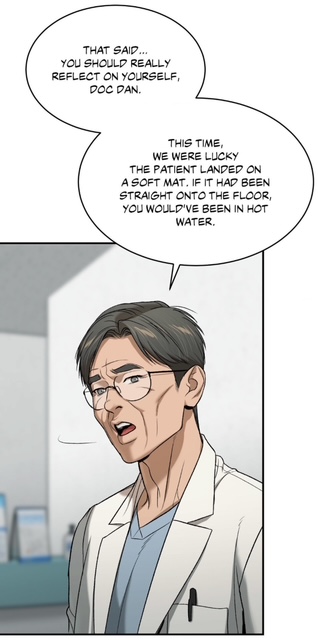 (chapter 59) — and any deviation from it is interpreted as personal failure. Here, it’s important that the hospice took advantage from the overworked protagonist. No one paid attention to the double shift. (Naturally, I am not saying that the main lead is blameless either). For Kim Dan, the patient’s fall in episode 59
  (chapter 59) and the sabotage incident destroyed his self-perception as “doctor” and “helper”.
 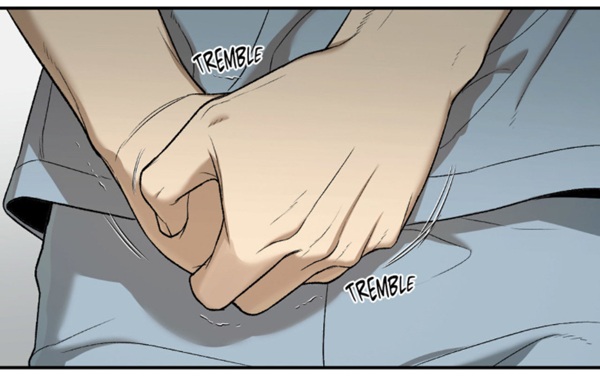 (Chapter 59) This is reflected in the image where the author zoomed on the “main lead’s” hands or when he is holding the dead puppy.
 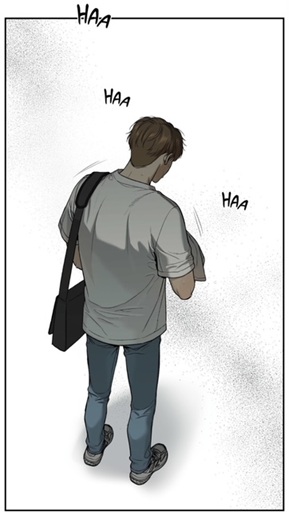 (Chapter 59) The hands have become the symbol of his powerlessness. For the wolf, the tie in his last match is perceived not as resilience, but as loss.
 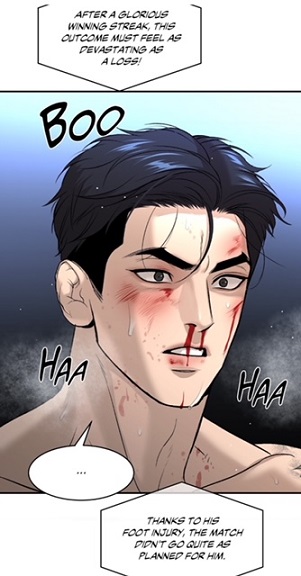 (Chapter 51) Neither of them has been taught to see difficulty as an invitation to adapt. They both cling to a fixed mindset — until crisis breaks the pattern.
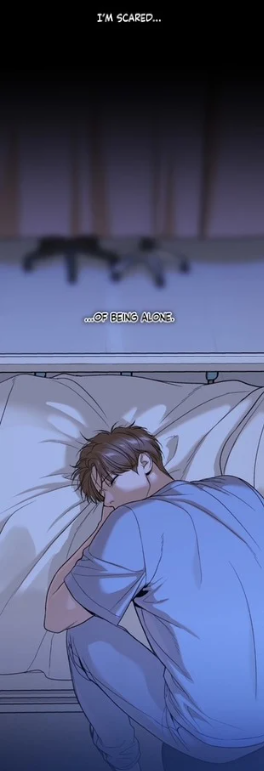 (Chapter 56) — they are also the result of two compounding forces: the champion’s perfectionism and the doctor’s own fixed mindset.
  (Chapter 64) This deeper entanglement explains why Dan ultimately rejects the celebrity.
 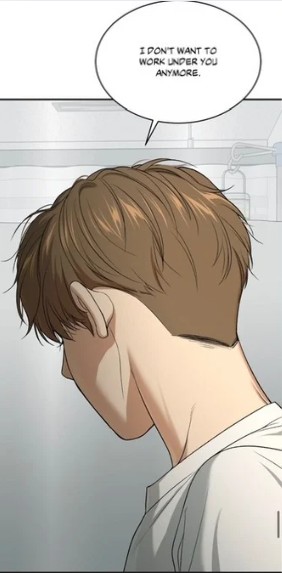 (Chapter 60) Though Dan has long suffered from low self-esteem, he has never questioned his sacrificial identity. It is as if he were destined — or conditioned — to care for others without regard for himself.
  (Chapter 29) He sees selflessness not as a virtue but as a default mode of survival. This explicates why he blames himself for the puppy’s death. Observe how Mingwa implied the relevance of the doctor’s hands while he was holding the poor puppy.
  (Chapter 1) — a way to repay debts. And it is the same, when he accepts his contract with the wolf.
  (Chapter 6) His grandmother reinforces this belief by reducing his worth to his earning capacity. This mindset is plainly illustrated in two key moments. In the first, she expresses her gratitude to the champion, because he gave him “a roof over his head and a salary.”
  (Chapter 65) These words reveal what truly matters to her: material provision and financial compensation. She does not seem to register the emotional toll the job may be taking on Dan, nor does she question the ethics of the contract or his living conditions. What she values is that her grandson is being paid and housed — signs of visible, quantifiable success.
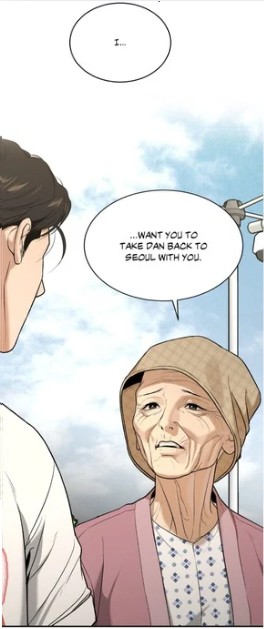 (Chapter 65) it becomes clear that for her, the capital is more than a location — it is a symbol of success, of competition, of visibility. She cannot imagine a fulfilling life outside that framework, and thus unknowingly erases Dan’s internal world: his trauma, exhaustion, and grief. To conclude, all her ideas are revolving around career, success and wealth. Work, in this logic, is not about pride, passion, or healing — it is about obligation. This began to shift when he started working with Jaekyung and discovers a different kind of validation:
 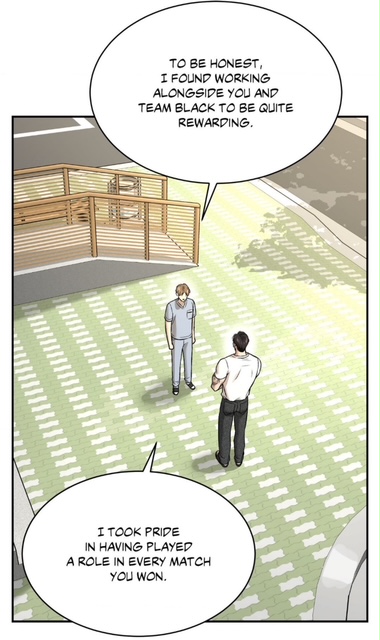 (chapter 62) the athlete’s success gave him a sense of purpose. No wonder why he took everything so personally.
  (Chapter 51) The rejection didn’t just hurt emotionally; it disoriented him existentially. In that light, it is no coincidence that he ends up working at a hospice — a place symbolically linked to endings, quiet resignation, and the final stages of life.
 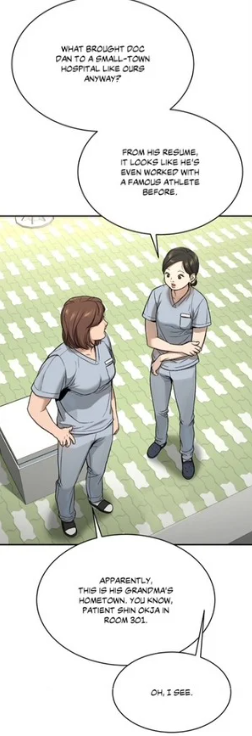 (Chapter 56) The hospice marks not just a physical retreat from his past, but a psychological one: a setting that echoes his emotional state. While his body continues to function, his inner life has entered a form of dormancy. His role in this environment reflects how deeply detached he has become — professionally, emotionally, and existentially. The job had become more than money, but now that it’s gone, he can no longer look forward. He feels lonely and rootless.
 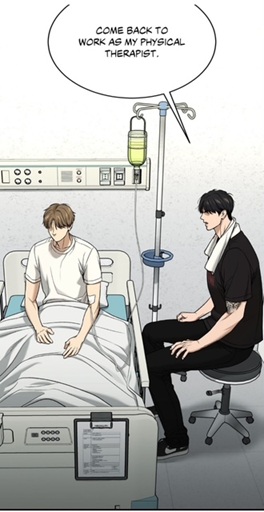 (chapter 60), functions as a form of emotional absolution, though doc Dan is not aware of it. This job offer is an indirect proof that he is still seen as competent and trustworthy.
 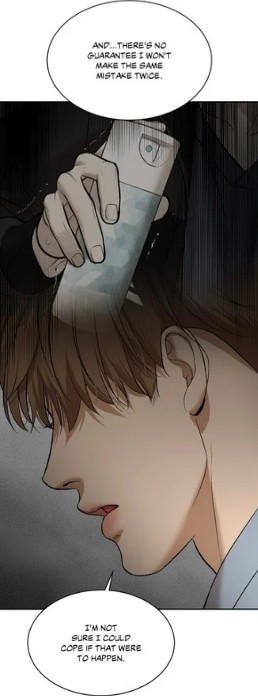 (Chapter 62) If Jaekyung had not come himself, it would have confirmed Dan’s worst fears: that he was to blame, that he was discarded. The first crack in his fixed mindset comes from this gesture — an external acknowledgment that the so-called “sin” may not have been his at all. This explicates why Kim Dan can give him the cold shoulder and even ignore him.
  (Chapter 61) It helps him to boost his strength and confidence. From that moment on, he is capable to express his own thoughts and as such criticize the star.
  (Chapter 69) His stunned reaction — “
 (chapter 69) with the title instilled by his hyung, the constant bodily strain, and his emotional isolation. Most crucially, he interprets his last match — a tie — as a personal failure. For someone with a fixed mindset, a tie is not balance; it’s inadequacy. Therefore it is not surprising that the athlete is not realizing that the outcome of his match has been changed from tie to loss.
  (Chapter 69) Dan’s very presence communicates something new: emotional steadiness, however tentative. And for the first time, Jaekyung doesn’t respond with control, but with vulnerability.
 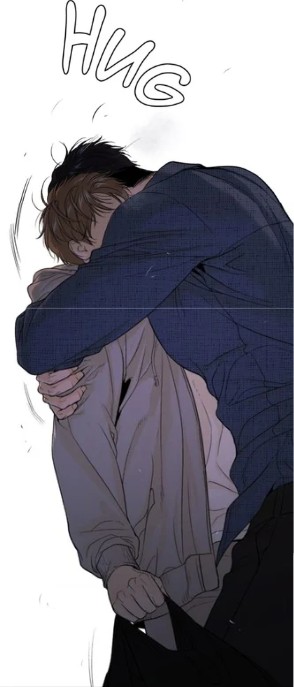 (Chapter 69) The hug becomes a form of speech — an action that acknowledges fear, relief and desire for connection.
 (Chapter 65) — yet she changes nothing. How so? She could have talked to the nurse, and the latter would have brought up the possibility of “burnout”. She frames her grandson as a victim
  (chapter 65) and herself as helpless, yet her only move is to push him away under the guise of concern
  (Chapter 65) and repair.
 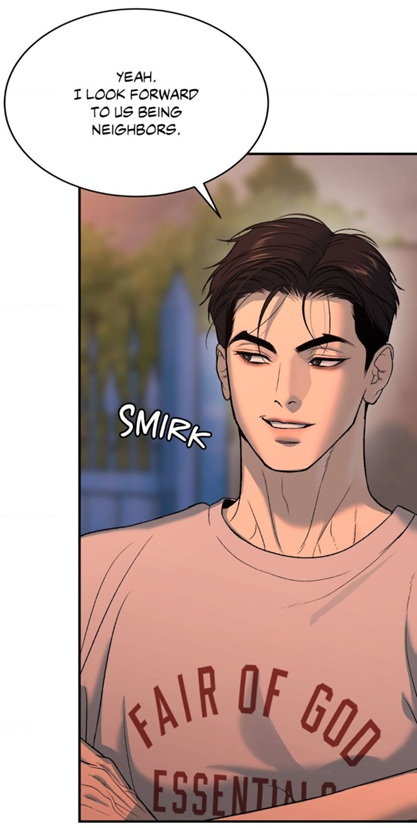 (chapter 61) , and approaches Dan not as a star reclaiming property, but as a person reaching out.
 (Chapter 69) He no longer focuses only on the next fight or media appearance — instead, he chooses emotional repair. Dan also learns to value life over denial. Hence we see him holding bags, certainly containing food. During the episode 69, the incident in the courtyard served as a wake-up call that he could no longer deny his mental illness. After his collapse, he gets back up, and is seen wearing his sports shoes.
  (Chapter 69) These items indicate the transformation in the doctor’s life. From my point of view, it announces the arrival of sports in his life.
 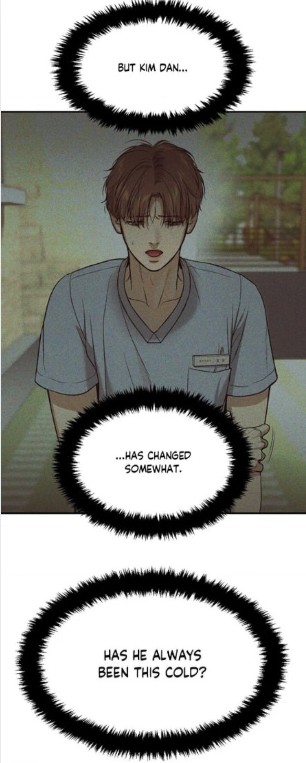 (chapter 62), not annihilation. Jaekyung’s emptiness and misery after the tie becomes the emotional opening that allows him to ask for connection, the more the hamster pushes him away.
  (Chapter 67) Meanwhile, Jaekyung drops his script of invincibility and openly acknowledges his need for Dan. Neither of them says the perfect thing — but they are no longer using self-talk to punish themselves.
 (Chapter 68) For him, vulnerability and empathy are no longer rejected, rather embraced and accepted.
 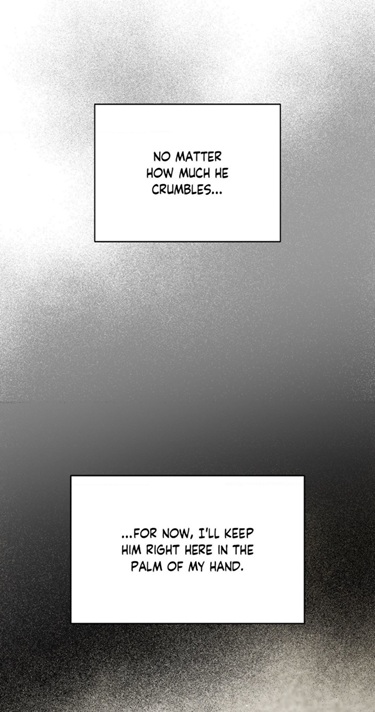 (Chapter 68) Dan, who once viewed care as something he must earn,
  (Chapter 69) begins to receive it. It is not a grand declaration, but a quiet shift: you can fail or cause a ruckus, and still be loved. Hence he doesn’t push away the wolf on the dock.
  (chapter 69), the star begins to extend that care inward. Each gesture of empathy toward Dan becomes a step closer to self-compassion. In learning to protect someone else without demanding perfection, the wolf is learning, perhaps for the first time, that he too deserves kindness — not just from others, but from himself. He models what the article calls a true “growth mindset” — one that sees failure not as final, but as a catalyst for relational and emotional evolution.

 (chapter 65) corresponds to the release of Jinx Chapter 70, which marked the series’ return after a three-month hiatus. This observation is more than clever numerology—it mirrors the manhwa’s deeper message: the past always haunts the present, and at times, it even foreshadows the future. And that’s exactly what I will do in this essay. I propose that the key to understanding the protagonists and characters’ evolving identities lies in the overlooked architectural and administrative details—especially the house numbers, door placements, and legal ownership of space. These seemingly minor visual cues are in fact loaded with meaning, offering insight into how home, memory, and identity are fragmented and reassigned across time and place.
 (chapter 61) For readers unfamiliar with Korea, this looks quite bizarre. In most European and American countries, street addresses follow a linear order; house number 12 would typically be located between 10 and 14. But in Korea, especially in rural areas, many towns use the older jibeon (지번) land-lot numbering system. Here, numbers are based not on street sequence but on the chronological order of land registration and subsequent subdivisions.
 (chapter 62), newer developments, or administrative restructuring rather than deep-rooted inheritance. In this context, a higher subdivision number implies not only later division, but also the erosion of legacy and the weakening of kinship-based territorial claims—an erosion especially poignant in the context of Confucian traditions that once emphasized multi-generational cohabitation and patrilineal inheritance. In classical Korean society, a home was not merely a shelter but a physical emblem of familial continuity, with ancestral rites often performed within the same household across generations. As addresses fragment and land parcels divide, so too does the symbolic structure of the family unit. The once-cohesive ideal of the extended household dissolves into isolated, rented spaces, reflecting not only economic realities but also the fraying of intergenerational bonds and filial authority.
 (chapter 61) Though Jaekyung is a wealthy celebrity, he inhabits a parcel of land that speaks to impermanence and anonymity. Meanwhile, Dan shares space with someone who quietly represents legacy and transparency.
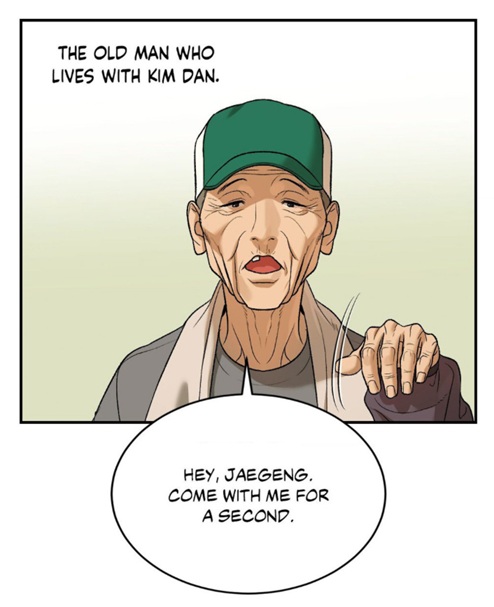 (chapter 62) However, this “dynamic” (distinction) began to shift the moment Jaekyung started working for the local residents.
  (chapter 62) No longer just a “guest” or a “tourist,” he earned their recognition and acceptance through acts of service and humility.
 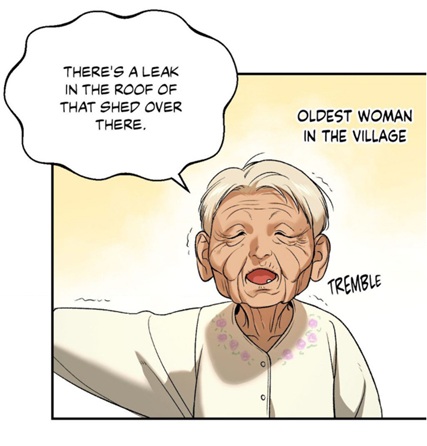 (chapter 62) As he helped them with manual tasks—such as lifting goods or assisting the elderly—they started seeing him not as an outsider, but as one of their own. However, it is important to note that these gestures of inclusion occurred while Jaekyung was outside the blue gate
  (chapter 62) —beyond the formal boundary of the rental property.
 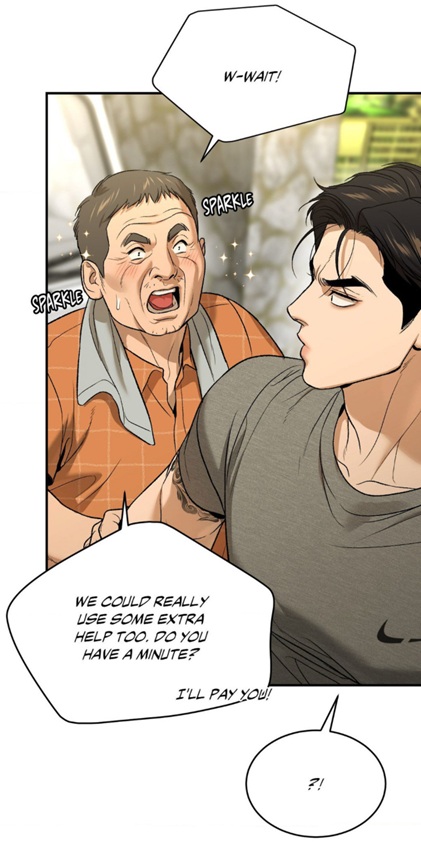 (chapter 62) In this way, the gate truly functioned as a symbolic threshold: only once he crossed it through action and humility, the community began to approach him. This change in perception was symbolized, when he received vegetables from the townspeople, a traditional gesture of inclusion and local acknowledgment.
  (chapter 62) Nevertheless, the best sign that he has been accepted by the community is when he received traditional welcome gifts: the toilet paper and detergent.
  (chapter 69) [For more read
 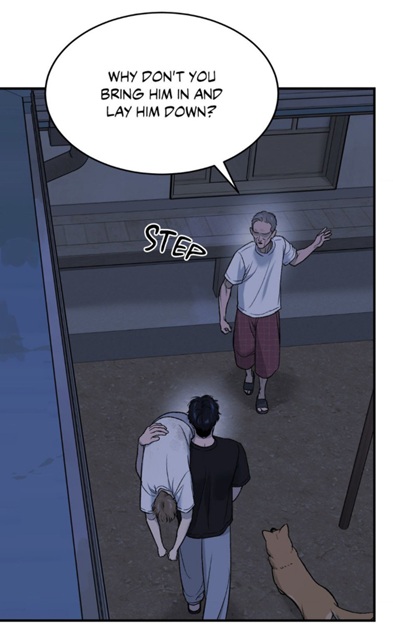 (chapter 65), the elderly neighbor chose to open the blue gate shortly after:
  (chapter 69) Thus I deduce that the blue gate lost its purpose. The champion definitely saw the advantages of the absence of a gate by his neighbor. He could arrive there at any moment
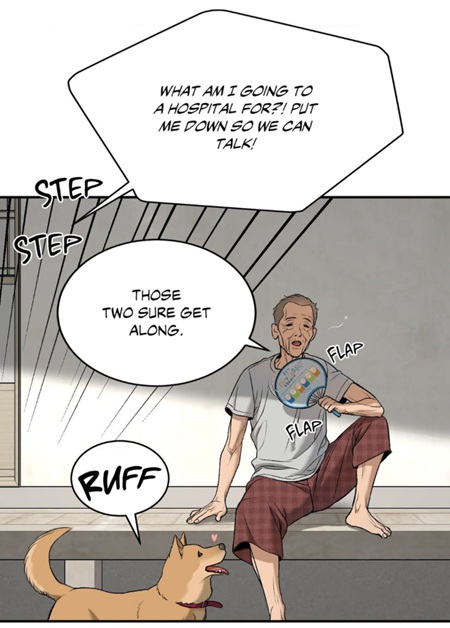
  (chapter 62) and the landlord never rejected him. In fact, he was always welcome.
  (chapter 66)
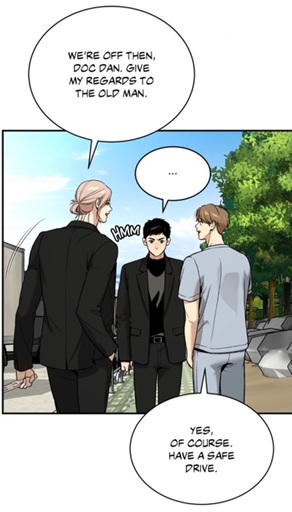 (chapter 59), and townspeople instinctively report Dan’s behavior to him.
 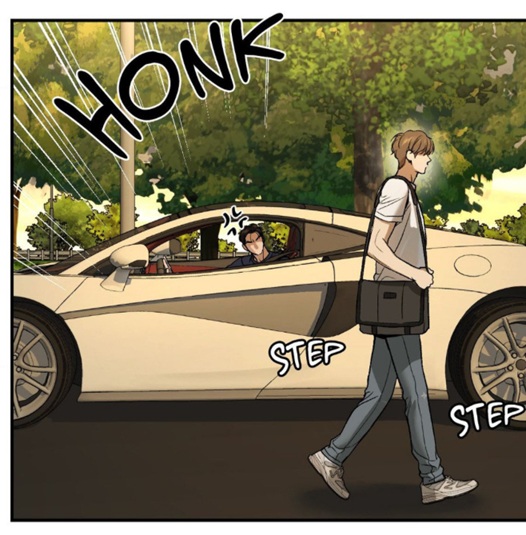 (chapter 61) That’s the reason why the author included this scene. Even if someone had disclosed Dan’s address, the GPS in Jaekyung’s luxury car would not have been able to guide him there. Like mentioned above, the streets have no names, and the numbering lacks logical sequence. Thus, we have to envision how the Emperor followed Dan on foot, observing where he went. In doing so, he not only located the general vicinity. Afterwards, he must have contacted a local and requested for a vacant house close to 33-3. That’s how he found the “hostel” right next door.
  – chapter 69) and walking through the confusion himself.
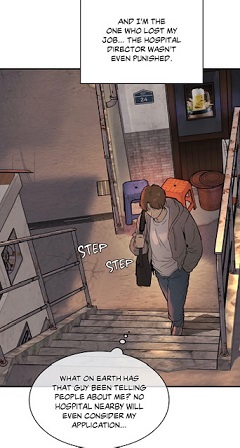 (chapter 1) we see Dan walking under a blue plaque labeled “24”—the newer, street-based system introduced after 2013. This number, part of Seoul’s revised address format, contrasts sharply with the rural jibeon model. Where 7-12 and 33-3 reflect layered histories and family division, “24” is precise, administrative, and arguably impersonal. The place is no longer connected to family and traditions, rather to migration and anonymity. The juxtaposition between systems emphasizes not only physical distance but emotional dislocation.
 (chapter 65) Though she insists this seaside town is where she “grew up,” she never identifies a lot number, street, or ancestral parcel. In a rural system where numbers are more than logistical—they are signs of rootedness and intergenerational presence—her vagueness stands out. Everyone else is connected to a numbered gate, a registry, or a mailbox. She alone floats in narrative space, clinging to emotional claims without material proof: no concrete location is brought up.
 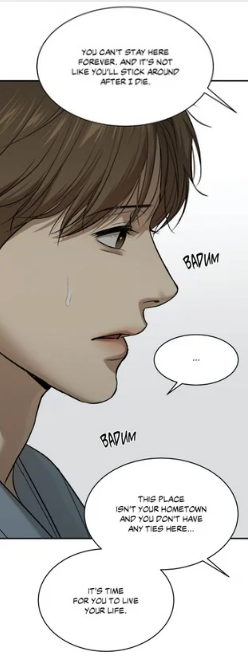 (chapter 57) The contrast becomes sharper when she refers to Seoul only in generic terms. She never mentions a district,
  (chapter 56), a neighborhood, or specific location. This lack of detail, especially when juxtaposed with the specificity of the rural jibeon system (where even a subdivision number implies lineage and ownership), exposes her rootlessness. It reinforces the idea that her ties to place are performative rather than grounded. Even her nostalgia for Seoul is flattened
  (chapter 17) As Jinx-lovers can detect, next to the entrance of her apartment, there is no blue house number plate or street name. How is that possible in a metropolis where every residence should be digitally registered? And now, pay attention to the house where the “goddess” and her “puppy” lived.
 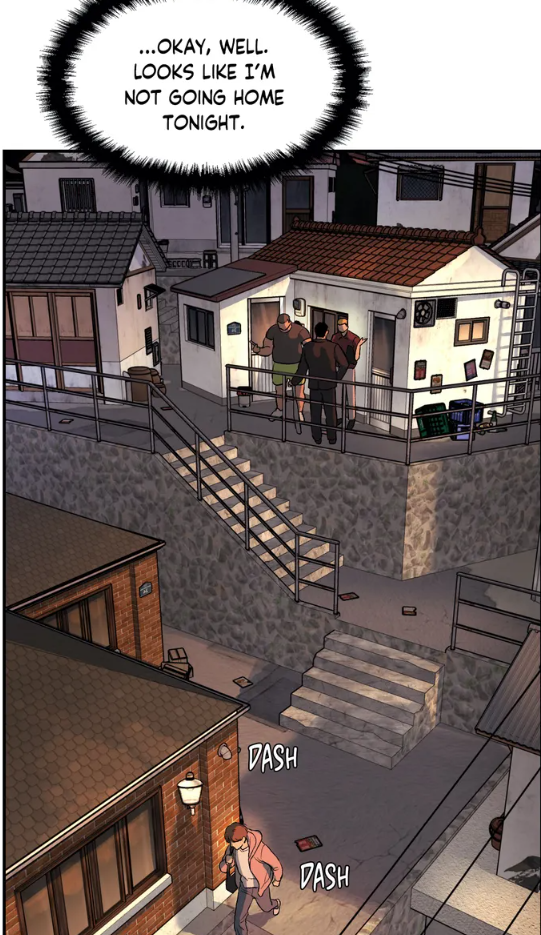 (chapter 1) The building had not only two doors, but also the plaque is placed next to the other door. It is also partially visible in this image:
 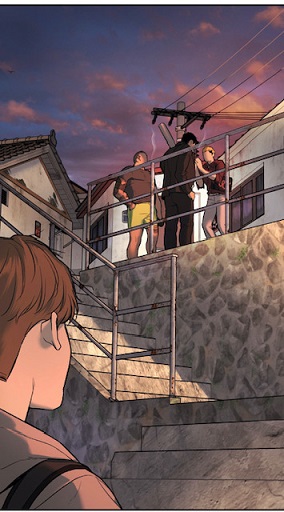 (chapter 1)
  (chapter 11), we naturally assume he is returning home—entering the same shared space he and his grandmother inhabit. But is that actually the case? A closer look reveals he is using the other entrance. On his right side, we see the electricity meter, the mailbox, and the window—the signs of an inhabited and administratively recognized unit. This suggests that Kim Dan’s official residence is behind this second door. Once again, I am showing the view of the same building from a different perspective,
 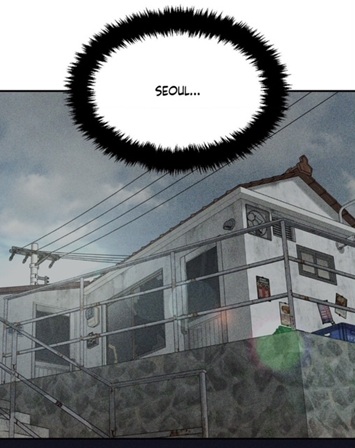 (chapter 57) where the mail box and the electricity meter are. But I have another evidence for this observation. During that night, the hamster got assaulted by Heo Manwook and his minions.
  (chapter 11) And keep in mind that after getting beaten by the Emperor, anyone could recognize the grandmother’s place from outside due to the broken window.
  (chapter 19) The moment I made this discovery, I couldn’t help myself wondering why doc Dan would go to the other door and not to the halmoni’s room.
 (chapter 11) The voice on the phone reveals something legally crucial
 (chapter 11): Kim Dan is the last remaining resident in that building. That one line reframes everything. This suggests that Kim Dan’s official residence is behind this second door. 😮 In fact, the building features
 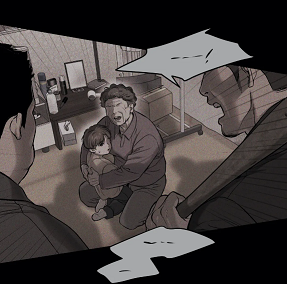 (chapter 5) When the loan shark came to collect the interest of the debts during Kim Dan’s childhood, he went straight to her door
  (chapter 5) —the door that, at the time, likely bore the blue house number plaque.
  (chapter 5) the door associated with Kim Dan in later episodes—particularly the one through which the champion entered during the confrontation with the thugs —opens inward and is placed in the corner of the right wall. The interior layouts and door directions don’t match, though the furniture is similar. This strongly suggests that these are two different units within the same building, exactly like I had observed before. The “goddess” and the hamster’s house had two doors and as such two units.
  (chapter 19) had a recollection of this moment, when he was about to leave this humble dwelling.
  (chapter 19) His move to the penthouse triggered another “move” from the past. Consequently, I am deducing that this souvenir represents the moment of the grandmother’s arrival and the departure of the hamster’s parent(s) from the other unit. But there’s more to it.
 (chapter 65) and Kim Dan the immature child, whereas according to my observations, she is legally dependent on the “hamster”. She is just a household member. As you can see, I detected a contradiction between her words and “hidden actions”, all this triggered because of the closed door. By transferring the address and registration to the physical therapist, she made it possible for him to inherit not just the space, but also the liability. That’s why he’s now the only registered person.
 (chapter 11) When he says “home,” he is referring not just to a physical place, but also to a legal and emotional placeholder—a registration number that ties him to bureaucratic existence, familial duty, and emotional manipulation. With her promise to return in that home, Shin Okja is essentially demanding he remains the legal anchor—the one who stays behind, the one who remains registered, the one who continues to carry the official burdens, even as she herself fades into invisibility. That’s how she became a “carefree” ghost in the end. It wasn’t just a promise of care, but a submission to being tethered—not to belonging, but to obligation masked as love. The irony is that by remaining legally “present,” Dan was emotionally erased.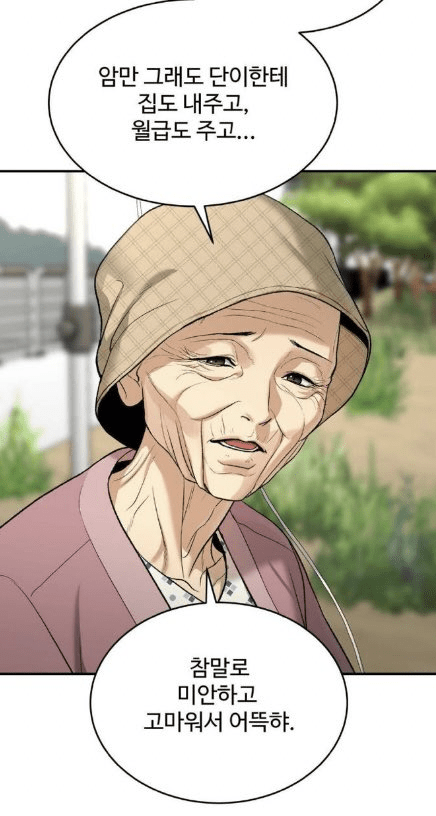
 (chapter 65), in the eyes of the system, merely lodging in his shadow. She is indeed a ghost.
 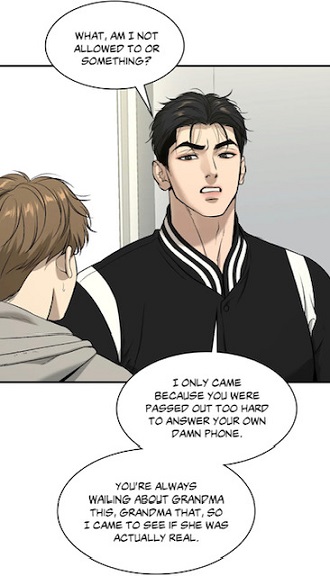 (chapter 22) This architectural division is deeply symbolic. Despite being the dependent, Dan is the one bearing responsibility—both financially and administratively. Shin Okja, on the other hand, manages to live without accountability.
 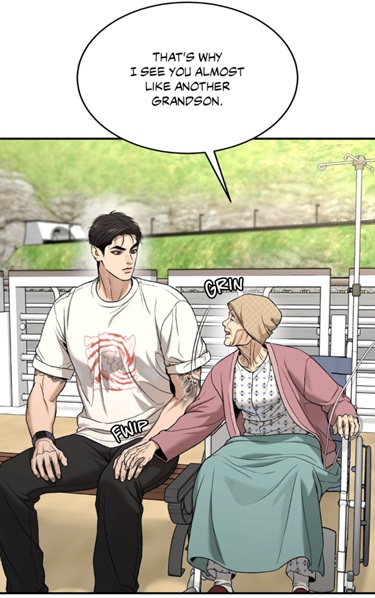 (chapter 65) Joo Jaekyung is almost her grandson!! It was, as if she was about to adopt him. Let’s not forget that he embodies all her ideals and dreams: strong, healthy, rich, famous, generous, polite and gentle! And according to my observations, she knows that the athlete owns a flat in Seoul, big enough to take a room mate.
 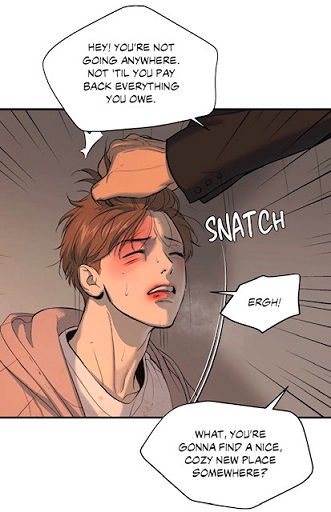 (chapter 16) He even showed the amount Kim Dan owned with his cellphone to the Emperor
 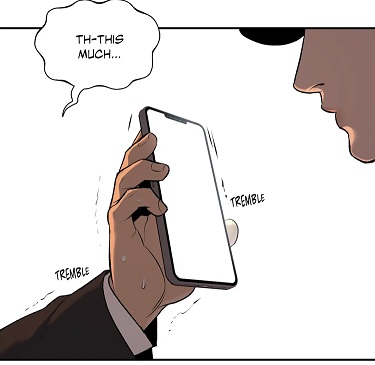 (chapter 17) That’s how the champion internalized that the hamster was the one with debts. This theory explicates why doc Dan is not blaming his grandmother for the debts in the end, as he signed himself loans. And now, you can imagine what happened in the past. Once he became 17 years old, she asked him to get a resident registration number. With this, he could apply for a loan in order to reimburse the grandmother’s debts. This must be one of her favors from the past:
 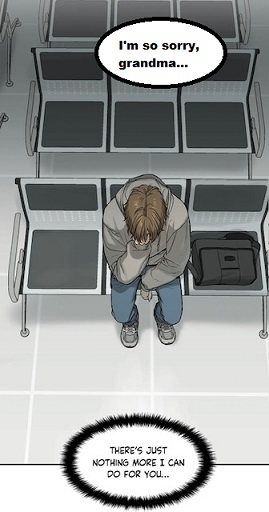 (chapter 5) His words imply that he had done something in the past for her. And that would be to become her guardian and take her debts. This hypothesis explicates why only in episode 11, Doc Dan was comparing the progression of the interests with a snowball system, something unstoppable.
  (chapter 11) His thoughts reflect a rather late realization that he is trapped in a system and he can not get out of it. In other words, this image oozes a certain innocence. This also explained why Joo Jaekyung had to confront him with reality in front of the hospital.
 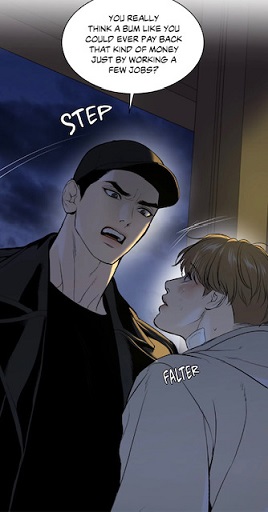 (chapter 18) The location is not random: for the halmoni, such a work place symbolizes respectability, power and money. The problem is that in the hospice, Doc Dan is not well-paid.
 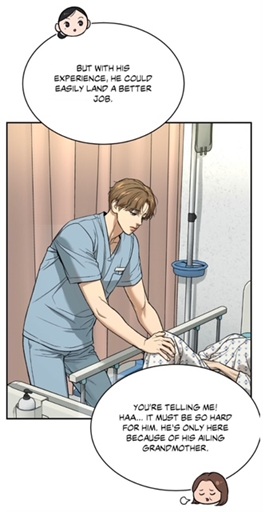 (chapter 56)
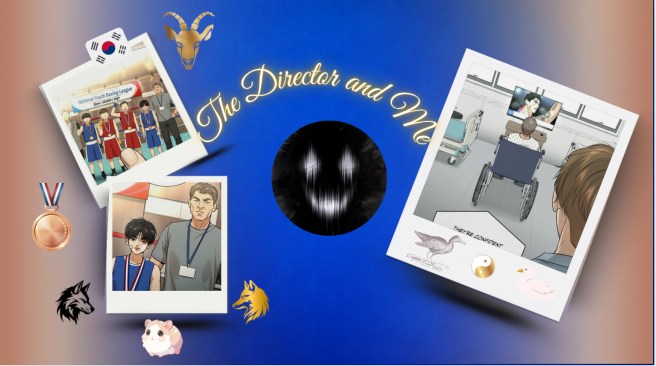
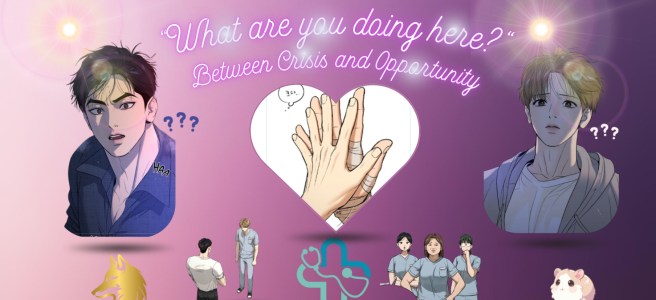
 (chapter 11) And now, it is time to return our attention to my illustration for the essay:
  As my avid readers can observe, the panel with the champion facing the blue door comes from episode 69, while the one with doc Dan comes from chapter 11. These scenes are mirroring each other. It is about concern and danger! While in episode 69, the athlete got worried, as he imagined that doc Dan’s life was in danger, in episode 11, the hamster was about to face an old threat: Heo Manwook and his minions!
  (chapter 11) But back then, he was on his own and no one paid attention to his health. Not even Shin Okja… He was truly abandoned, while the episode 69 exposes the opposite. Society in this little town takes care of people in general.
 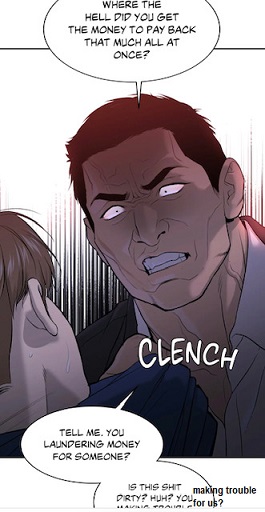 (chapter 11), he jumped to the conclusion that Dan was either prostituting himself or laundering funds. Why? It is because he had taken odd jobs, until he got hired by the dragon, Joo Jaekyung, and had such a huge income. Under this new light, it becomes comprehensible why Heo Manwook knew how to use the old lady in order to threaten doc Dan.
  (chapter 16) Like I wrote in a different analysis, I doubt that the grandma would have signed a loan by Heo Manwook. This reveals how Dan entered the contract in obscurity, without recognition or protection. He did it for Shin Okja’s sake to repay her for her support and “love”.
 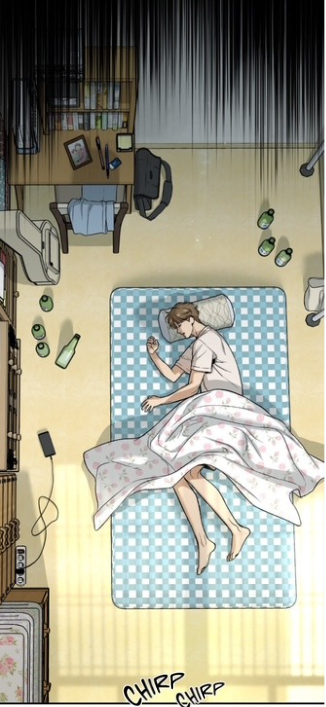 (chapter 57) Therefore I am expecting an argument between the halmoni and the inhabitants of 33-3. The landlord embodies the opposite values of Shin Okja.
 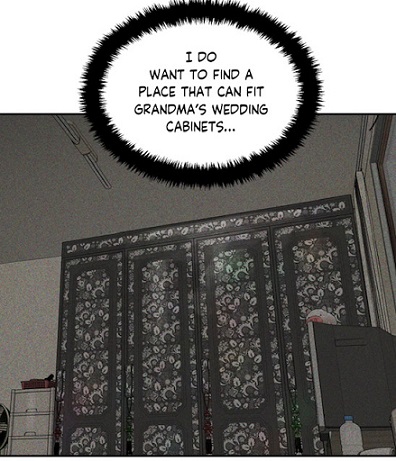 (chapter 16) Dan repeatedly calls it his grandmother’s and even dreamed of finding a new place that could house it—a gesture that underscores how much he believed she treasured the object, even though she herself never mentions it. But she never once references it, not even when returning from the hospital. The absence of interest is striking. What if the cabinet didn’t belong to her at all? Its size suggests that it predates the division of the house. Besides, according to my observation, she used to live in the other unit and I can not imagine, the halmeoni moving this furniture from one unit to the other. Perhaps it once belonged to Dan’s mother—a remnant of the original household, now misattributed to the woman who unofficially took over.
 (chapter 19) onto the object just as he projects loyalty and gratitude onto his guardian. But the silence around the cabinet speaks volumes: it is not treasured by Shin Okja, only by Dan. Much like his name on the loan, or the house number on the door, it could be a misplaced inheritance. At the same time, such an item could serve to identify doc Dan’s true origins, if the Wedding Cabinet belonged to his true family.
 (chapter 66) Changing his registration would mean stepping outside of the institution’s control and surveillance.
 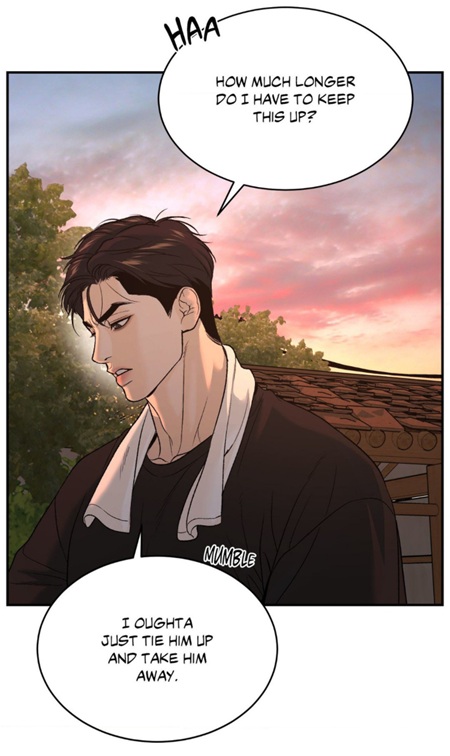 (chapter 62) Without Dan, Seoul held no meaning. But if he remains in the town past the statutory threshold, it would imply that he is ready to leave behind the world of contracts and competitions. It would mean he is now rooted—not by career, but by choice. Not by obligation, but by emotional truth.
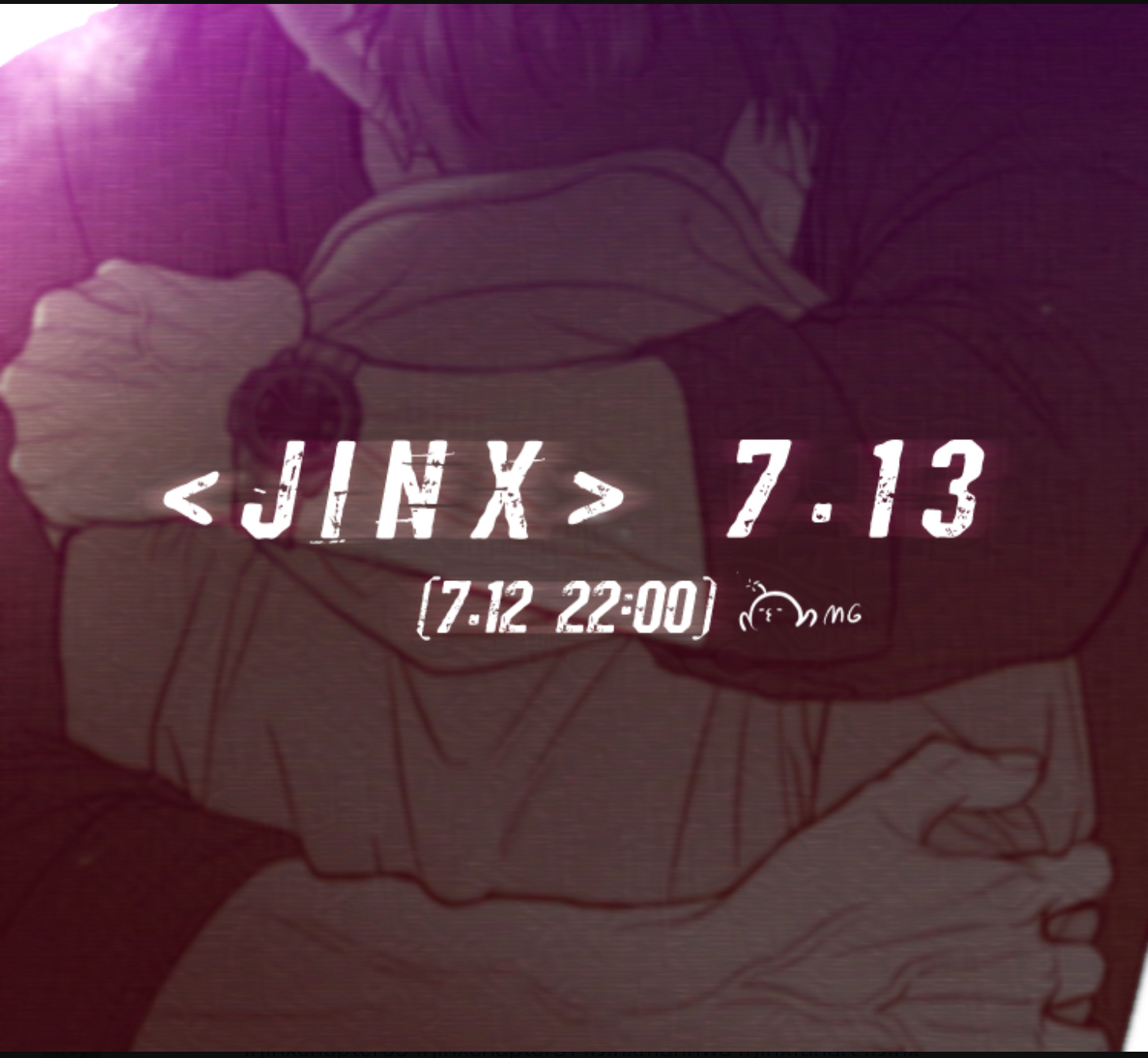 , released in anticipation of Chapter 70, is more than a promotional teaser. It is a moment frozen in time, yet brimming with motion—emotional, symbolic, and narrative. We see Joo Jaekyung embracing Kim Dan with both arms, pressing him tightly against his chest. There is no resistance, no distance, no tension in the frame. The palette moves from gray and brown fading into violet and pink, blooming into soft light. There is vapor, there is breath, an allusion to life. And most strikingly, there is stillness.
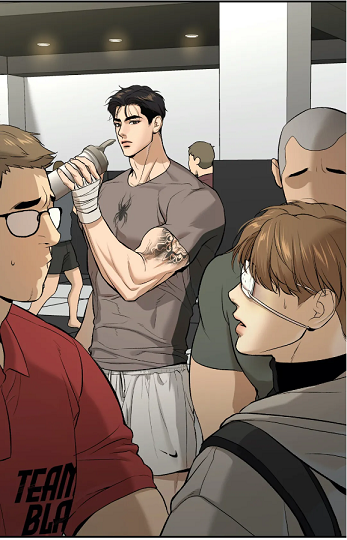 (chapter 11), every glare, and every awkward silence
 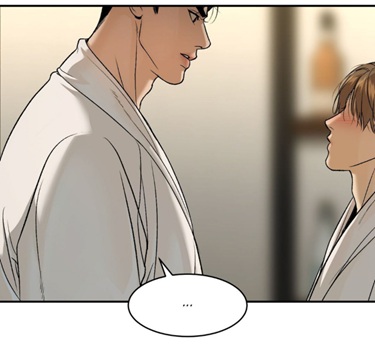 (chapter 67) between these two, this hug feels monumental.
  (chapter 58)
  (chapter 68) and the public hug on the dock in Chapter 69.
  (chapter 68) He rests his chin not on Dan, but on his own hand, his arm propped on the edge of the bathtub. This detail is telling: even in a moment of supposed closeness, Jaekyung relies on himself for support, not on Dan. He is physically near but emotionally braced—still holding himself apart. His thoughts are private, tender, and possessive. In a rare moment of introspection, he confesses that
  (chapter 69) Yet, when faced with renewed pressure and stress, he falters—leaving Dan behind.
 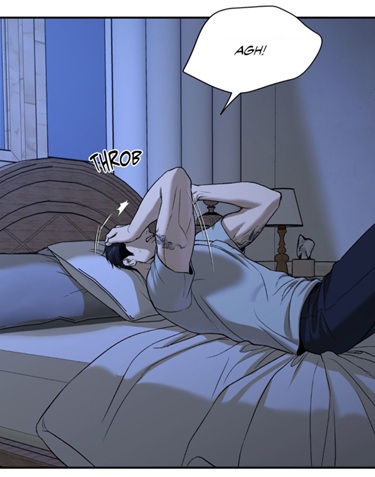 (chapter 69) The illusion of control dissipates, revealing that his earlier vow, however heartfelt, was not yet unshakable.
 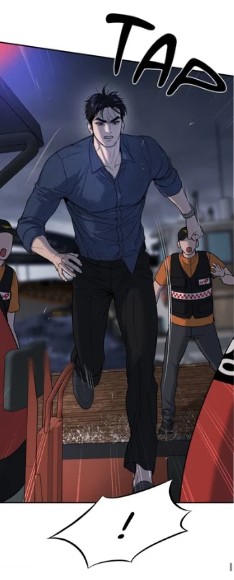 (chapter 69) that Jaekyung is wearing it, the change in angle—viewing the hug from behind—deliberately conceals it.
 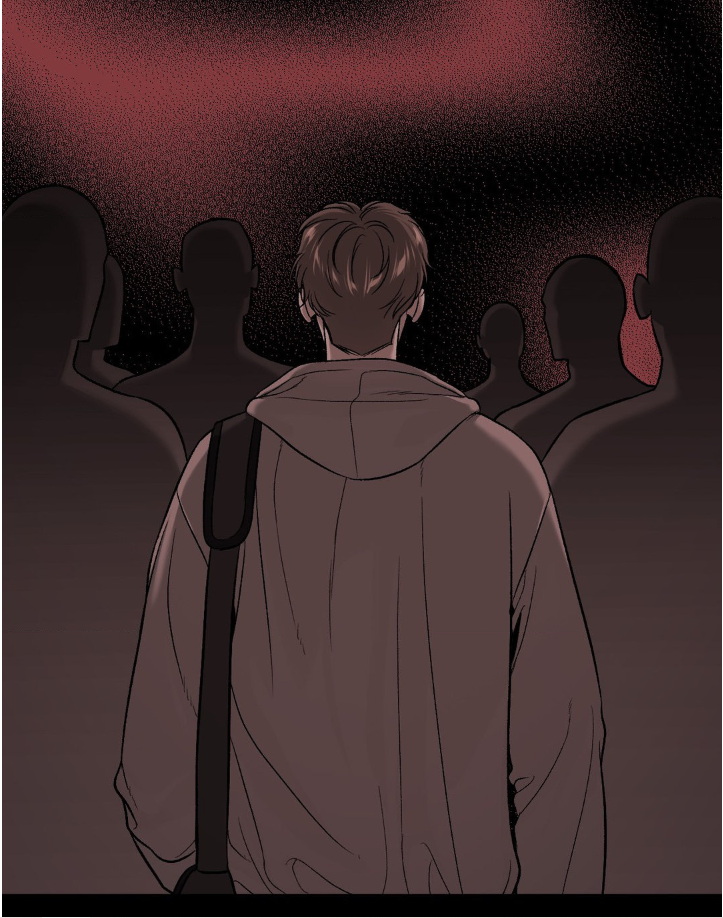 (chapter 55) In the new illustration, the hamster’s back is no longer representing anonymity and indifference, but visibility and care, for the champion is now facing his fated partner. In other words, doc Dan’s back in the teaser stands for uniqueness and high value. He can not be replaced. Moreover, doc Dan is not walking away, nor is he asleep.
  (chapter 45) Back then, the champion refused the expensive key chain, symbolizing a missed opportunity for emotional connection. Both men yearned for attention and affection, but failed to express it. Here, in contrast, the champion offers something far more meaningful than a 14,000₩ and free lodging —his unguarded embrace. And Dan, by remaining still, appreciates the moment.
  (chapter 21) Dan became fluent in a silent, physical language of care. She often asked him not to cry
  (chapter 47) and composed embraces—gestures repeated with calm precision. These touches were predictable, rhythmic, and soothing, but they also suppressed genuine emotional exchange, the symbol of toxic positivity.
 (chapter 57) the momentary pause of a hand
 (chapter 5) never still—giving the impression of involvement, of care in action. But this motion avoided vulnerability and responsibility in reality. She never clung, never trembled. Her gestures conveyed comfort but not surrender, presence but not change, and not support either. They were not truly emotionally together.
  (chapter 47) to hold her hand, to initiate closeness
  (chapter 47)
  (chapter 57); I’ll come back home, once I am all better”
 (chapter 35) Instead of recoiling in fear or admiring his strength, Dan quietly states, “I think I really need to focus on Mr. Joo right now.” He does not focus on the strength or aggression, but on the pain beneath it. The burst sandbag, for him, is not a threat—it is a symbol of Jaekyung’s emotional unraveling. This silent recognition mirrors Dan’s interpretive skills developed in childhood. Just as he once learned to read a shift in his grandmother’s hand or the silence after a broken promise, he now interprets the damage to the sandbag as an unspoken plea for help. This sensitivity continues to define his bond with Jaekyung.
 (chapter 47), to stabilize the person meant to support him. Now, he is receiving without shame or hesitation. The Emperor’s silent desperation, his refusal to hide behind ritual or false strength, creates the space for Dan to feel treasured—not pitied, but wanted.
 (chapter 65) or stand-ins
  (chapter 36) for affection has ended. The spotlight now belongs solely to Jaekyung and Dan, who no longer require mediation to reach one another. This shift becomes particularly evident when contrasting the teaser with earlier moments of evasion, silence, and misplaced dominance—especially through the lens of Park Namwook’s slap and Jaekyung’s own past deflections.
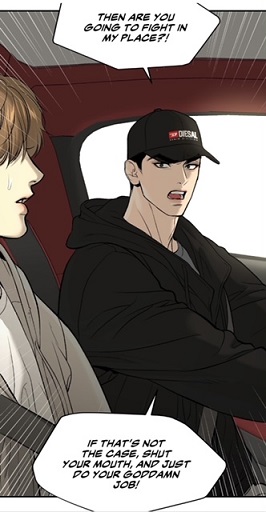
 (chapter 29), ignoring Dan’s presence and concern. His rejection of the doctor’s offer of comfort or companionship underscores not only his emotional detachment but also the absence of true support from his supposed team. The manager, Park Namwook, is nowhere to be seen,
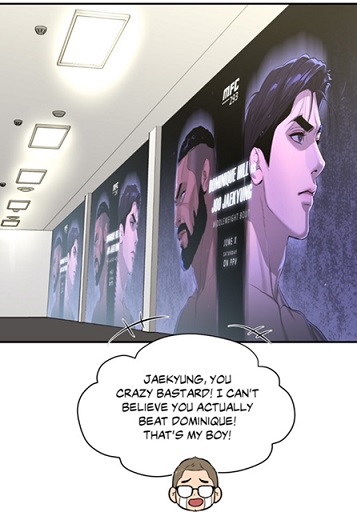
  (chapter 42) or offered silence in return. He had no teamwork ability in the end contrary to the hamster who “assisted” his grandmother. But it is not surprising, since Park Namwook has always relied on his boy.
  (chapter 40) Each time, they faced a problem, the athlete had to resolve it. He was the problem and the solution for everything.
  (chapter 17)
  (chapter 52) Surrounded by others, the manager attempted to discipline Jaekyung not with understanding, but through force. The slap was not an act of care—it is an assertion of dominance. It reduced Jaekyung to a volatile asset and spoiled child, not a man in pain. Striking is that this gesture actually exposed the manager’s weakness and anxiety. He was the one reacting as a spoiled child, for he masked his wrongdoing with tears.
  (chapter 52) The reason is that he couldn’t face the terrible outcome and his own responsibility. He needed a scapegoat. Thus he blamed the champion for everything. But by doing so, he refused to share the burden and the athlete’s unwell-being. Striking is that this slap served as a wake-up for the athlete. From that moment on, he stopped relying entirely on his “hyung”. He was pushed to make decisions on his own. This harsh gesture mirrors Shin Okja’s attitude toward Kim Dan,
 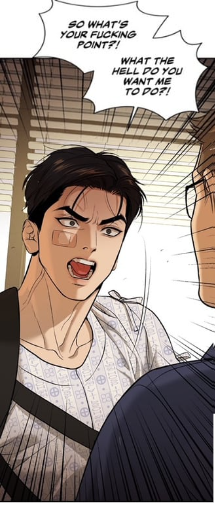 (chapter 52), seeing it as disruptive or shameful. Their guidance demanded emotional control, not emotional honesty.
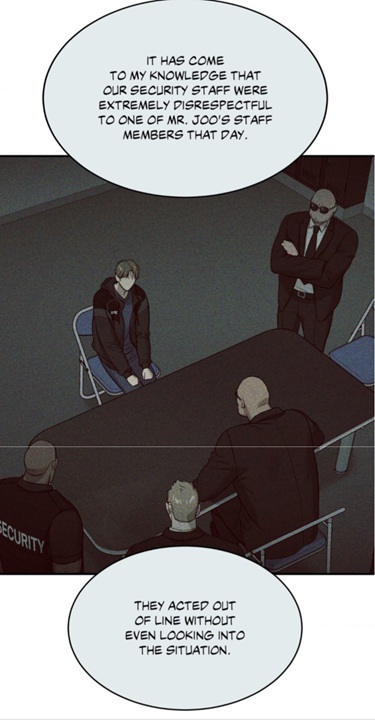
 (chapter 66) or use violence to “tame the wolf”. That’s the reason why he is accepting the offer from the CEO of MFC. He is pushing the Emperor to return to the ring, but the problem is now that doc Dan was officially recognized as a member from Black Team.
  (chapter 69)
 Bebebisous33s' analyses in K-Dramaland and Manhwas