
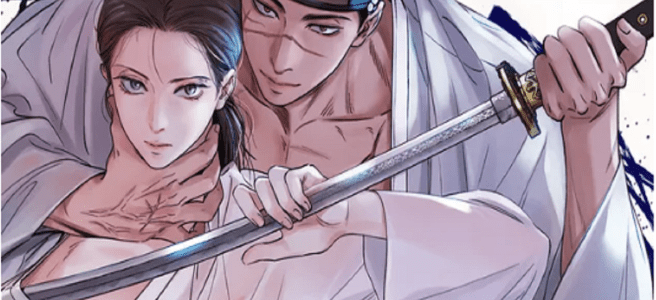
This is where you can read the manhwa.https://www.lezhinus.com/en/comic/steel_silk But be aware that this manhwa is a mature Yaoi, which means, it is about homosexuality with explicit scenes. If you want to read more essays about this manhwa and others, here is the link to the table of contents: https://bebebisous33analyses.com/2021/06/06/table-of-contents-of-analyzed-mentioned-manhwas/ Here you can read the second analysis about Steel Under Silk: https://bebebisous33analyses.com/2022/05/11/steel-under-silk-painter-of-the-night-the-lotus-%f0%9f%8c%b8-and-the-snake%f0%9f%90%8d/
It would be great if you could make some donations/sponsoring: Ko-fi.com/bebebisous33 That way, you can support me with “coffee” so that I have the energy to keep examining manhwas. Besides, I need to cover up the expenses for this blog.
Anyone reading chapter 12 comes to the conclusion that Kwon Hee-Ryang has the upper hand, and Lee Yeonjo has been defeated.  (chapter 12) The governor gives orders to the slave, and the latter can only obey. Secondly, the official only reveals to his counterpart at the end that he knows about his identity.
 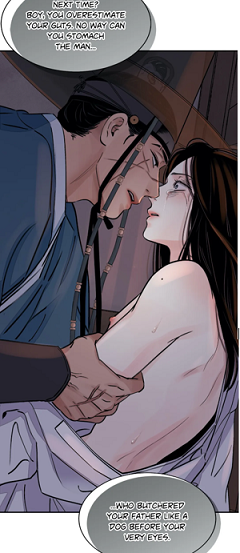 (chapter 12) He is the son of the right state councilor, the man he killed with his own hands 5 years ago. By unveiling the truth, the man shows that Lee Yeonjo won‘t be able to deceive him. He can see through his heart and gaze which are filled with rage.
  (chapter 12) Thus the uke won’t be able to get his revenge. However, in my eyes, this confrontation in jail outlines the opposite. The dominant is not Kwon Hee-Ryang, but Lee Yeonjo. For me, the governor made a huge mistake in the jail, but it is barely perceptible. It becomes more obvious through a detailed examination. Striking is that in my previous analysis, I had compared the uke to the purple lotus flower due to his name, but the young man is also associated to the dog.
  (chapter 9)
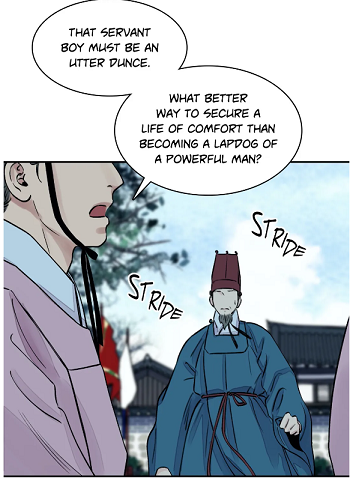 (chapter 10)
 (chapter 10) And now, you comprehend why I chose such a title. This will be the topic of my essay. I will elaborate why and how Lee Yeonjo is powerful, though he views himself as weak and powerless.
  (chapter 10) I am quite certain that you are wondering about this. How is it possible that the uke is not in a disadvantageous position? Everything is pointing out the opposite: his condition as a slave, his situation (he is imprisoned for a crime), he is the talk of rumors and Kwon Hee-Ryang has already identified him as an enemy.
1. The fight in the bedchamber
Let‘s start with their first sexual encounter. We shouldn’t forget that Kwon Hee-Ryang had already been eyeing Lee Yeonjo 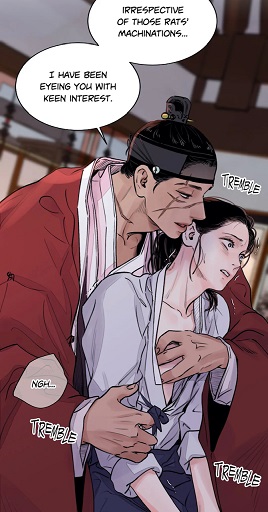 (chapter 8), and he was already thinking how to approach him. However, he was caught by surprise, when the servant was sent to his staff. He had the impression that the main lead had been delivered on a silver plate. Imagine this. He didn‘t need to do anything. Due to the bite on his neck, the governor knew that the young man had sex with another man. So in his mind, he was not rejecting sodomy. Secondly, he just had to make the request that Lee Yeonjo should serve him, and that was it. Once in the bedchamber, he could taste him. He envisioned that with his position, the slave wouldn‘t reject his advances. At the same time, we could sense that initially Kwon Hee-Ryang tried to woo him. He asked for his name
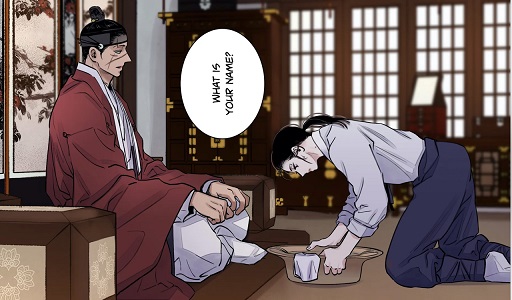 (chapter 7), then he showed concern for his wounded finger
  before touching his hand in order to seduce him. Honestly, as the governor, he was in a position where he could have just ordered Lee Yeonjo around, and the latter would have been forced to obey. He only mentioned his power, the moment he sensed the protagonist’s resistance.
  (chapter 8) As you can see, first the official chose a more delicate approach. Simultaneously, he mentioned that he was aware of the existence of the request from Headman Choi. Lee Yeonjo should spy for Choi.
  By unveiling this secret, Kwon Hee-Ryang wanted to be perceived as a generous man, even as a savior, for he was giving an opportunity for the slave to escape such a terrible fate: being accused of spying in case something went wrong. He was implying that he knew that Lee Yeonjo was acting here against his will, the governor was believing in his innocence. He just needed to become his lover, and that was it. The reproach of spying would never be brought up against him. But note that his words had the opposite effect, it even scared Lee Yeonjo more. At the end, the lord had to remind the slave of his precarious situation, he was in no position to refuse his advances. (chapter 8) Because he didn’t threaten the servant right away, this indicates that he was not just seeking sensual pleasure, he was hoping to gain the lotus’ attention and trust. But this doesn’t end here. What caught my attention is that Kwon Hee-Ryang decided to restrain himself, he was controlling his sexual desires, a sign that he was very considerate towards Lee Yeonjo.
  (chapter 9) The usage of the foreplay displays that the noble was not rushing things. He wanted to ensure that this wouldn’t be painful for the uke. Because he thought that with his power, he had been able to tame the “dog”, he got caught by surprise by the man’s sudden rejection. He got slapped so hard that he lost the cover of his topknot with the hairpin.
  (chapter 9) This scene was full of symbolism. The slap symbolizes humiliation and castration. It was, as if the young boy had disarmed his adversary.
  (chapter 9), for the hairpin represents the governor’s blade. Lee Yeonjo went so far that he wanted to commit suicide with the main lead’s hairpin.
 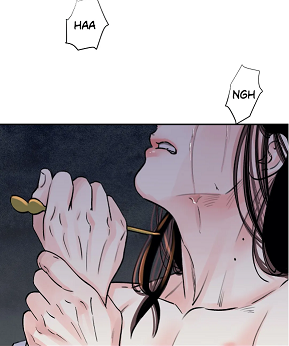 (chapter 9) This signifies that he had defeated Kwon Hee-Ryang by taking his hairpin. He was revealing the governor’s powerlessness. The official couldn’t obtain what he desired, but also his authority had been defied. Neither his advances nor his strength had been able to overcome the man’s defiance and resistance. And now, you comprehend why the “beast” was so furious and sent the servant to jail. (chapter 9) As a powerful man, he had not been able to prevent such a humiliation.
This shows that Kwon Hee-Ryang desired to earn the trust from Yeonjo. He thought that with his gentle gestures, his reassuring and praising words and his position, the slave would accept him right away. So he was not just aiming to have the boy’s body, and that was it. He definitely desired more, he had no problem to make him his official lover, which distinguishes him from lord Chang. Their sex session displays that Kwon Hee-Ryang was considerate towards Lee Yeonjo, but the latter was not realizing it, for his mind was too focused on his own physical reaction.  (chapter 9) He is still denying his own sensuality.
2. In jail
Once in prison, he received the visit from headman Choi. And even here, he had no problem to talk back to his superior. He went so far to insult the headman. 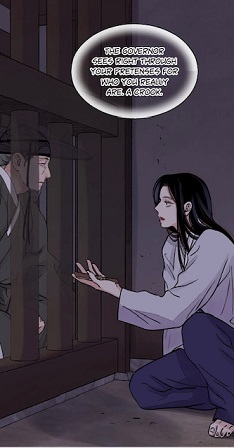 (chapter 11) He refused to kill himself in order to cover up the man’s sins. He might be a slave, but he was not stupid or desperate enough to give up on his own life. But the bearded man didn’t take the servant’s warning seriously, which had terrible consequences for Choi. He ended up losing his position and life, for he was caught red-handed by the governor. We could say that thanks to Lee Yeonjo, the official could get rid of a nuisance. Headman Choi had served the hojok instead of the governors.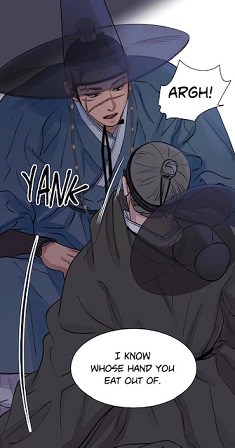
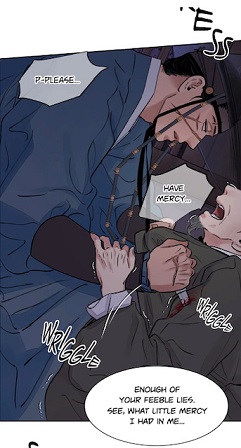 (chapter 11) The uke played a huge role in Choi’s demise, which people could detect, as afterwards that night, Yeonjo was blamed for Choi’s vanishing. His resignation happened the same day of Yeonjo’s imprisonment. That way, Kwon Hee-Ryang’s true personality and goal were still kept in the dark.
Though the slave witnessed another bloodbath, the main lead still begged Kwon Hee-Ryang not to send him away. This means that his desire for revenge was stronger than his fear.  (chapter 11) In this panel the readers can detect the former noble’s scare due to his trembling. Yet the moment the governor wished to send him outside the court, the main character realized the real consequence of his past action. He wouldn’t be able to approach his enemy again.
  (chapter 11) Thus he faked obedience and regret.
  (chapter 11) But Kwon Hee-Ryang was no fool, he could perceive the uke’s hypocrisy. Why? It is because he is also himself an actor, he is the “blade hiding behind the smile”. He can detect when people are acting. Only Lee Yeonjo knows his true nature. No one will ever suspect that as a high ranking official, he would dirty his own hands. This explains why the uke considered their first sex session as a hunt.
 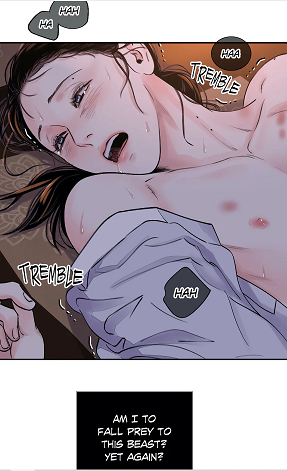 (chapter 9) Kwon Hee-Ryang was a beast cornering a little puppy. But let’s return to the scene in the prison. What caught my attention is that once the slave pleaded for the lord’s leniency, the latter asked not only for privacy but also for a fire place!
  (chapter 11) This little detail unveils that the main character has already a soft spot for Lee Yeonjo. I would even go so far to say that the absence of penetration (again) in the prison is an indication that Kwon Hee-Ryang is not controlling the situation at all. He complained that the uke had a climax before him
 (chapter 12), that he had poor skills…
 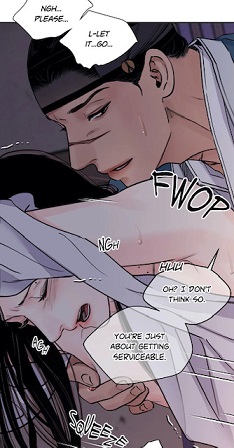 (chapter 12) yet, note that he was the one suggesting the masturbation. It was also his own decision to masturbate Lee Yeonjo too. This shows that he still took the uke’s own sensuality into consideration. Besides, he was totally bothered that the uke was rejecting him.
 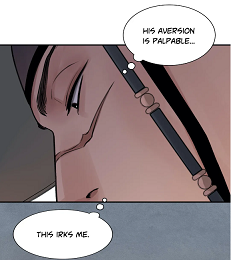 (chapter 12) He was also annoyed that Lee Yeonjo was not paying attention to him. He could even sense that his mind was elsewhere.
  (chapter 12) Exactly like in the bedchamber, the manhwalovers can sense that the main lead was longing for more, but after realizing the true identity of Lee Yeonjo, he is well aware that he can never obtain the slave’s heart, as he is the one who killed his father. (chapter 12) And now, you comprehend why he is sending away Lee Yeonjo, he is hoping that once out of his sight, he will be able to forget him. But like I had outlined in my introduction, the governor made a huge mistake by confronting Lee Yeonjo.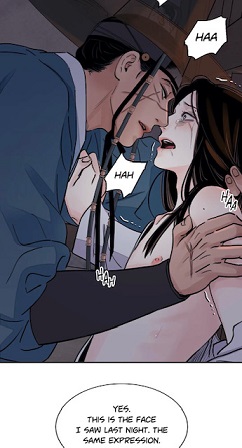
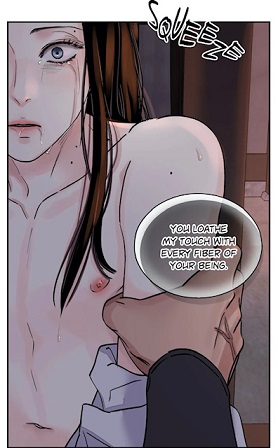 (chapter 12) He divulged that his body language was betraying him. He couldn’t act, as his facial expressions and actions were showing how he hated his touch and presence. This means that if Lee Yeonjo takes the main lead’s reproaches to heart, he can have an advantage. The governor encouraged the uke to become a better actor. He just needs to learn how to control his reactions. One might say that he just needs to learn acting, but there’s more to it. In reality his defiance is strongly connected to his loathing about sodomy. Hence the moment the slave accepts his homosexuality and admits feeling pleasure, it will be more difficult for the counterpart to judge if Lee Yeonjo’s affection and sensuality is genuine or fake, especially if he becomes more proactive in the seduction. So far, the former noble was the one on the receiving hand, when he was with Kwon Hee-Ryang. So if he changes his attitude and becomes an expert how to please Kwon Hee-Ryang, the latter will lose more and more control of the situation.
Notice that in the bedchamber, Lee Yeonjo spoke of attachment 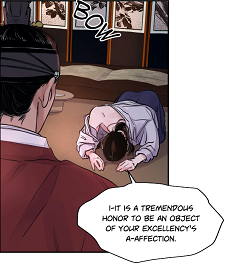 (chapter 8), which could be viewed as a vulnerability. This is not surprising that Kwon Hee-Ryang worded his attraction differently:
  (chapter 8) The slave was just a pet, a plaything, nothing more. But biting was showing that he was claiming him as a his possession. Thus I deduce that Lee Yeonjo will take a different path in order to seek revenge on his father’s murderer. The author already left a clue with this panel:
  (chapter 9) He dreamed of killing him, but he doesn’t have the strength. Nevertheless, he can torment Kwon Hee-Ryang in a different way. He could use lord Chang for that. Under this new light, the manhwaphiles can comprehend why snob added the tag love triangle. From my point of view, the fact that the governor initiated a kiss with Yeonjo indicates his increasing attraction for the protagonist.
 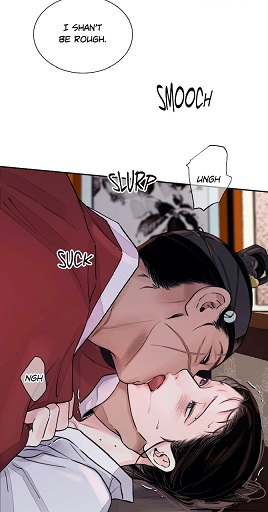 (chapter 8) The lord was treating the other ukes differently, they were more indeed sex toys.
 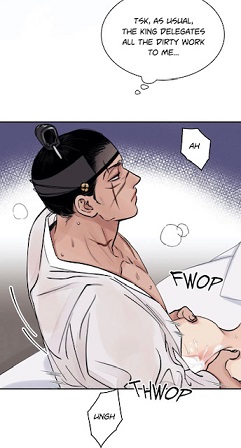 (chapter 2)
 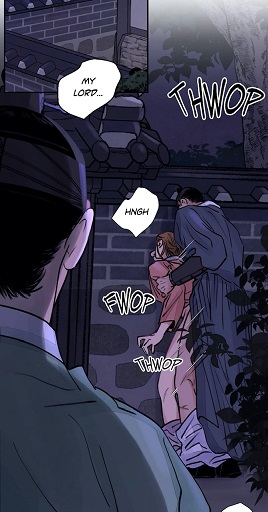 (chapter 4), for penetration was in the center of these intercourses. But with Lee Yeonjo, the strategist and warrior behaved in a more seductive way: there were caresses, kisses and embraces. The governor did his best to seduce the slave. Yet the lord didn’t succeed, thereby he was not even able to taste the uke.
3. Yeonjo’s deal
In the second part, I had mentioned that Yeonjo could employ lord Chang to torment the governor, the two persons he loathed the most. First, he has already used him, when he asked him for this favor. 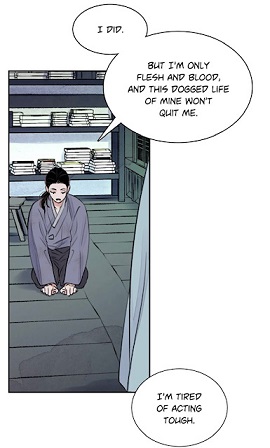 (chapter 2) Here he was lying to the administrator.
What caught my attention is that though Yeonjo was just a slave, he didn’t beg lord Chang for a favor in the shed, but he proposed a deal. 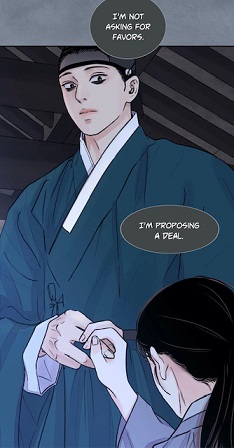 (chapter 10) The idiom is important, for this term implies that the two sides are equal. This made me laugh, for the simple reason that the slave made this suggestion, though in reality he was in an disadvantageous situation. As a slave, he has no right at all, he can never be the lord’s equal. Striking is that when he said this, he was sitting on his knees, whereas the administrator was standing. Their position reflected their actual social status. On the other hand, a gentle kiss and stroke
 were strong enough for the ruthless and selfish lord Chang to accept the deal. This shows that here the servant was acting. He faked submission and acceptance. And notice that Yeonjo has been playing passive-aggressive with the administrator.
  (chapter 1) He could taste his body, but that was it. In truth, lord Chang was longing for more, he hoped to become his lover, when he asked him to send him to the court. As you can detect, Lee Yeonjo was able to control the administrator. Therefore it is no coincidence that he refuses to follow lord Chang who desires to remove him from the court (chapter 15). He hates the man, as much as he loathes the murderer of his family. People are wondering why. This is quite simple. Lee Yeonjo resents the administrator, for he abused his position. In chapter 10, he showed his true face. He portrayed himself as a generous man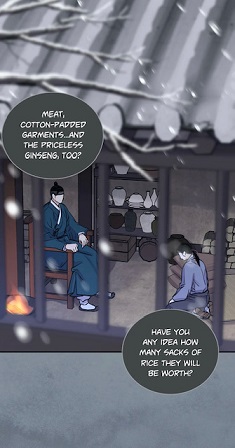
 (chapter 10) The verity is that he never gave everything without expectations. His “kindness” was fake, he desired to have sex with Yeonjo. That’s the reason why the noble was rejected the first time. And note that during this meeting, the administrator felt the need to remind Lee Yeonjo of his superiority.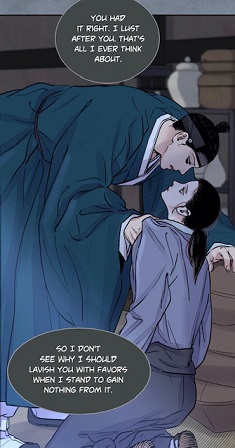
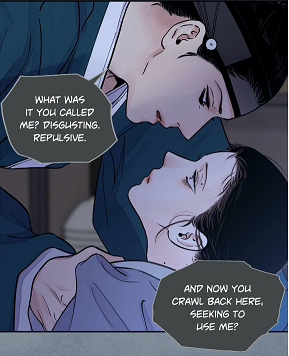 (chapter 10) In my eyes, the official did nothing to change the protagonist’s situation, in fact he used the main lead’s despair. Real kindness is always free which was not the case here. However, he was caught by surprise as well, when the uke took his hand and kissed it. On the surface, Lee Yeonjo was acting as if he was submitting to lord Chang, but the reality was different. He still had the upper hand, which explains why the uke could show him the cold shoulder or even reject him in the beginning of the story.
  (chapter 1) I believe that the slave will use a similar strategy with the governor, but there will exist a slight nuance. Why? It is because Kwon Hee-Ryang is not hiding his homosexuality.
  (chapter 10) He doesn’t care about his image. The other reason is that he is still connecting him to the night where he saw him killing his father. He has internalized this fear. That’s the reason why he was reminded of that night during their first sexual interaction.
  (chapter 9) He knows that Kwon Hee-Ryang is a predator
 (chapter 10), thus he can not be approached like lord Chang. He is more dangerous and perceptive than lord Chang.
 (chapter 10) His fear and anger are hindering him to act properly. Due to his trembling and his anxiety, he has not grasped yet that he has already the upper hand: the governor’s attachment.
4. Conclusion
Lee Yeonjo has more power than it looks like. He could defeat headman Choi who had threatened him. He could escape punishments on two occasions thanks to the official’s leniency, and he was able to deceive and control lord Chang. And by revealing his cards to Lee Yeonjo, the latter can use his gained insight to change his plan for revenge. The noble might have played with him, but unconsciously his words and actions were betraying him. He is already losing control over his heart. This is particularly perceptible, when he said this to the main lead.  (chapter 13) He had envisioned for one moment to share his bed with Lee Yeonjo. The presence of Lee Yeonjo in the court will be a constant reminder for Kwon Hee-Ryang that he committed a sin.
  (chapter 13) Like pointed above, the uke could change his attitude. So how will the governor react, when the slave’s gushing antipathy disappears? Will the lord truly believe that the resent disappeared for good? In my opinion, the young man will come to change his approach. He could deceive the official by appealing to his pity exactly like with lord Chang.
 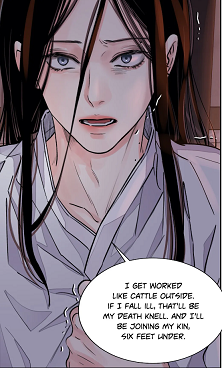 (chapter 13) This exposes that the “dog” or kitten is much more powerful. He can torment him with his guilty conscience.
Here, I would like to outline the similarities between this work and the Western movie “The Power of The Dog” which was made by Jane Campion in 2021. In that story, the strong, very masculine and bullying main character Phil Burbank got defeated by the very thin and feminine Peter.  In reality, the latter was the stronger one, he was confident, thus he could resist peers pressure. The latter gave the impression that he was connecting to Phil, and they had something in common, while in truth, Peter just sought his closeness to discover his vulnerability.
 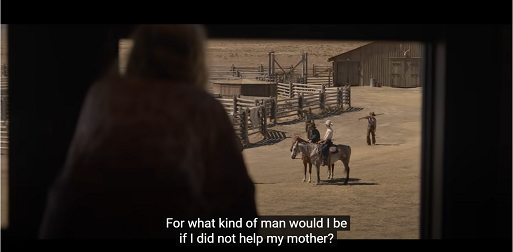 Phil was a repressed homosexual, who hid his sexual orientation, though it is also implied that Phil had been sexually abused by his mentor Bronco. At the end, Peter was able to kill Phil who had been harassing his mother. He viewed himself as a man, for he could protect his mother.
 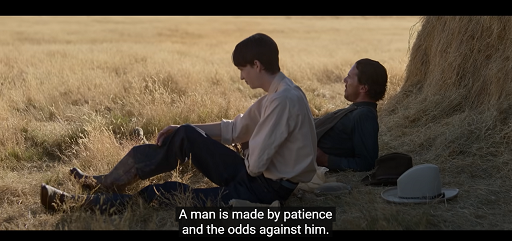 My point is that both works are showing that masculinity and power have nothing to do with sexuality or a certain body shape. Lee Yeonjo might be thin, shaking, unable to repress his hatred, but at least he is strong-willed and honest to himself, while Kwon Hee-Ryang is already in denial about his growing attachment towards the main lead. He is definitely underestimating Lee Yeonjo’s determination and deceptive skills. The young man uses his poor condition and weak appearance to move the semes’ heart. (chapter 13) Kwon Hee-Ryang can imagine his thirst for revenge, but the problem is that he is underestimating the effect Lee Yeonjo has on him and his heart.
Feel free to comment. If you have any suggestion for topics or manhwas, feel free to ask. If you enjoyed reading it, retweet it or push the button like. My Reddit-Instagram-Tumblr-Twitter account is: @bebebisous33. Thanks for reading and for the support, particularly, I would like to thank all the new followers and people recommending my blog.


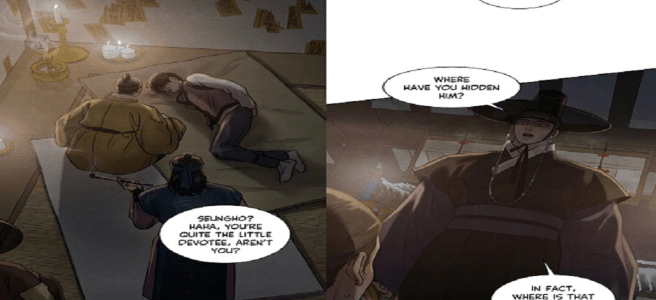
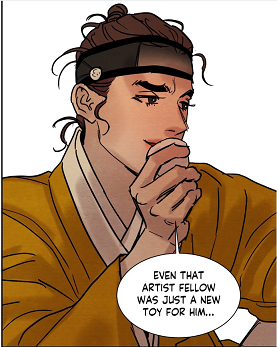 (chapter 12) The mention of a new toy implied the existence of an old plaything. But we know for sure that Yoon Seungho has never possessed anything. He was treated like a male kisaeng himself, for he was not allowed to refuse advances from anyone.
 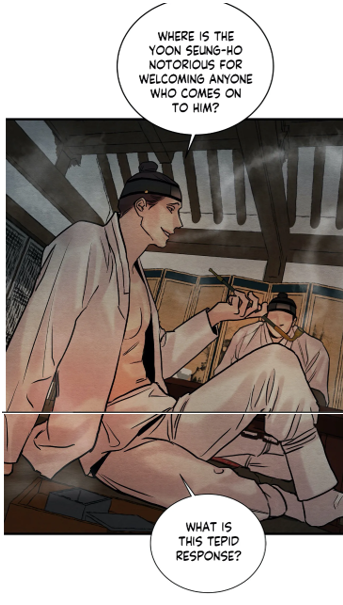 (chapter 52) Finally, he was forced to share anything he owned to others.
 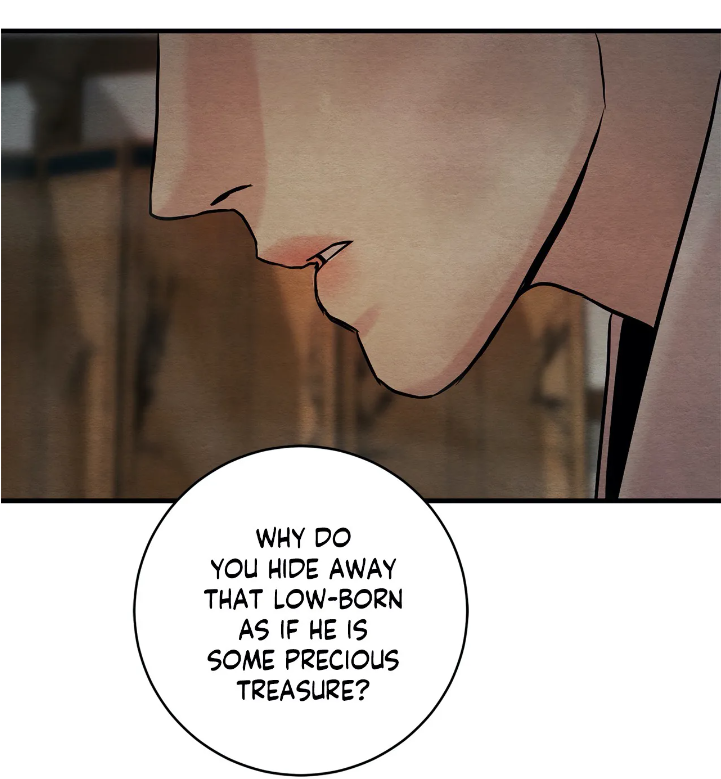 (chapter 52) That’s how I realized that the inner thought from Lee Jihwa was exposing his knowledge. The latter knew about Yoon Seungho’s true conditions. The latter had been treated like a plaything by the pedophile. As the red-haired noble had been raised as an filial son respecting elders, Lee Jihwa saw no reason to change the way Yoon Seungho was “trained”.
  (chapter 57) Besides, he could only benefit from it. Now, he could have sex to his heart content. He only started playing tricks, the moment he felt that his childhood friend was escaping from his claws.
 (Chapter 37) On the other hand, since the lord went to the authorities in season 3, I deduce that he must have gone there in the past too, yet not as a victim/plaintiff, but as an accused. Because of this new revelation, I made a new connection: sex and torture.
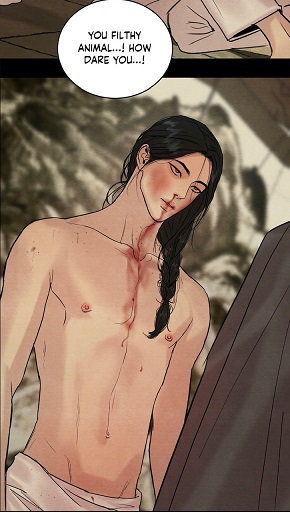 (Chapter 83) Why? He viewed him like a dog, for he was living in the shed. He even had no proper hanbok and no real hair dress, and the manhwaphiles can certainly remember the idiom: clothes make the man! If he was no man, then he was an animal, a dog. Even his food reminded me of dog food. But why was he living there?
  (Chapter 83) In this essay, I will answer to this question. As a first conclusion, the lord was not even treated like a male kisaeng in the past, but more like a dog. Consequently, I deduce that when Baek Na-Kyum met the lord in the inn (chapter 1), his status had already changed. He was slowly experiencing emancipation. He was living like a male kisaeng. Thus I conclude that Lee Jihwa contributed to his recovery to a certain extent.
  (chapter 59) However, don’t get me wrong. I believe that the change occurred thanks to Baek Na-Kyum’s intervention, the new version of this scene.
 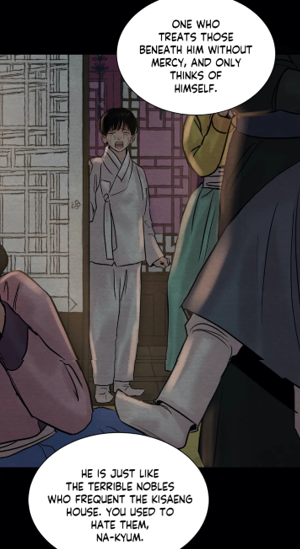 (chapter 68) Their path crossed a second time in the gibang which led to the painter’s expulsion which affected the lord‘s living condition. But let’s return our attention to the lord’s long suffering.
 (chapter 57)
 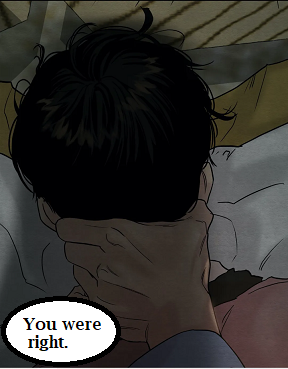 (chapter 62) This explicates why after reading episode 62 for the first time, I had suspected the father to have raped his own son. Yet this thought was dropped shortly after. Then when episode 77 was released, I realized that in the shed the lord was also reminded of Kim’s betrayal, for the latter would always drag him to the shed. Observe the way he was “carried away“. It was like an “embrace“.
 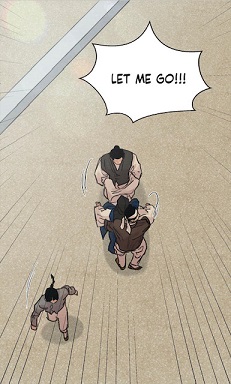 (Chapter 77) In episode 77, the readers can witness 2 incidents how the lord was brought to the storage house.
 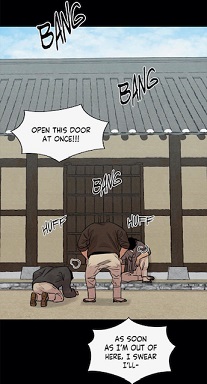 (Chapter 77, this is a different situation, for we have different servants except Kim) Therefore in the barn, Yoon Seungho behaved like his surrogate father Kim as well. This explicates why we have the fake embrace and the insincere apology.
 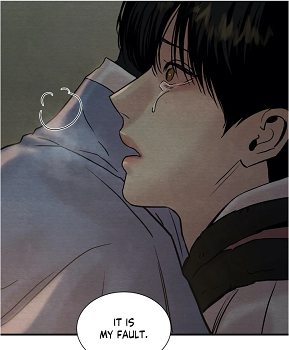 (chapter 62)
  (chapter 62) As you can see, the hug from the past was the symbol of violence and hypocrisy. It served to drag the lord to the storage room. And this new observation led me to the following conclusion: Yoon Seungho was copying the behavior from all his abusers from the past: his brutal father, the hypocrite butler and naturally the pedophile.
  (chapter 62) Hence the protagonist grabbed the painter by the hair. For me, the “mysterious lord Song“ used to hurt the main lead by the hair, when he got angry. How did I come to this interpretation? Note that at no moment we never saw Yoon Chang-Hyeon taking his son’s hair. First, the lord’s head was covered with a hat.
  (Chapter 83)
 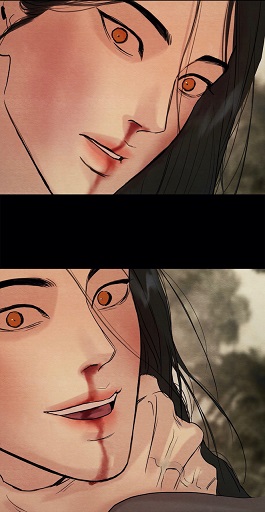 (chapter 83) As for Kim, the latter would always restrain the main lead by the shoulders, the fake embrace.
  (Chapter 57) And now, you comprehend why the lord dragged the two nobles by the topknot.
 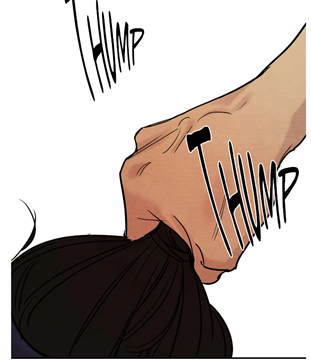 (chapter 8) For a long time, I have demonstrated that this gesture represented one of Yoon Seungho’s biggest traumas. But why would the pedophile do that? One might say that it is because of Yoon Seungho’s resistance and struggling. He needed to punish him for his disobedience. Note that the noble with the mole and Lee Jihwa got humiliated as sanctions.
 (Chapter 18) However, in my eyes there exists another explanation which I will elaborate in this analysis either. From my point of view, the shed and the humiliation are strongly intertwined. This was particularly visible, when the lord forced Baek Na-Kyum to have sex in the courtyard.
  (Chapter 64) But why would he do that in the end? It was to train him, to make him obedient.
  (Chapter 64) Remember how he had declared that the painter was now his sex toy. He should listen to his master or owner. That’s how I came to this deduction. The infamous lord Song is a sadomasochist. In the worse case, he is simply a pure sadist. I am inclined to believe more in the first view. With this, we would have the link between sex and torment. And the picture from the erotic book where you see the bearded man having a braided man on his lap outside indicates that Yoon Seungho was here getting punished. The pedophile loved seeing Yoon Seungho humiliated and in tears.
 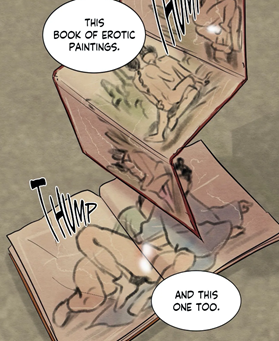 (chapter 01) And now, we have the explanation why the lord could no longer cry and how he came to hate “fake apology”. This was the result of the exposure to the sexual assaults under the form of BDSM.
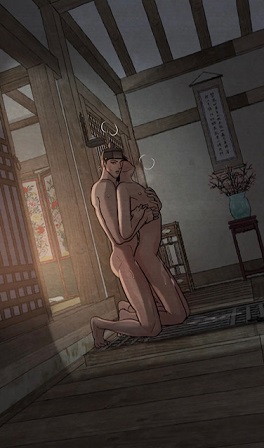 (chapter 96) They ended up in the hallway, anyone could see them. Then in another website, I found the following principles:
 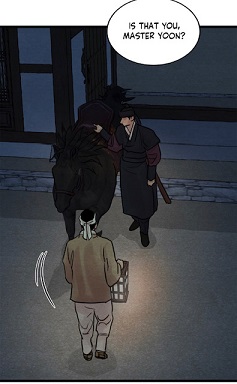 (chapter 25) He even brought the hanbok himself.
 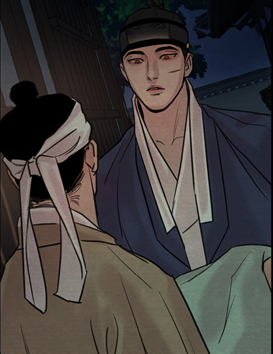 (chapter 26) The lord went so far to take his bath with his lover to clean him.
  (chapter 59) He made sure that his partner wouldn’t suffer.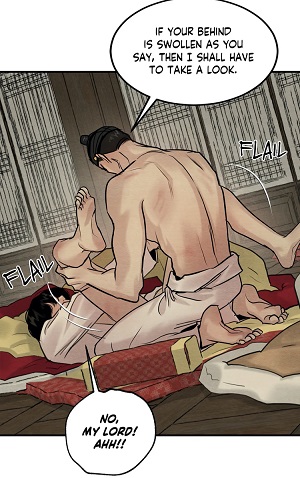
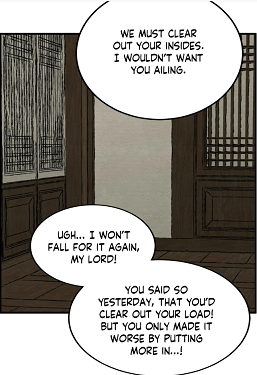 (chapter 89) Yoon Seungho knew by experience that the rest of semen in the stomach would cause him ailing.
 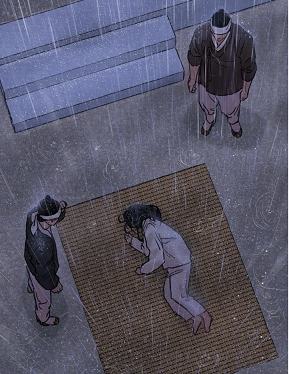 (chapter 77) This was the reason why Yoon Seungho had a fever afterwards. Don’t forget that the pedophile used Taoist sexual practices, this means the young boy had a sex marathon each time, he met the pedophile. Thus I interpret the bruise on Yoon Seungho’s eye not only as an indication of resistance, but also as a source of joy for the sexual predator. We have the reaction from lord Jang as the perfect example.
  (Chapter 101) He blushed, though he could see that Baek Na-Kyum was in pain, the face covered with blood. Remember what the painter did in the pavilion to the main lead: he scratched his face.
 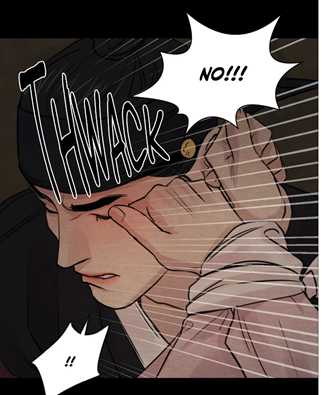 (Chapter 25) Thus we have to envision that the lord must have reacted the same way and wounded his abuser. And imagine the consequence if he had wounded the king on the face. This could be seen as a reason for a punishment.
 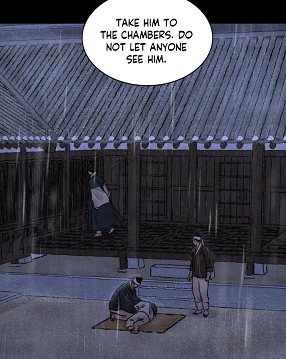 (Chapter 77) Remember Black Heart‘s warning in the shaman‘s house:
  (chapter 102)
 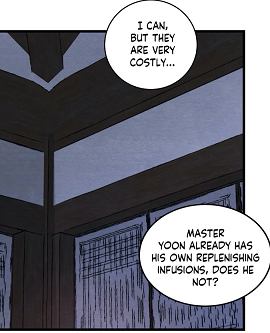 (chapter 33) This is an euphemism for aphrodisiac. Thus we had this confession from the physician.
  (chapter 57) Why did the butler visit the doctor without Yoon Chang-Hyeon? It is because he had been ordered to fetch the aphrodisiac. By feeding him with the drug, they wanted to force Yoon Seungho to accept the advances from the king, and as such to admit his sexual orientation. He was a sodomite.
  (chapter 65) They faked his “pleasure“ making him feel guity and dirty. That’s how he got tricked. This explicates why the main lead still has no idea of the use of the aphrodisiac.
 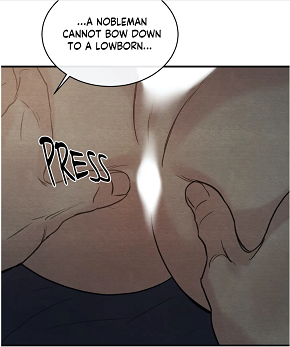 (chapter 71) As a king, he couldn’t bow down to a noble. Observe that the roles of “dominant” and “submissive” are not clearly defined between Yoon Seungho and Baek Na-Kyum. The lord is the dominant sexually speaking, but note the vocabulary:
 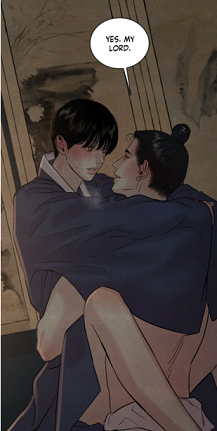 (chapter 72)
  (chapter 89) If you pay attention to their interaction, the lord acts like the servant. The reason is simple. If you take into consideration the second list of recommendations, you will recognize that the roles are switched. Outside a sex session, the submissive becomes the “king“, and the dominant has to act like his servant. That way, a certain balance is created. But this was never the case between the pedophile and the teenager. The latter was always reduced to a plaything and at the end to an animal. The pedophile never called the protagonist by his name.
 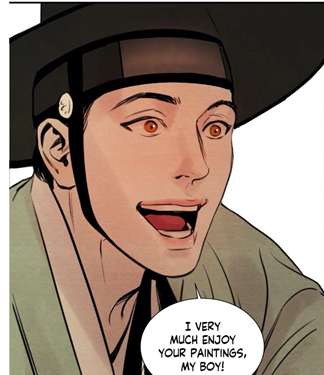 (Chapter 1) He was just called “my boy“. And that was it. He never created a real bound with the main lead. Therefore trust was totally inexistent. And because the young noble could only fear the man, he came to hate him to the point he could die. The latter made promises which he never kept!!
  (Chapter 101) How could he vow to “protect or help“ Yoon Seungho, when the latter was tormented constantly and exposed to violence against his will? And this could only escalate to Yoon Seungho‘s attempt to commit suicide.
  (Chapter 55) I had this idea, for the story is going in circle, meaning that the lord must have done it before, just like he did in season 3. The possible death from the main lead and probably his own pain must have brought the mysterious lord Song back to reality. That‘s the reason why he sent for the physician‘s assistance. He was encouraged to keep his distance from the young man, just like the latter was incited to stay away from the painter in season 1 (sickness, Min), in season 2 (the scholar‘s insult) and in season 3 (the rough sex session in chapter 81-82). Thus I deduce that the pedophile has always kept an eye on Yoon Seungho and his recovery. In my opinion, the man has not forgotten the main lead at all. Why do I think so? It is because he kept the painting…
 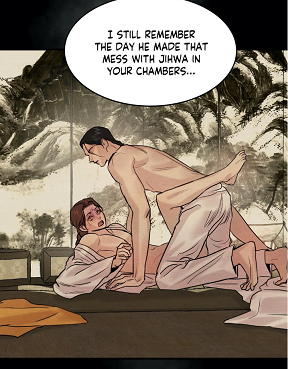 (chapter 82) a souvenir from their time together, just like Min who stole the painting in the study.
  (chapter 74) Thus I am deducing that Seungho-Ya will become the safe word between the two protagonists.
  (Chapter 72)
  The noble with the mole is trapped in a shed, and the color purple, a symbol for royalty, is dominant. From my point of view, the author revealed everything in this tweet. On the other hand, I would like to point out that here the man doesn’t look scared or rejecting the use of the bondage or the dildo.
 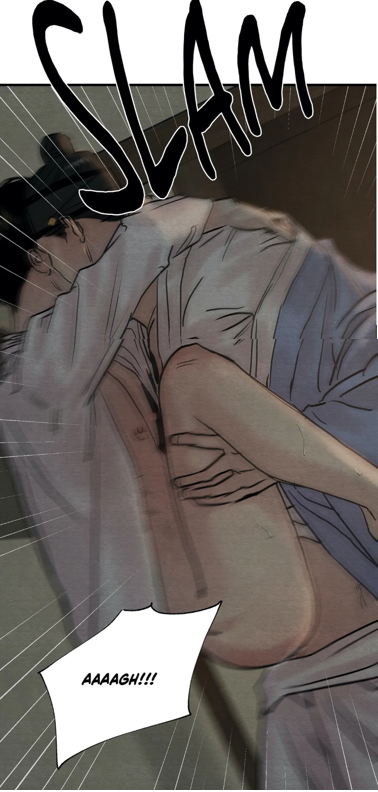 (Chapter 63) He was reliving his biggest trauma. Yet, he never went overboard in the shed. Note that the moment the painter called his lover “lord Seungho”, there was a switch.
  (chapter 63) That’s the reason why the lord changed the painter’s position and faced him.
 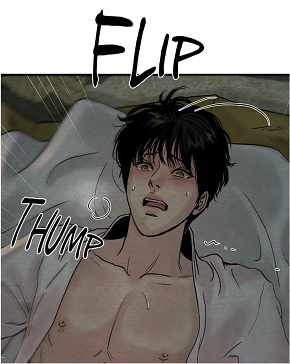 (chapter 63) The lord communicated his feelings and thoughts, and he even made a promise.
 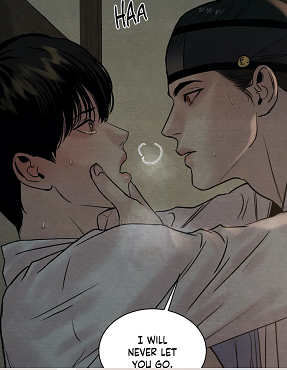 (Chapter 63) This new perception reinforces my impression that there was no rape in the storage room. The painter kept saying “no“, because he was actually scared about his own reactions. Strangely he felt pleasure, thus he kept having climaxes. He was simply in denial. The irony is that the noble attempted himself to be cruel during the night of the revelation (episode 62, 63, 64), but he failed, because the night at the doctor’s house was still fresh in his memory. He couldn‘t forget the tender embrace from the painter.
 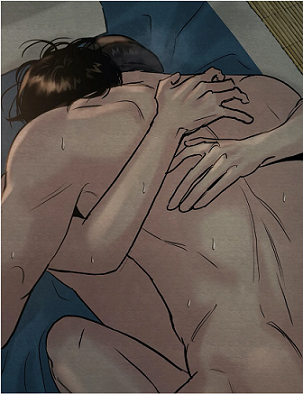 (Chapter 62) This explicates why he stood up during the penetration, he was forcing the artist to hug him, to clinch onto him. He wanted to relive it again.
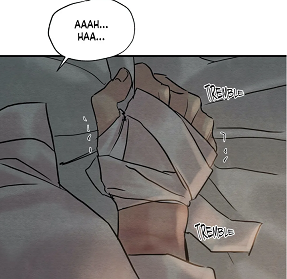 (Chapter 63) He had internalized the marks left by the bondage. This is no coincidence that the artist‘s wrist was covered by the bandage, the reflection from the torment in his youth. Under this new aspect, the presence of the bed in the shed was like a magical tool, which helped the lord to not turn into his tormentor. He was just a ghost from the past, and the word “lord Seungho“ worked like a magic spell, which stopped Yoon Seungho from becoming as vicious and cruel as lord Song. Moreover Lord Song sounds very similar to lord Seungho. And this new discovery confirms my interpretation that Kim was the helping hand of the king. He had to provide him with the white bands for the bondage, just like he had helped for the young master’s kidnapping in the gibang.
 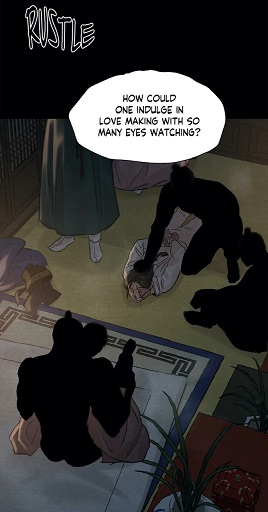 (chapter 86) But don‘t get me wrong. The king sent the main lead to the shed, when he wished to punish him. Yes, he repeated the same actions than Yoon Chang-Hyeon. And what is the common denominator between these two circles? The valet…
 Under this new light, I see it as another evidence that the infamous lord Song could only be the king! He is the only person who has absolute power in Joseon, and as such knows no “real boundaries“. Furthermore, as the ruler, he is expecting no rejection from his subjects. Anyone watching sageuks (historical Korean dramas), is aware that the Joseon king was never an absolute monarch, for he was always controlled by the officials, ministers, the Queen dowager and the Queen. There were also protocols which he was forced to follow. And we have an indication about the king‘s lack of power and wealth.
 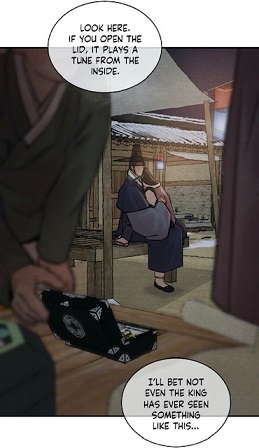 (Chapter 76) Thus I am assuming that the lord Song must have been frustrated about this contradiction. On the one hand, he was supposed to be the most powerful man in Joseon, on the other hand, he had to rely on the aristocracy. Hence I have the impression that the ruler vented his anger and frustration on Yoon Seungho unconsciously. That way, he could outlive his sexual fantasies, where he was powerful. But because of these terrible sexual habits, the young master could never get treated by a physician. Anyone would have recognized the sign of abuse.
  (chapter 92)
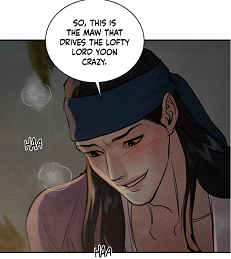 (Chapter 101) are a proof that they never discovered the importance of kisses, embraces, caresses and words during sex. They never recognized that they were denying the existence of love, too obsessed with their heritage and their reputation. The manhwalovers will remember my previous observation. The pedophile had never kissed the main lead. The king like all the nobles had disconnected sex from love. Why? It is because sex was a duty… to continue the lineage. And now, you have the explanation why the pedophile and all the others reduced sex to penetration.
  (Chapter 96) When she heard the noise (PLOP), she was brought back to the past, when she had witnessed a scene of BDSM, though the violence was real. A similar situation to this scene:
 (chapter 73) The pictures from the erotic publication are the evidence for this theory. After hearing the description from the butler about the events in the shed, the noona Heena believed to know what had happened in the shed.
 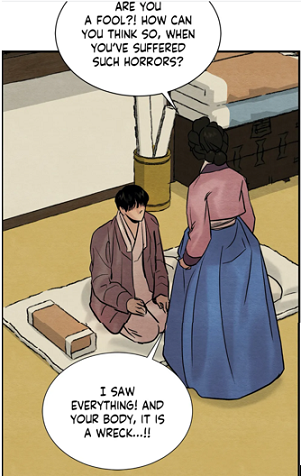 (Chapter 68) She could see the traces on the painter’s body, and conclude that the valet was telling the truth. However, the butler had been misled himself, for his perception was biased by his past experience.
 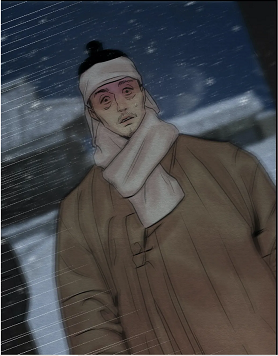 (Chapter 64) The butler thought that the “no“ from the painter was truly real, while the latter was just dishonest. It was the result from the “indoctrination“ from Heena and Jung In-Hun. The valet had been deceived in the end. The humiliation and punishment were not real, for the painter did ejaculate, and back then he was not under the influence of the aphrodisiac.
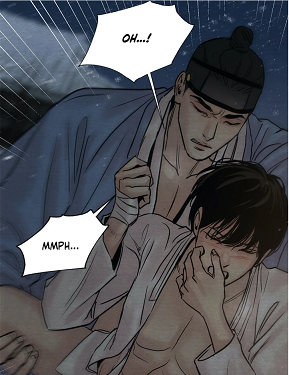 (Chapter 64) This was not like in the past, when the brutality was real. And now, you comprehend why Heena‘s resent towards her brother became more visible after witnessing the love session between the noble and Baek Na-Kyum.
 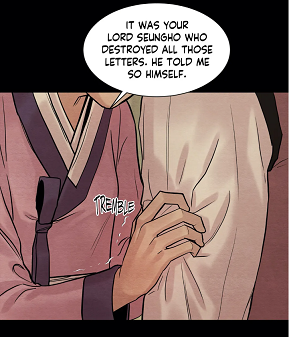 (Chapter 97) From my point of view, she had already internalized that the painter would never change, he was already too “damaged“ to change. However, since he was close to Yoon Seungho, he could become in danger, for she knew the connection between the ruler and the main lead.
  (Chapter 72) He was copying the habit from the pedophile in my eyes. The latter would never remove all his clothes on his own. As the king, he was used to get undressed by his own staff. Only the teenager as the uke was undressed, unless the lord was accompanied by the other nobles, like in this scene.
 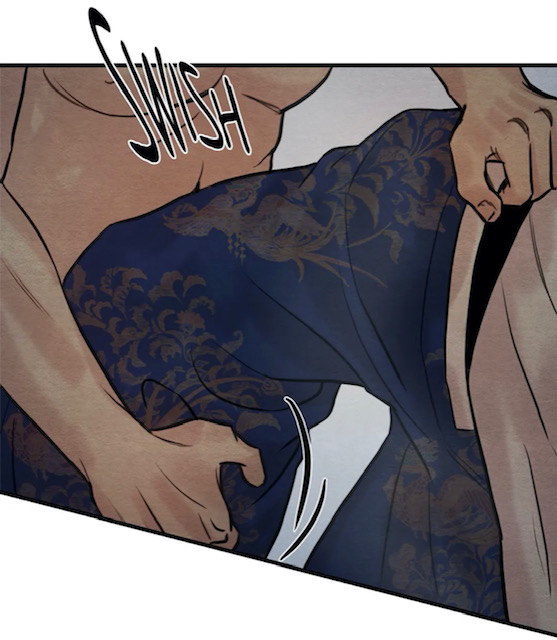 (Chapter 54) And because the ruler was too focused on his own pleasure, he never got to know the young noble. He only realized too late that he had made huge mistakes.
 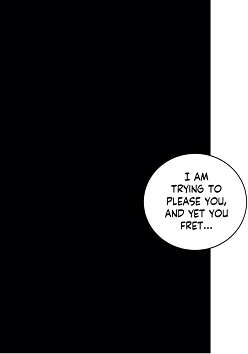 (Chapter 72) Yoon Seungho was his prey.
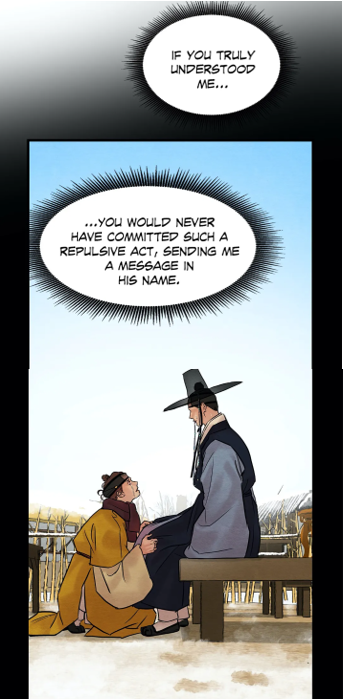 (Chapter 59) The main lead was supposed to meet his tormentor in a public place. Yet their relationship was based on “humiliation“! The “king“ loved to punish Yoon Seungho through humiliation and violence. This explicates why Yoon Seungho reacted that way.
  (Chapter 56)
  (chapter 57) This is what he experienced himself in the past. And observe that the childhood friend’s biggest punishment was actually his public humiliation, when he confessed and got rejected.
  (Chapter 59) In my eyes, the king sought to obtain Yoon Seungho’s affection, but he never realized this. He definitely confused it with submission. He definitely imagined that once the teenager would become submissive, he would have achieved his goal. But he was doomed to fail. In his mind, as the ruler no one could ever reject him. Besides, as the ruler, he was allowed to use his power and as such his strength to obtain what he desires. Don’t forget that in Joseon, people viewed all the monarchs als representatives of the gods. The latter would support them. However, since his youth Yoon Seungho had a strong opinion and mind. Therefore he had caused trouble to his father, as the latter viewed his critical thinking as a synonym for a lack of respect for traditions and the elders, the so-called illness from his childhood. Besides, I am suspecting that the lord must have had visions as well, which would contradict the father‘s dreams and expectations.
 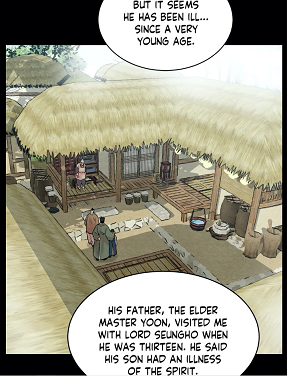 (Chapter 57) Yoon Chang-Hyeon looked down on his son’s critical thinking and came to doubt his words. The author left many clues for this interpretation:
  (chapter 101) Lord Jang got aroused, when he saw the bloodied lips from the painter. Moreover, Black Heart had brought a huge dildo.
 (Chapter 101) The item was huge, therefore it could only injure the artist’s anus.
 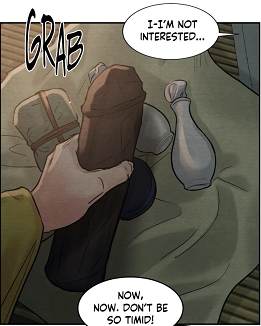 (Chapter 100)
 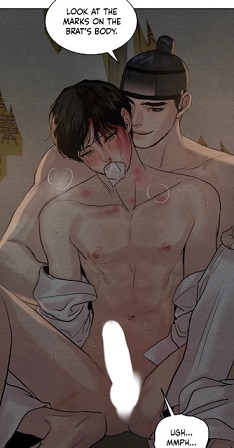 (chapter 101) Even the noble said that this must have hurt. The painter disliked being bitten in the neck.
  (Chapter 88) Furthermore, the lord said this to the painter in the study:
  (chapter 85) These were the words from the pedophile. He was repeating his sexual abuser‘s words. And this proves to me again that the lord was abused in the study, but if he rejected the man, he would be sent to the shed where he would receive his punishment. In other words, Yoon Seungho was punished with sex and violence. And now, you have the explanation why he got gangraped in the end. But the readers should keep in their mind that this was no real BDSM, for the brutality was real. The king couldn’t distinguish between reality and illusion. And this coincides with all my previous interpretations.
 (Chapter 65) Kim had brought him to the barn, because Yoon Seungho was punished there. This could only be suggested by the butler, as I don’t think that the king would ask for the owner of the mansion for permission. This room was definitely taboo, no one was allowed to approach the study or the shed. Yoon Seungho was exposed to rough sex, and Kim knew this, like mentioned above. But he never witnessed it himself, he only discovered the aftermath. From my point of view, this scene occurred after the lord’s loss of virginity.
 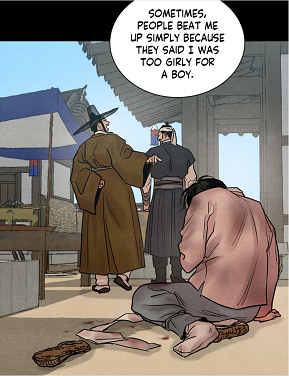 (chapter 94). Notice that violence was used against the painter to mask attraction. The “girly features“ were definitely perceived as something tantalizing. Thus I perceive this incident as a reflection from the BDSM. It was to push the artist away, to incite him to leave the gibang. Heena feared that he might catch the attention of the pedophile, and it is very likely that she was manipulated by the scholar, her idol.
 (chapter 18)
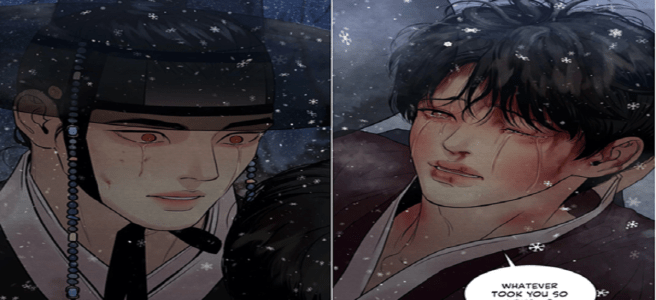

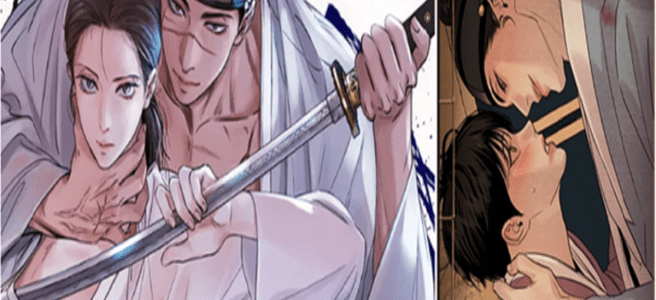
 (chapter 7) The young man is associated to the lotus flower.
 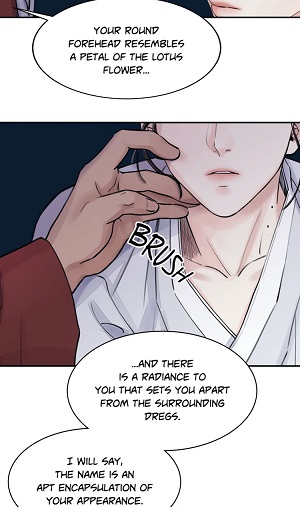 (chapter 7) After their first meeting, the governor was already dreaming of having sex with the slave. Secondly, since the lotus flower emerges from murky water, the latter could be perceived as the symbol of the court in Hamheung-castle. Therefore the court is portrayed as a place full of corruption. Because of the darkness of the place, Yeonjo’s purity can only outshine and captivate the semes’ attention. One might say that he is far from pure, for the former noble is selling his body. On the other hand, his soul and heart have remained intact. He did it for selfless reasons. It was for his brother’s sake. It demonstrates his humbleness and dedication. He was willing to give up on his pride, if it meant to save his brother. Even later, he only accepts the order from headman Choi, once he recognizes that it is his only possibility to approach his enemy. He showed great reluctance in the beginning, for he despises homosexuality. He had never imagined that Kwon Hee-Ryang liked having sex with men.
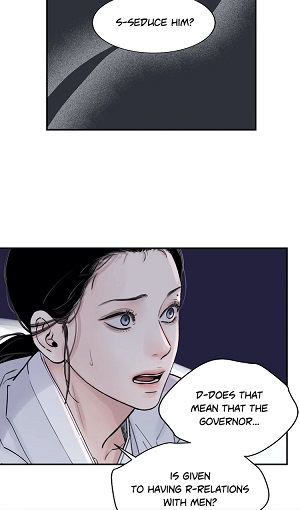 (chapter 7) This truly displays his innocence and purity. But there’s more to it. The particularity of the lotus flower is that it blossoms during the day, but once the moon appears, the lotus flower closes, but re-blooms the next morning entirely dirt-free! This can be perceived as a metaphor for Yeonjo’s future development. In my eyes, the sex sessions during the night will represent the main lead’s fights. During the night he will be far from pure and innocent, this can only be judged as an allusion to sensuality. However, this means that Lee Yeonjo will never lose his “beauty and purity“ despite these sex fights, for the next morning, he will come out as pure and innocent.
  (Painter Of The night, chapter 3), the Yoons
  (chapter 10) and the Mins
 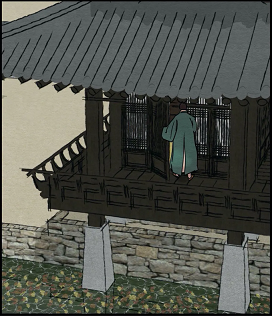 (chapter 33) have a square pond with a pavilion and lotus flowers. The pond was supposed to represent the owner: a upright and faithful scholar. 🙄 And this made me laugh, because this was the place where crimes and sins were committed. Jung In-Hun asked Baek Na-Kyum to disrespect his sponsor, to become disobedient and as such disloyal. Besides, he lied, manipulated and wounded the main lead
 (chapter 10), whereas Min, Yoon Seungho and Lee Jihwa had sex there.
  (chapter 25) All of them were far from righteous and humble scholars. That’s how I realized why the pavilion in Painter Of The Night symbolized emancipation. It was where the main protagonists got purified thanks to the lotus flower. Why? The answer is simple. The lotus flower embodies rebirth, regeneration and enlightenment.
 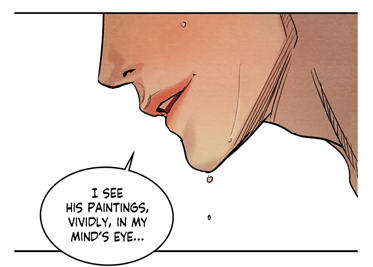 (Chapter 3) This coincides with the main lead‘s enlightenment. In the pavilion, he could perceive his sex appeal and attraction. Let’s not forget that Yoon Seungho had discovered sex through sexual abuse, and was blamed for the sexual desires from the pedophiles. Furthermore, with this new discovery, the manhwaphiles can grasp why Lee Jihwa sent his friend there.
 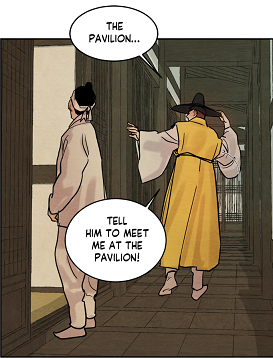 (Chapter 3) That way, the second lead could appear as an integer and down-to-earth noble. 😂 But no, it had the opposite effect: the lotus flower revealed the true nature of the relationship between the red-haired master and his friend: it was purely sexual. He loved having sex with Yoon Seungho. Furthermore, it also exposed Jihwa‘s true reflection: he was a homosexual. This signifies that the pavilion and the lotus flowers exposed the decadency of the aristocracy in this story, while they cleaned the protagonists. In my eyes, only Yoon Seungho among the aristocrats has the disposition of becoming a true scholar. Finally, it explains why the video had such a scene:
  Here, the lord is portrayed as a humble and righteous scholar. Because of this new discovery, I felt the need to examine the color of the lotus flower in the main lead‘s pond.
  What caught my attention is the following: the reflection of the patio. It gives the impression that the water is clean! However, the lotus flower needs dirt to grow. Furthermore, since the painter embodies water, I am questioning if the lotus flowers had enough water. Notice the huge gap between the level of water and the bridge. This explicates why the flowers are just raising above the water contrary to this picture.
 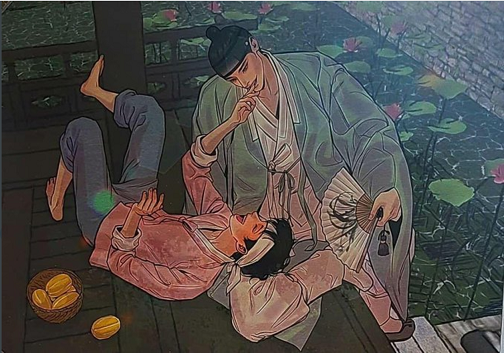 The manhwaphiles can notice the presence of the long stems. I would even say that now the number of pink lotus flowers has increased, for now they are visible on the right side of the bridge which contradicts to the picture from episode 10. Another important detail caught my attention: the color of the flower. It is a pink lotus flower.
  (chapter 6)
  (chapter 2) In fact, he got upset because of the official’s benevolence.
  (Chapter 2). Anyone in his place would have been happy and thankful. This signifies that he would have preferred getting flogged and even being hurt over true justice! This shows how deep his resent is, but also how much he is neglecting his own body. All his thoughts are revolving around payback and as such his imminent death. Then, when he cut his finger, he showed indifference again. He didn’t treat the wound, indicating that he was not treasuring his own body. This attitude could only catch the official’s notice. That’s why I believe that the confrontation in the jail should be perceived as a wake-up call for the young man, similar to the “words“ from that fateful night.
 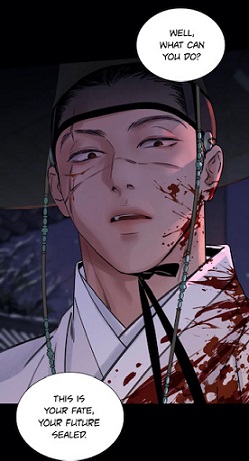 (Chapter 1) Here by saying this, he was encouraging the boy to fight back and not accept his fate.
 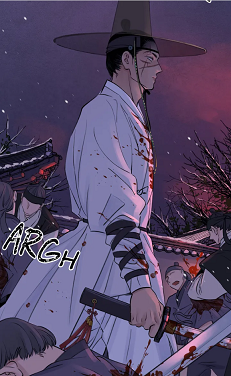 (Chapter 1) In Joseon, the color white was traditionally used for funeral. He was dressed for the occasion: there would be death during that night. Secondly, he walked through the courtyard searching for father Lee. This means that he had chosen to kill the scholar himself. He had not sent his guards or minions to do it. In other words, he was showing a certain respect towards Lee Yeongjo‘s father.
  (Chapter 1) This exposed the main lead‘s true personality. He doesn‘t mind dirtying his own hands, he is taking responsibility for his own decisions. Finally, Lee Yeonjo was just a young boy back then. He had no idea about the political context and circumstances of this purge. He perceives the king and his governor as the villains
 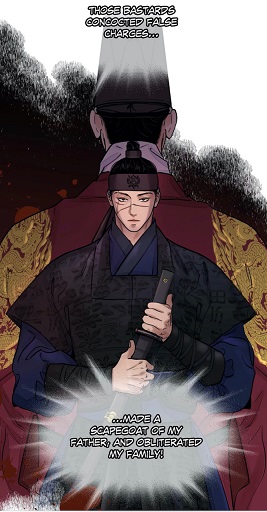 (chapter 7), for he lost everything during that night. Yet, he has no idea what kind of official his father was and why this massacre took place. Lee Yeonjo needs to distinguish the difference between the father and the official. Besides, observe that the slave is seeking revenge, and not justice. From my point of view, this second confrontation with cruel reality is necessary to put this tragedy in the bigger picture. In my eyes, it is related to the hojok.
 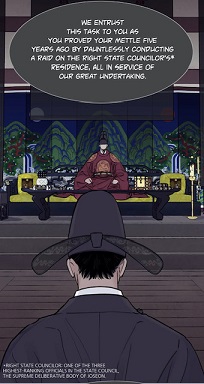 (chapter 2) If not, the king would not have mentioned the service done from 5 years ago. As a conclusion, the lotus is about to discover the reality of the murky water, while Kwon Hee-Ryang doesn’t appear to be a snake.
 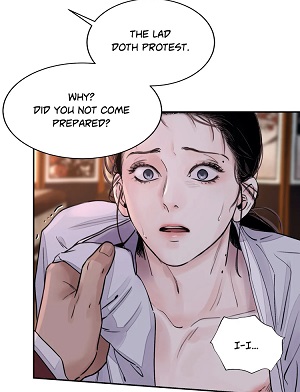 (Chapter 8) In addition, he is wearing a purple shirt.
 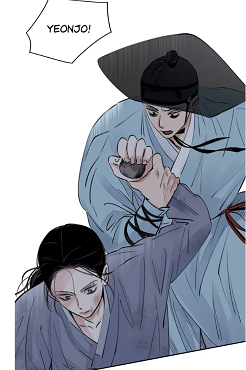 (chapter 1) This could only reinforce such a prejudice. Another reason for this misjudgment is his assistant’s report.
 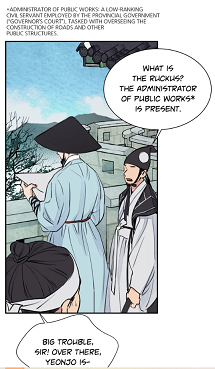 (chapter 1) The protagonist was portrayed as the one causing trouble, while in truth it was the opposite. The source for the ruckus was the noble’s favoritism towards the main lead. To sum up, lord Chang was viewing the main lead in a negative way. This interpretation is even corroborated in chapter 7:
  (chapter 7), yet he didn’t attempt to ease the main lead’s heart and mind by removing the source of his negative emotions: the injustice he felt for the loss of his family and name. But why does he resent lord Chang? Simply because as the administrator for the construction, he represents the king‘s authority. The huge gap between Lee Yeonjo and the official becomes more visible, when the protagonist changes his attitude so suddenly. The lord never tried to seek the real reason behind the sudden change of heart. Why should he, since he was gaining something?
 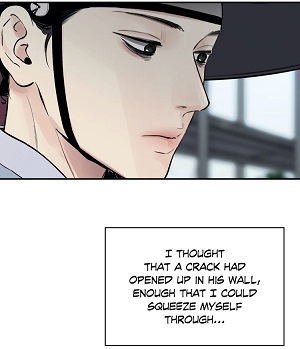 (chapter 7) He had a reason to believe in his lies so easily.
  (chapter 5) It was not in his own place. The noble was not becoming responsible for his sexuality and their relationship. This explicates why the lord said that he was hurting the servant.
 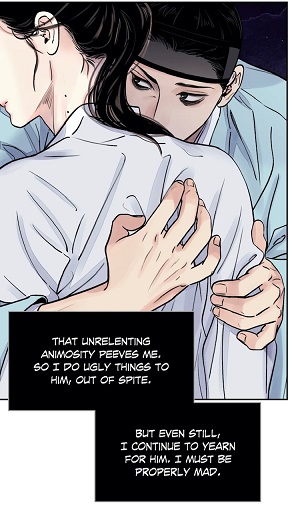 (chapter 7) Thus I come to the conclusion that lord Chang is behaving similarly to Lee Jihwa. He is yearning for Lee Yeonjo’s love without risking anything, he prefers maintaining his good reputation.
 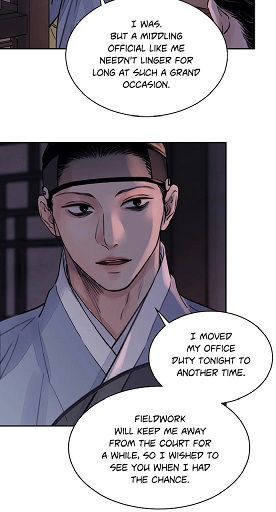 (chapter 4), while he could leave the banquet by saying that he had an office duty. No one would ever question his disappearance. That way, he wouldn’t be caught with the main lead. Naturally, the staff has ears and eyes, so that they can not be fooled. That’s the reason why he got bullied by the workers. However, lord Chang will never be confronted with the rumors, for he is a noble.
 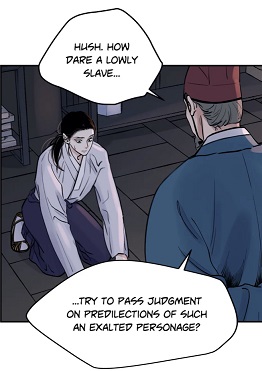 (chapter 7) Due to their social status, the servants are not allowed to show their disapproval. This explicates why Yeonjo became the target of the grapevines.
  (chapter 6) Only him will be judged and looked down. The last comment lets transpire that if the “lotus” had not been there, lord Chang wouldn’t have asked to have him as a boy toy. Note that he is portrayed as the seducer. In their eyes, he is the snake.
 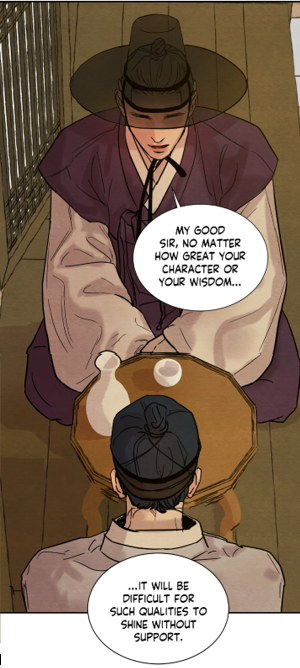 (chapter 7) Kim must have suggested him this scheme. But he had no idea that he was inviting a snake into his realm. We imagined that the butler didn’t know the learned sir, for the main lead had no idea about the man. Nevertheless, their path had crossed in the past: in the gibang.
 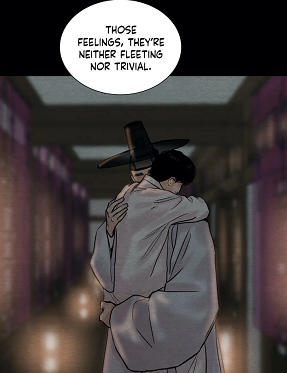 (chapter 68) How could the protagonist have paid attention to the learned sir, when he got caught by the black guard?
 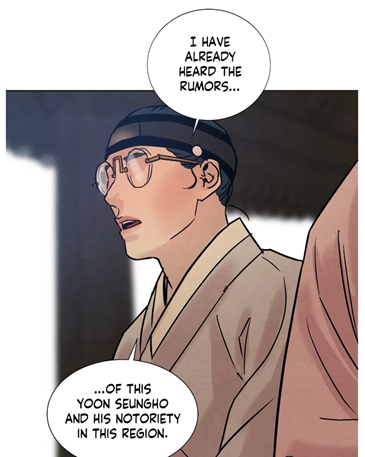 (chapter 10) He envisioned that this would upset the righteous learned sir. However, this was used to scare the low-born… When the incident with the ruined painting occurred, and the scholar didn’t intervene, the butler imagined that Jung In-Hun was protecting himself, and the painter would resent him for his passivity. Yet, the painter remained in the mansion. The assistant sensed the strong bound between these two men, so he thought that Jung had indeed feelings for Baek Na-Kyum, but he was just powerless. He projected his own thoughts onto the learned sir: “He couldn’t do anything”. That’s the reason why he let him see the rape. Everything was done to scare the teacher who had such a good reputation. Then he suggested that he should see a shaman, he hoped that the man would ask about Yoon Seungho so that the shaman would tell him that the main lead was a bird of misfortune… but Jung asked for something else: digging up the past. Notice that on the day, he was supposed to meet the former servant, the main character was given the sword
 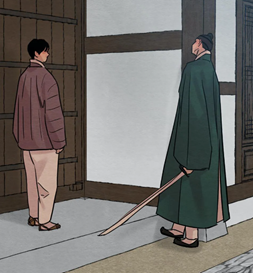 (chapter 35). Striking is that he let his master see the artist with Jung In-Hun in the courtyard. Here, the scholar was again coming back from the pond! So he was not learning. However, the stroke and the gentle words from the learned sir had one purpose: they were to remind to Yoon Seungho that the artist would only listen to Jung. He was the real master. Yes, this was the reflection from episode 30!
 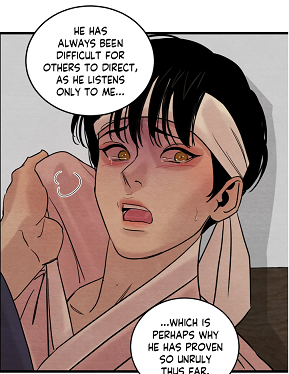 (chapter 30) And in both situations, the learned sir had escaped the noble’s wrath. In my eyes, the real target in episode 35 was the scholar. The latter was supposed to die along with the painter, but it failed. Under this new perspective, it becomes so understandable why Yoon Seungho couldn’t detect the schemes. As a lotus flower, he was still pure and innocent. He could never be the snake.
  (chapter 6) Here, the lord was actually imitating the butler. And this shows the stupidity of Kim’s move. Why?
  (chapter 7) It offered indirectly a comeback for the Yoons to the palace. Furthermore, Jung In-hun seems to have succeeded the first round of the civil service examination. This is important, because this means that if Jung In-Hun is indeed dead, his disappearance will definitely involve the intervention of the authorities. Because Yoon Seungho was so innocent to plan great schemes, I can only assume that the readers were witnessing the scheming nature from the butler. And this leads me to the following observation. If the butler Kim is indeed a “snake”, this doesn’t mean that he was evil right from the start. He had a rebirth as well, but he just chose a different path. He decided to ensure that he would live in peace, and if his peace is in danger, then he can bite! And now, you comprehend why Kim felt threatened by Baek Na-Kyum. His presence could lead to the following discovery: Yoon Seungho was not a bird of misfortune, but a beautiful lotus flower! And once this lie was detected, his power based on deceptions and half-truths would get ruined.
 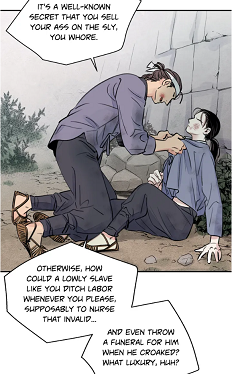 (chapter 1), but he was still working for the bureau of construction. Lord Chang as his superior never sent him to another department. He only used his connection, when the young man asked for this favor. This shows that the administrator never had the intention to change anything. He imagined that with the brother’s death, the young man would still have sex with him. This explicates why the main lead rejected the sweets from the noble.
 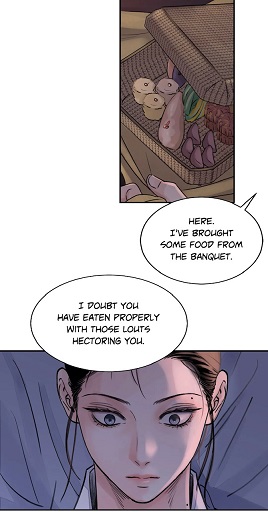 (chapter 4) This was not real kindness, for the food would never contribute to improve his living conditions. Yeonjo was still treated like a prostitute.
 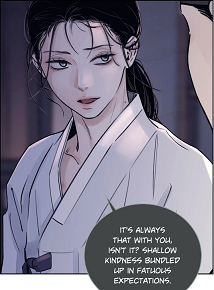 (chapter 7) The administrator might be acting, as if the slave was his lover
 (chapter 5), but this was behind closed doors. These words were just more or less lip service:
  (chapter 5) He still had leave him behind because of his work. Besides, the main lead was now acting, as if he was accepting his work as a “prostitute”. In exchange for the help, he had now to serve his benefactor. In the open, I doubt that the lord would like to be seen together having sex. Moreover, don’t forget that Yeonjo is called the son of a traitor, which could be another reason for lord Chang not to make their relationship official.
 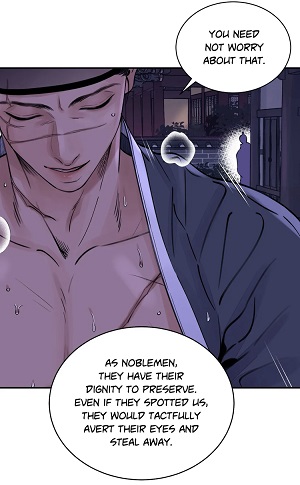 (chapter 4) That’s the reason why I believe that Kwon Hee-Ryang’s promise was honest.
 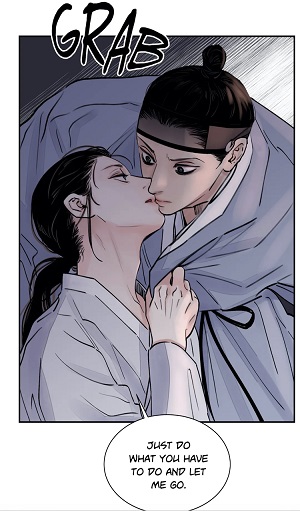 (chapter 4) He hoped to obtain the lotus’ love. Another important contradiction is the mark bite. While the noble with the dark circle did it without Yeonjo’s knowledge
 (chapter 5), Kwon Hee-Ryang did the exact opposite.
 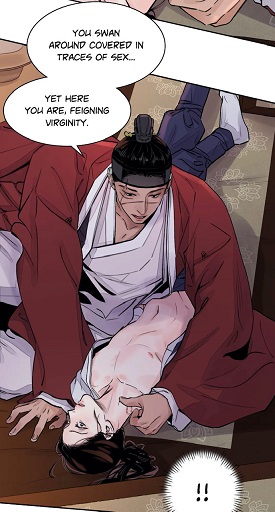 (chapter 8) Since the governor is the son of the concubine, he came to resent social norms. This explicates why he doesn’t follow social norms. Consequently, it is not surprising that he doesn’t hide his sexual orientation. That’s the reason why I believe that the official will play a huge role as the uke’s mentor. He might be a snake in Yeonjo’s eyes, yet he is totally misjudging the man. He is not relying on his status and power, he knows that he needs to be prudent and observant in this hostile environment. That’s the reason why he can perceive people’s personality quite well. It looks like he is looking into their eyes so that he can detect their thoughts and emotions. That’s the reason why I come to the conclusion that the governor and the administrator are both snakes, but they stand for different values. Brutal honesty versus gentle hypocrisy.
  (chapter 5), then after the climax he showered the main lead with tenderness.
  (chapter 1) From that moment on, the main character lost everything. In one single night, he became the son of a traitor, while in reality we have to imagine that the king had made a coup d’état and got rid of his opponents. This explicates why Yeonjo made the following statement: A new king!!
 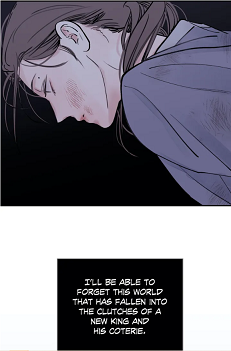 (chapter 1) In other words, Lee Yeonjo’s father was sacrificed. However, this is just the beginning, because now the king is determined to strengthen his authority and power by eliminating the hojok in Hamgil-do. This means that Kwon Hee-Ryang will have to use his blade for the monarch one more time. Simultaneously, Lee Yeonjo as a slave is seeking revenge. He plans to kill the person whom he views as responsible for his family’s death: Kwon Hee-Ryang. But the real mastermind behind this is actually the new king.
 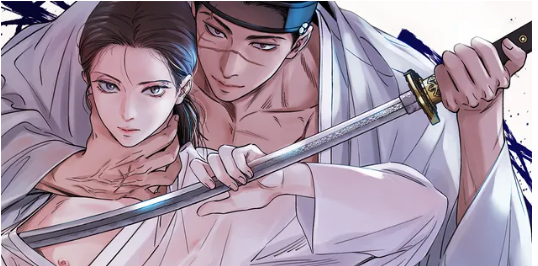 The sword symbolizes not only power, protection, authority, strength, courage, but also righteousness and justice. This explicates why the sword Excalibur was given to the king Arthur or the goddess of Justice with her covered eyes is carrying one. With her sword, she is giving justice. Therefore it is not surprising that the main lead is seeing carrying a sword. He is not just protecting the new king, he is making sure that the hojok
 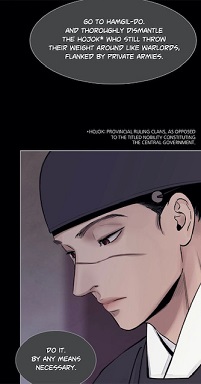 (chapter 2) are removed, for they represent a threat to the royal authority. The monarch is supposed to represent “justice”, but if there exist warlords, the latter can do whatever they please. This means, they can escape any punishment, the king can not control them. Finally, the sword should be perceived as a metaphor for the phallus (penis). As the manhwaphiles can sense, the blade is referring to the main lead Kwon Hee-Ryang. That’s the reason why I believe that when Snob chose the title, she was thinking of the two protagonists, Hee-Ryang was the blade, and the flower was the uke Lee Yeonjo.
 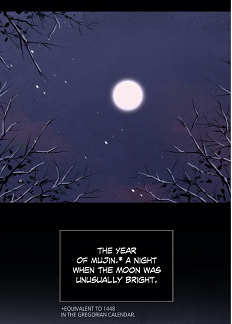 (chapter 1) That’s the reason why I looked into that historical period. This is what I found:
 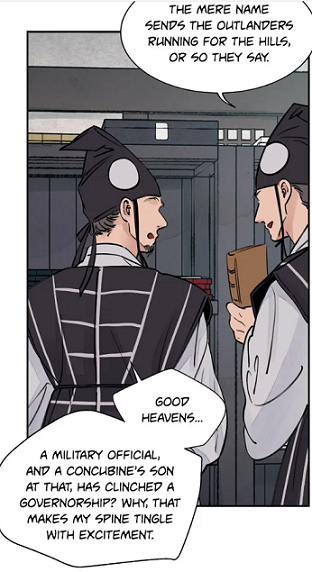 (chapter 1)The main protagonist is the son of a concubine, therefore according to social norms, he should have never expected to raise the ranks and become a governor. He is not the official son. This explains why the main lead has so many scars, and why he is willing to do the dirty work. He had to work hard to reach the top of the hierarchy. This exposes the strong will from the new governor. He never accepted his fate as the son of a concubine, who was supposed to live in the shadow. The manhwalovers should keep in their mind that in Joseon the son was supposed to inherit the mother’s social status. That’s the reason why I don’t believe that Kwon Hee-Ryang truly meant this, when he spoke to Lee Yeonjo.
 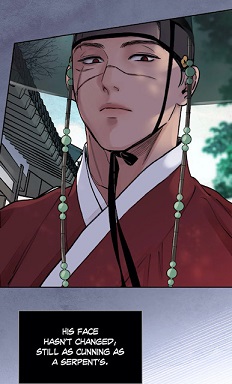 (chapter 2) As you already know, the serpent embodies cunningness, knowledge and seduction. This is important, for “silk” is a reference to the bed. As you can see, the English title gives us a totally different approach. It implies sex. Furthermore, steel symbolizes strength and invulnerability. I would even add: determination and calculation, for a metal is cold and hard. Thus I come to the deduction, steel represents strategy and power. Since steel is used in weapon, I conclude that the author desired to include the notion of a fight in the bed. Yes, here I detect some similarities to Yoon Seungho’s following doctrine: “Sex is like a battle”. The one surrendering to his feelings should be judged as the loser. Though the story has just started, the manhwalovers could sense the presence of struggle during a sex session.
  (chapter 5) No one is allowed to reveal his emotions: neither passion nor pleasure.
 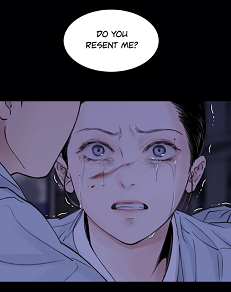 (chapter 1) He watched how the main lead killed the protagonist’s father. He never closed his eyes and looked straight into his enemy’s eyes. Note how he is clenching his jaw, a sign for hatred and strong-will. He didn’t hide his true thoughts and emotions. Furthermore, there’s blood on his face, which is quite similar to the scars from the governor. Despite the blood and the violence, the young boy never closed his eyes, while the older brother was turning his back on Kwon. And now, you comprehend why the governor feels that he has already met Lee Yeonjo. He could never forget this gaze full of resent and determination. In that scene, Lee Yeonjo showed courage.
 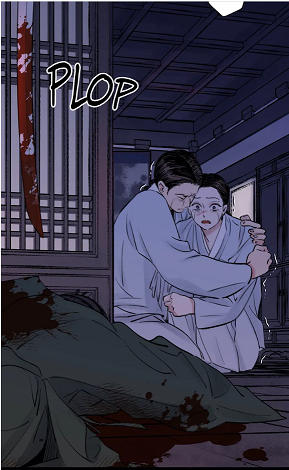 (chapter 1) He didn’t mind provoking his enemy with his daring gaze. Observe the huge contrast to the brother. The latter closed his eyes, and later turned his back on the official. This is not surprising that at the end, Yeonjuk died. He could never bear the cruelty of this world and resigned. I would say, the scene in the first episode revealed the brother’s weakness. Yeonjo might have been trembling, yet the latter was in reality the one comforting his brother. In other words, Yeonjo is a fighter. Therefore it is no coincidence that we could see him imaging how he would attack his enemy.
 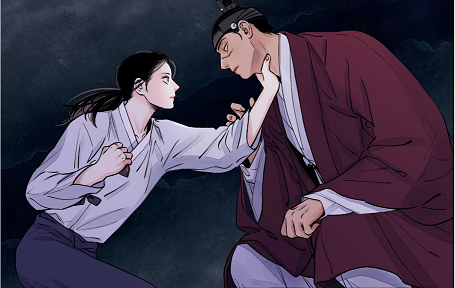 (chapter 6) But he doesn’t let his emotions cloud his judgement. This explicates why in his second meeting with the governor, he didn’t try to take his revenge on the main lead immediately. The uke is calculating, developing how he should approach the official.
 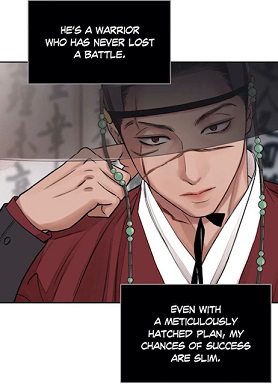 (chapter 2) As a warrior, he was tasked to eliminate the hojok. And he will use every possible mean: poisoning for example. He is a strategist exactly like Yeonjo. The only difference is that he has more experiences than the slave. The noble could perceive the betrayal from headman Choi right away and even anticipate his moves: planting spies through the kisaengs. Since the man is nominated as a governor for 2 years, the warlords are underestimating their opponent’s authority. And this observation leads me to the following conclusion. The slave was the only one who could detect Kwon Hee-Ryang’s true personality. He is a warrior and he is cunning as a snake. Why? It is because he witnessed himself that the man wouldn’t mind to dirty his hands himself.
  (chapter 88) The removing of the jacket made of silk… Behind the silk hides a chest made of steel… 😉
 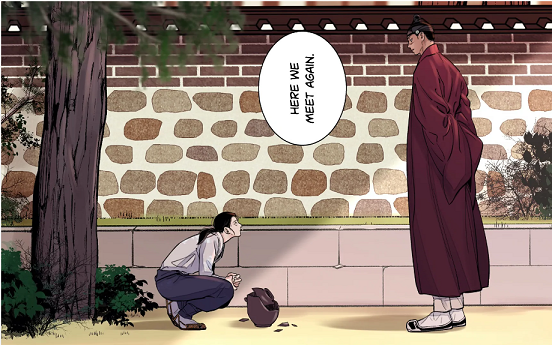 (chapter 6) Yes, Yeonjo is not paying attention to this. But it is only a matter of time, until he discovers the main lead under a different light.
  (chapter 2), he was even requesting his help and protection. Thanks to him, he would have an easier life. This explicates why the next time they met, lord Chang was particularly gentle.
  (chapter 2) Here, he believed that the main character had moved on and overcome the brother’s loss. That’s the reason why we should expect a transformation of lord Chang. He might raise the rank as well… So far, the administrator seems quite caring and gentle, but I have the impression that he is only showing this side towards the main lead. He showed favoritism which stands in opposition to justice.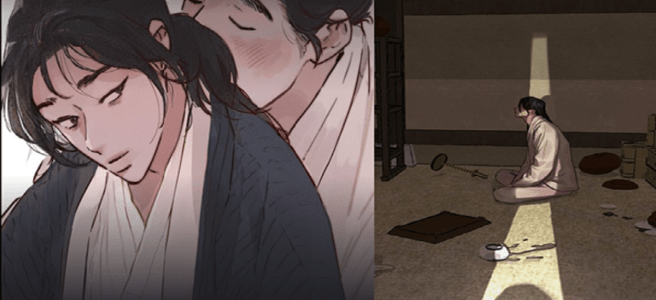
 (chapter 6) The father was deeply in love with Gwiduck, thus he treasured her very much. He would give her jewels and good clothes. However, since Gwiduck was just a slave, the father decided to remarry after the death of his first wife. The former had two reasons for this. First, according to social norms, his household needed an official wife. Moreover, I am suspecting that the father must have been pressured by his own family as well. Soongap’s father is actually a younger master, so his elder brother, and as such the head of the household Jeon, had a right to meddle in the life of the main lead’s father. I could use the following panel as an evidence that the family’s attitude had a great influence on the father.
  (chapter 25) As you can see, Soongap’s aunt was rejecting Gwiduck due to her social status. One might think that the concubine had been lucky. She could live in luxury and was treated well. However, the manhwaphiles can grasp very quickly that the mother never enjoyed her position as a concubine. Why? First, her position arouse jealousy among the staff.
 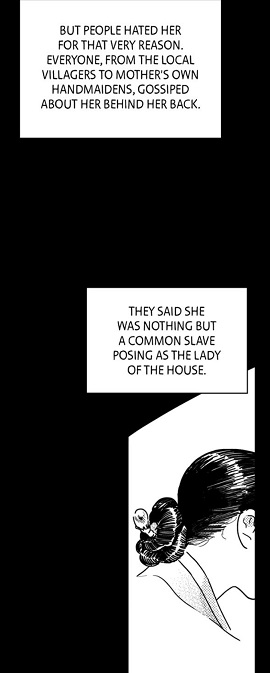 (chapter 6) This means that she was totally isolated in the mansion, exactly like Baek Na-Kyum. Nevertheless, I believe that the main reason for her misery was that she had never been asked in the first place. Soongap’s father as a noble had used his position to impose his will. To conclude, there was no consent in the end. The manhwalovers could sense that Gwiduck didn’t love her husband by the way she reacted to his calling and she addressed to him.
 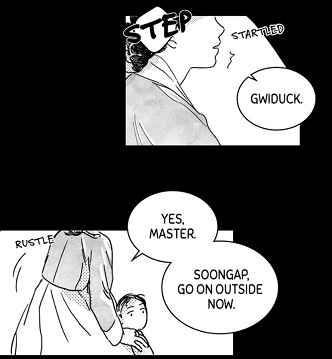 (Bongchon bride chapter 6) She just treated him as a master using his right. The title displays the absence of intimacy. She was not seeking his presence, it was always the father who would visit her room. As a conclusion, she was just a favored servant and nothing more. However, the father never realized his concubine’s unhappiness. He imagined that by acting as a generous man, he had showed to her that he loved her. I doubt that the man ever confessed to her. Why should he? In his mind, it was clear that he cared for her very much. Besides, we have to question ourselves if a noble would ever confess his love towards a slave. This would be beneath his dignity, just like no noble will ever apologize to a commoner.
 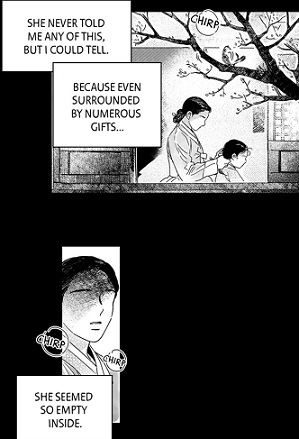 (chapter 6) And because the father only desired Gwiduck, he neglected his son born from his concubine.
 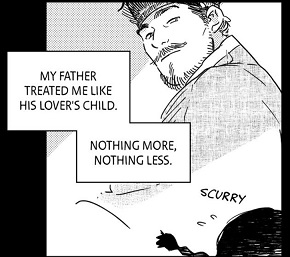 (chapter 6) What could he bring to his family? Nothing, as Soongap was inheriting his mother’s social rank: a slave. In this panel, the noble’s gaze was betraying him. He was totally indifferent towards Soongap. Thus he never took care of his son’s education. The mother was isolated, even her son’s presence couldn’t comfort her. Why? It is because her husband showed no interest in Soongap as well. Besides, Gwiduck had been forced to witness her master’s remarriage. This means that she would never be recognized as the mistress of the household. To conclude, Soongap’s father chose social norms over love. His affection for Gwiduck was not strong enough to disregard traditions. This exposes the father’s selfishness. However, when his second wife died years later, the man was actually crying over Gwiduck and not over his second wife.
  (chapter 20) He was missing her terribly showing that he had never understood why his concubine committed suicide.
 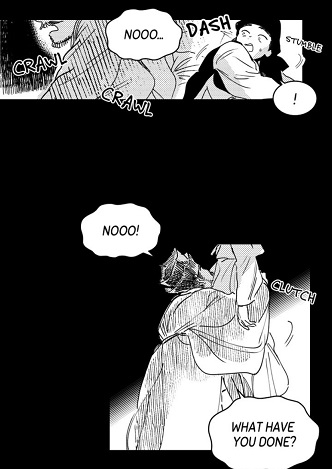 (chapter 21) Her action caught him by surprise, and even after so many years, he still doesn’t know the reason behind her suicide. It was because he never tried to get to know Gwiduck and understand her. He never detected her sadness and misery.
 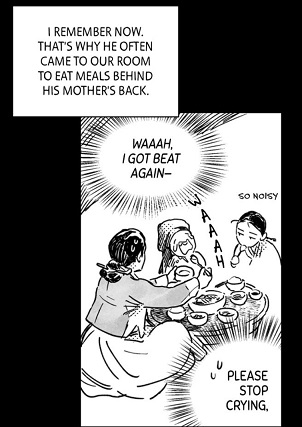 (chapter 6) The latter would always run to Gwiduck, because he had a very strict mother. She had high expectations for her son, but because she put so much pressure on him, she used violence to achieve her goal. Her forceful way estranged her from her own son, who sought refuge to the concubine Gwiduck. This could only reinforce the wife’s jealousy towards the concubine. The main lead’s mother must have been a thorn in the wife’s eyes. Her own son preferred the slave and Soongap’s company over her own.
 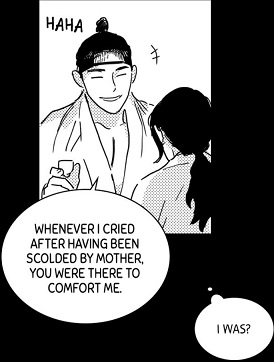 (chapter 6) The young master felt loved there. However, if the manhwaphiles compare the last two panels, they can detect a huge gap again. Pilgyeon never realized that Soongap and his mother never truly comforted him. They just accepted his presence. The third son never comprehended that they allowed him to do anything in their family, for the simple reason that he was a noble, the younger master of the mansion. As slaves, neither Gwiduck nor Soongap could ever refuse anything.
 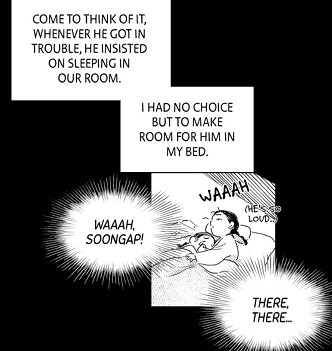 (chapter 6) Note that even here, Soongap didn’t dare to voice his true thoughts. He never complained to his brother. Soongap was never entirely honest to his brother. In other words, Pilgyeon was making the same mistake than the father. He was taking Gwiduck and Soongap for granted, he had been accepted. He was blind to their actual situation and as such their true thoughts and emotions. Yes, such an attitude could only reinforce his selfishness. He never talked to Gwiduck, thus he assumed that her smile was genuine.
 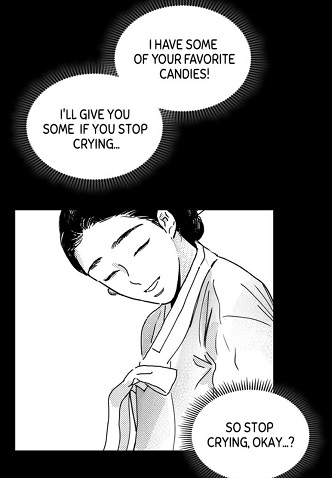 (chapter 21) However, she was just masking her emptiness. Naturally, I am not saying that the main lead or Gwiduck disliked the younger master. Nevertheless, their attachment towards Pilgyeon was more superficial and as such not so strong. Soongap never confided to his brother about his mother’s emptiness. He was mature enough to grasp there existed a huge distance between his brother and himself. He was thankful that Pilgyeon was teaching him how to read and write, but his affection for Pilgyeon was limited.
  (chapter 6) While the protagonist and his mother became a source of joy and comfort for Pilgyeon, the latter thought that they felt the same way. In truth, he was just projecting his own thoughts and emotions onto Gwiduck and her son. Thus I come to the conclusion that the second lead developed an idealized version of his childhood. He had the impression that he knew his brother so well, for they spent a lot of time together. Nonetheless, everything was revolving around Pilgyeon’s needs and wishes. Their submissive behavior towards Pilgyeon contributed to reinforce his selfishness and blindness.
  (chapter 3) However, after so many years of separation, the gap between them could only increase. For the main lead, Pilgyeon was now a lord and no longer a part of his family. Only after their reunion, Pilgyeon was confronted with the truth. Their social status made it impossible to act like in the past. Hence the protagonist acted, as if he was not his brother. From that moment, Soongap made sure to keep his distance, and even rejected any offer coming from Pilgyeon. He had every reason to do so. After his mother’s death, Soongap had been sent away to the main house of Jeon.
 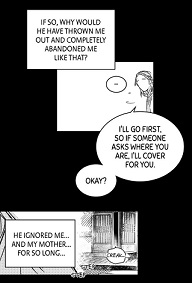 (chapter 2) The wife and the father had every reason to get rid of the main lead. The mistress of the house would get rid of her competition, and could now take control over her son’s life entirely. As Pilgyeon’s father, the son was a constant reminder of the loss of his beloved concubine. He didn’t want to see his son’s face.
  (chapter 2) But he was not unhappy there. He could find a new family: the staff, his grandmother and Mojil.
 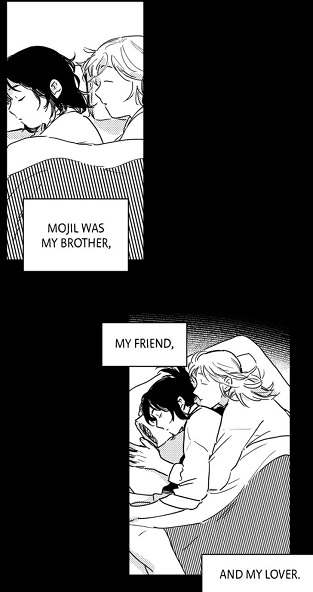 (chapter 14) This shows that Soongap’s descent to hell was not truly related to his status. Through his mother’s misery and his life as a slave, he discovered that jewels or comfort were not really a source of happiness. This explicates why in the second season, Soongap made the following statement:
  (chapter 51)
  (chapter 10) The son had proposed to give the head slave’s job to his brother without taking into consideration the old head slave. Therefore his suggestion created tension among the staff so that some felt that Soongap was trying to take advantage of the new situation. At the end, Pilgyeon was forced to give up on this idea, though the main character didn’t desire to take this job. However, Soongap’s misery really started, when his lover’s health deteriorated so quickly.
 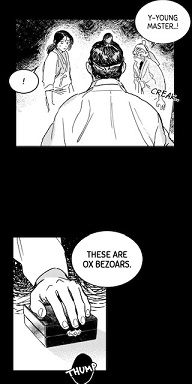 (chapter 11) The young master seized the opportunity and offered to give this expensive medicine to the ill Mojil. In front of his family and the staff, the antagonist appeared as a nice and generous man.
 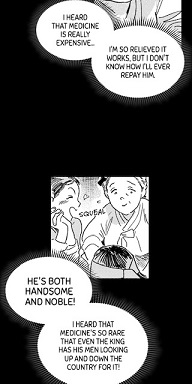 (chapter 11) Mojil’s mother sensed that the main character was the cause for the noble’s generosity. Thus she was thankful towards the main lead. Thereby she was encouraging the main lead to stay close to the young master.
 (chapter 12) He expected something from Soongap.
  (chapter 14) He wanted his own brother to surrender and give himself to him. The moment Pilgyeon had discovered that his brother was a homosexual, his love for his “brother” changed. And each time Soongap fetched the medicine, the latter was scared and tormented by the thought that today would be the day he would have to pay for the drug. Besides, because his lover’s sickness didn’t improve in the long term, Soongap wondered if the medicine was real or if it was not poison. The main lead was hurt to see how Mojil was slowly losing his sense. The uncertainty of the true nature of the medicine and the pressure from his brother were slowly eating away Soongap’s energy. He feared to be responsible for his lover’s death. As you can see, the real source of his hell was his brother’s obsession for him.
 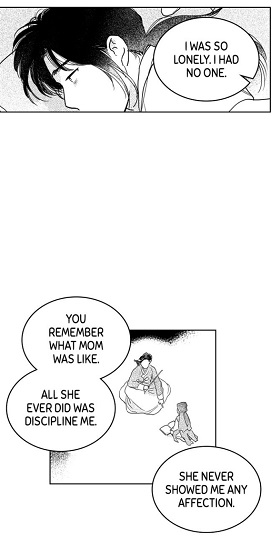 (chapter 51)
 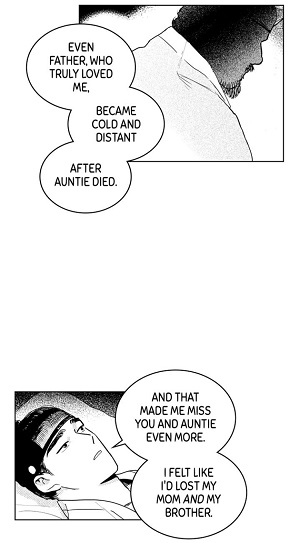 (chapter 51) He felt abandoned, he was missing warmth and love. And now you comprehend the brother’s obsession for Soongap. He will do anything to keep him by his side. He will be either a helping hand or a lover or a brother, as long as Soongap accepts him. He can not accept his rejection, for this never happened in the past. But by using every possible trick, he showed a terrible side of himself to Soongap. He was a ruthless hypocrite. This was truly perceptible after Mojil’s death. The mother requested a proper funeral.
 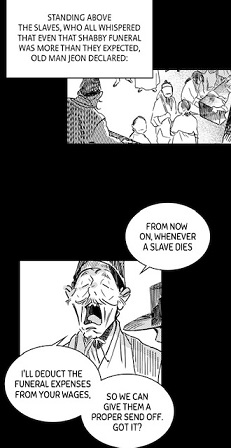 (chapter 23) Pilgyeon suggested to his adoptive father to organize a funeral for the poor slave, but to their surprise, the slaves had to pay for the expenses. Fake generosity. Strangely, no one from the staff complained about this. As time passed on, Soongap could perceive his brother’s ruthlessness and selfishness more and more. Therefore it is not surprising that the brother’s rejection and distance is perceived as hatred.
  (chapter 52) The younger master can not bear rejection, while the counterpart just wished to be “free”.
  (chapter 51)
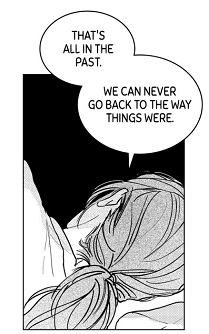 (chapter 51). The young master Pilgyeon wishes to relive his “childhood”, as in his eyes, this was the best time of his life. However, this was just an illusion, as neither Gwiduck nor his brother were truly happy. They were isolated, and Soongap could feel his father’s neglect and indifference. Back then, Soongap couldn’t reject his brother and reproach him for his invasion of privacy.
  or by taking the fall for the mistress’ crime. Due to his brother, the main character discovered that there’s nothing free in this world. This explicates why the young slave was mistrusting Bongchon in the beginning. His new master would do everything for him which was not normal at all. Consequently he imagined that the strong man would expect something in return. It took him a long time to see that his master and lover was a honest and selfless man. Bongchon stands in opposition to Pilgyeon.
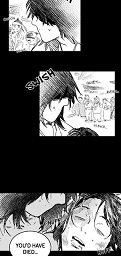 (chapter 1) Bongchon even had to get into debts in order to save the main lead’s life. Contrary to the brother, the strong man let the main lead to choose about his fate. He told him that he could even leave his mansion. He gave Soongap freedom, while the brother was trying to do the exact opposite: to entrap him in his world. Thus he failed terribly.
  (chapter 52) Even if he takes his body, he will never get his heart or soul. In this scene, Pilgyeon realized that if he kept in that direction, he would push Soongap to have suicidal thoughts again. This shows that wealth and power are ineffective, they can never stop someone from becoming suicidal. These values are nothing in front of death.
  (chapter 83), and Kim definitely stayed as little as possible. Yoon Seungho lived secluded from all the others. Recently, the author revealed that Yoon Seungho’s mother committed suicide because of her son’s suffering. This could only contribute to push the main lead to be suicidal as well. With the loss of his mother, he had no one left by his side.
  (chapter 87) The irony is that the patriarch is obliged to recognize the main lead, for the latter has become the head of the household. This explicates why he remains in the familial mansion. On the other hand, Soongap’s father totally “ignored” his son, when he met him again after his abandonment. He acted, as if they were not related.
  or we have this “memory“ from Kim.
 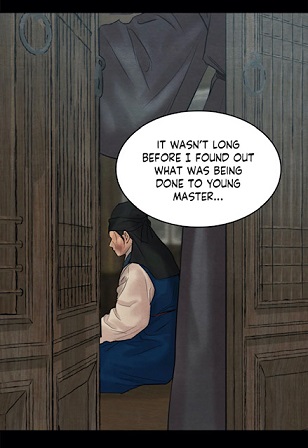 (Chapter 87) This contrast outlines that Yoon Seungho was indeed living more like a kisaeng. The good clothes were masking his real living conditions. Therefore the sponsor could be deceived. Despite his suffering, he smiled to his friend, the moment the latter opened the door.
  (chapter 83) He behaved similarly to Gwiduck. How could he refuse Lee Jihwa’s visit in the end? He was trapped in the barn anyway. The darkness around the eyes was visible, yet the childhood friend chose to ignore it. The proof for this interpretation is the presence of the drop of sweat.
 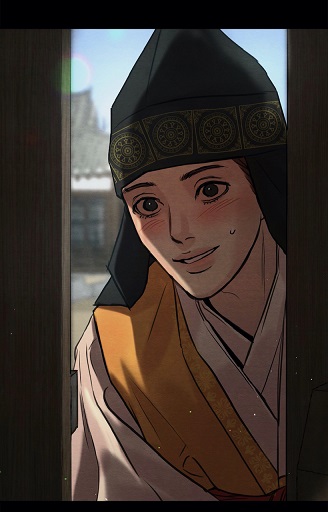 (Chapter 83) His discomfort indicates that he was definitely aware of the mistreatment. This means that he was in a totally different situation than Pilgyeon. First, he was older. Secondly, he had witnessed the first straw mat beating. Finally, he could see that his friend was not dressed according to his official status, while Gwiduck and her son lived in a certain comfort.
 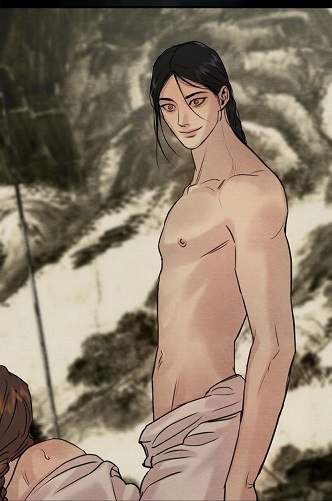 (Chapter 82) Because of Soongap’s suffering, I realized that the main lead must have been plagued the same way. The pressure and the uncertainty about his own fate (Would he have to serve tonight or not? and for how long?) must have been terrible. Yet, note that when the red-haired master entered the shed, he was bringing nothing with him: no food and no clothes. In other words, he did nothing to improve Yoon Seungho‘s living conditions. He appeared quite heartless in that scene. Thus I wondered why he didn’t help him. On the other hand, we shouldn‘t overlook one important aspect. Lee Jihwa was supposed to meet his friend in secret. No one should know about this. That‘s the reason why the childhood friend couldn‘t bring anything to his friend. In his mind, if he had brought something, people would have noticed it, and he could have been in trouble. He chose his own comfort over his friend. Thus the only thing he could do was visit his friend. Despite the loss of his status, Lee Jihwa was still willing to interact with him. That’s the reason why I believe that the childhood friend considered himself as a loyal friend. He was even willing to go to the shed, and even have sex there. In his mind, he would do anything for his friend, even lower himself. He would disobey his father, and trespass a propriety only to meet Yoon Seungho, who had been abandoned by everyone. I truly think, Lee Jihwa convinced himself that he was a compassionate friend. This explicates why he made such a reproach to the protagonist later.
  (chapter 57) However, such words implied that this was the main lead’s choice to be fooling around, while he was pretty aware that Yoon Seungho had been forced to have sex.
  (chapter 83) This image displays the friend’s knowledge and his lack of honesty. He knew the identity of the abuser, but he feigned ignorance. He closed his eyes to the truth, for he was well aware of his own guilt. But because he went to the shed regularly, he imagined that he had “redeemed” himself by his past betrayal. He had been forgiven.
 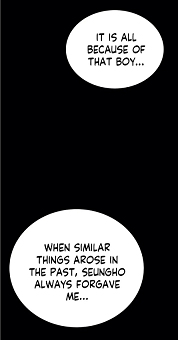 (chapter 59), yet the reality was that he never had. He had just repressed the abandonment and betrayal.
  (chapter 83) He didn’t want to get caught. He never asked his friend, if this wouldn’t bring him any trouble. In my eyes, his comment let transpire a certain selfishness. Finally, he didn’t question the main lead: “What are we going to do?” He just wondered about the destination, which gives us a clue that they were supposed to have sex.
  (chapter 67)
 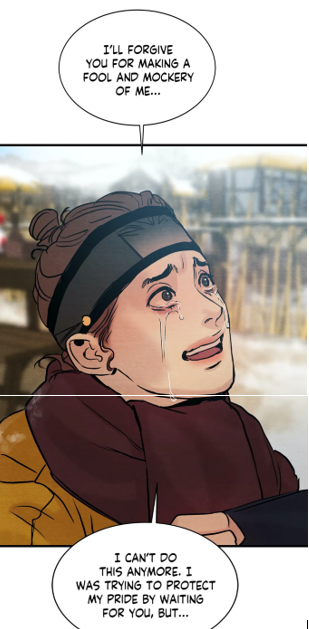 (chapter 57)
 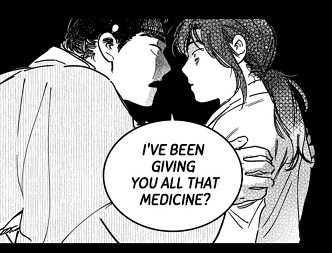 (chapter 14), but also pride over love. Therefore they had to play tricks to achieve their goal.
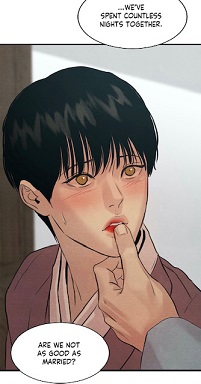 (chapter 78)
  (chapter 15) Both main leads gave their “wife” the liberty to choose their destiny.
 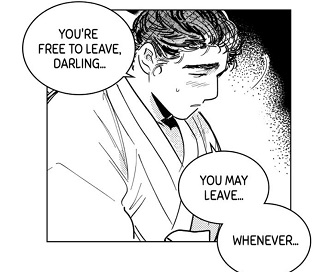 (chapter 14) They didn’t treat their partner as a “slave”, while the antagonists used tricks or force or their power to achieve their goal. Yet they never succeeded. The only thing they could obtain was to push their “loved one” to become suicidal. The love interest could never return their affection.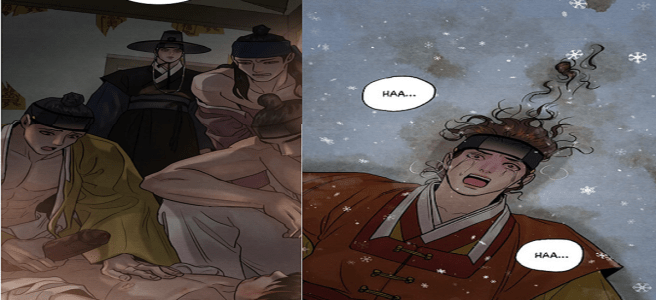
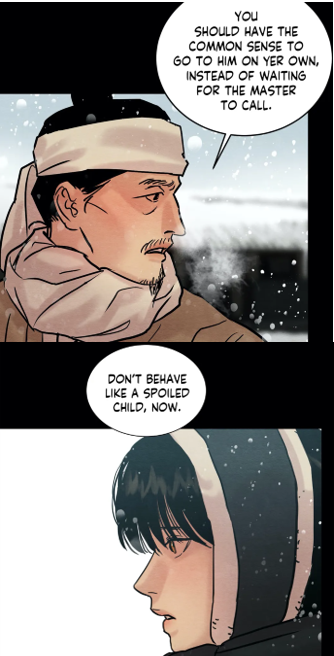 (chapter 52) He implied that he was behaving like a noble. This means that the valet was reminding the artist of his social status. Therefore it is not surprising that the low-born put back the white head-band. It was a reminder of his position in the mansion. On the other hand, if you pay attention to the domestic’s reprimand, you will detect the contradiction. He was encouraging the main lead to become proactive and visit the lord. However, by giving such an advice, Kim was misleading the painter, because a servant is not supposed to act on his own. He has to wait for his master’s order. And now, you comprehend why the valet could violate the main lead’s privacy in the past. He legitimated his trespassing by faking care and kindness. Therefore it is no coincidence that the artist chose during the same day to visit the lord’s bedchamber. He didn’t have a change of heart per se. He was just following the butler’s instructions. He was just a servant in the mansion, and he should act like Kim wanted him to behave: anticipate the lord’s desires. However, like pointed out before, a real servant is not supposed to think and act on his own. On the other hand, the reprimand from Kim had a positive effect, because for the first time, the artist was reminded that he should also pay attention to Yoon Seungho’s needs and wishes. Through the valet’s words, Baek Na-Kyum could realize that the noble was also a human before a lord. To sum up, he helped him to see the person Yoon Seungho behind his title. From that moment on, the low-born perceived Yoon Seungho as a man. Therefore it is not surprising that after witnessing the tongue kiss between Min and his lover, he started wondering about the motivation behind the noble’s behavior.
 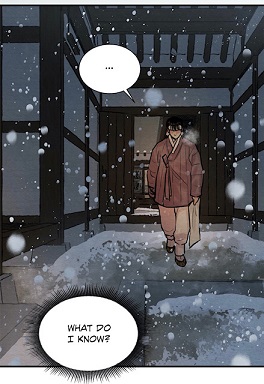 (chapter 52) He began to show an interest in his master. What kind of man is his lord? Who was he exactly?
 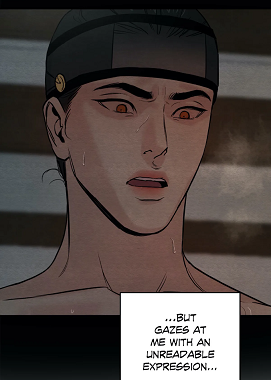 (chapter 52) But since the butler had insinuated with his reproach that the painter should anticipate the lord’s desires and needs, the former had the impression that it was just about to provide services and nothing more. He was his duty to serve the owner of the mansion. And now, you comprehend why the painter denied the main character’s affection.
 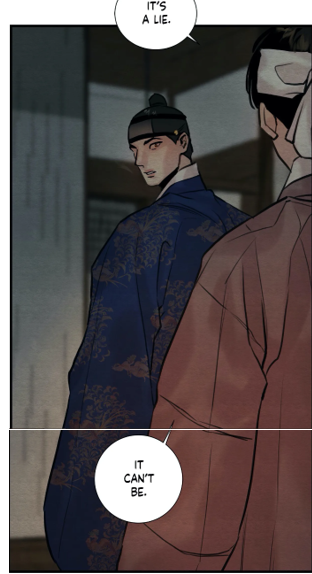 (chapter 54) He thought that the lord’s rescue was motivated by his pride and his duties. As a lord, it was his obligation to keep his staff under control and to ensure safety. Deok-Jae was usurping Yoon Seungho’s authority. He had no right to ask the painter to leave the mansion.
 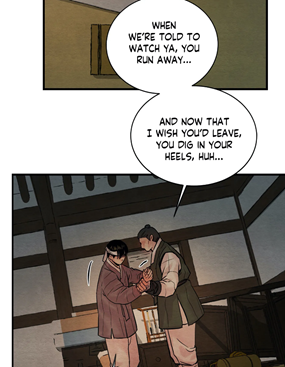 (chapter 53) As you can see, the servant perceived the artist’s attitude as a change of heart, whereas it was not right. The painter had long decided to remain in the mansion. Due to the butler’s reproach, he had been reminded that he was now a servant and as such belonged to the staff. Therefore he was bound to the main lead with his vow and as such to this household. Kim never realized that he had actually ruined his own scheme due to the contradiction of his manipulations. No wonder why Baek Na-Kyum was already loyal to Yoon Seungho. To sum up, the painter started seeing the main character not only as his real lord, but also as a man. Under this new light, I come to the conclusion that during that night, the painter had indeed a change of heart. He had truly accepted Yoon Seungho as his master. This explicates why Baek Na-Kyum didn’t get upset after the second sex marathon. It was the lord’s right to do whatever he wanted. Thus in the study, the artist perceived Deok-Jae’s bullying, Min’s kiss and insults as a violation of codex.
 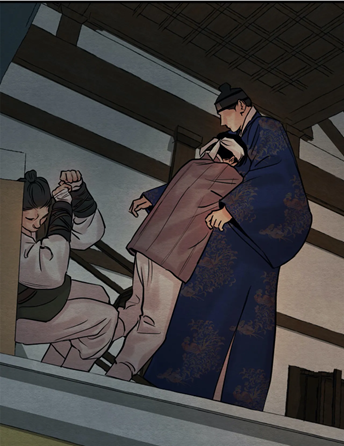 (Chapter 53) The lord was the lord and host, thus he deserved respect from his staff and guest. That’s the reason why the painter didn’t stop his master, when the latter punched Black Heart or simply followed the lord to the bedchamber. He had no right to object, for he was now a servant. And because he considered himself as a part of the staff, he felt obliged to protect Deok-Jae from the lord’s anger. He was acting as a “WE“. On the other hand, he had no right to interfere in the fight between Yoon Seungho and Min. He could only try to protect his lord’s honor by denying Yoon Seungho’s affection for him.
 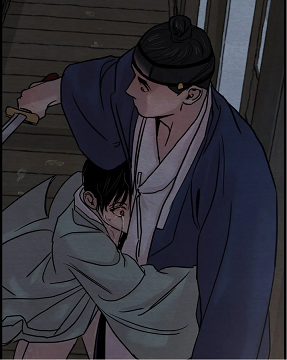 (chapter 27) But instinctively, the painter had sensed the main lead’s transformation. He would no longer use the sword. Since chapter 35, the artist has never seen the lord with the sword again, not even after the hunt in the third season.
  (chapter 84) Furthermore, he would rather use his hands.
  (chapter 92) To sum up, the artist never saw him carrying a weapon since season 1.
  (chapter 82) This means that Yoon Seungho’s bedchamber is not related to the sword. So he has never seen the lord wiping his weapon either.
  (chapter 1) For the painter, Yoon Seungho’s bedchamber is associated to painting, sex and books. Nothing more.
 (chapter 52) I have always compared the main lead to a dormant volcano and the pipe was a sign that the lord was boiling in the inside.
  (chapter 52) Another important aspect is that the lord never threatened the nobles with a sword later, though he got mad, when he saw the painter getting touched by other men.
  (chapter 54) He threw a bottle and asked them to leave, but he didn’t evict them like the noble with the mole
 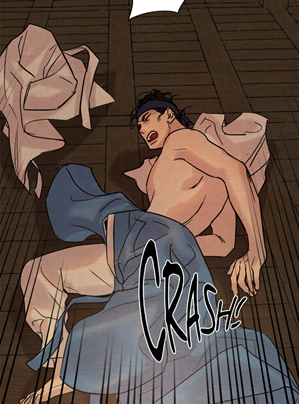 (chapter 8) and Lee Jihwa in episode 18. They were not grabbed by the topknot and dragged through the courtyard.
 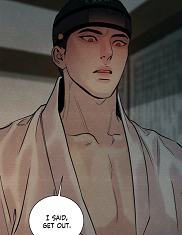 (chapter 54) He simply told them to leave and the nobles followed his request.
 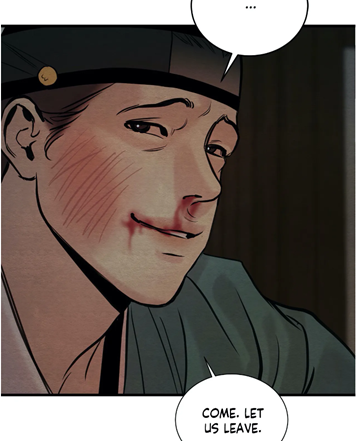 (chapter 54) The only thing he did towards nobles was to humiliate them, but that was it. Besides, these incidents were never leaked to the outside world.
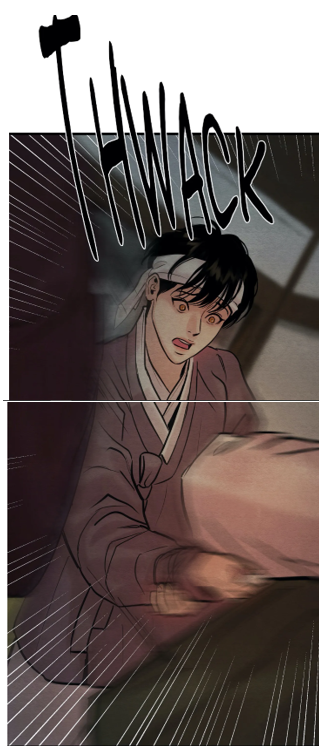 (chapter 53), then Black Heart is punched several times
  (chapter 54) But note that Min doesn’t lose a tooth like Deok-Jae. The next morning, Min’s face is not so bruised to the point that he is not recognizable.
  (chapter 56) From my point of view, the painter taught an important lesson to Yoon Seungho during that night:
 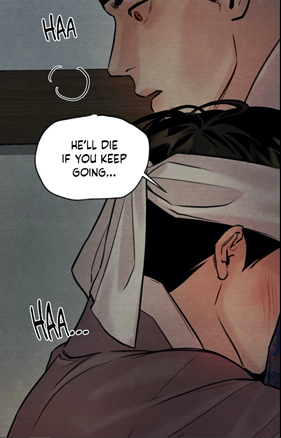 (chapter 53) He reminded him that life is precious. Thus I consider this night as another turning point. The lord had a real change of heart, and not just a fake one like in this moment:
  (chapter 52) Here, he was simply following social norms and as such behaving like Lee Jihwa. This reveals that the main lead had no faith and as such no true conviction. As a good host, he is supposed to provide his guests with the best care and attention. Since Min was expressing his wish to taste the painter, the noble was pressured to give in. The manhwaphiles can now detect the parallels between chapter 52 and 100.
 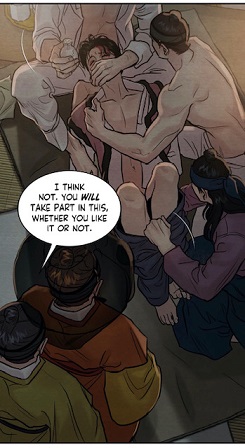 (chapter 100) The use of social norms and peer pressure to achieve his goal. But why did he not react like in the first season, when he threw out the noble with the mole? It is because Min had not given him an order.
  (chapter 52) As you can see, Min also played with social norms. He reminded Yoon Seungho of his duties as a lord and host. Striking is that he criticized the main lead for being weak. In the past, he used to act differently.
  (chapter 53) However, all the incidents during that night forced him to admit that he was wrong. How? IT is because he saw himself in the painter.
 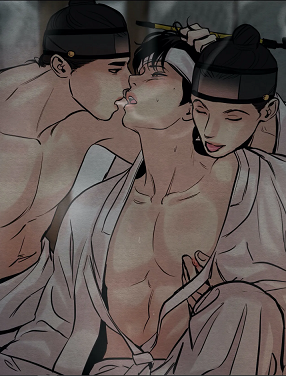 (chapter 54) He wanted to be seen as a human and man, but since his youth, he had been denied to live like a human. Through the reflection in the painter’s face, he rediscovered his humanity. Humanity is a synonym for benevolence. Therefore it is not surprising that the lord became a human, the moment he had accepted his heart. For he was a human, he should treasure life. This is no coincidence that the lord confessed the next morning. But because he had behaved like a beast during that night, he imagined that the painter was horrified by his violent behavior. He had treated him like an object and not like a human. Thus he anticipated that the painter would run away after his first love confession full of “contempt and pain”. However, from my point of view, he never realized that Baek Na-Kyum already viewed him as his master and as a human. He was definitely upset, when Yoon Seungho had chosen to bring him to the bedchamber and offered him as a plaything to his guests, but he didn’t throw some tantrum for one simple reason: he was just a servant in the household. It was not his right to criticize the lord. Under this new light, you comprehend the painter’s words in the bedchamber:
  (chapter 55) He had done something wrong from a moral point of view, but he had not violated social norms. Besides, the painter had not seen his violent outburst as a huge abnormality, he had protected him from Deok-Jae. Then he had defended his honor, when Min had insulted him. As a conclusion, the lord found his true heart during that night, and learned that life was precious. But Yoon Seungho’s lessons were not over. He needs to learn that even a bullying domestic didn’t deserve to die. Notice that he showed no concern for the deceased person.
 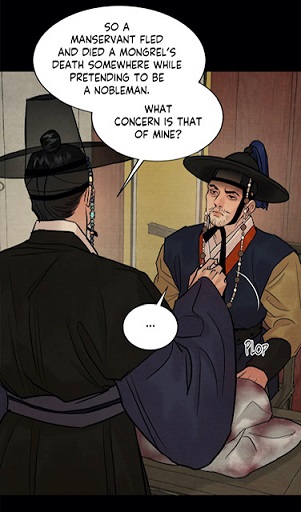 (chapter 98) This is none of his business. Min has a similar mind-set. What should he feel concerned about the death of a peasant?
  (chapter 99)
 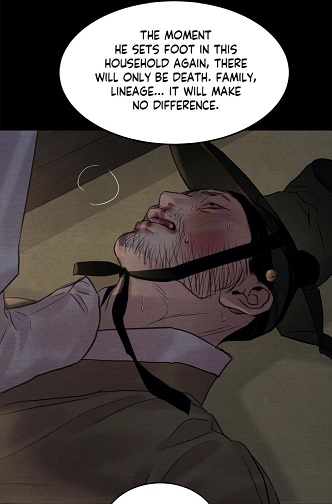 (chapter 82) He stated that he would kill his father. But none of this happened. Therefore, I come to the following conclusion. Yoon Seungho won’t use the sword in the shrine to kill people.
  (chapter 101) The worst what could happen is that he cuts off their topknots. But I have to admit that I am more than ever convinced that he won’t do anything. I am not expecting that he will punch the nobles there, for he won’t have much time. His lover’s life looks in danger. No, like I already mentioned many times, he will take away the painter and bring him quickly to the physician. By acting like that, he will show his strength to the other nobles. He doesn’t fear people’s gaze.
 (chapter 52) One might say that he couldn’t simply wait. Yet I believe that he wanted to make sure that the host had no change of heart, once alone with the artist. However, the moment he saw the painter embrace the lord, he could only get envious. He couldn’t resist the urge to kiss his lips.
  (chapter 53) Yet, he had to pay a huge price for this. He got punched.
  (chapter 53) Thus I have the impression that Black Heart must have resented the painter for his wounds and humiliation. Notice that he bragged to his partners in crime about the kiss
  (chapter 101) Nevertheless, he also deceived his peers, because he was only beaten half to death, after mocking the painter and such his host. He was omitting to his partners in crime the insult towards the protagonist. And this shows that Min had never forgotten this incident. Naturally, he resented more the main lead, yet he definitely blamed the painter. Therefore it is not surprising that Min was actually quite rough with Baek Na-Kyum.
  (chapter 101) It was, as if he was paying back the artist for his past pain. However, what caught my attention is that he doesn’t show any pressing urge to taste the artist which stands in opposition to his past behavior. It was, as if he had a change of heart. It looked like his obsession for Baek Na-Kyum was quite superficial. He let his friends to enjoy the artist first, hence we could say that he acted as the pimp. Why? My first theory was that he was still calculating about Yoon Seungho’s arrival, though I am more and more inclined to think that this was more the butler’s plan, and Min was left in the dark. Remember my interpretation: the purpose is to prove that the main lead is a lunatic. And if he killed noblemen, he would get arrested immediately. And we know for sure that the butler resents nobles. From my point of view, Min was expecting that time would be in his favor. He imagined that he had time. However, because the painter resisted and fought back
 (chapter 101), Min had to pay more attention to Baek Na-Kyum, thus he no longer paid attention to the door which he had left open.
  (chapter 101) But there’s one thing that he is not expecting: the painter might die! How so? It is because in the first season, Min had also been left in the dark about the artist’s poor physical condition. He was never informed that the artist had almost lost his life. This explains why he made such a suggestion:
  (chapter 33) He has always been taught that there exists a difference between low-born and noble, therefore he came to view commoners’ life as less precious. He never saw them as humans. They were first commoners. Their life is not fragile either, for there are much more commoners than nobles. Yes, I have the impression that Black Heart is receiving his lesson. Commoners are humans too, and not just playthings. What if Baek Na-Kyum dies? He will never be able to taste him.
 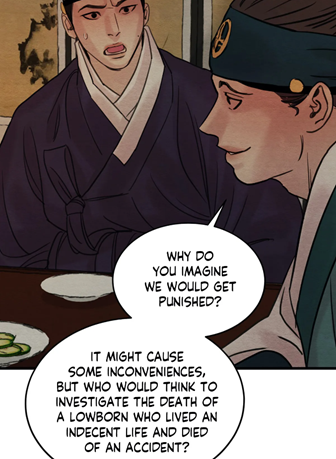 (chapter 43) The death of a commoner has to look like an accident, but in a shrine, this is no accident. Notice that he lied to Jihwa in front of the scholar’s house.
 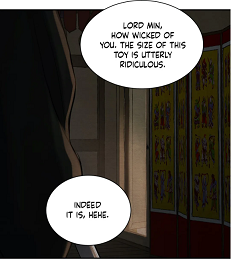 (chapter 101) What we are witnessing is that the peasant’s life has become very precious, even to Min. He saw this whole staging as a huge prank, but now he is forced to face reality. This is no longer fun, because the artist is no longer reacting.
  (chapter 33) And what had happened during that episode? Baek Na-Kyum was seriously ill, thus the doctor was fetched. And remember what the physician had said:
 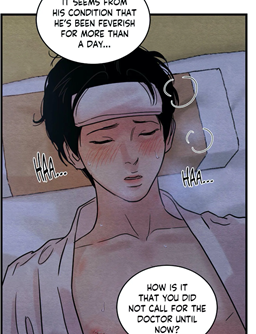 (chapter 33) For the first time, Min and his friends will learn to value a peasant’s life, because if he dies, they are all in big trouble. This time, Yoon Seungho can no longer be blamed for the wrecked state of the painter contrary to chapter 66. The noble won’t be suspected, for he created such a ruckus in the gibang and town about his lover’s disappearance that his death would get noticed immediately. From my point of view, Yoon Seungho will carry himself the painter to the doctor, he knows where the office is. And now, you are wondering that this doesn’t sound like a harsh punishment. But don’t forget that Min brought the scholar’s glasses to the shrine. Either he never questioned the origins of the glasses and never investigated if Jung In-Hun was alive. Or he discovered the truth, but it didn’t matter to him. However, now there are the glasses of the scholar in the shrine. Min was just so obsessed with Baek Na-Kyum that he viewed everything as a prank. Besides, we have to envision that if the learned sir was alive or not, it was actually none of this concern. He was just a tool for his own entertainment. Furthermore, he used a body from a commoner revealing his lack of respect for humans.
 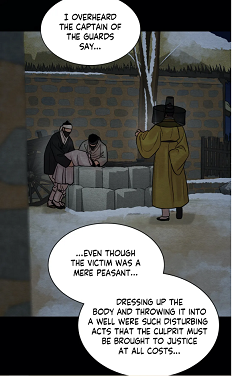 (chapter 101)
 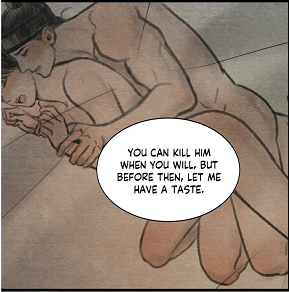 (chapter 56) From that moment on he could not longer give up on tasting the painter. Then in the third season, he wished to keep the artist by his side.
 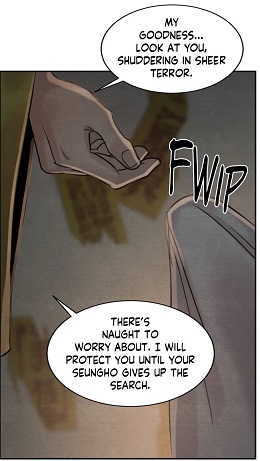 (chapter 99) That’s the reason why he was no longer in rush to have sex with Baek Na-Kyum. As time passed on, the Joker gave up on the painter’s assassination. So he is getting reformed! Surprising, right? And the painter’s sickness will be a wake-up call for him!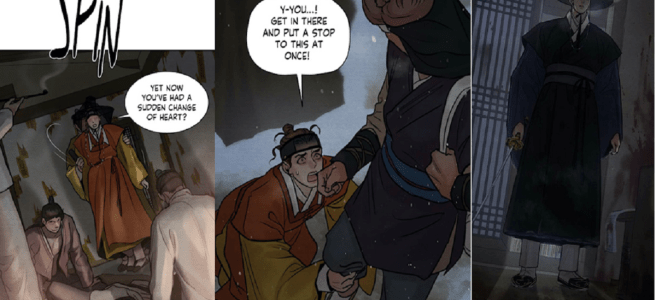
 Bebebisous33s' analyses in K-Dramaland and Manhwas