

This is where you can read the manhwa. https://www.lezhinus.com/en/comic/pawn But be aware that this manhwa is a mature Yaoi, which means, it is about homosexuality with explicit scenes. Besides, this manhwa is categorized as HARDCORE: 🔞 Here is the link, if you are interested in more analyses about this manhwa and others https://bebebisous33analyses.com/2021/06/06/table-of-contents-of-analyzed-mentioned-manhwas/
Feel free to make some donations/sponsoring: Ko-fi.com/bebebisous33 That way, you can support me with “coffee” so that I have the energy to keep examining manhwas. It would also cover my expenses for the blog.
In the second part Do Seong-Rok’s personality will be in the center of the analysis. Therefore it is necessary to study his relationship with the other characters, especially with Jeon Hee-Seong and Lee Je-Oh. Furthermore, I will compare the red-haired man’s behavior to Lee Je-Oh’s, because through the contrast the manhwaphiles can get more details about the murderer’s character. Moreover, I will give a possible explanation why the man with dyed hair saved Lee Je-Oh in the end. Let’s not forget the synopsis: “Why he rescued Je-oh is unclear, but a slick-talking manwhore was definitely not part of anyone’s plan.” Like it is mentioned, by letting the prostitute survive, Do Seong-Rok affected the game of Janggi, which neither Officer Ahn nor Jeon Hee Seong anticipated. The young man could only view the killer as his savior and feel indebted. Consequently, both protagonists got closer to the point that they became first allies and finally real sex partners.
1. The introduction of Do Seong-Rok
What caught my attention is the way Evy introduced Do Seong-Rok. Note that he is slowly inserted. First, we only see his foot, then his leg and hand. 
 This is relevant, because it already outlines his mysterious nature. This is not just a question of anonymity. Notice that during the whole introduction, he barely talks so that the readers can’t perceive his thoughts. Moreover, he only speaks on two occasions. First, he calls Ms. Jeon and later he describes the actual situation: he has removed the first target:
  (chapter 1) Therefore this is no coincidence that the reason why the murderer didn’t eliminate the prostitute is obscure. In other words, the main figure is an enigma per se, and the readers are asked to discern his personality, whereas Lee Je-Oh’s character is so easily exposed.
Since the former has no face and no identity in the beginning, the manhwaphiles are wondering not only about the situation, but also about the person with gloves and his motivation. And observe that the author showed first his back (chapter 1), even before unveiling his face. It was, as if he was a ghost and he only materializes the moment (chapter 1), he uses the cellphone to call his lover, the mastermind of this murder. This explains why his face is only revealed, when he uses the pronoun “I”.
  (chapter 1) That’s the moment he starts existing. He only lives, when he is in contact with Ms. Jeon. Yet through his words, the readers can detect the nature of their relationship. Ms. Jeon is his superior and mentor (he calls her “teacher”/Seonsangnim/ in the Korean version), whereas in the killer’s mind she is his lover.
2. The true nature of Jeon Hee-Seong’s relationship with the killer
But this is only unveiled much later, when the manhwaphiles see a letter which ends with a love confession 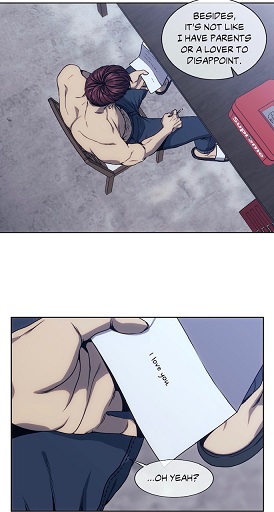 (chapter 8) But if you pay attention, you’ll detect the emptiness of this declaration of affection. First, there’s no name attached to the “I love you”. It is so anonymous. Furthermore, the love confession is at the bottom of the letter, totally separated from the content of the letter. The first scene in chapter 1 already illustrated the gap between these two characters, for Do Seong-Rok was speaking to her formally. The absence of the informal speech is a clue that they are not intimate and close in truth. And now, if you combine this with the “love letter”, you can only come to the conclusion that Ms. Jeon is the one keeping the protagonist at a certain distance. All this truly exposes Jeon Hee-Seong’s true thoughts. She’s using Do Seong-Rok’s naivety and innocence. With a few words and a letter, she could manipulate the protagonist to commit assassinations. What caught my attention is that the main lead was incapable to see through her lies. In chapter 6,
 she stated that she was willing to dirty her hands in order to survive, yet the next minute she asked her lover if he would kill for her sake.
 (chapter 6) This displays her hypocrisy. She is not willing to kill in reality and prefers someone else to take the fall. And this contradiction truly exposes her talent in manipulation, but also Do Seong-Rok’s lack of discernment. Because she is his superior, it explicates why the red-haired man is always the one calling her first (chapter 1 and 6). She only contacted him, when she realized the kidnapping of the male prostitute, exposing that she has the upper hand in their relationship, whereas the killer would like to get her support.
And now you comprehend why she compared him to a lamb, when they first met.  (chapter 16) Right from the start, she could notice his inexperience with women and in life as well. She portrayed him as naïve and maladroit.
  (chapter 16) In that scene, she acted as a righteous and kind person which gave a false first impression to the future assassin. She made sure that he wouldn’t be caught with a prostitute, for he was still a soldier. In other words, she behaved like his savior. She was full of integrity despite her job. Consequently, the readers can grasp why the main lead got attached to her. Since she had showed respect towards him and had helped him, he felt gratitude. At the same time, she was able to impress the young soldier due to her social competences and discernment. She could judge him correctly: he had been living in a bubble so far, therefore he was lacking experiences (“too much discipline”). Besides, he got so mesmerized by her.
  (chapter 16) This panel exposes the man’s genuineness and purity, as he revealed his true thoughts so easily. I would say that he was easy to read like an open book. So he was seduced by her intelligence and her beautiful body. From my point of view, she wooed him by taking his side in this incident despite her criticisms. Let’s not forget that his colleagues not only were looking down on him, when he refused to follow them,
  (chapter 16), but they also left him behind. Then, when Jeon Hee-Jeong put the card in his hand, she gave him the impression that he had the freedom to come back to her. He had a place to return, when he had finished his mandatory service.
 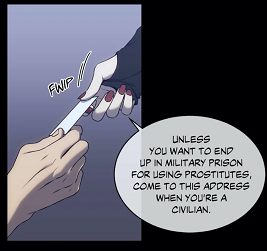 (chapter 16) In other words, she didn’t abandon him, though she left him behind too. And this is important in my opinion, for it explains why the main lead chose to seek her company. She was the first person who accepted him with his flaws, but she didn’t truly leave his side. And this leads me to the following conclusion: Do Seong-Rok has abandonment issues.
3. Do Seong-Rok’s past
Exactly like Lee Je-Oh, he has been abandoned by his parents.  (chapter 12) However, the father left a letter behind announcing that he would come back at some point, but it never happened. What caught my attention in this picture is the person reading the letter left by the relative. The house looks well-maintained and the woman is wearing an apron. Yet, she seems so cold and unfriendly due to the absence of a smile and the eyes. In the first version, I thought that he had not been abandoned in an orphanage, but he was confided to a particular person. However, it turned out to be wrong. The reality is that he grew up in an orphanage
 (chapter 27), yet the persons working there could never give what he truly wished: a family.
  This signifies that I had perceived the person’s attitude correctly. The personal could never give the affection and warmth he had been longing. On the other hand, From my perspective, Do Seong-Rok grew up in a family from the middle-class. This signifies that he never had to face financial struggles, on the other hand the absence of eyes in the woman exposes her displeasure. So though he received a proper education, he must have felt as a burden as well. This would explain why Do Seong-Rok lived in a bubble for a long time. Abandoned by his biological parent, he didn’t desire to annoy more people, especially the family who took him in. That’s why he felt the need to abide by laws and to be very strict. He didn’t want to stand out. For him, assimilation was a mean to get acceptance. Therefore you understand why Do Seong-Rok is a lamb, for “conformity” was like a safety net. Consequently, Lee Je-Oh and the murderer have both something in common despite the social gap: isolation, lack of warmth and acceptance. On the other hand, the huge difference in their social status explains why Do Seong-Rok is so inexperienced and naïve. He never had to struggle to survive. Thus this explicates why Lee Je-Oh is so street-smart, while the other is so clumsy. By abiding to laws, he didn’t have to use his brain properly. Furthermore, I believe that due to the abandonment he kept his distance with people… out of fear that he might appear as a burden. That’s the reason why he had no girlfriend, until he met the prostitute. Besides, it is also possible that in his childhood he could only meddle with people with a similar background, hence he never had to encounter people with terrible fates. But by entering the army, it changed, as he was forced to interact with people from other social classes and with a different mindset. This explains why Do Seong-Rok entered the red-district for the first time, when he was 22 years old.
But let’s return our attention to the conversation between the former prostitute and the future assassin. Jeon Hee-Seong created so many positive reactions in the main lead that he could only be fascinated by her. She acted the opposite to the woman in the picture with the letter (chapter 12) versus (chapter 16): smiling, willing to help and to talk to him. She was like a surrogate mother in my opinion. Their first meeting played a huge role and exposes the dynamic between these two characters. Since their initial meeting, the young man had the impression that she was a decent person whose intelligence and sensibility couldn’t shine due to her poor circumstances. That’s why he viewed her as a mentor. She knew much more about life than him. Striking is that she compared him to a lost lamb. This animal is the symbol for innocence, sociability, but also conformity (due to Panurge’s sheep) and sacrifice (the lamb embodies Jesus Christ). And if you pay attention to chapter 16, you’ll notice that Do Seong-Rok only entered the red-light district, because he was following his fellows. 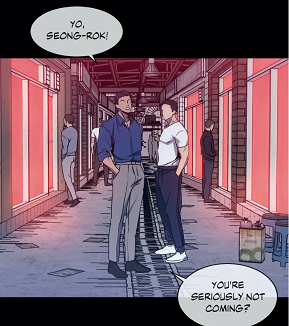 This truly outlines a certain compliance and obedience. On the other hand, once arrived there, he realized the purpose of their visit. Hence he refused to do the same, revealing his integrity. Thus it is no surprise that he values monogamy so much. Since he had his first sexual experience with Jeon Hee-Seong, he could only judge her as his companion and lover. Besides, when they met for the second time, she made him feel special. She was dedicating her free time to him.
 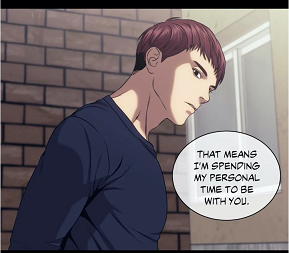 (chapter 16) Therefore it is not astonishing that Lee Je-Oh considers Do Seong-Rok as a dog. The animal symbolizes loyalty, unconditional love and protection. When I read the prostitute’s comment in this panel
 (chapter 9), I couldn’t restrain myself connecting it to Hachiko, the dog who continued to wait at the train station for over nine years for its master, though the latter had already died. And now, I would like to combine this thought with my interpretation from the first chapter. The man appeared as a ghost and only started existing, the moment he was talking to the former prostitute. Waiting is often perceived as the contrary to life. Why? While you are waiting, you are not able to make any new experience. And this reinforces my perception: the killer was not truly living while waiting for his lover. The vengeful ghost gets a voice, the moment the first task in Jeon Hee-Seong’s revenge is completed. Thus I come to the first conclusion that Do Seong-Rok’s personality is strongly attached to the ex-prostitute. In the beginning, he only speaks and acts according to her wishes. In other words, he is her pawn and puppet, which is even underlined by his words. In the crime scene, he barely talks, he doesn’t express his thoughts and emotions. Everything is revolving about her instructions.
Secondly, the manhwalovers can observe the parallels between the two introductions of the two protagonists. Both are facing a corpse (Lee Soon Cheol and a goldfish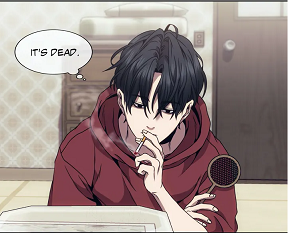 ) and both characters have a similar reaction. They are neither shocked nor scared. They remain calm and indifferent. Yet what is more surprising is that in the two situations, the author let us see the corpse through their eyes.
  This is what Do Seong-Rok is seeing, when he looks at his victim, while the second panel represents the perception from the prostitute, when he discovers the dead goldfish.
  Striking is that Lee Je-Oh can’t help himself making a comment in his head, while watching the floating corpse. This is important, as it reveals his talkativeness. This explicates why we get so much information about Lee Je-Oh in the first chapter. This exposes his need of communication. The whole first episode unveils his inner thoughts and emotions. And this stands in contradiction to the serial killer. The latter doesn’t express any own thought and emotion at all. I would even say that he is not even thinking at all. Once he has put the pawn in Lee Soon Cheol’s hand, he calls his mistress in order to announce the success of the killing. It was, as if he was acting like a robot, since he only talks, if it is necessary. Moreover, his lack of empathy and coldness is particularly palpable, when he uses the pronoun “it” for the victim Lee Soon Cheol. With “it”, the murderer externalizes his view about the sufferer. He is no human, rather an object or an animal, especially if the manhwaphiles recalls Lee Je-Oh’s remark: “It’s dead”. The latter was referring to the goldfish. This pronoun “it” exposes the killer’s mentality. He doesn’t consider his action as a wrongdoing, the victim was definitely no human due to his past actions. But don’t get me wrong, the assassin is not a psychopath or a man without a conscience and heart. That’s why he didn’t kill Je-Oh, though he had planned to remove him at some point. So now, it is time to elaborate my theory about his reason for sparing the male prostitute. First, the snake was not aware of the real connection between Ma Jong-Seok and Lee Je-Oh. She only thought, the latter was just a worker
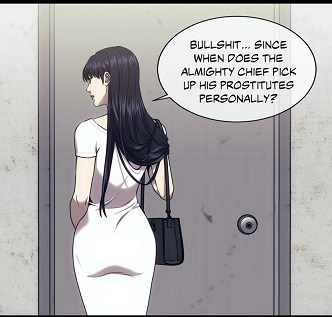 (chapter 16), while in reality the usurer had some feelings for him. He needed to ensure that Je-Oh would remain by his side. That’s why the young man was constantly brought to the clients and his minions were asked to keep an eye on him. Because of this mistake, she never gave any instruction about the male prostitute. Consequently Do Seong-Rok had no idea how to deal with him. Simultaneously, when he kept an eye on him, he was reminded of Jeon Hee-Seong’s fate. He could only pity the male whore, hence he was reluctant to kill him.
  (chapter 1) That’s the reason why there’s an interrogation point in the picture. This explicates too why he murdered the minions in the prostitute’s absence. However, remember how the protagonist had yelled at Do Seong-Rok, imagining that the person in the car was working for Chief. This meant that the male prostitute had noticed his presence. That’s how the red-haired man noticed that the male prostitute represented a source of threat. Hence he chose to remove him. So he entered his flat and waited for his arrival, but what he didn’t expect is Ma Jong-Seok’s sudden visit. Furthermore, when he approached them, he saw that Lee Je-Oh was smiling and waiting for his entrance.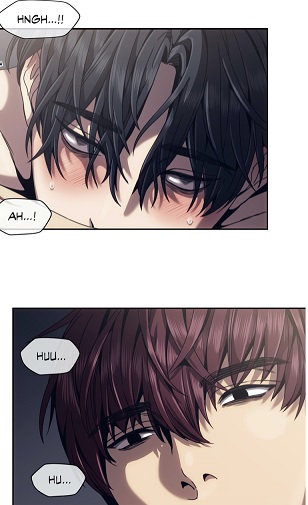
 (chapter 2) In other words, Lee Je-Oh could have decided to call the cops and report an intruder before entering his home, but he never did. In my eyes, all this contributed to confuse the killer. Somehow he realized that the prostitute had been helping him. Therefore he didn’t kill them in the flat. Since they were together, he had to kidnap them together. But as you can see, Do Seong-Rok had a weak spot for the main lead, but he was definitely less important than his lover Jeon Hee Seong. That’s why the main lead is not allowed to touch her belongings.
The killer with a heart felt the murder of the guard justified and this is also confirmed in chapter 2, when the male prostitute considers his death as retribution for his bad behavior. 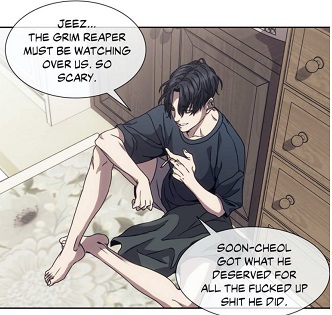 According to the belief of the red-haired man, he is removing the persons responsible for Jeon Hee-Seong’s misery. Since police didn’t protect her, while she was abused
 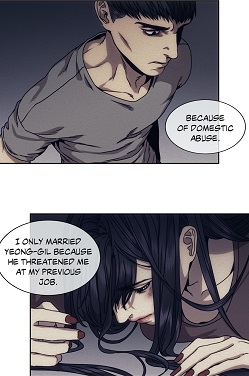 (chapter 9) and no one listened to her side of the story, he feels entitled to get rid of them. That’s why in chapter 3, Do Seong-Rok got so upset with Ma Jong-Seok’s abnegation.
 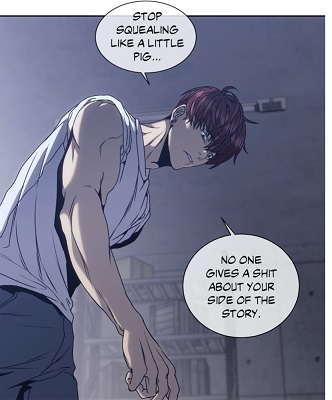 In my eyes, his words must have triggered Do Seong-Rok’s memories concerning his girlfriend. The former prostitute made sure to portray her husband, the chief and the pimp as dark as possible, while she made herself appear as pure and innocent as possible. She was forced to marry Choi Yeong-Gil, yet the naive lamb couldn’t detect her lies. Let’s not forget that during their first meeting, she acted as the prostitute’s superior and chased away her minion. So she was no longer a simple victim, she was reinforcing the system of exploitation. She was already higher in the hierarchy. Secondly, like I explained in the previous essay, she was already possessing a parlor, when he husband got killed. She ensured to trigger negative emotions in the young man so that the latter would feel the need to kill her so-called oppressors.
 (chapter 16) That’s why I believe that Koo Jeong Mo is correct about his assessment of the former prostitute.
  (chapter 11) She is like the snake in the Bible, hence she is wearing a black dress with a red bra (chapter 16) or a red dress with a black bra (chapter 6). These colors are not random: they are linked to evil, blood and death. She seduced the innocent and pure Do Seong-Rok to sin, a new version of the original sin. My avid readers are already aware of the signification of the Fall of Man [read the essay A new version of Fall of man https://bebebisous33analyses.wordpress.com/2020/07/19/painter-of-the-night-a-new-adaptation-of-fall-of-man/]. Eating the fruit from the tree of knowledge is a metaphor for the discovery for sex and sexuality. Hence the main lead loses his virginity with the prostitute.
  (chapter 16) Through her, the red-haired man discovers real life and as such pain. The manhwaworms should remember that after the expulsion from Eden, Eva and Adam discovered pain and death. And that’s exactly what is happening in the manhwa, though in my opinion Do Seong-Rok is a combination of Adam and Cain. Let’s not forget that Eva’s son killed his brother out of jealousy and resent. But since the snake views the young man as a lamb, this signifies that she has already planned to sacrifice him for her own interests. That’s why she tells officer Ahn that she has no real relationship to the murderer.
  (chapter 11) He is just her tool to achieve her goals: getting revenge but also getting powerful and wealthy. That’s why she didn’t give him a proper instruction how to get rid of the targets. Due to Do Seong-Rok’s lack of experience, Lee Je-Oh could notice the killer’s presence in the end. The latter has never been a schemer and a real strategist.
 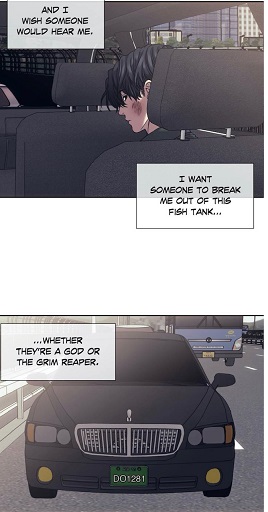 (chapter 2) The reason for his mistakes is simple: he was an idealist lulled in an illusion, hypnotized by Ms. Jeon’s words. That’s why he had a nightmare
 (chapter 6), where he was slowly recognizing the true nature of her words. The nightmare was slowly bringing him back to reality making him recognize the true nature of his terrible actions. My explication is the following. He lived in an illusion, until he interacted with Lee Je-Oh. The latter represents reality and its real ugliness, while the former prostitute is viewed more like a goddess… she is an illusion. Hence the man with dyed hair treasured her belongings like sacred prizes. Furthermore, the connection between reality and the male prostitute is particularly perceptible in this image:
 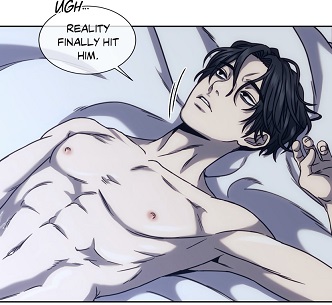 (chapter 8) Besides, let’s not forget that after the nightmare, the protagonist gave a honest portrait of Do Seong-Rok. He is a sensitive murderer .
 (chapter 6). The black-haired man’s role is important, as he forces his ally to question the nature of his relationship with his girlfriend.
  (chapter 10) In chapter 18, he made him realize that he was now cheating on her and as such was no longer faithful.
  The longer Lee Je-Oh remained by his side, the more disillusioned Do Seong-Rok got about Ms. Jeon’s true nature. This is not surprising that at some point the assassin is no longer blindly trusting his goddess.
But this doesn’t mean that Do Seong-Rok has no redeeming qualities at all. He is also teaching the prostitute to value loyalty, trust and respect. Because of his blind trust and his weak heart, the black-haired man imagined that he was definitely superior to the killer due to his scheming nature. However, by playing a trick, the main lead got punished and was faced with reality too: he could get killed in the end.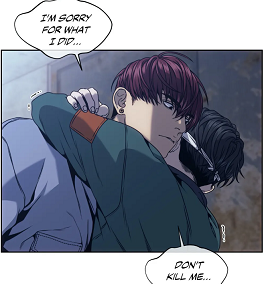 In other words, the murderer taught his ally to respect him too. Despite their quarrel, their trust didn’t get ruined. From my point, Lee Je-Oh will become faithful despite his past and job. Why? It is because of these words: (chapter 9) If he has a lover, then he will change his behavior. Therefore I believe that Do Seong-Rok will make the male prostitute discover that real love and selflessness still exist and are no chimera.
Since the male prostitute man embodies reality, this signifies that he forces the main lead to judge sexuality differently. He had a very romantic perception of sex and sexuality: heterosexuality and monogamy were the norms. Remember what I wrote above. He had internalized social norms in order to blend in the crowd and get acceptance. That’s why he had sex with a woman very late. But in the flat, he observes two men copulating, and slowly he gets attracted to Lee Je-Oh. This is not surprising that at some point he confuses both persons. In my opinion, this panel is important, because it explains the killer’s issues. On the one hand, he is reminded of his infidelity. Secondly, it made Do Seong-Rok slowly realize that the blush was not a sign for love, but simply for sexual arousal. He had imagined that she was in love with him with her reactions and words. But Lee Je-Oh as a mirror let him see the truth. He just had a sexual relationship with her in reality. So far, he had never questioned his own sexuality and had just followed the flow. There’s no ambiguity that Jeon Hee-Seong doesn’t envision that her pawn will prefer the male prostitute over her. She has no clue that he has already distanced himself from her. The beginning of their alienation was visible with the text containing a lie
  (chapter 8) and she is not even imagining that he has found an ally and is disobeying her words. She is so confident about her seductive skills and her beauty. This explains why Do Seong-Rok’s sexuality is gradually changing, though he tried to deny pleasure in the beginning. On the other side, since the prostitute has associated sex with power and violence, this is no coincidence that the killer feels aroused while strangling Ma Jong-Seok.
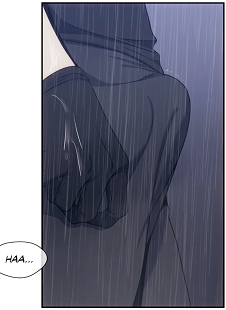 Slowly, he is under the influence of Lee Je-Oh.
Striking is that in the manhwa, the killer is viewed either as a lamb, or as a dog, or as a god and finally as a grim reaper. What is he really? He is no god, for he makes mistakes and didn’t truly save the prostitute. 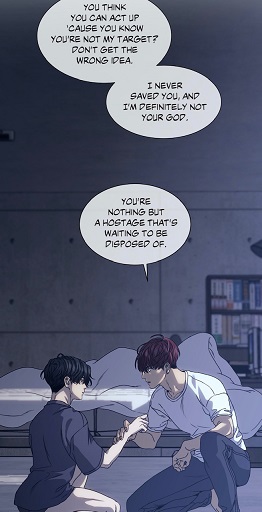 (chapter For the snake, Do Seong-Rok was a lamb and her cannon. As for the dog, I find it very fascinating that Lee Je-Oh viewed himself as a dog.
 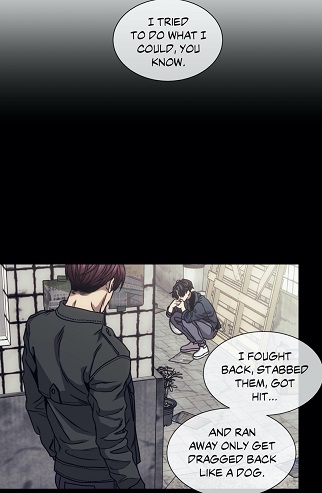 This shows their affinities in the end. They have something in common: both were abandoned and had no real home. Hence they lived somehow in seclusion. While the one became an outlaw (prostitution as a minor, stole a toy, stabbed Ma Jong-Seok), the other was living as a perfect citizen, following laws so that he wouldn’t get noticed and rejected. Finally, both have a conscience in the sense that they have a certain sense of justice. Both were and are seeking for a companion, both desire to feel needed and important. That’s why Do Seong-Rok got convinced to commit crimes. He thought, he could remain by her side.. he wanted to be her pillar, just like he asked her to be her savior. But she abandoned him too, when she told him this:
 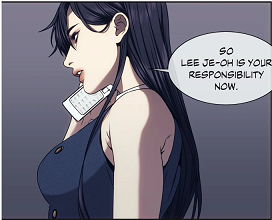 (chapter 12), and the main lead could already sense it. In fact, she had planned a long time ago to betray him, the moment he had become useless. Remember that to her, people are like pieces of Janggi. In her eyes, Do Seong-Rok had always been the sacrificial lamb. (chapter 16)
From my point of view, Do Seong-Rok acts like a grim reaper who gives the death sentence for people who committed crimes. That’s why he is introduced as a vengeful ghost in the first chapter. This is no coincidence that he is wearing black during that night, as this figure is always painted with black clothes too.

quoted from https://www.britannica.com/story/where-does-the-concept-of-a-grim-reaper-come-from
The most intriguing part is that the Grim reaper appeared, when the Black pest took place in Europe. Many people were dying and people thought that this was divine retribution for their sins. Temporal and religious authorities (King, Church) were questioned, especially the pope and its clergy. They were judged as corrupted which led to the creation of a new religious current: the floggers. They would flog themselves in order to beg for God’s mercy, but they would also commit murders and flog people, if they were judged as immoral and impious. And note the parallels between the real historical situation and the manhwa: In The pawn’s Revenge, authorities and society are portrayed in a very negative way: selfishness, greed, corruption and indifference are omnipresent. Therefore I am more convinced than ever that Lee Je-Oh will change Do Seong-Rok’s ultimate goal. This won’t be just liberation for the ex-prostitute, they will try to change the whole system in my opinion.
The fact that Do Seong-Rok is compared to different animals or figures truly displays the complexity of the character. From my point of point, the man with dyed hair has also been suffering like Lee Je-Oh, but he could never express it. This explicates why he conceal his thoughts and emotions. But due to his encounter with Lee Je-Oh, the former is slowly opening up. Hence he cries in front of the male prostitute  or he confesses that he is aroused.
  (chapter 18) Thus I come to the conclusion that the killer was living in a similar situation than Je-Oh’s in his past: he was invisible to people and didn’t truly feel alive.
Feel free to comment. If you have any suggestion for topics or manhwas, feel free to ask. If you enjoyed reading it, retweet it or push the button like. My instagram-tumblr-twitter account is: @bebebisous33. Thanks for reading and for the support, particularly, I would like to thank all the new followers and people recommending my blog.
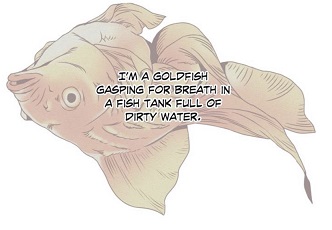 in chapter 1 and the other was called a lamb by his future lover Jeon Hee-Seong
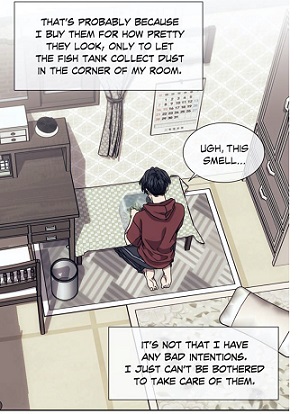 (chapter 1). In this panel, the young man has the impression that he bought an aquarium, because he found the fish pretty, but notice that although they keep dying (this is the third one), he is still determined to keep a fish by his side. This is important for two reasons. It shows his loneliness and as such his need for company. Let’s not forget that Je-Oh has to reimburse the debt left by his father, so this signifies that his budget is limited. Yet each time a goldfish died, he still bought a new one revealing that he considered it at some point as a necessity to have a goldfish by his side. He is well aware that he doesn’t take care of it very well, he can’t help himself buying a new one. This incident exposes too that Je-Oh has no idea how to treat a companion properly, for he has been alone for a long time. As a conclusion, right from the start, the reader can sense the escort’s solitude and selfishness. He feels the need to detect the presence of someone by his side, yet he is not willing to invest too much time and emotions in it. A fish is the perfect solution, for the aquarium serves as boundary and a fish can’t be touched like a cat or a dog.
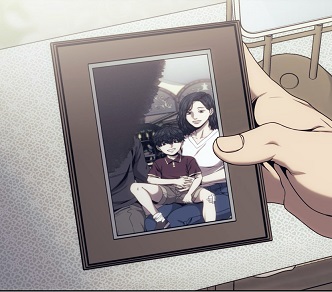 (chapter 16) Thanks to the image, we can detect that Je-Oh is missing his mother. This is perceptible, for the main lead still has a framed picture of his mother. Since he is smiling, this indicates that he was happy, as long as his mother was around him. However, the moment he was left alone with his father, the latter only viewed him as trash and burden. This explicates why he removed the father’s portrait from the picture. He really hated his father. He had many reasons for his disdain.
  Instead, he displayed no understanding and just made the son guilty. Besides, the relative kept insulting him, calling him filthy and dirty.
  (chapter 9) This incident at the convenience store explains why the young boy resented so much his father.
  (chapter 9) Note that the young boy was smiling after the theft, he didn’t see it as a real wrongdoing… let’s not forget that the father bought things from the supermarket and always put it on tab, but never paid back the debt immediately.
 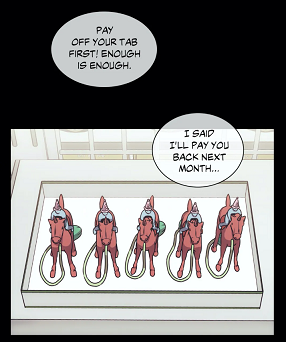 (chapter 9) The young boy could only learn that it is no big crime, if he doesn’t pay the figurine. The irony is that during that incident, the father couldn’t put the bug spray on tab, as the shop owner refused to due to the huge amount of unpaid bills. This incident reveals that the father was already deeply indebted. Simultaneously, due to the harsh scolding and insult, the main character learned that he needed to act behind his father’s back in order to achieve his goal. He knew that his father would never do anything for him, since he represented a source of annoyance. For the father, Je-Oh was a burden.
  (chapter 1) When the main character discovered his father’s suicide, he only showed calmness and indifference.
 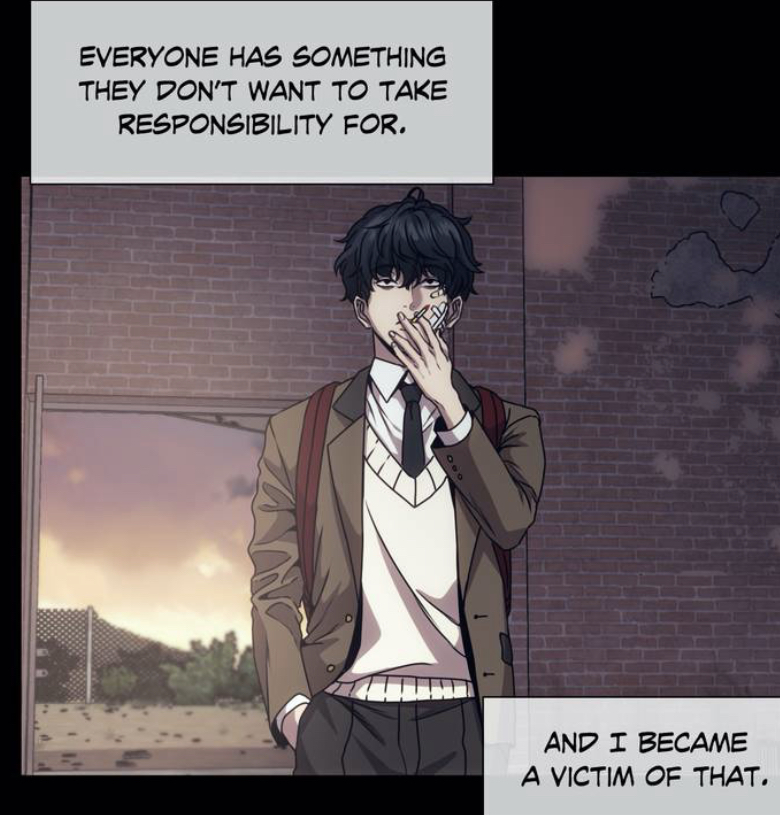 (chapter 1) The suicide was the peak of the father’s abandonment and neglect. That’s the reason why the student wasn’t shocked or upset and kept smoking in front of his father’s corpse. And now, you understand why the young boy hated his father.
  Yet, these words reveal that the relative didn’t feel responsible for his education at all. With his statement, he was putting the whole blame on his own son, while in reality the man was refusing to educate the boy properly. In other words, Lee Je-Oh should be considered as a orphan who had no good role model in his youth. The manhwaphiles can grasp why he stole the toy or why he started smoking, though he was still a minor. There was no one around him who showed concern and care for him.
  (chapter 17) He was willing to be responsible for his father’s mistake, though he despised him. The reality is that he was forced by Ma Jong-Seok to sell his body. Because of this terrible experience and the indifference of people, the teenager learned that he would never receive any help. He was on his own, that’s why he tried to rebel and escape on his own from the claws of the pimp Koo Jeong Mo and the moneylender Ma many times.
 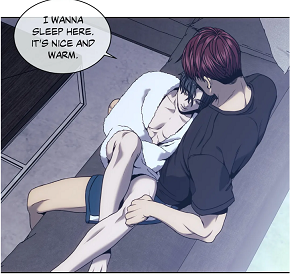 Then this observation made me realize why the protagonist’s life was similar to the goldfish’s.
  , the main lead was living in a flat on his own. He would get picked up by Lee Soon Cheol or Choi Yeong-Gil or even Ma Jong-Seok and brought to his clients 3 times a day. This clearly displays that the young man had a different clientele. In my opinion, he was more working for people with money. And this explains why Jeon Hee-Seong didn’t know Lee Je-Oh’s true place in the end. In her eyes, he had the same position, as he was selling his body for money. She was surprised to hear that the loan shark would pick up himself a prostitute and wondered this situation.
  (chapter 1), and since they are married, I believe that they hide their homosexuality. Furthermore, if you consider that he only had maximum three clients a day, this meant that the young man was a special escort. That’s why I believe, the main lead was sent to serve a different clientele than Jeon Hee-Seong in the end. This would elucidate why her husband asked the main character not to get caught and create a scandal.
 (chapter 1) Consequently, I conclude that he was definitely having sex with rich people. And if you take into consideration Chief’s behavior, you’ll notice the parallels between the “bunch of horny men” who felt guilty by having sex with the young man: Ma Jong-Seok only confessed he had some feelings for the main lead the moment he was facing death. He hid his “emotions” behind his behavior. That’s why he raped him 3 years ago and tasted him in the second episode and used a pill to achieve his goal. In my opinion, the Chief was not willing to admit his attraction to Je-Oh and used his position to sleep with him, whenever he wanted.
 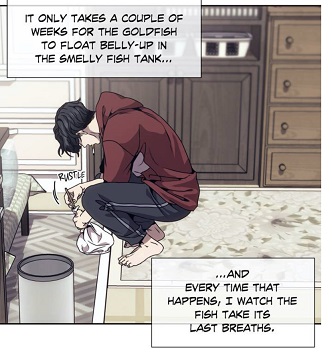 He was neither desperate nor afraid of death, but he was not repelled by the scent of the dead fish. Furthermore, he even touched the corpse. And these gestures made me think that the main lead was very fascinated by death
  (chapter 1). And this led me to suspect that Je-Oh could be suffering from necrophilia. In the first chapter, he showed this tendency. Then he witnessed how Seong-Rok was strangling the usurer in episode 18, he got fascinated and aroused as well.
 (chapter 2) Therefore you comprehend why the main lead claimed to his kidnapper that he had been raped. (chapter 3).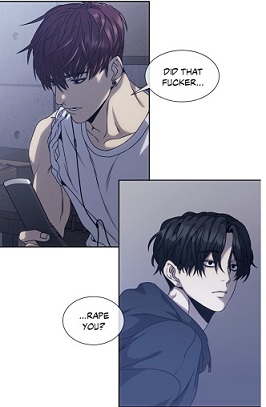
 He wasn’t just trying to manipulate the red-haired man to get rid of his abuser, he was also telling the truth. The protagonist didn’t have sex with the usurer willingly. Thus the manhwalovers can understand why the main lead is now reacting sexually, when he sees someone getting strangled or punched. For him, violence can no longer be dissociated from sex. The only difference is that, now he is no longer the victim, hence he can enjoy this. The manhwaphiles could detect this in two occasions. First, in chapter 3 he enjoyed so much how the serial killer was punching the usurer that he got an erection.
  (chapter 3) Then, in episode 17 he felt excited, when the moneylender was begging for his life.
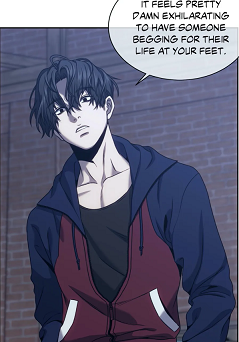 His words expose the connection between pleasure and power again. The violence is present here, as Ma Jong-Seok is getting threatened and humiliated: let’s not forget that he is on the verge of losing his life. As you can observe, the main lead’s sexuality is already linked to violence and corpse. And now, you can comprehend why he is so fascinated by the serial killer Seong-Rok. He embodies everything that he likes: strength, power, violence, but also a certain sense of innocence, sensitivity and justice.
 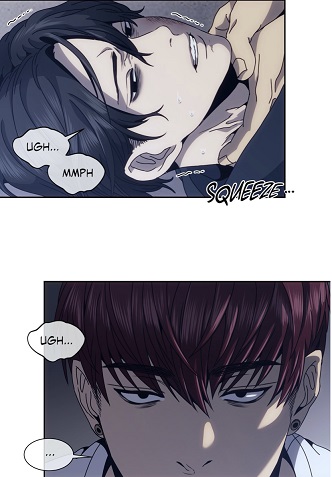 (chapter 3) This explicates why the prostitute didn’t stop the moneylender from strangling him during their duel. He counted on Seong-Rok’s good heart and pity to protect him in the end.
 (chapter 2)
  (chapter 6), until Seong-Rok rejected this idea.
 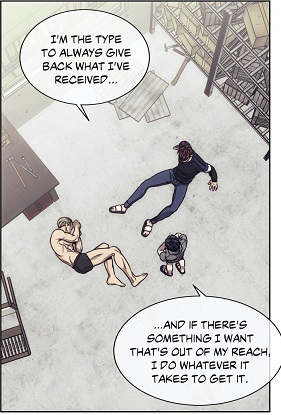 or survival, for the first time Je-Oh had the impression to have found a purpose in life. There was someone who was strong, but also vulnerable at the same time implying that the latter would have to rely on someone. Besides, Je-Oh felt indebted towards his savior. Thanks to him, he had become released from his prison.
 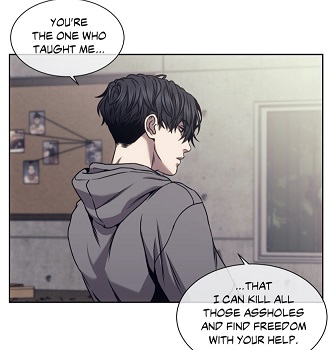 With these words, you can observe, “help” plays a huge role in Je-Oh’s mentality. That is the reason why he desires to be by Seong-Rok’s side in the end.
 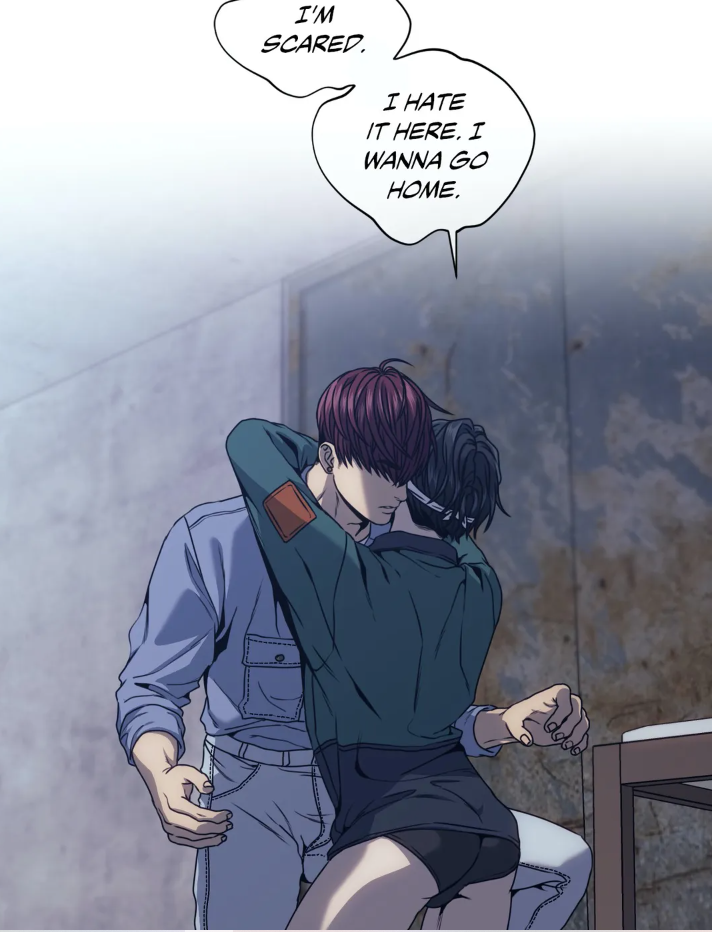 (chapter 12) From my perspective, he was not talking about his own apartment, but about the farm, where he was held captive. He wanted to leave the room, where he had been tied up. The mansion had somehow become his home, for he had the murderer by his side. And this clearly shows that the prostitute was slowly viewing Seong-Rok more and more as a relative and companion.
  , though the red-haired protagonist kept rejecting this role. And now, you comprehend why Je-Oh is eyeing at Seong-Rok. The latter has already shown a weak spot towards the young man. He didn’t let him die by Ma Jong-Seok’s hand (chapter 3), then he showed him a special treatment by letting him sleep in the same room. The latter could take a shower and got clothes. No one had ever paid attention to his needs before. He might say that he dislikes love
 , yet in front of Seong-Rok in tears, he feels himself moved.
 And this panel is interesting, as it reminds us of the scene at the convenience store. It was, as if Seong-Rok was a toy and the protagonist felt the need to steal him. Let’s not forget that he was already looking for a partner unconsciously before meeting his savior. The evidence was the goldfish. By connecting the scene with the toy and this picture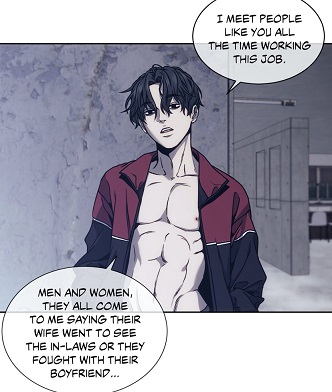
 (chapter 9) All of them were treating him, as if he was inexistent. His clients never paid attention to his feelings, when they confessed their sins. Moreover his masters treated him like trash. And this signification makes the readers realize that the killer’s lover Ms. Jeon will become Je-Oh’s true enemy and rival, for the former will claim Seong-Rok as his own. That’s why in chapter 18, he makes the red-haired protagonist feel guilty.
 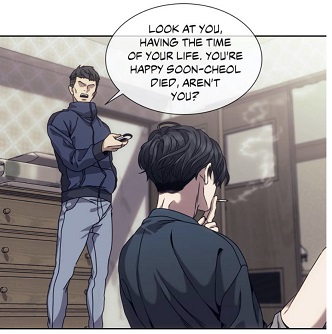 (chapter 1), while in reality the former had showed no respect to the deceased himself too.
 Ma Jong-Seok claimed to have feelings for the main character (chapter 17)
 (chapter 17), yet until now he had mistreated Je-Oh, as if the latter was a pet. Thanks to Seong-Rok, the prostitute could feel free for the first time, though he was a hostage. Imagine the irony of the situation. This is not surprising that the prostitute rejected the usurer’s offer.
 The main lead was truly aware of Ma Jong-Seok’s hypocrisy. He knew that this was an empty promise, visible through the points of suspension and the question. The main lead was not naive: the loan shark would always prioritize money over Je-Oh, once he had escaped from the jail. Let’s not forget that the usurer was living a good life according to the main lead’s words.
  Due to his sharp senses, the main lead knew that someone was in his house, but he remained silent, as he was hoping that the murderer would help him by eliminating the loan shark. This truly shows that Je-Oh is an opportunist, he can see which situation benefits him more. Simultaneously, it also shows that the protagonist is a gambler, willing to risk his life, though he had a reason to envisage that the killer was not targeting him. Do Seong-Rok had never approached him before, while Lee Soon Cheol was already dead, yet the murderer had been observing him for a while and Je-Oh was aware of that.
  and imagined burning the world
 , I started associating Fire and fish, hence this came to my mind: Firefish

 A Painter Behind The Curtain:
 BJ Alex

 Dine With A Vampire:
 Doctor Frost (used as reference for examining manhwas: POTN, Jinx, BJ Alex):

 Legs That Won’t walk:
 My Suha:
 Painter Of The Night:
 Pearl Boy:
 The Beast Must Die:
 The Pawn’s Revenge:
 Under The Green Light:
 Unintentional Love Story:
 Serene Bird:
 ENNEAD
 Mad Place:
 Bongchon Bride: ”
 Steel Under Silk:
 Payback:
 A Sip Of Poison:
 Jinx: After writing 31 essays, I decided to create a table of contents for Jinx.
 The Ghost’s Nocturne:
 🤔
🤔 
 Beta Off Not Dating:
 At the End of The Road from Haribo:

 The Edge OF Ambiguity:

 Banana Scandal:
 (chapter 17)
  (chapter 17) As you can observe, the positions between the main lead Je-Oh and Ma Jong-Seok had been switched. The latter, the blond-haired man, was the protagonist’s owner due to the debt left by Je-Oh’s father. The latter had preferred killing himself than reimbursing the credit with a huge interest. The vengeance becomes more visible, when the readers discover that the chief has been brought to the location, where Je-Oh’s father committed suicide.
 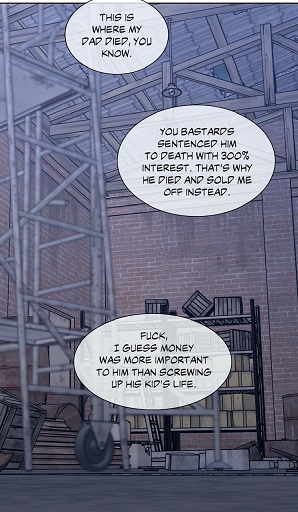 (chapter 17) This means, in chapter 17 Ma Jong-Seok is going through the same experience than the main lead.
  If he commits a crime, then he will lose his “humanity”. This is no coincidence that the chief talks about righteousness and as such humanity. Let’s not forget that the latter is a synonym for benevolence and kindness. Facing death, the hypocrite starts treating Je-Oh as a human and no longer as his pet. This doesn’t escape the main lead’s attention who points out his hypocrisy.
  He has behaved like a man without any conscience and heart until now. And this explains why at some point Ma Jong-Seok confesses to like Je-Oh. The moment the loan shark views him as a human being and no longer as whore, he can admit to have some feelings for him.
 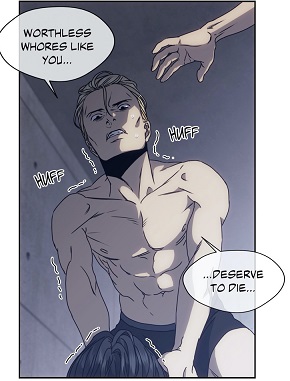 (chapter 3)
 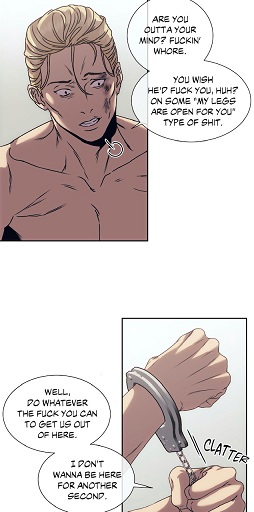 (chapter 5) He kept treating him as his tool. The main lead had to listen to his order and show loyalty and obedience. Sure, he was definitely stressed and desired to survive, well aware that Do Seong-Rok could kill him at any moment. But he acted like that even before the abduction and sequestration.
 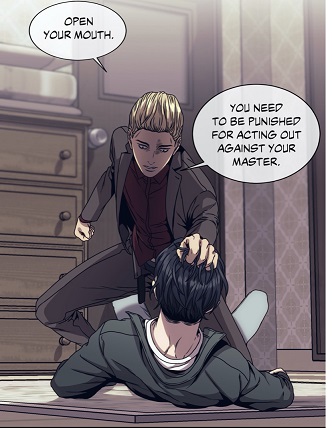 (chapter 2)
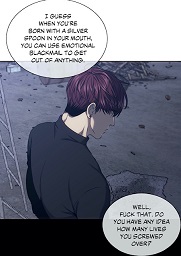 He criticizes Ma Jong-Seok for being responsible for the death of so many people. With his ruthless job, he sentenced people to their death. In other words, the violent moneylender is a murderer, though he never pulled the trigger himself.
 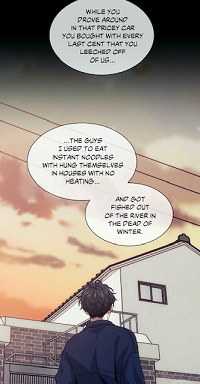 (chapter 17) And his words truly exposes that Je-Oh is not just killing the loan shark for a personal vendetta, in truth he is resenting him and society for its injustice and corruption. No one felt pity for these persons committing suicide, though they had been cornered by moneylenders. The chapter 17 gives us a clue that Je-Oh is thinking more than just about himself and pure revenge. Moreover, he mentioned to his partner that he hoped with their alliance to obtain his freedom.
  (chapter 1)
 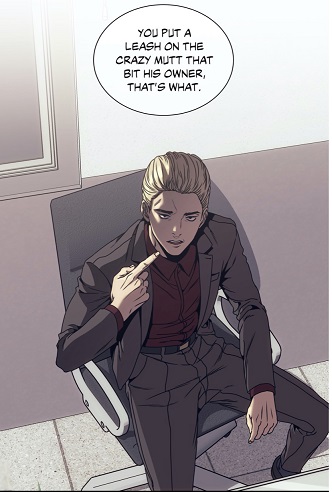 (chapter 2), while Je-Oh used the same expression for Do Seong-Rok.
 (chapter 6) Mutt is a synonym for dog. In the prostitute’s eyes, the murderer is in truth a dog waiting for his master.
  (chapter 10), while he associated his minions to chickens.
 (chapter 2)
  (chapter 11)
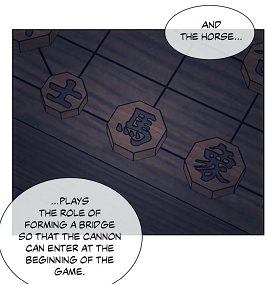 (chapter 13) and the elephant.
 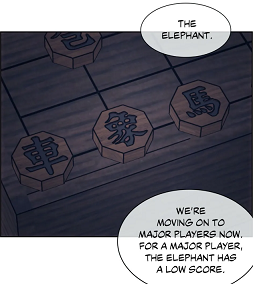 (chapter 13). The loan shark is supposed to be the elephant in the game, while the horse is Choi Yeong -Gil.
  (chapter 13) Imagine, this city is not inhabited by humans, but by animals: chickens, a goldfish, a pig, a fox, an elephant, a horse, a dog, a mutt, a rat etc.
 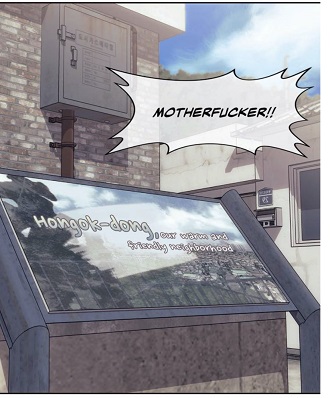 (chapter 2) Here, Hongok-Dong is presented as a paradise, while in reality there’s only poverty and misery. This poster reminded me of the last commandment in the farm. “All animals are equal, but some animals are more equal than others.” This served as propaganda in order to legitimate Napoleon’s dictatorship. In other words, the banner from that Korean city made me think of propaganda. By showing such pictures, the inhabitants are lulled into in the illusion that everything is alright, whereas in reality there exists only selfishness and indifference due to corruption and injustice. Secondly, the pictures about the red-light district
  (chapter 16) make me think of a farm, and more precisely of chicken batteries:
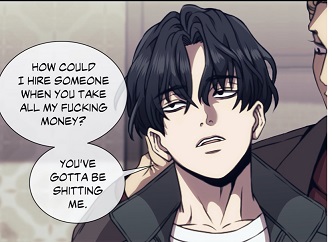 (chapter 2) This situation is quite similar to the life of the pigs at the farm.
  , as Janggi. That’s why I believe that the city is like the animal farm, as Janggi is limiting the world. The animals are represented by a piece of chess. The only difference is that we also have wild animals, unlike the English novel. The killer is a player of Janggi, he is the one who uses the different pieces (chariot
 , cannon, pawn etc). This Korean chess game was introduced to the serial killer Do Seong-Rok by his lover Ms. Jeon Hee-Seong. She manipulated her partner by letting him think that she was a poor prostitute, abused by her husband.
  (chapter 11), when the naive lover killed her husband. But why did she ask Seong-Rok to eliminate so many people (Ma Jong-Seok; Choi Yeong-Gil, Koo Jeong Mo and Lee Seon-Chol)?
  (chapter 11), she has another motive. It is, because she is planning a revolution in my opinion, but not the same type than Je-Oh’s. She wants to overthrow the established system and take it over quietly, which corresponds to the first meaning. Let’s not forget that when Hitler became chancellor, he called this event “national revolution”. In my eyes, she wants to become the head of the red-light district, but hide her connections. She desires to climb up the social ladders by using the actual system. She is not fighting for freedom, but for wealth and power. Since she has deeply internalized that in this world only the strong ones can survive, she is making sure to belong to the winners. That’s why she has the officer Ahn as partner. The latter is trying to enter politics and has connection to politicians..
  (chapter 11). The femme fatale purchased land in Hongok-Dong so that she will get rich, when the redevelopment starts.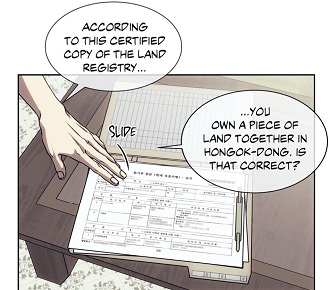
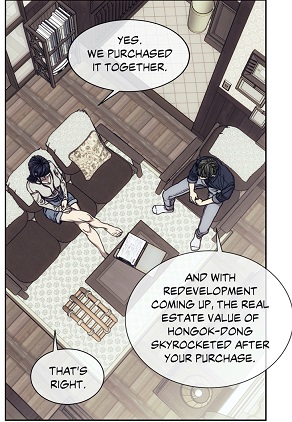 (chapter 9) But in order to achieve her goal, she has to erase her past as a prostitute. She needs to eliminate people who know her from her origins. And this leads me to the following observation: since this world is described as a game of war
 (chapter 6) , it means that people are judged as enemies and potential threats, which need to be removed. But more importantly, when the femme fatale compares the weak to a prey, the readers can perceive that she is a believer of social Darwinism.
  (chapter 6)
 (chapter 3) He was applying this theory, yet deep down he desired that the main lead would seize this opportunity to get revenge on the usurer.
  (chapter 3) As you can detect, the red-haired man was pushing the hostage to get revenge on his abuser.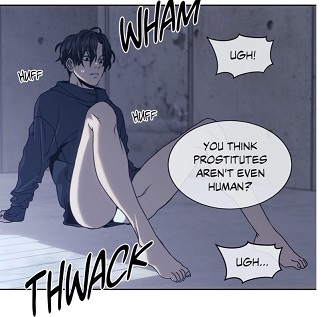
 (chapter 3) after hearing how the usurer looked down on the main lead. Since he was just a whore, he had no right to survive. The red-haired man hated so much that Je-Oh was insulted for his “profession”.
 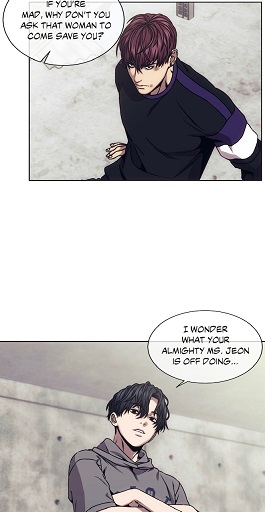 and her relationship to the serial killer. Like I had mentioned it before, Ms. Jeon desires to erase any trace about her origins and plans. So the male prostitute already represents a threat to her plan. On the other hand, the woman has no idea about this, because in her eyes, he is just a pawn. But like the red-haired main lead pointed out,
 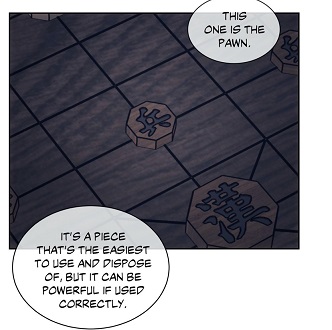 (chapter 13), a pawn can be powerful, once used well. Since Je-Oh is accepting to use violence for his freedom, this signifies that he will fight for a change. That’s why I believe that he will create a revolution, shaking up the whole system, where until now only rich and powerful people had rights, while weak ones were left unprotected, for the police were corrupted and congressmen are only working for their own interests. As a conclusion, you can now comprehend why for me The pawn’s revenge is more than just revenge, it’s about “slavery”, inequity and injustice. Humans are neither pieces of Janggi nor animals, no matter what they are: poor or rich, healthy or sick. The problem is that both types of Revolution bring chaos and death too.


 (chapter 12), it could be viewed as a mirror, which reflects human greed. As soon as humans discover such a precious object, their deeply buried desires like ambition and greed are awakened. Then I would like to point out that John Steinbeck’s novel was inspired by a Mexican folktale. Striking is that this story contains many parallels to the Chinese’s entitled The story of the Dragon’s pearl. [For more information:
  (chapter 1) That’s why this manhwa is entitled Pearl Boy. What does it mean for the main lead? In his eyes, his special condition is more a curse than a blessing. Because of his ability, he is not treated like a human, but as an object. He is called either as a vending machine (chapter 22) or as a clam
 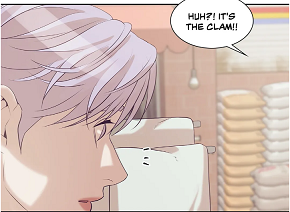 (chapter 23). In chapter 22, the poor man is even viewed as a living sex toy, hence he is enchained
  . But why don’t people consider him as a human? In my opinion, it is related to Choi Pilwon’s words and attitude. The latter definitely views him as his pet or a doll.
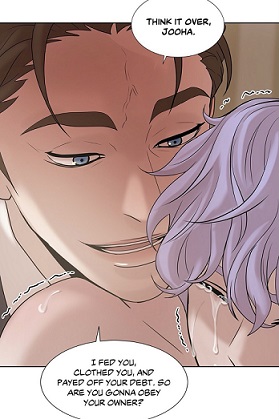 (chapter 4). Since Jooha is his possession, he states this to the poor pearl boy
 (chapter 22). He might enjoy now some privileges,
  (chapter 14), but he is not free. That’s why I believe that for Jooha, the pearl is more a curse. In the beginning of the story, he is forced to have sex with people so that he can ejaculate many pearls. He is bounded to Choi Pilwon, as the former needs to repay his debt
  . On the other hand, I think, for Choi Pilwon, Jooha represents a blessing and a curse simultaneously. Why? A blessing… because he is well aware that Jooha is definitely special. With such a treasure, people seek his attention and favors. Thanks to his wealth, he was able to obtain Jooha. Striking is that Jooha even trusted him in the past. It is palpable, when the main lead threw himself into his arms after running away.
 (chapter 22) However, it becomes clear that the antagonist created such a situation, so that the main lead would rely on him, this explicates why he smiled while getting hugged.
  This smile exposes his manipulation. He wanted the pearl boy to depend on him entirely. By joining Choi Pilwon, the main character lost his freedom, the CEO used the immense debt to tie Jooha to him. What caught my attention is that we never see him having sex with men. He only gets fellatios.
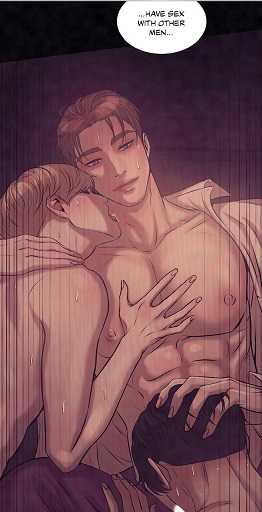 (chapter 14). He even pays other people to have sex
  (chapter 17), while he watches them. And this observation made me think that Choi Pilwon could have some sexual issues, like erectile dysfunction. Let’s not forget that in Painter Of The Night, Yoon Seungho needed to get a fellatio before a penetration before viewing his first erotic portray. And if this theory is correct, this signifies that Choi Pilwon can’t have sex with Jooha, which is frustrating him. Therefore I get the impression, he is desiring love from Jooha. He might possess the pearl boy, yet he is incapable to obtain his heart and love. And that’s his curse. There are other evidences for this interpretation. Even before selling him to low-lives, he just watched him having sex with other men, as if he couldn’t have sex with him.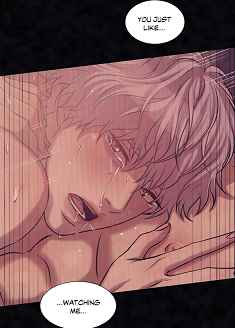
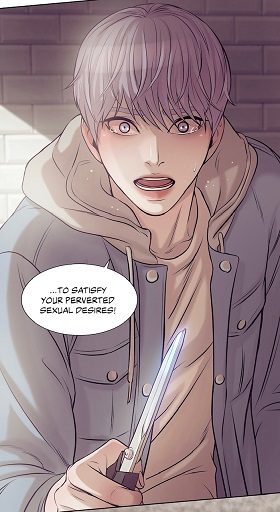 What the “mermaid” considered as sexual perversion could be definitely judged differently. He wished to taste the pearl boy, but he can’t any more, hence he needed others. The pearls are the cause for this toxic relationship. Secondly, when he sees Kang Dooshik close to his pet, he looks at his rival very carefully. He pays attention to his appearances:
  (chapter 9) and dismisses him due to his sweats. Since Kang Dooshik is not wearing any expensive cloth, he doesn’t judge him as a source of threat. However, when he hears that Dooshik has become Jooha’s partner, he is bothered. Hence the main lead is no longer forced to have sex with men whom Choi Pilwon sent him. The CEO is determined to get rid of the former host. Look how he is upset,
  (chapter 14), when he discovers that the protagonist has found the perfect partner. Nonetheless, he can’t forced the pearl boy to follow his order any longer, as Jooha procured him a huge amount of pearls. In other words, thanks to Dooshik, the main character has been able to gain more freedom. That’s why I doubt that watching other men having sex with Jooha was Pilwon’s true desire. Let’s not forget that in the beginning of the story, the CEO is standing in the street
 , while the protagonist is selling his body in the back room. This exposes that Choi Pilwon was not even watching this, a sign that he didn’t like it at all. And like Jooha has truly recognized, the debt can not be the real explanation for his harsh attitude towards the protagonist. When the latter offered him new pearls as a compensation, because he had not produced so many, the CEO got furious and put them in Jooha’s mouth. The latter had masturbated in order to get pearls. This truly shows that the pearls and the debt are just an excuse. Consequently, Choi Pilwon is not happy with the pearl boy. First, he thought, he had been blessed. Yet since the young man rejected him
 , he had to find a trick to bind him. And remember what I wrote above. For me, the pearl is like a mirror… since the CEO has been raised in a rich but cold environment, he has already internalized that money buys everything. In my opinion, he was not able to give what the protagonist was longing for: love and acceptance. Moreover, there is no doubt that Choi Pilwon is selfish and pays a lot attention to appearances, thus he couldn’t treat Jooha properly. Since both folktales contain reference to transformation, I believe that Choi Pilwon changed in contact with Jooha and the CEO’s terrible flaws came to the surface and were reinforced: greed, obsession and possessiveness. The pearl boy reflected Pilwon’s mentality: everything was revolving around money. Another detail caught my attention: the CEO is often associated to the shadow and darkness in the pictures. Look at the panels above and these ones:
  (chapter 4)
  (chapter 14) In the last image, it becomes more obvious, as Kang Dooshik stands in opposition to the CEO. He enters the inn rushing to the purple haired man’s side in order to comfort him. As you can imagine, the protagonist Kang Dooshik brings light and warmth
 to Jooha (purple and pink are warm colors), while Choi Pilwon embodies darkness and coldness
 due to the dark green and the black. This interpretation gets confirmed, when Dooshik is seen in the street during the night. The manhwaphiles can even observe a starry night in Dooshik’s presence.
 (chapter 8).
  When the story starts, the former bar server has already reached the bottom. He lost everything, because his ex-lover Eunwoo stole the money from Dooshik’s employer, Madam Hyung, and the main character was responsible for that money. In other words, the young man is on the run, yet despite his terrible situation, the man is not suicidal or heartbroken. On the one side, he is poor, exactly like Kino and the boy from the folktale. On the other side contrary to the stories, Dooshik had no harmonious relationship before, hence he knows the importance of true values (love, friendship, loyalty etc). In my eyes, he has learned through this terrible experience that love can’t be taken for granted. Another difference is that after meeting Jooha, the main lead’s personality doesn’t change: he remains generous, caring and honorable.
  (chapter 8) Surprising is that it was Jooha who helped Dooshik first. This signifies that for the purple haired man, Dooshik looked more like a curse. The former bar server tried to eat without paying his meal. Then he acted as a “prostitute”, when he proposed his body to reimburse the dish. Hence the pearl boy had the impression that Dooshik was like all the other men he had sex before: ruthless, superficial, selfish and perverted. Then in chapter 4, Jooha even chose to save his life,
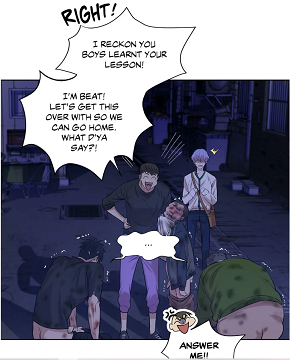
  although the hero acted like an idiot. So for the main lead, it looked like Dooshik was a source of trouble. Yet, it turned out to be the opposite. Right after rescuing the confident and smiling man, the latter returned the favor. He rescued him from the sexually harassing men.
  (chapter 8) He even taught him how to protect himself. That’s why I believe that we have two pearl boys in this manhwa. Jooha might have this special ability, yet the former host is also a pearl due to his big heart. And observe that Jooha dived to get the “pearl” which reminds me of Kino.
  (chapter 3) and then in chapter 12.
  These incidents announced a change in the protagonist’s life. Although the main lead gets happy with this discovery each time, as he envisions that he could repay his former employee, Dooshik never loses his humanity. He still prioritizes love and humans over greed and selfishness. That’s why when he discovers Jooha’s ability, he asks him if he is ill.
 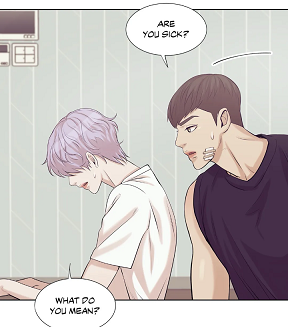 This truly exposes that Dooshik is the first one treating Jooha as a human. At no moment, he tries to take advantage of the purple-haired man.
  (chapter 14) Therefore it is not surprising that the ex-host often encourages his lover to express himself. Another important detail is that he is the only one kissing Jooha before going any further.
  In other words, he is showering him with love and warmth. He keeps hugging him in order to comfort him.
  (chapter 14)
 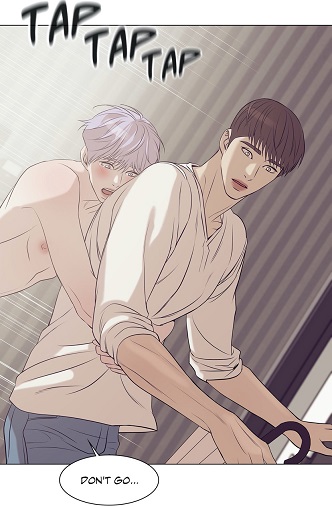 He can’t even bear the thought of his lover’s departure from the hotel room. He fears that his partner might never return. He has already realized that he found a treasure, a pearl boy, while in the beginning he judged him as a source of trouble. As for Kang Dooshik, it is the same. While in his past, he was admired and could earn money and trust so easily, he was so unhappy in his relationship with Eunwoo
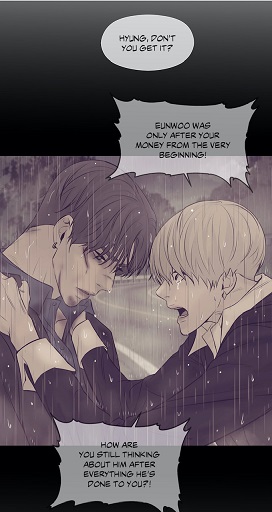 (chapter 14). The latter betrayed him on multiple occasions, yet the weirdest is that after this terrible relationship, Kang Dooshik is not scared of love. Thanks to Jooha, his life became more stable, and indirectly he could get in touch with his best friend Lee Choonbae.
  Thus I conclude that Dooshik’s best friend, Lee Choonbae, will play an important role in the future, as his intervention will affect Choi Pilwon’s relationship with Jooha. He could become Choi Pilwon’s blessing disguised as a curse.
 (chapter 34), only spiritual love was allowed
  (chapter 19)
 (chapter 68). This signified that in his education, not only sex was prohibited, but also sexual desires were denied. Although love was expressed through hugs
 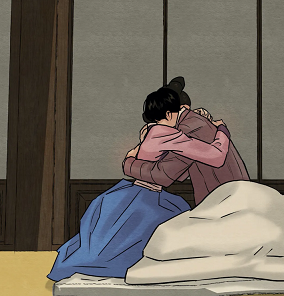 (chapter 66)
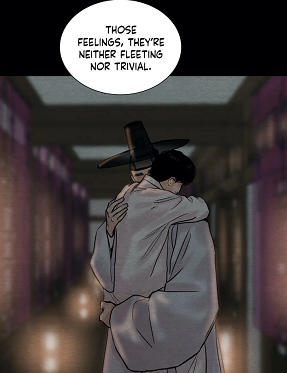 (chapter 68) and caresses
  (chapter 10)
  (chapter 68), they were devoid of sexuality. The painter experienced love, but was not allowed to experience sexuality. He was only authorized to paint it for the scholar’s sake. On the other side, Yoon Seungho was raised the opposite: love was not allowed, as it was a sign of submission and weakness. Sex was permitted, because it was considered as a fight in order to defeat his opponent. These were the butler’s doctrines. That way, he could still have a connection to the main lead. If he came to love someone (the pedophile), the lord could definitely abandon the valet and reveal his betrayals. In other words, he used pity as a way to tame the lord. At the same time, sex also served to gain some benefit, as it was an exchange of favors (giving versus receiving),
  (Chapter 71). I connect this philosophy to the king and indirectly to the butler. With sex, the nobles could exchange some favors. These huge divergences in the mindset explicate why there were so many misunderstandings between Yoon Seungho and Baek Na-Kyum, as their education diverged so much.
 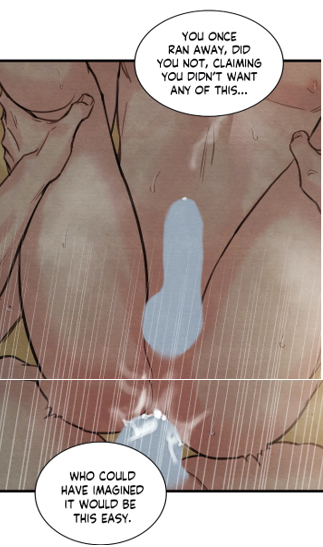 (chapt45), as the painter had accepted him as his sexual partner, he had to realize slowly that he was wrong. He imagined that since the artist had remained by his side and was accepting to have sex with him, he had achieved what he wanted: in his unconscious it was to be loved. Yet, it was just an illusion. The painter saw himself as a whore and the master as a man consumed by lust. As you can see, the noble was forced to judge the nature of the sexual encounters differently. He had associated sex to love due to their Wedding night, therefore he imagined that the moment the painter was accepting him, the problem was solved. He would be able to relive this wonderful moment, but however nothing like that happened. He felt never satisfied, as there were no feelings at all. Hence he even had sex during the day
 , believing that the artist’s lack of experience was the problem.
  (Chapter 45) While the lord became Baek Na-Kyum’s sexual emancipator, the painter became the lord’s teacher for love. This explicates why the low-born forced the lord to question his own identity and feelings.
  than a master- servant relationship, because the commoner was never treated like a domestic. He only had sex with the lord and had some privileges.
  (chapter 46) He was never asked to do other work, although the artist tried to change his situation. Since he was behaving like a whore, he felt that he had no right to express any thought and emotion. He couldn’t show any pleasure. That’s why there were no feelings in their sex encounters, and the lord could sense the difference. Consequently, when the lord realized that he was still perceived as a man consumed by sex
 (chapter 48), he changed his behavior. He acted like a real client at the brothel
 (chapter 48), but at the same time he cornered the painter to have multiple climaxes in order to let him experience that he liked having sex with him.
 (chapter 49) As you can observe, the lord linked sensuality to love. If he could provoke ejaculations, then it meant that the artist was definitely feeling something for him. However, the moment the lord liberated the painter from his pejorative perception about himself (he is a prostitute), the painter reacted the exact opposite. Now, he was the one using Yoon Seungho, the latter was his plaything.
 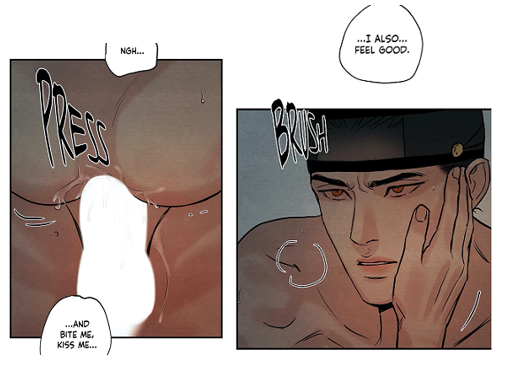 (Chapter 49), his prostitute, for he was the one procuring pleasure to Yoon Seungho. As you can see, the roles had been switched. This means that now the painter had the upper-hand in their relationship. We could even say that the noble was willing to accept his fate.
  (Chapter 49) Yet there was a difference from the past. Yoon Seungho would feel pleasure as well. This is not surprising that Kim chose to intervene and separate the couple right after. Without sex, the painter had no power over the master. That’s the reason why the butler revealed his knowledge the morning after. The protagonist had to hear from his butler the real cause for Baek Na-Kyum’s passivity and torpor:
  (chapter 50). Through this revelation, the lord was indirectly confronted by his own reflection: he was indeed asking from Baek Na-Kyum sexual favors in exchange for his stay at the mansion. That’s the reason why the lord had a “relapse“ and kept his distance from the painter.
  (chapter 52). This was important, because for the noble, it meant that he could no longer have sex with other partners. Without sex, the lord was forced to question himself and ponder on the true nature of his relationship with Baek Na-Kyum. He felt jealousy during that night, he was very protective as well.
  (Chapter 52) His sexuality had already become an expression of his love, although the main lead was still unaware of his own feelings. That’s why I come to the conclusion, chapter 52 was actually revealing Yoon Seungho’s monogamy, although it looked the opposite. And this becomes truly visible, when the gangrape was about to occur. He felt no urge, when he was with the guests, yet the moment he brought the artist to the bedchamber, he couldn’t stop himself from kissing his loved one.
  (chapter 54) He was definitely longing for his warmth. This explicates why the noble got so infuriated, when he was confronted with the consequence of his bad decision:
  (chapter 54) the artist was on the verge to be no longer monogamous, as he would be tasted by other aristocrats. In this scene, the lord would have indeed become a client and pimp, if he hadn’t chased away his guests. Although the painter was indeed upset afterwards about this incident
 (chapter 55), deep down he sensed that his master had protected him. This night was important for the main lead: he was forced to admit his own feelings for the painter. Therefore, we could say that the issue with the prostitution was solved after chapter 54. Yoon Seungho thought that the moment he confessed, the painter would get scared and run away, but it didn’t happen. Why? Love among men and especially between a brutal noble and a commoner, was a taboo, like Min had underlined. Secondly, if the lord had indeed feelings for him, he had behaved like a beast during that night. He had mistreated Baek Na-Kyum. In his mind, the artist would never accept him.Besides, the painter had clearly denied the affection from the main lead. In his eyes, the painter’s words were indicating a rejection.
  (chapter 54) Thus I conclude that Yoon Seungho and Baek Na-Kyum had come to an implicit agreement: they had a master-servant relationship
 (chapter 56), although Baek Na-Kyum started perceiving himself as a domestic from chapter 51 on again. He kept following the head-maid
  and Kim
  (chapter 51) in order to help them. Therefore the readers could witness the return of the white headband in chapter 52: his task was to paint for his master.
 (Chapter 52)
  (chapter 62) here, he whispered to Baek Na-Kyum that he adored him), he would bind the artist to himself.
  (chapter 63), exactly like he had wished in chapter 49. The only difference is that this time, the painter was here for the lord’s pleasure. The roles had been switched again. As the manhwaphiles can perceive, the noble and painter had a similar reaction: they both tried to deny the existence of love in their relationship. That’s the reason why the noble stopped the artist from confessing:
 (chapter 63) They just had a sexual relationship which could provoke pleasure, but that was it. But in order to ensure that the artist wouldn’t run away again, he used sex to “tame“ Baek Na-Kyum. If the main lead could procure multiple climaxes to the artist, then the latter was forced to admit that only Yoon Seungho could be his “partner“. This explicates why the noble kept pointing out how the artist would react to his lover’s body.
  (Chapter 63)
  (chapter 64) He was moaning and would ejaculate constantly thanks to the main lead. Yet, during this second marathon, the noble was actually deceiving himself.
  (Chapter 62)
  (Chapter 65) This shows that the painter had gained a new position: he was indeed a favored servant. He was allowed to spend the night in his lover’s bed and he could see the lord getting dressed.
  (Chapter 65) The slight change was that now the main lead was aware of this. This truly exposes the lord’s affection for the artist. He might have treated him like a plaything in the shed, in reality he had attempted to show “his skills“ as a lover. He had licked him, bit him and the painter had felt pleasure, though he kept saying no! This is not surprising that Yoon Seungho had denied the kiss in the study.
 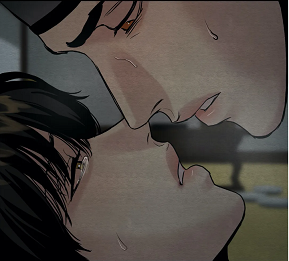 (Chapter 64) Because that’s how he had been deceived that night in the study.
 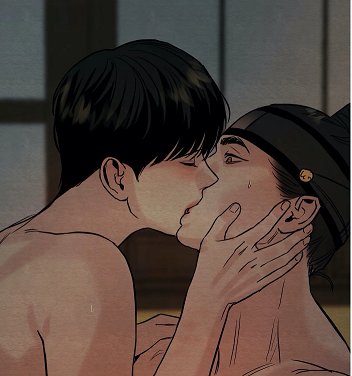 (Chapter 49) Baek Na-Kyum had silenced him with the kiss, as the main lead was about to protest.
  (chapter 65) What caught my attention is that the painter’s disappearance mirrored the lord’s wrongdoing. Lee Jihwa and the main lead had both kidnapped the artist. That’s why I believe that when he heard Heena’s words in the study
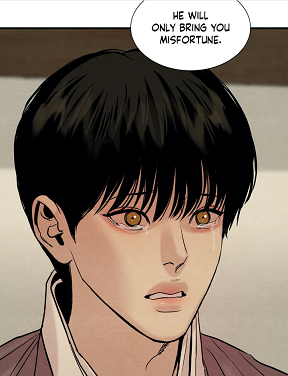 (chapter 68), the noble could only come to the following conclusion: he could only let the painter choose his destiny. But the moment the artist decided to remain by his side, he needed to change Baek Na-Kyum’s position in the mansion. He was no longer a servant, but a noble guest. Hence the lord tied the scarf like aristocrats did.
 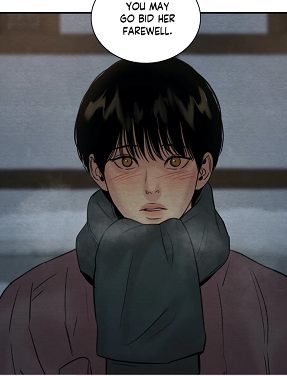 (chapter 69) Consequently, we could say that the painter had a similar status than Jung In-Hun. Yet, there was a huge difference: the owner of the mansion was now acting like the painter’s servant. Hence Deok-Jae’s words came true:
 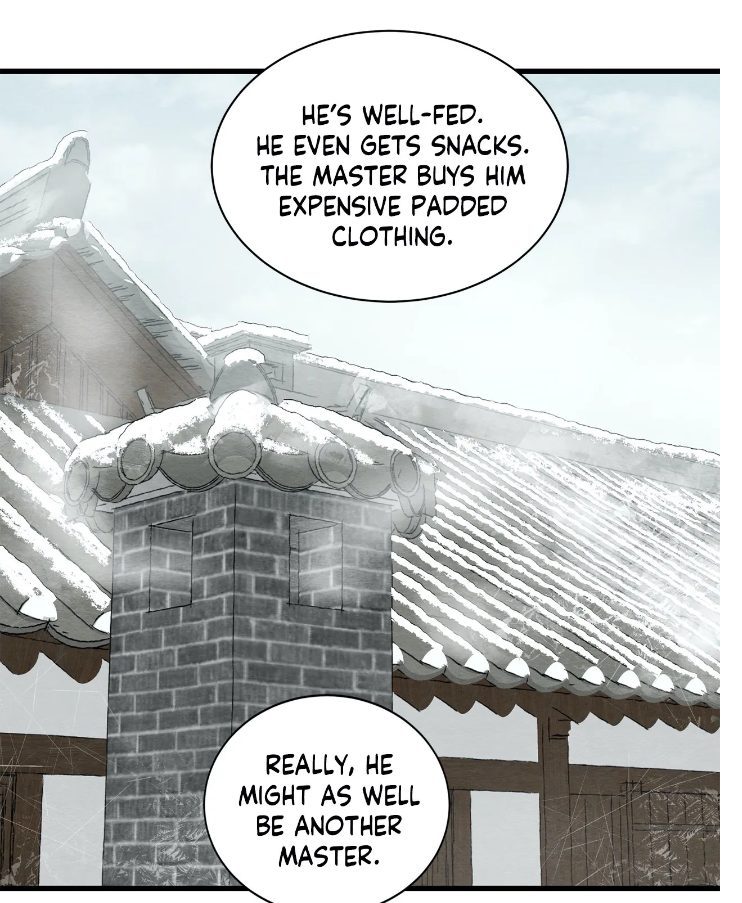 (chapter 46).
  (chapter 71). Why? It is because the lord made the decision that the painter chose him, then this means that he became his wife, though at the end of season 2, he was not thinking about marriage yet. He was not aware of this perception. By becoming his official partner, the spouse obtains the status of his husband: nobility. This explicates why the lord ate with his lover
 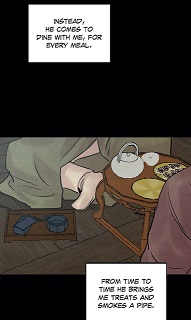 (chapter 74) and allowed him to smoke. Then in season 3, he gave him ladies-in-waiting in order to give him some company.
  (Chapter 78) He even gave him the music box, which was mistaken as a dowry. However, the problem is that the painter was still fighting his own feelings for the protagonist due to Heena noona’s words and past experience with the scholar. He feared that this new situation was too beautiful to be true, hence he thought that the lord’s feelings would fade away. But there was another reason for doubting the lord’s affection: there was no sex.
  (chapter 74) The painter had come to associate sex with love too. Yet, the moment he relived his trauma, he only found comfort and safety in the lord’s embrace.
 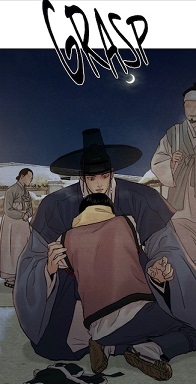 (Chapter 76) The main lead didn’t reject the painter’s urge for a hug in front of commoners. At no moment, Yoon Seungho felt embarrassment. He treated him like a special treasure. That’s how the painter came to realize that Yoon Seungho‘s love for him was true and genuine. Consequently, he decided to rely on him and to trust him. That’s why in this panel, the painter closed his eyes:
  (chapter 76) We could say that he was reminded of his own past. When he was a child, he sensed love through hugs and caresses. Since the painter could feel the lord’s genuine affection and warmth, he recognized that even when there was no sex, love was present. All his senses made him perceive the lord’s love:
  (chapter 76) His words showed his care and concern, then he bought him an expensive music box.
  (Chapter 76)
  (Chapter 80) And now, you comprehend why the painter didn‘t confess during that night. He got interrupted. The kiss was the symbol for their love. Thus it is no coincidence that just after his confession,.
  (Chapter 94) the painter initiated a long and sensual kiss with his “husband“.
  (Chapter 95) Since the painter had received caresses and embraces in his childhood, he came to view the kiss as the symbol for true love. And note that the kisses exchanged in the gibang were full of passion and love. This was the perfect combination of love and sex.
  (Chapter 95)

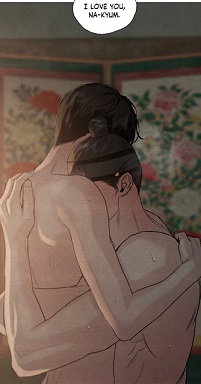 (Chapter 96) This shows that Yoon Seungho has always longed for a pure and spiritual love in the first place. His sexual preferences were already palpable in the last love session (season 2):
 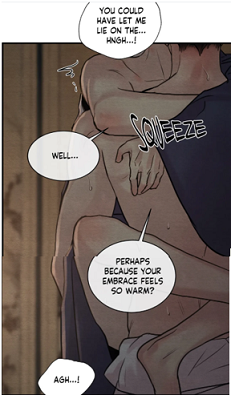 (chapter 72) We could say that he discovered all his sexual preferences thanks to the painter.
  (Chapter 80) But he failed due to the intervention of the butler and other schemers. Besides, the whispering of „Kyumah“ could only make his heart race. Let’s not forget that his painting in the sand
 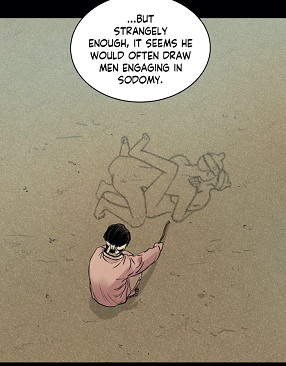 (chapter 1) externalized his own philosophy: love and sex can’t be separated. Note that the couple is is hugging and kissing at the same time! 😍 This picture will represent the peak of their love! Striking is that when the couple confirmed their mutual affection, they did in the kisaeng house, the symbol for prostitution. This truly exposed that Yoon Seungho had been treated like a male night servant in the past. .
 (chapter 72) in the next season, for the painter is still calling his lover “lord Seungho“
  (chapter 99)
  (chapter 102) This means that he is still viewing himself as a low-born. But note that contrary to the past, Baek Na-Kum is now wearing a hanbok and he has no other clothes. Thus I am deducing that the painter’s next lesson is to drop his notion that he is a commoner. He will be taught to view himself as an equal to Yoon Seungho. Only when he has internalized that there is no gap between him and his lover, then he will be able to address him as “Seungho-YA!“ At the same time, both protagonists will come to realize that they can express their love differently. Poetry, painting and more importantly through their desire to protect their loved one. The lord will start protecting Baek Na-Kyum more actively, just like the painter will decide to show more interests in his lover’s skills and past life. Baek Na-Kyum will feel responsible for the bloodshed in the shaman’s house. In my opinion, the lord will confide to him what happened to Min and the other nobles. I am assuming this, for the lord remained silent, when the messenger of his father came to the mansion. He didn’t want to scare his lover because of his brutal outburst.
 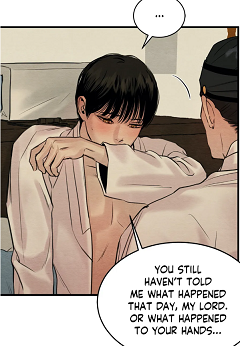 (chapter 84)
 The trigger for the change is the noble’s words. The latter keeps talking to the painter asking for an reply. Hence in my eyes, there are glimpses of love the moment Baek Na-Kyum said this:
  It sounded like a confession, hence the seme became more passionate:
 Here the lord acted like a client. Yet, notice that the lord is speaking again forcing to express himself. And the moment the painter cried and started voicing his own opinion, the sexual encounter was affected.
  (chapter 49) An expression of love and affection, but the painter rejected it, as he mistrusted his own judgement. He couldn’t help thinking of the learned sir’s fake embrace. Striking is that despite the rejection, the painter kissed and hugged back his lover
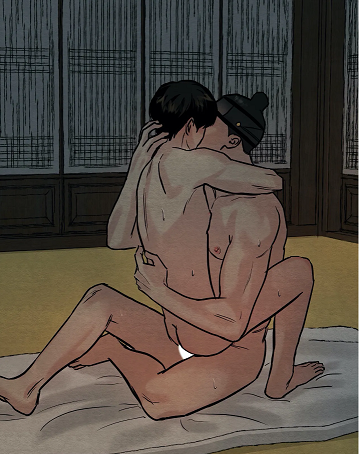 (chapter 49), which made the lord believe that he could only get embraced by the painter, if they had sex.
  . Although the second sex marathon starts like a pure sex session, the moment the painter calls Yoon Seungho differently
 , the lord’s attitude changes. The painter is turned around and faces his lover
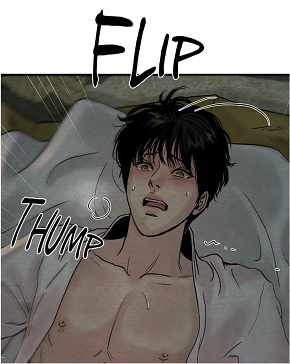 , a sign that they are getting closer. Striking is that again through their conversation, the painter is pressured to think about his own emotions.
  However, due to his own insecurities and fear, the noble still can’t trust the artist’s words, therefore there’s no confession.
  , it is just that both main leads were in denial.
  (Chapter 58) Thus he should become responsible for him. Yoon Seungho was unconsciously trying to push the painter to reciprocate his feelings, an imitation of Lee Jihwa‘s confession. Nevertheless, the painter remained silent, therefore it meant that his love was still denied. That’s why it stands more under the sign of dream and illusion. Consequently, the night in chapter 70, 71, 72 and 73 contrasts so much to the one from chapter 58. This time, it symbolizes the lord’s pure love. As such, the sex is already a real expression of love. That’s why the lord asked to be called intimately: Seungho-Ya
 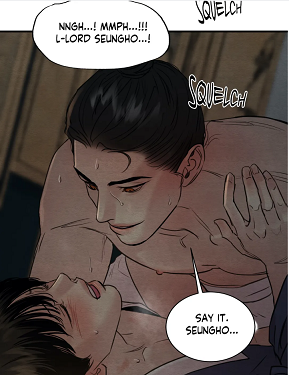 (chapter 72) On the other hand, this love session was strongly intertwined with the notion of forgiveness and punishment as well. This is important, it reveals that Yoon Seungho had internalized that sex was the expression to redeem himself. He had been tasked in the past that if he desired to obtain “forgiveness“, then he should have sex. And by comparing all these sexual encounters, I came to the following conclusion: the lord’s words definitely contributed to change the nature of the sex session, just like the hug.
  In chapter 66, he had a flashback, hence he couldn’t witness his lord’s attention and care.
 But the lord discovered this kind of embrace, when he helped the painter in chapter 53:
  That’s how the noble experienced the embrace as a source of comfort and affection. Therefore you can comprehend, why I wrote above that the painter was teaching the lord how to love properly, but also why the embrace became the symbol for love in the lord‘s eyes. He had never been embraced before by a man. And Lee Jihwa had recognized the true signification of this gesture, when he spied on the couple (chapter 43). That‘s how he knew the friend‘s biggest desire: and was deeply hurt after this discovery
 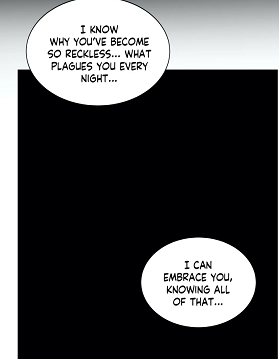 (Chapter 57) However, this shows that Yoon Seungho is a quick learner, because he knew what to do, when the painter was in pain and destress. At the same time, it explains why he could fake the embrace in chapter 62:
  This hug stands in opposition to the one at the end of season 3:
  (chapter 102) The artist was forgiving his lover! Love represents selflessness, tolerance, forgiveness, warmth, affection and assistance which is transmitted by the embrace. Now, you understand why Yoon Seungho was still not satisfied after the sex session in the study, he was longing for the hug.
  (Chapter 84) In his unconscious, he knew that if the artist hugged him, he would have forgiven him. But he had no idea about it, thus he couldn’t suggest this. So far, he had experienced the embrace from the artist while having sex. Deep down, he had already internalized the embrace to forgiveness. So we could say that the absence of the embrace in this scene was the lord‘s punishment for the fake hug in the shed. And the painter let him discover the true nature of a warm embrace:
  (chapter 88) This is not surprising that this hug was not connected to sex at all. Yet it moved the lord so deeply. As the manhwalovers could sense it, season 3 was focused on love and sensuality. During that season, the couple was able to voice about their sexual desires and their preferences.
  (chapter 91)
 (Chapter 86) No one close to him had grabbed his hand in order to show their support. This gesture in the picture embodies abandonment. On the other hand, the painter had been the first one to take his hand and to swear “loyalty“.
 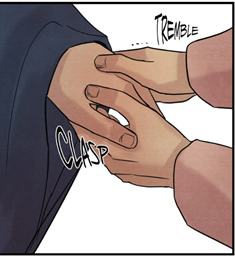 (Chapter 30) The joined hands were repeated in season 3 , the only difference is that this time, Baek Na-Kyum was doing it willingly.
 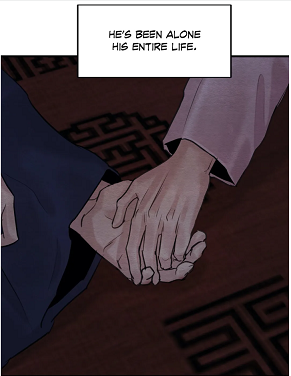 (Chapter 88) The symbol for support, company and responsibility.
 and his request for help are strong indications that Baek Na-Kyum was now accepting his affection. He was now trusting the noble, hence he revealed an important clue about the abduction.
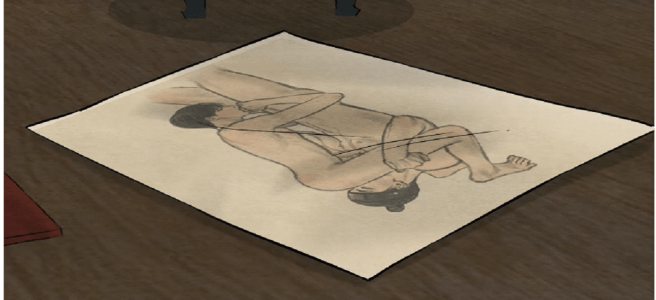
  (chapter 41) Under this perspective, it becomes understandable why the couple neglected these pictures. They were all devoid of affection, it was more about prostitution and battle! And here is now the question? Where are these drawings?

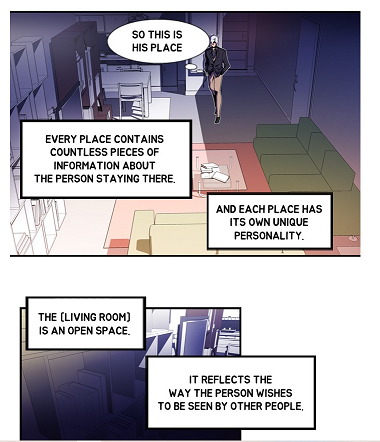 (Dr. Frost, chapter 8) As you can see, home is strongly connected to identity and personality. In other words, without home a person loses his identity. This is no coincidence that homeless people often have no ID.
  He felt so lonely and lost, for he had no place he could call home. It was, as if he had no identity. When he deserted the mansion, he first thought of the kisaeng house and his noonas
 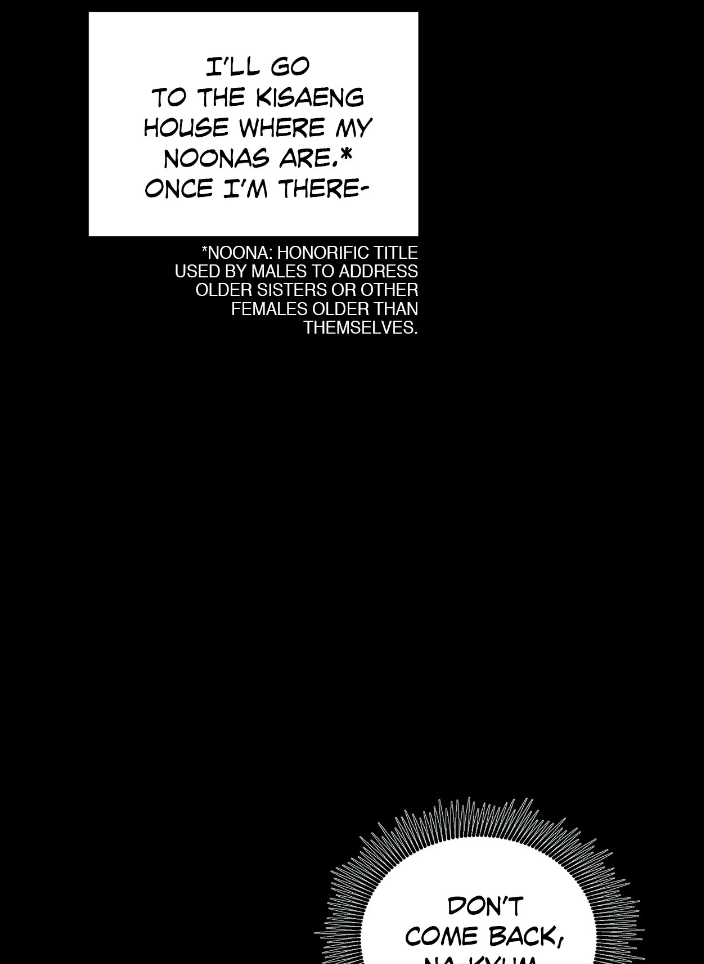 (chapter 46), until he remembered how he had been sent away by Heena noona.
 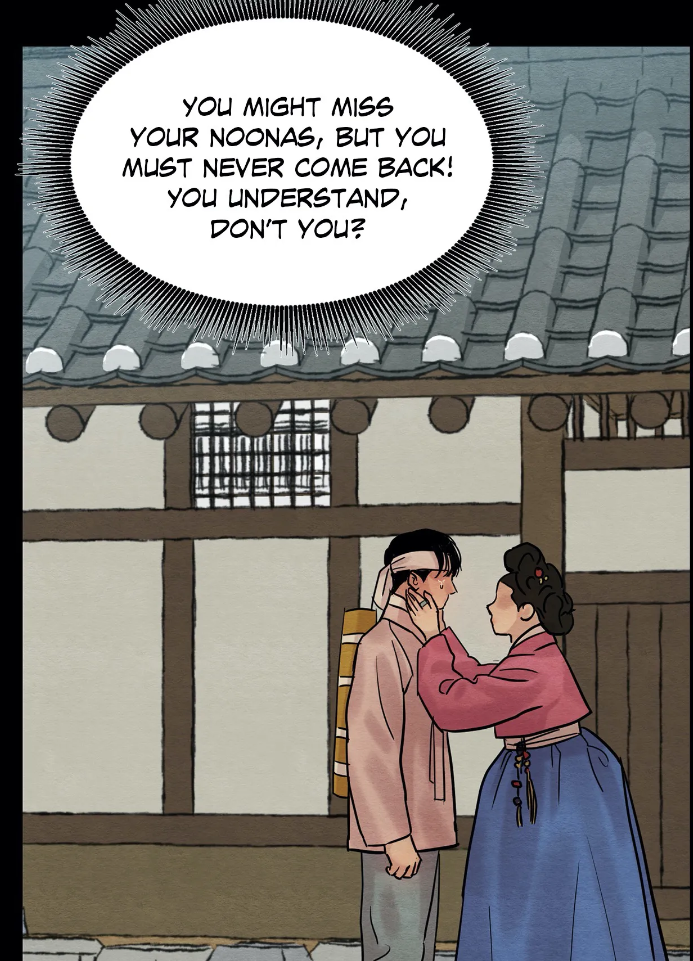 (chapter 46) This moment was terrible for the painter, because he had the impression to be abandoned a second time. Note that he is not calling the kisaeng house his home… for him, it was no longer a home, because his heart had been wounded there. Hence the manhwaphiles sense why the painter was using his mind in chapter 75
 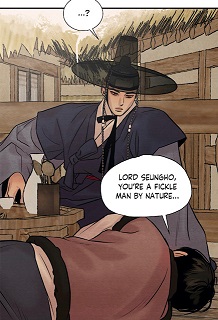 (chapter 75) and was restraining himself from falling more for Yoon Seungho. He had come to view the mansion as his home, and if he came to accept Yoon Seungho as his companion, then the latter would become his home, his family. Don’t forget my previous statement: Home is where the heart is. He was afraid of getting hurt a second time. If the lord came to have a change of heart, he could lose his new founded home.
 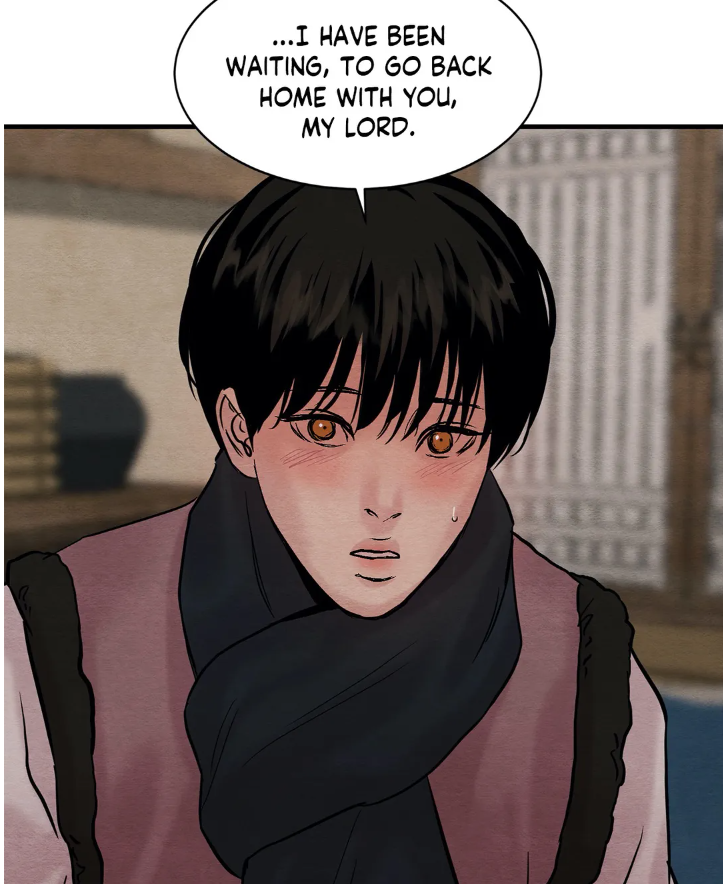 (chapter 58) And now, you comprehend why he stopped in the middle of the street during his escape. He had recalled how Heena had sent him away.
  (chapter 68) Observe how she blames her brother for not contacting her, while she had strictly forbidden him to come back. At the same time, the readers should question her behavior. How come that she never showed any concern for Baek Na-Kyum for 18 months, until she found out that he was living with Yoon Seungho? Why didn’t she contact him in the first place in order to check out if he was living properly? She gave him instructions, and the main lead listened to her, and now she is reproaching him that he should have disobeyed her. In my eyes, Heena noona acts more like a person with a fickle nature. She shows great care and concern in chapter 65 and 68, but she never searched for her brother’s whereabouts before. So far, the readers can only assume that she had no idea that he had been living as a drunk, and she only discovered his whereabouts by hazard.
  (chapter 64) Yet, this is just an impression because of this scene. Yet, in season 3, Heena confided to Min, and the latter revealed the content of her confession:
  (chapter 99) The idiom “bittersweet affections” indicated that the learned sir had expressed regret and disappointment concerning Baek Na-Kyum. This means that Heena knew that Jung In-Hun’s affection towards the low-born had been changing. As you can see, I come to the conclusion that Heena was already aware of the existence of tension between the painter and his former teacher.
 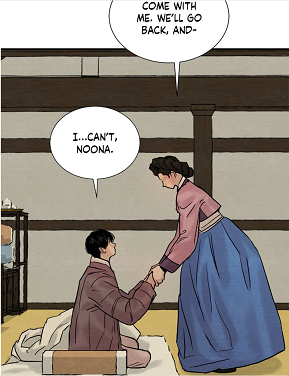 Heena noona is not even using the word “home”. At no moment, she employs this expression. When she parted from her brother in chapter 46,
 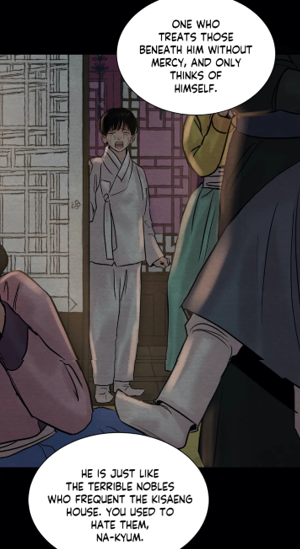 (chapter 68) Hence in her mind, when she asked her brother to leave the kisaeng house, she imagined that she was helping the painter to escape from prison. Since she admires the scholar so much, she saw in him her helping hand. He would assist her brother to become a free man. The readers should notice that the learned sir always left the kisaeng house with the low-born
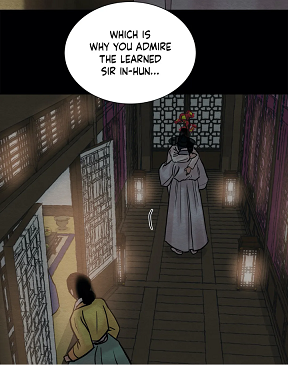 (chapter 68), when there was a ruckus. So when the kisaeng made the request to the teacher
 (chapter 46), she envisioned that he would acquiesce her request, since he had done it so many times in the past (taking care of Baek Na-Kyum and becoming responsible for him). Moreover, she knew that the artist liked and admired Jung In-Hun. For her, the scholar was a liberator, because he acted so differently towards the kisaengs and Baek Na-Kyum. That’s the reason why she thought, she was doing the right thing for her brother, while in reality she was just projecting her own desires into the artist. And this interpretation was proven correct, because when she vanished from the gibang in season 3, she was no longer dressed as a kisaeng.
 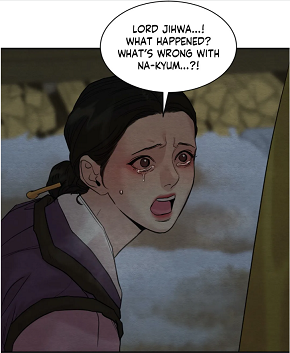 (chapter 99) She was deserting the kisaeng house, and as such the noonas. And note the parallels between chapter 46 and 97/99. In both cases, the painter couldn’t bid farewell to the other kisaengs.
  (chapter 99) It is because she was using her brother. In the first desertion, her choice was influenced by her unconscious. She had just projected her own thoughts and desires onto the artist’s. In season 3, she had made a conscious choice. In exchange of her brother, she would gain her freedom. Thus she used the expression “us”
  (chapter 97) This time, it was for her own sake. But the price for her freedom was that she had to sell her brother. She could still have a clean conscience by convincing herself that Yoon Seungho had killed her idol. At the same time, she needed to fake her death.
 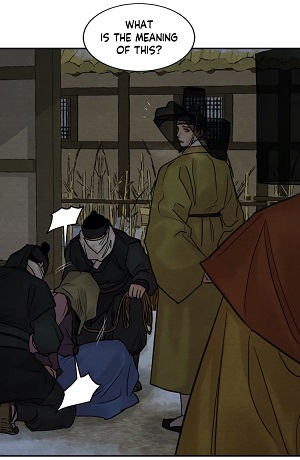 (chapter 99) [For more explanations read the analysis “Heena’s curtains”] This means that she was betraying the eonnies one more time. And that’s how I had another revelation. In my eyes, after their separation, Heena had come to view her life in the gibang differently. She had been able to perceive the good aspects of her life as a kisaeng. She could live a comfortable life and as such get new hanboks.
 reinforced her bad impression about Yoon Seungho. That’s why Heena noona will never believe that this place can become the artist’s true home. For her, this place can only represent a new prison, for she has a negative perception of nobles. Hence she needs to rescue her brother.
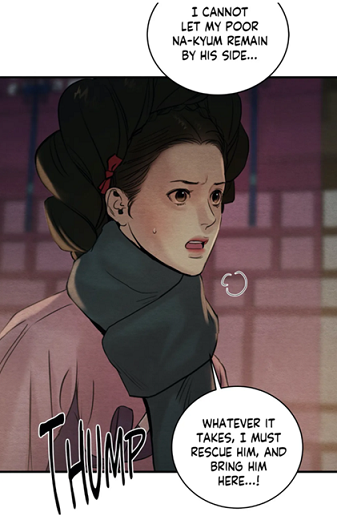 (chapter 69) Besides, I believe that she has another reason. The lord is connected to her own guilt, but she is not admitting her responsibility. In the first version, I had expected that due to his confession, the kisaeng would never trust Baek Na-Kyum’s words later. And this was proven correct. Why? First, Heena noona embodies a certain kind of knowledge: prejudices. Because she has already experienced many things, she has the impression that she knows everything. However, she is not realizing that her world view is based on her own perception. Secondly, her superficial knowledge turns her into a blind and deaf person. What she sees and hears will be interpreted the way she perceives the world. I had even written this back then:
 (chapter 97) Contrary to him, she knows, because she saw and heard things, when Yoon Seungho suffered! Yet, her knowledge is totally superficial, like the last panel exposes it. She just jumped to (false) conclusions. That’s how she got herself manipulated. Because of her bias, she became an easy target of deceptions. That’s the reason why she believes herself in rumors. Like the scholar said it himself,
  (chapter 29) there exists a kernel of truth in the grapevine. Moreover, with her caresses and hugs, she used love to stop her brother from speaking his mind.
 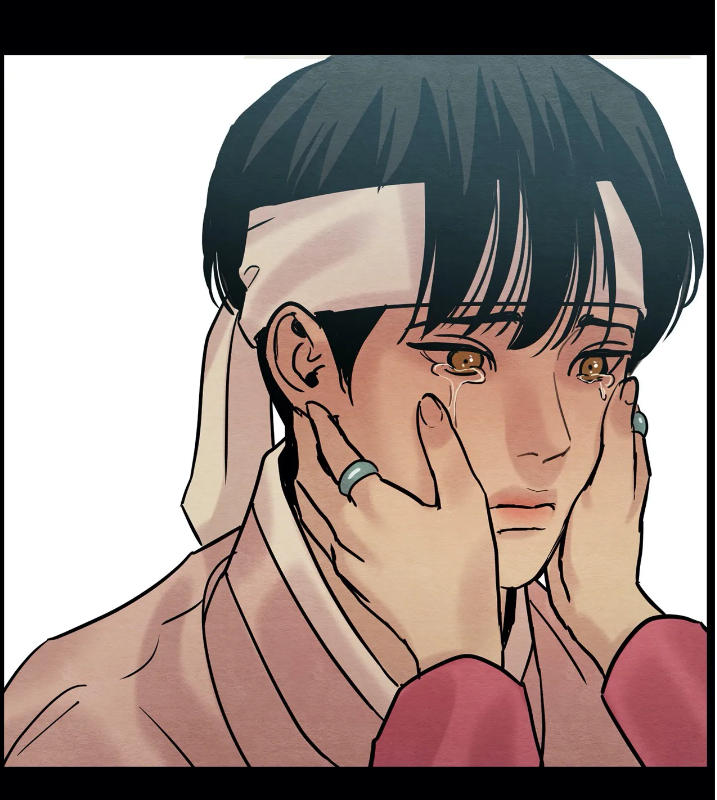 (chapter 46) That’s the reason why Baek Na-Kyum could only express himself through painting, as he had become mute. Due to her decisions and actions and the scholar’s, she contributed to turn the artist into a boy full of insecurities, unable to express himself. Consequently, Heena noona was put in front of the same choice in season 3. Note that the return of the painter to the gibang coincides with her departure. This means that due to the couple’s love session, she was reminded of her own past. She was forced to recall why she had associated the gibang to hell in the first place.
  (chapter 96) She was definitely scared in that scene. That’s the reason why at the end, she utilized her brother to leave the gibang.
 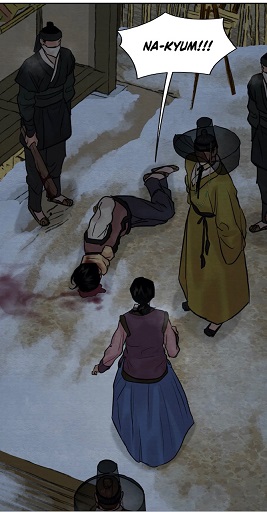 (chapter 99) This mirrors that her original dream was to live with her brother and the scholar, but this was just an illusion. She had hoped that once the artist was by Jung In-Hun’s side, the learned sir would come to buy her, and they would live together. She counted on the learned sir’s affection for the painter. But this was never Jung In-Hun’s intentions and he excused his behavior by putting the blame on the protagonist.
 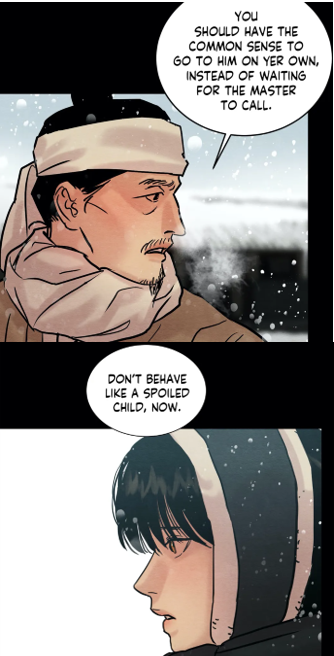 (chapter 52) And finally Yoon Seungho treated him well on different occasions by sharing his breakfast with him or sending him to the doctor or by protecting him from Deok-Jae. Yet I believe that the decisive factor is the momentary separation. Although the painter had lost his position as favored servant, the noble never sent him away. He let him live in the study and kept treating him well. The artist could sense that despite the distance, the noble was not willing to cut ties with him. This explicates why Baek Na-Kyum resisted to the vicious servant, when the latter tried to force him to leave the property.
 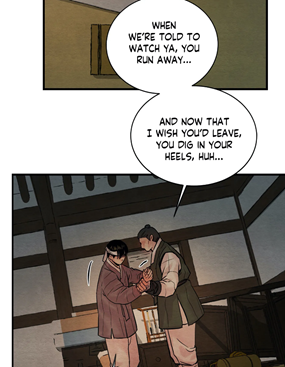 (chapter 53) This was his home now, and he wanted to protect what he had finally found. Despite the pain, he didn’t move. He was ready to do anything for his home. This gives us a glimpse of the painter’s future behavior, when his lover is targeted. There’s no doubt that he will fight for him. And now, if you compare the two following panels, you’ll realize the similarities between the two scenes:
  (chapter 76) In both scenes, the painter has a revelation. In chapter 46, he is alone and has no place to go. However, he is strong enough to stand on his feet, while in episode 76, he is paralyzed by fear and becomes so weak. Yet, exactly like in the first image, he feels lonely, but since he can’t escape, this position makes him realize his vulnerability. He needs help and protection. That’s why the moment he realizes the noble’s presence
 (chapter 76), he seeks his embrace and warmth.
  (chapter 76) With these words, it truly outlines that the mansion has become Baek Na-Kyum’s real home, a place where he feels comfortable and secure, which represents a continuation of chapter 46. While in chapter 46, he just considered the mansion more like a refuge or shelter, now he connects it to family. It has truly become part of his identity. But the embrace on the street let him discover that Yoon Seungho could become a home too.
  and English version, when the lord replies to his request.
  In the original version, the lord is now admitting that the mansion is also his home now, whereas in the past it was just a prison and he wanted to have a companion by his side. In the English version, there’s only silence. This difference affects a lot the interpretation. By remaining silent, the noble is not acknowledging the mansion as his home, but this doesn’t mean that he has no home. In my opinion, Yoon Seungho perceives the painter as his home, hence he prefers remaining there hugging his lover. The painter gives him the warmth and love the lord has always been longing. That’s why he gives the excuse that they should stay there. It seems that the English version
 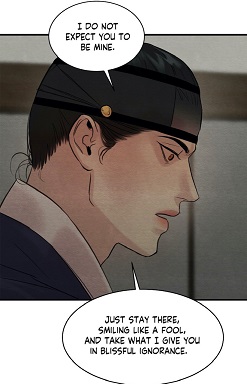 (chapter 85) Baek Na-Kyum represented the foundation of his home. Without him by his side, his “home” would crumble.
  hence his head moves closer to Yoon Seungho’s
 and at the end he even closes his eyes
 (chapter 74) This was a new version of the chapter 51 and 52. And you all know the saying:
  (chapter 78)
 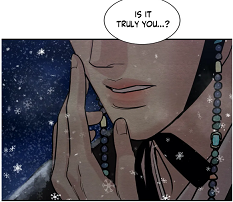 (chapter 102) As long as he is by his side, everything is fine. This new definition of home appeared, when the painter and the lord confessed to each other.
  (chapter 96) It didn’t matter where they were. Thus they could confess in a gibang. They felt safe together. And this is the same in the mountain. Observe that the painter is not asking why they are in the mountain and what the lord intended to do there. In fact, he was more focused on the past than the present. However, for the painter, home is not just a family, he liked to sleep in a warm bed and have a warm meal each day
  (chapter 68), since he had lived like a homeless for a while. Hence both will have to look for a real home, a house. Moreover, the lord will have to provide for the painter, and the latter will feel obligated to assist his lover. This means, in season 4, home should have a new definition. It is not just a family, but also the mansion and the country! Don’t forget that many people died in season 3.
 (doctor frost, chapter 9). What caught my attention is that the lord’s bedchamber is literally empty: There are only one big white vase, a red box, candles
  (chapter 55) and a windscreen.
  (chapter 55) The latter shows trees painted in black, there’s barely nature in the end. It mirrors the lord’s symbolic death. The emptiness of his room reflected the lord’s life. He was living like a zombie and avoided emotions, as he had no souvenir at all. Although he reads a lot, you never see them in his room. Why? It is because he separated his spirit from his body. In his bedchamber, he was a captive trapped in the past, hence he had nightmares. Moreover, I think that his bed is the source of his nocturnal panic attacks, as the colors are the same than the king’s. And now, the manhwaphiles can better comprehend why the noble has never considered his mansion a home. In this house, and in this room, he had traumatic experiences (abuse), which were so horrible that he had entirely repressed it. Nonetheless, the moment the painter calls the mansion his home, this has a huge impact on the lord’s life. The latter is now “forced” to consider the mansion as his home too. Hence in the Korean version, we have this panel:
  (chapter 98) This shows that he had conquered the bed. Season 3 exposes the painter’s conquest of the bedchamber. The turning point took place in chapter 87, when the artist went to the study on his own volition.
  (chapter 87) I can’t help myself thinking that in season 4, the painter will bring his possessions to the bedchamber for good contrary to season 3.
 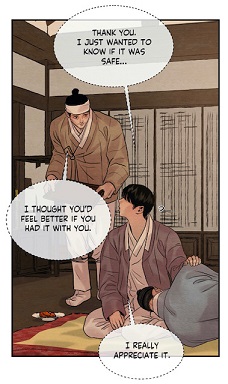 (chapter 79) The music box was brought back to the painter’s studio after the argument. Since the lord bought a music box for Baek Na-Kyum, and the latter treasures this item, it also has a special meaning for the lord too. The music box represents the lord’s heart, but the main lead didn’t grasp the true meaning, until it was too late. So far, the broken music box got neglected after their argument
 (chapter 85), yet I am still hoping for its return, for the lord had recognized its true signification to the painter afterwards.
 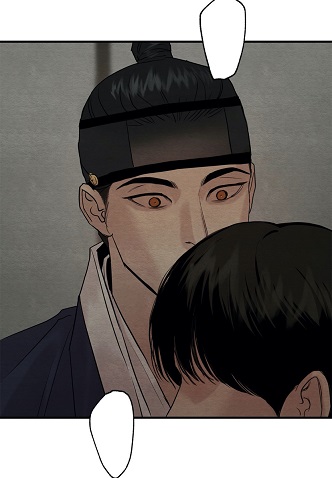 (chapter 85) But we shouldn’t forget the lord’s Spring poem
 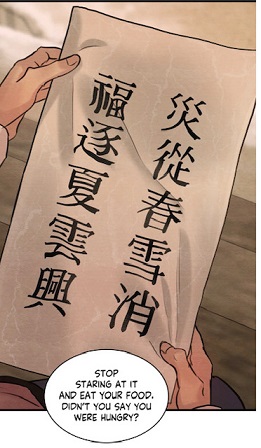 (chapter 92) Little by little, the lord’s study will be filled with treasures belonging to Baek Na-Kyum which are connected to the noble. This is relevant, because thanks to them, the lord can recall the good moments with the artist. Slowly the lord’s bedroom will become more and more a study. With the arrival of souvenirs, the bedchamber will be filled with life again. This will symbolize that the lord is slowly taking over the bedchamber, and filling his room with things he likes. Where is the orchid? So far, all the nobles had plants in their room:
  (chapter 43)
 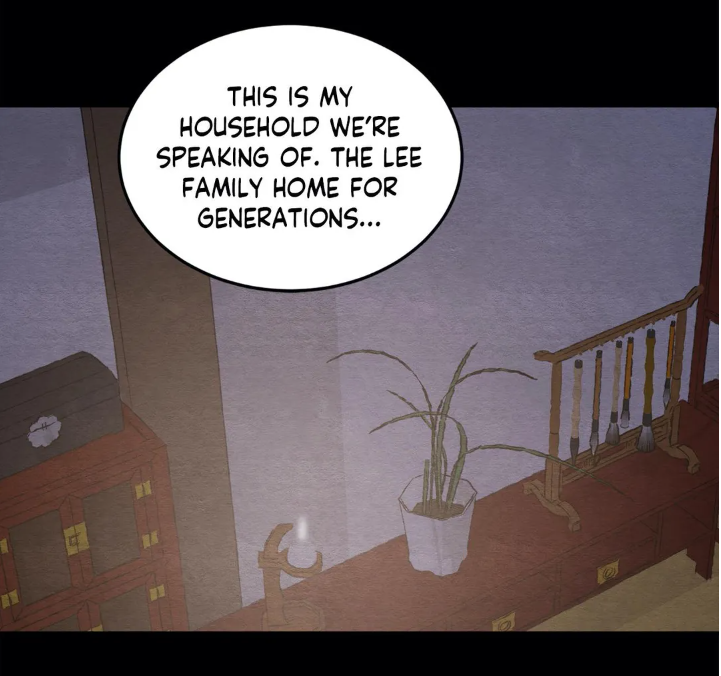 (chapter 82) Hence I am wondering if Yoon Chang-Hyeon didn’t punish his son by taking away the orchid, when he painted on the servant’s body:
  (chapter 36).
  (chapter 99) This new interpretation leads me to the following observation. In season 4, we will witness a new battle again, and it will be about the ownership of the mansion. Who is the true owner of the propriety? Kim, Yoon Chang-Hyeon, Yoon Seungho or lord Song?
 (chapter 1: Ji Wonyoung is standing in front of Jung) Or both main leads come from a rich family and are called Yoon (in Unintentional Love Story, it’s Yoon Taejun). However, the real reason for bringing up this modern Yaoi is the resemblance of Ji Wonyoung’s personality with Baek Na-Kyum’s. Both are selfless, naive, social, kind but more importantly cheerful. They are easily affected. Yet one might argue that the painter is different, as he knew about his sexual orientation very early on
 However, an important detail caught my attention. The uke only dated women who would confess to him. He never initiated anything.
  This signifies that the main lead started dating these women, because he felt grateful and touched. That’s why all his ex-girlfriends had nothing in common. In other words, he was never really in love with these women, therefore we could say that he was straight out of convenience. This explicates why he gets more confused, when he starts falling for Yoon Taejun. He goes so far to ask a friend
  how to recognize love. The latter replies with the following description:
  – He would think about the person all the time
 , blushing
  , finally he would ramble things
  and make a fool of himself
 . I included these pictures from Painter Of the Night for a reason. They expose how the painter is definitely in love with the main lead. And this clearly reveals that Baek Na-Kyum was never in love with the scholar in the end. Hence you comprehend why I am presenting Ji Wonyoung from Unintentional Love Story. It helps to grasp why the painter was in denial for so long. He couldn’t understand his emotions, as he had never felt like this before. Moreover, unlike to our modern protagonist, the artist had no one to confide, not even to his noona. When he saw his lover kissing another man, he was bothered, but he couldn’t admit it entirely.
 He wondered about his emotions. When he finally met Heena, it was already too late.
  . Thus he started denying his feelings for Yoon Taejun. First, he reduced it to admiration
  and tried to find excuses for his reaction:
  As you can detect, his mind tried to reason his behavior and emotions. More striking is that the character Ko Hotae is the one who pointed out to him that he was just using too much his mind and he shouldn’t ignore his heart.
  As the manhwaphiles can detect, Ji Wonyoung was struggling to admit his feelings for the potter Yoon Taejun. Nonetheless, this has nothing to do with fear of stigma or loss of reputation, because the moment Wonyoung started dating the main lead, he had no problem to kiss his partner outside.
 At no moment, he shows real concern or fear that people might discover his relationship with Yoon Taejun. Sure, he is careful due to the special status Yoon Taejun has as a famous potter. And all these observations led me to the following conclusion: Ji Wonyoung had never fallen in love with anyone before and as such, he had never truly paid attention to his true sexual orientation. He was neither a homosexual nor a straight person per se. He just dated girls, because he felt “attached and obliged” as a gentleman. However, all his partners could sense in the long term that their affection was not truly returned. Striking is that in this story, Ji Wonyoung had a similar attitude than Baek Na-Kyum. The low-born would always use his brain and mind to diminish his emotions.
 (chapter 56), even his unconscious was telling him that he longed for the lord’s affection. Both characters were struggling the same way, yet for different reasons.
  and even worse the existence of sexual desires. That’s why he kept hiding behind doors. The artist feared the gaze and judgement from others. This fright was linked to the scholar’s indoctrination: sexuality is dirty, especially copulating men were filthy.
  (chapter 31) and secondly during their sex session, when Yoon Seungho was behaving like a client at a brothel.
  In this panel, his face is literally glowing. Yoon Seungho’s words accompanied with a huge smile have already moved his heart, hence his mind reminds him of this:
  He is not allowed to love Yoon Seungho, his noona forbade it. That’s the reason why Baek Na-Kyum drinks in the tavern
  and blames the noble for his fickle nature.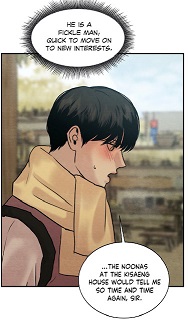
 from chapter 56. The artist always felt the urge to get hugged. As you can see, the artist longed to be embraced as well. Surprising is that in chapter 66, Baek Na-Kyum got hugged by his noona.
 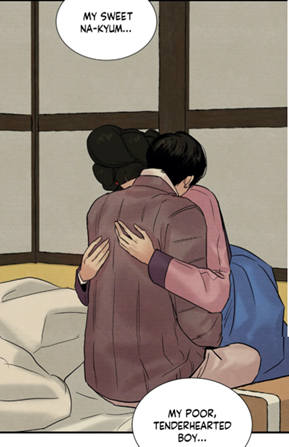 That’s why I think, she knew that the artist was easily swayed, if someone was quite nice and gentle. Note that she hugs him a second time, after the painter has already confessed to her that he had developed some attachment with the main lead. In other words, he was similar to Ji Wonyoung from Unintentional Love Story, he would feel gratitude and become loyal, as long as the person would be caring and warm towards him. I believe that Heena knew that the painter had such a disposition. That’s why she says this “my poor, tenderhearted boy”. If a person showed some affection through caresses and hugs, he would become obedient, as he would be thankful. Yet, in chapter 68, the kisaeng failed twice with her attempts. She even tried to stop him from replying to her points by putting her hands on his cheeks.
 She imagined, the artist would react like in the past, when she sent him away.
  . He had no idea what love is. She tried to convince him in every possible way that his feelings were not real or in the last resort, he should not act on his emotions.
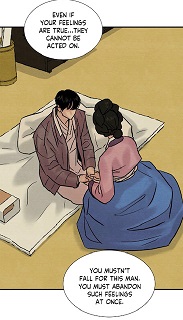 As you can observe, Heena was talking to his mind. We could say that she embodies the mind, hence she was the cause for the inner struggle in chapter 75. For she symbolizes the conscious, she also advocates the social norms. If a man showed his love for another man, then this would be a real scandal. From my point of view, she can’t accept homosexuality for two reasons. First, it is related to the nobles’ hobbies. The latter were the ones who bought the artist’s publications, and Heena hates filthy rich aristocrats. But there’s more to it in my opinion. For her, homosexuality is a synonym for addiction or bad life, because love between two men can’t exist. Why do I think like that? It is connected to the image “man consumed by lust”. Note that till the end, the artist worries about this aspect. If the artist were to admit his love for the noble officially, then he would be perceived as a man consumed by lust. That’s why Heena is against this relationship. She knows that all the other nobles will never admit having sex with other men. They are able to maintain their respectability. Thus the kisaeng says this:
  However, let’s not forget that his relationship with the main lead was always full of pain and violence
 , hence when the artist confesses his love in front of his sister, the latter should have already realized that the artist didn’t develop such an affection out of convenience or gratitude. That’s why she presents it as the opposite:
  He gets so scared, when he meets the criminal by chance that his mind is no longer functioning properly.
 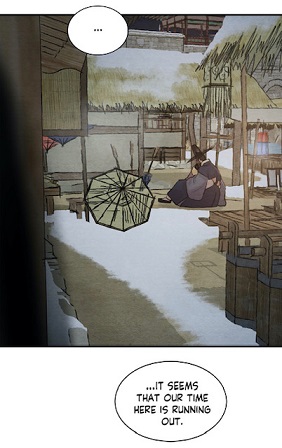 and what the lord was willing to do in order to protect and console him: he remained seated on the ground, until the painter had calmed down.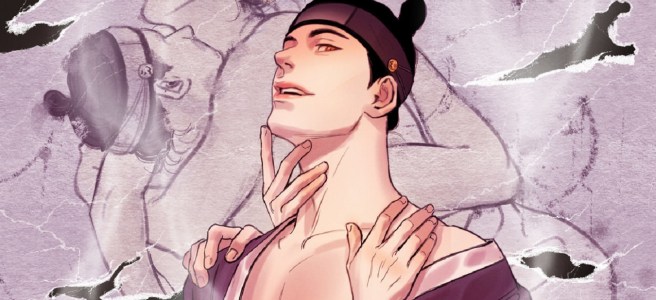

 Bebebisous33s' analyses in K-Dramaland and Manhwas