
In one of my former analyses, I compared Alice in Wonderland with this k-drama. In the fairy tale written by Lewis Carroll, the Mad Hatter considered time as a person therefore Time was written in capital letters:
“If you knew Time as well as I do, said the Hatter, you wouldn’t talk about wasting it. It’s him. “[…] I daresay you never even spoke to Time”.
Furthermore, time played a huge significance in this story as it was about growth and the passage from childhood to adulthood. Alice’s journey in Wonderland represents her quest for her own identity. And this k-drama is not different: We see Lee Gon, the protagonist changing. From a mathematician and scientist, he has become a true believer of the 4 Tiger Sword and the Manpasijeok. And as such, time is an important factor for growth and making new experiences.
Before analyzing the k-drama under this aspect, we need to remember what time is. Time is composed by past, present and future. And all along these three aspects are always present and relevant for the story and its evolution.
But now let’s go back to the start of The King: Eternal Monarch. Right in the beginning, time is present. We hear our antagonist Lee Rim telling the story dated in 632, then when he is asked, why he doesn’t look like his age (71), he mentions the year 1994, where everything all started. All this underlines the importance of the past. But time doesn’t just exist through the testimony and the reference of the Chronicles of the Three Kingdoms. In the interrogation room, the detectives Kang Sin Jae and Jeong Tae Eul put the records of Lee Rim.

The records about Lee Rim symbolize time. He is supposed to have died, just like he is supposed to be very old. As you can see, the “person” Time never appears as such but is existent in the interrogation room. The past and the present are the elements that are alluding to the supernatural: the story about the mysterious flute, the strange appearance of Lee Rim who doesn’t age.
Then when Lee Gon is saved by the mysterious savior, he catches the ID from the future with the date: 11.11.2019. During the coup d’etat, we have a mixture of past and future. Now (episode 13), it has been confirmed that Lee Gon traveled back to the past (1994) and saved himself from Lee Rim. So here time is embodied by the ID and the mysterious savior. It was as if time could be seen or touched through the objects or the persons. The best example is when Lee Gon and Lee Rim observe that Time stops. Because nothing moves except the two main characters, the latter can sense the lack of time. Nature stands still: the snow flakes or water don’t fall anymore.
The director sometimes tried to even personify Time in different shot, when the persons were not talking about the present, the past or the future. I chose two different takings:
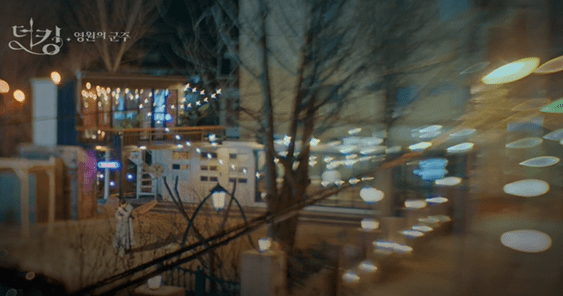
Here, we have the impression due to the lights on the right side that this is not a sequence but a photo. However, when Lee Gon and Jeong Tae Eul hug each other, the viewer can observe their movements, while the lights on the sight are so fuzzy and stretched. It was, as if time had stopped and nature stood still. This taking reflected the inner feelings of our two protagonists: they enjoyed the moment, the present.

Here, Time is also present in the form of the hourglass. Pay attention to its size: it is even bigger than Lee Gon and Jo Young. Through this taking, the director illustrates how powerful time is and it is a main character invisible to the people standing next to it.
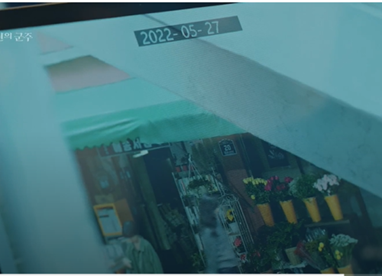
While Lee Gon was looking at the CCTV in order to watch his loved one who was so far away from him, he suddenly discovered this CCTV from the future. The child with the yo-yo lets him know where Jeong Tae Eul will be on the birthday. This scene is important as it shakes the king to the core. There is no science that can explain this. On the other hand, it shows him that Jeong Tae Eul is alive and well which can comfort him. Here, it was as if the child with the yo-yo already knows the end of the story, just like the book about King Arthur. This deity can move from one world to the other, it can also travel to the future which seems to indicate that he can travel to the past as well. The child with the yo-yo has also a strong connection to time as he was the one ensured that Jeong Tae Eul would get a new ID so that the young Lee Gon would be able to receive it. Then he was the one who told Luna that he believed in the existence of god which let her say that she would be punished. So is he a personification of time? I am more inclined to believe that he embodies fate which is related to time. His main duty is to observe that the balance is well maintained. Anyway, the child with the yo-yo uses time (and good timing) so that everything predetermined will happen. Since the flute makes it possible to travel in time, then the balance has been disrupted as we know that Lee Rim travels to the future. He neglected the past as he saw no real meaning in it. The reason is simple: since he is obsessed to become king, his focus was on the future.
Another observation is the strong connection between Jeong Tae Eul and Time. Remember that she is a person who learns through experience and as such, she needs time to acquire her knowledge. We can see this strong link between these two in different occasions. When she waits for Lee Gon in the episode 6, the separation made her realize her longing for Lee Gon. Time was the reason why she realized how much she missed the king. Then in the episode 7, when she is about to confess her love to Lee Gon, her thoughts revolves around the past (“fate”) and the future (“sad premonition”) but this doesn’t stop to declare her love. She wants to enjoy the present to the maximum. This elucidates why Jeong Tae Eul seems so obsessed with the present. She doesn’t want to project herself with Lee Gon in the future as she has a sad premonition. She keeps saying to Lee Gon: Let’s enjoy the moment. Hence she doesn’t answer to his proposal. Strangely, Jeong Tae Eul meets Lee Gon from the future which somehow confirms her sad premonition, yet she doesn’t reveal her strange meeting to the present Lee Gon. In other words, Jeong Tae Eul could be perceived as the personification of the present.
Since Jeong Tae Eul is associated to the present, then which person represents the future? In my opinion, this part is reserved to Lee Gon. The latter appeared in front of Jeong Tae Eul in the episode 10, when he came from the future. But this perception is also confirmed in the episode 13, when Lee Gon looks at his reflection in the mirror.

Here, Lee Gon realizes that he is wearing the same clothes than the mysterious savior in 1994. He gets aware that he saved himself in the past. In the mirror, he sees his own past but also his future as the time travel has not occurred yet. Let us not forget that Lee Gon keeps projecting himself in the future with his girlfriend. He proposes to Jeong Tae Eul, he keeps asking her to come to Kingdom of Corea which annoys our female lead as she is someone who is focused on the present. So the mirror embodies Time as it reflects past and future together.
Since we have described Jeong Tae Eul and Lee Gon as a personification of Time (present, future), we have to wonder which person embodies the past. In my opinion, this is Luna. That’s why she is also seen in the mirror. She represents the past. She has a tragic past (abandoned with no identity) but she has no future, as she is about to die. That’s the reason why she can’t enjoy the present as well. Many have speculated that there were two saviors during the coup d’etat. I have the feeling that Luna could be the second savior if there is a second helper. She could become Lee Gon’s ally and helper in the past. Why?
First, like I mentioned above, the mirror reflect the past and the future. So when he travels back in the past, he could be accompanied by Luna, like in the mirror. Let us not forget that on Jeong Tae Eul’s cellphone there is the inscription: Back to the future and Luna is now in the possession of this precise cellphone. Since the cellphone is in her hands, she could travel back to the past as well. Luna wished, she had grown up differently, so maybe Lee Gon help her to change her fate so that when her future is changed so that she can die in peace, as her time is limited.
All along, we have the impression that the fight between Lee Rim and Lee Gon is a fight against time. It seems that Lee Rim traveled to the future, while Lee Gon will focus on traveling back to the past. Since Lee Rim knows the future, he thinks that he’ll win as he is able to influence the events in the present so that the future is changed in his favor. That’s why he targets specific people, since he knows what they will do in the future. By switching the people from Republic of Korea to Kingdom of Corea, he is able to have the important people siding with him. But changing the past can change the present and as such the future so that all Lee Rim’s efforts become vain.
As conclusion, time is always palpable, visualized or personified in this k-drama. It was as if people could feel time, either through an object or a person.



 Bebebisous33s' analyses in K-Dramaland and Manhwas