

Before we start to analyse different actual k-dramas under the aspect of truth and memories, we need to take a look at the definition of truth. This is what I found under the following website (https://www.dictionary.com/browse/truth)
- the true or actual state of a matter:He tried to find out the truth.
- conformity with fact or reality; verity:the truth of a statement.
- a verified or indisputable fact, proposition, principle, or the like:mathematical truths.
- the state or character of being true.
- actuality or actual existence.
- an obvious or accepted fact; truism; platitude.
As you can observe, truth is not just simple, although it is a short word that is often used. Truth has different meanings. Even philosophers like e.g. Plato questioned the definition and essence of truth. In our case, the second and fifth meaning are the relevant ones because truth is in the center of crime series. Fact, verity and reality are the goals of police work. Police need facts and evidence in order to retrace the events. They attempt to find the whole truth hence they need to find the culprit for the offense as the identity of the perpetrator is often unknown. As such, people think that discovering the perpetrator is a synonym for truth as it is a fact and a reality (signification 2).
But is it correct to think so? Actually, we have to question this belief. Knowing the identity of the culprit doesn’t necessarily signify that the police know the truth… Sure, in order to unveil the truth, the police investigation has to bring physical evidence and testimony of witnesses. However, the motive and justification for the crime are all subjective hence the detectives can only guess those. They can reconstitute the whole crime scene but they can never retrace the thoughts of the culprit. Moreover, it’s very difficult to prove a motive, especially if the perpetrator is motivated by emotions (anger, jealousy, etc.) and even irrational thoughts (serial killers). The profiler and detective can only guess and make assumptions but there is no guarantee that their reconstitution is the truth. Finally, retracing the events can never become the reality and as such the truth, since the victim is already injured or dead. The crime has already happened. As you can see, finding the whole truth is not physically possible. The thoughts can never be shown, the reconstitution can only give a glimpse of reality.
But even so, in order to retrace the events, the detectives have to rely on evidence and the testimony of witnesses, like I mentioned above. Evidence is quite simple as these are traces, like a bill, a phone call etc. On the other hand, it is quite different for the testimony of witnesses. The latter have to remember and we know that memory is not reliable, as people tend to forget or the witness didn’t pay attention to the scene and could only get a small part of the event, or even misinterpreted the words or the scene. In other words, memories are very subjective and even fluctuate, yet for the detectives, the memories of a witness can become facts. That’s why in memories lie a certain danger and can never served as the whole truth. Memories are quite subjective but are often treated as objective by people. This explains why during a trial, the witnesses are questioned by the lawyer and the prosecutor. By analyzing the veracity (truthfulness) of a testimony from both perspectives, the trial is trying to retrace the crime and retrace the thoughts of the accused before the events. All of this in the attempt to find the whole truth. That’s why memories play a huge part in the investigation and this topic is treated in the following k-drama, Memorist.
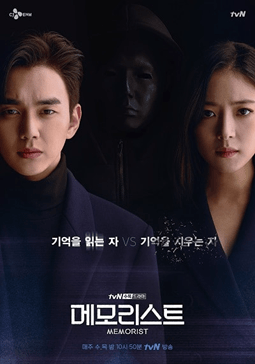
Detective Dong Baek (Yoo Seung Ho) has the supernatural ability to read people’s memories, when he touches them. Armed with this power, he tackles a mysterious serial murder case. And due to his ability, he catches criminals and is able to send them to jail. Initially Han Sun Mi, a profiler, dislikes the detective because she finds his method suspicious and quite dangerous. As you can see, the detective’s ability is perceived as an objective tool. We are not shown, how the criminals he caught were really convicted. He is the only one who can read their memories and in this drama, the viewer have the impression that memories read by DB are quite objective. Strangely, our main protagonist is suffering himself from amnesia. He knows nothing about his past, he only remembers the corpse of a woman. That’s why he is using his supernatural ability, he wishes deep down to discover his own past and the culprit of the murdered woman he keeps remembering.
Striking is that although Han Sun Min kept her distance from Dong Baek for a while, she relied herself a lot on her memories. She still wants to catch the culprit of her father’s murder. Only after many years, she realizes her mistake. She thought she saw a scar on the culprit’s face, while in reality she saw the mark of a face mask. As you can observe, the memories and their interpretation misled the profiler. Later, both protagonists are confronted with a crime, where the witnesses have no memories at all. All their memories have been erased and with no evidence, Bong Baek and Han Sun Mi have no lead to find the culprit. As the investigation progresses, they realize that they have to deal with a man with the supernatural ability to erase memories. At the end of the episode 12, DB touches Lee Shin Woong, Han Su Min’s superior, and read his memories. To his shock and surprise, he sees his younger self and the police commissioner confirms that it was DB who killed 7 people 20 years ago. As conclusion, the witness and the memorist believe these memories as the truth and fact. However, seeing is not the same as knowing. Dong Baek could have a twin brother hence Lee Shin Woong misjudged the situation. He thought, he saw DB, while it was not correct. Another possibility is that Lee Shin Woong manipulated his memories in order to mislead the memorist. All these events actually outline that testimonies should never be treated as the truth. That’s why we have trials where the reliability of witnesses is questioned. The use of DB’s ability for investigation is actually questionable. He is a human being and the memories read by him are also subjective.
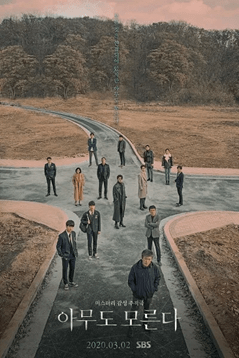
Then in this k-drama, the writer is already pointing out through the title “Nobody knows” that it is quite impossible to find the whole truth. Sure, the title is first referring to secret. All the persons involved have a secret which is revealed one by one. CYJ was the best friend of the 8th victim in the stigmata serial killing, HMS cheated on a test, KEH had discovered the identity of his biological father etc. In other words, discovering secrets play a huge part in discovering the truth but that’s not enough. It is possible that some secret will never be unveiled hence the whole truth won’t be known. Another parameter are the memories. Thus just like in the k-drama Memorist, the writer focuses on the importance of memories too.
The teenager Ko Eun Ho fell from the rooftop of the Millenium hotel in order to escape from the minions of the villain Baek Sang Ho. Striking is that after the victim wakes up, he is suffering from amnesia and wonders how he got injured. He is actually missing one month of his life. While the mother prefers her son not remembering the past month (“she declares that missing one month of his life won’t affect his future”), the young student expresses the desire to know the truth that’s why he questions the officer Cha Young Jin and his mother (“How did I get hurt?”; “Did I tell you something strange before getting hurt?” “why won’t anyone tell me anything?”) so that at the end, CYJ gives in and tells him how he got injured. She could retrace a huge part of the events but she couldn’t tell him why his minions were really after him. As she notices the teenager’s desire to know the whole truth, she tells him this.
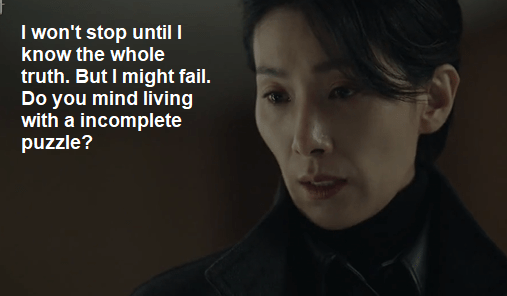
Striking is that for Cha Young Jin, retracing the whole event with evidence and testimonies, it means that she will get the whole truth. However, like I pointed out before… her promise can’t never be fulfilled in reality. Furthermore, when she made this, she believed that it was related to the book JKH gave to the teenager. And she knows nothing about Baek Sang Ho’s past and trauma as well. For KEH, getting his memories back is a synonym for knowing the whole truth. He is so determined to remember his lost month that he discusses the topic with his teacher.
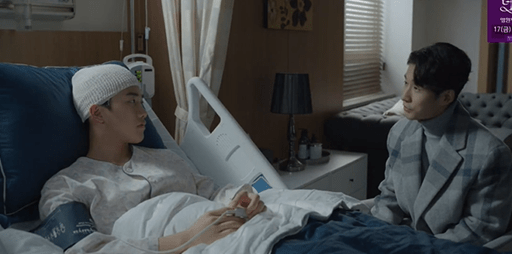
The teacher LSW: “And even if you fail to remember, people around you will tell you bits and pieces of what happened and you fill up your missing memory.”
The teenager Ko Eun Ho: “But that’s not my own memory. I want to remember what happened myself. “
As you can read in their conversation, the amnesiac teenager doesn’t accept the memories from the others as he perceives it as a false reconstruction of the past. He knows deep down that their memories is subjective as they only knew a part of him. Remember that he has a secret buried in his brain, besides the people close to him weren’t by his side all the time, as he was often on his own. His mother neglected him and spent time with her lover, the friend and officer was busy with her investigation, his friend DM was busy working. So the proposition from his teacher is rejected… he wants to remember himself as he believes that only with his memories he can get the whole truth.
However, KEH is wrong too. He makes the assumption that with his memories he knows the truth as he was the witness and the victim. Yet, while he was sitting in the car waiting for BSH, he never saw how the driver CDH was forced to drink some drugged water. While he was eating a piece of cake, the driver CDH was lying in the trunk of the car and later killed by BSH’s minions. They faked his suicide. When his short term amnesia disappears, he remembers that he discovered CYJ’s photo with the cellphone of SJ, the 8th victim from the stigmata killer. What caught my attention with his scene is that with this revelation, the viewers realize that they had been misled. All this time the viewers thought, they knew the whole truth as we were shown the events that took place before the fall from the hotel.
However, at the end of the episode 12, we get aware that we only saw the events from BSH and his minions’ perspective. KEH never left the 10th floor in a hurry because he had realized BSH’s mistake (“You already bought the book again!”). With these words, BSH revealed that he was the one who stole his school bag. In reality, KEH got scared because he discovered the photo of CYJ and SJ with the cellphone in the drawer of the desk. This was a clever move from the writer because it outlines one more time that nobody knows. The viewers didn’t know KEH’s memories until the end of the episode 12. Yet viewers are usually the ones who can get the whole truth because the crime is usually shown in his entirety. The scenes are not memories… the director and the writer are the one who hold the whole truth. But the reality is different: the detectives have no director by their side to show them what really happened. The only truth the police know for sure is: someone has been injured or killed. Everything else can not be considered as “reality” and “fact” but just “a reconstructed truth”, not the whole truth.

In this k-drama which is more a melodrama than crime series, our main protagonist Lee Jung Hoon is a famous anchorman suffering from hyperthymesia. This illness gives people the ability to remember an abnormally vast amount of their life experiences in vivid detail hence they can never forget. On the surface, it doesn’t sound terrible, nonetheless they have problems to deal with loss and breaks-up as they can never forget. Remember the saying: time heals wounds, for people like LJH, this saying doesn’t work at all. As time passes one, he can not forget, hence he is unable to move on. On the other hand, the female lead Yeo Ha Jin is suffering from amnesia. She has forgotten the most important moments of her life, as she couldn’t bear the loss of her best friend.
The thing is that since LJH is suffering from hyperthymesia, people and even LJH himself believe that he knows the whole truth. He lost in front of him his girlfriend Seo Yeon who had been abducted and later pushed by the stalker Moon from the rooftop. However remembering and knowing something are two different things. JH only knows the story from his point of view. While he was dating her, she said things that HJ, her best friend, used to like or say. Furthermore, Seo Y’s last words were strange : “I’m sorry”. This is not something you say, especially after being pushed from the roof. If I had been in her place, I would have named the culprit immediately in order to ensure that he gets punished. Or she could have said that she loved him … But no… she feels sorry for this. Then we know for sure that HJ discussed with the stalker Moon based on a small flashback. She got a glimpse of one lost memory. The journalist saw Moon showing around SY in the past, hence when he saw his flat full of pictures of his girlfriend, JH jumped to the conclusion that Moon was a stalker. Then the latter complained that if JH hadn’t showed up, he wouldn’t have ruined their relationship. Sure, hearing such words from Moon, JH thinks that he has to deal with a delusional man. Sure, the man’s words are not entirely reliable, yet we were shown glimpses that SY was not herself with JH the whole time. She acted as if she was HJ. Just like Moon was obsessed with SY, I have the impression that SY did everything in order to catch JH’s attention. JH never investigated SY’s past and her real relationship with Moon, as he considered Moon’s words and behavior as stalking. However, JH has always been a determined journalist who wouldn’t just rely on his hyperthymesia but also get fact in order to expose crimes or misbehavior (see the case of the abusive CEO in the beginning). So the whole truth has not been unveiled and our anchorman is not aware of it. He needs to dig the past but he doesn’t do it as he relies too much on his own memories. On the other hand, he doesn’t want HJ to regain her memories as he fears, she could try to commit suicide like in the past. However, her memories are important in order to understand what really happened in the past which led to SY’s death. But since JH is now showing signs that he is moving on as he is falling in love with HJ, the stalker Moon thinks that he is the only one who really loved SY and SY’s death was in vain. He can only remember her but he lost her forever. In other words, the stalker Moon lost SY, while JH is able to find a new love. Even having the best memory is not a proof that you can get the whole truth.
In an earlier statement, I said that knowing the culprit doesn’t mean that you know the whole truth. The best example is proved with the k-drama “The King: Eternal Monarch”. In this story, we already know the villain: Lee Lim. He killed the king and tried to murder the crown prince Lee Gon, as he was a witness. However, Lee Gon, as a young child, couldn’t identify his savior. He doesn’t even know how the black man could show up, why he left the ID of Jung Tae Eul. First, the witness thought that she was related to his mysterious savior, yet he realized, he was wrong. We know the culprit, even his reasons, but we don’t know how and what is really happening. In other words, the whole truth signifies here to discover the mystery of the savior and his reasons. The viewers is intrigued… he has to reconstruct the whole story: why doesn’t Lee Lim age, who saved Lee Gon, what Lee Lim is going to do in the future etc.
As conclusion, knowing the truth is not really possible in reality, only in watching crime or fantasy series. Only the director and writer know the truth. Memories are not reliable, there is too much subjectivity, hence they should be analyzed carefully.


 Bebebisous33s' analyses in K-Dramaland and Manhwas