

Please support the authors by reading Manhwas on the official websites. This is where you can read the Manhwa: Jinx But be aware that the Manhwa is a mature Yaoi, which means, it is about homosexuality with explicit scenes. Here is the link of the table of contents about Jinx. Here is the link where you can find the table of contents of analyzed Manhwas. Here are the links, if you are interested in the first work from Mingwa, BJ Alex, and the 2 previous essays about Jinx Where the Heart Heart💓 Spoke 💓🎶 and Flight 🚪 from Truth 👁️✨🧠, Fight🥊 for Fragile Peace☮️
It would be great if you could make some donations/sponsoring: Ko-fi.com/bebebisous33 That way, you can support me with “coffee” so that I have the energy to keep examining Manhwas. Besides, I need to cover up the expenses for this blog.

The Couple’s First Kiss
In episode 14, Joo Jaekyung and Kim Dan kissed each other for the first time. 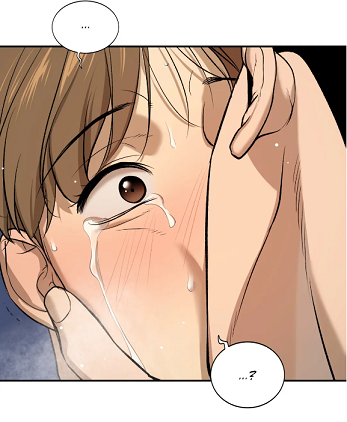 (chapter 14) For the physical therapist, this moment would later be confirmed.
 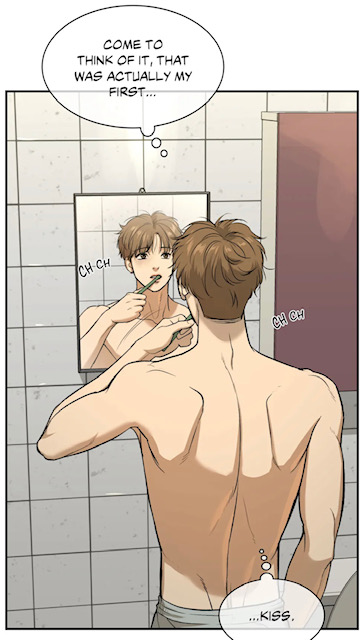 (chapter 16) —haltingly and with a trace of disbelief visible thanks to the points of suspension —as his first kiss ever. His stunned reaction and eventual admission offer a compelling lens through which to explore the symbolism of kissing in Jinx, but also the emotional landscape the two men must navigate.
Yet, the title of this essay refers not to Kim Dan, the hamster, but to the wolf. Could this have been the champion’s first kiss, too? The story never provides a definitive answer. While Jaekyung has had many sexual partners, he treated them as disposable— as toys and not as individuals.  (chapter 55) Still, some readers have theorized the existence of a “special lover” in his past
 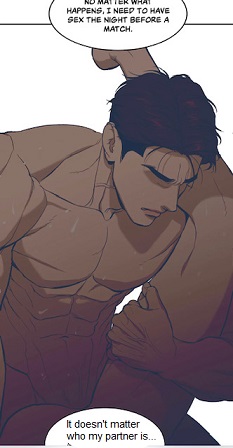 (chapter 2), someone who might have earned a different kind of intimacy. One cause for this hypothesis is that in the champion’s first memory, he was facing his partner, which contrasts so much to the way he had sex with his partners (from behind). This possibility casts the locker room kiss in a new light.
  (chapter 14) If it was his first, the gesture carries a far deeper meaning than either man realizes in the moment. And if it wasn’t, then why does this kiss—with Kim Dan—resonate so differently?
Under this lens, the significance of a first kiss expands. It becomes a tool not only to uncover Jaekyung’s emotional history and his past, but to explore the shifting dynamics between the protagonists. The following analysis begins with Dan’s reaction, then gradually shifts its focus to Jaekyung—tracing how the act of kissing reveals hidden fears, prior wounds, and the potential for genuine transformation.
The Hamster’s First Kiss
When Mingwa proposed a different perspective of the doctor’s first kiss in episode 15,  (chapter 15) she showed more than the physical therapist’s confusion with the interrogation marks, she added his inner thoughts. This question (“What’s this?”) already hinted that he had never experienced a kiss before. The ambiguity of his reaction suggested that the moment was unfamiliar, and not immediately recognizable as a kiss at all. (chapter 16) It was only later, while brushing his teeth in front of a mirror, that he consciously identified the event as his “first kiss.” Why didn’t he recognize it immediately? After all, a kiss—mouth-to-mouth contact—is common knowledge, even for someone emotionally inexperienced. I have different explanations for his confusion.
First, Dan’s delayed recognition reveals that this was no ordinary kiss: it was his first moment of unfiltered intimacy, so foreign to him that it couldn’t be labeled until later. (chapter 15) The emotional dissonance overwhelmed his ability to process what had just happened. His belated realization doesn’t just reveal how strange closeness is to him, but also how deeply isolated he is from ordinary social and cultural cues—whether through meaningful relationships or exposure to romantic norms in media. The fact that he did not immediately identify the kiss, despite its widely understood definition, underscores the emotional detachment and deprivation he has lived with. How could this happen?
To answer this question, we must consider more than just Dan’s personal trauma (the loss of his parents) —we have to examine his cultural upbringing and environment, especially his exposure to intimacy through media. This interpretive thread was triggered by a seemingly benign interaction in chapter 30, when Kim Dan meets actor Choi Heesung for the first time.  (chapter 30) Recognizing his face, Dan mentions that his grandmother used to watch the drama A Fine Line, and that he had seen it with her.
 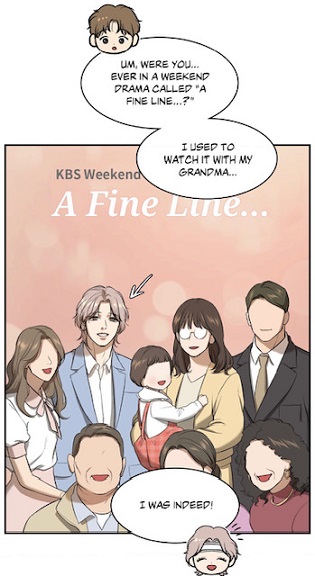 (chapter 30) The author even includes a framed shot from the fictional show, depicting Heesung as the smiling son-in-law in a multigenerational family. This visual insert is subtle, but telling: it wasn’t the story that stayed with Dan, but the faces—the aesthetics of family structure and polite emotional decorum.
This detail matters. Korean weekend dramas, particularly those aimed at older or more conservative audiences, are known for avoiding overt depictions of romance or physical affection. Instead of kissing scenes or deep emotional vulnerability, these shows focus on family values, social respectability, and moral perseverance. Romantic affection is implied through service, duty, and self-sacrifice, while physical intimacy is portrayed sparingly—if at all. “Skinship,” as physical affection is commonly referred to in Korean culture, tends to be awkward and limited even in media (like for example grabbing the wrist instead of the hand). Public displays of affection are discouraged in real life, and this cultural restraint echoes onscreen. K-drama couples often struggle to express love openly; when they do kiss, it’s usually stylized, fleeting, or emotionally stilted.
When you realize that Dan’s only exposure to fictional romance came through watching these conservative shows with his grandmother, the implications grow clearer. His understanding of love was shaped by media that prized emotional self-control, emphasized propriety, and framed romance as something that only happens within marriage or bloodline ties. And more importantly, his access to even this narrow vision of love was filtered through Shin Okja, a woman whose own values prioritized appearances, self-reliance, and emotional suppression. Under her roof, affection was functional. Emotional expression was rather ignored.
This means that Dan grew up with no safe or meaningful model of romantic love—neither in life nor in fiction. He didn’t learn how to interpret touch, kisses, or expressions of desire. He may know intellectually what a kiss is—mouth-to-mouth contact—but that knowledge carries no emotional anchor. His surprised thought (“What’s this?”)(episode 15) in episode 15 reveals just how disconnected he is from the symbolic meaning of affection. Later, brushing his teeth and reflecting, he finally realizes: That was my first kiss. But even then, the memory doesn’t register as something tender or beautiful. Instead, it haunts him because  (chapter 16) it frightened him. The kiss broke an invisible boundary—one his upbringing had silently enforced. That’s the reason why he wasn’t sure if he could do it again.
From this, we can draw a larger conclusion: Shin Okja didn’t just isolate Dan emotionally. She installed in him a framework that made affection seem inaccessible—something reserved for “real” families or television characters, not for someone like him. Without a nuclear family of his own, he wasn’t allowed to love—only to obey, endure, and work. The media he consumed (he likes TV K-dramas) mirrored this unspoken rule. The love stories weren’t his to emulate, but to passively observe as if from behind glass. In fact, it was likely his grandmother who chose those dramas, reinforcing a narrow script: love was something that happened to others, while he remained the background figure—responsible, silent, useful.
This disconnect becomes even more apparent in chapter 30, when Dan observes Joo Jaekyung and Choi Heesung posing together. 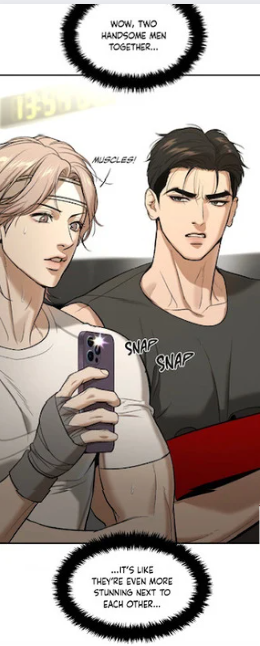 (chapter 30) He blushes and wonders why.
  (chapter 30) It’s a telling moment: Dan isn’t used to feeling attraction and desire, let alone recognizing it. He never bought posters of celebrities, never fantasized. That world—the glamorous world of affection, attention, and beauty—was never his. (chapter 30) His grandmother may have been a fan of Heesung, but I doubt that Dan never allowed himself that luxury. So his reaction is a rupture: he is suddenly pulled out from behind the glass, facing emotions he was never taught to hold. But there’s more to it. Dan’s extreme shyness around nudity
 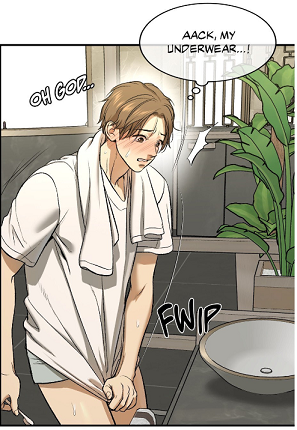 (chapter 30) —despite already having been seen naked by Jaekyung
  (chapter 30) —suggests something deeper than modesty. When he rushes to hide his underwear and blushes merely at brushing his teeth next to someone
 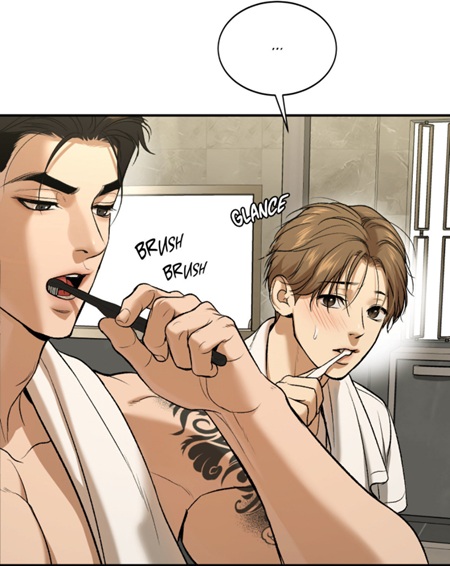 (chapter 30), it becomes evident: Dan is not accustomed to physical closeness or shared domestic spaces. These are not reactions of a man with just sexual trauma—they point to someone raised without the warmth of daily intimacy.
Thus I couldn’t help myself thinking that it is unlikely Shin Okja ever bathed him or dressed him as a child. Their emotional distance is reflected in the boundaries Dan maintains even in private. In this light, the scene where Dan wears a shirt with a visible clothing tag on his back takes on symbolic weight: 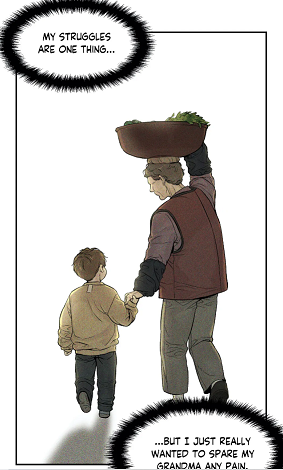 (chapter 5) He had to take care of himself, dressed on his own. He had to act like an adult, as his role was to assist his grandmother:
 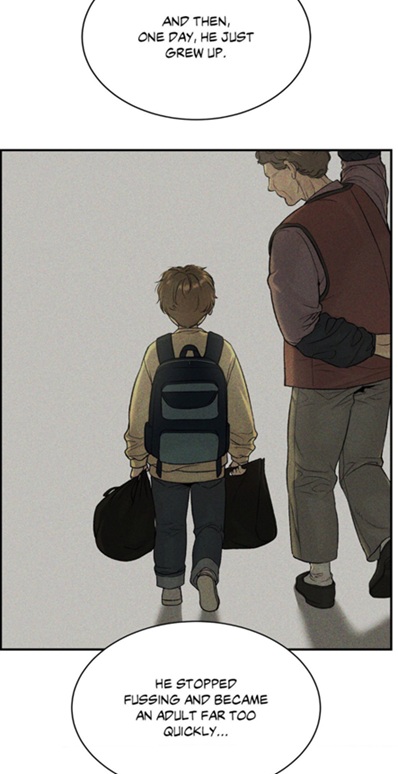 (chapter 65) This raises the possibility that someone else—most likely his mother—was his primary caregiver in early childhood. She would have changed his diapers, held him close, and kissed him gently.
  (chapter 65) This hypothesis and interpretation gets reinforced with the champion’s first kiss on his cheek
  (chapter 44) and ear
  (chapter 44) For me, without realizing it, Dan reproduced those gestures. These actions can not come from Shin Okja, as we only see her caressing or patting her grandson. The progression is striking. It moves away from eroticism (kiss from the lips)
  (chapter 44) and toward something far more intimate and protective. These are not the kisses of seduction, but of affection—almost maternal in their tone. Hence the MMA fighter got patted later:
  (chapter 44) They suggest care, comfort, and emotional presence. This is crucial, because it reveals that for Dan, a kiss is not about arousal or conquest. It is a language of love. They carry the flavor of instinct. These are the kinds of kisses a child might have once received, or given, in moments of safety and connection.
The way Dan moves through these kisses suggests something primal, tender, and exploratory. His gestures resemble those of animals—like a mother expressing affection to her cub. Such an attitude could only encourage his partner to reciprocate such closeness, like a cub seeking warmth. As noted in earlier analysis [For more read this essay], nuzzling  (chapter 44) is a behavior shared by felines and wolves alike: a subtle act of comfort, trust, and bonding. Wolves nuzzle to soothe and reassure. Leopards nudge to display affection without threatening dominance. Dan’s pecks (chapter 44) reflect this balance of caution and care, power and softness.
These gestures are not shaped by media, romance tropes, or societal expectations. They are shaped by something older than words—a kind of emotional muscle memory. His body remembers how to love, even if his mind has forgotten. And in that moment, Dan is free from the grandmother’s world of rules and repression. Shin Okja represents structure, duty, and emotional withholding—society. But Dan’s kisses are a return to nature. They are unmediated, sincere, and free from transactional logic. Think of how Boksoon treated her puppies  (chapter 57) (chapter 57)—licking them not out of instinct alone, but to reassure and bond.
 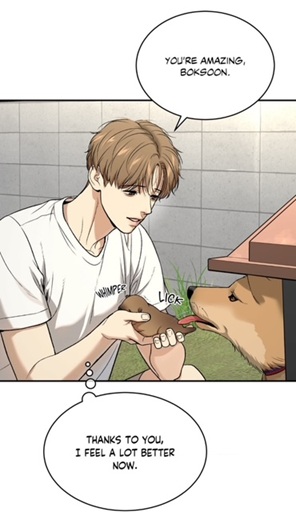 (chapter 57) During that summer night’s dream, Dan’s body mirrored this wordless care. That’s why he could laugh so genuinely like a child after witnessing his “pet’s reaction”.
  (chapter 44)
This contrast reveals why Shin Okja’s narrative of him being an orphan “from birth” is not just inaccurate (chapter 65) —it is ideological. She has never kissed him that way so far. It is her attempt to erase the past and shame. Therefore she removes whatever freedom or natural affection Dan once experienced, and to replace it with a world where love must be earned through sacrifice, duty and obedience, not given freely. The kiss becomes a reclaiming not just of emotional intimacy, but of a self that existed before control. His instincts speak louder than memory—and in that, Dan tells a truth that cannot be overwritten. And now, you comprehend why the doctor couldn’t identify the champion’s action as a kiss (chapter 15) It was not because he didn’t know what a kiss was, but because it didn’t align with what he unconsciously believed a kiss should be. In other words, the champion’s gesture triggered his memory which mirrors what the athlete was experiencing in the locker room.  (chapter 14) Therefore the physical therapist astonishment, “What’s this?” was not naïve; it was disoriented. Somewhere deep within, Dan had internalized a different model of kissing: one that reflected comfort, not conquest; affection, not arousal. The kiss he received was too strange, too fierce—it violated a definition he didn’t even know he had. His body knew how to kiss, but it remembered a different type of kiss altogether. The latter stands for love and as such emotions. Under this new light, my avid readers can comprehend why the physical therapist made the following request from his fated partner:
  (chapter 15) He needed to be “warned” in order to control his “heart”. As you can see, doc Dan had an innocent definition of the kiss. Therefore it is not astonishing that the wolf’s first kiss confused him so deeply: it shattered the only blueprint he had for intimacy.
This adds a tragic dimension to Dan’s unfamiliarity with touch. It’s not that he never had it—he once did. But it was taken from him, and what followed was not nurturing, but restriction through silence, erasure,money and work. His discomfort with nudity and closeness (chapter 65) is not just about sexual shame. It’s about lost comfort, severed memory, and the long silence of a child never told the truth, the vanishing of his parents. Under this new light, Jinx-philes can understand why the main lead could never discover sexuality and as such never went through puberty.
In this light, Shin Okja’s praise of hard work and her obsession  (chapter 65) with success and fortune take on a new, darker meaning. Her restraint around love and sexuality wasn’t only generational—it was strategic. She reinforced a worldview in which success, debt repayment, and self-denial were Dan’s only legitimate currencies. For her, love, on the other hand, was frivolous, indulgent, even dangerous. She only treasures the relationship between the protagonists, as such a friendship is useful. It serves her interests, that way she can still control doc Dan’s fate. In other words, she only views relationship as transactional. The smiling family in A Fine Line (chapter 30) becomes a cruel illusion: a representation of the affection he was trained to uphold but never to receive. On the other hand, the kiss in the penthouse becomes testimony—not of desire, but of a forgotten lineage of tenderness. (chapter 44) It was not Dan’s first kiss with Jaekyung; it is his reclaiming of emotional truth.
Kisses without consent
And here, another crucial dimension enters the stage: consent. The kiss in the locker room was not only unexpected—it was uninvited. Note that in the locker room, the champion used his hand to touch his lover’s lips. 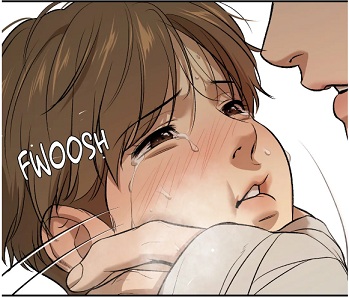 (chapter 14) Jaekyung repeated such a gesture, as seen in chapters 24
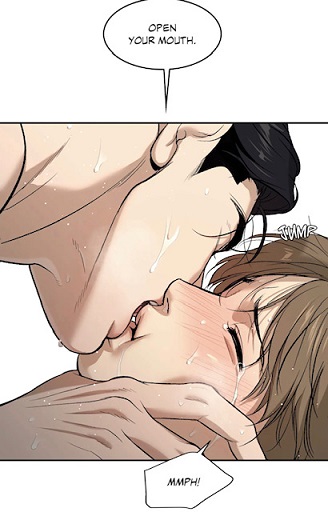 (chapter 24), and again in 64
  (chapter 64). These gestures were not expressions of tenderness, but acts of dominance, mirroring how the celebrity was taught to treat intimacy: not as an exchange, but as an imposition. His behavior echoes Cheolmin’s earlier suggestion
  (chapter 13) where a little touch was functional. On the other hand, the suggestion framed “affection” as a form of fun and entertainment, meant to soften the experience and shift the focus toward the partner. While Cheolmin’s comment was not malicious—in fact, it encouraged Jaekyung to become gentler and more attentive—it still fell short of true emotional connection. Why? It was a medical suggestion, meant to protect Dan’s fragile state. The kisses in episodes 14 were to protect the physical therapist. They were initially functional, a mean to achieve a goal before becoming a habit.
This misunderstanding also illuminates Jaekyung’s mindset. The champion had never seen a kiss as something requiring consent, care, or emotional meaning. He had likely never received such a kiss himself—especially not from a maternal figure. The implication was that in his mind, kisses are tools for relaxation, not intimacy; strategies for pleasure, not signs of affection. Thus he asked doc Dan at the hostel: 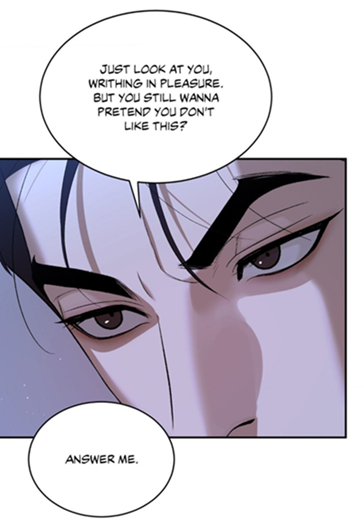 (chapter 63) Fun is not the same as love, and this distinction matters deeply for someone like Kim Dan, who associates kissing with emotional safety and love, not performance or play. This explicates why he refused to be kissed in episode 63:
 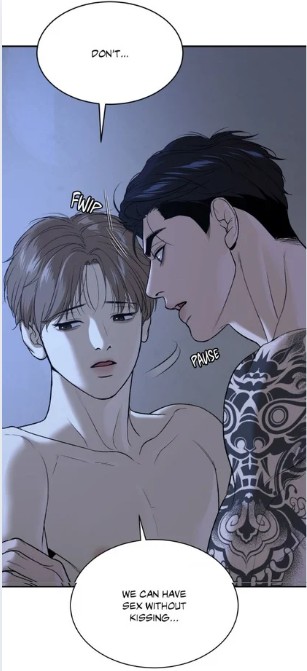 (chapter 63)
And such actions (grabbing the doctor’s face for a kiss) shaped Dan’s reaction. During the “magical night” in chapter 44, the physical therapist copied Jaekyung’s earlier gesture —he grabs his partner’s face, too. (chapter 44) Yet, the intention behind this gesture is fundamentally different. While the wolf’s kisses were abrupt and consuming  (chapter 44), Dan’s were soft, exploratory, almost reverent. His lips touched not just his lover’s mouth, but his cheek and ear—tender sites that bypass eroticism in favor of emotional intimacy. These weren’t prolonged, devouring kisses. They were pecks, small and deliberate. They mirrored affection, not possession.
This mirrored gesture reveals something powerful: that Dan’s body had internalized the champion’s movement, but his heart translated it into a new language—one of consensual, innocent affection. Through this contrast, Jinx subtly rewrites the significance of a kiss: not as something to be taken, but something to be offered. It is precisely through Dan’s innocent and instinctive response that the reader is guided toward understanding the importance of consent, of emotional resonance, and of redefining touch as something more than just a prelude to sex. So should Jaekyung later discover that Dan had never kissed anyone before, the realization doesn’t just reveal a lie 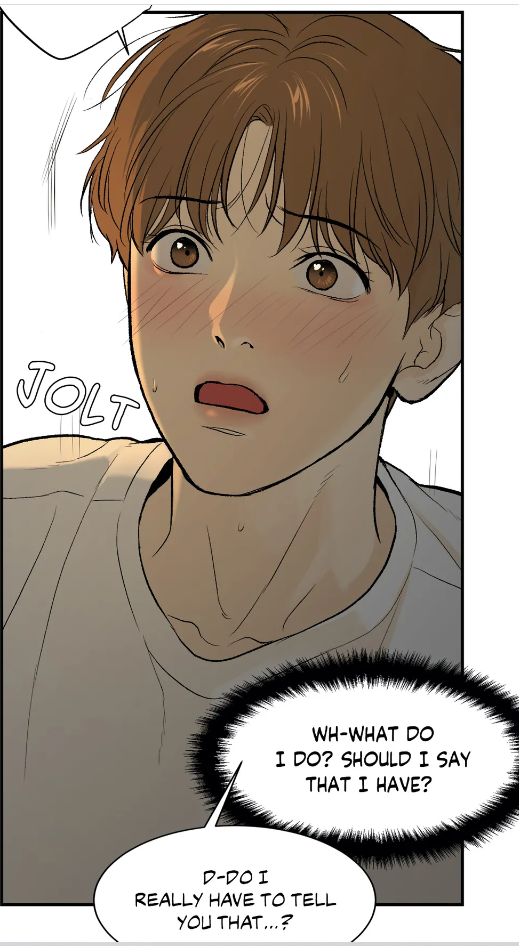 (chapter 3) —it forces the wolf to ponder on the meaning of a kiss and his relationship with the physical therapist.
Klimt’s The Kiss and the Denial of the Mouth
The cheek and the ear, (chapter 44) often overlooked in romantic tropes, Yet here, they become sacred sites of intimacy, echoing the symbolic restraint found in Gustav Klimt’s painting The Kiss. It is the painting in the middle of the illustration. 
 In that iconic artwork, the man does not kiss the woman on the mouth, the traditional locus of erotic desire. Instead, his lips are placed upon her cheek—a gesture that suggests reverence, not possession; vulnerability, not domination.
This parallel is not incidental. Klimt’s composition, saturated in gold and enveloping the lovers in a cocoon of ornament, gives the moment a sense of timelessness and sanctity. Likewise, in Jinx, Dan’s kiss bypasses lust and aims straight for emotional resonance. His kiss is not a prelude to sex; it is the articulation of emotional trust, maternal memory, and innocent longing. In this light, the cheek and ear become hallowed spaces where intimacy is not consumed, but offered. The problem is that during that night Joo Jaekyung was drunk, hence he couldn’t understand the meaning of such actions.
This moment reveals a stark contrast with the world that Jaekyung has known. For most of his life, touch was functional, performative, or controlling—something done to achieve a goal, to assert dominance, or to maintain emotional distance. (chapter 44) But Dan’s kiss disrupts that entire framework. It is small, almost imperceptible, but seismic in meaning. It asks nothing. It takes nothing. It simply is—and in that stillness, it unsettles the champion more than any act of aggression could. 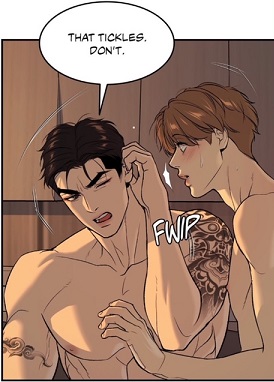 (chapter 44)
The symbolism deepens when we reflect on Jaekyung’s own evolution. He begins the story believing that conquest lies in performance—through physical power, sexual prowess, and unrelenting dominance. But as he stands before this soft, reverent kind of love, he encounters something far more disarming: gentleness. Vulnerability. A kiss that does not inflame the body (chapter 44) but stirs the soul. Therefore it is not surprising that later doc Dan is covered with bite marks.  (chapter 45)
The purer the kiss becomes, the more threatening it feels—because it exposes him. It demands no proof, no role, no mask. And that is perhaps why Jaekyung, despite all his experience with bodies, remains a novice when it comes to the heart. In bypassing the mouth, Dan bypasses Jaekyung’s defenses. He offers not seduction, but sacred contact. And for a man raised in conquest, that is the most intimate violation of all.
Has the Champion Ever Been Kissed Before?
Like mentioned above, I could determine that the athlete had never been kissed before, especially by a “mother”. He didn’t even know that his ears were sensitive to the touch. (chapter 44) Moreover, I have already outlined that the athlete associates kissing to protection and pleasure which were suggested by his hyung Cheolmin. Therefore my avid readers can understand why I come to the following conclusion. It was indeed the champion’s first kiss in the locker room.
However, my theory is based on other points as well. One of the other reasons is related to his nightmare with the unknown ghost.  (chapter 54) When he was young, he had to face an abuser. Notice that the man’s face was very close to the champion’s
  (chapter 54). Thus I interpret that for the champion, the face represents not only his vulnerability, but also a source of danger. That’s the reason why he couldn’t hide his displeasure and frustration, when he faced this “lover”. (chapter 2) Thus I am assuming that in his eyes, a kiss could only be perceived as a threat. Besides, the anonymous abuser was even laughing in front of his face (chapter 54) , which means that the champion must have internalized “laugh” as mockery and contempt. That’s why he was so upset, when he was provoked by Randy Booker: the fighter’s words and actions had triggered his repressed memories. (chapter 14) Thus I interpret that for the main lead, the mouth is not a site of tenderness but a battlefield—one linked to mockery, humiliation, and violation. It evokes the memory of confrontations like the one with Randy Booker, which reignited repressed trauma rather than surface-level anger. This is why it’s so difficult for him to associate a kiss with affection or love. The gesture, meant to signify intimacy for most, is for him an unconscious echo of danger.”
And what did the doctor do during that wonderful night?  (chapter 44) He couldn’t hide his joy by the champion’s funny reaction and laughed. And how did the protagonist react to this? Not only his face expressed his dissatisfaction, but also he silenced his partner with a kiss right away: (chapter 44) This signifies that unconsciously, the athlete has long associated fun and laugh with humiliation, exposure, and powerlessness. Laughter—especially in close physical proximity—did not signal joy or affection in his past; it echoed mockery from a position of dominance. Thus, when Dan laughed innocently during their intimate moment, Jaekyung’s body reacted as if to shut down a threat. His abrupt kiss was not a romantic gesture but a reflex: a way to regain control, to interrupt the emergence of vulnerability, and to erase the echo of past humiliation. And now pay attention to the continuation of this sudden kiss:
  (chapter 44) Joo Jaekyung is leading the kiss, he is regaining control over their relationship. It reinforces the idea that the wolf’s kiss was not merely about passion, but about reclaiming dominance and halting a shift in power. Just moments earlier, Kim Dan’s laughter had opened a space of emotional intimacy and lightness, which the champion was not prepared to face. The kiss, now prolonged and intensified, becomes the sportsman’s way of reasserting control over a situation that was slipping into unfamiliar emotional territory.
Notice how Dan’s eyes remain open, gazing at Jaekyung. This contrast is striking: while the kiss is physically intimate, there’s a clear emotional imbalance. Dan is present and aware, while Jaekyung is almost consuming—driven by instinct and buried fear. The intensity of the kiss, paired with the previous silencing gesture, marks a moment where physical closeness masks emotional retreat. It’s not yet an act of mutual trust—it’s still shaped by Jaekyung’s attempt to neutralize discomfort, to steer the interaction back into territory he understands: dominance, silence, and physicality. Under this new light, it dawned on me why the champion could only reject this magical night the next morning.  (chapter 45) The marks on the doctor’s body were evidence that he was no longer in control. They weren’t just signs of a physical encounter—they were witnesses to something far more threatening: vulnerability, softness, and reciprocity. In the night, swept up by instinct and unspoken longing, the wolf had allowed himself to be touched—not just physically, but emotionally. But by morning, the spell was broken. His gaze didn’t linger on Kim Dan with affection—it darted instead to the bruises and scratches as though they were accusations.
What horrified him 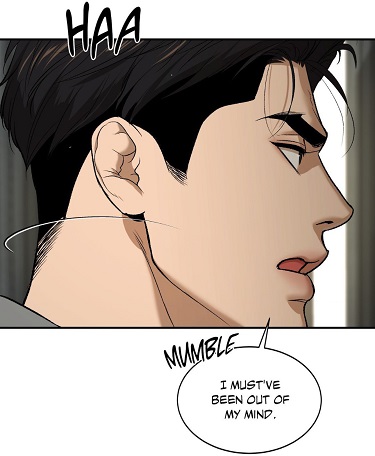 (chapter 45) wasn’t just the pain he might have inflicted—it was the realization that the balance of power had subtly shifted. The man who had always dictated the terms of their relationship had surrendered to something unfamiliar: tenderness, emotional closeness, and shared desire. The fact that Kim Dan initiated affection, even kissed him voluntarily, shattered Jaekyung’s script. For someone who conflated feelings with threat, and dominance with safety, this reversal was unbearable.
And so, the rejection wasn’t cold—it was defensive. He had to reclaim his distance before the emotional reality could catch up with him. Because to accept the night as mutual would be to recognize that he had been wanted, not used  (chapter 45) —and that he, in turn, had wanted Dan back. This terrified him more than any bruise ever could.
But let’s return our attention to episode 44. (chapter 44) In this context, the kiss becomes a complex act of both silencing and self-protection. It was a mixture of unconscious attachment and learned defense—an attempt to rewrite a script that his body remembered all too vividly. This continuation corroborates my earlier observation—Jaekyung unconsciously connects laughter and joy with vulnerability and mockery 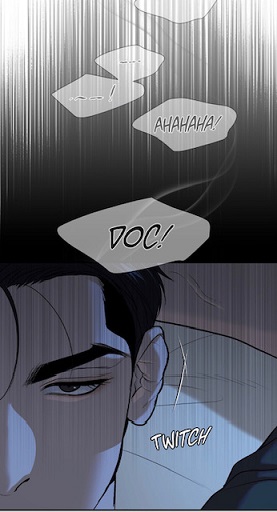 (chapter 37), and kissing becomes his emotional brake pedal. It’s not simply an act of love, but a means to regulate, or even drown out, what he cannot yet name or accept: that he is being loved. It is not random that I included the scene from episode 37: he heard laughs from the other room. For him, such a noise must have sounded like a disrespect and mockery, triggering his past trauma. And he was not entirely wrong in the sense that they were eating behind his back
  (chapter 37) It was, as if they were mocking him because of his forced “diet”. No wonder why the champion is barely seen laughing and prefers seriousness. At the same time, I can grasp why the athlete feels close to Park Namwook, as the latter stands for these exact notions: work, money and seriousness. Fun is not part of his world and vocabulary, therefore he punished Joo Jaekyung for sparring with doc Dan.
Another clue for this hypothesis is how the green-haired tried to “seduce” the athlete.  (chapter 2) Though his face was close to the star’s, he didn’t attempt to kiss him. In fact, he proposed him a fellatio, a sign that the champion had never allowed anyone to get close to his “face”. Finally, observe how he reacted, when the uke in episode 55 attempted to kiss him:
 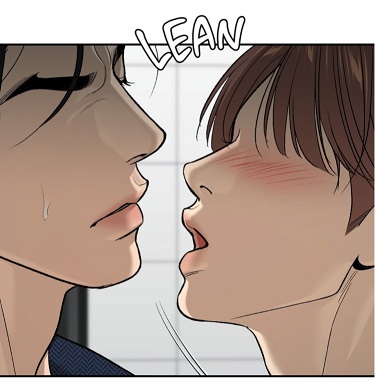 (chapter 55) Not only he rejected him, but also he pushed him violently so that the latter was on the floor.
 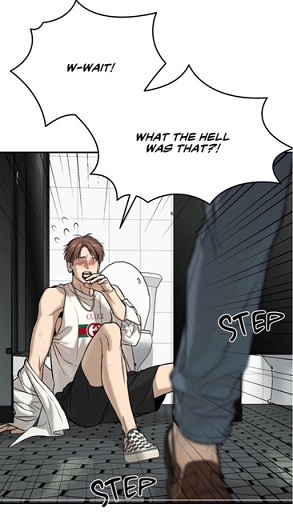 (chapter 55) The celebrity even ran away: a sign that the allowing someone approaching his face is perceived as something uncomfortable and threatening. At the same time, that moment exposes the kiss as something sacred—one that cannot be duplicated without emotional violation. This shows that for the champion, the meaning of a smooch has evolved. It is no longer perceived as a source of fun and a mean to gain something.
There exists another evidence for this interpretation. Once Joo Jaekyung returned home, he had a recollection of the night in the States. 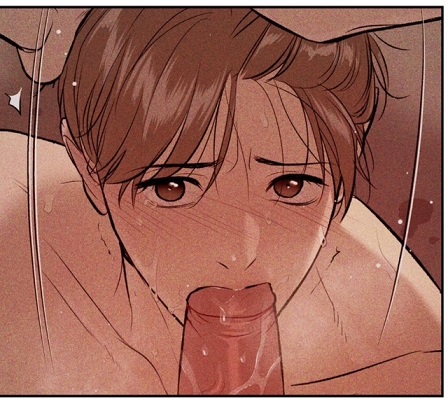 (chapter 55) He couldn’t forget doc Dan’s face, the latter excited him, a sign that for the champion, the face in general has been a source of pain, yet thanks to doc Dan, the latter has become a source of “comfort and joy”.
  (chapter 66) When he saw his face for the first time, he didn’t realize that he was already under the hamster’s spell. Striking is that he even focused on his chin and lips, a sign that he desired to kiss them. One thing is sure. The champion treasured the doctor’s face. After their separation, it is not surprising that the wolf felt the need to see his face.
That’s how I realized why the athlete initially rejected the doctor’s advances in the States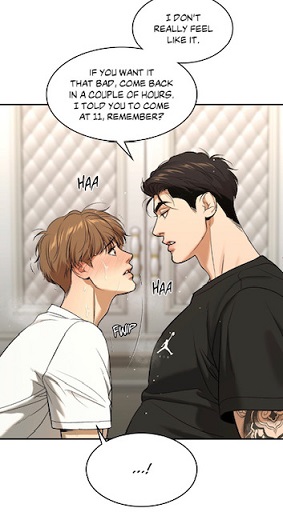 (chapter 39) before requesting a fellatio:
  (chapter 39) The main lead’s head was very close to the champion’s face, thus he must have felt uncomfortable. Secondly by acting this way, the doctor was gradually gaining power over their relationship. For the wolf, dominance is everything, an indication that in his past he felt defenseless and weak. His “opponent”, the mysterious ghost, had the upper hand. Moreover, the fellatio created a distance between them, where the fighter could expose his superiority. And note how doc Dan behaved under the influence of the drug:
  (chapter 39) He caught his fated partner by surprise, when he suddenly kissed him, mirroring the champion’s past behavior. This panel corroborates that for the doctor, a kiss is the symbol of love. The champion was not happy with this kiss too, for the latter meant that he was no longer controlling their relationship. Yet, after hearing the doctor’s confession during that night, the athlete no longer resisted his partner’s kisses.
  (chapter 39) For the first time, he accepted Dan’s initiative—both physically and emotionally. Compare it to his attitude before:
  (chapter 39) here, he still has his eyes wide open, a sign of vigilance. These kisses from doc Dan
  (chapter 39) mark a turning point in Jaekyung’s arc: he begins to lower his defenses, allowing Dan not only into his personal space but also into a position of gentle agency within their relationship. The kiss no longer represents a threat; it becomes an opening and a sign of trust.
However, it occurred to me that the star didn’t recollect those kisses from doc Dan, rather their intercourse in the States (chapter 55) and in the penthouse  (chapter 55) These memories represent the moment where the athlete felt strong and had the upper hand in their relationship. These images reveal that Joo Jaekyung hasn’t realized the signification of the kiss yet. For him, they don’t seem important. This exposes that the athlete has not associated kiss with love and affection yet. At the same time, we have to envision that a smooch is strongly intertwined with equity and trust.
  (chapter 28) And in episode 14, it was clear that the star still felt superior to his companion, therefore the kiss had no special meaning. As you can see, everything is pointing out that Joo Jaekyung had never been kissed before. And what does a kiss symbolize? Not only attachment, but also purity and innocence.
Finally, I would like Jinx-philes to recall the reminder from the green-haired uke:  (chapter 42) According to him, doc Dan was not different from him. However, he was wrong. It is because the champion had kissed him!! Moreover, the celebrity had allowed doc Dan to kiss him as well. Besides, how did the champion name his past lovers? They were toys… normally people don’t kiss playthings. And now, imagine that doc Dan were to discover that Joo Jaekyung had his first kiss with him. This revelation would not only make him realize that Joo Jaekyung loves him, but also he could be wondering why the athlete had never done such a thing before, though he had past lovers. YES, the “first kiss” could be the trigger for both characters to question their respective past and perceive their fated partner correctly.
To conclude, the absence of kissing reveals that those relationships were purely transactional. They could not be dating. In contrast, Dan is the only one Jaekyung ever kisses. Later, when Jaekyung tries to replicate that kiss with the new “uke”, he recoils. (chapter 55) He cannot bring himself to kiss someone else. That moment exposes the kiss as something sacred—one that cannot be duplicated without emotional violation. In other words, he was one step closer to the truth: the kiss is strongly intertwined with attachment and feelings.
So for me, the abuser is the reason why the champion kept people at arms length. He felt insecure and threatened…. He had not only be cornered, but also silenced and ridiculed which seems to reinforce my other hypothesis that the star was abused sexually by an adult in the past. [For more read Guilty Truth ⚖ Or Dare 🤥🤡- part 2 ( locked)]
From my perspective, it was his first kiss, yes, but it came tangled in past fear and trauma. (chapter 54) This nightmare reflecting his childhood imply the absence of kiss, but more importantly intimacy is strongly connected with dominance, bullying and destruction. No wonder why the champion rejected intimacy later. Only with time—and Dan’s persistent tenderness—can the wolf begin to untangle touch from threat, and laughter from scorn. Hence I conclude that for the champion, face to face was a very uncomfortable position. This would explain why he felt the need to punch people… unconsciously, the punch is directed at his past abuser. And each time, he was insulted and provoked by his opponents, look how he reacted later: he targeted their face, the eyes and mouth.  (chapter 15)
 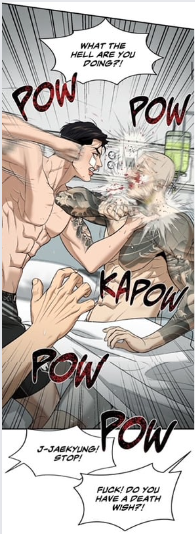 (chapter 52) In that context, a kiss could never be affection, but vulnerability. A risk.
Virginity, Secrecy, and Misunderstanding
Both characters are wrapped in illusions about each other. Jaekyung likely assumes Dan has kissed others (chapter 3), based on Dan’s vague claim of prior partners. Yet Dan has never kissed anyone before. The kiss becomes his true moment of loss, a quiet confession through action. Conversely, Jaekyung’s own discomfort shows that he, too, is untouched in this particular way. When Dan tries to kiss Jaekyung again, and he instinctively rejects it, it reveals just how unprepared he is for affection. They are both unaware that the other is emotionally “pure” in this regard, and that makes the kiss a shared revelation.
Redefining Seduction: From Transaction to Intimacy
Since Kim Dan internalized sex as a form of debt repayment and professional obligation  (chapter 67), Jaekyung must reinvent his approach. He cannot rely on dominance, strength, or sexual performance to win Dan’s heart. If he wants true connection, he must learn a new language—one built on gestures of affection, softness, and presence. This process also involves separating his public persona from his private longing. Joo Jaekyung, the champion, cannot seduce with spectacle. But Jaegeng, the man, might learn to express love through a simple touch, or a well-timed kiss. The redefinition of seduction is not just about Dan’s healing; it is about the wolf’s reclaiming his own right to feel and give love. And in my opinion, that process has already started:
  (chapter 69) That moment was devoid of lust, stripped of performance, and free from power dynamics. Jaekyung didn’t lean in for a kiss; he didn’t touch Dan’s lips or body with any sexual intent. Instead, he wrapped his arms around the physical therapist in silent reassurance, tucking his face against Dan’s shoulder as though hiding from the world. This was not a champion claiming a prize—it was a man expressing affection. The embrace exposes that doc Dan belongs to his “world” and he trusts him. In this light, the embrace becomes a prelude to a kiss—not a literal one, but an emotional kiss: a meeting place of vulnerability and longing.
The dock, surrounded by water, reinforces this symbolism. Water is traditionally associated with emotions, the unconscious, and transformation. By choosing this setting, the narrative invites us to see the wolf stepping into unfamiliar emotional territory—not with fists clenched, but arms open. Unlike the brutal kisses of season 1, this gesture is wordless but intimate. It communicates what he cannot yet articulate: “You matter. You’re safe with me. And I want to stay.”
In that stillness, without a single word or erotic touch, Jaekyung begins to kiss Dan in the truest sense—by offering presence, by being real. It is not seduction, but invitation. Not a test of loyalty, but a revelation of it.
Where Will He Learn the Meaning?
Since neither Shin Okja  (chapter 65) nor his past partners provided him with genuine and affectionate touch, Jaekyung must look elsewhere. (chapter 57) Boksoon and her puppies may become his new mirror. Boksoon leaks affection without condition. Her dogs kiss as instinct, not strategy. Here, Jaekyung might discover what he missed: that kisses are not weapons, nor rewards, but a language of trust. He will not mimic affection from film.
 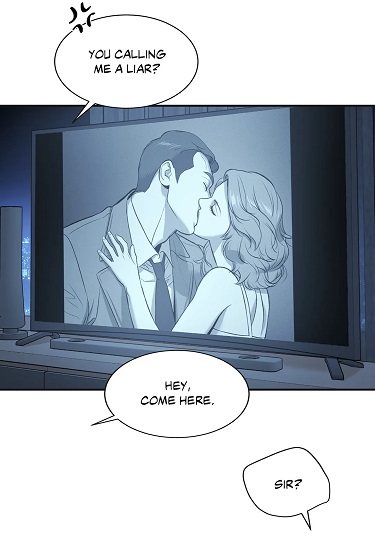 (chapter 29: note that he did not select this scene to rekindle with the doctor, but the other scene) He will learn it from life, from watching how the innocent express care without shame or purpose.
Jaekyung is not a man trained to love with softness, and yet this is exactly what Dan demands. Through subtle, non-erotic kisses, Dan teaches the wolf that it is not brute force that binds people, but longing and happiness. Not noise, but quiet. Not climax, but the pause. In parallel, Dan also begins to reshape another deeply ingrained association: laughter. 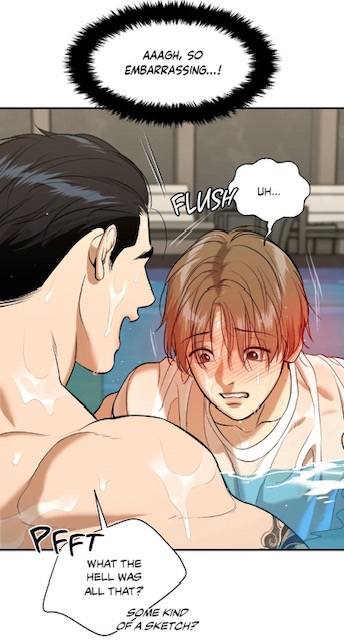 (chapter 27) In Jaekyung’s past, laughter had been a weapon—an expression of ridicule and cruelty from an abuser. (chapter 54) It echoed through his memory as a sound of danger, not joy. But Dan’s laughter is different. It is light, sincere, and warm. (chapter 44) Just as his kisses invite connection rather than conquest, his joy opens a new possibility: that laughter can be shared rather than endured. In learning to receive these signs of affection—and perhaps one day to return them—Jaekyung is not just falling in love. He is healing. He is discovering that love is not shown through domination or performance, but through trust, gentleness, and the courage to be vulnerable.
Conclusion: A Kiss Is Never Just a Kiss
In Jinx, the first kiss is not just a threshold of romance—it is a psychological rupture. Jaekyung’s inability to process it, and Dan’s unconscious channeling of maternal tenderness, reveal how much has been buried under silence, shame, and trauma. The kiss destabilizes old roles: fighter, caretaker, orphan, predator. It marks the beginning of truth. Not just between two men, but within each of them. And that is why it matters who kissed whom, and why, and whether it has ever happened before.
PS: And now, you know why only the readers laughed, when they saw Jaegeng dressed like that.  (chapter 62) If someone had laughed in front of him and made fun of him, this would have reopened his old wounds.
Feel free to comment. If you have any suggestion for topics or Manhwa, feel free to ask. If you enjoyed reading it, retweet it or push the button like. My Reddit-Instagram-Twitter-Tumblr account is: @bebebisous33. Thanks for reading and for the support, particularly, I would like to thank all the new followers and people recommending my blog.



 Bebebisous33s' analyses in K-Dramaland and Manhwas