
Please support the authors by reading Manhwas on the official websites. This is where you can read the Manhwa: Jinx But be aware that the Manhwa is a mature Yaoi, which means, it is about homosexuality with explicit scenes. Here is the link of the table of contents about Jinx. Here is the link where you can find the table of contents of analyzed Manhwas. Here are the links, if you are interested in the first work from Mingwa, BJ Alex, and the 2 previous essays about Jinx The Night-Cursed Emperor and After All, Before It’s Too Late
It would be great if you could make some donations/sponsoring: Ko-fi.com/bebebisous33 That way, you can support me with “coffee” so that I have the energy to keep examining Manhwas. Besides, I need to cover up the expenses for this blog.
Introduction The First “I Love You” He Sees
Why isn’t the first champion’s “I love you” spoken, but seen?  (chapter 75) – similar to doc Dan’s reaction in the States:
  (chapter 40)
  (chapter 53)
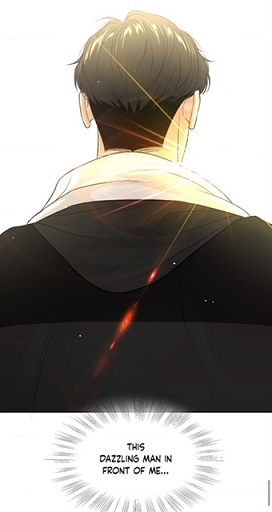
At dawn in ch. 75, Jaekyung first sees a vision: Kim Dan bathed in sunlight, turning back as if to wait for him. The image radiates warmth, inclusion, and patience. (chapter 75) It stands not only for Dan, but for something Jaekyung has never allowed himself: a dream, a future. This makes it the direct opposite of his nightmares. 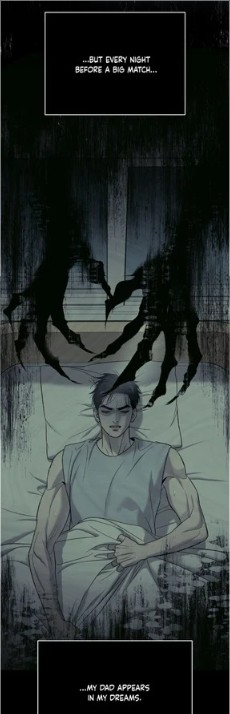 (chapter 75) Where his father’s curses bound him to guilt and the past, Dan’s glow opens the possibility of release (chapter 75), a life that points forward rather than backward.
Then he jolts awake.  (chapter 75) His eyes open after the dream, and they open to the same light. It’s the opposite of every earlier awakening
  (chapter 54) —no gasp for air, no clutching his throat
  (chapter 75), no father’s voice strangling him. This sudden awakening embodies enlightenment. (chapter 75) This is the first time he escapes his inner prison: no strangling, no mockery, no gasping for breath. The sequence is everything: the vision symbolizes true awakening. First comes the dream of the future, then the breath of life.
And what does that light reveal? Not a tidy word, but a re‑ordered world: Dan matters more than winning. (chapter 75) Why? It is because the physical therapist embodies warmth and the present, while the shining championship belt is in reality cold. The Emperor who once fought to silence curses realizes, before he can name it, that the man in that sunlight outranks every belt and roar.  (chapter 75)
And here the director’s advice echoes: “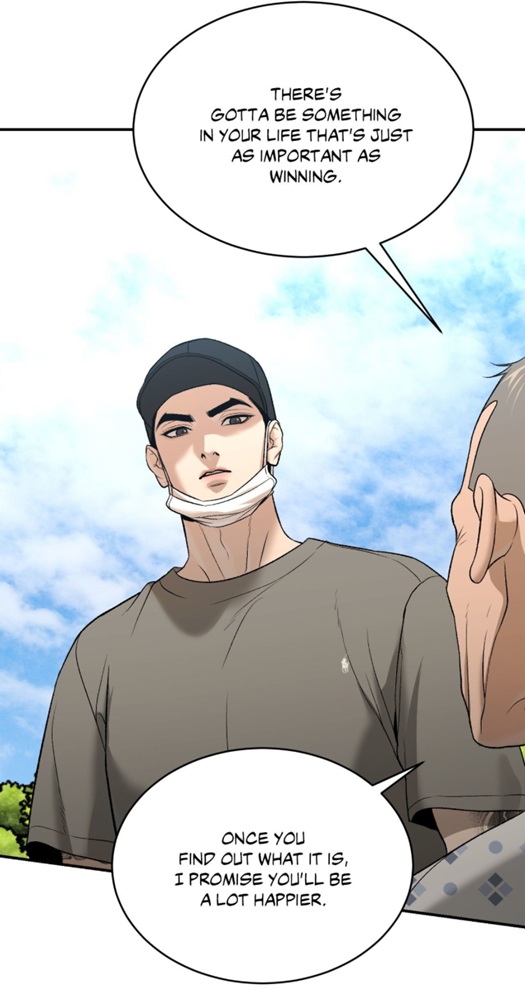 (chapter 75) On the surface, it sounds like a call for balance. In truth, it is a suggestion to find another meaning for his life. And look at the director’s facial expression, when he is talking to his former student: “
 (chapter 75) He is smiling, a sign that the director is enjoying this moment with the “wolf”. He becomes the first person to speak to Jaekyung not about titles, not about survival, but about happiness.
Yet one might wonder: why does Hwang Byungchul not mention Dan directly? It is clear that he has already sensed that both have a deeper relationship than one between a physical therapist and a VIP client.  (chapter 70) He knows the athlete from the past. The latter was attached to people and not to places. Why does he speak of “something” rather than “someone”, if he knows? The lesson is not about fixing a new goal or object to chase, but about discovering how to live differently — how to live happily. (chapter 75) The word something points beyond possession. True fulfillment is not about having a purpose but about sharing a path. Secondly, by remaining vague, he respects his former pupil’s privacy. A parent would never try to pry into the relationship of their child.
  (chapter 65)
This is why the dream immediately answers the advice: (chapter 75) in it, Dan stands not beside the champion but in front of him, waiting. The director spoke of something, but Jaekyung sees someone. Dan becomes the embodiment of a life that could be lived otherwise: a future not chained to victory or guilt, but grounded in companionship, in love.
Yet Jaekyung cannot name it. His reaction trails into ellipses 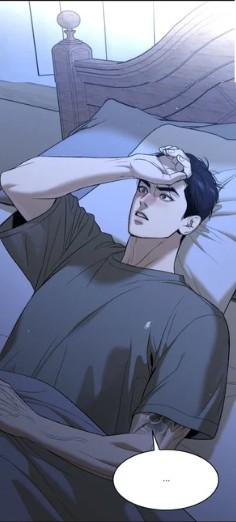 (chapter 75). Even before, he could only mutter to himself this:
 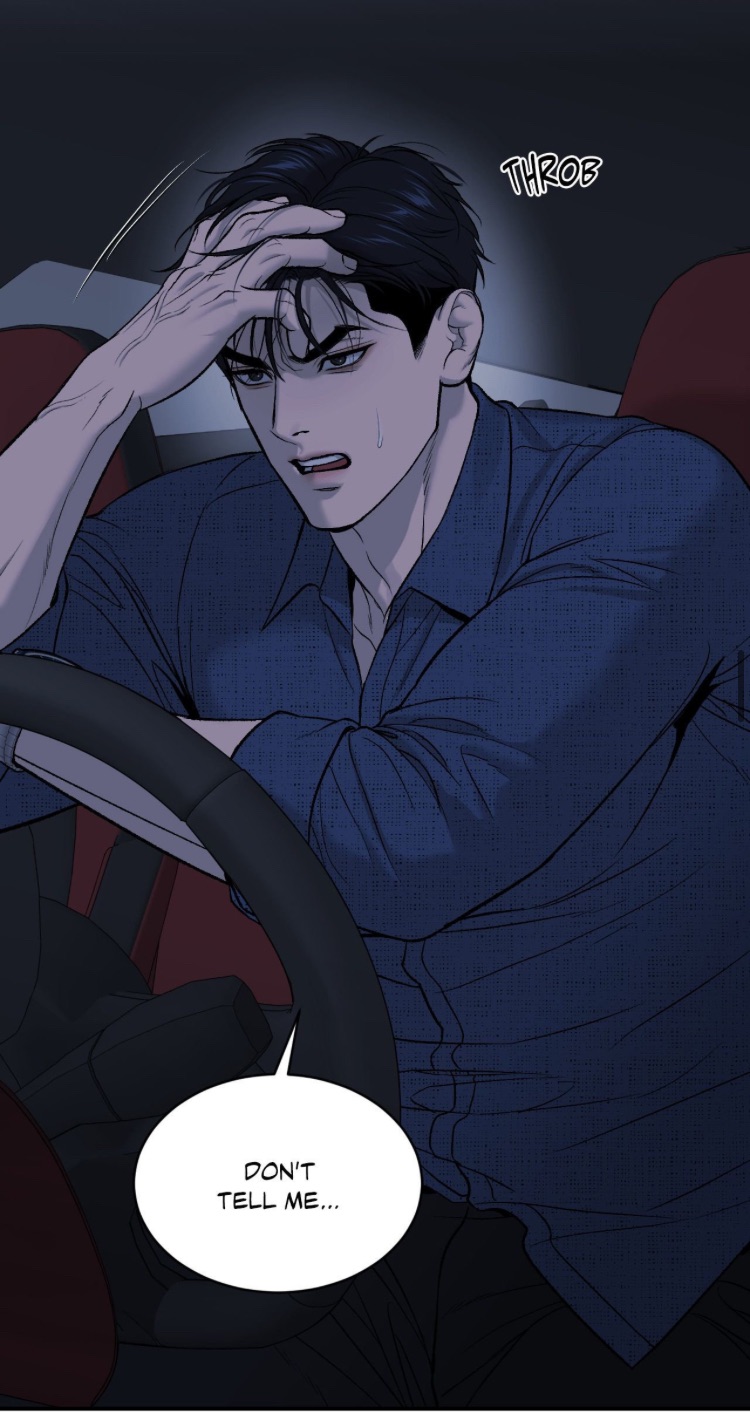 (chapter 70) The negation indicates denial, but observe that he couldn’t even use a noun. He cannot yet translate this vision into words, because he has never heard “I love you” himself
 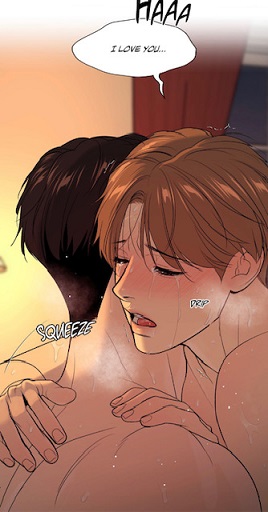 (chapter 39). The only one he heard was diminished to a mistake
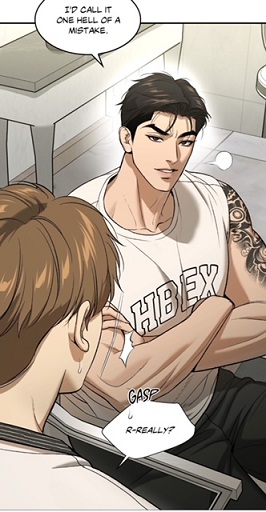 (chapter 41), and doc Dan claims to have no recollection of it. His father left him with mockery, his mother with resignation, his coach in the past with discipline, the grandmother-figures with burdens (honor, debt, favor).
  (chapter 74) No one ever taught him how to say I love you. And so, when Dan appears in his dream, it is not the words that free him but the gaze. (chapter 75) Dan’s expression is neutral, non-judgmental, steady — the exact opposite of the father’s disdain
  (chapter 75) or the mother’s withdrawal.
 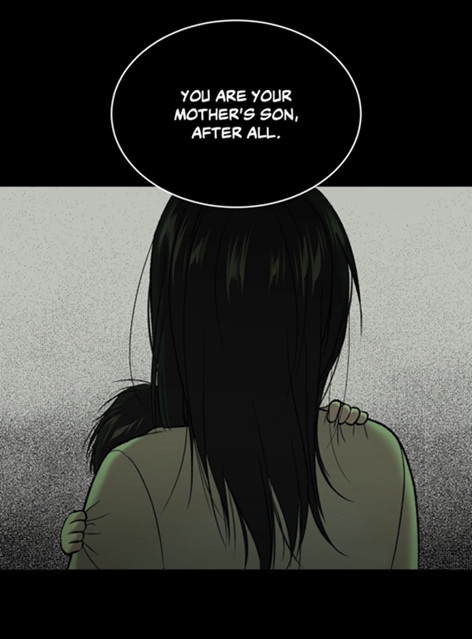 (chapter 73) It does not condemn, it does not demand; it simply waits. The gaze says this: I see you and accept you.
That neutrality is powerful because it creates hope. (chapter 75) For the first time, Jaekyung can imagine stepping toward someone without ridicule or rejection. The dream shows him the path: he doesn’t have to keep running, fighting, or proving — he only has to take a step toward the figure already turned back to include him.
And this is precisely where the director’s wisdom lies. His line (chapter 75) is not prescriptive. He doesn’t dictate what Jaekyung should do, or who he should live for. He gives no ready-made solution, no “perfect answer.” Instead, he hands the responsibility back to him, urging him to search within himself. 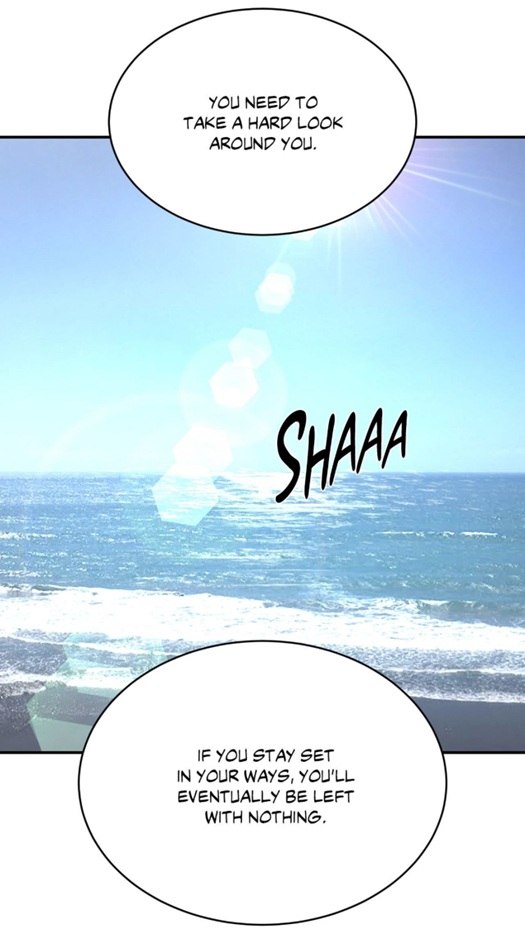 (chapter 75) The openness is what makes it love — it is respect.
This stands in direct opposition to the grandmother’s stance, who knew exactly how to “treat” doc Dan. 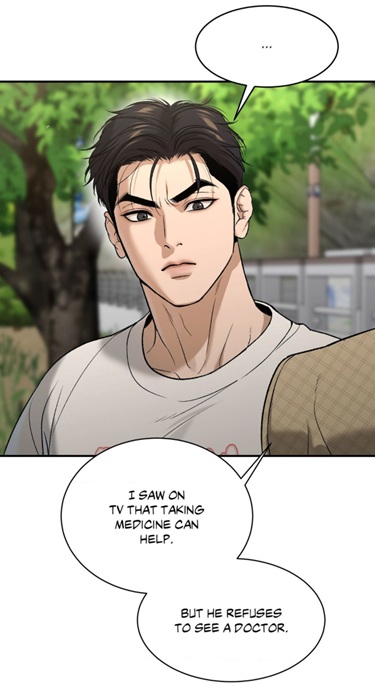 (chapter 65)
 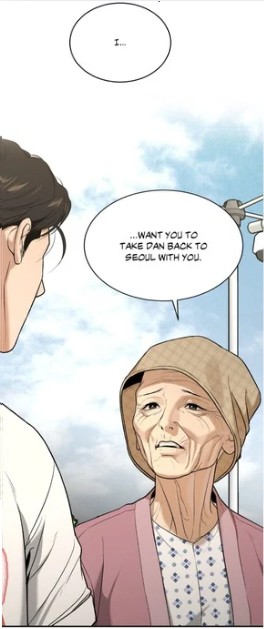 (chapter 65) Halmoni believed she already knew the solution to Dan’s suffering: sacrifice yourself, work hard, pay the debts or make money, endure. She closed off alternatives by imposing her narrative on him. Her love was distorted into certainty. The director, by contrast, recognizes the limit of his role. He has learned (belatedly) that he cannot dictate meaning for someone else. Instead, he tells Jaekyung:
  (chapter 75) His love is expressed through humility — through not knowing. At the same time, his words and facial expression ooze trust and confidence. (chapter 75) In other words, the director becomes not just a critic of Jaekyung’s path, but his first true encourager. He acknowledges that the boy he once failed to guide has grown into a man capable of guiding himself.
The vision is striking for another reason: it is silent. Dan does not speak in the dream; his gaze offers no command, no reassurance, no demand. It simply waits. The silence is not emptiness but invitation — a space Jaekyung must learn to fill. Yet how can he do so? How can a man who has only ever known curses, discipline, or burdens step closer to someone whose presence asks for words he has never spoken?
This is the paradox that chapter 75 exposes. (chapter 75) The dream reveals that Dan matters more than winning, but it also confronts Jaekyung with his greatest weakness: he does not know how to name what he feels, nor how to reach across that silence. To understand why, we must look back — to the voices that shaped him, and to the words that were withheld.
The Language He Never Learned
The vision of Kim Dan in chapter 75 is powerful not only for what it shows, but for what it withholds: it is silent. Dan does not speak, and yet the silence does not feel empty. His gaze is calm, patient, steady — waiting for Jaekyung to make a move. But this is precisely what paralyzes him. (chapter 75) The silence of the dream is an invitation, a space Jaekyung must fill. Yet what words can he offer? How can he step closer, when his whole life has taught him that love is something either cursed, withdrawn, or conditional?
The truth is that Jaekyung never learned the language of love. He never heard the words “I love you” — not from father, not from mother, not from any adult in his orbit. What he inherited instead were fragments of distorted speech: mockery, resignation, silence, punches or fake admiration. Each left him with a gap where affirmation should have been, forcing him to seek recognition through victories, money, and survival.
The Father’s Curse: Mockery Instead of Affirmation
From his father he learned scorn. The drunken insults — 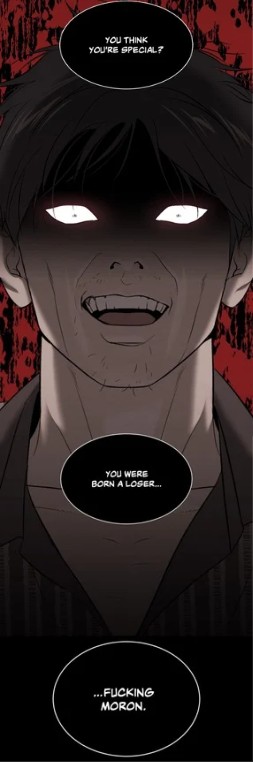 (chapter 73) “You’re a loser”, You’re your mother’s son after all” — (chapter 73) did not simply belittle him; they reshaped his very self-image into a curse. To resemble his mother meant weakness, failure, abandonment. He was nothing except “trash” or a “moron”. Each word struck like a blow, leaving Jaekyung gasping in his nightmares, hearing the taunts repeat like an incantation. His father’s language was not the speech of love but of annihilation, convincing him that he was destined to lose, destined to suffocate, destined to be nothing.
This is why victory became his obsession. 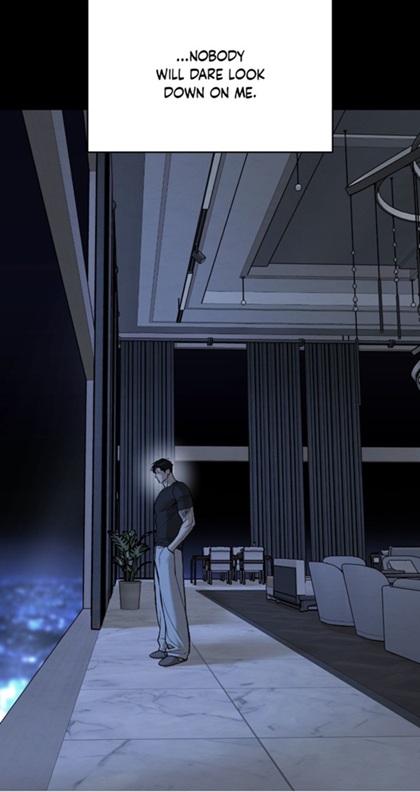 (chapter 75) Each title, each belt, each triumph was a rebuttal to his father’s words. He was not worthless, not doomed. Yet the irony is cruel: in fighting to silence those curses
  (chapter 75), he bound himself ever more tightly to them. Winning never brought peace; it only bought him momentary quiet from the voices in his head. This confession from the main lead confirmed my previous interpretations. First, the main lead had been constantly hearing voices in his head. Secondly, the hamster embodies “sound”, but a different kind: true communication linked to honesty and affection. This explicates why after the couch confession
 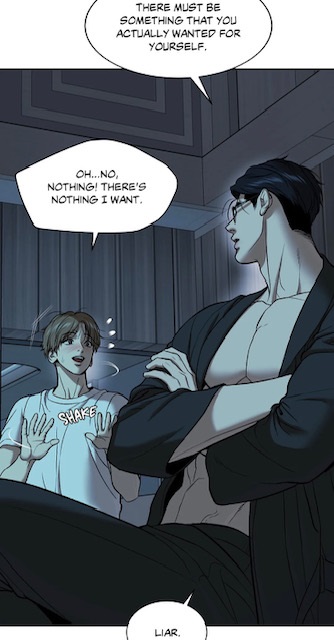 (chapter 29), Joo Jaekyung opened up a little to doc Dan! Thus the next morning, he visited the bathroom where doc Dan was!
 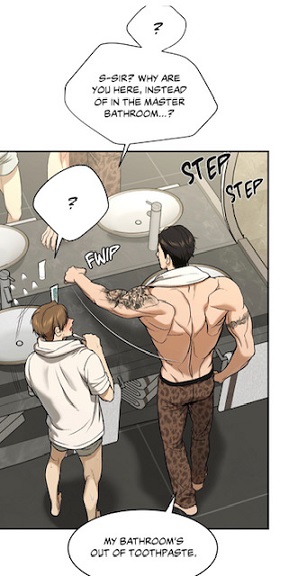 (chapter 30) It was just an excuse to spend more time with his fated partner.
The Mother’s Silence: Love as Need, Not Being
If the father wounded with curses, the mother wounded with silence. (chapter 73) In the father’s recollection, she is shown turned away, holding the child not in tenderness but as a shield against her husband. She does not speak. There is no tap  (chapter 74), no “dear,” no “I love you.” In the father’s memory, she used the child as an excuse to distance herself from her spouse. In that moment, Jaekyung is not a son to be cherished but a barrier in an adult quarrel.
Her last words to him before abandoning him 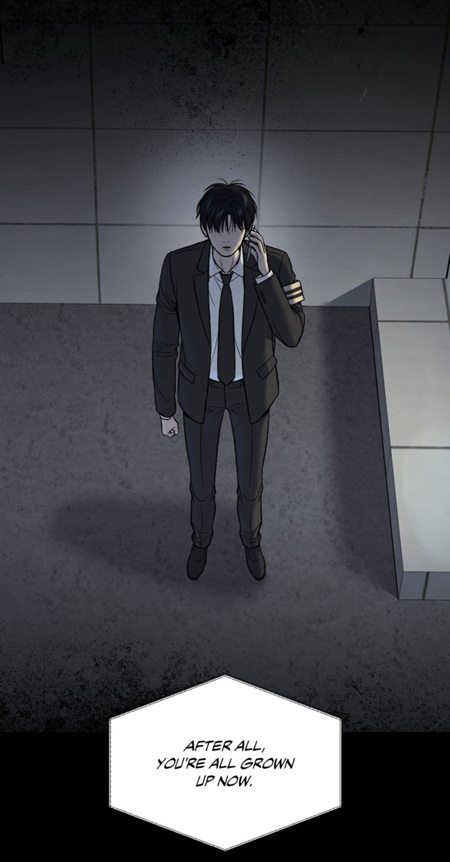 (chapter 75) carry the same cold logic. On the surface, they sound like recognition, even encouragement. But their true meaning is dismissal: you no longer need me. For her, love equaled dependency. Once her role as provider was no longer necessary, she withdrew.
Later, with her remarriage, we see her repeat the same pattern. (chapter 74) With her new child, she suddenly has gentle taps, toys, and the affectionate “dear.” But these are not signs of transformation — they are repetitions. Her “love” remains bound to function. This child is valuable because he secures her place, her role, her new family. He is an anchor of stability, not a being affirmed in his own right. According to me, she lives through others.
Here Erich Fromm’s distinction between having and being illuminates her behavior. [For more read the essay “The Art Of Loving”– locked] She cannot love by being present with another; she can only love by having something to hold onto — a husband, a child, a household. For Jaekyung, this meant that his very existence was never affirmed. When he outgrew dependency, he ceased to “count.” He embodied a failure in her life, something she wanted to erase. Under this light, it becomes comprehensible why Kim Dan challenged the champion in the hotel room: 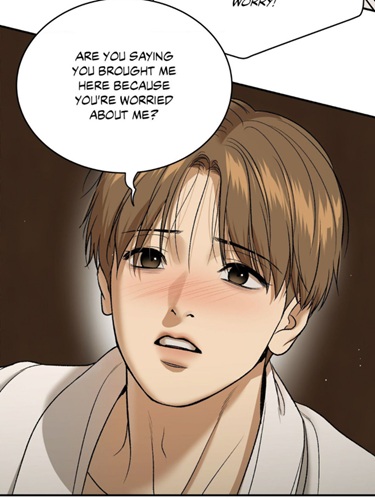 (chapter 67) His question is really an appeal for recognition. If Jaekyung answered yes, Dan could interpret it as proof of love, because in his own distorted framework being worried about equals being cared for. But Jaekyung answered with silence.
 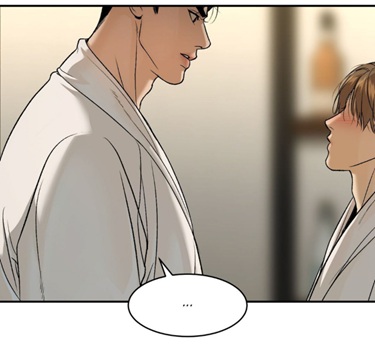 (chapter 67) Not because he felt nothing, but because he lacked the language to connect worry with love. In his conscious mind, conception of care was still bound to usefulness — Dan mattered because he was needed for training, not because he was loved as himself, while deep down, he had already moved beyond this aspect. He was just in denial in this scene,
This silence is therefore not just personal, but inherited. Just as his mother’s withdrawal taught him that once a child stops needing, they stop being loved, Jaekyung reenacts the same absence with Dan. He cannot yet affirm him as more than useful, even though his presence unsettles him precisely because it is more than that. Dan’s question names the void: he asks Jaekyung to translate provision into affection, and Jaekyung cannot. That ellipsis is the echo of a life raised without “I love you”.
The Phone Call: “Who Are You?”
Nothing illustrates this more starkly than the phone call. When Jaekyung reaches out as a teenager, his mother responds: 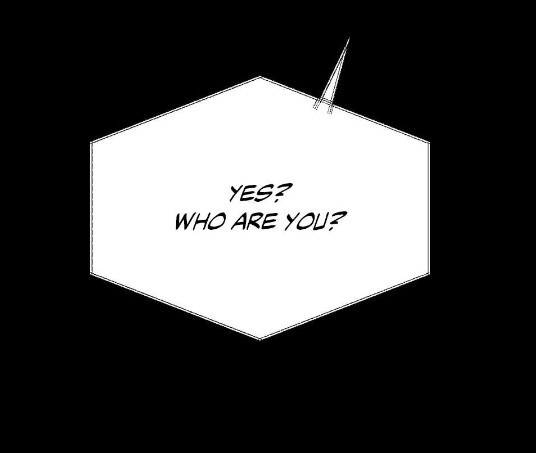 (chapter 74) On one level, she does not recognize his voice. But on a deeper level, her words ring as truth: she does not know her son. She has no idea who he has become, what defines him, what characterizes him beyond money and survival.
And tragically, Jaekyung falls into the same trap. He offers her money 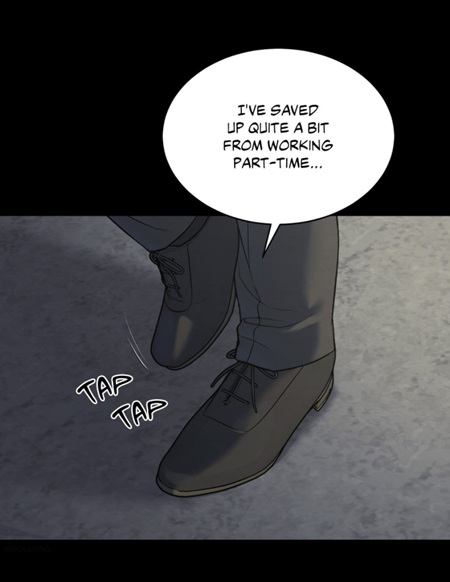 (chapter 74), promising to provide for her if she returns home. He unconsciously appeals to the only logic he has ever known: that love equals provision, that affection is secured by usefulness.
But beneath this maternal echo lies another inheritance: the patriarchal mindset of his father.  (chapter 73) From him, Jaekyung absorbed the conviction that a man must be the provider, the protector, the one who works and sacrifices while the partner silently follows. This explains why, in his relationship with his mother
 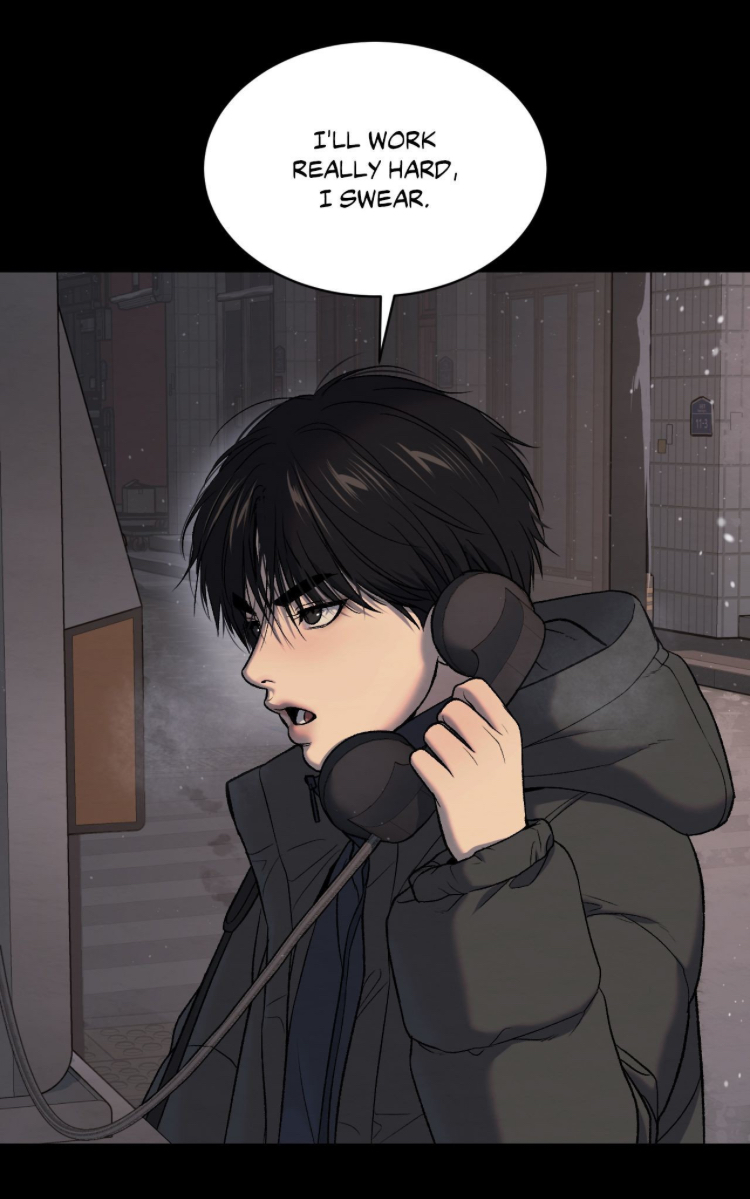 (chapter 72) and Kim Dan, he instinctively assumed he had to “do it all”: earn, fight, shield, control.
 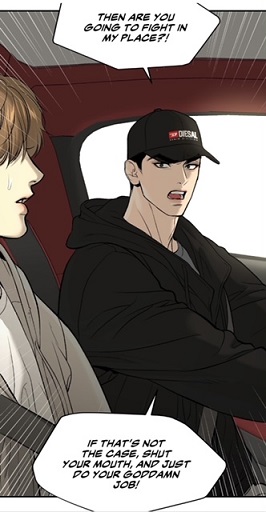 (chapter 42) His father’s voice was violent and scornful, but its framework remained lodged in him.
This dynamic also recalls the director’s mother, who devoted herself unconditionally to her son. (chapter 74) She has no name, because she is simply reduced to a role: mother. She offered food and care, but never voiced her own wishes. She silently bore the weight of her choice, just as Jaekyung’s mother once shielded herself with her child instead of speaking. Both figures embody the same pattern: women reduced to roles, never permitted desire. However, there is a huge difference between these two mother figures; the champion’s mother chose to leave, the moment her husband did not meet her expectation. And Jaekyung, internalizing this pattern, grew into a man who could only imagine love as one-sided duty — he provides, the other depends. But now, doc Dan is no longer willing to be treated that way. That’s why he chose to adopt the role of a prostitute after their reunion. 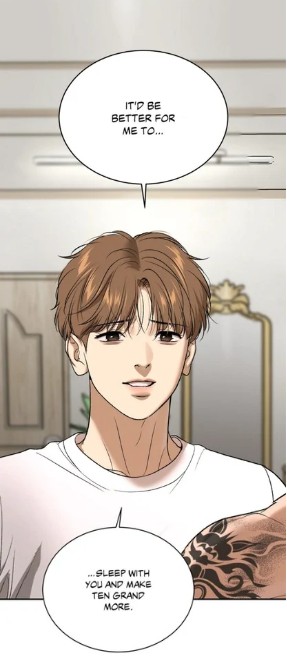 (chapter 62) That way, he can still be “free”.
But this exchange also marks a threshold. (chapter 74) The moment Jaekyung begins to discover being with Dan — joy, play, presence, companionship — (chapter 75) the mother’s entire system collapses. He cannot live in both worlds. To live in being means to abandon her for good, because her form of love will never change. Besides, they have long gone separate ways. Thus I see the vision of doc Dan as a future partner, where both characters will walk side by side! This announces the arrival of equity and real communication.
Trash as Metaphor: The Child Discarded
Her abandoned home, strewn with garbage, 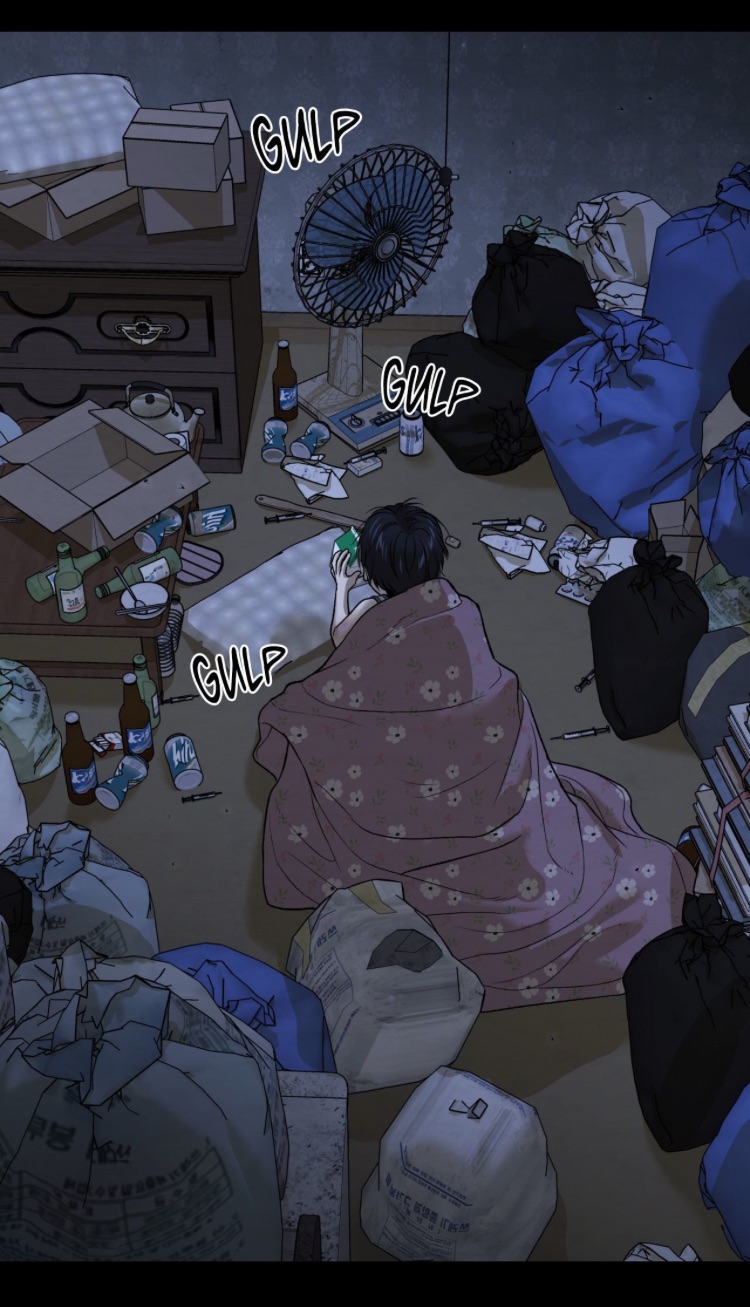 (chapter 72) becomes the perfect metaphor for her treatment of him. Once she no longer needed him, he was discarded like refuse. Just as trash cannot be reclaimed by sentimental value, she will not be able to reclaim him later through appeals to blood ties or belated need. It is impossible because he has learned — painfully — that true love is not about what you have, but about who you are.
Her tragedy is repetition. The remarriage, the second child, the affectionate taps and “dears” — all of it looks like growth on the surface (chapter 74), but in truth it reveals her imprisonment in the same mindset. She has not changed. She still defines herself by being needed, by having. She lives through others. And Jaekyung, by recognizing this, gains his first real emancipation. That’s why he destroyed the cellphone. 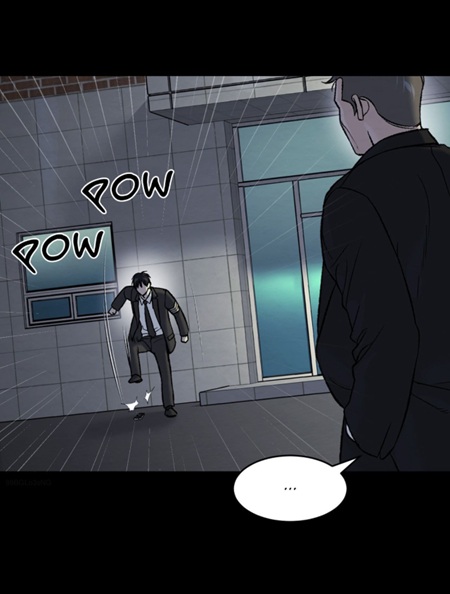 (chapter 74) He understood that the words he longed for as a child were never simply withheld — they never existed. Since we saw her back and heard her voice, I don’t think, she truly cut off ties with Joo Jaekyung. Why? It is because she had no intention to change her phone number again.
 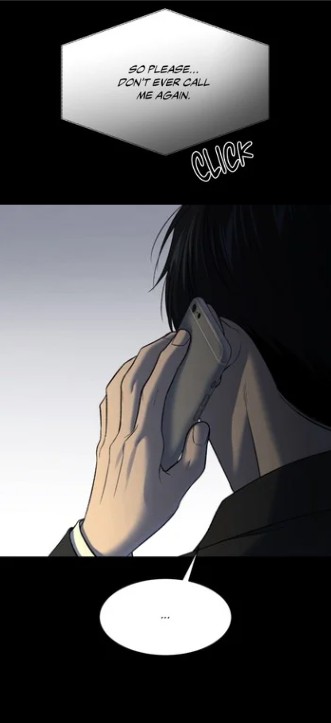 (chapter 74) She expected him to follow her request. I can definitely imagine her trying to reconnect with Joo Jaekyung, the moment he became a celebrity.
 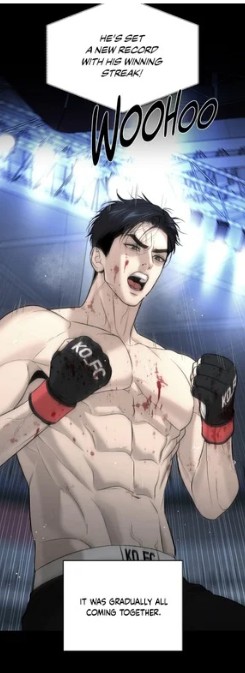 (chapter 75) Keep in mind that we have these mysterious phone calls:
  (chapter 37)
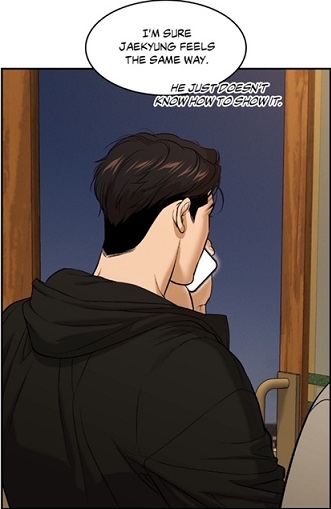 (chapter 43)
  (chapter 49)
Park Namwook: I’ll help you
Into this pattern steps Park Namwook, who initially cloaked his ambition in the language of encouragement.  (chapter 75)
 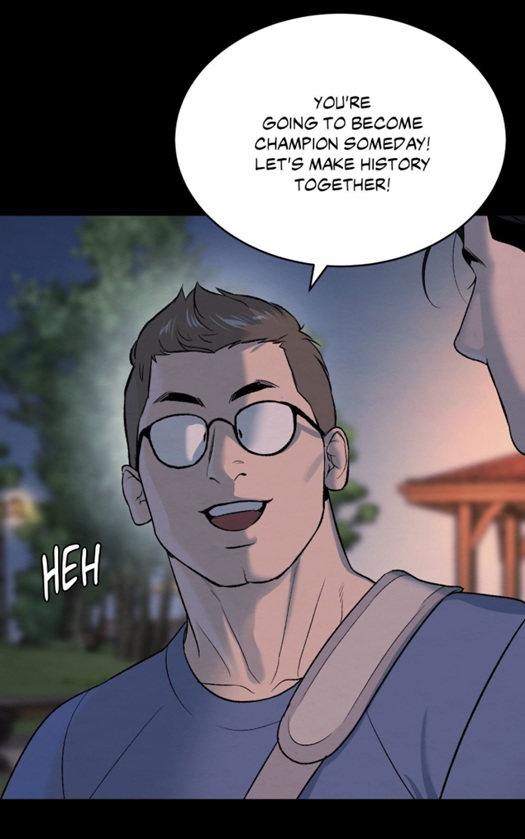 (chapter 75) On the surface, these sound like support. He smiles, his tone is warm, his words echo the vocabulary of friendship. Yet this false promise had lasting consequences: it reinforced a pattern already planted by the champion’s mother. Since childhood, Jaekyung had equated helping with caring
  (chapter 72), because silence at home had taught him that the only way to hold on to love was to provide, protect, and prove his usefulness. Under Namwook, this belief hardened into a rule: in his world, attachment became synonymous with utility.
This distortion explains much of Jaekyung’s later behavior. If someone claims to love, they must prove it through tangible action. Affection that doesn’t translate into help feels like a lie. Because Heesung mentioned “loving” Dan  (chapter 34), Jaekyung assumed later that the actor would have helped doc Dan to hide.
  (chapter 58) His violent intrusion into the actor’s home was the natural outgrowth of Namwook’s teaching: if love is real, it must show itself as service.
The tragedy is double. First, Namwook’s corrupted version of “help” left Jaekyung vulnerable to exploitation. Second, it blinded him to other languages of love — words, presence, patience — so that when Dan tries to love him differently 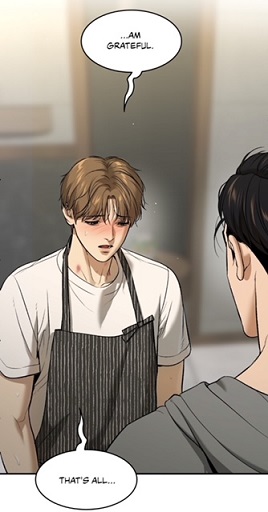 (chapter 45), Jaekyung struggled to even recognize it. Giving him a gift and expressing gratitude was not “helping the fighter”.
But beneath the illusion lies self-interest. Namwook’s “help” was contingent upon Jaekyung’s usefulness — his talent, his earning power, his ability to bring fame. Just as the mother’s affection was tied to need, and the father’s recognition bound to victory, Namwook’s loyalty was tethered to what Jaekyung could provide. He did not love the man; he loved the champion’s potential, the profit and prestige attached to his fists.
This makes Namwook part of the same lineage of distorted caregivers:
- Father: curses that turned into chains.
- Mother: silence disguised as maturity (“you’re grown-up now”).
- Halmoni (Dan’s): burdens disguised as devotion (debts, sacrifice, favor).
- Namwook: exploitation disguised as encouragement (“I’ll help you”).
All promised some version of care, but none delivered unconditional love. All instrumentalized him — whether as proof, shield, provider, or weapon.
And here the contrast with the director becomes stark. The director does not say I’ll help you” or “let’s make history together.” He does not tie Jaekyung’s value to his strength and his own ambition. Instead, he says: “ “ (chapter 75) There’s a life outside the ring and the spotlight. (chapter 75) He does not attach himself to Jaekyung’s victories but releases him into freedom. His love, belated as it is, is non-possessive. It is because he has learned his “lessons”. He realized that his dream
 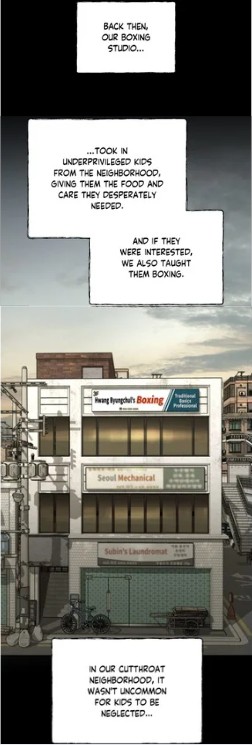 (chapter 72) was quite futile, for at the end, he ended up alone and felt lonely.
At this point, one must ask: why didn’t the director, Hwang Byungchul, say those words either? The answer is not that he feels nothing, but first he fears exposing his vulnerability and emotions. Therefore he yelled and challenged the champion. 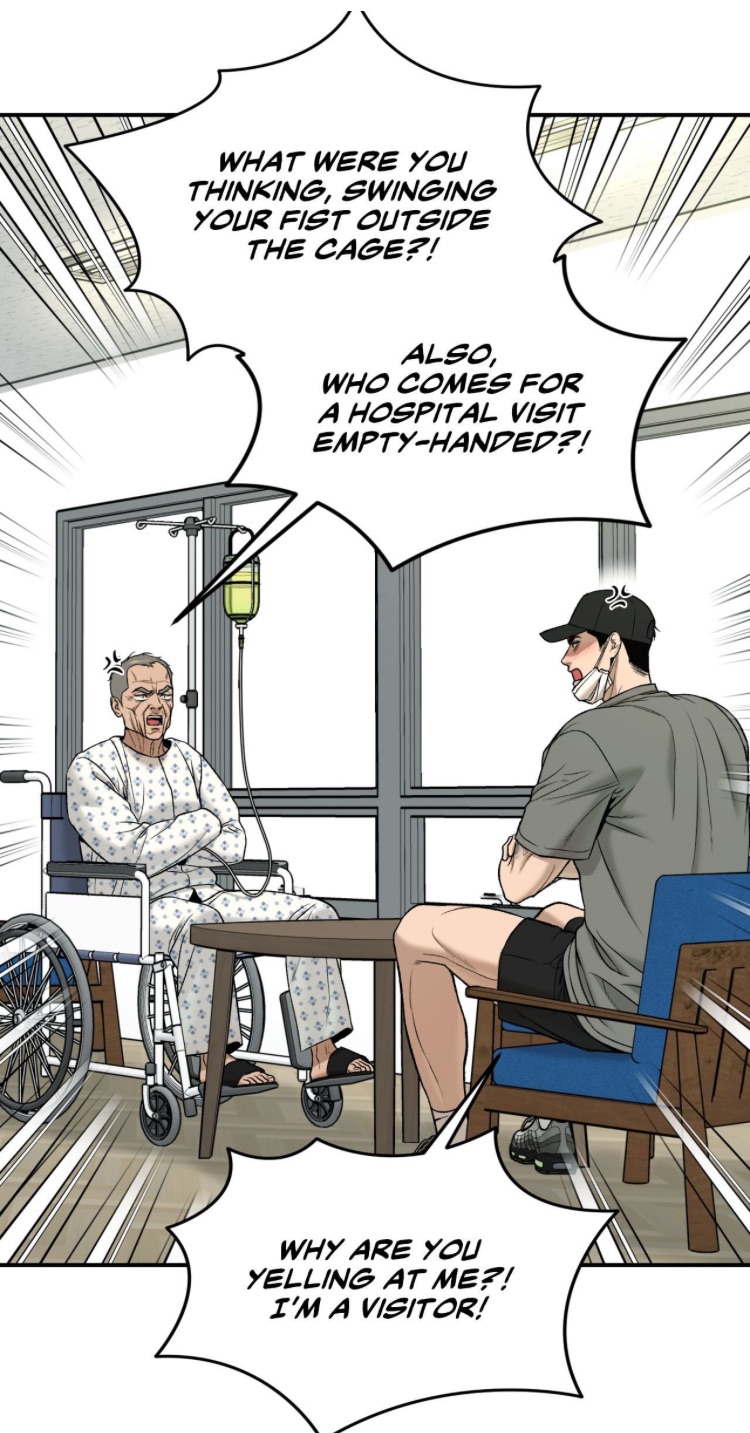 (chapter 71) Yet, deep down, he was happy that Joo Jaekyung had visited him and even spent the whole day with him. Secondly, for him, too, love has always been expressed through responsibility, advice, and correction rather than direct declaration. When he tells Jaekyung to “look around” and “think hard,” or warns Dan to “
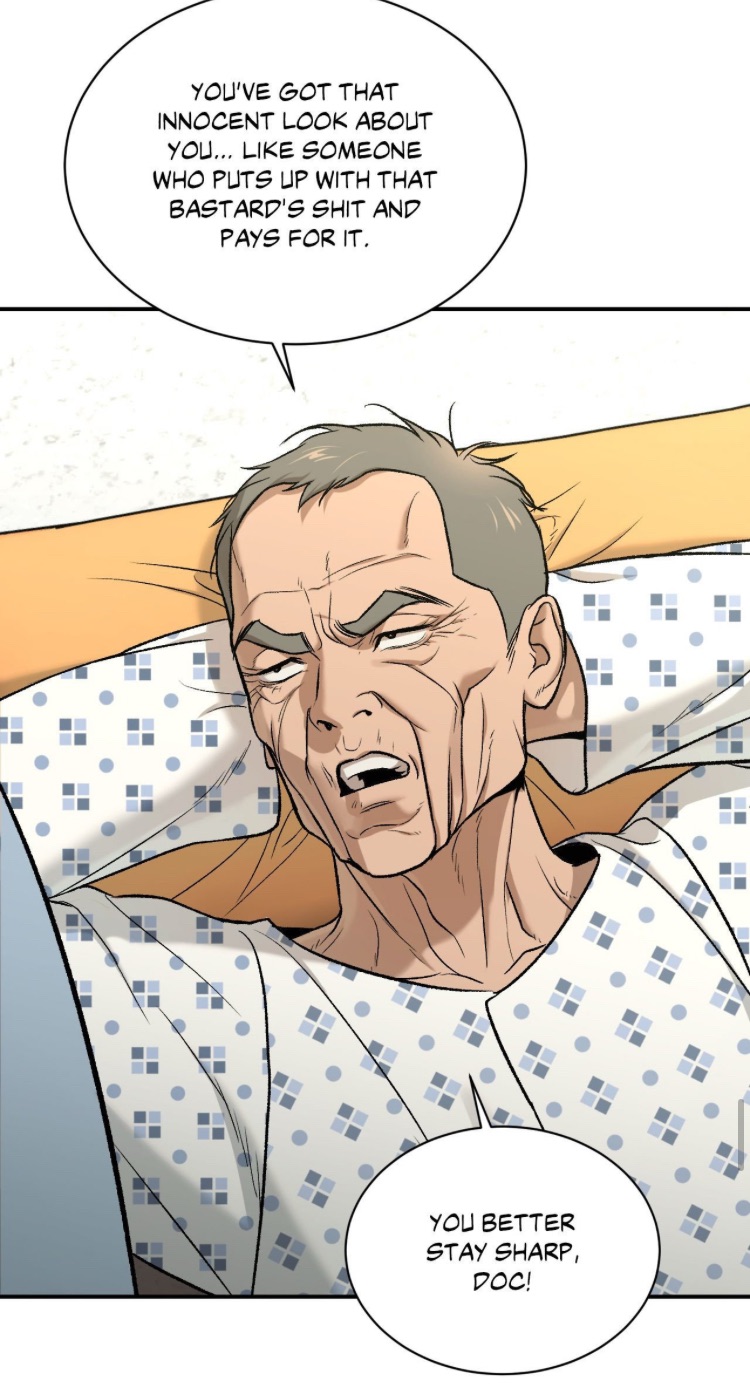 (chapter 70) “stay sharp,” he is not being cold — he is speaking from the only framework of love he knows: respect, knowledge, care, and responsibility, the very dimensions Erich Fromm outlines. He realized too late that he missed Joo Jaekyung very much. His love is embedded in actions and words of guidance, not in sentimental speech. To suddenly say “I love you” would, in his own register, feel shallow and false. He actually embodies the “real parent” IMO, because contrary to all the others adults, he learned from his mistakes. No parent is perfect, but they need to reflect on their words and actions. Learning through experiences is lifelong learning. It stops with death. The director did his best according to the circumstances and tried to correct his wrongdoings. And we can see his influence in the champion’s life. When it comes to doc Dan, he also makes mistakes:
 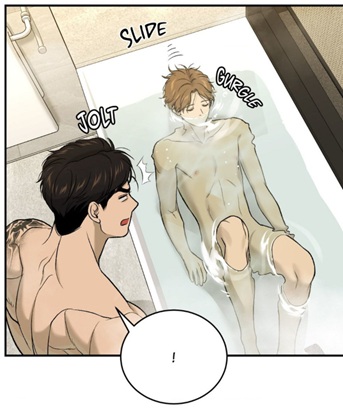 (chapter 68)
 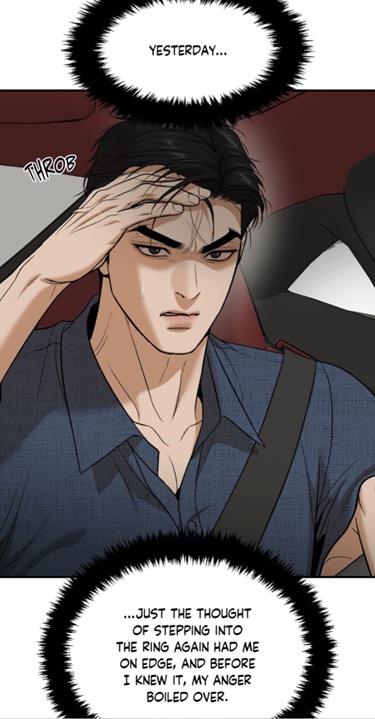 (chapter 69)
  (chapter 69) And that’s what makes him so human.
In this sense, the director and Jaekyung are alike: both have never learned the language of love as affirmation. They can only circle it through substitution — advice, provision, worry, discipline, help. 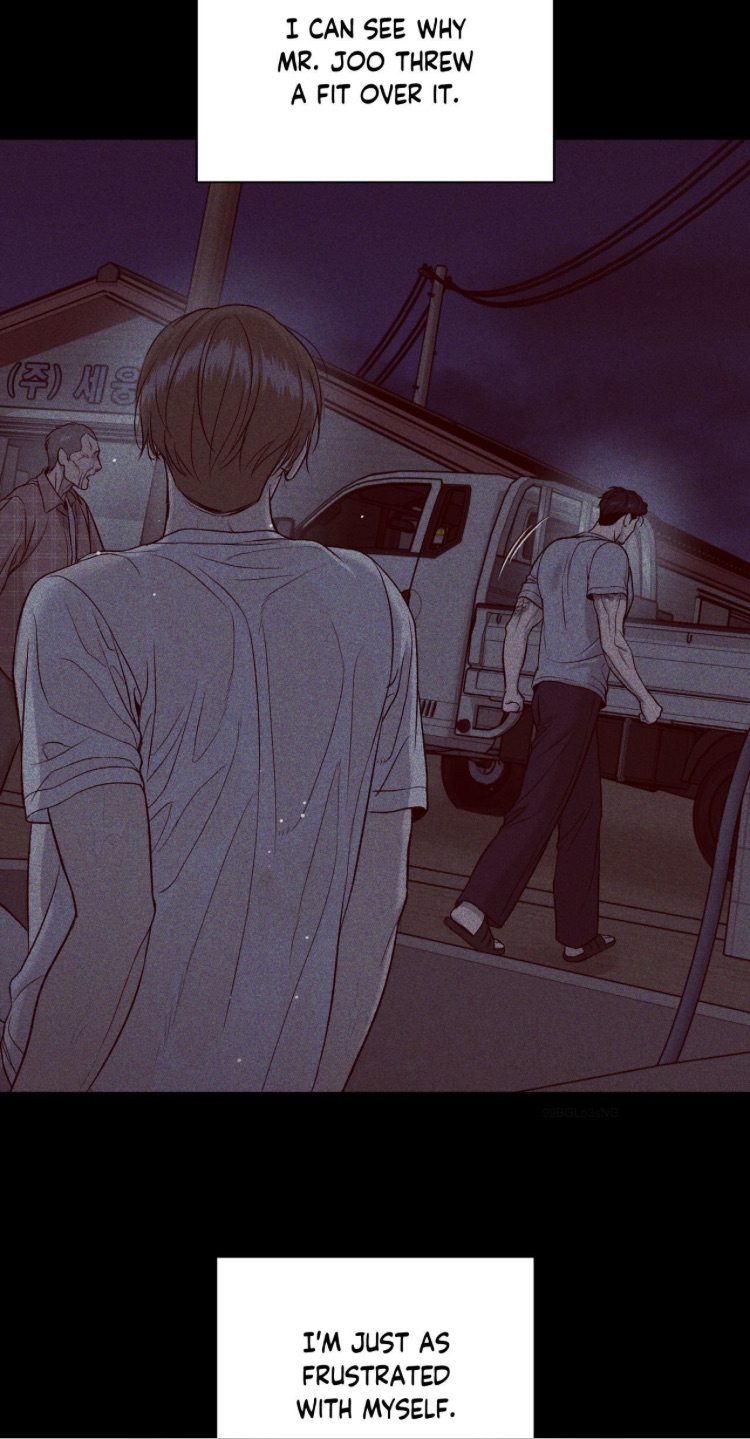 (chapter 71) Hence doc Dan didn’t resent the champion for his harsh treatment. But unlike the mother, who equated love with possession, Hwang Byungchul has begun to correct himself. He respects Jaekyung’s privacy, he encourages instead of dictating, he models a love that is belated but still real. This opens the possibility that Jaekyung, too, may learn to fill his silences differently — not with dominance or provision, but with genuine presence. He truly embodies the philosophy from Erich Fromm: it is never too late to become happy! Hence he smiled on the rooftop! (chapter 75) No wonder why he asked for doc Dan’s company.
 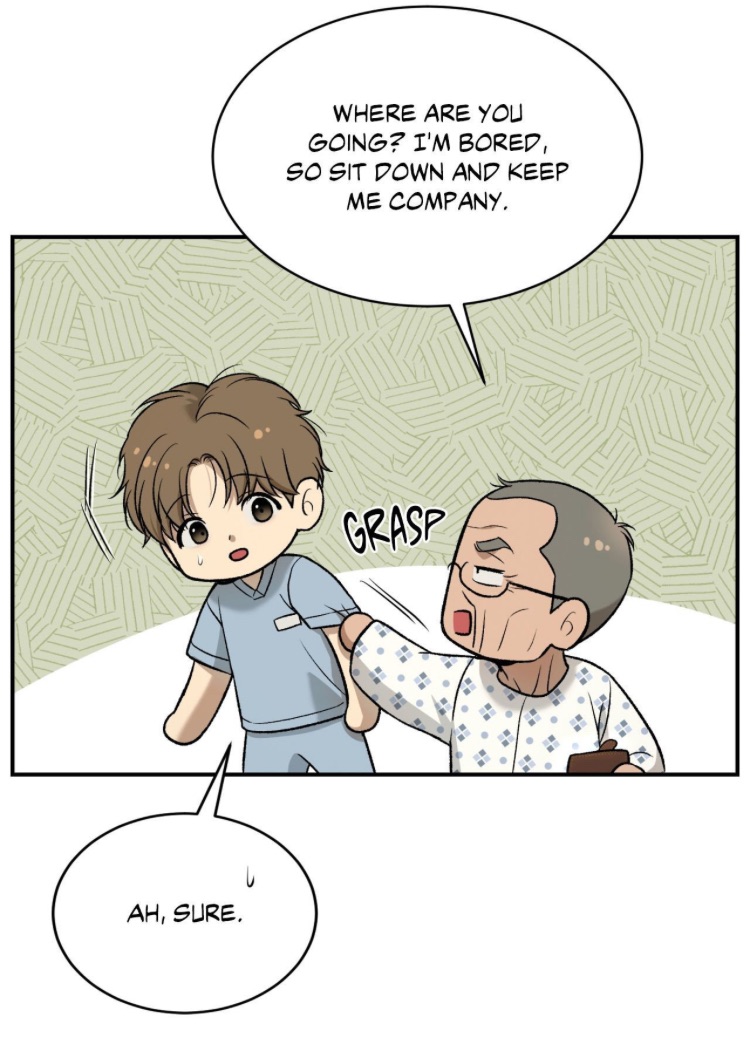 (chapter 71) This means that he lives now in the present. It looks like the “old coot” has been tamed by the “gentle hamster or duck”.
The Silence He Must Fill
This is why the vision of Dan is so striking. (chapter 75) Dan does not speak, but his gaze does not condemn or demand. It simply waits. It offers inclusion without conditions, presence without burden. The silence is not a void but an invitation. For the first time, Jaekyung is faced not with curses, not with resignation, not with demands, but with the possibility of acceptance. He just needs to be himself.
And yet, this makes the challenge greater: he must now learn to fill that silence. He cannot rely on victory, or money, or survival. He must discover a language that has never been spoken to him: the language of I love you.
The Language Kim Dan Cannot Speak
If Jaekyung’s tragedy is that he never learned to say I love you, he also needs to love himself first. He can not imagine how someone could ever say to him: “I love you”. This explicates why the athlete asked the doctor if he remembered that night in the States.  (chapter 41) He didn’t know how to judge such a confession. Hence these words were reduced to a mistake! (chapter 41) To conclude, he couldn’t accept the confession, because he doesn’t love himself. He has never heard I love you in his childhood. Thus I believe that Dan’s tragedy is the mirror opposite: he did hear it once
  (chapter 19), and has been unable to say it since.
Dan already whispered the words — (chapter 39) — but it was under the haze of the drug. His instincts and body spoke first, bypassing the rational mind that usually silences him. In that moment, the words were pure, perhaps the most honest thing he has ever said. And yet, their context corrupted them. Spoken in a fog, they became easy to erase. Later, when Jaekyung pressed him about that night (chapter 41), Dan claimed he didn’t remember. But is it true? In doing so, he turned his own confession into what Jaekyung dismissed as “a mistake.” The first I love you in Jinx was thus swallowed twice: once by chemicals, and once by shame and fear. The physical therapist associates “I love you” with abandonment and rejection.
Why such negative emotions? My hypothesis is that for Dan, I love you does not mean reassurance or joy, rather it is strongly linked to the destruction of a world. It carries the echo of absence, of people who once said those words but then vanished. It is bound to guilt, because the boy left behind always wonders if he could have noticed the signs, if he could have done something. To confess love, for him, is to summon catastrophe, to risk repeating the ultimate loss. Better to stay silent than to relive that moment.
My reading is that Dan’s parents died suddenly, perhaps by suicide, and with them he lost not only family but also home.  (chapter 65) We know he once had toys (teddy bear,car)
 (chapter 21) , little signs of comfort that suggest he grew up in relative security, even if his parents were often absent for work. For me, his childhood was not defined only by poverty but by rupture: love was present, then violently cut short. To a child, such a disappearance feels like betrayal, even if it was no one’s fault. Dan would have been left with a terrible contradiction — that “I love you” was true, and yet those who said it abandoned him forever.
He never had the chance to answer back. (chapter 19) His silence froze into permanence, leaving him with the haunting sense that love was unfinished, that his part of the dialogue was missing. This explains his adult paralysis. To say “I love you” now is not just about risking loss; it is about confronting the memory of the reply he never gave. In this way, the words carry a double weight — love as death, and love as guilt.
Chapter 66 dramatizes this curse in full force. In his sleep, Dan clings to Jaekyung’s shirt 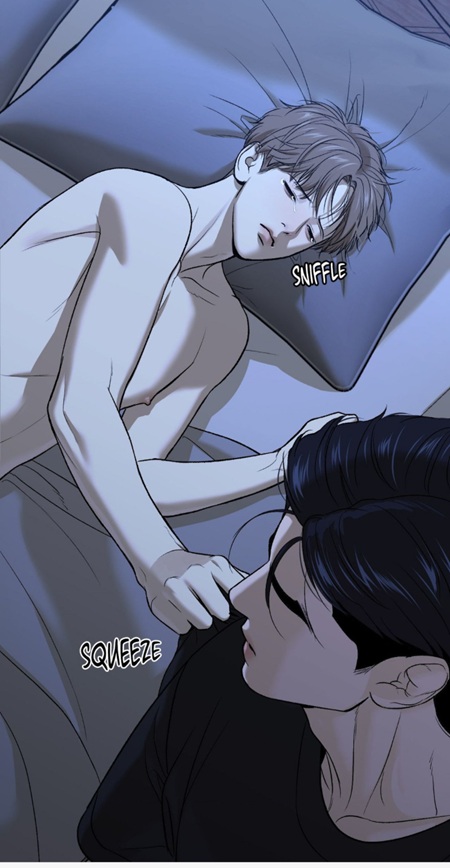 (chapter 66), whispers through tears
 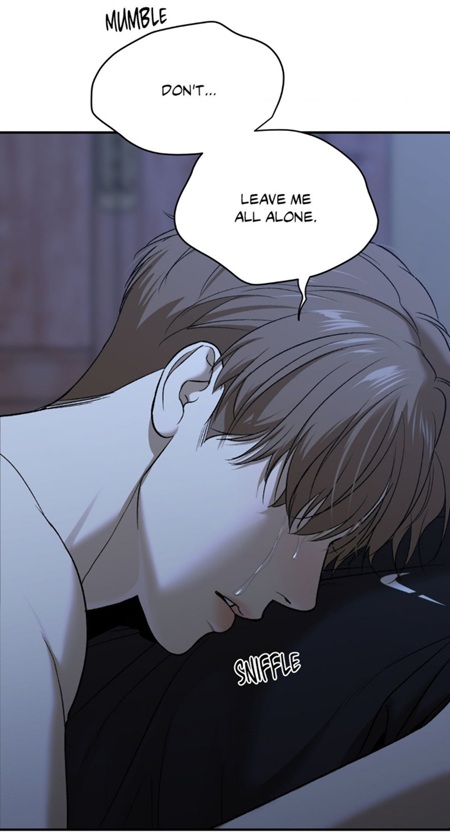 (chapter 66) and then breaks down with “
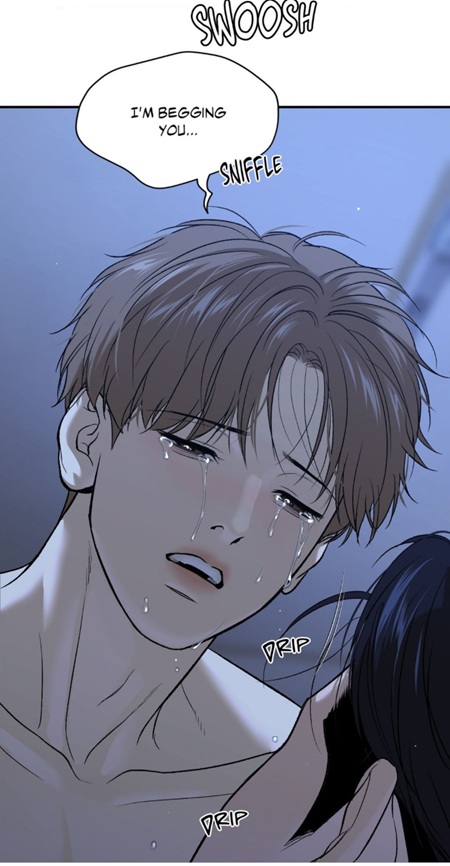 (chapter 66) These are not declarations of love, but desperate substitutes — fragments of the words he could never utter in childhood. They expose the precise gap: he never managed to say back what had once been said to him. He had lost his parents too soon. Instead of “I love you too,” what emerges is fear of abandonment. Instead of reciprocity, there is only pleading. His grip on Jaekyung’s shirt is the physical translation of what he could not verbalize: the child’s attempt to hold onto someone who is already vanishing. (chapter 66) He regrets his passivity and silence. He has not been able to mourn them.
This is why he associates love with death. The words became for him not a gift, but a curse: a death sentence, a debt he could never repay. To say I love you would be to invite catastrophe, to repeat the moment of unbearable loss, as loving means missing. His survival mechanism was silence. He chose to endure, to repay debts, to serve others, to substitute actions for words.
Here another distinction is crucial: the difference between quantity of time and quality of time. In Germany, working mothers were long stigmatized as “Rabenmutter” (raven mothers), accused of selfishly neglecting their children if they pursued careers. Yet modern research has shown that a fulfilled, working mother often gives more genuine love than a depressed housewife who sacrifices everything. What matters is not constant presence but authentic connection.
Dan’s grandmother never understood this. She assumed that because she spent all her time with him  (chapter 65), the boy had not developed such a deep attachment to his parents. Thus she imagined, she could erase their absence. She conflated sacrifice with love, debt with affection. Yet what he received from her was not the warmth of a parent, but the burden of endurance. She patted
 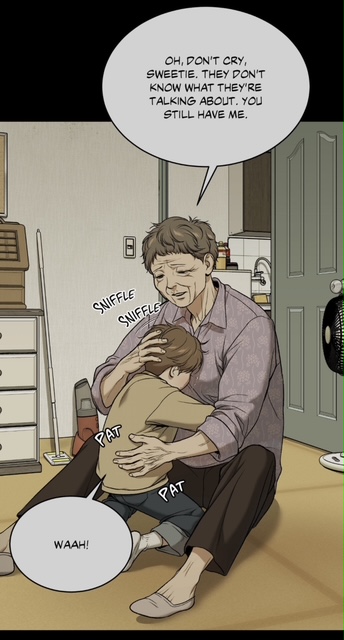 (chapter 57) and caressed him with her hand, but the kiss in chapter 44 reveals something different:
  (chapter 44) Dan once received love of a different kind — playful and tender. A kiss cannot have come from the grandmother, who expressed affection only in gestures of care, never of intimacy. That kiss belongs to his mother.
That’s why my theory is that Dan’s suffering is not rooted in never having been loved, but in being too much loved — and then losing it. He tasted true love as a child, only to have it ripped away. The grandmother, in her endless presence, could not replace it. Quantity could not make up for quality. The boy grew up knowing exactly what love felt like — and therefore knowing exactly what he had lost.
This is why Mingwa draws both boys with phones as children. (chapter 74) Each is tied to a parent’s voice. For Jaekyung, the mother’s words amounted to rejection and withdrawal: “You’re grown up, I don’t need you.” For Dan, the unseen parent almost certainly said the opposite: (chapter 19) “I love you.” But because death or disappearance followed, those words became unbearable. One parent wounds by refusing to speak, the other by speaking for the last time. This explicates his hesitation in the penthouse: (chapter 45) Both strands converge in the present: Jaekyung cannot hear love, Dan cannot voice it. Both are cursed.
If his mother’s last words were “I love you” tied to death and guilt, then money, gifts, and even friendship all became tainted for Dan:
- Never saved money. Because deep down, money symbolized the burden that crushed his parents. To him, money is linked with guilt and loss, not freedom. Why save what only brings ruin? Every coin tucked away echoes the debts that swallowed his family.
- Not interested in friends. Friendships mean attachment, and attachment means risk of loss. If “I love you” from his mother ended in abandonment, then investing emotionally in others would feel too dangerous. Better to stay isolated, to keep the pain at bay. Besides, he experienced bullying, reinforcing his isolation.
- Accepted grandmother’s passivity. Her silence mirrored his own coping strategy: if you don’t hope, you can’t be hurt. He didn’t rebel because her inertia fit his trauma — a life stripped of dreams is safer than a dream that can collapse. At the same time, it explains why he attached himself to her, did everything for her… it is because he knows what love is.
 (chapter 65)
 - Couldn’t accept presents. Because gifts symbolize care and generosity
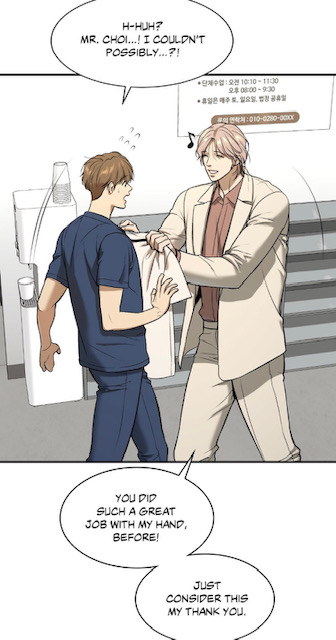 (chapter 31)— which he associates with unbearable debt. His mother’s final “gift” of love was one he could never repay. Any present risks reopening that wound: “What if I can’t repay this? What if I lose them too?”
Even his hesitation in love reflects this same scar. To confess is to risk repeating the curse: to say I love you is to say I miss you, to pre-empt the loss he believes must inevitably follow attachment. That is why his every gesture translates into repayment rather than confession: paying debts, working endless jobs, offering loyalty. For Dan, love must always be balanced, or else it feels like a dangerous imbalance that the universe will punish.
This is why his whispered confession was both utterly true and utterly tragic. (chapter 39) It broke free of his usual silence, but only in a context that allowed it to be denied, laughed off, reduced to error. The boy who once heard I love you as the final word of life has never dared to speak it again with full consciousness. For him, the words are not magical yet. They are still poisoned.
The End Of The Curse
But after hearing Jaekyung’s tragic story, he must have realized that they share the same fate: both grew up without parents, both were robbed of a proper childhood. One was abandoned, the other bereaved. Both learned to survive through silence.
This is why the dream in chapter 75 matters so deeply. (chapter 75) In the dream, Dan does not speak. He simply turns back, bathed in sunlight, as if to wait. That single gesture contains everything Jaekyung has been starved of: inclusion, patience, recognition. It stands in absolute contrast to the voice of his father, who at dawn once spat the cruelest curse a child can hear: (chapter 73) You are not special wounded Jaekyung more deeply than fists ever could. It condemned him to a life of proof, to an endless treadmill of victories meant to silence that voice. But here, in this vision, the curse is answered without words. For Dan to wait for him, to turn his face toward him, is to say what no one else ever did: you matter. You are precious. You are worth waiting for. In fairy-tale terms, the jinx is not lifted by triumph in battle, but by recognition — by being seen. (chapter 75) He doesn’t need to prove his worth or his strength. He doesn’t need to do anything, he just needs to look at doc Dan! Through the gaze, they both express that they are valuable.
The physical therapist’s vision with Shin Okja 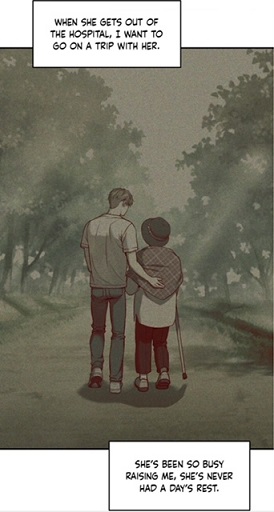 (ch. 47) throws this into sharper relief. There, Dan imagined taking her on a trip after the hospital, walking side by side, giving her what she never had: rest, companionship. The problem is that this image was still mixed with repayment, nevertheless doc Dan was gradually realizing that spending time together was important. This vision displays the importance of walking together. When Jaekyung dreams of Dan waiting in the sunlight, (chapter 75) it is the same metaphor renewed. Dan has replaced the grandmother in this vision — he has become the one who walks ahead yet turns back, including him in the journey. The implication is clear: Jaekyung no longer has to march forward alone. The future he never dared to imagine now opens as a shared path.
The structure itself echoes the fairy-tale pattern. I have already made connection between the Korean Manhwa and Sleeping Beauty , Belle and The Beast, and finally The Little Mermaid. In Sleeping Beauty, the kingdom lies trapped in silence until a kiss awakens not only the girl but the world. In The Little Mermaid, dawn means death because her love remains unspoken. In Beauty and the Beast, the curse is shattered only when the words “I love you” are spoken — not as possession but as recognition. Mingwa draws from this reservoir of cultural memory. Jaekyung’s dream is a kind of spell: silence redefined, from abandonment into hope. Where once silence meant rejection — the mother who turned her back, the father whose silence was mockery, the empty nights of waiting — now it becomes a promise: Dan will not walk away. He waits, silently, until Jaekyung steps forward. (chapter 75)
Notice the timing. When Jaekyung jolts awake, (chapter 75) the room is still dark. Yet in a previous chapter, we heard birds singing at dawn 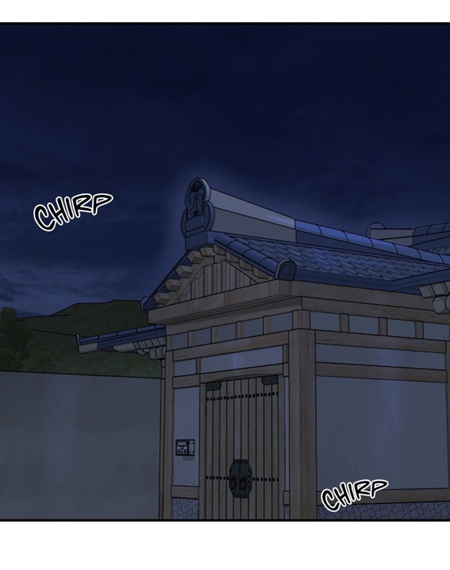 (chapter 74) — the quiet sign that the sun is about to rise. Dawn is not just a natural detail in Jinx; it is a symbolic hinge. It is the moment when night meets day, when moon and sun overlap, when endings bleed into beginnings. In myth and fairy tale, dawn often marks metamorphosis: the Little Mermaid turns to foam, the enchanted sleepers awaken, the beast becomes a prince. For Jaekyung, too, dawn is the threshold. His father cursed him at dawn
  (chapter 73), stripping him of worth, tying the rising sun to shame. But in this new dawn, another voice will have to intervene. Only Dan can replace the curse with a blessing. Only “I love you” can undo “you are not special.” And if it is not “I love You”, then it could be a kiss, the symbol of “affection”.
Thus both men stand before a silence heavy with history. For Jaekyung, silence meant abandonment; for Dan, silence meant survival. And yet in the dream, silence shifts its meaning. It becomes the waiting space in which words can finally emerge. (chapter 75) Dan’s figure in the sunlight does not reproach, does not demand. It simply invites. The silence of the dream is not the silence of loss but the silence that precedes a confession.
This is why the fairy-tale logic is so essential. In every story, the curse holds until someone dares to speak or act from love. In Jaekyung’s case, brute force has failed. No title, no victory, no belt has lifted the weight of his father’s curse. In Dan’s case, endurance has failed. No debt repaid, no day survived, no burden carried has erased the wound of his parents’ disappearance. The spell will not break by repetition of the old methods. It will break only when Dan speaks the words he most fears: I love you.
When that happens, the dawn scene will finally be complete. The birds already sing. The light already glimmers. The dream has already shown the way. What remains is for Dan’s voice to enter the silence, to transform waiting into presence, vision into reality. When those words are spoken — not poisoned by guilt, not dismissed as a mistake, but confessed freely — Jaekyung will no longer be his father’s son. He will be someone else’s beloved. The jinx will shatter (chapter 75), not with noise but with a whisper while looking at each other.
And if the curse is broken, the athlete no longer needs to fight and accept the “invitation” from the CEO and the manager. This is where Mingwa’s subtle use of sound and silence becomes crucial.
Think back to the restaurant in chapter 69,  (chapter 69) when Park Namwook leaned across the table and whispered to the champion about his slipping rank, his lost title, his third place. The setting is dim, the words hushed, the tone heavy with shadow. That whisper was not meant to soothe — it was meant to undermine. Namwook’s closeness is false intimacy: a confidentiality designed to manipulate, to remind Jaekyung of his dependence, to keep him chained to the cycle of fighting. The whisper here is the voice of fear, lack, and scarcity.
Now contrast this with the whisper we anticipate from Dan. His silence in the dream (chapter 75) is not oppressive like Namwook’s — it is open, steady, waiting to be filled. When Dan eventually breaks it with an “I love you,” the whisper will not chain Jaekyung to debt or failure, but free him from the curse. Both Namwook and Dan occupy positions of proximity, both bend close to him in moments of vulnerability — but one weaponizes the whisper, the other redeems it.
This brings us back to my point about quantity versus quality. Namwook has been by Jaekyung’s side for years.  (chapter 75) He was always there — arranging his matches, covering his problems, whispering about his “future.” Yet the quality of his presence was hollow. He never once guided Jaekyung beyond his father’s curse, never helped him imagine a life beyond titles. Thus he never discovered that the “monster” was suffering from insomnia.
 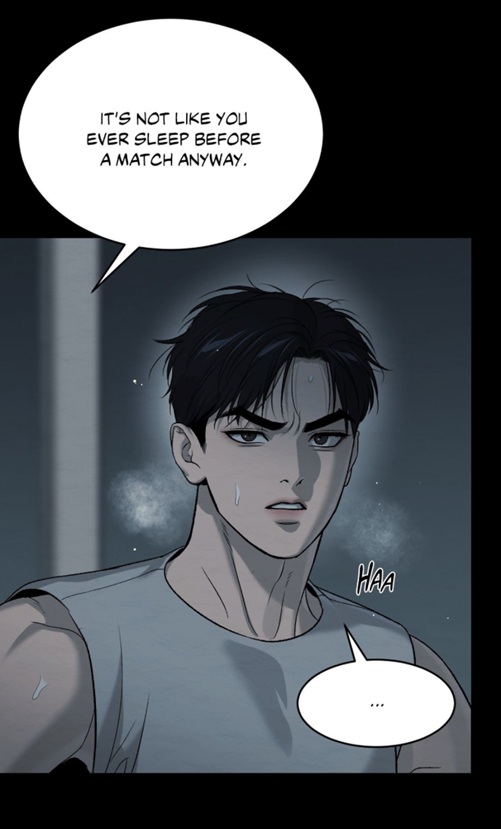 (chapter 75) His companionship was measured in duration, not depth.
By contrast, Dan has been present for only a fraction of that time (4 months). Yet in those brief encounters, he has done what Namwook never could: he has listened, waited, cared. He has offered no manipulation, no bargain, no shadowed whisper — only a quiet inclusion (chapter 41), an invitation to walk together. Namwook’s long presence embodies the trap of quantity without substance. Dan’s brief but luminous presence reveals the power of quality: the kind of attention that transforms.
In fairy tales, this contrast is often dramatized as the distinction between the false helper and the true helper. The false helper stays close, makes promises (The prince in The Little Mermaid), whispers encouragement, but secretly feeds on the hero’s struggle. The true helper might appear suddenly, even briefly, but offers the one thing that matters: the key to breaking the spell.
And that is exactly what chapter 75 foreshadows. The false whispers of Namwook will fade into irrelevance, while the true whisper — Dan’s future confession of love — will carry the power to break Jaekyung’s curse once and for all.
The breaking of the curse will not only free Jaekyung from his father’s voice — it will also free him from the tyranny of time.  (chapter 29) Under the curse, his whole life has been a frantic race: prove himself, fight again, silence the noise in his head.
  (chapter 75) Namwook’s whispers, too, keep him chained to that rhythm of urgency — rankings, titles, deadlines. But once Dan’s whisper replaces Namwook’s, time itself shifts. The future is no longer a debt to repay but a horizon to approach slowly, hand in hand.
That change means he can finally rest. And when one rests, the present opens up. The little things, so long ignored, become sources of joy. This is exactly what we glimpsed in chapter 27: the rare day off. For once, Jaekyung did not fight, did not perform. He smiled 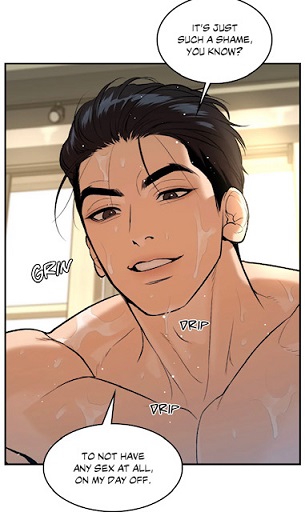 (chapter 27), joked
 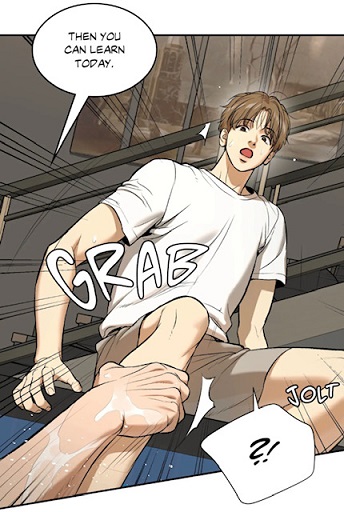 (chapter 27), even rediscovered his love for swimming. Water, his true element, was reclaimed as play rather than punishment.
  (chapter 27) That single day was a seed — a foreshadowing of what life might look like once the curse is broken for good.
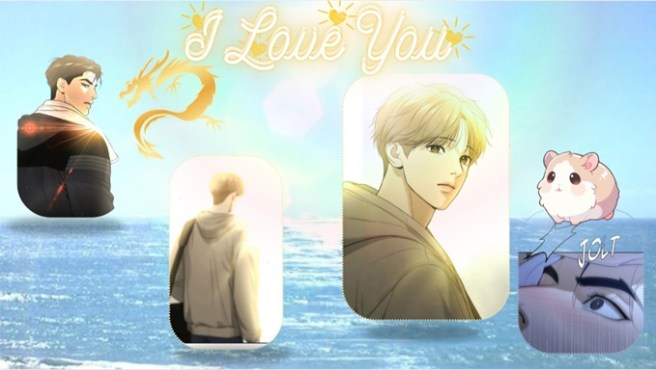
In this sense, the breaking of the jinx is not just about escaping the past; it is about re-entering the present. True happiness will not come from another belt or victory, but from the ability to enjoy simple, shared moments: jokes by the pool, laughter, warmth, rest. (chapter 75) But there’s a difference to the past. The vision of Kim Dan is strongly intertwined with nature, we are here seeing sunlight and not the light from cameras! (chapter 53) What did the director tell the star? The latter should look at his surroundings: the ocean, the sky, the trees… (chapter 75) This means that Joo Jaekyung is on his way to discover nature and as such animals! So far, he hasn’t paid too much attention to Boksoon and her puppies. And now, you comprehend my illustration for the essay. The champion is on his way to discover a whole new world. Doc Dan embodies nature: the sun, the trees, the sky. (chapter 75) Nature is the symbol of life. I LOVE YOU, LIFE!
Feel free to comment. If you have any suggestion for topics or Manhwa, feel free to ask. If you enjoyed reading it, retweet it or push the button like. My Reddit-Instagram-Twitter-Tumblr account is: @bebebisous33. Thanks for reading and for the support, particularly, I would like to thank all the new followers and people recommending my blog.


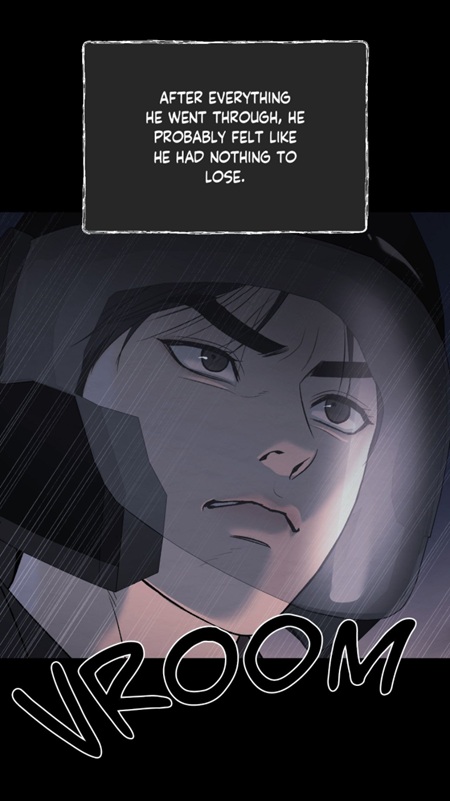 (chapter 74) What do they share? You might already have noticed it. At first glance, the answer seems obvious: each sentence turns around the word after. But if we pay closer attention, it is not just after that repeats, but after all. And here, the “all” quietly carries the weight of everything. A slight shift, but one that feels significant. But why this expression, and why here? Why does it resurface precisely in the context of Jaekyung’s family and past?
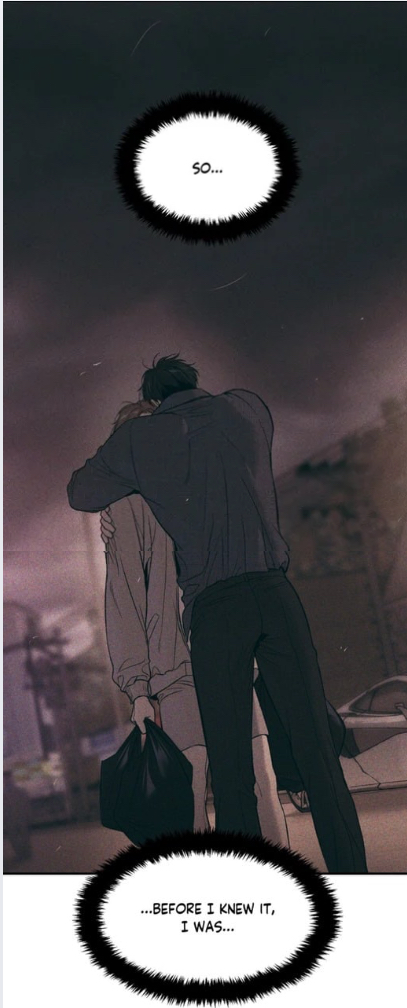 (chapter 70) For the first time, the flow of time shifted. Besides, no explanation, no certainty—just an admission that something happened beyond his planning or reasoning. Where the earlier lines spoke with closure, this one arrived without a verdict. But what does this “confession” signify for the athlete now?
  (chapter 73) He was announcing his desire to leave this place, as if he wanted to abandon his father. Nevertheless, he just said it out of anger and frustration. Yet, those words pierced Joo Jaewoong, for they reminded him of his wife’s betrayal. Unable to face his own failures, he retaliated by thrusting her image back onto the boy.
 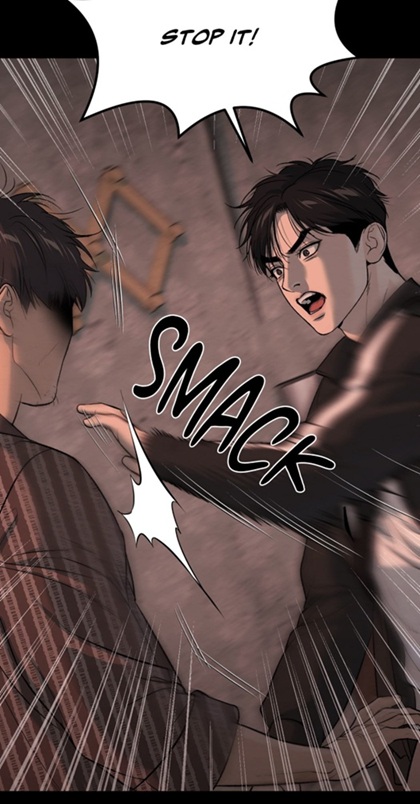 (chapter 73) locked in confrontation, while in the past, the woman had already shown her back — a gesture of refusal that foreshadowed her desertion. She had withdrawn in silence; the man, however, lashed out in noise. Both abandon, but in different registers: hers in silence and absence, his in noise and abuse. But the father’s gaze was selective.
 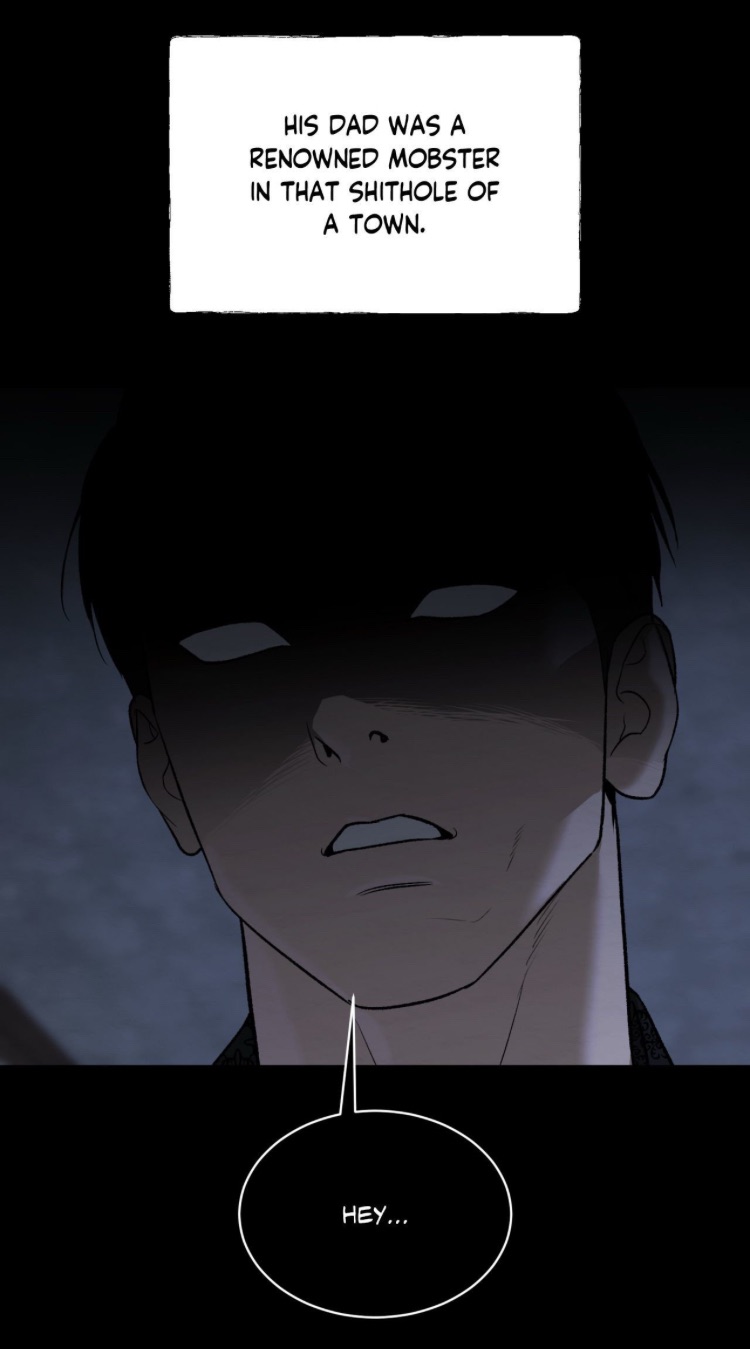 (chapter 73) — all were rewritten into a story where the woman was the sole traitor, and the child nothing more than her extension. In this way, the boy was denied recognition as a victim in his own right. He had been abandoned too. He had been abused either. He became instead a mirror in which his father projects the wound of being left behind.
  (chapter 73) The cycle of reproach was sealed. From that moment on, he understood the danger and the destructive weight of words.
 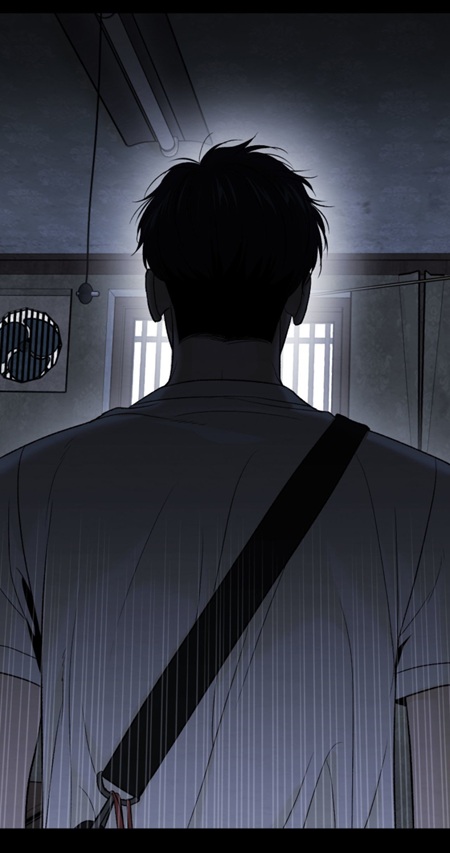 (chapter 73) To speak was to wound, to be wounded in return. Besides, the boy could never speak of this truth. He carried the memory of that last conversation in silence, crushed by the belief that he bore guilt for his father’s death. Shame and responsibility bound his tongue. That is how words, once used against him as weapons, became impossible for him to wield in his own defense. However, this was only the beginning of his withdrawal into silence. His fists would become his language, his body the only safe instrument of reply.
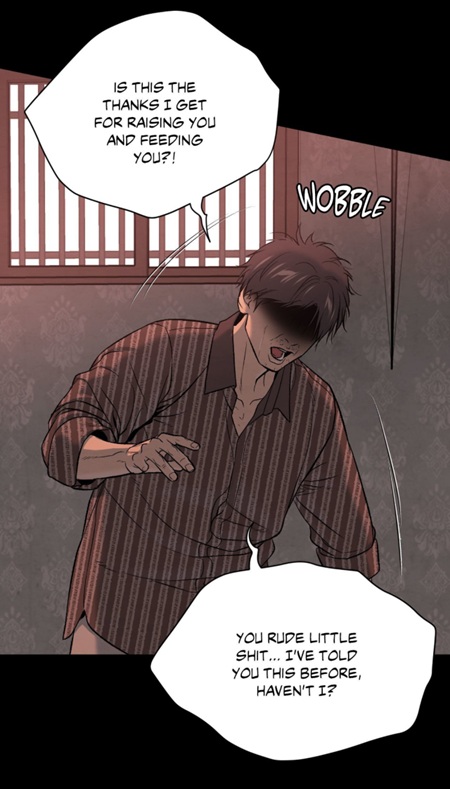 (chapter 73) The betrayal he lamented was nothing more than the logical outcome of his own principle. There had never been a we — only a man clinging to his pride, a woman turning her back, and a child caught in between. His after all
  (chapter 74) In the past, the boy had dialed her number from the same public booth
 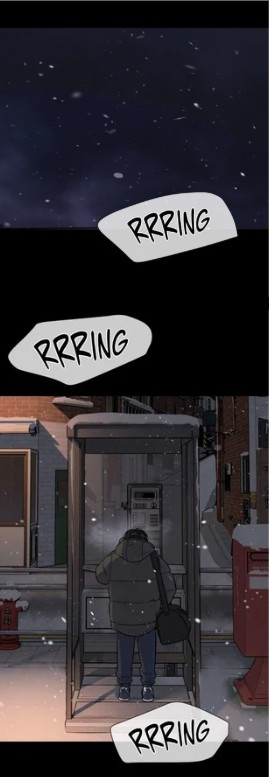 (chapter 72), clinging to the hope that she might answer one day. Eventually, those attempts ceased — but not the attachment. What remained was the number itself, saved under “Mom” on his phone
  (chapter 74) Here, he was old and rich enough to buy his own cellphone. The phone number was no longer a channel of communication, only a relic: a fragile thread he could not sever, because the fact that she never changed her number sustained the illusion that reunion was still possible. That dormant hope was shattered only when she finally picked up — not out of recognition, but by mistake, assuming the unfamiliar call must be important.
  (chapter 74) repeating “please” twice — not out of kindness, but because he had become a source of threat to her new life.
  (chapter 66)
 (chapter 74) unless she had once suggested that possibility? His words reveal that he had been clinging to a seed she planted long ago, a future she quietly abandoned while building a new life elsewhere. And what was that seed? Not just her vague suggestion that “once they have money”, or
 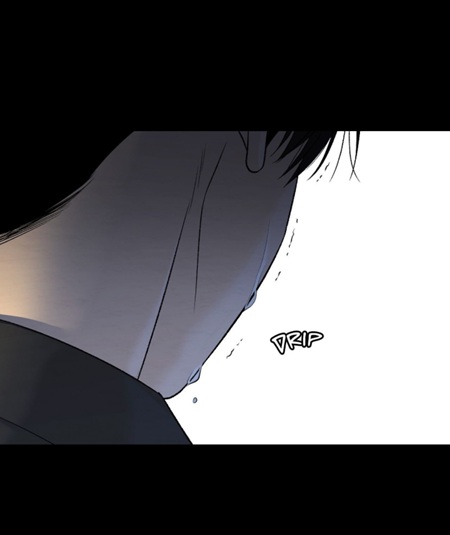 (chapter 74) Furthermore, it gaslights him into believing that the abandonment never occurred — that the break is only beginning now.
  (chapter 72) neglect, starvation, abuse, loneliness, betrayal — and yet the parents invoke it not to acknowledge his pain, but to hide their wrongdoings (justify their betrayal) and as such their failure! By placing after all at the front of her sentence,
 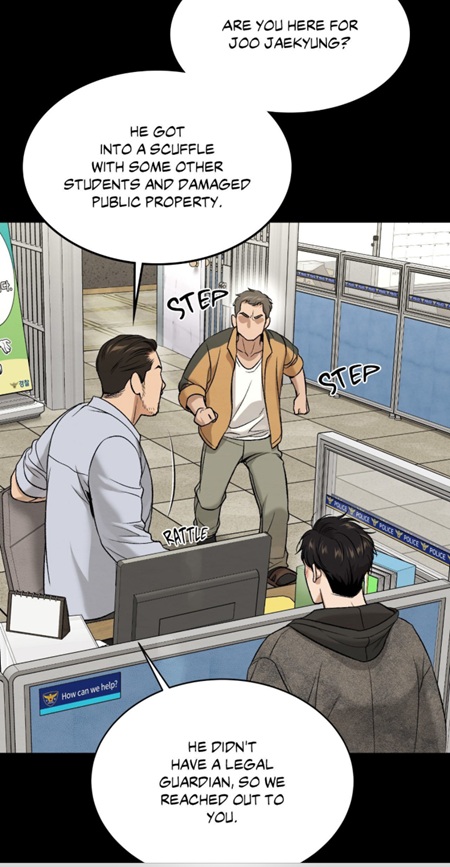 (chapter 74) When the boy once caused trouble, the police looked for Joo Jaekyung’s guardian. In the cutthroat town, they reached out to Hwang Byungchul — not because he was legally responsible, but because everyone knew the boy was close to him (“we”). Guardianship, then, is never erased by silence. Even if you abandon the child, others will still hold you accountable.
 (chapter 74) In a city of anonymity, hearsay cannot replace documents. She left a paper trail — a legal identity that binds them together. Should the champion cause trouble in Seoul, or even become the victim of a crime, the police would have to turn to his legal guardian. And that can only be her.
  (chapter 26). Oh Daehyun mentions that the young fighter broke the punching machine so many times he was blacklisted. Such destruction could easily have brought police intervention — and if it had, they would have been forced to search for his legal guardian. That guardian is none other than the mother who abandoned him and her new family. In other words, her erasure was never complete: every act of the boy risked pulling her shadow back into the open. Furthermore, this is what Kim Changmin revealed to his friend and colleague:
  (chapter 26) But Joo Jaekyung had long discovered sports and MMA, when he arrived in Seoul and met Park Namwook for the first time.
 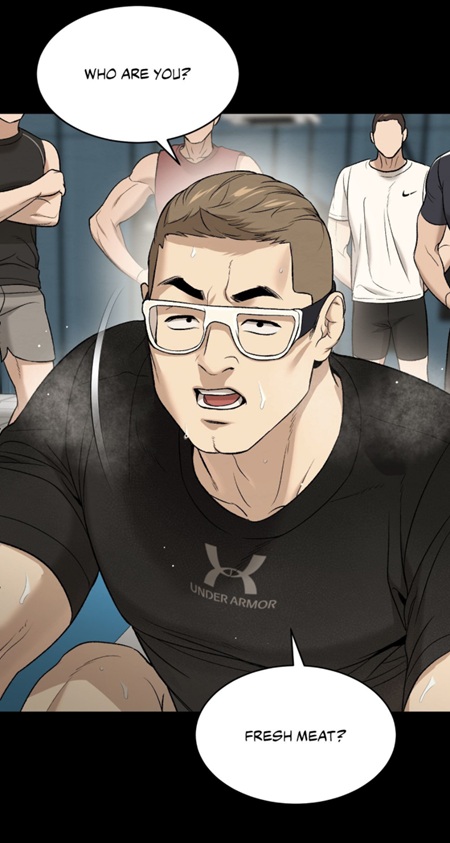 (chapter 74) He had left his hometown because of the director’s suggestion.
  (chapter 74) who redirected him before he was swallowed by the wrong path. The discrepancy between these accounts exposes more than just the manager’s manipulation: it points to the shadow of another intervention. How could he afford to destroy machine after machine without consequence? The only plausible answer is the “mother” and her new family, whose money and silence allowed him to pass as the “self-made” Emperor while erasing their own responsibility from the tale. And now, you comprehend why The Emperor was made voiceless. [For more read
 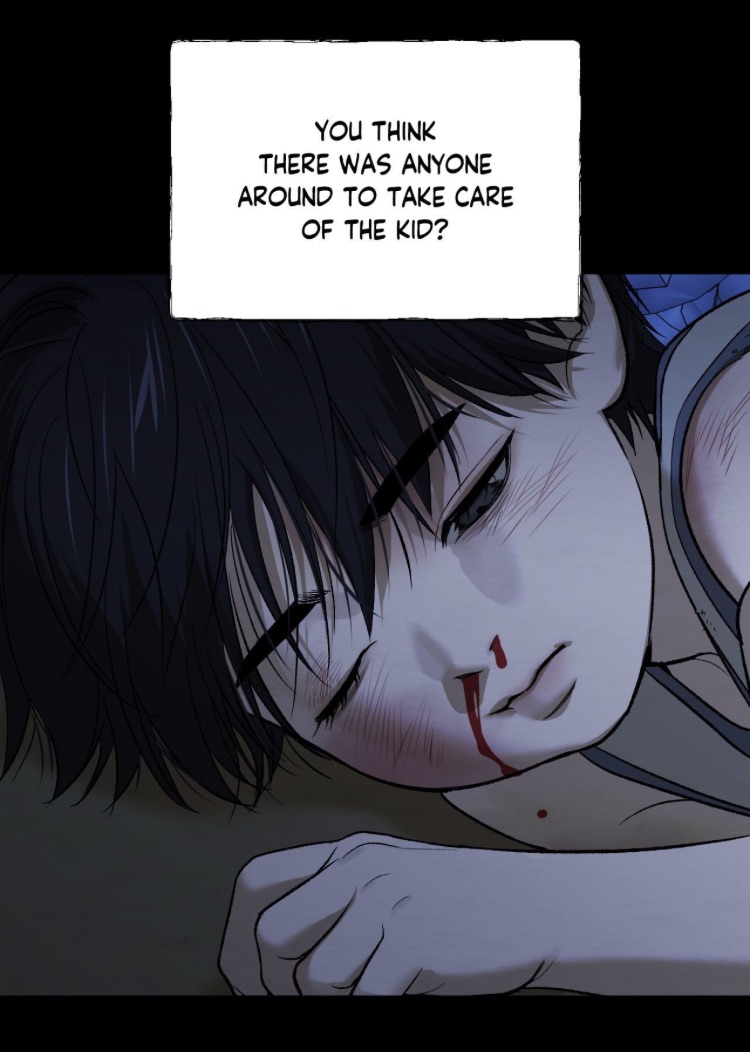 (chapter 74) For doc Dan who embodies the present, such a statement can only become the ultimate truth: the star had been an orphan like him.
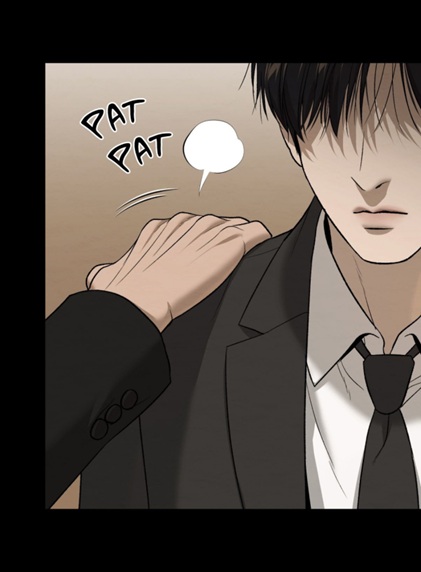 (chapter 74) Once again, the director was there — but his presence was mute. He placed a hand on the boy’s shoulder, yet he never lent him an ear. He never invited the boy to speak, never created a space where grief, anger, or longing could be put into words. In other words, he was present in body but absent in voice and heart. Thus the director’s pat was a gesture of pity. It was a substitute for words, a way of saying “poor boy” while protecting himself from deeper involvement. But precisely because he withheld speech and listening, it denied Jaekyung the chance to articulate his own grief. It comforted without connecting.
 (chapter 74), through fighting. Thus the director’s quietness, his refusal to engage, became a formative wound in itself. He chose the safety of distance over the risk of involvement, and in doing so, left the boy’s cries unanswered.
  (chapter 74)
  (chapter 74) He was given a chance to step in, to finally become the guardian he had failed to be on the night of the boy’s deepest collapse. Therefore it is no coincidence that he claims to have raised him, while the readers are well aware of the truth.
  (chapter 74) Yet the way he handled the moment revealed the full extent of his contradictions.
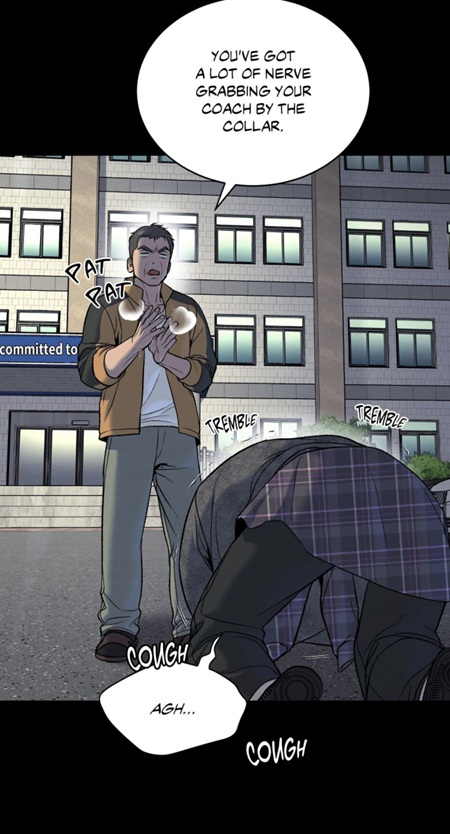 (chapter 74) or sometimes stood beside him, kept him in sight. On the surface, this could seem like loyalty, but in truth it was another form of failure. Facing him head-on meant constant confrontation, constant judgment. His presence was physical, but never protective; it was discipline, surveillance, not refuge. He never had his back!!
  (chapter 74) The father was dragged into memory as a warning: “Do you want to end up like him?” The mother, already gone, was turned into a conditional model: “Would she even want to live with you if she could see you now?” In both cases, the boy was denied his right to grieve. His parents were not mourned, but transformed into instruments of discipline. He was forced to run from one shadow and to chase another, leaving him no space to simply exist. The director maintained the future champion trapped in the chains of the past.
  (chapter 74) For him, she was a symbol — fuel for perseverance, as he was projecting his own mother onto the boy’s! For the teenager, the mother was the deepest wound. By naming her, the director imagined he was motivating; in reality, he was tearing it open once more. But how could Jaekyung reveal the truth — that his own mother had rejected him, not just once, but twice? To admit this would have been to confess that the hope she dangled before him, the dream of reunion, had been nothing but a cruel game. His silence was not pride but a shield, for voicing it would mean exposing that even his mother’s love had been counterfeit.
 (chapter 74) Thus his silence was not indifference but defense: he was protecting her name, even when it burned him to do so. In shielding her, he also buried himself.
 (chapter 74) That is how another pattern emerges: every exchange the boy endured was never true conversation, but always structured as an argument or a challenge. Even here:
 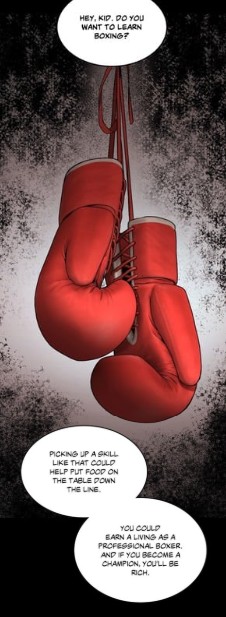 (chapter 72) At home, his father turned dialogue into a bet — a contest of strength where affection was absent and only victory mattered. Later, in front of the police station, the director reproduced the same pattern: invoking the mother not to console, but to provoke, to test, to challenge. In both cases, words became weapons. They did not open space for Jaekyung to speak; they cornered him, forcing him either to resist or to submit. This explains why in season 1, the two protagonists had similar interactions.
 (chapter 74) For him, discipline was always bound to her presence, her food, her care, her silent labor that sustained the gym. By invoking “the mother” as a motivator, he was, in truth, repeating the only model of loyalty and endurance he had ever known. But this was borrowed authority, not Jaekyung’s. What may have given the boy a flicker of purpose in the moment — to endure, to fight “for her sake” —
  (chapter 74) could not last. It was never his voice, never his wound being acknowledged. It was an external script imposed upon him. And so, over time, that imposed motivation faded, eclipsed by the title and the money.
  (chapter 54) The director’s form of guidance could not sustain him; it was external, borrowed, conditional. Therefore, it is not surprising that he was never contacted after the main lead’s departure for Seoul. By then, the director had already become like his own mother — reduced to a memory
  (chapter 70) and nothing more. He neither possessed the boy’s number nor showed the desire to stay connected; worse, he had told him explicitly never to return.
  (chapter 74) Through both words and attitude, he conveyed that their paths were to diverge for good. Yet, this was never truly his intentions. In cutting him off so decisively, he enacted the very separation he condemned later. The boy had taken his words too seriously.
  (chapter 56)
  (chapter 66) His care always comes after, never before. The word itself reveals his stance: he notices change, but belatedly, when damage is already done. The main lead is now escaping his control. And now, you comprehend why PArk Namwook blamed Joo Jaekyung and slapped him at the hospital.
 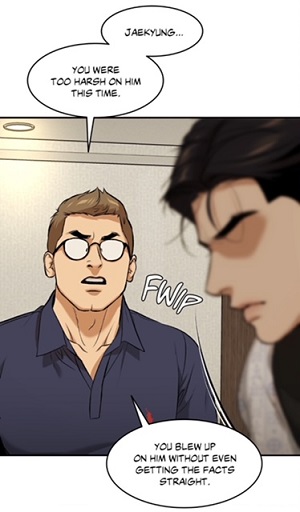 (chapter 52) That way, he could divert attention from the “before and circumstances”. And in season 2, the man hasn’t changed at all. Instead of asking what caused Jaekyung’s crisis, he chides him for straying from the routine — for not showing up at the gym, for being absent.
 (chapter 52), either for not rising above (after everything) or for drifting from his prescribed path (lately).
 (chapter 52) The slap at the hospital was more than a physical outburst; it was the eruption of long-repressed truth. Where he once swallowed pain in silence for his mother, and later endured fists in silence for his coach, here he answers back. Lately thus marks not only Namwook’s delay but also Jaekyung’s refusal to bear the weight alone anymore.
 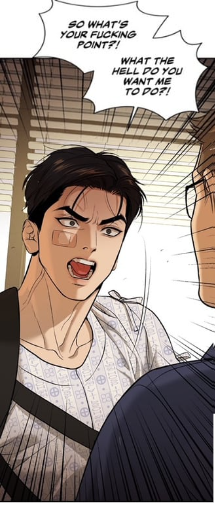 (chapter 52)
  (chapter 73), the mother’s silence through the cellphone
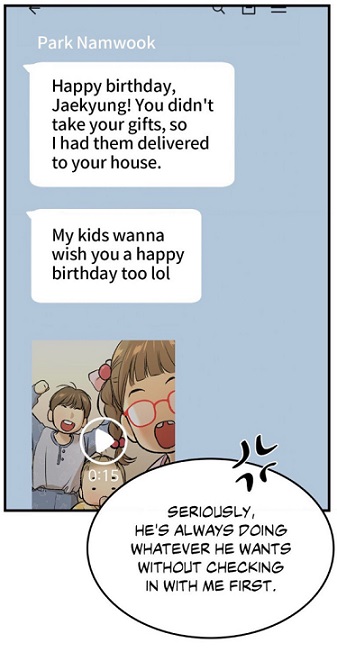 (chapter 45) his true life hidden elsewhere. Like her, he conceals his absence behind a phone call, creating the illusion of presence without truly standing by the boy.
  (chapter 45)
 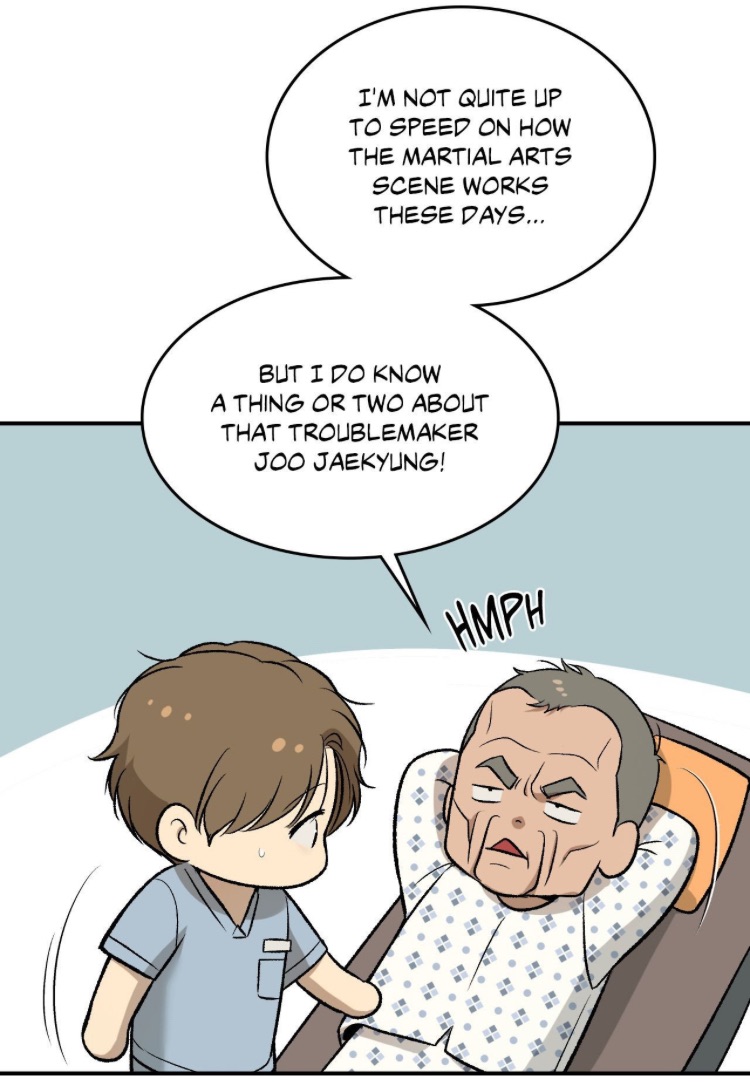 , (chapter 70), while remaining oblivious to the rot within their own world and the medical world. The director accused Joo Jaewoong of “choosing the wrong path,”
  (chapter 74) never admitting that boxing itself was already entangled with the underworld. Likewise, Park Namwook reproached Joo Jaekyung for the mess, while in reality he had been a victim. The incident with the switched spray was reduced to two people: doc Dan and Joo Jaekyung. Funny is that by invoking lately and after all , they have the impression that delayed blame could substitute for real support. Both stand as authorities who issue reprimands only once the harm is irreversible—always too late, always at a remove. In doing so, they preserve the illusion of responsibility while avoiding the real corruption at the core of their institutions. They deny the existence of “victims”. By doing so, both Hwang Byungchul and Park Namwook sustain the illusion that the system itself is clean, and that all fault lies with the individual fighter. In their eyes, there is no exploitation, only bad choices. This explains why the CEO’s fabricated apology disturbed Namwook
  (chapter 69): for the first time, a figure of authority assumed responsibility, however insincerely. What to others looked like shallow PR, to Namwook appeared as a dangerous break with the rule of denial. It highlighted the emptiness of his own guardianship, where reproach replaces protection and victims are erased from the narrative.
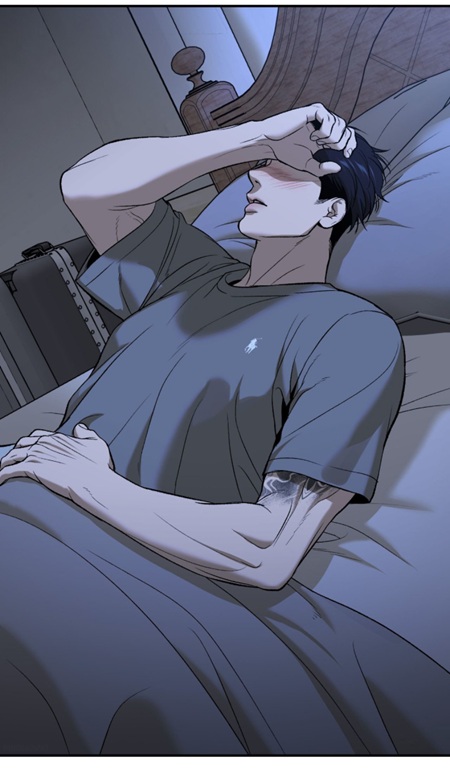 (chapter 74) Honestly, it would be funny, if the champion used the same words than his own mother against the manager
  (chapter 70) Thus the manager is confident that the star can return to the ring. By cutting the manager off in such a moment, Jaekyung would be affirming that he no longer accepts neglect disguised as toughness. Both “directors” are trapping the champion in the chains of the past and the future. For them, there’s no present and as such no happiness or fulfillment. Hence Hwang Byungchul is even bored, when he watched the MFC match.
 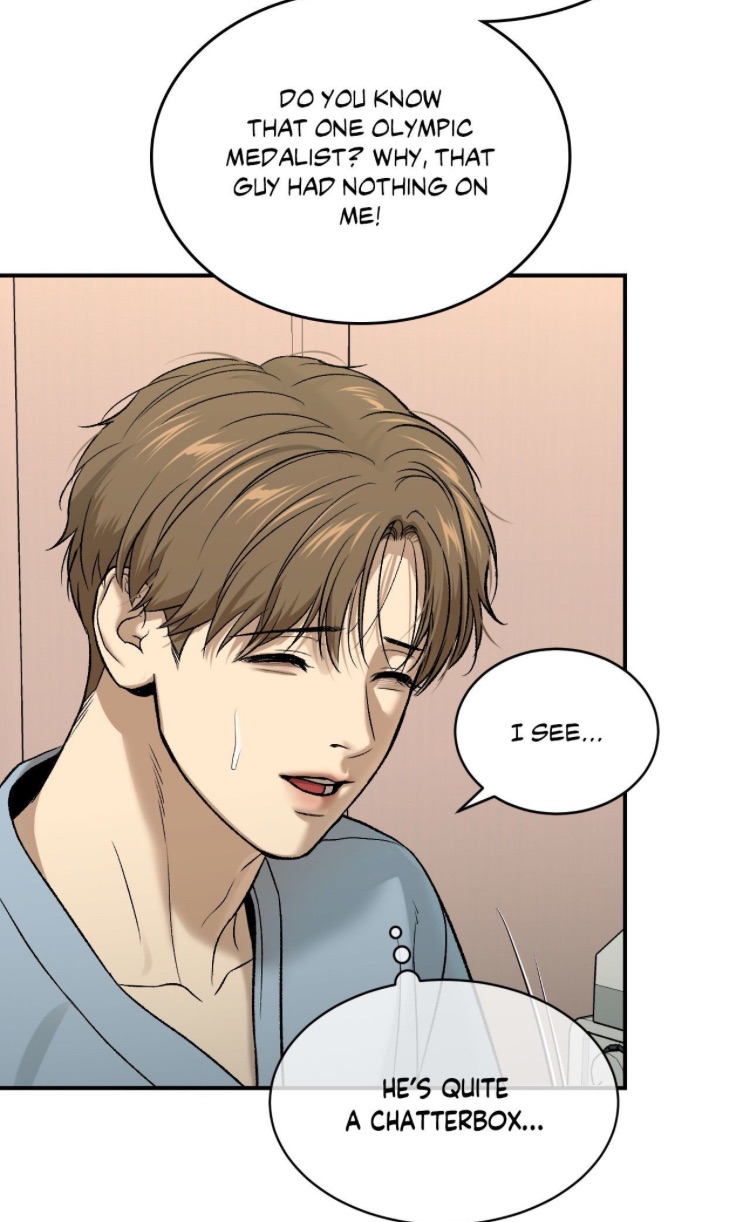 (chapter 70) As you can see, it is never too late… Thus we saw this on the roof of the hospital: a real and intimate conversation between the “guardian” and his pupil:
  (chapter 71) The director has changed!
 (chapter 65) She can appear as the perfect role model in the athlete’s eyes. No wonder why he listened to her and brought doc Dan to a huge hospital in Seoul. But here is the thing….
 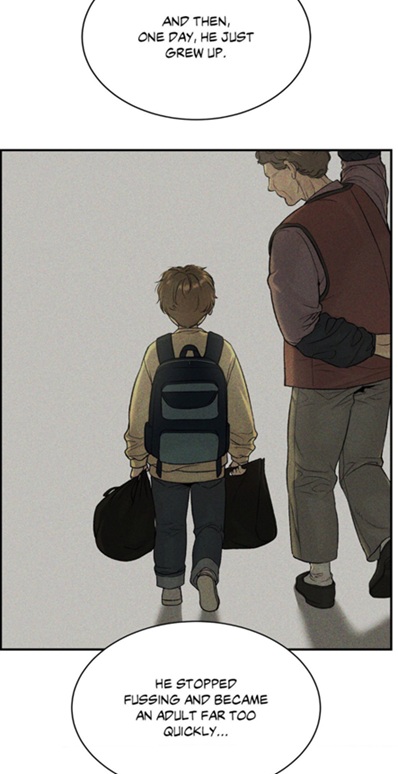 (chapter 65) The grandmother’s narrative culminates in a deceptively simple phrase: “And then, one day, he just grew up.” Unlike after all, which implies endurance, patience, and a long lapse of time, her then one day compresses everything into a brief, almost casual instant. In her telling, there is no slow accumulation of wounds, no process of wear, no history of pain to be endured. The transformation is presented as sudden and natural, as if nothing of significance had preceded it.
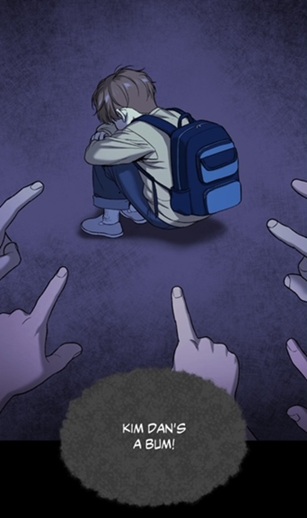 (chapter 57), and his forced maturity to a single, fleeting day. No trauma, no endurance — just inevitability. By collapsing years of hardship into a harmless “day,” she erases both the past and the victim. And now, you can understand why doc Dan is trapped in the present! By erasing the “before” (abandonment, trauma) and trivializing the process of “becoming an adult,” she collapses time into a single, static present. Kim Dan is not allowed a past that hurts (because she erased it), nor a future that could unfold differently (because “he just grew up” is presented as inevitable).
 (chapter 62) cannot, by themselves, sustain love. Emotions flare and fade, tied to the immediacy of the present. Thus the mother could break her promise and even lie to him later. What endures is not emotion alone, but the principles that Fromm identified as the essence of love: care, responsibility, knowledge, and respect. These qualities stabilize the fleeting nature of feeling and transform the present into something continuous, something that can grow. In this sense, the teddy bear bridges the gap between “present” and “future”:
 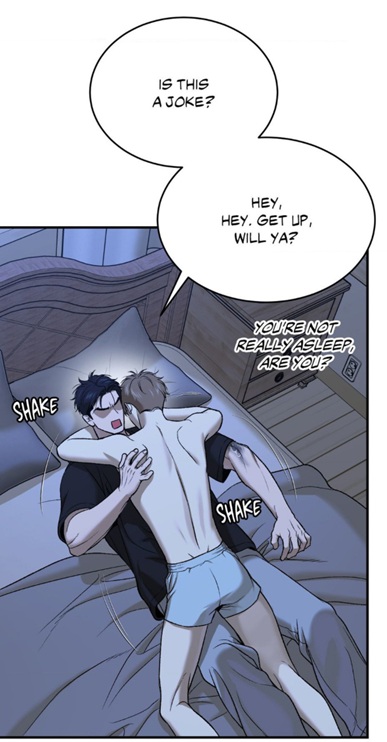 (chapter 65) it transforms the fleeting moment of emotion into a promise of constancy. After all, before it’s too late, what both men longed for was never glory or escape, but a home where they could rest — not alone, but in each other’s arms. By discovering emotions and learning to live in the present, the champion also rediscovers his inner child. His line — “Is this a joke?” — marks that shift, since jokes, like emotions, only exist in the immediacy of the moment. It is only a matter of time, until he laughs because of a joke. By embracing doc Dan like a teddy bear, he allows himself to cling and regress, no longer the wolf or the Emperor but simply a boy seeking warmth. Even his cold becomes symbolic:
 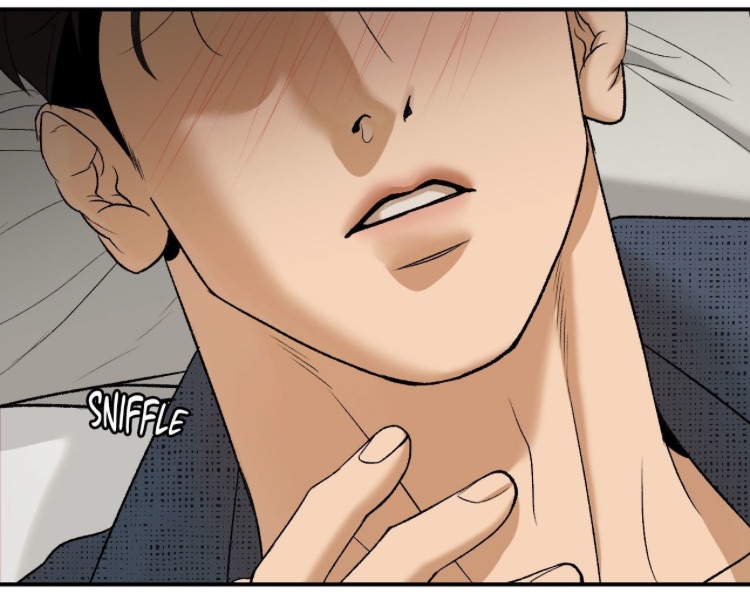 (chapter 70) illness forces him to slow down, to be vulnerable, and to receive care — something denied to him in childhood. In this way, love turns the regression into healing, transforming weakness into the possibility of renewal.
 (chapter 5) and if it’s true, then this person would be the second husband.


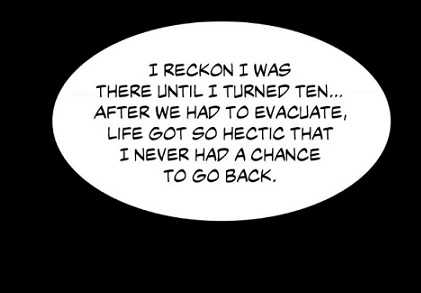 (chapter 53) for not realizing her biggest wish: to return to the West Coast. With her words, she implies that she never had any choice. Hence she is not responsible for her “misery”. However, after reading Erich Fromm’s philosophy, it becomes clear that she must have always followed social norms and listened to authority figures (parents, husband, doctors, …). That’s how she gave up on her own freedom. One might argue that her scoop of maneuver was limited due to her poverty. However, the Mother Of Pearl Wedding Cabinet is definitely expensive and no junk
 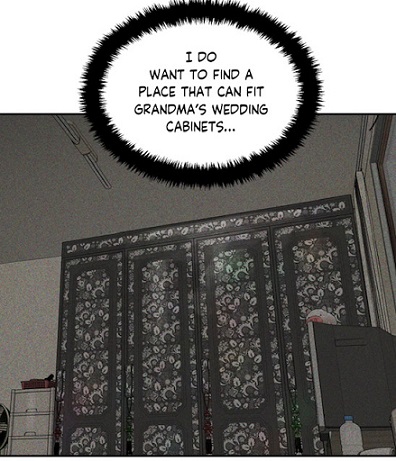 (chapter 16), especially since the latter is rather old. The grandmother could have sold it, but she never did, for the latter has a sentimental value. Consequently, I would say that she had missed her chance, and naturally her misery is the result of her own wrong choices. Under this new light, it becomes comprehensible why the grandmother portrays herself as poor who has nothing to give to her grandchild.
 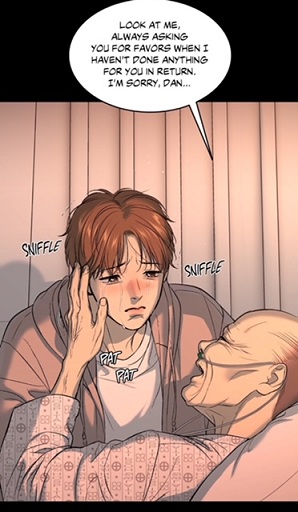 (chapter 53) As a slave, she can not become responsible for Kim Dan and his life. However, she is wrong here again. She was not entirely powerless. She could have talked about her experience with the ocean, she could have loved her grandchild more properly so that Kim Dan wouldn’t have to suffer from abandonment issues and a low self-esteem. Yes, love is something free and no one has control over the emotions of a human being. Due to her lack of self-awareness (Peter Pan Syndrom), she influenced her grandchild negatively, and the latter became a copy of herself: trapped in the past, living in an illusion and rejecting reality. Funny is that by relying on Kim Dan constantly, she was actually teaching her grandson to become accountable and independent. She was entrusting her life into his own hands. Consequently, the main lead chose to accept the deal from Joo Jaekyung during their first night and later asked for a higher salary. Finally, at the end, he chose to leave the penthouse out of obligation
  (chapter 53) (filial duty), a sign that he is not able to break free from social norms. At the same time, it displays that his feelings for Joo Jaekyung are much stronger than the ones for Shin Okja. His short time spent in the penthouse left a deep impression on him.
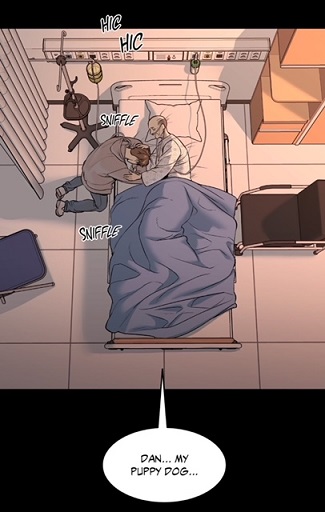 (chapter 53) Her vocabulary exposes that she became a master and in her mind, the puppy dog has to follow her owner. Therefore it is no coincidence that Mingwa created such an image:
  (chapter 53) The grandmother is now the master of her own life and Kim Dan’s. On the one hand, just before her death, she is learning to become accountable for her own life, even though I still have my doubts that she is really realizing the consequences of her choice. She is still chasing after after an illusion. As you already know, I am anticipating a rude awakening fron her part, as she can not escape from reality and her own mortality. On the other hand, with her request, she gets responsible for her grandchild’s career, and someone could criticize her for making him quit. She didn’t take his job’s obligations into consideration. Simultaneously, this image illustrates a relapse of Kim Dan. He is once again trapped, though he wished to be freed. Thus he wrote this to Joo Jaekyung:
  (chapter 53) Deep down, he would like to be recognized as a competent physical therapist. Moreover, my avid readers should recall that the champion had already noticed the change of heart in the doctor before the scheme took place.
 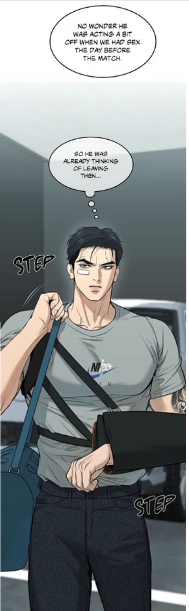 (chapter 53) So the athlete could come to the realization that his departure was related to the grandmother’s sickness and dying wish, a new version of episode 20 and 21. However, even if the fighter helps the grandmother, he can not entirely free the physical therapist. How so? It is because the doctor has to free himself, breaking free from conformity and his own psychological constraints (lack of confidence and as such courage). And the best evidence for his servitude mentality is the absence of his love confession to the athlete. He disguised it behind gratitude.
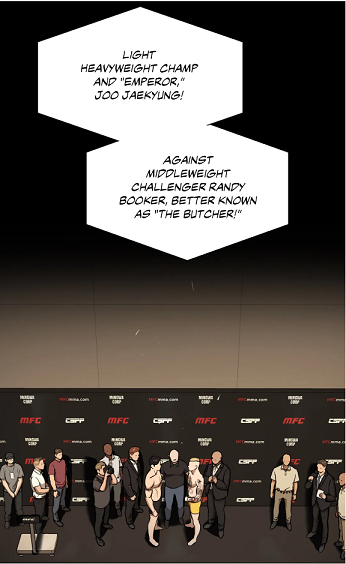 (chapter 14) Yet, the reality is that despite his wealth, he is not free at all. Actually, he reminded me of a Roman gladiator. Gladiators in ancient Rome lived under challenging and contradictory conditions. Although they were often slaves or prisoners of war, some achieved fame, wealth, and admiration comparable to modern-day sports stars. Successful gladiators could earn prizes, attract fan followings, and even enjoy certain luxuries within their restrictive lives. However, they remained under the control of their lanista (manager) or the state, with little freedom to make personal choices. They could not select their opponents or refuse combat, and each fight carried the risk of injury or death, underscoring their vulnerability and lack of autonomy despite their celebrated status.
 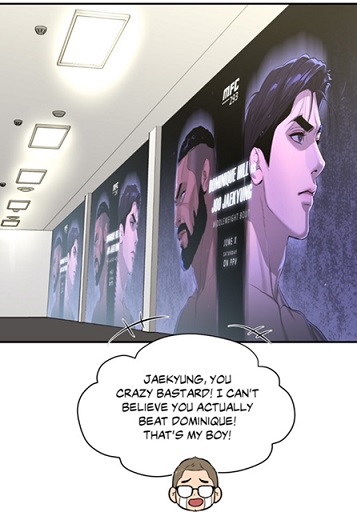 (chapter 40), though the gym belongs to the celebrity. But let’s return our attention to the American-German philosopher. The latter pointed out the importance of self-awareness and the rejection of materialism and social pressures (authority figures, conformity) in order to become truly free.
 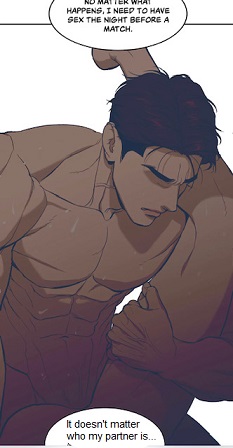 (chapter 2) Therefore sex is linked to prostitution and work. Back then, this had nothing to do with pleasure, sensuality and entertaining. It was revolving around power and domination. That way, he wouldn’t appear as weak, he is not controlled by his sexual desires and emotions. That’s how it dawned on me why the champion has been denying the existence of feelings in his past relationships. Naturally, it is possible that he got his heart broken before, but it is also possible that he could never live out his own true homosexuality. Note that his father figure, Park Namwook, has no idea about his sexual life. The athlete could fear to disappoint him. This raises the question how the manager will react, when the athlete’s secret is exposed. Should he request from his boy to organize a conference and deny the allegation there, he would divulge not only his lack of loyalty, but also his hypocrisy. Why? It is because this is something he should have organized after the last match. A conference to expose the existence of schemes. But everything got swayed under the rug. On the other hand, I deduce that if the topic of sodomy is brought up in season 2, there is no ambiguity that both main leads won’t give in to conformity and external pressure (even in the form of threats). Why? It is because during season 2, both characters will come to be true to themselves. That‘s how they can become master of their own life.
 (chapter 41), from his manager’s influence (father figure) and even from the MFC world (authorities) !! What is the common denominator between these three persons? MONEY!
 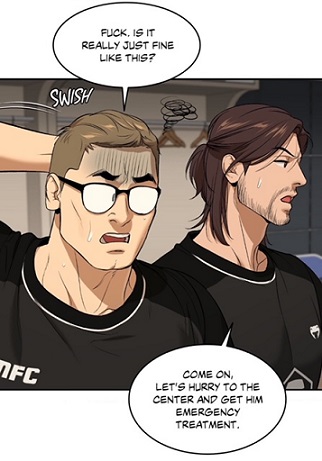 (chapter 50) Hence the last match was not cancelled in the last minute. The athlete is not fighting out of fun and passion, but out of obligation and survival. He is trapped in a world where money is everything. Thus he was always pushed to accept any challenger despite his injuries. That’s how I realized why the athlete always suspected Kim Dan of being greedy. It is because he projected his own thoughts onto his partner. However, this negative perception was definitely influenced by his “hyung”, we have the best example in episode 46. Due to Park Namwook, Joo Jaekyung was the one who was constantly thinking and talking about money in front of Kim Dan.
  (chapter 26) No wonder why he got so surprised by Kim Dan’s reaction in the locker room:
 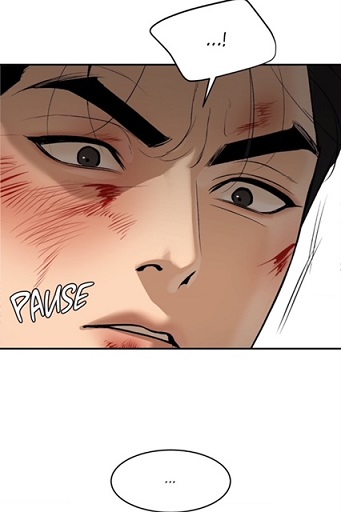 (chapter 51) He was disarmed by a single question and a shocked and disappointed face:
  (chapter 51) The question implied that the doctor had been trusting him.
 (chapter 43), yet he added shortly this comment: :
 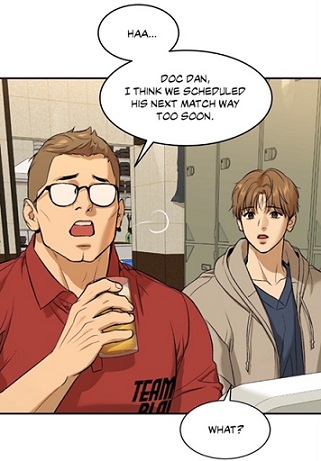 (chapter 43) The hypocrite coach utilized the personal pronoun “WE” indicating that he and his peers had played a role in the athlete’s decision. Funny is that though he complained about the schedule, he still accepted the switch of the fighter later. But he could have voiced his fears and objections. Nevertheless, he did nothing. Since I connected the halmeoni to past, I suddenly realized that the “lanista” embodies the opposite notion. He is trapped in the future, thus he is always anxious. Imagine that in that scene, they were celebrating Joo Jaekyung’s birthday, it should have been a good time. Yet, the manager kept talking about work and the future.
 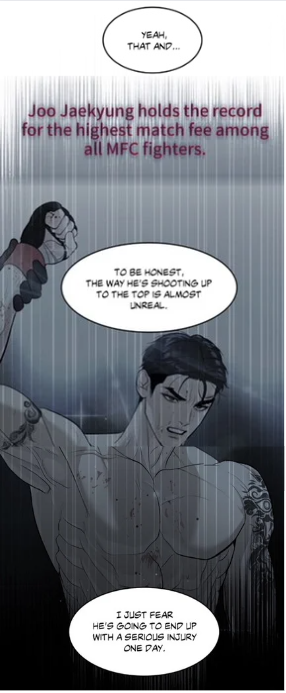 (chapter 43)
  (chapter 43) This is a sign that he was not “enjoying the present”. In my eyes, with his comments, he was actually ruining the party. Fortunately, no one paid attention to his words except the physical therapist and Yosep. By talking like that, he gives the impression that he is caring and paying attention to the fighter. Yet this is just an illusion, for he is not focused on the present. He neglected his duties, therefore the schemers were able to bring drugs to the champion’s rooms.
 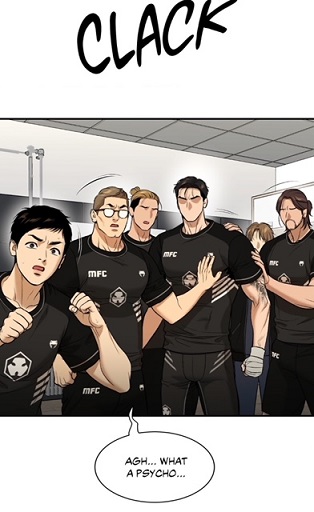 (chapter 49) Notice that he was afraid of an outburst from Joo Jaekyung in the locker room, therefore they were restraining him. This was no real protection. I am suspecting that the manager is trusting MFC and its organization. In addition, his obsession with the future explains why the athlete’s mental health has been neglected by the coach and manager. As a conclusion, Park Namwook is himself trapped in his own world: money, fear of the future and the champion‘s retirement which means the end of his own career as manager and coach. Therefore he is pushing his fighter to race against time. It is only a matter until his boy gets injured!!
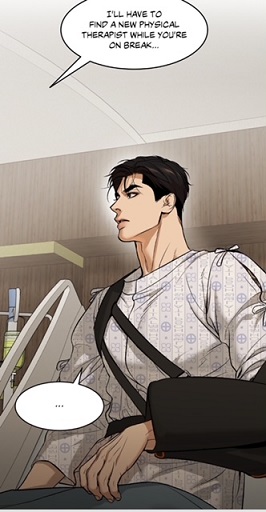 (chapter 53). The latter announces that his “boy” can take a break. What caught my attention is his idiom. The suspension got turned into a break which sounds much more positive. Interesting is that break is not only a synonym for “rest”, but also for “opportunity, chance”. This new discovery reinforces my previous interpretation: the loss of his “title” and his suspension are in verity an escape to freedom. Why? It is because he is no longer exposed to manipulations and external pressure like in episode 36:
  (chapter 36) money, social media, the agency, the lawyer, Park Namwook and Jeong Yosep. For the first time, Joo Jaekyung can think of something else other than work. Nevertheless, the athlete had not realized it yet. Striking is that the longer the fighter thought about the PT’s resignation, the longer he came to object to it.
 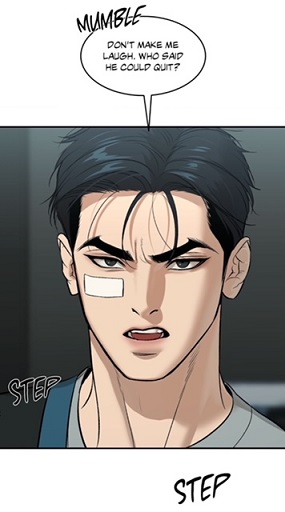 (chapter 53) This means that the fighter was acknowledging the “uke” as an important member of Team Black. In addition, he was recognizing Kim Dan’s effort and talent as PT. Moreover, it exposes the absence of change in Joo Jaekyung’s mentality. He was still “thinking” of work and fighting. It displays that the protagonist had not realized the true signification of his suspension yet. Hence the doctor’s departure was necessary. Joo Jaekyung is forced to think about his fated partner, making him forget his work and his career. His “obsession” with Kim Dan will push him to stop being a workaholic. But there is more to it.
 (chapter 21) to this
 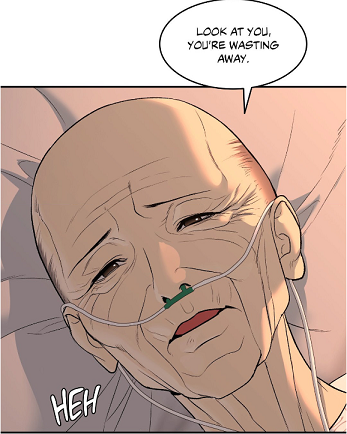 (chapter 47) Money is powerless in front of death and terrible injuries. Therefore he is lucky that his shoulder is not ruined forever. Moreover a trip represents a good metaphor for an escape, a travel is a synonym for freedom and the end of “routine”.
 (chapter 35). However, since he didn’t spend much time in his own home, he never took the time to take care of his soulmate. By leaving the city and Team Black behind, he would become truly alone (as opposition to his trips to Busan, the States) which would give him an opportunity to become more honest to himself and to Kim Dan.
 (chapter 1). Nonetheless, his words sounded more negative due to the usage of negation. Moreover, Kim Dan was too scared to take his words seriously. Consequently, it becomes obvious that Kim Dan needs to hear praises from the athlete himself. It is not just about an apology about his misjudgment, the “hamster” needs to hear from his own patient that he trusts him and his hands. Thus he wants to be needed:
  (chapter 53) This explicates why the young man kept questioning the actor’s intentions behind his gifts. He could see that the man didn’t need him. This thought displays his desire to give a meaning to his own existence as well. If he is needed, he has a reason to exist. This desire of being needed can be expressed by words, but also with the hands:
  or like this:
  And what does the hand symbolize? The latter symbolizes gratitude and love! Hence the grandmother took the MMA fighter’s hand in order to thank him.
  (chapter 22)
  (chapter 41) Being on the receiving side makes him feel weak and powerless. He is reduced to become a passive man. Furthermore, we shouldn’t overlook that such presents are not entirely selfless. Companies or admirers have expectations from Joo Jaekyung, earning some money or getting his attention. At the same time, these presents are strongly connected to his title and fame as champion. Thus they are not taking into consideration about the athlete’s dislikes and likes. Thus he was offered a bottle of wine
 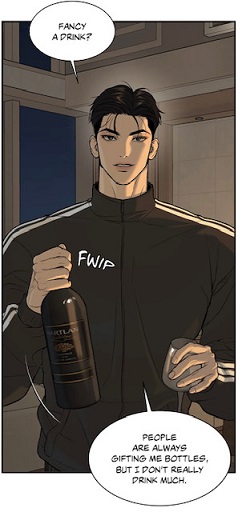 (chapter 12), though he is no drinker or he doesn’t eat cakes.
  (chapter 41) The fact that the athlete organized a charity event for his birthday exposes not only his huge heart, but also that he had long recognized the power of generosity. Under this new light, it becomes comprehensible why the champion was willing to pay off the doctor’s debts.
  (chapter 18) Here, he hoped to see gratitude on his fated partner’s face, but it didn’t happen like he imagined. Yet, notice that despite their argument, Joo Jaekyung proposed to the main lead to live with him in the penthouse:
 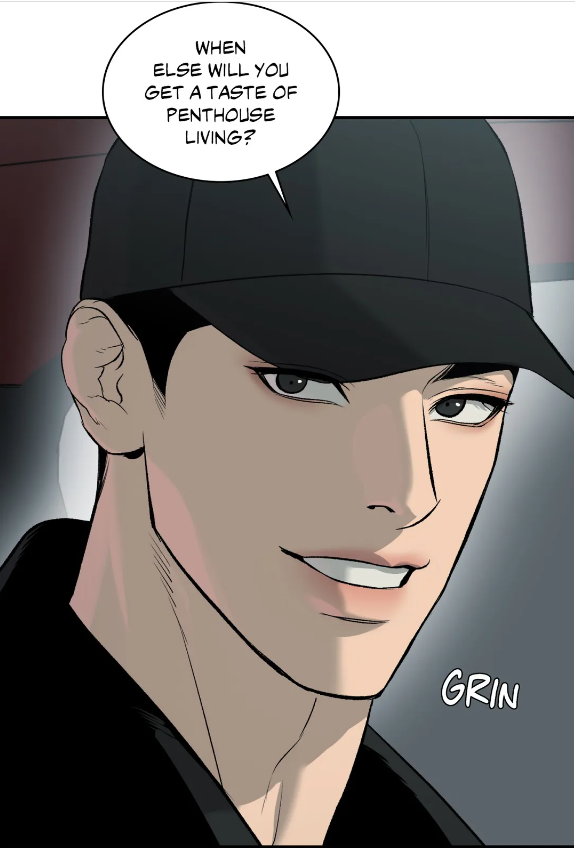 (chapter 18) His facial expression is exposing his true thoughts. He was definitely happy to help the doctor. The reason is simple. He is in control of his heart and life. This shows that deep down, the man has always had a soft heart and could find fulfillment in giving. However, the problem is that the champion had also internalized that there is nothing free in this world. Due to his past experiences, he realized that receivers would exploite his goodness. The green-haired guy was the perfect example.
  (chapter 2) Therefore it is not surprising that he kept denying his kindness to the doctor: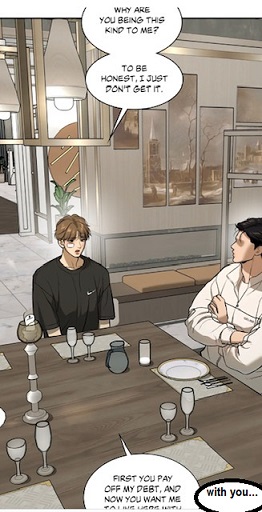
 (chapter 18) He had to, because the man was now living with him. Joo Jaekyung feared that his roommate could come to take advantage of his new position and even consider this place as his own. As you can see, the champion had long discovered the power of giving to others. Yet his problem was that he couldn’t live out this principle: he was either exploited or he has no family or close friend so far.
 (chapter 30) They both desire to be acknowledged and appreciated.
  (chapter 45) With this image, it was, as if Kim Dan wanted to be distinguished from all the stans. Yes, I do think that this has something to do their own negative feelings. However, there is a difference between Choi Heesung and Kim Dan. Note that the gifts are related to his sponsors and the agency. They were related to his work. Moreover, the gumiho rarely gave the meals or the presents personally.
  (chapter 31)
 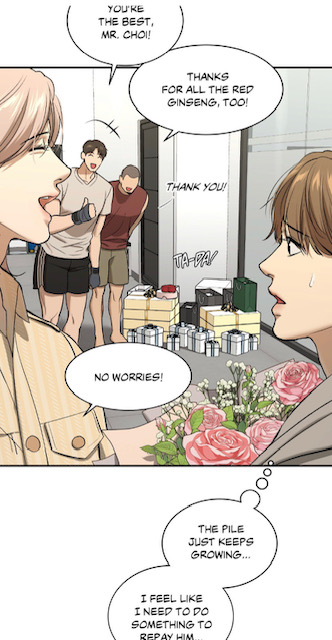 (chapter 31) Furthermore, the actor gave these things for one reason: it was to obtain the doctor’s heart or to maintain his good image as a celebrity. In other words, these gestures were not selfless at all. This explains why the athlete was so weary of such “gifts”: a return of favor or a service. But the comedian is not the only one donating things. Naturally, it is the manager Park Namwook.
  (Chapter 26)
  (chapter 36) However, my avid readers should ponder on the following aspect: how did he buy the jackets and the junk food?
 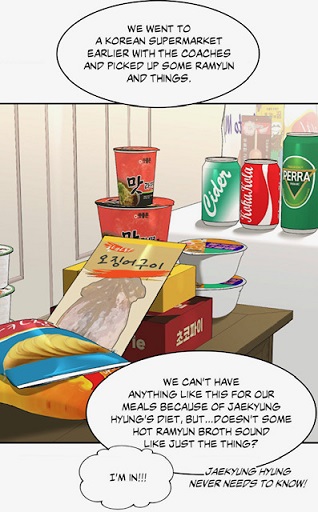 (Chapter 37) This last scene is terrible, for this purchase happened behind the boss’ back. Naturally, everything was bought with the company card!! In other words, Park Namwook’s generosity is fake, for he is not spending his own money. After this new realization, I started wondering if the athlete’s negative attitude towards Kim Dan is not the consequence of Park Namwook’s behavior as well who takes it for granted to spend money on the athlete’s account. Why did the champion anticipate an expectation from Kim Dan, when he received the keychain?
  (Chapter 45) It is because his relationship with his coach has always been based on „conditional love and expectations“. Don’t forget that the coach was particularly nice to the athlete after winning his match in Busan. He was willing to be his „servant“ in that moment. Furthermore, there exists another evidence that in episode 45 the fighter latched out on the doctor because of his unresolved feelings towards his hyung.
  (chapter 41) This frenzy was portrayed as something positive. Jinxworms can observe that the manager is mentioning the existence of „favors“. For me, it is no coincidence that in episode 45, the arrival from presents coming from his hyung coincides with the present with Kim Dan. It shows the underlying conflict between the celebrity and the former wrestler. Nevertheless, the fighter has not grasped it yet. So far, Joo Jaekyung has not tried to defy Park Namwook openly, to claim his place as the true owner of Team Black. We should see his words here as a first attempt to act as the boss
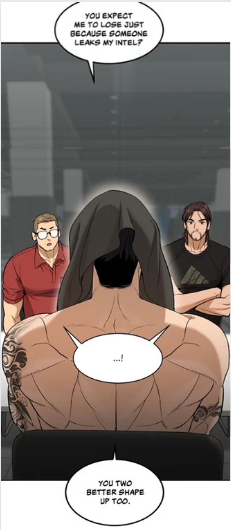 (Chapter 46) The tension reached its peak in that scene:
 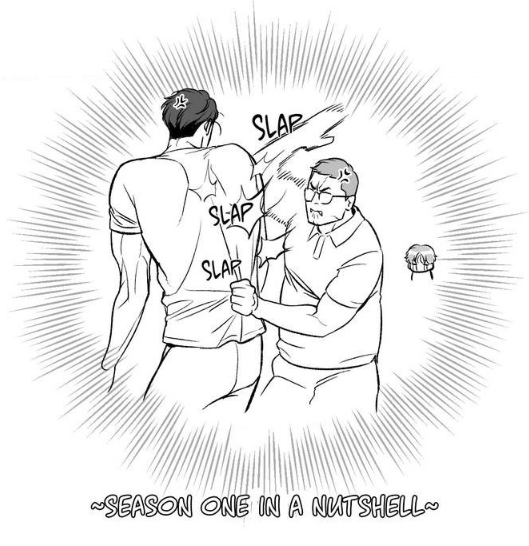 That’s where the generosity from Park Namwook comes from: he gives his punches to Joo Jaekyung and takes Joo Jaekyung‘s company for granted. And now, you comprehend why I selected such a title for this essay.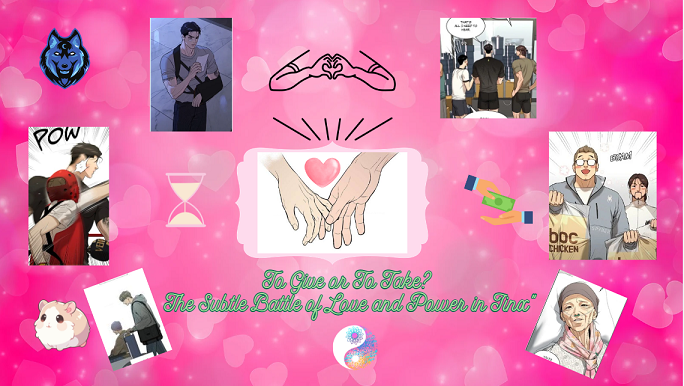
 (Chapter 26) The sparring in episode 26 represents the positive version of giving a punch and taking it. The fighter was not upset about his defeat, moreover he was acting like a real teacher asking the physical therapist to overcome his own fears. On the hand, the slap at the hospital embodies the opposite notions: resent, no real teaching, no reflection, no listening, the one slapping is not overcoming his own fears and vents his anger. The give and take in episode 26 was happiness, true generosity, self-awareness, while this slap displays misery, anger, ignorance:
  (Chapter 26) The contrast not only exposes Park Namwook’s fake generosity, but also his greed and selfishness. For me, he missed the opportunity, as at the gym, Kim Dan took the chance, when the athlete was distracted. Hence in my opinion, chapter 52 was the turning point in their toxic relationship. Moreover, it signifies that the manager lost his special position as hyung. Far away from the gym, Joo Jaekyung will see Kim Dan under a different light, maybe even as a true role model, for he is wearing his heart in his hand.
 (chapter 7)
 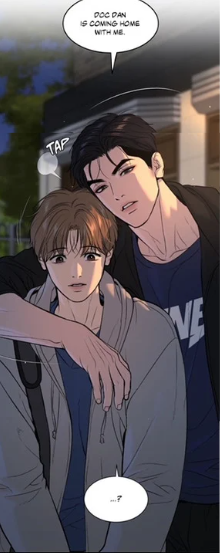 (chapter 43) He needed to seclude him from the others. But where does this possessiveness come from? In my opinion, it is not just the result of his own insecurities, but also the influence of the bad role model he had: Park Namwook. First, only in chapter 45, the manager sent congratulations from his family:
  (chapter 9), the manager kept creating a bad image of the athlete: brutal, moody, maniac… but the reality is that the man is actually generous and caring, like mentioned above and the coach knew this. Hence he could lie without any remorse: he is a savior and the gym owner. Moreover, the athlete can speak well and be polite.
  (chapter 22) This scene at the hospital displays that the fighter had been mirroring the behavior of his counterpart: Shin Okja is sweet and kind. And who is moody, yelling, brutal ? Park Namwook:
  (chapter 43)
  (chapter 7) Therefore I conclude that this possessiveness and obsession with Kim Dan is the result of the manager’s influence. Park Namwook treated him like a possession. And this brings me to my next part. How to become happy? One might reply: by loving someone. However, how can Joo Jaekyung drop his insecurities and open his heart like that? As you can see, we need another explanation.
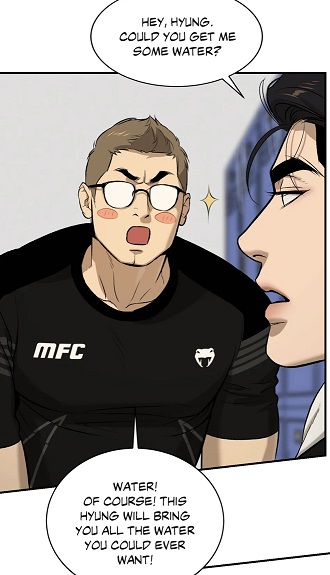 (chapter 15), but as soon as his idol lost his title and got even suspended, he yelled and slapped his fighter:
  (chapter 22) Since his relationship with the main lead is so secure, he could claim the gym as his own. Notice how he treats the members here: he’s putting them under pressure, threatening them. Everything is revolving around competition, seriousness and greed. Why doesn’t Joo Jaekyung mess with his weight and nutrition? It is because his hyung made sure that the latter would fulfil all his expectations. He needs to be ready for the next fight. Why was the manager not present here?
 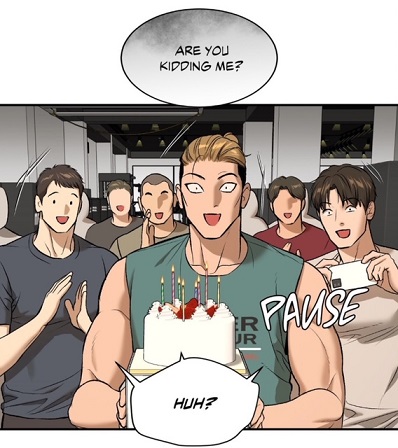 (chapter 43) This exposes his lack of engagement and indifference in the end, but this becomes even more obvious during the night:
  (chapter 43) Where was he, when his star was drunk? It was, as though he had vanished.
 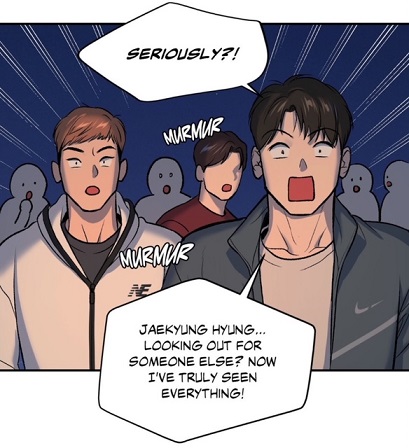 (chapter 43) But the best evidence for this interpretation is this image:
  (chapter 52) The manager is upset, because his boy lost his title and his reputation is ruined. Moreover, many members left the gym which means that the company lost a lot of money.
 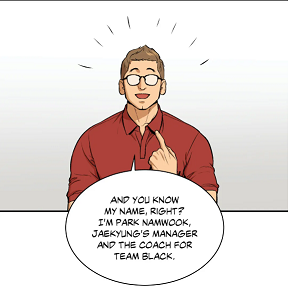 (chapter 9) However, he never presented himself as a father or a husband. It was, as if his children or wife were not a source of his happiness. Why? It is because they don’t bring money, but rather cost money. Thanks to Joo Jaekyung’s popularity, the manager could stand in the spotlight
  (chapter 40), yet notice that no fans or fighter know his name as a successful coach or manager. He is not a famous manager in the end. His income depends on the athlete’s career and victories. No wonder why he put so much pressure on his celebrity. Thus I had the following revelation: he was actually exposing his true self in front of the doctor at the restaurant.
 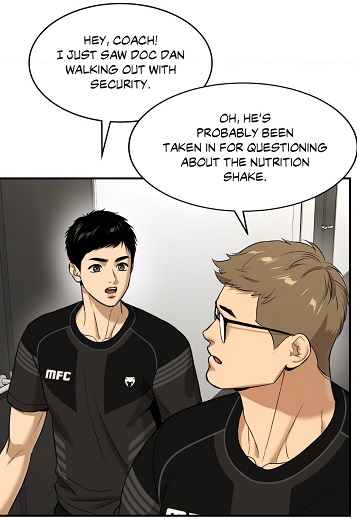 (chapter 40) in the States and even at the gym?
  (Chapter 43) It is because he doesn’t view the uke as a possession contrary to his „boy“. Why? It is because the young man doesn’t bring money or contribute to boast the manager’s self-esteem. In fact, Kim Dan is an expensive PT and the manager is aware of his high salary. Moreover, contrary to the hamster, Park Namwook was never seen in the penthouse, and the celebrity refused to invite the members. This is a clue that the champion could have refused to invite his coach there. The doctor’s stay at the penthouse is something Park Namwook discovered by accident.
 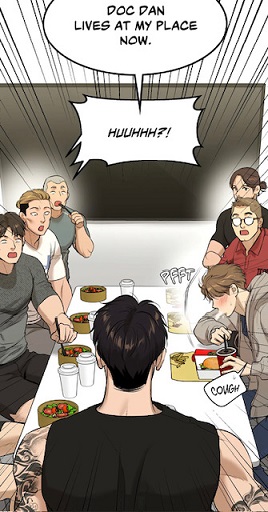 (Chapter 22) And now, it is important to recall that in the mode of Having, rivalry and competition are predominant. Therefore I deduce that deep down, the coach and manager sensed the physical therapist as a source of threat and rival. Therefore Jinx-philes shouldn’t be surprised that the coach did nothing to keep Kim Dan.
 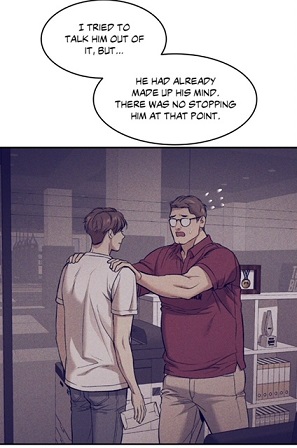 (Chapter 53) Here his gestures and words should be judged as lip-services. He can even rationalize his departure: bad luck, they save a lot of money, for the next PT will have a lower salary. In addition, Kim Dan was treated as the celebrity’s possession, therefore he used him as a tool in order to compensate the actor. The manager is definitely imagining that once the break ends, things will work like before.
  (chapter 17)
 (chapter 41) In his eyes, possessions and money determine someone’s values. Hence he bought an expensive keychain for his fated partner. Furthermore, I have been wondering if this spending is not related to Shin Okja, the latter could have been a spendthrift. In the essay „
 (Chapter 19). Another possibility is that she made sure that her grandchild would spend money on her:
 (chapter 22) after the departure of Joo Jaekyung, but notice how the halmeoni thanked the benefactor:
 (chapter 21) One might argue that the poor woman couldn’t do much to express her gratitude. However, this is just a deception. Shin Okja could have written a letter to express her gratitude to Joo Jaekyung. Why do you think Mingwa created two scenes with a letter or card?
  (chapter 45)
  (chapter 53) The comparison lets transpire the importance of words. The champion might have judged the keychain differently, if he had read the card. But he didn’t. Another parallel between these two scenes is the rejection of a gift! However, in the final episode, Kim Dan voiced genuine gratitude towards his benefactor. The latter had allowed him to work as his PT. With the letter, he could voice his thoughts and emotions much better. And now, you realize that Shin Okja could have acted the same way. This made me realize that deep down, she resents being poor. She likes Dan spending money on her.
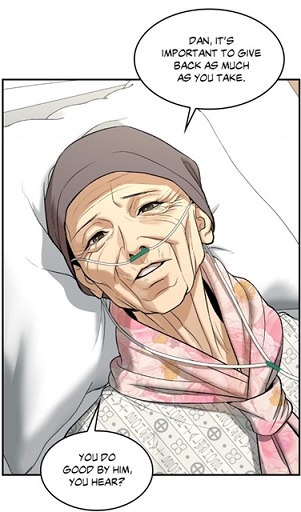 (chapter 41). He should treat the sportsman nicely (“do good”). Kim Dan is the one who should be indebted to Joo Jaekyung. However, observe what she said in front of her grandchild before: she was the one who was grateful to the main lead, and not Kim Dan!!
 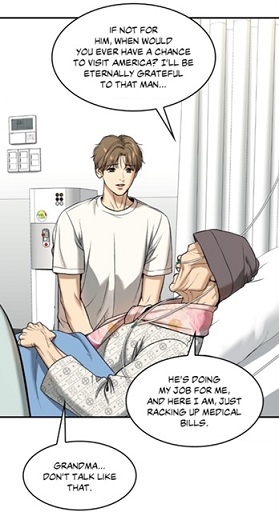 (chapter 41) She should have been the one who expressed her gratitude to Joo Jaekyung, but not Kim Dan for the trip (it was work related anyway). One might argue that the poor woman is trapped in the hospital, she can not do much. But you are wrong. She could have written a letter to her benefactor which means that she would have sacrificed some of her time for the athlete. Imagine that she had sent a message to the athlete, the latter might have decided to pay a visit to her. He is not truly heartless. With this silence, she created the impression that his assistance had changed her situation.
 (chapter 22)
  (chapter 1) In other words, he was not passionate about his profession. This means that he didn’t define himself as PT due to his lack of engagement and low self-esteem. Besides, let’s not forget that he judges people based on their social status and seniority. I would even add, the main lead had not recognized the existence of his own skills (knowledge, genuineness and dedication). But by working for Joo Jaekyung, he came to enjoy his job. This explicates why he kept buying books.
  (chapter 53) He likes not only his job now, but also learning as such. This is no coincidence that education in the mode of “being” means that the focus is on learning and developing skills. Hence I still see a change in the hamster at the end of season 1:
  (chapter 52) In this panel, the author let us see glimpses of their motivation and thoughts. For them, the champion has nothing to teach them, since he lost his title and is injured. This shows that they are only interested in the outcome, success and as such fame, but not in the process, how to become skilled! In other words, they see “success” as a possession. He has no title, then he has nothing to offer. They are all living in the mode of having, which can only lead to misery and even self-destruction. No wonder why they were not too upset or shocked, when they heard that the game had been rigged. But what led them to make such a decision?
 (chapter 23) Then he only focused on the “outcome” and not on the process. Hence he neglected them, delegated his task on the pressured athlete. The latter had to train them:
  (chapter 25) and
  (chapter 36) In my eyes, he didn’t want to play the bad guy. The meeting or his worries were more important
  (chapter 36) than their training and career. Moreover, he kept bribing them with junk food
  (chapter 46) The latter was a new source of income and fame. Everything was revolving around money. That’s how it dawned on me why the manager got angry for the bet in episode 26:
  (chapter 26) We shouldn’t judge his words as a verity, he was just using the doctor as a false excuse. The reality is that the sparring had brought no money at all! This fight was strongly intertwined with fun. The notion of „entertaining“ stands in opposition to money. Fun means feeling emotions and being to true one’s self. In other words, Kim Dan stands for a different notion of MMA fighting: the sportsmen shouldn’t work for money, but for fun. They are artists too. This signifies that as time passed on, the members of Team Black lost their passion for fighting
  (chapter 26) and became more obsessed with possessions and fame. Potato and the remaining members represent the exceptions. They enjoyed the lessons despite the pain and struggles. The other members became dependent on external tools which led them to lose their integrity. To conclude, the reason for their disloyalty is that at the end, they had long internalized the mode of having and were just interested in getting successful.
 (special episode2 ), but also Cheolmin
  (chapter 13) who likes making jokes. That‘s how I came to understand why Cheolmin appeared only one time in season 1. He will come to replace the manager:
  (chapter 13)
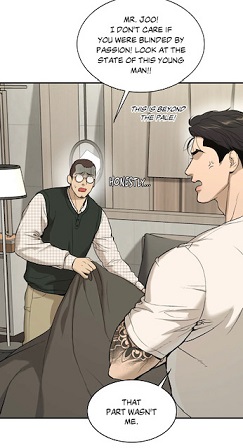 (Chapter 13) when the latter denied his responsibility. This shows that the man doesn’t mistrust people. He has faith in humans. And in this short scene, the doctor shows alle positive notions mentioned above: love, empathy, joy and creativity. Therefore I come to the following interpretation: he embodies the being mode. No wonder why he was not present in season 1. The main lead was definitely obsessed with work. Hence the moment Cheolmin’s path crosses Kim Dan’s, the funny doctor should become the hamster’s new role model.
 (chapter 48) are full of greedy people who have no problems to commit crimes in order to achieve their goals (more fame, more wealth, revenge, more connections). Baek Junmin became a champion by cheating.
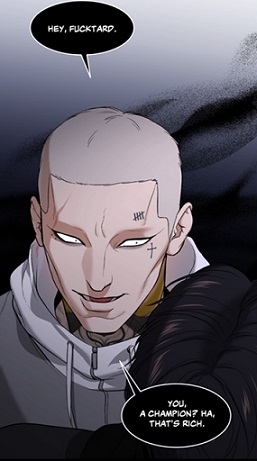 (Chapter 49) Thus he thought, the athlete had earned his title the same way. His fights were rigged, yet the verity is that the idol worked hard to achieve this level. The irony is that The Gunshot experienced much too late that his assumption was wrong.
 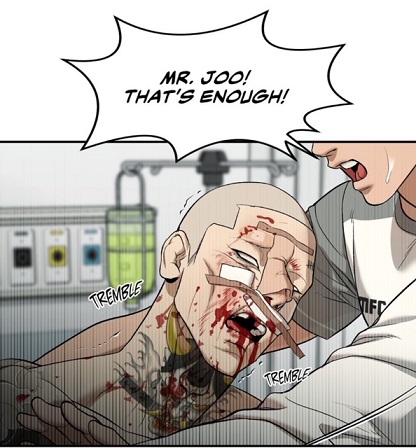 (Chapter 52) His shaking is exposing his fears. Like mentioned in the past, I am anticipating that The Shotgun will avoid a new fight with the celebrity.
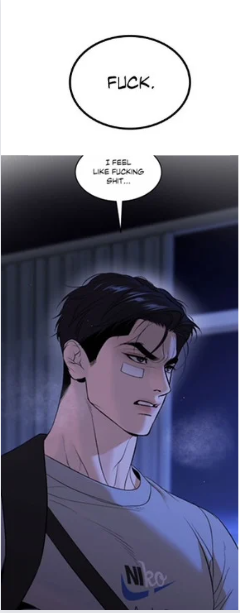 (chapter 53) He is standing at a crossroad. What does he truly want in life? Fame? More money? Or happiness and as such love and fun?

 And now, you know the origin for this essay. As you can see, the collection of Haikus is focusing on the topic “Water”. Since I only possess the French version of Haikus, I could only give you my own English translation. Fortunately, my friend @Rin_de_eegana was able to find the original version, Japanese. Therefore in the second version, I am giving a second English translation whích gave me new insight once again. Anyway, the thing is that as soon as I read certain poems, it made me think of Jinx and the characters. This shows my obsession for this terrific Manhwa.
 (chapter 14) Yet, the main lead never got the chance to see it. Then the ocean is only mentioned directly at the end of the first season. The halmeoni was expressing her wish to return to the West Coast
 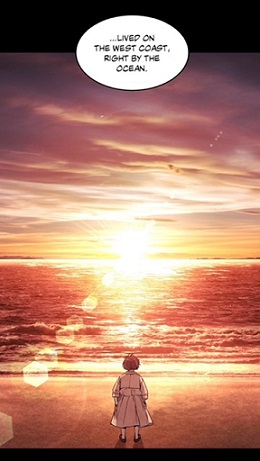 (chapter 53) where she hoped to see a beautiful ocean one more time.
  (chapter 53) When she was 10 years old, she was moved by how the ocean changed colors with the beautiful sunset. It was no longer blue or grey, but yellow, red, pink, orange and purple. This wonderful but brief moment left such a deep impression on her that she could never forget it.
  (chapter 53) She never came to regret her walk to the beach, because this souvenir also became her source of strength. This memory created in her the desire to see it again, thus she kept postcards with views of the ocean.
 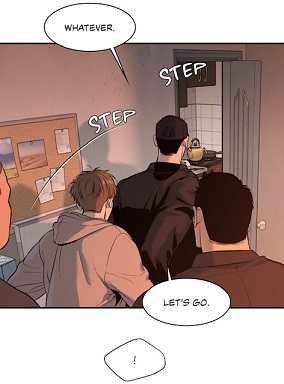 (chapter 17)
 (chapter 53) is glowing blue? I don’t think so. Let’s not forget that blue symbolizes wood for Koreans. The sea (water) and a tree
 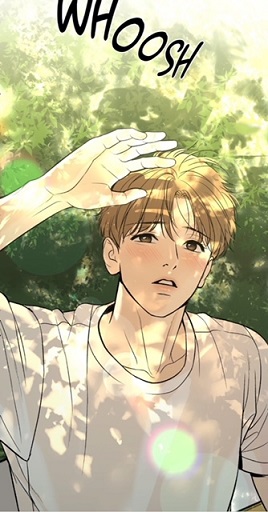 (chapter 41) are the doctor’s true elements. Under this new light, it becomes comprehensible why under the tree, he came to acknowledge his feelings for the athlete. In addition, if Kim Dan gets close to water, this signifies that he will get replenished and truly nourished. And notice that during season 1, he never ate properly.
 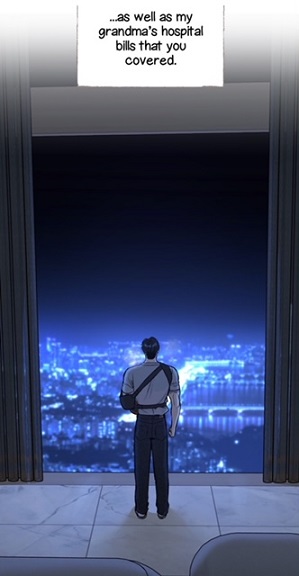 (chapter 53) He is standing in front of the blue city. But he doesn’t feel free and powerful. Why? There is a window in front of him. The window is showing him his own boundaries. His penthouse is like a cage, and he is not truly dominating the city. In reality, he is isolated. To conclude, the panel stands in opposition to the Japanese poem and the grandmother’s vision: alienation, regret and powerlessness. So we should write the haiku like this, from the champion’s perspective:
 (chapter 27) Like mentioned above, the beholder in front of the ocean can have a different experience than the young girl.
  (Chapter 7) And we could see that Joo Jaekyung had a similar attitude in season 1, he would listen to his hyungs and the people working for MFC. Consequently, I come to the following deduction: this time, the fighter will make the decision on his own. He won’t follow Park Namwook’s advice:
 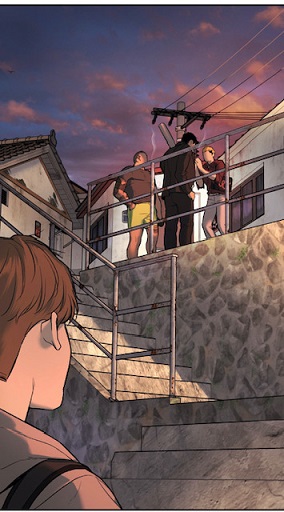 (chapter 1)
  (chapter 47)
 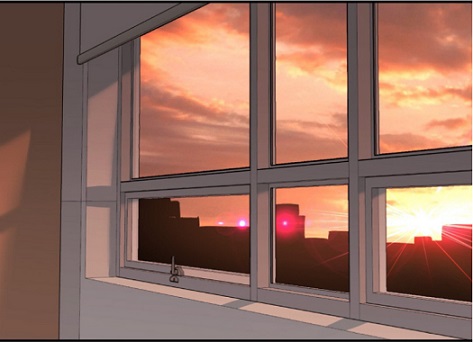 (chapter 47) even when the doctor was confronted with the truth about his terminally ill grandmother. The sun was always shining brightly. Since in the haiku from Ryokan Taigu, the rain is associated with old-age and fall (misty), it dawned on me that the rain should be associated with the grandmother’s death. If this comes true, it was, as though the sky and gods were weeping for her vanishing. Additionally, the first season took place in Spring and Summer, thus I deduce that season 2 will take place around late summer, fall and winter. This means that the weather should change. And this remark led to my second revelation. I started looking for South Korea’s climates, particularly I was curious about the climate on the West Coast.
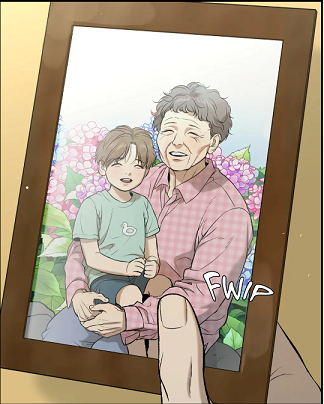 (chapter 19) the presence of pink and purple hydrangeas indicates that it was taken in Summer. This new approach reinforces my perception that the grandmother is about to get confronted with harsh reality despite her attempts to escape from it. Her wish can not be fulfilled so easily, like she is imagining it. In addition, Manhwa-philes should keep in their mind that weather has a great influence on elderly people’s health.
 We have an elderly man walking through the rain in front of the blue sea. The latter is accompanied with a Waka-poem from Yoshihiro (which was not translated). According to my Japanese friend @Rin_de_eegana (飯乞ふと 里にも出でず この頃は 時雨の雨の 間なくし降れば), this phrase describes a situation where one cannot even go out to the village to beg for alms due to the long rain. Here, we have the topic of poverty linked to old-age and rain. Yes, the pages of this book reminded me of Shin Okja, a poor elderly woman who is so sick. And like mentioned above, the rain could be the reason why the woman doesn’t go to the beach. The two poems are underlining one important aspect: the powerlessness of humans in front of nature. No one can stop aging, just like no one can control the weather. At the same time, it outlines the importance for a senior to be surrounded by people, so that they don’t end up dying from dehydration, from a cold or hypothermia.
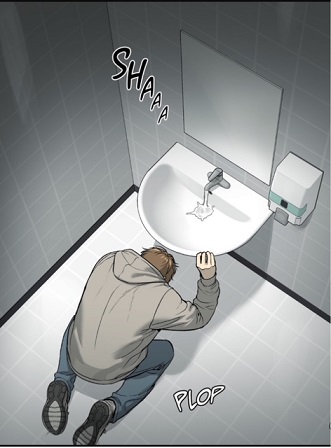 (chapter 47)
  (chapter 49) Both main leads went to the restroom in order to hide their emotional turmoil and suffering. They used flowing water (in Joo Jaekyung’s case the shower) in order to cover the sound of their weeping: SHAAA. Yes, the tears are making sound… so the rain should make sound as well. And this brings me to my next remark.
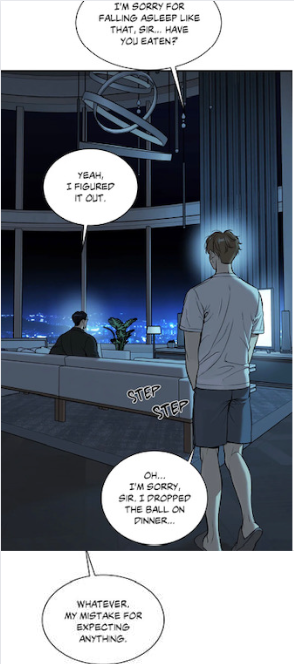 (chapter 29)
  . (chapter 30) In episode 35, the night stands for ignorance and self-deception, for the doctor was not present. Joo Jaekyung reverted to his old self. However, don’t forget that the haiku was not just about the moon light, but also about the sound of the waves. All the senses are awakened which represents a better experience than the grandmother’s. Moreover, since I am anticipating the presence of Kim Dan, this means that Kim Dan embodies not only the light in the dark, but also sound of water. This interpretation brings me to the following remark. In season 1, the athlete had already associated his fated partner to “sound”, though in the beginning he viewed it as noise
  (chapter 18) and as a source of stress and worries.
  (chapter 45) This means that the night view of the ocean should make him discover the beauty of the sound of water. He will come to associate the sound of the sea waves with Kim Dan. That’s how he will be able to fall asleep. In other words, I am expecting a new version of this scene:
 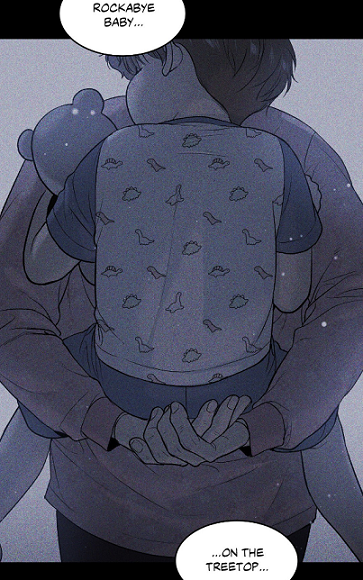 (chapter 47) To conclude, Joo Jaekyung will also have an Enlightenment in front of the ocean, but contrary to the grandmother, this experience will be associated with the night, the sound and a person: his soulmate Kim Dan.

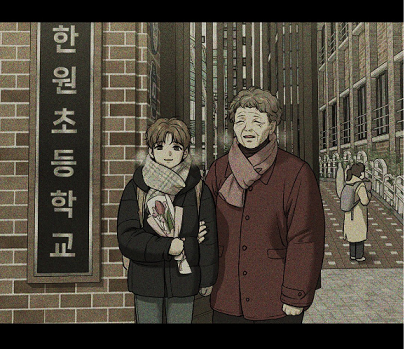 (chapter 47) .
  (chapter 47)
  (chapter 47)
 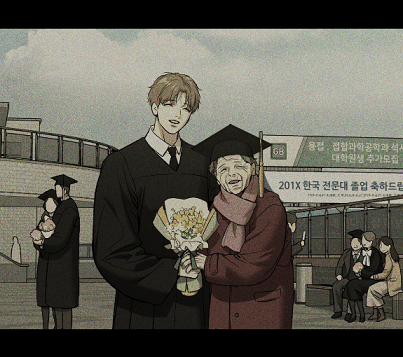 (chapter 47) One might argue about this interpretation, as these panels are presented as “memories”. However, the author left three important clues that these memories were pictures in reality. First, the perspective is not from the protagonist’s, but from an invisible third person’s. Then in the last image, in the background, you can observe a family posing for a picture in front of a person with a cellphone. This was the allusion that someone must have taken these pictures. The last evidence is the bouquet of flowers, the symbol for congratulations, but also affection!! After this realization, I couldn’t help myself wondering about the whereabouts of these photographs. Where are they?
  (chapter 17)
 (chapter 17) They are nowhere to be seen!! I would even add that this place contains no traces of Kim Dan’s presence!
  (chapter 19) The framed photograph isn’t visible on the chests or the shelves, when Joo Jaekyung confronts the loan shark and his minions
  (chapter 47) Thus I conclude through the absence of his pictures and belongings that nothing was exposing the presence of Kim Dan in this small flat. We could say that he had been living as a ghost child (the piggy bank) in his halmoni’s place. It implies the existence of an invisible wall between himself and his grandmother. This perception reinforces my previous interpretation. This place was like a “cursed place, where the “Sleeping beauty” was waiting for his “prince charming”. 😉 Therefore, when the doctor removed the framed picture from the drawer, it symbolizes his own “release”. It is no coincidence that one week later, he became “a man and as such an adult”.
  (chapter 19) He was slowly detaching himself from his halmoni’s shadow. The mirror is a reflection of a photograph. Here, he is facing reality: he has a long phallus and he can have a climax.
 (chapter 7) and actions.
 (chapter 38)
  (chapter 42) or “waiter”. As my avid readers can detect, there is a strong link between “pictures” and “pride and love”. Their absence is the expression of neglect from the grandmother, who was definitely too focused on herself and her own suffering. At the same time, it lets also transpire the low self-esteem from the grandmother. In her humble dwell, there is no picture of her as well.
  (chapter 47) Why? By acknowledging him as an adult man, she would give him a choice. He could refuse to do her a favor. As a puppy, he can not live on his own. Besides, by turning him into a dog and as such animal, she is denying him his right as a human being. She is appealing to his instinctive nature, his loyalty. And the moment I thought of a dog and death, I couldn’t help myself thinking of the famous dog Hachiko who kept waiting for his owner’s return at the train station, unaware that the latter had died a long time ago. As you can see, doc Dan’s pictures are strongly intertwined with reality and confrontation. Therefore the pictures with her grandson were not shown or treasured. The grandmother has been avoiding mirror and even pictures. As a person suffering from “Peter Pan Syndrome”, she is trying to do anything to escape “death and responsibility”. How ironic is that she just needed a picture to express her wish to move to the West Coast!
  (chapter 38) Clouds are a reference to heaven and dream, while the green display displays loneliness and emptiness. They have no one by their side. Furthermore, just like Kim Dan, Joo Jaekyung has no family pictures in his house
 , (chapter 19) which could be seen as a clue that he is an orphan. Or in the best case, they live, but there is a huge wall and gap between them and the fighter. I would even add that no one could even identify the owner of the penthouse. He is a famous MMA fighter, yet there exist no picture of himself in this flat! Not even this one:
  (chapter 1) That’s why I had compared the penthouse to a hotel room in a previous essay. So we could say that he also lived like a ghost. However, since he is a celebrity, he should be rather compared to a god. He has no home and privacy. Thus the penthouse contained no memories, until the doctor started living with the champion.
 (chapter 5) The first personal video and message from his manager only appeared in chapter 43. This shows that the owner of Team Black had no family at all and not even friends. This observation brings me to my next remark. What about the gym Team Black?
  (chapter 5) There are only pictures of the champion and of no one else. Not even from Park Namwook or the ex-professional fighter Jeong Yosep. Everything is revolving around the celebrity. The absence of pictures from others is indicating neglect. The gym was not advertised as a great place to have fun! It is all about fame, wealth and glory! Therefore it is not astonishing why the rats left the sinking ship.
  (chapter 52) The champion’s image is tarnished, he will get less admiration and sponsoring. The decoration of the gym exposed the mentality of the owner, Park Namwook. The gym is about the celebrity, money, fame and sponsoring! Under this new light, it becomes comprehensible why the other members were neglected and why the athlete disliked it so much to be taken in pictures.
 (chapter 30) It is because the photographs are a synonym for “money, glory and fame”. Choi Heesung was using him to get attention. His name
  (chapter 46), his face and body are like “merchandises”.
  (chapter 43) That’s why he disliked the idea that Seonho would advertise that he was his sparring partner. The pictures in the god’s world have nothing to do with memories or love, but with work! It is about making business and getting sponsors and making his fans happy. That’s why the author included the magazines in the same chapter with the actor.
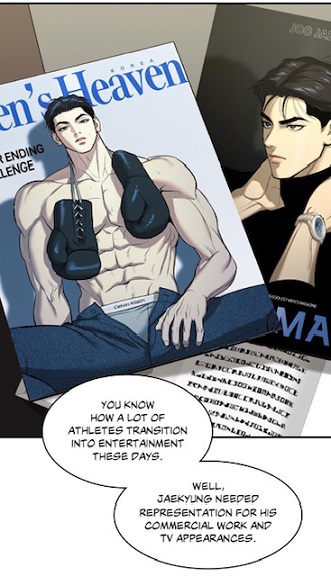 (chapter 30) Naturally, Heesung’s picture is not only related to business, they have a frenemy relationship. The photos with Joo Jaekyung stand in opposition to Kim Dan’s values: glorification, illusion, superficiality and futility. Under this new light, it becomes comprehensible why Joo Jaekyung would never put any framed picture of himself or others in his flat. His gym and the photographs are related to work. Who would like to be “reminded” of work and money in his own home? No one…
 (chapter 45) Imagine that the doctor had to work to exhaustion to give him an expensive gift! Yes, his gift was strongly intertwined with money, business and work! However, birthday is a symbol for home, pleasure, joy, simplicity and genuine gratitude. This has nothing to do with work and “replacement”. Yet, contrary to the other presents, the champion did open the hamster’s gift, for the latter had brought it personally.
  (chapter 45) Yes, his birthday was turned into a business event, a merchandise where he even had to pay for his own birthday party.
  (chapter 43) His popularity among the staff was based on his spending:
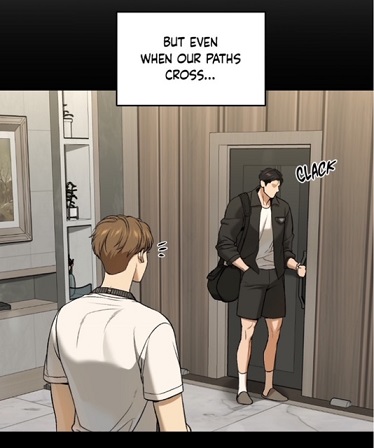 (chapter 47) It was not just because the athlete had been encouraged by his mentor to trust no one, to see relationship as a business.
  (chapter 46) This remark leads me to the following conclusion. Since the manager started sowing distrust in the champion’s heart, we can see it as another proof that this man has never truly loved “his boy”:
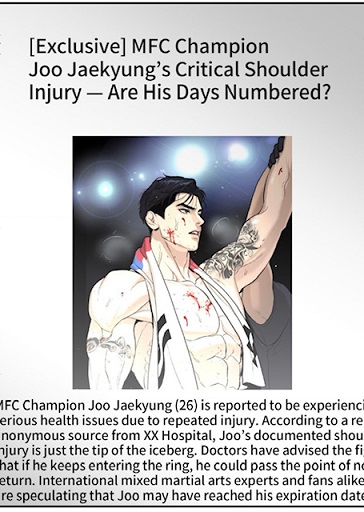 8chapter 35) When this article was released, the author selected a photograph exposing the champion in good health! He was raising his arm and as such using his “injured shoulder”. The content of the article contradicts so much the image which can only raise doubts among the readers. By using such a picture, they created the illusion that the athlete was hiding something. And this remark brings me to the last articles about the fallen legend:
  (chapter 52) His beaten face is exposed to destroy his “good image”: he appears not only as weak, but also as a bully. This shows how the medias are trying to manipulate the public with pictures. His face and body are damaged, therefore he has less value. This deceptive trick becomes more visible, when you include Baek Junmin.
  (chapter 52) The article utilized a picture of the fake fighter taken right after the match. He is smiling and barely injured… yet, the reality is that he got so wounded by the champion that he needs a long time to recover. As you could observe, all these photographs symbolizes money, business, work, superficiality and publicity. Thus they are strongly intertwined with temporality, fake love and emptiness. No meaningful moment…
 (chapter 46) The ones in this panel ooze privacy, selflessness and intimacy. The champion is seen carrying bottles and opening the door for the doctor, a sign of Joo Jaekyung’s respect for the doctor. Yes, these images expose the truth about the athlete: he really treasures his physical therapist. He is also seen listening to the doctor. This observation corroborates my previous interpretation. The pictures with the physical therapist symbolizes verity and reality. The problem is that Joo Jaekyung never got to see them, hence he didn’t realize his affection for the doctor. However, Choi Gilseok could notice it. In fact, the celebrity was delivered a different kind of truth:
  (chapter 48) Kim Dan’s meeting with director Choi Gilseok! However, note that these photographs were also a deception, for they never expose the outcome of the meeting. These pictures display the negative notions of privacy and intimacy, it is about plotting, betrayal and as such about “business”. How so? It is because they met at a café. As a conclusion, the photographs have a total different meaning in the athlete’s world. They represent coldness, superficiality, temporality, deception and work. This new interpretation reinforces my hypothesis that the main lead’s car must have been followed by a paparazzi during that night:
  (chapter 33) A black car was following him. But they couldn’t take any picture, for the windows of his car were tainted.
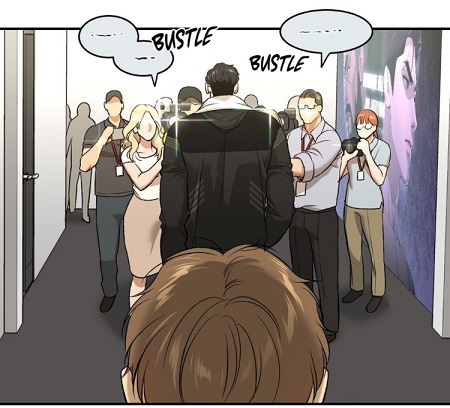 (chapter 40) It is no coincidence. Though he had no memory of the previous night, he felt this moment as magical. He had saved him and claimed him as a part of Team Black. Then he had look at him back, though he was facing journalists. However, the journalists didn’t take a picture of such a moment, for this was not relevant to them. It shows not only the true value of “memories”, but also that both were now truly living! During that night and day, both created wonderful memories.
 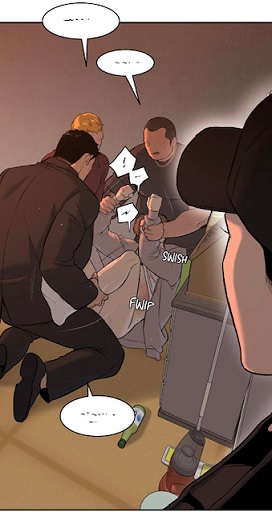 (chapter 17) He is relying too much on his eyes. He paid no attention to details and their words. Hence their words are not visible. In addition, the author created such a panel.
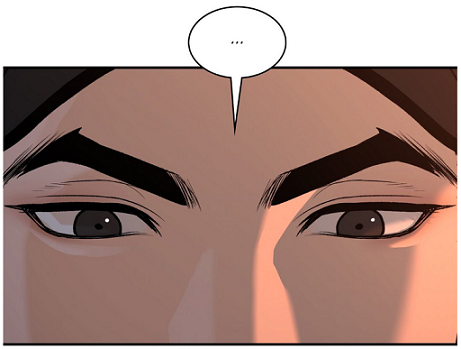 (chapter 17) in that scene.. But why is he trusting too much his eyes? It is because he adopted this poor habit from his mentor and hyung, Park Namwook. who judges people based on prejudices and impressions. When the manager faces a problem or some criticism
  or delegating responsibilities to others:
 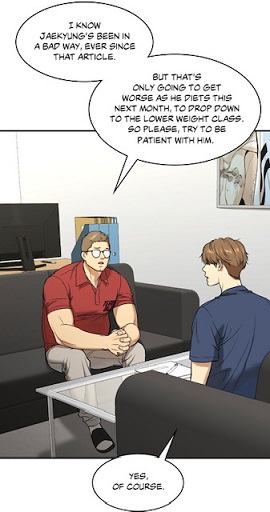 (chapter 36) Furthermore the man with the red tee-shirt has always been by his side for a long time. The time spent together is a proof of his “loyalty”, yet if the athlete had paid more attention to his words, he should have noticed his hypocrisy, lack of empathy and disrespect:
  (chapter 49)
  (chapter 27) In addition, he had to rely on the expertise of doctors, but he only trusts himself, his hyung and no others. But let’s return our attention to Kim Dan and his letter.
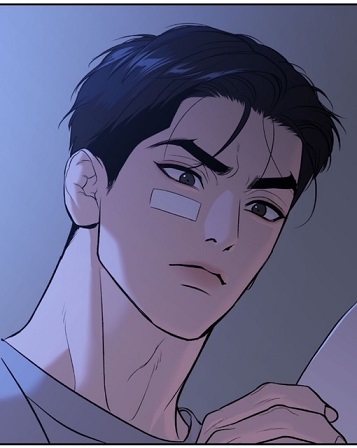 (chapter 53) The letter stands in opposition to the articles and photographs. Through the letter, the main lead is teaching to the wolf this important life lesson. He needs to use his mind and as such his heart to see the truth and reality.
  (chapter 53) The latter might have no photograph of Kim Dan, but his face is now engraved in his memory. To conclude, the letter should be perceived as a mirror of truth to the athlete. He needed to hear the hamster’s words without seeing his face in order to see him properly.
 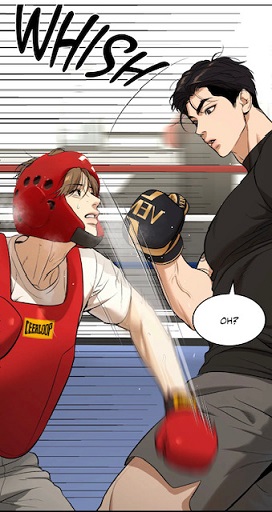 (chapter 26)
 (chapter 26) The gym will face some changes.

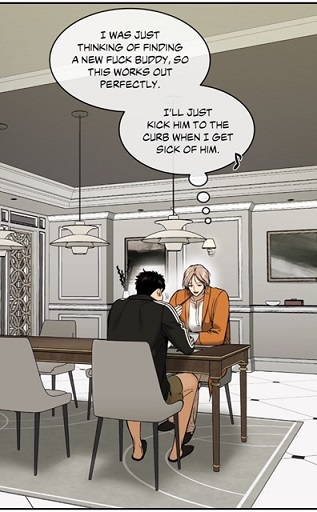 (special episode 1) The actor chose to use the black-haired sportsman as “Friends with Benefits”. But what would be Potato’s benefits then? Support and connections, like we could see it in special episode 2:
 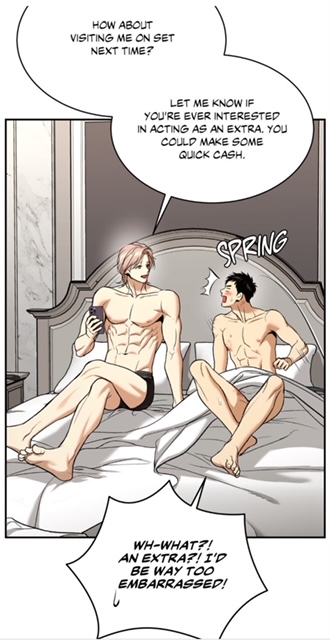 (special episode 2) So when Heesung is already envisaging to get rid of his new lover
  (chapter 35) Because he is famous and wealthy, he is expecting a similar reaction from the chow-chow. At some point, he will appear too clingy, hence he will perceive his relationship as burdensome. This is no longer fun.
 (chapter 33) However, the change of Heesung’s mind-set (Friends with Benefits, no longer the search for a soulmate) is also related to Potato’s reaction after their first night together.
  (special episode 1) With his words, the sportsman implied that he had taken advantage of the actor, while in reality the opposite had happened. Heesung had taken advantage of Potato’s drunkenness
  (special episode 1), ignorance and purity
 (special episode 1).The confession of Yoon-Gu’s wrongdoing could only shock the actor.
  (special episode 1) How did Yoon-Gu come to this reasoning, when he admitted in the same breath that he was drunk? It is because the night before, Heesung had confided that he was heartbroken due to Kim Dan’s rejection.
  (chapter 35) With his behavior, the fox gave the impression that his affection for Kim Dan was running deep. Under the tent, he was drowning his sorrow with soju. Hence in the maknae’s mind, Heesung was still in love with the physical therapist. Yes, the irony is that the chow-chow was also projecting his own thoughts onto the comedian. Let’s not forget that when the young fighter discovered the true nature of the relationship between the doctor and the emperor, he didn’t give up on his admiration and affection for Joo Jaekyung.
  (chapter 35) My avid readers should keep in their mind that the chow-chow is famous for his strong loyalty. To sum up, Potato imagined that Heesung was still loving Kim Dan, exactly like him with the fighter… he would remain faithful and keep his one-sided love.That’s why I came to the following conclusion: their relationship started on a misunderstanding, which was also reflected in this situation:
  (special episode 1) It was, as if he had disregarded the gumiho’s feelings, he had incited the latter to commit a sin. Heesung had broken his vow of faithfulness 😂. That’s the reason why he mentioned “zero regrets”. It is important, because with such a mind-set and attitude, he is indirectly pushing the gumiho to face the truth: his dishonesty. His affection for Kim Dan was just a crush, a superficial attachment, as he knew nothing about him. In fact, he was just chasing after an illusion. He even admitted it at the restaurant:
  (chapter 35) His description for a partner and as such love doesn’t correspond to the definition of true love: care, respect, knowledge and responsibility (Definition from Erich Fromm, for more read “
 (chapter 32) He didn’t try to protect him from the athlete’s fury. He never clearly stated his true desire, he wished to date the doctor, until he was cornered (threatened).
 (chapter 45). This means when the MMA amateur fighter decided to become responsible and as such to make up for his mistake,
  (special episode 1) and why Potato couldn’t refuse the role-play.
  (special episode 2) However, he is not entirely powerless, like I mentioned in the first part. He is not forced to admit that he had fun after the intercourse.
  (special episode 2) In other words, he is not obliged to say YES either! It is funny because thanks to this examination, I realized that Yes and No have “become” like taboo words. Yoon-Gu is avoiding these idioms by using the expression “I don’t know”. Hence I am suspecting that Heesung will become obsessed with the word “yes”! 😂 Only Heesung can procure him fun and pleasure, and no one else. He is getting disarmed by the sentence “I don’t know”.
 (special episode 2), yet in the past he had a different reaction.
  (chapter 23) The reason is simple. This was not patting, but rubbing. Neither Oh Daehyun nor Kim Changmin did it to express gratitude, rather for selfish reasons. They wanted luck on their side. Potato didn’t feel recognized and accepted, rather used as a tool. Hence he was bothered. Under this new light, it becomes comprehensible how Heesung can win Yoon-Gu’s heart in the long run. It is not because of his sexual performances, but thanks to his selfless gratitude and generosity!! We have the perfect example in these two scenes:
  (special episode 2) He was attempting to hide his growing affection for the comedian. He feared that his feelings for him could become a burden for the comedian. In his eyes, Heesung should remain faithful to the physical therapist. He shouldn’t expect any affection from the actor either.
  (chapter 13) And the moment I read this expression, I couldn’t help myself thinking of a leash as a new sex toy.
  (chapter 34) In this scene, the physical therapist looked like attached to his owner. In the first part of “Passions in Purple: Jealousy and Joy”, I made the following prediction. Heesung would order a sex toy
  (special episode 2) out of annoyance and jealousy
 (special episode 2), for Potato had run away from him. He needs to put him on a leash to feel in control, to obtain his chow chow’s attention. Naturally, there is no guarantee that this prediction is correct. Yet since according to my examination, Potato is thinking that Heesung is in love, it signifies that Heesung is already attached to Kim Dan. Hence he won’t do anything to ruin this attachment… therefore Heesung can only be put in front of a dilemma. How can he make Potato look at him? He could reveal the truth to Yoon-Gu, but by doing so, he would ruin his image as a good and caring guy. Moreover, since he has lived for a long time deceiving himself and others, it is very unlikely that the actor might change his behavior so suddenly. Old habits are hard to die. Therefore for me, honesty won’t be his initial choice, rather acting. He will express his thoughts and emotions behind a new role-play and sex.
 (chapter 52). In the past, Heesung saw Joo Jaekyung as a rival, hence he made sure that Potato didn’t participate in the champion’s surprise party. So I believe that he was not upset about Joo Jaekyung’s downfall. In fact, he could have envisioned that this could help him to gain Potato’s attention. However, what he didn’t realize is that since feelings and affection can change, this could also happen towards other persons: the physical therapist. Potato’s attachment towards the doctor deepened, as time passed on, especially since they spent some time together in the States. Therefore I conclude that the departure of the doctor will not only affect the relationship between Potato and the comedian, but also force them to follow the main couple to the West coast. Mingwa left many clues for this prediction. Where?
 There, I included two gemstones, the Bloodstone and the Aquamarine! Choi Heesung, born on 21st March, is represented by these birthstones! In this composition
 (chapter 30) And what was he wearing in the poster? A blue pale suit which is close to Aquamarine and even to light purple ! The color is no coincidence. I have the impression that thanks to the weak woman, Heesung will become a part of the “new family”. If you look at the sunset again, you will detect glimpses of purple in the sky. As for the second image which came to my mind is this: the actor swimming in the ocean. When the bloodstone is put in water, it changes the color of the sun: red for love. Yes, we should expect a new version of this scene:
  (chapter 28) which I had interpreted as a baptism, a purification. If the actor bathes in the Yellow Sea, he will be purified and as such his true self will come to the surface. That’s how he will recognize his love for Potato, but also his friendship for the doctor. So far, the man has no real friend, but he has been longing for one. At the same time, the metaphor (the sun turning red) could be a reference to the interaction between the actor and the emperor, the former helps the latter to recognize his true feelings for the physical therapist. As a conclusion, we should expect to see Heesung under the sunset and next to the ocean or water. There, he should ponder and have a realization.
 (chapter 37) Here each fighter was on his own, they were not really training together. The champion was the leader due to his imminent match, he put the others under pressure, as he was himself stressed. But with his suspension, he is no longer racing against time. In other words, the training routine should be different. They will help each other, encouraging each other to become better. The presence of Heesung should help them to see the training under a different light. But for that, he has to reconnect to his true nature: bloodstone and aquamarine.
 (chapter 37) or the switch of medicine. Unfortunately, the gumiho was not present both times, hence Kim Dan and Joo Jaekyung became the targets of revenge. On the other hand, the author stated that in season 2, the focus would be more on emotions, which means that there shouldn’t be many plot. Nevertheless, my avid readers should keep in mind my previous interpretation about the “beautiful” Kim Miseon
  (chapter 21) I had criticized her on many occasions, like disculssing a case in a hallway. Before, she had proposed an expensive treatment, well aware of the grandmother’s age and her weak condition. Moreover, I had suspected her to have leaked information to the director Choi Gilseok. Thus I hope that season 2 will expose her misdeeds and the corruption of the medical world. This was already present in episode 1. But let’s return our attention to the gemstone and its symbolism. In medieval Europe, the stone was deeply linked to the crucifixion of Jesus Christ, believed to have formed when drops of His blood fell to the earth. As you can see, the gumiho is strongly connected to selflessness, sacrifice, death and rebirth. This reinforces my expectation that his encounter with the grandmother will have a huge impact in his life, like for example the “neglect and indifference from his parents”. Exactly like the other main characters, he has abandonment issues. Bloodstone is commonly associated with the root chakra, which governs grounding, stability, and physical well-being.
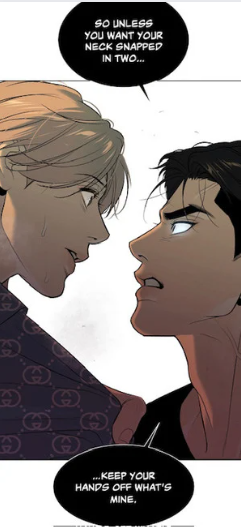 (chapter 34) Here, he forced the champion to claim the doctor as his possession. However, in season 1, the main lead came to regret his actions (34, 43), for he has never been honest to himself. And now, it is time to focus on the second gemstone.
 (chapter 31) They were green. He is attracted to “green”, his origin self. Nevertheless, in episode 31, this was rather a khaki version due to his corruption. No wonder why he played a trick on the champion. And this observation brings me back to the doctor’s clothes. What was he wearing, when he was young?
  (chapter 35) At the same time, it explains why Heesung changed for the better thanks to the physical therapist. Thus I assume that Heesung is destined to become an aquamarine, bringing all these characters closer to each other: Potato, Cheolmin, Kim Dan, Joo Jaekyung. However, contrary to the past, he won’t use his money to help people to become happier. His smile and happiness should affect the others:
  (chapter 31) However, this should no longer be superficial. The celebrity is associated with flowers, stars, fun and happiness. Because he symbolizes “Spring”, I deduce that his rebirth and as such his Enlightenment are primordial. He is there to assist the others. And the color for understanding, compassion, self-awareness and wisdom is purple:
 (special episode 1) Since the elderly woman confided to Joo Jaekyung, we can assume that she could do the same with the gumiho, as soon as she sees her idol. It is important, because he could grasp the physical therapist’s suffering and low self-esteem.

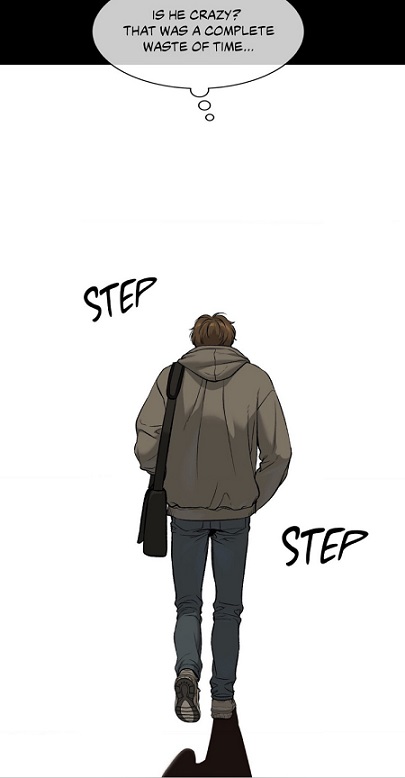
 (chapter 48), but the actor would be replacing the fake director. We had a sunset here, dark water (the coffee), the symbol for corruption. Then notice that he is wearing a blue t-shirt (but two colors, a symbol of his hypocrisy)!! This reinforces my expectation that we should witness the actor’s awakening, the exact opposite of the other Choi, who chose revenge and manipulations. But there is more to it. Thanks to the comment of @Milliformemes24, I had another revelation. The latter wrote that places of knowledge and self-awareness are related not only to the ocean, but also to the mountains. It is normal, as the hill is closer to the sky and as such closer to the gods. Notice that Heesung’s new home is situated on the top of a hill, surrounded by a forest.
  In other words, Heesung could get enlightened on a mountain too, during a stroll for example. And the moment I read this from my friend, this image came to my mind:
 (chapter 41) The huge tree at the hospital!! The latter is even strongly connected to a stroll. In that scene, the doctor thought of his lover, as he associated him with the sun.
 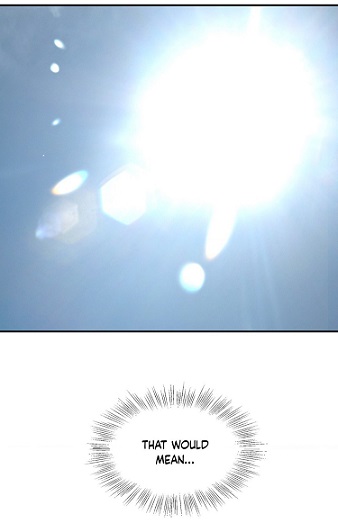 (chapter 41) That’s the moment when he realized his feelings for the fighter. As you can see, Mingwa used the tree and as such nature as a source to spirituality. And now let me ask you this question. Since the story is written with reflections, the tree should have appeared before and after. Where was it then? First, the first plant to appear was the bouquet. The roses from Heesung
  (chapter 31) could be seen a mirror of the tree. The roses encourage the doctor to ponder and show an interest in his employer.
  (chapter 37) However, the first time, the tree appeared as such was in the States, and this on two occasions:
  (special episode 2) Yes, the barn!! The tree had been transformed into a home. However, don’t forget that this was just a fantasy from Heesung. However, during this intercourse, he came to expose his jealousy and growing attachment towards his soulmate. Yes, the last two mentioned scenes have two common denominators: a mixture of fantasy and Enlightenment. Nature is strongly intertwined with meditation and communication. To conclude, we should expect the presence of woods and trees in season 2 as well. And this hypothesis got reinforced, when Mingwa released this image on X:
  We have a sunset, a palm tree and purple in the sky… Joo Jaekyung is wearing a similar shirt than Heesung:
  (chapter 34) I consider this as an allusion that the actor will be by the fighter’s side. On the other hand, since the shirt is open, I interpret as the star’s emancipation. The latter has been able to escape from his mental prison and suffering. In his cage, he was racing against time. Now, he is able to relax and enjoy time. At the same time, since the champion in the image from X is seen wearing rings with stones, it somehow confirmed my interpretation about the role of birthstones in Jinx.


 you will notice a third shade: orange which is represented by the Chow-chow and the comedian’s robe. Since the latter plays a minor role in the last chapter, it is normal to examine this pigment first. Moreover, its explanation is even necessary to grasp the significance of the other colors: pink and black.
 (Special episode) Then he cooked a spicy ramen for the young fighter.
  (Special episode) This color contrasts so much to the pigments from the artist’s flat: black and white.

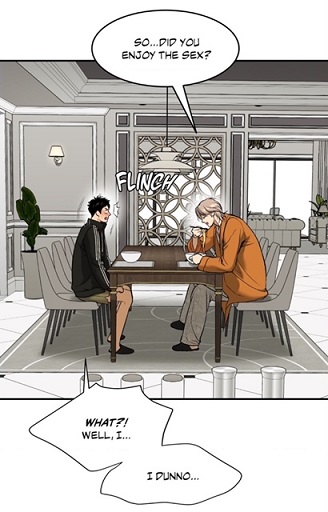 (Special episode) Grey is a combination of black and white. One might think that tangerine appeared for the first time in episode 35
 (chapter 35), but it is just a deception. In fact, there were traces of this pigment, when Choi Heesung was introduced for the first time.
 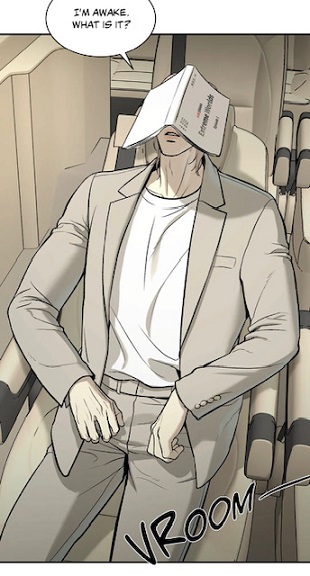 (chapter 29) Yes, we should perceive beige as a washed-out orange. So what does it mean? First, the cursed Romeo was not true to himself. Let’s not forget that in my eyes, Choi Heesung is a fox, and the fur of this animal is orange which is similar to the chow chow’s pigment. This means that both second leads would have a color in common: orange. Moreover, from my perspective, the comedian is a nine-tailed fox, a gumiho. In case, you didn’t read the analysis “
 (chapter 30), before becoming beige.
 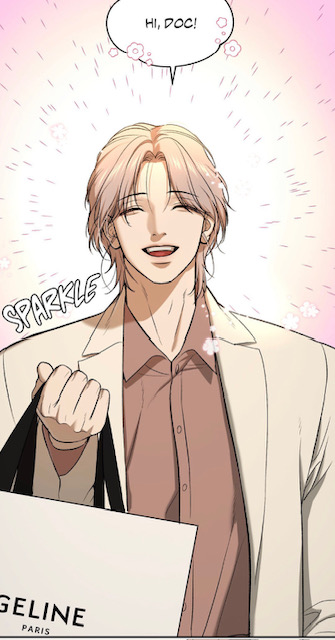 (chapter 31) This observation helped me to recognize that the more Heesung appeared, the more colorful his clothes became. So this discovery exposes that
  (chapter 35), white is not his true color! Whereas Potato represents black outside and white inside, his partner embodies the opposite values: white outside and black inside. In addition, the switch of colors indicates not only his transformation, but also that his world is becoming more colorful and as such less boring. Yes, Mingwa was applying the principle: clothes make the man. To conclude, the colors beige and orange are mirroring his gradual maturity.
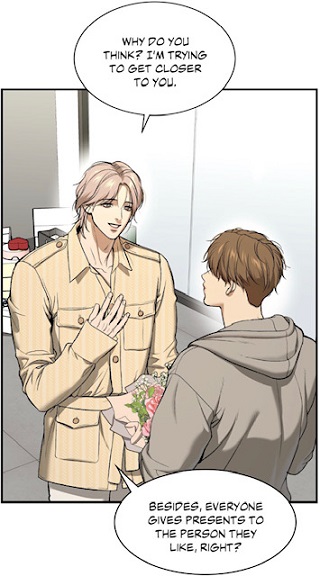 (chapter 31) and finally camel
  (chapter 35) Here, I added a screenshot of 57 different types of beige.
 (chapter 29) From my point of view, he doesn’t desire to stand out, to make a statement. Therefore it is not astonishing why he hides behind sunglasses, a hat and a mask.
  (chapter 35) He didn’t want to be recognized. One might argue about this perception (not standing out), for he is writing a vlog
  (special chapter) Therefore he is sleeping while hugging a beige and pastel pink pillow. This exposes his need for warmth and support. On the other hand, he is not realizing that he is his own enemy, for the pillow represents a hindrance. He is not allowing people to get closer to him. It looks like he fears embraces in the end.
  (chapter 31)
  (chapter 32, the lavender suits) This observation reinforces my previous statement. Heesung is looking for neutrality.
  (chapter 33) He is amoral and to a certain extent immoral. We could say that he is a free spirit, but fears rejection. Hence he faked an injury and lied to people. The pastel colors are not reflecting his true mind and choices. We have the perfect example in this scene:
  (chapter 31) While he was wearing a peach jacket, his manager had put a vivid green with dark black pants. Shortly after, the comedian was seen with this beige/khaki shirt and grey shorts.
  (chapter 31) Interesting is that his hair shade reflects my previous remarks perfectly. He chose pink which indicates his desire to break social norms, on the other hand, his pink is so faded that it almost looks like beige. He wishes to be “neutral” and somehow “conformist”. Yes, his pink hair mirrors his inner conflict: trying to break free from social norms, yet not standing out too much. The antonym for neutrality is “commitment”, an indication why he was not capable of being committed in a relationship in the end.
  (chapter 30). However, if you compare the pink from
  (chapter 30) episode 30 and 31
 (chapter 31) to the ones from the special episode
 (special chapter), you will notice a huge change in the shade. While in the past, the Webtoonist selected pastel pink or coral, in the special episode, we have now fuchsia as pigment. This is no coincidence that the color is now more pronounced, exactly like with beige/orange.
  (chapter 35) This shows how important it was for him to have a lover. He fears of being abandoned and being alone. Therefore he asked this from his new lover:
 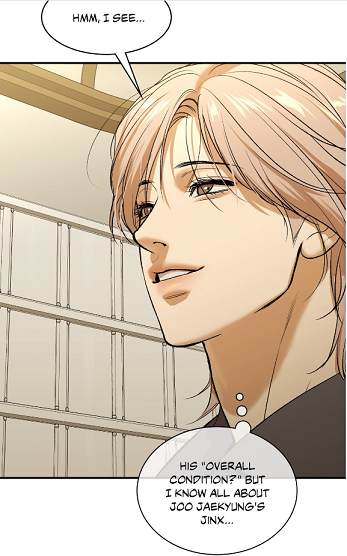 (chapter 32) It is not his “problem”. Hence he was totally absent, when the scandal with Joo Jaekyung broke out. His AWOL corresponds to his passivity and even indifference. However, there is no doubt that this incident will affect his relationship with Potato greatly.
 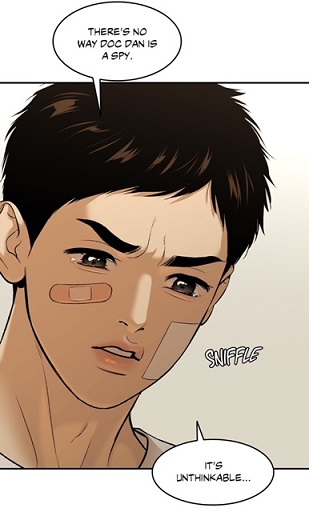 (chapter 52) Besides, Yoon-Gu embodies the opposite notions: loyalty and meddling. He doesn’t fear argument and criticism!
 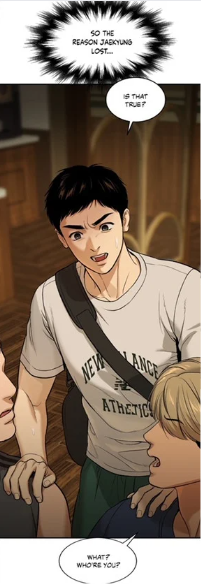 (chapter 52) Heesung’s indifference and selfishness contrast so much to his new lover’s interest and selflessness. This shows that the young maknae is superior to the actor despite his lack of experience and ignorance. How do we explicate this divergence? It is because Potato had been showered with support and love at the gym. Kim Dan was even willing to risk his safety for him, a sign that he was lovable and worthy. Hence he is a confident man which is not the actor’s case. That’s the reason why the young man stated that he would become responsible for Heesung.
 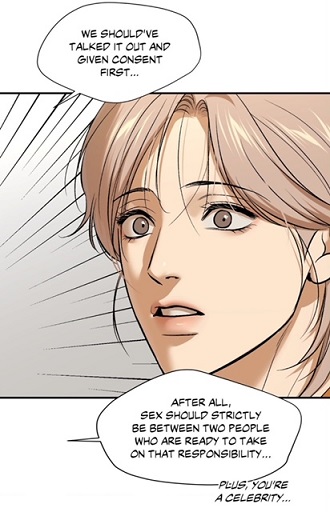 (special episode) Thus I sense that Potato will force the actor to drop all his past believes: passivity, indifference, irresponsibility and as such betrayal. We could witness this in the special episode partially.
  (chapter 5) This is just another trick from goddess Mingwa to push him to become more responsible for his new relationship. My idea is that in order to discover that Potato is his soulmate, Heesung needs to help Potato and as such the main couple to be together. Only when the doctor and the champion are an item, he will have his partner.
 (special episode) with the one from episode 39
 (chapter 39), as the shades are very similar. Heesung was as rough and selfish as the fighter. Notice that this whole sex session was focused on the actor’s needs and desires,
  (special episode) exactly like with the champion. He needed “comfort”, as he was in a depressed mood.
  (special episode) The champion has a similar habit:
  (chapter 36) Besides, note that Yoon-Gu’s buttocks are red, a sign that the comedian focused on them!! The irony is that Potato felt pleasure right away, hence he had more climaxes than Heesung.
  (special episode) This panel is interesting, because it shows that Potato was not focusing on Heesung at all. It was all about himself and his own pleasure. He was not recognizing that he was actually mirroring the actor’s thoughts and desires. Yes, from my perspective, the young man was in truth treating the actor as his sex toy or fuck buddy. There was no string attached, this explains why Heesung had to ask this to Yoon-Gu:
  (chapter 29: black and white movie!!) and fairy tale: the end shows their blissed union and they lived happily ever after. This explicates why the comedian compared Kim Dan to an angel…
 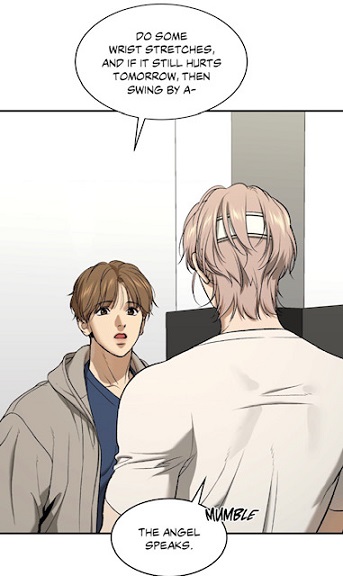 (chapter 30) The latter stands for eternity and immortal love. But this is just an illusion, for humans are mortals. They are destined to die. And this leads me to my following remark. Why was black so present in the special episode? It is because this pigment often represents DEATH!
  (chapter 33). He can also hear rumors there. Moreover, for me, the actor stands for power, control and as such knowledge… hence he was able to pull tricks on the star on multiple occasions. He is able to make the athlete angry, he can arrange a meeting without Joo Jaekyung’s consent
 .(chapter 34) or make a deal at his expense
  (chapter 32.). Interesting is that these values (influence, dominion, competence and insight) are associated with the shade black!
 (chapter 31) Officially, he had wounded the actor, therefore his physical therapist had to take care of his treatment. Besides, I believe that MFC desired to corner the champion in order to force him to give up on his new lover. He was no longer hiring a prostitute. As you can see, black is an ambiguous color: it can symbolize knowledge as well ignorance. Thus this shade represents mystery. Thus it is no coincidence that the past and family of Joo Jaekyung, who is also associated with black, remain a riddle
 (chapter 31) While Joo Jaekyung condemned him for his deception and constant switching of partners
 (chapter 33), his manager accepts him despite his messy love life and flaws.
  (special chapter) Potato is a sex toy, just like the doctor was a tool against the champion’s jinx. Secondly, the artist discovered a whole new world thanks to Potato’s purity and ignorance
  , we have to envision that his role during the night was to absorb the actor’s negative energy.
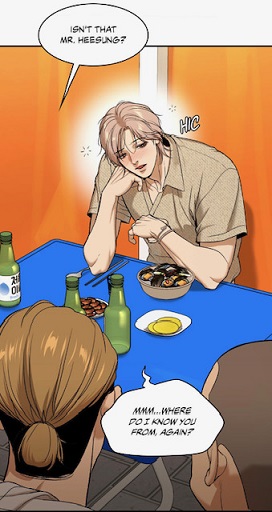 (chapter 35) reminded me of Kim Dan who used to drink in order to numb his pain. By meeting the black and yellow Chow-Chow, the fox was able to see light in his sorrow. Potato could absorb his negative thoughts and even enlighten his night. Therefore it is not surprising that Heesung made such a statement:
  (chapter 33) First, the VIP club is painted with dark colors. Secondly, the athlete was wearing a dark brown jacket with a black pullover. For me, Choi Heesung’s true personality comes to light in the dark!! We could say that he shines in a black room. Surrounded by darkness, he feels more protected. Thus at the club, he revealed his immorality and hypocrisy… He didn’t stand out. The more white the room is, the less the actor is honest! His preference for neutral colors expresses his need for “conformity and passivity”. They are an evidence for his hypocrisy and acting. Under this perspective, Manhwaworms can grasp why the mysterious man has a hidden dark room!
  [I am assuming that Mingwa didn’t change the flat] Only there, he exposes his true nature: BDSM. In my eyes, there he can voice all his desires and thoughts. His true self can come to the surface. I saw another evidence for this hypothesis (BDSM) in this expression: “kick him to the curb”
  (chapter 52) This means, he is already one step closer to the MMA arena. With the last incident, the young fighter must have caught the attention of opponents. He created himself “enemies”. Therefore he could become the next target for a plot as a revenge. In other words, with such a companion, Heesung is confronted with reality. His destined partner can be wounded and even die. Thus he has to ensure his safety. He can no longer be indifferent and passive. As you can see, Heesung will be put in a similar position than the physical therapist:
  (chapter 40) And this observation leads me to my second part, the explanation for the title: La Vie En Rose.
 (chapter 36) That’s what the athlete experienced at the end of season 1. I could describe the fans’ devotion and appreciation as idolization and veneration which can have terrible consequences.
 (special episode)
  (chapter 33) or sighing, the symbols for boredom. Thus I have the feeling that his job as actor is not procuring him any joy. That’s how I realized why Heesung is the champion’s frenemy. While the latter stands for training and routine (he hates surprises and novelties), the other embodies the exact opposite notions: he loves adventure, spontaneity and variations.
  (chapter 48) As you can see, the main lead announced a turning point in the gumiho’s life. Exactly like his frenemy, he was taught that money and fame can not buy affection. Moreover, for the first time, the young man learned the existence of boundary and respect.
 (special episode)
  (chapter 35)
  (special chapter) He is constantly caught by surprise!
 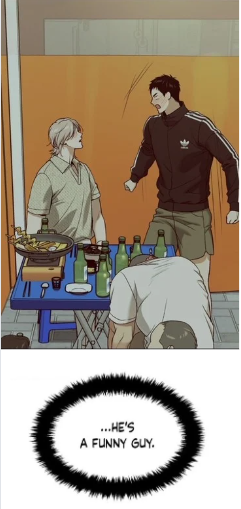 (special chapter) He sees Yoon-Gu as fun! Simply because he is allowing himself to express his emotions. He is never hiding his thoughts and emotions, the exact opposite of Heesung. He is so transparent, on the other hand, totally unpredictable. Yes, in the end, Yoon-Gu represents a huge riddle for Heesung. What caught my attention is how Yoon-Gu didn’t mind to yell his affection and admiration in front of people. He doesn’t mind people’s judgement and gaze. He is strong enough to bear this kind of attention… the exact opposite of the actor. He is not afraid of committing, making a different statement, he can diverge from majority. Hence he left the restaurant in front of others.
 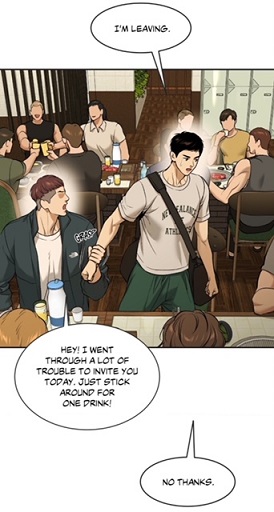 (chapter 52) He can make his own judgement and choice. To conclude, though Yoon-Gu is the younger one, he has so much to teach his fated partner who chose conformity and ended up bored and half-dead!
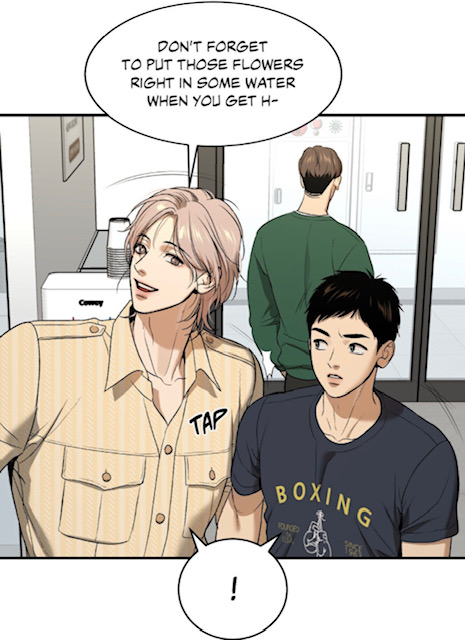 (chapter 31) We could say, their meeting was like a big bang, an explosion! Caught by surprise and annoyed by such an incident, the actor couldn’t help himself voicing his thoughts about Potato:
 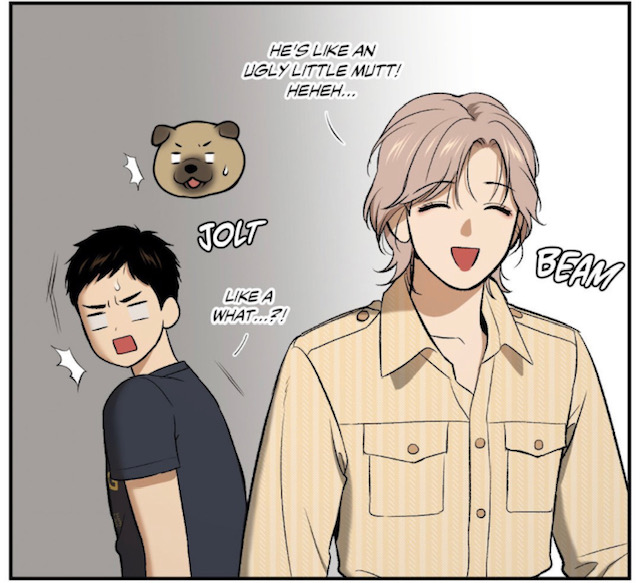 (chapter 31) For a short moment, he dropped his mask and expose his true personality. And for the first time, he received such a gaze:
 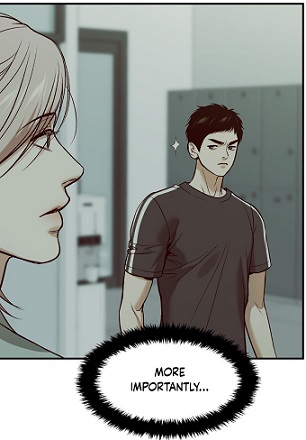 (special episode) That’s how both ended up creating unforgettable moments. Under this perspective, my attentive and patient readers can grasp why I created such an illustration for this essay:

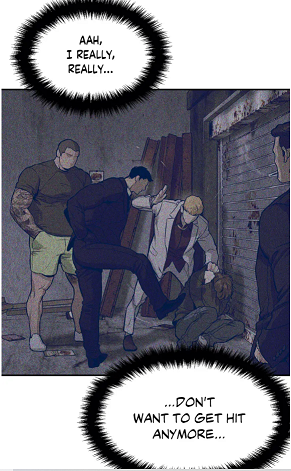 (chapter 1) The problem is that Kim Dan blamed himself for his suffering, as he must have often not paid the interests on time. That’s the reason why he got surprised, when he saw his enemy in front of his humble home.
  (chapter 1) Due to the lack of rest and time, he didn’t have the opportunity to ponder on his life and even have dreams on his own. Therefore he had no ambition. At the same time, he couldn’t become energetic and proactive due to his low self-esteem and his abandonment issues.
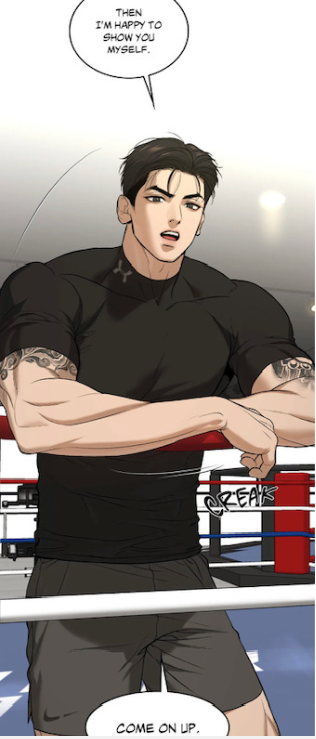 (chapter 25) It is no coincidence that he employed that expression in front of his fated partner. To conclude, chapter 26 stands for life and happiness, proving that their life is not cursed per se. Consequently, red was the dominant color of this chapter. This pigment stands for love and life. Both felt alive during that day. Moreover, we could see glimpses of the sportsman’s true psyche as well, when he proposed to spar with the main lead. He desired to help the doctor himself. Hence he acted as his mentor and teacher in the ring. There, we could see his generosity, interest and open-mindedness. He wasn’t looking down on the doctor, he saw him as a true member from Team Black.
 (chapter 29) He has no one by his side. And this observation leads me to my next interpretation. The existence of Joo Jaekyung’s belief is exposing Park Namwook’s neglect and bad management and coaching. We could say that he is partially responsible for the champion’s misery and bad luck. Therefore it is no coincidence that the sparring took place during his absence.
  (chapter 26)
 (chapter 49) But why hasn’t the athlete confided to his manager yet? First, homosexuality is definitely a taboo among boxers and MMA fighters. Their masculinity and strength are questioned. Secondly, his coach views him as a spoiled brat.
  (chapter 31)
  (chapter 46) Yet, according to my interpretation, the main character’s departure was not the sign of stubbornness, but rather of fear and avoidance. Since the manager doesn’t know his star that well, he judges him based on appearances. Moreover, I believe that he has the tendency to generalize, just like certain readers. Since the athlete beat a doctor and was quite brutal with a fighter, he is stigmatized as “thug” or a “spoiled kid”. I am suspecting that the way the hyung met the celebrity affected his perception about the young fighter.
 (chapter 46) Despite his attitude, Joo Jaekyung still listened to his hyung’s warning, for from that moment on, he kept his distance from everyone, including the physical therapist. But there’s more to it. Park Namwook keeps associating his star with “good luck”.
  (chapter 1)
  (chapter 27) This represents the exact opposite of the star’s jinx. It shows that he is not trying to understand his celebrity. With such a mind-set, it is normal that the champion wouldn’t trust his manager. And the absence of the manager in this panel
  (chapter 33) The latter truly worries for his star, although he is well aware of his shortcomings.
  (chapter 30) In addition, he knows about his private life and love life.
  (chapter 33), he didn’t report it to his hyung. He also kept it a secret. That way, he was not only protecting Kim Dan’s misdiagnosis, but also Park Namwook’s misjudgment. On the other hand, he acted as a real boss, for the comedian is an important client.
  (chapter 47) Therefore he bought chicken for them. Instead of showing compassion and understanding for his hungry and miserable champion, he allowed Potato and Oh Daehyun to buy junk food behind the celebrity’s back.
  (chapter 23) He never confronted the members with the truth. They lack skills
  (chapter 46). It was, as if they didn’t have the goal to create a new champion. How come? It is because the gym was initially created for Joo Jaekyung’s needs. And now, Jinx-lovers comprehend the dilemna. Team Black needs to redefine itself and its purpose. Moreover, Park Namwook’s true wish is to open the gym for “kids”. And that’s how he treated the staff from Team Black, like little kids. No wonder why many left the gym in the end. They didn’t feel truly supported by the manager and coach. Jeong Yosep and Park Namwook didn’t put any real effort to turn the members into professional fighters. That’s the reason why none of them had a MMA manager, only a coach and nothing more.
  (chapter 52) So what other fact was Park Namwook referring to? The fighter Baek Junmin and director of King Of MMA had paid Kim Dan. This shows that he had heard the conversation between the two protagonists.
  (chapter 52) And what did the manager do, after the champion had left the room? He abandoned Kim Dan, followed by the other men. At no moment, he asked Oh Daehyun or Yoon-Gu to take care of the physical therapist. But by following the celebrity or remaining passive, they had implicitly supported Joo Jaekyung’s decision. They had taken his side. And now, you comprehend why all these men chose to put the whole blame on the celebrity.
  (chapter 1)
  (chapter 41) However, as his manager, it is his duty to protect his star, as the career of a MMA fighter is rather short. Imagine, he let Joo Jaekyung fight three times within 3 months (April- June- July). It is definitely too much. To conclude, he is not doing his job properly, as he is trying to put a lot of responsibility on others (Kim Dan- Joo Jaekyung – the Entertainment agency). According to Mingwa, Kim Dan had been taking care of administrative tasks. However, as the director of Team Black, he should be the one handling it. After the incident at the health center, Park Namwook didn’t contact the press to explain the whole situation.
 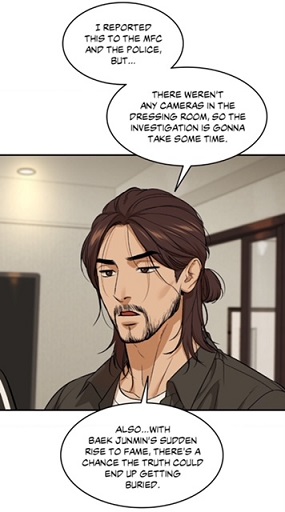 (chapter 52) Park Namwook never tried to correct this negative reflection, for this is how the manager perceives the man himself. He is an ill-mannered child. This explicates why Park Namwook could slap the patient in his bed. So we should judge the argument between the fighter and his manager
 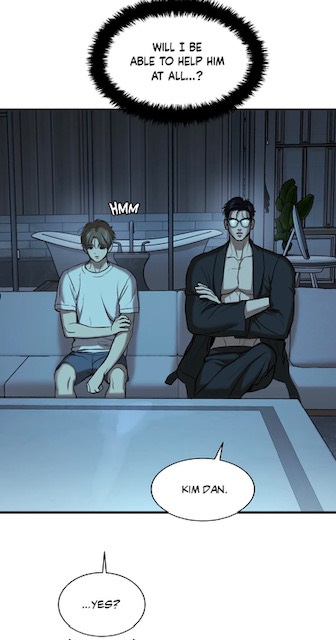 (chapter 29) He is not standing next to the main lead, but he is facing him. He is like an opponent. Another divergence is that Kim Dan was alone, whereas Park Namwook utilizes Potato and the others from Team Black to corner Joo Jaekyung. The doctor was willing to listen to him, whereas the other gets upset, when the other admits his suffering. Since the gym is facing a crisis, the patient should find a solution to the problem.
  (chapter 52) that he regretted his decision and outburst. By admitting his mistake, he would have become responsible for the whole mess. Funny is that he asked compassion from Joo Jaekyung, whereas he showed none to the patient. And what was Kim Dan thinking during that night?
 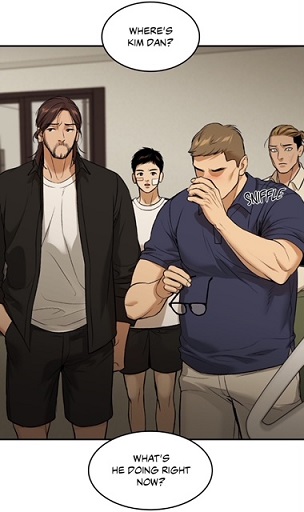 (chapter 52) resembles a lot to the image with the opponents.
 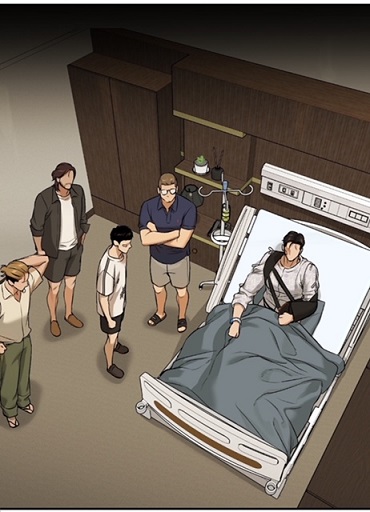 (chapter 52) For the first time, the champion is no longer looking at his cellphone. He shared his thoughts to others and exposed his powerlessness
 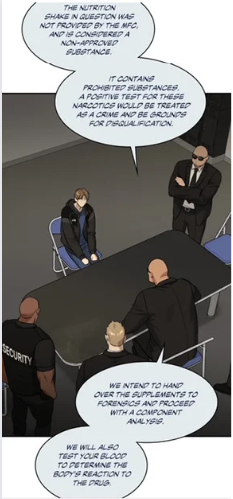 (chapter 40) These two situations have many similarities. Both were confronted with an accusation, they were surrounded by people, who were acting as righteous and honest workers. Both were coerced to admit a wrongdoing. In addition, they are actually abandoned by Team Black members, especially the manager. No one is looking for them out of concern. The reality was that they were not their “true colleagues and even less friends. However, like mentioned in a previous essay, the men in black were actually covering up a crime in order to hide the corruption from the organization. This makes me truly wonder if Park Namwook is truly ignorant about MFC’s corruption. He could simply know about the crimes, but he chose to close an eye to the whole situation.
  (Chapter 46) He is already aware of the existence of illegal betting. Besides, since Joo Jaekyung is paying his taxes properly, Park Namwook could have the impression, he is doing nothing wrong. However, if he knows something and is remaining silent, he “becomes an accomplice” de facto. And what is the other common point with the interrogation from MFC security guards and the hospital visit? No lawyer and the incident was swayed under the rug.
  (chapter 40) He had rescued him. So by slapping the champion
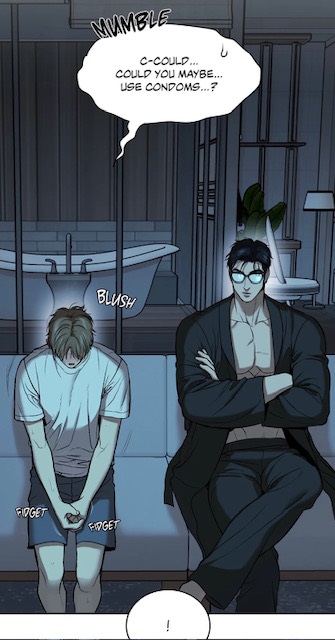 , (chapter 29), I deduce that the slap had the opposite effect than this wonderful night. The gap between the hyung and the athlete got bigger. This represents the moment where Joo Jaekyung is emancipating himself from the hyung’s influence. By refusing the letter of resignation, he clearly indicates that he is rejecting Park Namwook’s suggestion.
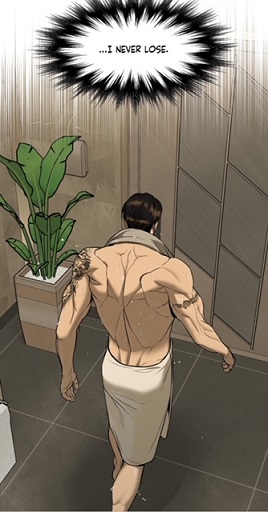 (chapter 49) He was no longer relying on the ritual.
  (chapter 19) Yes, we should see episode 53 as the negative reflection from chapter 19, the doctor’s arrival at the penthouse.
  (chapter 19)
  (chapter 21). By interacting with Kim Dan, he will be able to reconnect with his true self which will change him forever. Notice that after the night in the States, at no moment, the champion mentioned his jinx, but spoke about his physical health. In reality, he was including his mental health. This shows that he was already moving on from his jinx. Moreover, after the tie and the suspension, he is not mentioning or thinking about his former belief. The reason is simple. Because of the doctor, the champion was allowed to perceive glimpses of the truth: corruption and the existence of tricks. This image
  (Chapter 44) So he was able to create good memories. Besides, he came to fall in love with Joo Jaekyung. Thanks to the latter, doc Dan could overcome his fear
  (chapter 26) and make others happy too.
 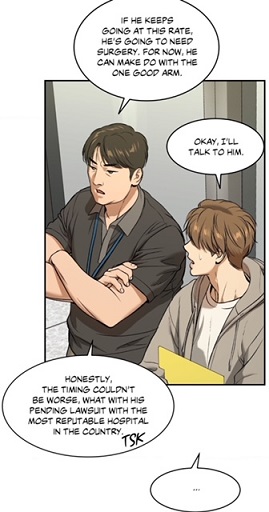 (chapter 42) This shows that his self-loathing is gradually vanishing as well. The fact that he is employing the personal pronoun “I” indicates that he is able now to distinguish himself from his grandmother.
  (chapter 35) He is still cheering the athlete on and even wishing him happiness. This exposes that the physical therapist discovered “happiness” through the celebrity. He is no longer believing in the athlete’s jinx.
 (Chapter 53) Here, I feel the need to remind my avid readers that though the doctor was victim of a trick, he was not entirely innocent either. He should have come clean with the champion concerning his meeting with the director from the rival gym. His lie still played a huge role in the champion’s mistrust. But why did he not tell him later? It is because he was under the influence of the manager.
  (chapter 48) The hyung had been his mentor and advisor. Thus he copied his actions and followed blindly his recommendations.
  (chapter 44) The intimacy is rather superficial, for it is limited to pleasure and sensuality. This has nothing to do with the partner’s personality. Secondly, during that night, the champion was drunk. In season 1, both protagonists only discovered physical closeness without sharing their thoughts and emotions
  (chapter 44) .
  (chapter 44) He never told the athlete that he was so cute or handsome. He kept his thoughts and happiness to himself. The only moment they shared real intimacy was this night:
  (chapter 29) Moreover, during that sex session, the athlete employed dirty talk.
  (chapter 29) It was not to express affection.
 (chapter 2) prostitution and rough sex. He never experienced true romance and the birth of “first love”. The courting and seduction were totally absent. His first kiss is connected to fighting, pain, survival and protection.
  (chapter 14) It had nothing to do with innocent and pure love. For me, Kim Dan didn’t have the time to fall in love with the champion properly. He could even say that his affection is related to his job and he could reduce it to mutual physical chemistry. Thus I deduce that he became a ghost again for one reason. Both need to experience the innocent first love. In other words, we should expect a new version of this magical night:
  (chapter 20) Till that moment, he lived like a ghost. He had been trying to deny the existence of his own body. And how did the athlete describe his lover in the bathroom? First, he compared him to a whore
 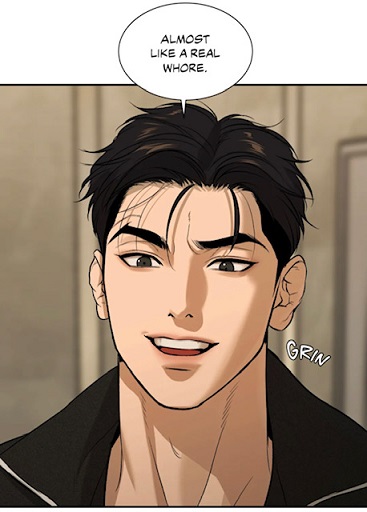 (chapter 19) before describing him as a baby.
  (chapter 20) However, we should expect a more pure version, where both act as innocent and inexperienced teenagers, similar gestures:
 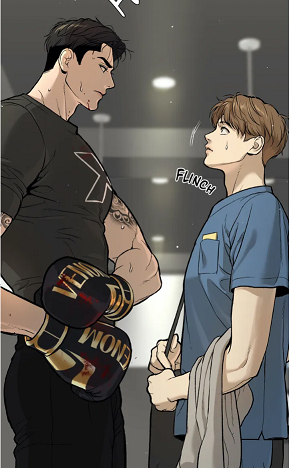 (chapter 1) He was so attracted to him physically, hence he didn’t pay attention to his partner’s personality. In fact, he had a negative perception of his nature:
  (chapter 1) By becoming a ghost, the champion is forced to perceive the main lead as a person and as such to pay attention to his personality (dislikes, likes, qualities, career). That’s the reason why I believe that in season 2, he won’t make the same mistake again. He will study the doctor and get to know him better. That’s how he will be able to identify his feelings for the protagonist. He doesn’t love him because of his cute face and body, but because of his big heart and warmth. He is so responsible, generous and dedicated that there’s no one else like him. He embodies true kindness and loyalty. His care and worries are genuine. That’s why the champion will voice his affection differently from the past: “Secret and innocent love behind work”. Under this new light, it becomes comprehensible why both characters had to go to the seascape. Nature is the perfect place to nurture innocent and pure love. Consequently, I don’t think, the author will rush to create a new chapter full of sex… rather full of tenderness and caresses! Thus Mingwa created such panels:
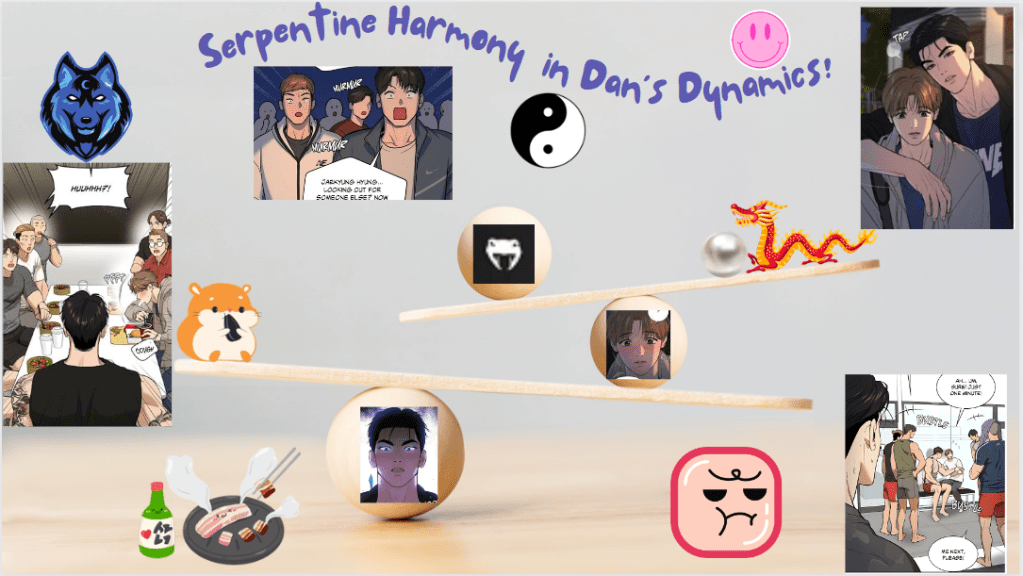
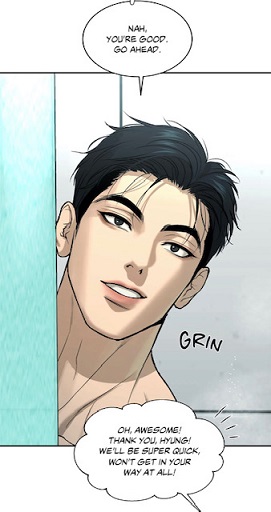 (chapter 8) Secondly, in the analysis “
 (chapter 43) As a conclusion, the physical therapist embodies “sharing” which is strongly connected to eating. Furthermore, the symbol for giving is the hand which fits Heesung’s description about Kim Dan: “Magic Touch”.
  (chapter 31). It is important to recall that the artist came to discover the angel, for the latter offered his assistance unrequested.
 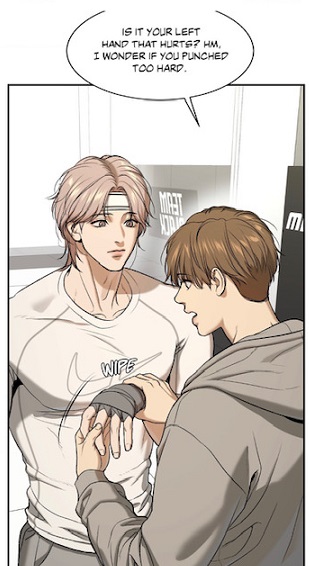 (chapter 30) As a conclusion, Joo Jaekyung is taught how to share through the doctor. This means that at some point, the champion will realize that he has to share the main lead too, if he wants to become truly happy. How so?
 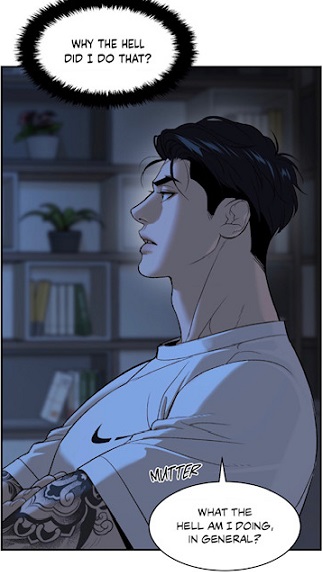 (chapter 35) This scene represents the first step of the athlete’s meditation. Interesting is that this self-reflection got interrupted by the text from the journalist. Consequently, the athlete’s old habits resurfaced. Thus the athlete began neglecting the doctor again. Additionally, identifying jealousy and its cause means that emotional intelligence is necessary. However, Joo Jaekyung possesses a low EI… yes, he really has the mind-set of a baby.
 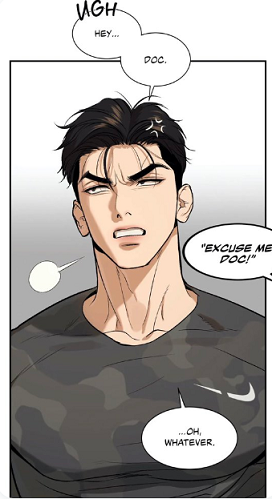 (chapter 7), self-centeredness, poor social skills
  (chapter 43), low empathy, how he is blaming others. Thus I come to the conclusion that one of the doctor’s role is to encourage the celebrity to develop empathy, as the latter is necessary for a high EM. The other task is to let him experience mistakes and learn from them. Like mentioned in the previous essay, Joo Jaekyung is Mister Perfect and Kim Dan Mister Mistake. Through the mistakes, the athlete is experiencing the positive side of errors. This brings me naturally back to “sharing” which is also a synonym for compassion and love.
  (chapter 34) He was presented as a hindrance to the artist’s happiness.
  (chapter 34)
  (chapter 7) He didn’t know Kim Dan at all. Thus he utilized the contract as reminder
  (chapter 8), as he felt that he had no other tool to keep his partner by his side. In addition, in order to control his jealousy, he always employed the same method: SEX!!
  (chapter 34) Consequently, as long as Joo Jaekyung could not control his possessiveness and jealousy, he was shooting himself in the foot. Which corresponds to the metaphor with too much salt in the food. Mingwa gave us many examples for this situation. When the champion became jealous in episode 7, he forced the physical therapist to have sex with him. Thus his karma was to be perceived as a man obsessed with sex. Then, in episode 9, he provoked Kim Dan with the drink.
  (chapter 9) It was, as if he wanted to steal the show from the physical therapist. His punishment was to take care of the physical therapist, but the latter never witnessed his caring side due to his high intoxication. When he challenged the comedian
 (chapter 37) giving the impression that he was resenting Kim Dan the most. However, in reality, he was jealous of Oh Daehyun and Potato, for the latter were having a good time with his lover, while he was left alone in his bedroom. While they were happily laughing with Kim Dan, he was totally excluded.
  (chapter 37) He was envious that they were the source of Kim Dan’s happiness, whereas he was not. Finally, when the athlete confronted them, the doctor sided with them.
  (chapter 37) In other words, sharing happiness is triggering his jealousy.
 (chapter 22) Each time, the star put an end to this happy mood. In the break room, Joo Jaekyung threatened them, because he considered their suggestions as a threat. Their comments imply that he would have to share Kim Dan, if they came to the penthouse. It looks like the celebrity is in reality jealous of happy people. It was, as if he was going after “happiness and rest”. Therefore it is not surprising that he accepted the next fight.
 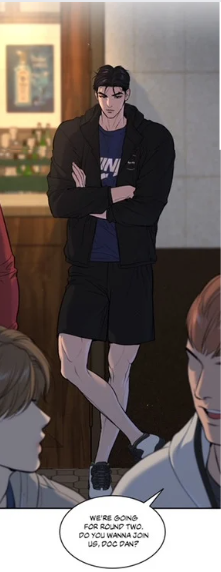 (chapter 43) His gaze was betraying him. Though he was the star of the evening, the fighters didn’t invite him to the second round. Yet, he didn’t mind, until he heard them asking the physical therapist. But contrary to the past, episode 7 and 37, Joo Jaekyung acted more gently.
 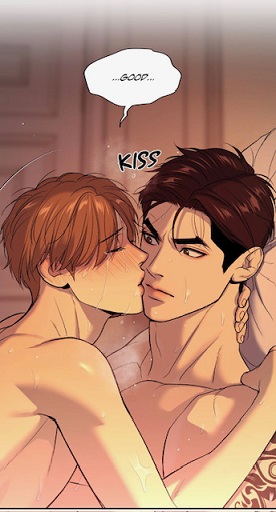 (chapter 39) Consequently, I could observe that the athlete is gradually capable to manage his jealousy, the longer he is living with the main lead. Simultaneously, I believe that the recent transformation of the physical therapist (exhaustion, skipping dinners) incited Joo Jaekyung to observe his lover and meditate.
  (chapter 43) However, I would like to outline that in this scene, he didn’t feel jealous, as Kim Dan was excluded. Hence he had no reason to claim the doctor as his. As you can see, the star’s jealousy was the trigger to change his behavior in front of the members. Thus I come to the deduction that we were witnessing the positive aspect of “jealousy”. He was not questioning the doctor’s integrity and trust. Therefore it is no coincidence that contrary to episode 7, 9, 22 and 37, he didn’t look grumpy, when he stated that Doc Dan is coming with him.
  (chapter 37) I could also include the scene with the new jacket.
  (chapter 36) When the sportsmen were all fighting against each other to give their new cloth to Kim Dan, the champion intervened by throwing his jacket to Kim Dan. He was not smiling at all. In fact, he gave the impression that Kim Dan was causing trouble.
  (chapter 36) At no moment, Oh Daehyun and the others could detect the main lead’s jealousy. That’s how it dawned on me why Kim Dan was not informed about the surprise birthday party.
  (chapter 43) He was as astonished as Joo Jaekyung. I deduce that they desired to protect him, in case the celebrity would react so negatively.
  (chapter 43) Since the athlete had been so impolite and rude towards the doctor in front of Oh Daehyun and the other members on so many occasions (7, 9,
  11, 36, 37), they imagined that Joo Jaekyung was treating him the same way than them: if he was not rough, then he was indifferent.
  (chapter 22) When he announced to the staff that Kim Dan was cooking for him, his facial expression and words are indicating that this is no big deal! He was not smiling and voicing his admiration for doc Dan. He created the illusion that the physical therapist was just living at the penthouse for the celebrity’s comfort. It was to do his job and nothing more. But this was only partially true. That’s the reason why I come to the assumption that this miracle in episode 43 will change the dynamics at the gym. Kim Changmin, Oh Daehyun and the others know now that the celebrity not only cares for the doctor, but also has become his friend. Thus they could seek Kim Dan’s closeness in order to get his advices and assistance.
 (chapter 43) So he never took the doctor’s choice into consideration. Although Joo Jaekyung is no longer dragging the doctor like in the beginning of the story, he is not truly respecting Kim Dan’s decisions. But how did this rivalry between Joo Jaekyung and his team start?
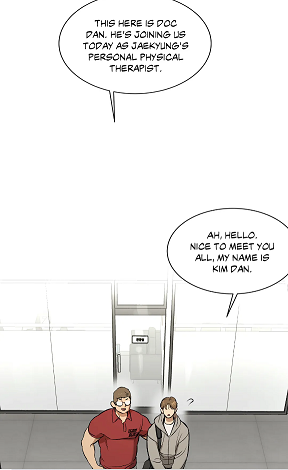 (chapter 7) He occupies a special position, for he is only working for the alpha as doctor. But note that doc Dan crossed the line, the moment he started taking care of Kim Changmin’s problematic shoulder.
  (chapter 7) By treating him, he acted, as if he was the physical therapist of Team Black. Secondly, observe how he got introduced to Team Black.
  (chapter 7) Thus I deduce that Kim Dan still needs to find his own place at the gym. This can only generate tension. Moreover, it dawned on me, neither the champion nor coach Jeon Yosep nor Park Namwook recognized the consequences of his arrival at the gym.
 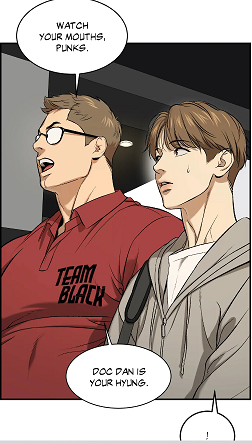 (chapter 7) First, they made the mistake not to bring Kim Dan to Busan.
  (chapter 36) After that event, they learned their lesson. However, note that the champion refused that the physical therapist would follow Oh Daehyun and the others to their fight.
  (chapter 23) On the one hand, he was reminding his companion that he was only working for him, on the other hand, the uniform and the treatment from the members were giving the impression that he was also part of Team Black.
  (chapter 23) That’s how he discovered the ritual with high five!! This is something he could share with his lover! By using this gesture, they would not only become closer, but the gap between the fighters and Joo Jaekyung would be reduced. On the other hand, by hindering Kim Dan to follow the group, Joo Jaekyung was hindering the main lead to do his job. This shows as well that they are slowly developing a new routine, but it is not fully deployed. The doctor is bringing the real changes due to his special but unclear position.
 (chapter 36). Moreover, by mopping the floor, he acted like an errand boy, as if he was the lowest member. I doubt that he got consulted for the next fight too.
 (chapter 31)
 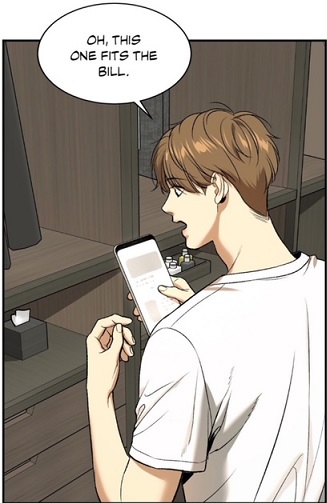 (chapter 42) and didn’t look for new patients. He needs a role model as entrepreneur and doctor. In my eyes, that’s where Cheolmin comes in. The latter should become Kim Dan’s mentor. Moreover, I would like to outline that by intervening in the doctor’s life and career, the champion was blurring more and more the boundary between private life and profession.
 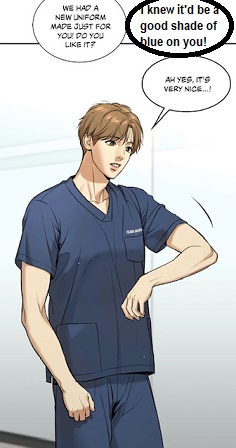 (chapter 9) and the welcome elixir.
  (chapter 9). But like pointed out above, he is actually just his private physical therapist. For Kim Dan, the famous athlete is just a VIP client.
  (chapter 25) It is relevant, because the doctor is not technically involved with the other members. He is attached to them, because they are very nice to him.
 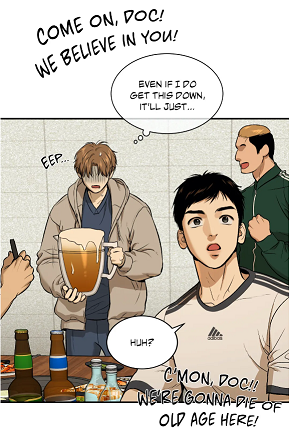 (chapter 9) There exists no contract between them either. Their relationship is simply based on the goodness from the characters. And now, you comprehend why the champion had to come to this welcome party. It is because he feared that the doctor would feel closer to them than to him. His money was already competing with the heart from the fighters. Is it a coincidence that the champion felt the need to remind them that he was the one paying for the party?
  (chapter 9) Funny is that for his birthday party, money was no longer rivaling with the fighters. Furthermore, he was joining the table for real.
  (chapter 43) To conclude, the causes for the tension between the alpha and his members are the undefine position and duties of Kim Dan.
  (chapter 13), Park Namwook and Oh Daehyun are representing the other extreme: junk food (too salty, greasy, too much sugar)
  (chapter 22)
  (chapter 26) It helped them to become closer. Striking is that none of the boxers noticed the true meaning of this sparring.
  (chapter 26) The members didn’t recognize how gentle the celebrity was towards his partner, therefore Park Namwook imagined that Kim Dan had been coerced to spare and the punch was the expression from anger and frustration against the alpha. Thus he came to misjudge the situation. That’s how Kim Dan got excluded from the ring. And this observation brings me to the following conclusion. Till episode 43, none of the fighters realized that Kim Dan was receiving a special treatment from Joo Jaekyung. They were totally oblivious of the truth, even during this incident!
  (chapter 29) A puppy needs care and protection!!
 (chapter 23) In addition, I would like to outline that Potato had been favored by his hyungs
 (chapter 22), because the latter was somehow neglected by the champion. They were compensating for the lack of interest from the captain. Interesting is that no one was missing Potato during that day and party except the readers. Why? It is because little by little, his adoration for the champion is vanishing. He is starting to have a life on his own. It is important, because Kim Dan could receive now more attention from the members than before, especially because he is receiving the good grace from his boss. Don’t forget that Park Namwook never protected them from his bad mood.
  (chapter 36) He could become their speaker, their lawyer… a new version from this scene:
  (chapter 36) or he was sitting in the office. It is not surprising that he kept his distance at the hotel, when the champion was taking his meal.
  (chapter 37) But it started changing, after the athlete declared him as a part of his team.
  (chapter 43) before his intervention with the MFC security guys. Hence I believe that this statement and embrace
  (chapter 11), he chose to close an eye to this. Thus he remained passive.
  (chapter 43) Though the doctor’s hands had been bleeding, Kim Dan chose to treat his patient first before taking care of his own wounds. His selflessness could only catch Joo Jaekyung’s notice. Doc Dan’s benevolence can only make him realize that fame can never be a source of joy and adoration is totally different from true love and warmth.

 (chapter 1) He was even called a psychopath, for he resorted to kidnapping
  (chapter 1) sequestration, threats
  (chapter 2) and blackmail and he initially showed no remorse.
 (chapter 7). On the other hand, he never got into trouble for his wrongdoings. Why? It is because he wasn’t violating social norms.
  (chapter 10) It was his right to punish servants, for they are not considered as humans but as propriety. As a lord, he could treat commoners, like it pleased him. Though murder is prohibited, even against a lowborn,
  (chapter 43), the reality is that nobles would never get into trouble!! As you can see, there exists a discrepancy between laws on the paper and the reality which was exposed by the rumors in episode 106.
  (chapter 107) The fathers would use their position and influence in order to cover up their children’s wrongdoings. And we have the perfect illustration, when the elder master bribes the governor.
  (chapter 127) That’s the reason why the younger generation could do everything! Though the lord appeared as a monster first, he became a “normality”, the more we got to read this story. Under this explication, it becomes comprehensible why lord Min was so sure not to get bothered by the authorities.
 (Chapter 101) He had bought the officers (“the guards”). This explains why Black Heart could threaten No-Name.
  (chapter 76) He didn’t need to dirty his own hands, he could simply frame him. Consequently, I deduce that he had learned this misconduct through the elders’ behavior.
  (chapter 116) This shows that neither Black Heart’s father nor Yoon Chang-Hyeon truly love their children, as according to Erich Fromm, love is knowledge, respect, care and responsibility. However, the elder master Yoon is totally ignorant about his son’s talents and good nature. Thereby, I see lord Seungho from season 1 as the perfect illustration of the corrupted world of the nobility. The monster “Yoon Seungho” was just a reflection from this ruthless and immoral society. Since he committed wrongdoings, his karma was to pay for his sins. It starts with a murder, and the main lead ended up killing people. He might have not broken “traditions” like the disregard of the yangbans against lowborns, but it is considered immoral. He had sinned and now, he is paying for his sins. Therefore his words in the prison resonate differently.
 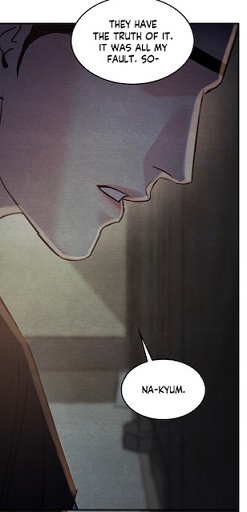 (chapter 126) He expresses regret. He confesses his crimes, he killed people! This means that he is now siding with the lowborns. Their life is as precious as the ones from the nobility. Yet, note that in this image, the author didn’t drew his eyes. Why? It is because in the moment he executed people,
 (chapter 102) he was either not himself or he did it out of reflex to protect himself. He was influenced by his past experiences and as such traumas. In the shrine, it becomes more obvious, for he has a lost gaze. He is not even looking at his target. Finally, when he met lord Song, he did it to “protect” himself.
 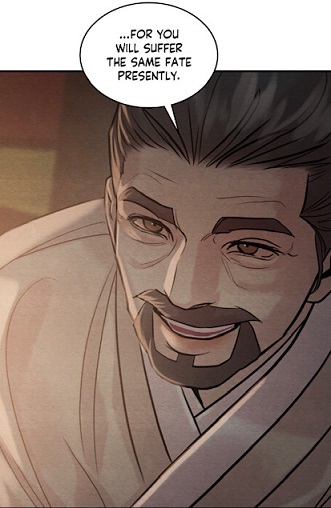 (chapter 123) For me, in episode 1, the execution was triggered by his desire to protect himself and his traumas. And what is the common denominator between these three scenes? The father Yoon Chang-Hyeon! Don’t forget that the petition was the reason for their meeting. And now look at the actions from the patriarch.
 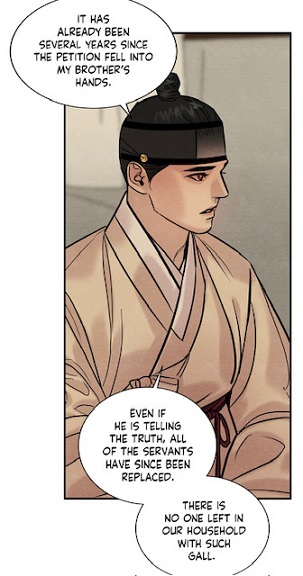 (chapter 116) He had given the order to eliminate all the servants, for they could represent a threat to his “treason”. This explains why the butler describes himself as the only survivor and witness.
  (chapter 86) And we see him giving the order to kill the surviving guard
  (chapter 125) Besides, he had no problem to order the assassination of his own son which was stopped by the intervention of a helping hand. The father had never asked to spare the main lead’s life.
  (chapter 124). He was his bad role model. But he is not the only one. There is another one…
  (chapter 51) Once a criminal, always a criminal… therefore it is not surprising that the joker chose assassination as second work. By working for the nobles, he would be able to escape punishment, because if he got arrested, he could denunciate them. To conclude, justice is inexistent in Joseon. Yes, we are witnessing the downfall of Joseon, or precisely the king’s bad ruling. The latter is not capable of providing justice to anyone. And this coincides with the purge!
  (chapter 37) What is a purge?
  (chapter 107) “Stepping down” was actually an euphemism for removal. The officials were chased out,
  (chapter 80) but their evictions were turned into stepping down.
  (chapter 122) No wonder why lord Song came to resent the protagonist. Under this new light, it becomes comprehensible why the purge was not noticed by commoners. There was no fire and the staff was sparred.
  (chapter 103) The boots were the indication that this person was working for the government. And it was an elder, for he was wearing this particular headgear.
  (chapter 103)
  (chapter 67) The murder of lord Shin is the evidence of the anarchy in Joseon. But actually, the monsters are actually everywhere, and not just among the nobility. The Chungin with the scholar and the physicians who have no problem to lie, participate in a kidnapping and drugging people… the kisaengs, the maids, the servants. They are all accomplices, for they feigned ignorance or chose to remain passive, for they preferred avoiding trouble. What people failed to realize is that no one is safe from this tyranny. Hence people could get killed and thrown into a well so easily
  (chapter 97)
  (chapter 101) and their perpetrators got scot-free. Why? It is because the mastermind and the helping hands are protecting each other, like we could see in the Joker’s case. However, the latter in season 3 had no idea that they would face divine retribution and pay with their life.
  (chapter 102) In front of gods, humans are all equal. There is no distinction between gentry, Chungin and commoners. That’s the reason why I come to the conclusion that Yoon Seungho is the divine hand of justice, he is bringing the “divine retribution”. This explicates this vision:
  (chapter 83) Under this new approach, it becomes comprehensible why he is called “the bird of misfortune”. People around him got to suffer, for they received their karma. Funny is that lord Song mocked him by calling him a grim reaper.
  (chapter 123) He underestimated his opponent, not imagining that the latter would use his sword against him. So he became a grim reaper. Lord Song Haseon must have thought that his minions, just like his age and status, would protect him. But no, someone had planned his death and counted on the main lead’s decision.
 (chapter 99) Thus Min’s karma was to die in the total indifference of others. No one is missing him, for he was turned into a brigand himself.
  (chapter 113) But wait… Why did Black Heart get killed in the end? One might say that it was his karma, for he had planned the murder of Baek Na-Kyum in the past. In my opinion, the uke serves as a representative of the divine retribution. The artist is the “judge” and his lover is executing the sentence: death. And we can detect this gods’ intervention through the learned sir’s case as well. Jung In-Hun had looked down on the artist for his origins and education. When the generous main lead chose to accept his apology (attempted rape),
  (chapter 120), the latter reminded him that contrary to Yoon Seungho, he was admired. He had such a good notoriety! Since he betrayed the artist and had almost him killed, the scholar ended up losing everything.
  (chapter 127) He became the scapegoat for this incident, for he played a huge role in the painter’s suffering (kidnapping, assault, murder and brainwashing). His success at the civil service examination was erased within a few weeks and now he is viewed as a brigand. How could such a person get selected as an official? His fate gives a bad impression of the civil service examination. And what is the common denominator between these two villains? They both belong to different social classes. Their cases is exposing the king’s negligence and arbitrariness. The latter is the perfect personification of this corruption. Not even Confucianism is respected, for fathers are abusing their own children or even killing them. Season 4 is exposing the chaos in Joseon. Therefore it is not surprising that the sacred tree and the shrine got burned.
  (chapter 106) The gods were using the humans to voice their anger. At the same time, when the woman made this comment, the Manhwa lovers can detect the huge gate in the background, the symbol for royalty. And now, you comprehend why Yoon Seungho was pushed to go to Hanyang. It is his fate to face the king! His task is to clean the palace of these old bearded men.
  (chapter 44) I had already portrayed him as a black shaman in the essay “
 (chapter 65) Don’t forget that the monarch is the only one who stands above the laws, though he is controlled by social norms and his officials. In my opinion, this can only take place, when a new scheme takes place. How so? Note that in the scholar’s case, Jung In-Hun received his karma, but not real human justice. For me, he is not dead. Besides, don’t forget that someone took the petition from lord Song, before Yoon Chang-Hyeon came to the bloody place. There is no ambiguity that the accomplices and schemers didn’t get happy with the last outcome. The couple might be separated physically, but they are attached to each other by their strong love. And since the main lead kept wearing hanboks with the phoenix
 (chapter 34)
  (chapter 45), it indicates that someone saw him as his bird of fortune. And this can not be Yoon Seungho, for the latter was full of self-hatred. Finally, his own father, Kim and Heena called him as a bird of misfortune. As you can see, the king could no longer see the main lead due to the artist’s presence. He is his bird of fortune, for he could live out all his dreams thanks to him, and at no moment he got into trouble. No one is suspecting his intervention.
  (chapter 127) I recognized why the painter and Yoon Seungho had to go separated ways. It is because the schemers wanted him to return to Hanyang. Remember the learned sir’s suggestion before his departure.
  (chapter 44) Why? It is because now the main lead is an adult. Since my theory is that the pedophile is the ruler, he can no longer approach the protagonist like that. The latter is no longer visiting the gibang. He wants their path to cross again so that they can rekindle. Hence he had to create an opportunity proving that their meeting is not a coincidence. Under this new approach, it becomes comprehensible why Yoon Seungwon encouraged his brother to reconcile with their father.
  (chapter 37) That way, he would be “following” the tradition and become an official. But since Yoon Seungho developed a fear of “old bearded men”, he had no reason to go there.
  (chapter 46)
  (chapter 68)
  (chapter 97)
  (chapter 111)
  (chapter 120)
 (chapter 127) As you can see, the painter was feverish. Why? From my perspective, he was drugged. He was not allowed to see his loved one, because they don’t want him to remember their departure. The schemers desire him to feel abandoned like in the gibang (chapter 105). The reason why I am suspecting a drug is that this panel
  (chapter 127) is similar to the first Wedding Night:
  (chapter 21) At the same time, this scene is also a reflection from the night after the massacre in the shrine.
  (chapter 103) Back then, he was also under the influence of an aphrodisiac. They don’t want him to remember his last words. And since he didn’t take care of him during that night, though he was unwell, they hope to create the illusion that Yoon Seungho neglected him. He broke his promise. But their trick can no longer work because of the lord’s visitation in the prison and his words.
  (chapter 126)
  (chapter 127) The separation arc is there to prove these plotters wrong. Their affection is not trivial and momentary. He is not a plaything, but his “partner”. In fact, they have absolute trust in each other, and their source of strength will be their short happy moments together. Besides, I am quite certain that the artist will remember the lord’s whisper from that night, since he had problems to recall the First wedding Night and the incident in the shrine. Both are related to his bad conscience. Besides, I have another reason for that, the power of the unconscious knowledge.
 (Chapter 108) Though both were close physically, they still allowed others to manipulate them, for their trust was not complete. In other words, the schemers are thinking that time is working for them!! On the other hand, since Kim is by his side, the painter can only consider his presence as the evidence of the lord’s care.
  (Chapter 127) This coincides with the beginning of the Manhwa, when the lord was seen without his butler.
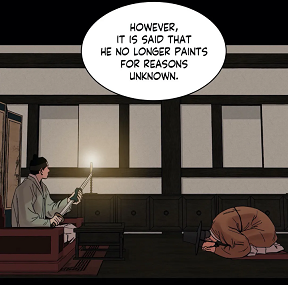 (Chapter 1) The latter only appeared in episode 7, and back then Yoon Seungho had to dress himself.
  (Chapter 7) Finally, I am expecting schemes again.
 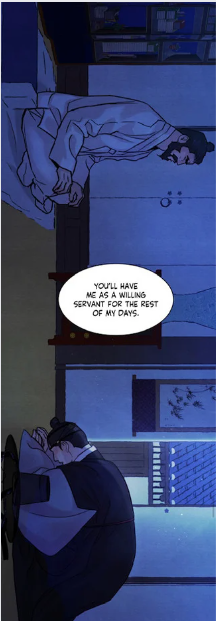 (chapter 127) This means that he is giving up on his status and freedom for Baek Na-Kyum’s sake.
 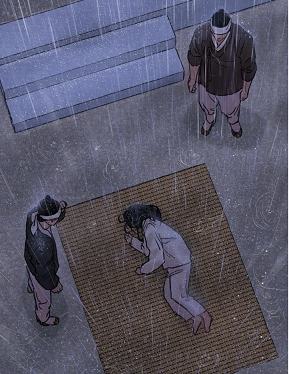 (chapter 127) Here Yoon Seungho had been treated like a servant, because he had been submitted to the straw mat beating. Exactly like in the past, there was a promise. Notice how similar the words are: “No matter”.
 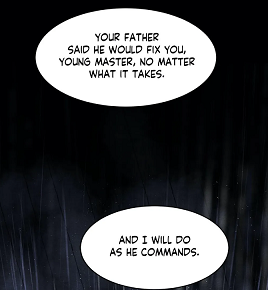 (chapter 77) However, there exists a huge difference. Back then, the vow was made between the butler Kim and Yoon Chang-Hyeon. As you can see, Yoon Seungho is now copying his surrogate father’s behavior.
  (chapter 127) This shows that the young master is following Kim’s path. On the other hand, the domestic employed the future tense in his pledge (“I will do as he commands”), whereas the “spiritual son” is using the present (“I swear to live as you command”). Moreover, the main lead is talking about his way of life and not “order”. And what does the father desire?
  (Chapter 86) Making connections so that the Yoons can become influential again!! But how can he do that? By showing his talent? I have my doubts about it. Why? It is because in season 1, the lord was having sex with his peers, and back then they were like battles… for an exchange of favors. I hope, I might be wrong, but I fear that he is about to become a male kisaeng again. Or if not, then this is what the king is expecting from him. And we have the best example in this scene:
  (chapter 118) Why does he need the protagonist? It is because he needs “connections”. And how can he get these connections? Through his brother. But with the last incident, it looks like Yoon Seungwon jeopardized the remains of his influence, for the noble ignored him.
  (chapter 127)
 (Chapter 56) Yet, the domestic is only bowing with his head and not his body. The protagonist is dressed exactly like his father. This comparison exposes that my past interpretation was correct: the butler had awakened his master during the night by lighting the candles. And after receiving this letter, Yoon Seungho dressed himself in order to meet his childhood friend, which reinforces my theory that the valet won’t follow the protagonist.
  (chapter 86) However, back then, he was considered as the eldest son. One of his duties was to continue the lineage
  (chapter 82) and because of the stolen kiss, the patriarch became obsessed with sexuality. Observe how lord Song Haseon described the father’s attitude. He knew about the atrocities that the young master was exposed to
  (chapter 123), but he chose to turn a blind eye, for he believed that the end justifies the means. This explicates why he left the room so quickly and abandoned his son. Yoon Chang-Hyeon’s resent for the eldest son came from his high expectations. This can only reinforce my past interpretation that Yoon Seungho is a new version of Prince Sado. Thus the elder master Yoon’s personality is based on king Yeongjo. Moreover, lord Song alluded to the execution of a prince ordered by the monarch.
  (chapter 107)
  (chapter 55) But what did he see in his father’s gaze? Anger and disappointment, for he was never able to satisfy Yoon Chang-Hyeon’s expectations.
  (chapter 55) With the release of episode 127, I had this sudden revelation concerning this memory. In the past, I used to think that he had been submitted to the straw mat beating. But now, I think that in this scene, Yoon Seungho was forced to bow to his father by the servants or guards!! Yes, the former version of this scene.
  (chapter 126) This idea came to my mind, the moment Yoon Seungho emphasized his bowing!
 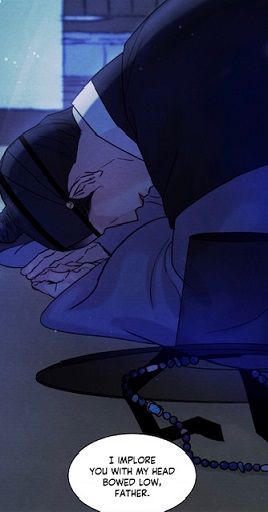 (chapter 127) The protagonist’s words imply that he had never done it before!! And now, you know why Yoon Chang-Hyeon agreed to make a deal with his eldest son.
 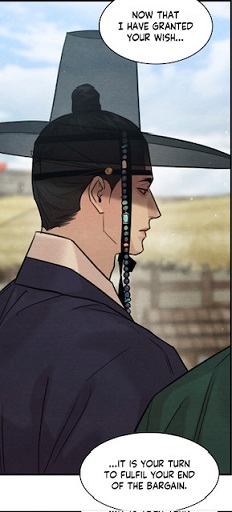 (chapter 127) Yoon Seungho’s bow and oath stand for blind obedience and loyalty. This explicates why the author drew him without eyes.
  (chapter 87) That way, he can act, as if the purge and the humiliation had never happened. So by submitting himself to his father’s will, it looks like Yoon Seungho is put in the same position than in the past. He is “exposed” to the harsh judgement from the patriarch. However, it is just an illusion. How so? First, what caught my attention is the absence of the protagonist’s eye.
 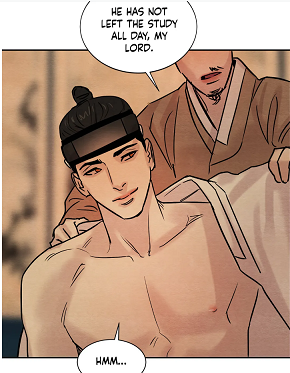 (chapter 11)
  (chapter 35) Does it signify that the protagonist has the intention of betraying his own father? I don’t think so, but the manhwaphiles shouldn’t forget the lord’s wish in the kitchen: “I shall remember this moment for as long as I live”.
  (chapter 118) This shows that when the lord bowed to his father, he was thinking of Baek Na-Kyum in the kitchen. His body might be by his father, but his mind and heart were elsewhere. Thus I couldn’t help myself thinking that Yoon Chang-Hyeon will get betrayed and abandoned by his own son. During the same night, he made 2 vows. It was, as though he had two “lords”! His goal is to meet his loved one again.
  (Chapter 127) Finally, don’t forget that the main lead is following Kim’s path. He will have to choose between his father and the painter. Yoon Seungho is actually applying the father’s principle: the end justifies the means. So if necessary, he can break his vow to his father.
 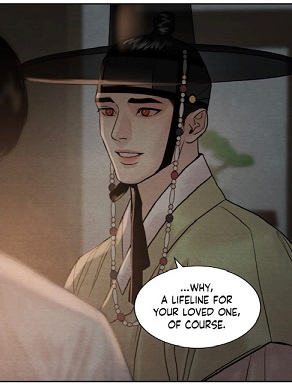 (chapter 116) I still believe that the painter has the original petition. And who is by Baek Na-Kyum’s side? Kim!!
  (Chapter 108) By living by his side, he can lead a quiet life far away from Hanyang. However, this signifies that the artist has become a “prisoner”. As long as he lives in Yoon Chang-Hyeon’s claws, his loved one can not return to his side. Interesting is that a carriage was used to carry away the protagonist.
  (Chapter 78) But where is the painter going? To the mansion? Or to another secluded place? In my eyes, the location is important. His existence is still a source of problems for the schemers. I see a future conflict in the lord’s life, for one oath stands in opposition to the other. Moreover, should the patriarch lose Baek Na-Kyum, he can no longer control his son. He can not suddenly blame the painter for the death of lord Song, for Jung In-Hun has been now convicted for the crime.
  (Chapter 7) Now, the positions are switched. He is the one getting coerced! And this brings me to the following observation. Why did the elder master agree to this deal in the end? First, he refused to assist his son.
 (chapter 127) He believes that he has the petition, therefore he can no longer be blackmailed by his eldest son. The latter has no longer any leverage over him! However, he changed his mind.
  (chapter 127) For me, it is related to the bow. I noticed that the patriarch pays a lot of attention to “manners” and etiquette. Therefore the guards apologized on different occasions, yet the elder master always accepted their excuses
  (chapter 125)
  (chapter 126) Yet, in reality they were fake excuses. I have already pointed out that the servants would act on their own. But more importantly, their fake apology hid their failure as guards. How could they let the young master barge into the lord’s bedchamber? With a simple apology, this wrongdoing was overlooked. And now, observe what happened during the same night:
  (chapter 127) Yoon Seungho was followed by the guards! It looked like they were serving him. This scene reminded me of the officers’ appearance in front of the mansion.
  (chapter 94) This can only reinforce my theory that the main lead will turn against his father in the end. Keep in mind that there is a deal, so should the situation change (the painter’s desertion or the discovery of the second petition for example), the lord is no longer forced to keep his vow towards his father. Moreover, since Baek Na-Kyum got lied, “brainwashed”
 (chapter 125), “drugged” and slapped by Yoon Chang-Hyeon, he is destined to receive his karma through his son. And what was his dream?
  (chapter 125) and paid the governor
  (chapter 127), he could get into trouble for it was, as if he was admitting his responsibility.
 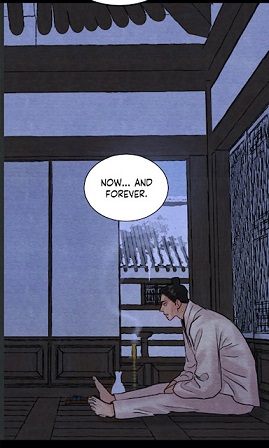 (chapter 87), whereas Yoon Seungho stands for change and hope.
 (chapter 127) Where was Heena noona, when her brother was in prison? This rumor can only create the illusion that the painter is still devoted to the learned sir. Yet, after the last incident, the painter came to regret to have trust the learned sir. Both characters are now healed from their traumas (abandonment issues) and they are in full possession of their mind. This makes them less weak to manipulations.
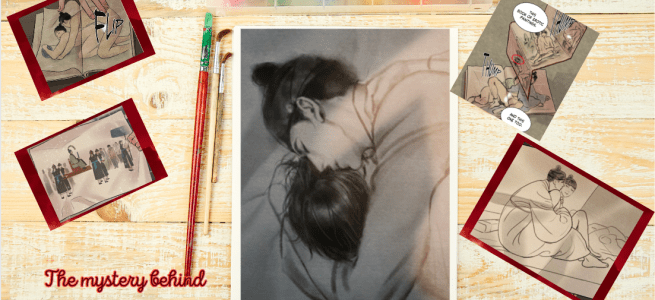


 (chapter 32), they got upset, for they found this wish too cruel and selfish. Why? It is because the dildo had triggered their memory.
 (Chapter 12) How could he give such a huge dildo to Kim Dan? However, it is important to remember that this story is sometimes told from the character’s perspective.
  (chapter 12) Like I had elaborated in a previous essay, in the last image, Joo Jaekyung’s phallus appeared so big, for this represented the doctor’s perception. Hence he compared it to a weapon. That’s the reason why I believe that
  (chapter 32), a character from BJ Alex who is promoting BDSM. However, the purpose of BDSM is not to be cruel or violent towards the partner. It is an act. The “pain” is supposed to bring pleasure. On the other hand, the first condition for BDSM is consent. And now, if you look at the situation in the car, you will realize that the car is still in the garage. Joo Jaekyung is not driving. This means that Kim Dan still has the power to refuse. He could leave the car. Besides, the gift is related to the champion’s service: he would bring him to Heesung’s house with his car.
  (chapter 32) As you can see, if the athlete is not giving him the ride, Kim Dan is not obliged to follow his request. Besides, contrary to episode 11, the physical therapist is not cornered. The loan was paid off and now, he is able to afford the hospital bills for his halmoni. To conclude, Kim Dan has the right and even the means to say NO! Nevertheless, Joo Jaekyung didn’t just buy a dildo, he even ordered a carton full of sex toys!!
  . (chapter 13)
  (chapter 27) But more importantly is that chapter 32 took place on a Saturday exactly like in episode 27-28-29!
  (chapter 32) Back then, the fighter had taken a day-off! The doctor had been tasked to keep the champion’s company. He was responsible for his day-off.
  (chapter 27) This signifies that back then, the gentle doctor had been “working”, entertaining his boss and client. However, what caught my attention is that during that Saturday, the author never leaked any information about the time.
  (chapter 27) Since the champion was drinking his glass of milk, it was in the morning, for it is his “breakfast”. But when did he drink it exactly? Moreover, how long did they play board games?
 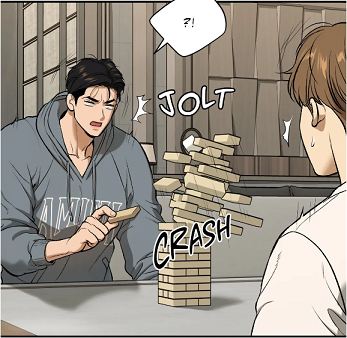 (chapter 27) When did Kim Dan fall asleep?
  (chapter 28) We could only determine the time due to the sunlight
  (chapter 27) or the night sky
  . (chapter 29). This stands in opposition to episode 32, where Mingwa created 3 panels with a time clock:

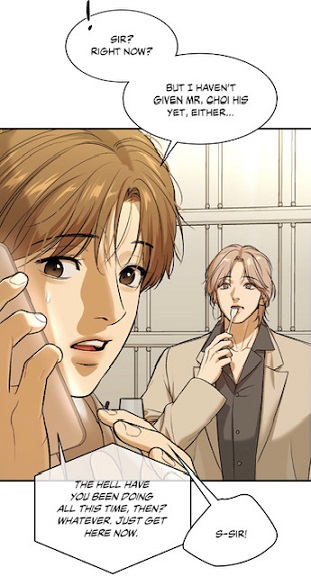 (chapter 32) My first assumption was that the actor and Kim Dan had spent 2 and half hours maximum together. I am counting minimum 30 minutes for the doctor’s return to the penthouse. On the other hand, observe what Choi Heesung said to the main lead. He had no problem to wait for one or two hours.
  (chapter 32) That’s the amount of time they had already spent together: around 2 hours. The final clue for this is the time Kim Dan spent on Joo Jaekyung’s treatment:
  (chapter 32) The athlete was drinking his glass of milk at 11.30 am!!
  (chapter 32) That’s quite late! Besides, don’t forget the athlete’s previous habit. He would often wake up the physical therapist because of his training.
 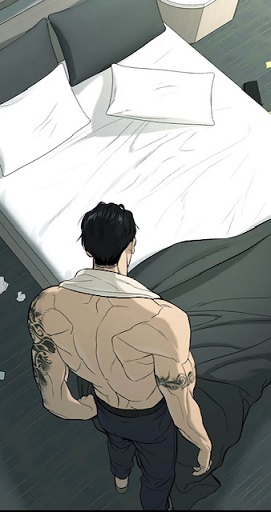 (chapter 4)
  (chapter 12) He changed his MO, the moment Kim Dan started living with him. Besides, on the first champion’s day-off, he waited for the physical therapist too.
  (chapter 27) It indicates that it is in the morning. The other evidence for this is the position of the sun in episode 32..
  (chapter 32) It stands on the opposite side. Moreover, since the sun is going around 4.30 pm,
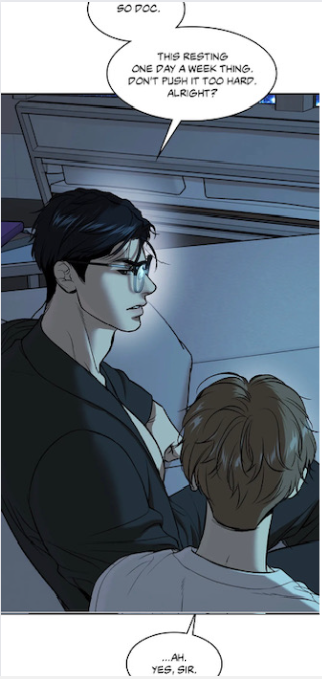 (chapter 29) He would never take a resting day a week! The doctor imagined that he would never change his resolve. But he was totally wrong! The champion couldn’t go to the gym, for he feared to lose the doctor! Yes, he was terribly annoyed and scared. Hence he was always turning his back to the protagonist. So the moment Kim Dan left the penthouse, Joo Jaekyung stayed home. This explains why he was “angry”.
  (chapter 27) Real shopping
  (chapter 32) versus online shopping.
 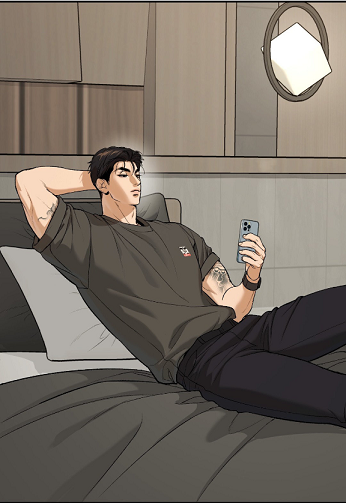 (chapter 32) Certain Manhwalovers were always wondering why the sportsman would often stare at his cellphone. The other evidence is that the champion used the cellphone to “buy” Kim Dan!
  (chapter 1)
  (chapter 32) The latter had remained silent, but his silence didn’t mean consent. But the problem is that he had been “silenced” by his blind “hyung” who judges people on impressions.
  (chapter 27) However, Joo Jaekyung only knows sex as a source of fun, which is a synonym for rest for him!
  (chapter 27)
  (chapter 32), we have to envision that the dragon was imagining his partner with a dildo! The moment I had this revelation, I couldn’t stop laughing. 😂 Consequently, the suggestion in the car appears in a different light:
  (chapter 11), he is not exposing his vulnerability. He definitely fears to lose the doctor, as there is no ambiguity that Choi Heesung snatched sex partners from the athlete in the past. But the fighter doesn’t want to share his lover to anyone. His hidden anger and fear are the reasons why he is manipulating the doctor in the sense that he is counting on his sense of responsibility.
  (chapter 32) Therefore the doctor would feel obliged to fulfill his wish. But like mentioned above, the doctor has the power to refuse. At the same time, the purpose of the sex toy is to procure pleasure to Kim Dan. In other words, it would help him to relax. It was, as if he would be taking a break… between two treatments. 😂 Finally, we shouldn’t overlook that after each sex session, the doctor was exhausted, hence he fell asleep. There exists a strong connection between sex and sleep, when it comes to Kim Dan. And Joo Jaekyung is probably counting on this. That way, he wouldn’t treat Choi Heesung properly. On the other hand, the fighter made the purchase and the suggestion for selfish reasons, whereas the doctor embodies selflessness.
 (chapter 32) First, the champion had deceived him by changing clothes!
  is displaying discomfort, yet he never complained. Then he got hit by the former wrestler.
  (chapter 32) We could say that he was doing justice to the main lead. Moreover, this whole situation must have stressed the sportsman mentally as well. Imagine how unfair all this was, for the actor was faking pain:
  (chapter 32) Finally, if he asks for sex from Kim Dan, he will divulge his manipulation to the doctor. But why didn’t he detect this cheap trick? It is because he trusted Heesung, Park Namwook and the manager.
 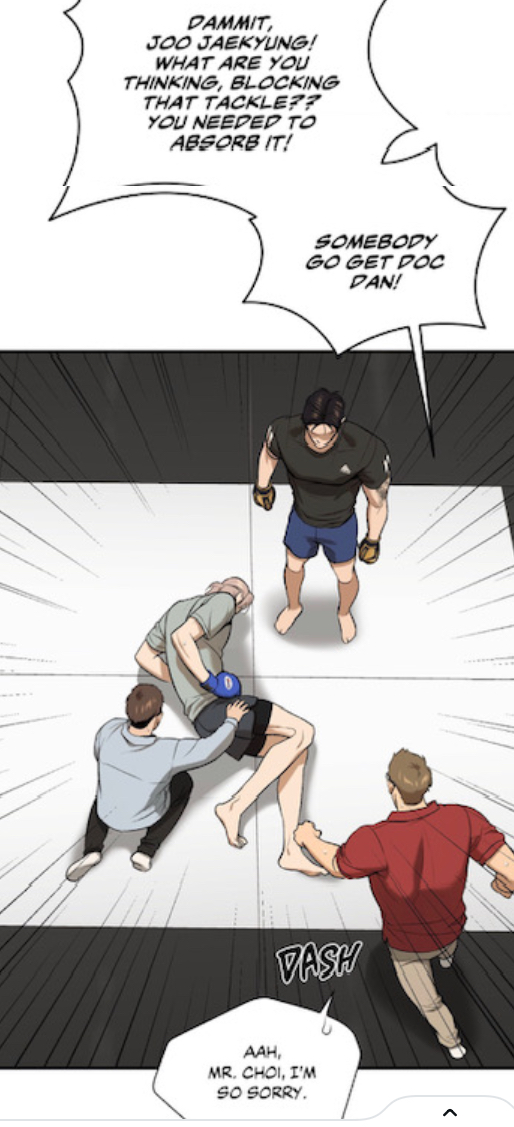 (chapter 31) He has been taught to never question people’s words and action. This means that Heesung’s trick will definitely backfire. Thus I come to the conclusion that from now on Joo Jaekyung will take a day-off on Saturdays!
 Bebebisous33s' analyses in K-Dramaland and Manhwas