Protected: Jinx /Doctor Frost: 💙Doctor 👨⚕️ Romantic❤️ 3

Bebebisous33s' analyses in K-Dramaland and Manhwas
Analyses of K-dramas and Manhwas (for the most part Yaoi)





Please support the authors by reading the manhwas on the official websites. This is where you can read the manhwa. https://www.lezhinus.com/en/comic/painter But be aware that this manhwa is a mature Yaoi, which means, it is about homosexuality with explicit scenes. If you want to read more essays, here is the link to the table of contents: https://bebebisous33analyses.wordpress.com/2020/07/04/table-of-contents-painter-of-the-night
It would be great if you could make some donations/sponsoring: Ko-fi.com/bebebisous33 That way, you can support me with “coffee” so that I have the energy to keep examining manhwas. Besides, I need to cover up the expenses for this blog.
As the illustration of this analysis is indicating it, the title of the essay is referring to the painter’s departure from the mansion in season 3. For you can anticipate it, I would like to expose my new discoveries before the release of chapter 103. Why? It is because that way, the readers can perceive the new chapter under a different perspective.
Since I recognized the importance of clothes in Painter Of The Night, I started paying more attention to the appearances. Striking is that in season 3, the schemers utilized hanboks and shirts to forge an identity. By wearing a yellow hanbok, Min attempted to impersonate Lee Jihwa 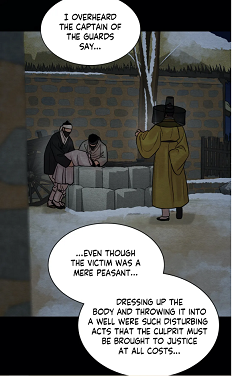 (chapter 101) so that he could put the blame on his “friend”. But the problem is that he was caught red-handed. Hence he ended up executed. On the other side, the corpse in the well was supposed to be Deok-Jae
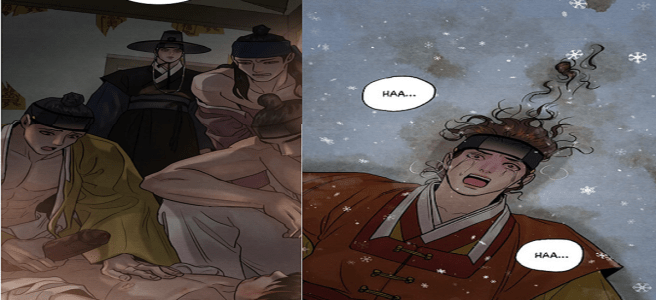
 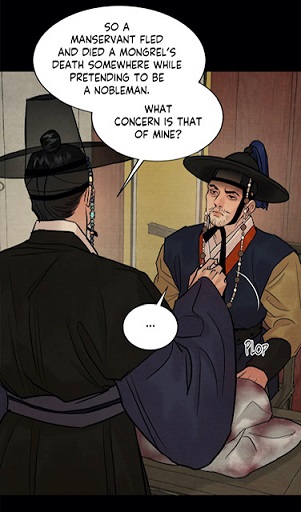 (chapter 98), although he was wearing clothes similar to the learned sir’s. What caught my attention is the expression Yoon Seungho employed: “pretending”. With such an idiom, he was implying that the servant had not only violated social norms, but also he had been acting. As you can sense, these two situations have one common denominator: playing a role and the clothes served as a disguise. It was, as if both victims of a murder had been playing in a theater play. This explicates why in the fanart, the author is portraying Baek Na-Kyum and Yoon Seungho as actors who are working in a sageuk.
 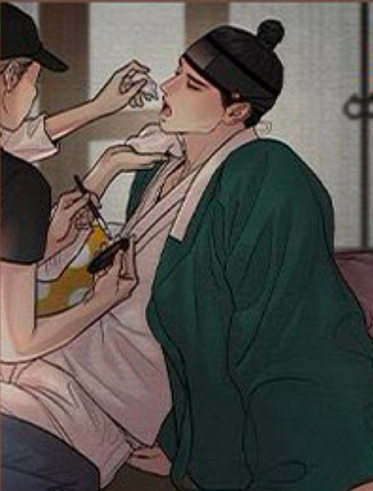 And this made me think of the famous poem from Shakespeare who describes life as a stage, where a person plays different roles all along his life: an infant, a school boy, a lover, a soldier, etc., until he dies, which is symbolized by an eternal sleep. https://youtu.be/_jaSFtcDEiE
Then I would like to point out that at no moment, the main lead saw the body himself. He was simply confronted with the clothes which resembled a lot to the scholar’s.  (chapter 98) Why? From my point of view, they were trying to scare the main lead, to remind him that he could never replace Jung In-Hun in the painter’s heart, to shake his belief. But the problem is that the schemers had missed the right timing, for the artist had already confessed his love for Yoon Seungho and this twice. Therefore the latter couldn’t doubt his lover’s words, and mistake it for an illusion. As a conclusion, the clothes were used tools to trick the couple, they had become costumes!! However, because the author is using karma as poetic justice, this signifies that the hanboks and shirts can serve as a clue to perceive the truth too. The ones who tried to deceive the protagonists with clothes and words, should be fooled by their own manipulations.
My avid readers will certainly recall the detected principles Byeonduck utilized to develop her story.
Naturally, you might be wondering how these rules are relevant to the clothes. But note that in episode 98, the lord wondered himself why the hanboks would look so similar to the learned sir’s! (chapter 98) This shows that the lord was able distinguish the real clothes from the imitation. He had not only a good memory, but his eyes were sensitive enough to detect the difference. But how is it about the readers? Did they notice that these maids  were different from the head-maid and her colleague?
  (chapter 94) Their clothes were almost identical, yet their body shapes and the cut of the shirts diverged. That’s the reason why I deduced that in episode 98, the author had the intention to manipulate the manhwaphiles. But in order to escape the trap, the readers needed to look carefully at the characters’ clothes. This was the clue that Byeonduck had left for the readers to discern the truth. And now, look at this:
 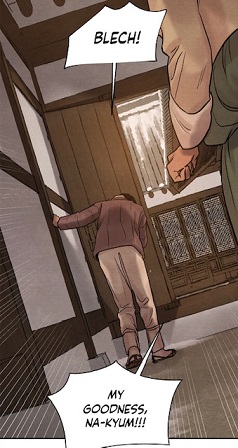 (chapter 98) What was the painter wearing on his way to the bedchamber? White pants with his Mountbatten pink jacket. But how did he show up at the learned sir’s home?
  (chapter 98) He was dressed differently. 😮 He had changed his pants, put on his scarf and hat. But when he went to the lord’s study, he was not carrying them!! How do we explain the difference? The answer is quite simple. He had returned to his room in order to fetch his clothes. And since Baek Na-Kyum took the lord’s clothes, this signifies that he had the intention to return to the domain. The readers will certainly recall the artist’s behavior, when he had threatened the main lead to leave Yoon Seungho. He had switched his clothes, and put on his old clothes.
  (chapter 98) Thus if the lord had gone to the study, he would had realized that the painter had not deserted the propriety, for he had not taken his belongings with him. The hat and scarf were signalizing that Baek Na-Kyum considered himself as a member of the Yoons‘ household.
Moreover, because in chapter 98, the artist had tried to hide his presence from the maids at the door of the kitchen  (chapter 98), I assume that later he did the opposite (rule 2). He met the maids on purpose. Why? He let them know about his intentions. He was going out in order to visit the learned sir’s home. Finally, remember what he had thought on his way to the mansion.
  (rule 3) If only Yoon Seungho had left a word… The servants served as his messenger. Hence I am convinced that Baek Na-Kyum must have talked to the maids and told them where he was going!! He copied his lover, yet contrary to him, he must have given a precise information. (Rule 5) This means that he had informed the staff about his departure!! Moreover, in chapter 98, the maids acted, as if they had not detected the painter’s presence while badmouthing Yoon Seungho.
  (chapter 98) Hence they were portrayed without eyes and with a drop of sweat on their face, a sign for deception. So the negative reflection would be that Baek Na-Kyum had informed the maids, and he had gone to the kitchen for that reason. From my point of view, when he met them, he was already wearing his hat and scarf. To sum up, the artist had never left the maids in the dark. And the clothes are the evidence of the staff’s lie.
Under this new perspective, it becomes comprehensible why the painter lost all his clothes during that night!! If the lord had seen them there, he would have realized that the painter had never deserted the mansion, for he would have taken his own clothes!! It was important that they vanished. First, he lost his hat 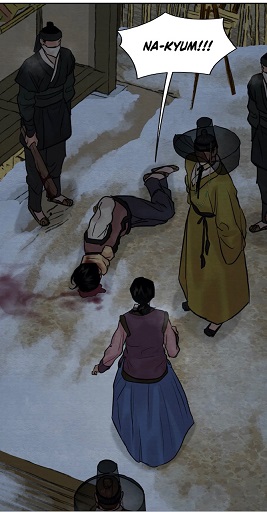 (chapter 99) Then the scarf was no longer present, when the painter woke up. Then the nobles removed his shirt, socks and pants in the shrine.
 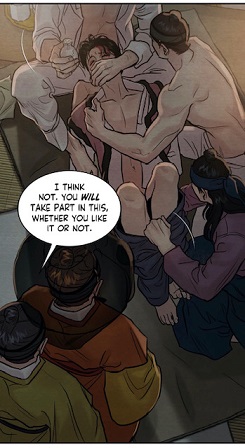 (chapter 100) And now observe that after Lee Jihwa’s departure, the artist’s clothes except the white shirt vanished too.
  (chapter 102) Where did they go? The readers saw Black Heart leaving the building, but we should question this: WHY? He never went there to fetch lord Shin, since he abandoned him outside. We all imagined that he left the room empty-handed. But it is true? Now, I don‘t think so. He had to get rid of the clothes in order to mislead the main lead!! A new version of chapter 61
  and
and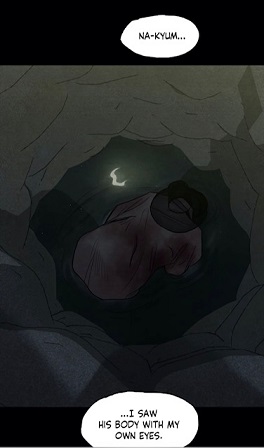 97! Furthermore, was Min talking to himself, when he said this?
  (chapter 101) Because the readers could detect the presence of a shadow in episode 102
  , I am now envisioning that Min was not alone outside during that night. In fact, someone had misled Black Heart telling him that lord Jihwa had ran away. However, the unconscious lord Shin should have made him think that Lee Jihwa had fought back… Hence he had not fled, rather betrayed them. Moreover, he was not looking at the direction of the entrance and gate. In fact, he was turning his gaze in the direction to the shrine. (Chapter 101) The tree serves as an orientation for the beholder. But why was someone waiting outside? It was to cover up all the traces of his meddling. Baek Na-Kyum was supposed to vanish during that night, and they had planned to employ his pants and shirt to mislead people… even Black Heart. In my opinion, the invisible hand had already envisioned the nobles’ death. To conclude, the clothes proved my previous theory. The staff had staged the desertion by faking ignorance.
  (chapter 98) They were waiting for his return to fake their anger and search. And now, you comprehend why the servants mentioned the kisaeng in front of Yoon Seungho. It was to stop him from going to the study… to divert his attention. Under this new approach, the artist’s last words get a new meaning.
  (chapter 102) Since he had informed Yoon Seungho through the maids about his whereabouts, Baek Na-Kyum was expecting that he would come to his side. I would like the manhwalovers to keep in their mind that the artist was not conscious, when he moved to the shaman’s house. So in his mind, he was not far away from the learned sir’s house. Finally, since he had informed the maids, he could anticipate that the lord wouldn’t get mad at him, and wouldn‘t imagine that he had abandoned him
  (chapter 101) He trusted his lover’s heart in the end. That’s the reason why Black Heart’s superficial promise had no effect on Baek Na-Kyum. The latter truly believed that Yoon Seungho had been informed. But how could they play such a trick on the couple?
Only one person could expect from the painter that he would switch clothes: Kim! 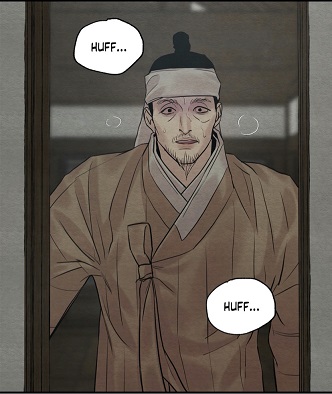 (chapter 86) He had witnessed the argument between the couple by hiding behind the door. Thus in chapter 103, Kim will get the shock of his life… and it is the same for the maids. Yoon Seungho is returning with the painter. And the new trailer reveals that when the lord opened the door, adomestic was standing next to a maid.
 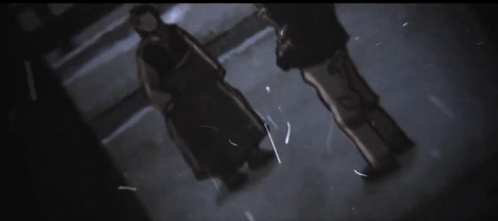 This is an indication of their involvement, though we need to discern the head-maid from the women in chapter 98. That’s the reason why the moment the maid appears, observe her clothes and try to discern her identity. Is this the head-maid or one maid from season 3? The preview displayed the arrival of the doctor.

The author reveals the butler’s surprise and shock. He never expected his entrance. This shows that the valet is just an actor too, he is not a deity, hence he gets fooled too. But why is Kim reacting this way? IT is because he never asked for the doctor’s request. So who sent the doctor? On the other hand, if the maids are involved and they witness the artist’s return, they have every reason to get worried. Their deception (lying by omission) could come to the light, for Baek Na-Kyum had given his lover an important task. He had to investigate why he had taken so much time before joining the artist’s side. By sending the doctor, they can fake their concern and even divert attention from themselves. Suddenly the connection between the maids and the doctor reminded me of episode 33.
If you read my previous analyses about the physicians, you are aware about my theory. Byeonduck introduced three different doctors, as their clothes and hat diverge. For me, it is the physician from season 1, for he is dressed similarly.  (chapter 103)
  The form of the beard is also similar. But now, I have another evidence that this doctor from season 4 is not the physician from season 2!!!
 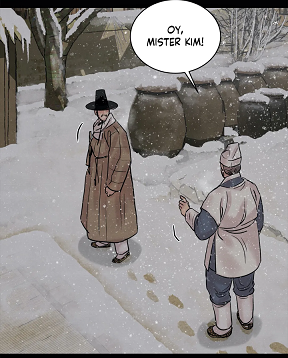 (chapter 63) The shoes are also different! That’s the reason why in the trailer, the beholders are seeing the physician’s shoes!!
 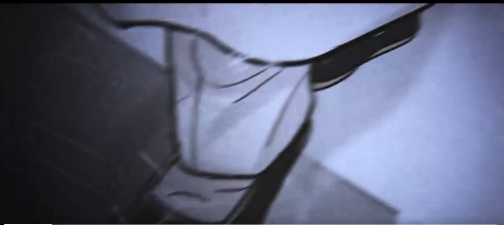 He doesn’t possess mituri like the other. Moreover, he is wearing a hanbok under his apron
  , while the other is dressed more like a commoner, a shirt with pants. And note that in chapter 33, we had the following combination: Min’s party, the visit of the doctor, Baek Na-Kyum’s illness, the maids and Yoon Seungho who “ran away” after his mistake. (rule 1 and 4)
 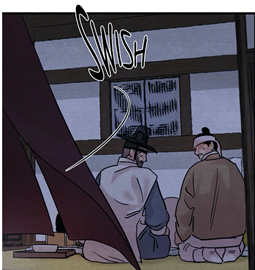 (chapter 33) And what had Kim done during his examination? He had not only threatened the physician
 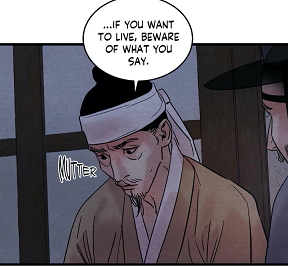 (chapter 33), afterwards he had even badmouthed him, for he had not given the correct diagnosis.
  (chapter 33) However, here the butler had simply lied to hide his own wrongdoings: his passivity and silence. And note the doctor’s words addressed to the “beholder”: (chapter 103)
He is lying. The drop of sweat is the evidence. First, he has already seen the painter in a terrible state before. But since he is referring to Yoon Seungho, it signifies that he has already seen Yoon Seungho flustered. Why? Because the doctor from chapter 57 only met the young master, when he was a teenager. 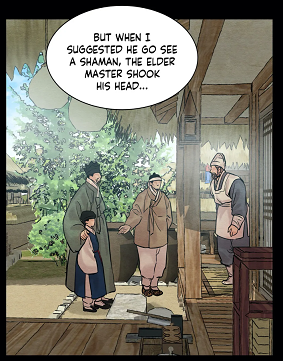 (chapter 57) The latter was introduced to Yoon Chang-Hyeon through the butler. The protagonist must have had a doctor in the past. Can you imagine a life without a doctor for 13 years? And this assumption was proven correct after the release. But let’s return our attention to the physician from season 4. What caught my attention is the white bag. Why is he wearing it? It is because he is on the verge of vanishing, he plans to run away. But why? From my point of view, he is the one who provided the aphrodisiac and opium to Lee Jihwa. Besides, in season 1, he had already given the “replenishing medicine” to the valet.
 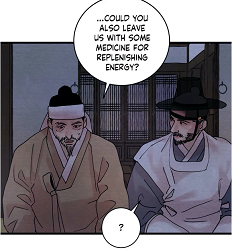 (chapter 33) (rule 1-2-3) But why would he do such a thing? Simply, because he had been helping Min. He needed the protection of a powerful lord, since Kim had abused his position by threatening him. After seeing the new pictures from chapter 103, I had this sudden revelation. What did Min do after getting beaten by Yoon Seungho?
 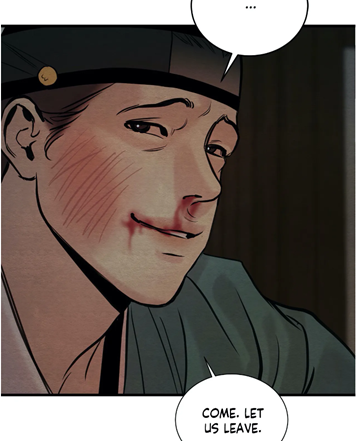 (chapter 54) He certainly didn’t let his wounds untreated. Thus the next morning his face
  (chapter 56) looked much better. He had no swelling and the redness was already vanishing. From my point of view, he asked for the doctor’s assistance and that’s how the both came to an understanding. But since Min is now dead, the physician could get into trouble, for he helped the lord and now he is dead. But why am I so sure that the physician is about to run away? Look at all these images:
  (chapter 44)
 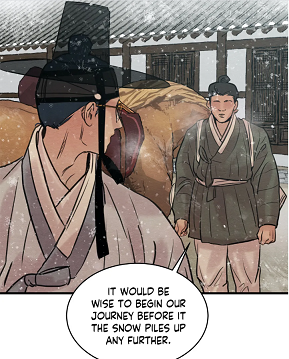 (chapter 44)
  (chapter 45)
 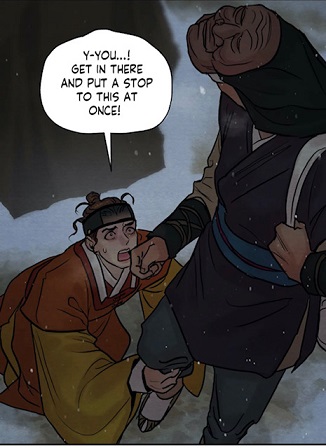 (chapter 100)
  They are all carrying the white bag on their back… and they are about to depart! Kim wished to leave the propriety with his master under the pretense that he was bringing misfortune to the painter. All this proves that the doctor is far from being innocent. Hence he wishes to run away. However, if he does this, this means that he exits the “play”. So he could die. Moreover, how did he know that the lord would return to the mansion with the wounded painter? I can not answer to this question with certainty. However, I would like to point out that since Min talked to someone in the shadow, it is very likely that this person had long planned Black Heart and his friend’s demise. Nonetheless, the schemers had not foreseen two three elements:
(chapter 102) (chapter 61) [For more read the essay “No matter what… Baek Na-Kyum must vanish”]
 (chapter 59) Lord Jang had disguised himself as Black Heart’s friend, the hanboks looked very similar.
  (chapter 99)
  (chapter 59) The schemers mistook him for the noble with the mole.
They are trying to repeat the same actions from the past, but the schemers are doomed to fail, for they didn’t listen to The Joker’s advice:  (chapter 76) And this observation leads me to present the following theory: father Lee is definitely involved in this new trick! The drama has not ended yet. Why? According to my theory, these domestics didn’t belong to Yoon Seungho’s staff
  (chapter 61), for the colors grey-white off are only seen at the Lee’s.
  (chapter 9)
  (chapter 18, Lee Jihwa’s spy)
  (chapter 41)
  (chapter 50)
  (chapter 100) And now compare these servants to the staff from chapter 97:
  Their colors are all different reflecting that Yoon Seungho has no control over his staff. But what did the staff do in episode 61, when they manipulated the lord by saying that the painter had run away? One of the domestics offered the scarf and headgear to the lord: (chapter 61) Once again the clothes… All these details are exposing the involvement of elder Lee. He had many reasons to have Min and the painter eliminated. However, there is no ambiguity that he is not working on his own. That’s the reason why I am now wondering if “father Lee” or the shadow sent the doctor to Yoon Seungho in order to witness the painter’s death. Note that the doctor from season 1 came and not season 2. And what had the maids said in episode 33?
  (chapter 33) Yet, the painter survived, hence the doctor has every reason to run away. His complicity could come to light… on the other hand, the moment he leaves Yoon Seungho’s side, he is no longer protected. The reason is simple. He owns a part of the truth, and what the schemers are attempting to do is the exact opposite: burying the truth so that their act is not discovered. And now who participated in this huge “drama”? The list of the suspects is quite long… Father Lee
  (chapter 82), lord Yoon Chang-Hyeon
 (chapter 86), the other physician
 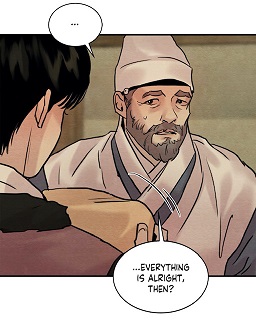 (chapter 74), “lord Song”
  (chapter 83), the “fake servant” alias the king (for me)
 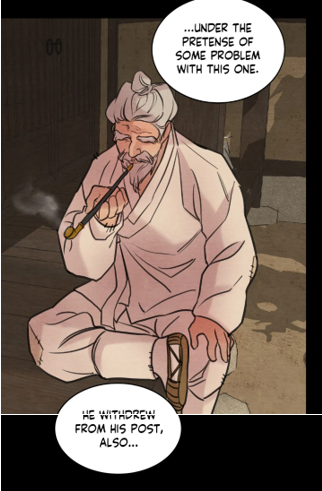 (chapter 37) There is no doubt that a tailor was involved, for he had to create similar clothes, the costumes …
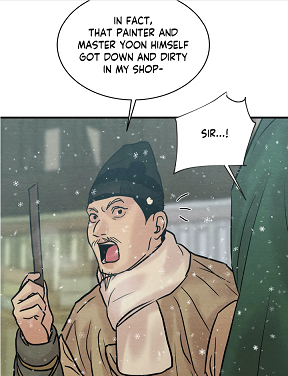 (chapter 64) All have one common denominator: the BEARD. They are OLD BEARDED MEN!
Feel free to comment. If you have any suggestion for topics or manhwas, feel free to ask. If you enjoyed reading it, retweet it or push the button like. My Reddit-Instagram-Tumblr-Twitter account is: @bebebisous33. Thanks for reading and for the support, particularly, I would like to thank all the new followers and people recommending my blog.

This is where you can read the manhwa. https://www.lezhinus.com/en/comic/pearlboy But be aware that this manhwa is a mature Yaoi, which means, it is about homosexuality with explicit scenes. Here is the link, if you are interested in more analyses about this manhwa and others https://bebebisous33analyses.com/2021/06/06/table-of-contents-of-analyzed-mentioned-manhwas/
It would be great if you could make some donations/sponsoring: Ko-fi.com/bebebisous33 That way, you can support me with “coffee” so that I have the energy to keep examining manhwas. Besides, I need to cover up the expenses for this blog.
While reading Pearl Boy, I couldn’t help myself connecting this manhwa to the novel written by John Steinbeck, The Pearl. In this story, the Mexican diver Kino found a huge pearl which led him to imagine that thanks to the pearl, he would be able to have a better life. In other words, he considered the pearl as a blessing. Yet, the problem is that the pearl awoke greed and other negative feelings in Kino and other people so that at the end, Kino ended up losing everything. Hence he decided to threw the gem into the ocean. This means that the protagonist finally considered the gem as a curse, the gem only brought him misery. While in the beginning Kino was poor, he had a loving family. However, with the appearance of the pearl, the readers can observe the disintegration of that harmonious family and the transformation of Kino’s personality. The diver even lost his son Coyotito which was the trigger for the main lead to give up on the pearl. As you can observe, it looks like the Pearl was more a curse to Kino and his family, because it brought evil and destruction in his life. More importantly is that the protagonist, who sought to gain fortune and status through the precious item, transformed from a happy and contented father into a brutal criminal, demonstrating the way ambition and greed could destroy innocence. Hence we could conclude that in the novel the pearl symbolizes evil and greed. On the other hand, the pearl is just an object, thus it has no thoughts and feelings. That’s why I don’t think the gem truly embodies these values. From my perspective, since the pearl is round and shining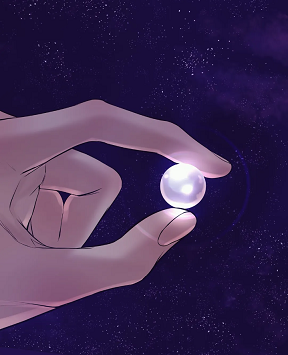 (chapter 12), it could be viewed as a mirror, which reflects human greed. As soon as humans discover such a precious object, their deeply buried desires like ambition and greed are awakened. Then I would like to point out that John Steinbeck’s novel was inspired by a Mexican folktale. Striking is that this story contains many parallels to the Chinese’s entitled The story of the Dragon’s pearl. [For more information: https://products.kitsapsun.com/archive/2001/01-28/0089_tell_me_a_story__the_dragon_s_pea.html]
The similarities are the families owning the pearl were poor, and once people heard about its existence, they started becoming envious and desired to take it. Moreover, both protagonists changed due to the gem, both turned in a “monster”, although the dragon has a positive connotation. The only difference between the two folktales is that in the Chinese version, the boy decided to eat the pearl in order to put an end to misery and fight among people. By eating the pearl, he became a dragon. Through this ending, the lesson of this fairy tale is that by sacrificing himself, he showed generosity and selflessness. At the same time, he was rewarded for his sacrifice. With his transformation, the boy was now able to protect his family and people, yet he could no longer live with his mother. Note that there was no drought any longer. As you can sense, the existence of the pearl always seems to bring fortune and happiness first, yet this blessing is turned into a curse, as it brings calamity and destroys families.
And now, it is time to focus on the manhwa Pearl Boy. In this story, the protagonist Jin Jooha is actually the pearl, as he can create pearls by ejaculating. (chapter 1) That’s why this manhwa is entitled Pearl Boy. What does it mean for the main lead? In his eyes, his special condition is more a curse than a blessing. Because of his ability, he is not treated like a human, but as an object. He is called either as a vending machine (chapter 22) or as a clam
 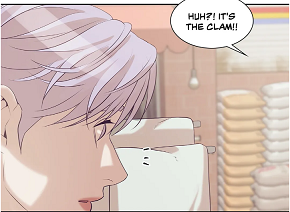 (chapter 23). In chapter 22, the poor man is even viewed as a living sex toy, hence he is enchained
  . But why don’t people consider him as a human? In my opinion, it is related to Choi Pilwon’s words and attitude. The latter definitely views him as his pet or a doll.
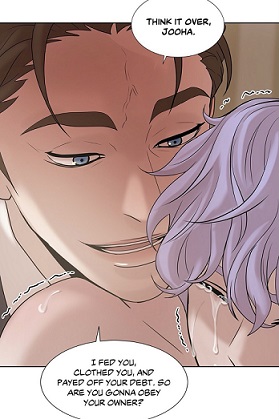 (chapter 4). Since Jooha is his possession, he states this to the poor pearl boy
 (chapter 22). He might enjoy now some privileges,
  (chapter 14), but he is not free. That’s why I believe that for Jooha, the pearl is more a curse. In the beginning of the story, he is forced to have sex with people so that he can ejaculate many pearls. He is bounded to Choi Pilwon, as the former needs to repay his debt
  . On the other hand, I think, for Choi Pilwon, Jooha represents a blessing and a curse simultaneously. Why? A blessing… because he is well aware that Jooha is definitely special. With such a treasure, people seek his attention and favors. Thanks to his wealth, he was able to obtain Jooha. Striking is that Jooha even trusted him in the past. It is palpable, when the main lead threw himself into his arms after running away.
 (chapter 22) However, it becomes clear that the antagonist created such a situation, so that the main lead would rely on him, this explicates why he smiled while getting hugged.
 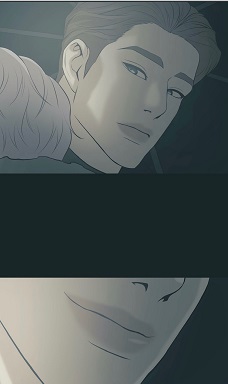 This smile exposes his manipulation. He wanted the pearl boy to depend on him entirely. By joining Choi Pilwon, the main character lost his freedom, the CEO used the immense debt to tie Jooha to him. What caught my attention is that we never see him having sex with men. He only gets fellatios.
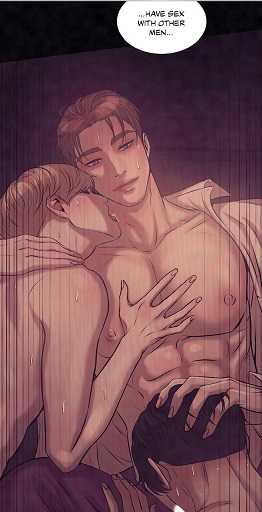 (chapter 14). He even pays other people to have sex
  (chapter 17), while he watches them. And this observation made me think that Choi Pilwon could have some sexual issues, like erectile dysfunction. Let’s not forget that in Painter Of The Night, Yoon Seungho needed to get a fellatio before a penetration before viewing his first erotic portray. And if this theory is correct, this signifies that Choi Pilwon can’t have sex with Jooha, which is frustrating him. Therefore I get the impression, he is desiring love from Jooha. He might possess the pearl boy, yet he is incapable to obtain his heart and love. And that’s his curse. There are other evidences for this interpretation. Even before selling him to low-lives, he just watched him having sex with other men, as if he couldn’t have sex with him.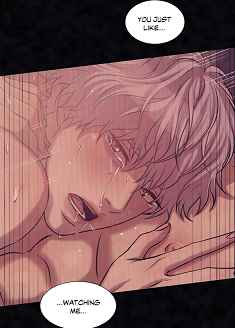
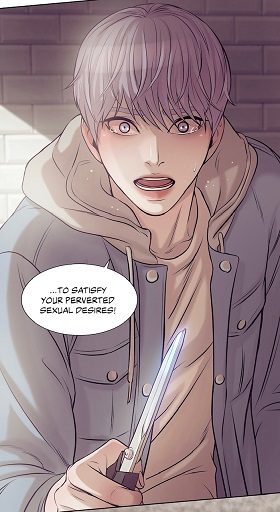 What the “mermaid” considered as sexual perversion could be definitely judged differently. He wished to taste the pearl boy, but he can’t any more, hence he needed others. The pearls are the cause for this toxic relationship. Secondly, when he sees Kang Dooshik close to his pet, he looks at his rival very carefully. He pays attention to his appearances:
  (chapter 9) and dismisses him due to his sweats. Since Kang Dooshik is not wearing any expensive cloth, he doesn’t judge him as a source of threat. However, when he hears that Dooshik has become Jooha’s partner, he is bothered. Hence the main lead is no longer forced to have sex with men whom Choi Pilwon sent him. The CEO is determined to get rid of the former host. Look how he is upset,
  (chapter 14), when he discovers that the protagonist has found the perfect partner. Nonetheless, he can’t forced the pearl boy to follow his order any longer, as Jooha procured him a huge amount of pearls. In other words, thanks to Dooshik, the main character has been able to gain more freedom. That’s why I doubt that watching other men having sex with Jooha was Pilwon’s true desire. Let’s not forget that in the beginning of the story, the CEO is standing in the street
 , while the protagonist is selling his body in the back room. This exposes that Choi Pilwon was not even watching this, a sign that he didn’t like it at all. And like Jooha has truly recognized, the debt can not be the real explanation for his harsh attitude towards the protagonist. When the latter offered him new pearls as a compensation, because he had not produced so many, the CEO got furious and put them in Jooha’s mouth. The latter had masturbated in order to get pearls. This truly shows that the pearls and the debt are just an excuse. Consequently, Choi Pilwon is not happy with the pearl boy. First, he thought, he had been blessed. Yet since the young man rejected him
 , he had to find a trick to bind him. And remember what I wrote above. For me, the pearl is like a mirror… since the CEO has been raised in a rich but cold environment, he has already internalized that money buys everything. In my opinion, he was not able to give what the protagonist was longing for: love and acceptance. Moreover, there is no doubt that Choi Pilwon is selfish and pays a lot attention to appearances, thus he couldn’t treat Jooha properly. Since both folktales contain reference to transformation, I believe that Choi Pilwon changed in contact with Jooha and the CEO’s terrible flaws came to the surface and were reinforced: greed, obsession and possessiveness. The pearl boy reflected Pilwon’s mentality: everything was revolving around money. Another detail caught my attention: the CEO is often associated to the shadow and darkness in the pictures. Look at the panels above and these ones:
  (chapter 4)
  (chapter 14) In the last image, it becomes more obvious, as Kang Dooshik stands in opposition to the CEO. He enters the inn rushing to the purple haired man’s side in order to comfort him. As you can imagine, the protagonist Kang Dooshik brings light and warmth
 to Jooha (purple and pink are warm colors), while Choi Pilwon embodies darkness and coldness
 due to the dark green and the black. This interpretation gets confirmed, when Dooshik is seen in the street during the night. The manhwaphiles can even observe a starry night in Dooshik’s presence.
 (chapter 8).
And now it is time to turn our attention to the other main character: Kang Dooshik.  When the story starts, the former bar server has already reached the bottom. He lost everything, because his ex-lover Eunwoo stole the money from Dooshik’s employer, Madam Hyung, and the main character was responsible for that money. In other words, the young man is on the run, yet despite his terrible situation, the man is not suicidal or heartbroken. On the one side, he is poor, exactly like Kino and the boy from the folktale. On the other side contrary to the stories, Dooshik had no harmonious relationship before, hence he knows the importance of true values (love, friendship, loyalty etc). In my eyes, he has learned through this terrible experience that love can’t be taken for granted. Another difference is that after meeting Jooha, the main lead’s personality doesn’t change: he remains generous, caring and honorable.
  (chapter 8) Surprising is that it was Jooha who helped Dooshik first. This signifies that for the purple haired man, Dooshik looked more like a curse. The former bar server tried to eat without paying his meal. Then he acted as a “prostitute”, when he proposed his body to reimburse the dish. Hence the pearl boy had the impression that Dooshik was like all the other men he had sex before: ruthless, superficial, selfish and perverted. Then in chapter 4, Jooha even chose to save his life,
  although the hero acted like an idiot. So for the main lead, it looked like Dooshik was a source of trouble. Yet, it turned out to be the opposite. Right after rescuing the confident and smiling man, the latter returned the favor. He rescued him from the sexually harassing men.
  (chapter 8) He even taught him how to protect himself. That’s why I believe that we have two pearl boys in this manhwa. Jooha might have this special ability, yet the former host is also a pearl due to his big heart. And observe that Jooha dived to get the “pearl” which reminds me of Kino. After that incident, the purple haired boy started treating Dooshik differently. And here, I could bring another fairy tale, The Little Mermaid, from Andersen. The mermaid rescued the prince and fell in love with him. However, the prince never returned his affection to the mermaid. But there’s a reason for that: the mermaid disguised herself. She was turned into a human, therefore she could never be true to herself. Moreover, due to her transformation, she became mute. In other words, her meeting with the “prince”, the pearl, was a curse hidden as a blessing. If we compare both stories, the manhwalovers can detect the huge contrast. In Pearl Boy, the evolution is totally different. The mermaid revealed his secret, and was even asked to voice his opinion and feelings. The prince could sense the gentleness and selflessness in his partner. That’s why there exists no one-sided crush.
What caught my attention is that the former host discovers two pearls:  (chapter 3) and then in chapter 12.
  These incidents announced a change in the protagonist’s life. Although the main lead gets happy with this discovery each time, as he envisions that he could repay his former employee, Dooshik never loses his humanity. He still prioritizes love and humans over greed and selfishness. That’s why when he discovers Jooha’s ability, he asks him if he is ill.
 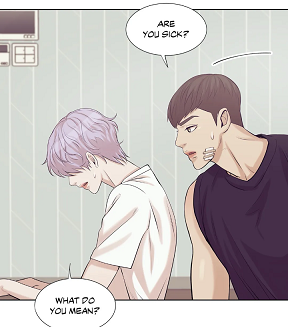 This truly exposes that Dooshik is the first one treating Jooha as a human. At no moment, he tries to take advantage of the purple-haired man.
  (chapter 14) Therefore it is not surprising that the ex-host often encourages his lover to express himself. Another important detail is that he is the only one kissing Jooha before going any further.
  In other words, he is showering him with love and warmth. He keeps hugging him in order to comfort him.
  (chapter 14)
  (chapter 24) Hence the manhwaphiles are not astonished that at the end, Jooha doesn’t desire to be separated from Kang Dooshik.
 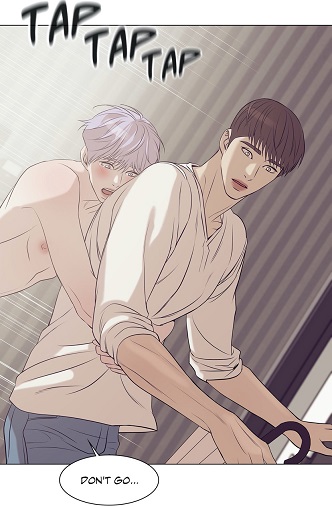 He can’t even bear the thought of his lover’s departure from the hotel room. He fears that his partner might never return. He has already realized that he found a treasure, a pearl boy, while in the beginning he judged him as a source of trouble. As for Kang Dooshik, it is the same. While in his past, he was admired and could earn money and trust so easily, he was so unhappy in his relationship with Eunwoo
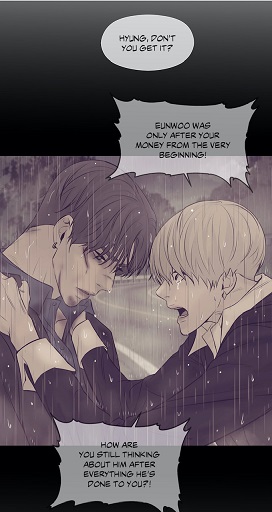 (chapter 14). The latter betrayed him on multiple occasions, yet the weirdest is that after this terrible relationship, Kang Dooshik is not scared of love. Thanks to Jooha, his life became more stable, and indirectly he could get in touch with his best friend Lee Choonbae.
That’s why my conclusion is that the pearl is in reality a mirror. Since Jooha helped him without any expectation, the gentle and affectionate Dooshik couldn’t restrain himself giving some affection towards the purple-haired man. The latter could only reciprocate the feelings, as the main character was the only one treating him like a treasure. Consequently, Dooshik is often linked to purple and pink, the color of love and royalty, a prince (chapter 8) (chapter 24). That’s the reason why their love sessions are full of the following colors: white (innocence), purple and pink. Both protagonists became a blessing for each other, they gave each other exactly what the other needed. Hence for me, there are two pearl boys in this manhwa. And the pearl is not a curse or a blessing, it just reflects human desires: positive and negative. That’s why it is important for Choi Pilwon to recognize that he is actually cursed by maintaining such a relationship with Jooha.  Thus I conclude that Dooshik’s best friend, Lee Choonbae, will play an important role in the future, as his intervention will affect Choi Pilwon’s relationship with Jooha. He could become Choi Pilwon’s blessing disguised as a curse.
Feel free to comment. If you have any suggestion for topics or manhwas, feel free to ask. If you enjoyed reading it, retweet it or push the button like. My reddit-Instagram-tumblr-twitter account is: @bebebisous33. Thanks for reading and for the support, particularly, I would like to thank all the new followers and people recommending my blog.

This is where you can read the manhwa. https://www.lezhinus.com/en/comic/painter But be aware that this manhwa is a mature Yaoi, which means, it is about homosexuality with explicit scenes. If you want to read more essays, here is the link to the table of contents: https://bebebisous33analyses.wordpress.com/2020/07/04/table-of-contents-painter-of-the-night/
It would be great if you could make some donations/sponsoring: Ko-fi.com/bebebisous33 That way, you can support me with “coffee” so that I have the energy to keep examining manhwas. Besides, I need to cover up the expenses for this blog.
“The ultimate tragedy is not the oppression and cruelty by the bad people but the silence over that by the good people” from Martin Luther King
With this quote, the famous American Baptist minister denunciated the passive attitude of many Americans, who didn’t feel concerned with racism and segregation in 60’s. Why?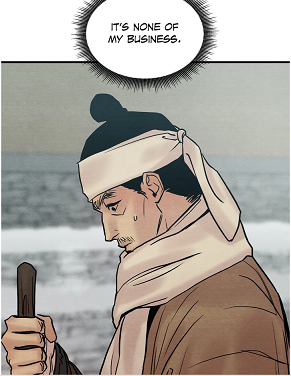 (chapter 65) As you can see, the valet Kim is not revealing the truth, not out of fear, but he has the impression, this is not his problem. He chooses indifference. With this single attitude, the readers discover Kim’s true personality and past, confirming my last analysis about him. When he heard the painter’s refusal,
  (chapter 65), he was brought back to the past. The domestic was a witness of Yoon Seungho’s rape and as such of his sexual abuse. Striking is that in episode 65, he didn’t even open the door, but instead of helping, he let it happened. He didn’t act according to his belief. This means that in the past, he must have acted the opposite. The door was open. This signifies that he abandoned the young Yoon Seungho, when the main lead asked for assistance.
 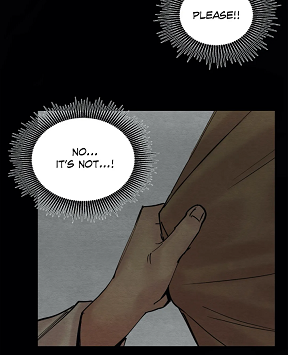 (chapter 65) He refused to listen to the young master’s plea. And now, you understand why Yoon Seungho had sex in front of him outside the barn. Unconsciously, he wanted to confront the valet with the consequences of his actions.
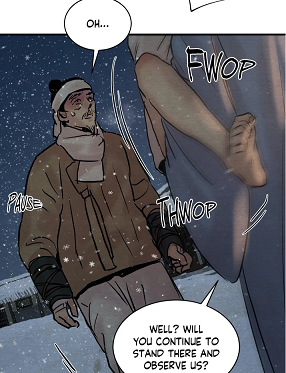 (chapter 64) The teenager was left behind by the servant, and his hand couldn’t even stop him. But since it is a reflection, I think that the butler was the one who brought the main lead to the predator, naturally his intention was not to have him raped. And now, I grasp why the lord feels the need to hurt people with his hand, like for example strangling the painter
  (chapter 61) or grabbing the topknot of a noble
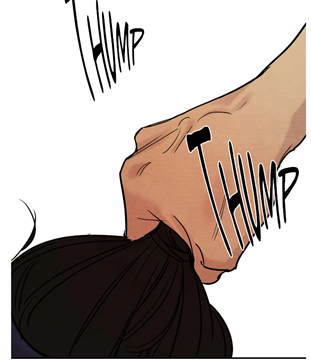 (chapter 8). His hand expresses not only his rage, but also his powerlessness. With his hand, he wasn’t able to stop the valet from leaving him behind. He had tried to stop his father from leaving his side with his hand too.
 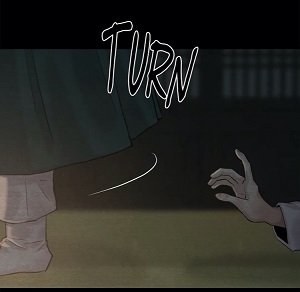 (chapter 86) Furthermore, Yoon Seungho couldn’t even punish the valet for betraying him, because he had no authority and no strength. Back then, he was just a teenager. In chapter 63 and 64, Yoon Seungho was indeed reliving his traumatic past. Because the butler was recollecting two different memories (the night before and the lord’s sexual abuse), my first impression was that the young boy had been abused in the shed. (chapter 65) Yet, the storage room is the place where the valet betrayed him, as he changed his lord.
 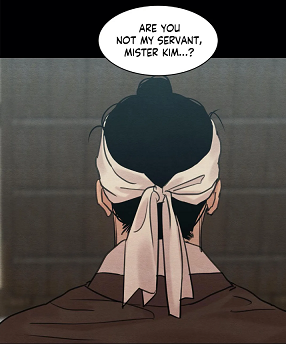 (chapter 77) My theory is that the main lead was raped by “lord Song”, the king. Therefore I assume that the man was invited by father Yoon. Remember that the kisaeng Heena proposed to her donsaeng to seek the protection of a nobleman, as he is a low-born.
  (chapter 97) My idea is that the valet thought that by seeking the monarch’s protection, the young master’s suffering would end, for the king stands above the scholars and elders. Anyway, I believe that the valet made a bad choice and regretted it afterwards. Due to his guilt, he developed resent towards Yoon Seungho. And this explains why Kim said this to the painter in order to ease his pain:
  (chapter 12) He couldn’t tell him details, since he would reveal his complicity to the crime. Furthermore, since the valet led the painter to the pavilion, it is very likely that Kim was the one who offered Yoon Seungho to the pedophile, which makes his crime even worse.
With Kim’s silence came a huge price: fear and guilt.  (chapter 65) Since he had not assisted the young master repeatedly
 (chapter 77), he became more and more burdened by his guilty conscience. He turned into an accomplice, for he never revealed his involvement and mistakes.. He could no longer reveal the truth, because he would have to get punished. He feared father Yoon’s wrath and he had reasons too. He could definitely die. That’s the reason why he reproaches the doctor his passivity and silence, though in my opinion, it was not about the abduction, but about the tonic. Sure, in Joseon, there was no law called “Duty to rescue or Failure to provide assistance”.
“Failure to assist a person in danger is a criminal offence that condemns the failure to assist a person in danger. Contrary to most criminal norms, it is an offence of omission and not of commission, i.e. the perpetrator does not act when he should have done so.”
However, from a moral perspective, Kim committed a wrongdoing, and he knew it. That’s why he couldn’t forget and felt guilty. Even nowadays “Duty to rescue law” doesn’t exist everywhere, nonetheless many European countries, like Germany or France or UK possess one and its creation was partially influenced by the experiences made due to Nazism. And now, the manhwalovers can comprehend why my association to dictatorship was correct. Kim and other ordinary people are their willing assistants in the end. They prefer avoiding trouble out of convenience. Consequently, they turn a blind eye to injustice. Yet, though they try to forget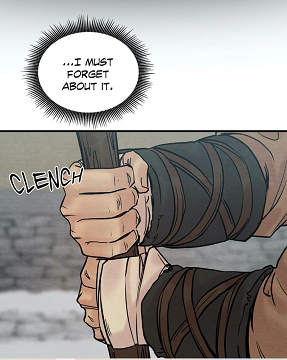 (chapter 65), they can’t, because they feel guilty and remorse. Note that right after voicing his wish to forget the incident, he recalls Yoon Seungho’s tragedy indicating his incapacity to forget. This explains why Kim gives the doctor the following advice: (chapter 65) Although Kim’s words in the panel are addressed to the physician, they actually reflect that Kim is speaking out of experience. He knows by experience that “silence is a true friend who never betrays”. Observe that Kim’s complicity was never brought to light, hence he never got punished. This explicates why Yoon Seungho is acting differently from his biological father in reality. Each time there was a crime, the lord let the painter defend himself and asked questions: chapter 11 and 62
 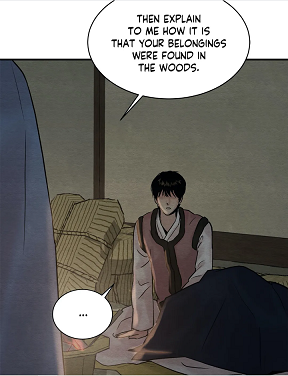 , (chapter 62) especially when you think that Baek Na-Kyum is just a commoner. But the problem is that he was biased, just like his father who had the impression that his son was a homosexual due to the testimonies of close people (Kim, Lee Jihwa and probably Yoon Seung-Won). After the rape, Yoon Seungho got punished. And this interpretation was proven correct in season 3
 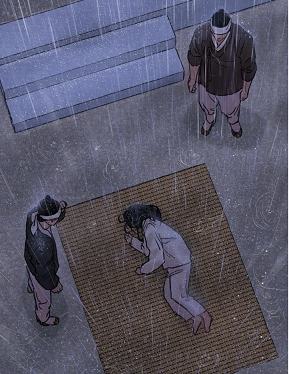 (chapter 77). But here Kim remained silent too.
 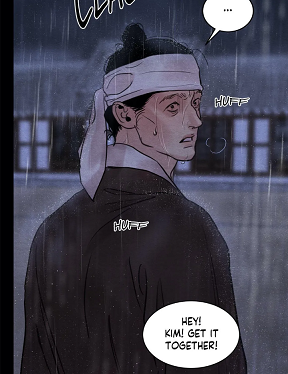 (chapter 77) It was even worse than before, because after the straw mat beating, he was paralyzed. No one spoke for him and believed his words, and Kim wasn’t willing to step in. Moreover, I believe that Kim had another reason for remaining silent.
 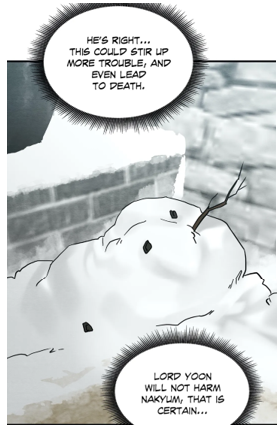 (chapter 65) He disliked the idea of a scandal and trouble. If he had told the truth, he knew that his punishment would be death. Out of convenience, he ran away from responsibility and from the uncomfortable truth.
  (chapter 65) That’s why I believe that the author is not showing that Kim and the physician chose secrecy and silence, because they feared for their life. They only started fearing for their life, when the truth is about to be revealed, as the painter was not dead yet. As the victim, he was a witness. Because once the lord discovers the butler’s passivity and complicity, it becomes a matter of life or death for him. According to me, there are two doctors. So the chapter 65 unveils that the first doctor didn’t testify, as he wanted to help the artist.
 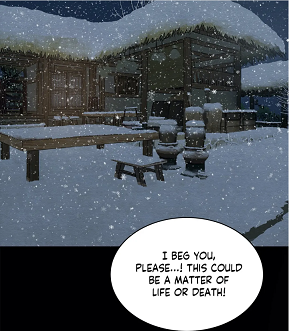 (chapter 65) In my opinion, the butler had deceived the commoner, he let him believe that Baek Na-Kyum had run away because of the lord’s violent temper. The painter had come wounded to his office. This negative perception of the young lord Yoon could only make the doctor jump to wrong conclusion. ,Striking is that this scene
 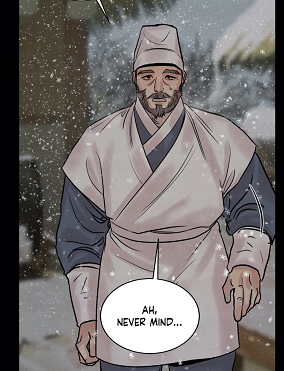 (chapter 63) revealed that the doctor was hesitating to give his opinion to the butler, he thought that the artist had run away. And what is the common denominator of all these scenes with the doctors. They all chose silence for different reasons. Just like Kim, the doctor had become an accomplice. As for the second, he remained silent out of fear, that he could get into trouble.
 (chapter 65) My theory is that the valet used the drug as an excuse to silence the physician. Now, the doctor is hoping that the boy says no word about it, so that his “wrongdoing”, the false medication, won’t be discovered. Kim blamed the doctor that after that, his master had behaved like a crazy man. The result was that both physicians chose silence!! Why? It is because the valet had pushed them to make this choice. And note the pattern. Kim used pity and compassion for the first doctor, and fear and brutality for the second! Exactly like in this scene: (chapter 12) In this scene, we have all three elements: pity, fear and silence (“can’t go into details”).
And despite knowing the truth, Kim makes the same decision like in the past. He chooses to sweep the incident under the carpet. He is glossing over the abduction with all fake excuses. (chapter 65) He has the audacity to say that his master won’t hurt the painter, although he even witnessed the roughness the artist was exposed to. Yet, for him harm was flogging or execution. From my perspective, this is no coincidence that the author showed us the valet sweeping.  (chapter 65) This represents his attitude in life, therefore he is responsible for Baek Na-Kyum’s loss of innocence. His other leitmotiv is
 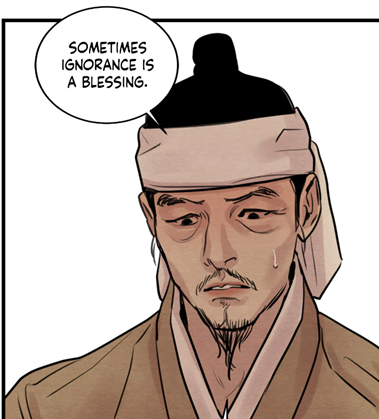 (chapter 23) He acts, as if he knows nothing reminding us of this scene.
 (chapter 28)That’s why I believe that the butler was lying back then and had even allowed the artist to run away that morning. I see a new version of chapter 29. But let’s go back to chapter 65. Notice that he is the one removing the snowman built by the painter, the last reminder of the low-born’s innocence. In two occasions, he chose cowardice and silence. First, he did nothing to stop his master (chapter 65), as he didn’t desire to feel his master’s wrath. Secondly, he asked the physician to keep silent by making him feel guilty. (chapter 65) But if he had seen this, he could have intervened and reasoned his master. But he chose not. He was too embarrassed, for he had been caught “spying”.
 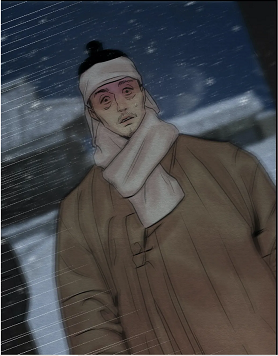 (chapter 64)
And the next day, he prefers to forget this incident. (chapter 65) What caught my attention is that he feels nothing for the painter, he doesn’t even express any regret or remorse. Since he knows that the artist won’t be killed, then everything will return to normal. He doesn’t consider the impact of Yoon Seungho’s violence used against the painter, which he witnessed on several occasions. For him what matters the most is silence, the absence of ruckus! And now, I can understand why the lord is not able to distinguish genuine from hypocritical care. When the lord was young, he saw in his valet a surrogate father, but he got betrayed in the worst way. He turned away from the wounded master. He closed his eyes, closed the door and ran away. Therefore, it becomes comprehensible why Yoon Seungho’s unconscious always expresses itself through the hand, the eye and the feet. This was the result of Kim’s abandonment, but not only from him: from his own family and even his best friend. And back then, the butler must have thought exactly the same in order to justify his behavior: (chapter 65). He legitimated his cowardice and passivity by saying that Yoon Seungho wasn’t part of his life and his adoptive son. He was just a noble, with such a statement, Kim was drawing a line. Due to his mistakes, he chose not to intervene any longer. But observe that in season 1 and 2, he meddled in his lord’s life, as he viewed it as his own business. Why? It is because he feared that he could lose his position. However, I think that in season 1, he was more influenced by his unconscious, but not in season 2.
After all these observations, I come to the conclusion that Kim has many common points with Lee Jihwa. He knows the past and feels remorse and repentance. But both are forced to hide their wrongdoings and as such their culpability. That’s why the chapter 65 reinforced my conviction that Lee Jihwa was indeed responsible for Yoon Seungho’s misery and the red-haired noble was aware of it. Yet, exactly like the butler, he denied his responsibility. Sure, many are to blame for the main lead’s tragedy as well: father Yoon, his brother and lord Song/the king. All of them lied and chose to remain silent.
From my point of view, Byeonduck has another reason for making Baek Na-Kyum going through the same experiences than the protagonist’s. This is not just to make Yoon Seungho realize what he has become and sees his own reflection in the end. In my opinion, the author uses the painter’s suffering to reveal the main lead’s tragic past. Since we all suffer for the artist, the manhwaphiles have to imagine that Yoon Seungho experienced it too, but in the worst possible way, as he had really no one by his side. While Yoon Seungho might be rough and hurtful towards the artist, he is still in love with the artist, hence he still cleans (chapter 65) the artist after their intercourse and even gives him his own shirt. He shows a certain sense of responsibility.
So my actual theory about Yoon Seungho’s past is the following: Yoon Chang-Hyeon got deceived by many people, making him believe that his son was an idle young master before being stigmatized as sodomite. The king had to ruin the protagonist’s reputation in order to approach him. The real puppet master was lord Song alias the king. But every culprits had to suffer the consequences of their crimes and deceptions. I don’t think that even the king was spared. He also got punished by the gods, yet he never realized it. Yoon Chang-Hyeon thought, he could benefit from such an alliance, but he got betrayed by father Lee, but the scholar never recognized it.  (chapter 82) Why didn’t he ask for a punishment after this humiliation? It is because he couldn’t. However, he must have definitely sought revenge. And the main lead became the sacrificial lamb, as in father Yoon’s eyes, his son was the reason for the purge: desertion, betrayal and probably drugs played a role in the purge. It is definitely possible that I have to change this theory about his traumatic past, but as you can observe, the main elements don’t change:
As a conclusion, silence is as terrible as words. Both can kill in the end.
Silence in the face of evil is itself evil: God will not hold us guiltless. Not to speak is to speak. Not to act is to act.” Dietrich Bonhoeffer
That’s why it is important not to turn away from injustice. This is not just a question of courage. Not helping someone in the need is committing a crime, and it contributes to reinforce injustice. Fear for life can not be an excuse in this story, since the matter of life and death appears afterwards. The silence is related to a misdeed. Besides, this kind of behavior explains why Third Reich could exist. First, while some people were convinced believers, many chose comfort over trouble. Let’s not forget that Hitler could install his dictatorship, because the MP from the Reichstag voted for Enabling Act (1933). That law gave Hitler the power to enact laws without the involvement from the Reichstag. One might argue that Hitler used terror to coerce the MP, but this is not correct, as Otto Wels gave a speech against it and the socialist party (SPD) followed him. This was the only party that voted against it. I have to admit that while reading the last chapter, I couldn’t help myself thinking of the Third Wave.
In our case, it is not about Nazism, but about civil courage. Once one remains passive, the other follows creating a common movement: all become inactive and silent. IT takes courage to admit a mistake and a wrongdoing. And we have to imagine that in the past, the servant Kim remained silent once leading the others to close an eye as well. And the phenomenon is occurring again. The physician was a witness, but did nothing (not even asking for help after the painter’s disappearance). He was convinced that if he shut his mouth, he would help the artist! But this was simply wrong, for with his passivity and false conclusion, the painter could have died. The irony is that Kim is following him after their conversation. (chapter 65) Slowly, he is recognizing that his master won’t hurt the artist. Yet, during his visit, he thought the exact opposite. (chapter 65)
However, this time it is different because of Baek Na-Kyum’s panic attack and his sister’s intervention. (chapter 65) The lord realized that something had happened. Due to the painter’s reaction, he was brought back the past.
  (chapter 66) Striking is that the painter’s words were the trigger for revealing the truth.
 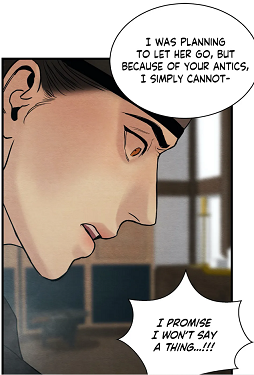 (chapter 66) This stands in opposition to silence. Therefore it is no coincidence that Min revealed the truth.
 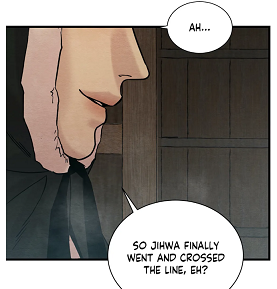 (chapter 66) The irony is that Heena suspected the main lead of kidnapping her brother and everything looked like her words were true: the wrist, the wounds around his wrist, his actual position (the mouth covered and his hands tied together…)
 (chapter 66)
  (chapter 66) Thus the circumstances were turned against him.
  (chapter 65) But she was not present, when Min admitted Lee Jihwa’s crime. That’s how I realized that while chapter 65 represents silence, deception, cowardice and passivity, chapter 66 embodies the exact opposite. Min told the truth, Heena tried to save her brother by creating a ruckus! For Yoon Seungho, silence is a sign of culpability which he learnt from Kim. Hence he lied to the kisaeng
  (chapter 65), and later never spoke to the painter about the incident. If he had done it, he would have been forced to admit his misjudgment and wrongdoing. And now, you understand why Martin Luther King said this:
“The ultimate tragedy is not the oppression and cruelty by the bad people but the silence over that by the good people”
The physician and the butler are no evil men per se, as they don’t find pleasure in death and suffering. However, like the following idiom is revealing, people can change due to their decisions:
The way to hell is paved with good intentions.
That’s why in season 4, the tragedy won’t be repeated and the truth about Yoon Seungho’s martyrdom, strongly intertwined with the artist’s, will come to the surface. You are wondering why now. The reason is quite simple: The doctor revealed his knowledge to Baek Na-Kyum,  (chapter 57) It doesn’t matter, if the butler told lies to the physician in the past, as they are now perceived as truth. Remember what Kim confided to the painter:
 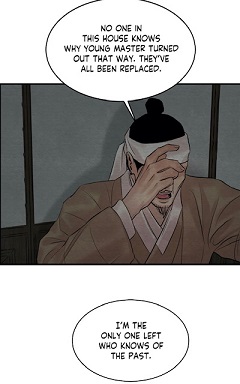 (chapter 86) He believes that he is the only one left who knows the past. But he is wrong, since the doctor also recalls the past. Hence how can Kim prove that he is telling the truth, since he told a different story to the physician? In addition, we have also lord Song. Besides, by giving the drug to Yoon Seungho without his knowledge and consent, Kim committed a wrongdoing. His knowledge won’t serve him in the end. I am deducing that the saying “silence is a true friend who never betrays” will no longer be valid. Therefore we have to expect a betrayal, and that would be from the physician, especially after we recall the butler’s warning in the first season, which was addressed to a different doctor from my point of view: (chapter 33) Let’s not forget that in chapter 65, the servant tried to put the whole responsibility on the physician, making him feel guilty. And since Byeonduck is even using elements from the first and second season, I believe, we will have a reversed situation in season 4, where the doctor will speak up and put the whole blame on someone. Neither the physician nor Kim expected that the painter’s body wouldn’t remain silent (chapter 65), a proof that the truth needed to be unveiled. It was impossible to act, as if nothing had happened, just because the painter had been returned to Yoon Seungho. And it is the same at the end of season 3. The painter gave his husband a task: (chapter 102) He needs to find the answer, which stands in opposition to silence and burying the truth (sweeping it under the carpet). This signifies that this time, Yoon Seungho has to gather information himself, and he can not rely on Kim:
 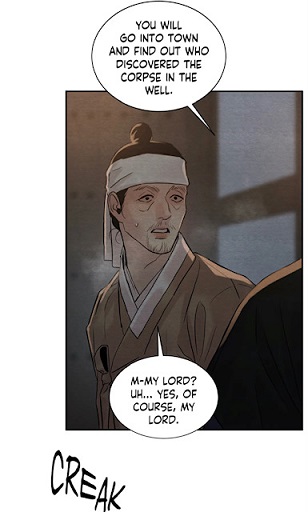 (chapter 98) As you can see, slowly people are forced to talk
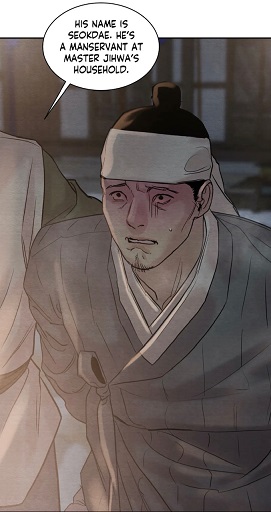 (chapter 99), hence their testimony can be questioned and perceived as lie.
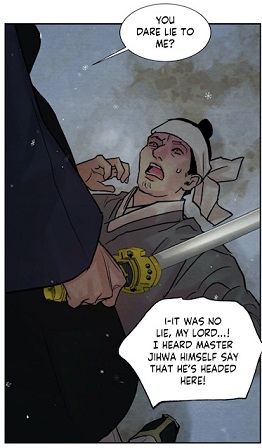 (chapter 100). This is important, because by getting confronted with lies, the lord will be able to discern the truth! In other words, silence embodies darkness and as such death.
  (chapter 74) Thus there was only silence in the lord’s nightmare. And this contradicts this statement: (chapter 65) Because Germans chose silence, the Holocaust could take place.
Feel free to comment. If you have any suggestion for topics or manhwas, feel free to ask. If you enjoyed reading it, retweet it or push the button like. My Reddit-Instagram-Tumblr-Twitter account is: @bebebisous33. Thanks for reading and for the support, particularly, I would like to thank all the new followers and people recommending my blog.

This is where you can read the manhwa. https://www.lezhinus.com/en/comic/painter But be aware that this manhwa is a mature Yaoi, which means, it is about homosexuality with explicit scenes. If you want to read more essays, here is the link to the table of contents: https://bebebisous33analyses.wordpress.com/2020/07/04/table-of-contents-painter-of-the-night/
It would be great if you could make some donations/sponsoring: Ko-fi.com/bebebisous33 That way, you can support me with “coffee” so that I have the energy to keep examining manhwas. Besides, I need to cover up the expenses for this blog.
I was really pleasantly surprised with the alternative universe of Painter Of The night, because it wasn’t at all what I had been expecting. I had imagined that Byeonduck would give us a modern version due to her drawing with Yoon Seungho wearing a mask. So what is her alternative universe? It’s the same period, but the social status have been switched. On the left, I selected pictures from the original story and on the right from the alternative universe.
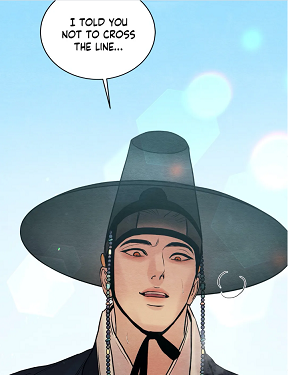
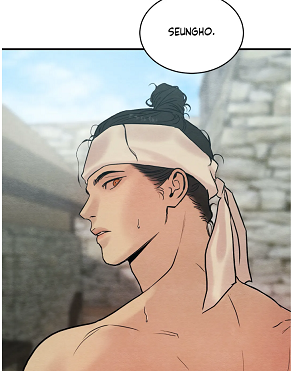

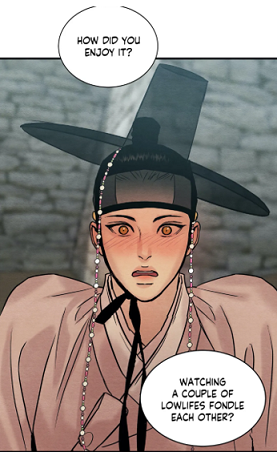
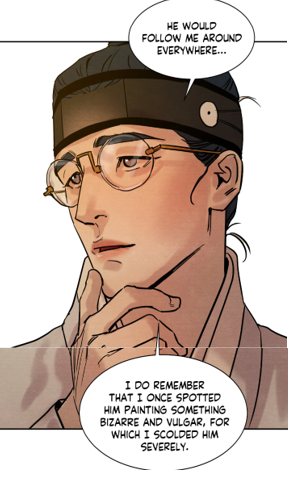
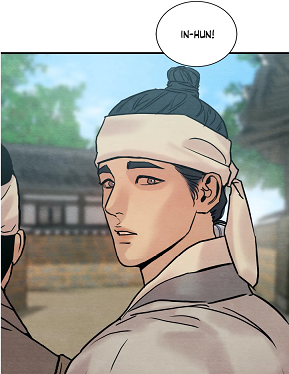
Now, it is Yoon Seungho and Jung In-Hun’s turn to be commoners, while Baek Na-Kyum is now the only son of a noble family which means the pressure and expectations from his family must be high. By switching the positions but at the same time, keeping certain elements from the original story (f. ex. Baek Na-Kyum likes painting sodomy), Byeonduck gives us clues about the original story as well, which were never directly revealed. Consequently, this version made me realize two things. First, thanks to this episode, I gained more insight about the original story which I’ll explain in another essay. Secondly, Byeonduck gives us a new dimension of the relationship between Yoon Seungho and Baek Na-Kyum. The author is showing us that not only Baek Na-Kyum and Yoon Seungho are fated to fall in love with each other but also their love story is supposed to be an example that love knows no boundaries. Their affection is the result of nature and society will never been able to stop it. This special episode reinforces her original message: homosexuality is no disease but a natural phenomenon. Besides, by switching their roles, the author outlines that the social gap between them will always be present in their relationship no matter where they live but they will overlook it in the end. Their affection is strongly intertwined to scandal, yet it won’t matter. By using the idea of destiny, the special episode with the alternative universe reveal that their choices are not free in reality, their decisions are all influenced by their disposition and environment. While reading the special episode, I couldn’t help myself connecting this story to philosophy and different currents in philosophy: Free will versus Determinism.
This is the second time that I am referring to philosophy. In another analysis, I had explained that Yoon Seungho was a libertine and represented the ideas from Enlightenment where reason and critical thinking were in the center of this movement. In other words, the powerful protagonist belongs to the libertarians (“free will”). By guiding the low-born, he liberated him from traditions and social norms. That’s why at the end, the painter makes his own decisions. He chooses to remain by his lord’s side despite the terrible night in chapter 53 and the first brutal confession. That’s why we could say that the original version advocates free will, whereas the special episode represents the other current: determinism, where there exists no real freedom. Interesting is that the moment the first episode from the alternative episode was released, many fans realized the similarities between the original Painter Of The Night and the alternative one. Let me give you an example: (Chapter 55) As you can observe, the drawings and the character’s actions resemble each other a lot. It was as if the protagonists had no choice but to turn their heads. It was already planned and designed, just like Oedipus who couldn’t escape his fate. By drawing similar panels, Byeonduck gives us the impression that their destiny and actions have already been predetermined. Baek Na-Kyum will run away or blush or have a crush on Jung In-Hun. They have to accept and embrace their destiny which will be full of pain but also full of love and tenderness. And now, let’s take a closer look at the special episode.
Here, fate appears in two forms. They first meet by coincidence 
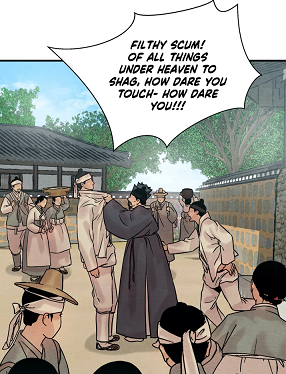 and secondly thanks to the intervention of the cat. Coincidence is a proof that they have no control over their life and love life. It was, as if the invisible hand of gods had decided to have them met. Yet, determinism doesn’t use the idea of gods or of an exterior force leading the characters to encounter each other. If you pay attention to the way they meet, you’ll realize that their decisions, influenced by their liking and living conditions, were the reasons why they met in the street. The noble Baek Na-Kyum was strolling in that part of the town because he wanted to sell his erotic paintings. So because of his hidden hobby, he is led to go to a part of the town where commoners live. In other words, the protagonist enters Yoon Seungho’s world. On the other hand, Yoon Seungho as a low-born catches Baek Na-Kyum’s attention due to his unusual attitude. He shows neither remorse nor fear in front of the angry aristocrat. He is very defiant. That’s love at first sight. However, this is true love as sexuality is immediately included, while his affection towards Jung In-Hun was more related to the innocent and pure love of a child. Striking is that Yoon Seungho is exposed for his scandalous relationship with the son of a noble family showing that he doesn’t care about social status and distinction between nobility and commoner. It is also the same for the painter who sells his erotic paintings in order to buy glasses for his servant.
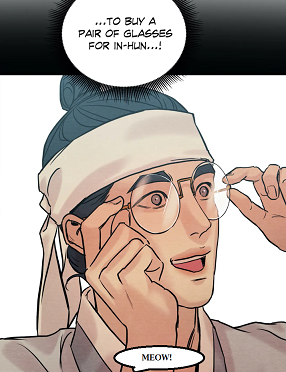 This shows that right from the start, Baek Na-Kyum has not truly internalized the hierarchical society and it is the same with the strong-willed commoner. They might not belong to the same social class but their mentality is in reality similar. Besides, they have both a strong libido and a certain sexual fantasy. Yoon Seungho is willing to have sex anywhere (f. ex. in the woodshed)
 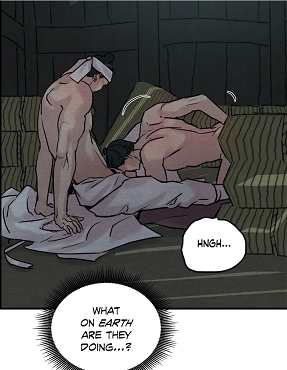 and after meeting the impressive and attractive seme, Baek Na-Kyum becomes so inspired that he creates a threesome.
  The painting could be seen as another evidence that the painter had to create such a work. There’s no real free will in the end. However, the idea of a threesome indicates that the innocent noble has indeed a kinky side which was triggered the moment he met Yoon Seungho’s eyes. And now, it explains why Yoon Seungho was destined to meet Baek Na-Kyum outside his mansion in the original manhwa.
 He had to meet him at the tavern because it was the commoner’s world and since the noble was interested in the painter, he couldn’t just send for him. The latter could refuse but in his presence, Yoon Seungho imagined that the artist would never dare to reject the offer.
However, unlike the seme who doesn’t fear the rumors about his reputation, the noble prefers hiding his true thoughts hence he repeats exactly what his crush says about homosexuals.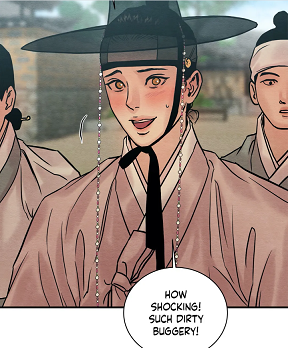
 In other words, Baek Na-Kyum seems to have a predisposition to follow social norms, although in his heart, he doesn’t acknowledge societal hierarchy. He lives in his own bubble in my opinion. That’s why I come to the conclusion that Baek Na-Kyum’s inner conflicts will always represent one of their problems in the evolution of their love story. The noble will suffer pressure from his family and his servant Jung In-Hun who will betray him, making the main lead discover what love truly is. But because of their affinities, they were destined to be together.
This determinism is also visible with the appearance of the cat.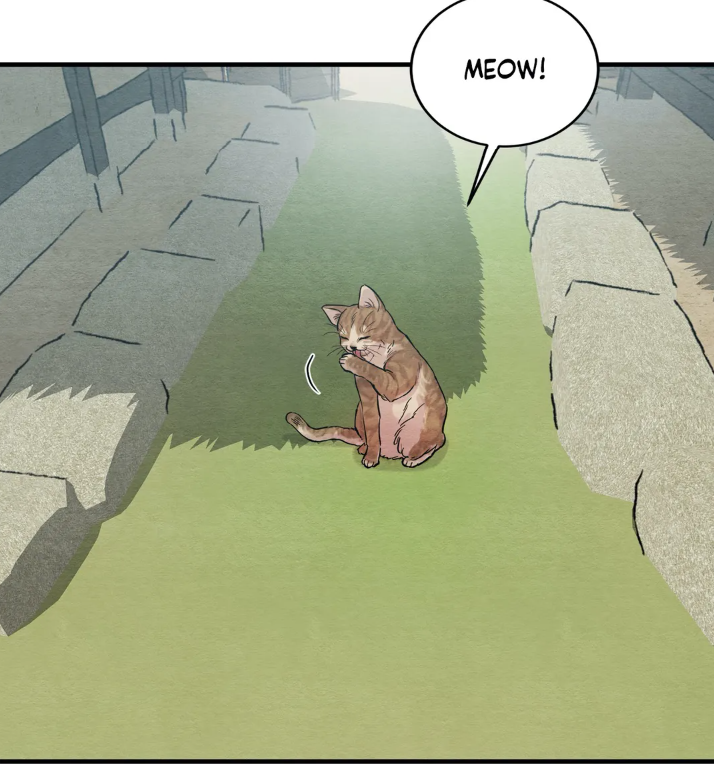 Due to his love for cats, the noble is led to a woodshed where he witnesses Yoon Seungho having sex with someone else. Note that the cat is the reason why he feels pleasure for the first time
 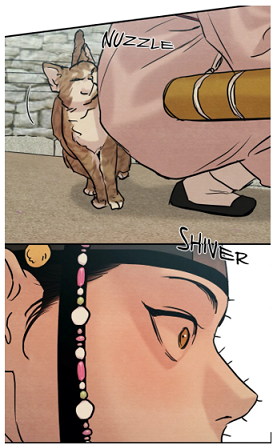 and why he gets caught in the end. If the cat had not appeared, then he would have never discovered the sexual intercourse. If he had never liked cats, he wouldn’t have played with him.
 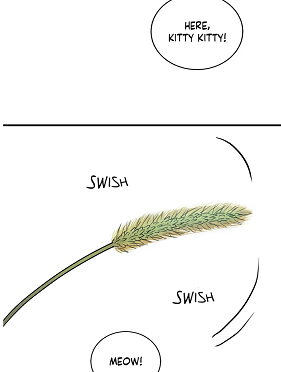 Furthermore, he was strolling through the district where commoners live as he was on his way to sell his new painting. His so-called choices could only lead him to the place where the attractive seme was. This was no real coincidence again. Now, why a cat?
In my opinion, the cat with the herb symbolizes nature which stands in opposition to society and its social norms. That’s why nature leads the protagonist to awake his sexuality and discover his sexual attraction for the seme. While in the original version, we had a fight between unconscious (dream) versus conscious (reality), we have a fight between nature versus society which is actually the same. Freud called the unconscious (“Es”) which is strongly linked to naturality. Baek Na-Kyum’s fight will be to accept that he has always been attracted to men and he has fallen in love with Yoon Seungho due to his charisma. By interacting more with him, he will discover that they share many affinities in the end. Like I demonstrated above, their mindset is quite similar. Furthermore, this new version confirms my interpretation: the seme will be or is Baek Na-Kyum’s real muse. And since it is their destiny to be together, then the commoner will come up with a thread again. Due to the painting and the tools he left behind , Yoon Seungho will be able to discover Baek Na-Kyum’s identity and the latter will be blackmailed. Notice that the merchant knows his true identity.
 The painter will have to work for Yoon Seungho, yet the reason will diverge. The commoner has already set his eyes on the artist, since he hasn’t really forgotten him.
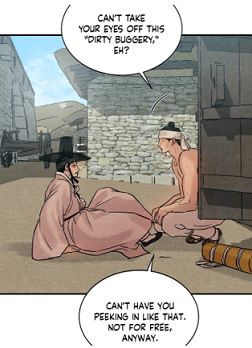 He remembers his face (“your eyes off”) and his words (“dirty buggery”). Their attraction was mutual and he needs to create a reason. As a conclusion, the introduction of the alternative universe makes us realize the dimension of determinism which is strongly linked to Nature (sex, cat). Baek Na-Kyum’s choice will be to acknowledge that his love for the seme is stronger than social norms, so that we can say, even if there exists determinism, there’s a certain liberty. Yet it is much more limited than it looks like as our decisions are influenced by our environment, experiences and past.
Feel free to comment. If you have any suggestion for topics or manhwas, feel free to ask. If you enjoyed reading it, retweet it or push the button like. My tumblr-twitter account is: @bebebisous33. Thanks for reading and the support.

This is where you can read the manhwa. https://www.lezhin.com/en/comic/painter But be aware that this manhwa is a mature Yaoi, which means, it is about homosexuality with explicit scenes. If you want to read more essays, here is the link to the table of contents: https://bebebisous33analyses.wordpress.com/2020/07/04/table-of-contents-painter-of-the-night/
In the chapter 53, we discover that Yoon Seungho is in denial about his affection for the painter.  The cause for his dismissal is that he believes, he always made decisions influenced by his deep thinking and never recognized that behind his actions, it was his heart influencing his mind. Because of the opposition between mind and heart, I couldn’t help myself connecting this to the famous quote made by the French mathematician and philosopher Blaise Pascal:
“Le cœur a ses raisons que la raison ne connaît point”. “The heart has its reasons that reason doesn’t know.”
With this citation, the author means that the mind is unable to understand the justifications and decisions made by the heart. As you can observe, love has nothing to do with logic and rationale, yet the main lead thought that all his choices were made consciously. He viewed his mind as the supreme authority, while it was not the reality. In other words, he was blind to his own heart and confused the heart with the mind. This is not surprising that on his way out, he is acting like a blind person. While he is walking, his mind is focused so much on his thoughts that he doesn’t realize where he is going. Observe that his eyes are focused on the door facing him and he keeps walking straight, until he pauses due to the scream he hears coming from the painter’s room. The reality is that he is actually acting on his impulses and emotions. He is definitely enraged because he was mocked by Min. He keeps denying the noble’s words and even tries to convince himself that what he has with the painter is nothing special.
  It is really complicated to pinpoint exactly what he was thinking here. Either he really wanted to bring the artist or he desired to let Min believe that he had finally given in and had planned something else. For me, I have some doubt that he was looking for the painter. His emotions were all over the place but he kept reassuring himself that Baek Na-Kyum and him had just a physical relationship. He was mad and he tried to convince his mind that the painter meant nothing to him. However, what caught my attention is that while he recalls his decision from that night, he sees the painter’s sleeping face.
 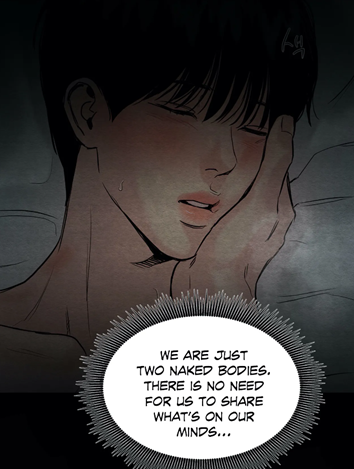 Back then, he felt the need to share what was on his heart, mistaking that his kiss and caress were motivated by his mind. What he really wants to share is not his mind but his heart but his eyes are not able to distinguish the difference. Because of the link between the heart, the mind and the blindness, I had a sudden revelation:
“It is only with the heart that one can see rightly; what is essential is invisible to the eye.”
This means that only love or friendship can help you to distinguish what matters in life. The real values will become visible, the moment you recognize your heart. Do you know where this quote is coming from? The Little Prince, a famous work written by Antoine de Saint-Exupéry. And now, you know what the topic of this essay will be: a comparison between The Little Prince and Painter Of The Night. Before starting with the comparison, I need to explain the story and its signification of The Little Prince.
When you look at this picture, you have the impression that this is a book addressed to children, although it is actually quite the opposite. This famous work is in fact classified as a philosophical tale. First, the author was criticizing through this fiction our modern society… People should know that it was written during World War Two, where reasoning was misused to the extreme (see my analysis Baek Na-Kyum’s confessions part 1 and 6) therefore he wanted people to question themselves and their values. The main points are the following:
– the contrast between appearances and reality
– the incapacity of communicating between adults and children and people in general
– the importance of relationships among people and to take care of them
– the sense of responsibility towards others
– the loss of true values due to money and power (represented by different kind of adults: the king, the drunkard, the geographer as scientist, the businessman, the vain man and the streetlight igniter)
In The Little Prince, the adults are portrayed in a pejorative way: their lives consist of dependencies (alcohol, the need of admiration, the greed to possess etc.), of loneliness and lack of feelings. The main protagonist might be the little prince, yet this fiction is told from the perspective of an adult. The narrator is an aviator whose plane crashed in the desert and there, he meets the little prince. Yet the story doesn’t start with their encounter, it starts with the narration about the aviator’s childhood. It is important as it represents the key of the story. Because of his bad experience with adults, the narrator decided to grow up and give up on his imagination and creativity. Antoine de Saint-Exupéry associates these values to innocence and childhood. In other words, the narrator was incited to give up on his childhood. The cause for this change were drawings. Once he painted an elephant eaten by a boa and the adults couldn’t understand the picture.

They rejected it as they claimed, it was impossible in reality. They forced him to drop his passion, drawing, because he always had to give explications to his pictures. That’s why he chose his career as pilot and became like all the adults, a pragmatic person using his reason all the time. In the whole book, adults are criticized, they prefer numbers over emotions and simple things like laugh f. ex. They are often portrayed as superficial and narrow-minded.
However, by meeting the little prince, the narrator rediscovers the importance of innocence and childhood. As a conclusion, one of the main messages of this philosophical tale is that adults should keep the inner child in them, they should stop using too much the reason and mind so that they are able to realize what matters in life. If you have the time, then I encourage you to read this wonderful work, full of deep meanings, although it really looks like a fairy tale due to the title and the pictures. In reality, the images are addressed to adults, to let them rediscover the child in them they abandoned because of reality. The author is encouraging people that despite growing up, they should keep an innocent and pure side in themselves, hence the readers discover this quote in The little Prince
“All grown-ups were once children… but only few of them remember it.”
We have a scene in the manhwa where the contrast between adulthood and childhood is illustrated.  The children can indeed enjoy the beauty in simple things, while the scholar’s mind is only focus on his books and his hunger for power and admiration.
 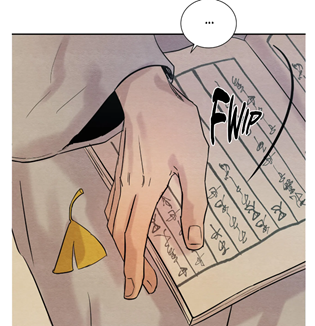 Therefore he can’t really enjoy life as he is left unsatisfied with his situation. As you can observe, the manhwa offers a similar philosophy. Jung In-Hun is just an adult who lost his inner child a long time ago.
And now, it is time to focus on the characters from the philosophical tale. You can imagine to which person I am associating Yoon Seungho, it’s the narrator and aviator. He truly resembles Yoon Seungho a lot. He is an adult through and through, using his mind all the time. That’s why he doesn’t know happiness and joy. Furthermore, their situations are similar. The pilot is in the desert, feeling lonely and facing a dangerous situation. The main lead in Painter of The Night is lonely as well. He might meet many people but he doesn’t share his thoughts to others. Furthermore, his sex sessions are fights so we could say, he has to face a certain danger as well. He needs to live up to people’s expectations: an infamous hell-raiser. A desert is like hell and for Yoon Seungho life has nothing to offer. He is already living in hell. From my point of view, just like the pilot, he was also forced to grow up, to face reality and used his reason and mind to survive… and everything happened because of an adult, his father. I am quite sure that father Yoon never loved his son, just viewed him as a tool for his own interests. And when his life and position were threatened due to the purge, he chose to betray and abandon his son in order to survive. The latter became an adult through really bad experiences. He hasn’t even recovered from it yet, therefore his hand is shaking in Yoon Seung-Won’s presence and he keeps having a nightmare, the moment he meets one member from his former family. In fact, his inner child died at the moment he got betrayed by his own father so that he stopped living for real. He was like a zombie, the mind was the only proof that he wasn’t truly dead. His thoughts were the remains of his existence and this explains why he detests the idea that he is a man consumed by lust. For him, the body was just a tool thereby he never paid attention to his own body. His sex sessions were just a tool to deceive people, to hurt his father and ensure that he wouldn’t get wounded again. This explicates why he is no big eater, why he was even willing to give his whole lunch to the artist.
 He only existed through the mind and his eyes. That’s why he can’t see and recognize his own heart even after meeting the painter.
And now, you can already envision who the little prince is. This is our beloved Baek Na-Kyum whom I strangely related to a lamb during the first season. The irony is that when the aviator and The Little Prince met in the desert, the latter asks the aviator to draw him a sheep. Since the narrator hasn’t drawn for a long time, he paints an elephant eaten by a boa and strangely, the boy understands the meaning of the drawing perfectly. However, the boy is not satisfied with this and keeps requiring his sheep. By each new drawing, he complains about the picture: too ill, too old etc. At the end, the aviator designs a box telling him that the sheep was inside.

The little prince accepts the image with the explication. This outlines that only imagination matters in a painting. As time passes on, the aviator gets closer to him and rediscovers his passion and talent: drawing. They become friends without realizing it. Striking is that in both words, the painting is important. Sure, in the manhwa, the roles are reversed. The lord is the one asking the low-born to draw him erotic pictures. However, remember painting is related to imagination and creativity which are both associated to childhood by Antoine de Saint-Exupéry. And we know for sure that Baek Na-Kyum was inspired by his own creativity, when he started painting erotic picture of sodomy in his childhood.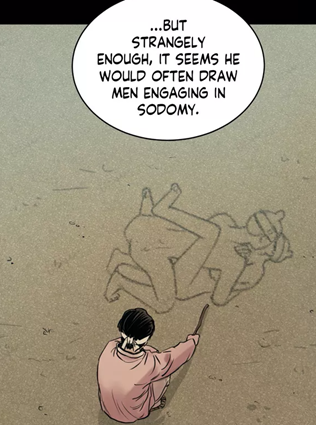 They were the expressions of his innocence and purity in the end, which the aristocrat felt. We could say that through the publications, the noble rediscovered the forgotten childhood and innocence. And this coincidences with the narrator’s life. The latter used to love painting but was forced to renounce his passion, painting. So by meeting Baek Na-Kyum, the lord is encouraged to paint again.
 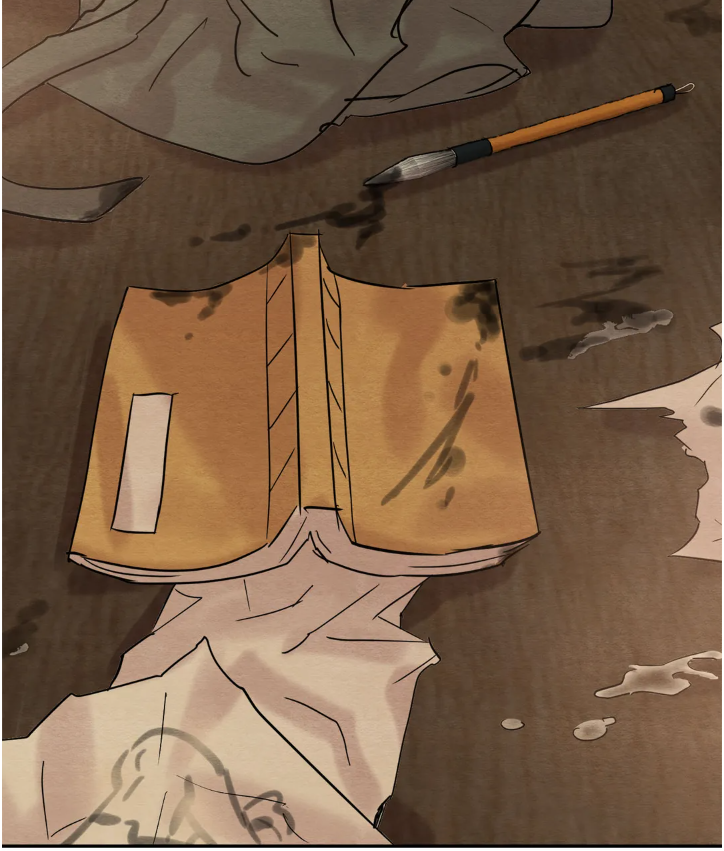 (chapter 8)
  (chapter 23)
  (chapter 36)
On the other hand, the topic of Baek Na-Kyum’s painting had nothing to do with innocence and purity, as they were all showing sex. However, I interpret that the boy was longing for love, and already knew about his sexual orientation. He saw it as something natural and nothing embarrassing. In his eyes, sex was an expression of love, which was unusual for this historical period. Sex was related to marriage, family and procreation. With this signification, the manhwa sends one message: homosexuality is no abnormity, it is also a form of love. So when the aristocrat discovered Baek Na-Kyum’s erotic publications, he sensed the naturality, purity and warmth in these paintings. That’s why he felt so moved and he needed them for his sexual activities. Before, he had to use subterfuges to fake erections. This is no surprise when he meets the painter for the first time, he is full of joy and innocence.  Remember when he even grabs the painter’s hands, he is treasuring them. There is indeed a certain candidness in his gestures and comments.
 The erotic paintings were the fire to ignite the main lead’s heart. The inner child was awaken. Therefore he is again happy like a little child, when the artist appears at his chamber in the chapter 8.
  Thanks to the painter, the lord’s heart started beating again. He was able to reconnect with emotions that were buried by his huge trauma. However, since he had to use strategies to force the painter to paint, he explained everything with his eyes and mind. Although the low-born rejected him in the chapter 49, the aristocrat overlooked an important aspect:
 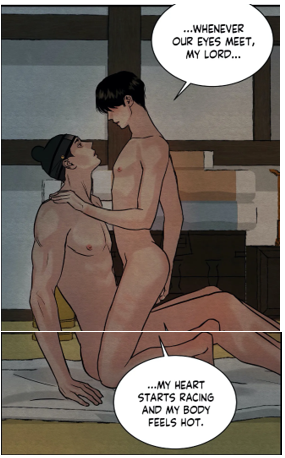 The heart. Baek Na-Kyum’s heart is racing in the lord’s presence so this is definitely more than physical attraction. Another parallel with the French story is the value of responsibilities. The aviator and the prince become responsible for each other, while they live in the desert. And this is what is occurring in the manhwa. Yoon Seungho takes his responsibility for the low-born
  and it is the same for the painter. The latter is the one who offers comfort and warmth to the lord, only him can soothe the noble’s extreme emotions.
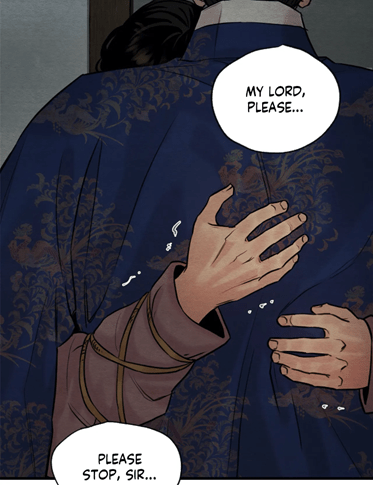
Since the painter is the little prince, we have to explain how he came to meet the aviator in the desert. He comes from a planet, where one day a rose suddenly appeared. Before, he worked every day, cleaned the planet. On his planet, he had to remove baobab seeds and to clean volcano chimneys so that they wouldn’t explode. And now, you can envision my smile, while writing this. Remember that from the start, I kept comparing the aristocrat to an dormant volcano, which erupted each time he was in a huge conflict with the painter. The latter was the spark to initiate the fire, he was the one who brought him back to life. However, the more time he spent with him, the calmer and the more patient our protagonist became. Notice that the little prince brought tranquility and regularity to his planet, as he cleaned the chimneys each day. This is exactly what is happening to our protagonist. Only the artist is able to calm the main lead.

Note the parallels between the little prince and the painter. Both symbolize innocence and purity. They are also hard-working and dedicated. They are social, although the manhwalovers shouldn’t forget that both the little prince and the artist came from a secluded place. The brothel is not a place where many children come by and where people want to chat with the gisaengs. As you sense, they were quite secluded, however they felt comfortable there. But if the little prince lived on his own on his planet and was happy, what made him leave his place?
If you look at the planet, you’ll notice a rose protected by a glass bell. The little prince fell in love with the rose but the latter was vain and quite arrogant. The flower requested a lot of things from the boy so that at the end, he couldn’t bear it any longer. He became unhappy as he was wounded by the rudeness and selfishness of the rose. At the end, he decided to leave her. The rose recognized her faults and even apologized. Finally she confessed her love to the boy, yet never asked him to remain by her side. She wished him happiness and tried to hide her tears before his departure. She regretted her behavior but she didn’t attempt to change the prince’s mind. She just complained that both were stupid to realize their feelings for each other. However, in this story the boy only realizes that he felt love for his rose after landing on earth. It took him a long time to recognize what love really is. For that, he needed a guide. Now, if the manhwalovers compare the philosophical tale with Painter Of The Night, they’ll detect some parallels between the rose and the scholar. Both represents the love of the innocent main lead. Furthermore, Jung In-Hun and the rose are arrogant, stupid, vain and selfish. The painter had to leave the scholar’s side too. However, the huge contrast is that the teacher never regretted anything, he felt no remorse for the physical and emotional abuse on the painter. Besides, he never cried for the low-born, while the rose was genuine. Nonetheless out of pride, the flower tried to hide her tears and sadness. With the departure of the prince, it is implied that the rose will die as there is no one to take care of her. She is already coughing. However, like I explained before, the low-born mistakes his admiration for love. His mind has been manipulated and influenced by the low noble and his noona, hence he is blind to the obvious. Just like our powerful protagonist, both ignore their hearts. One doesn’t know that his heart is beating again, while the other was constantly repressing his deepest desires at the beginning. He wouldn’t listen to his heart, just only his mind which was actually the scholar’s mind. Now, it is a little different. He is accepting his sexual desires, the mind is no longer controlling his body. However, the painter hasn’t recognized the meaning behind the racing of his heart.
Just like in the philosophical tale “Candide”, the little prince is learning through experiences. After leaving his planet, he meets different kind of adults, all of them living isolated on a planet. His initiatory journey makes him realize the danger of adulthood. The first one is a king who gives orders to the little prince. The latter questions his position as king, as there is no one else next to the king. The latter believes his power is unlimited and doesn’t recognize the absurdity of his situation. Here, the author wanted to criticize the futility of power. A person can’t truly rule over nature as he can’t control it. Then the monarch can’t truly rule over people as the latter can just refuse to obey the orders. Strangely, I couldn’t restrain myself to associate the king to our protagonist Yoon Seungho as well. The latter had to learn through the hard way that his power meant nothing in front of the painter. The latter kept rejecting him, criticizing him and even challenging him with his authority. It took him a long time to realize this… he was on the verge of abdicating, when he finally changed his approach. Observe the painting is what brings them back together. This is no coincidence, since imagination and creativity are important for children. Then if I had to compare all the other adults, I would say that Jung In-Hun is a combination of the geographer and the conceited man. The former lives in his books and makes no experience, he doesn’t visit the places he reads in his books. He has no idea about real life and the conceited man lives in order to get admired. The scholar is often seen in company of books
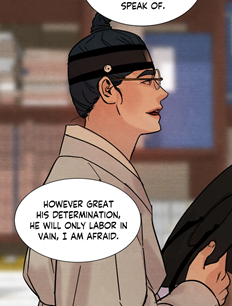 and has no idea about the real world, therefore the lord warned him before his departure to the city. As for the conceited man, since he is alone on his planet, he is left unsatisfied. And we all know how arrogant and conceited the low noble is. The two adults represent each of them a negative feature which people should avoid in their life. Knowledge is good but without experience, it is reduced to nothing.
As you can sense, the little prince and the narrator stand both on opposite sides, yet after their meeting, they discover what they were both missing which coincides with our protagonists: childhood/innocence versus knowledge/experience. The pilot rediscovers his creativity and innocence but he shares his knowledge and experience to the little prince. This is the same with Baek Na-Kyum and Yoon Seungho. Besides, both of them stand on the opposite side of the social hierarchy reinforcing the contrast. In other words, they both change for the better. While the lord teaches the painter critical thinking, the former experiences what it means to take care of his partner. He makes many experiences, positive and negative, yet from them he is able to learn and change indeed for the better. While the pilot realizes the importance of friendship, as the boy becomes his companion and confident, the lord feels the same need: he wants to share what is on his mind… he would like to communicate his thoughts and feelings. As you can sense, the noble was not realizing that he desired to share his heart.
On the other hand, the prince makes on earth a huge discovery: he learns what friendship and love are. How does he know these?
Before encountering the pilot, the little prince meets a fox. The former tells him that he is looking for friends to which the fox replies, he can’t become his friend as he is not tamed. Hence the animal proposes a deal to the boy. The latter should tame him as taming signifies bonding. “if you want a friend, tame me”.

Now, you can observe how similar both works are. Right from the start I kept saying that the painter has been slowly taming the protagonist, an eagle, and the latest chapter (53) proves me that this metaphor was totally correct. The painter tamed Yoon Seungho, was even willing to get wounded in the process in order to soothe the lord’s anger. The hug signifies their special relationship.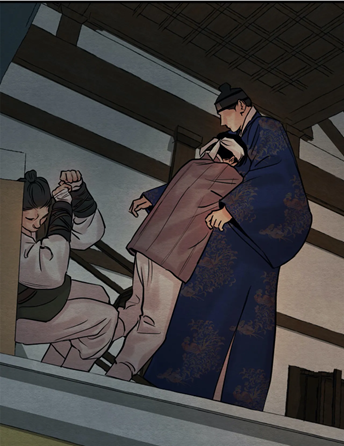 The huge difference here is that taming is not connected to friendship but to love. However, as you can observe, the protagonists in both stories are making the same experiences. They learn the true value of love and friendship, they make bad experiences. One encounters terrible adults which resembles a lot to the painter’s past tragedies. The main lead made him suffer, yet everything was caused by the scholar… Remember that if the rose had treated the boy nicely, he would have never left his own planet. On the other hand, Yoon Seungho is discovering the innocence and purity through the painter. He comes back to life, as he reconnects with his inner child and his heart.
Another similarity is when thanks to the fox, the little prince realizes how unique his rose was:
“It’s the time you spent on your rose that makes your rose so important.”
And unique reminds us of the lord’s word at the beginning of the chapter: “special”. He refused to admit that Baek Na-Kyum was special to him.
The fox plays a huge role in the philosophical tale as he embodies knowledge and wisdom. In other words, he is the opposite of cunningness, which is usually related to the fox. Now, you already anticipate who the fox in Painter of The Night is. It’s Min. He is the one who tells Baek Na-Kyum and Yoon Seungho what the lord feels for the low-born. Yet, in this story, Min is far from wise and well-intentioned. That’s why he kisses the painter.  Through his gesture, he reveals the secret. The lord likes the painter. In The Little Prince, the fox also unveils a huge secret:
“It is only with the heart that one can see rightly; what is essential is invisible to the eye.”
Striking is that his nickname “Black Heart” fits so well. Since he sees with his heart, he can recognize the true nature of their relationship. The problem is that neither the low-born nor the powerful lord were using their hearts in order to perceive their affection for each other, both were using their mind:
The lord confuses his mind with his heart. And the painter is in the same situation. He got hurt, when he saw the kiss between Min and his lord. However, he tried to rationalize this incident.  He shouldn’t feel wounded. On the other hand, he kept asking why. As you can see, the painter’s mind is controlling his heart. I had the impression that he would be the first one to recognize his emotions, because he is the only one who talks about his heart. Notice the resemblance to the famous citation. The artist mentions his eyes and heart, just the the fox: “It is only with the heart that one can see rightly; what is essential is invisible to the eye.” Yet, I had underestimated the strength in the artist’s will and mind. That’s why I come to the conclusion that Baek Na-Kyum values more his eyes and impressions than his heart.
Thanks to Min, the fox, the secret was finally unveiled.
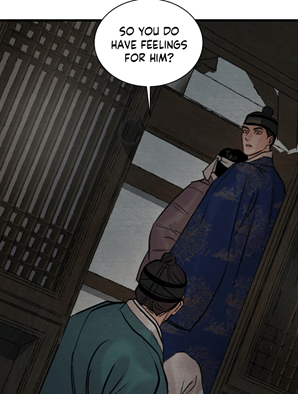
However, I have the impression that unlike in the French novel, a rivalry could start between Black Heart and Yoon Seungho. In The Little Prince, the aviator and the fox didn’t fight against each other because they were too different. Yet I believe, this could become different here, for both are nobles. Back then I felt, Black Heart might try to covet the commoner, since he kept asking the lord to bring Baek Na-Kyum to him (chapter 33, 52). Sure, he enjoys the fun and likes playing with the protagonist’s feelings, yet I sense a certain obsession and envy behind his requests. I can’t forget the look he had on the painter in the chapter 8. Min looked at him with a certain desire.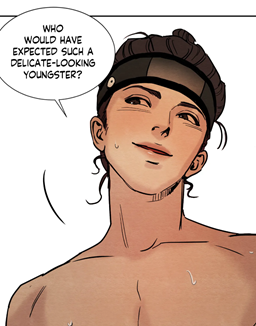 And this assumption was proven correct: The Joker is determined to taste Baek Na-Kyum. However, he is not wise like the fox in The Little Prince. In truth, he embodies the negative version, because he is not reflecting on his own behavior and emotions. He has no idea why he is so obsessed with the painter: for me, there’s no doubt that he is confusing lust with love. He definitely got upset, when he saw the couple hugging
 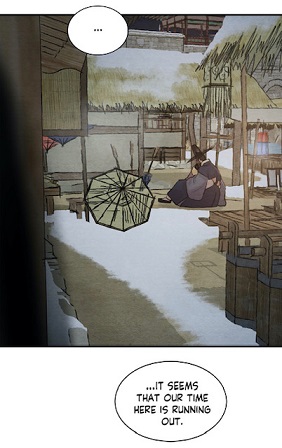 each other tenderly.
  That’s why he felt the urge to vomit. Min is too focused on looking at Yoon Seungho and Baek Na-Kyum that he is not recognizing his true motivations behind his actions. That’s why he said this:
  In my opinion, The Joker needs the presence of others in order to feel his own existence. In other words, while the fox in the original story asked the prince to tame him, the fox in Painter Of The Night is acting the opposite. He is trying to tame the others, but he keeps failing all the time.
As you can observe, both works convey similar messages: value the right things. Power and wealth mean nothing, as they don’t bring happiness. Love, friendship and relationship are vital for humans. At the same time, it is important to keep a certain purity and innocence in us, even if we are adults. That’s exactly what the two protagonists are learning now. The noble is longing for chastity and love, although he hadn’t recognized it yet.
At the end of the story, The Little Prince leaves the aviator behind. Officially he goes back to his planet but since a snake bit him, we can wonder if he died. The adult would be rational and say yes, he died. The child would answer that he returned to his planet in order to see his rose, like the snake told him. And this is important as even this story mentions death. This belongs to the growing up and facing reality.
We have a similar evolution in the manhwa. The painter loses little by little his innocence, he experiences the harshness of the world, whereas the lord is rediscovering the lost childhood, his buried heart, just like the aviator.
At the end of the story, the narrator says that he is still looking for the little prince, even asking the readers if they saw him which shows, he refuses to imagine his death. He has maintained his pure heart despite their separation. Besides, when the aviator looks at the stars in the sky, he always thinks of him. As you can see, the aviator doesn’t forget his “inner child”. He is an grown-up after all, yet he shouldn’t forget his inner child. However, Painter Of The Night can’t have the same ending. Therefore, it is no coincidence that the moment the noble admits his love and is willing to show it correctly (chapter 70)
 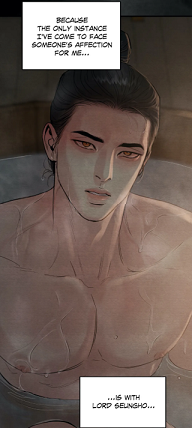 , he starts acting like a child again: he plays pranks
 (chapter 70)
  (chapter 74) or he is teasing his lover.
 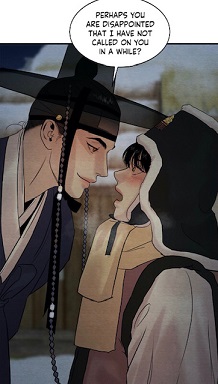 , These are signs of the return of his innocence. The readers can feel the inner child in Yoon Seungho.
Nevertheless the message is really similar: the lord and the painter are discovering what really love is. While the painter confused “love” for Jung In-Hun with admiration and later indoctrination, the noble never felt anything before. That’s why he couldn’t recognize his affection for the low-born, he was denying the existence of his heart. For him, he was just a mind and his body a tool. As a conclusion, they need to pay attention to their hearts and stop relying too much on their mind. That was the lesson the readers should learn from the chapter 53.
Feel free to comment. If you have any suggestion for topics or manhwas, feel free to ask. If you enjoyed reading it, retweet it or push the button like. My instagram-tumblr-twitter account is: @bebebisous33. Thanks for reading and for the support, particularly, I would like to thank all the new followers and people recommending my blog.
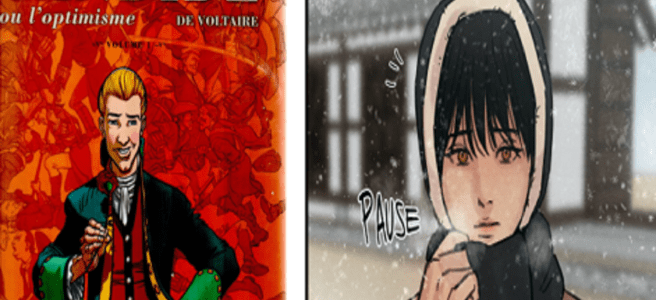
This is where you can read the manhwa. https://www.lezhin.com/en/comic/painter But be aware that this manhwa is a mature Yaoi, which means, it is about homosexuality with explicit scenes.
For francophone readers: Candide ou l’optimisme de Voltaire- Intégrale (Français) 2013 de DELPATURE+DUFRANNE (Auteur) ISBN-13 : 978-2756047805
After seeing the illustration for the analysis, you might think that Candide is a graphic novel but you are totally wrong. Here I am just using the cover of the BD (the French term for graphic novel/Comic), since in reality Candide or the optimism [this is the whole title] is a philosophical tale written by the French philosopher Voltaire in the Age of Enlightenment (18th Century). Fact is that BD has become so popular in France that famous novels are now adapted into graphic novels thereby these great stories are not forgotten by younger generations. It goes so far that important Historians even use BD in order to bring their knowledge closer to public. You might not know but in France BD is considered the 9th art, meaning that it has the same value than poetry, paintings or movies.
Since I teach History and French for German students, you can understand why I own graphic novels. It allows the students to discover History and classic French literature without the problem of the language barrier since there are pictures and the quantity of text has been reduced. Another advantage for Candide as BD is that it helps the readers to grasp better the irony and sarcasm of Voltaire behind this work. This author wanted not only to condemn Leibniz’s theory but also to incite his readers to use critical thinking and to give some advice about the pursuit of happiness. That’s why Candide is considered as a philosophical tale. At the same time, this story is a satire because Voltaire criticized different problems in European societies in the 18th Century, like intolerance, the absurdity and atrocity of war, slave trade and its ignominy, the hypocrisy of Church, absolute monarchy etc.
Before comparing the manhwa to this philosophical tale, I need to summarize the story. Young and naive, Candide grows up happily in the castle of Baron Thunder-ten-tronckh. He admires the ridiculous theories of the tutor Pangloss, according to which “everything is for the best”. But one day, the baron surprises Candide embracing his daughter Cunégonde, chasing him out of this paradise because it is unimaginable that a bastard would marry a noblewoman. Immersed in the horrors of the world, Candide discovers that reality contradicts Pangloss’ teaching: wars and natural disasters are everywhere. His initiatory journey takes him all over the world (Holland, Spain, Portugal, Argentina, Surinam, Italy, Turkey) and with each misfortune he experiences, he doubts more and more the doctrines of his tutor. During his wandering, he finds Cunégonde and Pangloss on several occasions but each time he gradually discovers the true nature of these admired people. Cunégonde becomes a courtesan and uses her beauty to survive or we could even say to enjoy life, while the tutor is disfigured by syphilis but continues to preach that every misfortune is for the good of man. However, his love for Cunégonde and his love of life encourages the main lead not to fail into despair and in the second part of the story, the protagonist starts questioning the definition of happiness. After his long and painful apprenticeship, the protagonist comes to the conclusion that in order to be happy, one must work. Through work, evil like vice, boredom and need can be avoided. Moreover, fortune and ambition cannot be sources of happiness. One must also abandon sterile reasoning (doctrines) but rather use his own reason. Only thinking nourished by experiences and observations allows people to build their own happiness. At the end of the story, Candide finds Cunégonde again but marries her out of duty, she has become ugly and acrid. With the people he met during his wanderings, he manages to form a community where only work distinguishes them. Through this philosophical tale, Voltaire advocates equality, the abolition of social order and democracy.
Now, you might be wondering why I see some connections between both stories. First, certain figures coincide with the persons from Painter Of The Night. Yet the most important similarity is in my opinion the mentality and philosophy preached in both works.
However, let’s start with the persons from philosophical tale. I only mentioned the three most important characters from Candide: Candide, Cunégonde and Pangloss. The manhwaphiles can already envisage who in Painter Of The Night resemble the main character from the French novel. Baek Na-Kyum is a new version of Candide. This is quite simple.
First they share the same important feature. Both embody innocence and purity. Candide is so naive that he always falls into traps and can’t perceive the dishonesty in the people he meets. Due to his candor, the readers are even misled because the main lead takes by face-value what he has been told. Let me give you an example. In a certain chapter, what Candide calls a hotel is in reality a jail. Therefore it is very important to read between the lines and pay attention to the words used by the author in order to comprehend the real situation. That’s how innocent and ironical Candide and Voltaire are. Now, you understand why I mentioned above how useful Candide as BD can be.
Both main leads have unknown origins. Candide is rumored to be the illegitimate son of the baron’s sister who refused to marry the father because he wasn’t noble enough. Baek Na-Kyum has been adopted by the head of the gisaeng house so his biological parents are unknown. In addition, both are considered as low-born.
The third similarity is their positive and forgiving nature. At no moment, Candide resents his teacher for preaching his ridiculous doctrine, the corrupted and double-faced people who stole or even betrayed him, to the point that he wants to seek revenge. At the end, the young man even accepts his old tutor in his new created garden. Notice that despite the rape, Baek Na-Kyum did not resent the lord later revealing his forgiving disposition. Both never fall into despair. Baek Na-Kyum might choose to run away but he isn’t depressed. He doesn’t resign or wants to commit suicide. Both are quite persistent and are able to learn from their mistakes. Both learn through their experiences and observations. Baek Na-Kyum is a little more obedient after the straw mat beating and later admits his own sexual orientation as he can no longer lie to himself.  The mirror helps him to witness his own arousal. Furthermore, in the chapter 42, he finally confesses that their first night together did affect him.
Candide and Baek Na-Kyum meet one tragedy after another because of the doctrines they were taught by their teachers. However, there are huge differences between the two main characters. 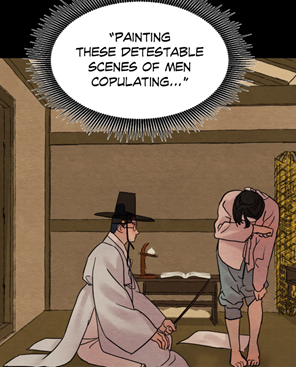 First, the nature of Jung In-Hun’s indoctrination diverges: homosexuality is filthy. Pangloss never spoke about sexuality. Besides, Baek Na-Kyum was exposed to physical abuse and coercive persuasion, while Candide lived happily in the Garden of Eden, until he was expelled. The painter’s trauma was so huge that he repressed these terrible events, he only sees a glimpse of it in a nightmare. Because of the fake preaching, Baek Na-Kyum is unable to understand that all his misery has been caused Jung In-Hun in reality. Like I have expressed it before, if he hadn’t denied his own homosexuality, he might have succumbed to the lord’s seduction much quicker before.
Consequently just like Candide, the artist is banished from paradise (see my analysis about Fall of man) the moment he discovers that he broke his vow of chastity and he is raped. In both works, sex is the reason for the expulsion of paradise. Therefore we could say that both novels are referring to Fall of man. Nevertheless, Cunégonde is the one initiating the move on the very pure man.  The reason for her behavior is the following. Cunégonde had witnessed in the woods, how the tutor Pangloss seduced a maid and decided to apply this new teaching onto our naive protagonist. Now, I am showing another drawing from the graphic novel:
 This is what Pâquette is saying: “Oh Master Pangloss, flood me with your knowledge.” In the next picture, she even adds: “How sweet is your teaching!” I am quite certain that you can sense the humor in this situation. We could call this sex education (LOL!).
Another connection is the corporal punishment for example. After being forced to become a soldier for the King of Bulgary, Candide is caught picking flowers which is judged by his superior as an act of desertion hence he is condemned to be beaten 36 times by the whole regiment. This reminds us of the incident leading to the straw mat beating.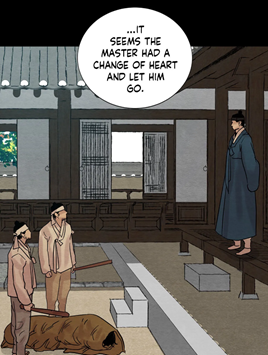 Baek Na-Kyum became the victim of an injustice and was punished by Yoon Seungho to the straw mat beating.
I believe that all the points I wrote above are convincing enough to validate my comparison between Candide and Baek Na-Kyum. They have so many common denominators that I could continue writing about it for hours. But this is not my main point. My purpose for this association is the following. Through his bad experiences and his own reflection, Candide becomes the person who changed the most compared to all the other characters. Little by little, he starts criticizing the dogmas told by Pangloss until he can no longer accept this doctrine. Then he starts using his own mind and observing thereby he becomes a very mature and responsible man. He is the one who is able to find an answer how to get happiness and how to avoid misery. That’s why this philosophical tale is called an initiatory voyage. The main lead gained real knowledge through experiences and observations. In the final chapter, Candide promotes work and encourages talent, he values critical thinking and is no longer accepting false preaching, social hierarchy and as such order society.
If the manhwaphiles return their attention to Painter of The Night, they will notice a similarity in the painter’s growth. Due to his observations, he starts perceiving the main lead differently. That’s the reason why the chapter 35 is so significant. While the artist felt Jung In-Hun’s lack of concern and the superficiality of his kindness 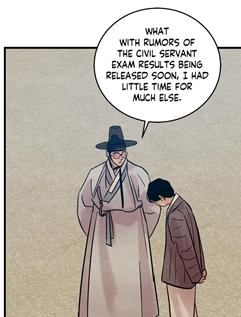
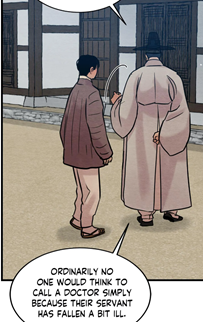
 , he could see Yoon Seungho’s exhaustion, vulnerability and real concern for his health.

He even showed an interest in his person, he wanted to know about his likes and dislikes. This explicates why the commoner decides not to betray Yoon Seungho and to lie to Jung In-Hun in the chapter 38. With his own eyes, he recognized the lord’s fatigue and weakness that’s why Byeonduck gave us each time a picture of the painter reacting to his observations. 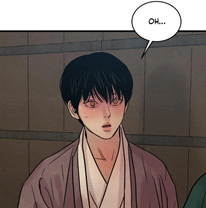 (chapter 35)
He has become so attentive and observant that he is able to detect the lord’s vulnerability and distress, hence he can not follow the teacher’s order and prefers lying. As you can now recognize, the first season of Painter Of The Night represents the slowly transformation of an innocent and manipulated man who gives up on his teacher’s dogma. However, this doesn’t mean that he has entirely perceived his learned sir’s true personality. I doubt that he has really realized the manipulation and viciousness of Jung In-Hun. Therefore I predict that they will meet again, just like they parted from each other in the past. Remember that Baek Na-Kyum became a drunk because he could no longer be by the low noble’s side. Notice the parallels between Candide and Painter Of The Night. Candide’s path crosses his teacher’s many times but their encounter is always limited in time. The irony is that while the low noble thinks that he can still use Baek Na-Kyum as his pawn, the low-born is no longer naive. Hence he decides to cut ties with his former teacher for good. That’s why he asks the valet Kim to get rid of the painting. As a first conclusion, Baek Na–Kyum’s apprenticeship looks a lot like Candide’s. At the end, he is no longer delusional about Jung In-Hun’s feelings for him and has been able to reject the teacher’s false preaching. He will now go his own way and has already abandoned his former teacher for real.
Now, it is time to focus on the other figures from Candide: Cunégonde and Pangloss. In my opinion, Jung In-Hun is a combination of Pangloss and Cunégonde.
Initially, the tutor has a similar work like Jung In-Hun. Voltaire described Pangloss as teacher of “metaphysico-theologico-cosmo-lonigology.” This long expression is full of raillery as it reflects the emptiness of the teaching. Furthermore the word lonigology contains a reference to “nigaud” /pronounciation: nigo/ which means “stupid” in French. His name is also another mockery because Pangloss means “all-tongue”. But be aware that here the author is rather saying that this man is full of air, all-tongue signifies “empty talk”. No surprise when I associated the Korean version to air in the analysis [see “The window, the door, the air and their signification]. Hence you can imagine that the French figure does lip service for the baron too, just like the low noble in Painter of The Night. In other words, the tutor can be described as fake, arrogant and even stupid. Imagine, he explains to his gullible pupil that nose were created for glasses. The poor man is mixing cause and effect. Glasses were invented for bad eyesight and not for nose. Here, you can understand why I use this example for revealing the tutor’s stupidity. Both teachers are wearing glasses.
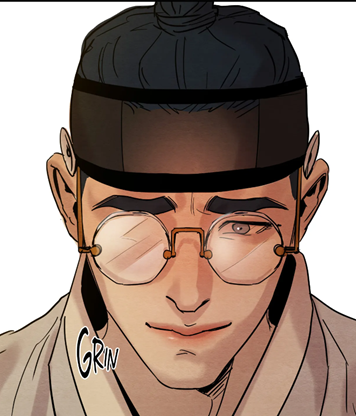 As a first conclusion, their respective personality is really similar.
Interesting is that Pangloss is the representative of the theory of Gottfried Leibniz (18th Century), which I’ll elaborate now. The German philosopher affirmed that God is good since he created the best of all possible worlds. But if the created universe is globally perfect, some of its parts are touched by an evil necessary to the triumph of Good. According to the German, every action, every evil is part of a rigorous chain of events leading to a good. In other words, people should accept evil and tragedies since at the end, all this will lead to a good outcome. Therefore the philosopher’s theory is called “optimism”. For him, humans don’t need to change the world, they should accept everything occurring to them as God has already planned it. The necessary evil is just a part of God’s design in the end. Now, you can understand what this theory means. The professor advocates stagnation and is not encouraging criticism, progress and new discoveries. He is not interested in improving the world, he wants to keep the actual situation forever. Men should accept misfortunes and be resigned to their fate. And that’s exactly what Jung In-Hun is telling to Yoon Seungho in the chapter 6. He only sees teaching as diversion 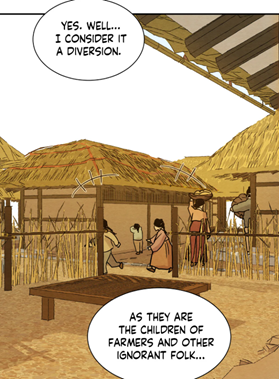 because the commoners should remain in their mountains and accept their conditions.
 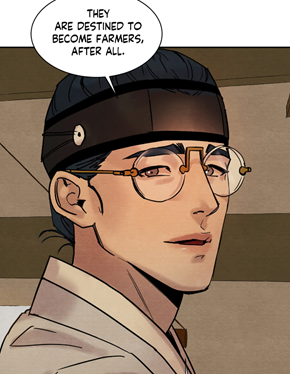 Their fate is already determined, just like Baek Na-Kyum was fated to become a prostitute.
Although Pangloss is a little fake, the teacher from Joseon is a bigger hypocrite since the low noble isn’t accepting his own condition. He is ambitious and dreams of wealth and power because he is a noble. Maybe this is the only huge difference between Pangloss and Jung In-Hun. The tutor is not ambitious because he is a true believer of Leibnitz’s theory. This is not the case for the poor aristocrat, he just wants the stagnation for commoners but not for himself. That’s the reason why he forced the painter to stop from painting because he was jealous and didn’t want a low-born to succeed and climb the social ladders. To summarize, the scholar is more double-faced than Pangloss but both preach the same: “stagnation”, “this is for the best”. Jung In-Hun is definitely more vicious and scheming. Yet they are both stupid because the man with glasses fell into the trap set by Yoon Seungho and didn’t see that the latter only made empty promises. 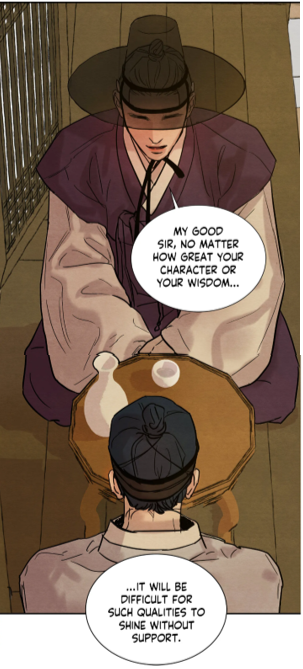
Just like Candide, Pangloss encountered disaster after one another. He loses his job as tutor because the castle is invaded and destroyed by the King of Bulgary. Furthermore, the sexual encounter with Pâquette brought him syphilis hence when he meets Candide in Holland by chance, he is no longer healthy and admirable.  After getting cured from syphilis, Pangloss loses an ear and an eye, increasing his blindness and deafness to the reality of the world. Let me remind you that glasses symbolize lack of foresight and judgement. That’s why Pangloss never changes till the end. He spent too much time living in his own world and his books that he is not capable to learn through experiences and observations. Jung In-Hun takes exactly after the former tutor. First, he has never mingled among scheming and treacherous nobles before, since he lived in the countryside among commoners. Besides, he only had his library to cultivate his knowledge as he refused to meddle with low-born. That’s why the low noble is either seen wandering in the mansion and on the streets alone or standing close to books. He has no real interaction with others.
But let’s go back to Pangloss. For him, since there’s no effect without a cause, he accepts his misfortune and never tries to discover the true origins of his own misery. Like I mentioned above, he often mixes cause and effect. He is not able to ponder and reflect on his own wrongdoings. According to him, the origin of his sexually transmitted disease is not the decadence of people, but love. However, if you pay attention to the pictures from the French graphic novel, Pangloss never made love to Pâquette, he just had sex. In this entire novel, sex is never associated to love but rather to perversion and dissipation. There is no fidelity in the French story, only Candide remains chaste and faithful in the sense he never falls in love with another woman. Yet, in the finale chapter, he no longer has deep feelings for his wife. She is just appreciated for her talent as baker.
Remember what I wrote about Jung In-Hun’s worries and problems, his future seems so uncertain. I detect that he will have a similar path: tragedy is on his way. He has no idea what awaits him at the capital. The protagonist warned him but the latter didn’t comprehend the message or was unwilling to take the advice. He is too ambitious and arrogant to envision this possibility.
  And the powerful lord reminded him once what it means, when you get sponsored. You are not allowed to speak ill about your benefactor and you should know your own status. However, the scholar didn’t learn his lesson, blinded by his hurt pride and the suffered humiliation. Therefore I predict that the scholar will remain unreformed, although he has already dropped his doctrine about homosexuality for good. Like I said before, his immorality and duplicity are becoming more visible. Yet, his arrogance, his stupidity and his selfishness will be the cause for his own downfall. Pangloss found a refuge thanks to Candide as the former never schemed against the naive protagonist, he was just a stupid scholar, victim of a false belief.
Nevertheless, I mentioned above that the Joseon scholar was a combination of Cunégonde and Pangloss. The reasons for this association are quite simple. Cunégonde represents Candide’s pure love, just like Jung In-Hun is the painter’s first love. Candide is blinded by her beauty and gentle manners hence he is not able to perceive her vanity and superficiality. Baek Na-Kyum was deceived by the teacher’s smiles and gentle manners too. If we pay attention to Cunégonde again, we remember that she is the one who caused the Candide’s departure from the castle as she seduced him. We have a similar situation in the manhwa. Baek Na-Kyum admires his teacher, has a chaste and pure love for him. 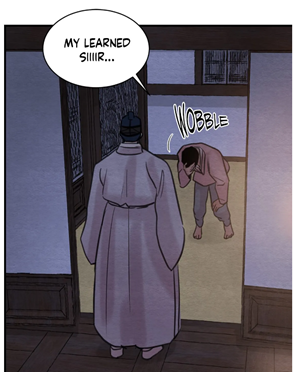 However, the rejection incited him to drink and in his drunkenness, he dreamed of the teacher’s visit. He decided to confess his love which makes the painter declare his love to the wrong person. That’s how the original sin happens.
Besides, Cunégonde awaits a tragic path too. She gets raped the moment the castle is invaded by soldiers. At some point, she becomes a courtesan due to her beauty. She is not outraged and hurt by her situation. She actually enjoys it because she can enjoy luxury and comfort. We could say that she gets sponsored by men. However, her situation only lasts, until she loses her beauty for good. This explains why she is pungent at the end of the story. She never had a good disposition to begin with. If she had remained pretty, then she would have kept living as a mistress. Now, the manhwaphiles can already predict what I am about to say. I foresee that Jung In-Hun will resort to sex in order to advance his career. I had already explained this, when I compare him to “Bel-Ami”. Let’s not forget that he is not brilliant like I explained many times and it has already dawn on him that he could fail the civil service examination. Since Cunégonde gets raped, it could definitely happen to the low noble and the warning expressed by Yoon Seungho could perceived as a bad foreshadowing. Nevertheless, I must confess that I won’t feel pity for the scholar if this happens because he never comforted or helped the painter, when the forced sex happened and he witnessed it.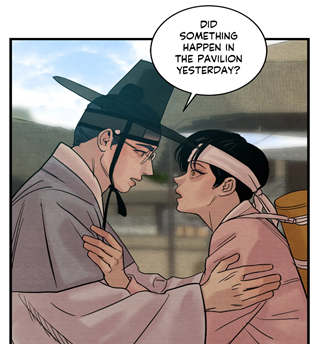 Besides, I have already shown in different analyses that the low noble has started acting like a pimp and a whore. That’s why we could say that sex has now become a part of his life.
Now, the manhwaphiles are probably questioning where our favorite seme is in the philosophical tale. There is no character perfectly fitting to Yoon Seungho, yet I sense that to a certain extent, he has some similarities to Martin, an Anabaptist and a rich merchant. Martin represents the opposite of Pangloss. While the latter promotes optimism, the kind man is a partisan of pessimism. In his eyes, evil rules humankind hence he is so disillusioned about the world. His pessimistic nature is the reason why he overlooks goodness. Yoon Seungho is also disenchanted about the world and society due to his traumatic past, he had no real expectation before meeting the painter therefore he was living like a zombie.  His passivity, reflected through his smoking, does somehow remind me of Martin’s attitude, although I have to say that Martin’s behavior diverges a little, the latter was not totally passive. He helped Candide and Pangloss with good intentions, yet he has the tendency to expect betrayal from anyone. And the source of their mistrust and negativity is their bad experiences. Both characters experienced betrayal and abandonment, therefore they have this negative attitude. Notice that the lord still refuses to meddle with politics and officials showing that he only sees government as a source of evil. This is normal, as he was used and betrayed by nobles. Just like Candide observed, having ambition is not source of happiness. Power can lead to misery as well. The French man witnessed the downfall of kings. Seungho thinks like Candide. However, the former is not able to realize the possibility what comes with a high post, he could change the situation of commoners, promote education among the low-born. It seems that Yoon Seungho’s wealth is also connected to trade as well, like he implied in the chapter 22. Martin never changes like Pangloss, however we know that this is not true for our beloved aristocrat.
Besides, I have more the impression that Yoon Seungho’s mentality embodies perfectly what Voltaire wanted to encourage. 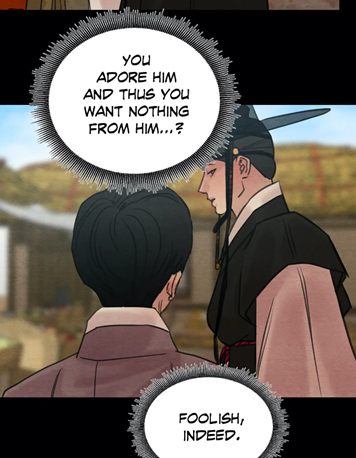 He arouses Baek Na-Kyum’s critical thinking, he admires the painter for his talent hence we could say that he advocates work. Notice that he is the one asking the artist to paint for him. He forced him to work again. Until their first meeting, the low-born had become a drunk and was not happy at all. So his social status as low-born was never a problem for the aristocrat because he recognized the painter’s real value. I would even add that he did admire the commoner for publishing erotic paintings and becoming successful. Baek Na-Kyum did want to change his situation through his talent and his passion. The seme doesn’t care about gossips, about social status and order society. In fact, he abhors nobility. Moreover, he is even willing to change his position and become the servant in his relationship with the painter. Finally, he isn’t averse to promote education for commoners which was detectable in the chapter 6, when he mocked the low noble

.
Finally, Yoon Seungho acts like Voltaire wished. He is a free thinker. Besides, the noble is someone pounding a lot, reflecting and learning from his experiences and mistakes thereby he is able to change little by little. At the end of the season, he is no longer the lord he was at the beginning. He has already softened and is able to accept reprimands, to listen to the artist’s grievances. He is less selfish, quite the opposite. That’s why I have to complain here. There are still many readers asking for a transformation and redemption of the noble implying that the aristocrat never changed. In my eyes, the metamorphosis has already started but is not completed. I’m going to repeat myself but my predictions are that the noble will become the painter’s teacher, will help him in his career and I sense that Yoon Seungho will be forced to change his attitude towards the government. He will be forced to meddle with politics because of his family and Jung In-Hun.
The real huge difference between both works is how the authors value love. For Voltaire, love is not so important, whereas Byeonduck shows that love can transform people, it can give hope and strength. Although there is a lot of sex in Painter Of The Night, love is not non-existent unlike in Candide, where it is more described as an illusion. Candide only marries Cunégonde because he feels obligated but he has no longer feelings for her because he is able to judge her true personality correctly. So the philosopher is diminishing the value of love because it is more connected to superficiality (physical attraction), false perception of the partner or ephemeral. However, I can not accept this description because love can be timeless as love can always change. Yoon Seungho is not just attracted by the painter’s appearances, he had already a huge admiration for the artist’s hands and talents. The more he interacts with him, the more he likes the low-born’s genuineness and honesty.
My final comparison is that both stories are showing the pursuit of happiness. Once, Yoon Seungho made love to the painter, he discovered something new and wanted to keep it. It has affected him so much to the point that he accepted to change. The painter will have to find a new goal in his life and his happiness is definitely connected to his talents and his relationship with the seme.
Feel free to comment. If you have any suggestion for topics or manhwas, feel free to ask. If you enjoy reading it, retweet it or push the button like. My tumblr/twitter account is: @bebebisous33. Thanks for reading and the support.
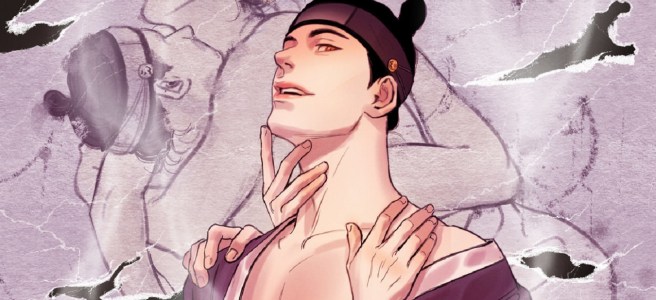

This is where you can read the manhwa. https://www.lezhinus.com/en/comic/painter But be aware that this manhwa is a mature Yaoi, which means, it is about homosexuality with explicit scenes. If you want to read more essays, here is the link to the table of contents: https://bebebisous33analyses.wordpress.com/2020/07/04/table-of-contents-painter-of-the-night/
Yes, I chose this title because of the Russian short novel written by Leo Tolstoy. In this story, the rich land owner Vasili Andreyevich Brekhunov died by saving the servant’s life Nikita, because he realized that the low-born’s life was as worthy as any other man. Furthermore, he also got aware of his own selfishness, for he was responsible for their predicament. They were caught in a snow storm and the noble initially abandoned the peasant. However, at the end, the lord changed his mind and revealed another side from himself. This outlines that status is very superficial and the readers witness the master’s conversion leading a huge change in his behavior and thoughts towards commoners and low-born.
In the following analysis, we will examine the lord- low-born relationship between the nobles Yoon Seungho and Jung In-Hun and the commoner Baek Na-Kyum, when the latter becomes sick. All this was triggered because one of my followers asked me this: Why didn’t Seungho return home for days? From my point of view, the conversation between the nobles and Yoon Seungho, triggered by Min  (chapter 33), forced the lord to realize that the artist was indeed a precious treasure, and he was not willing to share him.
  (chapter 33) At the same time, due to Black Heart’s words, the noble was reminded of the painter’s health conditions. Although the lord was talking about the artist, as though the latter was just an object, the reminder forced him to recall that Baek Na-Kyum was a human who could die. That’s why he returned in the end. His abandonment reflected his cowardice, he didn’t desire to be confronted with the consequences of his bad behavior. Consequently, just like in the Russian novel, the main lead was reminded that the low-born was just a human. As you can see, both characters had a similar disposition and also a change of heart.
Striking is that the butler tried to cover up his master’s cowardice and abandonment. He diverted Baek Na-Kyum’s attention by showing his concern for his master.
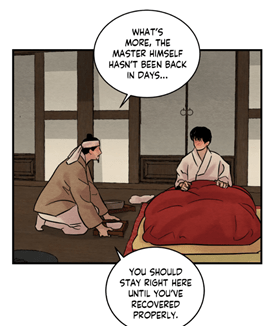
But before this, the servant Kim mentioned that the lord’s room was the best, as it was the warmest.  (chapter 34) Kim’s remark was in fact insinuating that the lord had been very generous and caring for him. He gave the impression to the low-born that the noble was treating him like a noble, as the latter had sacrificed his bed for his recovery. However, this was not true, as the lord had brought the artist to the study before the doctor’s arrival.
  (chapter 33) At the same time, the butler was not entirely lying either. The lord had indeed shown generosity and care, since he had called for the physician. Yet, once he had heard about the doctor’s precription, the aristocrat had ran away from his responsibilities (chapter 33) and left everything in Kim’s hands. Remember my statement: Kim is always telling half-truths. Kim was in reality the one who brought him to the noble’s bed.
 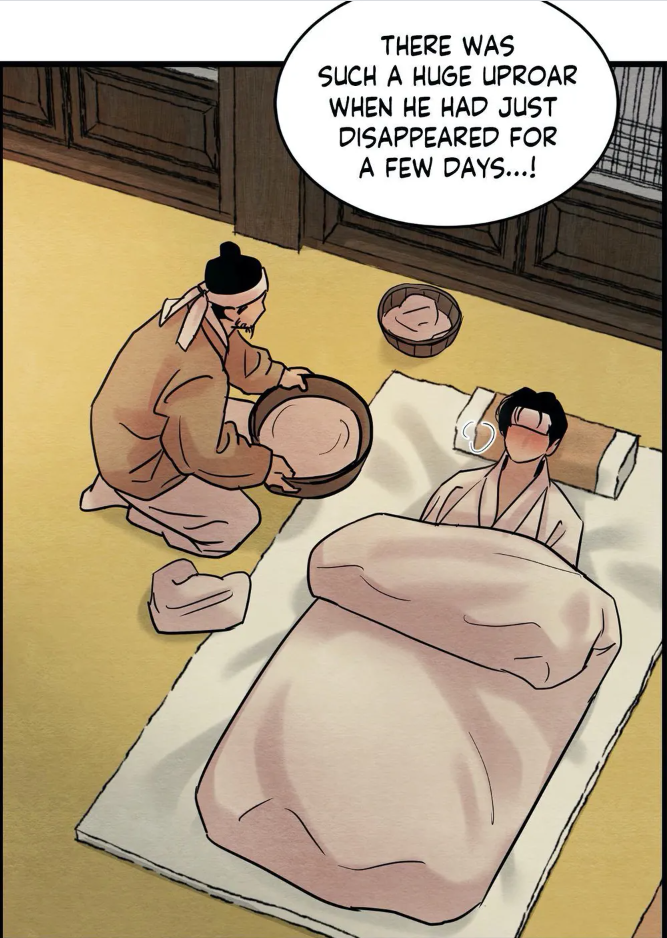 (chapter 33) He needed to portray his master in a much more positive light in order to obtain the painter’s cooperation. The valet hoped that the artist would follow his order
  (chapter 34) and become the lord’s sex toy:
So in my opinion, while Yoon Seungho had indeed showed worries and benevolence towards the painter, he was relying on his right-hand, therefore he never came to verify if Baek Na-Kyum was recovering properly. 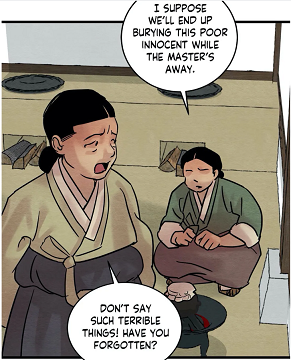 The irony is that although the valet treated the painter as a honorable guest (bringing him to the lord’s chamber and taking care of him as if he was his master), in truth he was just viewing the low-born as an object and tool. was truly making sure that Baek Na-Kyum would get the best treatment, but the domestic used the opportunity to praise his master indirectly.
And now you understand why Yoon Seungho didn’t return to the mansion. First, he felt guilty, as he knew why the young man got so sick. His remorse were definitely bigger, as the artist could lose his life. He even heard the critic from the doctor.

His guilty conscience is actually visualized in the chapter 33. He has no erected phallus and looks exhausted. 
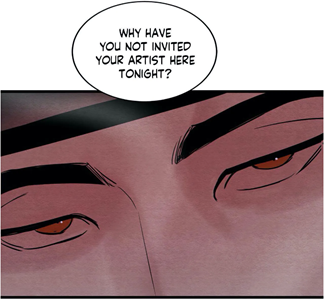 (chapter 33) While he was at the sex orgy, he remembered the exhausted young face of the painter, while they were talking about him.

The black coloring about the head is a sign for flashback and memory. We saw in another chapter that Byeonduck uses the color black to announce that this is a flashback. However, I feel that Yoon Seungho avoided his mansion because he was confused too. He wanted to find out if his “obsession” for the painter was related to sex. We shouldn’t forget that in the past, the lord used to go to such parties very often which is revealed during the chapter 33.
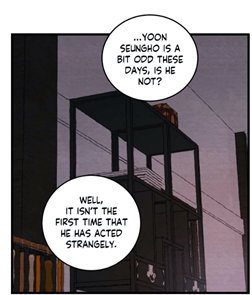
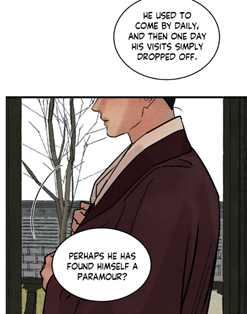
It becomes clear that the moment he slept with Baek Na-Kyum, he dropped off his visits there. Yet after the sex marathon, he started visiting the sex parties again. the relapse was a sign of his torment. But there are other explanations as well. He thought that going back to the sex parties could help him to lower his strong libido for the uke. He wasn’t sure if his urge for Baek Na-Kyum was caused by the lack of sex, as he had stopped going to these sex orgies or if it was related to something else, to the person itself. Furthermore, I believe that by going back to the sex orgies, he experienced that he was no longer interested in sex, but he was looking for something else. He wanted to be with the artist. And now, you comprehend the second relapse in chapter 51:  The lord was suffering, but unlike in the past he couldn’t keep his distance from his lover. He needed to sense his presence. He was no longer his sex partner, but he wasn’t treated like an object or a servant. During these two separations, Yoon Seungho was full of worries for Baek Na-Kyum which he was trying to forget, yet he couldn’t. At the same time, he was reflecting on his past actions:
– Why did he force the man to sleep with him for so long and overlook his current state? What drove him to drop off his visits to the sex parties, when he used to go there very often?
I perceive the lord as someone who does think deeply, hence he wouldn’t be spending so much time in front of his window in general. From my point of view, Yoon Seungho had to introspect himself and was making sure despite his sense of guilt that his “obsession” or love for the painter was not related to his strong stamina but to his desire to share his thoughts with him. He wanted to have a true companion. Let us not forget that Yoon Seungho has never experienced love before and has never received love from his father. So he had no role model, hence he was confused and couldn’t recognize the true cause for his behavior. He didn’t know how to show love. So far, the world he grew up was full of treacherous and vain hypocrites where there is no love. Let us not forget that even Jihwa doesn’t reveal his love for him. Furthermore, his past made him experience sex without pleasure and even without love. However, the moment he met the painter, he could finally connect his sexual orientation with ecstasy. In the first season, without the painter he was experiencing if his “obsession” with the painter was related to sex or to something else. Like I had truly recognized, the noble had not realized the existence of his feelings for the commoner. I believe that he couldn’t name his affection as love due to his lack of knowledge. He was confusing his mind with his heart. There is no denial that he was already in love with Baek Na-Kyum, as the man affected him so much right from the start. The moment they met, he acted differently. Besides, love is never a constant feeling. It changes all the time. Moreover, there are different kind of love. He was attracted by the painter due to his paintings, then due to his face and gaze… little by little he fell for him. However, the lord never realized it, unlike his servant Kim. However, in my opinion, the butler only judged it as an obsession and not as love. He imagined that his master had fallen too deeply into sodomy (chapter 18) In my eyes, the butler’s cowardice is connected to the social norms. He had deeply internalized the social values from Joseon, hence he represents a reinforcement of authorities. As you can see, there are many explanations for his behavior: guilty conscience, out of concern, self-introspection… On the other hand, he is only partially running away from his responsibility, as he had asked the servant Kim to take care of the artist. This is why this “abandonment” stands in opposition to the scholar’s. The latter betrayed during the rape, as he didn’t intervene and acted as if nothing was happening. And the next day, he brought him back to the mansion and abandoned him by letting Yoon Seungho drag him to the bedchamber. At no moment, he tried to stop his sponsor. That’s why he remains invisible in chapter 32.
But if we look back at the first picture at the beginning, you’ll notice that Kim’s words are reflecting something else. (chapter 33) He was acting as a mediator between the master and the low-born which looks like a good thing. In reality, he was meddling in their relationship. Who was he to intervene? That’s why he acted like a father. With his words, the butler was implying that his lord had been affected by his illness, hence he remained away. However, I believe that in the valet’s mind, there existed a different explanation. For Kim, his master was just a coward. That’s why he said this comment in front of the physician:
 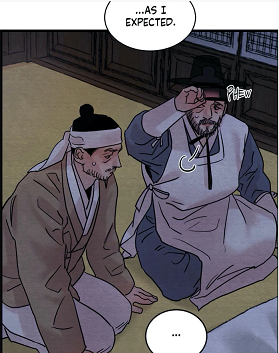 (chapter 33) He anticipated that his master was avoiding to face the consequences of his selfish behavior. For me, Kim doesn’t truly love his master. He views the Yoons as terrible, but he will never confront them. But for his own safety, he needed to deceive the painter. Let’s not forget that Kim had played a role in his escape and the low-born could reveal it to his master. That’s why he needed to fake his care and concern for the painter so that the artist wouldn’t mention the past. Thus he begged the young man not to wander around as a sign of care and gentleness.

Simultaneously, Kim needed to manipulate the painter so that the latter would realized that he had won Yoon Seungho’s trust. He desired to obtain his obedience. What appears as mediation was in reality manipulation, which would create misunderstandings. He hoped that Baek Na-Kyum wouldn’t go to the teacher’s side. He was well aware of his master’s jealousy. In other words, this scene revealed many important points:
– The lord might have been away but he thought about him and made sure that he would get the best treatment
– Yoon Seungho’s behavior has drastically changed, he hasn’t returned home hence there is something upsetting the lord
The loyal assistant is acting like the lord’s lawyer. And here, in the chapter 34, we can see the contrast with Jung In-Hun’s attitude. Baek Na-Kyum asked Kim about the teacher. Was he worried about him? Has he asked after him? Kim denied all of his questions which upset the young man.

That’s the reason why he cried in the bed, covering his face. His gesture revealed his pain, but it also indicated that he didn’t want to be confronted by reality. Kim showed him that his admired sir had abandoned him, but the artist was in denial. He only explained it as a lack of concern. He was veiling his face in front of the truth. On the other hand, this scene was important for another reason. It truly exposed the learned sir’s stupidity and blindness. Without the artist by his side, Jung In-Hun meant nothing to the protagonist. Note the contrast between the butler and the scholar’s attitude. The former had understood the artist’s importance, though he didn’t like it, while the learned sir seemed to be in denial. The low noble didn’t even imagine that Baek Na-Kyum could lose his life. Then if you compare both aristocrats, you’ll detect the huge difference. Although both nobles were away from him, one kept his distance out of concern and guilt, the other felt nothing. The words Kim said did affect the painter, he could sense that the powerful noble had been caring and kind. Kim’s words made sure that the low-born wouldn’t push away his master like in the past, and wouldn’t blame him for his sickness. At the same time, the butler was trying to “tame” Baek Na-Kyum.
And Yoon Seungho’s humbleness and selflessness was revealed with the kiss.  (chapter 32) However, the valet Kim was not present, hence when he lied to Baek Na-Kyum, he had no idea that in reality his words were containing more truth than lies in reality. That’s why I chose the kiss as illustration for the analysis. The roles were switched. The master acted as a servant, and the low-born was now the lord. The male lead was acting like Vasili Andreyevich Brekhunov from the Russian novel. Yoon Seungho was even willing to give water to the exhausted man. This situation was repeated in chapter 76:
  (chapter 76). The lord made sure that the painter would feel better with the water. But let’s return our attention to chapter 33. In the bedchamber, the main lead was to blame for Baek Na-Kyum sickness, as he hadn’t paid attention to the artist’s condition. He had acted selfishly, exactly like the protagonist from Master and man. Both realized their huge mistakes, came to regret and took some responsibility, although the chronology in the Russian story diverges. But this shows that both aristocrats came to realize that commoners were humans and no possessions.
This is not surprising that In-Hun’s indifference and even selfishness hurt the young man more at the end. It was really visible in the next chapter. The young man had to hear that what Yoon Seungho did was not normal (chapter 35) and his preparations for the exam were more important than the painter’s life. (chapter 35) For the first time, Baek Na-Kyum could sense that Jung In-Hun was selfish and not kind. Moreover, he even reminded him that as a low-born the noble shouldn’t spend so much money for him. Indirectly, Jung In-Hun was telling him that if he had been Yoon Seungho, he would have done the opposite: not giving him the best room, not sending for the physician and not spending so much money for the medicine. In that chapter, Baek Na-Kyum could finally see glimpses of Jung In-Hun’s true personality. Therefore I think that the servant’s words did influence the young man, he didn’t blame and resent the noble for his condition. He saw the caring gestures, although he was absent… whereas Jung In-Hun was absent due to his own interest. (chapter 35) Here, the low-born’s head is down which indicates a certain resignation and pain. While the one did change his behavior and showed a new side to the young painter, the other remained indifferent. The caress on the cheek could no longer mask the learned sir’s lack of concern and selfishness.  (chapter 35) No wonder that after his departure, the artist was disappointed and heartbroken.
To sum up, one aristocrat felt remorse and guilt, hence he tried to redeem himself by taking care of the artist to his own detriment, he even left the mansion for days, the other acted like usually. Here, we can see some similarities between Yoon Seungho and Vasili Andreyevich Brekhunov. Both are able to feel empathy. Baek Na-Kyum started seeing the powerful master’s caring side. Due to Kim’s words, he thought that the lord even sacrificed his own comfort and health for the young man… just like the Russian land owner sacrificed his life for Nikita, the peasant. The chapters 34 and 35 are important, because they marked a turning point in Baek Na-Kyum’s life. The perfect image that Jung In-Hun had been able to create was starting showing cracks. Little by little, the painter could sense that his relationship with the teacher was defined by his status, while Yoon Seungho’s behavior made him realize that he was not treating him like a low-born, but like a human. This explains why later Baek Na-Kyum lied to the teacher for the first time. The lord had showed him his vulnerable side and had even let him stay by his side, when the brother visited him. The artist felt the learned sir’s lack of empathy and concern for him and his selfishness. In his eyes, he was just a low-born, and Baek Na-Kyum could already sense it. Therefore he lied.
But let us not forget that he still hoped that the servant Kim had not told the truth, hence he went to the teacher in order to get confirmation. Yoon Seungho’s conversion was also visible, because after his return, he spent the whole night thinking how he could improve his relationship with the artist. And notice that from the chapter 36 on, he started lowering himself in front of the painter literally and figuratively. The blow-job in this chapter
contrasted so much to the blow-job in the chapter 28.

Their places had been switched: the low-born had become the master. First, the noble acted like a master with the soft punishment (chapter 36), until he saw the painter’s erection. He was willing to give up his position as master. That’s why he prioritizes the painter’s pleasure all the time.
  (chapter 36) So their relationship master-servant stopped at this moment, hence he lets him stay by his side, when the brother Seung-Won is in his chamber.
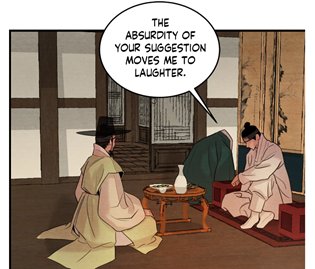 (chapter 37) Notice that his position had changed. He was sitting by the lord’s side. He even asked the artist to sleep by his side and let him stay in his bed without waking him up the next morning. As you can observe, the characters’ position illustrated their actual position in their relationship. When Baek Na-Kyum woke up the next morning, he was alone in the bedchamber. The lord preferred to leave his bed and eat elsewhere. In other words, Kim’s words from chapter 33 became a reality. He let him rest in his bed. Yoon Seungho showed so much consideration that in the chapter 39, he even went to the kitchen in order to fetch the low-born.
 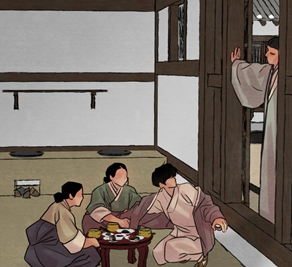 (chapter 38) He didn’t even send his loyal assistant. He had become the “servant” himself. In other words, we witnessed the lord’s slow conversion during the chapter 36 and the small changes from that moment. The nature of their relationship had changed, hence he claimed Baek Na-Kyum as his bride unconsciously.
  (chapter 40) So both characters, Yoon Seungho and Vasili Andreyevich Brekhunov transformed into a different person, more selfless and caring. They were willing to sacrifice things for them: status and pride. On the other hand, the nature of Baek Na-Kyum’s relationship with the teacher changed for the worse: from a teacher to a student, it became a lord-servant relationship, and the painter sensed the change of their relationship. But let us not forget: Jung In-Hun never considered the young man as a student, for him he had always been a low-born. It is just that he was so good to deceive the commoner.
And these observations in the first season were confirmed in the second season. The only difference is that this switch of social position from chapter 33 on was more momentary. The lord still viewed himself as a noble, he never realized his transformation. Yet in chapter 71, the noble chose to confirm the change of status: (chapter 71) Baek NA-Kyum was no longer a low-born, but a noble, while the main lead was his “servant”. This explicates why the noble was no longer asking for him in the evening
  (chapter 74) and visited him secretly during the night. But this switch of position didn’t remain a secret, the moment the lord embraced his panicked lover. (chapter 76) At the end of the second season, the lord’s true personality is more and more unveiled: he has a kind and generous heart, and he is able to reflect on his wrongdoings, which contrasts to Jung In-Hun. And now, you can comprehend why right from the start, I was fascinated by the infamous sodomite. The first season let us see glimpses of his warmth and selflessness. This means, the noble’s courage and strength will shine more and more.
As a conclusion, Yoon Seungho is a figure that resembles the noble Valmont from the “Dangerous Liaisons” and the land owner Vasili Andreyevich Brekhunov from “Master and man”, a man full of redemption despite his sins. As you can see, from a simple question “Why didn’t he return to the mansion?”, it became an analysis about master and servant and the transformation of Yoon Seungho.
And here again, I could use a classic story for an inspiration and comparison which shows how well written this manhwa is.
Feel free to comment. If you have any suggestion for topics or manhwas, feel free to ask. If you enjoyed reading it, retweet it or push the button like. My instagram-tumblr-twitter account is: @bebebisous33. Thanks for reading and for the support, particularly, I would like to thank all the new followers and people recommending my blog.
 Bebebisous33s' analyses in K-Dramaland and Manhwas