Protected: Painter Of The Night: The mirror 🪞and its functions (fourth version)
Bebebisous33s' analyses in K-Dramaland and Manhwas
Analyses of K-dramas and Manhwas (for the most part Yaoi)

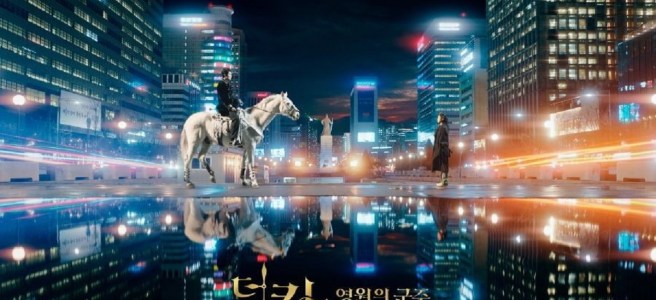
If you look at the poster above, you will notice the presence of three important characters: the king Lee Gon, the lieutnant Jeong Tae Eul and a huge mirror. The latter even occupies a bigger place than the two main leads indicating first the existence of a parallel world. Secondly, it also manifests the huge role the mirror will play in this story. Here, the mirror is actually the reflection from water and not a simple mirror made by humans. Therefore it means that the existence of two worlds is a natural phenomenon. It is not created by humans, the latter are just inhabitants in these worlds. Furthermore when we look at the reflection, the onlookers can notice the duplication of Lee Gon and Jeong Tae Eul. And this is not a coincidence: it announces that Lee Gon and Jeong Tae Eul will interact in both worlds. The director and writer could have used the doppelgangers, Ji Hun and Luna, in this poster underlining the idea that both have “adversaries” but it didn’t happen. From my point of view, the writer is already displaying the roles that the king and the detective will play in order to keep the balance of the two worlds.
Since mirrors reflect light, this object is often associated to illumination, wisdom and truth. In a mirror, the beholder can see his own self (the truth), how he or she appears, like in this following scene.
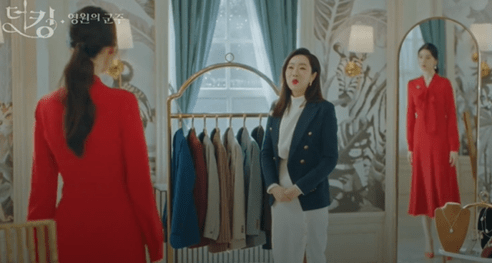
On the surface the mirror here serves a purpose: she is about to choose her clothes for a certain event. She needs to judge herself if the clothes fit her and are suited for the event. Striking is that in this scene, Goo Seo Ryung catches the attention of the viewers due to the color of her dress contrasting so much to the background: red versus blue and white. Furthermore, there is only the reflection of the Prime Minister in the mirror, we can not see the stylist and her secretary in it. I could even add that the duplication of Goo Seo Ryung illustrates her confidence and charisma. She is not afraid to stand out which is also confirmed during the conversation. She rejects all the clothes because her stylist chose rather conservative clothes.
But a mirror symbolizes vanity as well, as the spectator wants to confirm his or her own beauty and attraction. And this scene illustrates Goo Seo Ryung’s vanity too. It even outlines her egocentrism. She is only looking at herself and not at the stylist. That’s why a mirror can be a source of danger which is presented in the myth of Narcissus.
Narcissus, the son of a river god and a nymph, was walking by a pond, when he decided to drink some water. The moment he saw his own reflection, he fell in love with it and kept staring at it until he died. It was his punishment from the goddess Nemesis because he kept rejecting suitors which caused the death of a female admirer. At the same time, the mirror in this myth is also linked to desire and wish that can not be fulfilled. Narcissus can never really touch himself, as soon as he tries to grasp the water, his own reflection disappears. Furthermore Narcissus can never feel the love and the warmth from his own reflection, since it comes from water. Therefore we can connect a mirror to futility too.
In the work “Faust” written by the famous author Goethe, Mephistopheles brings Faust to a witch who owns a magical mirror. In there, he doesn’t see his own reflection but “Gretchen”, the future love interest of Faust. Just like in the myth of Narcissus, the mirror here reflects Faust’s desire. He wishes to meet the young woman, however there is more to it. The mirror is here used as a temptation, since Mephistopheles, the personification of the devil, wants to get his soul. In exchange for youth and love, Faust agrees. It was as if Faust was seeing his own future with Gretchen. In other words, a mirror can be associated to the future.
As conclusion, a mirror can be linked to qualities (illumination, wisdom and truth) and negative aspects (vanity, futility, unfulfilled desire and temptation). Equally, this object is a symbol of physical and spiritual reflection. It represents the threshold between conscious and unconscious mind. In the scene above, the Prime Minister wants to shine and appear as an attractive and confident woman (conscious mind). Coexistent, she unveils her true personality: her self-centeredness and her vanity (unconscious mind).
But now let’s take a closer look to the utilization of mirrors in this k-drama. First, we can see the presence of a mirror, when Lee Gon is about to enter Republic of Korea, the parallel world. Here, it is introduced as a magical tool, even as a portal to enter another world.

The mirror as magical tool has a long tradition. I could mention “Snow white and the 7 dwarfs” or even a more recent story “Harry Potter”. In the first story, the mirror speaks to the Queen and tells her the truth: Snow White is now more beautiful than her. It was as if this item was a living object, since it speaks and can even make its own judgement. In the past, the queen used to be the most beautiful woman in the world, now it is Snow White. The mirror has changed his assessment and adapted to the new situation. Then in “Harry Potter”, Mirror of eriseD serves to show what a person desires the most. In the 7th book, Harry Potter uses a fragment of a mirror in order to call for help, as he is imprisoned by Bellatrix. Dobby answers to his call. This magical tool is here connected to desire, danger and signal for help. Striking is that in the picture above, the mirror implies danger as well, since it is fractured. Lee Gon can only go through the mirror, since it is broken. Just like the mirror in Snow white and the 7 Dwarfs, the mirror seems to be a living object as the mirror appears on his own (Lee Gon doesn’t summon it) and it even breaks on its own.
At the same time, this mirror is in fact the physical threshold between the conscious and unconscious mind. While people from one world are rich or healthy, they live an opposite life in the parallel world. Luna is abandoned and has no family hence her biggest wish would be to have a family and a father, to be recognized. Whereas the CEO and his son from HG Group in Republic of Corea are powerful and famous, their doppelgangers in MOC are weak und rather common. Besides, I could name another example: while Myeong NaRi doesn’t fancy Jo Eun Sub, it is the opposite in Monarchy of Corea. That’s why I come to the conclusion that there is a balance between these two world. The conscious mind in one world is the unconscious mind in the other world and the reverse. The temptation and desires are never revealed to the world, until Lee Lim appears.
And this is the reason why Lee Rim is so dangerous as he acts as the devil, similar to Mephistopheles. He lets people see their own reflection and appeals to their unconscious and inner desires. We should consider pictures taken from the doppelgangers as a transformed reflection. He only allows them to see what they want to see. Let us forget that a mirror consists of glass and in a camera, there is a lens constituted by glass as well. In a different scene, the Prime Minister sees her doppelganger in the screen.
Or it could be the opposite… Goo Seo Ryung is seen by her doppelganger. While the latter is an average woman, Goo Seo Ryung appears rich and influential which could be a temptation for her doppelganger. Our strong politician gets scared at her own image, although she didn’t react the same in the scene mentioned above. The shock came because she didn’t even recognize herself. She had the impression to see a ghost as the doppelganger’s image is transparent. Actually, we don’t know about the origin of this phenomenon. Is Lee Rim behind this or not? In my opinion, I doubt it as Lee Gon is not a god. It could be a warning as it becomes clear during the episode 8 that Lee Rim is trying to lure her to Republic of Korea. It looks like someone is already working against Lee Lim in order to keep the balance between the two worlds. If she came to ROK, she could become the future president of the country, something she can never achieve in Monarchy of Corea. Lee Rim thinks that she is trying to seduce Lee Gon because she is attracted to his powerful situation. In a republic, she wouldn’t even need Lee Gon at all. But from my point of view, he forgets that the Prime Minister is above all a woman. Remember the scene with the clothes: she never wanted to give up on her femininity. She is definitely interested in Lee Gon the man and not just the king.
In this scene, you will notice that Goo Seo Ryung’s doppelganger is holding a mug. And in a different scene, we witnessed a weird phenomenon. Jo Young and Jo Eun Sub were both holding a drink, the former had a mug of hot coffee, while the other was holding a mug of iced tea. In that particular scene, both dropped their drinks as they felt a strange sensation. Jo Young was surprised because his coffee felt so cold, whereas Eun Sub got burnt by the ice tea. It was, as if their drinks had been exchanged. Due to the scene with Goo Seo Ryung, I came to realize that the Prime Minister, Eun Sub and Jo Young had all something in common: water and mirror. All three (Eun Sub, Jo Young and the doppelganger) were holding drinks, which is linked to water. Actually, the reason why I have been connecting mirror to water isn’t just because of the myth of Narcissus. Actually, I kept thinking about the following scene from the movie Matrix
Notice in this scene, the mirror gives the impression to be a magical tool. It was, as if it was alive (just like in TK:EM). Then it transforms into a liquid, it looks almost like water, and at the same time, the mirrors serves as a portal as well. Neo is able to pass from one world (dream) to another world (reality), although Neo is confused, if this reality is true as it doesn’t feel and look real at all, rather mysterious and magical.
But let’s go back to our k-drama. Since the mirror is fractured each time someone goes through the passage, we have to imagine that each time something was leaked from one world to the other, hence water and mirrors haven been affected by the opening of the passage. In other words, reflecting items like screen or water in a drink leak reflections or sensation from the other world.
Then I also think that the moving from one world to another has also affected both worlds. Remember that the people are supposed to live the opposite of their life from one world to the other. So they are not supposed to do the same thing, actually the opposite. Yet, in both scene (ES-JY and the scene with the Prime Minister), their doppelgangers were doing the exact same thing:
– YJ/ES were about to drink something
– GSR was sitting in front of her screen just like the other
The more people are going from one world to the other, the more people will do the same thing than their doppelgangers. I hope, this is understandable.
Finally this scene from Matrix can explain why ES and JY could feel the temperature from the other drink… Neo is touching the mirror and I would even say, he is eaten by the mirror the moment he touches it with his finger. Water is well known as the best current conductor, hence it means that sensations can be transferred through water.
Like I mentioned above, the reflection in the screen could be a warning, a signal of a danger. And this meaning is even more visible in the following scene, when the lieutnant JTE sees Luna in her rear-view mirror.
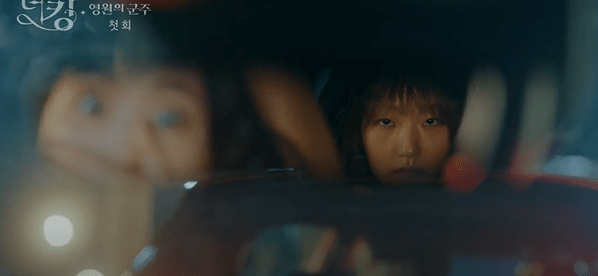
Remember that the function of a rear-view mirror is to alert the driver of potential danger. Besides, Luna as a source of thread is even reinforced with Luna’s gaze. She looks at JTE with a certain animosity.
In another scene, the detective Kang Shin Jae is looking at his own reflection in a pool of blood.

And this is no coincidence. This single taking is referring to Shin Jae’s past. His life in ROK is linked to the death of his surrogate. We discover much later that his doppelganger was in a coma for one year. Even the mother declares to him that she considers his recovery as a miracle. It becomes clear that Lee Lim has lured the father by giving him the hope that he could get a healthy son as the mother from ROK has no idea about the switch. But for that miracle, the adoptive parents paid a huge price: their company went bankrupt and the father even landed in jail. Seeing his own reflection in the pool of blood triggers something in the detective therefore while he is trying to sleep, a souvenir resurfaced, the moment he woke up at the hospital.
But this doesn’t stop here. In another scene, Shin Jae visits the ashes of Ji Hun and here again, he sees his own reflection in the picture.

What caught my attention is that in this taking, the detective is almost translucent. Here again, the connection between his reflection and the face of Ji Hun jogs a memory: he remembers the funeral ceremony held by the infant Lee Gon who resembles Ji Hun. Concerning Shin Jae, the writer used the mirror in order to reminisce the past, something he had buried deep inside. As conclusion, the mirror helps to see the future (see above Faust) but also to discover or remember the past.
Finally, in the last episode, we see our villain Lee Lim walking to the shop of The Prime Minister’s mother where he left an umbrella behind. Here, his reflection comes from a puddle.
Interesting is that
– the director used a puddle which I associate to dirt and failure, as we know the expression “step into a puddle”
– his head is shown upside down. It was as if the antagonist is trying to bring chaos to the world as there is this expression to bring the world upside down.
– He isn’t even looking at his own reflection. He doesn’t pay attention to his surrounding. He is blind, since he is obsessed with his own plan. People might have wondered why the camera zoomed here but after reading this interpretation, you can sense that this taking could be a prophecy of Lee Lim’s failure. Let us not forget that I suspect that there is something else or someone else working against Lee Lim. In this scene, we can see that the mirror serves as a spiritual reflection and as such, it foreshadows the consequences of Lee Lim’s actions. He is doomed to failure and he should fear the retribution of the gods.
Then in the episode 13, the mirror plays a huge part in the discovery of the savior’s identity.

In this scene, the mirror has an important purpose. It makes Lee Gon realize that he traveled in the past and saved himself. He had already imagined that a time travel was possible. In the same episode, he had told his girlfriend: “If there’s a time axis in there as well as a space axis, then it’ll be possible”. By looking at the mirror, he discovered his future self acting in the past. He only got aware of it, the moment he identified the woman as Luna and saw his own reflection in the mirror. That’s when he realizes that he is wearing the same clothes than the mysterious savior. It was as if the mirror allowed him to see his own past but at the same time his own future. At some point, he will travel to the past.
Then next to him, there is Luna, his enemy but since she looks like Jeong Tae Eul, we have to wonder if JTE will stand by his side, when he travels back in the past. Let us not forget that she is the one who had the cellphone with the inscription: Back to the future. On the other hand, we shouldn’t forget that Luna was the one who stole JTE’s cellphone. Since the cellphone is in her hands, she could travel back to the past as well. Luna wished, she had grown up differently, so maybe Lee Gon help her to change her fate so that when she travels back to the future, she can die in peace, as her time is limited.
Feel free to comment or push the button “like” if you enjoy reading this analysis.
Before making connections between “Alice in Wonderland”, written by the mathematician Lewis Carroll, and the K-drama “The King: Eternal Monarch”, it is relevant to know about the major topics in that fairy tale. In this story, Alice is getting sleepy on a bench, when she suddenly witnesses a White Rabbit running while holding a clock. She gets curios and decides to follow him and that’s how she enters a new world: Wonderland. This land symbolizes the epitome of craziness and fantasy. Alice discovers strange animals and people like Cheshire Cat, Caterpillar, Mad Hatter and Queen of Hearts. No logical explanation can be applied in this world, like e. g. the baby of the Duchess turns into a pig or the Cheshire Cat appears and disappears or the Mad Hatter drinks tea with Dormouse and March Hare without changing the table. No rational thoughts and physical laws can rationalize the events.
Striking is that a mathematician, a representative of logic and sciences, wrote this book, where creativity knows no boundary and where sciences can not be used. However, at the same time, Alice tries to use sciences and her knowledge in order to understand this strange world because the female protagonist of this fairy tale keeps wondering if her adventure is a dream or a reality. As she attempts desperately to use her knowledge in order to solve this dilemma, she fails. Even the reader keeps wondering the same thing either as there are always allusions that she could be sleeping and as such dreaming.
Coexisting to this dilemma, the reader is following Alice on her journey from childhood to adulthood. Her strange adventure makes her experience different stressful situations (growing, shrinking, having a long neck etc.) and this should be interpret as a symbolization of her future puberty. The transformations of her body are not the only changes operating in Alice, she also questions herself and about her own identity. The Caterpillar asks her about her identity and she can not answer it right away. She even adds, she feels that she has changed since the morning too. And later after eating a mushroom, her neck streches out so that a pigeon calls her a snake. In other words, her identity quest suggests a initiatory journey. On her way to become an adult, she faces difficult and strange experiences which turns her into a different person at the end. When she leaves this land, she is no longer a child. That’s why time plays a huge part in this book. Remember that the White Rabbit held a clock in the beginning, later she meets the Mad Hatter who owns a strange clock as well. Transforming into a adult is definitely linked to time. Just before leaving Wonderland, Alice is put before a trial and the Queen of Hearts wants to condemn her. The latter embodies the adulthood, the parent who appears to teenagers strange, authoritarian and strict. At the end, Alice defies her and leaves Wonderland before getting any punishment. All this represents Alice cutting ties with her parent on her identity quest.
That’s why my comparison between the fairy tale and the k-drama “The King: Eternal Monarch” is not just about the characters, but also about the following topics: dream, reality, fantasy, sciences, identity quest, initiatory voyage, adulthood and time.
First, the fairy tale “Alice in Wonderland” is directly mentioned in the first episode. The main lead, the King of Corea Lee Gon, is reading this book in front of children. He even reads the passage where Alice is following the White Rabbit.
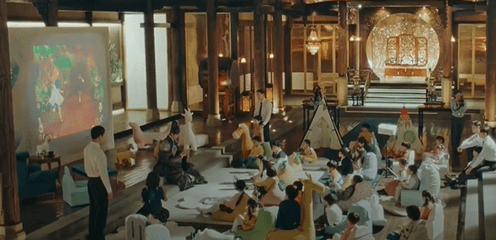
This scene is really important as it serves two purposes. First, it gives a first overview of Lee Gon’s personality. We discover that this story is the king’s favorite and he considers himself as a mathematician therefore he feels connected to the author, Lewis Carroll, who is also a mathematician. Here, our main lead seems to know himself quite well, unlike Alice. Lee Gon is a scientist loving Physics and Maths and even using physic laws and mathematical formulas in order to grasp the world around him. Furthermore, he shares some similarities to Alice. Just like her, he is curios and shows a certain innocence. The second purpose of this scene is to elucidate the reason why Lee Gon will discover the parallel world, Republic of Korea. Since Lee Gon reads the excerpt where Alice is chasing after the White Rabbit, the protagonist is suddenly confronted in a similar situation: he sees a person running with a rabbit costume hence he decides to follow this Rabbit. It was, as if Lee Gon had become Alice.
Since this is an adaptation of this passage from the book, we also need to compare the two scenes. The first difference is the gender. It doesn’t seem to be relevant, yet it gives us an illustration that everyone is like Alice. The second difference is that Alice is a child in the story and changes through the story so that at the end, she is no longer a child. Here Lee Gon is an adult. Yet he sometimes behaves like a child, e. g. when he yells at his captain of security Jo Young that everything in this palace belongs to him. He acts as a spoiled child who doesn’t want to share his belongings. In other words, despite his age, Lee Gon hasn’t lost his innocence completely. Therefore, when he sees a person dressed like a rabbit, he acts like Alice: he chases after the White Rabbit and the clock.

Unlike the fairy tale, the rabbit is not a real rabbit but a person. Besides, the biggest contrast is that the rabbit jacket is not white at all but black. She doesn’t hold any clock but she is followed by thugs, hence she is under pressure. What caught my attention is that once Lee Gon notices her (the person is a woman called Luna), he says that he is chasing after the white rabbit and the clock. His words defy the reality as it is not correct. Then here is the question: why did the writer and director choose a black rabbit jacket? Is it a coincidence and is there a meaning behind it?
In my opinion, this choice could be deliberate as Luna, dressed as rabbit, is supposed to lead Lee Gon to the parallel world: Republic of Corea. Besides, during that first incident, Lee Lim, the villain and uncle of the King, appears at the rowing event. While white is associated to innocence and purity, black embodies the opposite: evil and corruption. Hereafter, this visit in Republic of Korea, is not supposed to be an initiatory voyage, rather a trap for the King.
However, the author of the k-drama has not just associated Lee Gon to Alice. During the 6 first episodes, our main lead has a terrible habit: he keeps threatening everyone to behead them, if they don’t follow his orders or disregard his wishes.

He behaves just like the Queen of hearts who constantly orders the beheading of people when something isn’t to her liking (although these orders apparently never are actually carried out). In Monarchy of Corea, it is the same: no one has ever been beheaded since the beginning of the 20th Century. As I had mentioned above, Queen of Hearts, represents the adulthood and as such the absurdity of the adult world. Lee Gon had to act as an adult, the moment he lost his father. He had to fight his uncle and later assume his function as the next King. That’s why Lee Gon is a combination of Alice and Queen of Hearts. Furthermore, the latter did act like a strange and even childish person… she never wanted to lose a croquet game hence she bent the rules to her liking. However, just like Lee Gon embodying two characters from Alice in Wonderland, Luna doesn’t just resemble the White Rabbit, her actions remind us of Cheshire Cat as the latter keeps appearing and disappearing. Luna pops up in front of Lee Gon twice and in front of JTE in the car once. She just remains there for a few second. There is no logical explanation for her appearance and disappearance, only magic or fantasy can elucidate this. Our female lead JTE is a combination of two characters: the Caterpillar as she keeps asking who Lee Gon is and Alice, when she visits Monarchy of Corea. After her return, she tells her father that she was in Alice in Wonderland.
Once the king arrives in the parallel world, he is surprised and confused, just like our heroine from the novel. Nevertheless, he adjusts himself very quickly as he tries to use his knowledge and sciences to grasp this new world. Strangely, Alice has a similar attitude: just like him, she attempted to use her knowledge in order to distinguish if this world was a dream or a reality. Although their behavior is a little similar, their purpose is different. Lee Gon is not questioning himself if he is dreaming or not. First, he is not alone because he traveled with his horse Maximus. So for him, this is all real. Here, Lee Gon is trying to assess how this world works and how it is different from his own world. He makes different experiences… for the first time, he learns f. ex. the value of money. Just like a spoiled child he was in his world, he doesn’t change his way of life therefore he is too spendthrift with his money. As result, he is left with no money (end of the second episode). Here, for the first time, he makes the experience that there is nothing free in this world.
As you can observe, although Lee Gon has been sent to Republic of Korea with some bad intention, his trip to that parallel world can be seen as an initiatory journey. For the first time, he is on his own… not surrounded by his bodyguards and his Lady Head of court No. That’s why he is able to become more mature. Then he confesses to JTE for the first time. It seems to me that his change from childhood to adulthood is much shorter than the one compared to Alice. First, he is already an adult hence his body doesn’t change so that he doesn’t need to deal with transformations. Secondly, the central topic of the k-drama is to fight against his uncle and not the loss of childhood. The loss of childhood and the initiatory voyage are just side issues.
Then in both works, the quest of identity is present. Contrary to the novel, here Lee Gon is not trying to find his own identity as he is already an adult. In “The King: Eternal Monarch” Jung Tae Eul, the lieutnant, is the one who is attempting to identify the weird man. Since she keeps asking who he is, she could be linked to the Caterpillar. However she fails with every possible method. Her problem is that she doesn’t believe him at all, when he claims that he comes from a parallel universe and he is a king there. On her quest to identify him, she can’t help to find him weird and crazy. The craziness, existent in Alice in Wonderland, is shown in a subtle way in the k-drama. Lee Gon has no current money therefore he uses buttons to get money. Then what he says and the way he acts look weird to JTE and the others. They all keep calling him: “crazy bastard”, “weirdo” or “half-crazy bastard”. JTE even gives him a name connected to “dog excrement”. They sometimes give him a better description: a handsome man with a beautiful white horse. Yet JTE fails to really understand him, until he leaves her world. Only after his departure, his words are proved to be true. His weirdness fades away and JTE is finally able to identify the man.
However, there are two common denominators with the fairy tale in this drama: the importance of time and fantasy. The importance of time is already pointed out in the poster that you can see above. In the title, there are actually two clocks. And it looks like there will be a time loop. Remember in the book that the white rabbit was running with a clock. Secondly, the Mad Hatter owns a strange clock that doesn’t give time but the day of the month. Just like the Mad Hatter, Lee Gon possesses a clock that is unique in both worlds:
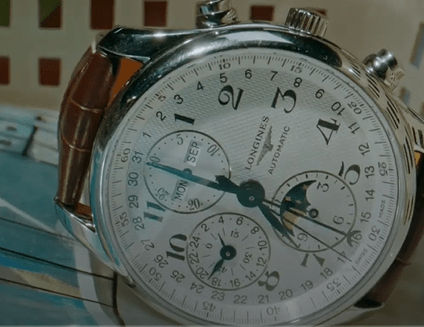
Then while talking to Alice, mad Hatter mentions time as a person: “If you knew Time as well as I do, said the Hatter, you wouldn’t talk about wasting it. It’s him. “[…] I daresay you never even spoke to Time”. He even adds that if Alice talked to Time, then he could help her to change time as she wished. She only needs to whisper to him about the time she would like to have. In my opinion, this excerpt could be seen as an indication that something similar will happen in the future. Lee Gon will time travel.
The time is even so relevant that’s why the writer uses a lot of expressions and situations around the time, like f. ex. The lady No and the prince Byeong are both annoyed by the disappearance of the king and are searching for a good excuse. Each of them keep saying “this time”. I could mention two scenes
1. when Lee Gon confesses how troubled he is. It took him 25 years to find JTE, yet this day felt so long for him. Notice the discrepancy, although 25 years is much longer than a day… Lee Gon pointed out that he felt the exact opposite. He, a scientist, who keeps measuring time in order to know the time difference between the two worlds, is making the experience that sometimes time can not be really measured.
2. when Lee Gon is asked if he has dated before then he kisses her. Indirectly, he is underlining the importance of the present. The kiss marks a turning point between the past (has he been dating before?) and the future (Is he dating now?)
The other common point is fantasy which is linked to time. Lee Gon discovers that time can stop there but first he has no idea why. Then his uncle doesn’t age. In 2020, Lee Rim doesn’t look like a 71 years old man. Then in the passage between the two worlds, Lee Gon the scientist has noted that there is no time there as the red balloon is still remaining at the same place. The air has not disappeared. This space defies the laws of Physics. Hence he wants to discover this world. Furthermore, the ID that was printed in 2019 already existed in 1994.
As conclusion, we find many elements from Alice in Wonderland existent in the k-drama and many characters from “The King” are inspired by different characters from the fairy tale. The viewer need to know the book in order to understand the insider jokes (like the beheading e. g.)
This has been a long time, since I wrote an analysis about a drama. But this one got my attention as it focuses on two major topics which are quite interesting. How can children and teenagers become good adults? It is thanks to the parents or to the friends or to the school and their teachers or to their social status? Actually, the drama is trying behind the serial killing to answer these questions. Don’t expect here a summary of the story, in order to understand this analysis, you need to have watched the drama.

In this story, the viewers see a lot of different kind of parents: a single mother who is raising the protagonist Ko Eun Ho (KEH), another single father who abandoned his son DM, a rich mother who would do anything for her son HMS, a normal family with mother and father. Striking is that many parents are shown in a bad light which actually convey the following message. Just because they have parents, the teenagers or children don’t have it necessarily better than orphans. The parents can become a negative influence for their own children.
KEH’s mother is neglecting her son as his own existence reminds her that she failed to keep KEH’s father by her side. She actually fears all the time, KEH will abandon her as she had always prioritized her love life over her son. She gave KEH the impression that he was a burden hence he couldn’t get close to her. Since she neglected KEH, the latter was on his own and the result was that she realized after his accident that she knew nothing about her son: his friends, his dislikes, his size… She never saw him growing up. Striking is that HMS’s mother represents another form of bad parenting which contrasts so much to the behavior of KEH’s mother.
HMS’s mother is the exact opposite. She has expectations from her son HMS, she fears that he might not succeed in keeping his first or second position hence she asked for the answers. She forced her son to cheat for the next test. She controls her son’s life so much that he is suffocating. Remember that he has a booth in his home so that he spends so much time for learning. That’s why he keeps hurting himself… this is the only thing that his mother can’t control. His room at CDH’s flat reflects his desire to escape from his prison, it really shows that despite being 15 years old, HMS is still a child. CYJ was right to remind the caregiver KTH that KEH is still a child, since he is only 15 years old hence he should be treated as such. KEH’s “freedom” contrasts so much to HMS’s prison, the latter is forced to act like an adult…
Summary of Life Ahead
Mohammed, known as Momo, recounts his life in Belleville at the home of Mrs. Rosa, an elderly and sick Jewish woman, a survivor of Auschwitz, who, as a former brothel owner, raises children abandoned or left in boarding schools by prostitutes. Momo thinks he is ten years old, and he is the only one, with little Moses, who does not know his parents. He considers Mrs. Rosa to be his mother. She is more and more tired and hardly goes out anymore, because of the six floors without an elevator; she is given fewer and fewer children to look after. One day, Momo learns that Mrs. Rosa is suffering from senility. She goes through long periods of absence, and thinks she is reliving her past, dressing as a prostitute or waiting, with a suitcase in her hand, for the French policemen who once handed her over to the Germans during the Vel’d’Hiv round-up. To escape these painful moments, Momo wanders the streets and meets Nadine, a beautiful young woman who works for the cinema. One day, the teenager’s father reappears, claiming his son. Mrs. Rosa, conscious that day, makes him believe that she raised her son in the Jewish religion, and that he is in fact the little Moses. Momo’s father dies in shock. Momo learns that he is fourteen years old: Mrs. Rosa was bringing him younger to keep him close to her for longer. However, his condition worsens, but she refuses to go to the hospital because she wants to die without being “prolonged”. Momo, making the whole building believe that Mrs. Rosa is leaving for Israel, taken away by her family, leads her to the basement, in the “Jewish hole” she has made for herself, in fear of further persecution. That’s where she dies. Momo lies next to her for three weeks, until the neighbours discover them, and entrust him to Nadine, to whom the whole story was addressed.
As you can observe, this book is about the longing of love and abandonment. Momo’s fate resembles KEH’s fate in the sense that he prefers wandering in the streets and even going to the neighbor than being home. His mother has abandoned him, although he knows where she is. Momo in the book refuses to be happy and have a “life ahead” as the world is too rough and hard. Mrs. Rosa is his surrogate mother, just like YJ who also loves him but is not always attentive like the ex-prostitute. however, the huge difference is that KEH is influenced by YJ that’s why when he sees a crime, he wants to stop it.
Here, the biological mother of KEH is jealous of YJ as she senses that KEH feels closer to YJ than her. She has the impression that CYJ has become his surrogate mother, yet CYJ has to remind her that she was and is still KEH’s mother.

Credit to @Ameera Ali from forum soompi.
She hated KEH’s gaze as she saw her own reflection: in his eyes, she could observe her own shortcomings. She neglected KEH, she kind of abandoned him as she chose her boyfriends over her son. She never thought that love from her son would be fulfilling. In the novel, the biological father of Momo appears but at the end, Momo decides to remain by Madame Rosa as she has become his surrogate mother. This difference contains in my opinion the same message: it doesn’t matter if you are the mother or not, as long as you help a child to grow up in a good way, giving him support when needed, having a listening ear as well and show understanding, even if the child or teenager did something wrong. Acceptance and open-mindedness are the qualities that adults need to be a good influence for the children and teenagers.
Then we have the school and the teachers who have a huge influence on the teenagers. Lee Sun Woo made a huge mistake in his past and has been regretting it. He mistook a victim for a bully, because the latter had a reputation as bully. After realizing his mistake, he tried very hard not to judge his students very quickly. So the relationship between the teenagers plays also a huge part in it. In the beginning, KEH is rather isolated, only DM is his friend but hides their true relationship by acting as a bully. As the story goes on, the teenagers can overcome their grudges, their prejudice and their mistakes which leads them to become true friends and this time in the open.
And then we have children and teenagers who were truly abandoned by their parents and put in orphanages. BSH, the villain, was abused by the church that supported him and no one helped him that’s how he came to the belief that people should rely on no one. And this explains why BSH turns into an avenger full of hatred and resentment. On the surface, he helps young people who were rejected by the society and turns them into his minions. He considers himself as a god, he has definitely a savior complex, but in reality, he is misleading them. He is himself full of prejudices (like f. ex. rich people will use their power in order to abuse weak people) but in reality, he is not different from them. He has not realized it yet, as he still sees himself as the weak orphan he was in the past. Unlike CYJ or KEH who were able to meet good adults, BSH had the opposite path. HE never met anyone hence he became a devil.
As conclusion, a lot of parameters are important in order to raise well children and teenagers. Parents or money are not enough, they need to have adults around them who are willing to trust them, to listen to them and support them.

The first episode starts with a young boy running in the woods in Russia. Although we don’t know the child’s identity, right from the start the viewer realizes that the boy with strange blue eyes is trained to become an assassin because of the rules told by an adult, the boy’s master:
It is clear that during his training, the boy is remembering his master’s rules, until he has to face a dog. Pavel orders Kim Soo Hyun to kill the dog.
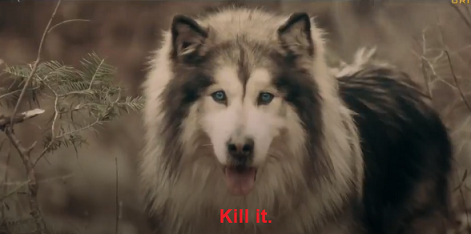
While watching this scene, I couldn’t help myself associating this terrible training to the famous experiment of the Russian physiologist Ivan Pavlov with dogs. First, Pavel sounds so similar to Pavlov, then we hear and see a dog. For further explanations, you can read about it there:
https://educationalgames.nobelprize.org/educational/medicine/pavlov/readmore.html
The Russian scientist developed the classical conditioning/Pavlovian Conditioning and in the K-drama, we see how Pavel is using the same method in order to turn our main character into a killer. Yet, in this scene Pavel fails as the boy refuses to kill the dog.
The reason is quite simple: Kim Soo Hyun perceives himself as a dog (see the first picture above) hence he can not shoot his “parent”. Besides, both have blue eyes reinforcing their similarities. The “dog” Kim Soo Hyun refuses to obey its master hence the latter punishes the boy. Yet in the long run, our main character can not escape his fate: he becomes a professional killer. On the other hand, his stubbornness to defy Pavel’s order in this scene allowed him to keep dogs around him. His closeness to animals and especially dogs let him become a veterinarian on the surface.
However, the more episodes we see, the more human Kim Soo Hyun becomes. He starts protecting more and more people: first Kang Seul Ki, a young girl whom KSH refused to eliminate, although she was a witness in a murder.
Later, he takes care of Pavel who is suffering from dementia like a good son and even tries to protect Pavel till the end. The assassin Pavel regrets his decision to have turned KSH into a killer and advises him to live like a normal person. Then he doesn’t kill Tae Soo and the witness, although he could have.
We see that little by little, KSH’s conditioning is disappearing. First, he started questioning Pavel’s rules. Finally, Kim Soo Hyun even refuses to follow his client’s order (episode 6). We can see that KSH is no longer following orders. The question is now, if Kim Soo Hyun will be able to take control of his life, as so far he has lived more like a dog obeying to his masters: Pavel, Philip Ahn and the clients.
However, Kim Soo Hyun is not the only “dog” in this story.

Notice the words used by the congressman. He never mentions the word “dog”, nevertheless he is referring to this animal as he keeps talking about a leash. The man describes himself as a dog who did the dirty work for his master: “blood on our hands”. The master gave him the order “kill it”. The beholder gets aware that just like Kim Soo Hyun, Seo Won Seok is unwilling to remain like a dog. He wants to become the master himself, which is different from just taking control of his own life. So Seo Won Seok’s goal is different: his greed and ambition are his motivations, while Kim Soo Hyun desires to protected his loved ones.
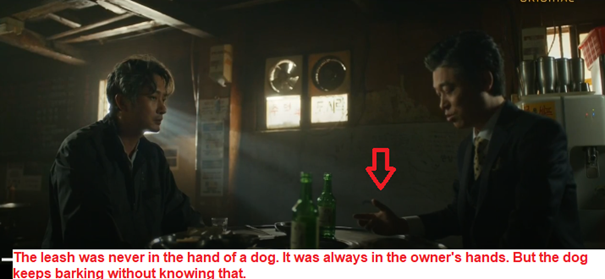
While the chairman Jo is looking at his hand, he claims that his position as master should never been questioned. He considers himself superior to Tae Soo and the congressman Seo Won Seok. He is not just a master, he is even the owner of the dog. That’s why this terrible man has no problem to order Tae Soo to get rid of the “dog” Seo Won Seok as he is no longer obeying his orders. The master will never dirty his hands, although he is the real murderer and mastermind.
Tae Soo doesn’t question Do Jare Hwan’s position at all. He accepts it as a normality. But will he remain by his side, once he realizes that he could have the same fate than Seo Won Seok. Do Jae Hwan keeps saying that at some point, he needs to get rid of people, since they represent a thread and a burden.
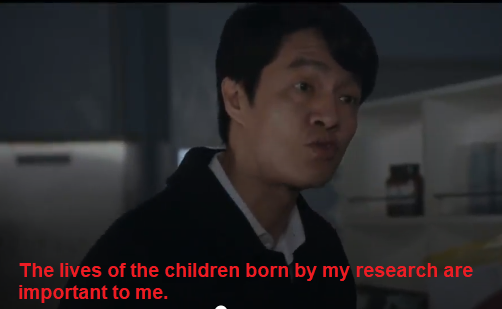
On the surface, the scientist might appear as a good man because he values the lives of the children. However, it becomes clear that he has always viewed these children as his “dogs”, they represent the result of his researches. That’s why he has no problem to use Kim Soo Hyun, one of his “children” to get revenge on the chairman Do Jae Hwan and his accomplices. Sure, he resents KSH even more because he is biologically related to the chairman Do. However, in the episode 6, he is willing to use Kang Seul Ki in order to get more info about the killer he hired. He knows Kang Seul Ki’s fate but he doesn’t feel sorry at all. Furthermore, he has no problem to attempt to kill one of the orphans, Do Hyun Jin/Lee Young Eun. He behaves like a master and treats the children from that orphanage like his puppets. He is in reality not different from the chairman Do.
As conclusion: As time passes on, the killer behaves more and more like a human, whereas the opposite happens to the scientist Ko, the congressman Seo and the chairman Do. In the name of revenge or ambition or greed, these men have no problem to get rid of people.
In this drama, the writer used two legends from the Greek mythology: the death of Hyacinth and Adonis which led both to the birth of flowers: the hyacinth and the anemone. Hyacinth, as a Spartan prince and mortal was Apollo’s lover despite their different nature (human vs. god). Yet Zephyrus, the god of wind, got jealous and killed him with his disc.
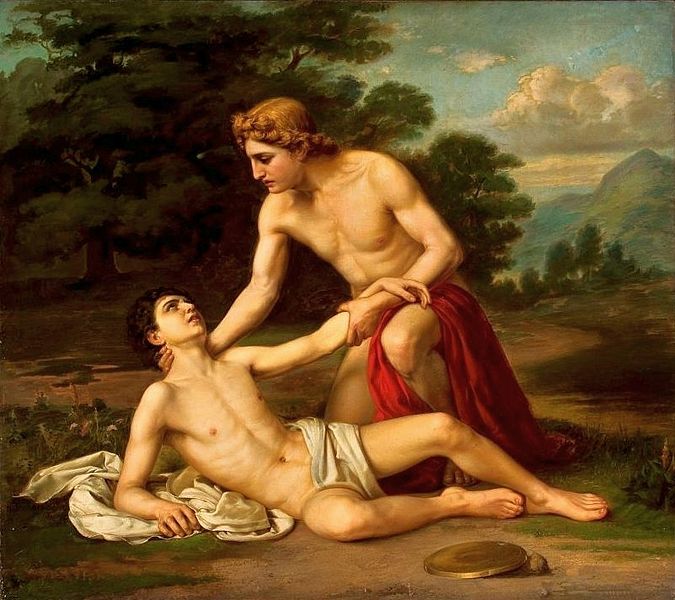
The god of the sun tried to heal his lover and it was in vain. In order to always remember his lover Hyacinth, Apollo created a new flower with Hyacinth’s blood: the Hyacinth.

Then in the episodes from this week, we were told about the legend of Adonis and the anemone. SJW explained that Venus fell in love with Adonis due to Cupid and Ares got jealous and killed Adonis with a boar.
However, the writer made a huge mistake because he mixed Greek names with Roman names. Romans used to call Venus, the goddess of love, beauty, sex and fertility but Ares is the Greek name of the god of war. Why do the Roman and Greek have the same mythology but different names? After the conquest of Greek cities in ancient times (Antiquity) by the Roman Empire, the Romans adopted the Greek religion, however they changed their names: Aphrodite became Venus, Ares became Mars, Zeus Jupiter aso. Our plastic surgeon was actually referring to the work of a Roman author, Ovid. However, in Ovid’s work Venus fell in love with Adonis by accident due to Cupid. The latter was playing with his arrows, when one of his arrows was punctured in her chest. Her wound was so deep that she fell in love with Adonis, when he appeared.

However, the story of Adonis in Ovid doesn’t mention any jealousy as the reason for his death. It is just said that Adonis loved hunting and one day, he got killed by a boar while hunting alone. On the other hand, the the existence of Adonis in the Greek mythology is explained differently. https://www.greekmyths-greekmythology.com/myth-aphrodite-adonis/ First, Aphrodite fell in love with the handsome man due to her own trick. Then either Artemis wanted revenge or Ares got jealous of Adonis because he was Aphrodite’s lover too. Anyway, in Greek and Roman mythology, the goddess of love used Adonis’s blood in order to create the flower anemone, a memorial of their love.

As you can see, the writer from Love in Sadness mixed Roman and Greek mythology together. Nevertheless both stories have so many similarities. First both stories deal with the loss of a loved one, with a tragic death where the surviving person has trouble to accept the death of their lover. Furthermore, the gods create a flower (Hyacinth and Anemone) in order to remember their loved one. Finally, the writer used the aspect of jealousy in both stories which explains why he made a mistake with the name because he mixed Roman tradition with Greek mythology. And now, if we take a close look, we will notice that our main characters (KIW, YMR, WHK and SJW) share the same experience. YMR fakes her death in order to escape from her abusive husband, WHK got involved in an accident and got killed which affected her husband SJW a lot. SJW gave YMR his wife’s face which could be compared to the gesture of the god: SJW created a flower, just like Aphrodite and Apollo did. On the other hand, KIW has not created anything yet, he is still living in his memories: he has distorted version of his marriage with YMR. Maybe, the beholder should perceive KIW as the jealous person and not the lover, if we had to compare him to characters from the legends as he is really jealous. YMR loved painting more than anything and he knew that, hence he allowed her to paint but only at her studio and she was not allowed to show any creation to others. Concerning WHK, SJW and doctor Ha, the latter embodies definitely the jealous one who destroyed WHK in the end due to his jealousy and negligence. As conclusion, we understand better why this drama was called love in sadness because all these legends and our drama deal with tragic love, death, pain and sadness.
However, this is not the only reference to Greek literature and mythology. In the episodes from this week, we could finally perceive the true personality of doctor Ha Sung Ho. Remember that in my former analysis, I had compared Joo Hae Ra to a praying mantis, SJW to a butterfly and flower and KIW to a cobra.
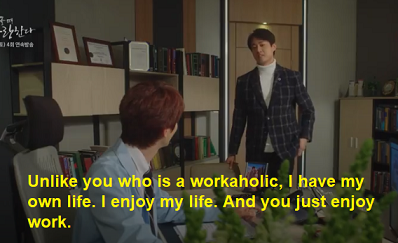
While watching this scene, the doctor’s words made me think of the famous fable “La cigale et la fourmi” (The cicada and ant) from Jean de la Fontaine. The latter is a French fabulist from the 17th Century who wrote many fables. He used as source of inspiration, the Greek author, Aesop (an author from ancient times, Antiquity).
Here is the fable written by Jean de La fontaine
La Cigale, ayant chanté
Tout l’Été,
Se trouva for dépourvue
Quand la bise fut venue.
Pas un seul petit morceau
De mouche ou de vermisseau.
Elle alla crier famine
Chez la Fourmi sa voisine,
La priant de lui prêter
Quelque grain pour subsister
Jusqu’à la saison nouvelle.
Je vous paierai, lui dit-elle,
Avant l’Oût, foi d’animal,
Intérêt et principal
La Fourmi n’est pas prêteuse ;
C’est là son moindre défaut.
« Que faisiez-vous au temps chaud ?
Dit-elle à cette emprunteuse.
— Nuit et jour à tout venant
Je chantais, ne vous déplaise.
— Vous chantiez ? j’en suis fort aise.
Eh bien ! dansez maintenant. »
The gay cicada, full of song
All the sunny season long,
Was unprovided and brought low,
When the north wind began to blow ;
Had not a scrap of worm or fly,
Hunger and want began to cry ;
Never was creature more perplexed.
She called upon her neighbour ant,
And humbly prayed her just to grant
Some grain till August next ;
“I’ll pay, ” she said, “what ye invest,
Both principal and interest,
Honour of insects –and that’s tender. ”
The ant, however, is no lender ;
That is her least defective side ;
“But, hark ye, pray, Miss Borrower, ” she cried,
“What were ye doing in fine weather ? ”
“ Singing . . . nay,! look not thus askance,
To every comer day and night together. ”
“ Singing ! I’m glad of that ; why now then dance. ” (translation from http://www.la-fontaine-ch-thierry.net/onegramu.htm
Notice that the cicada doesn’t like working, she is busy enjoying life and in time of need, the cicada visits the ant for help. The behavior of the doctor Ha Sung Ho reminds us a lot of the cicada as both share the same philosophy.
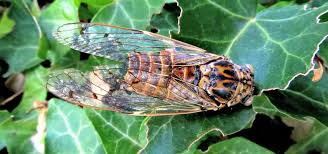
They are carefree and even selfish as they let people work for them believing that generosity is a given. In Ha’s eyes, SJW is like an ant forgetting that SJW is working in order to support him and his wife as well. Only after WHK’s car accident, HSH started working like crazy accepting all different kind of patients, even risking the patients’ life. HSH even believes that their office is working so well because he made so many surgeries, but in my opinion, HSH is overestimating himself as he is overlooking SJW’s reputation. SJW was invited to a radio program, he even wrote a book… people from far away are coming to his office. Yet, HSH has never really considered SJW’s work as worthy to be mentioned because he has a different approach: SJW is working for his patients so that the latter can start enjoying their life, while HSH only worked out of guilt and pride. He never cares for his patients in reality. His words can be compared to the singing of the cicada: HSH always tries to praise himself in front of SJW. He is really jealous of SJW and not just because the latter married WHK. HSH could study because of SJW and his family, SJW was definitely the better student. Even after the big revelation, HSH shows his true face: he doesn’t feel sorry that he had an affair with WHK, he just reveals his jealousy and “hatred” for SJW. It will be interesting to see how HSH lives after leaving SJW’s office.
As conclusion, our characters from the drama Love in Sadness are all embodied by animals, except YMR: HSH the cicada, SJW the butterfly, KIW the cobra and JHR the praying mantis. But more importantly, it is clear that the writer was inspired by authors from the antiquity: Greek and Roman writers (Aesop, Ovid, aso).
From the start, the writer and drawer make sure that viewers can associate our heroine CSH to the moon. First, let us focus on the first drawing. Here, the princess appears in a dark and gloomy environment. It is not just night, the moon doesn’t seem to shine like it should.

Notice that it is not even full moon and the moon crescent is even hidden by the huge castle. All these points (moon crescent, hidden by the castle and lack of brilliance) underlines that CSH is not herself in the end. Since the castle embodies Y. Group and the pavilion Donghwa Hotel, we can better understand why CSH is still perceived as the ex-daughter in law of the chairman Kim. Now you might wonder why CSH is connected to the moon? First, it is quite simple. In the poetry, woman is often associated with the moon. This is no coincidence because the menstrual cycle lasts around 28 days which corresponds to the lunar cycle: 28 days. Another point is that in Europe, in many languages the moon is a feminine noun: la lune (French), la luna (Spanish, Italian) aso because they all have the same origin: luna from latin which was also a feminine noun because in the Roman mythology, Luna was a goddess. But now let us go back to our heroine. In the first episode, we witness her awakening which happens with the sunset. It was as if the sun would kiss the sea (another element embodying CSH) which would awaken our heroine. However, the beholder shouldn’t forget that the sunset announces the rise of the moon. And now you understand better why CSH acts so differently in Cuba. During this night, the moon shines just like CSH. During this fateful night, CSH reveals herself in front of KJH. She is far away from the castle and the gloomy environment. Striking is that many important events also happen during the night:


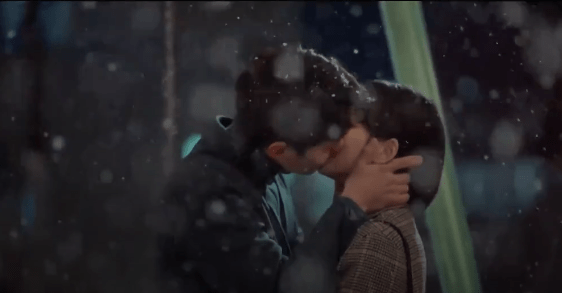
All these mentioned scenes had something in common: CSH was herself, she never contained her true feelings. She couldn’t even hide her thoughts and even her happiness. That’s why CSH is like Cinderella. Cinderella is forced to only appear during the night due to the balls. Here, Cinderella shines. Yet, the writer changed one thing. In Cinderella, the protagonist hides her true identity behind her beautiful gown therefore no one can recognize her. In Encounter, it is different. CSH does the opposite: she reveals her true personality. Actually, the situation is reversed. She is not a princess, but a single woman longing for love and warmth. She becomes a normal woman, she drops her princess status. By associating CSH to the moon, we understand better why CSH was suffering from insomnia. The moon is only visible during the night… so CSH could only “live” during the night, as she was living like a corpse during the day. But even during the night, her actions were limited as she was monitored by the media and her ex-mother in law. Her insomnia was a symptom that CSH couldn’t live freely.
But the moon can not live without the sun as the moon revolves around the sun. In another analysis I had pointed out that the sun symbolizes KJH. Without the sun, the moon can not shine at all and this applies to our heroine. That’s why at the end of this drama, the drawing put these two together. KJH as the sun helps CSH to shine, as she can smile and be happy.

This k-drama which started airing on February 23rd is actually a remake of a Japanese drama
which I haven’t watched. Besides, this drama is also very similar to the American movie Sleeping with the enemy due to the main topic: domestic violence and how the wife tries to escape from the claws of her husband by changing her identity/faking her death. It seems that domestic violence is no longer a tabboo and has become a “trend” in South Korea as many k-dramas are using this topic to criticize the current situation. We have to imagine that 10 years ago, the actress Choi Jin-Sil committed suicide due to the scandal when she had reported that she was a victim of domestic violence. Back then, it was a taboo and her revelation caused her to lose everything. The reason I am writing about is that despite being a remake and the resemblances to the American movie, the writer and the director have been able to make this drama very intriguing and captivating.
First, the main protagonist is a painter hence her paintings add more depth to the story. Secondly, there are references to literature and classical music giving more chances to analyze this drama. In other words, the viewers have to pay attention to details so that they can better understand the characters and their issues.
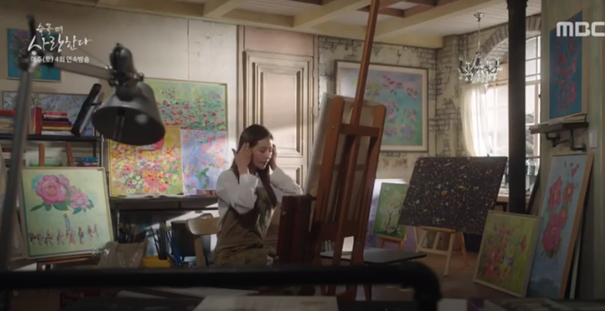
In the beginning, we are shown this painting

YMR is actually working on it, when her husband Kang In Wook enters her painting studio. He remarks that this painting and this flower resembles her a lot, hence she decides to title this picture “a self-portray”. Looking at the painting itself, the beholder observes two things:
So since it is a self-portray, it actually symbolizes her actual situation: she is in a terrible situation. Her husband is embodied by the dead wood, he can not bring her happiness and life, actually he is the reason why she is perishing. Her world is cold and she feels lonely. There is no light, so there is no hope. If you look now at her painting studio, you’ll notice the disparity between this painting and the others hanging on the walls. All of them represent flowers but the choice of the color is totally different: a lot of green, red…. to conclude, she used bright colors in the past. So after being married for 5 years, this painting reveals her own mental state: she is depressed and desperate. But here is the question: why are there two flowers, if it is a self-portray?
Then in the same episode, shortly after, the director uses these takings

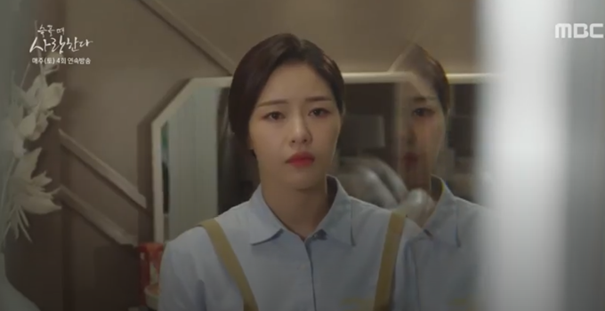
As you can notice, there are two Yoon Ma Ri, yet it looks like the second version is fading away, she is disappearing. And this is no coincidence. YMR is about to lose herself, her soul by remaining by her husband. She is not even allowed to choose her own clothes. She lives trapped in a cage hence the window with the bare reflects her actual position: she is a prisoner. She is not even allowed to paint outdoors which explains why her latest painting looks so gloomy and depressing. She can no longer paint as she has run out of energy and inspiration. So this explains why the second YMR is disappearing and why there are two flowers. The bigger one represents her own body, she is about to become a living corpse.
Striking is the finale version of her painting “a self-portray” is different.
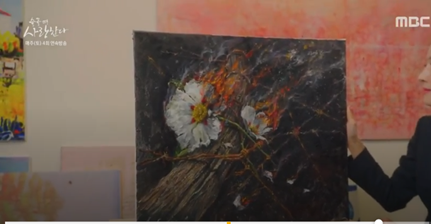
So the first version wasn’t just depressing because of the dark colors and the environment. Even the choice of the flower was pessimistic. However, in the finale version, the beholder observes a huge difference: the flowers are burning. This indicates that not only her situation has even worsened but also her despair has increased. The moment she called it a self-portray, YMR revealed that she was actually waiting for her own death. In the finale version, the beholder is actually witnessing her death. Sure, she is announcing her death but it also shows that she even prefers burning than living in the dark for too long. This indicates that she is even willing to risk her life in order to escape from this misery. She will do anything, even if this means her death: the fire creates some light, it can even be seen by someone. So she is not giving up.
As you can see, Love is Sadness is not different from Encounter as it uses a painting to give a message, illustrate a situation and the state of mind of a character.
Then in the same episode, we see the male protagonist, the plastic surgeon Seo Jung Woo, reading a page to his wife YH who is in a coma. The chosen book is Wuthering Height written by Emily Bronte in the 19th century, a tragic and painful love story. The protagonist Heathcliff loved Catherine, but the latter chose to marry someone else, Edgar Linton, as he came from a higher social status. Heathcliff had been raised in Catherine’s family. Due to her rejection, Heathcliff decided to get revenge on her and Edgar Linton. Interesting is that SJW chose to read the extract where Heathcliff is talking about the betrayal and the heartbreak. Catherine ripped off his heart and her own heart… So here again, this reveals that SJW is well aware that his comatose wife hurt him in the past by her betrayal. Later, we discover that she had an affair and lied to him. Due to this novel, we can already imagine what will happen to her: she will die, just like Catherine died before Heathcliff. The latter did torment her for marrying Edgar Linton but here, SJW married her hence he had no reason to torment her and she had no reason to betray him.
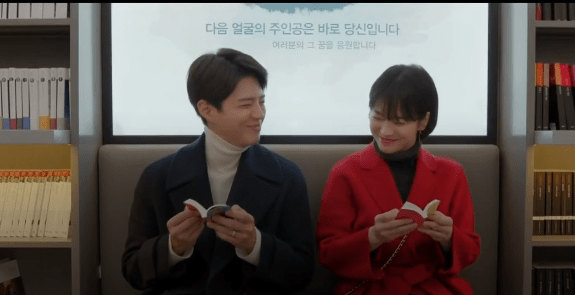
In the k-drama Encounter, the writer used poems, books and stories for many purposes:
Interesting is that now there is another k-drama called “Romance is a supplement” or “Romance is a Bonus Book”, whose story looks quite similar on the surface. Here we have again a noona romance, where the main character is a divorced woman Kang Dan Yi. She has a very special relationship with a younger man Cha Eun Ho.
Striking is that the story of this k-drama evolves around books as well, as CEH and KDY are both working at a publishing company. As you can see, books have a special place again. However, the use of books is a little different, since the company Gyeoroo Publishing is a fictional company. So the books they publish and are about to publish can’t be real. Besides, our protagonist Cha Eun Ho is himself a professor of literature at Hanguk University, writer and Chief Editor at this publishing company. His works are fictional as well. Then the other difference is that the writer has a different purpose, it shows how a book is born. A book is not just the result of the author, the publishing company had a lot of people working on it: the editing team, the marketing team, the designer etc. KDY even compared a book to the birth of a baby… It takes a long time before the book in his finale form is created. CEH hopes that even with “one book may change someone’s life” (episode 4). Another distinction is the way people treats books nowadays as if it was nothing special. The clients in the bookstores damage the book without even paying for it, a clear sign of disrespect. Then the viewers are confronted with different scenes where readers damage the books. This is one of the gestures:
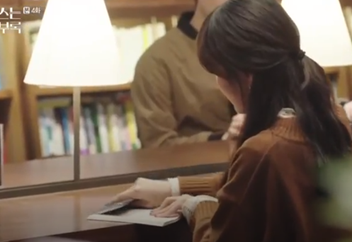
Furthermore a lot of published books end up shredded for many reasons. The publishing company can’t donate these books, the best option is to destroy them as they can still get some money from the shredding. With these two examples, we have clearly a critic about consumer society. Moreover, it shows that many books are still published despite the area of Internet and blog.


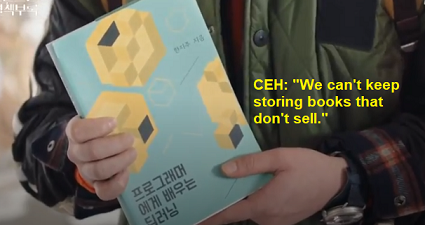
Yet the survival and the long existence of a book is determined by his success. The pressure is definitely bigger compared to the 20th and 19th century, since more and more books are published which was visible in the scene at the print shop. They have to compete with foreign books as well. Furthermore many books become outdated and useless…
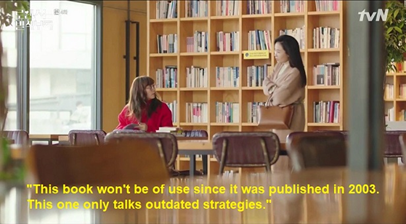
In this scene, the character Yeong-Ah sees our heroine DY searching for books about marketing. The recommendation given by YA reveal the short life of certain books. It looks like it is very difficult to create a classical book, a timeless work.
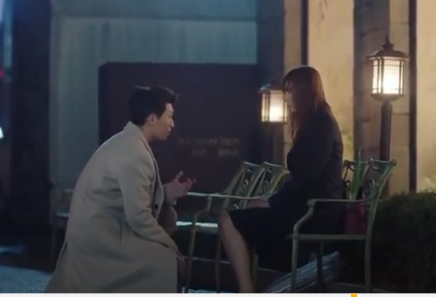
Nonetheless, both k-dramas used the fairy tale Cinderella, however with a different approach. Our heroine in Romance is a Bonus Book is disillusioned. She doesn’t believe in fairy tales any longer due to her divorce and situation in the episode 1. She rejects the shoes an unknown young man Ji Seo Joon offers her. The writer used certain elements from Cinderella: unknown identity, loss of shoes, night, a beautiful gown (in the shop window). The shoes belonged to her in the first place but due to an incident, she had lost one and decided to throw the other away which were picked up by JSJ, a book cover designer. DY tells him that she no longer believes in fairy tales and knight in shining armors as she is too old for that.
Finally, the scriptwriter of Romance is a Bonus Book reminds us that diaries are actually books, so many people are already writers. At the end of each episode, we see written thoughts from our main characters. These could be seen as selected notes from the diary CEH and KDY are writing. They both reveal a lot about their affection for each other. Moreover, this was implied when KDY rejected the shoes from JSJ. She said, she would rather write her own story.
As conclusion, although both k-dramas have a different approach to books, they have one common denominator: they are encouraging people to read. Both writers treasure books in the end. Romance is a Bonus Book reveals that it has become really difficult to turn a book into a classical book nowadays like f. ex. The Little Prince or Alice in Wonderland.

In this scene, our main characters are reading the favorite book from the other. While CSH has The Little Prince in her hands, KJH is holding Alice in Wonderland. One is a philosophical tale, while the other is more or less a fairy tale. What does it say about Cha Soo Hyun? Unlike The Little Prince that was indirectly mentioned in the earlier episodes (through the painting and his first love confession), so far, the work of Lewis Carroll was never implied before. Yet both works have many things in common. Besides both deal about childhood and they look like children books on the surface, nonetheless there is a deep message behind these stories. A deeper analysis reveals that Alice in Wonderland is about becoming an adult and Alice’s journey in that strange land correspond to her growth from a child into adulthood through adolescence. As you can see, childhood has a huge place in these two stories, nevertheless their perspective about childhood and memories contrasts, moreover their approach is different. While in The Little Prince the author wants adults to remember their inner child in order to live differently and enjoy life to the fullest, Lewis Carroll wrote in the preface this following verses:
Alice! A childish story take,
And with a gentle hand,
Lay it where Childhood’s dreams are twined
In Memory’s mystic band,
Like pilgrim’s withered wreath of flowers
Plucked in far-off land.
Striking is that the fairy tale and childhood dreams are compared to withered wreath of flowers. Sure, they represent memories too, yet these suffer from time as they are described as “withered”. So the author is referring to the fact as older the person becomes, the more childhood memories seem to disintegrate… they lose their intensity. Time has an impact on them. Sure, people tend to held onto these memories hence they are compared to “pilgrims” but time has an impact on these childhood dreams. Furthermore, at the end of the story, Alice’s sister tries to remember Alice’s “journey” and “dream”. She is well aware that this was just a dream. Her eyes are closed and she attempts to imagine this Wonderland. Yet, she can not live the same experience as she is not asleep. While “dreaming”, she is still awake and her mind recognizes each image and sound from Alice’s story to the image and sound of the real world. The older sister starts imagining Alice as an adult who will keep the simple and loving heart of her childhood. She will tell this story to her own children and remember this story and her childhood as something good. As you can see, childhood is linked in both works to purity and innocence and one author think that the person from the childhood won’t change that much (Alice’s image doesn’t change much in the future in the sister’s eyes), whereas Antoine de Saint-Exupéry thinks that otherwise. Adults change so much that they forget that they were once children. Time is quite important in Alice in Wonderland it is very often mentioned or implied (White Rabbit with the clock, her fall seems to be endless and during the fall, she can take things from the walls etc). Besides, Alice is even wondering if she should grow old or remain young. She decides, it is better to grow up as she doesn’t want to get lessons all her life. On the other hand, in The Little Prince, there was no time indication, the only thing related to time was the “death” of The Little Prince.
But let us take a closer look at Alice in Wonderland. Since CSH chose this book, this implies that she feels some connection with the main character. What have Alice, the main character, and Cha Soo Hyun in common? First, both are female characters, while The Little Prince was a boy… the same gender than KJH. Secondly, the story begins with a dream. Alice is sitting next to her sister, while the latter is reading a book. Alice feels bored and fell asleep. Striking is that transition between dream and reality is not visible. And this is interesting because the more we read, the more confused it becomes. The distinction between dream and reality is not clear at all, especially when it is written: (First chapter) “the sleep began to win Alice”, she is even described in her dream as “half-asleep” giving the impression that she was awake before. Yet, this is not possible as she had already made different strange experiences: meeting the White Rabbit with his clock, the endless fall where time seems to have changed. So she was already dreaming, however it looks like there is a “second sleep” indicating that she is falling deeper and deeper asleep. So the borders between reality and dream are not clear at all. Strangely is that Cha Soo Hyun is in a similar situation in the beginning. She has been in a coma for so long so that she has some problems to discern what is reality from dream. In the episode 11, while she is drunk, she confides to KJH her biggest fear. She is so happy to have him by her side that she is worried.

These words underline her confusion. For her, it is too good to be true. This must be a dream because reality is so different. Her vegetable state has affected her. She can no longer distinguish what is dream and reality. Well, in “Alice in Wonderland”, there were still allusions to the real world: her cat Dinah, her friends Ada and Mabel, her lessons etc.” so that this story is a mixture of dream and reality. A certain confusion exists in the story too. Yet, the way Alice wakes up at the end marks a turning point. She rejects “Wonderland” claiming that they are just a deck of cards. She refuses to acknowledge The Queen of Heart and her minions, she regains consciousness and can discern their true nature. At the end, there is no more confusion. CSH has a similar experience at the end. She is able to discern that this “dream” is not too good to be true… the photos of her happiness are the proof. This is reality and not a dream. So their journey are quite similar. At the end, both can distinguish dream from reality.
Another parallel between the drama and this tale is that Alice’s personality resembles Cha Soo Hyun’s character a lot. Both are curious, eager to help and both make mistakes. CSH’s curiosity is visible as she keeps trying new things with KJH (eating ramyeon at a stop area, chicken gizzards aso). Moreover, her new experiences are often linked food… just like Alice who keeps trying drinks, cookies and mushrooms in order to know what the effects will be. Another aspect is their loneliness. Alice is either talking to herself or talking about her cat Dinah which she seems to be missing a lot or she can’t stop talking to others (the duchess, aso). She feels lonely in this world. But the main common denominator is the loss of identity and their quest to discover who they really are. CSH’s loss of identity is palpable in the episode 7. She mentions
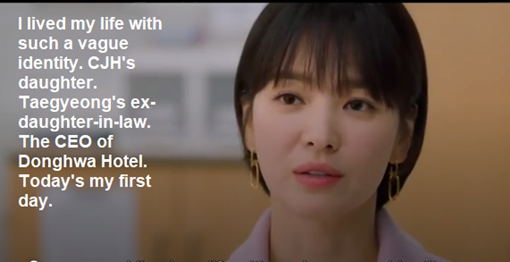
So it means for the first time, she is living as Cha Soo Hyun. Notice in her next words, she uses her own name, like f. ex. “I’m no longer the Cha Soo Hyun who is crazy about the hotel”. She has already found a part of herself the moment she uses her own name. Alice is put in a similar situation. In the chapter II, she wonders about her own identity. Then she remembers her friend Ada and Mabel and realizes that she can not be Ada and Mabel. Later, the White Rabbit calls her Marianne, the pigeon confuses her to a snake. The Cater pillar is the one who asks Alice: WHO ARE YOU? Alice had already questioned her own identity before, yet the caterpillar is the one who confronts her with that question openly. As you can see, Alice and CSH use both names in order to find their own identity. However, there is a huge difference between these two characters. While in the tale Alice in Wonderland, the focus is on growth and becoming an adult, CSH has a different journey. For her, it is to discover her own inner child. The more episodes aired, the more CSH became cheerful, even her secretary JMJ pointed out that CSH was behaving like in the past. So their journey is quite the opposite. CSH has lived for a long time as an adult and could never enjoy being an adolescent and child. Alice goes through the adolescence in the book, just like our heroine. CSH takes her distance from her mother and at the end, she is able to reconcile with her as she has found her own identity and her own life. Sure, when she talked to her mother, she hadn’t gone back to her KJH’s side, yet CSH had changed.
Finally, the Queen of heart and the King remind us a lot of Chairman Kim and her son JWS. The latter acts behind his mother’s back, just like in Alice. The Chairman Kim owns a chessboard which is quite similar to the deck of cards. Both queens are threatening a lot and even trying to give death sentences. Their world is quite violent and brutal so that both Alice and CSH are rejecting it at the end.
To sum up, the drama Encounter and Alice in Wonderland have a lot of points in common:
At the end of her journey, CSH found her true identity and personality. She has found her inner child, although she is still an adult. That’s why we see this painting at the end of Encounter.

Since KJH has always been the more mature one (f. ex. enduring hard times with good memories, his letter at the end, his bet in the episode 16), the man embodies KJH’s personality: full of wisdom and knowledge and the little girl resembles CSH because of her childish side… she likes teasing KJH.
This drama is really interesting because each episode starts and ends with a drawing. Each pictured scene doesn’t just serve as an introduction to the main topic of the episode, but also helps to understand the characters and their situation. However, if the drawings are all put together, you will notice a common denominator, the presence of nature. And each time, its presence is increasing. But now let us go back to the first episode and the introduced drawings.

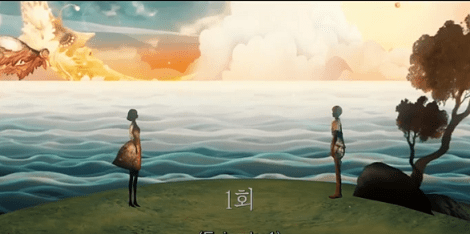
So far, two worlds are introduced: the castle, where the princess is living and the green land where our main character is reading a book. The atmosphere of the first image is gloomy and rather suffocating. It is night, yet the moon is not shining at all. The moon is even hidden by the palace. Under the yellow arrow, you observe the princess leaving the castle on her own, going through the forest full of thorns,

until she arrives in a new world, where the moon and sun are shining at the same time. There, a man is reading a book, until he notices her and stands up. Both are facing each other. Here, the first drawing represents Cha Soo Hyun’s world, the modern civilization, whereas the second drawing embodies Cuba, where KJH will meet her. So the castle could be seen as a representation of Donghwa Hotel and Taegyeong Group.
CSH is the CEO of Donghwa Hotel and she has just opened a new resort close to the sea. When the viewer sees her for the first time, she is already looking at the sea. She appears emotionless, yet we can see that the sea has some positive effects on her. She is calm.

Later, she explains how she developed the hotel. She wanted her future clients to rest by having a view of the sea or of the mountain. As you can see, she perceives nature as something positive, which can help someone to relax. Now, if we connect this to her trip on Cuba (her desire to watch the sunset at a certain beach), the viewer realize what nature means a lot to CSH. For her, nature is beautiful, can help people to relax and enjoy their time. However, the picture above shows that she can not get close to nature, as the window is separating her from the sea. The window could be perceived as a prison window due to the iron bars. This underlines first that CSH is living in a different world, far away from nature, and that she can not live like she would like. The other drawings show her living in a castle or pavilion, surrounded by people or by a fence, or trapped by a window

or even attached to a building.

To conclude, she is not just immobile, as she can not move, she lives in an urban world that is suffocating her and she can usually only escape from it through her paintings. The paintings function as a window to a different world, where her fantasy and her feelings are not contrived,

however it is not enough, since her biggest desire is to be close to nature as she likes observing nature (sunset). That’s why she was so determined to reach the beach in order to watch the sunrise, no matter what (broken taxi, no money, no phone). We shouldn’t forget that CSH is determined to renovate the hotel in Cuba without changing the garden, even refusing to put a swimming pool. She even outlined that the strength of this property was the garden. As you can see, she values the hotels based on natural elements: garden, sea, mountain. She wants people to feel close to nature through her hotels. Notice that after watching the scene where JH was looked down by her ex-mother-in-law (episode 6), she was standing in front of a huge window looking at the sea. At some point, you could sense that looking at the sea had this calming effect on her. For her, nature is a source of strength. Sure, she is a princess in the eyes of many, yet there is one person who perceives her differently. This is not a coincidence that in the episode 5, driver Nam compared our protagonist to a flower. He explained to CSH that no one can stop a flower from blossoming. As you can see, CSH is like a beautiful flower that has been “put behind a glass” by her mother and ex-family. A flower needs fresh air and water in order to live and that’s what JWS is not able to understand. He realized that in their marriage she was suffocating, hence he released her. In reality, he just created a bigger cage for CSH: Donghwa hotel.
However, our heroine is not just associated to a flower. She is often linked to birds.

First, look at the bird sitting on her lap in the gif above (episode 2). Then don’t forget the white howl she offered to JH (episode 2). But most importantly, just before the accident happened in Cuba, a bird appeared on KJH’s table at the cafe. The bird was announcing their fateful encounter.

In the episode, we see this taking. She looks like a flying bird.

Don’t forget that JWS is always filmed indoors, in suffocating rooms with no windows so that you have the impression, he is living in a prison, even worse, in a buried coffin due to his preference of rectangles and brown/black as colors. However, in his mind, this beautiful flower needed a protector that’s why he is helping her behind her back. She is like a flower with JWS as a gardener who ensures that she doesn’t get hurt. Donghwa hotel can be perceived as a greenhouse, where everyone can look at CSH and even gossip about her. He is just the gardener protecting her. By doing so, he feels that the flower sooner or later will realize what he has done to her so that she will smile beautifully to him like a flower and she will come back to his side. However, the difference between JWS and Nam is that the latter only compared her to one flower, while the other associated her to many flowers (episode 10). For Nam, she was fragile and unique, for our second lead, a lot of flowers looked like her, unaware that his words meant that she was nothing special.
But let’s go back to the drawings… they have all something in common: nature is always present, in the beginning (episode 1, 3, 4) less, but the more episodes were aired, the more nature prevails, whereas the modern civilization disappears little by little therefore there is no castle at the end… just time or moon or sun or stars (drawing from the episode 13, 14, 15 and 16), since Donghwa and Taegyeong Group represent no thread any longer. Nature has won over modern civilization. The reason is simple. First, nature plays a huge part in CSH’s life. Only when she is surrounded by nature (like drawing 1), she can feel free. Cuba is such a place. It has also become a meaningful place for her because she could do anything she wanted without being in the center of the attention. If we look at the first picture above, you can see that the trees are black and without leaves indicating that this is winter and nature is sleeping. We can interpret this scene as if her passionate nature was sleeping, oppressed. In her dark world, where she is so small and powerless, she is also like a flower that is sleeping or has not bloomed yet.

In my opinion, JWS and his mother represent the opposite world. Wealth and their social status are associated to civilization and modern world which are symbolized in the drawings 1, 3, 4, 5 and 11 (castle, pavilion, street lamps, road, windows, fence, wheels aso). That’s why CSH can never be happy with them. This is not random that JWS is always concerned about his image and appearance (he went to the shop because he wanted to impress a picky woman, his ex-wife), as he believes this matters in order to seduce someone. He even bought an expensive dress for CSH. Appearance is linked to artificiality, the opposite of simplicity and naturalness. As you can see, image means a lot to JWS, but it is different for CSH. KJH could move her heart because he wanted her to feel comfortable: the shoes, the jackets, the scarf. He always tries to give her his clothes. He always worries that she might get cold or hurt. A person obsessed with appearance would never accept such gestures because it wouldn’t look good but CSH is not thinking like that.
On the other hand, our hero JH is linked to nature in the different drawings. In the first drawing, he is living in a world so different from CSH: sunlight, green and tree. He is often standing next to the sun. If he is not represented, he is symbolized by the red butterfly (episode 4). The red butterfly has an important signification: it is an omen announcing huge changes in someone’s life. From my point of view, when the red butterfly touches CSH’s head, it was as if it brought back life and feelings to our protagonist. But don’t forget that in the story itself, JH introduced himself to CSH as fruit seller. In the same episode (1), CSH compares him herself to a fruit saying that he was like a white grape. Then in the following drawing,

the beholder discovers that KJH’s home is a tree, whereas her ex-husband’s home reminds us of a coffin. In another episode, JWS uses the metaphor of the wind, when he warns CSH that she might get swayed away.

Here the wind is actually a metaphor for JH. The wind knows no boundary, no limit as it is connected to the sky that’s why the wind should be perceived as the epitome of freedom. Moreover, by asking her not to let herself blow away, JWS actually wants her to remain in his world (“rectangle/frame”) because if she allows this, she will leave his world and won’t be able to come back. Furthermore, by associating JH to the wind, he is implying that her relationship with JH is doomed as the wind is something untouchable. You can not remain by the side of the wind, you can feel it but that’s it. To conclude, our hero is often associated with products coming from the nature: tree, butterfly, wind, grape, sun and fruit. The tree offers protection and rest for birds.
And this is another evidence that JH and CSH are meant for each other. A bird can only feel free and comfortable in the air… with the wind. On the other hand, JWS just compares her to flowers. JWS sent many flowers and even wrote that these resembled her. So the note and the number of flowers give the impression that CSH is not unique and special. This contrasts so much with JH’s mind: “among a multitude of stars, one star stares at me.” So for him, CSH is an unique star that he can distinguish from others… for JWS, it is different. In the end, his gesture shows that CSH is not really meaningful but he doesn’t realize that. Funny is that he thinks a little note, he can woo her so easily… JWS is far from being well educated: his expression skills and knowledge about book, arts and poetry are rather low and poor.

Since Cha Soo Hyun is represented by the moon and the bird, KJH by the sun, the air and the wind, this explains why the beholder often witnesses our protagonists flying a lot in the drawings (episode 6, 8, 9, 12, 14, 16). The sky is their natural environment, hence our couple is often walking and even climbing a tower.

Don’t forget that our couple is represented by the moon, the sun and the star. As conclusion, the sky, even the space are their real element.

Sure, the drawings also reflect the evolution of CSH’s situation and her relationship with JH. At some point, she has freed herself, she is no longer captive like in the drawing from the episode 3 and 4. She is also not surrounded by enemies, like the snakes in the episode 4.

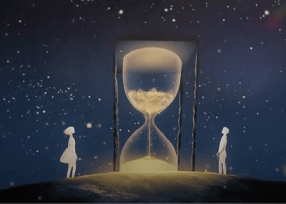
Her emotions have changed as well. She is no longer cold, no sleeping flower. She is warming up, her emotions are starting showing up. As conclusion, nature symbolizes here liberty, but more precisely, the sky and space are the real symbols for freedom. Only at the end, she will be entirely free (no more guilt or insecurities). She is no longer bound by the earth or time, she has become a real moon. She is shining as the sun is shining next to her. As conclusion, the higher our protagonists are/ fly, the freer they are.
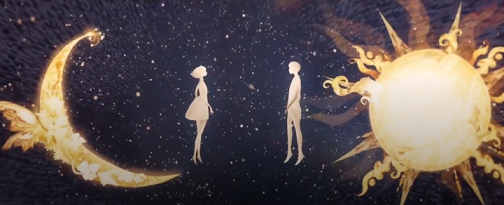

We shouldn’t forget that nature can also be dangerous. Notice that once CSH has escaped from her cage, she always has to face enemies and adversities. And in nature, her enemies are represented by the snakes, waves and the wolf. As you can see, nature is also connected to negative aspects. Nonetheless, this underlines that the problems and enemies CSH and JH have to face are natural phenomenons. This is nothing special but on their journey (drawing from the episode 5 and 6), they need to be together and work together. At the end, the sun has never shone so brightly. The MIL, the director Choi, her ex-husband are symbolized by the waves, the snakes and the wolf but since CSH and KJH never gave up and remained firm, the waves, the wolf and the snakes disappeared. In the drawing of the episode 6, KJH always serves her as a guide, he is her strength because he is the sun that warms her so that the flower can blossom beautifully. As for the wolf, the viewer shouldn’t forget that wolfs were used to be associated to death and danger in the past (see for example the fairy tale Little Red Riding Hood), while the image of the wolf in modern stories has nowadays changed, since they are in danger. To conclude, the danger coming from nature are linked to the earth (the forest of thorns serving as border and fence, sea, snakes, time, wolf) contrasting to the space and sky, the epitome of freedom. In the universe, there is no limit of time and space.

Although this story, written by Antoine de Saint-Exupéry, looks like a book for children due to the drawings and the style, in reality The little prince is classified as a philosophical tale. First, the author is criticizing through this story our modern society… don’t forget that it was written during World War Two therefore he wanted people to question themselves and their values. The main points are the following:
– the contrast between appearances and reality
– the incapacity of communicating between adults and children
– the importance of relationships among people and to take care of them
– the sense of responsibility towards others
– the loss of true values due to money and power (represented by different kind of adults: the king, the drunkard, the geographer as scientist, the businessman, the vain man and the streetlight igniter)
In The Little Prince, the adults are portrayed in a pejorative way: their lives consist of dependencies (alcohol, the need of admiration, the greed to possess etc.), of loneliness and lack of feelings. After reading this short description, you can observe that CSH’s world looks a lot like the world in this story. The two main protagonists in The Little Prince are the aviator and the Little Prince, yet they should be considered as representing the same person because the main point of this tale is to ask people to take care of their inner child. That’s why you can read in The little Prince
“All grown-ups were once children… but only few of them remember it.”
The little prince represents the child embodying all the positive aspects like innocence, creativity, imagination, purity and curiosity in opposite to the adults mentioned above, while the narrator and aviator is the adult. Meeting the prince in the desert means that the aviator is able to rediscover his inner child and rethink about his own life: True values like friendship and love become visible again hence the fox says that
“It is only with the heart that one can see rightly; what is essential is invisible to the eye.”
At the end of the story, The Little Prince leaves the aviator behind (officially he goes back to his planet but since a snake bit him, we can wonder if he died), yet the narrator says that he is still looking for the little prince, even asking the readers if they saw him. Besides, when the aviator looks at the stars in the sky, he always thinks of him. As you can see, the aviator doesn’t forget his “inner child”. He is an grown-up after all, yet he shouldn’t forget his inner child.
In the beginning, the aviator explains an unforgettable event. When he was 6 years old, the adults couldn’t understand his drawing hence he gave up to become an artist. From that moment, the aviator started living like a grown-up… and here we can see a parallel with CSH. It was around this age, where she was forced to give up her innocence and carefree life and become an adult at an young age. Meeting KJH is like meeting the little prince. She discovers what she has long forgotten: love, joy, carefree life aso. This also justifies why KJH has this playfulness and cheerfulness as he is still very innocent. He might be a grown-up on the surface, yet his personality reminds us of a “child”. I can not forget how some viewers sometimes reacted to his huge smiles… they were somehow bothered by these smiles. But seeing these from this perspective, KJH is the little prince, the one who will awaken CSH’s inner child. Thanks to him, CSH is able to perceive life with her heart and no longer with her eyes. JWS was too realistic and too grown-up to bring happiness into her life. On the other hand, CSH represents the adulthood because in the philosophical tale, the little prince starts changing as well: he discovers what friendship and love mean which becomes painful for him. He loses little by little his innocence as well.
He left his planet because of the rose. The flower was so vain, contradictory but vulnerable, however she ended up hurting the little prince with her words. She loves him but she is well aware that she was the reason he misunderstood her. The rose symbolizes on the one hand femininity and on the other love. The little prince only realized how unique his rose was after meeting the fox:
“It’s the time you spent on your rose that makes your rose so important.”
We could say that KJH is resembling a lot to the little prince. He spent a lot of time with his rose, took great care of her but due to her words, he ended up leaving her behind. The rose could be perceived either as CSH (she broke up with him) or his mother (who hurt him by forcing CSH to break up with him). Moreover, moving closer to CSH who is the archetype of the adult means facing reality and the world of the grown-ups. He met the queen Chairman Kim, the greedy director Choi, the jealous CEO JWS… Each time, he got hurt but was able to overcome the suffering. He experienced a lot with CSH. He became little by little an adult. Yet his mother refused to see it. That’s why CSH and KJH are both saying the same at the end: they make the other a better person. CSH can become more cheerful and playful again, KJH has become a real man. He is her fence and her protector. They complete each other.
Striking is that CSH has a lot in common with the little prince as well. First, she possesses a painting representing The Little prince. We could interpret that the little prince embodies her inner child that she has long forgotten and is trapped in the painting.

Their situation is similar: both are lonely. He lived on his planet, she lived for her hotel. Secondly, both enjoy watching sunsets. The prince said he could watch 44 sunsets on his planet, when he felt sad. And we saw how the sunset in Cuba had such an impact on She could forget her sad life, this even marked the time of her awakening: trying to enjoy life differently. That’s why we have this.

Yet after meeting the boyfriend’s mother and her rejection, Cha Soo Hyun is once again confronted with the reality, the world of adults. The beholder witnesses how affected she is.

Notice how she is sitting next to the little prince. She has always been turning her back on him, in a sense we could say that she has been trying not to acknowledge her “inner child”, although we know that CSH had started changing. Nonetheless, the way this scene was taken underlines another aspect: we barely see the little prince, hence we come to the conclusion that his presence has been even reduced. Don’t forget that she is about to break up with JH. Moreover, the wall/door on the side which covers the face of the little prince could be interpreted as the pressure CSH is feeling right now. She is again fighting against her inner demons: the right to be happy. She feels that happiness can only be a dream. For her, unhappiness means reality. Reality is linked to being a grown-up. She associates reality and adulthood with unhappiness since no adult around her has ever been shown happy. See her ex-husband, her mother (never satisfied with her actual life), her father (regretting his bad choice), her ex-mother-in-law, her secretary Nam (he stopped being a journalist, never confessed to his loved one…), JMJ trying to chase the perfect husband … Moreover, I sense that she might even think that she, the princess, is cursed to be unhappy in her life therefore her curse might affect JH’s family. This is the real reason for the break-up.
The presence of this philosophical tale is only really revealed at the end of the episode 14, where CSH is reading the book next to KJH. However, it appeared much earlier with the painting in CSH’s bedroom.
This is the biggest painting on the right. What I didn’t know is the existence a sculpture of The Little Prince with the fox in South Korea. As I had mentioned it before, the fox is not really visible in the painting. The little boy is the main character which shows that CSH has always felt a certain closeness towards this extraordinary character. Another visible trace is the bouquet, it is protected just like the little prince protected his rose.


To conclude, the writer and director used different visuals to create a connection between the philosophical tale and this drama (bouquet, painting, the book). But it goes far beyond that.
The title of this drama has a lot in common with this French story. Encounter is what actually defines the work from François de Saint Exupéry. Because the aviator had a plane crash in the desert, he met casually the Little Prince. Then the little boy meets the fox as a coincidence as well. The appearance of his beloved rose is not something planned either. One day, she appeared on his planet and the little prince had no idea how it came to life. So far, he had been busy taking care of his planet (see the picture above):
– cleaning the volcanoes,
– taking out the roots of baobabs as they represent a thread to his planet
Therefore when he saw for the first time this flower, he was clueless what she was and where she came from. As you can see, due to encounters, The little prince changes little by little, is forced to make decisions which leads him to leave his planet, to explore other planets and to meet new people. He leaves his planet because the rose due to her vanity, carelessness and arrogance took him for granted and thought, he would remain by her side despite her behavior.
And this leads me to the third aspect, the brevity of the encounters. The Little Prince never stays very long on the different planets he visits. First, the adults he meets are very flawed hence not interesting. They are even more self-absorbed, which the main character realizes. Secondly, even after meeting the aviator and spending some time with him, The Little Prince decides to leave the desert and to go back to his planet. By announcing to the aviator (the narrator) his immanent departure, he forces his friend to leave the desert too. As you can see, even if their encounter was very meaningful because the Little prince became a meaningful person to the narrator, they don’t stay together in the end. Their separation is indeed painful. He knows that the aviator can leave the desert with his plane hence he forces the narrator to do it by announcing his own departure. And here we have the difference between The Little Prince and Encounter. KJH wants to remain by CSH’s side no matter what and he keeps telling her that in order to reassure her. CSH had a lot of encounters, but all of them were with the same person: KJH. For the Little Prince, it was different… he met different people which made him realize how adults were, what friendship and love was aso. On his journey, The Little Prince makes a lot of new experiences which changes him little by little… he becomes more mature and wise. At the end, he discovers in a painful way what love is. Here, I also perceive another similarity with CSH, our protagonist. Thanks to KJH, she discovers love, cart food, average dishes, sand game, the joy of the salsa dance, an open-air gallery aso… Thanks to KJH, her horizon is broadened and enriched. She can feel again, her heart can see things which she couldn’t before. And it is the same for The Little Prince. Since I had already compared KJH and CSH to the Little Prince, my main focus will be elsewhere here in order to avoid any repetition.
Another similarity between these two works are the characters. I have the impression that certain people from The Little Prince resemble a lot to the characters from Encounter, like for example Chairman Kim. She could be compared to the King. The latter lives alone on his planet but he needs to have subjects in order to act as a King. And here, the Chairman Kim acts and lives like a queen. For her, she is royalty and her subjects have to follow her orders. Once she no longer needs them, she can discard them. Yet, at the end she ends up alone because she had abused her position. She didn’t realize that for her position, she had to act reasonably in order to keep subjects around her. And The King in TLP (The Little Prince) is well aware of that. He knows that his demands have to be reasonable, yet he tends to abuse his power anyway. The contradiction is visible in both stories. Their sense of superiority can only exist as long as there is someone besides them but they are not aware of that. Then we have the businessman who could be also linked to the Chairman Kim who wants to possess more and more. Her thrust for money is endless that’s why at the end, she is caught for bribery. But the most important character from TLP resembling to a character from Encounter is the fox. You might wonder about his identity in Encounter…. In my opinion, teacher Lee acts a lot like the fox. The first connection is her title. She is a teacher and the fox is the one who teaches The Little Prince what friendship is and what love is. He listens to him and gives explanation without giving him real advice. He doesn’t just explain what friendship is, he teaches him through experience. He asks the prince to tame him and as such to create ties between them. The fox is the wise teacher, the one who is there for him and who declares that the colour of the wheat fields will always remind him of The Little Prince. And teacher Lee has a similar behavior in Encounter. She doesn’t interact much between CSH and KJH, she always listens to both and explains things without giving any advice. She never stopped CSH from breaking up with KJH. She felt sad and sorry but she said nothing. Then in the dark room, she is the one who reminded CSH to enjoy the present because death could occur anytime. She mentioned missing her husband after his death… Yet she never told CSH to visit KJH. She let CSH make her decision. And that’s exactly what the fox did too. He always let the little prince come to his own conclusion. He only helped him by giving him valuable information.
Furthermore another comparison is the place. KJH and CSH met in Cuba, a country where they were on their own. So for them, Cuba was like a desert as they only interacted with each other. For them, the others were like inexistant. Don’t forget that CSH and KJH didn’t pay attention to the dancers during the sunset, they were both focused on the beautiful scenery.

CSH didn’t see the couple dancing. Then later, they walked barefoot without paying attention to others again. So they acted as if they were alone all this time. And to me, the desert from The Little Prince resembles a lot to Cuba. Although it is a desert, The Little Prince is able to meet the narrator, the fox, the other roses and the snake. It is not an empty place, it is a place where it is difficult to live. And the evening spent together in Cuba was exactly like that. CSH had trouble to walk to the top of the hill, she had lost her cellphone and purse therefore later they hadn’t much money, it was quite difficult to manage to eat and have a good evening. Her situation is really similar to the aviator’s situation: his plane needs to be repared and he has nothing. Yet despite everything, CSH was able to survive and to enjoy the evening: experience new things. And this is exactly what happened to the aviator and the little Prince. Despite the loneliness, the harshness of the environment, they were able to survive, to overcome the loneliness as both became close, just like CSH and KJH.

The picture above from The Little Prince represents the street lighter turning on and off the light. He lives on the smallest planet and the latter turns around one cycle per minute hence the worker has no time to rest. The street lighter is blindly following the instruction. He never questions the meaning of this instruction or tries to change it hence he is unhappy. As you can sense, the street lighter represents the workers’ social class in reality. But what does he have to do with our favorite drama Encounter?
First, let me remind you that the story written by François de Saint Exupéry contains a lot of drawings which makes you think that this book is for children. So the drawing above is the perfect illustration. And Encounter has the same approach: it uses drawings in each episode in order to illustrate the topic or the main event of the episode.

Looking at such a drawing, you can’t help thinking about fairy tales and we all know that fairy tales are stories for children as well. As conclusion, both works give the appearance of being stories for a younger audience (one a fairy tale, the other for little children), while in reality the purpose of these stories is different. On the one hand, Encounter is actually using fairy tales elements in order to demystify the fairy tales, on the other hand the writer and director want us to reflect about life and happiness. And The Little Prince has the same purpose: the adults should question their own values and even not forget their inner child in order to be happy. The adults portrayed there were all very flawed as they had forgotten what was really important in life. In Encounter, CSH is in the end the perfect illustration of such an adult. She is trapped in her own world, too focused on others and forgetting herself in the end. This explains why The Little Prince is still so popular after so many years, its message is timeless. And this is what the writer and the director tried to do with Encounter: they used books, paintings, poems from different times so that a certain intemporality can be perceived. Besides, this drama made you think of an old film, a classic due to the music (intro) and the drawings. Sure, there is a difference with the story The Little Prince, like for example the use of the cellphone. Remember that I had pointed out how the cellphone helped KJH to get closer to CSH (first texts, then phone calls, thirdly pictures, then video calls, then song over the phone etc). In the book, there is no description of the plane f. ex…. and the planets explored by the prince seem to be too unreal making us think that this is a story for children. This difference can be easily explained: we are not reading a book but watching a drama so the story is embedded in its time
But now let’s go back to the street lighter. So far, The Little Prince had more sympathy with him than with the other adults (King, drunkard, the businessman or the conceited man) hence he wished to have become his friend. One of the reasons was that the worker was not selfish, due to his work he is not self-absorbed. He takes care of others in reality. Besides, his work shows a certain utility: in the prince’s eyes, turning on the light is as if a star would be born/shine. It looks beautiful and nice. However, the little boy doesn’t stay on that planet because it is too small. And who resembles to this character in Encounter? To me, the street lighter reminds me of KJH’s mother. First, the mother belongs to the same social class: the workers’ class. Then she is not someone who questions values and traditions, just like the street lighter who never questions the absurdity of the instruction. She sticks to her role as mother and wife: helping her sons and husband. That’s why she can be perceived as not selfish. She lives in her own world, too scared to disobey or even question anything. When The little Prince offered advice and help in order to improve the street lighter’s situation, the latter clearly refuses it. He was too scared to change anything. The refusal of any change, even the rejection reminds us KJH’s mother. She rejected CSH claiming that she belonged to another world, she said that she wanted to keep her family as it was. To conclude, she has a lot of similarities with the street lighter:
– the lack of judgement, the prejudice
– the refusal of any change even if it means discomfort. Both are prisoners of their past in the end. The street lighter had a nice life in the beginning, yet it changed as the planet turned around much quicker.
– the same social class
– the fear: The Little Prince even got aware that the worker would be looked down by the others (conceited man, king, businessman) due to his situation and KJH’s mother had this fear.
But if CSH’s father is not the street lighter, then who resembles him? I have the impression that CJH could be the geographer, the scientist. Both have a similar work: the geographer writes books, CJH was a journalist. Both love books as well. The flaw of the geographer is that he never explores himself the world, he keeps writing and reading books, yet he never experiences the beauty of the ocean. He never leaves his desk hence he doesn’t know his planet at all. He represents the uselessness of the science if someone is forgetting the real purpose of the science. He is actually a prisoner too, just like the street lighter… but not of the past but of the future. And a politician is often too focused on the future, forgetting the present. Yet the geographer is the one who encourages The Little Prince to explore the world and discover things. He is not different from CJH. The latter encourages his daughter to face the world, to experience new things… and at the end he realizes that he should change his life as well, not focussing too much on the future but enjoy the present.
As for the conceited man (“le vaniteux”), I see some parallels with our second lead, Jung Woo Suk. Both are focused on their appearance as they are seeking admiration. JWS pays a great deal to his clothes because he thinks that Cha Soo Hyun might be impressed by his appearance. Remember his unfortunate encounter with Cha Soo Hyun at the shop. However, the difference is that the conceited man lives alone hence he has definitely no admirer around him. Being alone means that he can never find any admirers. For JWS, this is different. He is used to be admired. Despite this contrast, they are both in the same situation. JWS is determined to win her love (which is a sort of admiration), just like the conceited man asks the little prince to be his admirer and clap his hand. Their selfishness and their lack of consideration to the other are visible in both cases. The Little Prince is tired of clapping his hands and he realizes that the vain man is blind and deaf. He is just too self-absorbed to have a normal conversation with the main protagonist. He just gives orders and he is not even aware that his whole existence is pointless as he lives alone on his planet. JWS is not really different from him. He might have many female admirers, however he is just as blind and deaf as the vain man. Moreover, he also gives orders to CSH (“meet me at the sky lounge”). He thinks, he is generous enough to tell her that she can take her time. He ignores her words that she won’t meet him. Finally, he is also alone in his own world. While the vain man lives on a planet, we could say that JWS lives in a coffin due to his liking for brown and black and for rectangles.
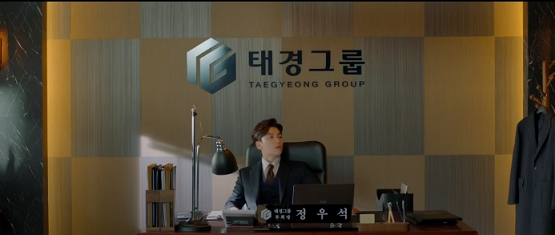
Even the painting and the windows have the form of oblongs.

He is never seen outdoors (only when he is forced to meet KJH, his rival). And even in a room, he usually doesn’t look outside.

His back is always facing the windows which reflects his personality: narrow-mindedness. And just like the vain man, JWS ends up alone in his realm. The Little Prince is bothered by the behavior of this adult, Cha Soo Hyun has never loved him and will never love him. Unlike the vain man, JWS gets aware that he will never be able to win CSH’s heart. He accepts his fate and turns his attention towards the other woman in his life, his mother. But since she is in jail, he lives alone in this lifeless and empty house.
This last picture reflects perfectly JWS’s life: loneliness. He is a king without any real subject. He just has his loyal secretary and that’s it. He is still sitting with his back to the windows. His life has not changed, just like with the conceited man. MEeting the little prince doesn’t change the life of this adult. The only difference is that JWS is no longer seeking Cha Soo Hyun’s love.

Another similarity is the presence of the star.


We have the poem “Enchanted” where the star is mentioned, then this illustration where the sun and moon are reunited which creates a shining star. Their love transcends time and space. And at the end of The Little Prince, the narrator asks the readers to think of The Little Prince if they are in Africa in the desert and a start shines… the little prince could appear anytime. The star as symbol is used in both works.
Finally, I would like to remind that each adult in the philosophical tale should be seen as a different part of ourselves. They just represent a certain flaw and the adult has to keep these aspects in check in order to enjoy life and be happy.

I chose these two takings from the first episode

because they mark the turning point in CSH’s life. This scene represents CSH’s awakening and the eyes are the evidence of CSH’s change. When someone sleeps, the persons closes his eyes. So the eyes reveal if the person is awakened or asleep. However, when someone is in a coma or vegetative state, the eyes can remain opened, yet they show neither emotions nor reaction to their surrounding. To sum up, the eyes represent an important signal for the physical state of a person. Since CSH explained to JWS (episode 7) that she had been in a coma for so long, we can conclude that her eyes had been opened all this time but they were emotionless and distant. So the eyes in the second taking above illustrates the change in CSH’s mind: her eyes are shining like stars, even smiling because she has been touched by the beauty of the sunset. All of her senses are fully awakened now. She is reacting to the sunset and to the wonderful music.
This explains why the famous Roman senator Cicero (1. Century BC) wrote once: “The face is a picture of the mind as the eyes are its interpreter”. From ancient times, people could notice the importance of the eyes. In French and in English, we have the saying too that eyes are the mirror of the soul. Why? First, we have no control over our eyes, unlike our mouth. With the latter, we can decide to remain mute or lie or say the truth, however it is not the same for the eyes hence the eyes give away a lot of information about our emotional state. The person can never really control his emotions. People can fake their smile but they often forget about their eyes. We could use as example for this CSH’s smile at the end of the episode 14. She fakes happiness, while her eyes reveal her sadness and pain. Hence the gaze is connected to sincerity and genuineness. Moreover, the eye is more complex compared to the lips, as it is composed of a pupil, the tears, an eyebrow, eyelid, the corner of the eye, of possible dark circle under the eye. Furthermore, we have two eyes and not just one which reinforce the expressed emotions.

But let us go back to the eyes of our heroine before the awakening (episode 7). They show neither reaction nor emotion. Her eyes are totally blank. This scene confirms her allegation, when she confronted Jung Woo Suk in the episode 9.

She really looks like a person in a vegetative state as she doesn’t even move her head or her body. Striking is that CSH’s eyes are looking down. And this gesture is really important. First, this reflects her actual situation. By lowering her eyes, she is in reality lowering herself in front of her mother-in-law. Her eyes outline her inferiority in front of Chairman Kim. Secondly her action shows that she is actually avoiding people’s gaze. While her mother-in-law is talking to her, she keeps staring at her dish. Why is she avoiding people’s gaze, if she is in a coma? We have to understand that the eyes have another function as well. They can reflect the other. The other’s gaze is a substitute for the mirror. If CSH looked into the chairman’s eyes, she would see a glimpse of herself, but it is a deformed reflection because the chairman Kim judges her at the same time. She only catches a small part of CSH. Through her mother-in-law, she would see herself in a coma. She would be reminded of her terrible situation which would increase her pain. But if you pay attention to the scene in the episode 7, you’ll notice that the chairman Kim is doing the same. She is also avoiding CSH’s eyes. Only when her son appeared, she turned her head towards him and looked at him. Later, we discover why JWS’s mother avoided CSH’s eyes.
Chairman Kim says: ” I always felt uncomfortable about the look in her eyes. That look in her eyes always bothers me. I hated her for that.”
Why did she dislike CSH’s eyes? A simple answer would be that CSH’s eyes were different. CSH never envied or admired her and her son. While all the others would worship them and try to get closer to them, CSH was never attracted by them. The mother-in-law couldn’t bear the thought that someone was looking at her differently, was not considering her as a queen. That’s why chairman Kim abused her and tried to control CSH. In this scene (episode 7), the mother-in-law gives the following orders:
“Get your hair done… wear the clothes they prepared (…) People would be waiting to see your face. You have to be tidier than situation like this. Smile more. But don’t smile too much.”
As you can see, she is taking control of CSH’s body. She treats her daughter-in-law like a doll which explains why her son criticized her in an earlier episode for treating CSH like a thing. But this is not just the hair and the clothes, but also the way she smiles and she moves. And now we have to remember this: we have no control over the eyes. How can the mother-in-law take control over the eyes, if the owner can not even control them. This is impossible. The mother-in-law was fighting against nature, a doomed battle. Now we have another explanation why the mother-in-law was upset. This was the only thing she could never control as CSH couldn’t even control her own eyes. This underlines the dictatorial tendency of JWS’s mother. A third explanation is that the chairman Kim also saw a glimpse of herself in CSH’s eyes which she didn’t like. As I said before, the eyes function as a mirror, although the reflection is deformed as the other judges you at the same time. Chairman Kim saw a part of herself, she didn’t want to see: the abusive, greedy and selfish person. CSH might have been in a vegetative state and never react to her mother-in-law’s cruel words, however CSH never stopped thinking and couldn’t stop herself from resenting JWS’s mother. This would infuriate the mother-in-law which would force her to abuse CSH even more and it became a vicious circle, until CSH and JWS’s mother avoided each other’s gaze as it had become too unbearable.
Since we talked about mirrors, I would like to explain why CSH was so obsessed with mirrors. She had one next to her desk and in her bedroom. Her mirrors were even huge. The mirrors outlined her loneliness, by having her own reflection next to her, she would feel less lonely. Moreover, by looking at herself, she would feel that she was still alive. The mirror would confirm her existence, would reassure her… Moreover, this would give her the opportunity to take control over her body. The mirror reflects the image she wishes to see but the problem with the mirror is that it doesn’t really help you to see your personality, only the appearance. On the other hand, the other’s gaze let see you a part of your personality… even if it’s a deformed and partial view. Only with the presence of another person, you can discover your true self. CSH tried to see herself in the mirror but she only saw her appearance not her personality. Only after meeting KJH and looking at his eyes, she started seeing herself and discovering herself. Remember that she said that she had many identities (CJH’s daughter f. ex.) but in reality, she was seeking for her own identity. Who is exactly CSH, the person behind this name? While the chairman’s gaze revealed to her an terrible reflection, with KJH she could perceive her good side. His eyes let her see how beautiful she was. But she never saw her own happiness. That’s why KJH’s words in the episode 16 are so important. “With these pictures, you will see a side of you that you never knew”.
Now, we have another aspect: the importance of the pictures. The pictures serve here as a mirror of her happiness, the side she never saw and knew. Neither the mirror nor the eyes were able to allow her to discover another glimpse of herself.
As you can see, CSH was desperately searching for her own identity and personality all this time and had no idea how to find it. The pictures helped her to find herself and allowed her to choose happiness. And this also justifies why CSH is determined to take many pictures later. For her, the pictures have a meaningful purpose. Because they helped her, she realises the importance of pictures. However, when she sees herself in the pictures, she is not alone. Teacher Lee is by her side and tells her how she judges the pictures: “I really love your expressions. How pretty. You look happy”. Then she remembers Kim Jin Hyuk’s words:

As conclusion, Cha Soo Hyun can only discover herself thanks to the pictures and thanks to the eyes of her boyfriend and teacher Lee. Alone, she wouldn’t have been capable. Through the eyes of others, the human being is able to perceive himself, discover a part of his personality. This idea comes from the French philosopher Sartre who wrote the theater play “No exit” (Huis-clos) where the 3 dead main characters, reunited in a room, are forced to live together and see their own flaws in the eyes of the others as there is no mirror in the room. They realize what kind of persons they truly were in their past life. That’s why this famous phrase comes from this work: “Hell is other people”. Actually, Sartre is not saying that we should avoid social contact, it is just that the eyes of others might become unpleasant as we see a glimpse of ourselves in them. However, the real conclusion is to incite people to make the right decisions and to do good to others so that the gaze of others reflect a good image and judgement of ourselves. Here, the happiness of Cha Soo Hyun will shine and be reflected in Kim Jin Huyk’s eyes. It will make him happy and that’s what Cha Soo Hyun realized in the dark room.
Through the introduction with the drawings, especially in the first episode, we have the impression that we are about to watch a fairy tale. First, we see a flying horse, an imagined animal. Then the main character, Cha Soo Hyun, is presented as a princess living alone in a huge castle. She is wearing a crown, however she leaves her huge palace and has to go through a huge forest full of thorns in order to be able to see the sun and the sunlight. She arrives in Cuba.

From the start, we see the reference of Cinderella. Cha Soo Hyun loses one of her shoes which KJH has to pick up
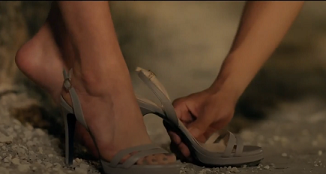
, he even buys her new ones, sandals that are far more simple and comfortable. Just like the prince, Kim Jin Huyk has no idea about her identity. He is just fascinated and attracted by her. Even Cha Soo Hyun exclaims after her return from the ball (salsa show) that she has been Cinderella. Furthermore we have other allusions about Cinderella:
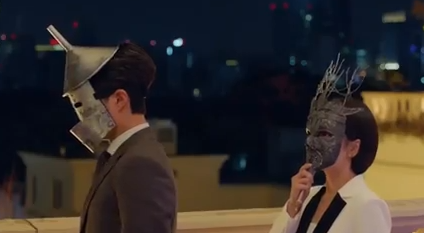
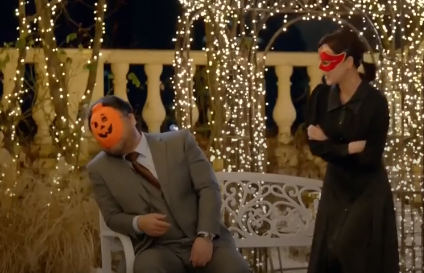
The other reference is the Sleeping Beauty. This is visible through the drawing (the forest full of thorns).

Then Cha Soo Hyun describes herself as a vegetable in front of her husband. During many years, she was like the Sleeping Beauty (in the fairy tale, she sleeps for one century). This explains why she was suffering from insomnia. How could she fall asleep, if she was already in a coma?
The common denominator of these two fairy tales is the existence of the prince. The prince is the one who awakes the Sleeping Beauty with his kiss and in the second one, the prince finds Cinderella thanks to her special shoes. In my opinion, since Cha Soo Hyuk is linked to the sea and Kim Jin Hyuk is associated to the sun in the drawings, we have to imagine that the sunset in Cuba represents the kiss of the prince, the sun kisses the sea which causes Cha Soo Hyun’s awakening. So on the surface, the prince seems to be Kim Jin Huyk. However his situation doesn’t fit the description of a prince. He comes from a lower social class. He has neither powerful parents nor wealth. However, we shouldn’t forget that first in different fairy tales like The story of a Youth who Went Forth to Learn what Fear was or The King of the golden mountain (both from Grimm), sons from a lower social class (merchant, craftsman) are able to marry a princess at the end and become kings. As you can see, the origin of our hero can’t be the main objection for not considering him as a prince. However, we have a real prince in the story: Jung Woo Suk. He is rich, handsome and powerful. He represents the archetype of prince charming. He is the prince since his mother, the chairman Kim, views herself as the queen as the leader of Taegyeong Group. Striking is that we have two princes in this “fairy tale” which is quite unusual but not extraordinary as some few fairy tales contain such elements. So the existence of two princes indicates that there will be a competition. Who can earn the princess’ love?
Cha Soon Hyun can never love Jung Woo Suk as he has no idea what she really likes and who she is.
But are Cinderella and Sleeping Beauty the two only fairy tales that are mentioned and exploited here in Encounter? I see two other possible references: Snow-white and Little Red Riding Hood, although there was no explicit allusion like with the other stories.
First since the stepmother is jealous of Snow-White, she abuses her and wants to get rid of her. The beholder can observe the similarity. Moreover, since CSH’s nickname is the Ice princess, it means that her “face” is white and cold like snow. And Snow-white received the same name due to the color of her skin which reminded her mother of snow. Then we saw that chairman Kim abused Cha Soo Hyun so that at the end, she left the “palace” divorcing Jung Woo Suk. Snow-White is forced to leave the palace. At some point, the queen wants to kill her, when she realizes that she is still living with the dwarfs. Here, Chairman Kim wants to take away Donghwa Hotel as CSH has been able to change the financial situation of that company. The impact is almost the same. Since CSH put all her energy into that hotel, taking it away from her would mean to kill her literally. The dwarfs are the driver Nam and the PR-manager Kim Sun Joo among others.
The final reference is The Little Red Riding Hood. First, we see Cha Soo Hyun wearing a red dress in the first episode, the same color than the little girl in the fairy tale.
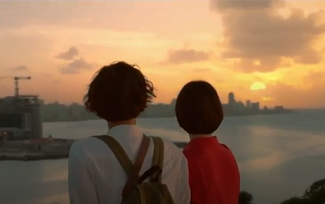
Then later, in the drawing of the episode 11, a wolf appears.

The wolf could embody Jung Woo Suk who has come back in order to claim his “ex-wife”, his first love. What people most don’t know is that in the original version, the French fairy tale written by Charles Perrault in the 17th Century, the story ends with the following moral:
Moral
Children, especially attractive,
well bred young ladies,
should never talk to strangers,
for if they should do so,
they may well provide dinner for a wolf.
I say “wolf,” but
there are various kinds of wolves.
There are also those who are charming,
quiet, polite, unassuming,
complacent, and sweet,
who pursue young women
at home and in the streets.
And unfortunately,
it is these gentle wolves
who are the most dangerous ones of all.
As you can see, the author warns the young women not to listen to seducers. I see here some parallels as CSH was also convinced by her parents to marry Jung Woo Suk. She was polite, complacent and sweet (just like in the moral) and at the end, her life was ruined. Sure, the message has been modernized and transformed. However, the message is that people should think really hard and not allow themselves to be influenced. Naivety and ignorance were the reasons why the women were easily seduced; in CSH’s case, I would say that she had been trained to listen to her parents.
Striking is that many fairy tales end with a marriage with the saying: they lived happily ever after. Since our heroine has been married once and is now divorced, this characteristic represents a contradiction to the fairy tales. In reality, the characteristics of the prince have been perverted. Due to his power, wealth and social status, CSH suffocated and suffered so much that she became a vegetable. Moreover, her husband was not even able to protect her from his jealous mother hence CSH judged him as weak and poor in the end. On paper, JWS was the perfect husband candidate, in reality he was the opposite. The elements from fairy tales happen after her divorce indicating that divorce is not the end of the world. This is also a chance to get a new start. In my opinion, the writer is in fact trying to demystify the fairy tales. Kim Jin Hyuk is just an average man and as such he is as brave and strong as any other man. A real good husband is the one who pays attention to his partner, observes her carefully and takes care of her. Money and power are not a synonym for happiness. To conclude, this drama sends the right messages for women by using elements from fairy tales:
Will Dir den Frühling zeigen
Will dir den Frühling zeigen,
der hundert Wunder hat.
Der Frühling ist waldeigen
und kommt nicht in die Stadt.
Nur die weit aus den kalten
Gassen zu zweien gehn
und sich bei den Händen halten –
dürfen ihn einmal sehn.
– Rainer Maria Rilke 1875-1926 –
Want to show you spring
Want to show you spring,
that has hundred miracles.
The spring lives in the woods
and doesn’t come to town.
Only the ones who far from
cold alleys walk in pairs
and hold hands –
may see it once.
Okay, this is my own translation. The problem I had is that first “waldeigen” is a word created by Rainer Maria Rilke and secondly I tried to keep the structure of this poem. Waldeigen means belong to the woods/forest. You might not know but German is a very creative language, you can create your own words because it is possible to put two words together. Yet people will understand what you mean.
What caught my attention is the following. Spring is connected to nature (“woods/waldeigen”), contrasts with modern life and civilization (town). And this fits our OTP. KJH represents nature due to different associations (sun, green grape, wind). Hence for the poet love is a natural phenomenon, however he doesn’t just outline that only people in love are feeling and seeing the spring, the two persons have to be active. If you pay attention to the title (want to show you spring), it is an invitation to fall in love. One is active in his courting. You have to leave the room and walk in the streets with your loved one to experience it. And that’s why we see our OTP walking in the cold streets (episode 6, 14 and 16). They actually do what Rilker described. They don’t feel the coldness of the winter as their love warms them up.
Moreover, the verse 3 and 4 clearly shows that love is to be found in the nature… hence leaving the town and going to the woods can lead you to find love. It looks like that for Rilke, love is not a state but a process… And KJH acts exactly like the person in this poem (want to show you spring). He keeps asking for CSH’s acceptance to love him and to fall in love with him. Besides, we clearly saw that KJH was proactive in his pursuit. He used his hands and his cellphone to get closer to her.
Interesting is that the subject in the title is missing: either it is “I”/”ich” or he/she “Er/sie”. I chose the first person because it becomes more personal and direct. Yet, it could be “Wants to show you spring”. I pointed it out because I wanted you to understand why I chose it this way. Besides, my own translation is not perfect, quite far from it and someone could claim that it is different.
Another observation is the contrast between hundred miracles and once. In my opinion, the poet could be referring to the uniqueness of love. Real true love can only be found once, but we have many people who can experience the same “spring” hence we have hundred miracles. And CSH was the one who kept mentioning her love as a miracle. Spring indicates that there will be changes in the persons who are in love, because spring announces the appearance of new leaves, new flowers aso. Something new and beautiful will surface, like a rebirth which can be connected to CSH’s awakening.
 Bebebisous33s' analyses in K-Dramaland and Manhwas