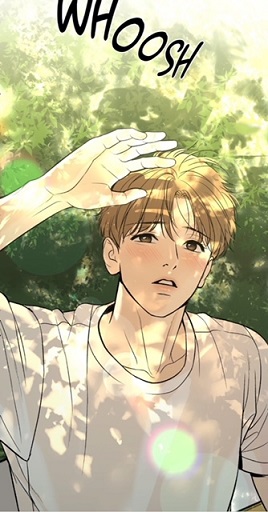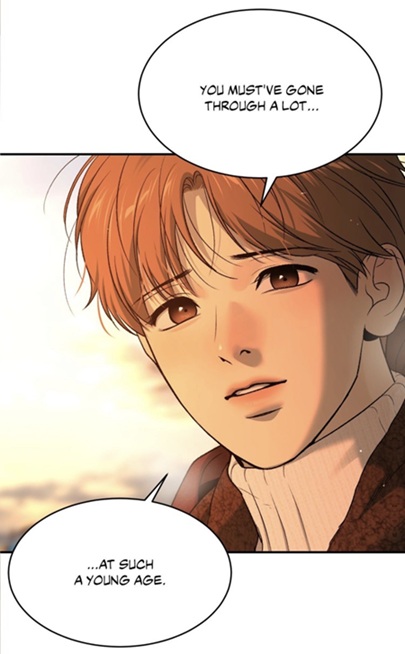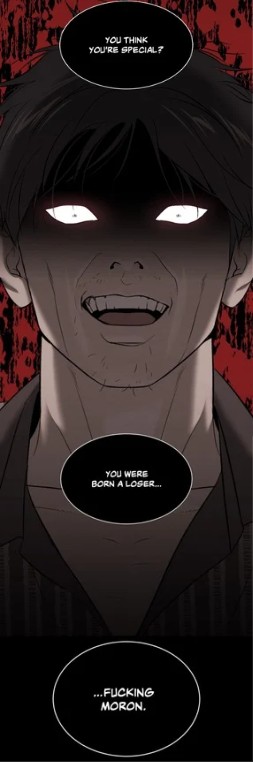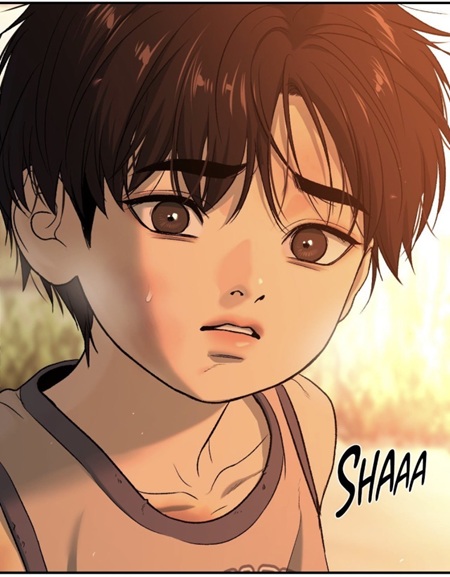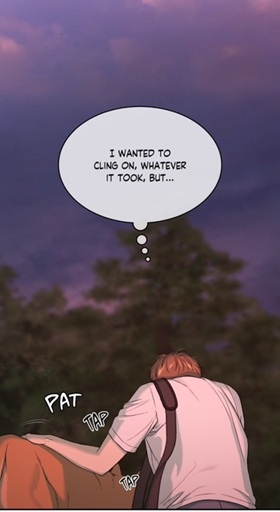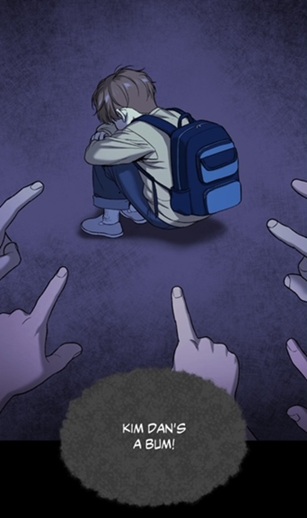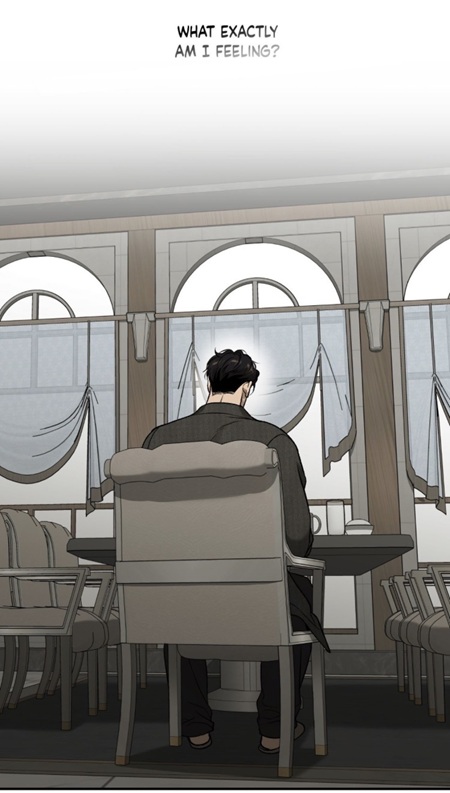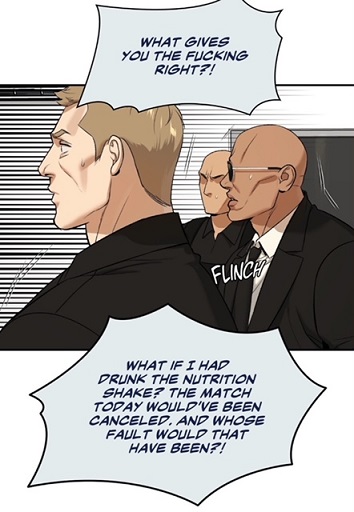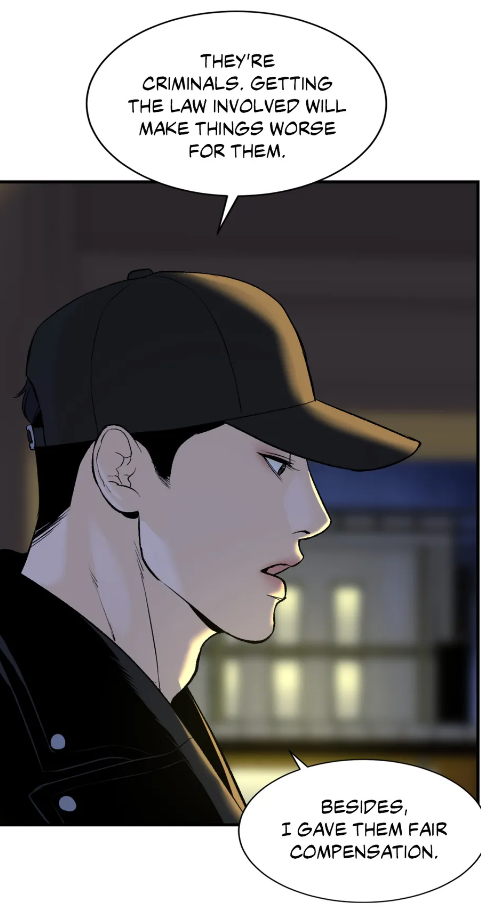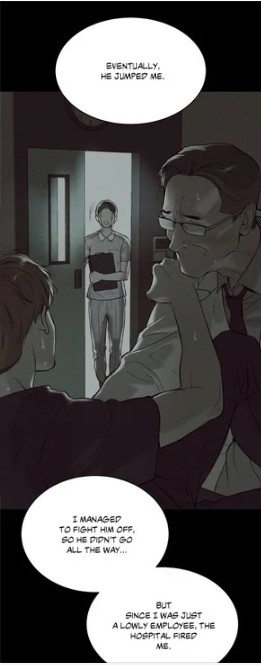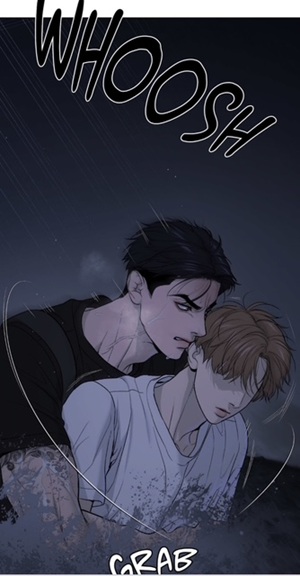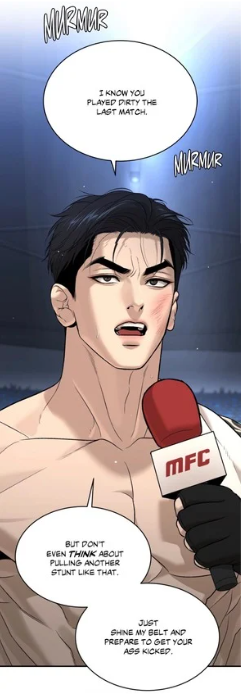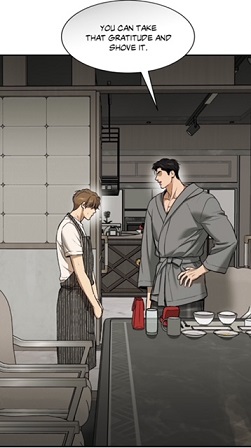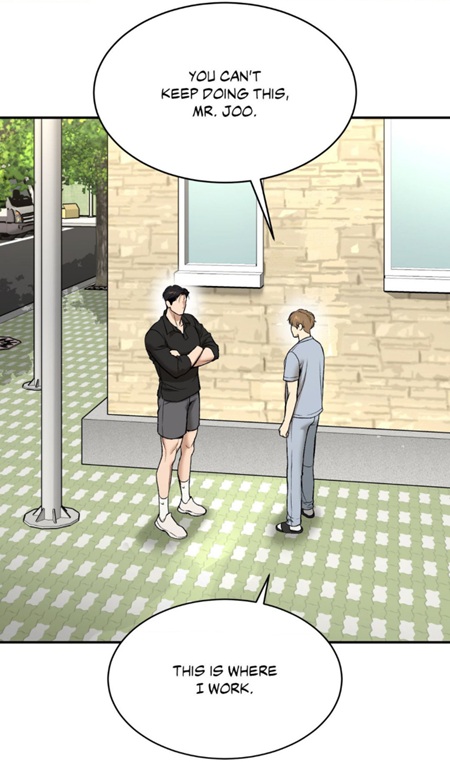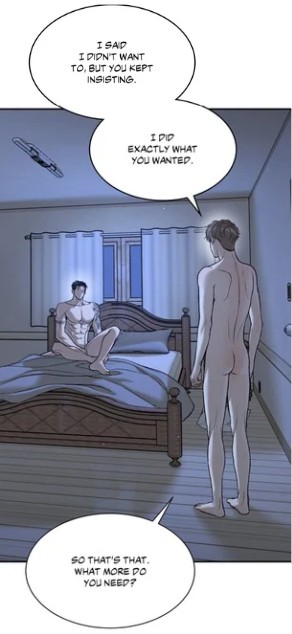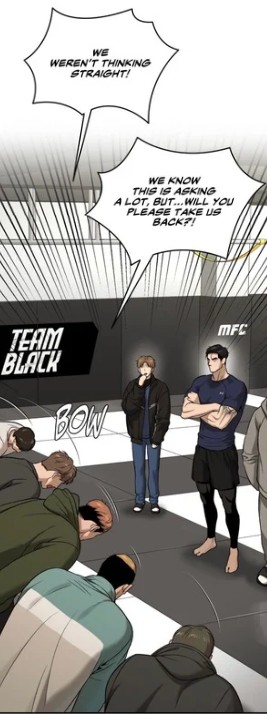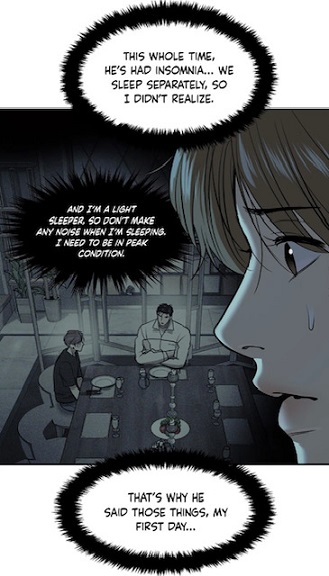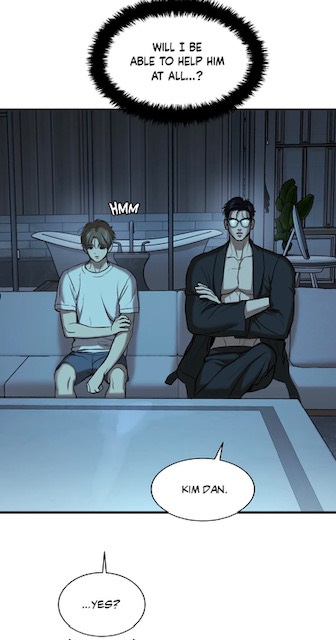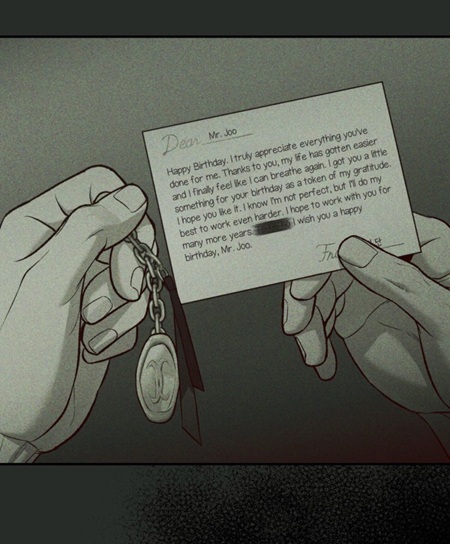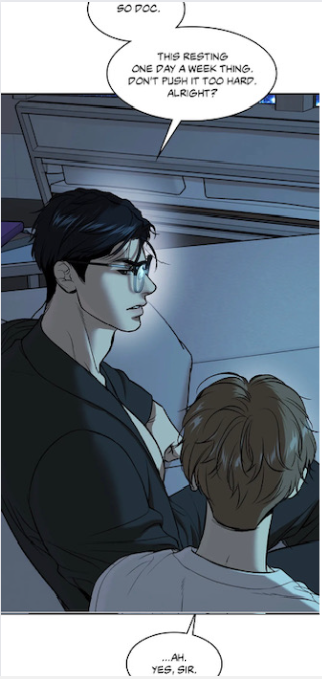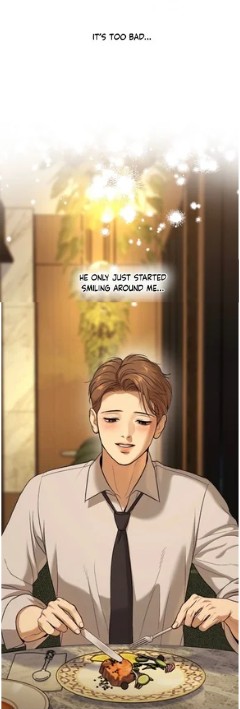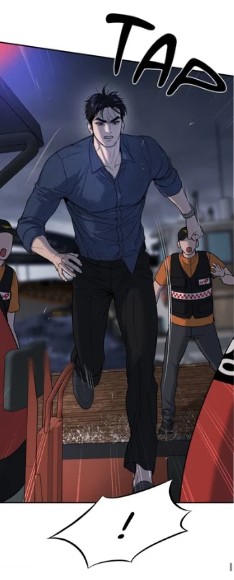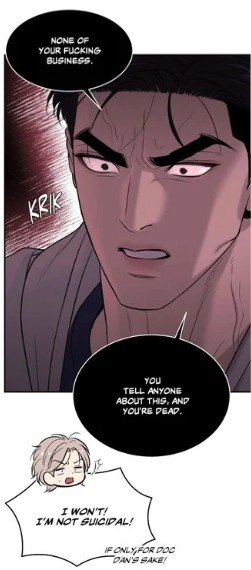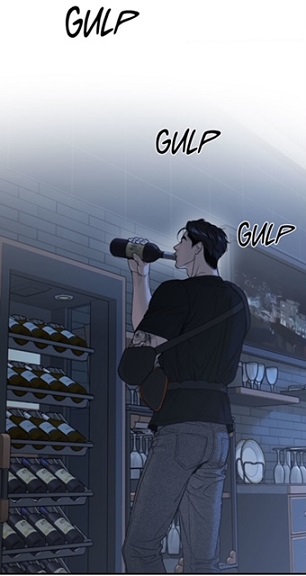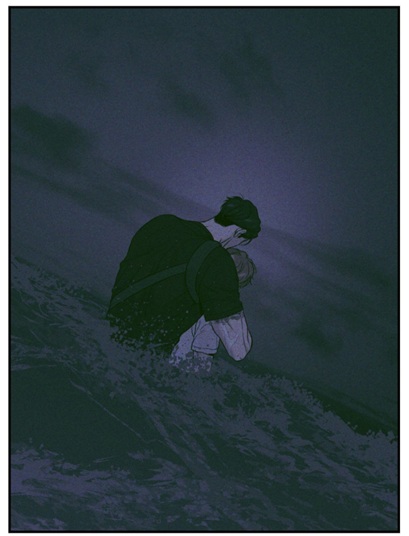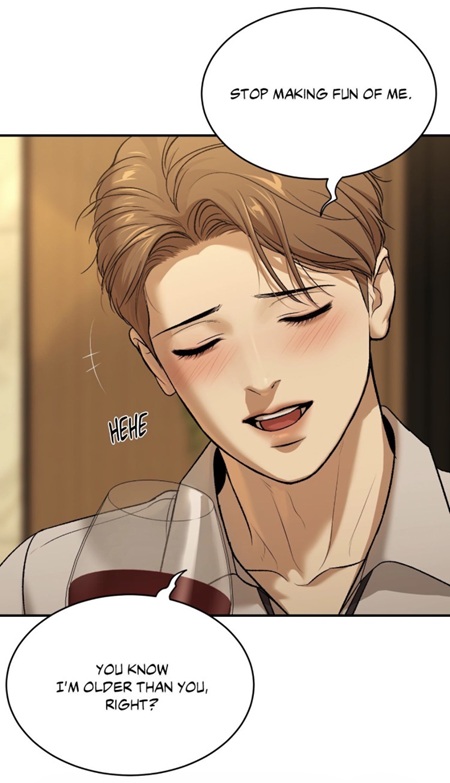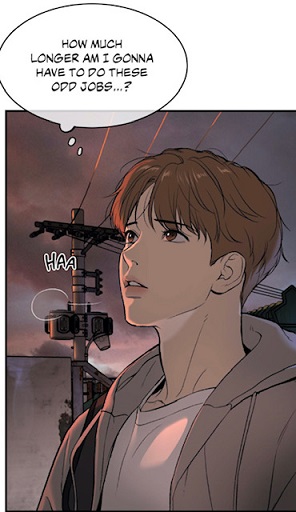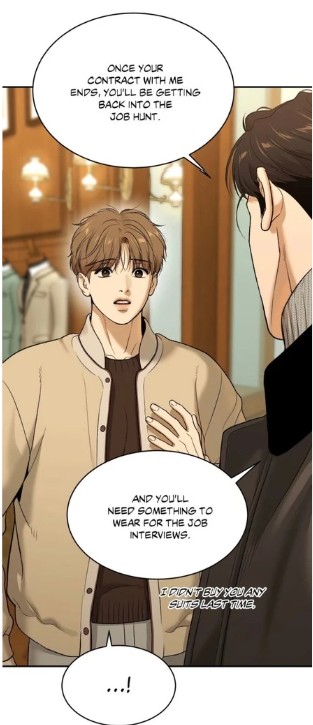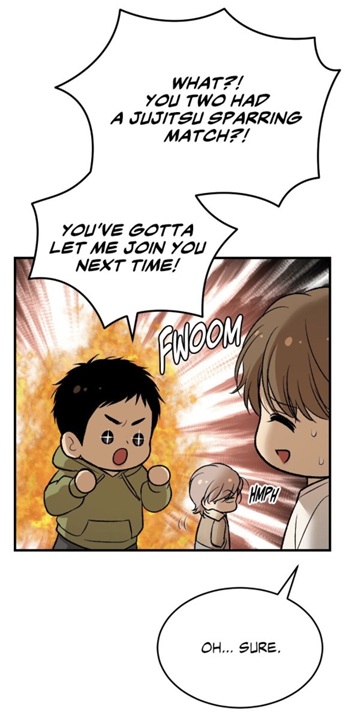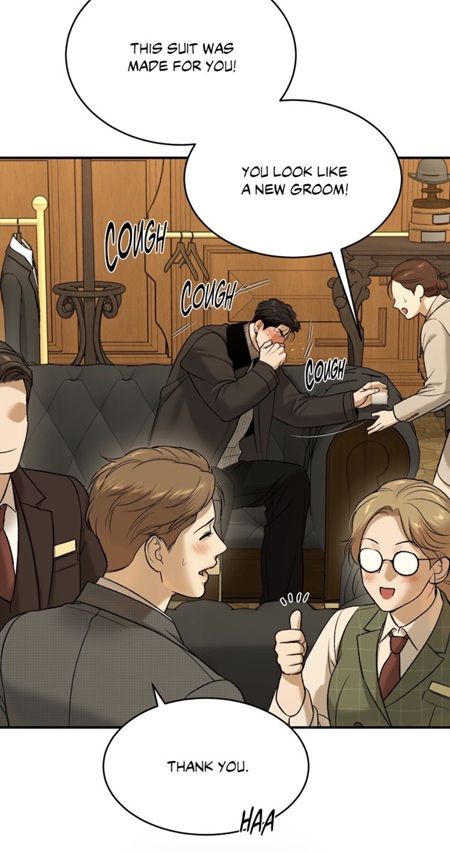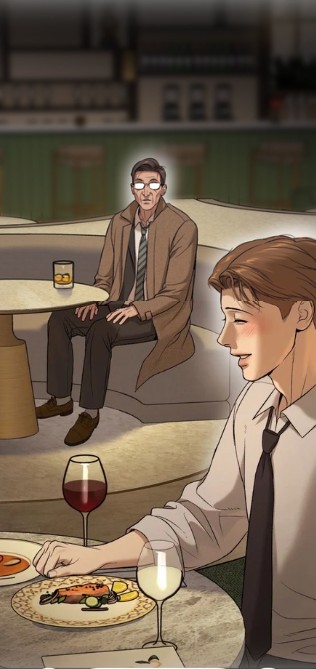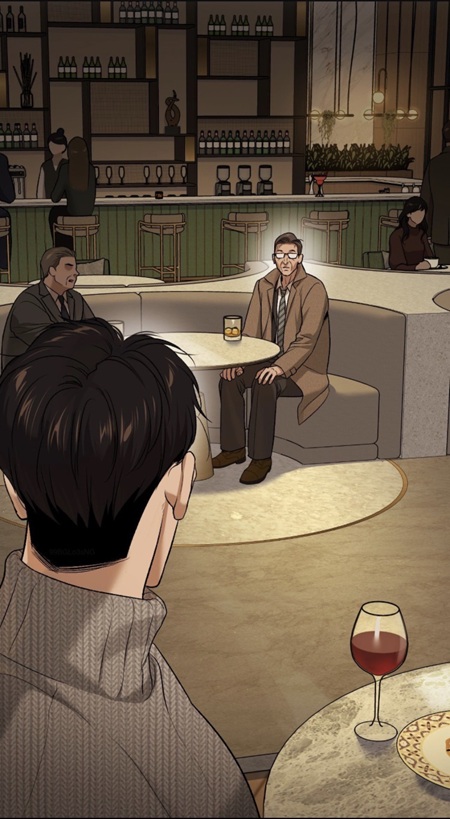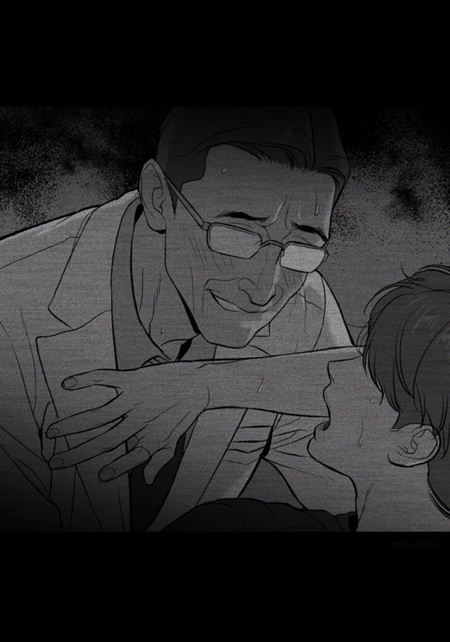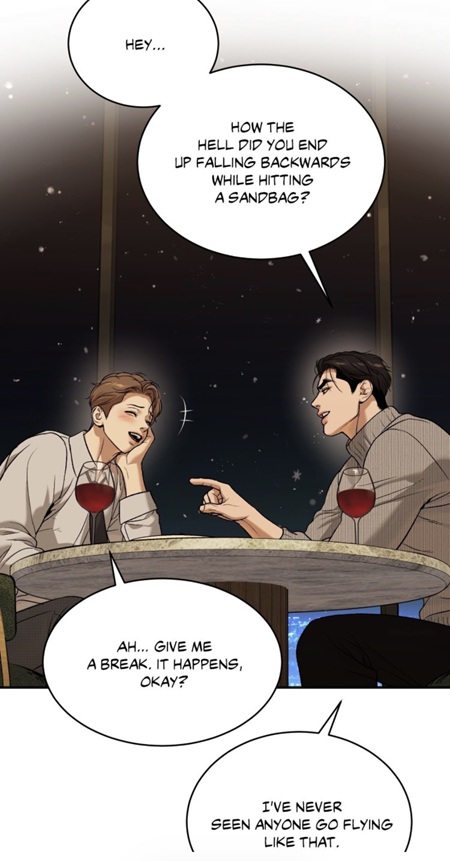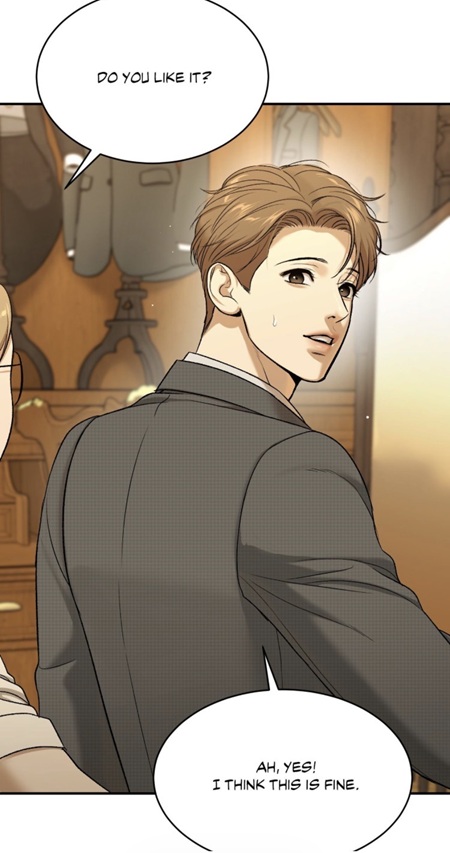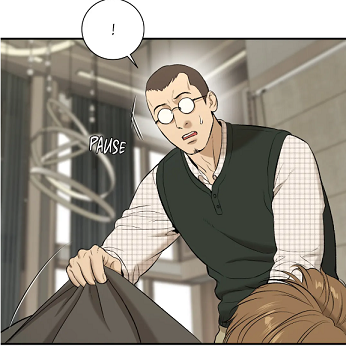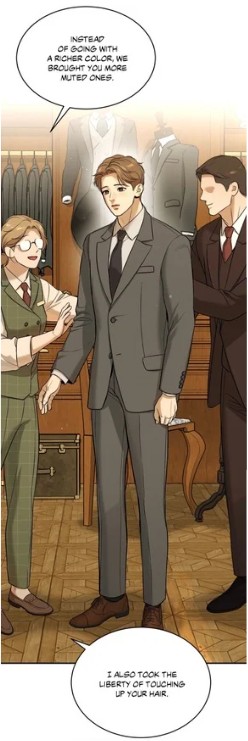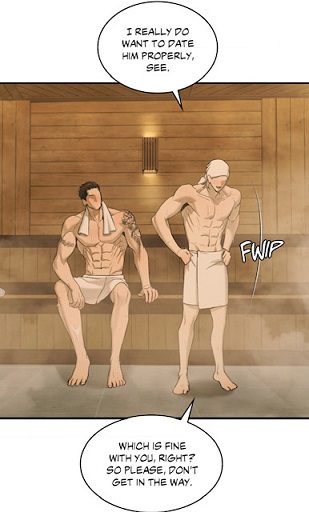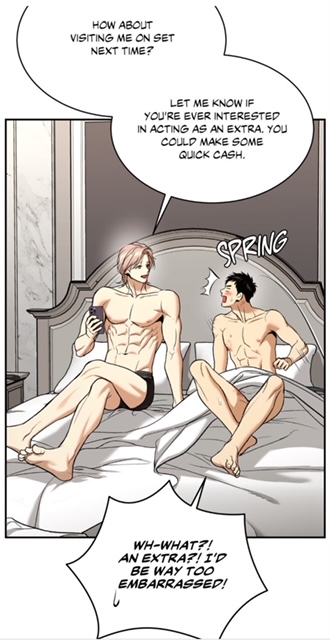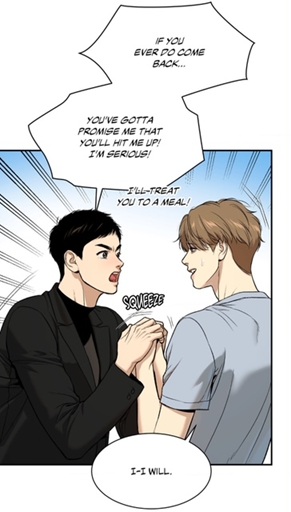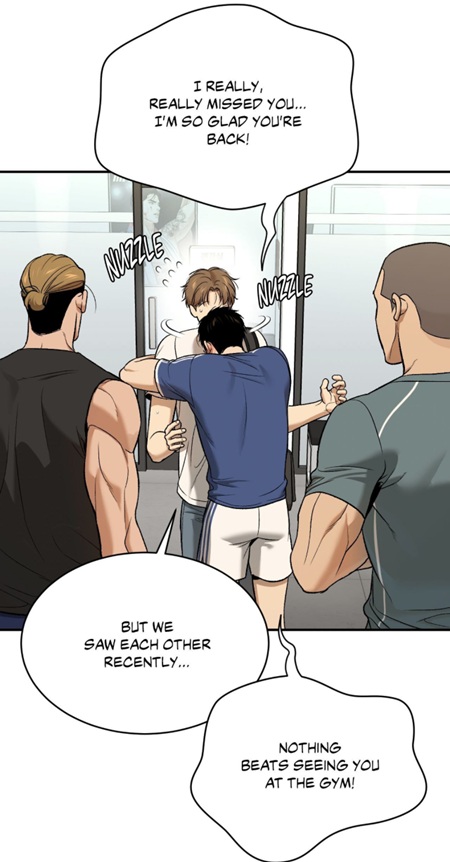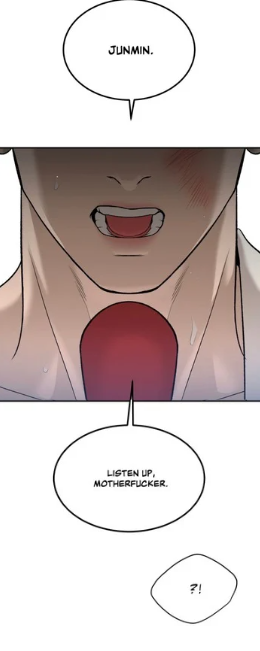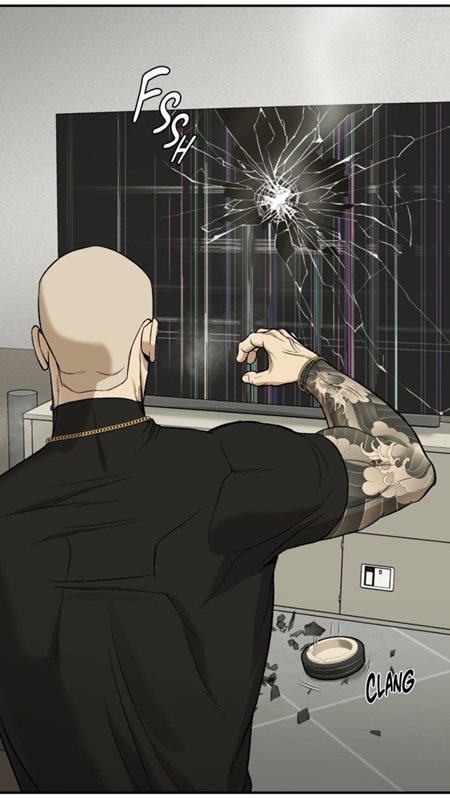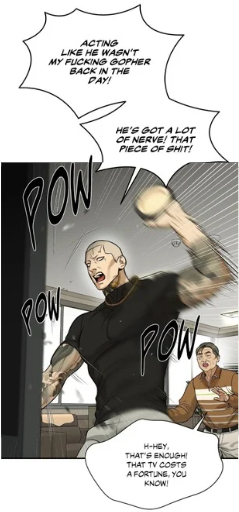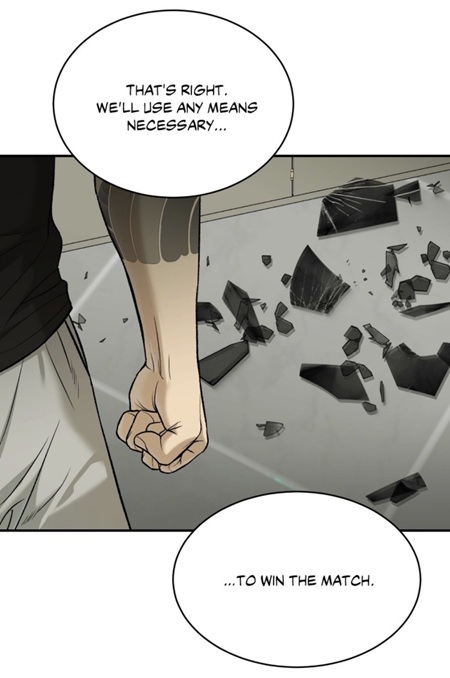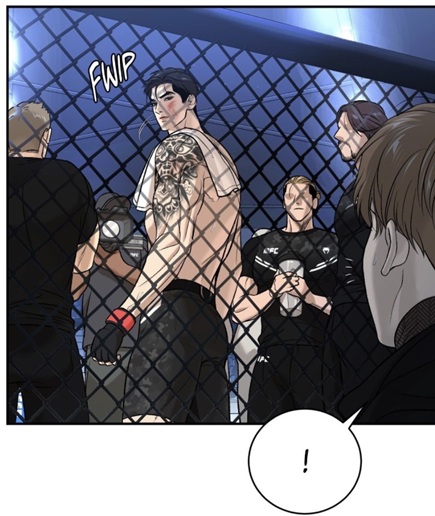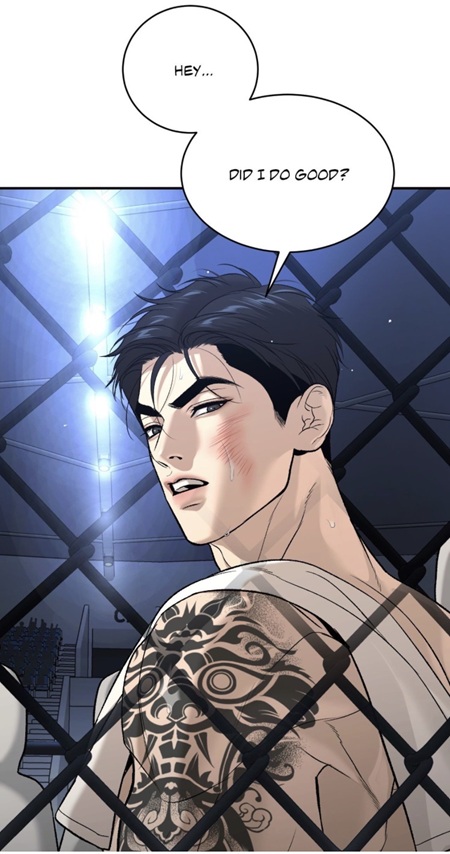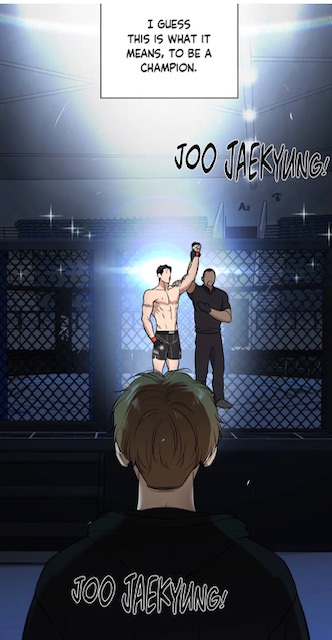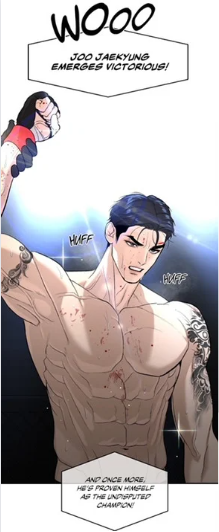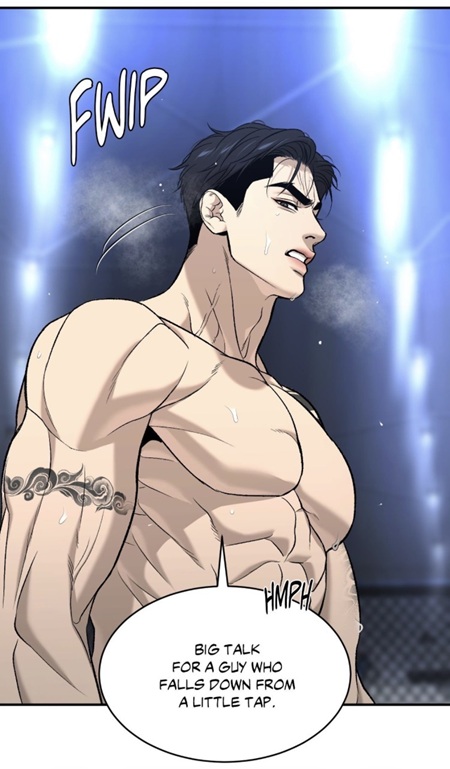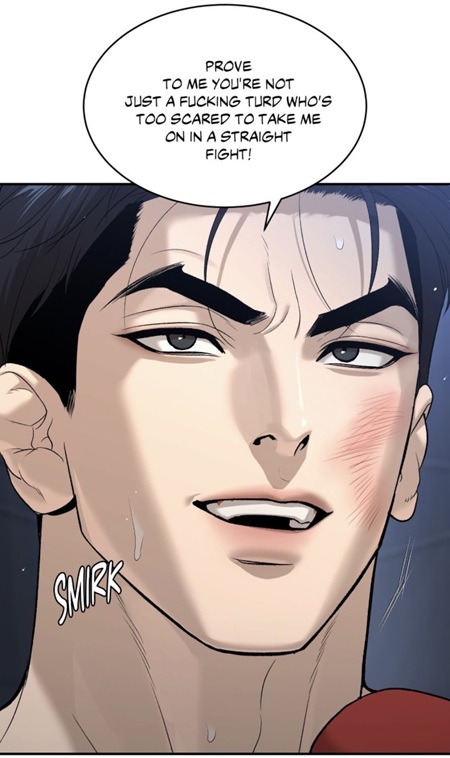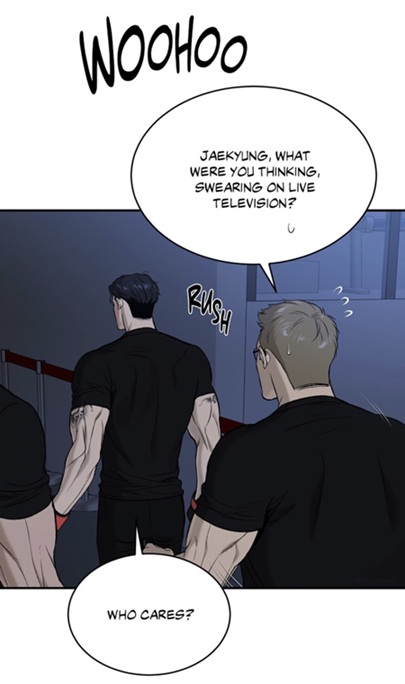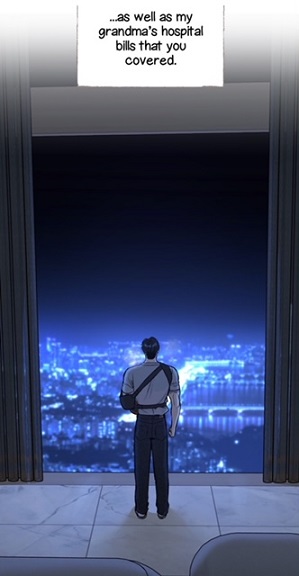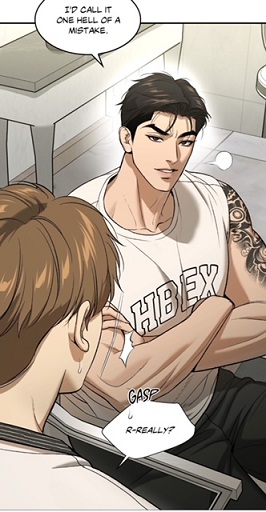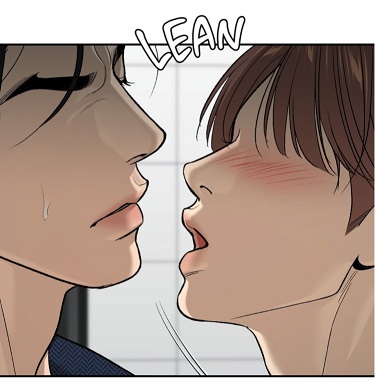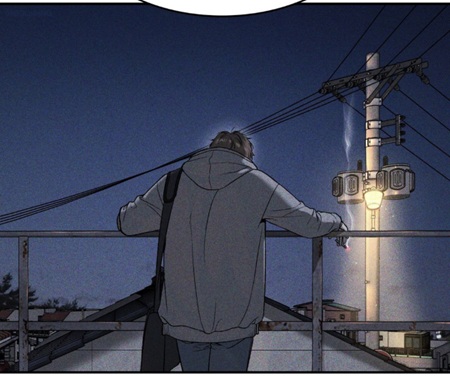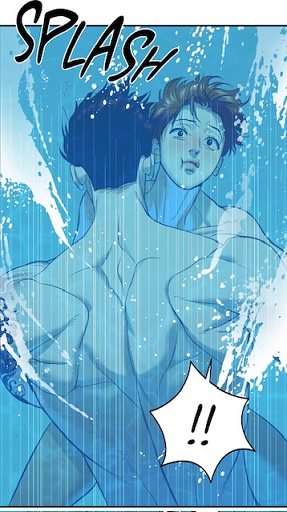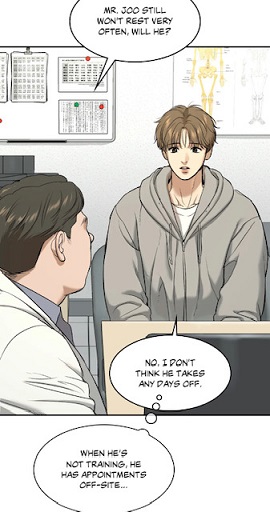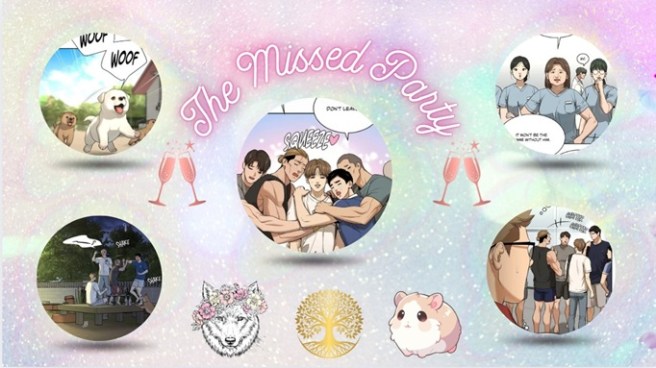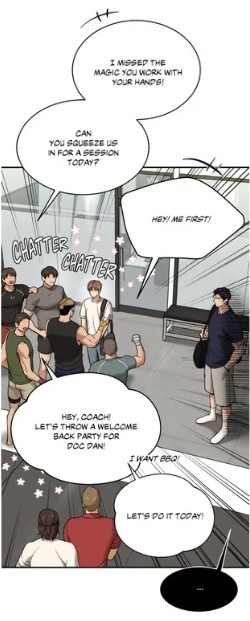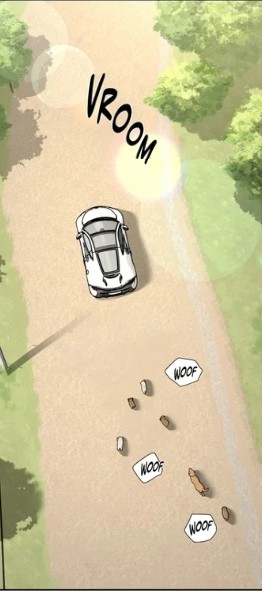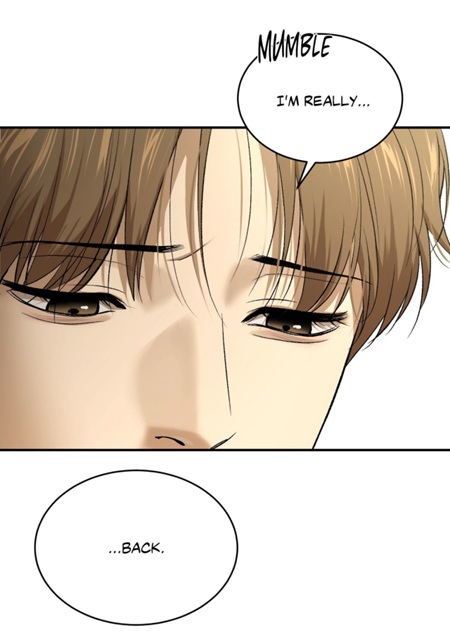
Jinx: The Birth 🎴 of A Flower 🌸 (part 1)

Where is a Flower in Episode 88?

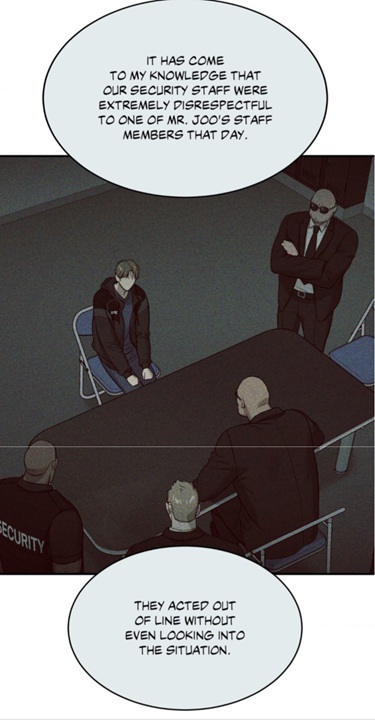
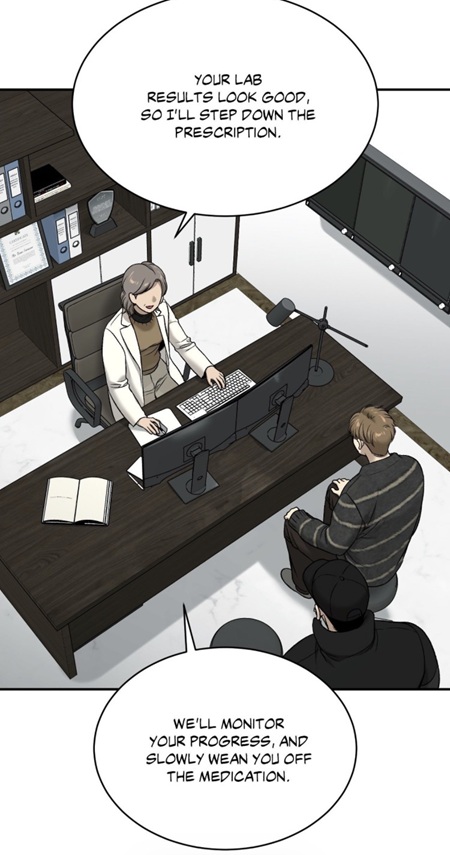
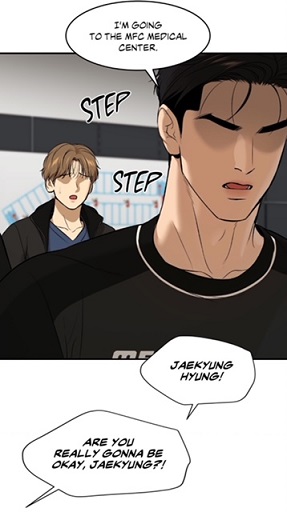
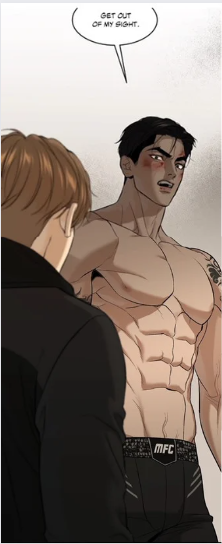
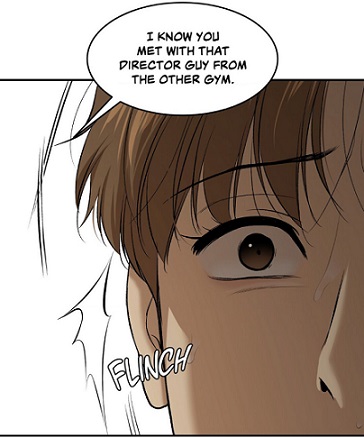
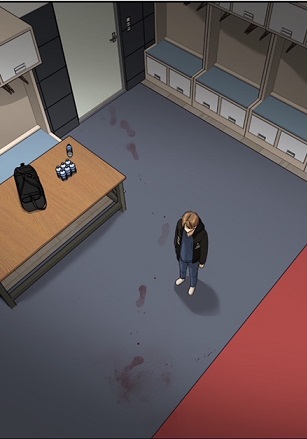
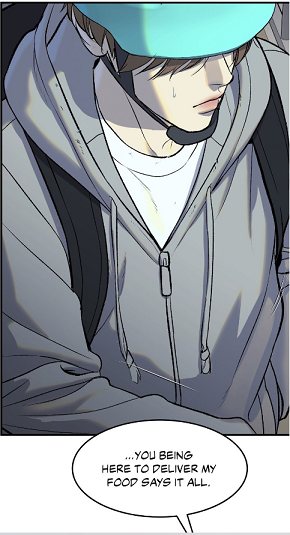
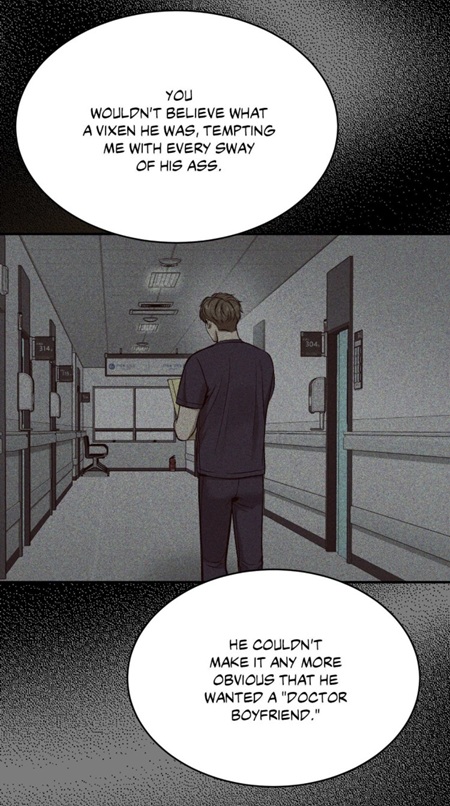
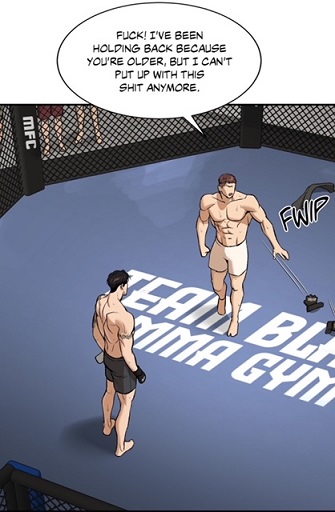
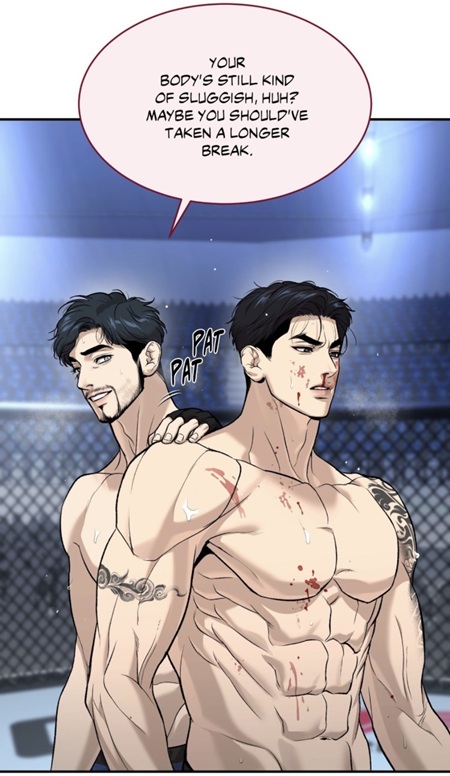
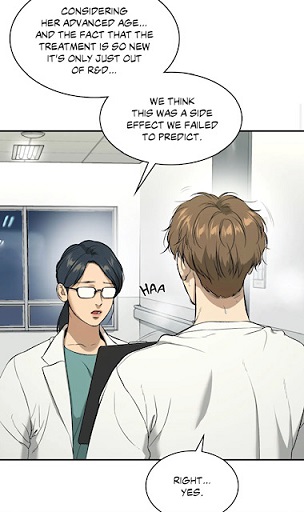
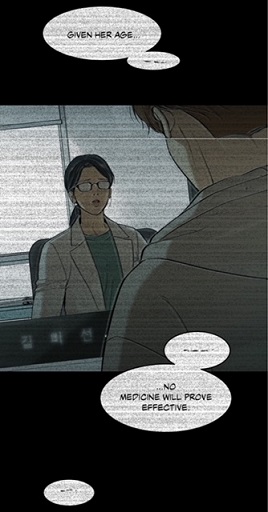
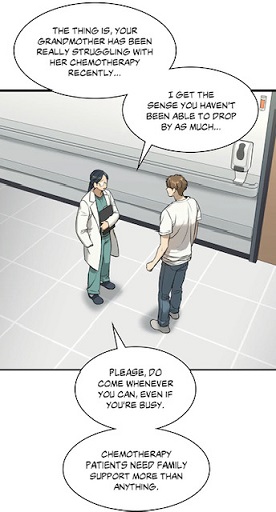
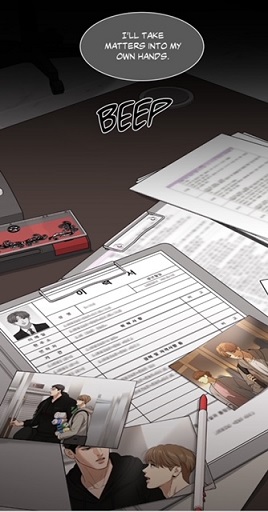
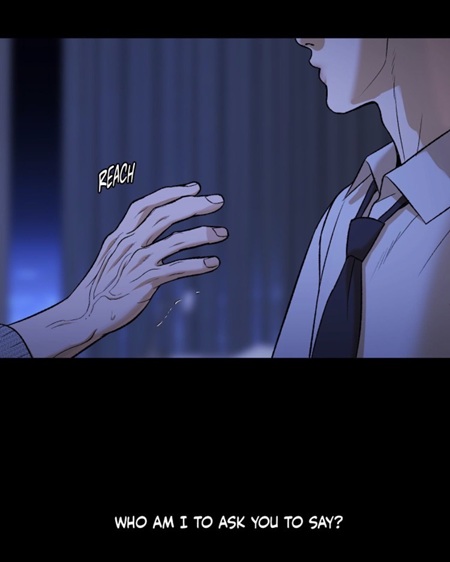
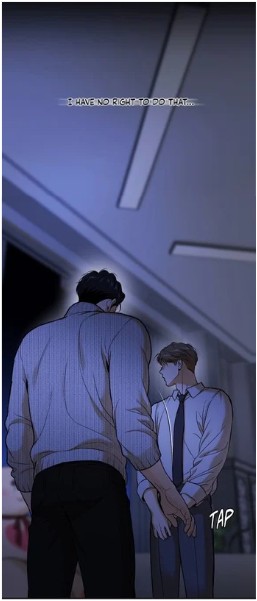
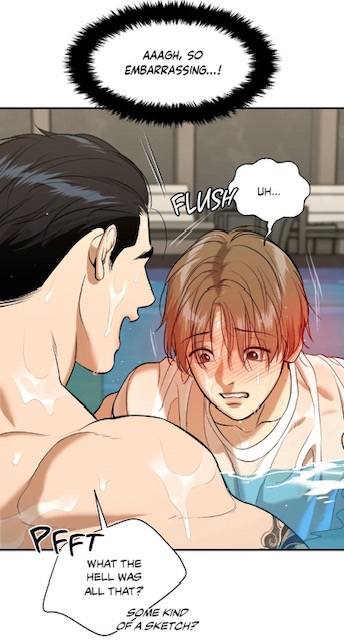
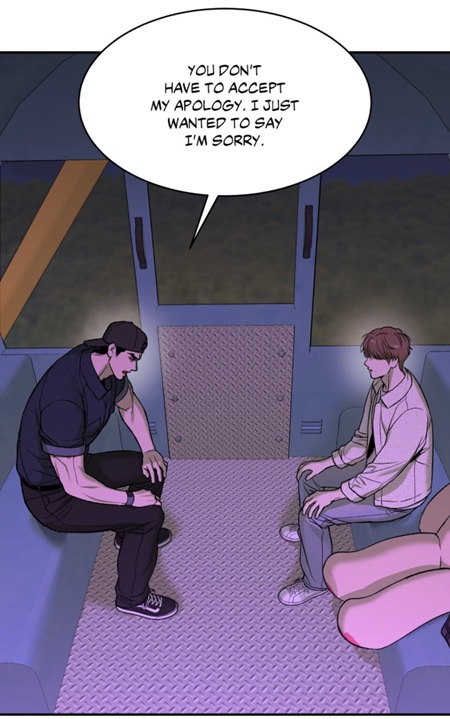
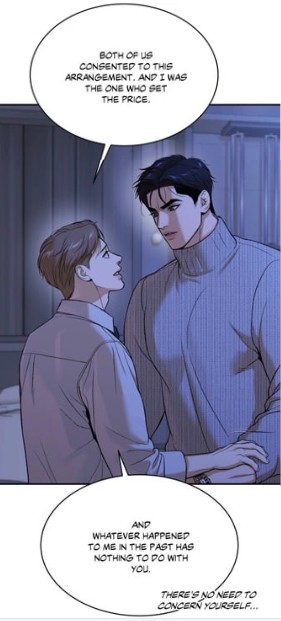
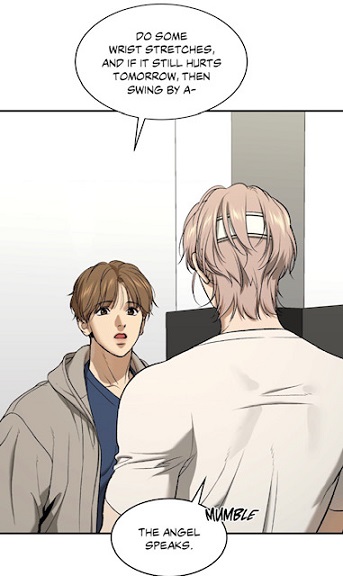
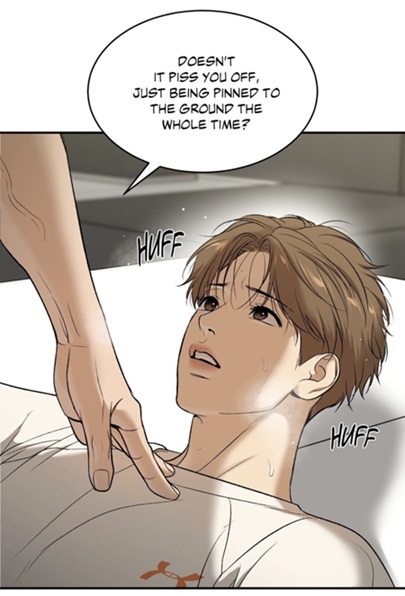
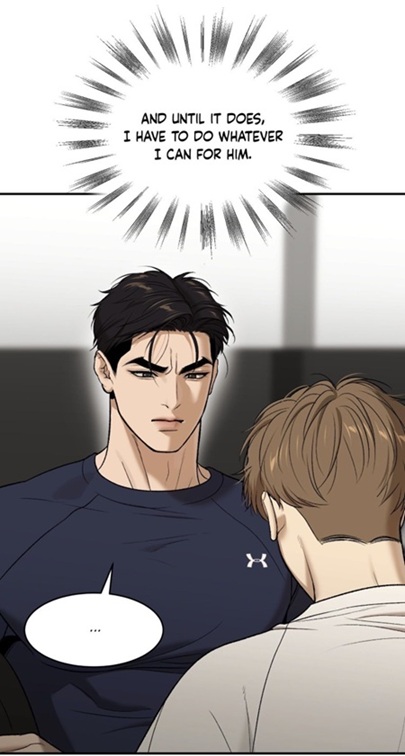
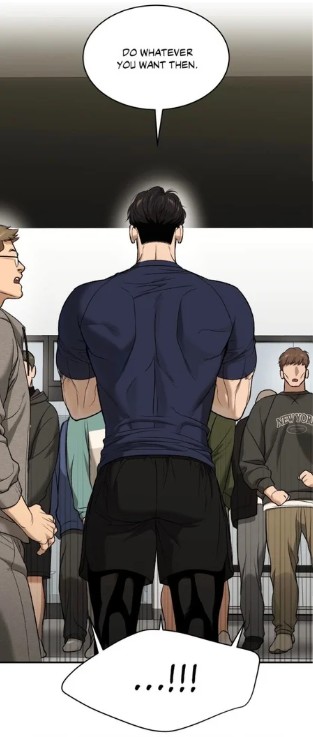
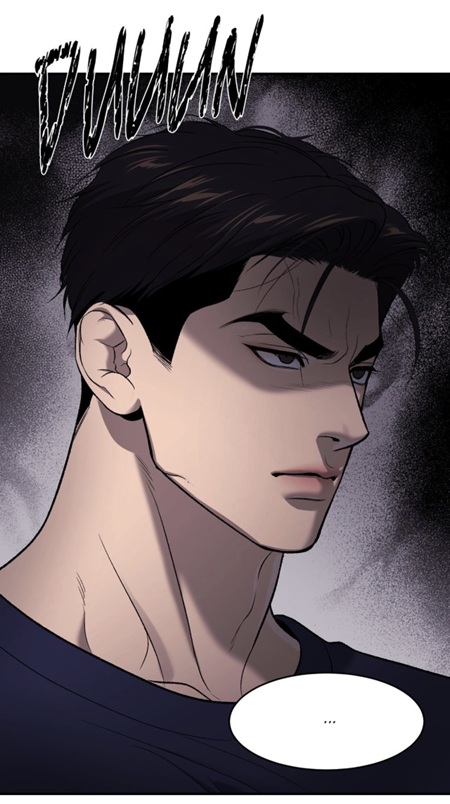
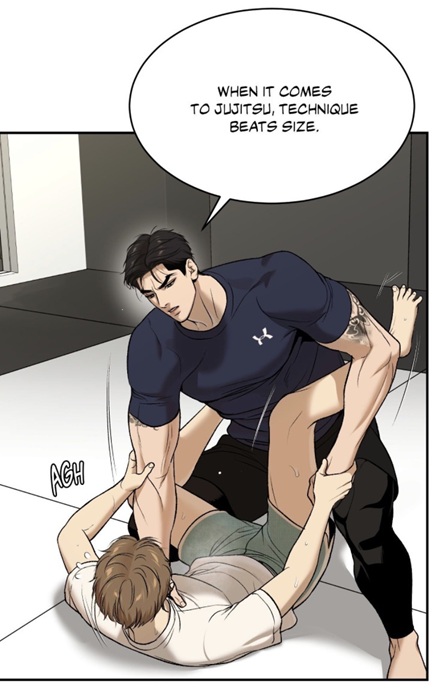
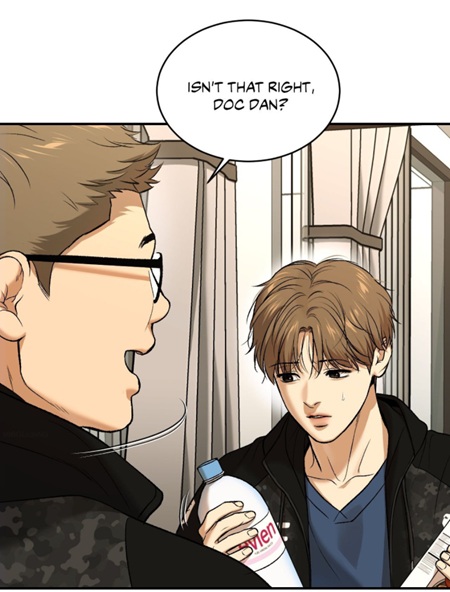
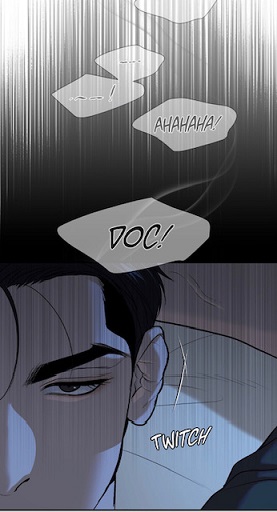
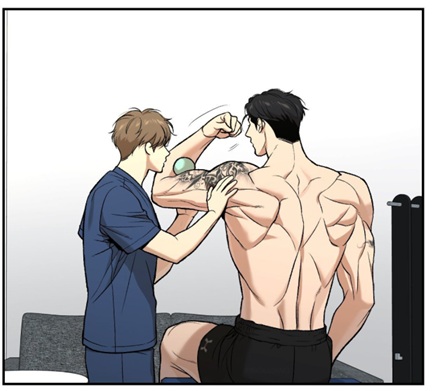
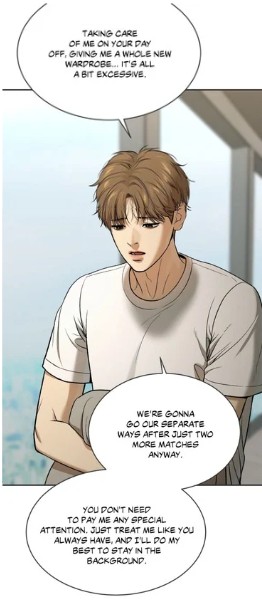
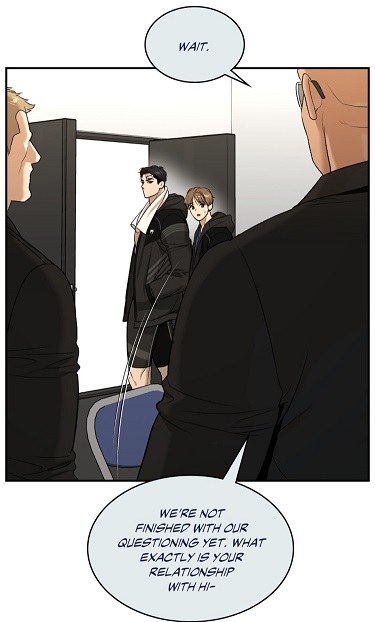
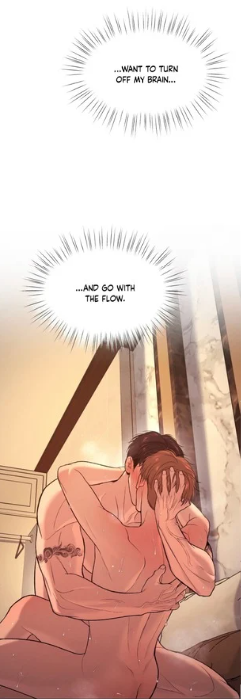
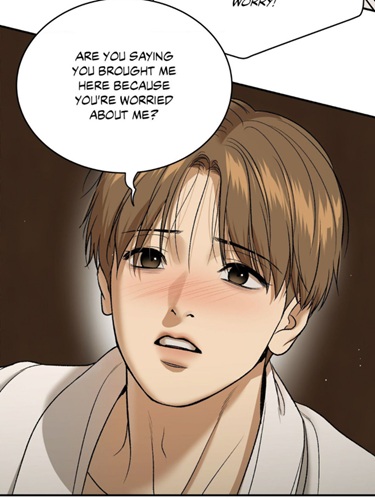
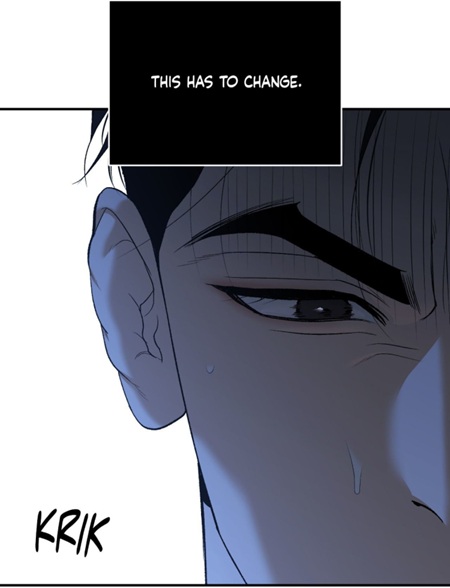
Episode 88 of Jinx immediately drew readers’ attention to two moments in particular: the training session between Kim Dan and Joo Jaekyung (chapter 88), and the final panel hinting at an imminent confrontation with Choi Heesung. (chapter 88) Discussions largely revolved around physical proximity, discipline, and anticipation — around bodies in motion and the promise of conflict to come. At first glance, the episode seemed to oscillate between intimacy and tension (chapter 88), between preparation (chapter 88) and interruption (chapter 88).

Only on closer reading does another layer emerge — one that does not oppose these moments, but reframes them. The training session is not merely about discipline or proximity, and the final panel is not only a promise of confrontation. Both scenes (chapter 88) are structured around restraint (chapter 88): what is held back (chapter 88), delayed, or redirected. Words are measured, authority is redistributed, and decisions are deferred (chapter 88) rather than imposed. What initially appears as physical intensity and narrative suspense begins to reveal a deeper reconfiguration of roles, responsibility, and choice.

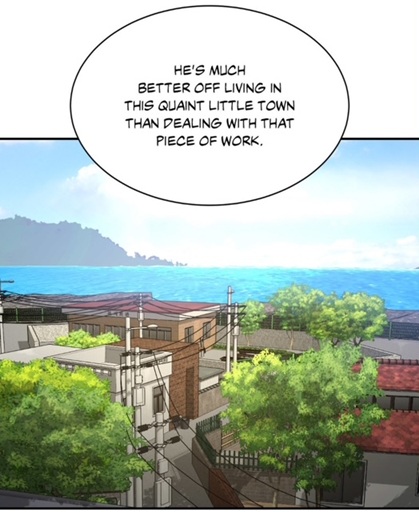
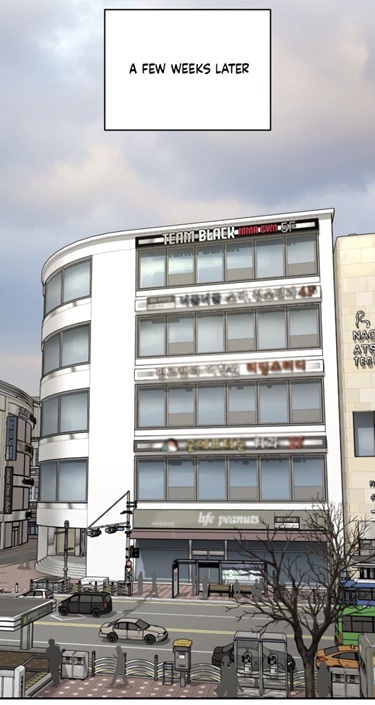
At first glance, the title may seem paradoxical. The episode takes place a few weeks after October (chapter 70)—most likely in November— in late autumn. (chapter 88) This temporal setting is visually reinforced by the environment itself: in the opening sequence marked “a few weeks later,” the tree is already bare, its leaves gone. Nature offers no spontaneous image of growth or renewal. If a flower were to appear in this chapter, it couldn’t belong to the season. It must be cultivated, protected, and sustained in a green house—something that emerges not from natural abundance, but from deliberate care. So where does this idea of a flower come from?

Closed Circuits and the Logic of the Number Eight

The title emerged from a visual and structural observation. Chapter 88 is built around the number eight: a chapter defined by two closed circuits that finally cross. Remember how I described the relationship of the main couple in the essay : a closed circuit which we could witness once again in the training room: (chapter 88) There are once again sparks between them. The number 8 is not just related to doc Dan [for more read  The Magic Of Numbers ] and his relationship with the athlete, but also to the other couple: Heesung and Yoon-Gu. This means, the latter represent the other closed circuit. Hence the other couple appeared in episode 35 and 58. (chapter 58) Two trajectories —long separated, repeatedly missing one another—intersect at last. When two eights overlap, they form neither a loop nor a knot, but a new shape: a flower-like figure, suggestive of opening rather than closure. This crossing does not resolve everything; instead, it creates the conditions for growth for all the characters. We could say that each closed circuit forms two petals so that their interaction with each other will affect them positively.

Color as Emotional Structure

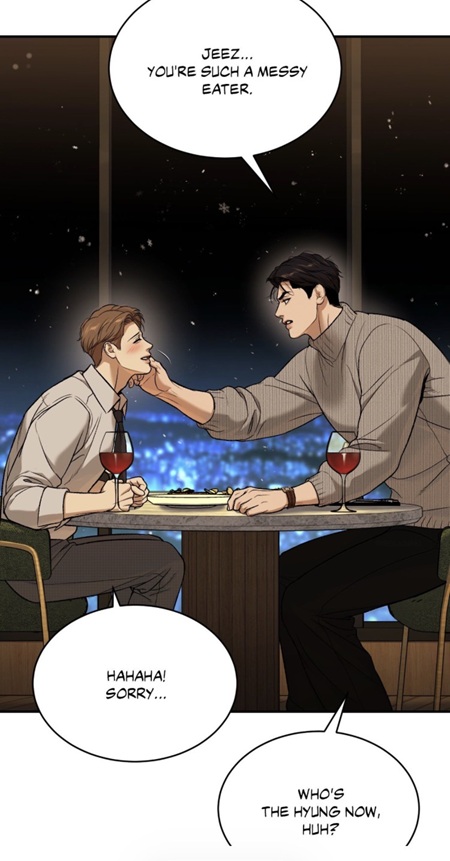
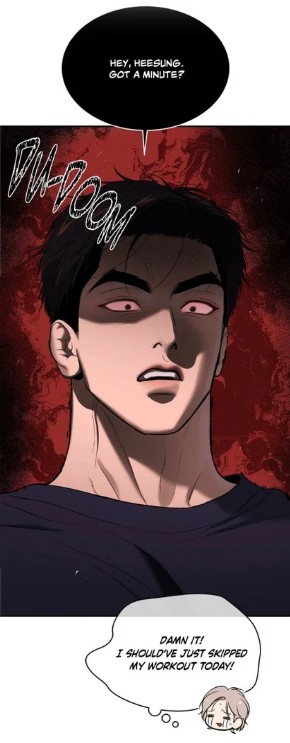
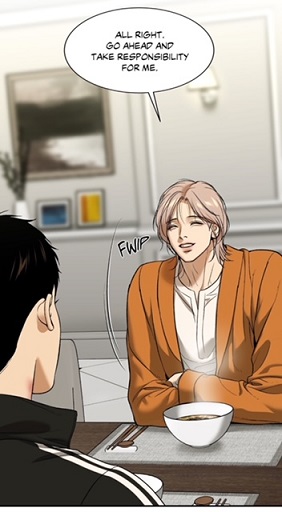
The flower, however, is not only numerical or temporal. It is also chromatic. A flower is never defined by form alone, but by shading—by gradients, transitions, and the coexistence of multiple tones within a single structure. Thus in French certain flowers serve to define pigments: rose for pink, violet for purple. In this sense, episode 88 does not merely contain colors; it behaves like a flower unfolding through shades. Episode 88 is saturated with color: pink (chapter 88), white (chapter 88) purple (chapter 88), blue, gray, , (chapter 88) red (chapter 88) and black (chapter 88) Pink frames tenderness and mutual awkwardness; purple marks embarrassment and heightened awareness; red signals suppressed anger and looming confrontation; black absorbs fear, silence, and unresolved tension.

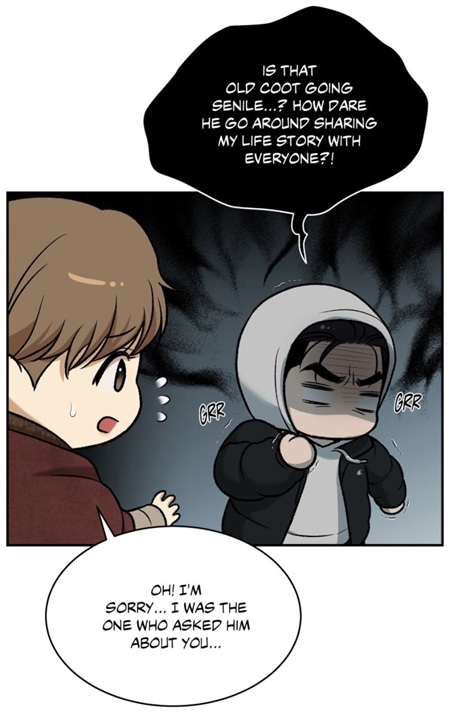
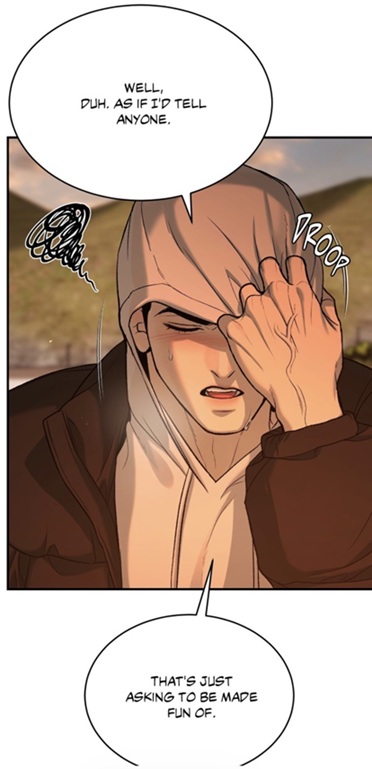
White, notably associated with Park Namwook, carries a more ambivalent meaning. (chapter 88) It evokes innocence on the surface, but also ignorance—an unexamined moral comfort that allows him to retreat from responsibility while claiming authority. His lightness contrasts sharply with the weight of the decision he refused to make: visually underlined by the black-lined spiral hovering near his head—an emblem of irritation without accountability.

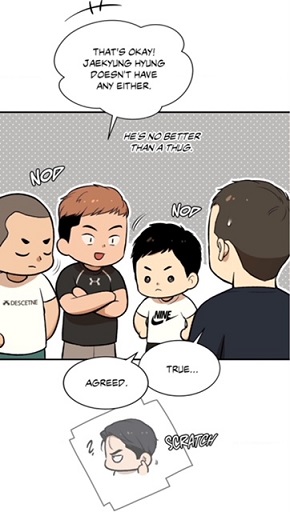
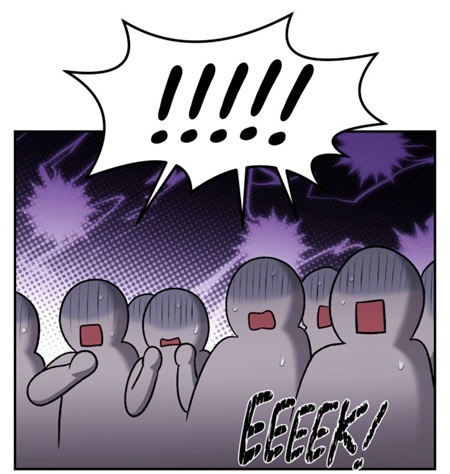
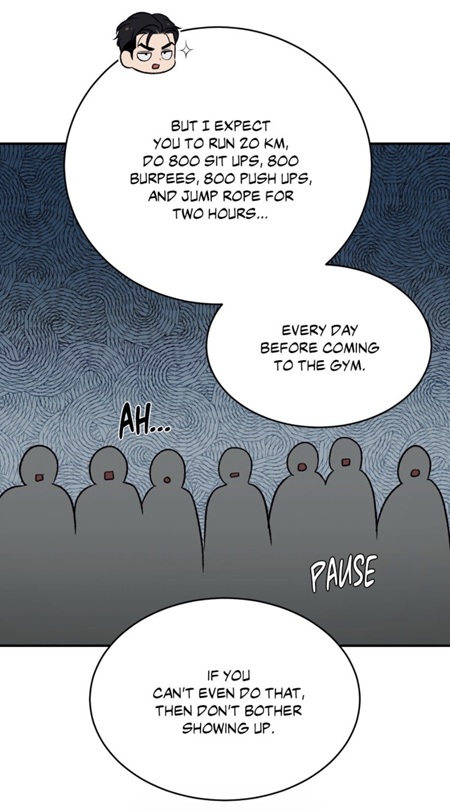
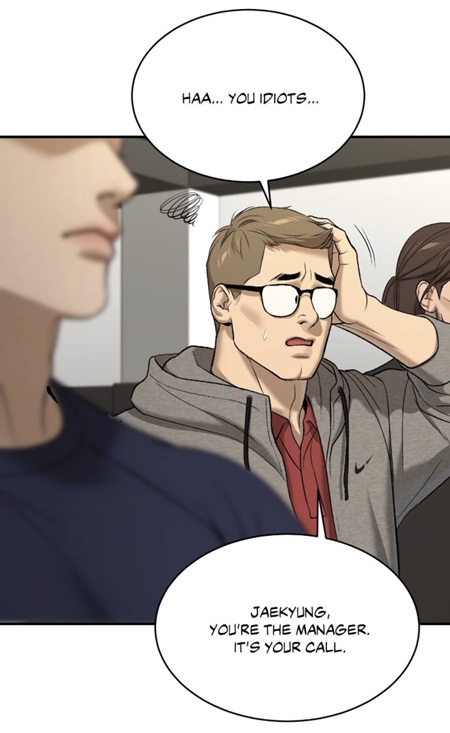
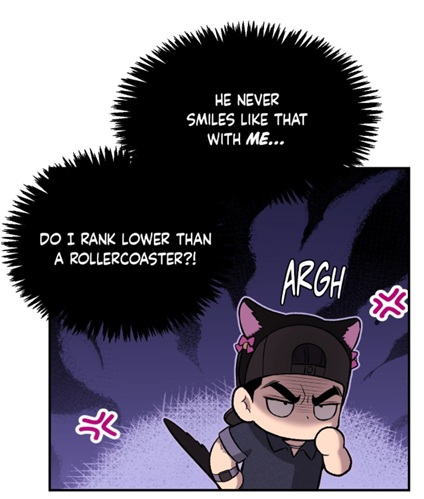
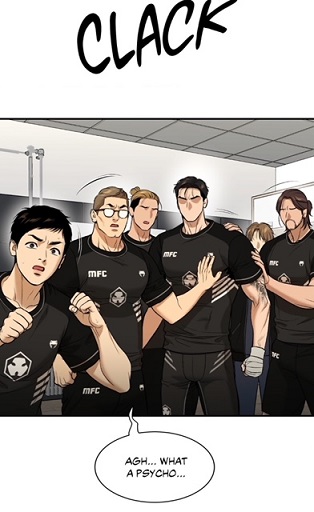
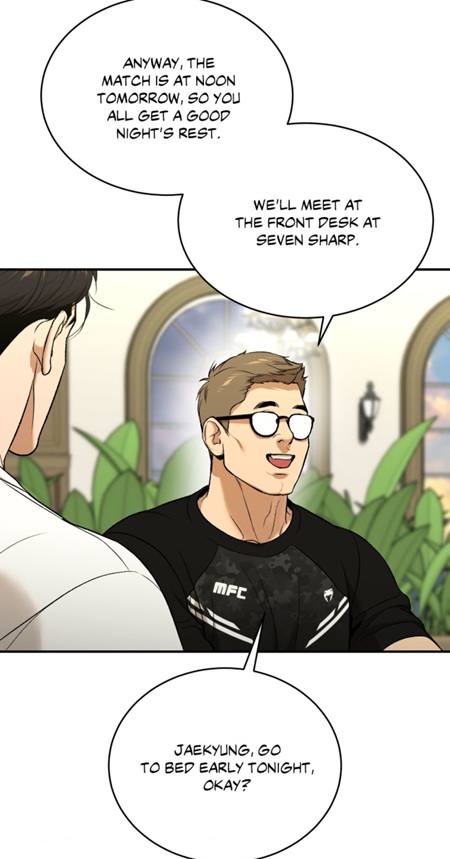
Blue and gray dominate the scene in which Joo Jaekyung announces his seemingly excessive training demands. (chapter 88) On the surface, the atmosphere feels cold and authoritarian. Yet the exaggeration itself reveals something else: the demand is deliberately absurd, almost teasing. Joo Jaekyung is testing resolve, not imposing punishment. The joke —visible thanks to the chibi and the brief spark within the athlete’s gaze— goes unnoticed. No one laughs. The room’s muted colors reflect this misrecognition—care and fun are present, but not yet legible to those receiving it.

At first glance, the setting itself seems to resist any floral reading. (chapter 88) The scene unfolds not in nature, but in a gym in Seoul—an urban, enclosed space associated with discipline, repetition, and control rather than growth or renewal. This tension may explain the readers’ initial surprise: a flower appears where one would expect only concrete, steel, and hierarchy. Yet in Jinx, the flower does not belong to nature as landscape, but to nature as process—to emergence, care, and relational change.

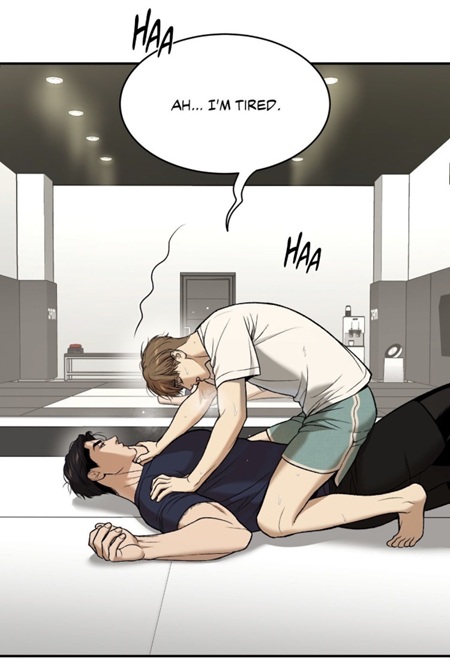
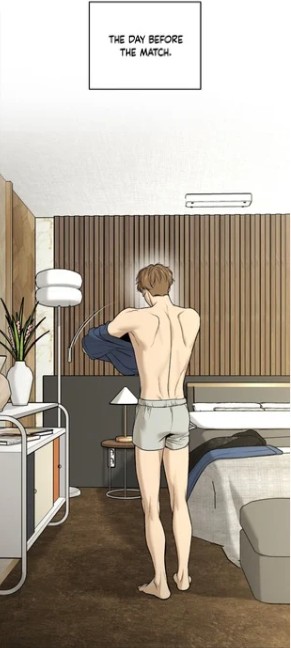
This process is not introduced through scenery, but through bodies marked by green. And the latter symbolizes nature. In episode 88, two characters (chapter 88) are dressed in green (chapter 88), a choice that appears unobtrusive—almost practical—yet is unmistakable within Mingwa’s chromatic language. Green here does not function as pure nature or renewal, but as transition: a sign of growth that is still constrained, negotiated, and incomplete. It is not a vivid, liberating green, but a muted one—ranging from green sheen to subdued olive—closer to endurance than vitality, to steadiness rather than expansion. Growth is present, but it has not yet broken free; it remains embedded in effort, restraint, and adaptation.

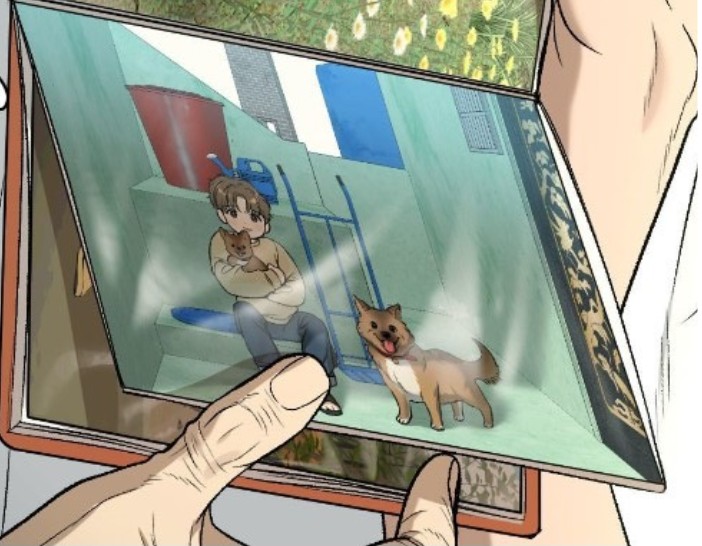
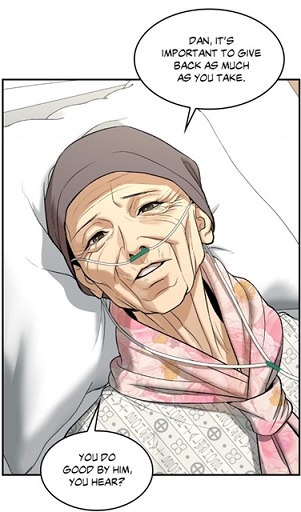
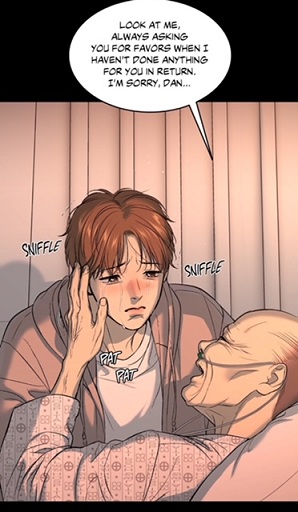
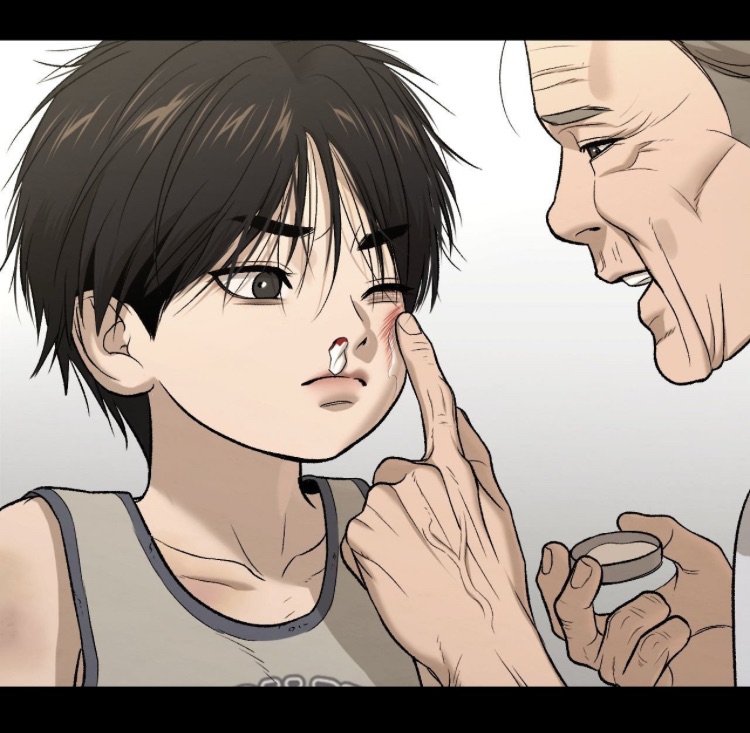
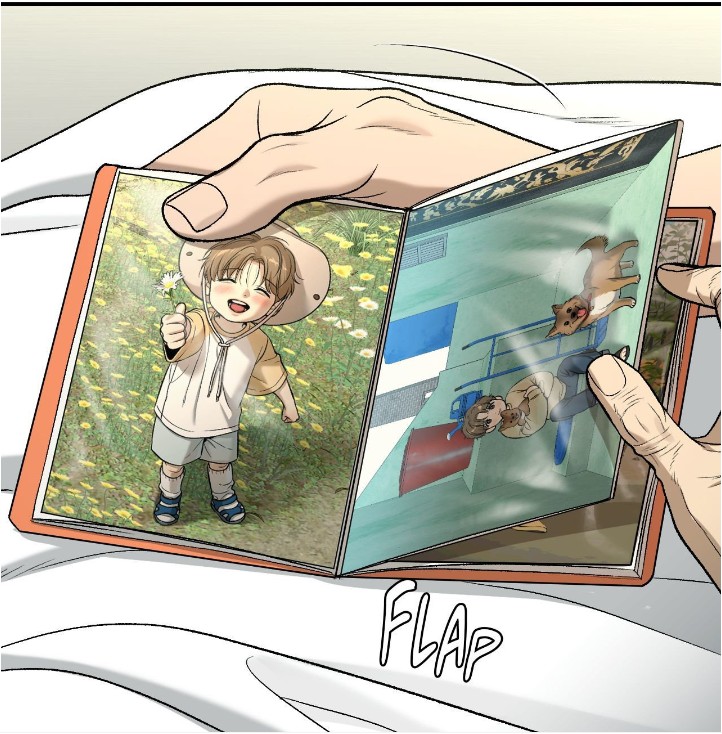
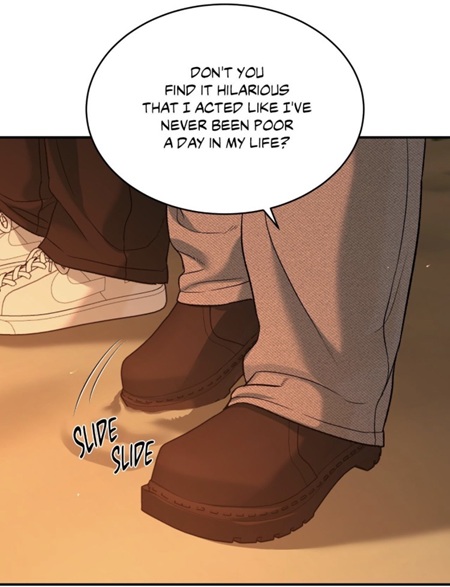
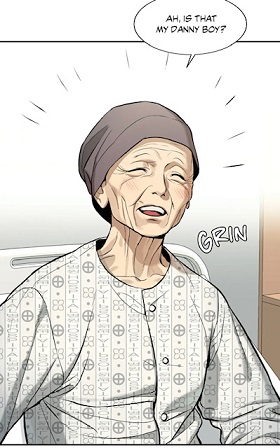
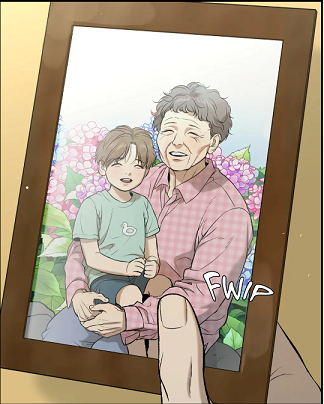
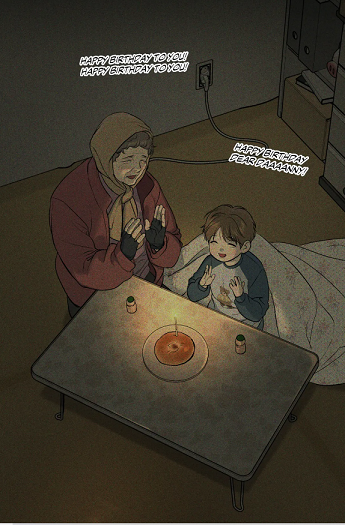
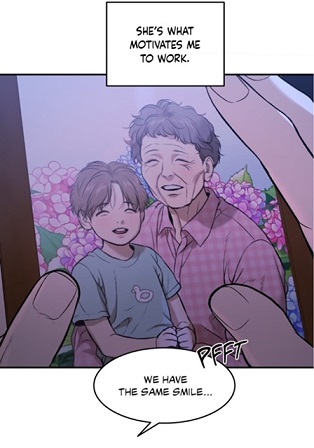
Crucially, this shorts’ shade recalls the photograph of Kim Dan with his grandmother (chapter 19), where green and floral elements once functioned as a silent language of care and containment. The repetition is not accidental. By wearing a similar tone in the present, Kim Dan does not merely revisit the past; he carries it forward. (chapter 88) The color no longer signifies dependency or shelter alone, but continuity of self. It marks a return to an inner disposition that predates trauma—a self capable of care, persistence, and quiet resilience. This means that he is closer to his true self.

Placed within the gym’s dominant blues and grays, this green does not signal leisure or escape. It signals cultivation. Growth here is neither spontaneous nor decorative; it must be trained, maintained, and protected. The flower does not bloom despite the city—it blooms through care, discipline and recognition. What initially appears paradoxical becomes coherent: in Jinx, growth is not opposed to structure. It is shaped by it.

From Flower to Language: Communication Deferred

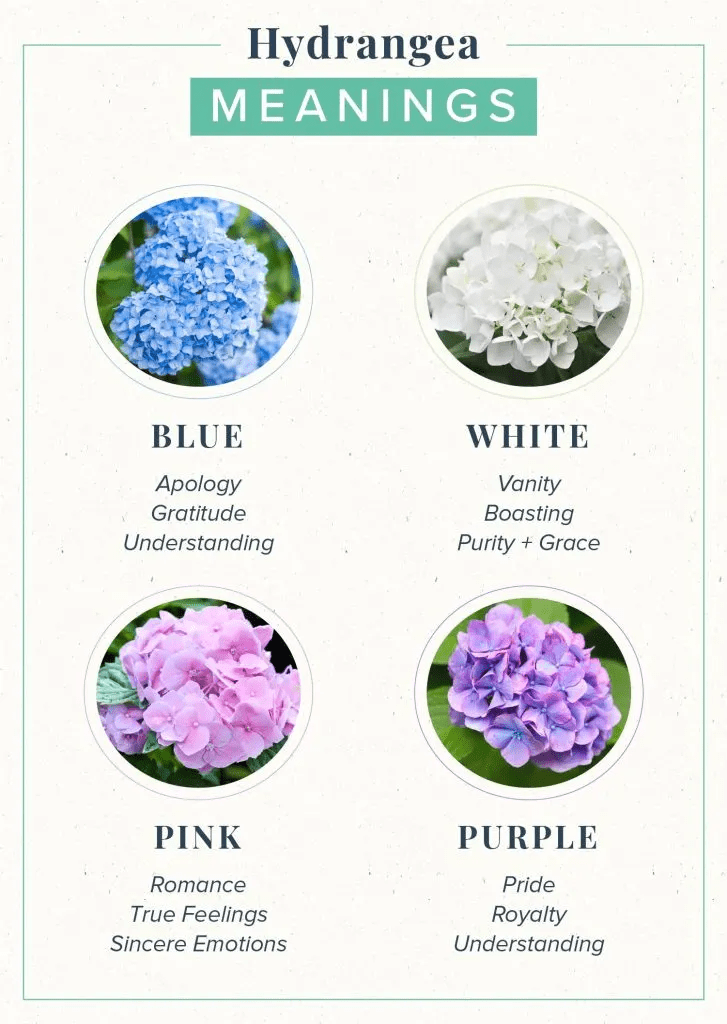
Crucially, the flower also functions as a metaphor for communication. (chapter 19) Flowers are not passive decorations; they carry meaning, intent, and symbolism. The background is composed of hydrangeas in blue, pink, and pale violet—colors traditionally associated with gratitude, tenderness, apology, and emotional nuance.

Unlike roses (chapter 35), which tend to assert a singular message (love, passion, beauty), hydrangeas communicate multiplicity and emotional ambivalence; they speak in clusters rather than declarations. This visual language mirrors Kim Dan’s inner world at the time (chapter 19): affection entwined with dependency and sorrow, care mixed with silence, love present but unspoken.

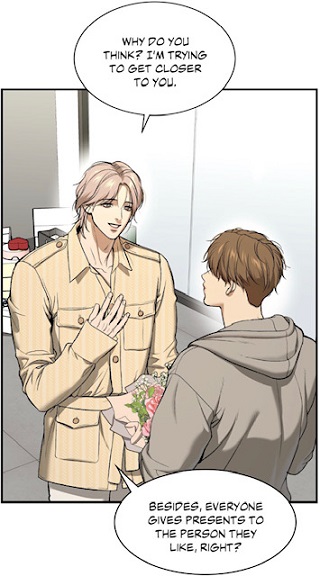
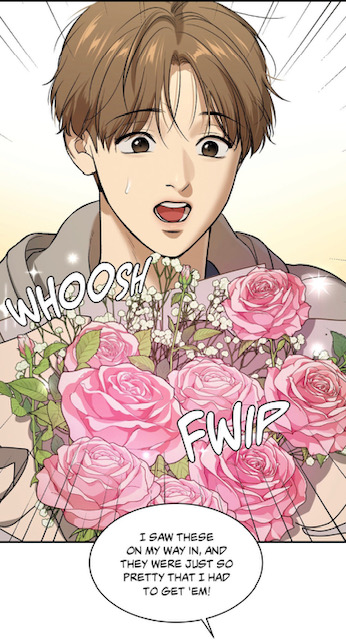
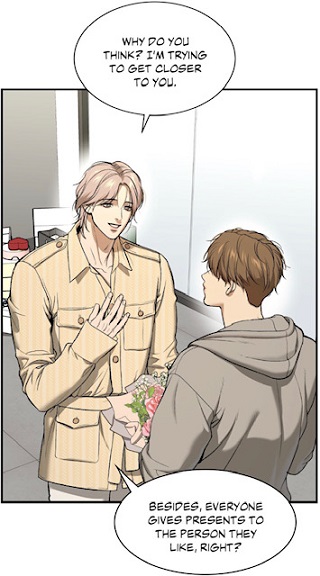
This chromatic memory resurfaces later through a different floral gesture: the bouquet Choi Heesung offers Kim Dan —pink roses paired with baby’s breath (chapter 31). Here, the symbolism shifts. Pink roses convey affection and admiration, while baby’s breath suggests innocence and fragility. Yet the arrangement is excessive, overwhelming, and mismatched to its recipient. The bouquet does not listen; it speaks at Kim Dan rather than with him. Significantly, Heesung comes to associate Kim Dan himself with the flower—something delicate, beautiful, and deserving of protection, but also something to be handled, displayed, and possessed.

Episode 88 reframes this logic entirely. The “birth of a flower” no longer refers to being perceived as fragile or decorative, but to a return to growth from within. (chapter 88) Kim Dan’s green training clothes—visually echoing the green shirt he wore in the photograph with his grandmother—signal continuity rather than regression. This is not a retreat into childhood dependency, but the reappearance of an inner child now disentangled from obligation and fear. The flower that reemerges here is not gifted, not arranged, not imposed—it grows. In this sense, episode 88 introduces a missing element in the dynamic between the two protagonists: not desire, not care, but communication. And it is here that Choi Heesung becomes central—not as a rival or antagonist, but as a structural bridge, as in reality he represents the rose, “La vie en rose” . He embodies speech, playfulness, and visibility, yet also reveals their limits when they are severed from responsibility and respect. I will elaborate about this more below.

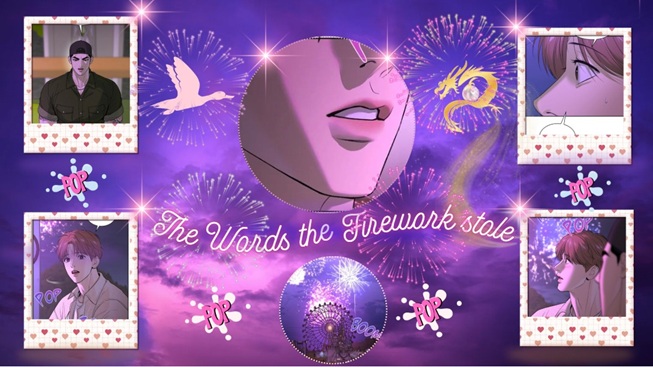
The illustration accompanying this essay includes a fifth, shadowed petal inspired by the Mugunghwa—the Rose of Sharon, a national symbol of Korea often associated with endurance, justice, and continuity. This fifth petal does not yet fully bloom. It signals something incomplete, something still forming: a question of justice, choice, and mutual recognition that the narrative has only begun to articulate.

Finally, this essay reads episode 88 through the lens of Erich Fromm’s definition of love—care, responsibility, respect, and knowledge. For me, these 4 notions are represented by the 4 petals. In this chapter, Joo Jaekyung visibly embodies care, responsibility, and a growing respect for others’ autonomy. What remains absent is knowledge: a true understanding of Kim Dan’s inner life, just as Kim Dan himself has yet to fully understand Jaekyung beyond his role and past. The flower, then, is not the endpoint. It is the beginning of a process in which these missing elements may finally emerge.

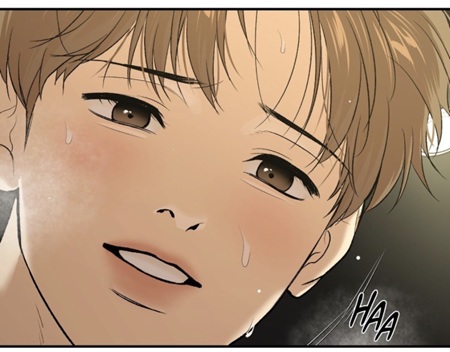
What follows is not an analysis of victory or defeat, but of growth—quiet, fragile, and cultivated under constraint. This is not the celebration of happiness already achieved (chapter 88), but the moment in which the conditions for happiness are finally put into place. And now let me ask you this. What is the symbol of happiness? Smiles and laughs. During the training session, Kim Dan smiles. These moments are brief (chapter 88) and goes unnoticed by him (chapter 88) and his fated partner, yet it directly answers what Joo Jaekyung has repeatedly expressed as his desire: to be the source for Kim Dan’s smile and to smile together. (chapter 83) What is striking is that neither of them recognizes this fulfillment. (chapter 88) Kim Dan does not register his own smile as happiness, and Joo Jaekyung does not realize that he is already producing what he seeks. As elsewhere in Jinx, happiness precedes awareness. It exists before it is acknowledged—by both sides.That’s why I selected the title: the flower embodies happiness, as its life is just as short as happiness. (chapter 31)

A. Joo Jaekyung × Kim Dan: The First two Petals

The training sequence in episode 88 cannot be read as a simple exercise scene, nor as a sudden moment of equality or mutual play. It is, instead, the continuation of a long-standing relational pattern in which care is expressed indirectly (chapter 88), asymmetrically, and through the only language both characters know how to use: work. (chapter 88) What appears at first glance as coercion (chapter 88) or discipline is in fact a negotiation shaped by habit, fear of burdening the other, and an inability—on both sides—to articulate desire outside professional roles.

1. How the training is suggested: care disguised as necessity

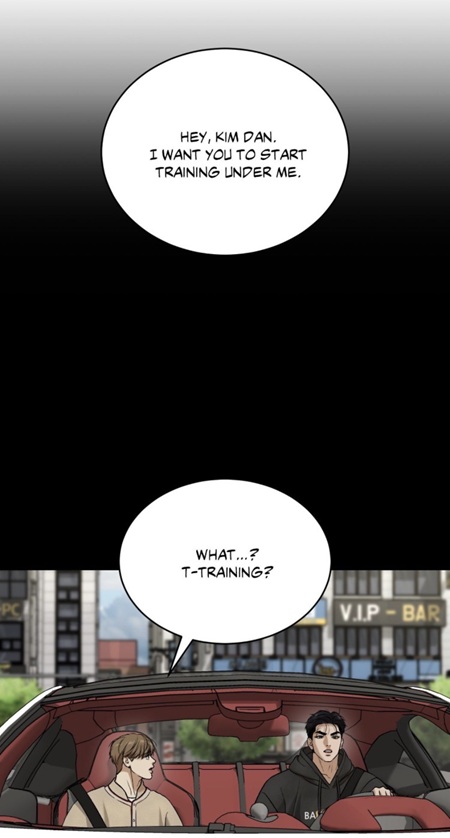
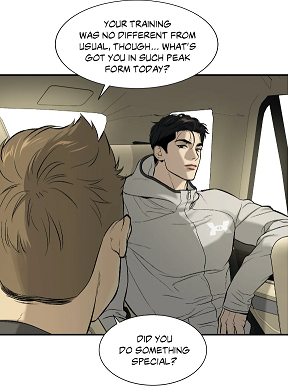
Crucially, the idea of training does not emerge in the gym itself. It is first introduced in the car (chapter 88), a space that is never neutral in Jinx. A car has one driver, one direction, one authority. By placing the conversation there, Mingwa signals that the relationship is still structurally asymmetrical at this point: Joo Jaekyung leads, Kim Dan follows.

Joo Jaekyung frames the proposal as a matter of stamina and work. (chapter 88) Training will help him in his career. This framing is not accidental. Joo Jaekyung does not yet know how to say: “I want to spend time with you“, or “I’m afraid you won’t be safe, once you leave my side“. He knows only how to justify closeness through usefulness. Training becomes a rational excuse for proximity, a legitimate reason to demand time without admitting emotional dependence.

At the same time, this proposal is deeply protective. Joo Jaekyung has seen Kim Dan collapse from exhaustion in the past. He knows his physical limits better than Kim Dan himself. (chapter 88) Secondly, such a training suggests that the athlete is gradually remembering this scene of the almost-rape. (chapter 88) In his subconscious, he knows that this was not prostitution. (chapter 17) Therefore it is not surprising that instead of asking permission or explaining concern, he imposes the idea—because that is how he has learned to act as a captain, a fighter, and later a manager. Authority precedes dialogue. (chapter 88)

2. The first refusal: self-neglect disguised as strength

Kim Dan’s first response is immediate: (chapter 88) He refuses. This is not politeness. It is not consideration for Joo Jaekyung’s fatigue. It is a reflex rooted in long-standing self-erasure. Kim Dan genuinely believes he is strong enough. More importantly, he believes that needing care is illegitimate.

This refusal is governed by habit:

  • the habit of minimizing himself,
  • the habit of overestimating endurance,
  • the habit of believing that receiving attention makes him a burden.

At this stage, Kim Dan is not yet protecting Joo Jaekyung; he is protecting the structure that allows him to remain useful and unobtrusive. Accepting training would mean admitting vulnerability—and worse, accepting time, effort, and concern directed at him.

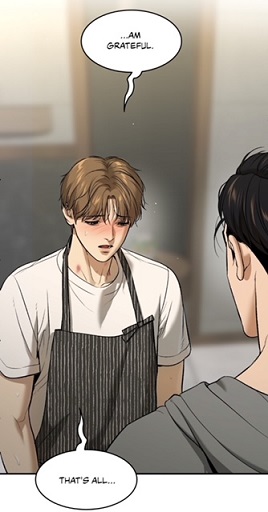
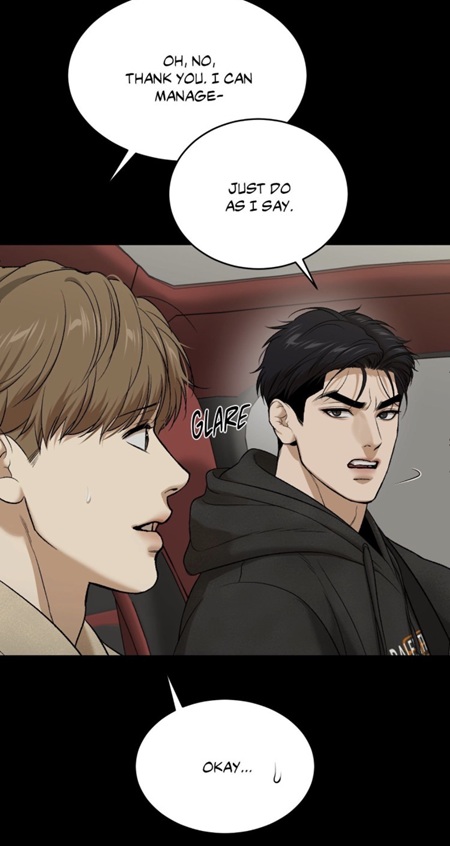
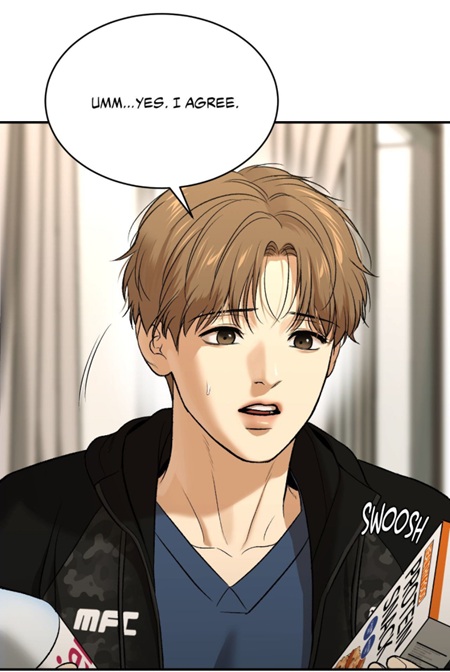
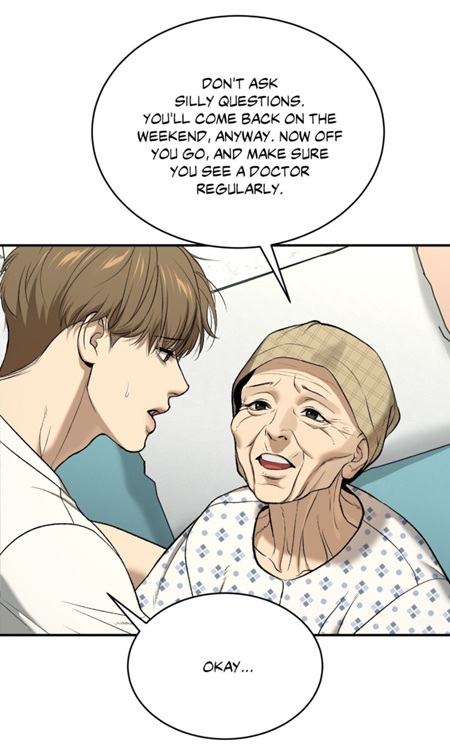
The sportsman ignores this refusal. This moment is important because it reveals both the problem and the intention. Joo Jaekyung acts like a parental figure, not a partner. He overrides consent not out of cruelty, but out of conviction that he knows better. His care still takes the form of command. This explicates why the physical therapist’s agreement is accompanied with a drop of a sweat. “Okay” indicates more discomfort than joy and gratitude. He doesn’t feel indebted toward the athlete, rather embarrassed.

Thus the asymmetry is intact. The training is not born out of his own desire.

3. The pause: time passing, resistance softening

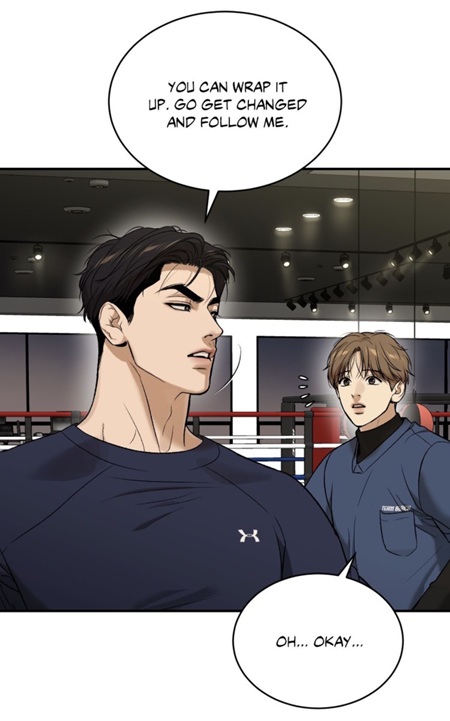
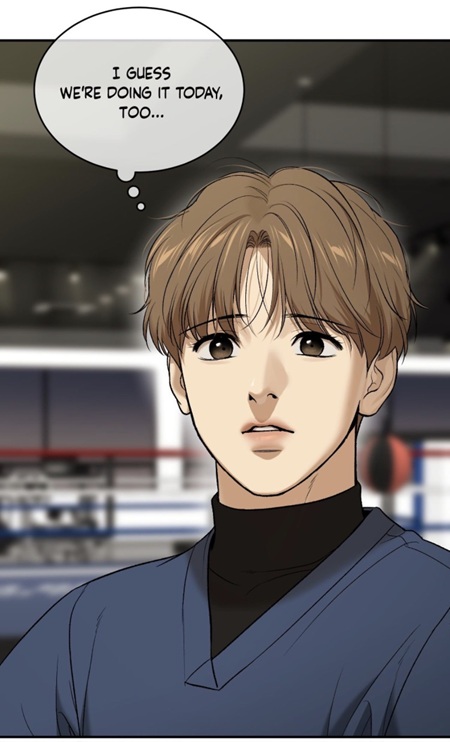
Striking is that this conversation is revealed, after the champion asked doc Dan to get changed. (chapter 88) In other words, the request from Joo Jaekyung appears as a memory from the physical therapist. Why? (chapter 88) Because Mingwa refuses the “clean” sequence in which an order is issued and immediately executed. The narration inserts a gap—an interval of off-panel time that we are forced to reconstruct from Kim Dan’s recall. (chapter 88) The narrative does not jump immediately into physical training, because the temporal gap is supposed to mirror the time jump as well. There were other training sessions. This temporal gap matters. The doctor’s inner thoughts (chapter 88) “I guess we’re doing it today, too…” implies routine without inner desire and daily regularity. This means that the training sessions only took place, when the champion asked doc Dan to change his clothes. Doc Dan was not looking forward for the training sessions or reminded the athlete of his promise or request.

That pause changes the meaning of consent and compliance. If the scene were immediate, Kim Dan’s earlier refusal (“Oh no, thank you, I can manage—”) would read as a clear boundary and Joo Jaekyung’s “Just do as I say” as a straightforward override. (chapter 88) But because the chapter returns to the topic through memory, the refusal is not portrayed as a decisive line—rather, it becomes the first phase of a negotiation Kim Dan does not yet know how to conduct. His resistance softens not because he suddenly “wants” the training, but because habit takes over: he is used to accommodating authority, used to re-framing his own limits as irrelevant, used to translating pressure into “normal.” The break between the command and the actual session is precisely where that old reflex does its quiet work.

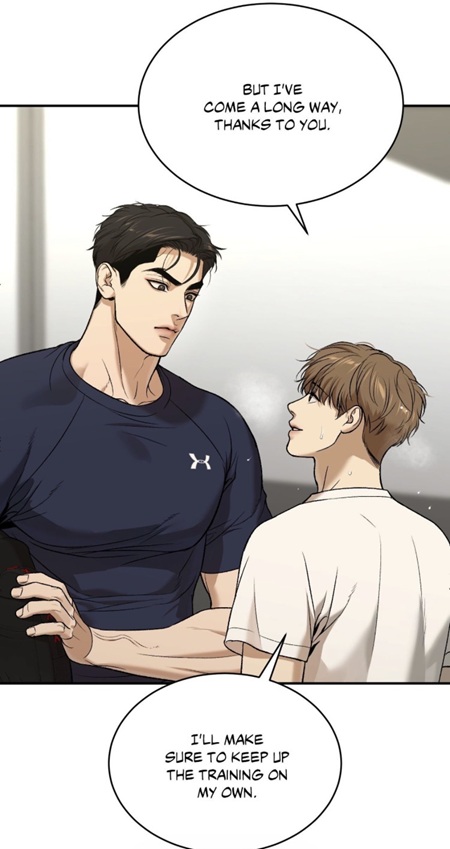
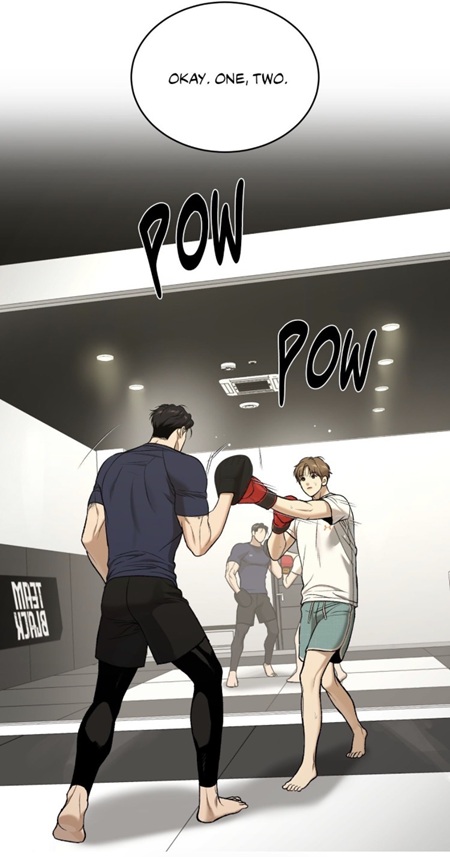
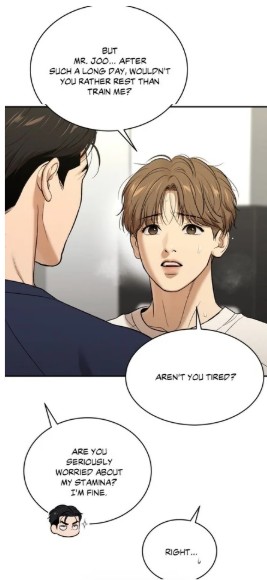
By the time they appear in the practice room, Kim Dan is showing no hesitation. He is training eagerly. (chapter 88) Instead Kim Dan no longer insists on his own sufficiency. He no longer says “I can manage., but doc Dan admits not only his own lacking. (chapter 88), but also his own desire. He finally expresses his desire to improve, to learn more.

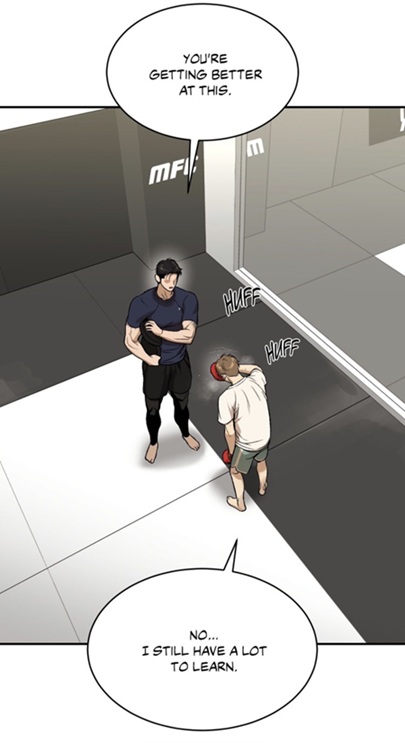
This admission marks a decisive internal shift. In earlier chapters, “I can manage” functioned as a shield: a way to deny need and avoid dependence. Here, Kim Dan allows himself to recognize that improvement exists precisely because limits existed before. The champion’s explicit comparison with the past (chapter 88) creates a temporal bridge that enables this recognition. Only once change is named from the outside can Kim Dan cautiously acknowledge it from within.

At the same time, this acknowledgment remains fragile. Kim Dan does not fully accept the implications of Joo Jaekyung’s praise. (chapter 88) His response — “I still have a lot to learn” — both accepts growth and reinscribes distance. He recognizes the fighter’s effort and dedication, yet still fears relying on the athlete’s benevolence. (chapter 88) This is why he immediately reframes the future in terms of independence: he will “keep up the training on [his] own.” Gratitude is present, but it remains incomplete, protective rather than connective. He still experiences himself as a potential burden. But why?

It’s because he tried to care for the athlete in his own way by suggesting a rest, but the champion denied it. (chapter 88) The problem is that his form of care was influenced by his own mindset and emotions: his physical limitations.

This attempt at care fails not because it is insincere, but because it is misaligned. Kim Dan does not ask whether Joo Jaekyung wants to rest; he assumes that rest must be what is needed, because that is what he himself would need in the same situation. His concern is genuine, yet it is filtered through his own bodily limits and emotional economy. Fatigue, for him, is something that must be managed cautiously, avoided, negotiated. When he encounters a body that does not obey those rules — a body that still has stamina, that refuses the logic of depletion — his offer of care is quietly rejected.

This rejection is decisive. It reveals a gap Kim Dan cannot yet bridge: the realization that Joo Jaekyung’s needs do not mirror his own. (chapter 88) The athlete does not require rest in the same way, and more importantly, he does not articulate his needs through physical exhaustion at all. What Kim Dan fails to perceive is that the training itself is Joo Jaekyung’s way of staying regulated, present, and emotionally grounded. It is also his source of joy. By denying the necessity of rest, the champion is not dismissing care; he is refusing a form of care that does not correspond to him.

Confronted with this mismatch, Kim Dan retreats. If his attempt to care is ineffective, then the safest response is to minimize his demands. This is where gratitude hardens into distance. He thanks Joo Jaekyung for his help with a smile, acknowledges his progress, and immediately insists on autonomy: he will continue alone. The logic is protective. If he does not rely, he cannot burden. If he does not ask, he cannot be refused again.

What emerges here is not self-confidence, but a familiar defense. Kim Dan is not asserting independence from strength; he is withdrawing from uncertainty. His insistence on training alone does not signal rejection of connection, but fear of asymmetry — fear that he cannot offer something equivalent in return. Because he interprets care primarily through physical effort and endurance, he cannot yet recognize that his presence, attention, and willingness to engage already matter.

In this sense, the moment exposes the limits of projection. Kim Dan’s care is sincere, but it remains anchored in his own survival strategies. Until he can decouple care from exhaustion, and need from weakness, he will continue to misread situations where what is required is not restraint, but accompaniment. The training, then, is not only about building strength. It is the first site where Kim Dan begins to confront the possibility that care does not always flow from managing limits — but sometimes from staying, even when one feels unnecessary.

This is significant. It shows that Kim Dan is beginning to speak, but still cannot speak for himself. His old habit remains: if something feels wrong, it must be because the other person needs rest, not because he is tired, scared, or overwhelmed. In other words, care is emerging—but it is displaced.

This is precisely why the gesture that follows (chapter 88) carries such weight. For the first time in this exchange, care is directed back at Kim Dan without condition. It is not framed as instruction, correction, or evaluation. It is neither command nor test. It is a simple, protective statement that mirrors Kim Dan’s earlier concern — but without projection. Joo Jaekyung does not deny Kim Dan’s limits. He acknowledges them. There is no reproach, only concern. (chapter 88)

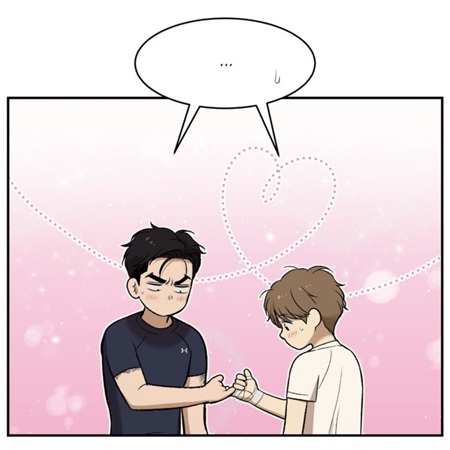
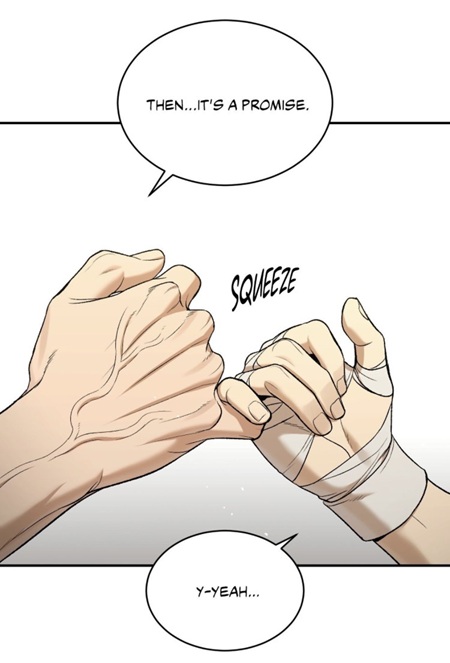
Here, the asymmetry softens without disappearing. Joo Jaekyung remains physically dominant, emotionally inarticulate, and structurally in control of the situation. Yet the direction of care shifts. He does not accept Kim Dan’s attempt to exit the dynamic under the guise of independence. Instead, he counters it with responsibility: you matter enough to be protected. The pinky promise that visually accompanies this exchange reinforces the meaning. Promises in Jinx have often functioned as burdens or traps — obligations that freeze people in place. This one is different. It does not demand performance. It does not extract sacrifice. It asks only for self-preservation. (chapter 88)

This is where the flower begins to appear — not as harmony, not as symmetry, but as mutual misrecognition slowly correcting itself. Kim Dan still does not fully grasp that Joo Jaekyung’s desire to train him is also a desire to spend time with him. Joo Jaekyung, in turn, still cannot articulate that desire outside the language of work. (chapter 88) Training becomes the only acceptable medium through which closeness can occur. Pleasure and intimacy surface unintentionally — in teasing, in competition, in shared breath — but remain unnamed.

Crucially, this is not rigidity. It is habit. Both men operate within deeply ingrained routines shaped by survival rather than joy. Rest, breaks, and leisure have only ever been framed in relation to the champion’s career: recovery after injury, distraction after stress, sanctioned release after pressure. They know how to stop working; they do not know how to share fun. There is no vocabulary yet for casual togetherness — no restaurant, no cinema, no idle wandering. Training fills the gap because it is the only space where proximity feels justified.

Thus, the training is neither purely imposed nor fully shared. It begins as Joo Jaekyung’s initiative, shaped by authority and concern, but it gradually becomes a site where Kim Dan starts to renegotiate his self-image. By acknowledging both his limits and his desire to improve, Kim Dan takes a first step away from the logic of endurance alone. He still retreats into self-sufficiency, but the retreat is no longer absolute. He speaks more. He hesitates less. He accepts care, even if he cannot yet rely on it.

The flower here is not bloom, but formation. It is the slow emergence of a relationship that must unlearn the equation between care and burden, strength and isolation, desire and duty. Nothing is resolved. But something has shifted: care is no longer one-directional, even when it remains uneven. And for the first time, both characters participate — imperfectly, awkwardly, but genuinely — in sustaining it.

4. Where pleasure enters—and why it is unspoken

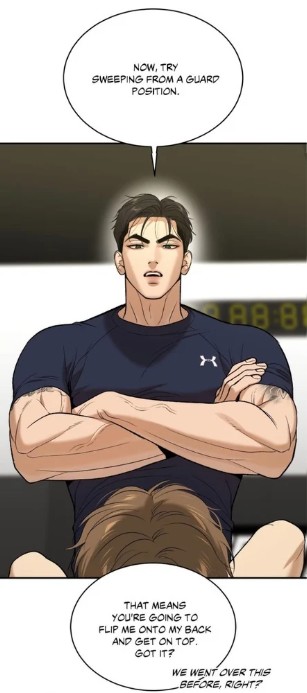
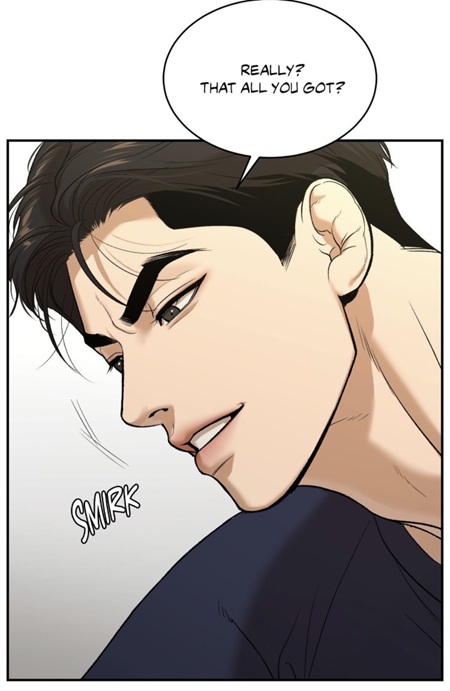
As the training progresses, something shifts subtly. Joo Jaekyung smiles (chapter 88). He teases. (chapter 88) He challenges. He praises: (chapter 88)

These are not neutral compliments. They are moments where discipline slips into enjoyment. Joo Jaekyung is no longer training only to prepare Kim Dan for a future without him; he is enjoying the present interaction. And yet, he cannot name this enjoyment.

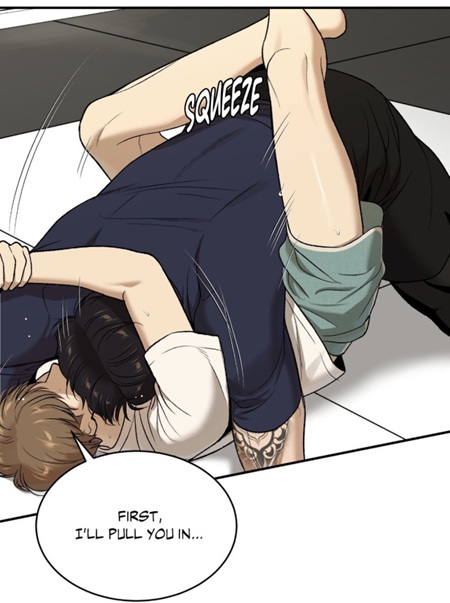
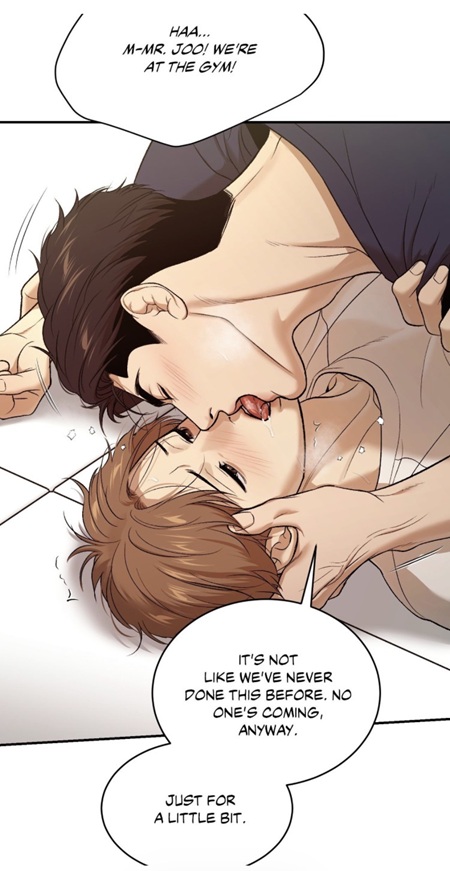
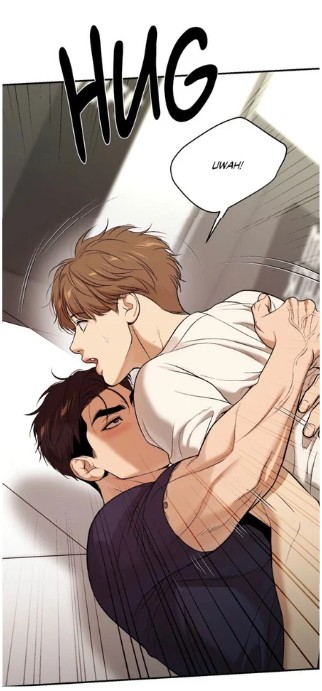
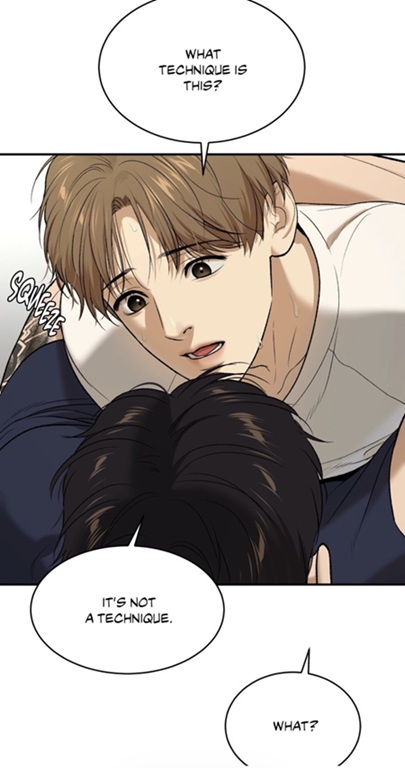
Pleasure appears within work, not alongside it. Intimacy emerges through exertion (chapter 88), not rest. Thus the doctor mistakes the embrace for a technique and not the expression of love. (chapter 88) And observe that the athlete still refuses to express the true meaning of his hug. His explanation still remains technical, defensive, and strategically framed: (chapter 88) This sentence is crucial. It reduces contact to function. The closeness of bodies, the pressure of weight, the proximity of breath are translated into instruction. What could be acknowledged as reassurance or care is instead displaced into pedagogy. Joo Jaekyung does not deny intimacy; he relabels it.

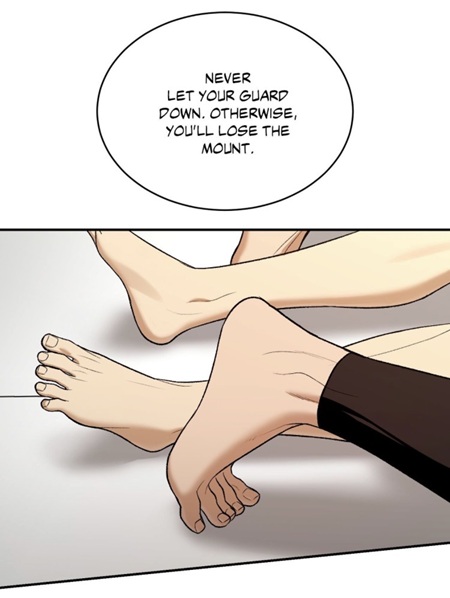
What the image reinforces is not distance, but deferral. The focus on bodies — on interlocked legs, grounded feet, balanced weight — emphasizes control and stability rather than vulnerability. Affection is allowed to exist only when it can be defended as functional. The mount is maintained not because Joo Jaekyung wants to keep Kim Dan close, but because losing it would constitute failure.

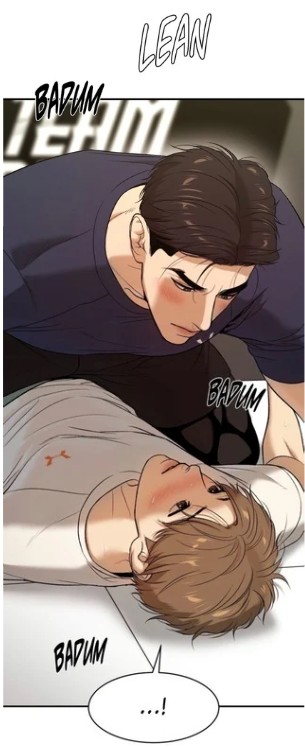
And yet, the sequence immediately preceding this moment shows both characters acutely aware of their racing hearts,

(chapter 88) of breath held too long, of proximity charged with something unnamed. The technical explanation arrives after that awareness, not before it. This confirms that the instructional language functions as a shield — not against intimacy itself, but against having to speak it.

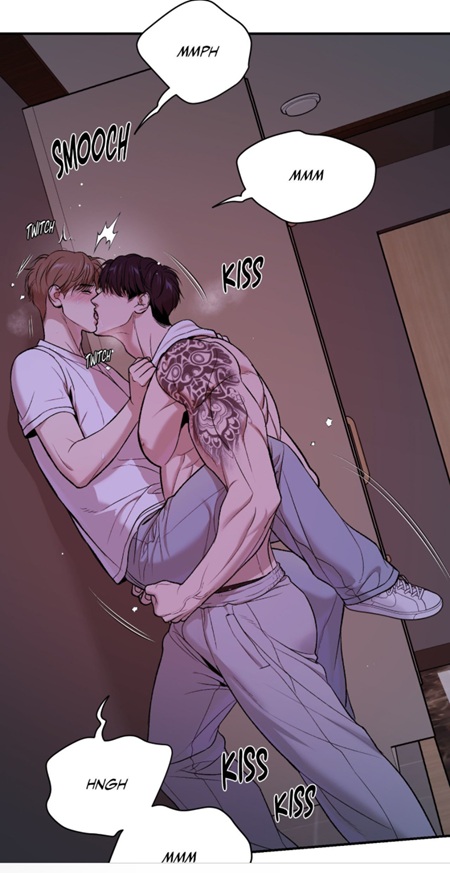
Yet the narrative immediately undermines this technical framing. (chapter 88) Directly after warning against lowering one’s guard, Joo Jaekyung kisses him.

The kiss is not furtive, accidental, or one-sided. Both characters are fully present. They look at each other. Neither pulls away. The contradiction is deliberate: the body does what the language refuses to acknowledge. Vigilance and intimacy coexist in the same gesture. The warning about control does not prevent closeness; it becomes the pretext through which closeness is allowed.

This is the crucial correction: Joo Jaekyung is not simply disguising intimacy as technique. He is containing it. The kiss does not negate the instructional frame; it slips through it. Pleasure is permitted only insofar as it does not require verbal recognition. Love is enacted, but not named.

For Kim Dan, this ambiguity poses no immediate problem. He has been kissed before. Physical intimacy is not new to him, and he has learned — through prior encounters — not to interrogate its meaning unless forced to do so. He does not question whether the kiss signifies affection, reassurance, desire, or attachment. Instead, he relocates intimacy spatially rather than emotionally. His only objection is not that the kiss happens, but where: (chapter 88) This line is telling. Kim Dan does not resist closeness itself. He resists its placement. Intimacy, in his understanding, belongs elsewhere — to the penthouse, to private space, to moments already coded as sexual or domestic. What unsettles him is not the kiss, but the fact that it occurs inside the domain of work.

In other words, Kim Dan does not yet read intimacy as something that can coexist with discipline. He accepts affection when it appears in designated zones, but not when it disrupts functional categories. The gym is a place of training; therefore, what happens there must remain legible as training. Joo Jaekyung’s technical explanation gives him exactly that permission.

This is why Kim Dan accepts the justification without protest. He does not reinterpret the embrace as love because he does not yet need to. The structure remains intact: work is work, intimacy is intimacy, and when the two overlap, the overlap is attributed to technique rather than feeling.

In this sense, Joo Jaekyung’s restraint protects both of them. It protects Kim Dan from having to reinterpret the gesture emotionally, and it protects Joo Jaekyung from articulating feelings he has no vocabulary for outside the grammar of training. Care is real, but its meaning is postponed. Love is present, but encoded as vigilance.

This postponement explains why the “flower” has not yet opened. It exists, but inwardly folded. Growth is happening, but it is constrained by the only relational language both men currently share: effort, endurance, correction, control.

They know how to train together.
They know how to recover.
They know how to endure crisis.
They know obligation.

They do not yet know how to choose pleasure together — how to eat, rest, shop, watch a movie, or enjoy time without purpose. Even their earlier “break” at the amusement park existed because Joo Jaekyung needed rest, not because they mutually chose leisure. Fun, like intimacy, has always been instrumental.

What episode 88 reveals is not the absence of love, but its confinement. Pleasure appears — undeniably — yet remains untranslated. Sensation does not yet become knowledge. The flower is there, but it has not learned how to open outside the discipline that first allowed it to grow.

5. The slow reversal: from imposed care to accepted challenge

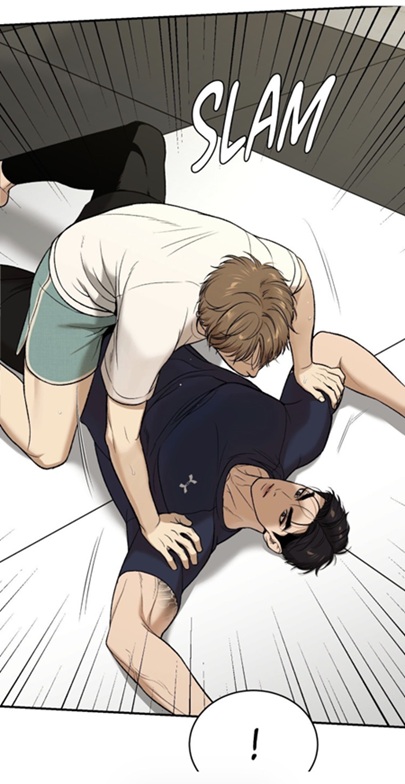
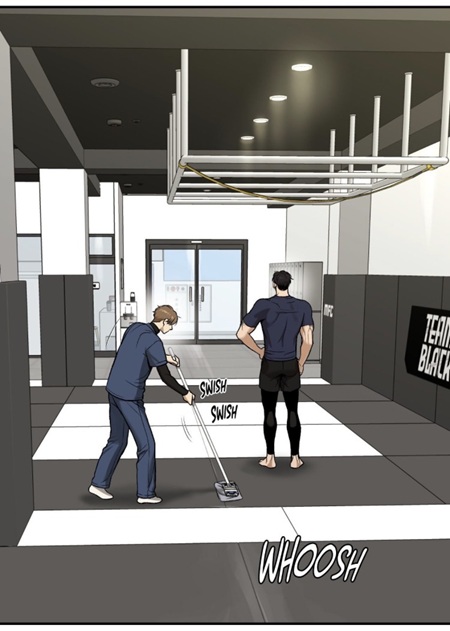
The most important moment comes when Kim Dan manages to reverse positions and pin Joo Jaekyung. (chapter 88) The shock and joy are mutual. Joo Jaekyung is genuinely surprised. Kim Dan is genuinely proud—though he barely allows himself to register it. (chapter 88) This is not equality yet. But it is the first time Kim Dan experiences himself as capable, not merely compliant. The training that began as imposed authority becomes a shared test and experience. Importantly, Kim Dan did not ask for this moment. It emerged because he stayed. This stands in opposition to the sparring in front of the fighters. (chapter 26) Back then, Doc Dan had accepted the challenge due to Potato, though deep down he desired to have the champion as his teacher. (chapter 25) That’s how it dawned on me that doc Dan has gradually taken over Yoon-Gu’s previous place at the gym. He is an “unofficial member” of Team Black. Thus he mops the floor and Yoon-Gu is not there to stop him or reclaim this position. (chapter 88) Yoon-Gu’s position within the gym has improved. He is now considered as a real fighter.

6. Where the flower is

If the previous sections trace a movement, this final observation names its limit. To understand why the flower in episode 88 has only begun to appear, it is necessary to return to Erich Fromm’s definition of love, which rests on four inseparable elements: care, responsibility, respect, and knowledge. [For more read:“The Art Of Loving” (locked)] Love, in this framework, does not exist where only one or two of these are present. It requires all four to be active at once in order to become sustaining, conscious, and mutual.

Episode 88 makes one thing unmistakably clear: in the relationship between Joo Jaekyung and Kim Dan, three of these elements are already in place. One is not.

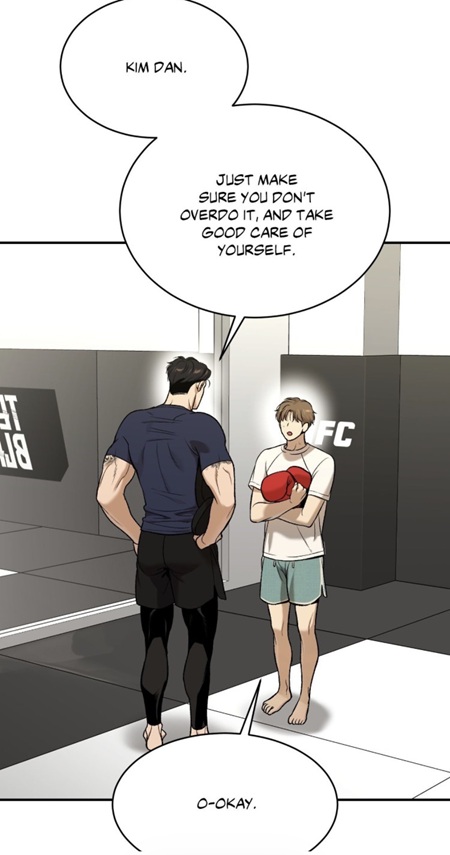
Care is not what this relationship lacks. (chapter 88) Joo Jaekyung’s care is visible throughout the episode, even when it is expressed awkwardly or through misdirection. His insistence on training, his attention to Kim Dan’s stamina, his refusal to let Kim Dan dismiss his own physical limits (chapter 88), and his final reminder to “take good care of yourself” all belong to the same logic. This care is protective and practical, but it is still delivered under the cover of training—phrased as guidance, risk-management, and performance maintenance rather than as attachment. He is capable of saying “take care,” but he still cannot say what the care ultimately means: I want you close; I worry about losing you; I don’t know how to keep you besides making you stronger. For someone like Jaekyung, whose life has been organized around performance and endurance, this is the only available language of concern. Kim Dan, too, expresses care, though in a displaced form. He worries about Jaekyung’s exhaustion, (chapter 88), minimizes his own needs and tries not to become a burden. Care moves in both directions, even if it rarely reaches its intended target.

Responsibility is equally present, and equally heavy. Jaekyung assumes responsibility for Kim Dan’s safety and future (chapter 88), particularly in light of his own awareness that their time together is limited. The training is not arbitrary; it is oriented toward what comes after him. Kim Dan, meanwhile, takes responsibility in another way: by insisting on self-sufficiency (chapter 88), by promising to continue training on his own, by framing improvement as something he must manage independently. What stands out is that responsibility exists on both sides, but it is carried separately. Each assumes it alone, without yet allowing it to become shared.

Respect, too, is not absent. Jaekyung respects Kim Dan’s capacity to grow. (chapter 88) He challenges him not because he sees him as weak, but because he believes resistance is possible. (chapter 88) His praise, rare and restrained, signals recognition rather than indulgence. Kim Dan, in turn, respects Jaekyung’s discipline and endurance, sometimes to the point of idealization. This respect remains asymmetrical, but it is real. It has begun to shift from hierarchy toward recognition.

What is missing, and what keeps the flower from fully appearing, is knowledge—not information, not memory, but Fromm’s sense of active understanding of the other as a subject with inner needs, fears, and desires. In The Art of Loving, knowledge means seeing the other as they are, which requires two things at once:

  1. Honesty toward oneself (recognizing one’s own needs, fears, and desires), and
  2. Articulation toward the other (making that inner reality available rather than acting it out indirectly).

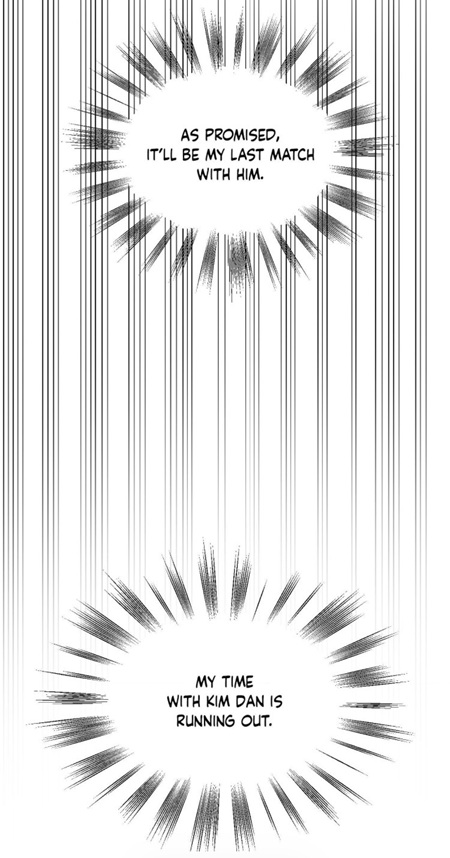
This is why words matter so much. Without words, care can exist, responsibility can exist, and even respect can exist — but they remain opaque. Joo Jaekyung knows exactly what he wants: time, proximity, continuity. He is acutely aware that his time with Kim Dan is running out. (chapter 88)

What he lacks is not intention, but translation and even courage. He does not know how to express his desire outside the vocabulary of work, discipline, and physical instruction. He can insist, challenge, and protect, but he cannot yet name why he does so. He still thinks, it is not possible to be loved due to his huge flaws and past wrongdoings. Kim Dan, on the other hand, does not yet know how to read care when it is not framed as sacrifice or obligation. He interprets insistence as burden, closeness as technique, affection as something that must be relocated elsewhere—into private space, into the penthouse, into moments that feel safer and more legible.

Their misunderstanding does not stem from a lack of feeling. It stems from a lack of confidence and shared language. Love is enacted rather than understood. Care, responsibility, and respect circulate between them, but knowledge—the capacity to see and articulate the other’s inner reality—has not yet entered the relationship. The reason is that both underestimate themselves. Thus both don’t speak the truth. This is why the flower in episode 88 is real but incomplete. It exists in the slow shift from refusal to engagement, from habit-driven self-denial to cautious participation. It exists in the fact that Kim Dan accepts the training not because he must, but because he begins to recognize the results from Jaekyung’s effort and insistence. He gradually accepts that Joo Jaekyung is genuinely concerned about him. He is gradually enjoying this, thus he voices his desire to learn more. Another problem is that both still think, they know each other. They have not recognized the importance of “words” and “honesty” yet. Nevertheless until knowledge emerges—until what is enacted can also be spoken—the flower remains folded inward. Not absent. Not broken. Simply unfinished.

Heesung × Potato: The Other Two Petals — Knowledge Without Responsibility

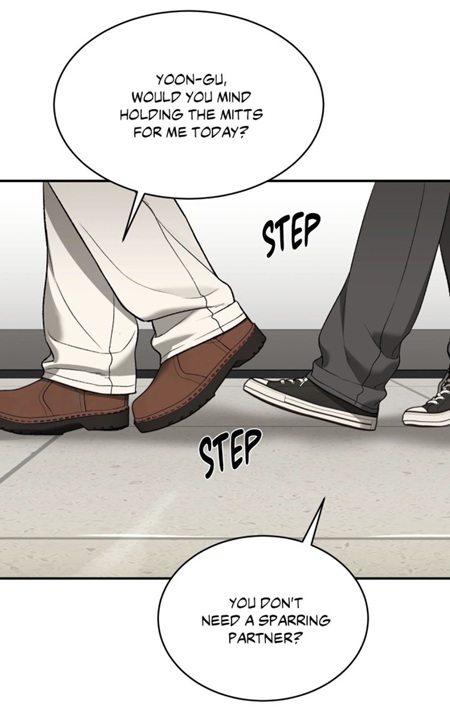
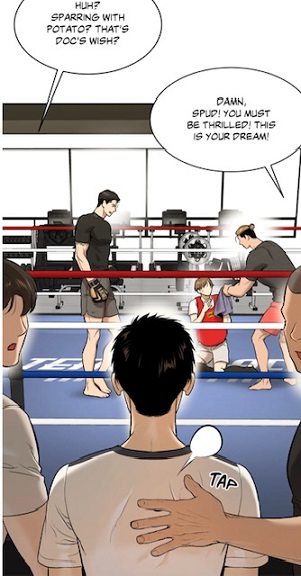
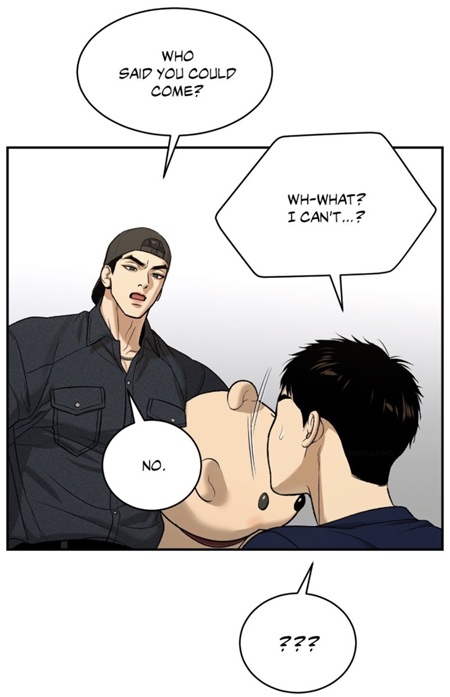
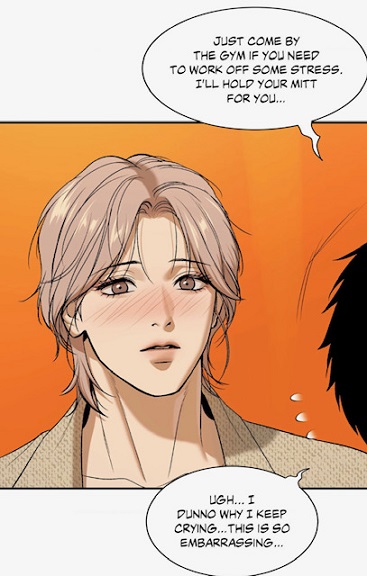
If the bond between Joo Jaekyung and Kim Dan exposes a surplus of care constrained by poor articulation, the dynamic between Heesung and Potato reveals the opposite imbalance:: knowledge without responsibility, and therefore without respect. The actor is able to express his thoughts and emotions all the time, yet he is not taking Potato’s feelings and thoughts into consideration. Thus he simply asks Yoon-Gu to hold the mitts and not be his sparring partner. (chapter 88) The way the “gumiho” speaks to the chow-chow is quite telling. He expects an agreement. Striking is that the young fighter doesn’t agree to the actor’s request, he answers with another question: “You don’t need a sparring partner?”. This question reveals that Yoon-Gu had already imagined himself differently. He had pictured a future moment in which he would not merely assist the actor’s training, but share it. In other words, he had already crossed an internal threshold: from helper to potential partner. The question exposes a private projection — a hope — that had not yet been verbalized until this moment.

That is why this exchange marks Yoon-Gu’s transformation. That’s why he is wearing a olive green sweater. (chapter 88) Olive green is not the vivid green of aspiration or idealization, nor the cold institutional green associated with discipline and hierarchy. It is a grounded, muted green — a color of transition. Symbolically, it sits between admiration and autonomy. By wearing it at this moment, Yoon-Gu visually signals a shift away from the champion’s gravitational pull. He is no longer oriented upward, toward an untouchable figure, but sideways, toward a peer relationship he is beginning to imagine. The green does not announce arrival; it marks movement. Growth here is not explosive but cautious, uneven, and still uncertain.

Crucially, this transformation does not stem from insecurity. Yoon-Gu is not suffering from low self-esteem. On the contrary, he speaks easily, moves freely, and voices his expectations without hesitation. What he lacks is not confidence, but self-awareness. He does not yet understand the structure he is entering, nor the asymmetry embedded in it. He mistakes proximity for reciprocity, access for acknowledgment. And the chow chow’s lack of self-awareness is also present, when he imagined that he could have followed to the amusement park. (chapter 87) For him, this trip was related to work, while in reality it was a date in disguise.

This becomes clearer when contrasted with the main couple. Between Kim Dan and Joo Jaekyung, communication is constrained, indirect, and often misaligned, as both are suffering from a low self-esteem and their past traumas. Desires are hidden behind habit, duty, or technical language. By contrast, the dialogue between Yoon-Gu and Choi Heesung is strikingly explicit. Both second leads speak readily. They articulate preferences, make requests, and voice dissatisfaction without visible hesitation. The only difference is that Heesung allows misunderstanding to persist. Joo Jaekyung abruptly corrects it. Neither approach is emotionally generous—but only one produces shock rather than slow erosion.

To conclude, this apparent fluency masks a deeper problem. What is missing here is not expression, but reflection.

Earlier, Yoon-Gu’s actions were shaped by obligation, imitation, or conditional promises (cleaning the floor, holding equipment or a bottle, proving usefulness). Here, the initiative is internal. He is no longer reacting to instructions; he is testing the possibility of recognition. (chapter 88) The desire precedes permission.

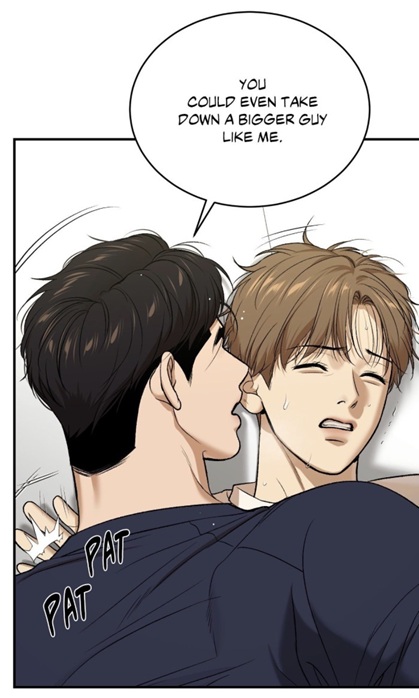
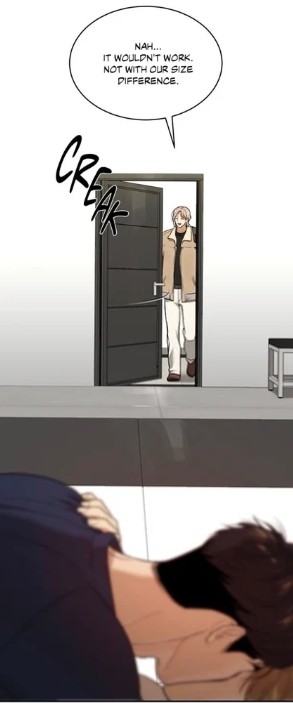
The tragedy of the moment lies not in the refusal itself, but in how it is answered. Heesung does not respond to the desire embedded in the question. He bypasses it with a technical explanation — size difference — which neutralizes the emotional risk Yoon-Gu has taken. (Chapter 88) The answer restores hierarchy without acknowledging the transformation that has already occurred. Secondly, the answer closes the future by appealing to a supposedly objective limit. Yoon-Gu can never be his sparring partner. The best he can do is hold the mitts and nothing more. The fox is using his seniority and body to have the final say.

This is where Heesung’s pride in knowing turns into arrogance. His explanation contradicts the very logic that governs the gym itself. Joo Jaekyung has just demonstrated explicitly that technique outweighs physical size, that discipline and practice can reverse power relations. (chapter 88) Under that framework, Yoon-Gu is not disqualified; he is qualified. He has trained. He belongs. So technically, Yoon-Gu could indeed beat the actor, as the “puppy” has trained for a long time at Team Black.

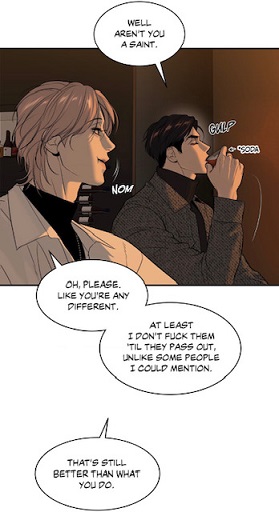
Yet Heesung’s knowledge is not grounded in the present conditions of Team Black. It is grounded on his past experience: he received special training from Joo Jaekyung. In other words, he is biased. Heesung prides himself on knowing. (special episode 1) He knows people’s patterns. (special episode 1) He knows how relationships fail. (chapter 33) (chapter 33) He knows what he does not want. His language is saturated with judgment shaped by past experiences: lovers who become “too clingy,” attachments that turn inconvenient, people who should remain “better off” elsewhere (chapter 58). This knowledge is not neutral; it is retrospective and comparative. It is built from what has disappointed him before, and it governs how he evaluates others in the present. He views himself as superior to the champion morally.

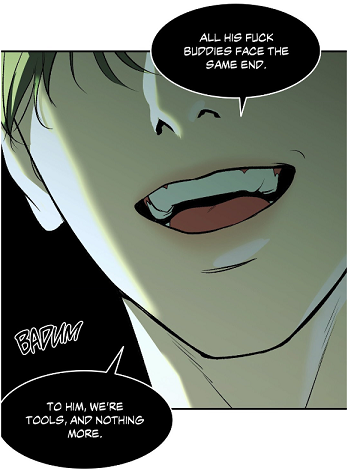
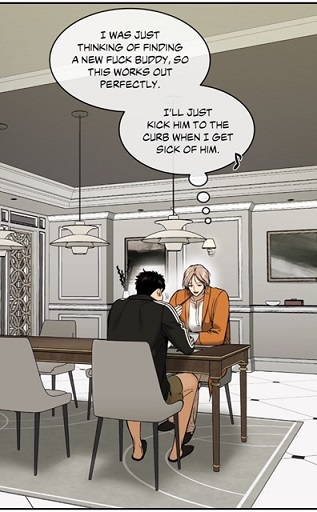
This is where the symbolism of the “grass being greener on the other side” becomes essential. (chapter 33) Heesung’s orientation is never toward what is unfolding, but toward what might be better elsewhere—another partner, another configuration, another future. His repeated invocation of a “soulmate” is revealing: it displaces intimacy into a hypothetical horizon. By looking at the grass, he is overlooking the flower. Love, for him, is something to be found later, once the conditions are ideal. What exists now is always provisional, always lacking, always subject to replacement. He needs the “perfect” lover, and in his eyes, Potato doesn’t meet his conditions: too innocent and too young. (special episode 1) This explicates why the young fighter is only considered as “fuck buddy”. (special episode 1)

Potato exists precisely within this gap. Because he wanted to take responsibility. (special episode 1), he is present, available, even emotionally invested—but he is never treated as sufficient. He is smaller (chapter 88), younger and as such less experienced, he is positioned as someone who does not yet qualify as a sparring partner, or even less as a boyfriend. Observe how he presented his relationship to doc Dan. (chapter 58) Heesung’s use of the pronoun “we” is, on the surface, inclusive. Linguistically, it frames his relationship with Potato as mutual, shared, and consensual. But pragmatically, it does the opposite. The “we” is spoken over Potato’s head, not with him. Thus Potato is physically present but discursively absent. He does not confirm, nuance, or reciprocate the statement verbally. The pronoun thus becomes a rhetorical appropriation rather than a sign of partnership.

What makes the remark particularly uncomfortable is the context: Heesung is not speaking to Potato, but to Kim Dan. The sentence is not meant to communicate within the relationship; it is meant to display the relationship to a third party. In that sense, “we” functions as a prop. It allows Heesung to stage intimacy without assuming responsibility for how that staging affects the person he claims to include. He is not saying that he is dating Yoon-Gu either. In other words, he is behaving like Joo Jaekyung in season 1. (chapter 31) He denies the existence of feelings and attachment.

The embarrassment of Potato is not accidental. It is structurally produced by the asymmetry of the situation. Heesung controls the narrative, the tone, and the implication. By adding “in more ways than one,” he sexualizes the bond implicitly, while maintaining plausible deniability. Nothing explicit is said; everything is insinuated. This is knowledge without accountability. Heesung knows exactly how the line will land—on Kim Dan, and on Potato—but he does not take responsibility for either impact.

On the other hand, Heesung feels so comfortable around doc Dan, that he is willing to divulge more. He assumes Kim Dan will “understand” him. He is speaking in a coded register, relying on shared cultural assumptions: that closeness implies sexuality, that sexuality implies connection. In doing so, he treats Kim Dan as a potential ally in interpretation, not as a moral interlocutor. He expects recognition, perhaps even complicity, rather than reprimand or judgment.

This is where the contrast with Joo Jaekyung becomes sharp. Joo Jaekyung struggles to name intimacy and often hides it behind work or discipline—but he does not instrumentalize language to control (special episode 1) or humiliate the other. (chapter 34) Heesung, by contrast, is fluent. He can name, joke, insinuate. What he lacks is restraint and responsibility. His ease with words does not signal emotional intelligence; it signals control.

Heesung does not call Yoon-Gu weak outright, but the hierarchy is unmistakable: Potato is handled (chapter 88), redirected (special episode 2), corrected. (chapter 88) Even when Heesung intervenes on his behalf, it is not through shared responsibility but through dismissal—deciding what is best for him without asking what he truly wants.

This lack of responsibility is crucial. Responsibility, in Fromm’s sense, is not obligation imposed from above; it is the willingness to respond to the other as a subject whose needs and presence matter now. Heesung does not assume this stance. He neither commits nor withdraws cleanly. Instead, he hovers—knowing enough to judge, but refusing the burden of staying.

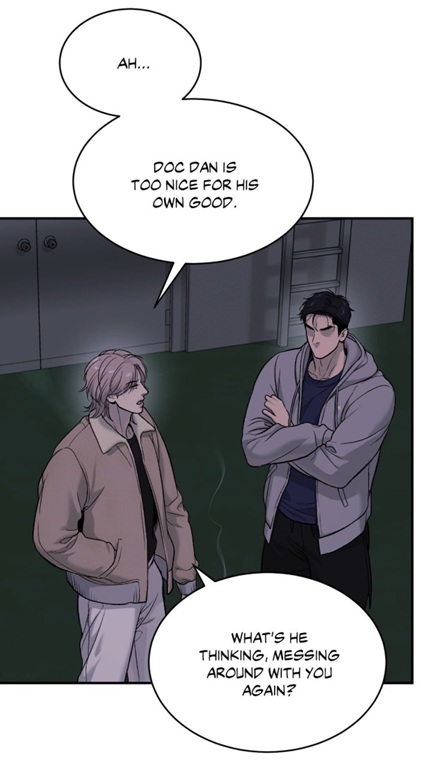
This explains why Heesung reacts so strongly to the relationship between Kim Dan and Joo Jaekyung. He does not simply misunderstand it; he rejects it (chapter 31) because it violates his model of love. Doc Dan is not introduced or claimed as his boyfriend. For him, it is simply related to the athlete’s jinx. (chapter 32). It has no declared endpoint, no moral clarity (chapter 34), no soulmate label. Rather than engaging with what the relationship is doing —how it functions, how it transforms both participants—Heesung tries to name it away: a jinx, a mistake, a lack of feelings. Naming, here, becomes a defense against involvement.

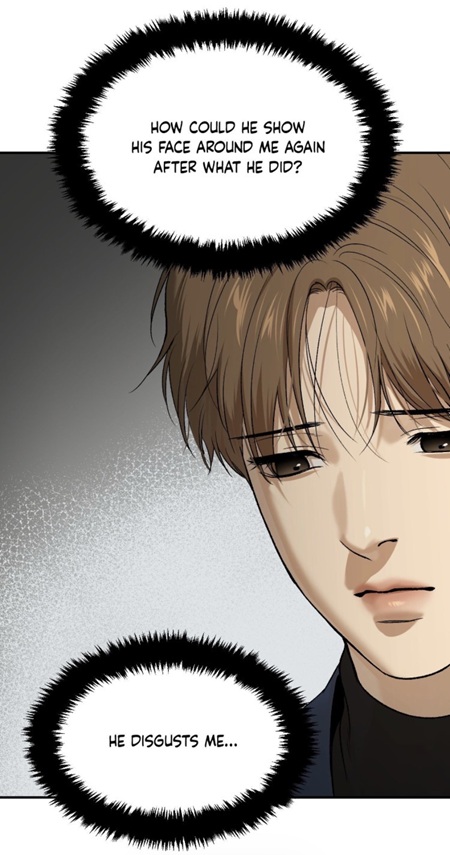
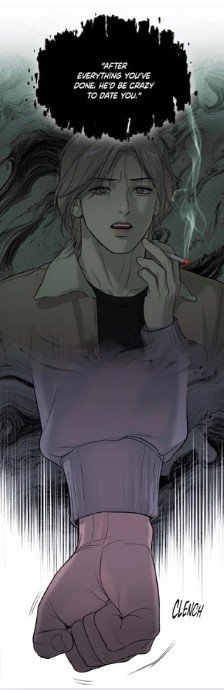
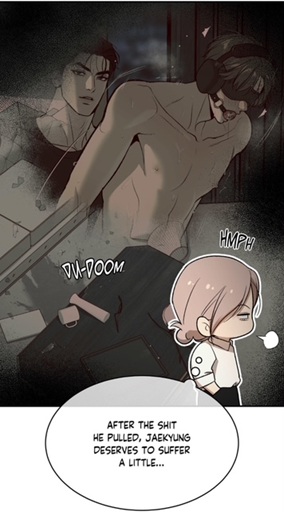
The scene in the penthouse crystallizes this refusal. (chapter 34) Heesung enters fully aware of what he is likely to witness. He is not naïve, nor totally surprised. Hence he doesn’t flee right away. Yet instead of acknowledging the reality before him, Doc Dan is not someone the fighter fucks, until he passes out, (chapter 33), he reframes the encounter as an accusation. The man is crazy. (chapter 34) Joo Jaekyung becomes the problem, the one who “deserves to suffer.” (chapter 58) This moral displacement allows Heesung to maintain distance: if Jaekyung is guilty, then no self-examination is required. Forgiveness—central to this arc (from 79 to 89)—is rendered impossible, because forgiveness would require recognizing shared vulnerability rather than assigning blame.

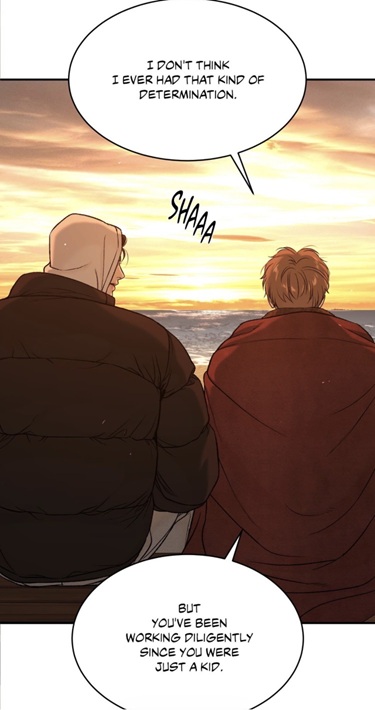
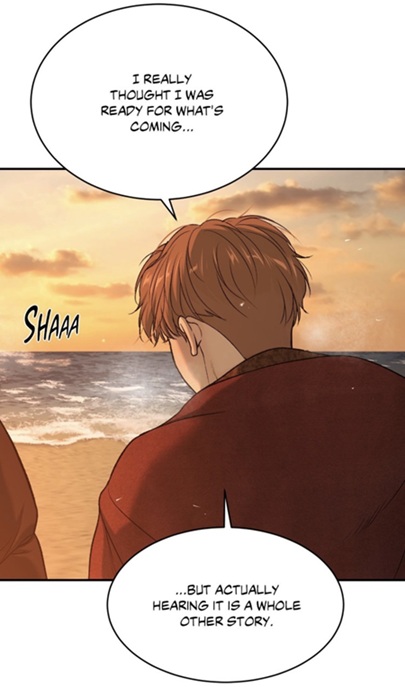
Potato, by contrast, is repeatedly asked to adapt. Earlier, he cleans, waits (chapter 25), accepts deferral. Later, he is displaced entirely. Unlike Kim Dan, who gradually moves from imposed participation to earned agency, Potato is never given a space where effort leads to recognition. (chapter 85) However, this panel implies that the young man has already been able to enter competition. Striking is that his promise at the seaside sounds like commitment (chapter 59), but the reality diverges. It only binds doc Dan. If the latter returns to Seoul, he has to promise to train with Potato. The reason is simple. He is already committed to the actor, he is already at his beck and call. Potato’s promise echoes the earlier promise forced upon Kim Dan by his grandmother: a future-oriented vow that justifies present sacrifice while guaranteeing nothing in return. (chapter 11)

This is the structural tragedy of the Heesung–Potato dynamic. There is confidence and knowledge—sharp, observational, even insightful—but it is not paired with responsibility. And without responsibility, respect and care collapse into condescension. Potato is not met as an equal in becoming, but as someone perpetually not-yet-ready. While Yoon-Gu had been deeply affected by doc Dan’s departure. (chapter 78), he didn’t remind doc Dan of his promise. At the same time, observe that none of the fighters apologized or promised something. When they hugged the doctor, they didn’t pay attention to the physical therapist’s reaction: his passivity and silence. The “laugh” lacked genuineness and felt wrong at the time. (chapter 78)

But let’s return our attention to the petals Heesung and Potato. Placed beside Joo Jaekyung and Kim Dan, the contrast is stark. Jaekyung lacks fluency, but not commitment. He does not know how to speak love, yet he stays. Heesung knows how to speak about dating and love, hence he offers a bouquet of roses. But he does not remain when love demands endurance rather than evaluation.

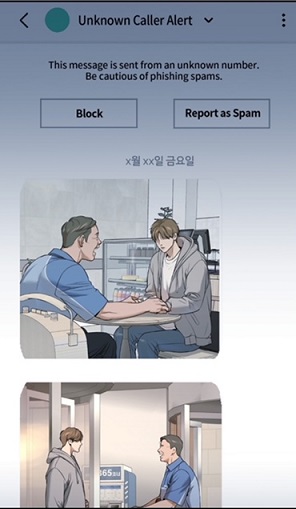
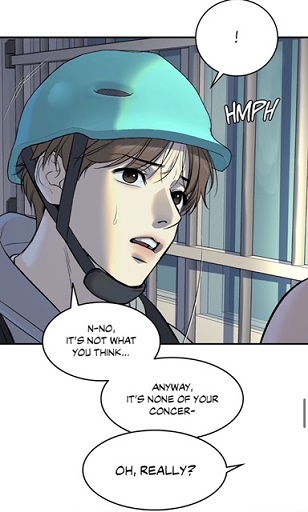
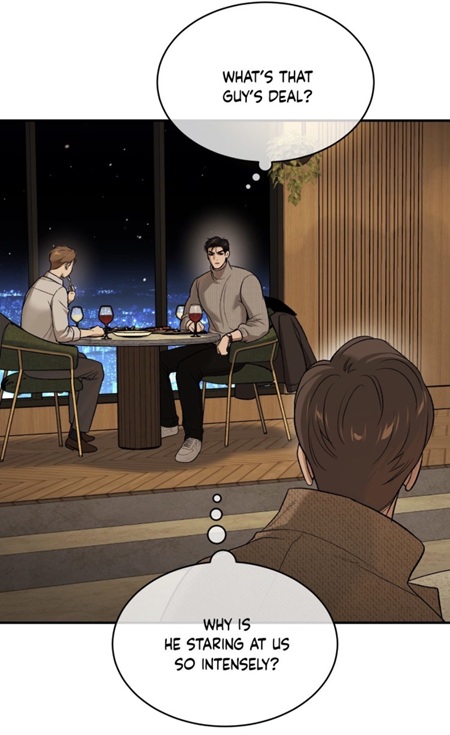
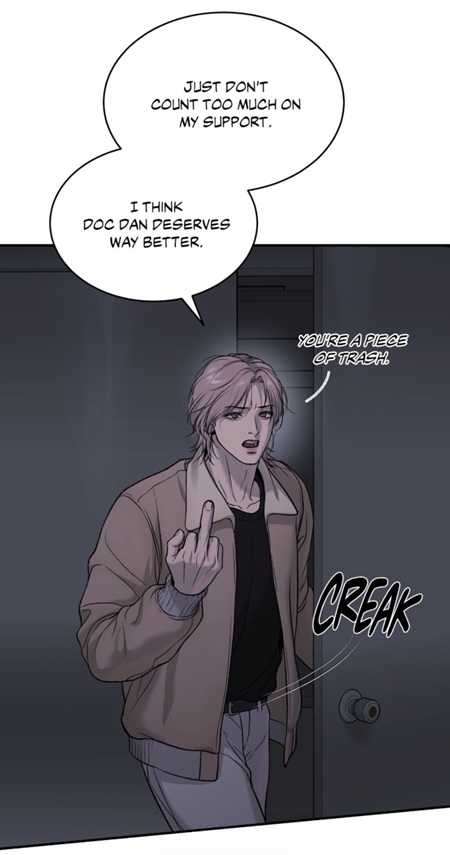
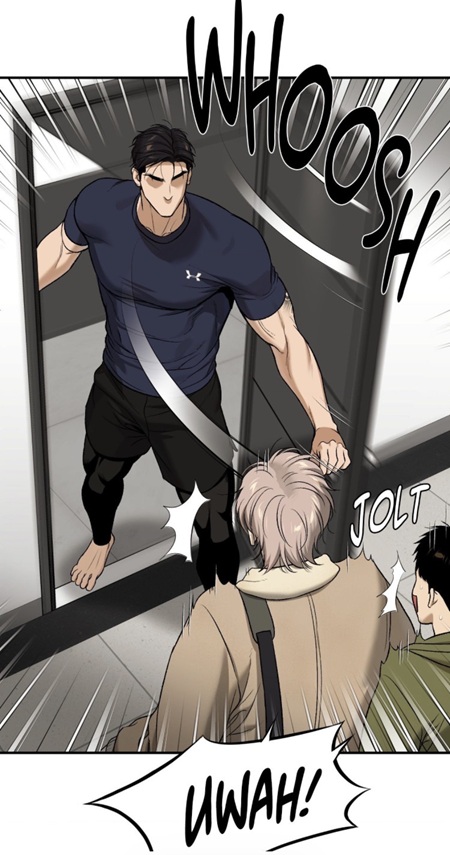
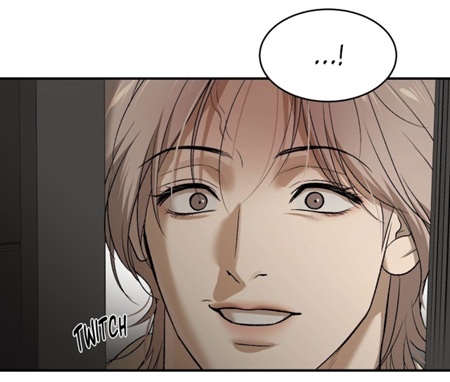
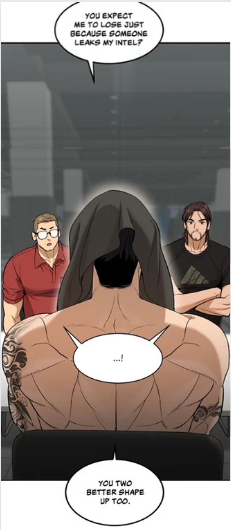
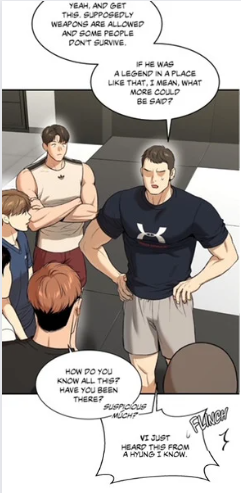
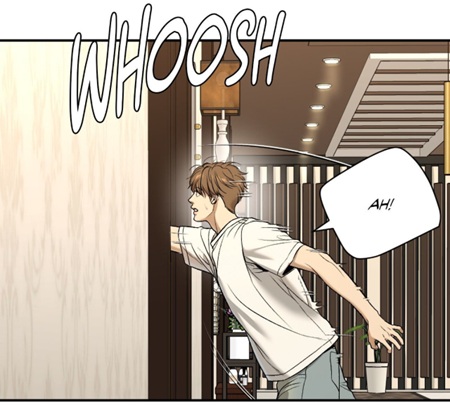
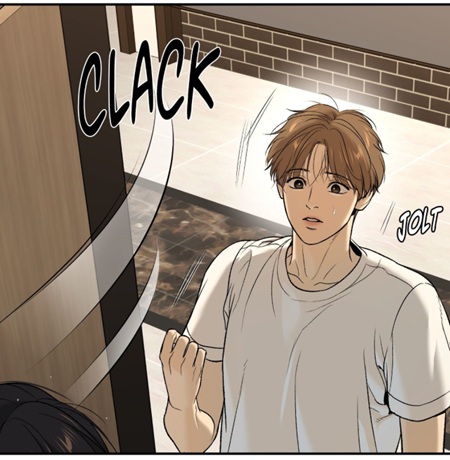
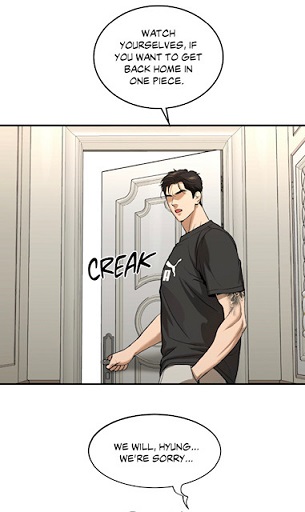
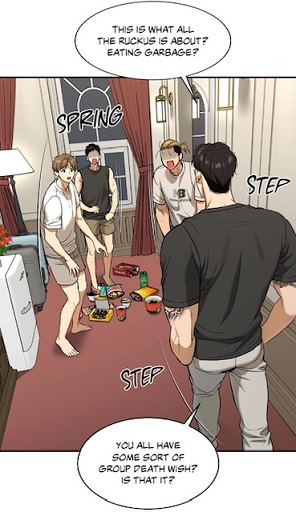
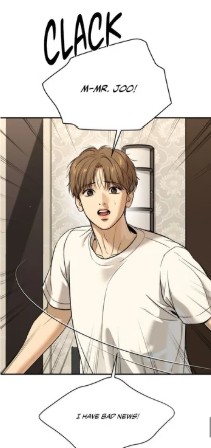
Secondly, Heesung embodies selfishness, which is also perceptible the way he appears at the gym. (Chapter 88) He had planned to use the gym without the champion’s consent and knowledge. And Potato was not expecting the presence of the main couple either. (Chapter 88) This is how it dawned on me why Mingwa recreated such a situation for Heesung. Observe his reaction, when he opened the door. He never answered the question to Potato. In fact, he slammed the door and kept his thoughts to himself. (chapter 88) As you can detect, he remained silent the whole time. It was, as though he was ignoring his lover.

What ultimately exposes the asymmetry in Heesung and Yoon-Gu’s relationship is not overt exploitation, but silence. Episode 88 stages this with remarkable precision. Heesung enters the gym without coordination (chapter 88), without consent from its owner, and without paying any visible cost. He does not announce himself as a guest, does not ask permission, and does not explain his presence. Instead, the intrusion is normalized through omission. Silence becomes the mechanism by which power circulates unnoticed.

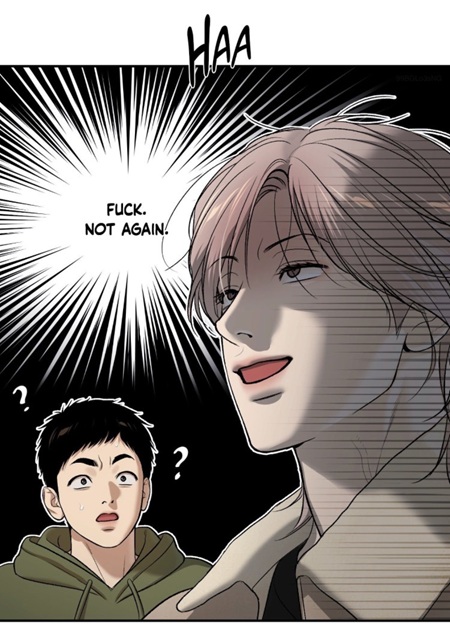
Crucially, Yoon-Gu is excluded from the truth of the situation. Readers understand why Heesung is there; Yoon-Gu does not. The actor’s internal reaction (chapter 88) can be read as a moment of comic frustration. In fact, it reveals something far more consequential: this visit was never conceived as a shared activity with Yoon-Gu at all. The training session was not planned for him, nor with him. Yoon-Gu was not included as a subject in Heesung’s intention. He was a means.

This internal monologue exposes the logic of the intrusion. Heesung did not come to train with Yoon-Gu, nor to support him, nor to acknowledge his aspirations. He came to work off his own emotional agitation, to use the gym as a private outlet. Therefore it is not surprising that Yoon-Gu’s presence is reduced to him holding the mitts. His presence is incidental—useful, but not constitutive. When the situation threatens to escalate (chapter 88), Heesung does not think, What will happen to Yoon-Gu? He thinks only of himself: his inconvenience, his exposure, his embarrassment.

That omission is decisive. It confirms that Yoon-Gu is positioned not as a partner in training, but as an accessory to Heesung’s fitness and fun. He provides access, labor, and cover, yet remains excluded from knowledge and from choice. This mirrors an earlier pattern: just as Kim Dan once provided unpaid care under the guise of compensation (chapter 32), Yoon-Gu now provides unpaid labor and institutional access under the guise of familiarity and generosity (chapter 35). In both cases, Heesung benefits from proximity without assuming responsibility for the other person’s risk. Silence, here, is not neutral—it is the mechanism by which that asymmetry is maintained.

At the same time, this regret (chapter 88) confirms that Heesung knows he has crossed a boundary. Yet this awareness produces no corrective action. He does not warn Yoon-Gu, does not acknowledge the risk he is creating for him, and does not assume responsibility for the consequences of being discovered. His concern remains entirely self-directed: embarrassment, inconvenience, exposure. Yoon-Gu’s position is not considered.

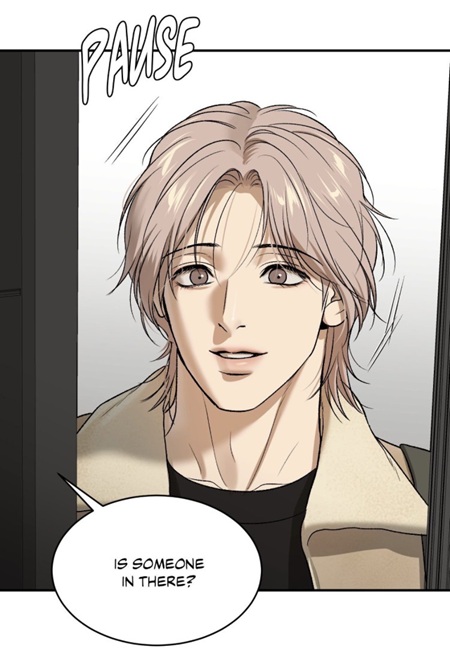
The irony is that this silence is beneficial for the chow chow . (chapter 88) It actively conceals Yoon-Gu’s complicity while simultaneously depending on it. Heesung could not have accessed the gym without Yoon-Gu. The most plausible inference is that Yoon-Gu provided entry—either by unlocking the space or by lending legitimacy to Heesung’s presence. Yet when the moment of confrontation approaches, Heesung does not speak. (chapter 88) He does not answer Yoon-Gu’s question—“Is there someone in there?”—because answering would reveal responsibility. Another important detail is that though Yoon-Gu provided the access, he simply followed the actor. The latter is the one opening the door to PT Room and not the member of Team Black. It exposes that the fox is really the one committing the wrongdoing, and he can not blame the chow chow for it.

Silence, here, is not absence of speech but a strategy of avoidance. (special episode 1) Heesung does not negotiate, explain, or repair. He doesn’t give any excuse. He moves through spaces as though access were guaranteed and consequences optional. However, this time, his silence is used against him. (chapter 88) Forgiveness, responsibility, and mutual recognition—central to the arc unfolding elsewhere—are entirely absent from his conduct. Where Joo Jaekyung begins to redistribute choice and accountability, Heesung consolidates control by refusing to speak.

This is why Heesung cannot embody forgiveness in this arc. Forgiveness requires acknowledgment; acknowledgment requires speech; speech requires responsibility. Heesung chooses none of these. Instead, he preserves his self-image by leaving others to absorb the impact of his actions. Yet, in episode 88, it is no longer possible.

In this sense, the flower associated with Heesung and Yoon-Gu never opens. Knowledge is present. While Heesung understands dynamics, motives, and outcomes, the chow chow heard all the information (chapter 52) about the switched spray, but he only reported one thing: Kim Dan is innocent. So while insight is present, responsibility is systematically deferred. Without responsibility, respect cannot follow. And without respect, what appears as connection is merely use, quietly sustained by silence.

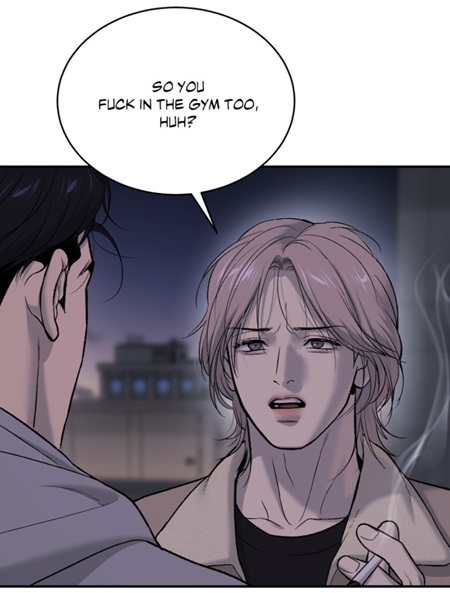
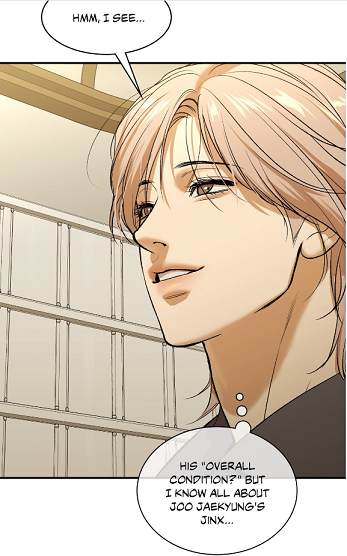
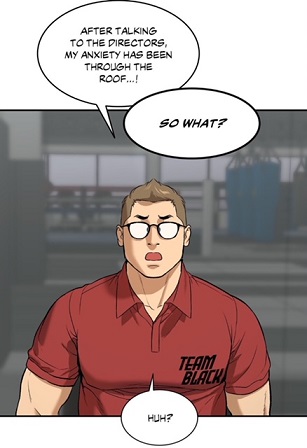
In the end, the other two petals do not fail because of ignorance. They fail because knowledge, when severed from responsibility, becomes a tool of avoidance. Love is postponed indefinitely—always imagined, never practiced. On the other hand, since he knows about the champion’s past sexual habits, it signifies that the actor became the witness of TRUE LOVE. Joo Jaekyung is kissing doc Dan. (chapter 88) The irony is that the actor didn’t realize this. He had the impression to be exposed to a similar scene than in the penthouse. (chapter 88) It is important because with this knowledge, he can expose the truth to doc Dan: the athlete loves him. In the past, he could say this without explaining his statement. (chapter 35) And now, pay attention to the logo on the doctor’s t- shirt. (chapter 88) First, it appears on the left side, positioned close to the hamster’s heart. Moreover, it looks like an orange eye. Orange is not only the color of Heesung the fox (chapter 34), but also of friendship and social communication and interaction.

That means, doc Dan is on the verge of having true friends. Joo Jaekyung will stop demanding exclusivity by isolating doc Dan from the others. (chapter 79) Besides, it is the same logo than when Yoon-Gu was spying behind the closed door. (chapter 23) That’s the moment Potato realized the truth about the couple: they were intimate. That’s the reason why I am convinced that Heesung will play the role of the messenger and mediator between the wolf and the hamster.

To conclude, I perceive the actor as the bridge between the two main leads. He embodies language, knowledge, love as feeling, but more importantly he stands for friendship and fun, notions which don’t exist in the main couple’s world yet.

That’s it for the first part. In the second part, I will examine the final panel and the significance of the fighters’ return.

Feel free to comment. If you have any suggestion for topics or Manhwa, feel free to ask. If you enjoyed reading it, retweet it or push the button like. My Reddit-Instagram-Twitter-Tumblr account is: @bebebisous33. Thanks for reading and for the support, particularly, I would like to thank all the new followers and people recommending my blog.

Jinx: Between A Squeeze🤝 And A Crack ⛓️‍💥 – part 2

Please support the authors by reading Manhwas on the official websites. This is where you can read the ManhwaJinx  But be aware that the Manhwa is a mature Yaoi, which means, it is about homosexuality with explicit scenes. Here is the link of the table of contents about JinxHere is the link where you can find the table of contents of analyzed Manhwas. Here are the links, if you are interested in the first work from Mingwa, BJ Alex,  and the 2 previous essays about Jinx  The Secrets Behind The Floors and Between A Squeeze And A Crack – part 1

It would be great if you could make some donations/sponsoring: Ko-fi.com/bebebisous33  That way, you can support me with “coffee” so that I have the energy to keep examining Manhwas. Besides, I need to cover up the expenses for this blog.
The Power of Voice

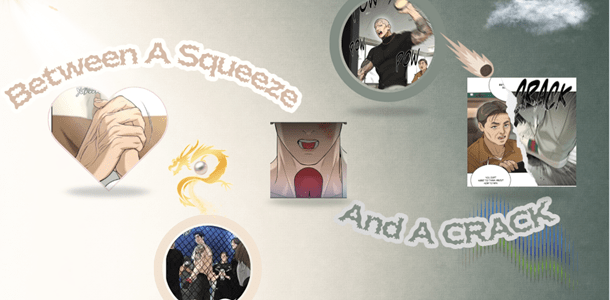
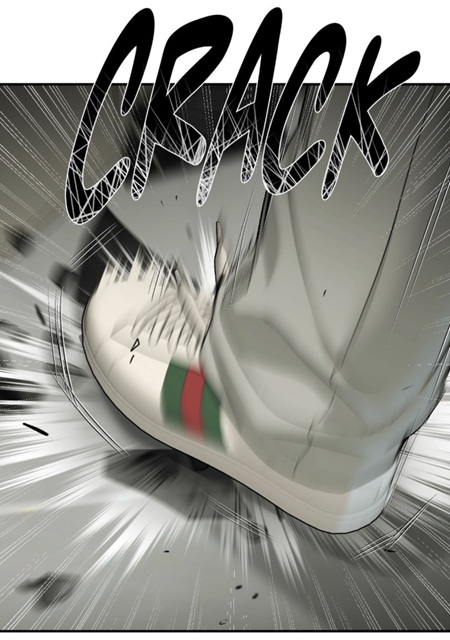
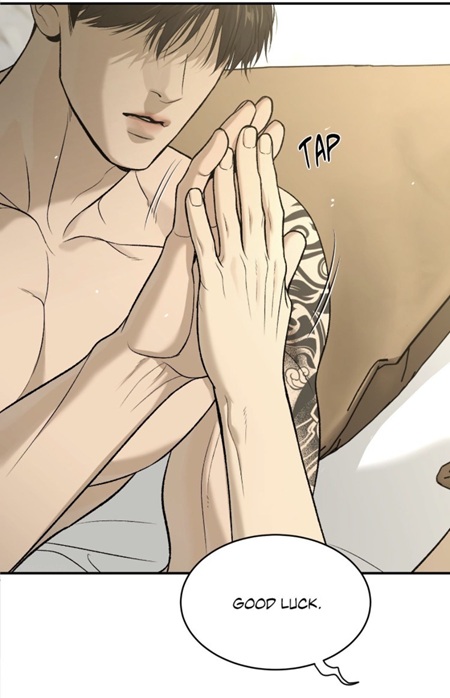
In the first part of this essay, I lingered on two gestures that never fully entered language: the squeeze of a hand (chapter 87), and the destruction of black glass under Baek Junmin’s foot. (chapter 87) Both moments operate under pressure, yet they belong to radically different economies. One gathers force inward to protect, contain, and care. The other expels force outward to fracture, dominate, and erase. The biggest difference is not intensity, but direction—and whether the other is held, or destroyed.

What remained implicit, however, was something more unsettling. In both cases, movement begins with voice.

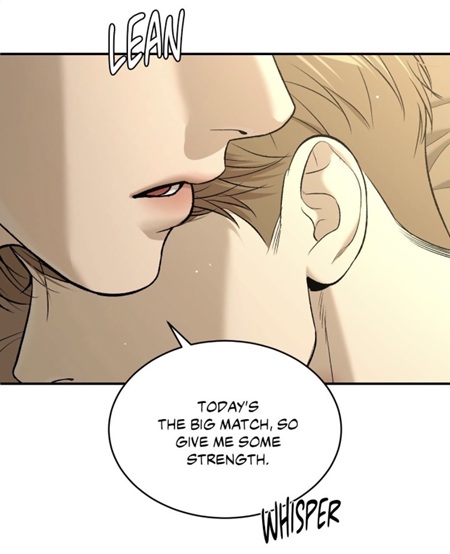
In the bed scene, the sequence is precise. The champion whispers first. (chapter 87) He asks for strength and luck (chapter 87). Kim Dan answers with a gesture, the offered hand accompanied with a wish: (chapter 87). Only then does the squeeze occur. Words initiate connection; the body confirms it. Speech and gesture align. Pressure becomes care.

In the other scene, words are also present (chapter 87) —but they are refused. Baek Junmin is denied any possibility of reply—no space to answer, to justify himself, or even to speak back. (chapter 87) The screen interposed between them (chapter 87) functions as both a physical and symbolic barrier: it delivers judgment without permitting response. Deprived of dialogue, Junmin is pushed out of language altogether. What remains available to him is not speech, but the body. His answer therefore does not come in words, but through the hand (chapter 87) and then through the foot. (chapter 87) Not as dialogue, but as rupture.

Read this way, the attack on the television screen becomes fully intelligible. (chapter 87) The violence is not misdirected; it is precisely directed at the medium that silences him. The screen is the site of exclusion, (chapter 87) the object that speaks at him while preventing him from speaking back. Striking it is not an attempt to destroy an image, but to break through a barrier—to replace blocked language with immediate, corporeal force.

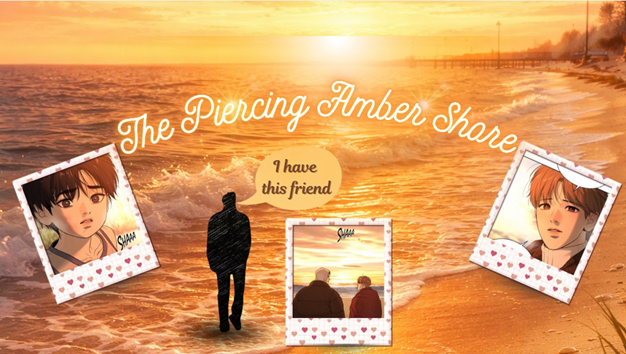
And now, my avid readers comprehend the illustration for Between a Squeeze and a Crack The champion’s voice represents a turning point. The title displays this difference. In both moments, the champion’s voice carries weight. What changes is not the force of the words, but the space in which they fall—and whether anyone is willing, or able, to answer them.

Part II begins at the moment when this difference becomes irreversible.

An Invisible Revolution: The Rising of the Dragon

Something changes in episode 87. And that shift does not begin with shouting, provocation, or scandal. It begins with voice seeking alignment.

Before the interview (chapter 87), before the challenge (chapter 87), the champion turns around. (chapter 87) He looks—not at the crowd, not at the institution, but at Kim Dan. The gaze matters. It establishes a circuit. Like a phone call finally answered, it places both on the same wavelength. Only then does the question come. (chapter 87) Here again, language and body are aligned. (chapter 87) Kim Dan answers—first with a nod, then with words. The response is clear, immediate, and embodied. And what follows is decisive: the champion raises his arm. (chapter 87)

He does not wait for the referee. He does not wait for the jury. He does not wait for the organization.

This gesture is easy to overlook. It is not aggressive. It is not loud. Yet it is quietly revolutionary. When contrasted with his previous matches (chapter 15) (chapter 40) (chapter 51), its meaning sharpens. For the first time, Kim Dan no longer occupies the position of fan or witness. He functions as judge and jury. 😮 And the champion acts accordingly. He declares himself the winner. (chapter 87)

Authority shifts before exposure occurs.

This is the missing step. Validation has already taken place. (chapter 87) Legitimacy is no longer awaited; it has been secured within the relationship itself. What follows is not a request for recognition, but its declaration. (chapter 87) Doc Dan is the one turning Joo Jaekyung into a champion, into the Emperor. And I doubt, MFC noticed this revolutionary gesture.

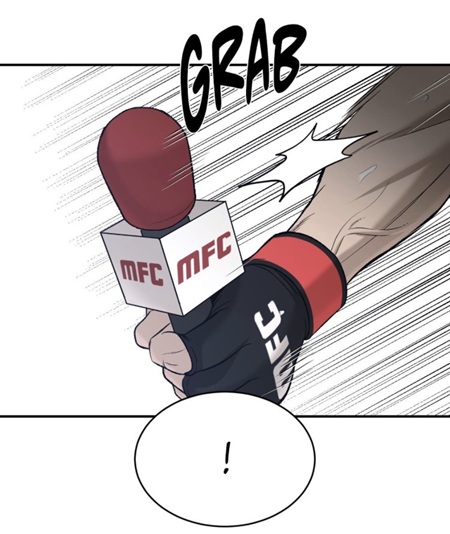
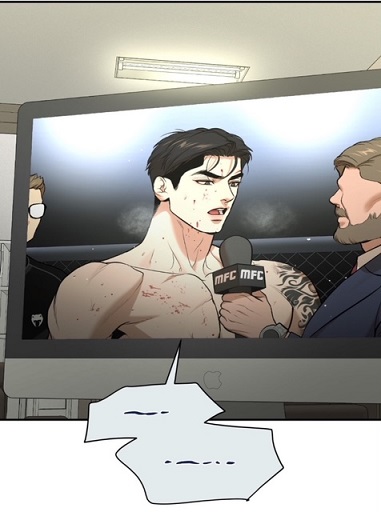
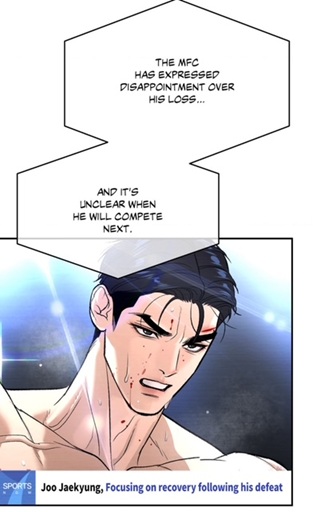
Therefore it is not surprising that shortly after the champion takes the microphone. (chapter 87) Joo Jaekyung is no longer a puppet or zombie, but a man with a heart and voice.

And the microphone is not incidental. By taking it, the dragon deliberately secures visibility, recording, and irreversibility. But more importantly, he seizes narrative control. (chapter 87)

The microphone is the institution’s tool. (chapter 46) It regulates turn-taking, determines who may speak, in what order, and under which framing. As long as it remains in the moderator’s hand, speech is mediated, filtered, and contextualized. Questions lead; answers follow. Meaning circulates vertically.

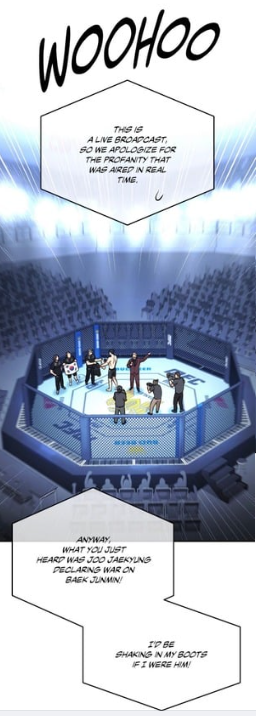
By removing the microphone from that circuit, the champion disarms the moderator. (chapter 87) The interview collapses. What remains is not dialogue, but unilateral address. This is why the moderator’s only possible response is an apology. (chapter 87) He no longer moderates; he reacts. He cannot redirect the statement, soften it, or translate it into spectacle. He can only acknowledge that something has escaped containment. The apology is not moral—it is procedural. It marks the moment the institution loses authorship.

What was once private and contained now enters public time without mediation. The champion is no longer being narrated (chapter 57); he is narrating. He does not answer a question (chapter 87) —he establishes a position. (chapter 87) And because this occurs live, the statement cannot be re-sequenced, reframed, or quietly absorbed later. In this moment, authority shifts again—not from fighter to organization, but away from the organization entirely. The champion speaks, as if MFC and CSPP were already secondary. The conflict no longer belongs to the apparatus that stages it. Wait a minute… CSPP? What is that?

This logo only caught my attention in the latest episode. However, it was already present in the beginning, but barely visible. (chapter 14) Yet, CSPP appears more and more insistently (chapter 87), even in the cage (chapter 87), contrary to before. (chapter 15) Either you only see the C or the name is placed out of the frame. (chapter 40) Yet it remains unexplained. What does it stand for in the world of Jinx? A sponsor? A broadcaster? The story never defines it explicitly—and that absence matters. What goes unnamed is often what exercises the most power. I will elaborate about it further.

Exposure, then, is not the cause of rupture. It is its consequence. The rupture occurs earlier, at the moment the champion looks for doc Dan’s gaze and opinion. That’s when the narration changes hands. Thus he raised his arm. What was once private and contained now risks exposure. (chapter 87) Hence the behavior of the wolf is filmed. At the same time, doc Dan appears much closer to the spotlight and the camera. Thus I deduce that in the future, doc Dan is about to enter into the spotlight. Some Jinx-philes are already speculating that his face could have been noticed by the cameraman and as such by the institution MFC or the antagonists.

This matters because the system surrounding him—MFC, CSPP, broadcast commentary, and the managerial logic embodied by Park Namwook (chapter 36) —depends on mediation. Delay. Scoring. Interpretation. The quiet redistribution of meaning after the fact. As long as nothing is said outright (chapter 69), control remains possible. Once speech becomes public, control becomes fragile.

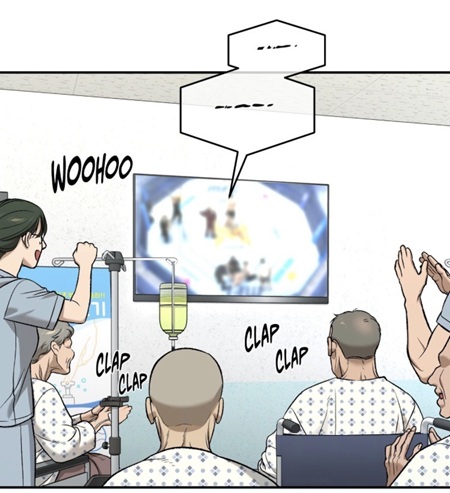
The live broadcast sharpens this rupture. (chapter 87) Live means witnessed. And once witnessed, meaning no longer belongs to a single institution. It circulates among viewers: patients at the hospice (chapter 87), people in the seaside town, a public that exists before commentary can shape it.

Even the visuals insist on this distinction. When red, green, and white are mixed (chapter 87), they neutralize one another. The result is a muted, earthy tone—balance achieved through cancellation. That palette dominates the opening of the episode. It signals containment and fragile harmony. (chapter 87)

Baek Junmin’s shoe tells a different story. (chapter 87) The same colors appear, but they do not blend. They exist side by side, unresolved. Rage, greed, jealousy, emptiness—none neutralize the others. In chromatic terms, this is not balance but erosion. Because red and green are complementary opposites, their refusal to merge points not toward power, but toward self-destruction.

So now the question is no longer why Joo Jaekyung spoke. His speech was anticipated. In fact, it was partially scripted. The system expected resentment, accusation, even open hostility toward Baek Junmin—and in that sense, the champion’s words remained within the frame that had been imagined for him. His anger was legible, manageable, and therefore harmless.

The failure lies elsewhere. What happens when speech is anticipated—but its emotional and physical consequences are not? What happens when words fail to remain governable once they enter circulation? When images detach from their managers? When words no longer stabilize power, but instead generate rupture and conflict?

Part II addresses these questions sequentially: first through the fight and its language, then through the broadcast and mediation, and finally through the asymmetry of responses it produces.

Between a squeeze and a crack lies the instant when pressure stops circulating quietly and begins to transform the field itself. This part of the essay is about that instant—and about what happens when containment gives way to exposure.

The Fight as Language: Technique, Tempo, and Control

Before the speech, before the microphone, before the question that pretends to offer a choice, there is the fight itself. (chapter 87) And the fight already answers the questions the system hopes to postpone. What we see in the cage is not merely a contest of strength, but a clash of communicative regimes. How one fights here is inseparable from how one speaks, evades, provokes, or withholds.

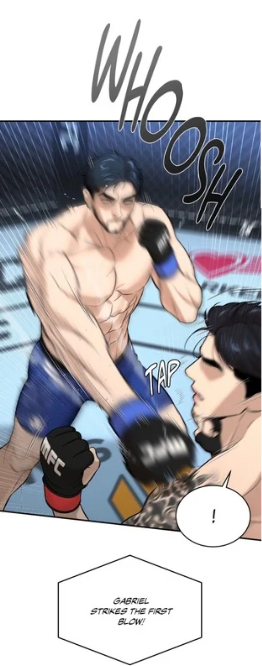
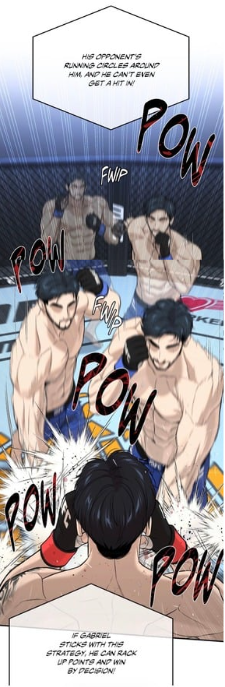
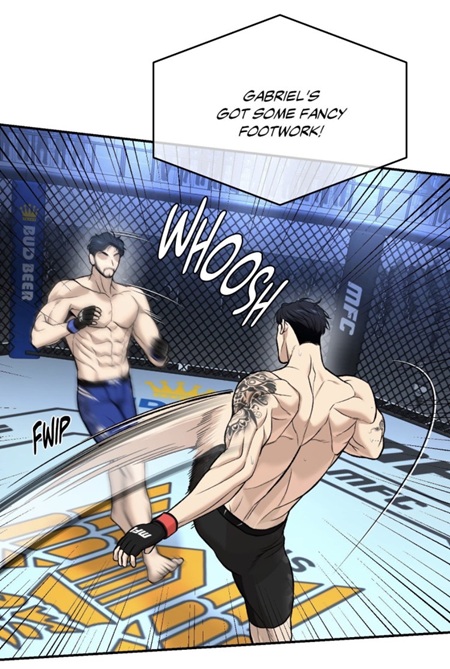
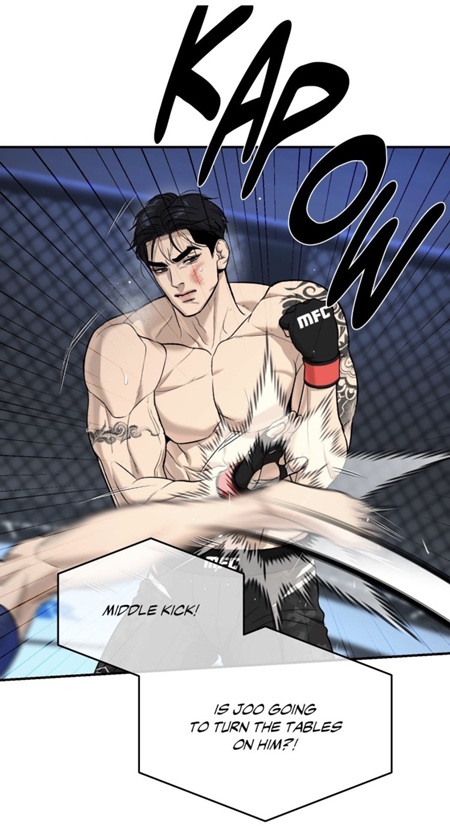
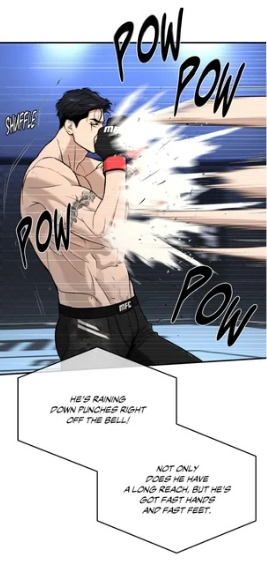
Arnaud Gabriel’s strategy is immediately legible. He does not seek resolution; he seeks accumulation. (chapter 87) His movement privileges distance, tempo (chapter 87) and visibility. That way he gives the impression that he is superior to the former champion. The middle kick appears not as a finishing tool (chapter 87), but as an instrument of disruption—enough to score, enough to interrupt rhythm, never enough to end the exchange. The rest of his offense follows the same logic: repeated punches to the face (chapter 87), the hands, the shoulder. Targets chosen not for collapse, but for points. Not to silence the opponent, but to keep him talking through damage. The choice of targets is not arbitrary. The hands and the shoulder are not neutral zones. They are sites of vulnerability that presuppose knowledge. Arnaud Gabriel does not fight, as if he were discovering his opponent in real time; he fights as if he were acting on prior information. (chapter 82) He anticipated a diminished MMA fighter at the end of his career who would train at the hotel gym. His punches repeatedly return to the same areas—not to finish, but to aggravate. Not to silence, but to extract fatigue.

This matters because these are not weaknesses produced inside the cage alone. (chapter 87) The shoulder carries the memory of surgery and recovery. The hands mediate both offense and defense; exhausting them degrades reach, timing, and confidence. And breathlessness (chapter 82)—noticed earlier during training—signals something even more fragile: limits that are physiological, not tactical.

What the fight reveals, then, is a second layer of mediation. Gabriel’s strategy appears reactive, but it is in fact anticipatory. (chapter 87) It aligns disturbingly well with what had already circulated outside the match: commentary about tension, exhaustion, time away from competition. Whether through media narratives, observation, or informal channels of intelligence, the opponent’s body has already been translated into information.

This confirms something the system prefers not to name. In Jinx, fighters do not enter the cage as blank presences. They arrive already annotated. (chapter 47) Already discussed. Already framed. Gabriel’s reliance on point accumulation is inseparable from this logic. (chapter 87) He does not need to dominate the body; he needs to activate its known limits and let the scoring apparatus do the rest.

Seen this way, the fight mirrors the economy of speech that surrounds it. Information circulates before confrontation. Weakness is spoken elsewhere, then reenacted physically. The opponent is not answered directly; he is managed.

Against this backdrop, Joo Jaekyung’s refusal to continue circulating (chapter 87) —his decision to close distance, to counter decisively, to end the exchange rather than prolong it—appears less like impatience than resistance. He does not correct the narrative. He interrupts it.

This is important. Gabriel’s fight is structured around being seen. He “circles”, he lands, he retreats. He performs control without assuming responsibility for outcome. The commentators name it explicitly: (chapter 87) if he sticks to this strategy, he can rack up points and win by decision. Victory here does not come from transformation, but from endurance within the rules. It is a fight designed to be judged, mediated, interpreted later.

Under this logic, victory does not belong to the fighter who transforms the exchange, but to the institution that interprets it. This is not new. In episode 47, Park Namwook (chapter 47) articulates the same principle explicitly: not a knockout, not a decisive end, but a strategy that stretches time, drains energy, and leaves judgment in the hands of referees and juries. (chapter 51) The fight is no longer about what happens between bodies, but about who controls evaluation. And that’s how they could rig the match between Baek Junmin and Joo Jaekyung. (chapter 51) without ever appearing fraudulent.

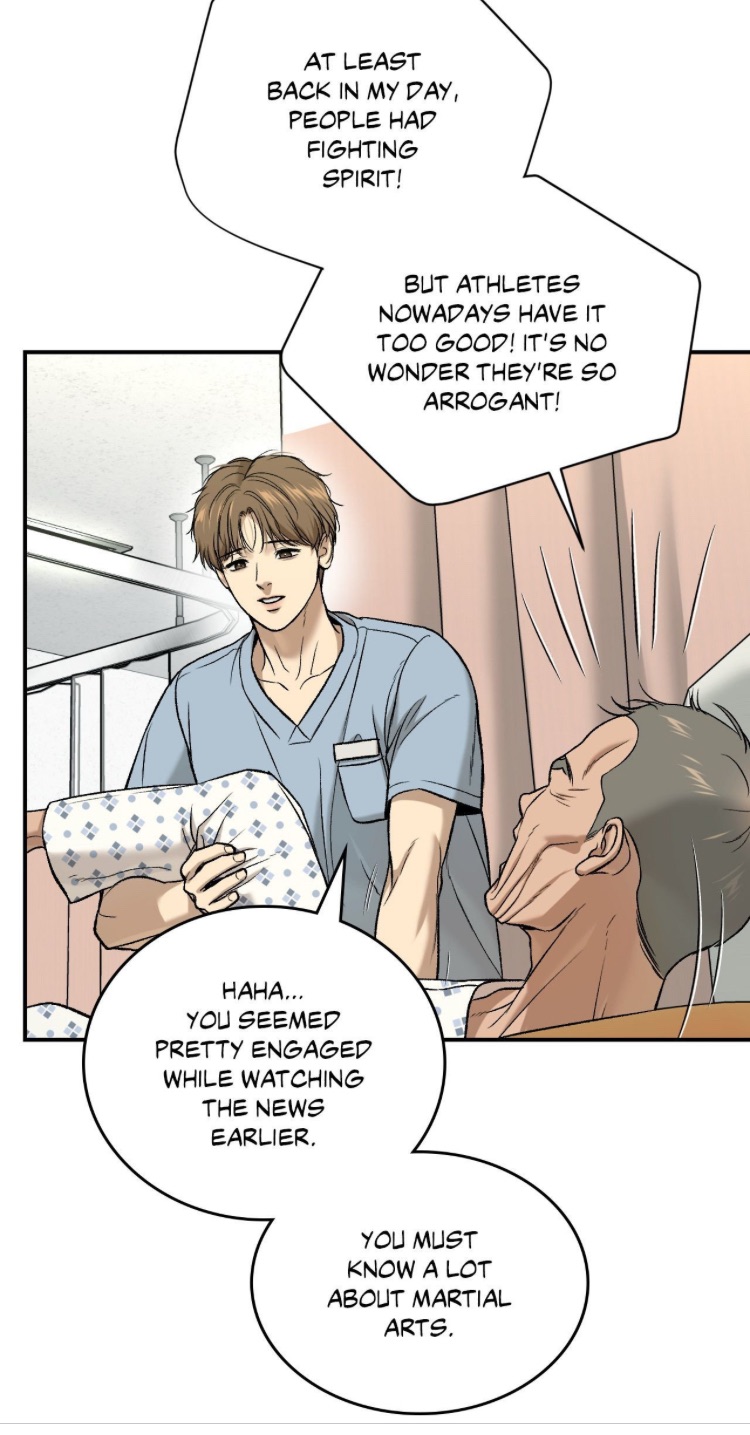
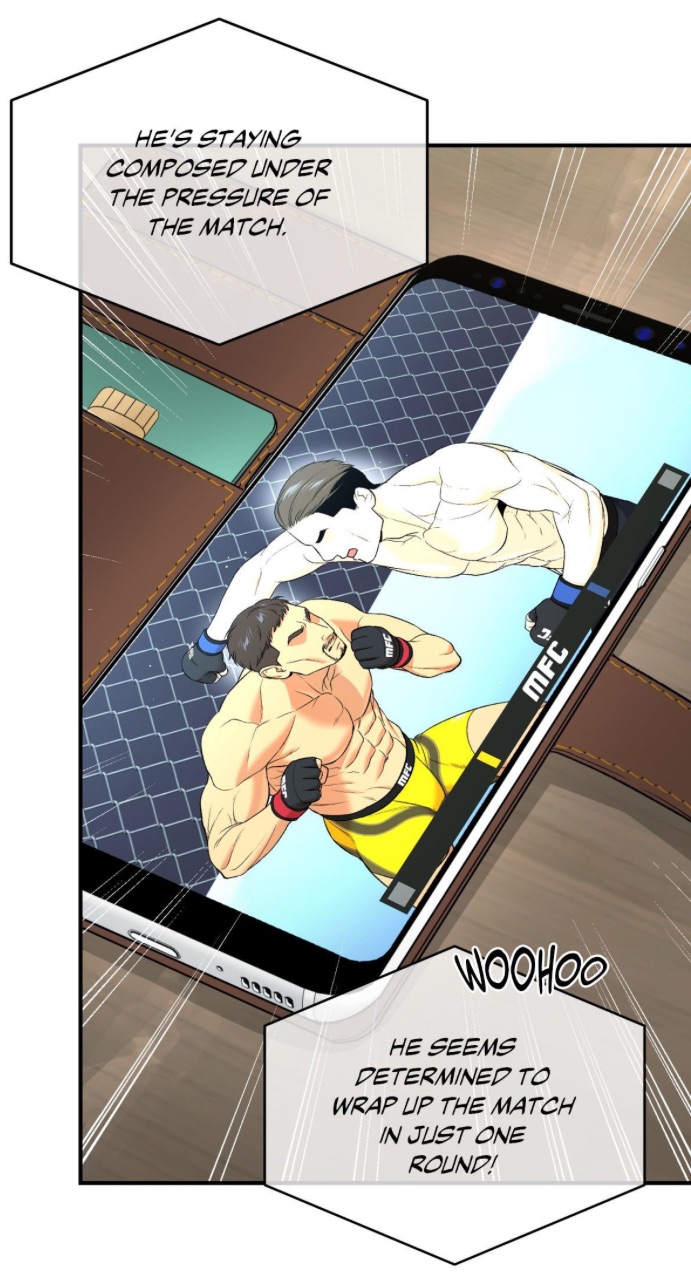
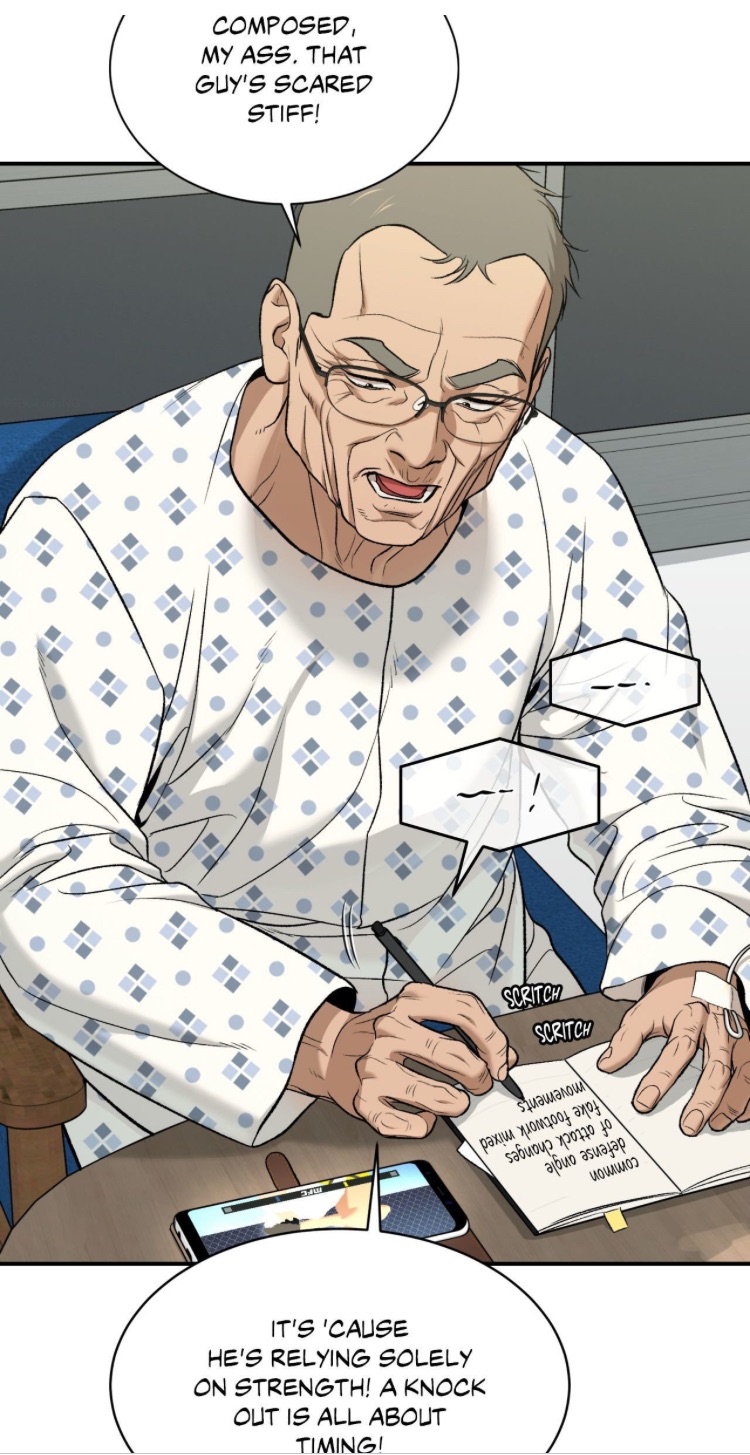
By encouraging endurance, point accumulation, and delayed resolution, authority shifts away from the fighters and toward referees and juries. Decisiveness becomes a liability. Ambiguity becomes profitable. Read in this light, the director’s remark about young fighters lacking fighting spirit and being arrogant (chapter 70) acquires a different meaning. What he condemns as arrogance is not a moral failure, but a structural adaptation. These fighters have learned that they do not need to finish fights with a knockout. They only need to prolong them—to survive them—because the system will finish the sentence for them. Therefore, the moderator’s commentary during the match introducing the new Korean fighter takes on a clearer function. (chapter 71) He frames the rookie as someone “waiting for the right timing,” subtly suggesting a coming knockout rather than prolonged survival. The language is important: it reassures the audience that decisiveness still exists within the system, that power is merely deferred—not absent.

But this is precisely where the narration fails. The moderator’s interpretation is not an analysis of what is happening in the cage; it is a reassurance directed outward, toward spectators who still expect resolution. (chapter 71) The director is not persuaded. Hwang Byungchul reads the situation differently. He recognizes stiffness, fear, and overreliance on structure—not composure, not strategy. Where the moderator sees patience, the director sees hesitation. Where commentary insists on strategy, experience detects rigidity and lack of instincts.

This discrepancy matters. It exposes the gap between institutional narration and embodied knowledge. Commentary works to preserve belief in the system’s fairness and coherence; the director’s reaction reveals how deeply fighters have been trained to survive judgment rather than risk transformation. The moderator speaks to maintain the illusion of control. The director sees through it because he understands what a fighter looks like when he is no longer fighting to win, but to last.

Read this way, Arnaud Gabriel is not an anomaly but a template. His method externalizes power. By avoiding resolution, he transfers authority away from the cage and into the system that counts, frames, and decides. The longer the match, the greater this discretion becomes.

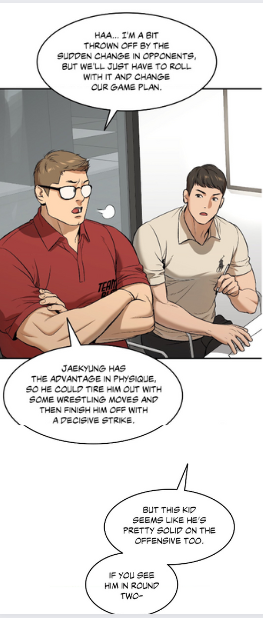
Under this light, the absence of strategic advisors for the match in Paris is no oversight. (chapter 81) It is an assumption: that the outcome no longer requires athletic intervention. The champion is treated as a finished product, a celebrity whose role is to endure visibility, not to alter the terms of the fight itself.

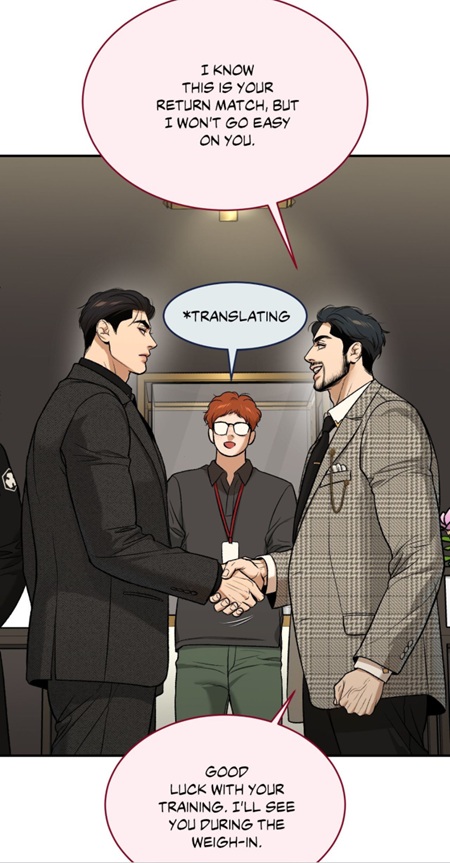
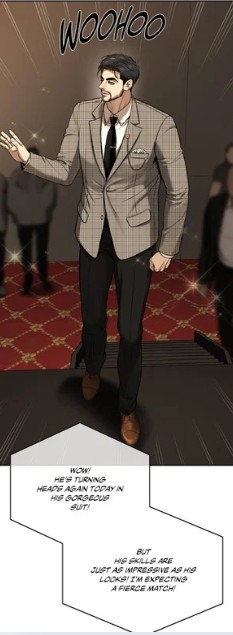
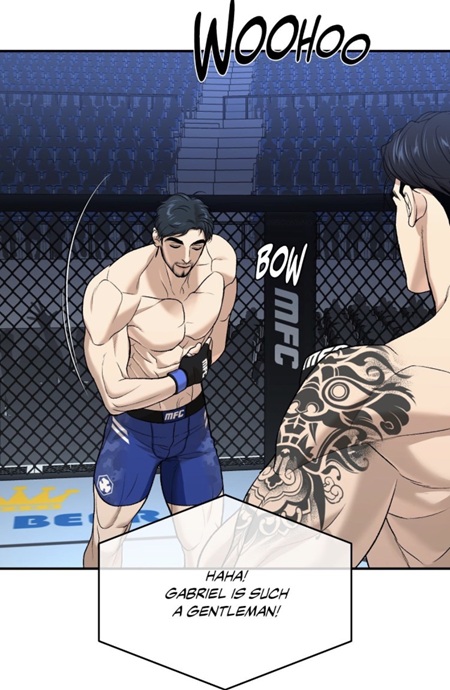
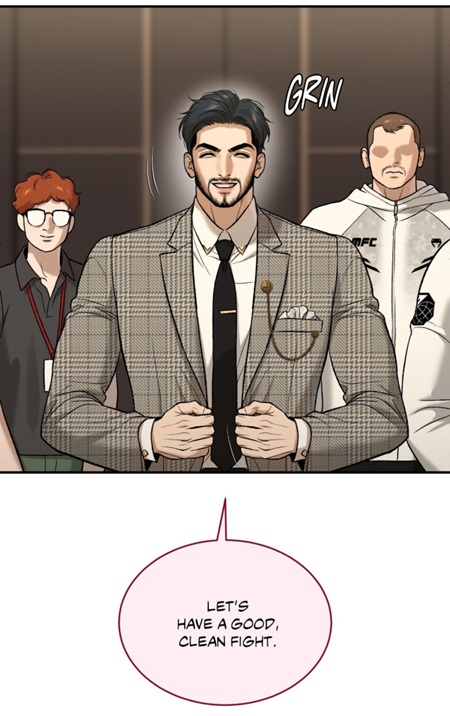
And this is precisely how Arnaud Gabriel behaves outside (chapter 82) and inside the cage. (chapter 87) Publicly, he is courteous. Measured. Even complimentary. (chapter 82) His mockery arrives only after contact has been broken—after the bell, after the exchange, after safety has been restored. (chapter 82) He remarks, not as confrontation, but as commentary. Like his fighting style, his speech avoids commitment. It is designed to sting without escalating, to destabilize without consequence. Gabriel never needs to raise his voice because the system will finish his sentence for him. His confidence does not announce itself; it is delegated. He hides arrogance and cynicism behind smiles (chapter 82), gentle and polite gestures, and tactical distance— away from the spotlight, away from overt confrontation. His restraint is not humility, but alignment. He performs civility so that judgment, narration, and authority can be outsourced to the institution. That’s why for him, fighting is strongly intertwined with fun and he sees himself more as a star than as an athlete. He is definitely influenced by MFC. Hence we can say that his suit mirrors his mind-set. Gabriel’s suit does not soften his presence; it disciplines it. The patterned fabric signals rigidity rather than elegance—structure over fluidity. It mirrors his fighting style: calibrated, rule-bound, resistant to improvisation. Nothing about his appearance invites rupture. Everything is designed to hold form.

Baek Junmin operates according to the same economy, even if his temperament is different.

Like Gabriel, he relies on intermediaries. (chapter 52) He lets others speak, provoke, circulate images, manage money, create pressure. (chapter 54) His power does not come from direct address, but from displacement. When he does appear, it is rarely to argue. (chapter 49) It is to smirk, to whisper, to apply pressure obliquely. In both cases, the logic is identical: control is preserved by never being fully present.

What distinguishes Joo Jaekyung in this fight is that he refuses this grammar. (chapter 87)

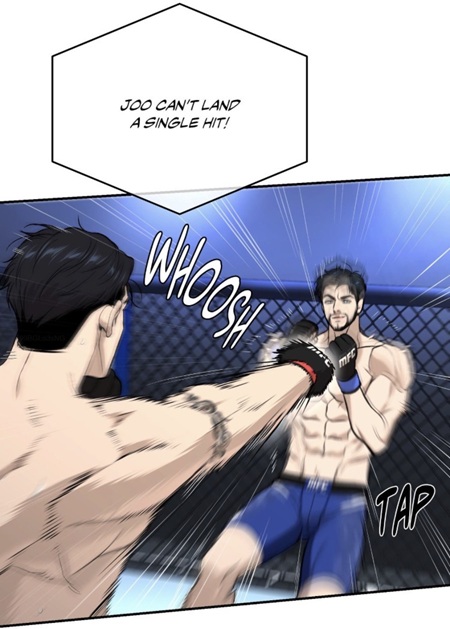
In the first round, his so-called inability to land a hit is not simply frustration or decline. (chapter 87) It is more observation. He allows the opponent to speak first—to reveal the structure of the exchange. (chapter 87) Gabriel runs, scores points, performs mastery. The system recognizes this as competence. (chapter 87) But competence is not the same as authority. The main lead was simply waiting for the right time.

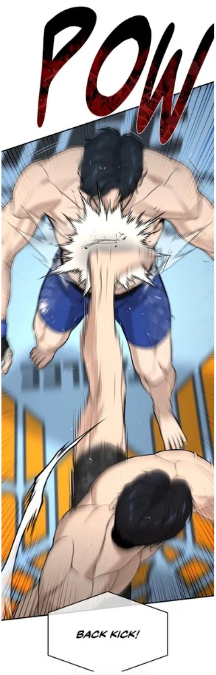
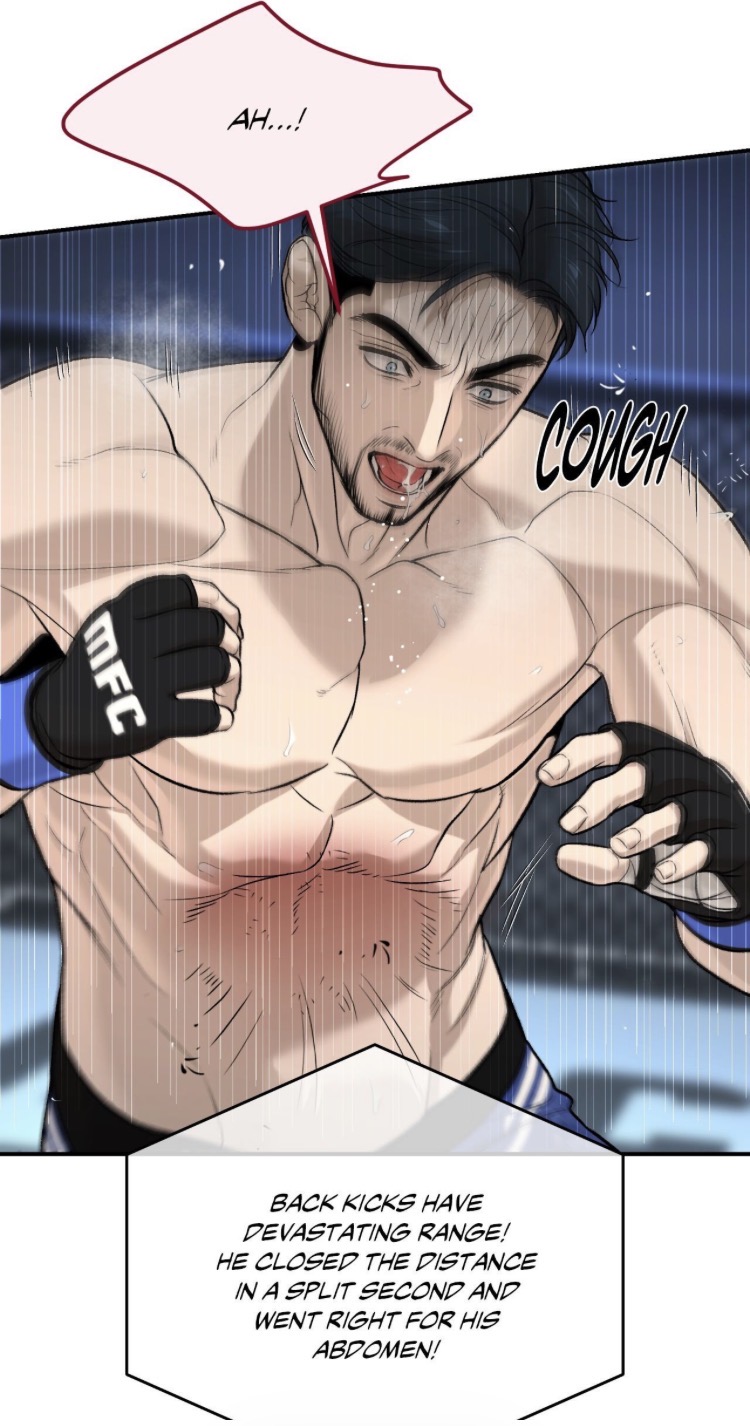
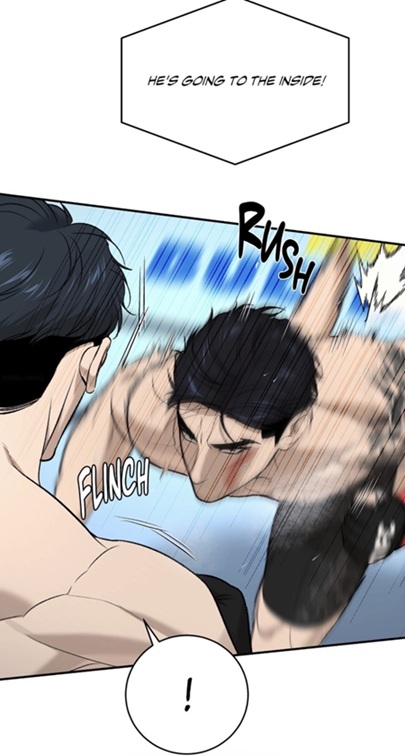
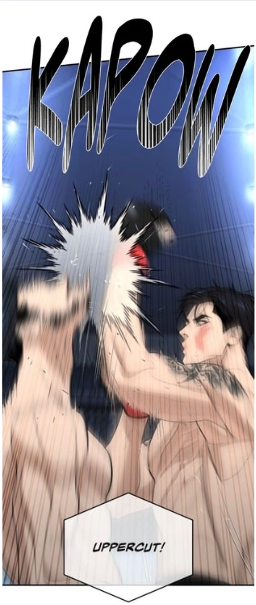
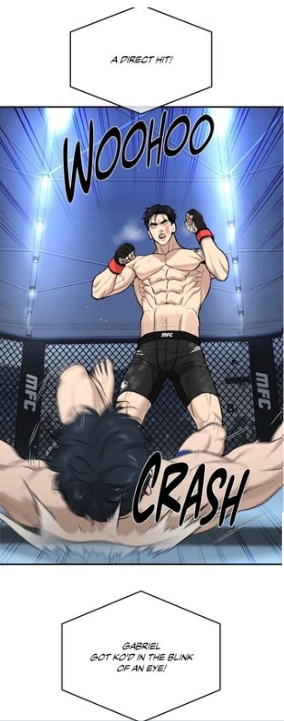
The shift comes with the back kick. (chapter 87)

A back kick is not a display technique. It is a counter. It requires timing, proximity, and commitment. It is thrown not to accumulate points, but to end conversation. (chapter 87) When it lands, it collapses distance. It forces the opponent inward. And crucially, it targets the center of the body—not the face that earns applause, but the core that sustains movement.

What the kick takes away is not balance alone, but breath. (chapter 87) This matters. Breath is what allows speech, rhythm, and continuity. By striking the abdomen, Joo Jaekyung does not silence Arnaud Gabriel symbolically; he silences him physiologically. The cough is not incidental. It is the visible sign of a system failure. The “eagle”—the aerial, circling, point-accumulating fighter—cannot stay aloft once the diaphragm collapses. Flight gives way to gravity.

The follow-up matters even more. After the back kick, Joo Jaekyung closes in (chapter 87) and delivers an uppercut. (chapter 87) This is not escalation; it is completion. Where Gabriel sought to keep the fight open, Joo Jaekyung compresses it. He refuses the long exchange. He refuses circulation. He refuses to wait for judgment. His strategy is not to be evaluated later, but to be undeniable now.

The back kick strips Arnaud Gabriel of breath. (chapter 87) The uppercut strips him of orientation. (chapter 87)

Once the diaphragm collapses, Gabriel is no longer capable of regulating posture or timing. The uppercut intervenes at precisely that moment—not to add force, but to resolve imbalance. It lifts a body that can no longer stabilize itself and interrupts any attempt at recovery. What follows is not resistance, but collapse. The eagle does not land; it falls. Arms and legs fail at once, and with them the capacity to stay airborne. (chapter 87) This is not silence imposed from outside, but silence produced by gravity. Once the body crashes, breath cannot return, and speech has nowhere to perch.

This distinction matters. Gabriel’s entire mode of fighting—and speaking—depends on continuity: light contact (chapter 87), controlled retreat, smiling commentary, damage spread thin enough to remain narratable. From my perspective, pain, for him, has always been something deferred (spread across rounds), translated (into points, commentary, statistics) and mediated (by rules, referees, judges, replay). (chapter 87) But the uppercut ends that translation. Crucially, it is Joo Jaekyung who calls this strike a “tap.” (chapter 87)

The word matters. By naming the uppercut this way, the champion reframes violence from the inside. He is not minimizing the impact; he is exposing a hierarchy of force. What appears decisive to the audience is, for him, secondary. The real rupture has already occurred with the loss of breath, with the back kick (chapter 87). Compared to that, the uppercut is merely punctuation.

This inversion reveals how far he has moved beyond a point-based or spectacle-driven economy of fighting. The strike that looks spectacular is not the one that matters most. The decisive action is the one that interrupts breath, rhythm, and continuity — the one that makes speech, posture, and recovery impossible.

After it lands, Gabriel does not speak. He does not smile. He does not reframe. He remains grounded, silent, and exposed. (chapter 87) This is why the moment feels disproportionate. It is not simply that Gabriel is hurt; it is that he appears unprepared for pain that interrupts language rather than ornamenting it.

The protagonist’s fighting style mirrors his communicative behavior exactly: alignment. (chapter 87)

Where Gabriel and Baek Junmin rely on deferral, Joo Jaekyung insists on alignment. Where they speak around conflict (chapter 74) (chapter 82) (chapter 87), he speaks into it. Where their power depends on systems that can reinterpret outcomes, his depends on moments that resist reinterpretation. It looks as though the athlete has internalized surprise as a mode of operation. (chapter 87) Not surprise as chaos, but as interruption. Each decisive movement arrives before it can be absorbed by the system—before it can be scored, reframed, or deferred to later interpretation. The opponent is caught off-balance, but so is the moderator, whose script assumes predictability. Surprise here is not a tactic for winning exchanges; it is a tactic for breaking mediation.

This is why the moderator’s question is not accidental. It is an attempt to pull the champion back into a familiar structure: (chapter 87) Two options. Two lanes. A controlled fork in the road. The equivalent of Gabriel’s point-scoring strategy translated into language. But the fight has already shown us why this will fail despite the appearances

Joo Jaekyung has no interest in winning by decision—whether athletic or rhetorical. He does not want to be interpreted. He wants to be answered. (chapter 87)

Seen this way, the fight is not a prelude to the speech. It is its proof. The jinx mattered because it did not merely weaken the champion’s body; it rendered him structurally mute. (chapter 2) While the jinx held, action could still occur, but speech could not carry consequence. Words dissipated, were deferred, or were absorbed by systems designed to neutralize them. Powerlessness expressed itself as speechlessness.

What breaks in episode 87 is not luck, but that condition. The jinx no longer governs his relation to outcome. And the clearest sign of that release is not victory, but articulation. (chapter 87) He can now act in ways that resist reinterpretation—and speak in ways that cannot be postponed.

Surprise becomes possible, only once the jinx loses its grip. While cursed, every move was anticipated, rerouted, or explained away. Once uncursed, the champion no longer needs permission, timing, or validation from the system. (chapter 87) His actions arrive before meaning can be reassigned. His words arrive where no answer is prepared. In this sense, episode 87 marks the moment Joo Jaekyung becomes fluent in his own discipline. Not merely competent, not merely dominant, but articulate. His movements surprise (chapter 87) because they are no longer designed to be legible in advance. They are not bids for approval; they are declarations.

Where Arnaud Gabriel’s fighting style depends on being read, scored, and explained—on allowing the system to finish his sentence—Joo Jaekyung’s now depends on interruption. Each movement cuts across expectation. Each decision arrives before mediation can begin. Surprise is no longer an accident; it is his mode of expression. That’s how it dawned on me why he won this match so quickly after his first night with doc Dan (chapter 5) which had surprised his manager Park Namwook. (chapter 5)

The system believes it still governs outcomes because it confuses movement with control. Gabriel moves. Baek Junmin circulates. But neither transforms the field. Joo Jaekyung does. First with his body. Soon with his voice.

And once speech enters the same register as the back kick (chapter 87) —direct, unmediated, irreversible—there will be no neutral ground left to retreat to. (chapter 87)

Commentary as Control: When Mediation Rewrites the Fight

Before the microphone is seized (chapter 87), the fight has already been partially rewritten. Not by the fighters, but by the voice that accompanies them.

The moderator’s narration does not describe the fight; it scripts how the fight should be seen. (chapter 87) Here, the man praises the French sportsman while omitting the action from the Korean athlete. This distinction matters. Commentary during the fight in Paris is not a neutral layer added after the fact. It intervenes in real time, assigning meaning, value, and legitimacy to movements as they occur. What counts as action, what counts as damage, and what counts as dominance are not decided solely by bodies in motion, but by the language that frames them.

A telling discrepancy appears early. Joo Jaekyung advances and throws a punch. (chapter 87) Visually, contact is registered: the onomatopoeia “TAP” marks the moment. Something happens. And yet the moderator declares, unequivocally: “Joo can’t land a single hit.” The issue is not that the blow lacks force; it is that it is rendered nonexistent. Contact is reclassified as absence.

By contrast, when Arnaud Gabriel touches (chapter 87) — repeatedly, often against guard or shoulder— those same gestures are narrated as accumulation. (chapter 87) Circling becomes “control.” Light strikes become “points.” Endurance becomes strategy. The same physical economy is not evaluated differently; it is counted differently. (chapter 87)

This asymmetry is systematic. Gabriel’s movements are framed as strong and intelligent, even when they produce no decisive effect. The thing is that Joo Jaekyung can withstand such punches. He has long internalized to use his body as shield. Besides, his movements, when they do not immediately collapse the opponent, are either omitted or framed as failure. (chapter 87) The moderator does not ask whether Joo is absorbing damage; he announces that Joo is being outmaneuvered. He does not note that Joo remains squared, grounded, and facing his opponent; he insists that Gabriel is “running circles around him.” (chapter 87)

What emerges is not analysis, but instruction. The commentary teaches the audience what to recognize as skill and what to dismiss as noise. It does not reflect the fight; it pre-interprets it, guiding perception toward a point-based, decision-oriented outcome. Victory, under this narration, is not something seized—it is something awarded later.

This is why the strategy attributed to Gabriel fits so cleanly within the system. His fight is designed to be judged. He circles, touches, retreats. He avoids moments that resist reinterpretation. He never needs to raise his voice or force a conclusion, because the system will finish his sentence for him. Commentary, jury, and scoring will translate minimal impact into legitimacy. Joo Jaekyung, by contrast, does not fight to be translated. He absorbs, advances, closes distance. His guard is not praised as strength and resilience but dismissed as passivity. (chapter 87) His contact is not evaluated but erased. The narration does not merely favor Gabriel; it prepares the conditions under which Gabriel’s approach can win without ever having to end the fight.

Seen this way, the fight is not merely athletic. It is already political. The moderator’s voice functions as an invisible hand on the scale, redefining what counts as action before the judges ever speak. It was already palpable during the match between the main lead and the Shotgun, but now it becomes more obvious.

This is the context in which the later intervention must be read. When Joo Jaekyung takes the microphone (chapter 87), he is not interrupting a fair narrative. He is reclaiming authorship from a system that has already begun to speak over his body.

Moderation as Deflection: The Interview as a Managed Choice

By the time the microphone appears, the fight is already over—but control over its meaning is not. (chapter 87) This is where the moderator enters the cage and becomes visible. His intervention is not neutral, and it is not merely journalistic. It is managerial.

The structure of his question reveals this immediately. He does not ask one question, then wait. He asks two at once: how the champion feels and whether he has words for Baek Junmin. This is not conversational clumsiness; it is a framing device. The champion is placed in front of a forced alternative: personal affect or rivalry hype. Either answer keeps the discourse safely within the register of sport. Both options redirect attention forward—toward the next match—rather than backward, toward responsibility.

This is a classic diversionary tactic. By introducing Baek Junmin at this precise moment, the moderator collapses multiple narratives into one convenient axis: fighter versus fighter. Institutional involvement disappears. The CEO of MFC disappears. Any irregularity becomes merely interpersonal tension. The interview is designed not to elicit truth, but to channel attention.

That this is happening on a live broadcast matters. The moderator is not improvising; he is containing risk in real time.

Who Is Watching—and Why That Matters

But what the moderator miscalculates is not the champion’s temperament, but his audience.

This match is not being watched only by fans or analysts. It is being watched by patients at the hospice. (chapter 87) It is being watched by staff. It is being watched by Hwang Byungchul—someone who knows the champion not as a brand, but as a body, a history, and a visitor and former patient of that very place. These viewers are not consuming spectacle; they are witnessing continuity. They know the fighter as a person, and I suppose, it is the same for the inhabitants of the seaside town.

For them, Joo Jaekyung’s presence is not abstract. It is personal. They are watching because of him, not because of the event itself. The dragon is not just a celebrity for them, but someone who once occupied the same space they do now. This shifts the interpretive frame entirely. They are not primed to receive hype or promotional narrative. They are primed to notice discontinuity—moments where what is said no longer matches what they know of the body, the risk, and the cost.

The moderator speaks as if he is guiding interpretation. (chapter 87) But live broadcast does not guarantee interpretive obedience. It only guarantees exposure. For the inhabitants and patients of the hospice, authority does not circulate through the microphone. It circulates through familiarity. They have no relationship with the moderator—no shared past, no shared vulnerability. With the champion, they do. His words carry weight precisely because they are grounded in recognition, not mediation. When he speaks, he is not framing the event for them; he is interrupting the frame itself. That’s why I believe not “motherfucker” will catch their attention, rather the other statement “playing dirty”. (chapter 87)

The Champion’s Speech as Refusal of Explanation

This is where the champion’s response becomes decisive—not because of what it clarifies, but because of what it refuses to clarify. (chapter 87) Contrary to the moderator’s method, Joo Jaekyung does not explain. He does not narrate. He does not contextualize. He speaks about a stunt. A trick. He names the existence of manipulation without supplying its mechanism.

This is not accidental. It is the inverse of commentary logic. Where the moderator’s role is to tell viewers how to see what just happened, the champion’s declaration does the opposite: it destabilizes perception. It introduces doubt without closure. It forces questions instead of answers. The speech functions less as accusation than as riddle. Let’s not forget that for that tie which was turned into a defeat, many people were involved: the MFC security guards, the intervention of doctors, the corruption of the jury, referee and moderator and the switched spray (its fabrication…).

This is precisely what the moderator and MFC did not anticipate.

Had the champion named the trick explicitly—had he described the spray (chapter 69) , the switching, the method—the institution could have responded. Clarifications could be issued. Liability could be managed. But by speaking elliptically, by pointing to manipulation without anatomizing it, the champion places the burden of interpretation onto the audience. And MFC can not deny the existence of an incident in the locker room.

And that audience includes people who already trust the main lead, his strength and his selflessness. (chapter 62) They are not close enough to trust the system blindly.

Why This Speech Is Dangerous to the System

For viewers in the seaside town, the declaration invites curiosity. For hospice patients, it resonates with lived vulnerability. For Hwang Byungchul, it can also activate memory (chapter 87) — of past matches, past compromises, past blindness. He is not being told what to think. He is being prompted to remember the suspension which he thought, his pupil deserved. (chapter 57)

This is the opposite of what moderation is designed to do. The moderator attempts to redirect attention toward Baek Junmin and the future. (chapter 87) There will be a match soon. The champion pulls it backward, toward unresolved causality. The moderator offers a spectacle that can be consumed. The champion offers a fracture that must be examined.

This is why the subsequent apology for profanity is so revealing. It is the only response available. Language has slipped beyond containment, so the institution retreats to formality. Civility replaces substance. That way, the athlete can be criticized for his language. He doesn’t appear as refined or proper. The reality is that he portrayed Baek Junmin as a cheater.

The Larger Diversion at Work

Seen in this light, the behavior of the CEO and the woman in red becomes legible. By foregrounding the incident in the States (chapter 69), by allowing attention to cluster around foreign misconduct (chapter 69) and public embarrassment (chapter 69), they redirect scrutiny away from the quieter, more actionable crime: the switched spray and the rigging of the game. Scandal abroad is survivable. Manipulation at home is not.

The champion’s speech threatens this balance. Not because it exposes everything, but because it exposes enough. (chapter 87) It disrupts the economy of managed ignorance. It creates a situation in which silence no longer stabilizes meaning. The incident is no longer buried, it is gradually coming to the surface,

The moderator was not asking two harmless questions. In reality, he was offering a script. And for the first time, the champion declined to read from it. Hence he insulted the actual champion.(chapter 87)

The Most Dangerous Word

The danger is not the profanity. It is what the profanity makes available.

When Joo Jaekyung says (chapter 87), he is not losing control. He is actually speaking on doc Dan’s behalf, as he has long recognized how the incident with the switched spray affected his lover. Hence he had pushed for further investigation later. He is more than just refusing the moderator’s script and naming his opponent directly, outside institutional mediation. The word does not function as an insult alone; it functions as a key.

Once spoken on live broadcast, it authorizes a shift in narrative terrain—from the fight to the past.

In a system that already treats Joo Jaekyung as a celebrity rather than an athlete (for more read my analysis “The Secrets Behind The Floors “], language is no longer evaluated for meaning but for usability. The insult “motherfucker” becomes extractable evidence. It invites biography. Not training history, but origins.

Raised by a single father who was not only violent, but also a drug-addict, a gambler and a mobster. Police records. (chapter 74) Early incidents reframed as character. Let’s not forget that he was stigmatized as a thug by the members from Team Black too. (chapter 47) Nothing new needs to be invented. Only reassembled. They know about the dragon’s past, because they brought Baek Junmin, someone who resented the celebrity for his wealth and fame.

This is how reputations are dismantled without contradiction. A scandal could finish his career, thus the manager silenced the incident with Choi Heesung’s fake injury. (chapter 31) The system does not deny the champion’s words ; it reclassifies them. What was a refusal of manipulation becomes “anger issues.” What was naming becomes “acting out.”

The word “motherfucker” is especially volatile because it summons the mother into the narrative. Her return—whether literal or discursive—does not need to accuse the champion. (chapter 72) It only needs to repeat an already accepted story: abandonment as necessity, violence as justification, disappearance as victimhood. A story the system knows how to circulate. And Hwang Byungchul never questioned her decision so far.

In that configuration, the champion’s speech is no longer debated. It is overwritten.

This is why the insult matters. Not because it is crude, but because it cannot be neutralized without reopening the past. The curse does not expose Joo Jaekyung. It gives the system permission to try. And this is the cost of refusing the script. However, what the schemers fail to recognize is that the champion is no longer influenced by the past and his origins. He received his absolution from the director Hwang Byungchul: (chapter 78) Secondly, Kim Dan is now able to distinguish the past from the present. Finally, thanks to doc Dan (chapter 62), he did so many good deeds in the seaside town that the inhabitants and the patients from the hospice won’t accept such accusations. I believe that such people won’t see “motherfucker” as a problem at all, they will rather see it as a part of his role after the match. What will remain in their mind is rather the accusation and riddle he voiced: the stunt Baek Junmin played.

CSPP and the Economy of Broadcast

What ultimately exposes the fragility of the system in episode 87 is not the champion’s aggression, but the infrastructure that was supposed to absorb it. The live broadcast does not merely transmit the fight; it reorganizes responsibility. And this is where CSPP becomes impossible to ignore. (chapter

CSPP is not presented as a television channel. The fight in the States was explicitly sold on PPV (chapter 87), which already tells us that CSPP does not function as a simple broadcaster. My idea is that CSPP operates as an intermediary apparatus: a company that packages events, sells broadcasting rights, coordinates visibility, and transforms violence into consumable spectacle. In other words, CSPP does not show fights; it produces events. This explicates why CSPP was present right from the start (chapter 14), but barely visible. But the moment it caught my attention in Paris, I realized that its increasing visibility displays the success of MFC as company. Observe that when the champion faced Randy Booker, the weight-in took place on the same day than the fight and in the arena, not at a prestigious hotel like in Paris. Here, the champion held a conference many days before the weight-in, and the latter took place the night before the match with Arnaud Gabriel. Secondly, you can observe the success of MFC through the banners. In Busan, the website of MFC was posed in the background next to CSPP. (chapter 14) In Seoul, when the star faced his old rival, there is no website on the banner (chapter 50), only MFC and CSPP. But in Paris, it is now totally different. (chapter 87) Thanks to CSPP, I noticed Joo Jaekyung’s true role. He is the one who made MMA fighting and MFC so popular! He is a trendsetter. He is indeed making history! And since CSPP and MFC are strongly connected to each other, it implies that CSPP as an organization is earning more and more money as well.

This is consistent with how the logo appears gradually in the narrative. In Paris, CSPP is omnipresent in the cage (chapter 87), on the banner, and on the stage and probably in promotional material , yet remains narratively undefined. That absence is not accidental. CSPP functions precisely where definition would impose accountability. It sits between MFC, sponsors, pharmaceutical interests (chapter 48), and distribution platforms, insulating each layer from direct responsibility. If something goes wrong, blame can always be displaced sideways.

CSPP and the Architecture of Visibility

CSPP enters the narrative quietly, but never innocently. Its function is not to comment on fights, nor to judge them. According to my observations and deductions, CSPP controls something more fundamental: when, how, and for whom events become visible. It is not a television channel. It does not merely broadcast. It packages, licenses, and distributes attention. And this becomes clear once we follow the timing.

Early revelations about Joo Jaekyung—his injury (chapter 35), his suspension (chapter 52), the causes for his defeat —usually surface in the evening or late at night (chapter 54). They circulate when attention is thin, fragmented, and easily exhausted. These disclosures are technically public, yet functionally muted. They exist without witnesses who can gather, discuss, or respond collectively.

As MMA gains popularity within the story, this pattern shifts. News about Joo Jaekyung begins to appear during the day. (chapter 57) (chapter 70) His matches are scheduled at hours accessible even to a Korean hospital (chapter 41) or hospice patients. (chapter 87) This is not coincidence. The schedule itself signals that Joo Jaekyung has become a ratings anchor—a figure around whom time is organized. He is no longer merely an athlete; he structures attention. Seen in this light, the late-night scheduling of the Korean rookie’s fight (chapter 71) becomes intelligible. It is not a mark of anticipation, but of expendability. The match is placed where attention is thinnest, where failure or success carries minimal consequence. By contrast, Joo Jaekyung’s fights are positioned to be seen. The asymmetry exposes how dependent MFC’s visibility economy is on him—not as a competitor, but as the primary organizer of audience attention.

This is precisely when CSPP becomes more visible.

CSPP’s logos multiply as control becomes more precarious. Its presence in the cage, on banners, and in broadcast framing (stage) increases not because it is expanding, but because it needs to be seen owning the frame. Visibility here is defensive. The more unstable meaning becomes, the more insistently CSPP marks the space as regulated, licensed, and sanctioned.

The contrast with Baek Junmin is instructive. His early fights are difficult to trace. Kim Dan cannot find information online. (chapter 47) His presence circulates through curated highlights and controlled conference footage rather than open broadcast. (chapter 47) His rise is engineered through selective visibility. (chapter 47) Weak opponents are chosen. (chapter 47) His image is inflated before he ever faces Joo Jaekyung. CSPP does not need to expose him fully; it needs only to prepare recognition. However, CSPP is an official company, they can not control rumors among fighters. (chapter 47) Thus the manager suggested this to his boss just before: (chapter 46) By mentioning the existence of spies, he incited the main lead to keep his distance from the doctor and the members so that the rumors about the underground fighting wouldn’t reach his ears.

This explains the asymmetry in scheduling as well. When defeat is anticipated for Joo Jaekyung—Busan (chapter 14), the United States, Paris—the fights are placed in high-visibility slots. Loss must be witnessed. Decline must be shared. By contrast, the fight between Baek Junmin and Joo Jaekyung takes place in the morning (chapter 49), a time of dispersed attention, private viewing, and reduced collective response. Visibility is not maximized; it is managed. (chapter 49) CSPP’s role, then, is not neutral mediation. It is temporal governance. It decides when exposure becomes dangerous and when it becomes profitable. It does not silence events; it times them.

This also clarifies why Baek Junmin’s championship appears so late, almost as an afterthought. (chapter 77) Once Joo Jaekyung does not contest the loss of his title—once he does not sue, demand more investigation, or interrupt the administrative process— MFC and CSPP no longer need to justify anything. Delay becomes normalization. Silence becomes confirmation.

What CSPP ultimately sells is not fights, but legitimacy through circulation. As long as conflicts remain within the frame of scheduled events (chapter 87), licensed images, and mediated commentary, the system holds. But the moment violence spills into spaces CSPP cannot package—off-camera, unsanctioned, criminal—the entire structure becomes vulnerable.

This is why Baek Junmin’s trajectory (chapter 87) is dangerous not only for MFC, but for CSPP itself. If his connections to the underworld surface, CSPP is no longer a distributor of sport, but a conduit for illicit spectacle. Contracts dissolve not because violence occurred, but because violence escaped framing.

CSPP thrives on controlled exposure. What it cannot survive is uncontrollable visibility. And by focusing on this aspect, it dawned on me that CSPP could have footage of the fight in Seoul. This distinction clarifies an earlier anomaly that otherwise remains unresolved: the Seoul fight.

Joo Jaekyung was injured, when he entered the scene. (chapter 49) Under normal medical protocol, this should have stopped the fight immediately. (chapter 41) No athlete should perform when injured. Yet MFC Medical remains silent, the staff simply treats the wound. The bout proceeds. Only later—after attention has shifted, after consequences have begun to circulate—does the same medical authority step forward to issue disciplinary sanctions and a suspension (chapter 52).

The reversal is telling. Medical authority here does not operate preventively, but retroactively. It does not protect the athlete at the moment of risk; it activates only once visibility becomes dangerous. This explains why a trick was played at the health center. It was to divert attention from their own complicity.

Seen through the logic of CSPP, this makes sense. If CSPP governs circulation, then footage of the Seoul fight does not disappear—it is archived. The problem is not the absence of evidence, but its containment. (chapter 52) There were cameras in the arena. What cannot be allowed to surface is proof of foreknowledge: that an injured athlete was permitted to fight under institutional supervision. Thus it raises the question if the match in the morning was broadcast on TV.

This explains the sudden relocation of scandal to the health center. By staging conflict there, the system launders responsibility. (chapter 52) Structural complicity is translated into an individualized incident. What occurred in the cage is no longer the issue; what occurred afterward becomes the narrative.

In this light, the suspension is not punishment. (chapter 52) It is a containment mechanism. It freezes exposure, recenters authority in bureaucratic procedure, and prevents uncontrolled questions from forming. CSPP’s role is not to deny visibility, but to delay and reroute it until meaning can be safely absorbed.

What emerges is not a conspiracy, but a pattern: intervention follows visibility, not injury. Authority responds to exposure, not to risk. CSPP is the mechanism that makes this inversion sustainable—until visibility escapes its frame.

What the system fails to recognize at this point is that the champion’s speech (chapter 87) and Baek Junmin’s reaction belong to the same event, even though they unfold in different spaces. (chapter 87) Joo Jaekyung speaks publicly, but sparingly. He does not explain. He does not accuse in detail. He names only enough to destabilize the frame: a “stunt,” “playing dirty,” a past match that no longer sits quietly in memory. His words are not designed to persuade; they are designed to unanswered. Joo Jaekyung doesn’t care about his rival’s opinion or innocence. The words remain unresolved. They enter broadcast time without closure.

CSPP and MFC attempt to absorb this rupture by doing what it always does: redirecting attention, normalizing tone, apologizing for profanity, and re-centering the narrative on rivalry and future spectacle. (chapter 87) From the perspective of the institution, the danger has been defused. The spotlight has been shifted back to Baek Junmin. The next fight is already being imagined.

But this is precisely where the miscalculation occurs. First, Baek Junmin hears something entirely different. What reaches him is not the insult, but the accusation. Not “motherfucker,” but “stunt.” (chapter 87) Not provocation, but exposure. This explains his reaction at the office. He destroys the television. And he does not prepare for a rematch, but for retaliation. But why is he so angry? He receives the words as theft. What reaches him is not the insult, but the suggestion that his victory—already fragile, already mediated—has been publicly reclassified. The words “stunt” and “playing dirty” do not accuse him in detail; they do something worse. They strip legitimacy. In his mind, he had finally achieved his goal: prove his superiority to Joo Jaekyung and live in the spotlight. (chapter 87) In a single sentence, the match is no longer remembered as a win, but as something tainted. He understands that the spotlight is no longer safe. Like mentioned before, he chooses to show his true self: a criminal. If the logic of broadcast begins to question tricks rather than celebrate rivalry, then CSPP becomes vulnerable. An underworld connection, once exposed, does not merely threaten a fighter; it threatens contracts, rights deals, and legitimacy.

This logic is not unprecedented. It echoes the historical trajectory of PRIDE Fighting Championships [which I had mentioned in a different essay Unsung Hero : Rescues in the Shadow], whose spectacular rise was inseparable from television exposure—and whose collapse followed once the connection between broadcast, organized crime, and event production could no longer be contained. In that case as well, violence was not the problem. What proved fatal was uncontrollable visibility. Once media circulation exposed what had previously been managed behind the scenes, legitimacy evaporated faster than contracts could protect it.

The parallel sharpens what is at stake in Jinx. MFC’s vulnerability does not lie in brutality, nor even in corruption, but in its dependence on televised containment. As long as speech, images, and outcomes remain governable, the system holds. Once television ceases to stabilize meaning—once it begins to expose rather than frame—power unravels from the inside.

Seen in this light, the danger is not that combat sports are violent, but that they are visible. And visibility, once it escapes its managers, has a history of collapsing institutions that believed spectacle would always protect them.

This is why CSPP and MFC become powerless in that moment. Thus the TV screen gets destroyed. CSPP and MFC can apologize for profanity, but it cannot erase the doubt now attached to Baek Junmin’s title, as the incident with the switched spray has been recognized by MFC and even treated by MFC medical. To conclude, the damage is semantic, not procedural.

The destruction of the television is therefore not rage at insult, but rage at loss of ownership over meaning. (chapter 87) Baek Junmin understands that what was taken from him is not a belt, but the story that made the belt matter. He has been repositioned—from winner to suspected cheater—without trial, without rebuttal, and without recourse.

From his perspective, the system has failed him. The apparatus that once guaranteed controlled visibility has allowed a sentence to circulate that cannot be neutralized. He has followed the rules of managed ascent, only to discover that a single, unscripted utterance can undo it.

This is the precise moment where institutional miscalculation becomes personal. And it is this perceived injustice—being robbed in full view—that makes Choi Gilseok’s permissive “by all means” possible. (chapter 87)

This is where CSPP’s position becomes the most precarious of all. If Baek Junmin’s ties to illegal fighting or organized crime surface publicly, CSPP is the first entity that cannot claim ignorance. It is the company that sold the event, packaged the narrative, and guaranteed its legitimacy. Unlike MFC, which can hide behind sport governance, or individual managers who can be scapegoated, CSPP’s value depends entirely on credibility. Once that credibility collapses, so do its partnerships.

Seen this way, Baek Junmin is not the mastermind of the schemes. He is their residual container. He absorbs the consequences of financial losses (chapter 46) that began elsewhere—losses already acknowledged when Choi Gilseok brought him into the system in the first place.

This is the deeper irony. The live broadcast was meant to neutralize confrontation by redirecting it. Instead, it amplifies instability. Words that were supposed to fuel hype begin to corrode trust. Visibility, once an asset, becomes a threat.

Conclusion: When Speech Breaks the Frame

The failure examined in this part does not lie in miscommunication, provocation, or loss of discipline. It lies in miscalculation. The system anticipates speech—but only as performance. It anticipates words that can be framed, apologized for, redirected, or folded back into rivalry and spectacle. What it does not anticipate are the consequences of speech once it escapes those circuits. The patients of Light of Hope and the inhabitants from the seaside town will definitely side with the athlete.

What happens, then, when speech is anticipated but not governable?

The fight provides the first answer. (chapter 87) Technique becomes language. Point accumulation, endurance, and delay reflect a world in which outcomes are meant to be evaluated rather than decided. Within this economy, decisiveness is a liability, and ambiguity is profitable. Joo Jaekyung’s refusal to prolong exchange—his choice to interrupt rather than circulate—marks the first rupture. The fight is no longer a prelude to speech; it becomes its proof. (chapter 87) The jinx that once rendered him powerless and speechless dissolves as he finds a language that cannot be scored.

The broadcast provides the second answer. (chapter 87) CSPP does not fail because it broadcasts the moment, but because it cannot contain what follows. Live transmission turns control into exposure. Apologies manage tone, not meaning. Scheduling governs attention, not interpretation. Once words enter circulation without mediation, images detach from their managers. Visibility ceases to stabilize power and begins to redistribute it.

The responses provide the final answer. Institutional calm persists. Procedures continue. But elsewhere, the effects are immediate and bodily. Baek Junmin experiences not insult, but dispossession. (chapter 87) His reaction reveals the asymmetry at the heart of the system: speech that appears harmless within spectacle can devastate outside it. A single unresolved sentence is enough to fracture legitimacy that took years to assemble. Neither MFC nor CSPP witness his outburst. Secondly, by grabbing the microphone, Joo Jaekyung is little by little taking control of the narrative, but more importantly he is choosing the timing! (chapter 87) So far, he only spoke in front of people during a conference or after a match. He could never choose the topic either. (chapter 30) This implies that he won’t remain passive and silent like in the past, relying on structure and institutions (Entertainment agency…) and accepting to become a scapegoat. (chapter 54)

Taken together, these moments show that power in Jinx does not collapse because truth is revealed. It destabilizes because meaning can no longer be timed, framed, or absorbed. (chapter 87) Once speech escapes governance, it does not clarify—it unsettles. It does not resolve conflict—it displaces it.

Part II has traced this shift step by step: from fight to broadcast, from mediation to rupture. What emerges is not the triumph of a voice, but the exposure of a system that depended on voices remaining manageable. Between a squeeze and a crack lies the instant when pressure stops circulating quietly and begins to alter the field itself. This is the moment when containment gives way to consequence—and when power, finally, has to reckon with what it can no longer control.

Feel free to comment. If you have any suggestion for topics or Manhwa, feel free to ask. If you enjoyed reading it, retweet it or push the button like. My Reddit-Instagram-Twitter-Tumblr account is: @bebebisous33. Thanks for reading and for the support, particularly, I would like to thank all the new followers and people recommending my blog.
Jinx: Between A Squeeze🫶 and A Crack 💢 -part 1

They Held Hands, But…

They held hands.
They held hands. (chapter 87)
They are so cute. 😍

This refrain summarizes much of the immediate reaction to the chapter. Attention clustered around the opening scene: the quiet morning moment in which the champion squeezes the doctor’s hand after asking for luck. (chapter 87) The intimacy of the gesture (chapter 87), its tenderness, and its symbolic weight were widely commented on—sometimes to the exclusion of almost everything else.

In the aftermath of the chapter, the author Mingwa herself remarked on this reception. On X, she noted—half amused, half ironic—that although Baek Junmin appeared (chapter 87) and an entire match took place, readers were largely talking about the introduction alone. 그나저나 이번화 나름 ㅂㅈㅁ도 나오고 경기도 했는데 다들 맨앞 도입부만 얘기하셔서 너무나 커엽군요,, (손잡았어 웅성웅성) Mimicking the collective reaction with a playful “They held hands!”, she described this selective focus as 커엽군요—not reproachful, but gently teasing.

This imbalance is understandable. The preceding chapters centered predominantly on the main leads (chapter 84) and the progression of their relationship, attuning readers to intimacy (chapter 85), care, and emotional release. When the chapter opens with a tactile, reassuring gesture, it naturally confirms that reading mode. The squeeze feels like a culmination.

Yet the chapter does not end there. By focusing almost exclusively on that moment, readers risk overlooking the significance of the final scene (chapter 87), where a very different gesture unfolds. (chapter 87) There, Baek Junmin rejects restraint, pushes away guidance, and verbalizes a resolve shaped not by trust or release, but by anger and revenge. (chapter 87) This closing moment is not incidental; it is placed in deliberate contrast to the opening.

The chapter is structured around these two gestures. One dissolves a belief rooted in ritual and control, the champion’s jinx. The other inaugurates a trajectory driven by wounded pride and escalation. Read together, they form a single movement—one that unfolds between a squeeze (chapter 87) and a crack (chapter 87).

Between a Squeeze and a Crack: Two Gestures, Two Logics

The chapter is structured around two gestures that appear simple, almost inconspicuous, yet articulate two radically different ways of relating to control, desire, and action.

One is a squeeze of the hand. (chapter 87) The other is the crushing of glass underfoot. (chapter 87) Between them unfolds a decisive split. The squeeze is not an act of domination. It is measured, contained, and reciprocal —an act of protection. The champion’s hand does not merely touch the physical therapist’s; it covers it. (chapter 87) The gesture encloses rather than exposes, shielding the other instead of pressing down on him. Force is present, but it is regulated and oriented toward care. The champion does not grasp to hold on longer than necessary; he squeezes, then stops. The gesture culminates in a line that matters far more than it seems at first glance: “That’ll do.” (chapter 87) This sentence marks a limit. It is not indifference, but acceptance. The champion has just registered the doctor’s surprise (chapter 87) — the slight jolt, the hesitation—and he responds by stopping. The restraint is not automatic; it is chosen. He does not ask for more reassurance, more certainty, or more support, even though he clearly desires it. Instead, he recognizes sufficiency.

What unfolds here is a careful negotiation between selfishness and selflessness. (chapter 87) The gesture still serves his need—he seeks strength, grounding, and reassurance—but it refuses to extract more than the other can freely give. (chapter 87) He allows himself to receive without insisting, to take comfort without turning it into a demand. Let’s not forget that after the tap, doc Dan had already started moving his hand away, though his fingers were brushing slightly his. (chapter 87) So the doctor’s support was indeed limited in time. So the stop of the champion ‘s squeeze (chapter 87) is therefore not a withdrawal, but an ethical adjustment: the moment at which desire acknowledges the other’s boundary and accepts it as final.

In that sense, the squeeze does not prove generosity; it proves restraint. It shows a willingness to carry what remains unmet rather than convert it into pressure. This is why the gesture concludes where it does. Not because the need disappears, but because it is no longer permitted to override respect.

In doing so, he abandons the logic that previously governed him—the belief that repetition, ritual, or escalation could secure an outcome. He would have sex, until his partners passed out. (chapter 33) Humbleness here (chapter 87) is not merely the expression of modesty, but the conscious recognition of limits: the willingness to accept uncertainty without compensating for it through excess, and the refusal to impose oneself on another. The gesture exposes a desire for respect toward Kim Dan; the champion knows his shyness and calibrates his touch accordingly, stopping before closeness turns into coercion. (chapter 87) The hand, as an instrument, reinforces this meaning. It reaches horizontally toward another human being. It creates proximity, connection, and grounding. (chapter 87) Nothing mediates the gesture. There is no object, no talisman, no substitute. Meaning is produced entirely through contact.

The final gesture operates according to the opposite logic. (chapter 87) The foot does not protect; it exposes. It descends vertically, asserting weight rather than relation. Where the hand encloses, the foot bares. The glass shatters under pressure, turning reflection into sharpness. What was once a surface becomes a source of wounds. It does not regulate force but releases it. Where the hand stops (chapter 87), the foot escalates. (chapter 87) The glass shatters, not to restore anything, but to discharge tension. This is not violence directed at a person, yet it is unmistakably expressive. It replaces connection with spectacle and containment with excess. Unlike the squeeze, the crack does not conclude itself. It invites continuation. The gesture is driven not by sufficiency, but by the refusal of “enough.” Here, greed is not merely material; it is existential. It manifests as the desire for the last word, total vindication, and unrestrained agency.

The contrast extends beyond movement into atmosphere. (chapter 87) The opening scene unfolds in a space that feels inhabited and shared, composed in softer shades that emphasize stillness and presence. The final scene is colder, darker, sharper. (chapter 87) Motion replaces quiet. An object enters the frame, absorbing force and redirecting it away from human contact. Where the first scene restores continuity—between bodies, between effort and outcome, between present and future (chapter 87) —the second collapses time inward. Baek Junmin does not act toward what is coming; he reacts toward what has already been. His violence is not exploratory but recursive. (chapter 87) It invokes the past as a template, attempting to reinstate an earlier hierarchy in which domination was secure and uncontested.

The gesture is therefore not simply destructive, but regressive. By striking, he tries to repeat a former position—acting like he wasn’t my gopher back in the day—as if the present could be coerced into mirroring that memory. This is why moderation is impossible. Repetition does not recognize limits; it demands reenactment. What breaks under this logic cannot be repaired because it was never oriented toward the future in the first place. It leaves only fragments—evidence of an attempt to overwrite change rather than accommodate it.

What ultimately sharpens the contrast between the two gestures is not only the difference between hand (chapter 87) and foot (chapter 87), but the difference between human presence and object substitution. In the opening scene, meaning emerges exclusively between two people. Nothing stands in for the other; nothing absorbs the gesture on their behalf. The squeeze requires mutual presence and ends precisely because it is shared. Its limit is ethical as much as physical. The final gesture unfolds in the absence of such reciprocity. Baek Junmin does not direct his force toward another human being, but toward an object. This displacement is not incidental. The object absorbs what no one else does. It becomes the recipient of rage, humiliation, and wounded pride. In doing so, it exposes a fundamental loneliness. Violence no longer seeks recognition from another person; it settles for impact.

The object in question matters. The Shotgun does not destroy a random item, but a television screen (chapter 87)—the very surface on which images circulate, words are fixed, and visibility is regulated. The screen does not reveal truth; it organizes perception. It is where victories are staged, reputations stabilized (chapter 46), and statements acquire permanence through broadcast. (chapter 87)

By turning on the screen, The Shotgun does not challenge the system itself (chapter 87); he reacts to what it has already done to him. What breaks is not the logic of spectacle, but his ability to endure exposure. The screen cracks, yet remains standing. This first rupture interrupts the image, but not its effect. The words spoken through it persist. They cannot be retracted, reframed, or silenced after the fact.

Thus he strikes again. (chapter 87) Using the ashtray, the “demon” shatters the screen into debris. At this point, the object has already lost its function. The broadcast is long over; the image is long gone. Yet the violence continues. He steps forward and crushes the remaining black shards underfoot (chapter 87), as if determined to annihilate even the remainder. The escalation exceeds necessity. It is no longer about disabling a device, but about confronting something that refuses to disappear.

This escalation becomes even more revealing when read against the opening sequence of the chapter. The three acts of destruction mirror, in distorted form, the three steps through which closeness was established earlier. In the morning scene, proximity unfolds gradually and remains contingent on consent: first the whisper (chapter 87), then the pause; then Kim Dan’s tentative tap (chapter 87); finally the squeeze (chapter 87), held only until it must stop. Each step waits for response. (chapter 87) Each movement depends on acknowledgment. The sequence concludes because it recognizes a limit.

At the office of director Choi Gilseok (chapter 87), the same tripartite structure is emptied of reciprocity. The first strike cracks the surface. The second shatters it into debris. The third crushes what remains. Where the opening scene pauses, this one accelerates. Where the whisper waits, the blow overrides. Where the squeeze ends itself, the violence repeats because it cannot conclude. The symmetry is formal, but the logic is inverted: one sequence builds relation through restraint; the other pursues erasure through excess. (chapter 87) In the latter, escalation is uninterrupted. At no point does Director Choi Gilseok intervene. He does not place a hand on Baek Junmin’s shoulder again, does not issue a command, does not impose a limit. (chapter 87) Whether he has already left the room or chooses deliberate avoidance is ultimately secondary. What matters is the absence itself.

That absence exposes a failure of containment. Authority is present in name, but not in function. Choi Gilseok cannot—or will not—stop his fighter. His invisibility transforms into passivity and complicity, not because he endorses the violence, but because he allows it to proceed unchecked. Power here no longer circulates through guidance or control; it dissolves into abdication. Yet this abdication is not uniform. It is selective.

Earlier in the narrative, Director Choi reacts strongly when his authority is verbally challenged. (chapter 49) When Joo Jaekyung addresses him with open disrespect, the breach of seniority provokes immediate outrage. (chapter 49) Intervention follows quickly. The insult is not tolerated (chapter 49) because it threatens hierarchy itself. Choi’s anger is genuine in that moment and it reveals what he truly guards: status, order, and the visibility of respect.

In contrast, Baek Junmin’s behavior provokes no such response. He brushes past instructions (chapter 87), slaps away physical restraint (chapter 87), and continues escalating without repercussion (chapter 87). The difference is telling. Where Choi once asserted authority to defend rank, he now withdraws it in the face of volatility. Baek’s aggression does not offend hierarchy in the same way; instead, it destabilizes it. And Choi does not confront destabilization. He avoids it.

A final irony sharpens this configuration of power. Neither Choi Gilseok nor Baek Junmin is aware of the protagonist’s true rank. (chapter 78) Both continue to perceive Joo Jaekyung as nothing more than a fighter (chapter 87) —talented, profitable, but ultimately subordinate. (chapter 87) This assumption governs how they speak to him, how they threaten him (chapter 49), and how they imagine their leverage over him.

Yet this perception is false. Joo Jaekyung is not merely an athlete within the system; he occupies the same structural level as those who presume to manage him. He is the owner of Team Black. His position aligns not with fighters, but with directors. The irony lies in the fact that the system itself enables this misrecognition. Authority is not distributed according to legal ownership, but according to visibility and habit.

This is already visible earlier, when the “hyung” attends directors’ meetings on the champion’s behalf. (chapter 46) His presence creates a convenient fiction: those around the table come to believe that he is the owner, or at least the one who truly governs the gym. Joo Jaekyung’s absence is interpreted not as autonomy, but as immaturity or dependence. Authority, once again, attaches itself to performance rather than reality.

The warning issued by the gym’s leadership makes this distortion explicit. (chapter 46) Even after boundaries are formally stated, Park Namwook continues to rely on seniority to address the champion (chapter 46) as if he were a child or an employee—someone to be corrected, instructed, and disciplined. The warning does not alter behavior because it does not challenge the underlying assumption: that Joo Jaekyung’s place is below them.

This misreading has consequences. Because Choi Gilseok and Baek Junmin both believe they are dealing with a fighter who must answer to managers, coaches, and institutions, they overestimate their capacity to contain him. They imagine leverage where there is none. They threaten exposure, punishment, and exclusion—tools that function only if the target depends on the system for legitimacy.

What they fail to see is that Joo Jaekyung no longer does. He doesn’t care about his image after challenging Baek Junmin. (chapter 87)

But let’s return our attention to the scene at the gym office. (chapter 87) This asymmetry exposes the limits of Choi Gilseok’s power. His authority functions only when obedience is already plausible. It depends on recognition rather than enforcement. When faced with a figure who neither seeks approval nor acknowledges restraint, Choi’s authority collapses into silence. The absence of intervention is not neutrality; it is an admission of impotence.

In that sense, Baek Junmin is not merely uncontrolled — he is uncontrollable within the existing structure. Choi’s refusal or inability to intervene reveals that the hierarchy he enforces is performative, not structural. It governs appearances and etiquette, not escalation or consequence. What remains once those appearances are ignored is not authority, but avoidance.

This is why Choi’s passivity matters narratively. By failing to stop Baek, he becomes an accomplice to excess without ever authorizing it. He does not direct violence, but he creates the conditions under which it can proceed. Power, here, does not flow downward or circulate relationally; it evaporates at the moment it is most needed.

In this sense, Baek Junmin is not merely acting out of rage. (chapter 87) He is acting in a vacuum created by institutional withdrawal. Thus the thug starts talking to himself loudly. This is not a dialogue, but a monologue. It was, as if he was trying to reassure himself about his power and connection. The director’s inability to regulate his “star” mirrors the waves in the last panel. An ocean can not be contained or restrained. In addition, his lack of restrain reflects the broader collapse of moderation within this economy. Where restraint once required oversight, its absence permits excess to define the relationship. What unfolds is not rebellion against authority, but the revelation that authority was already hollow.

This repetition is revealing. Each act answers the same stimulus, yet fails to neutralize it. The destruction does not bring release because the provocation was never material. The television has already fulfilled its role; the words spoken live cannot be undone. (chapter 87) What Baek attempts to destroy is not the object, but what it represents: the irreversibility of public speech, the collapse of secrecy, the loss of narrative control.

The black glass fragments make this failure visible. (chapter 87) They do not restore darkness; they scatter it across the floor. The act does not erase visibility but multiplies its traces into debris. This is not a cleansing destruction. It is an attempt at erasure that arrives too late, producing residue instead of resolution.

Seen in light of Baek Junmin’s habitual reliance on whispers (chapter 49), handshakes, and private humiliation (chapter 49), the gesture becomes clearer still. He is accustomed to violence without witnesses, to domination shielded by proximity and secrecy. He was always the man in the shadow. The live broadcast deprives him of that refuge. (chapter 87) For the first time, he is confronted with words that circulate beyond his control.

Both sequences (chapter 87) also unfold under the sign of privacy. (chapter 87) Nothing from either scene is leaked to the audience within the story. No cameras intrude on the morning room; no spectators witness the destruction that follows. In both cases, what happens remains offstage, contained within enclosed spaces.

Yet the function of privacy differs radically. In the opening scene, privacy protects vulnerability. It creates a space in which hesitation, consent, and restraint can exist without performance. The absence of witnesses allows closeness to remain unexploited and unrecorded. Privacy here is not concealment, but care. (chapter 87)

The destruction scene also takes place out of view, but for the opposite reason. Privacy no longer shelters vulnerability; it shields waste. Hence the thug used an ashtray to damage the TV screen. The object exposes the truth about this gym: it is just a cover for thugs. Additionally, the ashtray allows violence to escalate without immediate consequence, to repeat without interruption. What is hidden is not intimacy, but loss of control. The same absence of witnesses that preserves dignity in one scene enables denial in the other. This parallel sharpens the contrast further. Privacy is not neutral. It amplifies what already governs the gesture. Where restraint is present, privacy sustains it. Where limits have collapsed, privacy becomes an accomplice.

What surfaces here (chapter 87) is not pure aggression, but fear. Rage functions as its mask. The insistence, the repetition, the overkill all point to an inability to tolerate being seen, named, and fixed in public space. Crushing the screen is not an assertion of power, but a response to exposure—a desperate attempt to silence what can no longer be taken back. (chapter 87) He is announcing a shift of identity.

Up to this point, Baek Junmin still oscillated between two positions: the shadow fighter (chapter 74) seeking legitimacy, and the underground enforcer shaped by violence, order and debts (chapter 47). The broken screen already signaled that he no longer cares about how he is seen. (chapter 87) This line confirms what replaces that concern. He is ready to be seen as he is, without mediation, without justification. Leaving the shadow does not mean entering the light. It means abandoning concealment.

What he exposes are not hidden virtues, but true colors. The phrase is not a threat designed to intimidate an opponent into caution; it is a declaration of readiness to abandon restraint. He no longer intends to pass as a disciplined athlete governed by rules, training, or institutional limits. He is prepared to act as a bully and criminal —someone for whom violence is not a means within a system, but an identity in itself.

This is why the line follows the destruction of the screen so closely. (chapter 87) Once image no longer matters, there is nothing left to protect. Reputation, legitimacy, and future standing cease to function as brakes. What remains is the body and its capacity to harm. The statement therefore does not project confidence about the outcome of a match; it projects indifference toward consequences. In that sense, Baek Junmin is not stepping out of the shadows to claim recognition. He is stepping out to remove the mask. The system demanded that he appear controlled, profitable, and presentable. (chapter 47) By rejecting visibility and embracing excess, he also rejects the last requirement that tied him to that system.

What he is ready to expose is not truth, but himself.

Just as importantly, the damaged object does not belong to him. (chapter 87) Baek Junmin does not need to clean the mess, replace the screen, or account for the damage. He can afford indifference because responsibility is externalized. This is where materialism enters the gesture. (chapter 87) In his logic, what is destroyed can be replaced—by money, by compensation, by someone else’s labor. The gesture therefore carries no sense of loss. It is pure discharge. Where the hand-holding scene ends in sufficiency (chapter 87), this act ends in non-attachment. That non-attachment is not freedom; it is dispossession. Because nothing belongs to him, nothing binds him. The violence does not commit him to consequence. He does not have to stay, repair, or answer. (chapter 87) The object takes the blow and disappears from relevance, just as people do in his worldview once they cease to be useful or respectful. This is why the destruction feels so pronounced. It is not driven by concern for outcome. Baek Junmin does not care whether the screen works afterward, just as he does not yet care how events unfold. What matters is the act itself—the assertion that he can still act, still impact, still dominate a space that otherwise refuses him recognition. Under this new light, it becomes palpable that Baek Junmin’s resent and rage represent a liability to Choi Gilseok and his backers, the pharmaceutical company. (chapter 48) And their collaboration is founded on money laundering!! The shooting star is in reality (chapter 47) a meteor bringing calamity, once it lands on the Earth. Baek Junmin is about to face “reality” very soon.

Placed next to the opening scene, this contrast becomes stark. (chapter 87) There is no money, no power… between them. One gesture creates meaning because it acknowledges another human and accepts limitation. The other destroys an object precisely because no human is there to receive the force. One restores continuity; the other exposes isolation. Between them, the chapter reveals not only two trajectories, but two economies of value: one grounded in presence, the other in replacement.

Two pairs, two economies of power

What ultimately distinguishes the two dynamics is not intimacy versus violence, but how power is situated and what it depends on. In one case, power emerges through limitation; in the other, it is sought through displacement. The difference is not emotional, but structural. In the morning scene, power does not circulate vertically, but it also does not dissolve into symmetry. What changes is not the existence of power, but its source.

When the champion leans in and whispers, (chapter 87), he is not performing vulnerability for reassurance, nor delegating responsibility. He is explicitly naming Kim Dan as his source of energy. This matters. In earlier chapters, strength was something to be extracted through action—through sex, repetition, or coercive certainty (Chapter 2). Here, strength is no longer something he takes. It is something he receives. (chapter 87)

This is not a weakening admission. It is a reorientation. The champion does not ask Kim Dan to guarantee victory, to protect him from loss, or to secure the outcome. He asks for presence. What sustains him is no longer a ritualized act performed on another body, but the continued existence of a relationship in which he is accepted despite his flaws. (chapter 87) Kim Dan sleeping openly, showing his face, remaining there without fear—this is read by the champion as tacit trust. That trust becomes energy. In other words, this scene serves as the positive reflection of the argument in the locker room: (chapter 51)

The jinx (chapter 87) collapses precisely here. The old belief system operated on compensation: anxiety required action; uncertainty demanded escalation. Sex functioned as a mechanism to overwrite doubt. In this scene, no such mechanism is activated. The chapter makes this shift legible through space. When the champion rises from the bed, his movement is shown in full: he steps away from Kim Dan and crosses the room. (chapter 87) Yet he does not open the brown door. There is no pause at the threshold, no transition panel suggesting entry into another enclosed space. Instead, the next frame places him directly in the living area of the suite. The cut is continuous, not elliptical.

This matters because the brown door cannot be the suite’s entrance. (chapter 87) We have already seen the entrance elsewhere, and its placement does not align with this angle or proximity to the bed. Within the logic of a hotel suite, the remaining option is functional rather than transitional: the bathroom. In earlier chapters, that space was explicitly associated with ritual (chapter 75) —showering, cologne, self-regulation before a match. Here, that sequence is conspicuously absent.

The absence is not neutral. Mingwa does not show him choosing another ritual; she shows him skipping one. (chapter 87) No water, no mirror, no scent. The champion moves forward without cleansing, without recalibration, without the preparatory gestures that once framed his readiness. The bathroom—previously a site of purification and self-conditioning—remains closed, unused, and irrelevant.

What replaces it is not another ritual, but continuity. He enters the shared living space already grounded. The confidence he carries does not come from resetting himself, but from what has already occurred. Kim Dan’s presence, his sleep, the unguarded exposure of his face—all of this has already done the work that ritual once performed. There is nothing left to correct, neutralize, or overwrite. To conclude, this omission is not accidental. By abandoning the shower-and-cologne ritual, the champion abandons the idea that he must transform himself to be worthy of victory or public acceptance. He no longer needs to sanitize desire, image, or fear. What sustains him has already been secured before the match begins: recognition without conditions.

Power, then, is not extracted from superstition, domination, or bodily expenditure. It is grounded in continuity. Kim Dan’s presence does not ensure success, but it makes uncertainty bearable. That is the decisive shift. The champion no longer acts to silence fear; he acts while carrying it. And because he no longer believes that ritual determines outcome, he can later speak freely on live television. He is now confident, as he feels supported by doc Dan. (chapter 87) The profanity is not recklessness—it is evidence that image management has lost its hold. The champion does not stop caring about how he is seen; he narrows the field of recognition. Public perception no longer governs him (chapter 87) because it no longer defines his worth. What matters now is not the crowd, the broadcast, or the institution—but the single person whose presence already secured his sense of legitimacy before the match began. Thus after the match, he asked for the physical therapist’s approval and recognition: (chapter 87)

In short, the whisper does not mark dependence, but emancipation. (chapter 87) By replacing “I must do something” with “you are here,” the champion exits the economy of compulsion and enters an economy of trust. Victory will still matter—but it no longer needs to be purchased in advance.

The dynamic surrounding Baek Junmin operates differently. His position has always depended on external validation—rankings, victories (chapter 69), recognition, and above all visibility. Yet this visibility is curiously incomplete. Despite his victory, Baek Junmin is not immediately present as a public figure. He appears as a result (chapter 52) —his name, his win—but not yet as a narrative subject.

Only later, in episode 77 (chapter 77) does the story formally reveal his identity as champion. Until that moment, he remains strangely undefined, as if held back from full exposure. This delay is not incidental. It reflects a controlled form of recognition: Baek Junmin is allowed to win, but not yet to be seen. It already exposes that his success or victory is not clean. (chapter 87)

In this sense, the former underground fighter has not disappeared, but been contained. His past is not erased; it is suspended. (chapter 47) Visibility is granted selectively, not as self-expression, but as an institutional function. He exists within the system, but not yet fully in the public gaze. Even when violence or illegality intervenes, it does so in service of legitimacy. Until now, Baek Junmin has relied on the legal system (chapter 69) to carry him forward: sanctioned fights, official narratives, public status. Crimes may occur along the way, but they remain hidden, delegated, or absorbed by others. Power, for him, is something that must appear legitimate, even when it is not.

The destruction of the screen marks the point where this arrangement begins to fracture. (chapter 87) The legal economy no longer guarantees dominance. Public speech escapes control. (chapter 87) Visibility becomes a threat rather than a resource. In response, Baek does not retreat; he escalates. What we witness is not yet a full turn toward the underground, but the precondition for it: the realization that legality no longer secures power. (chapter 87) In this moment, Baek Junmin is no longer speaking as an athlete anticipating a rematch, nor as a rival operating within institutional rules. The phrasing “He has no idea who he’s messing with” does not refer to skill, ranking, or preparation. It signals a different register of power altogether—one that lies outside competition and beyond merit.

The threat is deliberately vague. He does not name a tactic, a plan, or a legitimate advantage. Instead, he invokes reach. The implication is relational rather than athletic: access, leverage, intermediaries. Power here is imagined as something that can be mobilized indirectly, through others, rather than exercised personally. This is where the “angel of death” reading becomes relevant—not as a literal figure, but as a symbolic posture. Baek frames himself as someone whose influence does not require visibility or accountability. Risk is no longer borne by the speaker. It is transferred, outsourced, or enforced through an unnamed elsewhere. Violence becomes atmospheric rather than explicit.

This is where the contrast between the two pairs sharpens. One trajectory exits the economy of compensation—the belief that force, ritual, or excess can neutralize uncertainty. The other moves toward a system where uncertainty is resolved through coercion rather than consent. One abandons the jinx by accepting risk. The other approaches a space where risk is relegated, outsourced, or enforced.

What separates them, then, is not morality, but dependency. The champion no longer depends on systems that promise control. Baek Junmin still does—and when that promise fails, the search for power does not stop. It changes terrain. Up to this point, Baek Junmin’s power has been structurally protected rather than personally secured. His victories, rankings, and public status were carried forward by the legal economy of the sport, even as acts of sabotage or coercion occurred in its margins. Crucially, this system did not require his full awareness to function. Violence was absorbed, displaced, or misattributed by intermediaries, allowing legitimacy to remain intact on the surface. Baek benefited from this arrangement without having to own it. Authority appeared lawful, outcomes appeared earned, and responsibility flowed elsewhere.

That arrangement begins to collapse here. Once public speech escapes control and visibility can no longer be managed retroactively, legality stops functioning as insulation. What follows is not yet a plunge into the underground, but the moment where reliance on institutional protection becomes untenable—and the search for power must change terrain. (chapter 87) Strangely, the director of King of MMA has just assured him his full support (chapter 87), but this was not enough for the “demon”. What the “new champion” failed to realize is that gaining the champion belt didn’t mean the end of his achievement. The reality was and is that he would be challenged constantly. Even when crimes are committed around him (chapter 50), they remain structurally hidden, absorbed by intermediaries, or misattributed. (chapter 69) Violence is laundered through legitimacy. The system continues to present him as a contender, even as it quietly tolerates sabotage and manipulation. Importantly, Baek Junmin does not need to know every detail for this economy to function; it protects him by design.

The scene in chapter 87 marks the moment where this economy begins to fail him. Public speech, live broadcast, and irreversible visibility introduce a variable that cannot be managed retroactively. Unlike clandestine acts or whispered humiliations, what is said on air cannot be displaced, denied, or quietly corrected. The legal system does not offer erasure; it offers record.

This is where the alternative economy becomes legible. Underground fighting (chapter 47), illegal gambling, and criminal enforcement operate on a different logic: outcomes are secured not through recognition, but through coercion and tricks; not through visibility, but through fear and secrecy; not through procedure, but through immediacy. There, a defeat is more like a death sentence. (chapter 47) Where the legal economy requires patience and exposure, the illicit one promises certainty and silence.

By contrast, the champion’s gesture in the opening scene binds him more firmly to the legal economy precisely because it accepts uncertainty. Redistributed power cannot be weaponized quickly. It resists conversion into domination. That resistance is what dissolves the jinx—and what makes the two trajectories incompatible.

This is how mediation works in that relationship. Kim Dan’s presence does not absorb excess; it sets a limit that is respected. Joo Jaekyung does not outsource control. He exercises it on himself.

The dynamic between Choi Gilseok and Baek Junmin operates according to a different economy. Formally, theirs is a boss–employee relationship. (chapter 52) In practice, hierarchy barely functions. Authority exists without discipline, protection without accountability. Baek Junmin is not positioned among other fighters, nor anchored in a collective. Thus he is not truly celebrated at the restaurant after the tie. Thus the fighters mentioned the director Choi Gilseok’s financial success or the odd behavior of Joo JAekyung. (chapter 52) Besides, he watches the match alone (chapter 87), from the director’s office—at the center of power, yet fundamentally isolated. This spatial detail matters. It signals both exclusion and entitlement. He does not belong, but he feels authorized to occupy the space.

When Choi Gilseok touches Baek Junmin’s shoulder, the gesture is corrective. (chapter 87) It is meant to halt escalation, to reassert moderation, to momentarily reintroduce limits. Baek’s response is immediate: he slaps the hand away. (chapter 87) This rejection is not rebellion in the classical sense. He is not trying to overthrow authority; he is refusing mediation. In his mind, limits no longer apply to him. He has been granted license without ownership. It was, as if the championship belt had freed the fighter from social norms and laws. Shortly after, “By all means” (chapter 87) removes the brakes while leaving responsibility elsewhere. It sounds like a free pass for the “criminal” in the end.

The final scene also marks the quiet dissolution of the association between Choi Gilseok and Baek Junmin. Although the director speaks in the plural—“we will use all means necessary”—the scene itself contradicts that claim. Spatially, Choi remains behind Baek, positioned as if backing him, yet excluded from his line of sight. The demon does not turn toward him, does not respond to him, and does not share affect or intent. The “we” exists only rhetorically. In practice, the scene contains only two figures: Baek Junmin and his imagined adversary. The director is already irrelevant.

This staging contrasts sharply with the earlier locker-room confrontation between Joo Jaekyung and Kim Dan, (chapter 51) where proximity forced acknowledgment and power was renegotiated face-to-face. (chapter 51) In the office, no such negotiation occurs. (chapter 87) Baek Junmin’s refusal is not confrontational; it is dismissive. (chapter 87) He does not reject authority—he bypasses it. The champion belt appears to function, in his mind, as a form of exemption: a signal that dependence, seniority, and mediation no longer apply. Whether this belief is justified remains open. What matters is that Baek Junmin acts as if it were. In doing so, he exits not only a partnership, but the structure that once contained him.

Placed side by side, the two pairs reveal two economies of power. In one, influence circulates through presence, restraint, and mutual risk. In the other, power is maintained through delegation, insulation, and the removal of limits. One dynamic produces responsibility by accepting vulnerability. The other produces entitlement by severing accountability.

This is why the outcomes diverge so sharply. Where one relationship closes a cycle of superstition and control, the other opens a trajectory of escalation and downfall. Not because one side loves and the other hates, but because one accepts limits—and the other has been told there are none.

Feel free to comment. If you have any suggestion for topics or Manhwa, feel free to ask. If you enjoyed reading it, retweet it or push the button like. My Reddit-Instagram-Twitter-Tumblr account is: @bebebisous33. Thanks for reading and for the support, particularly, I would like to thank all the new followers and people recommending my blog.
Jinx: The Secrets Behind The Floors 🔑🔍

Since a new chapter is released today, this analysis can not be long. I started composing just before the release of episode 86. Yet I was not able to finish it on time, hence I postponed it, as I knew that my avid readers would be more interested in the interactions between doc Dan and Joo Jaekyung in the bedroom. 🌶️😂

Introduction — Why Floors Matter When Everyone Looks at the Couple

Most readers of Jinx focus on the obvious: the central couple, their attraction, their conflicts, their intimacy (chapter 85). Against this emotional core, elements such as carpets, hallways, floors, and room layouts may seem secondary, even irrelevant. (chapter 85) Why care about the color of a carpet or the direction a door opens (chapter 85), when the real story unfolds between Joo Jaekyung and Kim Dan?

Yet it is precisely through these overlooked details that the narrative reveals something essential. (chapter 82) Floors and patterns are not neutral decoration. They function as a parallel narrative system—one that tracks changes in status (chapter 85), exposes the actual situations in which the characters are placed (chapter 85), and helps us locate spaces and relationships within the hotel architecture itself. In other words, the floors do not merely frame the story; they add a spatial depth that sharpens our understanding of the “characters.” (chapter 82)

My attention was first drawn to this system through a seemingly trivial observation: the carpet in the restaurant where the team dines at the restaurant of the hotel. (chapter 85) Its ornate red-and-gold pattern had already reappeared in the press conference venue, though here, it was covered by a black staircase leading to the stage. (chapter 82) (chapter 82) One might think, the only information we get is that MFC had booked a conference room at the hotel where Team Black is staying. However, in the States, the carpet of the hallway at the hotel had a similar pattern. (chapter 37) This similarity and repetition caught my attention. It suggests continuity between public spectacle and private space, between what is shown and what is concealed. Following this thread led to a broader realization: the floors simultaneously signal elevation and confinement. They show who appears powerful—and who is, in fact, enclosed.

From that moment on, it became impossible to ignore what the architecture was doing. The story of Jinx is not only written on bodies and faces, but also under the characters’ feet. (chapter 37)

The Carpet as a Double Register: Status and Situation

The first function of the recurring floor patterns is to mark status. The restaurant and conference carpets belong to spaces of visibility and performance. They are the domains of reputation, hierarchy, and spectacle. Fighters shine, journalists observe, managers negotiate. The gold tones evoke prestige, success, and imperial grandeur—fitting for a man nicknamed The Emperor. (chapter 82)

But this is only half of the story.

The same patterns also describe the actual situation of the characters. (chapter 85) The intersecting lines resemble a net or wire fence. Because of their golden color, the danger is masked by luxury. What looks like elevation can also be read as enclosure. The higher the status appears, the more invisible the constraints become. And now, you comprehend why at the conference, the red-golden carpet was covered with a black stage. (chapter 82) It was to mask the true fate of fighters in general, they are trapped in a system where they are exploited. They can only exit such a system, where their career reach their end.

This dual function—status marker and situational indicator—becomes clearer, when we compare the French hotel to the American one. In the United States, a similar pattern appears in the hallway near the rooms, but there the lines are not fully closed, are less rigid and oppressive. (chapter 37) It is in that hallway that Kim Dan collapses after drinking a drugged beverage. He literally falls onto the carpet, on his knees. The trap activates—but not on its intended target.

This detail is crucial. The beverage was delivered by someone connected to Choi Gilseok and Heo Manwook (chapter 46), not by MFC directly. The scheme exists, but it is imperfect. Joo Jaekyung is not truly “caught” in that moment, which explains why the plan ultimately fails.

When the same visual language reappears in France, now under the umbrella of MFC itself, the implication changes. The trap is no longer improvised. It is institutional. (chapter 85) Don’t forget that this match had been presented as an invitation from the CEO. (chapter 69) As you can see, the pattern of the carpet could be seen as an evidence for a trap, and the “Emperor” is their target once again. Their plan is to end his career so that all the incidents and crimes from the past can be buried.

Another detail reinforces how central the floor patterns are to the scene: there are two distinct carpet designs present linked to the conference. Alongside the geometric, fence-like pattern associated with luxury and institutional order, a second pattern appears in the hallway (chapter 82) —one that unmistakably recalls an animal skin, resembling a leopard or panther coat. This is not an abstract association, but a visual continuity within the story itself.

It is precisely on the geometric carpet that Arnaud Gabriel approaches Kim Dan (chapter 82). The opponent stands on the surface that embodies order, hierarchy, and control, and behaves accordingly. He flirts, comments on the doctor’s eyes, and treats the moment as harmless. Then he turns his back. (chapter 82) He never steps onto, nor does he seem to register, the animal-patterned carpet nearby, as doc Dan was standing on a white-off carpet. In other words, Arnaud Gabriel interacts only with the space that reflects the institution’s worldview.

The champion’s reaction exposes what that worldview ignores. Once the official from MFC translates the remark, Joo Jaekyung’s response is immediate, physical and almost uncontrollable. (chapter 82) This is not the response of a neutralized Emperor, but the instinctive surge of a predator whose territory has been violated. The scene echoes an earlier, more intimate image from the bathroom in chapter 30, (chapter 30), where Joo Jaekyung appeared wearing leopard-patterned pajamas. The animal imagery was already present then, but dormant. Here, it reawakens.

This is where MFC’s miscalculation becomes visible. They mistake enclosure for domestication, hence we have the golden cage: (chapter 85) They believe that status, luxury, and isolation are enough to tame the Emperor. Yet the leopard has never been erased—only restrained. The golden cage does not eliminate his dangerousness; it merely hides it from those who assume obedience has replaced instinct. By turning his back, the opponent symbolically aligns himself with the institution’s blindness. He believes the champion is contained and probably diminished. He is wrong. (chapter 82)

Thus, the carpet reveals more than a trap. It exposes a false sense of control. While the fence appears tight and escape seems impossible, the presence of Kim Dan at the table changes the equation entirely. (chapter 85) The champion is not alone inside the cage. He is supported, grounded, and no longer isolated. What MFC fails to see is that this support does not weaken the predator—it stabilizes him. And a stabilized predator is far more dangerous than a cornered one. For years, Joo Jaekyung’s violence was reactive, triggered by threat, humiliation, or loss of control. Such a fighter is powerful, but predictable. He can be provoked, exhausted, and manipulated.

Kim Dan changes this equilibrium. By anchoring the champion emotionally and physically, he removes the constant background noise of fear, resentment, and isolation. Joo Jaekyung no longer needs to fight the environment itself. His aggression is no longer dispersed; it is focused. This is precisely what MFC miscalculates. They believe possession equals control. They assume that calming the fighter makes him easier to manage. In reality, it makes him harder to deceive. Kim Dan’s role is decisive here. He has become the true owner of the “beast”, but MFc has not detected this change. Moreover, his closeness and experience with other fighters allows him to gain knowledge. (chapter 47) Through him, Joo Jaekyung gains access to a form of knowledge the institution does not control. The beast is no longer driven blindly forward; it is guided.

In this sense, ownership shifts. Not legally, not contractually, but functionally. MFC may hold the paperwork, but Kim Dan holds the leash — not to restrain the predator, but to direct its attention where it truly matters. That is why this support is threatening. Not because it domesticates Joo Jaekyung, but because it makes him lucid.

This exposes how significant the pattern in Jinx are. While the geometric design signals status, enclosure, and the institutional trap, the animal pattern points to instinct, territoriality, and latent violence. Together, they show the limits of MFC’s control. The champion may be placed inside a golden cage, but his nature has not been erased. It has merely been ignored by those who believe that prestige and containment are enough.

Floors as Spatial Evidence: Mapping the Hotel

The patterns do more than symbolize. They also locate.

By following changes in carpets, tiles (chapter 85), wall colors, corridor width, and interior layout, it becomes possible to reconstruct the hotel’s internal geography with considerable accuracy. (chapter 84) These visual cues distinguish floors, mark thresholds between zones, and separate different kinds of isolation. The hotel ceases to function as an abstract backdrop and instead reveals itself as a structured environment in which hierarchy is materially inscribed.

This becomes particularly clear when examining Kim Dan’s room. His corridor shares certain elements with Park Namwook’s room, for example, his door is opening outwards (chapter 85) (chapter 82) and he has no cupboard in the corridor of his room. However, if you look carefully, you will notice that doc Dan’s room has three different types of floor: in the corridor, (chapter 85) (chapter 84) (chapter 85) The corridor seems to have white linoleum covered a dark brown carpet, similar to the one in his bedroom. However, observe that the manager’s entrance has the same tiles than in the hallway. (chapter 82) Finally, the wooden or gray walls and the rich brown carpet (chapter 85) reminds us of the champion’s living room in the hotel. (chapter 82) This clearly exposes that doc Dan’s room is not a normal room. It exceeds that basic category. It is larger, brighter, and arranged for comfort. The interior layout is particularly revealing: the bathroom is located close to the bedroom (chapter 85), while the entrance to the room is set at a noticeable distance from both the bed and the couch. (chapter 85) This spatial separation creates a protected inner zone, shielding the sleeping and living areas from the corridor. Combined with the presence of a couch, a large window (chapter 84), and abundant light, the room reads as a space designed for rest and continuity rather than mere overnight use. While it is not a suite, it is unmistakably superior to the manager’s accommodation.

Park Namwook’s room, by contrast, is located at the end of a corridor , a position that at first glance might suggest privilege but here functions very differently. The hallway leading to it is narrower and visually compressed, framed by dark tiles both at the bottom and the top of the walls. The color palette is heavier, and the space feels closed in rather than elevated. The end-of-corridor placement does not open onto a decorated or transitional space; instead, it reinforces isolation and marginality. The fact that he was carrying toilet paper in his hand indicates that his bathroom is right next to the entrance of the room. Everything is pointing out that his room is much smaller and less comfortable, as the floor is the same than in the corridor. This means that he can hear noises coming from the hallway. There is no architectural generosity, no suggestion of comfort or expansion. Even before any narrative confrontation occurs, the architecture signals decline. The manager’s authority is no longer supported by space; it is spatially undermined.

Then there is the champion’s suite. Room 1704 occupies a categorically different position within the building. Situated on the top floor, it combines vertical elevation with spatial separation. Since the door is opening inwards, it indicates that the space in the corridor is larger than the physical therapist and the manager’s. Secondly, observe that the floor in front of his suite is different, a combination of marmor and white tiles. There’s a pattern. (chapter 85) (chapter 85) And now look at the bottom on the right, you can recognize the same floor in the corridor. Joo Jaekyung has a cupboard in his corridor. The corridor leading to it changes again in both flooring and framing, and the area outside the door is treated almost like a private antechamber, as there is an opened area with decorative elements rather than bare walls. (chapter 85) Inside, the suite unfolds across multiple rooms, (chapter 85) clearly separating living space from bedroom (chapter 82), and extending outward through more than one balcony. (chapter 82)

The suite’s scale and elevation construct Joo Jaekyung as both privileged and isolated. He is placed above the rest of the team not only symbolically, but physically. Crucially, the floors and layouts allow us to perceive this isolation long before the characters articulate it themselves. The architecture expresses hierarchy, separation, and solitude in advance of dialogue, making the champion’s position within the system visible before it is ever named.

Through these observations, I could determine the rising of doc Dan and downfall of the manager. Because of doc Dan, Park Namwook has been relegated to the average staff, he is no longer a close advisor of Joo Jaekyung. His room is situated far away from the emperor, which also explains why the former would often ask for the physical therapist’s advice. (chapter 82) And the moment I had this realization, architecture, once again, speaks first, my attention returned to the hotel in the States. (chapter 37)

Two Hotels, One Logic: The Abuse of the Suite

The comparison between the French and American hotels reveals a repeating structural injustice. To understand it, one must first recall where the champion’s room was located in the United States. In chapter 37, Joo Jaekyung is shown sleeping in the same hallway as Kim Dan and the other fighters. (chapter 37) This detail is crucial. It explains why he can hear their laughter and smell the food they are eating. (chapter 37) Architecturally, he was not isolated. Despite his status, he remained embedded within the collective space of the team.

At first glance, one might therefore conclude that no suite had been booked for him. That assumption would be wrong. In the United States, a suite had indeed been reserved for the champion. (chapter 37) Besides, Episode 40 confirms that Joo Jaekyung did occupy an imperial suite: the interior layout includes a door separating the bedroom from another room (chapter 40), a feature characteristic of a suite rather than a standard hotel room. The issue, therefore, is not the absence of a suite, but how that suite was positioned and managed.

In the American hotel, the imperial suite was located on the same floor and corridor as the fighters and staff. This spatial choice stripped the suite of its primary function: protection through distance. Anyone circulating in the hallway could approach the champion’s door without obstruction. Access was not controlled by elevation or separation, but normalized through proximity. This is why the suite’s title proves misleading. It signaled privilege, but did not enforce insulation. I would even say, the name of the room was a subterfuge. In truth, he is not really treated like an Emperor, rather as a special fighter..

This lack of isolation becomes particularly problematic when considering the later incident involving a drugged beverage. (chapter 37) Because the suite was embedded within a shared corridor, an intruder could approach the champion’s room without attracting attention. (chapter 37) The danger did not require exceptional access. It was enabled by the layout itself.

The situation is further aggravated by what the suite already contained. Alcohol was present in a room officially (chapter 37) intended for weight-cutting and post–weight-cut recovery. This detail exposes a managerial failure rather than a hotel failure. The environment was not curated around the champion’s physical needs. Discipline was demanded of his body, but not enforced in his space. Meanwhile, fighters and coaches purchased junk food behind the champion’s and Kim Dan’s back, reinforcing the gap between stated goals and actual practice.

When the incident was discovered, responsibility became easy to deflect precisely because the environment had been left porous. Blame could be shifted onto individuals, while the structural decision that enabled access remained unaddressed. (chapter 37) The hotel itself cannot be held fully responsible; the problem lies primarily with MFC’s room allocation and the manager’s acceptance of that configuration. Yet the American hotel reveals an additional layer of vulnerability that complicates the picture.

The rooms in the United States appear to lack basic security features. (chapter 37) There is no visible keycard system, and no clear indication of an interior lock. (chapter 37) This absence is striking, especially when contrasted with the Paris hotel (chapter 85), where doors are equipped with keycards and locks on both sides (chapter 82). While this could be attributed to an artistic omission, the consistency of the Paris depiction suggests otherwise. The difference feels deliberate.

This lack of security would explain several narrative details. It clarifies how Joo Jaekyung could barge into the room shared by Kim Dan, Potato, and Oh Daehyun without resistance. (chapter 37) Access was not negotiated; it was simply taken. The architecture allowed it. The space did not protect its occupants.

It also invites a reevaluation of the hotel’s status. Despite hosting a star athlete, the American hotel does not appear to be particularly upscale. Its corridors are shared, its rooms unsecured, and its boundaries easily crossed. This also casts new light on an earlier detail that initially seemed contradictory. Joo Jaekyung is described as occupying an imperial suite (chapter 37), and yet he can hear the fighters laughing, drinking, even smell what they are eating late into the night. (chapter 37) At first glance, this appears implausible. A suite, by definition, should insulate its occupant from such disturbances. His bedroom is not situated next to the corridor. (chapter 37) But once we recognize that the American hotel is not an upscale establishment, the contradiction dissolves. Thin walls, poorly insulated doors, and shared corridors would allow sound to travel easily. The problem is no longer proximity alone, but material insufficiency. The suite’s title promises prestige, but the building itself cannot sustain it.

This detail matters. The champion is not merely irritated by noise; he is physically prevented from resting, from isolating himself, from preparing properly. His authority is symbolically affirmed, yet materially undermined. He is expected to perform discipline in a space that does not protect him from others’ excess. (chapter 37) This stands in sharp contrast to the Paris hotel, whose layered security and spatial hierarchy signal both wealth and control. (chapter 85) Back then, Kim Dan was treated materially like the fighters, regardless of the manager’s verbal insistence that he was a senior figure. (chapter 7) Status was asserted rhetorically, but not enforced spatially, exactly with Joo Jaekyung.

Not only does the hotel in the States fail to protect the Emperor’s rest — it fails to support his training. Another telling omission confirms that the American hotel was never designed to host an elite athlete. There is no dedicated training space. No gym. No room adapted to a champion preparing for a return match. This absence explains several scenes that might otherwise appear excessive or out of character.

In the United States, Joo Jaekyung is forced to train outside the hotel (chapter 37), negotiating access with local coaches and nearly getting into a physical altercation before being allowed to use their facilities (chapter 37). Only after asserting himself does he gain permission to train. Even then, the gym he ultimately uses is unremarkable — functional, crowded, and indistinguishable from what any average fighter might access. There is nothing exceptional about it.

Paris exposes the contrast. There, Joo Jaekyung can train directly at the hotel. (chapter 82) The infrastructure finally aligns with the demands placed on his body. This shift is not a luxury; it is a correction. It reveals retroactively how deficient the American setup was — and how little institutional care surrounded the champion at the time.

This context reframes the mockery from Arnaud Gabriel in Paris. (chapter 82) The remark does not stem from arrogance alone; it is grounded in observation. The training space available to Joo Jaekyung at the hotel is not designed for an elite athlete, even less for MMA fighters. (chapter 82) It is a generic fitness room intended for ordinary guests. There are no heavy bags, no proper equipment, no environment suited to the demands of a reigning champion. (chapter 37) This is precisely why his training must be adapted, restrained, and partially improvised.

In this sense, Paris does not represent a full correction of the American situation. The champion receives a better room, greater isolation, and visible markers of prestige, but not an infrastructure tailored to his profession. He is accommodated as a celebrity, not prepared as an athlete. The hotel offers comfort, discretion, and image management — not performance support.

This distinction is crucial. In the United States, Joo Jaekyung was treated as neither: neither celebrity nor protected asset, merely another fighter exposed to noise, intrusion, and neglect. In Paris, he is finally elevated — but only halfway. The space now safeguards his image, not his craft. (chapter 82) The mockery from Arnaud Gabriel therefore strikes a nerve, because it exposes the gap between how the champion is presented and how he is actually supported.

What changes, then, is not the logic of neglect, but its form. In America, the failure was crude and structural. In France, it is refined and symbolic. The champion is displayed, isolated, and celebrated — yet still required to adapt himself to spaces that were never designed for someone like him. In other words, he is treated like a celebrity, but not as an athlete!!

This shift becomes visible in the body itself, through the exercises Joo Jaekyung performs. In the United States, his training relies heavily on brute force (chapter 37): heavy weights, aggressive repetitions, exercises that strain joints and demand endurance through pain. The body is treated as something to be pushed, exhausted, and dominated. In Paris, by contrast, his leg training changes. (chapter 82) The movement is more controlled, more fluid, and visibly gentler on the joints. The goal is no longer to overpower the body, but to preserve it.

This contrast is not incidental. It reflects a deeper transformation in the nature of his fighting practice. Through Joo Jaekyung, MMA itself begins to shift away from its earlier association with brutality and borderline criminality. The introduction of a dedicated physical therapist, the adjustment of training routines, and the emphasis on longevity over raw destruction all point in the same direction. Fighting is no longer framed as survival at any cost, but as a profession that requires care, planning, and restraint.

This also casts doubt on the manager’s claim that Joo Jaekyung had always been supported by the “best” specialists. (chapter 5) MMA is not baseball or soccer (chapter 54); it does not benefit from the same institutional prestige or resources. Earlier in his career, the champion was more likely trained to endure damage than to prevent it. What we see now is not the continuation of an elite system, but its gradual construction — one in which Kim Dan plays a central role. (chapter 81)

In this sense, the American hotel exposes a recurring contradiction: authority is proclaimed, but not supported by infrastructure. Protection is expected, but not provided. The environment mirrors the broader logic governing the team at that point—one in which discipline is demanded of individuals, while the system itself remains careless. Hence such an incident could take place. Here, they were not protecting their “Emperor”, (chapter 49), rather restraining him and as such exposing him to danger.

Seen this way, the incident is not merely the result of personal negligence or malice. It is the product of a space that fails to distinguish between ranks, fails to secure its occupants, and ultimately fails those it claims to serve. I would even add, it exposes the blind trust in MFC.

Paris marks a clear contrast. In France, Joo Jaekyung’s suite is no longer embedded within the team’s circulation space. It is situated at the top of the building, separated from the fighters and coaches, and placed at the end of a corridor. (chapter 85) This time, his room is not described as suite, but the number 1704 (chapter 85) reveals its true position. The hotel has maximum 9 floors, so the number 17 is a reference to a wing. Elevation produces isolation. Distance produces control. He is treated like a star, but not like an athlete.

The logic, however, remains the same. Space is still used as a managerial tool. What changes is the position of the actors within it. Park Namwook is relegated to a lesser floor, visually and architecturally diminished. (chapter 82) Kim Dan, unexpectedly, receives a room that is larger, brighter, and more comfortable than the manager’s. This redistribution of space signals a redistribution of importance within the team. This indicates that his status is not only superior to the fighters, but also to the other hyungs (coach Yosep and the manager Park Namwook).

To conclude, the floors tell the story before the characters do. In the States, the injustice is not shouted. It is built. The suite was intended for a very specific function: the weight-cutting session (chapter 37) and the post–weight-cut recovery. (chapter 37) It was never designed for comfort, while in Paris the suite exists to deceive Joo Jaekyung and his team. It is there to make him think, he is receiving special treatment. That’s why in France, the logic persists, but the positions shift. Joo Jaekyung finally occupies the suite that matches his status. Park Namwook, relegated to a lesser floor, experiences a visual and narrative downfall. Kim Dan, unexpectedly, receives a room that is larger, brighter, and more comfortable than the manager’s. This reversal is not accidental. It marks a redistribution of importance within the team.

Doors, Access, and Delegated Authority

Not everything about access in Paris is restrictive. One detail complicates the picture in a productive way. How could the doctor barge in the athlete’s suite, if there is a lock? (chapter 82) Kim Dan may indeed possess a keycard to Joo Jaekyung’s suite. If so, this is not a minor convenience. It constitutes a symbolic transfer of access. The physical therapist is granted proximity not merely to the champion’s body, but to his private space. Hence the athlete is not caught by surprise, he doesn’t even mind this intrusion or interruption. (chapter 82)

This possibility helps explain several managerial behaviors. Park Namwook repeatedly seeks Kim Dan’s opinion (chapter 82) and support (chapter 82), even in situations that should fall under his own responsibility. When he becomes sick, he does not contact Joo Jaekyung directly. (Chapter 82) Instead, he uses Kim Dan as a messenger. This choice is not neutral. It allows the manager to avoid direct criticism from the champion while simultaneously delegating responsibility onto the physical therapist.

If Park Namwook knows that Kim Dan holds access to the suite, this delegation becomes logical. (chapter 85) Kim Dan is positioned as an intermediary — not officially in charge, but functionally indispensable. Should the protagonists fail to appear the next morning, the manager’s first instinct would not be to confront Joo Jaekyung, but to look for Kim Dan. Control is pursued indirectly. At the same time, when the manager announces the schedule for the next day (chapter 85), he expects everyone to wake up on time and appear at seven sharp. He doesn’t see it as his “task” to wake up the champion. Once again, he is delegating responsibility onto others. However, it is clear that he expects Joo Jaekyung to be awake early like he did before. So if the champion doesn’t appear on time, the manager’s decision should be to call doc Dan or visit his room. In his eyes, he is the one responsible for the champion!!

At the same time, access does not equal absence of boundaries. The existence of keycards and interior locks in the Paris hotel makes this clear. (chapter 82) Kim Dan’s ability to enter the suite in episode 82 does not imply unrestricted entry. It is situational. It is tolerated, perhaps even expected, but not automatic. (chapter 82) This is confirmed by contrast: on the night when Joo Jaekyung explicitly asks Kim Dan to come, Kim Dan waits outside. He knocks. He does not let himself in. The boundary holds.

This distinction is crucial. What matters is not who possesses a keycard, but who authorizes its use. In Paris, access is no longer governed by hierarchy or managerial convenience alone. It is regulated by consent. Joo Jaekyung decides when his space opens and when it remains closed.

Yet the system remains vulnerable. If Kim Dan does not answer, and if there is no Do Not Disturb sign, Park Namwook could still invoke institutional authority and ask hotel staff to open the doctor’s door. Let’s not forget that the night before, the doctor is not seen carrying his cellphone to the champion’s bedroom. Secondly, he had claimed to feel sick. (chapter 85) The couple’s absence and silence could generate panic. The potential for intrusion, in particular the doctor’s room, persists. Once again, conflict would not unfold through confrontation, but through space — through who is allowed to cross a threshold, and under what pretext.

The floors make this tension legible in advance. They do not erase boundaries; they reveal how fragile and contested those boundaries remain.

The Golden Cage and the End of the Emperor

Joo Jaekyung’s nickname, The Emperor, only makes sense as long as MFC supports him. An emperor without an empire is not powerful; he is isolated. The golden carpets, the luxury halls, and the elevated suite all contribute to this illusion of sovereignty. But they also define the boundaries of a cage. Hence they have planned his downfall, the hotel and its luxury (chapter 82) are there to deceive the main lead and his team.

The tragedy—and the irony—is that MFC forgets one thing: Joo Jaekyung is no longer alone in that cage.

Kim Dan is inside with him, therefore he is the only one wearing the jacket Joo Jaekyung. (chapter 85) And Kim Dan is the only person in this structure who is not part of the trap, (chapter 80) for his contract is limited not only to Joo Jaekyung, but also in time. He was never a fighter, hence he is not part of MFC at all contrary to the other hyungs.

The Unnamed Role — When Care Replaces Authority

This brings us to the question that runs quietly through the story: why can Joo Jaekyung not define Kim Dan’s role? (chapter 40)

It is tempting to answer: because he is a sex partner. But that explanation is insufficient. Kim Dan is also his physical therapist, officially responsible for his body. Over time, he becomes something more: the person who regulates stress, controls access and his food (chapter 82), manages recovery, mediates between the champion and the outside world, and quite literally holds the key. He even controls his image. (chapter 82) These are managerial functions.

But naming Kim Dan as a manager would expose the failure of Park Namwook and, by extension, MFC itself. It would mean admitting that institutional authority has been replaced by personal care. That is why the role remains unnamed. It exists in practice, but not in language. Thus expect a new version of this scene soon: (chapter 40) And if this comes true, then the athlete’s answer will be totally different: (chapter 40) Doc Dan is not one among others, but the BEST physical therapist. He is also a champion (chapter 86), for he helped him to recover and maintain his form in such a short time. He is the only one who can assist him to regain his title. The athlete will reveal doc Dan’s gift and special status to others.

The floors reveal this displacement long before the characters can. 😮

Conclusion — What the Floors Foretell

By reading the floors as markers of status, indicators of situation, and tools of spatial orientation, a coherent pattern emerges across both hotels. Elevation coincides with enclosure. Luxury disguises control and manipulation. And institutional power repeatedly misreads its own architecture.

The likely next move is already written into the building. (chapter 85) When the manager goes looking for control, he can look for Kim Dan due to the warning DND. And when he does, he will discover that the structure he relied on no longer answers to him.

The secrets behind the floors are not just secrets. They are warnings.

Feel free to comment. If you have any suggestion for topics or Manhwa, feel free to ask. If you enjoyed reading it, retweet it or push the button like. My Reddit-Instagram-Twitter-Tumblr account is: @bebebisous33. Thanks for reading and for the support, particularly, I would like to thank all the new followers and people recommending my blog.
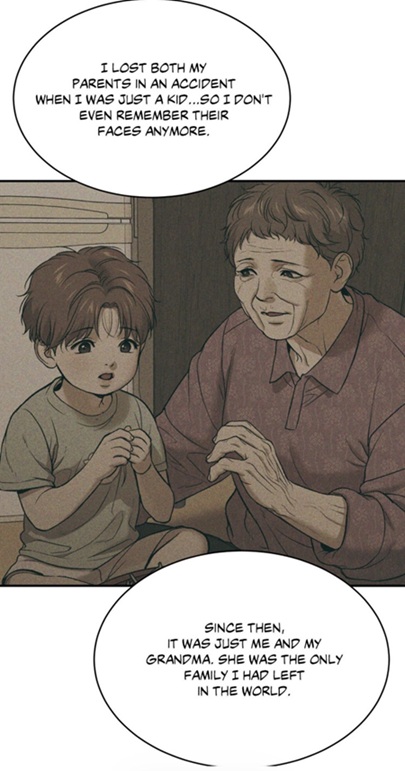
Jinx: Hot 🔥Sparks ⚡, Feverish 🌡️Reality (part 2) (second version)

After the Spark: What Changes Once the Circuit Is Closed?

When episode 86 ends (chapter 86), it does not close the night through narrative resolution. There is no statement, no promise, no verbal seal. And yet, for many Jinx-philes, the final panel refuses to let the scene dissolve. What remains is not heat, not tension, not even tenderness — but circulation.

What caught my attention, on rereading the episode with some distance, is precisely this ending. In the final embrace and kiss, bodies are not merely touching; they are aligned. Kim Dan is neither collapsed nor clinging. Joo Jaekyung is neither looming nor enclosing. Their torsos meet without compression, their heads incline toward each other, and the kiss does not interrupt movement — it completes it. The image does not suggest release, but continuity. Not dispersal, but return. In other words, the final embrace functions as a closed electric circuit, while the kiss operates as the activating spark — not a release, but the moment the current begins to flow.

This detail matters because it reframes the entire night. Earlier nights in Jinx burned intensely and then vanished. This one does not. Heat exhausts itself. Electricity does not. It remains as potential — stored, latent, waiting to be activated. When readers feel that “something has shifted,” they are not sensing emotional climax, but a closed circuit. The night ends, yet nothing needs to be said, because something has already been set.

Under this new light, my perception of relationships in Jinx changed. What had long been read through the language of excess — desire, domination, sacrifice, endurance — began to appear instead through the logic of current: circulation, interruption (chapter 21), overload (chapter 33), short circuit (chapter 51), (chapter 53) reset. And once that lens is adopted, it becomes impossible to limit the consequences of episode 86 to the couple alone. Because a closed circuit does not only affect those directly connected to it. It alters the surrounding system.
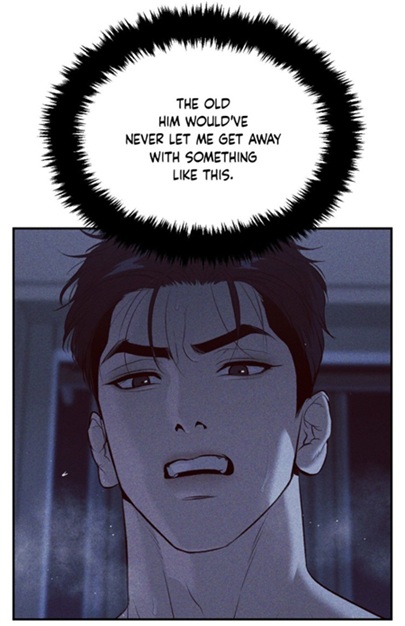
In the first part of Hot Sparks, Feverish Reality, the focus lay on how this night functions in itself: how electricity replaces fire, how illusion gives way to continuity, how silence becomes embodied communication. That analysis allowed us to rethink the nature of the moment. But once the circuit is closed, another question inevitably arises — quieter, but far more consequential: What changes once the night is over?

If the Paris night is not a dream, not a relapse, and not a miracle, then it must be understood as a reconfiguration of conditions. Memory begins to behave differently. Surprise no longer carries the same meaning. The past can no longer be invoked automatically as justification. And responsibility — long deferred — becomes unavoidable.

This second part of the essay therefore turns toward repercussions. To approach them, the analysis will move through four interlinked angles. First, it will examine surprise, returning to the sudden kiss in episode 86. By placing this gesture alongside earlier moments where surprise meant threat or emotional risk, the essay will show how the same structure acquires a different meaning once agency is restored — and why this matters. Second, it will address recognition without erasure, focusing on the line (chapter 86). This section will explore how acknowledging change without denying past harm opens a new ethical position — one that prevents memory from being weaponized, while still preserving responsibility. Third, the analysis will turn to conversion, revisiting earlier nights marked by failure, asymmetry, and isolation. Rather than cancelling them, episode 86 absorbs and transforms them. This is where forgiveness, reflection, and the first true encounter with consequence quietly enter the narrative. Finally, a new section will widen the lens further by examining shared experience and memory (chapter 53), particularly through Kim Dan’s relationship with his grandmother. Here, the focus will not be accusation, but contrast: between memories carried alone and memories held together; between cycles of repetition and moments of presence; between a worldview structured around endurance and one shaped by circulation. The Paris night does not only affect how Kim Dan sees Joo Jaekyung (chapter 86) — it changes how he may begin to situate himself within inherited bonds and unspoken expectations.
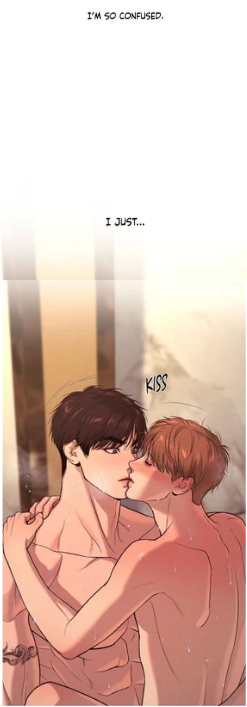
The Paris night did not resolve the story. It changed the system in which the story must now continue. And like electricity itself, its importance will only become fully visible when something — or someone — can no longer function as before.

Surprise Reversed: From Threat to Agency

To understand why the kiss in episode 86 (chapter 86) carries such weight, we must return to the origin of kissing itself in Jinx. Because surprise, in this story, is not an abstract theme. It has a history. And that history begins with a body being caught off guard.
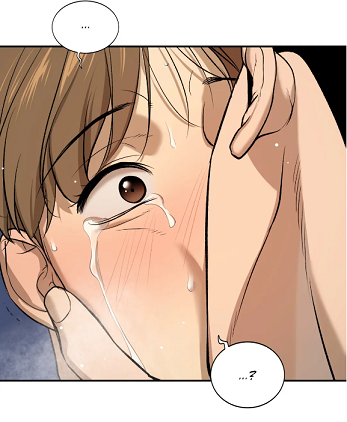
The first time Kim Dan is kissed by Joo Jaekyung, it is sudden. (chapter 14) There is no warning, no verbal cue, no time to prepare. The kiss arrives as interruption. It is not negotiated; it is imposed. Hence the author focused on the champion’s hand just before the smooch. This moment matters far more than it initially appears, because it establishes the template through which Kim Dan first encounters intimacy. (chapter 15) Affection does not emerge gradually. It breaks in.
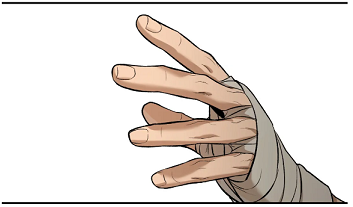
Kim Dan reacts accordingly. Shortly afterward, he articulates a need that is easy to overlook but fundamentally revealing: he asks Joo Jaekyung to tell him before kissing him. (chapter 15) He needs preparation. He needs time to brace himself emotionally. This request reveals two aspects. First, he connects a kiss with love. On the other hand, the request is not really about romance; it is rather about survival. Surprise, for Kim Dan, has already been coded as something that overwhelms the body before the mind can intervene.

And yet, what follows is one of the most striking contradictions in the narrative. Every time Kim Dan initiates a kiss himself (chapter 39), he violates his own request.
His kisses arrive suddenly. (chapter 39) They are unannounced, often landing on unusual places (cheek or ear) (chapter 39) (chapter 44). They often take place under asymmetrical conditions — when one of them is intoxicated, confused, or emotionally exposed. Sometimes they occur without full consent, sometimes without clarity. In chapters 39 and 44, kisses surface precisely when language fails or consciousness fractures. It is as if Kim Dan has internalized a rule he never chose: a kiss must be sudden. Observe how the champion replies to the doctor’s smile and laugh: he kissed him, as if he was jealous of his happiness. (chapter 44) That’s how I came to realize that the kiss in the Manhwa is strongly intertwined with “surprise”. This is the missing link.
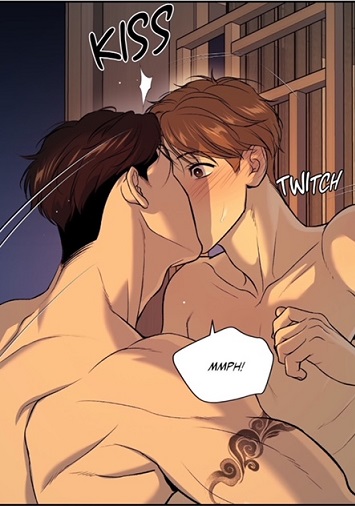
Kim Dan does not merely endure surprise; he learns it. Because intimacy entered his life through interruption (chapter 2), he comes to reproduce interruption as intimacy. He knows that surprise destabilizes him — that is why he asked for warning — but he has no other model. What overwhelms him also becomes what he reaches for. Surprise is both threat and language.

This paradox explains much of Season 1. Surprise is repeatedly associated with danger (chapter 3): the sudden call from the athlete, (chapter 1), the offer of sex in exchange for money (chapter 3), the contract that turns availability into obligation (chapter 6), the switched spray (chapter 49), the sudden changes in rules. These moments strip Kim Dan of anticipation and agency. His body reacts before his will can engage. Surprise equals exposure.
And yet — this is where the narrative becomes uncomfortable — these same surprises also pull him out of ghosthood.

Before Joo Jaekyung, Kim Dan lives in a state defined by repetition and duty. (chapter 1) His life is governed by “always”: always working, always returning, always responsible. He lives for his grandmother. Nothing unexpected is allowed to happen, because nothing unexpected can be afforded. This is safety through stasis. Presence without experience.

But this does not mean that surprise was absent from his past. On the contrary, when unpredictability did enter Kim Dan’s life earlier, it came in its most destructive form: through the loan shark, Heo Manwook and his minions. His appearances were sudden, intrusive, violent. (chapter 5) (chapter 1) They shattered routine rather than enriching it. Surprise, in that context, did not open possibility; it threatened survival. It meant debt, coercion, fear. And precisely because of that, it could not be integrated into memory as experience — only repressed as trauma.
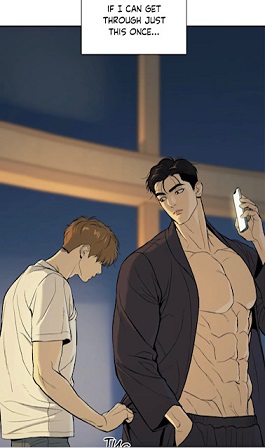
This distinction matters. When Kim Dan’s grandmother is hospitalized and removed from the house, the loan shark also disappears from daily life. His violence becomes something that can be pushed aside, denied, or avoided (chapter 1), if he doesn’t return home. Surprise, in its earlier form, is excised from the household. What remains is a world of repetition and endurance — safer, but lifeless.

Seen from this angle, Joo Jaekyung does not introduce unpredictability into Kim Dan’s life from nothing. He replaces it. (chapter 2) but in a fundamentally different form.

The loan shark embodies surprise without negotiation. (chapter 11) (chapter 11) His appearances are sudden, his demands non-discussable, his violence immediate. He does not ask; he enforces. Surprise, under his rule, eliminates speech. It leaves no space for argument, no room for clarification, no possibility of consent. One endures, or one is punished.
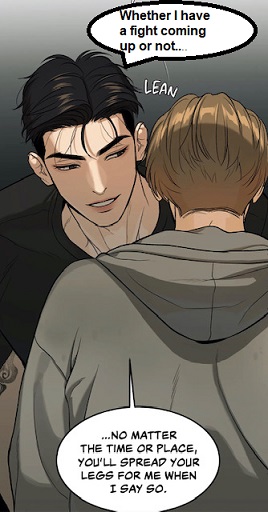
Joo Jaekyung, by contrast, introduces unpredictability through contracts and negotiation. (chapter 6) Even when power is asymmetrical, even when the terms are coercive, speech is required. Conditions are stated. Rules are articulated. Kim Dan is forced to listen, to answer, to argue, to object. He must speak.

This difference is decisive. Surprise no longer arrives solely as terror; it arrives as confrontation. Kim Dan is not merely acted upon — he is compelled into dialogue. The body is still exposed, but language re-enters the scene. Where the loan shark silenced, the athlete imposes discussion.

This is why Joo Jaekyung can occupy the same structural position as the loan shark — and yet not replicate him. Both disrupt repetition. Both break the closed circuit of endurance. But only one does so in a way that keeps Kim Dan within the realm of human interaction. Even coercive negotiation presupposes a subject who can respond.

This also explains the later confrontation in the house. (chapter 17) The two figures cannot coexist because they represent mutually exclusive regimes of surprise: one that annihilates speech, and one that forces it into being. In other words, only one allows experience to be lived rather than survived.

Surprise enters Kim Dan’s life violently, but it does not remain mere rupture. (chapter 2) It functions as negative charge — an abrupt influx of energy into a system that had been closed for too long. Fear, anger, desire, attachment appear not as orderly developments, but as shocks. These experiences are unstable, often painful, sometimes destructive (chapter 51) — yet they are unmistakably his. They mark the moment when something begins to circulate. (chapter 51)

This distinction is crucial. Before Joo Jaekyung, Kim Dan’s life operated in a static loop, governed by repetition, sacrifice, and gratitude. Energy was expended, but never transformed. Surprise, in its first incarnation, is therefore pure threat: uncontained, overwhelming, incapable of integration. It breaks the system without yet allowing current to flow.

What changes with Joo Jaekyung is not the presence of danger, but its conductivity. Surprise becomes ambivalent — still risky, still destabilizing — but now capable of generating movement and as such meditation. Negative charge no longer annihilates the circuit; it begins to activate it. (chapter 27) Experiences accumulate instead of disappearing. They demand response, speech, negotiation. Life no longer consists in enduring impact, but in processing it.

This is why these experiences cannot be shared with Kim Dan’s grandmother. Her moral economy is built on infantilization (chapter 65) and as such neutralization: suffering must be absorbed, pain must be justified, disruption must be folded back into endurance. There is no place for charge there — only for dissipation. What Kim Dan lives through with Joo Jaekyung follows a different logic altogether: not sacrifice, but circulation; not repetition, but conversion.

Surprise thus becomes the hinge not between danger and safety, but between static survival (–) and relational movement (+). And once that conversion begins, the past can no longer be returned unchanged — nor can it be shared without transformation.

This is why Kim Dan falls in love (chapter 41) not despite surprise, but through it. Not because dominance is romanticized, but because surprise is the first force that treats him as someone to whom things can happen. And don’t forget that for him, a kiss symbolizes affection. Even negative experiences generate subjectivity. They prove that he exists beyond function.

Seen through this lens, Kim Dan’s habit of surprising Joo Jaekyung with kisses (chapter 39) — on the ear or the cheek — is no longer random or contradictory. It is learned behavior. He has absorbed surprise as a mode of relation. What was once done to him becomes something he does, imperfectly and often prematurely. These kisses are not about dominance. They do not corner or silence. They test connection. They ask, without words: Are you still here?

But until episode 86, this structure remains unresolved. Surprise exists, but it is never fully safe. (chapter 85) Kim Dan either endures it or reproduces it under unstable conditions. Agency is partial. Meaning collapses afterward.

This is what makes the doctor’s kiss in Paris categorically different. (chapter 86)

Formally, it is still sudden. Kim Dan does not announce it. He does not negotiate it verbally. But structurally, everything has changed. For the first time, surprise is not imposed on him — and it is not enacted from confusion or imbalance. It is chosen. Kim Dan is clear-minded enough to recognize both his desire and his uncertainty. He is not dissociating. He is not reacting. He is deciding to remain present despite risk. And the response confirms the shift.

Joo Jaekyung does not neutralize the kiss with passivity (chapter 39), irony (chapter 41) or rejection (chapter 55). He does not retreat into his habitual “it’s nothing” or “never mind.” He does not reinterpret the gesture as convenience or reflex. (chapter 86) He kisses back while looking tenderly at his partner. He holds Kim Dan’s head gently. He can only see such a gesture as a positive answer to his request: acceptance and even desire. Surprise is not punished. It is received.
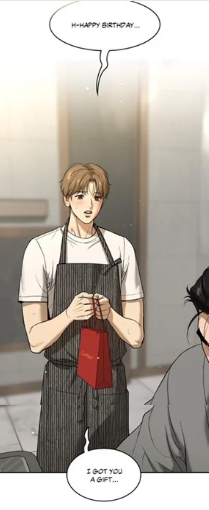
This is the moment where the meaning of surprise reverses. Surprise no longer equals threat. Surprise becomes agency. And that’s how I could discover a link between the kiss and the doctor’s birthday present, the key chain. (Chapter 45) This time, the athlete not only accepts the present (the kiss), but but also expresses “gratitude” by kissing back actively. (Chapter 86) This means that the athlete is recognizing the existence of feelings.

The kiss does not erase the past. (Chapter 86) It does not retroactively justify earlier violations. But it establishes a new condition: surprise can now occur without annihilation. Intimacy can arrive without silencing reflection. Experience no longer collapses into shame or disappearance. IT symbolizes a positive and enjoyable moment.

This is why the kiss matters more than any spoken line in the episode. It is not simply romantic. It is structural evidence that the logic governing their interactions has changed. Surprise now operates within a closed circuit of consent and presence.

Kim Dan is no longer a ghost enduring interruptions. He is a subject capable of initiating them. He has learned surprise — and now, for the first time, he reclaims it. Under this new condition, the question is no longer whether surprise will hurt. It is whether life can proceed without it. And once that question is raised, the story cannot return to repetition or silence.

Recognition Without Erasure: When Memory Changes Function

What struck me next was how subtly episode 86 reorganizes the role of the past. Once surprise ceases to function purely as threat and begins to circulate, memory itself starts behaving differently. Electricity does not only move bodies; it redistributes charge. And it is precisely at this level — the level of memory and recognition — that something decisive occurs.

The line is brief, almost casual: (chapter 86) And yet it performs an extraordinary operation. Kim Dan does not deny the past. He does not soften it. He does not excuse it. Instead, he repositions it. For the first time, the past is no longer invoked as an absolute reference point, but as a differentiated state — one phase among others. Such a confession contradicts the grandmother’s philosophy: ALWAYS (chapter 65) In her eyes, she has never changed, just like her grandson. (chapter 65) If there were changes, they were associated with trouble and worries.

This distinction is crucial, because in Jinx, the past has long functioned like a blunt instrument. It has been used to fix identities (chapter 52), justify behavior (chapter 57), and foreclose change. The champion’s violence is explained through reputation. (chapter 1) Kim Dan’s endurance is explained through obedience and debt. The grandmother’s authority is explained through sacrifice. In every case, the same logic applies: this is how it has always been; therefore this is how it must remain.

That logic is static. Electrically speaking, it is a circuit without polarity — no – and +, no tension, no movement. The past becomes a dead weight, not a source of information. It does not inform the present; it dominates it.

What episode 86 introduces is not forgiveness in the sentimental sense, but recognition without erasure. (chapter 86) Recognition means the charge of the past remains. Erasure would mean grounding it, neutralizing it, pretending it never existed. Kim Dan does neither. He keeps the – while allowing the + to emerge.

A World Without Polarity: When the Past Becomes a Weapon

This is where the electrical metaphor becomes indispensable. In a functioning circuit, negative and positive do not cancel each other out. They coexist. They create potential difference. And it is that difference — not harmony — that allows current to flow. (chapter 86) In the final panels, Kim Dan does not embrace an idealized version of the champion, nor a redeemed figure cleansed of history. He embraces Joo Jaekyung as he is now, with the knowledge of who he was before. This distinction matters. Acceptance here is not absolution. It is contact without denial.

Electric current does not pass between identical charges. It requires tension. Polarity. Resistance. The − and the + must remain distinct, or nothing moves. In this sense, Kim Dan’s embrace is not a gesture of harmony but of recognition. He acknowledges the champion’s flaws and mistakes — not to excuse them, but to stop pretending they never existed or to stop pretending to be better. What he accepts is not the past itself, but the reality that the past does not exhaust the present. That’s why he is able to stop ruminating and to follow his heart.

Furthermore when Kim Dan recognizes that “the old him” (chapter 86) existed, he does not collapse the timeline. He does not say: he was never that person. Nor does he say: he is forever that person. Instead, he introduces temporal polarity. Then and now. Before and after. – and +.

This move has immediate consequences. First, it disarms the past as a weapon. (chapter 65) If the past is absolute, it can be endlessly invoked to invalidate the present. We have a perfect example on the beach. (chapter 65) Kim Dan is here compared to the past. (chapter 65) When Shin Okja speaks of Kim Dan as a heavy smoker, she is not recounting a neutral habit. She is anchoring him to a past version of himself — one defined through worry, decline, and deviation from the “good boy” image.

What follows is telling. She does not ask why he smoked. She does not ask what changed. She does not ask how he lived. The only question that matters to her is: “Does he still smoke?” (chapter 65)

The present is interrogated exclusively through the past. In this logic, the past functions as a fixed reference point. If the habit persists, the present confirms her narrative. If it does not, the absence is not read as growth but as an anomaly — something provisional, something that could always return. This is not concern. It is classification.

Shin Okja does not relate to Kim Dan as someone moving through phases, but as someone who must remain legible within a stable moral category. Change is not interpreted as development, but as risk. When Shin Okja repeatedly frames Kim Dan’s smoking and drinking as failures (chapter 65), she is not simply expressing concern about health. She is doing something more consequential: she is disqualifying the legitimacy of his decisions. In her discourse, Kim Dan’s actions are never treated as choices made under pressure, pain, or circumstance. (chapter 65) They are evaluated exclusively through a moral lens. Smoking and drinking are not responses; they are flaws. And because they are framed as flaws, they retroactively define his character rather than his situation. This is where agency collapses.
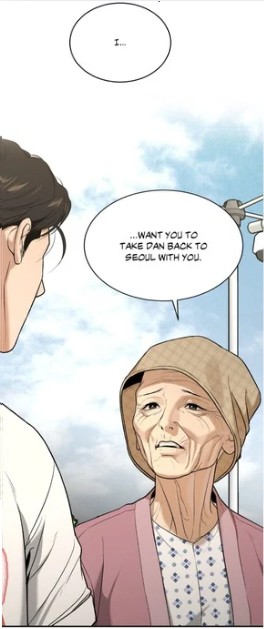
Care and Choice

If every decision Kim Dan makes is already interpreted as “bad,” then decision-making itself becomes suspect. Choice is no longer a neutral capacity; it is something he is assumed to misuse. In other words, he is not someone who chooses poorly — he is someone who should not be choosing at all. Under this new light, my avid readers can grasp why the grandmother approached the champion and asked for this favor: (chapter 65) Her behavior does not contradict her claim that she wants Kim Dan to “live his own life.” (chapter 65) It reveals how she understands such a life should be arranged. She sees herself as superior, as if she had never done any mistake, as if she had lived as a saint.
If she had truly accepted Kim Dan as a subject capable of self-direction, she would have spoken to him directly. Conversation presupposes agency; it allows disagreement, hesitation, and refusal. Instead, she chose a different route: influencing his fate behind his back. This move preserves her moral position while bypassing the risk of confrontation. It allows her to believe she is acting in his interest without ever having to acknowledge his will. That’s why she is entrusting her grandson to the athlete. (chapter 78)

In other words, she does not imagine Kim Dan living freely through his own choices, but being placed into a better configuration by others — preferably by someone stronger, more decisive, and more visible than himself. The request to the champion thus follows the same logic that governs her judgment of Kim Dan’s habits: she does not trust him to choose, only to comply.

And this is precisely why her worldview stands in quiet opposition to what unfolds in episode 86. The physical therapist’s desires are not only acknowledged, but also respected. (chapter 86) Once again, the “hamster” is given the opportunity not only to decide, but also to follow his heart. Where the Paris night allows difference to coexist with memory, Shin Okja’s framework collapses difference back into judgment. Where electricity requires polarity, her logic insists on sameness. Under this new light, it becomes comprehensible how doc Dan came to neglect himself. Self-care is inseparable from choice — from the belief that one’s decisions can meaningfully alter the present. If change is denied, care loses its purpose. Attending to oneself becomes optional, even suspect, because it implies a future different from the one already prescribed.

Recognition without erasure breaks that pattern. It allows Kim Dan to say, implicitly: what happened matters — but it does not get to decide everything.

Second, this recognition introduces responsibility where there was previously only fatalism. If change is possible, then it can be acknowledged. And if it can be acknowledged, it can be responded to. The past no longer excuses inaction. It no longer absolves neglect. It becomes a reference, not a refuge.

Two Versions, One Person: Temporal Polarity and Ethical Clarity

By acknowledging that there is an “old him” (chapter 86) and a present one, Kim Dan implicitly accepts that change has causes. And this is where his position shifts in a way that is easy to miss. If Joo Jaekyung has changed, then Kim Dan is not obligated to assume that he is the reason. He does not interpret the change as something he must earn or preserve through obedience.

Instead, a question becomes possible: what happened in between? And this question matters, because Kim Dan does not know. He does not know about the incident at the health center. He does not know about the slap at the hospital (chapter 52). He does not know that no one stood by the champion afterward — not even Potato.

By recognizing two versions of Joo Jaekyung, Kim Dan opens a space for inquiry rather than self-accusation. The change no longer needs to be attributed to his own sacrifice. It can be understood as something that also happened to the champion. This is not naivety. It is ethical clarity. Consequently, I perceive the night in Paris as the end of doc Dan’s low self-esteem and shame.

It also means that if anyone were to invoke the champion’s past against him — a manager, a coach (chapter 57), the system — Kim Dan can now side with him without denying what came before. The past stops being a weapon. It becomes context. This move has immediate consequences.

This shift is subtle, but it radiates outward.

Until now, Kim Dan has often carried memory alone. He remembers nights that others forget. He remembers moments that were dismissed. This asymmetry has turned memory into burden. (chapter 44) The one who remembers bears the – alone, while the other continues forward unmarked. That imbalance is corrosive. It distorts perception. It turns even good memories sour.

Episode 86 begins to redistribute that charge. Not by forcing confession, but by establishing shared presence. Once current circulates between two points, no single node carries the full load. Recognition does not mean recounting every wound; it means no longer isolating the wound in silence.

This is why the line about “the old him” matters more than it appears. It is not merely observational. It is infrastructural. It signals that memory is no longer trapped in a single body.

And this logic does not stop with the champion. It extends, inevitably, to Kim Dan’s relationship with his grandmother, like mentioned above.

Her worldview has long been organized around moral continuity. She remembers suffering (chapter 65), but she remembers it in a way that flattens time. Pain becomes proof of virtue. Sacrifice becomes identity. (chapter 65) Change is allowed only insofar as it returns to the same point. Electrically speaking, her system is grounded — all charge dissipates into endurance. There is no polarity, only repetition.

This is why the past, in her discourse, often appears as reproach. Not necessarily spoken harshly, but structurally unavoidable. You used to drink. You used to smoke. You used to be helpless. The past is not cited to understand, but to fix position. It anchors Kim Dan to a role: the one who must be protected, managed, or sent away “for his own good.”

Recognition without erasure offers Kim Dan a way out of this bind. If the past is no longer absolute, then it can be questioned. Not denied — questioned. The statement “you don’t know me and my life” becomes thinkable. Not as rebellion, but as differentiation. Kim Dan can hold the memory of his past while refusing to let it define his present. He can acknowledge the grandmother’s suffering without allowing it to dictate his future.

This is where forgiveness enters the narrative — quietly, without ceremony. (chapter 86) Forgiveness here is not reconciliation. It is not forgetting. It is not moral absolution. It is the decision not to collapse polarity. To allow – and + to coexist without forcing resolution. Forgiveness becomes a form of electrical insulation: it prevents overload, not by cutting the circuit, but by stabilizing it.

Seen this way, forgiveness is not weakness. It is structural maturity. And it has consequences. For Kim Dan, it means the past no longer monopolizes his self-understanding. He is not bound to prove gratitude through self-erasure. He can recognize care without submitting to control. He can accept gifts and help without dissolving into debt.

From Spark to Current: Why the Jinx Loses Its Power

For Joo Jaekyung, it means the jinx can no longer function as fatal explanation. (chapter 65) Even though the word jinx is never spoken during the Paris night, its logic quietly collapses there. (chapter 86)
Until now, sex operated as discharge. (chapter 75) In chapter 75, it is explicitly framed as a way to “clear the head”: an act designed to release pressure and return the system to zero. Partners were interchangeable. Feelings were excluded. Electricity existed only as a spark — brief, violent, and self-extinguishing. Energy was expelled, not circulated. That is the true mechanics of the jinx: power without continuity, intensity without consequence.
Paris introduces a different configuration. Sex is no longer oriented toward erasure or reset. It is no longer about escaping thought or silencing memory. Instead, it becomes a mode of presence. (chapter 85) Desires matter, not the match the next morning. Besides, the identity of the partner matters — not just romantically, but also structurally. Current requires two poles. It requires response. It cannot flow through an object, only between 2 subjects.
This is why the jinx does not need to be confronted explicitly to be undone. A system built on discharge cannot survive circulation. Once energy is no longer expelled but sustained, once tension is held rather than neutralized, fatalism loses its grip. The spark does not burn out; it becomes current.

And with current comes consequence. Sex no longer clears the mind; it sharpens awareness. It no longer abolishes the future; it implies one. What happens in Paris does not redeem the past — it renders repetition impossible. Reflection becomes unavoidable, not because someone demands it, but because the system no longer resets cleanly.

The jinx dissolves not through force, but through continuity. Recognition without erasure thus prepares the ground for the final transformation: conversion. Thus the story can move forward.

– and – = + : Conversion and the End of Ghosthood

Two nights once marked by failure — chapter 39 (chapter 39) and chapter 44 (chapter 44) — converge in episode 86. This convergence is not coincidental, nor is it nostalgic. It is a conversion.

Both earlier nights shared the same fatal structure: only one person remembered. In chapter 39, Kim Dan’s confession existed without continuity; his body spoke, but his memory did not follow. In chapter 44, the reverse occurred: Kim Dan remembered everything, while Joo Jaekyung attempted to forget. In both cases, memory became asymmetrical. One carried meaning; the other escaped it. And meaning, when carried alone, curdles. What might have been tenderness transformed into obsession, shame, or bitterness. Memory became burden.

Episode 86 breaks this curse through a gesture that is deceptively simple: both remember. (chapter 86) Both made surprising experiences: dry orgasm and a gentle and caring sex partner.

This is why simultaneity matters so profoundly. Sparks appear on both bodies. Confusion is mutual. Questions circulate rather than collapse inward. Neither consciousness outruns the other. Time, which had previously fractured under intoxication, coercion, or denial, resumes its flow. Not because the past is resolved, but because it is finally shared. Shared experience.

Here, memory begins to function differently — no longer as fixation or haunting, but as integration.

This shift allows us to recognize a much older pattern in Kim Dan’s inner life. His relationship to memory has always been selective, but not arbitrarily so. When it comes to his grandmother, Kim Dan remembers each interaction with his grandmother in a positive light: the warmth (chapter 11), the care – even if he had hurt himself – (chapter 47), the shared smiles (chapter 47). Thus this photograph (chapter 65) becomes a talisman — not a record of reality, but a distilled image of safety. Painful dimensions are filtered out. Conflict, coercion, and silent pressure recede into the background. Memory protects him by idealizing. Because of this picture, he projected himself in the future, making unrealistic plans. (chapter 47) It was, as if he only had good times with his grandmother.
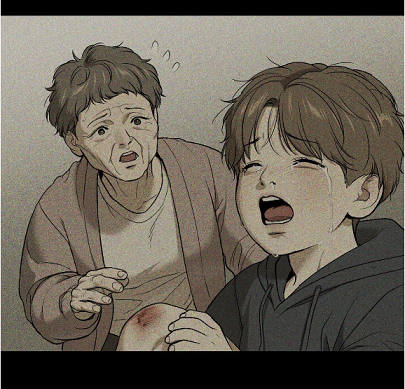
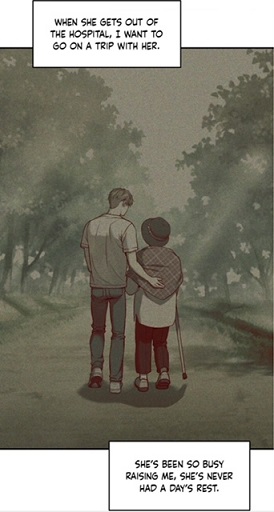
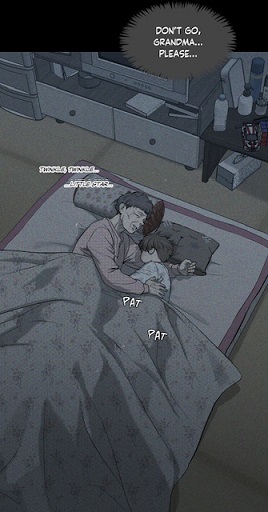
Shin Okja, by contrast, remembers the same past through a radically different lens. (chapter 65) Her recollection is saturated with pity, loss, fear (chapter 65), and blame (chapter 65). The vanishing of the parents becomes the gravitational center around which all other memories orbit. Where Kim Dan remembers warmth, she remembers danger. Where he remembers protection, she remembers failure. One memory soothes; the other hardens. One preserves life; the other polices it. Kim Dan must remain the “good boy,” unchanged, because acknowledging his growth would mean acknowledging that the past did not remain intact.

The graduation photos make this painfully clear. They immortalize achievements, (chapter 47) not shared experiences. They resemble press photos of the champion more than lived moments. The work, the strain, the cost are absent. And tellingly, Kim Dan does not keep these pictures. They do not anchor memory; they flatten it. They freeze time rather than allowing it to move.

This asymmetry is crucial. It reveals that the relationship between Kim Dan and his grandmother has always mirrored the structure of those failed nights: one person remembers in a way that helps to keep working, the other remembers in a way that poisons (infantilizing doc Dan). One idealizes; the other condemns. And because the tragedy at the center of their past was never fully spoken, memory could not be synchronized. Kim Dan was pushed — silently, indirectly — to carry an idealized version of their shared life, while Shin Okja carried the unresolved catastrophe alone. (chapter 65) Toxic positivity emerges precisely here: not as cheerfulness, but as enforced idealization that denies the legitimacy of pain, anger, or differentiation.

And it is precisely here that the connection with the grandmother crystallizes. The latter is often connected to sleep (chapter 21) (chapter 47) and memories. (chapter 21) (chapter 65). While sleeping, memories come to the surface.

Only at this point did something else catch my attention — something that, retrospectively, had been present all along. The painting in the living room: (chapter 85) I believe that its appearance does not function as decoration. Its imagery — figures suspended among clouds, bodies neither falling nor grounded — introduces a different register of time. Not urgency. Not performance. Not spectacle. Stillness. Interval. A space where movement pauses without collapsing. Under this new light, the reference is Morpheus.
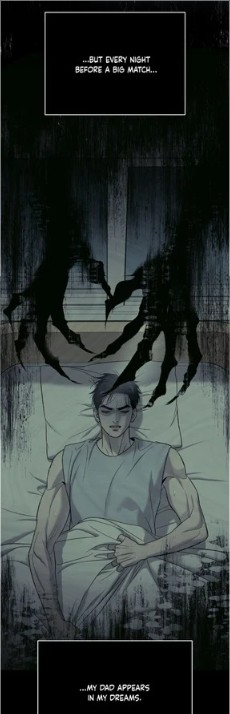
Morpheus is not the god of illusion. He is the one who allows rest, who brings form to dreams so the body can sleep. His presence signals not escape from reality, but the possibility of restorative sleep. This matters, because insomnia has haunted Joo Jaekyung from the beginning. (chapter 75) Until now, rest had been replaced by discharge: sex as erasure, violence as exhaustion, ritual as compulsion. The Paris night does not abolish wakefulness through collapse; it introduces the conditions under which sleep might finally be possible.
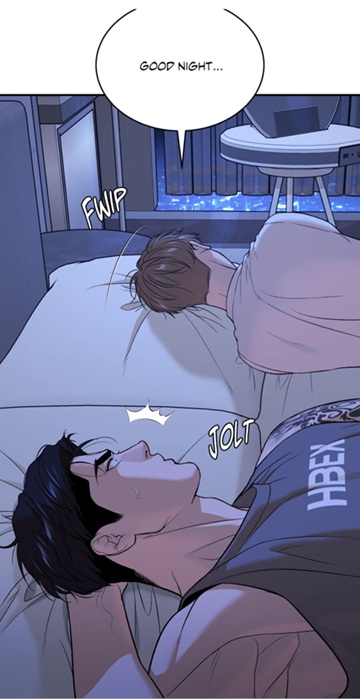
Episode 86 introduces a third possibility: the kiss of Morpheus or the famous goodnight kiss. (Chapter 86) What caught my attention is that the athlete was irritated, when the doctor simply wished him a good night. (Chapter 78) Here, he reduced it to the absence of sex, but I am sure that deep down, he would have been satisfied, if the “hamster” had given him a good night kiss.
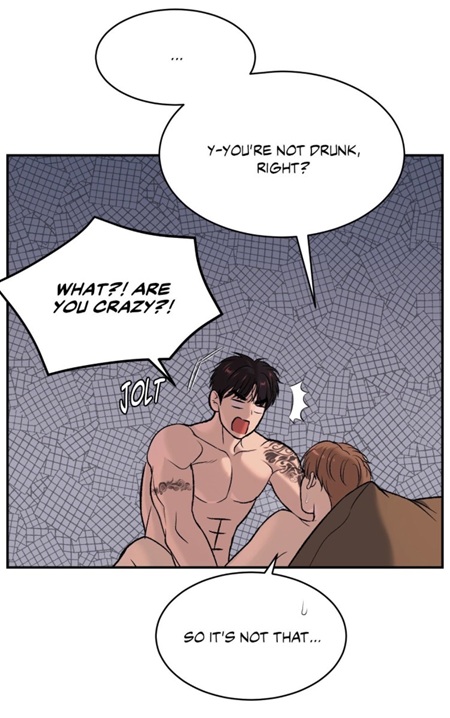
The Paris night does not ask either character to idealize or to condemn. (chapter 86) It does not demand that the past be redeemed, nor that it be endlessly rehearsed. (chapter 86) Instead, it contextualizes. Memory is no longer absolute; it becomes temporal. Then and now. (chapter 86) Before and after. – and +.

This is why the electrical metaphor reaches its full force here. Two negatives do not annihilate each other. They convert. The shared remembering of two previously failed nights produces not cancellation, but potential. (chapter 86) The charge redistributes. Memory ceases to isolate and begins to circulate. Hence it creates a new memory.

It is at this point that Prometheus quietly enters the scene — not as explicit mythological references, but as symbolic functions. Electricity, like fire stolen from the gods, marks a return to humanity. It is the end of purely divine punishment and purely mechanical survival. At the same time, illusion dissolves. Sleep, dream, and dissociation lose their grip. The characters are no longer ghosts moving through each other’s lives, nor zombies repeating ritualized behaviors. They become human again — vulnerable, reflective, embodied. And once human, reflection becomes inevitable.

The night itself remains carpe diem. It is presence without calculation, sensation without projection, intimacy without bargaining. For those hours, the future does not intrude. But this does not mean consequence is erased. On the contrary: because the night is no longer an illusion, its aftermath must be faced. The jinx has not disappeared because its existence was not mentioned or danger is gone. Corruption, rigged matches, replacement, and blacklisting still await. What has changed is not the external threat, but the internal configuration.

The Paris night did not save the protagonists. It returned them to themselves. And this return has consequences beyond the couple. It destabilizes the grandmother’s moral economy. This new observation reinforces my previous interpretation: this position (chapter 86) was a reflection of the picture. (chapter 65) Shin Okja is no longer doc Dan’s center of gravitation. That’s the real revolution. There is no longer interruption or triangulation. I am even inclined to think, that’s the night where the main leads became a true team.

Moreover, if memory can be shared without collapsing into blame, then her version of the past can no longer function as unquestionable authority. (chapter 65) If Kim Dan no longer needs to idealize in order to survive, then he can finally see the cost of that idealization — for himself and for her. The tragedy she alone has been carrying can surface, but without demanding that he sacrifices his present to it. The past stops being a sealed vault and becomes a shared, albeit painful, terrain.

This is the true end of ghosthood. That’s why doc Dan is feeling feverish during that night. (chapter 86) No one is erased or reduced to an object. Nothing is overlooked or forgotten. But repetition loses its hold. And from here, the story can no longer proceed as before.


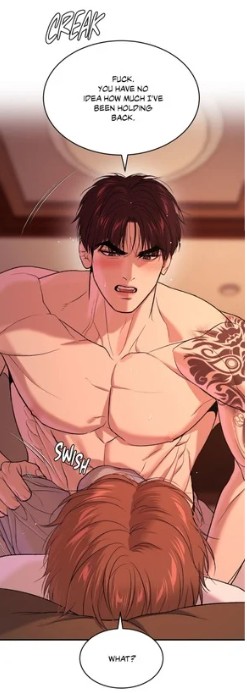
Feel free to comment. If you have any suggestion for topics or Manhwa, feel free to ask. If you enjoyed reading it, retweet it or push the button like. My Reddit-Instagram-Twitter-Tumblr account is: @bebebisous33. Thanks for reading and for the support, particularly, I would like to thank all the new followers and people recommending my blog.

Jinx: The Sweetest 🍭 Downfall 🧴🪮Ever

Notice: Right now, I am quite overwhelmed with work (grading papers, staff meetings etc), hence I can only write one essay after each episode.

Introduction – Where it begins

I have to admit that I had not anticipated a smut-scene in episode 85. On the other hand, it makes sense, for it is the night before the match, it is jinx-time. At the same time, their physical reunion (chapter 85) represents the positive reflection of this night (chapter 58) (chapter 58) (chapter 58), when the physical therapist chose to give up on the athlete and stop listening to his heart. Here, I am not only referring to the numerical symmetry but also to the doctor’s shifting vision of Joo Jaekyung.

In both episodes 58 and 85 (chapter 85), Jaekyung appears with a towel around his neck. This simple object evokes water and sweat, but in Jinx, these elements are never neutral. They are tied to one of the champion’s earliest traumas: the humiliation of being called “dirty” (chapter 75) and “smelly” as a child. This is why Jaekyung learned to perfuse his body with cologne after every shower (chapter 75) and why physical proximity has always carried the risk of shame. Hence he kept people at arms length. In chapter 40, when he rescued Kim Dan from the security guards, he kept his distance (chapter 40) — he had not yet showered, for the towel on his shoulders was stained with blood. Mingwa was indirectly referring to the champion’s psychological wounds. (chapter 40) It was, as if the fear of smelling “wrong,” of being perceived as contaminated, was still dictating his movements. Hence he could only claim doc Dan as one of his own, but not as his “physical therapist” or even “family”. And interesting is that doc Dan copied his attitude. In the hallway, he maintained a certain distance from the athlete. (chapter 40)

But in Paris, the presence of that same towel (chapter 85) suggests something very different. He has just stepped out of the shower, which means he is clean, his hair hanging down, still wet. (chapter 85) This striking detail is that he clearly left in a hurry: contrary to all earlier scenes where he sprayed himself with cologne (chapter 40) the moment he dried off (chapter 75), here he has not perfumed himself at all. (chapter 85) His hair is unstyled, his scent unmasked — and yet he approaches Dan without hesitation. He even kisses him. The item that once symbolized rejection now signifies trust: without fragrance, he is certain that doc Dan will not call him “dirty,” will not recoil, will not shame him. What once provoked distance becomes an unexpected bridge, revealing that Jaekyung is finally letting someone remain close, when he feels most vulnerable. The night in Paris does not simply suggest a return of desire; it announces the return of hope (chapter 85) and trust — and perhaps even the moment when Dan chooses, for the first time, to be honest with his own body and heart.
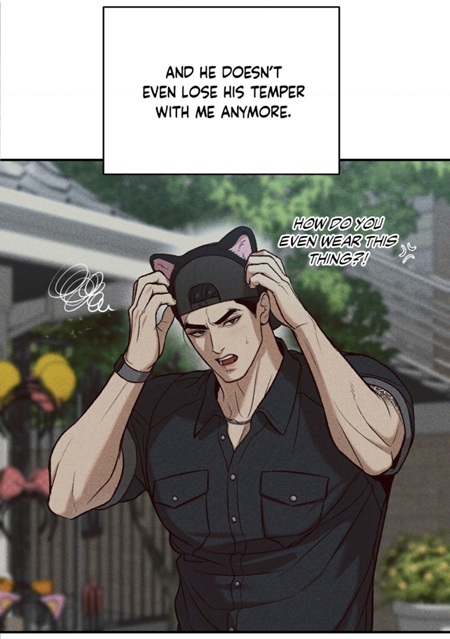
And yet — hidden beneath the sensual reunion and the echo of that earlier night — something else begins to unravel. Something softer, sweeter, far more dangerous for a man who once prided himself on standing above everyone else. For the first time, we witness the champion’s downfall — not a collapse of strength or dignity, but the collapse of the walls he spent years building. A downfall so gentle that it goes almost unnoticed, except by the one person who has always watched him closely: Doc Dan. (chapter 85)

After all, it takes a certain kind of irony for a man called “the Emperor” to experience his most significant fall at the very moment he carries someone else to bed (chapter 85) — fulfilling, without knowing it, a secret wish the physical therapist has harbored since childhood (chapter 61) [I will elaborate it further later]. And perhaps this is why the moment feels so disarming: because the downfall is not tragic but tender, not humiliating but intimate. Sweet, even.

But to understand why this ‘downfall’ is the sweetest one Joo Jaekyung has ever lived, we must first return to the moment it truly began — not in the bedroom, but hours earlier at the dinner table (chapter 85), when a single careless comment shattered the champion’s composure and revealed just how fragile his newfound hope really was.

The First Tremors

What caught my notice is that the physical therapist is the only one wearing the jacket with Joo Jaekyung on it! (chapter 85) In contrast, both Park Namwook and coach Jeong Yosep wear generic MFC T-shirts. (chapter 85) Mingwa is not simply dressing characters — she is revealing loyalties. The manager and coach are aligned with the institution MFC; Dan alone is aligned with the man, Joo Jaekyung. This quiet visual contrast already hints at the emotional imbalance that will unfold in the next few panels.

The first tremor begins at the dinner table, where the manager suddenly brings the physical therapist back to reality. (chapter 85) Dan is lost in his thoughts — anticipating the night ahead with the champion — and has barely touched his food. Park Namwook notices this. One might think, such a remark displays the manager’s concern for the main lead’s well-being. However, the manager adds that the other members of the team are all almost finished. With such a remark, it becomes clear that the manager is urging the protagonist to finish his plate. Although Park Namwook addresses Dan as if showing concern, the content of his remark betrays his true priority: not Dan’s well-being, but the team’s schedule. By pointing out that ‘the rest of us are almost finished,’ he urges Dan to keep pace, treating him as staff who had to follow the group rather than someone with personal needs. As you can sense, schedule is essential for the manager. However, because doc Dan couldn’t reveal the true reason behind his behavior, he gives an excuse for his lack of appetite. (chapter 85) He merely says he feels “a little queasy.” The irony is striking. In English, queasy is not a neutral word: it suggests nausea, a churning stomach, a sensation often associated with disgust or repulsion. And although Dan’s discomfort has nothing to do with Jaekyung, the word itself carries an emotional weight the champion is highly sensitive to. It brushes against an old, unhealed wound — the childhood humiliation of being called “dirty,” “smelly,” or somehow “wrong.” But doc Dan was not telling the truth, this explains why the main lead refused the medication from the manager right away. (chapter 85) As you can see, the first disturbance comes from Park Namwook. But this doesn’t end here.
He questions the physical therapist — not the fighter — and asks whether he is nervous about tomorrow’s match. The question is innocent, but its implications are not. By speaking to Dan rather than to Jaekyung, Park is unconsciously revealing his neglect toward his boss and champion. Secondly, with this remark “That’s understandable, since it’s been a while for you”, he reminds the champion of two things which have been tormenting him: not only the last match with Baek Junmin and Doc Dan’s vanishing, but also their night together before the Baek Junmin match, when Dan left after sex without looking back. (chapter 53) The manager’s words bring Joo Jaekyung back to reality and its uncomfortable truth that Dan’s presence now is still bound to a contract — temporary, contingent, never fully his. In other words, with his remarks, Park Namwook is reopening old wounds which shows his total blindness and lack of finesse and of empathy. He treats the last match, as if nothing bad had happened. The incident with the switched spray is simply erased.

Thus Jaekyung’s reaction is immediate: his mouth tightens in visible dissatisfaction. (chapter 85) It is a controlled expression, not a loss of composure, but it reveals irritation and intense gaze — the kind that arises when a sensitive subject is touched too directly. Park’s comment awakens a memory whose meaning has changed: back then, he accepted Dan (chapter 53) leaving without thinking; now, after Dan vanished from his life entirely, that earlier departure feels like a sign he failed to read. Park’s question brushes against this bruise, and Jaekyung’s lips reflect the discomfort.

As for the second tremor, it does not come from Park Namwook. It comes from Potato. (chapter 85) The younger fighter suddenly bursts into panic, declaring how nervous he would be in Jaekyung’s place, how his heart would be pounding out of his chest. His outburst is sincere, naïve, and completely focused on the champion — he never once considers Dan’s feelings. Yet these words strike deeper than he intends. At the mention of a pounding heart, Jaekyung’s eyes lift upward in a brief, involuntary movement. It is the smallest gesture, but it exposes everything he wishes to hide. Because his heart is pounding — but not for the match. It is because of doc Dan!
Potato unknowingly names the very thing Jaekyung is trying to keep steady: the nervousness and anticipation of the night ahead, the fear that history might repeat itself, and the desire that has been building for a long time. Unlike Park’s comment, which triggered irritation, Potato’s words hit the emotional center. This upward glance is the second tremor, the moment the façade slips just a little too far. Surrounded by people who see everything except the truth, Jaekyung reaches for the one thing he can control. He taps his phone and, in full view of the table, sends a message to Dan: (chapter 85) “Come to my room at 11.”

It looks like dominance, but it is driven by something far more fragile: (chapter 85) the need for reassurance, the wish to rewrite the pattern of the past, the quiet hope that Dan will not leave him again — not tonight and not afterwards.

This is where the Emperor’s downfall begins: with a tightened mouth, an upward glance, and a message sent to steady a heart that refuses to stay calm.

The Long Wait

If the dinner scene revealed the cracks in the champion’s composure, it also exposed something equally revealing about the manager. For Park Namwook, the real opponent is not Arnaud Gabriel — it is time. This explicates why the manager announces their departure at 7.00 am sharp, though the Emperor’s match is at noon. (chapter 85) Schedules are his armor, punctuality his hiding place. Whenever something threatens to slip beyond control, he retreats behind procedure.

This is why he suddenly takes an interest in Dan’s appetite. (chapter 85) His comment about the untouched plate is not born of concern; it is born of urgency. The faster Dan finishes, the sooner the table can be dismissed, and the sooner Park Namwook can send the champion to his room under the comfortable pretext of “rest.” (chapter 85) For him, “rest” is not a recommendation —
it is a containment strategy. This explains why the manager is not looking at the Emperor, when he tells him: “Jaekyung, go to bed early tonight, okay?”. Why? Because he doesn’t want a discussion. If he avoids eye contact, Jaekyung cannot object — the instruction is meant to be received, not answered. He is expecting obedience, nothing more. Therefore it is not surprising that the manager smiles (chapter 85), as soon as the athlete stands up right after his recommendation and announces he is now returning to his room.

Once Jaekyung is hidden behind a hotel door, quiet and unmonitored, nothing can be blamed on the manager anymore. If the champion sleeps poorly? Not his fault. If he feels sick? Not his fault. If emotions become volatile? Certainly not his fault. He will always be able to say: “I told him to go to bed early.”

What he wants is not Jaekyung’s well-being. What he wants is a clean conscience. But we have another example for his flaw. (chapter 85) A day and night without complications. A scenario in which no one can accuse him of negligence, if something goes wrong tomorrow. And Mingwa already exposed this flaw only seconds earlier. When Dan finally gives an excuse for his lack of appetite — “I’m feeling a bit queasy…” — the manager immediately reframes it as Dan’s recurring personal weakness: “It’s too bad you have trouble eating whenever we go abroad…” (chapter 85) With this single sentence, he erases the actual causes of Dan’s digestive problems — the fact that the therapist had been mistreated, overworked, stressed, ignored, even drugged during their last trip to the States. None of that exists in Park Namwook’s mind. In his version of reality, Dan’s discomfort is an inconvenience, not a symptom of mistreatment.

And here, his solution reveals everything: he immediately offers medication. Not help. Not care. Not attention. He treats doc Dan the same way than Joo Jaekyung. (chapter 54)

A pill — the fastest way to silence discomfort without having to see it. “Too bad” is not sympathy (chapter 85); it is avoidance. It exposes a man who does not want to be burdened by emotions, who cannot hold another person’s vulnerability without trying to shut it down. To him, Dan’s nausea is a logistical issue, not a sign of human distress.

Park Namwook’s flaw is not malice. His flaw is cowardice toward feelings — his own and those of others.
And this flaw will matter the next morning, when the Emperor and/or the doctor do not appear at 7:00 a.m. sharp, and the manager finally discovers that schedules offer no protection against the consequences of neglect.

But let’s return our attention to the manager’s recommendation to the champion: (chapter 85) He reacts with almost visible relief, when the champion stands up from the table. (chapter 85) He has no idea about the text message — no suspicion of anything planned for later. He sees only what benefits him: Jaekyung leaving on his own. Perfect. The fighter is out of sight, out of reach, and most importantly, out of his responsibility.

He doesn’t ask where Jaekyung is going. He doesn’t check if he’s alright. He doesn’t wonder whether something is wrong. He simply lets him go.

But this is exactly where the real question begins — a question the manager can never ask, only Jinx-philes: If Jaekyung returns to his room so early… what does he actually do until 11 pm?

What makes the evening in Paris so striking is the contradiction between time and behavior.
From the moment Joo Jaekyung sends the text at 7:02 p.m (chapter 85) and leaves the table shortly after, until the doctor knocks on his door at 11:00 p.m (if we assume that he went there at 11 pm)., almost four hours pass. (chapter 85) In theory, this is the perfect window to do what he used to do in the States (chapter 38) and Korea (chapter 48) before a big fight: watch his opponent’s videos, study their habits, rehearse counters. If we only looked at the clock, we might assume he spent the evening thinking about Arnaud Gabriel.

But the narrative context says the opposite.

Just before he leaves the table, Jaekyung has been hit by two painful reminders (chapter 85) linked to doc Dan, not Arnaud Gabriel. First, through Park Namwook’s question and tone, he is dragged back to the night before the Baek Junmin match — the night when sex with Dan was followed by distance, and then by disappearance after the fight. Second, Dan’s “queasy” excuse scratches an old wound: the fear of being perceived as disgusting or unwanted. Both moments are about abandonment and rejection, not competition. It is right after this double sting that he sends the message. In that instant, his thoughts are circling only one point: will Dan come to accept me, or will he pull away again?

That is the emotional seed of the long wait. This explains why they are on the bed, the athlete complained: (chapter 85) He had to restrain himself due to doc Dan. (chapter 85) From 7:02 onward, the question is no longer “How do I beat Gabriel?” but “How do I win doc Dan’s heart?” The clock from 7:02 to 11:00 p.m. stops being a “training window” and becomes an emotional countdown. He is no longer the champion preparing for an opponent—he is the man hoping not to be abandoned again. This is why the later scene at the door feels so contradictory: when Dan finally arrives, Jaekyung behaves like someone who couldn’t wait. (chapter 85) He opens the door and immediately grabs him inside (chapter 85), cutting off any possibility of hesitation. The way he drags him over the threshold, presses him against the wall (chapter 85), kisses him, lifts him (chapter 85) and carries him to the bed — all of that oozes urgency. Hence he doesn’t place his lover delicately on the bed, he rather pushes him down, thus we have the sound PLOP: (chapter 85) This is not the controlled, casual emperor of old; it is someone who has been holding back for hours and refuses to risk even a second in which Dan might change his mind.

And yet, visually, we know he has just finished showering. (chapter 85) His hair is still down and wet; the towel is still around his neck. That detail destroys the idea of a carefully structured pre-match evening. If he truly wanted a calm, professional night, he had four hours to shower, dry his hair, apply cologne, and settle. Instead, he postpones the shower so long that he is still damp when he opens the door.

In other words, he waited until the very last minute to get ready. This creates a striking contrast: he had four hours, yet he looks as though he prepared in a hurry. So what exactly did he do during this lapse of time? 😮

This is what every Jinx-lover should wonder. And given Jaekyung’s personality — his directness, his physicality, his awkwardness with emotional communication — a new hypothesis imposes itself. He did not study Gabriel. He studied how to please doc Dan. I am suspecting that he might have watched porno for that matter. Don’t forget this scene on the beach: (chapter 65) and the comment of the champion in front of this movie: (chapter 29) Moreover, I consider this scene (chapter 85) as a new version of Choi Heesung’s advice: Doc Dan just needs to sit back and enjoy!! (chapter 31) Joo Jaekyung is now doing everything, as deep down he wants to become the perfect lover! And how had I described the night in the States? Back then, the hamster Dan had become the champion’s perfect lover, especially because he had kissed his face, hugged him and confessed to him. (chapter 39) But if his fear to lose doc Dan was so huge, why did he ask him to come so late then? (chapter 85) It is the same hour than in the States. (chapter 38) One might reply that the athlete desired to maintain appearances and as such to hide his suffering and anxiety. In other words, he was hiding his emotions behind routine, Jinx-sex would always start at 11 pm. However, this idea is not entirely satisfying because once doc Dan was in his room, the fighter was no longer hiding his emotions and desires. (chapter 85) That’s the reason why I am suspecting another cause for this time 11 pm. In my opinion, it is related to the athlete’s traumas: the physical abuse from his father (chapter 72), when the latter would return late from his “work” and the death of his father (chapter 73).
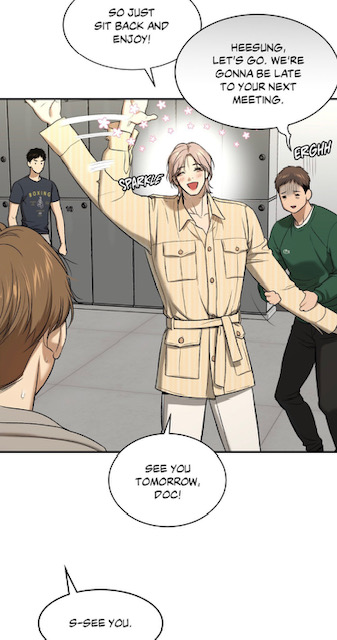
After the painful reminders at the table — the allusion to the Junmin night and Dan’s “queasy” excuse that scratched an old wound — his entire focus shifted. He could no longer risk repeating the dynamics of the past. In his mind, the only way to ensure that Dan would not disappear again was to do better, physically, in the one domain where he feels competent. So it is not far-fetched to imagine him watching tutorials or videos, searching for techniques, guidance, or advice he never received from anyone. He has one mentor in intimacy, Cheolmin, but the latter has only appeared once. No model to imitate. No words for tenderness. But he can learn through action, through practice, through imitation. And suddenly, this would explain everything that happens later.

It explains why, once doc Dan stands at his door, he behaves with such urgency. He grabs him immediately, pulls him inside, presses him against the wall while holding his face tenderly (chapter 85), kisses him with a force that has been building for hours. He had been so absorbed — so busy learning, rehearsing, imagining — that he realized only late that it was almost time for Dan to arrive. The rushed shower is not laziness; it is evidence that his preparation was of another kind altogether.

And then Dan appears. And this alone must have boosted Jaekyung’s ego in a way nothing else could. (chapter 85) Because doc Dan could have refused. He could have used his queasiness as an excuse, could have stayed in his room, could have claimed exhaustion. Instead, he obeyed the request — a request sent by someone who had hurt him deeply in the past. Doc Dan’s arrival is proof that he is not rejecting him. Proof that the night is real. Proof that the attempt to do better might actually matter. At the same time, doc Dan couldn’t miss the true meaning behind this text sent in front of others: the athlete’s anxiety and suffering. (chapter 85) This explains why his worried gaze followed his fated partner. (chapter 85) In other words, the text had a different meaning. It was not an order, but rather a wish…and it had nothing to do with his match against Arnaud Gabriel. During that night, Joo Jaekyung is not seeing a surrogate fighter in front of him or a sex toy, but his real partner, his future boyfriend. This means, this night stands in opposition to the one in the penthouse: (chapter 53) He is gradually moving on from his belief and jinx, he is even now prioritizing his love life over work!! If Park Namwook knew, he would get so shocked and scared… he would yell at him for causing a mess, for neglecting his “work”.
Under this light, it becomes comprehensible why Jaekyung takes his time for the first time. (chapter 85) This is why he touches Dan’s face instead of flipping him over.
This is why he kisses slowly, repeatedly, almost reverently. He knows that doc Dan likes nipple foreplay.
This is why he carries him in his arms (chapter 85) instead of carrying him over his shoulder. And this is why he suddenly engages in a new kind of foreplay — licking Dan’s leg (chapter 85) and anus (chapter 85) — something he has never done before. This does not come from instinct. It comes from intention. It comes from effort. It comes from learning. He is indeed showering doc Dan with love and tenderness, therefore it is not surprising that the “hamster” is moved sensually and emotionally. Exactly like during the Summer Night’s Dream, he is reaching nirvana, hence Jinx-philes are constantly seeing stars,. (chapter 85)
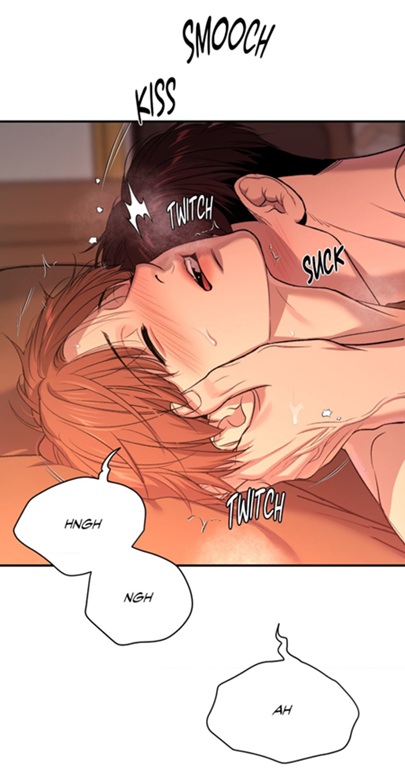
In short, the four hours did not shape his body for the match. They shaped his behavior for doc Dan.

The long lapse of time reveals a man who was not preparing for Arnaud Gabriel at all — but preparing for the one person whose opinion governs his heart. And when that person actually stands at his door, the tension of those hours condenses into the urgency of his welcome, the care of his touch, and the new tenderness of his actions. Everything in that moment — from the haste of his shower to the way he drags Dan inside — points toward a single truth: something fundamental in Joo Jaekyung has shifted.

And this brings us to the real meaning of the essay’s title.

The Truth Behind The Title

Many readers, seeing The Sweetest Downfall Ever , might assume that the downfall refers to Joo Jaekyung’s current behavior: his neglect of sleep in favor of desire, his single-minded focus on sex the night before the match, his impulsive decision to carry doc Dan to bed (chapter 85), or even the looming risk of professional failure. Others might think the downfall describes Dan’s new physical position — head lowered, body lifted (chapter 85) — or the emotional slip that comes with resurfacing feelings: the therapist losing distance, falling back into intimacy. All of these readings sound plausible at first glance. (chapter 85) But the truth behind the title is far simpler, far more literal, and yet far more symbolic.
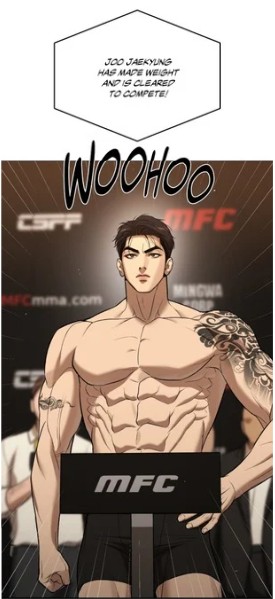
The downfall begins with his hair. For the first time, he is letting his hair down. (chapter 85) This visual shift, subtle yet radical, is the origin of the title.

And under this light, the meaning behind my illustration becomes clearer. This is why I chose pink “hair” for the background — not merely as decoration, but as a visual clue. The color evokes warmth, softness, and vulnerability: the emotional terrain Jaekyung steps into the moment gravity pulls his hair out of its rigid form. But why is this detail meaningful?

Because the idiom “to let your hair down” carries centuries of emotional and cultural weight.

When we read this historical meaning through the lens of Mingwa’s imagery, Jaekyung’s hair becomes more than a style choice. It becomes a confession. (chapter 85)

Letting his hair down means dropping the persona. Letting his hair down means allowing himself freedom.
Letting his hair down means entering intimacy — not performance.

It is the visual act of stepping away from the rigid social restraints imposed by MFC, public expectations, masculinity, and even trauma. And with this understanding, the transition becomes effortless:

For years, Joo Jaekyung’s hair has signified his status. (chapter 85) Styled up, hardened with gel (chapter 30) , perfectly arranged — it is the crown of the Emperor, the symbol of his control, his discipline, and the myth that MFC sells:
Joo Jaekyung, the untouchable. Joo Jaekyung, the brand. Joo Jaekyung, the man who never bends. (chapter 82) When the hair stands, the image stands.

But in Paris, for the first time, the hair falls. (chapter 85)

Even before chapter 85, Mingwa prepares the audience for this silent rebellion. Two days before the match, he wears a cap (chapter 85) — but not the way adults or professionals usually do.
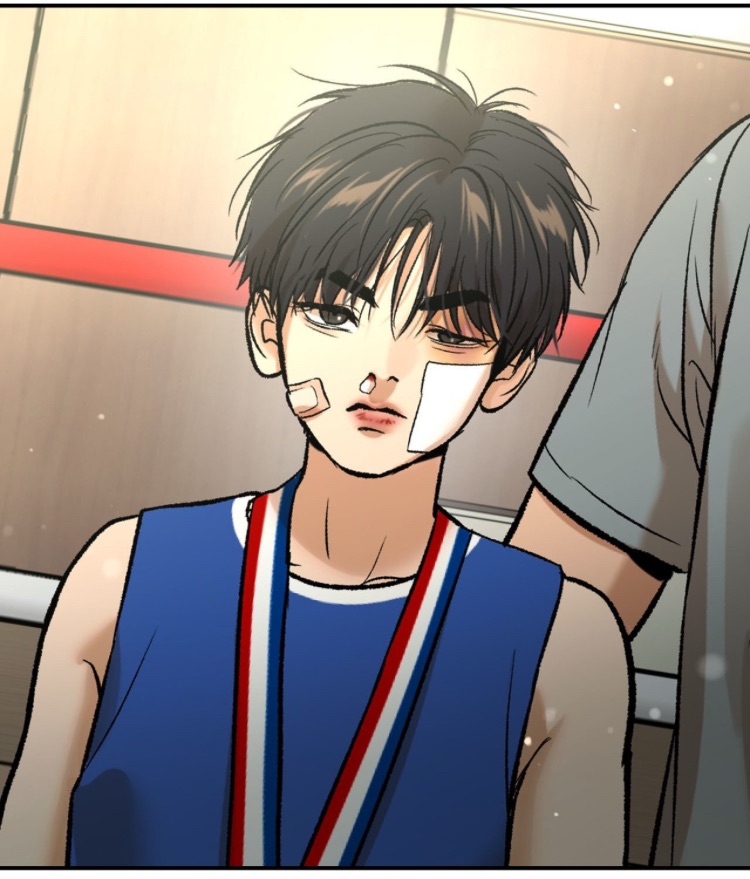
He tilts it up, exposing his entire face. Teenagers wear their caps like this: loose, careless, unguarded, more concerned with comfort than appearance. And suddenly, Jaekyung looks younger — not in age, but in spirit. His gaze is no longer shadowed by the bill. It is fully visible, open, almost soft.

Then comes the wolf-ear headband at the amusement park (chapte 85), a gesture that would have been unthinkable for the Emperor of MFC. It is ridiculous, childish, playful — and he wears it anyway. Not for the crowd, not for the cameras, but because Dan asked him to wear one too. So he placed it on his head. It is the second stage of the downfall: the moment where he stops caring about the star image that has governed him for years. The moment where he allows himself to be seen as something other than a fighter. The wolf ears, like the tilted cap, signal a shift toward youthfulness, toward softness, toward an identity unshaped by branding. And yet, both items share something important: they still control the hair.

The cap hides it. The headband frames it. In both cases, the hair remains managed, held in place, contained.
This means that the “rejuvenation” we observe in these scenes is still superficial — a flirtation with freedom rather than freedom itself. (chapter 85) The cap and wolf ears make him look younger, even boyish, but they do not dismantle the structure around him. They soften the edges of the Emperor, but they do not dissolve the crown.

He looks more approachable, but not yet vulnerable. He looks less like a weapon, but not yet like a man. He looks playful, but not yet liberated. However, when he is seen with his hair down (chapter 85), he looks exactly like the little boy in the picture: (chapter 71) So doc Dan could recognize the little boy in the athlete, the more he sees the protagonist with his hair down. Furthermore, I noticed that contrary to season 1, Doc Dan has now more memories of the “wolf” facing him. (chapter 85) In the past, he would more look at him from behind: (chapter 35) (chapter 35) Seeing his face reflects not only the increasing care for each other, but also the improving communication between them.

And this is also the moment where the narrative contrast becomes striking. While Joo Jaekyung’s appearance is drifting backward toward youth, Arnaud Gabriel’s beard makes him look older, (chapter 85) more mature, more “masculine” in the traditional sense. This explicates why the stylists had to dress him up. (chapter 82) Yet such an intervention did more than prepare him for the cameras — it tightened the restrictions around his own image, reducing the fighter’s rights over how he appears to the world. With the suit, he appeared older and more powerful. The French fighter leans into age, while the Korean champion leans into youth — a symbolic inversion that reinforces the central tension in the Paris arc: Gabriel performs adulthood; Jaekyung rediscovers the adolescence he never lived. (chapter 85) But just as Jaekyung begins to slip into these youthful, softer identities, MFC reasserts control.
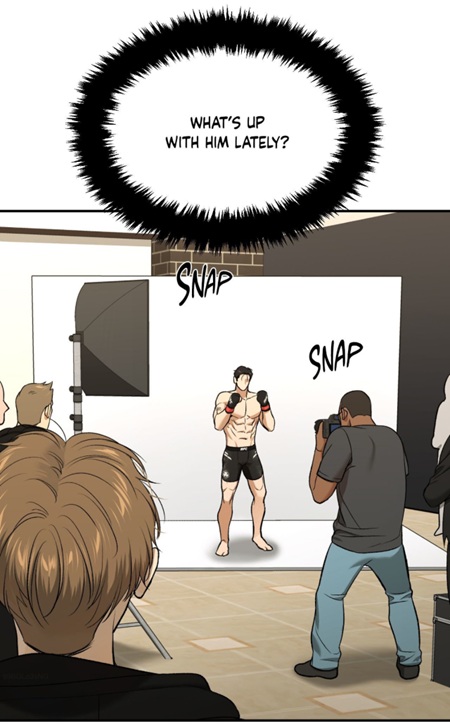
But MFC has its own ritual of restoration. At the photo shoot, the stylists immediately return him to form: (chapter 85) hair up, face polished, a look engineered for posters and rankings. He becomes once again the Emperor — the man who must appear older, sharper, more intimidating, more manufactured.
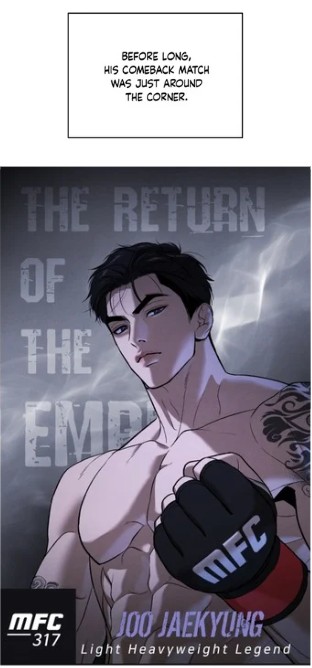
And this is exactly why the next transformation hits so hard. When Dan arrives at 11 p.m., Joo Jaekyung opens the door with his hair down, still dripping slightly from a rushed shower. This is not the Emperor. This is not the brand. This is not the legend presented in MFC 317. (chapter 79) This is the boy from the childhood photograph.

The hair-down Jaekyung is younger, wilder, softer (chapter 85) — someone who belongs not to MFC but to himself. Someone capable of affection. Someone whose emotions sit close to the skin. Someone who has stopped pretending. He is able to smile genuinely.

“Letting one’s hair down” is an idiom meaning to stop performing, to stop controlling oneself, to finally relax into authenticity. As you can see, Mingwa uses the concept (letting one’s hair down”) literally and metaphorically at once. The physical gesture (his hair falling) expresses the emotional one (his defenses lowering).

And suddenly, the birthday illustration released earlier this year makes sense. In the rain, with his hair heavy and unstyled, his gaze dark and sensual, Jaekyung appears nothing like the commanding emperor. He looks free — freed by weather, freed by desire, freed from roles. It was foreshadowing, not just fanservice. It announces the end of the « jinx » in reality.
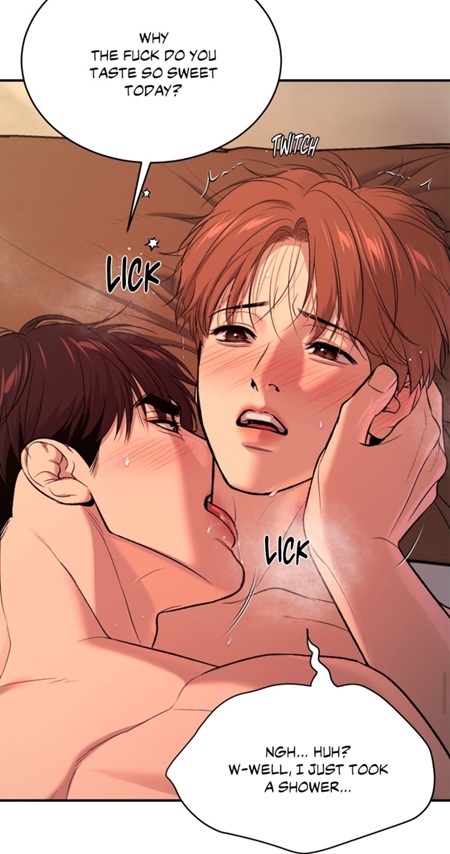
Which brings us to the second reason “downfall” is the perfect word. “Downfall” often describes the collapse of status — the fall of kings, the ruin of reputations. And here, too, the meaning applies. Because by letting his hair down, Joo Jaekyung risks the downfall of the very myth that protects him.

He is neglecting his work. He is prioritizing Dan over rest. He is engaging in a long, indulgent foreplay the night before his comeback match — a foreplay so attentive and sensual that Dan wonders what changed. This is not the Emperor. This is a man who is slowly abandoning the throne.

And Mingwa multiplies the symbolic echoes:

  • Downfall as rain:
    Heavy rain makes hair fall, obscures vision, exposes vulnerability.
    It is no coincidence that the birthday art shows him wet — nature brings him down to earth.
  • Downfall as emotional collapse:
    His confrontation with memories at dinner destabilizes him.
    His desire for Dan overwhelms him.
    His anxiety about losing Dan drives him.
  • Downfall as public risk:
    If he wins and hugs Dan in front of cameras out of gratitude and affection — a real possibility given his new softness — he could expose their bond publicly.
    This would be the ultimate downfall of the Emperor image:
    the revelation that he is not a remote titan but a man in love.
  • Downfall as liberation:
    The fall from the Emperor’s pedestal is not a tragedy.
    It is freedom.

And this is where the meaning circles back to sweetness. However, this also signifies that he is escaping the control of MFC and as such he represents a source of danger for the organization.

When Jaekyung whispers, “Why the fuck do you taste so sweet today?” he is not describing Dan. (chapter 85) He is describing himself. His sweetness is the taste of freedom — freedom from performance, freedom from control, freedom from MFC, freedom from fear. He is enjoying this moment. Dan tastes sweet because Jaekyung is finally tasting the life he never allowed himself to want.

So the “downfall” of the title is not the fall of a champion.

It is the fall of a mask. A downfall so soft that it feels like surrender, so intimate that it feels like seduction, and so liberating that it becomes — unmistakably — sweet. Because the moment Jaekyung lets his hair down, he becomes someone who can fall in love. And perhaps someone who can finally be loved in return.

And now, you are probably thinking, this is it! But no… because we have the long wait the next morning!

Room 1704: The Number of Unscheduled Freedom

While the night in Paris reveals how quietly the Emperor has begun to fall, the true test of his transformation arrives the next morning. If letting his hair down marks the softening of his identity, what happens next exposes something even more subversive: Joo Jaekyung begins to let go of time itself. Because in Paris, time belongs not to MFC, not to Park Namwook, and not to the match — but to room 1704, (chapter 85) the one place where schedules dissolve, rituals are forgotten, and the fighter finally sleeps like someone who no longer needs to brace for survival.

Room 1704 is not just a hotel room; it is the numerical mirror of Jaekyung’s internal shift. It reduces to the number 12, and this detail offers a far deeper layer of meaning than coincidence. Twelve is the number of completeness. It marks the end of one cycle and the threshold of another. In numerology, it unites the energy of new beginnings (1) with the harmony of partnership (2) to form the creative expansion of 3. This blending transforms 12 into a symbol of spiritual awakening and divine order — a moment where the earthly and the transcendent briefly touch. It is no accident that the number appears in so many foundational structures: twelve months shaping the year, twelve zodiac signs forming the cosmic wheel, twelve tribes anchoring a nation, twelve apostles guiding the birth of a new faith. Across cultures, twelve signifies not closure, but transition: the release of what binds and the emergence of a new form.

Seen through this lens, room 1704 becomes the perfect setting for the champion’s inner shift. He does not simply enter a hotel room; he steps into a symbolic space where an old identity completes itself and a new one quietly begins. Twelve encourages letting go, surrendering rigidity, and allowing transformation to unfold. And this is precisely what happens that night. In room 1704, Joo Jaekyung lets his hair down, lets his guard fall, lets Dan remain close, and lets go — without yet realizing it — of the rituals and defenses that once defined him. The number that governs the room marks the moment where the Emperor’s earthly order dissolves, making space for an awakening shaped not by hierarchy or discipline, but by intimacy and partnership.

And the room itself reinforces this symbolism. Above the couch hangs a painting (chapter 85) The image is dreamlike: there are white horses with wings, a Pegasus-like creatures and angels. Their outlines are soft, almost blurred, as if painted in the air rather than on canvas. This is no random hotel decoration. A Pegasus traditionally symbolizes deliverance from earthly burdens, escape from oppression, and ascension into a higher realm; angels, of course, signify protection, guidance, and spiritual renewal. Together they transform the couch area into a symbolic threshold: the boundary between the profane world (MFC, schedules, fear, trauma) and a space touched by something gentler, freer, almost sacred.

The Pegasus-and-angel painting above the couch does more than sanctify room 1704—it also illuminates something that has quietly shaped Dan’s entire emotional life: his relationship to the couch itself. (chapter 21) The image of winged rescue and divine protection hangs over the very piece of furniture that, throughout the series, has functioned as Dan’s private sanctuary. This is not incidental. In Jinx, the couch is tied to his deepest memories of care and abandonment, and Mingwa activates this symbolism each time Dan gravitates to it.
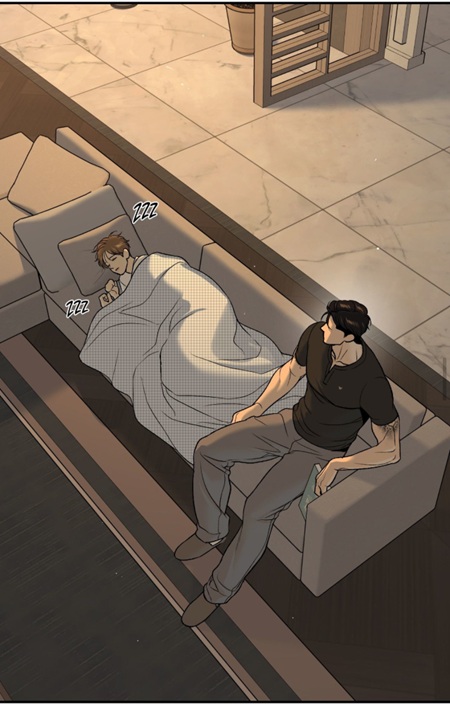
Why did Dan’s nightmare of abandonment strike precisely, when he fell asleep on the couch? (chapter 21) Why does he consistently feel safer on the couch than in a bed? (chapter 29) Why, after the second swimming lesson, did he refuse to return to the bed (chapter 81), even though he was exhausted? Why does he place the teddy bear (chapter 84) —his last substitute for lost parental affection—on the couch and not on the bed? And finally, why has he always harbored the secret wish to be carried to bed, as confessed through his memory in chapter 61? (chapter 61)

The answers converge: the couch is Dan’s liminal space, the threshold between being left behind and being held, between cold reality and the remnants of tenderness he once knew. Note that there is no couch in the halmoni’s house. (chapter 10) Secondly, at no moment, we ever witness the grandmother carrying the little boy to bed. Either she is rocking him to sleep outside the house (chapter 47) or he is already in the bed. We never see her bringing him to bed.

Thus I came to develop the following theory. In childhood, before everything collapsed, the couch was the place where doc Dan waited for his parents to return from work—the place where he sometimes fell asleep with his teddy bear, only to be lifted and carried to bed by someone who loved him. It was brief, fragile, but it became etched into him as the last ritual of genuine care, before the world turned harsh. This would explain why he has internalized such gestures: (chapter 44), (chapter 44) traces from parents. And now, you comprehend why the hamster could never truly rest in the bed. The couch is therefore not an adult preference; it is a trauma imprint. Resting there feels safe because beds—large, empty, abandoned spaces—became reminders of whoever no longer carried him. Hence it is no longer surprising that he woke up, when he sensed the vanishing of warmth. (chapter 21)
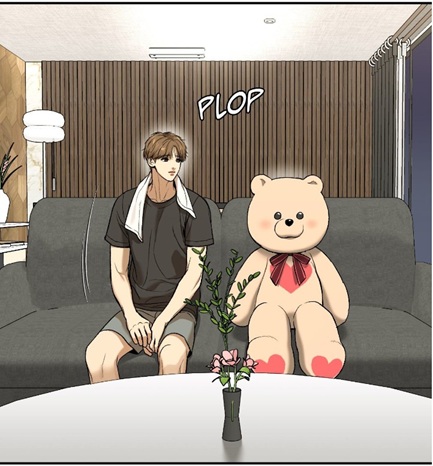
This is why Dan puts the teddy bear on the couch (chapter 84): the bear stands in for a lost comforting presence. It also represents the main lead, Joo Jaekyung. The latter is gradually reentering in the physical therapist’s heart and life. Therefore it is not surprising that there, he squeezes the hand of the toy. It is also why Doc Dan curls around it like a child who deep down hopes to be chosen, lifted, and held. And it is why, even as an adult, his body still whispers the same yearning: someone, please carry me to bed again.

Placed in this context, the painting above the couch in room 1704 becomes profound. The winged horses represent rescue; the angels represent guardianship. They hover above the very place where Dan’s old wound meets the possibility of healing. And on this particular night, the symbolism is fulfilled: the man he once feared, the man who once hurt him, becomes the one who finally lifts him —not to discard him, not to dominate him, but to carry him to bed with the gentleness he has been unconsciously longing for since childhood. Under this new perspective, it becomes comprehensible why doc Dan often never realized that the athlete had often fulfilled his wish (chapter 29, chapter 40, chapter 65, chapter 68, chapter 79)
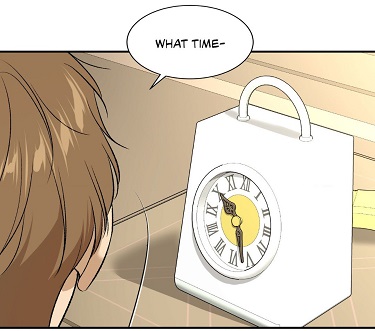
The couch, the painting, the number 1704—all align to mark this night as a turning point. A moment where old scripts collapse, where Dan’s abandonment narrative begins to loosen, and where Joo Jaekyung unknowingly steps into the role that no one has fulfilled since Dan was small: the one who does not leave him sleeping alone, but brings him into warmth.

And this is precisely what the number 1704 suggests. Reduced to 12, it carries the connotations of completion, awakening, divine order, the closing of one cycle and the opening of another. The Pegasus and angels above the couch echo that meaning visually: a silent promise that something in this room will lift rather than trap, heal rather than wound.

It is striking, too, that the imagery concerns flight—wings, ascension, rising above earthly weight. (chapter 85) For Joo Jaekyung, whose entire identity has been built on gravity, discipline, and the hardness of the body, this painting becomes an unconscious prelude to what he is about to do emotionally: let go, descend from the Emperor’s pedestal, and allow himself to be vulnerable. For Dan, the angels evoke the comfort and innocence he lost in childhood, the tenderness he has been deprived of for years. The painting therefore mirrors both men: the fighter who needs freedom, and the healer who needs protection.

Placed above the couch, it becomes the room’s spiritual anchor. It blesses the space without the characters realizing it. It reframes the night not as moral failure but as transformation. In this light, the “downfall” in the title is not the collapse of a champion — it is the completion of a cycle. A descent that is also a rising. A falling-away that creates room for renewal. Twelve crowns the night not with the end of something, but with the birth of something sweeter. Observe that around the painting, the pattern on the wall looks similar to snow flakes. It’s no coincidence… a synonym for “home”. A visual whisper that what happens here is not corruption but ascension and even “Nirvana”. That’s why I have the feeling that both or one of them might not wake up on time.

The first sign that room 1704 operates under new rules appears through a small but powerful object: the Do Not Disturb sign. (chapter 85)

For years, nothing in Jaekyung’s life has been allowed to interrupt the routine designed to keep him winning. His schedule is a fortress — wake up early, drink milk, shower and perfume, style hair, prepare body, prepare mind. Every minute is accounted for. Every ritual restores the Emperor identity. No step can be skipped.

But the moment Dan enters room 1704, the fortress cracks. The DND sign goes up. This implies that Joo Jaekyung might be able to sleep better and longer after this “hot night”.

And this tiny act holds enormous consequences. Park Namwook’s entire identity as manager is built on timing. He hides behind schedules the way Jaekyung once hid behind performance. (chapter 85) His mantra — 7:00 AM sharp — is not about concern. It is about control. If he arrives very early with his star, he believes that he has done his job. It is now MFC and Joo Jaekyung’s responsibility to decide about the match. Striking is that in the States, doc Dan woke up at 10. 26 am (chapter 85) and he was still able to arrive on time in the arena. (chapter 40) For me, it is a clue that the manager would always request to meet around 7.00 am, when the match was at noon. But what should do the athlete do during all this time? He can only get nervous and feel pressured.
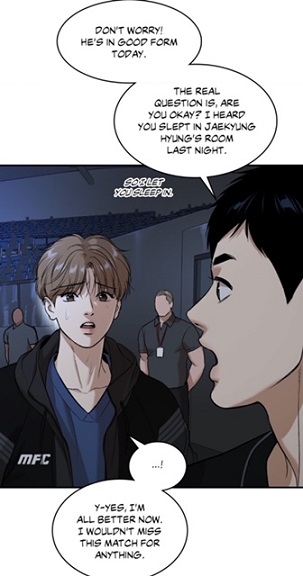
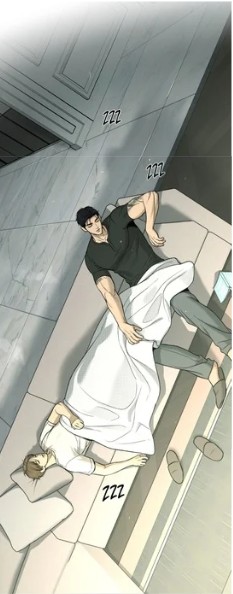
This is where the true problem begins. A fighter scheduled to rise at dawn for a noon match is being set up to fail. The human body performs best roughly four or five hours after waking; having a good breakfast, for a match at midday, the ideal waking time would be closer to 8:30 or 9:00. Yet Park Namwook forces the entire team into a rhythm that has nothing to do with physiology and everything to do with his own fear of unpredictability. In other words, he is not managing an athlete — he is managing his anxiety.

The timing is disastrous for someone like Joo Jaekyung, whose insomnia is a recurring wound in the story. Sleep is the one ressource the Emperor chronically lacks, and the one thing he finally has a chance to experience now that doc Dan is beside him. (chapter 81) I noticed that in different scenes from season 2, the athlete started waking up later and even after doc Dan. (chapter 66) But the manager’s rigid schedule threatens even that. An early morning summons drains the fighter’s cortisol reserves before the match has even begun, creating a long, empty corridor of waiting — a period where tension, anxiety, fatigue, and irritation ferment in the body. Instead of resting, centering, and preparing, the champion would spend hours fighting against the clock imposed on him.

And this, ironically, is precisely what Park Namwook wants: a day without surprises, without emotional complications, without having to shoulder responsibility if something goes wrong. By bringing the team down to the lobby at a painfully early hour (chapter 85), he can tell himself that he has done everything correctly. From the moment they arrive, the rest is “not his problem.” His scheduling is a shield — not for Jaekyung, but for himself.

This reveals a harsh truth about his management style. He values predictability over performance, procedure over well-being, optics over actual athletic needs. And because he interprets punctuality as competence, he assumes that an early arrival protects him from blame. Whether the star sleeps well, eats well, or preserves his mental focus does not matter. What matters is that the boxes are checked, the appearance of order is maintained, and the responsibility is successfully transferred upward.

But what happens if the Emperor does not appear at 7:00 AM? (chapter 85) What happens if the room 1704 — with its quietly glowing DND sign — refuses to open?

Suddenly the carefully constructed ritual collapses. The manager may be standing in front of the door early in the morning, but the DND sign renders him powerless. He cannot knock insistently, he cannot demand entry or yell, and he certainly cannot ask hotel staff to open the door or to call the athlete. Any attempt to violate a guest’s privacy would not only break hotel policy — it could lead to a lawsuit, a breach-of-contract scandal, or even an international incident involving their star athlete. One angry complaint from Joo Jaekyung could cost the hotel its reputation, and one misstep from Park Namwook could cost him his career. And because he knows the champion had been drinking after the “loss” (chapter 54) , he might even jump to the wrong conclusion: that Jaekyung drank again — this time behind his back. (chapter 82) The irony is striking. Two days before the match, it was Park Namwook who overindulged with the others, yet he may now project that same carelessness onto the athlete. In his mind, the DND sign does not simply mean “rest”; it becomes a warning signal, a possible confirmation of the irresponsibility he fears but has never actually witnessed. Thus I can already imagine him panicking.

And this is exactly what terrifies him: there is no legal or professional ground on which he can force the champion to obey the schedule he imposed. For once, he cannot hide behind authority. He cannot produce documents or procedures to justify intervention. He cannot shift responsibility to MFC.

He is trapped in a situation where doing nothing is dangerous, and acting is even worse. One might object and say that he can still call the two protagonists. However, the doctor didn’t bring his cellphone to the room. (chapter 85) Secondly, it is possible that the athlete’s cellphone runs out of battery, especially if he watched so many videos the night before. However, if the staff knows about the DND, the manager can not ask the desk to call Joo Jaekyung either.

But the most destabilizing element of all is that he cannot even determine whom to blame — the physical therapist who may have encouraged the fighter to rest longer, or the champion who dared to let doc Dan sleep past the artificial boundaries the manager set in place or even slept longer by inadvertence. Another important aspect is the text from the champion. (chapter 85) Here, it is not written 11.00 pm, so the message could be read as 11.00 am. So this message could be read like this. He wanted to rest till 11.00 am. This could represent an evidence that champion chose to act behind Park Namwook’s back and trust Doc Dan more than Park Namwook.

The hierarchy reverses itself in an instant: the Emperor is untouchable, and the manager is the one who risks punishment.

For the first time, Park Namwook may have to confront the truth he has avoided for years: that his role as manager is ornamental, that he has never truly controlled the Emperor’s time, and that his authority dissolves the moment the athlete chooses to prioritize his own needs or his lover’s needs.

In that paralysis, old coping strategies return. He may blame Dan for keeping the champion awake. He may blame the champion for irresponsibility. He may fear that the match will suffer and that this failure, unlike all the others, will reflect poorly on him. One thing is sure: the manager can not leave the hotel without the wolf, and the latter will refuse to leave doc Dan behind either. As you can see, this night stands under the sign of “partnership” and the manager is now excluded.

However, inside room 1704, none of this external pressure exists. Because of the painting, I deduce that this room stands for intemporality. It was, as if time had stopped flowing. For the first time in years, Joo Jaekyung sleeps without fear. Without nightmares. Without counting breaths. Without bracing for violence. Without packing his trauma into the muscles of his back. Why? Because Dan is there. Not touching him — simply present. The presence alone rewrites the body’s memory.

And here lies the narrative genius: if Dan wakes first, he will instinctively protect that peace. He knows how vital rest is. He knows how Jaekyung has struggled to breathe, to sleep, to function. He knows the psychological cost of insomnia. He may silence alarms, block the manager from entering, or simply remain beside him until Jaekyung wakes naturally.

Which sets up the coming conflict:

If Jaekyung wakes late — later than the 7:00 AM schedule —he will not have enough time for his rituals.

  • No milk to ground him
  • No cold shower to reset his body
  • No perfume to cover the phantom scent of childhood shame
  • No hair styling to reinstall the Emperor crown

But none of this would matter, as long as doc Dan accepts him like that. However, it is clear that the fight will take place no matter what, as this match will be shown on TV! How do I know this? A match scheduled at noon on a Saturday is not designed for a French television audience — it is one of the least convenient viewing times for locals. But it aligns perfectly with broadcast windows in Korea and the United States, which means the bout is already plugged into international programming. In other words, the machinery is running. Cameras will roll, sponsors will expect coverage, and the event cannot be canceled simply because the champion oversleeps. The celebrity can arrive late, for he brings money. Joo Jaekyung will walk into the arena not as the branded champion, but as the man from room 1704 (chapter 85), a man who slept deeply, whose hair still remembers being down, whose body still carries Dan’s warmth. And this is the true downfall: He risks entering a match not as the Emperor, but as himself. And such a transformation could make people realize how young the “MMA fighter” is in the end. At the same time, his late arrival could create the illusion that the Emperor is not mentally and physically ready for a fight so that Arnaud Gabriel underestimates his opponent.

But here’s the irony — this may be the very thing that makes him stronger. Room 1704 becomes the space where the champion’s trauma evaporates, where instinct replaces ritual, where softness replaces armor. If he oversleeps, it means he felt safe — an emotional victory far more significant than a title defense.

For Park Namwook, however, oversleeping is a managerial nightmare. It is disorder. It is unpredictability. It is autonomy — the one thing he cannot manage. And when he stands before the DND sign, powerless, he may finally realize that his control and authority were always an illusion. He is not the boss or the owner of the gym. The Emperor no longer belongs to schedules, rituals, or institutions. He belongs to the one person behind that door. And that would be doc Dan who overlooked everything in Paris: his food (chapter 82), his look (chapter 82), his free time and took care of the champion’s emotional needs. In Paris, the « hamster » became the champion’s manager de facto, the unofficial right-hand. That’s why if they are late and they need a scapegoat, the manager can blame the physical therapist for the « delay », he would always come late to appointments (chapter 17: meeting the doctor) and to the fights (Busan, in the States).

Room 1704 is not the site of a downfall. It is the site of awakening.

Feel free to comment. If you have any suggestion for topics or Manhwa, feel free to ask. If you enjoyed reading it, retweet it or push the button like. My Reddit-Instagram-Twitter-Tumblr account is: @bebebisous33. Thanks for reading and for the support, particularly, I would like to thank all the new followers and people recommending my blog.

Jinx: The Words 🎆The Firework 🎆 Stole 🥷 (second version)

Finally a Love Confession?

Among all the scenes in Jinx, none has ignited more speculation than the moment inside the Ferris wheel cabin—those few seconds when Joo Jaekyung’s lips move (chapter 84), the fireworks erupt, and Kim Dan turns his head too late. (chapter 84) Readers have replayed the blurred panel again and again, straining to decipher the muffled shapes of his mouth. Some are convinced that this is the confession, the moment the wolf finally says aloud what his body has been whispering for months. One Jinx-phile, @4992cb even insisted she had cracked the code: five syllables, just enough to match the Korean 좋아해 김단 (jo-a-hae Kim Dan)—“I like you, Kim Dan.”
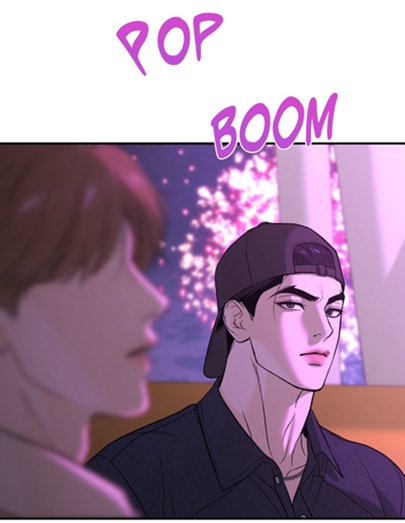
And truthfully, the scene encourages such a reading. Fireworks often accompany love confessions in East Asian media (chapter 84) —especially Japanese summer festivals where boys and girls, dressed in yukata, confess beneath crackling skies. Fireworks symbolize joy, romance, fleeting courage. It is no wonder many readers assumed that Mingwa was drawing on this cultural grammar: purple night sky, glowing lights, two lonely figures suspended above the world. A confession seems almost inevitable. And if it truly was a love declaration, then the champion’s refusal to repeat himself (chapter 84) would make perfect narrative sense—confession lost, moment gone, courage spent.

But before we accept the romantic surface, we must pause. Something about the staging feels off—deliberately off. Why would Mingwa construct a confession that the receiver cannot hear? (chapter 84) Why give Kim Dan the long-awaited moment he has yearned for, only to snatch it away with the noise of exploding light? Yes, despite his words, Kim Dan still had the hope to be loved by the athlete. Hence he kept thinking about the athlete’s motivations for his “stay and care at the seaside town”. (chapter 62) (chapter 77) Why does Joo Jaekyung speak exactly when the fireworks begin, as if choosing the one moment when he is guaranteed to be drowned out? (chapter 84) And most importantly: what emotion pushed him to open his mouth in the first place? (chapter 84) Was he truly confessing love—or was he trying to verbalize something far more raw, far more primitive, far more difficult?
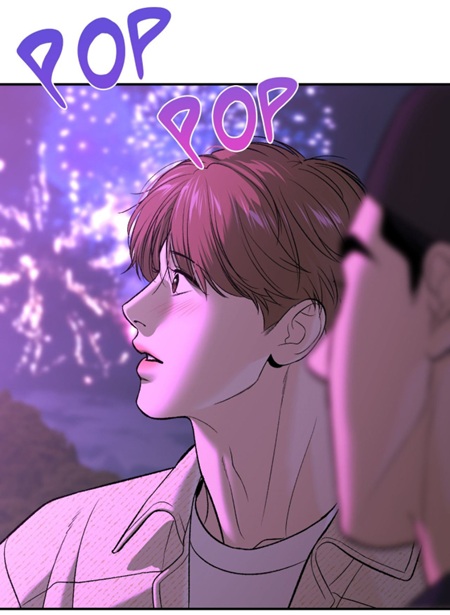
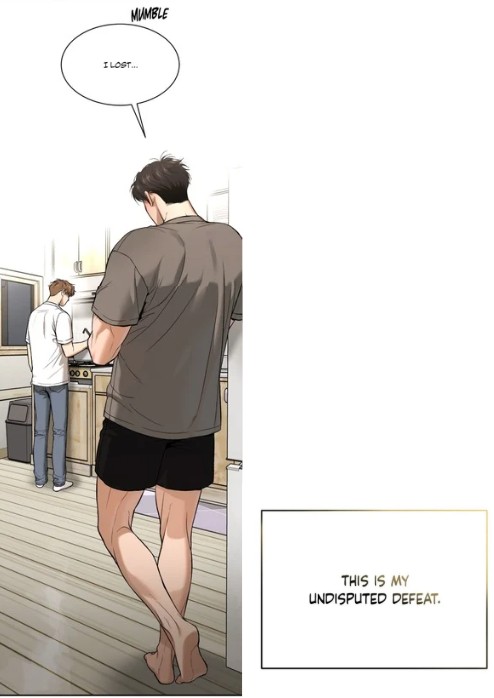
Before we can decode the stolen syllables, we need to examine the entire machinery around this moment: the champion’s posture, the lighting, the soundscape, the timing, and the emotional triggers accumulated over previous chapters. Only then can we begin to understand what he tried to say, and why the author ensured that Kim Dan—the boy who has always longed to be chosen—could not hear it.

The Mechanics of a Stolen Confession

Everything about the Ferris wheel cabin — the positioning, the posture, the lighting — undermines the idea that Joo Jaekyung was intentionally directing his words toward Kim Dan. The mechanics of his body say more than the bubble ever could. To begin with, Jaekyung is not fully facing Kim Dan when he begins to speak. (chapter 84) How do we know this? His body tells the truth before any words do: his torso is angled half-way toward the window and half-way toward Kim Dan, caught between desire and retreat. His arms remain crossed — a classic defensive posture — as if he is bracing himself against the very feelings he is trying to verbalize. This is not the stance of someone delivering a confident love confession; it is the posture of a man attempting something dangerous, something he is afraid to expose.

Only his head turns slightly toward Kim Dan, a diagonal tilt rather than a direct orientation. (chapter 84) It signals hesitation, testing the water, not a deliberate act of addressing someone face-to-face. And the light confirms this: the violet firework glow still falls on the same side of his face as in the previous panel, proving that he did not rotate his body or head enough to truly face Kim Dan while speaking. (chapter 84) He remains more oriented toward the window, toward the blur of lights outside — toward a safer, less intimate direction.

This halfway posture makes everything clear: Jaekyung is speaking from a place of longing mixed with fear, practicing honesty without yet daring to look directly at the person who provokes it. It is because as soon as his fated partner asks him to repeat, he turns slightly his head away, to the window. (chapter 84) When someone truly wants to be understood, they turn instinctively toward the listener. But when Jaekyung turns away, he is not refusing vulnerability — he is choosing fear. Turning his head toward the window is an instinctive retreat into the only safety he knows: distance.

This is crucial: he begins to speak while refusing to meet the therapist’s gaze. (chapter 84) The words escape sideways — literally.

Then comes the second mechanical detail: timing. He opens his mouth precisely at the moment the fireworks erupt. Deep down, he knows the noise will drown his voice. This is not accidental. It mirrors episodes 76(chapter 76) and 79 (chapter 79), where he “speaks” only when the other man cannot truly hear him. At the hostel, the mumbling was barely audible: yet according to my observation and deduction, doc Dan seems to have caught something. as later we discover this scene from the champion’s memory: (chapter 77) He already knew that the athlete was standing next to him. However, observe that this vision focused on the doctor’s gaze was accompanied with silence. This means, doc Dan acted, as if he had heard nothing. So if he heard, what did the physical therapist catch exactly in the kitchen? “I lost…”, but it was devoid of any context. Doc Dan had no idea what the director Hwang Byungchul had advised to his former student. (chapter 75) He could not know that “I lost” referred to something far more intimate: Jaekyung losing control over his own emotional detachment, he was totally vulnerable in front of doc Dan. His heart was stronger than his “mind and fists”. Naturally, if Kim Dan interpreted the phrase at all, he would connect it to the only “loss” he understood: the tie with Baek Junmin. A humiliating defeat. A source of shame. This misinterpretation perfectly explains why in the cabin, the hamster immediately assumes that the champion is once again determined to regain his title: (chapter 84) He is taking the champion’s words at face-value. (chapter 77) He trusts the explanation Jaekyung himself gave under the tree. And here lies the deeper revelation: Kim Dan’s misunderstanding exposes the true meaning of the tree confession. Why did Jaekyung suddenly accept the match? Why frame it entirely in terms of “I need you for these two fights”?
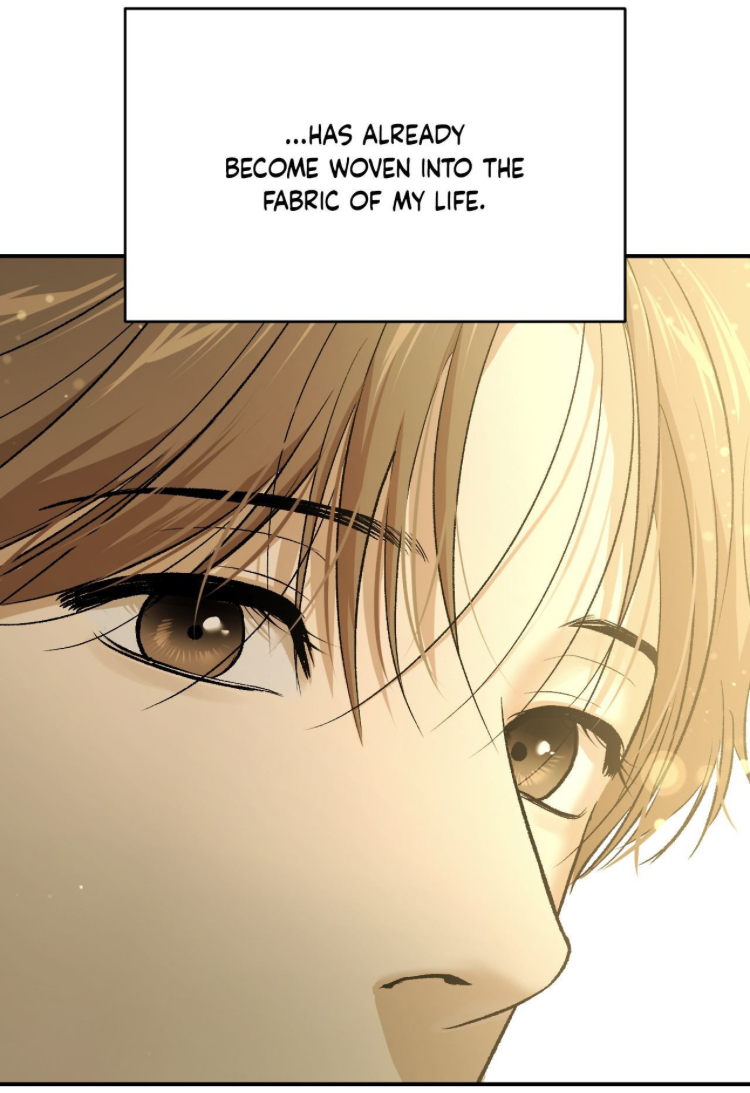
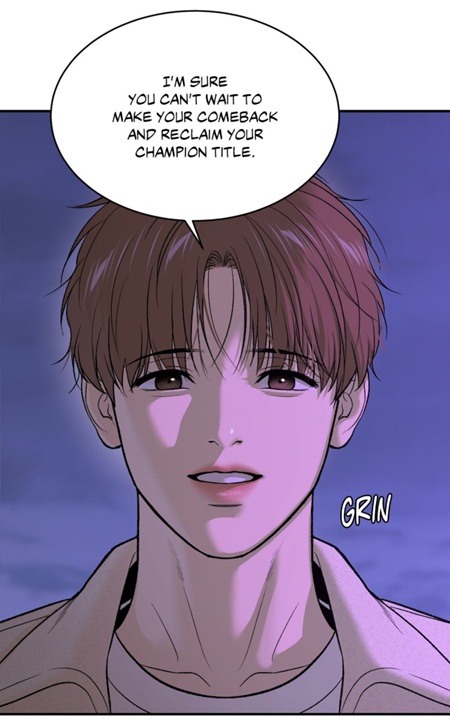
Because work was the only safe language he had left for reconnecting with the therapist. He could not say, “Please stay with me.” He could not say, “I don’t want to lose you.” So he said the only thing he believed he was allowed to say:
“I need you for my return match… and my title match.”

It is a substitution — a mask — a plea disguised as practicality. (chapter 84) A deadline designed to keep Kim Dan close without revealing the depth of the emotional dependency underneath. Finally, before we even analyze posture or timing, we must acknowledge the ghost that is sitting inside the cabin with them — Jaekyung’s own admission of dishonesty. Just minutes earlier, the narrative revealed again a thought he had never dared to voice aloud: (chapter 84) This line is essential, because it exposes the truth behind every failed confession that came before it: Jaekyung did not rekindle with doc Dan with honesty. His first instinct was deception (lie by omission), not vulnerability. Keeping Kim Dan near him mattered more than telling him the truth. So his “love” was still more influenced by possessiveness.

And that is precisely why his apology in the cabin lands with such weight. (chapter 84) For the first time, he admits wrongdoing without deflecting, without rage, without pride. This apology is not strategic; it is confessional. A tone we have never heard from him before. It is no coincidence that just before, he employed this expression: (chapter 84) This is the language of surrender — not to defeat, but to vulnerability and selflessness. The champion who once insisted on keeping Kim Dan “one way or another” (chapter 84) now articulates the opposite impulse: the willingness to release him, to give him a choice. (chapter 84) Kim Dan can actually never forgive him. He is giving up, on his possessive love — the possessiveness that fueled all his earlier attempts to hold onto Dan through contracts, pressure, intimidation, manipulations or work-related obligations.
Here, his grip loosens. Here, his desire is no longer expressed as ownership, but as remorse. And this shift matters profoundly for the blurred confession. (chapter 84) By apologizing, Jaekyung crosses a threshold he has never crossed before: he speaks without power, without defense, without dominance.
For the first time, he tells Kim Dan something that is not a command, not a justification, not an excuse — but a truth about himself. Yet this emotional shift, as liberating as it is, does not make him ready to say “I love you” or even “I like you” in a clean, intentional, adult way. In fact, the opposite is true. When guilt falls away, he does not step into romantic maturity — he reverts to emotional childhood. This explicates why later he felt so embarrassed on his bed, hiding his face under the pillow. (chapter 84) Thus for me, in the cabin the champion became, for a moment, the boy with no mother’s gaze, no father’s protection, no safe place to rest. He must have said something cheesy, something a young person would say. Purity returns before experience does. Honesty returns before articulation. And in that moment inside the cabin, Mingwa makes a decisive artistic choice: we do not see Jaekyung’s eyes. (chapter 84) The panel hides them completely — not out of convenience, but out of protection. It is as if the author herself shields the wolf’s vulnerability from the reader, granting him a moment of privacy at the precise instant he attempts something emotionally dangerous.
Just as in episodes 76 and 79, his words are not fully directed at Kim Dan. They are spoken near him, not to him.
They slip out sideways — half internal, half external — the verbal equivalent of a heartbeat too quiet to be called speech. In other words, what happens inside the cabin is not the flowering of romantic eloquence. It is the first trembling attempt of someone who has never been loved to express the only version of love he knows: instinctive, needy, unpolished, raw.

This is why he cannot possibly be saying a line as adult and structured as “I love you” or even “I like you.”
Such sentences require three things he does not possess yet:

  1. A sense that he himself is lovable → he does not. Hence he still views himself as nonredeemable and as a burden.
  2. A sense that Kim Dan feels the same → he has no proof. Besides, doc Dan keeps avoiding his gaze, feels uncomfortable in front of him. He is not speaking his mind. He keeps reminding him of their limited contract.
  3. A sense of equality in the relationship → they are not there yet. Joo Jaekyung feels now inferior with all his sins and wrongdoings. Due to his last words, it becomes clear that he is not expecting something in return.

What he can say at this stage — and what fits the emotional mechanics of the scene — is something far younger, far simpler, far more primal, like for example “Stay with me” or “I want to kiss you ” or “I want to hold you”…

These are not love declarations. They are the vocabulary of a neglected child whose first experience of safety has finally returned — and who now fears losing it more than anything else.

And crucially, this would explain everything about the staging:

  • why he chooses fireworks (the sound protects him from being truly heard),
  • why his body angles away (he speaks sideways, not directly),
  • why his voice is blurred (because the reader is not meant to hear it yet),
  • why he panics when Kim Dan asks him to repeat,
  • why he instantly retracts with “Never mind.”

A man confessing love does not recoil. A child confessing need always does. It is also why the author hides the line. Not because it is a grand romantic confession, but because it is too emotionally naked, too immature, too early, too cheesy. A sentence like “I wish to …”, whispered by a man who has never held anyone without ownership, is more intimate than any polished “I love you.”

And Mingwa knows it. The confession is blurred not because it declares love, but because it reveals Jaekyung’s inexperience with love. He can finally be honest — but he cannot yet be articulate.

He can reach — but he cannot yet claim. He is pure — but not ready. Hence later, he is seen wearing a white t-shirt for the first time. (chapter 84) This pigment stands for innocence, purity, new beginnings and even equity.
That is why the fireworks stole the words. (chapter 84) Because they were not yet meant to be received, only meant to be released. The fireworks allow him to finally attempt a more honest sentence, but in conditions where it cannot reach its target.
Noise replaces courage.
Light replaces eye contact.
Fear replaces clarity.
A man who has only just begun to tell the truth about his wrongdoing cannot yet tell the full truth of his love.
His apology creates the emotional opening — but it also exposes how unprepared he is to verbalize the feelings that have been building silently for 84 chapters. So far, he has never verbalized his desires and emotions, hence he kissed doc Dan right away in the swimming pool. (chapter 81) Yet this is also the limit of what he can say.

But let’s return our attention to the scene in the penthouse (chapter 79), which is similar to the scene in the kitchen and at the amusement park. Though the star was once again mumbling, this time Doc Dan reacted to his words. However, Jinx-philes can sense a divergence between the other two scenes (chapter 76) (chapter 84). It is because doc Dan was looking at him this time: (chapter 79) Thus he could see the athlete’s mouth moving and hear sound. Nevertheless, observe that the moment the wolf reached to the doctor’s words, he bowed his head and looked down. From this (chapter 79) to this (chapter 79) As you can sense, he fears his lover’s gaze, a new version of this situation: (chapter 79) However, he doesn’t fear coldness, but ridicule and mockery, the father’s gaze: (chapter 73) Under this light, people can grasp why Joo Jaekyung was not facing doc Dan directly in the cabin. To conclude, the mechanism is identical, but amplified. (chapter 84) Instead of mumbling, he lets the fireworks perform the silencing. It is not that the environment interrupts him; it is that he chooses a moment when interruption is guaranteed. However, one detail caught my attention: he’s getting physically closer to Doc Dan!! The distance is getting reduced. It was, as if he was practicing how to confess his affection. And so far, he never used the words « I love you ». (Chapter 44) (chapter 76) At the same time, Jinx-philes can detect the existence of another common denominator: the physical therapist’s gaze.
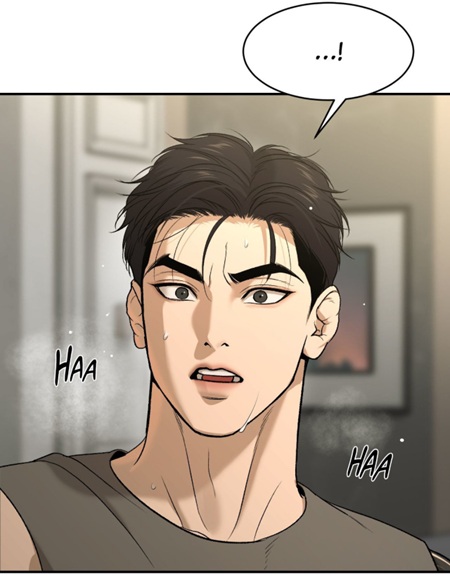
The Spark behind the Wolf’s Confession

To understand the blurred sentence — the words the firework stole — we must first shift our attention away from language entirely and back to what truly matters in this scene: vision. What drives Joo Jaekyung to the brink of confession in chapter 84 is not romance, nor timing, nor even the apology he had just managed to deliver. It is Kim Dan’s gaze. (chapter 84) He is moved by such a pure gaze, full of awe.

The panel makes this undeniable. Before speaking, the champion is watching the therapist’s face illuminated by fireworks, softened into wonder. (chapter 84) This is not the gaze of a caretaker, nor a tired worker, nor a subordinate fulfilling a duty. It is the open, trusting gaze of a child witnessing beauty. And for Joo Jaekyung, that gaze is both intoxicating and devastating.

The champion has lived his entire life without soft eyes directed at him. His mother, always drawn from behind, is eyeless — a woman who never truly saw him. (chapter 73) Besides, the head of her position is indicating that she was not looking at her son, the boy was hiding his face from Joo Jaewoong and his mother. Then his father mocked him, degraded him, and used resemblance as an insult: (chapter 73) Moreover, Hwang Byungchul reduced him to a lineage of failure or talent, not a person deserving recognition. He constantly compared him to his father (chapter 74) or his mother (a poor but good mother), he was not seen for whom he was: a child, a boy. Jinx consistently links sight with recognition, and recognition with love. (chapter 53) Jaekyung has never been granted either. (Chapter 45) Thus when he got upset with the present, he indirectly expressed the wish to be « looked at ». Moreover, in his visions or memories, this is what he keeps seeing: (chapter 54) (chapter 75) Doc Dan’s gaze!
This is what makes the locker-room scene in chapter 51 so crucial. Kim Dan looks at him with shock, vulnerability, and a plea: (chapter 51) And for the first time, Jaekyung freezes. (chapter 51) His breath catches; his eyes widen. It is the moment he realizes his mistake. He never thought that doc Dan had been trusting him. That moment marks the first rupture in his emotional armor, not only because it hurt, but because it revealed. He realizes with terror that he wants to be seen by Kim Dan, but when he faced such a gaze, he could only feel guilty and bad. Thus it is not surprising that later, his nightmare let transpire his guilty conscience. (chapter 54) He is the one who made his fated partner cry. No wonder why he first tried to find a new toy, he felt uncomfortable.

In the Ferris wheel cabin of chapter 84, he encounters his fated partner’s gaze again — (chapter 84) but now it is purified, childlike, unguarded. Kim Dan glows under the fireworks, mesmerized by beauty instead of violence, by wonder instead of fear. And Jaekyung wants — desperately — for that softness to be directed at him. Not at his victories. Not at his muscles. Not at the persona he built to survive. But at the man beneath all of it. A man worthy of admiration, affection, safety. A man who could be held, kept, loved. That’s why I wondered for a while if Joo Jaekyung had not copied Arnaud Gabriel’s flirt (chapter 82), as the champion has always used his surroundings as a source of inspiration. (Chapter 29) It would also fit with 5 syllabes in Korean. And it would be cheesy too. Yet, I have my doubts about this theory which I will explain further below. Nevertheless, one thing is sure. The champion loves the doctor’s eyes and they have the power to move not only his heart but also his mouth. He is encouraged to verbalize his emotions.

This is the true trigger of the confession. Not desire in the adult sense, and certainly not a strategic “I like you” or “I love you,” but a longing to be seen — and therefore, to be wanted. Every wound in Jaekyung’s life is tied to vision: the eyeless mother who vanished, the father who asked whether she would even want to live with him if she saw what he had become, the locker-room moment that shattered his self-perception. All of this returns when he sees Kim Dan’s shining eyes reflecting the fireworks.

He wants those eyes turned toward him with love. Not gratitude. Not dependence. Not fear. Love. What he wants most
and what he fears most come from the same place: Kim Dan’s gaze. (chapter 84) The gaze under the fireworks triggers emotions in him. Thus he blurted out something. But for me, he does not know how to say “I love you.” He cannot even say “I like you.” Those sentences belong to someone who has matured emotionally — someone who can identify feelings properly, but so far he keeps saying: “to stay by his side” and his « affection declarations » were all linked to negativity.. Thus my idea was that Joo Jaekyung could have said this: “I want to hold you!” (안고 싶어 너). Let’s not forget that so far, the champion had never expressed such a longing before; a warm embrace. He would always follow his instincts: (chapter 4) (chapter 43) (chapter 69) The hug represents a metaphor for “staying by his side, for home and to be seen”. Moreover, in French embrasser can mean kiss and hug. And strangely, I noticed that the protagonists were never looking at each other during an embrace. (chapter 44) And let’s not forget that such a gesture is strongly intertwined with “childhood”. (chapter 65) It is for “babies”. No wonder why he retracted immediately.
To conclude, the words that escape him in the dark — too soft to be caught, swallowed by the firework’s explosion — become the linguistic equivalent of reaching toward warmth without daring to touch it. The sentence he forms must fit his emotional stage: childlike, inexperienced, driven by instinct rather than maturity. It must reflect longing, not possession; desire, not declaration. And it must match the blurred outline of five syllables we see in the panel. (chapter 84) 안고 싶어 너: I want to hold/hug you!

The Secret behind the Blurred Words

And now, you are wondering what other secret could be hidden behind these words. It is related to the physical therapist him. Why did Mingwa, the goddess of “narrative fate”, ensure that doc Dan couldn’t hear the athlete’s words? (chapter 84) First, recall that in the previous parallel scenes (76 and 79), doc Dan is portrayed as someone who doesn’t hear Jaekyung’s confessions. But as I argued earlier, we must question whether this is truly the case — especially the one in episode 76. The panel arrangement suggests that something was heard, but not acknowledged. Then during the fireworks, he does not say, “I couldn’t hear what you said.”
He says: “I didn’t catch that.” “Catch” implies arms, grasping, holding — the very things stolen from him as a child.

And then comes the detail that betrays everything: the small drop on his cheek. A sign of discomfort… and something deeper: recognition. The drop on his face was not present before. (chapter 84) For me, everything points to the same conclusion: doc Dan might have heard something — but he cannot yet allow himself to process it.
This denial explains his expression in the shower at the hotel: (chapter 84) Here, the doctor looks sad and wounded. His eyes are unfocused — he is not seeing the present. The water running down his eyelashes gives the impression of tears, even though he is not crying. His gaze is distant, fixed on something internal. His mouth looks tense, almost trembling. The mouth especially is a clue: Kim Dan’s emotions always gather there when something from the past resurfaces.This is the expression of someone thrown into an involuntary flashback. He is inside a memory. This explicates why this scene is similar to the champion’s shower after the latter had met Baek Junmin: (chapter 49) (chapter 49) Both scenes show a man pulled violently into a buried memory. Thus, my assumption is simple: the champion said something that pierced straight into Kim Dan’s oldest wound and brought his trauma to the surface. And this brings me to my next observation. Inside the cabin, there are not two people — there are three: the champion, the therapist, and the Teddy Bear. (chapter 84) Furthermore, we have a window. We have a phone (dead, but present). We have a childlike toy — symbol of stolen innocence. (chapter 84) And now, look again at episode 19: (chapter 19) A window with no view. Three figures: halmoni, the boy, and the phone placed between them like a knife. And the sound structure is identical, but reversed:
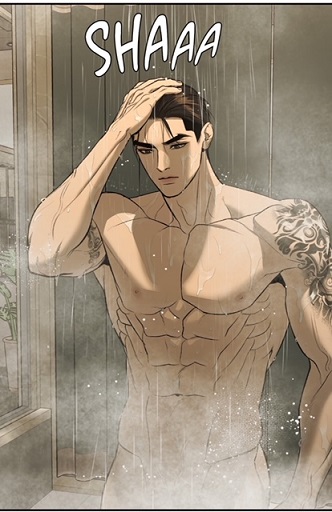
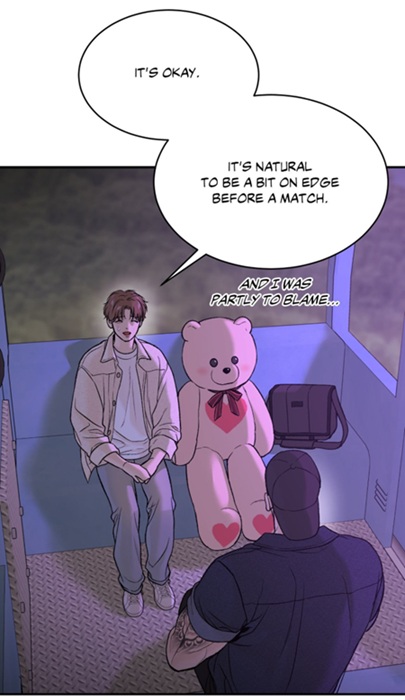
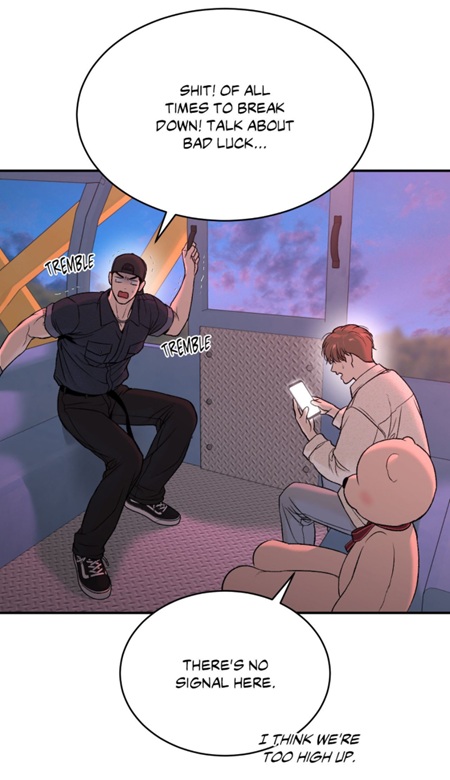
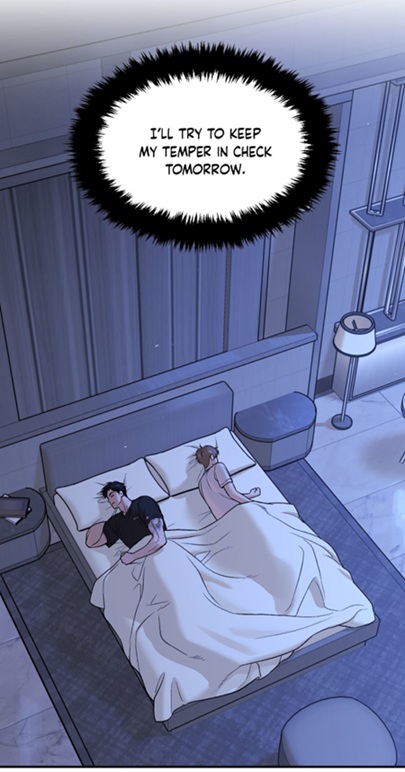
silence – sound – silence in episode 19
vs
sound – silence – sound in episode 84, as the Teddy Bear is a silent “witness”. In both scenes, something is stolen.
In both scenes, a child loses something he cannot name. Thus, what Jaekyung said must have resembled the emotional tone — if not the wording — of the words spoken over the phone on that catastrophic day.

This explains why Kim Dan ends the scene wearing black instead of white. (chapter 84) It is not a fashion choice. It marks the moment when innocence collapses and the past reopens.

And now compare the cabin (chapter 84) with the memory that precedes the parents’ disappearance. You will notice the huge difference: the overwhelming silence inside the house. The halmoni sits beside the phone. She must have heard everything. She must have heard the child as well, if the latter spoke She holds him tightly by the shoulder — as if trying to support him. (Chapter 19) To conclude, she knew something was happening. This recollection represents a repressed memory, and so far doc Dan has always avoided to face his biggest fear: his abandonment issues and the loss of his “parents”. (chapter 56) In other words, wearing black is more than just a change of personality or mourning. It becomes the color of mystery, the beginning of descent into truth. (chapter 84) However, observe that doc Dan is holding, even squeezing the teddy bear’s hand, a sign that he is rekindling with his lost childhood. We are getting closer to the revelation behind the photograph — the day doc Dan has never willingly shown to Joo Jaekyung.

(chapter 19). Observe that in the penthouse, doc Dan has never placed the frame (chapter 79) on the night table.

And what is the other denominator between episode 19 and the amusement park?

Theft.
Stolen childhood.
Stolen confession.
Stolen clarity. (chapter 84)

Exactly like in the cabin, (chapter 19) the words on the phone are inaudible. And now, you comprehend why I came to link the athlete’s blurred words to embrace and longing, as the grandmother’s embrace couldn’t diminish or erase the child’s pain. Finally, Jinx-philes can detect another pattern, the absence of gaze. Not only the boy can not see the person on the phone, but also the characters are turning their back to the readers which reinforces the mystery surrounding the conversation and the reactions of the listeners.

Now, connect it with the lost teddy bear (chapter 21) and (chapter 47). Dan once had toys — proof that once, someone loved him enough to give him gifts which contrasts to the wolf’s childhood. (chapter 84) Every time innocence is ripped away, a teddy bear disappears from the story.

So what if Jaekyung’s whispered sentence — a gift of raw affection — triggered the memory of another gift? What if the words under the fireworks echoed the tone of something said just before Dan’s world collapsed?

If this is the case, then doc Dan did not miss the confession entirely. (chapter 84) He remembered something far more painful. It is important, because by remembering his past, he can regain his own identity and get stronger mentally and emotionally. The scene in the cabin represents the positive version of the locker room, which signifies the return of “trust”. That’s why I am more than ever convinced that something at the weight-in (chapter 82) will happen linked to the protagonists’ past (recent and childhood). Let’s not forget that doc Dan still has no idea what Joo Jaekyung went through after his departure: the slap, the drinking, the headache and the indifference of Team Black, just like the athlete has no idea about the blacklisting and bullying in the physical therapist’s past. (chapter 84) So by wearing black, doc Dan indicates that he is gradually becoming responsible for Team Blackand Joo Jaekyung the athlete. (chapter 84) They should realize that their life is not so different from each other, in fact they share the same pain and trauma.

Feel free to comment. If you have any suggestion for topics or Manhwa, feel free to ask. If you enjoyed reading it, retweet it or push the button like. My Reddit-Instagram-Twitter-Tumblr account is: @bebebisous33. Thanks for reading and for the support, particularly, I would like to thank all the new followers and people recommending my blog.

Jinx: Breathless in the Light 🏰😶‍🌫️ – part 2

Since today, a new chapter will be released, this second part can not be long. Yet, I wanted to share my latest observations before the publication of chapter 83.

In the first part, I focused on the origins of the champion’s breathlessness and its cure: the amusement park. However, the air was not the only important element in episode 82. Let’s take another look at this image: (chapter 81) The plane soars not only above the Alps, but also above a vast river (probably the Rhône)— two landscapes that silently echo the dual composition of breath itself. Breath is made of air and water: oxygen and vapor, wind and moisture. (chapter 82) In that sense, the clouds surrounding the aircraft are not mere weather; they are the perfect union of the two elements that sustain life.
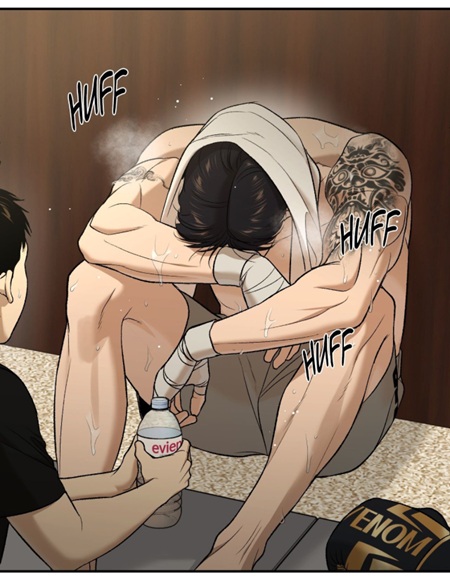
Joo Jaekyung’s breathlessness, then, is not simply a physiological lack of oxygen — it is the absence of water, the missing element of tenderness and flow. The champion has spent his life breathing air devoid of moisture, surviving on discipline, pride, and control — a dry atmosphere where emotion cannot condense. (chapter 82) That’s why, when Potato offers him a bottle of Evian, he doesn’t even look. He doesn’t need the water from the mountain and as such the world; he needs the water of the body — the intimacy, the shared moisture that reconnects him to life itself. What he truly longs for is Kim Dan’s saliva, the living trace of water transformed into affection, into care, into exchange. (chapter 81) He is longing for his lips and as such a kiss.
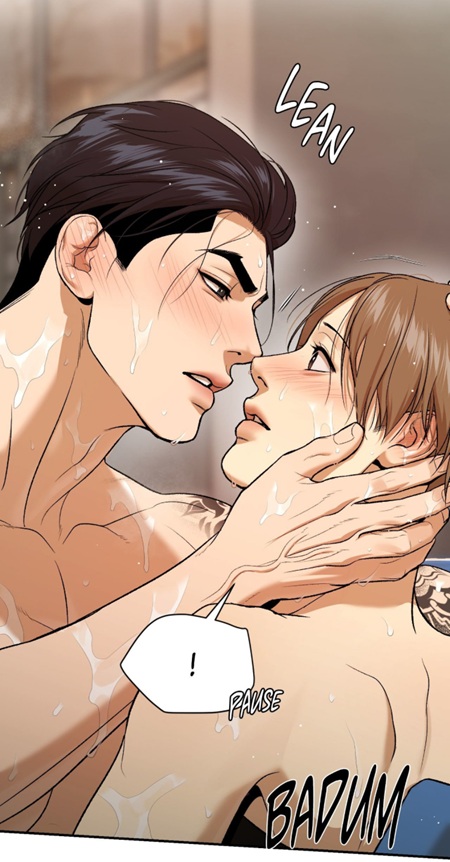
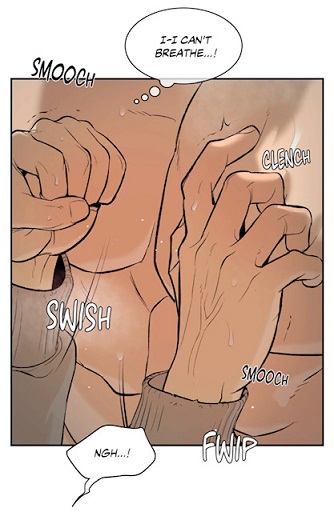
Only through that bodily element — through the return of water inside air — can he breathe again fully. Dan’s body literally rehydrates him. The vapor that once escaped his lungs returns as mist, as breath shared between two beings. At the same time, it teaches him how to breathe properly, the reverse of this scene in the locker room. (chapter 15)

And this elemental union anticipates the next landscape: the amusement park, where the air is filled with laughter, humidity, and movement. (chapter 82) Many attractions — the Ferris wheel, the fountain rides, the water park zones — combine air and water, height and spray, just like breath itself. And now, you understand why the champion got wounded with the spray (chapter 49) It corresponds to the negative version of the “breath”.

Another possibility is that they first share the same drink or the same ice cream (epilogue), because doc Dan wants to ensure that the drink or the ice cream is okay. (chapter 82) When Jaekyung and Dan enter the funfair, they’re not simply having fun; they’re reliving the chemistry of respiration and affection — the inhalation of joy, the exhalation of fear, the splash of renewal. The park becomes an externalized lung, a circular world of rides where water and air, play and life, are finally reconciled.
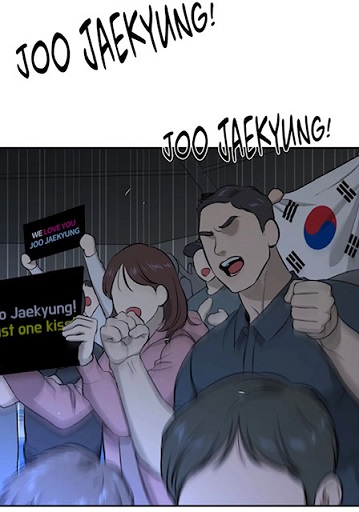
The Castle as Fairy-Tale Threshold

In the amusement park, the castle (chapter 82) stands as a replica of every child’s first dream: a place where danger ends, where curses lift, where the beast becomes human. In this new setting, the ring is replaced by an amusement park — a space where joy is no longer born from suffering. (chapter 15) The arena that once fed on pain, blood, and hierarchy gives way to a landscape of shared laughter, circular motion, and renewal. Here, entertainment is not built upon the exhaustion of bodies but upon their liberation. The crowd no longer watches to see who will fall; they rise and descend together. (chapter 82) People are more focused on their own emotions and experiences.
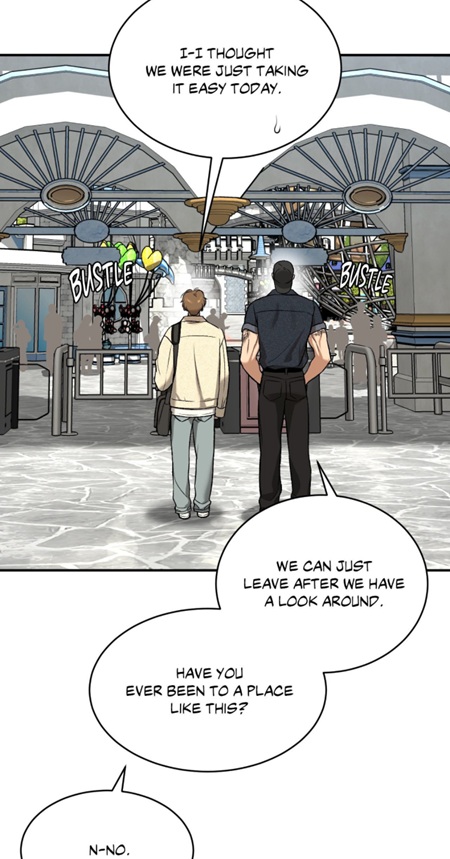
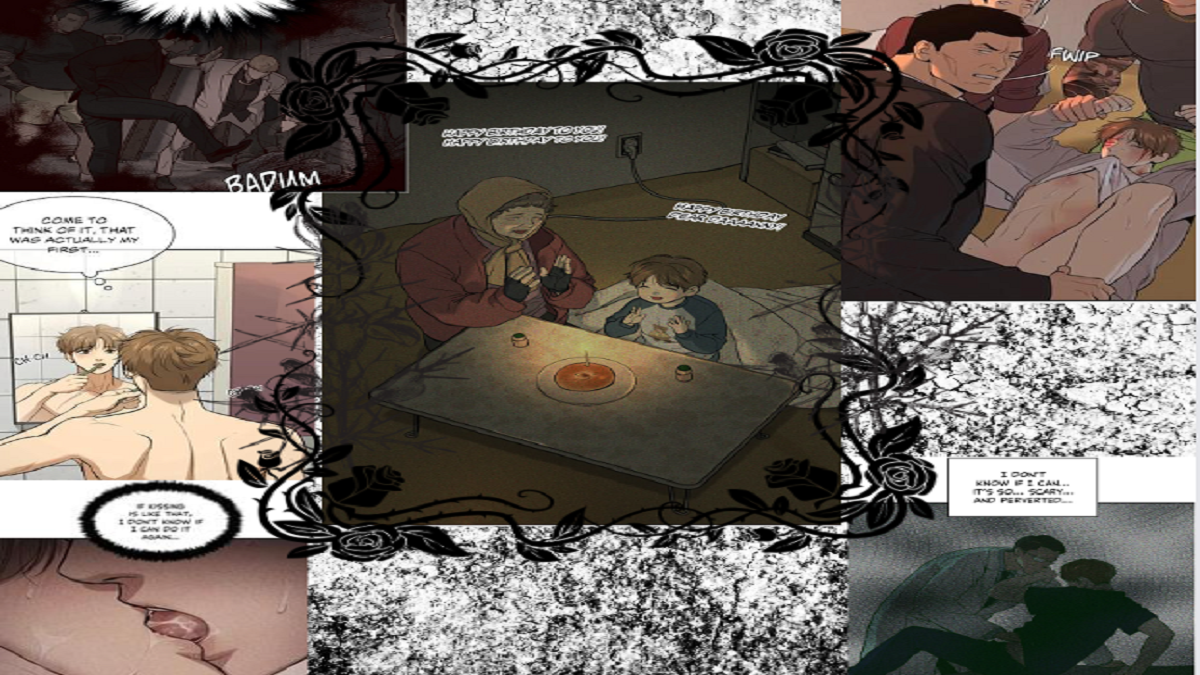
For Joo Jaekyung, this shift marks a fundamental redefinition of performance itself. The fighter who once turned agony into spectacle now experiences movement as play. The wolf who fought to survive in the ring learns to live among rides, fountains, and lights — spaces where the body moves not to conquer, but to feel.

Thus, the amusement park becomes his anti-ring — a sanctuary of reciprocity, where elevation and descent belong to everyone, and no one bleeds to entertain the rest. For Joo Jaekyung, who has spent his life trapped in the cycle of competition and rage, walking into that space with Kim Dan is an act of symbolic initiation. He brings the doctor — his witness and healer — into a world he has always avoided: fantasy, gentleness, illusion.

The wolf who once prowled in underground gyms now enters a castle built for children, and in doing so he accepts the possibility of becoming a fairy-tale prince — not by winning, but by transforming.

Why the “First Kiss” Matters Here

A fairy tale’s turning point is always the kiss — the moment when the spell breaks. And you might recall that I came to associate Kim Dan with Sleeping Beauty and in the illustration of that analysis, I I placed the doctor’s birthday. And that’s how I remembered here the boy’s huge smile and joy. (chapter 11) And now, pay attention to the number of the next episode: 83! The two numbers combined together make 11! As you can see, the amusement park is the most natural setting for a smile and kiss. Joo Jaekyung could even speak about his first kiss, an intimate secret that even Kim Dan doesn’t know. Confessing it there would align his personal myth with the fairy-tale architecture around him. This would make doc Dan realize that he is special contrary to the green-haired ex-lover. (chapter 42). But there’s more to it. In episode 81, Doc Dan rejects the champion’s advance — he turns his head away (chapter 81) letting the lips slip past him like water. Yet, in the very same scene, he allows a kiss on the neck, a place where breath, warmth, and pulse converge. (chapter 81) He never pushes him back. The doctor resists with the face — with speech, with identity — but not with the body. (chapter 81) And so, at the end, the athlete moves upward, trying to reach the mouth, trying to taste what remains forbidden. But he fails. (chapter 81) Why? Because the lips are not mere flesh; for Doc Dan, they are the visible border between desire and love. Jinx-lovers will remember his quiet request in the locker room (chapter 15): he links the lips to the heart — and through it, to the notion of consent. (chapter 15) To kiss him there is to ask for entry not into his body, but into his feeling.
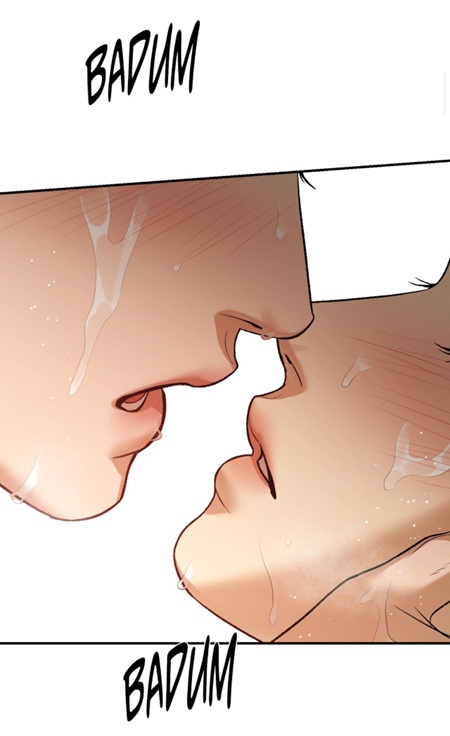
That is why the scene at the pool stops at the threshold. The champion can touch his skin, but not yet his soul. (chapter 81) The water envelops them both — fluid, intimate — yet the final element is still missing: agreement, the meeting of air and will. Until Jaekyung learns to ask, to replace taking with invitation, the kiss will remain suspended, like a breath held underwater, waiting to surface into love. And now, you comprehend why he couldn’t achieve his goal in the swimming pool. It was, as if he was trying to recreate the situation in season 1. In other words, I deduce that there will be a confession before a kiss happens!!

From Wolf To Prince

A Jinx-lover noticed the similarities between this scene (chapter 17) and the one in front of the amusement park: (chapter 82) The two scenes mirror each other like opposite poles of Joo Jaekyung’s evolution. In both, he is dressed in black — a color that once signified anonymity and danger, but later becomes the mark of calm confidence.

In episode 17, the champion hides behind darkness. The cap pulled low conceals his eyes, his face is half-shadowed, and his clothes absorb light rather than reflect it. (chapter 17) When he intervenes to save Kim Dan from the loan sharks, he is first mistaken for one of them — a predator among predators. The irony is sharp: the man who comes to rescue looks indistinguishable from those who harm. The fighters’ world has taught him that power and fame must be hidden; he was encouraged to hide, as if the fans would attack him. He chose anonymity, unaware that this would not only isolate him but also make him appear as a thug. And don’t forget how the manager called him initially: (chapter 75) He is a monster. It was, as if the manager wanted to hide the “wolf” from people out of fear that he might attack people randomly. But the problem is that by dressing like that, he was no different from Heo Manwook. Therefore his heroism passes unnoticed, interpreted as violence and intrusion. (chapter 18) Like Batman, he moves in secrecy, protecting without ever being thanked. The outfit explains why his good deed leaves no trace of gratitude — the savior looks like the aggressor.
By episode 82, the transformation is complete. (chapter 82) He still wears black, but the darkness no longer hides him. The cap now sits higher, revealing his eyes and mouth — the organs of emotion and speech. A necklace gleams at his throat, a quiet emblem of openness. He walks beside Kim Dan in daylight, not to fight but to share joy. The man who once lurked in alleys now stands beneath the sky of the amusement park, where black absorbs light rather than extinguishes it.
The contrast encapsulates the metamorphosis of the wolf into a prince. And how did Heo Manwook call him? (chapter 17) A princeling! He was mocking him, because he knew that the fights were actually rigged. That’s why he called him fake. (chapter 17) This new connection reinforces my theory that the schemers are anticipating the Emperor’s demise. (chapter 82) Thus Arnaud Gabriel’s words are full of irony. There’s no luck in this match. However, the antagonists are not anticipating a metamorphosis. The wolf hides and strikes; the prince reveals and protects. The wolf saves without witnesses; the prince loves in full view. In the ring’s darkness he fought to survive; in the park’s brightness he learns to live and love. And the moment Joo Jaekyung is freed from his curse and can breathe, his next game will be different. Why? It is because the champion has another reason to make doc Dan’s wish to come true: they should work together for a long time! And observe the power of Doc Dan’s angel on the Emperor after spending his first night with his “bride”. He was full of energy!
Where his earlier anonymity made his goodness invisible, his new transparency makes tenderness possible. The same man, once mistaken for a criminal, now smiles like a fairy-tale hero. The cap lifted from his eyes symbolizes the lifting of his own blindness — he can finally see and be seen.

The Floating Duck Syndrome

However, contrary to the Sleeping Beauty or the Mermaid, we have two men as protagonists. So there is no princess. It is important because it signifies that we should expect two metamorphosis at the amusement park. That’s why it is difficult to say who will confess first. Nevertheless, this weekend, I discovered the following article: Floating Duck Syndrome. Psychologists use the expression floating duck syndrome to describe people who appear serene on the surface while paddling frantically beneath the water to keep themselves afloat. The image is both graceful and tragic: calm above, exhaustion below. It captures the condition of those who have learned to survive through composure — who equate love with performance and stability with silence.

This is Kim Dan’s illness in miniature. Ever since childhood he has floated through life without showing the effort beneath. The grandmother’s silence taught him that visible pain is shameful; the bullying taught him that vulnerability invites attack. So he learned to glide — polite, deferential, self-effacing — while his legs beat desperately under the surface. His smiles are survival reflexes, not joy. His stillness is not peace but tension. And we should see the picture of Kim Dan with his grandmother as a reflection of this Syndrome. (chapter 65) so he is not standing on his own two feet. And remember that according to me, Shin Okja stands for shore. He is smiling as if everything is fine, but the reality is different. When Dan sits on her lap wearing the duck shirt, he seems safe, grounded, “held.” Yet the shore (the halmoni) isn’t truly stable — it’s brittle earth pretending to resist erosion. She gives him the illusion of safety, not the reality of it. The hydrangeas stand for temporality. The body contact replaces emotional transparency. What he learns in that moment is: “If I stay still and quiet, she’ll hold me.” Thus, his first emotional rule becomes immobility and silence. That is how the floating duck is born — not by moving freely in water, but by learning to suppress movement to preserve attachment.

The floating duck explains why he could live beside death for so long — the dying grandmother, the dying puppy, the dying parts of himself — without ever asking for help. He confuses endurance with dignity. When the champion first meets him, he sees only the surface: the quiet doctor, calm as water. (chapter 56) He doesn’t yet see the storm and suffering beneath.

Parallel Currents: The Prince and the Duck

As Joo Jaekyung rises from wolf to prince, he travels from hidden aggression to open affection. And by doing so, he encourages to see activities as something fun. So far, Kim Dan sees such a day more as a burden and not as a source of joy. Why? It is because he still views himself as the champion’s physical therapist and nothing more. (chapter 82) But in such a place, it is, as if time was stopped. Thanks to the many emotions and sensations, his body and heart will be revived. Through fun, the duck will change. As Kim Dan ascends from floating duck to swimmer and to a flying duck, he moves from hidden suffering to open breath. Thus the Ferris Wheel will have definitely an impact on him. Both arcs revolve around air and water — the two elements that make up breath and emotion. Don’t forget that the doctor embodies the clouds as well, while the athlete stands for steam.

In the early episodes, Dan’s relationship to water is defensive: he stays afloat but never dives. He cannot trust the element that once carried his grief. Jaekyung, conversely, dominates air — he owns every breath in the ring but cannot breathe freely outside it.
When the champion teaches him to swim and later to have fun, their roles merge: the man of air brings air to the man of water. Dan’s first genuine strokes are also his first act of rebellion against quiet despair. He is no longer a duck faking serenity; he is a swimmer choosing motion. Thus he can start flying. And now, you comprehend my illustration.

From Survival to Freedom

The floating duck syndrome ends the moment visibility becomes safe. For Kim Dan, that safety arrives when Jaekyung learns to play — when the arena turns into an amusement park, when life stops demanding perfection and begins inviting joy. Play, after all, is what ducks do when they are no longer afraid of drowning: they splash.

Thus both men’s journeys converge.

  • The wolf learns tenderness.
  • The duck learns courage. Hence he has the strength to fly on his own and can join the clouds.
  • The air learns moisture.
  • The water learns breath.

Together they compose the complete lung of the story — two halves finally synchronizing. The one who once hid in darkness now walks in light; the one who once floated in silence now swims toward sound. And this can only happen, when both feel grateful toward each other. (chapter 45)

Feel free to comment. If you have any suggestion for topics or Manhwa, feel free to ask. If you enjoyed reading it, retweet it or push the button like. My Reddit-Instagram-Twitter-Tumblr account is: @bebebisous33. Thanks for reading and for the support, particularly, I would like to thank all the new followers and people recommending my blog.

Jinx: Breathless in the Light 🫀(Part 1)

The Wrong Forecast

Many readers were happy to discover that Joo Jaekyung and Kim Dan are about to spend a day at an amusement park. (chapter 82) Jinx-Lovers consider it as their first real date, a long-awaited moment of levity after so much pain. But perhaps we should pause and ask: why this place?

Among the brochures (chapter 82) scattered on the table, one displays the Eiffel Tower — the obvious choice, symbol of mastery and control. Built for the Exposition Universelle of 1889, it was meant to celebrate France’s industrial power and the centenary of the Revolution — proof that bourgeoisie and steel, not kings and nobility, now ruled the sky and ground. It was even supposed to be dismantled after twenty years, yet it remained, and has since become the symbol of Paris and of France. A monument to progress, modernity, freedom, national pride and endurance.

But the man who picked up these brochures was never a tourist. In the past, Joo Jaekyung would not have chosen any destination at all. He would have stayed inside or trained, untouched by the world outside his window or the gym. (chapter 38) Hence in the States he is here turning his back to the window and his only connection to others was through the cellphone. The cities he visited were backdrops, not experiences. He was always alone. And yet, here, something changes in Paris. (chapter 82) His hotel room opens onto a broad window and a balcony — an invitation to look out. Secondly, observe that he only proposed this activity after the other members had fallen sick. When doc Dan barged in his room, the champion was doing a one-handed handstand, holding his entire weight as if defying gravity itself (chapter 82) and proving his recovery. The posture seemed like control, yet it was closer to self-punishment — an immobility that devoured strength. Blood rushed to his heart and head, but his lungs stayed empty. It was, unconsciously, his way of treating his breathlessness. This also shows that he had no real expectation about the “rest” his manager had suggested (chapter 82) — the drinking, the empty and aimless trip (“check out the area”). For the wolf, such a downtime could only mean endurance, not release and excitement. By the way, such a suggestion from Park Namwook borders on stupidity and blindness. How could he propose drinking, when he had seen his “boy” indulged in alcohol before? (chapter 54) I guess, he must have taken the celebrity’s words at face-value. But let’s return our attention to the panel with the brochures selected by the champion. If you look carefully, you will detect the presence of 4 stars. (chapter 82) They reveal the protagonist’s thoughts and emotions. He is happy!! The news brought by doc Dan was actually good news! 😂 (chapter 82) How do I come to this interpretation? We have seen these stars before, during Kim Dan’s Summer Night’s Dream: the same glittering symbols of softness and excitement.

(chapter 44) Yet, this time, the little “stars” belong to the celebrity.
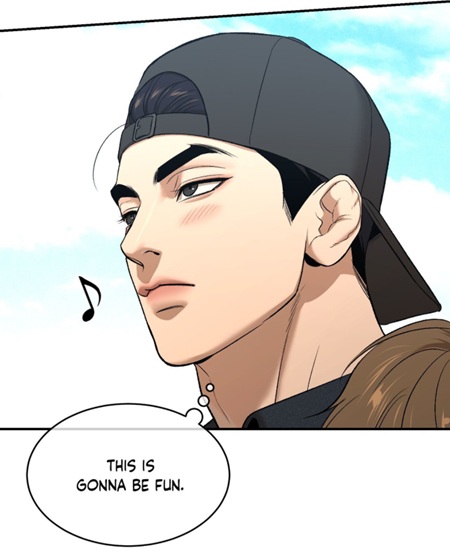
For once, the fighter blushes, smiles, and dreams. (chapter 82) His choice of the amusement park is not really about himself and his desires— it is an act of care, a wish to give happiness to someone else.

And here, I feel the need to add this information. The most famous theme park next to the capital is Eurodisney which is strongly intertwined with fairy tales (The Little Mermaid , Sleeping Beauty and Beauty and the Beast ).Hence there is the castle on the brochure. (chapter 82) This shows that my connection between the fairy tales and Jinx was correct. Eurodisney is a place built for children, stories, and families, where a person’s worth is measured not by conquest but by joy and time shared together. On the other hand, such a funfair cannot be separated from money; it is a space of paid joy, accessible only to families with a certain income. This alone explains why neither Kim Dan nor Joo Jaekyung has ever visited it before. (chapter 82) For both, it was financially and emotionally out of question. It grounds the symbolism of the amusement park in social reality, reminding readers that “fun” is also a form of privilege. This means that the champion is actually on his way to replace this picture: (chapter 65) So yes, this may look like a simple date. Yet beneath its playful surface lies the quietest revolution of all: the man who once ignored every view now opens the window, looks outward, and chooses wonder and fun over war.

When I first speculated about France, I imagined Cannes — the realm of spectacle, trophies, and bright façades. I was wrong about the destination (chapter 81), but not about the geography and air. I had truly detected the importance of this image and its symbolism. The plane that opened this arc spoke not of luxury, but of altitude — of a life lived too high, where oxygen is rationed by pride. Below the aircraft stretch the Alps, which I had correctly identified. From there flows the athlete’s own water – Evian (chapter 82) (written Evien in the manhwa) — drawn from the mountain that sustains him and starves him at once.

And now, let me you ask this: what happens to a candle’s flame at high altitude? It flickers, gasps, and finally dies for lack of air. This is exactly what Mingwa foreshadowed in the promotional poster (chapter 81): the rising smoke, the suggestion of a light already suffocated. The higher they bring him, the closer he moves to extinction. Besides, the higher he climbs, the harder the fall. In other words, they are trying to break him — to make him fall — something the athlete has already sensed. (chapter 82)

It is no coincidence that his opponent in France is an eagle (chapter 82) — a creature of heights and thin air, born to dominate the skies where others can barely breathe. The metaphor could not be clearer: altitude is his arena, but also his undoing.

Now they are in Paris, and it is fall — not yet cold because of the presence of the sun. (chapter 81) The air remains clear and generous, the sky washed in blue as if nothing could go wrong. Yet the trees, touched by the first copper tones, announce the slow turn of the year. It is a calm, lucid atmosphere, the kind of weather that hides transition inside serenity. The unseen Seine glides through the city like a long breath, steady and effortless.

In this luminous stillness, the champion tries, for the first time (chapter 82), to build joy outside the ring (chapter 82) — to borrow light for someone else’s smile. Paris welcomes him not with spectacle, but with ordinary clarity: air that holds both change and peace.

So yes, this may look like a simple date. Yet beneath the gentle brightness lies something deeper: the rest is supposed to treat Joo Jaekyung’s breathlessness. (chapter 82) Everyone has noticed that the athlete has been burning out quickly during training. (chapter 82)
So why is he struggling so much with breathing? It is more than just an altitude question.

Airport – Exhaling for the First Time

Like mentioned in the previous essay, the airport symbolizes transition, a sign that both protagonists are gradually changing, but their metamorphosis is not complete. Interesting is that Mingwa focused on the champion’s reaction at the airport which only Jinx-lovers could notice. (chapter 81) A single breath — huu — escapes, white against the air. It looks like calm, but it isn’t. It’s the sound of a man forcing his body to obey. The clenched fist that follows betrays him: anxiety condensed into muscle. (chapter 81) The champion has descended, yet the altitude still lives inside him.
Every cell of his body is trained to equate success with survival, control with oxygen. Even here, standing on solid ground, he breathes as if a fight were about to begin. His chest expands too sharply; his breath leaves in bursts. The nervous exhale isn’t relief — it’s containment. To conclude, he is tense, because he is anxious. This time, his shoulder is not betraying him (chapter 14), but his lungs and heart. Yet at the airport, the sportsman doesn’t realize it (chapter 81) — he is drawn eyeless, suspended in a state of self-control rather than awareness. His brief moment of meditation is still ruled by habit: the reflex of an athlete who measures calm through dominance. For him, success has always been synonymous with survival and such life. Hence later in his bedroom, he recalls his first tournament and defeat and makes the following resolution: (chapter 82) But there exists another reason why the athlete’s heart and lungs are betraying him.

The truth behind Joo Jaekyung’s breathlessness

Let me ask you this. When did we hear and see the champion’s breathlessness in the past? (chapter 69) Back then, he feared for doc Dan’s life and ran as if his own heart depended on it. His breathlessness wasn’t exhaustion but panic: the instinctive terror of losing the person who keeps him alive. Thus when he saw him alive on the dock, he could start breathing properly: (chapter 69) From HUFF to HAA… exhale versus inhale.

Seen under this light, his current symptoms are no mystery. What burns him out in training isn’t merely overwork—it’s fear disguised as stamina. (chapter 82) His brain and heart remember that night at the dock; every harsh inhale during practice echoes that same dread of separation.
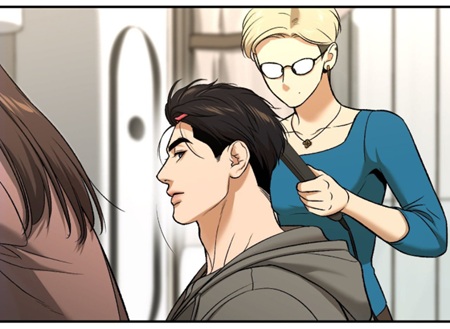
Before his collapse, the opponent Arnaud Gabriel had casually flirted with his “fated partner.” (chapter 82) And how did the champion respond to that provocation? Like a cornered animal. (chapter 82) He became the wolf again, not out of jealousy, but out of survival reflex—his body screaming its panic in place of words. In that instant, he was reminded that he could lose doc Dan as a partner, that the bond he relies on might not belong to him forever.. The roar emptied his chest; his lungs gave out before his pride did. There was no air left in his body… thus the heart and lung couldn’t work properly.

That’s why the “burnout” (chapter 82) after training feels different this time. It’s not a failure of strength but a signal from the body, revealing what he refuses to confess: his greatest fear is no longer defeat—it’s loss. And that’s what makes him so human. For the first time, the indestructible champion stands on the same ground as Oh Daehyun—both breathless, both weary, both trapped between expectation and emotion. The difference is that Jaekyung’s fatigue is not born of rivalry but of love. In other words, this scene announces the vanishing of the monster the manager had tried to create and preserve. (chapter 75) The fearsome beast who once fought for dominance is gone. What remains is a tamed wolf, following his master’s voice (doc Dan) — not out of submission, but because he finally trusts where it leads. (chapter 82) He is now a tamed wolf following his master’s suggestions! (chapter 82) Thus the coach is now facing the couple. And now, my avid readers can understand why the champion seems almost radiant when he finds himself alone with doc Dan at the amusement park. It is not mere joy or freedom; it is the relief of finally acting from desire instead of duty (chapter 82) For once, he can do what he truly wants — to make the man beside him breathe.
The motivation behind this “date” goes beyond playfulness. It is his way of returning the gift he once received. Remember the birthday card (chapter 55): (chapter 55)

“Thanks to you, I finally feel like I can breathe again.” That card became the emblem of hope — a promise of redemption. Joo Jaekyung had been able to bring the physical therapist comfort and support in the past, so he can do it again. If he can help doc Dan breathe freely, without fear or debt, then perhaps he himself can breathe without fear as well. In other words, we should expect a confession in the future episodes.

“I Won’t Fall Again” — Gravity, Shame, and the Vow

Falling is actually the champion’s biggest fear. (chapter 82) That’s why Mingwa confronted him with reality, when she stages doc Dan’s unconscious suicidal attempt in front of the railing: (chapter 79) The scene functions as both mirror and revelation: it forces the fighter to face the truth he has avoided all his life. In the past, he had never truly fallen. His defeats were painful, but never fatal; his failures never signified the end of a life. He could always stand up again — until now. Watching Kim Dan lean over the edge forces him to confront the difference between metaphor and mortality.

But this rises the following question. Why does he associate his first tournament (chapter 82) with fall (chapter 82)? After all, that match ended only in a knockout, not in death. The answer lies at home. The boy’s first image of defeat was not his own body in the ring, but his father’s corpse on the floor (chapter 73) – surrounded by bottles and syringes (chapter 73). Addiction, gambling, and intoxication: all ways of trying to rise above reality, to feel high, if only for a moment. Joo Jaewoong quite literally died from altitude, from chasing a false form of air. His father had tried to climb the social ladder through sport, to escape the poverty that trapped them, but he had failed. Those words (chapter 73), thrown like stones by the father at his son, buried themselves in the boy like shards.. They echoed like a curse — a prophecy Joo Jaekyung would spend his whole life disproving.

The young Jaekyung saw and understood. When he collapsed during his first tournament, finishing third because there were no other opponents (chapter 82), he has the same posture of that corpse — arms spread, breath gone, waiting for someone to call him back to life. Back then, his father was still alive, but didn’t care for him. However, such a position announced the future demise of Joo Jaewoong. He had fallen out of excess; he fell out of weakness. Both were conquered by gravity, one literally, the other symbolically.

But the mother’s departure turned that fall into reality. She left the house claiming that the father’s violence and failure were to blame (chapter 72) (chapter 72), yet she made no attempt to build an independent life. Her survival had always depended on his success — and when his career crumbled, she vanished with it. That’s the reason why the trash remained uncollected — a visual proof of abandonment (chapter 72) But the little boy failed to notice it, because he was suffering from the father’s abuse. Before leaving, she gave her son a phone number, as if absence were only temporary, as if love could be reached through a dial tone. That small gesture sustained an illusion: that she would come back if he became strong enough, rich enough, worthy enough. That illusion became the foundation of his life.
Thus he trained obsessively, demanding to compete even as an elementary student (chapter 72) His first fight was not about trophies — it was an act of filial negotiation: a promise to buy her return. But of course, 300 dollars could not rebuild a family. His first fall became the confirmation of her silence. This explicates why he recalls his first tournament and considers it as “fall”. He had not been able to win, thus the mother could not return. He doesn’t fight for glory or passion; he fights to avoid being discarded again. So, when he says “I won’t fall again,” what he really means is “I won’t let myself be unloved again.”

In other words, he wanted to climb in order to rebuild the missing bridge to his mother. (chapter 72) But the problem is that when he was finally able to reach his mother, the latter answered that Joo Jaekyung was too late. The mother’s words sealed the curse. He was “already grown up now” (chapter 74), hence he no longer needed her — as if maturity meant he no longer needed love. She actually implied that she had been all this time by his side. (chapter 74), while in reality, she had long abandoned him. Her departure turned growth into punishment, and independence into exile. This explicates why as an adult, he used money to buy people and turn them into toys. This could only make appear as a spoiled brat.
He built his entire life around that promise, standing against gravity like an inverted pillar. The body that once touched the ground became a monument to refusal. He had to reach the sky, to remain in the air. Thus he chose the penthouse as his new home.

But defying gravity comes at a cost. He trained to stay upright until breathing became difficult due to the thin air. Breathing itself became rebellion. Every gasp of air reminded him of the father’s last exhale. Every victory was a way of proving that he could resist both descent and inheritance. Yet the same vow that kept him standing also froze him in place: a man always in motion, never resting.

When Kim Dan almost fell from the railing (chapter 79), the scene echoed this primal fear. The champion’s hand reaching out was more than reflex — it was salvation in reverse. By catching the doctor, he was symbolically catching his father, his mother, and the child he once was. In that single gesture, he refused to let history repeat itself.

The sentence “I won’t fall again” is no longer just a boy’s defense; it is a man’s confession. It reveals the weight he carries: the fear of becoming the very body he once found on the floor, the terror of losing the one person who gave him air. Through doc Dan, Joo Jaekyung learns that grounding himself is not failure but healing: he must get closer to the ground to draw air back into his lungs.

And now, we can understand why he chose the amusement park over the Eiffel Tower. The fighter who once chased altitude now seeks balance at earth level. His goal is not to impress through grandeur or wealth, but to care, to laugh, to rebuild joy together.

By choosing play over pride, he is attempting to rewrite his history — to erase the legacy of his parents’ abandonment and failure. What once was a vow against falling now becomes a lesson in how to stand, breathe, and love on common ground. Hence he looked for attractions and found these brochures. He didn’t want to leave it to fate contrary to his hyung.

Breathlessness and Youth

Before focusing on the funfair, I would like to give another explanation for his sudden breathlessness. (chapter 82) In chapter 82, both Yosep and the manager interpret the champion’s shortness of breath in purely technical terms. Yosep assumes it comes from his long absence from the ring, while Park Namwook agrees — eager to reduce fatigue to mere physiology. Their reasoning sounds plausible, yet it misses the core truth.

Joo Jaekyung’s breathlessness was never an issue before. (chapter 79) Even Park Namwook himself, only days earlier, had described the French match as (chapter 81) “a breeze” — a fight so effortless that it would bring some fresh air into the champion’s career. But that metaphor betrays its irony: what was supposed to refresh him is now suffocating him. The “breeze” promised by his manager has turned into lack of air.

If his lungs are giving out, it is not from lack of training, but from an excess of negative feelings. This is the paradox of his transformation. The man who once lived like stone — unyielding, heavy, immovable — is now becoming light, emotional, alive. His body, once used only for control, now responds to affection, anxiety, and loss. He is breathless because he has begun to feel again.

Interesting is that (chapter 79), the break is perceived differently, depending on the situation. (chapter 82) In one scene, the break is seen as a good opportunity, in the other not(“out of the game”). Besides, at no moment, they are using the word “recovery”, as if the man had never been surged.

What neither man notices is that the athlete’s body had already changed during that so-called “break.”
In truth, he had caught a cold (chapter 70) — a detail no one around him ever learned. This simple fact overturns their interpretation. (chapter 70) The breathlessness they see now is not a decline in performance, but the residue of transformation. His body, once trained to suppress every weakness, had finally surrendered to nature.
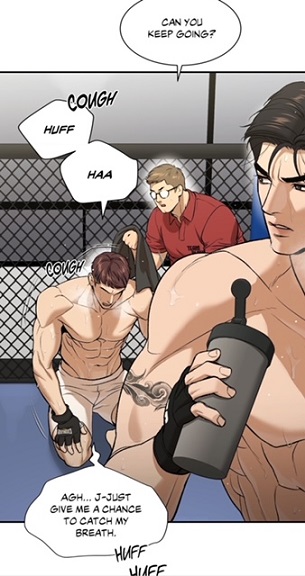
The cold, therefore, was not an illness but a rebirth — the first genuine sign of rejuvenation.
The first sneeze burst out like a leftover gasp from the night of panic at the dock (chapter 69): an involuntary release of fear and tension. Flooded with air and emotion, his body responded the only way it knew how — by collapsing into vulnerability. It was the moment when the emperor turned into a man, when the monument learned to breathe.

This was not simple fatigue; it was renewal.
For the first time in years, his system behaved like that of a human being, not a machine. The flushed cheeks, the runny nose, the dazed look — all marked a regression to childhood, an age when feelings could still flow freely. Before, he had never been breathless, because he was living like a zombie or a machine ignoring pain. Breathlessness had once been a symptom of repression; the cold became the body’s quiet revenge, proof that he could still react, still feel.

In this sense, the cold acts as metaphorical cleansing — an expulsion of the stale air he had been holding since childhood. The “monster” that Park Namwook wished to preserve (chapter 75) was finally dissolving. What replaced it was something fragile yet alive. But Yosep and Park Namwook, more obsessed with performance and profit, mistook this renewal for decline.

This connection between breathlessness and youth extends beyond Joo Jaekyung. We’ve seen another fighter gasping for air — Seonho (chapter 46), whose clash with the champion exposes two different forms of frustration.
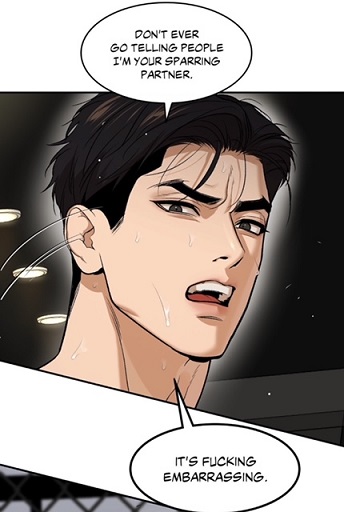
It begins with Jaekyung’s own accusation. (chapter 46) He reproaches Seonho for using his title and image to promote himself, for bragging about their sparring sessions to boost his career. From his perspective, Seonho lacks both endurance and authenticity — he performs strength rather than living it. (chapter 46) For Jaekyung, such behavior is intolerable because it cheapens everything he has sacrificed to achieve.
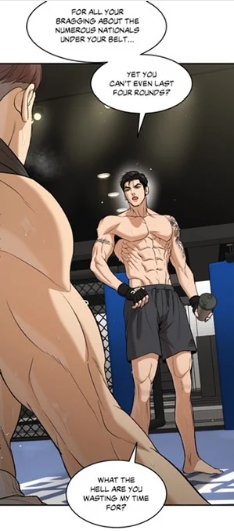
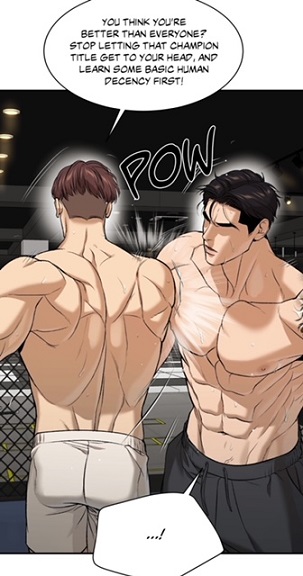
But Seonho’s retaliation strikes closer to the heart. (chapter 46) He turns on Jaekyung and accuses him of arrogance — of using his champion title to look down on others. What Seonho perceives as disdain is, in truth, the athlete’s defense mechanism. The star’s detachment is not born from pride but from obligation and trauma (abandonment issues).
For years, he has been forced to be perfect — the faultless product that Yosep and Park Namwook can market and control. (chapter 46) His perfection is not freedom; it is captivity.

The irony is cruel: Seonho envies what Jaekyung himself resents deep down. He is not happy.
One gasps because he cannot reach the summit; the other because he can never descend and have a family. Both are breathless — trapped at different altitudes of the same illusion. In this light, breathlessness becomes the shared symptom of youth distorted by ambition. For Seonho, it signals decline — the body’s inability to keep up with the illusion of eternal strength.
For Jaekyung, it marks the end of the illusion itself — the beginning of human fatigue, emotion, and rebirth.

Under this light, it became comprehensible why Seonho (chapter 52) tried to recruit Potato, the youngest member from Team Black. He wanted to become the new idol of Hwang Yoon-Gu. He imagined that he could replace the main lead and Potato would be happy to become the new sparring partner of Seonho.

And this prepares the ground for his encounter with Arnaud Gabriel, the “eagle” who embodies yet another version of false air (chapter 82) — a beauty that glides but never lands. Like Seonho, Gabriel thrives on appearance — on surfaces polished by attention. His beauty, elegance, and social charisma are his weapons. He lives in the air of visibility, relying on wind — the shifting currents of social media (chapter 81) (chapter 82) and press coverage — to lift his name higher. That’s why Mingwa made sure to show him at the press conference. (chapter 82) Every post, every camera flash, every headline serves as borrowed oxygen.
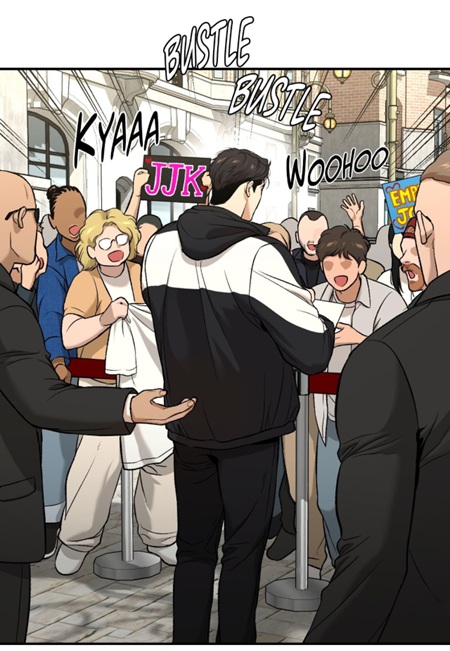
We see him carefully maintaining this illusion of effortless flight: (chapter 82) posing in his new suit for the press conference, his public image as flawless as his wings.

(chapter 82) Yet beneath that composure lies dependency. Gabriel’s power exists only as long as others keep watching, as long as the wind keeps blowing. His world is made of altitude — but the higher one flies, the thinner the air becomes. But if there is no wind or air, the eagle can no longer fly. This is palpable on two occasions, his encounter with the two male leads.

When he flirts with doc Dan (chapter 82), Gabriel still speaks in French — creating an act of exclusion. The physical therapist can’t understand a word, but the eagle doesn’t care; comprehension isn’t the goal, impression is. The wink replaces language, turning seduction into spectacle. It’s not meant for dialogue but for display — a gesture meant to be seen, not felt. He imagines that he has wooed the physical therapist.

He doesn’t wait for a reply; he simply turns away, leaving Doc Dan behind. (chapter 82) The grin that follows is one of self-satisfaction and superficiality, not connection. It’s the smile of a man admiring his own reflection in another’s confusion — proof that he controls both the scene and the gaze. This shows that he had no intention to make the protagonist jealous. And it is clear that he never saw the wolf’s rage afterwards. (chapter 82)

But why did he approach the Emperor, after he had left the spotlight? One might say that it was to get his attention and provoke a reaction. The same arrogance colors his handshake with Joo Jaekyung. Gabriel greets him with a polished smile and an extended hand, yet his words carry a double edge: (chapter 82)

  • “I know this is your return match, but I won’t go easy on you.” Behind the polite phrasing hides mockery and calculation. The smile is diplomatic; the tone, predatory. By choosing to speak in French, through an interpreter, he asserts distance and superiority. It is not a language barrier — it is a form of hierarchy.
  • “Good luck with your training,” he pretends to wish him well while quietly diminishing its target. The implication is clear: you’ll need it. The eagle knows about the champion’s surgery and exploits that knowledge beneath a façade of charm. Every word he utters, whether to Jaekyung or Dan, is a performance — a test of power disguised as civility.

Everything is pointing out that Gabriel knows more than he admits. His remark reveals that he is fully aware of the champion’s surgery and the rumors surrounding it. He could even know about the drinking and his “lack of stamina”. (chapter 82) The line echoes in irony. On the surface, it invokes sportsmanship; beneath it, it suggests that Jaekyung’s previous victories were not clean — that his reign was tainted by aggression or controversy. Yet the true paradox lies elsewhere: Gabriel himself knows that this match is anything but clean. He is exploiting Jaekyung’s weakened condition, confident that he will prevail against a half-healed opponent. That’s why the athlete was encouraged to appear in a suit. (chapter 82) That way, his “vulnerability” would be masked. No one would question the champion’s health. And this brings me to my next observation.

This duplicity mirrors the logic of Hwang Byungchul, the old coach who once criticized Jaekyung for fighting too soon after his shoulder surgery (chapter 70). Both men embody the same cruelty disguised as professionalism — one in the ring, the other from the shadows. They blame the champion for the new match, none of them question the system.

Gabriel’s arrogance, therefore, is not personal but systemic. He represents the world that raised Jaekyung: a world where weakness is mocked, empathy is absent or a lip-service, and “clean fights” exist only as public performances. That’s why he stands for fun. He has never truly challenged “dangerous opponents”. The eagle’s flight is powered by the same wind that once blew through the director’s gym — the cold air of superiority. This means that unlike Joo Jaekyung, the eagle has never faced real turbulence.
Gabriel has lived in an atmosphere of praise, never subjected to the kind of hostility that constantly surrounded the champion. He has not endured the venom of hateful comments (chapter 36) or the media’s harsh verdicts after defeat (chapter 54), when analysts accused Jaekyung of recklessness for returning to the ring too soon, though he had problems with his shoulder. Gabriel’s fame soars above such storms — sustained by admiration, not endurance. Hence he is posting selfies.

(chapter 82) However,, Joo Jaekyung is no longer attached to his cellphone and the virtual world. What he truly wants now is real and true love from doc Dan. (chapter 82) This explains why he is seen interacting more and more directly with fans and this outside! (chapter 82) He is now seen signing autographs (chapter 82), whereas in the past, he was only seen in company of reporters in a secluded area. (chapter 40)
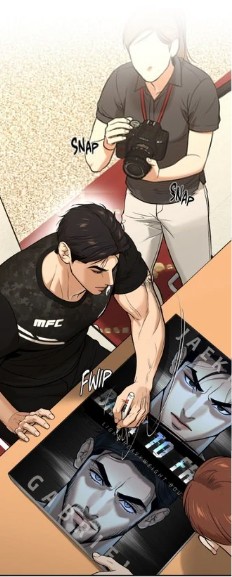
But this match carries a hidden danger. It was secretly arranged by the CEO, a fact still unknown to the public. Should Jaekyung win, the backlash could fall not on the loser, but on the victor. Critics could accuse the champion of avoiding a real challenge — of selecting an easy, lower-ranked opponent (chapter 81) rather than facing the fighters in first or second place. (chapter 69) The victory would be branded as hollow, a publicity stunt rather than an athletic achievement.

Yet this very accusation could threaten Gabriel as well. By calling him weak, the same commentators who once worshipped his image would strip him of his core identity: that of an athlete. (chapter 81) He wants to be admired as the hottest male figure in the sport, but admiration without credibility is only ornament. If his skill is questioned, his entire persona collapses.

Thus, both men stand on fragile ground — one condemned for winning, the other diminished by losing. Gabriel’s elegance and Jaekyung’s strength mirror each other’s curse: both are trapped in a world where value exists only in the eyes of others, and where even victory can feel like a fall. However, this can change, if this fight becomes a true spectacle, and is born out of love! But the air that sustains Gabriel is not the same that now fills Jaekyung’s lungs.
The eagle rises through applause; the wolf begins to rise through love. Liebe verleiht Flügel (German) — love gives wings — but these wings do not lift him away from the world. They carry him closer to it, toward the ground, toward life and fun.

The Amusement Park and its Ferris Wheel — Circles of Breath and Light

If the Eiffel Tower was built to celebrate height and conquest, the Ferris wheel, (chapter 82) first unveiled at the World’s Columbian Exposition in 1893, was created to transform height into play. Conceived by engineer George Washington Ferris as America’s answer to the Parisian tower, it sought to outshine France not through steel alone, but through motion — a structure that would rise and fall, carrying ordinary people with it. Unlike the fixed tower, the wheel invited participation: passengers would move together, share the air, rise and descend without fear. It was both monument and moment — a way to democratize the sky.

That is the kind of altitude Joo Jaekyung chooses.
After years of living at the top — in the isolating stillness of the champion’s penthouse, the rooftop — he now turns to a form of shared elevation. The Ferris wheel becomes his antidote to the rigid hierarchy that once defined his life. Here, there are no rankings, no first or second place, only circular motion. One rises while another descends, but both will meet again. It is the geometry of equality — and the perfect metaphor for breathing. This means that, by choosing the Ferris wheel, Joo Jaekyung and Kim Dan experience a gentle form of falling — one that no longer hurts.

Each rotation of the wheel is an inhale and exhale; ascent and descent, effort and release.
Inside the small cabin, air is shared. Love and life become visible through motion rather than achievement. The attraction’s design embodies the very thing Jaekyung and Dan have been learning all along: balance.

For the doctor, whose childhood was shaped by financial limits and emotional debt, the wheel offers what he never had — the chance to look at people from above, to rise without cost or guilt. For the champion, it restores what he lost — the ability to enjoy altitude without suffocating, to associate height not with fear, fame, or trauma, but with wonder. In that cabin, surrounded by laughter and sky, they can both breathe again.

But the symbolism extends further.
The Ferris wheel stands in sharp contrast to the highway, the modern symbol of depression and disconnection. As psychologists have noted, this kind of highway thinking characterizes the depressed and overdriven mind. It is the mental state of someone who keeps moving forward in a single direction — not out of purpose, but out of inertia. The brain becomes trapped in one lane, incapable of detouring, exploring, or slowing down. Over time, this creates a kind of perceptual tunnel: a world reduced to one goal, one fear, one story.

I watched this documentary, but it is in French https://www.youtube.com/watch?v=v5YcH5X5Xgo

In depression, this narrowing becomes pathological. The mind loses its ability to imagine alternatives, to see side roads or landscapes beyond the straight line ahead. Reality shrinks into a one-dimensional track — progress without perspective. The obsession with direction replaces the experience of life itself: one keeps accelerating or slowing down, chasing milestones, yet the inner landscape remains unchanged. This is how I came to connect these three scenes:

Chapter 33Chapter 56Chapter 69

That reflects the champion’s mind-set, his narrow-mindedness. But keep in mind that during that evening, the champion made a detour, he was disturbed by the destination/ goal:
Here the athlete has only one goal: talk to doc Dan and clean the air. He has no intention to truly rekindle with him Thus he is still stuck in a traffic jam. Here, there is a progression, because he can switch the lane. However, he is still driving in one direction, not looking out of the window. He is not taking his time either. These scenes illustrate the champion’s psychological confinement and mirror doc Dan’s mindset as well.
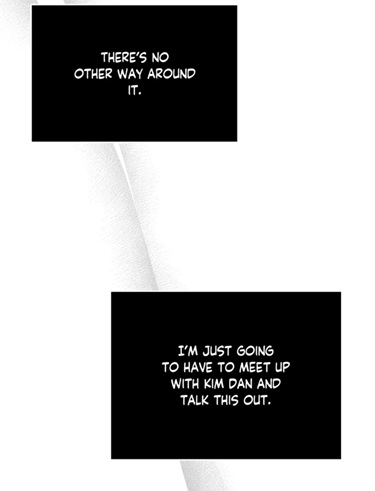
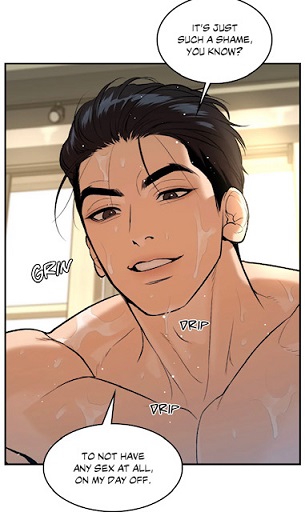
And now, look at the streets of Paris. (chapter 82) They look rather empty, yet we can see a crossroad — a sign that the champion’s mentality has improved. He is no longer narrow-minded or trapped in one lane. However, the high peak ahead represents the amusement park, because there, the destination is not important. There is no order or hierarchy either.

This is why healing requires not just rest but multi-perspectivity — the rediscovery of curves, loops, and crossings. The the funfair and Ferris wheel become the perfect antidote: it teaches that movement can be circular, playful, shared, and above all, reversible. Instead of racing toward a fixed destination, the wheel allows return, variation, and exchange. It reawakens the part of the brain that knows how to wonder. But the funfair offers other possibilities as well: the roller coasters. (chapter 82) The latter teach courage.They carry within them the echo of Jaekyung’s greatest fear: falling. But here, the fall is transformed into exhilaration. What once symbolized loss, shame, and trauma now becomes thrill and laughter. The mechanical descent reclaims the forbidden emotion; it gives the body permission to scream, to release control, to fall without dying.

Joo Jaekyung’s life before Kim Dan was precisely that: a mental highway.
Every victory led only to the next, every title erased the one before. The more he advanced, the less he lived. His body, disciplined into automation, had forgotten the curve of joy — the possibility of turning, pausing, returning. The Ferris wheel and the roller coasters break that pattern. The Ferris Wheel reintroduces circularity, where movement is not escape but rhythm, where the goal is not ascent but repetition with difference and observation. From there, you can look at your surroundings. (chapter 75)

This is where Mingwa’s visual irony reaches its height.
The man who once swore, (chapter 82) now voluntarily steps into a machine that promises nothing but falling — and smiles. What once represented humiliation now produces joy. This reversal is the purest expression of healing: when what once wounded becomes what restores.

Together, the Ferris wheel and the roller coasters offer two complementary forms of breath.
One teaches rhythm — the inhale and exhale of life. The other teaches release — the scream that clears the lungs. And then, it came to my mind that such a theme park could offer bumper cars — small machines of collision and laughter. Unlike the Ferris wheel or the roller coaster, they don’t offer height or speed but contact. Here, impact is stripped of danger; the crash becomes a form of play. The goal is not to avoid others but to meet them — to touch, collide, and burst out laughing. In this attraction, aggression loses its sting and turns into connection.

One shows that peace is possible in repetition; the other shows that freedom lies in motion. Laughter becomes medicine for the two breathless men, but contrary to the past, this time, doc Dan will see the happiness written on his loved one’s face. So far, he has never paid attention to his genuine smiles: (chapter 27) (chapter 80) He has not grasped that he can make the champion happy. In fact, this day would represent a real break and rest, as they would learn nothing, only make new experiences so that life can appear colorful again. Here, we can see two balloons in the form of heart: green and yellow. (chapter 82) Once they enter this world, they will discover a world full of magic and lights.

And now, imagine this. If there was a love confession in that theme park, this could bring tears of joy, the opposite of these scenes (chapter 52) a kid versus a grown-up, both rejected and silenced. (chapter 74) Joo Jaekyung would have achieved his goal: even vulnerable or childish, he is still lovable.

Both stand against the straight line of the highway — the depressive geometry of one-way thinking. The park and its attractions offer circles and loops instead, motions that bring one back to the self, not away from it. They turn fear into fun, control into connection.

If the highway is the architecture of burnout, the amusement park with its attractions is the architecture of recovery.
On the road, time accelerates; in the air, it expands.
On the highway, one is alone even among traffic; on the wheel, one is secluded but among people — the paradox of safe intimacy. Inside the cabin, the couple is both visible and hidden, surrounded by other voices yet enclosed in their own breath. It’s a fragile cocoon where public space becomes private moment, where affection can exist without fear of intrusion.

This is the healing structure of Jinx’s Paris arc. (chapter 82) The wheel is not a symbol of escape from the world but reconciliation with it. At the same time, it feels like a reverence to the fairy tales and their famous ending: (chapter 41) They were destined to be together and lived happily.
It redefines air: no longer something to conquer or control, but something to share. The circular motion mirrors the psychological rhythm that both men have been denied — the ability to rise and fall without shame, to let life move through them rather than resist it.

Even the mechanics of the wheel resonate with their journey. It turns slowly, patiently; it demands trust. Once aboard, there’s no way to force speed or direction. One must surrender — to the mechanism, to the air, to the view. It is the perfect opposite of Jaekyung’s former life, where every second was measured, every breath controlled. Now, he can do nothing but sit, look, and breathe.

And there is more. The wheel’s origin — a response to France’s Eiffel Tower — completes the symbolic circle between the two monuments. The Eiffel Tower represented competition between nations, a masculine monument to progress, mastery, and endurance. The Ferris wheel transformed that spirit into something inclusive: it turned height into experience, individual triumph into collective wonder. Hence the Ferris Wheel exists in France and in other cities. This is exactly the transformation Jaekyung undergoes. The fight is no longer vertical — him against the world — but circular, relational, shared.

Seen from a distance, the wheel glows like a moving constellation — a ring of stars rotating in the night.
In the earlier chapters, stars appeared above Jaekyung’s brochures (chapter 82) to signal his quiet happiness, mirroring the stars that once surrounded Kim Dan’s laugh (chapter 44). The Ferris wheel reanimates that motif. Each cabin is a star, and together they form a galaxy of moments — proof that light can move without burning out, that joy can repeat without fading.

In that sense, the Ferris wheel is more than a date setting. It is a machine of breath: a gentle, mechanical reminder that even steel can carry tenderness, that love — not ambition — is what truly gives flight.
Love gives wings — but not the kind that seek altitude. These wings move in circles, not lines. They return to where they began, bringing both men back to the ground lighter than before. To conclude, the birthday card contained the key how to rekindle with the physical therapist and win his heart: (chapter 55)

Feel free to comment. If you have any suggestion for topics or Manhwa, feel free to ask. If you enjoyed reading it, retweet it or push the button like. My Reddit-Instagram-Twitter-Tumblr account is: @bebebisous33. Thanks for reading and for the support, particularly, I would like to thank all the new followers and people recommending my blog.

Jinx: Behind The Emp’s Shadow 😶‍🌫️👻

First of all, I would like to thank my new readers from China. 😍 Nowadays, my blog is exploding again thanks to them.

The Poster as a Manifesto of Shadows and Smoke

When I first saw the new promotional image titled “The Return of the Emp”, I had to pause. Something in it refused to make sense — or perhaps, it made too much sense. Here stands the celebrity fighter alone, shirtless, his upper body carved out of darkness, while a faint cloud floats behind him accompanied by a hidden spotlight. Beneath him glows the number 317, a detail too deliberate to be accidental. And yet, where is the opponent? Every previous MFC poster — from Randy Booker’s green inferno (chapter 13) (chapter 40) to Baek Junmin’s red blaze (chapter 48) — had mirrored faces, two bodies, two lights. This time, there is only one. The duel has vanished. What remains looks less like a fight and more like a myth in the making. (chapter 81)

So I began to wonder, my fellow Jinx-lovers, who made this image? One might reply, of course, the marketing branch of MFC, eager to sell the comeback of their most profitable star. And yet, something doesn’t add up. Unlike the posters for Randy Booker (chapter 13) or Dominic Hill (chapter 40), this one shows no date, no place, no trace of logistics (no TV diffusion like in the States “On PPV”). Only a face, a body, a void. Why would MFC release such an abstract announcement, stripped of all practical information? Why design such a poster which makes this event look more like a secret rendez-vous?

At that point, another possibility emerged. Perhaps this is not merely MFC’s doing but Mingwa’s own design — a deliberate distortion, letting fiction expose the machinery that feeds it. The result, I believe, is an image that speaks in two voices at once: one belonging to the league’s publicity team, and the other to the storyteller who knows what must eventually rise from the smoke. But I am suspecting a third voice hiding behind MFC which I will reveal below.

But the first mystery is not the smoke or the color. It is the absence of Arnaud Gabriel, the French kickboxer (chapter 81) chosen to face the Emperor. According to Oh Daehyun, this man is fighting for the title of the hottest male athlete in the world. (chapter 81) So why is he not placed in the poster? Does he fear comparison — or has someone decided that no comparison should be allowed? Each missing element feels intentional — the kind of silence that makes the viewer uneasy, as though something essential was being hidden in plain sight. (chapter 81)
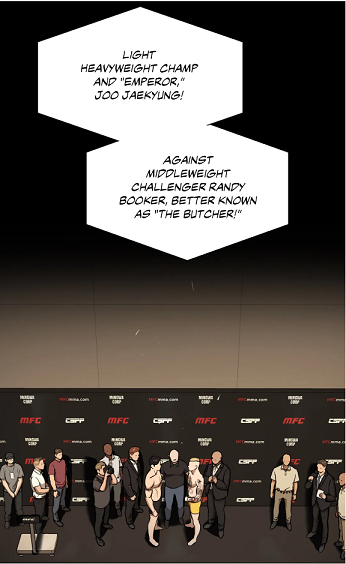
Then there is the pose — a quiet rupture in Mingwa’s visual language. Instead of the usual mirrored confrontation, the camera turns entirely toward the champion, revealing the torso and the raised fist. The MMA star faces not his rival, but the audience itself, as if daring the beholder to guess what has changed. For once, no familiar emblems frame him — no belt, no symmetry, only a body standing between light and smoke. Why this exposure now, and what does it conceal?

The light, too, behaves differently. In earlier posters, illumination came from behind (chapter 13) or within (chapter 48) — from the collision of two forces. Here, the glow seems to rise from below, slightly to the right, and yet the source remains unseen. Why there, and why invisible? What are we supposed to read in that slanted brightness — revelation or exposure, ascension or downfall?

And finally, the text itself: “The Return of the Emp.” (chapter 81) For the first time, words intrude upon the image — not just names, but a sentence, an unfinished promise. “Emp”: a fragment of Emperor, a crown cut short. (chapter 14) Why is there this abbreviation? Why does the image proclaim a return while simultaneously concealing the full title? What does it signify?
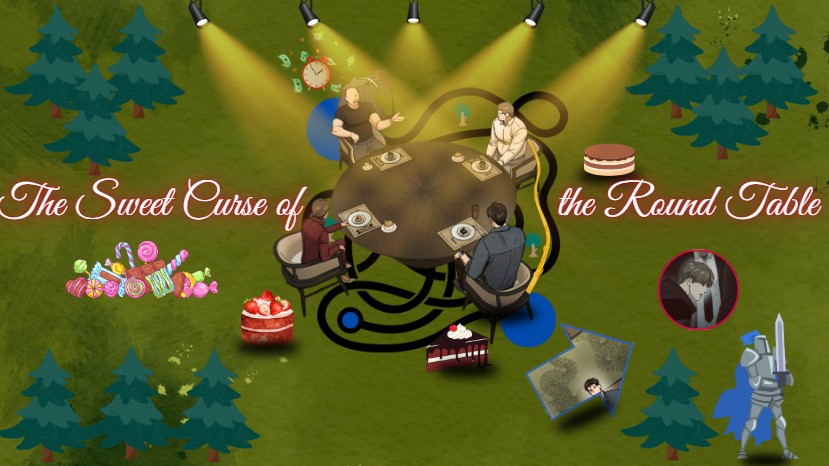
These details — the number 317, the smoke, the missing rival, the hidden light, the fractured title — weave a code of absence and expectation. They refuse to settle into one meaning, riddles disguised as design choices. From these visual clues, my previous theory seems to be corroborated: this event doesn’t announce the glorious comeback it pretends to be, but a carefully staged trap. However, there is more to it. The longer I examine the composition (chapter 81) — the fist aimed at the viewer, the smoke curling like a stage curtain, the void where the opponent should stand — the clearer it becomes that this poster already sketches the scene of the athlete’s anticipated demise. It reveals not just a fight, but where and how the next act will unfold 😲— before an audience that may not be what it seems.
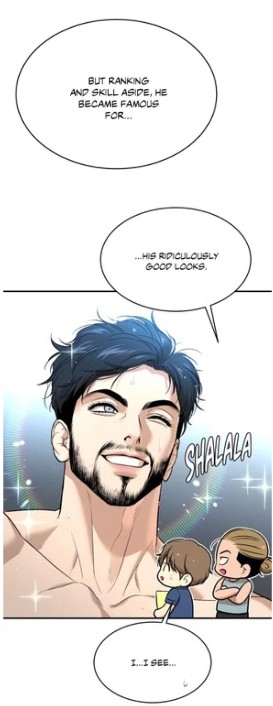
The Absent Rival – Arnaud Gabriel and the Art of the Mask

Every puzzle begins with a missing face. And here, the first enigma is Arnaud Gabriel himself (chapter 81) — the man selected to stand against the Emperor, yet nowhere to be seen. Why choose him, a French fighter known less for his record than for his looks? (chapter 40) Where every previous MFC announcement balanced two visages, two auras, two lights, this one shows only the wolf. The French kickboxer has been erased before the match even begins. (chapter 81)

(chapter 81) According to Oh Daehyun, his goal is not victory but visibility — to be crowned the hottest male athlete. (chapter 81) That title alone tells us everything about his mindset. For Arnaud, competition is not victory but exhibition. His sport is not combat; it is choreography. Every gesture (the smile, the wink, the tilt of his head) (chapter 81) seems designed for the lens rather than the opponent.
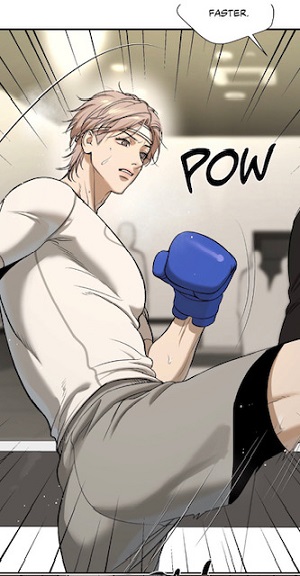
And perhaps that is precisely why he was chosen. A kickboxer fights with distance. (chapter 81) His weapon is reach, not contact — the opposite of boxing, where rhythm and proximity create truth. Arnaud’s martial art allows him to attack without connection, to strike without touching — the perfect metaphor for a system built on façade. In this sense, he does not merely fight; he performs the idea of fighting. For him, combat is not confrontation but more dance, not survival but fun. It is sparring in its purest, most aesthetic form — controlled, rhythmic, pleasing to the eye. Every kick and grin seems rehearsed to delight the crowd.

His entire persona seems imported from the cinema rather than the cage. One cannot help but think of Jean-Claude Van Damme, the Belgian kickboxer and martial artist turned movie icon, whose blend of violence and grace transformed the fight into spectacle. Like Van Damme, Arnaud Gabriel stands at the crossroads between athlete and actor — between authenticity and artifice. And now, you comprehend why certain readers felt a connection between this fighter and Choi Heesung: (chapter 30) The latter had to learn fighting in order to play his role in the drama Extreme Worlds (chapter 29).
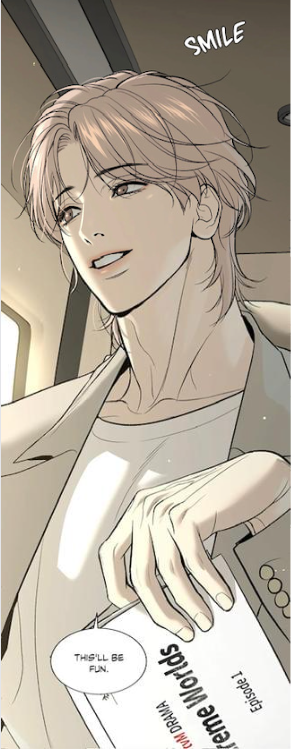
The fighter’s origin deepens this impression: France. The latter is famous for the spirit of savoir vivre — the art of living well, of savoring the moment. “Savoir vivre” is definitely part of his professional philosophy. Arnaud’s smile proclaims respect, pleasure and not perseverance or Schadenfreude. (chapter 81) He embodies a hedonism of the ring, a man who delights in admiration more than victory. Yet beneath the charm lies subtle anxiety. The beard that frames his grin functions as disguise — not to conceal aging, but to simulate experience, to appear older, to lend him a gravitas he has not earned. It is artifice masquerading as mastery.

It is funny, because in the analysis I had predicted that the match would take place in Europe. However, what my avid readers don’t know is that I was hesitating between France and Germany because of the desserts. And guess what… not only my prediction was proven correct, but also my hesitation. Why? Arnaud is a French name but its origins are Germanic. Arnaud, from arn (eagle) and wald (rule), means “he who rules like an eagle.” His name carries a certain arrogance. A creature of height and distance, he surveys from above, untouched by the chaos below. Gabriel, the angelic messenger, completes the illusion: an eagle crowned with divinity, a herald of light who never lands. Together they form the symbol of a man who rules through air — dazzling, distant, and hollow. Under this perspective, the smoke behind the champion could be interpreted as a veiled reference to Arnaud Gabriel. (chapter 81) He could attack him from behind or above. The smoke lingers behind both the title and the wolf, hinting that this elegant newcomer may have been placed as a pawn — not to challenge the champion’s skill, but to block his return to the title of Emperor. Consequently, he represents a real threat to Joo Jaekyung, while on the surface he looks harmless. That’s why for Park Namwook, Arnaud Gabriel seems to be an easy rival. No wonder why he described this encounter as a breeze (air element) (chapter 81), while in reality a “storm” is actually coming.

But in Jinx, there exists another eagle in the sky: Oh Daehyun. (chapter 8) His eagle is spreading his wings in front of his god, the sun, attempting to fly closer to the sun. According to me, Joo Jaekyung is the sun. This explains the loyalty of this purple belt fighter toward the protagonist!
Because of these parallels, I couldn’t help myself envisaging this possibility that Oh Daehyun ends up facing the other eagle. And that’s how the “novice” would get his breakthrough. (chapter 47) But that’s one possibility among others, one thing is sure. Oh Daehyun will play an important part during their stay in France.

And yet, for all this lightness, the Frenchman is nowhere to be seen. (chapter 81) His absence from the poster betrays the truth: he is not a rival but a tool. MFC’s marketing machine uses him as a prop, an emblem of beauty to bait the audience, to divert attention. The company doesn’t need his fists — only his face — and even that, now, has been erased. His omission signals that the game is fixed before it begins. Yes, the poster is implying the existence of a rigged match.

The same is true for the missing championship belt. (chapter 13) Once gleaming over the champion’s shoulder — as in the poster with Randy Booker — it has vanished. It absence in the fight against Baek Junmin revealed (chapter 48) MFC’s true intentions. The tie had long been decided in order to create a smooth transition. MFC’s goal becomes clear: to take away the belt and give it to someone else, while appearing clean. The wolf’s success represented a threat to their illegal business (gambling and money laundering). (chapter 46) People would bet on him and win… they needed him to lose and break his “lucky streak”. In other words, the organization betrayed the body they once sold. They had prepared the fall long before the injury, the surgery, or the suspension. But their plan failed. Despite every setback, the wolf remained beloved at home. People still admired him, not for the trophies, but for his kindness (chapter 62), humility and strength (chapter 62) In other words, what the champion did in the seaside town had a huge impact in his life and world. He lingered in the hearts of those he touched. He was not a fallen idol, nor a forgotten champion, but a living memory — proof that integrity leaves deeper marks than victory ever could. To conclude, his fame no longer comes from spectacle only but also from empathy and presence — from the very qualities the schemers and media system fail to grasp.

And so the game shifts. What cannot be destroyed by defeat will be targeted through image. (chapter 81) The new battlefield is the face. Under this light, Jinx-philes will grasp why the agents from the Entertainment agency were so zealous in defending the star’s reputation. If he were to lose his good looks, they would lose one of their most profitable clients. (chapter 81) They hadn’t intervened when he was suspended or stripped of brand value — back then, he was still only a fighter, not a product. The entertainment world belongs to artists, not athletes. In truth, the celebrity now stands between two worlds: the ring and the stage, the punch and the pose, the man and the myth. If the schemers cannot ruin his record, they will try to ruin his reflection.
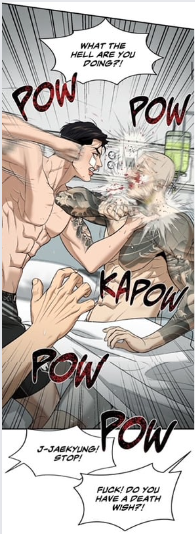
Here, I suspect, lies the invisible hand of Baek Junmin — the man whose own face was once disfigured (chapter 52), whose envy of beauty turned into a creed. Imagine this. Now he holds the championship belt, yet no one admires him. His ruined face became the excuse for his bitterness, (chapter 52) and his rival the embodiment of everything he lost. He had to flee to Thailand to claim glory and admiration (chapter 69), only to discover that ownership without recognition is hollow. Even with the title, his name barely circulates in the media. (chapter 77) MFC can not promote him so easily, as his title could get questioned. He remains unseen — a champion without a face.
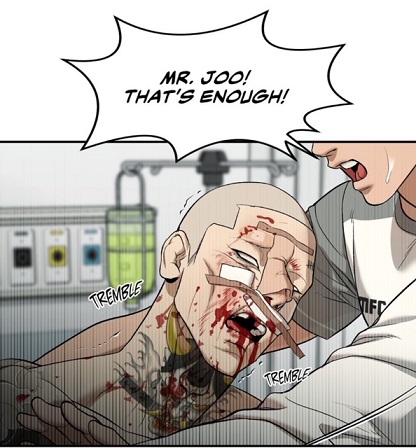
If Baek Junmin cannot be admired, he will annihilate admiration itself. (chapter 81) To him, visibility has become an offense. And this poster lets that mindset leak through. His presence is everywhere — not in the body of the opponent, but in the photograph chosen, in the smoke curling behind the champion, and in the raised fist, the same one that once struck him down. (chapter 52) In the past, his insult (chapter 74) merged anger with heat; now that very “hotness” materializes in the media and poster as smoke, an image of resentment turned into atmosphere. (chapter 81)
And yet, the smoke behind the celebrity’s silhouette may carry another, more literal association — one tied to France itself. (chapter 81)

The old blue packs of Gauloises Caporal, adorned with a winged helmet, were once the emblem of French masculinity and freedom — a breath of rebellion. “Gauloises,” meaning “Gallic,” evokes both the air of the bird (rooster/eagle) and the pride of the soldier. How fitting, then, that the French opponent, Arnaud Gabriel, should enter the narrative surrounded by air and smoke, like a man of wings rather than roots.

But here the image turns double-edged. To Baek Junmin, smoke is not freedom but submission (chapter 74): the visible trace of a man who dares to rebel. He once watched the fighter smoke a plain cigarette and sneered at him for it, precisely because he knew it was not a joint. In Junmin’s world, violation meant courage and power intoxication. He assumed that fearlessness linked to drugs would bring admiration and success. Jaekyung’s refusal to accept their drug wasn’t prudence; it was, to him, an insult — a quiet act of superiority. The wolf’s restraint exposed his indifference and own dependency, and that humiliation still burns.
Now that same symbol returns, ready to be twisted. (chapter 81) The schemers can weaponize the image of smoke — turning a mundane habit into proof of moral decay. What once marked distance from corruption could now be rebranded as relapse. Under this light, the haze on the new poster reads like the resurrection of that old resentment: smoke as proof, as provocation, as the spark that might ignite the next fall.

Worse still, the smoke doesn’t surround the fighter, it floats behind him. The poster makes the celebrity appear like vapor itself: fleeting, unsubstantial, “hot air.” The man of iron and will is reduced to mist and memory, a puff of illusion dissolving under false light. And now, we can finally grasp why the word “Emperor” remains unfinished. Emp no longer stands for empire, but for emptiness in the schemers’ eyes — the very image of a man hollowed out by rumor, stripped of body and voice, left to vanish in someone else’s smoke.

The Message Behind The Colors

At first glance, the black-and-white palette of the new poster might seem to echo the timeless harmony of yin and yang — two forces locked in mutual creation (chapter 81), night feeding day, death feeding life. Yet the longer I stared, the more this equilibrium seemed broken. Instead of flowing into each other, black and white now collide: the darkness doesn’t cradle the light, it devours it. The world becomes gray. And that’s the intention of the creators, though yin and yang will be present in the match.

My fellow Jinx-lovers might also recall that in South Korea, black and white are not symbols of elegance or neutrality — they are the colors of mourning. (chapter 74) The main lead was seen “wearing a black suit with three white strips” showing that he was the chief mourner. (chapter 74) Once you recognize this (chapter 81), the image takes on an entirely different meaning. The smoke rises not like balance restored, but like incense burning for the dead, a soul leaving a body. This inversion transforms the poster into something closer to a memorial portrait.
And then there is the light purple haze — a color that at first might seem aesthetic, even noble. Yet in this context, it suggests something bleeding, rotting, fermenting, like wine left too long in the glass. It blurs the boundary between beauty and decay, pleasure and loss. In religious iconography, purple once stood for power and resurrection; here it becomes the color of corruption — the slow decomposition of glory. This could be seen as a clue that the authors of this poster are aware of the athlete’s past drinking. (chapter 54) The wolf is wrapped not in triumph, but in the faint perfume of something dying beautifully. He is shown before his decomposition, which reminds us of his father’s fate: (chapter 73)

(chapter 74) The dense, rising smoke recalls the funeral altar we once saw during Joo Jaewoon’s death scene — white blossoms, a dark frame, and a half-erased face. The emperor’s comeback has been reframed as his own commemoration: a legend embalmed in monochrome.

What makes this echo even more haunting is the photograph chosen for Joo Jaewoon’s funeral — his portrait as a boxer. One part of his face is covered. Moreover, his burial fused the professional and the personal, erasing the line between athlete and man. When his father died, he vanished both as a sportsman and as a person — an identity consumed by a role. And now, the poster of “The Return of the Emp” seems to repeat the same logic. The fighter clenching his MFC-branded fist mirrors that old photograph. It’s as if the marketing team were unconsciously recreating the father’s memorial, predicting the son’s fall. The image proclaims not revival, but elimination in advance — the death of the fighter, and with him, the man.

And that, I believe, is precisely what Baek Junmin desires. Unlike the champion, Junmin never lived the disciplined life of a true athlete; he was a thug from the very beginning, fighting not for mastery, but for longing and recognition. He has always been a man of the shadows (chapter 73), hiding behind his hyungs, the mobsters who granted him borrowed strength and false belonging. Joo Jaekyung, by contrast, was raised in the ring — the gym shaped him as both a professional and a person.

But here is the difference between the two “altars”: the smoke in the poster is placed not in front of the picture (chapter 74), but behind and it is going in the opposite direction: (chapter 81) Mingwa is announcing the failure of the trap. In other words, the athlete is about to earn his stage name “The Emperor” for good! Observe that so far, this stage name was only announced once and it was never written. Under this light, it becomes comprehensible why the fighter’s name is placed at the bottom. They are trying to erase his name, while he is about to become a real legend: the Emperor!

But let’s return our attention to The Shotgun and his relationship with the wolf! (chapter 49) If you have read my previous essay, you’ll remember that I connected the arc of chapters 80 to 89 to the theme of jealousy. Baek Junmin embodies that poison completely. His words — “ (chapter 49) “kid”, “coward,” “chicken” (chapter 74)— reveal not confidence but a profound inferiority complex. Obsessed with the Emperor, he wants to destroy the man he cannot become.
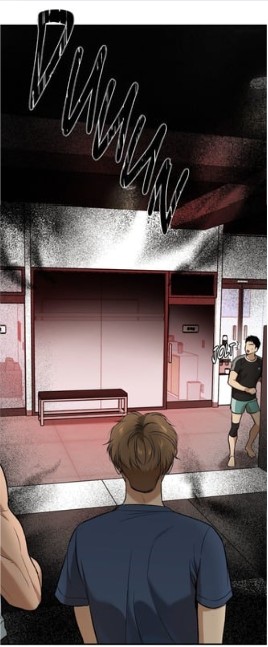
Yet in that obsession, Baek Junmin has frozen in time. His envy, greed, and resentment prevent him from truly living. He remains trapped in the past, mirroring the ghost of Joo Jaewoon, whose death also fused ambition and ruin. (chapter 73) Both men are haunted by the same delusion: that to win, one must erase the other.

That’s why the poster’s mourning tone resonates so powerfully — because it visualizes Junmin’s fantasy: to see the Emperor vanish, not only as a fighter, but as a man. And when he realizes that the wolf is not dying but living — that he has found peace, love, and laughter again — his envy will not fade. It will ignite.

And yet, the author behind this illustration — whoever designed it within the MFC hierarchy — does not realize how prophetic it becomes under Mingwa’s hand. (chapter 81) For what they intended as a visual obituary might instead signal transformation: the end of a man defined by violence and the birth of one reborn through empathy. Yes, the title of the match could be read like this: The return of Empathy. One might argue that this took place before. However, so far, none of the members from Team Black noticed it. In fact, the athlete stopped doc Dan from treating other members of Team Black. (chapter 79) And the hamster followed the wolf’s request. This explicates why Potato is wearing a knee support brace — a sign that he is now tending to his own injuries without the doctor’s assistance. (chapter 81) It is a subtle but telling detail: the physical separation mirrors the emotional boundary now forming within the team. The healer’s hands have been withdrawn. So the emperor’s empathy is incomplete, hence he is only EMP. It extends only toward his chosen one — the doctor — and not yet to the others around him. True empathy, however, cannot be selective; it must reach beyond intimacy to encompass even those who do not stand at the center of affection.

Potato’s knee brace exposes the current limit of the wolf’s compassion: he protects Kim Dan but neglects the rest. Yet the injured knee also foreshadows the coming fight. Arnaud Gabriel, the “eagle,” is a kickboxer — his power rests on his legs, his rhythm, his ability to stay aloft through movement. By highlighting Potato’s injury, the author discreetly reveals the eagle’s own weakness: the knee, the joint that bridges grace and collapse. Without his legs, the eagle cannot kick or dance — he becomes a chicken, earthbound and ridiculous. And how was the main lead described in the past? (chapter 1) He was a beast of destruction, someone who made sure to crush his opponents without mercy (chapter 15) Unstoppable in his rage, he moved like a man possessed — bloodthirsty, unrelenting, fighting not for glory but for survival. Each strike was a declaration: I will not die.
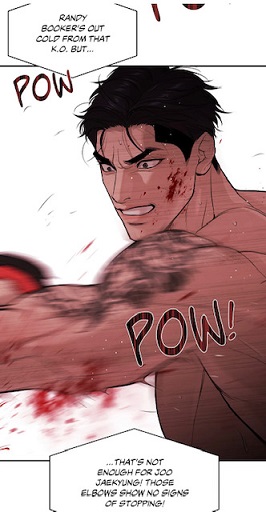
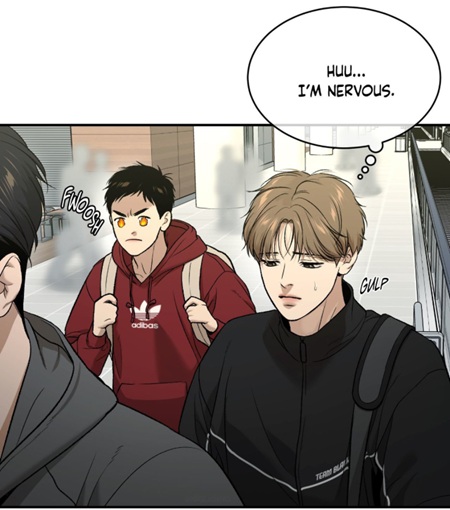
The French MMA scene, by contrast, stands for the opposite ethos — for entertainment, glamour, and spectacle, not mortal struggle. For the eagle, the ring is a stage; for the wolf, it has always been an arena. Thus, if the champion were to injure Arnaud Gabriel seriously, the audience’s outrage would be immediate. He would be condemned not as a fighter but as a monster. (chapter 81) Yet, this does not make the eagle harmless. He embodies dream and danger alike — beauty that glides above the earth, but also talons sharp enough to wound.

In my eyes, Arnaud Gabriel personifies both illusion and seduction, much like the cloud — an image that leads us back to Kim Dan himself. (chapter 38) The doctor, too, has always been associated with clouds: soft, elusive, shifting with emotion. Thus I deduce that their paths will inevitably cross, dream and danger meeting in vapor and light. But more importantly, I perceive the smoke as a reference to the rising of doc Dan as physical therapist. (chapter 81) So far, his efforts were never noticed. Park Namwook’s gratitude was rather a lip service than a true recognition, because after the debacle, he was ready to hire a new physical therapist. And according to me, the schemers are all expecting the arrival of a diminished “MMA fighter” reaching the end of his career. That’s why the light is directed at the cloud/smoke! The one behind him is his hidden support.

And if the match truly takes place, I believe the champion’s way to ruin the schemers’ plan will not be through annihilation but transformation. He has to become himself an ARTIST!! [I will elaborate more about this aspect below] This time, victory will not depend on blood, but on how he fights — by returning to his origins, to boxing, to the simplicity of rhythm and breath, to the era when his smile was genuine. By having fun… In that sense, Joo Jaekyung may no longer be fighting for MFC but as the living embodiment of his own gym — Team Black reborn as the Emperor’s court.

But before we reach that possibility, another layer of meaning unfolds through Team Black itself. (chapter 81) The team’s black-and-white uniform (chapter 81) echoes the same mourning duality: black in the center, white on the sides — precisely like the arrangement of smoke behind the poster’s title. Yet when the team steps into the airport, the palette explodes into the full five Korean colors (오방색):

  • Black (north, water): Kim Dan, wearing the Team Black jacket — still faithful, yet marked and exposed.
  • White (west, metal): Park Namwook, disciplined but cold. (chapter 81)
  • Blue (east, wood): Joo Jaekyung, vitality and growth, standing quietly at the center.
  • Red (south, fire): Potato, radiating warmth and impulsive energy.
  • Green (center, earth): Yosep, grounding the group in human normalcy.

Only Oh Daehyun’s clothing remains unseen, though his blond hair shines like yellow, the missing balance of the circle. Taken together, they form a living flag of South Korea, suggesting that for the first time, Team Black stands united not by uniform, but by spirit.

This silent unity contrasts sharply with their earlier appearance during the Baek Junmin match, when they were clothed alike but divided in heart and mind. (chapter 49) What looked like teamwork was mere coordination. Now, the visual disarray hides emotional harmony — the perfect yin-yang inversion of their past selves.

The poster may wear the colors of death, but the airport scene (chapter 81) quietly answers it with the colors of life, diversity, and rebirth. Behind the mourning veil, something in this team has already begun to live again.

As you could see, I detected parallels between the match in the States and the one in France. Everything is pointing out the existence of another trap. (chapter 81) People started wondering about the doctor’s jacket. Why is he the only one wearing it? It is clear that this cloth truly belongs to the physical therapist, because the sportsman’s has always been too big for the “hamster”. (chapter 36) One could think, the other members are not wearing it, for they don’t want to be associated with the champion. He has been stigmatized as a thug or a child losing his temper, the consequences of Park Namwook’s badmouthing. However, observe that even the star is not wearing it. (chapter 81) It, was if they didn’t want to be recognized.
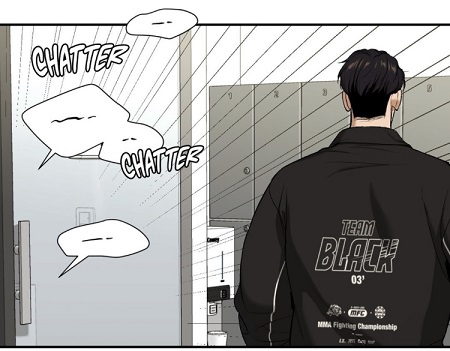
I think, there exists another explanation. Don’t forget that the jacket had different logos on the back: (chapter 36) What once symbolized sponsorship and solidarity has quietly disappeared. The explanation seems obvious at first: the loss of commercial partners following scandal and suspension. (chapter 54) Yet the deeper implication is far more unsettling. The jacket was more than a uniform; it was a contract, a visible bond between fighter and system. Its absence signals abandonment. The champion may still fight under the MFC banner, but the federation no longer claims him with pride. He is now a free agent trapped in an invisible cage — tolerated, not trusted. He questioned MFC and their competence (see chapter 67 and 69).

And what about the doctor? His jacket, now a solitary relic, must have arrived after his departure and given to him after his return. The Team Black jacket makes him a walking target. By still carrying the brand, he becomes the visible trace of a world that wishes to erase itself. He wears proof of loyalty in a landscape where faithfulness has become liability. If the upcoming match is indeed a trap, his uniform can mark him as bait or as a disguise! (chapter 37) He could be mistaken for the owner of the gym or a person involved in the scheme. And this leads me to my next observation: the champion’s picture and posture!

The Body That Faces the Crowd – From Defiance to Dialogue

If the smoke and the black-and-white palette whisper of death, the body posture roars of defiance. On the poster, the MMA fighter stands half-turned toward us, left fist raised, the logo MFC glinting on his glove like a brand or a curse. The light strikes him from below and from the right, revealing one side while leaving the other in shadow — a visual echo of his divided self: the professional mask and the wounded man beneath.

The position of that raised fist is crucial. It does not challenge the opponent — there is none in sight. It challenges the beholder. The blow is aimed outward, toward the audience, toward a world that has mocked, condemned, or abandoned him. The poster transforms the traditional stance of the victor into something closer to revolt. The “comeback” it advertises is not a return to sport, but a return against the crowd. Despite his handsomeness, he seems to have a bad personality (provoking, insulting, challenging the audience). They made him look like a bad guy: ruthless, arrogant and rebellious. As you can see, they are attempting again to ruin his fame and name.

Light purple bleeds through the smoke, carrying an undertone of resentment — bruised flesh, fermented wine, or the slow rot of disillusion. It’s the color of pride wounded yet unyielding, the hue of someone who refuses to forgive the world for its betrayal. In this light, the athlete seems less a man celebrating triumph than a revenant demanding recognition.

This reversal also tells us something about the system around him. In earlier matches, such as the one in the United States, both fighters were cheered, embraced as performers in a shared spectacle. Here, the scene will be different. No shared ovation, no brotherly arm around the shoulder, as with Dominique Hill. The poster prepares us for isolation, for a battle where the crowd itself becomes the enemy.

The schemers are expecting an angry and resentful man, while in verity this is a projection from the Shotgun. But because MFC is placed twice, it exposes the company’s greed and possessiveness. With the logo on the glove, they insinuate that they are the one deciding when Joo Jaekyung will fight or not. He is their puppet, and they decide when to discard him.

And perhaps that is the deepest irony. Team Black, still unaware that the previous match had been rigged — blind to the partial commentary, the biased jury, the manipulated outcome — walks toward a trap thinking it’s a stage. Neither the champion nor his coach nor his companion suspects that this time, the audience’s hostility has been engineered. The raised fist is both prophecy and warning: he will fight alone, not just in the ring, but against perception itself. Yet, he will supported by the “vapor”.

What the schemers read as fury, however, may become the seed of transformation. The same gesture that once meant aggression could turn, under a new light, into assertion — not of anger, but of presence. If the previous posters framed the fighter as spectacle, this one shows him claiming his body back from those who profited from it. I would even go so far to say that the athlete will end up challenging the authority MFC and even sue them. (chapter 81) And that’s how he could make history. He will be remembered as the Emperor, the one who put an end to crimes!

317 — The Date That Isn’t There

After the smoke, the colors and the picture, the next enigma lies in what the poster refuses to specify: no date, no location, no time. Every previous MFC announcement was anchored in visibility — April X, Saturday, on PPV , June — a fixed promise to the public. Here, all coordinates vanish.

That erasure extends beyond the poster. When Team Black lands abroad, the airport — once a stage for flashbulbs and microphones — stands eerily still. (chapter 81) That erasure extends beyond the poster. Behind Potato and Kim Dan drift a few gray silhouettes, barely human, half-formed shadows of what should have been journalists or fans. They look less like people than ghosts of publicity, residues of a crowd that never came. No banners, no reporters’ questions, (chapter 36) no cheering spectators — nothing recalls the hero’s welcomes of earlier arcs.

And yet, paradoxically, this match was an invitation from the CEO himself, supposedly a prestigious opportunity. The absence of press coverage therefore exposes a contradiction: the greater the supposed honor, the deeper the concealment. No one outside the organization has been informed; the public is deliberately kept in the dark. What pretends to be a triumphant comeback is, in truth, a private operation, an exclusive fight designed for a restricted audience. (chapter 81) Thus I deduce that the athlete won’t fight in a huge arena, but in front of a small circle, where people might smoke. A new version of this scene (chapter 74) but with a different public.

Still, one element gives the illusion of authenticity: the number 317. It appears on the poster like a seal of legitimacy — the next official bout in MFC’s timeline. And that is precisely the brilliance of the trap. The number suggests continuity, reassuring the team that everything follows protocol. The wolf and his court walk straight into the ambush because the system’s familiar numbering masks the rupture beneath.

In this silence, the gray figures become a visual metaphor for the event’s nature: visible enough to seem real, but hollow when touched. The “return of the Emperor” is not a broadcast — it’s a ghost match, orchestrated for unseen eyes, similar to the high-rollers who once financed Baek Junmin’s underground bouts for “commoners”. (chapter 47) Thus, 317 functions like a counterfeit signature — convincing enough to deceive even those inside the organization. What looks like promotion turns out to be execution by design, a fight that exists on paper but not on record. Hence no one is waiting for them at the airport.

At first glance, 317 might seem to follow the ordinary sequence of MFC events, yet the attentive reader will recall the last recorded bout — MFC 298 (chapter 54), the match where the Emperor faced Baek Junmin. That small arithmetic gap hides something extraordinary: eighteen events have supposedly taken place since then, in barely three months. Such acceleration borders on absurdity. It feels less like a sports calendar than a purge — as if the federation were rushing to overwrite history, to bury the memory of its fallen champion beneath a flood of new numbers.

The more I pondered this, the more the number 317 began to sound not like continuity, but conspiracy. The digits 3, 1, and 7 echo two pivotal moments in the narrative: chapter 16 (1+6= 7), where the doctor was almost raped (chapter 16), the moment Heo Manwook thought that the “hamster” was working as an escort due to the name “Team Black”. (chapter 16) So because of the jacket Team Black, doc Dan could be mistaken for a prostitute. Naturally, Jinx-lovers will remember the great fight between Heo Manwook and his minions, when the athlete saved his fated partner. Back then, no one discovered his great action. (Chapter 17) And how did the loan shark describe their world? Fake… he even called him a princeling, because he stands for the glamor and artificiality of MFC. He is the cover for the underground fights, drugs and money laundering. This connection reinforces my interpretation that the future match is « fake » and as such rigged. Then in chapter 37, the hamster met a Korean disguised as a MFC manager. (chapter 37) Both episodes revolve around misunderstandings, silence and deception. In this light, 317 fuses these numbers into a single cipher of repetition: history threatening to repeat itself.
The absence of any date or place only amplifies the unease. “The Return of the Emp” seems less like a public comeback than a covert operation. A fight that exists everywhere and nowhere. Its secrecy betrays its true nature — not an open competition, but a private spectacle designed for those already in the know.

And who are “those”? The answer leads us back to the high rollers. (chapter 47) In the past, they participated in the underground matches of Gangwon Province, where Baek Junmin reigned as a local legend — a thug made myth through blood and rumor. (chapter 47) There, they would even cheat with weapons to ensure the right outcome (chapter 46), as they didn’t want to lose money. And what did Park Namwook say in episode 46? (chapter 46) But now, the same hunger for spectacle has simply migrated upward. What once belonged to the alleys has climbed into the penthouses. The illegal thrill of the poor has become the curated decadence of the rich. And they were invited to witness the death of the “emperor”, someone who tried to escape from his origins. Thus I deduced that this is only a match that the high rollers (I suppose, mostly people from the Occident, though expect some from South Korea) know about.
Baek Junmin’s smoky basements have found their mirror in Arnaud Gabriel’s illuminated arenas. One fed the working man’s fantasy of domination, the other gratifies the elite’s appetite for risk (chapter 81) — both sustained by the same voyeuristic instinct to watch another man fall. That’s why he doesn’t need to be seen in the poster. His source of income comes from sponsors in the end. They come from the elite.

And this time, the high rollers know precisely what they’re buying. They have been definitely briefed: the celebrity has had shoulder surgery, suffers from headaches, drinks, and dismissed his own physical therapist. He avoided the gym for a while. He is someone who gets easily triggered, and once he is furious, he makes mistakes. They are not ignorant; they are investors in ruin, betting on a man already wounded. The match is not entertainment but a calculated execution disguised as sport. (chapter 46) Hence the French kickboxer can see his art as entertainment and fun, for he is facing a so-called injured opponent. To conclude, they have ascended into a new form of decadence. The same pattern persists, merely transposed to another altitude. Baek Junmin’s world of illegal betting has found its reflection in Arnaud Gabriel’s world of sponsored violence. One feeds the poor man’s fantasy of power; the other, the rich man’s craving for risk. At the same time, the Korean thug had connections to high rollers too, but mostly Korean people. And the CEO is the link between these extreme two worlds. In other words, this match is bringing up the corruption to the surface. However, they are not expecting “change” and as such coincidence. Consequently, I am assuming that their plan will fail. And if they bet against the champion, imagine their reactions, when the opposite happens. They might feel deceived and betrayed. They could even lose, if someone else takes his place and he acts as the director of the gym. And who agreed to this match? Park Namwook… He wanted a match at any cost thinking that this would revive his boy’s “reputation” and fame. And now, you comprehend why no advisor was sent to develop a strategy against Arnaud Gabriel, the angel of death from the CEO!! Both sides are underestimating and deceiving each other. In this case, Park Namwook’s blindness and ignorance becomes a virtue. The enemy is left in the dark.

Thus, 317 becomes the code of collusion — the bridge between the basement and the penthouse, between the mud of Gangwon and the marble of Paris. A number that hides a shared agenda: the silent elimination of the Emperor. And now, you are wondering how the main leads can escape from this trap! If he wins and its victory reaches the ears of the public audience, the schemers will definitely attempt to accuse him of selecting a wrong fighter. If he loses, he will be “disfigured” and forgotten. Don’t forget that according to me, the French kickboxer will aim at his face and shoulders, his weaknesses. By losing his second title, Joo Jaekyung won’t be able to appear in the covers or social media! Another possibility is that he lets someone else fight in the ring due to circumstances, yet I have my doubts about this. You will discover soon why. But if my theory is correct and the champion shines in that fight so that the downfall doesn’t happen, the VIP audience might get upset against the CEO. The latter deceived them in order to earn a lot of money! They have been tricked by his lies and bet against the athlete. And the high rollers could decide to switch sides and question the new champion’s victory. One might think, a tie could be a possibility, but the poster is suggesting otherwise: it is a rigged game at the athlete’s expense. There’s another way that the wolf can succeed: it is to become an artist!! But what does it mean exactly?

Be Water, my friend

The heading is an important quote from the famous martial arts fighter Bruce Lee:

After reading his definition about Martial Arts, it becomes clear that the pool scenes are not just there for the doctor’s sake, they’re the curriculum. In water, the champion rehearses the very balance Bruce Lee describes—moving without forcing (chapter 81), breathing without bracing, learning that flow is strength. The author placed the swimming lessons here so we’d see him practice calm under pressure before he performs it in the ring. But observe that when he is in the swimming pool, he is expressing more and more his emotions. (chapter 81) At the same time, he is also incited to control his pulsions and body. (chapter 81) In other words, during the swimming lessons, he was encouraged to find the right balance between instincts and control, which Bruce Lee recommended. It is no coincidence that he referred to the philosophy of yin and yang!
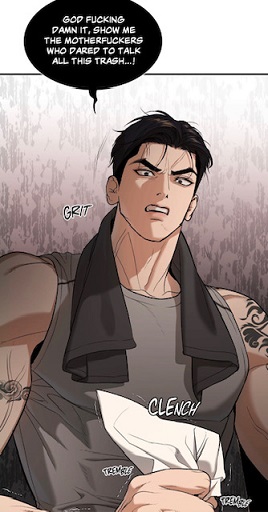
Bruce Lee warns: “If you have anger toward others, they control you.” That’s been the wolf’s trap from chapter 14 onward—rage as a leash. (chapter 36) The pool inverts it. Laps replace lunges; rhythm and love replace revenge and hatred. Anger loses its grip because water refuses to hold it. And now, you can grasp why the athlete was calm during the meeting: (chapter 81) His fear and anger were no longer controlling his heart and mind. “One of the best lessons you can learn in life is to remain calm.” The swimmer learns it; the fighter must now prove it. Thanks to doc Dan, the athlete was incited not only to accept himself, but also to get self-knowledge.
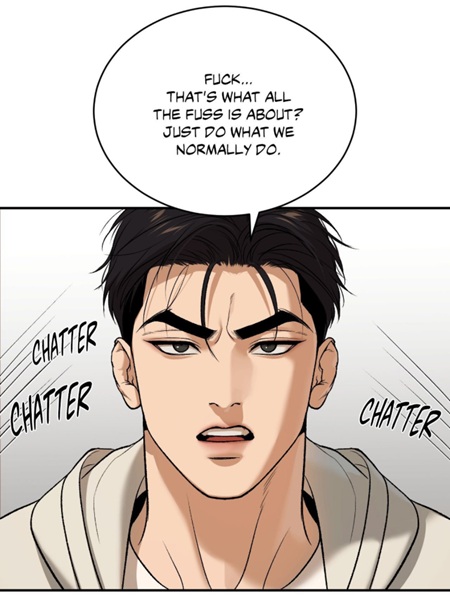
Across from him stands the eagle: instinct without control —aerodynamic, moving based on the circumstances. Arnaud Gabriel fights based on the reaction of his opponent. He is air: elegant, distant, untouched. But the problem is that he has no strategy at all (“the unscientific”), as he is dependent on the air, his opponent. This gives another explanation why the Entertainment agency offered no advisors to the athlete. (chapter 81) Arnaud Gabriel is totally unpredictable which makes him dangerous but also weak. So what happens when the athlete uses a totally different strategy? The eagle will get caught by surprise. Thus in the past, we have to envision that the wolf was the mechanical man, iron and fire, surviving by destruction. Bruce Lee’s middle path—instinct guided by awareness—is the only way out of this binary. That’s why the story moves him from steel to steam, from panic to presence.

Life itself is your teacher (chapter 62), and you are in a state of constant learning. (chapter 80) The seaside town and doc Dan taught him kindness, the pool teaches him composure and precision, the poster’s smoke teaches him restraint: you don’t swat at vapor; you breathe and move through it. “It is far better to be alone than to be in bad company”—so he steps out of the schemers’ frame. “When you accept yourself, the whole world accepts you”—so he stops fighting the audience and starts speaking to one person who matters, then to many. In my opinion, Joo Jaekyung will use this bout to express his feelings for Doc Dan (“to me, martial arts means expressing yourself“) and the birthday card (chapter 81) with the key chain represents now his motivation. Thus he resembles more and more to the physical therapist. 8chapter 81) Under this new light, it becomes comprehensible why the athlete has not confessed his feelings yet. In my eyes, the confession will be strongly connected to the imminent match. In other words, by spending time with the physical therapist, the Emperor regained his voice and body. He can now express himself in the ring, making sure to catch doc Dan’s gaze and admiration. And now, you comprehend why I mentioned that Joo Jaekyung will come to see this fight as a source of strength and inspiration: it will be more about love and recognition from his loved one than the money or hatred from the audience.
Practically, this means the bout must look less like slaughter and more like sparring—measured pressure, controlled power, no needless cruelty. That choice does two things at once: it denies the high-rollers their blood-script and leaves the kickboxer no “reason” to obey orders to ruin a face or a shoulder. Arnaud only embodies instinct — rhythm without reflection, showmanship without soul. So he is not guided by negative emotions. Be water becomes case law: adapt, absorb, answer—without being owned by anger.

So air meets water: (chapter 81) spectacle meets expression. The eagle can only descend to strike; water rises, falls, returns. And since Bruce Lee’s punch turn into water , I came to imagine that the athlete might strike him like “water”, hard enough to make him lose the balance and defeat him, but not too strong to damage his knee for good.

If he carries the pool into the cage, the “emp” on the poster will cease to read as emptiness. It will resolve into empathy—calm under fire, feeling without being ruled by it. And the smoke behind him? Not a death shroud, but iron turning to steam—a body once forged in rage, now speaking in flow. And now, look at the other tattoo on his left arm: it is a cloud or steam! (chapter 17) And once the cloud (doc Dan) meets the steam (chapter 81), they can be together as a couple. To conclude, though this poster was created as an epitaph, the reality is that it announces the emergence of Joo Jaekyung, the dragon! Kim Dan is the one who is turning the athlete Joo Jaekyung into an actor, the emperor! Even if his career as MMA fighter ends, he can still work as an actor or as the owner of his gym. He will never be forgotten as an athlete like his father or Hwang Byungchul. His name Emperor will remain forever in the memory of people and maybe because of his “fight” with MFC and thugs. At the same time, it displays the increasing conflict between Team Black and MFC. The fist could be seen as directed at MFC. The Emperor represents a menace for the CEO in the end. One thing is sure: since Baek Junmin chose the nickname “The Shotgun”, it becomes clear that he has become the negative version of his rival: he is now the mechanical man (control without any natural instinct). He lost his balance and can no longer rely on others. What he fails to realize is that by bringing more and more people in the schemes, he is actually endangering the whole organisation MFC! Furthermore, contrary to the past, the athlete will pay attention to his fated partner in France, so a meeting between Arnaud Gabriel and Kim Dan will definitely reach the athlete’s eyes and ears.

This is the longer interview of Bruce Lee:

Feel free to comment. If you have any suggestion for topics or Manhwa, feel free to ask. If you enjoyed reading it, retweet it or push the button like. My Reddit-Instagram-Twitter-Tumblr account is: @bebebisous33. Thanks for reading and for the support, particularly, I would like to thank all the new followers and people recommending my blog.

Jinx: The Watery Point 🔵 Of No Return ⤵️

Water and Power

Two years ago, I published the analysis At the crossroads: between 🤍, 💙, and ❤️‍🔥 and it has become the most read essay on my blog. [27.3 K views] It traced Joo Jaekyung and Kim Dan’s first day off together—the fateful swim in chapters 27-28 —when Joo Jaekyung’s apparent selfishness became the catalyst for Kim Dan’s first spiritual awakening. There, the water served as both mirror and baptism: a liquid threshold through which the doctor began to accept sexuality not as sin or submission, but as part of being alive. I had compared the athlete to a dragon holding his yeouiju. The pool stood for motion, rebirth, and the courage to breathe underwater—to trust one’s body rather than deny it.

Though the grandmother was never mentioned, I had sensed her ghostly presence in the grandson’s thoughts and actions. In her youth, the ocean looked beautiful to her (chapter 53), yet she kept her distance. Observe that she only talked about one time experience. She sensed its danger and built her life on the solid ground of caution, duty, and control. In other words, she belongs to the world of the shore (chapter 53) —the solid, the measurable, the safe. Her fascination with the sea’s beauty reveals the limits of her perception: she judges by what is visible, by surface calm and reflected light. The ocean entrances her precisely because she refuses to imagine what lies beneath. For her, beauty is something to be looked at, not entered. Depth implies risk; darkness suggests loss of control.

That is why she keeps her distance. She fears what cannot be seen or accounted for — the unseen currents, the hidden life beneath the glittering skin of water. Her faith is built on appearances, not intuition; on the stability of the shore, not the movement of the tide. Thus I deduce that she never learned to swim. To her, entering the water would mean surrendering control, accepting fluidity, and admitting the existence of life below the surface. This means, swimming would expose the falsehood of her philosophy. That’s why I come to the following deduction that to her, swimming was unnecessary; one simply had to stay on land and hope never to fall in. But the pool, unlike the ocean, demanded a choice: enter, move, the pleasure of being below the surface (chapter 28) and learn that not everything can be postponed or entrusted to someone else. Water, in this sense, rejects fatalism. It calls for motion, for risk, for personal responsibility.
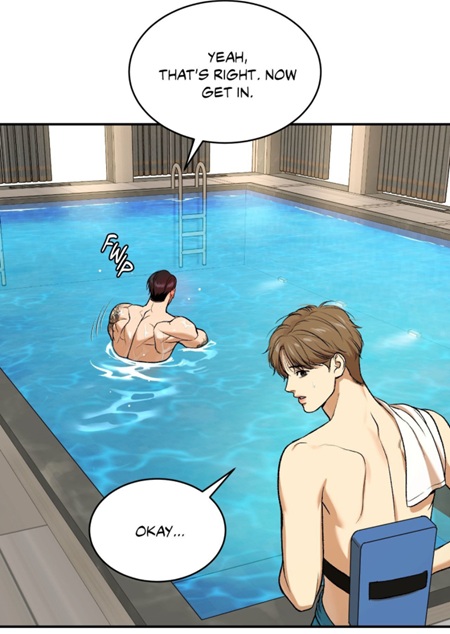
What the grandmother built on faith in others was quietly undone by breath and muscle. (chapter 80) And that intuition resurfaced and was confirmed in episode 80, when another day off brings the couple back to the pool. This time, the doctor steps into the water willingly. (chapter 80) He is no longer the man waiting to be rescued; he is the man learning how to swim. The champion’s words (chapter 80) distill the new doctrine: don’t wait for salvation (chapter 80), create your own buoyancy. Between the first swim (chapter 27) and this second lies the true point of no return—where superficial judgment turns into reflection, dependency into self-trust (chapter 80) and the rejection of powerlessness, (chapter 80), and fear of closeness (chapter 28) into the first stirrings of love (chapter 80).
Shin Okja’s private religion was one of delegation: wait for the right person, the right moment, the right help to come. That’s why she never got the chance to return to the ocean. (chapter 53) Safety lay in patience and dependence. Even when she later spoke with the champion by the sea, she avoided mentioning the ocean —as if to deny that any movement beyond her control could exist.

(chapter 65)

One might argue that I am overinterpreting, since the grandmother’s presence seems unrelated to the swimming pool and tied instead to her graduation gift—the gray hoodie. (chapter 80) Yet her absence from the pool scene is precisely what reveals her theology of avoidance. The pool was never her domain because her life revolves around work, not pleasure. She has no notion of rest without guilt, no concept of joy detached from utility. For her, swimming would appear frivolous—something “unnecessary” as long as one stays on solid ground. Jinx-philes should keep in mind that she never gave such a task to Joo Jaekyung. Her instructions to him were always practical, delegating care outward: take him back to Seoul, bring him to a big hospital and make sure he’s safe. (chapter 65) When she sees them together, her first reaction is not pride or relief but mild reproach— doc Dan should have left already. (chapter 78) The subtext is unmistakable: she expected obedience, efficiency, not attachment. Furthermore, her final instruction—“Make sure you see a doctor regularly” (chapter 78) sounds like ordinary concern, yet it hides her familiar logic of blame. It is as if she were implying that Joo Jaekyung has failed to fulfill her favor because Kim Dan has resisted care. In her eyes, the grandson is still the one responsible for trouble; the athlete’s role remains that of the dependable proxy who must “fix” him. What makes this moment striking is her tone of urgency, so unlike her habitual fatalism. The woman who once repeated “I’m the same as always” (chapter 65) suddenly speaks as though time is running out. (chapter 78) Her words, however, do not signal newfound insight—they only reinforce her desire to keep control, to ensure that someone else continues her mission of delegated care.
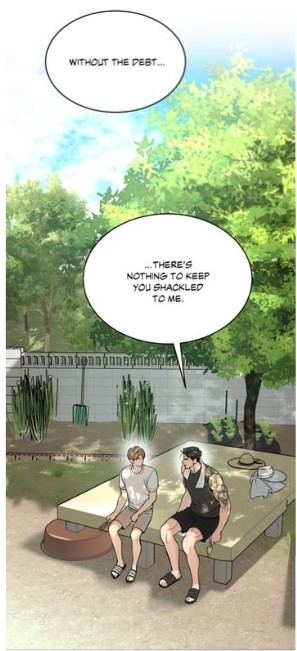
But what she interprets as negligence is actually independence. The champion is no longer following her religion of work and duty; he is inventing a new one based on choice (chapter 77), respect and care. What she calls delay is, in truth, meditation and transformation.

Presents: The Gray Hoodie and the Lady

If the grandmother’s religion was built on work, the gray hoodie was its sacred relic. (chapter 80) It was her graduation gift, yet it had nothing to do with his new profession or status. In contrast, the first episode already shows Kim Dan in a blue therapist’s uniform, name tag neatly pinned — a garment he must have purchased himself. (chapter 1) Traditionally, a graduation present helps the recipient embark on a career — like for example, a watch, a suit, or even a briefcase — symbols of adult entry into the job market. By offering him a hoodie instead, she unconsciously devalued her grandson’s professional worth. The garment belongs to the domestic sphere, not the workplace; it wraps him in comfort rather than readiness. In a moment meant to celebrate his arrival into public life, she reinscribes him into the private one — the house, the caretaker role, the obedient child. He doesn’t look like someone who went to university.

The gesture, whether she intended it or not, tells him that his identity has no market value beyond her recognition. The gift affirms warmth but denies competence; it soothes rather than equips. In addition, the grandmother’s choice of a hoodie exposes her lack of investment in that future. Her pride ended at the diploma; what came next was his responsibility. (chapter 47) There was no curiosity about his career, no acknowledgment of his competence—only the quiet satisfaction that through her endurance, she had produced a “doctor.” In the graduation photo, she even wears the mortarboard herself, smiling with the pride of someone who believes the diploma justifies a lifetime of sacrifice. Her grandson’s success confirms her own virtue; his “adulthood” validates her survival. This question to the athlete exposes her lack of interests in his profession: (chapter 65)

But her act of giving, like her act of living, was book-keeping disguised as affection. (chapter 41) While dying, she reduces love to an equation of productivity: “Dan, it’s important to give back as much as you take.” The verb do anchors her worldview — love must be measurable, visible, earned through action. To do good by someone means to labor for them, not to rest beside them. What caught my attention is that neither doctor (chapter 27) nor the champion employs the expression “vacation” or “break”. (chapter 80) Why? It is because they never experienced a break. We have to envision that the “hamster” must have followed his grandmother, when he was not busy studying or working. Both main leads never experienced a real vacation. They say a day off, as if the day itself didn’t really exist, as if it were a temporary pause between “real” time. In their inherited logic, only work gives time its value; everything else evaporates. The grandmother’s way of loving has turned rest into an absence, something unworthy of being named. However, observe that there’s a gradual change in doc Dan’s vocabulary: (chapter 80) The problem is that for the hamster, only the athlete is worthy of getting his rest. It still doesn’t belong to his world.

Shin Okja’s universe contains no category for leisure, play, or shared time; such things produce nothing, and what produces nothing has no value. Even when she worries — “You haven’t eaten?” (chapter 5) the focus remains mechanical. Eating is fuel; sleep is maintenance. But rest, in the sense of surrender, stillness, or joy, is foreign to her lexicon.
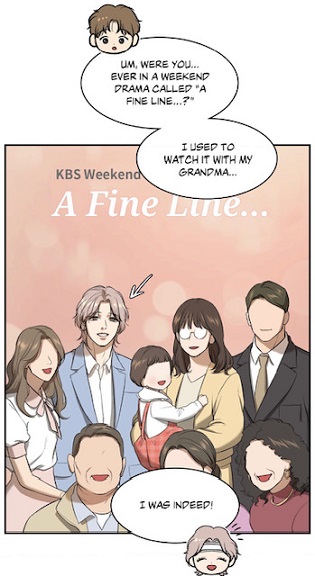
Her self-image as a tireless worker (chapter 47) is, in truth, a legend she wrote about herself. When Kim Dan recalls that “she’s never had a day’s rest,” the statement reveals more about his belief than about her reality. The woman who claimed endless labor also knew the comfort of “weekends” (chapter 30) — she watched The Fine Line, the very drama that made Choi Heesung famous. The detail seems trivial, yet it exposes everything: she had leisure (chapter 30), she simply refused to call it that. Watching television was permitted because it was passive, solitary, and could be rationalized as recuperation, not pleasure. In contrast, genuine rest — time shared, chosen, or joyful — never existed in her vocabulary. What she denied was not the existence of rest but the act of resting with him. She kept her downtime to herself, as if peace were a private possession. For her, love meant providing, not accompanying. Yet true care requires presence — sharing is caring, as the saying goes. [For more read this essay: Sharing is caring ] To share one’s time is to acknowledge another person’s worth beyond utility. Shin Okja never did that; she offered comfort but withheld companionship.This is why Kim Dan later struggles to accept that Joo Jaekyung is willing to spend his own time on him — the champion does what the grandmother never did: he makes room for him in his rest. His attempt is to make the main lead smile, to make him happy.

Her statement in chapter 65 — (chapter 65) displays that she perceives her grandson’s exhaustion not as suffering but as malfunction, as if the human were a device that could be recalibrated through work and pills. That’s why her favors revolves about living conditions, but not about his “happiness”. Perhaps she genuinely hoped that the drugs and the stability of a “regular job” with the champion would realign him, as though routine alone could fix what grief and deprivation had unbalanced.

What she never imagines, however, is that balance might emerge not from regulation but from relationship — not from control, but from the unpredictable rhythm of living. Thus the readers can hear or sense the heart racing of the protagonists.

But let’s return our attention to the grandmother. Because she keeps an account, affection becomes another form of work, and gratitude a form of repayment. She cannot imagine love that simply exists — it must be done. Every gesture had to be accounted for and eventually entered into the invisible ledger of “what I’ve done for you.” For her, a gift was never spontaneous; it was a transactional record. It had to suggest effort without truly requiring it—so she could later recall it as proof of trouble taken. But why is she doing this? Ultimately, Shin Okja’s greatest flaw is not cruelty but distrust. She never truly believes her grandson can stand on his own. She fears that he might take the wrong path. (chapter 65) Her constant bookkeeping—every favor tallied, every gift framed as trouble—betrays a hidden fear: that if she stops keeping score, she will lose him. Rather than grant him autonomy, she entrusts him to another caretaker. Sending him to the champion is not an act of faith but of resignation, a way to offload responsibility while maintaining the illusion of control.

When she “went out of her way,” she made sure the phrase itself became part of the gift. The author let transpire this philosophy in two events. In an earlier memory, the child Kim Dan watches his grandmother return home from the cold night (chapter 11), scarf tied under her chin, carrying a single sweet bun. She doesn’t need to say she “went out of her way”—her action already proclaims it. The effort is the gift. (chapter 11) That simple walk to the store becomes a moral event, proof of affection through fatigue. (chapter 11) Even the smallest purchase is framed as sacrifice. The sweet bread itself—a cheap red bean bun—is less nourishment than testimony: “Look what I endured for you.” If he had followed her, he would have seen that it didn’t take so much effort and money to buy the “present”. Finally, he had to share the sweet bread with his grandmother.
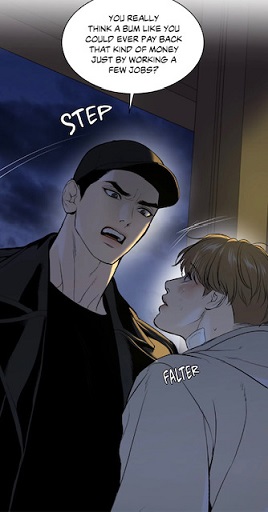
This moment sets the pattern for her entire philosophy of giving. Love must be earned through trouble; care must leave a trace of effort. The gesture matters more than the joy it brings. In her world, affection is always accompanied by labor, and gratitude becomes indistinguishable from guilt.This pattern repeats across her life. To “go out of one’s way” (chapter 80) becomes both proof of care and a claim for repayment. Hence she went to school or university for the ceremonies. However, such an action stands for social tradition and normality. She gives little, but ensures it feels heavy. Each offering, no matter how modest, is wrapped in the language of fatigue and obligation. The child, in turn, learns that to be loved is to feel guilty, and to receive is to incur debt.

The hoodie later inherits this same emotional script. It’s the adult version of the birthday bun: humble, practical, and accompanied by invisible conditions. Both are gifts that measure sacrifice, not joy. When she says she “went through so much” to raise him, she isn’t lying—she is testifying, recording her hardship in fabric and flour. However, pay attention to the picture from the hamster’s memory: (chapter 47) Where is the gray hoodie? That day, he only received a bouquet of flowers. Its absence in the photo is revealing. A gray hoodie would have looked out of place beside formal suits and robes; it would have exposed her thrift. The omission is both aesthetic and psychological: she hides the evidence of small-minded practicality beneath the spectacle of maternal pride. What was invisible at the ceremony later re-emerges in episode 80 (chapter 80), and with it, the emotional economy she built.

It is not far-fetched to imagine that the hoodie came paired with a favor or transaction (chapter 53) —perhaps the signing of the loan. “You’re a doctor now; you’ll pay it off quickly.” (chapter 80) In her eyes, generosity always justified expectation. The flowers were for display; the hoodie was the contract.

That’s why her gifts always come from the same palette: dull, neutral, gray. Even the birthday sequence is bathed in that dim, ochre light where warmth looks like exhaustion. The gray hoodie continues this chromatic philosophy—safety without brightness, affection without ease.

This explains why the hoodie feels less like a present and more like a receipt. At the same time, it denies him “adulthood” too. A sweater, not a suit; warmth, not celebration. Its comfort masked her emotional distance and her disinterest in his career. She gave him something to wear at home—a garment of rest that forbids real rest—because her world allowed no leisure without guilt.

Her sense of time mirrored that logic. She lived oriented toward the past (chapter 65) and the future (chapter 78), rarely the present. Hence she shows no real joy about their visit before their departure. Life for her was a chain of recollections and predictions: what she had done (chapter 65), what he would one day repay (chapter 47). The present moment existed only as a bridge between past sacrifice and future obligation. The embrace is conditional — a rehearsal for independence, not tenderness. In that instant, love is already an investment waiting for return. The teddy bear pressed between them, once a symbol of innocence and comfort, becomes collateral in this emotional economy: the pledge that he will someday “grow up,” earn, and pay back the care that raised him. Even at the graduation, she treated the day not as fulfillment but as record keeping. (chapter 47) The bouquet of flowers visible in the picture served as public proof of pride, while the hoodie—cheap, colorless, and private—belonged to the closed economy of obligation.

The scarf later mirrors this same logic, but in reverse. (chapter 41) When Dan gifts his grandmother an expensive scarf, he hides its true price — “I got it for a bargain” — repeating her own pattern of disguised generosity. She sees through the lie, teasing him for “spoiling” her, yet she accepts the luxury without feeling guilty. The scarf becomes her version of the hoodie: a fabric trophy of moral worth. But its later disappearance is revealing. In season two, she wears it (chapter 56) shortly after her arrival at the hospice, never again. When she greets Joo Jaekyung, the scarf is gone (chapter 61). Why? One might reply that the scarf lost its value, especially since she is living next to the director’s room. I doubt that such men would pay attention to such an object. Another possibility is that she fears its brightness might betray her neglect, for the champion has lived with her grandson for a while. How could she display silk while her grandson owns almost nothing? (chapter 80) The missing scarf thus exposes both her superficiality and exaggerated generosity. Her affection, like her pride, is short-lived — decorative rather than enduring. Should Heesung ever visit her, (chapter 30) one can easily imagine the scarf’s reappearance: the fabric of self-deception, ready to flatter, to perform, to erase guilt under the sheen of respectability. She already acted like a fan girl in front of the celebrity. (chapter 61)
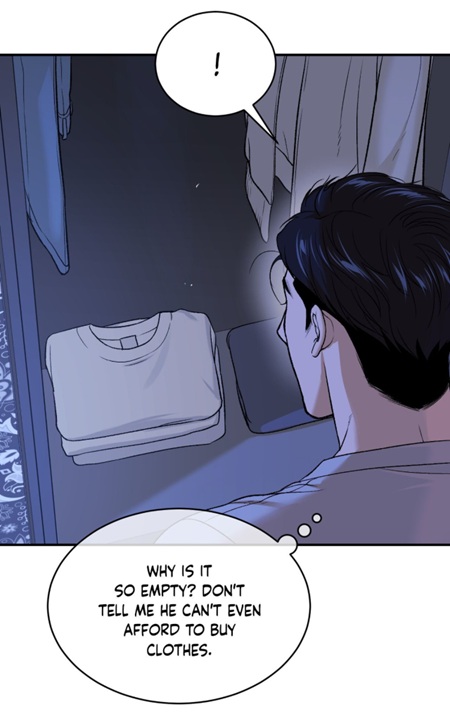
The pattern of her giving finds its quiet conclusion in episode 80. When Kim Dan rediscovers the hoodie, his first smile fades into silence. (chapter 80) The gesture that once symbolized love now feels like pain and loss. The signification of the gift has changed. What once wrapped him in safety now weighs like absence — the fabric retains the shape of someone who is about to vanish. His silence is not understanding but hurt, a wordless awareness that affection can curdle into memory. The audience, not the character, perceives that with the grandmother’s approaching death, her ledger is about to close. The gray fabric, once proof of her sacrifice, will lose its moral weight; her “gesture” will expire with her. Yet Kim Dan may not yet realize that this very ending could one day free him. The book-keeping dies with the bookkeeper.

This moment also reveals why he remains wary of other people’s gifts. (chapter 31) When Heesung offers flowers “to get closer,” Kim Dan’s face mirrors the same unease: affection presented as transaction, intimacy disguised as generosity. What the actor calls closeness, the doctor feels as imbalance — the same emotional distance that Shin Okja’s presents once produced. Her gifts, meant to bind, isolated him instead; they built a hierarchy where gratitude replaced equality. Each present widened the gap between giver and receiver. To be cared for was to be indebted.

From this upbringing stems Kim Dan’s reflexive equation:

Each time someone offers him something, he instinctively feels burdens (chapter 31) and tries to refuse it. (chapter 31) (chapter 80) “You don’t have to go through all this trouble.” The line is not modesty but defense. To him, receiving kindness creates imbalance. His grandmother’s “help” was always instrumental; every act of support came attached to sacrifice: “I went through so much for you.” The hoodie thus becomes a moral anchor, a fabric reminder that love must always be earned and repaid.

Guilt as Love Language.

Because of this, Kim Dan experiences love only through fatigue and suffering. He feels cared for when someone worries (chapter 67), loses sleep, or pays a price. He interprets Joo Jaekyung’s concern as “trouble,” Heesung’s gifts as “too much.” In his mind, affection is inseparable from cost:
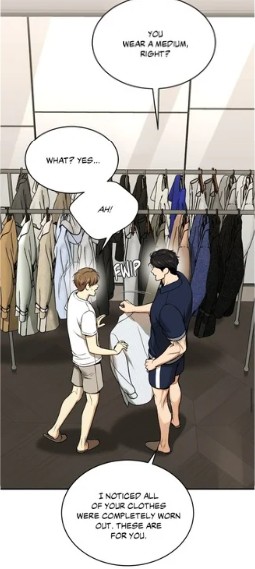
If you love me, you must pay for it. And if I accept your love, I’m guilty.

Caretaker Identity and Self-Erasure


To escape that guilt, he lives as a helper. (chapter 80) “I’ll stay in the background.” His self-worth depends on not burdening others. His words let transpire that he has never been Shin Okja’s first priority in the end. The hoodie reinforces that psychology—it is not a professional outfit like a suit or briefcase would have been, but a teenager’s garment, meant for the domestic space rather than the adult world. It literally arrests his growth, keeping him in the house and under her logic. Thus it is not surprising that after receiving his diploma, he still took part-time jobs.

Gifts as Triggers of Anxiety

When others try to give him something—Heesung’s flowers, Jaekyung’s wardrobe—his first instinct is panic. “What do I do? It’s all so expensive.” He expects a hidden price: affection, submission, repayment. Every gesture of generosity recalls the old bargain with his grandmother.

Repetition Compulsion

He repeats the same dynamic with new authority figures. With Heesung, he suspects every gift hides control. With Joo Jaekyung, he accepts care only to reduce someone else’s burden. When the champion lies—“These brands sent the wrong size; I was going to throw them out anyway”—Kim Dan hears not kindness but necessity. Refusing would mean waste, and he has long internalized that nothing must ever be wasted. So he accepts—not out of entitlement, but as an act of thrift, a way to help the giver by taking what is “useless.”

And yet, through this misreading, something begins to shift. The logic of guilt quietly bends toward mutual release. Jaekyung sheds excess; Dan sheds shame. The exchange of clothes becomes an exchange of burdens.

Gray: The Color of Suspension.

The hoodie’s color captures the entire tragedy of their old world. Gray is neither black nor white—it refuses decision, blending work and rest, love and obligation. It is the color of compromise, of deferred joy, of life half-lived. Gray also carries another meaning beyond monotony. It fuses black and white — two opposites that, when mixed, erase each other’s clarity. The hoodie’s color therefore reflects the fused identity of grandmother and grandson: their lives blended until he became her shadow. Her pride shone only through his dimness. To live in gray meant to live as her reflection — never as himself. The color embodies both her dominance and his self-erasure. When Kim Dan finds it again in episode 80, his first smile fades into silence. (chapter 80) The object that once expressed care and promised safety now mirrors grief. The gray fabric absorbs the light around him, turning into the shade of everything unspoken between love and duty.

The hoodie, once a symbol of endurance, now becomes a relic of a world where love meant survival. To wear it again would be to stay in that twilight. To put it away is to risk color, to learn to live in the present tense.

The Wardrobe: Undoing the Gray Religion

If the gray hoodie was the relic of Shin Okja’s work-based faith, Joo Jaekyung’s wardrobe (chapter 80) is the site of its quiet destruction. His act of giving reverses every law the grandmother ever taught. First, he does not “go out of his way.” The clothes are delivered effortlessly, without fanfare or moral accounting. (chapter 80) There is no speech about sacrifice, no self-congratulation. (chapter 80) By erasing the gesture of “effort,” he removes the emotional price tag that once accompanied every gift.
Second, he tells a deliberate lie: that he did not spend a dime, that the brands sent the wrong sizes. This white lie has healing power. It dismantles the logic of debt that rules Kim Dan’s psyche. (chapter 80) If the grandmother’s motto was “I went through so much for you,” the champion’s is “It’s no big deal.” Generosity becomes invisible, unburdened, and therefore trustworthy.

Third, he offers not one item but an entire range. (chapter 80) The row of garments invites choice — a concept absent from Shin Okja’s universe, where love came in single doses and with strings attached. Here, the doctor is asked to select what he likes, to exercise taste, to inhabit preference. The abundance of options grants him agency, dignity, and the right to refuse.
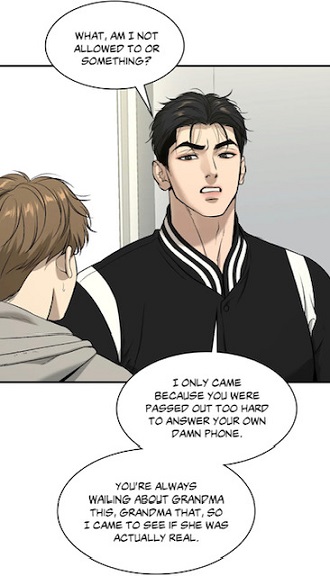
Fourth, note the nature of the clothes: they are not sportswear. (chapter 80) These are professional garments — coats, shirts, and slacks suitable for the workplace, not the gym. They restore the image his grandmother’s hoodie had erased. In offering these, Joo Jaekyung is not only dressing him but reframing his social identity: from dependent to equal, from housebound caretaker to visible professional. This means that they are bringing him into the adult world. Yet this also creates a paradox — wearing such refined clothes will attract attention, making it impossible for Kim Dan to “stay in the background.” (chapter 80) They will incite him to voice more his thoughts, to become stronger as a responsible physical therapist. The wardrobe, like a mirror, forces him into presence. This means that he is losing his identity as “ghost”, which was how the halmoni was perceived by the athlete. (chapter 22)

Symbolically, the location intensifies the gesture: the clothes are placed inside the champion’s own wardrobe. (chapter 80) The two now share a domestic and symbolic space. What once separated their worlds — fame, class, gendered roles — begins to dissolve thread by thread. The actor Choi Heesung’s remark, that gifts can “bring people closer,” (chapter 30) becomes unexpectedly true here. The wardrobe bridges the distance that the grandmother’s gifts had always created.
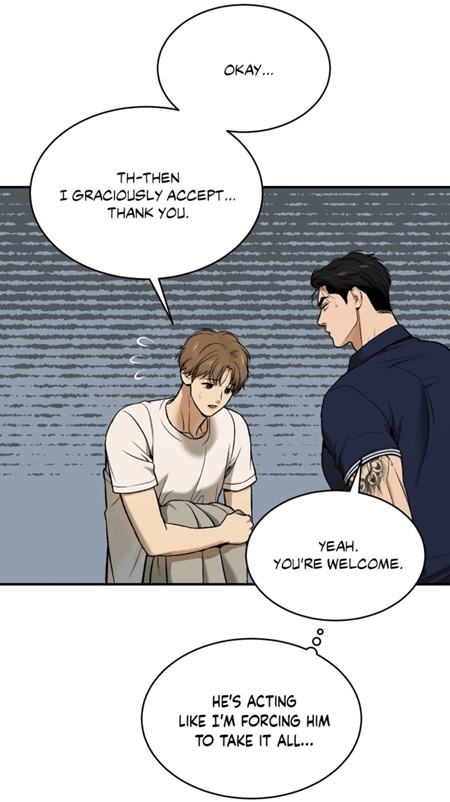
When the champion remarks, (chapter 80) he implies that these items would just go to waste. Therefore he completes the reversal. Waste, once the grandmother’s greatest fear, becomes the vehicle of grace. By claiming the clothes are “leftovers,” he removes their monetary and moral value; they are no longer costly. In accepting them, Kim Dan does not incur debt — he prevents waste. (chapter 80) This is why his hesitant and embarrassed gratitude, framed against a background of dissolving gray waves, feels so transformative. The air behind him ripples as if washing away the residue of his old faith.
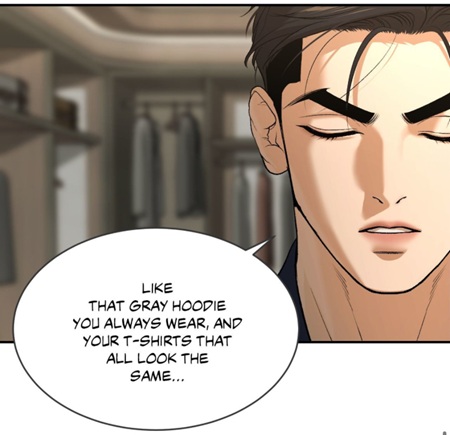
The striped blue-and-white shirt he finally chooses carries its own quiet symbolism. (chapter 80) Yet unlike gray — the color of fusion and loss of identity — these shades remain distinct. They do not blend but alternate, acknowledging the coexistence of two identities: the doctor and the man, the caregiver and the self. In contrast to the grandmother’s world, where love meant absorption and sameness, Joo Jaekyung’s gesture affirms difference. The champion does not swallow him; he gives him space.

At the same time, the stripes hint at the complexity of Kim Dan’s inner life. Beneath his apparent passivity lies rhythm, variation, and resilience — qualities long suppressed by duty and guilt. The pattern becomes a visual metaphor for the layered texture of his heart.

By filling the wardrobe with clothes of different colors, the champion quite literally brings light and time back into Kim Dan’s life. The new hues break the monotony of gray (chapter 80); they mark the passing of days, the return of seasons, the rediscovery that not every morning has to look the same. Variety itself becomes a form of freedom. When the wolf once complained that all his shirts looked identical, he was unknowingly naming what both of them lacked: differentiation, spontaneity, change. Through this act, he restores color not only to the doctor’s wardrobe but to his emotional world — a quiet resurrection through fabric.
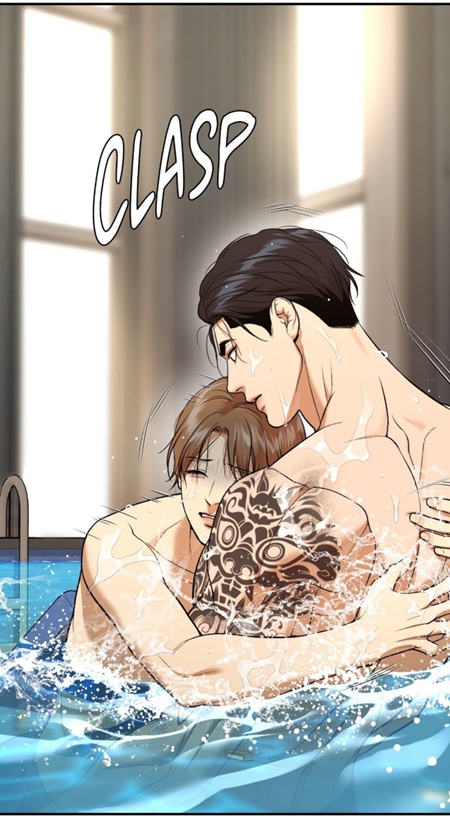
Finally, the celebrity’s next gesture — teaching him how to swim — extends this transformation. If the grandmother’s graduation gift (the hoodie) kept him grounded and homebound, neglecting his future and career, the champion’s “lesson” propels him toward movement and autonomy. (chapter 80) Swimming means survival without the shore; it is the art of staying afloat without a hand to hold. In this sense, Joo Jaekyung’s care points forward, not backward. He offers not protection but potential, not memory but future.

The wardrobe, then, is not a storage space but a threshold — between debt and desire, between inherited caution and chosen freedom. And now, you comprehend why the doctor chose to seek refuge and support, when he feared to sink. (chapter 80) The “hamster” had instinctively turned to the only person who had ever offered him help without cost.

In reaching for the champion, he does not regress into dependence; he reaches toward a new form of trust, one that no longer confuses care with control. To let himself be held is not to return to childhood, but to unlearn fear. The act of seeking support becomes the first stroke of a new swimmer — hesitant, but free.

This scene also recalls the image of the Korean dragon and its yeouiju — the luminous, wish-granting jewel said to contain both wisdom and life energy. The dragon’s power is not innate; it is completed and elevated by the jewel. Without the yeouiju, it cannot ascend to the heavens — strength without meaning, force without direction.

When Kim Dan finally pulls Joo Jaekyung into his arms (chapter 80), the myth reverses. The dragon—once feared, untouchable, wrapped in rage and solitude—is suddenly embraced by the very being he once believed too fragile for his world. The power dynamic inverts: the human shelters the beast.
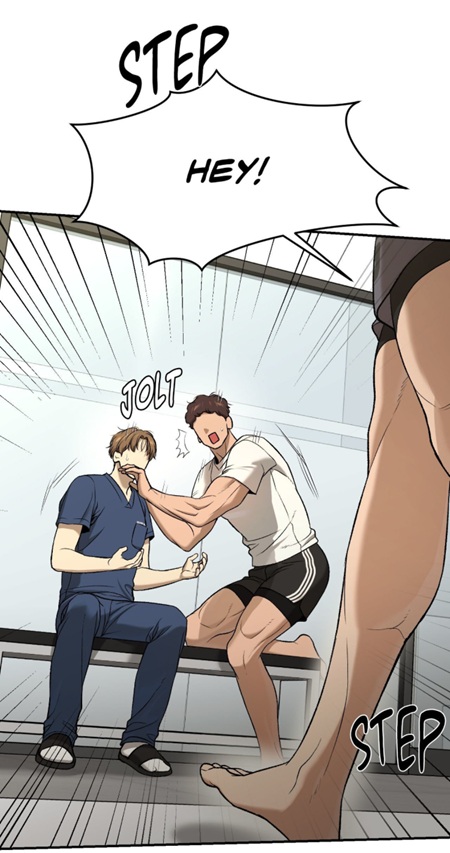
In that gesture, the legend of the Korean dragon and its yeouiju gains a new form. The jewel is no longer an external object of desire, but a state of being—mutual recognition. By holding the dragon, Kim Dan becomes the hand that completes the circle, allowing power to flow again. The yeouiju exists between them, not in either of them: it is the bond itself.

For the champion, who has long carried the invisible scar of disgust— (chapter 75) —this embrace is nothing short of salvation. The man who once fought to wash off shame through endless training now finds himself accepted in his unguarded state. He doesn’t need to mask his trauma with perfume (chapter 75), the imagined smell, or cleanse his skin of battle; he is held and, therefore, purified. Through Dan’s arms, he rediscovers his value and humanity—the dragon touched and not destroyed. He is worth of being embraced, even if he is already so old!

This reversal has immense symbolic power. The yeouiju is no longer something the dragon must seize; it is something that recognizes him back. (chapter 80) When Kim Dan holds him, the light of that jewel shines from within the dragon himself. Power and tenderness, once enemies, coexist in the same body.

For Kim Dan, this act also signals a new allegiance. He is no longer in service of duty or debt—no longer the caretaker bound to an old creed of sacrifice. By choosing to embrace Joo Jaekyung, he chooses his friend, not his “master.” He decides who is worthy of his trust, and in doing so, reclaims his agency.

The dragon, embraced rather than worshiped, rises stronger. The yeouiju—the bond, the shared heartbeat—no longer lies at the peak of a mythic mountain but glows quietly between two exhausted men who have stopped running from touch.

The gray world — the realm of thrift, debt, and book-keeping — dissolves into color and movement. Blue and white ripple through the water, reflecting not fusion but harmony. For the first time, love does not demand payment; it breathes.

Arc 8 – The point of no return

The shape of the 8 itself evokes both the infinity loop and the closed circuit: two halves endlessly reflecting each other, each incomplete without the other’s motion. It is the symbol of reciprocity, but also of a threshold — the moment when balance can no longer be postponed. Once complete, the loop allows no intrusion — it admits no third. The number’s symmetry carries both union and exclusion: whatever falls outside its rhythm disappears.

This is the geometry of Jinx’s emotional world in Arc 8. The loop that once included a third observer — the grandmother’s watchful eye, the manager’s interference, the actor’s rivalry and resent — now folds inward, leaving no aperture for control. The form itself performs the story’s evolution: dependency becomes reciprocity; triangulation dissolves into dual motion. And now, you comprehend why Mingwa included a new outburst of the wolf’s jealousy. (chapter 79) This is one part of the new circle. Jealousy is the residue of imbalance — the echo of the 7 within the 8. In the numerology of Jinx, the 7-chapters, like for example episode 7 (chapter 7), episode 18, where the champion had sex because of this statement (chapter 18),episode 34 with Choi Heesung (chapter 34) or episode 52, where the former members of Team Black and expressed their disdain and jealousy toward the main lead (chapter 52)
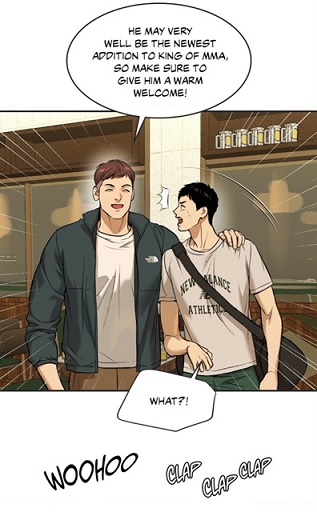
But Arc 8 changes the equation. For the first time, both protagonists risk loss because they have something — and someone — to lose. The return of jealousy is therefore not regression but proof of attachment and the occasion to improve their personality (chapter 79), the final test before the circle closes for good.

Eight is the reversal digit, where hidden motives come to light and attachments are tested. Between 7 (chapter 47) and 8 lies that invisible hinge: the death of the old economy of love and the birth of a new one.
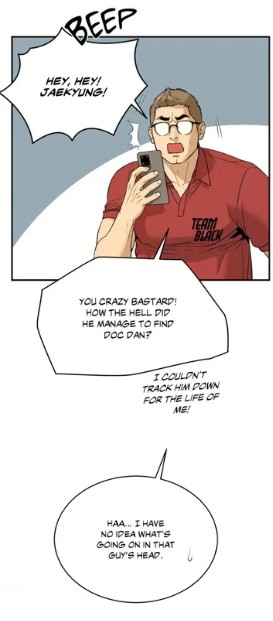
Thus, Arc 8 becomes the arena of triangular pressure. The grandmother’s possessive nostalgia (she sees herself as the mother, doc Dan as the boy and the champion as her surrogate husband) (chapter 78) mirrors Park Namwook’s managerial anxiety (chapter 61) and Heesung’s residual rivalry and resent. Each acts as a different face of control: the woman binds through guilt, the manager through hierarchy acting as the owner of the athlete’s time, the actor through charm and deceptions. Together they form the triad that tries to reopen the circle closed in the pool. Let’s not forget that the athlete chose to take a day off on his own accord (chapter 80), but he had just returned to the gym. It is no longer the same training and routine.

Park Namwook in particular represents the system that resists intimacy. His “interference” is not random but defensive: he fears that Jaekyung’s change and his attachment to the physical therapist (the promise to teach the doctor to swim implies that he will focus on other things than MMA) will unbalance the professional order. In the symbolic arithmetic of the story, he inherits the number 7 — the unstable, the one who can no longer maintain symmetry.

Jealousy, then, becomes not corruption but purification. It exposes what still belongs to duty and what belongs to choice. Through these frictions, Kim Dan is compelled to speak for himself, to claim the very agency his grandmother once withheld. It makes the protagonists to perceive people in a different light and move away from their self-loathing, passivity and silence.

When he does, the circle of the 8 stabilizes at last. The old triangle — grandmother, doctor, and debt — gives way to the new one: champion, doctor, and trust. In the Arc 8, the color gray finally meets its antidote: blue. 💙What was once the hue of exhaustion and suspended time becomes the pulse of renewal. The blue heart 💙, which first appeared in my earlier essay At the Crossroad, returns here as the emotional compass of both men.

In Jinx, the white heart with the gray hoodie belongs to the past — to the grandmother’s logic of duty, guilt, and caution. Blue, by contrast, is the color of water, movement, and breath. It signals the capacity to feel without measuring, to give without debt. When Kim Dan accepts the new clothes, he does not merely change garments; he crosses from the gray zone of survival into the blue realm of relation. His heart, long muted by obligation, begins to circulate again.

The blue heart marks this point of no return: once it beats, neither man can retreat into solitude. Its rhythm unites the wolf and the hamster in a shared tempo — one that excludes the third, but not the world. For the first time, affection no longer obeys the law of bookkeeping. It flows.

The ocean, once feared and distant, now extends inward, beating quietly beneath their joined silhouettes. The gray relic of the past lies folded away, and in its place, something transparent begins: a friendship that breathes like water — uncounted, unowned, and alive.

Feel free to comment. If you have any suggestion for topics or Manhwa, feel free to ask. If you enjoyed reading it, retweet it or push the button like. My Reddit-Instagram-Twitter-Tumblr account is: @bebebisous33. Thanks for reading and for the support, particularly, I would like to thank all the new followers and people recommending my blog.

Jinx: This has to change 🌬️🌀🍃

Chapter 79 proved my previous interpretation correct: the number 9 announces the end of a circle. (chapter 79) However, let me ask you this. What kind of circle ends in episode 79? Moreover, how is this ending different from the past? Interesting is that episode 79 of Jinx doesn’t end with conflict, but with an awakening. For the first time, Joo Jaekyung does not rise to fight, command, or perform — he wakes up to a realization: “This can’t go on.” In the Korean version, his words carry an unusual clarity. It is not fate that changes, but choice. The champion, who once lived as if enslaved by habit and haunted by ghosts, now chooses transformation. The circle that has defined his life — power, silence, guilt, and repression — finally begins to close.
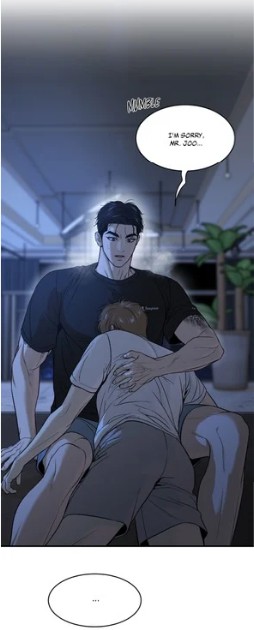
The decision is quiet but monumental: he will no longer live in a cycle of fear and self-loathing. (chapter 79) Until now, Jaekyung has moved through life as if carrying a curse — the belief that he is unworthy of care and love. (chapter 78) Every match, every order, every touch was an act of penance. Yet, in this episode, that belief dissolves. What vanishes in chapter 79 is not his strength, but the compulsion to suffer for it. Through the unconscious confession from Doc Dan, the wolf discovers that despite his wrongdoings, he is not hated by the “hamster”. (chapter 79)The words carry the same emotional weight as (chapter 39) from the magical night in the States. Both moments unfold in half-darkness, both break through inhibition, and both blur the line between consciousness and surrender. The verbal difference hides a deeper sameness: (chapter 79) is not remorse alone — it is an act of love, an instinctive reaching-out toward the other’s pain.
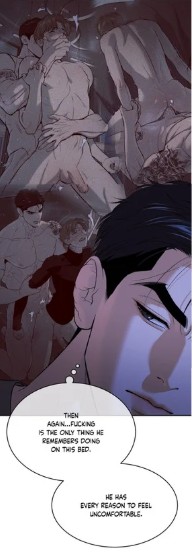
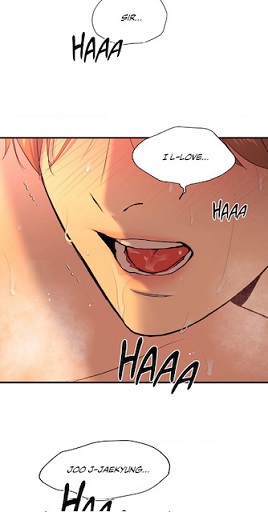
Mingwa mirrors the composition of these two scenes to stress their equivalence. The parted lips, the contrast between the heavy breath and the mumbling, the closeness of skin — all visual echoes that turn guilt into a language of tenderness. In chapter 39, the confession was drug-induced, raw and unfiltered, but afterward Jaekyung dismissed it with a laugh: (chapter 41) What could have been a moment of truth was repressed through mockery. His body language was betraying him: his closed arms reveal that he was on the defensive. By trivializing love, he protected himself from suffering and as such from facing his own capacity for harm. Behind the joke hid an immense self-loathing: to accept the confession as real would have required believing himself worthy of it. To trust himself…. he is not a loser, a nobody!

Chapter 79 reverses that denial. This time, the athlete cannot turn away or make light of what he hears. (chapter 79) The doctor’s voice — faint, sleep-bound, and sincere — forces him to listen. The “mistake” returns, transformed into absolution. Where laughter once erased meaning, silence now restores it. The champion finally grasps that Dan’s words, whether “I love you” or “I’m sorry,” spring from the same place: care that persists despite injury.

This is why the “blue night” cannot be read as accident or madness. It is revelation. The wolf sees, perhaps for the first time, that he can be forgiven — that love, for Dan, includes compassion for his flaws. The “I’m sorry” becomes the mirror image of the earlier “I love you,” not a repetition but a correction. What Jaekyung once labeled a mistake now stands as proof of connection, as if fate itself were rewriting the joke into a prayer.

The End of a Circle

Each chapter ending in nine has marked emotional completion: chapter 9’s first gesture of care (chapter 9), 29’s confession on the couch (chapter 29), 69’s first expression of feelings in the dark (chapter 69). In chapter 79, the circle closes once more. The night’s palette tells the story — deep blue softens into violet (chapter 64) (chapter 79), the color born from the fusion of blue (Dan’s sorrow) and red (Jaekyung’s intensity). For the first time, in the penthouse the color of their relationship is not pain but balance. And now, you comprehend why in the hallway, the purple had almost vanished: (chapter 79) The light purple – lavender that once filled their world turns (chapter 66) (chapter 79) fades into the cold blue of the night. The light shifts — not toward warmth, but toward fragility. The purple, symbol of fusion, nearly disappears, leaving behind the dominant blue of isolation and fear. (chapter 79) This chromatic regression visualizes what happens next: in the hallway, both men are still haunted by their separate pain. Dan, drawn by the pull of despair and self-loathing, almost falls over the railing. Jaekyung, still guided by fear, rushes to catch him. (chapter 79)
The blue in this scene is not mere sadness — it is the residue of old wounds resurfacing. It unites them through pain rather than peace, yet this unity marks the turning point. The absence of purple is what propels the wolf to make a decision: he is about to drop his routine and as such his past believes, like for example, his life is still his first priority or he is just a shackle. He realizes that color — the life and warmth in Dan — is fading. (chapter 79) To restore it, he will have to speak, to act, and ultimately, to smile again.
What truly ends here is the Emperor’s old language. The vocabulary of orders — (chapter 79) gives way to the silent recognition of fear. When the champion admits, (chapter 79), it is a confession disguised as complaint. For the first time, he voiced his dependency and vulnerability more clearly, as his body language is no longer expressing hesitation and shyness. Imagine that so far, he had lived following the principle of “self-reliance”. Yet when Dan asks, “What?” the champion retreats: (chapter 79) His feelings collapse into the void between words. Above them, the spiral chandelier glows — the perfect symbol of their unfinished circle. His unspoken fear hangs suspended, waiting to be voiced because of someone else’s actions: the doctor’s grin (chapter 79) and fall (chapter 79) That retreat exposes a deeper fear — not of rejection, but of mockery. The man who once endured his father’s contempt and smirks (chapter 54) still equates vulnerability with humiliation. (chapter 73) In the past, every sign of weakness was punished or laughed at; even longing arrived through ridicule. Hence the “grinning” Dan of his nightmare (chapter 79) should be perceived as a distorted echo of the father’s cruel smile. And now, Jinx-philes can grasp why the wolf woke up from this “dream”. (chapter 79) The vision forces him to confront the origin of his shame. He realizes, instinctively, that the real Kim Dan would never smile at his pain — and through that recognition, he begins to separate present from past. He has already experienced a silent, but warm gaze (chapter 77) from his fated partner after admitting his defeat: (chapter 76)
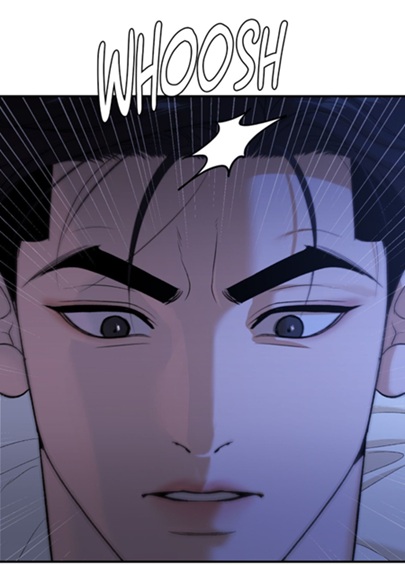
In silencing or voicing his fear, Jaekyung crosses the boundary between guilt and growth. He is no longer haunted by his father’s accusations like “you’re just trash” or (chapter 73) but by a new, fragile dread: the possibility of losing the one person who would never say it. What vanishes in episode 79 is not his strength, but the belief that to need someone is to be weak.

That completion arrives at night. In his sleep, Kim Dan murmurs, (chapter 79) The two halves of their dialogue finally meet: the fear Jaekyung silenced finds its answer in the apology Dan utters unconsciously. One speaks awake but retracts; the other speaks asleep but reveals. The night itself becomes their interpreter — turning “nothing” into meaning.

Until now, Jaekyung’s remorse had lived without a voice. (chapter 78) He has long recognized his wrongdoings — the pressure, the harshness, the selfishness (chapter 76) — but guilt without self-forgiveness remains sterile. What is the point of apologizing to someone when you cannot forgive yourself? His silence, then, is not arrogance but self-condemnation. Beneath his strength lies a man who believes that no apology can redeem him, because no one ever offered him one first. His father’s mockery, his coach’s reproaches (chapter 74) and expectations, his mother’s betrayal (chapter 74), his manager’s slap at the hospital (chapter 52) — none of them ever voiced regret and said “I’m sorry.”
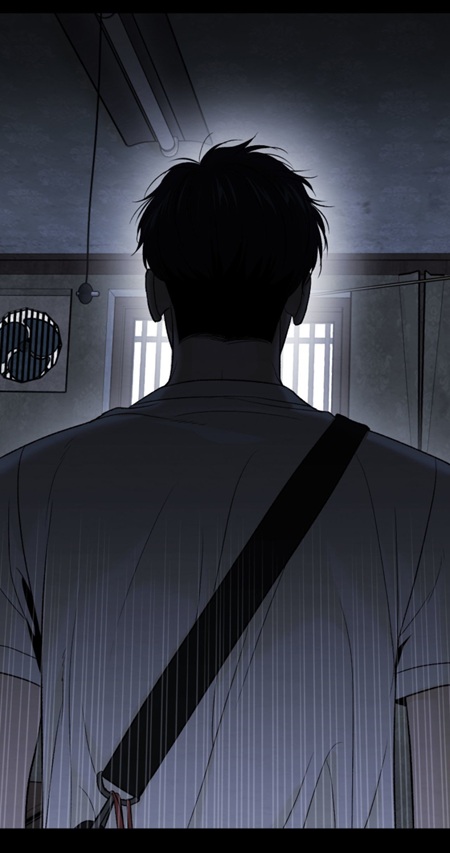
Fighting became his substitute for repentance. (chapter 73) Every punch was an act of self-erasure, every victory a brief anesthesia against the echo of his own self-loathing and regrets. He mistook exhaustion for atonement. But when Kim Dan whispers (chapter 79) in his sleep, something shifts. The word that once chained him to guilt now sounds different — tender, not accusatory. For the first time, he experiences apology as care, not as confession.

That is why this night matters. It teaches the champion what he was never taught: that forgiveness is not granted by punishment, but by connection and communication. Through Kim Dan’s unconscious words, he senses that he can be forgiven — that love does not vanish because of fault. He is still accepted despite his wrongdoings, not because he hides them. For the first time, Joo Jaekyung begins to believe that being loved and being imperfect can coexist. And in that fragile belief, change truly begins.

The Fall of the Angel

The dream of the wolf is not punishment — it is confession. It becomes the space where Jaekyung’s unconscious dares to speak what he hides from waking life. (chapter 79) His vision of Kim Dan’s false grin is not a taunt from the other (chapter 79), but a message from within: You shouldn’t have hidden your fear. You should have trusted me. What appears as irony is, in truth, the echo of a moment that had once wounded him — the doctor’s trembling question, (chapter 51) The dream revives that unspoken answer, revealing that what Jaekyung perceived as danger was, in fact, an offer of trust. In trying to protect himself from mockery, he denied the very connection that could have saved him. The dream reconstructs the very morning he had dismissed his vulnerability (chapter 79)— the breakfast scene (chapter 79) , the casual (chapter 79) By replaying it in this distorted form, his mind stages a confrontation with his own denial.
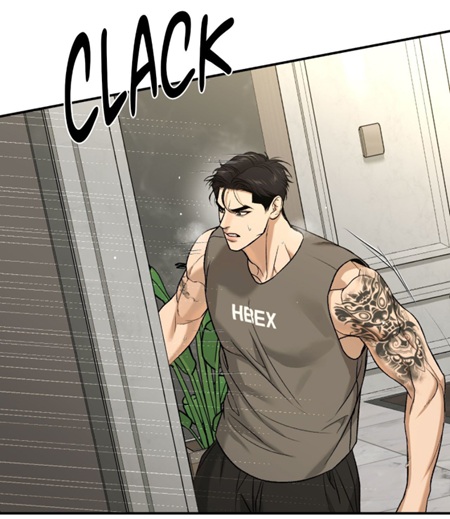
The wolf’s remorse takes the shape of fear. In his dream, Jaekyung finally admits that he cannot bear to lose the one person who makes him feel human (chapter 79) — yet even there, his confession is shadowed by dread. (chapter 79) The grin that startles him awake is his own projection of unhappiness and shame, the echo of the mockery he once received from his father. But the truth beneath it is different: his soul is telling him that vulnerability is not ridicule, that he must stop silencing himself.

The resemblance between dream and reality is deliberate. The kitchen reappears, the same domestic warmth, the same silence. The unconscious replays what the conscious has failed to complete — the moment he turned away instead of speaking his fear aloud. His body wakes before his mind does, moving instinctively toward redemption. When he finds Kim Dan by the railing (chapter 79), it is as if he is saving not only his partner but the part of himself that used to give up. He was living like a ghost denying his own emotions.

A few days before, the champion had called Dan’s drowning “an accident.” (chapter 78) That word revealed his blindness — the refusal to acknowledge pain that does not announce itself through wounds. The new incident at the railing shatters that illusion. It was never an accident, but the expression of mental illness (chapter 79) Both events spring from the same silent cry for help, the same exhaustion he once ignored. This time, he sees it for what it is: suffering, not weakness. The shock of recognition becomes his wake-up call — not to fight harder, but to understand deeper. The problem is that so far the champion never had a true companion, hence he has not learned how to share thoughts and emotions to others. This explicates why doc Dan is actually the one initiating the conversation. (chapter 77) (chapter 80) Each time, the physical therapist shows concerns for the athlete’s well-being. He perceives this change of behavior as the expression of unwell-being.
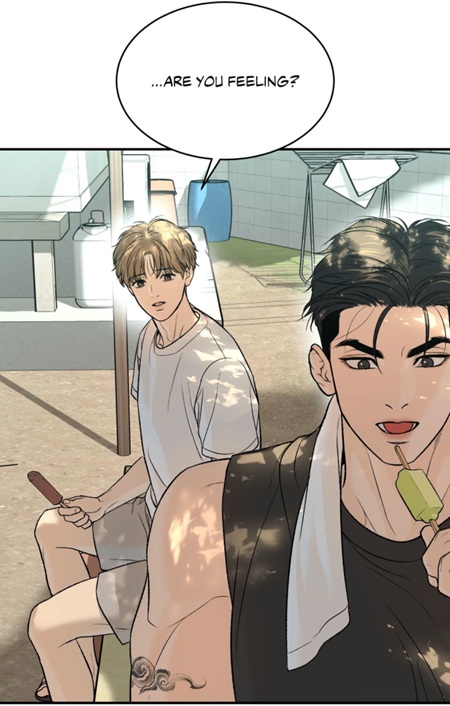
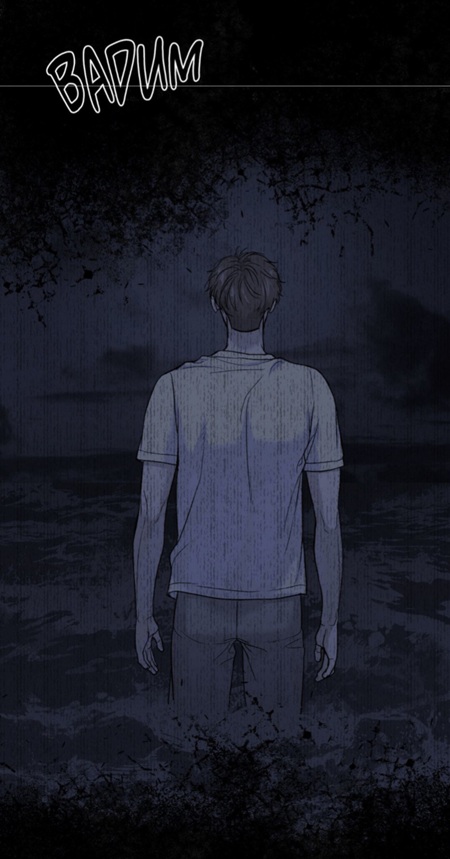
Symbolically, the near fall (chapter 80) represents the danger of repeating inherited unhappiness and despair — the impulse toward surrender that has haunted the doctor. Both the ocean (chapter 69), and the balcony (chapter 79) embody the same impulse — escape — yet they reveal two distinct forms of suffocation. In the sea, Kim Dan moves toward the element that promises oblivion through absorption: water swallows, erases boundaries, and offers rest through dissolution. It is the drowning of exhaustion, of someone who wishes to return to the womb of stillness. On the balcony, however, the element shifts to air — the emptiness between life and death. Falling from a high place is the asphyxiation: the lungs collapse not by immersion but by void. Both gestures — walking into the waves and leaning over the railing — spring from the same inner logic: the unbearable weight of pain and expectation. But if water and air unite, they create clouds (chapter 38) — the very image that defines Kim Dan’s being. The clouds on his phone screen are not incidental; they reflect his essence. A cloud has no home, no fixed form, forever moving, dissolving, reforming — just like the doctor’s life, endlessly displaced and redefined by others’ expectations. Clouds embody both dream and danger: they promise transcendence but conceal the storm. Besides, a cloud can fall as rain, return to the ocean, or vanish into the sky — an image of the soul that oscillates between grounding and escape.

As soon as I made this connection, I couldn’t help myself thinking of the painting in the background of chapter 37: (chapter 37) Behind the champion, the Golden Gate Bridge stands as a silent witness — a place where many have ended their lives by leaping into the void between air and water. The bridge fuses both symbols: it is where drowning and falling meet. Moreover, the bridge embodies the connection of two worlds. This backdrop, unnoticed by the protagonists themselves, prefigures the later arcs. Joo Jaekyung is the one standing between the bridge and the physical therapist. It was, as if the author was already announcing the huge depression doc Dan would face in the future. At the same time, I came to wonder if the unconscious suicidal attempts from Doc Dan were actually revealing the biggest secret in his life: the suicide of his parents and their death could be linked to a bridge. Striking is that while the members of Team Black were partying (chapter 37), death was standing behind the celebrity and this reminded me of the champion’s last genuine smile (chapter 73) before he discovered Joo Jaewoong’s corpse. The bridge thus becomes a metaphor for invisible grief: joy and pain occurring simultaneously, one masking the other. And keep in mind that according to my theory, the picture of Dan with his grandmother is hiding a tragedy. This would explain why doc Dan is so obsessed with this picture: (chapter 47) The smiles here are hiding the past reality.
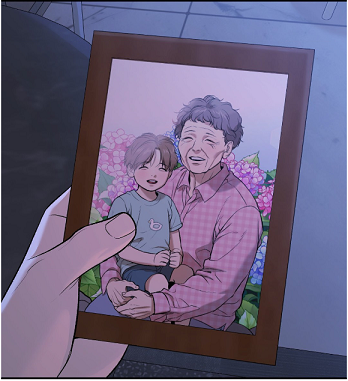
But let’s return our attention to the champion’s vision in episode 79. In that same duality (water/air) lies salvation. (chapter 79) The dream that wakes Jaekyung is not a nightmare but a revelation. He senses that the smirk is not the reality, but also the mask hiding misery. The greeting from the smiling Dan (chapter 79) — so unlike his real, exhausted self — is a vision of peace, of love unburdened by fear, while this grin exposes the truth. The dream, the realm of clouds, becomes a stage where the wolf shows and learns tenderness. The dream’s fear and indirect self-reproach (chapter 79) becomes action; remorse (chapter 79) turns into rescue.

That’s how I noticed that so far, the champion never greeted his room mate with a good morning and smile in the morning. (chapter 41) In other words, the dream is giving him clues as well how to behave: not only greeting, but also talking. What caught my attention is that during their two last breakfasts together (chapter 68), they didn’t talk at all (chapter 79) which contrasts to the star’s vision.
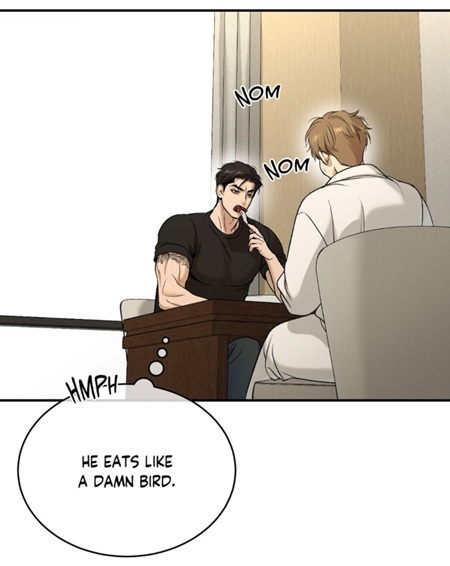
In the dream, he had fallen to his knees — a gesture of humility and unspoken remorse. Yet in reality, the fall takes a gentler form. (chapter 79) He does not kneel; he sits, his body settling softly against the floor as he catches Dan in his arms. The man once associated with dominance becomes a cushion, a pillow, a living anchor. His strength, once used to impose weight, now exists to absorb it. The fall is not toward repentance through pain, but toward tenderness through stillness.
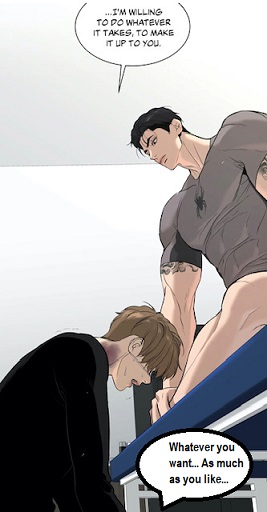
This inversion transforms descent into grounding. The wolf who once incited Dan to kneel (chapter 11) now becomes the one who receives the collapse. (chapter 79) His body — no longer an instrument of violence — turns into safety itself. In that moment, he is neither fighter nor emperor, but a quiet surface where another can rest. The fall that once signified defeat now marks awakening: the champion’s muscles, built for battle, finally serve their true purpose — to hold, not to harm; to bear, to protect, not to break.
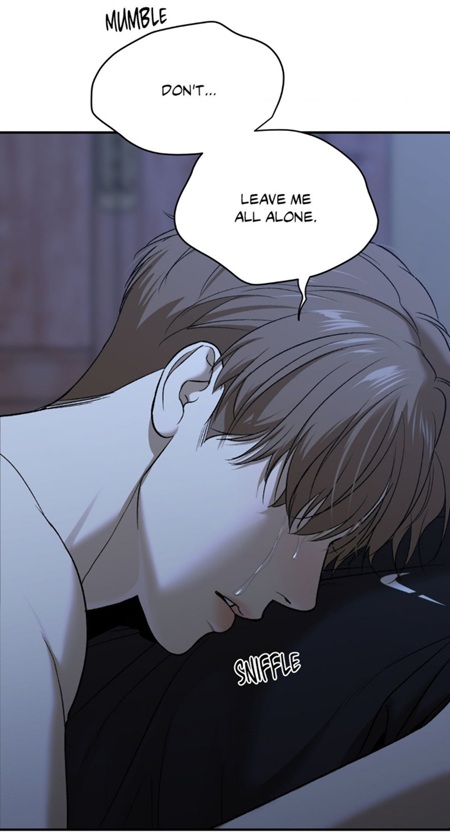
The Mercy Of The False Saint

That’s how I detected another pattern. Kim Dan’s speech is tethered to touch — every genuine confession or plea emerges only when he is held. Physical contact functions as emotional permission: the body grants what words alone cannot. His first “I love you” (chapter 39) escapes him in an embrace; his (chapter 66) (chapter 66) trembles out against Jaekyung’s chest; his (chapter 79) is whispered while clinging to the same body. Even as a child (chapter 57), he could only confide while being physically comforted. The grandmother’s embrace in chapter 57 becomes the prototype of this pattern — the last instance of safety tied to voice. Yet, crucially, that embrace was conditional and silencing. She soothed him but redirected his pain: (chapter 57) Instead of validating his pain and terrible experience, she absorbed it into her own narrative of endurance. The physical comfort coexisted with emotional invalidation — he was held but not heard.

And this interpretation (the touch is triggering the doctor’s desire for communication) got even corroborated by the latest episode. (chapter 80) The moment the star was holding doc Dan’s hands, the latter started voicing more his emotions (fears, displeasure). (chapter 80) When Jaekyung takes his hands in the swimming pool, the gesture revives this primal language of reassurance. For the first time, the touch is neither coercive nor desperate; it’s sustaining. The handhold reverses the earlier dynamic — instead of silencing him, it gives him permission to speak. Furthermore, the champion is pointing out that he can rely on two things, the champion’s hands and the kickboard belt. This stands in opposition to the fake promise of Shin Okja. (chapter 57) (chapter 57) In other words, he is inciting the doctor to trust himself more and become independent. (chapter 80) (chapter 80) The champion’s words — “If you ever end up in the water, you can come back to shore as long as you know how to swim” — stand in quiet but radical opposition to the grandmother’s old reassurance: “You still have me.”
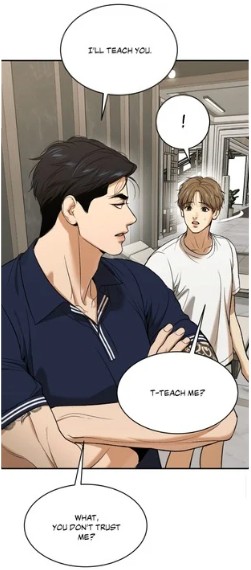
Both statements aim to comfort, yet they embody two entirely different philosophies of love. Shin Okja’s version of care was possession and control disguised as protection. Her “You still have me” offers solace by denying reality — her own mortality and it erased the boy’s suffering and loss and his capacity to cope. It promises stability but at the cost of autonomy: he is safe only through her. Love, in her logic, means dependence. Jaekyung’s line, by contrast, offers trust instead of control. (chapter 80) His comfort does not deny danger — he acknowledges the possibility of falling into the water — but he links survival to skill, not assistance and dependency. His statement affirms Dan’s agency: he can save himself. Once he can swim, he is strong enough. Where the grandmother sought to replace the absent parents (chapter 65), the champion seeks to restore the missing confidence.

This is why the swimming lesson in chapter 80 carries so much symbolic weight. It is not only about overcoming fear of water, but about learning to float between love and self-sufficiency. (chapter 80) He just needs to learn and trust his own body and skills. For the first time, someone tells Kim Dan that he doesn’t need to cling to live. The wolf’s hands do not promise eternal rescue; they teach assurance and confidence.

Through this opposition, Mingwa traces the transformation of care in Jinx: from the grandmother’s pitying dependency to Jaekyung’s empowering faith. The very moment the wolf steadies his trembling fingers, the doctor begins to voice his worries and fears, words that previously only surfaced through sleepwalking or half-conscious murmurs. That’s why I believe that this embrace (chapter 80) in the swimming pool carries transformative potential. It is not merely a gesture of survival, but an initiation into honesty. Surrounded by water, both men are stripped of pretense. And observe that Joo Jaekyung is not rejecting the physical embrace (chapter 80) contrary to the past. (chapter 28) (chapter 69) The wolf, who once relied on dominance and silence, is now allowing his fated partner to hug him. (chapter 80) He accepts his vulnerability and struggles. In the swimming pool, the athlete is also learning to reassure instead of command. Dan, who has long associated touch with consolation and suppression, begins to experience it as safety and trust.

In that moment, their bodies speak what their words still resist: trust me. (chapter 80) The embrace might become the very impulse that pushes them toward verbal honesty — toward saying what they have long hidden. For Dan, it means learning to voice his needs and desires without shame; for Jaekyung, it means acknowledging his feelings without fear of losing control or strength.

But let’s return our attention to the physical therapist’s childhood. (chapter 57) Dan came later to associate love with contradiction: touch equals permission to speak, yet speaking never brings resolution. His psyche learned that disclosure leads nowhere — the listener (the grandmother) offers affection, not change. That’s the reason why he came to suppress his thoughts and emotions and project onto his grandmother. Her way of dealing with pain was denial, rooted in her own fear of trouble and probably social judgment. From my point of view, it is related to the secrecy surrounding the family’s past.

Furthermore, for the hamster, the embrace is more than comfort — it is survival. (chapter 21) From childhood onward, being held becomes the only assurance that the world still contains care. When he woke crying and was taken into his grandmother’s arms (chapter 21), the patting gesture did not merely quiet his fear; it taught him that consolation requires contact. Yet this early lesson carried a hidden cost: it trained him to associate peace with submission and silence, and affection with dependency. Therefore the swimming lesson contains another important life lesson: it is about choice! Joo Jaekyung wants to be “chosen” by the physical therapist, hence he wants to conquer his heart. (chapter 80) That’s the reason why he can not change doc Dan’s heart and mind with the new clothes. For that, he needs to reveal his “weakness” to the physical therapist.

When the puppy died, Dan instinctively tried to recreate that lost safety. (chapter 59) His hand resting on Boksoon’s fur repeats the same motion — the pat once given to him, now returned to another being in pain. What he offers the animal is precisely what he has always longed for: warmth without judgment, touch without condition.

This explains why every later confession — “I love you,” “Don’t leave me,” “I’m sorry” — is born inside an embrace. Speech emerges only when his body feels that safety again. Yet, until now, the wolf’s touch has never been a true confession. The wolf initially held him through instinct (chapter 4), not intention: a reflex of possession, not communication. As time passed on, it changed, yet in the bathtub (chapter 68), Dan fell asleep against him so that he could never experience the athlete’s care (chapter 68); in the morning, Jaekyung acted as though nothing had happened. Then on the dock, Joo Jaekyung expressed his relief (chapter 69), yet he never explained the reason behind his behavior. Besides, he removed himself from Doc Dan very quickly. There was no continuity between touch and word, no bridge from body to heart. The embrace between them was marked by silence.

Only now, in the night of chapter 79, does that change. (chapter 79) The embrace that once silenced finally begins to speak. Dan’s trembling body against Jaekyung’s chest reactivates all those buried associations — fear, need, longing — but this time, the silence is attentive. The champion listens. The gesture that once merely soothed now confesses.

When Shin Okja finally apologizes (chapter 53), she frames her guilt in terms of debt, not grief. What she cannot say is: “I’m sorry your parents are gone, and I buried the truth.” Her compassion never touches the core wound. Instead, she redirects her remorse into pity (chapter 65), a safer, one-sided emotion that keeps her in control. Pity allows her to appear virtuous while avoiding responsibility. It transforms shared pain into hierarchy: she the giver, he the grateful recipient.

This emotional economy defines Kim Dan’s childhood. He was loved through guilt, not through recognition. Every tender gesture — the pat on the head (chapter 57), the hug after bullying — carries the unspoken message: “You’re unfortunate, but you still have me.” That is not empathy; as she is not showing any sign of distress and pain. In my eyes, it is containment. It keeps the child dependent, silent, and bound by gratitude.

Hence, her confession to the celebrity (chapter 65) reveal the same mechanism. The focus remains on her heart, her pain, her goodness, not on his loss. She centers herself within his tragedy. Pity becomes a mask for unacknowledged guilt — perhaps linked to the parents’ disappearance or to choices she justified under social pressure. Her “mercy” is, in truth, a way to maintain her moral purity at the cost of his emotional autonomy.

Through this lens, it becomes clear why Dan needs reciprocal touch to speak. Pity silenced him; touch, when offered without pity, finally frees his voice. This is why the doctor’s embrace in episode 79 marks such a decisive turning point: it is the first time doc Dan is holding someone and that person is taking his words and pain seriously. The champion does not silence or reinterpret what he hears; he simply receives it. For the first time, Dan’s trembling voice is met not with pity, denial, or instruction — but with presence. (chapter 79)

Finally, this moment also exposes Jaekyung’s awakening. Until now, he had followed the grandmother’s advice as if it were gospel: (chapter 65); “bring him to a big hospital so that he can take pills” (chapter 65) (chapter 65) He trusted her words and advises. I would even add that he believed that compliance equaled real care. Yet the night by the balcony teaches him otherwise. (chapter 79) Despite doing everything the “saintly” grandmother prescribed, Dan is still suffering. The illusion collapses: her mercy never healed, it merely concealed. Interesting is that she never brought up to the athlete the doctor’s loss of weight in front of the ocean. Yet, she had noticed it. (chapter 57). Everything evolved around his lack of sleep and his dependency on her. (chapter 65) However, in episode 79, for the first time, the champion notices it. (chapter 79) It is important because very early on, the doctor Cheolmin had already detected his malnutrition: (chapter 13) In other words, the physical therapist’s depression and eating disorder were already existent before meeting the “wolf”. And what did the mysterious friend tell to the “wolf”? He shouldn’t wait out of fear that he might regret it later! (chapter 13) As you can see, “sorry” is the link between the two doctors and the celebrity.
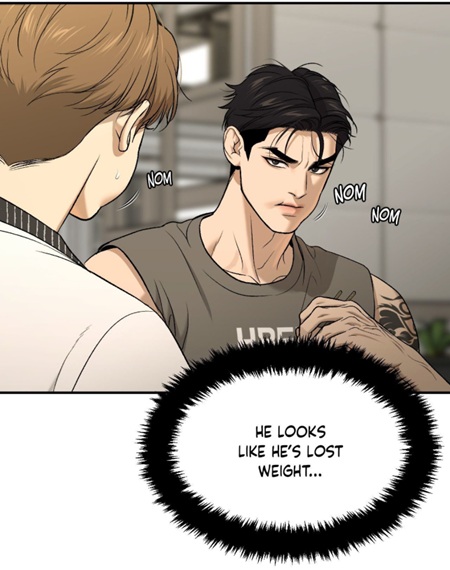
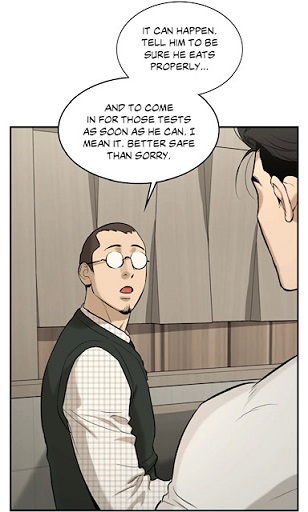
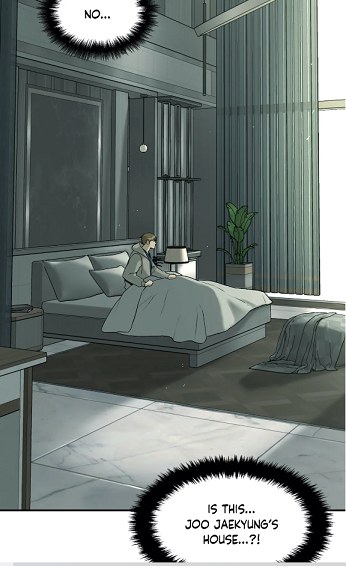
Thus, the “wolf” realizes that love cannot be delegated to duty. (chapter 79) What Dan needs is not obedience to the old woman’s script, but presence, dialogue, and trust. The champion must now do what she never did — look at pain without denial, listen without pity, and finally speak from the heart. This means that after that night, the wolf will gradually change not only his vocabulary, but also his tone and gestures. His metamorphosis will be complete with the birth of the kind and sweet Joo Jaekyung! (chapter 21) Imagine that I had written this part before the release of episode 80!

The secret behind doc Dan’s room

Another detail caught my attention in episode 79 which was confirmed with the publication of episode 80. Doc Dan’s bedroom has always been associated with illness and as such rest! (chapter 21) (chapter 29) (chapter 61) Hence it is no coincidence that while sleeping in his own bedroom, the physical therapist had a relapse. (chapter 79) Because the champion had come to the conclusion that his own bedchamber was linked to sex (chapter 78) and as such “wrongdoings”, the next day, he must have suggested to doc Dan to sleep together in his bed. This explicates why both main leads are sleeping in doc Dan’s bedroom at the end of episode 78: (chapter 78) This shows that the star is listening more and more to his fated partner (chapter 78) And though he had another “accident”, the former is never bringing it up to doc Dan. There’s no blame or accusation. The athlete is keeping these accidents as secrets. However, pay attention that he is making sure that doc Dan is resting. (chapter 80) Notice that he joined him later, acting as if they had not shared the same bed. Gradually, the champion is giving back doc Dan’s freedom and privacy. He is guiding him to take care better of himself by using his own words. (chapter 27) Striking is that the champion always chose the left side of the bed (chapter 79), while he came to sleep much better, when he slept on the other side of the bed: (chapter 66) Thus I deduce that doc Dan is destined to take over his grandmother’s position in the bed: (chapter 21) And this observation seems to be validated by chapter 80. (chapter 80) The star was sitting on the right side of the bed while watching his sleeping partner. Why? It is because he can see his face. But by lying on the left side, doc Dan came to turn his back to him. (chapter 78) But if they switch places, the wolf should be able to watch his partner’s face. And now, pay attention to the way Mingwa placed the new embrace in the swimming pool: (chapter 80) Doc Dan is placed on the left side…. and that’s where the heart is placed. Doc Dan’s racing heart is displaying not only the revival of his repressed affection for the champion, but also his desire to live. He is not truly suicidal, as all his attempts were unconscious choices.
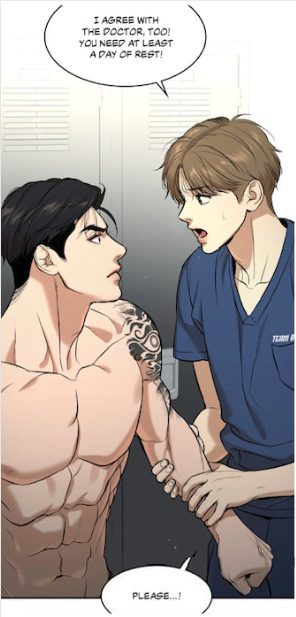
The second “accident”

I have to admit that after reading this image (chapter 78), it was clear to me that the doctor would make a new suicidal attempt during his sleep walking. I was already anticipating him to go to the rooftop, thus the new incident didn’t catch me by surprise. Yet, chapter 79 gave us an important clue about doc Dan’s dissociative state (sleepwalking). They were all triggered: (chapter 79) Because of the champion’s cold gaze, doc Dan felt rejected and even hated. (chapter 79) He had the impression that he wouldn’t meet his “expectations”. Observe the parallels between the champion’s dream (chapter 79) and the doctor’s reply in front of Shin Okja: (chapter 57) We have the doctor’s fake smile which is strongly linked to rejection (chapter 57) and expectations. And what is the other common denominator? His self-loathing and immense guilt. He has the feeling that he is not lovable. In my opinion, doc Dan is suffering because no one is listening to him at all. So far, they all projected their own thoughts onto him. The reality is that doc Dan already had a hard time before moving to the seaside town, (chapter 11) yet she failed to notice it or refused to face his struggles, as they were related to their poverty.

Because he lived alone for a long time without any physical touch (chapter 5), he lost his voice and became a ghost. It is no coincidence that in this scene, doc Dan was silent despite the caress. He was avoiding any topic that could trouble his grandmother. He accepted to remain a little boy in her eyes. But thanks to the wolf, doc Dan is learning to become strong and independent so that he can decide about his life. The swimming lesson is pushing him to overcome his abandonment issues.
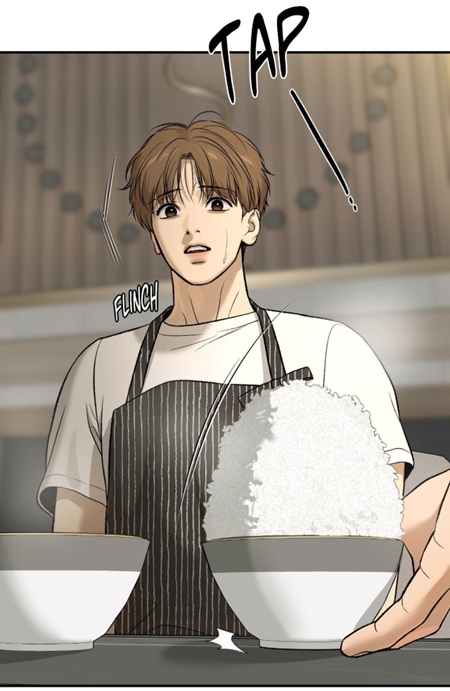
The Songs of Change

While I was on my way to visit my son ( a 6 hours trip), I listened to an old CD from French singer Jean-Louis Aubert entitled Ideal Standard. While listening to the music, three songs — “On vit d’amour,” “On aime comme on a été aimé,” and “Parle-moi” caught my attention. They reminded me a lot of the main couple.

If the previous night (chapter 79) marked the end of a circle, then the next day announces a new rhythm — one that no longer follows the tempo of fighting or guilt, but of tenderness. These 3 songs form a hidden soundtrack to this transformation. They mirror, with startling precision, the inner journey of the champion and his fated companion.

1. “On vit d’amour” — Living on Love

On vit d’amour / Et d’eau fraîche / On vit d’amour, de rien du tout…
We live on love and fresh water / We live on love, on almost nothing at all.

On vit d’amour FrenchWe live on Love English
On vit d’amour
Dans le regard des autres
On vit d’amour
Dans le mien et le votre
On vit d’amour
Quand il n’y a plus d’eau fraiche

On vit d’amour
Tout au fond de la dèche

Laisse le briller
Éclairer
Laisse le venir
Laisse le aller

Car on vit d’amour
On vit d’amour
Sous le bong et les pluies

On vit d’amour
Dans la boue et la suie
On vit d’amour
Jusqu’au bout de la nuit

Laisse le briller
Éclairer
Laisse le venir
Laisse le aller
Laisse lui vivre sa vie d’amour
Car on vit d’amour
On vit d’amour

Je mens, j’aime tant ta main


On vit d’amour
Et je bois à ta bouche
On vit d’amour
On vit d’amour
Toujours

Laisse le briller
Éclairer
Laisse le venir
Laisse le aller
Laisse à l’amour sa liberté

On vit d’amour
On vit d’amour
On vit d’amour
On en vivra
Toujours (2*)

Laisse le briller
Éclairer
Laisse le venir
Laisse le aller
Laisse lui vivre sa vie d’amour
We live on love
In the eyes of others
We live on love
In mine and in yours
We live on love
When there’s no more fresh water
We live on love
At the very depth of poverty
Let it shine,
Let it light,
Let it come,
Let it go.
For we live on love,
We live on love
Under the bong and the rain,
We live on love
In the mud and the soot,
We live on love
All the way through the night.
Let it shine,
Let it light,
Let it come,
Let it go,
Let it live its own life of love,
For we live on love,
We live on love.
I lie — I so love your hand,
We live on love,
And I drink from your mouth,
We live on love,
We live on love,
Forever.
Let it shine,
Let it light,
Let it come,
Let it go,
Let love have its freedom.
(We
Live on love, we
Live on love, we
Live on love,
And we’ll live on it
Forever.)

This refrain captures the quiet revelation at the heart of Jinx: love is sustenance.
Until now, Jaekyung has lived on adrenaline, duty, and pride — mistaking physical dominance for vitality. His meals with Dan were about nutrition (chapter 79), not communion; his affection, an extension of performance (chapter 79). Yet as the doctor grows thinner and more exhausted, the wolf begins to understand what “starvation” truly means. (chapter 79) Dan’s body becomes a metaphor for their shared deficiency — not of food, but of warmth. Although the athlete’s actions were all well-meant, he failed to touch doc Dan’s heart due to the way he spoke to his loved one: (chapter 79)

In On vit d’amour, Aubert contrasts material survival with emotional survival. “We live on love and almost nothing” rejects the capitalist or competitive logic that defines Jaekyung’s world (MFC, rankings, contracts). The line speaks instead to the simplicity of presence — the kind of nourishment that Dan quietly provides through care, routine, and wordless understanding. No wonder why the athlete failed to move doc Dan’s heart by offering so many clothes in episode 80.

This song thus signals the first shift: Jaekyung begins to eat differently — not just at the table, but emotionally. The wolf who once devoured life is gradually learning to taste it through love.

2. “On aime comme on a été aimé” — We Love as We Have Been Loved

On aime comme on a été aimé We love as we have been loved. English translation
On n’invente pas un sentiment
Les baisers donnent l’alphabet
L’amour nous griffe
Ouvre ses plaies
L’amour nous soigne
L’amour nous fait
On aime comme on a été aimé

C’est cela qui nous fait courir
De reproduire et faire grandir
Ce qui nous a été donné
Sans jamais pouvoir en parler
On aime comme on a été aimé

C’est dans les mains de nos parents
C’est dans les coeurs de nos amants
Regard aimé, regard aimant
C’est le plus clair de notre temps
Le plus obscur de nos tourments
On n’apprend pas un sentiment
Même si on veut faire autrement
On aime comme on a été aimé

On dit les chiens n’font pas des chats
Et que l’on est que c’qu’on connait
Qu’on désire ce qu’on n’connait pas
Un autre chien, un autre chat
On aime comme on a été aimé

Toutes ces secondes de tendresse
Dérobées à  l’emporte-pièce
Toutes les claques, les maladresses
Pour que ça dure, pour que ça cesse
On aime comme on a été aimé

C’est dans les mains de nos parents
C’est dans les bras de nos amants
C’est dans les yeux de nos enfants
C’est le plus clair de notre temps
Le plus obscur de nos tourements
On n’invente pas un sentiment
Même si on veut faire autrement
On aime comme on a été aimé

Et j’aime comme tu m’as aimé
We don’t invent a feeling.
Kisses give us the alphabet.
Love scratches us,
Opens its wounds,
Love heals us,
Love makes us.
We love as we have been loved.

That’s what makes us run —
To reproduce and to grow
What was once given to us,
Without ever being able to speak of it.
We love as we have been loved.

It’s in the hands of our parents,
It’s in the hearts of our lovers.
A loved gaze, a loving gaze —
It’s the clearest part of our days,
The darkest part of our torment.
You don’t learn a feeling,
Even when you want to do otherwise.
We love as we have been loved.

They say dogs don’t make cats,
And that we are only what we know,
That we desire what we do not know —
Another dog, another cat.
We love as we have been loved.

All those fleeting seconds of tenderness,
Stolen in haste,
All the slaps, all the clumsy gestures —
So that it lasts, or so that it ends.
We love as we have been loved.

It’s in the hands of our parents,
It’s in the arms of our lovers,
It’s in the eyes of our children.
It’s the clearest part of our days,
The darkest part of our torment.
We don’t invent a feeling,
Even when we want to do otherwise.
We love as we have been loved.

And I love as you have loved me.

On aime comme on a été aimé / On hait comme on a été haï…
We love as we have been loved / We hate as we have been hated.

This lyric exposes the chain both men must break. The author’s line suggests that love is not spontaneous but inherited — modeled through wounds and care. In his childhood, Jaekyung learned rather hatred and misguided affection as domination, silence, lies and endurance, while Dan learned it as sacrifice and appeasement in his grandmother’s care. Both were taught that affection or recognition was not free — through obedience, perfection, or pain.

Throughout Jinx, each reenacts the love they received: the champion demands submission, the therapist offers self-effacement. Yet chapter 79 introduces a turning point — they begin to unlearn this inheritance. (chapter 79) The unconscious apology “I’m sorry, Mr. Joo” is not submission; it is vulnerability freely given. The wolf’s fears in his sleep are not weakness (chapter 79); they are an echo of the love and tenderness he never received.

In this sense, Aubert’s line becomes prophetic: to love differently, they must be loved differently first. This means that b spending time with each other, they will learn how to love each other properly. This is the essence of growth: transforming the very grammar of intimacy they once feared. The story becomes a re-education of the heart — the rewriting of emotional syntax. And episode 80 is the perfect illustration for this change. In love we can make mistakes, but it is important to detect them and learn from them.

3. “Parle-moi” — Talk to Me

Parle-moi, parle-moi de toi / Qu’est-ce que tu veux, qui tu es, où tu vas…
Talk to me, talk to me about yourself / What do you want, who are you, where are you going…

Parle-moi, parle-moi de nous / Tous les deux, qu’est-ce qu’on veut, qu’est-ce qu’on fout…
Talk to me, talk to me about us / The two of us, what do we want, what are we doing…

Parle-moi Talk to Me
Parle-moi
Ce qui nous vient
Nous vient de loi
Ce qui nous tient
Jamais ne nous appartient vraiment

Ce qui nous tue
Gagné, perdu
Ce qu’on a cru
On en a perdu la vue vraiment

Parle-moi, parle-moi de toi
Qu’est-ce tu veux, qui tu es
Où tu vas

Parle-moi, parle-moi de toi
Qu’est-ce tu dis, fais entendre
Ta voix

Ce qu’on nous vend
Ce qu’on nous prend
Mais qu’est-ce qui nous prend
On dirait qu’on a plus l’ temps
A rien
Perdu de vue
Perdu tout court
Peau tendre, coeur pur
On dirait qu’on a plus l’ goût
A rien

Parle-moi, parle-moi de toi
Parle-moi de tes doutes de tes choix
Parle-moi, parle-moi de toi
Qu’est-ce tu dis, plus fort
J’entends pas
Parle-moi de toi

Alors parle-moi, parle-moi de nous
Tous les deux, qu’est-ce qu’on veut
Qu’est-ce qu’on fout
Parle-moi, parle-moi de nous
Avec toi j’irai n’importe où
Parle-moi de toi
What comes to us
Comes from afar.
What holds us
Never truly belongs to us.

What kills us —
Won or lost,
What we once believed —
We’ve truly lost sight of it.

Talk to me, talk to me about you.
What do you want, who are you,
Where are you going?

Talk to me, talk to me about you.
What do you say?
Let me hear your voice.

What they sell us,
What they take from us —
But what’s gotten into us?
It feels like we no longer
Have time for anything.
Lost from sight,
Lost altogether —
Tender skin, pure heart.
It feels like we no longer
Have the taste for anything.

Talk to me, talk to me about you.
Talk to me about your doubts, your choices.
Talk to me, talk to me about you.
What are you saying? Louder —
I can’t hear you.
Talk to me about you.

So talk to me, talk to me about us —
The two of us, what do we want,
What are we doing?
Talk to me, talk to me about us.
With you, I’d go anywhere.
Talk to me about you.

This is the anthem of the new cycle — the song of conversation.
In the beginning, Jaekyung’s language was pure command: “ (chapter 38) (chapter 79) ,” eat” . (chapter 79) His speech created hierarchy, not connection. Aubert’s plea, “Parle-moi”, reverses this logic: it is a call to dialogue, to mutual self-revelation. It embodies exactly what Jaekyung’s dream anticipates — the moment when he will learn to speak with Dan, not at him.

When, in the vision, Dan smiles and says (chapter 79) the tone has changed entirely. The greeting is not fearful or dutiful; it is gentle, open, normal — the image of domestic peace. The dream thus becomes prophetic: language, once the instrument of control, will become a bridge.

Aubert’s words — “Parle-moi de tes doutes, de tes choix” — invite the very vulnerability Jaekyung has never practiced. The wolf who only barked commands must now learn to whisper doubts. The day he speaks softly — “Parle-moi” — will be the day his transformation is complete. Moreover, observe that his repeated plea, “Parle-moi” (“Talk to me”), moves from singular to plural — from me to us. The pronoun shift is decisive: it marks the passage from individual solitude to the possibility of relationship. As long as the “me” dominates, there is distance; only when they learn to say “us” can love begin to exist as dialogue, not projection.

This last strophe, where me dissolves into nous, mirrors precisely where Jaekyung and Dan now stand. They share space, touch, even breath — but not yet language. They might be sharing the same bed, but they don’t talk really to each other and confide to each other. (chapter 80) So far, the nights were full of gestures, yet empty of conversation. Jaekyung would often command and Dan accept everything. Words, when spoken, were often either wounds or vanished into silence. Thus, Aubert’s refrain becomes prophetic: as long as they do not talk, they cannot become a couple.

The line “Avec toi j’irai n’importe où” (“With you, I’d go anywhere”) contains both promise and condition. It imagines a future that depends on mutual speech. To “go anywhere” is not to flee, but to move together — something the two protagonists have never managed. Their shared journey remains suspended in the present, circling between misunderstanding and longing. The dream in chapter 79 — where Dan finally greets him with a smile and a “Good morning, Mr. Joo” (chapter 79) is the first glimpse of this future tense, a promise that conversation will one day replace command. Strangely, this observation was confirmed the new episode:

For now, the song stands as both prophecy and warning: without dialogue, they remain me and you, parallel solitudes orbiting the same pain. There’s still no “we” between them yet. Only when Jaekyung learns to parler — not shout, not order, but truly speak — will me become us, and their love find a voice strong enough to last.

A Chanson of Renewal

Taken together, the three songs form a triptych of metamorphosis:

  • “On vit d’amour” teaches Jaekyung that love is nourishment and a source of happiness, not distraction.
  • “On aime comme on a été aimé” forces both men to face the ghosts of their past and their abandonment/trust issues so that they can love their partner properly.
  • “Parle-moi” charts the path forward — communication as redemption.

They are not merely songs; they are stages of awakening.
From hunger to empathy, from repetition to reinvention, from silence to speech — Aubert’s lyrics sketch the same arc that Jinx now traces.

If Jaekyung once fought to dominate the world, he now fights to pronounce gentleness correctly. And when he finally dares to speak — not as a champion, but as a man who listens — he will fulfill the promise implicit in Aubert’s refrain:

“Avec toi j’irai n’importe où” — With you, I’d go anywhere.

The biggest wish doc Dan has is to go on a trip and walk through the woods with a loved one. The old circle closes; the new begins — not with a punch, but with a word.

Feel free to comment. If you have any suggestion for topics or Manhwa, feel free to ask. If you enjoyed reading it, retweet it or push the button like. My Reddit-Instagram-Twitter-Tumblr account is: @bebebisous33. Thanks for reading and for the support, particularly, I would like to thank all the new followers and people recommending my blog.

Jinx: The Missed Party 🥳🎉

People might have been wondering why I haven’t published anything after the release of episode 78. My silence is linked to my health. I was sick exactly like Joo Jaekyung. I had to remain in bed for a while. But enough about me.

When Doc Dan returned to Team Black, the fighters were so overjoyed that they immediately proposed to celebrate his comeback with a party. (chapter 78) Their noisy excitement — hugs, wishes, smiles, jokes, even talk of meat — gave the impression of a long-awaited reunion. Yet the suggestion was cut short by Jaekyung, who rejected it like this: (chapter 78) In other words, a party was “missed.” At first glance, this might appear to be an exception, a rare moment of denial in a story otherwise filled with shared rituals. Readers might recall the welcome party (chapter 9) in episode 9, the champion’s birthday dinner (chapter 43) in episode 43, the talk of hospital get-togethers (chapter 61), or the festive tone of fighters after director Choi Gilseok’s victory (chapter 52).
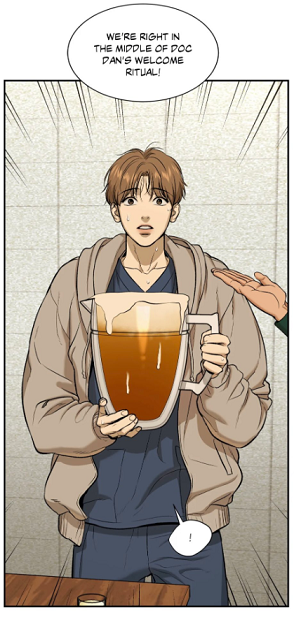
But the closer one looks, the clearer the pattern becomes. The missed party is not an isolated accident; it is the rhythm of Jinx itself. Whenever celebration hovers near — a victory, a birthday, a reunion, even a funeral — someone is not present. In addition, the celebration arrives too early, too late, in the wrong place, or in the wrong form. Jaekyung wins titles, but the gym shares the glory while he remains uncelebrated. (chapter 41) Why did they not organize a party in Seoul to celebrate his victory in the States? Dan devotes himself to work, but his departures are marked by silence (chapter 53) rather than farewell. (chapter 1) The few rituals that do occur — a premature birthday cake, a noisy hug, puppies chasing after a car — (chapter 78) always miss their mark, either hollow in substance or unseen by the very people who should be honored.

The title The Missed Party therefore names more than one canceled occasion. It captures the way the two protagonists move through a world where rituals of belonging are constantly distorted or denied. And in a culture where such celebrations carry deep social weight, the absence is all the more striking. The missed party becomes the haunting motif of their lives: recognition always promised, but never truly given.

The Meaning of Parties in Korea

In Korean culture, parties and team dinners (hoesik) hold a strong ritual function: they create bonds, display hierarchy, and confirm belonging within a group. Farewells, birthdays, and victories are all expected occasions for collective recognition. Yet in Jinx, these moments of celebration are strangely absent or hollow. When Jaekyung wins, his fee doubles, but no feast marks his achievement. Instead, the manager presents the “wolf” as his “trophy”. To conclude, others share in the reflected glory while the champion himself remains excluded, a fighter without a banquet. (Chapter 41) And this absence of recognition and respect is mirrored in the physical therapist’s position. He is not surrounded by the fighters and included by the manager. He is standing on the sideline. It was, as though his good work was not recognized . (Chapter 43) Even the “dragon’s” birthday, supposedly a day of personal celebration, is reduced to an awkward dinner at his expense, with a cake arriving a day too early (chapter 43) or gifts from sponsors and fans he never wanted. (Chapter 41) In Germany, it is considered as a bad omen to celebrate a birthday too soon. Rituals that should affirm intimacy instead expose distance and lack of respect.
A striking contrast appears in chapter 52, when the fighters from King of MMA (chapter 52) gather at the very restaurant used for Jaekyung’s birthday. This time the feast is paid for not by him, but by Choi Gilseok — the rival director who had just won money betting against Jaekyung. The excuse for the banquet is twofold: the humiliation of the champion’s tie and the arrival of new members. Yet the sponsor of the event is absent, his presence felt only through the bill he covers. Unlike the wolf, whose victories go unmarked, Choi Gilseok uses food and drink to project power and buy loyalty. Yet, this celebration with the absent director displays not only hypocrisy, but also resent and jealousy due to the selection of the location. The cruel irony is that Jaekyung’s fall is more celebrated than his rise. (Chapter 52)

This cultural backdrop makes the silences and absences in the Korean Manhwa all the more striking. Parties are repeatedly mentioned but rarely materialize, and when they do, they are strangely hollow. In chapter 61, for instance, a nurse suggests inviting the star to their next hospital get-together. (Chapter 61) The excitement is palpable — “loyalty” and celebrity sparkle in their eyes — but what stands out is the way Dan is erased in the process. They do not invite him; they want access to the famous fighter through him. His role is reduced to a conduit, the man who happens to be “close with Mr. Joo.” The irony is brutal: after two months of work in the hospice, Dan has never once been shown attending such gatherings himself. His own belonging is not on the table. He is used as a bridge to someone else’s fame, while his own exhaustion and lowered gaze silently testify to his exclusion.

But wait — is Dan not also responsible for his isolation? At no moment does he try to be close to them. He avoids their chatter, keeps his distance, and carries himself like someone already half absent. Chapter 56 seems to confirm this impression: even approached by one of the nurses, doc Dan uses work to avoid their company. (chapter 56) However, this is just an illusion. What caught my attention is that the nurses wondered themselves why such a skilled therapist would come to a small-town hospital. (chapter 56) They speak about him, as though he had no reason to stay there, as if he were a stranger passing through. Right from the beginning, he was treated unconsciously as temporary, someone whose presence required explanation rather than welcome. Finally, no party was held for him, no ritual of inclusion was offered. His distance and their detachment mirrored each other, producing the silence that would later define his departure. (chapter 78)
The paradox becomes even clearer when we turn to the star himself. Despite his status as champion, he never receives a proper victory celebration. After each match, we never see a celebration. (chapter 5) It ends either in the car or in the locker room. (chapter 15) The high peak of his celebrated victories takes place at the gym where Park Namwook gather the fighters in front of the Emperor congratulating himself for his “good work” and the spectators for belonging to a winning team. (chapter 41) Yet no feast is held for Jaekyung, no toast to his perseverance. The two men at the center of the achievement are left without ritual acknowledgment, while the institution absorbs the honor. They remain a wolf and a hamster without a feast — fighting, winning, but never celebrated for who they are. And now, you understand why the manager could make such a suggestion at the hospital: (chapter 53) For him, the physical therapists were just tools and as such replaceable.
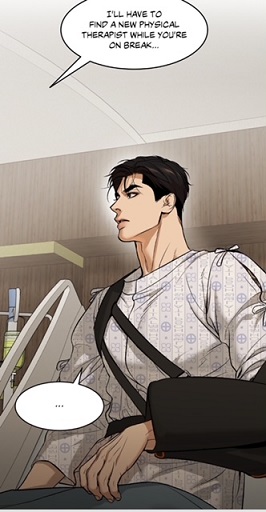
Even Jaekyung’s birthday party in chapter 43 reveals this paradox. (chapter 43) A birthday, especially in Korea, is typically a family-centered celebration, held at home or among close friends. Yet Jaekyung’s “party” takes place in a restaurant, under Yosep’s casual announcement that they would be having a “dinner party.” (chapter 43) The phrasing itself is odd, almost bureaucratic, as though the event were an obligation rather than a gift. Jaekyung himself had to pay the bill, reversing the usual logic of being celebrated. They even started eating before which is actually a huge violation of social norms. The cake appeared the day before his real birthday, an empty gesture more about timing than sincerity. And while fans and sponsors showered him with gifts throughout the month, Jaekyung revealed that he didn’t want any of them. The ritual forms were there — cake, dinner, presents — but the meaning was absent.

But there is another telling absence: Dan himself was left in the dark about the “surprise.” (chapter 43) The fighters never included him in the planning, as if they feared he might leak the secret. In reality, this exclusion only repeated his deeper past: once again, he was not considered part of the group’s inner circle. Had he been told, he might have brought the card and the gift of his own, softening the sting of Jaekyung’s reaction. (chapter 45) By keeping Dan in the dark about the “surprise,” the fighters created another problem. Their silence pushed him to offer his own present on the same day as the gifts from sponsors and fans — exactly the kind of attention Jaekyung resented. He had already said he did not want those presents, and now Dan’s sincere gesture was placed in the same category, indistinguishable from the flood of unwanted offerings. What could have been a private, meaningful moment was absorbed into the hollow ritual of the group. Hence the champion never got to read his card! (chapter 43) In trying to celebrate, the team only ensured that both Jaekyung and Dan felt more isolated than ever. Instead, his silence reinforced the impression that he was peripheral. Unconsciously, Team Black treated him not as one of their own, but as an outsider to be managed. And even within the celebration, another absence was visible: Potato was missing, and no one seemed to notice. (chapter 43) The party did not affirm Jaekyung’s existence, nor Dan’s place beside him. It only reinforced their shared isolation, hidden under the noise of clapping and cheers.

Thus, Jinx presents us with a paradox: in a culture where parties are essential rituals of belonging, both Dan and Jaekyung remain excluded. They are surrounded by the signs of festivity, but the substance is always missing. Their lives are structured not by recognition but by its absence, not by celebration but by silence.

Dan’s Missed Parties

If the star’s parties are hollow, Dan’s are almost nonexistent. The only party where we see him smiling is his birthday, when he was a little boy. (Chapter 11) One might think, this celebration embodies a perfect birthday party. However, observe the absence of friends. It took place during the night too, a sign that his birthday was not celebrated properly. Everything implies his social exclusion. This made me wonder if this memory represents the only birthday party he ever had with Shin Okja. His life is a sequence of departures without ritual, absences without acknowledgment. Each time he leaves a place of work or community, he slips out like a ghost, denied the closure that parties are meant to provide.

At the hospital in Seoul, where he endured the predatory advances of the director, his dismissal was brutal and final. (Chapter 1) He was not only fired but blacklisted, erased from his profession’s networks. No farewell dinner was organized, no colleagues thanked him for his work, no one marked his departure. (Chapter 1) His stay had been so brief as well. Besides, his absence was engineered to be total, as though he had never existed. The very ritual that should have affirmed his contributions instead became a ritual of erasure.

At the gym, the pattern repeated itself. The spray incident turned him first into a scapegoat. Park Namwook yelled, the fighters remained passive, and even Jaekyung rejected his presence. In the space of a few minutes, Dan was ostracized, his innocence ignored. (Chapter 50) Then later the athlete questioned the physical therapist’s actions and told him this (chapter 51) out of fear and pain, the physical therapist thought, he was fired. Once again, he left in silence, unacknowledged. No one stood up for him, no one tried to reintegrate him, no farewell was offered. (Chapter 53) And keep in mind that according to me, in this scene, the manager already knew the truth. So he had a reason to dismiss a farewell party. The absence of ritual here was particularly cruel: Dan had given his skills and energy to the fighters, but his exit marked him only as disposable.
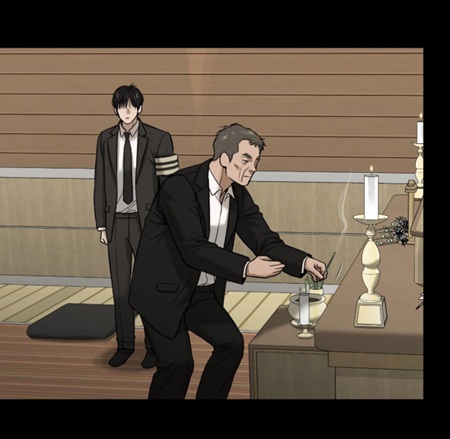
The hospice, where he briefly found genuine warmth, provided no closure either. When he left for Seoul, the staff were shocked, even saddened — but his departure was so sudden that no send-off was possible. (Chapter 78) Their affection was genuine, but the ritual was missing. Dan slipped away in silence, just as he had at the hospital and the gym. In the panel, what caught my attention is the reaction of the director. He is crying while keeping his distance, a sign that he is the one the most affected by doc Dan’s departure. For me, the author is alluding to the director’s regrets. If only he had treated doc Dan better… only too late, he had recognized that he had become accustomed to his presence. Doc Dan had always been a silent but active listener.

This absence of farewell may stretch back to his earliest traumas. If his parents truly died by suicide, it is possible that Dan never attended their funeral. Poverty, shame, and debt may have erased even that ceremony, leaving him with no closure for the loss of his own family. We can use Joo Jaewoong’s funeral as a source of inspiration. (chapter 74) The silence of his grandmother on this point suggests that even the most basic ritual of mourning was denied him.
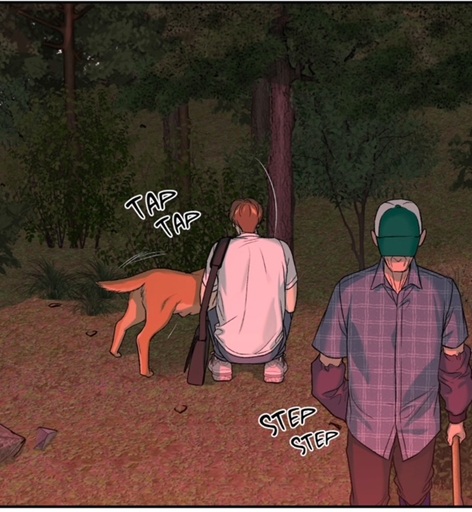
The pattern becomes symbolic in the death of the puppy. (Chapter 59) Only Dan and the landlord marked the event with a quiet burial. Since no one knew about it, it left the ritual incomplete. For Dan, the small act was meaningful, but its invisibility to the larger community echoed his own life: recognition always hidden, always partial, never public.

Even in moments that looked like parties, Dan was left on the margins. Jaekyung’s birthday party, with its cake and noisy cheer, contained an intimate truth: Jaekyung’s sudden, raw confession, (chapter 43) This was the real heart of the evening, the only moment where ritual turned into intimacy. And yet even this was missed by Potato, who was absent at that crucial moment, lingering elsewhere with Heesung. The party’s form was there, but its essence — the recognition of Jaekyung’s loneliness and Dan’s importance — was overlooked by the two men at its center due to the presence of alcohol.

Thus, Dan’s life is a chain of missed parties. At the hospital, the gym, the hospice, even at funerals, he departs without recognition. And when celebrations do occur, the essential truth is missed — noticed only by those who are absent, while those present look away.

The Puppies’ Party

Nowhere is the irony sharper than in chapter 78, when the puppies run after the departing car. (Chapter 78) To them, departure is not tragedy but play, a noisy farewell parade. Their barking and chasing become a spontaneous party, a joyous ritual of attachment. (Chapter 78) It is pure, instinctive, and alive. And yet, neither Jaekyung nor Dan sees it. Shut in the car, burdened by urgency, contracts, and exhaustion, they miss the little parade given in their honor.
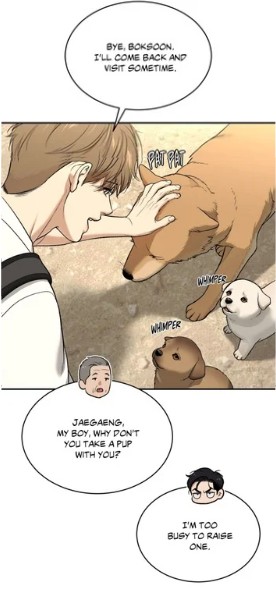
The contrast is devastating. Humans, with their expectations of formal ritual, repeatedly fail to mark Dan’s contributions. They miss every opportunity to acknowledge him. But the animals, in their innocence, succeed where people fail: they celebrate simply because they care. The puppies recognize bonds better than the humans who claim to love him.

What makes this little parade even more striking is that the puppies do not separate between wolf and hamster. Their joy is directed at both men together, at the bond symbolized by the car’s departure. (Chapter 78) In this sense, the puppies achieve what the humans cannot: they recognize attachment without division, gratitude without debt. Their farewell is not tied to work, contracts, or hierarchy, but to presence itself. (Chapter 78) By running after the car, they express loyalty and responsibility, acknowledging the care they have received. It is the only party in Jinx that includes both protagonists as they are — not as worker and champion, not as scapegoat and boss, but as a pair worth celebrating. Finally, they have no idea that the couple plans to return soon, as they have no notion of time. (Chapter 78) Striking is that here, doc Dan is making a promise to Boksoon and her puppies, but the latter have no idea. Therefore imagine this. On the weekend, the moment the car approaches the landlord’s house, the puppies will recognize them and celebrate their return! And this time, both characters will witness this welcome party: (chapter 78) How can doc Dan not be moved and even smile? Why did the champion reject the landlord’s suggestion (taking a puppy)? He had no time… Having a puppy will not just force him to slow down and take his time, but also attract real and genuine attention from the members of Team Black. (Chapter 78) The animals would even change Joo Jaekyung’s behavior and the fighters’ perception of their hyung. (chapter 78)
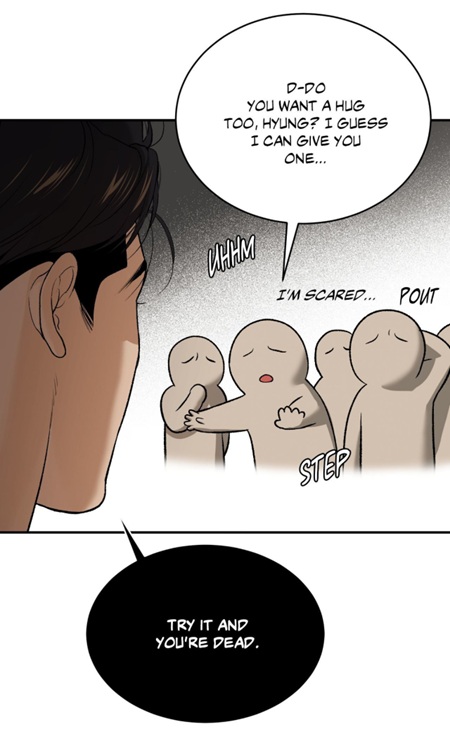
The Illusory Reset

When Dan returns to the gym, the fighters smother him with hugs and noisy affection. They beg him not to leave again, propose a welcome party, and act as if everything is back to normal. (Chapter 78) But this “reset” is an illusion. Dan is only contracted for two matches. Interesting is that no one is capable of perceiving the truth, as the main lead’s explanation is ambiguous. (Chapter 78) He doesn’t limit the number of matches, only that he will focus on the “wolf”. So for them, his return is not limited in time. Nevertheless, his paleness and dark circles speak louder than their words: he is exhausted, fragile, still haunted.
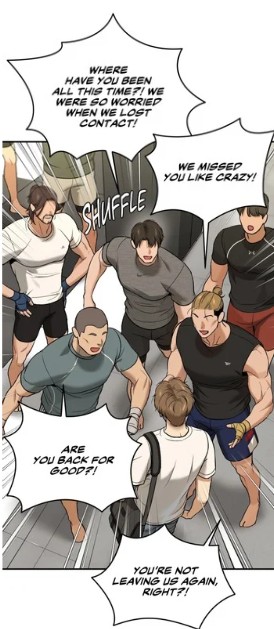
The fighters, however, do not see his state. (Chapter 78) They are more worried about another possible departure than about his condition, as though his leaving again would be a greater tragedy than his ongoing suffering. This exposes that the members are not totally oblivious and their reunion is not a repetition of the past. On the other hand, warm words and a noisy welcome are enough for them. They take his generosity for granted, just as they always have. Therefore they ask for his magic hands. (Chapter 78) Their celebration is shallow, a ritual meant to restore their own comfort rather than acknowledge his reality.
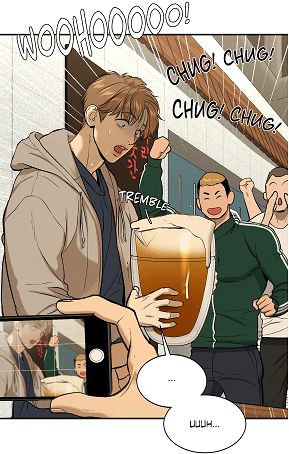
Here, the cultural weight of parties in Korea sharpens the irony. Gatherings are strongly intertwined with alcohol (chapter 9), and abstaining from drink often means being excluded from group belonging. Yet Dan, on medication, cannot drink. His doctor’s recommendation makes it impossible for him to participate in such “public” rituals. Even the customary sharing of a huge bowl — a symbol of intimacy and unity — must be avoided. For Jaekyung, who once used alcohol to dull his own struggles, (chapter 54) this becomes another reason to refuse such parties: they risk exposing Dan to temptation and harm. Park Namwook, knowing Jaekyung’s history of drinking, has no interest in promoting such events either. (Chapter 78) Hence the latter has no interest to organize a welcome party and even maintain the ritual with the bowl!! What might appear to others as grumpiness or stinginess is in fact a form of protection.
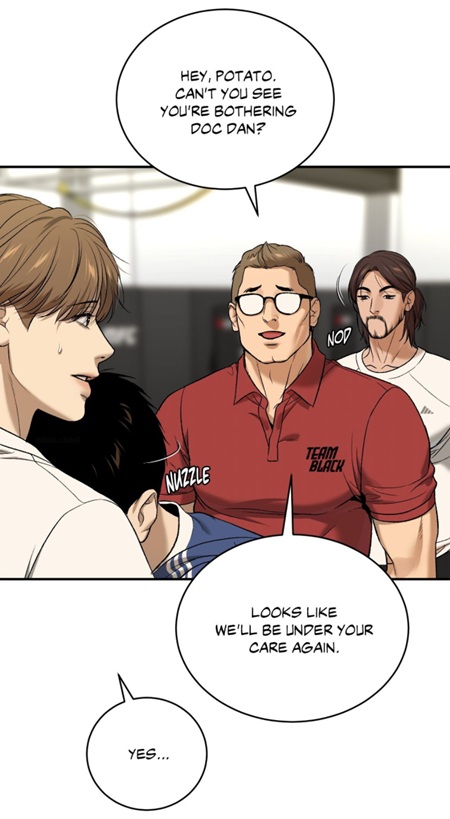
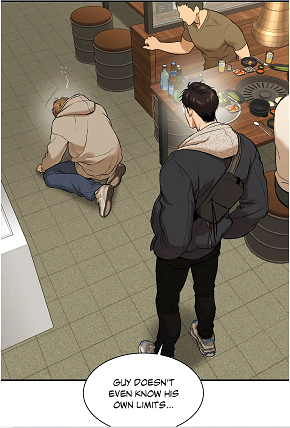
In contrast, Potato embodies another response. (Chapter 78) Having missed Dan most deeply during his absence, he now wishes to spend as much time as possible with his hyung. His longing shows that no party with Heesung and the landlord — no noisy drinking night — (chapter 58) could fill the hole left by Dan’s departure. But his form of attachment is still caught in the ritual of surface-level affection. What Potato craves is real closeness, hence he keeps hugging the physical therapist, (chapter 78) but what he proposes are the same shallow gestures that miss the truth of Dan’s fragility. The chow chow’s words — “Nothing beats seeing you at the gym” — unintentionally reveal this dependence. On the surface, it is a casual expression of joy and longing. Yet beneath it lies another truth: if the hamster were to leave Team Black for good, the gym would eventually lose all its members. From the start of the story, Dan has embodied teamwork. He is the glue that holds the fighters together, not by authority or charisma, but by care. Without him, unity dissolves into rivalry and noise. The irony is that the fighters sense this truth but cannot articulate it. They attempt to celebrate his return with hugs and the promise of a party, as if rituals could substitute for recognition. In reality, what they crave is not the feast but the fragile cohesion that Dan alone brings.

Striking is that Jaekyung’s refusal of the welcome party is linked to his position as director of the gym. It marks a turning point. Indirectly, he rejects the idea by redirecting the fighters’ attention. He points out their indifference toward him. For the first time, the athlete is voicing his dislike openly, he felt excluded. Due to this combination, the athlete doesn’t realize that he rejected the party, as if he refused to participate in hollow rituals that only disguise exhaustion and perpetuate harm. (Chapter 78) It becomes clear that for the athlete, such parties built on illusion can only harm Dan further. To conclude, thanks to his intervention, he protected the hamster from rituals that mistake noise for acceptance and even care. (chapter 9)

Park Namwook’s position within Team Black also sheds light on the dynamic of missed parties. In earlier chapters, he was the one who orchestrated gatherings (chapter 26), or allowed whether welcome parties or surprise celebrations or pre-match meals (chapter 22). These events were never about genuine recognition but about maintaining power and appearances, boosting morale, or reminding the fighters of their dependence on the team structure he managed. The “surprise” birthday party in chapter 43 bore his fingerprints, (chapter 43) yet he stayed conspicuously absent when the cake was presented, only appearing later at the restaurant. (chapter 43) This absence is revealing: Namwook preferred to avoid direct conflict with Jaekyung’s visible displeasure, leaving the awkward burden of paying and performing to the champion himself to Yosep. In other words, his parties were tools of control, not gifts of belonging. By chapter 78, however, the balance has shifted. (chapter 78) Standing in the back, Namwook watches as Dan returns and is embraced by the fighters. He notices a “different vibe” between the two leads, but fails to grasp what it means. Doc Dan is actually free and has the upper hand in their relationship. Hence he can no longer ask this from doc Dan: (chapter 36) Doc Dan should put up with everything. What he cannot admit is that Dan is no longer replaceable. (chapter 78) Once erased, the therapist now belongs; once central, the manager is now the outsider. Namwook is pushed into the very silence he once imposed on others. The irony is sharpened when Jaekyung openly asserts his authority: (chapter 78) With that, the wolf reclaims his rightful place. In other words, by respecting the hamster, the protagonist is learning to protect his own dignity and interests. (chapter 78) Namwook’s illusion of control dissolves, his “decisions” and rituals losing their force. Even the proposed welcome party collapses in an instant when Jaekyung refuses, proving that Namwook no longer directs the rhythm of the team. The missed party is thus his own as well: the final chance to assert authority through ritual slips away before his eyes, leaving him stranded on the margins of the very world he once managed. And in this reversal lies a striking symmetry: the silence that once excluded Dan now excludes Namwook, completing a cycle of poetic justice. What Dan endured in season one (chapter 41), sidelined and voiceless, is now mirrored in the manager’s quiet erasure.
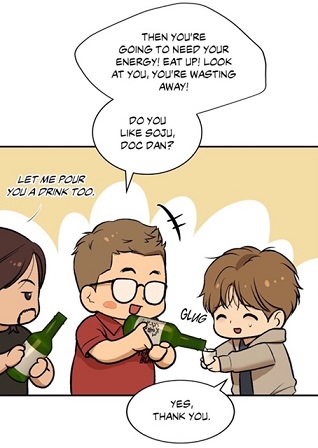
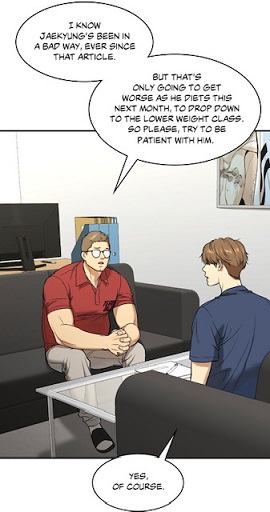
If Dan’s health were to worsen, the most striking reversal might occur: a match could be cancelled not because of the champion, but because of his therapist. Such a possibility would mark a profound shift in the logic of Team Black. In season one, Jaekyung fought regardless of his condition; his insomnia, shoulder injury, foot injury and depression were ignored, never reasons to stop the machine. Dan was expected to keep patching him up in silence while the show went on. But if a fight were cancelled due to Dan’s weakness, it would confirm his irreplaceable place in the system. The team’s future would depend not only on the fists of the champion but on the presence of the man who heals him. For the wolf, this would be more than logistics: it would be a choice of care over profit, proof that he has reclaimed his authority to protect rather than exploit. And for Namwook, such a cancellation would represent his ultimate defeat. A missed party of the grandest kind — a fight night erased from the calendar — would signal the collapse of his management logic. (chapter 69) Yet unlike all the hollow celebrations that came before, this missed event would finally have meaning. It would not be absence through neglect, but absence as recognition: proof that Dan’s life matters more than ritual, profit, or performance.
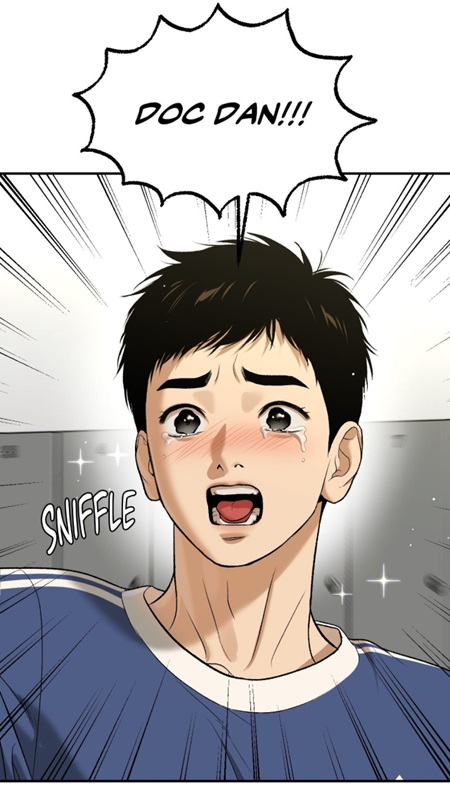
The Real Parties They Missed

If there was ever a “real” party in Dan’s life, it was the small gathering by the seaside with Heesung, the landlord, and Potato. (chapter 58) A simple evening of drinking and laughter, it gave him a fleeting taste of inclusion outside the world of gyms and hospitals. Yet even this was flawed: Dan’s health made alcohol dangerous, and Jaekyung never knew of the event. For him, it became another missed party, a moment of warmth hidden from his eyes.

The traces of this seaside evening resurface in chapter 78, when Potato joins the fighters to welcome Dan back. Unlike the others, however, he arrives noticeably later. (chapter 78) This delay suggests a split loyalty: while the team is already celebrating, Potato is likely still tied to Heesung, perhaps even speaking to him on the phone. His tardiness betrays how his heart is pulled in two directions — caught between the actor’s orbit and the gym’s renewed center around Dan. Yet the embrace of the fighter, and his tearful reaction at seeing Dan again, show that his real place lies with Team Black. (chapter 78) The return of Dan shifts Potato’s focus: he no longer has to trail after Heesung, but can make his hyung and his own career a priority once more.

And here lies the seed of conflict. In chapter 59, (chapter 59) Potato had made a promise to treat Dan to a meal if he ever returned, squeezing his hand with the sincerity of a puppy. That promise, innocent as it seemed, carried a hidden trap: in Korea, such “treats” almost always involve alcohol. And he could try to recreate the party on the coast. Potato, unaware of Dan’s medical restrictions, may offer him exactly what he must refuse. Only Jaekyung knows the truth of Dan’s fragile health; only he can act as his shield against such misplaced affection. Secondly, Potato possesses pictures of the puppies (chapter 60), which he took on the day one of them died!
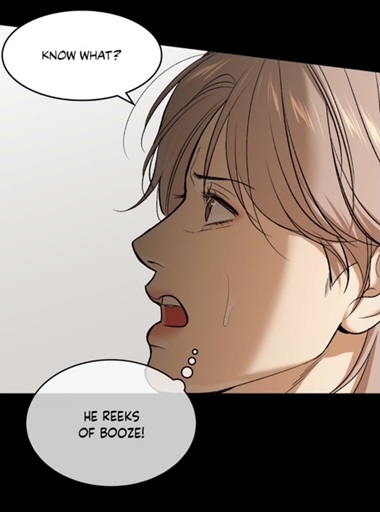
What makes this tension more explosive is the role of Heesung. He alone knows that Jaekyung resorted to drinking after Dan’s departure (chapter 58), and his presence ties alcohol directly to the champion’s vulnerability. At the same time, Potato’s loyalty is beginning to shift. He once orbited Heesung like a hidden lover, but Dan’s return rekindles his attachment to the gym and as such will affect his relationship with the gumiho. (chapter 78) The “puppy” now prefers Dan’s company at the gym to the actor’s beck and call. The small seaside party that once united them may become the fault line that divides them: an invitation, a bottle of soju, a clash between past habits and new priorities. For Jaekyung, it will be the ultimate test — not whether he attends the party, but whether he transforms it into something different, a celebration without alcohol, a ritual of care rather than destruction. As you can see, I am expecting the return of the fox Heesung.

And yet, even beyond the noisy welcomes and the hidden seaside gatherings, the theme of absence reaches into the most intimate farewells. When Dan prepares to leave the hospice, he leans toward his grandmother, seeking an embrace, a moment of warmth that could ease the separation. (chapter 78) But she does not return the gesture, as she might believe that he is just holding her straight. Her arms remain still, her body heavy with silence. Instead she talks, urging her grandson to leave the place as quickly as possible. So she doesn’t enjoy this moment. What should have been a small celebration of love — a hug of recognition, a party for two — dissolves into emptiness. Halmoni, who had always claimed to be his anchor, fails to give him the ritual of belonging he craves. The one gesture that could have affirmed their bond is withheld, turning tenderness into yet another missed ceremony.

Hwang Byungchul mirrors this failure in his own way. (chapter 78) Sitting stiffly in his hospital bed, he waves away any possibility of affection. His body language, arms crossed, his words reduced to commands about training, erase the emotional bond that might have connected him to Jaekyung. Where halmoni’s silence is passive, Byungchul’s is active — he refuses intimacy, replacing it with obligation. For both figures, farewell becomes an empty form, stripped of the recognition that makes partings bearable. In these moments, the absence of a hug, the denial of tenderness, is more devastating than the loudest rejection. It is a party that never begins, a rite of passage left unspoken.

This is crucial, because in Korean culture, embraces are rare, and when they occur, they carry profound weight. To hug someone is to cross into genuine intimacy, to declare loyalty and affection without words. The absence of such a gesture from halmoni and the director therefore marks not just emotional distance but outright exclusion. They cannot — or will not — celebrate Dan or Jaekyung as individuals worthy of deep affection. they only know pity, pride or annoyance. Their failure underlines the story’s central rhythm: the rituals that should affirm identity are constantly missed, postponed, or corrupted.

Placed against these failures, the quiet “parties” between Jaekyung and Dan acquire even greater weight. A home-cooked meal,

(chapter 22) (chapter 13) a breakfast in silence (chapter 68), the embraces in the dark (chapter 66) (the wordless recognition of suffering) — these become the true celebrations of Jinx. They lack alcohol, noise, or spectacle, but they carry sincerity. They reveal that belonging can be built not through grand gestures but through repetition, through the transformation of fleeting kindness into ritual. This implies the existence of conscious and choice. And yet, these moments remain fragile. After their return to the penthouse, there is no shared meal, no laughter, only nostalgia and sadness. (chapter 78) Even Jaekyung is troubled by the reminder that Dan’s stay is temporary, as if the very walls of the penthouse resist turning into a home. (chapter 78) In other words, the wolf’s task is no longer to win battles in the ring but to protect these fragile celebrations — to make Dan feel at home, to turn missed hugs into embraces, missed parties into warm meals, missed gestures into habits of care. Only then can the cycle of exclusion be broken. Only then can “The Missed Party” become, at last, a real one.
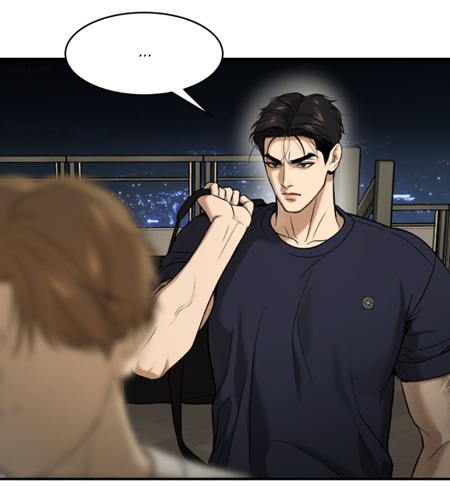
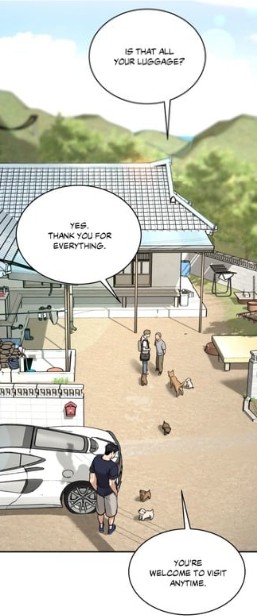
Conclusion

Both protagonists are marked by missed celebrations. Dan’s life has been a chain of exclusions: fired without farewell, blamed without defense, departing without closure. Even in death — (if we include the theory of his parents’ vanishing), the puppy’s burial — rituals of belonging were denied. Jaekyung, for his part, wins victories without feasts, carrying glory without intimacy.

The fighters and nurses offer illusory parties, mistaking noise for recognition, affection for change. But the true parties are elsewhere: in the puppies’ joyous run, in the hidden rituals of wolf and hamster [the embrace, (chapter 68), the shared meal (chapter 68) and in the landlord’s quiet kindness (chapter 78). For me, it is no coincidence that the senior followed them to the street and waved at them! (chapter 78) He expressed not only his genuine feelings, but also his longing: he hoped to see them soon. He had come to appreciate their presence which is not related to their work. The Missed Party becomes not a single absence, but the haunting rhythm of the entire narrative: recognition always arriving too late, always seen by the wrong eyes. And perhaps the story’s promise lies here — that one day, the real party will finally be held, not in karaoke bars or gym halls, but in the unbreakable bond of two men who learn what true friendship and belonging mean. This means, the more the champion and his fated partner develop new routines, the more it will affect the gym and as such Park Namwook, which can only feel more and more excluded.
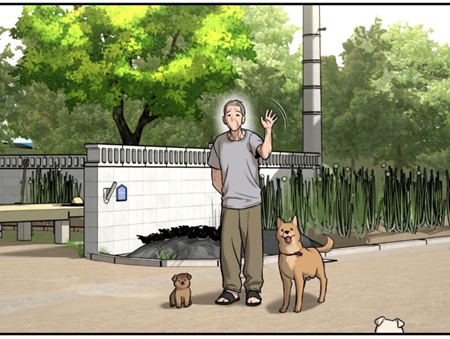

PS: If in the next chapter, the night continues, then I can’t shake the feeling that Joo Jaekyung might pat doc Dan’s head and not yank his hair, like he announced it. (chapter 78)

Feel free to comment. If you have any suggestion for topics or Manhwa, feel free to ask. If you enjoyed reading it, retweet it or push the button like. My Reddit-Instagram-Twitter-Tumblr account is: @bebebisous33. Thanks for reading and for the support, particularly, I would like to thank all the new followers and people recommending my blog.

Jinx: The Song 🎼Of Life 🌳🪲

Introduction – Life, Sound, and Seasonality

A single cicada pierces the silence. (chapter 77) One tree, one voice, one yard — and yet the chapter closes not with human speech, (chapter 77) but with this fragile chorus of sound: chirp, chirp, chirp, whoosh. The choice feels deliberate, unsettling. Why does Mingwa give the final word to nature? Why let the cicada and the tree, not the champion or the doctor, occupy the last panel? Why offer us a rhythm so fleeting, so fragile, instead of the solidity of spoken language? (chapter 77)

The question lingers because silence (chapter 77) defines the scene as much as sound does. Between the two men, honest words fail. One proposes deals, bargains, contracts (chapter 77) — the same old language of power — while the other listens (for the most part of the time), seemingly passive, letting the conversation wash over him. Yet beneath these little moments of awkward stillness, another layer pulses: the soundscape of life itself. (chapter 77) The cicada sings not out of calculation, but because it must. The summer is nearing its end. The branches of the tree move not with intention, but with rhythm due to the wind. (chapter 77) Both are ungoverned, unowned. Both remind us of temporality: cicadas live only a short time above ground, trees sway but remain rooted, summer heat will fade into autumn. The backdrop insists on limits the characters refuse to see. Neither the doctor nor the athlete pay attention to their surroundings and see nature, too focused on the presence of the other.

And yet, the framing provokes further unease. The cicada is solitary, (chapter 77) not part of a swarm. The tree stands alone in the yard, (chapter 77) separated from the other trees and the vegetable plots, more ornament than sustenance. Is this tree a symbol of rootedness or of isolation? Is the cicada a reminder of vitality or of brevity? Why end with nature (chapter 77), when the story is about human bonds (chapter 77)? Perhaps because nature itself becomes the mirror — exposing the illusion of control, the futility of contracts, the precariousness of voices that are not truly heard.

More questions press in. Why does Jaekyung’s supposed change feel at once moving but also hollow? Why does Dan’s passivity strike us as both annoying and deeply human? Why does the cicada’s song seem more alive (chapter 77), more honest, than anything either man manages to say? (chapter 77) Are we witnessing growth, or a repetition with a new mask? Rhythm, or song?

This chapter demands we hold these contradictions without resolution — at least for now. Life here is not only about seasons and maturation, but also about the unpredictable song that emerges in the gaps of silence, in the fragile moments where genuine speech fails. Why else end with the tree and the cicada, if not to suggest that the real heartbeat of the story lies outside the men’s grasp?

The Tree, the Wind, the Sun and the Cicada

As you can sense, nature is now writing the rhythm of the protagonists’ lives, though none of them grasps it. Why? It is because they don’t hear the cicada’s song and appreciate the shadow from the tree. Both still cling to the illusion of control — Jaekyung through his fighter’s creed of schedules (chapter 77), contracts, and matches; Dan through his low self-esteem, his sense of duty and repayment of debts (chapter 77). Yet the cicada’s song interrupts their exchange (chapter 77), cutting through human words to remind us that time is not theirs to master. If nature is the true composer of this tale, then what are they but its creatures — a cicada on the trunk, a tree standing silently next to the characters?

The champion’s unheard song

But which figure embodies the cicada and the tree? Everything is pointing out that Joo Jaekyung is the cicada. (chapter 77) Observe that after each thought (chapter 77) or suggestion from the MMA fighter, the cicada’s song appears, as if the insect was echoing the human. (chapter 77) And now, you comprehend why the author (chapter 77) ended the episode like that. (chapter 77) The cicada, exactly like the celebrity, was waiting for an answer or more precisely looking for a companion. (chapter 77) Yes, the melody of this little insect is actually an appeal for mating.

In other words, the cicada’s voice in Jinx is not random background noise. (chapter 77) It displays that this cicada is rather late in his search for his mate. Since, in the real world, male cicadas sing only to attract a mate before their imminent death, its song in Jinx appears even more as an urgent appeal, not to the world in general, but to one listener, one partner. If Jaekyung is the cicada here, then his “song” is his repeated deals, his desperate way of seeking a bond he cannot name. He wants intimacy with doc Dan, but he can only cloak it in the language of contracts and obligations.

That’s why the episode ends with the chirp chirp and the sound of the branches. There still exists a gap between them. Joo Jaekyung was not able to cross the line: intimacy. In reality, he views doc Dan more than as a physical therapist. The athlete failed to convey his true emotions and thoughts due to his immense guilt: (chapter 77) (chapter 77). He is the cicada, because he feels powerless in front of doc Dan. Or we could say, he is the cicada due to his self-loathing. Hence he feels so small. On the other hand, observe that he doesn’t expose his vulnerability to doc Dan. He appears strong, independent and determined in front of the physical therapist. (chapter 77)

Thus the athlete chose to rely on the language he masters: deals. And this makes sense once we recall his past. Physical therapists in his life (chapter 1) have always been temporary, rotated and replaced like disposable tools. (chapter 53) Never once did he sustain a long relationship with one which was definitely influenced by his manager. Even now, with Dan, he cannot cross the invisible line between professional and personal (chapter 77) life, between contract and confession. Instead of admitting his own desires and true needs, he offers a time-limited deal: a future that already announces separation. (chapter 77) It is no wonder that his voice and the cicada’s noise blur into one rhythm — restless, repetitive, transient. (chapter 77)

The Cicada’s Life

But there exists another evidence for this interpretation. The little insect spends two to five years underground before it emerges, molts, and sings — a lifespan that eerily mirrors the champion’s career.

He entered the global stage at twenty (chapter 75), and now at twenty-six (chapter 75), like the cicada in its final molt, he sings louder than ever, defiant against the silence that waits for him. (chapter 77) His entire existence is noise, presence, demand: every word in this chapter punctuated by the chirp of the cicada, as if his voice itself were inseparable from its call. And the choice for the cicada is no coincidence, for in East Asian cultures, cicadas often stand for rebirth and transformation because these creatures go through 5 metamorphosis and spend years underground before finally breaking free into the light. To conclude, Jaekyung, too, has been buried in survival, in the underground world of his trauma and the MFC system. This means, like the cicada that takes years of unseen preparation before its brief summer of song, Jaekyung has reached the peak of his arc. His final metamorphosis is imminent — and now, you comprehend in the introduction why I pointed out that the athlete’s metamorphosis felt hollow or at least not complete. In reality, he is still under the influence of Park Namwook. Keep in mind that in the car, he expressed the absence of desire to fight, his mental and physical exhaustion: (chapter 69) Under the tree, the “fighter” is acting, as if he was strong and healthy again! (chapter 77) He has already accepted the fight in the fall (chapter 77), while in the car, he was still hesitant.

The Ant and The Cicada

Here the fable of The Cicada and the Ant from Aesop casts its shadow. The cicada sings recklessly, wasting summer in song while the ant toils and prepares. Jaekyung is the cicada, immersed in the immediate, deaf to winter’s approach; Dan has lived like the ant (chapter 57), sacrificing joy for survival, laboring without song. But Mingwa overturns the moral. The grandmother embodies the ant’s labor (chapter 62), turning Dan into a beast of burden — obedient, exploited, mute. The landlord has a similar mind-set (chapter 77), yet he diverges from Shin Okja, because he is aware of the importance of rest. Moreover, we see him working next to the two “kids”. On the other hand, note that doc Dan is working once again during his free time. (chapter 77) Shin Okja’s hoarding brought no music, no life which contrasts a little to the nameless farmer: (chapter 77) His words are linked to music. Yet, if we compare the champion with the grandmother, the cicada fills the silence with sound (chapter 77), making the tree’s presence visible. If the ant embodies survival without joy, the cicada insists on life even in its brevity.

But the cicada carries yet another, subtler illusion. It sings in heat and brightness, as if conversing with the sun itself. (chapter 77) To our ears, its music feels like a hymn to light—a celebration of the afternoon. The insect appears to believe the sky is its partner: I sing because the sun hears me. Yet the sun never answers. It is too distant, too indifferent. The cicada’s true companion has always been the trunk under its feet—the tree that holds it up, the branches that amplify its vibration, the roots that fed it in secret while it was buried as a nymph. The duet we hear is not with the sun; it is with wood and leaf, with the body that can actually respond—the tree that answers song with a rustling whoosh. (chapter 77)

A Lifetime Deal: the Cicada and the Sun

This misrecognition is Jaekyung’s, exactly. For years he has believed his real partner was the spotlight—the blinding, artificial sun of the ring. Titles, cameras, crowds: a heliocentric religion where the brighter he burns, the more “alive” he must be. And Park Namwook officiates that faith. He is the high priest of the false sun—controlling calendars, selling narratives, promising glory (chapter 75) (bench-talk during the night under a street lamp “let’s make history” pitches), always angling the wolf toward the next blaze. Under that light, every human bond is recoded as use: therapists rotate, friends become assets, even pain becomes a publicity arc. The “spotlight” warms (chapter 77); it never cares. It cannot hold you when the lights go out.

So what, in truth, lets the cicada sing? Not the sun. The mate and indirectly the tree. And this leads to my next observation. Doc Dan is the tree, but the sick doctor has no idea about his true nature. (chapter 41) (chapter 77) He is the surface that carries Jaekyung’s vibration, the structure that turns his noise into presence. Even underground, the cicada nymph lives by roots—its unseen life depends on the tree’s hidden water. It serves as their burials too. Likewise, Jaekyung’s fiercest seasons have been fed by quiet, unglamorous care: taped hands, worked tendons, meals cooked at dawn, a body coaxed back from ruin. The sun applauds; the tree sustains.

This reorders the scene in chapter 77. Every time Jaekyung makes a proposal—“two matches,” “debt cleared,” “contract ends”—the cicada answers, chirp, chirp, as if the insect were echoing the man. But hear it more precisely: he keeps singing upward (chapter 77), toward the sun that will never reply. The only answer available is lateral, beside him—the whoosh in the leaves, the breath of the tree. And that is Dan. The real dialogue of the chapter is not man ↔ spotlight, but cicada ↔ tree: chirp answered by whoosh, willpower answered by presence. Is this not beautiful?

Here the warning sharpens. The sun is a spectacle that consumes. Namwook’s “solar” system—rankings, schedules, comeback arcs—demands continuous radiance from a body that has already confessed fatigue. A cicada can sing itself to death.The star risks doing the same—confusing performance with relationship, mistaking visibility for intimacy, burning precious time before he has learned how to live. If he keeps treating the spotlight as companion, winter will arrive while he is still calling to a sky that cannot hold him. If so, he will end up alone, a warning Hwang Byungchul expressed on the rooftop. (chapter 75) This shows that the athlete has not found the right answer yet. He only focused on this aspect: doc Dan (chapter 76) But the director had told him this: (chapter 75) He should pay attention to his surroundings which doesn’t only include doc Dan, but also the puppies, the trees, the ocean, the sun etc.

This solitude is already foreshadowed. On the bench, Jaekyung mirrored Dan’s own posture of resignation: (chapter 77) he sacrifices himself for others. He agrees to his manager’s demands, he prioritizes Dan’s recovery and desires, he helps the landlord for the doctor’s sake and in the process he erases himself. Thus he has no time for himself and his “family”. He still has no private life. (chapter 77) At no moment, he is mentioning Hwang Byungchul or the landlord. He goes further—he defines himself as a shackle, an anchor weighing Dan down. The language is borrowed directly from Dan’s own vocabulary: (chapter 77). In a grim symmetry, both men come to see themselves as burdens, unworthy of being chosen, each convinced he is dragging the other down. Under this new perspective, my avid readers can understand why I perceived no deep change in the wolf, he is still defining himself as a fighter and champion, nothing more.

This raises the following question. How can the champion fight with such a mindset? (chapter 77) Each match will only bring him closer to separation. Whether he wins or loses, the outcome is the same: Dan will leave. (chapter 77) His mind will never be at peace. That certainty can only gnaw at him, poisoning his training with dread. He can no longer imagine a victory that can be shared, nor a defeat that can be softened. Glory and suffering alike will be stripped of their meaning, because both exclude the very person he longs to share them with, if the doctor agrees under these conditions. (chapter 77) He won’t be able to enjoy their time together either, always thinking of the separation. And this is exactly why episode 77 feels like the culmination of an old rhythm of blindness — first staged in episode 11 (chapter 11), replayed in episode 58 (chapter 58), and now revealed in its bleakest form on the bench.

  • Episode 11: Dan on his knees, begging for help, is met not with recognition but with Jaekyung’s misinterpretation. The champion, unable to read the doctor’s suffering, turns the plea into a promise of “fun.” Dan’s misery is swallowed in pleasure’s disguise.
  • Episode 58: At the landlord’s gathering, the others dance, drink, and laugh while Dan sits silent and withdrawn. Again, suffering and loneliness are silenced by entertainment. His isolation deepens because those around him are blind to his exhaustion, masking solitude and absence with noisy joy.
  • Episode 77: Finally, on the bench, there is no misinterpretation and no distraction — yet no joy either. (chapter 77) Both men hold popsicles, and both let them melt away. The sweetness drips into nothingness. Neither finishes the treat; neither savors the moment. The popsicles are wasted like their time together, like their words unsaid. Life is slipping through their hands, uneaten, unlived.

Here the symmetry sharpens: in 11, while Jaekyung seized the opportunity to have fun at Dan’s cost; in 58, others’ play excluded the physical therapist altogether; in 77, the absence of play exposes the core truth — neither man knows how to enjoy the present. However, the cicada’s noise stands for entertainment and short-lived happiness which means that the “goddess” Mingwa is indirectly warning her figures, not to waste time and enjoy the present. They should confess. At the same time, she is underlining the importance of “health” and that “illness” should be taken seriously.

This is Dan’s tragedy: despite knowing life’s fragility – chapter 59- (the puppy’s burial seared death into his memory), he still cannot taste life. The sweetness of the moment melts as passively as he endures it. Yet it is also Jaekyung’s tragedy, because by calling himself a “shackle” (77), he steps into Dan’s shoes: burdened, unworthy, longing — and unheard. What was once Dan’s silent plea for companionship is now Jaekyung’s, but this time it is Dan who cannot perceive the truth, too focused on himself and his self-loathing.

The bench thus becomes the mirror of episodes 11 and 58, binding them into a single arc. It shows how fun, sweetness, and joy — the song of life itself — are continuously misplaced, misread, or wasted between them.

Once again, Jaekyung finds himself racing against time (chapter 77). In the past, he fought to shorten it—to end fights quickly, to push through exhaustion, to prove himself before fate closed in. Now he fights to prolong it, to stretch the fragile terms of this contract, to squeeze eternity into borrowed weeks. Yet the irony is merciless: the more he tries to hold on, the more unbearable his solitude becomes. Every strike, every victory, every step forward is also a countdown toward the moment Dan vanishes from his side. Thus I can only deduce that he is doomed to lose his “match” in the fall, if he doesn’t postpone it.

The Rootless Tree

If Jaekyung is the cicada, Dan is the tree. But not any tree: he is the one standing in the corner of the yard, silent, enduring, and taken for granted. (chapter 77) A tree provides shade, stability, and wood — others rest beneath it, lean against it, even cut it down when it no longer “produces.” That has been Dan’s role in life: used by the grandmother, landlord (chapter 77), the director of the hospice and even patients as a background presence, dependable (chapter 71) but voiceless. His attraction to Shin Okja’s wedding cabinet makes sense here. (chapter 19) The cabinet, crafted from dead wood and mother-of-pearl, is civilization’s tree: beautiful, heavy, but lifeless. It embodies control and permanence, much like the grandmother’s treatment of him — precious in appearance, mute in agency. When Dan strokes it longingly in chapter 19 (chapter 19), he projects himself onto it and his grandmother, identifying with its polished silence. By chapter 53, however, the tone shifts. (chapter 53) The cabinet becomes a burden, an inheritance of death and stasis that he must abandon, just as he begins to sense the need to step beyond his grandmother’s shadow.

The parallel runs deeper. A tree, unlike a cabinet, is alive. (chapter 41) But life requires care: water, soil, and balance between sun (chapter 41) and shade. This means that trees need care, yet the problem is that since they grow patiently, people take them for resilient. Nevertheless, the illness of a tree (parasites, fungus) can be difficult to perceive because signs are not always obvious and can be confused with normal growth patterns (falling leaves due to the season). This mirrors doc Dan’s conditions. He is blamed for his sickness, as he has a weak constitution (chapter 21) or he is neglecting himself (chapter 70). Thus I see Dan’s decline, his exhaustion, his silence at the bench in chapter 77, as a reflection of this reality: he is not being tended like the tree in the courtyard which contrasts to the way the chili peppers are treated. (chapter 77) He is not bringing any fruit or nourishment. However, a tree serves as a habitat for animals (birds, insects…) Additionally, notice his hands — almost lowered throughout (chapter 77), even when holding a Popsicle. (chapter 77) Doc Dan doesn’t eat, doesn’t raise his hands, doesn’t claim space. He neglects himself as others have neglected him. In the last panel, one detail caught my attention: with one hand, he is holding his wrist. It was, as though he was trying to stop himself from eating the Popsicle.

And yet, in chapter 41, under a vast tree, (chapter 41) his posture was different. Then, he looked up. He opened his palm toward the light, acknowledging that a tree does not live for utility alone but breathes and feels. (chapter 41) That was the moment he realized he had caught feelings for Jaekyung. The tree embodies life, hence there is this expression: “The tree of life”. Under this new perspective, it becomes comprehensible why the main lead came to associate rest and companionship to a walk through the woods. (chapter 47) The symbolism is sharp: a tree in a forest is never lonely. Surrounded by others, it becomes part of a living community. Dan’s nightly walks (chapter 65) — through woods, past the grave of the nameless puppy — reveal his repressed longing: to mourn, to belong, to root himself in a place where companionship is natural, not demanded. He is indeed longing for recognition and care.

The contrast could not be clearer: the grandmother abandoned her furniture in Seoul, and now she prepares to abandon him the same way (chapter 57), treating him as a cabinet to be left behind or a baggage to be passed on. (chapter 65) But Dan is not furniture. He is a tree, and the forest remains his true horizon. His illness, his exhaustion, his silence are not fate; they are symptoms of neglect. What he longs for — and what his love for Jaekyung first awakened — is to step into the woods, to be among companions, to be cared for as living. I would even add that deep down, he is neglecting himself in order to receive care: (chapter 76) What he expressed in front of the champion was actually reflecting his own desires. But so far, no one is willing to stay by his side and take care of him, when he is sick. Exactly like the athlete, the main lead was not allowed to become “sick” in the end, as he had to support his grandmother.

The tree in myth and ritual embodies the axis of existence itself: roots sunk into death, trunk standing in life, branches reaching toward heaven. Roots hold what is buried — the puppy’s nameless grave (chapter 59), the parents never properly mourned, all the grief denied him. The trunk carries scars, weathering seasons while others lean against it — the image of Dan’s silent, taken-for-granted endurance. And it is precisely on the trunk, in the realm of life itself, that the cicada sings. (chapter 77) Jaekyung’s restless call resounds through Dan’s endurance: his silence becomes resonance, his shade becomes sound. His song fills the air, making the tree’s existence suddenly audible, visible, alive. (chapter 77) This mirrors their relationship: the champion’s presence — disruptive, insistent — compels Dan out of muteness, dragging his quiet endurance into resonance. Where the grandmother reduced him to labor and servitude, Jaekyung insists, almost violently, that Dan should be free and heard. That’s the reason why I am expecting a huge change in him in the next episode (78). Besides, doc Dan’s number is 8!

This is why the symbolism of natural burials resonates so strongly. In South Korea, groves are increasingly chosen as final resting places, where ashes feed the soil and the deceased “return to the bosom of nature.”

Dan has never been permitted to visit a burial — neither for his parents, nor for his own grief, the loss of the puppy. Is it a coincidence that the doctor is never seen going to the burial site for the puppy after that fateful night? It is because he has never been taught how to be vulnerable and to mourn. The vanishing of the parents was never brought up. (chapter 57) And because I made the connection between the main lead and the tree, another association came to my mind: the picture of the smiling Kim Dan with his grandmother in front of the hydrangeas. (chapter 65)

This plant blooms brilliantly but requires constant shade and water — fragile beauty that cannot be uprooted without withering. For me, they echo the absent mother: ornamental, dependent, ultimately unsustainable. However, this photography exposes not harmony but hierarchy. Shin Okja stands proudly before the blooms, lush plants that demand water and shade in abundance, while the mother lingers blurred in the background. The image suggests exclusivity: the grandmother has never been able to pay attention to more than one person at a time. For me, she used the little boy as her excuse to claim care for herself — because she “took care of him,” she believed herself entitled to receive attention in return. The hydrangeas thus mirror her role: fragile in appearance, but voracious in need, drawing resources to herself and leaving others in the shadows. The mother, displaced into the background, must have felt the loneliness of someone perpetually excluded from this one-sided economy of affection. Even Dan’s duck-printed shirt reinforces the point. The duck belongs to the pond, a space of water and cyclical nurture, yet there is no pond in the picture. Moreover, the “pond” is not freedom but a closed circuit where water flows only to the hydrangea. The child, like the duck, does not swim freely; he is displayed as proof of the grandmother’s virtue, her moral claim to attention. In this way the photograph unveils a disturbing inversion: Shin Okja as the hydrangea that consumes, Dan as the duck that justifies her entitlement, and the mother as the silent absence pushed beyond the frame. And since both are smiling in the picture, I assume that the photographer must have hidden their suffering behind the camera, which would mirror this scene: (chapter 58) In this panel, the tree in the corner of the yard is not visible, mirroring the exclusion of the main lead in this “happy scene”. This interpretation reinforces my theory that the treasured picture of doc Dan is actually an allusion to the loss of Eden and the grandmother’s sin.

To conclude, Doc Dan’s true longing, lies elsewhere. Not to stand as a solitary trunk in the corner of a yard, nor to be polished into furniture (Wedding Cabinet), nor to prop up fragile blooms — but to be part of a forest and as such to have a family, a home. So when Joo Jaekyung gives him the freedom to choose his path (chapter 77), he is actually pushing him to find his own roots. Thus the tree replies with his branches. (chapter 77) And here the sound symbolism crystallizes. While in the yard, the cicada chirps and the wind whooshes, in the champion’s bedroom, the sound “whoosh” (chapter 76) accompanied the ghostly illusion of Dan, a presence felt but no longer seen. As you can see, the sound exposes the doctor’s true life: he is a ghost, exactly like the tree in the corner of the yard. This means that we should expect doc Dan’s response to the champion’s offer in the next episode. However, this time, the physical therapist will make his own choice, not influenced by his grandmother, born from his true desire.

Sweetness and Fire – Red Bean, Chili, and the Melon

In the previous part, I already examined the signification of the popsicles. However, I didn’t study their flavors. Interesting is that each flavor mirrors the men’s inner stance toward life. (chapter 77)

Dan reaches for the red bean popsicle, the Bibibig (chapter 77). One might think, he selected it, because he likes it and as such has already tasted it. However, I can refute this perception. (chapter 16) When doc Dan was looking for a new place, he was eating a red bean bread in front of a freezer at a convenience story. The little boy in the background was looking for a popsicle himself. This shows not only the malnutrition of doc Dan’s from the past, but also his choices were influenced by his grandmother and her taste. In episode 11, the grandmother offered him red bean bread for his birthday (chapter 11), and his choice in the present is still shaped by her hand. In addition, red bean is sweetness born of endurance: boiled, mashed, sugared — a labor of patience. This reflects his childhood and life with his grandmother. Finally, the juxtaposition of doc Dan and the boy in front of the freezer serves as a metaphor: doc Dan still has the mind of a child. Interesting is that under the tree, doc Dan does not eat it. (chapter 77) The wolf has already taken a huge bite, while the 29 years old man’s lips barely touches the ice cream. Moreover, his statement (chapter 77) is not referring to the popsicle, but to the good news from the celebrity. This disconnection exposes the doctor’s lack of appetite and listlessness. He is not living, he is withering. Hence the popsicle melts untouched, a confession without words: (chapter 77) Dan continues to deny himself sweetness, continues to let what he desires drip away, uneaten. His passivity here is no accident — it is his illness, his habit, inheritance, the echo of a life where his own likes never mattered. At the same time, his behavior could be judged in a positive light: it displays his confusion and loss of identity as well. He didn’t reject the popsicle. He is at a crossroad, for he doesn’t know what he likes in life. He selected the red bean popsicle out of habit and politeness… but deep down, he didn’t feel like eating it. Hence he is not looking at his fated partner.

But red bean in Korea also carries another meaning: it is a ward against misfortune and evil spirits. Families once scattered red beans around the house after funerals or during rituals, believing their bitter-sweetness drove away bad luck. How ironic, then, that Dan’s uneaten popsicle becomes a symbol of this very curse. By refusing sweetness, by letting it melt away, he also refuses the power to ward off the misfortunes that have haunted his life. What should have been protection becomes waste. His own “amulet” is abandoned, just as he was. This could be seen as an allusion to a future collapse or incident in his life. Keep in mind that his suicide attempt has not been perceived correctly yet. Under the tree, it was reduced to an accident (chapter 77) or “sleepwalking” (chapter 77) and not depression!

On the other hand, Dan is not only red bean. He is also chili pepper: (chapter 77) sharp, hot, forged by survival. Chili peppers, introduced to Korea centuries ago, became a cornerstone of its cuisine — not only for flavor but as a sign of vitality and strength. They are hung in bundles outside homes to ward off bad luck, their fiery color a talisman of life-force. Doc Dan brings life into the champion’s life , pushing the athlete to change his habits. The physical therapist also burns (chapter 18), though he rarely lets it show. His fire erupts in flashes — anger, defiance, or hidden passion (chapter 44)— but most of the time it is suppressed, hidden like a chili dried and strung up, more symbol than taste. If the red bean is the sweetness he represses, the chili is the intensity he fears unleashing. Together, they reveal a man both sweet and burning, tender and scarred. His tragedy is that he has learned to mute both sides of himself — neither savoring sweetness nor embracing fire. By muting his own appetite, he also mutes his voice — which is why he cannot confess his feelings to the champion. (chapter 77) He refuses the penthouse not because he dislikes it, but because he has already grown attached to it, to its inhabitant, and to the bond he fears to name. To admit this attachment would be to risk exposure — to risk being seen and rejected once again.

For Dan, Jaekyung is not the cicada but the sun itself: (chapter 41) distant, unreachable, dazzling. The tree cannot imagine that the sun could notice its shade. To him, Jaekyung is both too far and too important, a star in every sense, while he himself remains a mere trunk at the margins — one physical therapist among many, a man without fame, without recognition. Thus his silence is not only fear but conviction: that he is invisible, that his love could never matter to someone who shines so brightly.

Jaekyung, by contrast, chooses melon. (chapter 77) Melon is not survival food, not inherited obligation. It is pure refreshment, fruit turned into summer sweetness. For once, he accepts it without protest, without remark, even tastes it. (chapter 77) The detail matters: this is not the strawberry of chapter 43 (chapter 43), presented on his birthday cake, but a quieter gesture of allowing sweetness into his body. Contrary to the past, he is now taking his time to eat it. (chapter 77) The melon popsicle hints at a shift. The cicada who only worked, only sang for survival in the ring, is beginning to taste life’s sweetness outside of it. However, his attitude changes, the moment he hears doc Dan’s refusal and hesitation. From that moment on, he can no longer eat the popsicle. (chapter 77) Thus I deduce that Joo Jaekyung must have enjoyed this brief moment with doc Dan under the tree. (chapter 77) Therefore we hear the cicada’s song.

And yet, their shared moment ends in waste. Neither finishes their ice cream. Both popsicles drip away in silence, signs of a larger failure: they cannot yet enjoy the present, cannot take in sweetness or fire without fear. This inability extends beyond food. It is mirrored in their blindness to life’s smaller joys — symbolized by Boksoon and her puppies. (chapter 77)

For the first time, the puppies appear directly before Jaekyung, (chapter 77) circling, playful, embodiments of innocence, pranks, and uncalculated joy. And yet, the champion does not see them. His gaze is elsewhere, fixed on Kim Dan and as such on promises, contracts and shackles, on the logic of debts and repayment.

Deals, Favors, and Shackles

This interpretation leads me to the following observation and question. Why are Boksoon and her puppies present under the tree (chapter 77), only to vanish soon after? (chapter 77) Their brief appearance offers a key to understanding the bind between Dan and Jaekyung. Boksoon approach the adults because of the popsicles, while the puppies are simply following their mother. The dog is drawn by the hope of food (chapter 77) — playfulness, comfort, life. But when no treat comes, they drift away. This is exactly what Dan longs for and exactly what he never receives: nourishment freely given, affection not tied to debt, contract, or favor. (chapter 13) His life has been shaped by exchanges where even love must be earned, and so he remains haunted by the sense that he is tolerated, not chosen. (chapter 19)

From the very start, the relationship between the hamster and the wolf has been trapped in this logic of contracts. In chapter 6, the penthouse agreement reduced everything to transaction : a fighter guarding his jinx, a therapist financing his grandmother’s care. (chapter 6) There was no cicada-song, no play — only sterile bargaining. Dan’s body and labor were priced; Jaekyung’s superstition was indulged. Both were tools, not partners.

Chapter 48 repeats the pattern in a darker key. Choi Gilseok offered another “contract,” one that smelled of temptation and corruption. (chapter 48) It was no real bargain, but a devil’s deal: short-term relief in exchange for entrapment in illegality. (chapter 48) Dan, swayed by Shin Okja’s illness (chapter 48), hid the meeting from Jaekyung. The secrecy itself poisoned the bond, culminating in the locker-room explosion. There Jaekyung hurled his cruelest accusation (chapter 51) : that Dan was obsessed with money. What Jaekyung failed to see is that this “obsession” was not Dan’s own desire, but Shin Okja’s influence. She had molded his tastes, his choices, his gifts (chapter 41) — even the act of repaying Jaekyung was her idea. Money became the currency of gratitude because she defined it so. Observe that her request from the celebrity evolves around money and time again: (chapter 65)

And favors, too, weigh like shackles. At the ocean, Shin Okja asked Jaekyung to take Dan to Seoul. (chapter 65) On the surface, it was framed as concern. But beneath, it was another manipulation: gratitude weaponized, agency erased. If Dan were ever to learn of this request, he would see himself once again reduced to baggage, carried not out of love but out of obligation. (chapter 77) Worse still, he would relive the sting of mistrust (chapter 51) — the same wound opened by Jaekyung’s suspicion in the locker room. To Dan, such favors are never gifts; they are veiled commands, proof that others act on his behalf because he cannot be trusted to act himself. Moreover, keep in mind that she denied him her request: (chapter 57), while she spent time with the champion on the beach. Xshe simply ignored his desire: (chapter 57) making decisions on his behalf without knowing his actual life. Her choices are based on the past and on her believes (television, trust in drugs and huge hospitals). She has no idea about his sleepwalking, his malnutrition, the incident with the switched spray, his blacklisting in Seoul …

This brings us to the bench in chapter 77. Here Jaekyung offers something new — or so it seems. (chapter 77) A finite contract: stay with me until the fight with Baek Junmin, then be free. Unlike the penthouse agreement, this one comes with an end date. But the language betrays him. It is still framed in terms of debt: (chapter 77) Shackles: the very word reveals the failure. A contract that was meant to liberate instead repeats the logic of bondage. While they are sitting next to each other, people might come to the following interpretation. They are equals contrary to the past: (chapter 6) (chapter 6) The reality is that this new offer doesn’t stand for equity and respect, rather servitude and submission. Something the doctor has already sensed: (chapter 77) He was already shocked how far the athlete was willing to go. Besides, he keeps wondering why the athlete would act this way: (chapter 77) As you can see, I have the impression that a quarrel between Shin Okja and her grandson could occur because of the celebrity, the doctor having the impression that he can not make his own choices, his life is ruled by Shin Okja (see chapter 2, 6 and 11).

Worse, Jaekyung introduces a word he has never voiced before: hatred. (chapter 77) In his mind, hatred is the imagined opposite of love — the binary hammered into him by his father. (chapter 73) Pride or shame, strength or weakness, love or hate: these were the categories of his childhood, the narrow spectrum in which he was trained to live. Resentment was inevitable, as natural as shadow beneath the sun. Jaekyung cannot yet imagine tenderness, attachment, or yearning as possibilities that stand outside this binary. He can’t anticipate that someone can be loved despite his flaws or wrongdoings.

And so the new contract fails, just like all the others. What Dan needs is neither another favor nor another deal, but the recognition of emotions that cannot be reduced to transaction. Gratitude is not enough. Obligation is not enough. To speak in terms of shackles and hatred is to miss the very heartbeat of life. Doc Dan wants to love properly and be loved. (chapter 71)

The truth has been there all along — whispered by nature, mirrored by Boksoon and her puppies. What Dan longs for is what the dog sought: a gift freely given, nourishment without condition. And what Jaekyung must learn is that between love and hate lies a spectrum of feelings unnamed in his vocabulary: tenderness, affection, vulnerability, confession. Until then, both men remain bound — not by contracts or favors, but by their own inability to imagine a bond beyond them. But they have the landlord by their side.

Notice how the landlord’s words (chapter 77) float with a note of music attached, as though he were not naming a financial debt but humming an invitation. Unlike Shin Okja, who used debts and favors as invisible shackles, the farmer’s “debt” carries no real weight of obligation. It is more like a pretext — a socially acceptable language that hides what he truly means: I enjoyed your presence, and I hope you’ll return.

That is why his request is so different from the grandmother’s. She demanded endless sacrifice, her “favors” becoming manipulative bonds (chapter 53) that left Dan trapped. The landlord, by contrast, knows limits. He praises without exploiting: “You’re doing better than anyone else here, the best!” But then, instead of pushing for more, he tells them to rest. He values their health, not just their productivity. In other words, he is not really an “ant” in La Fontaine’s fable, hoarding labor until exhaustion. He embodies a balance — work as a way to connect, not to consume.

Placed against the backdrop of chili harvests (chapter 77) — red, fiery, alive — his words gain even more resonance. Through the language of “work” and “debt,” he is offering something closer to companionship, a bond that extends beyond utility. If Shin Okja reduced Dan to a cabinet, the landlord gently places him back into the rhythm of life: song, labor, pause, and rest. This explicates why Jinx-philes could notice a glimpse of a smile on doc Dan’s face. (chapter 77) The landlord represents the link between the two insects in the end.

The Laughter Not Yet Heard Before Winter

The chapter ends warm, colorful, alive — cicadas singing, leaves swaying, ice cream dripping in the sun. (chapter 77) Yet where there is life, there is death. Nature teaches no illusion of permanence: every chirp already contains the silence that will follow, every green leaf already carries the memory of autumn’s fall. Jaekyung has only ever confronted death once, in the violent loss of his father (chapter 74), and since then he has refused to look beyond the ring. To him, the jinx belongs to matches, not to hospitals or funerals. He takes comfort in the grandmother’s words that she will choose her time of departure (chapter 65), never considering that illness could strike suddenly, that Dan’s health could collapse without warning, that Hwang Byungchul’s shadow could fade from the story altogether. Hence he imagines that they can visit Shin Okja regularly. (chapter 77) His eyes are locked on Baek Junmin, as if victory or defeat in the cage were the only horizon. (chapter 77) Yet, he is forgetting that he has already developed attachment to Shin Okja and even likes the director. Should the latter die, the star would be definitely affected, especially if he recalls their final moment together: the latter had a smile! (chapter 75) To conclude, he is still acting, as if he could control time and as such life.

Dan, by contrast, already knows that death waits close. (chapter 59) He buried his puppy at the edge of the forest. He spent some time by his grandmother’s side with the quiet resignation that each day might be the last. (chapter 59) For him, sweetness is fragile — a red bean bun, a fleeting popsicle — always on the verge of melting away. This is why silence overwhelms him on the bench: Jaekyung offers a contract, and as such the cicada calls, But Doc Dan’s own voice fails. Hence the wind answers (chapter 77) What he longs for is not a deal or a favor, but a confession — of love, of vulnerability, of fear.

Here the puppies and Boksoon hold the missing thread. (chapter 77) They appear in the yard, playful, unpredictable, embodiments of innocence and joy — yet Jaekyung does not see them. (chapter 76) He misses that for Dan, they are a source of comfort, tiny sparks of smile (chapter 57) in a life otherwise muted by burden. The tragedy is that Jaekyung himself is the only one who could give Dan that genuine laughter — the kind we glimpsed once, briefly, in chapter 44 (chapter 44) — but he does not yet grasp this. The reason is that he has repressed this night, the only smile he remembers is linked to Shin Okja. (chapter 77) Yet, she is no longer his source of “comfort”. (chapter 22) But the grandmother doesn’t embody jokes and games, only obligations and duties. So helping the grandmother doesn’t signify assisting his fated partner. Without pranks, without jokes, without the unpredictable gift of play, their bond risks becoming another duty, another sterile shackle.

And so the chili returns. (chapter 77) The wolf’s food has always been bland (chapter 22) — carefully measured meals from his nutritionist, even the doctor’s recent convalescent porridge of rice and chicken. (chapter 77) The male lead didn’t add abalone for example. But what if the athlete tasted something different? A hot, spiced dish, the kind that makes you laugh and cry at the same time? This is no abstract thought — Mingwa has already staged it in parallels. (chapter 37) In the States and in Seoul… After Heesung slept with Potato, he cooked him ramen studded with chili peppers. The gesture was not just breakfast but an intimate code, echoing the well-known phrase, “Do you want to eat ramen?” (chapter 35) — an invitation to closeness. Jaekyung might know the phrase, with his many partners before Dan, (special episode 1) but he has never truly eaten the ramen. Dan, ironically the virgin, has never received the invitation at all. The one ignorant of the metaphor has lived it (chapter 37); the one familiar with the code has never tasted its reality. 😂

This is foreshadowing. When Jaekyung finally accepts chili (chapter 77) — really eats it, really reacts — it will be the moment when bland survival gives way to fiery life. It will sting, it will burn, it may even make him cry, but those tears will not be the sterile sweat of weight-cutting or the hidden sobs of exhaustion. They will be tears shared, as laughter is shared, as sweetness is savored, as fire is embraced. This idea came to my mind because the athlete needs to learn the joy of mistakes! Once again, he offered a perfect deal, he fears to make mistakes… unaware that errors are part of life and should be embraced in the end.

Thus the title of this arc sharpens: The Song of Life is not only cicadas in the sun but also the spice that makes you choke and laugh (chapter 77), the puppy that dies yet leaves behind play, the silence that becomes confession, the contract that dissolves into companionship. Life and death are inseparable, grief and laughter intertwined, exactly like the day the athlete lost his guardian: (chapter 73) Joy and smile were followed by guilt (chapter 73), sadness and resent. (chapter 74)

The cicada sings because it will soon die. The tree sways because the wind reminds it it is not alone. And one day, Jaekyung will discover that the true ramen was never about the phrase, but about the burning, unpredictable, joyous taste of life itself.

This is the song hinted at in chapter 77. (chapter 77) Not just the Song of Life, but the song of life and death together — a melody where even the laughter not yet heard before winter has its place.

Feel free to comment. If you have any suggestion for topics or Manhwa, feel free to ask. If you enjoyed reading it, retweet it or push the button like. My Reddit-Instagram-Twitter-Tumblr account is: @bebebisous33. Thanks for reading and for the support, particularly, I would like to thank all the new followers and people recommending my blog.

Jinx: You’re right 👨‍⚖️🤝

My avid readers might have been wondering why I haven’t released a single analysis yet. The reason is simple. I had a lot of stress at school (many staff meetings, school trips to plan etc), hence I had no energy left for Jinx. However, I want to publish one before the release of episode 77. Why? It is because this number is magical.

The release of chapter 77 comes charged with symbolic weight. In numerology, seven resonates with truth and inner searching and as such spiritual awakening; doubled, as in 77, it points to equity and communication — two forces balancing, two voices meeting. It is precisely this symmetry that hovers at the close of chapter 76, when Joo Jaekyung, long defined by victory, utters for the first time: “I lost.” (chapter 76) This admission is no mere reversal of pride. It gestures toward something Jaekyung has never known: an exchange that does not end in domination or silence, but in dialogue. For Kim Dan, too, it marks a turning point. (chapter 76) For the first time, he uses the expression you’re right in front of his fated partner. He seems to concede with this idiom. Yet this apparent submission hides a deeper reversal. By admitting Jaekyung never asked for his help, he redirects the exchange toward his own truth: the loneliness of having no one to care for you. (chapter 76) What unfolds in the kitchen is not a quarrel about porridge but a fragile recognition. Dan’s “You’re right” acknowledges Jaekyung’s perspective without bitterness, while Jaekyung’s “I lost”  (chapter 76) is his clumsy way of saying the same. Both, in their own idiom, admit the other is right — without denying their own truth. And tellingly, they deliver these words without facing each other. The absence of direct confrontation allows something new: not a fractured dialogue, but the first exchange built on respect. The opposite to these “challenges”: (chapter 9) (chapter 45)

Chapter 77 therefore promises not another contest of wills, but a true sharing of thoughts. The future episode, with its doubled sevens, embodies equity and communication: two truths, mirrored, balancing, a new version of the champion’s nightmare: (chapter 76) The kitchen scene closes one cycle and announces another. (chapter 76) What follows is an attempt to untangle why Jaekyung has always spoken in the language of winning and losing, how Dan has always yielded ground with his refrain “you’re right,” and why their exchange over porridge finally reverses the logic. The rest of the essay will trace how this “loss” becomes the champion’s first victory in love.

The Weight of Arguments in the wolf’s Life

Victory and loss — where does such a vocabulary come from? Such a mind-set seems almost natural for an athlete, whose life is measured in wins and defeats, belts and rankings. It is tempting, then, for Jinx-philes to assume it is Jaekyung’s own invention — the stubborn creed of a fighter who admits in chapter 76 that he was “single-minded about winning.” (Chapter 76) In this view, his fixation would be the product of ambition, pride, or ego: the expected cost of survival in a cage where only victory pays.

But that confession, full of sweat and self-loathing, risks being misunderstood if we take it at face value. The truth is revealed in the next panels: he never formed deep connections (chapter 76), because the adults in his life cut them off before they could exist. Winning became his only mode of survival because every formative argument in his youth ended in defeat, and not the kind decided by a referee. With his father, mother, coach, and manager, words never led to recognition — only to insult, silence, utility, or obedience. He learned early that dialogue could not protect him; only victory could. His victories were not chosen freely, but forced into being by guardians who made him feel like a burden, until relationships themselves became burdens.

Joo Jaewoon and laughs

With his father, argument was domination. Every interaction or exchange ended in violence or insult, the cruelest of which was the comparison to his mother:  (chapter 73) He was a loser because of his mother. To lose meant humiliation and rejection; to speak at all meant to invite contempt. The only possible rebuttal was victory — to prove through strength that he was not the pathetic, worthless child his father saw in him. Winning became his sole argument against a man who would never listen, the only way to resist being branded a loser.

This logic crystallized on the morning (dawn) of their last confrontation. Bleeding but defiant, the boy hurled back the father’s words: (chapter 73). It was not just defiance; it was a vow that victory would silence abuse once and for all. When he returned with the trophy, he shouted triumphantly, (chapter 73) ready at last to claim, “I was right.” Yet reality betrayed him. His father’s death denied him the only acknowledgment he had sought. (chapter 73) The words “I was right” died in his throat. He had proved himself, yet there was no one left to recognize it. His own prediction — that his father’s death would mean nothing — proved false. The absence cut deeper than the insults had, leaving Jaekyung not with triumph but with the bitter aftertaste of self-loathing. Victory had silenced his father, but it also silenced the son. He had proved himself, yet there was no one left to hear it. (chapter 74) At the funeral he remained dry-eyed, his face locked in shame (ch. 74). No one saw his guilt, but it consumed him: the one man he needed to hear “I was right” from could no longer answer. At the same time, his smile and laugh were also linked to misery. For Jaekyung, laughter was never the sound of joy, but the echo of mockery and rejection due to the father. Just as tears became tied to betrayal and abandonment through his mother, so too did his father twist laughter into a weapon (chapter 73) — every laugh at his expense reinforcing the verdict that he was weak, pathetic, a loser. In Jaekyung’s childhood vocabulary, neither laughter nor tears could carry warmth. Both were stripped of comfort and redefined as signs of humiliation and pain.

From then on, the champion’s victories were haunted. Each belt raised was a mute confession to a dead man, proof delivered into silence. What looked like arrogance from the outside was in fact self-loathing: every triumph reminded him of the futility of winning arguments when no one was left to listen.

The nameless mother and tears

With his mother, argument was absence disguised as care. Unlike his father, she did not break him with fists or insults but with promises and justifications that placed the burden on him. (chapter 72) To the boy, she was not silent at first: she must have definitely told him to become strong, to endure, to wait. She gave him her number, leaving the illusion that her departure was not abandonment but necessity. Victory and wealth became her conditions for love. That is why he swore over the payphone to work hard (chapter 72) and “make money” so she could return, and why after his father’s death he still hoped for her homecoming. (chapter 74) But when the calls went unanswered, her silence became the sharpest weapon of all. Her eventual reply (chapter 74) confirmed that his effort had never mattered. For the first time, he cried (chapter 74), his tears expressed not just grief but the recognition of betrayal. From then on, tears themselves became equated with loss, weakness, and abandonment. This is why, in the wolf’s nightmare, Dan’s crying form (chapter 76) appears: the sight of tears recalls the moment he unconsciously realized that even his mother’s “you’re right” was a lie. At the same time, those tears function as a mirror. The champion projects onto Dan the very weakness he has always forbidden himself to show. (chapter 76) That’s why they are facing each other. This vision confirmed my previous interpretation, the physical therapist is the athlete’s tender reflection.

Yet the nightmare reveals even more. Notice their positions: Jaekyung faces Dan as though locked in an argument, but the words he utters — “Where are you going?” — strike at the heart of his own abandonment. As a child, he had no right to question his mother’s departure; he could only trust her excuse. Now, in the dream, Dan becomes the mirror of every adult: the father who could not cry, the mother who perhaps cried but still left silently (chapter 76), the boy he once was who longed to weep but had to swallow it down. At the same time, Jaekyung himself occupies the place of the “adult” — (chapter 76) the sinner, the one guilty of causing tears. This double vision displays his self-loathing. Thus I deduce that before meeting doc Dan, in the wolf’s psyche, tears were not simply weakness but hypocrisy, a performance that masks betrayal. How do I come to this interpretation? It is because during their last phone call, the mother shed no tears (chapter 74), she only made requests! (chapter 74) Hence the wolf’s tears were quickly replaced by rage and violence. (chapter 74)

Yet the nightmare does more than replay old pain. (chapter 76) It stages his first fragile attempt at connection. The positioning is crucial: though Jaekyung stands opposite Dan as though in an argument, he shows an interest in his fated partner. He is curious and worried about him. For the boy who once believed strength and silence were the only defenses against humiliation, this hesitant query is revolutionary. He is no longer trying to win, but to reach. Hence he attempts to stop doc Dan from leaving. (chapter 76) His trembling hand upon waking (chapter 76) shows the yearning to be held, comforted, reassured — something he never received from either parent. He is not entirely responsible for the physical therapist’s suffering. And here lies the difference: Dan’s tears are not manipulative or hypocritical , like the ones Jaekyung suspects from his mother, but unfiltered honesty. He expressed his emotions, not just through tears, but also through body language! (chapter 1) He was shaking, he was bowing and asking for forgiveness! Dan embodies a form of vulnerability that is real, legible, and forgiving contrary to the mother. When the teenager heard his mother’s voice after such a long time, the latter never brought up her past action. She never asked him for forgiveness.

In this sense, the nightmare foreshadows Jaekyung’s confession in the kitchen. (chapter 76) By following him and acknowledging Dan’s suffering and sincerity, he begins to dismantle his old associations of tears with betrayal. Facing Dan means facing his inner child: the boy who once begged his mother to return, and who still waits to be told that his effort mattered. In this way, apologizing to Dan becomes a form of apologizing to himself — a step out of self-loathing and into the possibility of communication.

Hwang Byungchul and it’s not too late

If Jaekyung’s father embodied domination and his mother abandonment, Hwang Byungchul represented blindness and passivity disguised as authority. His flaw was not cruelty but compliance: he never questioned the “mothers” in his life — not his own (chapter 74), whose quiet devotion and silence kept the gym alive, nor Jaekyung’s, whose absence he accepted without challenge. (chapter 72) In fact, his own mother’s submission reinforced this flaw: her blind trust in her son, her refusal to question his choices and the boxing world, taught him that authority need not be examined, only endured or seen as trustworthy. For him, hierarchy was unquestionable, and so he perpetuated it. Thus he stands for lack of critical thinking. This is why, with Hwang, the vocabulary of “right” and “wrong” was never about dialogue but about obedience. No wonder why he became so violent at the police station. (chapter 74) Unlike Jaewoon’s domination or the mother’s evasive silence, Hwang cloaked his authority in the language of advice — yet beneath it lay a black-and-white dualism: winners and losers, villains and victims. Thus Joo Jaewoon was blamed for becoming a thug (chapter 74), while the wolf’s mother was a victim. He viewed her as a selfless and caring mother: (chapter 74)And observe how he provoked the main lead. (chapter 74) When Hwang sneers, “What, am I wrong? Come on, answer me!” he is not inviting dialogue — he is staging a trap. The question is rhetorical, a demand for submission. Let’s not forget that he had witnessed the phone call in front of the funeral hall, but back then he had done nothing. And when the boy hesitates (chapter 74), unable to answer, Hwang strikes him in the chest. (chapter 74)and justifies his action behind social norms. (chapter 74) In that instant, he takes the role of judge, referee, and executioner, collapsing “argument” into violence. The very words “Am I wrong?” contain the irony: the coach is less interested in truth than in reasserting his own authority. Silence is treated as guilt, hesitation as defeat.

When Jaekyung bowed to him (chapter 74), he effectively admitted “you’re right” to the coach. Yet this wasn’t simply genuine agreement — it was submission, respect mixed with survival. The director misread it as validation of his worldview. This only reinforced his certainty, encouraging him never to reconsider his role. (chapter 74) When the protagonist finally left, the director could declare with satisfaction: t(chapter 74).

Crucially, his phrasing matters: he does not say “I’m right,” nor does he grant the fighter subjectivity with “you’re right.” Instead, “that’s right” casts Jaekyung himself as the object of judgment — a boy who fits into Hwang’s pre-set narrative of failure. At the same time, this word “that” could be seen as a reference to social norms. The words externalize responsibility: “that” is what defines the relationship between the director and the main lead. They are not a team or a family. The director of the boxing studio was forced to become “responsible” for the teenager, because the police had called him, not because of choice or empathy. He had become his guardian from a moral and social perspective. (chapter 74) The reality was that the old man had never truly become the star’s home and family, which explains why he constantly leaned on other adults, the mother or the father, to provide the guidance he himself refused to give. At the same time, I come to the following deduction: he must have lost his boxing studio, and with its vanishing, the elder was forced to face “reality”: loneliness, sickness and absence of happiness in his life!

And even decades later, his mentality hadn’t changed. Speaking to Dan, he cast the same black-and-white judgment: (chapter 70) Once again, Jaekyung is reduced to “that bastard” — a label, not a person — while Dan is framed as the pitiable victim. The old coot remains the righteous observer, untouched by guilt, protected by a rhetoric that always shifts responsibility elsewhere.

But the champion’s visit changed everything. The boy he once pushed away, the “bastard” he never claimed, still remembered him and returned. (chapter 75) He was happy again, though he initially tried to hide it. We have to envision that before the wolf’s visit, the elder had to face what his own life outside the gym looked like: sickness, solitude, the collapse of the studio that had sustained him and came to resent the main lead. Yet, Joo Jaekyung’s behavior changed everything: (chapter 71) (chapter 71) Only during the champion’s visit, did his words alter.On the rooftop of the hospice, he finally tells Jaekyung: (chapter 75) This shift did not come from wisdom gained in the ring but from loss — the loss of health, the loss of the gym, the loss of illusions — and from Jaekyung’s loyalty, which pierced through his blindness. Interesting is that this time, he doesn’t give the answer to the athlete. He stops thinking “I’m right, you’re wrong”. He treats him as an adult, as a mature and thoughtful person. Through that fidelity, Hwang glimpsed at last what he had denied both himself and Jaekyung for decades: that victory alone cannot sustain a life.

This is where the contrast with Dan becomes stark. Hwang’s “that’s right” (chapter 74) avoids accountability, treating Jaekyung as an object who merely confirms the coach’s worldview. Dan’s later (chapter 76), by contrast, acknowledges the other as a subject. It respects Jaekyung’s perspective without erasing his own. To conclude, the director’s change of attitude signals that—even for the wolf—change is possible. (chapter 76) It is not too late. The question “Am I too late?” is the consequence of Hwang byungchul’s words and it gradually indicates the switch in the champion’s mentality. It is no longer about being right or wrong. However, the nightmare reveals another aspect: the world is not black and white, but grey. (chapter 76) Imagine for one week, the champion has been staying in bed sick and no one paid him a visit and took care of him. Not even doc Dan, who knew that the man was sick… an important detail which he didn’t reveal to his landlord. (chapter 76) Hence he remained silent and avoided his gaze. But like the director showed it, it is never too late: (chapter 76)

The Manager and His Hidden Disability

Park Namwook is often shown eyeless, as the latter are concealed behind his glasses. (chapter 69) Thus my avid readers might jump to the conclusion that his biggest flaw is blindness, similar to the director. Besides, I had often criticized him for his blindness and ignorance. However, this is just a deception. The manager’s real defect is actually his deafness. How so? He does not hear Jaekyung’s words (chapter 17) at all. The verity is that he refuses to listen to his thoughts and emotions (chapter 31) in good (chapter 45) or in bad times. It goes so far, he does not take his silences seriously, and does not register his pain. This explicates why the manager saw in the champion’s silence at the restaurant as an agreement for a new fight! (chapter 69) His role is not to guide or protect, but to extract: money, victories, publicity. (chapter 75) In my opinion, he is fighting against oblivion through the star. This hidden disability explains why the coach can never truly connect with the champion. He listens instead to other voices – the CEO of MFC (chapter 69), the rumors among the directors (chapter 46), the media (chapter 52), the sponsors (chapter 41), the spectators or “authorities”(chapter 36) — and reacts to them, even violently, as in chapter 52, when public criticism painted Jaekyung in a negative light. (chapter 52) The slap was less about Jaekyung’s behavior than about Namwook’s own fear of outside judgment. He was not listening to the man in front of him but to the noise around him. He feared losing control in the end, especially after the athlete’s words let transpire his true position at the gym: (chapter 52) His question is not mere anger. It is a confession of position — an inadvertent acknowledgment that he knows he is the true backbone of the gym. He is the one responsible, the one carrying the burden that Namwook refuses to admit. These words crack the illusion: the fighter is not subordinate, but owner. The gym lives because of him.

Namwook’s reaction is immediate and violent. He slaps Jaekyung, not to correct him, but to silence him. The blow is the physical embodiment of his deafness: he refuses to hear the truth, so he strikes to reassert control. In that moment, Namwook reveals his greatest fear — that the fragile hierarchy could collapse if the fighter’s voice were truly recognized. And this interpretation gets validated right after: he appears as the one dependent on the athlete. (chapter 52) He acted as a child, faked “tears” in order to use empathy to his advantage.

For Namwook, dialogue is irrelevant: he expects obedience, nothing more, similar to the director. However, there’s a difference between them. Hwang Byungchul felt pity for the little boy in the past (chapter 71), hence he tried to help in his own way. On the other hand, Park Namwook shows clearly no sign to be interested in the private life of his boss. He is preferring ignorance over “knowledge and connection”. (chapter 66) Despite the incident, the manager hasn’t changed yet. He clinched onto the past, thinking that everything will be like before, as soon as the athlete enters the ring. He images a return to normality with the next match.

And yet, signs of change creep in. In chapter 66, standing in the silence of his own wardrobe, the star repeats Namwook’s words to himself: (chapter 66) For years, he had accepted his manager’s judgments out of habit, mistaking silence for consent. But here, for the first time, the repetition feels deliberate — not resignation, but reflection (“though”). The phrase becomes a question more than an agreement: is he truly right? He is admitting this out of habit.

By chapter 69, the cracks widen. Driving alone, he clenches the wheel and admits inwardly: (chapter 69) His silence has shifted from obedience to suffocation. The weight of Namwook’s deaf authority is no longer bearable. And yet, even here, his confession is muted, confined to the private space of his car. He is not yet ready to speak the words aloud — not until someone appears who will listen.

Park Namwook’s hidden disability, then, is not that he cannot hear, but that he refuses to. Hence he becomes blind as well because of his greed and vanity. His authority depends on silencing Jaekyung’s voice, keeping him in the role of the commodity who produces money but never speaks truth. The moment that silence is broken, his position collapses. And the wardrobe and the car foreshadow this collapse — places of solitude where Jaekyung begins, at last, to hear himself. And here I feel the need to add another observation: (chapter 48) This scene was observed by Kwak Junbeom, so the latter could have reported it to the coach. If it truly happened, this would expose the coach’s deafness and cowardice. He chose passivity instead of confronting the doctor or the champion. That way, he avoided responsibility. And this brings me to my final conclusion concerning the deaf manager. His main way to contact the celebrity is the cellphone: (chapter 66) It is both his mask and his crutch — a tool for barking orders, never for dialogue. The moment the line goes dead, his authority collapses, for he has no other means of contact. His power depends on Jaekyung’s reception, not his own strength. In truth, the manager’s disability is exposed here: deaf to Jaekyung’s voice, he has trained himself to hear only the ring of a phone. A fragile authority built on silence, ready to crumble the instant Jaekyung decides to switch it off.

Conclusions: The true origins of the champion’s mind-set

From these four figures, Jaekyung inherited a devastating binary. Argument meant violence, silence, utility, or stubbornness and selfishness — never recognition. No wonder why the champion became so selfish. He never had the last word. They were all right, he was always wrong… while the verity is that they all failed him as elders. And beneath the silence grew self-loathing: every failure, every moment of doubt confirmed the voices of his past. If he was not winning, he was worthless. That is why his reflection here (chapter 76) must be read not as pride, but as a desperate shield against annihilation. In other words, in episode 76, the athlete is too harsh on himself, though I am not saying that he is innocent either. He only thought of himself because he had taught to behave that way. He was just mirroring the adults surrounding him who hid their weaknesses and wrongdoings behind “lies, social norms and hierarchy”.

Kim Dan and “You’re right”

Kim Dan’s world mirrors this in reverse. Where Jaekyung was forced to fight for survival, Dan was taught to yield. (chapter 57) With his grandmother and with every authority he encountered — doctors, employers, even predators — he believed unquestioningly that others were right and he was wrong. Hence he trusted others blindly. He was trained to accept decisions made for him or against him. (chapter 70) Thus he accepts criticism with defending his own interest. He was not taught how to fight back or resist or even argue. (chapter 1) He never tried to seek justice. His “you’re right” was not recognition but submission, the language of someone who could not afford to resist. In season one, this made their relationship combustible: Jaekyung spoke only in victory and as such submission, while Dan accepted every loss as natural. He also adopted this mind-set. On the other hand, because their initial interaction was based on a contract, (chapter 6), both were forced to discuss with each other about the “content of the agreement”. That’s where the champion was trained to communciate with the physical therapist. Thanks to the champion, because of this victory/loss mentality, the doctor learned gradually to argue and “reply” with his “boss. However, due to his childhood, he couldn’t totally drop his old principles like for example “saying no”. (chapter 34) To conclude, before their fateful meeting, neither man had learned how to argue as equals. But in the kitchen in front of the stove, this changed: both are right and wrong! (chapter 76)

The Wolf’s Defeat in front of the Hamster

In the kitchen of chapter 76, Jaekyung does the unthinkable. (chapter 76) He lowers his head, leans against the wall, and mumbles words that would once have been inconceivable: “I lost. This is my undisputed defeat.” The phrasing is awkward, almost clumsy — the language of the ring awkwardly transplanted into the language of intimacy. But precisely because it sounds “wrong,” the moment feels real. For the first time, Jaekyung has no script to fall back on.

The body betrays what the words alone cannot carry. His feet are angled awkwardly, as if he does not quite know how to stand in this unfamiliar territory. His ears burn red, the involuntary flush of shyness. His voice is muffled, half-swallowed, the tone of a man who is both embarrassed and afraid. This is not the bold, aggressive fighter who has silenced others with insults or blows. This is Jaekyung stripped bare, caught between self-loathing and vulnerability. This is the child Jaekyung, the “cute cat”.

Self-loathing is essential to this moment. His confession is not a triumphant recognition of Dan’s worth, but a hesitant, guilty murmur: “I lost” is heavy with the weight of “I mistreated you, I don’t deserve you.” (chapter 76) He speaks like someone expecting rejection. Hence he keeps his distance. Yet the very fact that he says it at all signals change. Where once he would have doubled down — by barking an order, by firing Dan, by retreating into silence — he now admits defeat. The vocabulary of winning and losing, inherited from his father and reinforced by every adult in his life, collapses in the presence of Dan’s quiet honesty.

And paradoxically, this “defeat” is liberating. For Jaekyung, losing has always meant humiliation — the sneer of his father, the silence of his mother, the slap of his coach, the deafness of his manager. But here, losing does not bring scorn. It does not end in abandonment. It opens a space for recognition: losing to Dan means acknowledging that his heart has been touched, that someone else’s truth has entered his world and survived. In defeat, he is finally allowed to stop fighting.

This admission comes after a night of trembling restraint (chapter 76), where he literally grasps his own shoulder as though seeking the comfort of an embrace. The champion who once sneered at tears now reveals what he secretly longed for all along: to be reassured, to be held, to be forgiven. His “tap” against the wall is a silent gesture of surrender (chapter 76) — an acknowledgment that he can no longer keep his walls intact. He is now willing to rely on doc Dan exclusively.

The flashbacks frame this shift: (chapter 76). His confession reveals not strength but guilt. Kim Dan’s suffering was the price of his victories, and he knows it. On the other hand, his mea culpa should be relativized, for both were the targets of a plot! (chapter 76) These words expose both responsibility and shame: he had prioritized survival over connection, career over compassion. What boils under his skin is not pride but remorse.

And yet, within this defeat lies recognition: the fragile physical therapist, weak in constitution and endlessly battered by life, possesses a heart larger than his own. “When he not only failed to fulfill that role, but even showed me a weak side to him, it got my blood boiling” (chapter 76). The anger masked envy. Dan’s ability to remain soft, to cry openly, to keep caring despite his own pain — that is a form of strength Jaekyung never had. (chapter 76) The star’s thoughts in the kitchen are actually mirroring the ones in the bathroom: (chapter 68) In the bathtub, he still saw himself as the one in control, with the upper hand… but this is no longer the case in the kitchen. Through the physical therapist, the wolf is learning that even being in a vulnerable state doesn’t mean that this person is powerless. It is just that his “strength” lies elsewhere. In other words, someone struggling can also give comfort to another person in pain.

In front of the stove, (chapter 76) his words to Dan are clumsy and his tone hesitant, but the meaning is clear: this is the clean start of their relationship. He will no longer measure life by wins and losses, but by the courage to stand unguarded before another human being.

Thus the kitchen becomes a battlefield turned sanctuary. (chapter 76) The stove glows, not as an opponent’s spotlight, but as a hearth. The man who could never say “you’re wrong” to his father, mother, or coach finally confesses it in his own way: “I lost.” And in that defeat, Jaekyung discovers what victory in love looks like — not domination, but the freedom to lean, blush, and be weak without fear.

The bed, the table and the champion

If the table in Jaekyung’s childhood home was cluttered with ramen packs and soju bottles — (chapter 72) a place of solitary consumption rather than shared meals, the bed was the place where the little boy would drink his milk. (chapter 72) It is interesting that actually, Doc Dan wanted to bring the porridge to Joo Jaekyung to his bed during that full moon night, thus the latter made the following request: (chapter 76) But the wolf didn’t understand the hamster’s intention and followed his “hyung” to the kitchen. That’s how a misunderstanding was born which is also reflected in this interaction: (chapter 76) Here, what the wolf wanted was not to be a burden to the physical therapist. But he realized right away that his words could be misinterpreted. (chapter 76) However, doc Dan agreed to this, he remained calm. (chapter 76) Yet, the misunderstanding is not totally out of the room. Hence the doctor imagines that he has to leave the place right after the porridge is finished. However, what caught my attention is that in this brief scene, there was no table between them (chapter 76) contrary to the past, in particular in the penthouse. (chapter 41) The latter actually represented a hindrance between them, it marked their relationship: boss and “employee” (servant). Moreover, since the table in the champion’s childhood was linked to one person (the father), it is clear that the champion has never shared a table with someone. And this aspect brings me to my other observation.

The table under Park Namwook’s watch was no better. It was never about eating together as family, but about transactions. (chapter 22) Whether in meetings, weigh-ins, or dinners with the CEO (chapter 69), the table served as the stage for contracts, discipline, and deals. Even in chapter 36, where Namwook barked at him in front of guests, or in chapter 46, where he sat beside him during business discussions, the surface between them was never for intimacy. (chapter 46) It was a place where others dictated terms, while Jaekyung’s silence was mistaken for consent. And now, you comprehend why the two main leads could get closer in front of the stove in the kitchen. This place stands for warmth, care and family. (chapter 76) He lost, because there was no table… there is no contract, silence … this is no longer work, but home!

And this brings to my final observation. You certainly remember how the champion offered the doctor (chapter 13) a meal after his collapse. He refused to bring a meal to the bed, he asked him to join in the dining room and sit at the table. And what did they do there? The champion talked about his career, his fight etc… (chapter 13) the champion has long associated the table to business and not “care”. That’s why it is important for him to remember the significance of the bed in his childhood. It was the place where he could feel comfortable and safe, where he would eat! (chapter 72)

To conclude, the table represents the ultimate emblem of selfishness and deafness: a place where Jaekyung’s words and silences alike carry no weight and he is treated like an object.

Against this backdrop, the kitchen scene in chapter 76 shines with quiet revolt. (chapter 76) There, no table separates him from Dan, no manager is present to misread his silence. Both stand shoulder to shoulder by the stove, and what unfolds is not a deal but an exchange — fragmented, yes, but genuine. The kitchen, unlike the boardroom, is not a place of deafness but of listening, even in misunderstanding. In admitting “I lost,” Jaekyung finally answers an argument not with fists or silence, but with vulnerability. The table collapses, and with it the authority of all those who once claimed to know what was best for him.

Feel free to comment. If you have any suggestion for topics or Manhwa, feel free to ask. If you enjoyed reading it, retweet it or push the button like. My Reddit-Instagram-Twitter-Tumblr account is: @bebebisous33. Thanks for reading and for the support, particularly, I would like to thank all the new followers and people recommending my blog.

Jinx: The Wolf’s 🐺 Ritual in front of the 🐹Tender Mirror 🪞

The Wolf Before the Mirror

After episode 75, many readers felt they finally understood Joo Jaekyung. He spoke of his routines — the glass of milk (chapter 75), the perfume (chapter 75), the nights of sex before a fight (chapter 75). His words seemed like a confession, a key to the riddle of the Night Emperor. But do we truly know him now? Yes and no. Yes, because his testimony reveals patterns we had only noticed before. No, because those patterns are only the ones he decided to share. The tattoos chapter 75) that suddenly appeared on his body (chapter 75), for example, were left unmentioned — proof that silence still surrounds him.

And that silence is the heart of the mystery. Why cling to such gestures at all? (chapter 75) Why fight as though every match were a matter of life and death? Why keep repeating the same acts, long after survival was secured? (chapter 75) What does the jinx truly represent for him — mere superstition, a ritual of control, or something he himself has not yet dared to name? For Jaekyung himself cannot fully explain it. He confesses what he knows — that sex steadies him, that milk soothes him, that perfume sharpens him — but he does not grasp what lies beneath these habits. The origin of the jinx remains hidden, lodged somewhere between memory and trauma, where even he cannot follow. Are these rituals mere superstition, a desperate bid for control? Or are they fragments of something deeper — pieces of a story he has never fully told, even to himself?

This essay does not claim to solve the riddle once and for all. Instead, it traces the wolf’s path step by step: the seed of the jinx in childhood loss, its growth through training and systems, its mask as professional myth, its collapse in illness and insomnia, and the counterforce embodied by Kim Dan — the tender mirror that reflects what Jaekyung has never faced.

The wolf has spoken, but his words only open new questions. To read them closely is not to find closure, but to stand at the edge of the mirror and ask: what truth still hides behind the jinx?

The Birth of the Jinx: From Loser to Survivor

The origins of Joo Jaekyung’s “jinx” cannot be reduced to a single event or ritual .(chapter 75) They are the product of a long chain of humiliations, betrayals, and systemic exploitation, each layering onto the next until a young man’s raw talent was encased in a carapace of compulsions. To understand the jinx is to understand how the protagonist’s life collapsed around the word loser, and how the fighting industry transformed his private shame into public myth.

From the beginning, Jaekyung’s relationship to combat was not framed as “sport” or “discipline” but as survival. (chapter 72) Even before stepping into a professional cage, his life had been a series of trials to prove he was not worthless. (chapter 74) Hunger, poverty, bullying, insults— each branded his body with a language of violence. Among them came his father’s words, spat like a curse: loser. (chapter 73) That insult crystallized everything. The young boy absorbed it as truth, so much so that every later fight would be less about victory and more about silencing that single syllable. (chapter 75)

To conclude, the origins of Joo Jaekyung’s jinx lie in the place where private wounds and public exploitation overlap. It was never simply a superstition, nor only the accumulation of personal rituals. It was born in the crucible of insult, abandonment, and systemic betrayal, until it hardened into a second skin. To grasp the weight of the jinx, one must trace its seed in his childhood, its growth in the system that exploited him, and its crisis in the moment when he first admitted: I can’t take it anymore (chapter 69)

The Five Losses

At first, Joo Jaekyung’s rise seemed unstoppable. He was young, raw, and hungry (chapter 75) — a boy who fought with the desperation of someone who had nothing else. Victory after victory gave him the illusion that he had escaped his father’s shadow. As long as he was winning, he could suppress the pain, bury the insult loser, and silence the memory of that cursed night when his father died and his mother abandoned him. Triumph became his shield, proof that he was not what he had said he was.

But then came the first defeat. (chapter 75)

For most athletes, a loss is a bruise, a chance to recalibrate. For Jaekyung, it was a collapse, That first loss did not just wound his pride — it broke the fragile wall he had built against his past. With the referee’s decision, the ghosts returned. Memories he had forced into silence came rushing back: his father’s drunken rages, the contempt in his voice, the silence of the house after the funeral, the absence of the mother who should have stayed.

Yet the people around him could not see any of this. (chapter 75) To them, a fighter’s struggles had only one explanation: weakness. Park Namwook and the other coach dismissed his losses as nerves (chapter 75), as if the only measure of worth were what happened under the spotlight. They never thought to ask what kind of weight he was carrying, what kind of nights he was surviving before he entered the cage. While the other fighters were well aware of the champion’s insomnia (chapter 75), Park Namwook still has no idea of the champion’s struggles. This shows how disconnected he is from his “boy”.

For the coaches, fighters were not human beings with inner lives. They were “fresh meat,” (chapter 74) bodies to be tested, pushed, and discarded if they broke. Where Jaekyung’s defeat cracked open childhood trauma, they saw only performance failure. What he lived as suffocation and despair (chapter 75), they reduced to cowardice, bad luck or lack of discipline.

It was after that first defeat that the nightmares began. On the eve of every major fight, his father returned in dreams — not as comfort, but as terror. (chapter 75) Shadowed hands stretched over his body, pressing down, suffocating him as he tried to sleep. The man was dead, but still he choked the air from his son. It was, as if the father wanted to bring his son to the afterlife.

In truth, every match had always been a battle for survival. (chapter 75) Even before his first loss, Jaekyung fought like a cornered animal, pouring every ounce of strength into proving he could not be beaten. That’s why he rose so fast. But why? The reason is that all his opponents were reflections of his “father”. (chapter 29) Hence all the challengers have empty eyes and a smirk on their face, just like Joo Jaewoong. (chapter 75) Consequently, his matches always looked like life-and-death struggles. He wasn’t strategizing against a specific fighter; he was exorcising a ghost. That’s why he never refused a challenge. His opponent never mattered. Besides, as long as he could win, it didn’t matter.

But after his first defeat, that survival style began to falter. The stronger his opponents became (chapter 75), the more the cracks showed — and the ghosts of his father and mother made every fight feel like a replay of abandonment and accusation. The five losses (chapter 75) were not just setbacks in his career; they were the repeated reopening of a wound that would never heal. Each one confirmed his father’s curse. Each one reinforced the sense that he was marked, that no matter how high he climbed, he would always be dragged down again.

This is why insomnia became his constant companion. Victories silenced the ghosts temporarily, but the fear of defeat meant he could never rest. (chapter 29) Sleep was dangerous. Night itself was dangerous. To close his eyes was to risk drowning again in his father’s shadow.

The “jinx” was born here, in the space between triumph and terror. Losses triggered his past, victories gave only temporary relief, and the cycle of sleeplessness carved itself into his body. It was not just that he lost five matches — it was that in losing, he discovered he could never truly escape. (chapter 75)

Defeat for Jaekyung was never contained to the ring. It spilled outward, contaminating his sense of self. With no supportive network to reframe failure as growth, he internalized it as destiny. At this point the soil of the jinx had been prepared: shame, hunger, and despair compacted into a single wound.

The Father’s Insult & the Mother’s Abandonment

If the five losses cracked Jaekyung’s present, the deeper fracture had already been carved years earlier — on the night of his father’s death. That final argument sealed itself into his soul like a curse.

The fight began when Jaekyung, cornered by frustration and anger, shouted his desire to leave “this dump of a house.” (chapter 73) To the boy, it was a cry for pain and survival — an instinctive urge to escape despair and criticism. To the father, it was betrayal. Already emasculated by failure and drink, he was reminded of his wife’s discontent, the specter of another abandonment. He lashed out the only way he knew: (chapter 73)

That word — loser — became permanent. When the father died later that night, Jaekyung was left with two unbearable impressions: that his last words had cursed his father to die (chapter 73), and that the man’s final judgment on him would never be undone. Love and hatred, longing and guilt fused in that moment. He loved his father despite the abuse. And yet he would forever wonder if leaving — even just threatening to leave — had killed him. Worse, because death came so suddenly, there was no time left. (chapter 73) The clock had stopped before forgiveness could be spoken, before the boy could say he had not meant it. From that moment on, time itself became his opponent: every match another countdown, every victory an attempt to outrun that night.

The nightmares that began after Jaekyung’s first professional loss are echoes of that night. In them, his father returns, shadowed hands stretching to choke the air from his chest. (chapter 75) The hands around his throat were not only the weight of guilt — the boy regretting words he could never take back. (chapter 75) They were also the expression of longing, the words his father had not spoken that day. Behind the insult ‘loser’ was the wound of a man deserted by his wife (chapter 73), unable to voice his own vulnerability. (chapter 75) In the dream, the silence became hands: both curse and plea, punishment and confession, suffocating the son who could never repair what had been broken. It was as if the father wanted to bring his son to the other side, yet beneath the violence was a plea: “Don’t abandon me, too.”

And here, the mirror appears. Dan unconsciously repeats the father’s gesture (chapter 66) — speaking not with fists or insults but with tears and an embrace. (chapter 66) His sleepwalking reacting to a simple touch (chapter 65), his dissociative pleas (chapter 66) give Jaekyung the words his father could not say. Where the father’s unconscious leaked out in aggression, Dan’s unconscious offers gentleness and honesty. Both men speak from a place deeper than reason; one chained Jaekyung to guilt, the other opens the possibility of release. In Dan’s trembling body, Jaekyung sees the tender reflection of his father’s hidden plea (chapter 66) — the same hands that once strangled him in nightmares now return as arms clutching him in desperation, not to kill him, but to keep him alive. Doc Dan’s whispers revealed that deep down, he desired to be saved and even taken. The father and the physical therapist both fear abandonment. That’s how it dawned on me why Joo Jaewoong chose to hide his vulnerability and resorted to violence and insult to mask his suffering and low self-esteem. Where are his parents in this story? Why was he obsessed to leave the place? (chapter 73) Why does the champion have no grand-parents?

If Joo Jaewoong was himself an orphan — or had effectively lived as one — then his life would have been marked by the same wounds that later haunted his son: abandonment, lack of recognition, and a hunger for belonging. But unlike Jaekyung, he never found a way to sublimate that pain into something lasting. His only outlet was boxing, a fragile refuge that collapsed once his career failed. (chapter 74) With no parents, no siblings, and eventually no wife, he had nothing to fall back on and saw in the criminal world another form of “family”. The family he created became his one fragile shelter — and when that shelter cracked, there was nothing left to hold him.

This also explains why betrayal cut so deeply. If he had been orphaned once already, his worst nightmare was to be abandoned again. When his wife left, the nightmare returned in full force. (chapter 72) His violence expressed his powerlessness. And when his son shouted his desire to leave the “dump of a house,” (chapter 73) he heard the same wound echoing. His response — calling his son a loser — was not really about boxing. It was about himself. In Jaekyung’s words he recognized his own instinct: the same drive to escape, to sever ties, to search for life elsewhere. His insult was not only an attack, but also a mirror, reflecting back the failure and desertion he had never overcome.

The tragedy is that he had no language for vulnerability. Where Kim Dan trembles and pleads openly, (chapter 66), the father could not. He had never been taught how to ask for help, how to voice fear, how to admit despair. Keep in mind how the little “hamster” was treated at school: (chapter 57) Violence and insult became his only idiom. “Loser” was not simply an accusation, but the displaced confession of his own defeat: I was abandoned. I failed. I have nothing.

This is why he resented his son. Jaekyung mirrored him too closely. (chapter 73) The boy’s boxing talent was a source of pride — proof of strength — but also a threat. Strength meant escape. Escape meant abandonment. The father, who had already lost his wife and his dignity, projected onto his son the terror of losing everything once again. His resentment was not born of disappointment alone but of recognition (unconsciously): you are me, and you will leave me too.

From a narrative standpoint, this also clarifies why Jinx never shows Jaekyung’s grandparents, while Dan’s halmoni plays such a visible role. (chapter 65) The absence is not an oversight but a theme. Jaekyung comes from severed roots: no grandparents, no siblings, no extended family to lean on. Hence he was alone at the funeral. (chapter 74) His father may have been an orphan, just like his mother too. Therefore the latter was emotionally unavailable, and so he inherited not only trauma but also silence. By contrast, Dan has at least one surviving figure — flawed as she is — who keeps the family thread intact. That contrast makes Jaekyung’s bond with Dan all the more significant: it is not just romance, but an attempt to build a family line that never existed before him.

This also explains why the story deliberately exposed the “mother” of Hwang Byungchul (chapter 73), while keeping Jaewoong’s own origins shrouded. Hwang had someone by his side — gentle, quiet, but present — while Jaewoong had no one, as according to me, the mother was counting on her “husband”‘s success and dream. The director’s stability, however fragile, was rooted in that maternal figure. Jaewoong had no such guide, and without it, he simply made the wrong choice.

If the father cursed him with words, the mother wounded him with silence. When news of her husband’s death reached her (chapter 74), she never once spoke to her son about it, never asked what he felt. She did not grieve with him, nor allow him to grieve. Besides, the main lead’s words were ambiguous: Was the father dead or had he abandoned his son too? The fact that she never asked exposes that it didn’t matter to her. She was not interested in the truth, her only concern was herself — her new life, her fear of losing it. Where the father left him branded, the mother left him erased. (chapter 75) One condemned him, the other abandoned him, and between them Jaekyung was left with neither recognition nor belonging.

Worse still, she used time itself against him. To her, his pain was invalid because he had “grown up”; childhood had expired, and with it any claim to comfort. If the father’s death left him no time to undo his last words, the mother’s detachment told him he was already too late. One parent departed too soon, the other dismissed him as already finished. Between them, Jaekyung was trapped in a cruel paradox of time. This explicates why he rushed his career. Every victory carried the urgency of being “not too late,” yet every memory reminded him that it already was.

This fusion of insult and betrayal created the paradox that would dominate his adult life. Every victory was haunted by loss (chapter 73); every triumph, by the echo of rejection (chapter 73). To win was to prove his father wrong, but to stand alone in victory was to prove his mother right. Success and emptiness became inseparable.

And yet, this is precisely why Kim Dan’s presence destabilizes him. The quiet therapist mirrors the mother: bound to the domestic, offering care in silence (chapter 56), seemingly fragile and dependent. But unlike her, he stays. Where the mother left, Dan endures. He only left because of the champion’s final words: (chapter 51)

By choosing Dan, Jaekyung faces the chance to rewrite the past on both fronts. To hear in the tears of another man what his father could not say. To receive in daily presence what his mother could not give. Dan is the mirror — but also the key. Through him, the curse of that night can finally be undone. The insult “loser” can be answered not with endless victories but with loyalty and responsibility. The suffocating grip of the nightmare can be released not by outrunning it, but by choosing someone who will not disappear when the fight is over. Finally, because his fated partner’s fate resembles to his own father, he can grasp Joo Jaewoong’s words from that night much better. That moment where Jaewoong shouts, (chapter 73) mirrors what the director later whispers to Jaekyung: (chapter 75) Both men — the broken father and the regretful coach — carry the same hidden insight: that fighting cannot be the whole of life, and that reducing yourself to fists and violence only leads to ruin.

But where Jaewoong voiced it as rage (a curse disguised as a lesson), the director voiced it as wisdom (a confession born of hindsight). Both were trying, in their own ways, to warn the boy. And yet, Jaekyung could not hear it until he had this vision of doc Dan waiting for him! (chapter 75) This is the wolf’s ritual in front of the tender mirror: the fighter who lived by curses and silence finally meeting their reflection transformed into gentleness and endurance.

To conclude, Dan is not just a partner but the tender mirror of the champion. He reflects both parents back to Jaekyung: the father’s unspoken vulnerability, the mother’s missing presence. To accept Dan is to answer both wounds at once — to refuse to be defined by the word “loser,” and to refuse the emptiness that haunted every victory.

The Bible Fighter Encounter

At his lowest point, after the five humiliating defeats and the sleepless nights where his father’s shadow clawed at his throat, Jaekyung stumbled across another fighter whose stability was almost alien. (chapter 75) This man’s jinx was startlingly simple: he read the Bible before every match. One book, one ritual, one anchor. To outsiders, it may have seemed quaint, even laughable, but to Jaekyung it was enviable.

Here was a man who had condensed all the chaos of combat into a single act of faith. His jinx was not a patchwork of compulsions but a covenant: a relationship to something larger than himself, a story that gave meaning to the brutality of the cage. (chapter 75) When he prayed, it was not only for victory, but for coherence. Win or lose, the ritual bound him to a sense of belonging that Jaekyung had never tasted.

For Jaekyung, the encounter did not plant faith, but it did plant envy. (chapter 75) If ritual could bend fate, he would build his own. But where the Bible fighter had a single, unifying story — scripture, God, fellowship — Jaekyung had nothing to draw on. No faith to lean on, no parental blessing to inherit, no safe home to return to. Instead, he began to stitch together a mosaic of rituals, each one disguising a different childhood wound. To outsiders it looked obsessive, neurotic, almost superstitious. To him, it was survival. Each gesture was both repression and remembrance, a scar disguised as armor. And this is the paradox: the rituals made him strong enough to survive, but too broken to live.

  • Sex was not intimacy but anesthesia. (chapter 75) By using another body, he cleared his head, numbed the loneliness, and convinced himself he was in control. But it was also a grim reenactment of abandonment: he could take without being left, dominate rather than risk being deserted. At the same time, he considered his sex partners as toys in order to avoid guilt. A toy can not die, it can be “thrown away”.
  • Milk seemed trivial — a glass before the day began. (chapter 75) But in truth it was a disguised memory of hunger (chapter 72), of nights when there was nothing to eat, of shame attached to poverty. (chapter 75) To drink milk was to rewrite the past: I will not go hungry again. Yet the act was also a reminder that he once had.
  • Perfume transformed bullying into ritual. Once shamed for smell and sweat (chapter 75), he turned fragrance into armor. (chapter 75) The bottle on his shelf was less cosmetic than talismanic, proof that no one could call him dirty again. But the ritual did not erase the insult; it replayed it daily.
  • Tattoos etched pain into permanence. To endure the needle was to reenact overtraining (chapter 27) , self-punishment, the willingness to suffer endlessly for the cage. He didn’t fear pain. Their sudden appearance (chapter 75) remains shrouded in silence — who drew them onto his body, and under what conditions? Why are they absent in his youth, only to surface fully formed as he steps onto the international stage? This silence is telling. The tattoos are both declaration and wound: marks of pride, but also scars he chose to carry in plain sight.

Together, these rituals formed a raft — not to carry him forward, but to keep him from drowning. They gave him the illusion of escape, while chaining him to the very traumas he sought to forget. He imagined he was moving on, outpacing the ghosts of his father’s insult and his mother’s abandonment. Yet each gesture pulled the past back into the present. The Bible fighter’s ritual was a prayer; Jaekyung’s were bargains. The more he clung to them, the clearer it became that he was not free. He was frozen, an adult in body but still the boy (chapter 75) who had been abandoned, when he was 6 years old. In fact, on the day, he shouted to his father he would leave this “dump of the house”, he didn’t anticipate that he would relive the day, when he was abandoned as a child. That’s why he has imagined of himself as a little boy and not a teenager. He had the heart of a little boy: wounded, scared and abandoned. Thus he could never grow emotionally. His jinx was not transcendence but entrapment. He was bargaining with memory: don’t let me fall back into the night where I was branded a loser. Don’t let me taste abandonment again.

In this way, the Bible fighter’s simplicity only underscored Jaekyung’s fracture. What was singular faith for one man became a shattered mosaic for another. The jinx did not make him whole; it reminded him every day of how broken he already was.

The Rush to the Top and his predestined Fall

What made this fragile system even more dangerous was the brutal pace at which his career was structured. Between the ages of twenty and twenty-six, Jaekyung was hurled from obscurity into the international spotlight. His first MFC fight was already the 220th bout (chapter 75), a reminder that he had entered a machine in motion, a system that swallowed fighters whole and spat out statistics. From that point, the acceleration was merciless: by April, he was in the 272nd bout against Randy Booker (chapter 14); by June, the 293rd against Dominic Hill (chapter 40); and by July, the 298th against Baek Junmin. (chapter 50)

In less than two years, there were merely eighty fights, and he participated quite often: 4 within 5 months (I am including the one in episode 5) The pace was staggering — inhuman. In the span of six years (chapter 75), he had not merely “built” a career, he had been consumed by one. There was no time to recover from injuries, no space to process victory, no room to integrate defeat. No wonder why his shoulders were in bad shape. (chapter 27) And even before entering MFC, he had to win the champion title for KO-FC! Here he had to face many opponents. (chapter 75) Every fight blurred into the next, every opponent older, stronger, more experienced. And yet Jaekyung fought them all with the same desperate, survival-driven ferocity.

Commentators marveled at his intensity, describing him as if he were “fighting for his life.” (chapter 75) They meant it metaphorically, but for Jaekyung it was literal. The cage was his childhood all over again — a dump he needed to escape, fists and rage the only tools at hand. He fought not to win titles but to silence ghosts. Every opponent became his father’s shadow, every victory a plea to his absent mother: see me, recognize me, don’t abandon me.

This was not a steady ascent, not the careful shaping of an “athlete.” It was exploitation disguised as opportunity. Moderators described his ferocity as spectacle, but the deeper betrayal was in the language used to frame him. The director (chapter 71) and Dr. Lee (chapter 27) still called him an athlete — someone whose body required balance, protection, recovery. But MFC and KO-FC never did. For them, the main lead or his colleagues were addressed as (chapter 14) “The Emperor”, “a crazy bastard” (chapter 40), “my boy”, (chapter 74) “fresh meat,” (chapter 14) “ Randy Booker the butcher,” or (chapter 47) “a potential star.” Not a person, not even a professional, but branding material — a body to be consumed by audiences and discarded once spent. The absence of the word athlete marks what he lost: recognition as a human being. And guess what? (chapter 41) Only doc Dan at the gym saw the fighters as athletes!

Here, the personal and the professional fused in a toxic loop. The wolf’s private jinx gave him the illusion of control — sex, milk, perfume, tattoos — while the organizations fed on those compulsions, scheduling fight after fight, using his rituals as fuel for their machine. The more he fought, the more he relied on the jinx. The more he relied on the jinx, the more exploitable he became. What looked like discipline was really desperation; what looked like destiny was really a trap.

The tattoos mark this stage with brutal clarity. They appear suddenly (chapter 75), without narrative explanation of when or by whom they were inked — as if stamped onto him by the very system he served. In South Korea, tattoos long carried a stigma, associated with gangs and the underworld; Baek Junmin’s body displays this openly (chapter 47). Thus only doctors are allowed to do them officially. But Jaekyung’s rise shifted that meaning. As “The Emperor,” he normalized tattoos for the new generation of fighters, transforming what once marked marginality into a badge of visibility. This is why even Oh Daehyun, one of his admirers and members of Team Black, now carries one: (chapter 8) The celebrity’s suffering literally redefined the aesthetic of the sport. His body, turned billboard, became part of the league’s branding.

Is it a coincidence that Jaekyung’s fall began almost as soon as Dan entered his orbit? At first glance, one might think the therapist’s presence destabilized him, but the timing reveals something darker. The moment Jaekyung began to show humanity, the system pounced — using his deepest wounds as leverage to strip him down.

Every challenge he faced after Dan’s arrival carried the sharp edge of his private pain. Randy Booker taunted him as a “baby,” (chapter 14) ripping open the scar of his father’s “loser” and his mother’s absence and silent parentification. Not long after, an article exposed his shoulder injury (chapter 35), reducing years of discipline to a liability on the page. Later came the suspension narrative (chapter 54), his temper framed not as the product of exploitation and scheme but as proof of unfitness, as if his rage were a crime instead of a symptom. (chapter 54) Even the match with Baek Junmin was twisted against him — accepted under pressure, then reframed as recklessness. To the system, his crown had been too secure, his presence too dominant. He had been champion for “too long.”

The logic was brutally simple: a fighter is valuable until he earns too much , (chapter 41) until he threatens the balance of spectacle and profit. Then the very traits that made him marketable — ferocity, endurance, defiance — are turned into weapons against him. The same press that glorified his titles was quick to call him a liability. What the commentators once celebrated as survival was reframed as instability. Did you notice that all the events quoted above are linked to the number 5! (chapter 5) the name Seo Gichan appeared here for the first time… a faceless name!

The panel of the gym makes this logic stark. (chapter 41) His match fee doubled, and the athletes around him cheered, basking in the reflected glory of his win. Yet the same scene exposes the truth: behind him stand rows of “fresh meat”, ready to replace him the moment his body breaks or his aura fades. Fighters were not nurtured as athletes or honored as artists; they were consumed like rations in a machine that never stops feeding. His career, far from proof of fate or talent alone, was a treadmill built by others — one that guaranteed collapse. That is why his “invitation” from the CEO was less an opportunity than a pitfall. (chapter 69) The danger lay in the very identity of his next challenger. If they pitted him against a newcomer who had rocketed through the ranks as quickly as Baek Junmin once did (chapter 47), the outcome was already poisoned.

Should Jaekyung win, the victory would be dismissed: he had chosen an easy opponent, feeding the narrative that he no longer belonged at the top. Should he be paired with a strong opponent, they expect him to lose, for he has just been surged. So should he lose, the humiliation would be absolute — proof that his era was over, his downfall sealed. And even a tie would work against him, just as before: no one would call it resilience; they would call it weakness, the inability to dominate. In every possible outcome, his worth would be diminished.

This is why Potato’s skepticism back in chapter 47 (chapter 47), questioning the selection of Baek Junmin, is so crucial. It shows that the manipulation of opponents was no accident — it was systemic. Matches were not about fair combat but about narrative management: making sure the emperor’s story served the company’s balance sheet.

The system leaves Jaekyung with only one real option: to step out of the spotlight. Every path inside the cage leads to diminishment — win, lose, or tie, the outcome is already poisoned. To remain would be to keep running on the treadmill until his body breaks, his title stripped, his name forgotten.

But there is another path, one the system cannot script: (chapter 75) to follow Dan into a different kind of life. For Jaekyung, this does not mean abandoning fighting altogether, but detaching it from the machinery of survival and spectacle. To fight not to silence ghosts or to feed companies, but because he chooses to. To discover that strength can exist outside the ring.

This is where the tender mirror matters. In Dan’s steady presence, Jaekyung catches a glimpse of the self he has never allowed himself to become: not just wolf, not just champion, but a man capable of rest, of connection, of living beyond ritual. Where the system shows him only exploitation, the mirror reflects possibility. He will discover the advantages of “vulnerability and childhood”: fun and enjoy the present.

The system can strip him of titles, twist his image, discard his body. But what it cannot erase is the possibility of choosing a different path, like for example fight for fun and act as a real director of a gym!

The Empty Champion

The façade cracked with the tie against Baek Junmin. (chapter 51) On paper, it was a draw. In practice, it was soon reframed as a loss (chapter 57). By late August, Jaekyung had slipped to third place. (chapter 69) And strikingly, no one questioned it. Not Park Namwook, not the officials, not even Joo Jaekyung or the commentators who had once praised his streak. The silence was louder than any insult.

The title of “champion” — the very identity he had staked his survival on — was revealed as hollow. (chapter 75) Here, it looks like a mirror, but naturally it is a fake one. It was not earned with fists alone; it could be stripped, reassigned, reshaped at will. One tie, one whisper, one adjustment in the rankings, and the Night Emperor was dethroned without ceremony.

For Jaekyung, this revelation was more than professional disillusionment. It tore open the paradox of his childhood. Just as his mother’s absence had turned victory into rejection, the system now proved that even championships carried no safety. He could win endlessly and still be discarded. He could bleed, sweat, endure, and still be branded as replaceable.

The belt was supposed to erase the insult “loser.” Instead, it exposed how fragile identity remained when it depended on others’ recognition. He had built a kingdom on rituals, and the first storm revealed it was sand.

The Cry of Exhaustion

When Jaekyung finally mutters, “I can’t take it anymore” (chapter 69), the choice of words is crucial. He does not say “I can’t do it anymore” — as though it were a matter of strength or skill — but take. This single verb reveals the deeper structure of his life. He has lived not by creating or belonging, but by enduring and consuming.

To take meant many things for him:

  • to take blows in the ring, as though punishment were the measure of his worth;
  • to take orders from coaches and managers, their words absorbed as commands rather than care;
  • to take the belt, the money, the fame, without ever finding nourishment in them;
  • to take on guilt and abandonment, carrying weights that were never his to bear.

Even his jinx rituals repeat this same pattern. Each is an act of taking:

  • Milk — taking liquid into his body (chapter 75), ritualizing hunger that had once been real deprivation.
  • Sex — taking another’s body as a vessel (chapter 75), not for intimacy but to clear his head and stave off loneliness, emptiness and his abandonment issues.
  • Perfume — taking a scent (chapter 75), masking shame by cloaking himself in armor.
  • Tattoos — taking pain into his skin, as if engraving scars could grant permanence.

None of these rituals is about giving, sharing, or being. They are substitutions, attempts to fill a void. He consumes and endures, but he never rests. Survival by taking is not the same as living.

That is why the sentence “I can’t take it anymore” is more than a cry of exhaustion. It is a refusal of the very economy that has defined him: the endless cycle of taking, absorbing, enduring. The belt, the fights, the rituals — they have all lost their power to silence the ghosts. His body cracks under the weight, and his soul confesses what his will has long denied: that survival without belonging is hollow.

Here begins the possibility of a new mode of existence. Not taking, but being. Not absorbing endlessly, but inhabiting presence. And this is what Dan embodies. Where Jaekyung has lived by taking, Dan offers constancy — a presence that does not vanish, a tenderness that does not demand. The mirror he holds up makes Jaekyung’s cry not merely one of collapse, but of awakening. It signals a desire to step out of the hollow cycle of taking, and toward the possibility of being — not a “champion,” not a “loser,” but simply himself. (chapter 75) The problem is that in his dream of belonging, the champion is not present yet. He hovers at the edges of his own life, like a ghost, repeating rituals that anchor him to absence rather than connection. He exists in fragments — as fighter, as brand, as body — but not yet as a whole person. To become present, he must learn not only to abandon the logic of taking, but to enter the world of giving and receiving, where presence is shared rather than consumed. His later vow (chapter 75) must be read in this light. It is not a relapse into the system’s treadmill, nor a blind return to the pitfall laid before him. Notice that he does not say he will fight in the fall, nor does he mention the upcoming match that everyone else is waiting for. (chapter 71) Instead, he frames his goal with a word that changes everything: reclaim.

Reclaiming is not the same as taking. It implies agency, choice, and even memory — an effort to retrieve something that was stolen or hollowed out, and to give it new meaning. Here, Jaekyung is no longer the body endlessly used by the system, nor the boy who clung to rituals of survival. He is beginning to define his own ground. The belt may still be the symbol, but what he seeks is not its material shine; it is the authority to say: this is mine because I chose it, not because it was forced on me.

This subtle shift is the fruit of the tender mirror. Through Dan’s presence, Jaekyung glimpses that fighting can be more than compulsion, more than survival — it can be chosen, and it can be shared. His declaration to “reclaim” is thus less about the system’s title than about carving a new relation to himself: no longer the orphan boy trapped in taking, but the man who begins to act, even falteringly, from his own will.

The Tie as Inverted Trauma

And yet, within the Baek Junmin fight lies a paradoxical seed of transformation. The tie (chapter 51) repeats the structure of his childhood trauma but in inverted form.

Then he won the match (chapter 73), but he lost his father and his mother abandoned him. (chapter 74) He lost his hope of a “home” for good.
Now: he tied the match, but he is the one who criticized the doctor. Though he didn’t lose his gym, he pushed doc Dan away and the latter chose to quit.

Then: he was silenced, (chapter 73) branded a loser without reply. His words — “I’ll leave this dump” — were thrown back at him as “loser.” The insult froze him in place. He could not defend himself, could not reply, could not demand to be understood. His father’s judgment became law, sealed by death. To speak further would have meant betraying him, to stay silent meant carrying the curse. The boy’s voice was extinguished before it ever found strength.

In the locker room with Dan, Jaekyung is no longer mute. (chapter 51) When his world threatened to collapse again — the tie with Baek Junmin, the looming humiliation — he erupted in rage. He screamed at Dan, he let the words spill out violently, breaking the silence that had once shackled him. It was an act of defiance against the curse: if he could not silence the nightmare, he would shout it down.

But here lies the decisive contrast: unlike his father, Dan does not reply with insult. He does not brand him, erase him, or abandon him. Instead, he disarms him with a single, piercing question: “Don’t you trust me?” (chapter 54) That moment reverses the old script entirely. Where his father’s last word was condemnation, Dan’s is invitation. Where his father’s voice ended the dialogue forever, Dan opens one. Where his father made trust impossible, Dan asks for it. Besides, the latter encouraged him to reflect on himself.

The locker room clash thus marks more than anger — it is the birth of a new possibility. Jaekyung is no longer the boy silenced by judgment, but the man whose rage meets not insult, but a chance at trust. (chapter 51) The mirror is clear: the cycle can be broken, but only if he dares to answer the question that was never asked of him before. Therefore it is not surprising that the physical therapist’s question appeared in the champion’s vision: (chapter 54) His unconscious was telling him to have faith in his “doctor”. Thus later, the champion told the director of the hospital this: (chapter 61) He was acknowledging the main lead as a real physical therapist.

The tie created a strange neutral space, neither victory nor defeat, where change became possible. Losing the belt was not only humiliation; it was a disruption of the old cycle. A chance to redefine what fighting could mean.If the first trauma bound him forever to the word “loser,” the second pointed toward another possibility: to lose a title, but to gain, at last, a home and even a partner!

The Mirror Clouded By Silence

Like mentioned above, readers may think that by chapter 75 the mystery of the jinx is solved. The protagonist finally names it, recounts his five losses, confesses the nightmares of his father, and admits to the strange bargain of sex as ritual (chapter 75). The wolf speaks — and the silence seems broken. But this is only the surface. The confession gives the illusion of truth while concealing how much remains unspoken. How so? It is because this confession changes everything. It reframes the past.

For in reality, Jaekyung has never revealed the whole architecture of his jinx to anyone. To the outside world, (chapter 62)— and even to those closest to his body — it looks like nothing more than sex. That was all the uke from chapter 2 saw, and it was enough for him to sneer: (chapter 2) The insult landed with devastating familiarity, not as a new wound but as an echo of his father’s curse: “loser.” Both words reduced Jaekyung to nothing — not a man, not an athlete, just a fraud kept alive by crutches.

This is why Jaekyung’s violent outburst was so extreme. (chapter 2) In slamming his former partner against the wall, he was not merely silencing a lover’s cruelty. He was fighting the ghost of his father, the voice that had branded him weak, cursed, unworthy. The jinx that kept him alive was being twisted into proof of his failure, and he could not bear it. (chapter 2)

But Dan, too, repeats this misrecognition, though with none of the malice. In chapter 62, when Jaekyung asked to return to their routine and another aspect of the jinx (chapter 62), Dan recoiled. (chapter 62) To him, “jinx” meant objectification, a reduction of their bond to sex. (chapter 62) He could not know that behind the word was an entire architecture of rituals — milk, perfume, tattoos, scars — all the desperate scaffolding Jaekyung had built to survive. Like mentioned above, by the time of chapter 62, Jaekyung already valued Kim Dan not just as a body to “use” (chapter 62) but as a therapist he trusted. His words about wanting to return to the “usual pre-match routine” (chapter 62) were, in his mind, a way of saying: I need you to bring back wholeness, to help me steady myself again. But because Dan only knew fragments of the jinx, the message landed with devastating distortion.

To Dan, “pre-match routine” meant sex. He knew about that ritual, maybe also the glass of milk — (chapter 41) but not the others. He had never seen how layered and fragmented Jaekyung’s survival system truly was: the shower and perfume, the milk, the tattoos, the obsessive fight schedule. Thus, when Jaekyung invoked the jinx, Dan heard only objectification: you want me for my body. However, this is not what the “wolf” meant. Thus he got surprised by such a statement. (chapter 62) For Jaekyung, the plea was about coherence; for Dan, it sounded like reduction.

This is why Dan recoils, saying bitterly that he should have known Jaekyung “only wanted my body.” Both men were speaking from wounds — but past each other. Jaekyung was reaching for stability, Dan was defending his dignity. The gulf between them was not lack of care but lack of shared knowledge.

Food as Silent Ritual

This gap becomes especially poignant when we look at the food scenes. Because Dan doesn’t know the full set of rituals, he instinctively replaces them. (chapter 22) He cooks breakfast for Jaekyung, offering something warm, homemade, human — a substitute for the cold, industrial glass of milk. (chapter 75) Naturally, he must have noticed the glass of milk each morning, but the physical therapist thought that this beverage was just the expression of the champion’s taste. He never saw it as a part of the ritual. In cooking so, he unconsciously takes over not only the role of the nutritionist, but also of the “family”. That’s the reason why Joo Jaekyung got so moved, though he did not smile (chapter 22) or cry out of joy.

We see the contrast after the doctor’s vanishing: Jaekyung, alone, eats food mechanically, (chapter 54) throws the plate away (chapter 54), or sits at a vast table in silence. (chapter 54) But when Dan cooks, Jaekyung is surprised, even touched. For once, nourishment is not consumption but connection. The milk was always a disguised memory of deprivation; Dan’s meal becomes the antidote — food as presence. So for him, the prematch-routine was also referring to the meals prepared by his fated partner. And I feel the need to bring another aspect. Since there was no “family” in the athlete’s life, he never got the chance to discover the joy of the table. (chapter 22) Hence it is not surprising that he looked at his phone, while the others were eating and discussing. He never had a real conversation with a family member around the table.

The Hidden Scent

Another layer is scent. (chapter 40) Perfume was one of Jaekyung’s protective rituals — masking shame, creating an armor against the memory of bullying and ridicule. Yet Dan shows that none of this is necessary. The panel where he clings to the bedsheets after their Summer Night’s Dream together (chapter 45), whispering that he misses Jaekyung’s warmth, reveals that the champion’s natural scent is already enough. He never gets to see this — Jaekyung doesn’t know how deeply Dan treasures his smell.

This is critical: Dan unconsciously redeems the rituals. He replaces milk with food, perfume with genuine warmth, mechanical sex with an act that stirs tenderness. But because Jaekyung doesn’t articulate his system, Dan cannot recognize what he is undoing. The mirror is already working, but the reflection is clouded. And this leads me to another observation. His rituals had already been affected by doc Dan’s presence, but the latter never realized it! Joo Jaekyung returned to his lover’s side after the shower and perfume! (chapter 40) Here he turned around and placed his lover in the middle of the bed. He even let him rest.

Why Only Mention Sex?

A lingering question remains: why does Jaekyung mention only sex in this conversation (chapter 2), and not the other rituals? Because to admit the rest would be to expose the origin of the jinx: the father’s insult, the mother’s abandonment, the hunger, the bullying. Sex was the only ritual that could be spoken without directly dragging the past into the room. It was the “safe” shorthand — though tragically, it became the most dangerous. Homosexuality is definitely a stigma among boxers and MMA fighters.

By limiting his words to sex, Jaekyung avoided revisiting trauma, but in doing so, he doomed the conversation to collapse. He reached for the mirror, but without naming his scars, the reflection became distorted.

A Mirror of Wounds

Chapter 62 therefore stages one of the most painful paradoxes in Jinx: Dan is already healing Jaekyung’s rituals without realizing it. But because he doesn’t know the full picture, he interprets the champion’s plea as exploitation. Interesting is that in this confrontation, something crucial happens. (chapter 62) Dan’s reproach is not framed in the language of the ring. He does not call Jaekyung weak, a loser, or unfit — the very vocabulary that had haunted the champion since his father’s curse and that others (uke, press, rivals) recycled against him. Instead, Dan’s words land on an entirely different plane: “I should’ve known… that you only wanted me for my body.”

This is not an insult to the protagonist as a fighter. It is a wound as a man. The complaint does not echo his father’s verdict but indicts his coldness, his selfishness, his inability to show care. Where the old trauma was about being branded unworthy of victory, Dan’s reproach is about being unworthy of intimacy.

That difference matters. For the first time, the athlete is not being told he cannot fight; he is being told he cannot love. He doesn’t care! The battlefield shifts. What once was survival inside the cage is now survival outside of it — the fight to be recognized, not as “Emperor,” but as a partner capable of connection. Under this new light, it becomes comprehensible why the champion tried to take care of his fated partner! (chapter 68) In his own way, he was showing him that he did care! He was more than just a body… or even a physical therapist!!

Here the mirror metaphor sharpens: Jaekyung sees himself through Dan, but Dan only sees part of him due to his “secrecy” and silence. Until both fragments meet — the rituals revealed, the care recognized — the mirror cannot reflect the whole.

The Tender Mirror: Dan’s Role

If the jinx was born in silence — the father’s insult, the mother’s disappearance, the system’s exploitation — then its undoing begins in silence as well. But this time, the silence is not absence. It is observation and presence. (chapter 35) It is the steady mirror of Kim Dan.

From the very beginning, their dynamic was framed in asymmetry. In Season 1, Jaekyung appeared as the unshakable adult, even the father-figure: towering, dominant, controlling every space he entered. Dan, in contrast, was cast as the child (chapter 13) — helpless, cornered, often pleading. Thus the champion taught the doctor to overcome his fear and fight back: (chapter 26) This imbalance was no accident. It replayed Jaekyung’s own childhood roles: he became what his father had been to him (the better version naturally, for he is the mirror of truth), and forced Dan into the position he had once held himself. Through Dan, Jaekyung unconsciously re-enacted his trauma, reversing their positions as if to master what had once mastered him. That way, he was pushed to mature emotionally! That’s why he could connect with the main lead unconsciously. His trembling words in Chapter 51 (chapter 51) were the expression of a desire for recognition and acceptance. Thus the request from the champion (chapter 51) should be seen as the separation between a “father” and “son”.

But Season 2 begins to fracture this arrangement. Slowly, Dan ceases to be the terrified child. Instead, he resembles more to the adolescent. He can not grasp his own behavior. (chapter 71) He believes to know the truth, while he is ignorant. He is insecure, extreme in his behavior (drinking) (chapter 71), but also selfish and questioning, still fragile yet capable of protest. He is struggling with his own emotions and thoughts. (chapter 71) How can he trust the athlete, when he doubts himself so much? From my point of view, he is on the verge of become “mature mentally” and as such “responsible”. At the same time, Jaekyung is revealed as the adult in crisis. His exhaustion (Chapter 69) strips away the illusion of invulnerability. The wolf, once a figure of brute survival, begins to look more like a cornered animal, uncertain whether to fight or collapse. And observe that now the champion is having a cold, like a small “child”! (chapter 70)

Gradually, their roles shift again. Thus I deduce that Dan is about to take care of Jaekyung. But not as his “father”… but as his hyung! (chapter 74) It is because thanks to the director’s confession, the “hamster” is able to see the champion as a “a kindred spirit“, an orphan and as such as the younger “boy”.

This is why the possibility of “hyung” is so radical. The word collapses categories that Jaekyung has always kept apart: dependence and respect, family and intimacy, protection and confession. To call Dan “hyung” would be to admit need without shame, to claim family without fear of betrayal. He would become now a part of “Joo Jaekyung’s team”. It would be, in essence, the reversal of the father’s insult “loser.” Where “loser” condemned him to isolation, “hyung” would admit him into belonging. Through this single word, the curse could be undone. At the same time, it would announce the end of Park Namwook’s ruling. Finally, let’s not forget that in episode 7, the physical therapist was introduced as “hyung” to the other fighters. (chapter 7)

Toward Redefinition: Fighting as Fun

When the director whispered to Jaekyung to “find a new purpose,” it was not only advice — it was prophecy. (chapter The purpose he had clung to until now had already rotted. Victory no longer silenced his ghosts. Belts no longer secured belonging. Titles could be stripped at will. Even his rituals had begun to betray him, his body collapsing into illness (headache, insomnia) after Doc Dan left his side. What remained was emptiness.

But emptiness is also possibility.

For Jaekyung, the redefinition of fighting begins with a shift from having to being. Until now, his life was driven by the mode of having: having titles, having opponents, having sex, having rituals to take the edge off. Even his exhausted cry in Chapter 69 — “I can’t take it anymore” — reveals this logic. What he can no longer endure are the burdens of having: the blows, the obligations, the belt that weighs more than it rewards. His rituals, too, were all about taking — taking milk, taking a body, taking perfume, taking tattoos. They filled emptiness for a moment but never answered it.

To become present, he must enter another mode: not having, but being. Being in the fight, being in connection, being in the moment. Fighting not to silence ghosts or to feed a machine, but because it is fun (chapter 26), because it is play, because it is chosen.

This redefinition is not foreign to combat. At its root, martial arts were always more than survival. They were practice, discipline, sometimes even dance. But Jaekyung had never been allowed to experience them that way. For him, the cage was always a replay of childhood — fists against ghosts, survival against abandonment. To rediscover fighting as fun is not regression but liberation: a way of reclaiming what was stolen from him, the joy of movement, the thrill of competition without the terror of loss. That way, the rituals lose their meanings.

The hug in Chapter 69 marks the pivot. Here Jaekyung embraces Dan not as therapist or tool, but as man to man. (chapter 69) It is not about treatment or jinx, but about presence. This hug reframes the meaning of strength. True strength is not the ability to fight endlessly, but the ability to hold and be held, to mirror” is like touching oneself! Let’s not forget that the mirror represents the reflection of a person. Respecting the physical therapist signifies respecting oneself!

And this is where the future possibility of “hyung” matters. To call Dan hyung would mean accepting him not as ritual but as family. It would mean that fighting is no longer about proving oneself against ghosts but about sharing life with another. To fight as fun is to fight with nothing to prove, no curse to outrun, no insult to erase. It is to enter the ring not for survival, but for joy.

Conclusion – From Loser to Hyung

The arc of Jaekyung’s life can now be seen in its full sweep:

  • Seed: the father’s insult, the mother’s abandonment. He views himself as a loser deep down! Thus we should see this as a self-deception. (chapter 75) He was confronted with reality after the match with Baek Junmin. The manager slapped him, Potato criticized him, the medias portrayed him as reckless! His wealth or his fame could never erase his self-loathing.
  • Growth: the system’s exploitation, the rush to the top.
  • Mask: the rituals of the jinx — sex, milk, perfume, tattoos.
  • Crisis: collapse in Chapter 75 — the 5 losses, insomnia, nightmares, tie, illness.
  • Counterforce: Dan’s presence as tender mirror.
  • Redefinition: fighting as joy, family instead of fresh meat.

In this arc, the wolf is transformed. The boy branded a loser, who built armor out of rituals and clawed his way to titles, now stands before the tender mirror. There, at last, he sees a reflection not of ghosts but of life. (chapter 75) He discovers that strength does not mean enduring forever alone, but allowing oneself to need, to ask, to belong. Besides, having a partner implies that the latter has his back!

The final reversal is simple yet profound. Once, Jaekyung believed survival meant taking: blows, titles, bodies, rituals. Now he begins to see that life means giving and receiving. The wolf’s true victory will not be another belt but another word: hyung.

In that word, everything is reversed. The father’s insult “loser” is silenced. The mother’s abandonment is answered. The system’s exploitation is refused. And the wolf, no longer a cursed emperor, becomes simply a man — fighting not for survival, but for life. And that’s how he can escape the trap from the schemers, for the latter only knows one form of the jinx: sex! Besides,thanks to his loved one, he is able to gain peace of mind. From that moment on, no one can provoke him like in the past. (chapter 36) He can remain indifferent to their “provocations”, as he has long matured emotionally. (chapter 36) He can retaliate differently. With his money and power, he can prove to them, he is no loser!

Feel free to comment. If you have any suggestion for topics or Manhwa, feel free to ask. If you enjoyed reading it, retweet it or push the button like. My Reddit-Instagram-Twitter-Tumblr account is: @bebebisous33. Thanks for reading and for the support, particularly, I would like to thank all the new followers and people recommending my blog.

Jinx: I Love You 💗📞

Introduction The First “I Love You” He Sees

Why isn’t the first champion’s “I love you” spoken, but seen? (chapter 75) – similar to doc Dan’s reaction in the States: (chapter 40) (chapter 53)

At dawn in ch. 75, Jaekyung first sees a vision: Kim Dan bathed in sunlight, turning back as if to wait for him. The image radiates warmth, inclusion, and patience. (chapter 75) It stands not only for Dan, but for something Jaekyung has never allowed himself: a dream, a future. This makes it the direct opposite of his nightmares. (chapter 75) Where his father’s curses bound him to guilt and the past, Dan’s glow opens the possibility of release (chapter 75), a life that points forward rather than backward.

Then he jolts awake. (chapter 75) His eyes open after the dream, and they open to the same light. It’s the opposite of every earlier awakening (chapter 54) —no gasp for air, no clutching his throat (chapter 75), no father’s voice strangling him. This sudden awakening embodies enlightenment. (chapter 75) This is the first time he escapes his inner prison: no strangling, no mockery, no gasping for breath. The sequence is everything: the vision symbolizes true awakening. First comes the dream of the future, then the breath of life.

And what does that light reveal? Not a tidy word, but a re‑ordered world: Dan matters more than winning. (chapter 75) Why? It is because the physical therapist embodies warmth and the present, while the shining championship belt is in reality cold. The Emperor who once fought to silence curses realizes, before he can name it, that the man in that sunlight outranks every belt and roar. (chapter 75)

And here the director’s advice echoes: (chapter 75) On the surface, it sounds like a call for balance. In truth, it is a suggestion to find another meaning for his life. And look at the director’s facial expression, when he is talking to his former student: “ (chapter 75) He is smiling, a sign that the director is enjoying this moment with the “wolf”. He becomes the first person to speak to Jaekyung not about titles, not about survival, but about happiness.

Yet one might wonder: why does Hwang Byungchul not mention Dan directly? It is clear that he has already sensed that both have a deeper relationship than one between a physical therapist and a VIP client. (chapter 70) He knows the athlete from the past. The latter was attached to people and not to places. Why does he speak of “something” rather than “someone”, if he knows? The lesson is not about fixing a new goal or object to chase, but about discovering how to live differently — how to live happily. (chapter 75) The word something points beyond possession. True fulfillment is not about having a purpose but about sharing a path. Secondly, by remaining vague, he respects his former pupil’s privacy. A parent would never try to pry into the relationship of their child. (chapter 65)

This is why the dream immediately answers the advice: (chapter 75) in it, Dan stands not beside the champion but in front of him, waiting. The director spoke of something, but Jaekyung sees someone. Dan becomes the embodiment of a life that could be lived otherwise: a future not chained to victory or guilt, but grounded in companionship, in love.

Yet Jaekyung cannot name it. His reaction trails into ellipses (chapter 75). Even before, he could only mutter to himself this: (chapter 70) The negation indicates denial, but observe that he couldn’t even use a noun. He cannot yet translate this vision into words, because he has never heard “I love you” himself (chapter 39). The only one he heard was diminished to a mistake (chapter 41), and doc Dan claims to have no recollection of it. His father left him with mockery, his mother with resignation, his coach in the past with discipline, the grandmother-figures with burdens (honor, debt, favor). (chapter 74) No one ever taught him how to say I love you. And so, when Dan appears in his dream, it is not the words that free him but the gaze. (chapter 75) Dan’s expression is neutral, non-judgmental, steady — the exact opposite of the father’s disdain (chapter 75) or the mother’s withdrawal. (chapter 73) It does not condemn, it does not demand; it simply waits. The gaze says this: I see you and accept you.

That neutrality is powerful because it creates hope. (chapter 75) For the first time, Jaekyung can imagine stepping toward someone without ridicule or rejection. The dream shows him the path: he doesn’t have to keep running, fighting, or proving — he only has to take a step toward the figure already turned back to include him.

And this is precisely where the director’s wisdom lies. His line (chapter 75) is not prescriptive. He doesn’t dictate what Jaekyung should do, or who he should live for. He gives no ready-made solution, no “perfect answer.” Instead, he hands the responsibility back to him, urging him to search within himself. (chapter 75) The openness is what makes it love — it is respect.

This stands in direct opposition to the grandmother’s stance, who knew exactly how to “treat” doc Dan. (chapter 65) (chapter 65) Halmoni believed she already knew the solution to Dan’s suffering: sacrifice yourself, work hard, pay the debts or make money, endure. She closed off alternatives by imposing her narrative on him. Her love was distorted into certainty. The director, by contrast, recognizes the limit of his role. He has learned (belatedly) that he cannot dictate meaning for someone else. Instead, he tells Jaekyung: (chapter 75) His love is expressed through humility — through not knowing. At the same time, his words and facial expression ooze trust and confidence. (chapter 75) In other words, the director becomes not just a critic of Jaekyung’s path, but his first true encourager. He acknowledges that the boy he once failed to guide has grown into a man capable of guiding himself.

The vision is striking for another reason: it is silent. Dan does not speak in the dream; his gaze offers no command, no reassurance, no demand. It simply waits. The silence is not emptiness but invitation — a space Jaekyung must learn to fill. Yet how can he do so? How can a man who has only ever known curses, discipline, or burdens step closer to someone whose presence asks for words he has never spoken?

This is the paradox that chapter 75 exposes. (chapter 75) The dream reveals that Dan matters more than winning, but it also confronts Jaekyung with his greatest weakness: he does not know how to name what he feels, nor how to reach across that silence. To understand why, we must look back — to the voices that shaped him, and to the words that were withheld.

The Language He Never Learned

The vision of Kim Dan in chapter 75 is powerful not only for what it shows, but for what it withholds: it is silent. Dan does not speak, and yet the silence does not feel empty. His gaze is calm, patient, steady — waiting for Jaekyung to make a move. But this is precisely what paralyzes him. (chapter 75) The silence of the dream is an invitation, a space Jaekyung must fill. Yet what words can he offer? How can he step closer, when his whole life has taught him that love is something either cursed, withdrawn, or conditional?

The truth is that Jaekyung never learned the language of love. He never heard the words “I love you” — not from father, not from mother, not from any adult in his orbit. What he inherited instead were fragments of distorted speech: mockery, resignation, silence, punches or fake admiration. Each left him with a gap where affirmation should have been, forcing him to seek recognition through victories, money, and survival.

The Father’s Curse: Mockery Instead of Affirmation

From his father he learned scorn. The drunken insults — (chapter 73) “You’re a loser”, You’re your mother’s son after all” (chapter 73) did not simply belittle him; they reshaped his very self-image into a curse. To resemble his mother meant weakness, failure, abandonment. He was nothing except “trash” or a “moron”. Each word struck like a blow, leaving Jaekyung gasping in his nightmares, hearing the taunts repeat like an incantation. His father’s language was not the speech of love but of annihilation, convincing him that he was destined to lose, destined to suffocate, destined to be nothing.

This is why victory became his obsession. (chapter 75) Each title, each belt, each triumph was a rebuttal to his father’s words. He was not worthless, not doomed. Yet the irony is cruel: in fighting to silence those curses (chapter 75), he bound himself ever more tightly to them. Winning never brought peace; it only bought him momentary quiet from the voices in his head. This confession from the main lead confirmed my previous interpretations. First, the main lead had been constantly hearing voices in his head. Secondly, the hamster embodies “sound”, but a different kind: true communication linked to honesty and affection. This explicates why after the couch confession (chapter 29), Joo Jaekyung opened up a little to doc Dan! Thus the next morning, he visited the bathroom where doc Dan was! (chapter 30) It was just an excuse to spend more time with his fated partner.

The Mother’s Silence: Love as Need, Not Being

If the father wounded with curses, the mother wounded with silence. (chapter 73) In the father’s recollection, she is shown turned away, holding the child not in tenderness but as a shield against her husband. She does not speak. There is no tap (chapter 74), no “dear,” no “I love you.” In the father’s memory, she used the child as an excuse to distance herself from her spouse. In that moment, Jaekyung is not a son to be cherished but a barrier in an adult quarrel.

Her last words to him before abandoning him (chapter 75) carry the same cold logic. On the surface, they sound like recognition, even encouragement. But their true meaning is dismissal: you no longer need me. For her, love equaled dependency. Once her role as provider was no longer necessary, she withdrew.

Later, with her remarriage, we see her repeat the same pattern. (chapter 74) With her new child, she suddenly has gentle taps, toys, and the affectionate “dear.” But these are not signs of transformation — they are repetitions. Her “love” remains bound to function. This child is valuable because he secures her place, her role, her new family. He is an anchor of stability, not a being affirmed in his own right. According to me, she lives through others.

Here Erich Fromm’s distinction between having and being illuminates her behavior. [For more read the essay “The Art Of Loving”– locked] She cannot love by being present with another; she can only love by having something to hold onto — a husband, a child, a household. For Jaekyung, this meant that his very existence was never affirmed. When he outgrew dependency, he ceased to “count.” He embodied a failure in her life, something she wanted to erase. Under this light, it becomes comprehensible why Kim Dan challenged the champion in the hotel room: (chapter 67) His question is really an appeal for recognition. If Jaekyung answered yes, Dan could interpret it as proof of love, because in his own distorted framework being worried about equals being cared for. But Jaekyung answered with silence. (chapter 67) Not because he felt nothing, but because he lacked the language to connect worry with love. In his conscious mind, conception of care was still bound to usefulness — Dan mattered because he was needed for training, not because he was loved as himself, while deep down, he had already moved beyond this aspect. He was just in denial in this scene,

This silence is therefore not just personal, but inherited. Just as his mother’s withdrawal taught him that once a child stops needing, they stop being loved, Jaekyung reenacts the same absence with Dan. He cannot yet affirm him as more than useful, even though his presence unsettles him precisely because it is more than that. Dan’s question names the void: he asks Jaekyung to translate provision into affection, and Jaekyung cannot. That ellipsis is the echo of a life raised without “I love you”.

The Phone Call: “Who Are You?”

Nothing illustrates this more starkly than the phone call. When Jaekyung reaches out as a teenager, his mother responds: (chapter 74) On one level, she does not recognize his voice. But on a deeper level, her words ring as truth: she does not know her son. She has no idea who he has become, what defines him, what characterizes him beyond money and survival.

And tragically, Jaekyung falls into the same trap. He offers her money (chapter 74), promising to provide for her if she returns home. He unconsciously appeals to the only logic he has ever known: that love equals provision, that affection is secured by usefulness.

But beneath this maternal echo lies another inheritance: the patriarchal mindset of his father. (chapter 73) From him, Jaekyung absorbed the conviction that a man must be the provider, the protector, the one who works and sacrifices while the partner silently follows. This explains why, in his relationship with his mother (chapter 72) and Kim Dan, he instinctively assumed he had to “do it all”: earn, fight, shield, control. (chapter 42) His father’s voice was violent and scornful, but its framework remained lodged in him.

This dynamic also recalls the director’s mother, who devoted herself unconditionally to her son. (chapter 74) She has no name, because she is simply reduced to a role: mother. She offered food and care, but never voiced her own wishes. She silently bore the weight of her choice, just as Jaekyung’s mother once shielded herself with her child instead of speaking. Both figures embody the same pattern: women reduced to roles, never permitted desire. However, there is a huge difference between these two mother figures; the champion’s mother chose to leave, the moment her husband did not meet her expectation. And Jaekyung, internalizing this pattern, grew into a man who could only imagine love as one-sided duty — he provides, the other depends. But now, doc Dan is no longer willing to be treated that way. That’s why he chose to adopt the role of a prostitute after their reunion. (chapter 62) That way, he can still be “free”.

But this exchange also marks a threshold. (chapter 74) The moment Jaekyung begins to discover being with Dan — joy, play, presence, companionship — (chapter 75) the mother’s entire system collapses. He cannot live in both worlds. To live in being means to abandon her for good, because her form of love will never change. Besides, they have long gone separate ways. Thus I see the vision of doc Dan as a future partner, where both characters will walk side by side! This announces the arrival of equity and real communication.

Trash as Metaphor: The Child Discarded

Her abandoned home, strewn with garbage, (chapter 72) becomes the perfect metaphor for her treatment of him. Once she no longer needed him, he was discarded like refuse. Just as trash cannot be reclaimed by sentimental value, she will not be able to reclaim him later through appeals to blood ties or belated need. It is impossible because he has learned — painfully — that true love is not about what you have, but about who you are.

Her tragedy is repetition. The remarriage, the second child, the affectionate taps and “dears” — all of it looks like growth on the surface (chapter 74), but in truth it reveals her imprisonment in the same mindset. She has not changed. She still defines herself by being needed, by having. She lives through others. And Jaekyung, by recognizing this, gains his first real emancipation. That’s why he destroyed the cellphone. (chapter 74) He understood that the words he longed for as a child were never simply withheld — they never existed. Since we saw her back and heard her voice, I don’t think, she truly cut off ties with Joo Jaekyung. Why? It is because she had no intention to change her phone number again. (chapter 74) She expected him to follow her request. I can definitely imagine her trying to reconnect with Joo Jaekyung, the moment he became a celebrity. (chapter 75) Keep in mind that we have these mysterious phone calls: (chapter 37) (chapter 43) (chapter 49)

Park Namwook: I’ll help you

Into this pattern steps Park Namwook, who initially cloaked his ambition in the language of encouragement. (chapter 75) (chapter 75) On the surface, these sound like support. He smiles, his tone is warm, his words echo the vocabulary of friendship. Yet this false promise had lasting consequences: it reinforced a pattern already planted by the champion’s mother. Since childhood, Jaekyung had equated helping with caring (chapter 72), because silence at home had taught him that the only way to hold on to love was to provide, protect, and prove his usefulness. Under Namwook, this belief hardened into a rule: in his world, attachment became synonymous with utility.

This distortion explains much of Jaekyung’s later behavior. If someone claims to love, they must prove it through tangible action. Affection that doesn’t translate into help feels like a lie. Because Heesung mentioned “loving” Dan (chapter 34), Jaekyung assumed later that the actor would have helped doc Dan to hide. (chapter 58) His violent intrusion into the actor’s home was the natural outgrowth of Namwook’s teaching: if love is real, it must show itself as service.

The tragedy is double. First, Namwook’s corrupted version of “help” left Jaekyung vulnerable to exploitation. Second, it blinded him to other languages of love — words, presence, patience — so that when Dan tries to love him differently (chapter 45), Jaekyung struggled to even recognize it. Giving him a gift and expressing gratitude was not “helping the fighter”.

But beneath the illusion lies self-interest. Namwook’s “help” was contingent upon Jaekyung’s usefulness — his talent, his earning power, his ability to bring fame. Just as the mother’s affection was tied to need, and the father’s recognition bound to victory, Namwook’s loyalty was tethered to what Jaekyung could provide. He did not love the man; he loved the champion’s potential, the profit and prestige attached to his fists.

This makes Namwook part of the same lineage of distorted caregivers:

  • Father: curses that turned into chains.
  • Mother: silence disguised as maturity (“you’re grown-up now”).
  • Halmoni (Dan’s): burdens disguised as devotion (debts, sacrifice, favor).
  • Namwook: exploitation disguised as encouragement (“I’ll help you”).

All promised some version of care, but none delivered unconditional love. All instrumentalized him — whether as proof, shield, provider, or weapon.

And here the contrast with the director becomes stark. The director does not say I’ll help you” or “let’s make history together.” He does not tie Jaekyung’s value to his strength and his own ambition. Instead, he says: (chapter 75) There’s a life outside the ring and the spotlight. (chapter 75) He does not attach himself to Jaekyung’s victories but releases him into freedom. His love, belated as it is, is non-possessive. It is because he has learned his “lessons”. He realized that his dream (chapter 72) was quite futile, for at the end, he ended up alone and felt lonely.

At this point, one must ask: why didn’t the director, Hwang Byungchul, say those words either? The answer is not that he feels nothing, but first he fears exposing his vulnerability and emotions. Therefore he yelled and challenged the champion. (chapter 71) Yet, deep down, he was happy that Joo Jaekyung had visited him and even spent the whole day with him. Secondly, for him, too, love has always been expressed through responsibility, advice, and correction rather than direct declaration. When he tells Jaekyung to “look around” and “think hard,” or warns Dan to “ (chapter 70) “stay sharp,” he is not being cold — he is speaking from the only framework of love he knows: respect, knowledge, care, and responsibility, the very dimensions Erich Fromm outlines. He realized too late that he missed Joo Jaekyung very much. His love is embedded in actions and words of guidance, not in sentimental speech. To suddenly say “I love you” would, in his own register, feel shallow and false. He actually embodies the “real parent” IMO, because contrary to all the others adults, he learned from his mistakes. No parent is perfect, but they need to reflect on their words and actions. Learning through experiences is lifelong learning. It stops with death. The director did his best according to the circumstances and tried to correct his wrongdoings. And we can see his influence in the champion’s life. When it comes to doc Dan, he also makes mistakes: (chapter 68) (chapter 69) (chapter 69) And that’s what makes him so human.

In this sense, the director and Jaekyung are alike: both have never learned the language of love as affirmation. They can only circle it through substitution — advice, provision, worry, discipline, help. (chapter 71) Hence doc Dan didn’t resent the champion for his harsh treatment. But unlike the mother, who equated love with possession, Hwang Byungchul has begun to correct himself. He respects Jaekyung’s privacy, he encourages instead of dictating, he models a love that is belated but still real. This opens the possibility that Jaekyung, too, may learn to fill his silences differently — not with dominance or provision, but with genuine presence. He truly embodies the philosophy from Erich Fromm: it is never too late to become happy! Hence he smiled on the rooftop! (chapter 75) No wonder why he asked for doc Dan’s company. (chapter 71) This means that he lives now in the present. It looks like the “old coot” has been tamed by the “gentle hamster or duck”.

The Silence He Must Fill

This is why the vision of Dan is so striking. (chapter 75) Dan does not speak, but his gaze does not condemn or demand. It simply waits. It offers inclusion without conditions, presence without burden. The silence is not a void but an invitation. For the first time, Jaekyung is faced not with curses, not with resignation, not with demands, but with the possibility of acceptance. He just needs to be himself.

And yet, this makes the challenge greater: he must now learn to fill that silence. He cannot rely on victory, or money, or survival. He must discover a language that has never been spoken to him: the language of I love you.

The Language Kim Dan Cannot Speak

If Jaekyung’s tragedy is that he never learned to say I love you, he also needs to love himself first. He can not imagine how someone could ever say to him: “I love you”. This explicates why the athlete asked the doctor if he remembered that night in the States. (chapter 41) He didn’t know how to judge such a confession. Hence these words were reduced to a mistake! (chapter 41) To conclude, he couldn’t accept the confession, because he doesn’t love himself. He has never heard I love you in his childhood. Thus I believe that Dan’s tragedy is the mirror opposite: he did hear it once (chapter 19), and has been unable to say it since.

Dan already whispered the words — (chapter 39) — but it was under the haze of the drug. His instincts and body spoke first, bypassing the rational mind that usually silences him. In that moment, the words were pure, perhaps the most honest thing he has ever said. And yet, their context corrupted them. Spoken in a fog, they became easy to erase. Later, when Jaekyung pressed him about that night (chapter 41), Dan claimed he didn’t remember. But is it true? In doing so, he turned his own confession into what Jaekyung dismissed as “a mistake.” The first I love you in Jinx was thus swallowed twice: once by chemicals, and once by shame and fear. The physical therapist associates “I love you” with abandonment and rejection.

Why such negative emotions? My hypothesis is that for Dan, I love you does not mean reassurance or joy, rather it is strongly linked to the destruction of a world. It carries the echo of absence, of people who once said those words but then vanished. It is bound to guilt, because the boy left behind always wonders if he could have noticed the signs, if he could have done something. To confess love, for him, is to summon catastrophe, to risk repeating the ultimate loss. Better to stay silent than to relive that moment.

My reading is that Dan’s parents died suddenly, perhaps by suicide, and with them he lost not only family but also home. (chapter 65) We know he once had toys (teddy bear,car) (chapter 21) , little signs of comfort that suggest he grew up in relative security, even if his parents were often absent for work. For me, his childhood was not defined only by poverty but by rupture: love was present, then violently cut short. To a child, such a disappearance feels like betrayal, even if it was no one’s fault. Dan would have been left with a terrible contradiction — that “I love you” was true, and yet those who said it abandoned him forever.

He never had the chance to answer back. (chapter 19) His silence froze into permanence, leaving him with the haunting sense that love was unfinished, that his part of the dialogue was missing. This explains his adult paralysis. To say “I love you” now is not just about risking loss; it is about confronting the memory of the reply he never gave. In this way, the words carry a double weight — love as death, and love as guilt.

Chapter 66 dramatizes this curse in full force. In his sleep, Dan clings to Jaekyung’s shirt (chapter 66), whispers through tears (chapter 66) and then breaks down with (chapter 66) These are not declarations of love, but desperate substitutes — fragments of the words he could never utter in childhood. They expose the precise gap: he never managed to say back what had once been said to him. He had lost his parents too soon. Instead of “I love you too,” what emerges is fear of abandonment. Instead of reciprocity, there is only pleading. His grip on Jaekyung’s shirt is the physical translation of what he could not verbalize: the child’s attempt to hold onto someone who is already vanishing. (chapter 66) He regrets his passivity and silence. He has not been able to mourn them.

This is why he associates love with death. The words became for him not a gift, but a curse: a death sentence, a debt he could never repay. To say I love you would be to invite catastrophe, to repeat the moment of unbearable loss, as loving means missing. His survival mechanism was silence. He chose to endure, to repay debts, to serve others, to substitute actions for words.

Here another distinction is crucial: the difference between quantity of time and quality of time. In Germany, working mothers were long stigmatized as “Rabenmutter” (raven mothers), accused of selfishly neglecting their children if they pursued careers. Yet modern research has shown that a fulfilled, working mother often gives more genuine love than a depressed housewife who sacrifices everything. What matters is not constant presence but authentic connection.

Dan’s grandmother never understood this. She assumed that because she spent all her time with him (chapter 65), the boy had not developed such a deep attachment to his parents. Thus she imagined, she could erase their absence. She conflated sacrifice with love, debt with affection. Yet what he received from her was not the warmth of a parent, but the burden of endurance. She patted (chapter 57) and caressed him with her hand, but the kiss in chapter 44 reveals something different: (chapter 44) Dan once received love of a different kind — playful and tender. A kiss cannot have come from the grandmother, who expressed affection only in gestures of care, never of intimacy. That kiss belongs to his mother.

That’s why my theory is that Dan’s suffering is not rooted in never having been loved, but in being too much loved — and then losing it. He tasted true love as a child, only to have it ripped away. The grandmother, in her endless presence, could not replace it. Quantity could not make up for quality. The boy grew up knowing exactly what love felt like — and therefore knowing exactly what he had lost.

This is why Mingwa draws both boys with phones as children. (chapter 74) Each is tied to a parent’s voice. For Jaekyung, the mother’s words amounted to rejection and withdrawal: “You’re grown up, I don’t need you.” For Dan, the unseen parent almost certainly said the opposite: (chapter 19) “I love you.” But because death or disappearance followed, those words became unbearable. One parent wounds by refusing to speak, the other by speaking for the last time. This explicates his hesitation in the penthouse: (chapter 45) Both strands converge in the present: Jaekyung cannot hear love, Dan cannot voice it. Both are cursed.

If his mother’s last words were “I love you” tied to death and guilt, then money, gifts, and even friendship all became tainted for Dan:

  • Never saved money. Because deep down, money symbolized the burden that crushed his parents. To him, money is linked with guilt and loss, not freedom. Why save what only brings ruin? Every coin tucked away echoes the debts that swallowed his family.
  • Not interested in friends. Friendships mean attachment, and attachment means risk of loss. If “I love you” from his mother ended in abandonment, then investing emotionally in others would feel too dangerous. Better to stay isolated, to keep the pain at bay. Besides, he experienced bullying, reinforcing his isolation.
  • Accepted grandmother’s passivity. Her silence mirrored his own coping strategy: if you don’t hope, you can’t be hurt. He didn’t rebel because her inertia fit his trauma — a life stripped of dreams is safer than a dream that can collapse. At the same time, it explains why he attached himself to her, did everything for her… it is because he knows what love is. (chapter 65)
  • Couldn’t accept presents. Because gifts symbolize care and generosity (chapter 31)— which he associates with unbearable debt. His mother’s final “gift” of love was one he could never repay. Any present risks reopening that wound: “What if I can’t repay this? What if I lose them too?”

Even his hesitation in love reflects this same scar. To confess is to risk repeating the curse: to say I love you is to say I miss you, to pre-empt the loss he believes must inevitably follow attachment. That is why his every gesture translates into repayment rather than confession: paying debts, working endless jobs, offering loyalty. For Dan, love must always be balanced, or else it feels like a dangerous imbalance that the universe will punish.

This is why his whispered confession was both utterly true and utterly tragic. (chapter 39) It broke free of his usual silence, but only in a context that allowed it to be denied, laughed off, reduced to error. The boy who once heard I love you as the final word of life has never dared to speak it again with full consciousness. For him, the words are not magical yet. They are still poisoned.

The End Of The Curse

But after hearing Jaekyung’s tragic story, he must have realized that they share the same fate: both grew up without parents, both were robbed of a proper childhood. One was abandoned, the other bereaved. Both learned to survive through silence.

This is why the dream in chapter 75 matters so deeply. (chapter 75) In the dream, Dan does not speak. He simply turns back, bathed in sunlight, as if to wait. That single gesture contains everything Jaekyung has been starved of: inclusion, patience, recognition. It stands in absolute contrast to the voice of his father, who at dawn once spat the cruelest curse a child can hear: (chapter 73) You are not special wounded Jaekyung more deeply than fists ever could. It condemned him to a life of proof, to an endless treadmill of victories meant to silence that voice. But here, in this vision, the curse is answered without words. For Dan to wait for him, to turn his face toward him, is to say what no one else ever did: you matter. You are precious. You are worth waiting for. In fairy-tale terms, the jinx is not lifted by triumph in battle, but by recognition — by being seen. (chapter 75) He doesn’t need to prove his worth or his strength. He doesn’t need to do anything, he just needs to look at doc Dan! Through the gaze, they both express that they are valuable.

The physical therapist’s vision with Shin Okja (ch. 47) throws this into sharper relief. There, Dan imagined taking her on a trip after the hospital, walking side by side, giving her what she never had: rest, companionship. The problem is that this image was still mixed with repayment, nevertheless doc Dan was gradually realizing that spending time together was important. This vision displays the importance of walking together. When Jaekyung dreams of Dan waiting in the sunlight, (chapter 75) it is the same metaphor renewed. Dan has replaced the grandmother in this vision — he has become the one who walks ahead yet turns back, including him in the journey. The implication is clear: Jaekyung no longer has to march forward alone. The future he never dared to imagine now opens as a shared path.

The structure itself echoes the fairy-tale pattern. I have already made connection between the Korean Manhwa and Sleeping Beauty , Belle and The Beast, and finally The Little Mermaid. In Sleeping Beauty, the kingdom lies trapped in silence until a kiss awakens not only the girl but the world. In The Little Mermaid, dawn means death because her love remains unspoken. In Beauty and the Beast, the curse is shattered only when the words “I love you” are spoken — not as possession but as recognition. Mingwa draws from this reservoir of cultural memory. Jaekyung’s dream is a kind of spell: silence redefined, from abandonment into hope. Where once silence meant rejection — the mother who turned her back, the father whose silence was mockery, the empty nights of waiting — now it becomes a promise: Dan will not walk away. He waits, silently, until Jaekyung steps forward. (chapter 75)

Notice the timing. When Jaekyung jolts awake, (chapter 75) the room is still dark. Yet in a previous chapter, we heard birds singing at dawn (chapter 74) — the quiet sign that the sun is about to rise. Dawn is not just a natural detail in Jinx; it is a symbolic hinge. It is the moment when night meets day, when moon and sun overlap, when endings bleed into beginnings. In myth and fairy tale, dawn often marks metamorphosis: the Little Mermaid turns to foam, the enchanted sleepers awaken, the beast becomes a prince. For Jaekyung, too, dawn is the threshold. His father cursed him at dawn (chapter 73), stripping him of worth, tying the rising sun to shame. But in this new dawn, another voice will have to intervene. Only Dan can replace the curse with a blessing. Only “I love you” can undo “you are not special.” And if it is not “I love You”, then it could be a kiss, the symbol of “affection”.

Thus both men stand before a silence heavy with history. For Jaekyung, silence meant abandonment; for Dan, silence meant survival. And yet in the dream, silence shifts its meaning. It becomes the waiting space in which words can finally emerge. (chapter 75) Dan’s figure in the sunlight does not reproach, does not demand. It simply invites. The silence of the dream is not the silence of loss but the silence that precedes a confession.

This is why the fairy-tale logic is so essential. In every story, the curse holds until someone dares to speak or act from love. In Jaekyung’s case, brute force has failed. No title, no victory, no belt has lifted the weight of his father’s curse. In Dan’s case, endurance has failed. No debt repaid, no day survived, no burden carried has erased the wound of his parents’ disappearance. The spell will not break by repetition of the old methods. It will break only when Dan speaks the words he most fears: I love you.

When that happens, the dawn scene will finally be complete. The birds already sing. The light already glimmers. The dream has already shown the way. What remains is for Dan’s voice to enter the silence, to transform waiting into presence, vision into reality. When those words are spoken — not poisoned by guilt, not dismissed as a mistake, but confessed freely — Jaekyung will no longer be his father’s son. He will be someone else’s beloved. The jinx will shatter (chapter 75), not with noise but with a whisper while looking at each other.

And if the curse is broken, the athlete no longer needs to fight and accept the “invitation” from the CEO and the manager. This is where Mingwa’s subtle use of sound and silence becomes crucial.

Think back to the restaurant in chapter 69, (chapter 69) when Park Namwook leaned across the table and whispered to the champion about his slipping rank, his lost title, his third place. The setting is dim, the words hushed, the tone heavy with shadow. That whisper was not meant to soothe — it was meant to undermine. Namwook’s closeness is false intimacy: a confidentiality designed to manipulate, to remind Jaekyung of his dependence, to keep him chained to the cycle of fighting. The whisper here is the voice of fear, lack, and scarcity.

Now contrast this with the whisper we anticipate from Dan. His silence in the dream (chapter 75) is not oppressive like Namwook’s — it is open, steady, waiting to be filled. When Dan eventually breaks it with an “I love you,” the whisper will not chain Jaekyung to debt or failure, but free him from the curse. Both Namwook and Dan occupy positions of proximity, both bend close to him in moments of vulnerability — but one weaponizes the whisper, the other redeems it.

This brings us back to my point about quantity versus quality. Namwook has been by Jaekyung’s side for years. (chapter 75) He was always there — arranging his matches, covering his problems, whispering about his “future.” Yet the quality of his presence was hollow. He never once guided Jaekyung beyond his father’s curse, never helped him imagine a life beyond titles. Thus he never discovered that the “monster” was suffering from insomnia. (chapter 75) His companionship was measured in duration, not depth.

By contrast, Dan has been present for only a fraction of that time (4 months). Yet in those brief encounters, he has done what Namwook never could: he has listened, waited, cared. He has offered no manipulation, no bargain, no shadowed whisper — only a quiet inclusion (chapter 41), an invitation to walk together. Namwook’s long presence embodies the trap of quantity without substance. Dan’s brief but luminous presence reveals the power of quality: the kind of attention that transforms.

In fairy tales, this contrast is often dramatized as the distinction between the false helper and the true helper. The false helper stays close, makes promises (The prince in The Little Mermaid), whispers encouragement, but secretly feeds on the hero’s struggle. The true helper might appear suddenly, even briefly, but offers the one thing that matters: the key to breaking the spell.

And that is exactly what chapter 75 foreshadows. The false whispers of Namwook will fade into irrelevance, while the true whisper — Dan’s future confession of love — will carry the power to break Jaekyung’s curse once and for all.

The breaking of the curse will not only free Jaekyung from his father’s voice — it will also free him from the tyranny of time. (chapter 29) Under the curse, his whole life has been a frantic race: prove himself, fight again, silence the noise in his head. (chapter 75) Namwook’s whispers, too, keep him chained to that rhythm of urgency — rankings, titles, deadlines. But once Dan’s whisper replaces Namwook’s, time itself shifts. The future is no longer a debt to repay but a horizon to approach slowly, hand in hand.

That change means he can finally rest. And when one rests, the present opens up. The little things, so long ignored, become sources of joy. This is exactly what we glimpsed in chapter 27: the rare day off. For once, Jaekyung did not fight, did not perform. He smiled (chapter 27), joked (chapter 27), even rediscovered his love for swimming. Water, his true element, was reclaimed as play rather than punishment. (chapter 27) That single day was a seed — a foreshadowing of what life might look like once the curse is broken for good.

In this sense, the breaking of the jinx is not just about escaping the past; it is about re-entering the present. True happiness will not come from another belt or victory, but from the ability to enjoy simple, shared moments: jokes by the pool, laughter, warmth, rest. (chapter 75) But there’s a difference to the past. The vision of Kim Dan is strongly intertwined with nature, we are here seeing sunlight and not the light from cameras! (chapter 53) What did the director tell the star? The latter should look at his surroundings: the ocean, the sky, the trees… (chapter 75) This means that Joo Jaekyung is on his way to discover nature and as such animals! So far, he hasn’t paid too much attention to Boksoon and her puppies. And now, you comprehend my illustration for the essay. The champion is on his way to discover a whole new world. Doc Dan embodies nature: the sun, the trees, the sky. (chapter 75) Nature is the symbol of life. I LOVE YOU, LIFE!

Feel free to comment. If you have any suggestion for topics or Manhwa, feel free to ask. If you enjoyed reading it, retweet it or push the button like. My Reddit-Instagram-Twitter-Tumblr account is: @bebebisous33. Thanks for reading and for the support, particularly, I would like to thank all the new followers and people recommending my blog.

Jinx: After All, Before It’s Too Late 🕚 📞

My avid readers might have been wondering why I haven’t released any new analysis yet. The reason is simple. I am back at school, and preparing lessons for my students had to come first. But when episode 74 was released, one detail immediately caught my attention. It was small, almost easy to overlook, yet the more I thought about it, the more it seemed to hold the key to understanding not only this chapter, but Joo Jaekyung’s entire story. 😮

So let me turn the question over to you. What is the common denominator between these three panels?

(chapter 73) (chapter 74) (chapter 74) What do they share? You might already have noticed it. At first glance, the answer seems obvious: each sentence turns around the word after. But if we pay closer attention, it is not just after that repeats, but after all. And here, the “all” quietly carries the weight of everything. A slight shift, but one that feels significant. But why this expression, and why here? Why does it resurface precisely in the context of Jaekyung’s family and past?

At first glance, after is nothing more than a temporal marker, a word of sequence. But in these sentences it feels heavier, almost final. It does not look forward — it looks backward. In other words, it doesn’t open a path; it shuts a door. And in episode 74 especially, it echoes like a refrain that has been defining the champion’s life. His world has always been framed in terms of after all. And this immediately raises another question: why did these people, so different in role and attitude, all use this idiom when addressing or describing the young champion?

But then—observe the contrast. When Joo Jaekyung embraced his fated partner, the words that rose within him were not about “after” but about “before.” (chapter 70) For the first time, the flow of time shifted. Besides, no explanation, no certainty—just an admission that something happened beyond his planning or reasoning. Where the earlier lines spoke with closure, this one arrived without a verdict. But what does this “confession” signify for the athlete now?

This is the mystery I want to unravel. What does “after all” truly embody in his life? Why has it shaped him so deeply, and why is the “before” so revolutionary when it finally appears? To answer these questions, I will proceed step by step: first examining the parents’ words, and finally the director’s cold repetition in episode 74. From there, I will turn to the symbolic role of the phone and its destruction, before concluding with the comparison between the manager and the grandmother—two figures who, each in their own way, perpetuate or challenge the cycle of “after.” And at the very end, I will return to the sentence that changes everything: (chapter 70)

The Parents’ After All

Joo Jaewoong’s Verdict

The first “after all” comes from the father: (ch. 73) At first glance, this might sound like a simple insult, a way to degrade the boy by comparing him to the woman who abandoned him. Yes, I wrote “him” and not them on purpose. Joo Jaewoong brought her up in direct response to his son, because the teenager had voiced his first wish in front of his “legal guardian”: (chapter 73) He was announcing his desire to leave this place, as if he wanted to abandon his father. Nevertheless, he just said it out of anger and frustration. Yet, those words pierced Joo Jaewoong, for they reminded him of his wife’s betrayal. Unable to face his own failures, he retaliated by thrusting her image back onto the boy. (chapter 73)

The staging is crucial. Father and son stand facing each other, (chapter 73) locked in confrontation, while in the past, the woman had already shown her back — a gesture of refusal that foreshadowed her desertion. She had withdrawn in silence; the man, however, lashed out in noise. Both abandon, but in different registers: hers in silence and absence, his in noise and abuse. But the father’s gaze was selective. (chapter 73) While he saw a mother holding a boy, he overlooked that the protagonist was actually clinching onto his own mother, who had already distanced herself from the child. In other words, he mistook rejection for embrace. What he perceived as proof of her influence was in fact the trace of her withdrawal.

Thus the father’s “after all” is more than a mere insult. It is an erasure. By shifting all blame to the absent mother, he buried his own wrongdoings. The bruises, the insults, the nights of terror (chapter 73) — all were rewritten into a story where the woman was the sole traitor, and the child nothing more than her extension. In this way, the boy was denied recognition as a victim in his own right. He had been abandoned too. He had been abused either. He became instead a mirror in which his father projects the wound of being left behind.

The tragedy is that this was Jaekyung’s first attempt at self-assertion in front of his father, his first voiced wish as a child. (chapter 73) And yet it was met not with listening and understanding, but with condemnation and mockery! (chapter 73) Why? It is because the father didn’t trust him, as he didn’t trust himself either! Because the father attacked him verbally, the boy replied in kind — escalating words he would later regret. (chapter 73) The cycle of reproach was sealed. From that moment on, he understood the danger and the destructive weight of words. (chapter 73) To speak was to wound, to be wounded in return. Besides, the boy could never speak of this truth. He carried the memory of that last conversation in silence, crushed by the belief that he bore guilt for his father’s death. Shame and responsibility bound his tongue. That is how words, once used against him as weapons, became impossible for him to wield in his own defense. However, this was only the beginning of his withdrawal into silence. His fists would become his language, his body the only safe instrument of reply.

In the end, the father was betrayed — not only by his wife, but by himself. (chapter 73) For in his world, there was no place for we, no place for a family. By reducing every bond to reproach and violence, he erased the very possibility of belonging. His after all thus becomes the verdict on his own life: a man left alone, responsible for his own misery. He complained the absence of gratitude from his son, while he had done nothing for him. (chapter 73) The betrayal he lamented was nothing more than the logical outcome of his own principle. There had never been a we — only a man clinging to his pride, a woman turning her back, and a child caught in between. His after all (chapter 73) exposes this rupture: instead of binding father and son, it isolates them, placing Jaekyung outside of any shared identity. By calling him “your mother’s son”, he does not recognize the boy as his own. The word becomes a substitute for “we,” a marker of distance rather than union. He also denies the very identity of his son: the boy is reduced to a reflection of the mother, and nothing more. In this moment, the child is stripped of individuality, framed only as an echo of the parent who had already left. For years afterward, this wound silenced him — until much later, when a reversal finally emerged. When Jaekyung embraced his fated partner, the words that rose within him began not with after all but with before I (chapter 70). Only then did he speak again as a person in his own right, expressing a wish unshaped by the verdicts of adults or the weight of guardianship. Thus he expressed his thoughts and emotions through the body.

The Mother’s Excuse

And it is precisely here that the mother enters the stage. If the father used after all to erase his own guilt and deny the possibility of togetherness, the mother confirms that distance with a final gesture (chapter 74) — not by facing her son, but by cutting him off, hiding behind a phone call and a single merciless click. (chapter 74)

The scene is loaded with irony. (chapter 74) In the past, the boy had dialed her number from the same public booth (chapter 72), clinging to the hope that she might answer one day. Eventually, those attempts ceased — but not the attachment. What remained was the number itself, saved under “Mom” on his phone (chapter 74) Here, he was old and rich enough to buy his own cellphone. The phone number was no longer a channel of communication, only a relic: a fragile thread he could not sever, because the fact that she never changed her number sustained the illusion that reunion was still possible. That dormant hope was shattered only when she finally picked up — not out of recognition, but by mistake, assuming the unfamiliar call must be important. (chapter 74) And so, after years of silence, his voice reached her at last.

What followed crushed him. She did not yell like the father; instead, she cloaked her rejection in polite detachment: (chapter 74) repeating “please” twice — not out of kindness, but because he had become a source of threat to her new life. (chapter 74) Her words, “please never call me again,” sealed the door he had long believed ajar.

What once seemed like a lifeline is revealed as evidence of her selfishness and cowardice (something I had already outlined before in The Loser’s  Mother: Fragments of a Mother), and the unchanged number, which kept him hoping, now exposes her duplicity. This is why remembering his past will not only free the champion, but also help him to move on. At the same time, it also set in motions a quiet karmic reckoning for the “mother,” whose very act of leaving the number unchanged betrays her. Interesting is that Joo Jaekyung is exactly like his mother: he has not changed his damaged cellphone and number either!! (chapter 66)

Her words presented abandonment as if it were a mutual choice (chapter 74), an agreement between equals. Yet, nothing could be further from the truth: the child had no choice, no power. Worse still, she used his own earlier words against him — the part-time jobs, the savings he had scraped together in order to welcome her back. Since he had money, he could keep living on his own. What for him had been a desperate declaration of love, for her became justification to let go: he was, in her eyes, already independent, already “grown-up.” (chapter 74) Only then comes her final blow: “After all, you’re all grown up now.” The position of after all here is crucial. (chapter 73) Unlike the father, who spat it at the end of his sentence as a weapon, the mother puts it first, as if it were the very foundation of her reasoning. Placed at the front, it functions like a gatekeeper — a barrier the son cannot pass through, because everything that matters has already happened before him.

In other words, she uses time itself as her excuse. (chapter 74) By saying after all, she makes his age and the passing years the justification for her betrayal. She turns maturity — the result of neglect and abandonment — into a pretext to abandon him further. In her mouth, time is not a healer but an alibi. For him, however, time is the enemy. Every night of waiting, every unanswered call accumulates into a debt that cannot be repaid. This is why, years later, Joo Jaekyung has been racing against time — as if by moving fast enough, by piling victory upon victory, he could undo the stillness of those years when nothing came back to him. His obsession with routine, with never stopping, mirrors the silent cruelty of her after all: if she made time the reason to let go, he would make time the proof that he never let go.

Here, the phrase does not simply refer to his age. All encompasses the totality of what she has built without him: her remarriage, her new family (her second child whom she calls “dear”), her wealth, (chapter 74) her present comfort. He stands after all of this — chronologically, emotionally, socially. In her reordered life, the child who once clung to her is relegated to the back of the line, behind every new bond she has chosen to recognize.

And yet, before uttering after all, she cloaks her rejection in seemingly gentle words: “Please understand… let’s just go our separate ways.” (chapter 74) At first glance, the sentence suggests civility, as if both parties had been walking the same road until now. But this is the deception. In truth, she had abandoned him long ago. This “family” (“our”) only existed in the boy’s mind, a dream born from her lies. For the mother, this “family” was already dismantled and replaced; for him, it was the one thing keeping hope alive. By phrasing it this way, she rewrites history, disguising her betrayal as a fresh, mutual decision rather than an old wound that never healed. The implication is that nothing was broken before — that only now, as adults, they might choose to part.

In doing so, she not only denies the rupture of the past, she also erases the promise that once tethered him to her. Why else would he plead, (chapter 74) unless she had once suggested that possibility? His words reveal that he had been clinging to a seed she planted long ago, a future she quietly abandoned while building a new life elsewhere. And what was that seed? Not just her vague suggestion that “once they have money”, or (chapter 72) “the father no longer represents a menace to her” but the very fact that she gave him her phone number. To a child, that number was more than digits on a page — it was proof of connection, a lifeline, an assurance that she could be reached, that she might one day answer.

But in reality, the number was a cruel illusion. She never changed it, which prolonged the fantasy that she still cared, that reunion was only a call away. Yet when the call was finally answered, it revealed not hope but finality. The “click” of her rejection was as violent as any blow from his father — the sound of a door closing forever.

Thus, her rejection is doubly violent: it crushes his final hope, that’s why the boy cried for the last time. (chapter 74) Furthermore, it gaslights him into believing that the abandonment never occurred — that the break is only beginning now. (chapter 74) The repeated please underlines her fear: he is not a son to welcome back, but a threat to the fragile world she has constructed without him. She has a lot to lose!

The irony (chapter 73) (chapter 74) is merciless: in just three letters, all hides the immensity of his suffering — (chapter 72) neglect, starvation, abuse, loneliness, betrayal — and yet the parents invoke it not to acknowledge his pain, but to hide their wrongdoings (justify their betrayal) and as such their failure! By placing after all at the front of her sentence, (chapter 74) the mother tries to turn the page unilaterally, as though this single phrase could close the chapter for good. It is not dialogue but dismissal, a way of shutting down the past before her son can reopen it. In other words, it’s a verdict too disguised as an excuse!

Placed at the end of the father’s sentence (chapter 73), after all erupted in the heat of reproach — spontaneous, yes, but no less destructive. It was triggered by his wounds, by the memory of betrayal he could not bear. Yet even in its impulsiveness, it carried no apology, no trace of self-reflection. Like the mother, he used the phrase as a verdict, not an opening — a way to wound, not to reconcile.

By contrast, the mother’s after all sits at the beginning of her sentence, cloaked in calm reasoning, stripped of any trace of spontaneity. Where the father lashed out, she closes off. Joo Jaekyung is now trapped between these two “after all”: one erupting in rage, the other draped in reason. Together they form a prison of words where apology has no place and the child’s voice is nowhere to be found. No wonder why the celebrity has never apologized to doc Dan in the end. At the same time, it explains why after this phone call, Joo Jaekyung had nothing to “lose”. The adults had destroyed the child’s soul and heart.

For Joo Jaekyung, there is no way back from this sentence. With ‘after all, you’re all grown-up now,’ his mother denies him the right to still be a child in need of care. ”After all”, he can also not deny his ties to her. His origins and even time itself become his enemies — he can never rewind, never reclaim the place of the baby who once clung to her. Her words brand him as someone beyond help, beyond nurture, beyond belonging. What she frames as maturity is, in fact, abandonment dressed as inevitability. The problem is that she is still alive. Unlike the father (dead) or the director (dying), she cannot escape judgment — not from her son, nor from others. By keeping the same phone number for years, she left behind proof of her continued existence. She could have fetched the boy at any moment, but she never did. Her responsibility doesn’t end simply because she decided to draw a line. (Chapter 74) Motherhood is not dissolved by a polite “please” or by a remarriage. She cannot erase this fact, however much she hides behind a new family or a change of circumstances. In this sense, the father’s words return as a curse for her: the truth of origin cannot be undone. The author is already implying this notion through narrative details.

The story itself shows us how enduring such responsibility is. (chapter 74) When the boy once caused trouble, the police looked for Joo Jaekyung’s guardian. In the cutthroat town, they reached out to Hwang Byungchul — not because he was legally responsible, but because everyone knew the boy was close to him (“we”). Guardianship, then, is never erased by silence. Even if you abandon the child, others will still hold you accountable.

And here lies the deeper irony: once Joo Jaekyung left for Seoul, he knew no one there. (chapter 74) In a city of anonymity, hearsay cannot replace documents. She left a paper trail — a legal identity that binds them together. Should the champion cause trouble in Seoul, or even become the victim of a crime, the police would have to turn to his legal guardian. And that can only be her.

The narrative already dramatizes this irony through the arcade incident (chapter 26). Oh Daehyun mentions that the young fighter broke the punching machine so many times he was blacklisted. Such destruction could easily have brought police intervention — and if it had, they would have been forced to search for his legal guardian. That guardian is none other than the mother who abandoned him and her new family. In other words, her erasure was never complete: every act of the boy risked pulling her shadow back into the open. Furthermore, this is what Kim Changmin revealed to his friend and colleague: (chapter 26) But Joo Jaekyung had long discovered sports and MMA, when he arrived in Seoul and met Park Namwook for the first time. (chapter 74) He had left his hometown because of the director’s suggestion.

Chapter 74 exposes the cracks in the narrative first built in episode 26. Back then, Kim Changmin and Oh Daehyun repeated what they had heard: that Joo Jaekyung had once been a troublemaker, a rich, spoiled brat who smashed arcade machines and got into fights — but that in the end, he was “saved” by sports, and especially by MMA and MFC. That’s why he didn’t recognize himself in the introduction: (chapter 26) This story clearly originates with Park Namwook, the manager, who positioned himself and the sport as Jaekyung’s saviors.

But episode 74 reveals the reality behind the myth. The boy wasn’t saved by MFC, nor by Namwook. It was the director, Hwang Byungchul, who intervened, who sent him to Seoul, (chapter 74) who redirected him before he was swallowed by the wrong path. The discrepancy between these accounts exposes more than just the manager’s manipulation: it points to the shadow of another intervention. How could he afford to destroy machine after machine without consequence? The only plausible answer is the “mother” and her new family, whose money and silence allowed him to pass as the “self-made” Emperor while erasing their own responsibility from the tale. And now, you comprehend why The Emperor was made voiceless. [For more read The Night-Cursed Emperor] Both MFC and the mother had a vested interest in silencing his true origins. For MFC, the myth of the “self-made champion” polished their image, free from any stain of thuggery — no whispers of money laundering, drugs, illegal gambling, or rigged games. For the mother, erasing the child meant erasing her own betrayal. The champion’s past was not only a personal wound but also a liability for others — a truth that had to be buried so that the façade of the Emperor could stand unchallenged. His silence, then, was never a choice; it was imposed, enforced by all those who profited from keeping his story untold. Should he ever speak up, he would expose not only the mother, but also MFC!

Because of episode 74, I came to resent the mother even more than before. She not only abandoned him twice, but toyed with his feelings. By answering once, she allowed his hope to flare up — only to extinguish it immediately. The phone that symbolized connection became the very tool of execution, its click as violent as the father’s punch. And just like her husband, she deceives herself. She imagines she can cut off ties completely with a single sentence, but until her death she remains legally and symbolically his mother.

The two after alls function like iron bars: one forged in the father’s rage, the other in the mother’s reason. Together, they create what you called a prison of words — a place where the boy cannot speak, cannot be heard, cannot be recognized. From that moment, he is not only abandoned but linguistically erased. His origins are denied, his childhood revoked, his future disowned.

And so, after the phone call, it is no wonder that Joo Jaekyung believed he had nothing left to lose. The boy’s heart had already been gutted; the rest of his path was merely survival. If he “went the wrong way,” it was because the adults had already led him there, sealing off every other route. They had destroyed the child before the teenager even had a chance to build himself.

This prepares the ground for the transition to the director: if his parents’ after alls built the prison, then Hwang Byungchul is the figure who becomes the witness of that imprisonment. Unlike them, he doesn’t openly wound with words — but his silence, his blindness, and his refusal to protect the boy make him complicit. He becomes the guard outside the prison walls.

The Director’s After Everything

When Hwang Byungchul says (chapter 74), the breadth of everything seems, on the surface, to acknowledge the sheer weight of Joo Jaekyung’s suffering. The word is heavy, expansive, suggesting years of accumulated pain, betrayal, and neglect. Yet, paradoxically, this very expansiveness is also a way of avoiding precision. By collapsing starvation, countless humiliations, abandonments, and traumas into a vague everything, the director sidesteps naming the concrete betrayals he himself witnessed. His silence here is telling: he cannot bring himself to articulate the parents’ cruelty, nor his own passivity in letting it happen. In front of the doctor, he had admitted himself that he had not raised him: (chapter 74) For doc Dan who embodies the present, such a statement can only become the ultimate truth: the star had been an orphan like him.

Moreover, his next word probably — betrays another form of distance. If he truly knew how the boy felt, if he had ever asked or listened, there would be no need for such hedging. Probably admits that he never entered the boy’s inner world, never gave him the space to voice his despair. It is the language of a bystander, not of a guardian. In fact, this hesitation exposes his complicity: Joo Jaekyung “went down the wrong path” not only because of the parents’ abandonment, but also because the one adult who remained nearby chose observation over intervention. (chapter 74) At the moment when Joo Jaekyung shattered the cellphone, Hwang Byungchul was not by his side but standing at a distance, directly in front of him. This means he must have seen the boy’s face — the tears, (chapter 74) the trembling hands, the rage that barely concealed heartbreak. He did not need to overhear the mother’s words; the child’s body language told the story with brutal clarity. (chapter 74) In that instant, the director could have stepped closer, offered consolation, or simply acknowledged the wound he was witnessing. Instead, he kept his distance, both physically and emotionally. He refused to assume a role as legal guardian.

The same pattern repeats at the father’s funeral. (chapter 74) Once again, the director was there — but his presence was mute. He placed a hand on the boy’s shoulder, yet he never lent him an ear. He never invited the boy to speak, never created a space where grief, anger, or longing could be put into words. In other words, he was present in body but absent in voice and heart. Thus the director’s pat was a gesture of pity. It was a substitute for words, a way of saying “poor boy” while protecting himself from deeper involvement. But precisely because he withheld speech and listening, it denied Jaekyung the chance to articulate his own grief. It comforted without connecting.

This silence is not neutral. By withholding words, he deprived Jaekyung of language at the very moment he most needed it. A child learns to process suffering by speaking it into existence and having someone else respond. Denied this, Jaekyung internalized the pain wordlessly — forced to embody it through his fists, through destruction (chapter 74), through fighting. Thus the director’s quietness, his refusal to engage, became a formative wound in itself. He chose the safety of distance over the risk of involvement, and in doing so, left the boy’s cries unanswered.

Thus, the director’s after everything is double-edged: it gestures at recognition, but functions as concealment. He names the boy’s burden while sidestepping his own. What sounds like empathy is, in truth, pity — a way of acknowledging suffering without engaging it. It allows him to speak about Jaekyung’s pain while avoiding both the betrayal he witnessed and the silence he himself maintained. In this sense, after everything is less an opening than a shield: a phrase that distances him from responsibility under the guise of compassion.

And because the boy had no one by his side that night, he concluded he had nothing to lose. Stripped of home, voice, and care, he stood in a void where even those who should have protected him kept their distance. The director’s silence, his refusal to step in or give the boy an ear, reinforced the sense of abandonment. Far from steering him away, this absence of guidance nudged him toward the wrong path. In this way, the man who might have been a safeguard became instead a silent accomplice to the boy’s fall. Hence he put the blame on the main lead. (chapter 74)

Hwang Byungchul was called to the police station in order to correct his past wrongdoing. (chapter 74) He was given a chance to step in, to finally become the guardian he had failed to be on the night of the boy’s deepest collapse. Therefore it is no coincidence that he claims to have raised him, while the readers are well aware of the truth. (chapter 74) Yet the way he handled the moment revealed the full extent of his contradictions.

The director was never one to turn his back on Joo Jaekyung. (chapter 74) He always faced him, (chapter 74) or sometimes stood beside him, kept him in sight. On the surface, this could seem like loyalty, but in truth it was another form of failure. Facing him head-on meant constant confrontation, constant judgment. His presence was physical, but never protective; it was discipline, surveillance, not refuge. He never had his back!!

Instead of offering himself as support, he wielded the parents as weapons. (chapter 74) The father was dragged into memory as a warning: “Do you want to end up like him?” The mother, already gone, was turned into a conditional model: “Would she even want to live with you if she could see you now?” In both cases, the boy was denied his right to grieve. His parents were not mourned, but transformed into instruments of discipline. He was forced to run from one shadow and to chase another, leaving him no space to simply exist. The director maintained the future champion trapped in the chains of the past.

This strategy erased the present. Jaekyung’s worth was always defined against the dead or the vanished, never in who he was here and now. It was never about him!! Happiness, stillness, or pride in the moment were impossible; only punishment and striving remained.

When the director invoked the mother again that night, it exposed his blindness. (chapter 74) For him, she was a symbol — fuel for perseverance, as he was projecting his own mother onto the boy’s! For the teenager, the mother was the deepest wound. By naming her, the director imagined he was motivating; in reality, he was tearing it open once more. But how could Jaekyung reveal the truth — that his own mother had rejected him, not just once, but twice? To admit this would have been to confess that the hope she dangled before him, the dream of reunion, had been nothing but a cruel game. His silence was not pride but a shield, for voicing it would mean exposing that even his mother’s love had been counterfeit. (chapter 74) Thus his silence was not indifference but defense: he was protecting her name, even when it burned him to do so. In shielding her, he also buried himself.

And the director used this hesitation to his own advantage. This shows that Hwang Byungchuld had no intention to listen. He answered with his fist right away. The punch to the chest crystallized his stance: discipline over empathy, control over dialogue. What he offered was not guidance but force, unwittingly echoing the very violence of the father he condemned. (chapter 74) That is how another pattern emerges: every exchange the boy endured was never true conversation, but always structured as an argument or a challenge. Even here: (chapter 72) At home, his father turned dialogue into a bet — a contest of strength where affection was absent and only victory mattered. Later, in front of the police station, the director reproduced the same pattern: invoking the mother not to console, but to provoke, to test, to challenge. In both cases, words became weapons. They did not open space for Jaekyung to speak; they cornered him, forcing him either to resist or to submit. This explains why in season 1, the two protagonists had similar interactions.

Thus when the boy lashed out and the director struck him, the failure was complete. He had been given a chance to correct the past — to be a guardian rather than a spectator — but instead he repeated the cycle. His discipline came without empathy, his presence without listening. In the end, he did not save the boy from the wrong path; he helped push him further along it, for MFC is strongly intertwined with crimes.

However, the argument followed by the punch seems to have functioned as a wake-up call for the director as well. (chapter 74) For the first time, he shifted ground and no longer invoked Jaekyung’s parents as warnings; instead, he summoned the memory of his own mother. After everything she had done for him, he insisted, the boy should repay her sacrifice by leading a better life. Yet here again the same logic returns: time weaponized, gratitude demanded, obligation imposed. What might have been a tender remembrance of maternal care was turned into a debt-ledger pressed onto Jaekyung’s shoulders. (chapter 74) For him, discipline was always bound to her presence, her food, her care, her silent labor that sustained the gym. By invoking “the mother” as a motivator, he was, in truth, repeating the only model of loyalty and endurance he had ever known. But this was borrowed authority, not Jaekyung’s. What may have given the boy a flicker of purpose in the moment — to endure, to fight “for her sake” — (chapter 74) could not last. It was never his voice, never his wound being acknowledged. It was an external script imposed upon him. And so, over time, that imposed motivation faded, eclipsed by the title and the money. (chapter 54) The director’s form of guidance could not sustain him; it was external, borrowed, conditional. Therefore, it is not surprising that he was never contacted after the main lead’s departure for Seoul. By then, the director had already become like his own mother — reduced to a memory (chapter 70) and nothing more. He neither possessed the boy’s number nor showed the desire to stay connected; worse, he had told him explicitly never to return. (chapter 74) Through both words and attitude, he conveyed that their paths were to diverge for good. Yet, this was never truly his intentions. In cutting him off so decisively, he enacted the very separation he condemned later. The boy had taken his words too seriously.

Park Namwook’s Lately

If Hwang Byungchul cloaked his failure under the phrase after everything, Park Namwook disguises his own negligence in the word lately. (chapter 56) (chapter 66) His care always comes after, never before. The word itself reveals his stance: he notices change, but belatedly, when damage is already done. The main lead is now escaping his control. And now, you comprehend why PArk Namwook blamed Joo Jaekyung and slapped him at the hospital. (chapter 52) That way, he could divert attention from the “before and circumstances”. And in season 2, the man hasn’t changed at all. Instead of asking what caused Jaekyung’s crisis, he chides him for straying from the routine — for not showing up at the gym, for being absent.

This exposes the essence of Namwook’s guardianship: reactive, not proactive. He does not anticipate storms; he waits until they break and then demands the champion hold himself together. In this way, his “lately” becomes the twin of “after everything.” Both phrases externalize responsibility. Both erase the speaker’s complicity in the boy’s suffering and downfall. Both subtly suggest that the fault lies with Jaekyung himself (chapter 52), either for not rising above (after everything) or for drifting from his prescribed path (lately).

But the crucial difference is that the boy no longer remains silent. With Namwook, for the first time, Jaekyung voiced his emotions. (chapter 52) The slap at the hospital was more than a physical outburst; it was the eruption of long-repressed truth. Where he once swallowed pain in silence for his mother, and later endured fists in silence for his coach, here he answers back. Lately thus marks not only Namwook’s delay but also Jaekyung’s refusal to bear the weight alone anymore. (chapter 52)

The paradox is sharp: Namwook embodies all three guardians at once — the father’s abuse (chapter 73), the mother’s silence through the cellphone (chapter 74), the director’s passivity. He is their synthesis, a distorted heir to their failures. Like the mother, he has his own family on the side, (chapter 45) his true life hidden elsewhere. Like her, he conceals his absence behind a phone call, creating the illusion of presence without truly standing by the boy. (chapter 45)

Hwang Byungchul and Park Namwook echo the same blind pattern: they fault the fighter for straying (chapter 52) , (chapter 70), while remaining oblivious to the rot within their own world and the medical world. The director accused Joo Jaewoong of “choosing the wrong path,” (chapter 74) never admitting that boxing itself was already entangled with the underworld. Likewise, Park Namwook reproached Joo Jaekyung for the mess, while in reality he had been a victim. The incident with the switched spray was reduced to two people: doc Dan and Joo Jaekyung. Funny is that by invoking lately and after all , they have the impression that delayed blame could substitute for real support. Both stand as authorities who issue reprimands only once the harm is irreversible—always too late, always at a remove. In doing so, they preserve the illusion of responsibility while avoiding the real corruption at the core of their institutions. They deny the existence of “victims”. By doing so, both Hwang Byungchul and Park Namwook sustain the illusion that the system itself is clean, and that all fault lies with the individual fighter. In their eyes, there is no exploitation, only bad choices. This explains why the CEO’s fabricated apology disturbed Namwook (chapter 69): for the first time, a figure of authority assumed responsibility, however insincerely. What to others looked like shallow PR, to Namwook appeared as a dangerous break with the rule of denial. It highlighted the emptiness of his own guardianship, where reproach replaces protection and victims are erased from the narrative.

This is why the expression lately becomes so important. With it, the manager pretends to care but really reveals distance. He notices changes but reacts belatedly, hoping the boy will revert to the old champion who endured everything. “Lately” is less concern than crisis delayed, a signal of his failure to respond in time. Instead of seeing the broader corruption of MFC, the scheming of rivals, or the weight of past trauma, Namwook shifts the blame onto the champion himself. The reproach he delivered in the hospital — his version of a slap — confirms this change. For the first time, Joo Jaekyung answered back, voicing emotions rather than swallowing them.Yet unlike them, he faces a Jaekyung who has begun to change. The boy he could once manipulate through reproach and delay now resists, signaling that the cycle of belated guardianship may finally fracture. This means that the very first meeting between Joo Jaekyung and Park Namwook in episode 74 is already announcing the end of their “collaboration.” 8chapter 74) His first words expose his true nature: ruthless and blindness. For him, Joo Jaekyung was just a fresh meat. The latter is not recognized as an individual and human. And if he remained by the manager’s side for many years, by recollecting their past, the main lead should recognize how the “wrestler” started distancing himself from the “boy”. At some point, he got married and got three kids…

Moreover, from the beginning, the manager could never be more than a placeholder, because Jaekyung would not remain his “boy” forever. By recalling their past interaction, the champion can now recognize that Namwook was never truly part of his life. Why? Because after all — the language of the “guardians/adults”— is tied to the night, the moment of deepest loneliness and loss. (chapter 73) (chapter 74) (chapter 74) The night represents what Jaekyung has always been missing: not training, not discipline, but a home where warmth endures after dark. A place where he can expose his vulnerability and be himself! (chapter 74) Honestly, it would be funny, if the champion used the same words than his own mother against the manager (chapter 74) and this would take place because of a cold!! Another possibility is blocking his number. It would close the circle of abandonment, but this time he would be the one in control. The irony is sharp: what once marked him as powerless and discarded becomes a tool of emancipation. Instead of being silenced, Jaekyung would be the one drawing the boundary, declaring that the “family” Namwook pretended to provide was nothing but an illusion.

And if this scene were triggered by something as simple as a cold, the irony deepens. A cold is usually dismissed as trivial, but for Jaekyung it would symbolize care denied. Nobody in his childhood noticed his fevers or his wounds — and Namwook, too, is too far away to notice that he is sick. He has always treated sickness as weakness to be hidden or endured, not as a moment to express love and care. (chapter 70) Thus the manager is confident that the star can return to the ring. By cutting the manager off in such a moment, Jaekyung would be affirming that he no longer accepts neglect disguised as toughness. Both “directors” are trapping the champion in the chains of the past and the future. For them, there’s no present and as such no happiness or fulfillment. Hence Hwang Byungchul is even bored, when he watched the MFC match. (chapter 71) Deep down, he has been longing for company too. Now, he is finally talking…. (chapter 70) As you can see, it is never too late… Thus we saw this on the roof of the hospital: a real and intimate conversation between the “guardian” and his pupil: (chapter 71) The director has changed!

Shin Okja’s before

And now, you are wondering how the halmoni has been affecting the champion’s life, for the former met the celebrity rather late in her life. If the director’s vocabulary circled around “after everything” and the manager’s around “lately”, the halmoni’s word is “before.” It is the most deceptive of the three, because it does not point to a rupture or a change, but instead dissolves them. Keep in mind what she confided to the main lead on the beach: She presented her grandson as an orphan, right from the start. (chapter 65) So for someone like Joo JAekyung who suffered from constant betrayals and abandonment, his lover’s childhood must have sounded like a “blessing”. She tells the story of Dan’s life as if he had simply always been without parents. When she recalls, “He grew up without a mom and dad… my heart just breaks for him,” the formulation makes it sound as though nothing was ever lost, nothing was ever taken away — it was simply his condition from the start. Doc Dan didn’t get hurt by his parents through their words or actions.

This is the function of her “before”: to erase abandonment itself. Instead of admitting there was a moment after which Dan was alone, she rewrites the narrative so that he never had parents at all. By doing so, she transforms tragedy into fate. The parents vanish not as agents of betrayal, but as if they never existed. This absolves not only them but also herself: there is no wound to confront, no injustice to name.

This is why her “before” is so insidious. In her version of events, Kim Dan was never abandoned — he was “lucky” to always have her. She erased the loss of his parents by rewriting the story: no trauma, no wound, no victim. Just a boy who had someone by his side. And contrary to Joo JAewoong, the champion’s mother and Hwang Byungchul, she had been gentle and attentive. She had seen him drinking, smoking… she had nagged, but the physical therapist had never listened to her. (chapter 65) She can appear as the perfect role model in the athlete’s eyes. No wonder why he listened to her and brought doc Dan to a huge hospital in Seoul. But here is the thing…. (chapter 65) The grandmother’s narrative culminates in a deceptively simple phrase: “And then, one day, he just grew up.” Unlike after all, which implies endurance, patience, and a long lapse of time, her then one day compresses everything into a brief, almost casual instant. In her telling, there is no slow accumulation of wounds, no process of wear, no history of pain to be endured. The transformation is presented as sudden and natural, as if nothing of significance had preceded it.

This brevity is precisely what makes her before so insidious. She denies the child the depth of his suffering by reducing the entire loss of his parents, his struggles (bullying) (chapter 57), and his forced maturity to a single, fleeting day. No trauma, no endurance — just inevitability. By collapsing years of hardship into a harmless “day,” she erases both the past and the victim. And now, you can understand why doc Dan is trapped in the present! By erasing the “before” (abandonment, trauma) and trivializing the process of “becoming an adult,” she collapses time into a single, static present. Kim Dan is not allowed a past that hurts (because she erased it), nor a future that could unfold differently (because “he just grew up” is presented as inevitable).

All that remains for him is the present moment of survival — working, enduring, fulfilling duties, without a sense of continuity. He cannot look back with clarity (since the story of his childhood has been rewritten), nor forward with hope (since his adulthood was framed as an instant fait accompli).

That’s why, compared to Joo Jaekyung — who is bound to the past (after all, memory, endurance) — Kim Dan is bound to the present: caught in an eternal now, where nothing really changes. Under this new light, my avid readers can grasp why doc Dan has not confided to his halmoni about the incident with the switched spray. First, the grandmother would remain passive and secondly, this would be erased and even diminished to a single and insignificant moment.

Before I knew it, I was…

With this simple phrase, (chapter 70) Joo Jaekyung crosses the invisible threshold that has defined his entire life. For years, he had existed only under others’ names and authorities: the son of a failed boxer, the mother’s son, the pupil of a coach, the protégé of a manager, the champion of a league. His identity was always tethered to someone else’s frame of reference, never to his own. But this line signals the birth of the I—a voice no longer spoken for, but speaking.

What makes this moment decisive is its anchoring in the present. In the past, the present was unbearable: nights of insomnia, rooms filled with silence, the sense of living only for the next fight or the next insult. The after all had become a synonym for “painful nights”. The guardians around him distorted time itself—“after all” became an endless call for endurance, “then one day” reduced years of suffering into nothing but a passing moment. In reclaiming the present, Jaekyung finally escapes those distortions. The present no longer equals absence, fear, or punishment; it becomes the ground of tenderness, heartbeat, and authentic feeling.

Yet feelings, as Kim Dan reminded him before (ch. 62)— (chapter 62) cannot, by themselves, sustain love. Emotions flare and fade, tied to the immediacy of the present. Thus the mother could break her promise and even lie to him later. What endures is not emotion alone, but the principles that Fromm identified as the essence of love: care, responsibility, knowledge, and respect. These qualities stabilize the fleeting nature of feeling and transform the present into something continuous, something that can grow. In this sense, the teddy bear bridges the gap between “present” and “future”: (chapter 65) it transforms the fleeting moment of emotion into a promise of constancy. After all, before it’s too late, what both men longed for was never glory or escape, but a home where they could rest — not alone, but in each other’s arms. By discovering emotions and learning to live in the present, the champion also rediscovers his inner child. His line — “Is this a joke?” — marks that shift, since jokes, like emotions, only exist in the immediacy of the moment. It is only a matter of time, until he laughs because of a joke. By embracing doc Dan like a teddy bear, he allows himself to cling and regress, no longer the wolf or the Emperor but simply a boy seeking warmth. Even his cold becomes symbolic: (chapter 70) illness forces him to slow down, to be vulnerable, and to receive care — something denied to him in childhood. In this way, love turns the regression into healing, transforming weakness into the possibility of renewal.

Thus Jaekyung’s story closes the circle: once trapped in the timelines of others, he now inhabits his own time. The “I” he has found is not just the voice of desire, but of choice. Love is no longer an illusion or a prison—no longer tied to debt, silence, or obligation—but a deliberate act that carries him into the future.

PS: I am suspecting that the mother is hiding behind this name: Seo Gichan, (chapter 5) and if it’s true, then this person would be the second husband.

Feel free to comment. If you have any suggestion for topics or Manhwa, feel free to ask. If you enjoyed reading it, retweet it or push the button like. My Reddit-Instagram-Twitter-Tumblr account is: @bebebisous33. Thanks for reading and for the support, particularly, I would like to thank all the new followers and people recommending my blog.

Jinx: The Night🌒-Cursed Emperor 🫅

For my avid readers, the title and illustration give the impression that I will focus on Joo Jaewoong’s death and its signification in the protagonist’s life. They are not wrong, yet it covers only one aspect of this analysis. Jinx-philes have already sensed that this moment was not only the night that ended a life, but the one that birthed a weight Joo Jaekyung would carry forward: guilt that refused to fade, and a self-loathing that no victory could silence. If these are the roots of the curse, then “Emperor” names the crown — a crown whose origin is far murkier than the public believes. However, people shouldn’t forget that in that moment, the main lead was just a teenager, who belonged to a boxing studio. He was not a MMA fighter, he was not the Emperor either.

Like readers who thought they knew the main lead (a psychopath, a jerk…), fans in Jinx believe they know their idol. (chapter 26) They have watched his fights (chapter 23), memorized his moves and titles, and repeated the anecdotes told in gyms and on TV. They’ve heard how he was “saved” by sports from a darker path, and cheered for him as the “Emperor” — the handsomest fighter, the man who broke the arcade’s punching machine (chapter 26), the champion who stands above the rest. But if the champion’s life is already an open book, why did Mingwa wait so long to reveal his childhood and family? The answer is simple. It is because Joo Jaekyung has been called the Emperor till his fight against Baek Junmin! These public portraits — the friendly banter in the gym, the theatrical ring intros — show us the merchandise, not the man. They are the carefully polished surface presented to fans and fellow fighters alike, repeated so often that even those closest to him believe them. Yet behind this image (chapter 30) lies a past left unspoken, a silence so complete that his own history became an empty space others could fill as they wished. This essay brings these two “stories” together — the Emperor and the boy. And now, you may be wondering how I came to connect the champion’s trauma to his future career as an MMA fighter. The answer lies in Joo Jaekyung’s own voice. 😮

The Emperor in The News

When the news broke in chapter 70, (chapter 70), Hwang Byungchul’s anger fell squarely on the champion. (chapter 70) To him, it looked as though Jaekyung had made the reckless choice to return to the ring so soon. That was the trap: the headline and phrasing were designed to make it appear that the decision was the fighter’s own. The opening line alone (Chapter 70) created the illusion that this break had been perceived as a punishment, and that Jaekyung was eager to prove himself once again. No wonder the director assumed he had given his consent.

The visuals reinforced the illusion. The entertainment agency recycled old images not just because they lacked recent photos, but because they wanted to tap into the nostalgia of his earlier popularity, before the match against the Shotgun. It was as if someone wanted to overwrite the present and rewrite his history, packaging him in the glow of past victories. Even within the same news segment, there were two distinct “voices”: the official announcer highlighting his return, and an unseen voice quietly bringing up the suspension again — a reminder meant to frame his comeback as a personal mission rather than a corporate decision. In truth, the match was arranged by “Joo Jaekyung’s team” and MFC — a convenient shield for those actually pulling the strings. (chapter 70) Thus I conclude that the first comment (chapter 70) was to divert attention from the other persons involved in the decision for the next fight.

Notice what the journalist does not say. The CEO’s name is absent. There is no mention of the closed-door meeting between Park Namwook, Jaekyung, and the CEO where the fight was proposed. (chapter 69) By erasing these details, the public sees only two players: the Emperor and his anonymous “team.” (chapter 69) It was as if the main lead, backed by his team, had personally approached MFC to request the match — an illusion strengthened by the opening line, “MFC’s former champion Joo Jaekyung will be returning to the ring this fall after serving his suspension.” This way, if the decision draws criticism, the CEO can retreat behind the fighter and his team, like they did in the past. (Chapter 54) Back then, the champion had not reacted to this comment. Even in the worst case, the CEO can hide behind one of the MFC match managers or doctors. (chapter 41) But that excuse would be a fiction: Jaekyung hasn’t even met those doctors or talked to the MFC match manager (chapter 05). He has been chasing after his fated partner. Finally, he hasn’t even signed any paper or agreed at the meeting. In fact, he remained silent for the most part of the time and the reason for this urgent meeting was his request for proper investigation concerning the switched spray: (chapter 67) That’s the reason why this suggestion from the CEO appeared the very next day. (chapter 69)

When the orthopedic surgeon Park Junmin cleared him to remove the cast in chapter 61 (chapter 61), it was paired with a recommendation for rehabilitation — not an immediate return to competition. This was actually a condition for his total recovery. On the other hand, the doctor imagined or suggested that his patient wished to return to the ring so soon. No medical professional ever signed off on an autumn fight. Yet the date is already set, and the headlines frames it as a confident comeback without any medical backup. The Emperor’s name is splashed everywhere, but none of the words belong to him.

And this is not the first time we’ve seen this sleight of hand. Back in chapter 57, a television broadcast featured an “exclusive interview” (chapter 57) with one of his close associates — a man whose face was hidden, speaking as though he were the athlete’s voice. That interview was accompanied by a familiar victory image (chapter 57), a stock photo already used in other press pieces. This picture comes from after the fight in the States: (chapter 41), while the image released with the fall match announcement was the one from when he first won his champion title. (chapter 70) Since MFC and the journalist are recycling old images, they unwittingly revealed their own deception — dressing up the present in the clothes of the past. LOL!

The message is the same in every case: Jaekyung “speaks,” but only through others. His former stage name mirrored his situation, as he owned the champion belt for quite some time. The title “Emperor” (chapter 14) seems to radiate absolute power — the kind of authority that commands armies, bends laws, and answers to no one. It is meant to ooze charisma and control, a name that suggests the bearer acts on his own will. Yet, in truth, emperors have rarely ruled alone. Behind every throne stand ministers, advisors, generals, and family factions, each shaping decisions from the shadows. An emperor who ignores these forces risks losing his crown.

In Joo Jaekyung’s case, the irony is sharper still. Far from being the all-powerful figure his stage name implies, the “Emperor” is a role built and sustained by others — MFC executives, Park Namwook, the entertainment agency — each serving as both his court and his cage. They decide when he fights, how he is presented, and even the tone of the stories told in his name. Once he tried to complain about his tight schedule, this is what he got to hear: (chapter 17) He was blamed for his popularity. The man inside the crown does not act or speak freely; his words are filtered, scripted, or replaced entirely.

This makes the title “Emperor” less a badge of sovereignty and more a mask for dependence. Like a ruler hemmed in by court protocol and political intrigue, Jaekyung’s every public move is mediated by the hands of others. The grandeur of the title hides the quiet truth: the Emperor is voiceless, and the crown he wears is one that demands obedience rather than granting freedom. That’s his curse. His identity is filtered, packaged, and sold by those who stand in his shadow – so much so that people send him bottles of alcohol because that’s what one offers a champion, (chapter 12), never mind that he hardly drinks. The gesture fits the fantasy they’ve built around him, not the reality of a man who rejects alcohol due to his addicted father, a reminder that even the tokens of admiration are shaped by the image, not the truth. So who is this so-called close associate or “Joo Jaekyung’s team” exactly that decides for him, speaks for him, and hides behind his title? Besides, why did the journalist change from “one of his close associates” to “Joo Jaekyung’s team”?

The Voice Behind the Crown

In chapter 57, the television broadcast introduced “one of his close associates” — (chapter 57) a figure whose face and name were hidden, speaking on behalf of the Emperor. In the essay Craving Mama’s  Shine – part 1 (locked) I had presented different possibilities about the identity of this “close associate”. But with the new announcement, it becomes clear that figure can only be Park Namwook. He is the only one who arranged the meeting between the CEO and Joo Jaekyung. The anonymity was not a courtesy; it was a shield. By keeping his face and identity off the record, he could shape the narrative without owning it, avoiding any direct responsibility for the words attributed to him. Yet the choice of “close associate” was deliberate — it positioned him as the man closest to Jaekyung, someone with privileged access and authority to speak for him. It was a claim of proximity and influence, the sort of title that sells the image of a trusted confidant, even as it erases the fighter’s own voice.

The broadcast itself set the tone even before his segment began. Just prior to the “interview,” the anchor announced: (chapter 57) The nickname, played for entertainment value, was another way of turning the champion into a caricature — a marketable, amusing persona instead of a man with a past and agency. It is quite telling that Park Namwook’s interview aired immediately after the anchor referred to Jaekyung as “Mama Joo Jaekyung Fighter.” This was not the lofty “Emperor” title repeated in gyms and ring intros — it was more a mocking nickname, a deliberate jab meant to provoke. In that moment, the Emperor was verbally pulled down from his pedestal, yet the images shown alongside the segment told a different story: carefully chosen shots of him as a champion, a visual echo of his marketable persona. The dissonance was striking.

Equally telling is that the “Emperor” title had already vanished from the conversation. Its disappearance suggests that Jaekyung was never the one who chose it — it was a label assigned to him by others, to be used or dropped at their convenience. Park Namwook made no attempt to restore it or defend his fighter’s dignity, like mentioning the drug incident in the States or the spray incident in Seoul. The cause for his “silence” is simple: he doesn’t want to admit his failures and responsibility. He prefers the champion taking the blame. Hence this interview was not brought up by the manager: . (chapter 54) In my opinion, the man is trying to return to the past, thinking that his “popularity” can come back, not realizing that he is being manipulated himself. On the contrary, he stepped into the role of spokesperson without hesitation, speaking as if he were Jaekyung’s voice while keeping his own face and name hidden. He only speaks, when he feels safe. He can not be responsible for the champion’s recovery. (chapter 57) The message was clear: he had no issue with his fighter being framed this way (“Mama Fighter Joo Jaekyung”), so long as the interview served its purpose. Park Namwook may not be a cynical manipulator, but his silence in the face of mockery speaks volumes. In his mind, any coverage is better than none; to vanish from the public eye is worse than being nicknamed “Mama Fighter.” By stepping into the media slot, he believes he’s keeping Jaekyung alive in the public consciousness. Yet in doing so, he stands shoulder to shoulder with another, unseen voice — the one that coined the nickname in the first place. In both chapter 57 and chapter 70, this pairing repeats itself: Namwook’s loyalty becomes indistinguishable from complicity. Whether he realizes it or not, he’s lending his presence to a narrative that diminishes the man he claims to represent.

By chapter 70, the personal title “close associate” had shifted to the more generic “Joo Jaekyung’s team.” On the surface, the word “team” suggests equity, collaboration, and shared responsibility. But in Park Namwook’s vocabulary, “team” has never meant equality. His idea of a team mirrors the hierarchy he operates in — a boss who directs, and subordinates who follow without question, like we could observe at the hospital. (Chapter 52) This framing lets him claim the prestige of leadership while leaving himself room to withdraw if things go wrong. Yosep was the one notifying MFC and reporting the incident to the police, Potato explaining his discovery to Joo Jaekyung and blaming the star.

And yet, the choice of this term also reveals a subtle shift. By saying “Joo Jaekyung’s team,” he is placing the athlete’s name in front — not his own, not MFC’s. That way, he believes that he can avoid accountability behind the team. However, he is not grasping that gradually, he is stepping down from his self-proclaimed ownership of the gym. Whether intentionally or not, the manager is acknowledging that the gym’s growing identity will eventually crystallize around the fighter himself. The name “Team Black” hasn’t appeared yet, but its logic is already here: a team that exists for the athlete and with the athlete’s consent, not a faceless collective that speaks over him. When that name finally surfaces, it will function as a boundary—an institutional “enough”—marking the end of treating the man like merchandise.

Here, the article You Don’t Have to Put Up With Everything” offers a revealing lens. The article warns against confusing empathy with passive tolerance. While it’s important to understand that people may have difficult histories or traumas, compassion should not be used as a justification for allowing someone to mistreat or disrespect you. Understanding someone’s struggles does not mean accepting harmful gestures, words, or behaviors. Setting limits is not selfish or arrogant, but an act of self-respect and emotional protection. Boundaries are not rejection — they are self-care, a way to protect one’s well-being without guilt. This is exactly what the manager expected from Kim Dan. (Chapter 36) He should tolerate the celebrity’s moods and put up with everything. The manager didn’t mind, as long as he didn’t get affected. But what is the consequence of such a passive tolerance? An individual’s self-esteem can slowly erode, leading to a gradual loss of their sense of self. They may stop recognizing their own desires, needs, and rights, often without even realizing this is happening. This is because emotional exhaustion often develops subtly over time, rather than appearing as a sudden, dramatic event.

As you can see, it can lead to depression. That has been Jaekyung’s position for years as well— enduring decisions made without his real consent, swallowing public criticism and badmouthing, and staying silent (chapter 31) when punished. In this light, Park Namwook embodies the very dynamic the article warns against: a figure who benefits from another’s compliance, maintaining control not through open dialogue, but through unspoken rules and the threat of exclusion.

The First Curse of the Manufactured Emperor

And now, you may be wondering why I am focusing so much on the absence of voice from Joo Jaekyung — the Emperor and the man. It is because he has been used as a tool, more precisely as an ATM machine for MFC. According to the teacher in Jinx (chapter 73), by becoming a boxer, the champion wouldn’t make a lot of money. With this comment, he implied that boxing in South Korea had been losing popularity 10 years ago. This explicates why gradually, the members from Hwang Byungchul left the studio. And it was likely the same in the illegal fighting circuit. (chapter 73) The popularity of MMA in the States gave them the opportunity to revive fighting sports, a figure who could draw crowds and sponsors, making such events fashionable again.

For me, the Emperor was created for that reason. His public image was rewritten — he was called a “genius” (chapter 72) instead of “hard-working,” a man who “chose sports over a dark path.” Yet if you look closely, this celebrated “ascension” (chapter 72) isn’t tied to the director’s boxing studio at all — it’s linked to the arcade’s punching machine incident. (chapter 26) This moment, trivial in reality, became the origin story of the Emperor, as though the broken machines had revealed a prodigy destined for greatness. That’s the reason the star rejects this intro. In fact, this incident contributed to create the champion as a spoiled brat. In truth, the director had suggested that Jaekyung enter the sport professionally so that he could feed himself, but his reasoning had nothing to do with arcade games or instant legend. That pragmatic nudge was later overwritten with a glamorous tale that erased the long hours in a run-down boxing studio (chapter 72), the scars of his family history, and the years of survival before the cage. This is history rewritten, his boxing past and family erased. Why? His origins could expose the ugly verity: the link between criminality and boxing (as such fighting sports). Secondly, because his real story, though moving, lacked the glamorous allure needed to market him. His real story would have revealed that to rise to the top, you need relentless work, not a miraculous moment. That version was never going to sell as well as the “genius” myth.

With his success, his “gym” soon attracted members from different martial arts — judo, jiu-jitsu — all chasing the dream of becoming rich and famous like him. (chapter 46) Most of them thought that by staying close to him, they could benefit from his popularity. To conclude, for many of them proximity to the Emperor wasn’t about learning discipline or technique; it was about absorbing his fame by osmosis. Hence they complained and accepted the gifts and money so easily. (chapter 41) Observe how the manager is acting here. He is speaking, touching the star like his prize and possession. The Emperor became the merchandise, the illusion, the bait to draw both viewers and fighters. However, being “labeled as genius” can only push desperate fighters to take a short-cut: bribes and drugs. Hence Seonho couldn’t last a whole round. (chapter 46) And, like any product, once it was seen as damaged, its value plummeted. The moment he “lost” his title and suffered injury (chapter 52), the dream began to unravel. (chapter 52) This panel captures this shift perfectly: two fighters casually dismiss him over dinner. In those words, the Emperor isn’t a mentor, a champion, or even a man — he’s a broken commodity, no longer worth the investment. The same people who once fed off his popularity are the first to abandon him when the promise of easy gain disappears.

This served more than publicity. Through him, they could obscure their crimes and build a parallel market in the underground fighting world. And here, the lesson from “You Don’t Have to Put Up With Everything” becomes vital: understanding Jaekyung’s difficult past or the pressures on the industry should not excuse the way his dignity and history have been trampled. His compassion for the system that raised him has been turned into passive tolerance — exactly the dynamic the article warns against.

And now, you see why I chose to postpone the second part of The Birth of the Shotgun. Without Baek Junmin — his shadow in the ring — Joo Jaekyung would never have been made to shine so brightly. No wonder why he was so jealous. He believed that his victories were rigged too.

Yet the irony is that Park Namwook is no mastermind. As we’ve seen time and again, he follows the lead of others — the CEO, the entertainment agency, perhaps even unseen backers — rather than setting the agenda himself. He is the mouthpiece, not the brain. The “close associate” title flattered him with the appearance of authority; the “team” label protects him when that authority becomes risky. Both are masks, worn depending on the circumstances, to keep himself valuable to the system. On the other hand, he is gradually revealing his real position: he is not the owner of the gym! (chapter 22) He is even disposable. He is gradually giving more rights to his “boy”, the real director of Team Black. And the moment you perceive the manager as the main lead’s voice, you can grasp the true significance of the slap at the hospital: (chapter 52) For the first time, the main lead had voiced his own thoughts and emotions. He had used his real “voice”, revealed his unwell-being: (chapter 52) To this outburst, Park Namwook slapped Jaekyung in front of others (chapter 52). (chapter 52) That was not the act of a coach correcting an athlete — it was the gesture of an owner disciplining a pet or a possession, a reminder of who controlled the narrative. In that moment, the Emperor did not protest. (chapter 52) He chose silence, and later avoidance, staying away from the gym. That silence was not weakness, but choice: he would listen less and less to his hyung.

From then on, the champion’s public image — whether filtered through the “close associate” or the “team” — was not his own. Park Namwook treated him less like an athlete (chapter 70) and more like a product: something to be displayed, sold, and, when necessary, handled roughly to keep in line. The shift in labels is just another layer of that merchandising process — a packaging change to suit the current market, not a recognition of the man inside. To conclude, the champion has always been voiceless all this time, even here: (chapter 36) All he needed to do was to fight: (chapter 36)

And yet, if you compare the Emperor in the present with the teenager in the past, you’ll see a stark reversal. The Joo Jaekyung of today has his voice mediated, silenced, or replaced by others; the boy of yesterday dared to speak for himself. In the confrontation with his father, he voiced his own desires and defiance directly (chapter 73) — unfiltered, unmarketed, unprotected. It was raw, dangerous honesty, and it came at a cost: the loss of his voice!

The Night That Stole His Voice

If you compare the Emperor to the boy he once was, the contrast is striking. As a teenager confronting his father, Joo Jaekyung still voiced his own desires. (chapter 73) Six years earlier, however, his voice had already been battered by silence. After his mother’s abandonment at age six, the only connection he retained with her was a phone number — (chapter 72) We don’t know how many times he called, but each time we see him do it, his face is injured. (chapter 72) The phone calls are therefore intertwined with the boxing studio, as though pain itself pushed him toward her. At ten, he picked up the receiver and let it ring only a few times before hanging up. The next time, in the dead of winter, he finally spoke, promising that if she returned, he would protect her from his father and make enough money to keep her safe. (chapter 72) Each time what answered him was not her voice, but a machine: (chapter 72) His words met a recording, his promise suspended in a vacuum. Whether she listened to his words or not, the outcome was the same — she never came back. No reply, no echo. Her silence told him the truth: his wish would never be heard. From that point on, she vanished not only from his life but from his speech; he no longer mentioned her. That silence became his default — speaking desires aloud was pointless if no one would answer.

By the time of the morning argument with his father at sixteen, we can conclude that the nightly calls had long stopped. The boy had given up on being heard. (chapter 73) Six years later, at sixteen, he finally raised his voice again — this time to his father. He wouldn’t give up on boxing. Unlike the mother, the father answered. But his “reply” came in the form of insults, blows, and a dark prophecy: that Jaekyung would never amount to anything, (chapter 73) that he was born a loser, that his dream was a joke. Here, the voice met not silence but resistance, mockery, and humiliation. And unlike with his mother, Jaekyung did not retreat — he cursed back. (chapter 73) He swore he would prove the man wrong, that he would win, and spat the most dangerous line of all: “If I win, you can keel over and die for all I care.” That evening, he saw his father’s corpse — (chapter 73) and with it, another layer of his voice disappeared. He had the impression, he had killed his father. His words had been more dangerous than his punches. Hence he could only come to resent his own voice and words. And now, you comprehend why the Emperor allowed the hyung to become his voice. To conclude, the silence of those nights became the silence of the man. As you can see, the curse did not fall on Joo Jaekyung’s voice in one night — it was built, in stages, over years. But the death of his father linked to the argument represented the final straw that broke the camel’s back.

This is the pivotal difference: with the mother, voicing a wish had no consequence because it dissolved into nothingness. With the father, voicing a wish carried weight — it provoked, it struck back, and, in Jaekyung’s eyes, it cursed. When his father died that same evening, the boy was left to carry the unbearable suspicion that his words had somehow brought it about. That night became the night his voice was poisoned: one parent had taught him that speaking was useless; the other had taught him that speaking could kill. From then on, his voice retreated into the ring, where the only “speaking” he did was with his fists. And now, you comprehend why he is using his sex partners as surrogate fighters, why he treats them as toys. (chapter 55)

The Birth of the Jinx

The two formative wounds — his mother’s unanswered call and his father’s cursed reply — shaped the way Joo Jaekyung would handle intimacy for years to come. With his mother, speaking led to nothing; his voice dissolved into silence. With his father, speaking led to too much; his words became a curse, followed by guilt and grief. From these experiences, he learned that words in close relationships were unpredictable weapons. They could vanish, leaving him abandoned, or strike deep, leaving him ashamed.

Sex became his remedy to fight against loneliness and his refuge from this danger (chapter 2) — a space where he could act without having to speak. In the bedroom, as in the ring, the body could carry the conversation. Here, he could dominate, control, and release tension without the risk of verbal damage. His partners became surrogate opponents: sparring substitutes in a non-lethal match. Treating them as “toys” wasn’t only objectification; it was a form of control that, in his mind, protected both sides. Toys don’t demand answers, don’t talk back, and don’t leave you cursed with regret. They remain safely outside the territory where his voice had once done harm.

But this logic, built to keep others safe from his voice and himself safe from their silence, begins to falter with Kim Dan. The latter embodies not only the mother (abandonment, silence- I believe that he resembles her too) and father (argument, drinking), but also the child. Dan cries, shows his vulnerability and admits his mistakes. (chapter 1) He embodies innocence and as such lack of experiences. Moreover, he talks, makes suggestions for the champion’s sake (chapter 27), spent time with him, asks questions, confronts, and refuses to be reduced to a body in the room. He breaks the rule of silence. With him, Jaekyung can no longer hide behind the physical alone; he is forced to speak, to explain, to voice desires and fears. He pushes Jaekyung to engage in ways he’s spent years avoiding. In this way, Kim Dan becomes the first real threat to the system the champion built after those two curses — and possibly the first person who could prove that words can be safe again. And now, you comprehend why Joo Jaekyung was moved by the birthday card (chapter 62) To most, it might look like a simple gesture, but for him, it was a rare and precious thing — a voice that had taken the time to shape itself into words just for him. (chapter 55) After years of associating speech with either silence or harm, receiving a long-winded, carefully written message felt almost unreal. He saw the effort behind it, the deliberate choice to put thoughts and emotions into language instead of letting them fade away or turn into weapons. In that card, Kim Dan offered something neither of his parents had managed: a voice that reached him without wounding. No silence, no insult. For the champion, it wasn’t just a card — it was proof that words could be built into a gift, not a curse. The latter expressed his dreams and gratitude. Thus I deduce that the Emperor’s curse will be broken by a spell: words! (chapter 55) The “spell” to break it is not some grand external event, but the simple, sustained act of honest communication — something that has been denied to him since childhood.

By linking this to Kim Dan, it becomes obvious that the Emperor’s liberation won’t come from winning another fight or reclaiming a title, but from restoring his own voice in a relationship where speaking is safe, heard, and reciprocated. Boxing was the only language he ever learned from his parents (chapter 72) — a vocabulary of fists, jabs, and physical dominance as a way to earn money and recognition— but with Dan, the champion is slowly acquiring a new language. His hands, once trained only for striking and defending, begin to communicate through gentle gestures: an embrace (chapter 68), a kiss, a pat, a caress or by simply holding hands. In this way, the curse that began when his voice was silenced and his hands were weaponized will only be broken when those same hands learn to speak tenderness. Look how doc Dan reacted to his public embrace: (chapter 71) He saw affection in the hug, but he still doubted the champion’s action.

The Prison of the Boy

And now, you are probably wondering why I selected a tree for the background illustration of The Night-Cursed Emperor. Until now, the design’s images have played a secondary role, yet the answer lies in a single scene from chapter 41. (chapter 41) Under the bright sunlight, Kim Dan reached out toward the leaves, his hand open and unguarded, as he silently thought of the man he loved. This gesture, so simple yet so revealing, became the unspoken confession that marked the start of a different kind of freedom—the freedom to feel.

In my earlier analysis Prison of Glass , Key  Of Time , I had argued that Joo Jaekyung’s habit of meditating before the expansive glass window in his penthouse was more than a moment of calm — it was a ritual of self-confinement. (chapter 53) The glass was an invisible barrier, offering the illusion of freedom while keeping him trapped in the moment of his unresolved trauma. The closer he stood to it, the further he was from true release, his gaze fixed outward to avoid looking inward. That’s why he had no eye in that scene: (chapter 55)

This new scene (chapter 73) reveals why that reading was correct: the penthouse window is not just a symbolic device of the present — it is the direct heir of a far older image burned into his memory. Here, as a teenager, he stands before a small barred window in the room where his father’s corpse lies. The resemblance is not visual coincidence but emotional continuity. Both windows let in light without granting escape; both present the outside world as something visible yet forever out of reach.

In this panel, the confinement is literal. The bars fragment the daylight, reducing it to slivers, making the outside world seem even more inaccessible. He is facing the window and he corpse, his eyes fixed on the narrow frame of light, as if distance could make the reality behind him vanish. But the truth is locked in place — the body on the floor, the night’s events, the words exchanged. This is the night that froze him.

From that point on, every window in his life — no matter how large, modern, or luxurious — became a reenactment of that first prison. (chapter 55) The penthouse’s vast glass wall is just a polished version of this barred opening, a reminder that while his circumstances changed, the barrier never truly fell. The trauma stayed intact, shaping the way he saw the world and himself. The boy who stared through those bars never left that room; the man still carries that gaze. But there’s more to it.

Observe how he is standing in front of the window: (chapter 73) he is not only frozen, but also silent! Not only he lost his voice that night, but also he could never talk about it to anyone! He was forced to carry this huge burden alone. Who would feel empathy or attachment to such a man, when he was famous for his bad behavior? But deep down, the boy had come to love his father despite his flaws. This is his deepest secret which is coming to the surface: his love and guilt!

Even the window denies him solace. He could never see the moon behind that small window, just as he failed to notice the snow falling, when he attempted to contact his mother: (chapter 72) Nature was invisible to him; his world was defined by conflict, neglect, and survival, not by moments of beauty. He was never taught to enjoy the present moment.

Chapter 73 signals a shift. Like in chapter 71, where he shields his gaze, his “third eye” — the inner sight that perceives emotional truth — is beginning to open and recall his “sins”. His fever is not just physical; it’s the body’s acknowledgment of pain long repressed. He is starting to allow himself to feel, to admit vulnerability. (chapter 71)

And this is where the night changes meaning. Until now, darkness for him was bound to abandonment and death. But in chapter 70, the owl’s call pierces the silence — (chapter 70) the night can also be alive, communicative, protective. In that moment, the moon becomes more than a distant light in the sky: it is a patient witness, a calm listener in the stillness, reflecting the truth he has yet to voice. (chapter 70) Its soft glow contrasts with the blinding glare of the cage lights, suggesting that under the moon, there is space for gentleness, for hearing one’s own heartbeat and another’s words. Just as the moon guides travelers through darkness, it can guide him toward a night that does not suffocate him with loss, but offers orientation and connection.

This reframes his past behavior: his repeated night rescues of Kim Dan were not merely impulsive heroics; (chapter 60) they were his own form of therapy. In saving someone else in the night, (chapter 65) he could prove to himself he was not powerless, he was valuable, capable of protecting what mattered. (chapter 69) He was not too late either. And the moment doc Dan discovers what the silent hero has done for him so many times, the former will realize that he has always been special to the Emperor. Moreover, the latter had never abandoned him in the end.

The curse of the Night-Cursed Emperor — the depression, the insomnia, the silence — will only break when he can walk through the night not as a rescuer masking his own wounds, but as a man who voices his emotions to the one person who has truly shared those nights with him. And now, Jinx-philes can grasp my illustration. The moment Joo Jaekyung starts confiding to doc Dan about his inner world, he will not only regain his voice, but also his life! He will be free and no longer the merchandise “Joo Jaekyung the fighter”. He will become a man with a history that is finally his to tell. And if his mother is still alive… she can be criticized for her actions. How so? It is because she was not by his side. She believed the “myth”. She probably imagined that he was “happy”. With his regained voice, the schemers will lose their hold over him; they will no longer be able to manipulate the silence that once kept him bound. Park Namwook has thrived in the shadow of his trauma — reframing the scars of that night as “mania”, (chapter 9) as if the champion’s volatility were a quirk (the actions of a spoiled child) to be managed rather than a wound to be healed. It is because he never talked to the champion or investigated his past. It was only about money and glory. The manufactured image of the erratic, temperamental fighter served Namwook well; it excused rough handling, justified bad press, and kept Joo Jaekyung dependent. Once the Emperor can name the truth of that night, the fiction collapses — and with it, Namwook’s control. He can only be judged as a liar and even a traitor, but we know that Joo Jaekyung has a big heart. He could love his father despite the abuse. Now, the missing link is Cheolmin! (chapter 13) Observe that this name is a combination between Hwang Byungchul and Baek Junmin! Under this light, my avid readers can grasp why the athlete kept his existence in the dark for so long! It is because the latter belongs to his past and knows the truth behind the Emperor! He was aware of his suffering. For him, he is not just a fighter, but someone who needed FUN in his life!

Feel free to comment. If you have any suggestion for topics or Manhwa, feel free to ask. If you enjoyed reading it, retweet it or push the button like. My Reddit-Instagram-Twitter-Tumblr account is: @bebebisous33. Thanks for reading and for the support, particularly, I would like to thank all the new followers and people recommending my blog.