
Please support the authors by reading Manhwas on the official websites. This is where you can read the Manhwa: Jinx and Doctor Frost But be aware that the Manhwa is a mature Yaoi, which means, it is about homosexuality with explicit scenes. Here is the link of the table of contents about Jinx. Here is the link where you can find the table of contents of analyzed Manhwas. Here are the links, if you are interested in the first work from Mingwa, BJ Alex, and the 2 previous essays about Jinx While They Embrace 🫂: The Western Coast 🌬️🍃🌊🐦 and Where the Heart Heart💓 Spoke 💓🎶
It would be great if you could make some donations/sponsoring: Ko-fi.com/bebebisous33 That way, you can support me with “coffee” so that I have the energy to keep examining Manhwas. Besides, I need to cover up the expenses for this blog.
In the psychology article “How does confirmation bias push us to make bad decisions in life?”, author Jennifer Delgado analyzes how our minds instinctively defend core beliefs when confronted with contradictory evidence. This defense, she explains, stems from the discomfort of cognitive dissonance—a tension we feel when facts challenge our identity or worldview. To avoid this discomfort, people tend to seek psychological safety over factual accuracy. When destabilizing information arises—especially involving self-concept, loyalty, or trauma—they fall back on defense mechanisms: denial, deflection, aggression, or withdrawal.
“When the evidence threatens our core beliefs, we activate our psychological defenses to protect our identity.” Quoted from https://psychology-spot.com/confirmation-bias/
This behavior is not purely mental; confronting such dissonant facts activates brain regions linked to physical pain. As a result, the individual unconsciously opts for survival behaviors—either fight (blame, control, projection) or flight (avoidance, submission, denial)—instead of reasoned analysis.
We prefer to preserve our inner balance, even at the cost of truth. Quoted from https://psychology-spot.com/confirmation-bias/
This concept is deeply relevant to the world of Jinx, where characters often mistake emotional avoidance for peace  (chapter 47) and denial for strength
  (chapter 55). Joo Jaekyung, Kim Dan
  (chapter 61), Park Namwook
  (chapter 69), and Shin Okja
  (chapter 53) all operate within survival mechanisms shaped by trauma, guilt, and fear. They choose the illusion of control or calm over genuine healing. But as the story unfolds, these strategies begin to unravel. Each character must confront the truth behind their emotional habits, learning that happiness isn’t the absence of pain—it’s the result of confronting it with clarity and purpose.
Joo Jaekyung: When Strength Masks Submission
In his recurring nightmare  (chapter 54), Joo Jaekyung is cornered by a faceless, overpowering ghost. He is unable to fight or flee; only obedience and silence remain.
 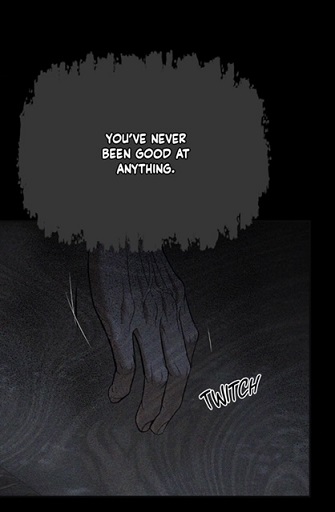 (chapter 54) He could only express his pain and resent through the hand. This moment encapsulates the core of his trauma: as a child, he learned to survive through silence and compliance, not resistance. Yet deep down, the resentment festered—toward himself, and toward the abuser. That psychological pain was redirected into becoming a fighter, as if to prove the abuser wrong.
  (chapter 26)
  (chapter 14) But ironically, he became exactly what the abuser desired: a powerful, obedient puppet. His fame, discipline, and aggression were not signs of freedom, but evidences of emotional and mental captivity. That’s why the past from the champion is surrounded by darkness and mystery.
This also explains why Jaekyung never learned how to speak to others or negotiate emotionally. 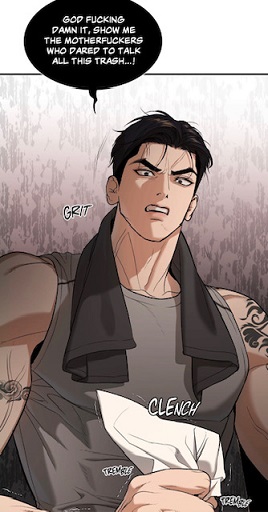 (chapter 36) His language was dominance, not dialogue. He didn’t process his emotions through words—he suppressed them, until they erupted in violence or withdrawal.
  (chapter 34)
But his dynamic with Kim Dan began to disrupt this cycle. Doc Dan, being physically weaker and more emotional, didn’t respond to force like the others. He didn’t fight back with fists. He showed his vulnerability and as such his tears.  (chapter 1) And crucially, he didn’t leave right away either despite his embarrassment and fears.
 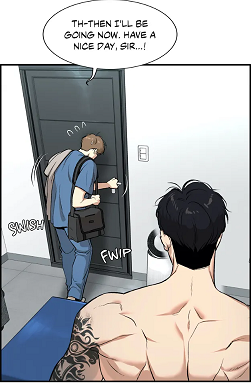 (chapter 1) Thus for the first time, Jaekyung had to develop a new strategy in order to meet him again: one that doesn’t rely on intimidation, but on communication. The problem is that since he saw the physical therapist running away after their first session
  (chapter 1), he knew that he needed to lure him with something: money
  (chapter 1). Under this new light, my avid readers can grasp why the athlete played a trick on the phone, though we have to envision that here the celebrity’s thoughts were strongly influenced by his bias and prejudices. He imagined that Doc Dan had made a move on him.
Dan has been teaching him, without lecturing, that flight can be strength. 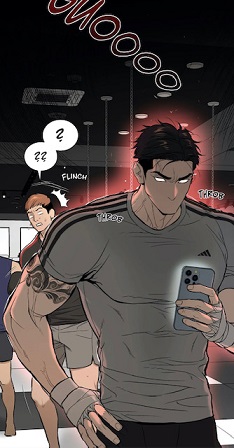 (chapter 5) That retreat doesn’t mean failure—it can be an act of self-preservation. However, the champion experienced that he needed to speak with doc Dan in order to keep him by his side. This lesson became a turning point. Jaekyung started to speak more.
  (chapter 18) Therefore it is no coincidence that in episode 18, right after the celebrity spoke, Kim Dan’s reply was strongly intertwined with flight:
  (chapter 18) The denial of kindness from the champion made the doctor uncomfortable, the latter felt the need to leave the penthouse as soon as possible. The lesson for the star was to realize that words are powerful and can affect people. But Joo Jaekyung didn’t grasp it, as he chose to use sex to „submit“ his fated partner.
 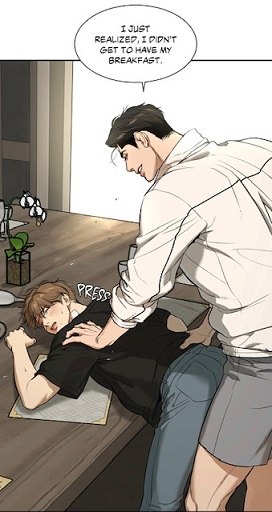 (Chapter 18) Nevertheless, as time passes on, the wolf asks more and more questions. He reacts to emotional discomfort not only with physicality but with hesitation, introspection. He is no longer reacting as the ghost once taught him; he is arguing and as such adapting, growing. Thus we could say, he is less passive.
On the other hand, I noticed that Joo Jaekyung displayed a clear behavioral pattern in season 1: he cornered Dan physically—pinning him onto the bed 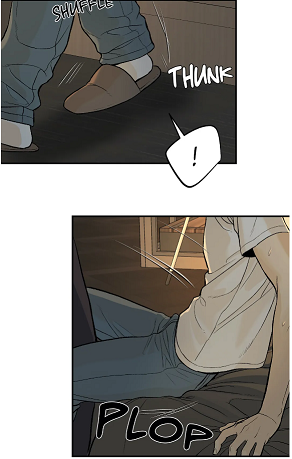 (chapter 3) or table, in showers
 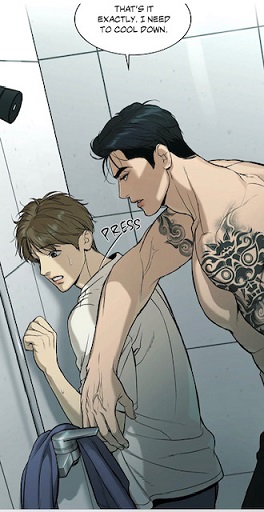 (chapter 7), against doors, or walls
  (chapter 34). On the surface, it may seem like a gesture of dominance or desire, but symbolically, it reflects silencing.
This repetition links back to Jaekyung’s trauma. In his youth, he was trapped between the abuser and a bed or a wall (chapter 54), unable to escape or speak. He was physically and emotionally silenced by someone more powerful. As a result, cornering became his unconscious language of control—a reenactment of power where he was once powerless. It’s not just about physical space; it’s about suppressing the other’s voice so he doesn’t have to face emotional exposure himself. In other words, he never learned how to flee, until he met his new mentor Doc Dan.
That’s why the locker room scene in episode 51 stands out. There, they are no longer pressed into corners.  (chapter 51) They stand in the middle of the room—an open space—symbolizing emotional emancipation. When Dan questions the celebrity
  (chapter 51), the words from doc Dan pierce the champion’s emotional defenses. Thus Joo Jaekyung is destabilized.
 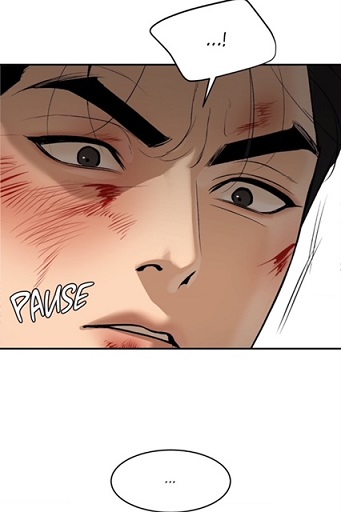 (chapter 51). The latter tries to reassert control
 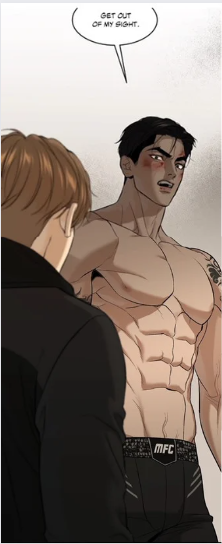 (chapter 51), but this time, when he lashes out, he is the one who leaves. This is cognitive dissonance at work: the fighter cannot reconcile his fear of vulnerability with his emerging need for connection and his perfectionism. So he defaults to a performance of control, even as he runs from it. And while one might mistake this for weakness or regression, it actually displays a progression. First, Jaekyung had finally revealed his thoughts and fears to Dan.
  (chapter 51) Secondly, he left the place which was a new MO for the fighter. His act of fleeing is no longer an escape from confrontation —it follows a moment of emotional vulnerability. It shows that he had finally dared to speak, even if he wasn’t yet ready to stay and endure the emotional aftermath.
Then in episode 69, Jinx-philes can detect a huge metamorphosis in the star. On the surface, he still appears obedient—he remains largely silent during the tense meeting with Park Namwook and the CEO.  (chapter 69) That silence could easily be mistaken for submission, for the same old performance of the compliant athlete.
  (chapter 69) But that would be a misreading. His silence is no longer a symptom of fear or control. It is a deliberate withholding—a sign that he no longer plays by their emotional rules. He is starting distancing himself from MFC, Park Namwook and the fight-centered identity they crafted for him.
His choice to return to the West Coast might look like a retreat to the schemers.  (chapter 69) After all, to those still invested in dominance hierarchies, leaving the capital after a public defeat seems like the behavior of someone who’s been defeated mentally as well. But the truth is the opposite. This “retreat” is actually an act of autonomy. For the first time, Jaekyung is giving himself space—not to run, but to reflect.
 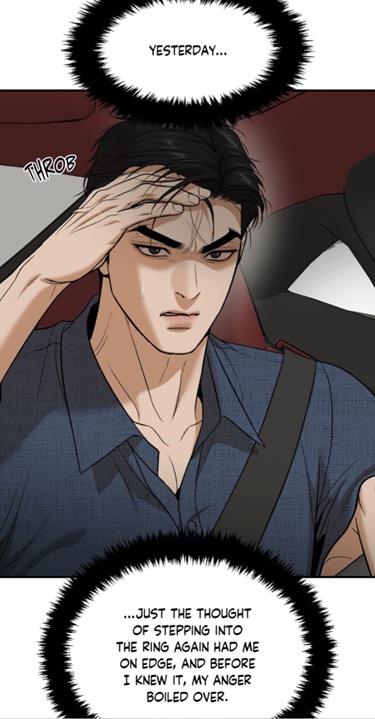 (chapter 69) He is no longer blindly performing the role of the fighter, nor desperately trying to maintain control over the narrative.
  (chapter 69) He is beginning to think critically about his past behavior, his future, and the systems that have defined his identity and life.
That’s what makes the embrace at the dock so powerful. It doesn’t take place in a ring, in a hallway, or in a cornered room. It happens in an open space, 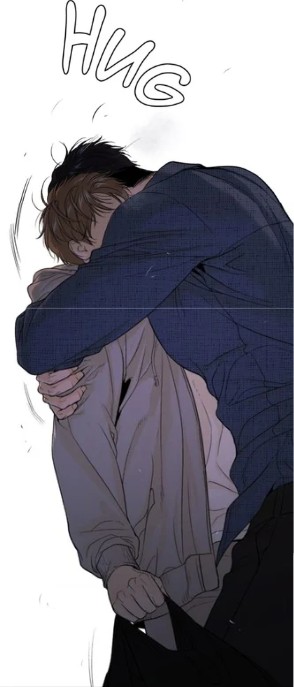 (chapter 69) with “no audience” (he ignores people), no pressure, no script. And in that openness, he lets go—not just physically, but psychologically.
  (chapter 69) The hug marks the collapse of his old beliefs: that emotions are weaknesses, that silence is protection, that strength means standing alone. He is no longer trying to dominate Dan or prove anything. He’s not cornering or fleeing. He’s simply staying—with someone, and with himself.
It’s a moment that doesn’t fit the binary of fight or flight. It is something more radical: connection.
It is vulnerability without fear. Stillness without paralysis. Silence without suppression.
In this context, the hug is not just affection—it is emotional rebellion. The sportsman reclaims his body not as a weapon, but as a vessel for intimacy. He reclaims silence not as submission, but as peace. And perhaps for the first time in his life, he doesn’t need to perform. He just is.
That’s why this hug is a fight. Not against Dan. Not against MFC. But against everything that taught him that love and respect must be earned through violence, that silence must come from fear, and that warmth and dependency are weaknesses.
This is the moment he stops surviving and starts living. When Jaekyung embraces Dan without shame, he does not speak—but for the first time, his silence is not imposed. It is chosen. He allows his body to express his emotions differently: longing and affection. He is not voiceless anymore—he simply no longer needs to explain or defend. The hug becomes his first true act of emotional agency. He is not reacting to fear. He is not controlling or escaping. He is staying. That is the fight.
And in this moment, he reclaims what “fight” really means. Not overpowering others. Not performing masculinity. Not obeying trauma. But overcoming his trauma, standing one’s ground for connection, for truth, for love. The hug is his first fight that isn’t about winning—it’s about not running away.
What begins as survival now becomes healing. And how are prejudices dismantled? Through communication. This means that from episode 70 on, the star will talk to doc Dan. Jaekyung, who once avoided words, who let others speak for him, who was branded and silenced by MFC, the entertainment agency and Park Namwook—is now ready to speak for himself. The hug is not the end of that journey (chapter 69), but the door finally opening. He is on his way to reconnect with his true self surrounded by nature and the people who truly respect and love him.
“I’m done surviving. Done being alone.
I want to live — and I want you to live with me.”
Park Namwook: Delegating Blame to Escape Collapse
Park Namwook relies heavily on both fight  (chapter 7) and flight
  (chapter 52), often using blame as a shield. When crisis strikes, he blames the champion’s temper, relies on Doc Dan
  (chapter 36), or MFC’s decisions.
  (chapter 69) He surrounds himself with “assistants” like coach Yosep, Kim Dan or Joo Jaekyung
  (chapter 25: here the protagonist was replacing Yosep and Park Namwook), hires professionals to manage damage
  (chapter 47), and hides behind administrative actions.
  (chapter 66) But he never takes full responsibility. This blame-displacement strategy works—until the champion flees to the West Coast.
Now, Park has no one left to blame but himself. In fact, it was Joo Jaekyung’s very act of fleeing 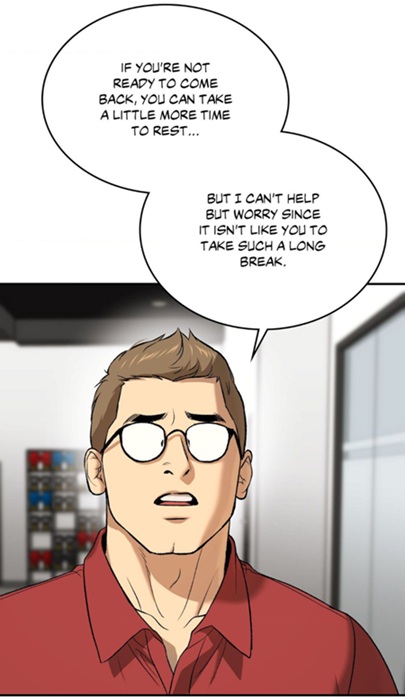 (chapter 66) that cornered the manager.
  (chapter 66) As long as the champion was nearby, Park Namwook could project blame onto him, framing him as unstable, disobedient, or temperamental. But once „his boy“ vanished from Seoul, the hyung was left exposed. Striking is that he is not seen watching over the training of the remaining members.
  (chapter 60)
 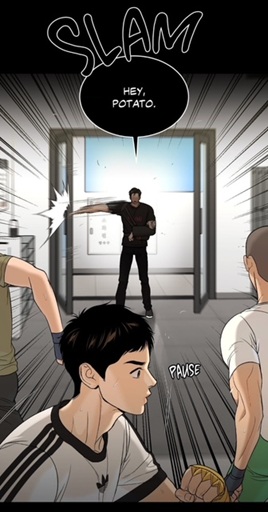 (chapter 60), a sign that he is neglecting the other members. The absence of his star fighter removed his most convenient scapegoat, forcing him to face the consequences of his own mismanagement—though he is not yet ready to truly question it and change his mindset, denial, and dependency. This was not just a geographical disappearance—it was a strategic psychological rupture, meant to destabilize Park’s illusion of authority.
And this is where the illusion breaks. He is forced to realize: he is not the real owner of the gym. He needs Joo Jaekyung’s signature for major decisions. He needs the champion’s public image to draw sponsors. When the fighter disappears, the manager’s relevance disappears too. That’s why he pushes for a new match (chapter 69) —not for the protagonist’s career and sake, but as a desperate attempt to re-anchor himself to glory, Joo Jaekyung and MFC. This means that he is choosing avoidance and as such flight. He lets his puppet fight for him.
But this can only backfire. In his mind, he is imagining that with a new fight, everything will return to normality and as such it will be like in the past. But he is overlooking two aspects: (chapter 69) The announcement that MFC will “line up a match” for Joo Jaekyung after the fall competition marks a pivotal moment — not of triumph, but of quiet exclusion. The phrasing itself is telling. The main lead is not invited to compete in the main event. He is not allowed to fight for the title. His role has been reduced to a postscript — a gesture, not a priority. For a fighter who once carried the brand’s identity, this is not simply a delay. It is a symbolic sidelining. In other words, the new champions and the CEO fear the star. (chapter 69) So with this new request, the manager ignores the reality that Jaekyung has been removed from the competitive spotlight. 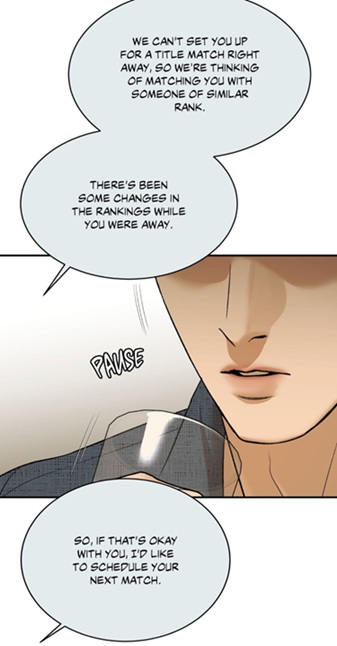 (chapter 69) He continues to speak as though the champion’s future is intact, as if the title is still within reach. But the organization’s actions speak louder: Jaekyung is no longer a contender — he is being gradually abandoned, not promoted. Secondly, Park Namwook assumes that Jaekyung will win the next fight, as if victory is still within his grasp. But this trust is misplaced — not only because the fighter is recovering from surgery, but because the schemers may have already designed this match as a final blow. Another fight right after a surgery, a staged defeat, or a quiet elimination would neatly push Jaekyung out without public controversy. By assigning him a marginal, delayed match, they are not offering redemption — they are orchestrating his exit.
MFC manipulates the manager’s selfishness and uses him as a tool to cover up the previous scandals. They feed him the illusion that he’s still in control, but the fall match is just a distraction—a public reset. I would even add that the manager seems to know that the ranking is not reflecting reality and even that the ranking is manipulated. . (chapter 69) The causal link here is suspect. Rankings in professional fighting aren’t determined solely by inactivity, especially when medical suspension is publicly known. So the manager tries to blame ranking drop on inactivity, but the inactivity isn’t prolonged enough to justify such a steep fall — from 1st to 3rd within 1 month and half. Besides, observe the drop of sweat on his face, a sign of discomfort and as such deception. Moreover, he is hesitating, visible with the points of suspension. indicating his awkwardness and lack of honesty. In addition, he is speaking exactly like MFC (he lost the last match, while it was just a tie) and finally he shouldn’t be employing the expression “it’s been a while”, as barely two months passed since his match with Baek Junmin. In other words, the man is delivering the message from MFC. He becomes a complicit agent, cloaking corporate strategy in soft euphemisms. This signifies, he is no longer acting as the owner of Team Black, though on the surface, it still looks like the man has the title of gym owner. The deeper irony lies in the fact that the true owner of Team Black is Joo Jaekyung. It is his money and name that built the gym’s reputation. It is his popularity, victories, and public image that attracted members, sponsors, and influence. Legally, financially, and symbolically, Jaekyung is the one holding the structure together.
That’s how it dawned on me that the schemers could be deceived too. I think, the CEO from MFC and Choi Gilseok still perceive Joo Jaekyung as “just a fighter” because of Park Namwook’s attitude: an asset, a brand face, a body to manage.  (chapter 17) They don’t see him as someone with legal or institutional power. But that’s their fatal blind spot. Since Jaekyung co-owns or outright owns Team Black, this makes him: A partner (or even rival) in MFC’s talent pipeline; an employer and a stakeholder in fighter safety. He has the same position than Choi Gilseok. Therefore as the owner of Team Black, he can sue the gym King of MMA and Choi Gilseok. He can take action against the CEO for negligence, corruption or abuse of authority.
 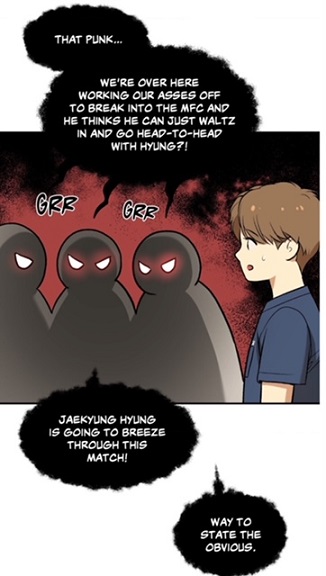 (chapter 47) Finally, he can testify not only as a fighter, but as a representative of the institution they tried to exploit. That elevates his voice: from a disposable athlete to a legal opponent with organizational standing.
Worse, if anything goes wrong, Park Namwook is now positioned as the scapegoat and spy. He didn’t reveal certain things to his boss, like for example how his members could never win. This character shows how fight (blame, control) and flight (denial, delegation. omission) are merely two faces of the same cowardice. His false peace rests on borrowed time and power—and it’s collapsing.
Kim Dan: From Submission to Resistance—and Back Again
Kim Dan’s survival mechanism was silence as well. As a child, he learned that speaking up would change nothing. 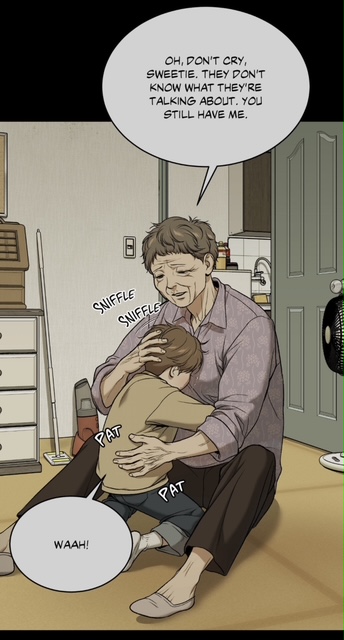 (chapter 57) Secondly, the vanishing of his parents were also swept under the carpet. That’s how he internalized powerlessness. Fleeing
 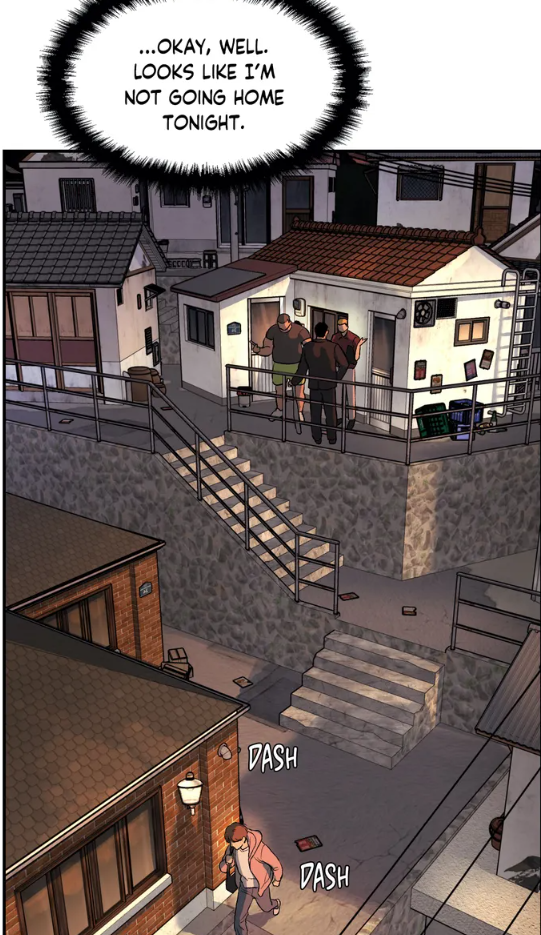 (chapter 1), deflecting, and disappearing became natural. With the grandmother, with doctors
 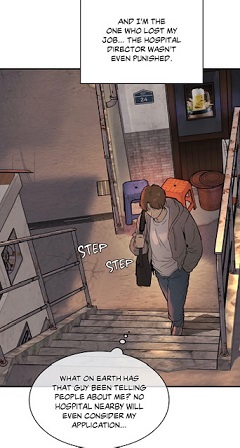 (chapter 1), with institutions—he obeyed. He accepted his fate as a fatality. But with Jaekyung, a new pattern emerged. Slowly, he began to resist: he set boundaries, raised his voice, argued with his boss, even used physical gestures to assert himself.
 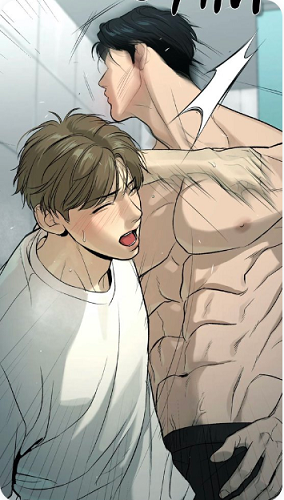 (chapter 7) For a moment, he was fighting.
But without mutual trust (chapter 51), this resistance could not hold. His boss and client never fully opened up, and so Dan, sensing instability, retreated again. (chapter 53) The brief flicker of agency collapsed. And this reflects a deeper psychological truth: resistance is not sustainable unless it is met with recognition. Otherwise, it begins to feel dangerous. Dan learned how to fight—but he never learned that he was allowed to win. Because deep down, Dan has internalized a belief shaped by trauma and lifelong submission:
Even if I speak, I will not be heard. Even if I resist, I will lose.
So why try to win?
Doc Dan has begun to resist, to speak, and even to walk away—but deep down, he still struggles to believe that success, safety, or love are things he’s truly entitled to. He acts, but with hesitation. He asserts himself, but doubts linger. He’s not powerless anymore—but the belief that he must always yield hasn’t fully let go of him either. That’s why he keeps mentioning the debts.  (chapter 67) Moreover, in contrast to Season 1, Kim Dan is no longer the invisible caregiver or obedient grandson. Thanks to Joo Jaekyung’s presence—disruptive and painful as it was—he began to form an independent identity
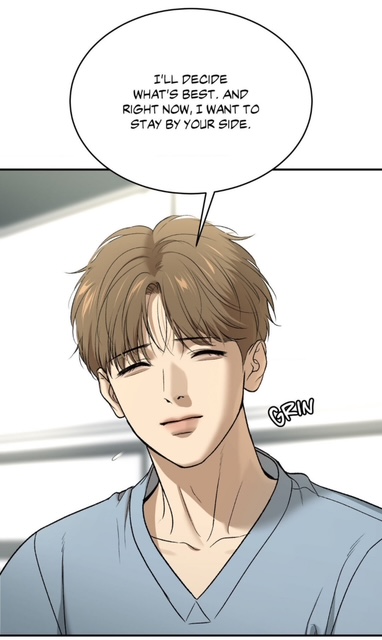 (chapter 57), one no longer shaped entirely by duty or guilt. The grandmother, however, is blind to this change. She continues to speak to him as if he’s the same self-sacrificing boy
  (chapter 65) who followed orders quietly and centered his life around pleasing others. Her suggestion that he “returns to Seoul” assumes he still views that as his place. But Dan refuses.
This refusal is significant. It is not only a rejection of her directive  (chapter 57) —it is a rejection of the belief that he exists only to serve. In Season 2, Dan says “no” repeatedly:
- He refuses Jaekyung’s offer of support.
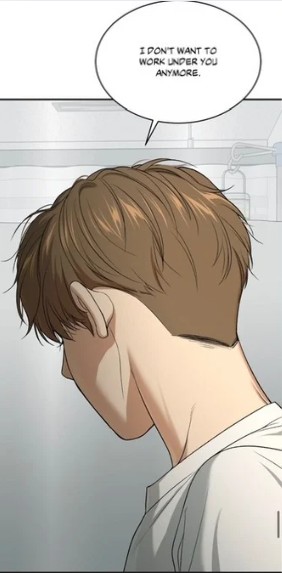 (chapter 60)
  (chapter 67)
 - He ignores the sleep specialist’s recommendations and denies the seriousness of his condition.
- He rejects Potato’s suggestion to return to the gym.
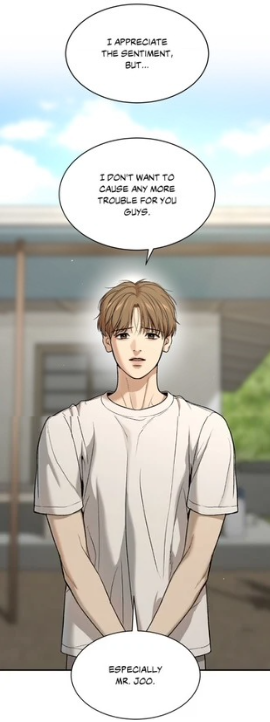 (chapter 58)
 - He only listens to the nurse, when the latter uses her authority on him.
 (chapter 57)
Although he is clearly struggling emotionally, there is something new about his detachment: it is not just trauma withdrawal—it is the first fragile assertion of selfhood. For the first time, he is choosing himself, even if that choice leads him into making bad decisions and a quiet depression. He is not clinging to roles that once gave him safety—he is testing the silence between identities.
And this is precisely what the grandmother fails to understand: Dan is no longer a reflection of her expectations. He is trying to become someone who belongs to himself. And her ignorance can be perceived, when she brings up the past.  (chapter 65) She uses his past flaws to outline his immaturity and need of guidance. However, she is not taking into consideration the transformation in the doctor due to the recent incidents (switched spray). He is no longer the same than he was 6 months ago or 2 years old. He changed thanks to the athlete and because of unfortunate events (sexual harassment from the hospital director, switched spray). But the halmoni has no idea about such incidents.
And so he, too, begins to confuse avoidance (chapter 61) with peace. He gives in to silence in front of Shin Okja again, not because he believes it is right, but because he believes it is safer. So far, he has not confronted his grandmother’s decisions yet.
The Grandmother: Avoidance Disguised as Selflessness
The grandmother represents the clearest embodiment of the flight response.  (chapter 53) Unlike Park Namwook who uses blame and delegation in professional settings, she applies emotional avoidance in private and familial spaces. Much like the manager, she outsources responsibility, asking others to step in
 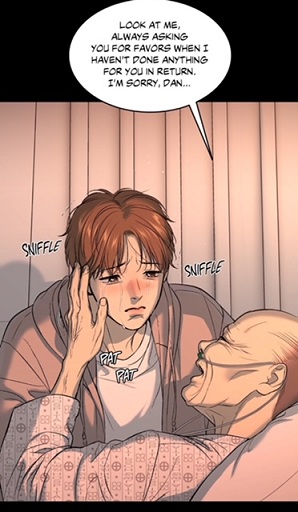 (chapter 53)
  (chapter 65) rather than engaging directly. She avoids difficult conversations, never once asking doc Dan about the nature of his work or why he followed her to the West Coast.
  (chapter 65) Her silence is not protective—it is evasive.
As someone who is not a fighter by temperament or experience, she avoids confrontation and choices. Hence she asks for help from the champion behind her grandson’s back. This internalized passivity is mirrored in her body: she cannot fight back against cancer. 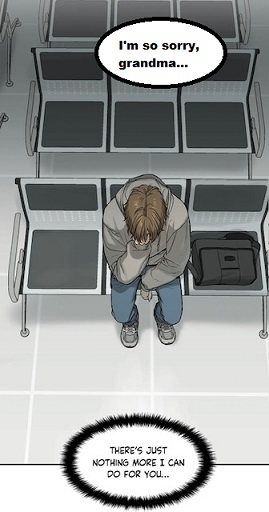 (chapter 5) Her illness becomes a metaphor for her mindset. She relies on external systems: her grandson (chapter 53), doctors
 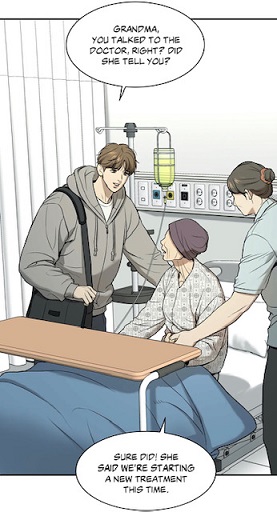 (chapter 7), medication, comfort
 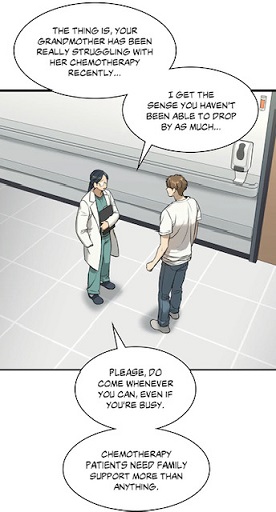 (chapter 21), and other people (nurse, Joo Jaekyung) —to maintain her emotional balance. But as doc Dan himself once observed, she is ultimately on her own in her battle. No system can fight it for her.
This mindset surfaces again when the oncologist, Dr. Kim Miseon, reproaches doc Dan for not visiting his grandmother. The implication is blame. However, this accusation is not entirely grounded: doc Dan had arranged for a nurse to provide care and companionship. 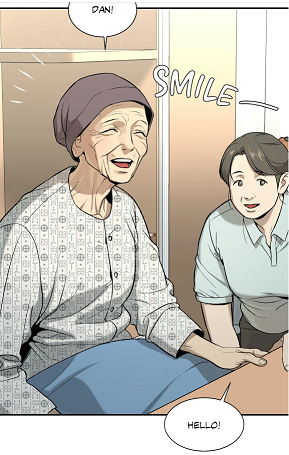 (chapter 7) His grandmother was not truly abandoned; she simply equated his physical absence with neglect, ignoring the emotional and financial burden he already carried. Like Park Namwook, she prefers others to carry the discomfort while maintaining a façade of suffering and sacrifice.
  (chapter 65)
Her passivity is cloaked in martyrdom—”I did everything for you”—yet it deprives doc Dan of emotional reciprocity. In her world, emotional closeness is conditional  (chapter 47) , and her narrative of selflessness becomes another form of emotional pressure. She does not yell, she does not accuse directly, but her avoidance is equally powerful in shaping Dan’s self-image as a burden. Doc Dan came to internalize that she suffered because of him.
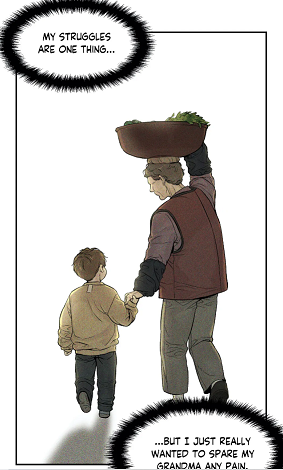 (chapter 5) Hence he made sure to shield her from any pain.
Her return to her hometown and her stay at the hospice reflect a deeper psychological strategy: she is not preparing to die, but attempting to escape death—to feel young again  (chapter 65), protected, comforted. Surrounded by nurses, medication, and routine, she finds temporary peace in an environment that simulates safety. The hospice does not cure her illness, but it cushions it. This illusion allows her to smile again, to relax—but only up to a point. Kim Dan’s gradual deterioration
  (chapter 57) —his visible exhaustion, disconnection, and quiet suffering—becomes a thorn in her eye, a reminder that her peace is not whole. As long as he suffers, she cannot entirely escape the shadow of her own regrets. Sending him away to Seoul represents a new of flight. Out of sight means out of mind. That way the grandmother wouldn‘t have to worry about doc Dan, as he has been entrusted to the athlete.
Survival Mode and Selective Laziness: The Blind Spots of Belief
As explained in Dr. Frost 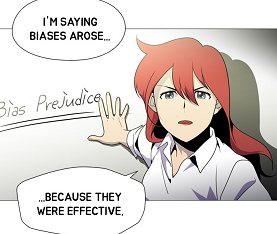
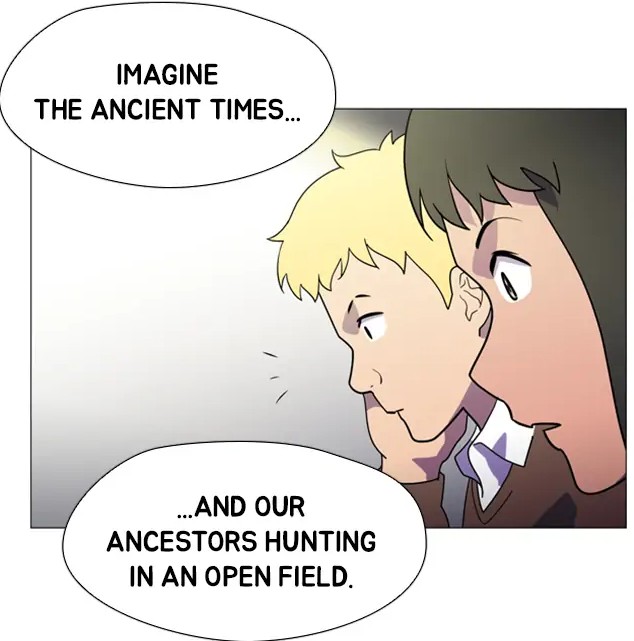
 (chapter 163) and supported by the article on confirmation bias, human survival was deeply dependent on mental shortcuts. Biases were not flaws, but adaptive tools — heuristics that helped our ancestors make quick decisions under threat. Faced with a potential predator, they could not afford the luxury of curiosity or debate. Run first, think later.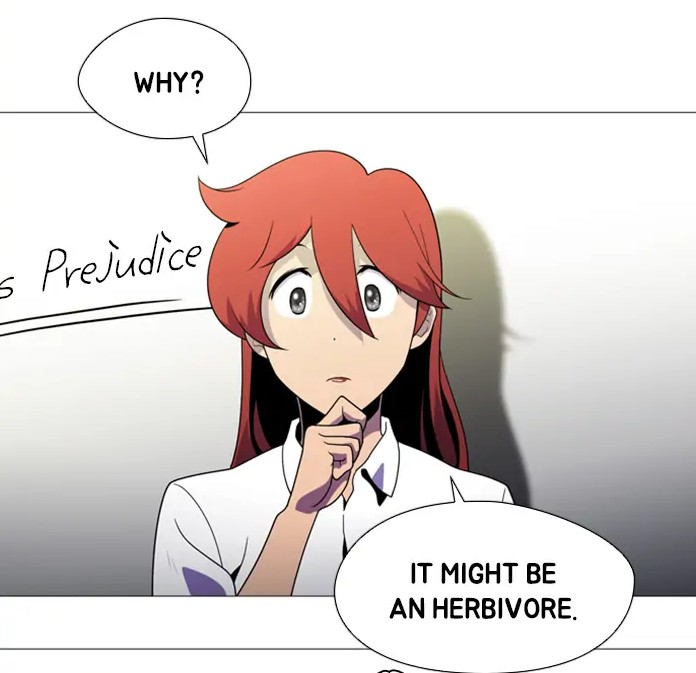
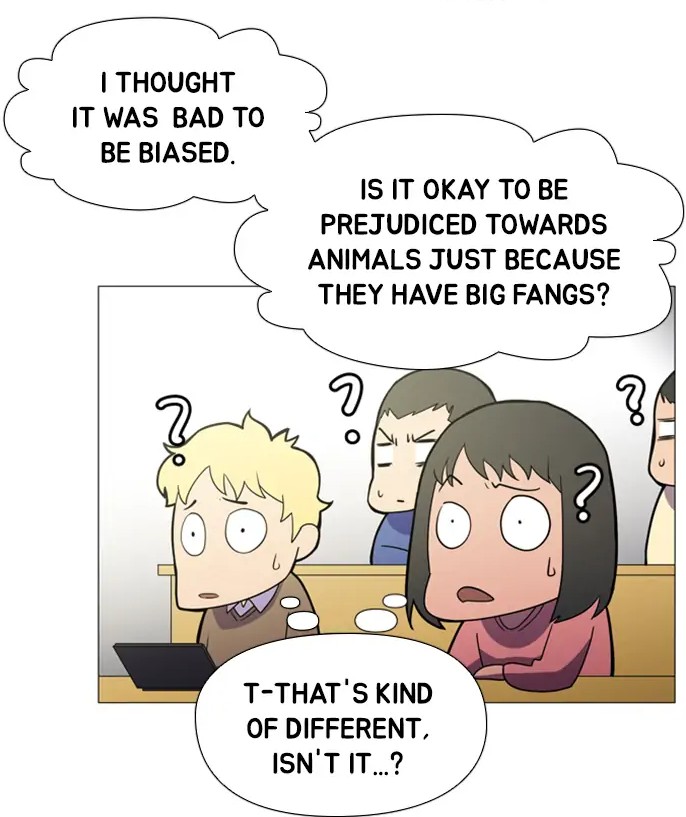 (chapter 163) In this sense, biases were effective precisely because they increased the chance of survival.
This explains why all four characters in Jinx behave irrationally at times — not because they are inherently flawed, but because they are trapped in survival mode. Joo Jaekyung, Kim Dan, Park Namwook, and the grandmother all exhibit narrow thinking and emotional rigidity because their nervous systems are wired for defense, not reflection. They are biased — not out of malice, but because their minds are trying to protect them.
For example, Park Namwook began as a cheerful, strategic manager.  (chapter 9) But once Joo Jaekyung became the target of criticism and scandals, his fear response activated. (chapter 52) He grew rigid, controlling, and increasingly biased. The infamous slap in the hospital was not a calculated choice — it was the culmination of fear, the eruption of unresolved stress and repressed blame. His mind no longer could no longer hide behind fake understanding; it sought a target.
The article on selective laziness explains how people apply critical thinking unevenly, questioning what threatens them while blindly trusting what confirms their worldview.
A recent study conducted at Lund University showed that most people would reject their own arguments 60% of the time if they were presented by someone else. […] What happens is that when we search for arguments to support our ideas, we are driven by selective laziness; we don’t evaluate the pros and cons of that idea, but rather resort to intuitive responses. In short, we don’t become judges of our own reasoning. However, we are harsh judges of the reasoning of others. Quoted from https://psychology-spot.com/selective-laziness/
The result of this study is visible in Jinx. While, the manager thought that the next match was too soon in episode 41,  (chapter 41) he recommends the opposite at the restaurant because the idea comes from the CEO! (chapter 69)
In addition to the earlier exploration of confirmation bias, Jennifer Delgado’s article “5 cognitive biases limit our potential” offers another compelling extension. She explains how biases don’t just distort perception—they actively constrain personal growth. She introduces 5 different cognitive biases and one of them is “Hindsight bias”.
Hindsight bias is the tendency to look back on a decision and reinterpret it as better, wiser, or more inevitable than it actually was. To reduce discomfort or self-doubt, we modify our memory of past motives, downplay any hesitation or contradiction, and reframe our choice as the best one all along. This can be observed in this image: (chapter 65) The grandmother quietly rewrites the past to preserve her emotional comfort. Her statement — “I told him I wanted to see the ocean, but I never imagined he’d end up settling down here” — seems reflective on the surface, but it is a clear case of hindsight bias. She reframes her earlier decision as simple and innocent (as if it was a trip), downplaying the emotional pressure she placed on Kim Dan to follow her. By minimizing her role in shaping his circumstances, she subtly shifts responsibility onto him, as if his decision to stay was entirely his own, disconnected from her influence. This distortion allows her to avoid guilt and maintain the illusion of benevolence. However, if she truly meant, she desired to go on a trip (chapter 53), she should have voiced before that the doctor had misunderstood her. However, she claims that this place is her hometown, and with her request to the champion, she implies that she desires to stay in that little town: 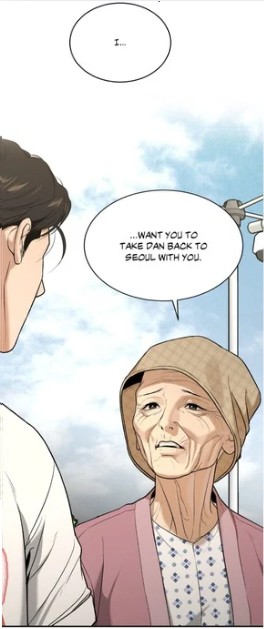 (chapter 65) It was her decision to settle down at the hospice.
Even more revealing is her next comment: “I really don’t know what that boy plans to do with his life.” This confession exposes her emotional detachment. Despite being the one who uprooted his life, she has made no effort to understand his goals, his work, or his emotional needs. Her words reflect not only a lack of curiosity, but also a passive disavowal of responsibility. She speaks as if Dan were a stranger, even though she has shaped his life through silent expectation and unspoken control. The peaceful ocean backdrop masks this deeper avoidance. Her worldview remains rooted in survival logic and emotional self-preservation — not genuine connection or growth.
By reinforcing outdated beliefs, we avoid novelty, risk, and the emotional labor required for change.
When we have deep-seated beliefs, we stop questioning them and simply assume they are true. This limits our ability to grow, learn, and discover new perspectives. This insight sheds further light on the characters’ emotional stagnation in Jinx. Park Namwook clings to obsolete narratives about leadership and discipline, failing to acknowledge how the landscape—and Jaekyung—have changed. His insistence on orchestrating a comeback fight is not strategic foresight, but cognitive rigidity disguised as professionalism.
The grandmother is likewise restricted by inherited beliefs: that safety, solitude, and hard work (chapter 65) are the cornerstones of survival. She only has friends, when she needs them (see for example the champion). These assumptions once protected her, but now they prevent her from evolving—from supporting Dan emotionally, from engaging in reciprocal dialogue, and from allowing herself to face death consciously rather than evade it.
Even Joo Jaekyung’s belief that strength equals stoicism prevented him from confronting the truth of his own vulnerability. Only through Kim Dan’s influence did he begin to question this inner script—and once he did, the false foundations began to crumble. He has just started healing emotionally; he is starting questioning the corrupt systems surrounding him, including MFC’s exploitation. This means, the existence of his jinx is vanishing.
This second article reinforces a deeper truth: that healing requires not only confronting pain, but also dismantling the faulty reasoning that keeps us blind. As long as the characters were clinging to biases, they remained paralyzed—unable to process what had happened to them, or recognize the larger forces at play. Hence they could never be happy. But the moment they begin to question themselves and speak honestly with one another, they also begin to see clearly—not just inwardly, but outwardly.
This explains why doc Dan ignored Jaekyung’s advice about medication and health.  (chapter 67) His survival bias told him: “Don’t trust a man who once treated you violently.” or “Doctors are ignorant, they don’t know me“. It was easier to discredit the source than to weigh the merit of the message. Likewise, in Season 1, the champion dismissed doc Dan’s medical opinions
  (chapter 41), trusting instead in MFC and his agency — despite the fact that those institutions are overtly motivated by money. His bias protected his ego, but at the cost of his health and relationships.
Park Namwook falls into the same trap: he considers Jaekyung a “spoiled child” (chapter 7) 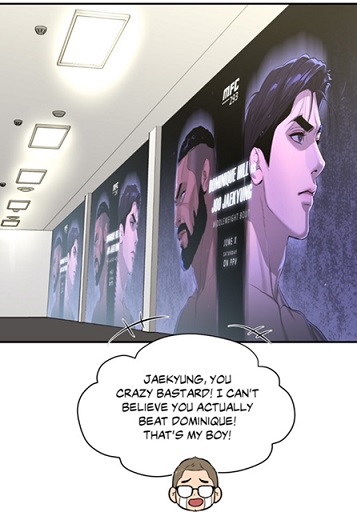 (chapter 40) who needs to fight to prove himself, yet likely doesn’t treat his own family this way.
 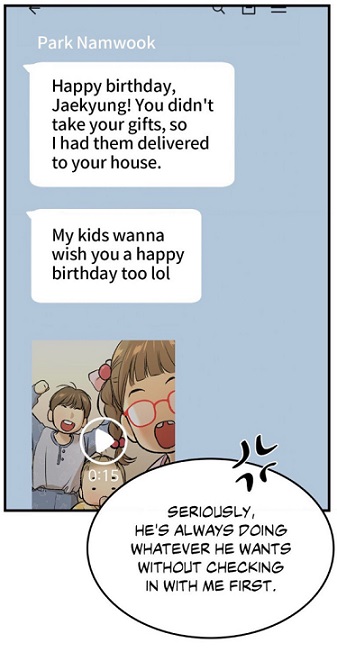 (chapter 45) His double standard is not conscious hypocrisy — it’s a form of selective laziness. He does not challenge his beliefs because doing so would unravel the identity he’s built as a competent, authoritative manager.
The grandmother also embodies survival-driven bias. She believes that working hard and seeking fame are acts of love and stand for happiness— but she never questions the emotional cost. (chapter 65) She doesn’t help her grandson build friendships (chapter 57) 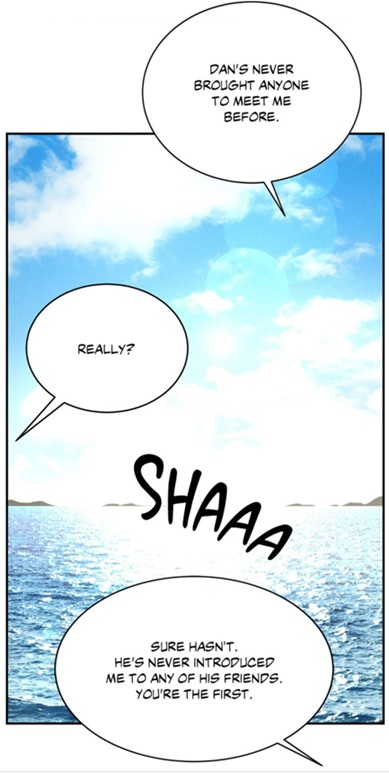 (chapter 65) or a support network. It is not her fault, if she never met doc Dan’s friends in the past while hiding the fact that he had been bullied by his peers. Her request for him to return to Seoul, a place he has no roots, only furthers his habit of isolation. Similarly, when she asked Jaekyung to bring him to Seoul and have him diagnosed, she implicitly discouraged any shared decision-making. Like Park Namwook, she bypassed dialogue in favor of directive control, reinforcing the habit of emotional withdrawal.
As the article states, “
“Selective laziness isn’t necessarily a negative thing. In fact, in group settings it can spark debate and enrich conversation.” https://psychology-spot.com/selective-laziness/
But her attitude blocks precisely that — there is no exchange of ideas, no real conversation. Only avoidance wrapped in concern and requests.
This is why neither Jaekyung nor Kim Dan were “thinking properly” earlier in the story. They were not free to. Their brains were in survival mode, stuck in flight or fight, not reflection. But once the champion saw Dan again — saw that he was still there, still himself — his anxiety softened. He began to press MFC for answers.  (chapter 67) That shift marks a turning point from survival to conscious thought. The mind cannot reflect when it believes it is under attack. The tragedy is not that these characters are irrational — it’s that they were taught fear before they were taught trust. Thus I come to the following conclusion. As soon as both are curious about each other
 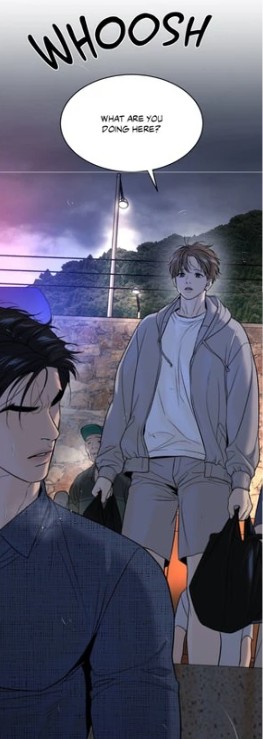 (chapter 69), they are now free from their bias and prejudices.
  (chapter 69) They will be able to communicate which will help them to discover the truth about MFC. Yes, their ability to ponder will lead them to unmask the villains and defeat their opponents. By fighting for justice, both will discover true peace of mind. This hardship at the end of season 1 was necessary to reset their heart and mind: what is the true meaning of life? Money? Work? Duty? Sacrifice?… The answer is happiness which is strongly intertwined with love and selflessness.
The topic for the next essay is: 
Feel free to comment. If you have any suggestion for topics or Manhwa, feel free to ask. If you enjoyed reading it, retweet it or push the button like. My Reddit-Instagram-Twitter-Tumblr account is: @bebebisous33. Thanks for reading and for the support, particularly, I would like to thank all the new followers and people recommending my blog.



 (chapter 140)
  (chapter 149) Both were suffering from survivor guilt. To conclude, Joo Jaekyung and Kim Dan represent the bitter medicine for their scars. I mentioned “bitter”, because through their loved one, they are forced to face painful moments. That’s how they can overcome their past and discover happiness. However, while looking for a new title, I rediscovered the first illustration
  , and it suddenly made click in my head. To conclude, I had another revelation concerning episode 50.
 . (chapter 50) At first glance, the champion is blaming Kim Dan for the wound. He betrayed him. However, his words could have a different signification. Don’t forget that a message always has 4 sides according to Schulz von Thun.
  Consequently, while many saw this question as a “factual information” and as such as an accusation, the reality is that it gave us an insight about the sender too. The sportsman was not using the personal pronoun “I” or “me” in his inquiry. As you can see, the absence of the personal pronoun is indicating that Joo Jaekyung was in reality not referring to him and his wounds. He is not prioritizing himself, rather the doctor and his action. So this question could be prompted by curiosity or a desire to understand the person’s recent activities. Thus I deduce that the champion was asking his lover to tell him the truth. He should come clean. He desired a honest explanation. His attitude reminded me of an adult confronting his child.
 (chapter 51) But note that he never accused Kim Dan of assault, but of leaking information. That’s the reason why I don’t think that this inquiry “What have you done” was about seeking accountability. In that case, he wouldn’t have rejected the doctor’s offer. By letting him treat his wound, Kim Dan would have become responsible for the injury.
  (Chapter 50) It becomes comprehensible why the Emperor refused the offer. The rejection was the symbol of his “trust” in Kim Dan unconsciously. Astonishing, right, though people and Kim Dan had the opposite impression. Yet, because of the “tie”, Kim Dan felt responsible for the incident, therefore he apologized.
  (chapter 51) This means, the main lead recognized his responsibility. He should have checked the spray more carefully. The champion could perceive this excuse as a confession of his complicity. Hence he asked his lover if he was the spy.
 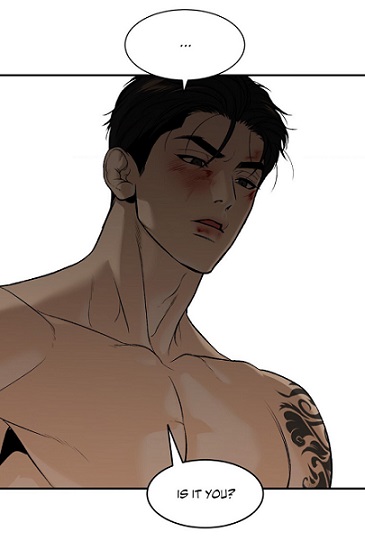 (chapter 51) This signifies that in episode 51, he dared to question his physical therapist’s loyalty. Yes, we have another “Truth or Dare” in episode 51.
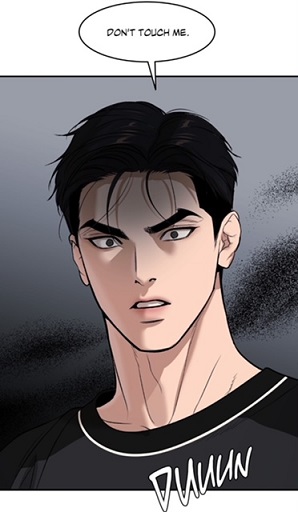 (chapter 50) This is the face of a scarred man. Yet, contrary to the past, he is not expressing his fear through rage. That’s the reason why his emotions were controlled. Under this new light, Manhwaworms grasp why the athlete asked such a question from his soulmate:
  (chapter 51) Interesting is that he was more pained by the idea of a betrayal from Kim Dan than the tie, if you compare these two panels: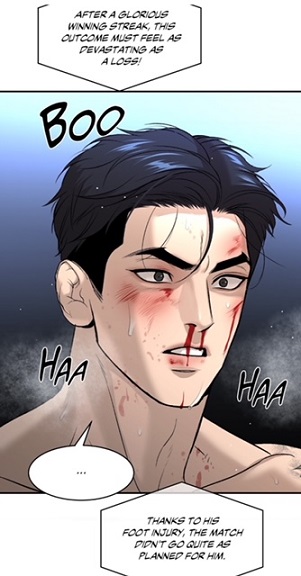
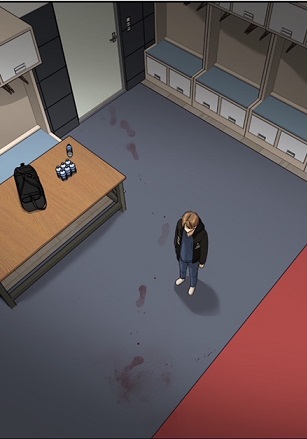 (chapter 51) Thus Kim Dan could overcome this shocking but terrible discovery: he hadn’t earned the full trust from Joo Jaekyung yet.
  (chapter 51) As my avid readers can see, my perception about chapter 50 was confirmed with episode 51. The arguments in the locker room were reflecting the quarrel in the penthouse with Choi Heesung. What is the common denominator between these two scenes? The lack of trust from Joo Jaekyung, but his private PT failed to realize it in the penthouse. Why? It’s because he chose to trust his destined partner.
 I believe you = I trust you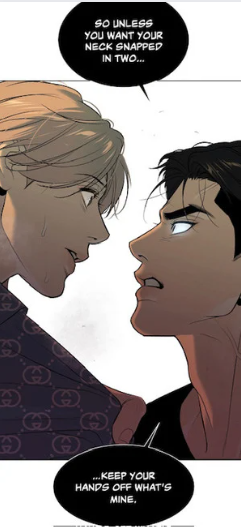


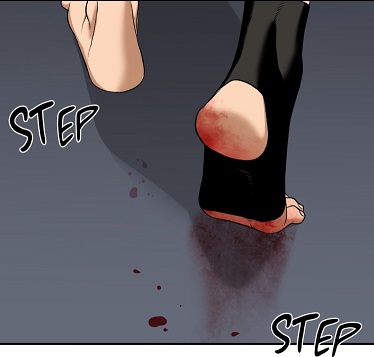
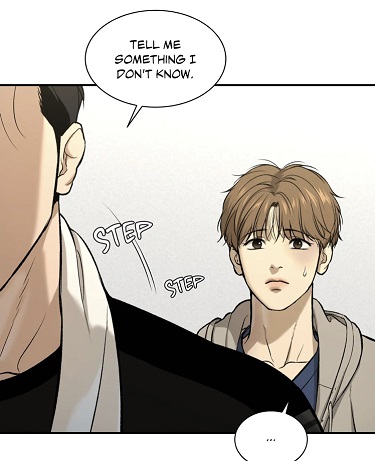 (chapter 15) He told him something that he didn’t know. Note that after the terrible meeting with the actor, Joo Jaekyung couldn’t even find the answer himself:
 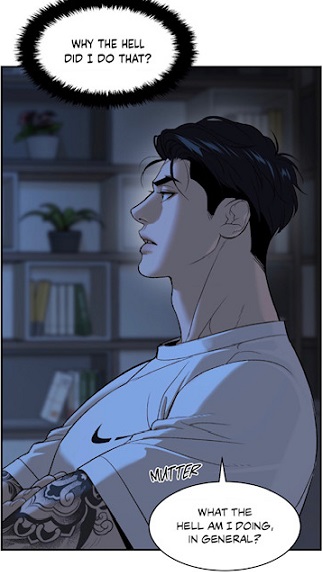 (chapter 35) He was still clueless about the trigger for his behavior. With this inquiry “You don’t trust me”, the hamster pushed his destined partner to face his biggest fear: trust someone and in particular him. This conversation can only incite him to meditate about their relationship. So while in episode 15, he behaved like a pouting child
  (chapter 15), in the latest episode, Jinx-philes can perceive his growth and maturity.
 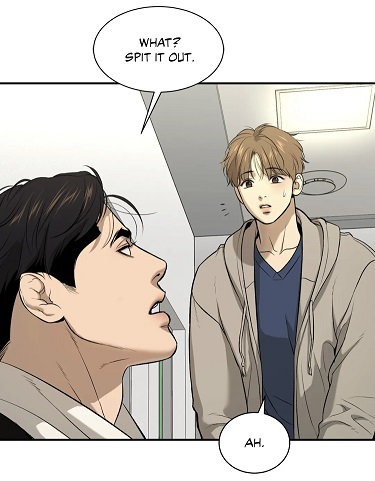 (chapter 15) This painful incident was a wake-up call Thus I come to the following deduction. Kim Dan will try to earn the champion’s trust, whereas the champion will be forced to take a leap of faith towards Kim Dan. Contrary to episode 34, the champion could see the truth directly through the doctor’s gaze and voice:
  (chapter 34) As a conclusion, while the champion thought that his loved one had dared to cross the line, he was confronted with truth. He was biased and mistrusting his room mate and PT. This shows that though dare was the opposite choice of truth, the fighter ended up to be confronted with verity.
 (chapter 34) These questions were all rhetorical:
  (chapter 34) This signifies that in the sauna, truth was not standing in opposition to daring. The sauna reminded me of the cavern where an imugi hides, until the latter leaves its hidden place and find his star, his yeouiju. Only then, he can turn into a dragon. To conclude, because of Heesung’s pressure, the imugi had to select between daring or lie. In other words, telling the truth became the challenge itself. Heesung knew that Joo Jaekyung would never confess.
  (Chapter 34) What Heesung wanted was actually a lie by omission or commission which would have been presented as the truth. Through this game, the actor thought that he could impose his will onto the celebrity. He anticipated the athlete’s silence. This signifies that he knew about the star’s denial and turned it against him. Besides, that way Heesung could maintain his good image: he had not stolen his partner and as such there was no cheating. No one was betraying him.
 (chapter 34), but also his hand.
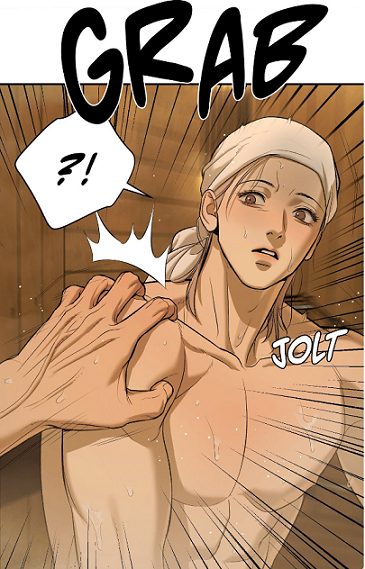 (chapter 34) He caught the actor by surprise, the latter never thought that the celebrity would become violent. The redness on his face was displaying that he was barely controlling his annoyance and impatience.
 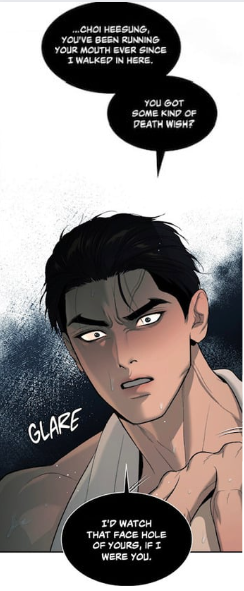 (chapter 34) However, they were in a public place, the hotel’s sauna, and the actor is a celebrity. Hence he is protected by his fame and social status. That’s the reason why the champion didn’t hit his frenemy, he had learned his lesson at the gym.
  (chapter 34) Despite his words, the gumiho still got scared. The racing of his heart is an indication of his fright. Therefore he ran away more or less after ordering his trainer not to meddle in his love life.
 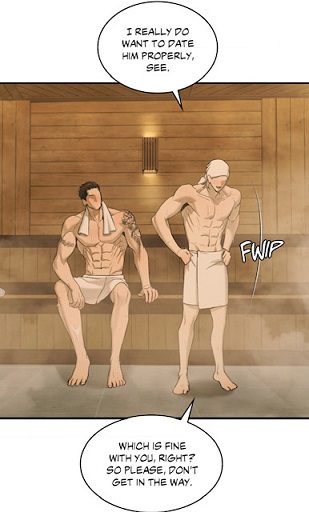 (chapter 34) Note that when he did this, he avoided his counterpart’s gaze. Deep down, he knew that he shouldn’t provoke his frenemy too much. Only when he was at the door, he turned around and LIED!
 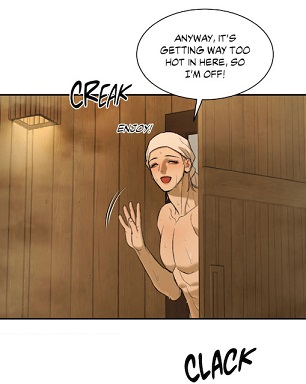 (chapter 34) Yes, after that incident, he chose to give him a fake excuse for his departure. As you can see, this conversation was strongly intertwined with the notion “truth or dare”, but both ended up lying. Whereas the champion didn’t admit any feelings, the other acted, as if there was nothing wrong and he was not scared. The gumiho thought that if he were to remove the champion from the doctor’s side, the latter would be able to open up to the actor.
  (chapter 34) What does it reveal? The actor had been projecting his own thoughts onto the future dragon too. He was the one who didn’t dare to become more honest with the physical therapist. He used work to spend time with Kim Dan. One might say that Heesung failed terribly. Yet, this is just an illusion, because his “failure” pushed him to become more honest with Kim Dan. Thereby he asked to meet the doctor again.
  (chapter 34) Yet, the message is exposing that Heesung was still lying, as he kept using work as an excuse. Hence Joo Jaekyung had to intervene again:
  (chapter 34) The champion dared to challenge his rival.
  (chapter 35) Yes, by challenging the athlete because of Kim Dan, the comedian ended up telling the truth.
  (chapter 34), yet he was in total denial about the reality: it was dangerous. Deep down, the champion knew that it was impossible for him to control his lover’s time, but also his body. Besides, the other problem is that the athlete is rejecting the notion of love. By denying the existence of his own feelings, he can not claim the doctor’s heart. That’s the reason why the champion got so mad and frustrated.
  (chapter 34) He was not telling the truth, when he stated that Kim Dan was his “possession”. This explicates why he couldn’t stay by the doctor’s side
  (chapter 34) in the end. He manipulated the main lead by letting him think that he had no other choice. Yet the last panel displays his trick. It was up to the doctor to decide how he should spend his free time. Nevertheless, while people were mad at the champion for his deception, many failed to realize that the champion was actually deceiving himself. So all the tricks (episode 33 and 34) were manifestations of avoidance, the fear to face the truth: his affection for Kim Dan and this due to a past betrayal. Hence these chapters stand under the sign of silence hidden by “pranks”.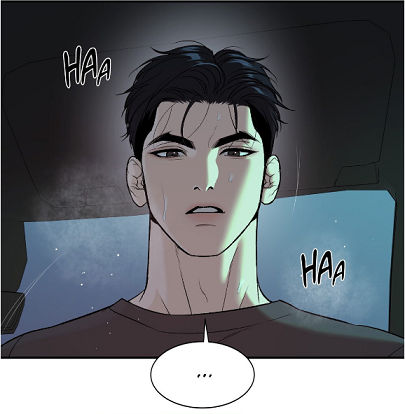
 (chapter 35) On the other hand, the artist could only tell one part of the truth: the presence of feelings. However, the deceptions in the penthouse exposed something else:
 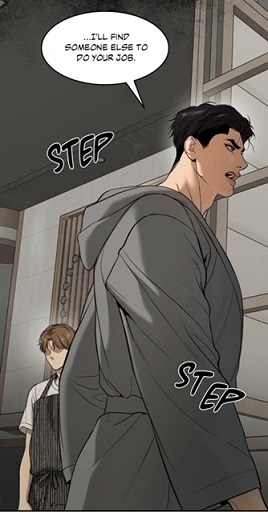 (chapter 45) or left the doctor in the locker room in episode 51.
  (chapter 45) It is because by denying his affection, he needs to justify his presence next to him. He is his PT… forcing his enemies to portray the doctor as a traitor or a bad PT. However, they failed, as the champion is not doubting the doctor’s innocence concerning his wound on the foot. Nevertheless, the incident is not closed, as the culprit has not been brought to justice.
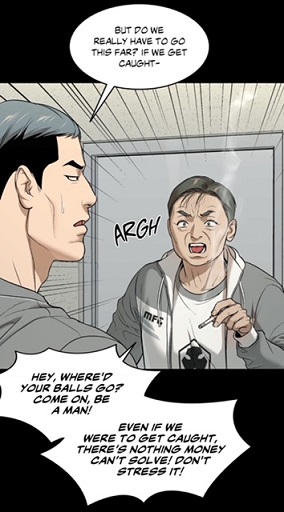 (chapter 50) First, the schemers’ MO corresponds to the game Truth or Dare. Choi Gilseok asked his minion to cross the line. This explicates why they are trying to use tricks and manipulations. Daring means no truth, thus someone will be framed: Kim Dan. Yet, the plotters are not aware that thanks to the cute hamster, the alpha is turned into a mirror of truth. Hence he couldn’t get deceived by the MFC security guys:
 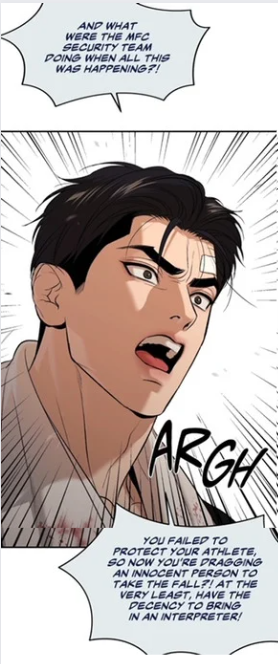 (chapter 40)
  (chapter 36) The lawyer, the journalist and the manager pushed him to choose “dare” and not truth! That’s why there was no interview and the leak was not investigated. He had to prove his strength.
 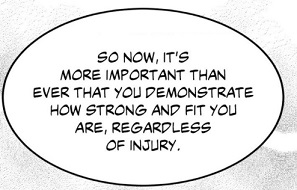 (chapter 36) And exactly like at the sauna, daring became a synonym for verity. No wonder why the fighter is never rejecting the challenge. It corresponds to his past attitude: he has been burying the truth and as such the past. But let’s return our attention to the plotters.
 (chapter 37) This mysterious man dared to act as a MFC manager, though my intuition is telling me that he works for MFC. The irony is that by challenging constantly the champion, the plotters are not realizing that through their game, the truth is slowly coming to the surface. How so? In the last panel, the doctor noticed his origins: He is Korean indicating that the conspiracy started in South Korea. As you can see, Kim Dan was able to perceive a glimpse of the truth. Then at the café, Choi Gilseok confessed many things to the doctor: he owns the café, he has connections to the company F Pharmaceutical. Moreover, through this game, the champion is confronted with his fears and past. That’s how he can overcome his traumas. The doctor is the mirror revealing the monsters. Hence I come to the following deduction: the succession of new characters mirrors the champion’s past and traumas. The following characters are involved in the champion’s suffering, though the order of the appearance is exposing the gravity of the involvement: Heesung,
 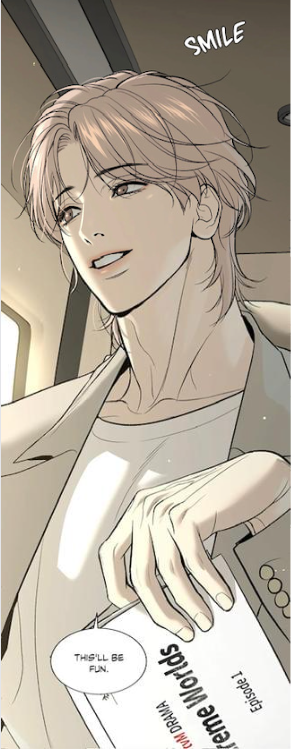 (chapter 29), the journalist without a face
  (chapter 35), the “fake” MFC agent
 (chapter 42), Baek Junmin whom the champion couldn’t truly identify
 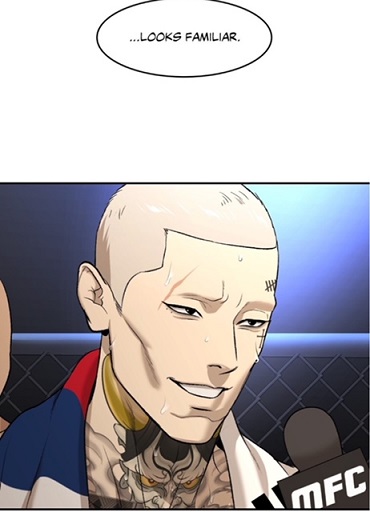 (chapter 47), then he recognized the director without naming him,
 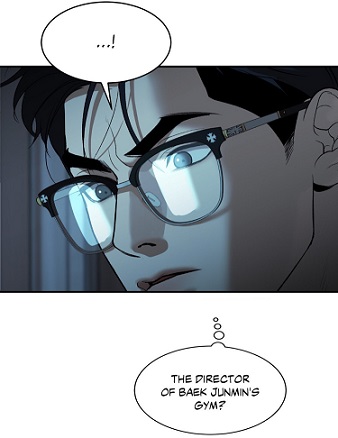 (chapter 48) and finally the ghost from the past
  (chapter 50) This scene exposed that the champion repressed a certain incident which is rather common among victims of a trauma, especially people suffering from PTSD. This shows that some traumatic event took place for quite some time, but the champion acted, as if nothing had happened.
  (Doctor Frost, chapter 140 ) That’s how the champion became a zombie, he couldn’t live properly due to his untreated scars.
 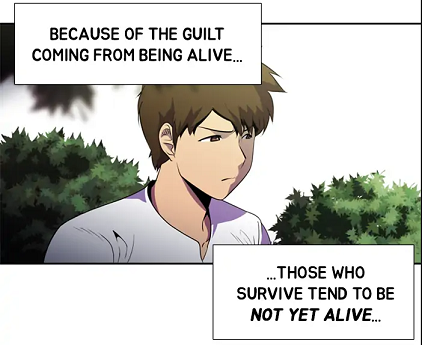 (doctor Frost, chapter 139) But thanks to his fated partner, the traumatic past is slowly coming to the surface.
 (chapter 48) The director created a stage for the betrayal. That should represent the truth, while in reality it was a lie! Nevertheless, Joo Jaekyung could perceive the truth: Kim Dan had met the director from the rival gym.
  (chapter 48) Yes, he didn’t dare to tell him what had happened. No truth… no daring which reflects the games in the sauna and the living room of the penthouse. Kim Dan could have come clean the next morning, but no. This panel explains his silence. He also mistrusted his VIP patient. He had a negative perception of his lover’s mental state. On the other hand, the champion’s attitude reminded me of a parent who has not the time to listen to his child’s problem due to work.
 (chapter 48) Should the athlete remember this night, he will realize that he was the one dismissing his physical therapist, although the doctor could have come clean later. At the same time, Joo Jaekyung’s attitude could be mirroring the parent or guardian’s in the past. They didn’t have the time or the inclination to listen to their son, hence the traumatic incident got buried.
  (chapter 27), hence truth comes to the surface! Kim Dan and Joo Jaekyung feel attracted to each other and have come to love each other. When they speak their mind, they feel comfortable around each other. Truth is strongly connected to communication. Hence the painful conversation in the locker room was necessary. “You don’t trust me?” also reflected the doctor’s attitude. He never tried to approach his room mate
 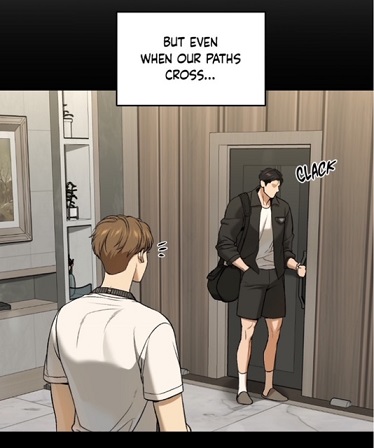 (chapter 47) and voice his true thoughts and emotions:
 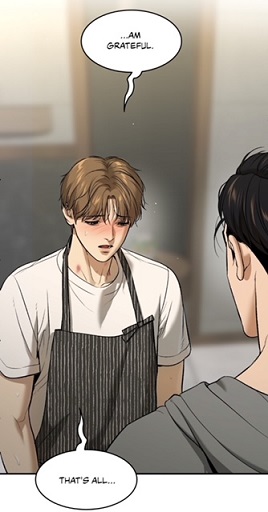 (chapter 45) He lied, when he portrayed himself as grateful. He was avoiding his gaze either. No wonder why the fighter got even more mad and threatened to fire him. Such an attitude could only increase the celebrity’s mistrust, as the latter could discern a certain dishonesty.
  (chapter 49) The latter didn’t even greet the director or acted, as if they didn’t know each other. He exposed the existence of a secret, an uncomfortable secret. Consequently, I believe that the champion could only jump to the conclusion that Kim Dan had been indeed acting behind his back, even coerced to do something.
  (chapter 51) Note that the star never came clean with the truth either.
 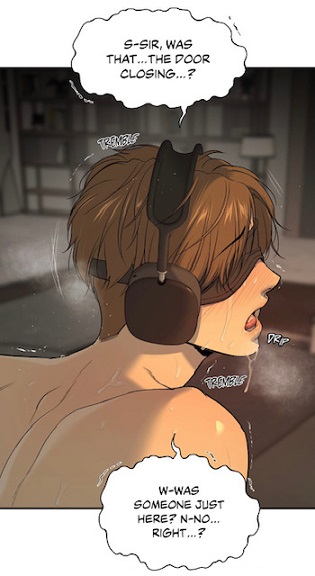 (Chapter 35) Through the doctor, the champion is encouraged to become honest to himself.
 (chapter 33) Simultaneously, it exposes that the champion has a secret, which is strongly intertwined with betrayal, love, money and deceptions. I couldn’t help myself thinking of “blackmail”. Kim Dan had been coerced to do something, as the director was holding something against him. Hence we have the question: “what have you done?”. Remember how the actor chose to approach the angel.
 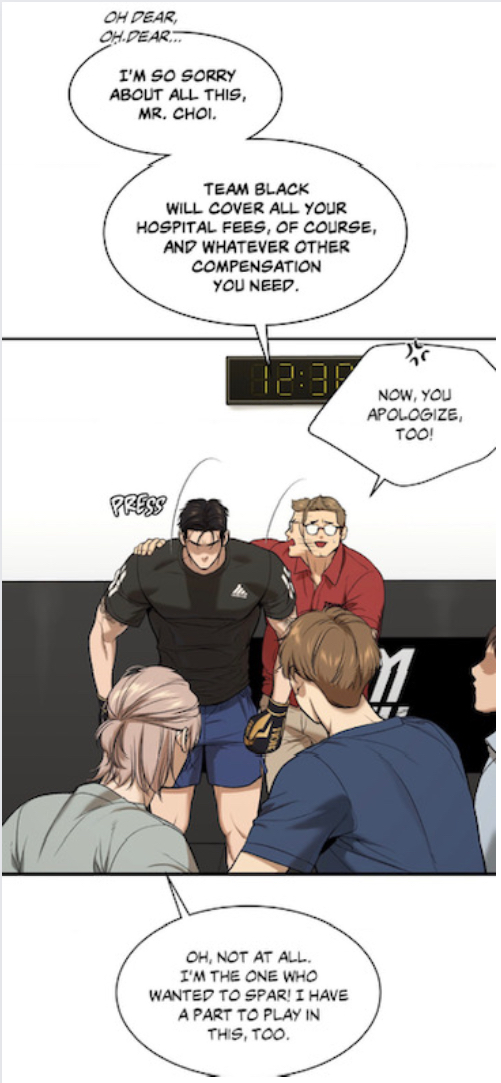 (chapter 31) He tricked his boss by faking an injury. He put the gym under pressure, as this incident could be leaked to the outside. The whole situation reminded me of blackmail. If he did not follow his request, there could be a scandal. That’s the reason why I believe that the champion’s past is linked to blackmail as well. How is it possible? It is because of the game “truth or dare”! The latter is strongly intertwined with divulging information and crossing the line!! To sum up, this game embodies trauma, secret, leaking information, trust and overstepping a boundary or rule. This observation brings me to my next point.
 (chapter 9) And what did happen after they left the restaurant? The champion discovered the truth:
  (chapter 10)
 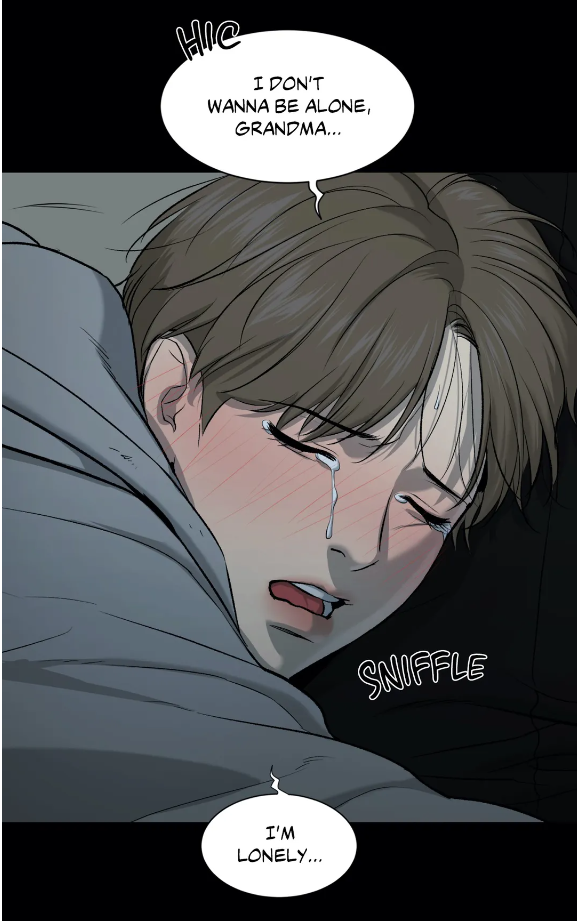 (chapter 10) Kim Dan was terribly poor, but he was also on his own, missing his grandmother.
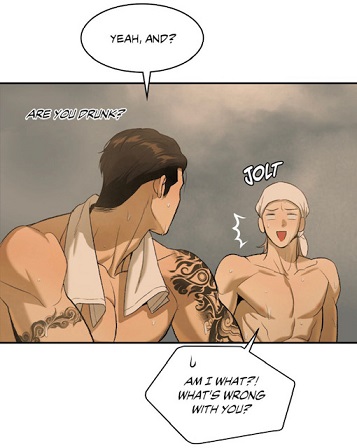 (chapter 34) “Are you drunk?” With this question, the protagonist revealed something about himself. He associates dating and love confession with drunkenness. He implies the existence of a lie. But a confession is strongly associated with verity and sincerity. On the other hand, for the sportsman, no one in his right mind would admit to be in love and in our case to love another man. For me, one part of the problem is that the champion is afraid of admitting his homosexuality. The latter is still a stigma in South Korean society. But there’s more to the game Truth or Dare. If you paid attention to the origin of the last quote, you will realize that this fun is linked to bullying and even hazing.
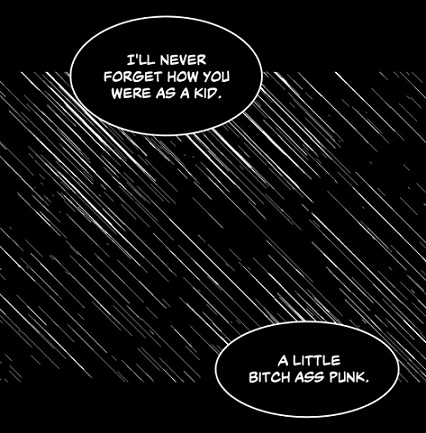 (chapter 49) Furthermore, bullying is never done alone, but in groups.
 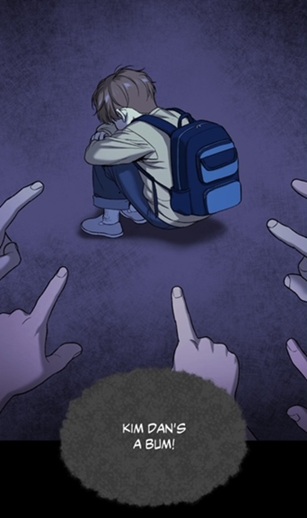 (chapter 57) There is one leader and the others are following the flow, the latter even become more proactive by making new bets and suggestions in order to ensure their own safety. As long as no one divulges the truth, the bullies are safe. But there’s more to it. Striking is that the way they coerced the champion to fight resembles to bullying too. He was manipulated with the articles, then with the advises from the lawyer and manager. Once in the States, they tried to drug him, which corresponds to a physical assault.
  (chapter 37) Finally, note that the schemers are working in teams exactly like the bullying students. Therefore I judge Park Namwook’s attitude as the teacher’s who is closing the eye to the truth. He is rather passive and puts the whole responsibility on his “boy”.
  (chapter 37) Interesting is the athlete described this night as a party which made me think of a students’ party. Therefore I couldn’t help myself wondering if the champion didn’t go to college, but due to an incident, he was forced to drop out. And the latter could be related to a party organized by students. The latter chose to cover up the incident by remaining silent. I would like to outline that the doctor got fired, though he was actually sexually harassed by his superior. The nurse never testified in his favor, she chose to close an eye to the crime.
  (chapter 1) The main lead never considered her behavior as betrayal and abandonment. In fact, he never considered the crime as a betrayal from an institution.
  (chapter 47)
 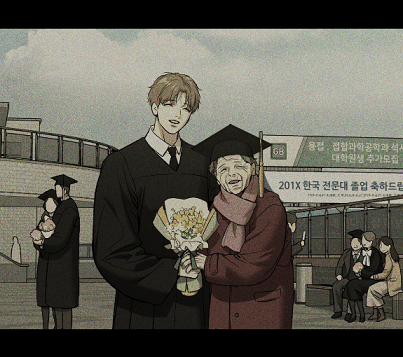 (chapter 47), Manhwalovers can see that Kim Dan was a loner. Therefore I doubt that he had friends during his college years. The only person he knew from his school was his mentor:
  (chapter 1) It is important, because it implies that Kim Dan avoided to socialize and participate in gatherings. Interesting is that in season 2, Jinx-philes discover that Kim Dan had been bullied in the past.


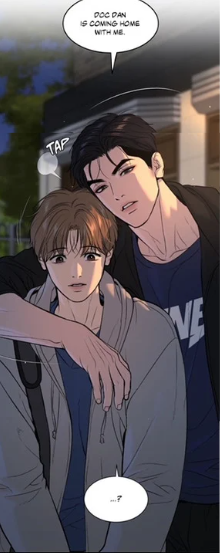

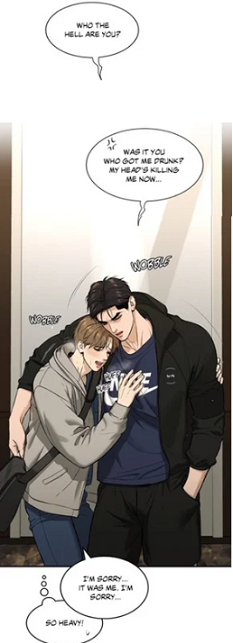
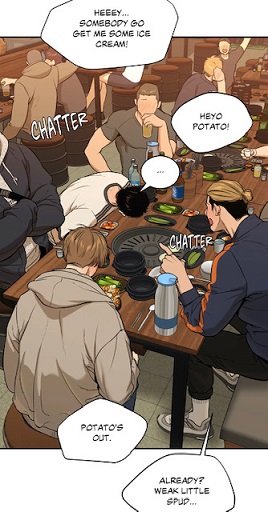 (chapter 9), yet Park Namwook made sure that the physical therapist wouldn’t be abandoned drunk. Thus he tasked his boss to bring him home. And as for Potato, it is clear that Oh Daehyun would take care of him, as he was sleeping in the dormitory next to him. In other words, no one was left behind drunk. But this scene contrasts so much to episode 43. First, no one was missing Potato. No one asked about his absence. Secondly, pay attention that the fighters invited Kim Dan to join them for another round, while they were neglecting their boss, though it was his birthday party.
 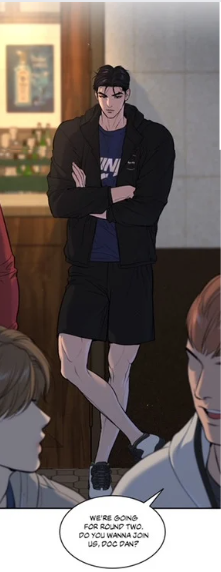 (chapter 43) Moreover, they never wondered about his physical condition. Was he drunk or not? Funny is that the intoxicated character was the one who forced Kim Dan to go home.
 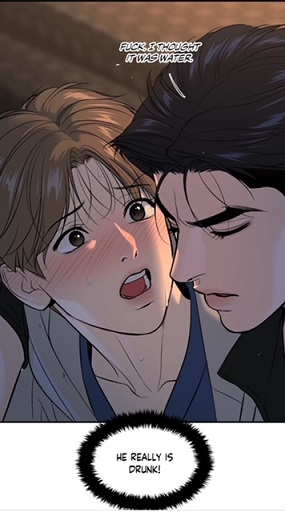 (chapter 43) That’s what a friend is supposed to do.
 (chapter 35) So the auntie could keep an eye on the judo fighter, and it was only a matter of time, until his friend would return. Nevertheless, this scene is implying a certain problem: a drunken person shouldn’t be left unguarded. Thus imagine that during a party, an unconscious person is brought to a room and left there unguarded, as the friend desires to keep partying, similar to this scene:
  (chapter 37) The person could get sexually assaulted, and no one would notice it. Secondly, I would like to outline that the hazing party from the article reminded me a lot to bullying. These freshmen were humiliated, and the perpetrator excused her behavior behind traditions and social norms. So the champion could have been betrayed by a friend, as the latter would have justified his action similarly. So instead of admitting his mistake, he could have justified the incident like this: the victim was responsible for his misery, because he was at the wrong place at the wrong time. It was just his misfortune or better said his jinx. Yes, for me, the jinx is indicating that people responsible for the champion’s traumas were denying their wrongdoings.
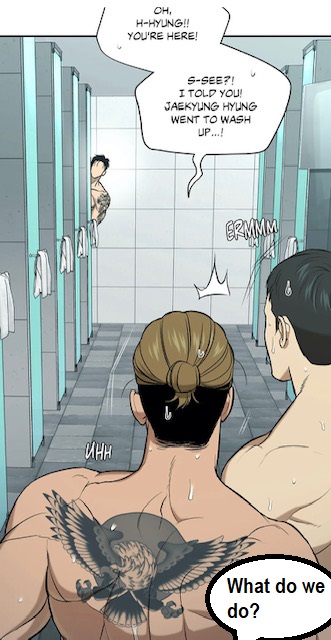 (chapter 8) From my point of view, this place is not just symbolizing purification and reflection, but also indicating the presence of a wound. As soon as I connected the bathroom and as such water to pain, all the champion’s past behavior appeared in a different light. In episode 3, when he went there, he was wearing his pajamas.
  (chapter 3) Neither Kim Dan nor the protagonist were seen both naked in the shower room.
  (chapter 8)
  (chapter 20)
  (chapter 30) Therefore I perceive the champion’s last comment as relevant. In my opinion, Kim Dan’s gesture reflected the champion’s mind-set. So by saying this, Joo Jaekyung was forced to admit the absurdity of such an attitude. Therefore Manhwalovers can understand Joo Jaekyung’s annoyance at the sauna. He imagined that he would be alone there.
  (chapter 34) He feels uncomfortable naked around people… As soon as you connect this place to a wound, my avid readers can finally better interpret the champion’s irritation in episode 36:
  (chapter 36) Kim Dan’s entrance could be perceived as a violation, for the champion was naked. This intrusion caught him off-guard. But since his gaze was covered, his anxiety masked behind his anger was diminished. On the other hand, this led him to leave the bathtub undressed and have sex in the kitchen.
  (chapter 36) For me, everything is pointing out that one of the champion’s fears is intimacy with water. He has long internalized this association. Don’t forget that the sexual encounter in the swimming pool started with clothes, before they got completely removed.
 (chapter 27) Under this new perspective, I don’t think that it is a coincidence that the champion felt the need to take a shower after meeting Baek Junmin and recalling the past.
  (chapter 49) This helped him to overcome his trauma and past wound.
  (chapter 49) Yet, keep in mind that the athlete’s wounded soul is not the result of one traumatic incident, but of many anguishes.
  (chapter 8) they dared to have sex next to Oh Daehyun and the other fighter. However, note that in all these scenes, neither the doctor nor the champion were honest. They were both lying… not only to their counter-part, but also to themselves.
 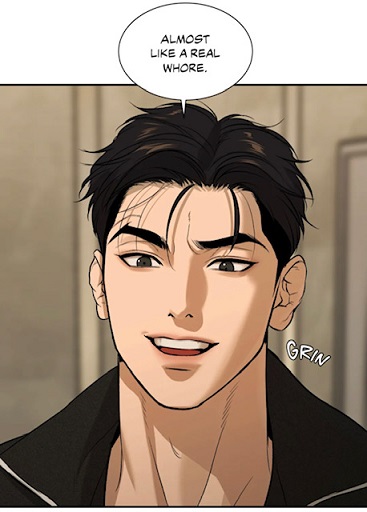 (chapter 19) That’s the reason why the argument in the locker room
  (chapter 51) doesn’t represent the final moment where both main leads opened up their heart and mind to each other. They were not truly honest to themselves and to each other. There was no water… and according to me, the spray was a pepper spray, so the champion’s ankle should have been cleaned and not simply covered. For me, both characters need to prove their trust and loyalty to each other. But they are moving in the right direction, for Joo Jaekyung divulged a huge information to Kim Dan.
  (chapter 7)
 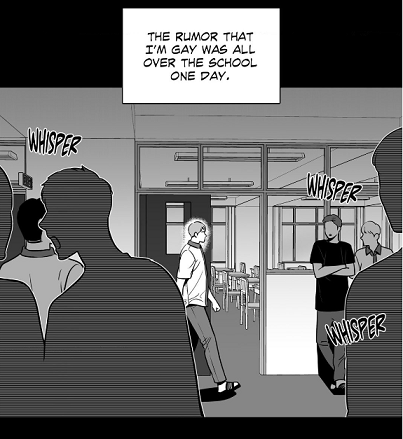 (chapter 70) His sexual orientation was exposed in high school, his friends were behind the rumor
  (chapter 70), although we have to envision that his crush played a huge part in it. Why? It is because he didn’t want to be associated with homosexuality.
  (chapter 70) Not only he cut off ties with him, but also he made sure to isolate the main lead from other students. The worst is that this person acted, as if this ostracizing had never occurred.
  (chapter 69), as if he had done nothing wrong. For me, it shows that the traitor never grasped the significance of his actions. Hence Park Sung-Woong could forget Dong-Gyun, while the latter could never forget him at all. The result from this huge betrayal was that the cute uke decided to keep his distance from people.
  (chapter 70) He could no longer trust people, he avoided meetings. In order to outline how severe betrayal trauma can be, the Webtoonist showed us the immediate effects of betrayal trauma: physical and emotional reactions
  (chapter 70)
 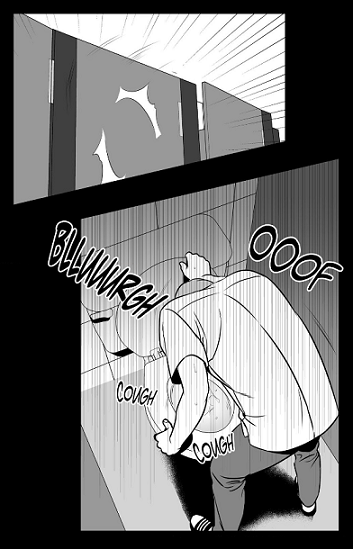 (chapter 70) and the long term effects:
 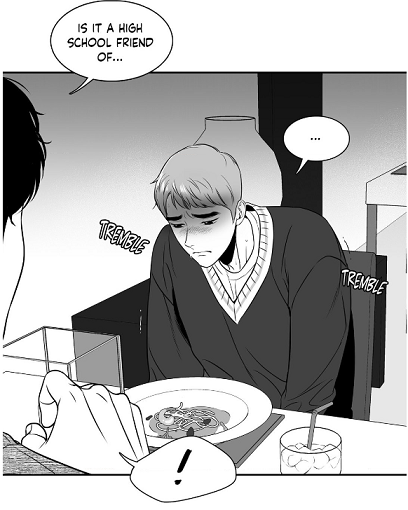 (chapter 69) he is trembling so much, he can not look at his former friend. Readers shouldn’t underestimate the issue. Betrayal trauma is so severe that it is comparable to being hit by a white truck. The pain is so great that it affects the brain functioning and as such personality.
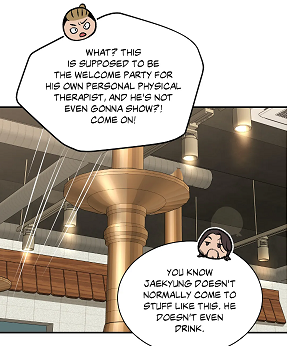 (chapter 9), trust issues
 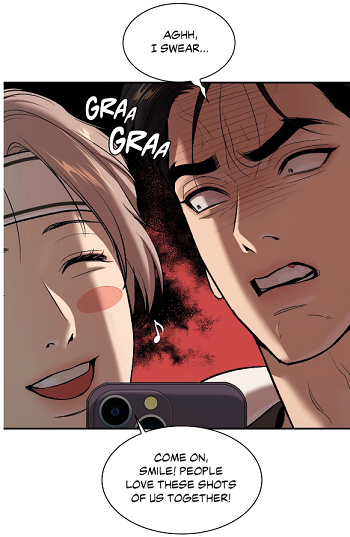 (chapter 30), negative intrusive thoughts
  (chapter 29), withdrawal (we know nothing about his family and he dislikes going to gatherings, he is not meeting his hyung Cheolmin) and rumination: he got upset, when the hamster ignored his calls.
  (chapter 32), it was clear that the doctor’s actions were constantly on his mind. He was so bothered that he had to bring him to Heesung. He made sure that Kim Dan would forget Choi Heesung in the car.
  (chapter 33) Interesting is that this trauma resembles a lot to PTSD.
 (chapter 49), the latter was not loved, as he didn’t reach the first place like his older brother. Then we have Interpersonal with Nam Dong-Gyun and his high school friend. However, since the rumor circulated at school, and no adults intervened, we could see it as a reference to Institutional betrayal. Finally, Mingwa presented the last type (partner) with Hweemin.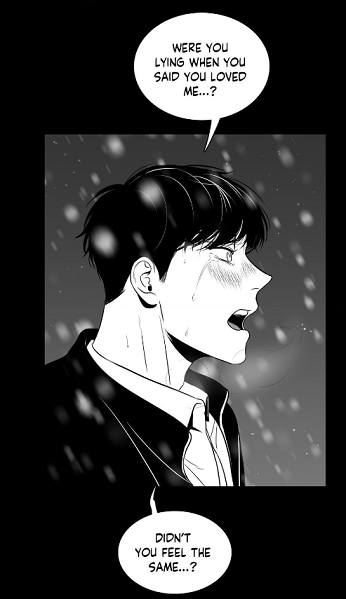
 (chapter 51) But why is betrayal trauma so severe? It is because everything appears as a lie, as an illusion. All the memories become tainted. The victim can only question his own senses and judgment. How could he not detect the lies? Since PTSD and betrayal trauma share some common points, it is not surprising that such persons come to blame themselves and develop huge self-loathing.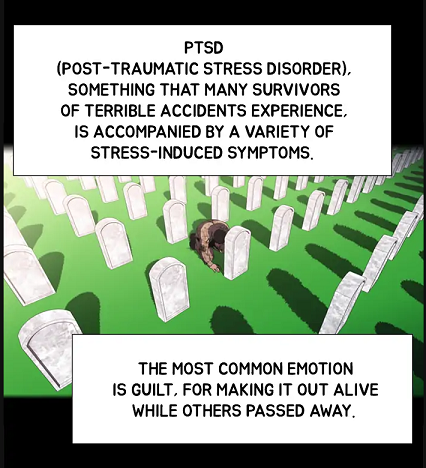
 (doctor Frost, chapter 139). And now, it is time to expose my latest observation:
 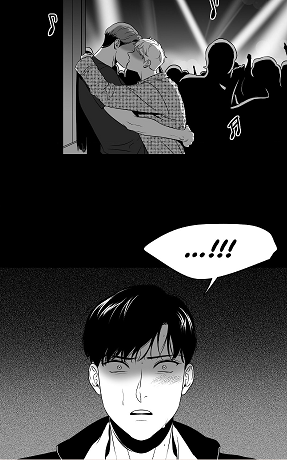 (BJ Alex, chapter 51) Ahn Jiwon caught his first lover cheating on him at a club. Interesting is that the new lover resembles a lot to Joo Jaekyung! Mingwa said that characters from BJ Alex will only appear, but Jinx is not connected to her previous work. Note that they were kissing in a public place. Moreover, the club is a location where students not only meet, but also drink alcohol together. However, once Jiwon saw Hweemin, he dragged him outside so that they could talk. In other words, the “new lover” was left behind. Thus I come to the following conclusion. Joo Jaekyung has been suffering from betrayal trauma exactly like Ahn Jiwon. He was betrayed by his guardian
 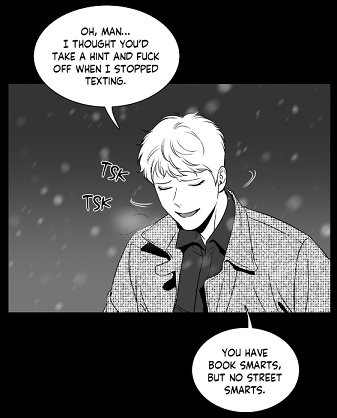 (BJ Alex, chapter 51). If this theory is true, then Mingwa would finally outline the devastating effects of Betrayal trauma on people, something she barely touched in her previous work.
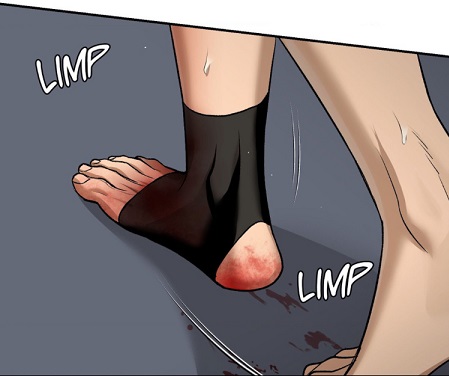 (chapter 51)

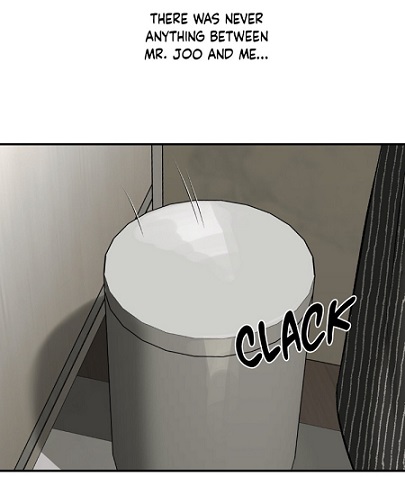 (chapter 46) On the other hand, chapter 47 exposes that the doctor didn’t lose his interest and attention towards his boss.
  (chapter 47) This exposes that Kim Dan didn’t choose resent or indifference towards Joo Jaekyung despite the inflicted pain. On the other hand, why did I write that the celebrity is Kim Dan’s reflection? Why is the athlete the doctor’s mirror of truth? It is because Joo Jaekyung embodies his negative reflection: independency and toxic negativity. But what is the latter exactly?
 (chapter 31) It is because when the psychologist met the patient with her boyfriend for the first time, he paid attention to his micro-expressions, and more particularly to his mouth. He saw his smirk. Here, I feel the need to give an explanation how these micro-expressions were discovered.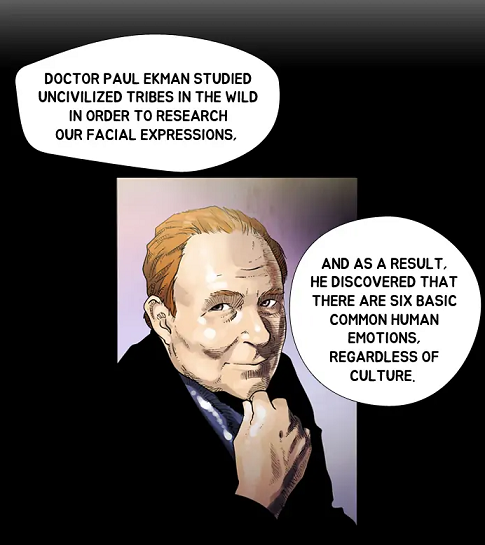
 (chapter 30) As my avid readers can detect, the expression from the boyfriend’s mouth displeased the white-haired psychologist. He could recognize his emotion, though such facial expressions are very short-lived
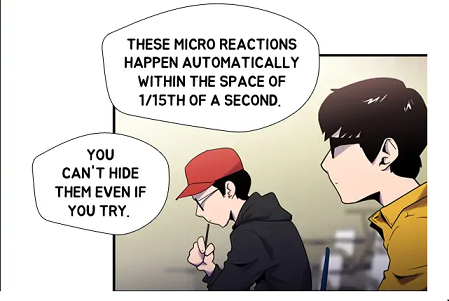 .(chapter 30) So what was the “jerk” feeling, when he was conversing with Sihyun? Cynicism.
 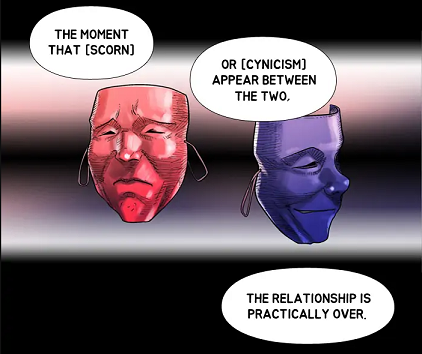 (chapter 31) And the reason why he stated that as soon as cynicism or scorn was present in a relationship, the couple would end up breaking up is because of John Gottham’s observations and conclusions.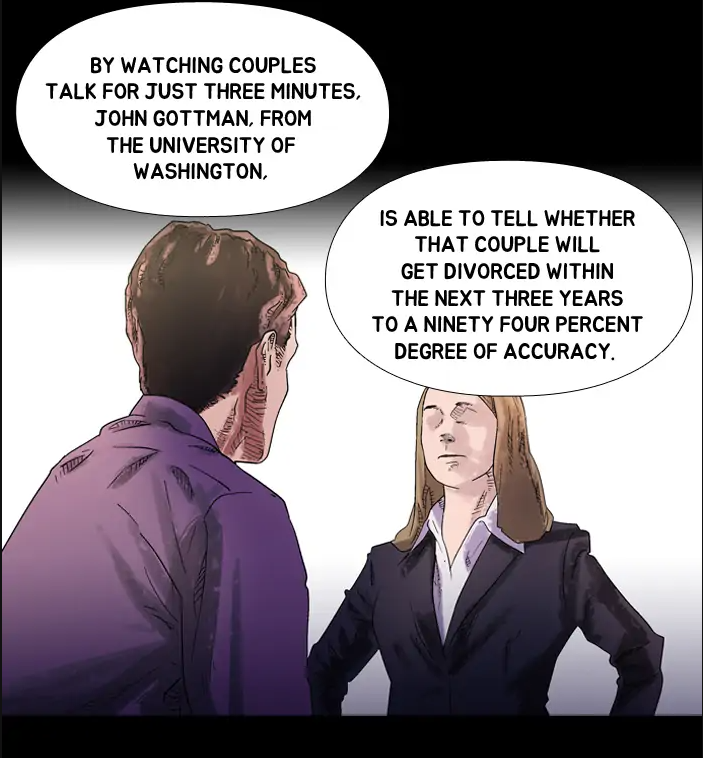
 (chapter 45) We could sense it in different scenes, though I would say that his cynicism was slowly vanishing:
  (chapter 3)
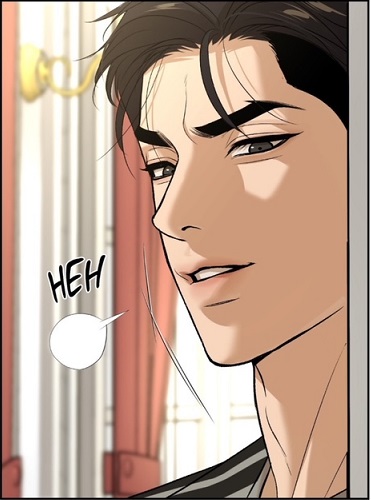 (chapter 40) This is the so-called toxic negativity. Therefore it was to expect that the champion would reject the doctor’s present. He could only doubt the sincerity behind his gesture. How so? Remember how the team desired to celebrate his birthday: a surprise party. They bought a cake…
  (chapter 43) but what happened afterwards? Yosep spoke in the name of the gym’s owner: the latter would pay for the dinner (beef restaurant)
  (chapter 43) So technically, they offered a cheap cake and got in exchange a super expensive dinner. One might say that this was just a joke. But cynical people are taking things very seriously. This is what the champion learned from this experience, the cake in exchange for a super expensive meal … and now imagine that the next morning, he received an „expensive“ present from Kim Dan which was similar to the gifts from fans (exchange of favors). It is normal that he doubted the genuineness from his doctor, not only because of his past experiences, but also because of the parties before. But there exists another reason why he had to refuse the gift: Cynicism… the end of relationship. Thus dating for the athlete was impossible.
  (chapter 45) He is not ready yet. But was it Cynicism exactly and how does it represent a hindrance for a healthy relationship?
 (chapter 8), in the office, in the car, in front of a mirror, in front of Heesung in the living room… Don’t forget that Diogenes would even masturbate in public.
  (chapter 46)
 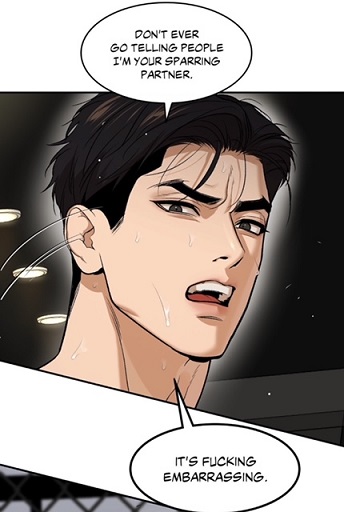 (chapter 46) Consequently, he never tried to get close to his members either. In fact, he is expecting from the staff to follow his lead. Potato could only get rejected with such a request.
  (chapter 23) The latter had to act like a true disciple and follow the champion’s recommendation.
 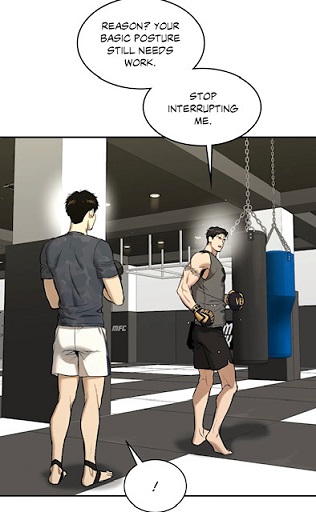 (chapter 23) The gym is like his sacred temple. Yet, the gym is just a simulacre of “nature”, as it is in the middle of Seoul. Therefore I realized why after their argument, Joo Jaekyung avoided the penthouse and Kim Dan in the end.
  (chapter 41) He is looking for freedom and self-sufficiency, detached from any material need. This explains why the golden keychain from Kim Dan could only offend him.
  (chapter 45) It symbolized everything he hates: a reminder of wealth, superficiality, attachment, secrecy and silence. It also exposed the huge difference in their mind-set. Kim Dan is not his disciple! He imagined that he had found a kindred spirit, especially after that night:
  (chapter 39) The reason is simple. The champion had finally found someone who accepted his roughness in bed and could match his stamina.
  (chapter 10) He is not resigning on designer clothes.
  (chapter 42) His dress room is the evidence of his hypocrisy. He might have encouraged Kim Dan to have sex in “public places”, yet he is still hiding his sexual orientation. Furthermore, his jinx is the evidence of his dishonesty.
 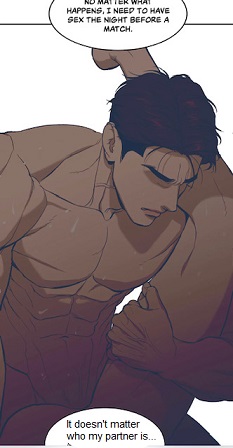 (chapter 2) He needs someone to have sex. This stands in opposition to Diogenes’ masturbation. Besides, he had to pay the goblin and Kim Dan in order to have a sex partner. Hence he needs to be confronted with truth as well. Manhwaworms can grasp the rage from the athlete, when he heard the doctor’s justification:
  (chapter 45) He might advocate autonomy and self-sufficiency, the reality is that he likes luxury. Hence he is unable to live in harmony with nature. This shows that the fighter is in denial and is living in an illusion. Thus he can not find true happiness, for his freedom is not real. He is attached to the gym which is also strongly connected to his career as the Emperor.
  (chapter 46) With his brutal attitude, he is doing himself a disservice. Exactly like Kim Dan, he is even ruining his career and own reputation. Not only he lost 4 athletes (I am including Seonho), but also his loyal admirers are calling him a thug now:
 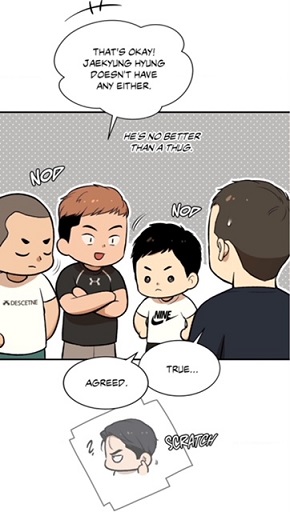 (chapter 47) Even Potato announcing the gradual Coming-Of-Age from his admirer. However, like Dr. Frost mentioned it, humans are social beings.
 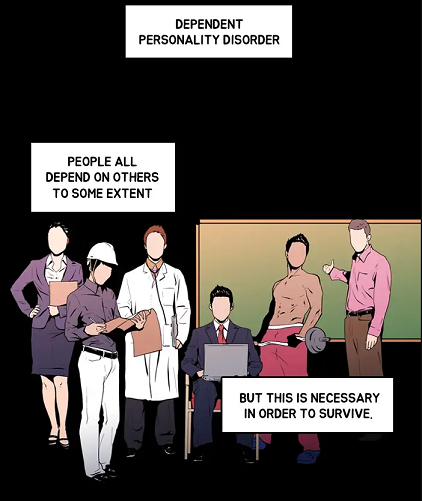 No one can survive on his own. This explicates why Cynics had disciples in the end. And now, you comprehend the role of Kim Dan in Joo Jaekyung’s life. It is to remind him of his true nature. He is a human and not a dog-wolf. Thus the champion recommended his PT to live elsewhere, a sign that he was indeed a human.
  (chapter 10)
 (chapter 2) This explicates why the champion was crossing his arms while confronting the goblin. He was on the defensive. That’s how it dawned on me why the celebrity fell in love with Kim Dan at first sight, and why he enjoyed their first night together. The “hamster’s fear” was genuine. His desertion displayed respect towards the celebrity. He was recognizing his strength and power.
 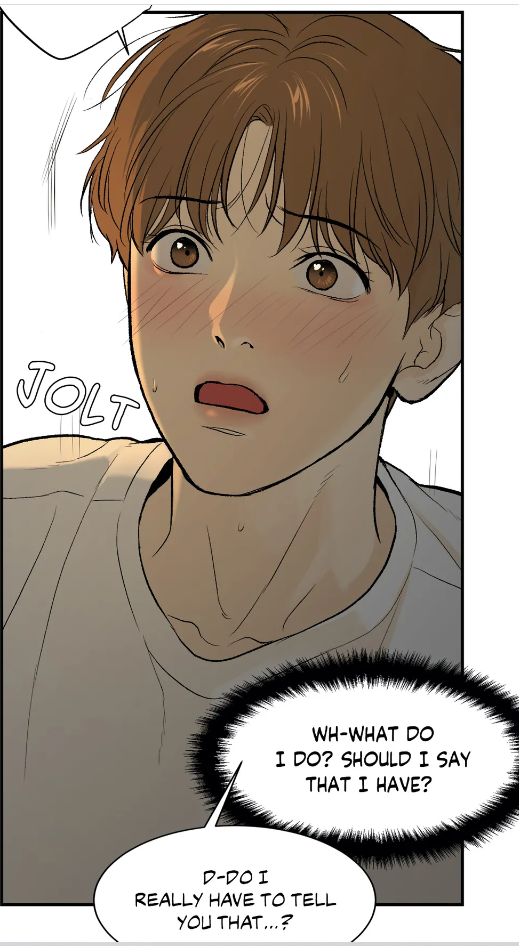 (chapter 3) On the one hand, the champion’s worldview about humans got reinforced, on the other hand the doctor’s deception symbolized his purity. He was a virgin, which was contradicting his “theory” too.
 (chapter 11) He even looked like a ruler abusing his authority.
 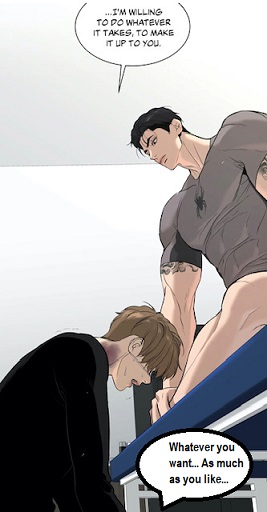 (chapter 11)
  (chapter 11) Here, the champion thought that Kim Dan had been gambling. An emperor or ruler, especially one characterized by a lack of idealism, may embody the cynical belief that individuals are primarily driven by self-interest and that altruistic motives are rare. Therefore the celebrity rejects the notion of soulmate
  (chapter 33) or even the idea of friendship
 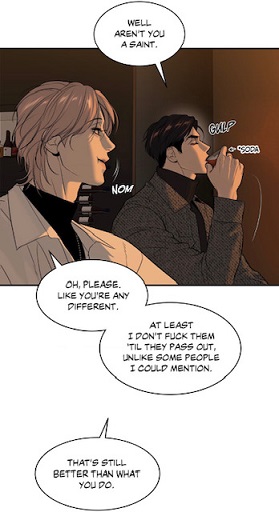 (chapter 33) Hence he looks down on poor people.
  (chapter 10): Gamblers, laziness, no sense of hygiene etc. Consequently, he is not capable to understand the worries from Kim Dan
 (chapter 42), Park Namwook
  (chapter 46) and Jeon Yosep. He feels like they are questioning his success. It was, as if they had other motives. He only relies on himself, he is not “truly” listening to others… though it is not correct. He is getting manipulated by his “counselors”.
  (chapter 36)
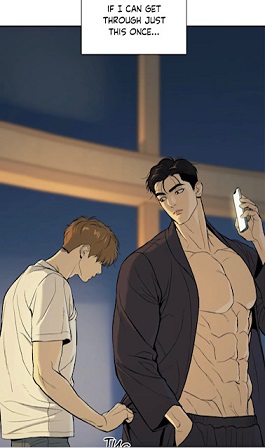 (chapter 2)
 (chapter 26) He is standing in front of a dilemma. Fighting is the expression of nature and self-reliance, yet his fights serve as entertainment for MMA lovers. MMA is strongly intertwined with business and money.
 (chapter 45) was showing the doctor’s golden heart. He was just judging his lover based on his past experiences and his negative worldview. And this brings me to list the cause for Cynicism:
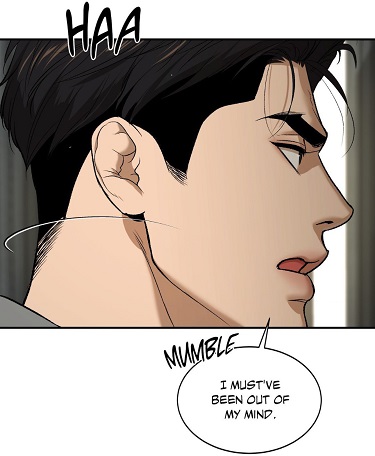 (chapter 45) He fears to be taken advantage. There is no ambiguity that his negative mind-set is definitely influenced by his childhood and family. I would even say that he must have been exposed to emotional blackmail. I came to this hypothesis, because I detected that the champion had been using “blackmail” as MO in order to control Kim Dan.
 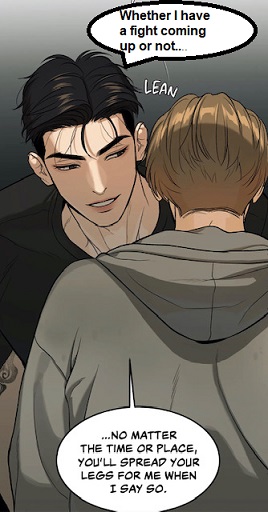 (chapter 6)
  (chapter 2) He learned through Cheolmin that he could kill him. This shows his good nature in verity. Hence he resorted to such gestures, when his cynical depression resurfaced:
 (chapter 32)
  (chapter 45) As you can see, little by little, the champion is learning to control his rage and “cynicism”. During the last argument, he didn’t touch the physical therapist at all. He still allows him to stay at his place and he is shown as caring later.
  (chapter 46) The irony is that Joo Jaekyung is not recognizing his own transformation. The most obvious evidence for his metamorphosis is the absence of his jealousy towards the doctor.
  (chapter 47) It shows a certain trust. One might argue about this interpretation. This could be seen as indifference. However, I believe that his altercation with Seonho must have been quite an eye-opening for the champion.
  (chapter 46) It is because Kim Dan had not talked back to Joo Jaekyung during their argument. He had accepted his criticism silently contrary to Seonho. Right now, he has the impression that he still has the upper hand, but he couldn’t be more wrong.
  (chapter 26) He has the impression that he can control people, since he is wealthy. Yet, he is not realizing that he can get stabbed because of money as well. We have two perfect examples. Because of the drug incident, the MFC security guys betrayed him, as they protected the organization
 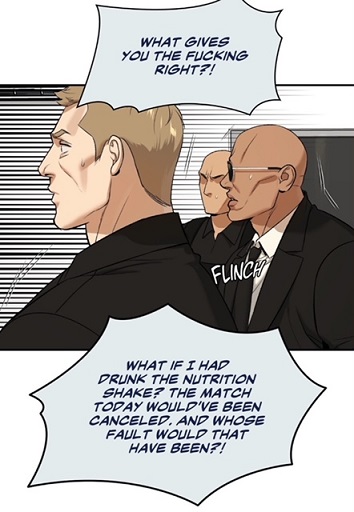 (chapter 40) Then in episode 47, the emperor got manipulated by his so-called loyal advisors.
 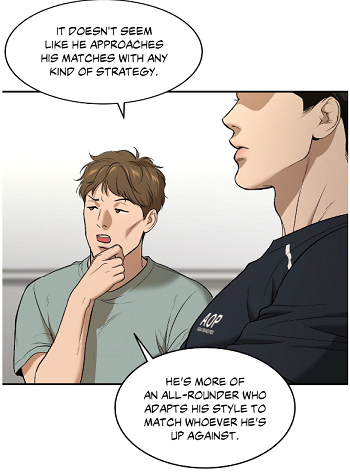 (chapter 47) First, I would like to outline that neither the manager from the Entertainment agency nor his acolyte brought up the underground fighting ring and Baek Junmin’s dubious success.
 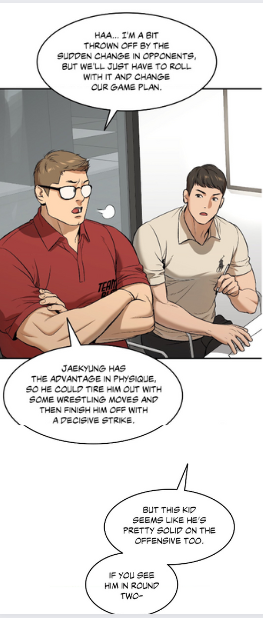 (chapter 47) With their video, they presented him as an average and reliable fighter.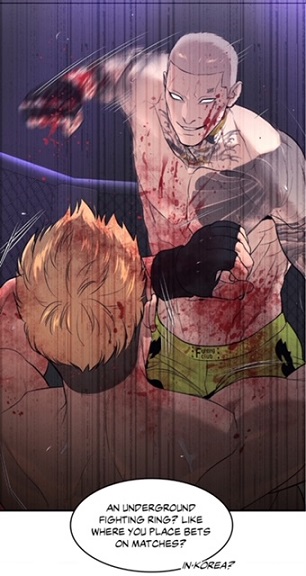
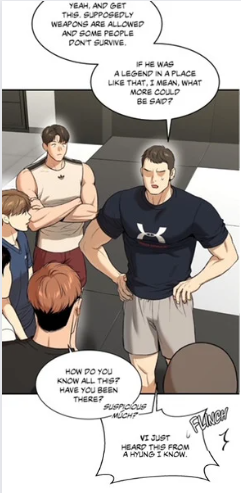 (chapter 47) The latter portrayed Baek Junmin as dangerous, for he would use any mean to win the fight. He doesn’t stand for fairness and responsibility. The champion didn’t get to hear anything about these rumors.
 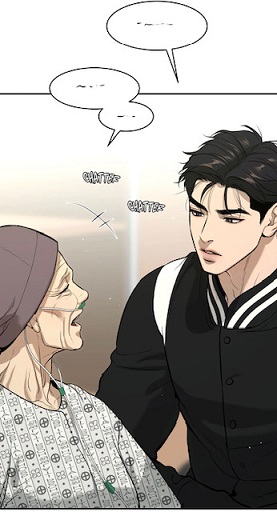 (chapter 21) Moreover, the grandmother’s mortality could serve as a reminder for the champion that he is also a human… just like the others he condemns. Besides, she embodies true selflessness and gratitude. Hence she took the champion’s hand to thank him
 (chapter 22) This is what psychologists recommend to overcome Cynicism:
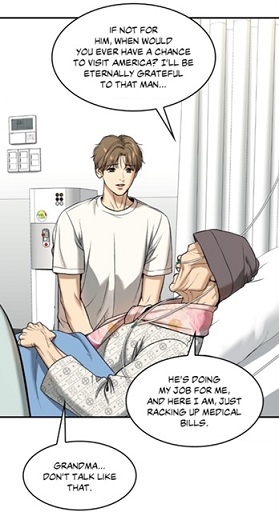 (chapter 41) He never heard her recognition. In addition, until now, Kim Dan spoke in the name of others or didn’t defend his own point. Team Black’s loyalty would be the evidence that it is dangerous to judge people based on prejudices and past experiences. He needs to reflect on his own actions as well. If the Emperor heard “his members”, he would realize that MFC as an organization is corrupted and is even involved with criminality. He is already sensing something, but he can not identify the problem.
 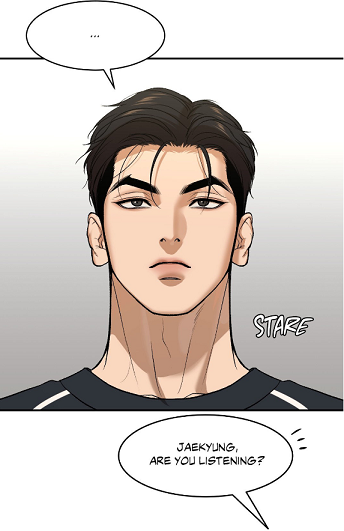 (chapter 47) Should Kim Dan divulge Baek Junmin’s connections to the underground fighting ring or simply show him the message,
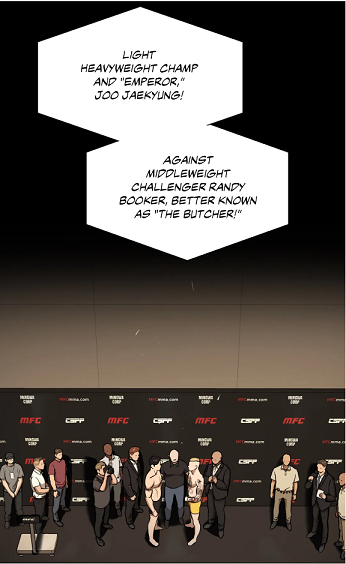
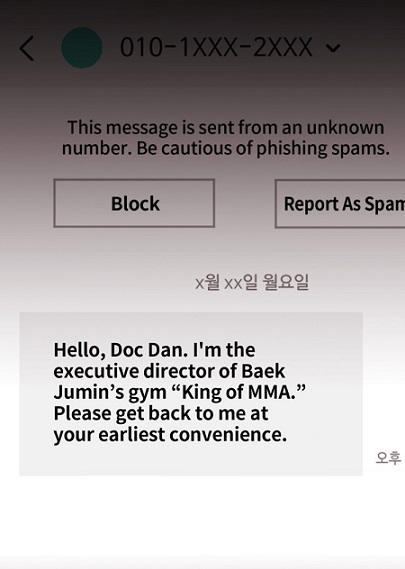 (chapter 47), he would prove his faithfulness and sincerity to the fighter. And the vicious circle would be broken. Though he is broke, he would give up on an opportunity to earn some money easily. To conclude, as long as the champion is still a cynical character, he can not enter a relationship with Kim Dan. For that, he needs to open up his heart and third eye so that he can recognize his partner’s selflessness and honesty. Finally, he will realize that he needs the assistance of others in order to be able to keep his reputation intact (witnesses, supporters). There is no doubt that the Emperor will be badmouthed again.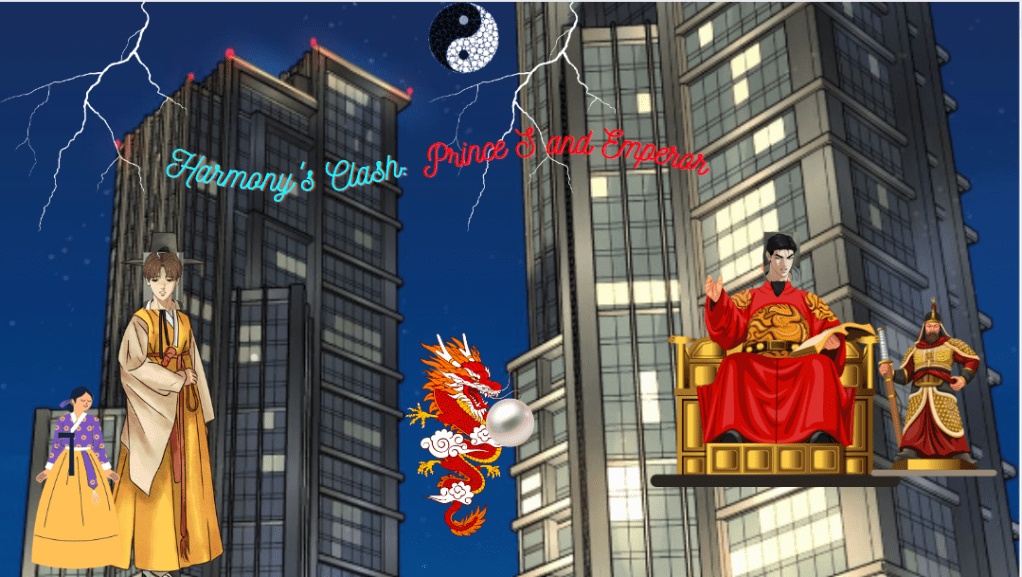
 (chapter 14) On the other hand, some readers might wonder why I am connecting Kim Dan to princess (Prince S). I have many reasons for this association.
 (chapter 30) This woman, named Sihyun, is suffering from Dependent Personality Disorder. And the author of the Webtoon Doctor Frost called her story: “The tears of Princess Pyeonggang”. Due to her personality, she was linked to the famous “princess”. She would do everything for her companions, yet she kept getting dumped. What caught my attention is that both women defined themselves through their partner. Their ultimate goal in life is to assist them, to make the other happy or recognized. But how is it a problem?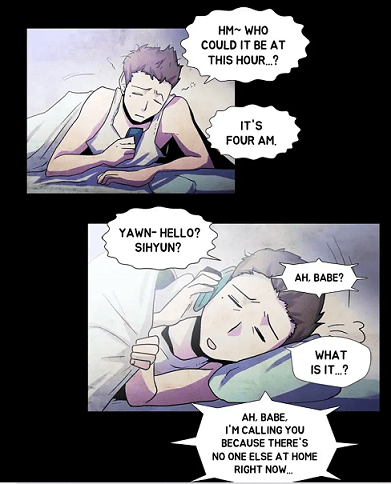
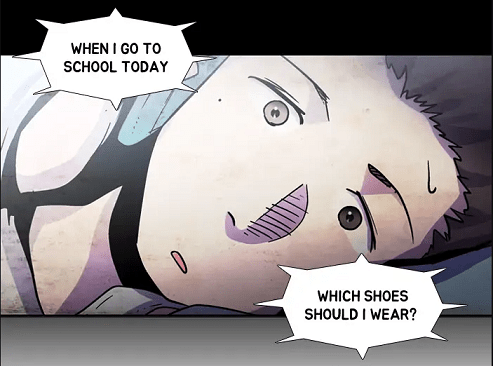
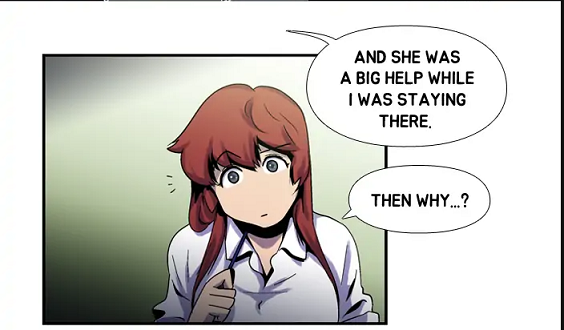
 (chapter 33) What appeared as caring turned out to be a load, for the partners were all forced to be responsible for her and in every aspect of her life. They definitely felt asphyxiated, hence they could only get sick of her. Interesting is that this person would find shortly after the separation a new boyfriend, a sign that she could not live on her own.
 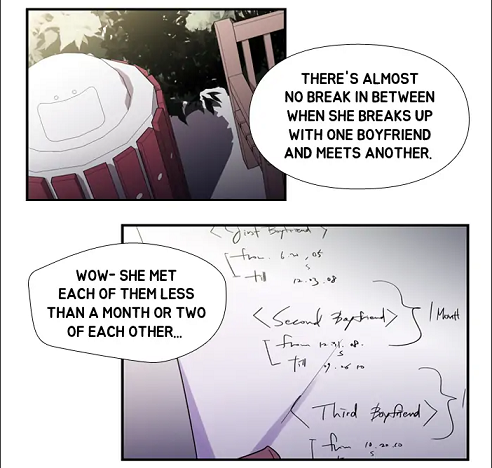 (chapter 33) And now, you are wondering how Sihyun is similar to Kim Dan, who only had one person in his life before he met the champion. It is related to traumas in their childhood.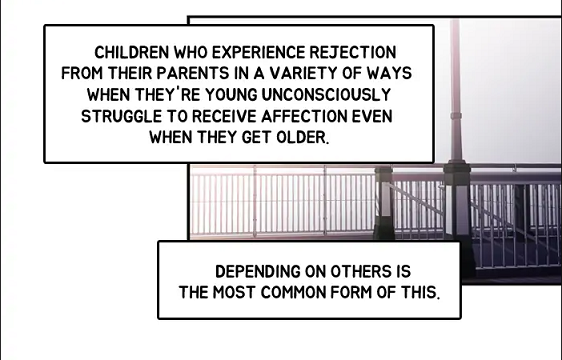

 (Doctor Frost, chapter 39) After reading this, Jinx-philes can realize that Kim Dan is also suffering from Dependent Personality Disorder, though it is less obvious. He got abandoned by his parents making him feel insecure.
 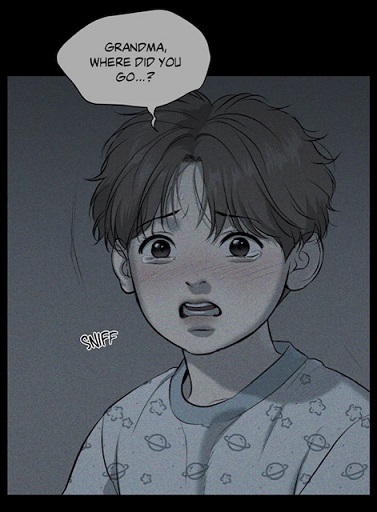 (chapter 21) We could detect his low self-esteem
 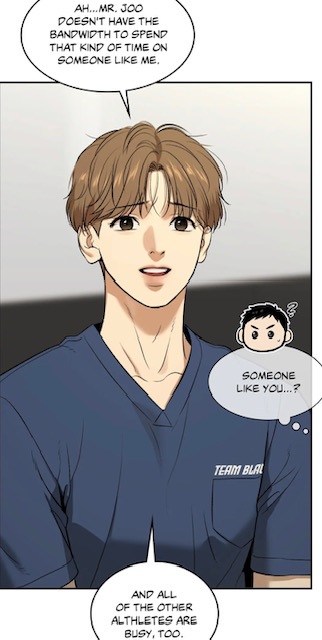 (chapter 25)
  (chapter 46) and his overprotectiveness
 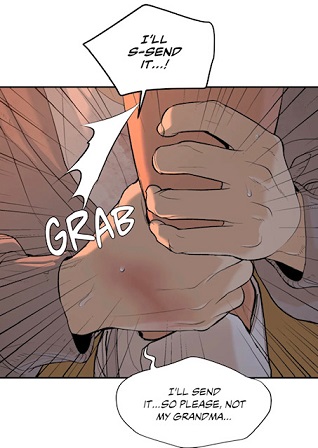 (chapter 16)
  (chapter 26)
  (chapter 42) on many occasions. He was risking his livelihood and health for the sake of others (his halmoni, Potato and Joo Jaekyung). His selflessness is actually the sign of his DPD. He had no purpose or ambition in his life… That’s why he is not able to project himself in the future. Until chapter 45, his life and future was determined by the celebrity,
  (chapter 42) and before it was by his halmoni’s fate.
  (chapter 19) However, here please don’t get me wrong. For me, the athlete is the physical therapist’s emancipator. This huge argument in the dining room pushed him to differentiate himself from the champion. In my eyes, Kim Dan would have returned to his old bad habits… relying on someone else, sacrificing himself for someone’s else sake. He would have neglected his career in the end.
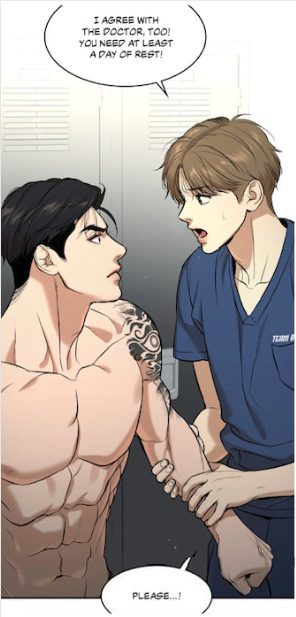 (chapter 27)
  (chapter 31) Here, we get an explanation why he couldn’t detect the trick from Choi Heesung. He feared to make a diagnosis on his own, as he didn’t desire to question the words from the comedian. The hospital seems to be the sacred place in the doctor’s eyes.
  (chapter 41) There, nothing can go wrong. But by entrusting his patients to hospitals, he didn’t realize that he was appearing as untrustworthy or even “incompetent”. His lack of confidence and hesitation explicate why the athlete replied to his suggestion like this:
  (chapter 42) Consequently, it is not surprising why the champion complained about the doctor’s negligence. The latter was avoiding any responsibility in the end. On the other hand, the report is the symbol of his hard work, but also of his knowledge. That’s the reason why I am still considering the dispute in chapter 45 as a good omen for the physical therapist. He needs to develop his own identity. They are two different people. He needs to live for himself, to give a meaning to his life and not:
  (chapter 27) That’s how it dawned on me why the doctor reverted to his old habits (not participating to the meeting, taking odd jobs, not voicing his own judgment, relying on others) after the night, when he was treated as sex toy. However, in my eyes, the trigger for this switch was the release of the tabloid article.
  (chapter 35) Imagine what it meant for Kim Dan. He could only remain passive, as he is called “doctor”. He views himself as a member from the medical field. Furthermore, observe what the sports therapist told him during the treatment session:
  (chapter 42) He mentioned the lawsuit against the most reputable hospital. The dispute could only diminish his self-esteem. As time passed on, there is no ambiguity that this lawsuit must have burdened more and more the physical therapist. Besides, there is no doubt that he felt some loyalty towards doctor Lee who had been complimenting him. Secondly, let’s not forget that despite his “efforts”, he had not been able to convince his patient to stop training for one day.
  (chapter 29) Hence he jumped to the conclusion that his patient would not listen to him anyway.
  (chapter 46) This is not surprising that Mingwa zoomed on his feet.
  (chapter 46) It is full of symbolism. For the first time, he is standing on his own feet. His walk in direction to the trash bin illustrates his choice.
  (chapter 46) Besides, he is using the personal pronoun “I”.
  (chapter 46) It is his Coming-Of-Age. He is on the verge to become independent. On the other hand, he didn’t fight back verbally against his boss. He accepted his reproach.
  (chapter 46) He was just a physical therapist and nothing more. This shows his lack of criticism. He is still not mentally strong enough to question the champion’s words and argue back. In the past, he could do it, for he was identifying himself with his grandmother and her values.
  (chapter 18) This signifies that he needs to develop his own philosophy and values. What does he treasure in his life?
 (chapter 42) The latter was also dependent on the champion, but his “addiction” was money and not love or recognition. Therefore he picked up the money before leaving the flat
 (chapter 2), while the other threw away the expensive keychain
  (chapter 46). This scene exposes the return of Kim Dan’s dignity. This comparison reinforces my interpretation that the champion misjudged the doctor’s present and actions. He imagined that Kim Dan had been acting like his “previous sex-partners” or stans. They would offer him some gifts in exchange of favors. Another contrast with the goblin is the absence of a fight and discussion.
  (chapter 2) I would even add that contrary to the green-haired guy, the doctor is not judging his patient’s personality, he is blaming himself.
  (Doctor Frost, chapter 32) Interesting is that doctor Frost revealed to her later that her condition made her an easy target, as she kept relying on others.
  (Doctor Frost, chapter 39) And this observation brings me to my next conclusion: he will be approached by really bad guys, the mysterious Mr. Choi!
  (chapter 1)
  (chapter 21), yet their actions were not truly selfless.
  (chapter 44) He found fulfilment in sex, which stands in opposition to the recommendation of zackbeach. Moreover, I would like to underline that the doctor reduced knowledge to sex:
  (chapter 44) How could he get to know the champion better, when the latter was supposed to be drunk and they would have sex? Getting closer to someone means communication and not really sensuality. Hence his happiness could only be short-lived and illusory. He didn’t take the reality into consideration. Thus I see the physical therapist’s tears as a therapy session:
  (chapter 46) He allows himself to cry, to grieve and to admit his pain and loneliness.
 (chapter 46) It helps him to face reality. He is on his own, he needs to stop relying on others. I would even say, he is encouraged to make decisions and as such to become responsible for his own life. It is important, because this means that he will have to fight back, if he wants to survive. He can not make any desperate and hasty decisions, like this one:
  (chapter 1) However, since he listened to the champion’s reproach and became submissive again, their relationship seems to have returned to normality. They even appear as close.
  (chapter 41) reminded me of the ending of a fairy tale: they lived happily ever after. But the doctor was forgetting that life doesn’t end after the match in the States. Life ends with death. In verity, the champion is destined to be challenged, until he retires. What the doctor saw was not the end. This exposes his naivety. How could he have such a view? It is influenced by his grandmother.
  (chapter 10) At no moment he pondered about himself. Happiness was never his goal, exactly like in fairy tales. Sleeping Beauty is rather passive. She sleeps, until the prince charming appears and kisses her. After that, they have kids. Interesting is that they don’t get married right away, so that the princess initially has the status of a mistress or concubine. Once the prince can secure his position, he marries her. Then the moment her husband leaves her side for war, she is tormented by her mother-in-law, the ogress. She can only escape death thanks to the intervention of her husband. We could say that happiness fell on her lap. Sleeping Beauty stands for passivity, dependence on her parents and husband and lack of critical thinking. Why? It is because the princess in fairy tales, in particular Sleeping Beauty, embodies toxic positivity.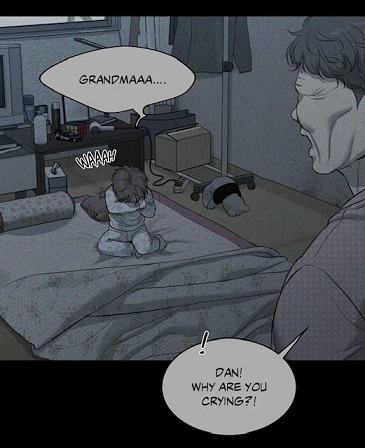
 (chapter 21) She rejected her grandson’s fear and tears. She didn’t allow him to express his abandonment issues. She diminished his anxiety by questioning his behavior: “It’s okay, grandma was just in the kitchen getting a glass of water.” Then in the present, we could use his visit at the hospital:
  (chapter 41) While the halmoni didn’t mention her suffering, the doctor gave expensive gifts to the nurse and his grandmother. He acted, as if money was no longer a problem… as if everything was fine, as if she would recover soon. Yet, he never mentioned his problems with the champion during his stay in the States (no drug incident, the humiliation, the harsh words). He is never voicing his problems to his grandmother. Both are putting smiles on their face. And the moment, I connected Kim Dan to Toxic positivity, I had another revelation. The best example for this negative attitude is actually his own birthday. 😱
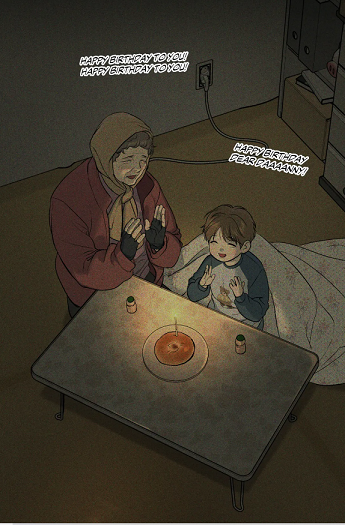 (chapter 11) Imagine that the grandmother had left the house without her grandchild. He was left behind in the house. Though she meant it well, for the child, this must have been a real torment, as he constantly feared to be abandoned. However, he knew that he was not allowed to cry or to complain. Hence when he saw her returning, he put a huge smile on his face. Moreover, this is what they had for dinner: a sweet bread and two yoghurts. The grandmother must have been hungry. Both acted, as if nothing was wrong.
  (chapter 45) With this contrast, the fear from the champion becomes more palpable. Joo Jaekyung got angry, for he had been put in the same situation. But the latter was never influenced by Toxic Positivity. Besides, he was fighting against his own inner demons. Nevertheless, this new interpretation of the birthday made me recognize why the author chose this chronology concerning Kim Dan’s past:


 (chapter 1) However, he could never confide to his grandmother about the physical abuse from the loan shark. However, the moment his hope got up
  (chapter 11), as he imagined that he could pay off the debts, he recalled his birthday. He had a nice “souvenir”… convincing himself that everything was fine. He would be able to do it, like his grandmother had told him.
  (chapter 18) Nevertheless, the moment he was forced to move out, he couldn’t help himself to recall how he got abandoned by his parents. And the moment he saw his halmoni fighting for her life, his abandonment issues resurfaced. Hence this terrible memory came through a nightmare. The betrayal from the parents is what had been deeply buried by the grandmother’s philosophy. The fact that the halmoni never allowed Kim Dan to talk about his parents and the circumstances of his arrival to the humble mansion, is the evidence of Toxic Positivity. In my eyes, the relative was already struggling herself, for she had also been left behind. But here it is important not to mix Toxic Positivity with Gaslighting.
 (chapter 12) Therefore I understand why the doctor didn’t fight back against Heo Manwook and his minions.
  (chapter 1)
  (chapter 11) But the moneylender and his minions are no honest bankers, but criminals. They enjoy using their strength, that makes them feel powerful. It boosts their ego.


 (chapter 1) Slowly, he is getting tamed and as such he is becoming a social being! Right now, he has become much more considerate towards the physical therapist.
  (chapter 25) Note that he is standing in the ring, but he is smiling. And this change can only push the manhwaphiles to question about Joo Jaekyung’s raising and past. His metamorphosis is referring to the famous debate “nature versus nurture” in psychology.
  (chapter 5) and the doctor Cheolmin.
  (chapter 14) He listens to them, hence he calls them all “hyung”. But here is the question. How did he come to meet them and even trust them? Imagine that he is still keeping his distance from other fighters, yet he is the unofficial owner of Black Team. He can determine the salary and the transferring. This displays that his mistrust is not just a matter of time. Consequently, my hypothesis is that someone introduced the hyungs to him. Here, I feel the need to remind my inquisitive readers that I had found many clues in the name Joo Jaekyung [For more read “
 , you will identify that two images are from episode 5.
  For me, it is a very important episode. So what do these panels have in common? The main lead’s cellphone. In fact, the latter exposes a lot about the athlete’s private life.😮 We have the best example from Kim Dan.
  (chapter 16)
 (chapter 16)
  (chapter 16) The minions saw the amount and came to the conclusion that Kim Dan was selling his body.
 (chapter 1)
  (chapter 19) They are all related to sex and as such prostitution. So when he called the MFC match manager, it is related to his jinx. Hence the champion got upset. I could even include this scene as well.
  (chapter 17) The champion paid off the doctor’s debts, thinking that he was freeing him from “prostitution”.
  (chapter 18) And guess what? The name “Gi” can signify “prostitute” or “flesh, muscle”.
 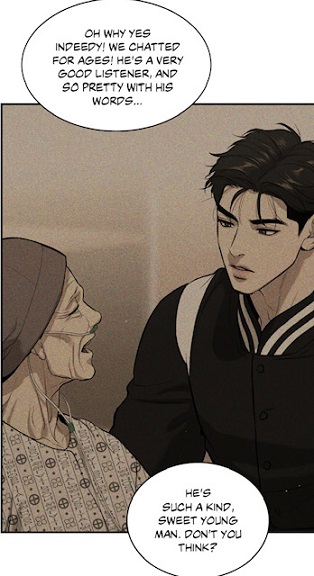 (chapter 22) He is the reason why the champion became a fighter, just like Kim Dan became a physical therapist for his grandmother. This explicates why the athlete knew how to talk prettily to an elderly and how to assist the sick grandmother
 (chapter 21). Joo Jaekyung is used to this. But there’s more to his name. However, before exposing more about his name and his personality, I would like to examine this panel again.
 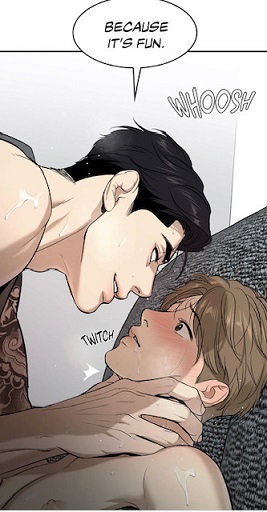 (chapter 24)
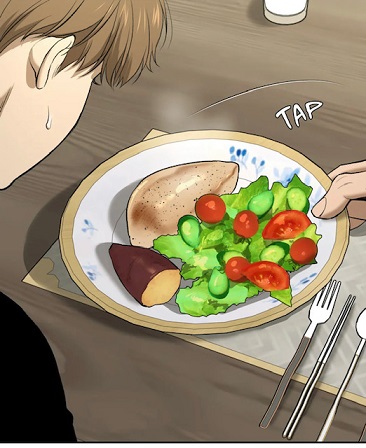 (chapter 13)
 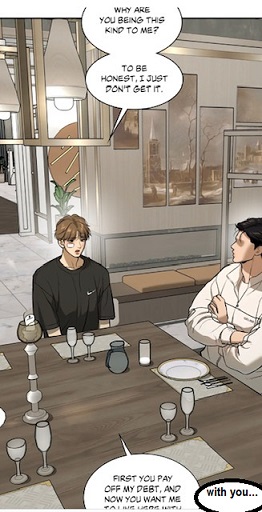 (chapter 18) As a child, he was encouraged to drink his glass of milk and not to drink these sweet yoghurts.
  (chapter 21) They were definitely judged as unhealthy, for they contain a lot of sugar. It is no coincidence that Seo can mean “order, discipline and age”. This man was definitely strict. Hence the main lead never experienced a caress and a warm hug from his guardian.
 (chapter 22)
  (chapter 22) Seo Gichan must have never cooked for the athlete, he simply hired a nutritionist!
 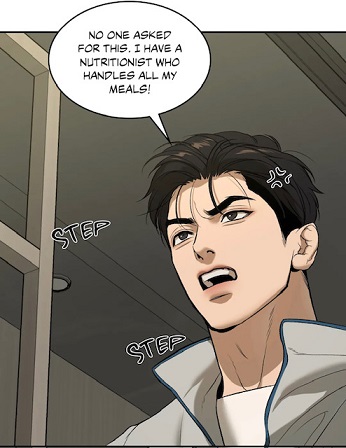 (chapter 22) However, I doubt that Seo Gichan is living like the athlete. I am suspecting that he enjoys good meals. Why? It’s because Chan can mean “meal, eat, food, delicacies“!! Moreover, Seo can refer to hungry. Hence I don’t think that he is as slim and fragile as the halmoni, quite the opposite! Why? First, his name Gi can signify “rhinoceros” or “piebald horse“, an indication that he must be robust. Additionally, this ghost is linked to “west”, “dawn” and willow, which reminded me of Park Namwook. The latter is represented by “morning sun, rising, mountain cherry and camphor tree“!! How does the coach look like?
 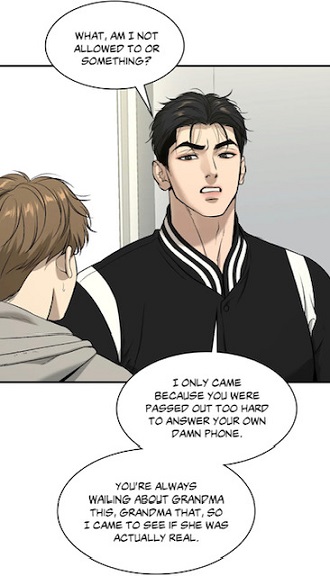 (chapter 22) Is he actually real?
  (chapter 23) For me, their path will cross, especially since Potato is a reflection of Kim Dan. The former could view the physical therapist as a source of danger for his idol. But let’s return our attention to my interpretation. Seo Gichan comes from a humble background, but he could raise socially, the exact opposite of the grandmother’s destiny. This is not surprising that Gi can signify “rise, raise and get up“. Hence he was not rich and powerful from the start. So how could he come close to a chaebol heir? It is because he was his guardian. He must have gained the chaebol family’s trust. Thus he could indoctrinate his pupil telling him that poor people are to blame for their misery. In other words, Seo Gichan must have sold himself as a self-made man which would explain why Joo Jaekyung is such a hardworking athlete and he is not living on his wealth. I have the feeling that in reality, he is more like Heo Manwook, the loan shark. He took advantage of the situation. (“Gi”: machine, opportunity”)
 (chapter 18) In the analysis “The bright calamity”, I had elaborated that this painting was reflecting the protagonist’s name and as such his personality. But we know that Joo Jaekyung has no knowledge about culture:
 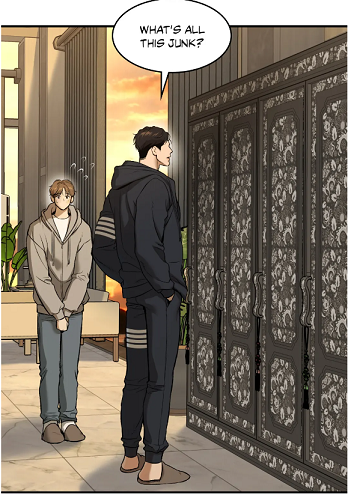 (chapter 19) For me, the painting reflects not only the champion, but also the mysterious man. Why? His name can also signify “book, divination, lucky, auspicious, oath and libation cup“, hence I included the bowl from episode 9 in the illustration. All these idioms belong to the semantic field of religion and faith, thus we have the church in the picture. And that’s how it dawned on me why Joo Jaekyung came to choose abstinence and is refusing to drink alcohol with his fellows. It is because he is drinking with his “master Seo”, his priest!! Besides, Gi can refer to “base, basic, foundation“. He is the owner of the champion’s past (Gi= to record, note and remember“). Thus he could distort the champion’s past memories and childhood. Under this new light, it occurred to me that Seo Gichan is the cause for the champion’s false belief:

 (Doctor Frost, 175) And that’s how I realized another divergence between the halmoni and Seo Gichan. Kim Dan’s grandmother might have played a role in Kim Dan’s suffering, but it was not done on purpose. She had trouble herself, the main culprits were the parents. Moreover, though both (Seo Gichan and the grandmother) wanted the main leads to remain “boys” and “children”, the grandmother was more focused on the past because of her imminent death, while I am quite certain that Seo Gichan is more thinking of the future! He wishes to take over the inheritance, though he must be quite old. In other words, he is not realizing his own immortality. That’s the reason why I believe that he will be the biggest enemy of our beloved couple, for Kim Dan represents a threat to his power. Gi means “afraid, careful, abnormal, unbalanced, lopsided“, hence I am suspecting that he will use tricks to get rid of the physical therapist.
  (chapter 22) Moreover, the White tiger is the king of terrestrial beings which coincides with the manager’s function. Namwook is the representative of Team Black.
 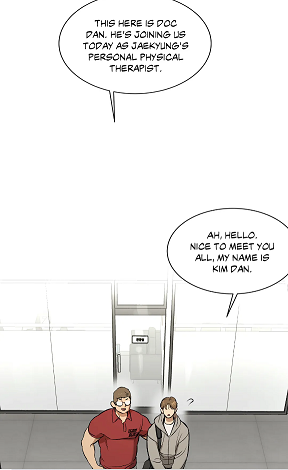 (chapter 7) Thus I believe that together, they will be able to free Joo Jaekyung from his suffering and his mental prison changing his destiny. In reality, the main lead was destined to greatness.

 (chapter 108) But then I changed my mind about the lord, for Yoon Seungho didn’t rely on just one testimony contrary to his father:
  (chapter 86) Finally, thanks to the argument in the shed, I had another revelation which I will explain more details below.
 (chapter 108) He blames himself for everything. For me, these women were lying to their master. Why do I think so? The first proof is that the painter’s fate is to go through the same experiences than his lover. And what did the valet admit in the shed?
  (chapter 108) There was not a soul in this household who was standing by his side back then and now! This signifies that there is not a soul in the mansion truly standing on the painter’s side as well!! Back then (before the massacre) and even now… Moreover, while these maids’ attachment was sincere
  (chapter 51)
 (chapter 63), this doesn’t signify that it is the same for all the female servants. This would be just another prejudice.
  (chapter 108) Yes, this woman is not the same than the one from chapter 51, for her clothes diverge despite the same pigments. She is wearing a white ribbon around her waist.
  (chapter 108), whereas the other wears the belt more around the hips, hence her skirt has a bump on her butt.
  (chapter 108) First, when the manhwalovers saw him in the kitchen, he was eating to his heart content and enjoying his breakfast.
  (chapter 38) Moreover, the painter had long stopped eating with the maids, he would share his meals with the main lead.
  (chapter 46)
  (chapter 74) This explicates why the artist returned the table with the porridge to the kitchen himself.
  (chapter 98) This means that they couldn’t witness how the artist would eat. To conclude, the statement from the staff was once again a mixture of truth and lies, for they were combining different situations together. Hence their apology was not genuine despite their gesture.
 (chapter 62) The painter had been faking his “submission”, hence the “valet” got fooled. He had trusted the artist blindly. Thus the lord got angry, and resented the butler, for he wished the opposite. He didn’t want to admit that the artist had been acting. Yet, the seed of doubt was implanted in his mind. Consequently, in episode 108, we have the exact same situation, yet contrary to the past, the lord didn’t get angry at his lover. He never condemned the painter for his dishonesty, though he was not truly lying either. To conclude, chapter 108 is a reflection from episode 62. Thus it dawned on me that the valet could have attempted to fool his master once again. The artist was a hypocrite, for he was acting in front of the lord hoping that he wouldn‘t cut ties with him. It was for his best interests to send back to the kisaeng house. Yet, nothing like that happened.
  (chapter 104), a sign that he was recovering. But due to the two incidents during that day, Baek Na-Kyum had been feeling unwell and was hiding his discomfort out of fear of getting abandoned. This means that the deceivers were trying to portray the painter’s actual disposition as something unchanging. Since the painter had trouble with eating now, his eating disorder existed in the past. And this perception got reinforced, for the lord could notice afterwards that the maids’ statement had become a reality. What they had described, truly happened afterwards. Due to worries and anxieties, the artist lost his appetite. He would fake his “happiness”. The manhwalovers could witness how the painter had slimmed down
 (chapter 108), just like his “husband”
 . (chapter 108), a new version of episode 51. This time, the roles had been switched, the painter was sitting in the patio. To sum up, the schemers and the accomplices were creating a prejudice, a so-called universal truth. This is the negative reflection of season 1, where the gossips about Yoon Seungho were turned into a reality. In many of my previous analyses, I had outlined that these rumors about the protagonist had been false.
  (chapter 1) He couldn’t have a proper erection, and it was never his choice to have sex at any time and any place, because he was treated as a male kisaeng. And now, it is the painter’s turn. Gossips about him would become a verity. Yet the other difference to season 1 is that in season 4 the artist is exposed to the same “prejudices” than Yoon Seungho in the past: He is ill!! He needs to be treated and the “gibang” is the right place for that🤮. He would be with his noonas, a new version of the lord’s past. And now, you comprehend why father Yoon said this to the physician in chapter 57:
  (chapter 57) A single incident was turned into a generality, implying that it was the same in the past!! To conclude, the noble is put into the same situation than his own father, the only divergence is that Yoon Seungho has indeed the painter’s best interests in his heart. He is determined to provide him with the best!! Thus he blames himself contrary to the elder master Yoon.
  (chapter 104) This statement implies that the painter is responsible for the bloodbath, for he left the propriety. Yet, instead of confronting the painter, he was encouraged not to talk about the past. He was suggested that way, he would protect the artist’s mind and heart. Besides, his choice was influenced by his own anxieties. The lord fears argument, because the last time they had quarreled, the artist had threatened his lover to leave the place.
  (chapter 85) I would like my avid readers to keep in mind that the lord wished to keep the artist by his side, sending the artist back to the kisaeng house was just a temporary measure.
  (chapter 105), yet the painter had heard something different from his noona.
  (chapter 105) That’s how a misunderstanding was created, provoking the painter’s abandonment issues to resurface. The lord had selected secrecy and silence out of love for the artist. Therefore when the lord sensed Baek Na-Kyum’s agony, he could only jump to the conclusion that the painter was acting the same way than him. He was also hiding something from Yoon Seungho. That’s the reason why the lord didn’t argue with Baek Na-Kyum.
  (chapter 107) He imagined that the artist was doing it out of concern for the noble. He was projecting his own thoughts onto the artist.
  (chapter 68) According to this belief, the lord brings bad luck to others. This rule can only incite the main lead to doubt himself, to judge himself in a negative light, to doubt his own judgement. Moreover, the perfidy is that this principle pushes the protagonist to deny the existence of his own misery. It was, as though the lord had never suffered, only the others. This “faith” represents the biggest lie and hypocrisy. However, the main lead questioned this rule in front of Yoon Chang-Hyeon,
  (chapter 108) He remains seated by his side, because he is projecting his own reaction onto his loved one. Remember how Yoon Seungho reacted in the past with Lee Jihwa: he pushed his childhood friend away.
  (chapter 59) It was, as if Yoon Seungho feared to taint the painter by sleeping next to him. However, the artist’s biggest wish is to share the same bed than his lover.
  (chapter 97) To conclude, Yoon Seungho’s life is still influenced by a false cult, by propagandism. This faith is is based on Rene Girard’s theories about mimetic desire and scapegoat mechanism.
 (chapter 250) Hence the man created the following theory which is inspired by religion.
  (Doctor Frost, chapter 250). Under this new light, it becomes comprehensible why the author from Doctor Frost utilized the image of a black sheep as the future scapegoat. IT was selected, because it stood out. And you comprehend why Yoon Seungho became the target in the end. His good reputation attracted envy and jealousy.
 (chapter 57) Why? It is because each noble family aspires to the same: power and wealth!
  (chapter 86) I had already detected father Lee’s jealousy and greed, just like Kim, Yoon Chang-Hyeon and Yoon Seungwon. The butler and the father might have desired the same (recognition and fame), but this could only end up in resulting in rivalry and jealousy.
  (chapter 107) This explicates why Yoon Seungwon was mentioned by the man with the purple hanbok. He implied that the son might have been well educated, yet he must be lacking elsewhere: his sexual education…. as his other task is to have a heir. This means that by standing out, Yoon Seungwon caught the jealousy and envy from other yangbans, though I have my doubts if he truly passed the civil service exam first. In other words, it is better not to stand out.
  (Doctor Frost, chapter 183) Since deprogramming is like brainwashing, it signifies that for the brainwashing, the victim needs to be isolated and even imprisoned too. And in order to be effective, the target of the brainwashing has to be exposed to stress and lack of sleep.
 (chapter 187) Fatigue and exhaustion are necessary in order to lower the target’s defense mechanisms. This explicates why it has to take place during the night, for the night is the time for humans to rest. Therefore the place of brainwashing is called “the fox’s hole” in Doctor Frost.
  (Doctor Frost, chapter 187).
 (chapter 187) The Ganzfeld effect happens when you undergo sensory deprivation for some time, and your brain tries to make sense of what is happening. Just 15 minutes of sensory deprivation can induce vivid hallucinations, according to researchers. This process involves muffling the ears and blindfolding, so people are unable to see or hear. And note what had happened to Baek Na-Kyum during the abduction. His head had been covered
  (chapter 66), and according to me, while his head was covered, he got strangled. Hence he had this nightmare.
  (chapter 61) But he lost notion of time and chronology, hence his nightmare is not coherent. One feature of altered states of consciousness during Ganzfeld exposure is an altered sense of time. In general, regardless of the induction method, altered states of consciousness can be characterized by changes in the sense of self and time. But this can only happen, when the brain is deprived of stimulations.
  (chapter 187) I had already outlined that Yoon Seungho had lost not only the notion of time, but also all his senses. And the nightmare is displaying the evidence of the Ganzfeld exposure. Hence the young master viewed himself flying
  (chapter 74), and at the end his eyes and ears got covered by hands and blood.
  (chapter 74) Besides, he was trapped in the dark room which looked like the servants’ quarters. Only thanks to the painter, the lord could recover his own senses, slowly he became the owner of his own body again. In addition, remember what he said to his own father:
  (chapter 86) The darkness he was referring to is the indication of “Ganzfeld effect”. Because he was trapped in this nightmare, he lost the sense of reality. He had to rely on someone else’s senses and words. That’s how his memories got repressed and even distorted. Consequently, a new past could get recreated. That’s the reason why the lord had no memories for a long time. The valet was the “owner of the truth and as such of the time”. We could say that till the meeting with the painter, he possessed the lord’s memories. Besides, one of the side effects of scapegoating is becoming vulnerable to gaslighting.
  (chapter 62) Under this new light, it becomes comprehensible why the lord didn’t lose his whole sanity and as such didn’t fall completely into despair. The warmth and light served him as a guidance. Consequently, I deduce that in his childhood, he was trapped there in the dark for hours!! Because he was jailed in that room, he was exposed to the Ganzfeld effect. Therefore he relied on the valet’s words.
 (chapter 77) He trusted the butler, even after getting betrayed and abandoned each time. He developed blind faith in the butler. Why? It is because he was the only one “talking to him”. Though he wounded him so many times, he still remained by the lord’s side. That’s the reason why I come to the conclusion that the shed is not just a room for punishment, but also for “faith”, the place where the scapegoat was placed: “
 (chapter 77) That’s the reason why he got treated like an animal. This is no coincidence that in the storage room, the butler utilized such a religious vocabulary: “I do not believe”
  (chapter 62); “beg”, “trust” a synonym for faith,
  “soul”, ”
  (chapter 108) Moreover, I would like to outline that the main lead was seen sitting while looking up
  (chapter 83) It looks like Yoon Seungho was praying, when Lee Jihwa opened the door. This means that Yoon Seungho has been treating Kim as his idol, his highest priest. Besides, doctor Frost explained why people become victims of brainwashing.
  (doctor Frost, chapter 191). This description fits to the shed, the lord was not only cornered mentally, but also physically.
  (chapter 32) What was he doing there, and why was he looking at the bedchamber? It is because he imagined that after the sex session, Yoon Seungho would send the painter to the shed as a punishment for his desertion. Let’s not forget that during the day, the whole staff had been beaten by their master. Besides, I would like to point out that the staff in season 3 viewed the painter as a spoiled brat, for he was receiving the lord’s favors.
  (chapter 98) Consequently, I deduce that when the valet got punished in season 3, he portrayed the painter as a tattler for that reason. He didn’t want to become the scapegoat in the end.
  (Chapter 77) At the same time, receiving treatment from the physician, Kim could say that the lord regretted his decision. These new discoveries reinforce my prediction that the painter is doomed to become the next scapegoat!! Yet, chance is on the couple’s side. On the other hand, this signifies that someone will have to become sacrificed!
 (chapter 108) for his wrong choices, I come to the opposite interpretation. Naturally, if the manhwalovers compare the butler’s apology in the shed to the one in the library,
  (chapter 77) it really looks like Kim is sincere. He is no longer standing, he is now weeping. Finally, he is not blaming someone else (the kisaeng), but himself.
  (chapter 108) Nevertheless, for me, everything is an illusion, and you can only detect the manipulations, the moment you examine closely Kim’s words.
  (chapter 108) Kim feigned ignorance, and the lord confronted him with his lie, he admits that in reality he knew something.
  (chapter 108) He had not told him about the shaman’s house on purpose. He had hidden the truth by omission. He justified his decision by using the “townsfolk” and their liking of creating gossips. However his real task was to protect his lord’s interest and inform him about everything. He made a decision without his lord’s permission, and as such he usurped his authority. He acted, as if he knew what was the best for Yoon Seungho. But this doesn’t end. What infuriated me the most are these two declarations:
 (chapter 61) The red-haired master utilized the present perfect tense, which is a combination of the past and present!! This time reveals that the young man was about to move on. On the other hand, the butler is either referring to the past and to the future, but not to the now! This means, he has no regret right now. He is projecting himself in the future. He implies “regret”, but he is not truly admitting it. Finally, when the childhood friend came to regret his choice, he voiced it outside the barn!!
  (chapter 61) This contrast outlines that the storage room is the place of illusion or false faith.
  (chapter 108): Here, my blood was literally boiling, when I read his second “confession”, because here he was now omitting Yoon Seungho. It was, as if the protagonist was not existing. His words were actually reflecting a new betrayal towards the main lead. Here, he was vowing loyalty to Baek Na-Kyum and not to Yoon Seungho!! He insinuated that if he was taking care of the painter, he was protecting Yoon Seungho’s interests. However, the artist and the noble are two different persons. Imagine the following situation: The main lead gets arrested for “murder”, the butler could justify his vanishing, passivity and silence by saying that he needs to take away the painter from the mansion so that the latter avoids getting into trouble as well. As you can see, he would keep his promise, but he would sacrifice Yoon Seungho. With his words, he was insinuating that he only had two choices: the elder master Yoon or the painter. Besides, once the lord were to be removed, Kim could put the whole blame on the painter afterwards. If he had not left the house… That’s the reason why I viewed the last statement as the biggest treason. In reality, he was not vowing loyalty to the main lead. This scene was a reflection from episode 30, where the artist had pledged loyalty to the main lead
  (chapter 30) and this in front of people. This explicates why the butler got grabbed in the storage room
  (chapter 108) like the painter in the courtyard.
  (chapter 30) We could say that it was the butler’s karma for his past manipulation. He had been the one who had encouraged the painter to flee the mansion (chapter 29/30). But this doesn’t end here. When the artist vowed his loyalty to the protagonist in the courtyard, the latter was present, which is not the case here. The artist is left in the dark.
  (chapter 108) Where is the personal pronoun “I” here? Nowhere. Only the lord cares for the painter, this was the butler’s declaration in the end. But what about the tears? How could he fake the crying?
  (chapter 81) When the lord had wounded his lover, when he was in a dissociative state, he had perspired so much that his sweat was falling like tears!! As you can see, fear could be the reason why drops of water were falling. Let’s not forget that the main lead had treated Kim very harshly and even threatened to have him killed, something he had never done before.
  (chapter 108) Kim had reasons to get scared and to sweat.
 , chapter 108, or my lord
  (chapter 108) However, the manhwalover should question this. Why did he regret that day? It is because he had revealed his true thoughts about Yoon Seungho to the painter, and he got reprimanded from the artist. Besides, according to me, he had hoped that the artist would leave the mansion due to the altercation. In addition, when he mentioned this scene, he wanted to appear as honest, because he had no idea if the artist had leaked this conversation to Yoon Seungho. Finally, just because he told the truth here, we shouldn’t judge the butler’s confession as verity. To conclude, for me, the valet was not really remorseful, he was more acting.
  (chapter 108) However, this is another illusion which can be easily refuted.
  (chapter 108) This memory is the same than the painter’s
  (chapter 108) In other words, the butler had acted on his own, and informed his master afterwards, when this information was necessary in order to protect himself. As you already know, for me, the butler had definitely acted on his own. But why does Kim need to deform reality so much? It is because he was present, when the young boy was abused sexually and he did nothing. He needs to erase the “traces” of the rape so that his culpability will not come to the surface. Just like the painter, Yoon Seungho has totally forgotten the sexual abuse. Besides, he never mentioned the incidents about the shed to the painter, only the bedchamber.
  (Chapter 87) Here, he was already hiding his guilt by turning Yoon Chang-HYeon into the main culprit. He is responsible for the lord’s suffering.
  (chapter 68), but he had heard a different story from the painter.
  (chapter 93) However, now I understand why Yoon Seungho was not able to discern the hypocrisy from the assistant.
  (chapter 188) It is related to the long brainwashing he was exposed for so many years and the lord’s low self-esteem. Thus I perceive this argument in the storage room as a new version of episode 40, a confrontation between the painter and the scholar. But who had been defeated in the shed? Yoon Seungho was still the loser, for he kept his distance from his lover afterwards.
  (chapter 108) He was making sure that no one would know that the painter was his weakness.
  (chapter 108) The new version of episode 50-51!! However, this was totally pointless, for the painter was living his bedchamber. His position was the proof that the painter was still favored, though the artist feared to be abandoned by the painter.
  (doctor Frost, chapter 187) This means that the couple has to communicate and the painter will interrogate his lover.
  (chapter 187) But this deprogramming is not pleasant, for the destruction of believes leads the victim to question everything afterwards. What caught my attention is that the painter went to the library, the symbol for “knowledge and education” which stands in opposition to the shed. This is no coincidence. Brainwashing is the antonym for insight.
  (chapter 108) In addition, the lord was dressed like in episode 36, he had the green hanbok.
 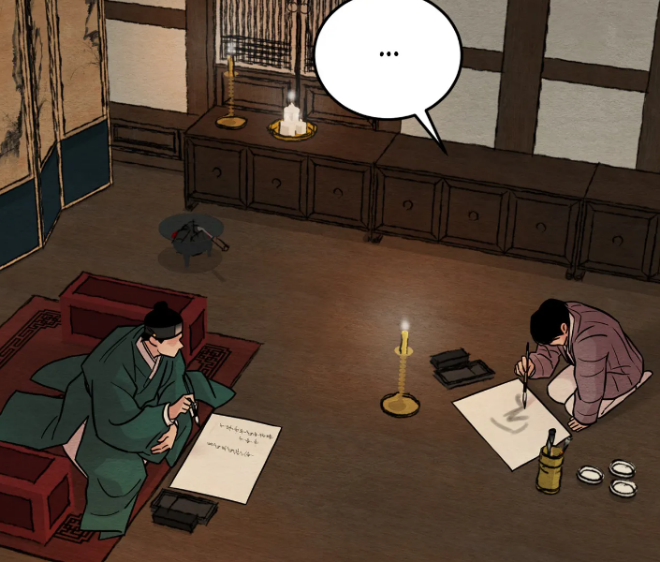 (chapter 36) Back then, the painter didn’t talk to the owner of the mansion. Finally, this episode is connected to the lord’s memories:
  (chapter 36) That’s how I had this revelation. The lord’s suffering is also linked to the library. From my perspective, the young master was dragged from the library to the shed at some point.
  (chapter 77) I had already pointed out that in episode 77, the main lead had been dragged on multiple occasions, for he was dressed differently, and the servants would be different. Because I had described that the lord’s mind had been manipulated by indoctrination and the butler had confessed, I deduce that the next episode will contain elements from episode 48/49.
  (chapter 49) That’s the moment the painter dropped the last principle from the scholar and kisaeng. For me, something similar will take place, but such a deprogramming is painful. From my point of view, Jung In-Hun will be mentioned, as in the same place, the scholar had mentioned the painter’s past and future.
 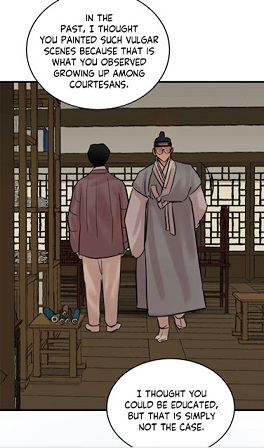 (chapter 40)
  (chapter 40) Since the shed embodies the valet’s betrayal, the lord voiced his abandonment issues there. On the other hand, the library symbolizes the teacher’s abandonment. This is not random. Baek Na-Kyum can not read, the symbol of the learned sir’s negligence. Hence I am expecting a new confession from the artist, like this scene:
  (Tweet) So far, the artist has never spoken ill of the teacher. To conclude, the library is the place where both protagonists will experience a new liberation! For me, episode 108 and 109 are focused on education, responsibility, memories and truth. That’s the reason why I am suspecting that the painter’s words will trigger the lord’s memories so that the verity about his own past will come to the surface.

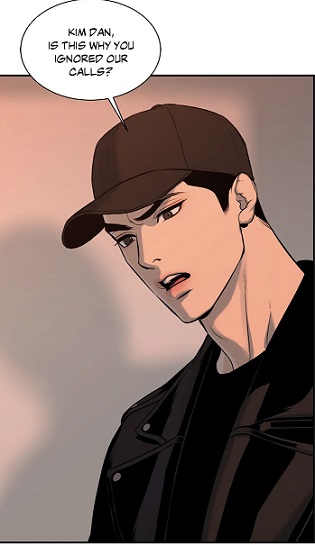
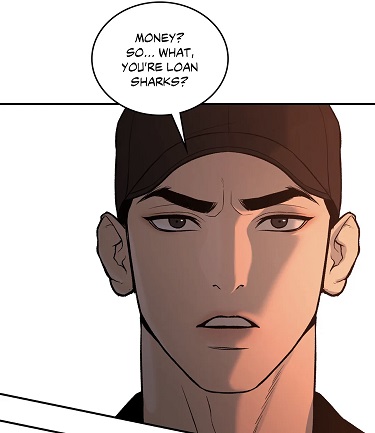

 (chapter 17) In Kim Dan’s house, he always had a poker face, even when he got insulted or threatened. He kept his composure all the time which stands in opposition to his attitude, when he faced Randy Booker.
 (chapter 14) Just before his fight, he had a face like thunder. Why did Joo Jaekyung react so vehemently, when he faced the professional fighter, while he looked so detached and distant in episode 17? Moreover, observe that the English translator employed the same comparison than Randy Booker
 (chapter 17) In the Korean version, the idiom is more like “punk” or “nerd jerk”. Nevertheless, why did the fighter remain composed despite being looked down? Besides, it seemed like the athlete was facing the same situation, yet his behavior diverges so much. Why?
 (chapter 17) Moreover, it forced Heo Manwook to explain his action:
  (chapter 17) This means that the champion’s previous questions (What are you doing?”; “Who the hell are you?”) got answered with his arrogant and selfish attitude. To sum up, he diverted the bullies’ attention from Kim Dan. At the same time, because of his indifference and poker face
  (chapter 17) Striking is that even after knowing everything, Joo Jaekyung acted, as if he didn’t care about Kim Dan and his debts.
 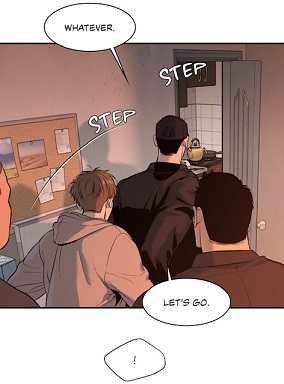 (chapter 17) This shows that Joo Jaekyung’s actions and words were not random at all. No one should suspect about the existence of their deal, his sex partner for his jinx. In the thugs’ eyes, the athlete was appearing as Kim Dan’s boss. He was selfish and uncaring. Thus certain readers judged the protagonist as a heartless jerk again. However, in order to perceive someone’s personality correctly, it is important to question the intentions and motivations behind people’s actions. Like I have already mentioned in a different essay:
 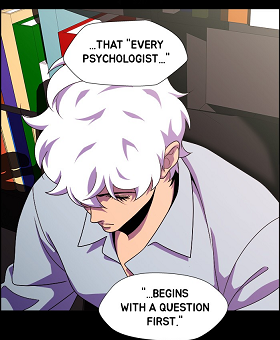 (Doctor Frost, chapter 216) Why?
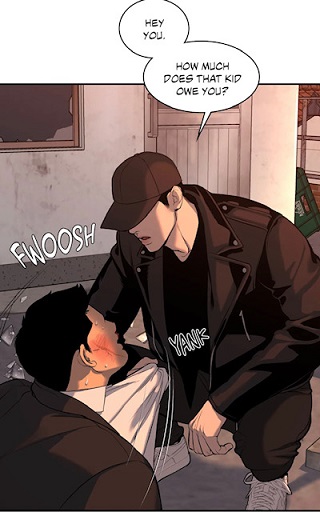 (chapter 17), and not before. Notice that he discovered the existence of the loan much earlier, yet he chose to ignore this. Why didn’t he pay it before? In my eyes, it is because he had anticipated and even planned the fight! He let his opponent reveal his weaknesses:
 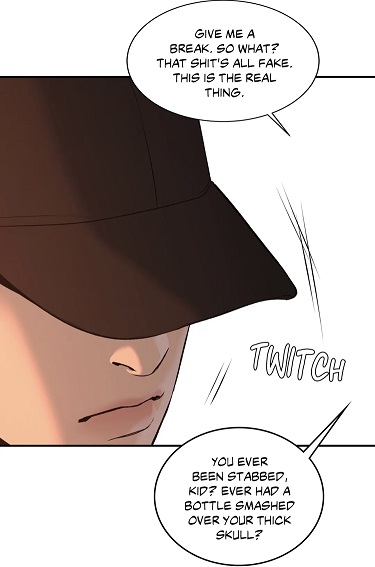 (chapter 17) The loan shark would never plan how to fight. He would use the knife and the bottle, when they are under pressure. Striking is that during this revelation, Joo Jaekyung chose to hide his gaze… he had perceived his opponent. They were not trained as fighters. The covered gaze is an indication that he understood that the more he ignored the thugs, the more the usurer would get angry. His pride could only be hurt with such an attitude. Consequently, I come to the conclusion that this fight was no coincidence. The main figure had acted exactly like in the ring: provoke his enemy
 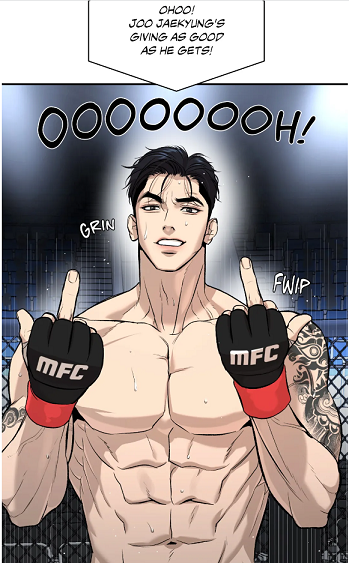 (chapter 15) so that the latter would lower his guard and make a mistake. That’s the reason why Joo Jaekyung was so rational and expressionless, while the moneylender would get more and more mad
  (chapter 17) Heo Manwook was to blame for this. Thus I believe that when he said this to the villain, he was hiding the manipulation. That’s why he was not smiling like in the ring.
  (chapter 15) His poker face served one purpose: to hide the existence of his strategy and his true thoughts. His counterpart should never discover that he had been incited to start the fight. We could say that this was Heo’s karma, for the latter would always use fake excuses to justify his brutality towards Kim Dan.
  (chapter 17) Thus the room got crashed. It was, as if a hurricane had ruined the room. That’s how all the villains came to fear him. As the manhwaworms can detect, he paid the debts only at the end for one reason:
  (chapter 17) Therefore I have now the impression that he must have paid the loan with the Black Team’s account. Why? That way, he can maintain his image: he is the protagonist’s boss. At the same time, he is making sure that his employee can work properly. Moreover, it is important that no one discovers that Kim Dan represents his weakness.
 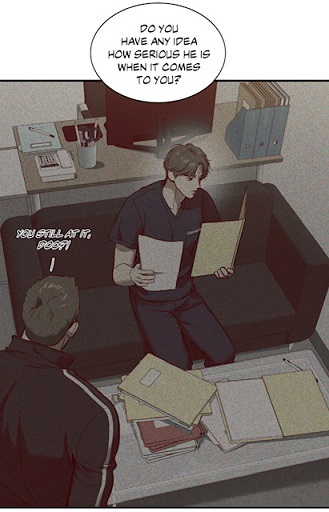 (chapter 17), for he spent the whole night studying his files, the young fighter was no longer arguing.
 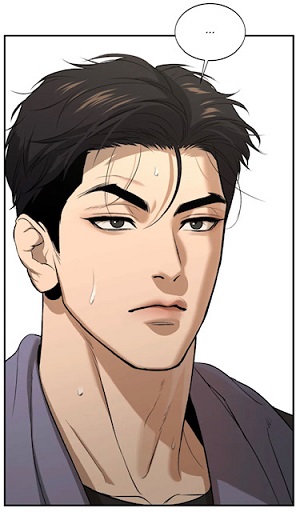 (chapter 17) His raised eyebrow indicates his interest and surprise. We could say that his hyung’s words had such an influence on Joo Jaekyung that the latter decided to trust him. Hence he obeyed his coach and went to the main lead’s home. Though he was annoyed and questioned his hyung’s statement, he still wondered about the reason for his absence.
  (chapter 17) For me, this scene outlines Joo Jaekyung’s sense of responsibility He doesn’t abandon the doctor in the end. Striking is that after hearing his manager’s comment, he had the same facial expression
 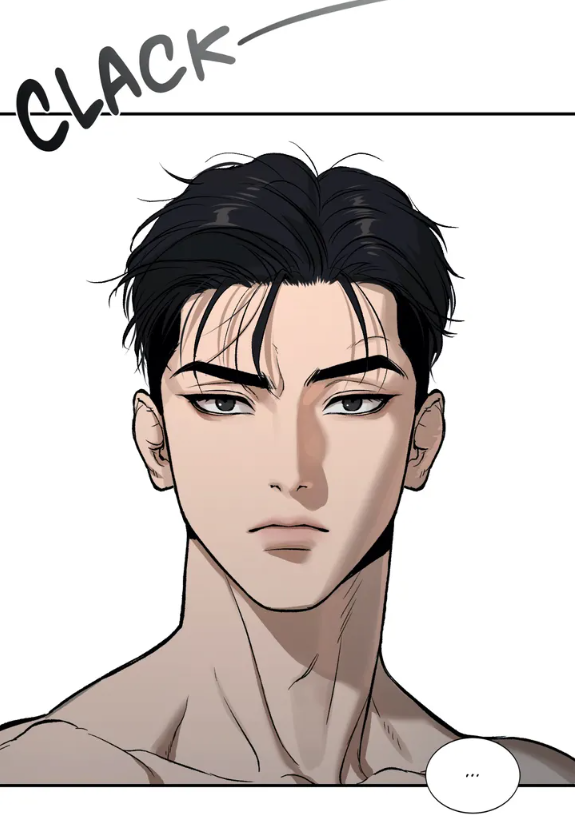 (chapter 1) This shows that the raised eye-brow is exposing the athlete’s thoughts and emotions: he is intrigued and captivated. I would even add that it indicates that the champion is pondering! And now, pay attention to his facial expression, when he faced the broken bottle:
 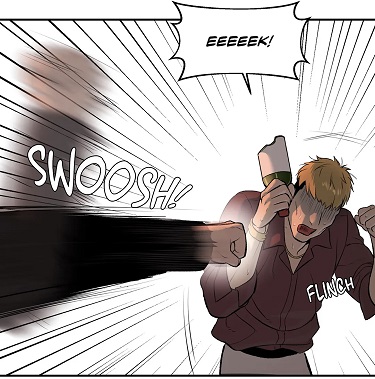 (chapter 17) As the manhwaphiles can detect, the athlete fooled everyone in this chapter. Due to his poker face and his cold shoulder, Heo Namwook and his minions never recognized that they had been provoked. At the same time, the raised eye-brow is betraying the athlete.
 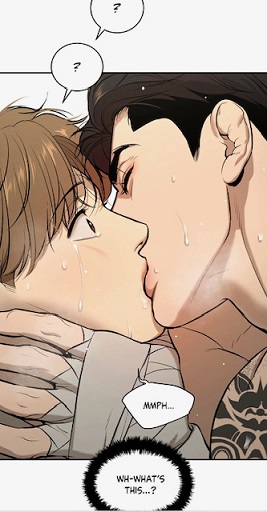 (chapter 15) This explicates why the sportsman makes all sort of facial expressions due to the doctor: anger
  (chapter 5)m then pleasure
  pleasure (chapter 12), sulking
 (chapter 15) Because of Kim Dan, he can lose or regain his countenance. And what is the opposite of indifference? Compassion, sympathy, interest and respect!! This is no coincidence that the more the athlete interacts with the main lead, the more he exposes his generosity and consideration. That’s the reason why I come to the deduction that the more the athlete shows emotions on his face, the higher the risk is that his opponents will discover the champion’s secret: his attraction and attachment to Kim Dan and as such his weakness.
 (chapter 2) the uke from episode 2 who knows about the protagonist’s superstition: He has every reason to resent the couple. Joo Jaekyung not only insulted and injured him, but also he never considered him as a serious partner. On the other hand, the doctor was able to get close to the athlete to the point that the latter would suggest that Kim Dan moves in his place! It is only a matter of time, until it takes place. This means that in the future, the manhwaphiles will witness how Joo Jaekyung loses his countenance because of his attachment to the protagonist. He will become a fury outside the ring
 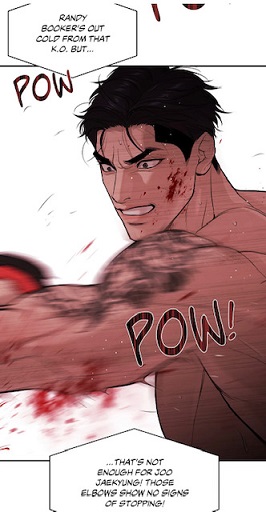 (chapter 15), because his lover got hurt or threatened, the opposite from episode 17!

 (chapter 105) Imagine that despite his rush, he was clear-minded enough to take the yellow scarf, a present that the noble had just bought him before. 😢 The item had more value than the mituri (shoes). Thus he was running in socks. His gesture displayed how much the lord means to the painter. He cherishes everything the lord does for him. At the same time, it indicates his heartache. He was so desperate and scared, for he felt that he was about to get abandoned one more time.
  (chapter 105) According to my follower @katamins, in the Korean version, this is what Baek Na-Kyum yells:
  (chapter 105) it works like a spell or a prayer. The artist is clinching onto this phrase hoping that the noble is remembering his promise. The irony is that the low-born was smiling like a fool,
  (chapter 105) masking his anxieties and huge pain… out of fear that Yoon Seungho would still reject him. He acted, as if nothing had happened: he had not hurt his hand, and the lord had done nothing wrong. The smile became the symbol of his agony which reminds us of Yoon Seungho’s.
  (chapter 83)
 (chapter 85) This means that Baek Na-Kyum was put in the same situation than his lover who wished to keep the artist by his side, but feared to open up to him out of self-hatred and guilt. The painter could get burdened or horrified by his revelations. Hence the painter’s reaction at the end mirrors the yangban’s in the study. Both were or are pleading the partner to stay by their side,.
  (chapter 85)
  (chapter 105) Nevertheless, their behavior diverges so much. The aristocrat couldn’t raise his voice or become violent by using his hand, because he could scare the artist and as such break his previous promise. Finally, by destroying the music box, he had already witnessed that he had pushed his lover further away.
  (chapter 85) At the same time, since he had been taught that no noble should lower himself in front of commoners, it is normal that he couldn’t beg Baek Na-Kyum on his knees. To sum up, the noble had to restrain himself extremely, his face and words were the only way to show his emotions and despair. And the artist sensed it, though the lord was not weeping. The proof is that when the father appeared, the artist changed his mind. He was no longer willing to leave, in fact he chose to look for his lover.
  (chapter 87) This shows that through communication, the lord had been able to affect the painter‘s mind and heart. On the other hand, we shouldn’t underestimate the lord’s flashback and Na-Kyum’s conversation with the butler which played a huge part in the artist‘s decision to vow loyalty to Yoon Seungho despite the secret.
 (chapter 105) Then I noticed that contrary to his lover, the artist asked the reasons for his decision.
  (chapter 105) Why did he change his mind? Is he responsible for this? As you can see, the painter came to voice his guilt and the remains of his deeply rooted self-hatred.
  (chapter 105) He must have committed a wrongdoing, he is responsible for the situation. He feels like a burden, for the lord had to take care of him each night.
  (chapter 104) He wished to help, that way he wouldn’t be seen as a spoiled child. He has to justify his presence in the mansion. Who is he exactly that he is sleeping in the lord’s bed? I am suspecting that there is a rumor circulating within the propriety, a new version of this scene:
  (chapter 38) which I will explain more in details below. Thus the artist is making sure to cause no trouble to Yoon Seungho and the staff, especially the maids. Hence he folds the cover and clean the bedroom.
  (chapter 104) Then he washes clothes. He makes sure that he is no burden to anyone. Yet, my impression is that the staff is taking advantage of the artist’s goodness. That’s how they fuel his guilt and shame.
 (chapter 105) In the Korean version, this is what Heena says:
  (chapter 104) He was told not to question what he had heard… he should simply consider everything like a nightmare. However, this method is actually wrong.
  (chapter 07)
  (chapter 104) Not only he knows about the lord’s traumatic past, but it is the same for the painter. In addition, we have another explanation for Yoon Seungho’s insomnia and dissociative state.
  (chapter 57) Not only the latter was turned into the scapegoat for the downfall of the Yoons, but also he was not allowed to reveal the incident, the so-called treason. Why? It is because if he had spoken, the truth would have come to the surface. He was simply a victim. And now, the schemers and accomplices are repeating the same MO. Who suggested to Yoon Seungho to say this to his lover?
  (chapter 104) Naturally, Kim, because he is now the only one in the mansion who knows his past. Besides, why do you think that the lord’s past is coming to the surface as a nightmare? It is because he was incited to repress everything. But since the painter is going through the same experiences, this is not surprising that the noble’s memory is triggered and the past emerges again.
 (chapter 27) Put yourself in the young man’s shoes. You suddenly witness how the whole family is moving houses and leaving you behind! This must have been terrible for Yoon Seungho. One might argue that Kim stayed by his side, so he was not alone. But it is false for 2 reasons. The white bearded servant had been working in the mansion
 (chapter 27), when the other domestics left the propriety. This was his memory. Besides, like the servant confessed to Jung In-Hun, a huge part of the staff got replaced. This means that the lord was suddenly surrounded by people he didn’t know. Because my theory is that the young man was treated as a male kisaeng, this signifies that the new staff could never view the main lead as a noble. Besides, despite the betrayal, the elder master and Yoon Seungwon were his real family. Finally, Yoon Seungho had no saying in this, and I can imagine that the reason for this decision was not explained immediately. This must have been a huge blow for him as well. He must have felt lost and homeless. The result was that from that moment on, he became more dependent on the butler. And we have to question ourselves what the butler did with this huge responsibility, when the elder master moved to the second house.
 Since this phrase appears in connection with the staff (maids and servants) in the courtyard, I come to the conclusion that the authors of this gossip are in the domain. “Fellows” indicate that they are speaking among themselves. But I have two more clues proving that the traitors are the domestics. First, observe how they call the protagonist: Young Master Yoon.
  So far, people in town only calls the protagonist lord Yoon
  (chapter 45)
  (chapter 45) or lord Yoon Seungho
  (chapter 39) or my lord.
  (chapter 76) Only the staff addresses him as “young master”.
  (chapter 103)
  (chapter 103), and this since season 3. This coincides with the meddling of the Yoons. The servants treat him, as if he was not an adult, no real lord. But they are wrong, because he is wearing the topknot with the gat. Hence he is a lord. Finally, only people close to the couple could know about the painter’s tragedy.
  , because in the village and town, there exists another gossip:
 (chapter 104) Thus I conclude that the gossip from the trailer is spread among the staff on purpose. They wished Baek Na-Kyum to hear it so that he will feel responsible, especially after hearing this.
  He is responsible for the lord’s lunacy. Under this new perspective, it explains why the painter is leaving the bed and working. He wishes to prove the words wrong. On the other hand, I think that Yoon Seungho also heard a grapevine in the domain, but a different one:
  (trailer). “He has many enemies”. How did I come to this idea? It is because he is addressed as Yoon Seungho! By underlining the painter as his weakness, the author of this rumor wishes to separate the couple. If he were to place the painter elsewhere, not only the latter would no longer be targeted, but also the lord would have no longer any weakness. Since there is always a reflection within the same chapter, I conclude that a second grapevine was spread in episode 104. This happened, while the lord was away. Thus the painter smiled like a “fool”, when he saw the lord:
  (chapter 104) As you can imagine, for me the maids were the perpetrators, a new version of episode 79
 (here, the woman implied that the artist was responsible for Yoon Seungho’s insomnia, thus the painter has a drop of sweat on his face, a sign for shame) and chapter 98
  (chapter 103) Finally, the staff has every reason to get rid of the artist, for he is the witness of their wrongdoings. They definitely played a major role in the “prank”. They didn’t learn their lesson.
 (chapter 29) This time, the one smiling like a fool
  (chapter 29) was Jung In-Hun who acted, as if he knew nothing and had seen nothing.
  (chapter 29) However, I have already pointed out that he was present, when the rape took place, for he knew where Yoon Seungho would meet the artist: the pavilion. And what have all these episodes in common? The first thought would be to say: abandonment and betrayal. The painter in front of the gibang felt “betrayed” and abandoned, but what shocked the lord so much was when the artist started blaming himself:
 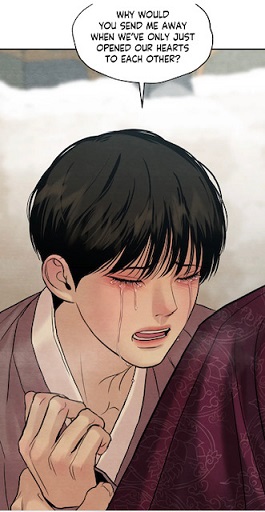 (chapter 105) We have to imagine that the painter wanted to say that he regretted to have opened his heart to the protagonist. Thus he said this:
  (chapter 105) “I had known, I would have never confessed” Nonetheless, he never finished his phrase, for in reality, he had no regret!! He was sure that he had made the right decision. It is because he had pondered a long time about this. He had observed his lover. That’s the reason why he mentioned their mutual love confession and as such their promise to stay together. And this brings me to the next observation. All these scenes have another common denominator: BAD DECISIONS!! The lord had made the wrong decision to entrust the painter to the kisaengs. Thus he came to regret this. He had made his lover cry, and even wounded him, though he desired to do the opposite. Therefore it is not surprising that he apologized to his lover.
  (chapter 105) This shows that the painter is showing him what true love and loyalty are. Moreover, he is teaching to make good decisions.
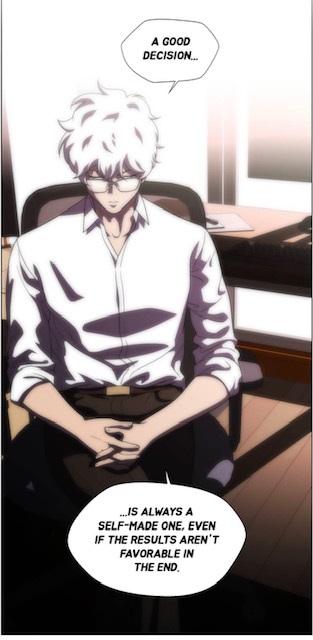 (chapter 246), I realized why Yoon Seungho suffered so much. Self-made decision implies a conscious choice. It is made deliberately and thoughtfully, considers and includes all relevant factors, is consistent with the individual’s philosophy and values. As you can see, it implies knowledge. This definition exposes that making a choice for the sake of another person without his consent or knowledge can never be a good decision. One might argue about this, because children are too young to make decisions. In Doctor Frost, this man
  (Doctor Frost 246) decided to support a terror attack, and justified this by saying that this was for his daughter’s sake. But like the counterpart pointed out, he questioned his decision. Was it truly his choice, or was he simply following the leader’s suggestion? As you can see, the daughter was used as an excuse, it was never for her sake. This shows that children are the exception, besides they are often raised by two parents. Thus they are making deliberations together. But like the author revealed in Twitter, Yoon Seungho’s mother hated her husband so much that she neglected her eldest son. The patriarch made decisions on his own, but observe that it was always for the Yoons’ sake. This means that the father never took his son’s well-being into consideration, he never asked him about his opinion. He imposed his will, but he listened to others, like we could see in different occasions.
  (chapter 57) He fed his son with the drug prescribed by the physician, though the latter stated that he had no idea about the illness. Then he listened to father Lee’s complains and reproaches. He never questioned the intentions behind his actions and words.
  (chapter 82) Here, the red-haired bearded man was encouraging the elder master Yoon to return to the mansion and claim his rights. Finally, the young master admitted this to the messenger:
  (chapter 80) If someone stroke his ego, he would follow their advice and never doubt their words.
  (chapter 104) But he simply employed reverse psychology.
  (Chapter 85) Yoon Seungho was coerced to open up. If he did not, he wouldn’t be forgiven. Naturally, the painter meant it well, yet the main lead was pressured to reveal his „bad action“. The main lead feared his negative judgement and rejection. We could say that the artist had made this request for the lord’s sake, however this was not a conscious and long deliberated decision. And now, you comprehend why the main leads suffered both so much!! Yoon Seungho’s mother neglected her eldest son, but she kept her distance from her husband. They never talked to each other, and as such never made decisions together. And it was the same for the painter. The kisaeng Heena was the one who made the decision without the noonas’ consent and her brother‘s opinion.
  (chapter46) Even in season 4, she has not changed her mind-set entirely.
  (chapter 105) She is still viewing the painter’s decision as a bad choice. But she is simply wrong, for the painter listened to her advice and after deliberations, he chose to open his heart. His confession was not made in the heat of the moment.
  (chapter 62) The lord’s vision
  (chapter 62) became a reality
 (chapter 63) Because the painter has always been betrayed and abandoned himself too, such words could only move the artist. There was someone willing to be by his side and to give him a home. Therefore it is no coincidence that the artist brought up these words from that night.
  (chapter 97) And why did she act like that? She justified that it was for the painter’s sake, and she knew more than her brother. The reality was that it was for her own sake. She was definitely cornered, for she feared repercussions. Moreover, she pushed her brother to follow her advice. And now look at what the noona said in front of Yoon Seungho:
  (chapter 99) and her “fake death”, but as you already know, I think, he heard her during that night. Note that the painter didn’t meet his noona Heena during that day. Since Heena and the staff played tricks so that Baek Na-Kyum ended up going to the scholar’s house, it is not surprising why the staff is putting the whole blame on the painter. However, who is responsible for this? Naturally, the staff, Kim and Heena. The latter made bad choices blinded by her arrogance and prejudices. Thus I deduce that Yoon Seungho learned a good lesson in front of the gibang. He should never make a decision without consulting his partner.
  (chapter 105) From my point of view, both need to learn to make decisions TOGETHER!! But in order to do so, the two main leads need to listen to each other and communicate. And this is what truly happened in episode 105. The young noble discovered the painter’s low self-esteem and his guilt. That’s the reason why I believe that Yoon Seungho will decide to talk about the scholar. The lord suspects the learned sir, for he thinks that he is still alive.
  (chapter 105) This signifies that the noble will decide not to follow the noona’s advice:
  (chapter 105) But by learning about the learned sir’s past, the protagonist will realize that he only knew a side about Jung In-Hun.
  (chapter 105) with the noona’s statement, the painter looks happy with Yoon Seungho despite the tears, it looks like the noona is slowly coming to terms with her brother’s relationship. But I have to admit that I believe that her “decision” is just short-lived. First, in season 2, the noona had accepted to let her brother stay at the Yoons’
  (chapter 69) But then she had changed her mind after hearing the menace from the servant. However, I have three other reasons to expect a change of heart from the head-kisaeng. First, Heena is the younger reflection of the butler. The manhwaphiles shouldn’t forget that the valet had almost come to terms with the painter’s presence
 (chapter 65), but the ruckus caused by the kisaeng had provoked a change of heart in the valet. Then, the lord had made the following condition to the kisaeng:
  (chapter 105) The lord is keeping his lover by his side, as long as nothing happens to him. So if he gets into trouble… she could achieve her goal, the painter is returned to her. But the most important clue is for me the bowl!
  (chapter 105) While many jumped to the conclusion that this was the medicine sent by the physician, I had a totally different impression. For me, this bowl was used to write a letter!! First, the color is different from the normal “medicine”.
  (chapter 23) Most of them look dark brown and not black.
  (chapter 36)
 (chapter 77) Besides, it never leaves traces on the edge.
  (chapter 36) The points on the border are the traces left by the brush. She wrote a letter. And I have another evidence for this:
  (chapter 36) The painter used white bowls while painting. On the other hand, the lord wrote a letter during that time. As you can see, in episode 36, we have the combination of painting, seduction (touching) and medicine… exactly like in episode 105. The artist tried to paint a lucky charm, a tiger, but he didn’t finish it. He got interrupted… which is very similar than in chapter 36. So the letter should represent another common denominator.
 (chapter 105) onto Yoon Seungho. Will she come to regret her action or not? One thing is sure, the painter accepted the sincere apology from his lover. How could he not forgive him after calling „Nakyumah“ and embracing him!
  (chapter 105) Both left the gibang together, while the artist was removing his tears. And this leads me to the final observation.
 (Chapter 76) By making the same decisions, it is not surprising that the same deed can never succeed. It was not a real self-made decision. They simply followed a pattern.
 (chapter 12) He even felt pleasure, thus he didn’t pay attention to the bruise on the doctor’s back. (chapter 12) Due to his lack of sensibility, roughness and selfishness, people are already on the verge of dropping this story. Even the young doctor thought, that guy was crazy.
  (chapter 12) No average person would behave that way. Thus he was already stigmatized as lunatic and as such as psychopath. Hence in the first part, I will answer to this question.
  (Doctor Frost, chapter 175) And this stands in opposition to the code of conduct of a psychologist. The word psychopath causes so many negative emotions like fears, rejection and hatred. On the other hand, the psychologist’s role is not only to detect the source of the problem, but also to offer a solution. This means that he is not allowed to let emotions cloud his judgement.
  (chapter 216) Moreover, the doctor has to show a certain understanding and empathy to the patient in front of him. And now, you are wondering why I am mentioning Doctor Frost again. It is because the protagonist was himself diagnosed as suffering from ASPD!! This diagnosis scared his parents so much that at the end, they started avoiding their own son. He was sent to a psychiatry. However, his doctor still believed that he had a chance to change. Thus he proposed a way to the young boy how to overcome his handicap!! He should study psychology so that he would come to “understand” the human mind. Because he was not capable to feel “emotions” like the others, he should utilize his mind to grasp them. Hence the more he studied the human mind, the more he was able to “understand” their problems. At the same time, the more he interacted with humans, the more he came to learn how to behave like a normal person. As you can see, “psychopath” is not even a death sentence. There’s still hope.
 (chapter 12) and keeps an eye on the doctor constantly. His plan to “have” Kim Dan was poorly planned, for he kept waiting for a sign from him. At no moment, he even thought that the doctor could block him or keep his distance from him.
  (chapter 5) He doesn’t ooze charisma or superficial charm, for he never hides his strength and power.
  (chapter 1) He even shows disdain, or strong emotions like rage and annoyance.
  (chapter 5) To sum up, he is not detached. Finally, he was still able to feel a certain sympathy for the doctor
 (chapter 10), hence he brought him to his home. He still listened to his request.
  (chapter 12) All of them must have definitely refused… too scared! This explains why the athlete proposed alcohol to the doctor in the beginning. (chapter 12) Thus I deduce that the man had long this wish, but he could never outlive it. This displays his selfishness. This was not planned in the long run.
  (chapter 12), which the main lead had detected either! (chapter 12) This exposes that during that night, the champion was paying more attention to his partner’s reactions contrary to the first night. He even asked him about his feelings
 (chapter 12), but the doctor refused to admit it. I consider it as an improvement to the first encounter! Besides, he even let the doctor rest after the first round, which he had not done during the first night.
  (chapter 12) As you can see, he was mindful to a certain extent. Naturally, it was not enough. However, since his words sounded so harsh and cold, the readers only noticed his lack of sensitivity. And if you read my previous essay, you are aware of the existence of the 4 sides-model. The athlete was voicing his frustration. He had enjoyed their last session so much that he wished to have more sex! Please… do something so that you have more stamina! 😉 This was his karma for giving him alcohol. From my point of view, he will never do it again. But to return to my main point, the readers can see, unnecessary cruelty and sadistic enjoyment can be ruled out validating one more time that he is not suffering from ASPD.
 (chapter 12), the champion misunderstood the message.
  (chapter 12) In his mind, he needs to do more so that the young man admits pleasure. However, this relationship is actually based on a lie. Kim Dan deceived his partner by telling him that he was experienced!! This is important, because each objection from the doctor is perceived as a personal rejection. (chapter 12) He wants money and offers his body for sex… yet each time Joo Jaekyung wants to do something, he refuses or makes a remark. That’s the reason why the athlete has to bring up the added condition. Besides, the athlete believes that the young man has always “had sex” for money, therefore he needs to distinguish himself from others. Technically, the doctor could go elsewhere… That’s how Joo Jaekyung thinks! To conclude, I believe that the champion sees the young doctor as a challenge. And as long as the physician doesn’t rectify this lie, the champion will keep misunderstanding the situation. This exposes Joo Jaekyung’s innocence and simplemindedness. He is not able to detect lies or manipulations from Kim Dan validating my diagnosis that he is not suffering from ASPD. For him, the bruises are from a fall, because he trusts his words. That’s the end of the explanation.
  he (chapter 12) Striking is that here he was actually projecting his own thoughts onto the athlete. This displays his incapability to perceive people correctly. He is lacking social skills. Some manhwaphiles criticized the author for such a drawing! The phallus was much too big, this could not be not normal at all. But you have to think that Mingwa drew it from Kim Dan’s perspective. That’s the reason why the poor doctor associated it to a weapon. (chapter 12) That’s how he felt: it was so huge… This childish behavior also explains why he didn’t see the danger of such a sex session with a sick person. And according to my research about Traumatic Brain Injury, it is not abnormal that a patient suffering from TBI starts acting like a teenager or a child.
  (chapter 6) Analyzing a home of a a person can give us clue about his personality.
 (doctor frost, chapter 8) There is no trace of his family. Why? This is a sign that he is not close to them. Secondly, I couldn’t help myself thinking of the importance of the parents. The latter serve as a mirror to the child,
  (doctor Frost, chapter 8)
  (Doctor frost, chapter 8) This would explain on the one hand Joo Jaekyung’s self-centerness and his desire to obtain fame and recognition. He is compensating the lack of love and sympathy from his relatives. And just because he is “swimming” in money, we shouldn’t judge to the conclusion that he had a happy childhood either. The only adults and role models he has so far are his manager and coach Jeong Yosep.
  (chapter 5) And note that he listens to them, indicating that he is trusting them a lot. That’s the reason why I am even now envisioning that the main lead could have been neglected by his wealthy family.
 (chapter 1) The champion confides to him certain secrets and lets him clean up the mess. However, since the coach likes Kim Dan very much, Joo Jaekyung will receive a huge scolding from his surrogate father. And before closing this analysis, I would like to add two important aspects: Kim Dan’s role is to teach Joo Jaekyung to become responsible and as such to act as a real adult. Thus he received this task from his manager:
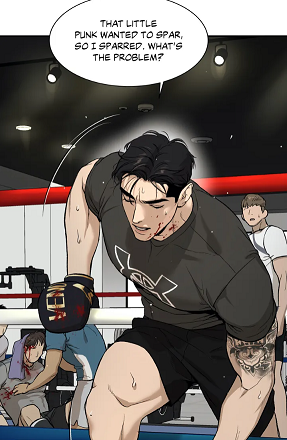 In order to fully grasp the boxer’s mentality, it is relevant to know the true signification of this word:
 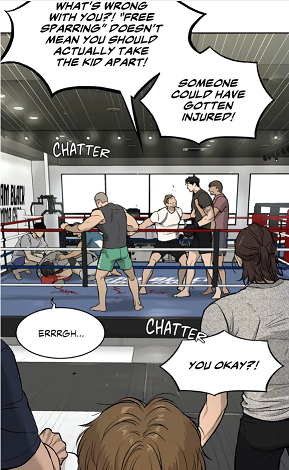 It was, as if for Joo Jaekyung everything was revolving around life and death. This explicates his rage in the ring and why he is called tyrant and punches his challengers, till they bleed.
  , a pigment that symbolizes nowadays death. Being too serious has huge negative consequences. Such a person can never be happy. The reason is simple. He is focusing too much on career and work that he is overlooking to enjoy the moment. The person is not able to play and to take time to laugh along the way. In the end, he doesn’t know what truly matters in life.
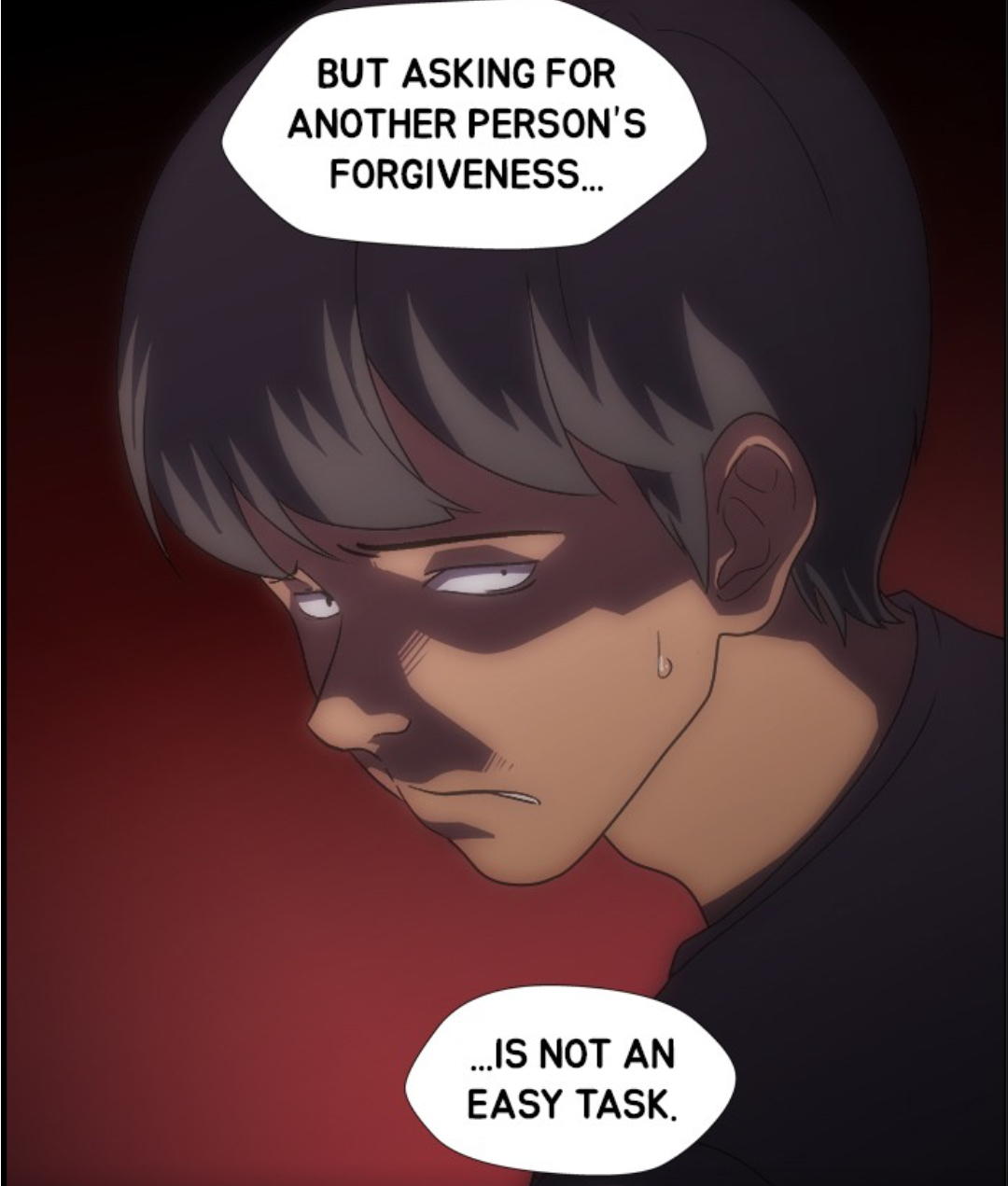 (doctor Frost, chapter 211), because we don’t know if the offended person will accept the excuse.
  And this is exactly what happened with Kim Dan. He apologized, yet he still feared that he would be hit.
  and apologized before before becoming silent and inactive. Hence I believe that this is what the uke will teach the strongest man in the world. He needs to learn to admit his mistakes. And this is no coincidence that in the ring, the brutal man never voiced regret towards the “green” man. With his expression “punk”, he had the perfect excuse to avoid the apology. That’s why he didn’t reply to the trainer immediately and in front of him
  (chapter 1) Why did he not recall their last encounter? It is because he had never punched him. On the other hand, something must have happened back then: a mistake from the physical therapist. But people shouldn’t overlook this crucial detail:
  The anaconda 😂 Yes, the length and and size of his phallus! While Kim Dan was massaging him, the man was relaxed, hence this signifies that it had not reached its maximum size!! And now, imagine what happened to the last doctor… The latter could have made an intentional move, but the champion has always separated his career from his private life. No one at the gym knew about the champion’s homosexuality. Since for the boxer, everything is a matter of life and death, he definitely views sex as a fight too. It is about his own climax, and not about feeling good or giving pleasure to his partner, even less about love! Therefore it is not surprising that the man is having sex in this position.
  (chapter 1) He doesn’t feel the need to see his partner’s face or to talk to him. And if you read my analyses about Painter Of The Night, you are all aware of the signification of such a position. It is about power struggle and victory. This observation leads me to the following conclusion: Joo Jaekyung’s rough sex is just the consequence of his “mentality”. In truth, he is masking his own anxieties, his manhood. This is just a speculation on my part, but I have the impression that his overactive superego is his way to deal his own sexual orientation. Homosexuality is often perceived as a lack of masculinity and strength, and note that so far, the boxer has been following social norms quite strictly. He embodies the prototype of the successful and wealthy boxer. We definitely need more information about his past, his family and surroundings. Another possibility is that the athlete is bothered by his huge phallus, which he could view as “jinx”…. For him, it is the reason why his former sex partners keep running away. The author will give us more elements in the future episodes.
 and contrary to the others, he will keep having sex with the protagonist. 😂 Under this aspect, the readers can grasp why the anonymous sex partner said nothing, when Joo Jaekyung called the main lead.
  I am suspecting that the man didn’t find this sex session very pleasant, as he was clinching onto the sheets. Besides, why would he call him in the middle of the encounter? And he could see Kim Dan as his savior… it was his luck that Joo Jaekyung had a new physical therapist.
 Bebebisous33s' analyses in K-Dramaland and Manhwas