

Please support the authors by reading Manhwas on the official websites. This is where you can read the Manhwa: Jinx But be aware that the Manhwa is a mature Yaoi, which means, it is about homosexuality with explicit scenes. Here is the link of the table of contents about Jinx. Here is the link where you can find the table of contents of analyzed Manhwas. Here are the links, if you are interested in the first work from Mingwa, BJ Alex, and the 2 previous essays about Jinx This has to change and Kim Dan on Thin Ice
It would be great if you could make some donations/sponsoring: Ko-fi.com/bebebisous33 That way, you can support me with “coffee” so that I have the energy to keep examining Manhwas. Besides, I need to cover up the expenses for this blog.

Water and Power
Two years ago, I published the analysis  At the crossroads: between 🤍, 💙, and ❤️🔥 and it has become the most read essay on my blog. [27.3 K views] It traced Joo Jaekyung and Kim Dan’s first day off together—the fateful swim in chapters 27-28 —when Joo Jaekyung’s apparent selfishness became the catalyst for Kim Dan’s first spiritual awakening. There, the water served as both mirror and baptism: a liquid threshold through which the doctor began to accept sexuality not as sin or submission, but as part of being alive. I had compared the athlete to a dragon holding his yeouiju. The pool stood for motion, rebirth, and the courage to breathe underwater—to trust one’s body rather than deny it.
Though the grandmother was never mentioned, I had sensed her ghostly presence in the grandson’s thoughts and actions. In her youth, the ocean looked beautiful to her 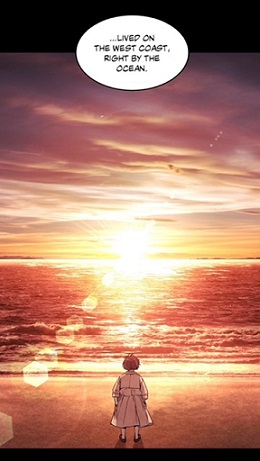 (chapter 53), yet she kept her distance. Observe that she only talked about one time experience. She sensed its danger and built her life on the solid ground of caution, duty, and control. In other words, she belongs to the world of the shore (chapter 53) —the solid, the measurable, the safe. Her fascination with the sea’s beauty reveals the limits of her perception: she judges by what is visible, by surface calm and reflected light. The ocean entrances her precisely because she refuses to imagine what lies beneath. For her, beauty is something to be looked at, not entered. Depth implies risk; darkness suggests loss of control.
That is why she keeps her distance. She fears what cannot be seen or accounted for — the unseen currents, the hidden life beneath the glittering skin of water. Her faith is built on appearances, not intuition; on the stability of the shore, not the movement of the tide. Thus I deduce that she never learned to swim. To her, entering the water would mean surrendering control, accepting fluidity, and admitting the existence of life below the surface. This means, swimming would expose the falsehood of her philosophy. That’s why I come to the following deduction that to her, swimming was unnecessary; one simply had to stay on land and hope never to fall in. But the pool, unlike the ocean, demanded a choice: enter, move, the pleasure of being below the surface 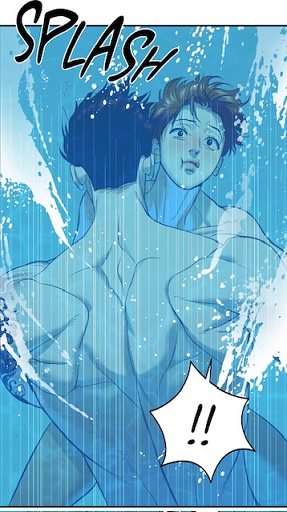 (chapter 28) and learn that not everything can be postponed or entrusted to someone else. Water, in this sense, rejects fatalism. It calls for motion, for risk, for personal responsibility.
What the grandmother built on faith in others was quietly undone by breath and muscle.  (chapter 80) And that intuition resurfaced and was confirmed in episode 80, when another day off brings the couple back to the pool. This time, the doctor steps into the water willingly.
 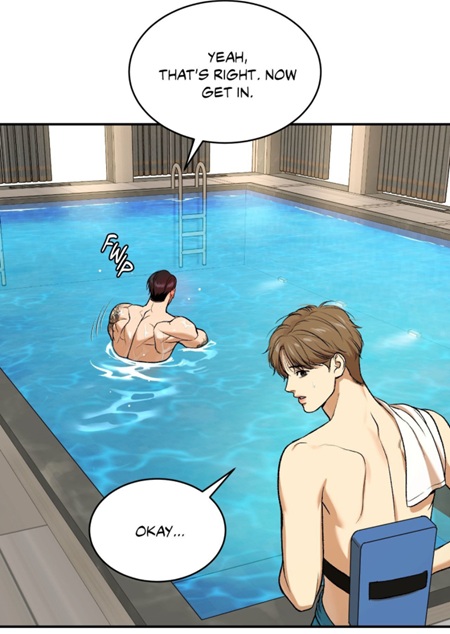 (chapter 80) He is no longer the man waiting to be rescued; he is the man learning how to swim. The champion’s words
  (chapter 80) distill the new doctrine: don’t wait for salvation
  (chapter 80), create your own buoyancy. Between the first swim
 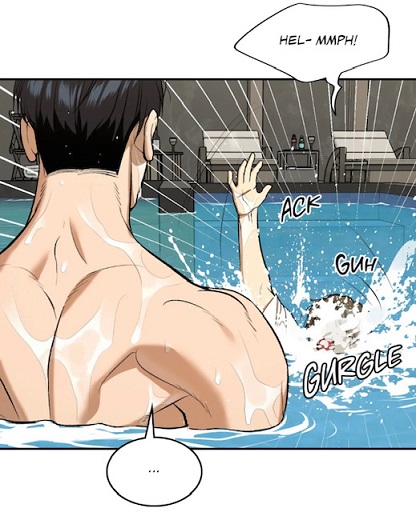 (chapter 27) and this second lies the true point of no return—where superficial judgment turns into reflection, dependency into self-trust
 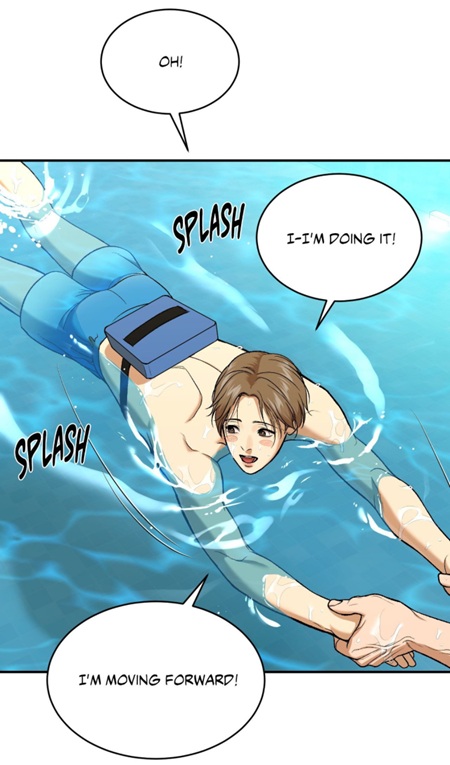 (chapter 80) and the rejection of powerlessness, (chapter 80), and fear of closeness
 (chapter 28) into the first stirrings of love
 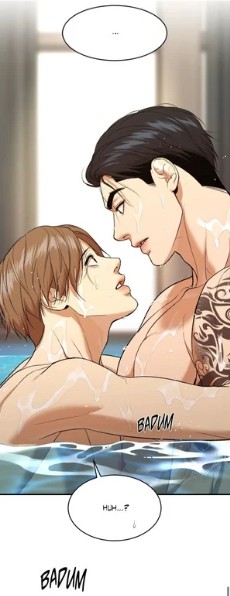 (chapter 80).
Shin Okja’s private religion was one of delegation: wait for the right person, the right moment, the right help to come. That’s why she never got the chance to return to the ocean.  (chapter 53) Safety lay in patience and dependence. Even when she later spoke with the champion by the sea, she avoided mentioning the ocean —as if to deny that any movement beyond her control could exist.
 (chapter 65)
One might argue that I am overinterpreting, since the grandmother’s presence seems unrelated to the swimming pool and tied instead to her graduation gift—the gray hoodie. 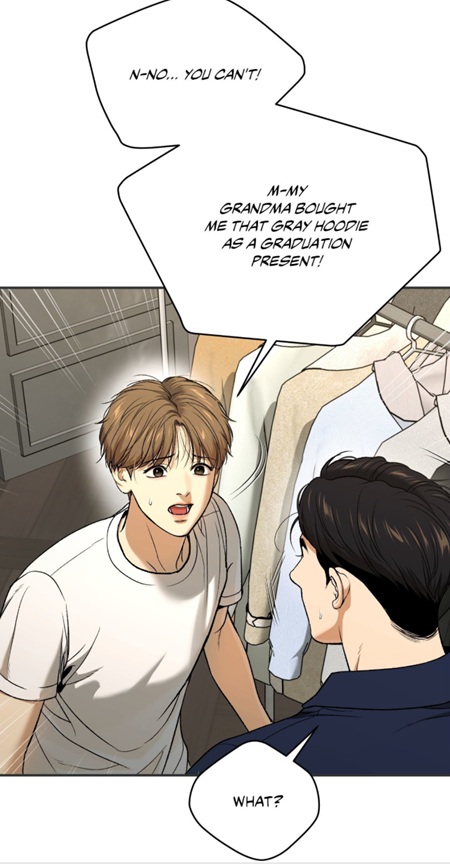 (chapter 80) Yet her absence from the pool scene is precisely what reveals her theology of avoidance. The pool was never her domain because her life revolves around work, not pleasure. She has no notion of rest without guilt, no concept of joy detached from utility. For her, swimming would appear frivolous—something “unnecessary” as long as one stays on solid ground. Jinx-philes should keep in mind that she never gave such a task to Joo Jaekyung. Her instructions to him were always practical, delegating care outward: take him back to Seoul, bring him to a big hospital and make sure he’s safe.
  (chapter 65) When she sees them together, her first reaction is not pride or relief but mild reproach— doc Dan should have left already.
 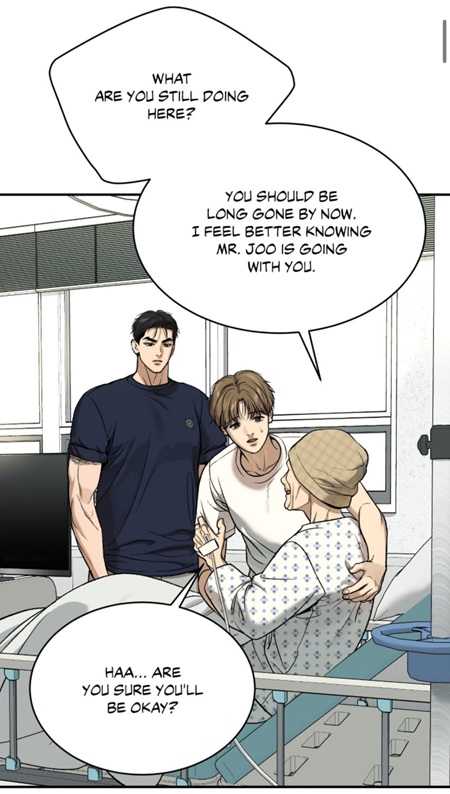 (chapter 78) The subtext is unmistakable: she expected obedience, efficiency, not attachment. Furthermore, her final instruction—“Make sure you see a doctor regularly”—
 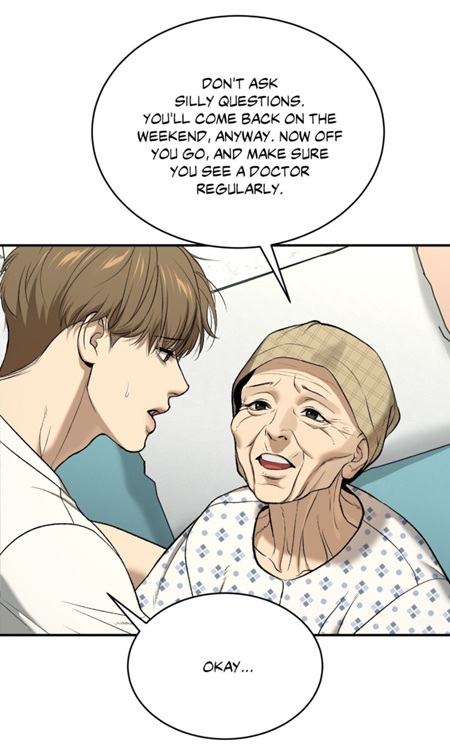 (chapter 78) sounds like ordinary concern, yet it hides her familiar logic of blame. It is as if she were implying that Joo Jaekyung has failed to fulfill her favor because Kim Dan has resisted care. In her eyes, the grandson is still the one responsible for trouble; the athlete’s role remains that of the dependable proxy who must “fix” him. What makes this moment striking is her tone of urgency, so unlike her habitual fatalism. The woman who once repeated “I’m the same as always”
  (chapter 65) suddenly speaks as though time is running out. (chapter 78) Her words, however, do not signal newfound insight—they only reinforce her desire to keep control, to ensure that someone else continues her mission of delegated care.
But what she interprets as negligence is actually independence. The champion is no longer following her religion of work and duty; he is inventing a new one based on choice 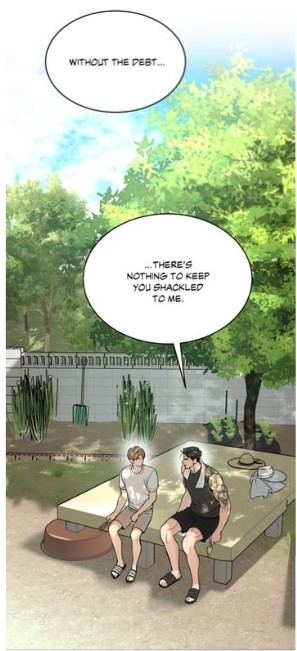 (chapter 77), respect and care. What she calls delay is, in truth, meditation and transformation.
Presents: The Gray Hoodie and the Lady
If the grandmother’s religion was built on work, the gray hoodie was its sacred relic.  (chapter 80) It was her graduation gift, yet it had nothing to do with his new profession or status. In contrast, the first episode already shows Kim Dan in a blue therapist’s uniform, name tag neatly pinned — a garment he must have purchased himself.
  (chapter 1) Traditionally, a graduation present helps the recipient embark on a career — like for example, a watch, a suit, or even a briefcase — symbols of adult entry into the job market. By offering him a hoodie instead, she unconsciously devalued her grandson’s professional worth. The garment belongs to the domestic sphere, not the workplace; it wraps him in comfort rather than readiness. In a moment meant to celebrate his arrival into public life, she reinscribes him into the private one — the house, the caretaker role, the obedient child. He doesn’t look like someone who went to university.
The gesture, whether she intended it or not, tells him that his identity has no market value beyond her recognition. The gift affirms warmth but denies competence; it soothes rather than equips. In addition, the grandmother’s choice of a hoodie exposes her lack of investment in that future. Her pride ended at the diploma; what came next was his responsibility. 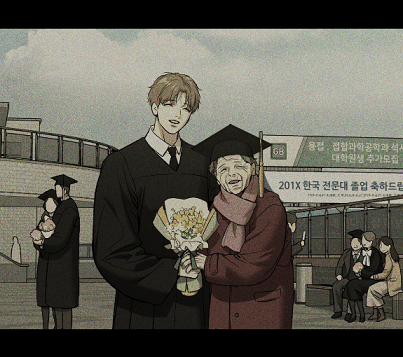 (chapter 47) There was no curiosity about his career, no acknowledgment of his competence—only the quiet satisfaction that through her endurance, she had produced a “doctor.” In the graduation photo, she even wears the mortarboard herself, smiling with the pride of someone who believes the diploma justifies a lifetime of sacrifice. Her grandson’s success confirms her own virtue; his “adulthood” validates her survival. This question to the athlete exposes her lack of interests in his profession:
  (chapter 65)
But her act of giving, like her act of living, was book-keeping disguised as affection. 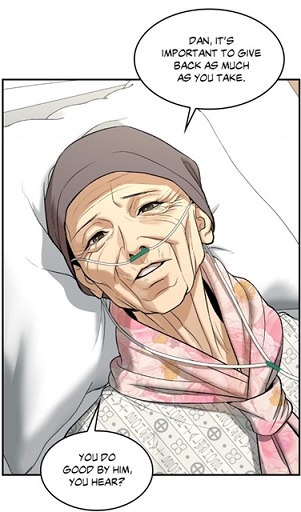 (chapter 41) While dying, she reduces love to an equation of productivity: “Dan, it’s important to give back as much as you take.” The verb do anchors her worldview — love must be measurable, visible, earned through action. To do good by someone means to labor for them, not to rest beside them. What caught my attention is that neither doctor
 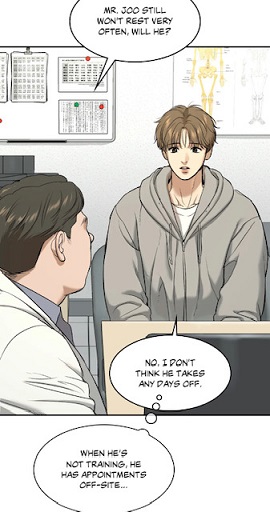 (chapter 27) nor the champion employs the expression “vacation” or “break”.
  (chapter 80) Why? It is because they never experienced a break. We have to envision that the “hamster” must have followed his grandmother, when he was not busy studying or working. Both main leads never experienced a real vacation. They say a day off, as if the day itself didn’t really exist, as if it were a temporary pause between “real” time. In their inherited logic, only work gives time its value; everything else evaporates. The grandmother’s way of loving has turned rest into an absence, something unworthy of being named. However, observe that there’s a gradual change in doc Dan’s vocabulary:
  (chapter 80) The problem is that for the hamster, only the athlete is worthy of getting his rest. It still doesn’t belong to his world.
Shin Okja’s universe contains no category for leisure, play, or shared time; such things produce nothing, and what produces nothing has no value. Even when she worries — “You haven’t eaten?”  (chapter 5) the focus remains mechanical. Eating is fuel; sleep is maintenance. But rest, in the sense of surrender, stillness, or joy, is foreign to her lexicon.
Her self-image as a tireless worker 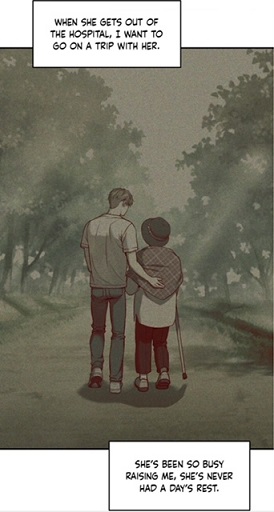 (chapter 47) is, in truth, a legend she wrote about herself. When Kim Dan recalls that “she’s never had a day’s rest,” the statement reveals more about his belief than about her reality. The woman who claimed endless labor also knew the comfort of “weekends”
 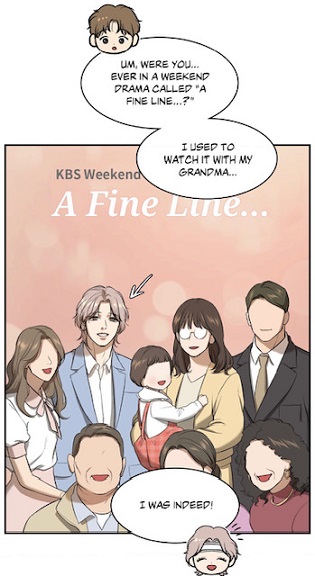 (chapter 30) — she watched The Fine Line, the very drama that made Choi Heesung famous. The detail seems trivial, yet it exposes everything: she had leisure
  (chapter 30), she simply refused to call it that. Watching television was permitted because it was passive, solitary, and could be rationalized as recuperation, not pleasure. In contrast, genuine rest — time shared, chosen, or joyful — never existed in her vocabulary. What she denied was not the existence of rest but the act of resting with him. She kept her downtime to herself, as if peace were a private possession. For her, love meant providing, not accompanying. Yet true care requires presence — sharing is caring, as the saying goes. [For more read this essay: Sharing is caring ] To share one’s time is to acknowledge another person’s worth beyond utility. Shin Okja never did that; she offered comfort but withheld companionship.This is why Kim Dan later struggles to accept that Joo Jaekyung is willing to spend his own time on him — the champion does what the grandmother never did: he makes room for him in his rest. His attempt is to make the main lead smile, to make him happy.
Her statement in chapter 65 —  (chapter 65) displays that she perceives her grandson’s exhaustion not as suffering but as malfunction, as if the human were a device that could be recalibrated through work and pills. That’s why her favors revolves about living conditions, but not about his “happiness”. Perhaps she genuinely hoped that the drugs and the stability of a “regular job” with the champion would realign him, as though routine alone could fix what grief and deprivation had unbalanced.
What she never imagines, however, is that balance might emerge not from regulation but from relationship — not from control, but from the unpredictable rhythm of living. Thus the readers can hear or sense the heart racing of the protagonists.
But let’s return our attention to the grandmother. Because she keeps an account, affection becomes another form of work, and gratitude a form of repayment. She cannot imagine love that simply exists — it must be done. Every gesture had to be accounted for and eventually entered into the invisible ledger of “what I’ve done for you.” For her, a gift was never spontaneous; it was a transactional record. It had to suggest effort without truly requiring it—so she could later recall it as proof of trouble taken. But why is she doing this? Ultimately, Shin Okja’s greatest flaw is not cruelty but distrust. She never truly believes her grandson can stand on his own. She fears that he might take the wrong path. 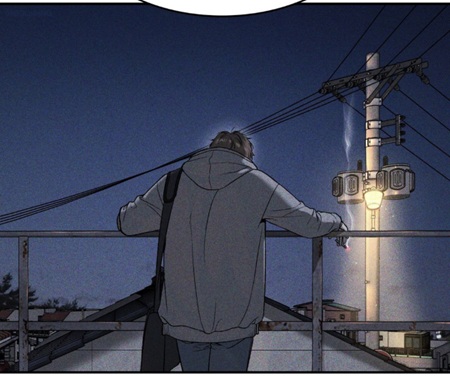 (chapter 65) Her constant bookkeeping—every favor tallied, every gift framed as trouble—betrays a hidden fear: that if she stops keeping score, she will lose him. Rather than grant him autonomy, she entrusts him to another caretaker. Sending him to the champion is not an act of faith but of resignation, a way to offload responsibility while maintaining the illusion of control.
When she “went out of her way,” she made sure the phrase itself became part of the gift. The author let transpire this philosophy in two events. In an earlier memory, the child Kim Dan watches his grandmother return home from the cold night  (chapter 11), scarf tied under her chin, carrying a single sweet bun. She doesn’t need to say she “went out of her way”—her action already proclaims it. The effort is the gift.
  (chapter 11) That simple walk to the store becomes a moral event, proof of affection through fatigue.
 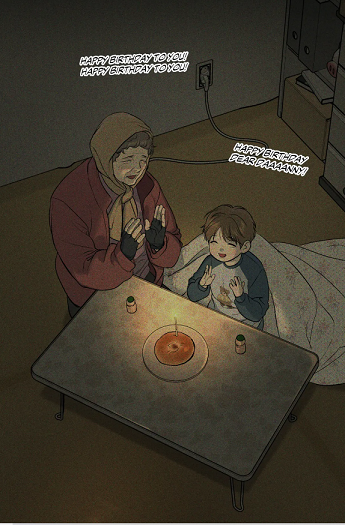 (chapter 11) Even the smallest purchase is framed as sacrifice. The sweet bread itself—a cheap red bean bun—is less nourishment than testimony: “Look what I endured for you.” If he had followed her, he would have seen that it didn’t take so much effort and money to buy the “present”. Finally, he had to share the sweet bread with his grandmother.
This moment sets the pattern for her entire philosophy of giving. Love must be earned through trouble; care must leave a trace of effort. The gesture matters more than the joy it brings. In her world, affection is always accompanied by labor, and gratitude becomes indistinguishable from guilt.This pattern repeats across her life. To “go out of one’s way” (chapter 80) becomes both proof of care and a claim for repayment. Hence she went to school or university for the ceremonies. However, such an action stands for social tradition and normality. She gives little, but ensures it feels heavy. Each offering, no matter how modest, is wrapped in the language of fatigue and obligation. The child, in turn, learns that to be loved is to feel guilty, and to receive is to incur debt.
The hoodie later inherits this same emotional script. It’s the adult version of the birthday bun: humble, practical, and accompanied by invisible conditions. Both are gifts that measure sacrifice, not joy. When she says she “went through so much” to raise him, she isn’t lying—she is testifying, recording her hardship in fabric and flour. However, pay attention to the picture from the hamster’s memory: (chapter 47) Where is the gray hoodie? That day, he only received a bouquet of flowers. Its absence in the photo is revealing. A gray hoodie would have looked out of place beside formal suits and robes; it would have exposed her thrift. The omission is both aesthetic and psychological: she hides the evidence of small-minded practicality beneath the spectacle of maternal pride. What was invisible at the ceremony later re-emerges in episode 80 (chapter 80), and with it, the emotional economy she built.
It is not far-fetched to imagine that the hoodie came paired with a favor or transaction 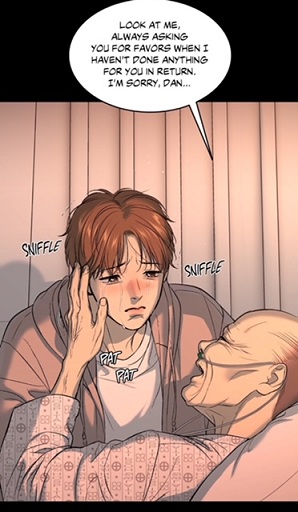 (chapter 53) —perhaps the signing of the loan. “You’re a doctor now; you’ll pay it off quickly.”
 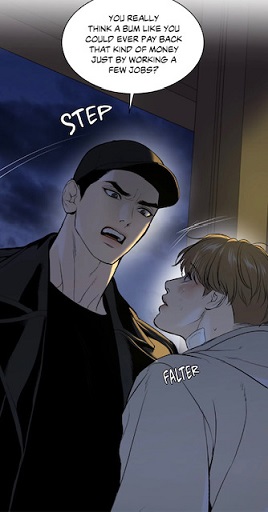 (chapter 80) In her eyes, generosity always justified expectation. The flowers were for display; the hoodie was the contract.
That’s why her gifts always come from the same palette: dull, neutral, gray. Even the birthday sequence is bathed in that dim, ochre light where warmth looks like exhaustion. The gray hoodie continues this chromatic philosophy—safety without brightness, affection without ease.
This explains why the hoodie feels less like a present and more like a receipt. At the same time, it denies him “adulthood” too. A sweater, not a suit; warmth, not celebration. Its comfort masked her emotional distance and her disinterest in his career. She gave him something to wear at home—a garment of rest that forbids real rest—because her world allowed no leisure without guilt.
Her sense of time mirrored that logic. She lived oriented toward the past  (chapter 65) and the future (chapter 78), rarely the present. Hence she shows no real joy about their visit before their departure. Life for her was a chain of recollections and predictions: what she had done
  (chapter 65), what he would one day repay
  (chapter 47). The present moment existed only as a bridge between past sacrifice and future obligation. The embrace is conditional — a rehearsal for independence, not tenderness. In that instant, love is already an investment waiting for return. The teddy bear pressed between them, once a symbol of innocence and comfort, becomes collateral in this emotional economy: the pledge that he will someday “grow up,” earn, and pay back the care that raised him. Even at the graduation, she treated the day not as fulfillment but as record keeping. (chapter 47) The bouquet of flowers visible in the picture served as public proof of pride, while the hoodie—cheap, colorless, and private—belonged to the closed economy of obligation.
The scarf later mirrors this same logic, but in reverse.  (chapter 41) When Dan gifts his grandmother an expensive scarf, he hides its true price — “I got it for a bargain” — repeating her own pattern of disguised generosity. She sees through the lie, teasing him for “spoiling” her, yet she accepts the luxury without feeling guilty. The scarf becomes her version of the hoodie: a fabric trophy of moral worth. But its later disappearance is revealing. In season two, she wears it
  (chapter 56) shortly after her arrival at the hospice, never again. When she greets Joo Jaekyung, the scarf is gone
  (chapter 61). Why? One might reply that the scarf lost its value, especially since she is living next to the director’s room. I doubt that such men would pay attention to such an object. Another possibility is that she fears its brightness might betray her neglect, for the champion has lived with her grandson for a while. How could she display silk while her grandson owns almost nothing?
 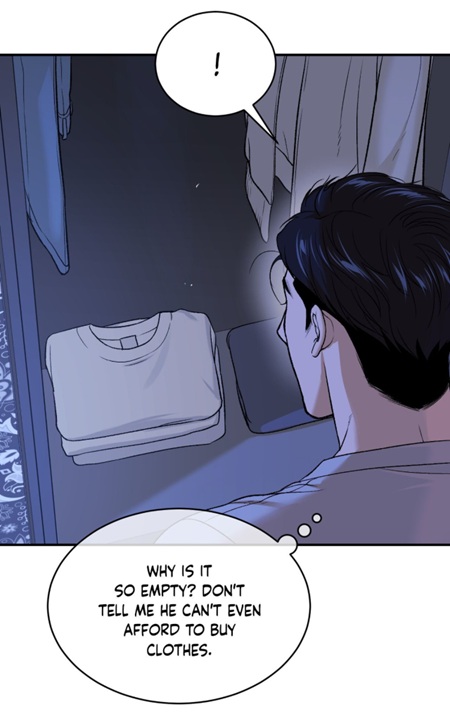 (chapter 80) The missing scarf thus exposes both her superficiality and exaggerated generosity. Her affection, like her pride, is short-lived — decorative rather than enduring. Should Heesung ever visit her, (chapter 30) one can easily imagine the scarf’s reappearance: the fabric of self-deception, ready to flatter, to perform, to erase guilt under the sheen of respectability. She already acted like a fan girl in front of the celebrity. (chapter 61)
The pattern of her giving finds its quiet conclusion in episode 80. When Kim Dan rediscovers the hoodie, his first smile fades into silence.  (chapter 80) The gesture that once symbolized love now feels like pain and loss. The signification of the gift has changed. What once wrapped him in safety now weighs like absence — the fabric retains the shape of someone who is about to vanish. His silence is not understanding but hurt, a wordless awareness that affection can curdle into memory. The audience, not the character, perceives that with the grandmother’s approaching death, her ledger is about to close. The gray fabric, once proof of her sacrifice, will lose its moral weight; her “gesture” will expire with her. Yet Kim Dan may not yet realize that this very ending could one day free him. The book-keeping dies with the bookkeeper.
This moment also reveals why he remains wary of other people’s gifts. 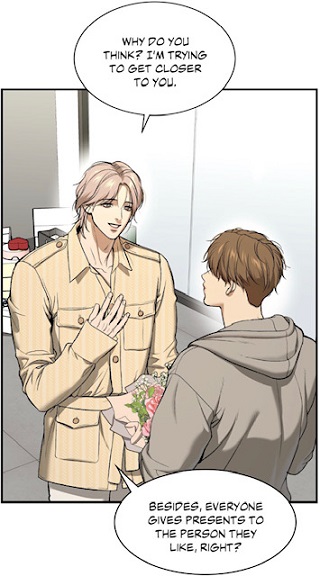 (chapter 31) When Heesung offers flowers “to get closer,” Kim Dan’s face mirrors the same unease: affection presented as transaction, intimacy disguised as generosity. What the actor calls closeness, the doctor feels as imbalance — the same emotional distance that Shin Okja’s presents once produced. Her gifts, meant to bind, isolated him instead; they built a hierarchy where gratitude replaced equality. Each present widened the gap between giver and receiver. To be cared for was to be indebted.
From this upbringing stems Kim Dan’s reflexive equation:
Presents = trouble, debt, or burden.
Each time someone offers him something, he instinctively feels burdens  (chapter 31) and tries to refuse it.
  (chapter 31) (chapter 80) “You don’t have to go through all this trouble.” The line is not modesty but defense. To him, receiving kindness creates imbalance. His grandmother’s “help” was always instrumental; every act of support came attached to sacrifice: “I went through so much for you.” The hoodie thus becomes a moral anchor, a fabric reminder that love must always be earned and repaid.
Guilt as Love Language.
Because of this, Kim Dan experiences love only through fatigue and suffering. He feels cared for when someone worries 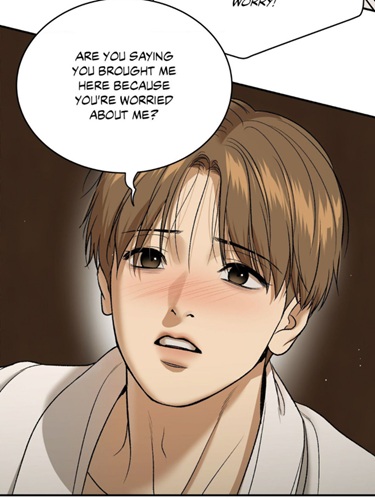 (chapter 67), loses sleep, or pays a price. He interprets Joo Jaekyung’s concern as “trouble,” Heesung’s gifts as “too much.” In his mind, affection is inseparable from cost:
If you love me, you must pay for it. And if I accept your love, I’m guilty.
Caretaker Identity and Self-Erasure
To escape that guilt, he lives as a helper. 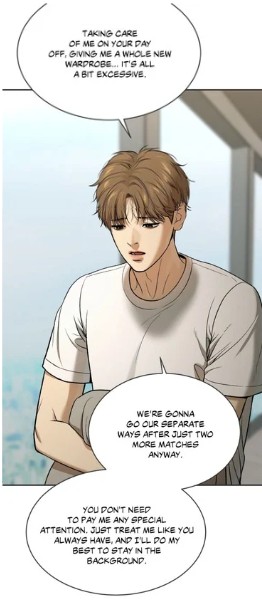 (chapter 80) “I’ll stay in the background.” His self-worth depends on not burdening others. His words let transpire that he has never been Shin Okja’s first priority in the end. The hoodie reinforces that psychology—it is not a professional outfit like a suit or briefcase would have been, but a teenager’s garment, meant for the domestic space rather than the adult world. It literally arrests his growth, keeping him in the house and under her logic. Thus it is not surprising that after receiving his diploma, he still took part-time jobs.
Gifts as Triggers of Anxiety
When others try to give him something—Heesung’s flowers, Jaekyung’s wardrobe—his first instinct is panic. “What do I do? It’s all so expensive.” He expects a hidden price: affection, submission, repayment. Every gesture of generosity recalls the old bargain with his grandmother.
Repetition Compulsion
He repeats the same dynamic with new authority figures. With Heesung, he suspects every gift hides control. With Joo Jaekyung, he accepts care only to reduce someone else’s burden. When the champion lies—“These brands sent the wrong size; I was going to throw them out anyway”—Kim Dan hears not kindness but necessity. Refusing would mean waste, and he has long internalized that nothing must ever be wasted. So he accepts—not out of entitlement, but as an act of thrift, a way to help the giver by taking what is “useless.”
And yet, through this misreading, something begins to shift. The logic of guilt quietly bends toward mutual release. Jaekyung sheds excess; Dan sheds shame. The exchange of clothes becomes an exchange of burdens.
Gray: The Color of Suspension.
The hoodie’s color captures the entire tragedy of their old world. Gray is neither black nor white—it refuses decision, blending work and rest, love and obligation. It is the color of compromise, of deferred joy, of life half-lived. Gray also carries another meaning beyond monotony. It fuses black and white — two opposites that, when mixed, erase each other’s clarity. The hoodie’s color therefore reflects the fused identity of grandmother and grandson: their lives blended until he became her shadow. Her pride shone only through his dimness. To live in gray meant to live as her reflection — never as himself. The color embodies both her dominance and his self-erasure. When Kim Dan finds it again in episode 80, his first smile fades into silence. (chapter 80) The object that once expressed care and promised safety now mirrors grief. The gray fabric absorbs the light around him, turning into the shade of everything unspoken between love and duty.
The hoodie, once a symbol of endurance, now becomes a relic of a world where love meant survival. To wear it again would be to stay in that twilight. To put it away is to risk color, to learn to live in the present tense.
The Wardrobe: Undoing the Gray Religion
If the gray hoodie was the relic of Shin Okja’s work-based faith, Joo Jaekyung’s wardrobe 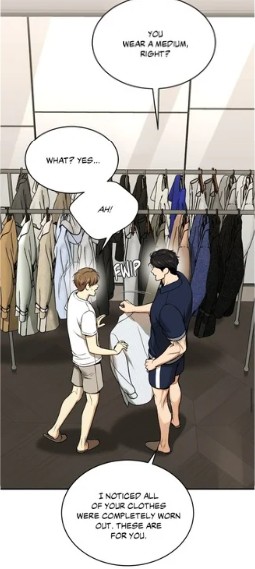 (chapter 80) is the site of its quiet destruction. His act of giving reverses every law the grandmother ever taught. First, he does not “go out of his way.” The clothes are delivered effortlessly, without fanfare or moral accounting.
 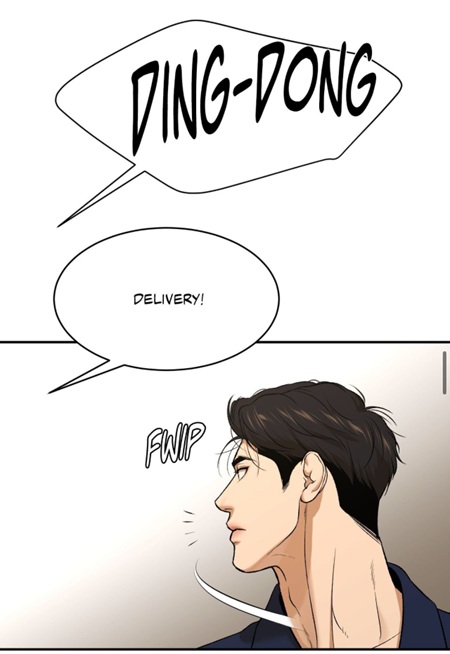 (chapter 80) There is no speech about sacrifice, no self-congratulation.
  (chapter 80) By erasing the gesture of “effort,” he removes the emotional price tag that once accompanied every gift.
Second, he tells a deliberate lie: that he did not spend a dime, that the brands sent the wrong sizes. This white lie has healing power. It dismantles the logic of debt that rules Kim Dan’s psyche.  (chapter 80) If the grandmother’s motto was “I went through so much for you,” the champion’s is “It’s no big deal.” Generosity becomes invisible, unburdened, and therefore trustworthy.
Third, he offers not one item but an entire range.  (chapter 80) The row of garments invites choice — a concept absent from Shin Okja’s universe, where love came in single doses and with strings attached. Here, the doctor is asked to select what he likes, to exercise taste, to inhabit preference. The abundance of options grants him agency, dignity, and the right to refuse.
Fourth, note the nature of the clothes: they are not sportswear. (chapter 80) These are professional garments — coats, shirts, and slacks suitable for the workplace, not the gym. They restore the image his grandmother’s hoodie had erased. In offering these, Joo Jaekyung is not only dressing him but reframing his social identity: from dependent to equal, from housebound caretaker to visible professional. This means that they are bringing him into the adult world. Yet this also creates a paradox — wearing such refined clothes will attract attention, making it impossible for Kim Dan to “stay in the background.” (chapter 80) They will incite him to voice more his thoughts, to become stronger as a responsible physical therapist. The wardrobe, like a mirror, forces him into presence. This means that he is losing his identity as “ghost”, which was how the halmoni was perceived by the athlete. 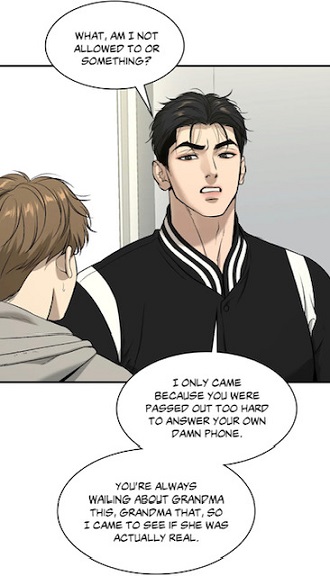 (chapter 22)
Symbolically, the location intensifies the gesture: the clothes are placed inside the champion’s own wardrobe. (chapter 80) The two now share a domestic and symbolic space. What once separated their worlds — fame, class, gendered roles — begins to dissolve thread by thread. The actor Choi Heesung’s remark, that gifts can “bring people closer,” 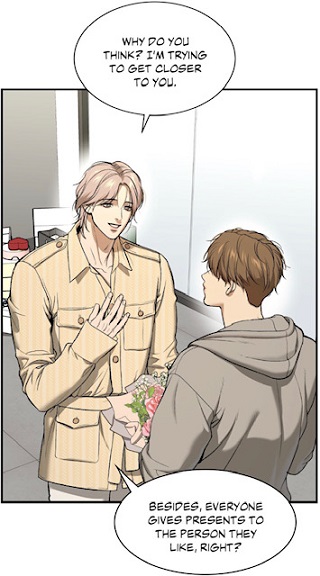 (chapter 30) becomes unexpectedly true here. The wardrobe bridges the distance that the grandmother’s gifts had always created.
When the champion remarks, (chapter 80) he implies that these items would just go to waste. Therefore he completes the reversal. Waste, once the grandmother’s greatest fear, becomes the vehicle of grace. By claiming the clothes are “leftovers,” he removes their monetary and moral value; they are no longer costly. In accepting them, Kim Dan does not incur debt — he prevents waste. 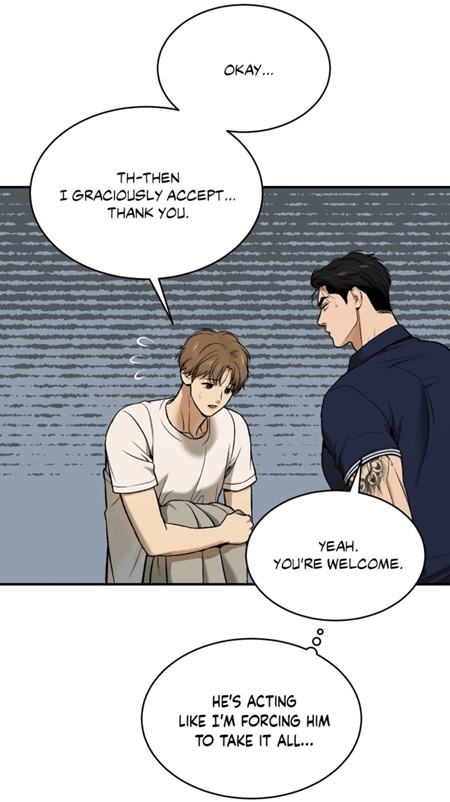 (chapter 80) This is why his hesitant and embarrassed gratitude, framed against a background of dissolving gray waves, feels so transformative. The air behind him ripples as if washing away the residue of his old faith.
The striped blue-and-white shirt he finally chooses carries its own quiet symbolism. (chapter 80) Yet unlike gray — the color of fusion and loss of identity — these shades remain distinct. They do not blend but alternate, acknowledging the coexistence of two identities: the doctor and the man, the caregiver and the self. In contrast to the grandmother’s world, where love meant absorption and sameness, Joo Jaekyung’s gesture affirms difference. The champion does not swallow him; he gives him space.
At the same time, the stripes hint at the complexity of Kim Dan’s inner life. Beneath his apparent passivity lies rhythm, variation, and resilience — qualities long suppressed by duty and guilt. The pattern becomes a visual metaphor for the layered texture of his heart.
By filling the wardrobe with clothes of different colors, the champion quite literally brings light and time back into Kim Dan’s life. The new hues break the monotony of gray 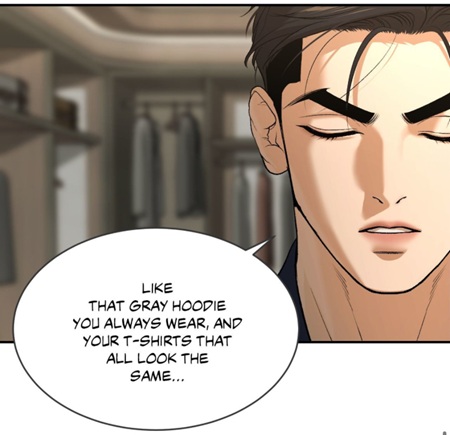 (chapter 80); they mark the passing of days, the return of seasons, the rediscovery that not every morning has to look the same. Variety itself becomes a form of freedom. When the wolf once complained that all his shirts looked identical, he was unknowingly naming what both of them lacked: differentiation, spontaneity, change. Through this act, he restores color not only to the doctor’s wardrobe but to his emotional world — a quiet resurrection through fabric.
Finally, the celebrity’s next gesture — teaching him how to swim — extends this transformation. If the grandmother’s graduation gift (the hoodie) kept him grounded and homebound, neglecting his future and career, the champion’s “lesson” propels him toward movement and autonomy. (chapter 80) Swimming means survival without the shore; it is the art of staying afloat without a hand to hold. In this sense, Joo Jaekyung’s care points forward, not backward. He offers not protection but potential, not memory but future.
The wardrobe, then, is not a storage space but a threshold — between debt and desire, between inherited caution and chosen freedom. And now, you comprehend why the doctor chose to seek refuge and support, when he feared to sink. 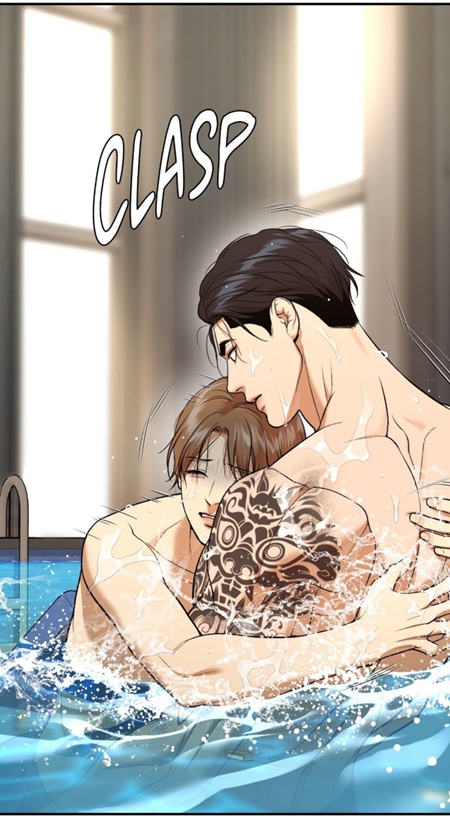 (chapter 80) The “hamster” had instinctively turned to the only person who had ever offered him help without cost.
In reaching for the champion, he does not regress into dependence; he reaches toward a new form of trust, one that no longer confuses care with control. To let himself be held is not to return to childhood, but to unlearn fear. The act of seeking support becomes the first stroke of a new swimmer — hesitant, but free.
This scene also recalls the image of the Korean dragon and its yeouiju  — the luminous, wish-granting jewel said to contain both wisdom and life energy. The dragon’s power is not innate; it is completed and elevated by the jewel. Without the yeouiju, it cannot ascend to the heavens — strength without meaning, force without direction.
When Kim Dan finally pulls Joo Jaekyung into his arms  (chapter 80), the myth reverses. The dragon—once feared, untouchable, wrapped in rage and solitude—is suddenly embraced by the very being he once believed too fragile for his world. The power dynamic inverts: the human shelters the beast.
In that gesture, the legend of the Korean dragon and its yeouiju gains a new form. The jewel is no longer an external object of desire, but a state of being—mutual recognition. By holding the dragon, Kim Dan becomes the hand that completes the circle, allowing power to flow again. The yeouiju exists between them, not in either of them: it is the bond itself.
For the champion, who has long carried the invisible scar of disgust—  (chapter 75) —this embrace is nothing short of salvation. The man who once fought to wash off shame through endless training now finds himself accepted in his unguarded state. He doesn’t need to mask his trauma with perfume
  (chapter 75), the imagined smell, or cleanse his skin of battle; he is held and, therefore, purified. Through Dan’s arms, he rediscovers his value and humanity—the dragon touched and not destroyed. He is worth of being embraced, even if he is already so old!
This reversal has immense symbolic power. The yeouiju is no longer something the dragon must seize; it is something that recognizes him back. (chapter 80) When Kim Dan holds him, the light of that jewel shines from within the dragon himself. Power and tenderness, once enemies, coexist in the same body.
For Kim Dan, this act also signals a new allegiance. He is no longer in service of duty or debt—no longer the caretaker bound to an old creed of sacrifice. By choosing to embrace Joo Jaekyung, he chooses his friend, not his “master.” He decides who is worthy of his trust, and in doing so, reclaims his agency.
The dragon, embraced rather than worshiped, rises stronger. The yeouiju—the bond, the shared heartbeat—no longer lies at the peak of a mythic mountain but glows quietly between two exhausted men who have stopped running from touch.
The gray world — the realm of thrift, debt, and book-keeping — dissolves into color and movement. Blue and white ripple through the water, reflecting not fusion but harmony. For the first time, love does not demand payment; it breathes.
Arc 8 – The point of no return
The shape of the 8 itself evokes both the infinity loop and the closed circuit: two halves endlessly reflecting each other, each incomplete without the other’s motion. It is the symbol of reciprocity, but also of a threshold — the moment when balance can no longer be postponed. Once complete, the loop allows no intrusion — it admits no third. The number’s symmetry carries both union and exclusion: whatever falls outside its rhythm disappears.
This is the geometry of Jinx’s emotional world in Arc 8. The loop that once included a third observer — the grandmother’s watchful eye, the manager’s interference, the actor’s rivalry and resent — now folds inward, leaving no aperture for control. The form itself performs the story’s evolution: dependency becomes reciprocity; triangulation dissolves into dual motion. And now, you comprehend why Mingwa included a new outburst of the wolf’s jealousy. 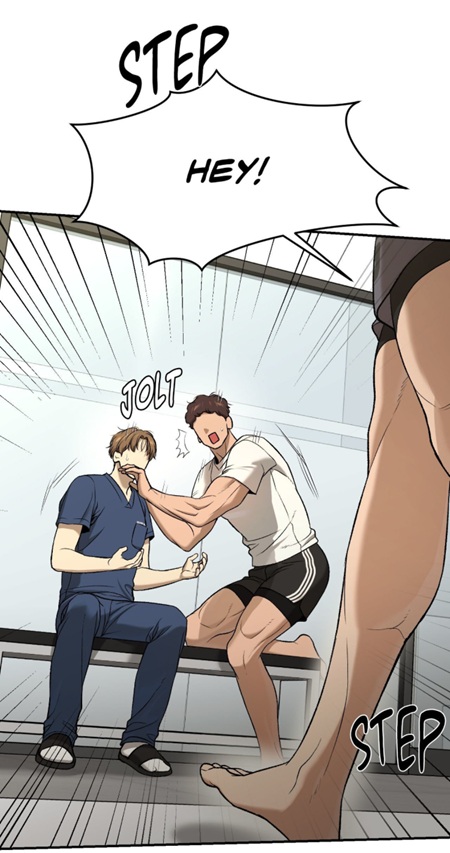 (chapter 79) This is one part of the new circle. Jealousy is the residue of imbalance — the echo of the 7 within the 8. In the numerology of Jinx, the 7-chapters, like for example episode 7
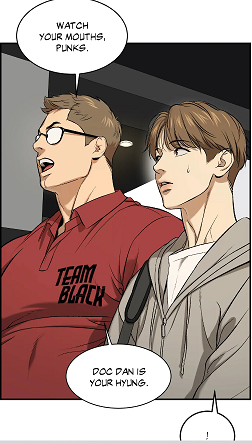
  (chapter 7), episode 18, where the champion had sex because of this statement
  (chapter 18),episode 34 with Choi Heesung
  (chapter 34) or episode 52, where the former members of Team Black and expressed their disdain and jealousy toward the main lead
 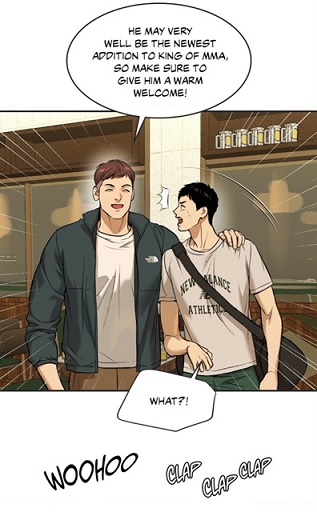 (chapter 52)
But Arc 8 changes the equation. For the first time, both protagonists risk loss because they have something — and someone — to lose. The return of jealousy is therefore not regression but proof of attachment and the occasion to improve their personality 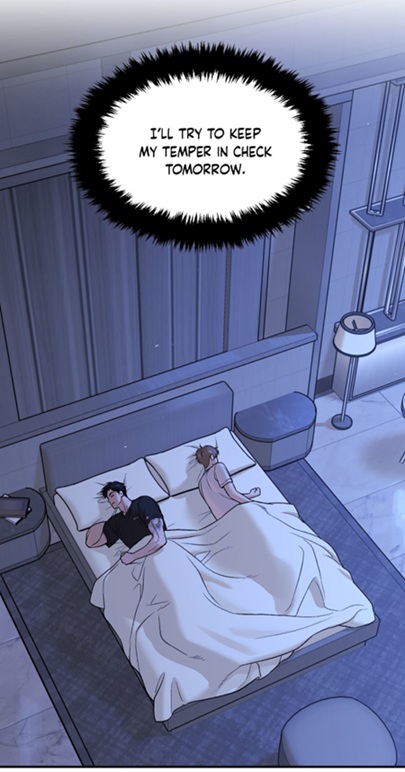 (chapter 79), the final test before the circle closes for good.
Eight is the reversal digit, where hidden motives come to light and attachments are tested. Between 7 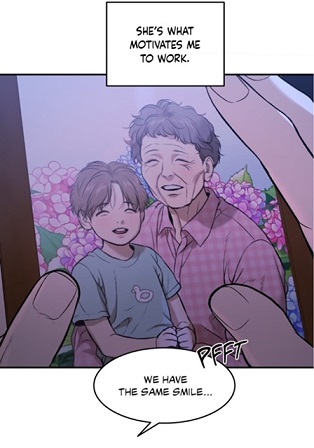 (chapter 47) and 8 lies that invisible hinge: the death of the old economy of love and the birth of a new one.
Thus, Arc 8 becomes the arena of triangular pressure. The grandmother’s possessive nostalgia (she sees herself as the mother, doc Dan as the boy and the champion as her surrogate husband) (chapter 78) mirrors Park Namwook’s managerial anxiety 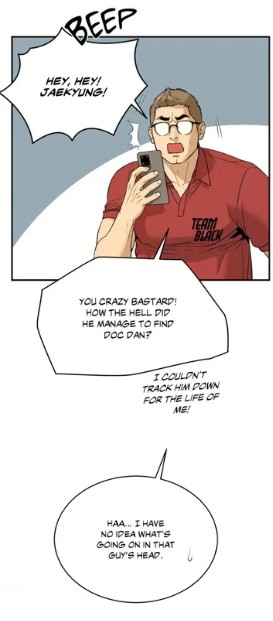 (chapter 61) and Heesung’s residual rivalry and resent. Each acts as a different face of control: the woman binds through guilt, the manager through hierarchy acting as the owner of the athlete’s time, the actor through charm and deceptions. Together they form the triad that tries to reopen the circle closed in the pool. Let’s not forget that the athlete chose to take a day off on his own accord
  (chapter 80), but he had just returned to the gym. It is no longer the same training and routine.
Park Namwook in particular represents the system that resists intimacy. His “interference” is not random but defensive: he fears that Jaekyung’s change and his attachment to the physical therapist (the promise to teach the doctor to swim implies that he will focus on other things than MMA) will unbalance the professional order. In the symbolic arithmetic of the story, he inherits the number 7 — the unstable, the one who can no longer maintain symmetry.
Jealousy, then, becomes not corruption but purification. It exposes what still belongs to duty and what belongs to choice. Through these frictions, Kim Dan is compelled to speak for himself, to claim the very agency his grandmother once withheld. It makes the protagonists to perceive people in a different light and move away from their self-loathing, passivity and silence.
When he does, the circle of the 8 stabilizes at last. The old triangle — grandmother, doctor, and debt — gives way to the new one: champion, doctor, and trust. In the Arc 8, the color gray finally meets its antidote: blue. 💙What was once the hue of exhaustion and suspended time becomes the pulse of renewal. The blue heart 💙, which first appeared in my earlier essay At the Crossroad, returns here as the emotional compass of both men.
In Jinx, the white heart with the gray hoodie belongs to the past — to the grandmother’s logic of duty, guilt, and caution. Blue, by contrast, is the color of water, movement, and breath. It signals the capacity to feel without measuring, to give without debt. When Kim Dan accepts the new clothes, he does not merely change garments; he crosses from the gray zone of survival into the blue realm of relation. His heart, long muted by obligation, begins to circulate again.
The blue heart marks this point of no return: once it beats, neither man can retreat into solitude. Its rhythm unites the wolf and the hamster in a shared tempo — one that excludes the third, but not the world. For the first time, affection no longer obeys the law of bookkeeping. It flows.
The ocean, once feared and distant, now extends inward, beating quietly beneath their joined silhouettes. The gray relic of the past lies folded away, and in its place, something transparent begins: a friendship that breathes like water — uncounted, unowned, and alive.
Feel free to comment. If you have any suggestion for topics or Manhwa, feel free to ask. If you enjoyed reading it, retweet it or push the button like. My Reddit-Instagram-Twitter-Tumblr account is: @bebebisous33. Thanks for reading and for the support, particularly, I would like to thank all the new followers and people recommending my blog.


 I established that Kim Dan’s number is 8. It is therefore no coincidence that the arc from chapter 80 to 89 should revolve around him—his body, his suffering, and ultimately his recovery. The number 8, often associated with balance, renewal, and continuity, here signals not only the doctor’s rebirth but also the gradual thawing of his frozen world. It marks the moment when the past can no longer remain buried, when the last remnants of family and unspoken pain begin to surface. The mystery behind this phone call will be soon revealed.
  (chapter 19)
 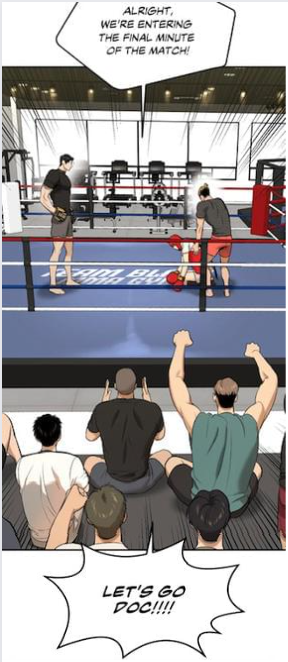 (chapter 26) the sparring between Joo Jaekyung and Kim Dan unfolds under the sign of fun and apparent joy, yet its origin lies in jealousy. The champion, unconsciously triggered by the doctor’s closeness with Potato
 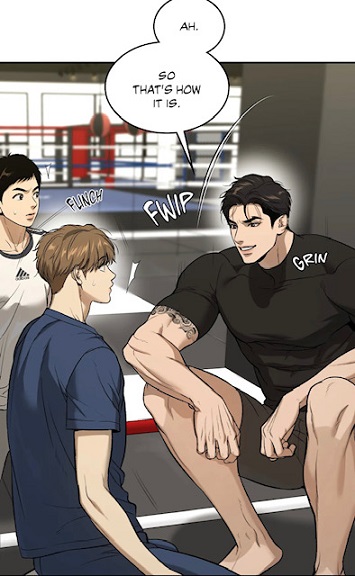 (chapter 25), turns play into a contest—a way to reclaim attention.
  (chapter 25) The gym, usually a place of hierarchy, momentarily becomes a stage where both can laugh, but beneath that laughter runs an undercurrent of rivalry (with Potato). On the other hand, for the first time, the Manhwa allows both protagonists to exist outside the economy of debt and hierarchy. The gym, normally a place of discipline and work, transforms into a playground of laughter. The champion teases the doctor
  (chapter 26), and the latter, clumsy but determined, strikes back with surprising boldness. The crowd cheers, not for the fighter but for the therapist—the underdog, the one who usually stands in the shadow. The entire scene feels like a short-lived holiday, a suspension of order and pain. When Kim Dan smiles at the end of the match, the gesture radiates genuine lightness: he has momentarily escaped the burden of fear and experienced himself as a free, living body.
  (chapter 26) He believes he has accomplished something meaningful and feels, perhaps for the first time, proud of himself. He was taught that he could fight back and overcome his fear.
  (chapter 26) He realizes that the hamster can beam at others, that such light has never been directed at him. In that instant, he no longer sees an employee but a companion whose gaze and embrace he covets, whose approval he unconsciously seeks.
 (chapter 62) The atmosphere is brighter in color but colder in tone. There, Joo Jaekyung got to experience how Kim Dan has lived all this time, helping others, making them happy with his assistance.
  (chapter 62) Here, the protagonist was thinking all the time of his loved one:
 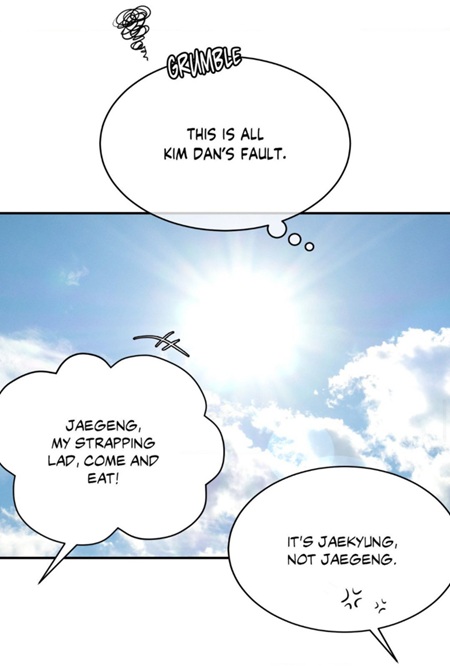 (chapter 62) Indirectly, he hoped to get the doctor’s attention, but he failed. In fact, none of the wolf’s good actions got noticed by his fated partner. Interesting is that though the characters engage in acts of performance and service—helping others, pleasing strangers— their smiles have turned into masks.
 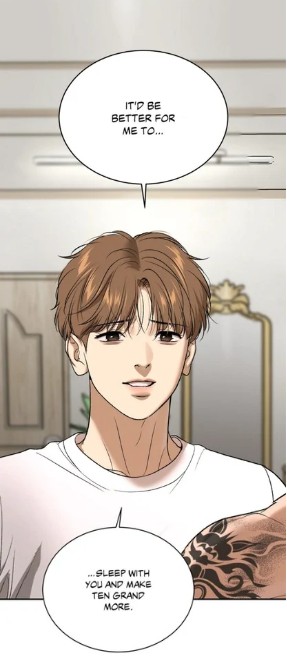 (chapter 62)
 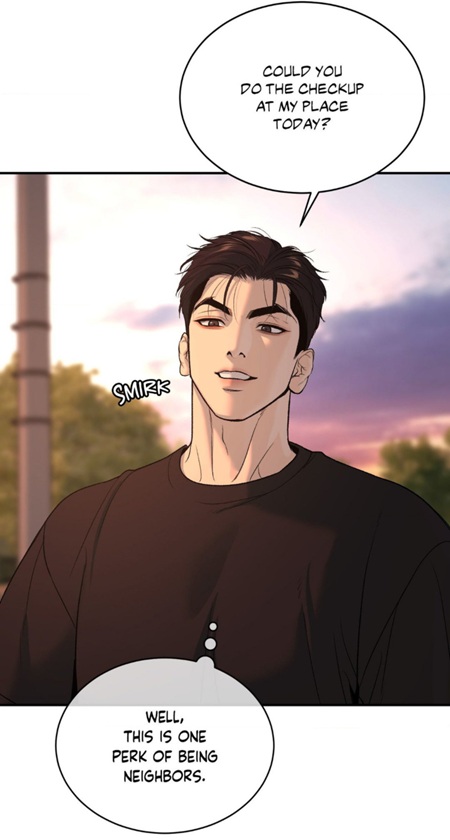 (chapter 62) Where chapter 26 radiated spontaneity, this one reveals calculation and fatigue.
  (chapter 62), where exposure to others leaves both men strangely isolated. The happiness of the crowd no longer unites; it separates. The champion’s outfit, ridiculous and domestic
 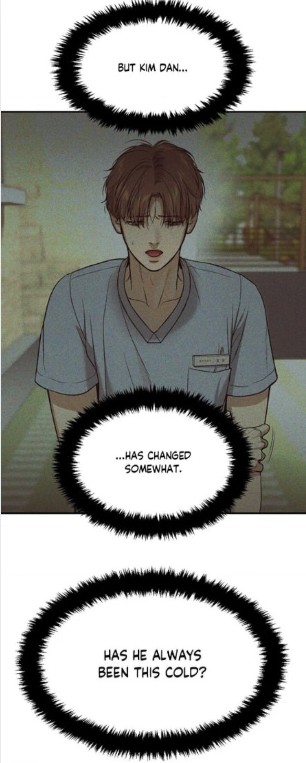 (chapter 62) which is actually his true nature. I will elaborate more further below. For the first time, the wolf looks at his companion and senses distance instead of warmth, as though the man he once touched so easily has withdrawn behind glass. His thought—“Has he always been this cold?”—marks the beginning of introspection, the moment when perception replaces instinct.
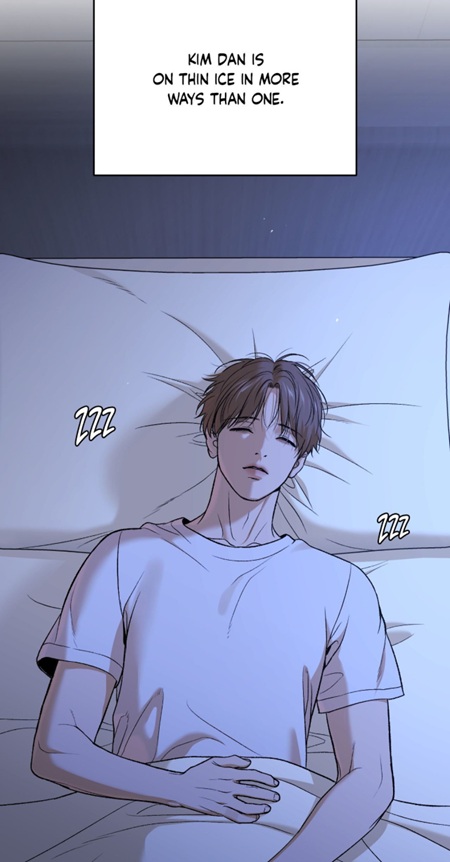 (chapter 80) To “walk on thin ice” is to approach him gently, without force—a lesson the champion must learn if he wishes to thaw what has been frozen by years of duty and self-denial.
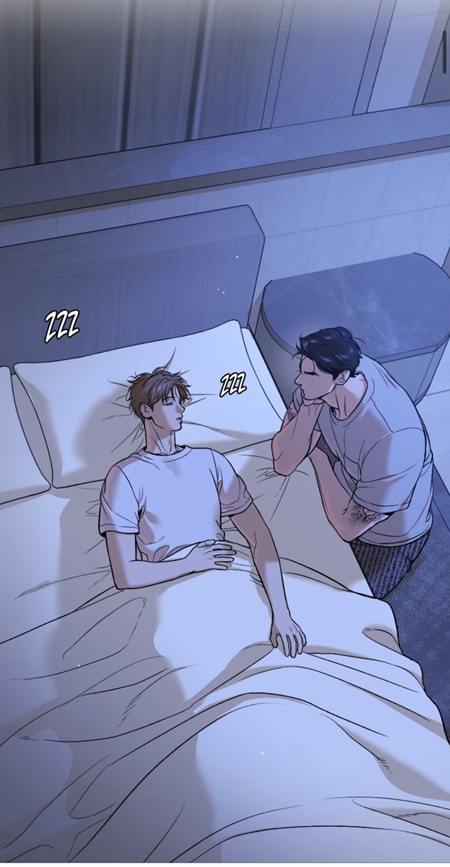 (chapter 80)
  (chapter 80), not red. The atmosphere is fluid, reflective, submerged. Water—not flame—governs this new stage. What we witness is not combustion but fusion—ice meeting water, solid meeting liquid, two states of the same element touching at last. Ice does not just melt under fire; but also in the presence of water. It softens when it recognizes itself in another form. In that sense, Joo Jaekyung’s tenderness doesn’t heat Kim Dan—it mirrors him. The thaw begins not through passion, but through likeness, through quiet recognition. This signifies that Joo Jaekyung is on his way to discover their similarities: they both suffered from bullying and abandonment issues and they love each other.
 (chapter 80) at the board game table mirrors that moment: his smile is light, childlike, uncontaminated by dominance. Yet, tellingly, they do not smile together. Each glows in isolation, unaware of the other’s joy. Doc Dan has not realized it yet: he is the wolf’s source of happiness, he is the only one who can make him laugh and smile.
 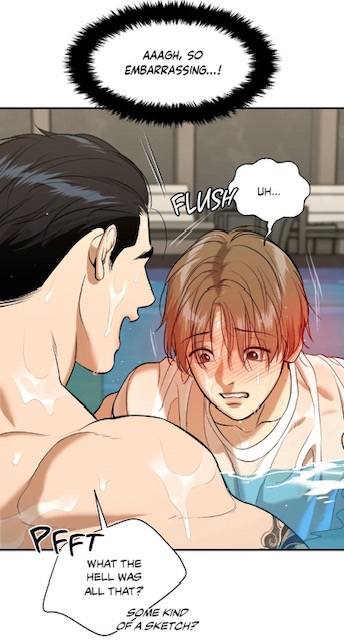 (chapter 27) Thus I came to the following deduction. This is the emotional geometry of the arc 80–89: two smiles moving toward synchrony, two currents approaching convergence. Both need to experience that they make each other happy. Kim Dan on Thin Ice thus begins where the infinite loop of 8 converges—between warmth and coldness, joy and fatigue, play and labor. It is here, in this fragile equilibrium—where ice and water finally coexist—that both men begin, at last, to thaw. And the latter implies emancipation
 (chapter 80), as it exposes the real metamorphosis from the “wolf”. The night Joo Jaekyung watches Kim Dan sleep is not erotic; it is revolutionary. For once, his desire gives way to perception and attentiveness. The fighter who has conquered bodies now studies one that is quietly losing its battle. The body before him is not the sculpted strength he knows, but a map of deprivation: protruding collarbones
 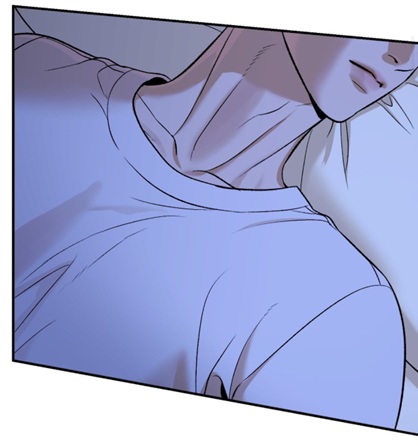 (chapter 80), visible neck tendons, the knobby finger joints and his stiff fingers resting on the blanket as if holding the body together.
  (chapter 80) The pale, bluish hue of the skin—half light, half illness—tells him what no words ever have.
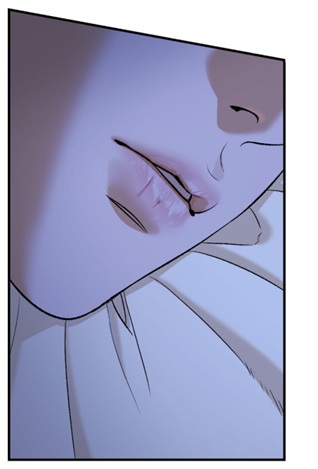 (chapter 80), the faint opacity of the nails
 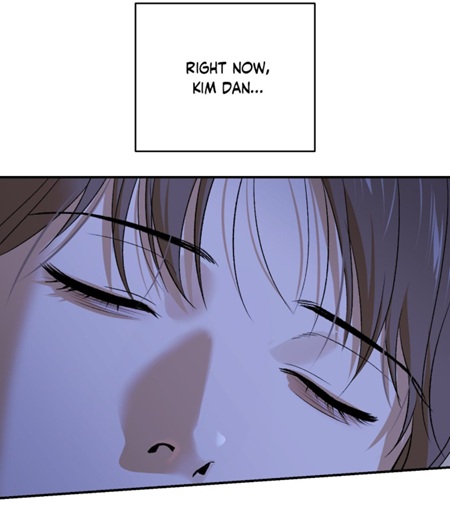 (chapter 80) In the faint parting of the mouth he sees not seduction, but exhaustion—a man so depleted that even rest demands effort.
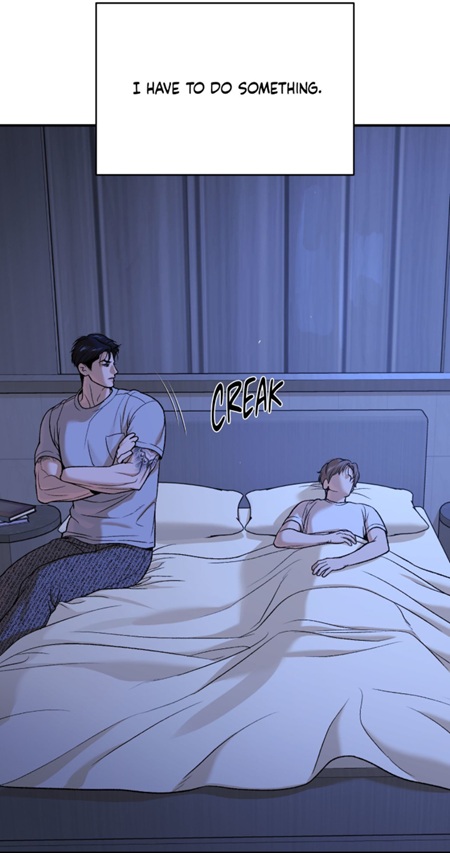
 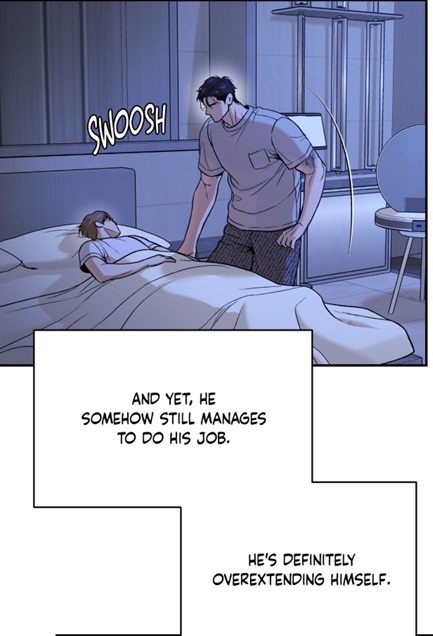 (chapter 80) he begins to treat rest not as weakness, but as reverence.
 (chapter 13) The fighter who once mocked stillness as laziness now finds meaning in it.
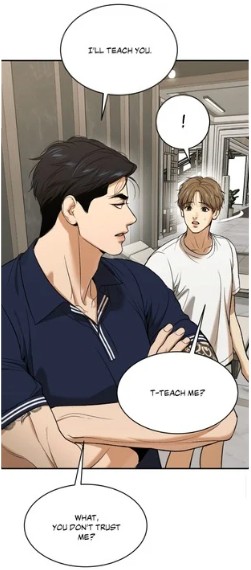 (chapter 80), it signifies that he will have to dedicate his time to the physical therapist! Hence his routine and training could get affected, just like their weekends.
  (chapter 80) —the doctor
 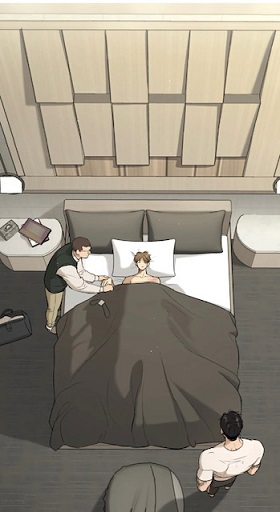 (chapter 13), the family member
 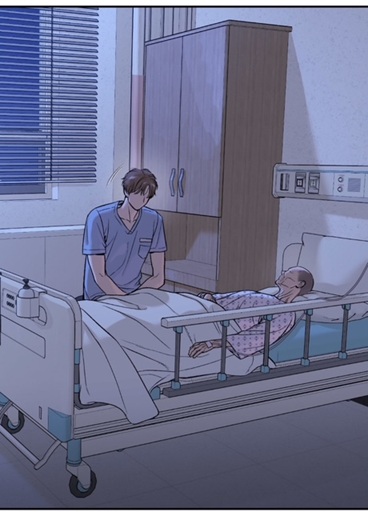 (chapter 56), the one who stays close enough to touch if needed.
  (chapter 80) Without realizing it,the athlete has inherited that role. His nearness is no longer intrusive but protective. He has crossed the invisible threshold that separates obligation from affection. The fighter who once stood as an outsider in the doctor’s life now finds himself within its most intimate circle.
 (chapter 80) Compare his facial expression to the hamster’s before their first day off together.
 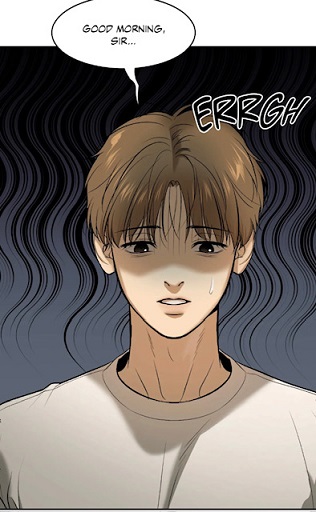 (chapter 27) That way, Mingwa can outline the champion’s confidence and that the one who needed the rest is the physical therapist and not the champion.
 (chapter 69) Every flicker of light falls through The Emperor’s gaze and lands on Kim Dan’s form, transforming weariness into something sacred.
  (chapter 68) in the bathtub
 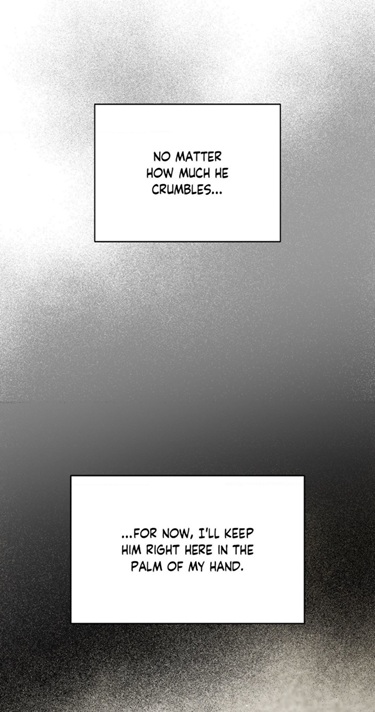 (chapter 68) —“I’ll keep him right here in the palm of my hand”—echo now with quiet irony. To hold someone in one’s hand is, paradoxically, to immobilize them; it grants possession but denies agency. The same gesture that promises safety also enacts paralysis. His possessiveness, once mistaken for protection, now appears as helplessness.
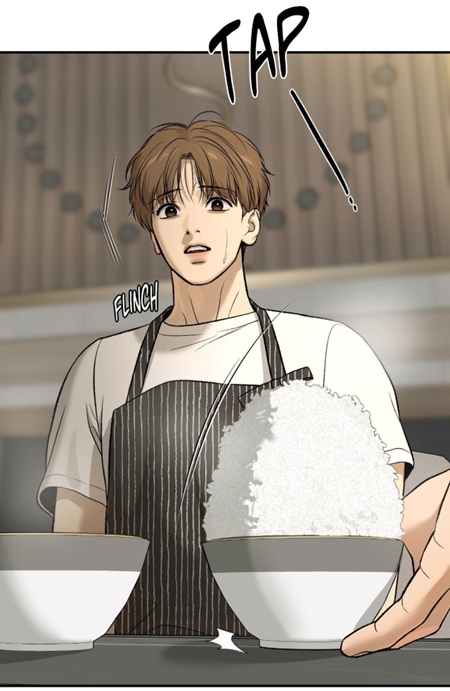 (chapter 79),
  (chapter 80) shrinking back when confronted. The body remembers the threat long after the mind tries to forget.
 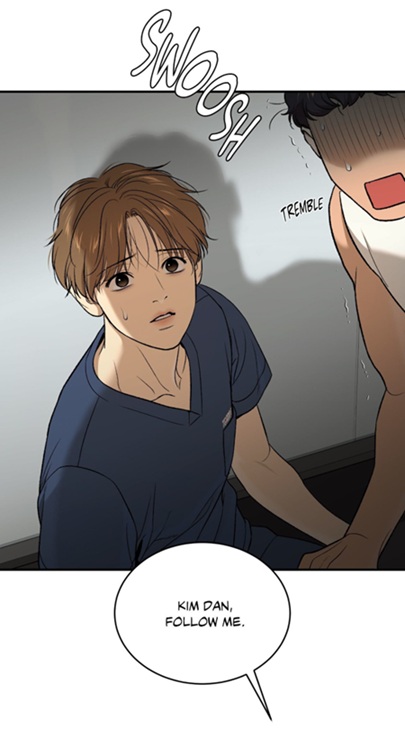 (chapter 79) He lives suspended between two survival reflexes: freezing or fleeing. Since the contract binds him to stay, he cannot physically run away; therefore, his body freezes instead. It is his way of obeying while still protecting himself. Exhaustion becomes his armor. And now, you comprehend why the celebrity could detect the coldness in the “hamster” in front of the hospice.
 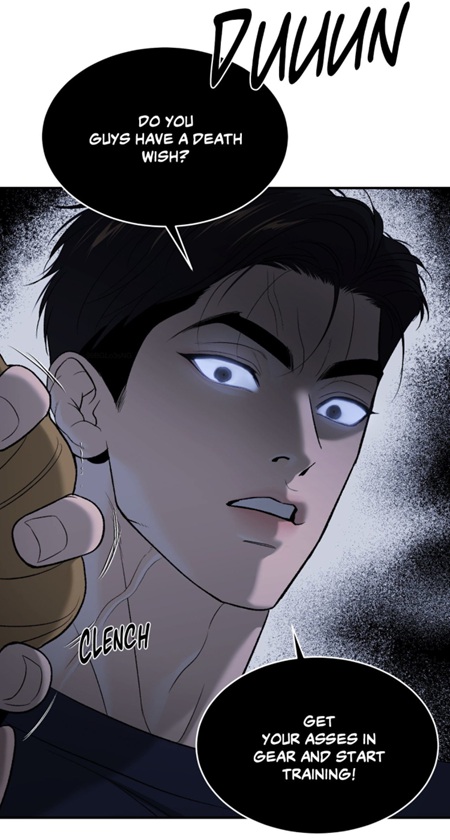 (chapter 79) — now turned outward and wounded the one he wished to protect.
  (chapter 79) That icy look became a mirror: it froze Kim Dan’s small confidence, reinforcing his belief that he would always displease or fail others. Since his return to the gym, the doctor feared the emperor’s next outburst, walking on eggshells and suppressing every impulse to speak or move freely.
 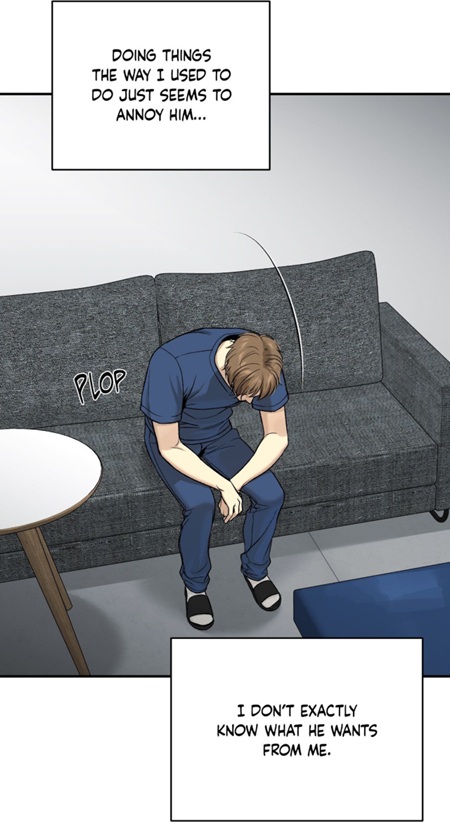 (chapter 79) Thus he clinched onto routine to maintain a normal relationship. But once the champion voiced his dissatisfaction (masking his jealousy), the light in the doctor’s gaze vanished.
  (chapter 79)
 (chapter 79) His unconscious was telling him to flee, as he feared the athlete. To conclude, he was always one step away from collapse. In symbolic terms, he had become ice itself — air and water solidified, transparent yet untouchable. Keep in mind that according to me, the clouds embody the physical therapist.
  (chapter 38) Born on December 26th, his very birthday ties him to winter, to the paradox of beauty that burns when touched.
  That’s why I can’t help myself thinking that the physical therapist is actually embodied by the snow. Ice and snow preserve, but they also isolate.
 (chapter 72), snow was falling — a silent mirror of his loneliness, the frozen residue of a home that no longer existed. Later, in chapter 77, the motif returned as ice cream
  (chapter 63), desperate to restore closeness, mistook passion and pleasure
  (chapter 63) for repair. Believing that physical heat could melt emotional frost
 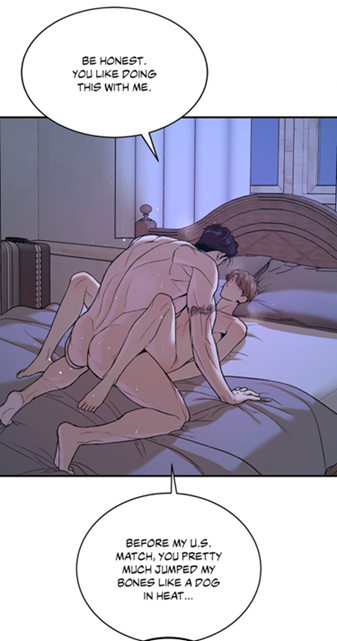 (chapter 64), he tried to burn away the distance through souvenirs (evoking the night in the States) and desire. Yet the more he tried to ignite fire, the more he fed the cold.
  (chapter 64) The physical act, rather than fusing them, exposed the truth he had refused to see — that his partner was already freezing from within. On the other hand, during this night, the athlete used “self-control” for the first time, his roughness in bed started vanishing.
  (chapter 64) The wolf’s attempt to “burn the bridge” between them became the very thing that broke it. His flame met ice
  (chapter 64), and the result was not warmth but steam — a brief illusion of intimacy that vanished as soon as Kim Dan pulled away. His rejection wasn’t cruelty but a cry of despair, disillusion and exhaustion
 (chapter 64): a body too cold to burn, a heart too tired to love and fight.
 (chapter 80), but about melting together, letting warmth and cold coexist without annihilating each other. To melt together does not mean to dissolve into sameness, but to trust that proximity will not destroy one’s shape. True intimacy begins when both accept that they can share warmth without losing form — when fire believes it can touch ice without turning it to steam, and ice trusts it can meet fire without vanishing.
  (chapter 61) Touch it bare-handed, and you feel both heat and pain. The same holds true for Kim Dan’s presence: those who reach for him too quickly end up wounding both him and themselves. The sportsman’s early attempts at care followed that pattern — too forceful, too immediate, leaving frostbite where he intended warmth.
  (chapter 64)
  (chapter 79), of not getting the doctor’s affection. Kim Dan’s coldness was not real rejection
 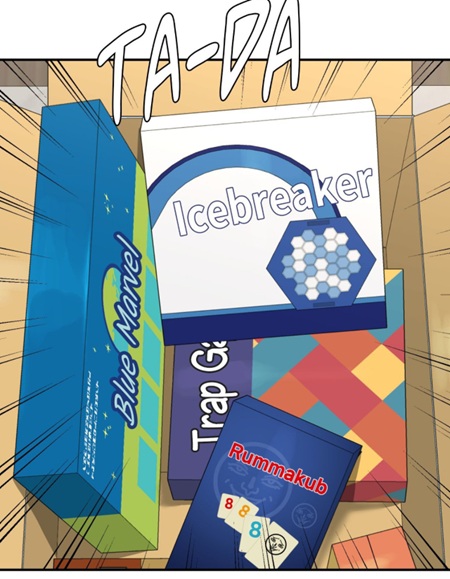 (chapter 80) They never played it — and that is no accident. The title encapsulates the temptation Jaekyung must resist: to treat intimacy as a contest, to imagine that trust can be won through tactics or timing. But hearts do not yield to strategies. The only way to melt the ice is not by “breaking” it, but by warming it, patiently, sincerely.
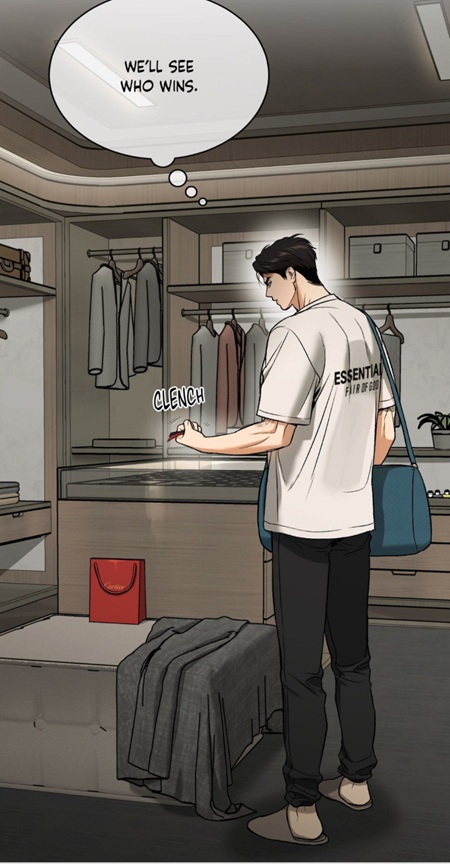 (chapter 66) And this is something the physical therapist could notice, if he enters the room again and pays more attention to his surroundings. This is not about ownership but about inclusion: an unspoken invitation to share a part of himself.
  (chapter 30). Even in that comic panel, the imbalance between physical familiarity and emotional distance was evident. Kim Dan’s embarrassment stood for boundaries not yet earned, and Jaekyung’s casual tone for a love not yet understood.
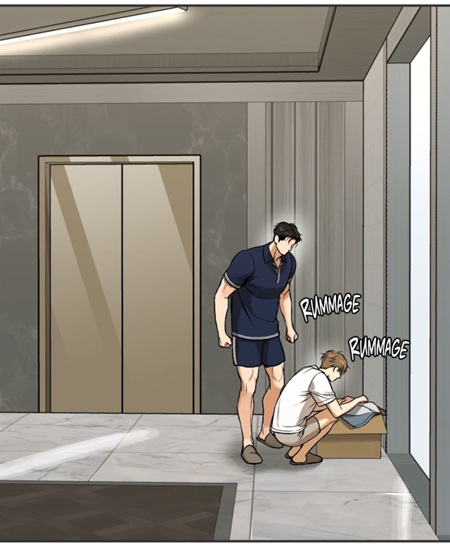 (chapter 80) The scene is small but seismic. The camera places Jaekyung slightly behind, his fists curled and his shoulders tense — an instinctive gesture of self-restraint rather than dominance. He is no longer the one towering above, demanding or explaining; he is waiting, watching, enduring the discomfort of having gone too far. His silence here is not indifference but humility — the silence of someone learning, painfully, what boundaries mean.
 (chapter 70) The athlete’s posture
 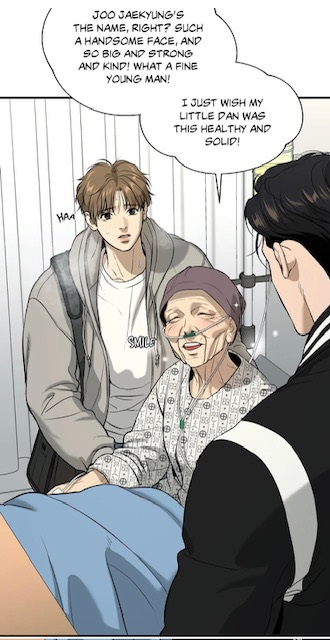 (chapter 21) Behind the warmth of her words lies a quiet wound: she loves her grandson, but she wishes him to be different — stronger, healthier, easier to care for. In his eyes, it’s an unreliable, burdensome shell — a vessel of weakness and sickness. Every protruding collarbone, every cracked lip or dark circle testifies to a deeper wound: the conviction that he is unworthy of care.
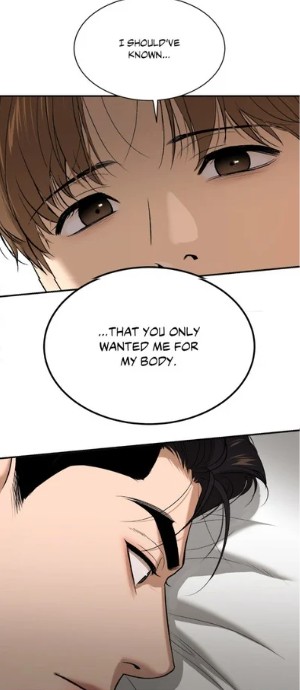 (chapter 62) the weight of that sentence stretches far beyond the bedroom. It carries the residue of every moral, familial, and physical contract that has reduced him to flesh. What the champion hears as accusation is, at its core, a confession of alienation — the echo of a man who has never learned to live inside himself. It’s not only a reproach but a confession. He hates his body because it has become the medium through which he is used, never loved.
 (chapter 27)
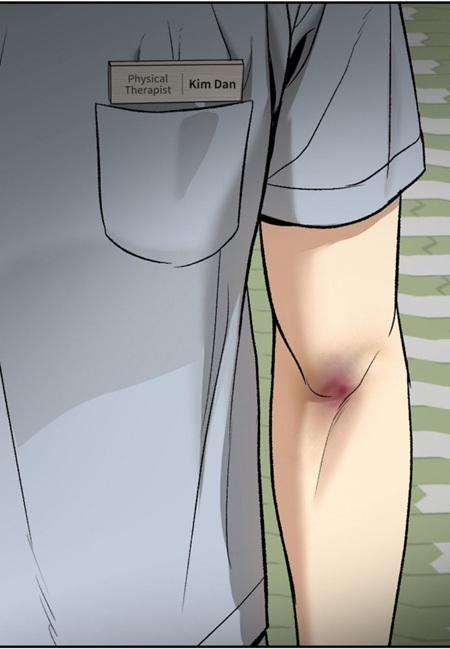 (chapter 61), the other where no one looks. Yet, the attitude of people is the same: no one pays attention to them. Both inhabit bodies that have forgotten the difference between endurance and pain. Both mistake self-destruction for strength.
  (chapter 18) when Kim Dan, bruised, had seized his hand and expressed his concerns. Back then, the gesture had confused the wolf. His hands were made to strike, to defend, to dominate — not to be pitied or protected. He had pulled away instinctively, unsettled by the tenderness and the huge sense of responsibility behind the question. He felt criticized, as if his power was questioned.
  (chapter 80) What began as misunderstanding in episode 1,
 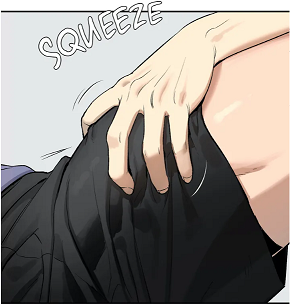 (chapter 1) and was maintained through the awkward hospital encounter in episode 18, now evolves into dialogue and genuine comprehension. In the beginning, Kim Dan’s touch had been accidental and defensive—a misreading of bodily proximity. When he grabbed the fighter in episode 1, he believed he had crossed a forbidden line, that his action would be seen as insolence or violation. The fear and shame that followed transformed touch into a territory of silence and self-censorship.
 (chapter 56), he had interpreted that touch not as mistake or violation, but as a spark of invitation—proof that the “hamster” might want him after all. His own longing twisted the scene into a fantasy of desire, into a private “game” he wanted to continue in the bedroom. One misunderstanding gave birth to another. By episode 18, the same reflex persisted: he reached out again, asking if Jaekyung was hurt, his hand trembling with the same mixture of care and fear. Once more, touch was misread—offered as comfort, received as intrusion. Thus their relationship began under crossed signals: one moved out of survival, the other out of projection or the reverse. It is no coincidence that their relationship in season 1 was doomed to fail. They never communicated properly, as their perception was influenced by their past and surroundings.
 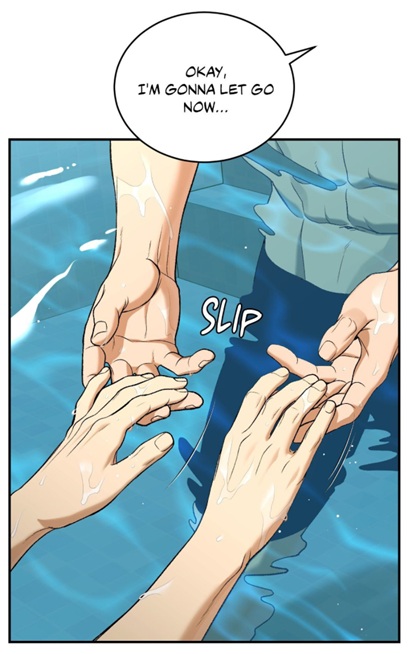 (chapter 80), Kim Dan panics, convinced that release equals abandonment.
 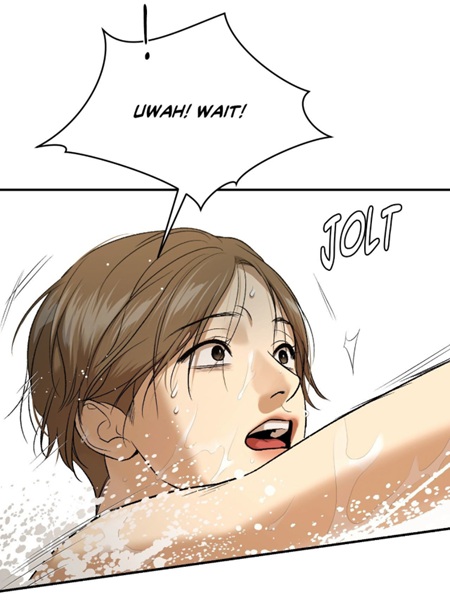 (chapter 80) He freezes once again. Yet the water holds him; he reaches onto the champion again — and this time, the embrace stays. What makes this moment remarkable is that the pool is shallow.
  (chapter 80) Kim Dan could easily stand on his own, but fear has eclipsed reason. His instinct is not to trust his feet, not to fight the water, but to cling to the man before him.
 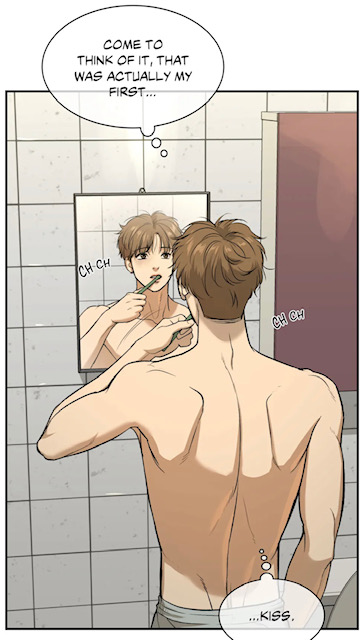 (chapter 16) —that deceptively simple French word—finds its power. It means “ice,” but also “mirror” and “window.” When the champion looks through Kim Dan’s glace
 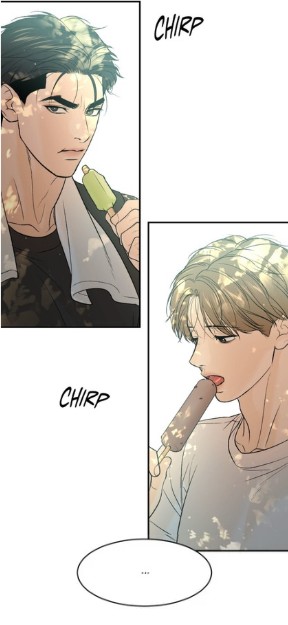 (chapter 77), unlike the touch of ice. It softens, sweetens, dissolves slowly on the tongue. Likewise, the heat between them no longer needs to scorch; it can melt. And yet, the kiss — once their most volatile exchange — has fallen silent.
  (chapter 64) Kim Dan had to bite his own lips to make Jaekyung stop, and neither has ever truly spoken of it. Yet, during the night, the athlete could see the remains of that cold war.
 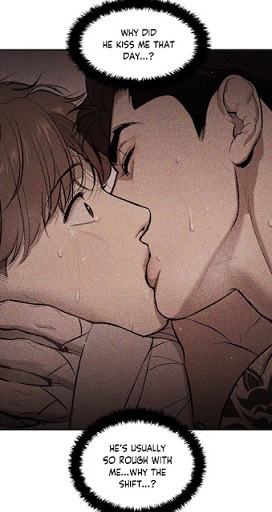 (chapter 16), just as the champion has never confessed that it was his first kiss. Moreover, during their first day off together, Joo Jaekyung had also initiated a kiss and back then, the doctor never wondered why.
  (chapter 27) Both men have been staring into the same mirror without realizing that the reflection was shared. They love each other. Joo Jaekyung needs to ponder on the signification of a kiss
  (chapter 13) and why doc Dan made such a request.
  (chapter 15) The kiss is more than just fun and pleasure. It is the expression of “love”. And now, you comprehend why I am expecting a huge change in the next episode.
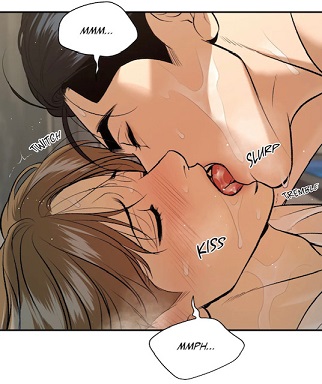 (chapter 28) and urge Kim Dan to ask, at last, the question that remained frozen between them. In doing so, he would not only reopen the conversation but also reclaim the meaning of touch itself: not as misunderstanding or survival, but as curiosity and love.
 (chapter 80) And it comes with a small but crucial instruction. In that single phrase, the MMA fighter encourages Kim Dan to discover his own power and strength without overexercising. His feet, which were once symbolically trapped in the nightly ice, now press against the water with intent during the day. For the first time, his body obeys him, not fear. His movements are neither frantic nor helpless but self-regulated, gentle and alive. That’s why the main lead becomes happy for a moment.
  (chapter 21) comes from the early loss of his mother.
 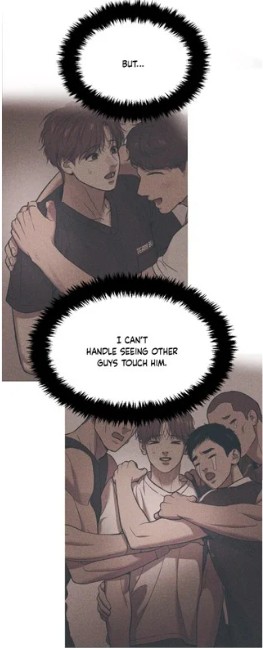 (chapter 79), if he knew that the doctor has already loved him for a long time.
 Kim Dan on Thin Ice was never just about danger or fragility — it was about transformation. The ice that once confined him to stillness has melted into water, and the fear that once froze his body has become motion. Where there was trembling, there is now flow; where there was isolation, there is connection.

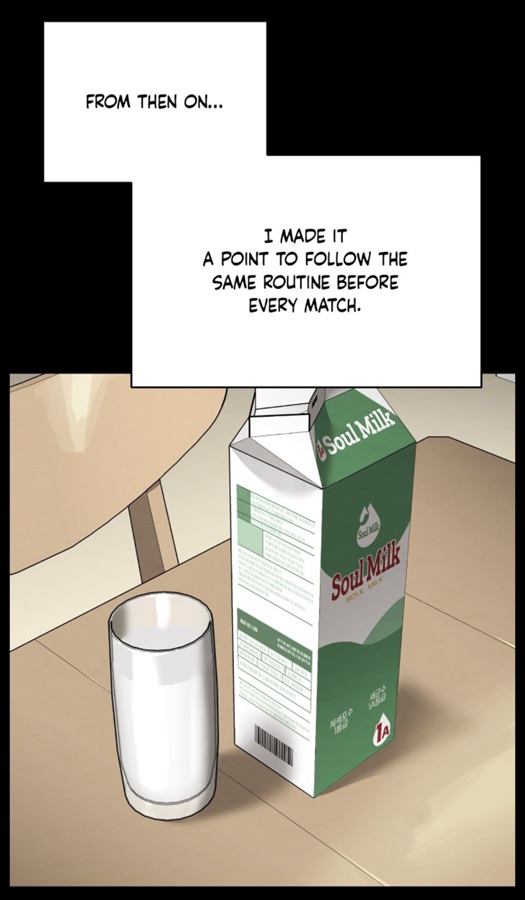 (chapter 75), the perfume
  (chapter 75). His words seemed like a confession, a key to the riddle of the Night Emperor. But do we truly know him now? Yes and no. Yes, because his testimony reveals patterns we had only noticed before. No, because those patterns are only the ones he decided to share. The tattoos
 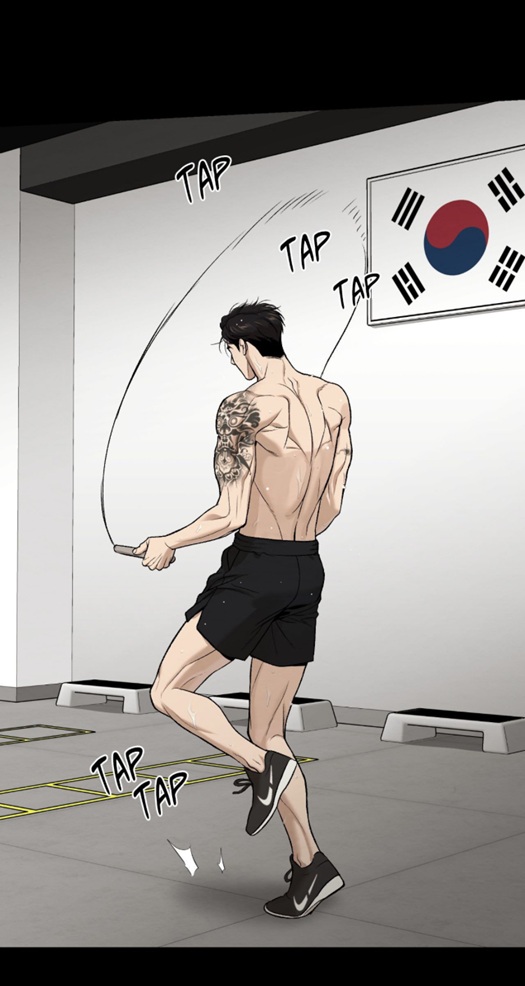 chapter 75) that suddenly appeared on his body
 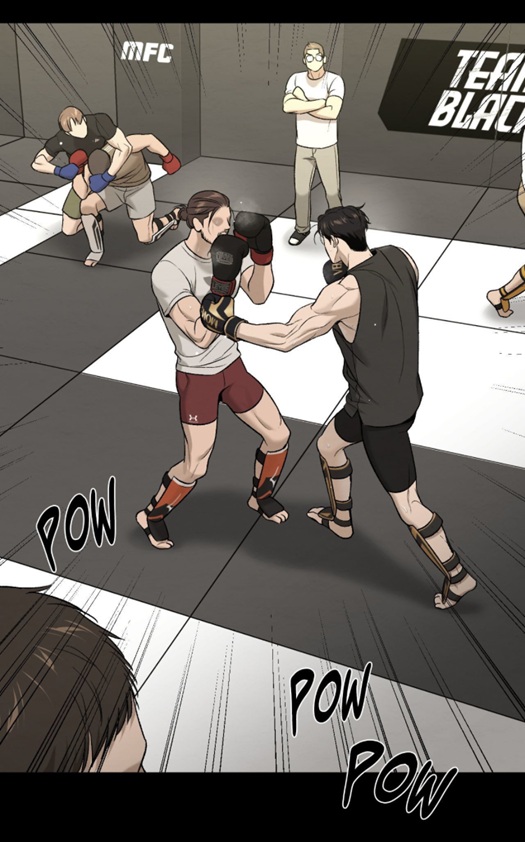 (chapter 75), for example, were left unmentioned — proof that silence still surrounds him.
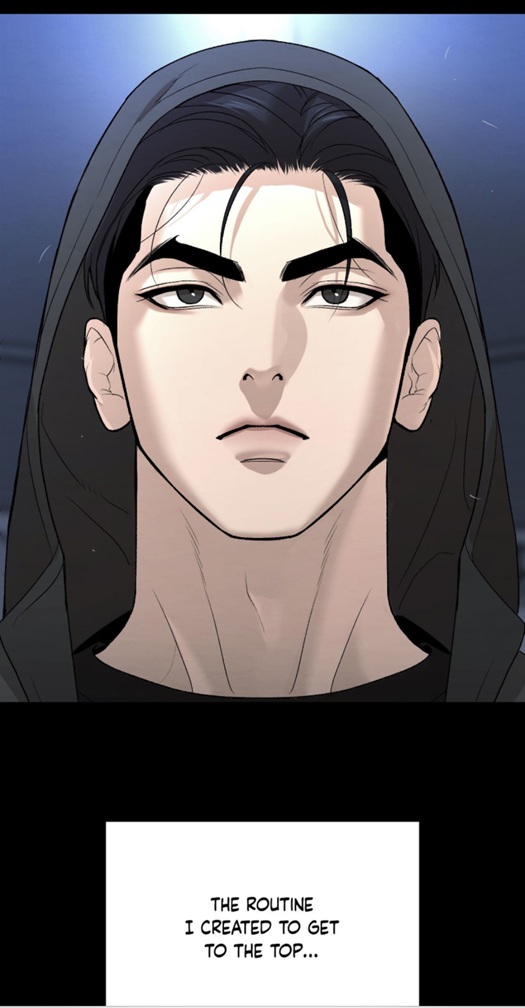 (chapter 75) Why fight as though every match were a matter of life and death? Why keep repeating the same acts, long after survival was secured?
  .(chapter 75) They are the product of a long chain of humiliations, betrayals, and systemic exploitation, each layering onto the next until a young man’s raw talent was encased in a carapace of compulsions. To understand the jinx is to understand how the protagonist’s life collapsed around the word loser, and how the fighting industry transformed his private shame into public myth.
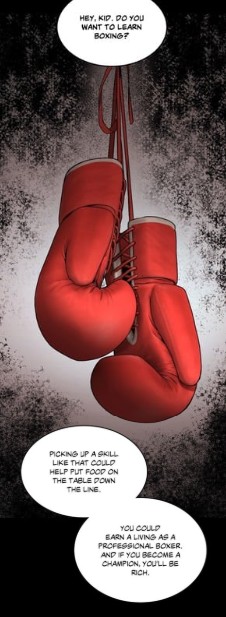 (chapter 72) Even before stepping into a professional cage, his life had been a series of trials to prove he was not worthless.
  (chapter 74) Hunger, poverty, bullying, insults— each branded his body with a language of violence. Among them came his father’s words, spat like a curse: loser.
 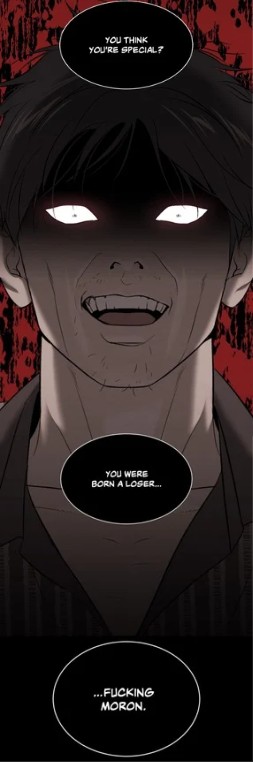 (chapter 73) That insult crystallized everything. The young boy absorbed it as truth, so much so that every later fight would be less about victory and more about silencing that single syllable.
 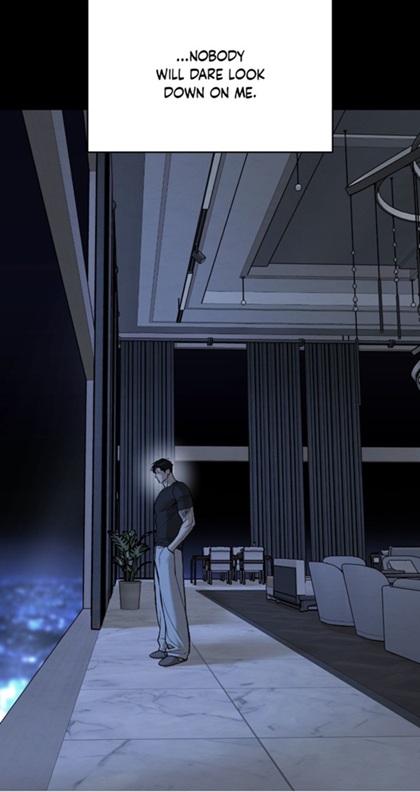 (chapter 75)
 (chapter 69)
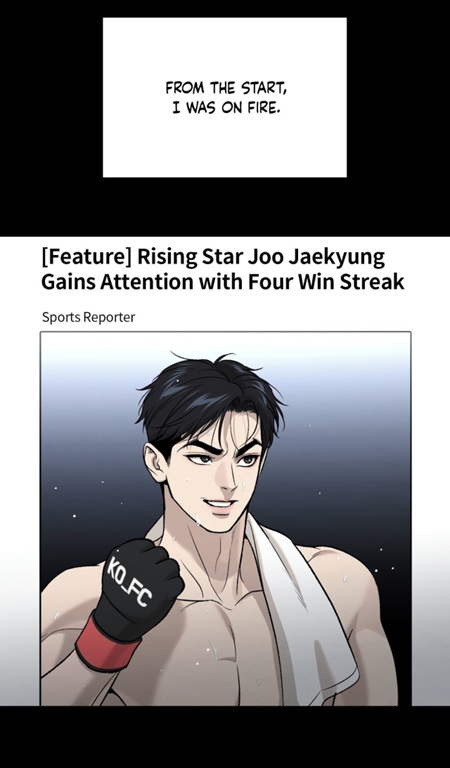 (chapter 75) — a boy who fought with the desperation of someone who had nothing else. Victory after victory gave him the illusion that he had escaped his father’s shadow. As long as he was winning, he could suppress the pain, bury the insult loser, and silence the memory of that cursed night when his father died and his mother abandoned him. Triumph became his shield, proof that he was not what he had said he was.
 (chapter 75)
  (chapter 75) To them, a fighter’s struggles had only one explanation: weakness. Park Namwook and the other coach dismissed his losses as nerves
  (chapter 75), as if the only measure of worth were what happened under the spotlight. They never thought to ask what kind of weight he was carrying, what kind of nights he was surviving before he entered the cage. While the other fighters were well aware of the champion’s insomnia
 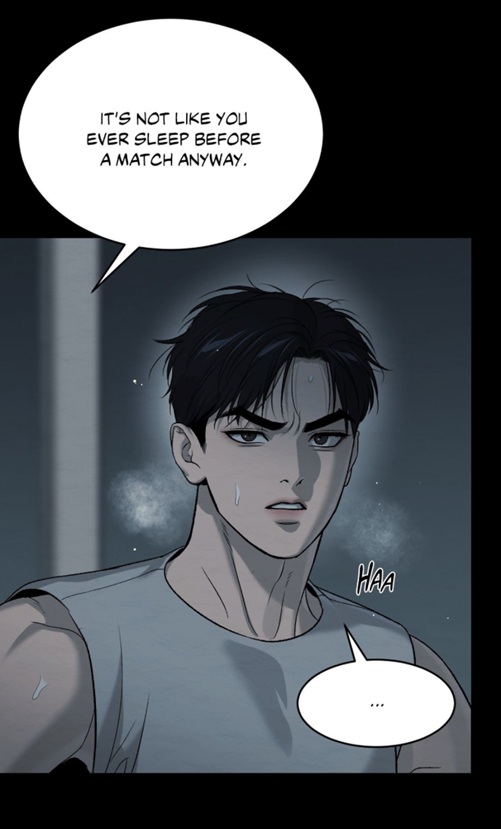 (chapter 75), Park Namwook still has no idea of the champion’s struggles. This shows how disconnected he is from his “boy”.
 (chapter 74) bodies to be tested, pushed, and discarded if they broke. Where Jaekyung’s defeat cracked open childhood trauma, they saw only performance failure. What he lived as suffocation and despair
  (chapter 75), they reduced to cowardice, bad luck or lack of discipline.
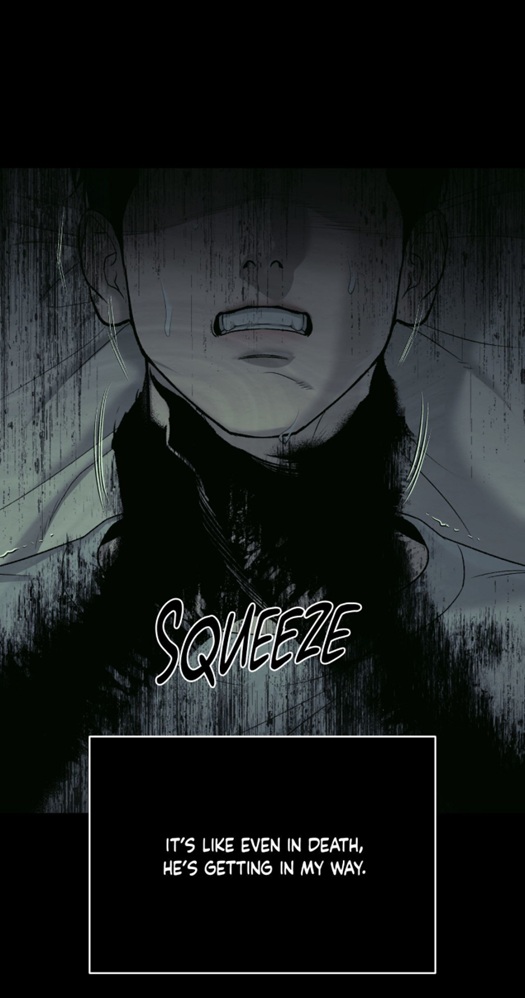
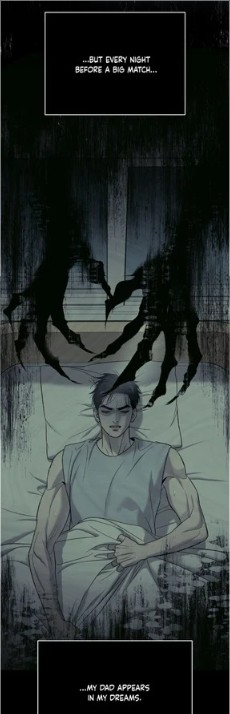 (chapter 75) Shadowed hands stretched over his body, pressing down, suffocating him as he tried to sleep. The man was dead, but still he choked the air from his son. It was, as if the father wanted to bring his son to the afterlife.
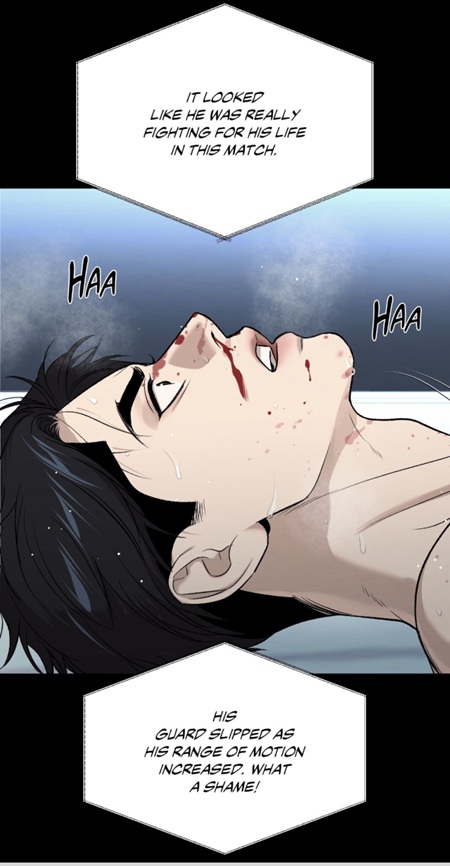 (chapter 75) Even before his first loss, Jaekyung fought like a cornered animal, pouring every ounce of strength into proving he could not be beaten. That’s why he rose so fast. But why? The reason is that all his opponents were reflections of his “father”.
  (chapter 29) Hence all the challengers have empty eyes and a smirk on their face, just like Joo Jaewoong.
  (chapter 75) Consequently, his matches always looked like life-and-death struggles. He wasn’t strategizing against a specific fighter; he was exorcising a ghost. That’s why he never refused a challenge. His opponent never mattered. Besides, as long as he could win, it didn’t matter.
  (chapter 75), the more the cracks showed — and the ghosts of his father and mother made every fight feel like a replay of abandonment and accusation. The five losses
  (chapter 75) were not just setbacks in his career; they were the repeated reopening of a wound that would never heal. Each one confirmed his father’s curse. Each one reinforced the sense that he was marked, that no matter how high he climbed, he would always be dragged down again.
 (chapter 73) To the boy, it was a cry for pain and survival — an instinctive urge to escape despair and criticism. To the father, it was betrayal. Already emasculated by failure and drink, he was reminded of his wife’s discontent, the specter of another abandonment. He lashed out the only way he knew:
  (chapter 73), and that the man’s final judgment on him would never be undone. Love and hatred, longing and guilt fused in that moment. He loved his father despite the abuse. And yet he would forever wonder if leaving — even just threatening to leave — had killed him. Worse, because death came so suddenly, there was no time left.
 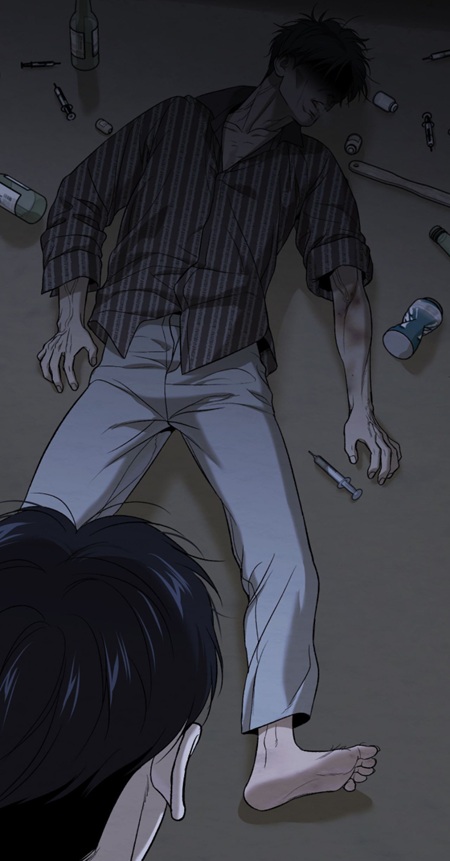 (chapter 73) The clock had stopped before forgiveness could be spoken, before the boy could say he had not meant it. From that moment on, time itself became his opponent: every match another countdown, every victory an attempt to outrun that night.
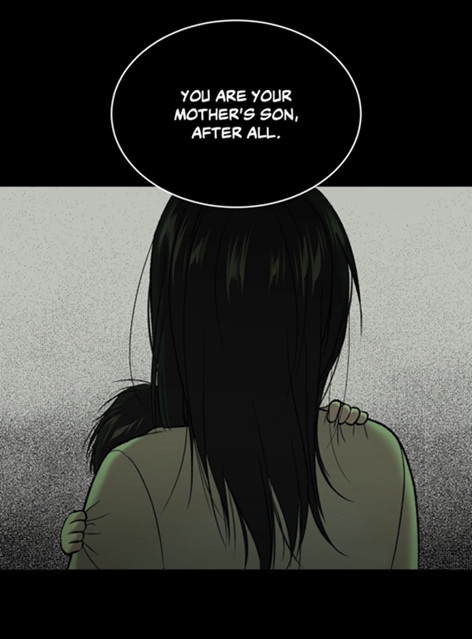 (chapter 73), unable to voice his own vulnerability.
 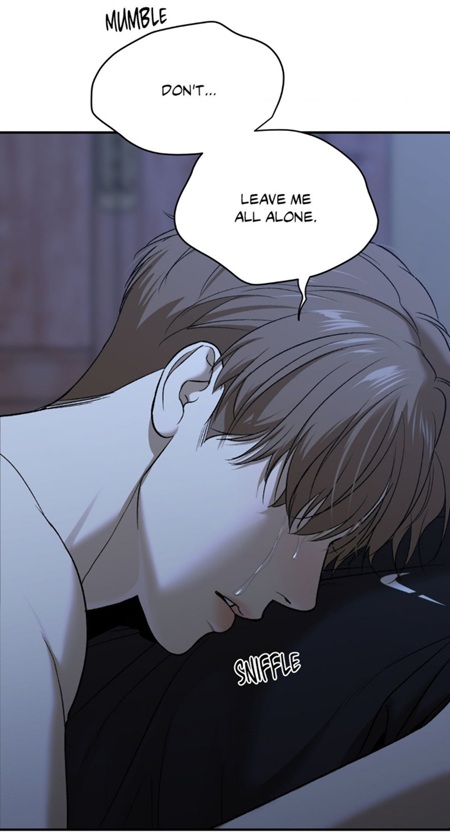 (chapter 66) — speaking not with fists or insults but with tears and an embrace.
  (chapter 66) His sleepwalking reacting to a simple touch
 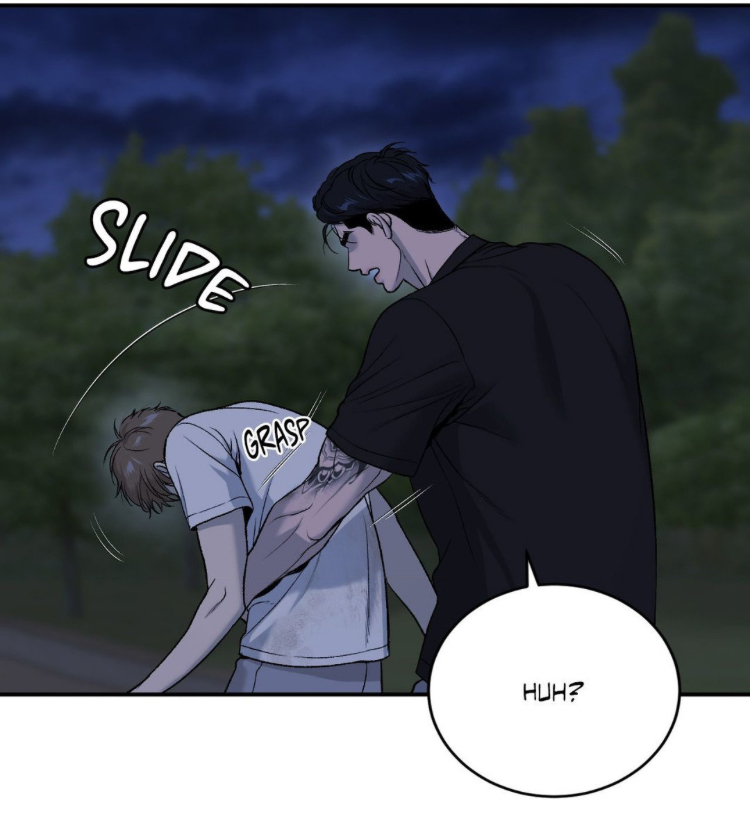 (chapter 65), his dissociative pleas
 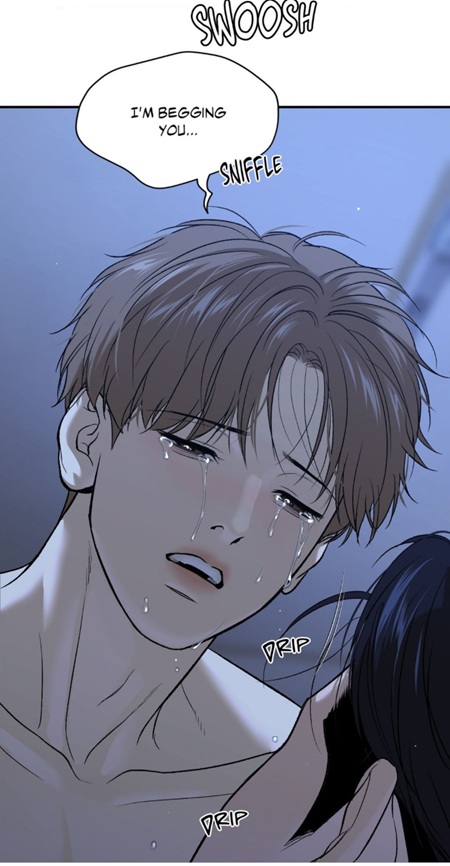 (chapter 66) give Jaekyung the words his father could not say. Where the father’s unconscious leaked out in aggression, Dan’s unconscious offers gentleness and honesty. Both men speak from a place deeper than reason; one chained Jaekyung to guilt, the other opens the possibility of release. In Dan’s trembling body, Jaekyung sees the tender reflection of his father’s hidden plea
  (chapter 73) Why does the champion have no grand-parents?
 (chapter 74) With no parents, no siblings, and eventually no wife, he had nothing to fall back on and saw in the criminal world another form of “family”. The family he created became his one fragile shelter — and when that shelter cracked, there was nothing left to hold him.
 (chapter 72) His violence expressed his powerlessness. And when his son shouted his desire to leave the “dump of a house,”
  (chapter 57) Violence and insult became his only idiom. “Loser” was not simply an accusation, but the displaced confession of his own defeat: I was abandoned. I failed. I have nothing.
 (chapter 73) The boy’s boxing talent was a source of pride — proof of strength — but also a threat. Strength meant escape. Escape meant abandonment. The father, who had already lost his wife and his dignity, projected onto his son the terror of losing everything once again. His resentment was not born of disappointment alone but of recognition (unconsciously): you are me, and you will leave me too.
 (chapter 65) The absence is not an oversight but a theme. Jaekyung comes from severed roots: no grandparents, no siblings, no extended family to lean on. Hence he was alone at the funeral.
 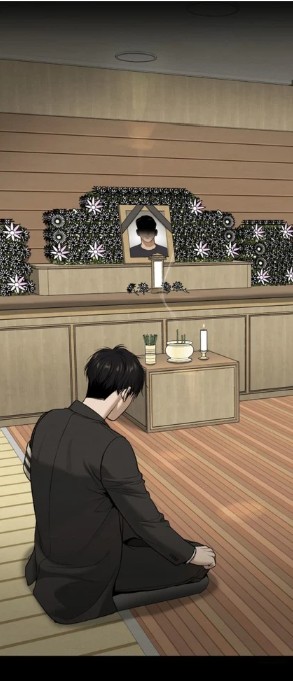 (chapter 74) His father may have been an orphan, just like his mother too. Therefore the latter was emotionally unavailable, and so he inherited not only trauma but also silence. By contrast, Dan has at least one surviving figure — flawed as she is — who keeps the family thread intact. That contrast makes Jaekyung’s bond with Dan all the more significant: it is not just romance, but an attempt to build a family line that never existed before him.
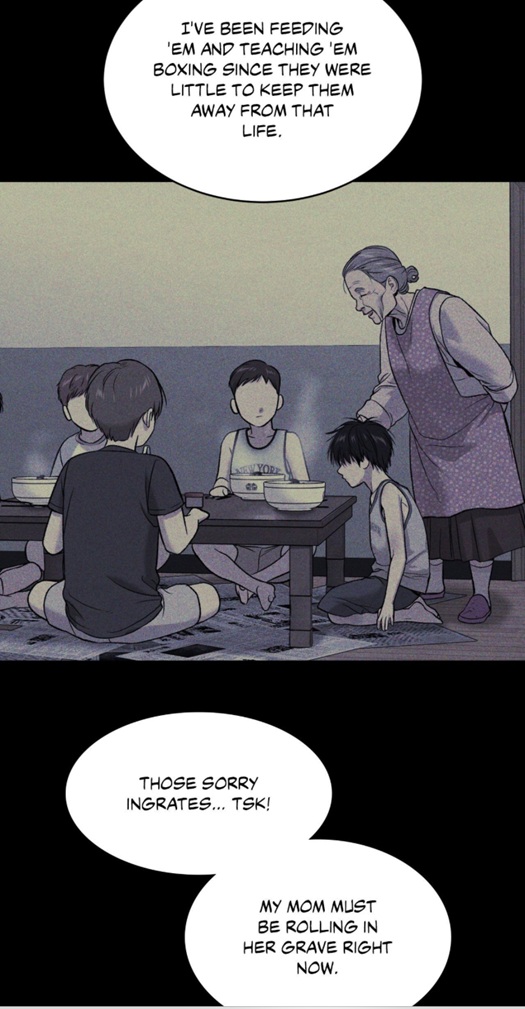 (chapter 73), while keeping Jaewoong’s own origins shrouded. Hwang had someone by his side — gentle, quiet, but present — while Jaewoong had no one, as according to me, the mother was counting on her “husband”‘s success and dream. The director’s stability, however fragile, was rooted in that maternal figure. Jaewoong had no such guide, and without it, he simply made the wrong choice.
 (chapter 74), she never once spoke to her son about it, never asked what he felt. She did not grieve with him, nor allow him to grieve. Besides, the main lead’s words were ambiguous: Was the father dead or had he abandoned his son too? The fact that she never asked exposes that it didn’t matter to her. She was not interested in the truth, her only concern was herself — her new life, her fear of losing it. Where the father left him branded, the mother left him erased.
 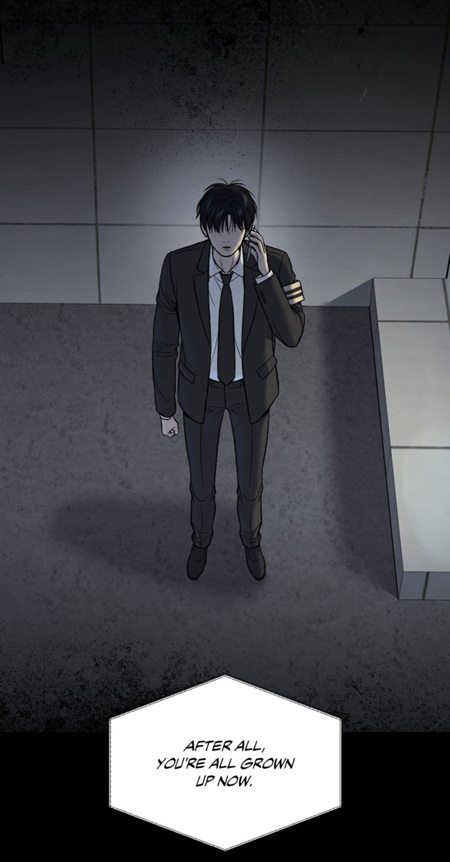 (chapter 75) One condemned him, the other abandoned him, and between them Jaekyung was left with neither recognition nor belonging.
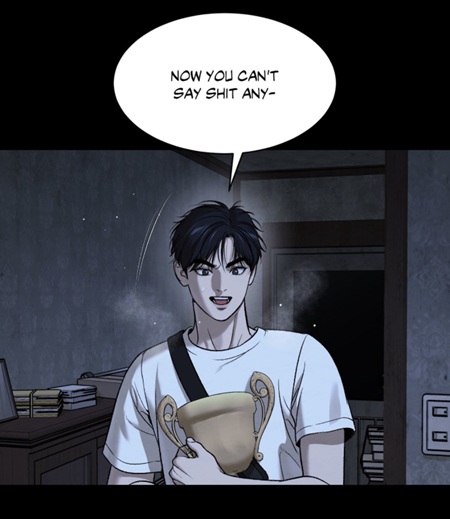 (chapter 73); every triumph, by the echo of rejection
 (chapter 73). To win was to prove his father wrong, but to stand alone in victory was to prove his mother right. Success and emptiness became inseparable.
 (chapter 56), seemingly fragile and dependent. But unlike her, he stays. Where the mother left, Dan endures. He only left because of the champion’s final words:
 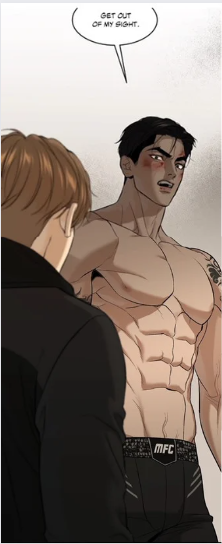 (chapter 51)
  (chapter 73) mirrors what the director later whispers to Jaekyung:
 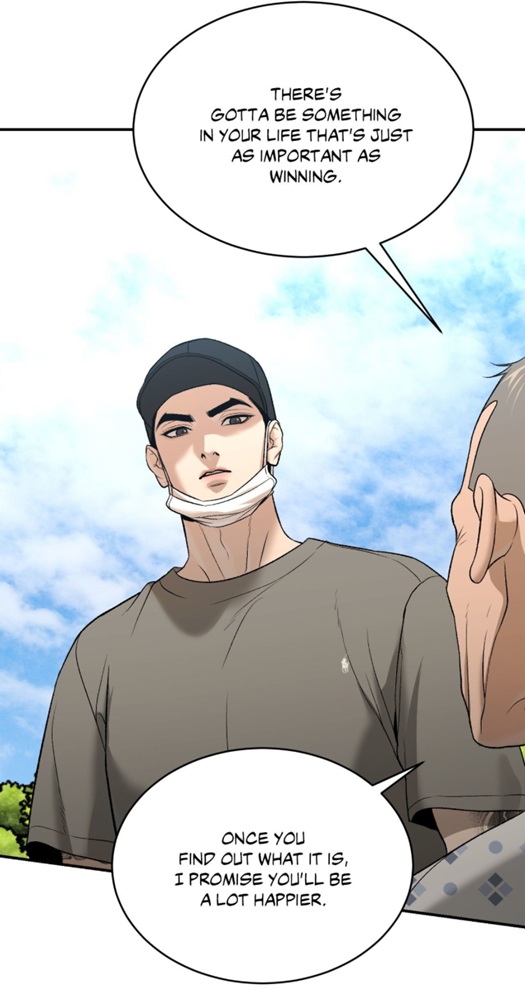 (chapter 75) Both men — the broken father and the regretful coach — carry the same hidden insight: that fighting cannot be the whole of life, and that reducing yourself to fists and violence only leads to ruin.
 (chapter 75) This is the wolf’s ritual in front of the tender mirror: the fighter who lived by curses and silence finally meeting their reflection transformed into gentleness and endurance.
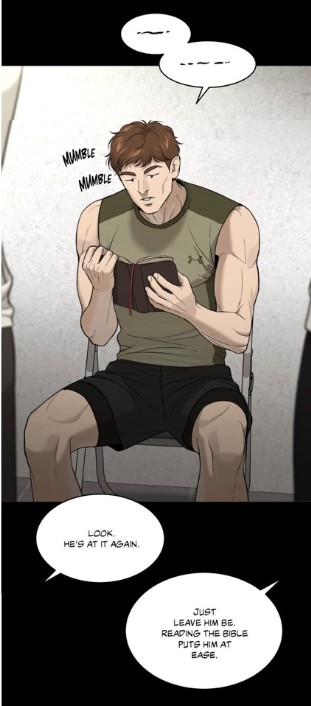 (chapter 75) This man’s jinx was startlingly simple: he read the Bible before every match. One book, one ritual, one anchor. To outsiders, it may have seemed quaint, even laughable, but to Jaekyung it was enviable.
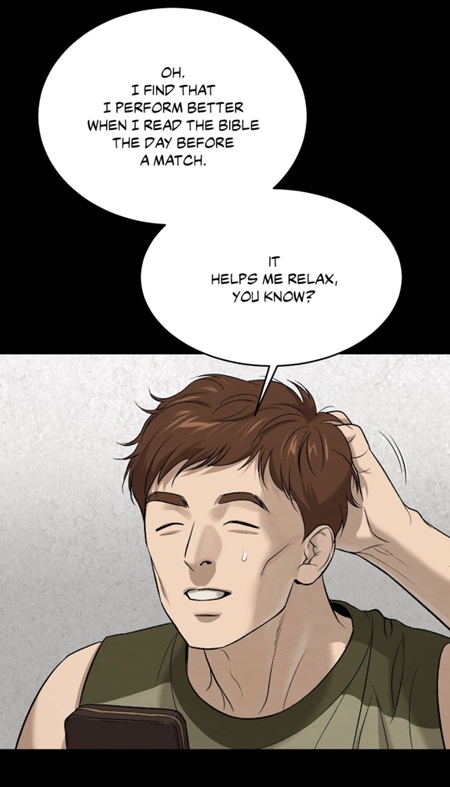 (chapter 75) When he prayed, it was not only for victory, but for coherence. Win or lose, the ritual bound him to a sense of belonging that Jaekyung had never tasted.
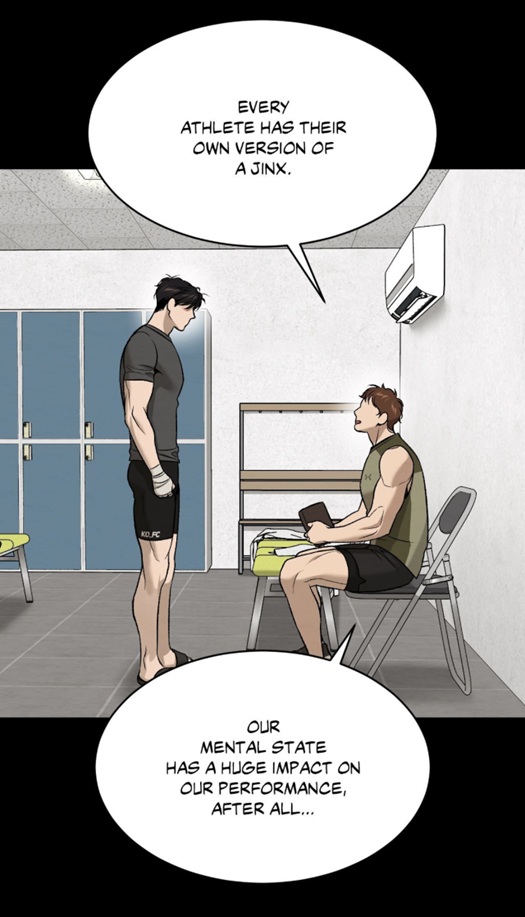 (chapter 75) If ritual could bend fate, he would build his own. But where the Bible fighter had a single, unifying story — scripture, God, fellowship — Jaekyung had nothing to draw on. No faith to lean on, no parental blessing to inherit, no safe home to return to. Instead, he began to stitch together a mosaic of rituals, each one disguising a different childhood wound. To outsiders it looked obsessive, neurotic, almost superstitious. To him, it was survival. Each gesture was both repression and remembrance, a scar disguised as armor. And this is the paradox: the rituals made him strong enough to survive, but too broken to live.
 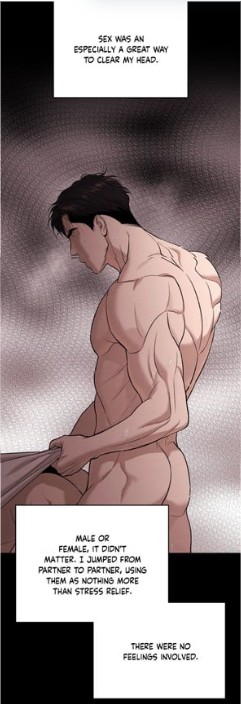 (chapter 75) By using another body, he cleared his head, numbed the loneliness, and convinced himself he was in control. But it was also a grim reenactment of abandonment: he could take without being left, dominate rather than risk being deserted. At the same time, he considered his sex partners as toys in order to avoid guilt. A toy can not die, it can be “thrown away”.
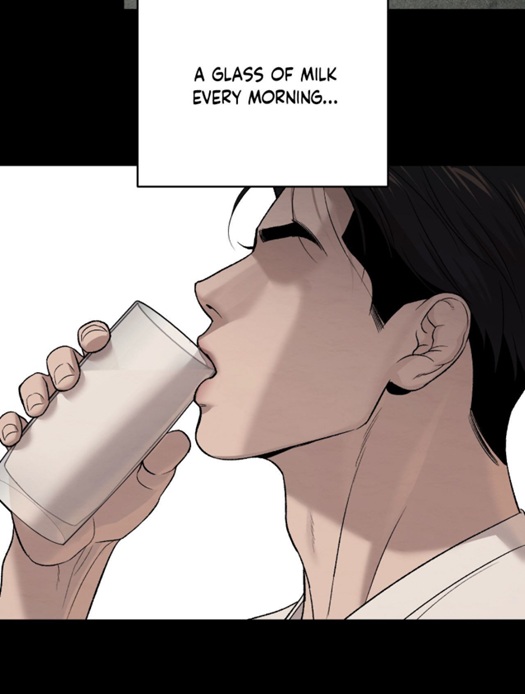 (chapter 75) But in truth it was a disguised memory of hunger
 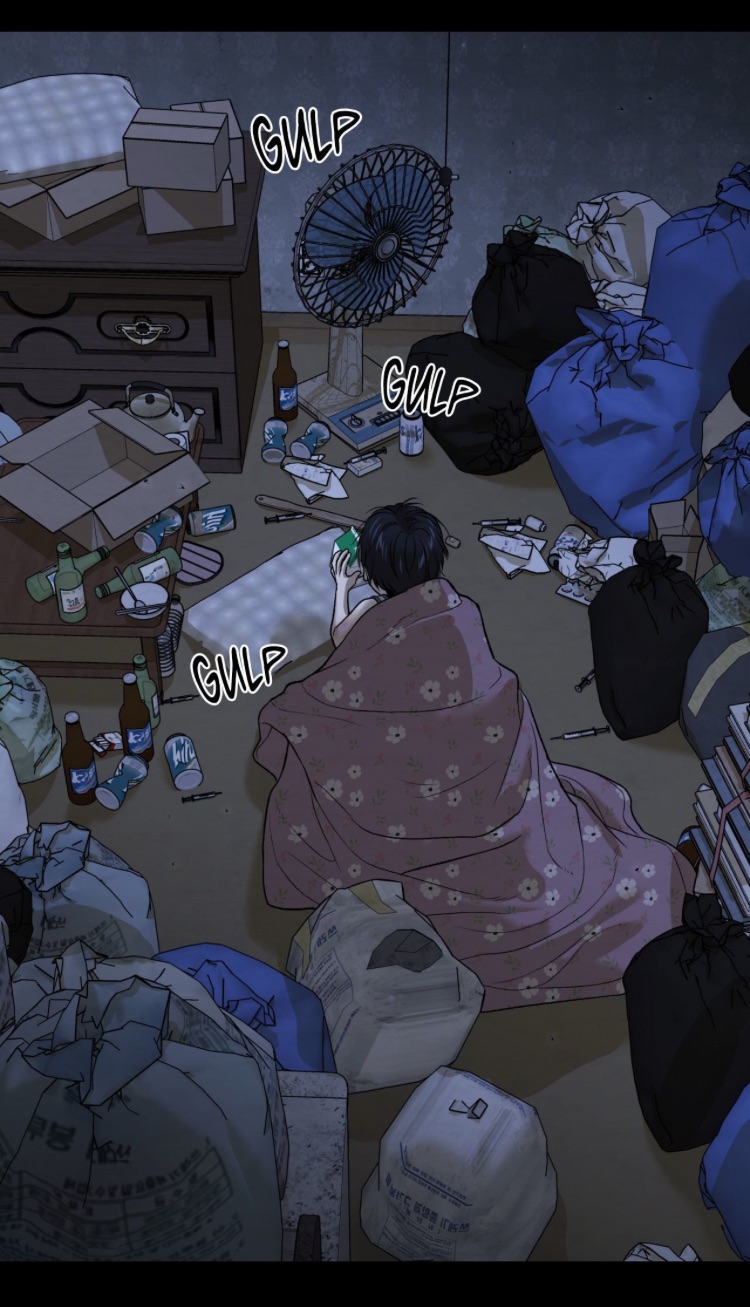 (chapter 72), of nights when there was nothing to eat, of shame attached to poverty.
  (chapter 75) To drink milk was to rewrite the past: I will not go hungry again. Yet the act was also a reminder that he once had.
 (chapter 75), a reminder that he had entered a machine in motion, a system that swallowed fighters whole and spat out statistics. From that point, the acceleration was merciless: by April, he was in the 272nd bout against Randy Booker
 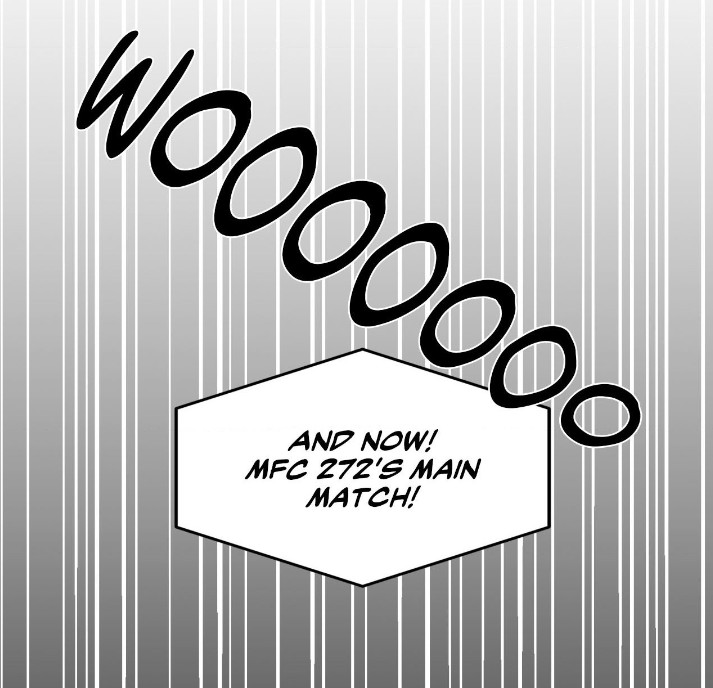 (chapter 14); by June, the 293rd against Dominic Hill
  (chapter 40); and by July, the 298th against Baek Junmin.
  (chapter 50)
 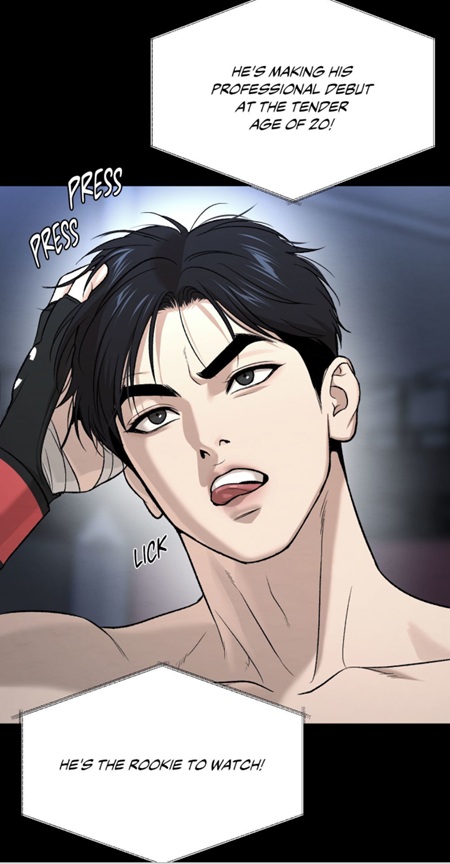 (chapter 75), he had not merely “built” a career, he had been consumed by one. There was no time to recover from injuries, no space to process victory, no room to integrate defeat. No wonder why his shoulders were in bad shape.
  (chapter 75) Every fight blurred into the next, every opponent older, stronger, more experienced. And yet Jaekyung fought them all with the same desperate, survival-driven ferocity.
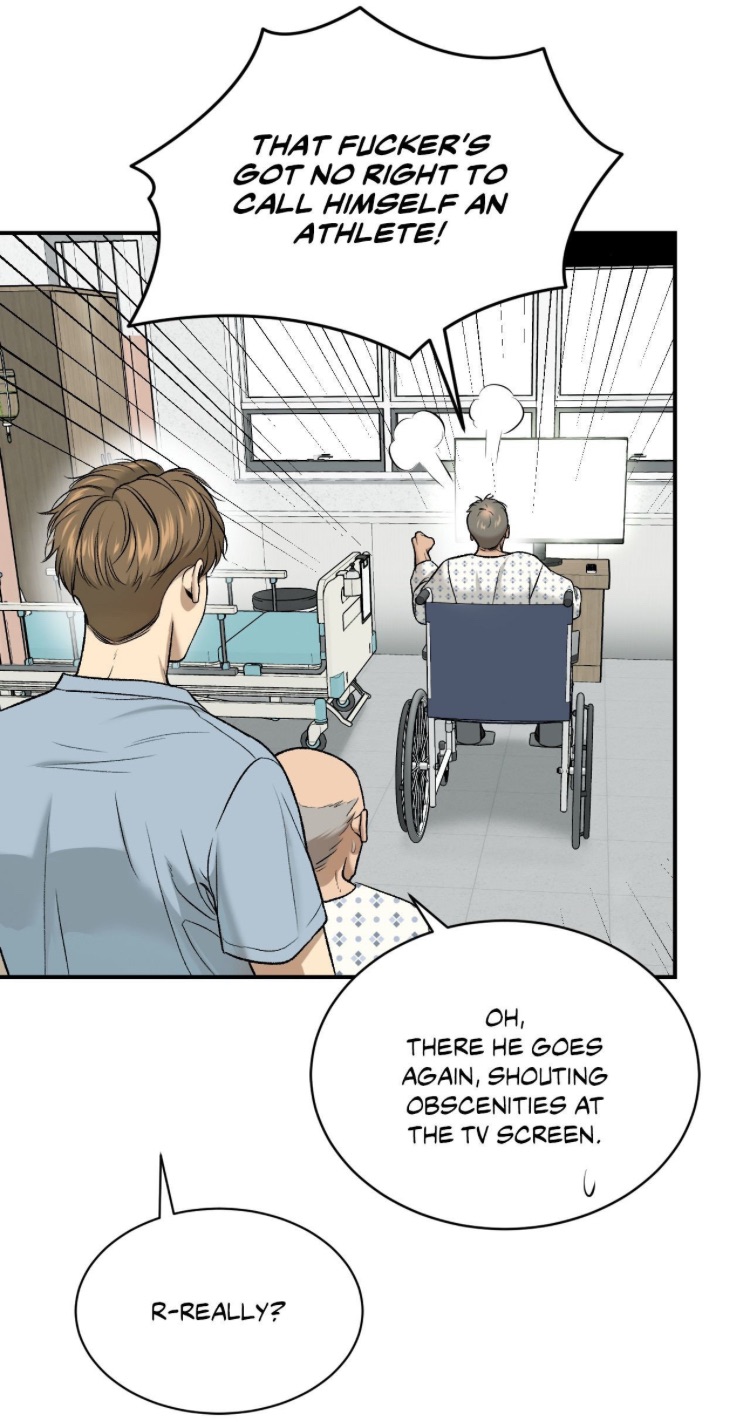 (chapter 71) and Dr. Lee
  (chapter 27) still called him an athlete — someone whose body required balance, protection, recovery. But MFC and KO-FC never did. For them, the main lead or his colleagues were addressed as
 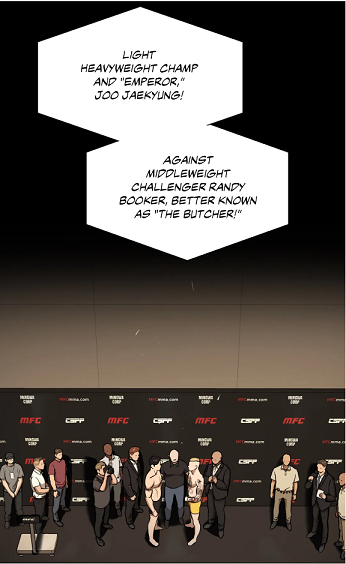 (chapter 14) “The Emperor”, “a crazy bastard”
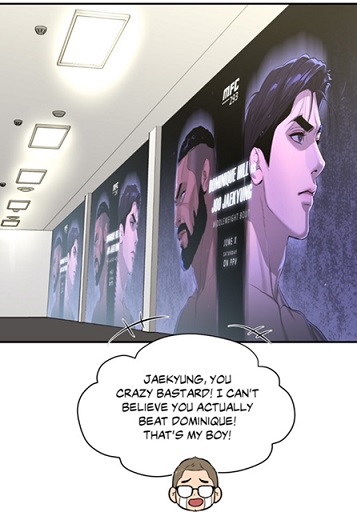 (chapter 40), “my boy”,
 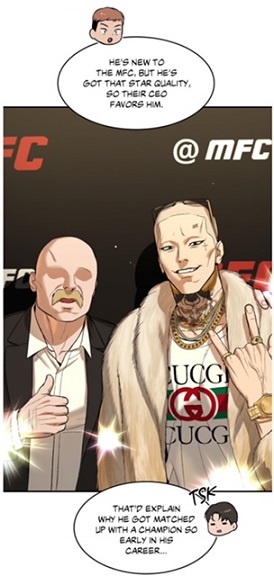 (chapter 47) “a potential star.” Not a person, not even a professional, but branding material — a body to be consumed by audiences and discarded once spent. The absence of the word athlete marks what he lost: recognition as a human being. And guess what?
 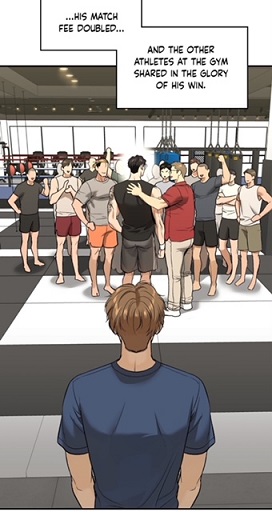 (chapter 41) Only doc Dan at the gym saw the fighters as athletes!
 (chapter 47). Thus only doctors are allowed to do them officially. But Jaekyung’s rise shifted that meaning. As “The Emperor,” he normalized tattoos for the new generation of fighters, transforming what once marked marginality into a badge of visibility. This is why even Oh Daehyun, one of his admirers and members of Team Black, now carries one:
  (chapter 8) The celebrity’s suffering literally redefined the aesthetic of the sport. His body, turned billboard, became part of the league’s branding.
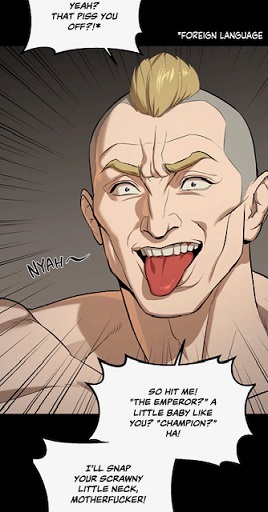 (chapter 14) ripping open the scar of his father’s “loser” and his mother’s absence and silent parentification. Not long after, an article exposed his shoulder injury
 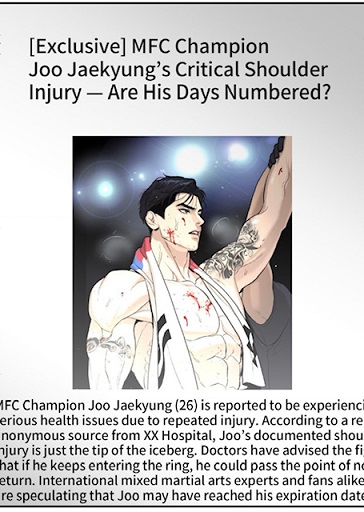 (chapter 35), reducing years of discipline to a liability on the page. Later came the suspension narrative
  (chapter 54), his temper framed not as the product of exploitation and scheme but as proof of unfitness, as if his rage were a crime instead of a symptom.
  (chapter 54) Even the match with Baek Junmin was twisted against him — accepted under pressure, then reframed as recklessness. To the system, his crown had been too secure, his presence too dominant. He had been champion for “too long.”
 (chapter 5) the name Seo Gichan appeared here for the first time… a faceless name!
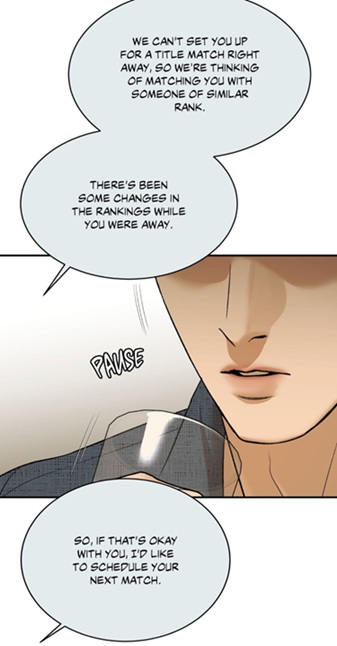 (chapter 69) The danger lay in the very identity of his next challenger. If they pitted him against a newcomer who had rocketed through the ranks as quickly as Baek Junmin once did
 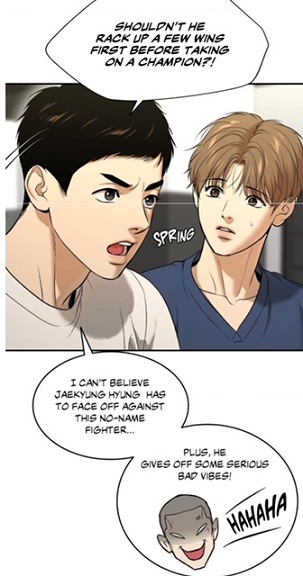 (chapter 47), questioning the selection of Baek Junmin, is so crucial. It shows that the manipulation of opponents was no accident — it was systemic. Matches were not about fair combat but about narrative management: making sure the emperor’s story served the company’s balance sheet.
 (chapter 51) On paper, it was a draw. In practice, it was soon reframed as a loss
 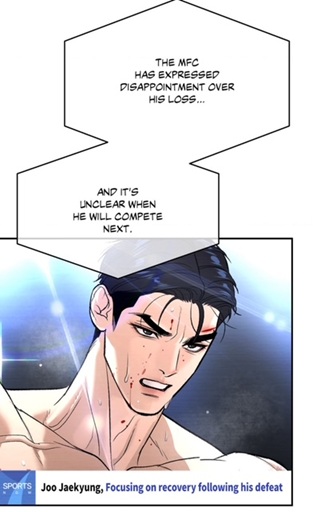 (chapter 57). By late August, Jaekyung had slipped to third place.
  (chapter 69) And strikingly, no one questioned it. Not Park Namwook, not the officials, not even Joo Jaekyung or the commentators who had once praised his streak. The silence was louder than any insult.
 (chapter 75) Here, it looks like a mirror, but naturally it is a fake one. It was not earned with fists alone; it could be stripped, reassigned, reshaped at will. One tie, one whisper, one adjustment in the rankings, and the Night Emperor was dethroned without ceremony.
 (chapter 75), not for intimacy but to clear his head and stave off loneliness, emptiness and his abandonment issues.
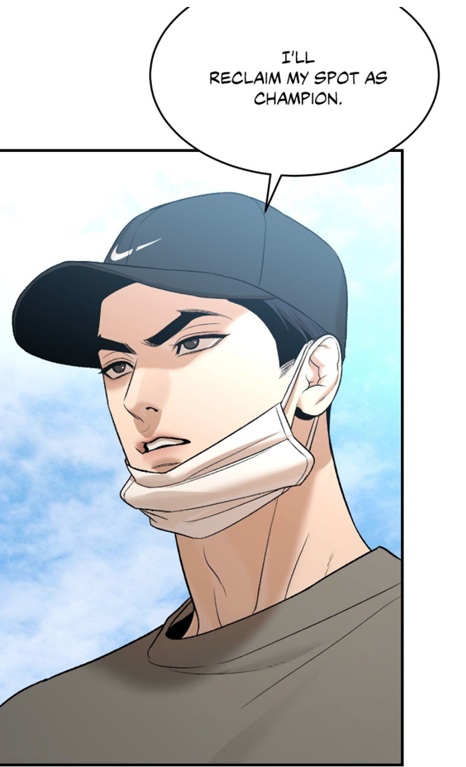 (chapter 75) must be read in this light. It is not a relapse into the system’s treadmill, nor a blind return to the pitfall laid before him. Notice that he does not say he will fight in the fall, nor does he mention the upcoming match that everyone else is waiting for.
  (chapter 71) Instead, he frames his goal with a word that changes everything: reclaim.
 (chapter 73), but he lost his father and his mother abandoned him.
  (chapter 51) When his world threatened to collapse again — the tie with Baek Junmin, the looming humiliation — he erupted in rage. He screamed at Dan, he let the words spill out violently, breaking the silence that had once shackled him. It was an act of defiance against the curse: if he could not silence the nightmare, he would shout it down.
 “Don’t you trust me?” (chapter 54) That moment reverses the old script entirely. Where his father’s last word was condemnation, Dan’s is invitation. Where his father’s voice ended the dialogue forever, Dan opens one. Where his father made trust impossible, Dan asks for it. Besides, the latter encouraged him to reflect on himself.
 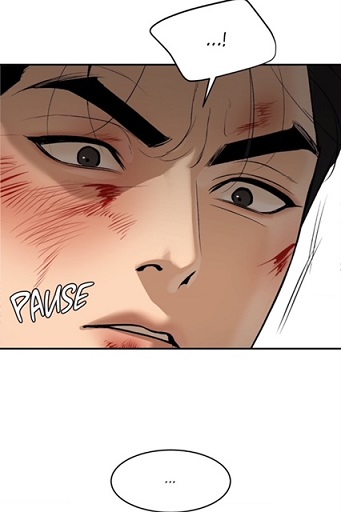 (chapter 51) The mirror is clear: the cycle can be broken, but only if he dares to answer the question that was never asked of him before. Therefore it is not surprising that the physical therapist’s question appeared in the champion’s vision:
  (chapter 54) His unconscious was telling him to have faith in his “doctor”. Thus later, the champion told the director of the hospital this:
 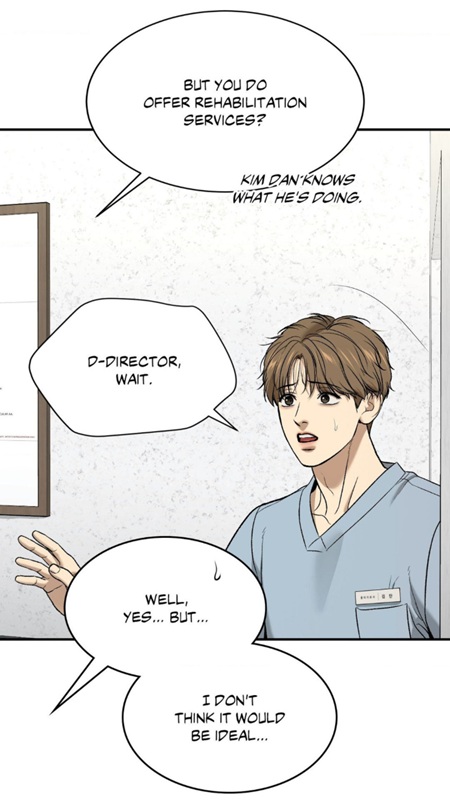 (chapter 61) He was acknowledging the main lead as a real physical therapist.
 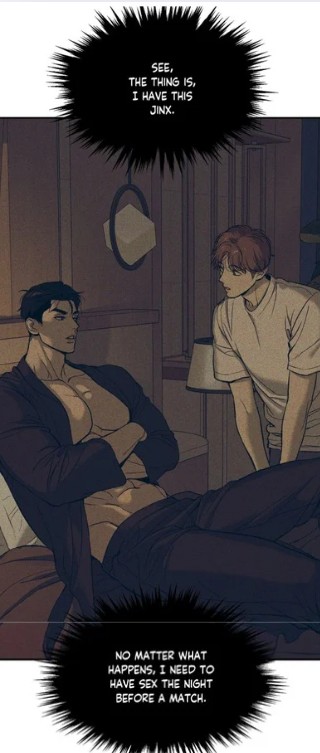 (chapter 62)— and even to those closest to his body — it looks like nothing more than sex. That was all the uke from chapter 2 saw, and it was enough for him to sneer:
 (chapter 2) The insult landed with devastating familiarity, not as a new wound but as an echo of his father’s curse: “loser.” Both words reduced Jaekyung to nothing — not a man, not an athlete, just a fraud kept alive by crutches.
 (chapter 2) In slamming his former partner against the wall, he was not merely silencing a lover’s cruelty. He was fighting the ghost of his father, the voice that had branded him weak, cursed, unworthy. The jinx that kept him alive was being twisted into proof of his failure, and he could not bear it.
  (chapter 2)
 (chapter 62), Dan recoiled.
 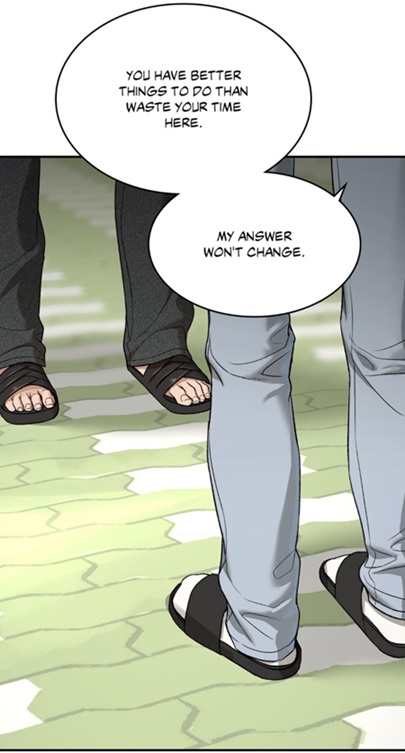 (chapter 62) but as a therapist he trusted. His words about wanting to return to the “usual pre-match routine”
  (chapter 62) were, in his mind, a way of saying: I need you to bring back wholeness, to help me steady myself again. But because Dan only knew fragments of the jinx, the message landed with devastating distortion.
  (chapter 41) but not the others. He had never seen how layered and fragmented Jaekyung’s survival system truly was: the shower and perfume, the milk, the tattoos, the obsessive fight schedule. Thus, when Jaekyung invoked the jinx, Dan heard only objectification: you want me for my body. However, this is not what the “wolf” meant. Thus he got surprised by such a statement.
  (chapter 62) For Jaekyung, the plea was about coherence; for Dan, it sounded like reduction.
 (chapter 22) He cooks breakfast for Jaekyung, offering something warm, homemade, human — a substitute for the cold, industrial glass of milk.
  (chapter 22) or cry out of joy.
 (chapter 54) throws the plate away
 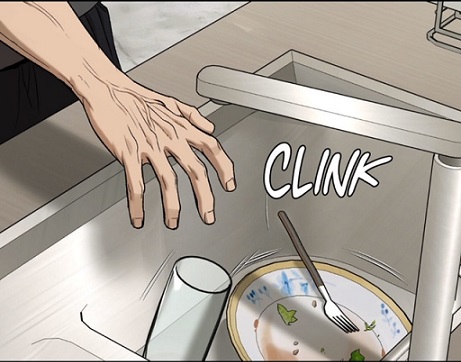 (chapter 54), or sits at a vast table in silence.
  (chapter 54) But when Dan cooks, Jaekyung is surprised, even touched. For once, nourishment is not consumption but connection. The milk was always a disguised memory of deprivation; Dan’s meal becomes the antidote — food as presence. So for him, the prematch-routine was also referring to the meals prepared by his fated partner. And I feel the need to bring another aspect. Since there was no “family” in the athlete’s life, he never got the chance to discover the joy of the table.
  (chapter 22) Hence it is not surprising that he looked at his phone, while the others were eating and discussing. He never had a real conversation with a family member around the table.
  (chapter 40) Perfume was one of Jaekyung’s protective rituals — masking shame, creating an armor against the memory of bullying and ridicule. Yet Dan shows that none of this is necessary. The panel where he clings to the bedsheets after their Summer Night’s Dream together
 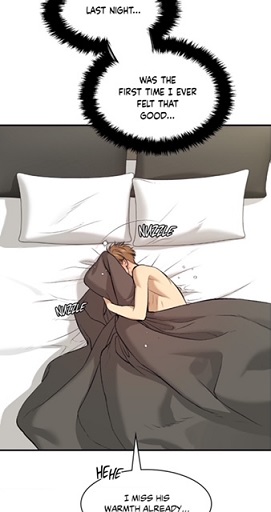 (chapter 45), whispering that he misses Jaekyung’s warmth, reveals that the champion’s natural scent is already enough. He never gets to see this — Jaekyung doesn’t know how deeply Dan treasures his smell.
 (chapter 40) Here he turned around and placed his lover in the middle of the bed. He even let him rest.
  (chapter 2), and not the other rituals? Because to admit the rest would be to expose the origin of the jinx: the father’s insult, the mother’s abandonment, the hunger, the bullying. Sex was the only ritual that could be spoken without directly dragging the past into the room. It was the “safe” shorthand — though tragically, it became the most dangerous. Homosexuality is definitely a stigma among boxers and MMA fighters.
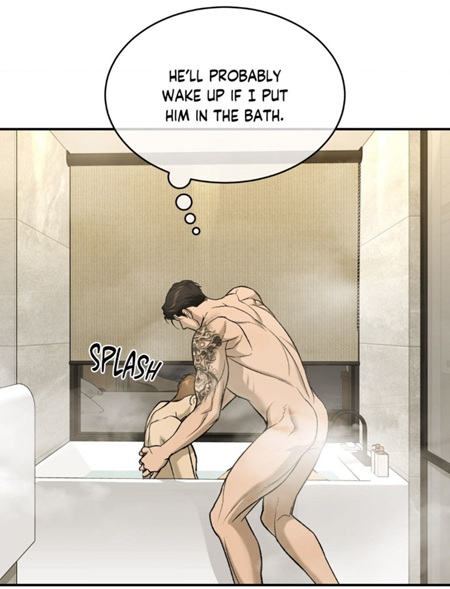 (chapter 68) In his own way, he was showing him that he did care! He was more than just a body… or even a physical therapist!!
 (chapter 35) It is the steady mirror of Kim Dan.
 (chapter 13) — helpless, cornered, often pleading. Thus the champion taught the doctor to overcome his fear and fight back:
  (chapter 26) This imbalance was no accident. It replayed Jaekyung’s own childhood roles: he became what his father had been to him (the better version naturally, for he is the mirror of truth), and forced Dan into the position he had once held himself. Through Dan, Jaekyung unconsciously re-enacted his trauma, reversing their positions as if to master what had once mastered him. That way, he was pushed to mature emotionally! That’s why he could connect with the main lead unconsciously. His trembling words in Chapter 51
 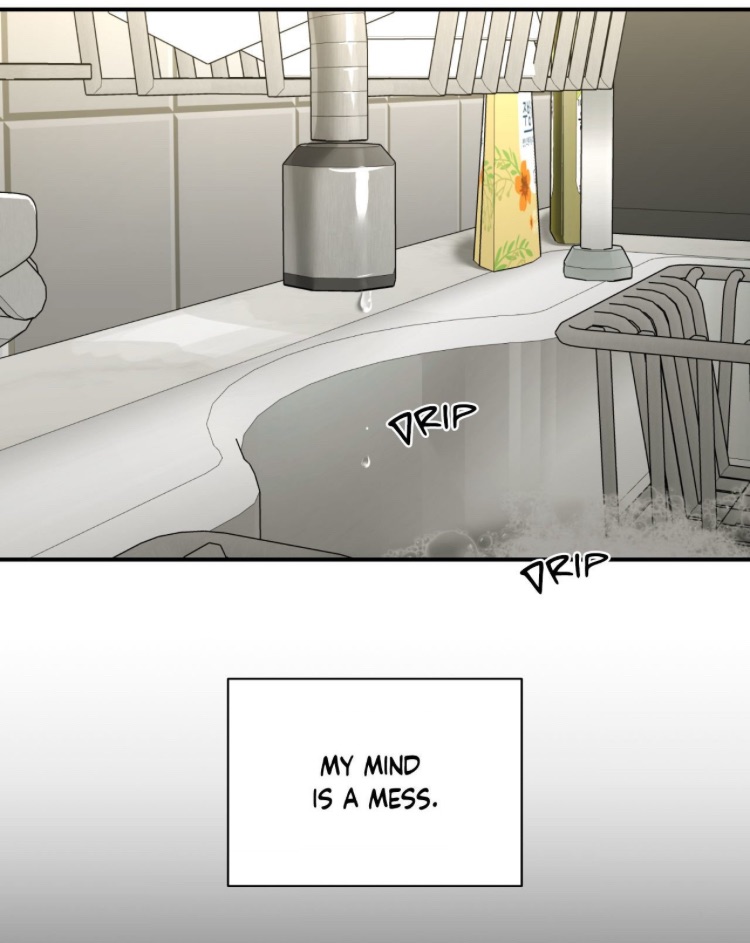 (chapter 71) He believes to know the truth, while he is ignorant. He is insecure, extreme in his behavior (drinking)
 (chapter 71), but also selfish and questioning, still fragile yet capable of protest. He is struggling with his own emotions and thoughts.
 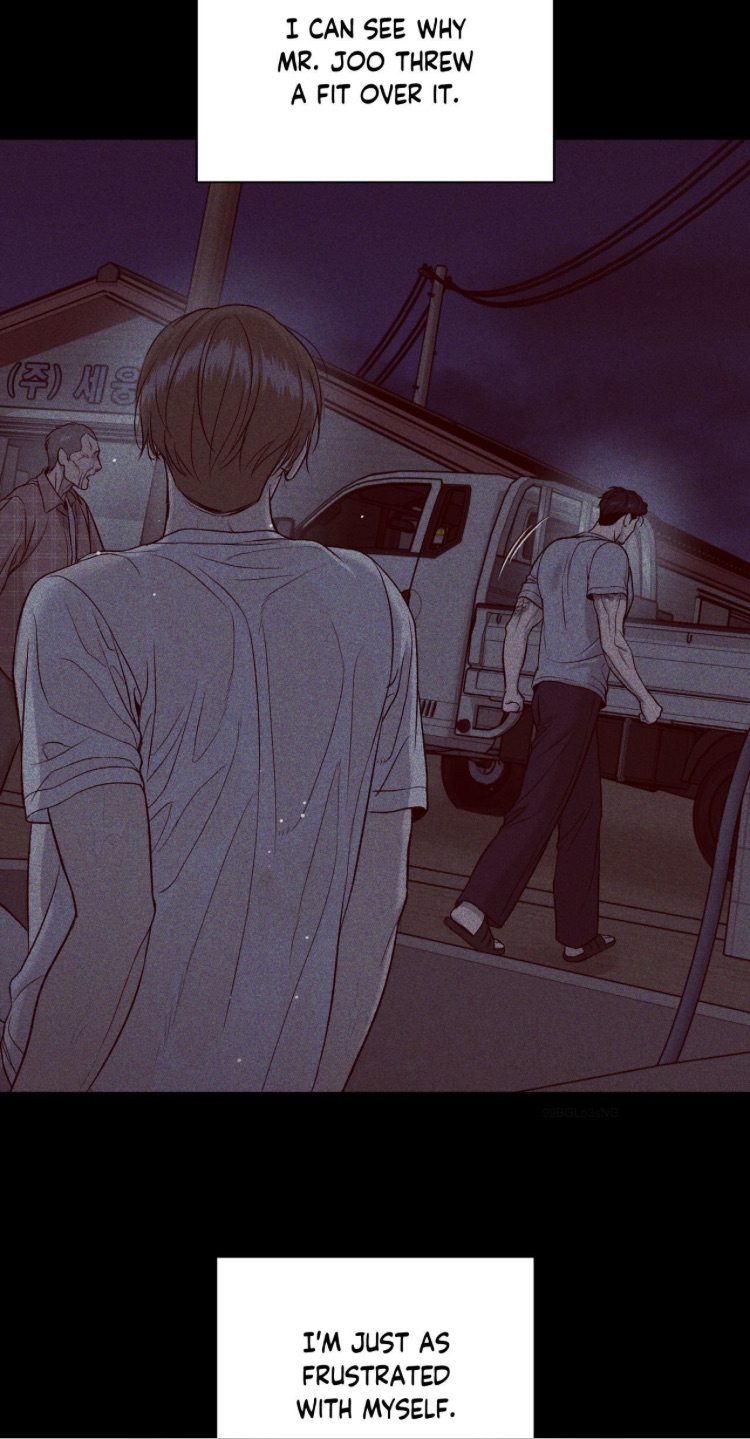 (chapter 71) How can he trust the athlete, when he doubts himself so much? From my point of view, he is on the verge of become “mature mentally” and as such “responsible”. At the same time, Jaekyung is revealed as the adult in crisis. His exhaustion
  (chapter 70)
 (chapter 74) It is because thanks to the director’s confession, the “hamster” is able to see the champion as a “a kindred spirit“, an orphan and as such as the younger “boy”.
  (chapter 7)
  (chapter 69) It is not about treatment or jinx, but about presence. This hug reframes the meaning of strength. True strength is not the ability to fight endlessly, but the ability to hold and be held, to mirror” is like touching oneself! Let’s not forget that the mirror represents the reflection of a person. Respecting the physical therapist signifies respecting oneself!
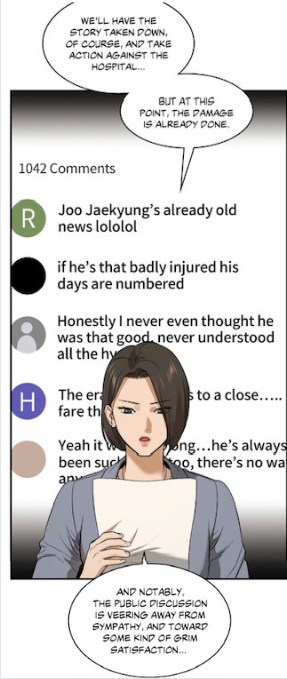 (chapter 36) He can remain indifferent to their “provocations”, as he has long matured emotionally.
 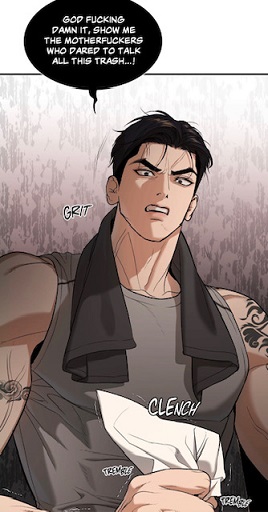 (chapter 36) He can retaliate differently. With his money and power, he can prove to them, he is no loser!

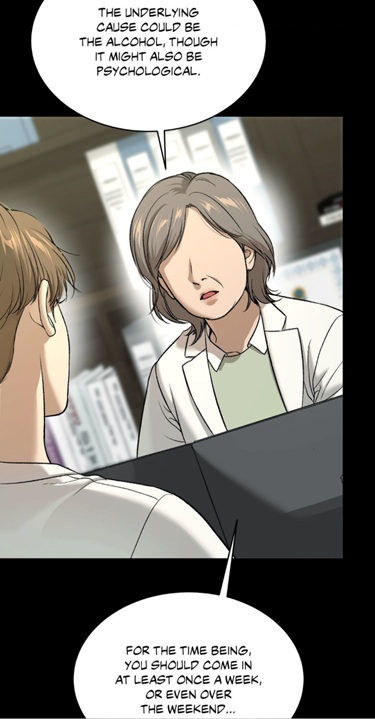 (chapter 67): the brief diagnosis, the recommendation for weekly visits, the specialist’s tentative attribution of Kim Dan’s condition to either alcohol or a possible psychological cause, emphasizing the need for continued observation and weekly visits before offering a definitive diagnosis —all standard responses. For her, this was a doctor following routine procedure without overstepping professional boundaries. However, I perceived her behavior very differently. I saw someone who remained emotionally detached and almost absent, reducing the complexity of Kim Dan’s condition to simplistic surface-level causes without genuine inquiry.
 (chapter 67) Rather than forming an independent assessment, she accepts the narrative of a third party, which introduces bias and limits her understanding. One might argue about that, because she is looking at a paper, probably result of a blood test which seems to corroborate the guardian’s statement. Hence the sleep specialist concludes that Kim Dan is suffering from insomnia, alcohol addiction and sleepwalking. The problem is that his statement is based on external observations (halmoni and the landlord) and their limited knowledge. Moreover, Jinx-philes should keep in mind two important aspects:
  (chapter 61) The champion had been himself suffering from similar symptoms which could be seen as a projection on his loved one. Additionally, based on previous observations, I have interpreted Kim Dan’s nightly walks not merely as sleepwalking, but as dissociative episodes—likely triggered by overwhelming guilt, unresolved trauma, and a chronic sense of disconnection from his body and surroundings. But how could the champion know about this? He’s not a doctor himself. In order to have a more accurate picture of the whole situation, she should have talked to the patient himself. But by relying on papers and the guardian’s testimony, she not only distances herself from the patient physically and emotionally, but also delegates the responsibility of interpretation. She is using the eyes of others.
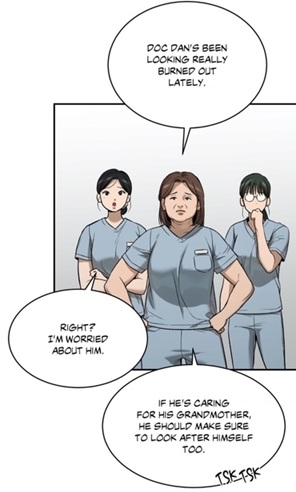 (chapter 57) Perhaps the doctor’s detachment is not indifference, but a survival mechanism in a healthcare system that demands efficiency over intimacy.
 (chapter 67) indicating that his alcohol addiction is not the real reason for his insomnia. Then she fails to examine Kim Dan physically, the desk is between them. Therefore she can not detect his visible malnourishment.
 (chapter 62) Moreover, both the landlord and the grandmother never brought up this aspect, though Shin Okja had observed this terrible transformation:
  (chapter 57)
 (chapter 66) It is because the physical therapist is just a number (2) and as such a file. Therefore the doctor is not seeing the patient as a human. I can not blame the woman either, for she has so many patients to treat during the day. And now look at the building of the hospital:
  (chapter 66). It is huge reminding me of a factory. This “modern hospital” with its sleek architecture, expansive buildings, and impressive specialization exudes a sense of advancement and trustworthiness. Yet beneath this polished surface lies a business-oriented structure, one that prizes efficiency, reputation, and patient turnover over genuine patient connection. This “modern hospital”
 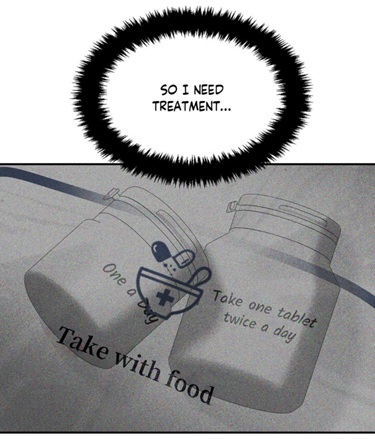 (chapter 67) She is doing exactly what Shin Okja wanted:
 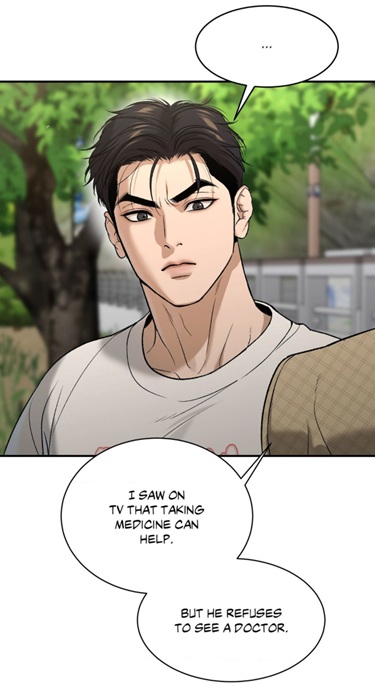 (chapter 65)
 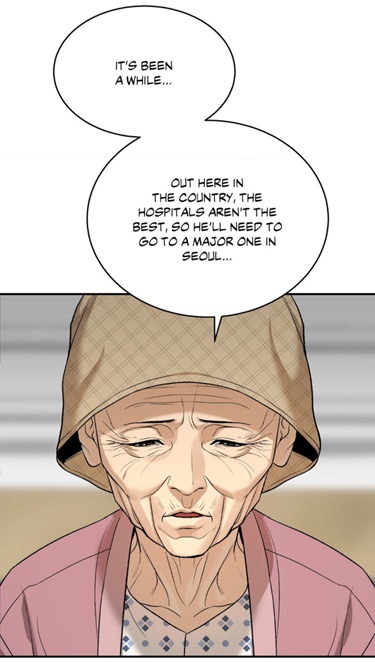 (chapter 65) It is as though thanks to the drug, the odd behavior from Kim Dan would simply vanish.
  (chapter 5) with the new medicine. On the other hand, it implies that the light-brown haired woman is doing her job for her paycheck which reminds me of Cheolmin’s statement:
  (chapter 13): “Oh no, no. That won’t do. My precious paycheck!”.
 (chapter 27)
  (chapter 49) as mere service providers. Whether it was brushing off medical advice with “Don’t push it, I know my body better than anyone else” (chapter 27) or demanding instant pain relief to continue training (chapter 49), the champion positioned himself as the ultimate authority over his own treatment. Since his attitude echoed the confession of my osteopath, it is understandable why my osteopath-orthopedist began to select his patients carefully. This mirrors Kim Dan’s evolution, when the latter chose to reject the champion’s offer. Indirectly, he is “learning” to select his job and not take them by opportunism. He is also learning to select his “patients”. Striking is that Shin Okja has a similar attitude than the athlete.
  (chapter 7) She desired to have a treatment with less side effects and less painful. And the moment she was confronted with reality, this painful new treatment only brought pain and nothing more, she chose to leave this institution and move elsewhere.
 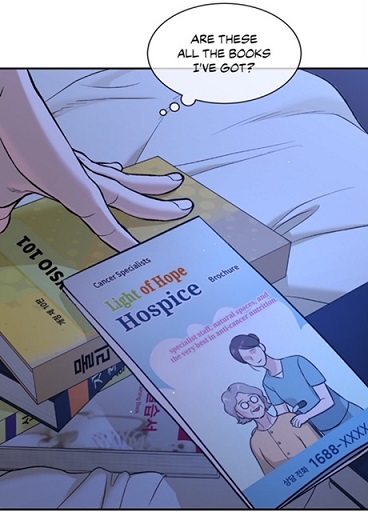 (chapter 53) Therefore it is not surprising that she is treating the protagonist the same way: she knows what is the best for him.
  (chapter 57) She is treating him like a service-provider, she is now rejecting that he has lost his “usefulness”. His pay here is not high, …
  (chapter 67) and not even following her recommendation.
 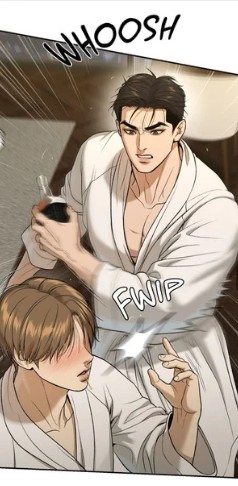 (chapter 67) He felt misjudged and misunderstood; reduced to a file number, not seen as a complex human being.
 (chapter 67) and second, what Kim Dan actually received as treatment:
  (chapter 13), in contrast, enters the story with no white coat at all. He carries only a doctor’s bag, dressed in a green pullover and a beige checkered shirt.
  (chapter 13) Despite this informal attire, he immediately recognizes Kim Dan’s symptoms and engages both the guardian and the patient. He doesn’t need institutional support to assert authority; his presence and diagnostic clarity define him. While his clothes might elsewhere be read as conservative or emotionally restrained, here they highlight that care can come outside rigid systems.
  (chapter 13) It bridges the gap between roles, making the patient feel seen rather than categorized.
 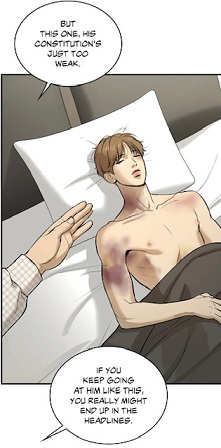 There’s no judgement in their relationship. The eyeless doctor may appear neutral, but in truth, she is hollow. Cheolmin appears reserved, yet his actions speak with empathy. Where she recites guidelines, he initiates dialogue.
  (chapter 13) Where she avoids involvement, he offers engagement.
  (chapter 61)
  (chapter 67), the Light of Hope hospice
  (chapter 61), the sleek University hospital dedicated to research
  (chapter 5), and more intimate yet modern facilities like this one.
 (Chapter 27) Each medical setting not only has its own architecture but also its own moral blueprint. In the essay “
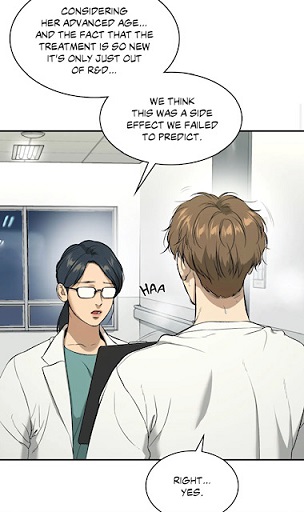 (chapter 21) Then the treatment’s failure is attributed either to the grandmother’s frailty or Kim Dan’s late arrival and absence, subtly shifting blame.
 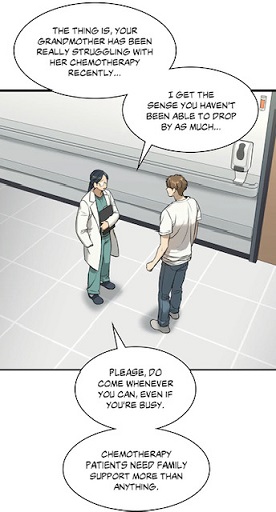 (chapter 21) Like mentioned before, this treatment wasn’t even properly recorded in the patient file raising the suspicion of deliberate concealment.
  (chapter 56) It appears as “pain killers”. Her open white coat
 (chapter 48) got aware of Shin Okja’s conditions, implying that patient confidentiality had been breached.
  (Chapter 61): In contrast, Park Junmin
  (chapter 61) represents the polished face of a business-oriented clinic. While his office projects sleekness and personalized care, his comments betray his priorities. He praises Joo Jaekyung’s fame and urges a return to the ring—not out of medical concern, but because it would guarantee the champion’s return as a paying patient. He wants to retain a high-profile client. His friendliness is strategic.
  (chapter 61), highlighting that the athlete has become aware of what genuine care should look like. When the champion calmly declares, “I’ll be receiving rehabilitation services in another hospital,” Junmin answers with a stunned “Sorry?”. But this is not confusion. It’s a reflexive mask for shock. He did not expect to lose control of the situation. Beneath that one-word response lies disbelief, disappointment, and veiled panic. He’s losing a lucrative patient—and more importantly, a public endorsement. The moment exposes how fragile his authority truly is when faced with a patient asserting autonomy. Let’s not forget that when the champion was facing a mental and emotional breakdown, the latter offered no other support than “rest”. He even avoided his gaze.
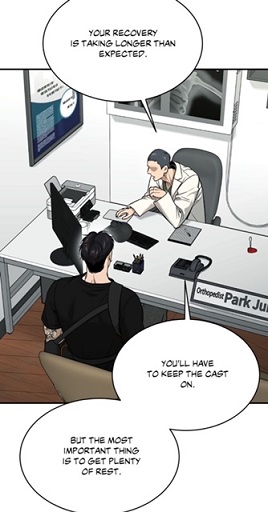 (chapter 54) The athlete was left on his own.
  (Chapter 59): At first glance, the hospice appears to be underfunded and outdated.
  (chapter 61) However, its director breaks expectations. Unlike the smooth-talking or indifferent doctors at larger institutions, he is directly involved in patient care.
  (chapter 60), criticizes people for their rude behavior
  (chapter 59) or actively disciplines staff
 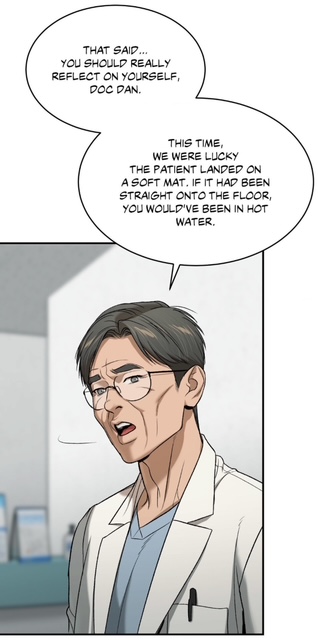 (chapter 59) when mistakes are made. Though he also flatters the champion
  (chapter 61) and sees promotional potential, he never exploits patients.
  (chapter 61) The juxtaposition of humility and responsibility in his demeanor, combined with his stunned reactions to sudden events, suggests an overworked and understaffed environment—but not one without moral grounding. His white coat and blue medical uniform echo the nurses’ attire, subtly promoting a sense of equity among staff. Despite being a director, he doesn’t separate himself from frontline caregivers. His uniform also contrasts with the green worn by Kim Miseon or Park Miseon, suggesting a focus on practical responsibility over prestige. By blending in with the team, he fosters a culture of shared accountability, not rigid hierarchy. Among all institutional figures, he comes closest to balancing authority with integrity.
  (Chapter 6): While this figure appears authoritative
 (chapter 1), the details of his attire tell another story. Wearing a suit beneath his coat implies professionalism, but here it also suggests a business-driven mindset. The coat becomes a sleek outer layer masking deeper intentions. His charming demeanor conceals a more sinister reality—he weaponizes authority for personal gain. His use of professional attire isn’t about respectability but manipulation. Beneath the surface, profit, control, and coercion drive his actions.
  (chapter 1) The white coat, in his case, is not a symbol of healing but a façade for exploitation. drives his authority. The coat becomes a literal cover for abuse—harassment disguised under professionalism. His entire persona is a façade: calculated, charming on the surface, but predatory and morally bankrupt beneath.
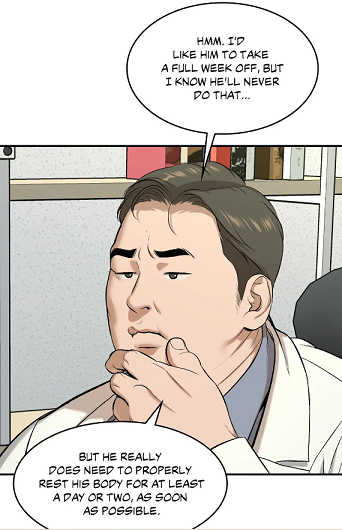 (chapter 27) His gray shirt signals a more relaxed approach,
 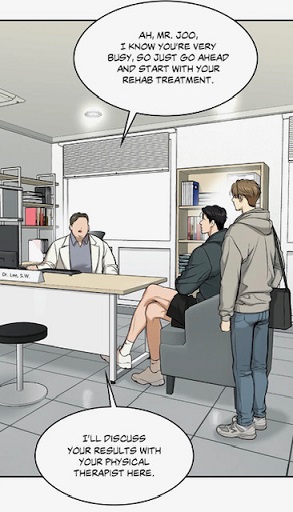 (chapter 27) and his facial expression conveys a certain empathy—though his words also betray resignation. He sits beside the patient, not opposite, visually erasing the typical hierarchical divide between doctor and athlete. His recommendation that Joo Jaekyung rest is gently delivered, but he knows it will likely be ignored. He represents the tension between medical idealism and the pressures of athletic performance. He is trying his best to protect Joo Jaekyung’s career.
 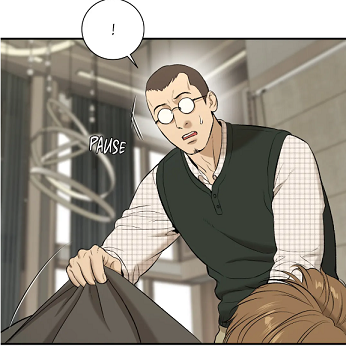 (chapter 13) Finally, Cheolmin exists outside the hospital system. He wears no white coat, but his behavior mirrors a true physician’s. He diagnoses accurately, gives immediate advice, and engages both patient and guardian. His attire—a shirt layered under another—might suggest emotional restraint, but it doesn’t interfere with his actions. He jokes and teases, breaking through tension and inviting trust. He acts not because protocol demands it, but because someone needs help. That’s enough.
 (chapter 41) nature is neatly confined. Rooftop gardens and structured greenery exist, but more as visual accessories than lived environments. The hospital is a towering research center, representing scientific advancement—but also bureaucratic coldness. Here, nature exists to impress, not to comfort. This artificial balance between concrete and green reflects a clinical detachment: nature is curated, not embraced. It aligns perfectly with Kim Miseon’s demeanor—professional, pristine, but ultimately distant and ambition-driven.the environment feels controlled.
  (chapter 41)
  (chapter 54) where Joo Jaekyung receives treatment, the rooftop greenery appears remote and ornamental, disconnected from patient care.
  (chapter 18) modern, and set among scattered trees.
  (chapter 18) Large windows suggest openness and transparency—the very qualities Dr. Lee brings to his interaction. This is a space that, while modest, is genuinely attentive. Here, nature doesn’t impress, it is integrated in the landscape. The park is not surrounded by huge buildings.
  (chapter 65) nestled in the countryside and far from institutional rigidity, emerges as a space of true potential. In returning there, Joo Jaekyung and Kim Dan are not just escaping their past—they are moving toward a form of healing that modern hospitals imitate but rarely achieve. Closer to nature, they are closer to themselves. If hospitals imitate forests, the village becomes the forest. And in that simplicity, Jinx suggests, real happiness might grow.
 (chapter 57) It lives where no one is watching and no one is billing. In Jinx, the real medicine lies outside the chart—in the dirt on borrowed floral pants, in sweat earned under open skies. Nature becomes the unspoken vow that systems forgot.
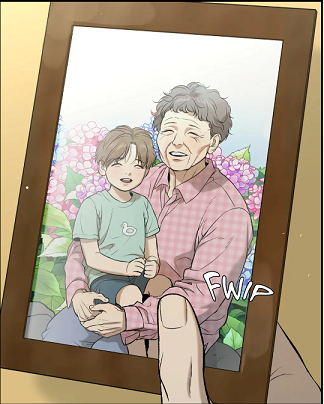 (chapter 19) However, in chapter 47, Mingwa revealed that in the past, Kim Dan had many pictures taken with his grandmother
 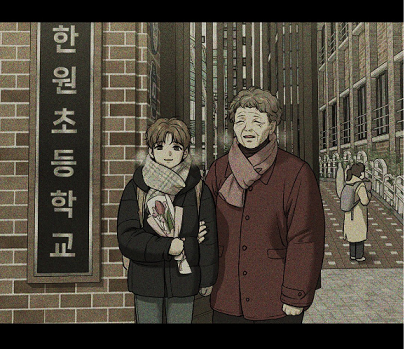 (chapter 47) .
  (chapter 47)
  (chapter 47)
  (chapter 17)
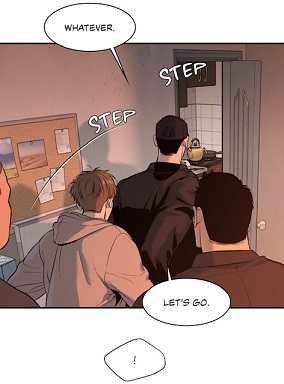 (chapter 17)
 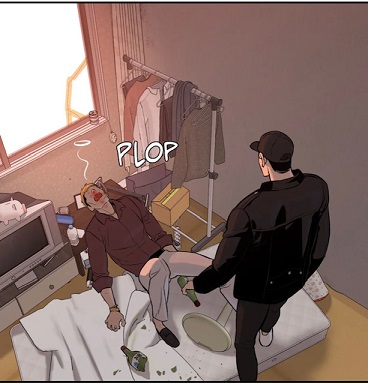 (chapter 17) They are nowhere to be seen!! I would even add that this place contains no traces of Kim Dan’s presence!
  (chapter 19) The framed photograph isn’t visible on the chests or the shelves, when Joo Jaekyung confronts the loan shark and his minions
  (chapter 19) This exposes that this “souvenir” was not put on display in this house contrary to his stay in the expensive penthouse:
 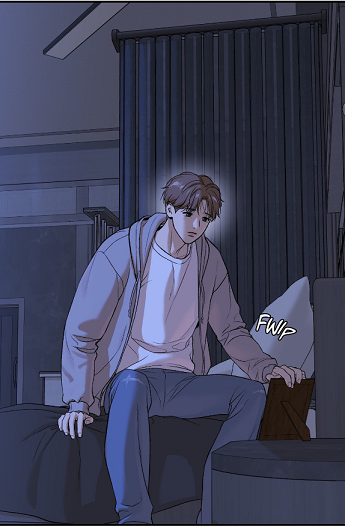 (chapter 47) Thus I conclude through the absence of his pictures and belongings that nothing was exposing the presence of Kim Dan in this small flat. We could say that he had been living as a ghost child (the piggy bank) in his halmoni’s place. It implies the existence of an invisible wall between himself and his grandmother. This perception reinforces my previous interpretation. This place was like a “cursed place, where the “Sleeping beauty” was waiting for his “prince charming”. 😉 Therefore, when the doctor removed the framed picture from the drawer, it symbolizes his own “release”. It is no coincidence that one week later, he became “a man and as such an adult”.
  (chapter 19) He was slowly detaching himself from his halmoni’s shadow. The mirror is a reflection of a photograph. Here, he is facing reality: he has a long phallus and he can have a climax.
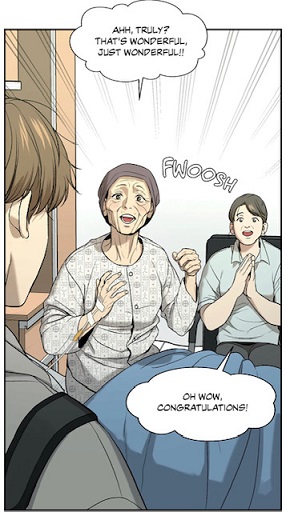 (chapter 7) and actions.
 (chapter 46) I might shock my avid readers with this hypothesis, but the fact that Kim Dan could only remember his childhood’s pictures in chapter 47 shows that he had long forgotten these moments. If he had seen the pictures constantly, he would have been confronted with reality and as such grasped that he was not alone in this world. He had his halmeoni by his side this entire time. He was cherished. Finally, keep in mind that this story is written like a kaleidoscope, so such a scene must have occurred in the past. Thanks to my chingu @@Milliformemes24, I can even be more precise. Note that in the last panel, the photos were taken with a cellphone.
 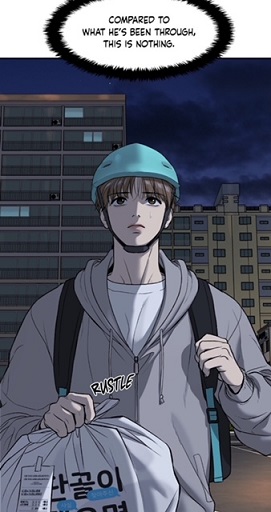 (chapter 42) or “waiter”. As my avid readers can detect, there is a strong link between “pictures” and “pride and love”. Their absence is the expression of neglect from the grandmother, who was definitely too focused on herself and her own suffering. At the same time, it lets also transpire the low self-esteem from the grandmother. In her humble dwell, there is no picture of her as well.
 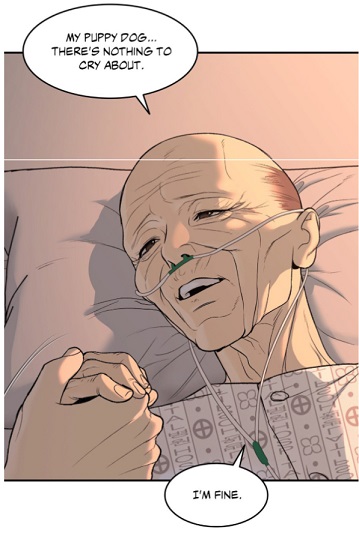 (chapter 47) Why? By acknowledging him as an adult man, she would give him a choice. He could refuse to do her a favor. As a puppy, he can not live on his own. Besides, by turning him into a dog and as such animal, she is denying him his right as a human being. She is appealing to his instinctive nature, his loyalty. And the moment I thought of a dog and death, I couldn’t help myself thinking of the famous dog Hachiko who kept waiting for his owner’s return at the train station, unaware that the latter had died a long time ago. As you can see, doc Dan’s pictures are strongly intertwined with reality and confrontation. Therefore the pictures with her grandson were not shown or treasured. The grandmother has been avoiding mirror and even pictures. As a person suffering from “Peter Pan Syndrome”, she is trying to do anything to escape “death and responsibility”. How ironic is that she just needed a picture to express her wish to move to the West Coast!
  (chapter 53) is the reality. The grandmother is not looking at Kim Dan contrary to the woman on the prospect. He is reduced to his role as caretaker. He has become her “servant”. In addition, the PT is not smiling like the nurse in the photo. In verity, he doesn’t want to do it. Deep down, he wished to stay at the penthouse.
  (chapter 53) The words “I should go” displays that he is doing it out of obligation. To conclude, photographs in Jinx are also embodying dream and illusion.
  (chapter 38) Clouds are a reference to heaven and dream, while the green display displays loneliness and emptiness. They have no one by their side. Furthermore, just like Kim Dan, Joo Jaekyung has no family pictures in his house
 , (chapter 19) which could be seen as a clue that he is an orphan. Or in the best case, they live, but there is a huge wall and gap between them and the fighter. I would even add that no one could even identify the owner of the penthouse. He is a famous MMA fighter, yet there exist no picture of himself in this flat! Not even this one:
  (chapter 1) That’s why I had compared the penthouse to a hotel room in a previous essay. So we could say that he also lived like a ghost. However, since he is a celebrity, he should be rather compared to a god. He has no home and privacy. Thus the penthouse contained no memories, until the doctor started living with the champion.
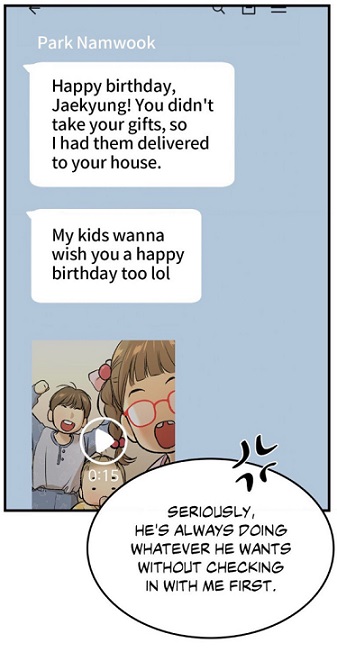 (chapter 43), a sign that their relationship has always been more businesslike, thought the boss somehow considered him as his “older brother”, as he keeps calling “hyung”.
 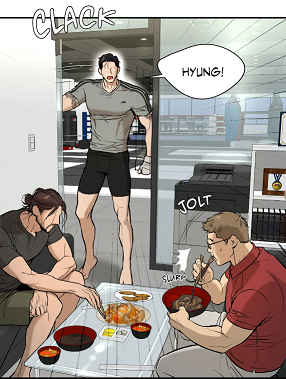 (chapter 5) The first personal video and message from his manager only appeared in chapter 43. This shows that the owner of Team Black had no family at all and not even friends. This observation brings me to my next remark. What about the gym Team Black?
  (chapter 5) There are only pictures of the champion and of no one else. Not even from Park Namwook or the ex-professional fighter Jeong Yosep. Everything is revolving around the celebrity. The absence of pictures from others is indicating neglect. The gym was not advertised as a great place to have fun! It is all about fame, wealth and glory! Therefore it is not astonishing why the rats left the sinking ship.
  (chapter 52) The champion’s image is tarnished, he will get less admiration and sponsoring. The decoration of the gym exposed the mentality of the owner, Park Namwook. The gym is about the celebrity, money, fame and sponsoring! Under this new light, it becomes comprehensible why the other members were neglected and why the athlete disliked it so much to be taken in pictures.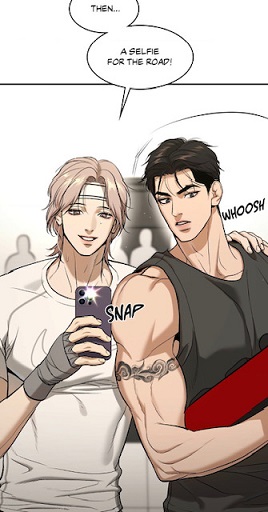
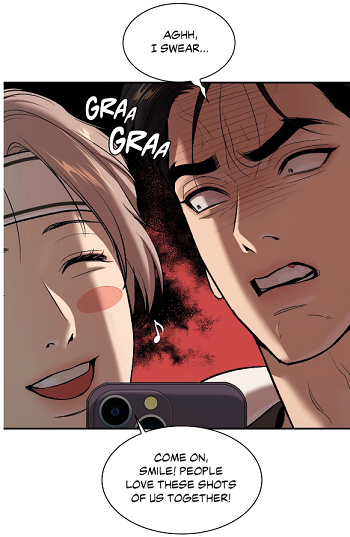 (chapter 30) It is because the photographs are a synonym for “money, glory and fame”. Choi Heesung was using him to get attention. His name
 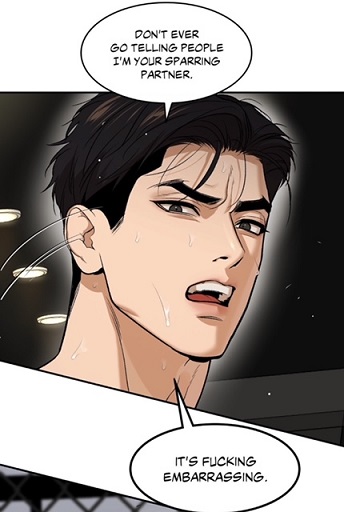 (chapter 46), his face and body are like “merchandises”.
  (chapter 43) That’s why he disliked the idea that Seonho would advertise that he was his sparring partner. The pictures in the god’s world have nothing to do with memories or love, but with work! It is about making business and getting sponsors and making his fans happy. That’s why the author included the magazines in the same chapter with the actor.
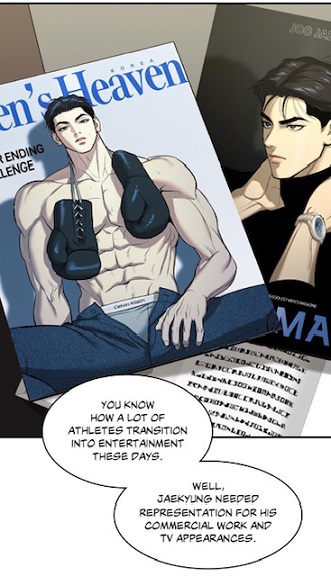 (chapter 30) Naturally, Heesung’s picture is not only related to business, they have a frenemy relationship. The photos with Joo Jaekyung stand in opposition to Kim Dan’s values: glorification, illusion, superficiality and futility. Under this new light, it becomes comprehensible why Joo Jaekyung would never put any framed picture of himself or others in his flat. His gym and the photographs are related to work. Who would like to be “reminded” of work and money in his own home? No one…
 (chapter 45)
  (chapter 45) Imagine that the doctor had to work to exhaustion to give him an expensive gift! Yes, his gift was strongly intertwined with money, business and work! However, birthday is a symbol for home, pleasure, joy, simplicity and genuine gratitude. This has nothing to do with work and “replacement”. Yet, contrary to the other presents, the champion did open the hamster’s gift, for the latter had brought it personally.
  (chapter 45) Yes, his birthday was turned into a business event, a merchandise where he even had to pay for his own birthday party.
  (chapter 43) His popularity among the staff was based on his spending:
 (chapter 35) Such a success and glorification could only drive an edge between himself and others. In addition, the images could never boost the fighter’s low self-esteem. Yes, the absence of his own picture in his home is another important clue for his unhappiness and self-loathing. Because the doctor brought “work” home, Joo Jaekyung started avoiding the physical therapist:
 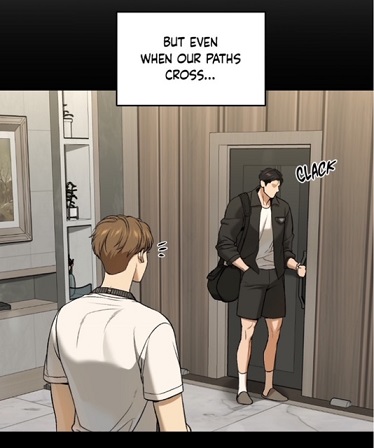 (chapter 47) It was not just because the athlete had been encouraged by his mentor to trust no one, to see relationship as a business.
  (chapter 46) This remark leads me to the following conclusion. Since the manager started sowing distrust in the champion’s heart, we can see it as another proof that this man has never truly loved “his boy”:
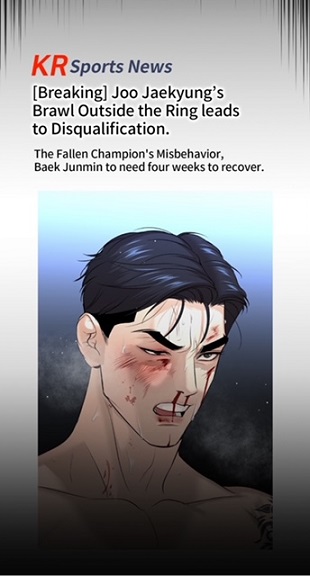 (chapter 52) His beaten face is exposed to destroy his “good image”: he appears not only as weak, but also as a bully. This shows how the medias are trying to manipulate the public with pictures. His face and body are damaged, therefore he has less value. This deceptive trick becomes more visible, when you include Baek Junmin.
 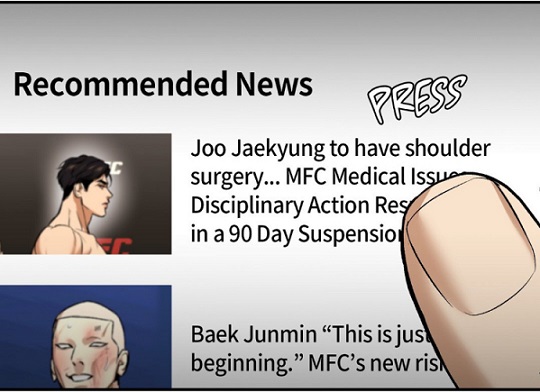 (chapter 52) The article utilized a picture of the fake fighter taken right after the match. He is smiling and barely injured… yet, the reality is that he got so wounded by the champion that he needs a long time to recover. As you could observe, all these photographs symbolizes money, business, work, superficiality and publicity. Thus they are strongly intertwined with temporality, fake love and emptiness. No meaningful moment…
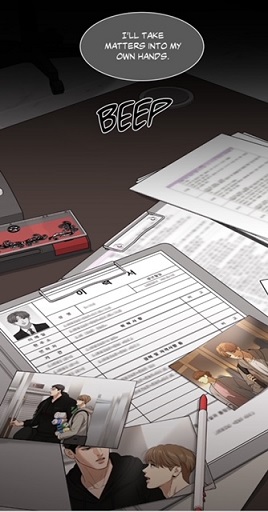 (chapter 46) The ones in this panel ooze privacy, selflessness and intimacy. The champion is seen carrying bottles and opening the door for the doctor, a sign of Joo Jaekyung’s respect for the doctor. Yes, these images expose the truth about the athlete: he really treasures his physical therapist. He is also seen listening to the doctor. This observation corroborates my previous interpretation. The pictures with the physical therapist symbolizes verity and reality. The problem is that Joo Jaekyung never got to see them, hence he didn’t realize his affection for the doctor. However, Choi Gilseok could notice it. In fact, the celebrity was delivered a different kind of truth:
 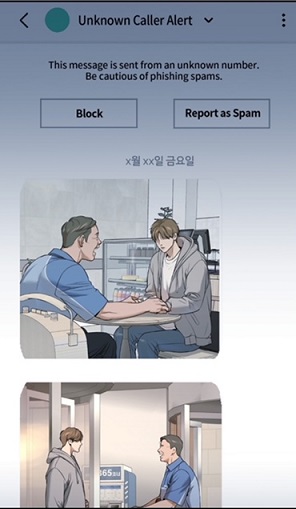 (chapter 48) Kim Dan’s meeting with director Choi Gilseok! However, note that these photographs were also a deception, for they never expose the outcome of the meeting. These pictures display the negative notions of privacy and intimacy, it is about plotting, betrayal and as such about “business”. How so? It is because they met at a café. As a conclusion, the photographs have a total different meaning in the athlete’s world. They represent coldness, superficiality, temporality, deception and work. This new interpretation reinforces my hypothesis that the main lead’s car must have been followed by a paparazzi during that night:
  (chapter 33) A black car was following him. But they couldn’t take any picture, for the windows of his car were tainted.
 (chapter 53) which left him deeply impressed. Joo Jaekyung was turning around his head and looking at him! This shows that the star was paying attention to him. And what had happened in that moment? What is the light next to the protagonist? Yes, these were the flashes from the cameras!
 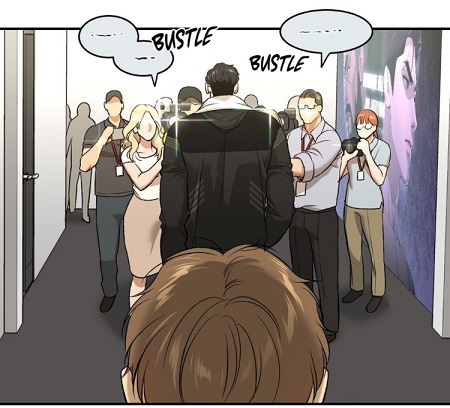 (chapter 40) It is no coincidence. Though he had no memory of the previous night, he felt this moment as magical. He had saved him and claimed him as a part of Team Black. Then he had look at him back, though he was facing journalists. However, the journalists didn’t take a picture of such a moment, for this was not relevant to them. It shows not only the true value of “memories”, but also that both were now truly living! During that night and day, both created wonderful memories.
  (chapter 41) Kim Dan experienced that he was not alone, he was part of “Team Black”, while the other heard a love confession for the first time. This memory displays
 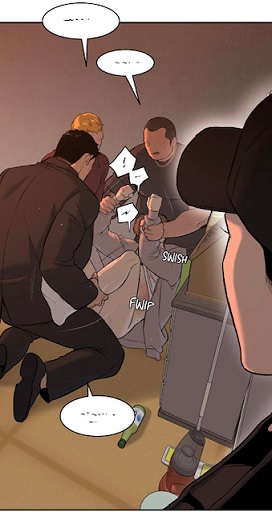 (chapter 17) He is relying too much on his eyes. He paid no attention to details and their words. Hence their words are not visible. In addition, the author created such a panel.
 (chapter 17) in that scene.. But why is he trusting too much his eyes? It is because he adopted this poor habit from his mentor and hyung, Park Namwook. who judges people based on prejudices and impressions. When the manager faces a problem or some criticism
  (chapter 17), he prefers blaming his “boy”
  or delegating responsibilities to others:
 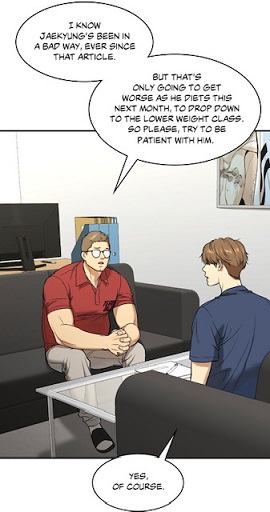 (chapter 36) Furthermore the man with the red tee-shirt has always been by his side for a long time. The time spent together is a proof of his “loyalty”, yet if the athlete had paid more attention to his words, he should have noticed his hypocrisy, lack of empathy and disrespect:
  (chapter 49)
  (chapter 52) The slap is the expression of lack of faith and disrespect. Besides, he kept badmouthing him in front of the other members, creating a huge gap between the celebrity and the other members.
 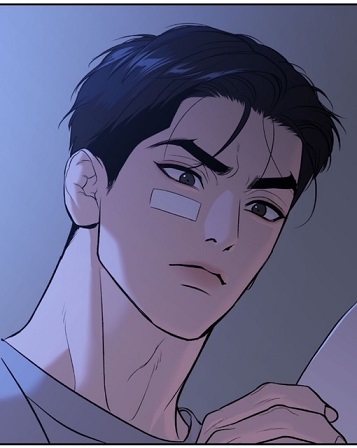 (chapter 53) The letter stands in opposition to the articles and photographs. Through the letter, the main lead is teaching to the wolf this important life lesson. He needs to use his mind and as such his heart to see the truth and reality.
 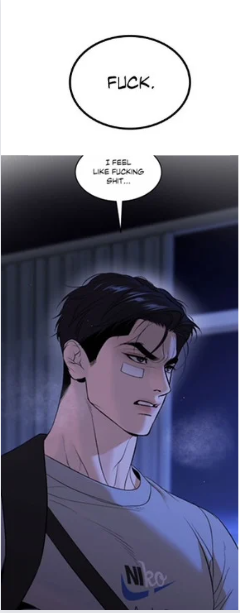 (chapter 53) Thus he voiced his discomfort and annoyance. However, this time, he is not questioning the origins of his actions. He knows now that the doctor means a lot to him. He is not a waste of time. It is no coincidence that the moment he paid attention to Kim Dan’s thoughts and emotions, he opened up his own heart and mind, because according to Erich Fromm
 (chapter 53) The latter might have no photograph of Kim Dan, but his face is now engraved in his memory. To conclude, the letter should be perceived as a mirror of truth to the athlete. He needed to hear the hamster’s words without seeing his face in order to see him properly.
 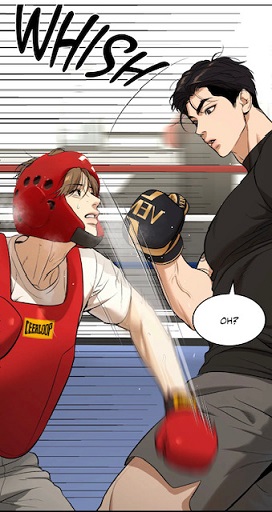 (chapter 26)
 (chapter 26) The gym will face some changes.

 (chapter 52) He was no longer a hero or champion, but a thug. Yet, there’s more to it.
  (chapter 1) Kim Dan was watching a match from the celebrity and heard the comments from the moderator. He was not only the strongest man in the world
  (chapter 1), but also a tyrant in the ring!!
  (chapter 1) And the moment I connected these two chapters together, I had another revelation. The champion’s image in the ring was also created by the media! To conclude, both medias were not portraying the athlete correctly. However, the words “a tyrant in the ring” made me realize why the celebrity lost his title and reputation at the health center. He needed to be defeated outside the ring. Thus the plotters asked the staff from the clinic to place the two fighters next to each other.
 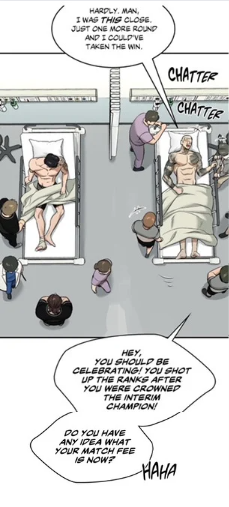 (chapter 52) They wanted to trigger Joo Jaekyung’s rage
  (chapter 52), and they succeeded. This seems to corroborate my previous theory that the physical therapist from episode 1 had been wounded, because the athlete’s fears had been triggered. And now, you comprehend why the last picture resembles a lot to the one from episode 1, the “tyrant in the ring”. This shows that not only MFC doctors and nurses were involved in the scheme, but also the medias. They created the hype around the champion. Hence it dawned on me why the plotters had to remove Alfredo
  (chapter 47) and switch him with Baek Junmin. It is because it would have been impossible to ruin his image outside of South Korea. In the States, the athlete had a very good reputation.
 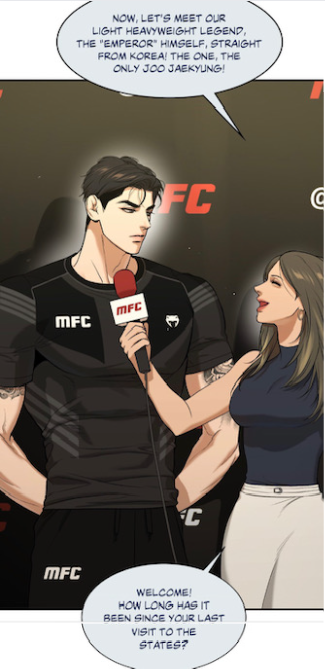 (chapter 37) He gave interviews constantly.
 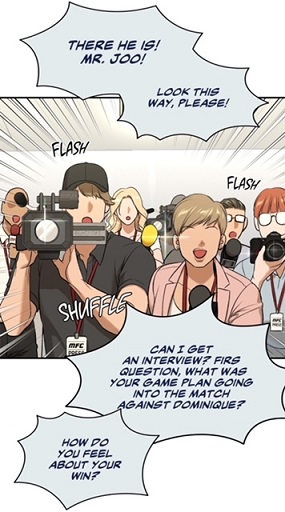 (chapter 40) Even Dominic Lee had showed his appreciation.
  (chapter 40) Moreover, it was easier to get helping hands in the country.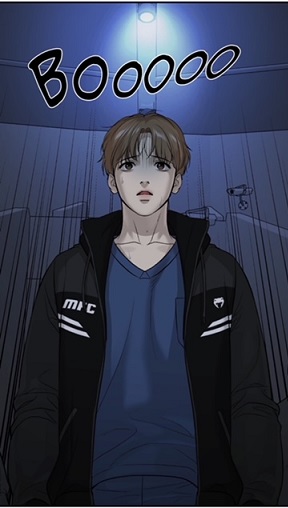
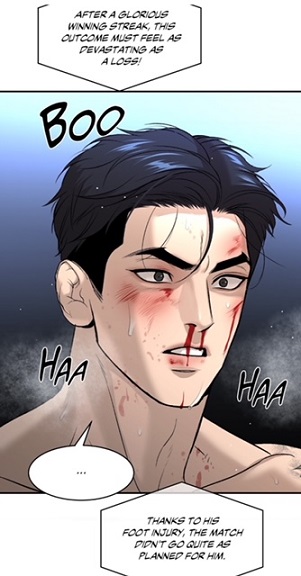 (chapter 51) The latter had booed after the announcementof the result. The fight was the evidence of the corruption of MFC (jury, moderator and MFC security guys). The viewers had not bought the verdict from the jury. And now, it is time to return our attention to episode 1. What was Kim Dan doing in the bus?
  (chapter 1) He had been watching videos about his future client. All his matches had been recorded. But here look at the title of the article from Korean News:
  (chapter 48), a hour, when people in South Korea are busy. This would explicate why the match was not shown on TV. And now, you comprehend why there is no mention of the tie and why all the pictures come from before or after the match
  (chapter 52) He acted, as if everything was a normality. He never questioned why incidents against the athlete would constantly take place (drug incident, the spray incident). But there’s another reason for his passivity. Since the beginning, he has always blamed the champion.
  (chapter 1) He contributed to this legend: a tyrant inside the ring. So he didn’t change his MO.
  (chapter 43) This made me wonder if Park Namwook employed harsh treatment in the past to push the champion to become a great athlete. However, by putting all the blame on him, he gave up on his position as the gym’s owner. On the other hand, this signifies that Joo Jaekyung is no longer the face of Team Black, but its head. Hence they all came to the hospital room wishing that he would become proactive exactly like in the States.
 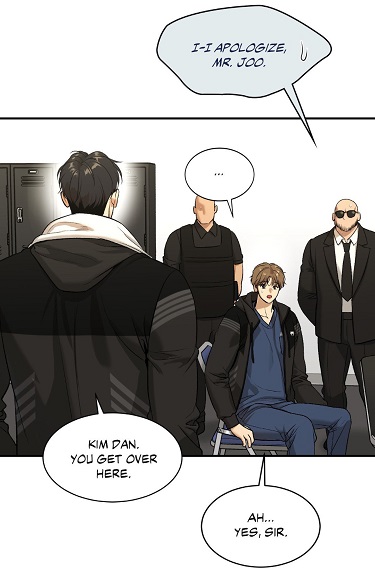 (chapter 40) Finally, the members are acknowledging Kim Dan as a part of the team.
  (chapter 52) Without him, they would feel lost. In the past, they had left him behind.
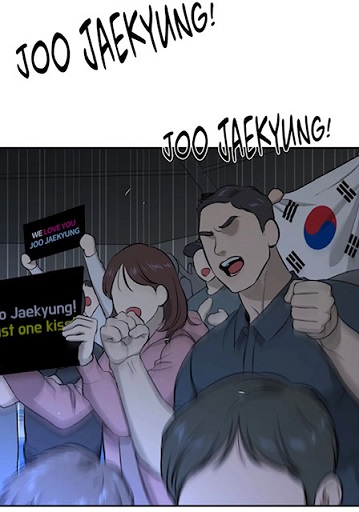 (chapter 15) Fans only knew the celebrity as fighter and not as the owner of the gym. On the other hand, Kim Changmin, Oh Daehyun and Potato will be motivated to help their devastated doctor and defend their mentor and trainer’s honor. That’s how they will emerge as real fighters.
  (chapter 52) On the other hand, since Team Black was betrayed by the MFC manager and even the Entertainment agency, I assume that Team Black could decide to organize events themselves.
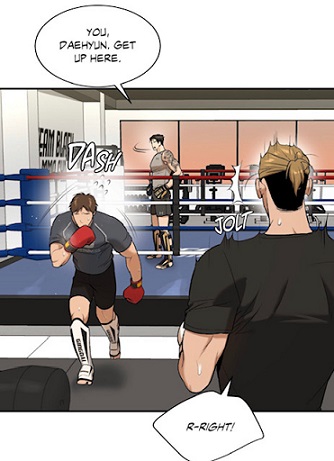 (chapter 36) Notice that the more he got under pressure, the more the champion trained the members, but the final game was different.
  (chapter 47) Namwook was in charge of the schedule and he did nothing to stop the new match. He simply accepted the switch. Anyway, someone will question his passivity and words. That should be Kim Dan, especially when he will notice the smear campaign he was exposed to, a new version of this situation.
 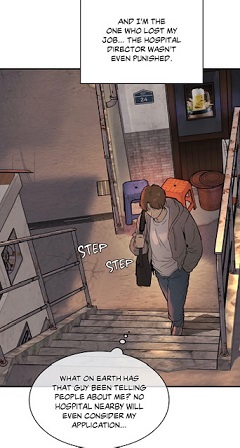 (chapter 1)
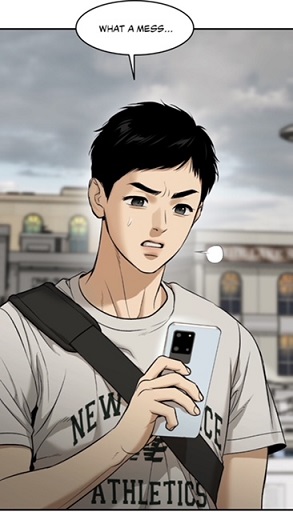 (chapter 52) Yes, the cute puppy is the new version of the main lead in episode 1.
 (chapter 50) and Kim Dan. While the former was tormented by his challenger directly
  (chapter 50) and indirectly, the other had to witness how the members from Team Black turned their back on him in the locker room.
  (chapter 50) Interesting is that on X, hamster Dan received more affection and attention than the champion. Though I have always pointed out the doctor’s flaws, in episode 50, I couldn’t help myself being upset and heartbroken for Doc Dan too, until I had a revelation. Many readers were disappointed or mad, when they saw him in this panel.
  (chapter 50) They could put themselves in his shoes: he was left behind. On the other hand, the reaction from Joo Jaekyung was totally understandable.
  (chapter 50) He acted on instinct. Moreover, he had a match, therefore they had no time to discuss or investigate the matter.
 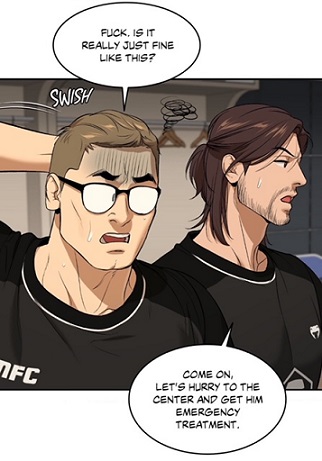 (chapter 50) And everyone knows this saying: Time is money. Yes, the hyungs didn’t decide to postpone the fight, because they would have to pay huge fees, and this could have affected the Emperor’s reputation. It exposes that the fight as such the show was more important than the well-being of their star. As a conclusion, money played a huge role in their decision. On the other side, the annulation would have brought more trouble to Kim Dan, as it would have caught the attention from journalists and fans, though it can still happen later. Under this new perspective, it becomes comprehensible why they left the locker room and didn’t argue with Kim Dan. They were under pressure. Nevertheless, the readers had a different reaction, for they knew the truth: Doc Dan was the victim of a new scheme. Therefore they judged the whole situation as unfair. Some were mad at the manager for yelling at the physical therapist.
 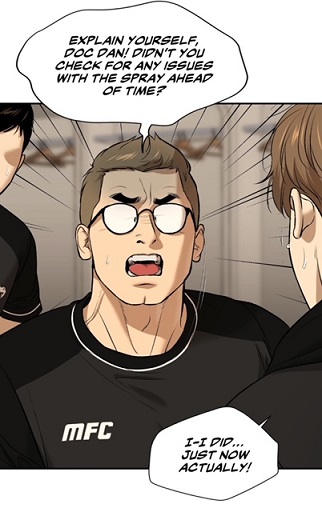 (chapter 50) Yet, we shouldn’t allow our emotions cloud our judgement, for this image displays the doctor’s metamorphosis. Notice that he talked back. Though his sentence is still not complete, the thickness of the writing and the point of exclamation are indicating that he was not whispering. He was speaking loudly and clearly. He was talking back firmly. Moreover, he was not avoiding his counterpart’s gaze contrary to the argument in the penthouse.
 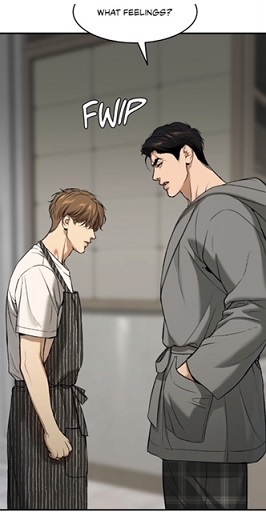 (chapter 45) In other words, the scene in chapter 50 exposes the doctor’s growing strength and resilience. That’s the second reason why anguish is necessary in Jinx. Through their suffering, the characters can change, and Jinx-philes have the opportunity to witness their growing maturity. At the same time, the author is able to underline the other figures’ flaws thanks to torment. Between the essay
  (chapter 44) Now, the doctor is no longer associating sex with prostitution and corruption, but with love.
 (chapter 27) But only Dr. Lee and Kim Dan got to see the results
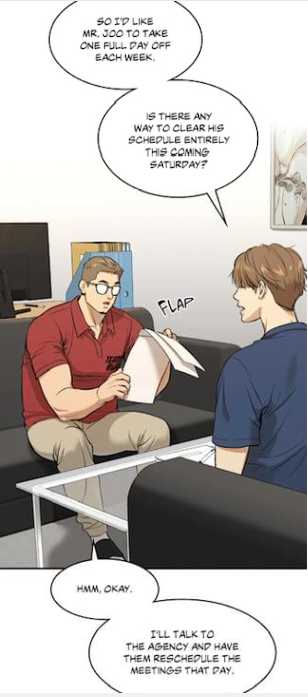 (chapter 27) Then, after the match in the States, the manager asked his “boy” how his shoulder was.
 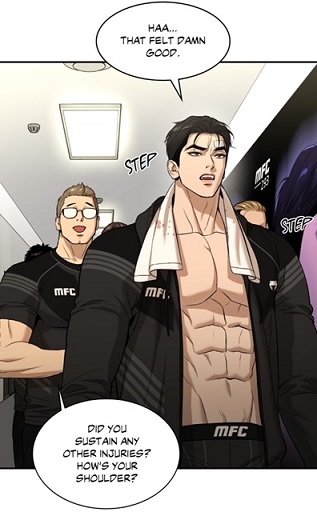 (chapter 40) Here, he chose to rely on the celebrity’s words,
 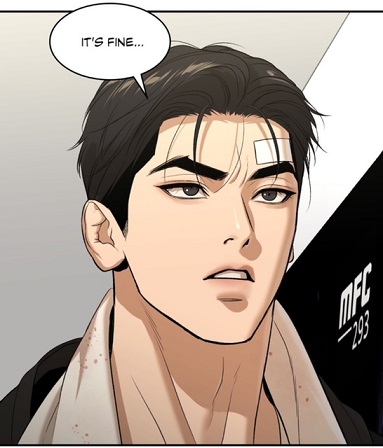 (chapter 40) while the manager had witnessed how Dominic Hill had targeted his shoulder. He should have realized that his star’s shoulder had been damaged. Nevertheless, we shouldn’t overlook that the athlete’s statement was corroborated by the medical checkup from MFC. That’s how he got fooled. Hence there was no treatment. However, doc Dan could detect the champion’s lie not only through observations
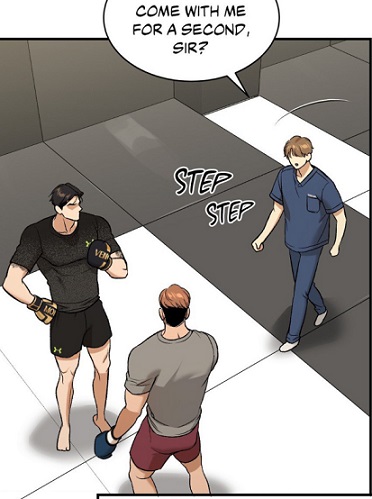 (chapter 41) but also through touching.
 (chapter 41) As you can see, the wound was slowly coming to the surface. Thus I consider the incident in episode 43 as a metaphor for the shoulder injury.
 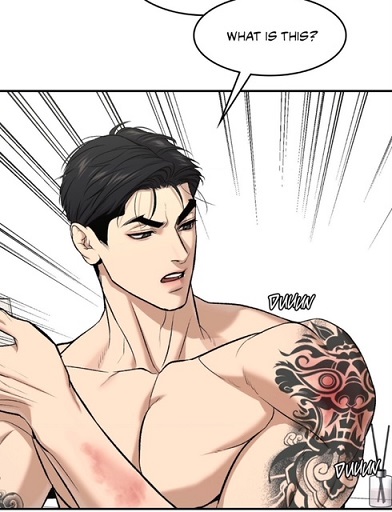 (chapter 43) It was exposing the damage in his body. Consequently, when the champion’s foot got wounded by the pepper spray,
 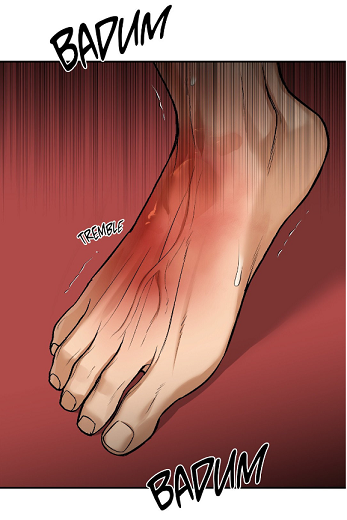 (chapter 49), I realized what was happening. Mingwa is forcing the Emperor to admit his suffering. Hence his wounds are becoming more and more visible.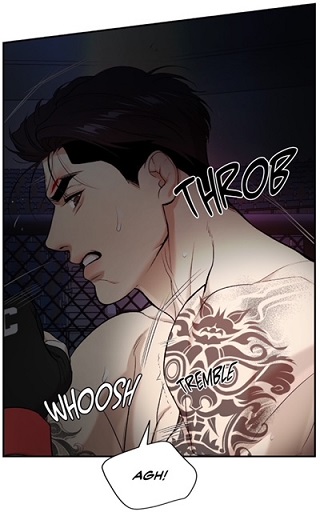
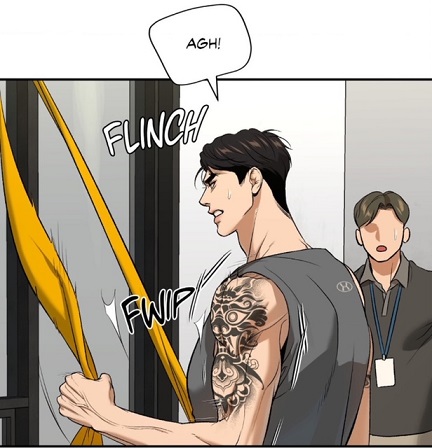

 (chapter 5) for he was simply relying on the prostitutes due to his jinx. Thus I consider this argument in the penthouse as a huge step for the athlete:
  (chapter 45) He can not win, if he is not receiving the help from a PT. That’s the reason why he didn’t mention the jinx at all. Under this new light, it becomes comprehensible why the athlete is suffering more and more. The goddess of Jinx is cornering the athlete: the latter has to admit that he doesn’t just need the assistance of any PT
 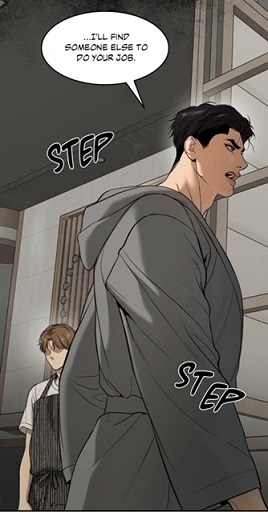 (chapter 45), but the help from the angel Dan.
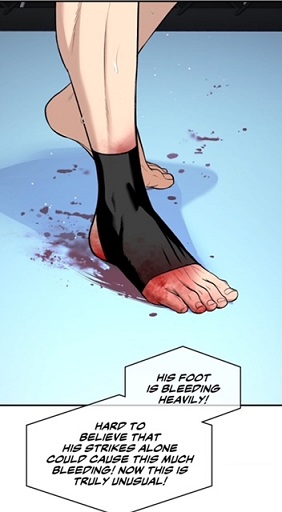 (chapter 50) So far, he just had a cut above his eye, nothing serious.
  (Chapter 40) However, the wound on the foot is different, for his skin is damaged. The recovery will take longer. It is relevant, because Park Namwook can no longer feign ignorance about his star’s wounds. He is less susceptible to manipulations.
  (chapter 50) That’s the reason why he turned into a dragon at the end of the chapter. [For more read the essay “
 (chapter 5) And now, you comprehend why he got so nervous and angry, when he imagined that Kim Dan had blocked him.
 (chapter 5) This shows that his belief in his jinx had been reinforced after his first night with Kim Dan.
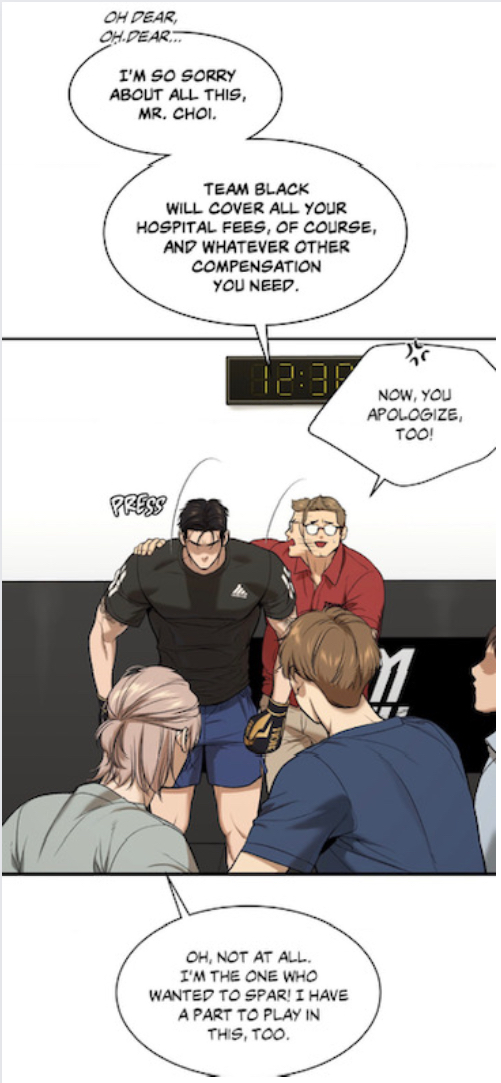 (chapter 31) He could take the fall for everything. The main lead is put in such a position so that he has no other choice: he needs to clear his name!
  (chapter 50) From my perspective, this is the result of the overexerting.
  (chapter 42) In addition, he would return home late, a sign that he would train even more than before.
 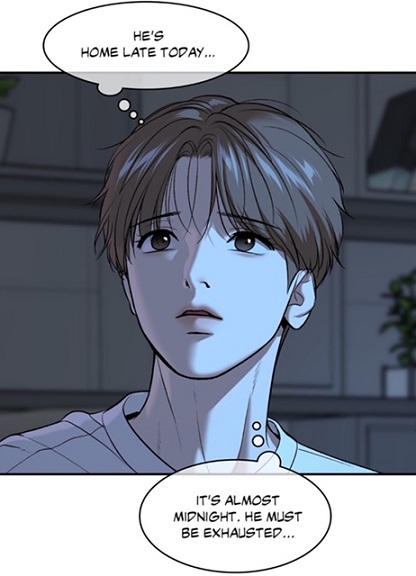 (chapter 48) Finally, we shouldn’t overlook the fact that after his match in the States, he never visited the hospital due to the law suit.
 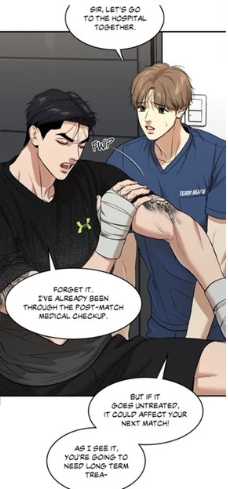 (chapter 41) According to me, the MFC medical checkup was not reflecting the verity. Hence he never got a real check-up and MFC could definitely say that the athlete was definitely fine.
  (chapter 41) This shows that the more the champion refuses to his PT’s advice, the more injuries he will substain. That’s how it dawned on me why Joo Jaekyung is now getting more and more wounded during the fights. It forces him to take a rest! However, in the past, he had a reason not to listen: he got barely injured. He needed to treat his body roughly in order to prove his effort and strength. This observation reinforces my conviction that there is a second group manipulating the champion’s matches: MFC itself. For me, Heo Manwook and Choi Gilseok are rather puppets. How so? It is because someone knew about the champion’s sexual habits, hence he was supposed to take an aphrodisiac in the States. But neither the loan shark nor the director from King Of MMA are aware of this. To conclude, the champion’s anguish is necessary to expose the deceptions and the schemers as well.
 (chapter 27) refused to force the champion to take a day-off by saying that the protagonist would never listen anyway. With such a statement, he pushed Kim Dan to make the decision and announce it to his VIP client. Moreover, the manager didn’t stop his “boy” from exposing his injured shoulder to the public.
 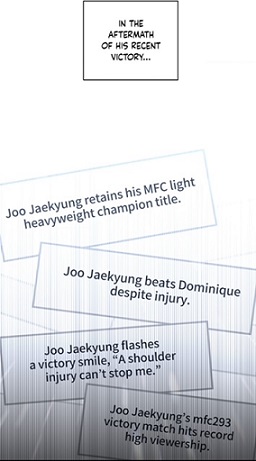 (chapter 41) However, by doing so, he was exposing his vulnerability to his opponents, though I am still suspecting that MFC leaked information too. So far, the headlines are not indicating which shoulder is wounded. Yet, the moderator knew which one:
 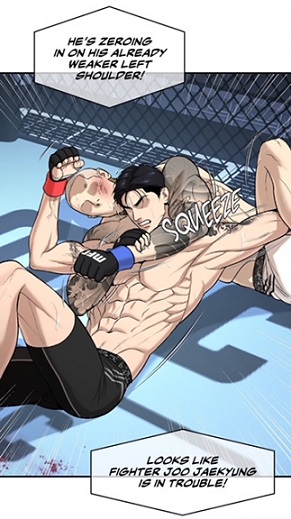 (chapter 50) So why was the manager so shocked with such an attack?
 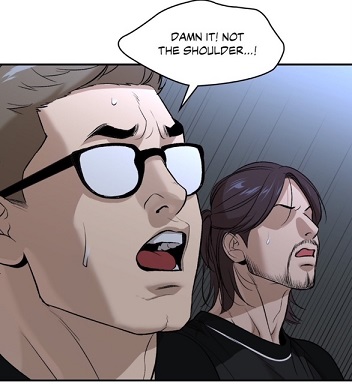 (chapter 50) It was clear that during such a match, the challenger would use the opponent’s weakness. What did he expect in the end? The panel exposes his stupidity and his immaturity. He should have anticipated such a move. These observations lead me to the following conclusion: the champion needs to realize that his hyung will never recognize his suffering, as long as Joo Jaekyung is in denial. Until now, he hasn’t been protecting Joo Jaekyung’s interests, rather his own comfort. His MO was to put the whole responsibility on the athlete. But it was his duty as his manager not to accept the new challenge.
  (chapter 41) Observe that he is just asking questions once again, when he voices his doubts. He is not making a statement. However, the manager is changing. While in the past, the manager was not treating the celebrity like real family, though he was called hyung, I detected a switch, when Park Namwook sent messages from his family for his birthday.
  (chapter 46)
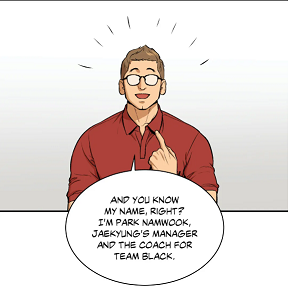 (Chapter 9) and coach for Team Black, but he acts like the director of Team Black.
 (Chapter 49) This explains why he claimed that Team Black was his gym,
  (chapter 22) yet the reality is that this power comes from the champion, as the latter is the real owner of Team Black. Therefore the captain warned the two hyungs.
  (Chapter 46) Thus I deduce that the role between the star and his hyung must be redefined because of Kim Dan’s presence. But wait… the heading is referring to the Russian author Leo Tolstoy. So what is his connection to the manager from Team Black?
 (chapter 41) to the golden keychain.
  (chapter 11), but also he never tried to correct the star’s false conclusion.
  (Chapter 11) He just got angry giving the impression that he was siding with Kim Dan. But the reality is that he did nothing for the poor doctor at all. He remained passive and silent. His “ignorance” explains as well why he is not questioning events and his athlete’s success.
 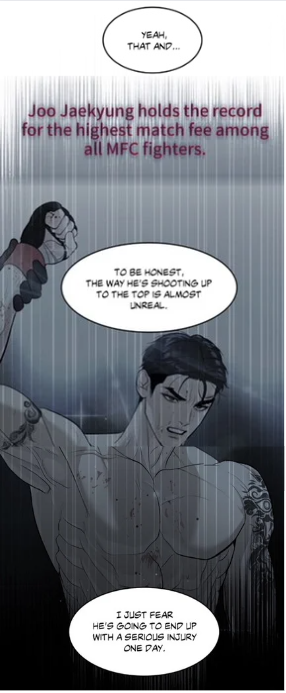 (chapter 43) Through the two examples, Manhwaphiles can sense that his “ignorance” is a mixture of willingness to close an eye and real naivety. Under this new approach, it dawned on me why the manager used to beat his star so brutally.
  (Chapter 7)
 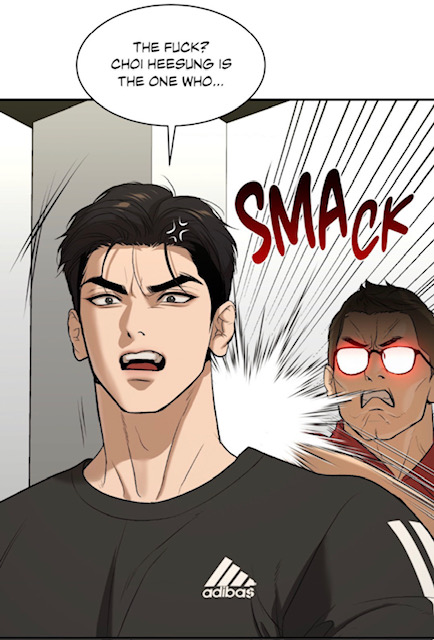 (Chapter 31) It is his way how to deal with uncomfortable situations. He stands for social norms and conformity. It is not surprising that the manager proposed to use Kim Dan as compensation for Heesung’s fake injury.
  (chapter 32) Furthermore, he forced Joo Jaekyung to take the blame without investigating the matter.
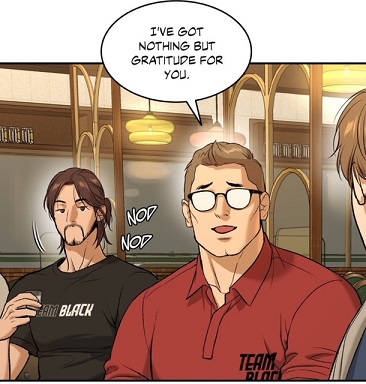 (chapter 43) The latter triggers his anxiety and nervousness. Thus when there is a problem, his MO is either to threaten,
  (chapter 36) or to let others make decisions. I would even add, he often delegates things to others: the manager from the Entertainment company
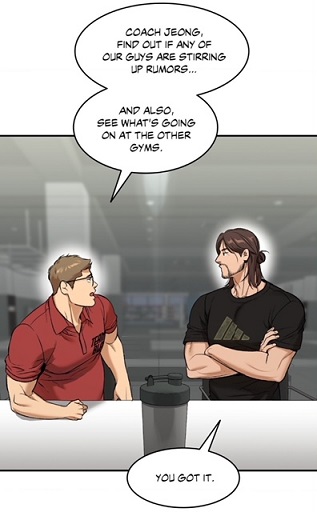 (chapter 46), Kim Dan [f. ex. He should accept the bad mood from his VIP client]
  (chapter 46) and
 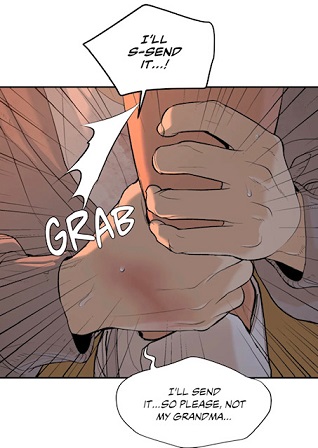 (chapter 16)
  (chapter 41) Therefore I believe that in the locker room, Kim Dan must have recalled her words. She became his source of strength once again. That’s why we have parallels between these three scenes:
 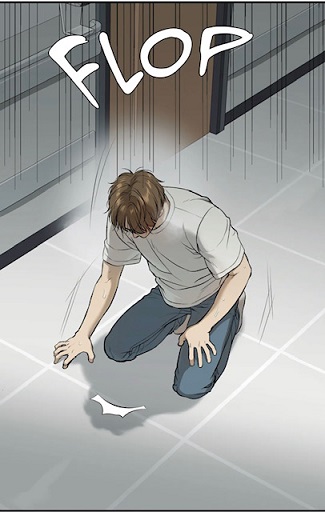 (chapter 21: he was criticized by Kim Miseon, he feared to lose his halmoni)
 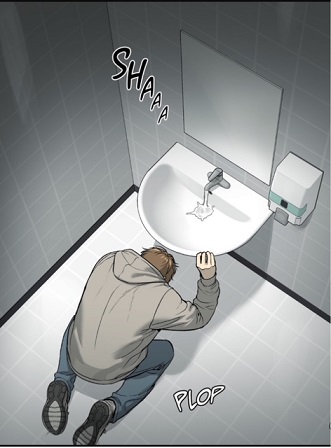 (chapter 47) and finally
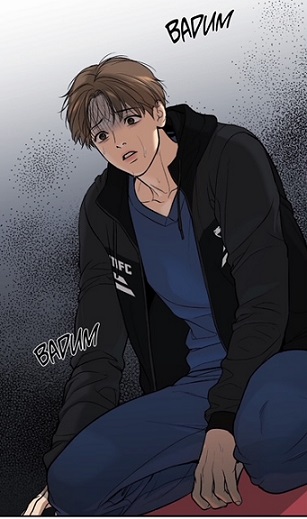 (chapter 50) That’s the reason why Kim Dan could become a star. Contrary to Joo Jaekyung, we didn’t assist to the birth of the yeouiju. It is no coincidence that birth is connected to pain and happiness. Mothers forget the suffering of the delivery, as their child can procure them a lot of joy and happiness.
 (Chapter 26) By embracing misfortune, transcending conventional morality, striving for self-overcoming, embracing individuality, and creating meaning and values, individuals can embark on a journey of self-discovery and self-actualization, ultimately becoming the architects of their own lives. At the heart of Nietzsche’s vision lies the concept of the Übermensch, or Overman, who embodies the pinnacle of human potential and serves as a beacon of courage, creativity, and self-mastery. Through the pursuit of the Übermensch ideal, individuals can transcend their limitations, confront their fears, and forge their own destinies, thereby finding their true selves in the process.
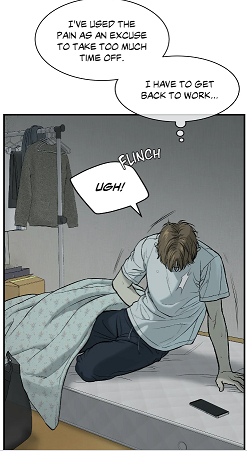 (chapter 5) or Heesung drank alcohol
 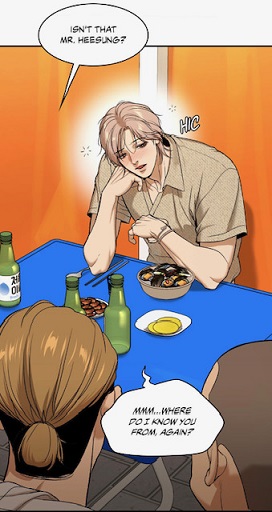 (chapter 35). Both were trying to numb their pain, though they shouldn’t have according to the German philosopher. The soju stopped them from becoming the better version of themselves. I am suspecting that doc Dan copied this poor habit from his grandmother, who drank in secret. Don’t forget that in all the memories, the halmoni is smiling
  (chapter 16) or as a tool for the jinx, therefore he mopped the floor
 (chapter 36), acting like an errand boy. Then he doubted Heesung’s words and admiration
 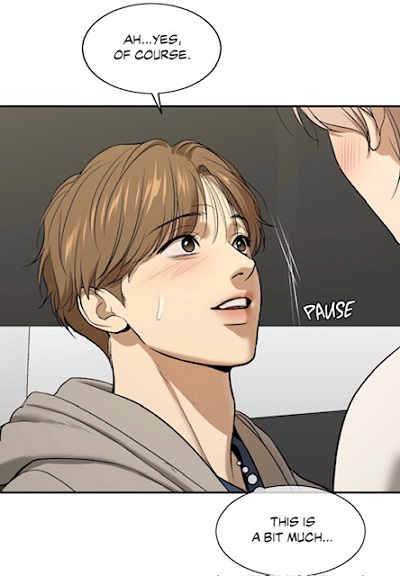 (chapter 31)
  (chapter 31). Furthermore, he took a side gig in order to buy the champion’s present and finally, he rejected Choi Gilseok’s praise and offer.
 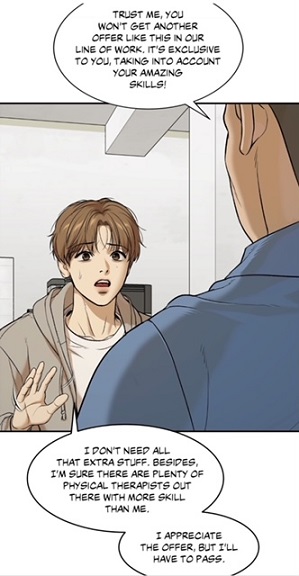 (chapter 48) He was always diminishing himself as a doctor. Therefore in the locker room, he was confronted with his biggest fear: is he really a physical therapist?
  (chapter 50) He injured his patient. The spray is there to let him see that he has power in his hands. He should trust himself and his magical hands. Don’t forget that this request was made by Joo Jaekyung.
 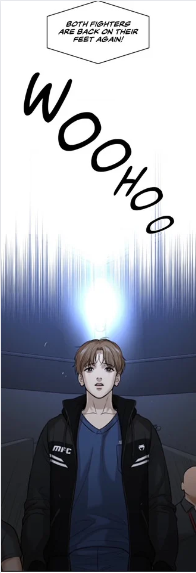 (chapter 50) And from my point of view, the locker room became the doctor’s new temple. There, he must have recalled his grandmother’s wishes. She would like to see him on TV. For me, the light over his head symbolizes Enlightenment. He has become the champion’s yeouiju. Thus I deduce that Kim Dan is on the verge of proving his worth to Team Black. I am anticipating, he will approach the ring, and even treat him during a break, something he denied to his halmoni.
 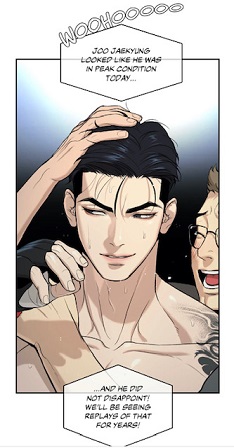 (chapter 5)
 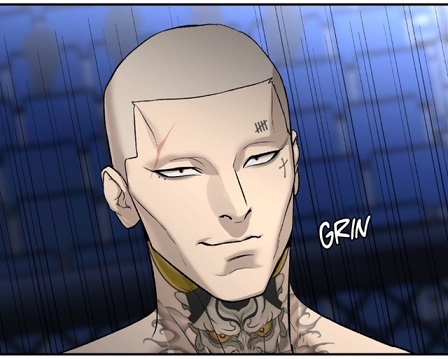 (chapter 50) It is relevant, because through such an intervention, hamster Dan would teach the champion an important lesson. He is not alone in the ring, the doctor is watching his physical condition and helping him.
  For me, chapter 50 announces a new start! Interesting is that the number 50 is associated with the planet Mercury which stands for poison but also medicine! And now, you comprehend why I consider the painful chapter as treatment sessions. The two protagonists are forced to redefine themselves. Joo Jaekyung might be injured, but he no longer sees himself jinxed!
  (chapter 48) So the moment you perceive this moment
  (chapter 19), this signifies that Potato was acting like a true friend in the locker room.
  (chapter 37)
  (chapter 40)
  (chapter 42) In the first part of Jinx, the doctor was the star’s companion of the night, but since the incident with the birthday present, he stopped being the night partner. Now, he is about to become the famous private physical therapist acknowledged by the public and media. In other words, his destiny contrasts to Baek Junmin’s, a shooting star, it will last longer. Why? It is because the main lead is Saturn! He brings fortune and karma to the evildoers. This interpretation corresponds to Übermensch from Nietzsche, which is sometimes translated as “Superman”. Under this new light, you comprehend why I added the protagonist’s pink angel wings. It was an allusion to his transformation, he is destined to become an “Overman” or Superman.
  And this brings me to my next observation. The doctor’s pain is exposing his recovery! Weird, right?
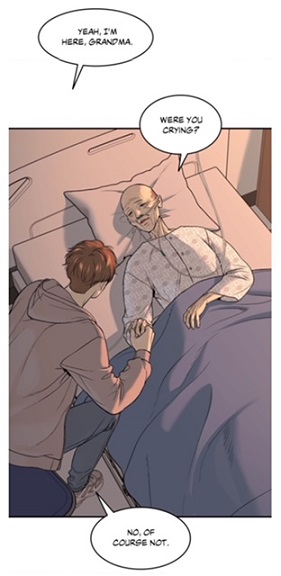 (chapter 47) and his agony. He was no longer under the influence of toxic positivity. While he cried, he admitted his flaws making him realize that he had never been abandoned by his grandmother.
  (chapter 47) That’s how he overcame his abandonment issues.
 (chapter 27) For the first time, he rejected a suggestion from his lover and even slapped his hand.
  (chapter 37) He wanted the party to continue. It shows that he was having a good time with Oh Daehyun and Potato. He has no problem to stop kissing his soulmate, when the latter shows his discomfort.
  (chapter 44)
 . (chapter 36)
  (chapter 49) He didn’t wait for an order from PArk Namwook or the champion.
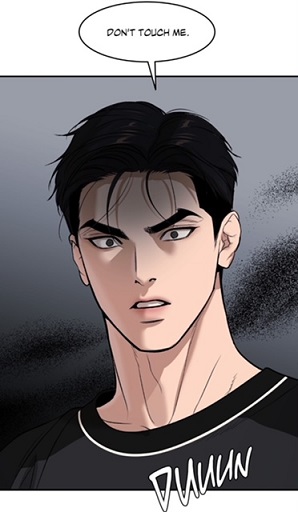 (chapter 50) They are trying to find themselves, therefore they must constantly adapt to each other. While the image gives the impression that the trust between them is vanishing, it is in reality an illusion. People should pay attention to the color of the speech bubble. It is white, there is no point of explanation. It reveals that the champion is not raising his voice. He is rather calm. In reality, the champion was not truly mad at Kim Dan. He was restraining himself. Jinx-philes should compare this image to the following two panels:
 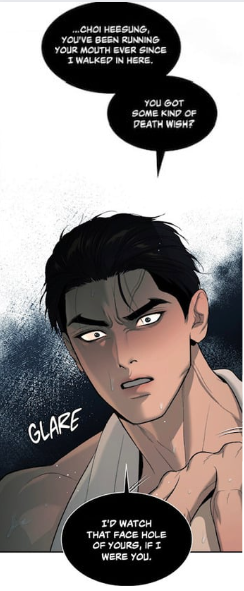 (chapter 34)
  (chapter 45) And now, you comprehend why I stated earlier that he acted rather instinctively. For me, he still trusts the physical therapist.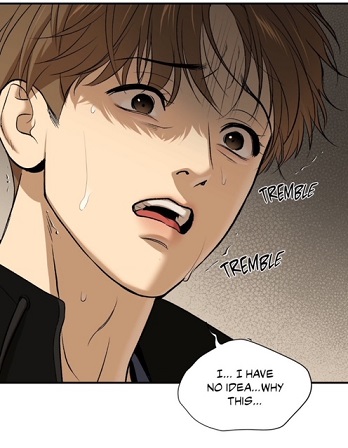
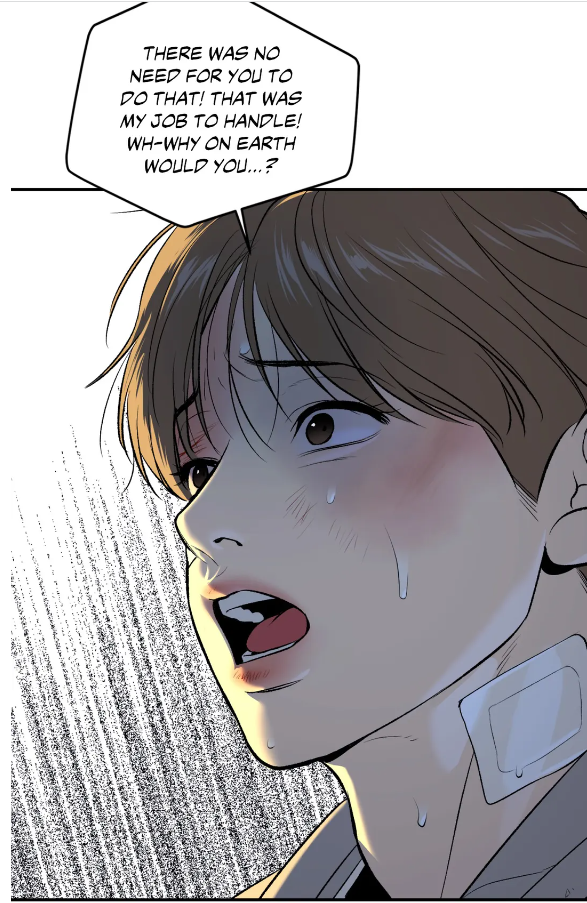 (chapter 18) When the champion paid off his debts, he saw it as meddling. Interesting is that he came to accept the champion’s support, but he never asked for Joo Jaekyung’s help directly. In addition, Jinx-philes should notice that in the interrogation room, he thought just about the champion and not himself.
  (chapter 40) It never came to his mind that he should ask for assistance. Finally, observe that after he got drugged in the States, he let the champion deal with the problem.
  (chapter 41) He accepted the statement from his boss. Nevertheless, doc Dan was the real victim. He should have become more involved in the matter. Besides, he was a witness. And this brings me to my next thought: if Kim Dan gets into trouble, he should remember Heesung’s words: he should give him a call!
  (chapter 35) For me, the incident is there to teach Kim Dan that he can ask for help! This would show him that he is no longer alone. He wouldn’t appear weak at all. That’s how he would end up to gain his first friends. Let’s not forget that Heesung’s relationship with the doctor is no longer tainted by money or by lust or greed. In fact, thanks to him, he found his soulmate. What unites Kim Dan and Heesung is the heart and the desire to help. Heesung stands for brotherhood, so he could be the one outlining the problems to Team Black. Finally since Potato likes Doc Dan very much, there is no doubt that Heesung and Potato will work together to assist the main lead. This image
  (chapter 33). He is not hiding his sexual orientation, he is greedy, but in a good way. Hence he tried to win the doctor’s heart. He never gave up, till he was properly rejected by the doctor.
 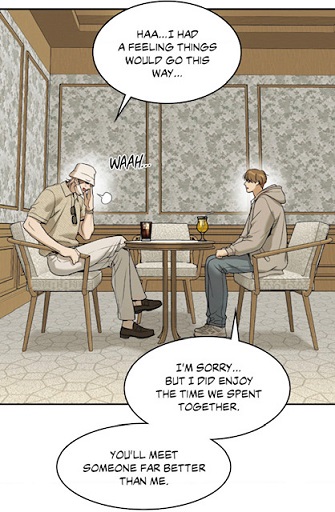 (Chapter 35) Interesting is that after his confession, he still chose to come clean with the doctor. He revealed the truth to Kim Dan, though he could have lost the protagonist’s respect. He admitted his lie and manipulation,
  (Chapter 35), but Kim Dan’s reaction was not to scold his future friend. In fact, he appreciated his honesty. In front of Kim Dan, he could show his true self. He was not entirely a good guy, but he didn’t get rejected. But so far, the actor is not present in the arena. Therefore Potato could be the first person Kim Dan asks for help. He shares some similarities with his soulmate. He doesn’t fear people’s gaze, hence he raised his voice under the tent.
 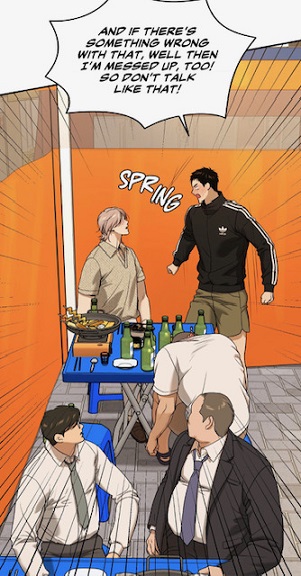 (chapter 35) he doesn’t represent the herd mentality, for he never thinks and acts like others.
  (chapter 31) While the fighters all liked the actor, he judged him in a different light. Then he was not present during the champion’s birthday. Therefore he possesses all the qualities to become a hero. He could cause a scandal,
  (chapter 49) similarly to his idol and hero in the States. He noticed the issue right away: the security didn’t do his job properly. To sum up, Potato would follow his foot steps and that’s how he would get noticed by MFC!
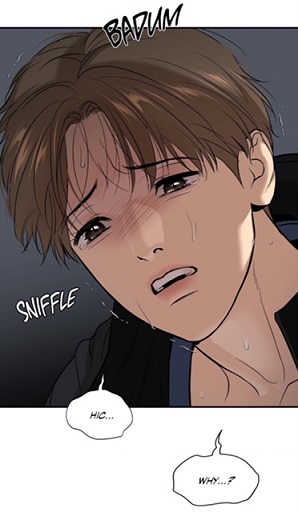 (chapter 50) The word is displaying that the doctor is not accepting the incident simply like that. It is showing that the doctor is slowly losing his naivety. Before the incident with the spray took place, he still trusted the words from people.
 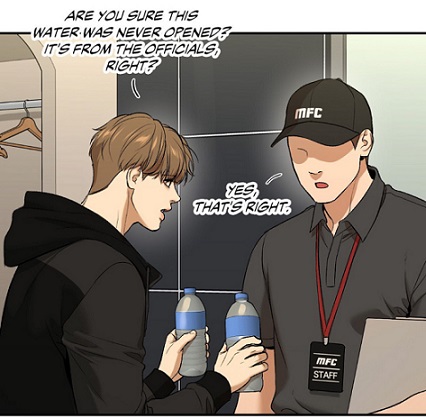 (chapter 49) Naturally, he can not get rid of his naivety totally, for keeping a certain purity is necessary in life too. On the other hand, it becomes clear that his naivety is the result from his education. The halmoni is herself quite too trusting. Hence she ended up being harassed by loan sharks. On the other hand, the incident was like an eye-opener for the physical therapist. He should stop judging people based on their words
 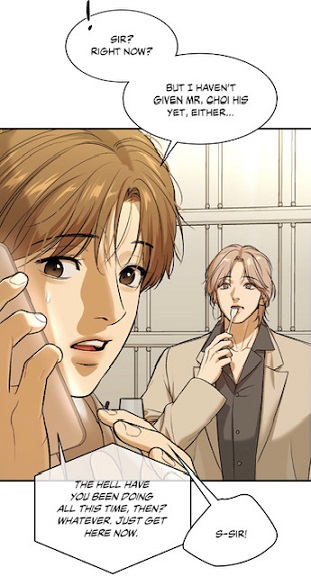 (Chapter 32)
 (chapter 1) by bosses, it becomes comprehensible why he didn’t fall into the trap a third time.
 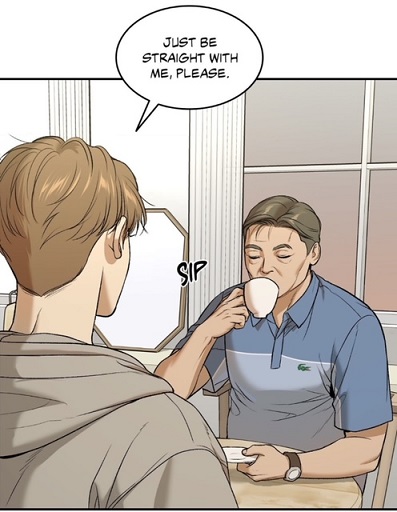 (Chapter 48) He is pushed to question impressions and people’s motivations. As a conclusion, anguish is a tool to push people to become wiser and happier. And this leads me to my final part.
 (chapter 14) But back then, Kim Dan didn’t mind staying in Seoul.
 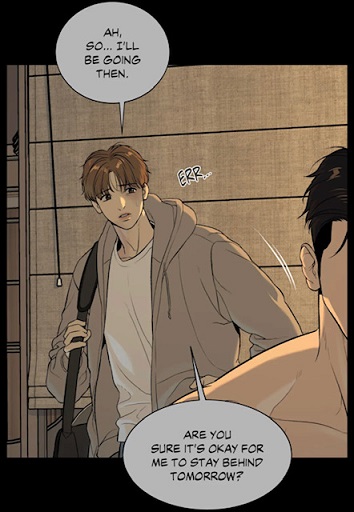 (chapter 13) Furthermore, after having sex in the locker room, Kim Dan was left behind.
  (chapter 15) And notice that this pattern was the same in the States. For the second match, Team Black left without him, hence Kim Dan arrived late.
 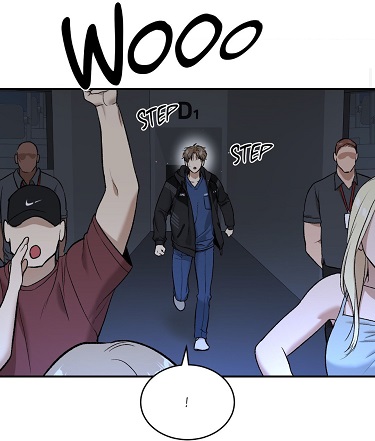 (chapter 40) Therefore he was running once again. However, back then, no readers felt angry at the team, though it could also be perceived as a betrayal and abandonment! Kim Dan was not perceived as necessary, neither for Joo Jaekyung nor for Park Namwook. Hence the bedroom could be judged as the place of the betrayal: “
 (chapter 40) It was to outline their previous disregard and betrayal! Thanks to Potato, Joo Jaekyung got informed, hence he could rescue the physical therapist.
 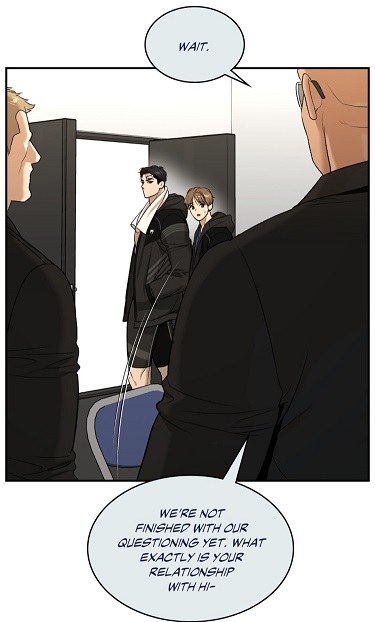 (chapter 40) But he never revealed the hamster’s role in the team! This explains why Kim Dan was used by Choi Gilseok. He needs to expose his role in Team Black to the world. He is the champion’s private PT!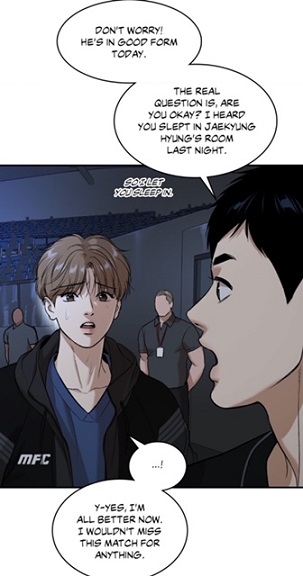
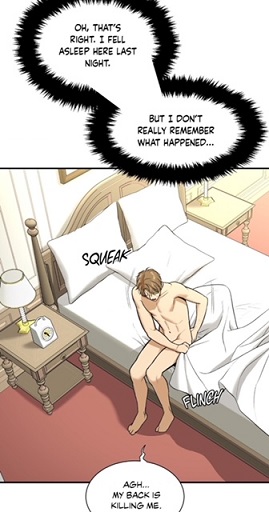
 He has just his blue uniform.


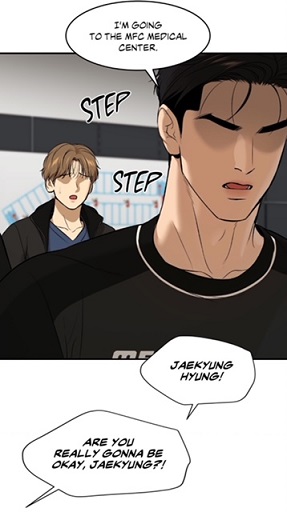 Hence he could get into trouble! The MFC could report the incident to the authorities!
  (chapter 49) in both cases! He was present, when Kim Dan drank the drugged beverage.
  (chapter 38) To conclude, it was not in Kim Dan’s interest to run away or hide! This would have been judged as a sign of his culpability and complicity. He needs to face the problems so that he can shape his destiny with his own hands and not remain the playball of dark forces! Yes, this chapter announces a huge change at Team Black, the start of a real friendship between two puppies. 😉
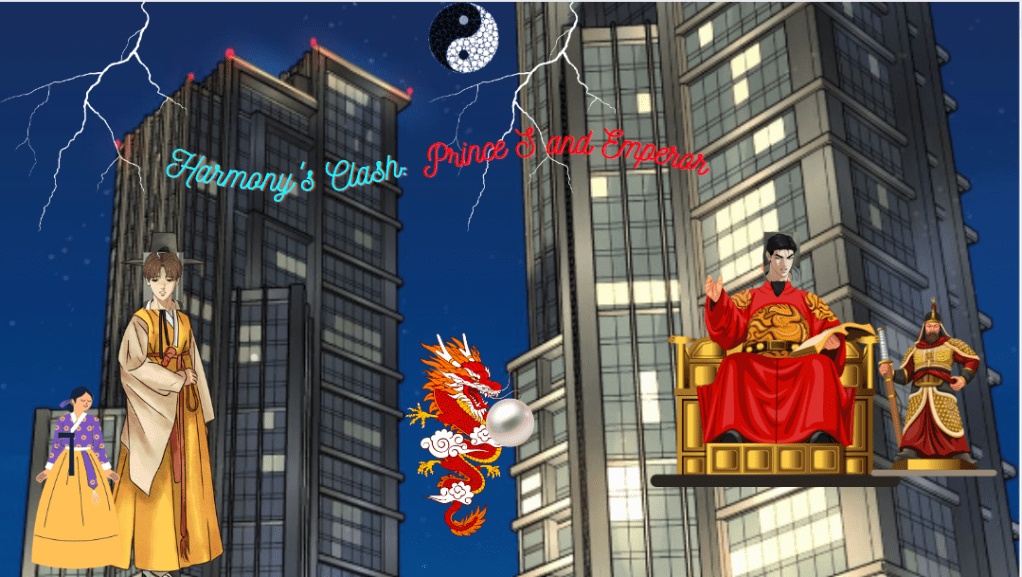
 (chapter 30) This woman, named Sihyun, is suffering from Dependent Personality Disorder. And the author of the Webtoon Doctor Frost called her story: “The tears of Princess Pyeonggang”. Due to her personality, she was linked to the famous “princess”. She would do everything for her companions, yet she kept getting dumped. What caught my attention is that both women defined themselves through their partner. Their ultimate goal in life is to assist them, to make the other happy or recognized. But how is it a problem?
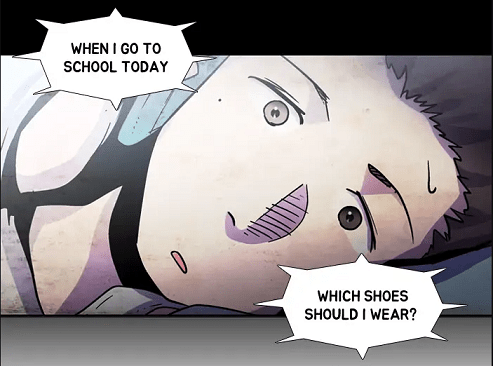
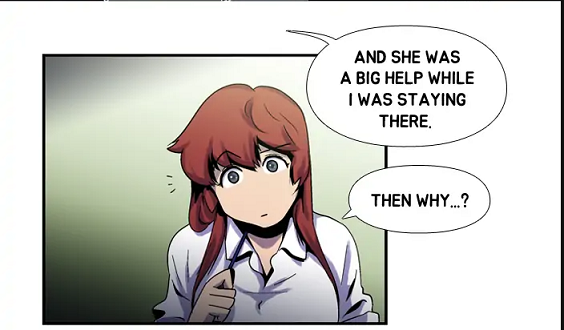
 (chapter 33) What appeared as caring turned out to be a load, for the partners were all forced to be responsible for her and in every aspect of her life. They definitely felt asphyxiated, hence they could only get sick of her. Interesting is that this person would find shortly after the separation a new boyfriend, a sign that she could not live on her own.
 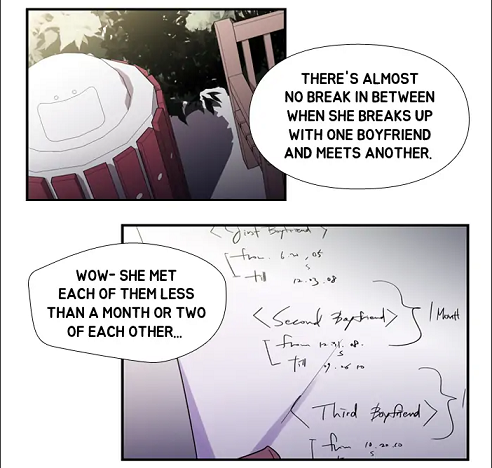 (chapter 33) And now, you are wondering how Sihyun is similar to Kim Dan, who only had one person in his life before he met the champion. It is related to traumas in their childhood.

 (Doctor Frost, chapter 39) After reading this, Jinx-philes can realize that Kim Dan is also suffering from Dependent Personality Disorder, though it is less obvious. He got abandoned by his parents making him feel insecure.
 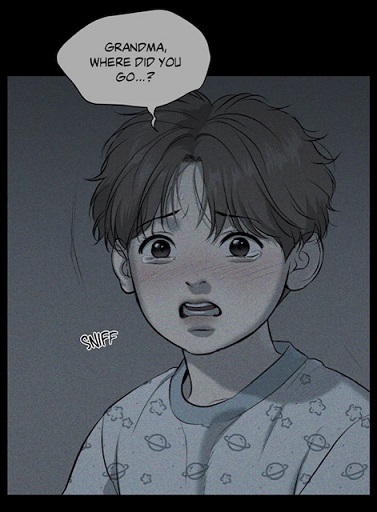 (chapter 21) We could detect his low self-esteem
 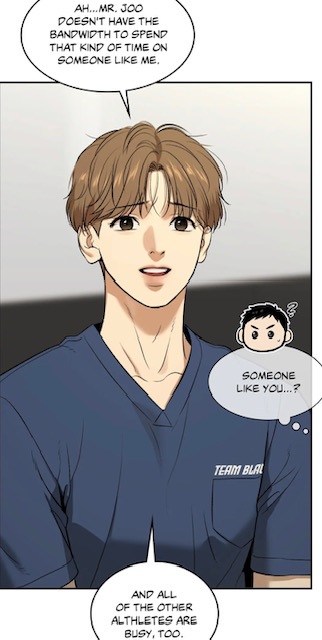 (chapter 25)
  (chapter 46) and his overprotectiveness
  (chapter 26)
  (chapter 42) on many occasions. He was risking his livelihood and health for the sake of others (his halmoni, Potato and Joo Jaekyung). His selflessness is actually the sign of his DPD. He had no purpose or ambition in his life… That’s why he is not able to project himself in the future. Until chapter 45, his life and future was determined by the celebrity,
  (chapter 42) and before it was by his halmoni’s fate.
  (chapter 19) However, here please don’t get me wrong. For me, the athlete is the physical therapist’s emancipator. This huge argument in the dining room pushed him to differentiate himself from the champion. In my eyes, Kim Dan would have returned to his old bad habits… relying on someone else, sacrificing himself for someone’s else sake. He would have neglected his career in the end.
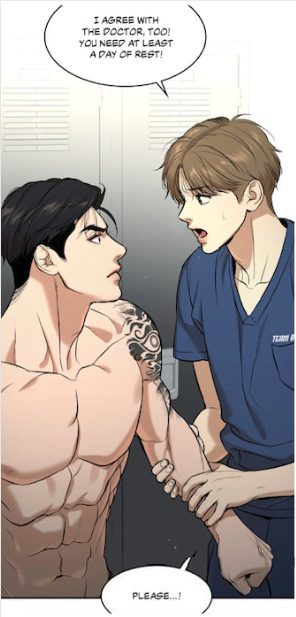 (chapter 27)
  (chapter 31) Here, we get an explanation why he couldn’t detect the trick from Choi Heesung. He feared to make a diagnosis on his own, as he didn’t desire to question the words from the comedian. The hospital seems to be the sacred place in the doctor’s eyes.
  (chapter 42) Consequently, it is not surprising why the champion complained about the doctor’s negligence. The latter was avoiding any responsibility in the end. On the other hand, the report is the symbol of his hard work, but also of his knowledge. That’s the reason why I am still considering the dispute in chapter 45 as a good omen for the physical therapist. He needs to develop his own identity. They are two different people. He needs to live for himself, to give a meaning to his life and not:
  (chapter 27) That’s how it dawned on me why the doctor reverted to his old habits (not participating to the meeting, taking odd jobs, not voicing his own judgment, relying on others) after the night, when he was treated as sex toy. However, in my eyes, the trigger for this switch was the release of the tabloid article.
  (chapter 35). Why did the doctor appear so confident in front of his client to the point that he could reject his hand after going to the hospital?
 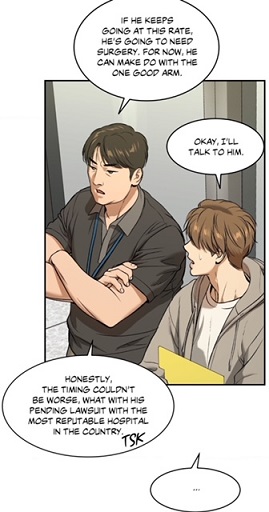 (chapter 42) He mentioned the lawsuit against the most reputable hospital. The dispute could only diminish his self-esteem. As time passed on, there is no ambiguity that this lawsuit must have burdened more and more the physical therapist. Besides, there is no doubt that he felt some loyalty towards doctor Lee who had been complimenting him. Secondly, let’s not forget that despite his “efforts”, he had not been able to convince his patient to stop training for one day.
 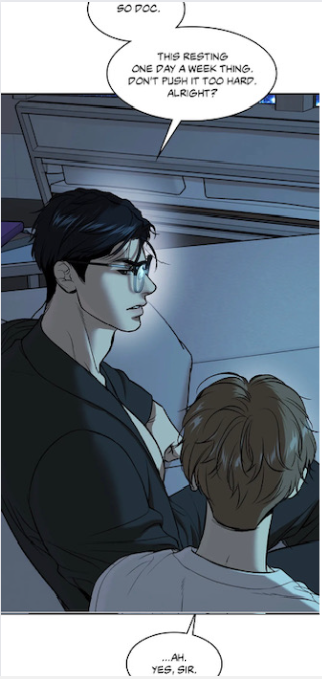 (chapter 29) Hence he jumped to the conclusion that his patient would not listen to him anyway.
  (chapter 46) It is full of symbolism. For the first time, he is standing on his own feet. His walk in direction to the trash bin illustrates his choice.
 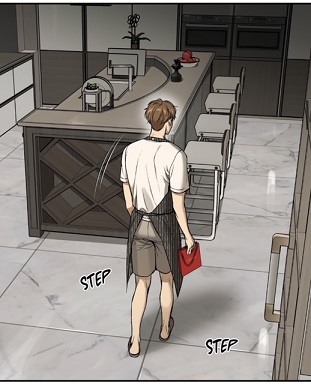 (chapter 46) Besides, he is using the personal pronoun “I”.
  (chapter 46) It is his Coming-Of-Age. He is on the verge to become independent. On the other hand, he didn’t fight back verbally against his boss. He accepted his reproach.
  (chapter 46) He was just a physical therapist and nothing more. This shows his lack of criticism. He is still not mentally strong enough to question the champion’s words and argue back. In the past, he could do it, for he was identifying himself with his grandmother and her values.
  (chapter 18) This signifies that he needs to develop his own philosophy and values. What does he treasure in his life?
 (chapter 42) The latter was also dependent on the champion, but his “addiction” was money and not love or recognition. Therefore he picked up the money before leaving the flat
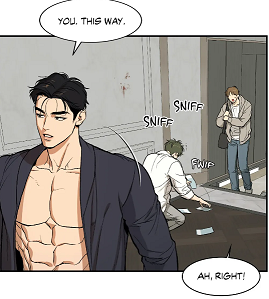 (chapter 2), while the other threw away the expensive keychain
  (chapter 46). This scene exposes the return of Kim Dan’s dignity. This comparison reinforces my interpretation that the champion misjudged the doctor’s present and actions. He imagined that Kim Dan had been acting like his “previous sex-partners” or stans. They would offer him some gifts in exchange of favors. Another contrast with the goblin is the absence of a fight and discussion.
 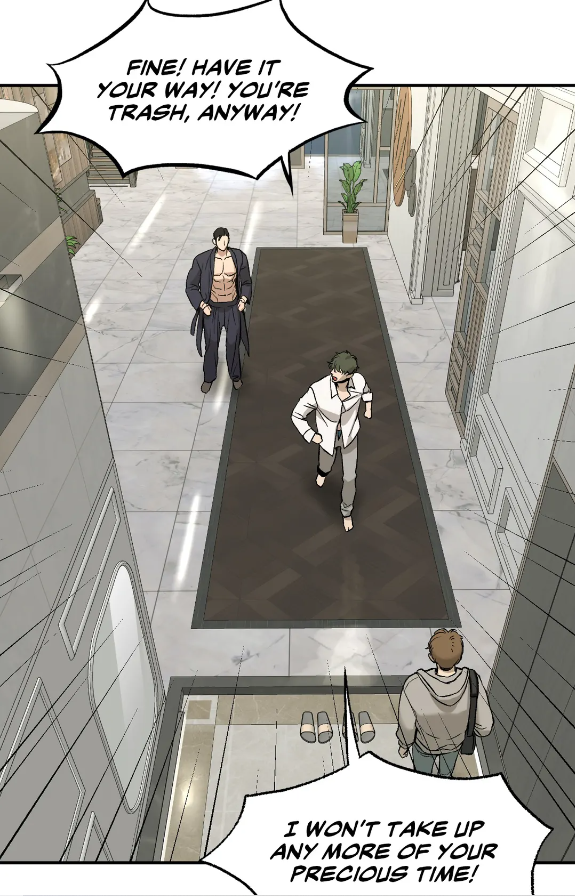 (chapter 2) I would even add that contrary to the green-haired guy, the doctor is not judging his patient’s personality, he is blaming himself.
  (Doctor Frost, chapter 32) Interesting is that doctor Frost revealed to her later that her condition made her an easy target, as she kept relying on others.
  (Doctor Frost, chapter 39) And this observation brings me to my next conclusion: he will be approached by really bad guys, the mysterious Mr. Choi!
  (chapter 1) He even needs to learn the difference between good guy and nice guy, but this remark applies to the grandmother.
  (chapter 21), yet their actions were not truly selfless.
  (chapter 45) is random, for it stands for “attachment”.
 (chapter 44) He found fulfilment in sex, which stands in opposition to the recommendation of zackbeach. Moreover, I would like to underline that the doctor reduced knowledge to sex:
  (chapter 44) How could he get to know the champion better, when the latter was supposed to be drunk and they would have sex? Getting closer to someone means communication and not really sensuality. Hence his happiness could only be short-lived and illusory. He didn’t take the reality into consideration. Thus I see the physical therapist’s tears as a therapy session:
 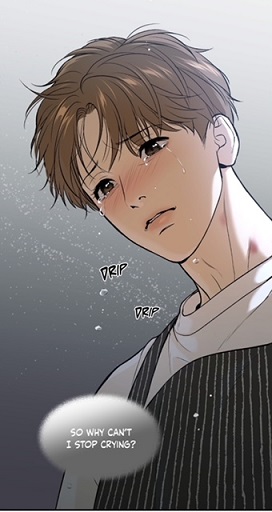 (chapter 46) He allows himself to cry, to grieve and to admit his pain and loneliness.
 (chapter 46) It helps him to face reality. He is on his own, he needs to stop relying on others. I would even say, he is encouraged to make decisions and as such to become responsible for his own life. It is important, because this means that he will have to fight back, if he wants to survive. He can not make any desperate and hasty decisions, like this one:
  (chapter 1) However, since he listened to the champion’s reproach and became submissive again, their relationship seems to have returned to normality. They even appear as close.
  (chapter 41) reminded me of the ending of a fairy tale: they lived happily ever after. But the doctor was forgetting that life doesn’t end after the match in the States. Life ends with death. In verity, the champion is destined to be challenged, until he retires. What the doctor saw was not the end. This exposes his naivety. How could he have such a view? It is influenced by his grandmother.
  (chapter 10) At no moment he pondered about himself. Happiness was never his goal, exactly like in fairy tales. Sleeping Beauty is rather passive. She sleeps, until the prince charming appears and kisses her. After that, they have kids. Interesting is that they don’t get married right away, so that the princess initially has the status of a mistress or concubine. Once the prince can secure his position, he marries her. Then the moment her husband leaves her side for war, she is tormented by her mother-in-law, the ogress. She can only escape death thanks to the intervention of her husband. We could say that happiness fell on her lap. Sleeping Beauty stands for passivity, dependence on her parents and husband and lack of critical thinking. Why? It is because the princess in fairy tales, in particular Sleeping Beauty, embodies toxic positivity.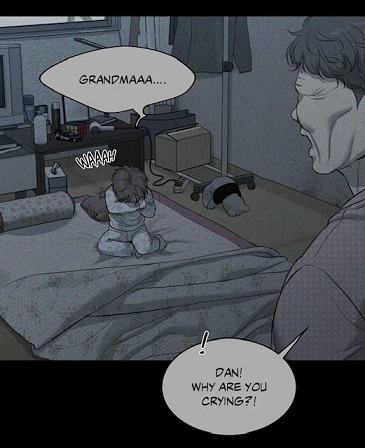
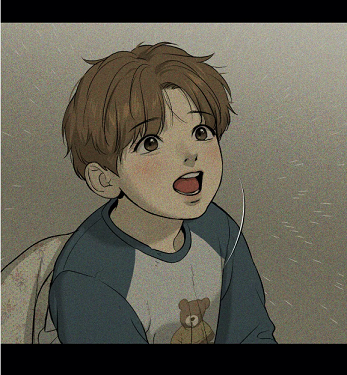
 (chapter 45) With this contrast, the fear from the champion becomes more palpable. Joo Jaekyung got angry, for he had been put in the same situation. But the latter was never influenced by Toxic Positivity. Besides, he was fighting against his own inner demons. Nevertheless, this new interpretation of the birthday made me recognize why the author chose this chronology concerning Kim Dan’s past:

 (chapter 1) However, he could never confide to his grandmother about the physical abuse from the loan shark. However, the moment his hope got up
  (chapter 11), as he imagined that he could pay off the debts, he recalled his birthday. He had a nice “souvenir”… convincing himself that everything was fine. He would be able to do it, like his grandmother had told him.
 (chapter 12) Therefore I understand why the doctor didn’t fight back against Heo Manwook and his minions.
  (chapter 1)
  (chapter 11) But the moneylender and his minions are no honest bankers, but criminals. They enjoy using their strength, that makes them feel powerful. It boosts their ego.



 (chapter 13) who also jumped to the wrong conclusion, when he saw the doctor’s bruises. He imagined that the champion had been too rough in bed with Kim Dan. However, once he heard his testimony, he believed him. This shows that he trusted him. On the other hand, this scene reinforces my interpretation that the glasses are connected to prejudices and false perception. Moreover, observe that he was curious about the physical therapist, hence he interrogated the champion.
  (chapter 13) Then, observe that in the penthouse, the doctor acted too.
  (chapter 13) and a new face!!
 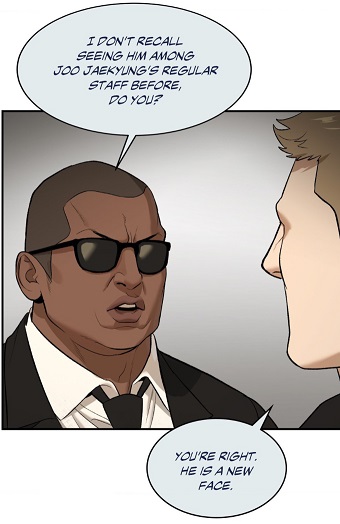 (chapter 40)
  (chapter 13) And by contrasting these two scenes, I realized that it reinforced my theories. 1. There must have been a phone call!! In episode 13, the champion must have called his chingu.
 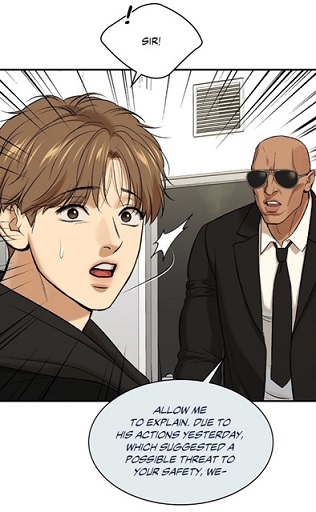 (chapter 40) However, the moment the guard with the sun glasses got caught, he tried to act as a savior. As you can see, this comparison reinforces my theory. The MFC manager must have asked the MFC security guys to cover up the incident. If not, they would be blamed for the matter!! And now, you comprehend why they had to know everything about Kim Dan.
  (chapter 40) They needed to find any excuse to put the blame on the protagonist. Either he had a strong reaction because of his medication or because of a different meal… but since Kim Dan never replied to them, they had to frighten him, to coerce him to confess a crime.
  (chapter 40) The intrusion of Joo Jaekyung in the office was caused by Park Namwook’s revelation. And it was the same, when the champion caught Heo Manwook with his minions.
  (chapter 17) And what is the common denominator between the perverted hospital director
  (chapter 16) Sexual harassment and the usage of the number to achieve their goal!! These two characters could hide their crimes with the assistance of other people (thugs, staff). We could say that both used an organization. Consequently, I am assuming that the MFC manager is doing the same!! Therefore it is no coincidence that Mingwa employed the same colors: blue, white and black
  . (chapter 1) That’s the reason why I am suspecting that the MFC guys must have already been informed that Kim Dan might be the champion’s sex partner.
  (chapter 40) Is he his partner or a member of his gym? Not only he is the face of Team Black
  (chapter 36). Thus I deduce that the agent from the Entertainment agency and that lawyer are acting the same. They believe that they are safe, for they are both working for a huge company or law firm. And guess what… the doctor Kim Miseon is also wearing glasses.
 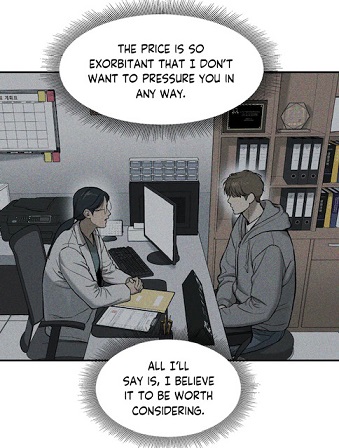 (chapter 5) As you can see, thanks to the glasses, I discovered a new pattern. These schemers and helping hands are avoiding any responsibility by hiding their wrongdoings behind an institution or we could say behind a name.
  (chapter 7) In the last case, it would be MFC!! But the reproach from the champion
 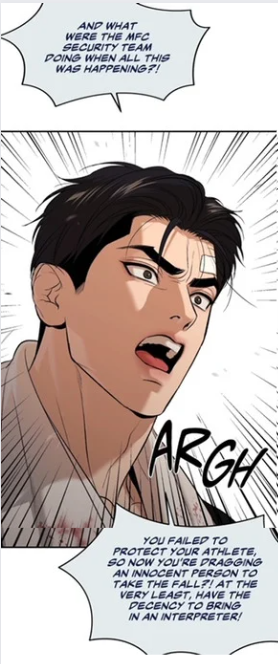 (chapter 40) should have opened their eyes! Not MFC would have been involved a scandal… but only the MFC security team!! As you can see, the moment they had been informed about the incident, they should have reported the MFC manager to the highers-up! They should have never protected such a person in the end, because the latter is the reason why the organization would be involved in a scandal. That’s the reason why such people are framing others. They know how an institution works. Under this new light, it becomes comprehensible why the plotters are trying to ruin the champion’s name!!
  (chapter 36) It is because they are projecting their own thoughts onto the champion. He is just a person. However, what they don’t realize is that behind the athlete, there is also an organization: TEAM BLACK!!
 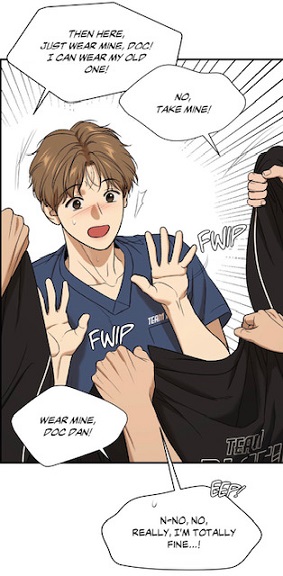 (chapter 36) Note that Oh Daehyun and Potato tried to investigate the matter with the doctor’s illness.
  (chapter 38)
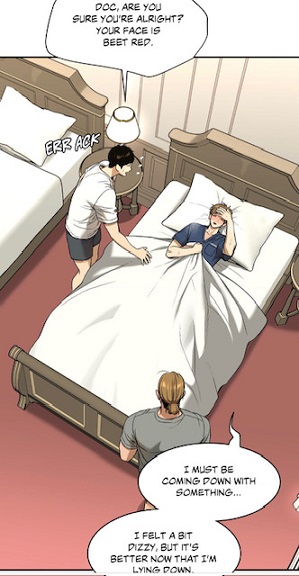 (chapter 38) Thus I deduce that because of Kim Dan, the members from Team Black will become more proactive. They need to show to these people that Joo Jaekyung is not alone, he is the alpha of a great gym… producing many champions!! In other words, the dragon with his yeouiju will be able to remove these Deceit’s webs and purify these institutions. As you can imagine, I am suspecting that Dr. Lee must have been blamed for the article
 (chapter 29) However, here the item has a different signification. How so? It is because Joo Jaekyung was totally honest and was opening up to the physical therapist.
  (chapter 29) It seems to contradict my previous interpretation about the glasses. But no… Observe that during that whole scene, the readers could see the champion’s eyes contrary to the MFC guys
 (chapter 37), Kim Miseon
  (chapter 13) and the perverted hospital director
 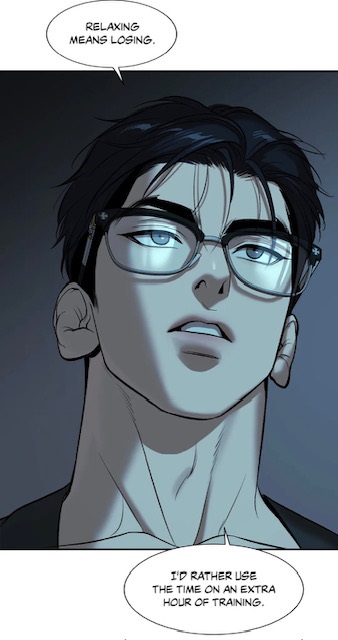 (chapter 29) Because he was wearing blue light blocking glasses, he was protected from “Agent Blue”, the positive version of episode 36 and 40!! This explicates why I consider them as a shield. He was trying to hide his vulnerability while confiding to Kim Dan.
  (chapter 35) Striking is that as soon as the actor removed them, he got honest with the doctor. He revealed his intentions, but he got rejected. As you can see, the glasses can have a positive function. Consequently, I came to develop a theory which was triggered by the glasses. Kim Dan envisioned the athlete in a suit
  (chapter 32), then he imagined him with the sun glasses
  (chapter 35) Thus I come to the conclusion, Kim Dan will be the one turning the athlete into a star, a real celebrity! But he won’t be reduced to his body and face
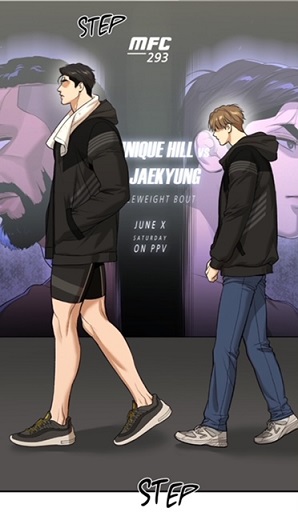 (chapter 40) So he could offer the sun glasses to his savior. If this prediction comes true, then it means that Kim Dan will become the rival of the manager from the agency. Besides, it was the manager’s job to develop a strategy how to change the netizens’ opinion. But he chose to put the whole responsibility on his athlete.
  (chapter 36) He could have shown that Joo Jaekyung was the owner of Team Black and he was training other athletes. It is important, because it shows that certain people hide their laziness behind the organization or a name. That’s the reason why I am expecting that Choi Heesung will play a role in the demise of the bad manager at the agency.
  (chapter 33) Since he has sun glasses, he is already connected to spying. Don’t forget that he tried to determine the true nature of their relationship before giving up on his angel.
  (chapter 32) Finally, I have the feeling that Team Black will come to act like the security guys in episode 40, investigate the matter why the champion and the doctor became the targets of malicious rumors and bad articles.

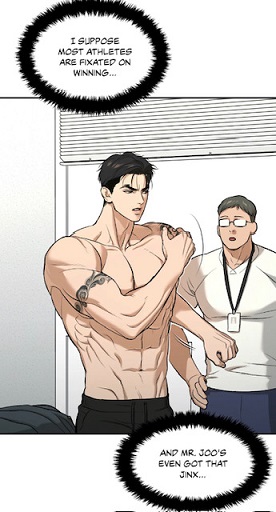 (chapter 27), it is clear that Joo Jaekyung’s real issue is his shoulder in bad shape. Hence we see him constantly touching his right shoulder.
 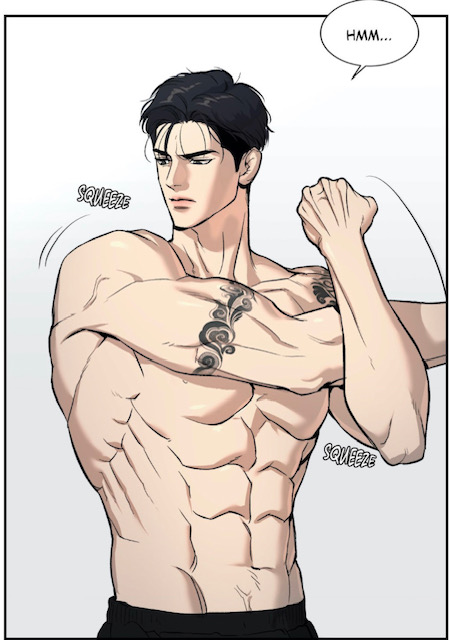 (chapter 1) Because of this contrast between title and content, the Manhwaphiles can grasp the writer’s true intentions behind the article. He was looking for sensationalism, hence he exaggerated the champion’s physical condition. But there is more to it. The columnist attempted to create the illusion of a proper and serious investigation by employing the idiom “the doctors”. With this term, he insinuated that he had consulted different doctors and they would all come to the same verdict. Moreover by including the fans, he gave the impression that this topic had been long discussed among the supporters. In reality, he was mixing the cause and consequence. The moment people will read this news, they will start speculating about his future. However, since this was a secret till this publication, I doubt that the lovers had already speculated whether the champion had reached his zenith. That’s the reason why I consider this column as a fake news. It was a hype created on a truth mixed with lies.
 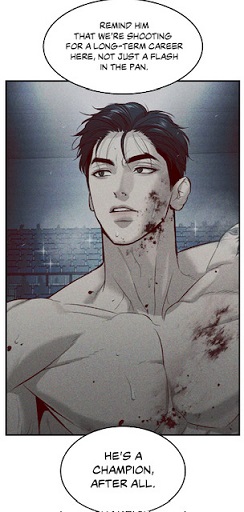 (chapter 27), if he changed his way of life and training. Hence he recommended rest.
 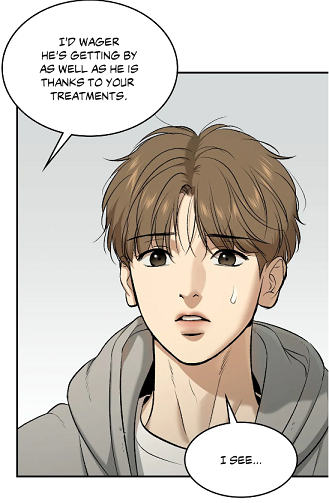 (chapter 27) Moreover, he is the only doctor who read the files!
  (chapter 17) People will start suspecting the protagonist and if his past with the perverted hospital director is exposed,
  (chapter 11) which could lead to the discovery of the debts and the loan sharks. He had financial problems and a sick halmoni. Finally, let’s not forget that the boxer is the first client of the physical therapist. So people will question the champion’s choice for picking Kim Dan as his personal physical therapist. He lacks credentials. Consequently, the doctor’s integrity and competences will be questioned by public opinion. In other words, Kim Dan could bring bad PR to Black Team and this could create some frictions between the champion, the doctor and Park Namwook. To conclude, it is clear that the target of this article is not just the athlete, but also Kim Dan. The allusion to the “anonymous source” was done on purpose, so that people would ask for his identity. He betrayed the hero and emperor! Someone violated the confidentiality clause. Nevertheless, divulging the existence of an anonymous source was to divert attention from the real issue! The real traitor is the author of this article who broke a rule. He shouldn’t have leaked this to the public! He is responsible, if Joo Jaekyung gets really injured by his opponent. But I would like to outline that the files were left in the office of Team Black and they allowed strangers to enter the gym because of Heesung!
  (chapter 30) As you can see, anyone could have access to the files, especially because the physical therapist was absent in the morning. He only joined the company much later. As the Jinx-lovers can observe, this article should be seen as a lesson for the physical therapist, Park Namwook and Joo Jaekyung. They should be more careful, due to money, this rule “bringing strangers” had not been followed.
  (chapter 1)
  (chapter 35) He is not a greedy, immoral and selfish bump. He embodies true loyalty
  (chapter 34) This shows that the doctor is slowly realizing the importance of welfare in such a career. Anger is a sign for stress. The latter is also the cause for damaged “joints”.
  (chapter 19) 😂
  (chapter 35) Therefore he got angry. I am quite certain that he was thinking like this:
 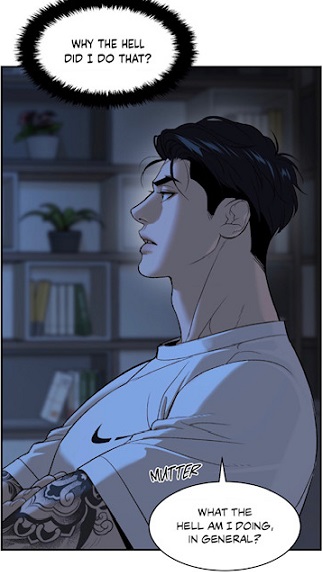 (chapter 35) In his eyes, he had focused too much on Kim Dan. Like explained in the previous essay, I am expecting a relapse from the athlete, but this time, he will be stopped by the main lead, for the latter is now well acquainted with his mental and physical condition. Furthermore, since this news resembles to a challenge, I think that Joo Jaekyung will organize a match in order to prove this exclusive announcement wrong. I see parallels between chapter 35
  (chapter 20) For Kim Dan, it was back then a matter of life and death. Now during this night, Joo Jaekyung is put in the same situation. It was, as if someone was attempting to kill him. If he loses his title, he has the impression that he will die, he will vanish into thin air. But why is it so important to him? It is necessary to recall that in his childhood, the athlete was an invisible and silenced child! With this title, he has the impression to “exist”, though he is not truly living. So how will he react to this article? Rush to the hospital and throw a tantrum? Or go to Kim Dan and wake him up?
  (chapter 35) On the other hand, the content of the message clearly indicates that the two characters didn’t know each other. How did this reporter get the cellphone number from the champion? This shows that there is someone behind pulling the strings. Moreover, note that he was contacted during the night. Since my essay “Magic hours”, my avid readers know that this night sky
  is indicating that it is rather late.
  (chapter 35) Why did the reporter send this message and article at this hour? For me, there is no doubt that they knew that the champion wouldn’t be asleep. It was, as if they knew about his insomnia. Besides, Joo Jaekyung never leaves his cellphone behind… and a sign that they expected him to see the message very quickly. As a conclusion, this breaking news expose the involvement of people close to the champion. Moreover, notice that he was contacted directly and not through his gym, Team Black. This proves to me that there is a conspiracy in the end. Someone leaked information to this reporter.
 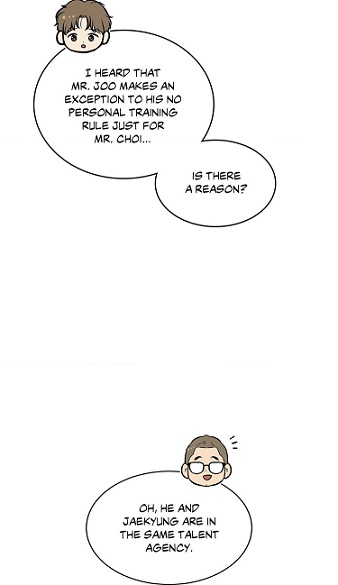 (chapter 30) Hence I deduce that the agency will get involved too very soon and the owner could ask for the identity of the anonymous source. Who leaked this information to the author of the article? Since Kim Dan is the newest member, he would be the biggest suspect and the perfect scapegoat, for he doesn’t belong to a hospital and he has no agency protecting him. And this brings me to the following conclusion. Romeo and Juliet is a tragic love story, because these two young people’s families were in a feud! Hence I sense the birth of a conflict between Team Black and the agency. But we have Choi Heesung who is also represented by this agency.
  (chapter 1) Besides, he would have another interest to have Kim Dan fired. How could he get hired, when he lacked experience? By mentioning the anonymous source and the hospital, the reporter would divert attention from the real traitor. No one would suspect a former employee. The schemers are hoping that the hospital and Kim Dan would put the blame on each other. In other words, we shouldn’t forget this mysterious person. Finally, the author has to expose the truth about this incident. What had happened exactly? I doubt that Joo Jaekyung truly beat him, for the latter could have sued the man. Besides, we know now that Park Namwook is biased and has the tendency to put the blame on his star.




 (chapter 28) and his attitude
  (chapter 28) Hence he grabbed the doctor and brought him back to the swimming pool
  (chapter 28) He was taking advantage of his fear of the water! For certain readers, the champion had not changed at all. He was still rude and selfish. However, these manhwaphiles were overlooking two important aspects. First, the athlete’s selfish attitude was necessary! How so? It was to teach Kim Dan to become more selfish! Don’t forget that Mingwa is applying the philosophy yin and yang. Secondly, certain manhwaworms took all the champion’s words at face-value! I would like to point out if the doctor had truly hurt him with his teeth, his phallus would no longer be erected!! Moreover, he wouldn’t have some precum on his phallus
  (chapter 28) From my perspective, he needed an excuse to stop the fellatio, as he could no longer wait for the penetration. Thus he asked if the doctor was already loose right after.
  (chapter 28) He wanted more. Finally, observe that he had kissed the doctor and asked for a blow-job before. Why? It is because he had experienced Kim Dan’s rejection at the gym!
  (chapter 8)
 (chapter 24) As you can see, the different intercourses expose the fighter’s transformation. He is getting gentler despite his roughness. Exactly like I had anticipated in the previous essay, the couple is now facing each other while having sex. And Joo Jaekyung prefers facing his lover
  (chapter 28) in the end despite this statement.
  (chapter 28). He gets a climax each time he sees his partner oozing sensuality and pleasure. In other words, Joo Jaekyung learned an important lesson in the swimming pool, he might be enjoying such a view
  (chapter 28), yet he favors this position
 (chapter 27), Kim Dan always appears as calm and indifferent towards him. Hence he keeps rejecting him or he is passive during the intercourses. That’s the reason why the champion asked from the doctor to become more active next to the swimming pool.
  (chapter 28) This shows that the boxer has sensed that Kim Dan has not truly accepted him. It is no coincidence that the physical therapist chose to turn his back to the champion, when he was on his lap.
  (chapter 28) This made his heart race!
  (chapter 28) Too overwhelmed by such a view, he decided to show his back to the champion. He wanted to remain level-headed. This was the negative version of this panel:
  (chapter 27)
 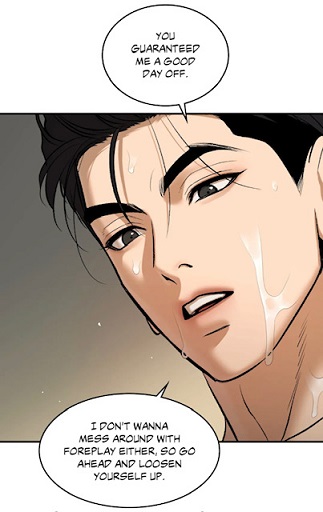 (chapter 28) The idiom “mess around with foreplay” divulges the champion’s deficiency. He is really bad at foreplay. He knows about his lack of dexterity and gentleness! Hence he asked the doctor to prepare himself!
  (chapter 28) However, Joo Jaekyung got impatient
  (chapter 22) This explicates why he decided to sacrifice his night and day off for the champion.
 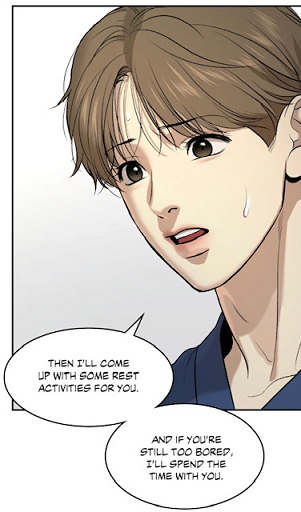 (chapter 27) One might say that this had been suggested by the fighter.
  (chapter 27) What we were witnessing is a new version of the past with the halmoni. Because she had adopted him, he felt obligated to dedicate his whole life for her! Everything in his life was evolving around her: his career, his emotions, his home, his meals, his money, his time eg. By putting the whole burden on her grandchild, Kim Dan internalized this pattern. Hence the moment the “goddess” praised the protagonist to her grandson
  (chapter 21) and the champion made his grandmother smile
 chapter 22), the doctor felt also indebted towards the athlete. He could see the generosity from Joo Jaekyung. The consequence was that he acted the same way with the athlete than with his halmoni. He would cook for Joo Jaekyung without eating with him
 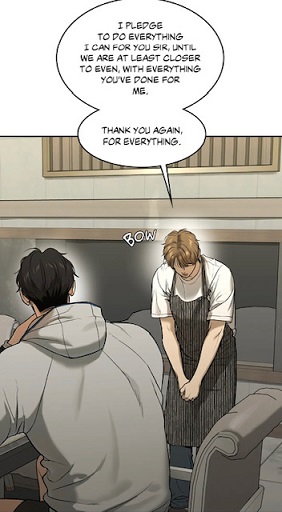 (chapter 22), he would sacrifice his day-off for the champion etc. Selflessness was repaid by selflessness. However, this means that he is still neglecting his own life and as such his own desires and needs. It is not by chance that this expression from episode 22
 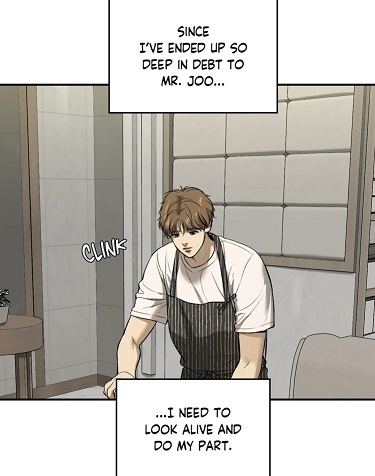 (chapter 22) appears in episode 28: look alive!
  (chapter 28) This exposes that he was still in denial about his own life! And because the athlete acted like a selfish person, the doctor is encouraged to behave the same way. Consequently, I conclude that this scene at the swimming pool corresponds to the doctor’s spiritual awakening. He is alive, he is a man on his own! He is now making choices for himself. Like my friend @becalmandhappy_1111 realized, this scene
  (chapter 28) at the swimming pool corresponds to the moment the imoogi is grabbing the yeouiju!
  (chapter 28) It was, as if he got baptized! Don’t get me wrong: the new religion is not truly developed yet. But where was the transformation of the couple visible? We could detect a change in these two panels
  (chapter 28)
  (chapter 28)
 (chapter 4)
  (chapter 7)
 (chapter 12)
  (chapter 20) Joo Jaekyung never wanted to stop after one round! However, after his first climax, he wishes Kim Dan to leave his side. This is a true novelty! The moment I detected this modification, I began wondering why the fighter would ask Kim Dan this:
  (chapter 28) One might argue that the doctor is unconscious! However, I don’t think that he has truly fainted yet. The evidences for this interpretation are the way he is holding onto the fighter. Observe that he has already moved his head, as we can see his hair now, whereas before his head was resting on the champion’s shoulder
  (chapter 12) In fact, his arms would relax and he would fall in the water. Finally, he was thinking, when he was in the boxer’s embrace:
  (chapter 27)
  (chapter 28)
  (chapter 28) Why? It is because Joo Jaekyung has no life outside the gym! All his days looked the same, until the protagonist entered his life! Besides, if you’ve already read my essay
  (chapter 05) The words “Today and something special” from Park Namwook triggered the champion’s memory: the presence of Kim Dan at his penthouse.
  (chapter 5) And right after, he expressed this wish:
  (chapter 5) Interesting is that there exists a strong link between time, time perspective and self-esteem! Someone with no notion of time and no time perspective has a poor self-esteem! Therefore it is not surprising that the athlete doesn’t trust his own talent. Hence I deduce that this sex session played a huge importance in the champion’s life. He could see with all his senses (touch, sight, hearing, taste) that he had pleased Kim Dan!
 (chapter 28) Then he complained about his lack of competence in bed
  (chapter 28), he was marking him as his lover! His decision is contradicting his own actions! It is because he still fears sex!
  (chapter 10) And remember that after this embrace, Joo Jaekyung brought the doctor to his penthouse, for his heart got moved!! From my point of view, the athlete’s heart is little by little warming up to the idea of affection! In other words, he is slowly adopting the doctor’s philosophy (love)!
 (chapter 25) Kim Dan would be on the champion’s lap, the latter would long for his lips, and the doctor would hug his companion. It was announcing how Kim Dan would get the upper hand in the relationship!
  (chapter 28) Don’t forget that according to the champion’s belief, the sex sessions are all like surrogate fights. By putting the doctor on his lap, he was admitting his inferiority! This shows that he is moving on from his fake faith. Thus I deduce that we should have a new version of this position in the future which will reflect the doctor’s increasing power over the fighter and his gradual transformation.
  (chapter 20) Here, the champion was comparing the doctor’s hole to a baby!
  (chapter 20) Consequently, I came to the following deduction. Kim Dan will try to find a new partner for Joo Jaekyung!
  (chapter 19) His reasoning is the following. The champion likes having sex and he has been treating him more or less like a sex toy, the doctor will try to find a subterfuge to divert attention from himself. Because I detected many similarities between episode 12/13
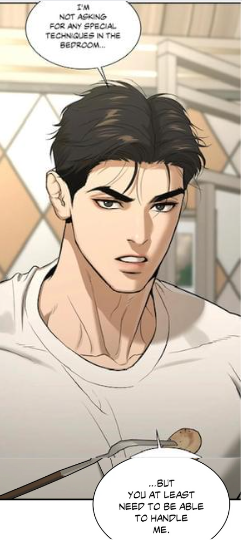 (chapter 13) and episode 28
  (chapter 11) And that’s how Kim Dan will discover the existence of the club!!
 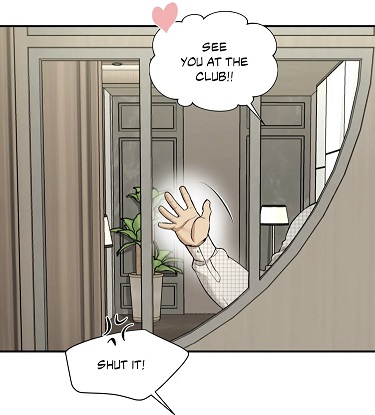 (chapter 13) Hence my impression is that he will suggest to Joo Jaekyung to go to the club with the hope that his friend will find a new partner! He just needs to say that the champion likes to go there. The day off, Saturday, would be the perfect excuse. However, since the doctor is so innocent, he will not realize that by going there, he will become the target of other guests! This uke could resurface!
 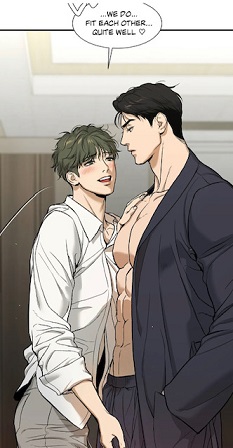 (chapter 2)There is not ambiguity that the champion will never bring the physical therapist to the club on his own. He has already marked the doctor as his partner. And the result can only be that Joo Jaekyung declares Kim Dan as his boyfriend! The emoji 💙 would get a new meaning: the heart of the dragon! This means that the doctor’s decision in episode 28 will push Joo Jaekyung to question his fake belief: the jinx, the existence of a line and the rejection of love in his life. Keep in mind that the champion always makes decisions by instincts, he never ponders on things like the doctor! Similar to this scene, where he paid off the doctor’s debts.
 Bebebisous33s' analyses in K-Dramaland and Manhwas