
Please support the authors by reading Manhwas on the official websites. This is where you can read the Manhwa: Jinx But be aware that the Manhwa is a mature Yaoi, which means, it is about homosexuality with explicit scenes. Here is the link of the table of contents about Jinx. Here is the link where you can find the table of contents of analyzed Manhwas. Here are the links, if you are interested in the first work from Mingwa, BJ Alex, and the 2 previous essays about Jinx The Beginning of the End and The Silent Friend in the Blue Light
It would be great if you could make some donations/sponsoring: Ko-fi.com/bebebisous33 That way, you can support me with “coffee” so that I have the energy to keep examining Manhwas. Besides, I need to cover up the expenses for this blog.
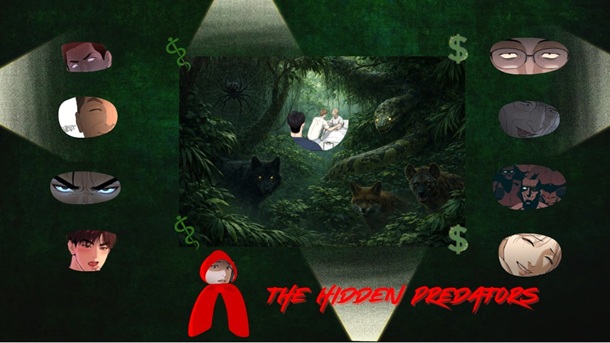
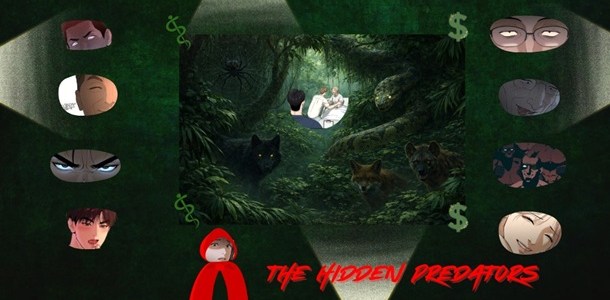
Entering the Forest
A forest. Dense. Green. Familiar and yet uneasy. At its center, a clearing: a fragile figure, the terminally ill grandmother, Shin Okja, surrounded by watchful silence. At its edges, shapes barely visible. Eyes. Teeth. Stillness.
Anyone looking at this image will recognize the echo of a fairy tale. A red hood. A forest. A wolf. Yet something feels wrong. The danger does not come from a single direction. The forest hides more than one animal. That is the key.
In Jinx, predation does not wear a single face. It does not always announce itself through violence. It often arrives disguised as smile, care, opportunity, professionalism, or inevitability. Like the forest, the story teaches its characters and Jinx-lovers that what is most dangerous is rarely what is most visible.
The wolf is there, of course. He always is. But the wolf is not alone.
Something waits above, patient and still.
Something coils, slow and deliberate.
Something laughs from the margins, waiting for weakness.
Something walks close, warm and familiar—speaking softly, until trust opens the way.
This essay does not begin by naming these creatures. It begins by asking a simpler question: What makes a predator in Jinx?
Is it violence or power?
Intent or outcome?
Hunger or indifference?
Necessity or luxury?
Across hospitals, gyms, agencies, and intimate spaces, the same structure repeats itself: asymmetry. Of strength. Of money. Of knowledge. Of age. Of status. Those who stand higher decide the pace, the rules, the price. Those below learn to adapt, to endure, to apologize.
And yet, not all predators look the same. Some act openly. 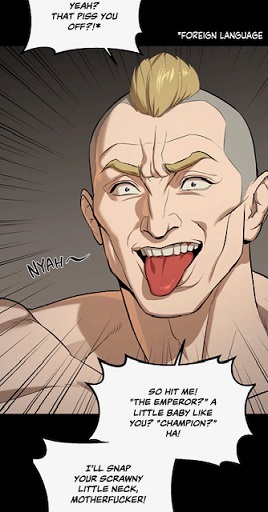 (chapter 14) Others hide behind systems.
 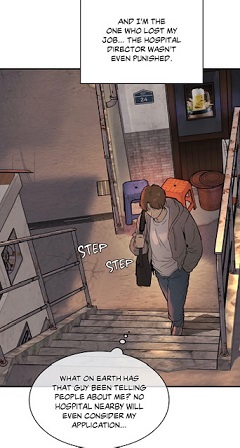 (chapter 1) Some exploit bodies.
 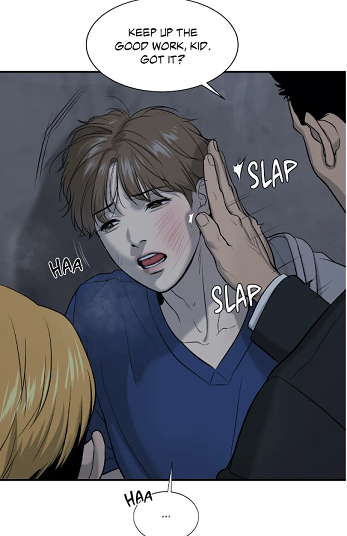 (chapter 11) Others exploit labor, fear, loyalty, or belief. The forest contains them all. The tragedy is not that the little red riding hood enters the woods. It is that she is taught to trust what should never have been neutral. This logic is already present at the very beginning of the tale, in both its major versions. In the seventeenth-century version by Charles Perrault, the child is introduced as “the prettiest creature who was ever seen,” excessively loved by her mother and even more so by her grandmother, who expresses affection not through instruction, but through gifts—most notably the red hood that gives the girl her name.
Once upon a time there lived in a certain village a little country girl, the prettiest creature who was ever seen. Her mother was excessively fond of her; and her grandmother doted on her still more. This good woman had a little red riding hood made for her. It suited the girl so extremely well that everybody called her Little Red Riding Hood. Charles Perrault’s version https://sites.pitt.edu/~dash/perrault02.html
The Grimm brothers repeat the same structure: a sweet child, adored by all, especially by her grandmother, who again responds to love by giving rather than teaching.
Once upon a time, there was a sweet little girl loved by everyone who met her—but most of all by her grandmother. The old woman adored her so much that she made her a small red velvet hood. It suited her perfectly, and from that day on, everyone called her Little Red Riding Hood. Grimm’s version https://americanliterature.com/childrens-stories/little-red-riding-hood
In both versions, the child’s defining trait is not curiosity or disobedience, but being loved too much. That excess of affection becomes a curse. Because she is cherished, she does not expect danger; because she is protected in theory, she is never prepared in practice. The forest is not introduced as hostile, but as neutral — until it proves otherwise. Only later does Little Red Riding Hood learn what the forest truly is, and what kind of creatures have always lived there.
This essay argues that Jinx is not about identifying a single villain, but about learning to see: to recognize how predation hides behind smiles, contracts, concern, gifts, medicine, and “opportunity”; to understand why innocence is repeatedly punished for trusting the wrong voice; and to ask why those who survive often do so not by strength alone, but by forming true alliances.
In a forest like this, the most dangerous predators are not the ones we fear — but the ones we excuse or trust blindly.
Learning to See in the Forest
Before naming any creature, it is necessary to understand how predation functions. Not as moral failure, but as structure. Not as exception, but as pattern.
The word predator is deceptively simple. In everyday speech, it evokes an animal: claws, teeth, a chase in the forest. But that image is already an interpretation — and in an essay like this, interpretation must come after criteria. That is why I begin with language.
Most dictionaries (merriam) describe a predator first in biological terms (an organism that preys on others for food), then broaden the meaning toward human behavior: a person or business exploiting others for personal advantage, and, more specifically, a person who seeks sexual contact in a coercive or manipulative manner. It is precisely this lexical structure — the word expanding from nature to economy (cambridge) to sexuality — that makes the three-part distinction not arbitrary but necessary. The story itself demands it: in Jinx, harm is not produced by a single monster, but by a system in which bodies, labor, and vulnerability are consumed in different ways.
The first definition matters because it prevents moralism. If preying exists in biology, then predation is not automatically synonymous with “evil.” It is a function: one being’s survival depends on another’s depletion. From there, the question becomes not “Who is wicked?” but “What structure allows consumption without consequence?”
A predator, in the strict biological sense, is an organism that survives by consuming another organism.
One might wonder why I do not simply say “animal,” since predators are commonly associated with wolves, snakes, eagles or hyenas. Yet biology itself corrects this reflex: predatism is not limited to animals. A plant can be predatory (carnivorous plants that trap and digest insects). Parasites and certain worms can behave like predators, feeding on living hosts over time. Some predators kill quickly; others drain slowly. Some hunt actively; others wait. The key point is not the image of an animal, but the logic of consumption.
The green-haired man offers one of the clearest, and most unsettling, illustrations of predation as a relational process rather than a fixed identity. (chapter 42). When he speaks of Joo Jaekyung, his language is explicit: the champion was a source of milk, a body that could be “milked” for money, favors, and reflected status. In biological terms, this is parasitism rather than hunting — survival not through direct attack, but through prolonged attachment to a stronger host. As long as the host remains productive, the parasite thrives. When the bloodsucker is removed, flow stops, hunger turns first into regret
 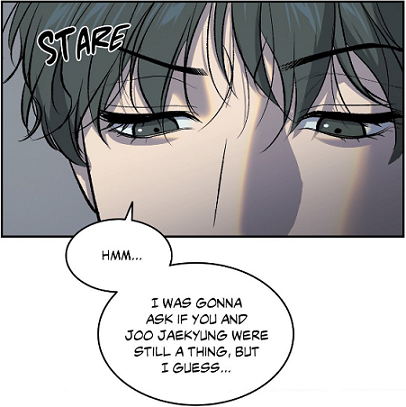 (chapter 42) before resentment.
 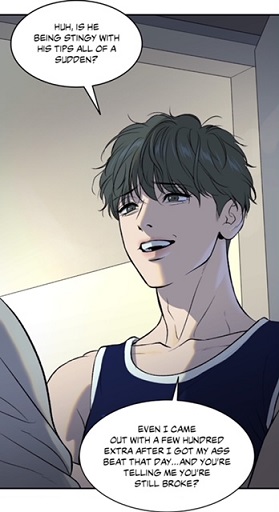 (chapter 42)
What matters is not that the green-haired man misidentifies Kim Dan as a parasite 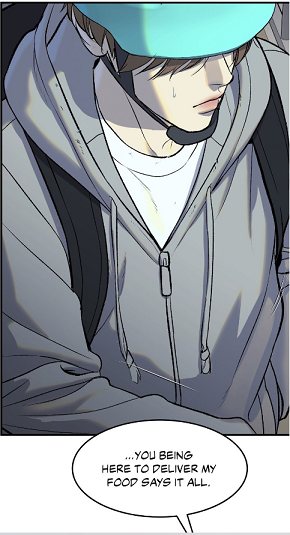 (chapter 42), but why he does so at the precise moment he does.
  (chapter 42) His hostility does not emerge from poverty alone, nor from moral outrage. It is triggered by a rupture in his expectations.
At first, he assumes the relationship between Kim Dan and Joo Jaekyung has ended. The evidence, to him, is visual and economic: Kim Dan’s clothes, his delivery job, his visible precarity. From this perspective, Kim Dan appears to have lost access to the “resource.” The assumption is revealing. For the green-haired man, intimacy is legible primarily through consumption. If there is no visible benefit, then the bond must be broken.
The turning point occurs when Kim Dan defends Joo Jaekyung’s name 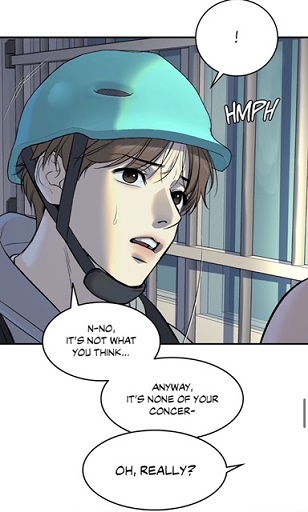 (chapter 42) In that moment, the green-haired man realizes that closeness still exists without visible profit. This is intolerable to him. It contradicts the logic through which he has justified his own past behavior: the belief that proximity to power must be monetized, that relationships exist to be exploited, that affection without gain is either naive or dishonest.
His response is not to accuse Kim Dan of exploitation, but to collapse Kim Dan into his own worldview. (chapter 42) The insult is precise. He does not say Kim Dan is living well; he says Kim Dan is a toy. A tool. 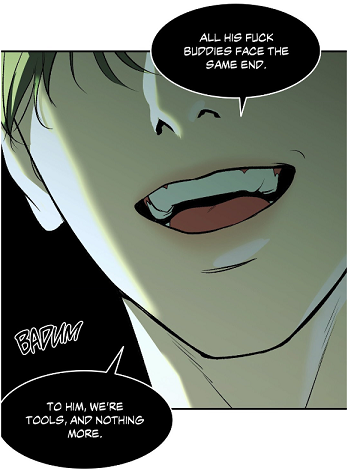 (chapter 42) Something used and discarded. In other words, he reframes Kim Dan’s loyalty as delusion and reasserts predation as the only intelligible model of intimacy.
This is where resentment replaces regret. In the past, the green-haired man convinced himself that he was “dating” Joo Jaekyung  (chapter 02) and that the exchange of attention and money implied mutuality. Joo Jaekyung’s refusal shattered that illusion. What Kim Dan represents now is not competition, but refutation: proof that closeness does not require extraction, and that survival does not have to pass through exploitation.
The cruelty of the delivery-job remark lies precisely here. Kim Dan’s visible labor disproves the parasite fantasy — and therefore must be reframed as humiliation. If Kim Dan is still close to Joo Jaekyung and still poor, then the green-haired man’s entire understanding of relationships collapses. Rather than revise that understanding, he weaponizes it.
In this sense, the green-haired man does not simply enact predation; he naturalizes it. He believes relationships are ecosystems of use, where someone must feed and someone must be fed upon. What enrages him is not that Kim Dan is exploiting Joo Jaekyung — but that he is not.
This logic becomes even more ambiguous inside the shared apartment.  (chapter 42) The green-haired man refuses to pay for food this, while implying that his roommate is taking advantage of him, as if he would barely contributes. On the surface, the image suggests exploitation: one man living off another’s labor. Yet the scene refuses to clarify who truly benefits. The roommate remains largely invisible, economically opaque, almost spectral. Is he a dependent quietly feeding off the green-haired man’s remaining resources? Or is the green-haired man himself the parasite, overstaying, consuming, and justifying his presence through grievance? The narrative does not resolve this tension — deliberately so. Predation here is not readable at a glance. It hides in everyday arrangements, in domestic negotiations, in the language of fairness and contribution.
This ambiguity is precisely the point. If predation in Jinx were a simple hierarchy, it would be easy to assign fixed roles: predator above, prey below. Yet the story repeatedly undermines this comfort. A predator is often also prey — and predation rarely exists in isolation. It circulates. Thus the wolf in the Grimm’s version gets killed by the hunter. Like an ecosystem under pressure, it adapts, redirects itself, and seeks new hosts when old ones disappear.
This nuance is important for Jinx, because the most dangerous forms of predation in the story are not always fast or visible. Sometimes the harm is incremental: a little more pressure, a little less rest, another shift, another compromise — until collapse looks “natural,” as if the victim simply lacked resilience. In that sense, the wolf is only the beginning of the forest, not its full population.
From this first definition, the second emerges naturally. If predation is a structure of consumption, then it can occur without teeth. In modern life, many forms of consumption happen through money, authority, and contracts rather than through jaws. This is what I call economic predation: a mode of survival or profit that depends on extracting labor, time, reputation, or risk from others while refusing to bear the cost.
A minor but telling example appears in the entertainment industry. In the panel where Heesung’s manager protests,
 (Chapter 31), the contract is made visible: the manager’s income depends entirely on the star’s uninterrupted productivity. When work stops, pay stops. Yet neither the star nor the agency appears exposed. Heesung himself, who proposed the risky sparring, shows no empathy for his caring manager. He doesn’t feel concerned for this arrangement and makes no attempt to renegotiate it for his manager’s sake. Financial risk is displaced downward, onto the least protected figure. The manager is not the predator here, but a human buffer, absorbing the instability produced by a structure that benefits the star and the Entertainment agency while refusing to insure those who sustain them.
The same logic governs Heesung’s interpersonal conduct. He requests treatment from Kim Dan not only for free, but also late in the evening  (chapter 34) or on Saturdays
 (chapter 32), treating the physical therapist’s work and time as indefinitely available. This is not an isolated lapse but a recurring pattern, later reproduced with Potato as well.
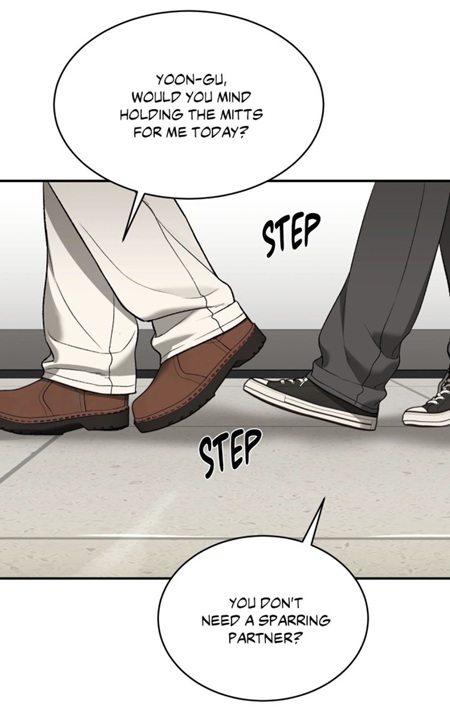 (Chapter 88) In both cases, access replaces consent: labor and care are extracted on polite request, while the cost—fatigue, intrusion, and loss of private time—is borne entirely by the subordinate.
Economic predation often presents itself as normal. It hides behind professional language: discipline, opportunity, schedule adjustments, liability, brand value.  (chapter 54) Its hallmark is externalization: the institution benefits while the vulnerable party carries the damage. A hospital extracts unpaid endurance and calls it devotion. A league extracts bodily risk and calls it career ambition. An agency extracts loyalty and calls it partnership. Even when no one screams, the asymmetry remains: those above set the terms; those below absorb the consequences.
In Jinx, this structure repeats across settings. Kim Dan’s exhaustion in institutional spaces is never read as a sign that the environment is predatory; it is reframed as personal weakness or incompetence. The moment he falters, the language shifts: not “We pushed too far,”  (chapter 70) but “Take better care of yourself.” Not “We failed to protect you,” but “You caused inconvenience.” This is the core of economic predation: the harm is real, but the blame is displaced downward so the system remains clean.
The 33-year-old nurse committed suicide on May 23, according to Busan police.
Her family told the police that she “suffered from severe depression” after being overworked at a hospital. “She struggled very much because it wasn’t her turn to be assigned to the hospital, but she was assigned against her wishes,” a relative told the police.
The nurse’s supervisor told the police that while it wasn’t the nurse’s turn to be assigned to the hospital, they decided to assign her to the hospital given that she “had extensive experience in working with the hospital before.” In addition to the existing medical staff members at a hospital, nurses affiliated with public health care centers can be assigned to hospitals to help out.
On May 20, the fourth day since her assignment to the hospital, the nurse allegedly told her supervisor that she was being given too many tasks at once.
Her supervisor then assigned two additional nurses to the hospital. The supervisor did admit, however, that many of the nurses affiliated with the public health care center were being overworked. Quoted from https://koreajoongangdaily.joins.com/2021/05/27/national/socialAffairs/nurse-overworked-pandemic/20210527165200417.html
The third definition is narrower but more intimate: sexual predation. Here, consumption is not primarily of labor or reputation, but of vulnerability and bodily boundaries. And again, the defining feature is not just “lust,” but also asymmetry. 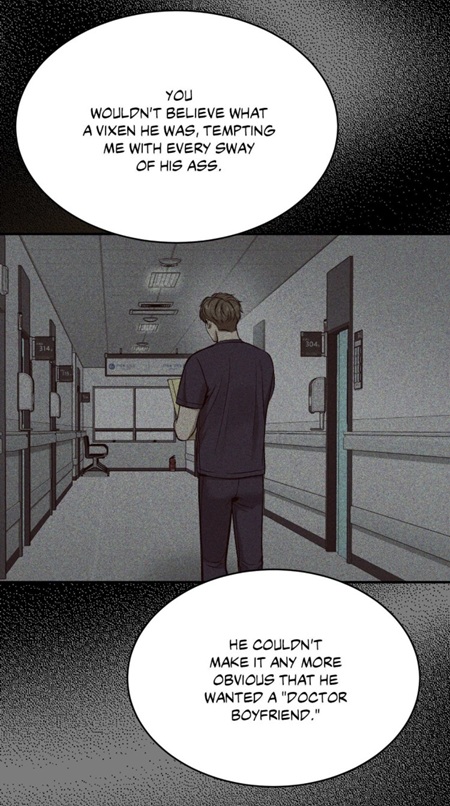 (Chapter 90) A sexual predator targets someone whose circumstances make refusal impossible or costly — socially, economically, professionally, physically, psychologically. The predator does not need to use overt violence to be dangerous; often the strategy is precisely to stay close to the border where the victim can later be blamed: You wanted it. You tempted me. You misled me. You didn’t say no clearly enough. This is why victim-blaming belongs structurally to sexual predation: it is a technique of retroactive absolution. This logic does not remain abstract in Jinx. It finds a concrete site where authority, legitimacy, and bodily access converge.
Hyenas at the Edge of the Ring
In the fight ecosystem, not every predator hunts. Some wait. This is where the logic of the hyena enters. Significantly, even the champion himself recognizes this dynamic: he explicitly identifies the other fighters as predators, likening them to hyenas.  (chapter 29) Rival fighters do not need to engineer the champion’s collapse; they only need to anticipate it. What defines them is not ambition alone, but timing.
Seonho’s confrontation makes this explicit. He does not challenge Joo Jaekyung as an equal seeking fair competition; he frames the conflict around age and decline. 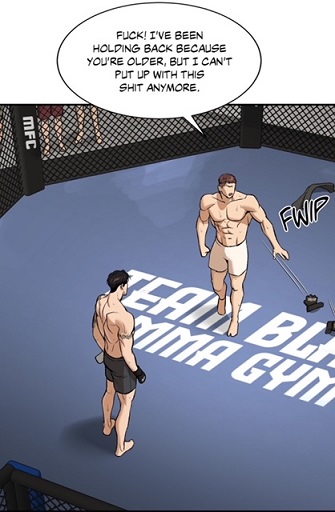 (chapter 46) His words are exposing not restraint, but accusation. The implication is clear: the champion’s body is already failing; respect has become optional. Seonho is not trying to overthrow Jaekyung through skill alone. He is announcing that the moment of vulnerability has arrived, and that patience is no longer required.
This explicates why Arnaud Gabriel felt so sure that he would win after the champion’s surgery and recovery. 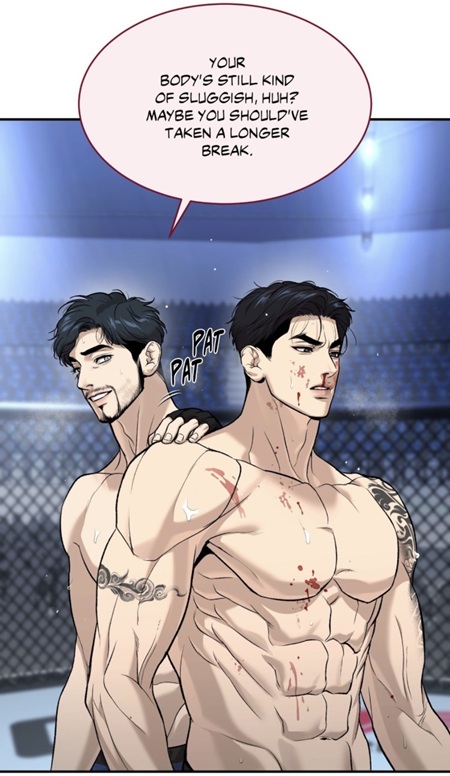 (chapter 87) He thought, he had found his perfect “meal”. To conclude, Arnaud Gabriel articulates the same logic even more coldly.
  (chapter 87) There is no personal animosity here, only inevitability. The statement is not a threat; it is a forecast. Power, in this worldview, is temporary by nature, and the role of rivals is not to prevent collapse, but to be present when it happens. Like hyenas, they do not waste energy on the kill. They wait for age, injury, scandal, or exhaustion to do the work.
This is why rival fighters do not need to engineer the champion’s downfall. They rely on time, on wear, on the pressures already imposed by institutions like MFC. Their aggression surfaces only once dominance begins to crack. Vulnerability is the signal. From that moment on, restraint is no longer profitable.
What these scenes expose is not rivalry, but opportunism. The fighters circle the champion not as challengers, but as inheritors. They do not imagine a world without him; they imagine a world after him — and they are already positioning themselves inside it. They circle the edges of the ring and watch for the first sign of weakness—an injury, a scandal, a moment of public vulnerability—because collapse creates opportunity.
But the fighters are not the most powerful hyenas in this system. Above them stands MFC, and behind it, its CEO. 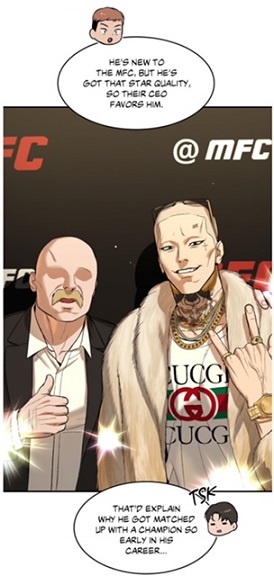 (chapter 47) Their role is not to wait for blood, but to manage its visibility. When the switched spray incident and the drug-related harm threaten to surface, the response is not investigation, but orchestration.
 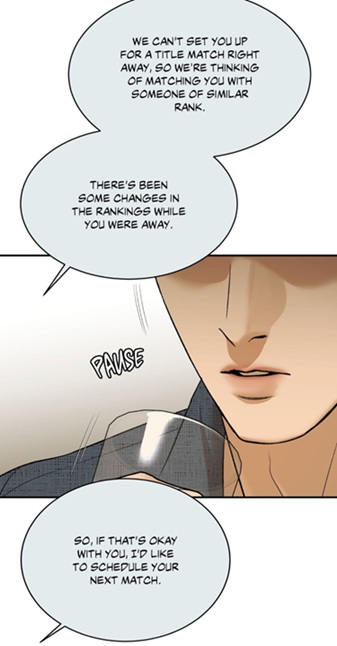 (chapter 69) A new match is organized. An invitation is extended. Noise is generated. Attention is redirected. The spectacle resumes.
This is not damage control; it is reputational predation. The federation feeds on the champion’s body and public image while ensuring that institutional responsibility never coagulates into blame. By pushing the fight forward, the CEO converts injury into productivity and scandal into momentum. The risk is displaced downward—onto the fighter, onto his body—while the institution remains untouched. This displacement becomes even more visible once Joo Jaekyung is no longer treated as an athlete, but as a celebrity 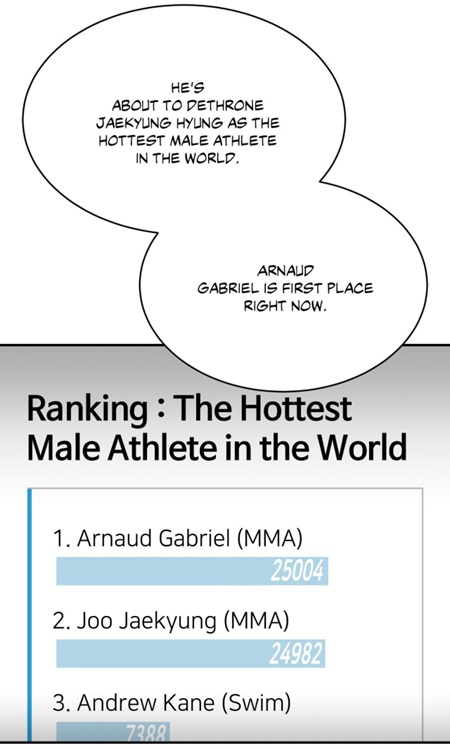 (chapter 81) The distinction matters. An athlete is managed for performance and longevity; a celebrity is managed for visibility. Injury is a problem in the first case. Scandal is profitable in the second.
Thus Joo Jaekyung’s status becomes paradoxically more fragile at the very moment his visibility increases. A victory can no longer secure him; it can only be reframed. Once celebrity logic dominates, even success is vulnerable to contamination. A win can be tainted retroactively by narrative—by rumor, insinuation, or moral scandal.
This is why his public mention of Baek Junmin’s trick is so dangerous. 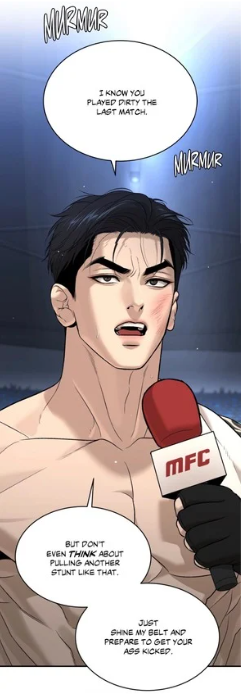 (chapter 87) By naming the manipulation in front of an audience, he breaks the tacit agreement of silence that protects institutions. What should have remained backstage is brought into public discourse. From that moment on, the system has an incentive not to clarify the truth, but to reframe the speaker.
In such a configuration, scandal is not a possibility; it is a tool. The more Joo Jaekyung speaks, the more he represents a threat to MFC and its CEO. His credibility becomes the variable to be managed. And this brings me to the following conclusion: while readers saw in Joo Jaekyung the wolf because of Mingwa’s association, the reality is that he is the little red riding hood too! 😮 It is because he still trusts MFC. And who is the grandmother in his life? Naturally Hwang Byungchul who is himself sick. 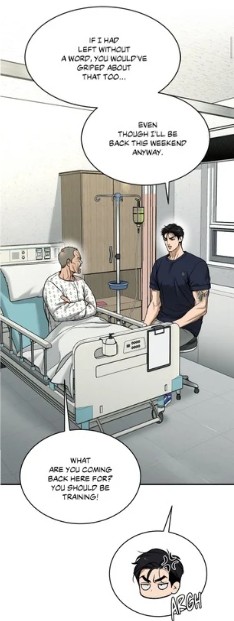 (chapter 78) The latter has always blamed the “boxer Joo Jaewoong”, but not the boxing world, the institution.
  (chapter 74) He never saw the ties between boxing and mafia. And this raises the following question: how can the Little Red Riding Hood discover the predator in MFC before getting eaten?
The waiting hyenas do not act alone. Their patience is enabled by authority. Again and again, it is the doctors who authorize the risk.  (chapter 61) Joo Jaekyung accepts matches while injured
  (chapter 41), his shoulder still compromised, because he is “cleared” to fight. The phrase is decisive. Clearance does not mean safety; it means permission. The medics approve, the fight proceeds, and responsibility dissolves upward. When the body holds, profit is generated. When it fails, discipline follows.
The same doctors who allow him to fight while injured 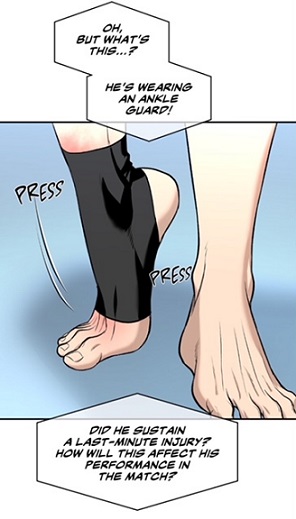 (chapter 50) later participate in his suspension. In both cases, the logic is identical: the body is usable until it is not. MFC remains intact; the cost is borne by the fighter.
  (chapter 52) The hyenas wait, the institution schedules, and the risk is displaced downward—onto the athlete, onto his body—while the structure that benefits from him remains untouched.
And this is why we must return our attention to the hospital—not as a place of healing, but as the space where predation receives its most legitimate language.
Predation with a license
The director from Saero-An hospital 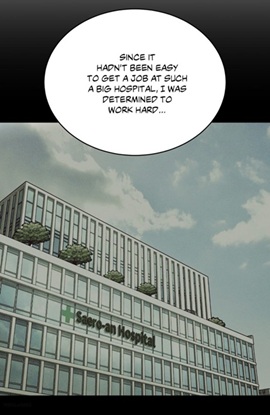 (chapter 90) is the first figure in Jinx who embodies all three dimensions of predation at once. He is a biological predator in logic, an economic predator in practice, and a sexual predator in effect — yet none of these appear as transgression. They are exercised under license.
Unlike the green-haired man, he does not operate from the margins. Unlike the entertainment industry, he does not rely on contracts alone. His authority is institutional, routinized, and already legitimized. He does not need to seek access; access is built into his position. This nameless man does not merely benefit from power asymmetries; he exploits them methodically. His behavior aligns with what research repeatedly identifies as sexual predation: manipulation, boundary erosion, grooming, sexualization of vulnerability, and retroactive inversion of blame. [for more read Major signs of a sexual predator]
Kim Dan enters a prestigious hospital without the markers that usually signal legitimacy there. No suit, no tailored coat — only a gray sweater. 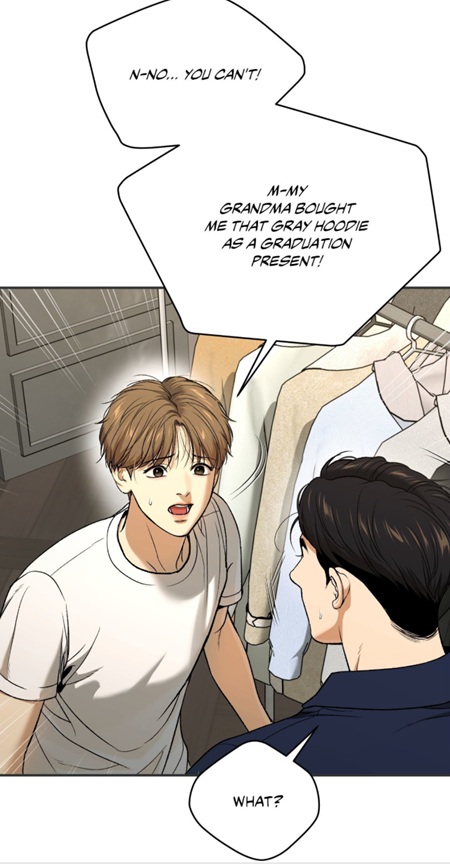 (chapter 80) In this environment, appearance is not superficial. It is a language of rank. To arrive without fluency in that language is already to be classified as provisional. (chapter 90) He has no network, no prior foothold either. Thus it was difficult for him to get hired in such a large hospital. Compare it with the hiring of the previous physical therapist:
  (chapter 54)
Episode 1 quietly reinforces this position. Kim Dan is not described as having secured a stable post, but as having found a “good gig.”  (chapter 1) The expression matters. It implies opportunity rather than integration: freelance labor, paid by hours or shifts, without institutional protection. In such conditions, negotiation is not expected. The contract is accepted, not discussed.
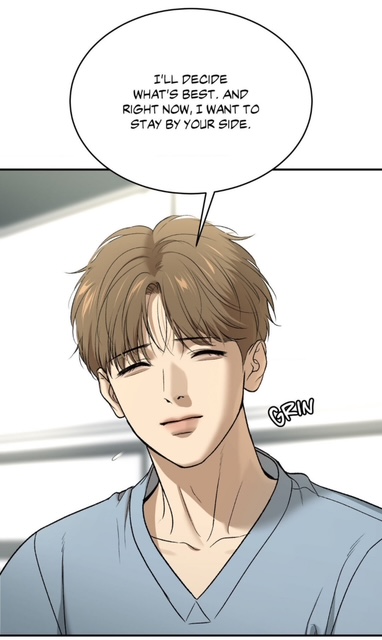
This form of employment produces a very specific visibility. The freelancer must remain present, available, and accommodating, because income depends on accumulation. We have to imagine that Kim Dan works long hours, accepts double shifts, and does not refuse late schedules. Visually, Kim Dan already bears the marks of exhaustion: pale skin, dark circles, a practiced smile 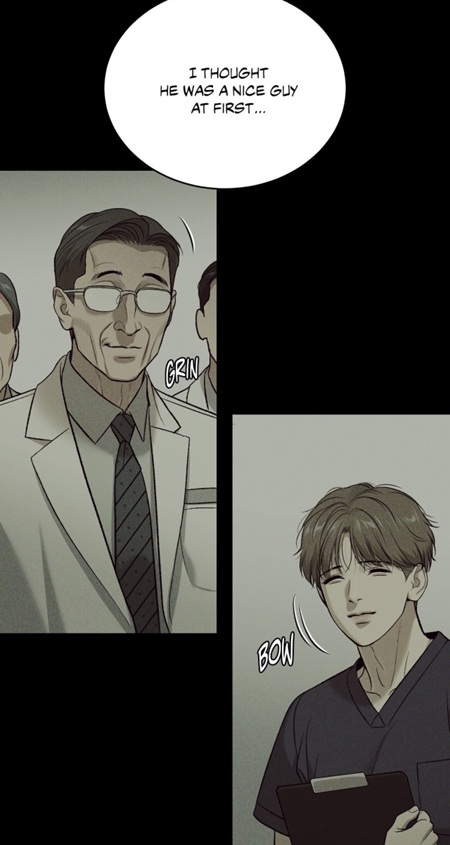 (chapter 90) — the same signs previously associated with the hospice.
  (chapter 57)
From within precarity, this is survival. Besides, the hospital warden has no idea about the debts. From the director’s position of security, it is read differently.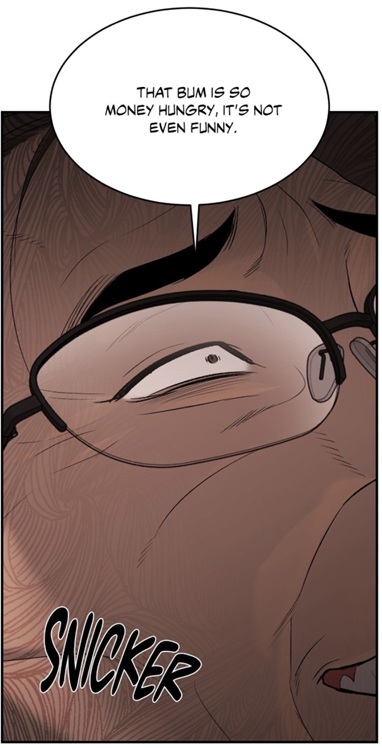 (chapter 90) Constant availability is misrecognized as appetite. Endurance becomes ambition. Constraint is translated into desire. Vulnerability is reclassified as greed. This misreading is not accidental; it is functional. If Kim Dan is greedy, then the director is not coercive. If Kim Dan “wants more,” then nothing is being taken from him.
It is only on this basis that the first stage of predation becomes possible: calculated affability. The director does not begin with aggression. Kim Dan’s memory is explicit: (chapter 90) Trust precedes fear, exactly like in the Perrault’s version:
As she was going through the wood, she met with a wolf, who had a very great mind to eat her up, but he dared not, because of some woodcutters working nearby in the forest. He asked her where she was going. The poor child, who did not know that it was dangerous to stay and talk to a wolf, said to him, “I am going to see my grandmother and carry her a cake and a little pot of butter from my mother. https://sites.pitt.edu/~dash/type0333.html#perrault
In French, the author presented him even as “acquaintance or friend” (compère le loup). Thus the girl saw no reason to mistrust him. In Jinx, by acting friendly, he singles him out, walks beside him, lingers in his proximity. This is not intimacy, but selection. Grooming here is spatial and temporal: being present, being familiar, being unremarkable.
Intrusion follows gradually. As shown in the corridor panel, the director’s hand appears on Kim Dan’s body while they walk. 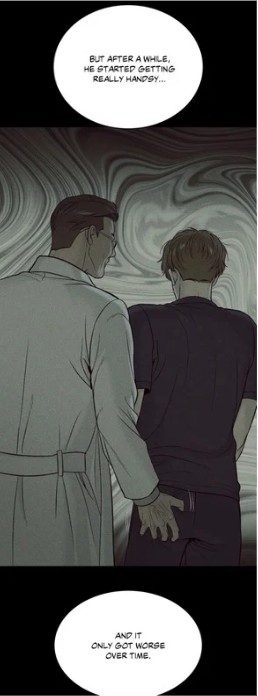 (chapter 90) The contact is quiet, progressive, and deniable. It blends into routine movement, into institutional normalcy. “After a while, he started getting really handsy… and it only got worse over time.” Each tolerated touch becomes precedent. Boundary erosion is not sudden; it is cumulative.
Then after a while, money is introduced. 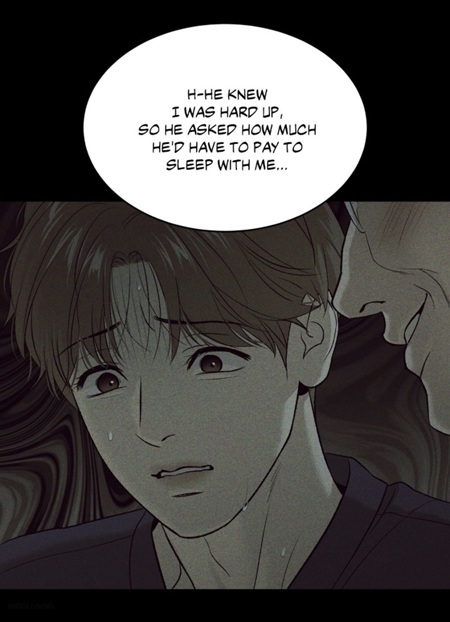 (chapter 90) In the doctor’s eyes, the predator knew about Kim Dan’s difficult financial situation, then he asked how much he would have to pay to sleep with him. The timing is crucial. The offer does not initiate desire; it tests whether vulnerability can be converted into consent. Payment reframes coercion as transaction, need as availability, and silence as something that can be bought in advance.
Only after this test fails does physical force appear: 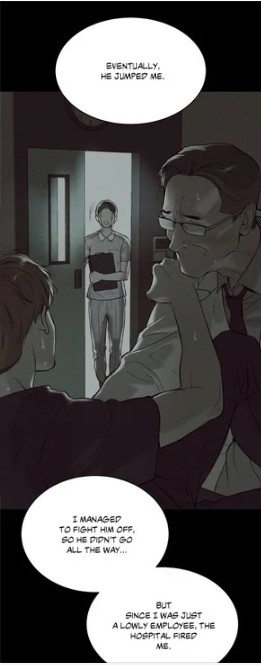 (chapter 90) Even then, the violence is controlled and incomplete — withdrawn before it can be named unequivocally. The goal is not consummation at all costs, but domination without consequence. What remains is fear, confusion, and isolation rather than proof.
The director’s later language reveals the logic that governs the entire process. 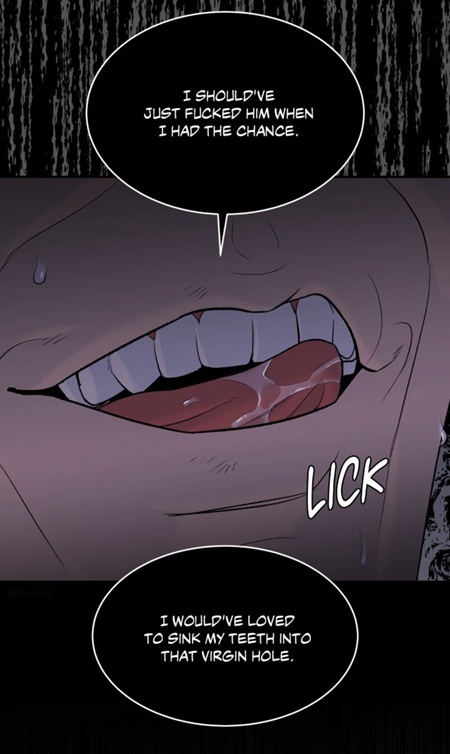 (chapter 90) His regret is not moral but tactical — that he did not take Kim Dan “when he had the chance.” Value resides in the moment of breaking resistance, not in the person afterward. Once the prey yields, interest vanishes.
This is why he can later invert the narrative entirely, calling Kim Dan a prostitute,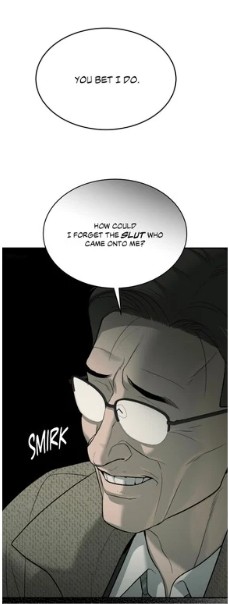 (chapter 90), despite never having paid him, never having offered gifts, dinners, or compensation. The hospital paid Kim Dan’s salary — and the director used his position as a low employee to see himself entitled. Hierarchy replaces money. Shame replaces consent. This is retroactive absolution perfected by institution.
This is also why the animal that best corresponds to him is not the wolf, but the anaconda. The anaconda does not hunt openly or strike once. It selects a vulnerable body, establishes contact that appears harmless, and tightens gradually. Each movement — a smile, a walk, a touch, a question — is small enough to be defended in isolation. Resistance is tested, then reinterpreted. By the time the prey cannot breathe, the struggle already looks self-inflicted. Collapse appears not as violence, but as consequence.
The whole scene makes one thing unmistakable: Kim Dan was not the first. The director’s later language completes the cycle. He speaks of “virgins” 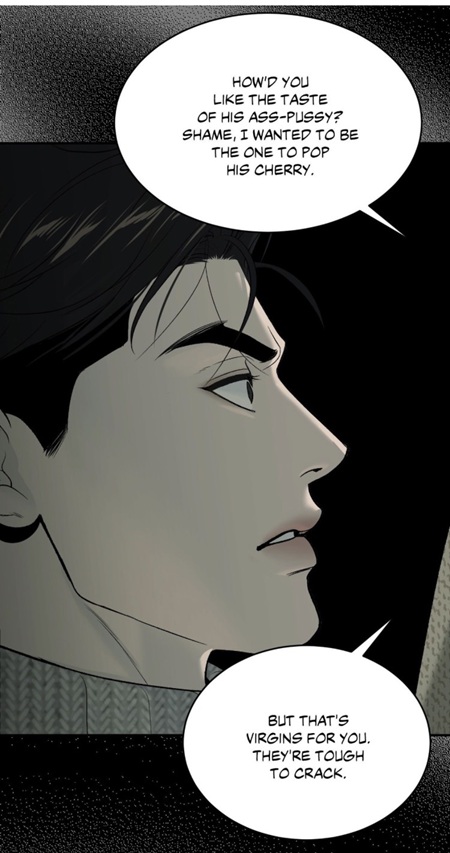 (chapter 90) as bodies that are “tough to crack,” with the confidence of repetition. The metaphor is consumptive: a shell broken to reach what is inside, then discarded. Once resistance is broken, interest disappears. This is practiced predation. The hospital is not merely the setting of abuse; it is his hunting territory — a space where authority guarantees access, exhaustion weakens refusal, and legitimacy ensures silence.
The Hospital as a hunting Ground
Predation in Jinx does not occur in isolation. It requires an environment that normalizes asymmetry, absorbs responsibility, and reframes harm as necessity. This environment is not the forest, but the hospital — or more precisely, a network of hospitals that operate as a single ecosystem, organized around different but complementary logics of extraction.
Saero-An Hospital establishes the baseline. (chapter 90) Its name promises renewal (saero) and safety (An), a place where bodies are meant to recover rather than be endangered. This promise is precisely what enables predation to operate without suspicion. The case of exhausted and sexually harassed doc Dan exposes its illusion.
What makes this system particularly dangerous is that Saero-An does not function in isolation. Visual continuity throughout the manhwa strongly implies institutional linkage with Sallim Sacred Heart Hospital.  (chapter 21) The juxtaposition of two buildings, the rooftop park, the sterile façade, and above all the near-identical hallways collapse (chapter 90) distance between the spaces. Kim Dan works in corridors that mirror those where his grandmother is treated.
 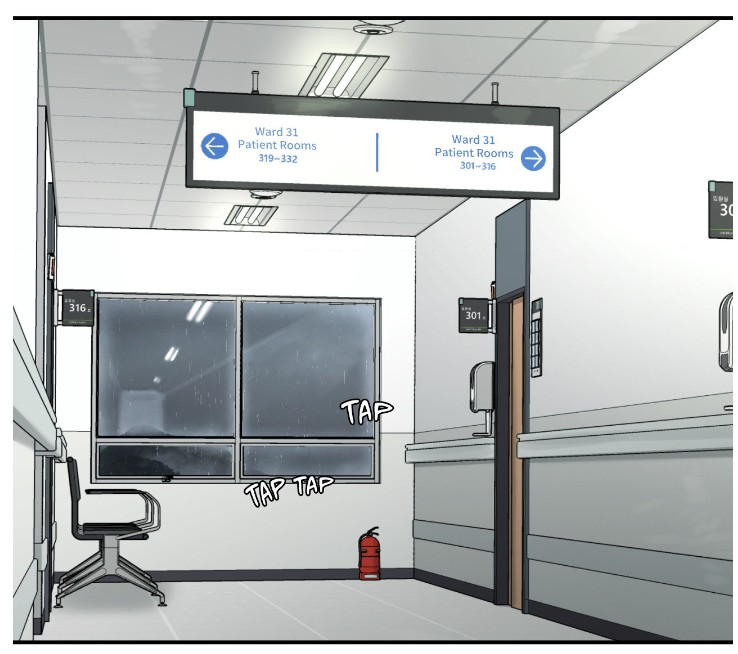 (chapter 5) Professional and personal life are folded into the same architectural body. This is not decorative repetition; it signals circulation — of staff, of protocols, of information.
Sallim University Sacred Heart Hospital presents itself as a place of knowledge, care, and moral dedication. Each component of the name performs reassurance. Sallim evokes the household — maintenance, responsibility, everyday care. This would explicate why Shin Okja felt at home there. Sacred Heart invokes devotion and ethical purpose. But it is University that quietly governs the institution’s true orientation. A university hospital is not primarily a space of healing; it is a space of research. Treatment and experimentation coexist, and when they conflict, knowledge production takes precedence.
This semantic structure matters. Patients enter Sallim under the promise of care, yet are absorbed into a research-driven system where their bodies function as material for progress. The divergence is not accidental; it is institutional. What appears as dedication is, in practice, a hierarchy of priorities: data over comfort, results over well-being, advancement over recovery. Harm does not register as cruelty here because it is reframed as contribution.
Kim Miseon embodies this logic. She does not hunt bodies for pleasure, nor does she seek domination openly. Her motives are money and recognition 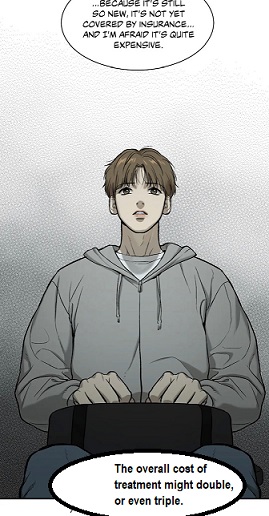 (chapter 5) — professional legitimacy, research success, advancement within a system that rewards results over outcomes. Progress functions as an absolute good, one that authorizes human cost without requiring personal cruelty. Harm is acceptable so long as it produces data.
Her method follows directly from this orientation. Treatment is experimental, protocols are pushed to their limits, and suffering is instrumentalized rather than inflicted. Patients are not targets of desire; they are test cases. Bodies become variables 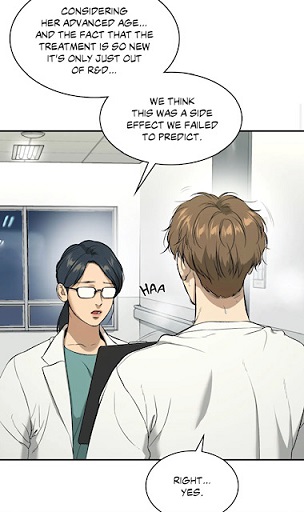 (chapter 21), age and vulnerability become a risk factor, endurance becomes a resource. When the new drug fails and the grandmother deteriorates, the explanation is procedural: side effects, unpredictability, regulatory timelines. Failure is framed as scientific, not ethical.
 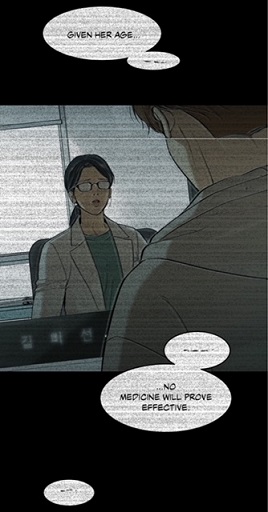 (chapter 47)
Affect is where this becomes most visible. Kim Miseon is repeatedly depicted as cold and eyeless. This is not incidental design. The absence of eyes signals a refusal of relational seeing. She does not look at patients as people, but as files: age, response, tolerance, decline. Emotional labor is therefore displaced onto the family. 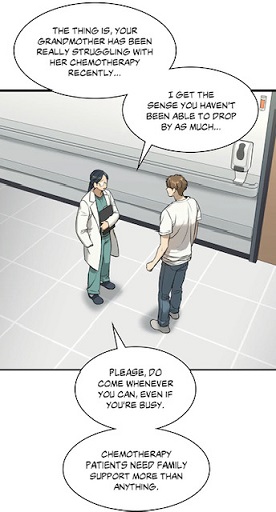 (chapter 21) Treatment patients “need family support,” she says — a statement that sounds compassionate, but functions as deflection. Psychological care is outsourced; responsibility for deterioration quietly migrates away from the institution (“we”). The setting of her disclosures reinforces this posture. She does not speak in a protected office, but in the hallway — a transitional, impersonal space governed by efficiency rather than care, as if she had nothing to hide. However, by behaving like that, she violated the confidentiality rights. Unlike the Saero-An director, who relies on enclosure and isolation, Kim Miseon operates through openness and institutional flow.
And let’s not forget that as soon as doc Dan had received the terrible news, (chapter 47), shortly after he was suggested a new drug treatment by director Choi Gilseok.  (chapter 48) It is no coincidence.
In this sense, Kim Miseon is best understood not as a hunter, but as a poisonous snake. She does not pursue, corner, or constrict. She administers. Her harm is cumulative rather than spectacular, introduced gradually under the guise of treatment. Like venom, it operates through chemistry, delay, and plausibility. By the time consequences appear, causality has blurred. What remains is a weakened body, a revised file, and a new explanation. Painkillers become the narrative alibi: they allow the hospital to downgrade experimental failure into “management,” conceal the existence of an unaffordable authorized drug, and relocate responsibility onto the patient’s non-response  (chapter 56)
This is what distinguishes her from the Saero-An director. He acts through proximity and pressure; she operates through protocol. He leaves visible trauma; she leaves deterioration that can always be explained. Poison does not look like violence. It looks like dosage, side effect, tolerance threshold, statistical risk. And when the body finally fails, the snake is already gone.
What emerges is not a monster, but something more dangerous: a practitioner perfectly adapted to a system that rewards distance. She does not violate boundaries spectacularly; she erodes them procedurally. Patients are not assaulted — they are used. And because the harm is administered under the banners of science, care, and progress, it remains difficult to name as violence at all.
The permeability of this ecosystem is confirmed by the circulation of information. Kim Dan’s CV appears on Choi Gilseok’s desk despite the fact that he never sent it. 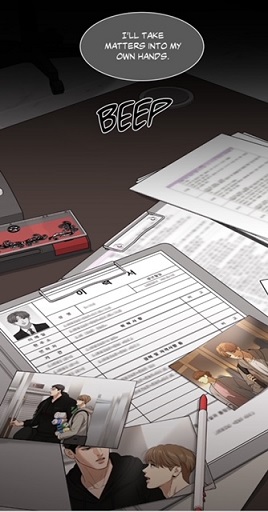 (chapter 46) This is not a coincidence. It is evidence. Personal and professional data move through institutional networks without consent. The same is true of medical information. Choi Gilseok knows about the grandmother’s illness despite having no clinical mandate.
 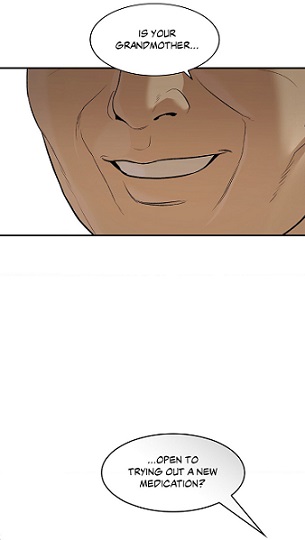 (chapter 48) That knowledge could only have reached him through leakage — informal, normalized, unremarked. Bodies are not the only things consumed here; information is too.
Gilseok’s suggestion of an experimental treatment abroad must be read in this context. (chapter 48) He is not the treating physician, nor the researcher, but a relay point within a performance-oriented system where medical knowledge circulates pragmatically. Illness becomes strategy. Vulnerability becomes a problem to be rerouted. Responsibility dissolves across institutions. What links Kim Miseon’s research discourse and Choi Gilseok’s pragmatic suggestions is not coordination, but dependence on the same pharmaceutical horizon.  (chapter 48) The oncologist requires industry to produce the drug; the sports director relies on the existence of that drug to gesture toward hope elsewhere. In both cases, treatment is deferred to a system that exists beyond accountability.
And observe that both “main leads” were victims of “drugs”:  (chapter 41)
  (chapter 49) In both cases, harm is delivered chemically, not physically — quietly, indirectly, and in ways that can later be reframed as accident, misuse, or personal failure. This symmetry matters. The same mechanism governs the grandmother’s fate.
Drugs in Jinx do not heal or harm by nature; they transfer responsibility. They allow institutions, predators, and systems to act on bodies while remaining one step removed from blame. What looks like treatment, sabotage, or accident is in fact the same logic at different scales: control without touch, violence without spectacle, predation without teeth.
Light of Hope Hospice completes the ecosystem by revealing its internal fracture.  (chapter 56) Unlike Saero-An or Sallim, this space does not extract profit or prestige; it operates under scarcity. Kim Dan works there as a freelancer, not as protected staff. When he collapses, he is advised to take a day off, not sick leave — a telling detail.
  (chapter 70) It confirms that, even here, labor is contingent, negotiability absent, protection minimal. The vocabulary of care masks the reality of precarity.
The hospice director’s behavior must be read through this constraint. He does blame Kim Dan — but not to preserve power or reputation. His reaction is defensive, not predatory. The institution lacks resources; margins are thin; failure is expensive. 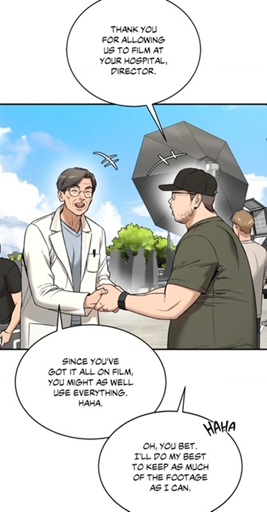 (chapter 59) Thus he is happy to let a film crew use his building for a movie. This is why he sometimes works night shifts himself.
 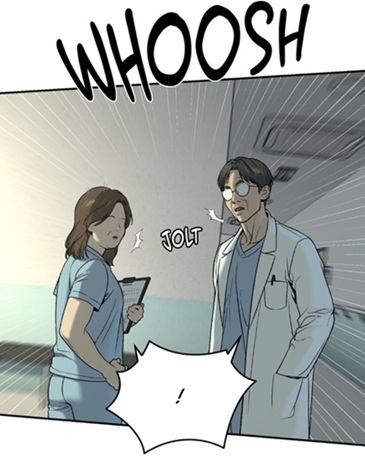 (chapter 60) His authority does not shield him from exhaustion; it exposes him to it. He enforces discipline because collapse anywhere threatens survival everywhere.
This is where the structure turns back on itself. The director is neither an anaconda nor a poisonous snake. He does not benefit from harm; he absorbs it.  (chapter 59) And yet, harm still occurs. Responsibility is displaced not upward, but sideways — onto the most vulnerable worker present. Kim Dan becomes the buffer once again, not because the director is powerful, but because he is trapped. Predation here is no longer driven by appetite, but by attrition.
The ambiguity intensifies with its name. (chapter 56) Light of Hope promises recovery, yet its function is palliative. Even the director refers to it as a hospital  (chapter 61), preserving the impression of treatment rather than end-of-life care. This semantic slippage matters. For Joo Jaekyung, who has been treated there himself, the space remains associated with improvement.
 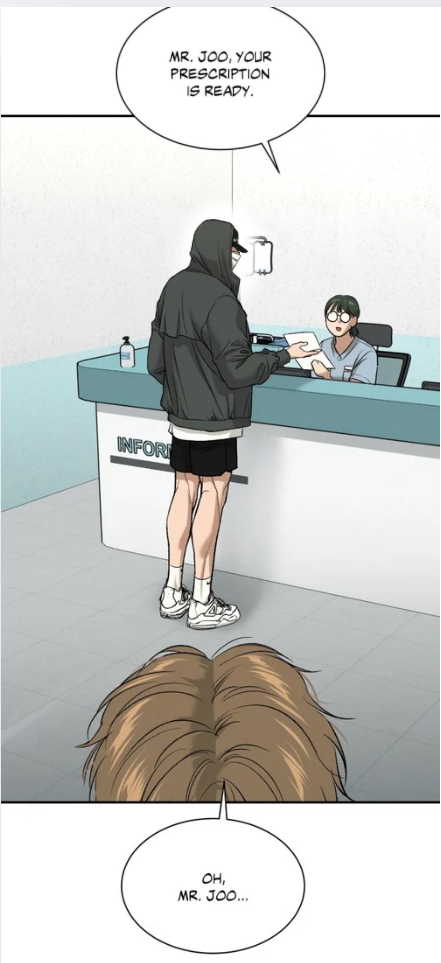 (chapter 70) He thinks, Hwang Byungchul is treated properly, as he still looks lively and strong.
 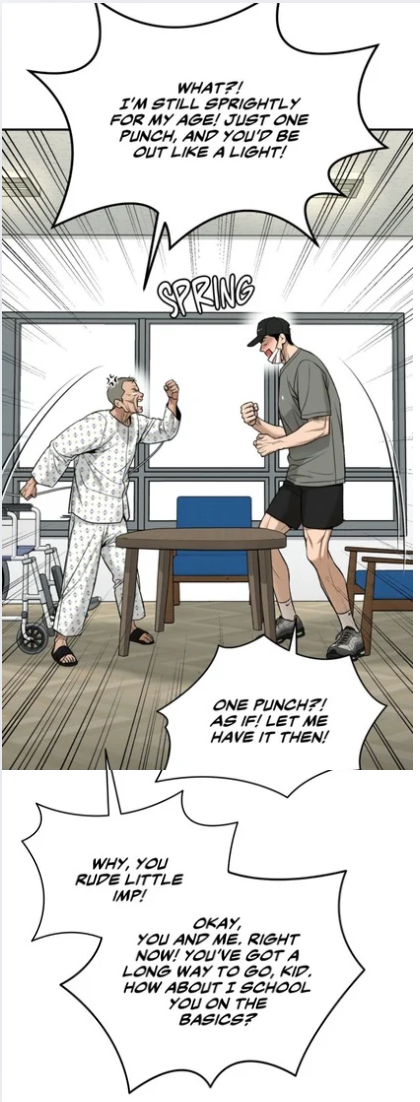 (chapter 71) The champion does not fully register that it is a place at the threshold of death. Care and closure blur. This confusion is not accidental; it mirrors the broader system’s refusal to name limits. By calling a hospice a hospital, death is softened into treatment. By calling resignation progress, responsibility is deferred.
The Grandmother in the woods
Shin Okja’s presence in Jinx initially recalls the grandmother from Little Red Riding Hood. She offers warmth, protection, and reassurance — most visibly through the gray sweater she gives Kim Dan. (chapter 80) But the main resemblance lies elsewhere: she is too trusting. In the fairy tale, the grandmother is eaten because she opens the door to the wolf. She mistakes familiarity for safety, appearance for intent. The danger does not force its way in; it is invited. This logic is crucial, because Shin Okja’s tragedy follows the same pattern — not through a single gesture, but through a lifetime of belief.
Her defining trait is not passivity, but faith in institutions. She believes in research. She believes in doctors. She trusts hospitals as places of knowledge, protection, and moral authority. 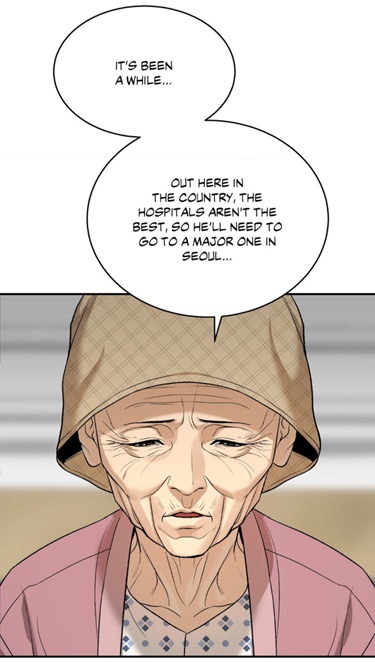 (chapter 65) For her, medicine is sacred and progress meaningful.
 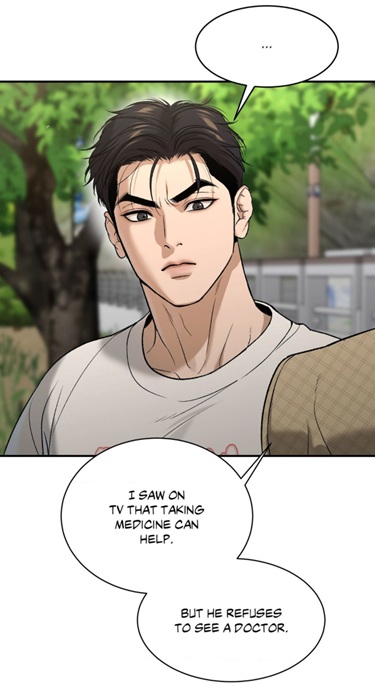 (chapter 65) This belief is not naïve in the childish sense; it is aspirational. It is tied to the idea of success, of legitimacy, of having “made it.” And in her mind, that idea has a name: Seoul.
Seoul represents the best life.  (chapter 65) It is where competent doctors work, where advanced hospitals stand, where progress happens, where you can earn a lot of money. This belief structures her entire horizon. Corruption, abuse, and institutional predation do not register there, because acknowledging them would mean admitting that the space she has invested with hope is also capable of harm. Within Seoul, institutions are not suspect; they are self-justifying.
This worldview explains the limits of her concern for Kim Dan. She cares for him deeply, but her care is bounded by trust in authority. When he was bullied at school 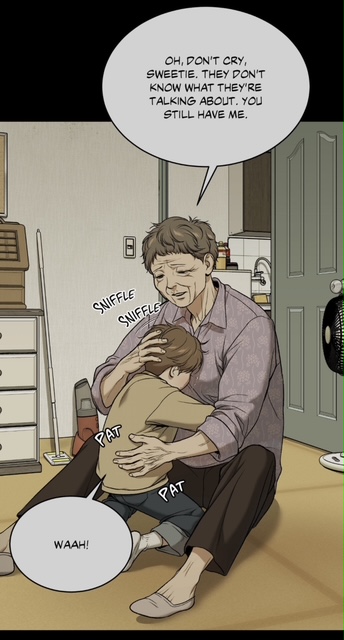 (chapter 57), she did not confront teachers. Her answer was always the same: he still had her. The implication was clear — institutions were there to protect him. To intervene would have meant questioning the very structures she depended on to make sense of the world.
This belief is not naivety; it is survival logic, shaped by poverty, loneliness and dependence. To question institutions would be to remove the last remaining structure she can rely on. This belief explains her blindness better than indifference ever could.
Kim Dan’s exhaustion did not suddenly appear. His pale face, dark circles, and emotional depletion existed long before she names them. (chapter 90) But when she finally does, she frames his condition as something that has been “a bit off lately”,  (chapter 65) as if it was recent, temporary, and situational. The wording matters. What has been chronic is compressed into the present. Duration disappears. Suffering becomes recent, temporary, and therefore manageable. This is temporal minimization — not denial of harm, but deferral of its cause.
Crucially, her concern activates only once guilt enters the picture. She explicitly links his suffering to herself:  (chapter 57) Only then does his condition become visible. Not because it is new, but because it now implicates her. Before that moment, his endurance could remain unnamed. After it, it must be explained. This is not cruelty; it is belief colliding with responsibility.
This is where money becomes revealing — not as reality, but as interpretation. The grandmother never speaks of debt. The loan is a taboo. This is her biggest fear, thus she raised her voice, when she imagined that doc Dan would pay the new expensive treatment from a loan shark.  (chapter 7) This exposes her lack of trust in him, as she views him as too naive and trusting. This is where the irony crystallizes. Financial precarity is erased from discourse because acknowledging it would expose her responsibility. Money resurfaces, when Kim Dan presents an expensive gift. But she doesn’t mind, she is even aware of his lie:
  (chapter 41) He spends so much for her that he doesn’t have anything left for himself.
 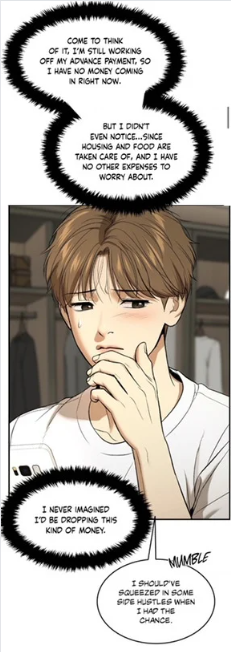 (chapter 42)
From this emerges a crucial consequence: Kim Dan becomes legible as someone obsessed with money. Not because he is greedy, but because his suffering is interpreted as choice rather than constraint. This is precisely how the sexual predator reads him (chapter 90). It is also how Joo Jaekyung initially misreads him, triggered by the loan and the expensive gift  (chapter 51). Different figures arrive at the same conclusion because they are operating within the same interpretive framework — one shaped first and foremost by Shin Okja’s mindset.
Her ignorance and blind trust do not merely endanger her; they shape how Kim Dan is perceived by others. Anyone who approaches her gently, with politeness and authority, passes as safe.  (chapter 22)
As long as doctors speak, as long as contracts exist, as long as salaries are paid, the world remains intelligible. Within this logic, danger is not structural — it is personal. Thus she blames doc Dan for his “illness”. Violence comes from people 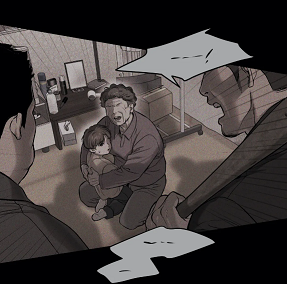 (chapter 5), not systems. And so, she imagines that as long as Kim Dan is working, earning, and paying back what he owes, nothing truly irreversible can happen to either of them. To conclude, what governs Shin Okja’s thinking is a simple equation: payment equals safety. In her mind, debt is a temporary problem with a finite solution. Once money is paid back, danger ends. Order is restored. Life resumes. This belief explains her silence around the loan. To name it would be to admit uncertainty; to erase it is to preserve control.
What she does not know — and cannot imagine — is that the opposite is true. As soon as she left her grandson’s side, payment does not bring protection. It brings exposure. In chapter 1, the reality is immediate: missed interest is answered with physical violence. 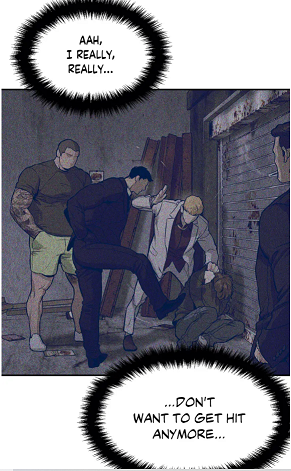 (chapter 1) Kim Dan is beaten not because he refuses to pay, but because payment structures domination. He accepts the abuse precisely because he believes it is temporary — a punishment that will end once the balance is cleared. Violence is normalized as consequence, not crime. This logic mirrors hers exactly. The more the main lead paid back, the more he was exposed to violence.
  (chapter 11) Here, he talked back to Heo Manwook, a sign that he was no longer tolerating the loan shark’s intrusion. The result was that he ended up being beaten more violently than before.
  (chapter 13) This reached its peak, when after sending his whole salary
 (chapter 16), Heo Manwook intended to rape him. As you can see, the more they got money, the more abusive they became… and all this time, the grandmother has no idea. But the best evidence is when Joo Jaekyung pays the loan in full, the pattern repeats at a higher level.
  (chapter 17) The debt is erased — and the danger escalates. Kim Dan might become free, but now the target is the champion. He becomes visible. Settling the debt marks him as someone worth targeting, someone who can be extracted from again.
  (chapter 46) What Shin Okja imagines as closure functions, in reality, as a signal.
This is the crucial inversion she never sees: payment does not end predation; it confirms vulnerability. Her worldview has no space for this possibility. In her mind, systems respond to fairness. Work is rewarded. Debts conclude. Violence belongs to mistakes, not structures. She believes that as long as Kim Dan works, earns, and pays, the world will correct itself.
But while she trusts institutions, she does not recognize that predators often operate through them. In her mental framework, illegitimate violence exists outside the system, not inside it. Even the loan shark is unconsciously processed as a distorted institution — closer to a bank with harsh rules than to a criminal threat. Debt, for her, is governed by terms, repayment, and closure, not by arbitrary violence.
This is why she never considers the police. Not because she condones what happens, but because, in her worldview, the situation does not yet qualify as disorder. As long as payments are made, as long as rules appear to exist, danger remains conceptually containable.
This is why she does not know that the moment she steps away, he is beaten. This is why she cannot imagine that clearing a debt can make things worse. And this is why I am assuming that her faith won’t bend when confronted with reality — it will shatter.
In the end, Shin Okja does believe in money — but not as wealth, and not as power. She believes in money as resolution. As the mechanism through which problems end, dangers recede, and balance is restored. Money, for her, is not corruption; it is order. Payment is imagined as protection. Salary replaces safety. Clearing a debt becomes synonymous with closing a chapter. This is why the loan remains unspeakable: not because it is trivial, but because it threatens her core belief that effort and payment are enough to secure life. What she trusts is not cash, but the promise attached to it: that the world is transactional rather than predatory.
That promise is false.
First Conclusions
What, then, makes a predator in Jinx?
Is it violence or power?
Intent or outcome?
Hunger or indifference?
Necessity or luxury?
The answer is money — not as greed alone, but as an organizing logic. Predation in Jinx is defined by who can extract value while displacing cost: who profits from risk without carrying it, who converts harm into an externality borne by weaker bodies. Violence may or may not occur. Intent can be denied. Hunger can be claimed. None of these are decisive. What is decisive is whether suffering becomes billable, excusable, and transferable.
This is why the three forms of predation constantly overlap. Bodies are consumed for performance, labor is consumed for stability, and vulnerability is consumed for access — and money is what makes each form look “reasonable.” Money turns coercion into transaction, exploitation into opportunity, and bodily damage into career necessity.
Joo Jaekyung’s body generates cash as long as it performs.  (chapter 46) Each appearance sustains sponsors, broadcast value, betting volume, and gym economies. This is why he becomes the “biggest target”: not because he is weak, but because he represents the highest return.
Yet his continued success produces a paradox the system cannot tolerate. 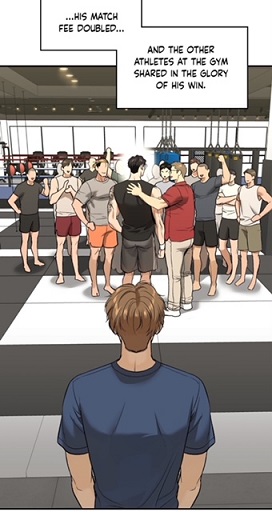 (chapter 41) A champion who keeps winning cleanly, visibly, and on his own terms becomes difficult to manage. His victories increase his market value, distribute prestige and income to others, and create expectations of legitimacy. At that point, success stops being profitable in a controllable way. It begins to threaten both institutional authority and informal economies that rely on predictability, influence, and narrative control.
This is where illegal gambling logic quietly aligns with institutional logic. Betting markets do not require excellence; they require steerability. 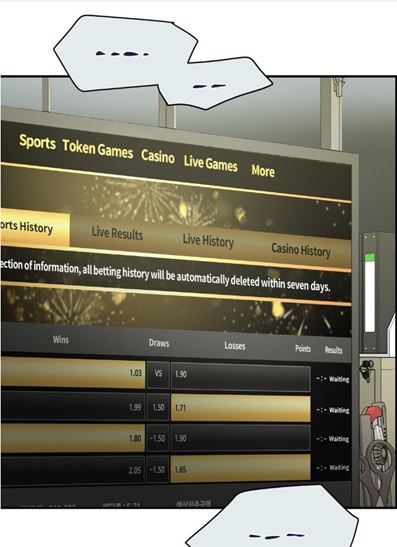 (chapter 46) A dominant, credible champion reduces volatility, resists manipulation, and makes engineered outcomes harder to disguise. In such a configuration, continued victory is destabilizing. The problem is no longer his body failing — it is his body refusing to fail on schedule.
The system responds accordingly. Risk is displaced downward, onto the fighter, while control is exercised elsewhere. Medical clearance becomes permission rather than protection. Discipline replaces care. Scandal replaces investigation. When injury can no longer be exploited, reputation becomes the pressure point. The same structure that demanded endurance now demands silence.
This is the contradiction at the heart of Jinx: health was never the priority. Victory was tolerated only as long as it remained manageable. Once success itself threatens control — once it interferes with profit flows, betting structures, or institutional discretion — the champion must be reframed, restrained, or removed.
Predation here is not reactive. It is preventative. In the Korean Manhwa, the most dangerous moment is not collapse — it is independence.
As long as Kim Dan is indebted, he is controllable. As long as Joo Jaekyung fights injured, he is usable. As long as money flows upward, violence remains “contained.” The moment extraction ends, the system reacts.
When Kim Dan pays back the loan, the violence escalates. When he resists, domination intensifies. When the debt disappears entirely, the target does not vanish — it expands. This is the pattern Shin Okja never sees: payment does not end predation; it announces escape. And escape is intolerable to predators.
Revenge does not arise from wounded victims, but from frustrated systems. From loan sharks whose web has been cut.
From institutions whose silence has been broken. From federations whose profit model is threatened. From predators who mistake survival for disobedience.
This is why scandal follows autonomy. This is why credibility is attacked rather than truth clarified. This is why the risk is displaced downward — onto bodies, reputations, careers — while institutions remain intact.
So the final question is not whether Heo Manwook 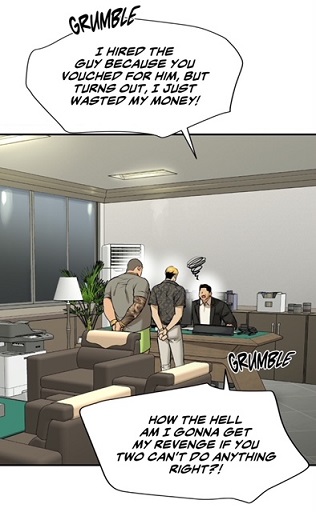 (chapter 46) is violent. The question is: what kind of predator is he?
He does not chase.
He does not roar.
He waits — and retaliates when the web no longer holds.
If the forest of Jinx teaches anything, it is this: collapse is survivable. Independence is not. And once the prey steps outside the web, the predators do not disappear. They reorganize. Revenge, in this landscape, is not the opposite of predation. It is its shadow.
Feel free to comment. If you have any suggestion for topics or Manhwa, feel free to ask. If you enjoyed reading it, retweet it or push the button like. My Reddit-Instagram-Twitter-Tumblr account is: @bebebisous33. Thanks for reading and for the support, particularly, I would like to thank all the new followers and people recommending my blog.
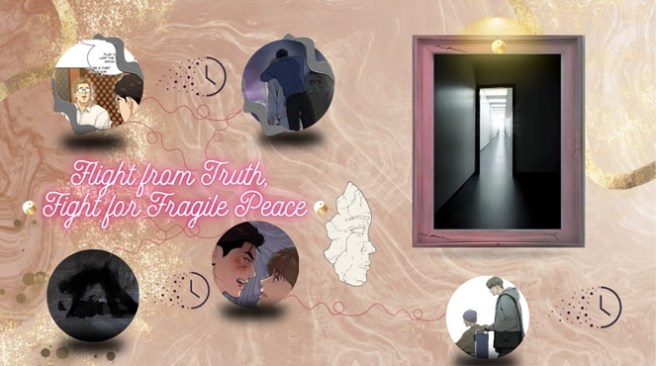
 (chapter 47) and denial for strength
  (chapter 55). Joo Jaekyung, Kim Dan
  (chapter 61), Park Namwook
  (chapter 69), and Shin Okja
  (chapter 53) all operate within survival mechanisms shaped by trauma, guilt, and fear. They choose the illusion of control or calm over genuine healing. But as the story unfolds, these strategies begin to unravel. Each character must confront the truth behind their emotional habits, learning that happiness isn’t the absence of pain—it’s the result of confronting it with clarity and purpose.
  (chapter 54), Joo Jaekyung is cornered by a faceless, overpowering ghost. He is unable to fight or flee; only obedience and silence remain.
 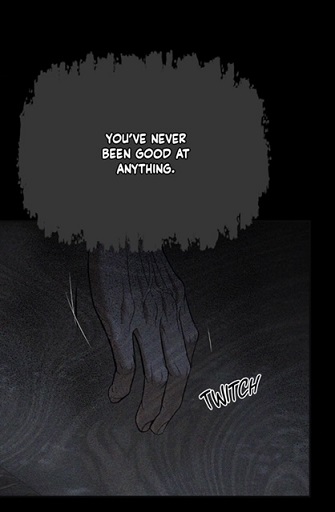 (chapter 54) He could only express his pain and resent through the hand. This moment encapsulates the core of his trauma: as a child, he learned to survive through silence and compliance, not resistance. Yet deep down, the resentment festered—toward himself, and toward the abuser. That psychological pain was redirected into becoming a fighter, as if to prove the abuser wrong.
  (chapter 26)
  (chapter 14) But ironically, he became exactly what the abuser desired: a powerful, obedient puppet. His fame, discipline, and aggression were not signs of freedom, but evidences of emotional and mental captivity. That’s why the past from the champion is surrounded by darkness and mystery.
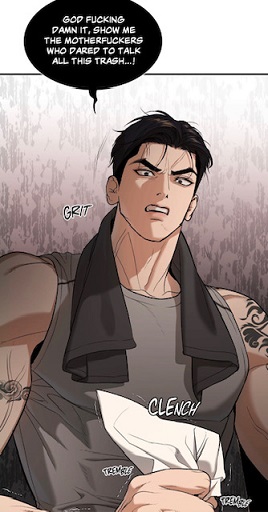 (chapter 36) His language was dominance, not dialogue. He didn’t process his emotions through words—he suppressed them, until they erupted in violence or withdrawal.
  (chapter 34)
  (chapter 1) And crucially, he didn’t leave right away either despite his embarrassment and fears.
 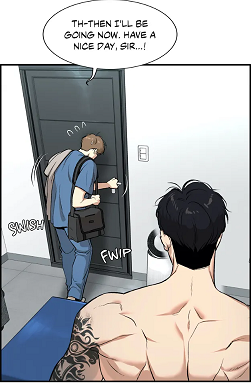 (chapter 1) Thus for the first time, Jaekyung had to develop a new strategy in order to meet him again: one that doesn’t rely on intimidation, but on communication. The problem is that since he saw the physical therapist running away after their first session
  (chapter 1), he knew that he needed to lure him with something: money
  (chapter 1). Under this new light, my avid readers can grasp why the athlete played a trick on the phone, though we have to envision that here the celebrity’s thoughts were strongly influenced by his bias and prejudices. He imagined that Doc Dan had made a move on him.
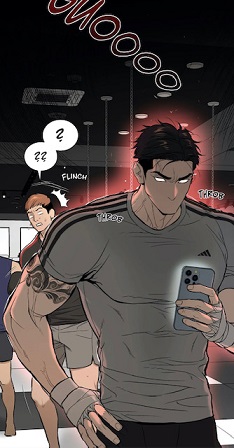 (chapter 5) That retreat doesn’t mean failure—it can be an act of self-preservation. However, the champion experienced that he needed to speak with doc Dan in order to keep him by his side. This lesson became a turning point. Jaekyung started to speak more.
  (chapter 18) Therefore it is no coincidence that in episode 18, right after the celebrity spoke, Kim Dan’s reply was strongly intertwined with flight:
  (chapter 18) The denial of kindness from the champion made the doctor uncomfortable, the latter felt the need to leave the penthouse as soon as possible. The lesson for the star was to realize that words are powerful and can affect people. But Joo Jaekyung didn’t grasp it, as he chose to use sex to „submit“ his fated partner.
 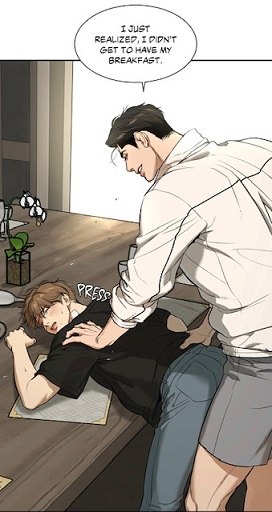 (Chapter 18) Nevertheless, as time passes on, the wolf asks more and more questions. He reacts to emotional discomfort not only with physicality but with hesitation, introspection. He is no longer reacting as the ghost once taught him; he is arguing and as such adapting, growing. Thus we could say, he is less passive.
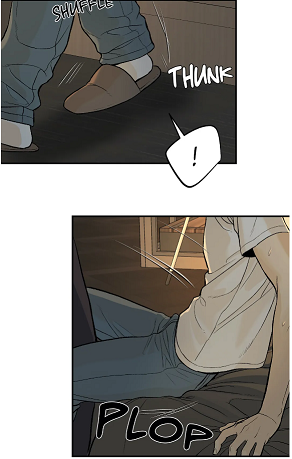 (chapter 3) or table, in showers
 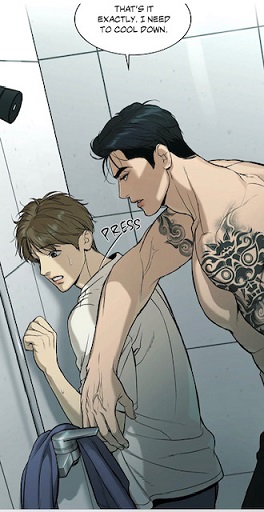 (chapter 7), against doors, or walls
  (chapter 34). On the surface, it may seem like a gesture of dominance or desire, but symbolically, it reflects silencing.
 (chapter 51) They stand in the middle of the room—an open space—symbolizing emotional emancipation. When Dan questions the celebrity
  (chapter 51), the words from doc Dan pierce the champion’s emotional defenses. Thus Joo Jaekyung is destabilized.
 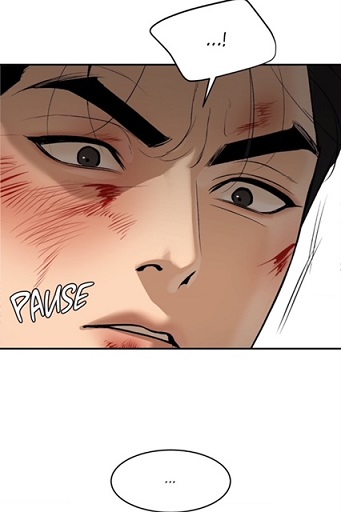 (chapter 51). The latter tries to reassert control
 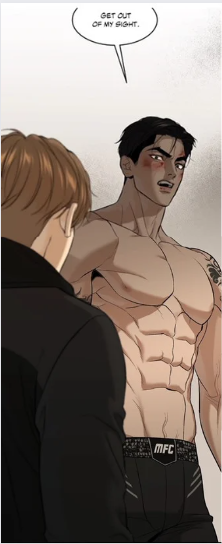 (chapter 51), but this time, when he lashes out, he is the one who leaves. This is cognitive dissonance at work: the fighter cannot reconcile his fear of vulnerability with his emerging need for connection and his perfectionism. So he defaults to a performance of control, even as he runs from it. And while one might mistake this for weakness or regression, it actually displays a progression. First, Jaekyung had finally revealed his thoughts and fears to Dan.
  (chapter 69) That silence could easily be mistaken for submission, for the same old performance of the compliant athlete.
  (chapter 69) But that would be a misreading. His silence is no longer a symptom of fear or control. It is a deliberate withholding—a sign that he no longer plays by their emotional rules. He is starting distancing himself from MFC, Park Namwook and the fight-centered identity they crafted for him.
 (chapter 69) After all, to those still invested in dominance hierarchies, leaving the capital after a public defeat seems like the behavior of someone who’s been defeated mentally as well. But the truth is the opposite. This “retreat” is actually an act of autonomy. For the first time, Jaekyung is giving himself space—not to run, but to reflect.
 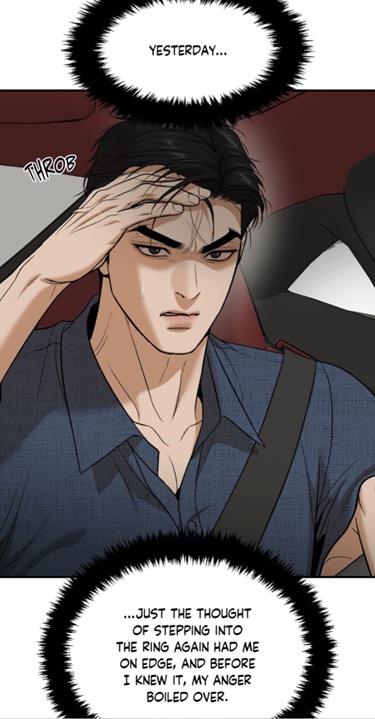 (chapter 69) He is no longer blindly performing the role of the fighter, nor desperately trying to maintain control over the narrative.
  (chapter 69) He is beginning to think critically about his past behavior, his future, and the systems that have defined his identity and life.
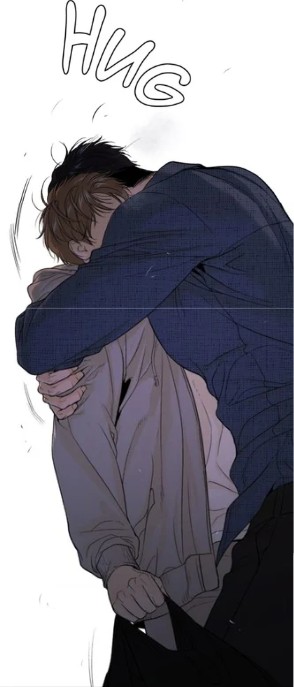 (chapter 69) with “no audience” (he ignores people), no pressure, no script. And in that openness, he lets go—not just physically, but psychologically.
  (chapter 69) The hug marks the collapse of his old beliefs: that emotions are weaknesses, that silence is protection, that strength means standing alone. He is no longer trying to dominate Dan or prove anything. He’s not cornering or fleeing. He’s simply staying—with someone, and with himself.
 (chapter 7) and flight
  (chapter 52), often using blame as a shield. When crisis strikes, he blames the champion’s temper, relies on Doc Dan
  (chapter 36), or MFC’s decisions.
  (chapter 69) He surrounds himself with “assistants” like coach Yosep, Kim Dan or Joo Jaekyung
  (chapter 25: here the protagonist was replacing Yosep and Park Namwook), hires professionals to manage damage
  (chapter 47), and hides behind administrative actions.
  (chapter 66) But he never takes full responsibility. This blame-displacement strategy works—until the champion flees to the West Coast.
 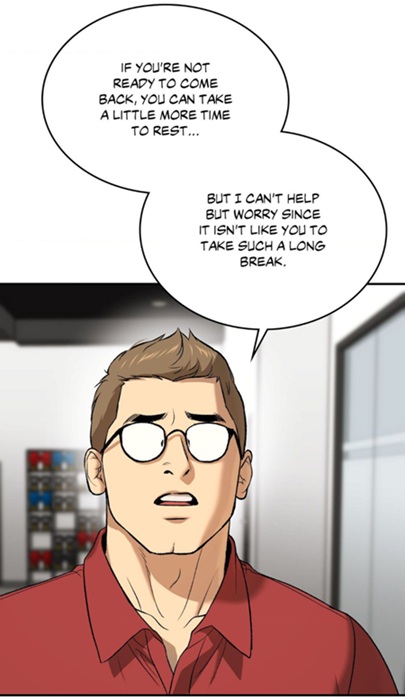 (chapter 66) that cornered the manager.
  (chapter 66) As long as the champion was nearby, Park Namwook could project blame onto him, framing him as unstable, disobedient, or temperamental. But once „his boy“ vanished from Seoul, the hyung was left exposed. Striking is that he is not seen watching over the training of the remaining members.
  (chapter 60)
 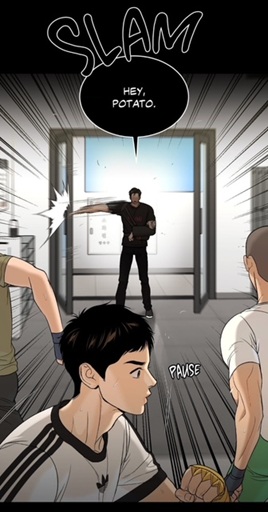 (chapter 60), a sign that he is neglecting the other members. The absence of his star fighter removed his most convenient scapegoat, forcing him to face the consequences of his own mismanagement—though he is not yet ready to truly question it and change his mindset, denial, and dependency. This was not just a geographical disappearance—it was a strategic psychological rupture, meant to destabilize Park’s illusion of authority.
 (chapter 17) They don’t see him as someone with legal or institutional power. But that’s their fatal blind spot. Since Jaekyung co-owns or outright owns Team Black, this makes him: A partner (or even rival) in MFC’s talent pipeline; an employer and a stakeholder in fighter safety. He has the same position than Choi Gilseok. Therefore as the owner of Team Black, he can sue the gym King of MMA and Choi Gilseok. He can take action against the CEO for negligence, corruption or abuse of authority.
 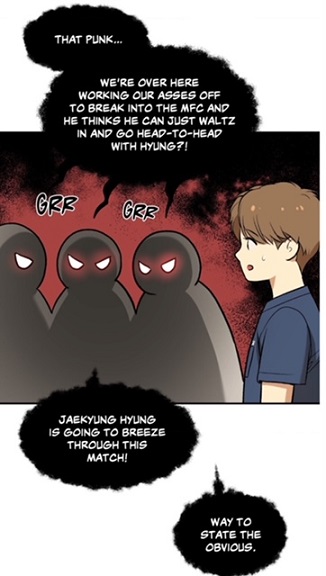 (chapter 47) Finally, he can testify not only as a fighter, but as a representative of the institution they tried to exploit. That elevates his voice: from a disposable athlete to a legal opponent with organizational standing.
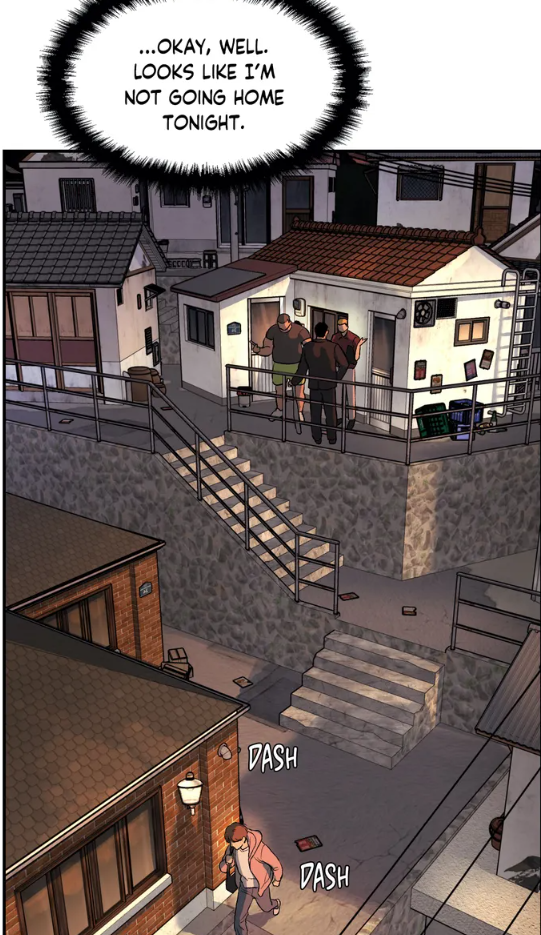 (chapter 1), deflecting, and disappearing became natural. With the grandmother, with doctors
 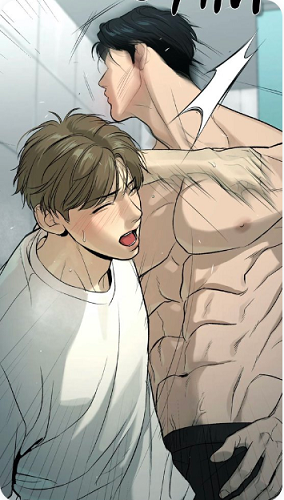 (chapter 7) For a moment, he was fighting.
 (chapter 67) Moreover, in contrast to Season 1, Kim Dan is no longer the invisible caregiver or obedient grandson. Thanks to Joo Jaekyung’s presence—disruptive and painful as it was—he began to form an independent identity
 (chapter 57) —it is a rejection of the belief that he exists only to serve. In Season 2, Dan says “no” repeatedly:
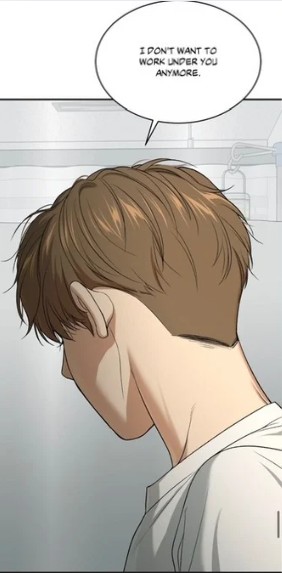 (chapter 60)
  (chapter 67)
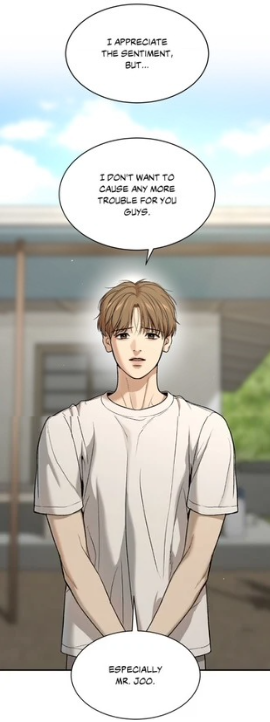 (chapter 58)
  (chapter 57)
 (chapter 65) She uses his past flaws to outline his immaturity and need of guidance. However, she is not taking into consideration the transformation in the doctor due to the recent incidents (switched spray). He is no longer the same than he was 6 months ago or 2 years old. He changed thanks to the athlete and because of unfortunate events (sexual harassment from the hospital director, switched spray). But the halmoni has no idea about such incidents.
  (chapter 53) Unlike Park Namwook who uses blame and delegation in professional settings, she applies emotional avoidance in private and familial spaces. Much like the manager, she outsources responsibility, asking others to step in
 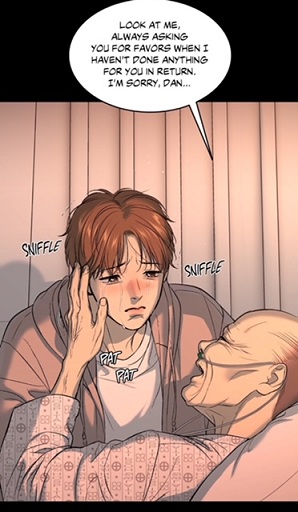 (chapter 53)
  (chapter 65) rather than engaging directly. She avoids difficult conversations, never once asking doc Dan about the nature of his work or why he followed her to the West Coast.
  (chapter 65) Her silence is not protective—it is evasive.
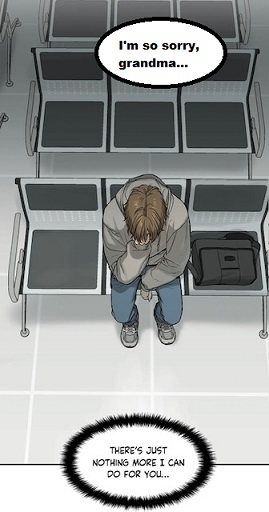 (chapter 5) Her illness becomes a metaphor for her mindset. She relies on external systems: her grandson
 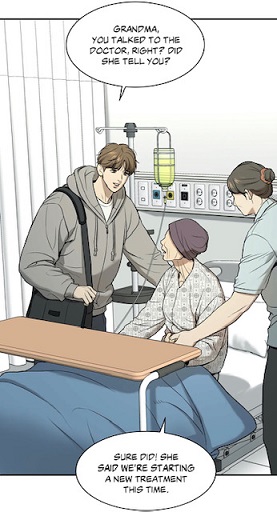 (chapter 7), medication, comfort
 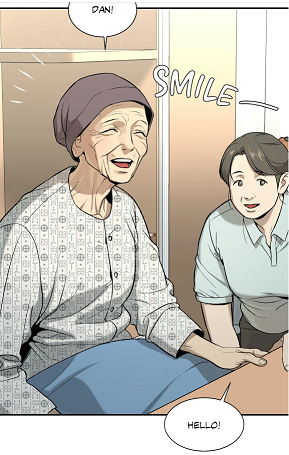 (chapter 7) His grandmother was not truly abandoned; she simply equated his physical absence with neglect, ignoring the emotional and financial burden he already carried. Like Park Namwook, she prefers others to carry the discomfort while maintaining a façade of suffering and sacrifice.
  (chapter 65)
 (chapter 47) , and her narrative of selflessness becomes another form of emotional pressure. She does not yell, she does not accuse directly, but her avoidance is equally powerful in shaping Dan’s self-image as a burden. Doc Dan came to internalize that she suffered because of him.
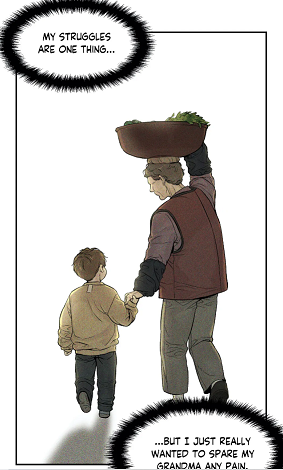 (chapter 5) Hence he made sure to shield her from any pain.
  (chapter 65), protected, comforted. Surrounded by nurses, medication, and routine, she finds temporary peace in an environment that simulates safety. The hospice does not cure her illness, but it cushions it. This illusion allows her to smile again, to relax—but only up to a point. Kim Dan’s gradual deterioration
  (chapter 57) —his visible exhaustion, disconnection, and quiet suffering—becomes a thorn in her eye, a reminder that her peace is not whole. As long as he suffers, she cannot entirely escape the shadow of her own regrets. Sending him away to Seoul represents a new of flight. Out of sight means out of mind. That way the grandmother wouldn‘t have to worry about doc Dan, as he has been entrusted to the athlete.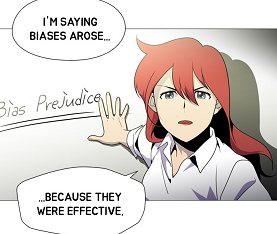
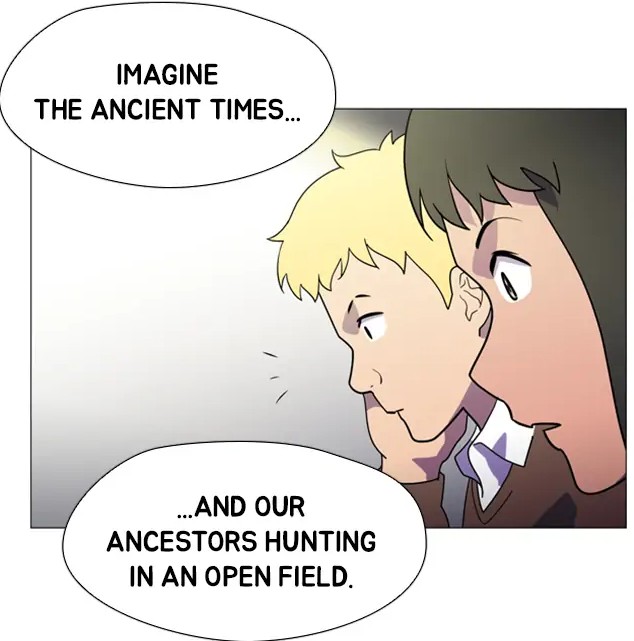
 (chapter 163) and supported by the article on confirmation bias, human survival was deeply dependent on mental shortcuts. Biases were not flaws, but adaptive tools — heuristics that helped our ancestors make quick decisions under threat. Faced with a potential predator, they could not afford the luxury of curiosity or debate. Run first, think later.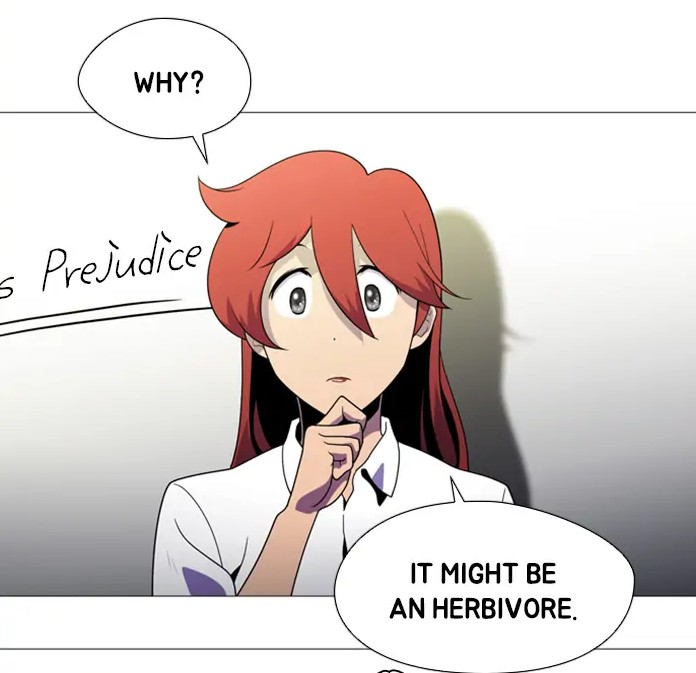
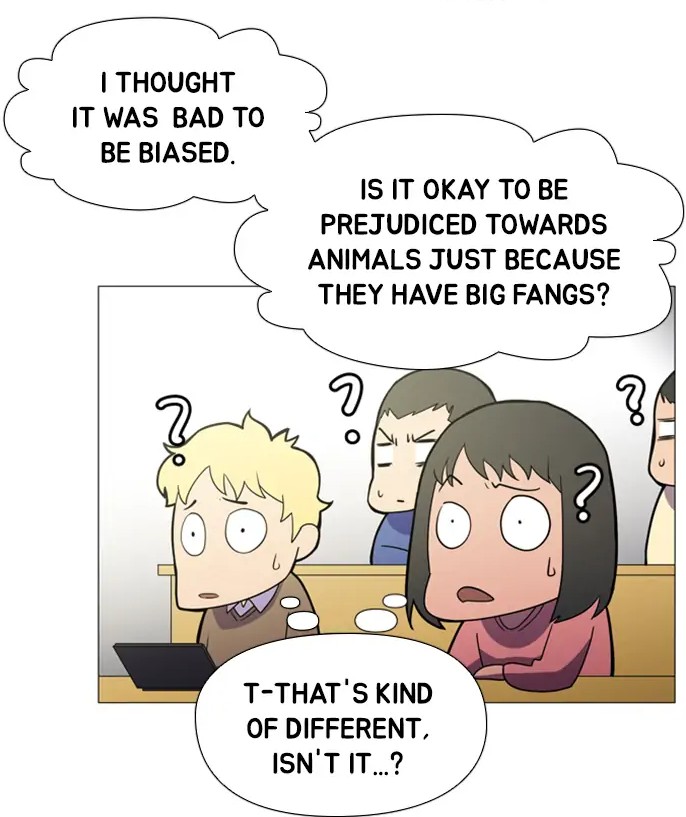 (chapter 163) In this sense, biases were effective precisely because they increased the chance of survival.
 (chapter 9) But once Joo Jaekyung became the target of criticism and scandals, his fear response activated.
  (chapter 41) he recommends the opposite at the restaurant because the idea comes from the CEO!
 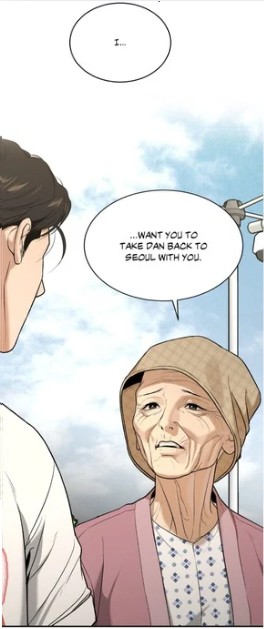 (chapter 65) It was her decision to settle down at the hospice.
  (chapter 67) His survival bias told him: “Don’t trust a man who once treated you violently.” or “Doctors are ignorant, they don’t know me“. It was easier to discredit the source than to weigh the merit of the message. Likewise, in Season 1, the champion dismissed doc Dan’s medical opinions
 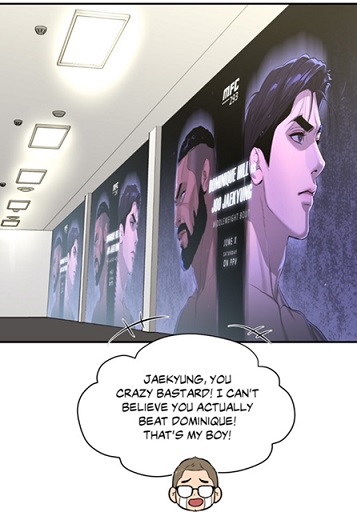 (chapter 40) who needs to fight to prove himself, yet likely doesn’t treat his own family this way.
 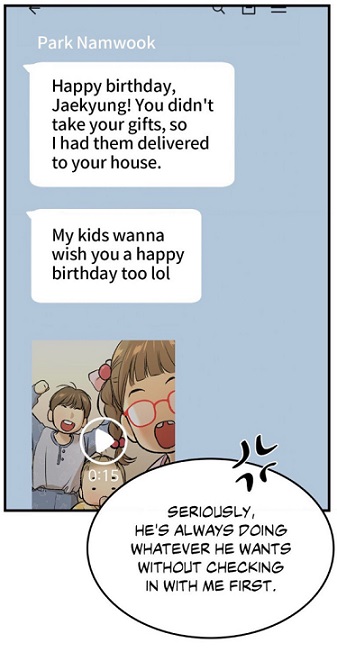 (chapter 45) His double standard is not conscious hypocrisy — it’s a form of selective laziness. He does not challenge his beliefs because doing so would unravel the identity he’s built as a competent, authoritative manager.
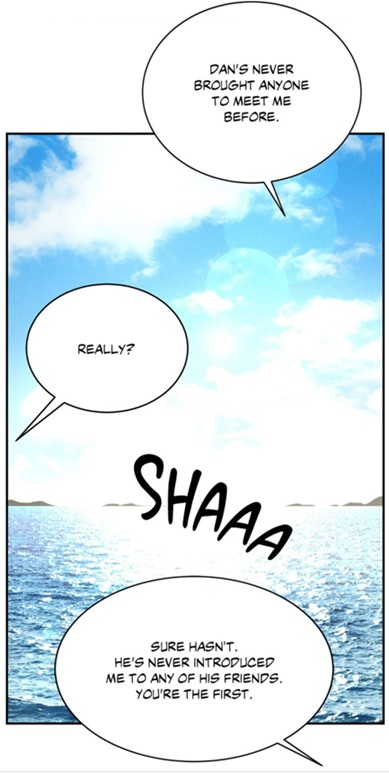 (chapter 65) or a support network. It is not her fault, if she never met doc Dan’s friends in the past while hiding the fact that he had been bullied by his peers. Her request for him to return to Seoul, a place he has no roots, only furthers his habit of isolation. Similarly, when she asked Jaekyung to bring him to Seoul and have him diagnosed, she implicitly discouraged any shared decision-making. Like Park Namwook, she bypassed dialogue in favor of directive control, reinforcing the habit of emotional withdrawal.
 (chapter 67) That shift marks a turning point from survival to conscious thought. The mind cannot reflect when it believes it is under attack. The tragedy is not that these characters are irrational — it’s that they were taught fear before they were taught trust. Thus I come to the following conclusion. As soon as both are curious about each other
 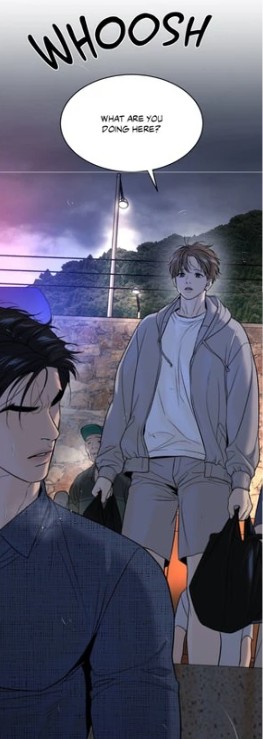 (chapter 69), they are now free from their bias and prejudices.
  (chapter 69) They will be able to communicate which will help them to discover the truth about MFC. Yes, their ability to ponder will lead them to unmask the villains and defeat their opponents. By fighting for justice, both will discover true peace of mind. This hardship at the end of season 1 was necessary to reset their heart and mind: what is the true meaning of life? Money? Work? Duty? Sacrifice?… The answer is happiness which is strongly intertwined with love and selflessness.


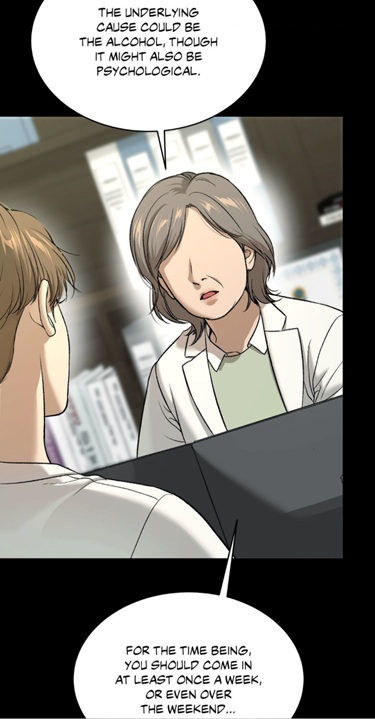 (chapter 67): the brief diagnosis, the recommendation for weekly visits, the specialist’s tentative attribution of Kim Dan’s condition to either alcohol or a possible psychological cause, emphasizing the need for continued observation and weekly visits before offering a definitive diagnosis —all standard responses. For her, this was a doctor following routine procedure without overstepping professional boundaries. However, I perceived her behavior very differently. I saw someone who remained emotionally detached and almost absent, reducing the complexity of Kim Dan’s condition to simplistic surface-level causes without genuine inquiry.
 (chapter 67) Rather than forming an independent assessment, she accepts the narrative of a third party, which introduces bias and limits her understanding. One might argue about that, because she is looking at a paper, probably result of a blood test which seems to corroborate the guardian’s statement. Hence the sleep specialist concludes that Kim Dan is suffering from insomnia, alcohol addiction and sleepwalking. The problem is that his statement is based on external observations (halmoni and the landlord) and their limited knowledge. Moreover, Jinx-philes should keep in mind two important aspects:
  (chapter 61) The champion had been himself suffering from similar symptoms which could be seen as a projection on his loved one. Additionally, based on previous observations, I have interpreted Kim Dan’s nightly walks not merely as sleepwalking, but as dissociative episodes—likely triggered by overwhelming guilt, unresolved trauma, and a chronic sense of disconnection from his body and surroundings. But how could the champion know about this? He’s not a doctor himself. In order to have a more accurate picture of the whole situation, she should have talked to the patient himself. But by relying on papers and the guardian’s testimony, she not only distances herself from the patient physically and emotionally, but also delegates the responsibility of interpretation. She is using the eyes of others.
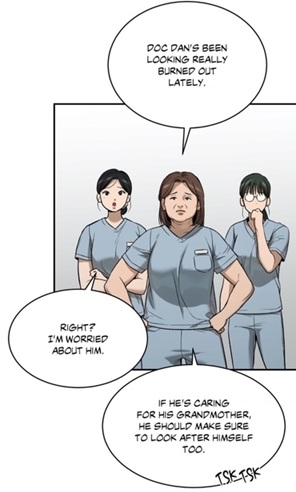 (chapter 57) Perhaps the doctor’s detachment is not indifference, but a survival mechanism in a healthcare system that demands efficiency over intimacy.
 (chapter 67) indicating that his alcohol addiction is not the real reason for his insomnia. Then she fails to examine Kim Dan physically, the desk is between them. Therefore she can not detect his visible malnourishment.
 (chapter 62) Moreover, both the landlord and the grandmother never brought up this aspect, though Shin Okja had observed this terrible transformation:
  (chapter 66) It is because the physical therapist is just a number (2) and as such a file. Therefore the doctor is not seeing the patient as a human. I can not blame the woman either, for she has so many patients to treat during the day. And now look at the building of the hospital:
  (chapter 66). It is huge reminding me of a factory. This “modern hospital” with its sleek architecture, expansive buildings, and impressive specialization exudes a sense of advancement and trustworthiness. Yet beneath this polished surface lies a business-oriented structure, one that prizes efficiency, reputation, and patient turnover over genuine patient connection. This “modern hospital”
 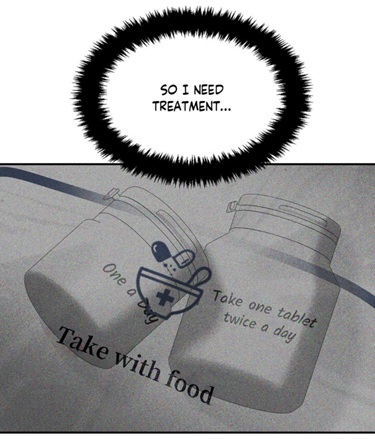 (chapter 67) She is doing exactly what Shin Okja wanted:
  (chapter 5) with the new medicine. On the other hand, it implies that the light-brown haired woman is doing her job for her paycheck which reminds me of Cheolmin’s statement:
  (chapter 13): “Oh no, no. That won’t do. My precious paycheck!”.
 (chapter 27)
  (chapter 49) as mere service providers. Whether it was brushing off medical advice with “Don’t push it, I know my body better than anyone else” (chapter 27) or demanding instant pain relief to continue training (chapter 49), the champion positioned himself as the ultimate authority over his own treatment. Since his attitude echoed the confession of my osteopath, it is understandable why my osteopath-orthopedist began to select his patients carefully. This mirrors Kim Dan’s evolution, when the latter chose to reject the champion’s offer. Indirectly, he is “learning” to select his job and not take them by opportunism. He is also learning to select his “patients”. Striking is that Shin Okja has a similar attitude than the athlete.
  (chapter 7) She desired to have a treatment with less side effects and less painful. And the moment she was confronted with reality, this painful new treatment only brought pain and nothing more, she chose to leave this institution and move elsewhere.
 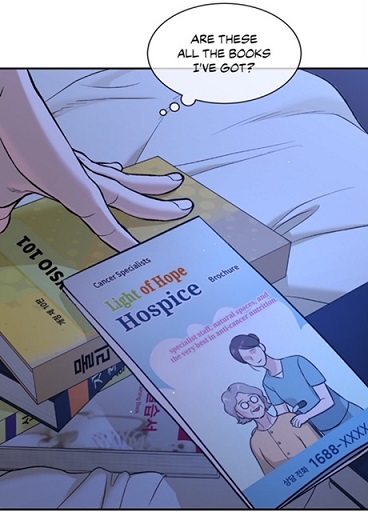 (chapter 53) Therefore it is not surprising that she is treating the protagonist the same way: she knows what is the best for him.
 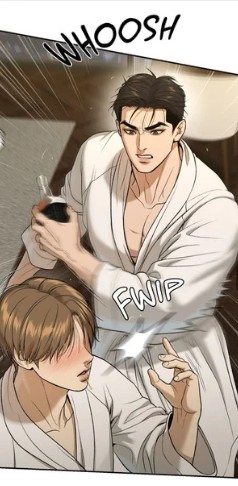 (chapter 67) He felt misjudged and misunderstood; reduced to a file number, not seen as a complex human being.
 (chapter 67) and second, what Kim Dan actually received as treatment:
  (chapter 13), in contrast, enters the story with no white coat at all. He carries only a doctor’s bag, dressed in a green pullover and a beige checkered shirt.
  (chapter 13) Despite this informal attire, he immediately recognizes Kim Dan’s symptoms and engages both the guardian and the patient. He doesn’t need institutional support to assert authority; his presence and diagnostic clarity define him. While his clothes might elsewhere be read as conservative or emotionally restrained, here they highlight that care can come outside rigid systems.
  (chapter 13) Quite the opposite. He doesn’t hide behind his distance; he manages it. His approach is practical and grounded, but never cold. He doesn’t wear a white coat, yet he brings with him a doctor’s case and an unshakable sense of responsibility. His tools are simple (his own body),
  (chapter 13) It bridges the gap between roles, making the patient feel seen rather than categorized.
 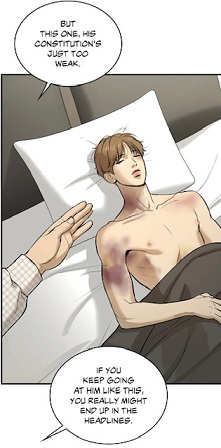 There’s no judgement in their relationship. The eyeless doctor may appear neutral, but in truth, she is hollow. Cheolmin appears reserved, yet his actions speak with empathy. Where she recites guidelines, he initiates dialogue.
  (chapter 13) Where she avoids involvement, he offers engagement.
  (chapter 61)
  (chapter 67), the Light of Hope hospice
  (chapter 61), the sleek University hospital dedicated to research
  (chapter 5), and more intimate yet modern facilities like this one.
 (Chapter 27) Each medical setting not only has its own architecture but also its own moral blueprint. In the essay “
 (chapter 48) got aware of Shin Okja’s conditions, implying that patient confidentiality had been breached.
  (Chapter 61): In contrast, Park Junmin
  (chapter 61), highlighting that the athlete has become aware of what genuine care should look like. When the champion calmly declares, “I’ll be receiving rehabilitation services in another hospital,” Junmin answers with a stunned “Sorry?”. But this is not confusion. It’s a reflexive mask for shock. He did not expect to lose control of the situation. Beneath that one-word response lies disbelief, disappointment, and veiled panic. He’s losing a lucrative patient—and more importantly, a public endorsement. The moment exposes how fragile his authority truly is when faced with a patient asserting autonomy. Let’s not forget that when the champion was facing a mental and emotional breakdown, the latter offered no other support than “rest”. He even avoided his gaze.
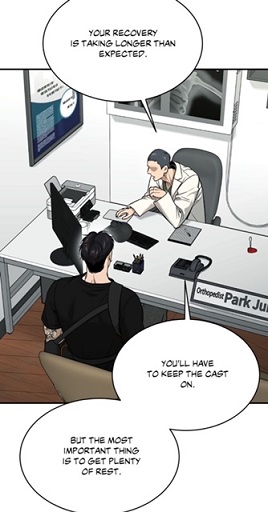 (chapter 54) The athlete was left on his own.
  (chapter 60), criticizes people for their rude behavior
  (chapter 59) or actively disciplines staff
 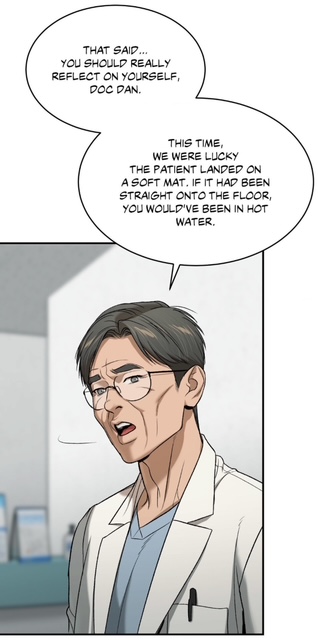 (chapter 59) when mistakes are made. Though he also flatters the champion
  (chapter 61) and sees promotional potential, he never exploits patients.
  (chapter 61) The juxtaposition of humility and responsibility in his demeanor, combined with his stunned reactions to sudden events, suggests an overworked and understaffed environment—but not one without moral grounding. His white coat and blue medical uniform echo the nurses’ attire, subtly promoting a sense of equity among staff. Despite being a director, he doesn’t separate himself from frontline caregivers. His uniform also contrasts with the green worn by Kim Miseon or Park Miseon, suggesting a focus on practical responsibility over prestige. By blending in with the team, he fosters a culture of shared accountability, not rigid hierarchy. Among all institutional figures, he comes closest to balancing authority with integrity.
  (Chapter 6): While this figure appears authoritative
 (chapter 1) The white coat, in his case, is not a symbol of healing but a façade for exploitation. drives his authority. The coat becomes a literal cover for abuse—harassment disguised under professionalism. His entire persona is a façade: calculated, charming on the surface, but predatory and morally bankrupt beneath.
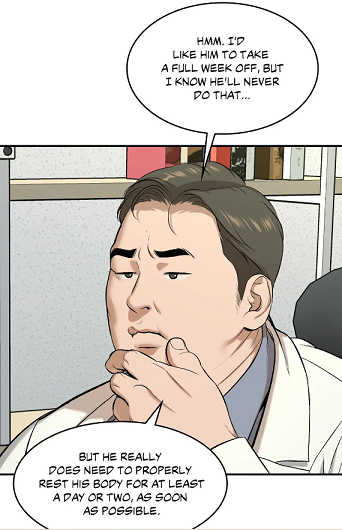 (chapter 27) His gray shirt signals a more relaxed approach,
 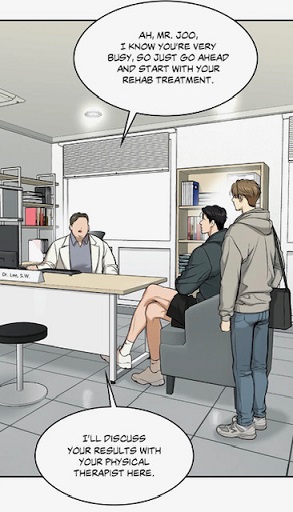 (chapter 27) and his facial expression conveys a certain empathy—though his words also betray resignation. He sits beside the patient, not opposite, visually erasing the typical hierarchical divide between doctor and athlete. His recommendation that Joo Jaekyung rest is gently delivered, but he knows it will likely be ignored. He represents the tension between medical idealism and the pressures of athletic performance. He is trying his best to protect Joo Jaekyung’s career.
  (chapter 27) Notably, he doesn’t chase fame or loyalty—he’s realistic, yet still rooted in care.
 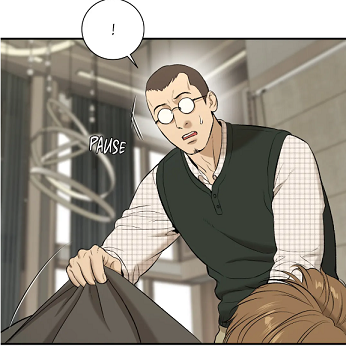 (chapter 13) Finally, Cheolmin exists outside the hospital system. He wears no white coat, but his behavior mirrors a true physician’s. He diagnoses accurately, gives immediate advice, and engages both patient and guardian. His attire—a shirt layered under another—might suggest emotional restraint, but it doesn’t interfere with his actions. He jokes and teases, breaking through tension and inviting trust. He acts not because protocol demands it, but because someone needs help. That’s enough.
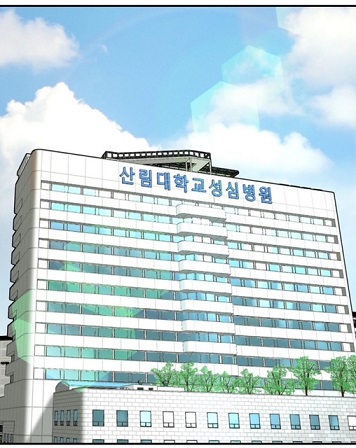 (chapter 41) nature is neatly confined. Rooftop gardens and structured greenery exist, but more as visual accessories than lived environments. The hospital is a towering research center, representing scientific advancement—but also bureaucratic coldness. Here, nature exists to impress, not to comfort. This artificial balance between concrete and green reflects a clinical detachment: nature is curated, not embraced. It aligns perfectly with Kim Miseon’s demeanor—professional, pristine, but ultimately distant and ambition-driven.the environment feels controlled.
 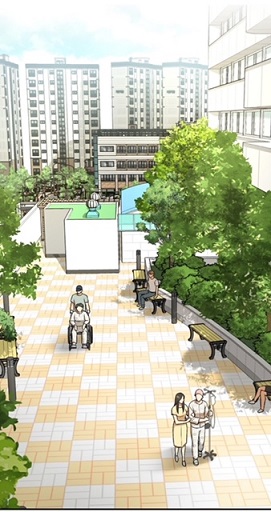 (chapter 41)
  (chapter 54) where Joo Jaekyung receives treatment, the rooftop greenery appears remote and ornamental, disconnected from patient care.
  (chapter 18) modern, and set among scattered trees.
  (chapter 18) Large windows suggest openness and transparency—the very qualities Dr. Lee brings to his interaction. This is a space that, while modest, is genuinely attentive. Here, nature doesn’t impress, it is integrated in the landscape. The park is not surrounded by huge buildings.
  (chapter 65) nestled in the countryside and far from institutional rigidity, emerges as a space of true potential. In returning there, Joo Jaekyung and Kim Dan are not just escaping their past—they are moving toward a form of healing that modern hospitals imitate but rarely achieve. Closer to nature, they are closer to themselves. If hospitals imitate forests, the village becomes the forest. And in that simplicity, Jinx suggests, real happiness might grow.
 (chapter 62) surrounded by greenery, animals, and people who don’t treat him as a product—his health improves. His muscles may still ache, but mentally and emotionally, he is lighter.
  (chapter 57) It lives where no one is watching and no one is billing. In Jinx, the real medicine lies outside the chart—in the dirt on borrowed floral pants, in sweat earned under open skies. Nature becomes the unspoken vow that systems forgot.

 (chapter 54) and penthouse
  (chapter 54) in Seoul—a city symbolizing anonymity, invisibility, and corruption—to the hospice “Light of Hope”
  (chapter 56), where people know each other. This essay builds upon my previous interpretations of the series, which led me to develop these predictions for the upcoming season. By comparing the visual depictions of the gym and penthouse in Seoul with the hospice and small town on the West Coast, the divergence in weather becomes a powerful symbol of the changes Joo Jaekyung will undergo. The rainy, overcast settings of the gym and penthouse reflect the fighter’s inner turmoil and sadness, highlighting the oppressive atmosphere of a city rife with anonymity and corruption. In contrast, the sunny and open environment of the hospice and town by the ocean represents a space of hope and renewal, where human connections thrive. This comparison underscores the significant role the hospice and small town will play in fostering Joo Jaekyung’s self-discovery and healing. The gym and penthouse in Seoul symbolize anonymity, invisibility, and corruption. This anonymity stems from the city’s indifference to individual suffering, as seen when Kim Dan was dragged
  (chapter 16)
  (chapter 16) through the streets by loan sharks in broad daylight without anyone intervening. Invisibility is further exemplified by the perverted hospital director,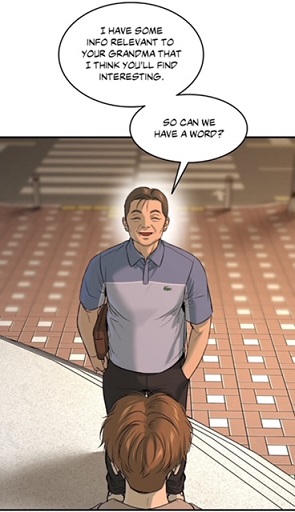
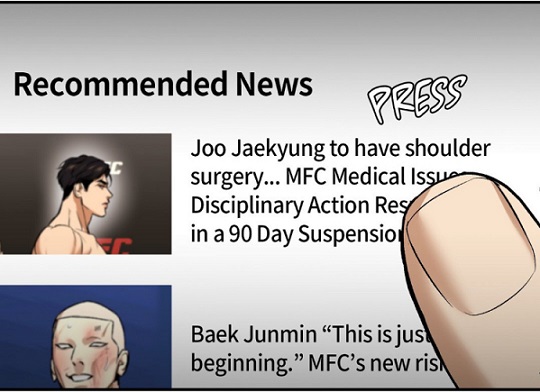 (chapter 52) The best example is the vanishing of the protagonist’s former rival, Baek Junmin,
 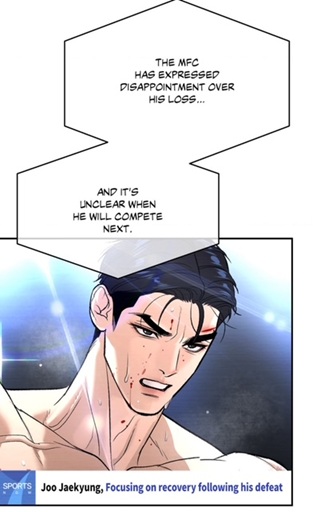 (chapter 57) who no longer appears in the news.
 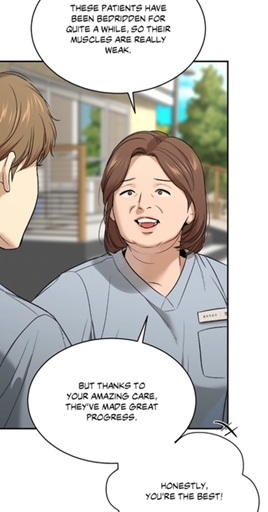 (chapter 56) emphasizing respect and dignity. This stark reality will serve as an eye-opener for Joo Jaekyung, who is burdened by news and media narratives equating
  (chapter 36)
 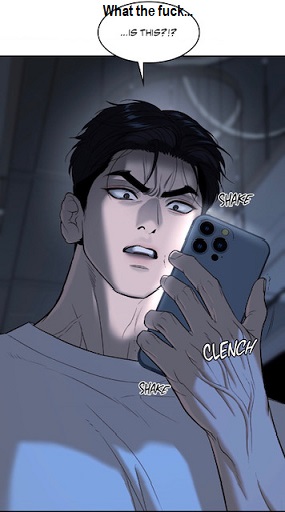 (chapter 35)
  (chapter 57), prompting him to recognize that his so-called career end does not symbolize his real death.
  (chapter 57). This environment challenges him to confront the indifference of figures like Yosep and Park Namwook, whose neglect, blind trust, passivity, naivety, neglect and selfishness have shaped his struggles. Notice that the nurses are often seen together and exchanging thoughts about doc Dan symbolizing unity and harmony
 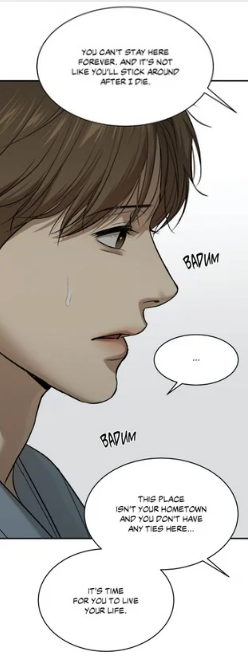 (chapter 57), yet her exclusion of Kim Dan reveals her flawed understanding of family, which she associates solely with a location. This behavior aligns her with the symbolism of the black sheep: a disruptive force within the community whose selfishness and inability to nurture genuine familial bonds isolate her. Her neglect of Kim Dan, despite his evident suffering, exposes her as prioritizing her personal comfort over the well-being of her own grandson. The arrival of the wolf—Joo Jaekyung—will challenge her perception, forcing her to confront the flaws in her thinking and her selfishness. His presence, along with interactions with other characters such as Potato and Heesung, who possesses the perceptiveness of a gumiho, will expose her true nature to the community. This confrontation will push her toward an overdue reckoning with her actions and their impact on Kim Dan. I also realized that since this woman is suffering from Peter Pan Syndrome, her true enemy is youth which is embodied by Yoon-Gu. The latter stands for the opposite values: innocence and responsibility. So his ignorance and purity could lead her to experience unpleasant truths, like for example: Potato asks her about the whereabouts of Kim Dan’s parents, a new version of this scene:
  (special episode 1) In other words, the presence of Kim Dan’s friends (Joo JAekyung, Potato and Heesung) could make her realize her true nature, which would impact her mental health. She led a life full of missed chances and regrets.
  (chapter 26)
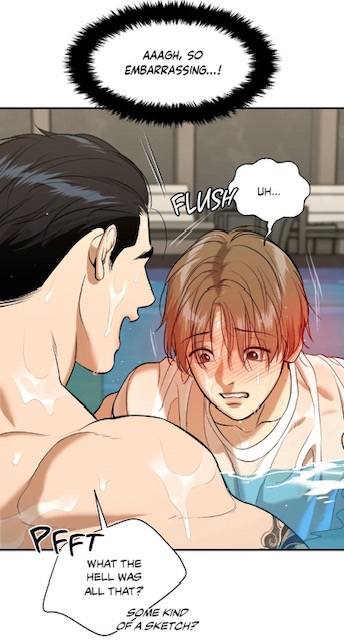 (chapter 27) In Korean culture, the saying “when the heart isn’t in it” reflects a profound truth: actions devoid of sincerity lack real value. Season 2’s new settings allow the champion to reflect on his mechanical, dispassionate life and begin to act with intention and feeling.
 (chapter 54) Though in denial, Joo Jaekyung feels undoubtedly responsible for the doctor’s suffering, as one of his nightmares reveals his guilt for doubting Kim Dan’s honesty and dedication. Once seeing his terrible transformation, the man can only blame himself, especially if he recalls Cheolmin’s advice:
 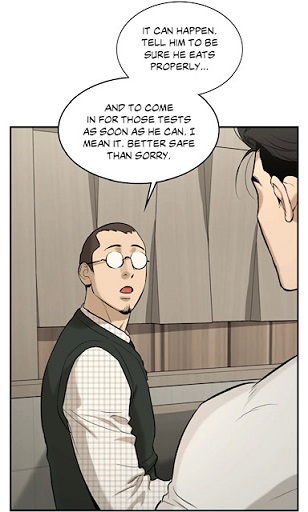 (chapter 13)- The act of nurturing Kim Dan is symbolic: it aligns Joo Jaekyung with the wolf, an animal deeply associated with love, family, and protection. Through this connection, he learns to balance his ferocity with tenderness, becoming not just a fighter but a protector.
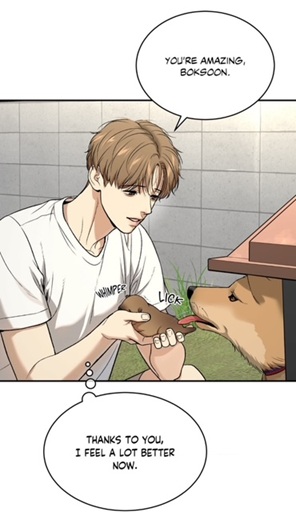 (chapter 57) and her puppies. Kim Dan is tasked with taking care of the dog and her newborns, and Joo Jaekyung should be asked to do the same. This responsibility not only serves as an allegory for taming the wolf within him but also paves the way for the champion’s deeper connection with Kim Dan. By being close to the ocean
  (chapter 56), a place where Joo Jaekyung finds relaxation through swimming, the setting introduces an opportunity for him to teach Kim Dan how to swim, addressing the latter’s fear of water
  (chapter 27). Swimming could become a shared activity that rebuilds their relationship on a foundation of trust, mutual learning, and growth. Engaging in this physical activity would not only strengthen their bond but also boost Kim Dan’s confidence and help him rediscover his own resilience.
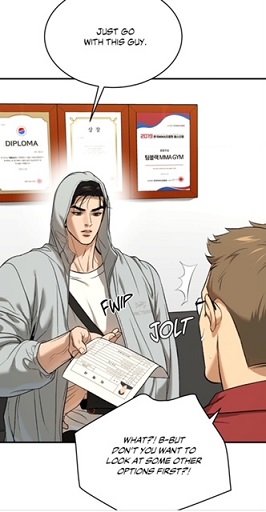 (chapter 54), his connection with Kim Dan is no longer defined by a boss-employee relationship. Their interactions, now free of financial obligations, offer the fighter a clearer view of Kim Dan’s selfless and angelic nature. The physical therapist’s unwavering care, even at the expense of his own well-being, highlights his ungreedy and altruistic character. This realization will deepen Joo Jaekyung’s respect and affection for Kim Dan, further cementing the transformative journey they both embark on.
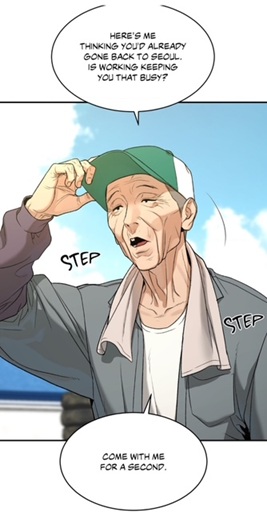 (chapter 57) and the yelling patient
 (chapter 56) “Nurse Mind” and “Nurse Heart,” provide another layer of mentorship. They could act as the champion’s eyes and ears, teaching him to observe and understand Kim Dan’s mental state. Though the nurse 1 started reproaching Kim Dan to neglect himself
 (chapter 57), she reminded me of the champion’s friend:
 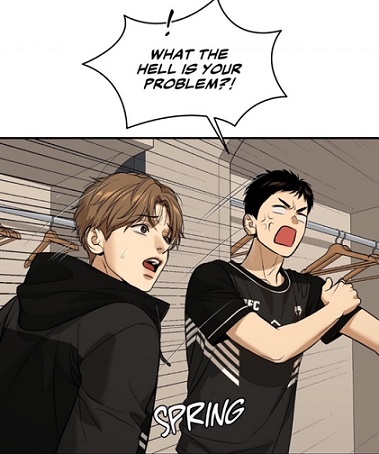 (chapter 49), though their positions are absolutely opposite. The patient’s reaction in Chapter 57 echoes this dynamic, as he accuses Joo Jaekyung of being ill-tempered (this means that he remembers the suspension), a perspective shaped by the media’s manipulations. His criticism reflects the behavior of a sheep, falling prey to misinformation and failing to see the larger truths. On the other hand, it indicates that this man also knows a part of the truth: the suspension which is no longer mentioned, but also escaped Kim Dan’s notice, as he was dealing with his departure. In contrast, Potato’s response in Chapter 49, where he courageously questioned Director Choi despite the latter being an elder, showcases independence and critical thinking. This juxtaposition highlights the patient’s potential to awaken Joo Jaekyung, Kim Dan, and Potato to the damaging impact of media narratives. Over time, the patient himself must confront the wrongfulness and cold-heartedness of his accusations, fostering growth and understanding on all sides. These characters reflect the flaws of Yosep and Namwook, enabling Joo Jaekyung to see the neglect and indifference he has endured and inspiring him to redefine his role in the gym and in Kim Dan’s life.
  The illustration’s inclusion of the hamster—symbolizing Kim Dan’s fun, fragile, and nurturing nature—along with the chow chow and the gumiho, emphasizes the roles of protectors and mediators. The chow chow’s loyalty and the gumiho’s cunning serve as essential forces guarding the hamster and navigating the complexities of this “pure community,” where lies and selfishness can still exist. These characters highlight the intricate dynamics within the hospice, where Joo Jaekyung must balance strength with empathy.
 (chapter 13) This newfound appreciation allows him to form fond memories of the place, associating it with peace and renewal despite the grandmother’s inevitable passing. By metaphorically taking over her place at the hospice, Joo Jaekyung symbolically builds his family there, grounding himself in the values of compassion and community. These lessons ultimately empower him to take over the gym with a renewed perspective, ready to lead with strength and empathy. Finally, I deduce that the main couple will initially navigate between the Light of Hope Hospice and the doctor’s rented room before visiting other places (like the beach and the mountain) The more places they will visit together, the more they will become true to themselves, inciting them to open their mind and heart to each other. Surrounded by nature, all the characters will get purified and discover the true source of happiness.


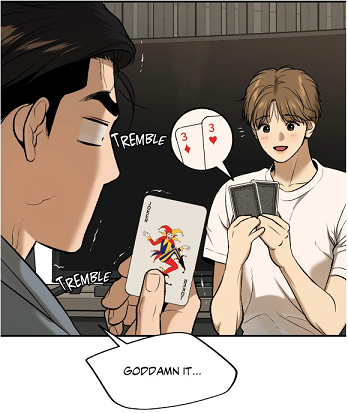 (chapter 27)
  (chapter 13) The conversation between these two characters in episode 13 shows that Cheolmin is not only a reliable person, but also a good friend. He assisted the star in a time of needs without expecting anything in return. There was no exchange of favors, hence Mingwa showed us his hand, when he said his goodbye.
 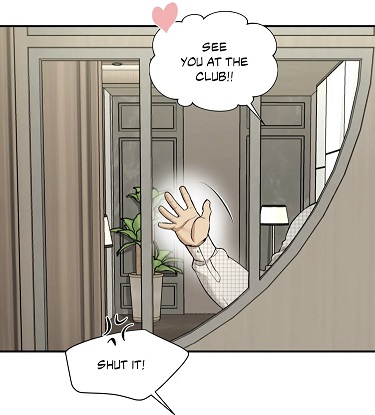 (chapter 13) This gesture with the hand implied not only that he was just looking forward to meeting him again, but also generosity. And if there was a request from Cheolmin, it was just about an information:
  (chapter 13) It had nothing to do with money and promoting his hospital.
 (chapter 33) According to me, the man was calling his friend Cheolmin, because he truly believed that the actor had been hurt. The fact that he went to the rooftop in order to call the person is indicating that he desires to hide his contact from Park Namwook and Jeong Yosep. In other words, he was seeking secrecy, exactly like the actor. As you can see, the dragon and the gumiho had a similar attitude. They thought that the rooftop was the perfect place to hide a secret. So by calling Cheolmin who is working at a hospital, the MMA fighter was making sure that there would be no scandal. However, when he called him, he discovered the truth. Choi Heesung had faked his injury. Therefore how could he use his connection with Cheolmin, when there was no emergency? In his eyes, he would have abused his busy friend’s generosity. That’s the reason why the star chose not to intervene. If he had revealed the truth and as such accused the actor of deception, he would have no one by his side to prove the truth. It was one man against two. Secondly, by revealing his presence on the rooftop, he would have been forced to mention his close friend: Cheolmin hyung. His connection with the athlete would have raised some question. And because he didn’t utilize the Joker in that situation, he became a victim of a trick. It is important, because the champion’s decision to hide Cheolmin’s existence from Jeong Yosep and Park Namwook is a sign that deep down, he is not trusting his two other hyungs. In my eyes, it is related to his homosexuality. But there could be other reasons as well, for example he met this doctor, before he became a celebrity.
  (chapter 33) For me, the doctor was the person Joo Jaekyung was talking to. Interesting is that contrary to episode 33, he didn’t leave the inn in order to talk to his acquaintance. In fact, he did it in front of the door. By acting that way, he didn’t attract the attention from the members. No one questioned the celebrity why he was talking on the phone for quite some time. They just imagined that it was work-related due to the selfie with a stan.
  (chapter 43) They didn’t even bother to wait for him to arrive before drinking and eating, though the man was the birthday child. He was actually the guest of honor.
  (chapter 43) This exposes violation of social norms and even the disrespect towards Joo Jaekyung. He is just seen as a cash cow, hence there was no thank you from them or even a short invitation for him, like Park Namwook and Kim Changmin had done it in episode 9.
  (chapter 9)
  (chapter 9) In fact, Joo Jaekyung was totally neglected at the restaurant, no one even paid attention to his actions. Under this light, I recognized why Mingwa created this incident:
  (chapter 43) It was not just to bring the two main leads closer, but also to expose the wrongdoers. If they had waited for him, the champion wouldn’t have drunk some soju from the glass of water, for Kim Dan couldn’t have used his glass.
 (chapter 43) That’s why the manager got red, a sign of embarrassment. He realized that they should have all waited for the birthday child. Moreover, don’t forget that the star was even paying the bill. And now, you are wondering if I didn’t diverge from my original topic, the Joker and Cheolmin hyung. No, as this new interpretation helped me to understand why Joo Jaekyung talked to his hyung in front of others. He already sensed that no one was observing him or waiting for him.
  (chapter 43) Moreover, it is possible that the mysterious caller desired to congratulate for his birthday or even to thank for his donation. Let’s not forget that just before his real birthday, the celebrity organized a charity event, and it could be related to Cheolmin’s work place.
  (chapter 41) Because I detected ingratitude, selfishness and rudeness from Team Black, I couldn’t help myself thinking that the other person must have behaved differently, which put the young man in a good mood. Therefore he overlooked the incident with the switch of glass:
  (chapter 43) before Park Namwook tried to relativize the incident.
 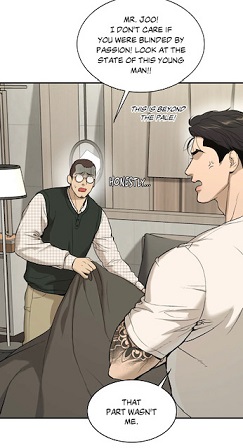 (chapter 13). Hence I believe that the other reason why our cute PT didn’t meet Cheolmin in season 1 is that he was not ready to interact with him. Kim Dan needed to mature, to free himself from social norms in order to accept such a man as a “role model”. That’s the reason why I am expecting the return from this mysterious doctor in season 2. In my opinion, he will play a central role in dethroning the king Park Namwook at Team Black, but also in helping Kim Dan to obtain justice. Keep in mind that according to me, the protagonist was a victim of many crimes committed by doctors. (The hospital director, Kim Miseon, MFC doctors)
 (chapter 35) He offered his assistance, but at no moment the main lead thought of even asking for his help.
  (chapter 46) If he had voiced his struggle to Heesung, the latter would have understood him and “talked” some sense to the dragon. And it is the same for Potato. In the locker room, when Kim Dan was criticized for his sloppiness,
 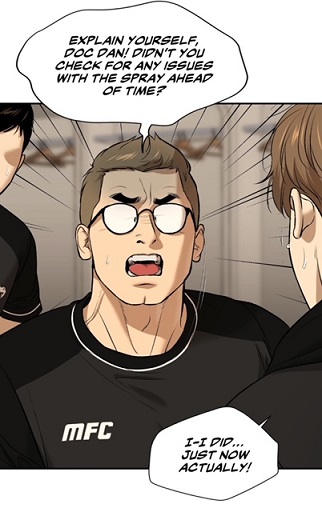 (chapter 50) he didn’t ask from Potato to vouch for him. He could have reached to him, requesting from him to testify in his favor. Yes, I believe that not only the actor and the maknae are to blame for their passivity, the physical therapist is also responsible for his own suffering. He is not seeing that he has already gained two friends. However, he didn’t treat them properly. No wonder why Kim Dan ended up alone at the end of season 1. At no moment, he confided to Potato or other members about his struggles, he kept everything to himself which is similar to his soulmate.
  (chapter 30). Here, I am excluding the scene with his drunkenness. Nevertheless, from his words, Heesung couldn’t detect that he was raised by a single grandmother. He already had a hard time to “accept” the champion’s benevolence
  (chapter 18) He was brainwashed to rely only on himself. Why? It is related to his halmeoni and his childhood. The elderly woman gave the impression that she raised him without any help. She did everything on her own which is only partially true. The young boy was forced very early on to help her.
 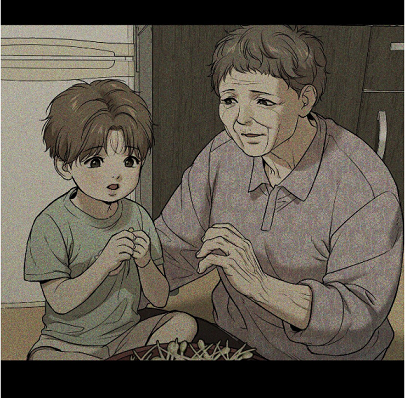 (chapter 47) Hence he was taught cooking. In addition, we can already envision that when he was a high school student, he had to take a part-time job. She definitely minimized his assistance, creating a debt towards her.
 (chapter 7) and
  (chapter 23), he just acted as their “PT” and nothing more. In other words, he acted, as if they only had a professional relationship. This explicates why Kim Dan never talked about himself, in other words he never shared any information with them. However, I doubt that he just considered them as his “patients”. He was happy to give his assistance. For me, the fact that he never lowered his guard is a sign of his low-esteem. So they had a strictly professional relationship, except with Potato.
  (chapter 26) However, even here, Kim Dan never shared his cellphone number with the maknae. If Potato had it, he would have tried to contact him immediately. To conclude, though I criticized Yoon-Gu and Heesung for their indifference and neglect, I feel that Kim Dan is partially responsible for this too. He didn’t take the first step to improve their relationship. Friendship is a two-way Street!
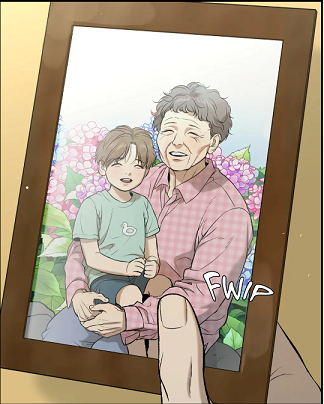 (chapter 19) However, in chapter 47, Mingwa revealed that in the past, Kim Dan had many pictures taken with his grandmother
 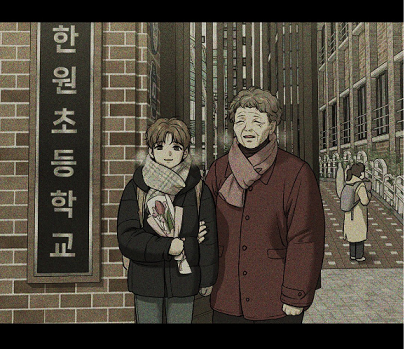 (chapter 47) .
  (chapter 47)
  (chapter 47)
 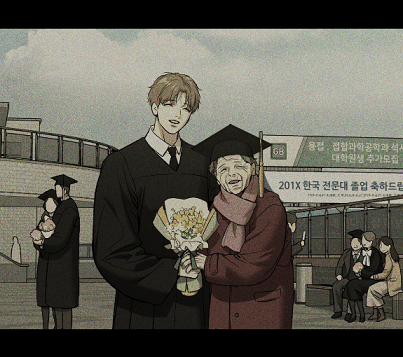 (chapter 47) One might argue about this interpretation, as these panels are presented as “memories”. However, the author left three important clues that these memories were pictures in reality. First, the perspective is not from the protagonist’s, but from an invisible third person’s. Then in the last image, in the background, you can observe a family posing for a picture in front of a person with a cellphone. This was the allusion that someone must have taken these pictures. The last evidence is the bouquet of flowers, the symbol for congratulations, but also affection!! After this realization, I couldn’t help myself wondering about the whereabouts of these photographs. Where are they?
  (chapter 17)
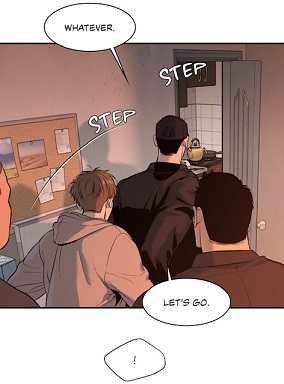 (chapter 17)
 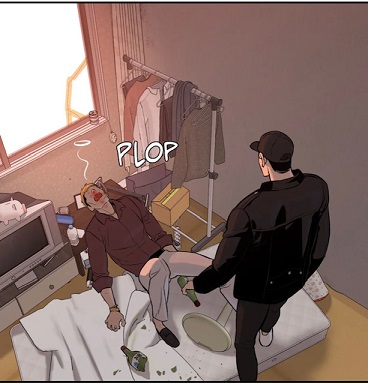 (chapter 17) They are nowhere to be seen!! I would even add that this place contains no traces of Kim Dan’s presence!
 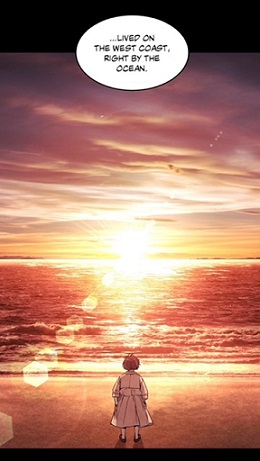 (chapter 53). And here, I feel the need to correct my past interpretation. Back then, I had assumed that this was the doctor’s repressed wish to go to the beach. It turns out that this was Shin Okja’s. Thus I deduce that the papers on the board are related to her health issues. Then in this image
  (chapter 19) The framed photograph isn’t visible on the chests or the shelves, when Joo Jaekyung confronts the loan shark and his minions
  (chapter 19) This exposes that this “souvenir” was not put on display in this house contrary to his stay in the expensive penthouse:
 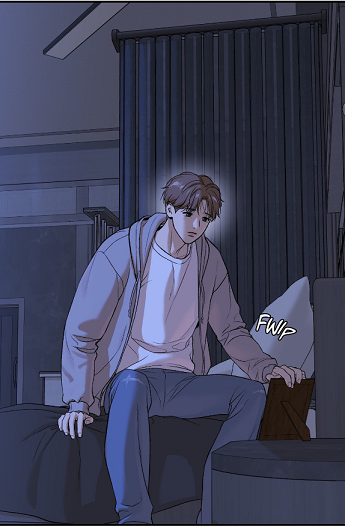 (chapter 47) Thus I conclude through the absence of his pictures and belongings that nothing was exposing the presence of Kim Dan in this small flat. We could say that he had been living as a ghost child (the piggy bank) in his halmoni’s place. It implies the existence of an invisible wall between himself and his grandmother. This perception reinforces my previous interpretation. This place was like a “cursed place, where the “Sleeping beauty” was waiting for his “prince charming”. 😉 Therefore, when the doctor removed the framed picture from the drawer, it symbolizes his own “release”. It is no coincidence that one week later, he became “a man and as such an adult”.
  (chapter 19) He was slowly detaching himself from his halmoni’s shadow. The mirror is a reflection of a photograph. Here, he is facing reality: he has a long phallus and he can have a climax.
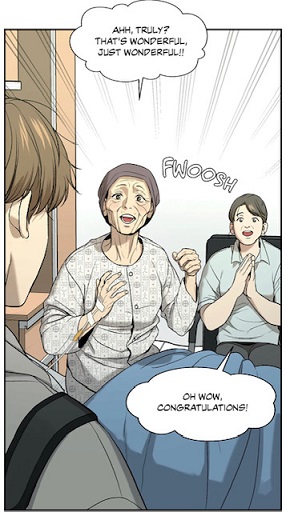 (chapter 7) and actions.
 (chapter 38)
 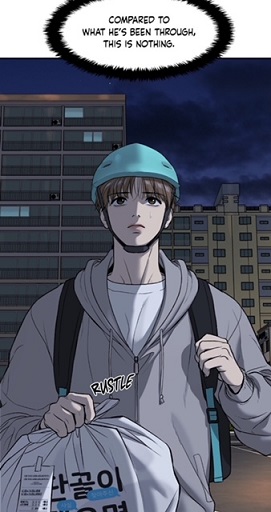 (chapter 42) or “waiter”. As my avid readers can detect, there is a strong link between “pictures” and “pride and love”. Their absence is the expression of neglect from the grandmother, who was definitely too focused on herself and her own suffering. At the same time, it lets also transpire the low self-esteem from the grandmother. In her humble dwell, there is no picture of her as well.
  (chapter 19) She was wearing the same shirt, when Kim Dan was speaking on the phone. In other words, the photo was also bringing painful memories to the grandmother. My theory is that the grandson’s parents vanished after that day. But this was not the same for the boy. He remembers the warmth from his relative. He is not making the link between this moment and his abandonment. In addition, this picture represents a frozen moment in time. It was, as if the woman desired to turn back time or hoped to stay in that moment forever. This explains why she kept the picture and continued treating her grandson as a child. For her, he was still the little boy from that time. However, at the end of season 1, it is no longer possible for her to treat Kim Dan as a child, because she needs him to move to the West coast.
 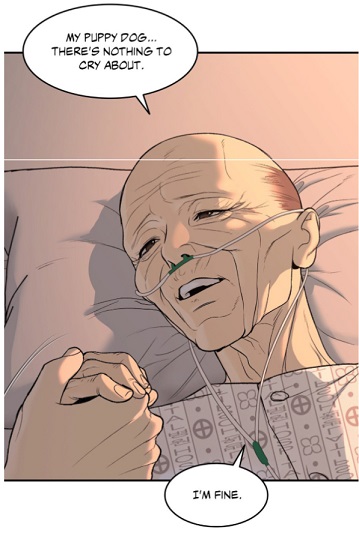 (chapter 47) Why? By acknowledging him as an adult man, she would give him a choice. He could refuse to do her a favor. As a puppy, he can not live on his own. Besides, by turning him into a dog and as such animal, she is denying him his right as a human being. She is appealing to his instinctive nature, his loyalty. And the moment I thought of a dog and death, I couldn’t help myself thinking of the famous dog Hachiko who kept waiting for his owner’s return at the train station, unaware that the latter had died a long time ago. As you can see, doc Dan’s pictures are strongly intertwined with reality and confrontation. Therefore the pictures with her grandson were not shown or treasured. The grandmother has been avoiding mirror and even pictures. As a person suffering from “Peter Pan Syndrome”, she is trying to do anything to escape “death and responsibility”. How ironic is that she just needed a picture to express her wish to move to the West Coast!
  (chapter 53) The words “I should go” displays that he is doing it out of obligation. To conclude, photographs in Jinx are also embodying dream and illusion.
  (chapter 38) Clouds are a reference to heaven and dream, while the green display displays loneliness and emptiness. They have no one by their side. Furthermore, just like Kim Dan, Joo Jaekyung has no family pictures in his house
 , (chapter 19) which could be seen as a clue that he is an orphan. Or in the best case, they live, but there is a huge wall and gap between them and the fighter. I would even add that no one could even identify the owner of the penthouse. He is a famous MMA fighter, yet there exist no picture of himself in this flat! Not even this one:
  (chapter 1) That’s why I had compared the penthouse to a hotel room in a previous essay. So we could say that he also lived like a ghost. However, since he is a celebrity, he should be rather compared to a god. He has no home and privacy. Thus the penthouse contained no memories, until the doctor started living with the champion.
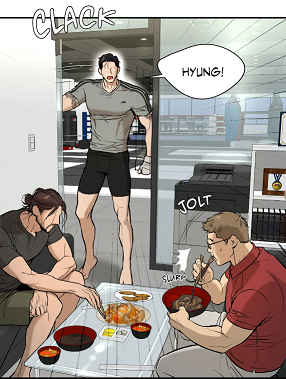 (chapter 5) The first personal video and message from his manager only appeared in chapter 43. This shows that the owner of Team Black had no family at all and not even friends. This observation brings me to my next remark. What about the gym Team Black?
 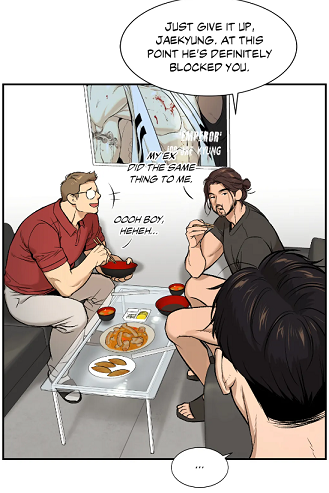 (chapter 5) There are only pictures of the champion and of no one else. Not even from Park Namwook or the ex-professional fighter Jeong Yosep. Everything is revolving around the celebrity. The absence of pictures from others is indicating neglect. The gym was not advertised as a great place to have fun! It is all about fame, wealth and glory! Therefore it is not astonishing why the rats left the sinking ship.
  (chapter 52) The champion’s image is tarnished, he will get less admiration and sponsoring. The decoration of the gym exposed the mentality of the owner, Park Namwook. The gym is about the celebrity, money, fame and sponsoring! Under this new light, it becomes comprehensible why the other members were neglected and why the athlete disliked it so much to be taken in pictures.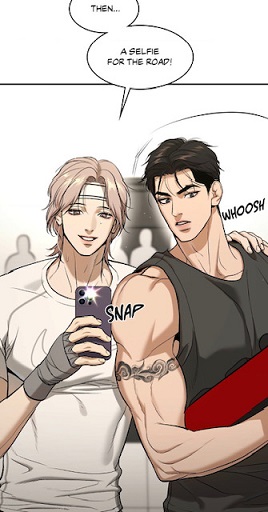
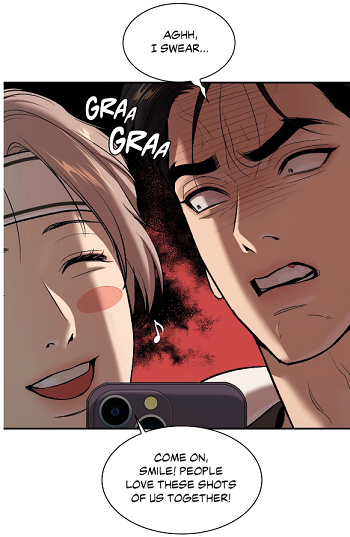 (chapter 30) It is because the photographs are a synonym for “money, glory and fame”. Choi Heesung was using him to get attention. His name
 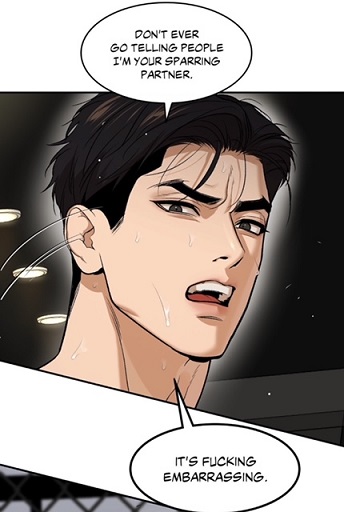 (chapter 46), his face and body are like “merchandises”.
 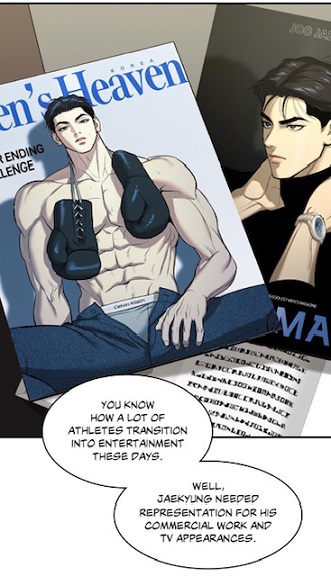 (chapter 30) Naturally, Heesung’s picture is not only related to business, they have a frenemy relationship. The photos with Joo Jaekyung stand in opposition to Kim Dan’s values: glorification, illusion, superficiality and futility. Under this new light, it becomes comprehensible why Joo Jaekyung would never put any framed picture of himself or others in his flat. His gym and the photographs are related to work. Who would like to be “reminded” of work and money in his own home? No one…
 (chapter 45)
  (chapter 45) Imagine that the doctor had to work to exhaustion to give him an expensive gift! Yes, his gift was strongly intertwined with money, business and work! However, birthday is a symbol for home, pleasure, joy, simplicity and genuine gratitude. This has nothing to do with work and “replacement”. Yet, contrary to the other presents, the champion did open the hamster’s gift, for the latter had brought it personally.
  (chapter 45) Yes, his birthday was turned into a business event, a merchandise where he even had to pay for his own birthday party.
  (chapter 43) His popularity among the staff was based on his spending:
 (chapter 35) Such a success and glorification could only drive an edge between himself and others. In addition, the images could never boost the fighter’s low self-esteem. Yes, the absence of his own picture in his home is another important clue for his unhappiness and self-loathing. Because the doctor brought “work” home, Joo Jaekyung started avoiding the physical therapist:
 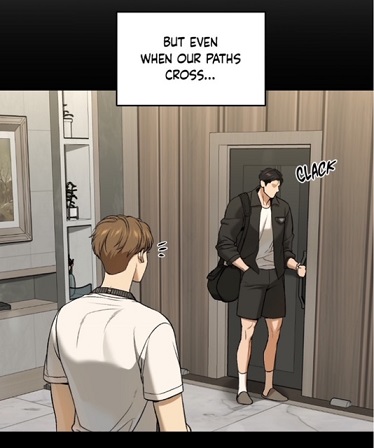 (chapter 47) It was not just because the athlete had been encouraged by his mentor to trust no one, to see relationship as a business.
  (chapter 46) This remark leads me to the following conclusion. Since the manager started sowing distrust in the champion’s heart, we can see it as another proof that this man has never truly loved “his boy”:
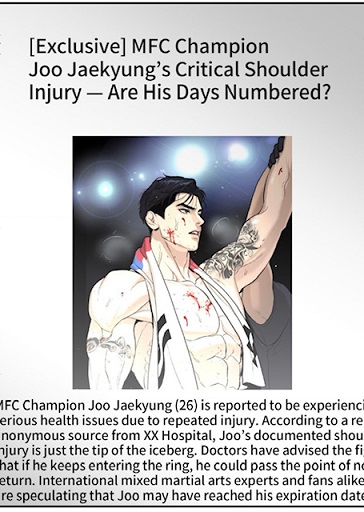 8chapter 35) When this article was released, the author selected a photograph exposing the champion in good health! He was raising his arm and as such using his “injured shoulder”. The content of the article contradicts so much the image which can only raise doubts among the readers. By using such a picture, they created the illusion that the athlete was hiding something. And this remark brings me to the last articles about the fallen legend:
 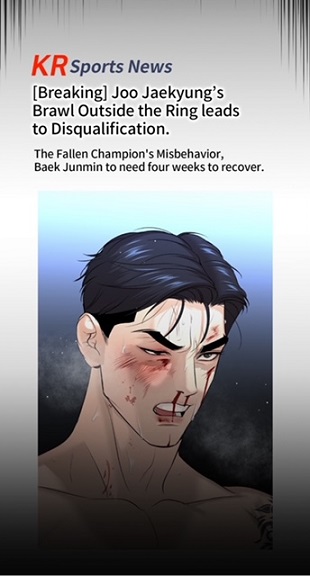 (chapter 52) His beaten face is exposed to destroy his “good image”: he appears not only as weak, but also as a bully. This shows how the medias are trying to manipulate the public with pictures. His face and body are damaged, therefore he has less value. This deceptive trick becomes more visible, when you include Baek Junmin.
 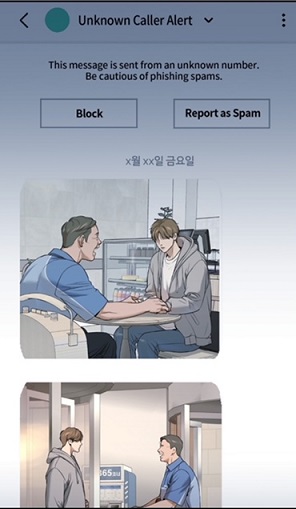 (chapter 48) Kim Dan’s meeting with director Choi Gilseok! However, note that these photographs were also a deception, for they never expose the outcome of the meeting. These pictures display the negative notions of privacy and intimacy, it is about plotting, betrayal and as such about “business”. How so? It is because they met at a café. As a conclusion, the photographs have a total different meaning in the athlete’s world. They represent coldness, superficiality, temporality, deception and work. This new interpretation reinforces my hypothesis that the main lead’s car must have been followed by a paparazzi during that night:
  (chapter 33) A black car was following him. But they couldn’t take any picture, for the windows of his car were tainted.
 (chapter 53) which left him deeply impressed. Joo Jaekyung was turning around his head and looking at him! This shows that the star was paying attention to him. And what had happened in that moment? What is the light next to the protagonist? Yes, these were the flashes from the cameras!
 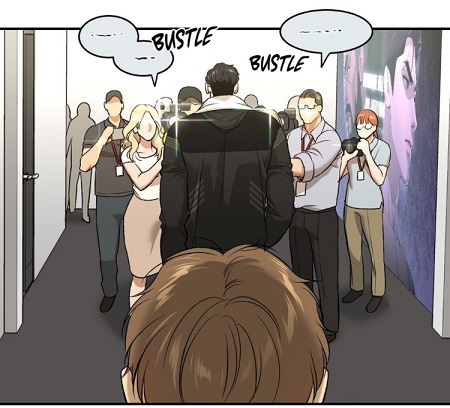 (chapter 40) It is no coincidence. Though he had no memory of the previous night, he felt this moment as magical. He had saved him and claimed him as a part of Team Black. Then he had look at him back, though he was facing journalists. However, the journalists didn’t take a picture of such a moment, for this was not relevant to them. It shows not only the true value of “memories”, but also that both were now truly living! During that night and day, both created wonderful memories.
  (chapter 41) Kim Dan experienced that he was not alone, he was part of “Team Black”, while the other heard a love confession for the first time. This memory displays
 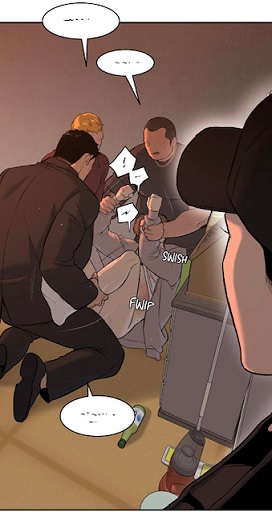 (chapter 17) He is relying too much on his eyes. He paid no attention to details and their words. Hence their words are not visible. In addition, the author created such a panel.
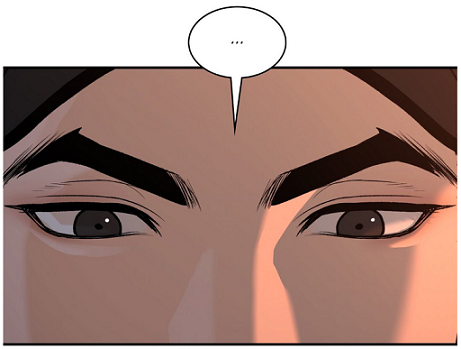 (chapter 17) in that scene.. But why is he trusting too much his eyes? It is because he adopted this poor habit from his mentor and hyung, Park Namwook. who judges people based on prejudices and impressions. When the manager faces a problem or some criticism
  or delegating responsibilities to others:
 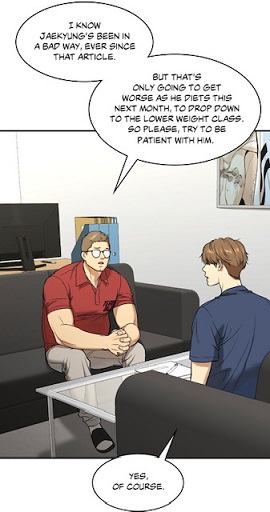 (chapter 36) Furthermore the man with the red tee-shirt has always been by his side for a long time. The time spent together is a proof of his “loyalty”, yet if the athlete had paid more attention to his words, he should have noticed his hypocrisy, lack of empathy and disrespect:
  (chapter 49)
  (chapter 27) In addition, he had to rely on the expertise of doctors, but he only trusts himself, his hyung and no others. But let’s return our attention to Kim Dan and his letter.
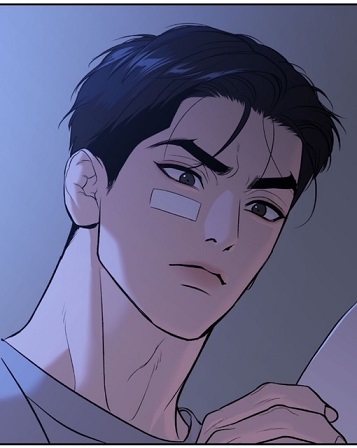 (chapter 53) The letter stands in opposition to the articles and photographs. Through the letter, the main lead is teaching to the wolf this important life lesson. He needs to use his mind and as such his heart to see the truth and reality.
 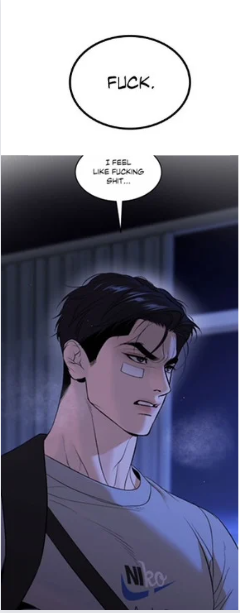 (chapter 53) Thus he voiced his discomfort and annoyance. However, this time, he is not questioning the origins of his actions. He knows now that the doctor means a lot to him. He is not a waste of time. It is no coincidence that the moment he paid attention to Kim Dan’s thoughts and emotions, he opened up his own heart and mind, because according to Erich Fromm
 (chapter 53) The latter might have no photograph of Kim Dan, but his face is now engraved in his memory. To conclude, the letter should be perceived as a mirror of truth to the athlete. He needed to hear the hamster’s words without seeing his face in order to see him properly.
 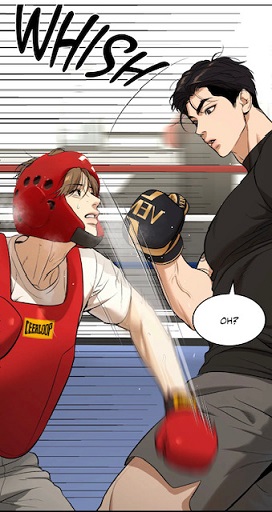 (chapter 26)
 (chapter 26) The gym will face some changes.

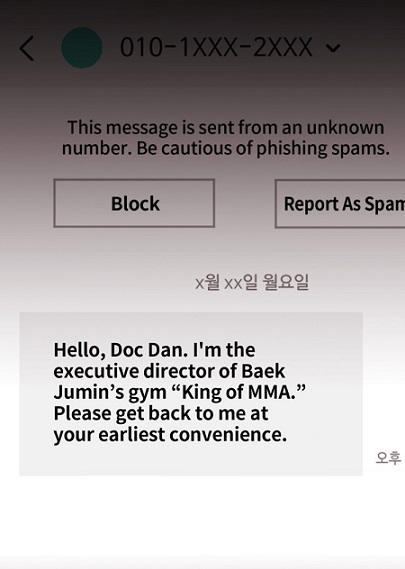 (chapter 47) Now, you are wondering why I decided to dedicate an essay about this scene. It is because the phone call and message raise a lot of questions. Why did the mysterious man call Kim Dan at such an early hour? Notice that it is in the morning, at 5. 15 am.
  (chapter 47)
  (chapter 47) The Spanish translator thought, the person calling Kim Dan was contacting him, after the doctor had met the oncologist. She imagined that not much time had passed. Yet, I believe, it is in the morning. First, it is important to place the day in the year. Since Joo Jaekyung’s birthday is on June 21st, and the next match is shortly after
 (chapter 47), I deduce that we are in July. However, the
  (chapter 47) It is in the morning. Moreover, the Webtoonist tipped off her avid readers with this panel:
  (chapter 47) In Korean, it is written MONDAY!! I had already detected a certain pattern. The protagonist would visit his grandmother on Sundays,
 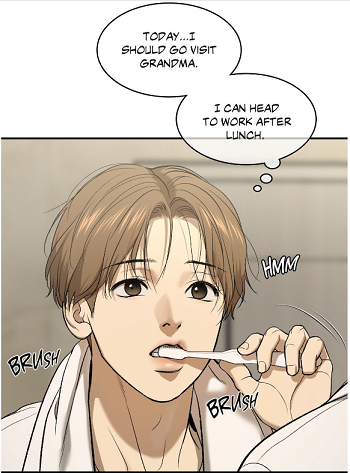 (chapter 30) as Saturdays are Kim Dan’s days. The morning in chapter 30 took place after the couple had spent their day-off together.
  (chapter 47), it was Saturday evening. Then the next day, he went to the hospital in order to get the results. After hearing the terrible news, he lost track of time. Hence he didn’t look at his cellphone contrary to episode 5.
 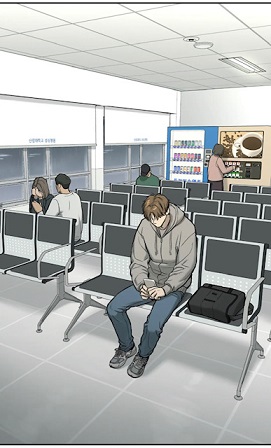 (chapter 5) On the other hand, I don’t think, he visited Shin Okja right after meeting Kim Miseon, for his grandma would have known that he had remained by her side the entire night. Nonetheless, her worries were about eating and not about lack of sleep.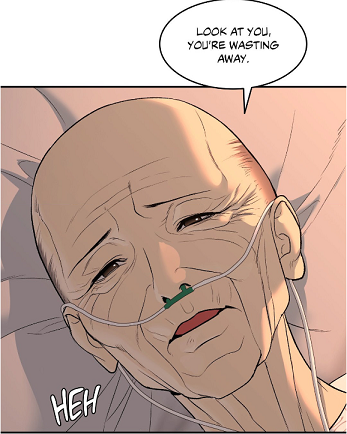
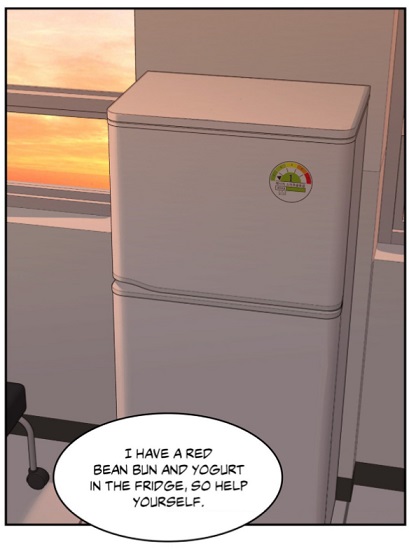 (chapter 47) Thus I come to the conclusion that he spent the whole night at the hospital like in episode 21:
 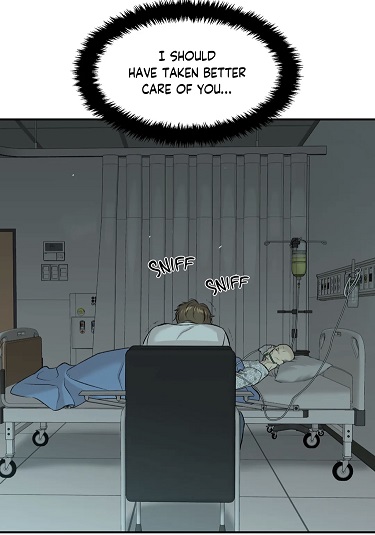 (chapter 21) This explains why the grandmother was not wearing her headgear. She was sleeping. But back then, Kim Dan returned to the penthouse at dawn.
 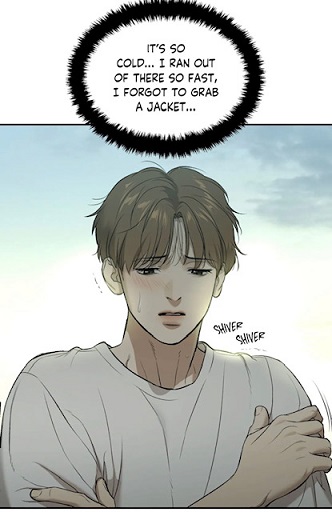 (chapter 21) Therefore the grandma didn’t notice that he had stayed by her side for quite some time, for she was asleep. Hence she requested his presence the next morning. Nonetheless, there exists another difference between chapter 47 and 21. In my eyes, Kim Dan entered her room during the night and spent some time in the bathroom.
  (chapter 47) He didn’t approach the bed the same way:
 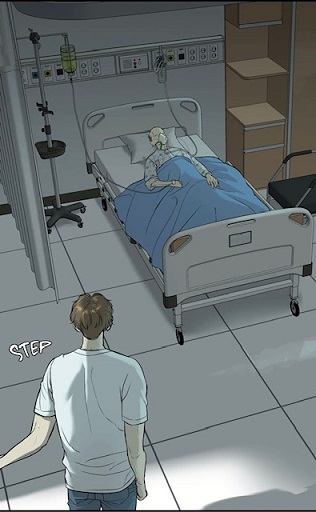 (chapter 21) However, I doubt that he spent just one hour in the restroom covering his tears by running the tap water.
 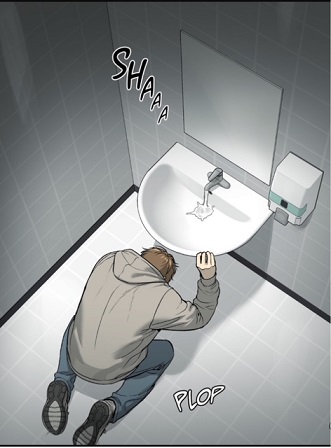 (chapter 47) I have the feeling that this scene is a reflection from their first night.
 (chapter 3) Here, he was also sitting on the floor pondering if he should still accept the deal. And what had happened back then? The protagonist was lost in the moment, he had no notion of time because of his fears and social norms. As a first conclusion, Kim Dan spent a lot of time in the bathroom reliving the moment when he was receiving the bad news. This interpretation displays how much his grandmother’s imminent death devastated him. He had spent the entire night crying:
  (chapter 47) Therefore he had red eyes. Furthermore, the halmoni’s name is Shin Okja, and Shin can signify “morning, dawn and daybreak”. For me, it is no coincidence. First, it was her moment to shine due to her compassion.
 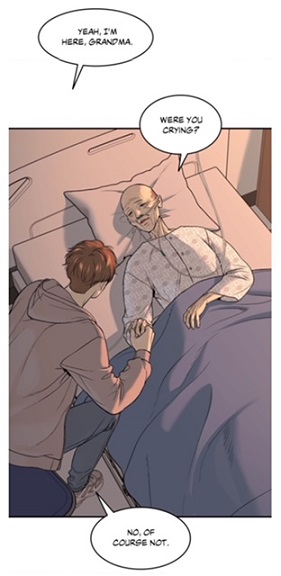 (chapter 47) In my eyes, this scene represents the positive reflection from that nightmare:
 (chapter 21) As a little boy, he had asked his grandmother to never leave his side, unaware that this meant that he should do the same. He should remain by her side too. Yet, he didn’t do it.
 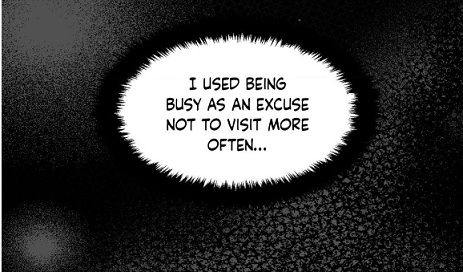 (chapter 47) This observation made me realize another aspect. When he heard the diagnosis from Kim Miseon for the first time, he admitted his powerlessness.
  (Chapter 47) Not only she had kept her promise, but also through this recollection, he got a notion of time again. We could say, he could feel time again. He sensed her true nature: her mortality. It is important, because of this new realization, he can move on and focus on the future in a long term. That’s the reason why I see this scene as a new leaf for both characters:
  (chapter 47) Shin Okja is no longer a goddess, a star during the night… but a human facing her mortality. Besides, the doctor focused too much on money, not realizing that goods are irrelevant in front of death.
  Yet, I can refute this point. How so? Note that the caller only let the phone ring 3 times:
  (chapter 47) Then he left a message. This stands in opposition to Joo Jaekyung’s action in episode 5:
  (chapter 35) So what does the divergence display? I would say, the lack of seriousness and integrity from the executive director. Shim Yoon-Seok wished to appear as a serious reporter, though he was intruding in the champion’s private life. Don’t forget that the latter messaged Joo Jaekyung during the night, but he didn’t call him:
  (chapter 35) He desired to give the impression that he was a hard-working journalist. On the other hand, because he just sent a message, it indicates that the reporter wished to hide, to remain anonymous. In other words, he was hiding his identity behind a name. How so? It is because the champion could not hear his voice at all. Joo Jaekyung can not recognize the journalist contrary to this scene:
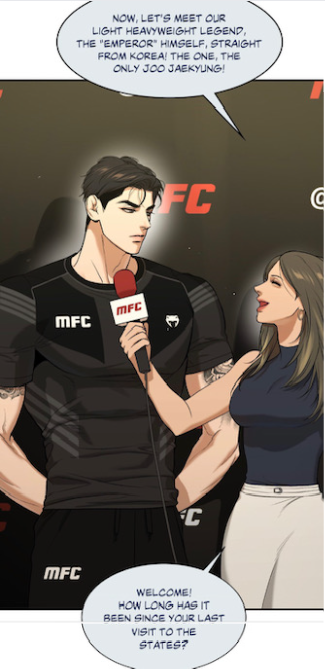 (chapter 36) This divergence reveals that the executive director has a different approach than the reporter. The former seeks to „get close to Kim Dan“, while the journalist desired to avoid the famous fighter’s wrath. Shim Yoon-Seok anticipated his reaction. Therefore I have the feeling that the mysterious man contacted the physical therapist so early to create the illusion that it was urgent. They needed him. Interesting is that when the champion received the message from Shim Yoon-Seok, he never questioned how the reporter got his contact.
 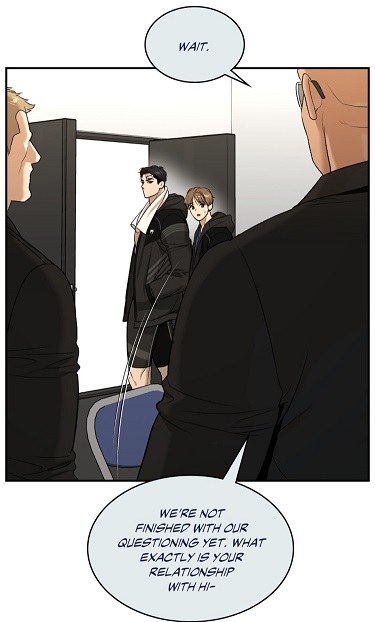 (chapter 40) A fighter, a prostitute, a lover or a physical therapist? Another difference between the two texts (35 and 47) is that
 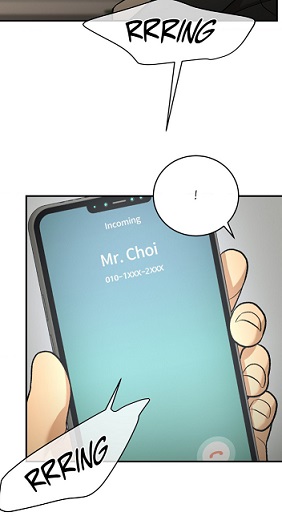 (chapter 46) And now, imagine the consequences, when Kim Dan or Joo Jaekyung reports the text as spam. Not only he doesn’t prevent the scammer from sending more texts to him, but it does let the authorities know as well that there’s a problem. Carriers might block the sender’s messages. Government bureaus might take action to prevent the scammer from messaging other cellphone users.
  (Chapter 46) And remember that Mr. Choi used this cellphone to contact his underling, a sign that their relationship was not official and should remain a secret. Hence if the line got cut, then Heo Manwook and Mr. Choi would be forced to meet. As you can imagine, the moment I discovered the connection between „carrier“ and „spam“, I couldn‘t help myself thinking that Mr. Choi might have received the CV from the courier company!!
 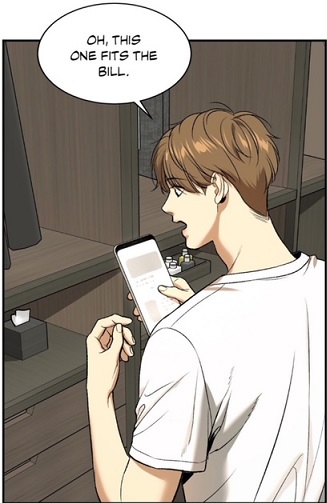 (Chapter 42) Yes, we have here a text on a cellphone too. Therefore I couldn‘t help myself laughing!! Why? It is because I believe that the schemers are thinking that Kim Dan is a member of Team Black, a fighter, and he is Joo Jaekyung‘s protégé. My reasoning is the following: since my hypothesis is that he got the doctor‘s curriculum vitae through the courier enterprise
 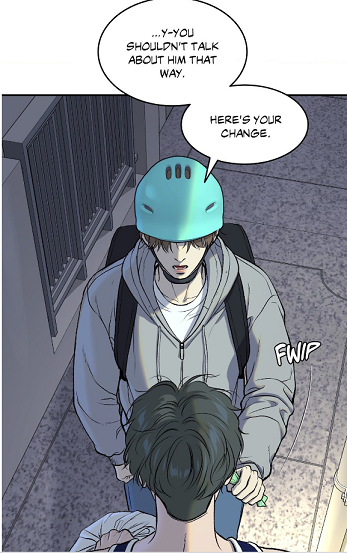 (Chapter 42) First, I thought that they knew that Kim Dan was probably his „sex partner“ as a fan, as he didn‘t object to this statement
  They are trying to snatch away the favorite athlete from Team Black in order to destabilize Joo Jaekyung mentally
 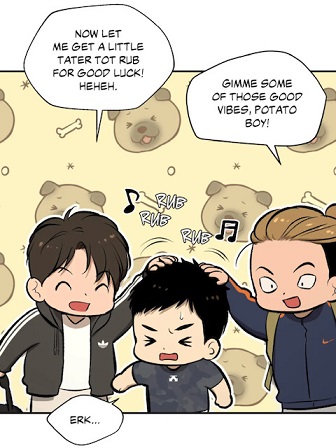 (chapter 23) So they could think, Kim Dan is not questioning the belief too, as he is a fighter. However, in the picture, Kim Dan looked depressed alone. So the picture was exposing his disillusion and Mr. Choi could misinterpret the origins of his disappointment: he was not able to achieve his dream.
  (Chapter 26) They could have jumped to the conclusion that Doc Dan was his stage name as a reference to his education and past, unaware that in reality it was indicating his true job. Thanks to @joojaedan, I got access to the original version.
  He is addressed as Kim Dan, and @joojaedan told me that he got addressed the same way than the fighter and Joo Jaekyung would call him. I have to admit that I let the app Deepl translate the Korean version. This is what I got:
 (Chapter 36) Moreover, this signifies that Baek Junmin is presented as the owner of the gym
  (chapter 47), as he is the face of that gym. In reality, he is just the cover, whereas the true owner is the mysterious sender of the text.
 (chapter 22). Yet, he is his negative reflection, as Mr. Choi is the real owner, but he hides behind the thug Baek Junmin. On the other hand, Park Manwook views himself as the owner of the gym, for he takes care of contracts and finances, but the one with the final saying is in truth Joo Jaekyung. To conclude, we have a similar situation between the two gyms: the owners are keeping a low profile, they stand in the shadow. However, there exists a difference between them. Joo Jaekyung is allowing his hyung to call himself the owner of the gym out of respect, whereas the other is doing in order to hide his criminal activities. I would even say, he is making sure that Baek Junmin would take the fall in case he would get into trouble.
 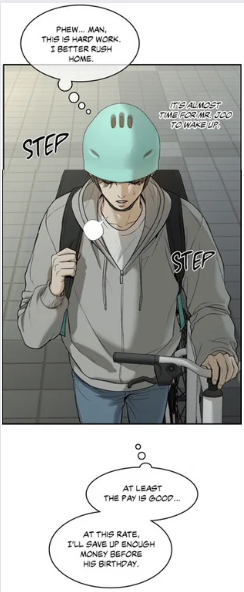 (chapter 42) He let it ring three times before texting him in order to catch the doctor’s attention, to distinguish himself from the previous calls (for his job). If so, then Mr. Choi must believe that Kim Dan is being “exploited” by the athlete. Hence the doctor would look so unhappy, when he is alone. In other words, the pictures taken in secrecy would expose the hypocrisy of the celebrity towards the main lead.
  (chapter 34) It was pure sex, yet the comedian didn‘t get fooled. Joo Jaekyung had feelings for him. Striking is that during that night, the doctor got fooled and this twice!!:
  (chapter 34) First, the star knew about the invitation from Choi Heesung. This even caught Kim Dan by surprise. This image exposes that the champion had violated the doctor’s privacy. So how did he know it? We have different possibilities, yet my idea is that he had seen the message!! Thus he replied with a text to Heesung. Besides, observe how he dissuaded the doctor from visiting the actor.
 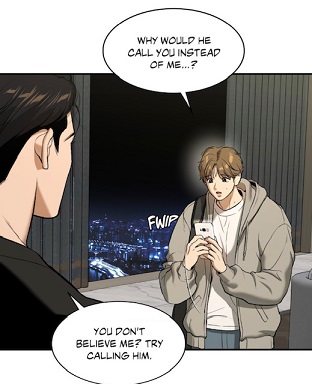 (Chapter 34) He should CALL him… a sign that the champion had not called anyone. Since Mingwa is writing like Byeonduck, I have the feeling that the message from Mr. Choi will be discovered by Joo Jaekyung. Remember how his hyungs had warned him
 (Chapter 46) But the moment the champion is confronted with such a message directly, this would be a wake-up call for Joo Jaekyung, he should treat his members much better, as the existence of his company is in jeopardy. Moreover, I am hoping that such a discovery will push Joo Jaekyung to play a trick on his enemy too, like for example he gives a task to Potato, act as a spy!!
 Kim Dan saw the calls, but he ignored them.
 It was another emergency call, for he needed to leave the place within a week. Interesting is that the person didn’t present himself. No name… As you already know, I am suspecting that the doctor got fooled, for I doubt he ever received any compensation for his move. He should have received money. Emergency, rejection, manipulation, interruption and spying (Heo Manwook interrogated the doctor right after)


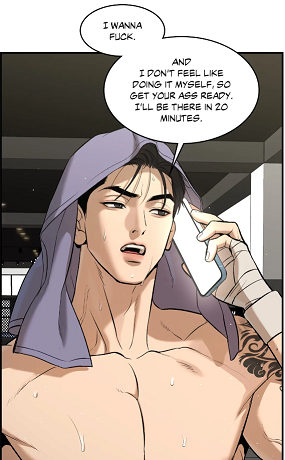
 Sex, interruption, „emergency“, as the champion didn‘t take off his shoes and put down his bag. Then during the intercourse, the doctor was called by the hospital
 Sex, interruption (food), secrecy, manipulation, ignorance and spying. Potato had tried to listen to their conversation.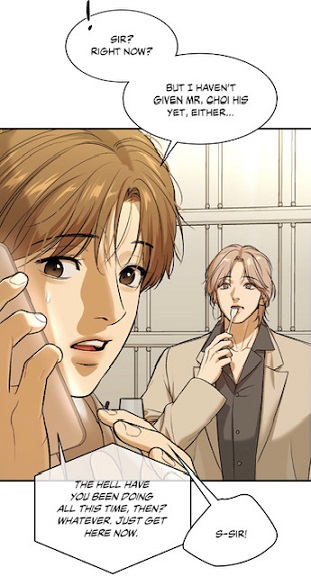
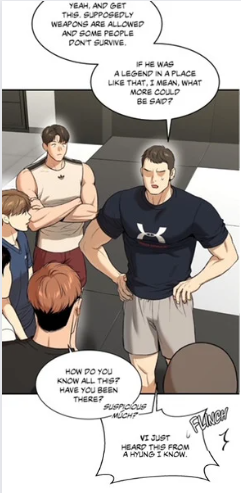 (Chapter 47) And how should he betray the athlete?
  (Chapter 40) He has no idea that Kim Dan became the victim and got framed later.
  (Chapter 46) Furthermore, since Heo Manwook was the one who hired this man
  (chapter 37) indicating that he used another channel than Mr. Choi‘s. Hence I am suspecting that Mr. Choi wasn‘t informed about the corruption of the MFC’s doctors.
  (Chapter 47) The MMA fighter could have been asked to fake an injury, similar to Heesung‘s plot. As for Kim Dan, his task would be to „target his shoulder, his weak point“. Another possibility is to expose his vulnerabilities. One thing is sure: their approach will fail, hence they will propose the deal to Seonho.
  (Chapter 47) And the latter has a reason to get revenge on the celebrity because the suffered humiliation and beating.
  (Chapter 46) What caught my attention is that this athlete definitely boosted his situation by advertising that he was the champion’s sparring partner. I doubt that the main lead‘s criticism was unfounded.
 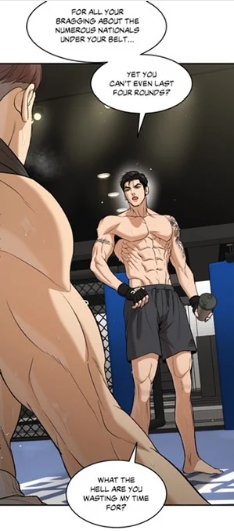 (Chapter 46) By the way, I believe, Seonho was a recent recruit. Therefore he doesn‘t know the champion that well and he is not close to the other fighters. Hence they didn‘t protect him
 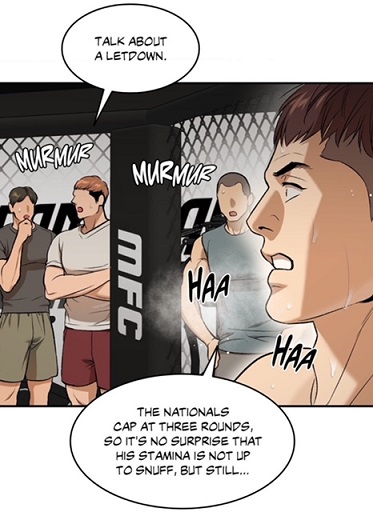 (Chapter 46) like in episode 1
 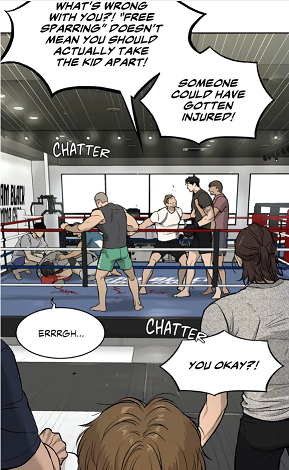 (chapter 1) He had no idea about the roughness during the sparring, though this scene exposes that the champion had toned down the brutality during the sparring.
 (Chapter 46)
  (chapter 42) On the other hand, since I am predicting a failure of their scheme, they could decide to take revenge on Seonho by sending him to an illegal fighting game, where he could get badly injured. Moreover, the moment they discover how weak the red-haired man is, they could jump to the impression that Seonho deceived them!!
 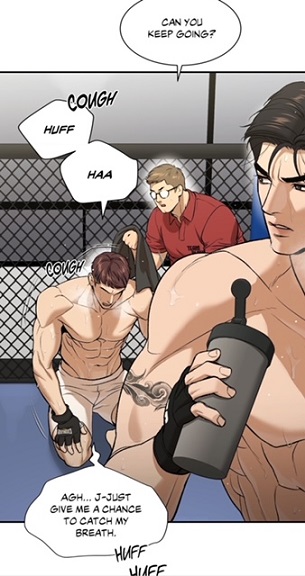 (Chapter 46) Don’t forget that the champion is the mirror of truth, while the doctor‘s role is to expose the hideous side from people: the goblin and the green fox!
 (chapter 46) I had even truly perceived his motivations:
 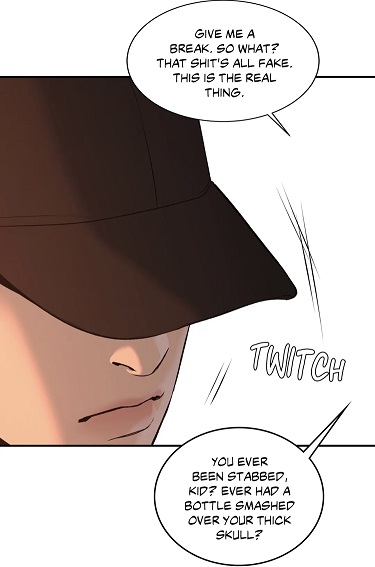 (chapter 17) Such fights are fake. The irony was that his perception got discredited once again. And now, we know why he thought like this. He is involved with the underground sports gamblers.
  (Chapter 46) His computer screen is indicating that Heo Manwook is gambling himself.
 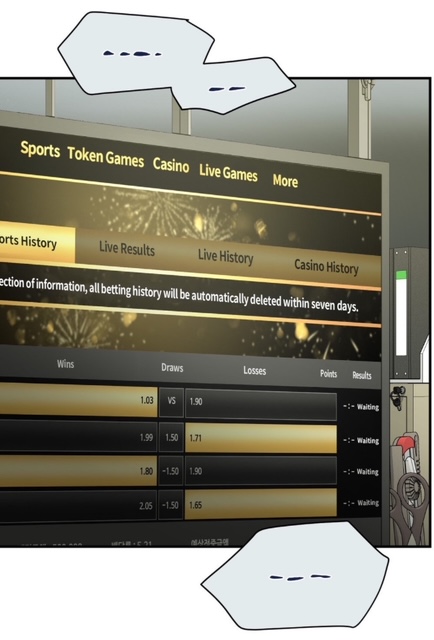 (Chapter 46)
 (chapter 17) To which account did the champion send the money? Heo Manwook’s or a different one? If this is the second case, this signifies that Heo Manwook has been embezzling money from Mr. Choi through the poor physical therapist. The latter was sending the money to his personal account.
  (chapter 16) This would explain why Heo Manwook would harass the main lead, though he had paid the interests on time.
  (chapter 1) Under this new light, it dawned on me why the moneylender interrogated Kim Dan later.
 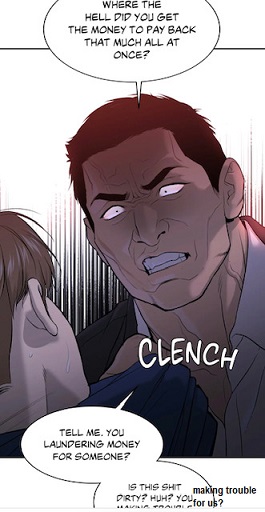 (chapter 11) It is because the doctor had paid a huge amount making it impossible for the loan shark to filch it. And now take a closer look at the infuriated thug: he employed the expression “laundering money”! He was projecting his own fears onto Kim Dan. For me, this scene exposes the true nature between Mr. Choi and Heo Manwook. He is laundering money for Mr. Choi. This explicates why their work relations is not official, as they are engaged in illegal activities. Thus their labor relations can not be known to others. On the other hand, if the champion paid the loan to the same account
 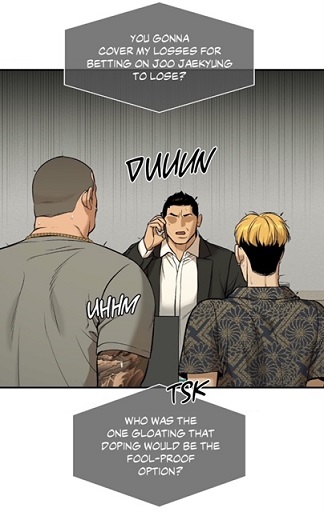 (chapter 46) He had to convince him to bet on Joo Jaekyung’s defeat. The thug could use the interference of the champion on his side business, as this secret “laundering money” could come to the surface. His actions prove us that his “respect” towards his boss is just superficial. He is prioritizing his own interests. Hence he could have definitely taken advantage of his own position to earn more money through side “hustles”.
  (Chapter 5)
  (chapter 1) Thus I come to the following conclusion: We are assisting to the gradual disintegration of their secret relationship. I am already envisaging that Heo Manwook could end up not only losing Mr. Choi’s favor, but also getting switched by this man.
  (Chapter 46) The sum reflects the faith he had in Heo Manwook. Yet, the conversation displays the increasing mistrust between them. Note that the usurer is not taking responsibility for the failure of his scheme: „on their end“.
 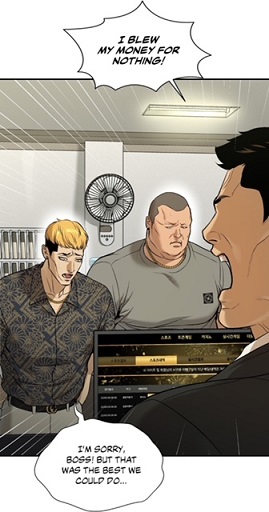 (chapter 46). Secondly, since Mr. Choi is now taking the matter into his own hands, this signifies that the criminal won’t be involved in the next scheme, so he won‘t gain anything.
 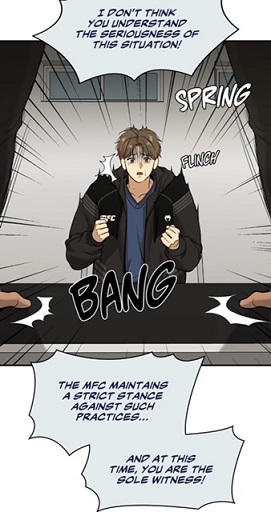 (chapter 40). How so? It is because Heo Manwook doesn’t explain how the plot failed!!
  (chapter 45) Their reason for not sharing their secrets is simple: they don’t want to expose their vulnerabilities, mistakes and problems. That’s the reason why their plots can only fail in the end. They didn’t possess all the information. Simultaneously, it displays their cowardice, for they are acting in the shadow, behind people’s back.
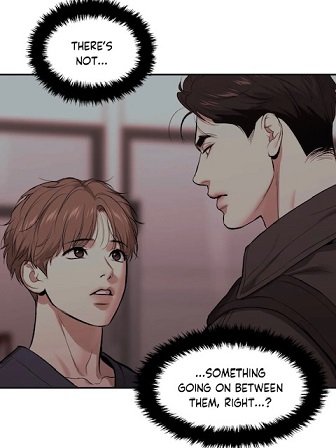 (chapter 23) Back then, he initially denied the existence of intimacy between them, until he was confronted with reality.
  (chapter 25) Hence he envied the doctor for his closeness with the celebrity.
 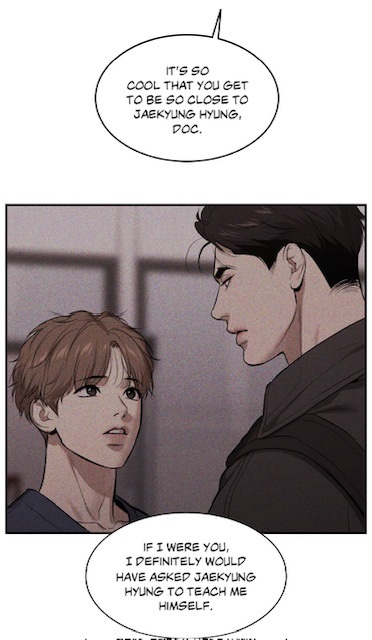 (chapter 25) Thus from my point of view, Mr. Choi must have come to a different perception than the maknae:
  (chapter 37) However, the man with the cap couldn’t determine Kim Dan’s true identity based on his uniform. Who was he exactly? A fighter? Or a coach? He could jump to the false conclusion that it is an uniform for the members of Team Black and not for the physical therapist. The unknown man could only recognize him by his face and hair. That’s how he got denunciated to the MFC security guys
  (chapter 40) Therefore you comprehend why the “fake” agents for order tried to determine his identity.
  (chapter 40) He only declared that he was part of his team. They had no idea who the person actually was. However, Joo Jaekyung didn’t realize that through his action, he was bringing attention to the company “TEAM BLACK”. That’s what the criminal saw on the uniform and the jacket! Thus I come to the following deduction: the hired man will report to Heo Manwook the existence of Team Black and its connection with Joo Jaekyung.
  (chapter 16) Thus there’s a high chance that they will try to ruin the champion by tarnishing his company. It is a hidden brothel. Imagine Park Manwook’s reaction, when he gets to hear that his gym is a whorehouse.
  (chapter 31) That’s how the actor’s reputation would get affected. As you can see, the actor and Mr. Choi share the same family name. So are they related or not?
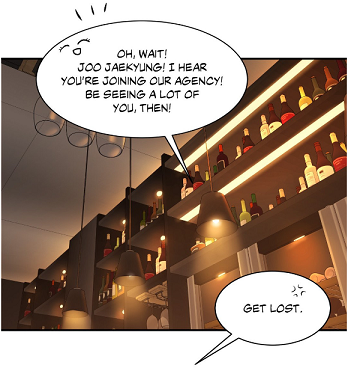 (chapter 33) He employed the personal pronoun “our” (even in the Korean version), a sign that he was identifying himself with the owner. From my point of view, Mr Choi and Choi Heesung are related, I would even say father and son. I know, when I presented my theory on X, people argued about this, for in South Korea, Choi is a common surname, just like Kim Miseon is not related to Kim Dan.
  (chapter 29) Note that the comedian is promoting himself with Heesung and not his surname.
  (chapter 30) It was, as if he didn’t want to be connected to this Mr. Choi. Moreover, contrary to the mysterious director, readers could see his face and identify his “job”: an actor!
 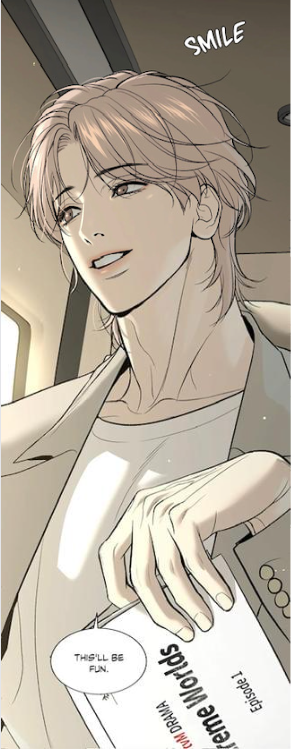 (chapter 29) Yes, the Webtoonist introduced the actor the opposite way. However, in this scene, Jinx-Philes were intrigued by him, as they had no way to determine his role in the story: antagonist or second lead? His personality was quite mysterious which stands in opposition to Mr. Choi. Readers can already judge him as a bad guy. The latter oozes ruthlessness, greed and dishonesty. His words are represented by the color “dark grey”.
  (chapter 31) The latter hates conventions, discipline and even control.
  (chapter 33) In addition, Grey embodies boredom, neutrality and compromise, while the actor is always trying to “take a side”, to earn people’s admiration. As you can see, through this contrast, it becomes obvious that these two characters are related. The darkness from the relative rubbed off on the actor, for he is able to scheme. Moreover, Mingwa still created some similarities: both faces were first covered.
  (chapter 29)
  (chapter 30). It was his way to get acceptance and recognition. From my point of view, he occupies a special position at the agency, as if his moves are supervised there. Hence he asked from his manager that the latter would keep the fake injury a secret.
 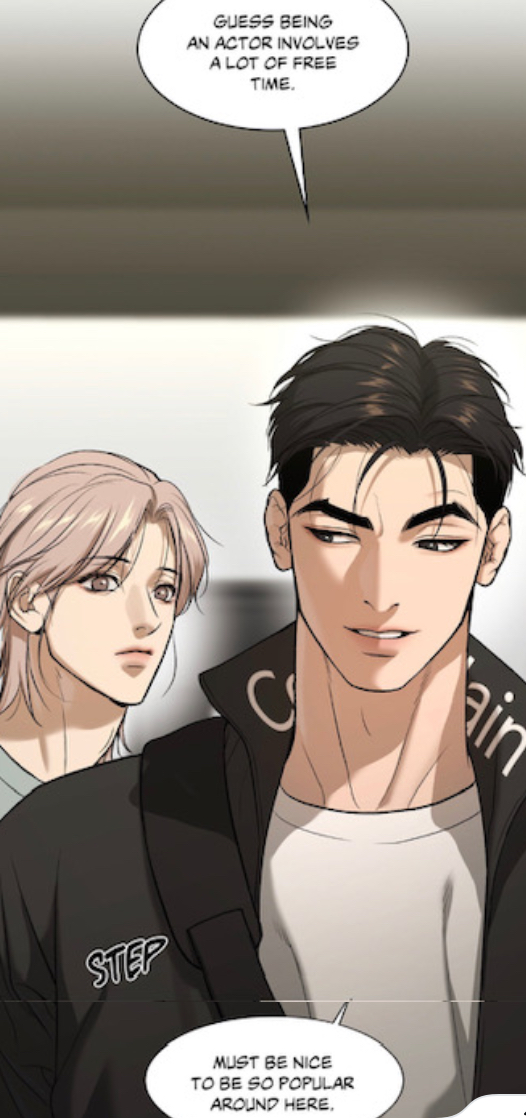 (Chapter 31) As you can see, I sense that Heesung had an ambivalent relationship with his „father“. On the one hand, he rejects him due to his cold-heartedness and high expectations, on the other hand, he was still relying on him and his connections through the agency. In my eyes, he will be forced to choose between love or money in the end.
  (chapter 33) My initial theory was that he had been stalked. But he could have left the family house after a huge quarrel. And Mr. Choi is indeed acting like a stalker, though he did not do it himself: the pictures!
  (chapter 32), until he chose to move out and live on his own. And now, we have the perfect explanation why his house is so clean and impersonal:
  (chapter 33) It is because his father probably meddled in his life constantly. I have the impression that he must know about his father’s past and the true origin of their wealth. The fact that he introduces himself as “Heesung” is a sign that he wants to deny his origins, Choi.
 (Chapter 33) He had been missing love and warmth too because of his family, exactly like the champion. Both came to a similar conclusion: fame served as a replacement. It was to get recognition and „affection“. The problem is that this type of attachment is rather superficial and temporary, as none of their „admirers“ or „fans“ has to become responsible for them. Moreover, their fortune played a huge role to undermine their relationship.
 The house stands for power and propriety. But Choi has another signification.
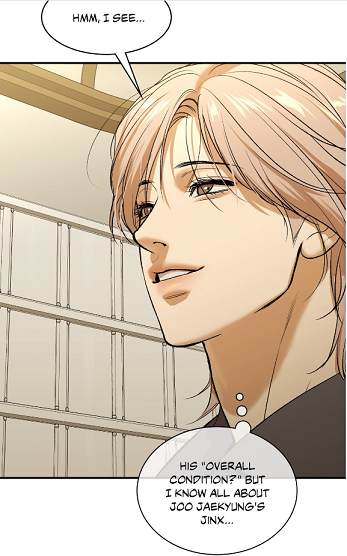 (Chapter 32) Note that when he was conversing with the celebrity at the bar, he never brought up his jinx.
 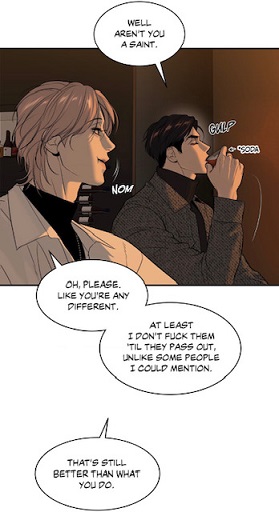 (Chapter 33) He only criticized Joo Jaekyung for his poor sexual behavior. So where did he hear it? Interesting is that 6 months ago, the champion signed a contract with the Entertainment agency, and this is what Park Namwook confessed to the physical therapist:
 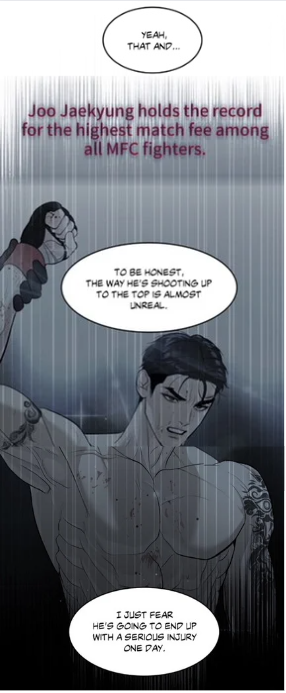 (Chapter 43) His success felt almost unreal, as it was too beautiful to be true. And this would coincide with the signature of the contract between the athlete and the Entertainment agency. The lucky streak is to cover up the illegal activities. He is already envisaging an injury, because he was convinced that this is the fate of such celebrities.
  (Chapter 43) However, if he pondered a little more, he would realize that it is a lie. How so? Coach Jeon Yosep is the evidence that not all athletes are destined to end their career because of an injury. Yosep is still a fighter.
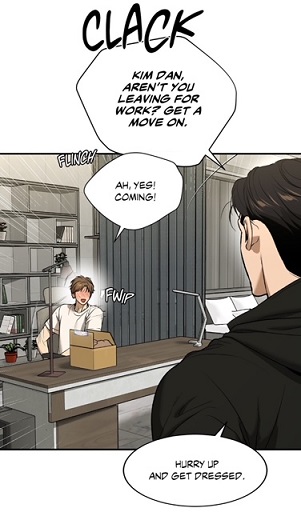 (chapter 43) The package arrived right on time.
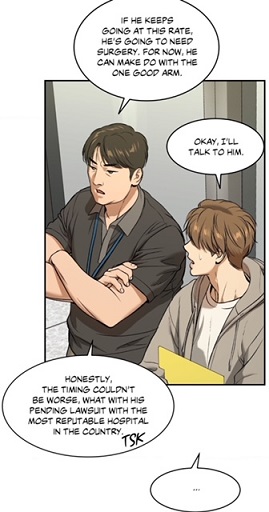 (chapter 42) That way, the agency would divert attention from its own responsibility and even receive support from the clinic. Then we have this rumor circulating that people are sending spies to gyms.
  (chapter 46) Is it a coincidence that this terrible gossip reached the blind manager Park Manwook at this moment? No, nothing is random in this story. They could frame the physical therapist as someone who tried to “leak” information in order to rig a game. He could be portrayed as a gambler. Yet, Mr Choi is not aware that Kim Dan offered a golden keychain to the champion and even risked his health to buy the expensive present.
 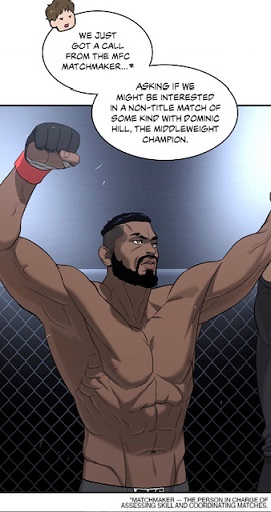 , (chapter 36), he must have wagered too and lost money. This would explain why he asked the doctor from MFC to give it a go right after. He needed to create a new game in order to cover up the last losses. The problem is that since Mr. Choi wasn’t informed about the incident with the security guys from MFC, I don’t think, he is truly aware of the celebrity’s physical conditions. If he knew about the real diagnosis, he wouldn’t need to investigate Kim Dan. He would rely on time… within such a short time, Joo Jaekyung wouldn’t be able to recover. In fact, he would even bet on the athlete’s defeat once again. Since he saw these pictures, I am quite certain that he is misjudging the relationship between the two protagonists. They are close, hence he needs to sow discord and even plant a seed of doubts on the athlete’s mind.
 (chapter 36) Hence I am suspecting that one of Mr. Choi’s intentions is to portray Kim Dan as a fraud, as a bad and immoral PT. They could even question his skills and competences, for MFC authorized the fight and the champion is now no longer treated by the famous hospital. They could imply that the main lead isolated the athlete on purpose and even aggravated his injury. But like mentioned above, Mr. Choi only knows half of the story. He has no idea about the connection between Cheolmin and the athlete and the former assisted him. Besides, he judges the poor uke based on his prejudices and past experiences. Exactly like the loan shark, Mr. Choi is also projecting his own thoughts onto the doctor. If the latter sent his CV, it signifies that the CEO imagines that Kim Dan is ready to “betray” the champion. Yet, the doctor doesn’t resent the main lead. In addition, from my point of view, the mysterious “general” received the résumé through connections.
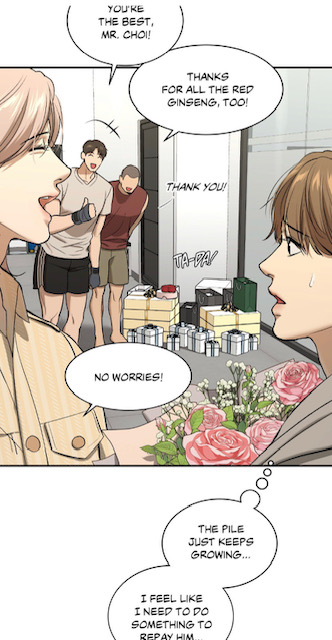 (Chapter 31) Yes, appearances would now play in Heesung‘s disfavor. Finally, an incident with the agency would push Heesung to fight against his relative… and to regain control over his life.


 (chapter 40) and the blood test
 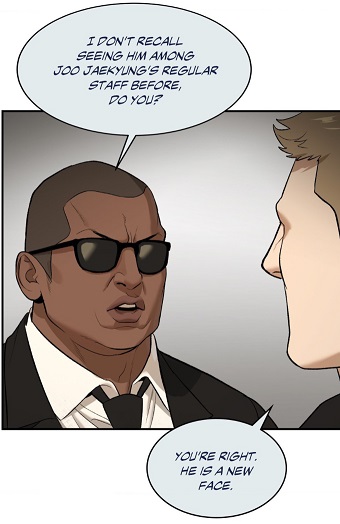 (chapter 40)
  (chapter 13) And by contrasting these two scenes, I realized that it reinforced my theories. 1. There must have been a phone call!! In episode 13, the champion must have called his chingu.
 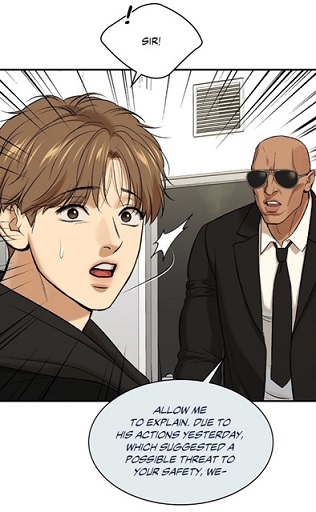 (chapter 40) However, the moment the guard with the sun glasses got caught, he tried to act as a savior. As you can see, this comparison reinforces my theory. The MFC manager must have asked the MFC security guys to cover up the incident. If not, they would be blamed for the matter!! And now, you comprehend why they had to know everything about Kim Dan.
  (chapter 40) They needed to find any excuse to put the blame on the protagonist. Either he had a strong reaction because of his medication or because of a different meal… but since Kim Dan never replied to them, they had to frighten him, to coerce him to confess a crime.
  (chapter 40) The intrusion of Joo Jaekyung in the office was caused by Park Namwook’s revelation. And it was the same, when the champion caught Heo Manwook with his minions.
  (chapter 17) And what is the common denominator between the perverted hospital director
  (chapter 16) Sexual harassment and the usage of the number to achieve their goal!! These two characters could hide their crimes with the assistance of other people (thugs, staff). We could say that both used an organization. Consequently, I am assuming that the MFC manager is doing the same!! Therefore it is no coincidence that Mingwa employed the same colors: blue, white and black
  . (chapter 1) That’s the reason why I am suspecting that the MFC guys must have already been informed that Kim Dan might be the champion’s sex partner.
  (chapter 40) Is he his partner or a member of his gym? Not only he is the face of Team Black
 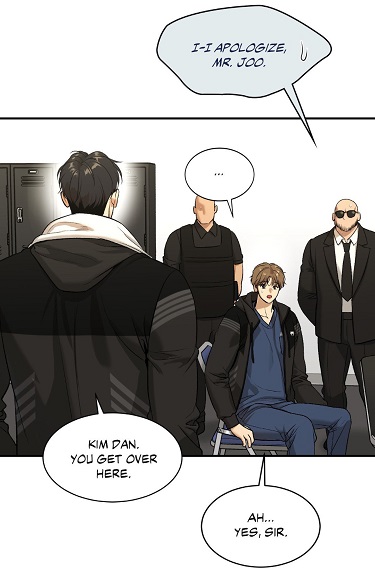 (chapter 40) Joo Jaekyung is behaving the opposite from the perverted hospital director, Heo Manwook and finally the MFC manager. Thus it dawned on me that the reporter from this article did the same.
 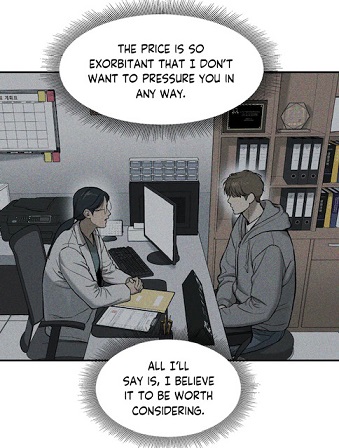 (chapter 5) As you can see, thanks to the glasses, I discovered a new pattern. These schemers and helping hands are avoiding any responsibility by hiding their wrongdoings behind an institution or we could say behind a name.
  (chapter 7) In the last case, it would be MFC!! But the reproach from the champion
 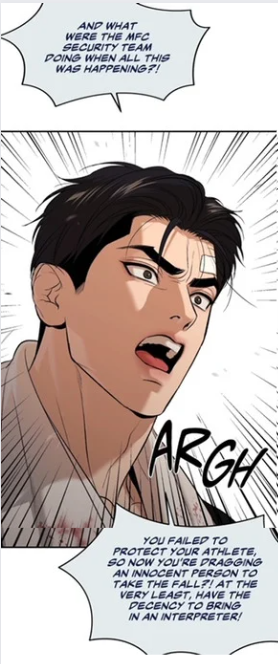 (chapter 40) should have opened their eyes! Not MFC would have been involved a scandal… but only the MFC security team!! As you can see, the moment they had been informed about the incident, they should have reported the MFC manager to the highers-up! They should have never protected such a person in the end, because the latter is the reason why the organization would be involved in a scandal. That’s the reason why such people are framing others. They know how an institution works. Under this new light, it becomes comprehensible why the plotters are trying to ruin the champion’s name!!
 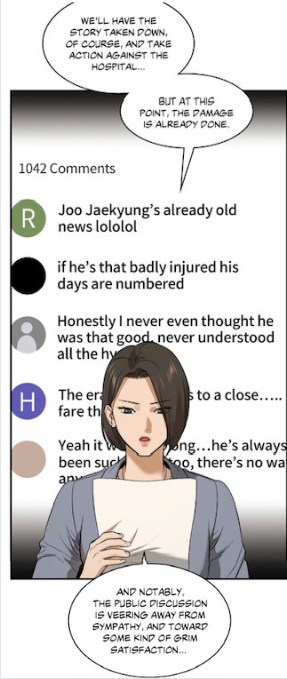 (chapter 36)
 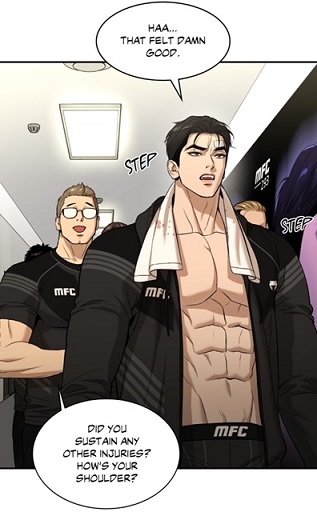 (chapter 40) Because their scheme failed, there is no doubt that they will target the physical therapist, for he is much weaker. He is “new” in the team and he comes from a low social background. He has a sick and old halmoni. However, Kim Dan has almost become their true mascot!!
 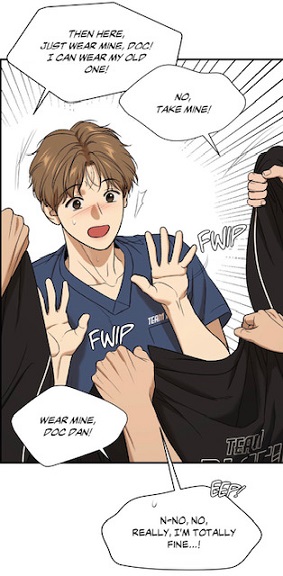 (chapter 36) Note that Oh Daehyun and Potato tried to investigate the matter with the doctor’s illness.
  (chapter 38)
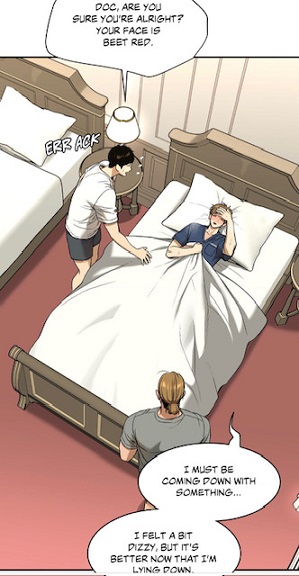 (chapter 38) Thus I deduce that because of Kim Dan, the members from Team Black will become more proactive. They need to show to these people that Joo Jaekyung is not alone, he is the alpha of a great gym… producing many champions!! In other words, the dragon with his yeouiju will be able to remove these Deceit’s webs and purify these institutions. As you can imagine, I am suspecting that Dr. Lee must have been blamed for the article
 (chapter 29) However, here the item has a different signification. How so? It is because Joo Jaekyung was totally honest and was opening up to the physical therapist.
  (chapter 29) It seems to contradict my previous interpretation about the glasses. But no… Observe that during that whole scene, the readers could see the champion’s eyes contrary to the MFC guys
 (chapter 37), Kim Miseon
  (chapter 13) and the perverted hospital director
 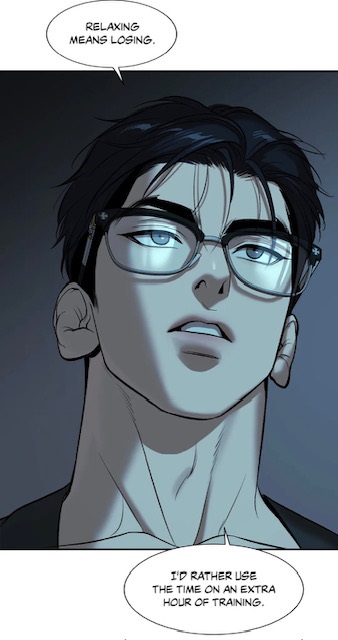 (chapter 29) Because he was wearing blue light blocking glasses, he was protected from “Agent Blue”, the positive version of episode 36 and 40!! This explicates why I consider them as a shield. He was trying to hide his vulnerability while confiding to Kim Dan.
  (chapter 35) Striking is that as soon as the actor removed them, he got honest with the doctor. He revealed his intentions, but he got rejected. As you can see, the glasses can have a positive function. Consequently, I came to develop a theory which was triggered by the glasses. Kim Dan envisioned the athlete in a suit
  (chapter 32), then he imagined him with the sun glasses
  (chapter 35) Thus I come to the conclusion, Kim Dan will be the one turning the athlete into a star, a real celebrity! But he won’t be reduced to his body and face
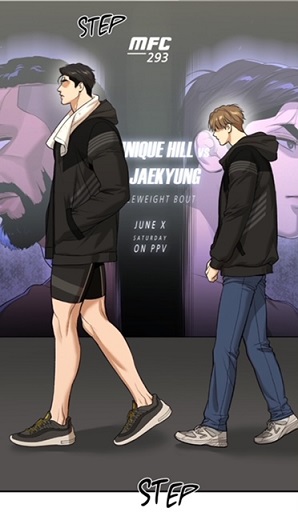 (chapter 40) So he could offer the sun glasses to his savior. If this prediction comes true, then it means that Kim Dan will become the rival of the manager from the agency. Besides, it was the manager’s job to develop a strategy how to change the netizens’ opinion. But he chose to put the whole responsibility on his athlete.
  (chapter 32) Finally, I have the feeling that Team Black will come to act like the security guys in episode 40, investigate the matter why the champion and the doctor became the targets of malicious rumors and bad articles.
  (chapter 31) and they are under his spell.


 (chapter 87) Not only the painter and the 3 noonas were sharing the same bed, but also they were taking their meals together.
 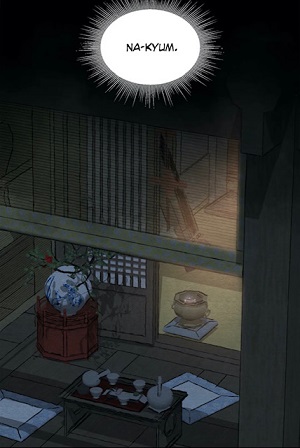 (chapter 87) They would even caress each other and laugh together. This scene oozes happiness. Consequently, it is no coincidence that during that night, they shared their honest thoughts to Baek Na-Kyum giving him good advices. But more importantly, the painter was there, when his noonas were struggling.
  (chapter 94) He cried in front of them. His tears symbolized his compassion and love for his noonas. He regarded them as his family. And it was the same for the artist. He had the noonas by his side, when he was in trouble or agony.
  (chapter 94)
 (chapter 107) However, at some point, it changed!
  (chapter 94) Jung In-Hun entered his life and consoled him. Thus I deduce that this image
  (chapter 68) represents a turning point in Baek Na-Kyum’s life. During that night, the scholar took away the young painter from Heena, hence he couldn’t help her. And now, observe the learned sir’s reaction. He didn’t allow the painter to cry. He shouldn’t share his pain.
  (chapter 70) In fact, he diverted Baek Na-Kyum’s attention from the incident to the moon. The learned sir was smiling the whole time.
  (chapter 70) He was acting, as if nothing had happened. The fact that he didn’t bear the tears from the painter exposes that the learned sir never considered him as a family. Therefore it is not surprising that he got abandoned, when the learned sir struggled:
  (chapter 75) But we have other scenes where Jung In-Hun didn’t behave like in the poem. When he discovered the truth, he had not been approached by Yoon Seungho due to his talent
  (chapter 19), he pushed away the painter.
  (chapter 19) He was mad, because Baek Na-Kyum was the cause for his sponsoring.
  (chapter 19) However, the family serves as pillar and protection. When the scholar’s pride got hurt, he rejected Baek Na-Kyum. He only approached the painter, when he needed him
  (chapter 10)
  (chapter 24)
 (chapter 35).
  (chapter 111) For me, in episode 10, he was definitely aware of the existence of a plot, thus he led the painter to the pavilion. Then in episode 24 and 35, he wanted the artist to spy on his benefactor. Finally, in episode 111, he knew that by taking away his former pupil, he would hurt Yoon Seungho, for he was aware of his affection for Baek Na-Kyum. Under this new light, it becomes comprehensible why Jung In-Hun didn’t bid farewell to the main lead in episode 44. Baek Na-Kyum’s presence was not necessary for the preparation for the civil service examination. And this brings me to the last scene between the learned sir and the painter.
  (chapter 118) He is now crying in front of him, as if he was considering him as a part of his family. He is trying to create the illusion that he shares his suffering, just like he shared his happiness during the parade.
  (chapter 111) But in the gibang, the learned sir changed his attitude towards his former pupil, for he kissed the painter.
  (chapter 117) It was, as if the former was starting his family. Baek Na-Kyum is now his “bride”. But naturally, everything is just an illusion. Why? It is because the Manhwaphiles never saw Jung In-Hun share his bed or room with the artist!
  (chapter 27)
 (chapter 38) He was also never seen taking his meals with him. This explicates why he never visited him, when the painter was sick. In fact, the learned sir is connected to the air and the courtyard. That’s the reason why he is always seen roaming around with Baek Na-Kyum (10: pavilion, 18-19-27-35-44: courtyard, countryside/city: 29-37-70 and
  ) But more importantly, he is not sharing his true thoughts and emotions to the young man.
  (chapter 118) He never explained how his face got bruised! This shows that he approached Na-Kyum for one reason. He was in trouble and he needed him. But he acted, as if he was becoming responsible for him.
  (chapter 118)
  (chapter 118) He didn’t expect a rejection. Why? It is because now, he was treating the main lead as family member. Nonetheless, don‘t get me wrong. In Joseon, servants were considered as a part of the household and as such of the „family“. I don‘t believe that the teacher views Baek Na-Kyum as an equal. Yet, the latter is in reality a free man.
  (chapter 118) Thus out of fear, he made a false love confession which resembles a lot to obsession and possessiveness. His words display his worries and despair. Another important aspect is the absence of the personal pronoun “we” in their conversation. We only have “you” and “me”.
  (chapter 118)
  (chapter 40), the latter learned the following lesson: Jung In-Hun had never been his new family. That’s the reason why he was so wounded. Therefore it is no coincidence that his karma is to be abandoned the moment he needs Baek Na-Kyum the most. But why did he not consider the painter as a family member? It is because he came from the gibang. Moreover, he was blinded by his desire to succeed on his own, not realizing the true role of a family.
 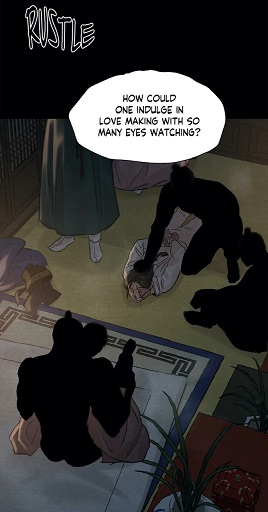 (chapter 86)
  (chapter 107) The sexual abuse is something they hid from Baek Na-Kyum! They could never share such a burden with the protagonist. But there is more to it. In fact, Byeonduck illustrated the slow deterioration of Na-Kyum’s s family in season 2, 3 and 4. First, the painter couldn’t talk to his noonas like in the past:
 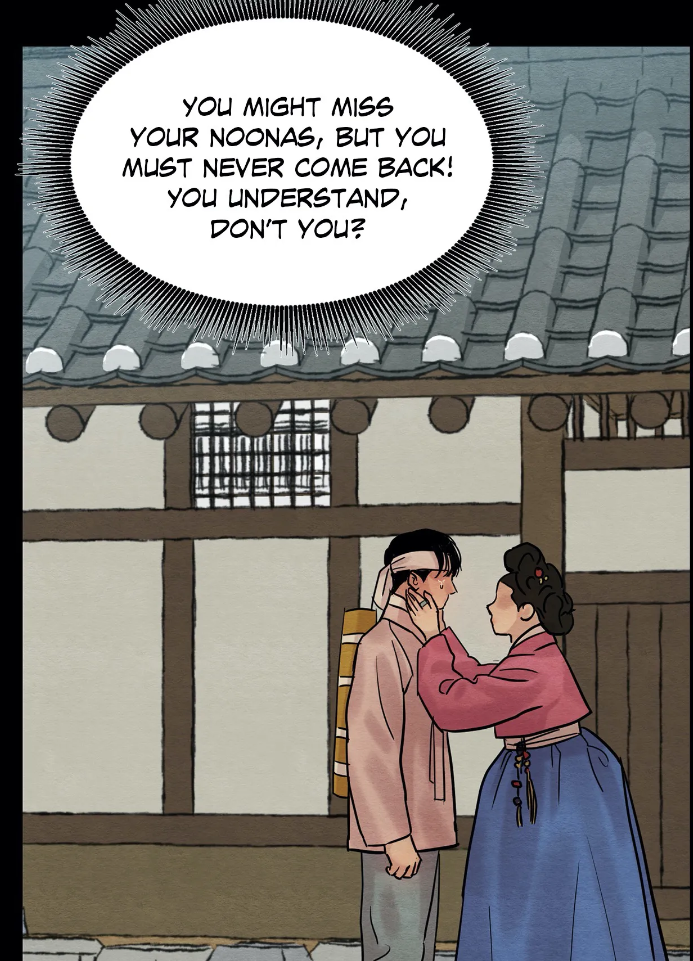 (chapter 46) He was forbidden to announce his departure which indicates that Heena was hiding something from the other kisaengs. Moreover, notice that he never talked back to Heena. He listened to her, though he was in pain.
 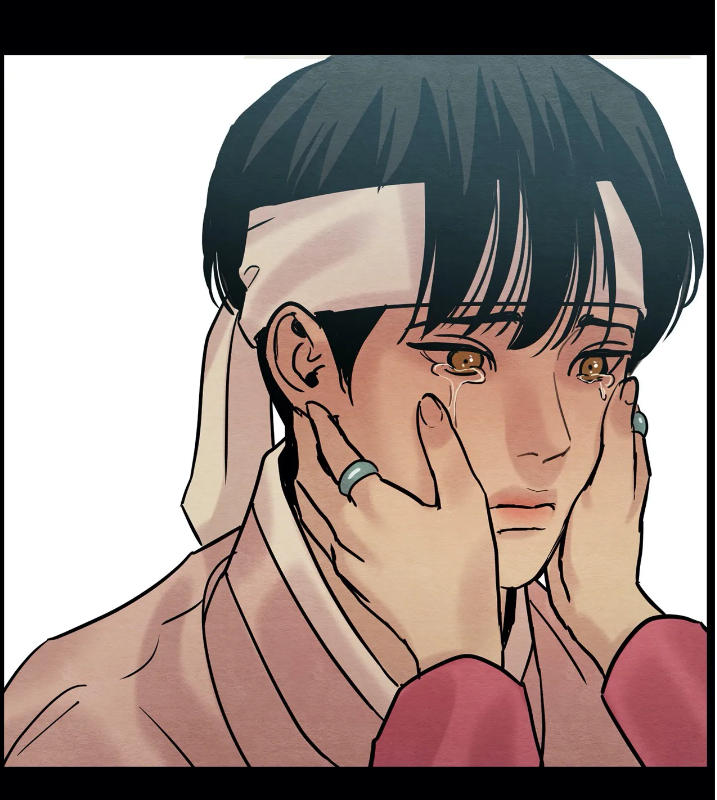 (chapter 46) He could only express his sadness with his tears. Then when Heena reentered his life, she was seen next to his bed while hugging. by his side
  (chapter 66) This means that she would no longer share his cover. This is no coincidence that in the gibang, the noona could no longer enter her brother’s room.
  (chapter 96) Little by little, Heena got excluded from the painter’s life. She could no longer share her meals with him.
  (chapter 93) This explicates why in season 4, Baek Na-Kyum can not penetrate Heena’s room.
  (chapter 105) She is hiding more and more things from her brother: her “illness”, her involvement in the murder of nobles and her lies. On the other hand, the painter still considered her as a part of his family because of her intervention in episode 68/69:
  (chapter 68) Their argument was reflecting their trust, though here the kisaeng was questioning her brother’s maturity. Due to her concerns, Baek Na-Kyum felt that they were still a family. However, I sense a rupture, when they argued in the kisaeng house. The artist was no longer trusting Heena’s words:
  (chapter 97) Interesting is that from that moment on, Baek Na-Kyum and Heena never faced each other! She didn’t join his side during the parade. This means that their argument in the kisaeng house represents their last reunion. And what did Heena do in this scene? She cried
  (chapter 97), while the painter didn’t, though he looked disturbed.
  (chapter 97) He lost all his colors. However, such a scene could be perceived as a sign of indifference, especially for the kisaeng. And this observation made me realize why the kisaeng asked Yoon Seungho not to reveal his suspicions about Jung In-Hun’s involvement to her brother.
  (chapter 105) Here, she implied that Baek Na-Kyum would cry out of pain and shock. But she had seen that he had shared no tears, when he heard about his murder: And it happened again in the shrine.
 (chapter 99) Simultaneously, the request from Heena exposes that they are no longer sharing agony and as such struggles. Moreover, this made me realize why the artist left the mansion after the nightmare. It was out of fear and obligation. For me, he had sensed that Heena liked the learned sir and as she was still part of his family, he had to make sure that this was not true. Yet, even after witnessing the faked crime scene, he still trusted Yoon Seungho. Hence I am deducing that the absence of tears is the trigger for their separation which stands in opposition to their embrace in the mansion:
  (chapter 66)
  . (chapter 68) And what was her reaction, when she saw her brother in tears and yelling at his lover?:
  (chapter 105) She remained silent, passive and rather indifferent. This impression gets reinforced, when she is lying next to her colleagues. She is not sharing her thoughts and emotions, rather pensive contrary to these kisaengs:
  (chapter 105) She is even turning her back to them. This displays the dissolution of this family. The kisaeng is no longer sharing her fears, her tears and emotions to others. Therefore she can not sense “happiness or relief” like the others.
  (chapter 93), but the moment the lord joined his side, the honesty started vanishing. Notice that the painter couldn’t talk about his past (how he met Yoon Seungho and how he got abandoned by Jung In-Hun). It was reduced to “I was caught up with something”. He had so many secrets that he couldn’t share to his noonas. And it was the same for the kisaengs.
 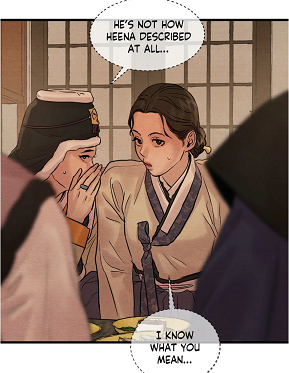 (chapter 93) They also had secrets, hence they were seen whispering. Baek Na-Kyum could confide less to Heena. Why? He sensed that the kisaengs might show no understanding. And note how the painter reacted, when he met his noonas in episode 105.
 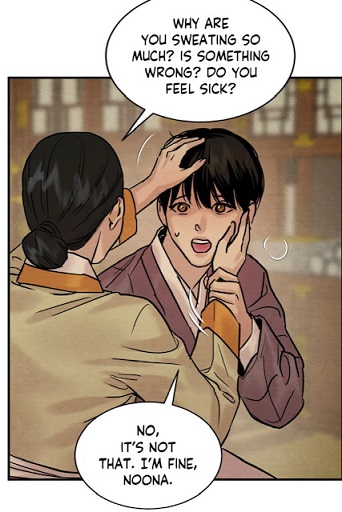 (chapter 105) He lied to his noona, he didn’t voice his worries. He didn’t enjoy his time spent by the kisaengs’ side. He didn’t eat with them either. This is the sign that he was moving on, he was on the verge of starting his new family. In other words, this scene
 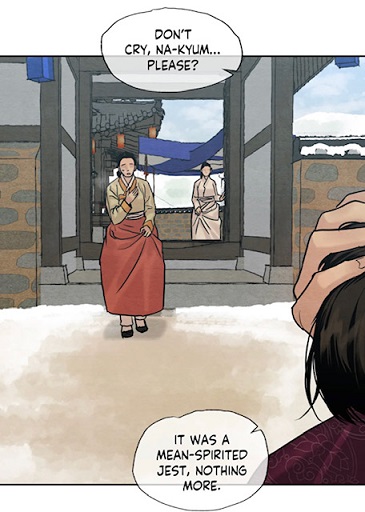 (chapter 105) corresponds to the bird flying from the nest which was witnessed by Heena and the kisaengs. Because the painter was not sincere to his noonas, it is not surprising that they acted the same way. Here,
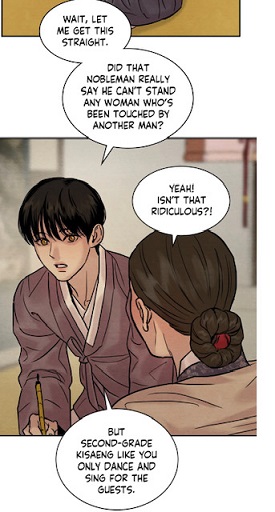 (chapter 105), the kisaeng’s words are a reference to loss of virginity. Yet the painter didn’t grasp the true meaning. Only in his dream and nightmare, he realized the significance of her words:
 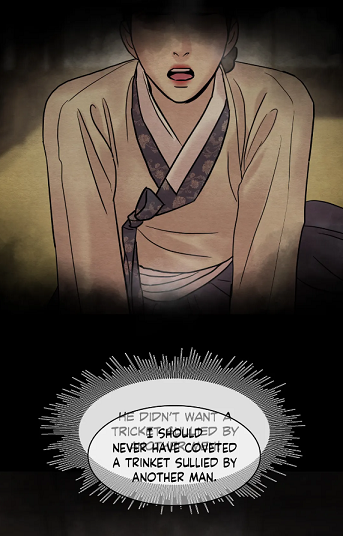 (chapter 109) Hence I come to the conclusion that we are witnessing to the birth of Baek Na-Kyum’s new family: Yoon Seungho.
  (chapter 118) That’s the reason why the painter decided to run away with his lover.
  (chapter 118) However, in order to become a real family, the painter needs to call his husband like this:
  (chapter 72) Under this new light, it becomes comprehensible why the noonas were no longer entirely honest with Baek Na-Kyum in the gibang. They couldn’t share their thoughts and secrets to the artist, as they had played a role in the separation of the couple
  (chapter 99) and the nobles’ execution. Besides, they also had secrets which they had to hide from their donsaeng.
 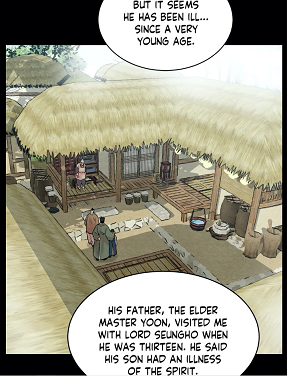 (chapter 57) I believe that it is related to the protagonist’s sensibility and intelligence. My assumption is that Yoon Seungho is a
  (chapter 85), his second son and even lord Song as his family
  (chapter 116) Hence they are sharing a drink, their secrets and emotions together, though it is obvious that the man in purple is deceiving the patriarch. However, the elder master still trusts and listens to his words.
  (chapter 107)
  (chapter 26) The latter was not allowed to cry! Therefore the artist heard the same reproach from the main lead.
 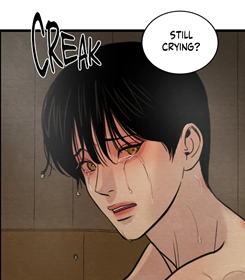 (chapter 26) The valet disliked the tears, because he refused to share the suffering. The reason is simple. If he did, this would have increased his guilt. Furthermore, Kim never shared the cover or his meals with Yoon Seungho in the past
  (chapter 83) and in the present. Here,
  (chapter 17) he even refused to bring him his breakfast. But one might argue that Kim cried in front of the protagonist in the shed, he even expressed regrets:
  (chapter 108) So we could assume that he was starting to view the main lead as a family member. But no… for me, it is just an illusion. First, note that he never let the lord see his gaze while weeping. Besides, the noble’s heart was not moved either. They were not crying together, a sign that the two were drifting apart. Moreover, in the shed, the valet never shared the information about the fire at the shrine.
  (chapter 108) The noble had to use threat and force in order to push the butler to voice his thoughts. Finally, at the end, the valet never vowed his loyalty to Yoon Seungho, but to Baek Na-Kyum.
  (chapter 108) Moreover, like exposed above, family in the poem symbolizes trust, love, responsibility, comfort and protection, but the valet failed to fulfil his duties which he admitted in the shed. As a conclusion, the butler didn’t keep such a promise. Moreover, what did the butler do after the painter’s abduction?
 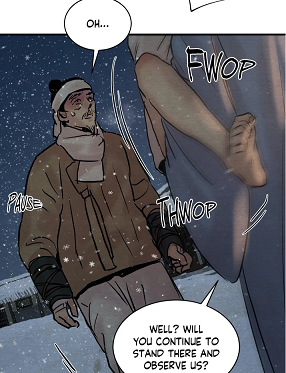 (chapter 64)
  (chapter 64) He ran away. He never saved the painter, just like he didn’t argue with his master in that moment. But he could have, since the latter had no sword by his side. Imagine that he had a heated discussion with Yoon Seungho the very next day, and in the courtyard, the protagonist had the sword in the hand.
  (chapter 68) A sign that he knew that the noble would never slay him! And in the past, the valet had not come to his rescue, shared his suffering or defended his honor. And now, you comprehend why I am more than ever convinced that the valet was never Yoon Seungho’s family: no tear, no joy or no secret shared! His expression “bird of misfortune” embodies the gap between the two characters.
  (chapter 109) The latter would even get the opportunity to eat sweets and sit in the patio
 (chapter 109), while the lord was relegated to the courtyard.
 (chapter 109) And the poem mirrors perfectly the birth of Yoon Seungho’s first family. Baek Na-Kyum is his very first family. Thus he could share his pain, his fears, his resent,
  (chapter 62) and his hope to be happy for one moment:
  (chapter 63) I selected the terrible scene in the shed for two reasons. It symbolizes the verse “how to become a family”. This explicates why in season 3, the artist was slowly using the personal pronoun “we”.
  (chapter 78) This means that the two protagonists were learning how to become a true family. And one of this important step was “crying together” which occurred after the sexual abuse in the shrine,
  (chapter 102) However, Yoon Seungho had to learn the importance of “secrecy”! He kept his crime from his loved one hidden, not understanding that a real family is to “endure all hardships” together. Consequently, I judge this night
  as the finalization of their “Wedding”, though it is still not official. During this night, we have all the criteria. They share their worries
 (chapter 110), their happiness
  (chapter 110), they sit together while eating
 (chapter 110), they embrace each other, they share the same bed. And the lord makes the following promise: there won’t be any secret between them. He will share everything with his lover.
  (chapter 110) So when the brother gave the petition to the artist
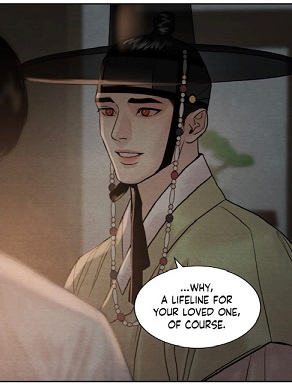 (chapter 116), he even reinforced their bond. It was, as if they had no longer any secret between them. Thus they talked about the document in the pavilion making sure that no one would listen to their discussion.
  (chapter 117) Therefore, it is not surprising that during that same night, the couple slept under the same blanket while hugging each other.
 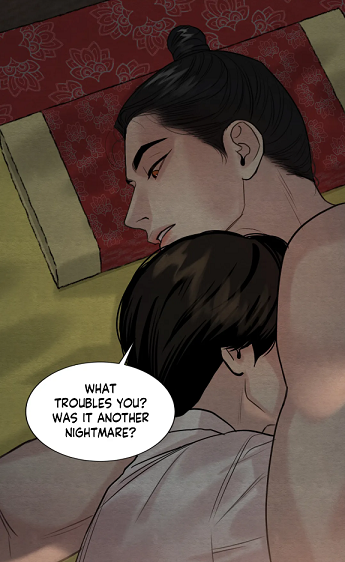 (chapter 117) The symbol for the new family! But a family is not made just of two members! Is Yoon Seungwon a part of Yoon Seungho’s family? Let’s not forget that he considered the artist as his brother’s wife.
  (chapter 116) What caught my attention is that Yoon Seungho was not followed by his lover, when he met his brother in the gibang.
  (chapter 118) And this reminded me of this scene:
  (chapter 37) He wished to send away the artist, but the host refused. Then if you pay attention to his behavior, you will notice that none of them were seen eating together!
  (chapter 118) Compare it to Black Heart’s behavior:
 (chapter 43) In fact, the two guests were drinking on their own! Yoon Seungwon had even started drinking before the protagonist’s arrival.
  (chapter 118) Moreover, exactly like the scholar, Yoon Seungwon is just employing the pronouns “you”, “I” and “father”. There is no WE at all.
 (chapter 118) Moreover, he doesn’t want to share the pain and suffering with his father. And while he shared a secret with Yoon Seungho in the past,
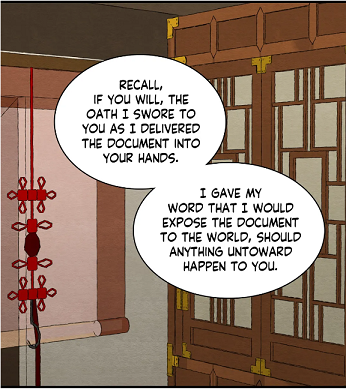 (chapter 118), I believe that he is hiding something from his brother again. Thus we see constantly him with a drop of sweat.
 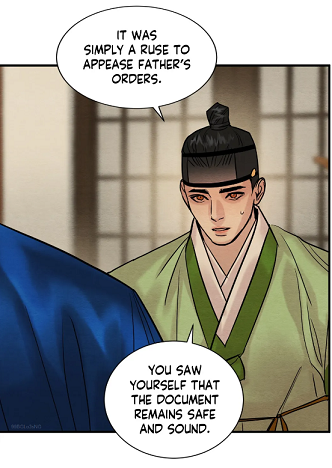 (chapter 118)
  (chapter 118) Striking is that he is at no moment mentioning the painter, which actually represents the lord’s source of comfort and joy! He is more talking about the past than the present. He is hoping for a change of heart. That’s the reason why I come to the conclusion that Yoon Seungwon called the main lead as brother
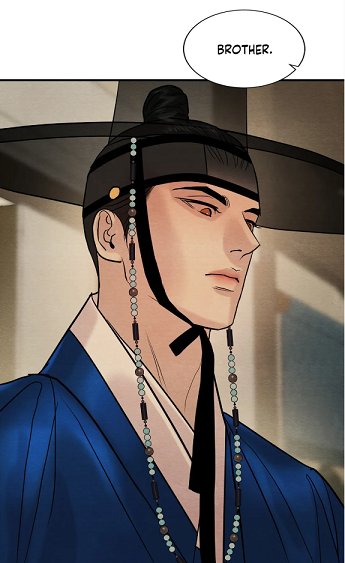 (chapter 118), but it is only a name! In reality, he desires to use the main lead. He needs him more than ever! Let’s not forget that the patriarch could discover Yoon Seungwon’s betrayal at any moment. Finally, I would like to outline that family stands for effort and understanding, nevertheless the younger master never showed compassion or worries for his brother, who had just recovered from a stabbing. His speech was full of blame.
  (chapter 22), the physical therapist still views her as his family. This corresponds to the verse “no matter where you are”. This explains why he listened to her and started treating the champion differently. From my point of view, they became a family, because they slept under the same cover
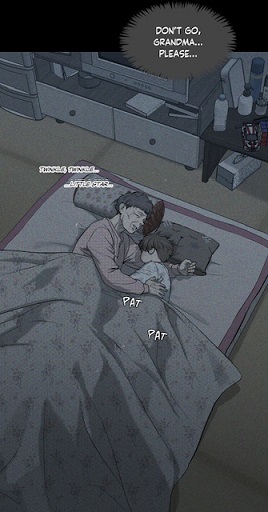 (chapter 21), shared their agony, fears
 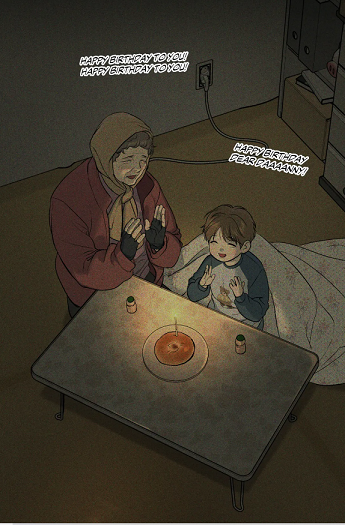 (chapter 11). I will give more details later. Another evidence that they are family is that the grandmother would often sing him songs. Then we could say that the grandmother shares her meals with the doctor, for she is often saving yoghurts for her grandson.
  (chapter 05) She is happy, when she hears good news from her grandson.
 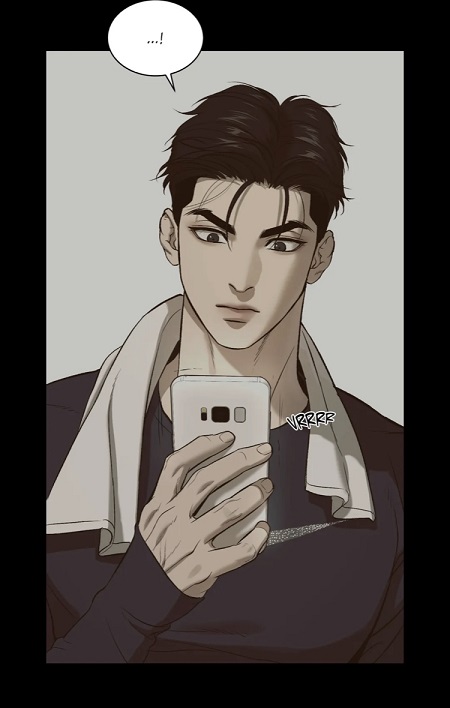 (chapter 21)
  (chapter 5) Nevertheless, there exist two negative aspects. First, I noticed that she didn’t question Kim Dan about his career, only when it was necessary.
 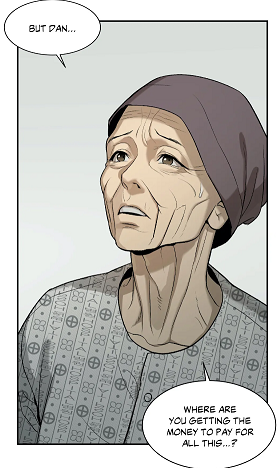 (chapter 07) She is not that involved in his current life.
  (chapter 05) Secondly, what caught my attention is that the halmoni is not letting her grandson weep. With her attitude, she implied that he had overreacted (“Now, now none of that”).
  (chapter 21) Moreover, the poem outlined the necessity of crying together (“be able to cry together”), yet the halmoni was not upset, when she found the little Dan in tears. She didn’t understand his abandonment issues. Thus I deduce that the shared agony was only in one way! If the grandmother was scared or suffering, her grandson should feel the same.
  (chapter 5) This explicates why Kim Dan was willing to sacrifice himself for his halmoni.
 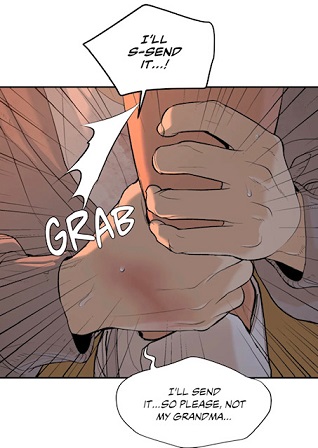 (chapter 16) It is because he knew that her grandmother disliked tears. Besides, in a previous essay, I had already outlined that such an attitude was considered as abusive, for such a young child should have been shielded from harm. However, he was exposed to violence very early on. Under this new perspective, it becomes comprehensible why Kim Dan started having secrets from her. Finally, the family portrayed in the poem implied the notion of effort and work. But the moment the grandmother refused to share his agony, she stopped putting energy in her relationship with Kim Dan. This means that as time passed on, she became more and more passive and relied more and more on the main lead. Another interesting aspect is that Kim Dan came to enjoy K-dramas because of his grandmother.
 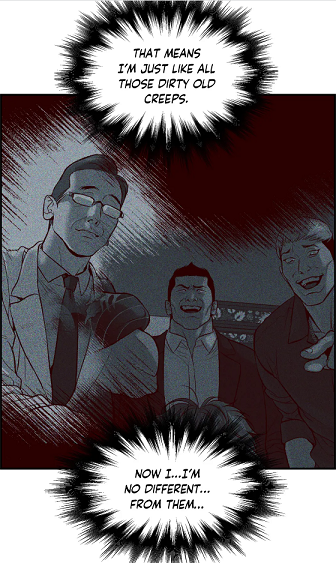 (chapter 20)
  (chapter 30) Because the grandmother didn’t allow her grandson to share his struggles (no tears), Kim Dan has been hiding many things from his grandmother
 (chapter 07): the beatings from Heo Manwook, his firing from the hospital, the sexual assault from the perverted hospital director and the moneylender, his deal with Joo Jaekyung and the fact that he moved to the penthouse. This means that little by little, the physical therapist is sharing less and less his happiness with her. I doubt that he told her about his trip to Busan, his first MMA fight as spectator
 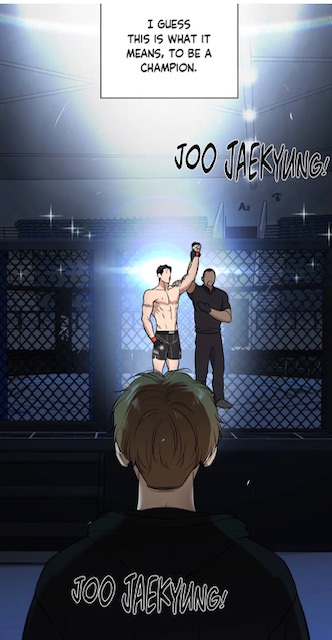 (chapter 15) and his first sparring with Joo Jaekyung
  (chapter 26). But this is a sign that Kim Dan is maturing. Therefore it is no coincidence that after their first day off spent together, Kim Dan is already under the champion’s spell.
 (chapter 30) And at some point, the grandma will notice her little boy’s transformation and the growing distance. And Choi Heesung could be the trigger for a first quarrel
  (chapter 22)
  (chapter 26), they get support from each other
  (chapter 14)
 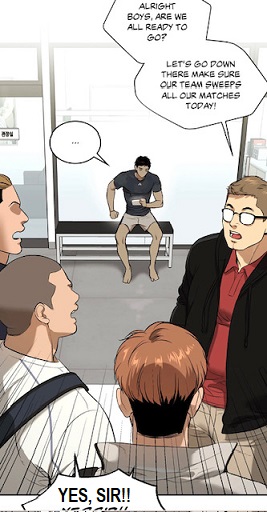 (chapter 23) or they argue
  (chapter 23) which is another evidence that Team Black functions more like a family than like a company. What caught my attention is that the doctor is not addressed as hyung
  (chapter 30) but as Doc Dan or doc.
 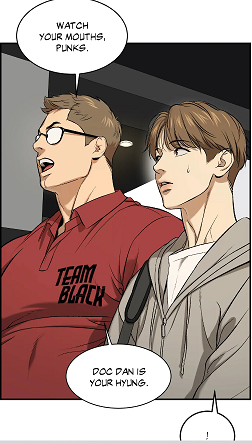 (chapter 07) The reason behind this different title is the champion. The latter addressed him like that:
  (chapter 22) It exposes that the physical therapist occupies a particular position at the gym. On the one hand, it could be interpreted that he has not been entirely adopted as a family member. On the other hand, the physical therapist didn’t exclude that he could have other clients.
  (chapter 25) This means that his “adoption” is not definitive and official. Nevertheless, I would like to outline that though Team Black’s structure resembles a lot to a family, we can not say that it is a true family. Why? It is because Joo Jaekyung is hiding many things from his hyungs and members. He is not sharing his problems to his coach (his insomnia, his jinx, his sexual orientation, his insecurities eg). Imagine that he preferred deceiving his admirer
  (chapter 15) than admitting that his shoulder had been plaguing him. And it is the same for Potato. He didn’t talk about the incident with the office room and the sofa.
  (chapter 11), because he considered them as superior and colleagues. In other words, the fighters will share their pain with doc Dan helping him to overcome the loss. But this change can only happen, when the owner of Team Black has a change of heart himself as well. Remember how he pushed Oh Daehung and the other members away.
  (chapter 22) He didn’t want them to come to his house.
 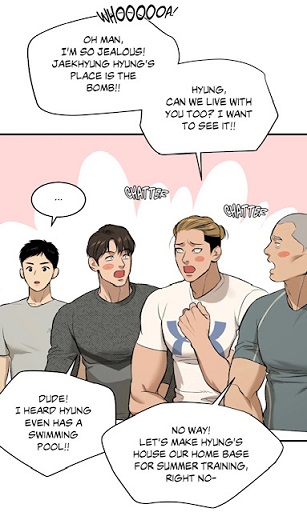 (chapter 22) So far, he didn’t want people to cross the line, but thanks to the physical therapist, this will change. That’s how both protagonists will come to view more and more Team Black as a family. They will share their struggles and happy moments together. I have one evidence that Kim Dan is the key to turn Team Black into a real family. It is because Joo Jaekyung came to the gathering
 (chapter 9), though he had been avoiding such events in the past.
 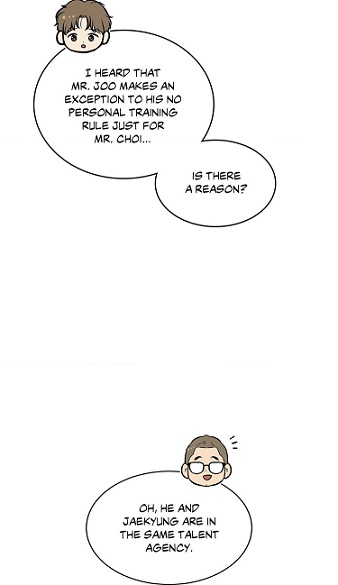 (chapter 30) But he is there an employee. Thus I am suspecting that the talent agency is working differently from Team Black. If there is a scandal, I doubt that the company would side with the star in trouble or they would try to find ways to get rid of the issue, like finding a scapegoat in order to bury the truth. As a conclusion, I am expecting to see companies run differently so that the readers can perceive Team Black as a family company, although it is an incorporation.
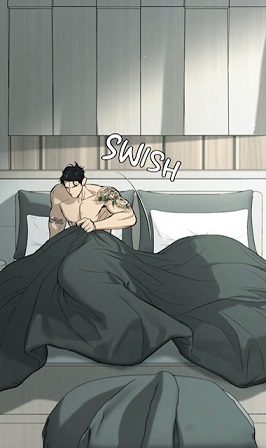 (chapter 4) This was a reference to the blanket in the poem, though here Kim Dan slept in a cocoon. This was a sign that he didn’t feel safe. However, as time passed on, I detected a change in Kim Dan’s sleeping position. He is lying on his back and even in the middle of the bed.
  (chapter 29) It is because Joo Jaekyung always put him there! This exposes that the champion is still thinking that he represents a disturbance to the Sleeping beauty. One thing is sure: Joo Jaekyung will become the blanket taking over the grandmother’s past role:
  (chapter 1) He questioned the cause for the tears. He was naturally annoyed (“the hell”), but he didn’t make fun of the doctor. And now, pay attention to the memory Joo Jaekyung had from their first night. He remembered his tears which had moved him deeply:
 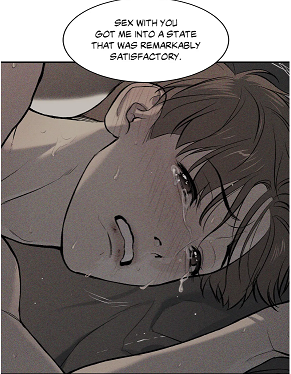 (chapter 6) This shows that the celebrity is not judging the physical therapist as weak due to his tears. In episode 28, he even showed concerns, when he heard the doctor crying.
  (chapter 28)
  (chapter 28) He questioned the doctor once again, why he was in tears. However, he didn’t ask the doctor to stop weeping or to wipe his tears. He wanted to understand him. This exposes the fighter’s tolerance and interest in Kim Dan. For me, it reveals that Joo Jaekyung is willing to share the pain or fears with Kim Dan. Therefore it is not surprising that Kim Dan is remembering this moment!
 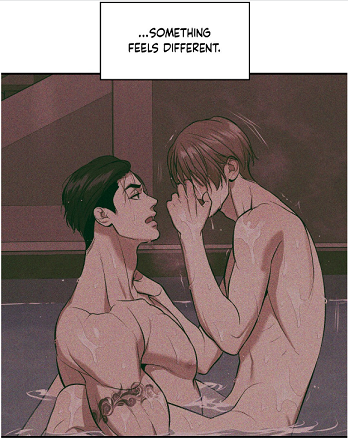 (chapter 30) He was allowed to express his emotions. Interesting is that this image is now connected to red, not to grey/black.
  (chapter 30) The switch of color indicates the doctor’s increasing feelings and sensuality for Joo Jaekyung. That’s the reason why I am expecting that one day, the two protagonists will cry together, something that the grandma hasn’t done until now.
 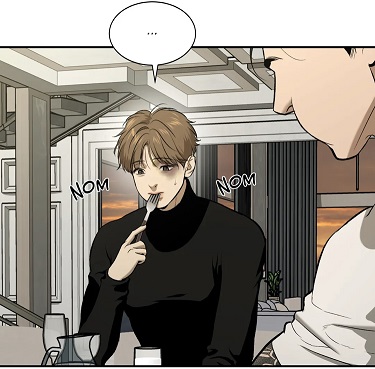 (chapter 13), it doesn’t signify that they are a family now. And it is the same for the penthouse.
 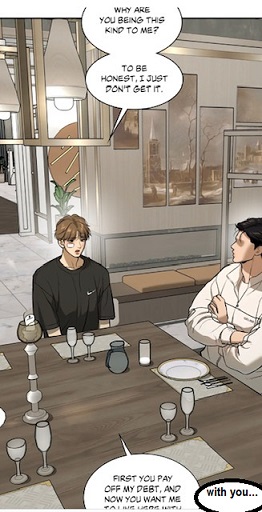 (chapter 18) They might share the same flat, but the penthouse is so huge that they can technically live apart. Joo Jaekyung and Kim Dan are slowly spending more and more time together, either because the champion feels like it
  . (chapter 27) During the day off, they shared their thoughts,, their emotions
  (chapter 27)
  (chapter 27), their happiness
 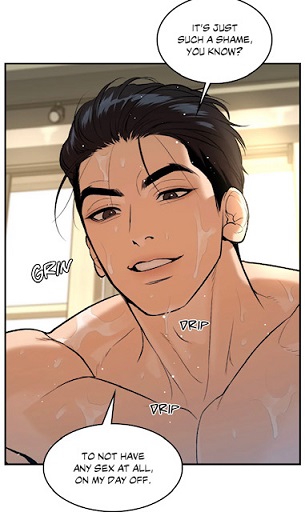 (chapter 28) and their fears
 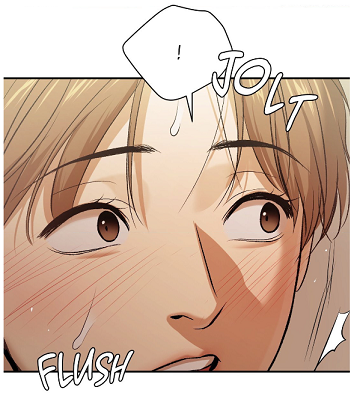 (chapter 30) And it is the same for the champion. Now, he is slowly regretting that they live in two different rooms and they have their own bathroom. Therefore he came to the doctor’s bathroom under the fake excuse that he had run out of toothpaste.
 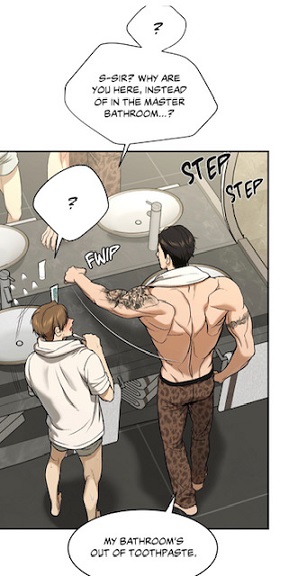 (chapter 30) What was so funny is that he had opened the door like a huge bear. Why? It is because he was so annoyed how to explain his intrusion.
  (chapter 30) This shows that little by little, the champion is regretting his words to Kim Dan in the master’s room.
 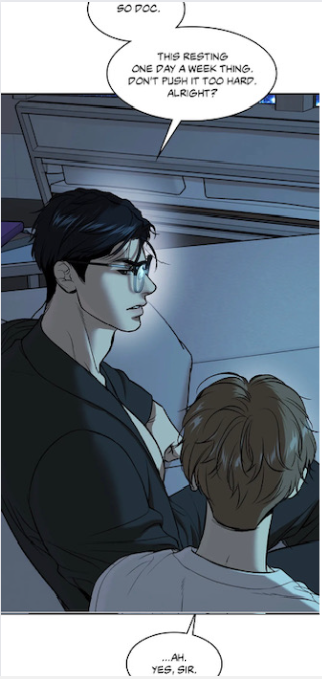 (chapter 29) For me, he will be forced to recognize that work is not bringing him closer to Kim Dan, especially after Choi Heesung met the main lead.
  (chapter 30) For me, this scene is the bathroom represents another step how to become a true family.
  (chapter 30) However, like Mingwa voiced it, they have a long way to go, for Joo Jaekyung and Kim Dan are hiding their true thoughts and emotions from each other.
  (chapter 30) Kim Dan had to hide his blushing, while the champion had to lie for his appearance. Moreover, the fact that he tried to hide his underwear
 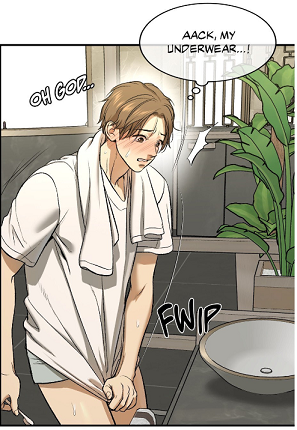 (chapter 30) indicates that their intimacy has not reached its peak. He doesn’t feel comfortable around the athlete to be seen in underwear. Moreover, the champion is also hiding his jealousy and possessiveness towards the main character.
  (chapter 30) But like I said, they need to open up their hearts and mind in order to become a true family. From my point of view, the halmoni could play a huge role in their union. How so? It is because she entrusted her grandson to Joo Jaekyung. The latter also conversed with her
 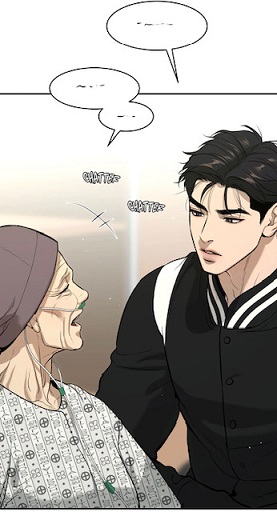 (chapter 21) and even paid her hospital bills. She even took his hand
  (chapter 22) and gave him a yoghurt.
 (chapter 21) So the moment the grandma vanishes, it could also wound the champion’s heart, especially when his sex partner is so heartbroken. It would be interesting if the champion came to voice his feelings about her. If you can’t say you’re hurt when you feel hurt you’re not family.“


 (chapter 1) Slowly, he is getting tamed and as such he is becoming a social being! Right now, he has become much more considerate towards the physical therapist.
  (chapter 25) Note that he is standing in the ring, but he is smiling. And this change can only push the manhwaphiles to question about Joo Jaekyung’s raising and past. His metamorphosis is referring to the famous debate “nature versus nurture” in psychology.
 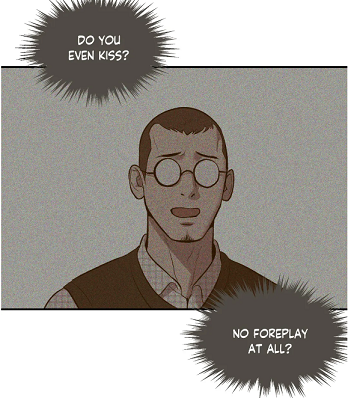 (chapter 14) He listens to them, hence he calls them all “hyung”. But here is the question. How did he come to meet them and even trust them? Imagine that he is still keeping his distance from other fighters, yet he is the unofficial owner of Black Team. He can determine the salary and the transferring. This displays that his mistrust is not just a matter of time. Consequently, my hypothesis is that someone introduced the hyungs to him. Here, I feel the need to remind my inquisitive readers that I had found many clues in the name Joo Jaekyung [For more read “
 , you will identify that two images are from episode 5.
 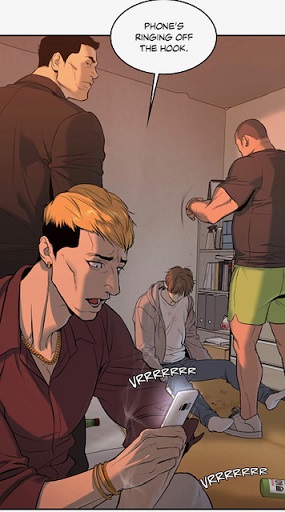 (chapter 16)
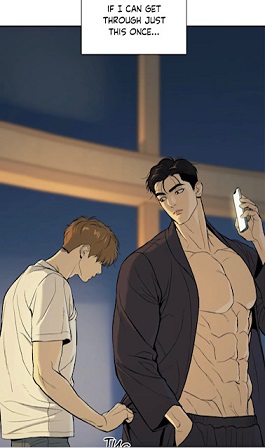 (chapter 2)
  (chapter 17) The champion paid off the doctor’s debts, thinking that he was freeing him from “prostitution”.
  (chapter 18) And guess what? The name “Gi” can signify “prostitute” or “flesh, muscle”.
 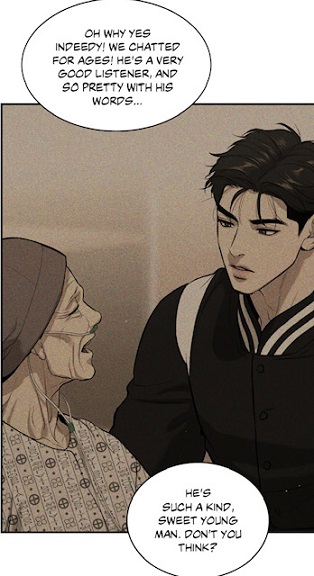 (chapter 22) He is the reason why the champion became a fighter, just like Kim Dan became a physical therapist for his grandmother. This explicates why the athlete knew how to talk prettily to an elderly and how to assist the sick grandmother
 (chapter 21). Joo Jaekyung is used to this. But there’s more to his name. However, before exposing more about his name and his personality, I would like to examine this panel again.
 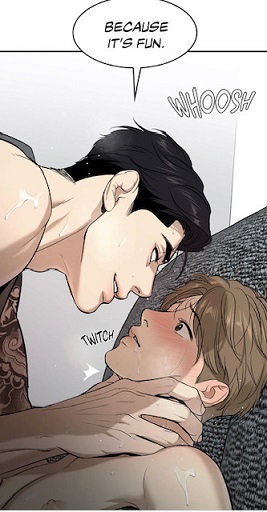 (chapter 24)
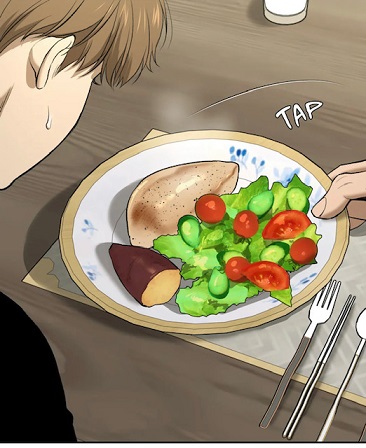 (chapter 13)
  (chapter 21) They were definitely judged as unhealthy, for they contain a lot of sugar. It is no coincidence that Seo can mean “order, discipline and age”. This man was definitely strict. Hence the main lead never experienced a caress and a warm hug from his guardian.
 (chapter 22)
  (chapter 22) Seo Gichan must have never cooked for the athlete, he simply hired a nutritionist!
 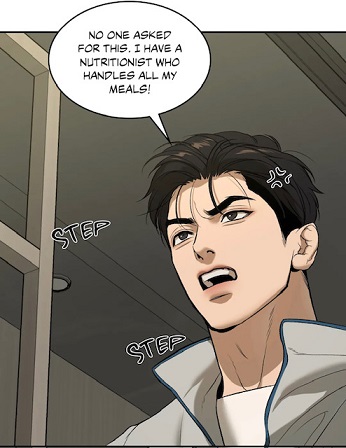 (chapter 22) However, I doubt that Seo Gichan is living like the athlete. I am suspecting that he enjoys good meals. Why? It’s because Chan can mean “meal, eat, food, delicacies“!! Moreover, Seo can refer to hungry. Hence I don’t think that he is as slim and fragile as the halmoni, quite the opposite! Why? First, his name Gi can signify “rhinoceros” or “piebald horse“, an indication that he must be robust. Additionally, this ghost is linked to “west”, “dawn” and willow, which reminded me of Park Namwook. The latter is represented by “morning sun, rising, mountain cherry and camphor tree“!! How does the coach look like?
 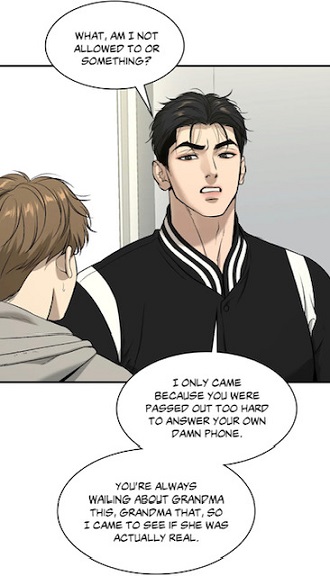 (chapter 22) Is he actually real?
 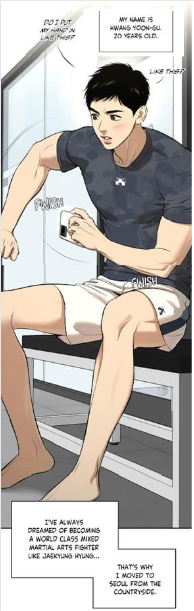 (chapter 23) For me, their path will cross, especially since Potato is a reflection of Kim Dan. The former could view the physical therapist as a source of danger for his idol. But let’s return our attention to my interpretation. Seo Gichan comes from a humble background, but he could raise socially, the exact opposite of the grandmother’s destiny. This is not surprising that Gi can signify “rise, raise and get up“. Hence he was not rich and powerful from the start. So how could he come close to a chaebol heir? It is because he was his guardian. He must have gained the chaebol family’s trust. Thus he could indoctrinate his pupil telling him that poor people are to blame for their misery. In other words, Seo Gichan must have sold himself as a self-made man which would explain why Joo Jaekyung is such a hardworking athlete and he is not living on his wealth. I have the feeling that in reality, he is more like Heo Manwook, the loan shark. He took advantage of the situation. (“Gi”: machine, opportunity”)
 (chapter 18) In the analysis “The bright calamity”, I had elaborated that this painting was reflecting the protagonist’s name and as such his personality. But we know that Joo Jaekyung has no knowledge about culture:
 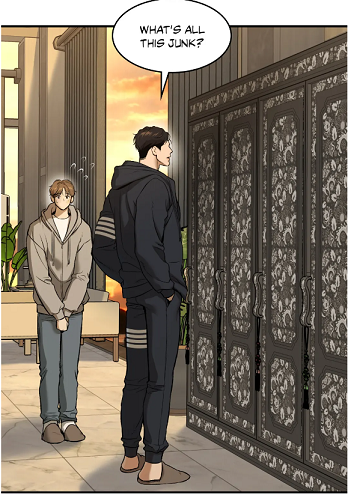 (chapter 19) For me, the painting reflects not only the champion, but also the mysterious man. Why? His name can also signify “book, divination, lucky, auspicious, oath and libation cup“, hence I included the bowl from episode 9 in the illustration. All these idioms belong to the semantic field of religion and faith, thus we have the church in the picture. And that’s how it dawned on me why Joo Jaekyung came to choose abstinence and is refusing to drink alcohol with his fellows. It is because he is drinking with his “master Seo”, his priest!! Besides, Gi can refer to “base, basic, foundation“. He is the owner of the champion’s past (Gi= to record, note and remember“). Thus he could distort the champion’s past memories and childhood. Under this new light, it occurred to me that Seo Gichan is the cause for the champion’s false belief: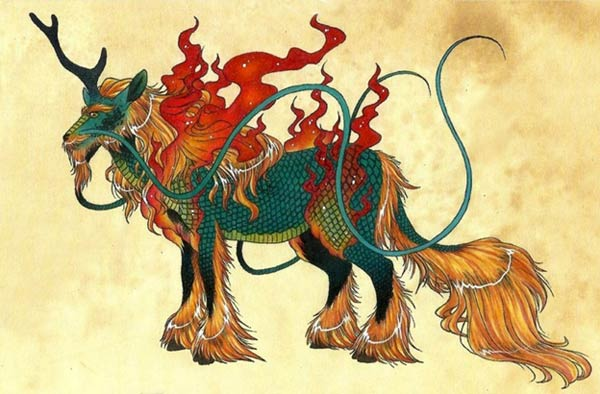

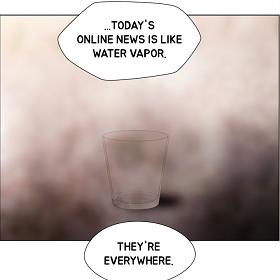 (Doctor Frost, 175) And that’s how I realized another divergence between the halmoni and Seo Gichan. Kim Dan’s grandmother might have played a role in Kim Dan’s suffering, but it was not done on purpose. She had trouble herself, the main culprits were the parents. Moreover, though both (Seo Gichan and the grandmother) wanted the main leads to remain “boys” and “children”, the grandmother was more focused on the past because of her imminent death, while I am quite certain that Seo Gichan is more thinking of the future! He wishes to take over the inheritance, though he must be quite old. In other words, he is not realizing his own immortality. That’s the reason why I believe that he will be the biggest enemy of our beloved couple, for Kim Dan represents a threat to his power. Gi means “afraid, careful, abnormal, unbalanced, lopsided“, hence I am suspecting that he will use tricks to get rid of the physical therapist.
 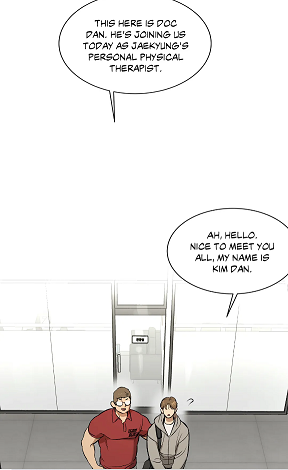 (chapter 7) Thus I believe that together, they will be able to free Joo Jaekyung from his suffering and his mental prison changing his destiny. In reality, the main lead was destined to greatness.
  Bebebisous33s' analyses in K-Dramaland and Manhwas