

Please support the authors by reading Manhwas on the official websites. This is where you can read the Manhwa: Jinx But be aware that the Manhwa is a mature Yaoi, which means, it is about homosexuality with explicit scenes. Here is the link of the table of contents about Jinx. Here is the link where you can find the table of contents of analyzed Manhwas. Here are the links, if you are interested in the first work from Mingwa, BJ Alex, and the 2 previous essays about Jinx While They Embrace🫂: The Mysterious Landlord 🏠🐕and While They Embrace 🫂: The Western Coast 🌬️🍃🌊🐦
It would be great if you could make some donations/sponsoring: Ko-fi.com/bebebisous33 That way, you can support me with “coffee” so that I have the energy to keep examining Manhwas. Besides, I need to cover up the expenses for this blog.

My avid readers might have been surprised that I didn’t publish any essay for almost a month. I had two reasons for this hiatus. First, the last publications didn’t receive much attention, while I had invested a lot of time in them. Secondly, I was myself under a lot of stress, just like our champion Joo Jaekyung and the Webtoonist Mingwa. I needed myself a break. On the other hand, this doesn’t mean that I stopped analyzing this terrific Manhwa, quite the opposite.
The First Sound: Episode 69 and the Birth of the Heartbeat
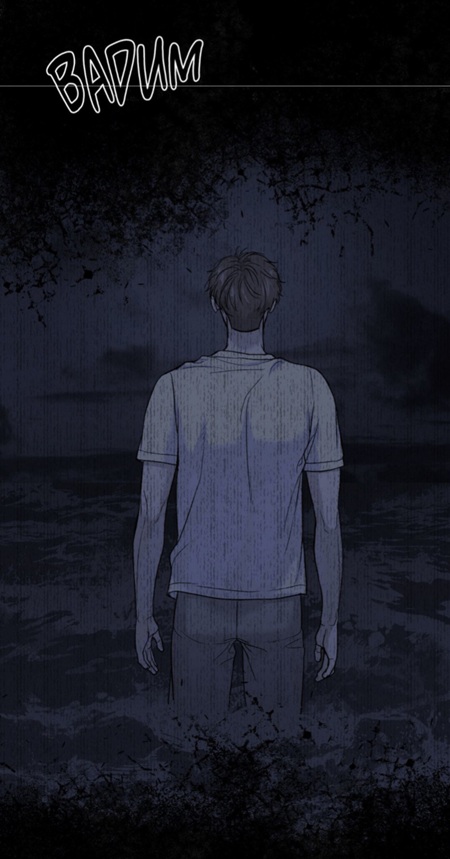
When I first read episode 69 of Jinx, one small, fragile detail caught me by surprise — the sudden appearance of the champion’s heartbeat: BADUM  (chapter 69). For the first time in this story, we as readers were allowed to hear Joo Jaekyung’s heart
  — not in battle, not in passion, not in rage — but in that suspended instant when he imagined Kim Dan missing, possibly forever. Since the author linked the BADUM with doc Dan
  (chapter 69)
  (chapter 69), she created the illusion that the physical therapist was embodying the MMA fighter’s heart. This scene resonated with me long after I closed the chapter.
And then I came across a fascinating article: Resonance Theory: Vibrating with Music. It explained how sound activates deep biological responses — how rhythm, tone, and vibration connect us to life itself. According to this theory, when we hear sound — especially rhythmic or emotionally charged sound — it does not remain a surface experience. It triggers responses in our nervous system, heart rate, breath, and emotional centers. Sound can bypass the defenses of the thinking mind and speak directly to the body.
This is why music can make us weep, why a heartbeat can evoke terror or tenderness — and why a single human voice can call us back from fear or despair, like in this scene:  (chapter 69) Suddenly, the pieces clicked: the heartbeat in Jinx is not just a narrative sound effect. (chapter 69) It is a form of music — an embodied rhythm that signals life, love, and emotional awakening.
It was this article that first led me to reflect on why we so rarely hear heartbeat or music in the story — and why their presence or absence marks such a profound shift in the characters’ inner worlds.
Looking Back: The Silence of the Heart
As I began reflecting on this moment, I noticed how deliberately the manhwa had withheld the fighter’s heartbeats in earlier key scenes. Consider chapter 14:  (chapter 14) Jaekyung, insulted and trapped in shameful memories, is wrapped in rage
  (chapter 14)— yet no heartbeat is heard. One might think, the absence of the heart racing implies the lack of fear. His emotions are real, but they do not connect him to life or to others. Why?
Because at that time, there was no one to lose. His world was transactional: lovers came and went; gym relationships were shallow and competitive; even his manager was more functionary than family. Without meaningful attachment, there was no fear of loss — and thus no reason for the heart to speak.
This absence of heartbeat is mirrored in Joo Jaekyung’s actions in that scene. In episode 14, after the humiliating confrontation, we see him drive his fist into the locker 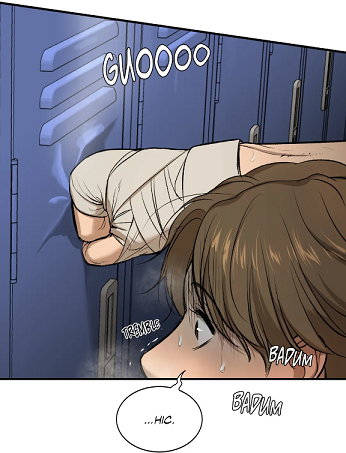 (chapter 14) — GUOOO, metal dented, yet no pain. Yet, Jinx-philes can see Badum Badum in that picture. Nevertheless it is connected to the physical therapist’s heart: he is scared of the athlete’s strength. On the surface, the champion’s gesture appears reckless — an act of a man who does not care for his body. But this is not pure “fearlessness.” In truth, the celebrity’s anger is masking deeper fear and suffering.
His mind, still trapped in past traumas, is locked onto an unseen enemy: the voice of his childhood abuser  (chapter 54), who had called him trash, weak, pathetic, incapable.
 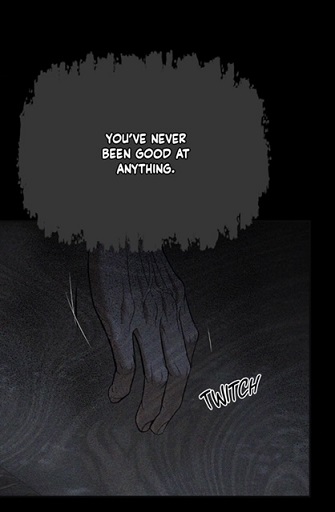 (chapter 54) The challenger, Randy Booker’s insult — calling him a “baby”
 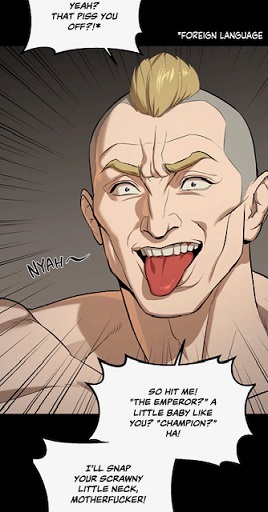 (chapter 14) — triggered this buried wound, igniting a desperate drive to disprove that old accusation.
Yet the protagonist is not consciously aware of this. He has repressed his childhood so deeply that he fights not the present opponent, but a shadow from the past. In this state, he acts on instinct, driven by the frustration, rage and pain he cannot name. (chapter 14) There is no conscious heartbeat — because he is not present with himself. He is moving as a zombie: reactive, destructive, unthinking. His body acts, but his heart remains silent.
Heartbeat Scenes: Love, Fear, and Danger
As you can see, Jinx does show us heartbeat scenes earlier — not for the MMA fighter, but for the physical therapist and for other moments of crisis. These examples help us understand the emotional vocabulary of the heartbeat in the narrative:
❤️ Episode 44: Heartbeat of Love and Attachment
In episode 44, we hear 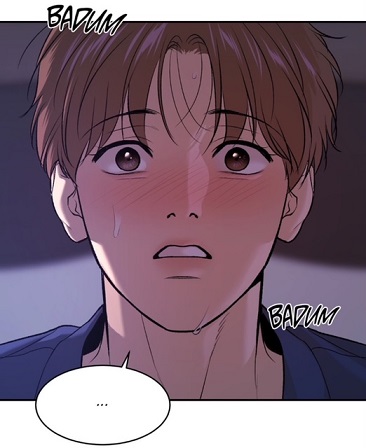 (chapter 44) BADUM BADUM from Kim Dan’s heart as Jaekyung makes a move on him. His blushing face, wide eyes, and parted lips all signal that this is not fear — it is love, excitement, and emerging attachment.
This is the positive heartbeat — the one that invites us to risk feeling, to follow the pull of connection.
Indeed, Dan did follow his heart that night, therefore he made requests  (chapter 44) and tried new things. He gave his lover pecks on his cheeks and ear
  (chapter 44). He chose intimacy, and chose to act from his own emotions. This gave him strength and courage. But by morning, he withdrew, the moment he met resistance and opposition.
 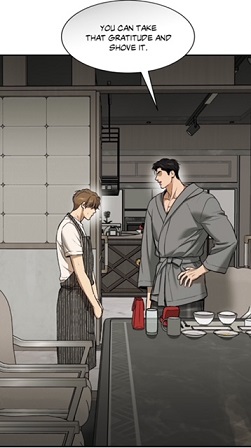 (chapter 45) He chose silence, unable yet to confess what that heartbeat had awakened.
💔 Episode 34: Heartbeat of Fear and Danger
By contrast, in episode 34, we witness a different kind of heartbeat — one driven not by love, but by survival panic.
When the protagonist first corners Choi Heesung and threatens him —  (chapter 34), we see the actor’s confidence gradually vanishing. His mask begins to crack. In that moment, he realizes that in the VIP spa his celebrity status offers no protection. No manager, no Park Namwook, no audience is present. He is utterly exposed to the raw force of the champion’s anger and fist — and the physical threat is real.
His body betrays him: the darkness around the gaze, the unmistakable BADUM BADUM of his racing heart. Here, the heartbeat does not speak of longing or love. It is a visceral alarm bell, signaling vulnerability and fear.
And yet — this makes the next moment all the more revealing. Later in the same episode, the actor faces the main lead again — but this time Dan is present. 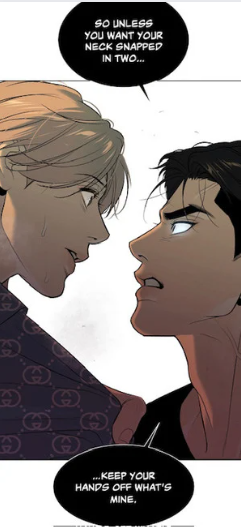 (chapter 34) The confrontation repeats — Jaekyung threatens once more. Yet, there is no visible BADUM, BADUM here. Why? Don’t forget that just before, the actor gulped and blushed
 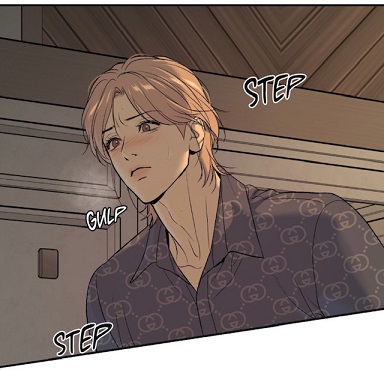 (chapter 34) — a clear sign of excitement, not fear. And still, his heart remains silent. This raises the question. Why was the actor not afraid of the MMA fighter? Because even if the words echo the previous threat, the perceived danger has changed. With doc Dan standing between them
  (chapter 34), the actor subconsciously knows: “He will not attack me here.” The champion made it clear that the physical therapist shouldn’t detect the actor’s presence. Doc Dan acts as an emotional shield, preventing true panic. The body no longer signals mortal danger — and so, no BADUM sounds.
In this, the manhwa subtly shows us:
Heartbeat is not simply about surface emotion. It reflects the perceived reality of threat, loss, or love.
When danger and loss feel real → the heart races.  (chapter 43) Here, the doctor feared the celebrity’s rejection. This scene was actually announcing that doc Dan was already in love with the “wolf”.
When one feels protected → the heart stays still, even if the mind recalls past fear.
Music as Substitute for the Heartbeat: Emotional Disconnection
There is another layer to this symbolism — and it lies in the rare appearances of actual music in Jinx. Music is introduced only twice:
1. Episode 21:
Kim Dan remembered his grandmother singing a lullaby 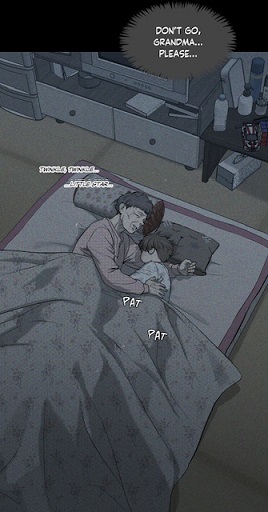 (chapter 21) — a sound of comfort and life. But it was a distant memory, not part of his adult world.
Crucially, Dan was asleep 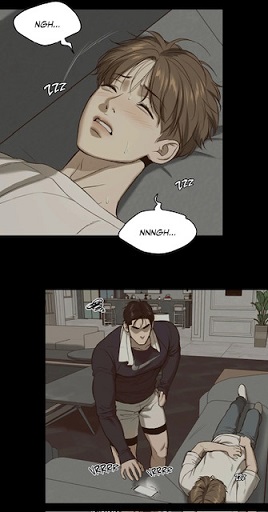 (chapter 21) — having a nightmare. It is only when the grandmother returned to the bed and began to sing that his body calmed. (chapter 21) Here, sound functions as both comfort and erasure. The lullaby soothes — but it also covers an earlier silence. It replaces what was absent: the voice of his parent(s). The melody fills the void — yet beneath it, the deeper wound remains untouched.
 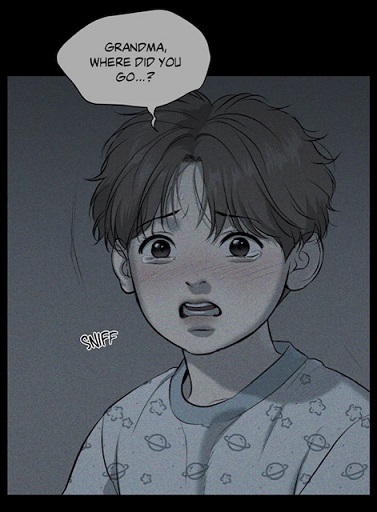 (chapter 21)
Thus the lullaby is not simply a token of love — it is also a symbol of emotional substitution. Dan carries this unresolved layer with him 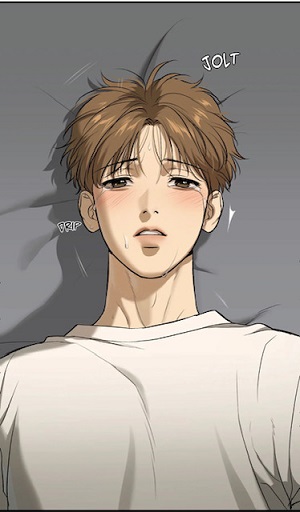 (chapter 21) — one that later echoes in his adult struggles with attachment and loss.
2. Episode 58 (season 2):
Outside, Heesung, Potato, and the landlord are singing and dancing  (chapter 58) — vibrant, alive. But Dan sits apart. He is disconnected — his inner state does not resonate with the music. At that moment, he is preparing to abandon Jaekyung.
What struck me is this: Dan’s own heartbeat is absent in that scene. Though he thinks  (chapter 58) “I am happy and at ease, but… why does my heart feel so heavy?” — it is as if the external music has replaced his internal rhythm. The joyous sound outside contrasts painfully with his own muted emotions. The music underscores his emotional disconnection and the inner weight he carries.
And here, the parallel with childhood becomes clear.
The cheerful music provides surface warmth — but the root pain of emotional rupture (with Jaekyung) is untouched.
Just like the lullaby once offered comfort without healing, the music here offers temporary relief, not true resolution.
In both moments, we see how music without heart resonance leaves the deeper wounds unaddressed — and why it is the sound of the heart, not external melody, that must ultimately speak.
3. Boksoon and the champion
In Dan’s case, music never fully reconnected him to life — it was merely a temporary surface. But Joo Jaekyung, guided not by a melody but by the raw bark of a dog,  (chapter 65) finds his way back to the man he cares for.
Boksoon’s bark in episode 65  (chapter 65) is more than noise. It’s a resonant signal — not unlike the heartbeat. When she barks, it alerts Jaekyung to Dan’s trance.
  (Chapter 65) Moreover, the dog is capable of expressing her „worries and pain“. And for the first time, the champion follows a sound not of the crowd, not of a bell, but of life calling to life.
 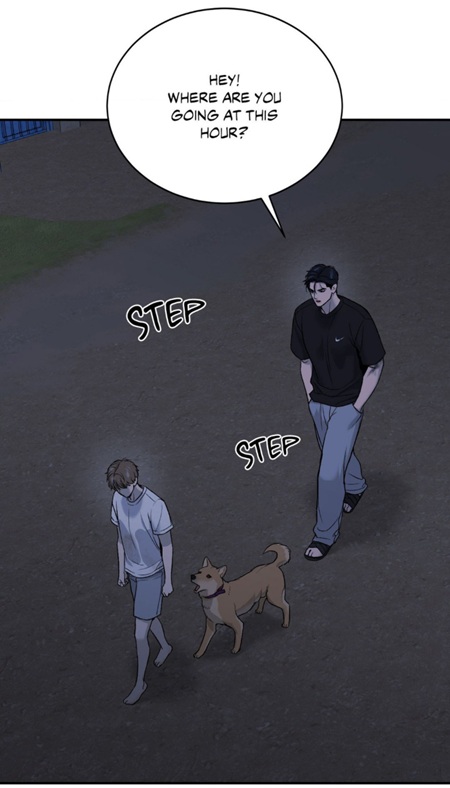 (Chapter 65) Her bark anchors him, just as Dan once did. And it marks the moment Jaekyung becomes emotionally receptive not only to Dan, but to care itself — puppies, vulnerability, connection. In other words, her presence foreshadows Jaekyung’s emotional readiness to care for others beyond the ring. Having rediscovered and embraced his own vulnerability, his heart is gradually open to softness — to animals, to dependency, to affection.
In this light, Boksoon’s bark becomes a canine echo of Jaekyung’s heartbeat: both signal that something fragile and important is alive. That life is worth protecting. And that Jaekyung — no longer the zombie fighter — is becoming someone who hears, feels, and chooses to respond.
The Black Veil: Emotional Death and Substitution of Memory
We see this deepening in the very next beat.  (chapter 58) During the happy party with the actor and Potato, Dan remembers his past lover — and we see the champion’s image under a black-and-white veil. It was, as if the sun was vanishing from his life. In that moment, Dan decided to detach himself from Jaekyung, to forget him. The champion is emotionally “dead” — unreachable, lost to him.
This may explain why after the death of the puppy, doc Dan goes toward the sea. Though in his trance, he is thinking of his grandmother 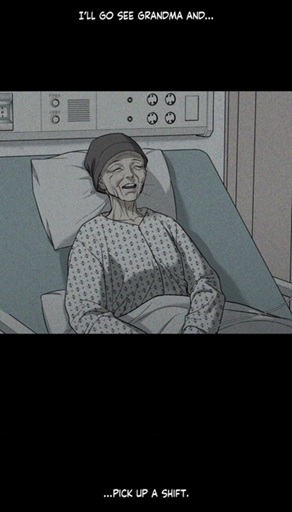 (chapter 59), the reality is that work has long lost its meaning. He has no goal in his life in the end. The emotional gravity of his loss regarding Jaekyung is palpable, though the physical therapist is not realizing it. Jinx-philes should keep in their mind that in season 1, the protagonist used his grandmother as a shield to justify his transactional relationship with the celebrity — and here, perhaps again, she becomes a cover for deeper pain.
Sound, Resonance, and Biological Awakening
And so we return to resonance theory. As the article explains, sound activates deep biological responses. It connects us to life, bypassing intellectual defenses. Rhythm, tone, and vibration speak first to the body — to the breath, to the heartbeat, to the reflexes — before they are processed by the conscious mind.
In Jinx, we see this principle embodied again and again — and nowhere more clearly than in the key moments of Jaekyung’s awakening. At first, the BADUM — the sound of the heart — announces the body’s recognition of fear and attachment. (chapter 69) But as his emotional state deepens, the manhwa subtly shows that the language of the heart is not always written — it is felt, seen, heard in breath and gaze.
This becomes especially clear when Jaekyung reaches the dock. 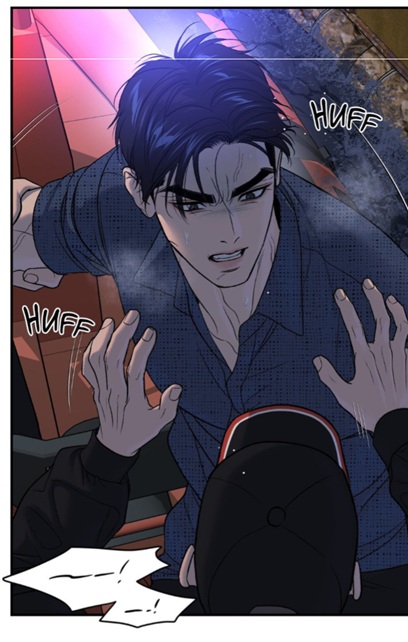 (chapter 69) There, as he sees a figure on the boat, his breath catches — for a moment, he believes it might be Dan. But as he draws closer, he recognizes his mistake. The man is not Dan.
 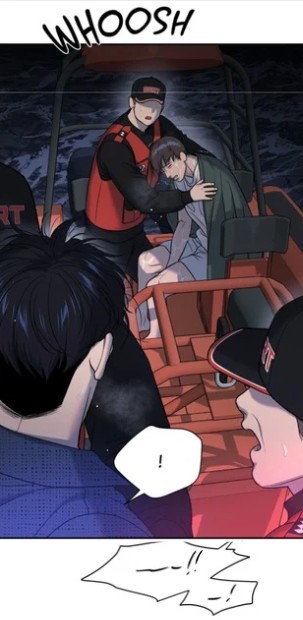 (chapter 69)
Now, on the dock, Jaekyung remains proactive — scanning for signs, seeking a solution. And when a small, fragile sound pierces the air (chapter 69) — “Umm” — we witness a subtle but profound shift.
Here, the heartbeat is no longer heard, but it is seen and felt: in the shallow breath  (chapter 69), the audible HAA…, and in the dilated pupil.
  (chapter 69) His body speaks what the panel leaves unsaid — a visceral resonance of surprise, longing, and fragile hope.
And when his eyes finally meet Dan’s, we see it: relief floods through him. In that instant, his hardened facade dissolves. He appears young again — the boy beneath the champion’s armor emerges.
This marks not only the depth of his attachment, but also a profound shift in perception: he is no longer the “superior” in this bond. In that moment of relief, he begins to see Dan not as a child or subordinate, but as an emotional anchor, an authority figure — someone he can trust, someone to whom he can turn. (chapter 69) But before he moves, before he speaks, he just looks. Frozen in place, he engulfs Dan with his gaze (chapter 69) — eyes wide, breath caught. His pupil dilates, as if trying to capture and preserve the image of the person he feared lost. In that breathless instant, Dan becomes the apple of his eye — the one irreplaceable figure in his emotional world.
And then something even deeper shifts: the roles reverse. Dan is no longer the puppy. Jaekyung is. He becomes Jaegeng.
Why this transformation? Because despite everything — the pain, the fear, the trauma of the night before 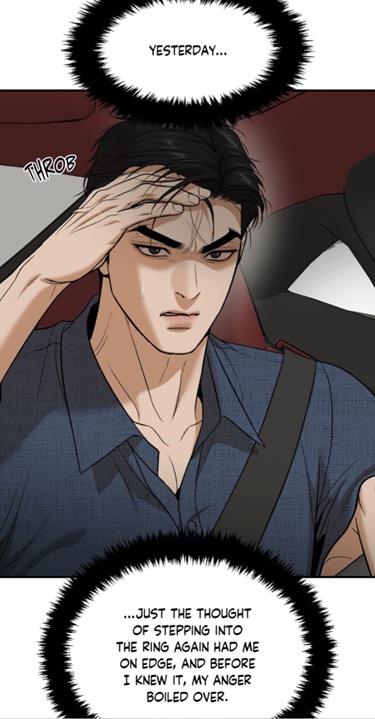 (chapter 69) — Dan does not scold him, reject him, or shrink away. He simply asks:
 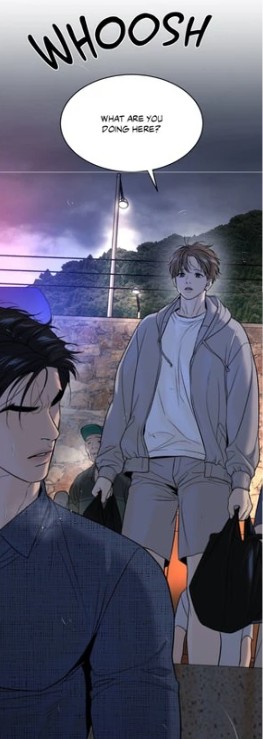 (chapter 69) There is no accusation, no resentment, no judgment.
Unlike Baek Junmin or the mysterious ghost from Jaekyung’s past, who mocked 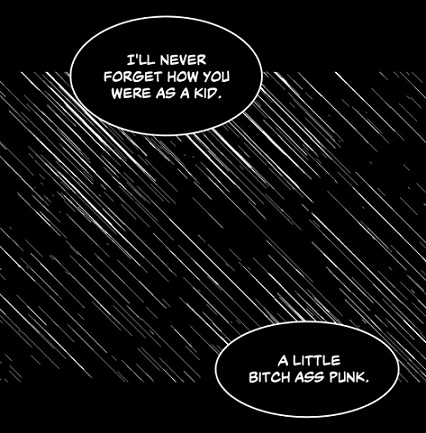 (chapter 49) the fighter’s vulnerability and punished his needs, (chapter 54) Dan sees the man, not the mistake.
And so, for the first time in his life, Jaekyung experiences unconditional regard — not the kind that is bought with talent or won through dominance, but the kind that says: you are worth caring for, even when you make mistake or falter. And that’s why he clings to Dan  (chapter 69) — not as a fighter needing a medic, but as a person giving affection and seeking warmth. And in Dan’s quiet presence, he finally finds someone who doesn’t shame his vulnerability — someone who holds space for both the man and the boy he has always been.The inner child from the athlete awakens — and with it, the first true opening of his heart. He is now reborn.
Revisiting Episode 44: Fear of Dependency and Fear of Loss
Here we can look back and understand earlier scenes more deeply.
In episode 44,Jaekyung’s heart had already begun reacting — but he could not name it. This is visible, when he questioned Dan: 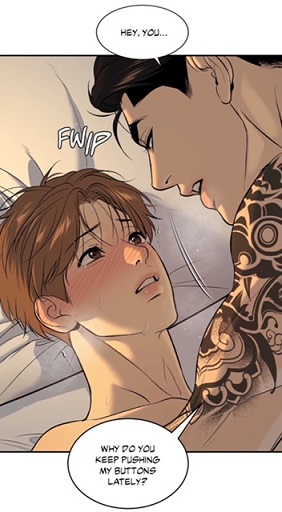 (chapter 44) What were those buttons? His heart. His breath. His body’s fear that Dan might vanish.
Every time he heard Dan leaving at night  (chapter 45), his heart raced. But he mistook this for irritation
 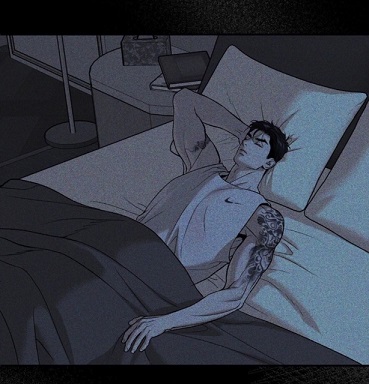 (chapter 45) — not attachment. That is why he threatened to hire another doctor the next morning: he feared dependency and as such vulnerability.
 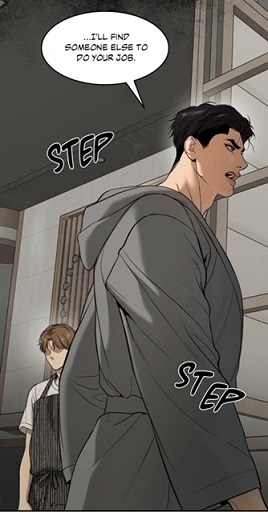 (chapter 45)
And there is one more layer. Before episode 69, even though Jaekyung feared Dan vanishing, he had never connected “vanishing” with death. 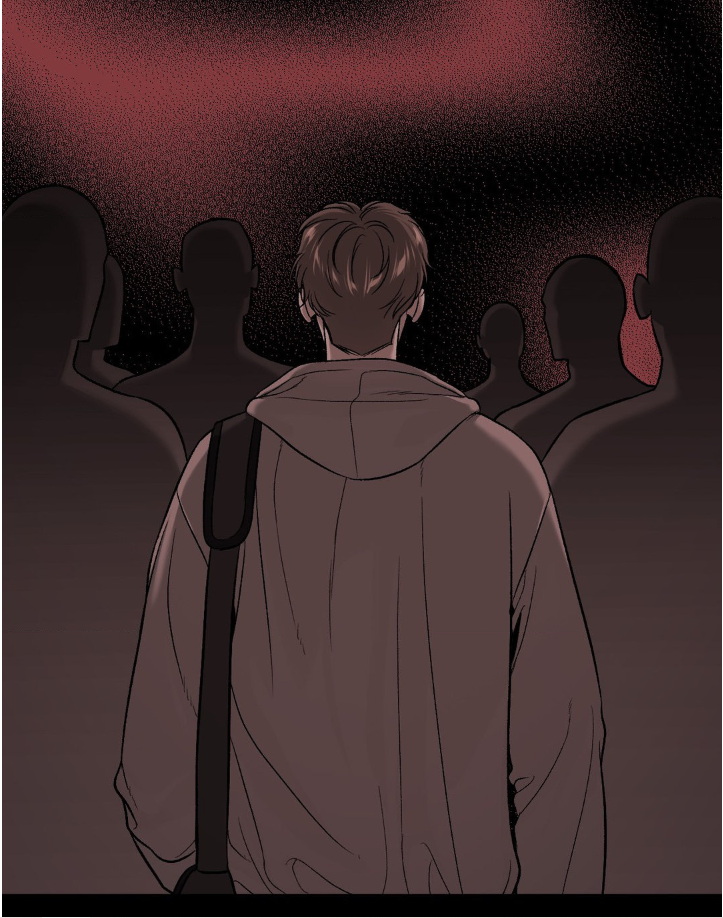 (chapter 55) In his mind, people leave — they live elsewhere — life goes on. He never imagined irretrievable loss.
But now — seeing the empty house, the footprints on the ground, imagining Doc Dan bare feet while (chapter 69) walking into the sea (chapter 69): he has this revelation: Dan might not simply leave. He might disappear forever. This unbearable thought awakens his heart completely. (chapter 69) Under this new light, it becomes comprehensible why Mingwa connected his beating heart to his face. With this panel, she implied the huge awakening and the protagonist’s transformation. He is facing reality. He is accepting his mortality, his beating heart. He no longer views it as a discomfort.
Conclusion: When the Heart Spoke, Life Began
And here, the lesson deepens. In episode 14, Jaekyung’s self-destructive punch had shown us a man trapped by past traumas, acting on raw instinct. There was no heartbeat — not because he was fearless, but because his mind was not free. He was still a zombie:  (chapter 29) moving through the world, but without true inner life. Hence his eyes were “empty”.
  (chapter 26)
But now, in episode 69, when the heart speaks (chapter 69), it teaches not only love — but emancipation. The BADUM announces the birth of a man who can finally think and feel for himself and for doc Dan. The resonance of the heart breaks the zombie trance. It awakens conscious presence.
And we can now see why this experience of fear was essential. (chapter 69) Until this moment, Jaekyung’s driving force had been to prove his mysterious childhood abuser wrong (chapter 54) — to erase the label of “weak, pathetic, incapable” that had haunted him.
This is why, in episode 67, when Dan asked him directly 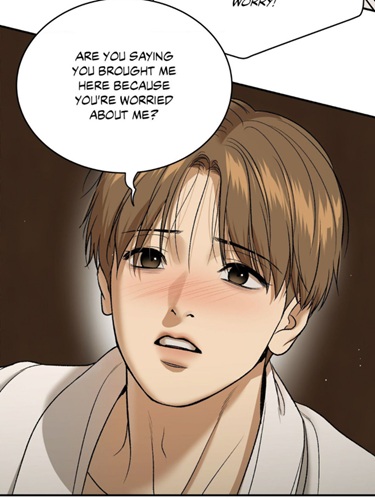 (chapter 67), Jaekyung could only remain silent.
 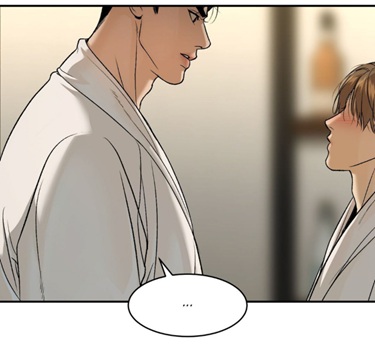 (chapter 67) He could not yet admit his worries, his vulnerabilities — not even to himself. To confess would be to risk blackmail, to risk being seen again as that helpless child.
Only by experiencing the true fear of losing Dan — a fear greater than his old shame — could he begin to open the sealed chamber of his heart.
And so, when the heartbeat came, it did not merely signal love. It marked the first break in the old defenses. The child within could finally begin to hope — not for victory, but for understanding, for acceptance. But there’s more to it.
But with that one heartbeat (chapter 69) — the BADUM that exploded in episode 69 — the jinx is broken. The undead becomes the living. His past, once the fuel of every punch, begins to fade. The rage that once drove him no longer holds its grip. He no longer needs to fight in order to prove that he isn’t weak — because someone has seen him at his most vulnerable and stayed. Under this light, my avid readers can grasp why the athlete hid his “growing attachment and dependency” behind the jinx.  (chapter 65)
In focusing on Dan (chapter 69) — not as a subordinate or tool, but as a source of emotional stability — Jaekyung finally turns his gaze forward. His reason for fighting is no longer rooted in resentment, but in attachment. His strength no longer has to scream; it can protect. Hence he desires to embrace his companion and lover in front of others. (chapter 69) The curse is lifted. The zombie breathes. The jinx dissolves — and in its place, a human being emerges. No longer driven by resentment or fear, he begins to choose connection over rage, presence over instinct. This means, he will be less vulnerable to schemes.
And that, at last, is the beginning of his humanity.
And we must also notice what happens just before the embrace. (chapter 69) When Dan speaks, Jaekyung remains utterly silent. He does not reply — not because he does not care, but because he is emotionally disarmed. In that moment, words fail him.
His silence is a form of submission — the instinctive response of a boy overwhelmed by fear, reaching for safety.
And the embrace that follows is not the act of a champion, or a lover. 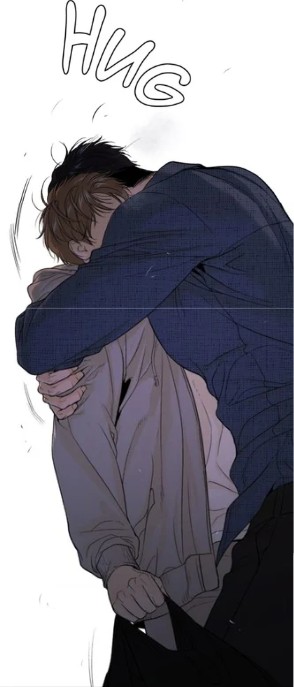 (chapter 69) It is the embrace of a child seeking a parent — of one who has never known how to ask for comfort, but who now surrenders to the need for it.
The boy hugs, because the heart has spoken — and in that moment, the first true human bond is formed.
Yet true liberation still lies ahead. For emancipation can only be complete when he begins to open his heart fully to Dan — to speak, to share, to trust.
When the heart spoke — life began.
But not yet the life of a man. First, the awakening of the child within — the boy who had never been allowed to feel, who now looks at Dan with open eyes.
And only through love, only through trust, will this child one day become a man — free, whole, alive.
Feel free to comment. If you have any suggestion for topics or Manhwas, feel free to ask. If you enjoyed reading it, retweet it or push the button like. My Reddit-Instagram-Twitter-Tumblr account is: @bebebisous33. Thanks for reading and for the support, particularly, I would like to thank all the new followers and people recommending my blog.


 (chapter 69) it is a harbinger of disruption. A radio broadcast delivers the warning: skies turning cloudy, strong winds forecasted at 20 to 25 meters per second. This is no ordinary breeze. It signals the arrival of a whole gale—powerful enough to topple trees, strip rooftops, and fracture routines.
 (chapter 69) as the champion’s sleek white car raced toward the tunnel, into a sky veiled by darkening clouds. This image foreshadowed the impending tempest not just in weather, but in fate. However, the celebrity didn’t pay too much attention to the warning, lost in thoughts, which is symbolized by the tunnel. The latter represents the protagonist’s ignorance, recklessness and “stubbornness” (he can not forget his loved one, he can not bear to leave his side). He races toward change, still shrouded in his old mindset, while nature prepares to strip away his last remaining believes and illusions.
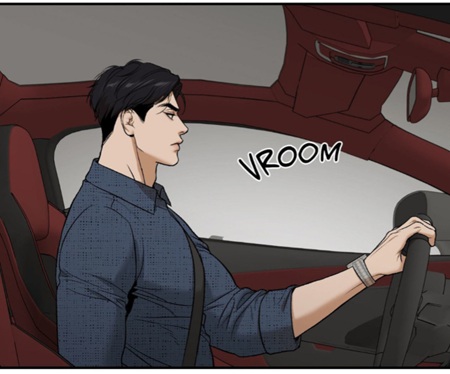 (chapter 69) Hence he is still wearing his dark blue shirt, pants and an expensive watch. But more importantly, he is now driving his white sports car. This means before meeting his hyung and the CEO, he went to the penthouse and changed not only his outfit but also his vehicle. He selected the white car,
  (chapter 69) Since the latter is a high-performance luxury model, it symbolizes wealth, speed, and prestige. That’s how he wanted to appear in front of the CEO. However, now he is going to the place where the storm will be the most violent. Because the star is still dressed in his dark blue shirt and expensive watch, I came to the following interpretation. This is not the champion in training clothes, but a man who now owns time
 (chapter 60)
 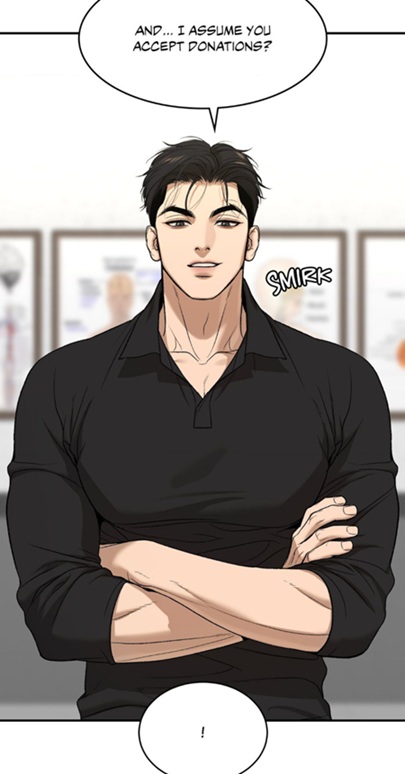 (chapter 61) No longer is he defined by his cellphone or his car, but by a reclaimed sense of agency.
 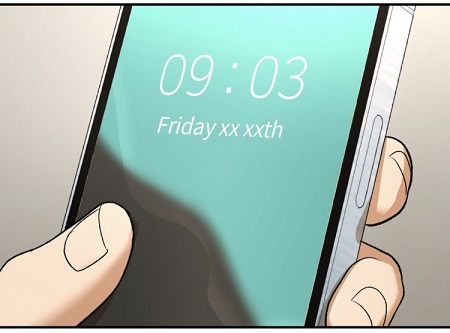 (chapter 38) or his car
 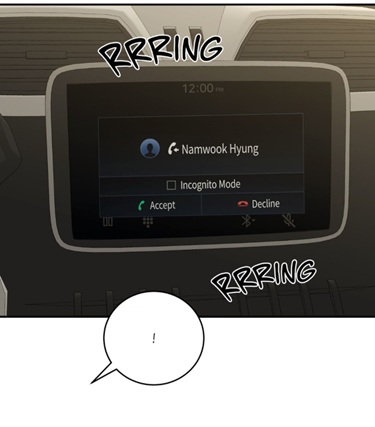 (chapter 69). Hence the manager can no longer be in touch with him.
  (chapter 66)
 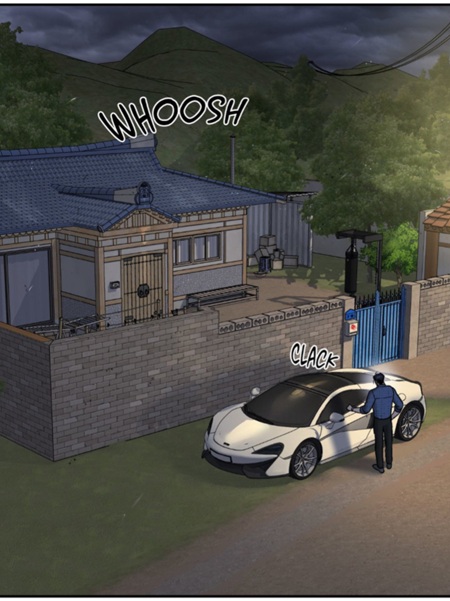 (chapter 69) might be damaged or lost to the tempest—a symbolic stripping away of status which reminded me of the way doc Dan treated the halmoni’s Wedding Cabinet.
  (chapter 53) Both instances symbolize a relinquishing of material attachments (he leaves his huge penthouse for a rented little “hostel”) and a profound shift toward emotional growth. For Jaekyung, the potential loss of his prized possession is not just about property—it marks the beginning of relying on others, accepting vulnerability, and letting go of his rigid, self-reliant identity. Similarly, the doctor’s decision to leave behind the Wedding Cabinet signals a break from the past and a readiness to build something new, no longer defined by inherited burdens or emotional debts. In both cases, possessions lose meaning. With nothing left to prove, the champion accepts vulnerability. He is no longer above asking for help, nor afraid of stillness. And that realization could only emerge under pressure.
  (chapter 57) This initial depiction – of the sparkling blue sea, the gentle rhythm of waves (shaaa), the birds in the sky, the beautiful sunset
  (chapter 59) and
 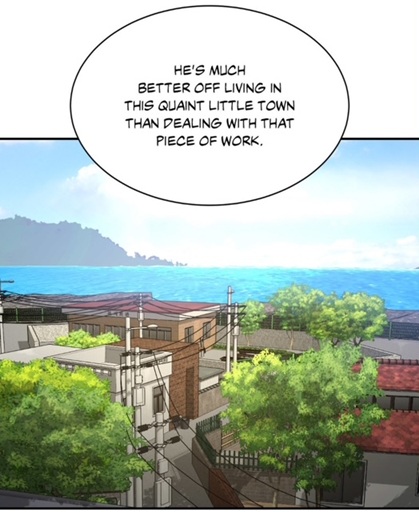 (chapter 58) daily life in slow motion—sets up a stark contrast to the approaching storm. All these images and including the elderly proclaiming
  , (chapter 65) “It’s a nice little town, isn’t it?”, lulled both the characters and readers into a false sense of permanence. But beauty is ephemeral. Storms, by nature, contradict stability. They sweep away trees, roofs—and with them, pipe dreams.
  (chapter 53) That’s why Mingwa zoomed on her gaze, but “cut” her ears, a symbol for her “deafness”. Hence she didn’t hear and feel the wind during her stroll with the champion.
 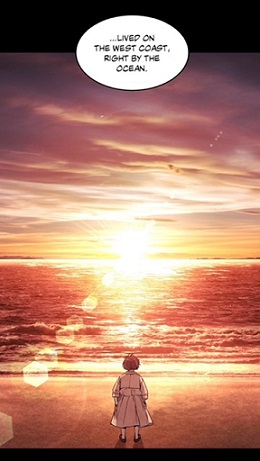 (chapter 53), bathed in the orange glow of a perfect sunset, reflected her toxic positivity—her tendency to ignore pain and erase any negative memories, including a life marked by hardship in Seoul. It encapsulated her attempt to embellish the past and project into the present
  (chapter 65) and future, disregarding reality, assuming the ocean/town’s beauty promised tranquility without acknowledging the lurking danger it could also bring. Her nostalgia operates as an emotional escape hatch—a curated fantasy where beauty masks regret. When she speaks of “seeing it one last time,” it is not a celebration of memory, but a quiet refusal to face her past failures and the reality of her present. For her, the coast is a postcard of serenity
 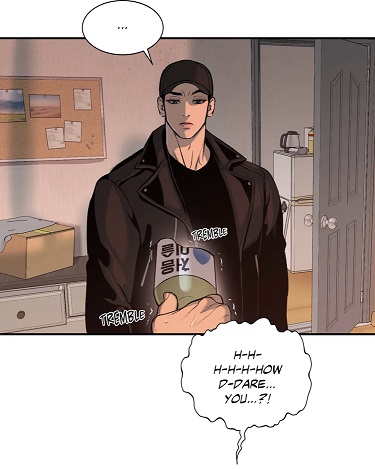 (chapter 17), where the walls were decorated with actual postcards of beaches she had never visited. These were not souvenirs, but illusions—windows into an idealized elsewhere that helped her ignore the hardship around her.
 (chapter 56), her illusions of control. This is not poetic justice, but poetic truth. She cannot walk.
  (chapter 65) She cannot escape. The wind howling outside her window will no longer be ambient noise—it is a reminder that she has no dominion here.
  (chapter 47), symbolizing distance from reality. In the hospice, it is placed next to the window
 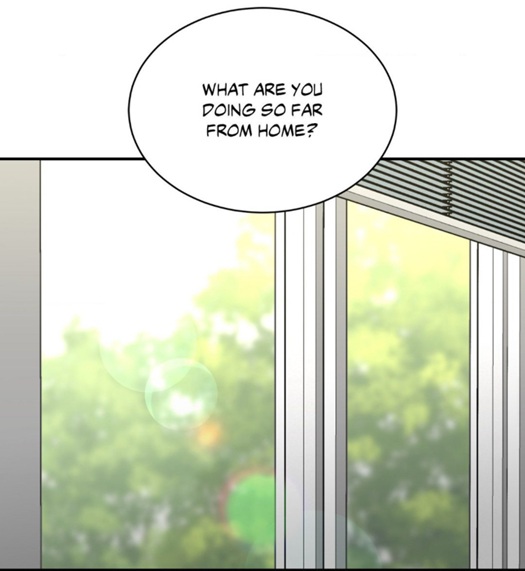 (chapter 61), revealing trees and the sky—nature encroaching. By her second stroll with Jaekyung, the image of the window reappears
 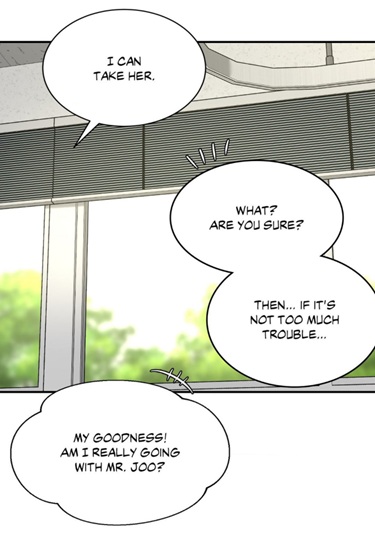 (chapter 65), subtly reminding readers of its fragility. Now, as the storm rolls in, the trees outside become potential hazards, and the window that once offered a view might shatter. Should this happen, then it will rupture her illusion of control and all her repressed fears should come to the surface.
 , (chapter 19) where another window—damaged and offering no real view—served as a silent witness to a life steeped in avoidance. In that space, a young Kim Dan sat beside her, answering a phone call. The fact that someone talked to him, not to her, already suggested the grandmother’s emotional detachment—the parent reached out to the boy, not to her. That room, like her present one, was filled with silence—not peace, but repression. She masked that silence with superficial comforts: beach postcards, a television, the illusion of a serene life. Now, the storm returns not just with wind (SHAAA), but with sound—branches breaking, waves crashing, windows shuddering—forcing all she suppressed to the surface.
 (chapter 56) But he misjudged her case for two reasons. First, the file had been tampered: she had received a new treatment. Secondly, he did not know her. What he saw as acceptance was actually a mix of comfort, avoidance and unresolved fear. The gale will expose the limits of both clinical assumptions and self-deception. The woman who once believed she could choose the time and manner of her death now faces nature’s blunt reminder: she is not in control of life and time—nor of anything else.
  (chapter 56) —it is a layered terrain of symbolism and vulnerability. Perched on what appears to be a peninsula
  (chapter 65) in a bay
  (chapter 60) ; the docks, roads, and shops follow at level 1
  (chapter 62)
  (chapter 69); and the town proper stretches up with retaining walls
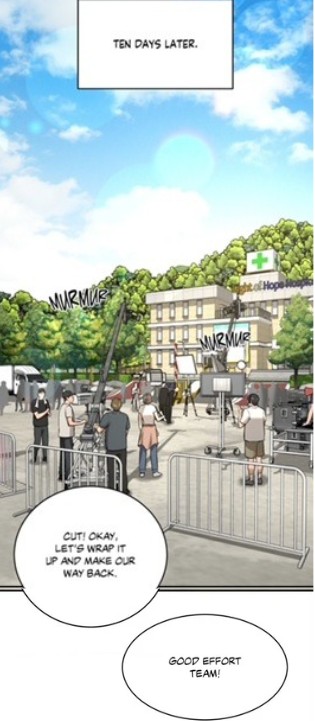 (chapter 59) (Light of Hope) overlook the coast and the landlord’s house
  (chapter 57) almost stands on the top of the hills. These heights offer a commanding view—but they also expose the buildings to the full brunt of the western tempest.
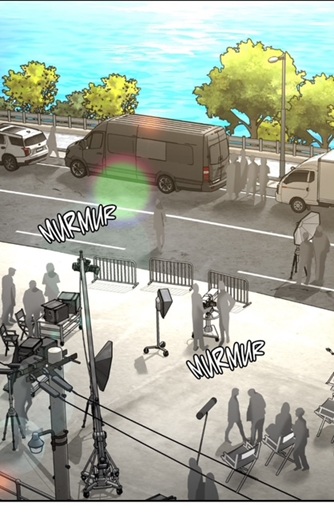 (chapter 57). I came to this deduction, as the champion could see the building from the beach, when he rescued doc Dan.
  (chapter 61) Like pointed out before, his name is misleading, for hope implies “rescue”. However, a stay in that place means that their “inhabitants” are all destined to die due to cancer. There’s no real cure there. In other words, the tempest will bring to light its true nature. The hope, just like its comfort, are illusory.
 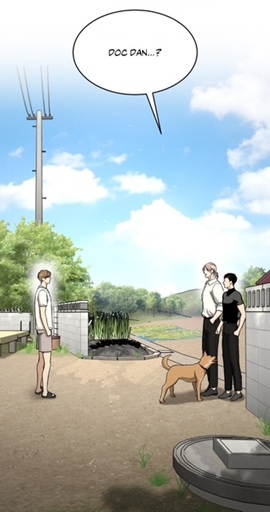 (chapter 57), fields and close to two power masts
  (chapter 61), so it is quite vulnerable as well. Therefore one might think that the champion’s hostel is similarly exposed to potential outages or structural damage.
  (chapter 69) is so built that you don’t need to leave the building in order to “enter” a different room (kitchen, bathroom) contrary to the landlord’s.
 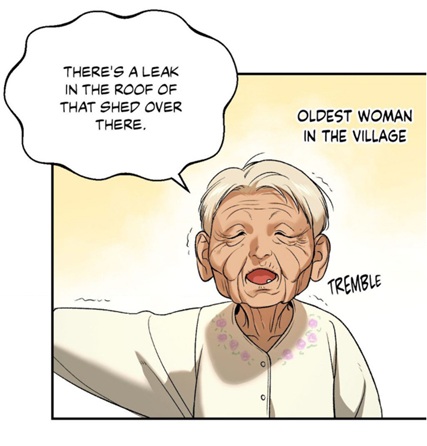 (chapter 62) There’s no doubt that the dogs will be invited to his home, as her place is right under a tree and power mast.
  (chapter 57) The landlord may even encourage the fighter to adopt a puppy from Boksoon’s litter, as he can see the champion’s care and sense of responsibility—not just for himself, but for another life.
 (chapter 69) Such a confession would push the physical therapist to redefine his relationship with the celebrity: he is indeed his friend, even a close one. And if this takes place, then the doctor could start opening up as well. The tempest reveals fragility, forces new beginnings, and exposes fair-weather allies.
 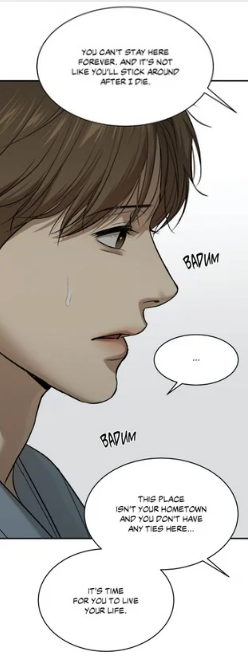 (chapter 57) and wisdom, finds herself outmatched—not by age, but by wind. Her idea of safety is shattered. Like pointed out before, the storm embodies present. So if they come to enjoy this time of respite together, they will realize that this “tragedy” for others represented a “blessing” for them.
  (chapter 69) would be left outside, symbolizing that this “sport” has become less central and vital in the main lead’s life. This is the first true pause in their relationship. Jaekyung, used to immediate gratification and external control, must slow down. And for the first time, he will see what he always overlooked: that meals take effort, that conversation has value, as it can help to get closer to another person. He doesn’t need the grandmother to get “through Kim Dan”.
 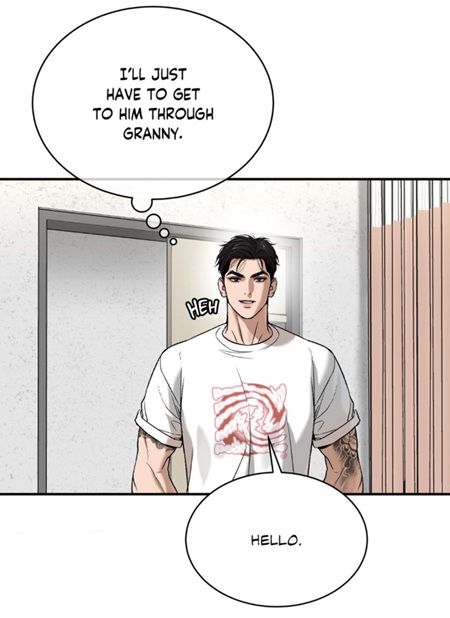 (chapter 65) Finally, if my prediction is correct, then by living with different people in a small place, he will realize the benefits of relying on others. He will discover the joy of having a family, having found a home. The storm creates a space for redefinition.
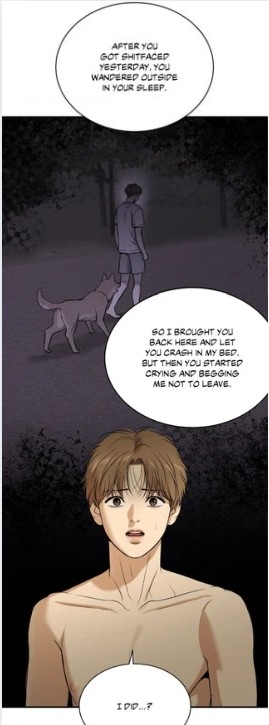 (chapter 66) Jaekyung, who has never seen the puppies, might discover them now. That discovery mirrors his gradual awareness of fragility and caretaking. For Kim Dan, nurturing the puppies symbolizes reclaiming his capacity for love and responsibility—free from obligation.
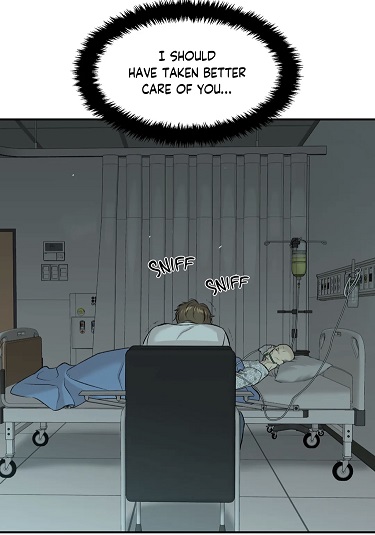 (chapter 21) and needed company.
  (chapter 21) The doctor would drop everything and rush to her side overlooking his own health. But now, with blocked roads and dangerous winds, Kim Dan cannot come—even if he wants to. He is no longer her servant or safety net. Nature has intervened where he could not set a boundary.
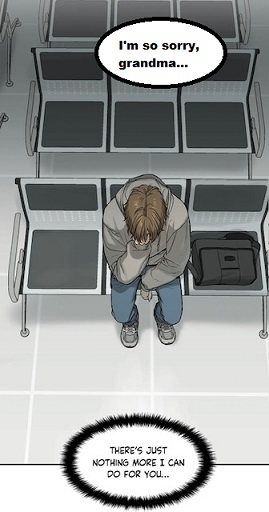 (chapter 5) Doc Dan can not assist her anyway, as he can do nothing against nature.
 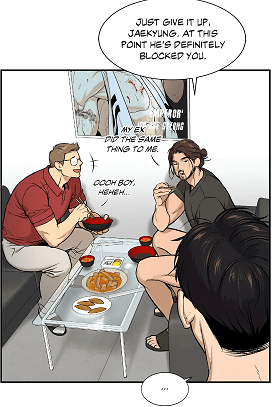 (chapter 5) Thus his anxieties should reach a new peak. His grip on the boy he used to control is gone. The storm draws a line between who remains—and who fades.
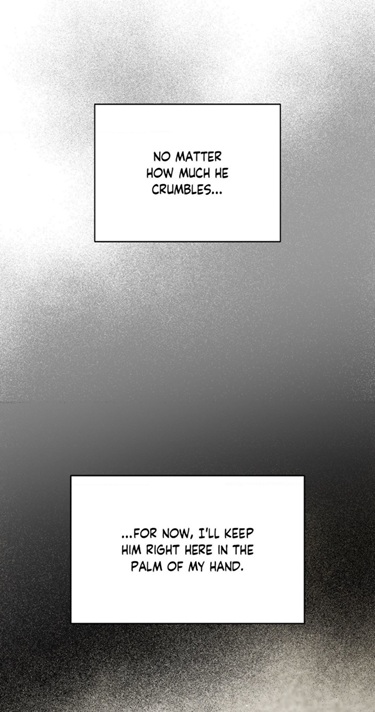 (chapter 68)—stand firm.
 (chapter 61) Therefore I perceive him as the eye of the storm.
  (chapter 53) She imagined a final golden moment—warm, serene, and nostalgic before her death. But instead, she gets gusts and branches crashing down. In that sense, the tempest is her lesson: Humans are not superior to nature. They can not control time, nature and destinies. Moreover, nature does not serve our stories. It tells its own.

 (chapter 69)
 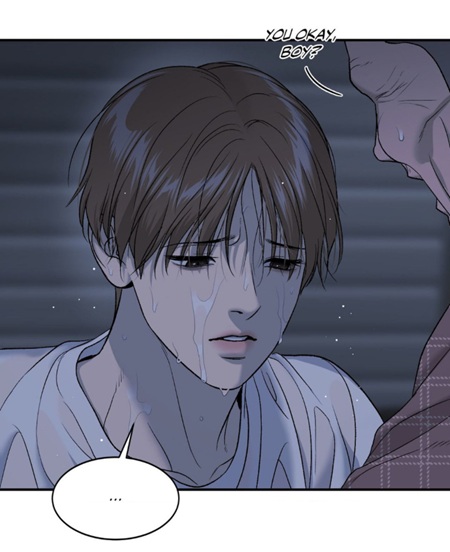 (chapter 69) These silent, parallel compositions reveal the landlord’s symbolic position as an enduring guardian: not static, but responsive. Therefore his position shifts constantly, either
  (chapter 65) in front of the couple, or behind Kim Dan in one scene, behind the champion in another.
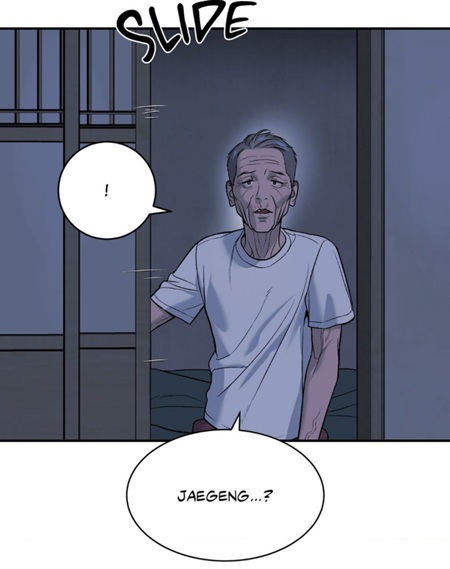 (chapter 65) He is like the wind, fluid and unobtrusive, adapting to the needs of the moment. His position is never rigid, therefore in the final panel he seems to have vanished.
  (chapter 46) or authority
  (chapter 65), the landlord responds to what is needed, not what is expected. His flexibility does not stem from indecision—it is born from humility and care. Another aspect contributing to this perception is his ignorance. However, the latter should not be viewed negatively. Since he doesn’t know the champion’s profession or the doctor’s familial and financial situation, he is not projecting expectations or judgments onto them. Rather than acting out of assumption, he simply observes. This is precisely why he doesn’t come across as arrogant. His lack of knowledge becomes a quiet strength—it allows him to respond with presence, not prejudice. Just as the wind moves through open spaces without imposing form or judgment, his unknowing presence allows room for others to breathe and unfold, free from predefined roles or assumptions.
 (chapter 65) He does not try to define the protagonists by their past or their titles. He lets them define themselves. While he tried to encourage doc Dan to drink and work less, as time passed on, he came to notice his suffering and accept him with his illness.
  (chapter 62) —his livelihood depends on observing the skies.
 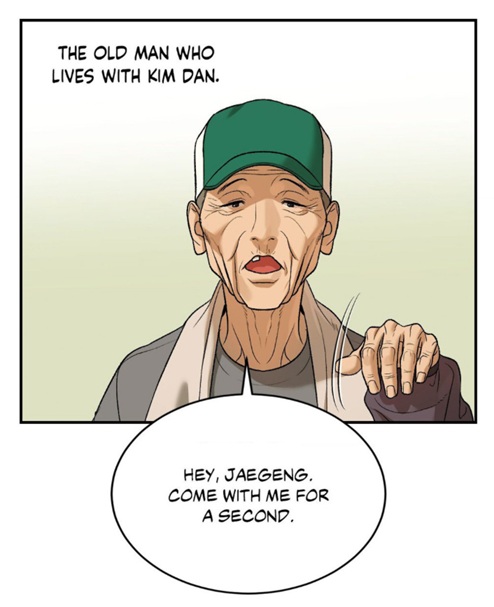 (chapter 62) He is a farmer—a man who reads the sky, the wind, and the rhythm of the land. Hence I am inclined to think that his awareness of the approaching storm stems not from a broadcast but from instinct. The wind carries signs, and he is attuned to them. It is even possible that while talking with the coast guards, he learned more about the forecast—not through digital alerts, but through human connection.
 (chapter 69) had already been shown earlier together in the crowd, I suspect that one of them might informed Kim Dan about the incident and the champion’s presence. This would align with the narrative’s kaleidoscopic structure, where certain scenes are reflected in different timelines.
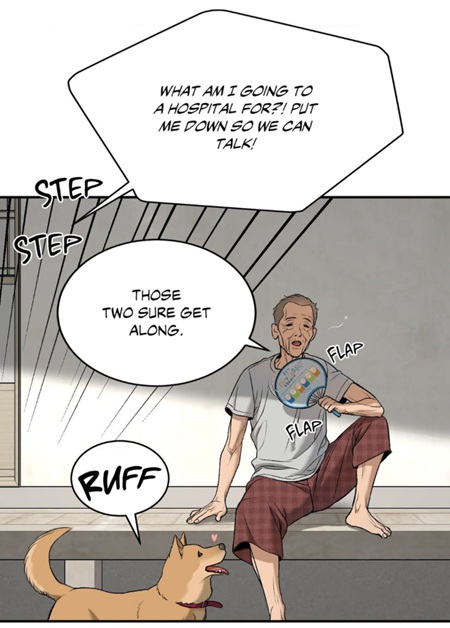 (chapter 66) the image of him gently fanning himself while sitting in his yard. I detected something immediately intimate and ancient in this gesture. A hand fan, in many East Asian cultures, denotes calm authority, self-discipline, and silence. I interpreted this scene as more than casual: the landlord becomes an embodiment of wind—present, refreshing, yet invisible. A man who can create movement without pressure. It is striking that in a story driven by action, fists, and fame, the one character who moves the plot forward with the least noise is this old man.
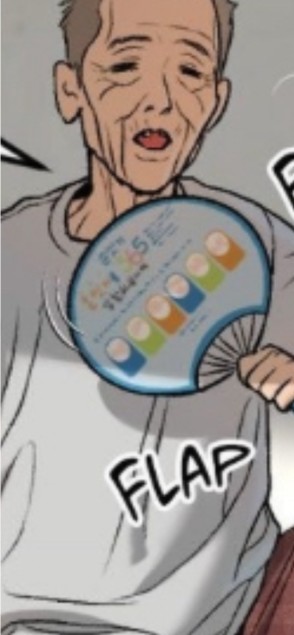 (chapter 66) Under this new light, it dawned on me that the fan was most likely handed out by a local institution—perhaps even the hospice Light of Hope, during a public health campaign or examination event. This means that he is taking good care of himself. One might argue with this interpretation, yet there exists another evidence for this perception.
  (Chapter 62) He is constantly wearing the green cap, a sign that he knows about the danger of the sun. This stands in opposition to the grandmother who would sell her vegetables without any hat.
  (chapter 57) These types of fans are typically distributed by hospitals or clinics: practical items with subtle promotional intent. But once in the landlord’s hands, it takes on symbolic weight. The number “365” does not simply represent a calendar year; it represents consistency, time, and the daily rhythm of care.
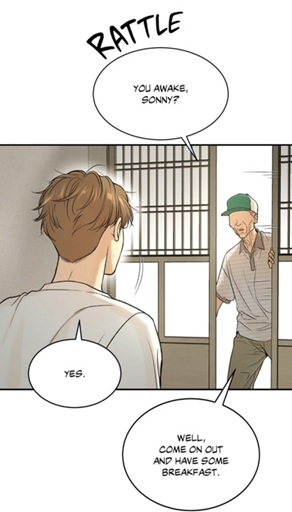 (chapter 57), white,
  (chapter 62)
 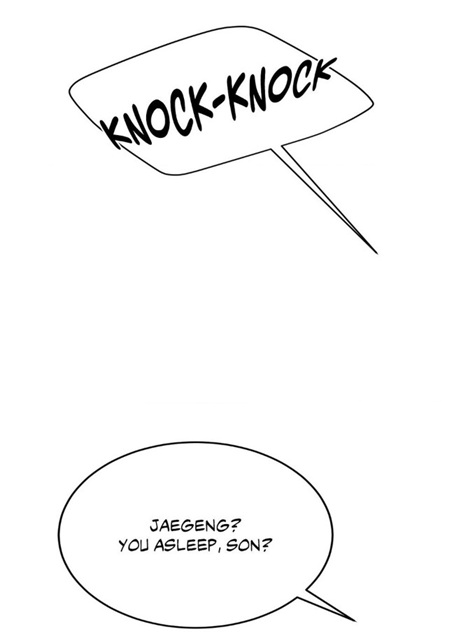 (chapter 69) and Kim Dan as “sonny”
  (chapter 52), they use their “youth and seniority” to assert dominance or demand loyalty and obedience. On the other hand, the landlord positions himself as a silent guardian, perceiving the protagonists as children in need of warmth and care, not correction.
 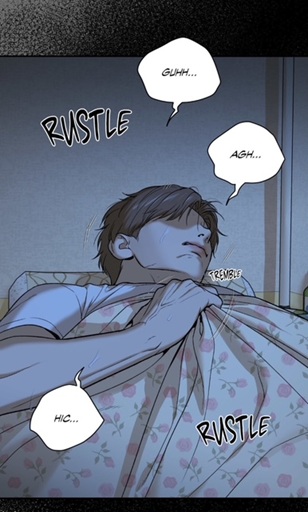 (chapter 59) Whether it’s due to panic, malnutrition, exhaustion, or psychological collapse, suffocation is one of the defining sensations of Kim Dan’s arc. In this context, the landlord, with his unassuming fan and grounded demeanor, emerges as a breath of fresh air—the very opposite of the heiße Luft, or “hot air,” surrounding the champion’s fabricated scandals and media distortions.
  (chapter 52)
  (chapter 69) the atmosphere grows heavier—not from external scandal, but from inner turmoil. Then Kim Dan’s puzzled reaction,
  (chapter 69) The scene becomes emotionally charged, echoing classic storm symbolism: emotional intensity, uncertainty, and the prospect of sudden change.
 (chapter 59) The landlord doesn’t shelter people from pain or storms. He makes sure they’re equipped to face them. And once they do, the wind is no longer a threat, but a form of grace. And now, you comprehend why the death of the puppy has not been discovered by the athlete yet. For the landlord, death is something natural and inevitable, and since doc Dan has been working at the hospice, I am quite certain that the old man imagined that doc Dan was well-equipped to deal with this situation. He must have been envisaging that Doc Dan was accustomed to it. The problem is that he doesn’t know the protagonist’s past and family.
  (chapter 58), who plays the victim while hiding his own culpability, the landlord does not engage in gossip or vilification. His silence isn’t ignorance—it is grace.
  (chapter 58) and from media
 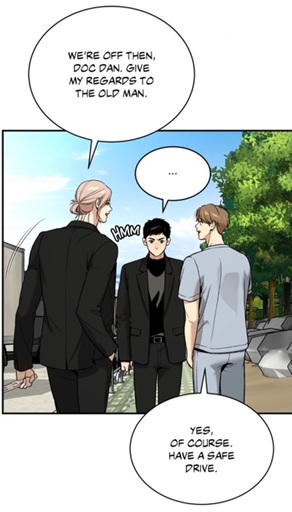 (chapter 59) He felt so comfortable around him.
  (chapter 66) and remains seated. Since he mentions it is the weekend, it is clear that he has no intention to work during the weekend. This explains why he is not wearing his usual green-and-white cap. This subtle detail reinforces his connection to nature’s rhythms—he is not a workaholic
 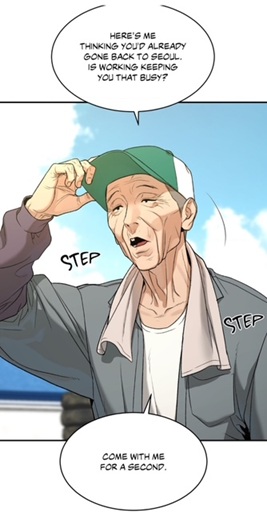 (chapter 57), but someone who understands the balance between labor and rest. He may not have a name, but he has a function. And sometimes, in storytelling, function is identity enough.
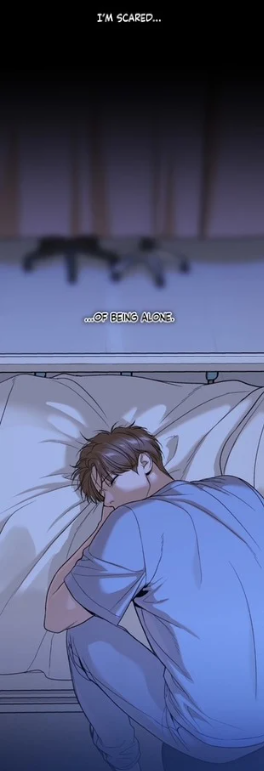 (chapter 56) In Episode 56, we see him resting in front of the window. This moment suggests not only emotional vulnerability but also isolation. There is no one behind him, no one shielding him from the coldness of the world. Later, when he watches the sunset, disconnected from his senses, unable to hear the waves or feel the breeze,
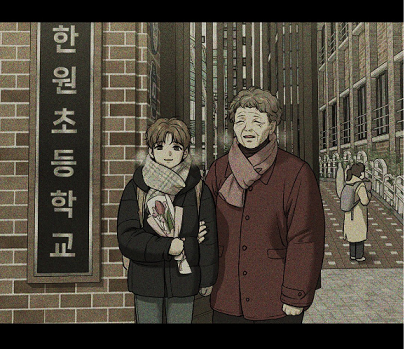
 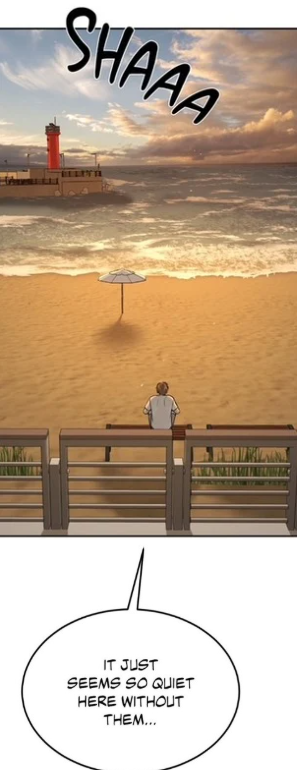 (chapter 59) there’s only one poor sun umbrella in front of him and a wall far behind him. His back is turned to the world, wrapped in solitude and silence. That’s how I was reminded of his childhood. There, the grandmother often stood beside him
  (chapter 47)
  (chapter 47)
 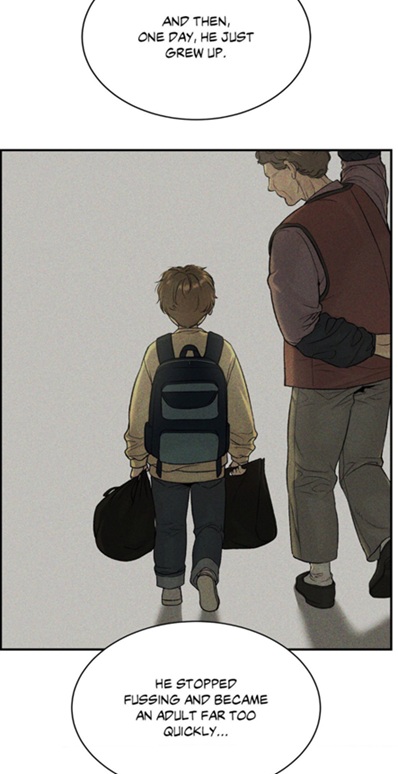 (chapter 65) but not behind. Thus the landlord’s placement
  (chapter 49) explains why he got abandoned in the locker room. It gains even more poignancy when viewed against his past. In Episode 47, while the grandmother was carrying him on her back, Kim Dan’s back is left unprotected.
 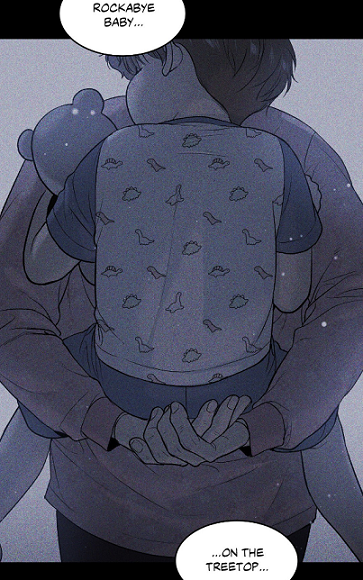 (chapter 47) Her proximity is visible, yet it lacks the symbolic protection associated with standing at someone’s back.
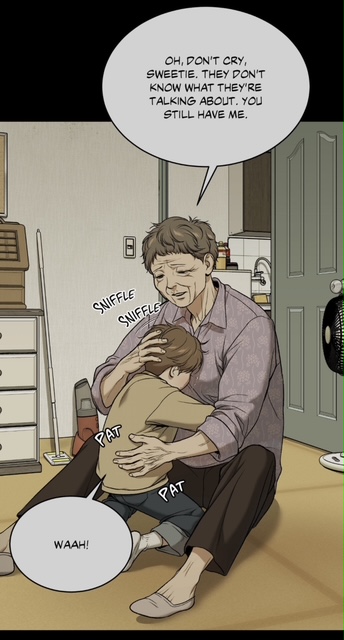 (chapter 57) The grandmother embraces him and taps his back gently while saying, “You still have me.” At first glance, this gesture may seem supportive. Yet, under this new light, I came to the following conclusion: her touch is more reflexive than instinctive. It soothes, but it doesn’t protect. It calms, but it does not empower. It is not a shield—it is a silencer. Her physical gestures, though present, lacked the emotional resonance necessary to foster true security. This interpretation gets validated, when you include her second “action”:
 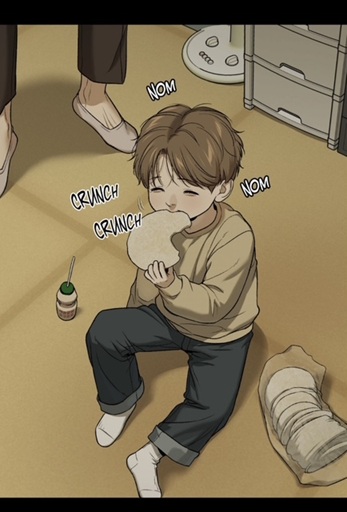 (chapter 57) The moment she offered him a snack, she distanced herself from him. Now, she is standing by his side.
  (chapter 65) It becomes the exception—the rare moment where she appears to have his back. But photographs can be deceptive. They capture posed perfection, not lived reality. And as we trace Kim Dan’s emotional journey, we begin to understand that this illusion of maternal protection was not enough to sustain him.
 (chapter 61) —they give him the air, time, and space to grow.
  (chapter 62) Their presence—especially the landlord’s—is the embodiment of silent guardianship.
  (chapter 69) His consistent yet unobtrusive presence stands in opposition to the grandmother’s inconsistent gestures. One acted out care; the other lives it.
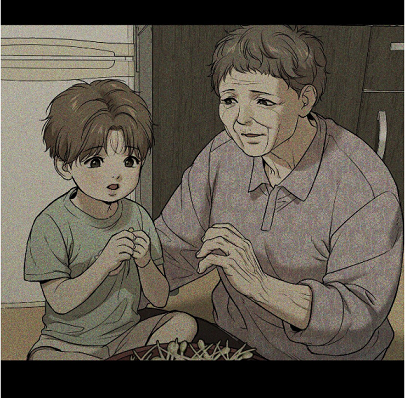 (chapter 47)
 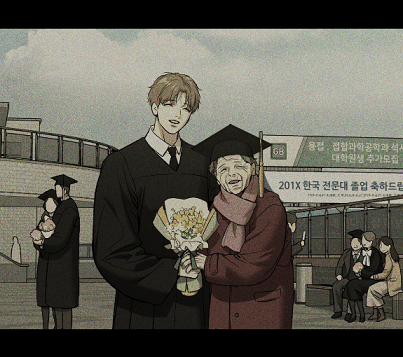 (chapter 47) Despite the rare instance of closeness captured in a photo, most scenes depict Kim Dan standing next to his grandmother, and he is the one supporting her.
 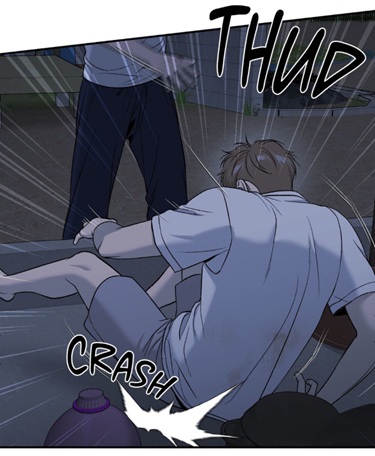 (chapter 69) This gesture, though seemingly violent, reveals something deeper—it forced Kim Dan to feel what he had been missing all along: there were people around him, he was not alone. I would even add, someone was finally standing behind him.
 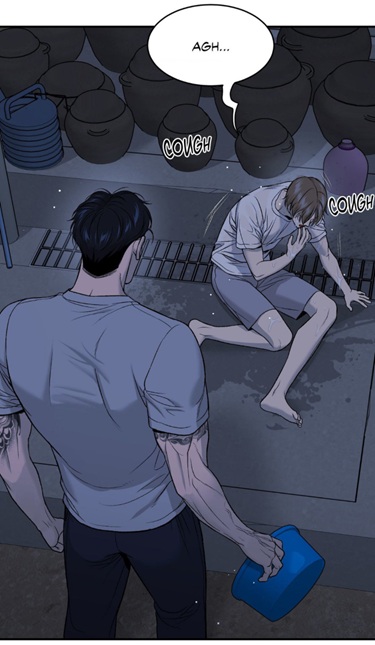 (chapter 69) In that brief moment, Kim Dan is no longer alone. The landlord, as a silent guardian, and Joo Jaekyung, as a fierce protector, are both behind him—symbolically and literally.
  (chapter 65), reliant on beds, wheels, and nurses to navigate the world. Under this new perspective, the wheelchair and the truck are no longer just modes of transportation—they are emblems of character. One rolls forward by another’s push, the other steers by its own will.
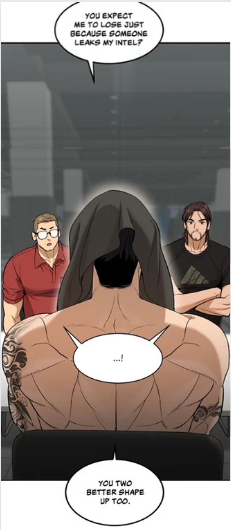 (chapter 46) Coach Yosep, Joo Jaekyung, and Park Namwook—a trio marked by authority without dialogue, control without care. In that group, the manager sowed distrust while avoiding accountability.
 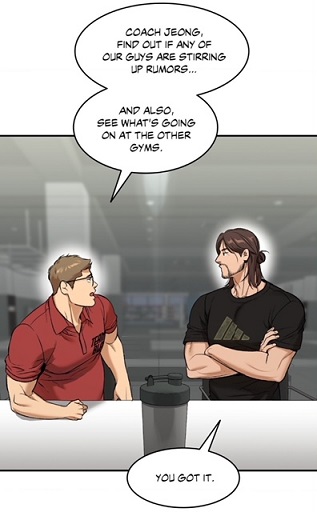 (chapter 46) In the new trio, no one holds dominion over the other. There are no contracts, no strings. The landlord has no financial stake in the fighter’s success.
 (chapter 66)

 (chapter 66) quietly shapes the emotional core of the episode. At first, this detail may appear insignificant, but its narrative timing and visual prominence suggest a deeper meaning. The sudden flight of the sparrows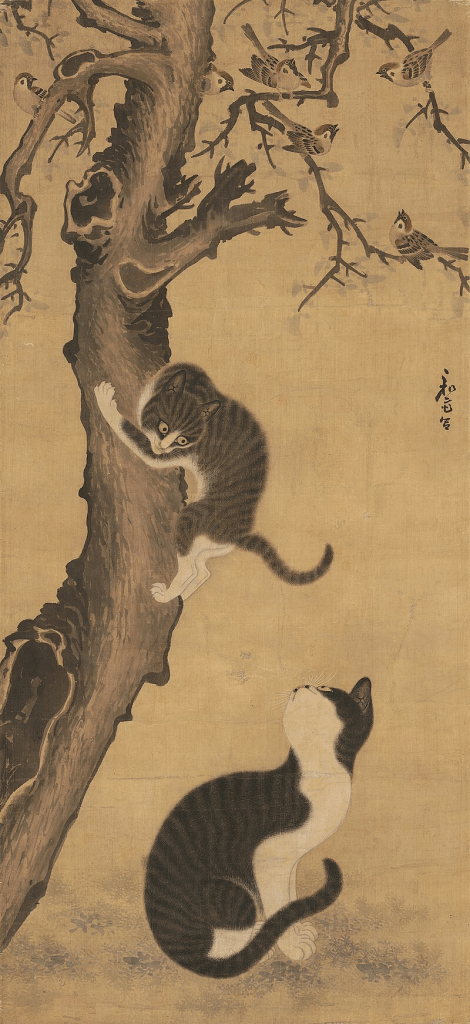
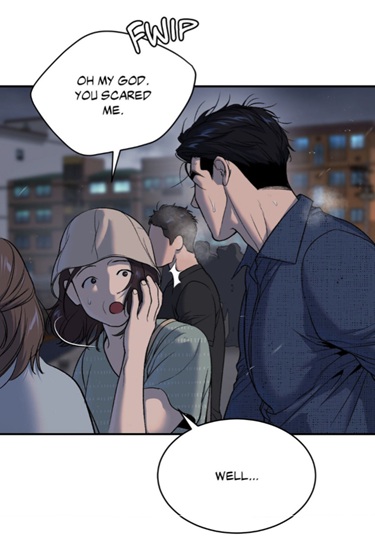 (chapter 69) —who serve as stand-ins for the broader community. In this way, their union is not just a private matter but becomes public and recognized, affirming their bond within the social fabric of the town.
 (chapter 69) fight again in the fall which leads him later to admit his own vulnerability
 (chapter 64) or inspire the group to change its direction. In the context of Jinx, the sparrows’ existence
  (chapter 62), therefore the young man didn’t pay attention to his arrival contrary to the quoted panel above. Moreover, it is clear that the “hamster” felt safe in the presence of the landlord. Back then, he had only accepted the champion’s request after hearing the landlord’s remark:
 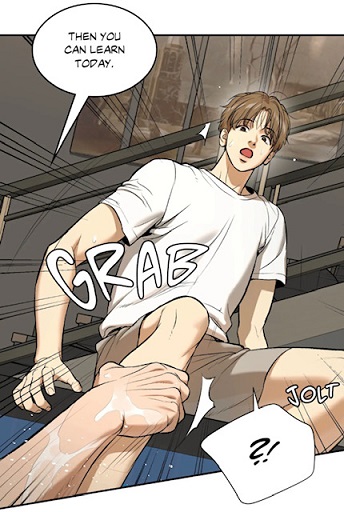 (chapter 27) a playful prank occurs without any third-party observer. The context is unambiguous: both the characters and the reader understand the action as harmless and mutually accepted, so no external framing is required.
 (chapter 69) and throws him outside
  (chapter 69) His composed presence in the background
  (chapter 69) Moreover, I am sensing that the elderly man might feel terrible, for he asked for the athlete’s assistance in the middle of the night. But let’s not forget that the main lead had driven 4 times within 2 days the distance from the little town to Seoul.
 (chapter 62) he brings his belongings
 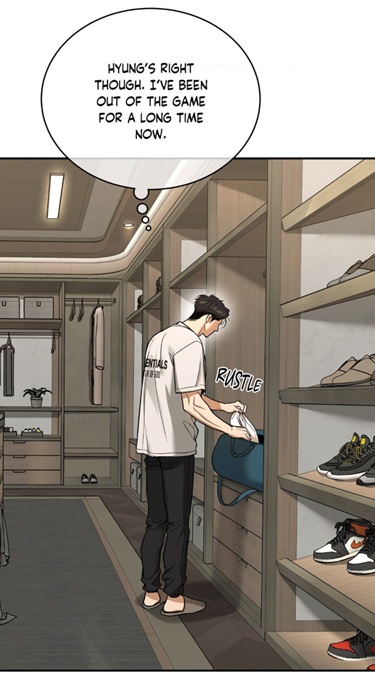 (chapter 66) gradually into his new environment, creating a personal nest.
 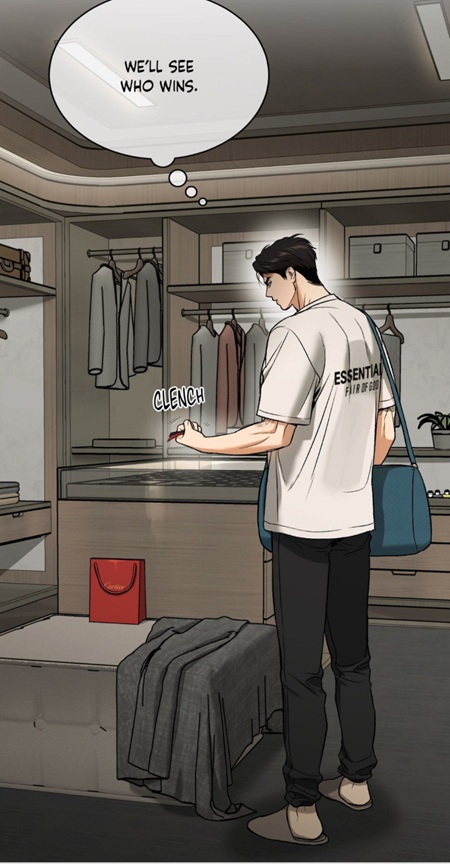 (chapter 66) a sign that this gift has now a sentimental value for the athlete. Just as sparrows persistently build and rebuild, so do the characters in Jinx adapt, settle, and grow—sometimes through trial and error, sometimes in fits and starts, but always moving toward a deeper sense of home. By moving to a smaller house, he is encouraged to select what truly matters to him. This evolution has not reached its end: the champion will keep moving his possessions to the little town. Moreover, I am more than ever convinced that we should expect the arrival of the Wedding Cabinet in that small town.
 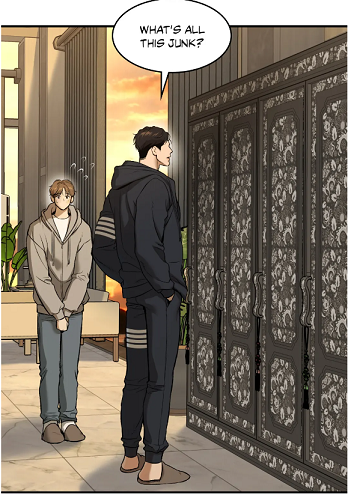 (chapter 19) To conclude, we should see the chapters from 62 to 69 as the creation of the couple’s nest and as such “home”.

 (chapter 69)
 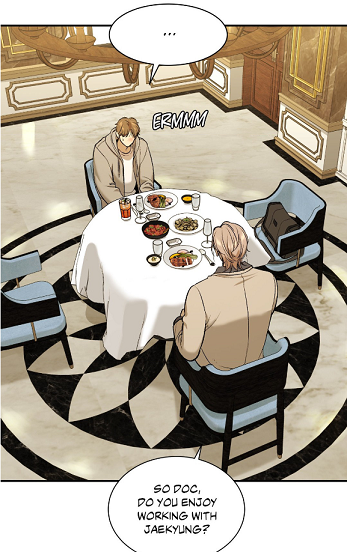 (chapter 32) Yet upon closer inspection, certain oddities stood out to me.
  (chapter 43) In that scene, Kim Dan poured soju into his water cup to pace himself during a drinking session.
  (chapter 43) Joo Jaekyung, unaware, mistakes it for his own and angrily reacts upon drinking it. This moment shows how closely water glasses are associated with Korean dining culture—even in casual or alcohol-heavy settings. Hence during a meal, the characters always have
  (chapter 32) two glasses on the table. In South Korea, it is customary for restaurants to provide a glass of water to every diner, regardless of the meal’s formality or complexity. This small gesture reflects hospitality, attentiveness, and the expectation of proper nourishment. The absence of water glasses, therefore, subtly communicates indifference or even disrespect—signaling that the recipient is not truly welcome to enjoy a full meal or rest. When applied to the “dessert meeting,” this detail becomes all the more striking: a cultural standard is ignored, revealing the performative nature of the gesture. Their absence at the “dessert meeting” feels deliberate, a symbol of superficiality and arrogance.
  (chapter 43) The reason for his mistake was that they had only placed a spoon and sticks.😮 He had no glass for himself. It was, as if they had forgotten him. In other words, he was not supposed to eat and drink at his own birthday party!! 😂
 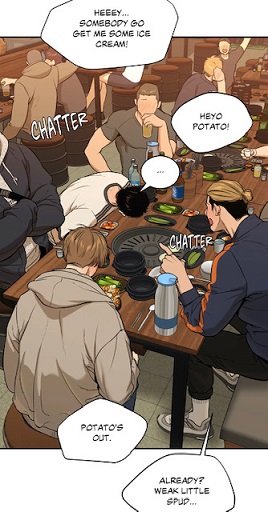 (chapter 9) It reflects a pattern: the champion is present but not included in the communal or emotional aspects of the gathering. His spoon and chopsticks function like a prop, much like the untouched knives and forks at the dessert meeting.
  (chapter 69)
 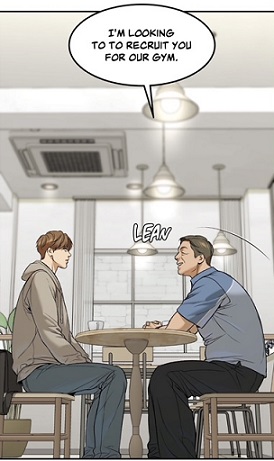 (chapter 48), the meeting between Choi Gilseok and Kim Dan. The former invited him for coffee.
 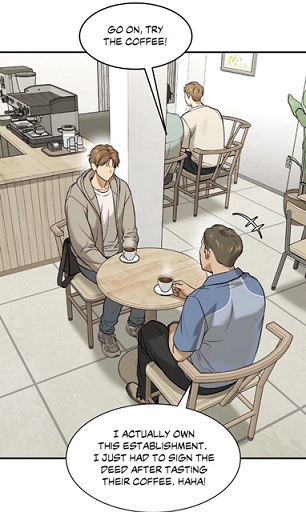 (chapted 48) At first, the gesture seemed generous—he offers a home, a car,
 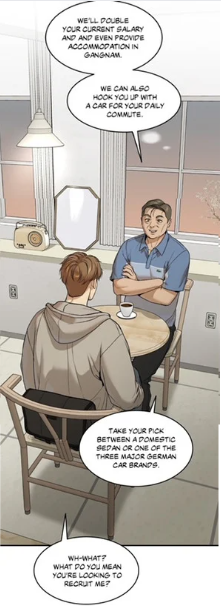 (chapter 48) and the promise to help doc Dan to get a new treatment for the grandmother.
  (chapter 48) But this so-called kindness is conditional: in exchange, Kim Dan must betray Joo Jaekyung. Striking is that director Choi only ordered coffee. But a coffee without a dessert is no real break, but a stimulant—fuel for continued work. In both this meeting and the previous one with Choi Gilseok, the core remains the same: “work”, stinginess and greed wrapped in the guise of generosity. Every sweet drink or dessert lies a hidden price. This comparison highlights that the current meeting is not for the athlete’s sake—it is meant to serve Park Namwook and the CEO, who share different but aligned goals.
 (chapter 66) linked to fire, summer (hence the reference to the trip in the States), passion, performance, and vitality—ironically twisted here into cold professionalism and superficial seduction. Her position contrasts with her symbolic warmth, highlighting the emptiness of her care. This explains why she is portrayed eyeless. She sold her “soul” to money and as such to the “devil”.
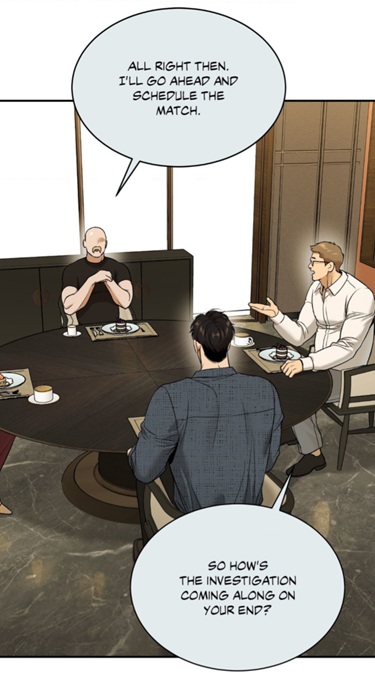 (chapter 69) wearing black, aligns with the North (흑, Heuk), associated with the color black, winter, water, authority, secrecy, and hidden control. It was, as if he was representing the missing glass of water. His position as the initiator of the meeting and his location near the window reinforce his dominance and detachment.
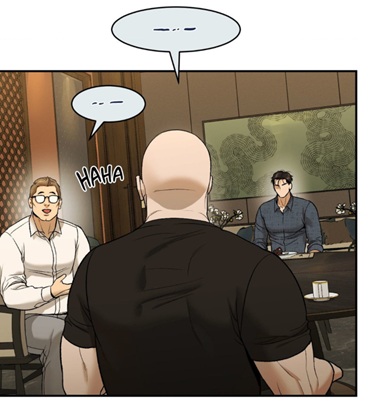 (chapter 69), which evokes confusion and corruption. This artistic backdrop continues the theme from Voyage, Voyage (life is a journey), positioning Jaekyung as mentally “adrift” within this orchestrated trap. At the same time, the green might reference the “Black Forest”—a literal and metaphorical journey ahead. Like Hansel and Gretel, he is being lured with sweets into the forest. But unlike the fairy tale, the athlete’s breadcrumb trail will not lead him home—it will lead him to Kim Dan. On the other hand, by making this connection, I couldn’t help myself thinking that exactly like Hansel and Gretel, doc Dan and his fated partner will cross the witch’s path on their journey to independence and happiness.
 (chapter 69) Notably, this outfit marks a shift from his previous appearances: during his public pose with Baek Junmin
 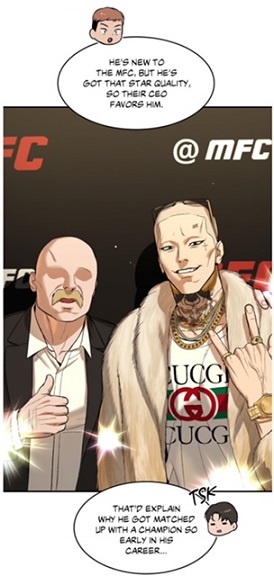 (chapter 47), he wore a formal black suit with a white shirt, signaling polished professionalism. When he met the champion in the States, his full black outfit resembled a manager’s uniform and a badge, signaling humbleness and authority but also a hands-on, corporate role.
  (chapter 37) Now, Joo Jaekyung mirrors this casual dark attire
 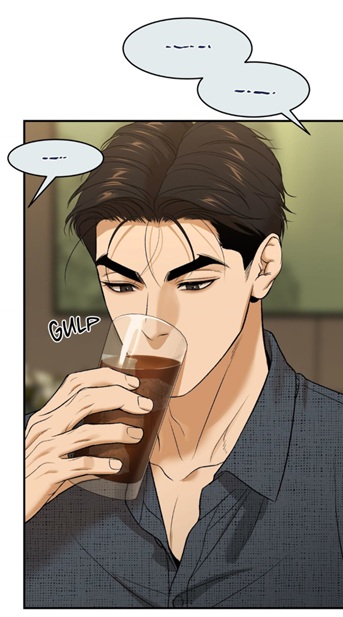 (chapter 69) —a signal of inner turmoil and his transition from his former life. Blue stands for loyalty, thought, and calm, while black alludes to his troubled past. He is evolving but not yet free.
 (chapter 69) In this world, ideals are hollow, and tradition is co-opted to mask self-interest.
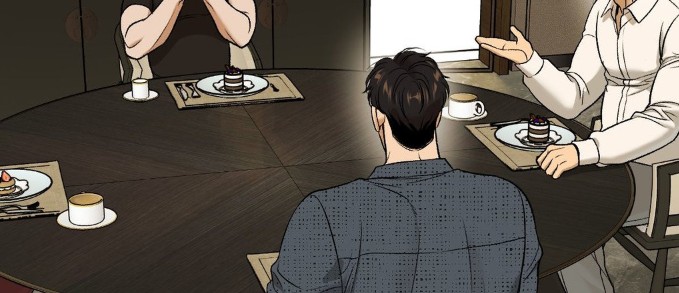 (chapter 69) the strawberry fraisier (chosen by the woman) stands for surface sweetness and seduction; the layered chocolate cake (perhaps a feuilleté) represents indulgence and opulence. Joo Jaekyung alone chose a square Black Forest cake—a form traditionally associated with structure, truth, and boundaries. Because the cake contains kirschwasser, subtly referencing the athlete’s brief brush with alcohol, it becomes clear that Park Namwook was not the one behind this order. Imagine this: under his very own eyes, the champion is encouraged to taste a strong alcohol. In my opinion, they must know that the star has been drinking. Yet, it was through Kim Dan’s presence that he stopped drinking, making this dessert an unconscious mirror of both his struggle and strength. Meanwhile, Park Namwook, ever the follower, selects the same dessert as the CEO and the same drink as the woman, revealing his pretense and pastiche once more. Since the manager has always bought junk food (chicken
 – chapter 26, hamburgers, ramen
 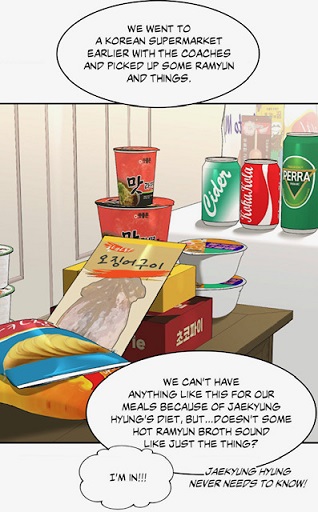 – episode 37), it becomes clear that the hyung simply has no idea about Western food in general and in particular expensive French or German dishes. That’s why he didn’t ask about the dish or questioned the champion if he should eat the deadly sweet cake.
  (chapter 22)
 (chapter 48), their meeting was not supposed to be secretive. On the other hand, because the scene was photographed
 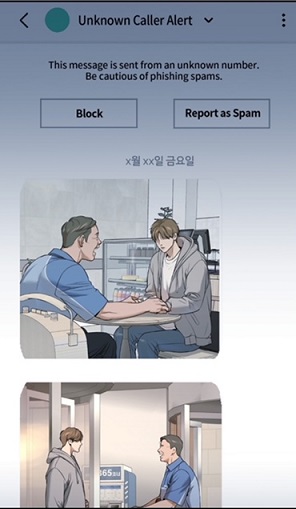 (chapter 48), it created the illusion of “betrayal” as it looked like a secret meeting”. In episode 69, the meeting is hidden from the public. In contrast to the earlier public appearance alongside Baek Junmin for the cameras
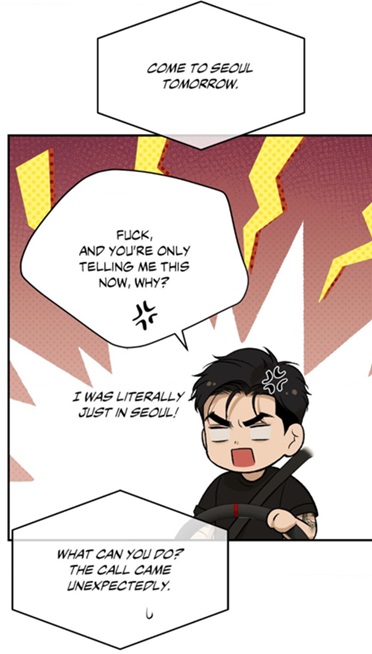 (chapter 69) This framing is deceptive: far from being a gesture of goodwill, it reveals the urgency and opportunism driving the meeting. However, this gesture is carefully staged: the CEO and the woman in red are the ones who selected the time and location of the encounter, placing the athlete in a reactive position where he must adjust his schedule to their convenience. It reinforces the illusion of privilege while concealing a dynamic of control. The meeting is designed to appear personalized, but it reflects MFC’s ethos that ‘time is money’—a business-centered logic that prioritizes efficiency over empathy. The CEO’s urgency to schedule a match, despite Jaekyung’s unclear health status, further exposes the commodification of the athlete. Notably, the proposed match is not even a title bout.
 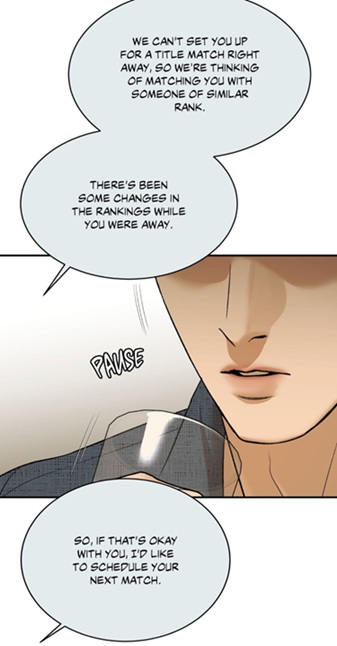 (chapter 69) This strategic omission likely serves to shield the organization from scrutiny, as a title match would demand full transparency around the champion’s ranking and physical condition—areas that may not withstand public examination. In truth, the meeting is not about offering the protagonist an opportunity, but about maintaining MFC’s narrative control while exploiting his fame. This framing is deceptive: far from being a gesture of goodwill, it reveals the urgency and opportunism driving the meeting. To conclude, the discreet setting implies that MFC is not interested in publicizing their dealings with the star, possibly to avoid scrutiny or backlash. The lack of transparency underscores the manipulative nature of this so-called “favor,” which ultimately serves the organization’s agenda, not the athlete’s interests. The problem is that this meeting is heard by doc Dan
  (chapter 69), hence the “future match” is no longer a secret.
  (chapter 67) He was not dropping the case. That’s the reason why the fighter is offered a match in the fall. If he is busy, then he might forget the “case”, especially since fall is right around the corner. He would be occupied training. Like mentioned in previous essays, my theory is that the CEO is involved in the scheme. This assumption got reinforced with this meeting. Striking is that the focus of the “chief of security” was the incident in the States.
  (chapter 69) By stating that the criminal belonged to a Korean gang in the States, she implied that this man had no direct connection in South Korea. In addition, with this statement, she claims that he is still in the States and the champion is safe. However, if the “fake manager” had been living in the States for a long time, he wouldn’t have spoken in Korean automatically.
  (chapter 37) In other words, she is trying to place the mastermind in South Korea.
 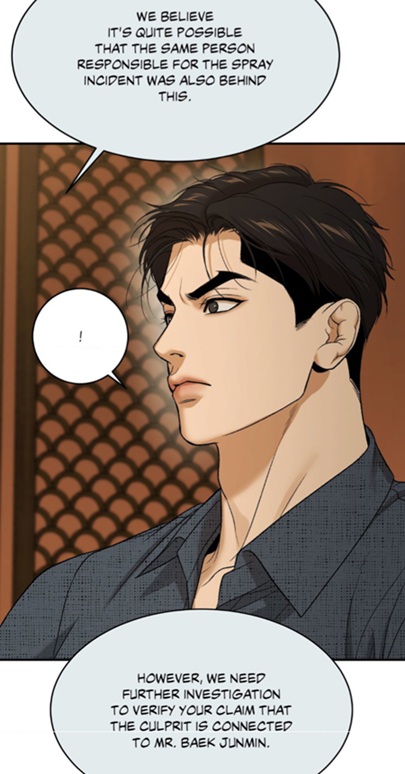 (chapter 69) This means that she is attempting to erase the involvement of MFC in the scheme. That’s why they are now offering an apology, which is naturally fake:
  (chapter 42), it dawned on me that MFC is actually treating the Emperor like a “cash cow”, they imagine that they can keep milking him. I could say, this encounter is exposing the reality to the athlete: Joo Jaekyung is treated like any other fighter. Hence there is no longer mention of Baek Junmin in the news. On the other hand, they have to vouch for Baek Junmin’s integrity
  (chapter 41) here the topic is avoided altogether—possibly due to the lack of actual clearance. Should a third-party hospital intervene, the match could be canceled. Secondly, Park Namwook assumes control of the timeline: a match in the fall means training now. But the champion is no longer dancing to his tune. He is meditating, admitting his exhaustion.
 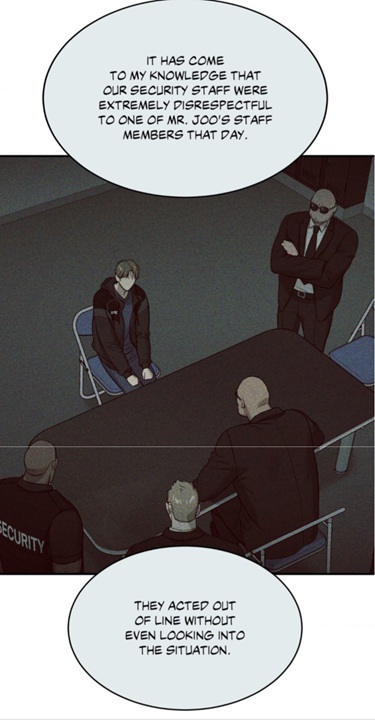 (chapter 69) So Joo JAekyung is more than a fighter and the apology (interrupted by the manager) is the evidence for this. Under this new light, Jinx-philes can understand Park Namwook’s interruption and embarassement. Not only he doesn‘t want to be reminded of his past mistakes (passivity, failure of his job, the slap), but also this apology serves as a mirror and reminder that he is not the true owner of the gym.
  (chapter 69) He is his unseen savior. Thanks to Kim Dan, the star remained silent and calm giving the impression that he had fallen for MFC’s trick.
  (chapter 40) This echoes Kim Dan’s confusion in Chapter 40 when interrogated in English. It also conveniently hides their ties to local authorities—acting as foreigners with no responsibility or rootedness in Korea. But this is what director Choi Gilseok confessed to the angel:
  (chapter 48) The business is rooted in the USA.
 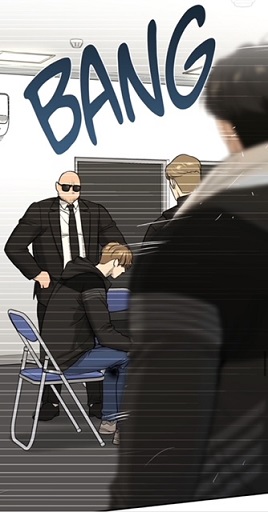 (chapter 40), effectively opening the metaphorical door to truth and protection. In this meeting, however, Park Namwook serves to contain and silence, not to defend. His placement underscores his complicity and fear—not just of the CEO or MFC, but of confronting the consequences of his own failures. But the manager is on his way for a rude awakening, he will be taught a lesson: don’t judge a book by its cover. The athlete won’t be the depressed, anxious, submissive and passive “boy” any longer. Moreover, he listened carefully to the chief of security:
  (chapter 69) he leaves during the day and arrives by night.
  (chapter 32) During Kim Dan’s lunch with Choi Heesung, the floor beneath their round table shows a twelve-petal flower motif—evocative of the legendary Knights of the Round Table, who were said to sit twelve strong. That earlier scene featured Heesung testing Dan, much like the fake round table later hosts a veiled test for Joo Jaekyung. The repetition of round tables masks exclusion and betrayal. These early “false” tables pave the way for a true table—one that Jaekyung might one day forge with fighters like Heesung, Potato, Oh Daehyun, and others, where loyalty and respect, not manipulation, define the bond.




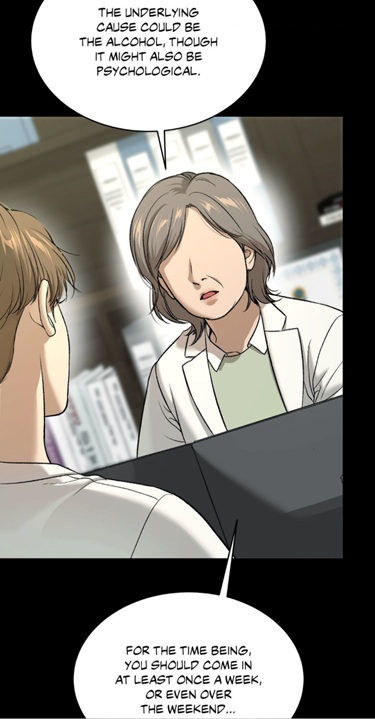 (chapter 67): the brief diagnosis, the recommendation for weekly visits, the specialist’s tentative attribution of Kim Dan’s condition to either alcohol or a possible psychological cause, emphasizing the need for continued observation and weekly visits before offering a definitive diagnosis —all standard responses. For her, this was a doctor following routine procedure without overstepping professional boundaries. However, I perceived her behavior very differently. I saw someone who remained emotionally detached and almost absent, reducing the complexity of Kim Dan’s condition to simplistic surface-level causes without genuine inquiry.
 (chapter 67) Rather than forming an independent assessment, she accepts the narrative of a third party, which introduces bias and limits her understanding. One might argue about that, because she is looking at a paper, probably result of a blood test which seems to corroborate the guardian’s statement. Hence the sleep specialist concludes that Kim Dan is suffering from insomnia, alcohol addiction and sleepwalking. The problem is that his statement is based on external observations (halmoni and the landlord) and their limited knowledge. Moreover, Jinx-philes should keep in mind two important aspects:
  (chapter 61) The champion had been himself suffering from similar symptoms which could be seen as a projection on his loved one. Additionally, based on previous observations, I have interpreted Kim Dan’s nightly walks not merely as sleepwalking, but as dissociative episodes—likely triggered by overwhelming guilt, unresolved trauma, and a chronic sense of disconnection from his body and surroundings. But how could the champion know about this? He’s not a doctor himself. In order to have a more accurate picture of the whole situation, she should have talked to the patient himself. But by relying on papers and the guardian’s testimony, she not only distances herself from the patient physically and emotionally, but also delegates the responsibility of interpretation. She is using the eyes of others.
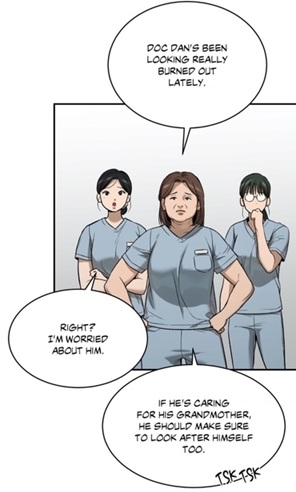 (chapter 57) Perhaps the doctor’s detachment is not indifference, but a survival mechanism in a healthcare system that demands efficiency over intimacy.
 (chapter 67) indicating that his alcohol addiction is not the real reason for his insomnia. Then she fails to examine Kim Dan physically, the desk is between them. Therefore she can not detect his visible malnourishment.
 (chapter 62) Moreover, both the landlord and the grandmother never brought up this aspect, though Shin Okja had observed this terrible transformation:
  (chapter 57)
 (chapter 66) It is because the physical therapist is just a number (2) and as such a file. Therefore the doctor is not seeing the patient as a human. I can not blame the woman either, for she has so many patients to treat during the day. And now look at the building of the hospital:
  (chapter 66). It is huge reminding me of a factory. This “modern hospital” with its sleek architecture, expansive buildings, and impressive specialization exudes a sense of advancement and trustworthiness. Yet beneath this polished surface lies a business-oriented structure, one that prizes efficiency, reputation, and patient turnover over genuine patient connection. This “modern hospital”
 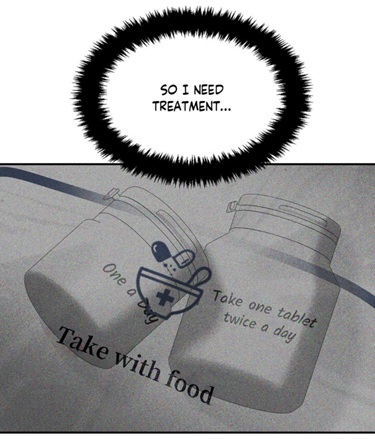 (chapter 67) She is doing exactly what Shin Okja wanted:
 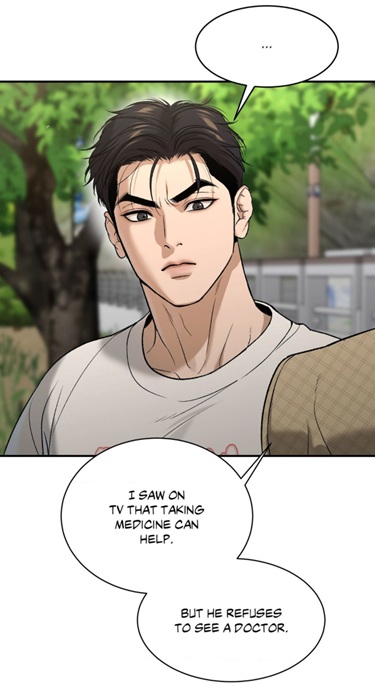 (chapter 65)
 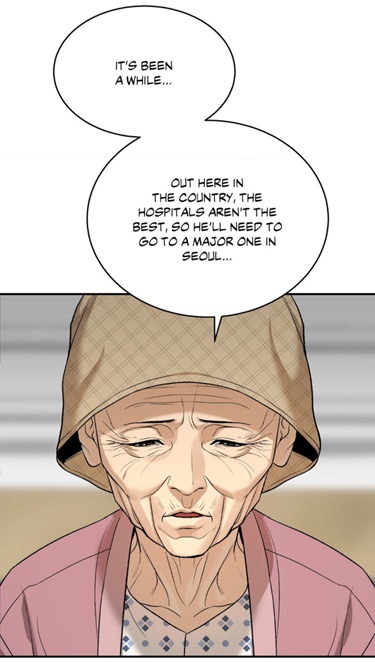 (chapter 65) It is as though thanks to the drug, the odd behavior from Kim Dan would simply vanish.
  (chapter 5) with the new medicine. On the other hand, it implies that the light-brown haired woman is doing her job for her paycheck which reminds me of Cheolmin’s statement:
  (chapter 13): “Oh no, no. That won’t do. My precious paycheck!”.
 (chapter 27)
  (chapter 49) as mere service providers. Whether it was brushing off medical advice with “Don’t push it, I know my body better than anyone else” (chapter 27) or demanding instant pain relief to continue training (chapter 49), the champion positioned himself as the ultimate authority over his own treatment. Since his attitude echoed the confession of my osteopath, it is understandable why my osteopath-orthopedist began to select his patients carefully. This mirrors Kim Dan’s evolution, when the latter chose to reject the champion’s offer. Indirectly, he is “learning” to select his job and not take them by opportunism. He is also learning to select his “patients”. Striking is that Shin Okja has a similar attitude than the athlete.
  (chapter 7) She desired to have a treatment with less side effects and less painful. And the moment she was confronted with reality, this painful new treatment only brought pain and nothing more, she chose to leave this institution and move elsewhere.
 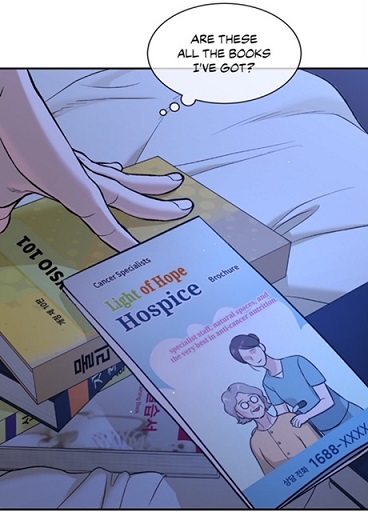 (chapter 53) Therefore it is not surprising that she is treating the protagonist the same way: she knows what is the best for him.
  (chapter 57) She is treating him like a service-provider, she is now rejecting that he has lost his “usefulness”. His pay here is not high, …
  (chapter 67) and not even following her recommendation.
 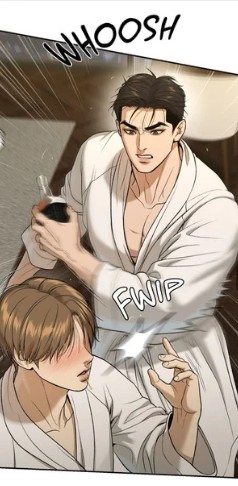 (chapter 67) He felt misjudged and misunderstood; reduced to a file number, not seen as a complex human being.
 (chapter 67) and second, what Kim Dan actually received as treatment:
  (chapter 13), in contrast, enters the story with no white coat at all. He carries only a doctor’s bag, dressed in a green pullover and a beige checkered shirt.
  (chapter 13) Despite this informal attire, he immediately recognizes Kim Dan’s symptoms and engages both the guardian and the patient. He doesn’t need institutional support to assert authority; his presence and diagnostic clarity define him. While his clothes might elsewhere be read as conservative or emotionally restrained, here they highlight that care can come outside rigid systems.
  (chapter 13) Quite the opposite. He doesn’t hide behind his distance; he manages it. His approach is practical and grounded, but never cold. He doesn’t wear a white coat, yet he brings with him a doctor’s case and an unshakable sense of responsibility. His tools are simple (his own body),
  (chapter 13) It bridges the gap between roles, making the patient feel seen rather than categorized.
 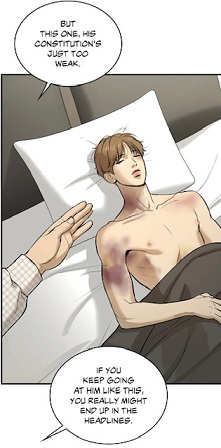 There’s no judgement in their relationship. The eyeless doctor may appear neutral, but in truth, she is hollow. Cheolmin appears reserved, yet his actions speak with empathy. Where she recites guidelines, he initiates dialogue.
  (chapter 13) Where she avoids involvement, he offers engagement.
  (chapter 61)
  (chapter 67), the Light of Hope hospice
  (chapter 5), and more intimate yet modern facilities like this one.
 (Chapter 27) Each medical setting not only has its own architecture but also its own moral blueprint. In the essay “
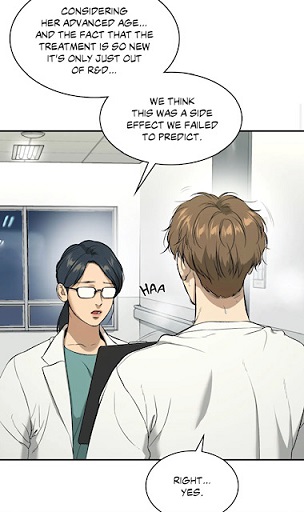 (chapter 21) Then the treatment’s failure is attributed either to the grandmother’s frailty or Kim Dan’s late arrival and absence, subtly shifting blame.
 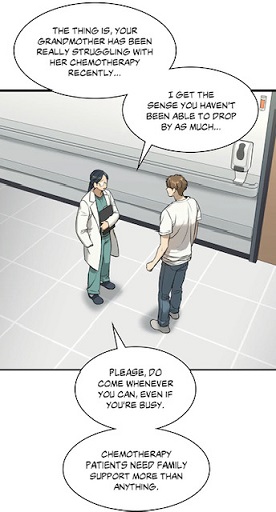 (chapter 21) Like mentioned before, this treatment wasn’t even properly recorded in the patient file raising the suspicion of deliberate concealment.
  (chapter 48) got aware of Shin Okja’s conditions, implying that patient confidentiality had been breached.
  (Chapter 61): In contrast, Park Junmin
  (chapter 61) represents the polished face of a business-oriented clinic. While his office projects sleekness and personalized care, his comments betray his priorities. He praises Joo Jaekyung’s fame and urges a return to the ring—not out of medical concern, but because it would guarantee the champion’s return as a paying patient. He wants to retain a high-profile client. His friendliness is strategic.
  (chapter 61), highlighting that the athlete has become aware of what genuine care should look like. When the champion calmly declares, “I’ll be receiving rehabilitation services in another hospital,” Junmin answers with a stunned “Sorry?”. But this is not confusion. It’s a reflexive mask for shock. He did not expect to lose control of the situation. Beneath that one-word response lies disbelief, disappointment, and veiled panic. He’s losing a lucrative patient—and more importantly, a public endorsement. The moment exposes how fragile his authority truly is when faced with a patient asserting autonomy. Let’s not forget that when the champion was facing a mental and emotional breakdown, the latter offered no other support than “rest”. He even avoided his gaze.
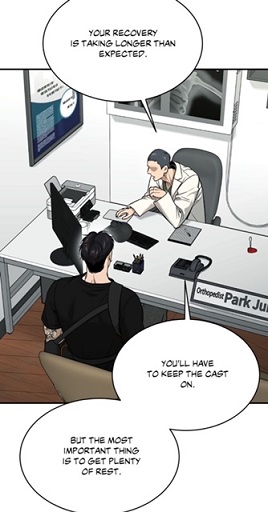 (chapter 54) The athlete was left on his own.
 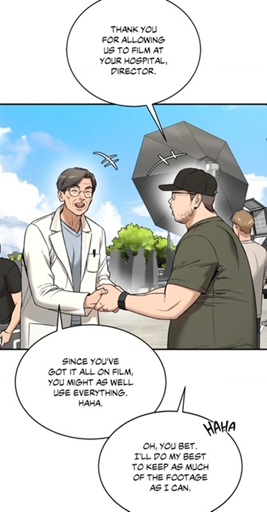 (Chapter 59): At first glance, the hospice appears to be underfunded and outdated.
  (chapter 61) However, its director breaks expectations. Unlike the smooth-talking or indifferent doctors at larger institutions, he is directly involved in patient care.
  (chapter 60), criticizes people for their rude behavior
  (chapter 59) or actively disciplines staff
 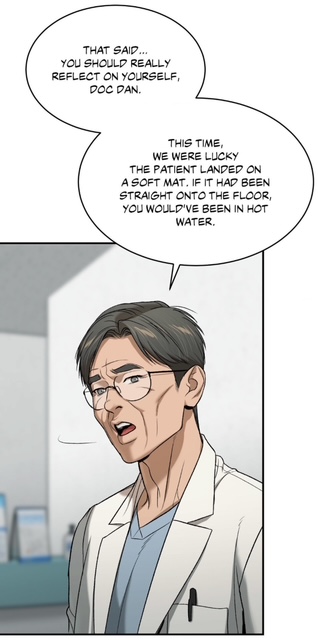 (chapter 59) when mistakes are made. Though he also flatters the champion
  (chapter 61) and sees promotional potential, he never exploits patients.
  (chapter 61) The juxtaposition of humility and responsibility in his demeanor, combined with his stunned reactions to sudden events, suggests an overworked and understaffed environment—but not one without moral grounding. His white coat and blue medical uniform echo the nurses’ attire, subtly promoting a sense of equity among staff. Despite being a director, he doesn’t separate himself from frontline caregivers. His uniform also contrasts with the green worn by Kim Miseon or Park Miseon, suggesting a focus on practical responsibility over prestige. By blending in with the team, he fosters a culture of shared accountability, not rigid hierarchy. Among all institutional figures, he comes closest to balancing authority with integrity.
  (Chapter 6): While this figure appears authoritative
 (chapter 1), the details of his attire tell another story. Wearing a suit beneath his coat implies professionalism, but here it also suggests a business-driven mindset. The coat becomes a sleek outer layer masking deeper intentions. His charming demeanor conceals a more sinister reality—he weaponizes authority for personal gain. His use of professional attire isn’t about respectability but manipulation. Beneath the surface, profit, control, and coercion drive his actions.
  (chapter 1) The white coat, in his case, is not a symbol of healing but a façade for exploitation. drives his authority. The coat becomes a literal cover for abuse—harassment disguised under professionalism. His entire persona is a façade: calculated, charming on the surface, but predatory and morally bankrupt beneath.
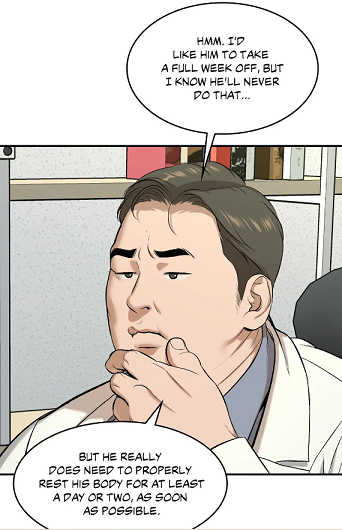 (chapter 27) His gray shirt signals a more relaxed approach,
 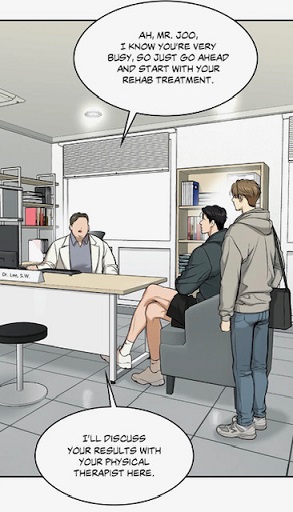 (chapter 27) and his facial expression conveys a certain empathy—though his words also betray resignation. He sits beside the patient, not opposite, visually erasing the typical hierarchical divide between doctor and athlete. His recommendation that Joo Jaekyung rest is gently delivered, but he knows it will likely be ignored. He represents the tension between medical idealism and the pressures of athletic performance. He is trying his best to protect Joo Jaekyung’s career.
  (chapter 27) Notably, he doesn’t chase fame or loyalty—he’s realistic, yet still rooted in care.
 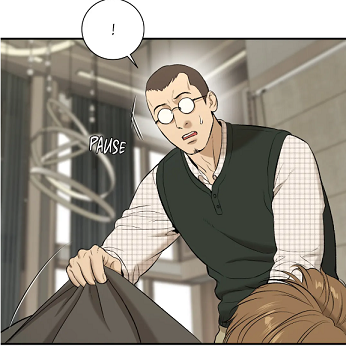 (chapter 13) Finally, Cheolmin exists outside the hospital system. He wears no white coat, but his behavior mirrors a true physician’s. He diagnoses accurately, gives immediate advice, and engages both patient and guardian. His attire—a shirt layered under another—might suggest emotional restraint, but it doesn’t interfere with his actions. He jokes and teases, breaking through tension and inviting trust. He acts not because protocol demands it, but because someone needs help. That’s enough.
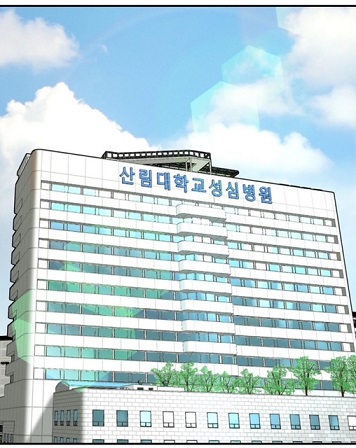 (chapter 41) nature is neatly confined. Rooftop gardens and structured greenery exist, but more as visual accessories than lived environments. The hospital is a towering research center, representing scientific advancement—but also bureaucratic coldness. Here, nature exists to impress, not to comfort. This artificial balance between concrete and green reflects a clinical detachment: nature is curated, not embraced. It aligns perfectly with Kim Miseon’s demeanor—professional, pristine, but ultimately distant and ambition-driven.the environment feels controlled.
 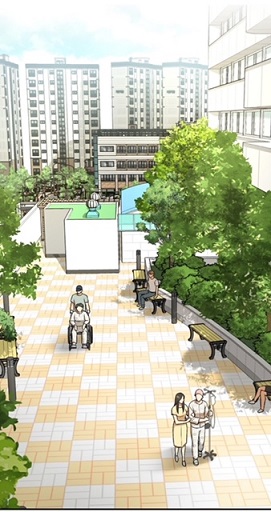 (chapter 41)
  (chapter 54) where Joo Jaekyung receives treatment, the rooftop greenery appears remote and ornamental, disconnected from patient care.
  (chapter 18) modern, and set among scattered trees.
  (chapter 18) Large windows suggest openness and transparency—the very qualities Dr. Lee brings to his interaction. This is a space that, while modest, is genuinely attentive. Here, nature doesn’t impress, it is integrated in the landscape. The park is not surrounded by huge buildings.
 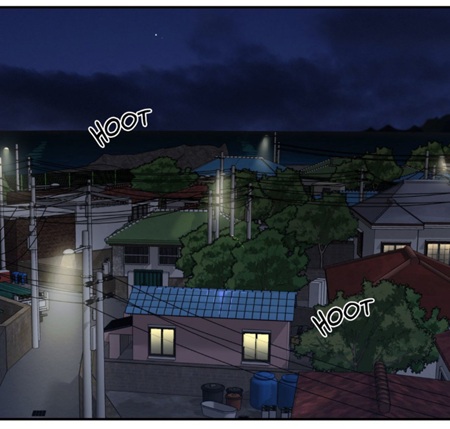 (chapter 65) nestled in the countryside and far from institutional rigidity, emerges as a space of true potential. In returning there, Joo Jaekyung and Kim Dan are not just escaping their past—they are moving toward a form of healing that modern hospitals imitate but rarely achieve. Closer to nature, they are closer to themselves. If hospitals imitate forests, the village becomes the forest. And in that simplicity, Jinx suggests, real happiness might grow.
 (chapter 57) It lives where no one is watching and no one is billing. In Jinx, the real medicine lies outside the chart—in the dirt on borrowed floral pants, in sweat earned under open skies. Nature becomes the unspoken vow that systems forgot.

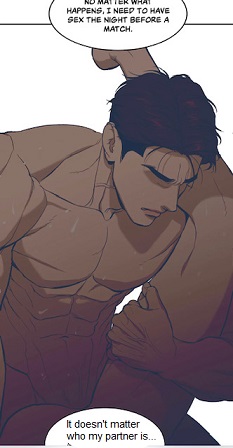 (chapter 2) his ritualistic sex before fights, his fear of losing control,
 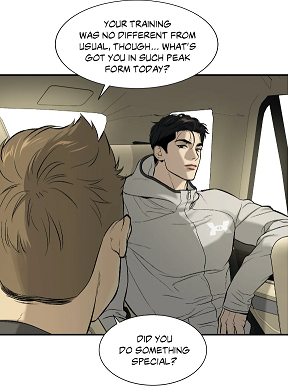 (chapter 5) his reliance on routine. Yet there is another jinx in this story, one far less visible and perhaps even more tragic: Kim Dan’s.
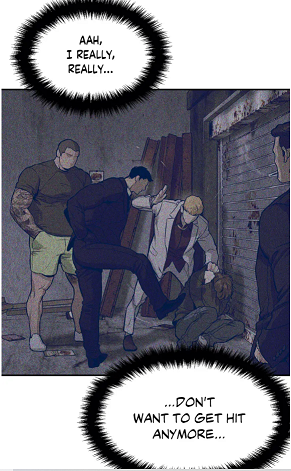 (chapter 1) was seen as the core expression of a man who believed he was doomed.
 (chapter 21) And this issue didn’t begin in adulthood. In Chapter 21, Kim Dan dreams of a night from his childhood: he wakes up alone, glances around the room in quiet confusion, and softly calls out for his grandmother. The room is dim, the bed beside him empty. This image carries more than just childhood anxiety:
 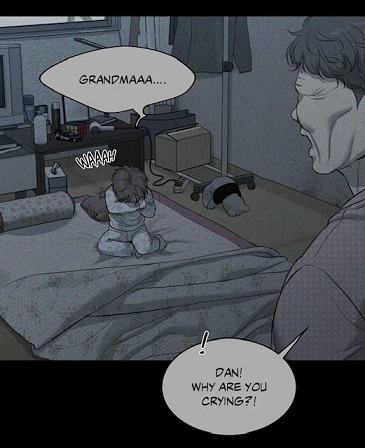 (chapter 21) This reveals how, in Kim Dan’s subconscious, the night and an empty bed have become synonymous with death. The trauma is deeply embedded, where even temporary absence is tied to the irreversibility of loss. For Kim Dan, solitude at night
  (chapter 67) is not mere loneliness—it is abandonment, it is death, it is the erasure of home. It is repressed, hidden beneath his quiet demeanor and years of survival-based behavior. Rather than a rational belief, it is a subconscious wound that only surfaces in moments of extreme vulnerability—especially at night.
  (chapter 2), the doctor’s is secret and involuntary. His actions—his fearful expressions
  (chapter 57), his pattern of emotional detachment
  (chapter 67), and his obsessive loyalty to his grandmother
 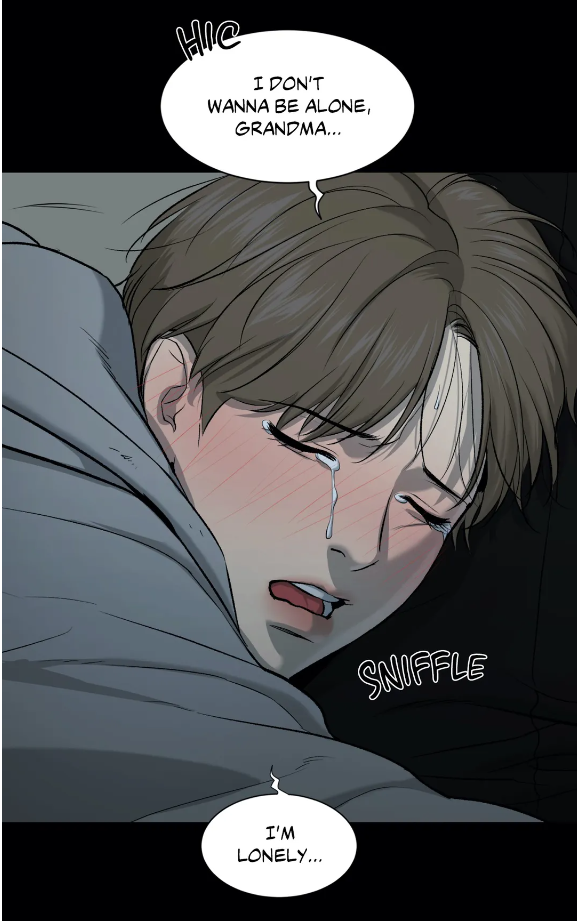 (chapter 10) signal a suppressed conviction: that he is destined to be left behind. What seemed like devotion now appears as coping; what appeared stoic was survival. And with the impending death of his grandmother, the anchor holding this hidden jinx in place is slipping away.
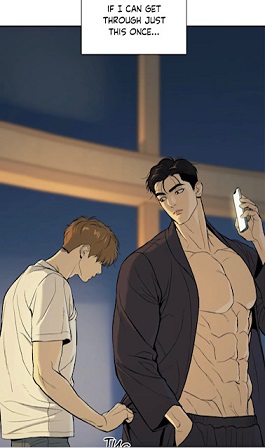 (chapter 2), the trembling kiss
  (chapter 44) in Chapter 44, the complete breakdown
 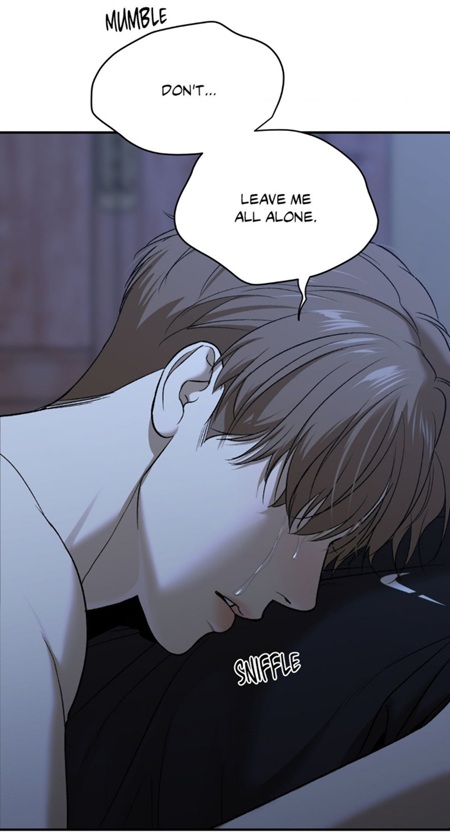 (chapter 66) in Chapter 66, or the transactional submission
 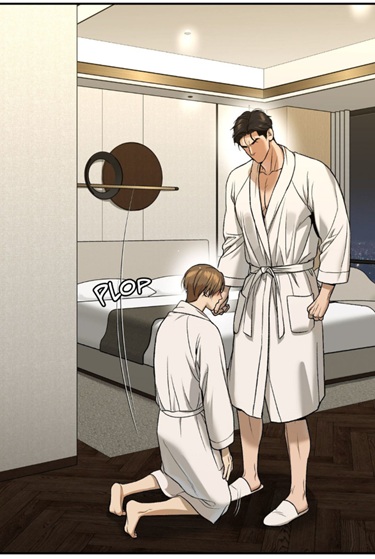 (chapter 67) in Chapter 67, nighttime becomes the stage for his unresolved trauma. These nights mirror one another and suggest an origin story that predates them all: a night when Kim Dan was abandoned by his mother.
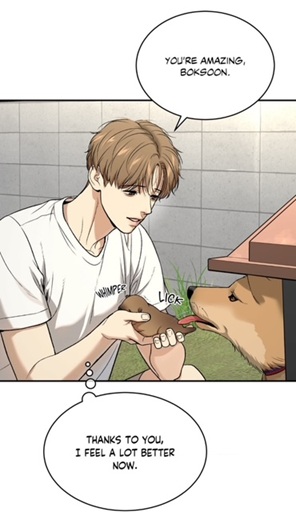 (chapter 57) A puppy needs at least eight weeks with its mother to grow emotionally secure. By drawing this parallel
 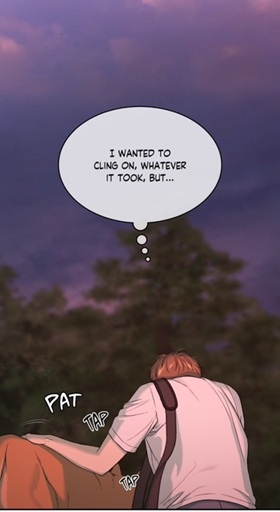 (chapter 59), the story tells us: Kim Dan was separated too soon. He was not ready.
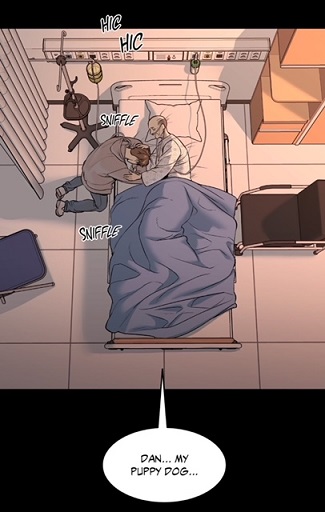 (chapter 53)
 (Chapter 56) he tucks her in. Their roles are reversed. He behaves like a parent, whereas in truth, he is reverting emotionally to a child terrified of being alone. This reversal highlights the internal dissonance between his outward behavior and emotional reality. Though he was forced to grow up quickly
  (chapter 29) That’s how it dawned on me why Shin Okja was so determined to send back her grandson to Seoul.
 (chapter 65) and going back to Seoul under the guise of freedom and career advancement takes on a deeper meaning when viewed through the lens of emotional avoidance. Her words may sound supportive, but they conceal a subtle attempt to sever the emotional tie without taking responsibility for its existence. Now, rather than confronting this vulnerability head-on, she shifts focus to the one thing she believes can replace human closeness: work. A busy man has no time to wallow, no time to drink, no time to remember the empty bed. A man with a career won’t ask for someone to hold his hand at night. In that sense, her vision of “a good life” is one of functionality, not emotional fulfillment. If he works, he won’t be a burden. If he’s successful, she doesn’t have to worry. Yet this approach doesn’t cure the root wound — it just redirects it. This situation mirrors the wolf’s:
  (chapter 19) The latter is obsessed with work, while he is suffering from insomnia.
  (chapter 65) And the best evidence for her selfishness and neglect is her ignorance about her grandson’s plan for his future. She is not discussing with him about what he likes or dislikes. She is directing his life, like she did it in the past in the end. And while she may think she’s doing what’s best, her silence about his fears, her ignorance about his true conditions (no home, blacklisted in Seoul) and her refusal to discuss his emotional future reveal a lingering discomfort with the very idea of dependence — perhaps because it reminds her of her own failures or helplessness as a parent figure.
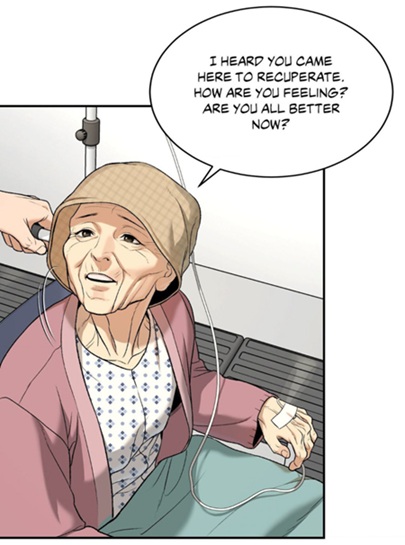 (chapter 65)
 (chapter 65) And when we remember that Kim Dan tried to call her, she
 (chapter 65) replied with a silence. Here, she claims that he addressed her as “mom”, but it is possible that she was just projecting her own fears onto her grandson. Since she was by his side all the time, she feared to be seen as his mother. Like mentioned above, the mother might have been busy due to work (or sick) and asked her relative to take care of her grandchild.
 (chapter 44) These gestures suggest he had once received such kisses, most likely from his mother. It means he remembers love, even if he doesn’t know how to process its loss.
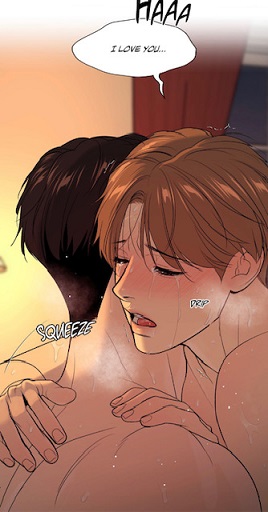 (Chapter 39), the moment is tainted. It occurred under the influence of an aphrodisiac, intertwining love with sex. Furthermore, he has never voiced this sentiment to his grandmother—perhaps because she never said it to him. It was never modeled. While others might judge Kim Dan’s emotional restraint, I desire to stay neutral. He is not an emotionally stunted adult by choice—he is a product of emotional neglect. That’s the reason why Mingwa has associated him with an angel.
 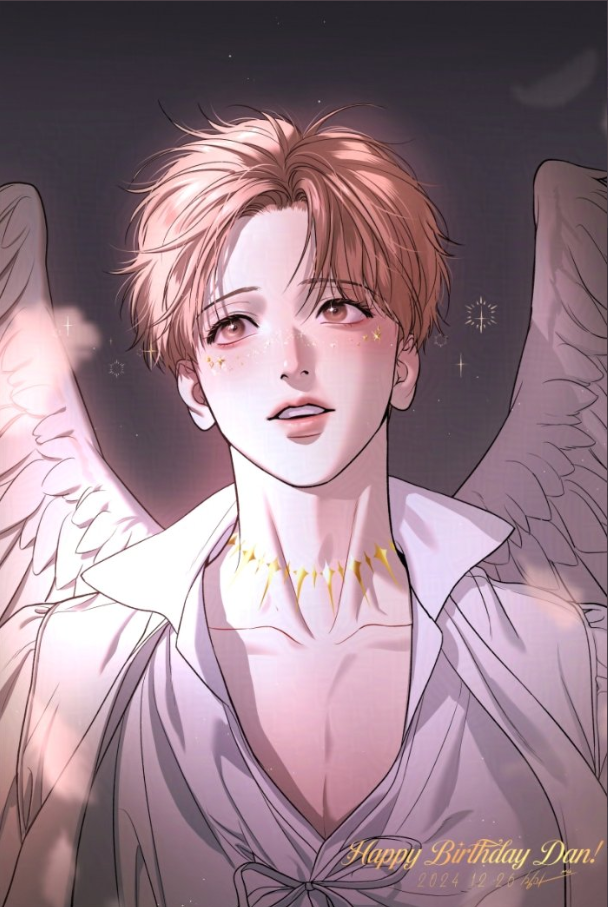 He is carrying the sins of “adults”. By likening him to an angel, Mingwa frames his pain not as weakness, but as unjust burden. He embodies purity, sacrifice, and resilience, not because he was allowed to thrive, but because he endured. The angel metaphor becomes even more striking when you think about traditional symbolism: angels don’t belong to Earth, yet they walk among the living, often suffering in silence and helping others. That’s exactly Kim Dan — out of place, bearing the consequences of others’ choices, carrying guilt, debt, and unspoken grief that were never his to begin with.
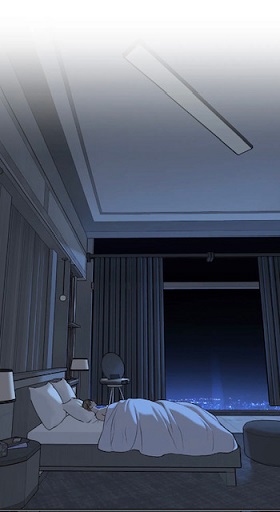 (chapter 29) —not because of physical intimacy with Joo Jaekyung, but because he felt safe. For a time, the place became his illusion of home. But when the champion showed mistrust, the illusion shattered.
  (chapter 51) The penthouse was never truly his. It was borrowed space. This explicates his refusal to spend the night there.
  (Chapter 67) Observe how Joo Jaekyung called the penthouse: not home, but his place. Due to the last altercation, the emotional safety collapsed. This experience reactivated his fear of abandonment and solidified the belief that he has no home.
  (chapter 65) Even the family photo (where and by whom it was taken is unclear) emphasizes the fragility and incompleteness of his sense of belonging.
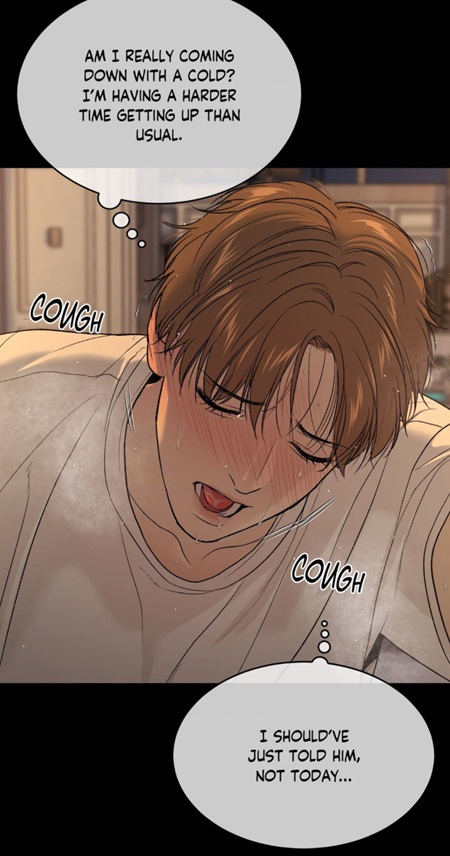 (chapter 61) that he must sacrifice his “needs” and identity to be accepted.
  (chapter 66) Therefore it is not surprising that he laughes like a little child during that night.
  (Chapter 44) Chapter 66 represents its negative reflection, the emotional climax of this regression:
 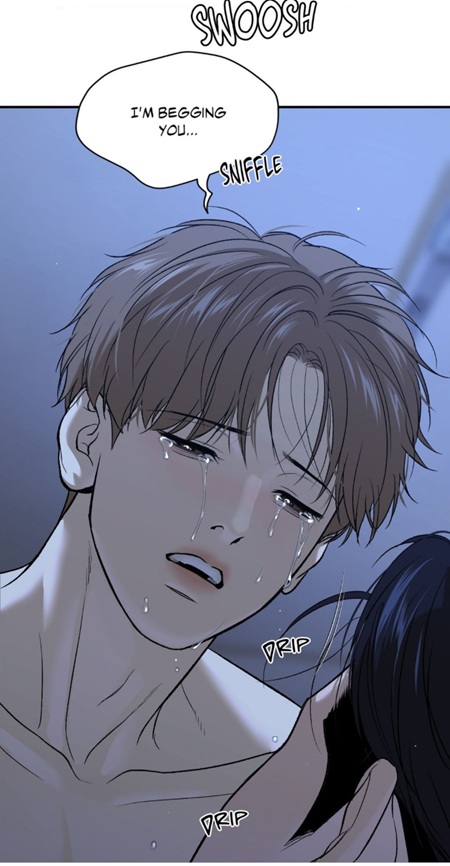 (chapter 66) he cries, begs,
 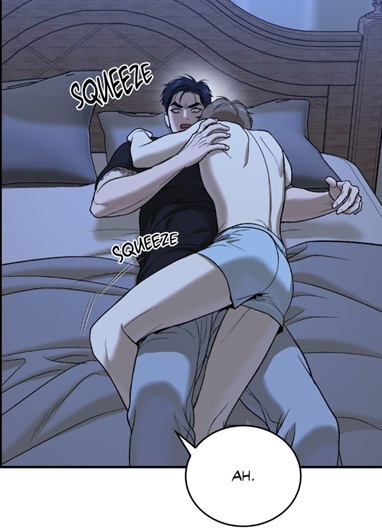 (chapter 66) holds on—“Don’t leave me.”
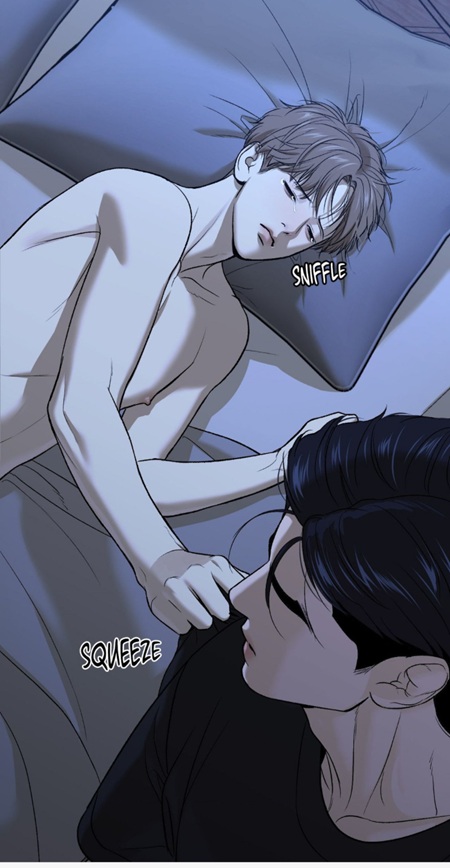 (chapter 66) and desperate pleas are not about romance—they’re about survival, longing and regret. Deep down, he wished, he had hold onto his “mother” in the past, stopped her from leaving him. Is it a coincidence that this gesture from that night mirrors the one during their first night?
 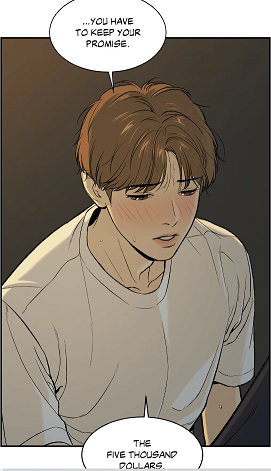 (chapter 2) He wanted the champion to keep his promise. From my point of view, the parent’s vanishing is strongly intertwined with a broken promise… And that’s exactly what the grandmother did to her own grandson: she didn’t keep her words either.
  (chapter 11)
 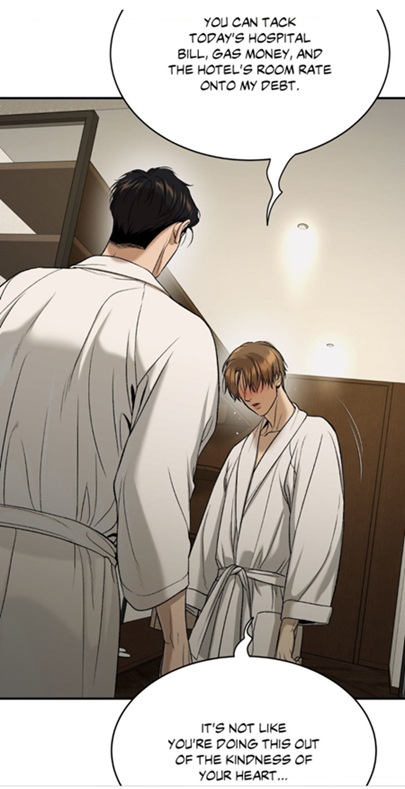 (chapter 67), but this time, with eerie detachment. He kneels before Joo Jaekyung like a servant,
 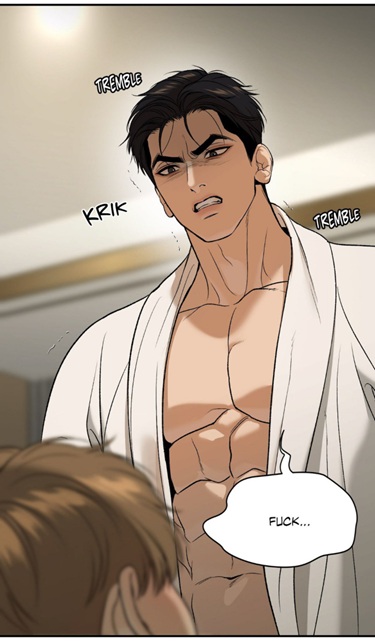 (chapter 67) his arousal betrays a loss of emotional control. Though he is on his knees, it is Joo Jaekyung who is emotionally yielding. His body betrays his composure, responding to Kim Dan’s touch and gaze. Kim Dan, watching the tremble in the fighter’s expression and the rising heat in his body, feels the shift. His soft blush is not simply one of affection or embarrassment—it’s a flicker of recognition.
  (chapter 67) He senses that the one usually in control is now unraveling. Appearances deceive: beneath this scene lies a quiet reversal of power. The blush on his cheeks is a trace of a brief moment of clarity: he sees that the person who once held all the control is now faltering.
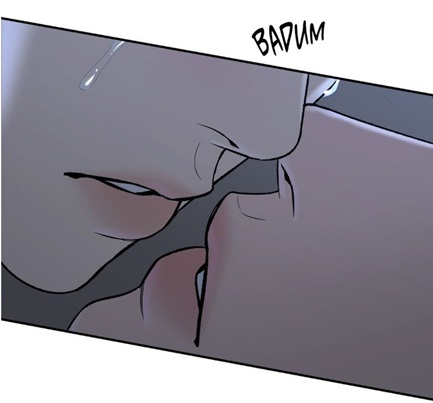 (chapter 66), his body is still a vessel for mourning. Hence there is no kiss during that blue night. Each night carries the residue of that first trauma: the night he was left alone. Whether his mother disappeared or passed away in the night, the result is the same—nighttime became synonymous with loss.
 (chapter 63) His so-called jinx is not some irrational superstition. It’s a scar. It’s the quiet belief that the people he loves will vanish the moment he lets his guard down.
 (chapter 67), it’s resignation. Hence he is not expecting to be cured with the pills.
  (chapter 67) he offers sex to “settle up,” citing his own preparations like a transaction.
  (chapter 7), while Kim Dan becomes a child during the night.
 (Chapter 66)
  (chapter 47), when the “wolf” was portrayed as a thug, though the latter had assisted him on multiple occasions.

 (chapter 66) they saw it as further confirmation of their perception—reinforcing the idea that he is terribly flawed. However, a deeper analysis suggests that this term reflects not just his character but also his evolving mindset and struggle with emotional vulnerability. This essay will explore the paradox at the heart of their dynamic—how both men refuse to acknowledge the emotional weight of their relationship, leading to a cycle of denial and misperception. It will examine how the concept of the jinx evolves, the continued influence of Park Namwook’s manipulations on Joo Jaekyung, and the role that mutual ingratitude plays in their emotional stagnation.
 (chapter 65)The athlete is admitting his dependency on doc Dan. The jinx is now directly tied to Kim Dan, not just as a concept but as a tangible element of Joo Jaekyung’s career stability. The second switch is that sex is no longer a condition to ward off bad luck. In fact, the celebrity is recognizing the importance of his daily training and, as such, his hard work.
  (chapter 65) The inner thoughts of the sportsman reveal that the champion is feeling less powerless than before. His champion status is no longer reliant on superstition but on tangible efforts—his “old routine” and, crucially, Kim Dan’s expertise as a physical therapist. This marks a significant transformation in his perception of Kim Dan, whom he now values for his professional skills rather than as a mere tool for maintaining a ritual. Thus, Joo Jaekyung should be less inclined to request Doc Dan’s sexual services. Then, in episode 66, a new change became visible.
 (chapter 11), a tool to generate money and maintain the gym’s reputation. Hence he blames him, when members leave the gym.
  (chapter 46) The manager used the incident with Seonho to justify the desertion of the other athletes. However, it is clear that some left the gym because they didn’t become successful like Joo Jaekyung. However, their lack of success is explained by their lack of talent
  (chapter 46) exposing the lack of ambition and commitment from the two hyungs. It is clear that Joo Jaekyung’s wealth and fame was used to attract the sportsmen creating a myth that they could experience the same success. Nevertheless, as time passed on, the fighters were confronted with reality. It was, as if the athlete’s achievement had become a curse for Team Black. Nonetheless, neither the manager nor the coach can admit it, the champion’s bad temper is utilized to cover the mismanagement within the gym. Striking is that by portraying the protagonist as a person with a bad temper and personality
  , (chapter 9) the manager and his colleague described their boss as defective. The contrast between Joo Jaekyung’s perception of ‘defect’ and the coach’s view of him as a ‘maniac’ is particularly telling. When the protagonist refers to Kim Dan as having a defect, there is an implicit acknowledgment that something can be repaired or improved. In contrast, Park Namwook’s statement about ‘handling that maniac’ suggests that the star is beyond fixing—someone who must be tolerated and controlled rather than understood or helped. This fundamental difference in perspective reveals how deeply the manager has shaped the champion’s self-perception, reinforcing the idea that he is nothing more than a force to be managed rather than a person who can change or grow.
 (chapter 54)
  (chapter 66) His presence is necessary to maintain the “myth” alive.
 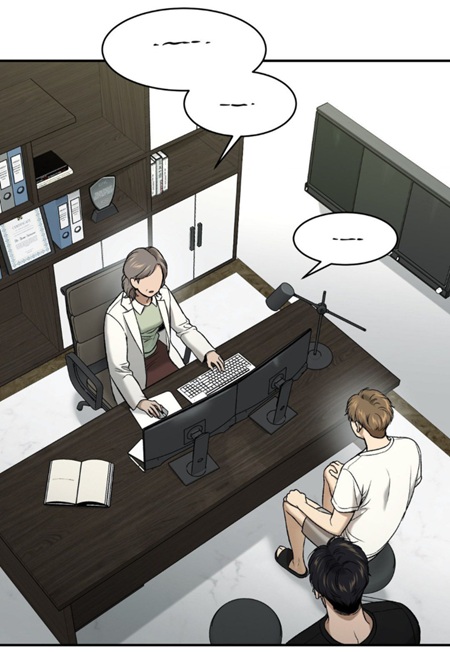 (chapter 66) In calling Kim Dan ‘defect,’ Joo Jaekyung is unknowingly projecting his own self-perception onto him. The term suggests something broken but also something that can be repaired, reflecting an unconscious shift in his perspective. Instead of simply using Kim Dan as part of a superstition, he is beginning to see his vulnerability, perhaps even recognizing a parallel to his own struggles. His choice of words also reveals his deeply ingrained belief in self-reliance.
  (chapter 66) Nevertheless, the idiom (“he’s got a defect”) reveal that Joo Jaekyung is still under the manager’s influence. This means that this shift is not immediate or conscious; it is restrained by his continued loyalty to Park Namwook and his ingrained avoidance of emotional vulnerability.
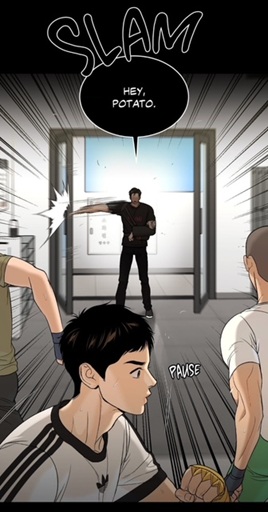 (chapter 60) This scene represents the exception. For the most part of the time, the star only visited the gym because Park Namwook had contacted him.
 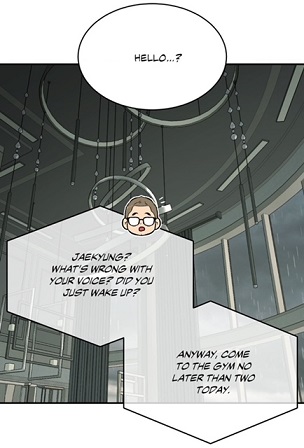 (chapter 54)
 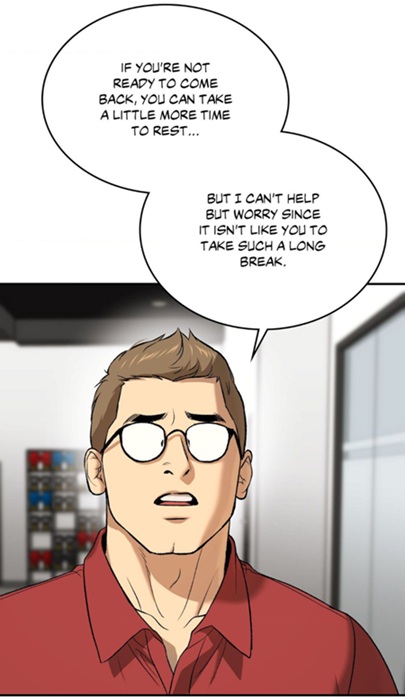 (chapter 66) Yet, just moments later, he tells him that he can take more time to rest, as if feigning concern. This contradiction is striking because it exposes his underlying agenda: he wants Joo Jaekyung back in the gym but doesn’t want to appear forceful. Instead, he makes it seem like Joo Jaekyung is the one making the decision, fostering guilt by implying that his long absence is unnatural.
 (chapter 27) This double standard highlights Park Namwook’s true role: he is not a supportive figure but a handler, ensuring that Joo Jaekyung remains under control and fulfilling his duties as a fighter. His words are not meant to provide genuine support but to keep Joo Jaekyung tethered to a system where his worth is defined solely by his success in the ring.
  (chapter 54) or (un)favorable interviews about the athlete.
  (chapter 54)
  (Chapter 57) As a manager, Park Namwook’s role involves overseeing Joo Jaekyung’s career, securing contracts, and ensuring his reputation remains intact. Yet, as seen in Chapter 66, his actual concerns seem remarkably narrow in scope.
  (chapter 50), preferring instead to remain passive so that any negative outcomes can be blamed on the champion. At the same time, this passivity helps him maintain control—as if Joo Jaekyung, without his guidance, would be left ‘alone’ and directionless. In this way, the man with the glasses sustains a dynamic in which the champion feels dependent on his presence, even as he is subtly undermined. By neglecting to inform him of these events, Park Namwook ensures that the champion remains unaware of external factors that could influence his choices. This pattern reinforces the possibility that Park Namwook was aware of the meeting with Choi Gilseok and deliberately ignored it, likely expecting that Joo Jaekyung would take care of it, while absolving himself of responsibility.
  (chapter 22) They had heard about his place, for the manager must have talked about it. The protagonist is not someone who will talk about his private life to others. The manager must have dangled promises in front of them, making them believe that if they’re lucky enough, they too could live like the champion. However, their reactions reveal something crucial—they are not motivated by greed but by genuine admiration. They simply want to experience the luxury once in a while, reinforcing that their bond with Joo Jaekyung is rooted in camaraderie rather than material envy. This further highlights the contrast between Park Namwook’s manipulation and the sincere regard his teammates have for him. This scene is important, because it exposes the manager’s prejudices and lack of discernment.
  (chapter 46) Not everyone is the same and more importantly like him! It is clear that the man is projecting his own principles onto others and in particular onto the champion.
  (chapter 66) Neither of them fully understands how to acknowledge care or support. Just as Joo Jaekyung struggles to recognize his actions as stemming from concern
  (chapter 66). This moment highlights a rare glimpse of honesty: he is not acting purely out of self-interest, but he frames it as an obligation rather than a choice. From my point of view, such a statement could only reach the physical therapist’s mind, for in the latter’s eyes, the champion has always been a “demon”: self-centered and inconsiderate. Observe the absence of reply from the “hamster”. He couldn’t contradict the star, as the latter was using this negative image: bad tempered and selfish.
 (chapter 53), the manager
  (chapter 7) and even Choi Heesung. Hence the latter called him like that:
 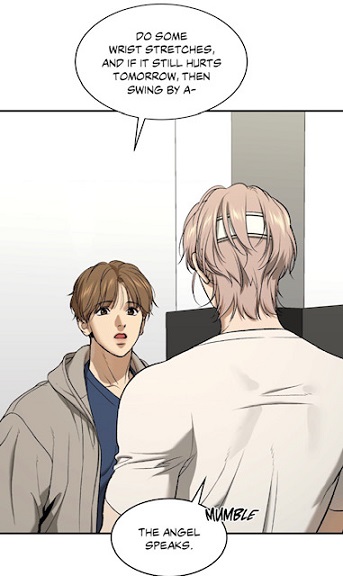 (chapter 30) Kim Dan’s perception of himself as an “angel” has long shaped the way he interprets his relationship with Joo Jaekyung. Reinforced by his upbringing and Park Namwook’s subtle manipulation
 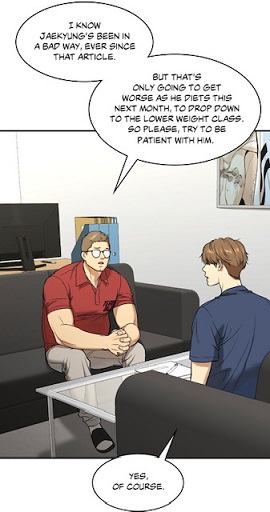 (chapter 36), he has unconsciously placed himself in a position of moral superiority. He is the patient, understanding figure, while Joo Jaekyung, in contrast, is violent
  (chapter 1), selfish, and emotionally stunted. However, this self-perception is deeply flawed. By believing himself to be inherently better
 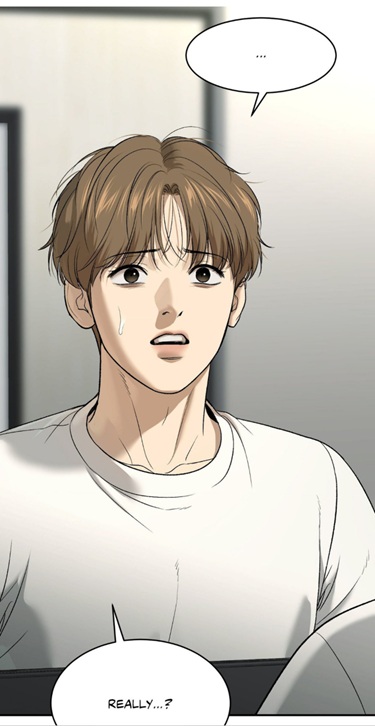 (chapter 66) The expression “Really…?” is not just about disbelief but also about a moment of confrontation with reality. Up until this point, Kim Dan has been dismissing his own suffering, suppressing his struggles, and functioning on autopilot. However, hearing a professional confirm that he is indeed sick forces him to acknowledge what he has been denying.
 (chapter 60) or exaggerations.
 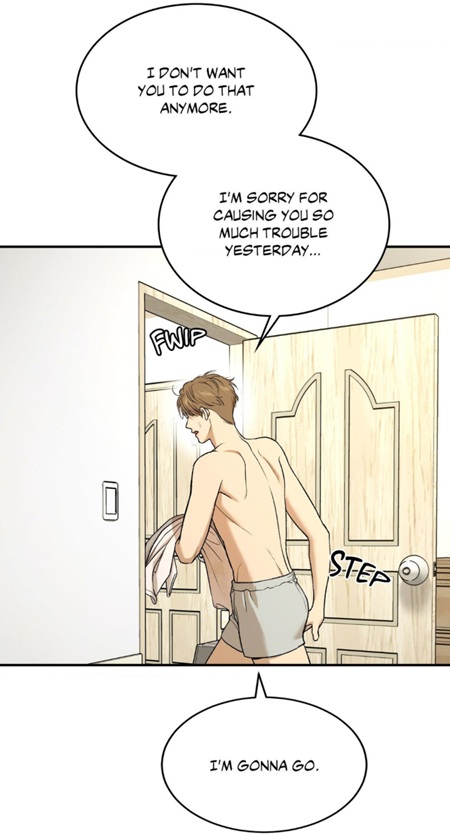 (chapter 66) It also forces him to consider that others—especially Joo Jaekyung—were right to be concerned, which in turn may lead to a shift in his perception of the champion’s actions.
 (chapter 20) with shame, something impure that should be avoided or hidden. This internalized belief made it difficult for him to separate his own experiences from moral judgment. When he encountered the champion —who treated sex as nothing more than a professional ritual
  (chapter 66) He assumed once again that the star had taken advantage of his “drunkenness”, something Kim Dan had done himself in the past.
 (chapter 40) , while Kim Dan, conditioned by years of emotional neglect, sees gratitude as a transactional exchange rather than an expression of genuine appreciation.
  (chapter 66) because Kim Dan does not recognize his efforts, while Kim Dan cannot see past his own survival instincts to notice that Joo Jaekyung’s actions are slowly shifting from obligation to care. Kim Dan, conditioned by years of neglect and survival-driven thinking, does not see Joo Jaekyung’s actions as genuine care.

 (chapter 36), his tendency to retreat rather than challenge his own doubts
  (chapter 36), and his overwhelming fear of disappointing others
  (chapter 51) are all reflections of these internalized obstacles. Recognizing them as external impositions rather than intrinsic truths is the first step to breaking free. That’s the reason why in the reflection of the broken mirror, you can detect an open window in the background. By focusing too much on his reflection, the physical therapist is trapped in his own negative world. One could perceive it as the opposite version of Narcissus. Yet rather than falling in love with his image, he sees only his flaws, reinforcing his belief that he is unworthy. The open window suggests an escape, a possibility for change, but the problem is that the main lead is too fixated on his shattered self-perception to pay attention to his surroundings. Hence he comes to neglect his own body and people next to him.
 (chapter 62), Joo Jaekyung does not. The evidence for this interpretation is the champion’s nightmare:
  (chapter 18) the doctor
  (chapter 25) Therefore the physical therapist bought books. Moreover, we should consider this argument
  (chapter 45) as a revocation of the star’s statement in episode 18. Kim Dan was no longer perceived as a tool, but as a real physical therapist. On the one hand, this request boosted the “angel’s ego”, on the other hand, he was put under immense pressure, for he was compared to his colleagues.
  (chapter 62) Due to his bad past experiences, he concluded deep down that his CV was not reflecting the truth.
  (chapter 56) That’s the reason why he was devaluing himself and as such not looking for a high position.
 (chapter 48) exemplifies this pattern:
  (chapter 48) It was not the right time. He assumed his voice held no weight, reflecting years of learned helplessness. It shows how Kim Dan internalizes responsibility for things beyond his control. He thinks that withholding information is an act of protection rather than avoidance. Yet in doing so, he denies himself agency in his own life.
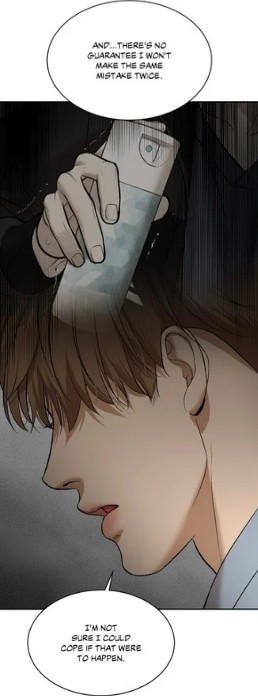 (chapter 62) completely devastated Kim Dan’s already fragile self-esteem.
 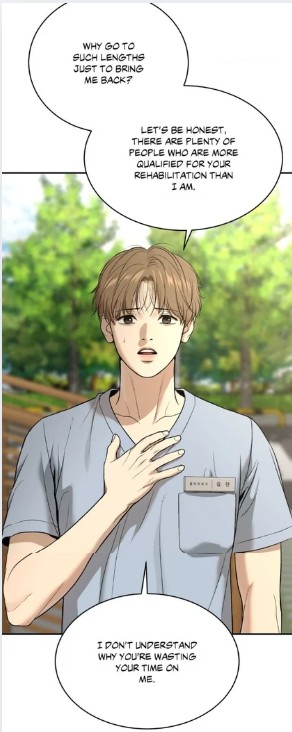 (chapter 62) First, he considers himself as waste. While in the past, he was at least a tool, he is now garbage. Hence his feelings are “trash”.
  (chapter 62) This means that in episode 62, he felt worse than in episode 18! The idioms “trash” and “waste” revealed the doctor’s own self-perception in episode 62: he saw himself as totally useless. He belonged to the “wastebasket”, just like the golden key chain.
  (chapter 46) Thus I deduce that the fate of this item echoes the doctor’s.
  (chapter 47) He had selected this profession because of her. This shows that until now, he has never developed any ambition on his own. The loss of faith from someone he relied on for motivation made him feel completely worthless. This reinforces that his confidence and sense of direction were never self-sustained: they depended on others’ recognition. This pattern suggests that Kim Dan has never truly asked himself what he wants. His entire existence has revolved around meeting expectations, whether from his grandmother, Joo Jaekyung, or even his profession. His current crisis—feeling like waste—stems from the realization that without someone to validate his worth, he sees himself as nothing.
 (chapter 59) However, observe that he is using the expressions “do” and “now”. This has nothing to do with the future and dreams. It is not a reflection on his own desires but rather an immediate reaction to his circumstances. His mindset is still trapped in survival mode, seeking a course of action rather than contemplating what he truly wants. His words reflect an urgency to act rather than an opportunity to dream. This highlights that he has spent his entire life making decisions based on necessity rather than personal fulfillment. Even when faced with uncertainty, he does not ask himself what he wants—only what he must do next. His transformation will only be complete when he begins to question not just how to survive, but how to live on his own terms. That’s how I realized why Mingwa put this question in front of the window covered with Venetian blinds [which made me think of this scene
  (chapter 39 – Venice, a travel to Italy]. The window with the Venetian blinds represents a metaphor for the doctor’s trapped dreams. This interpretation made me recognize another aspect. Kim Dan is pushed to meditate, when he is front of a window or better said close to the sky! Hence the hamster started thinking about his own future in the penthouse
  (chapter 19) or when he looked at the sun and sky:
  (chapter 41)
  (chapter 41) And the best evidence for this interpretation and expectation is doc Dan’s cellphone screen display.
  (chapter 38) My avid readers will certainly recall that clouds embody dreams! Why? It is because in verity, doc Dan is a dreamer, an ambitious man. What caught my attention is that his contact Joo Jaekyung was not saved with a picture!! And what had motivated Kim Dan in the past?
  (chapter 47) The picture from his childhood: himself with his grandmother.
  (chapter 54). He saw the belt as something rather “meaningless”.
  (chapter 43) This would boost the doctor’s self-esteem. He is not trash, but an acknowledged fan and friend. The picture would encourage the physical therapist to develop his own ambitions. As soon as I made this discovery, another detail caught my notice:
  (chapter 66) The celebrity has no picture of Park Namwook in his contacts divulging the superficiality of their relationship.
  (chapter 42) The problem is that the athlete took this recommendation personally. He felt as if his job as fighter was questioned.
  (chapter 42) As you can see, the doctor’s hesitations were exposing his mental obstacles, which was reflected in the champion’s attitude. No wonder why doc Dan chose to become a courier as a second job instead of finding a new VIP client. While the interaction between the athlete and Kim Dan in front of the hospice display the return of doc Dan’s past mental hurdles:
 (chapter 62) According to the main lead, the champion is “wasting his time here”.
 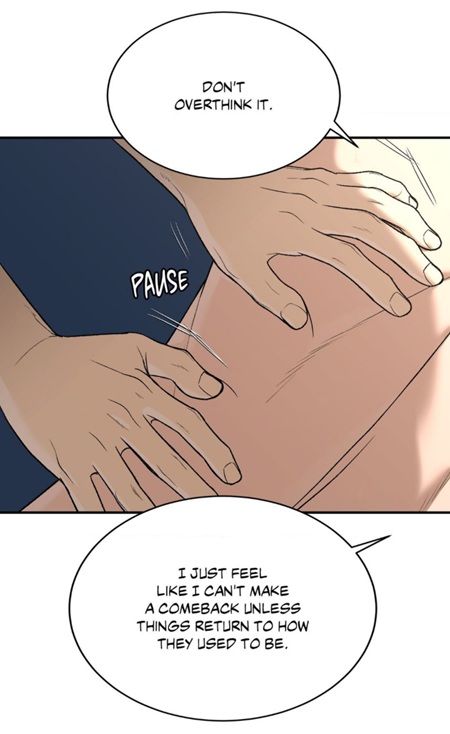 (chapter 62)
 (chapter 57) Hence it is clear that in the future, the physical therapist would refuse to use any kind of spray. On the other hand, it is important to recall that back then, Joo Jaekyung had made the request himself:
 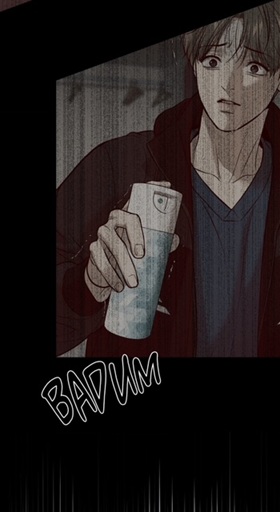 (chapter 57)
  (chapter 1) with a previous PT like the spray? No wonder why he called himself “trash” in the end.
  , people might wonder why I selected dandelions as a frame for the selected.. It’s clear that the dandelions aren’t just there for aesthetic balance. Their symbolism is profound. Dandelions are often associated with childhood innocence, wishes, and fleeting moments of beauty, yet they also wither quickly, easily scattered by the wind. In the context of Jinx, they represent a transitory force—something that struggles to take root, much like the intangible and fleeting elements in Kim Dan’s life. But there’s more to it. Before delving into deeper analysis, consider this: what is the common denominator in all these scenes?


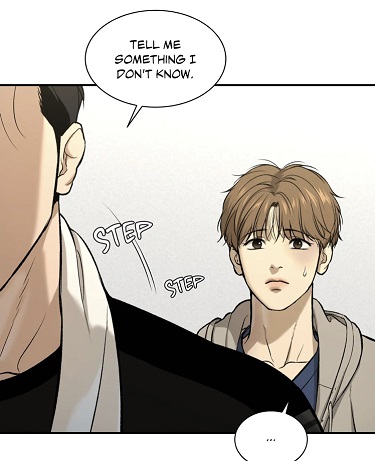



 (chapter 37) Therefore it is not surprising that the main lead couldn’t view the members as friends in the end.
  (chapter 41) And now, you comprehend why Joo Jaekyung has always disliked his birthday and the “congratulations” from people in general. The gifts and words were like poisoned praises to his soul. They were pushing him to live like a “god”.
  (chapter 45) Kim Dan’s only adult photograph, taken with Choi Heesung and Potato, ties into his professional world, reinforcing how his identity has always been defined by what he does rather than who he is.
  (chapter 59) While this photography was not a personal and intimate picture, it also symbolizes his first root in the little community: Light of Hope Hospice. He is part of the staff and as such of the little town. On the other side, we could say, he is gradually entering the scene as a PT. Note the contrast to the food truck:
  (chapter 30) In other words, it exposes the actor’s hypocrisy and wrongdoings. And now, you understand why I wrote genuine in parentheses above [proof of (genuine) human connection]. Photography in Jinx also represents the evidence of wrongdoing
  (chapter 46) The exact opposite of the dandelions.
 (chapter 62) This shows that deep down, he desires to obtain doc Dan’s gratitude. No wonder why he got so upset after hearing the displeased comment from Kim Dan.
  (chapter 66) reveals Kim Dan’s elevation in the champion’s life. The dressing room symbolizes privacy and closeness. No longer seen as a mere tool, Kim Dan has become an integral part of Joo Jaekyung’s world, not because of what he can do but because of who he is.
  (chapter 66) Therefore the champion is holding the expensive gift with his whole hand contrary to the past:
  (chapter 55) As a conclusion, by bringing him to the sleep specialist, the star proved doc Dan’s words wrong! He told him something that doc Dan didn’t know: he is precious. He needs to pay attention to his health and body.
 (chapter 32) And now, you comprehend why the athlete didn’t fall for Park Namwook’s manipulations afterwards.
 (chapter 7)
  (chapter 65) At the same time, such a disapproval
  (chapter 1), hence his true desire was to run away from that place. For praise to be effective, the recipient must be open to receiving it, either by looking forward to feedback or having expectations of validation. Since Kim Dan was in a state of distress, he was unable to internalize the champion’s words, reinforcing his long-standing belief that he was invisible or unworthy of acknowledgment. That’s how the champion’s praise became a dandelion seed in the end.
 (chapter 18)
  (chapter 45)
  (chapter 64)
  (chapter 66) Is this a joke?
  (chapter 40) However, Kim Dan has never realized it. Either he was sleeping or totally out of it (fear of sex)
 (chapter 27) It is important to recall the importance of the receiver’s mind-set. The latter has to perceive the sincerity from the speaker. Hence I come to the following deduction: The moment Kim Dan notices Joo Jaekyung’s smile and laugh, then he should come to the conclusion that he matters to the protagonist. I would even say, the two protagonists are destined to make each other laugh and smile:

 (chapter 65) This description stands in opposition to the gumiho’s statement: he was an angel.
 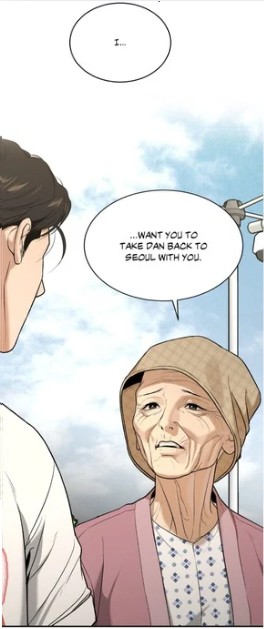 (chapter 65) Is she genuinely worried for him, or is there a hidden motive behind her request to send him back to Seoul? And why does Joo Jaekyung, usually so straightforward, respond with silence and hesitation
 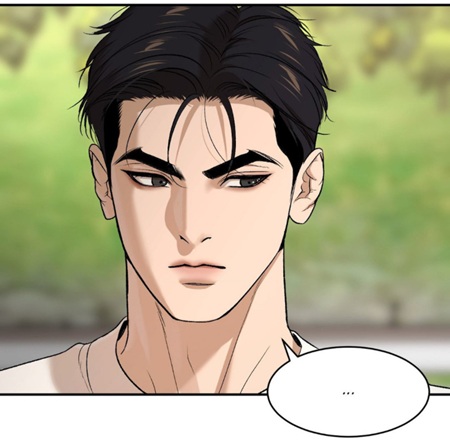 (chapter 65) or with shock?
 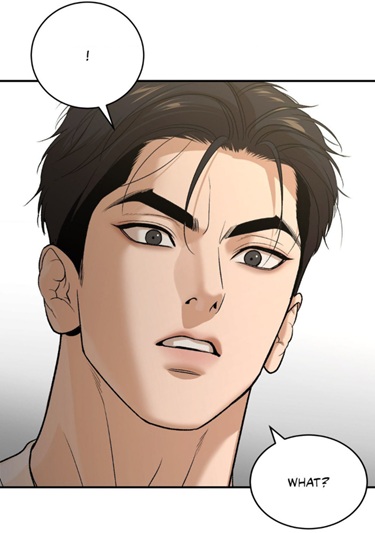 (chapter 65)
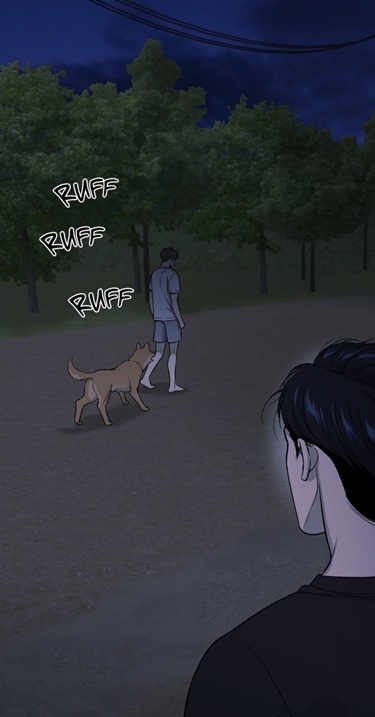 (chapter 65) His bare feet on the cold ground
  (chapter 65) suggest a longing for freedom, yet the direction of his steps remains uncertain. Whereas these walks reveal about his inner struggle, they don’t reveal the destination of his nightly strolls. Where was he going during that night? Was he going to the ocean—vast and untamed— like in episode 59,
 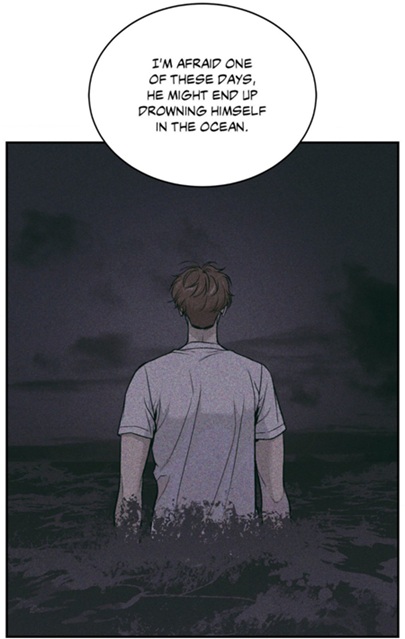 (chapter 65) or had his destination changed? These questions will be answered in the second part.
  (chapter 65) This destination reflects the athlete’s desire and mind-set. He likes this place because it is quiet.
  (chapter 62) From my perspective, the man has now internalized the beach to nature and privacy. Striking is the way Mingwa introduced the scenery. First, she focused on the wheel and Joo Jaekyung’s feet.
  (chapter 65) The contrast between the creaking wheels of the grandmother’s wheelchair and the steady steps of the champion immediately establishes the theme of control versus freedom. The wheelchair’s wheels represent civilization, immobility, passivity, and the grandmother’s obsession with control—over her own fate
  (chapter 59) The contrast between these two images—one of the halmoni accompanied by Joo Jaekyung and the other of Kim Dan sitting alone by the ocean—exposes the stark difference in their emotional worlds and the dynamics of control and isolation that define their lives.
 (chapter 65) The sunlight high in the sky bathes the scene in brightness, suggesting a façade of warmth and clarity. This lighting aligns with the halmoni’s belief that she can influence Kim Dan through the champion, using Joo Jaekyung as an intermediary to extend her authority. The fact that she is in a wheelchair, however, subtly contradicts this impression of power, revealing her true state of passivity and reliance on others to act on her behalf. The ocean, tamed by the pathway, symbolizes her attempt to domesticate nature—
 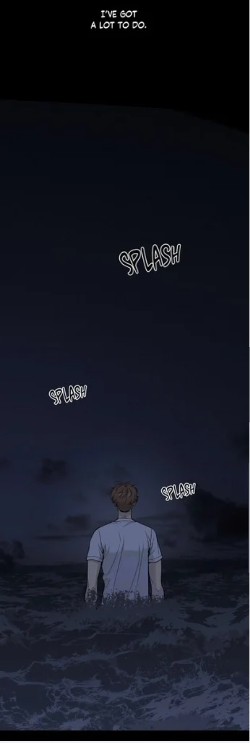 (chapter 59)
 (chapter 65) Here, she claims that she only knows about the sportsman’s job thanks to the patient next door. However, she is lying, because she watched his match in the States.
  (chapter 41) The irony is that she is not realizing that she is showing her true colors.
  (chapter 21) In episode 21, the halmoni’s description of the champion as a “good friend” was, in hindsight, a superficial and self-serving characterization. At that time, she likely saw Joo Jaekyung as someone who could be beneficial for Kim Dan’s financial situation without truly caring about who he was as a person. Her interest in him was more about what he represented—a source of money and stability—rather than any genuine appreciation of his character or the impact of his presence in Kim Dan’s life. Thus she said this in front of the ocean:
  (chapter 61) Yes, the conversation at the beach played an important role, for Shin Okja’s behavior serves as a distorted mirror to Joo Jaekyung’s actions and mindset, exposing the flaws and contradictions in both. When she voiced this wish
  (chapter 22) he acted out of a simplistic view of good deeds—believing that financial support alone could resolve problems and fulfill his moral obligations. His subsequent failure to visit her again reflects his tendency to distance himself emotionally once he has performed what he sees as his duty. This is reminiscent of his behavior towards Kim Dan: helping him materially but avoiding deeper emotional involvement or responsibility.
 (chapter 65), much like how Joo Jaekyung likely saw himself when paying her bills—believing that fulfilling a material need is equivalent to showing genuine concern. Park Namwook is a representative of this mind-set too.
 (chapter 65) is a way to offload responsibility for doc Dan while maintaining an image of concern. Both display a form of care that lacks true depth.
 (chapter 62) Both avoid the emotional accountability that comes with their actions, preferring to distance themselves once a material obligation (debts)
 (chapter 60) is fulfilled.
 (chapter 22)
 (chapter 60) If my assumption is correct, the woman didn’t realize that this rejection was linked to Joo Jaekyung’s intervention. So if she had talked to her grandchild himself, she could have had an impact… But they are actually avoiding each other. One thing is sure: the absence of communication and avoidance between these two family members reinforced the doctor’s suffering. Imagine the consequences of her request: she is preferring locking him up in a hospital receiving drugs than giving what doc Dan has been longing: warmth, love and a home.
  (chapter 48). Both the halmoni and Choi Gilseok embody betrayal and the theme of acting behind the back
  (chapter 48) mask a deeper betrayal. His real aim was never to assist but to control, using offers of support as bait to tie Kim Dan into a powerless position. The parallel between his proposition to Kim Dan—promising a better life in exchange for leaking information and compliance—and the halmoni’s push for Seoul’s hospitals underlines their shared strategy: make the target believe they have a choice, while the outcome is already decided. The fact that Heo Manwook, who collects Kim Dan’s debts, called Choi Gilseok “hyung” further hints at a deeper conspiracy, suggesting that the offer might have been a tool to ensnare Kim Dan from the start. He would have committed a crime (illegal drugs).
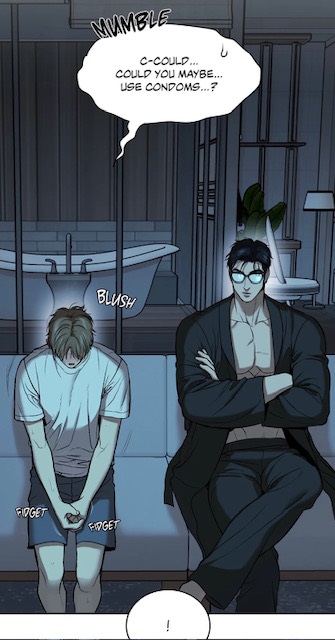 (chapter 29) He had even advised to think of himself first. As you can see, the fact that the two characters were just sitting next to each other reinforces my previous interpretation about the conversation. The grandmother was the one who had been leading the conversation, there is no real exchange of thoughts. In episode 29, the champion refused to accept the doctor’s help and suggestion. That’s the reason why I am more than ever convinced that the star won’t listen to the grandmother.
 (chapter 53) and watch the ocean with her grandson
 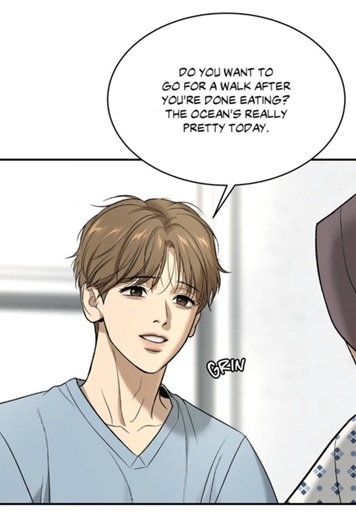 (chapter 57) But it is only partially correct. The doctor only suggested this walk to the ocean much later, when he was already suffering emotionally. This means that the grandmother would have not been able to enjoy this walk. Yes, the timing played a huge role. In fact, she confessed her crime to the star:
  (chapter 65) However, I believe that her words reached the champion’s third eye. The latter was not focusing on the grandmother, but on his fated companion. He was trying to understand why he had changed. This question was already on his mind before:
 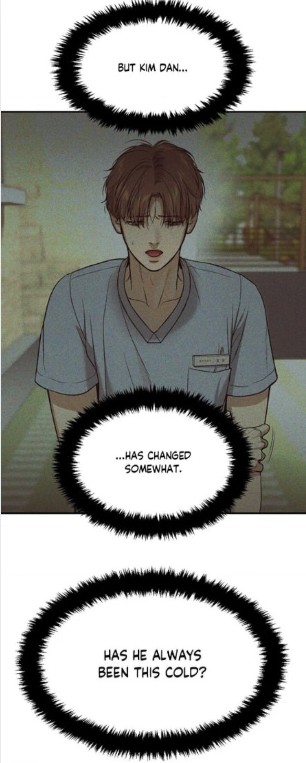 (chapter 62) And notice that the words from the grandmother
  (chapter 62) Once he has achieved his goal (reclaim his champion title), they will depart from each other. He would treat the doctor the same way than the grandmother! No wonder why doc Dan is getting angry and rejecting the offers from his destined partner. IT is only about his own selfish desires and not about doc Dan’s future and desires. Both have a similar mind-set: they don’t know what doc Dan plans to do with his life and the future…. And it shows that Joo Jaekyung was imitating the grandmother, though this suggestion was born from the following thought. Since Doc Dan was no reluctant to work for him, he imagined that maybe he would still accept to work for him for a limited time. But that’s not what Kim Dan is looking. He is longing for a home and at the same time for freedom.
 (chapter 65) The points of suspension are indicating that he is meditating on her words and suggestions. This stands in opposition to his past behavior where he got manipulated so easily.
 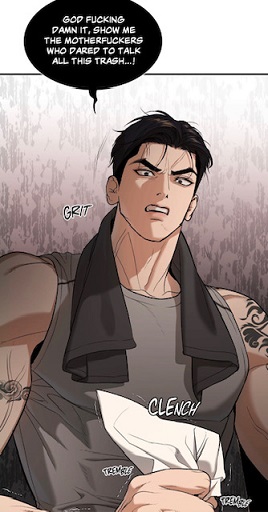 (chapter 36) The reason for this huge metamorphosis is that because of the lavender-tinted night, he learned to control his emotions.
 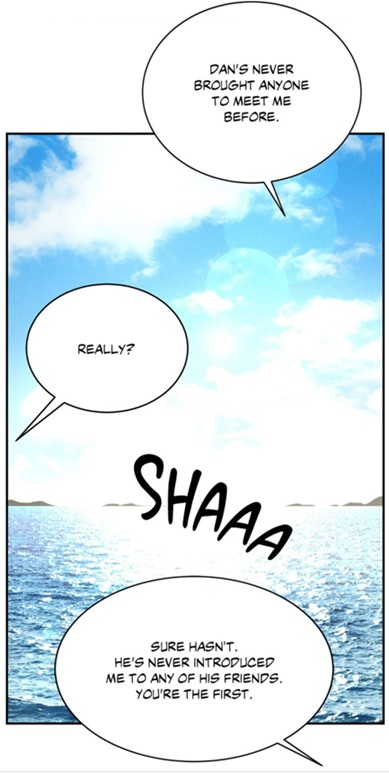 (chapter 65) According to her, Kim Dan has never introduced her to any of his friends. The celebrity would be the exception! But she is lying here. How so? Joo Jaekyung introduced himself to her on his own. It is because he answered a call from the nurse.
 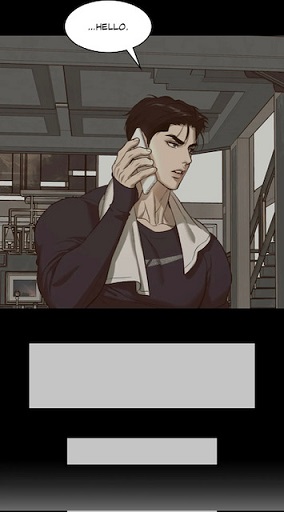 (chapter 21) It happened behind doc Dan’s back in the end. The latter was sick, but the old lady didn’t seem concerned. The second lie is this statement which is exposed with the memory:
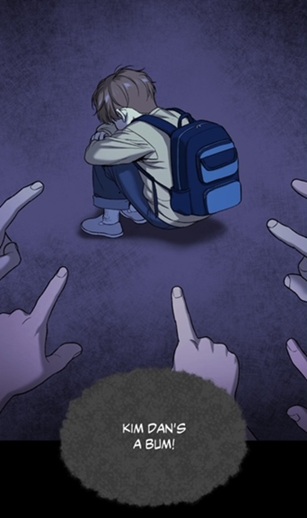 (chapter 57) She claims her ignorance why the little boy acted like an adult at such a young age. The reality is that she hasn’t forgotten the incident at all. This explicates why she confessed this to the “wolf”:
  (chapter 30) a sign that she was never a source of embarrassment for him.
  (chapter 47) Her refusal to address these deeper issues reveals that her sacrifices were less about genuine care and more about maintaining her self-image as a righteous guardian.
 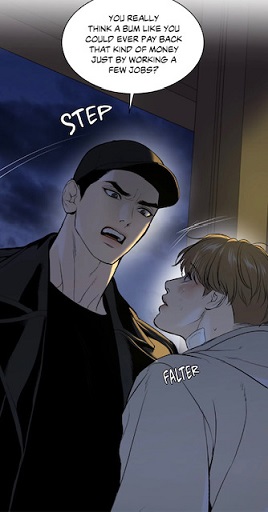 (chapter 18) What caught my attention in her revelation is her lack of enthusiasm for her own grandson.
  (chapter 65) “Is he that good?” exposes a lack of faith in her grandchild, a remark which caught the athlete by surprise. For me, he unconsciously sensed this negative aspect.
  (chapter 65) While this image is actually humorous, the grandmother’s words don’t match her body language. She is not showing any joy or smile. Therefore I comprehend why Kim Dan was so hurt by the champion’s behavior:

 (chapter 13), who had been awakened by the champion, though contrary to the fairy tale, this arising was associated with pain. [For more read the analysis
  (chapter 60) But how did they ended up both cursed by the same spell? The reason is simple. They were either halted by guilt and self-loathing or distorted by the desperate need to escape a traumatic past. Yet, amidst this stasis, small cracks are beginning to appear, suggesting that the flow of time cannot be denied forever. The past can not be repeated
  (chapter 64) or become the present or future. At the heart of this struggle lie symbols of doors, windows, and reflections—metaphors for how both characters perceive their realities and their chances of breaking free.
 (chapter 44), he still does not fully include himself in this awareness. His concern was limited to his grandmother’s limited time
  (chapter 59), reflecting his selfless role as a caregiver. As someone who has long allowed others to define his time—whether as a physical therapist or as a prostitute—Kim Dan has yet to acknowledge his own mortality. Even during the lavender-tinted night, while he determined the length
  (chapter 64) and nature of the encounter
  (chapter 62), he did so for the sake of debts, not for himself.
  (chapter 64) The recent death of the puppy serves as a stark reminder
  (chapter 59) that he is not exempt from time’s reach, that he too is aging and vulnerable. But the doctor failed to recognize this warning. He only viewed it as a sign of his own powerlessness, reducing it from his own perception. He overlooked the fragility of life as such.
  (chapter 35), he created an illusion of freedom that only masked his deeper confinement—his glass prison. When Kim Dan closed the door and left
  (chapter 64), the illusion shattered, revealing the reality of his loneliness. The jinx,
  (chapter 55) once confined to the bedroom, now permeates his entire life, binding him to a past shaped by his abuser’s cruel words.
 (chapter 55) The view created an illusion of openness and freedom, masking the reality of his confinement. Glass, by its very nature, is transparent—a barrier that is invisible yet unbreakable, creating a false sense of freedom. The window’s clarity hid the fact that it was, in truth, an impassable wall that confined him, turning the promise of escape into a cruel irony. By focusing on the horizon, he could avoid looking inward, denying the unresolved trauma left by his anonymous abuser.
  (chapter 54) were designed to create the illusion of eternity—as if time itself was under the phantom’s control. This assertion not only sought to freeze Joo Jaekyung in a perpetual state of inadequacy but also to distort his perception of change as impossible. Trapped in a cycle of hatred and self-loathing, the athlete’s vision of freedom was limited to the false infinity of the horizon.
 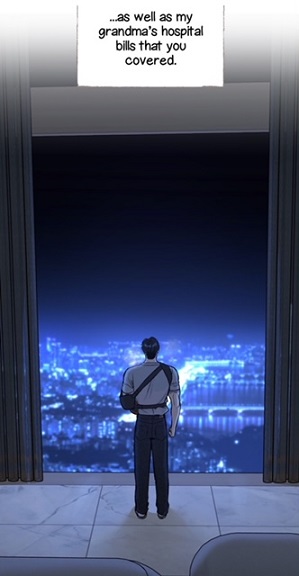 (chapter 53) And now, you comprehend why the champion chose not to look for Kim Dan after his departure. He was so close to the window, making him think that he had a “choice”. That’s how I realized that the closer he would stand to the window, the less he would get Enlightenment. Hence he is portrayed eyeless here.
  (chapter 53) Ironically, the window—symbol of escape—became his glass prison, a barrier that reflected the endlessness of his struggle rather than a path to liberation.
 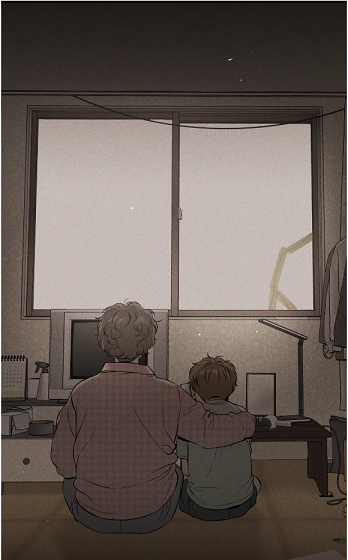 (chapter 19) —a window that offered no view of the outside world. This reflected his entrapment in a life defined by guilt and sacrifice, unable to envision a future beyond repaying debts and fulfilling duties. The window’s visible cracks and makeshift repairs represent not only the physical deterioration of their environment but also the psychological fragmentation within Kim Dan himself. By choosing to patch the window rather than replace it, Shin Okja’s actions reflect a mentality of denial and resignation—an unwillingness to confront the full extent of their impoverishment and suffering.
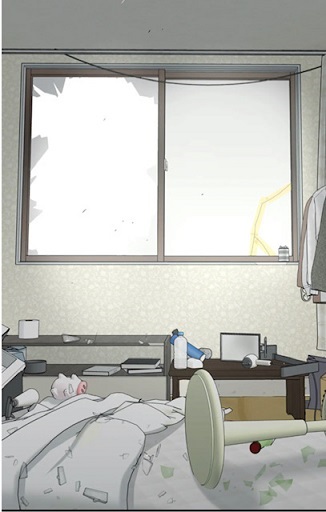 (chapter 19) suggests a deeper symbolic resistance to change or moving forward. In a sense, the grandmother’s decision to live with the broken window mirrors her acceptance of a life defined by limitations and unspoken grief.
 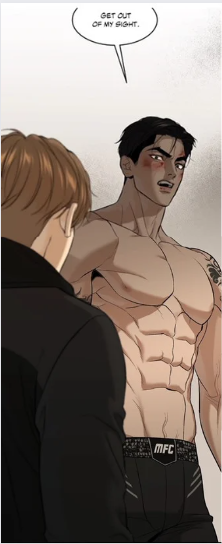 (chapter 51) served as the key that triggered Kim Dan’s abandonment trauma. How so? While “get out of my sight” implied that Kim Dan should leave him, the reality is that the champion left the locker room first.
 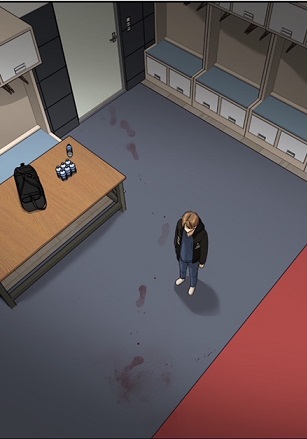 (chapter 51) Observe how the “hamster” is once again turning his back to the door. However, the bloody footprints became an evidence for Kim Dan that he had been abandoned and left behind. And now, you comprehend why the main lead took the athlete’s request seriously and literally. It is because the door in the past was the symbol of betrayal and abandonment. This explicates why he is so sensitive to the sound of a closing door and could recognize it, even if his ears and eyes were covered.
 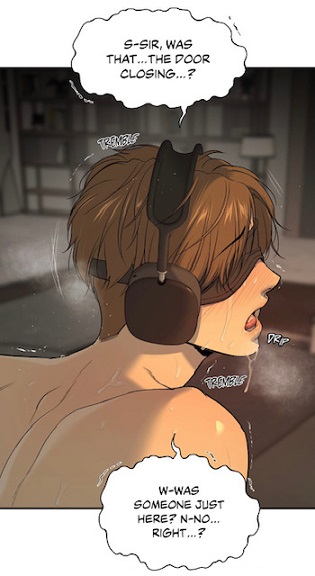 (chapter 35)
  (chapter 19) When he was standing here, he must have sensed it as a betrayal against his own grandmother. Hence he employed the expression “goodbye” and not “farewell” to diminish his guilt. No wonder why he chose to hide his move from his relative and bring the Wedding Cabinet to the penthouse. Under this new perspective, my avid readers can grasp why Kim Dan’s nightmares in season 2 were linked to the opened door:
  (chapter 57) His unconscious was telling him this: Shin Okja had broken her promise. She was about to abandon him. He had the impression that he was reliving the past. That’s the reason why he was scared and suffering.
 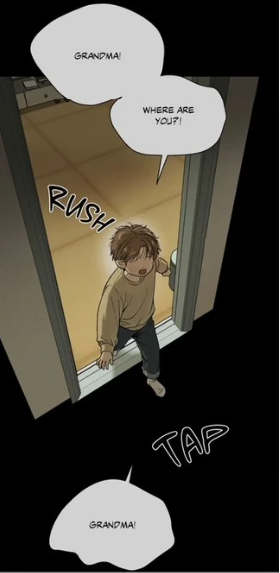 (chapter 57) In addition, I believe that his unconscious was pushing him to come clean with the past, to reveal the changes in his life. It was impossible for both of them to keep such unreal promises.
 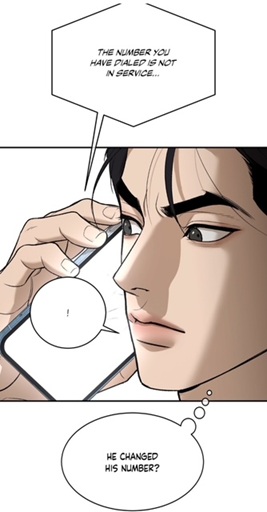 (chapter 56) revealed the existence of a past trauma. It highlighted his own fear of abandonment and rejection—an emotion he had long denied. The door, a supposed barrier against the outside world, now stood as a reminder of all he had pushed away, including his own need for connection. Therefore he never left his door open in the penthouse:
  (chapter 55) That’s why I perceive this scene as an important step for Kim Dan himself:
  (chapter 64) By opening and closing the door, he is overcoming his abandonment issues. He becomes the ruler of his own life (time and relationship). He is freeing himself from the mental torment which readers could witness in earlier episodes.
  (chapter 24) The physical therapist has kept his past trauma a secret. And what is the synonym for “secret”? Key! So when the main lead leaves the champion behind
  (chapter 24), yet the latter didn’t get fooled at all. He found out the true nature of their relationship.
  (chapter 19) the Wedding Cabinet in Kim Dan’s home functioned both as a mirror and a false window, preserving an illusion of timelessness.
  (chapter 19) Unlike the rest of the dilapidated house
  (chapter 10), the cabinet remained pristine, suggesting a futile attempt to halt the passage of time and maintain the status quo.
  (chapter 57) On the one hand, it shows that he was maturing, on the other hand as a young adult, it is clear that he is destined to make mistakes. He has always defined himself as the caregiver, but he forgot his own true nature: he is a human before anything else. And what is the definition of humanity? I would say, the capacity of benevolence and the inevitability of mistakes. It reflects the dual nature of human existence—the potential for compassion, kindness, and altruism on one side, and the propensity for mistakes, weaknesses, and moral failings on the other. And that’s exactly what the doctor has been mirroring to the champion in the lavender-tinted bedroom:
  (chapter 1) to the point that I called him “Mister Mistake”.
 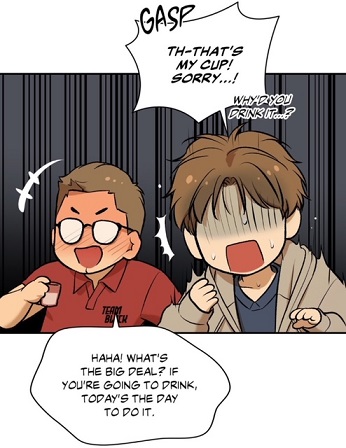 (chapter 43) On the other hand, his missteps are there to teach the fighter to drop his perfectionism and to bring the notion of entertainment in his fated partner’s life. Kim Dan is funny in his own way.
  (chapter 64) He doesn’t respect humans in general. The irony is that by criticizing Joo Jaekyung, the doctor is overlooking his own nature. He is also a sinner.
  (chapter 57) Is it a coincidence that the doctor’s cold attitude takes place in chapter 60 -64?
  (chapter 61) No, as the number 6 sounds similar to sex. Moreover, don’t forget that Satan’s number is strongly associated with 6 (666 or 616). From my point of view, the “hamster” is on his way to become an adult and as such a sinner as well. The physical therapist’s stubbornness reminded me of the behavior of a teenager who believes to know everything about life, while in verity, such people lack experiences. And what did the nurse say about the main lead?
  (chapter 61) But why did he want to return to the past? It is because of the ghost’s criticism
  (chapter 64)
  (chapter 64) That’s why the door
  (chapter 64) Hence the author focused on his wide opened gaze. Kim Dan’s intervention was painful but necessary, because through this reflection, the athlete’s motivation to fight is bound to change. In the future, the fight won’t be deadly serious like before, he won’t act like a tyrant in the ring where he couldn’t control his rage.
  (chapter 1) He will see his opponent as an artist too.
  (chapter 21) with her, because he felt treasured.
  (chapter 61)
  (chapter 63) —no matter how reluctantly—represents the second turn. With the doctor’s cold rejection, he is forced to choose: What does he want in life? Only the champion title or something else?
  (chapter 64)
 Hence the latter will become his hyung. For me, there’s no doubt that through this confrontation, the athlete’s respect for Kim Dan can only increase.
  (chapter 27), and he noticed the quietness of the ocean
  (chapter 59) But this time, that would be a conscious choice. That’s how he will reconnect with his true self for good. But strangely, I am expecting that he won’t be on his own. I am quite certain that this man will make a similar experience than the grandmother:
  (chapter 47). Moreover, in season 1 and 2, the doctor was often connected to the sunset:
 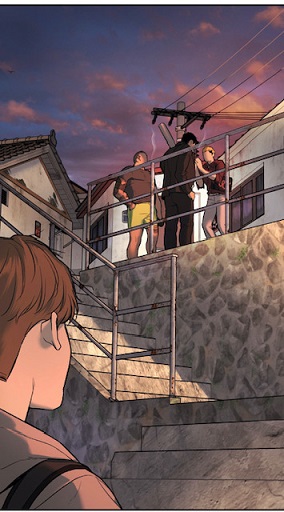 (chapter 1)
  (chapter 48) This was an ominous sign for the champion’s symbolic “death” and rebirth. Sun and moon are natural tools to determine the flow of time.

 (chapter 64), and the language of touch—their dynamic undergoes a profound shift. This moment is not just about desire but about power, communication, and the fight for control. It is in this intimate space that both men are confronted with their vulnerabilities
  (chapter 64), and Kim Dan begins to push back, not with force, but with emotional detachment. He avoids his gaze, hides his moaning and as such remains silent. This night is a pivotal moment, signaling the champion’s awakening to his emotions and Kim Dan’s assertion of his autonomy.
  (chapter 63) it is a stark contrast to the usual aggressive or mechanical physicality of their past encounters. Let’s not forget that when the athlete kissed the doctor for the first time
  (chapter 14) in the locker room, he not only used his hand
  (chapter 14), but also remembered his hyung’s advice.
  (chapter 14) This comparison outlines that their first kiss was more the result of conscious and tactical decisions than of passion and desire. It was not only to protect the hamster’s life, but also to be able to fight against Randy Booker. In other words, their first kiss was strongly intertwined with work and absence of consent. He had not informed Doc Dan before.
 (chapter 63), yet he licked the doctor’s lips
 (chapter 63), until the latter finally opened his mouth. This gesture reminded me of a wolf licking his progeniture in order to show affection. My avid readers will certainly recall my analysis of their “love session” at the penthouse in Episode 44: there were traces of “animalistic behavior”
  (chapter 44) Therefore it is not surprising that in that little town, the star is no longer following any suggestion coming from his surrounding. He is not recalling Cheolmin’s words or not watching movies. This means that this kiss in episode 63 is born from desires and passion. This explicates why contrary to the one in the locker room
 (chapter 15)
  (chapter 63) represented the next step of his “generosity”. Yet, the divergence is that the star had done the French Kiss by instincts, whereas the fellatio was more a calculated move. He selected this new approach based on his own likes and experiences. In other words, this magical night represents the birth of a “lover” and “boyfriend”.
  (chapter 15) The beginning of “emotions”. That’s why the physical therapist asked him to let him know in advance. And what did the athlete do during their reunion? One might reply that he ignored the request from the doctor.
  (chapter 63) It is clear that Kim Dan had anticipated a different approach: a renewal of their First wedding night. The irony is that the French kiss and the fellatio became the evidence that the star was not treating the doctor as a doll per se. Why? The star has changed a lot due to the main lead’s influence. He had gained knowledge and confidence. Nevertheless, their interaction here forces a confrontation not just between them, but within themselves—Jaekyung, who has always relied on physical dominance to maintain control, is confronted with a newfound uncertainty, while Kim Dan, whose silence once reinforced Jaekyung’s belief in his own power, now wields that same silence as a weapon.
 (chapter 63) The significance of this kiss becomes evident when, later that night, he finally speaks up, voicing everything he has suppressed.
  (chapter 64), the scent in the air
  (as seen through the presence of scent sticks in the background), and the vision and sensation of the man beneath him. Unlike the previous intimate moment in Chapter 44, where he was inebriated, this time he is conscious.
  (chapter 64) This is the rebirth of Jaekyung—not as the infallible champion but as a man experiencing intimacy in a new way.
 (chapter 64) It indicates that the star was actually revealing his attraction toward his companion. We could say that with this attitude, he was gradually lowering his guard. But there’s more to it. Just before he “was going to finish inside”, he chose to kiss his partner.
  (chapter 64) From my perspective, his gesture displays a transition. The ejaculation is no longer the symbol of dominance and manhood, but of attachment and care. This new observation reinforces my previous interpretation. This night was there to teach the champion to differentiate between the ring and the bed.
  (chapter 64) This privileged position indicates that the main lead was not ready to face Kim Dan’s gaze during an orgasm. In other words, he had not entirely lowered his guard in front of the doctor. The reason is simple. While he was giving pleasure to his partner, this is what he was forced to see:
  (chapter 64) rejection, anger and resentment. This was not a gaze full of love, the remains from the “surrogate fights”. His facial expression was reminding him that his fated partner was more a prostitute than a lover, for he saw this sex session not as a source of pleasure. That’s why he thought like this:
  (chapter 64) Under this new light, I deduce that the champion was not aware of the true motivations behind his actions. He was actually longing for the doctor’s love and embrace.
  (chapter 64) His act of biting his lips in Chapter 64 is not just a nervous tic; it expresses not only physical manifestation of his restraint, but also his suicidal tendencies. He doesn’t mind hurting himself. This shows that he still doesn’t value and treasure his own body.
 (chapter 64) The lip bite signifies hesitation but also resistance. It reflects his internal struggle: he does not want to engage, but something within him still reacts. He still has feelings for the athlete. This small gesture encapsulates his frustration—not just with Jaekyung, but with himself.
 (chapter 57) and overworks himself. That’s the reason why I couldn’t truly rejoice when Kim Dan rejected the champion. In fact, he selected work and pain over “joy and pleasure”. And why? Because of the past and the athlete’s actions.
 (chapter 64) Further by licking his lip, he is acting like his doctor and guardian. But there’s more to it. Observe the comment from the champion: he was holding back. This means that by biting his lips, the doctor reminded Joo Jaekyung of his own weak constitution. Thus I interpret that the champion came to associate the kiss with vulnerability and affection.
  (chapter 15) and touches were purely acts of dominance—ways to assert ownership over Kim Dan. However, the ear lick, which almost looks like a bite, in Chapter 64 carries a different weight.
  (chapter 45) or shoulders, which can be overtly sexual or aggressive, the ear is a sensitive spot, connected to emotions and perception. The fact that Jaekyung chooses this specific form of contact suggests a subconscious shift—he is not just trying to control Kim Dan but also to connect with him.
  (chapter 44) However, that moment left an impression on him—Kim Dan had laughed, showing genuine amusement. Unbeknownst to Joo Jaekyung, he internalized this interaction, learning that the physical therapist liked this place being touched. Now, as he licks Kim Dan’s ear, he might subconsciously be attempting to return the gesture, mirroring an act of intimacy rather than pure dominance. It is a quiet yet significant moment that signals the sportsman’s slow, unconscious shift toward emotional connection.
 (chapter 56) as well, when Jaekyung first began associating sex with play rather than mere exertion. His use of “play out” back then showed a change in mindset—sex was no longer just about stress relief but something to be experienced and enjoyed. The ear lick in Chapter 64 may stem from that same shifting perception. This explains why Mingwa made the champion blush and this panel is linked to light pink.
  (chapter 64) He refused to see and listen to others and to the athlete, because he was trying to deny the existence of his love. The reason is simple. He is trapped in his own world, full of darkness. He was trying to clinch onto the past, where he portrayed himself as a victim and doll of the champion. But the reality is that doc Dan treated himself as a doll or servant, for he didn’t value his own body. Hence he didn’t eat properly and drank soju to drown his pain.
  (chapter 5) This is a habit he had before he met Joo Jaekyung. Moreover the latter was living in abstinence, until he drank alcohol by mistake because of him.
 (chapter 24) of Season 1. Instead, there is waiting and hesitation, an unspoken question in the way he leans in. For the first time, it seems as though he is searching for something more—perhaps a response, a reciprocation, or even just an acknowledgment from Kim Dan. This shift underscores Jaekyung’s internal transformation; he is gradually internalizing Kim Dan’s values and beginning to approach intimacy differently, even if he himself is not yet fully aware of it.
 (chapter 64). He thought, using strength could still help him to conquer Kim Dan’s heart, though it is just an unconscious attempt.
  (chapter 8)
  (chapter 15)
  (chapter 61) That’s the reason why during this lavender-tinted night, Mingwa used reflections of all sex sessions from season 1. Let’s not forget that Joo Jaekyung was never seen cleaning up “the mess” he made. Doc Dan had to clean himself, which is the reason why he made the following request:
  (chapter 63) And what is the opposite to fire? WATER!! Thus this image came to my mind. How do you kill desires and passion? One might say by becoming ice-cold! However, my answer is this: by pouring a glass of cold water on the champion’s face! Yes…
  (chapter 37) This means that Joo Jaekyung is getting punished for this gesture. Let’s not forget that he mentioned their stay in the States to bring back good memories. But I have another reference for this interpretation.
  (chapter 27) And where did he go to calm down? In the swimming pool…


 (Chapter 63) The presence—or absence—of clothing during their encounters symbolized the gradual dismantling of their emotional walls. Now, shifting the perspective to the champion, another layer of complexity emerges. Joo Jaekyung’s evolving approach to intimacy is not just a reflection of his growing feelings but also a silent, deeply ingrained struggle with dependence and control.
 (chapter 63) Why does he hesitate to strip entirely, even as he succumbs to desire? Notice that he released his erected phallus before removing his cloth.
  (chapter 63) To answer this, a comparative analysis of earlier sex scenes is necessary, unraveling the hidden dialogue between physical exposure and emotional vulnerability.
 (chapter 30) The doctor instinctively tried to cover his gray boxer shorts with his t-shirt, prompting the champion to question his reaction:
  (chapter 30) In Episode 63, this dynamic appears subtly reversed.
  (chapter 63) The champion, despite holding the dominant role, is now the one retaining a piece of clothing. This suggests an unconscious act of concealment—not of shame in the traditional sense, but of a growing dependency on Kim Dan.
 (chapter 62) The “hamster” could sense with his leg the excitement. On the other hand, these pants were only removed once he entered the bedroom and was on the bed
  (chapter 63), reinforcing the idea that vulnerability, for him, is confined to this private space. Moreover, the choice of attire in Episode 62
  (chapter 63) Thus I deduce that exactly like the presence of the black underwear, the athlete’s low self-esteem hasn’t been removed completely. He still expects fear and rejection.
 (chapter 55), and ensures that every encounter follows his carefully constructed narrative. However, in Episode 63, a subtle but undeniable shift occurs. For the first time, Jaekyung’s actions reflect something deeper than mere desire or dominance. They reveal his growing emotional investment in Kim Dan, exposing a side of him that even he does not fully comprehend.
  (chapter 12) In the earlier encounter, Jaekyung presented himself as a generous partner, offering Kim Dan a so-called privilege—an opportunity to enter a whole new world, thanks to him. However, his so-called generosity was nothing more than a facade, a way to conceal his inexperience in genuine intimacy. The tool he used was not just an object of pleasure but a mask for his own shortcomings as a lover. He did not know how to pleasure Kim Dan, nor did he care to learn. His focus was not on Kim Dan’s enjoyment but on reinforcing his own power and dominance.
 (chapter 63) Here, he no longer portrays himself as the benevolent provider of an experience.
  (chapter 12) – seeking both to display dominance and to elicit validation
  (chapter 12) —this time, in Episode 63, he prioritizes Kim Dan’s pleasure without explicitly expecting anything in return.
  (chapter 63) Up until this point, Jaekyung has never truly faced rejection.
  (chapter 63) This moment forces him to confront an uncomfortable truth: power and status cannot buy emotional intimacy.
 (chapter 03) or passive-aggressive remarks.
  (chapter 6) However, in this moment, he does not react with anger or coercion.
  (chapter 63) While he does voice his frustration, he does so without force, showing an unprecedented level of emotional regulation. Instead of demanding compliance, he chooses a different approach—he focuses on Kim Dan’s pleasure, attempting to bridge the emotional gap through physical intimacy
  (chapter 63) rather than control. This decision is not merely about sex; it is an unconscious attempt to regain Kim Dan’s attention, to re-establish a connection that he does not yet fully understand but deeply craves.
 (chapter 29) This remark exemplified his detachment, his refusal to acknowledge Kim Dan as a person rather than just a body. Once again, the intercourse was linked to achievement and work. However, in Episode 63, he actively seeks Kim Dan’s gaze, subtly pleading for recognition.
  (chapter 63) This reversal is crucial because it indicates that he no longer sees Kim Dan as just a means to an end. However, his desire for recognition still lingers beneath the surface—just as he once sought validation through dominance, he now seeks it through Kim Dan’s acknowledgment. He wants something more, though he cannot yet articulate what that is, and his actions reflect a subconscious craving for emotional reassurance.
  (chapter 13)
 (chapter 62) the sportsman welcomes the physical therapist in blue pajamas and a robe—an overt attempt to maintain distance and control. Even as the encounter begins, he leaves his pajamas on
  (chapter 3), removing them only
  (chapter 3) – this image marks the change) when the doctor’s back is turned. Then in Episode 8, during the shower, he continues wearing shorts and underwear
  (chapter 8), and his choice of the doggy style further reinforces his desire to avoid direct, face-to-face vulnerability.
  (chapter 12) before removing it and adding the pink sex toy.
  (chapter 12) Their bodies might have been close, but their minds remained divided. That’s why he couldn’t detect the huge bruises on his companion’s body.
  (chapter 12) This guarded approach is further underlined in Episode 20
  (chapter 20), where even in the midst of nakedness, the athlete deliberately positions the doctor in the dog stance. At the same time, he uses another MO: the darkness of the room to hide himself. This calculated arrangement maintains an emotional buffer, allowing him to remain physically exposed yet emotionally detached—a recurring theme in his behavior.
 (chapter 29) while still cloaked in his familiar blue robe and pajamas. Interesting is that the room is not totally dark like in episode 20, the bedroom is illuminated by the huge TV screen. Importantly, this episode marks the first time they face each other in the bedroom, signaling a significant shift in their dynamic and announcing a switch in position. This newfound mutual visibility lays the groundwork for later developments.
 (chapter 33) —a deliberate act imbued with symbolism. Unlike earlier encounters, the champion remains fully clothed throughout this episode,
  (chapter 33) contrasting sharply with previous moments of exposure. The car scene, where they are now facing each other, reinforces the announced switch in intimacy; the light not only illuminates the scene but also serves as a metaphorical spotlight on his desire to see the doctor’s face and body
  (chapter 33) —a silent assertion that only he can truly satisfy the physical therapist. Let’s not forget that before having sex together, the fighter resorted to a dildo
  (chapter 33) rather direct physical intimacy, because he felt insecure after witnessing the actor’s advances toward Kim Dan. His goal? To reaffirm his dominance and make Kim Dan admit that he needed him for pleasure. It is important because it exposes that deep down, the champion views himself as a bad lover. There is no doubt that Heesung‘s criticism resonated with him.
  (chapter 33)
 (chapter 39) Maintaining the doggy style during this phase, he uses such intimate acts to mask his true longing and attraction—an effort to control the encounter while keeping his emotions under wraps. Then I noticed that they switched positions, when doc Dan asked for a break.
  (chapter 39) The wolf chose to lie down on the bed:
  (chapter 39) As you can see, through the different intercourses, we can see the different methods the star used to conceal himself, to hide his “weakness”, his growing feelings for the doctor.
 (chapter 61) The physical therapist remembers an encounter bathed in bright light, where they stood before a couch: the doctor had removed his pants while the champion remained fully clothed, positioned behind him.
  (chapter 61) After both reached climax, the sportsman swiftly departed—a stark demonstration of his habitual retreat into distance and fear, even as he ensures the doctor’s pleasure.
  (chapter 63) Now lying on the bed facing each other, the pair’s physical closeness appears more genuine. Yet, even in this seemingly intimate configuration, they avoid locking eyes during penetration.
  (chapter 4), we do not see whether he is wearing anything the morning after. After their “magic night” in the United States (Episode 39), the next morning, he is only shown taking a shower
  (chapter 40) —meaning the audience never sees him leaving the bed. However, in Episode 45, the author deliberately includes a shot of Jaekyung leaving the bed while still wearing his black boxer briefs.
  (chapter 45)
  (chapter 45). This is just a rhetorical question, as he clearly remembers the night.
  (chapter 45) In reality, he was wondering why he had acted this way. This contradiction—pretending to forget while consciously recalling their time together—reflects his internal denial. His next thought,
  (chapter 45) is a transparent excuse to avoid confronting his emotions. The presence of the black underwear in this scene confirms that he had not fully lowered his guard; he still maintained a psychological barrier between himself and Kim Dan.
 (chapter 54) The specter that haunts him—an unnamed figure whose words still echo in his nightmares—was the architect of his relentless pursuit of strength. Striking is that in his nightmare, he is facing the mysterious ghost, a sign that he saw hatred and rejection in his counterpart’s eyes. While Kim Dan’s halmoni took his hand and provided warmth
  (chapter 22), Jaekyung’s guardian likely did the opposite.
  (chapter 5) This represented a source of support for the elderly woman. Secondly, during the intercourse in the lavender-tinted bedroom, neither the champion nor the doctor are trying to take each other’s hand:
  (chapter 63) In the beginning, the champion grabbed doc Dan’s wrist. This shows that the athlete was not used to touch Kim Dan’s hand. And notice how the “hamster” reacted
  (chapter 63) He pushed it away. This means that taking the doctor’s hand represents the biggest challenge for Joo Jaekyung right now. In addition, the last panel indicates the champion’s transformation, he is now willing to seek the doctor’s closeness. It also implies the vanishing influence from his past guardian.
 (chapter 5) At the same time, it would highlight the potential danger of Park Namwook’s vision for the gym: an institution that might perpetuate the same cycle of control, shame, and expectation rather than fostering true passion and individuality in young athletes. That’s how I realized why the manager slapped his “boy” after the funny sparring:
  (chapter 26) He explained that the main lead was just a doctor. However, I am quite certain, underneath, the manager thought that doc Dan was not fit to spare: so small and weak. He doesn’t fit the criteria to become a sparring partner. Look at his reaction, when Seonho faced the champion:
  (chapter 46) Under this new light, it becomes comprehensible why Potato was also neglected by the manager. The young maknae belongs to a different weight category. There is this invisible rule that only strong people can become member from the gym. However, the purpose of such an institution shouldn’t be reduced to titles, strong and muscular men or boys. The gym should be opened to anyone who desires to have fun and improve their health.
 (chapter 1), until he received the doctor’s massage in chapter 1. His attitude toward sex mirrors his training in the gym—focused on endurance, performance, and control. His body is a tool, a machine honed for efficiency.
  (chapter 63) Pleasure is secondary; the real goal is lasting, enduring, proving his stamina. Even in his most intimate moments, he is competing against an invisible opponent—his own ingrained fear of inadequacy.
 (chapter 63), why he keeps barriers between himself and Kim Dan, even when his body betrays his true desires.
 (chapter 62)
  (chapter 4) nudity was a tool of dominance, a means of asserting control. Now, it has become a sign of submission—not in the physical sense, but in the way he is slowly relinquishing the emotional armor he has always relied upon.
  (chapter 63), but of his silent battle against the vulnerability he is beginning to feel.

 (chapter 62), the doctor’s memory got triggered. Because of his past experiences, he has long associated the jinx exclusively with sex. This contrast in understanding highlights both Jaekyung’s lack of self-awareness and Kim Dan’s tendency to filter reality through his own expectations and trauma. However, the deeper significance lies in Jaekyung’s evolving perception of dependency. His jinx is no longer just a superstition tied to his performance in bed. It now subtly acknowledges that his success has been intertwined with Kim Dan’s intervention.
  (chapter 61) By entrusting his care to Kim Dan, he was insinuating that the main lead was trustworthy and competent, yet his inability to verbally express appreciation keeps the doctor unaware of his true feelings. This struggle resurfaced in front of the hospice, where Jaekyung could only bring himself to admit that Kim Dan was not responsible for the incident with the switched spray.
  (chapter 57) and Park Namwook
  (chapter 13) because they affected the doctor’s life?
  (chapter 41) In one case, he refused to listen to his friend’s advice, whereas he trusted the words from MFC, MFC doctors and his hyung. When the foundation he has relied upon begins to crack, Jaekyung’s entire mindset is shaken, forcing him to question whether his past truly holds the answers he seeks. We could say, the athlete needs to be betrayed by his own past in order to throw his old belief. The latter is strongly intertwined with the organization MFC and authorities in general. Questioning his past equals challenging the company MFC and his past “guardians”: the terrifying ghost and even his two hyungs.
  (chapter 29) The origins of his struggles existed before his recent failures, suggesting that his belief in a simple solution—reclaiming his title—is an illusion. This disconnect reveals how deeply his professional and personal life are entangled; his need for control in the ring has masked his deeper emotional vulnerabilities. He isn’t merely striving for victory—he is chasing the illusion of stability, believing that his success is the sole factor that determines his well-being.
  (chapter 29), you will realize that alone in his penthouse, Joo Jaekyung was actually admitting the importance of sleep and rest. His earlier belief in relentless training as the key to success now clashes with his realization that exhaustion is affecting him. This shift signifies an unconscious admission that his well-being is not just tied to physical endurance but also to recovery and relaxation—something he previously dismissed. This realization subtly parallels his growing dependence on Kim Dan, reinforcing the theme of blurring lines between his professional and personal life. And what had occurred after this magical blue night in the penthouse?
  (chapter 30) The athlete woke up later than usual. In fact, he was rather late, for he was still wearing his pajamas, while the doctor had already taken his shower. But back then, observe how he opened the door! Like a clumsy beast, grump leopard! Why? In the past, I explained that he was seeking the champion’s closeness, but didn’t know how to approach his partner. I am now adding another aspect. He was actually annoyed, because he had not been following his daily routine!! Under this new light, it becomes comprehensible why the champion had such a “angry” facial expression, while deep down he was happy. The older version of this scene:
  (chapter 44) However, this means that in episode 30, he never acknowledged his dependency on the physical therapist for his rest loudly. On the other hand, it explains why the champion felt threatened, when the actor approached his “lavender-tinted pillow” or “sleeping pill”.
  (chapter 31) In fact, he used guilt to create a link between him and his roommate. That’s the reason why I am more than ever convinced that the champion will sleep better after this lavender-tinted night.
  (chapter 62) won’t come true at all. 😉 He will stay longer and ask for Kim Dan’s presence during the night.
 (chapter 56) and opportunities that could offer him security, convincing himself that he is protecting his independence when, in truth, he is reacting to past trauma rather than making an intentional choice.
 (chapter 46)
  (chapter 46)
 (chapter 62) If he continues making decisions based on past fears, he will remain trapped in the same cycle, unable to experience true growth or emotional fulfillment.
 (chapter 3), which has been the setting of power imbalances, physical dominance, and silence, the living room represents a shared space—a place where dialogue and openness can exist. But why is the bedroom linked to silence? It is because of the TV, the third invisible companion!
  (chapter 48) Hence during that night, none of the protagonists talked sincerely to each other. And now pay attention to the living room at the hostel:
  (chapter 54) He needed to get rid of this poor habit: watching TV or cellphone. He had to realize that the TV or cellphones were never real companions and never brought him peace of mind! This was the invisible “love” triangle. Back then, the athlete deceived himself by thinking that he was truly self-reliant, while in verity he was dependent on his cellphone and the TV.


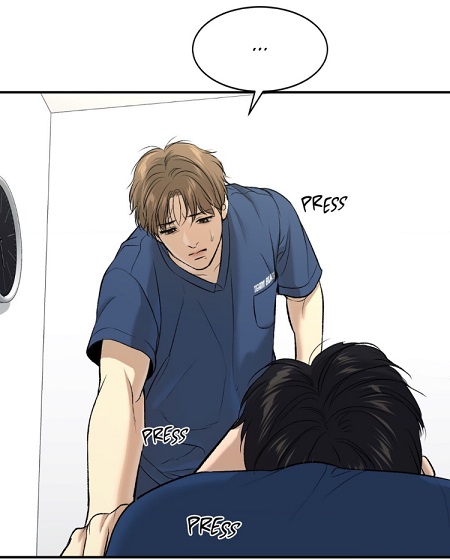

 (chapter 59) Striking is that here the doctor didn’t apologize to the elderly man, but only to the family.
  (chapter 59)
 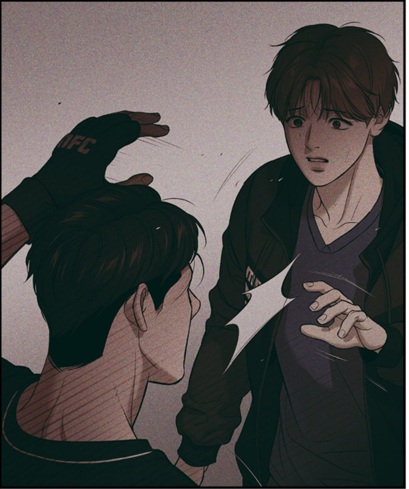 (chapter 62) – which is quite understandable in my eyes. The ones who failed the couple were the two other hyungs from my perspective. The past affected the doctor so much that he views himself and his feelings as “trash” now, yet it is clear that neither Park Namwook nor the coach are suffering from guilt or remorse. The star’s follow-up statement,
 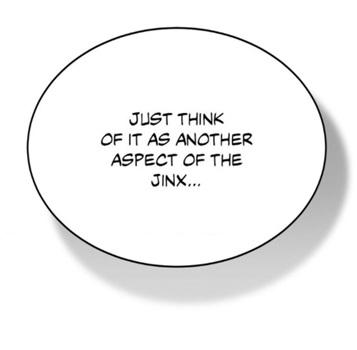 (chapter 62) further reinforces that Kim Dan has become an integral part of his preparation. Although Jaekyung does not yet frame this as emotional reliance, his words betray an unconscious attachment—one that Kim Dan himself does not recognize. Moreover, by including him in his jinx, the champion is only one step closer to include him in his “success”. Should the doctor be the target of malicious comments, the star will consider it as a personal assault or as his responsibility.
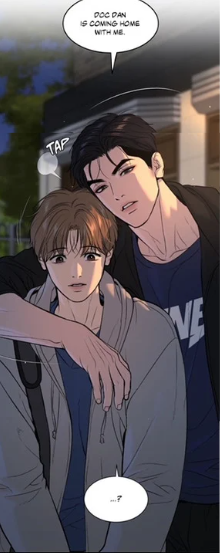 (chapter 43) Someone needs to remind the athlete of his own “statement”. Simultaneously, since the doctor never got curious about the fighter’s past and family, his presence could only be seen as a bandage covering a rotten body. In order to heal completely, he needs to expose his traumatic past and vulnerabilities.
 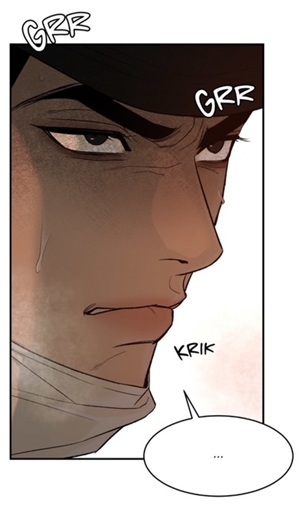 (chapter 56), but about something deeper. Here he felt the need to see his beloved “companion” again.
 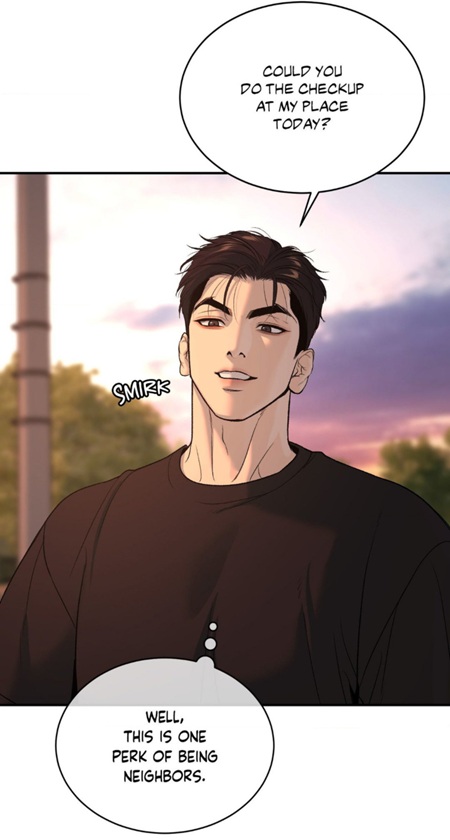 (chapter 62) That’s why I come to the following conclusion: The athlete must have felt happy in the living room, for he felt comfortable and safe.
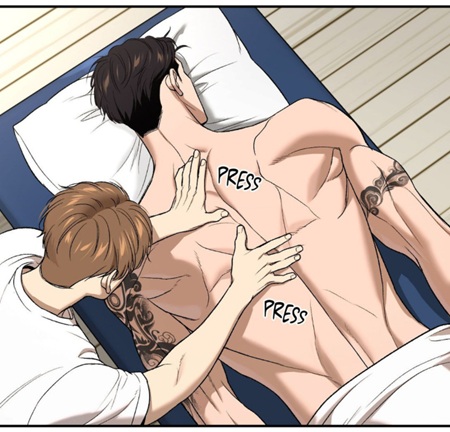 (chapter 62) But why did he show his back? One might say that he desired to hide his “satisfaction” and his “reliance” on his fated partner. Or he didn’t feel the need to watch the doctor’s facial reaction, when he would confide his new intentions and the transformation of his jinx. He didn’t expect the physical therapist to mock him for his absurd belief contrary to episode 2:
  The doctor is treating the star
  (chapter 22) when he is not, using his seniority and past influence to assert dominance. His attitude is related to his past decision: from his perspective, he saved the athlete from turning into a criminal.
  (chapter 26) His dependence on Jaekyung’s achievements makes him resistant to any shift in the fighter’s trajectory
  (chapter 50), allowing others to step in instead. Later, rather than addressing his inaction,
  (chapter 53), as if the past never happened. By doing so, he reinforces Jaekyung’s belief in his so-called ‘jinx,’ manipulating the fighter’s perception of events and contributing to a distorted memory of reality. Meanwhile, the manager must face the reality that change is inevitable and that Jaekyung’s evolution does not mean his own irrelevance. However, his position must change.
 (chapter 59)
 (chapter 5) He felt so empowered that he won very quickly.
  (chapter 5) But this good vibe was attributed to the sex with Kim Dan and unfortunately linked to his match. The reality was that he had slept better and longer. So by recreating the past, Kim Dan places the athlete in front of a choice. What matters in his life? His title or his peace of mind? He is correcting the champion’s distorted memory. Kim Dan is the reason why he can rest properly and not the title. Don’t forget that he was suggesting to go separate ways during the massage. But if he sleeps better before gaining his title, he won’t feel the urge to return quickly to the ring. In the living room, he was still acting as the celebrity, but in the bed chamber he is now gradually pushed to leave his title out of the bedroom. Now, in the bedroom he becomes a man and can almost make a mistake as a lover.
  Bebebisous33s' analyses in K-Dramaland and Manhwas