Protected: Painter Of The Night: Sleeping with the enemy (fourth version)

Bebebisous33s' analyses in K-Dramaland and Manhwas
Analyses of K-dramas and Manhwas (for the most part Yaoi)

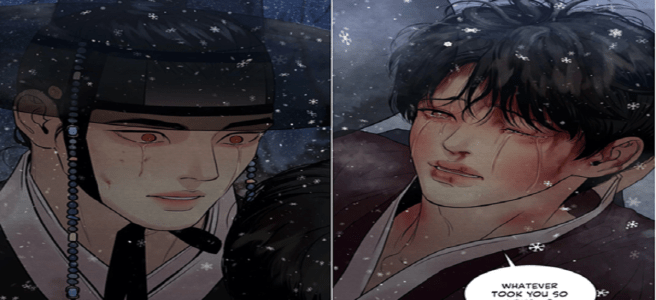

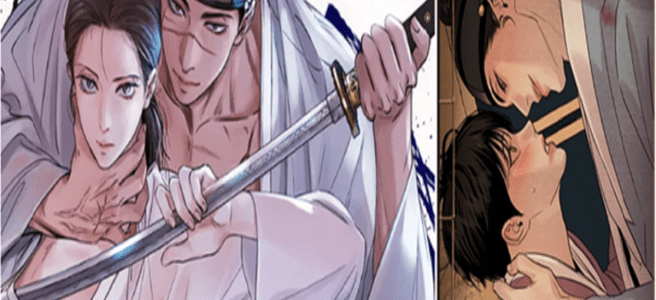
This is where you can read these manhwas. But be aware that these manhwa are mature Yaoi, which means, it is about homosexuality with explicit scenes. https://www.lezhinus.com/en/comic/painter If you want to read more essays, here is the link to the table of contents concerning Painter Of The Night: https://bebebisous33analyses.wordpress.com/2020/07/04/table-of-contents-painter-of-the-night/ Steel Under Silk: https://www.lezhinus.com/en/comic/steel_silk If you want to read more essays about this manhwa or others, here is the link to the table of contents: https://bebebisous33analyses.com/2021/06/06/table-of-contents-of-analyzed-mentioned-manhwas/
It would be great if you could make some donations/sponsoring: Ko-fi.com/bebebisous33 That way, you can support me with “coffee” so that I have the energy to keep examining manhwas. Besides, I need to cover up the expenses for this blog.
The chapter 7 confirmed my previous interpretation concerning the signification of the Korean title: Blade and flower. The main lead Lee Yeonjo is indeed the flower. However, since I am not speaking Korean, I had no idea about the meaning of his name.  (chapter 7) The young man is associated to the lotus flower.
This is very important for two reasons. First, the lotus is associated to purity and beauty indicating Lee Yeonjo’s function in the story. He will catch the attention of many characters, especially of lord Chang and Kwon Hee-Ryang so that he will be constantly on their mind. Striking is that after seeing him, the governor couldn‘t forget his face. 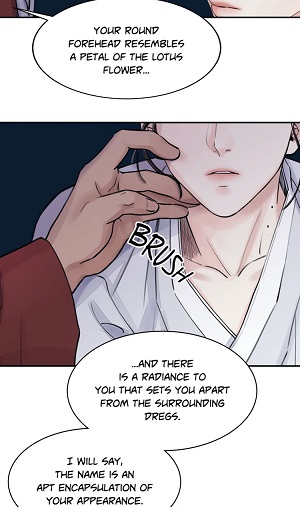 (chapter 7) After their first meeting, the governor was already dreaming of having sex with the slave. Secondly, since the lotus flower emerges from murky water, the latter could be perceived as the symbol of the court in Hamheung-castle. Therefore the court is portrayed as a place full of corruption. Because of the darkness of the place, Yeonjo’s purity can only outshine and captivate the semes’ attention. One might say that he is far from pure, for the former noble is selling his body. On the other hand, his soul and heart have remained intact. He did it for selfless reasons. It was for his brother’s sake. It demonstrates his humbleness and dedication. He was willing to give up on his pride, if it meant to save his brother. Even later, he only accepts the order from headman Choi, once he recognizes that it is his only possibility to approach his enemy. He showed great reluctance in the beginning, for he despises homosexuality. He had never imagined that Kwon Hee-Ryang liked having sex with men.
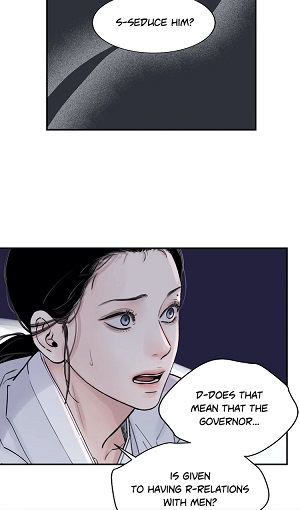 (chapter 7) This truly displays his innocence and purity. But there’s more to it. The particularity of the lotus flower is that it blossoms during the day, but once the moon appears, the lotus flower closes, but re-blooms the next morning entirely dirt-free! This can be perceived as a metaphor for Yeonjo’s future development. In my eyes, the sex sessions during the night will represent the main lead’s fights. During the night he will be far from pure and innocent, this can only be judged as an allusion to sensuality. However, this means that Lee Yeonjo will never lose his “beauty and purity“ despite these sex fights, for the next morning, he will come out as pure and innocent.
At the same time, his name Yeonjo (“lotus shines”) betrays his origins. (Chapter 7) He comes from a former noble family. How so? First, the lotus is strongly intertwined with Confucianism and Buddhism.
“In both Confucianism and Buddhism, the lotus flower is seen as a symbol of honest poverty and virtue associated with an aloofness. Poverty and virtue come from the fact that lotus flowers grow in muddy and dirty waters, yet it still has such beauty.” Quoted from https://www.korea.net/TalkTalkKorea/Spanish/community/community/CMN0000004263#:~:text=In%20both%20Confucianism%20and%20Buddhism,it%20still%20has%20such%20beauty.
Consequently, the plant came to represent the upright and faithful scholar. This new meaning was based on Chinese wordplay—lotus (lian) and uprightness (lian) which are homonyms. This explicates why during the Joseon period, Korean neo-Confucian scholars loved having quadrangular ponds with lotus flowers in their propriety. Under this new light, the manhwaphiles can comprehend why in the Painter Of The Night, all the domains from the nobles (the Lees (Painter Of The night, chapter 3), the Yoons
  (chapter 10) and the Mins
 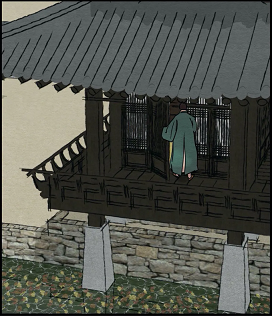 (chapter 33) have a square pond with a pavilion and lotus flowers. The pond was supposed to represent the owner: a upright and faithful scholar. 🙄 And this made me laugh, because this was the place where crimes and sins were committed. Jung In-Hun asked Baek Na-Kyum to disrespect his sponsor, to become disobedient and as such disloyal. Besides, he lied, manipulated and wounded the main lead
 (chapter 10), whereas Min, Yoon Seungho and Lee Jihwa had sex there.
  (chapter 25) All of them were far from righteous and humble scholars. That’s how I realized why the pavilion in Painter Of The Night symbolized emancipation. It was where the main protagonists got purified thanks to the lotus flower. Why? The answer is simple. The lotus flower embodies rebirth, regeneration and enlightenment.
 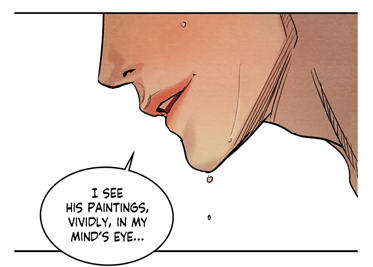 (Chapter 3) This coincides with the main lead‘s enlightenment. In the pavilion, he could perceive his sex appeal and attraction. Let’s not forget that Yoon Seungho had discovered sex through sexual abuse, and was blamed for the sexual desires from the pedophiles. Furthermore, with this new discovery, the manhwaphiles can grasp why Lee Jihwa sent his friend there.
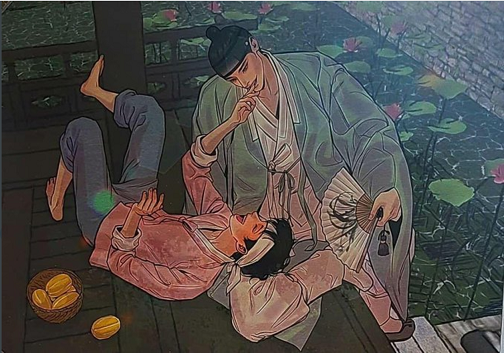
 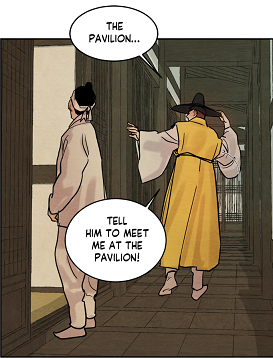 (Chapter 3) That way, the second lead could appear as an integer and down-to-earth noble. 😂 But no, it had the opposite effect: the lotus flower revealed the true nature of the relationship between the red-haired master and his friend: it was purely sexual. He loved having sex with Yoon Seungho. Furthermore, it also exposed Jihwa‘s true reflection: he was a homosexual. This signifies that the pavilion and the lotus flowers exposed the decadency of the aristocracy in this story, while they cleaned the protagonists. In my eyes, only Yoon Seungho among the aristocrats has the disposition of becoming a true scholar. Finally, it explains why the video had such a scene:
  Here, the lord is portrayed as a humble and righteous scholar. Because of this new discovery, I felt the need to examine the color of the lotus flower in the main lead‘s pond.
  What caught my attention is the following: the reflection of the patio. It gives the impression that the water is clean! However, the lotus flower needs dirt to grow. Furthermore, since the painter embodies water, I am questioning if the lotus flowers had enough water. Notice the huge gap between the level of water and the bridge. This explicates why the flowers are just raising above the water contrary to this picture.
  The manhwaphiles can notice the presence of the long stems. I would even say that now the number of pink lotus flowers has increased, for now they are visible on the right side of the bridge which contradicts to the picture from episode 10. Another important detail caught my attention: the color of the flower. It is a pink lotus flower.
„Pink Lotus Flowers are said to be the true flower of the Buddha. A budding pink Lotus Flower symbolises a person whose awareness is beginning to expand, while one that has reached full bloom represents a full sense of enlightenment.“ quoted from https://www.happybunch.com.sg/blog/lotus-flower/
The color pink is made by combining red with white. The color red contributes to the need for action while white brings the potential for success to the table. The combination of passion and power (Red) with purity and completeness (White) results in some of the most beautiful hues of pink. With this in mind, think about the various shades of pink. Psychologists often associate the color Pink as a sign of hope, positivity, warmth, comfort, and a sense of security. Pink is often used to diminish (or at least reduce) feelings related to anger, neglect, aggression, or even a sense of abandonment. quoted from https://www.whenyougarden.com/pink-lotus-flower-meaning/
Under this new approach, the manhwaphiles can grasp the painter’s function in Painter Of The Night. He is the pink lotus flower too. During the night, he cleansed the lord and showed his true nature (a huge libido), but the next morning, he was still as pure and innocent as before. Don‘t forget that the two main leads reflect each other. This means that the artist should be perceived as the sun too. Baek Na-Kyum could bring out Yoon Seungho from the darkness, the muddy water! Without any sun, the lotus flower can not emerge and shine. I conclude that the two protagonists have a dual nature: the lotus flower and the sun.
As a lotus flower is born in water, grows in water and rises out of water to stand above it unsoiled, so, I, born in the world, raised in the world, having overcome the world, live unsoiled by the world.”-Buddha quoted from https://www.whenyougarden.com/pink-lotus-flower-meaning/
Because of the strong connection between the lotus flower and Buddha, I come to the conclusion that Yoon Seungho‘s fateful encounter with the painter will bring him closer to religion, and make him drop his nihilistic vision he adopted from his surrogate father Kim. In my eyes, he will become truly enlightened.
And now, it is time to return our attention to Steel under Silk. When Lee Yeonjo revealed his name, the praise from the sharp and intelligent Kwon Hee-Ryang lets transpire the true thought from the governor. (chapter 7) He knows that the young boy was never born as a slave! But he is masking his new gained insight behind his compliment. Therefore it is not surprising in episode 12, the governor confronts the slave with the truth. He is well aware about Lee Yeonjo’s identity. The official killed his father in the past!! By mentioning his father’s death, Kwon Hee-Ryang is showing to Yeonjo that he won’t succeed with his revenge. The governor is no fool. Let’s not forget that the young man had planned to approach the official during his sleep in order to kill him.  (chapter 6)
Some might think that the lord is a real snake, for he is tormenting the young man with his harsh words! On the other hand, the serpent is associated to seduction and deception due to his role in the bible: the animal lied to Eva and Adam which led them to be banished from the garden of Eden. Nevertheless, as you can recognize it, Kwon Hee-Ryang is doing the opposite. He is telling the servant the uncomfortable truth. He knows very well the hatred and resent from Lee Yeonjo. Besides, the readers should keep in their mind that Yeonjo’s desire for retribution was strongly intertwined with his suicide. He knew that with such a goal, he would never escape death. He might be still alive, but he is not truly living. This explicates why the young man didn’t protest, when the governor’s assistant announced that the staff should get punished for their misbehavior (bullying the main lead). Lee Yeonjo didn’t ask for justice. Thus Kwon Hee-Ryang had to step in and defend the victim from the injustice.  (chapter 2) In fact, he got upset because of the official’s benevolence.
  (Chapter 2). Anyone in his place would have been happy and thankful. This signifies that he would have preferred getting flogged and even being hurt over true justice! This shows how deep his resent is, but also how much he is neglecting his own body. All his thoughts are revolving around payback and as such his imminent death. Then, when he cut his finger, he showed indifference again. He didn’t treat the wound, indicating that he was not treasuring his own body. This attitude could only catch the official’s notice. That’s why I believe that the confrontation in the jail should be perceived as a wake-up call for the young man, similar to the “words“ from that fateful night.
 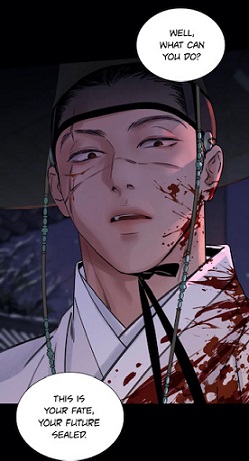 (Chapter 1) Here by saying this, he was encouraging the boy to fight back and not accept his fate.
Another important detail is the lord‘s attitude during that night. First, he was wearing a white hanbok. 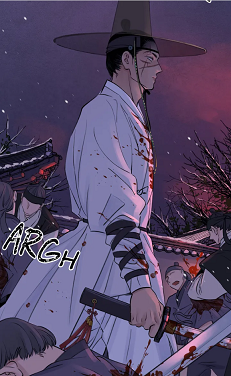 (Chapter 1) In Joseon, the color white was traditionally used for funeral. He was dressed for the occasion: there would be death during that night. Secondly, he walked through the courtyard searching for father Lee. This means that he had chosen to kill the scholar himself. He had not sent his guards or minions to do it. In other words, he was showing a certain respect towards Lee Yeongjo‘s father.
  (Chapter 1) This exposed the main lead‘s true personality. He doesn‘t mind dirtying his own hands, he is taking responsibility for his own decisions. Finally, Lee Yeonjo was just a young boy back then. He had no idea about the political context and circumstances of this purge. He perceives the king and his governor as the villains
 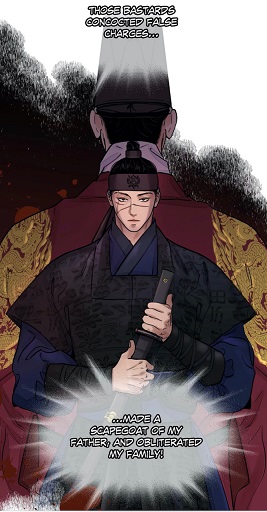 (chapter 7), for he lost everything during that night. Yet, he has no idea what kind of official his father was and why this massacre took place. Lee Yeonjo needs to distinguish the difference between the father and the official. Besides, observe that the slave is seeking revenge, and not justice. From my point of view, this second confrontation with cruel reality is necessary to put this tragedy in the bigger picture. In my eyes, it is related to the hojok.
 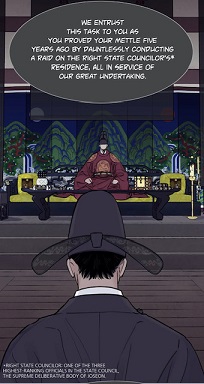 (chapter 2) If not, the king would not have mentioned the service done from 5 years ago. As a conclusion, the lotus is about to discover the reality of the murky water, while Kwon Hee-Ryang doesn’t appear to be a snake.
At the same time, I started wondering which color Yeonjo was associated: white, pink, blue or purple? From my point of view, the slave is connected to the purple lotus flower. Why? First, it is because of his white skin and blue eyes. Combined together, we have violet.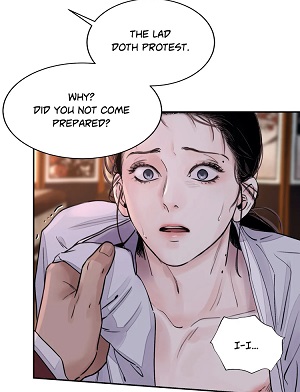 (Chapter 8) In addition, he is wearing a purple shirt.
 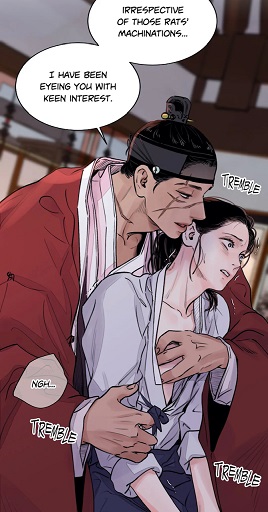 (Chapter 8) He is surrounded by rats, a metaphor for the dirty water and as such the corruption in the palace. And what is the meaning of the purple lotus flower?
A lotus flower, in general, symbolizes fertility, compassion, spiritual enlightenment, impurity. The purple lotus flower has a unique existence because it represents the Noble Eightfold Path of Mysticism. It is represented by the eight petals and how the lotus flower grows from first the deep mud to the sunlight, and then blooming for three days is a beautiful fragrant purple flowers. The purple lotus, in particular, is unique, and the color changes according to the sunlight, the moonlight, and the temperature. This gives it a glowing and magical effect of transformation. Quoted from https://www.petalrepublic.com/purple-lotus-flower-meaning/
This means that this flower is even more powerful than the pink lotus flower. This signifies that Lee Yeonjo will rediscover his original personality, he will metamorphose and give up on his suicidal thoughts. Simultaneously, the presence of the purple lotus flower indicates that it will clean the whole place and bring destruction to the hojok and others. As a conclusion, the lotus flower implies the main lead’s transformation (like for example acceptance of his sexual orientation), just like it will change others. He will find a new purpose in his life: fight for justice. So far, his thirst of revenge is connected to suicide and despair. Since his father is judged as a traitor, it is also possible that Kwon Hee-Ryang proposes him a deal. He could clean his father‘s name. But we will see.
In the third part, I had compared Kwon Hee-Ryang to a snake, and concluded that on the surface, he was not behaving like the animal from the bible in front of the slave: lies and deception. On the other hand, what did lord Chang do, when the young man got bullied? He blamed the main lead! Why? Notice that when the administrator arrived, he caught Yeonjo fighting. 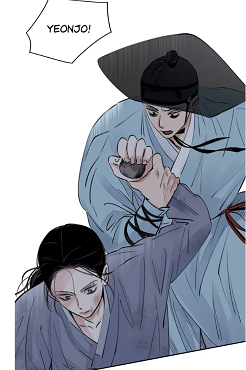 (chapter 1) This could only reinforce such a prejudice. Another reason for this misjudgment is his assistant’s report.
 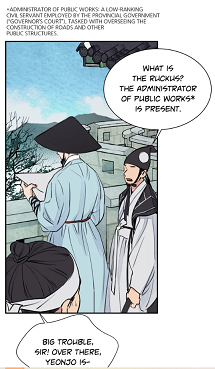 (chapter 1) The protagonist was portrayed as the one causing trouble, while in truth it was the opposite. The source for the ruckus was the noble’s favoritism towards the main lead. To sum up, lord Chang was viewing the main lead in a negative way. This interpretation is even corroborated in chapter 7:
“I hope no trouble finds him for these few days I’m away”.
His words are implying that the main lead is somehow responsible for trouble. However, the noble never realized that his indecisiveness is one of the main issues in his relationship with the main character. Since he used the brother’s sickness for his own advantage, and could obtain the slave’s body so easily, he never tried to understand Yeonjo. He knew about his hatred (chapter 7), yet he didn’t attempt to ease the main lead’s heart and mind by removing the source of his negative emotions: the injustice he felt for the loss of his family and name. But why does he resent lord Chang? Simply because as the administrator for the construction, he represents the king‘s authority. The huge gap between Lee Yeonjo and the official becomes more visible, when the protagonist changes his attitude so suddenly. The lord never tried to seek the real reason behind the sudden change of heart. Why should he, since he was gaining something?
 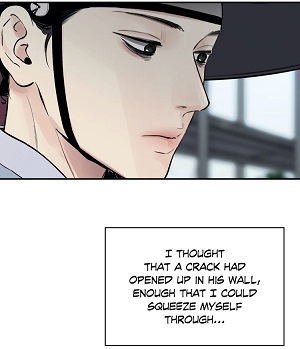 (chapter 7) He had a reason to believe in his lies so easily.
 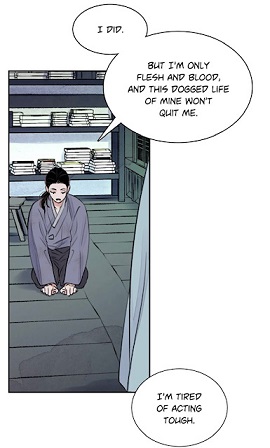 (chapter 2) He imagined that since the young man was accepting him as his sponsor and benefactor after the brother’s death, he was getting closer to obtain Yeonjo’s heart. Because of Lee Yeonjo’s attitude towards sodomy
 (chapter 1)(chapter 7), it is quite obvious that the idea of prostitution was brought up by lord Chang. In exchange for medicine and special treatment, Lee Yeonjo could help his brother. So this offer was a temptation which could only lead to issues. The young boy’s reputation suffered. That’s the reason why we shouldn’t underestimate lord Chang’s personality. He might act gentle and caring, but behind his kindness hides real selfishness. On the other hand, the submissive slave was acting in front of the administrator, so that we should question ourselves if with this suggestion, Lee Yeonjo was not acting as the snake.
When the protagonist announced that he had a change of heart, the administrator had no inclination to doubt his words. He hoped that the main lead would come to fall in love with him. It was just a matter of time. Yet it was clearly a delusion, for the simple reason that lord Chang is not assuming his own sexuality. First, the readers should pay attention to the location of their sexual encounter: a library!!  (chapter 5) It was not in his own place. The noble was not becoming responsible for his sexuality and their relationship. This explicates why the lord said that he was hurting the servant.
 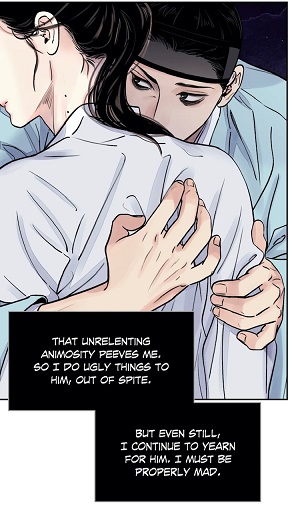 (chapter 7) Thus I come to the conclusion that lord Chang is behaving similarly to Lee Jihwa. He is yearning for Lee Yeonjo’s love without risking anything, he prefers maintaining his good reputation.
In addition, note that he used the festivities as a justification to switch his shift 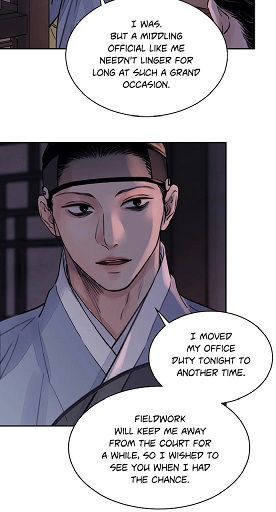 (chapter 4), while he could leave the banquet by saying that he had an office duty. No one would ever question his disappearance. That way, he wouldn’t be caught with the main lead. Naturally, the staff has ears and eyes, so that they can not be fooled. That’s the reason why he got bullied by the workers. However, lord Chang will never be confronted with the rumors, for he is a noble.
 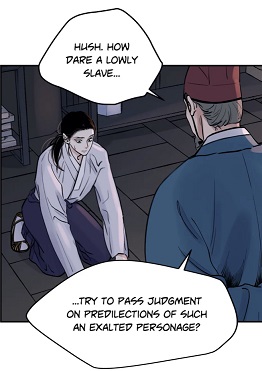 (chapter 7) Due to their social status, the servants are not allowed to show their disapproval. This explicates why Yeonjo became the target of the grapevines.
  (chapter 6) Only him will be judged and looked down. The last comment lets transpire that if the “lotus” had not been there, lord Chang wouldn’t have asked to have him as a boy toy. Note that he is portrayed as the seducer. In their eyes, he is the snake.
As you can see, the introduction in the bedchamber was the starting point for the governor to investigate the servant’s origins. (chapter 7) He knew, he was a fallen noble, and he had been hired to spy on him.  (chapter 7) This shows that the lord is never taking anything for granted. In my eyes, he is always questioning the intentions of his counterparts. That’s the reason why he can anticipate his enemies’ moves. He is always asking why. Therefore I perceive this scene as an important turning point in the protagonists’ relationship.
 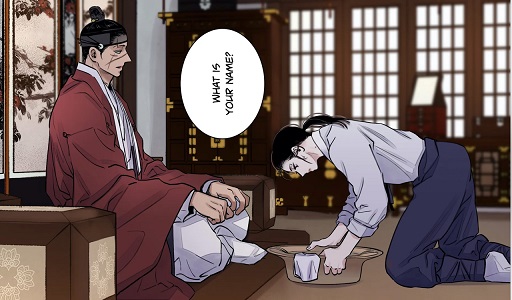 (chapter 7)
One of my followers even pointed out that Kwon Hee-Ryang was so cunning and perceptive that he appears as scary. Compared to him, Yoon Seungho looks so naive and even stupid for not being able to detect his acquaintances’ lies and anticipate their moves. But this is totally normal. We have to envision that Yoon Seungho was held captive for 10 years, and he was brainwashed. He lived for 10 years as a male kisaeng. He was never confronted with politics. Therefore he is lacking experiences, and has no knowledge of the “real world”. Kwon Hee-Ryang had to fight to climb the social ladders and get close to the monarch. The scars on his body and face are the evidence of his dedication and strong will. Since Yoon Seungho was portrayed as an innocent and simple-minded man, I realized that he must not have been the real author of the fake promise to Jung In-Hun. 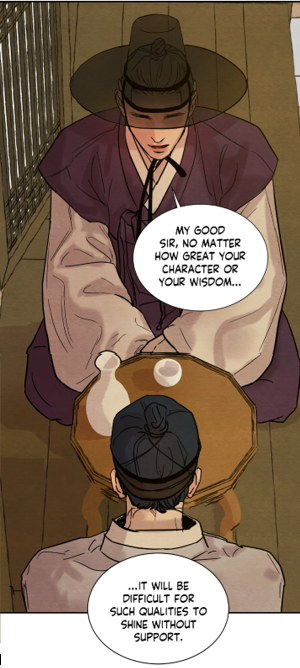 (chapter 7) Kim must have suggested him this scheme. But he had no idea that he was inviting a snake into his realm. We imagined that the butler didn’t know the learned sir, for the main lead had no idea about the man. Nevertheless, their path had crossed in the past: in the gibang.
 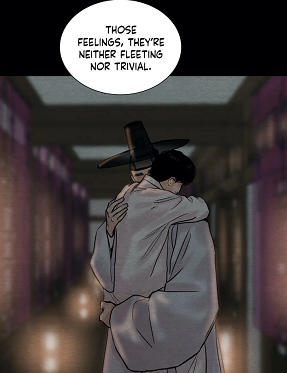 (chapter 68) How could the protagonist have paid attention to the learned sir, when he got caught by the black guard?
 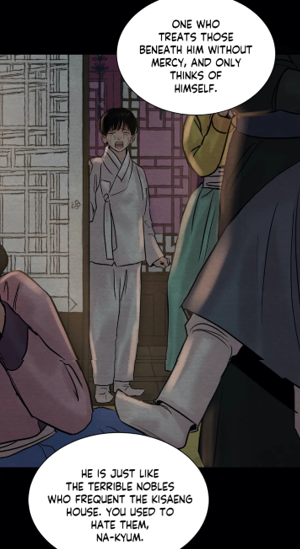 (chapter 68) Kim represents knowledge from the past. He must have remembered Baek Na-Kyum and Jung In-Hun in the past. And what did he see? A caring and gentle man… so he thought that if the scholar met the infamous Yoon Seungho, he would worry for the painter and take him away. But no… he accepted the invitation. He imagined that he had not heard the rumors, thus he spread rumors about the lord.
 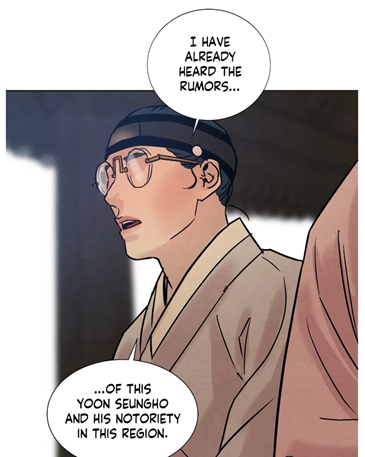 (chapter 10) He envisioned that this would upset the righteous learned sir. However, this was used to scare the low-born… When the incident with the ruined painting occurred, and the scholar didn’t intervene, the butler imagined that Jung In-Hun was protecting himself, and the painter would resent him for his passivity. Yet, the painter remained in the mansion. The assistant sensed the strong bound between these two men, so he thought that Jung had indeed feelings for Baek Na-Kyum, but he was just powerless. He projected his own thoughts onto the learned sir: “He couldn’t do anything”. That’s the reason why he let him see the rape. Everything was done to scare the teacher who had such a good reputation. Then he suggested that he should see a shaman, he hoped that the man would ask about Yoon Seungho so that the shaman would tell him that the main lead was a bird of misfortune… but Jung asked for something else: digging up the past. Notice that on the day, he was supposed to meet the former servant, the main character was given the sword
 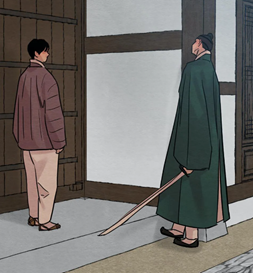 (chapter 35). Striking is that he let his master see the artist with Jung In-Hun in the courtyard. Here, the scholar was again coming back from the pond! So he was not learning. However, the stroke and the gentle words from the learned sir had one purpose: they were to remind to Yoon Seungho that the artist would only listen to Jung. He was the real master. Yes, this was the reflection from episode 30!
 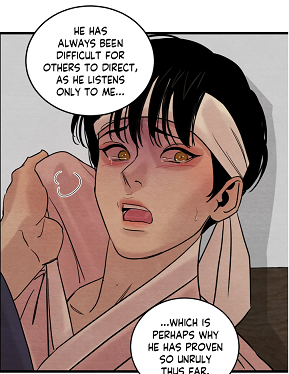 (chapter 30) And in both situations, the learned sir had escaped the noble’s wrath. In my eyes, the real target in episode 35 was the scholar. The latter was supposed to die along with the painter, but it failed. Under this new perspective, it becomes so understandable why Yoon Seungho couldn’t detect the schemes. As a lotus flower, he was still pure and innocent. He could never be the snake.
And now, we know how Kim could trick Yoon Chang-Hyeon and earn his trust: he could compliment him while laughing behind his back.  (chapter 6) Here, the lord was actually imitating the butler. And this shows the stupidity of Kim’s move. Why?
  (chapter 7) It offered indirectly a comeback for the Yoons to the palace. Furthermore, Jung In-hun seems to have succeeded the first round of the civil service examination. This is important, because this means that if Jung In-Hun is indeed dead, his disappearance will definitely involve the intervention of the authorities. Because Yoon Seungho was so innocent to plan great schemes, I can only assume that the readers were witnessing the scheming nature from the butler. And this leads me to the following observation. If the butler Kim is indeed a “snake”, this doesn’t mean that he was evil right from the start. He had a rebirth as well, but he just chose a different path. He decided to ensure that he would live in peace, and if his peace is in danger, then he can bite! And now, you comprehend why Kim felt threatened by Baek Na-Kyum. His presence could lead to the following discovery: Yoon Seungho was not a bird of misfortune, but a beautiful lotus flower! And once this lie was detected, his power based on deceptions and half-truths would get ruined.
Thanks to the painter as the lotus flower, the lord could slowly regain his freedom. But like mentioned above, the main lead is the lotus flower as well, thus Byeonduck created such a picture. This explicates why Baek Na-Kyum got purified first!!
So far, I have been describing the serpent as something negative. It is connected to the Fall of Man: lies and seduction. Nevertheless, the snake shouldn’t be perceived as something negative entirely. He embodies knowledge. Moreover, this animal has something in common with the lotus flower: it symbolizes “rebirth”.
“Snakes represent life, renewal, and rebirth. Over a period of time, snakes accumulate dirt and grime on their skin but they have the unique ability to shed their skin to get rid of the filth. Due to this quality of the snake, many people use it as a symbol of self-renewal. Just like the snake, if we are ready to shed off the past, we can rid ourselves of what was holding us back and be born again. Additionally, in many ancient cultures the snake has represented a rebirth of the physical body. For instance, in ancient Greek mythology, god Asclepius, who has a snake on his staff, is believed to remove diseases and restore the body.” quoted from https://symbolsage.com/symbols-of-rebirth-and-their-meanings/
This is relevant, because this means that the meeting between Kwon Hee-Ryang and Lee Yeonjo is announcing a rebirth. When the warrior entered his life for the first time, he brought death and destruction (chapter 1), now I believe that we are about to witness the opposite. The young slave needs to get a new goal in his life. the revenge was associated to death.
What caught my attention is the official’s comment.  (chapter 8) He has the intention to treat him as his boy toy, to keep him by his side. Anyone reading this can only get upset. He is viewing the protagonist as a plaything. But the manhwaphiles should recall that contrary to lord Chang, the governor is planning not to hide their relationship. He will improve his situation, whereas it was not the case with lord Chang. Besides, I don’t think that in the bedchamber, the official was aware that the young man rejects homosexuality. Secondly, the manhwalovers should keep in their mind that the boy was sent there to spy for headman Choi. So with such an offer, Kwon Hee-Ryang hoped to deceive his enemies, letting them think that their plan had succeeded and the governor was blinded by his lust.
As for lord Chang, the latter might have given Yeonjo medicine or excuse him from work for the brother’s funeral 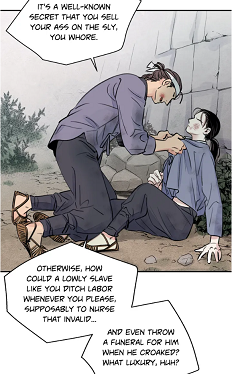 (chapter 1), but he was still working for the bureau of construction. Lord Chang as his superior never sent him to another department. He only used his connection, when the young man asked for this favor. This shows that the administrator never had the intention to change anything. He imagined that with the brother’s death, the young man would still have sex with him. This explicates why the main lead rejected the sweets from the noble.
 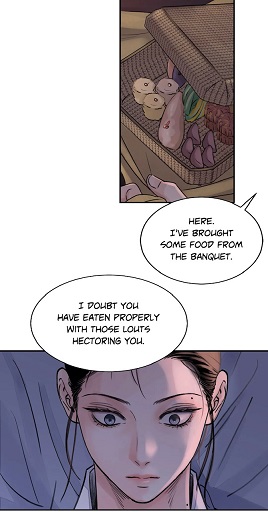 (chapter 4) This was not real kindness, for the food would never contribute to improve his living conditions. Yeonjo was still treated like a prostitute.
 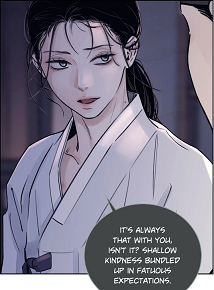 (chapter 7) The administrator might be acting, as if the slave was his lover
 (chapter 5), but this was behind closed doors. These words were just more or less lip service:
  (chapter 5) He still had leave him behind because of his work. Besides, the main lead was now acting, as if he was accepting his work as a “prostitute”. In exchange for the help, he had now to serve his benefactor. In the open, I doubt that the lord would like to be seen together having sex. Moreover, don’t forget that Yeonjo is called the son of a traitor, which could be another reason for lord Chang not to make their relationship official.
This stands in opposition to the governor’s attitude. Kwon Hee-Ryang feels no shame and embarrassment for his sexual orientation. Therefore he has sex outdoors. 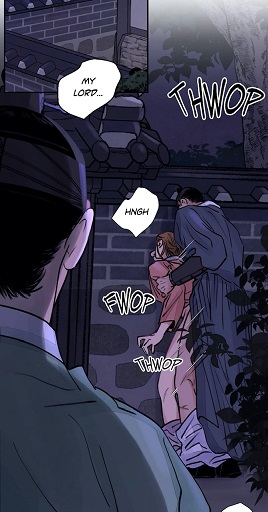 (chapter 4) He didn’t even mind being seen. He even made fun of Gisook, one of the men supporting the hojok.
 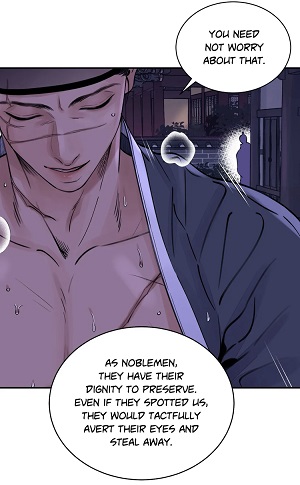 (chapter 4) That’s the reason why I believe that Kwon Hee-Ryang’s promise was honest. (chapter 8) If he became his boy toy, he would be “protected”. No one would dare to bully the slave. And now, you comprehend why Lee Yeonjo got badmouthed and bullied. (chapter 1) (chapter 6) People knew the nature of the relationship between lord Chang and Lee Yeonjo, but since the lord had never made an official statement, people could only conclude that the young man was selling himself for favors. However, the reality was the exact opposite. Lord Chang had been using his social status and wealth to obtain what he desired the most: sex.
 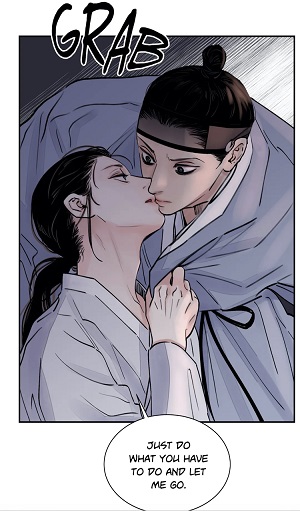 (chapter 4) He hoped to obtain the lotus’ love. Another important contradiction is the mark bite. While the noble with the dark circle did it without Yeonjo’s knowledge
 (chapter 5), Kwon Hee-Ryang did the exact opposite.
  (chapter 8) He was marking the slave as his possession, but he was making sure that the slave was well aware of this.
 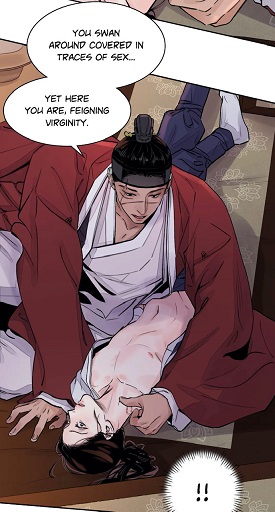 (chapter 8) Since the governor is the son of the concubine, he came to resent social norms. This explicates why he doesn’t follow social norms. Consequently, it is not surprising that he doesn’t hide his sexual orientation. That’s the reason why I believe that the official will play a huge role as the uke’s mentor. He might be a snake in Yeonjo’s eyes, yet he is totally misjudging the man. He is not relying on his status and power, he knows that he needs to be prudent and observant in this hostile environment. That’s the reason why he can perceive people’s personality quite well. It looks like he is looking into their eyes so that he can detect their thoughts and emotions. That’s the reason why I come to the conclusion that the governor and the administrator are both snakes, but they stand for different values. Brutal honesty versus gentle hypocrisy.
Kwon Hee-Ryang is very seductive, but also gentle  (chapter 7), for he pays attention to his counterpart’s well-being. He noticed the wound, he kissed Yeonjo before the sexual encounter in order to set the mood
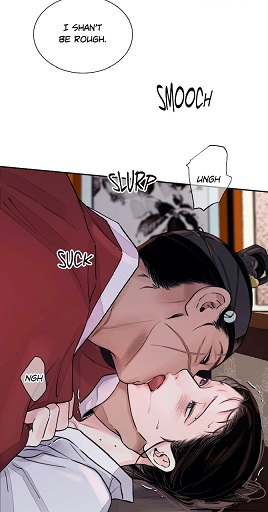 (chapter 8), while lord Chang did the exact opposite. First rough sex
  (chapter 5), then after the climax he showered the main lead with tenderness. (chapter 5) But don’t get me wrong. The governor can be rough in sex as well. Moreover, the latter is indeed a dangerous man, and he shouldn’t be underestimated. As you can detect, I fell under the spell of Kwon Hee-Ryang, and I am looking forward for the evolution of the couple’s relationship.
Feel free to comment. If you have any suggestion for topics or manhwas, feel free to ask. If you enjoyed reading it, retweet it or push the button like. My Reddit-Instagram-Tumblr-Twitter account is: @bebebisous33. Thanks for reading and for the support, particularly, I would like to thank all the new followers and people recommending my blog.
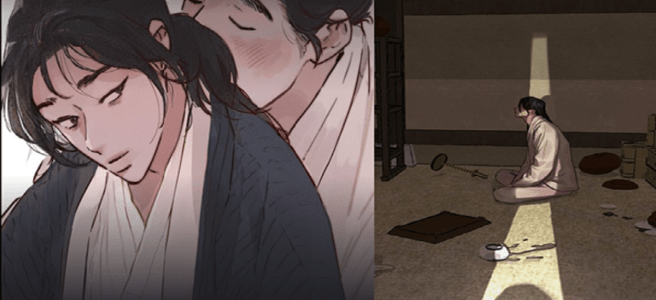
This is where you can read the manhwas. Bongchon Bride: https://manta.net/series/1293 (app Manta comics) or https://www.lezhinus.com/en/comic/bongchonbride (Mature version) https://www.lezhinus.com/en/comic/painter But be aware that this manhwa is a mature Yaoi, which means, it is about homosexuality with explicit scenes. If you want to read more essays, here is the link to the table of contents concerning Painter Of The Night: https://bebebisous33analyses.wordpress.com/2020/07/04/table-of-contents-painter-of-the-night/ Here, you can find more analyses about other manhwas: https://bebebisous33analyses.com/2021/06/06/table-of-contents-of-analyzed-mentioned-manhwas/
Feel free to make some donations/sponsoring: Ko-fi.com/bebebisous33 That way, you can support me with “coffee” so that I have the energy to keep examining manhwas. It would also cover my expenses for the blog.
When I started reading Bongchon bride, I couldn’t help myself noticing the parallels between Yoon Seungho and Soongap. Both protagonists experience a sudden downfall, and end up living as slaves. At some point, both felt that they were living in hell. They had dark circles around the eyes revealing their mental and emotional torment. Consequently they were plagued by nightmares and insomnia and became suicidal. Anyone would think that their suffering was related to their social status, for as slaves they lived in terrible conditions. In addition, they had no longer any right and as such no freedom. The manhwaphiles should keep in their mind that Yoon Seungho was treated like a male kisaeng, for he was the sexual partner of the “mysterious lord Song”. And a kisaeng is a slave belonging to the state. However, saying that their misery was strongly intertwined to their condition as slave is not entirely correct. The reality is far more complex, like I will expose it. First, I would like to use Soongap and his family as an illustration.
The main lead Soongap is the son of a noble and a concubine. Her name is Gwiduck and she was a slave.  (chapter 6) The father was deeply in love with Gwiduck, thus he treasured her very much. He would give her jewels and good clothes. However, since Gwiduck was just a slave, the father decided to remarry after the death of his first wife. The former had two reasons for this. First, according to social norms, his household needed an official wife. Moreover, I am suspecting that the father must have been pressured by his own family as well. Soongap’s father is actually a younger master, so his elder brother, and as such the head of the household Jeon, had a right to meddle in the life of the main lead’s father. I could use the following panel as an evidence that the family’s attitude had a great influence on the father.
  (chapter 25) As you can see, Soongap’s aunt was rejecting Gwiduck due to her social status. One might think that the concubine had been lucky. She could live in luxury and was treated well. However, the manhwaphiles can grasp very quickly that the mother never enjoyed her position as a concubine. Why? First, her position arouse jealousy among the staff.
 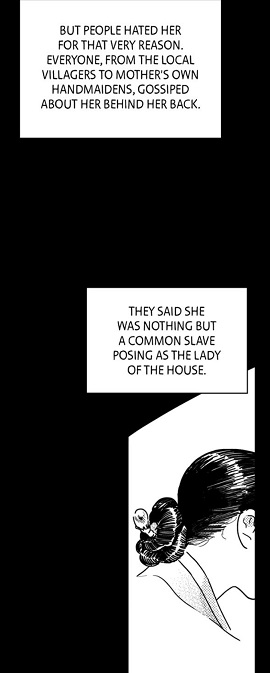 (chapter 6) This means that she was totally isolated in the mansion, exactly like Baek Na-Kyum. Nevertheless, I believe that the main reason for her misery was that she had never been asked in the first place. Soongap’s father as a noble had used his position to impose his will. To conclude, there was no consent in the end. The manhwalovers could sense that Gwiduck didn’t love her husband by the way she reacted to his calling and she addressed to him.
 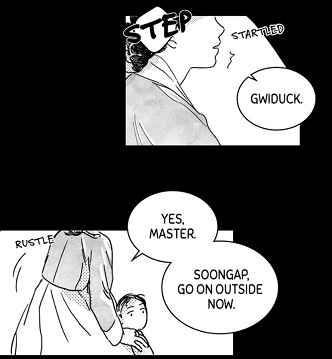 (Bongchon bride chapter 6) She just treated him as a master using his right. The title displays the absence of intimacy. She was not seeking his presence, it was always the father who would visit her room. As a conclusion, she was just a favored servant and nothing more. However, the father never realized his concubine’s unhappiness. He imagined that by acting as a generous man, he had showed to her that he loved her. I doubt that the man ever confessed to her. Why should he? In his mind, it was clear that he cared for her very much. Besides, we have to question ourselves if a noble would ever confess his love towards a slave. This would be beneath his dignity, just like no noble will ever apologize to a commoner.
 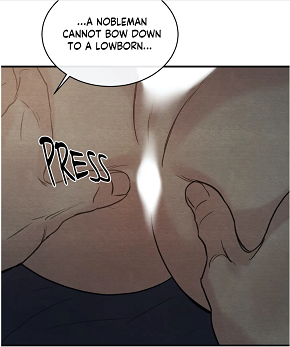 (chapter 71) Since it was all about the noble’s needs and feelings, he never paid attention to Gwiduck’s emotions and will. Did she truly want him? Not really… but she had no right to refuse him. This explicates why Soongap detected his mother’s empty gaze and her real emotional state.
 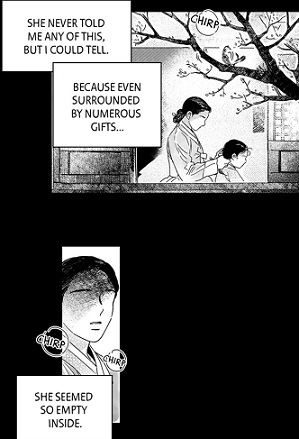 (chapter 6) And because the father only desired Gwiduck, he neglected his son born from his concubine.
 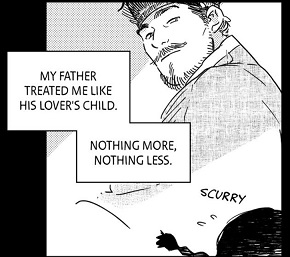 (chapter 6) What could he bring to his family? Nothing, as Soongap was inheriting his mother’s social rank: a slave. In this panel, the noble’s gaze was betraying him. He was totally indifferent towards Soongap. Thus he never took care of his son’s education. The mother was isolated, even her son’s presence couldn’t comfort her. Why? It is because her husband showed no interest in Soongap as well. Besides, Gwiduck had been forced to witness her master’s remarriage. This means that she would never be recognized as the mistress of the household. To conclude, Soongap’s father chose social norms over love. His affection for Gwiduck was not strong enough to disregard traditions. This exposes the father’s selfishness. However, when his second wife died years later, the man was actually crying over Gwiduck and not over his second wife.
  (chapter 20) He was missing her terribly showing that he had never understood why his concubine committed suicide.
 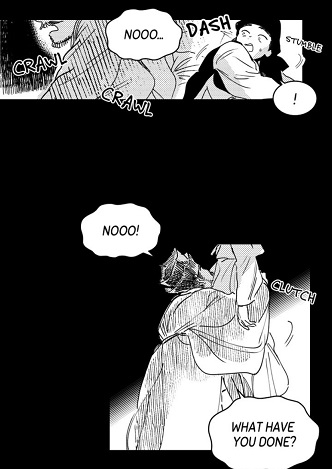 (chapter 21) Her action caught him by surprise, and even after so many years, he still doesn’t know the reason behind her suicide. It was because he never tried to get to know Gwiduck and understand her. He never detected her sadness and misery.
Striking is that Gwiduck had to take care of the son from the second wife. His name is Jilpyeon. 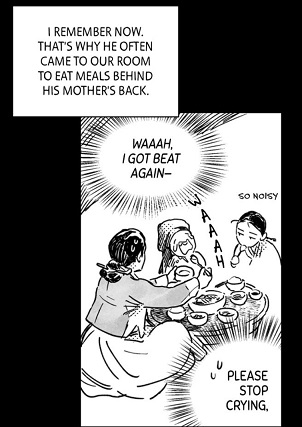 (chapter 6) The latter would always run to Gwiduck, because he had a very strict mother. She had high expectations for her son, but because she put so much pressure on him, she used violence to achieve her goal. Her forceful way estranged her from her own son, who sought refuge to the concubine Gwiduck. This could only reinforce the wife’s jealousy towards the concubine. The main lead’s mother must have been a thorn in the wife’s eyes. Her own son preferred the slave and Soongap’s company over her own.
 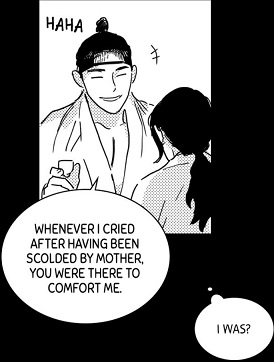 (chapter 6) The young master felt loved there. However, if the manhwaphiles compare the last two panels, they can detect a huge gap again. Pilgyeon never realized that Soongap and his mother never truly comforted him. They just accepted his presence. The third son never comprehended that they allowed him to do anything in their family, for the simple reason that he was a noble, the younger master of the mansion. As slaves, neither Gwiduck nor Soongap could ever refuse anything.
 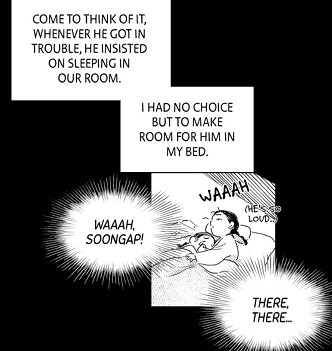 (chapter 6) Note that even here, Soongap didn’t dare to voice his true thoughts. He never complained to his brother. Soongap was never entirely honest to his brother. In other words, Pilgyeon was making the same mistake than the father. He was taking Gwiduck and Soongap for granted, he had been accepted. He was blind to their actual situation and as such their true thoughts and emotions. Yes, such an attitude could only reinforce his selfishness. He never talked to Gwiduck, thus he assumed that her smile was genuine.
 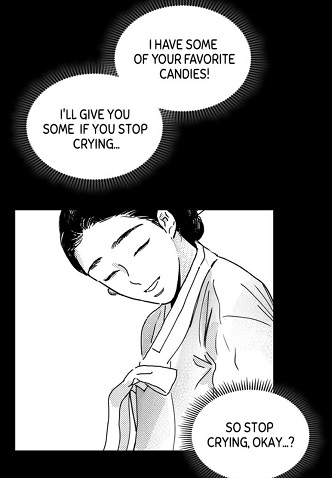 (chapter 21) However, she was just masking her emptiness. Naturally, I am not saying that the main lead or Gwiduck disliked the younger master. Nevertheless, their attachment towards Pilgyeon was more superficial and as such not so strong. Soongap never confided to his brother about his mother’s emptiness. He was mature enough to grasp there existed a huge distance between his brother and himself. He was thankful that Pilgyeon was teaching him how to read and write, but his affection for Pilgyeon was limited.
  (chapter 6) While the protagonist and his mother became a source of joy and comfort for Pilgyeon, the latter thought that they felt the same way. In truth, he was just projecting his own thoughts and emotions onto Gwiduck and her son. Thus I come to the conclusion that the second lead developed an idealized version of his childhood. He had the impression that he knew his brother so well, for they spent a lot of time together. Nonetheless, everything was revolving around Pilgyeon’s needs and wishes. Their submissive behavior towards Pilgyeon contributed to reinforce his selfishness and blindness.
Therefore it is not surprising that after their reunion, the young master imagined that Soongap would be happy, as he was. He envisioned that the slave was missing him very much, just like he was longing for his brother.  (chapter 3) However, after so many years of separation, the gap between them could only increase. For the main lead, Pilgyeon was now a lord and no longer a part of his family. Only after their reunion, Pilgyeon was confronted with the truth. Their social status made it impossible to act like in the past. Hence the protagonist acted, as if he was not his brother. From that moment, Soongap made sure to keep his distance, and even rejected any offer coming from Pilgyeon. He had every reason to do so. After his mother’s death, Soongap had been sent away to the main house of Jeon.
 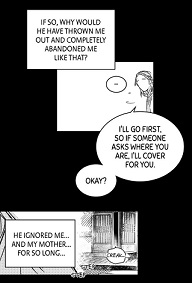 (chapter 2) The wife and the father had every reason to get rid of the main lead. The mistress of the house would get rid of her competition, and could now take control over her son’s life entirely. As Pilgyeon’s father, the son was a constant reminder of the loss of his beloved concubine. He didn’t want to see his son’s face.
In the mansion of his uncle, the main lead lived his life as a real slave, he was no longer perceived as the son of the concubine. That’s how Soongap discovered the true life of a slave. There was a price on his life.  (chapter 2) But he was not unhappy there. He could find a new family: the staff, his grandmother and Mojil.
 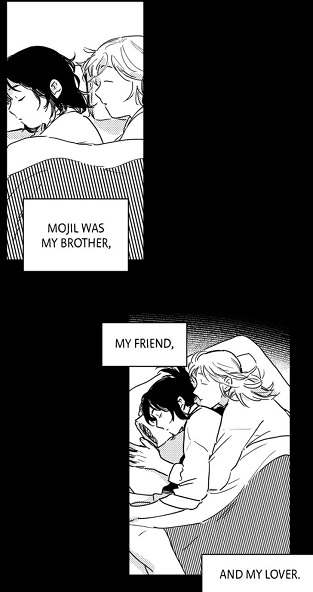 (chapter 14) This shows that Soongap’s descent to hell was not truly related to his status. Through his mother’s misery and his life as a slave, he discovered that jewels or comfort were not really a source of happiness. This explicates why in the second season, Soongap made the following statement:
  (chapter 51)
The main cause of his suffering was actually the arrival of his biological brother, Pilgyeon, who got adopted by his uncle. The latter had no son on his own. And Pilgyeon who had such a fond memory of his childhood wanted to live like in the past. He was longing for his brother’s closeness. But since Soongap refused to acknowledge him as a relative, he had to used his position to meddle in his brother’s life and as such impose his will onto Soongap. As a master, he could do whatever he pleased. Thus he imagined that if he favored Soongap, the latter would appreciate his help and come to return his affection. As you can see, the son acted like the father. The irony is that contrary to the elder master, Pilgyeon met resistance.  (chapter 10) The son had proposed to give the head slave’s job to his brother without taking into consideration the old head slave. Therefore his suggestion created tension among the staff so that some felt that Soongap was trying to take advantage of the new situation. At the end, Pilgyeon was forced to give up on this idea, though the main character didn’t desire to take this job. However, Soongap’s misery really started, when his lover’s health deteriorated so quickly.
 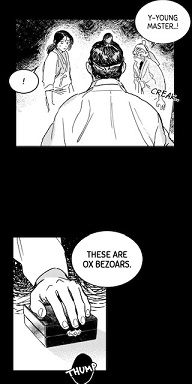 (chapter 11) The young master seized the opportunity and offered to give this expensive medicine to the ill Mojil. In front of his family and the staff, the antagonist appeared as a nice and generous man.
 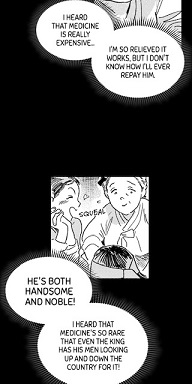 (chapter 11) Mojil’s mother sensed that the main character was the cause for the noble’s generosity. Thus she was thankful towards the main lead. Thereby she was encouraging the main lead to stay close to the young master.
“Real kindness seeks no return, what return can make the world to rain clouds?” from Thiruvalluvar
On the other hand, Soongap didn’t trust his own brother. The former was well aware that Pilgyeon wasn’t giving it for free. 
 (chapter 12) He expected something from Soongap.
  (chapter 14) He wanted his own brother to surrender and give himself to him. The moment Pilgyeon had discovered that his brother was a homosexual, his love for his “brother” changed. And each time Soongap fetched the medicine, the latter was scared and tormented by the thought that today would be the day he would have to pay for the drug. Besides, because his lover’s sickness didn’t improve in the long term, Soongap wondered if the medicine was real or if it was not poison. The main lead was hurt to see how Mojil was slowly losing his sense. The uncertainty of the true nature of the medicine and the pressure from his brother were slowly eating away Soongap’s energy. He feared to be responsible for his lover’s death. As you can see, the real source of his hell was his brother’s obsession for him.
The latter was haunted by the past. Back then, Pilgyeon had the impression, he was surrounded by loving people, he never felt lonely. However, his life changed so suddenly after Gwiduck’s suicide. 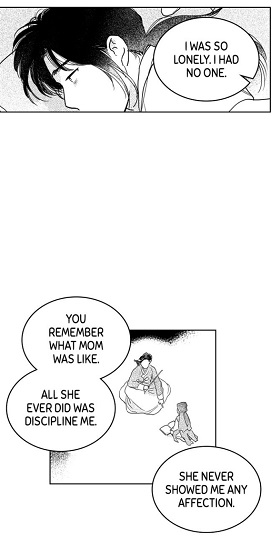 (chapter 51)
 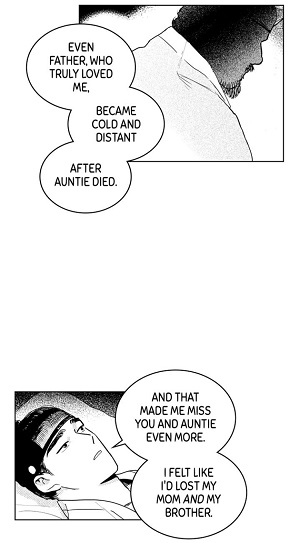 (chapter 51) He felt abandoned, he was missing warmth and love. And now you comprehend the brother’s obsession for Soongap. He will do anything to keep him by his side. He will be either a helping hand or a lover or a brother, as long as Soongap accepts him. He can not accept his rejection, for this never happened in the past. But by using every possible trick, he showed a terrible side of himself to Soongap. He was a ruthless hypocrite. This was truly perceptible after Mojil’s death. The mother requested a proper funeral.
 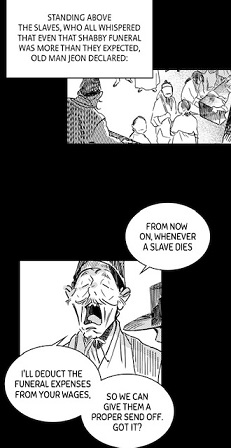 (chapter 23) Pilgyeon suggested to his adoptive father to organize a funeral for the poor slave, but to their surprise, the slaves had to pay for the expenses. Fake generosity. Strangely, no one from the staff complained about this. As time passed on, Soongap could perceive his brother’s ruthlessness and selfishness more and more. Therefore it is not surprising that the brother’s rejection and distance is perceived as hatred.
  (chapter 52) The younger master can not bear rejection, while the counterpart just wished to be “free”.
  (chapter 51)
The painterofthenight-lovers can sense the similarities between Lee Jihwa and Jeon Pilgyeon. Both wished to go to the past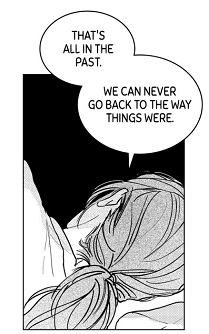 (chapter 51). The young master Pilgyeon wishes to relive his “childhood”, as in his eyes, this was the best time of his life. However, this was just an illusion, as neither Gwiduck nor his brother were truly happy. They were isolated, and Soongap could feel his father’s neglect and indifference. Back then, Soongap couldn’t reject his brother and reproach him for his invasion of privacy.
What caught my attention is his insistence to “help” his relative. He wished to be needed. But this is no real help, for his assistance is not even required. In truth, he is the one in great needs. He desired not to be alone. Though he could improve his social status, for he succeeded in the civil service examination and he will become the future head of the Jeon clan, he is more than ever isolated. The manhwaphiles can grasp that despite his comfortable life, the noble Pilgyeon was miserable, while Soongap felt happy. However, Soongap got to discover the dark side of being a slave, when his brother entered his life. Because of his intervention, the protagonist felt responsible for his lover’s death. With his loss and the pressure coming from Pilgyeon, the slave lost his will to live. Thus he was on the verge of committing suicide either by falling from a cliff  or by taking the fall for the mistress’ crime. Due to his brother, the main character discovered that there’s nothing free in this world. This explicates why the young slave was mistrusting Bongchon in the beginning. His new master would do everything for him which was not normal at all. Consequently he imagined that the strong man would expect something in return. It took him a long time to see that his master and lover was a honest and selfless man. Bongchon stands in opposition to Pilgyeon.
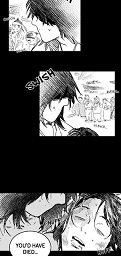 (chapter 1) Bongchon even had to get into debts in order to save the main lead’s life. Contrary to the brother, the strong man let the main lead to choose about his fate. He told him that he could even leave his mansion. He gave Soongap freedom, while the brother was trying to do the exact opposite: to entrap him in his world. Thus he failed terribly.
  (chapter 52) Even if he takes his body, he will never get his heart or soul. In this scene, Pilgyeon realized that if he kept in that direction, he would push Soongap to have suicidal thoughts again. This shows that wealth and power are ineffective, they can never stop someone from becoming suicidal. These values are nothing in front of death.
Therefore, the main issue for the slave’s condition is the loss of freedom. From that moment on, they are totally at the mercy of their master’s good will. Instead of freeing his brother from his condition, Pilgyeon contributed to destabilize his situation in the mansion. As a slave, he could keep him by his side. But by acting as if nothing had happened during their separation, the servant could only have the impression that they belonged to two different worlds. By revealing his selfishness, the antagonist pushed away his own brother.
When I saw Yoon Seungho living in the shed, my heart was really bleeding.  (Chapter 83) It looked like he had almost reached the bottom: the father no longer viewed him as a man, but as an animal.
 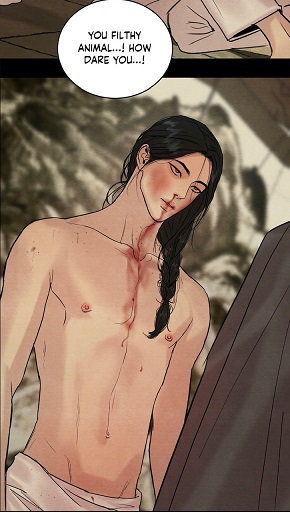 (chapter 83) This means that his condition was worse than Soongap’s. The latter would share his room with others.
  (chapter 4) This means that he never lived in the shed, until he got punished. He was never alone, he could make jokes and talk to his lover and the other servants. He was accepted in the household. But this was not the case for the main lead from Painter Of The night. The main lead was treated more like an animal than a slave. To sum up, Soongap lived under better circumstances. He had his grand-mother by his side, he had a real bed and was fed properly. Finally, he could move more freely around. As for the noble from Painter Of The Night, he was trapped in the barn. In addition, the brown drink (probably the drug) reminded me of animal food. He was totally isolated. The servants ignored him
  (chapter 83), and Kim definitely stayed as little as possible. Yoon Seungho lived secluded from all the others. Recently, the author revealed that Yoon Seungho’s mother committed suicide because of her son’s suffering. This could only contribute to push the main lead to be suicidal as well. With the loss of his mother, he had no one left by his side.
However, there’s another difference between the two main leads. The latter had lived a comfortable and pretty safe life so far, until he was sent to the shed for the first time. 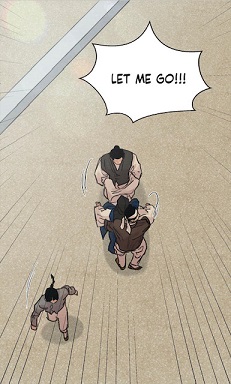 (chapter 77) This signifies that his descent to hell was much more abrupt and brutal. On the other hand, this exposes the father’s ruthlessness and stupidity. He might have been influenced by others in his decision. Nonetheless, the moment he agreed to this punishment, he became responsible for his suffering and misery. He trusted others’ judgement and statements. Striking is that both fathers have a similar disposition: they are quite cold and distant to their own son. On the other hand, Yoon Chang-Hyeon’s resent for the main lead is much deeper than Soongap’s father.
  (chapter 87) The irony is that the patriarch is obliged to recognize the main lead, for the latter has become the head of the household. This explicates why he remains in the familial mansion. On the other hand, Soongap’s father totally “ignored” his son, when he met him again after his abandonment. He acted, as if they were not related.
One major divergence is that Yoon Seungho was a male kisaeng. He had to provide sexual services. One might argue that he can‘t be viewed as a kisaeng, since he is not properly clothed. (chapter 83) The kisaengs are all dressed like noblewomen, but they are recognizable due to their hair dress and make-up. Nevertheless, this point can be refuted easily. There‘s no ambiguity that the lord was dressed up, when he was “receiving“ his sponsor. Thus the video contained such a picture:  or we have this “memory“ from Kim.
 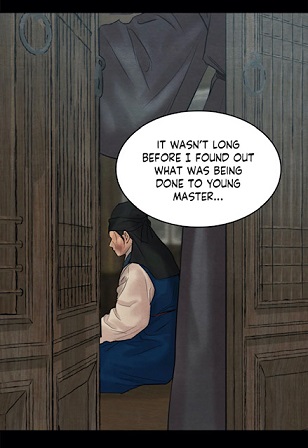 (Chapter 87) This contrast outlines that Yoon Seungho was indeed living more like a kisaeng. The good clothes were masking his real living conditions. Therefore the sponsor could be deceived. Despite his suffering, he smiled to his friend, the moment the latter opened the door.
  (chapter 83) He behaved similarly to Gwiduck. How could he refuse Lee Jihwa’s visit in the end? He was trapped in the barn anyway. The darkness around the eyes was visible, yet the childhood friend chose to ignore it. The proof for this interpretation is the presence of the drop of sweat.
 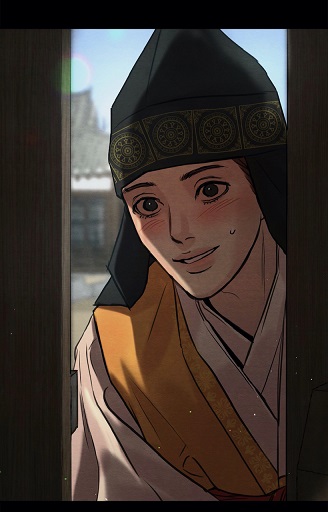 (Chapter 83) His discomfort indicates that he was definitely aware of the mistreatment. This means that he was in a totally different situation than Pilgyeon. First, he was older. Secondly, he had witnessed the first straw mat beating. Finally, he could see that his friend was not dressed according to his official status, while Gwiduck and her son lived in a certain comfort.
Another important element is that the lord already had dark circles, a sign that he was tormented. 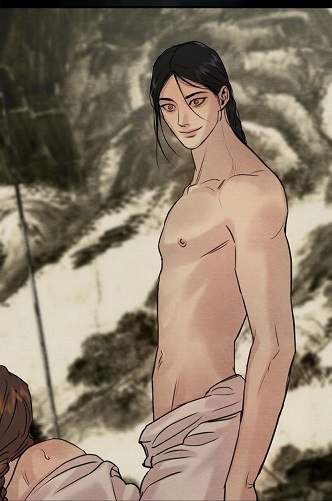 (Chapter 82) Because of Soongap’s suffering, I realized that the main lead must have been plagued the same way. The pressure and the uncertainty about his own fate (Would he have to serve tonight or not? and for how long?) must have been terrible. Yet, note that when the red-haired master entered the shed, he was bringing nothing with him: no food and no clothes. In other words, he did nothing to improve Yoon Seungho‘s living conditions. He appeared quite heartless in that scene. Thus I wondered why he didn’t help him. On the other hand, we shouldn‘t overlook one important aspect. Lee Jihwa was supposed to meet his friend in secret. No one should know about this. That‘s the reason why the childhood friend couldn‘t bring anything to his friend. In his mind, if he had brought something, people would have noticed it, and he could have been in trouble. He chose his own comfort over his friend. Thus the only thing he could do was visit his friend. Despite the loss of his status, Lee Jihwa was still willing to interact with him. That’s the reason why I believe that the childhood friend considered himself as a loyal friend. He was even willing to go to the shed, and even have sex there. In his mind, he would do anything for his friend, even lower himself. He would disobey his father, and trespass a propriety only to meet Yoon Seungho, who had been abandoned by everyone. I truly think, Lee Jihwa convinced himself that he was a compassionate friend. This explicates why he made such a reproach to the protagonist later.
  (chapter 57) However, such words implied that this was the main lead’s choice to be fooling around, while he was pretty aware that Yoon Seungho had been forced to have sex.
  (chapter 83) This image displays the friend’s knowledge and his lack of honesty. He knew the identity of the abuser, but he feigned ignorance. He closed his eyes to the truth, for he was well aware of his own guilt. But because he went to the shed regularly, he imagined that he had “redeemed” himself by his past betrayal. He had been forgiven.
 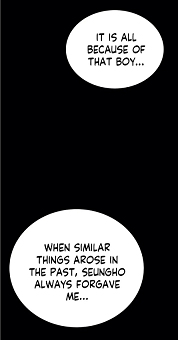 (chapter 59), yet the reality was that he never had. He had just repressed the abandonment and betrayal.
But the latter was unaware that Kim knew about his visits, and even allowed it. He was used to give a certain hope to Yoon Seungho. He was not truly alone. However, at some point, the butler must have been so annoyed that the red-haired master had benefitted the most from Yoon Seungho despite his wrongdoing that Kim chose to confront the protagonist. Lee Jihwa was not a real friend, he was taking advantage of the situation. He expected something else in exchange for his visits: sex. That’s the reason why the main lead dragged his friend to the bedchamber. He was testing his loyalty. If he was not only interested in his body, he would refuse to follow him. What caught my attention is that the red-haired master’s hesitation was not related to Yoon Seungho’s terrible condition.  (chapter 83) He didn’t want to get caught. He never asked his friend, if this wouldn’t bring him any trouble. In my eyes, his comment let transpire a certain selfishness. Finally, he didn’t question the main lead: “What are we going to do?” He just wondered about the destination, which gives us a clue that they were supposed to have sex.
Like I had explained in a previous analysis, Lee Jihwa justified his blindness and ignorance with the friend’s smile. As long as he would smile, then everything was fine. For the childhood friend, Yoon Seungho’s disgrace had one advantage. He could outlive his sexual orientation. Pilgyeon only discovered homosexuality much later, he was already an adult. And this was related to his brother. That’s the reason why I don’t believe that Pilgyeon’s interest in Soongap is purely sexual. In my eyes, it is more related to his loneliness and his idealized childhood. But he is as selfish as Lee Jihwa. And this leads me to the following observation: Lee Jihwa never gave Yoon Seungho the freedom to choose in the end. When Yoon Seungho cut ties with him entirely, what did he do? He allowed Min and his father to plot against the protagonist, because he hoped that once the father had taken him away, he could still take an advantage of his friend’s imprisonment. This truly exposes that the second lead viewed his friend more as a plaything than as a real friend. 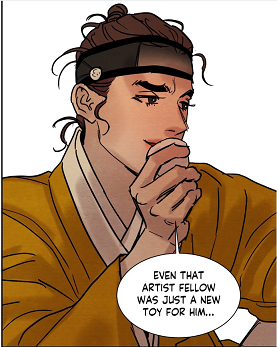 (chapter 12) His words revealed that he was projecting his own thoughts onto the main character.
As a conclusion, Lee Jihwa and Pilgyeon embody “subjection and slavery”. They can’t tolerate rejection and distance from their center of interest. They both want to clinch onto their “loved one”, for both don’t want to be alone. They fear loneliness. They felt their fathers’ distance, coldness and neglect.  (chapter 67) (chapter 51) Lee Jihwa might have found new “friends”, but even there he had to act, to lie to them. He could never reveal the past. Despite his comfortable life, Lee Jihwa couldn’t enjoy his life truly, for he was plagued with shame and guilt. He could never share his true thoughts and emotions to anyone, for if he did, he would have to unveil the truth: his sins. As for Pilgyeon, he couldn’t abandon his career or his family either. He had duties to attend to. Hence he couldn’t keep his brother by his side. Yes because of his position, he couldn’t do whatever he truly desired. And this was exact the same for Lee Jihwa. He needed to maintain his good reputation. Both characters were trapped in their role as “master”.
These two figures symbolize not only fake kindness and generosity. 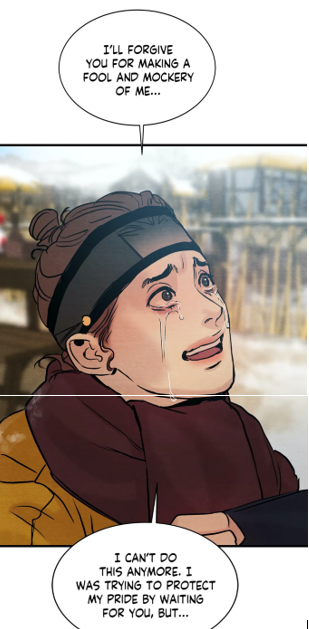 (chapter 57)
 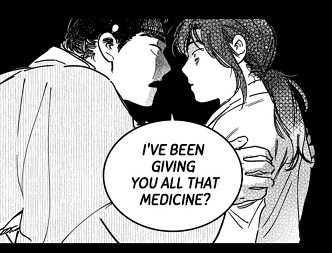 (chapter 14), but also pride over love. Therefore they had to play tricks to achieve their goal.
This is no coincidence why Yoon Seungho and Soongap fell for someone else: persons who would be honest and selfless. The semes have no problem to call their partner their bride 
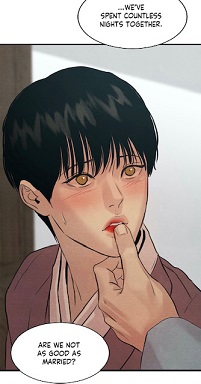 (chapter 78)
  (chapter 15) Both main leads gave their “wife” the liberty to choose their destiny.
 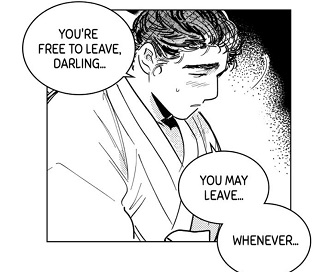 (chapter 14) They didn’t treat their partner as a “slave”, while the antagonists used tricks or force or their power to achieve their goal. Yet they never succeeded. The only thing they could obtain was to push their “loved one” to become suicidal. The love interest could never return their affection. (chapter 6)
  (chapter 57) This shows that no one could break the target’s free will in the end. Yoon Seungho was still fighting, when he had suicidal thoughts.
  (chapter 55)
Feel free to comment. If you have any suggestion for topics or manhwas, feel free to ask. If you enjoyed reading it, retweet it or push the button like. My reddit-Instagram-tumblr-twitter account is: @bebebisous33. Thanks for reading and for the support, particularly, I would like to thank all the new followers and people recommending my blog.
This is where you can read the manhwa. https://www.lezhinus.com/en/comic/painter But be aware that this manhwa is a mature Yaoi, which means, it is about homosexuality with explicit scenes. If you want to read more essays, here is the link to the table of contents: https://bebebisous33analyses.wordpress.com/2020/07/04/table-of-contents-painter-of-the-night/
It would be great if you could make some donations/sponsoring: Ko-fi.com/bebebisous33 That way, you can support me with “coffee” so that I have the energy to keep examining manhwas. Besides, I need to cover up the expenses for this blog.
While examining characters from Painter Of The Night under the aspect “a change of heart“, I had realized that this idiom was a reflection from No-Name’s philosophy: “the whims of nobles”. This signifies that the commoner views the aristocrats as spoiled children. They are lacking maturity and backbone. It was, as if they had no conviction and as such no conscious. To conclude, in the criminal’s mind, the nobles are all selfish and irresponsible persons. And now, you are probably wondering why I am writing another text about back-pedaling. There exists the danger that I could repeat myself. However, thanks to the last analysis “A change of heart❣ “, I recognized that this “leitmotiv” played a central role during the second season, especially during the night of the failed gangrape. Thus I decided first to revisit this day and night and analyze the characters. This means that Min, Yoon Seungho, Baek Na-Kyum and the nobles will be in the center of the examination. This is relevant, as chapter 101 is a reflection from that night (52-53-54).
What caught my attention is that the butler actually criticized the painter for his behavior. He was behaving like a spoiled child. 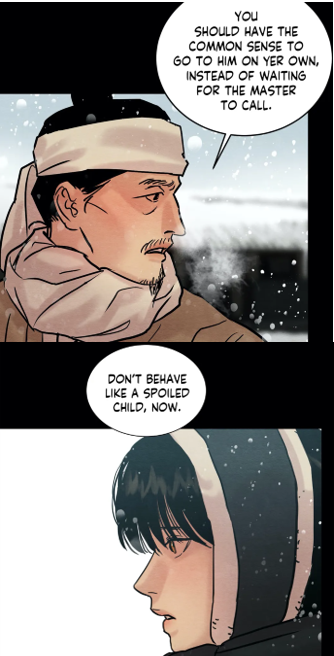 (chapter 52) He implied that he was behaving like a noble. This means that the valet was reminding the artist of his social status. Therefore it is not surprising that the low-born put back the white head-band. It was a reminder of his position in the mansion. On the other hand, if you pay attention to the domestic’s reprimand, you will detect the contradiction. He was encouraging the main lead to become proactive and visit the lord. However, by giving such an advice, Kim was misleading the painter, because a servant is not supposed to act on his own. He has to wait for his master’s order. And now, you comprehend why the valet could violate the main lead’s privacy in the past. He legitimated his trespassing by faking care and kindness. Therefore it is no coincidence that the artist chose during the same day to visit the lord’s bedchamber. He didn’t have a change of heart per se. He was just following the butler’s instructions. He was just a servant in the mansion, and he should act like Kim wanted him to behave: anticipate the lord’s desires. However, like pointed out before, a real servant is not supposed to think and act on his own. On the other hand, the reprimand from Kim had a positive effect, because for the first time, the artist was reminded that he should also pay attention to Yoon Seungho’s needs and wishes. Through the valet’s words, Baek Na-Kyum could realize that the noble was also a human before a lord. To sum up, he helped him to see the person Yoon Seungho behind his title. From that moment on, the low-born perceived Yoon Seungho as a man. Therefore it is not surprising that after witnessing the tongue kiss between Min and his lover, he started wondering about the motivation behind the noble’s behavior.
 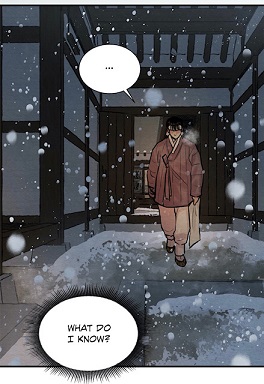 (chapter 52) He began to show an interest in his master. What kind of man is his lord? Who was he exactly?
 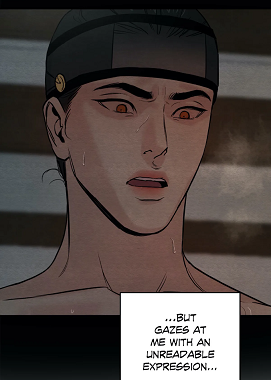 (chapter 52) But since the butler had insinuated with his reproach that the painter should anticipate the lord’s desires and needs, the former had the impression that it was just about to provide services and nothing more. He was his duty to serve the owner of the mansion. And now, you comprehend why the painter denied the main character’s affection.
 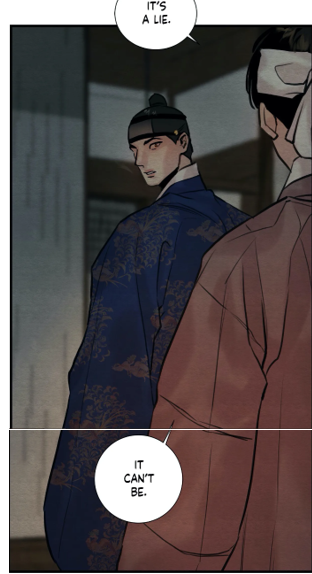 (chapter 54) He thought that the lord’s rescue was motivated by his pride and his duties. As a lord, it was his obligation to keep his staff under control and to ensure safety. Deok-Jae was usurping Yoon Seungho’s authority. He had no right to ask the painter to leave the mansion.
 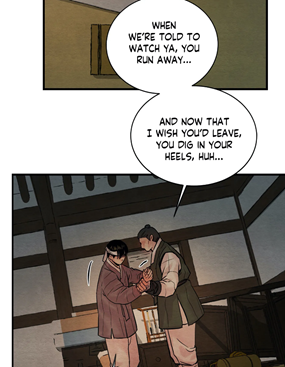 (chapter 53) As you can see, the servant perceived the artist’s attitude as a change of heart, whereas it was not right. The painter had long decided to remain in the mansion. Due to the butler’s reproach, he had been reminded that he was now a servant and as such belonged to the staff. Therefore he was bound to the main lead with his vow and as such to this household. Kim never realized that he had actually ruined his own scheme due to the contradiction of his manipulations. No wonder why Baek Na-Kyum was already loyal to Yoon Seungho. To sum up, the painter started seeing the main character not only as his real lord, but also as a man. Under this new light, I come to the conclusion that during that night, the painter had indeed a change of heart. He had truly accepted Yoon Seungho as his master. This explicates why Baek Na-Kyum didn’t get upset after the second sex marathon. It was the lord’s right to do whatever he wanted. Thus in the study, the artist perceived Deok-Jae’s bullying, Min’s kiss and insults as a violation of codex.
 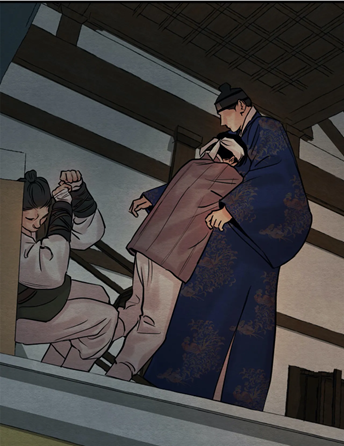 (Chapter 53) The lord was the lord and host, thus he deserved respect from his staff and guest. That’s the reason why the painter didn’t stop his master, when the latter punched Black Heart or simply followed the lord to the bedchamber. He had no right to object, for he was now a servant. And because he considered himself as a part of the staff, he felt obliged to protect Deok-Jae from the lord’s anger. He was acting as a “WE“. On the other hand, he had no right to interfere in the fight between Yoon Seungho and Min. He could only try to protect his lord’s honor by denying Yoon Seungho’s affection for him. (Chapter 54)
The “change of heart” showed that the painter took his decisions seriously. He could no longer run away or show his pain, for he was simply a servant. In other words, Kim’s intervention was the reason why the painter had a change of heart. However, the butler had expected to achieve the opposite. He desired the painter to see Yoon Seungho with other lords so that he would feel betrayed. He would view it as unfaithfulness. He would get hurt and desert the mansion. But the valet had overlooked one aspect: only nobles can act like that. Kim implied that the painter was behaving like one, while in reality he was just too wounded to notice the special treatment. Besides, observe that the valet was actually speaking the truth. The artist had indeed been spoiled by the lord, and he had never recognized it. Due to the head-maid’s comment, he had suspected that his privileged situation was the result of the main lead’s attachment, but due to the joke and Deok-Jae’s insult, he had come to a different interpretation. Finally, the separation let him see that the lord meant a lot to him.
Striking is that in the third season, Kim tried to achieve through his puppet Min the same goal with their prank. They imagined that when the painter would hear the news about the scholar‘s death, he would get upset and would suspect that Yoon Seungho was behind this. Kim relied on the painter‘s memories and past experiences. He had seen the lord‘s jealousy, which had pushed Yoon Seungho to go after Jung In-Hun. 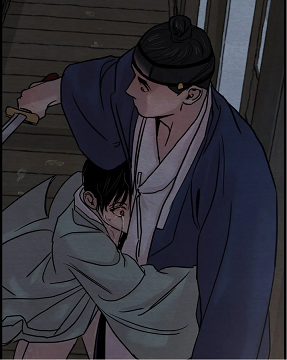 (chapter 27) But instinctively, the painter had sensed the main lead’s transformation. He would no longer use the sword. Since chapter 35, the artist has never seen the lord with the sword again, not even after the hunt in the third season.
  (chapter 84) Furthermore, he would rather use his hands.
  (chapter 92) To sum up, the artist never saw him carrying a weapon since season 1.
Another important detail is that Baek Na-Kyum never witnessed the main lead leaving the bedchamber with his sword, when the messenger visited the study. And when he returned to the bedroom, he also came back empty-handed.  (chapter 82) This means that Yoon Seungho’s bedchamber is not related to the sword. So he has never seen the lord wiping his weapon either.
  (chapter 1) For the painter, Yoon Seungho’s bedchamber is associated to painting, sex and books. Nothing more.
This is important for two reasons. When the lord got upset during that night (chapter 52-53-54), he just left the room angry.  (chapter 52) I have always compared the main lead to a dormant volcano and the pipe was a sign that the lord was boiling in the inside.
  (chapter 52) Another important aspect is that the lord never threatened the nobles with a sword later, though he got mad, when he saw the painter getting touched by other men.
  (chapter 54) He threw a bottle and asked them to leave, but he didn’t evict them like the noble with the mole
 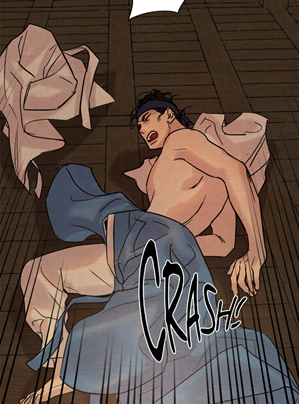 (chapter 8) and Lee Jihwa in episode 18. They were not grabbed by the topknot and dragged through the courtyard.
 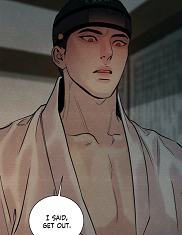 (chapter 54) He simply told them to leave and the nobles followed his request.
 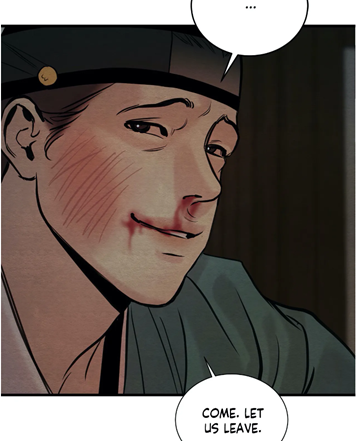 (chapter 54) The only thing he did towards nobles was to humiliate them, but that was it. Besides, these incidents were never leaked to the outside world.
If you observe the progression of Yoon Seungho’s behavior, you will notice how little by little the brutality vanishes. First, we have this 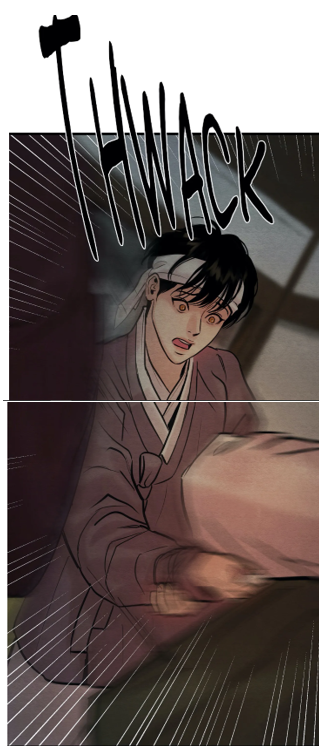 (chapter 53), then Black Heart is punched several times
  (chapter 54) But note that Min doesn’t lose a tooth like Deok-Jae. The next morning, Min’s face is not so bruised to the point that he is not recognizable.
  (chapter 56) From my point of view, the painter taught an important lesson to Yoon Seungho during that night:
 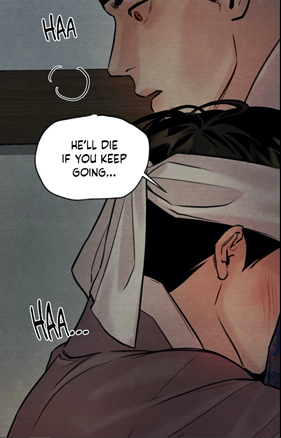 (chapter 53) He reminded him that life is precious. Thus I consider this night as another turning point. The lord had a real change of heart, and not just a fake one like in this moment:
  (chapter 52) Here, he was simply following social norms and as such behaving like Lee Jihwa. This reveals that the main lead had no faith and as such no true conviction. As a good host, he is supposed to provide his guests with the best care and attention. Since Min was expressing his wish to taste the painter, the noble was pressured to give in. The manhwaphiles can now detect the parallels between chapter 52 and 100.
 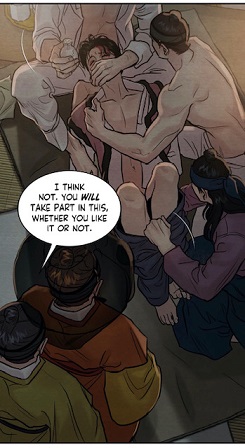 (chapter 100) The use of social norms and peer pressure to achieve his goal. But why did he not react like in the first season, when he threw out the noble with the mole? It is because Min had not given him an order.
 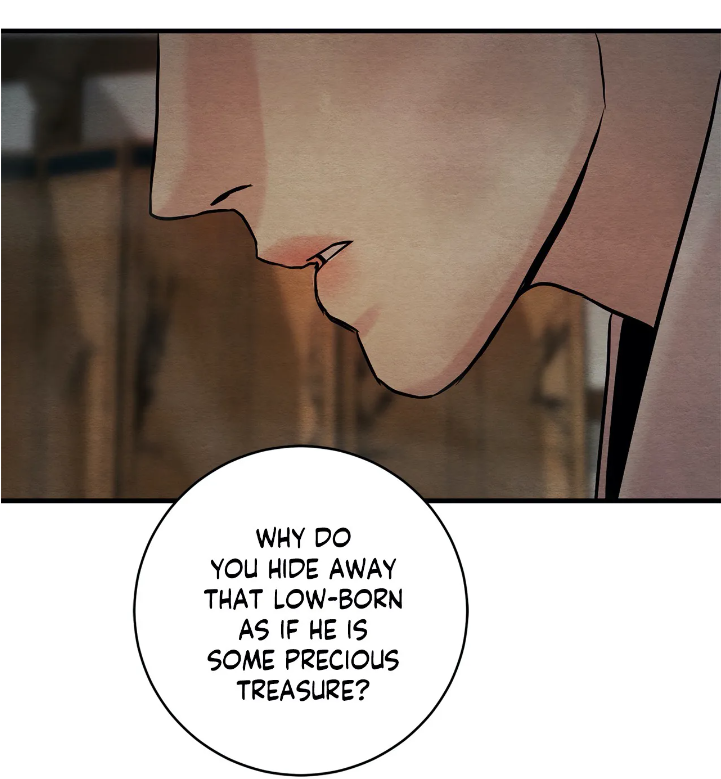 (chapter 52) He had just reminded him that as a noble, he should pay attention to etiquette. If he favored Baek Na-Kyum too much, he would send a wrong signal. Furthermore, the Joker had implied that the painter’s sudden visit was a sign that the painter was longing for sex.
  (chapter 52) As you can see, Min also played with social norms. He reminded Yoon Seungho of his duties as a lord and host. Striking is that he criticized the main lead for being weak. In the past, he used to act differently.
 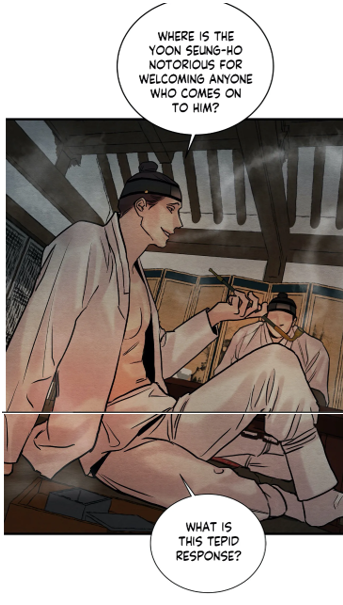 (chapter 52) He would share his things. It was, as if Yoon Seungho was lacking strength and determination. In other words, he implied that Yoon Seungho had a sudden change of heart. (chapter 52) The precious treasure was a synonym for weakness. That’s the reason why Yoon Seungho gave in, he had a change of heart, for he didn’t want to appear vulnerable. However, by acting like that, he exposed his vulnerability. Observe that after the bedchamber, he denied the existence of his heart. He was not in love with the artist.
  (chapter 53) However, all the incidents during that night forced him to admit that he was wrong. How? IT is because he saw himself in the painter.
 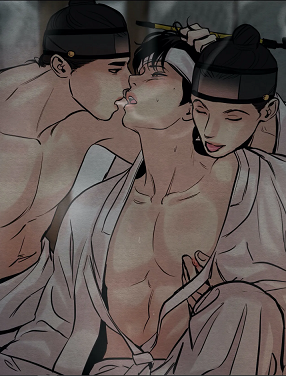 (chapter 54) He wanted to be seen as a human and man, but since his youth, he had been denied to live like a human. Through the reflection in the painter’s face, he rediscovered his humanity. Humanity is a synonym for benevolence. Therefore it is not surprising that the lord became a human, the moment he had accepted his heart. For he was a human, he should treasure life. This is no coincidence that the lord confessed the next morning. But because he had behaved like a beast during that night, he imagined that the painter was horrified by his violent behavior. He had treated him like an object and not like a human. Thus he anticipated that the painter would run away after his first love confession full of “contempt and pain”. However, from my point of view, he never realized that Baek Na-Kyum already viewed him as his master and as a human. He was definitely upset, when Yoon Seungho had chosen to bring him to the bedchamber and offered him as a plaything to his guests, but he didn’t throw some tantrum for one simple reason: he was just a servant in the household. It was not his right to criticize the lord. Under this new light, you comprehend the painter’s words in the bedchamber:
  (chapter 55) He had done something wrong from a moral point of view, but he had not violated social norms. Besides, the painter had not seen his violent outburst as a huge abnormality, he had protected him from Deok-Jae. Then he had defended his honor, when Min had insulted him. As a conclusion, the lord found his true heart during that night, and learned that life was precious. But Yoon Seungho’s lessons were not over. He needs to learn that even a bullying domestic didn’t deserve to die. Notice that he showed no concern for the deceased person.
 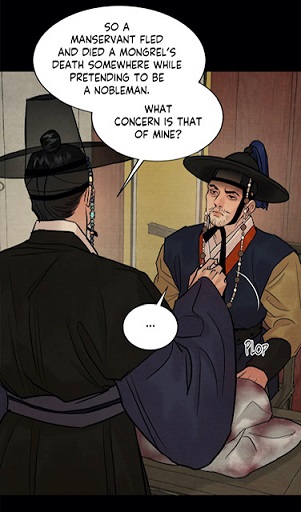 (chapter 98) This is none of his business. Min has a similar mind-set. What should he feel concerned about the death of a peasant?
  (chapter 99)
As a first conclusion, the lord also had a change of heart during that night. He adopted a new philosophy: love. Therefore it is not surprising that the noble used “sex” as a punishment after the so-called desertion. He was claiming the artist as his “favored servant”. He would never let him go. Hence the use of violence kept vanishing. Observe that once confronted with his father, he never retaliated, though he had voiced the following threat: 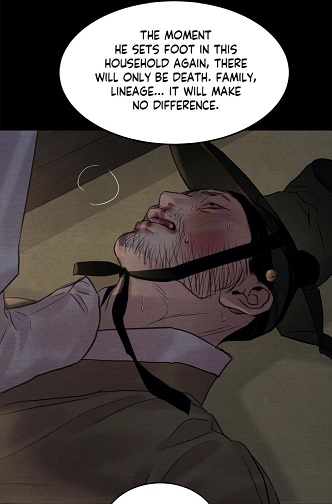 (chapter 82) He stated that he would kill his father. But none of this happened. Therefore, I come to the following conclusion. Yoon Seungho won’t use the sword in the shrine to kill people.
  (chapter 101) The worst what could happen is that he cuts off their topknots. But I have to admit that I am more than ever convinced that he won’t do anything. I am not expecting that he will punch the nobles there, for he won’t have much time. His lover’s life looks in danger. No, like I already mentioned many times, he will take away the painter and bring him quickly to the physician. By acting like that, he will show his strength to the other nobles. He doesn’t fear people’s gaze.
The villain’s behavior embodies perfectly the Joker’s description: a whims of these nobles. He is always looking for fun and pleasure. He seems to know no boundaries. His friends are no different. Therefore it is no coincidence that the painter was called a brat. 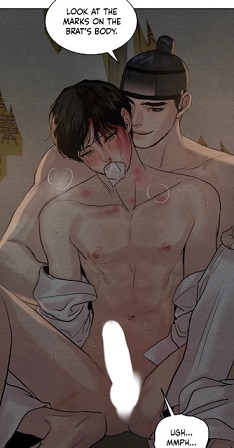 (chapter 101) This expression revealed the aristocrats’ mentality. They are actually projecting their own thoughts and emotions onto the artist.
But let’s return our attention to Black Heart. The latter has a huge sense of pride. He gets irritated, thus he feels the need to retaliate. Striking is that in episode 52-53-54, he was the only one who had no change of heart. He was determined to taste the painter. First, he cornered the main lead so that the host would give in. However, note that shortly after the main lead’s disappearance, he followed him. 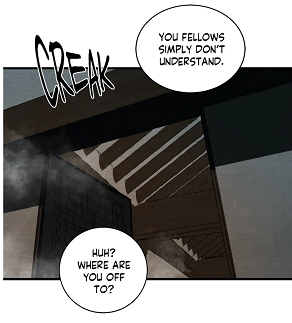 (chapter 52) One might say that he couldn’t simply wait. Yet I believe that he wanted to make sure that the host had no change of heart, once alone with the artist. However, the moment he saw the painter embrace the lord, he could only get envious. He couldn’t resist the urge to kiss his lips.
  (chapter 53) Yet, he had to pay a huge price for this. He got punched.
  (chapter 53) Thus I have the impression that Black Heart must have resented the painter for his wounds and humiliation. Notice that he bragged to his partners in crime about the kiss
  (chapter 101) Nevertheless, he also deceived his peers, because he was only beaten half to death, after mocking the painter and such his host. He was omitting to his partners in crime the insult towards the protagonist. And this shows that Min had never forgotten this incident. Naturally, he resented more the main lead, yet he definitely blamed the painter. Therefore it is not surprising that Min was actually quite rough with Baek Na-Kyum.
  (chapter 101) It was, as if he was paying back the artist for his past pain. However, what caught my attention is that he doesn’t show any pressing urge to taste the artist which stands in opposition to his past behavior. It was, as if he had a change of heart. It looked like his obsession for Baek Na-Kyum was quite superficial. He let his friends to enjoy the artist first, hence we could say that he acted as the pimp. Why? My first theory was that he was still calculating about Yoon Seungho’s arrival, though I am more and more inclined to think that this was more the butler’s plan, and Min was left in the dark. Remember my interpretation: the purpose is to prove that the main lead is a lunatic. And if he killed noblemen, he would get arrested immediately. And we know for sure that the butler resents nobles. From my point of view, Min was expecting that time would be in his favor. He imagined that he had time. However, because the painter resisted and fought back
 (chapter 101), Min had to pay more attention to Baek Na-Kyum, thus he no longer paid attention to the door which he had left open.
We can’t say that Min’s interest was just a caprice. He had to deploy a lot of energy and resources to capture the painter. It took him time and effort to achieve his goal. He even confessed to the painter that he went through a lot of trouble because of the trick.  (chapter 101) But there’s one thing that he is not expecting: the painter might die! How so? It is because in the first season, Min had also been left in the dark about the artist’s poor physical condition. He was never informed that the artist had almost lost his life. This explains why he made such a suggestion:
  (chapter 33) He has always been taught that there exists a difference between low-born and noble, therefore he came to view commoners’ life as less precious. He never saw them as humans. They were first commoners. Their life is not fragile either, for there are much more commoners than nobles. Yes, I have the impression that Black Heart is receiving his lesson. Commoners are humans too, and not just playthings. What if Baek Na-Kyum dies? He will never be able to taste him.
Thus I am predicting that the nobles will cooperate with Yoon Seungho. The nobles won’t even stop the main lead from carrying his lover. Why? It is because they are receiving another lesson too. If the painter dies, they will get into trouble. Remember Black Heart’s words: 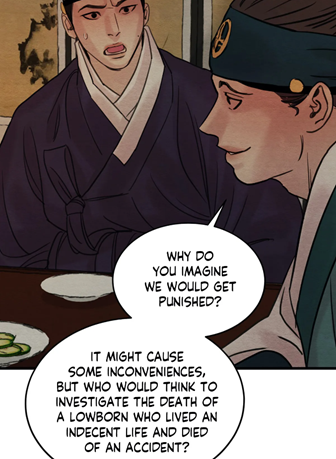 (chapter 43) The death of a commoner has to look like an accident, but in a shrine, this is no accident. Notice that he lied to Jihwa in front of the scholar’s house. (chapter 99) He was well aware that the authorities would investigate the matter. Besides, the corpse was left in a well in town, which couldn’t go unnoticed by the commoners. The latter used that well. The police bureau was obligated to find a culprit because of the scandal of a corpse in town. Black Heart envisioned that he could escape punishment by letting Jihwa take the fall. However, if the painter dies, he can not blame the childhood friend. He is responsible for this mess, and Yoon Seungho clearly heard and saw him.
  (chapter 101) What we are witnessing is that the peasant’s life has become very precious, even to Min. He saw this whole staging as a huge prank, but now he is forced to face reality. This is no longer fun, because the artist is no longer reacting. (chapter 101) Everyone is expecting that Yoon Seungho will resort to violence and punish the aristocrats. But no… look at their facial expressions. They are no longer laughing or smiling. Finally, I would like to point out that this chapter is a reflection of chapter 33. We have here only 4 of the 8 gay dogs
  (chapter 33) And what had happened during that episode? Baek Na-Kyum was seriously ill, thus the doctor was fetched. And remember what the physician had said:
  (chapter 33) For the first time, Min and his friends will learn to value a peasant’s life, because if he dies, they are all in big trouble. This time, Yoon Seungho can no longer be blamed for the wrecked state of the painter contrary to chapter 66. The noble won’t be suspected, for he created such a ruckus in the gibang and town about his lover’s disappearance that his death would get noticed immediately. From my point of view, Yoon Seungho will carry himself the painter to the doctor, he knows where the office is. And now, you are wondering that this doesn’t sound like a harsh punishment. But don’t forget that Min brought the scholar’s glasses to the shrine. Either he never questioned the origins of the glasses and never investigated if Jung In-Hun was alive. Or he discovered the truth, but it didn’t matter to him. However, now there are the glasses of the scholar in the shrine. Min was just so obsessed with Baek Na-Kyum that he viewed everything as a prank. Besides, we have to envision that if the learned sir was alive or not, it was actually none of this concern. He was just a tool for his own entertainment. Furthermore, he used a body from a commoner revealing his lack of respect for humans.
 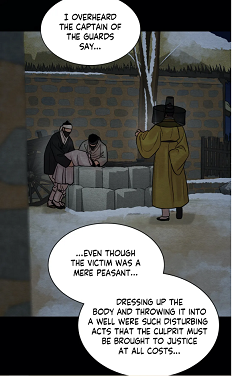 (chapter 101)
I definitely consider Min as a fool. And since he tried to frame Yoon Seungho and Lee Jihwa with a murder, his karma would be that he becomes the scapegoat for the learned sir’s curtains. Imagine that Jung In-Hun is not a peasant, but a respected scholar. Therefore Black Heart could get really into trouble,. In addition, I am expecting that the sex orgy in the shrine will be discovered creating a huge chaos in town. Thus Min and his friends’ reputation will suffer a lot. Since Kim is counting on his master’s violence and rage, he needs witnesses to prove that his master is a lunatic. Hence I have the impression that Kim will bring investigators to that place, a new version of chapter 96, where the butler led the policemen to the gibang.
But there’s one thing that Kim miscalculated: Yoon Seungho’s change of heart. Since the butler believes that all nobles are violent liars, he expects that the lord will follow this saying. But he failed to notice the main lead’s transformation. He never sensed that the lord was getting less and less violent, he would manage to control his negative emotions. Finally, by sparing the nobles, Min can definitely testify against Kim. Notice that Min used the pronoun “we”, this means that he was not alone in this scheme. (chapter 101) He could have a change of heart, especially if he has problems with the authorities, and reveal that the Yoons are behind this and used Kim. As you can see, I am convinced that Min will play a major role in the butler’s demise. Don’t misunderstand me. I am not expecting that The Joker will feel suddenly really remorseful, but the possibility of losing the painter will shock him. Moroever, as a coward, he will avoid any responsibility. In the second season, he betrayed Lee Jihwa. Thus I am expecting another backstabbing. The difference to the first abduction is that the childhood friend was the only one responsible for the crime. However, this time the prank implicated many helping hands: Heena (she is still alive in my opinion), the staff, the Yoons, the Lees and Kim. Therefore it is possible that Min denunciates the persons involved in the prank. As a conclusion, I have the impression that in the next episode, we will have another “change of heart”, but this time in a good way. I would like the manhwaphiles to keep in their mind that Black Heart had a change of heart after that long night:  (chapter 56) From that moment on he could not longer give up on tasting the painter. Then in the third season, he wished to keep the artist by his side.
  (chapter 99) That’s the reason why he was no longer in rush to have sex with Baek Na-Kyum. As time passed on, the Joker gave up on the painter’s assassination. So he is getting reformed! Surprising, right? And the painter’s sickness will be a wake-up call for him! (chapter 101) And this would be the butterfly-effect. Baek Na-Kyum’s body has healing effect, the royal touch… and look at where the Joker’s hand is!! On the painter’s heart!! This is no coincidence. This means for me that Black Heart’s hand will play a huge role in the next chapter. While the lord and the painter started seeing each other as humans during the night of 52-54, it’s now the Joker’s turn to view the painter as a human and no longer as a peasant or a low-born. This outlines one more time how title and vocabulary can influence mentality. Hitler used to call Jews “cockroaches” or “parasites”, thus they were not considered as real humans.
As you can see, I am still full of optimism. Why? The reason is simple. As a teacher, you always need to be optimistic, though it is sometimes hard. But witnessing transformation and little progresses are the rewards in this job. Therefore hope is necessary.
Feel free to comment. If you have any suggestion for topics or manhwas, feel free to ask. If you enjoyed reading it, retweet it or push the button like. My Reddit-Instagram-Tumblr-Twitter account is: @bebebisous33. Thanks for reading and for the support, particularly, I would like to thank all the new followers and people recommending my blog.

 Bebebisous33s' analyses in K-Dramaland and Manhwas