Protected: Painter Of The Night: Baek Na-Kyum, a crybaby? (second version)

Bebebisous33s' analyses in K-Dramaland and Manhwas
Analyses of K-dramas and Manhwas (for the most part Yaoi)


This is where you can read the manhwas. https://www.lezhin.com/en/comic/painter https://www.tappytoon.com/comics/painter-behind-curtainm. But be aware that these manhwas are mature Yaoi, which means, it is about homosexuality with explicit scenes, although there is a softer version for “A Painter Behind The Curtain”. Here is the link, if you are interested in more analyses about this manhwa and others https://bebebisous33analyses.com/2021/06/06/table-of-contents-of-analyzed-mentioned-manhwas/
If you have already read the analysis about “Traces of “Dangerous liaisons” and “Justine: The Misfortunes of Virtue”, you know why I am now using the other manhwa “A Painter Behind The Curtain” created by Munamu. Both works have a lot in common, not only the historical setting but also the story as such. Both stories have a painter as a protagonist and the latter share a similar fate: a lot of suffering.
Since many are not familiar about A Painter behind the Curtain, I’ll just give a short summary. The story has 70 chapters but only 26 have been released in English. The main character is Ian Sconel, a talented painter who was sold as a child by his father to the Bardis, as soon as Mr. Bardi recognized his talents.

Since The Bardis have a long tradition of painters in their family, the father wanted to use the young boy’s talents in order to maintain the family’s reputation and their high lifestyle as renowned painters for the aristocracy. Mr. Bardi let his buyers think that his second son Jeremy was the genius one, whereas Ian Scornel was the one who created all the masterpieces. That’s why the author chose the title “behind the curtain”, as he painted the whole time hidden from the eyes of the others. The title is also referring to the meeting of Ian Sconel and the other protagonist, Mr. Raymond.

If we compare the two artists, we will notice that despite the different location (Italy-Joseon) both come from the bottom of the society. That’s the reason why the two men are illiterate.
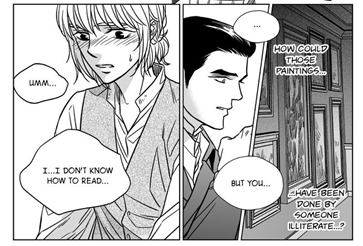
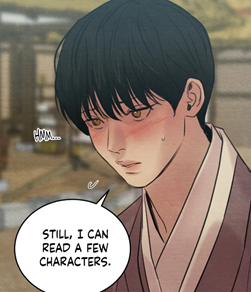 (chapter 40)
Moreover the two felt the need to paint all the time as children.
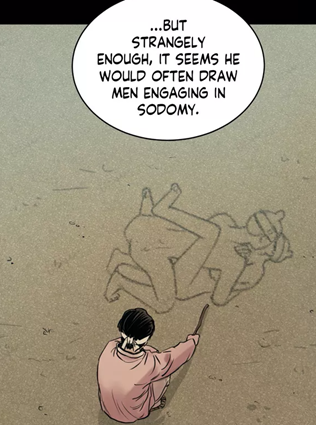 chapter 1

Although they were both passionate about painting, Baek Na-Kyum’s drawings were limited to one subject: erotic pictures of sodomy. The difference is quite easy to understand: Baek Na-Kyum was raised at a gisaeng house, where sex was a common thing. Besides, this also outlines that the korean boy knew right from the start about his sexual orientation. For Ian, we discover that Mr. Bardi is sexually abusing him. So his homosexuality wasn’t determined right from the start. Little by little, Ian falls in love with Mr. Raymond because the latter treats him so well. But since servants confessing their love to Mr. Raymond are immediately fired, Ian has to hide his feelings for him. Baek Na-Kyum has also to hide his feelings in front of the lord, or better said, he has to fight against his repressed sexual desires (chapter 6), as he has been manipulated by the teacher Jung In-Hun that homosexuality is something filthy and immoral.
 (chapter 34)
The other common denominator is that the two men became victims of rape,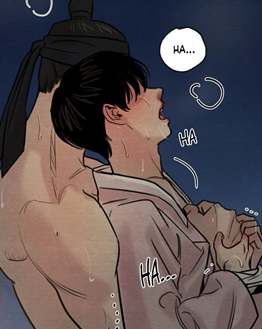 (chapter 26) even if Ian was sexually abused quite often as he spent many years at the Bardis before getting “rescued” by Mr. Raymond.
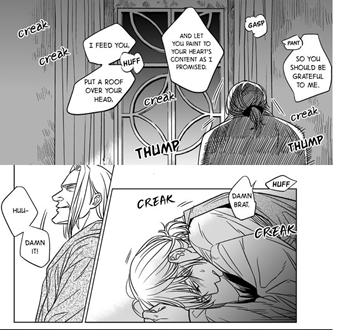
Notice that during the rape, Ian has to listen to Mr. Bardi’s words that the latter is his benefactor, since he gives him the opportunity to paint and he has a roof over his head. All this leaves deep scars in the painter’s mind which explains why later he refuses to paint any longer.

The blond haired man vows not to paint any longer as he saw it as the cause for his misery and suffering, while Baek Na-Kyum was coerced by Jung In-Hun to abandon paintings due to the sodomy. The two painters have at some point kept their distance from their passion.
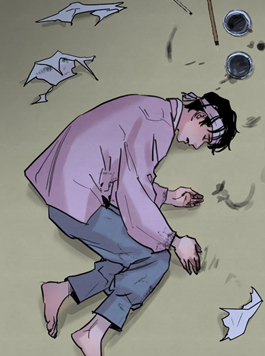
But let’s go back to Ian’s paintings. Ian is forced to paint what Bardi wants so he is limited in his creativity. Whereas Yoon Seungho also restraints the low-born in his creativity, since he has to paint sex scenes, Ian has to create religious paintings or scenes with nobles.
Both sponsors use their position to impose their will. The painters have no right to refuse and to choose their subjects based on their inclination or inspiration. This outlines their precarious situation as they are dependent on the sponsor. Yoon Seungho’s attitude does resemble Mr. Bardi’s behavior, yet there is another huge contrast too. Ian is kept captive in his room, can only get food if the picture is finished. That’s why he is often hungry and very skinny.


On the other hand, Yoon Seungho shows a certain favoritism because he placed Baek Na-Kyum right next to his bedroom and the former is even willing to eat his lunch with him.
 (chapter 11) Despite the difference, they both have to please their sponsor with their work. If there is disobedience, then there is also punishment:
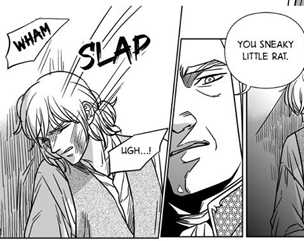
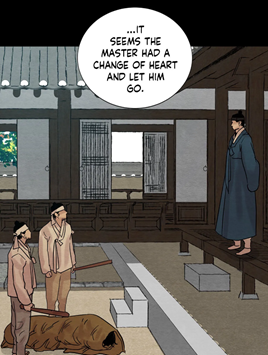 (chapter 13) The low-born was about to get the straw mat beating, until the lord changed his mind. However, just like Ian, the young man had been slapped and even pushed by his “sponsor” before. Ian’s suffering lasts much longer because he arrived at the house as a child and he was already a young man, when he was able to leave this hell created by Bardi.
All these aspects are here dramatized, however this was the reality for painters in the past. Even Vincent Van Gogh couldn’t live properly as he had no real sponsor outside his family. Many painters had to adapt themselves to the taste of their “clients” in order to earn money that’s why many artists chose to paint following the trend and the rules. In other words, the painters’ creativity and curiosity for experiment were bounded, just like in the two fictions.
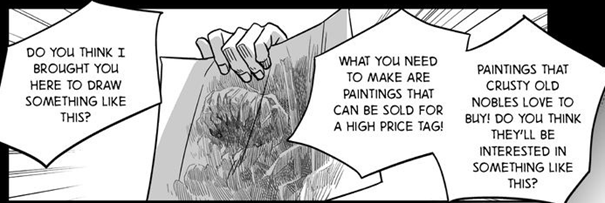
Baek Na-Kyum became a successful painter because he published many erotic books which the nobility was fond of.

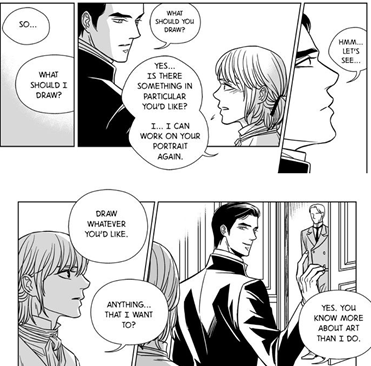
Sure, he had to publish them under a pseudonym, nevertheless his books were quite famous as he was able to survive as a drunk without painting any longer. So even if the topic was taboo, aristocrats were quite interested in such drawings. In order to get attention from the nobility, Ian is also reminded by Henry, a noble, that he should paint based on the trend but this time, Ian refuses. Unlike Bardi and Yoon Seungho, Mr. Raymond gave him the freedom to paint based on his inclination.
The other disparity is that Yoon Seungho wanted to keep the paintings to himself, he never wanted to let people see Baek Na-Kyum’s talents or to earn money with it. It was as if he was determined to own the painter so that he could keep him hidden from people’s attention, as if he wanted to put him behind the curtain. And notice that the noble is not interested in encouraging the artist to develop his talents.  (chapter 41) He was jealous and annoyed, when he saw the picture of Jung In-Hun’s inauguration so that he failed to see the talent and dedication in this different type of drawing. So there is a certain selfishness in the seme here but I am expecting that this will change. He could have noticed that the low-born’s talent is not just defined by sex and sodomy but his insecurities made him blind in that moment. Yet, this painting has been given to the loyal valet Kim so that it can get destroyed. But I feel that Kim might give it to his master or keep it. I have the feeling that this painting will play a bigger role in Baek Na-Kyum’s career later.
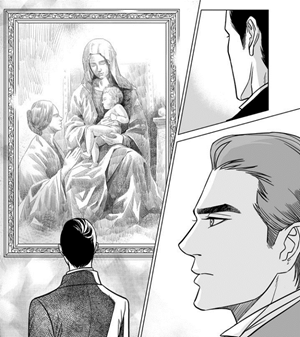
Now, people who haven’t read “A painter behind the curtain” might think that Yoon Seungho is the Joseon version of Bardi, however they are wrong. Actually, he is a mixture of Bardi (due to his selfish and violent side) and Mr. Raymond. If you look at the image where Mr. Raymond is looking at the painting, you’ll notice his fascination and admiration for the work created by Ian.
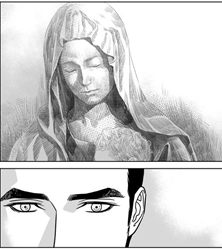
The so-called merchant is definitely moved by the creation and the gaze is again revealing the affects caused by the painting. He keeps starring at it, there is a certain calmness and relaxation oozing from his eyes. Just like Yoon Seungho, the bourgeois falls in love with Ian’s pictures. And little by little, he falls in love with the artist himself. As you can see, the paintings serve as a bridge between the two men, Yoon Seungho wants to find the man with the talented hands and at some point Mr. Raymond will realize Mr. Bardi’s fraud and the origin of the paintings: Ian.
However, Mr. Raymond’s kindness and gentleness is not selfless in reality. He needs the artist’s talents in order to get closer to the nobility and as such to power. Art and paintings are linked to power because rulers and even the Church used art in order to legitimate their authority.

At the same time, only painters working for the Church or the King had a rather comfortable life. Yet they had to paint what they were told to. Just like Yoon Seungho, the bourgeois is motivated by revenge but uses art as his tool and not sex. Mr. Raymond has a different approach therefore he needs Ian’s talent and help.

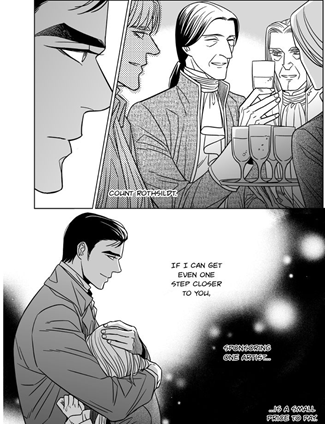
Mr. Raymond is not powerful like the lord from Joseon, since the merchant only belongs to the third state, the commoners. He wants to obtain power as he suffered injustice in his childhood.
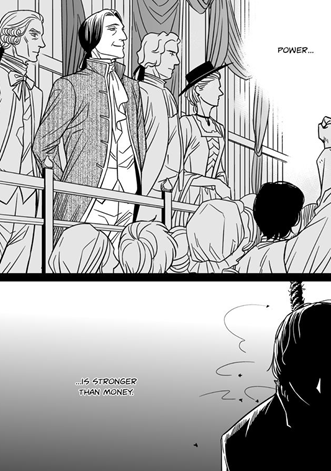
His father was executed due to a scheme perpetrated by count Rothsildt. So far, he has internalized that only in a powerful position he can get revenge and protect himself and his family from any injustice. Since he is just a bourgeois, he is despised by the aristocrats, at the same time they seek his company as many nobles are facing financial issues which is historically correct. Just before the French Revolution, many bourgeois were even richer than nobles, especially many low nobles were impoverished… which reminds us of Jung In-Hun at the same time. So his role as a sponsor for a talented painter represents his way to get access to power. Like I have mentioned above, for kings talented painters are a tool for the securing their own power.
Since Mr. Raymond has to rely on Ian’s talent, he can’t behave like Yoon Seungho. He needs to win the painter’s trust hence he teaches him reading and writing. Striking is that Ian is compared to a cat,
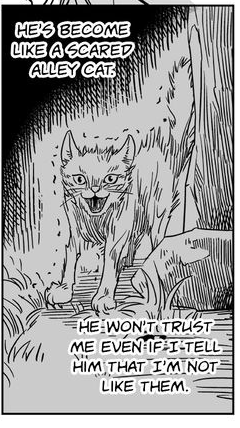
whereas Baek Na-Kyum’s behavior reminded me more of a lamb. That’s why their position contrasts so much. Ian has the upper hand right from the start with Mr. Raymond and in Painter Of The Night, it is the opposite. Seungho can use his position as lord to force the man to paint, yet as time passes on, the situation reverses. At the end of the first season, Baek Na-Kyum has the upper hand in their relationship. Seungho wants to have the artist’s consent, when it comes to sex. He no longer uses his position as lord.  (chapter 41)
This explains why Ian is given so much freedom by the bourgeois. As time passes on, Ian’s PTSD disappears and the artist can develop his own interest and change his techniques. Thanks to Mr. Raymond’s support, he can choose the topic of his paintings and the methods which announces a huge change and innovation in the art. Ian shows an interest for commoners or for landscapes.

The way he paints as well, reminds me a lot of the Impressionism, an art current characterized by relatively small, thin, yet visible brush strokes, open composition, emphasis on accurate depiction of light in its changing qualities (often accentuating the effects of the passage of time), ordinary subject matter, inclusion of movement as a crucial element of human perception and experience, and unusual visual angles.
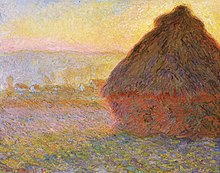
Impressionism originates with a group of artists living around Paris whose independent exhibitions created a wave of scandal and attention at the end of the 19th Century. Famous painters from the impressionism are f. ex. Monet, Pissarro, Renoir, Sisley, Morisot. But Van Gogh and Cézanne were highly influenced by this art movement until they developed their own style. These painters decided not to follow the rules by the Art Academy which explains why many painters from that current struggled a lot. Only Renoir and Monet could become rich and successful before their death. And now, if you look at Ian’s paintings, you observe that Ian has the same thinking and approach as he paints on his impressions. Now, I am adding a picture where the beholder can view the paintings that the nobility liked.

The beholder observes the huge contrast as Ian no longer paints religious scenes or mythology, his focus is more or less on daily situations: they have less pathos and ooze more humbleness. But thanks to Raymond, Ian Sconel is able to catch the attention of a famous court painter. However, we shouldn’t forget that this young man wouldn’t have been able to develop his skills any further if Raymond had not entirely supported him.
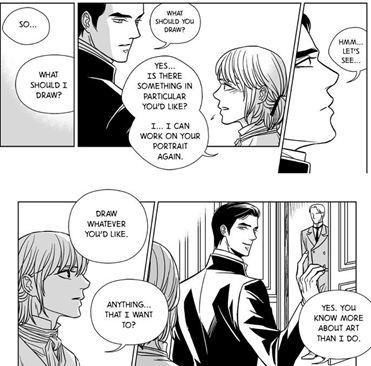
That’s why the attitude of a sponsor is really important, he can brake or improve the artist’s talents.
Now, if we return our attention to Painter Of The Night, the reader notices that Yoon Seungho was only focused on getting new paintings for his own pleasure. The interest of the low-born never mattered. However, I sense that the lord might come to change his attitude and even help him to develop his talents. Just like in “A Painter Behind The Curtain”, I am expecting that the master will teach Baek Na-Kyum to write and read. Secondly, we know for sure that he has connection to the Royal Academy

and Baek Na-Kyum has for the first time painted on another topic: the inauguration of the low noble Jung In-Hun. 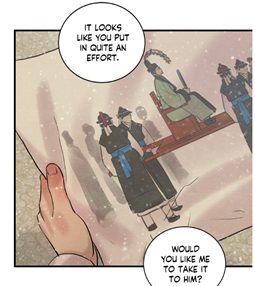 (chapter 44) The drawing was detailed and totally different from the erotic pictures. So I am expecting that Yoon Seungho turns into a real sponsor and becomes more and more like Mr. Raymond. However, the latter will have to choose at some point between power or love. By taking care of Ian so well, he wanted him to open up but at the end, Raymond fell in love with the genius too. While one artist could incite arousal with his creations, the other could calm the resentful merchant. Strictly speaking, their art had a huge impact on the life of the two semes.
Despite the suffering and their tragic past, both artists have the chance to meet someone who will help them to get recognition for their talents and to become more independent. But just like I have been showing all along, the painter’s life in the past relied a lot of sponsoring. The French novelist Emile Zola wrote a novel called “L’Oeuvre” (The work) where he described the struggling of an impressionist. The latter was determined to create a masterpiece with innovations and to get recognition but failed at the end. Zola, a close friend of Cézanne, was inspired by his friend’s life and the impressionism, yet this book became the reason why Cézanne cut ties with his childhood friend as the painter Claude Lantier was portrayed in a rather negative way: he was obsessed and neglected everything else including his family. The reasons why I am mentioning this work are the following. First, it outlines the importance of a sponsor and confirmed what the manhwas are telling in their fiction. Then it reveals the difficulties the avant-garde painters had in order to get accepted. Finally here comes the biggest reason. I had to read this book when I was a high school student and through this work, I came to understand the significance of paintings. That’s how I discovered the impressionism and fell in love with their works. Because of this novel, I could finally understand better why innovations in art movement were related to a fight against Academy and rules. Painters are indeed fighters because what they do can go against social norms and etiquette. That’s why their life is so difficult. The rape, the exploitation might be fiction in the manhwas, yet they symbolize the struggles painters from unknown origins had in order to make a breakthrough.
Feel free to comment. If you have any suggestion for topics or manhwas, feel free to ask. If you enjoyed reading it, retweet it or push the button like. My Reddit-Instagram-Tumblr-Twitter account is: @bebebisous33. Thanks for reading and for the support, particularly, I would like to thank all the new followers and people recommending my blog.

This is where you can read the manhwa. https://www.lezhinus.com/en/comic/painter But be aware that this manhwa is a mature Yaoi, which means, it is about homosexuality with explicit scenes. If you want to read more essays, here is the link to the table of contents: https://bebebisous33analyses.wordpress.com/2020/07/04/table-of-contents-painter-of-the-night/
It would be great if you could make some donations/sponsoring: Ko-fi.com/bebebisous33 That way, you can support me with “coffee” so that I have the energy to keep examining manhwas. Besides, I need to cover up the expenses for this blog
If you have already read my former analyses, you know that our protagonist Yoon Seungho is associated to the window, because he spends so much time in a room looking at his courtyard through the window.  (chapter 35). But what does the window symbolize?
In order to answer this question, let us take a look at the definition of the window:
It’s an opening in the wall or roof of a building or vehicle, fitted with glass in a frame to admit light or air and allow people to see out.
Since our story takes place in Joseon, there is no glass, only thin paper or an open frame, yet it doesn’t change the definition. It’s an opening… that admits air and light and allows people to see out. Striking is that the window is connected to fresh air and sun therefore we can say that through the view, people can definitely broaden their horizon as they are able to witness what it happening outside.
However, let us not forget that their view is limited. Yoon Seungho can only see what is happening in the courtyard, but not in the servants’ room or in the painter’s room. Therefore we come to the next conclusion, the window can represent a barrier, a hindrance. That’s the reason why f. ex. writer Emily Bronte used the window in that aspect in her novel Wuthering Heights.
The window can even symbolize the boundary between the inner world of a character (room) and the outside. Therefore the room could be seen as the personification of the protagonist embodying his inner thoughts and feelings trapped in his darkness. Hence he is seeking light and air through the window. Consequently, I interpret that Yoon Seungho sitting or standing in front of the window like the following. The room seems to be a prison, it is suffocating for Yoon Seungho, hence he looks out of the window in order to be able to breathe and survive. He is caught in his darkness, yet the window allows him to escape from his dungeon, from his past. His passivity reflects his resignation, he is already thinking that nothing exciting in his life will ever happen, until he met the painter. That’s why he said in the chapter 18:
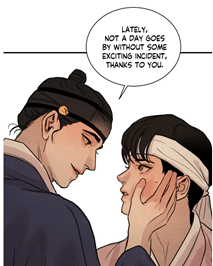
From the moment he met the low-born, he started acting differently. First he kept touching the painter and then he even started leaving the room behind and came to the door. It is interesting that in chapter 7, Yoon Seungho even followed the younger painter, after the latter had heard about the arrival of his admired teacher. Notice how the lord stands in the courtyard and looks at the welcome of the low noble.
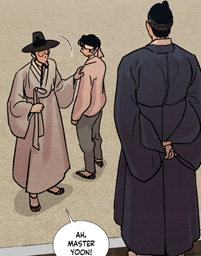
This picture reflects the social hierarchy. Yoon Seungho stands at the top, and the teacher is closer to him. However, if you pay attention to Jung In-Hun’s gesture, he is turning his body in order to face the powerful noble. It was as if he was pushing away the young artist. Now, you realize that such a single picture can contain so much symbolism. But now let’s return to our main topic, the meaning of the room and the window.
So the room with the window represented the situation of the powerful lord at the beginning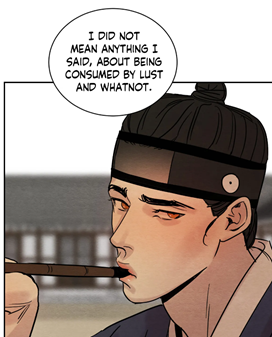 (chapter 5) and it is still there at the end of season 1.
 (chapter 44). It looks like there wasn’t much progression, yet this time, the painter walks towards his mansion and remains by his side.
 This is important, because I realized that with the vanishing of the learned sir, Yoon Seungho chose to remain in the lord‘s bedchamber. What caught my attention is that the lord always went to the courtyard because of the admired sir. We have two chapters for this interpretation: chapter 7 and chapter 35
 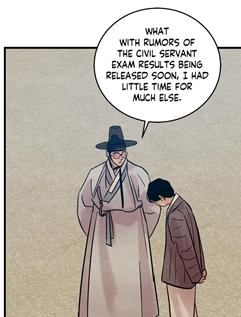 . What caught my attention is that when the lord visited the scholar for the first time, both were sitting in front of a door which looked like a window at the same time.
 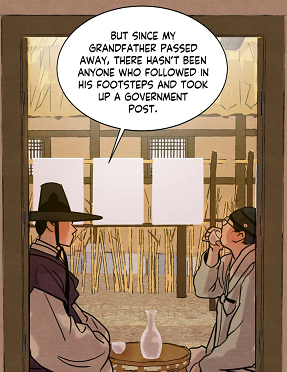 (Chapter 7) This is not random at all, as from my perspective, it introduces the role played by Jung In-Hun in the main lead‘s life. He will be the one forcing the lord to move away from the window so that he can leave the bedchamber. Thus we had this scene: Yoon Seungho is observing the learned sir and his student from far away.
  (Chapter 19) This explicates too why the noble remained so passive in season 2 in the end. Baek Na-Kyum was the lord‘s love interest, hence his „place“ is the bedchamber. So how can the lord move away from the window and as such from the bedroom? Jung In-Hun is the trigger. And note that only in season 2, we discovered how the learned sir used walks through the countryside to console the painter.
 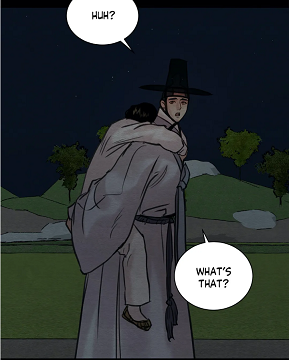 (Chapter 70) Finally, the main lead organized a hunt for the first time because of his honored guest.
 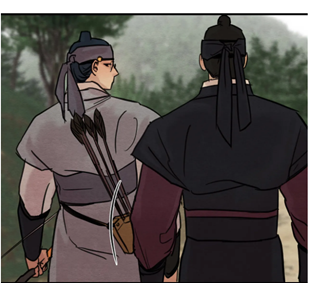 (Chapter 22) And if you recall the lord‘s behavior, you will notice that he left the city for the first time, when he wanted to meet the scholar.
 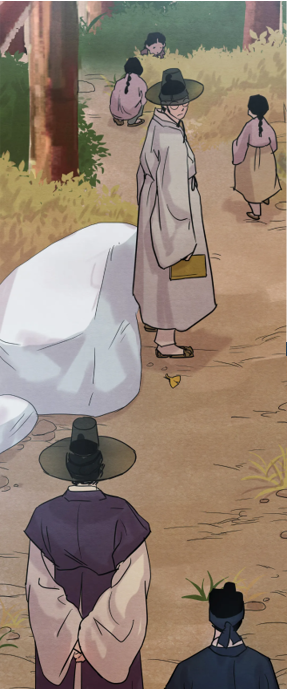 (Chapter 6) He encountered him in the woods. Under this new light, it reinforces my conviction that the learned sir‘s death will be the lord‘s motivation to become proactive and leave his past behind. Why? It is because of the painter‘s words.
  (Chapter 94) The painter still respects the scholar, but he already loves Yoon Seungho. He is not disloyal towards his former teacher despite falling in love with the protagonist. With the last incident, Yoon Seungho got aware how much the painter means to him, but at the same time, he realized the importance of the learned sir in Baek Na-Kyum‘s life. He needs to answer his question:
  (Chapter 102) And this question is strongly connected to the scholar, for the main lead was first sent to Jung In-Hun‘s home.
 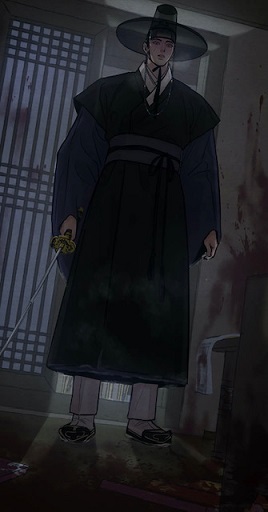 ( 100) Don‘t forget that the main lead saw the room covered in blood, though the latter had already dried. To conclude, the main lead was encouraged to walk thanks to the scholar, and as such to leave his window!
  (Chapter 100)
Therefore it is not surprising why Yoon Seungho remained in front of the window at the end of season 1. He no longer needed to seek him out and bid him farewell.  (Chapter 44) It was the painter’s role. This signified that he was still trapped by his past and trauma, something that he hadn’t revealed to anyone. Since Yoon Seungho is still inside the room smoking in front of the window, it reveals that the lord had not really let go of his past at all, he had not expressed himself in front of Baek Na-Kyum yet. If he reveals his inner feelings and thoughts, this means he will disclose his secret and unveil his vulnerability. This explains why there was no confession from the noble’s side for instance [there were other reasons why he hadn’t confessed anything too], why he was still not sharing his inner thoughts and emotions to his partner.
First, he has never opened up to anyone before. Trust is needed and the artist needs to win that trust, because so far, Baek Na-Kyum had always pushed the noble away. There was still a gap between Baek Na-Kyum and the lord, hence the former didn‘t go to his room, but to his own study. My prediction was that Baek Na-Kyum had to open up first so that the lord could learn from him. And it became a reality. The reason was that the seme was very inexperienced, for no one had ever confided to him. Moreover, he had long internalized that weaknesses must be hidden. Unconsciously, he had already claimed Baek Na-Kyum as his bride, nonetheless this indicated that there was still this distance, this invisible wall between them. We have to understand that Yoon Seungho had never learnt how to share pain and express emotions verbally to others. He had to hide his secret, his past and trauma.  (Chapter 37)
The shaking hand with the fist embodies his repressed inner feelings and thoughts. He had learned to keep everything to himself. Now, you are probably thinking that all this is not entirely new because I already mentioned his passivity. And now, you can grasp the origins of Yoon Seungho‘s silence and inactivity. This stroll through the mountain corresponds to his true revival. 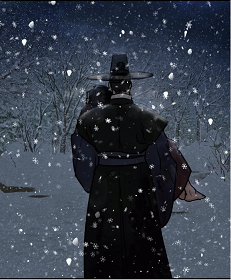 (Chapter 102) This signifies that Yoon Seungho will act differently in season 4: he will be proactive. Like I mentioned in the essay „Scandal(s) in Jemulpo“, he will become the scholar’s disciple and follow his footsteps: ruthless, but also caring and gentle. The only difference is that his affection for the painter is genuine.
However, I needed to describe this again in order to contrast Yoon Seungho’s position with the painter’s situation. What caught my attention is that Baek Na-Kyum is connected to the door, unlike the main lead. We have so many scenes where the low-born is seen close to a door or stands on the doorstep. This is what I could gather so far (I still might have missed some):
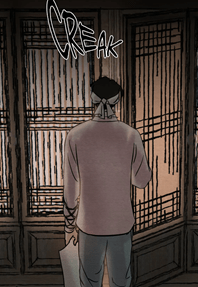

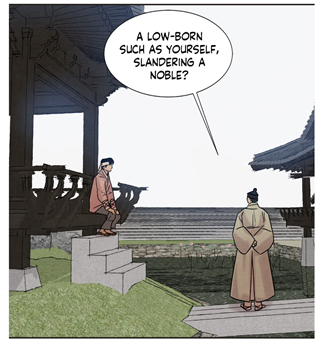 (chapter 10),
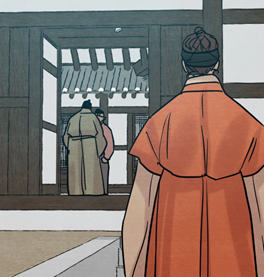 (chapter 12)


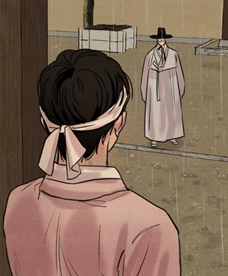
 (chapter 20)
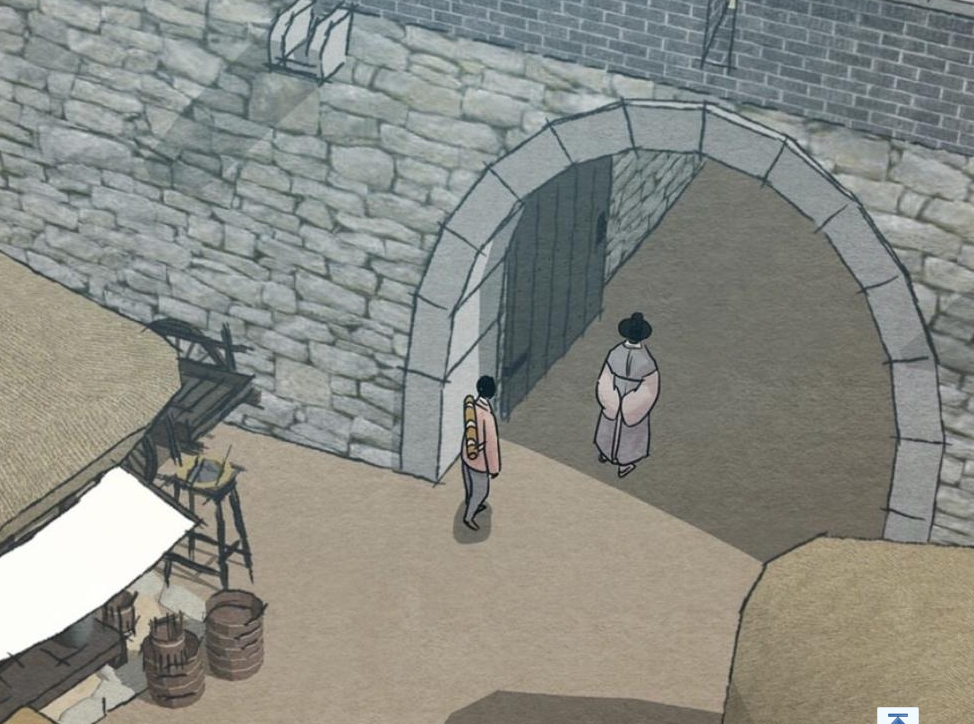 (chapter 29)


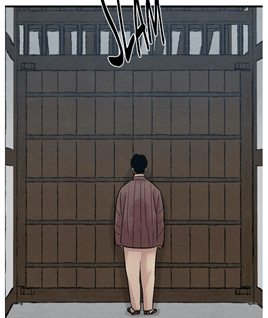


Now, you realize the importance of the door. But what does it mean? Why is Baek Na-Kyum related to the door? First, the window and the door have two common denominators: the room and the limited view to the outside world. However, since a door connects the outside with the inside, it allows to move. The person can leave the room behind, the painter has more possibilities, while with the window the person inside must feel more trapped.
Since I already pointed out that the room embodies the lord’s inner world, we have to imagine that for Baek Na-Kyum it is the same. However, the room represents something else: his unconscious, his hidden true personality and desires and not his past and trauma, like Yoon Seungho. That’s the reason why the room is not a prison like in Yoon Seungho’s case but rather a secret. The painter is hiding his secret behind the door. And now, you can understand the true signification of the door for the artist. The door embodies the doorstep where Baek Na-Kyum has to admit his homosexuality. Now, if we look back at the different situations where the door was seen. Byeondock even drew many pictures of the door in the same chapter underlining the significance and the true meaning of the door.
Now, I’ll interpret different scenes with the door which caught my eye. Little by little I am adding more and more images with the door. And this is what I found so far. I examined the following scenes: 8, 9, 10, 16, 20, 29, 35, 41 and 44.
When we look at the chapter 8, we have this situation. The young man is about to enter the lord’s chamber standing in front of the door. He has been asked by the lord to go there so that he can paint another erotic picture.
Here, the artist is opening the door. It was as if he was entering a forbidden world, where sex and homosexuality are indulged, where people enjoy their sexuality to the fullest. By entering this room, Baek Na-Kyum is reminded of his own repressed and natural desires. Then in chapter 9,
he leaves the lord’s chamber in a hurry after witnessing a sex session. Right behind the door, he can’t help himself and starts masturbating. Hidden behind the door, he feels his sexual urge growing and starts right away with his masturbation. Since he is touching himself so close to the door separating his room from Yoon Seungho’s room, it outlines that he has trouble to control his repressed sexual desires. His unconscious is urging him to become sexually active again. On the other hand, he ensures that the lord doesn’t see his erection demonstrating that he is still denying his own sexual orientation and attraction. On the other hand, the lord heard him which led him to the following conclusions: Baek Na-Kyum is somehow attracted to him and he has some experience with men as he shows no hesitation to masturbate very quickly. So the door served as a protection, he wanted to keep his sexual desires hidden from the noble. Notice how horrible he feels after his ejaculation. He is burying his face as if he was avoiding reality and his own sexual desires. He still wants to deny these urges.
Then chapter 10, the pavilion could be perceived as the unconscious hidden behind the painter’s body. (Chapter 10) Since the pavilion is open aired, it looks like there is nothing there… it was as if the true sexual orientation of the low-born didn’t exist but since there is a roof with beams, we can conclude that Jung In-Hun’s attempt to eradicate his true sexuality has in reality failed. There are rest of it. In other words, the pavilion mirrors Baek Na-Kyum’s denial and brainwashing through Jung In-Hun. This also explicates why Jung In-Hun used here emotional and cognitive techniques as a warning here. He was coercing him to drop the painting.
Then in chapter 16,
Yoon Seungho catches the low-born, because he wants him to experience sex. He has noticed the reluctance hence he just masturbates the young man. Striking is that the door is opened at some point by a servant. This opening of the door by someone else embodies the fear of being discovered. Baek Na-Kyum is determined to never reveal his repressed sexual desires. Consequently he wants the door to stay closed. So if he is seen then, he fears that his sexual orientation will be discovered, yet he wants it to remain a secret. Now, you can understand the meaning of the door in chapter 37.  It is still the same. Despite getting a blowjob, he still wants to hide his homosexuality to the outside. Hence he still gets scared and would like the noble to stop from exciting him. So for the first time, he is experiencing sex with someone.
Here, the door is wide open and this coincides with the commoner’s confession. The young man was drunk, yet he was hiding behind the door until it got opened by the lord. So Baek Na-Kyum’s unconscious wanted to reveal his repressed sexual desires (homosexuality) and his love to the outside world.
In chapter 29, the low noble is bringing him back to the mansion. Striking is that the door is completely open too. This picture illustrates the role played by Jung In-Hun in the painter’s homosexuality. He is the one who “forces” to become an official sodomite, therefore he can no longer hide his sexual preference behind a closed door. I believe that this is related to this incident. 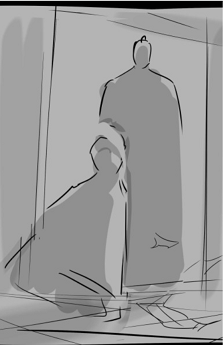 Note the opened door. The learned sir caught him by surprise. That’s how the learned sir was forced to repress and hide his homosexuality. This is no coincidence that in season 1, the scholar had the opposite attitude.
  By feigning ignorance, he actually encouraged the artist to become a sodomite. After their return to the mansion, the teacher showed leniency. He accepted that his student would paint erotic paintings, but he was well aware of their sexual encounter.
 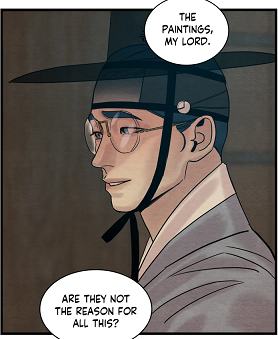 (Chapter 30) The moment he arrives back and the lord brings him back to his chamber, the nature of their relationship is no mystery any longer, though painting is used as a justification. (Chapter 29) Striking is the thickness of the wall. This symbolizes a long way for Baek Na-Kyum to admit his sexual orientation. Just because people know, this doesn’t mean that he is acknowledging his homosexuality immediately.
In chapter 34/35, there are three different scenes where the door plays a huge part. I have to say that the last scene was the one that caught my attention in the first place and that’s how I was able to connect the door to Baek Na-Kyum.
The first drawing shows the lord opening the door for Baek Na-Kyum. This signifies that the noble has somehow given up on forcing the painter to admit his homosexuality and his attraction to the lord. That’s the reason why Yoon Seungho spent the entire night thinking over how to convince the low-born to come to his side and become his partner.
However, the sex marathon has not left the young man unaffected. He hides behind the closed door, while his body is shaking and his heart is beating loudly. He eve feels butterflies. For the first time, we see Baek Na-Kyum confronting himself with his repressed feelings… for the first time there is a connection between his thinking and his unconscious. He is somehow admitting that the lord’s presence has left an impact on him. However, with his body he is making sure that no one will ever find out this secret. He is still denying his homosexuality to the outside world. He wants to keep it a secret, yet he is no longer denying the existence of these feelings.
Then in the same chapter, we see Jung In-Hun abandoning the low-born and he even closes the door in front of him.
This single action has so many significations. First, it visualizes the rejection of the teacher. He cuts ties with him. It also shows that Jung In-Hun is well aware of what happened 10 days before. It reveals his selfishness as he shows no concern. In fact, it was as if the low noble was pushing him back. It was as if Baek Na-Kyum was pressured to become a homosexual even without admitting it. The teacher is forcing him to accept his situation but at the same time, he is denying the responsibility. Imagine the hypocrisy of the lord’s action. In reality, he is the one who pushes the painter to sleep with the lord, since he needs a spy. But by closing the door, he ensures that Baek Na-Kyum doesn’t need to admit his own homosexuality. This scene symbolizes the prostitution Jung In-Hun referred later. The teacher wants to use the artist’s sexual orientation for his own needs and simultaneously he doesn’t need to require this from the painter. As a conclusion, Jung In-Hun is now pushing the low-born to become a homosexual without revealing it to the outside world. At the same time, he acts as if he has no idea what is happening to the commoner. That way, Baek Na-Kyum can never reproach him to have used him as a prostitute or to be a hypocrite.
Then in chapter 41, we see a certain progression. The door has been opened by Yoon Seungho but Baek Na-Kyum doesn’t care any longer. Since he is begging the lord to be held, he is finally admitting his true desires. He likes being embraced by a man. This marks a pivotal moment in Baek Na-Kyum’s life. And this explains why the door is wide opened at the end.
Baek Na-Kyum is no longer hiding his true sexual orientation. He is facing the world without being embarrassed. He waited for Jung In-Hun, hoping that the young man would still accept him, but he experienced rejection. He was literally left behind. However, his acceptance of his own sexual orientation doesn’t necessarily mean that he loves Yoon Seungho. In the beginning of season 2, he viewed himself as a prostitute. 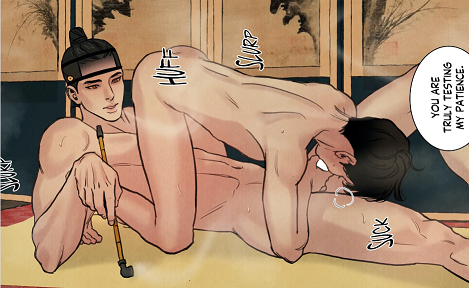 (Chapter 45) He just accepted him as his sexual partner, hence he went to his room and not to the lord’s side in chapter 44. If we compare their respective situation. Yoon Seungho hadn’t progressed much compared to the painter at the end of season 1, because he needed to express his emotions and reveal his secrets and vulnerabilities to Baek Na-Kyum. It took him a long time to open up, as he had been coerced to view himself as a bird of misfortune. He didn’t dare to voice any wish out of fear that these wishes would get ruined.
 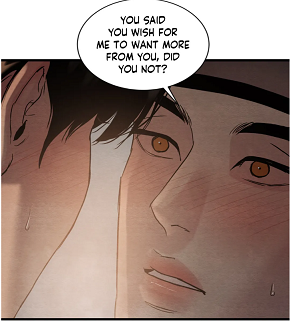 (Chapter 96) In his mind, he had no right to voice any desire, as they would be perceived as GREED!
  (Chapter 96)
But like I had written above, the low-born was in a better position right from the start. He had more freedom, while for Yoon Seungho the room is indeed a prison. Under this new approach, it becomes comprehensible how the main lead could leave the window and as such the darkness of his nightmare. Because of the painter, Yoon Seungho met Jung In-Hun, and the latter made him feel superior, but also jealous. That’s how his attention got diverted from the window making him discover the existence of the door! We could say that the painter as the butterfly led the poor protagonist to the door, and thanks to his mind, Yoon Seungho could release Baek Na-Kyum from his cage, as his mind was also trapped by social norms. And this sexual emancipation could only take place in the bedchamber. This explicates why the artist’s liberation was the first step for the lord’s liberation. But by opening the door for the painter, Yoon Seungho could free himself. Therefore it is not surprising that the painter‘s final confession took place in front of a closed door,  (chapter 96) and Heena could hear his words. Hence at the end, the door got broken:
 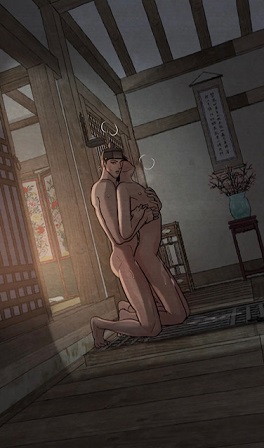 (chapter 96) This represented the final emancipation of the artist. He no longer cared, if he was seen. He was so moved that he didn‘t pay to his surroundings.
 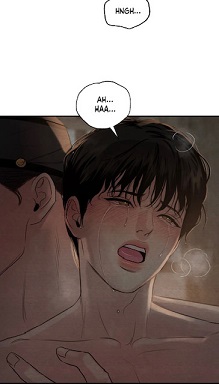 (Chapter 96), while it was not the case for the noble. The latter knew about the artist‘s shyness. This truly shows that Heena was responsible for the sexual oppression of her brother. The painter was no longer hiding his affection for the main lead, when he decided to wait for his master‘s return in the bedchamber.
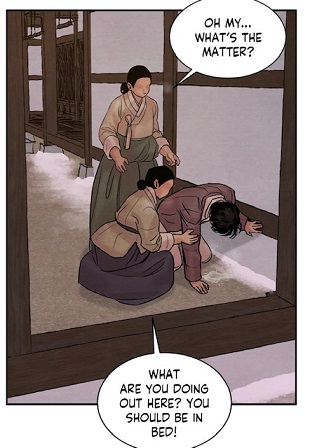 (Chapter 98) Observe that the artist was going there on his own will, and he was sharing his bed with his husband.
How did the scholar discover that Baek Na-Kyum was painting erotic paintings of sodomy? 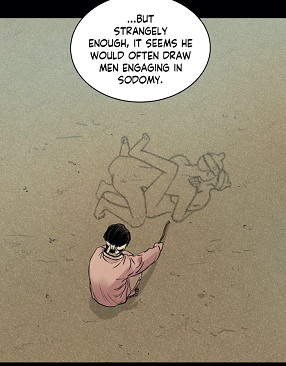 (Chapter 1) This memory was from the learned sir. Why was he approaching the painter during the day? Secondly, note that he only scolded the artist in his house!
 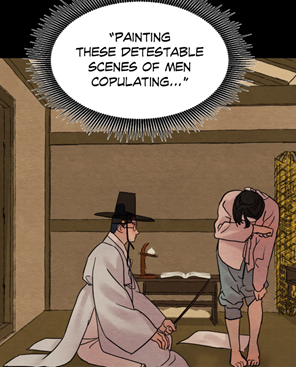 (Chapter 34) So he had discovered a secret, he imagined that the painter had assisted to an immoral love session.
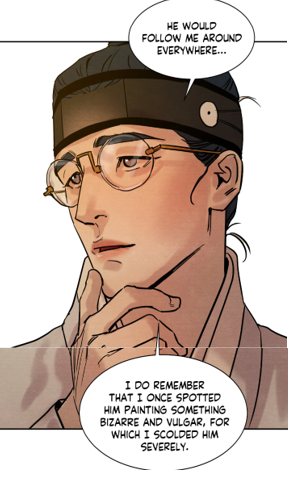 (chapter 6) In my opinion, the kisaeng was responsible for this incident. We have a clue for this interpretation:
 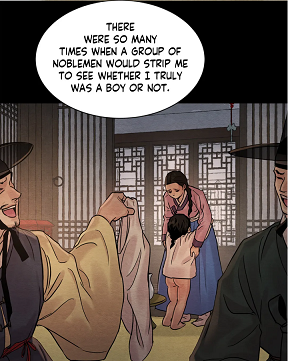 (Chapter 94) The noona is the one standing in front of the opened door with her donsaeng. Here, the artist was getting embarrassed and humiliated. That‘s how little by little, the artist associated the closed door to shame and safety. This is not surprising that the kisaeng is also standing behind the closed door, when she hears her brother making love to the main lead.
 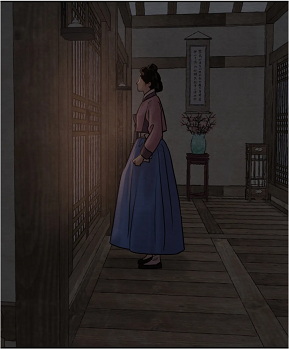 (Chapter 96) In addition, she is constantly seen in connection with an opened door, but this opened door is linked to anxieties, pain, shame and guilt:
 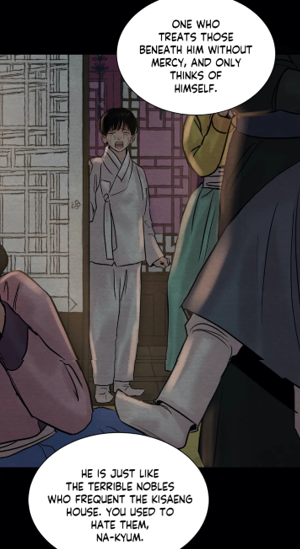 (chapter 68)
  (chapter 66)
 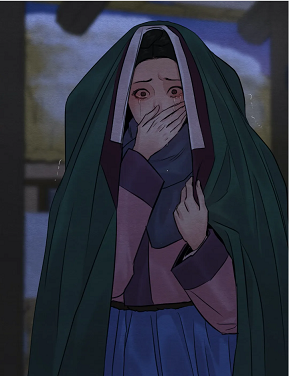 (chapter 88) I have the impression that she was acting out of jealousy, and she had intended to tarnish her brother‘s reputation.
And this leads to my final words. In my first version, I had expressed the following thoughts:
„Does it mean that the lord needs to leave the mansion behind in order to liberate himself from his suffering? If so, then we have two possibilities. Either he gives up his title and everything for the painter or he decides to move to the capital and helps the artist to develop his career and even starts meddling in politics.“
And look at the progression of the story. Yoon Seungho did leave the mansion behind and went to the mountain with the painter in his arms.  (Chapter 102) This symbolized the final emancipation of Yoon Seungho. He could finally move on from his past, and as such leave the darkness of his mental prison. He no longer needs a window to view life. This scene announced that he was starting living again. Thus I am expecting to see Yoon Seungho becoming more proactive and funny in season 4. He will show his intelligence and strength in order to defeat his enemies because so far, he never revealed his qualities to others, only to the scholar. His past had left him somehow paralyzed, hence he has laid a low profile. In his past, he believed that his prison was his protection, for he could observe and remain quite wealthy and powerful. For me, Baek Na-Kyum is in reality his strength, the reason why he will be able to leave his cage and shows his true colors and skills.
But if the window symbolizes Yoon Seungho and Baek Na-Kyum the door, what is representing the teacher? In my opinion the open air. He is mostly seen outside.

 (chapter 7) (chapter 10)
 (chapter 19)
 (chapter 29)
  (Chapter 22) (chapter 35) He often strolls through the courtyard. Therefore I would say that the air embodies him so perfectly. He is seen with his nose in the air

which shows his arrogance. Simultaneously, he gives himself airs. How can he be touched by this low-born? The picture shows both aspects. Then in the chapter 6, he is just hot air (this expression means empty talk in order to impress) , when he says that he was the one who taught how to read to the painter. Here, he tries to present himself as a good teacher to Yoon Seungho. Furthermore, he is overestimating his own skills and he is definitely daydreaming  which is connected to the expression “castles in the air”. His aspirations are boundless, he is aiming at the highest position without being competent or even trying to improve himself. He also attempts to air dirty laundry, when he is hunting with Yoon Seungho. He wants to force the lord to admit his lie so that he can criticize him. But here he fails. As you can observe, many expressions with air reflect his personality. However, there is one scene that contrasts to this observation, that’s when he is in his library in the chapter 40. We actually see him at the library in two occasions:
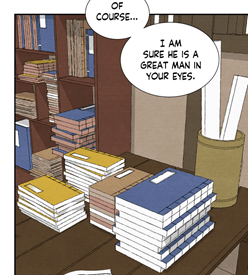

chapter 7 and 40. However only the scene in the chapter 40 is memorable. Therefore I would say that he is linked to two spaces: open air and closed room like the library. It seems strange that Jung In-Hun is linked to a world with no boundary and the opposite, a closed room. Actually, it is quite simple. The outside signifies that he is actually empty and superficial behind his smile. He is so fake hence he has no real personality. Besides, since there is no limit, then it can also signify that he has no conscience as he knows no boundary. Furthermore, it also illustrates that he has no past and no trauma too. Finally, it also indicates that he will never change, there will be no transformation and as such no progression. Air remains air. Yet he only shows his true thoughts in a closed door in the chapter 40.  His words there are suffocating the poor boy, that’s the reason why Baek Na-Kyum is left speechless.
  (Chapter 40) He can’t breathe properly. Since there is no view and no door to the outside visible in the drawing, we have to imagine this reflects his narrow-mindedness. He is surrounded by books (see the pictures from the chapter 7) therefore he lacks real experience and knowledge. He is literally buried behind his books, therefore his knowledge is superficial.
  (Chapter 27) Even in his bedroom there are books so his own bedchamber gives the readers a suffocating feeling. Since there is no window visible in his room and the library, there is no fresh air in the closed room which explains why it is asphyxiating. Usually, we say in a closed room that it smells musty. He only knows the world through his books and the moral standards. He is not even opened to the outside, only his words and thoughts count. Everything else has no value hence there is no life next to him. People living by his side will end up suffocated as he doesn’t allow them to breathe. He is stubborn and he will never change, a fake, empty and narrow-minded man with no conscience. Because of this connection, I realized that Jung In-Hun had no future in Hanyang. He would end up buried, and this became a reality. Because the moment he left for the capital, he ended up dead. And now, if you think carefully, you will recognize that the learned sir is associated to nature! Thus he was seen in the woods (chapter 6, 22) or in the countryside admiring the moon.
  (Chapter 70) Air means also breathing! Hence he represents the fresh air entering Yoon Seungho‘s bedroom, hence we had such a scene:
  (chapter 35) The lord witnessed the intimate interaction between the learned sir and the artist, thus he was incited to leave the bedroom. Strangely, we could say that he was the initiator for the lord‘s liberation. No wonder, why Kim wished to get rid of the learned sir in the end, and just viewed the artist as less annoying and evil!
So the moment he left the domain, the admired sir was confronted by reality. His stay in the mansion had made him dream 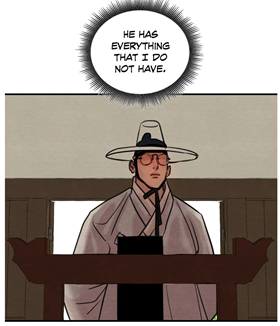 (Chapter 18) so that he ended up letting his guard down. He was not so competent and intelligent like Yoon Seungho, he relied more on the stupidity on others. He could deceive commoners, but not spies. In my first version, I had envisioned that the learned sir had many tricks up his sleeves so he would survive, but I had not realized that he had met a fake servant
 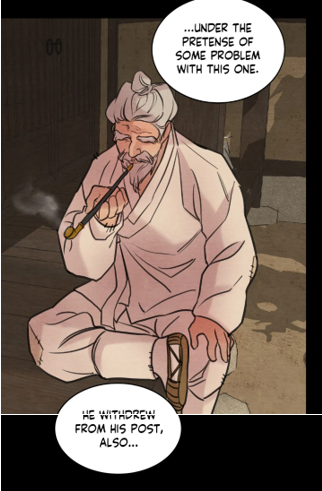 (chapter 37) definitely a noble who could see through him. For me, it was the pedophile himself. I had predicted that he would disappear into thin air, and it became a reality, especially if my theory about his assassination is correct. We could see the transformation of the scholar into a ghost,
 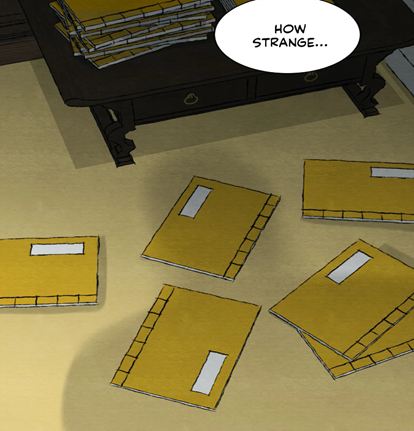 (chapter 50) who would come to haunt the couple because of his resent.
 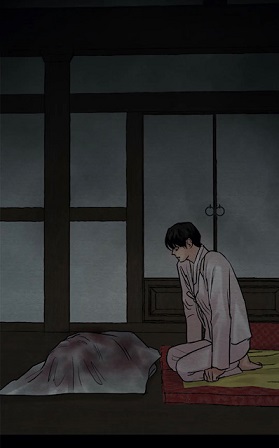 (Chapter 98) As the air, he became a spirit! And note that the lord was encouraged to stroll too!
Feel free to comment. If you have any suggestion for topics or manhwas, feel free to ask. If you enjoyed reading it, retweet it or push the button like. My Reddit-Instagram-Tumblr-Twitter account is: @bebebisous33. Thanks for reading and for the support, particularly, I would like to thank all the new followers and people recommending my blog

This is where you can read the manhwa. https://www.lezhinus.com/en/comic/painter But be aware that this manhwa is a mature Yaoi, which means, it is about homosexuality with explicit scenes. If you want to read more essays, here is the link to the table of contents: https://bebebisous33analyses.wordpress.com/2020/07/04/table-of-contents-painter-of-the-night/
Yes, I chose this title because of the Russian short novel written by Leo Tolstoy. In this story, the rich land owner Vasili Andreyevich Brekhunov died by saving the servant’s life Nikita, because he realized that the low-born’s life was as worthy as any other man. Furthermore, he also got aware of his own selfishness, for he was responsible for their predicament. They were caught in a snow storm and the noble initially abandoned the peasant. However, at the end, the lord changed his mind and revealed another side from himself. This outlines that status is very superficial and the readers witness the master’s conversion leading a huge change in his behavior and thoughts towards commoners and low-born.
In the following analysis, we will examine the lord- low-born relationship between the nobles Yoon Seungho and Jung In-Hun and the commoner Baek Na-Kyum, when the latter becomes sick. All this was triggered because one of my followers asked me this: Why didn’t Seungho return home for days? From my point of view, the conversation between the nobles and Yoon Seungho, triggered by Min  (chapter 33), forced the lord to realize that the artist was indeed a precious treasure, and he was not willing to share him.
 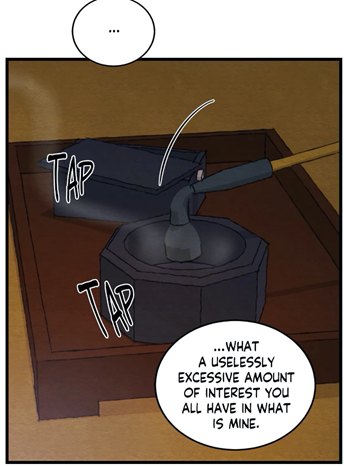 (chapter 33) At the same time, due to Black Heart’s words, the noble was reminded of the painter’s health conditions. Although the lord was talking about the artist, as though the latter was just an object, the reminder forced him to recall that Baek Na-Kyum was a human who could die. That’s why he returned in the end. His abandonment reflected his cowardice, he didn’t desire to be confronted with the consequences of his bad behavior. Consequently, just like in the Russian novel, the main lead was reminded that the low-born was just a human. As you can see, both characters had a similar disposition and also a change of heart.
Striking is that the butler tried to cover up his master’s cowardice and abandonment. He diverted Baek Na-Kyum’s attention by showing his concern for his master.
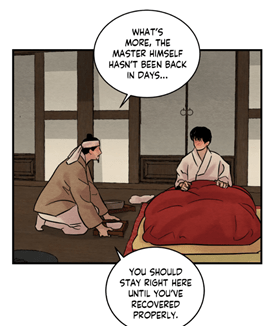
But before this, the servant Kim mentioned that the lord’s room was the best, as it was the warmest.  (chapter 34) Kim’s remark was in fact insinuating that the lord had been very generous and caring for him. He gave the impression to the low-born that the noble was treating him like a noble, as the latter had sacrificed his bed for his recovery. However, this was not true, as the lord had brought the artist to the study before the doctor’s arrival.
  (chapter 33) At the same time, the butler was not entirely lying either. The lord had indeed shown generosity and care, since he had called for the physician. Yet, once he had heard about the doctor’s precription, the aristocrat had ran away from his responsibilities
 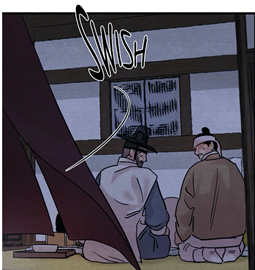 (chapter 33) and left everything in Kim’s hands. Remember my statement: Kim is always telling half-truths. Kim was in reality the one who brought him to the noble’s bed.
 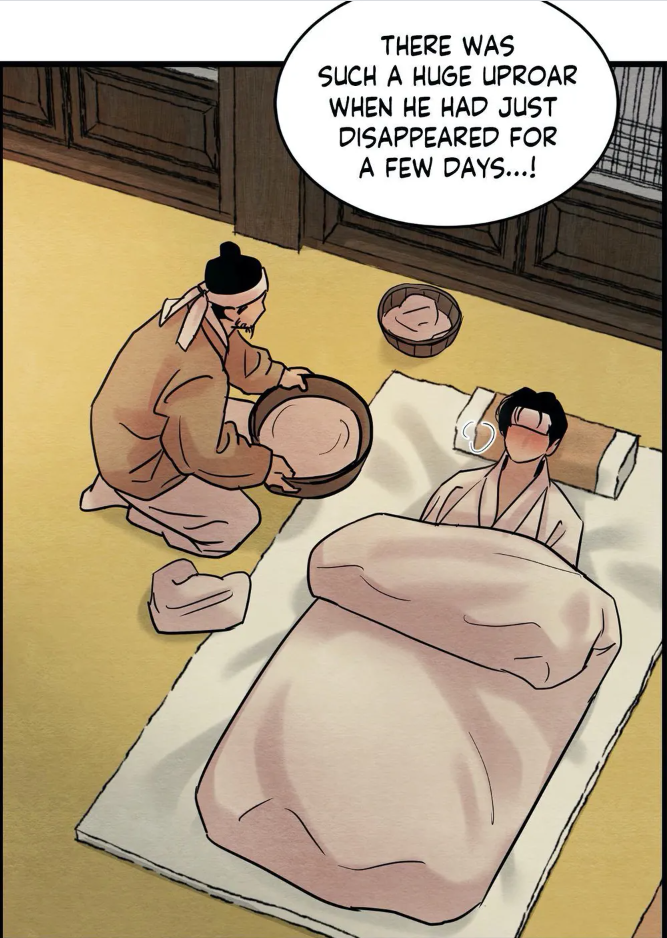 (chapter 33) He needed to portray his master in a much more positive light in order to obtain the painter’s cooperation. The valet hoped that the artist would follow his order
  (chapter 34) and become the lord’s sex toy:
So in my opinion, while Yoon Seungho had indeed showed worries and benevolence towards the painter, he was relying on his right-hand, therefore he never came to verify if Baek Na-Kyum was recovering properly. 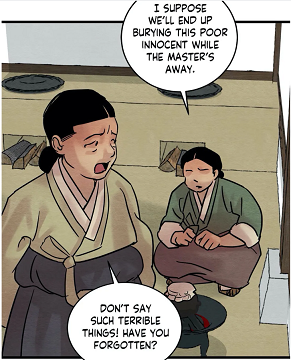 The irony is that although the valet treated the painter as a honorable guest (bringing him to the lord’s chamber and taking care of him as if he was his master), in truth he was just viewing the low-born as an object and tool. was truly making sure that Baek Na-Kyum would get the best treatment, but the domestic used the opportunity to praise his master indirectly.
And now you understand why Yoon Seungho didn’t return to the mansion. First, he felt guilty, as he knew why the young man got so sick. His remorse were definitely bigger, as the artist could lose his life. He even heard the critic from the doctor.

His guilty conscience is actually visualized in the chapter 33. He has no erected phallus and looks exhausted. 
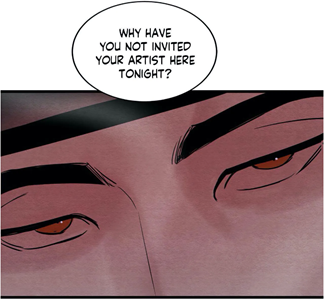 (chapter 33) While he was at the sex orgy, he remembered the exhausted young face of the painter, while they were talking about him.

The black coloring about the head is a sign for flashback and memory. We saw in another chapter that Byeonduck uses the color black to announce that this is a flashback. However, I feel that Yoon Seungho avoided his mansion because he was confused too. He wanted to find out if his “obsession” for the painter was related to sex. We shouldn’t forget that in the past, the lord used to go to such parties very often which is revealed during the chapter 33.
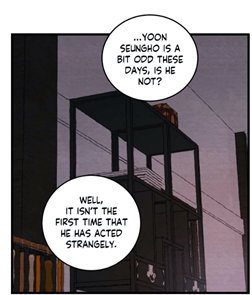
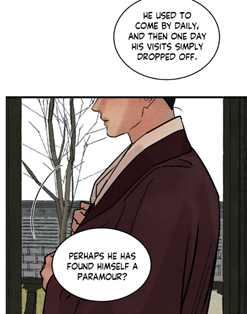
It becomes clear that the moment he slept with Baek Na-Kyum, he dropped off his visits there. Yet after the sex marathon, he started visiting the sex parties again. the relapse was a sign of his torment. But there are other explanations as well. He thought that going back to the sex parties could help him to lower his strong libido for the uke. He wasn’t sure if his urge for Baek Na-Kyum was caused by the lack of sex, as he had stopped going to these sex orgies or if it was related to something else, to the person itself. Furthermore, I believe that by going back to the sex orgies, he experienced that he was no longer interested in sex, but he was looking for something else. He wanted to be with the artist. And now, you comprehend the second relapse in chapter 51:  The lord was suffering, but unlike in the past he couldn’t keep his distance from his lover. He needed to sense his presence. He was no longer his sex partner, but he wasn’t treated like an object or a servant. During these two separations, Yoon Seungho was full of worries for Baek Na-Kyum which he was trying to forget, yet he couldn’t. At the same time, he was reflecting on his past actions:
– Why did he force the man to sleep with him for so long and overlook his current state? What drove him to drop off his visits to the sex parties, when he used to go there very often?
I perceive the lord as someone who does think deeply, hence he wouldn’t be spending so much time in front of his window in general. From my point of view, Yoon Seungho had to introspect himself and was making sure despite his sense of guilt that his “obsession” or love for the painter was not related to his strong stamina but to his desire to share his thoughts with him. He wanted to have a true companion. Let us not forget that Yoon Seungho has never experienced love before and has never received love from his father. So he had no role model, hence he was confused and couldn’t recognize the true cause for his behavior. He didn’t know how to show love. So far, the world he grew up was full of treacherous and vain hypocrites where there is no love. Let us not forget that even Jihwa doesn’t reveal his love for him. Furthermore, his past made him experience sex without pleasure and even without love. However, the moment he met the painter, he could finally connect his sexual orientation with ecstasy. In the first season, without the painter he was experiencing if his “obsession” with the painter was related to sex or to something else. Like I had truly recognized, the noble had not realized the existence of his feelings for the commoner. I believe that he couldn’t name his affection as love due to his lack of knowledge. He was confusing his mind with his heart. There is no denial that he was already in love with Baek Na-Kyum, as the man affected him so much right from the start. The moment they met, he acted differently. Besides, love is never a constant feeling. It changes all the time. Moreover, there are different kind of love. He was attracted by the painter due to his paintings, then due to his face and gaze… little by little he fell for him. However, the lord never realized it, unlike his servant Kim. However, in my opinion, the butler only judged it as an obsession and not as love. He imagined that his master had fallen too deeply into sodomy (chapter 18) In my eyes, the butler’s cowardice is connected to the social norms. He had deeply internalized the social values from Joseon, hence he represents a reinforcement of authorities. As you can see, there are many explanations for his behavior: guilty conscience, out of concern, self-introspection… On the other hand, he is only partially running away from his responsibility, as he had asked the servant Kim to take care of the artist. This is why this “abandonment” stands in opposition to the scholar’s. The latter betrayed during the rape, as he didn’t intervene and acted as if nothing was happening. And the next day, he brought him back to the mansion and abandoned him by letting Yoon Seungho drag him to the bedchamber. At no moment, he tried to stop his sponsor. That’s why he remains invisible in chapter 32.
But if we look back at the first picture at the beginning, you’ll notice that Kim’s words are reflecting something else. (chapter 33) He was acting as a mediator between the master and the low-born which looks like a good thing. In reality, he was meddling in their relationship. Who was he to intervene? That’s why he acted like a father. With his words, the butler was implying that his lord had been affected by his illness, hence he remained away. However, I believe that in the valet’s mind, there existed a different explanation. For Kim, his master was just a coward. That’s why he said this comment in front of the physician:
 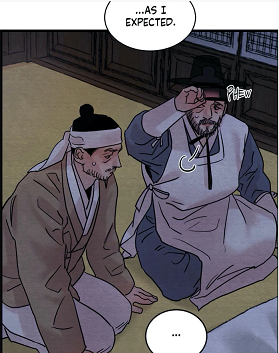 (chapter 33) He anticipated that his master was avoiding to face the consequences of his selfish behavior. For me, Kim doesn’t truly love his master. He views the Yoons as terrible, but he will never confront them. But for his own safety, he needed to deceive the painter. Let’s not forget that Kim had played a role in his escape and the low-born could reveal it to his master. That’s why he needed to fake his care and concern for the painter so that the artist wouldn’t mention the past. Thus he begged the young man not to wander around as a sign of care and gentleness.

Simultaneously, Kim needed to manipulate the painter so that the latter would realized that he had won Yoon Seungho’s trust. He desired to obtain his obedience. What appears as mediation was in reality manipulation, which would create misunderstandings. He hoped that Baek Na-Kyum wouldn’t go to the teacher’s side. He was well aware of his master’s jealousy. In other words, this scene revealed many important points:
– The lord might have been away but he thought about him and made sure that he would get the best treatment
– Yoon Seungho’s behavior has drastically changed, he hasn’t returned home hence there is something upsetting the lord
The loyal assistant is acting like the lord’s lawyer. And here, in the chapter 34, we can see the contrast with Jung In-Hun’s attitude. Baek Na-Kyum asked Kim about the teacher. Was he worried about him? Has he asked after him? Kim denied all of his questions which upset the young man.

That’s the reason why he cried in the bed, covering his face. His gesture revealed his pain, but it also indicated that he didn’t want to be confronted by reality. Kim showed him that his admired sir had abandoned him, but the artist was in denial. He only explained it as a lack of concern. He was veiling his face in front of the truth. On the other hand, this scene was important for another reason. It truly exposed the learned sir’s stupidity and blindness. Without the artist by his side, Jung In-Hun meant nothing to the protagonist. Note the contrast between the butler and the scholar’s attitude. The former had understood the artist’s importance, though he didn’t like it, while the learned sir seemed to be in denial. The low noble didn’t even imagine that Baek Na-Kyum could lose his life. Then if you compare both aristocrats, you’ll detect the huge difference. Although both nobles were away from him, one kept his distance out of concern and guilt, the other felt nothing. The words Kim said did affect the painter, he could sense that the powerful noble had been caring and kind. Kim’s words made sure that the low-born wouldn’t push away his master like in the past, and wouldn’t blame him for his sickness. At the same time, the butler was trying to “tame” Baek Na-Kyum.
And Yoon Seungho’s humbleness and selflessness was revealed with the kiss.  (chapter 32) However, the valet Kim was not present, hence when he lied to Baek Na-Kyum, he had no idea that in reality his words were containing more truth than lies in reality. That’s why I chose the kiss as illustration for the analysis. The roles were switched. The master acted as a servant, and the low-born was now the lord. The male lead was acting like Vasili Andreyevich Brekhunov from the Russian novel. Yoon Seungho was even willing to give water to the exhausted man. This situation was repeated in chapter 76:
  (chapter 76). The lord made sure that the painter would feel better with the water. But let’s return our attention to chapter 33. In the bedchamber, the main lead was to blame for Baek Na-Kyum sickness, as he hadn’t paid attention to the artist’s condition. He had acted selfishly, exactly like the protagonist from Master and man. Both realized their huge mistakes, came to regret and took some responsibility, although the chronology in the Russian story diverges. But this shows that both aristocrats came to realize that commoners were humans and no possessions.
This is not surprising that In-Hun’s indifference and even selfishness hurt the young man more at the end. It was really visible in the next chapter. The young man had to hear that what Yoon Seungho did was not normal 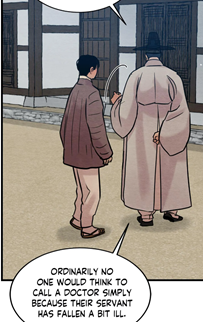 (chapter 35) and his preparations for the exam were more important than the painter’s life. (chapter 35) For the first time, Baek Na-Kyum could sense that Jung In-Hun was selfish and not kind. Moreover, he even reminded him that as a low-born the noble shouldn’t spend so much money for him. Indirectly, Jung In-Hun was telling him that if he had been Yoon Seungho, he would have done the opposite: not giving him the best room, not sending for the physician and not spending so much money for the medicine. In that chapter, Baek Na-Kyum could finally see glimpses of Jung In-Hun’s true personality. Therefore I think that the servant’s words did influence the young man, he didn’t blame and resent the noble for his condition. He saw the caring gestures, although he was absent… whereas Jung In-Hun was absent due to his own interest. (chapter 35) Here, the low-born’s head is down which indicates a certain resignation and pain. While the one did change his behavior and showed a new side to the young painter, the other remained indifferent. The caress on the cheek could no longer mask the learned sir’s lack of concern and selfishness.
  (chapter 35) No wonder that after his departure, the artist was disappointed and heartbroken.
To sum up, one aristocrat felt remorse and guilt, hence he tried to redeem himself by taking care of the artist to his own detriment, he even left the mansion for days, the other acted like usually. Here, we can see some similarities between Yoon Seungho and Vasili Andreyevich Brekhunov. Both are able to feel empathy. Baek Na-Kyum started seeing the powerful master’s caring side. Due to Kim’s words, he thought that the lord even sacrificed his own comfort and health for the young man… just like the Russian land owner sacrificed his life for Nikita, the peasant. The chapters 34 and 35 are important, because they marked a turning point in Baek Na-Kyum’s life. The perfect image that Jung In-Hun had been able to create was starting showing cracks. Little by little, the painter could sense that his relationship with the teacher was defined by his status, while Yoon Seungho’s behavior made him realize that he was not treating him like a low-born, but like a human. This explains why later Baek Na-Kyum lied to the teacher for the first time. The lord had showed him his vulnerable side and had even let him stay by his side, when the brother visited him. The artist felt the learned sir’s lack of empathy and concern for him and his selfishness. In his eyes, he was just a low-born, and Baek Na-Kyum could already sense it. Therefore he lied.
But let us not forget that he still hoped that the servant Kim had not told the truth, hence he went to the teacher in order to get confirmation. Yoon Seungho’s conversion was also visible, because after his return, he spent the whole night thinking how he could improve his relationship with the artist. And notice that from the chapter 36 on, he started lowering himself in front of the painter literally and figuratively. The blow-job in this chapter
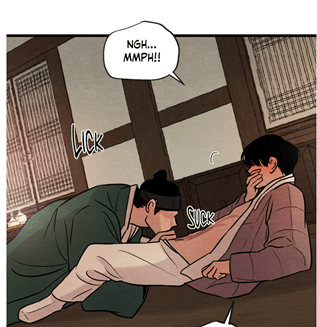
contrasted so much to the blow-job in the chapter 28.

Their places had been switched: the low-born had become the master. First, the noble acted like a master with the soft punishment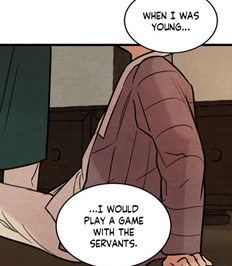 (chapter 36), until he saw the painter’s erection. He was willing to give up his position as master. That’s why he prioritizes the painter’s pleasure all the time.
  (chapter 36) So their relationship master-servant stopped at this moment, hence he lets him stay by his side, when the brother Seung-Won is in his chamber.
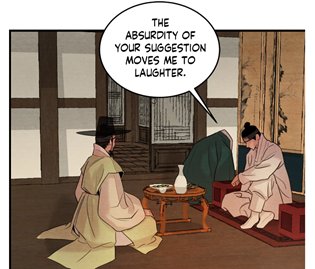 (chapter 37) Notice that his position had changed. He was sitting by the lord’s side. He even asked the artist to sleep by his side and let him stay in his bed without waking him up the next morning. As you can observe, the characters’ position illustrated their actual position in their relationship. When Baek Na-Kyum woke up the next morning, he was alone in the bedchamber. The lord preferred to leave his bed and eat elsewhere. In other words, Kim’s words from chapter 33 became a reality. He let him rest in his bed. Yoon Seungho showed so much consideration that in the chapter 39, he even went to the kitchen in order to fetch the low-born.
 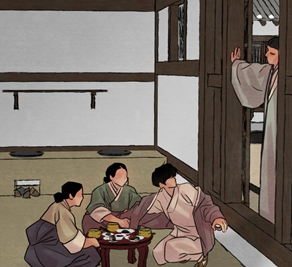 (chapter 38) He didn’t even send his loyal assistant. He had become the “servant” himself. In other words, we witnessed the lord’s slow conversion during the chapter 36 and the small changes from that moment. The nature of their relationship had changed, hence he claimed Baek Na-Kyum as his bride unconsciously.
  (chapter 40) So both characters, Yoon Seungho and Vasili Andreyevich Brekhunov transformed into a different person, more selfless and caring. They were willing to sacrifice things for them: status and pride. On the other hand, the nature of Baek Na-Kyum’s relationship with the teacher changed for the worse: from a teacher to a student, it became a lord-servant relationship, and the painter sensed the change of their relationship. But let us not forget: Jung In-Hun never considered the young man as a student, for him he had always been a low-born. It is just that he was so good to deceive the commoner.
And these observations in the first season were confirmed in the second season. The only difference is that this switch of social position from chapter 33 on was more momentary. The lord still viewed himself as a noble, he never realized his transformation. Yet in chapter 71, the noble chose to confirm the change of status: (chapter 71) Baek NA-Kyum was no longer a low-born, but a noble, while the main lead was his “servant”. This explicates why the noble was no longer asking for him in the evening
  (chapter 74) and visited him secretly during the night. But this switch of position didn’t remain a secret, the moment the lord embraced his panicked lover.
 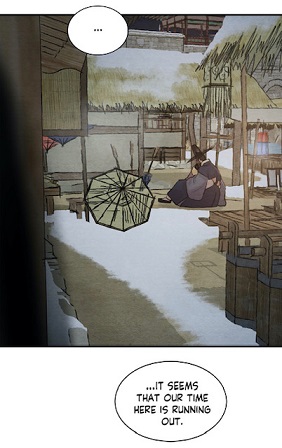 (chapter 76) At the end of the second season, the lord’s true personality is more and more unveiled: he has a kind and generous heart, and he is able to reflect on his wrongdoings, which contrasts to Jung In-Hun. And now, you can comprehend why right from the start, I was fascinated by the infamous sodomite. The first season let us see glimpses of his warmth and selflessness. This means, the noble’s courage and strength will shine more and more.
As a conclusion, Yoon Seungho is a figure that resembles the noble Valmont from the “Dangerous Liaisons” and the land owner Vasili Andreyevich Brekhunov from “Master and man”, a man full of redemption despite his sins. As you can see, from a simple question “Why didn’t he return to the mansion?”, it became an analysis about master and servant and the transformation of Yoon Seungho.
And here again, I could use a classic story for an inspiration and comparison which shows how well written this manhwa is.
Feel free to comment. If you have any suggestion for topics or manhwas, feel free to ask. If you enjoyed reading it, retweet it or push the button like. My instagram-tumblr-twitter account is: @bebebisous33. Thanks for reading and for the support, particularly, I would like to thank all the new followers and people recommending my blog.

 Bebebisous33s' analyses in K-Dramaland and Manhwas