

Please support the authors by reading the Manhwas on the official websites. This is where you can read the manhwa: Jinx But be aware that the Manhwa is a mature Yaoi, which means, it is about homosexuality with explicit scenes. Here is the link of the table of contents about Jinx. Here is the link where you can find the table of contents of analyzed Manhwas. Here are the links, if you are interested in the first work from Mingwa, BJ Alex, and the previous essay about Jinx La Vie En Rose
It would be great if you could make some donations/sponsoring: Ko-fi.com/bebebisous33 That way, you can support me with “coffee” so that I have the energy to keep examining manhwas. Besides, I need to cover up the expenses for this blog.
1. The role of Routine in Jinx
In my last essay La Vie En Rose , I named Choi Heesung Mister Boredom, while I introduced the champion as Mister Routine explaining why the latter would reject the artist.  (chapter 30) Whereas the protagonist sees in a pattern a shield and protection, the other considers it as a source of danger, for the person doesn’t feel alive.
1. 1. The prince’s perception of routine
As you can see, Heesung views regularity as a synonym for death. Why? His reason is simple. He doesn’t sense his heart racing. Interesting is that when the physical therapist interacted with the actor for the first time, the former didn’t treat him as a celebrity, but as a normal patient. Choi Heesung was simply a human in the protagonist’s eyes and nothing else. 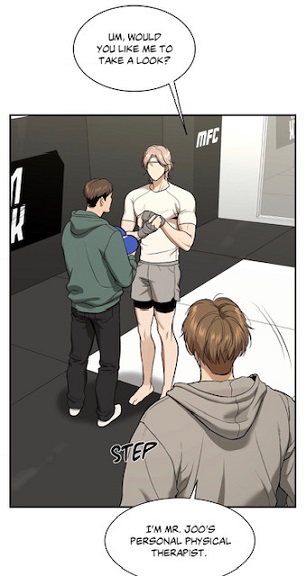 (Chapter 30) Kim Dan had heard the conversation between the artist and his manager before offering his help and approaching him. Then when he took his hand for an examination, he was not holding it out of admiration.
 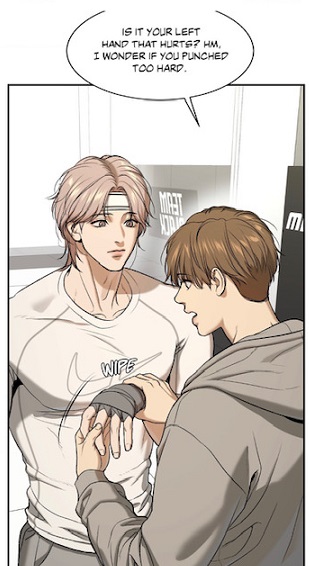 (Chapter 30) No wonder why the doctor caught his attention. The pink haired star got surprised by such an unusual treatment. The irony is that the main lead was doing nothing out of the ordinary. This shows that till this meeting, the actor had always been treated as a prince, for the latter had always been privileged. It is not surprising that Heesung found Joo Jaekyung refreshing.
 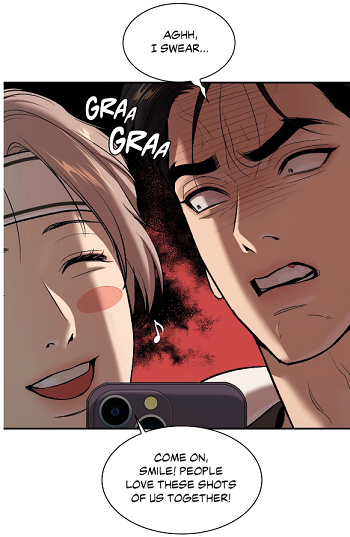 (Chapter 30) He was the only one who would not consider him as special, rather as bothersome. Yes, he was not favored by the emperor. Under his new light, it becomes comprehensible why Mingwa let the gumiho play the role of a prince wearing a purple hanbok with Potato:
 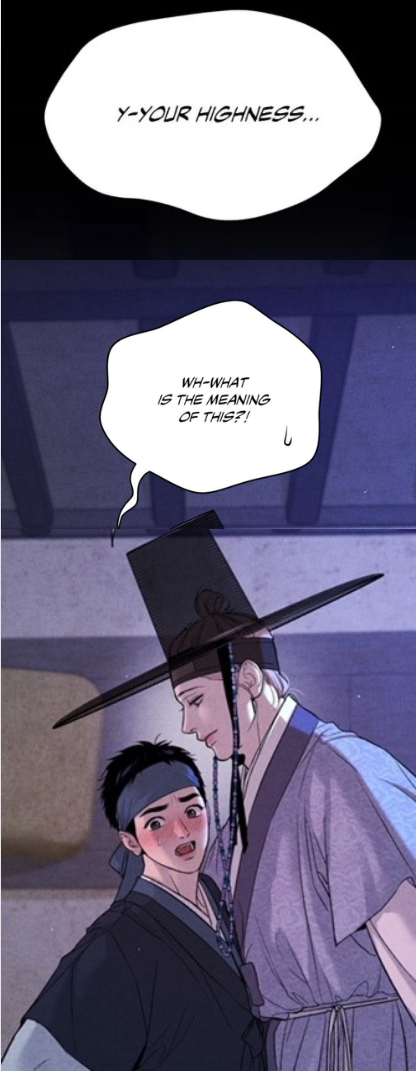 (Special episode 2) The purple hanbok is strongly connected to Joseon royalty. (For more read my essays about Painter Of The Night) In addition, while the comedian thinks, it is a fiction, he is wrong in verity. It was a reality, for he has been living like a sovereign. And now, you comprehend why Heesung praised the physical therapist to the sky.
 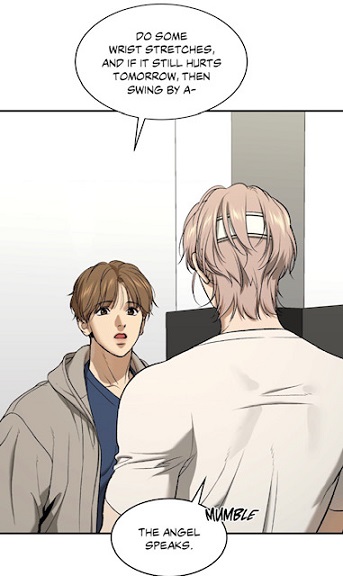 (Chapter 30) By treating him like an average patient, he could only appear as very professional and competent.
  (Chapter 30) He was seen as a serious and honest doctor who was not looking for favors and recognition. So I deduce that the actor felt moved by such a selflessness and care.
 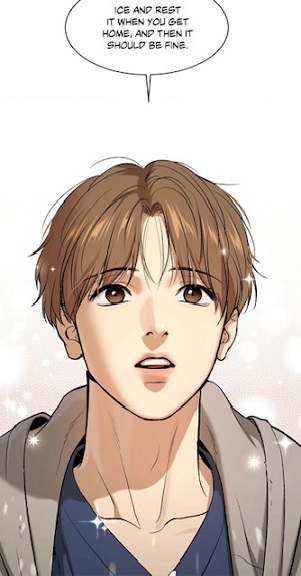 (Chapter 30) We should consider this image full with stars as a metaphor for the comedian’s heart racing. To conclude, their first encounter reflected Heesung’s philosophy: his desire for novelty and genuine attention, while he is longing for normal treatment and as such for an ordinary relationship. The expression “soulmate” is implying the notion of equity. Thus because of the doctor’s actions, Heesung felt alive. Funny is that by discovering the doctor, Heesung was encouraged to accept routine. Therefore he came to the gym on a regular basis.
 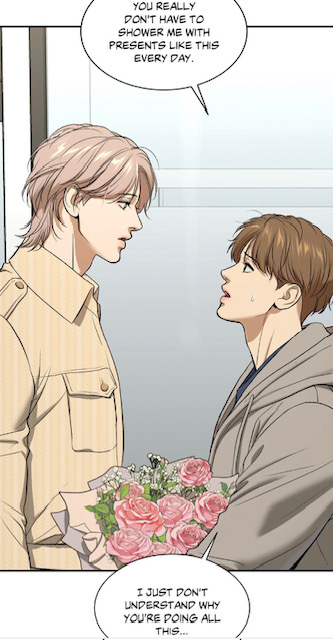 (Chapter 31) This shows the inner conflict of the actor. Deep down, he dislikes being treated as a prince and would like to be seen as a man and nothing more. Normality and regularity stand in opposition to privilege and novelty. On the other side, he seems to reject averageness and commonplaceness. Therefore he likes to show off his wealth:
  (chapter 32) Through the ukes (Potato and Kim Dan), the fox is experiencing the positive aspects of ordinariness. He drinks soju while eating a cheap meal on the street to drown his sorrow
 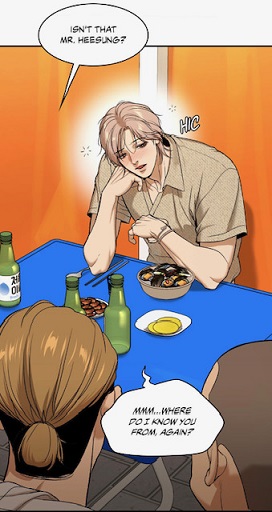 (chapter 35) or he imagines to have sex in a barn next to a crowded place.
 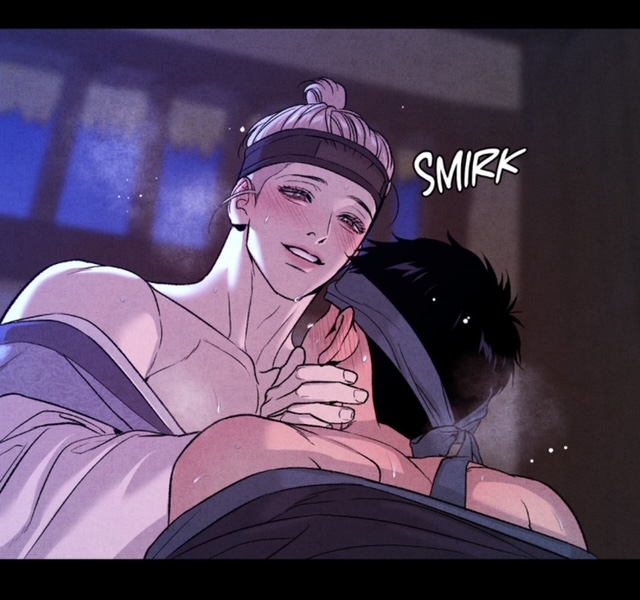 (Special episode 2) As you can see, thanks to the new episode, I realized that Potato’s role is to make him give up on his special status and privileges. In the bedroom, he might become the master, but outside he will be forced to work for someone else: Potato and as such for the main couple. And this brings me to my next prediction. Look how Mingwa ended the second special episode:
 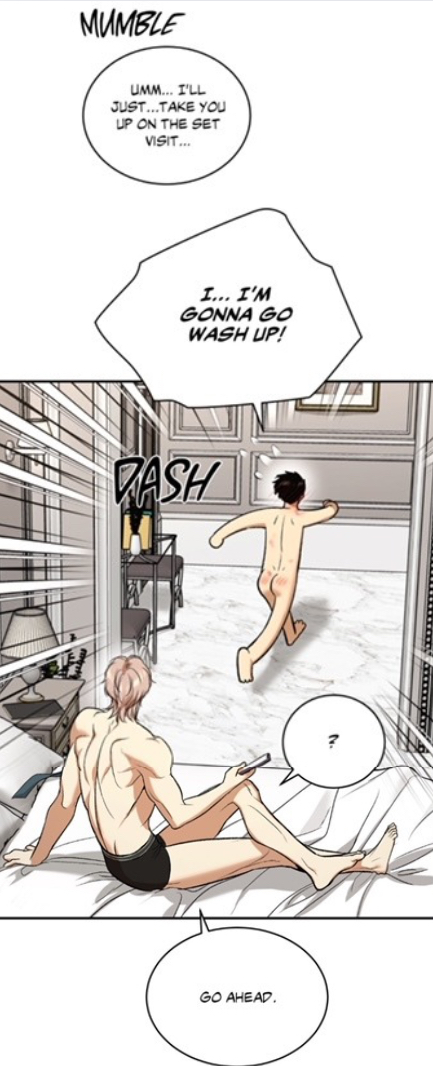 Manhwaphiles see Potato running away, because he is embarrassed. For me, it indicates that Potato will turn his back on Heesung. Yes, we should see this ending as the positive reflection from this night:
 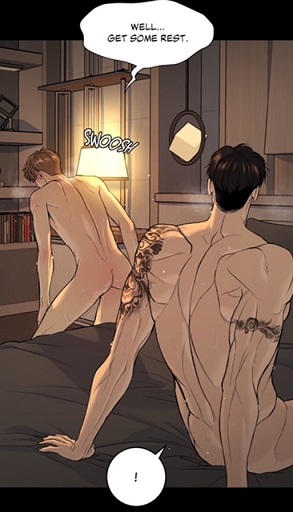 (chapter 53) Back then, the champion didn’t imagine that the doctor had already started distancing himself. However, here it is clear that contrary to the main lead, Yoon-Gu doesn’t plan to leave the actor or to neglect him at all. He is a very mature and responsible person. Besides, he has just accepted his suggestion: he plans to visit him on the set. However, Heesung is about to learn important life lessons. Life never goes as planned. Furthermore, he will be forced to question his principles and his behavior.
 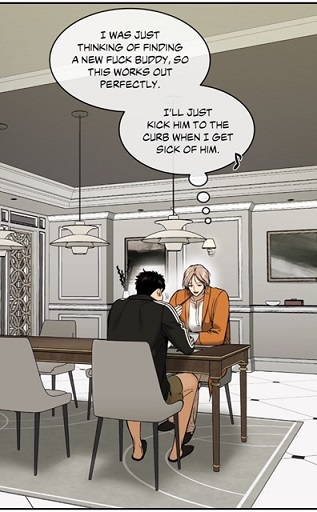 (Special episode 1) He needs to become responsible. He won’t get sick of his lover, and he is going to miss him terribly. In my eyes, Choi Heesung is about to go through the same experience than his frenemy: regret and longing. He should have paid more attention to the physical therapist and the champion
 (chapter 35), as their relationship is affecting his own life. How so? It is because the young MMA fighter is a stan of Kim Dan and Joo Jaekyung!
  (Chapter 35) Let’s not forget that when Yoon-Gu helped the physical therapist in the locker room, he was indirectly assisting the star.
  (Chapter 49) The problem is that in season 1, he was rather distant and privileged the celebrity. Therefore he didn’t protect the physical therapist properly. Since the maknae is really sad about the doctor’s departure
 (chapter 52), it becomes clear that his interest aligns with his idol’s.
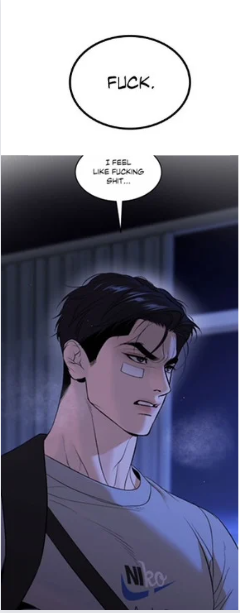 (Chapter 53) Therefore he can only support the champion’s decision to bring back the main lead. Yet, under the orange tent he decided to cheer them on from afar. Thus I am now inclined to think that the maknae could choose to become more proactive, when it comes to Kim Dan.
The other reason for envisioning a separation is that in the latest episode, readers could see the fox’s blushing. (Special episode 2) The latter got more pronounced, as time passed on, a sign of his rebirth or revival. He is on his way to fall deeply in love with the maknae, because he is having fun all the time.  (Special episode 2) Fascinating is that the expression “to have a ball” (a synonym to enjoy oneself) is related to Cinderella.
Where does have a ball come from?
The first records of the phrase have a ball come from around 1879. It comes from American slang. The word ball is used in the sense of a fancy party with dancing, such as the one attended by Cinderella. Quoted from https://www.dictionary.com/browse/have-a-ball#
Cinderella is a fairy tale about transformation and disguise. The young woman is able to climb socially thanks to a her godmother, a hidden sponsor!! One might think that Potato is a new version of Cinderella and Heesung is his future sponsor. Yet I believe that the actor will make the opposite experience than the original protagonist’s. Through Potato, Choi Heesung will discover a new world… MMA fighting, criminality and even misery. My avid readers should recall that when he was sent to the gym, he was reading a script entitled: EXTREME WORLDS  (Chapter 29) He has only lived in one so far due to his privileges. It was, as if he has lived in a fairy tale, far away from reality. Now with Potato, he is finally able to live out his fantasies, hence his fairytale-like world has just lost its reason to exist. Thanks to Kim Dan and Potato, the comedian is brought back to reality. He is discovering not only averageness, but also the true significance of routine and normality. Thanks to the latter, trust and intimacy can deepen. He found out that he can experience novelty through sex.
Interesting is that the actor is now trying to include his lover in his professional life.  (Special episode 2) It was, as if he wanted Potato to switch his career. It exposes his desire to be close to the maknae. However, with the champion’s downfall and the physical therapist’s departure, I am quite certain that Yoon-Gu’s position at Team Black is about to change. The gym needs to become successful again and present new athletes. Yoon-Gu can no longer be treated as an extra!! His future is now important for Team Black and Park Namwook. Finally, he proved his worth by fighting the older and bigger fighters at the restaurant. Thus I doubt that Choi Heesung can make a deal with Park Namwook like in the past.
1. 2. The champion’s habits and Heesung
Then in her last notes, Mingwa described Joo Jaekyung’s daily schedule. 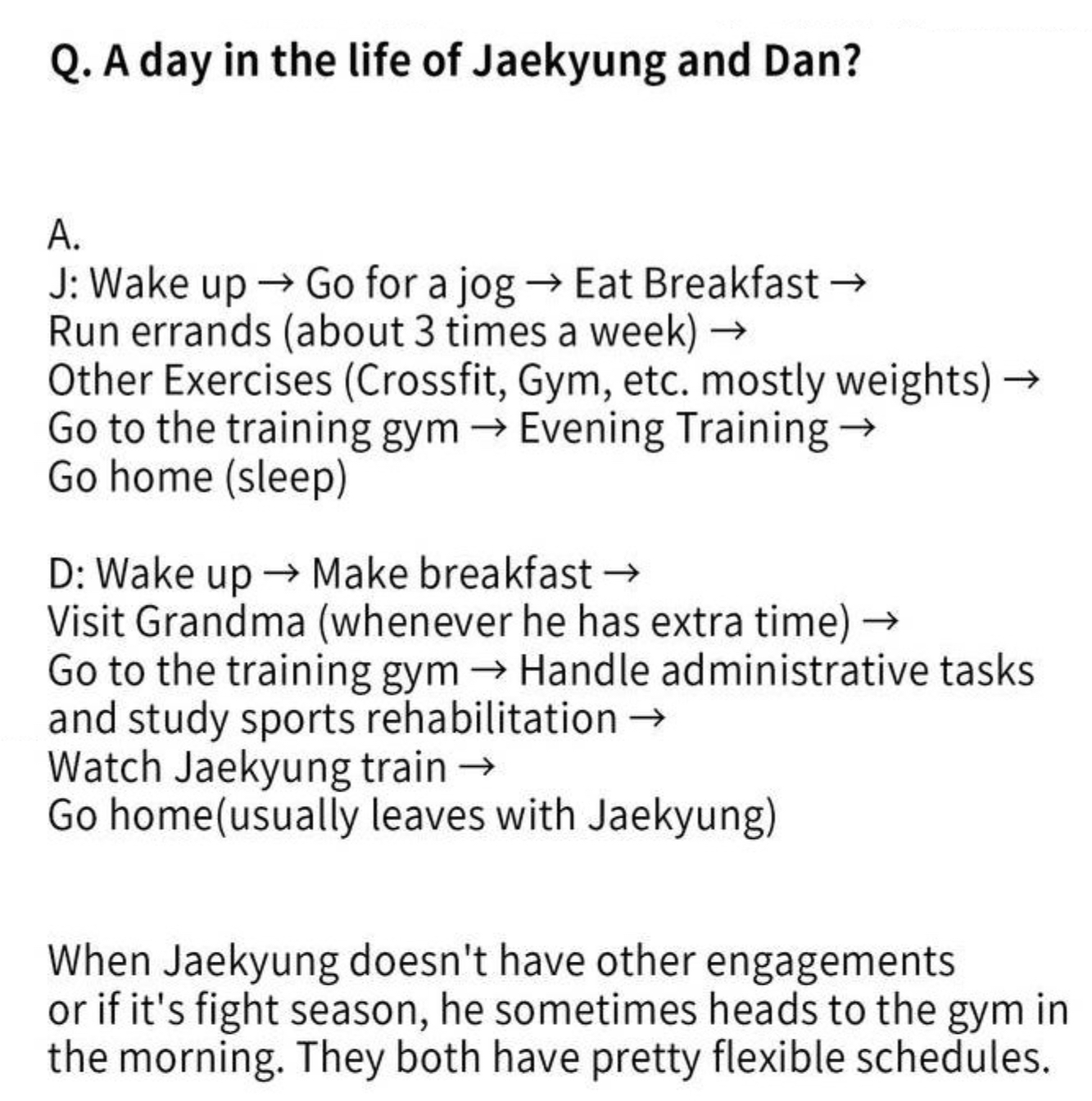 The moment you read this note, you can grasp why the athlete would consider the comedian as a total nuisance. It is because the former couldn’t focus on his training (other exercises: CrossFit, Gym, mostly weights). As a conclusion, the athlete had many reasons to view the artist as bothersome. On the other hand, since Heesung is on his way to adopt regularity, I deduce that the champion’s fate is to accept surprises and changes in his life. And now, you know why their first encounter ended like this:
 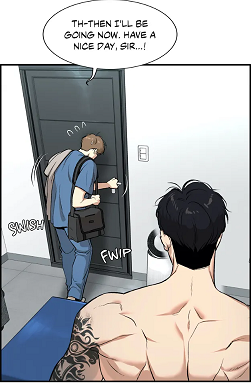 (chapter 1) No one had ever run away from him like that. He was used to face opponents who would challenge him or people who would admire him. Notice that the doctor is turning his back on him, which contrasts to the morning after their first sex session. There, the protagonist chose to vanish into thin air behind the champion’s back after spending the night with him.
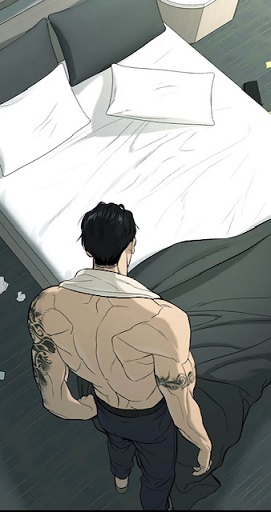 (Chapter 4) However, in the athlete’s mind, the doctor had not abandoned him, for he imagined that Kim Dan was motivated by his greed. He was just interested in money. As you can see, Kim Dan represents novelty and exception. Nonetheless, the problem is that till the end of season 1, the fighter never came to see novelties and sudden events as something positive.
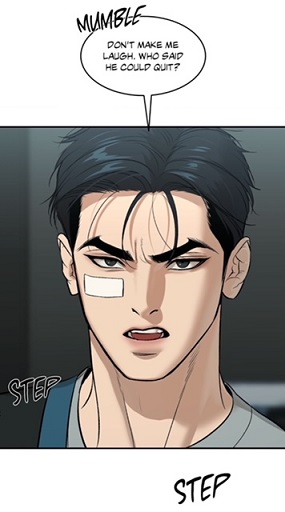 (Chapter 53) Under this new light, Manhwaphiles can grasp why the celebrity hates birthdays and surprise parties. They represent a violation to his regular schedule.
 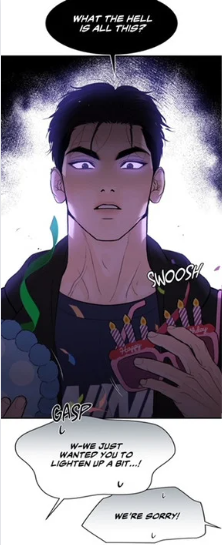 (Chapter 43) (chapter 53) So when he refuses the doctor’s resignation, he exposes his true mind-set once again. Kim Dan has already become part of his daily routine. Thus the Webtoonist had included the doctor’s schedule in the notes. But there’s more to it.
The moment Kim Dan moved to the penthouse  (chapter 19), the athlete didn’t change his daily schedule at all. On the one hand, Manhwa-philes could judge this as a sign of his selfishness. On the other hand, it exposes his lack of sociability. He had never lived with someone else before. Since we never saw his family or heard about his parents in the first season, I assume that he is a true orphan contrasting to the physical therapist’s situation. Yet both have one common denominator: abandonment issues. The absence of family displays the difference between the two semes. While the actor embodies favoritism and nepotism which is strongly linked to family, the other represents the opposite values: indifference, meritocracy and business. Thus the Webtoonist created such a scene:
 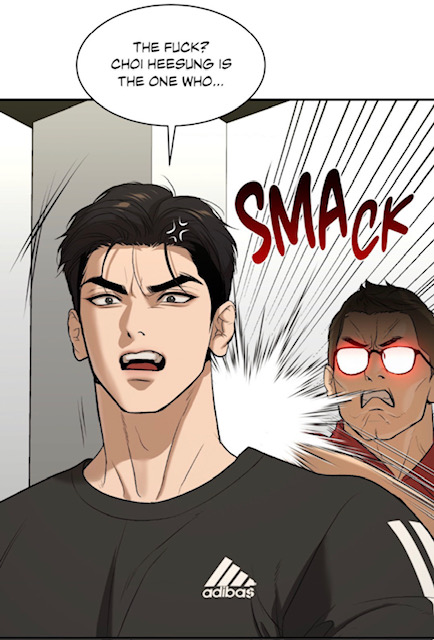 (Chapter 31) He only gets respected, as long as he is “bringing money” to Team Black
  (Chapter 52) and MFC. According to me, people from MFC had expected the athlete’s defeat in the USA so that I am quite certain that they had bet on his loss. Because of meritocracy, it is normal that Joo Jaekyung trained so hard on a regular basis. Besides, his routine outlines the importance of his work in his life. His career means everything to him. In fact, it represents his life. Thus it is not surprising that his daily schedule would center on his training. Simultaneously, Manhwa-worms can understand why the champion had no time to meditate and question his believes and way of life. He had no time for something else. Under this light, it dawned on me why the athlete expected from Kim Dan to adapt himself to his daily schedule. The latter had to develop a routine based on the champion’s training. Furthermore readers can grasp the fighter’s behavior in the following image. (Chapter 19) Joo Jaekyung is leaving for the evening training, and he is making no exception. However, as time passed on, the athlete came to make an exception for the doctor. Because of the actor, the athlete chose to neglect his training once.
  (Chapter 32) According to me, he never went to his training. And shortly after, he was involved in a scandal.
2. Mister Routine, Mister Change and the Wedding Cabinet
(chapter 19) Interesting is that we are witnessing the MMA fighter turning his back to the physical therapist. He is leaving his destined partner behind. From my point of view, his words (“Do what you want”) imply that he is not recognizing the doctor as a valuable and necessary PT, for he is not including him in the evening training. I would even go so far to say that Joo Jaekyung is treating the protagonist as a part of his furniture. In my eyes, the fighter came to associate him with the halmoni’s Wedding Cabinet. It was, as if in the champion’s unconscious, the doctor had become the beautiful cupboard.
This interpretation helps to grasp why the athlete neglected his lover for 10 days  (chapter 19) and why he got upset and scared
 (chapter 53), when he saw the Wedding Cabinet in the hallway.
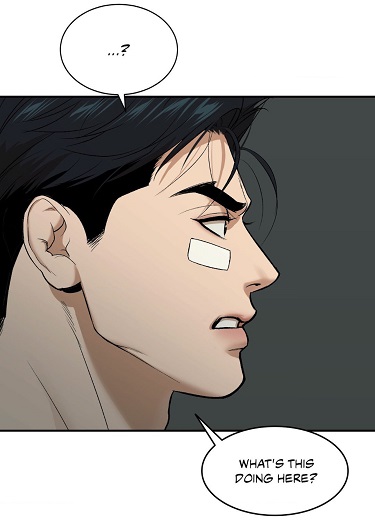 (chapter 53). In episode 19, the champion really viewed the main lead as an object (chapter 19). Therefore he focused on his training and didn’t pay attention to Kim Dan’s whereabouts and actions. However, it changed, as soon as someone reminded him of Kim Dan’s true nature:
 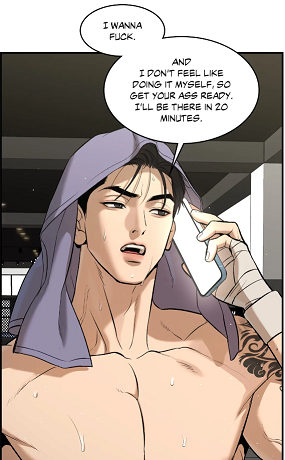 (chapter 19) he was a human. According to my theory, the coach Jeong Yosep was behind this trigger, since he is the only one at the gym with a failed relationship.
 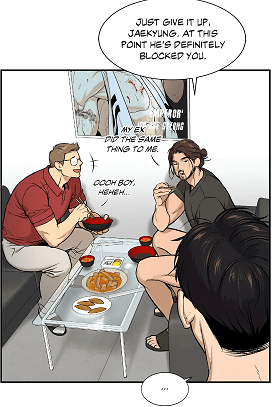 (chapter 05) Hence he called him from the gym making sure that he had not blocked him or even vanished. Under this new light, Jinx-philes can understand why he felt the urge to have sex with Kim Dan. It was to remind him that he would belong to him. Yes, unconsciously, the athlete projected his own thoughts and fears onto his fated companion. (chapter 19) Yet, with such an order, Kim Dan appears more as a sex doll than as a free human being. This scene is important, because this reminder showed him that the latter could leave the flat behind his back, he was not obliged to wait for him at his penthouse. Since the fighter was seen wearing his shoes in the bathroom
 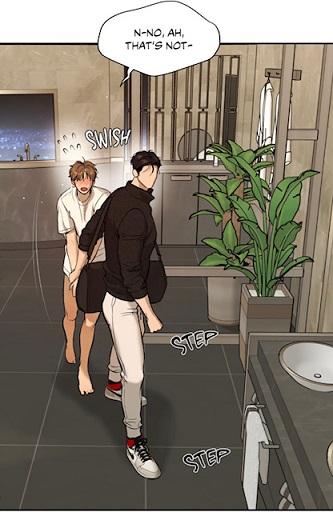 (chapter 19), many Jinx-philes had been able to discern the fighter’s past (invisible) action. He had been looking for the doctor in the huge penthouse, the older version of this scene (chapter 53). Since the latter is so big, the absence of light and noise must have startled the main lead.
  (chapter 19) The doctor had barely left traces in the apartment. Only the cupboard was the evidence of his presence in the flat. However, this object could be left behind… exactly like Joo Jaekyung had treated Kim Dan in this panel: (chapter 19) Moreover, let’s not forget how the protagonist viewed the huge furniture.
 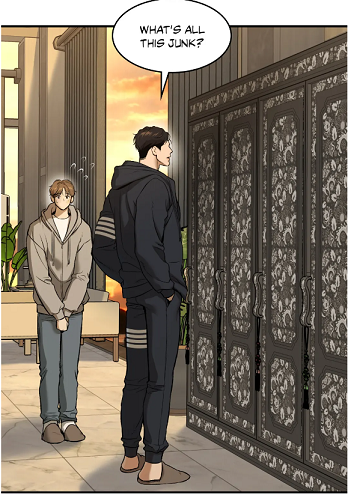 (chapter 19) It was worthless. My point is that Joo Jaekyung must have realized in episode 19, when he returned to the penthouse that Kim Dan was different from the cupboard, he was no object at all. And now, you comprehend why the main lead said this to the doctor in the bathroom:
 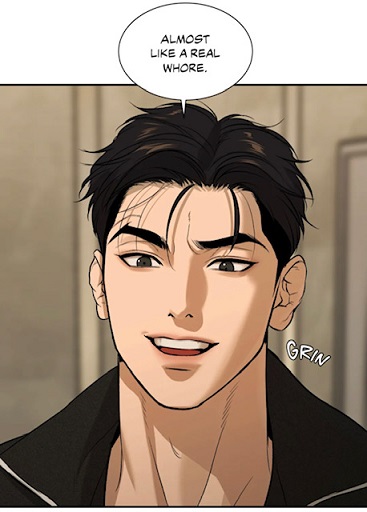 (chapter 19) First, he was compared to a prostitute, then later to a baby.
  (Chapter 20) This scene proves that Joo Jaekyung was viewing his lover as a human. Additionally, the comparison to a whore was to mask his previous anxiety and thoughts. He had been looking for him. He needed to appear as strong and superior, the one with the upper hand.
This interpretation raises the following question. Did he keep viewing him as a human after this episode? My answer is positive, though on the surface it looks like he reverted back to his old ways.  (Chapter 33) Here, he tried to give pleasure to the doctor, for he saw Choi Heesung as a huge rival. The latter is known for being a better lover. It was, as if he was trying to give a reward to his companion. Moreover, I believe, the sex toy was there, because the champion feared that he wouldn’t be able to control his emotions and actions. Then in this scene, one might argue that the champion treated him as a sex doll
  (chapter 36) However, my avid readers should keep in their mind that sex was like a surrogate fight. Thus we could say that in this panel, the physical therapist is actually treated like a “fighter” and enemy. Then when the champion criticized him for his bad decision, he was finally recognizing him as a physical therapist.
  (Chapter 45) As Manhwaworms can observe, the room mate’s social status was improving. I would even add, the athlete was putting more and more responsibility on the main lead. A sign that despite the appearances he was trusting him more and more. On the other hand, one might argue about this analysis, for after the quarrel, the fighter started distancing himself from his PT. He would no longer talk to him and even ignore him.
  (Chapter 47) So anyone would say that he is no longer treating Kim Dan as a human. However, this is just a deception. How so? It becomes perceptible, when you contrast the last panel with this one: (Chapter 19) That’s why my illustration displays both pictures next to each other.
 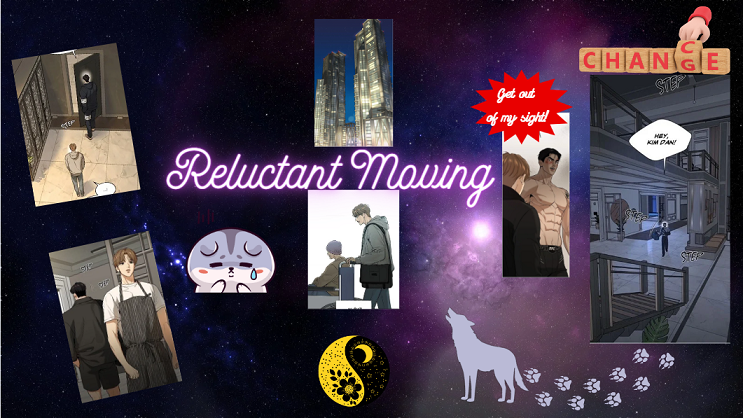 What caught my attention is that earlier in the season, the celebrity talked to doc Dan, but he was showing a certain disrespect towards his room mate. His Wedding Cabinet was garbage, he was not included in his evening training. Like mentioned above, he was treated like a furniture. Nevertheless, in chapter 47, Joo Jaekyung chose the silent treatment. It shows that he was now considering him as a member from Team Black, but because of Park Namwook’s warning,
  (chapter 47) he kept everything to himself. Indirectly, he was questioning his PT’s loyalty. This shows that the miscommunication and silence were the results of the coach’s advice and intervention. This means that due to his manager’s words, the champion started doubting the physical therapist. Thus I come to the following deduction: though the athlete asked Kim Dan to get out of his side
 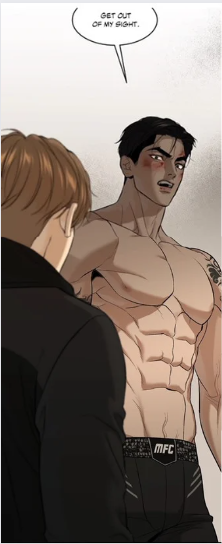 (chapter 51), unconsciously the star made the opposite decision: he started considering him as a real member from Team Black. Why? It is because the doctor had touched his heart and mind with this question:
  (chapter 51) He had broken the final wall between them. This explicates why the moment Joo Jaekyung heard about the doctor’s resignation, (chapter 53), he refused his decision. This means indirectly, he is admitting that the protagonist is a trustworthy and competent PT! His attitude contrasts so much to his coach’s who imagines that doc Dan can be replaced so easily.
 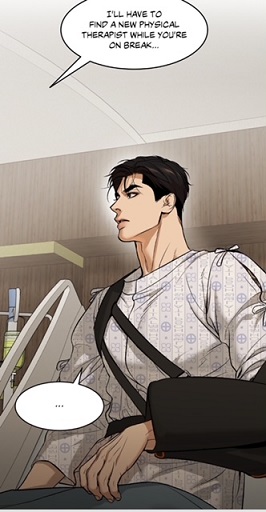 (Chapter 53) In my opinion, the one behind the champion’s mistrust is the manager. I even have the impression that he is also responsible for his mistrust against doctors, as they are no fighters. Either it is because he has an inferiority complex against such people or it is related to MFC. He only trusts the organization and its members, as such he only trusts doctors from MFC. To conclude, at the end of season 1, Kim Dan is recognized as a trustworthy physical therapist and as a real member from Team Black.
And now, you are wondering the signification of the cupboard in the final episode from season 1. It is time to examine more closely this scene. 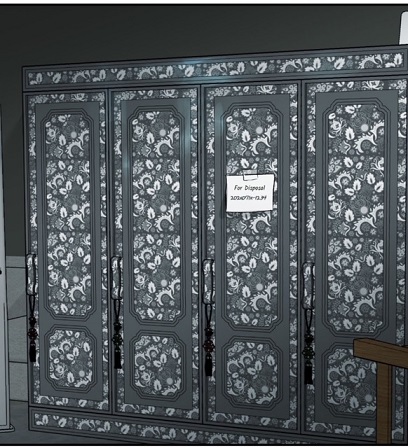 (chapter 53) When the doctor left the penthouse, he disposed his halmoni’s Wedding cabinet. In other words, he treated the precious furniture as junk, turning the champion’s words into a reality. It was, as if the doctor had taken the MMA fighter’s words seriously. However, Kim Dan didn’t act that way because of the athlete’s false judgement. It is just that the doctor came to consider the wedding cabinet as a burden. Thus he treated it as junk. For him, the furniture only had a sentimental value. It symbolized the grandmother. But why would he consider it as an onus then? First, he couldn’t bring the cupboard to the West coast, too expensive and troublesome. Secondly, he wouldn’t have been able to place the Wedding cabinet in a small flat.
 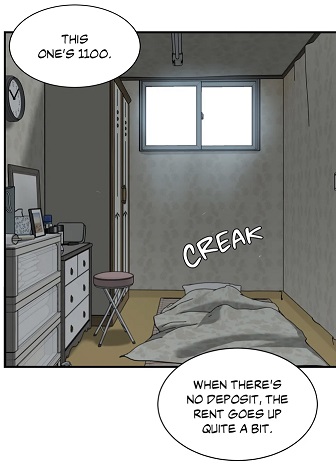 (chapter 16) In addition, Kim Dan had kept it for his halmoni’s sake.
  (chapter 53) She was the one who loved it so much. But since she is trying to reconnect to her childhood and nature, she no longer values it. Yes, the halmoni is falling more and more into childhood, the closer she is to death. Thus she came to repress her marriage. As you can see, the elderly is slowly forgetting her own past and as such Kim Dan. She is trying to relive a moment from her childhood, a time when the grandchild didn’t exist.
  (Chapter 53) Thus I deduce that Kim Dan can no longer view the Wedding Cabinet like before. I believe seeing the cupboard would be painful for doc Dan, as he would be constantly reminded of his grandmother.
  (Chapter 53) This image is full of symbolism. Kim Dan is now able to touch the cold Wedding Cabinet, a sign that he is accepting his grandmother’s death. By biding farewell to the furniture, he is preparing himself for the inevitable: his halmoni’s vanishing. It was, as though he was saying goodbye to his relative. That’s the reason why his smile is full of sadness, when he is pushing his relative’s wheelchair.
 (Chapter 53) Her death has become a taboo. He is full of resignation. Contrary to the past, he is willing to face her death and as such to be by her side on her final moments. Yes, this panel (chapter 53) exposes the doctor’s painful transformation. He is now a grown-up. Though he is forced to change, he is not upset because he is accepting his fate. However, the champion came to associate the cupboard with Kim Dan. So I assume that with the doctor’s departure, for the celebrity, the furniture has now a sentimental value. For me, Manhwaphiles should consider these two pictures (Chapter 53)
  (chapter 53) as a reflection of this chapter:
  (chapter 46)
  (chapter 46) In both scenes, the doctor came to resign and lower his expectation. Thus I deduce that after the final episode, the champion will come to treasure the objects left behind by the physical therapist. Notice that he didn’t throw away the letter. By keeping them, the athlete would show how much he appreciates Kim Dan. In addition, the letter is wishing him well, which no one has expressed so far. The letter oozes trust, confidentiality, admiration and closeness. Hence I deduce that at the end, Joo Jaekyung is heartbroken, though he can not clearly voice his emotions. (Chapter 53) Yet, in opposition to the doctor, he has long internalized to fight for himself. Therefore I am certain that the champion will follow the physical therapist’s trail. And that’s how he will be pushed to drop his habits and develop a new “routine”, where he is no longer the one determining the daily schedule. In my eyes, the grandmother should play a bigger role in his life, as the doctor decided to give her comfort until her final moment. That’s how I am imagining that both will come to an agreement how to redefine their life together. As you can see, by following the physical therapist, the athlete is pushed to leave not only the penthouse, but also the gym. He is on his way to discover new horizons. Since the gym represents routine and training, this signifies that the athlete can no longer follow the same daily schedule. The champion’s suspension is in reality a blessing in disguise. He has the time and the occasion to meditate about his life.
3. Traveling and rebirth
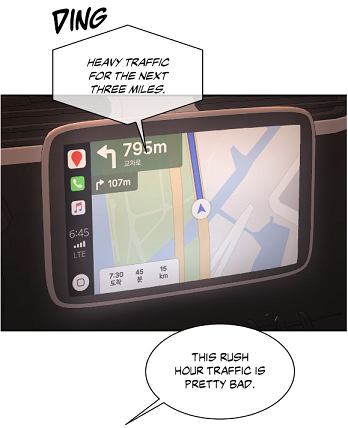
This brings me to my next aspect. In season 1, the champion often went to new places in South Korea because of Kim Dan. When Park Namwook asked his boy to take care of the doctor, the champion discovered his poverty and debts. 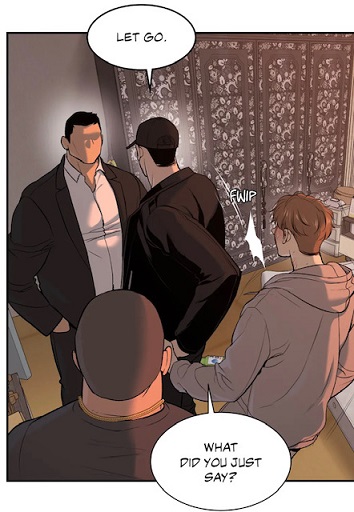 (Chapter 17) Then when he brought the physical therapist to Heesung’s home, he used the GPS, a sign that he was not familiar with the route.
  (Chapter 33) Interesting is that when he heard his regular nightly disappearances, he never tried to follow him.
 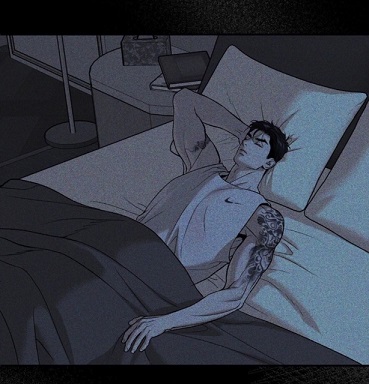 (Chapter 45) Why? It is because he was always back in the morning. Furthermore, despite his exhaustion, the physical therapist was still following the daily schedule. Because Kim Dan wanted to keep it a secret, the champion was forced to feign ignorance. Thus he couldn’t question him about his whereabouts. In addition, I can also envision that he must have thought that it was related to his grandmother. Don’t forget that he experienced once how the doctor had left his side due to a phone call in the middle of the night.
 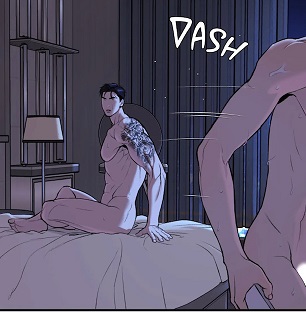 (Chapter 21) Since the athlete’s life is revolving around routine, I am quite certain that he must have jumped to conclusions based on his first experiences… the birth of prejudices. Thus I have the feeling that Park Namwook’s biased perception concerning his champion is also influenced by their first meeting and experiences. It is important, because such a mentality fixated on daily schedule represents a hindrance for the mind. Routine often leads to close-mindedness and lack of critical thinking. At the same time, this new interpretation explains why the athlete got so worked up and upset, when he received the golden chain. (Chapter 45) It is because all this time, the athlete had been worrying about the doctor and in the best case about his grandmother. Becoming a courier during the night could only give the impression that the halmoni’s health had improved and the expensive treatment was working. In my eyes, the fighter couldn’t ask his physical therapist about his relative’s physical condition either, for it was not his place to ask. He is first and all the PT’s employer. Besides, the physical therapist has always been secretive about his own private life and family, just like the fighter. Therefore I assume that he must have projected his own mind-set onto the doctor, he would not look into the physical therapist’s life. And what was the doctor thinking about the star during season 1? The more time passed on, the more he got curious. To conclude, since the beginning of the story, the celebrity never showed an interest and curiosity to his fated partner. This observation leads me to the following conclusion. In season 2, it is the athlete’s turn to become curios about his lover’s past and life. At the same time, as soon as Kim Dan paid more attention to his lover, he also reflected on his own life, like for example in this scene:
 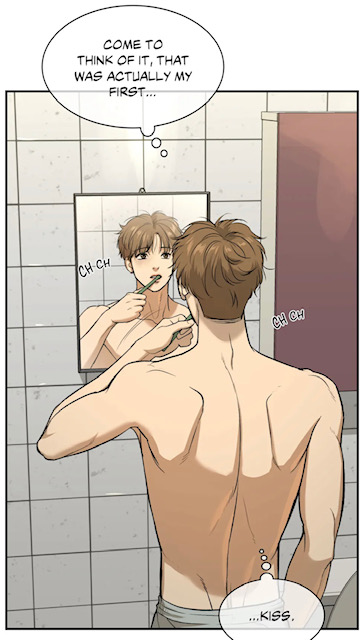 (chapter 16) He wondered why the athlete had kissed him, which made him realize that it was his first kiss. Therefore I come to the following deduction. Joo Jaekyung will be forced to discover his lover’s like and dislike which will incite him to become more honest about his own desires and passions. We have an allusion to this development in season 1:
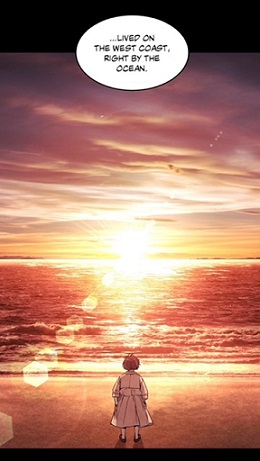
  (chapter 27) Thanks to his companion, he remembered how much he likes swimming! He had totally repressed it. To conclude, Joo Jaekyung’s travel shouldn’t be just perceived as a journey to the West Coast and Kim Dan’s side, but as an inner journey! He is on his way to discover himself and reconnect to his childhood, or better said to his inner child. This signifies that he is actually following Shin Okja’s footsteps which is regression to childhood. (Chapter 53) Thus my theory is that he will go to the beach and be moved by the beautiful sunset. So far, he has never paid attention to his surroundings and nature. There is another reason why I come to this expectation. I saw parallels between the last picture and this one:
 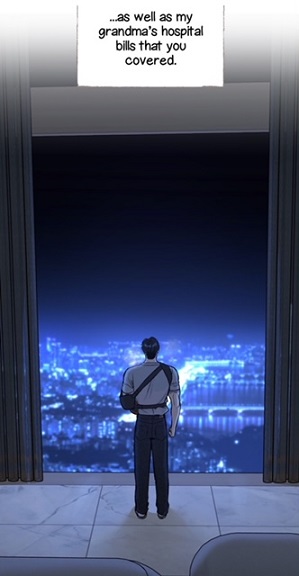 (chapter 53) Both are connected to travel. Though both are alone, their experience is totally different. Why? It is because of the contrasts.
| The grandmother | Joo Jaekyung |
|---|---|
| nature | civilization |
| sun | artificial light – night |
| closure | emptiness |
| beautiful – impressed | Hates this moment – sadness |
| Companionship – she doesn’t feel isolated | loneliness |
| death – departure | ”death of the hero” – departure to the unknown |
The view over the city is offering no comfort to the star. He feels miserable and lonely. He is finally realizing that despite his money, he has no one by his side. He is now regretting the past… exactly like the grandmother. Since both are regressing to childhood, it is very likely that the athlete will develop a certain closeness to the halmoni. Contrary to the first season, it shouldn’t be reduced to one short moment. Don’t forget that in episode 21, Kim Dan had doubted his relative’s statement:  (chapter 22) He would have the opportunity now to verify this statement.
Since my hypothesis is that he will travel and follow the doctor, he will reconnect with nature. The ocean is the place where the goddess Aphrodite was born. It is the place of Love. Hence I believe that in front of the ocean, the human Joo Jaekyung will be reborn! He will no longer be the star, the champion… but simply an average human. He will not only love the doctor (admit his feelings for him), but also love himself. Mingwa has already indicated his journey to the ocean with this image: 
For the champion has to learn to meditate and to identify his own emotions, it makes sense why the Webtoonist announced that season 2 would be a slow burn and would focus on emotions. Besides, he has now to pay attention to the grandmother and Kim Dan. Since it is only a matter of time, until Shin Okja dies, I associate her vanishing as a change too. Because of her, Joo Jaekyung is forced to accept novelty as something natural. Life can not be predicted… Changes can also be a source of joy… like the jokes. We have the perfect example in chapter 27: 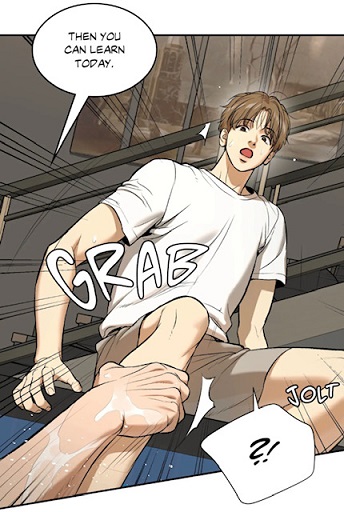 (Chapter 27)
  (chapter 27) Thus we should see a more gentle
  and humorous fighter in season 2. Since he is suspended, he can no longer associate sex with fighting! He has now time to enjoy life. He has someone by his side watching his back. He can now learn how to relax. He should come quickly to the conclusion that his career doesn’t represent his life. He could do other things. He is no longer fighting against time, as the latter has been suspended: 3 MONTHS! The god Saturn, Kim Dan, will teach him the true value of time. And that’s how Park Namwook will lose his boy to the physical therapist.
PS: I hope, this essay made you looking forward for season 2.
Feel free to comment. If you have any suggestion for topics or manhwas, feel free to ask. If you enjoyed reading it, retweet it or push the button like. My Reddit-Instagram-Twitter-Tumblr account is: @bebebisous33. Thanks for reading and for the support, particularly, I would like to thank all the new followers and people recommending my blog.


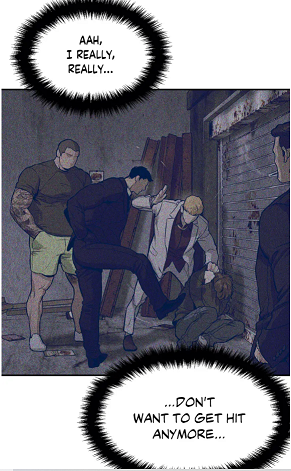 (chapter 1) The problem is that Kim Dan blamed himself for his suffering, as he must have often not paid the interests on time. That’s the reason why he got surprised, when he saw his enemy in front of his humble home.
  (chapter 1) Due to the lack of rest and time, he didn’t have the opportunity to ponder on his life and even have dreams on his own. Therefore he had no ambition. At the same time, he couldn’t become energetic and proactive due to his low self-esteem and his abandonment issues.
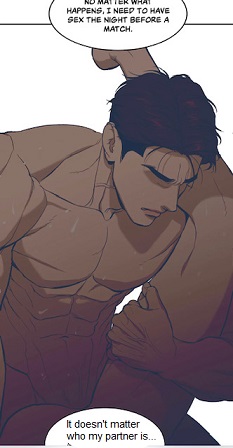 (chapter 2) I selected these two images, because they refer to their respective past and jinx. Both represent bad and painful memories, hence they contain a grey veil. While one is hurt physically, the other is suffering emotionally.
 (chapter 29) The vision about his opponents is mirroring his own reflection. That’s how he views himself. He is surrounded by enemies who will attack him, as soon as he exposes any weakness. Thus it is normal that he is always on the alert. Episode 29 divulged that he was on survival modus. Consequently, it is not surprising that he could trust no one. Should one get too close to him, the former could become a traitor in the last moment. Moreover, this interpretation explicates why he has been so rough on his own body. First, he considered pain as a normality, the side effect of his profession and as such his corruption. In addition, he didn’t have the time to take care of his wounds, for he could get “killed” at any moment. Surrounded by this wave of “rotten bodies”, he imagined that once defeated, he would be swallowed by darkness and literally vanished. This vision displays another important aspect of the athlete’s philosophy. His job is not connected to fun and dream, but to work and nightmare. And now, you comprehend why I selected this panel in the middle of the illustration.
 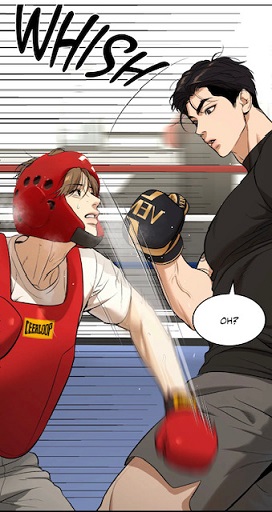 (chapter 26) This represents the highlight for the first season. For the first time, both characters had fun together. That’s how they got one step closer to each other. The fighter was enjoying this moment, as he was teaching Kim Dan to become more proactive and fight for himself. The sparring represents the opposite version of the athlete’s vision (chapter 29). He felt safe next to Kim Dan. In fact, his presence boosted his confidence.
 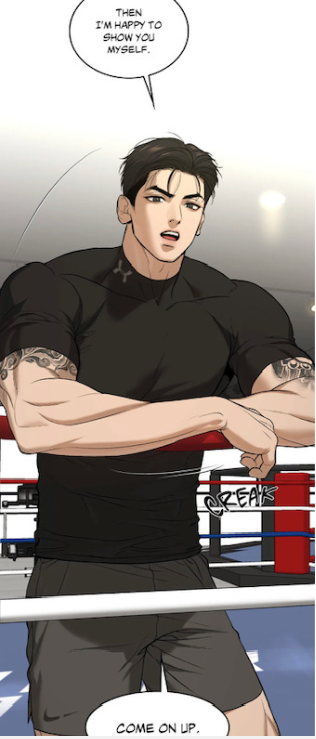 (chapter 25) It is no coincidence that he employed that expression in front of his fated partner. To conclude, chapter 26 stands for life and happiness, proving that their life is not cursed per se. Consequently, red was the dominant color of this chapter. This pigment stands for love and life. Both felt alive during that day. Moreover, we could see glimpses of the sportsman’s true psyche as well, when he proposed to spar with the main lead. He desired to help the doctor himself. Hence he acted as his mentor and teacher in the ring. There, we could see his generosity, interest and open-mindedness. He wasn’t looking down on the doctor, he saw him as a true member from Team Black.
 (chapter 29) He has no one by his side. And this observation leads me to my next interpretation. The existence of Joo Jaekyung’s belief is exposing Park Namwook’s neglect and bad management and coaching. We could say that he is partially responsible for the champion’s misery and bad luck. Therefore it is no coincidence that the sparring took place during his absence.
  (chapter 26)
 (chapter 49) But why hasn’t the athlete confided to his manager yet? First, homosexuality is definitely a taboo among boxers and MMA fighters. Their masculinity and strength are questioned. Secondly, his coach views him as a spoiled brat.
  (chapter 7) Thus he keeps beating the celebrity.
  (chapter 26)
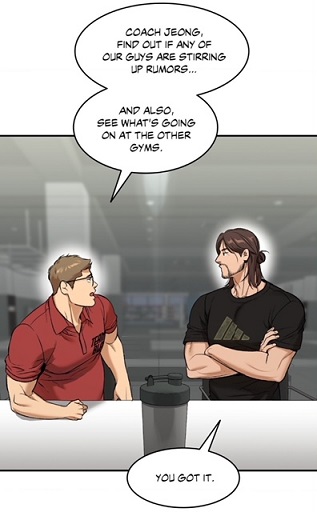
  This shows that Park Namwook has no real respect for the champion. According to my theory, the athlete comes from a wealthy family, hence he is labeled as “spoiled kid”. Due to his social status, the manager can only judge the main lead as “lucky”. Besides, he is successful, for he earns a lot of money and has many fans. He embodies the “American Dream” perfectly. He has everything to be happy in the manager’s eyes. Therefore he couldn’t comprehend the bad mood from the champion. Moreover, Park Namwook embodies social norms and prejudices, and he has many about his star. Not only the latter has a bad temper, but also he is a stubborn workaholic.
  (chapter 27) But by portraying him like that, the coach gave us a justification why he wouldn’t converse with the gym owner. Why should he talk or listen to Joo Jaekyung, if the latter is stubborn and obsessed with his work? It is pointless. And such an attitude could only get reinforced in this scene:
  (chapter 46) Yet, according to my interpretation, the main character’s departure was not the sign of stubbornness, but rather of fear and avoidance. Since the manager doesn’t know his star that well, he judges him based on appearances. Moreover, I believe that he has the tendency to generalize, just like certain readers. Since the athlete beat a doctor and was quite brutal with a fighter, he is stigmatized as “thug” or a “spoiled kid”. I am suspecting that the way the hyung met the celebrity affected his perception about the young fighter.
 (Chapter 26) Oh Daehyun repeated this story, because he had heard it from someone and that can only be from the manager and coach. And it is the same for Kim Changmin either, for the two aren’t long members from the gym. They are not close enough to know the celebrity’s past. These stories must have been spread by the hyung. In my eyes, Park Namwook views himself as Joo Jaekyung’s savior, because Joo Jaekyung
  (chapter 26) could have become a criminal. Nonetheless, it is an illusion, for MFC is connected to the underworld.
 (chapter 46) Despite his attitude, Joo Jaekyung still listened to his hyung’s warning, for from that moment on, he kept his distance from everyone, including the physical therapist. But there’s more to it. Park Namwook keeps associating his star with “good luck”.
  (chapter 1)
  (chapter 27) This represents the exact opposite of the star’s jinx. It shows that he is not trying to understand his celebrity. With such a mind-set, it is normal that the champion wouldn’t trust his manager. And the absence of the manager in this panel
  (chapter 33) The latter truly worries for his star, although he is well aware of his shortcomings.
  (chapter 30) In addition, he knows about his private life and love life.
  (chapter 31) Despite his struggles, he accepts his actor. This is the symbol for unconditional love and support. Therefore it is not surprising that Choi Heesung confessed his trick. He was sure that his right-hand wouldn’t betray him. What about the champion? When the latter discovered the verity
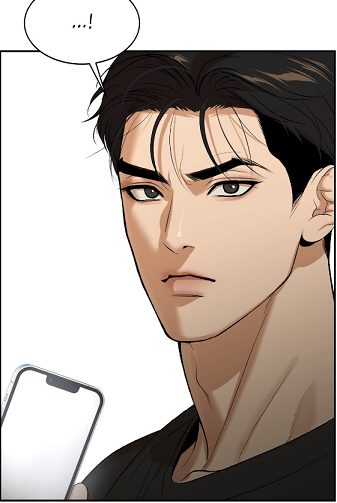 (chapter 33), he didn’t report it to his hyung. He also kept it a secret. That way, he was not only protecting Kim Dan’s misdiagnosis, but also Park Namwook’s misjudgment. On the other hand, he acted as a real boss, for the comedian is an important client.
  (chapter 40) However, he is far from being a honest man. How so? First, he describes himself as the owner of the gym which is not true.
  (chapter 22) He is just the director of the company. In addition, he is talking big, but he never delivers. But keeping his word is an important condition for a good manager in Myles Jury’s opinion. Park Namwook threatens the members, but in the end, no one is fired by him. He is not following through what he says, he doesn’t keep his promises. I will give you a few more examples.
  (chapter 23) He promised the fighters that they would win, but the reality is that they failed terribly.
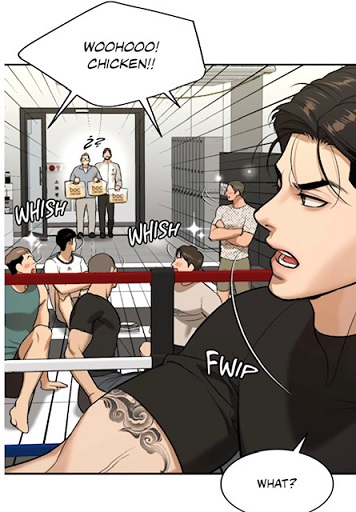
  (chapter 47) Therefore he bought chicken for them. Instead of showing compassion and understanding for his hungry and miserable champion, he allowed Potato and Oh Daehyun to buy junk food behind the celebrity’s back.
  (chapter 37) This shows their lack of mental and emotional support. For me, Park Namwook symbolizes ignorance and blindness. Therefore he is portrayed with no eyes.
 (chapter 23) He never confronted the members with the truth. They lack skills
  (chapter 46) or endurance. I would even say that neither Park Namwook nor Jeong Yosep had high expectations for the other members from Team Black
 (chapter 46). It was, as if they didn’t have the goal to create a new champion. How come? It is because the gym was initially created for Joo Jaekyung’s needs. And now, Jinx-lovers comprehend the dilemna. Team Black needs to redefine itself and its purpose. Moreover, Park Namwook’s true wish is to open the gym for “kids”. And that’s how he treated the staff from Team Black, like little kids. No wonder why many left the gym in the end. They didn’t feel truly supported by the manager and coach. Jeong Yosep and Park Namwook didn’t put any real effort to turn the members into professional fighters. That’s the reason why none of them had a MMA manager, only a coach and nothing more.
  (chapter 49) He claimed to trust the champion, but the reality is the opposite.
 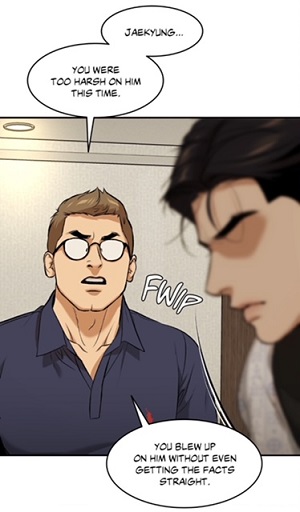 (chapter 52) He blamed Joo Jaekyung for everything: the tie, the doctor’s departure, the suspension and as such the loss of his good reputation. However, even if the champion had vented his anger onto the physical therapist wrongly, he had reasons to doubt Kim Dan. He had not only received the pictures, but he had been warned by the coach himself to doubt the members’ loyalty. There was a spy and a traitor among Team Black. One detail in the last panel caught my attention is the idiom “facts”. It is in plural and not in singular. Fact could be seen as a reference to his own warning, he had not checked the fact either (rumor, suspected disloyalty), yet this is not what he meant. Potato had exposed only one fact to the group: the switch of the spray organized by Choi Gilseok.
 (chapter 52) So what other fact was Park Namwook referring to? The fighter Baek Junmin and director of King Of MMA had paid Kim Dan. This shows that he had heard the conversation between the two protagonists.
 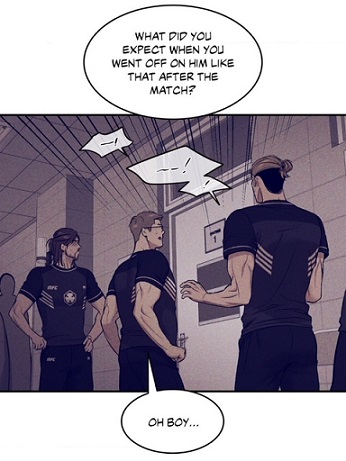 (chapter 52) And what did the manager do, after the champion had left the room? He abandoned Kim Dan, followed by the other men. At no moment, he asked Oh Daehyun or Yoon-Gu to take care of the physical therapist. But by following the celebrity or remaining passive, they had implicitly supported Joo Jaekyung’s decision. They had taken his side. And now, you comprehend why all these men chose to put the whole blame on the celebrity.
 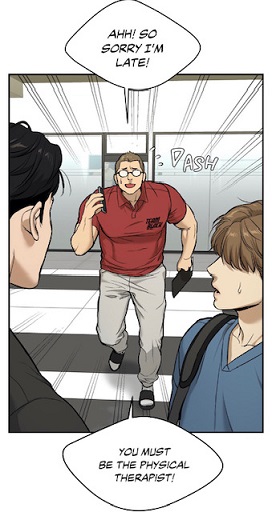 (chapter 1)
  (chapter 49) He should be responsible for his contracts, yet the reality is that the Entertainment agency is the one managing the champion’s career.
 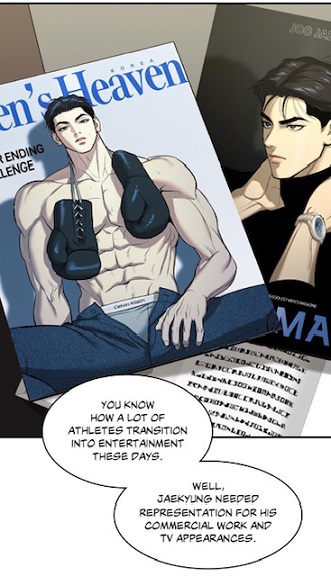 (chapter 30) This shows that Park Namwook doesn’t have a lot of connections. He should be the one organizing the fights, but no… others are making the propositions (MFC matchmaker and agency). Consequently, the ex-wrestler often voices doubts about the matches.
  (chapter 41) However, as his manager, it is his duty to protect his star, as the career of a MMA fighter is rather short. Imagine, he let Joo Jaekyung fight three times within 3 months (April- June- July). It is definitely too much. To conclude, he is not doing his job properly, as he is trying to put a lot of responsibility on others (Kim Dan- Joo Jaekyung – the Entertainment agency). According to Mingwa, Kim Dan had been taking care of administrative tasks. However, as the director of Team Black, he should be the one handling it. After the incident at the health center, Park Namwook didn’t contact the press to explain the whole situation.
 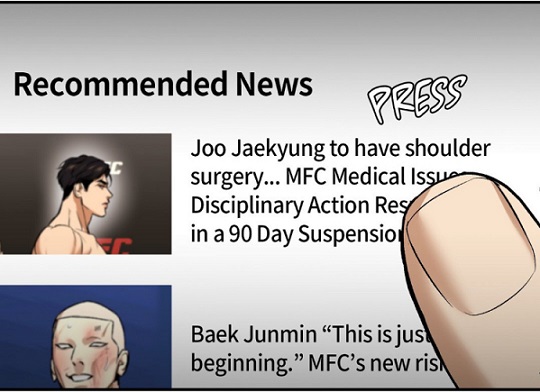 (chapter 52)
 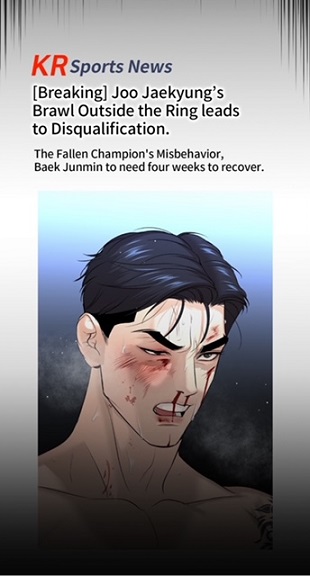 (chapter 52) The article is indicating that the champion was quickly judged and this within a few days. The article implies the non-intervention of a lawyer or his manager. No one sided with the celebrity. They are not even contacting the media.
 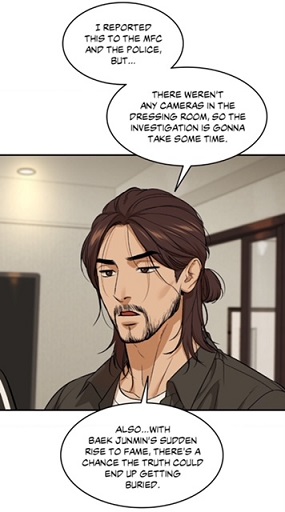 (chapter 52) Park Namwook never tried to correct this negative reflection, for this is how the manager perceives the man himself. He is an ill-mannered child. This explicates why Park Namwook could slap the patient in his bed. So we should judge the argument between the fighter and his manager
  (chapter 52) as the negative reflection from that blue night.
 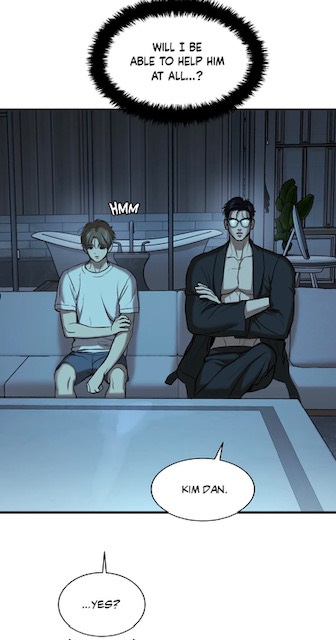 (chapter 29) He is not standing next to the main lead, but he is facing him. He is like an opponent. Another divergence is that Kim Dan was alone, whereas Park Namwook utilizes Potato and the others from Team Black to corner Joo Jaekyung. The doctor was willing to listen to him, whereas the other gets upset, when the other admits his suffering. Since the gym is facing a crisis, the patient should find a solution to the problem.
 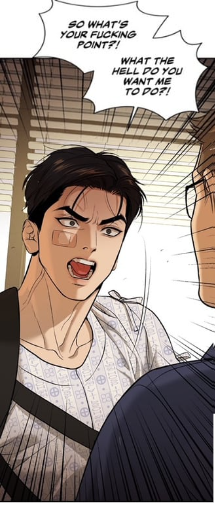 (chapter 52) The hospital is a place for reconvalescence, rest and not work and pressure. Indirectly, it shows the coach’s lack of respect for the medical world. The champion was right to criticize his hyung, for blaming him was totally pointless. He couldn’t turn back time. The manager desired to hear from the champion
  (chapter 52) that he regretted his decision and outburst. By admitting his mistake, he would have become responsible for the whole mess. Funny is that he asked compassion from Joo Jaekyung, whereas he showed none to the patient. And what was Kim Dan thinking during that night?
  (Chapter 53) Moreover, he had not earned his patient’s trust. Kim Dan was the only one paying attention to his injured shoulder.
  (chapter 52) And the only solution he offers to the gym owner is to find a new PT during his a break.
 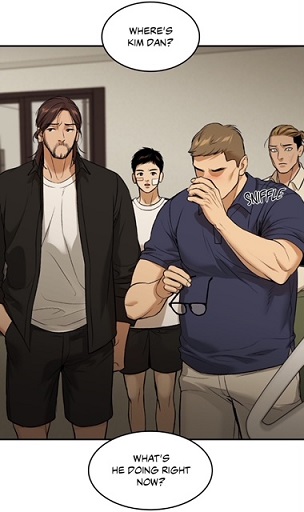 (chapter 52) resembles a lot to the image with the opponents.
 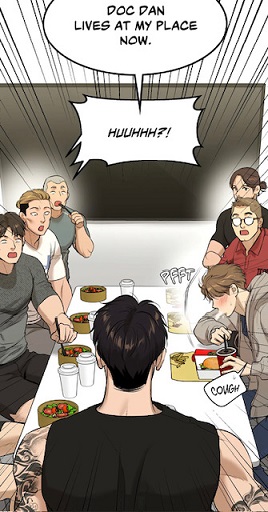 (chapter 22) Besides, by announcing it in front of this circle, the champion divulged that there existed a certain distance between the manager and the sportsman. Finally, the fact that Park Namwook is still left in the dark about the fighter’s jinx is the evidence that he is a really bad manager. For me, it is because he is afraid of making decisions. He lets other take his burden and responsibilities. Yet, Myles jury declared that a manager needs to take a lot of responsibilities. The gathering in the break room stands in opposition to this one:
 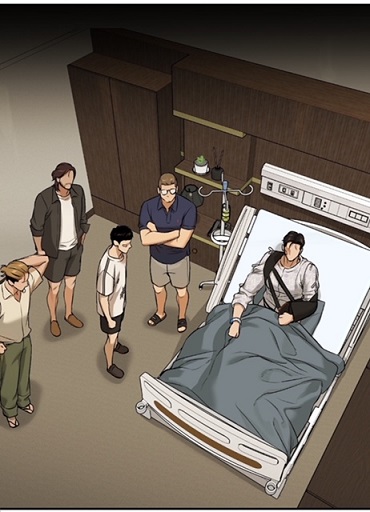 (chapter 52) For the first time, the champion is no longer looking at his cellphone. He shared his thoughts to others and exposed his powerlessness
 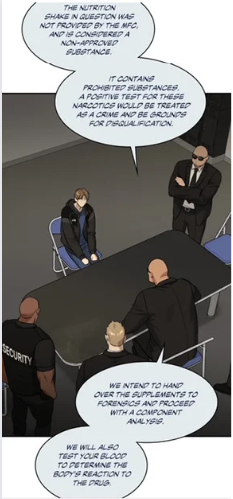 (chapter 40) These two situations have many similarities. Both were confronted with an accusation, they were surrounded by people, who were acting as righteous and honest workers. Both were coerced to admit a wrongdoing. In addition, they are actually abandoned by Team Black members, especially the manager. No one is looking for them out of concern. The reality was that they were not their “true colleagues and even less friends. However, like mentioned in a previous essay, the men in black were actually covering up a crime in order to hide the corruption from the organization. This makes me truly wonder if Park Namwook is truly ignorant about MFC’s corruption. He could simply know about the crimes, but he chose to close an eye to the whole situation.
  (Chapter 46) He is already aware of the existence of illegal betting. Besides, since Joo Jaekyung is paying his taxes properly, Park Namwook could have the impression, he is doing nothing wrong. However, if he knows something and is remaining silent, he “becomes an accomplice” de facto. And what is the other common point with the interrogation from MFC security guards and the hospital visit? No lawyer and the incident was swayed under the rug.
  (chapter 40) He had rescued him. So by slapping the champion
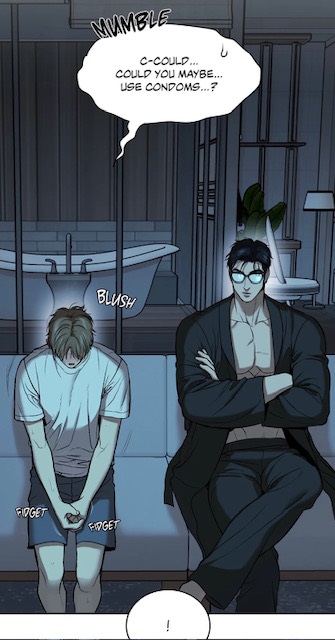 , (chapter 29), I deduce that the slap had the opposite effect than this wonderful night. The gap between the hyung and the athlete got bigger. This represents the moment where Joo Jaekyung is emancipating himself from the hyung’s influence. By refusing the letter of resignation, he clearly indicates that he is rejecting Park Namwook’s suggestion.
 (chapter 30), but failed due to his roughness and cowardice. Hence I assume that the slap was the trigger for the champion to switch Park Namwook’s position with Kim Dan’s. The latter is finally recognized as a friend and even as a competent physical therapist. He is on the verge of becoming Joo Jaekyung’s “hyung”. So far, the athlete has been calling the physical therapist “Kim Dan”. And exactly like that wonderful night, Joo Jaekyung will attempt to seek the doctor’s closeness, resolve the misunderstandings and close the gap between them. He will follow his footsteps, but have a different attitude. Why? It is because the grandmother will be next to them.
 (chapter 37) They imagine that Joo Jaekyung’s recent demise will reinforce his former belief. The prematch-sex session with his regular partner didn’t prevent the misfortune, therefore he needs a replacement. That’s the reason why they made sure to isolate the celebrity. However, they couldn’t be more wrong, for the champion experienced the doctor’s departure as something worse than the whole scandal.
 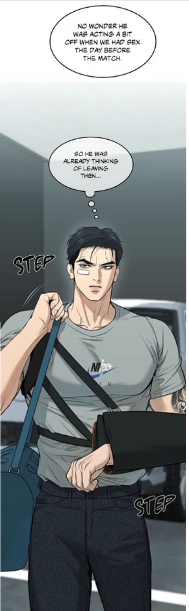 (Chapter 53) This explicates why the idiom “jinx” is not even brought up, when he recalls their last sex session. He is not blaming the doctor for not procuring him a “good fuck”. The reason is simple. It is because he had already made this resolution:
 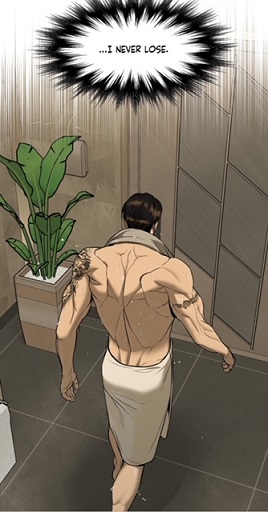 (chapter 49) He was no longer relying on the ritual.
 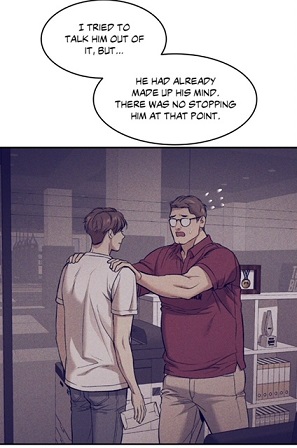 (chapter 53) That’s the reason why the champion has never apologized towards the doctor either. To conclude, the manager had a huge negative influence concerning the sportsman’s mind-set and behavior. Therefore it is necessary for the athlete to distance himself from Park Namwook. That’s how he can get purified. On the other hand, the last incident was essential for the star’s growth. Since the latter hasn’t questioned the integrity of MFC yet, he needed to be suspended in order to realize that his perception of the world was wrong. Though he lost his reputation, he is experiencing that his defeat is not the end of the world. The doctor’s departure was more painful for him. Therefore it was necessary for the champion to make a bad decision. Only through pain, the athlete can turn into a better man. Since Kim Dan left the city for the west coast, I assume that the champion will follow him there. He will reconnect with nature.
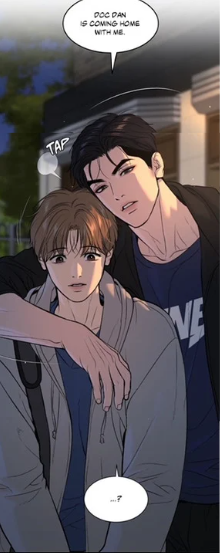 (chapter 43) So when he discovers the empty bedroom, he is forced to admit that he had become a part of his life. He had liked Kim Dan’s company.
  (chapter 19) Yes, we should see episode 53 as the negative reflection from chapter 19, the doctor’s arrival at the penthouse.
  (chapter 19)
  (chapter 53) Here, what Kim Dan saw was not the real sunset, but the lights from the cameras. Far away from the lights from the journalists, the champion will witness the beauty of a sunset, which can not be bought with money.
  (chapter 37) or sightseeing attractions. Here, I feel the need to add this French song from Daniel Balavoine (1985): “Aimer est plus fort que d’être aimé” (Loving is stronger than being loved”).
 (chapter 21). By interacting with Kim Dan, he will be able to reconnect with his true self which will change him forever. Notice that after the night in the States, at no moment, the champion mentioned his jinx, but spoke about his physical health. In reality, he was including his mental health. This shows that he was already moving on from his jinx. Moreover, after the tie and the suspension, he is not mentioning or thinking about his former belief. The reason is simple. Because of the doctor, the champion was allowed to perceive glimpses of the truth: corruption and the existence of tricks. This image
  (Chapter 48) represents the medicine against the champion’s false belief. Moreover, by making him meet his former rival Baek Junmin, the athlete was incited to overcome his past and biggest fears.
 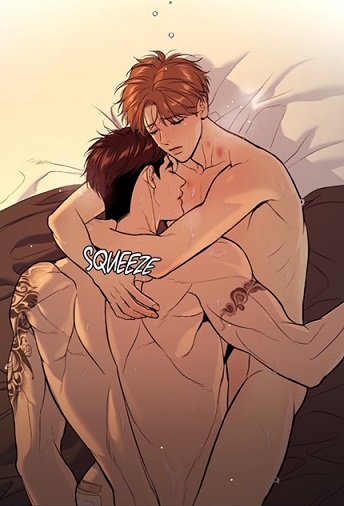 (Chapter 44) So he was able to create good memories. Besides, he came to fall in love with Joo Jaekyung. Thanks to the latter, doc Dan could overcome his fear
  (chapter 26) and make others happy too.
  (chapter 26) He didn’t realize that he brought joy and love to the gym.
 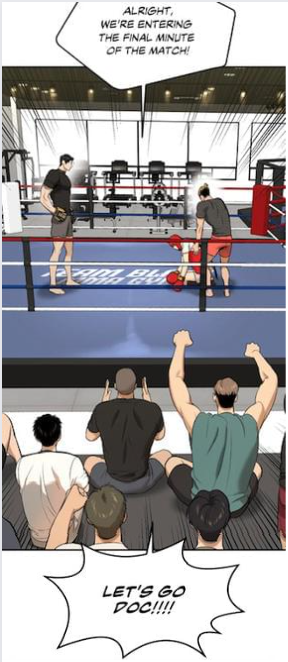 (chapter 26) The more he spent time with the celebrity, the more confident he became. He was able to voice his opinion and he started becoming more passionate about his job as PT. He studied sports rehabilitation, a sign that he was taking the champion’s career seriously. So when he wrote these words to his soulmate
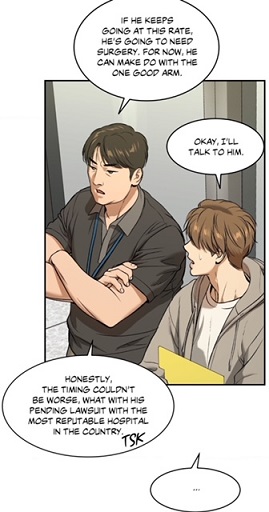 (chapter 42) This shows that his self-loathing is gradually vanishing as well. The fact that he is employing the personal pronoun “I” indicates that he is able now to distinguish himself from his grandmother.
  (chapter 53) Slowly, he was drawing the line between his private and professional life.
  (Chapter 53) Here, I feel the need to remind my avid readers that though the doctor was victim of a trick, he was not entirely innocent either. He should have come clean with the champion concerning his meeting with the director from the rival gym. His lie still played a huge role in the champion’s mistrust. But why did he not tell him later? It is because he was under the influence of the manager.
  (chapter 48) The hyung had been his mentor and advisor. Thus he copied his actions and followed blindly his recommendations.
  (chapter 41) At no moment, he questioned his words and honesty.
  (chapter 43) How could the athlete be kinder to his own body, when his hyung was slapping him constantly? He was definitely pressured by the former wrestler. This shows that the 29 years old man is lacking critical thinking. On the other hand, we can not blame Kim Dan for trusting the man so blindly, as Joo Jaekyung was behaving the same way. Yet, the fact that Kim Dan cries
 (chapter 45) Both knew how the champion disliked the birthday and the gifts, but they still chose to ignore the man’s feelings. He believed every word Park Namwook said about the champion in the end. Hence for me, the doctor’s decision to quit was not simply the consequence from champion’s request and reproach, but also from the manager’s indifference and ignorance. At no moment, he contacted him showing that he was necessary for Team Black. His silence and passivity could only be interpreted as a disapproval and rejection.
 (chapter 44) The intimacy is rather superficial, for it is limited to pleasure and sensuality. This has nothing to do with the partner’s personality. Secondly, during that night, the champion was drunk. In season 1, both protagonists only discovered physical closeness without sharing their thoughts and emotions
  (chapter 44) .
  (chapter 44) He never told the athlete that he was so cute or handsome. He kept his thoughts and happiness to himself. The only moment they shared real intimacy was this night:
  (chapter 29) Moreover, during that sex session, the athlete employed dirty talk.
  (chapter 29) It was not to express affection.
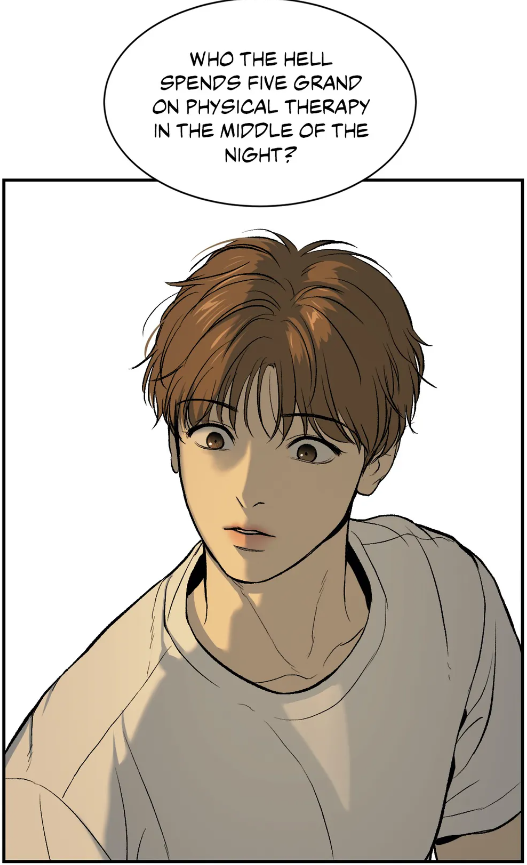 (chapter 2) prostitution and rough sex. He never experienced true romance and the birth of “first love”. The courting and seduction were totally absent. His first kiss is connected to fighting, pain, survival and protection.
  (chapter 14) It had nothing to do with innocent and pure love. For me, Kim Dan didn’t have the time to fall in love with the champion properly. He could even say that his affection is related to his job and he could reduce it to mutual physical chemistry. Thus I deduce that he became a ghost again for one reason. Both need to experience the innocent first love. In other words, we should expect a new version of this magical night:
  (chapter 20) Till that moment, he lived like a ghost. He had been trying to deny the existence of his own body. And how did the athlete describe his lover in the bathroom? First, he compared him to a whore
  (chapter 44) There should be no drug or no time pressure!! However, there exists another reason why I have such an expectation. First, the grandmother should be close to them. Her presence should represent a hindrance, as the latter is falling back into childhood. Secondly, right from the start, Joo Jaekyung was under the spell from Kim Dan.
 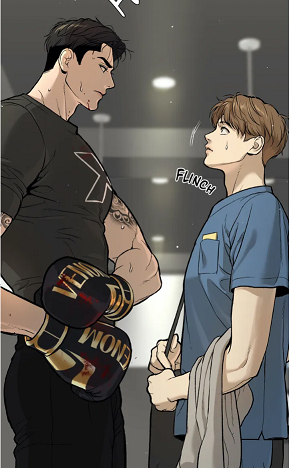 (chapter 1) He was so attracted to him physically, hence he didn’t pay attention to his partner’s personality. In fact, he had a negative perception of his nature:
  (chapter 1) By becoming a ghost, the champion is forced to perceive the main lead as a person and as such to pay attention to his personality (dislikes, likes, qualities, career). That’s the reason why I believe that in season 2, he won’t make the same mistake again. He will study the doctor and get to know him better. That’s how he will be able to identify his feelings for the protagonist. He doesn’t love him because of his cute face and body, but because of his big heart and warmth. He is so responsible, generous and dedicated that there’s no one else like him. He embodies true kindness and loyalty. His care and worries are genuine. That’s why the champion will voice his affection differently from the past: “Secret and innocent love behind work”. Under this new light, it becomes comprehensible why both characters had to go to the seascape. Nature is the perfect place to nurture innocent and pure love. Consequently, I don’t think, the author will rush to create a new chapter full of sex… rather full of tenderness and caresses! Thus Mingwa created such panels:
  The hands are no longer fists used to express anger and resent, but they are wide open, they are expressing love and tenderness. They will convey a different message: respect, teamwork, and communication. Finally, through such gestures, both are able to reconnect. The hands are encouraging them to express their own thoughts and emotions. They are giving them reassurance and confidence. Season 2 stands for sharing, honesty and communication. Expect a revolution at the gym!


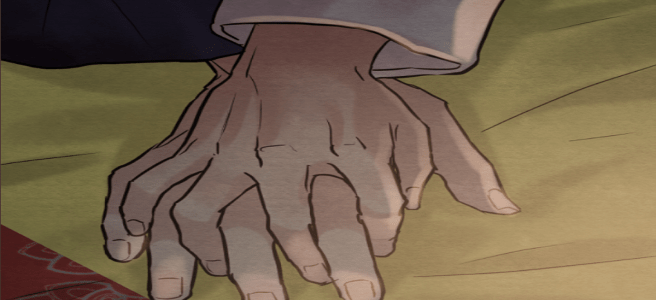
 Yes, when people read juicy deeds, they were already imagining that I would describe a love session like this one
  (chapter 96), because of the expression „to do the deed“:
  (chapter 87) However, the deed is not just related to intercourse, like the manhwaphiles could discover it in chapter 51.
  With „deed“, Deok-Jae was referring to murder and assassination. As you can see, deed has other meanings than sex. Thus it has for synonyms action, accomplishment and reality!! So when I selected this name for the essay, I was thinking of the relationship between action and word. And this connection came to my mind, when Byeonduck released the last picture, because the painter’s action symbolizes a conversation and as such words.
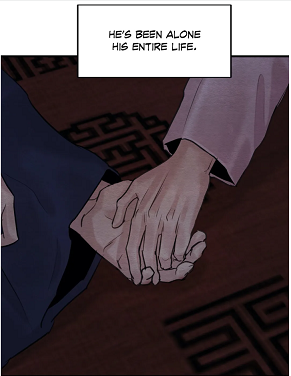 (Chapter 88) By reaching his hand, the painter was letting him know that he was no longer alone in this world. He was not only joining his side, but he was willing to try to understand the main lead.
 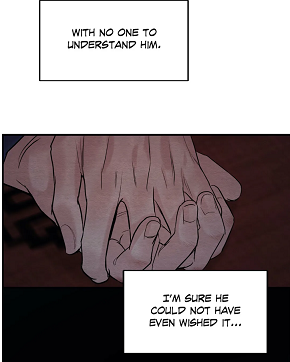 (Chapter 88) This gesture stands in opposition to the situation with Yoon Chang-Hyeon.
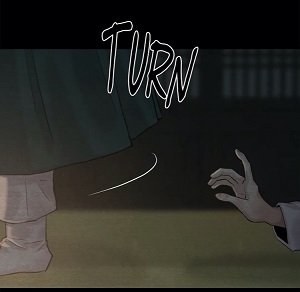 (Chapter 86) During that fateful night, the father neither talked to his son nor looked at him. He even turned his back to him, when the young master attempted to grab his father‘s hanbok. Both scenes from chapter 88 and 86 have two common denominators: an action accompanied with silence!! Yet, what distinguishes them from each other is the nature of the deed, the action. Alliance and empathy versus abandonment and estrangement! This is no coincidence that after reaching his hand, Baek Na-Kyum started confessing his thoughts and emotions to his lover:
 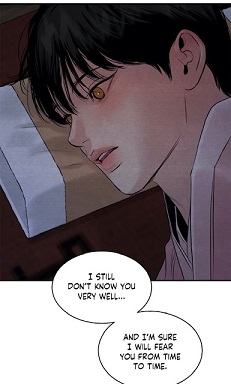 (Chapter 88) As you can sense, the hand gesture delivered a message, but the painter still felt the need to clarify the meaning of his hand. He was willing to remain by his side, but he was still afraid of him. He didn’t want to create a misunderstanding, like for example that he wouldn’t argue with him or that his loyalty was now unconditional or total. That way, Yoon Seungho wouldn’t come to view him as a hypocrite or as dishonest, if an argument would appear. Thus he needed words to explain his position. He would remain by his side and attempt to sympathize with him, but he still felt insecure and had doubts. In other words, his action (his hand gesture) was not truly reflecting his mind and heart.
  (Chapter 88) Later he even asked his lover not to leave his side no matter what.
  (Chapter 88) To conclude, the hand gesture in episode 88 was connected to insecurities and as such fear, yet the painter had shown no hesitation to take his hand. The anxiety was not visible.
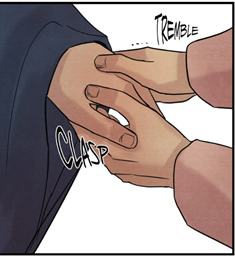 (Chapter 30) His fingers barely grabbed his hand, so when he made the following vow, he was not entirely sincere or better said, truly determined to keep his promise.
 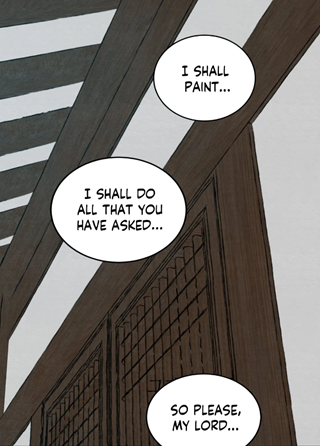 (Chapter 30) The words were not truly in unison with the gesture either. Therefore he once tried to leave the mansion in season 2. When he pledged loyalty, his intention was to protect his teacher. To conclude, fear has always been present, when the painter took Yoon Seungho’s hand. Even in chapter 88, but contrary to the scene in the courtyard, his hand was not shaking.
  (Chapter 82) This explicates why the artist chose to remain by his side, though the lord had broken his promise.
 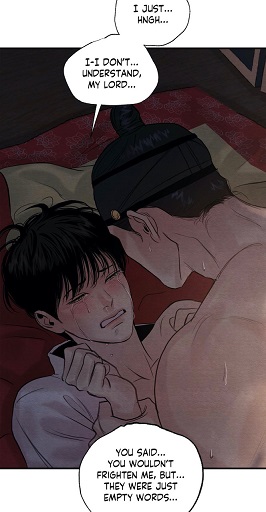 (Chapter 82) On the other hand, in this scene
  (chapter 82), the lord was grabbing his lover’s hand out of fear. He was recognizing his mistake and was trying to beg for his forgiveness, though he couldn’t express it directly. Striking is that during the lord’s flashback, his hand was trembling as well, grabbing onto his partner’s body.
 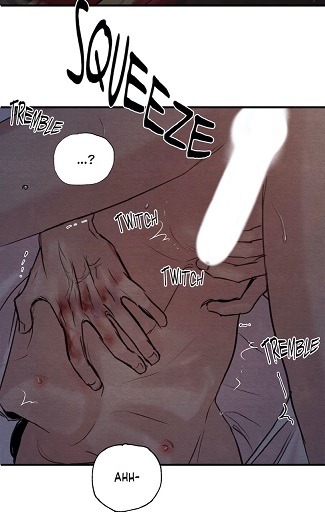 (Chapter 81) It was, as if Baek Na-Kyum was his rescue buoy, helping him not to be swallowed by the darkness. Thus I came to the conclusion that the protagonists’ hand gestures are all connected to anxiety and pain. 😲 Hence I am deducing that in this scene, Baek Na-Kyum is holding his lover’s hand,
 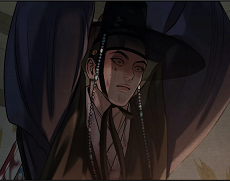 (Chapter 102). This would have definitely scared Baek Na-Kyum, especially Yoon Seungho’s haunted gaze. On the other hand, since the painter had been himself the victim of physical and sexual abuse, the artist can only grasp why the noble reacted that way: fear, anger, despair and heartache. The artist had also been desperate, in pain and scared in the shrine, though this time, he had not screamed for his help. Since the lord had not returned to the mansion, how could he expect him to come to his rescue?
 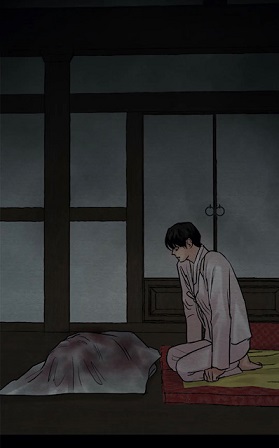 (Chapter 98) Back then, he had been waiting for his lover‘s return and explanations. He wanted to hear him and get his reassurance and comfort. .
 (Chapter 98) The latter couldn’t reassure the painter with his hand contrary to the previous night.
  (chapter 97) Exactly like mentioned above, the painter’s hand gesture is connected to fear and conversation.
 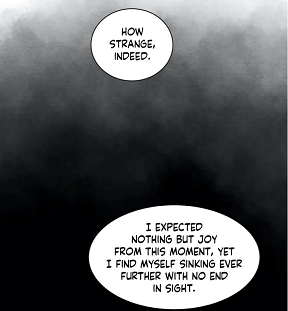 (chapter 97) Striking is that in the gibang, the lord confessed his biggest fear to his future “spouse”. He feared to lose him, though one of his biggest desires had been finally fulfilled. This means that Yoon Seungho felt even more insecure and frightened than before after receiving the artist’s love confession. That’s the reason why I believe that the new picture is standing in opposition to the scene in the gibang. The lord will feel relief after his admission. As a conclusion, the image is announcing
  (Chapter 89) While the painter was sitting on his partner’s lap
 (chapter 89), he was massaging the wounded fingers. It was, as if he was treating his companion’s wound. Note that after his terrible flashback, the painter had avoided to grab his hand out of fear that he might hurt Yoon Seungho even more.
  (Chapter 84) Therefore I conclude that the new panel is an allusion to treatment. While in episode 89, the painter was acting as a doctor, in the new image, the young man is working more like a counselor or psychologist. The aristocrat’s hand might not be wounded in that scene, but this is not the case for his heart and mind. So for me, this scene is connected to mental treatment.
 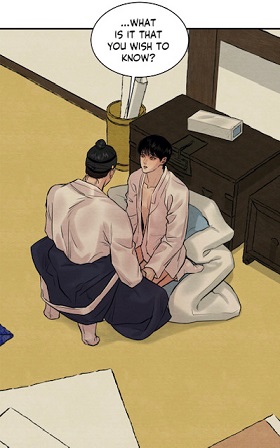 (Chapter 84) However, the lord had refused to open up. This is no coincidence that the author had not created such a picture during that chapter. As the manhwalovers can detect, I believe that in that scene,
 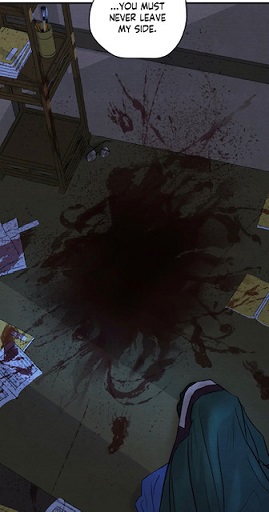 (chapter 88), and this, although the lord is indeed a murderer. For Baek Na-Kyum, his gesture will have a different meaning: he saved his life and freed him from his torment. Secondly, if the lord reveals the circumstances of his mother’s death, the artist will definitely deny his responsibility in her death, a new version of this scene.
 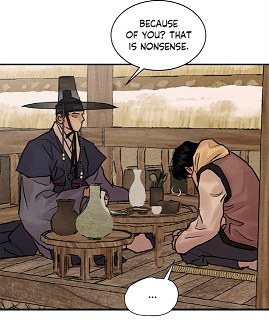 (chapter 75) And because I detected a discrepancy between words and gestures, I recognized the presence of another trick from Byeonduck.✨
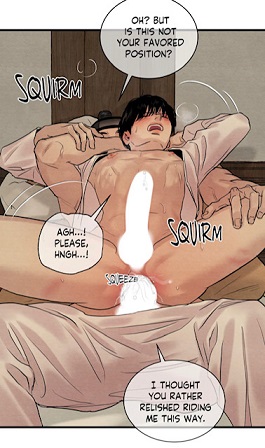 (chapter 91), the latter denied this with the following statement.
 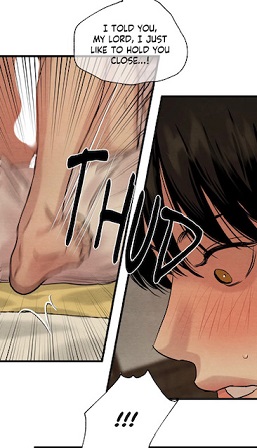 (chapter 91) But when did the painter admit that he liked embracing him? In this panel!
  (chapter 88) That’s the reason why the lord got surprised and moved. As you can see, the author never revealed this whispering to the manhwalovers! The latter had the impression that the lord’s reaction was related to the loving embrace, but it was only partially correct.
  (chapter 62), when the lord had confessed to adore him.
 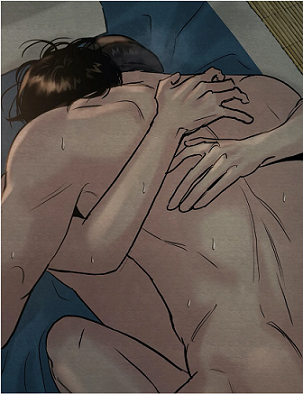 (chapter 62) This explicates why Yoon Seungho was so pained in season 2. He got embraced, but there were no words. Consequently, when the painter vanished during that night, the lord could only perceive the embrace as hypocrisy and fakeness. That’s how I realized that the story is developed on the contradiction between words and actions. But not only that, there exists a strong link between silence and passivity. Thus after the abduction in season 2, Baek Na-Kyum remained more or less silent
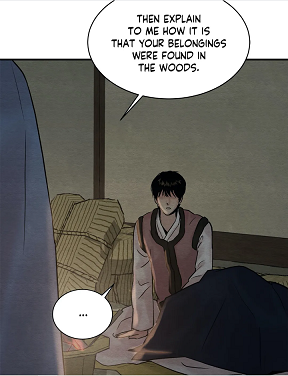 (chapter 62), and as such he was totally passive. He never stood up and begged the lord for his leniency. He stayed there on the bed giving the impression that he was indifferent. That’s the reason why Yoon Seungho got more enraged, for he felt fooled. This means that the absence of words represent inaction… This explains why Yoon Seungho had to corner the main lead in chapter 48
  (chapter 48) to say something, as he had sensed his passivity behind his „submissive attitude“. This is no coincidence that during this night, the painter felt extreme pleasure to the point that he peed. Therefore he could voice his wish to Yoon Seungho during the love session from season 2.
 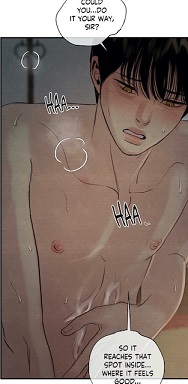 (chapter 73) That’s how the lord concluded that the painter liked riding him, while in reality such a climax had appeared for the first time, when both were facing each other!
  (chapter 49)
 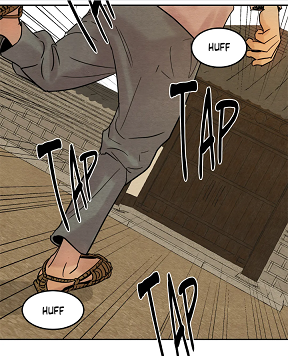 (chapter 4) than season 2. He was encouraged by his future partner to speak up, yet the moment he got heartbroken, he was left speechless. And note that when the lord played his prank in the bedchamber, he never said anything to his father.
 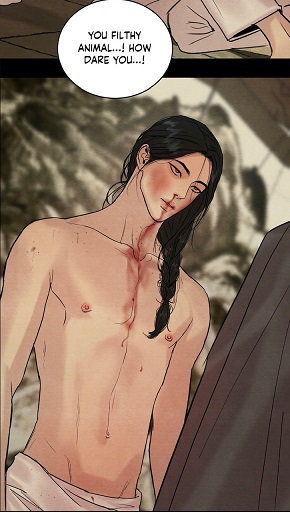 (chapter 83) He didn’t move as well. Why? It is because he knew that talking to his father was pointless. However, Yoon Seungho had hoped that with his prank his father would finally see the truth. He had been fooled by Lee Jihwa and father Lee!! But the stupid father never realized it. As you can see, the lord had in that scene long given up to use words, he hoped that his father would see the truth with the prank. Don’t forget that deed stands for truth and reality. He thought that “actions would speak louder than words”, but he was proven wrong. This signifies that in this scene,
 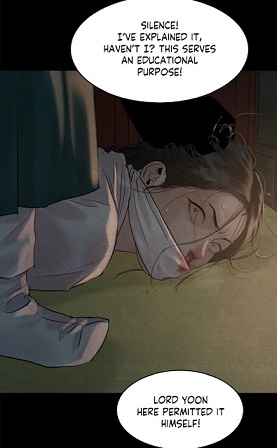 (chapter 86) Yoon Seungho had acted the opposite, he had tried to speak up, but he had been muted. I am also thinking that the young master must have attempted to converse to his father
 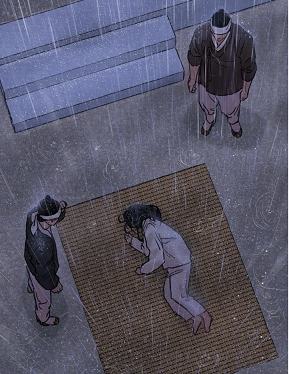 (chapter 77) here as well, but the lord had not listened to him. Why? It is because Kim had said nothing!!
 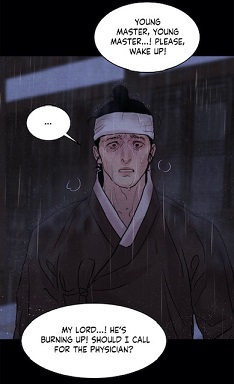 (chapter 77) Silence was considered as an admission. This is no hazard that the butler didn’t take care of his young master. This scene symbolizes the quote “Actions speak louder than words”
  (chapter 77) The butler had betrayed the young master’s trust, for he had not intervened. He should have defended Yoon Seungho, but no in fact he had sided with the elder master Yoon once again. Not only he had not reminded Yoon Chang-Hyeon of his promise, but also he had assisted the ruthless father by giving himself the straw mat beating!
 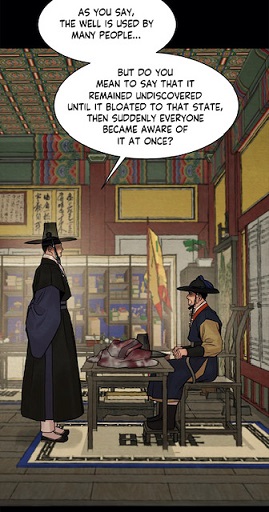 (chapter 98) Here, he examined the robe and questioned the officer. The problem is that he was still relying on his staff and as such Kim. Therefore it is not surprising that he could still be manipulated by the schemers. Hence I am anticipating a total change in season 4. By conversing with the painter, the lord can only become more proactive to the point that he will be able to ruin the next schemes. I am even expecting a prank from the protagonists in season 4!! But this doesn’t end here. I am deducing that in the past, Yoon Seungho suffered because one tormentor would do things and say nothing, while the other would talk a lot, but act the opposite!! For me, these descriptions fit to Kim and the pedophile. I have the impression as well, that both characters came to switch their behavior. In one circle, Kim did many things, but remained mute, but later he did the exact opposite. I would like to point out that in season 3, he acted this way. He would promise loyalty to the lord,
  (chapter 77), but backstabbed him in the shadow. Besides, we shouldn’t forget that a narcissist’s words don’t match their action, because they are pathological liars. And so far, I had portrayed father Yoon (overt), Kim (covert) and even Jung In-Hun (overt) as people suffering from NPD. And I am assuming that the mysterious lord Song is not different from them, though I am suspecting that he must be a covert type.
 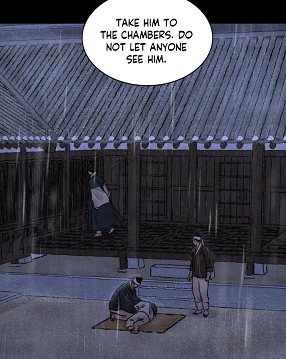 (chapter 77) Besides, it also snowed, when the painter got abducted twice, a sign that actually a promise had been broken.
  (chapter 102) He is no longer following social norms. This could only happen, because the lord had just committed a huge crime. What is the point to respect laws and tradition, when he became a murderer? Any other transgression can only appear as harmless. That’s the reason why I am expecting that Yoon Seungho decides to disregard social norms from that moment on and play a prank on the “villains” of this story.
  (chapter 76)
  (chapter 53)
  (chapter 87), while the same extremity symbolizes the opposite with the villains and antagonists: violence, silence, submission
 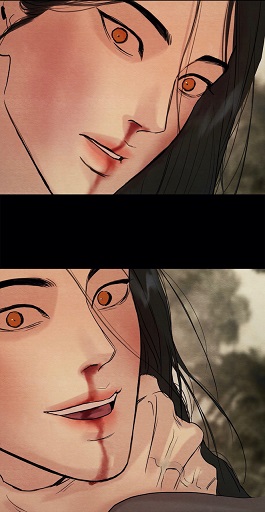 (chapter 83), hatred and resent
  (chapter 97) Here, Heena was hurting her brother, because she wanted him to face “reality”. What caught my attention is that we never saw the father’s hand in chapter 86!
  (chapter 86) Why? It is because it reveals his powerlessness. And this leads me to the following conclusion: the deed stands for reality and honesty, while the words symbolize emptiness, illusion and deception. And now, you comprehend why this work is composed by the dichotomies: dream, words and mouth versus reality., action and the hand. This means that in season 4, the manhwaphiles should try to analyze the thoughts and emotions of the characters behind the hand gestures. At the same time, they can also verify if my interpretation is correct. Is the zoom of the protagonists’ hand connected to fear, confession, empathy and assistance?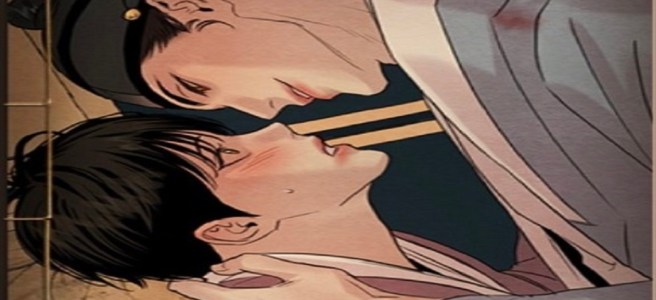
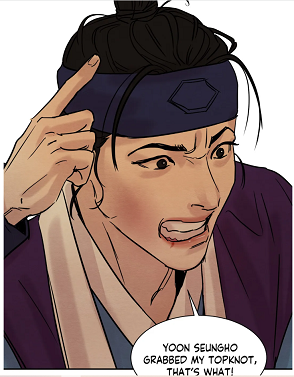 (chapter 9)
 (chapter 1) This means that no one had witnessed the wrongdoing committed on the anonymous lord. However, it is important, because it exposes how a person committing a wrongdoing could escape scolding and punishment, even from the readers. There was no witness! Only an attentive reader could detect this. Hence you have the explanation why Yoon Seungho suffered for so long. There was either no witness or the persons chose to close an eye and remained silent. Since it was the negative reflection from Baek Na-Kyum’s slap and the main lead had used his right hand
  (chapter 11), I deduced that the culprit was left-handed. That’s how I could identify the culprit, lord Min. The lord was in reality left-handed. We could observe this in chapter 8
 , episode 19
 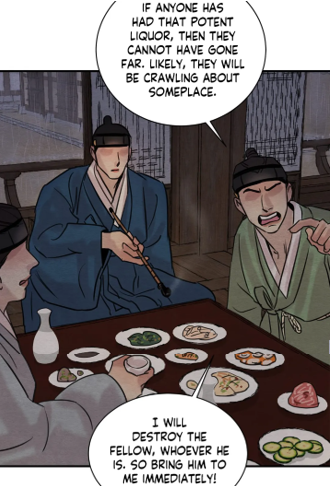 , chapter 33
 and episode 43
 , but also in episode 76
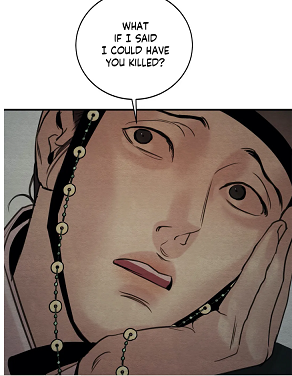 , in chapter 96
 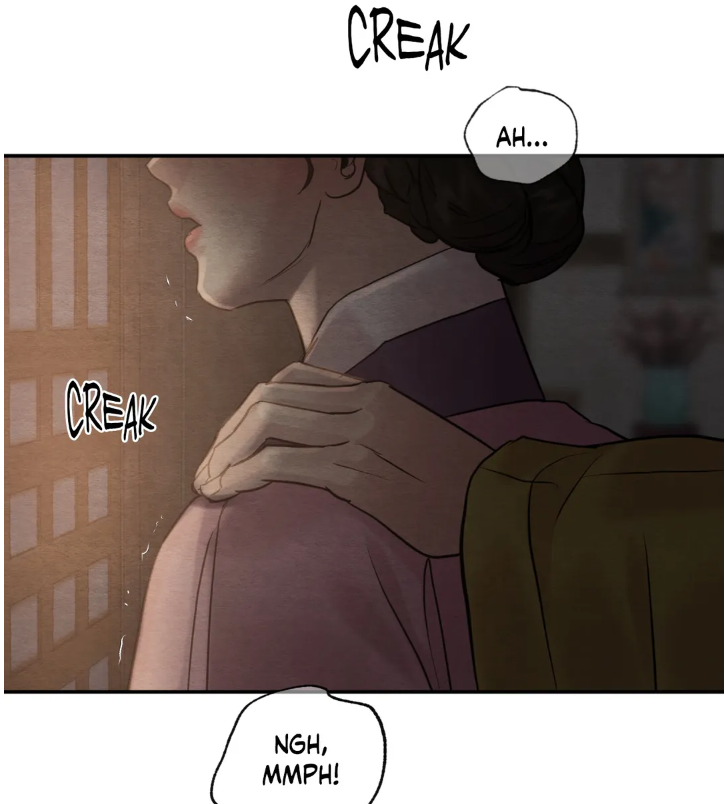 , in episode 100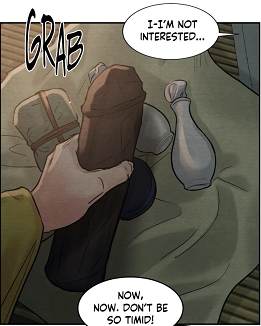
 and finally in chapter 102
  ! Yet, in other occasions like in episode 33
  or 43, or 52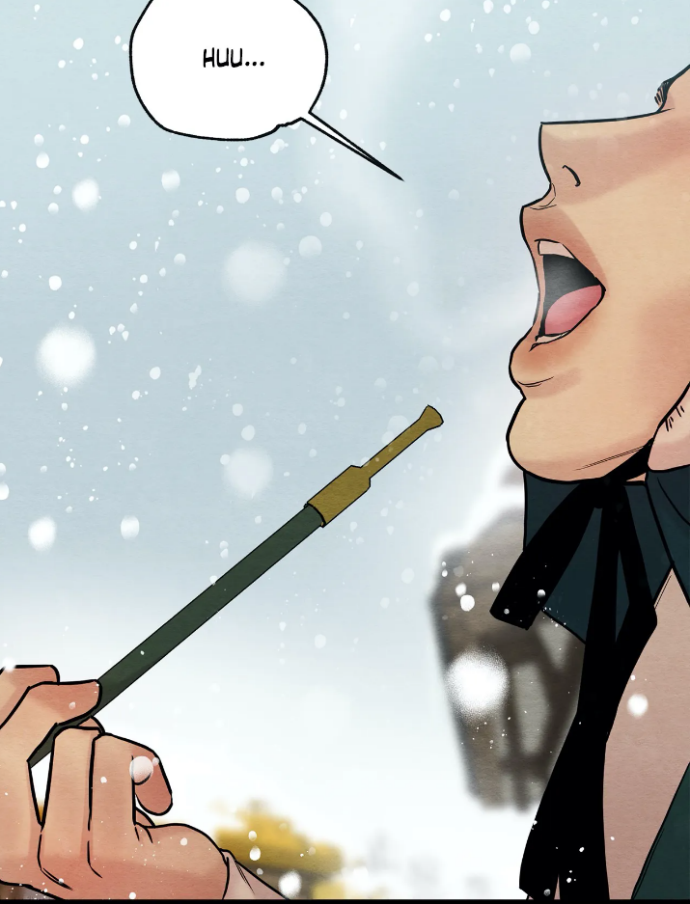
 , he used his right hand! Thus one might argue that Min was simply ambidextrous. However, I can prove 100% that Black Heart is left-handed!😮 The evidence is the usage of the bow.
 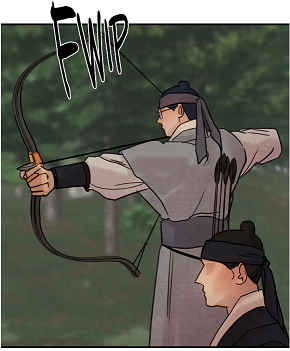 (chapter 22) This is how a right-handed man shoots an arrow. On the other hand, we never saw Min using the bow. The bird was already wounded by the arrows, when the scene of the second hunt took place.
 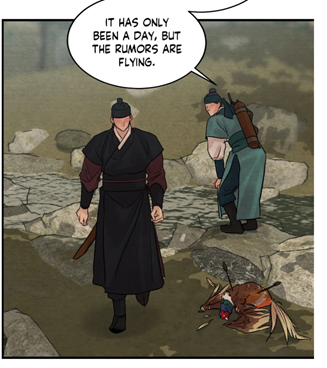 (chapter 41) However, the manhwaphiles can discover the verity thanks to one detail: the bag of arrows.
 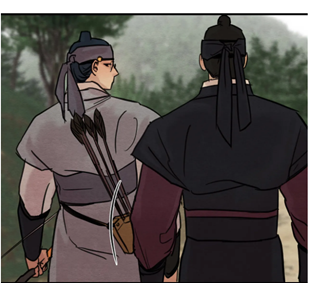 (chapter 22) As you can see, the bag is carried on the right side, but the arrows are almost touching the left shoulder. They need to be on the other side, since the scholar needs his right hand to grab the item. And now compare the position of Min’s bag. It is inclined in the opposite direction, hence the arrows are visible on his right side!
 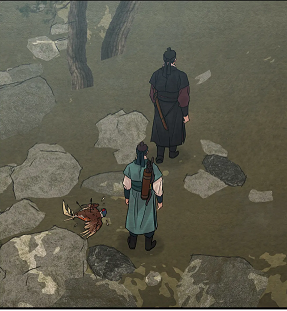 (chapter 41) Thus the noble is carrying the bag
  (chapter 41) differently from the painter too.
 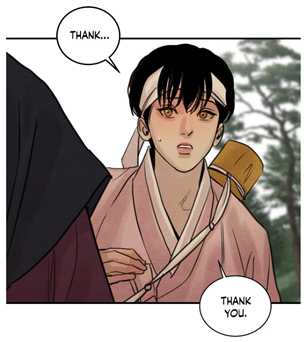 (chapter 22) Under this new light, it becomes comprehensible why Byeonduck never showed the Joker’s hunting skills. People would have noticed that he is left-handed immediately. She made sure to hide this important fact, thus within the same chapter Min was often portraying as using both hands. In episode 43, he employed his left hand to pour the alcohol in the glass
 (chapter 43), when he gave the drink to Lee Jihwa.
  (chapter 9) Here, he was still present, but even before the end of the sex session, he had already vanished.
  (chapter 9) Finally, when the noble with the mole visited Lee Jihwa, the latter claimed that he had spent a long time at Yoon Seungho’s.
  (chapter 9), and his friend never denied it. As you can see, the characters made sure to confuse the readers with the change of the chronology. As you can see, it took me a long time before noticing the bruised face (only during season 3), then to bring up the conclusive evidence that Min was the culprit of the slap. Then in the shaman’s house, he took the dildo with his left hand, because he was angry and frustrated.
  (chapter 100) too. This shows that he could barely control himself here. And once he faced the main lead’s sword, he got so scared that he showed Jung In-Hun’s glasses with his left hand again.
  (chapter 92) The irony is that in this scene, the main lead employed his left hand too, the positive reflection from the night in the pavilion (chapter 43). While here it was to bring him back to reality, in the pavilion, the Joker had the opposite intention: to lure Lee Jihwa to believe in illusions.
 (chapter 74) They announce the future events, though the information is not given properly. On the other hand, since they are memories either, this signifies that they contain insight about the lord’s tragedy. Thus I noticed that the anonymous perpetrator used his left hand to grab his hanbok!! I deduced that the perpetrator in the past is also left-handed!! Secondly, since this vision can also be seen as the announcement of the painter’s second kidnapping, this is no coincidence that Byeonduck created such panels during the painter’s last torment.
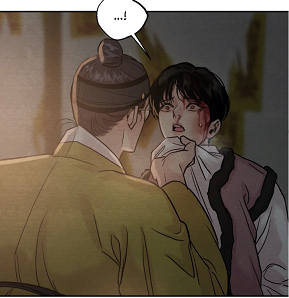 (chapter 99) However, in the shaman’s temple, Black Heart grabbed Baek Na-Kyum with his right hand. He was trying to manipulate the artist, he was acting. He was not showing his true self. Yet, the vision was revealing the truth: the future mastermind of the last scheme was in reality left-handed!! It didn’t matter, because at the end, the main lead was able to discern the truth. He sentenced Black Heart, for he believed that he had killed his loved one! That’s how I realized why the author would focus so much on the hands and on the distinction between unconscious and conscious! The hand in Painter Of The Night represents the crucial clue to identify the culprits!!
 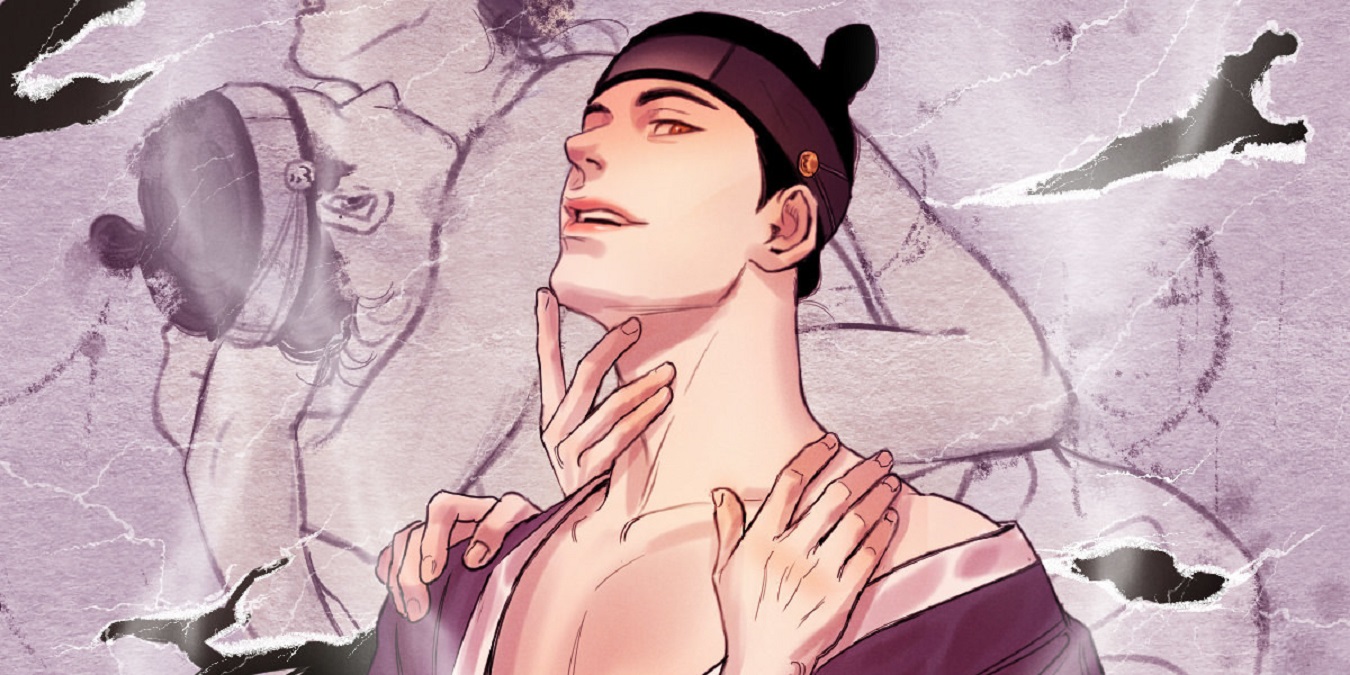 In season 1, we had the hands in the illustration. The hands were revealing the crime committed against the main lead. The latter was totally passive in this picture. The hands are touching and unclothing the immobile man. It also shows that Yoon Seungho was at the center of the conspiracy, in the past and in the present! The painting in the background indicates the presence of a hidden painter. Thus Baek Na-Kyum was not drawn in the cover. The painter of the night was in truth someone else, the painter from the past! Nevertheless, the main lead was looking at the readers, indirectly at Baek Na-Kyum, the young painter of the night. This describes the arrival of Baek Na-Kyum in his life. Striking is that the painting in the background was destroyed… indicating that the portrayed relationship was no longer existent. This represents another clue that the lord’s suffering is linked to a previous relationship. Then in season 2,
 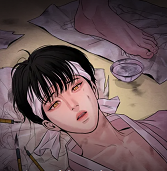 the author revealed Baek Na-Kyum as the painter, who had now become the target of the plot. Yet behind him we see Yoon Seungho’s foot. The latter symbolizes the main lead feared to get close to him, but he wouldn’t leave his side. Moreover, this corresponds to the lord’s impulsive decisions, he let his foot guide him. Thus during the first night of the failed gangrape, he walked towards the study and stopped unconsciously, when he was next to the room.
  (chapter 53) Due to his strong denial, he was strolling not realizing that his feet were under the influence of his subconscious. And it was the same, when he opened the door with his foot at the Lees’
 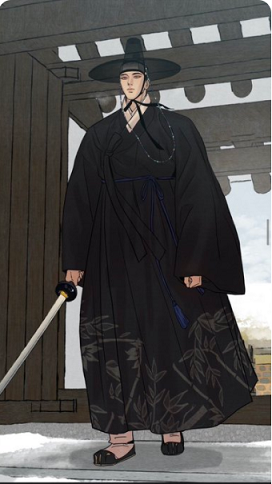 (chapter 67) Nonetheless, I believe that the author had another reason to draw the foot in the cover. The foot prints are the evidence of the crime, and as such the deceptions and the culprits.
 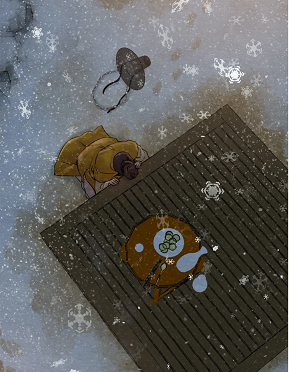 (chapter 59)
  (chapter 60)
  (chapter 61) The shoes were the clues how to recognize the perpetrators and accomplices. That’s why I compared these feet
  (chapter 59) with those
  . (chapter 66) My avid readers are already aware of my theory. For me, we have two kidnappers, and one tried to kill the artist! To conclude, Byeonduck left the clues how to unveil the mystery from the past and the present in the illustrations of each season. The paper in the second cover
  (chapter 56), but also to the theft of the painting
 (chapter 56) and the painter’s break! At the end of season 2, he was no longer painting and in the beginning, he had also stopped due to his heartbreak. Simultaneously, we have the presence of water which serves as a connection to season 1 with the ruined painting and to season 3 with the well and drowning. The dark shades were an allusion to the lord’s darkness and suffering. The latter would come to the surface. However, since the cover only showed the lord’s foot, it exposes that the lord would not divulge his traumatic past.
  (chapter 78) In season 3, this time the main leads were facing each other, they were recognizing each other: their true self! But this stands in opposition to the deceased people without identity!
  (chapter 94) We never saw the face of the corpses, as they were either covered
 (chapter 97) or the manhwaphiles could only view the hand,
 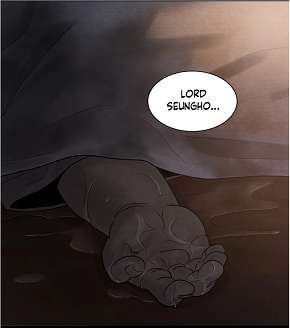 , the back
 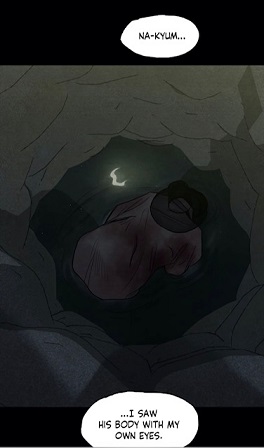 (chapter 97) or the clothes and shoes
 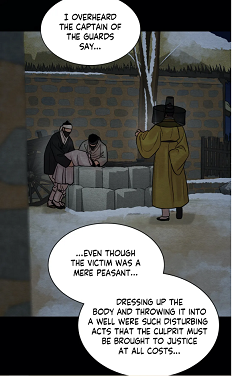 (chapter 100)! And since Min had disguised himself as Lee Jihwa, it was clear that the deceased shouldn’t be identified by their clothes, but by their faces. As you can see, season 3 was about the face and identity! This indicates that in the past, someone had been not identified correctly!! Why? It is because the main lead has long repressed this memory. He had forgotten his face out of fear and hatred. The only thing the victim remembers is the BEARD, and old bearded men!
  (chapter 44) And the nightmare exposed the number of persons involved in his suffering: 4 men!!
  Here, we have 3 men, and don’t forget the left hand from before.
  (chapter 1) Anyway, from my point of view, the cover of season 4 should indicate a location which is connected to the town. Why? It is because now I am suspecting commoners to be involved in the lord’s suffering. I have already expressed my theories about Kim, the guard blacks, Heena and the physician. But there are more suspects! Moreover, observe that the kisaeng house is not only visited by aristocrats, but also by commoners.
  (chapter 99) That’s the reason why I am anticipating a cover with the gibang. It would be the perfect place to find closure for the couple. It is a place where both suffered. Moreover, I think, belongings should serve as an evidence for the identification of the schemers and accomplices. Remember that we had the glasses as the evidence of a murder in season 3, yet I am sensing that the possession should serve to identify the perpetrators from the past and the present. Since the clothes were used to confuse people in season 3, I am assuming that in season 4, they should help to recognize people, but at the same time, it is totally possible that our main leads decide to employ the same method to fool the schemers and accomplices. And now, we have the cover for season 4. Both protagonists are not only facing each other, but also touching each other. They are no longer hiding their emotions and thoughts.
 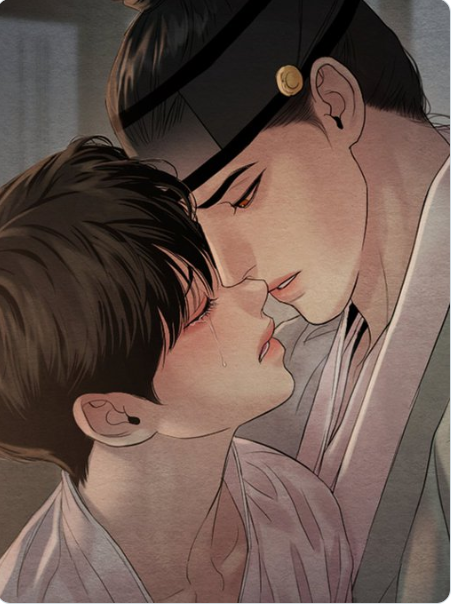 This image represents the opposite to the other seasons. At the same time, the author is again referring to the bedchamber indicating that this place is strongly connected to the protagonists’ suffering. On the other side, since the painter is wearing a silk white shirt, it implies that he is not a commoner. This panel indicates that the main lead was able to the true owner of the study and even bed. However, due to the tears, the beholder can sense that this season will be painful as well. Striking is that in the cover, they were either alone, or they were just looking at each other, hence they didn’t pay attention to their surroundings. Consequently, they couldn’t sense the presence of a plot and the schemers. This indicates that the couple is still not prepared to face new schemes. To sum up, the author selected such covers because she had planned to leave clues there about the mystery! But wait… I had outlined that the person who grabbed the young master Seungho was left-handed, and he played a huge role in the main lead’s downfall and suffering! But who is left-handed in this story?
  (chapter 12)
  (chapter 56). But then I noticed that he carried his master on the left side.
  (chapter 57) Nevertheless, the person threatening the painter was right-handed.
  (chapter 66) and since it is for me the butler, he was not the person from the nightmare. That’s the reason why I am excluding him from the suspect list. For me, if he was involved in the past, it is because he lit the candles
  (chapter 74). Furthermore, don’t forget that in his nightmare, the author exposed the presence of plates with 3 candles
  (chapter 74) which were also used in the shaman’s house. Finally, in this picture, we have a right-handed person.
  (chapter 74) So Kim could have been the one silencing him with his hand.
 (chapter 86) On the other hand, at the doctor’s office, he employed his right-hand to keep his son by his side.
  (chapter 57). Why is there this change? The turning point was the prank in the bedchamber.
  (chapter 83), then with the left! Striking is that the author never showed, when the patriarch employed his left hand. The readers could only hear the sound, and see the result of the beating. Both cheeks were wounded. From my point of view, he was conditioned exactly like Min! He was not allowed to use his left hand, but the angrier he got, the less he could hide his true self: he was left-handed and he was a stupid and brutal father!!
  (chapter 37) On the other hand, I am doubting that Byeonduck will introduce many new characters in season 4. That’s the reason why I believe that the man with the pipe is the real schemer, as the pipe was in the annex. Since Min grabbed Baek Na-Kyum in the shaman’s house, I am more inclined to think that the perpetrator grabbing the young master Seungho by the collar was just an accomplice and not the mastermind. In other words, he was the helping hand.
  (chapter 57)
  (Chapter 74) I don’t believe in hazard. Besides, the lord had his nightmare during the same chapter. This means that he could have leaked this information about Yoon Seungho to an outsider, like he did with the painter. As the manhwalovers can grasp, the physician is more suspicious than before.
  (chapter 92) Besides, observe that the angry man put the brush on the left side.
  (chapter 92) The man is left-handed! And what did Yoon Seungho do?
  (chapter 92) He grabbed him by the collar! Exactly like in the dream!!
  (chapter 44) or patio of his mansion, similar to Heena’s. And since the young main lead suffered so much, it is normal that he doesn’t have such believes. IT is also possible that the young master Seungho played a prank which made the man angry and humiliated. As you can see, I come to the conclusion that jealousy and resent were the reasons why he got involved in the first place. Moreover, we shouldn’t forget that the calligrapher is linked to the kisaengs! He even recognized Baek Na-Kyum, as he called him a peasant.
  (chapter 92) Yet, he was either perceived as servant, a noblewoman or as a sir so far! He was never recognized as a peasant. Since he could identify the artist, it is also possible that he was also able to identify Yoon Seungho. But he thought that he was not well educated after living as a male kisaeng for so long. From my point of view, the man could have decided to get revenge on Yoon Seungho and participated in his abduction and gangrape!! Thus his karma was to lose his home!
  (chapter 91) The fact that Yoon Seungho grabbed him the same way than in the nightmare is not random. It was, as if he was getting justice. Honestly, I am more and more suspecting that in the past, Yoon Seungho got raped by commoners! Naturally, I have not changed my mind that the king was behind this plot: to get revenge on the Yoons! Who benefitted the most from the crime? Definitely the king, as he was able to ruin their influence.
  (chapter 39), the other only recognizes him as master Yoon.
  (chapter 64) This means that the latter knows about the existence of elder master Yoon. Like mentioned above, the calligrapher, the physician, the tailor, the fake servant and the “shaman” from chapter 29 have all one thing in common: the beard!!
  (chapter 83) disguised himself and hide his true identity behind “lord Song”. But is he the king or someone else? He was definitely a pedophile, but since we can’t see his face, it is not certain that it was the king.
  (chapter 83) Striking is that he is not “smoking here”, yet I had outlined that one abuser was a heavy smoker due to Yoon Seungho’s behavior.
  (chapter 86) Let’s not forget that in season 3, clothes were used to deceive Yoon Seungho, and the authorities played along. Besides, as the painter had become the love interest of Yoon Seungho and Black Heart, it is very likely that in the past, the victim was exposed to two different abusers, but they all hid behind the name: lord Song. Note that during this feast, one man had a moustache beard which is in Painter Of The Night the sign that he is no yanbang, not even chungin, the upper-middle class. He could be a rich merchant. Just because they are all wearing hanboks
  (chapter 87), this doesn’t mean that these men belong to the aristocracy. Furthermore, Kim never said “nobles”, he just said “visitors”!! Finally, I would like to point out that since Yoon Seungho lived secluded for 10 years, I doubt that he had the means and the knowledge to be involved in the trade:
  (chapter 22) This theory of the participation of a merchant got even reinforced, when I made the following discovery. The wooden boxes in season 1 were present at the tailor‘s shop!!
  (chapter 39) Thus I am deducing that the barn in season 2
  (chapter 51) could have belonged to the tailor or the owner of this shop. And note the couple was in the same position than with the kisaeng with No-Name in episode 51!
  (chapter 51) This was the negative reflection from episode 39: no penetration versus penetration, no interruption versus interruption, no rumor versus rumor etc. And this contrast clearly displays that the tailor shop is involved in Yoon Seungho’s suffering. And the best evidence for this is the nightmare. The main lead’s clothes had a design.
 (Chapter 94) In this scene, the painter was rejected by the children, for he had no braid. Due to his hair dress, he was recognized as orphan immediately. The justification was that that way, the artist would appear more boyish. But by mentioning the loss of Yoon Seungho’s topknot, Heena was actually revealing that she knew the true signification of the haircut: abandonment and intolerance. Her words to her brother exposed her hypocrisy, though she attempted to portray the elder master as respectable. One might argue that when Na-Kyum was just a child, she had suggested the short hair, for she had good intentions. But after this experience with the children, the noona should have grasped the wrongness of her decision. She should have admitted her bad decision and stopped the painter from cutting his hair. Moreover, don’t forget that Na-Kyum was just a young boy, so the haircut must have been done by Heena herself. This shows that her gesture actually divulged her future behavior: she would betray and abandon the painter constantly (season 1, 2 and 3). At the same time, since the painter was seen with short hair in chapter 68
  , this indicates that Heena kept cutting Baek Na-Kyum’s hair. So even in the past, she was betraying her brother, though the latter never realized it. The loss of hair could never be viewed as a sign of love or empathy, for it contributed to the painter’s abandonment issues and his self-loathing. He was suffering as an outcast and due to his girly features. The men in the gibang could mistreat him, for he had no long hair or topknot. Why?
  (Chapter 94) He had no parents or guardians protecting him which is true, for here he was exposed to violence. Heena, as the head-kisaeng, had not protected him at all, she must definitely have portrayed herself as powerless. Yet as a slave of the state, she was belonging to the king. So she had connections to officers and the court. In my eyes, the head-kisaeng made sure that the artist could never get a topknot, and as such he would never be able to become a “noble” or even a man. Hence Baek Na-Kyum was constantly called boy
  (Chapter 56)
  (Chapter 59)
  (chapter 66) and treated as one too. This observation made me realize that Heena’s belief could be used as an explanation for her action (cutting off his hair): she hates nobles so much that she didn’t allow her brother to have a topknot. But why would she do that? My idea is that deep down, she resented him, for he was a free man, while she was a slave. It went so far that he was encouraged to wear a white headband, the symbol for servitude, though he is no slave! To conclude, the loss of hair in Joseon should be perceived as a brutal and harsh punishment. Without a topknot, one is left unprotected, is not viewed as an adult. But this stands in opposition to Yoon Seungho’s action in front of Jung In-Hun’s home.
  (Chapter 101) Here, the lord had spared his friend’s life.
 (Chapter 23) cuts off the hair of the general Woo Jong Han, because he had committed crimes. First, he hid the fact that his sister had had a child before getting married to the emperor, which was actually a huge sin. The future Empress should have been a virgin. To sum up, he had committed treason, for he had allowed his sister to become Empress unrightfully. Then the field marshal had treated his niece as a slave violating social norms.
 (chapter 34) That way, he assisted his sister to become powerful by covering up for her crimes (silence and passivity). She had killed many people to hide her previous relationship and to increase her power. Striking is that the prince still spared Baek-Ha’s uncle, and this for many reasons. First, the latter had not only saved both protagonists, the empress’ illegitimate daughter Baek-Ha and the prince Nan-Woo, but also had admitted his sins. Secondly, he was thinking of his wife Baek-Ha who is kind-hearted. He knew that his death could upset his bride.
  (chapter 26) But there is more to it. Nan-Woo didn’t spare the man out of benevolence.
  (chapter 26) He had a role to play. By cutting off his topknot, the general lost his “power”, he became the prince’s pawn! Nan-Woo wished to use the uncle in order to get rid of the Empress.
  (chapter 23) That way, the protagonist wouldn’t even have to dirty his own hands. On the other hand, we could also say that Nan-Woo was forcing the Empress’ brother to undo his bad decision.
  (chapter 23) Since he had protected his sister Seo-Ha out of affection, it was normal that now he had to show no mercy towards her. By presenting Baek -Ha to Nan-Woo, the general was well aware that the future ruler would recognize the female lead’s origins due to her resemblance to her mother. Therefore, we could interpret that Nan-Woo had spared the general, for the latter had switched sides and expressed the wish to undo his wrongdoings.
  (Chapter 101) It is because he must have witnessed it himself in the past. I have already pointed out that Yoon Seungho would imitate people, especially his tormentors. So where did he learn from? I believe, Yoon Seungho copied it from someone… and this can only be “lord Song”. And now, the first loss of Lee Jihwa’s topknot can be perceived in a different perspective. The red-haired master was well aware that he had been spared, when he had lost his hair for the first time.
  (Chapter 101) He knew deep down that thanks to his friend, he had been able to escape the worst. Since he had been spared once, he was well aware that this time, the ruler would show no leniency and would ask for his head, as the main lead was no longer protecting him. Remember what the lord had whispered to Baek Na-Kyum:
  (chapter 23), he swore loyalty to the future emperor. This signifies that the topknot also symbolizes faithfulness, especially because it is connected to marriage. Thus I deduce that when Lee Jihwa lost his topknot for the first time, he was already judged as disloyal. Hence it is no coincidence when the antagonist screams that he would become the target of lord Song’s fury.
  (Chapter 59) First, lord Yoon could be a reference to the father and not only the son. Secondly, he implied that he had witnessed the scene, yet in reality he could have been referring to the outcome: the friend’s hair cut, just like the noona had only seen the hickeys on her brother’s neck. She had never witnessed the sex session. The noble with the mole assumed the perpetrator’s behavior, rage, based on the hair loss. Moreover, he could have been telling the truth: he had never seen Yoon Seungho so angry before, as the latter used to be weak in the past due to his social status: he was a male kisaeng due to his braid. This explicates why the noble with the purple robe would give an order to the host
  (chapter 8) He felt himself superior to Yoon Seungho, and never expected “disobedience” or “rage” from the protagonist. Striking is that the lord didn’t vent his anger onto him, he first smiled before grabbing him by the topknot.
  (Chapter 8) A simple change of hair dress had transformed the main lead. This exposes the gods’ intervention in this story. They let the man with the mole see the wrongness of his manipulations. Since he had stated that he had never seen the man so angry, his words became a reality in 3 occasions: chapter 8 like mentioned above, chapter 53
  , for he was not present, chapter 57
  in the inn. Here, he chose to run away, yet despite everything he still helped his friend Black Heart, for he was present in the gibang.
 (Chapter 69) Under this new light, this panel from Twitter get a total new meaning:
  The aristocrat knew about the true identity of “lord Song”, and he had indeed never seen the man so angry that he would cut off the topknot of a noble!! This means that the fate of the noble with the mole should be to end up as the lord’s new plaything. In other words, he takes over the main lead’s previous status. He becomes the male kisaeng and ends up living in the shed like the protagonist in the past where the pedophile vents his rage and resent him for his tricks. But we will see.
  (chapter 59) Furthermore, he associated it to abandonment too.
  (Chapter 59) Yet, observe the drop of sweat. This exposes that neither Min nor the noble with the mole were expecting that Lee Jihwa would be spared!! They acted, as if the loss of the topknot couldn’t be a sign of mercy. But observe what Lee Jihwa was recalling, when the “friend” was talking about abandonment.
  (Chapter 59) He was by the protagonist’s side! This means that lord Song had spared Lee Jihwa’s life, for he had been present, when Yoon Seungho was suffering. Till the middle of season 2, no one was aware of the fallout between Lee Jihwa and the protagonist. None of the incidents in season 1 was leaked to the outside, hence the “pedophile” was not officially aware of the red-haired master’s wrongdoings. But the loss of hair in front of the learned sir’s house becomes the proof that the main lead has now left his friend’s side. He will be blamed for his suicide. Therefore it is not surprising that the young master chose to run away.
 (Chapter 101) He knew that the ruler would show no leniency or understanding. Thus the noble with the mole’s karma should be to keep his topknot.
  (chapter 27) The painter had saved his teacher’s life, and later the lord had restrained himself from hurting the scholar in the courtyard despite Jung In-Hun’s lies and lack of respect (he had touched the man’s shoulder).
  (Chapter 30) Here again, the scholar had been spared. Then in episode 53, the painter had embraced the lord to stop him from killing Deok-Jae. This means that Yoon Seungho must have also saved people in the past by using his body, and this twice, for I had detected the presence of two circles: Yoon Chang-Hyeon and Lee Jihwa. That’s the reason why the father could survive the purge, and why Lee Jihwa only lost his topknot. And the heroine from A Sip Of Poison can serve as an example.
  (Chapter 1) As long as the latter was living there, the Lees had nothing to worry. The main lead was protecting them from the king. However, the manhwalovers should keep in their mind that Nan-Woo had showed mercy to the general for his own interests. He should become his helping hand in order to obtain the throne. Hence I come to the following deduction: neither Nan-Woo nor the “perpetrator” had cut off the topknot out of real leniency. This shows that for these characters, the loss of the topknot is not the symbol for forgiveness which is not true for the last incident with Lee Jihwa.
  (chapter 1) Even the headband was different. This was no coincidence. He should never develop confidence and act as a lord. That’s how I recognized the following pattern. In front of the painter who looked like a minor, the main lead was forced to act like an adult. Thanks to the painter, he was encouraged to mature. Simultaneously this meant that at some point, while living with the Lees, the elder master Lee had to be confronted with the truth: his son’s sodomy.
  (Chapter 86) The reality was that the pedophile was the bad omen, but they couldn’t insult the king. Hence the young main lead became the scapegoat, people couldn’t separate the pedophile from Yoon Seungho. The “mysterious lord Song” would never give up on the protagonist. No matter what he would keep him by his side.
  (chapter 1) Moreover, we shouldn’t overlook the publications with the braided man:
  (Chapter 1) Baek Na-Kyum was not supposed to recognize the identity of the man having sex with the bearded man. From my point of view, Heena made sure to confuse her brother. Lee Jihwa’s humiliation became Yoon Seungho’s stigma. He became the culprit. Since in the past, the main lead had been blamed for everything, the perpetrators and accomplices chose to follow this “tradition”, because so far, they had been able to cover up their crimes. But thanks to the painter, it is no longer possible. Why? It is because the painter’s hair dress will serve as a mirror of truth: the absence of a topknot due to the braid and the hair cut will be perceived as an evidence for abandonment, cruelty and huge wrongdoing. This won’t be seen as a gesture of mercy or leniency by the two protagonists, for they suffered because of it!! That’s the reason why I am thinking that the pedophile’s karma should be the loss of the topknot which he viewed as a gesture of mercy and tolerance. But without the topknot, he is actually “castrated”, and as such humiliated for he can not wear his golden sangtu.
  Yet, contrary to Lee Jihwa’s haircut, the loss of the topknot should not be judged as the symbol of mercy and forgiveness, in fact, the lord would officially cut ties with him. That’s how the mysterious Lord Song would be taught an important lesson: he was a huge hypocrite and a violent and ruthless pervert.
 (chapter 23) to give him a knife:
  (chapter 23) before grabbing Woo Jang-Hon by his topknot
 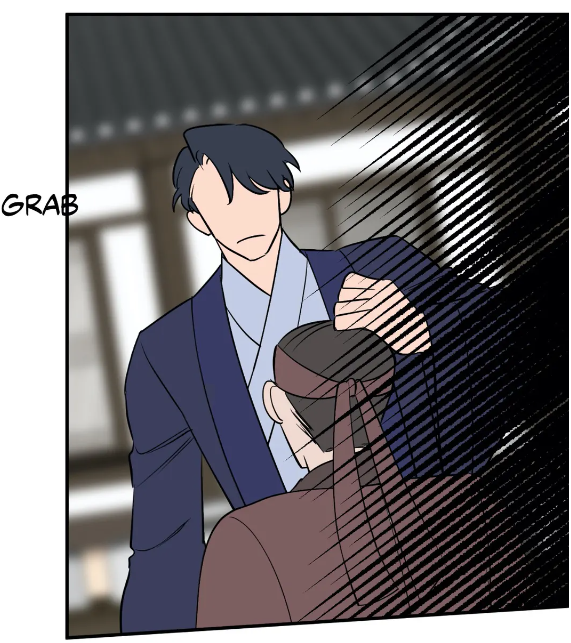 (chapter 23). Hence the hair fell between the men.
  (chapter 23) And now, let’s return our attention to Painter Of The Night. Compare the position of the aristocrat’s topknot after Yoon Seungho had punished his friend.
  (chapter 101) It was behind him!! Thus I deduce that he had used the sword, when Lee Jihwa had approached his friend. But wait… in season 1 and 2, Byeonduck drew scenes with a knife:
 And what had happened before? Yoon Seungho had dragged his friend by the topknot before stabbing the amateur spy. This is no coincidence.
 When this chapter had been released, I had assumed that this must have happened, when Yoon Seungho had lost his topknot! As you can see, I had already connected the knife to the loss of the topknot incident.
  (chapter 66)
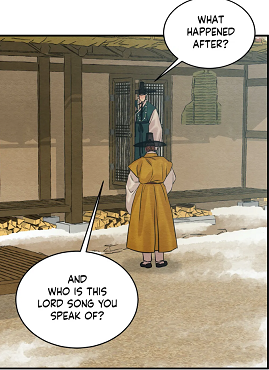 (chapter 83)
  (chapter 67) This shows that till season 3, Lee Jihwa had never been exposed to real justice. There was always someone ready to intervene for him. And now, you comprehend why the red-haired master felt no remorse to blame his friend for his humiliation in the past. He must have thought that if he had not been in his bedchamber during that night
  (chapter 83) This explicates why Lee Jihwa said this to Black Heart and his friend:
  (chapter 59) The antagonist had witnessed his friend’s humiliation and suffering in the past, just like Yoon Seungho had been present, when the first topknot incident occurred. From my point of view, the lord must have even protected Lee Jihwa. But the problem is that Lee Jihwa was just receiving his punishment in delay for the stolen kiss and his lies
  (chapter 77) He had kissed him without his consent, thus he got “castrated”. Let’s not forget that the main lead was forced to become a male prostitute, an uke, for he had not been able to perform, to have an erected phallus. On the other hand, Lee Jihwa had done nothing wrong in the bedchamber
  (Chapter 41) Due to the incident in the kisaeng house, Min had lost his privileged position with the king. Hence he got jealous. He could no longer screw” the protagonist, while he had to watch the lord’s slow ascension. To sum up, the loss of Jihwa’s topknot led to the “symbolic castration” of the infamous couple: Min and the noble with the mole.
  (chapter 77) And now, you comprehend why the pedophile cut off Lee Jihwa’s topknot! The latter had been blamed for the lord’s change of hair dress.
  (chapter 57) The hair was short or not? Now, I don’t think so. The mystery of Yoon Seungho’s suffering is linked to the hair dress, yet the readers shouldn’t realize it too quickly. According to me, he still had the braid, until the doctor questioned why Yoon Seungho still had no topknot.
  (chapter 33)
  (chapter 55) And who had given him the topknot? Naturally… Kim! Because he didn’t want to be perceived as someone who was violating social norms. However, there is no ambiguity that he hid his responsibility. That’s how Lee Jihwa and his “servant” got framed. They were responsible for giving the main lead the new hair dress. On the other side, I still believe that Yoon Seungho must have lost his hair too, but only once to the difference of Baek Na-Kyum! My reason is simple. Since the painter and Lee Jihwa lost their hair, and Yoon Seungho’s destiny is mirroring his lover’s, it signifies that the lord’s hair must have been cut too. But who did it? Let’s not forget that when Yoon Seungho punished his friend in front of the scholar’s home,
  (chapter 77) in that scene. For the butler, this gaze could be judged as betrayal and abandonment. Under this new perspective, it becomes comprehensible why the main lead was encouraged to blame and resent his father. If this theory is true, Kim pushed the main lead to cut off his braid, he did it out hatred and anger towards the Yoons. This would mask his own manipulation and culpability too. At the same time, the pedophile could benefit from it. The main lead was now an orphan, thus the bearded man could use him like he wished. I have an evidence for this interpretation. This is what Baek Ha said to her husband:
  (chapter 23) Being slave meant being orphan. The pedophile could feign ignorance about the main lead’s true origins. If he truly cared for him, he just needed to ask this: papers!
 (chapter 24) This shows that in Painter Of The Night, all the elders were depraved and violent hypocrites. Like mentioned above, the pedophile had a huge interest to keep the main lead as his slave, thus he was turned into an orphan and asked to keep a braid. And Yoon Seungho’s mother could do nothing, for the son had cut off his own hair, a huge symbolic act. He was no longer considering her his mother. But because of his status as slave, the pedophile could never trust the main lead. Then the suicide from the mother put an end to this farce. Hence lord Song could tell his sex partner that he had become the head of the Yoons and let him “have” the properties, while it was never his intention to let him become responsible. If he had become a lord, he could escape from his claws. He needed him to remain in an infantile and dependable state.
  (chapter 33)
  (chapter 33) She not only treated his wounds, but also helped him to overcome on his guilt. He felt responsible for his brother’s death, for Nan-Woo had attempted once to commit suicide on the battlefield, and his brother had sacrificed himself to protect him. He was definitely plagued with remorse, self-loathing and shame. And that’s exactly what Baek Na-Kyum has been doing too: by simply loving him so selflessly and purely. Finally, Baek-Ha’s fate made him realize the Empress’ immense culpability. She was so greedy and selfish that
  (chapter 34) she had abandoned her own child! Thus he was freed from his hatred and guilt. Nan-Woo was able to perceive the wrongness of this social norm which was common in Joseon: the child is responsible for the parents’ sins!
  (chapter 33) Being an orphan outlined her innocence. And since I have already connected Baek Na-Kyum to the mysterious lord Song, I am quite sure that the painter will have a similar attitude than Baek Ha:
  (chapter 33) He will feel responsible for Yoon Seungho’s martyrdom. And if he is truly his son, his abandonment can serve an evidence of his innocence. On the other hand, the readers shouldn’t forget that his surrogate parents, Jung In-Hun and Heena, played a role in lord Yoon’s torment as well. Thus he can only indebted towards his husband.
  (Doctor Frost, chapter 225) With this picture, the manhwaphiles can detect the presence of the endless vicious circle, the ouroboros, which I had described as a kaleidoscope. The absence of empathy in both stories was the reason why no one stopped the main perpetrators. Woo Jang-Hon felt guilty, for he had raised his younger sister who had become a monster. Kim felt deep down guilty, but chose to reject his responsibility by putting the blame on others. Out of fear, he preferred hiding his wrong decisions and later wrongdoings. And now it has become his MO. This distinguishes him from the general who chose to put an end to his guilty conscience and paid for his crimes..
  (chapter 34)
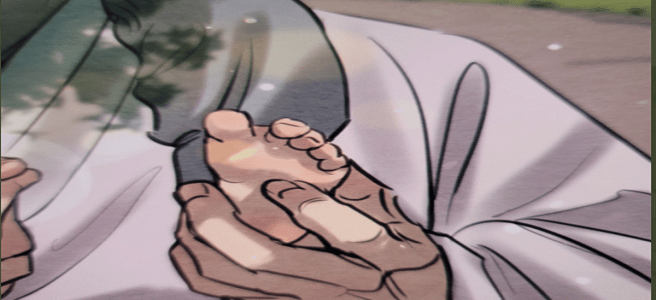
 on Twitter yesterday, and naturally this made many people happy, for Jung In-Hun was stroking Baek Na-Kyum’s foot gently. How could people identify the characters, though we don’t see their faces? Simply by the clothes! The manhwaphiles remember the painter’s grey pants and the learned sir’s favorite color, lavender,
 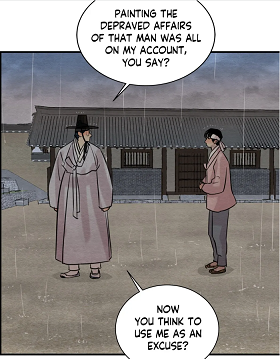 (chapter 19)
 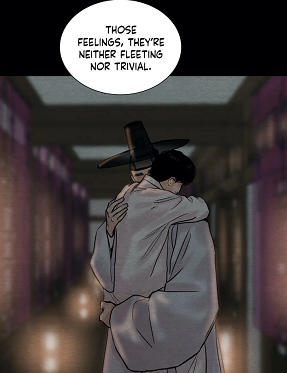 (chapter 68). While many manhwalovers found this image cute
  (chapter 70) The manhwalovers can immediately detect the contrasts: the visages of the protagonists versus the hand and the foot, day versus night, sun versus moon. That’s the reason why I came to the deduction that this image embodies a happy memory of the painter: sadness versus happiness.
 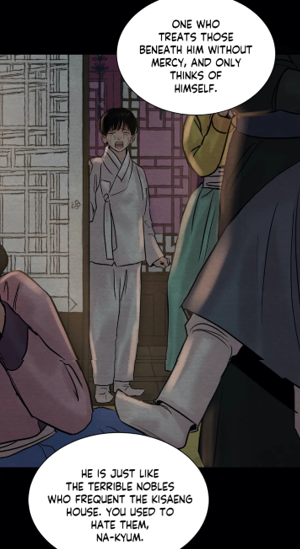 . (chapter 68) This means that Baek Na-Kyum was removed, because he was a witness and could generate a scandal. He is beloved by the kisaengs. However, back then, he got misled due to Heena’s indoctrination and false impressions. When he saw this, he was only looking at his noona, hence he didn’t pay attention to the actions of the black guard. Moreover, he had no idea why Heena and Yoon Seungho were behaving like that. So when the painter recalled Jung In-Hun from that night, he was no longer heartbroken, because the stroll with the scholar came to his mind.
  (chapter 70). The trigger for this recollection was his farewell to Heena. This time, he could say goodbye to Heena properly by embracing her and giving her a scarf so that she would remember him. In the painter’s mind, after that night, he would never see her again.
 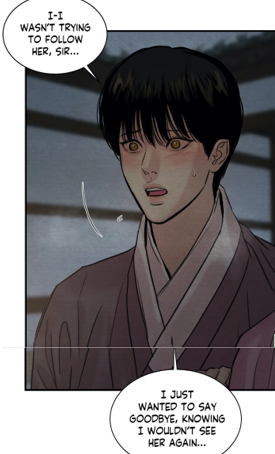 (chapter 69) In other words, this night represented a closure for Baek Na-Kyum, the end of his abandonment issues. In episode 70, Jung In-Hun had consoled him, he had tried to cheer him up. Thus the learned sir was smiling. Yet, this couldn’t cover the painter’s scar. He felt that he had betrayed Heena, for he had not been able to protect her. It was, as if he had run away. Nevertheless, when this incident occurred, the learned sir had not run away from the gibang, because you could see that Baek Na-Kyum was wearing socks and shoes.
  (chapter 70) The man had put the shoes on the child, as in the building, the painter only had his socks on. Because of the presence of the socks,
  (chapter 68), I deduce that this walk must have taken place in a colder season (fall)
  while in this picture, Jung In-Hun was carrying the painter on his shoulders in the summer.
  (chapter 102) In both scenes, the main lead is seen with bare feet. He is also carried by his loved one. But here, it is snowing, hence this signifies that it is winter. On the other hand, the manhwalovers can detect the presence of a purple flower on the right side. This signifies that Spring is on its way. That’s how I came to realize why Baek Na-Kyum is now recalling the learned sir’s gesture from the past.
  (chapter 94) His presence was to divert the attention from these men so that she wouldn’t be asked to have sex with them. And since I have already detected that each time, the painter suffered, karma would retaliate, the logical consequence is that Heena got punished for her wrong action. This signifies that while the painter was following the learned sir, his noona was abused in the kisaeng house. This would explicate why later she had no remorse to turn Yoon Seungho into a victim. And don’t forget that the painter was much younger than in this scene.
 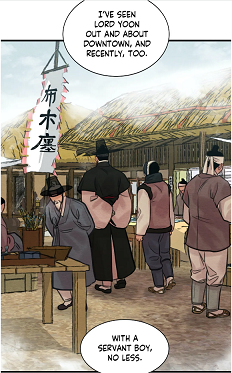 (chapter 45)
  (chapter 75) The latter would let his partner walk through town in order to please him. He would even follow the painter. In other words, it was always for the painter’s sake, and in the mountain, it was the same. But it was not the same for Jung In-Hun, it was for his own benefit. We have the best example in chapter 10:
  (chapter 10) Here, he desired to separate the couple. Baek Na-Kyum should refuse to paint erotic pictures.
  (chapter 29)
 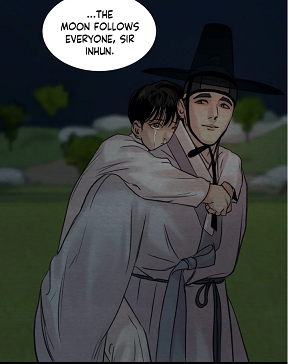 (chapter 70): The artist is dressed with good clothes, he looks more like a young master than a commoner, only the shoes are indicating that he is a commoner. That’s the reason why I believe that during that night, the learned sir was avoiding people. They could have wondered why the young boy was carried in his night clothes outside. From my point of view, this scene
 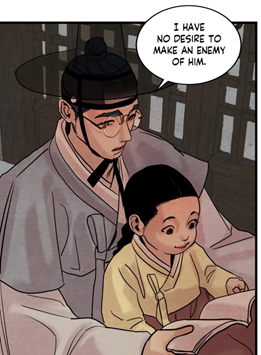 (chapter 29) He had already been seen with a girl before who seems to like him either.
  (chapter 6) Thus I couldn’t help myself wondering if the learned sir was not directly involved in prostitution, bringing girls to the gibang and even covering up for the sexual child abuse. We shouldn’t forget that the pedophile was portrayed as a man consumed by lust who would never pay attention to the time and the hour.
  (chapter 6)
 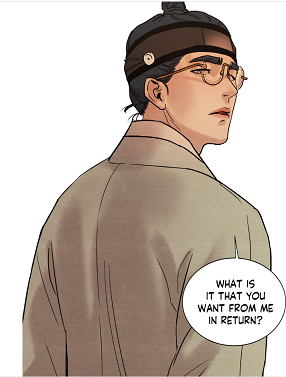 (chapter 7)
  (chapter 7) This change is not random in my eyes. I had already associated the learned sir to a chameleon. This change of color seems to validate my theory that Jung In-Hun had been sponsored by Min, hence we have the light green. Black Heart is symbolized by green. However, the light pigment reflects that he had been abandoned and betrayed. Nonetheless, when he encountered Yoon Seungho, the latter was wearing a purple hanbok.
  (chapter 6) That’s how the man got influenced and chose to wear his lavender hanboks again. But he never realized that behind the young noble, there was standing the pedophile, someone he had helped in the past. From my point of view, the change of the learned sir’s hanbok was the indication of his betrayal. According to me, the old bearded man
  (chapter 37) was not a former servant, but the pedophile. So he could have recognized the learned sir thanks to his hanbok… just like the readers did with this picture:
  (chapter 73) From my point of view, the intimacy in the bedchamber stands in opposition to the teacher’s gesture in the countryside. His caress was just a casual gesture with no real deep meaning in the end. This explicates why he could betray and abandon the artist on so many occasions in season 1 (chapter 11, 24, 25, 29, 35, 40). The learned sir had always prioritized his own interests.
  (chapter 102), the painter should realize the difference.
  (chapter 70) talk and ask questions before apologizing and hugging him. The lord never acted, as if nothing had happened,
 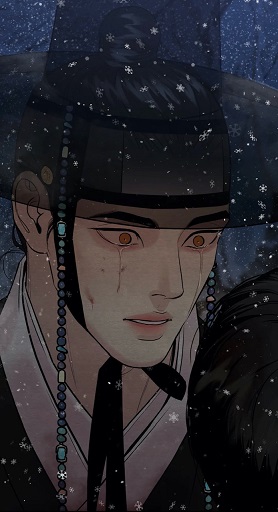 (chapter 102) This was true love and Baek Na-Kyum’s feet always reflect his emotions:
  (chapter 58)
  (chapter 80) So now, imagine how the painter must feel if the lord took his feet in his hands! This is no coincidence that there is this saying:
  (chapter 100)
 (chapter 102) and the zooms on the feet:
  The couple was following their heart!! But this was not the case with the scholar. Baek Na-Kyum had no other choice than to follow Jung In-Hun.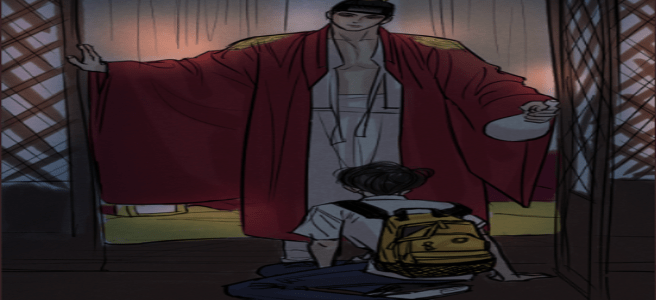
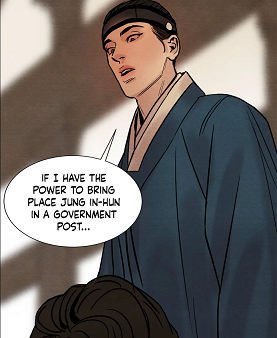 (chapter 11) Secondly, I had associated the main lead to the eagle which is the symbol for the kings and emperors in Europe. He was seen here flying
  (chapter 30), and his fingers reminded me of the eagle’s claws.
  (chapter 18) And this perception got even reinforced, when I saw this panel:
  (chapter 52) In this scene, he was sitting like a king surrounded by his “court”. The hanbok had such a design that I couldn’t help myself associating it to Joseon’s monarchy.
  , I had another revelation. On the one hand, it actually confirmed that Yoon Seungho was somehow destined to become a king, yet he is not represented by the eagle or the phoenix, but by the dragon. Hence the moment I saw this image, one idiom came to my mind: Dragon king!
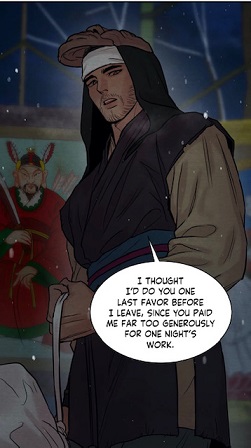 (chapter 100), though this deity is always accompanied with a dragon and in this picture, the readers couldn’t see one. However, it is possible that the author didn’t desire to reveal too much.
  (chapter 21) Why? It is because the lord was happy. These were the tears of happiness, which Yoon Seungho couldn’t express contrary to the painter. And this is no coincidence that in chapter 58, it started snowing, when the couple was making love:
  (chapter 58) And we had the same weather, when Yoon Seungho saved his lover.
  (chapter 46) and we have so many jars next to the pond:
  (chapter 94) [For more read the essay “The secret behind the library”]
 (chapter 91) This is no coincidence. To conclude, all these elements (rain, jar, well, soul of a deceased), connected to the dragon king, are present in Painter Of The Night. Thus I came to the conclusion that Yoon Seungho is like Dragon king. This reinforces my conviction that the main lead is not only connected to shamanism, but also embodies royalty. So he might not be the king of Joseon, but he is powerful in his own way, though he is not aware of this. And note that the moment he wished to commit suicide by drowning in the pond, he was brought back to life.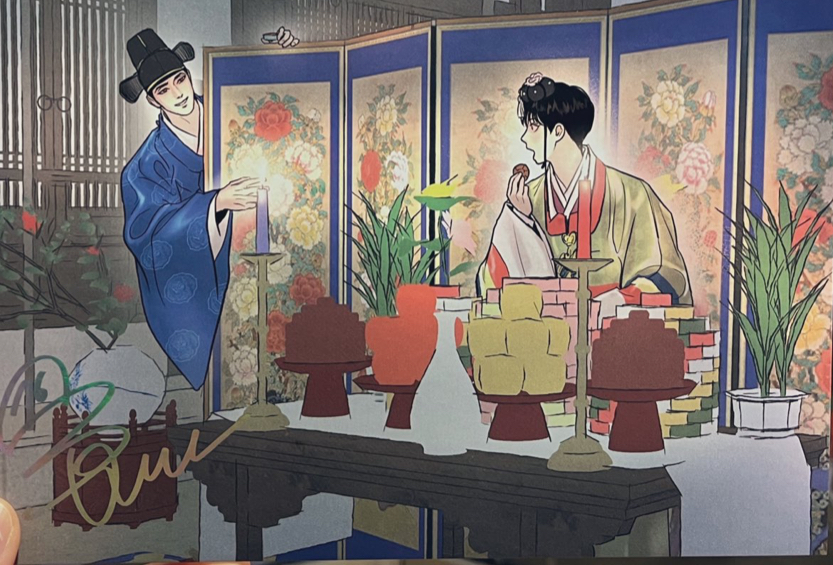
 (chapter 85) This means that in the Yoons’ mansion, people didn’t venerate this god. And since the aristocrat made such a statement to the elder Yoon Chang-Hyeon,
  (chapter 86), I have the impression that in season 4, we will assist to a real ritual to ward off evil and back luck, leading the tormenting souls to the afterlife peacefully.
  (chapter 100) and this altar
  (chapter 100) were exposing the presence of a ritual. However, my problem was that I couldn’t determine exactly the nature of the ritual. But by making the connection between the dragon and good fortune, I had now more clues. I have to admit that I can not be 100% sure for this, but this is what I found:
  (chapter 4)
 (chapter 6)
  (chapter 82)
  (chapter 83) and the deer
  (chapter 22). Then the lord compared Baek Na-Kyum’s eyes to a rabbit.
  (chapter 78) Since both resemble each other, I deduce that the main lead has the same eyes, the rabbit’s. Like mentioned above, he utilized his fingers similar to claws:
  (chapter 54) One might argue that this signification is totally impossible, for the lord doesn’t have the body of a snake. This point can be refuted very easily. What is the major characteristic of a snake is molting. A regularly recurrent event during the activity period of all snakes is the shedding of the skin. This coincides with the lord’s change of clothes. The latter reflected his downfall and rising. Furthermore, this animal is linked to death and rebirth. My avid readers are already aware that I had detected different scenes, where we could witness the lord’s spiritual death and rebirth, like for example in the shed:
  (chapter 62) When he discovered his misjudgment the next morning, he felt like dead. He no longer saw himself as a lord, but came to view the painter as his new lord :
 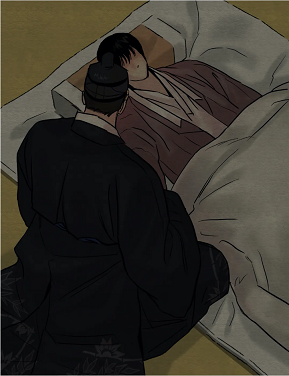 (chapter 66) As a conclusion, Yoon Seungho shares so many similarities with the dragon that I came to view him as one. This explicates why even after getting married, he will never wear a beard!
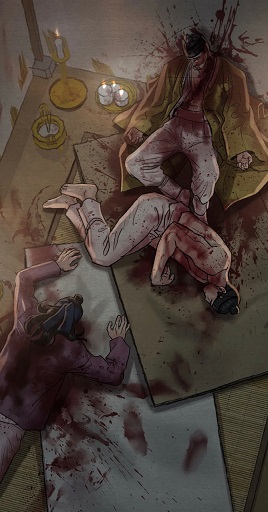 (chapter 102), and thanks to the painter, Yoon Seungho’s soul was able to escape this “mental prison”.
  (chapter 45)
 (chapter 55) and as such his heart and mind.
  The painter is sitting inside a room, while Jung In-Hun is standing outside. Nonetheless, the position of the characters are very similar. This indicates that the author’s new alternative story is actually inspired by the main story!! This can only reinforce my perception that Yoon Seungho in the main story is associated to royalty. However, since it is a reflection, I deduce that this image
 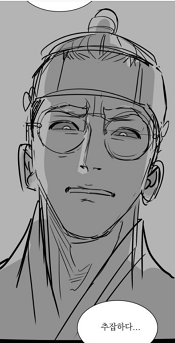 He criticized the painter by stating that this was “filthy”.
  In this scene, the characters are caught by surprise, but it becomes obvious that there is no disgust or expulsion. In fact, the fall of man took place before, for Baek Na-Kyum was sent to Joseon. In this encounter, I detect attraction and curiosity. Hence I come to the conclusion that in the original story, when this scene took place,
  (chapter 50)
  (chapter 52) This means that the mysterious lord Song was actually claiming the main lead as his wife in the last scene. Min and his friends were sent there in order to entertain the protagonist, but they failed. This explicates why the next day, Black Heart was seen with a hanbok of lower quality.
  (chapter 56) It was, as if Min had been compensated for his bruised face by the mysterious lord Song. However, for the pedophile, Black Heart was just a concubine, and not his main wife! Hence the hanbok had not such a detailed and expensive design. This would explain the villain’s jealousy. And now, if you look back at the hanboks from the main lead, you will recognize his ascent. First, he is wearing green, which is similar to Yoon Chang-Hyeon’s color. At the same time, his hat resembled a lot to Kim’s.
  (chapter 1) Then later, he is mostly wearing blue which is actually the color of the Crown prince.
  (chapter 11) Yet, his robes initially have no design. Slowly, the lord is wearing colors and designs that are actually reserved for a king: blue, red, black and purple. This constant change of hanboks symbolizes the “snake molting” and as such his transformation and rising. This is not astonishing that on the night of the bloodbath, he had such a hanbok:
  (chapter 102) Here, he was no longer acting like a noble, but as a ruler. Don’t forget that according to me, the mysterious lord Song had proclaimed the main lead as his unofficial Queen by giving him hanboks with phoenixes. However, naturally, this was never mentioned to Yoon Seungho directly. Why? It is because Kim usually selects his clothes. However, this rise was not natural, as the lord had no real saying in this matter. The real metamorphosis took place in the shaman’s house, when the lord was sent back to the past and as such the darkness.
  (chapter 44) It is because the main lead was thinking that the painter would actually run away. Thus the door was left opened, and he was wearing warm clothes. Yoon Seungho never imagined that Baek Na-Kyum would remain by his side. Yet, during the previous night, the lord had consoled his lover by embracing him.
  (chapter 71) But this can be refuted easily. First, don’t forget that during this love session, the lord was acting like a servant pleasing his new lord. So this had nothing to do with Yoon Seungho’s feelings like sadness or happiness. He was determined to keep the painter by his side, and ignoring his own feelings. He never expected the artist to reciprocate his feelings. Secondly, Yoon Seungho’s nocturne vision is not just a nightmare, but also a DREAM! Yes, you are reading this correctly. Only recently, I discovered that all the artist’s visions are a combination of 3 elements: memory, nightmare and dream! I will give you three examples as illustration, for I am slowly running out of time.
  This vision is a combination of these three elements: memory, nightmare and dream. This had happened during the First Wedding Night (memory)
 (chapter 21), then we have a similar situation in chapter 49: ,
 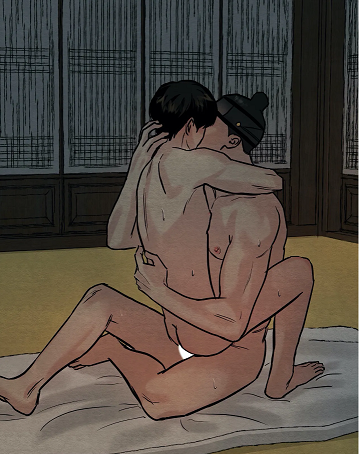 , but the painter was rejecting this future. Hence he considered it as a nightmare.
 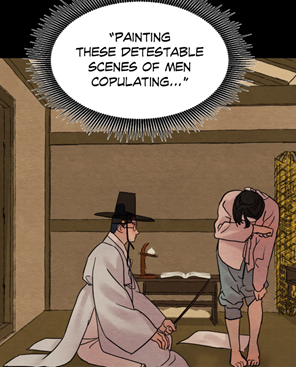 ; nightmare
  the lord becomes a ghost and confronts the painter with his biggest fears (admitting his attraction, passion for erotic paintings and homosexuality) and dream
 (The painter’s true desire was that the lord would kiss him, he was deeply longing for his lips, yet he was still in denial in this vision.
  . He hoped that the lord would take care of him personally. Naturally, the “spirit” is the nightmare
  .
.  (chapter 74) This had already happened, but the lord had not grasped the significance.
  (chapter 53) Besides, he had not opened the door himself. Even when he went to the scholar Lee and opened the door with the his foot, the lord still felt trapped.
  (chapter 96) This shows that the lord’s wish to get released had not been fulfilled so far. In my eyes, it is connected to the torture Yoon Seungho suffered and as such to the purge organized by the authorities. That’s the reason why I deduce that the lord will break a door in season 4, and this won’t be by accident and it will be witnessed by many people contrary to chapter 53, 67 and 96! The broken door will reflect the lord’s rise and power, and no one will be able to stop this. In my eyes, this wish is connected to the door in the servants’ quarter. That’s how his imprisonment started.
 (chapter 74) The “dragon” wished to see Kim and his father, and confront them! And this did take place in season 3. Yoon Seungho confronted the butler with his attitude and betrayal
 (chapter 77), but this argument was just short-lived. He still viewed the valet as a hard-working and trustworthy person. He had just made bad decisions. Then in the bedchamber, the lord could blame the father for his suffering:
 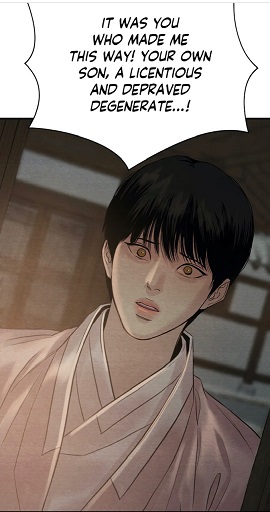 (chapter 86) As you can see, the lord’s wishes were granted, but the nocturne vision was so difficult to grasp that neither the readers nor the main lead could interpret the message correctly immediately. Besides, the nightmare was mostly silent. But this doesn’t end here.
 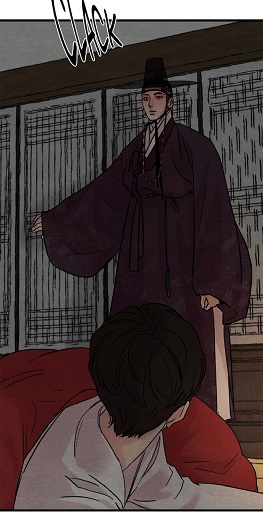 (chapter 34),
  (chapter 30), but much more brutal and violent!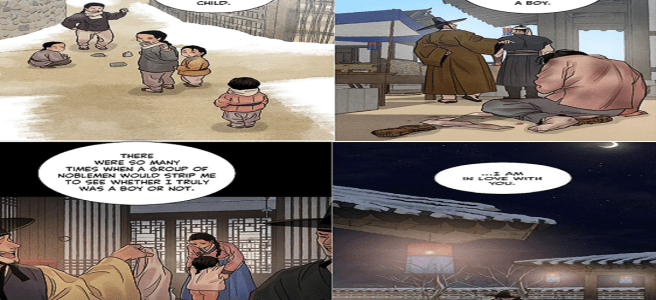

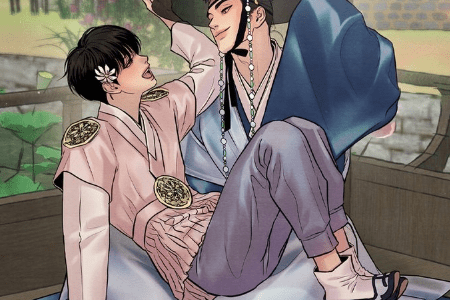

 (chapter 1), and he was no longer living with his single mother and brother Lee Hansoo. He described himself as a small but confident delinquent, as he used to work for a loan shark in order to earn money very easily.
  (chapter 1) And one day, his brother Lee Hansoo met him in order to ask him for money. Their mother was sick and they needed to pay the hospital bills. Lee Yohan agreed to help, thus under pressure, he chose to threaten a debtor’s son. Observe that the main lead chose to use a knife and take the child as hostage. He was walking on a thin line between legality and crime. As you can see, Lee Yohan was no saint. But it didn’t matter to him so far, for he had no faith at all. He refused to believe in karma.
  (chapter 1) He was definitely a disillusioned teenager, therefore he was not thinking about the future. However, the fact that he became totally reckless during that day indicates that he still valued his family. He might not have been close to them, but he still cared for them. That’s the reason why he agreed to accept the brother’s request. We can sense his worry here.
  (chapter 1) However, since he had given up on his dreams and had no hope, Yohan didn’t take the threat seriously, until he was confronted with reality.
  (chapter 1) The same man killed his brother Lee Hansoo in front of the main character. The man had acted like that, for he had lost everything: his home and as such his family. I would add that he had failed to protect his son. Out of despair and anger, he decided to retaliate, to make the young man suffer, like he had been hurt before. An eye for an eye, a tooth for a tooth. The assassination was like a wake-up call for Lee Yohan. From that moment on, he turned a new leaf.
  (chapter 1)Why? He considered himself as the murderer of his own brother.
  (chapter 2) In his eyes, it was, as if he had killed himself the brother and his own mother!
  (chapter 27) He recognized that his actions had been the trigger for the debtor’s crime! At no moment in the manhwa, the main lead blamed the real culprit, not even his own mother who had given up on him. He admitted that in the end, it had always been his own choice to live like a thug! Striking is that he considers himself as responsible for his mother’s death, as because of his terrible way of life, he had caused her worries. As you can see, Lee Yoohan could not be considered as guilty for his relatives’ death, but he had definitely his share of responsibility in his family’s suffering.
  (chapter 27) No, he didn’t cry, hence the owner of the club wept for him.
  (chapter 27) He could sense Lee Yohan’s agony. He had lost his family at such a young age, he might have been a sinner, but anyone could sense his affection and conscience! He might have lived like a thug, but he was not a bad person per se. It is just that he had made wrong choices, just like the man who had stabbed his brother. In the main lead’s eyes, it was not karma, like the culprit said:
  (chapter 15) Thus he rejected the advances from Yoon Jae. In chapter 15, we could sense that the main character was preoccupied about the existence of god. Was there a divine punishment or not?
  (chapter 15) And Yoon Jae denied such a thing, but added then:
  (chapter 15) But is it not the same? Yes and no… For Yoon Jay, if someone acts badly towards another person, the former will be treated the same way. On the other hand, each kindness will be returned. But one might argue that the gods can interact through humans and use them as pawns to give people their karma. And this is what we are discovering in Payback. Lee Yohan helped Yoon Jae and even showed him a crying man. The famous director Yoon got moved by the main lead’s tears
  (chapter 15) proving that not all humans were cold and distant. They could express regret and admit their mistake. For the first time, Yoon Jae discovered warmth and sensitivity.
  (chapter 1) The most terrible thing is that the actor had been helped constantly by the protagonist. Since the former had a dream of becoming an actor, the “thug” was generous to help him financially and emotionally. The assassination worked for Song Myungshin, for he had planned to steal the money from Lee Yohan.
  (chapter 1) That’s the reason why he didn’t even call the police. The murder would divert the main lead’s attention from the theft. When Lee Yohan heard this confession, he got upset for two reasons. Song Myungshin showed no remorse and a total indifference towards Lee Hansoo and the main lead.
  (chapter 1) But most importantly, he never suffered any karma. In fact, he could benefit from his sins and crimes. This could only reinforce his impression that there was no god out there giving punishment to the sinners. The actor took pride of his bad action, as he decided to take Song Yohan as his stage name! Yohan was a reminder that thanks to him, he could enter the entertainment scene. As a conclusion, karma hasn’t punished the actor Song Myungshin yet. Therefore Lee Yohan was determined to take his revenge. What he didn’t realize is that his first encounter with the other main lead would help him to achieve his goal: to give “punishment” to Song Myunshin. So he didn’t know yet that the gods were aware of this injustice, thus they let him meet the famous director Yoon Jay.
  (chapter 15) On the other hand, the existence of Lee Yohan gave the director hope, he could smile again and as such find happiness. The rabbit announced the return of innocence in Yoon Jae’s life. In other words, the two main leads were quite similar in their disposition: both had been wounded by their past, and had no hope. And thanks to the famous and powerful director Yoon Jay, the main lead is slowly starting living again. Little by little, he is interacting with people again, helping others, though he never does it openly. The best example is the actor Lee Hansoo who has the same name than his own brother.
  (chapter 6) In this scene, he refused to be addressed as hyung, as in his eyes, he didn’t deserve such a title. He had not acted like a hyung to his true little brother.
  (chapter 14) I couldn’t myself thinking of the antagonist Lee Jihwa, for he was put in a similar situation.
 (chapter 100) on different occasions, and both went to the scholar’s home together? Yes, this time Min’s threat had become a reality.
  (chapter 76) He could no longer back out. He couldn’t put the whole blame on the Joker, because this means that he would have to admit his own complicity. Yes, Lee Jihwa was trapped. He could sense that he had been framed by Black Heart, but the former couldn’t claim his innocence because of his knowledge! That’s how I realize why the young man was punished this way. Remember how he had blamed his childhood friend for his misery, and had used his knowledge as a proof for his reproach!
  (chapter 57)
  (chapter 57) Thanks to his knowledge, he was above any reproach, while it was not the same for Yoon Seungho. The latter was indeed ignorant, for he had forgotten many things. Consequently, the gods chose to punish Lee Jihwa for his arrogance and passivity. Now, he knows, but this doesn’t help him at all. Hence he decided to forget! This means that he behaved like Yoon Seungho, who repressed everything. The only difference is that contrary to the childhood friend, the main lead had been a real victim the entire time. Thus the second lead imagines that once he forgets and runs away, he will be able to escape punishment. However, he is wrong, for by choosing oblivion and desertion, he has to give up on his name Lee and identity. He can still be addressed as Jihwa, like you could see above. Yet, we have to question this. Is Lee Jihwa truly innocent like he claims it?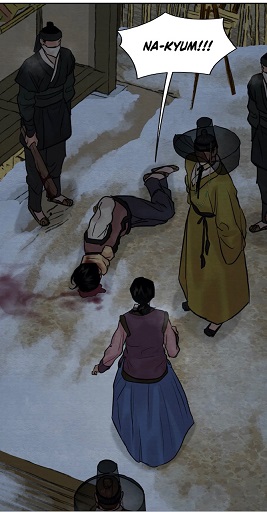
 (chapter 99) But what did he do? Nothing. Secondly, he witnessed how the kisaeng was dragged away to get killed, though it was staged. Here again, he did nothing.
  (chapter 99) I would even say that he even faked ignorance, because he was lying. The drop of sweat is the clue for this interpretation, besides Min contradicted his testimony in the shaman’s house later.
 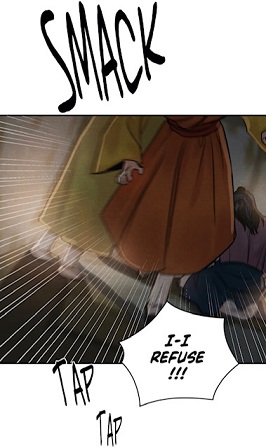 (chapter 100) He turned his back on Baek Na-Kyum. But that means that he abandoned the artist once more time. In three occasions, he was well aware what was happening and he could have intervened. Yet, he let it happen. Besides, he handed over the drugs and dildo to Min. As you can see, he was never an innocent person, but not just a sinner. He was an accomplice. And he knew this, thus he couldn’t go to the bureau of investigation. Min was well aware of this.
  (chapter 101) Naturally, his crime was nothing compared to Min’s.
  (chapter 50) By fleeing, he didn’t stop his friend from committing a murder. Thus he is responsible for their deaths. And he knew that Min and the other nobles would die.
 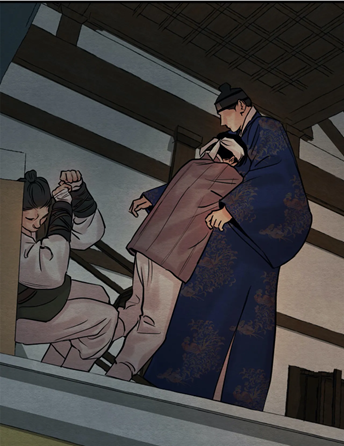 (chapter 53) and even follow his friend. And this distinguishes him from Lee Yohan so much. The latter recognized that each decision he made had consequences. And note that the idiom “choice” was connected to silence and assistance.
  (chapter 50) It was, as if he had murdered the nobles himself. The gods were teaching him a lesson: Knowledge and passivity are crimes. In other words, Lee Jihwa became a sinner and a criminal because of this night. And this because he refused to face reality.
 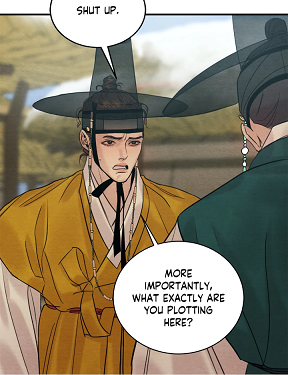 (chapter 83) But was he really ignorant here? I came to a different interpretation recently. How? First, why does the second lead have a drop of sweat in the last picture? This is an indication for a lie. But there exist stronger proofs. Don’t forget the following rules: there’s always a reflection within the same chapter, and each chapter is reflected in the next. In the antagonist’s memory, Lee Jihwa was portrayed as someone who would disobey his father!
  (chapter 83) He would trespass the house of the Yoons and enter the shed, even the lord’s bedchamber!
  (chapter 83) As you can see, Lee Jihwa was acting as a rebellious son in the past. He was not respecting social norms and the elders. This signifies that we have the exact opposite in the present. Observe the seasons: summer versus winter. Thus I come to the following deduction. He is following the order from his father, he is not dragged
 (chapter 83), but he brought Min there. Why would Min say this?
  (chapter 83) Why would he come to see the mess? His words are indicating that someone must have told him about the scholar’s death. Since we saw this,
  (chapter 83) we thought that when the plotters came, Min was leading the way. But if we take into consideration chapter 76, we realize that back then the childhood friend brought Min to Nameless’ barn.
  (chapter 76) Thus it could have been the same! Lee Jihwa had brought Min to the scholar’s house, then Min was the one giving the signal to leave the humble dwell, just like in chapter 76. The red-haired master let Min meet The Joker, before Min was the one asking Lee Jihwa to follow him, when he realized that Nameless refused to help him.
  (chapter 76) So when we view this,
  (chapter 43), so from my point of view, we could have a similar situation, someone had asked him to bring lord Min to that mansion! It can not be Min… From my point of view, Lee Jihwa was acting on his father’s orders. That’s the reason why Lee Jihwa never entered the mansion, and he told Min the story about the incident in the bedchamber. Father Lee had been the one who brought it up first.
  (chapter 82) Why would Lee Jihwa suddenly mention this story to Black Heart, when he had remained silent the entire time? Even Min wondered about this!
  (chapter 83) Another clue for this signification is the vocabulary of Black Heart. The latter is speaking like father Lee: lunacy
  (chapter 82)
  (chapter 92). Finally, don’t forget what Min said about Yoon Seungho.
  (chapter 83) This shows that Black Heart stands for social norms: respecting the elders. But he never realized that in verity he was getting fooled by the Lees. We saw where the main lead was living in the shed, but did Lee Jihwa say this to Min? No, I don’t think, he mentioned it… he was left in the dark about this, just like the readers were not informed, when lord Song was mentioned by Lee Jihwa.
  (chapter 93)
  (chapter 99), the servant Seokdae or even his son Lee Jihwa. The loss of hair was the proof of his leniency.
  (chapter 82)
  (chapter 27) On the other hand, contrary to Lee Jihwa, he grew up in a poor environment, thus he had to work in order to live. He could never live carefree like the spoiled only son of the Lees. Finally, I would like my readers to question themselves this: Will Lee Jihwa come to admit his responsibility in the death of the nobles and in Yoon Seungho’s suffering? I have to admit that I am hoping for his return, for the two friends need to have a proper talk, and according to me, Lee Jihwa apologized or at least expressed regret in front of his friend, thus he got spared. Yet, I would like very much to see such an apology to the main lead. But before his departure, he still viewed himself as a poor victim who had been wrongly framed exposing that he had not grasped the true nature of his wrongdoings.
 (chapter 01) But after studying the manhwa so closely, I discovered the existence of rules in the manhwa which helped me to dig up new information. I am listing the laws of Painter Of The Night again in order to avoid repeating myself. I will refer to them later in my argumentation (rule 1, 2, eg.). That way the readers can better grasp how I came to new revelations and theories.
 (chapter 57) He was admired which created a source of jealousy. While the painter discovered sexuality and his homosexuality very early on, Yoon Seungho was pure, but through incidents he was forced to become a sodomite. While Heena and the scholar tried to repress Baek Na-Kyum’s sexuality, the father pushed his son to have sex out of fear and high expectation.
  (chapter 101) Striking is that the author used the same method to introduce the memories. First, we see the servant talking before viewing the memories.
  (chapter 101) And now, compare it to chapter 1:
 (Chapter 100) He denied his responsibility by putting the blame on someone else („I was told“), yet once facing the young master Jihwa, his declaration exposed his lie.
  (chapter 1) So in episode 1, the servant was not aware that he was lying to the protagonist, when it comes to the painter’s past. However, the domestic with the brown hanbok lied in one aspect, the publication of the book.
 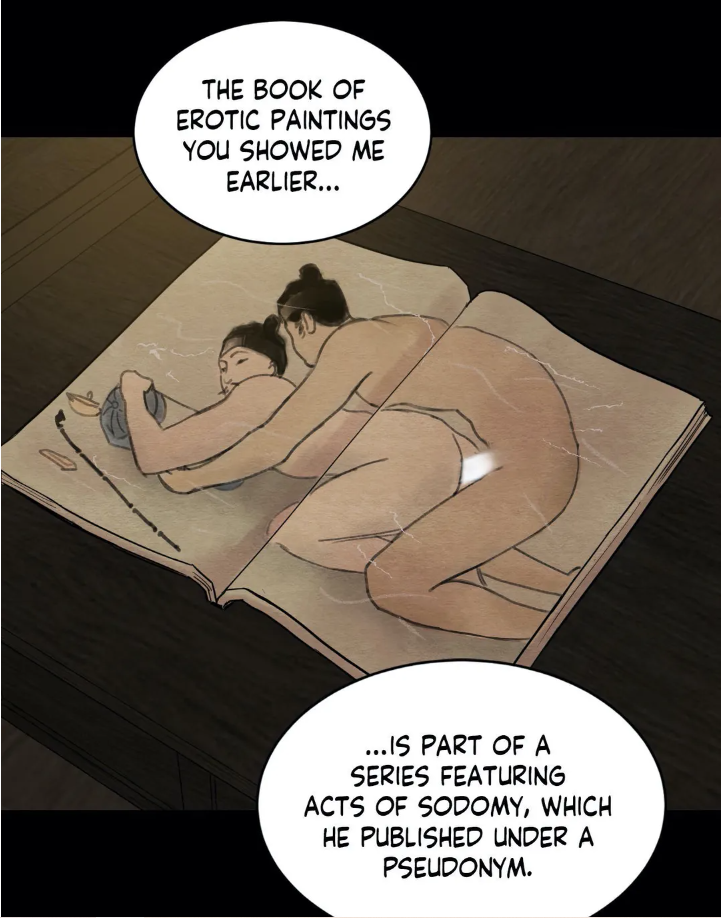 (chapter 1) One might have the impression that I am digressing from the main topic. Yet the manhwalovers should keep in their mind that the servant from episode 1 served one purpose: to show us the memories of an important witness, someone who watched Baek Na-Kyum growing up. Thus we have three different pictures. First, he is a baby, then a young infant
  (chapter 1) and later almost a grown-up
  . (chapter 1) This signifies that the witness was close to Baek Na-Kyum which explains why the domestic trusted the source of his information. However, contrary to episode 101, she never divulged the identity of the witness. It is because the person wished to hide in the shadow.
 (chapter 1) It ends with the domestic’s death, while the incident with the topknot is mentioned in the middle. At the end, the painter is dragged to the mansion. As you can see, both chapters reflect each other. That’s how I had this revelation
  (chapter 4) Here, the shadow was bigger indicating that it was early in the morning. The painter had just woken up. Consequently, I deduce that the baby was brought to the mansion during the day. This signifies that Baek Na-Kyum was never abandoned! He was entrusted to the owner of that mansion!
  (chapter 4) Pay attention to the background in this picture. And now, you are probably thinking that the owners of that mansion are the Yoons, as we observed the main lead living there. Nevertheless, I had already pointed out that this was not Yoon Seungho’s mansion. This is the Yoons’ domain:
  (chapter 51) The courtyard is different. According to me, this is the mansion of the Lees. [For more read the essay 360: Lee Jihwa’s special relationship with Yoon Seungho] And since episode 1 and 101 reflect each other, this can only reinforce my interpretation that the Lees are involved in Baek Na-Kyum’s past, for we have Lee Jihwa present in chapter 101. Baek Na-Kyum was brought to the Lees, thus the scholar Lee keeps calling Baek Na-Kyum a peasant! He knows about his true origins. I had always said that the man was revealing his knowledge with his insult. But does it mean that this was the vision from Lee Jihwa’s father?
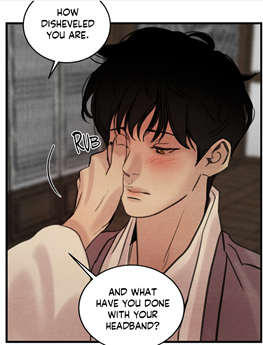 (chapter 38). Besides, father Lee views him as a peasant and not a servant. This observation gets reinforced, when you look at the memories from the painter. In his childhood, he was never wearing a white head-band.
 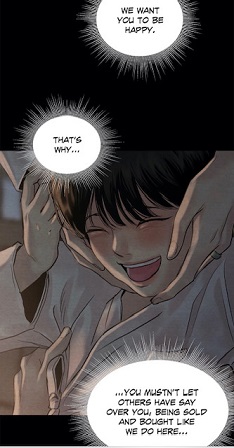 (chapter 87)
  (chapter 18), he was repeating his admired sir’s idioms. Besides, “hell-raiser” is also an indication that the learned sir was a Christian who converted Heena. Thus I deduce that when father Lee received Baek Na-Kyum as a baby, he entrusted him to the learned sir Jung In-Hun who had no connection and no wealth so far. So when the lord described him as such in episode 7, it was not entirely correct. The reality was that the man had been working for the Lees, but he had been “abandoned” at some point. The scholar was his helping hand explaining why he would appear in this scene.
  (chapter 87) He was definitely living in comfort. But what was the purpose to let him wear the white tissue? Dressed as a slave, no one would have wondered if he had been killed. Remember the scholar‘s words: a servant is viewed as an object and possession.
 (Chapter 10) So a lord is following social norms, when he sentences a slave to death.
 (chapter 40) He was never born to be a prostitute, but he was sent there on purpose. Under this new perspective, it becomes more comprehensible why Heena sent Baek Na-Kyum to the learned sir. He was the one who had brought the artist to the gibang, and now he was getting older. One might refute this point, for she declared this:
 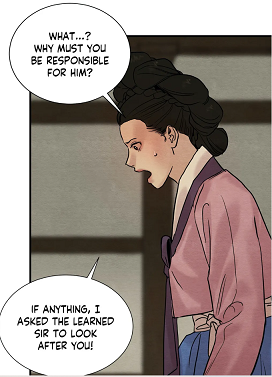 (chapter 68) Nonetheless, the beholder can detect the presence of a drop of sweat on Heena’s cheek. So she was deceiving the artist here. Why? Yes, in her mind, the painter was Jung In-Hun’s son and as such the learned sir should become responsible for the painter, for he was his father. But she had to lie in order to persuade him to leave the mansion. There’s no ambiguity that the head-kisaeng had no idea about the deal between the Lees and Jung In-Hun in the past, I believe that she must have discovered the truth at some point..
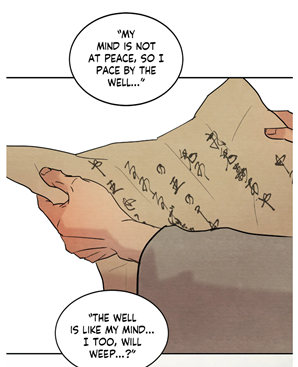 (chapter 4) This was inspired by the poetry from Wang Bang-Yeon!
  (chapter 4) In this poem, the famous author was referring to the death of the young king Danjong who had been killed by his uncle Sejo. Danjong was just a teenager, when he died! As you can see, the text is actually an allusion to royalty and exile. Under this new light, it dawned on me that the scholar Lee had been entrusted to take care of Baek Na-Kyum, but the latter chose to delegate this to the learned sir. There was a reason behind this. For me, he was eyeing at the mansion himself! One might refute this point, for the elder Lee said this:
 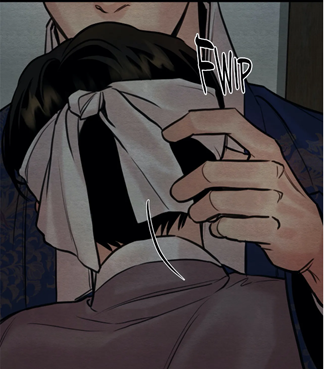 (chapter 53) How does he know it? In my opinion, it is because Baek Na-Kyum resembles to the king. The only difference is that he has no beard. This would explain why Yoon Seungho said this:
 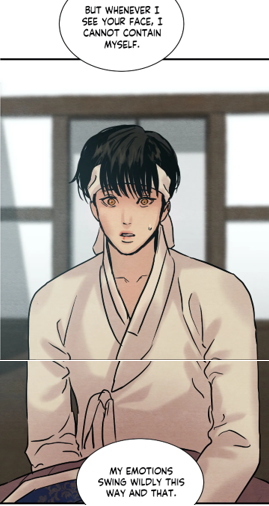 (chapter 55) Why would he get upset? Why would the painter’s face evoke such emotions? He is reminded of his abuser. This is no coincidence that the main lead had such a flashbulb right after, where you could see Lee Jihwa and his father, as they looked like Yoon Seungwon and his father.
  (chapter 55) They are all related. And now, you comprehend why the author wouldn’t reveal the face of the mysterious lord Song in chapter 83
 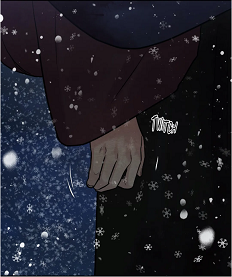 (chapter 102) The colors are already insinuating that the artist belongs to the royalty.
 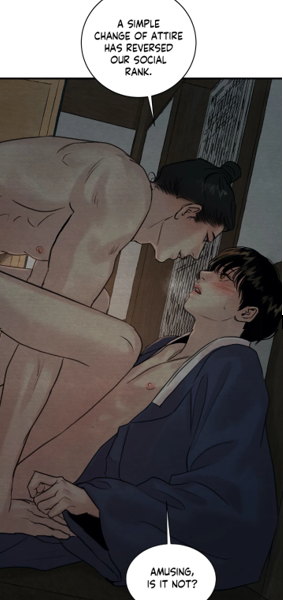 (chapter 71) If the pedophile came to the gibang and crossed the main lead’s path, he couldn’t recognize his relative (son or nephew) due to the hair and the clothes. Besides, I am certain that my avid readers can recall my other theory: the painter was stolen as a child. This new interpretation would corroborate this theory. The painter has been robbed of his true identity, he had been kidnapped, when he was brought to the kisaeng house!! Besides, if he is the true owner of the mansion, then this signifies that Father Lee succeeded in his coup d’Etat (rule 1, rule 3). In season 3, we have an attempted “coup d’Etat” with Yoon Chang-Hyeon eyeing at the seat.
  (chapter 86) Moreover, I would like to point out that we have the topic: siblings’ jealousy. This is definitely possible that father Lee is related to the artist, an uncle for example. Finally, if the painter is the king’s son, this is no coincidence that Baek Na-Kyum suffered so much. He was paying for his father’s sins (rule 5). At the same time, if Baek Na-Kyum has to face the infamous lord Song, as his son/nephew, he is put in a position where he can criticize his father/uncle. How could he abandon him and treat Yoon Seungho like that?
  (chapter 37) Notice that here only 3 men were arrested and tortured. It was, as if the sons had to pay the crime for their father. That‘s how the noble families close to the Yoons died out.
  (Chapter 37) They had lost their heir. So far, we still have no idea about the cause for the treason: Coup d’Etat or attempt of assassination on the king or spying or murder of a royal member (here Baek Na-Kyum)? But this purge is associated to inheritance and the loss of a heir. There’s no ambiguity that the painting in Yoon Chang-Hyeon’s bedchamber was used as an evidence that the elder master Yoon was eyeing at the throne
  (chapter 83) imagining that Yoon Seungho through his “marriage” would become the crown prince. Since the author mentioned “torture”, I have the impression that the main lead was brought to the bureau of investigation and got tormented there. He was naturally framed, he had been acting as a spy. He was hoping to become the king’s successor as his “bride”. So once the artist had been executed, the scholar Jung could have claimed that he had been raising the painter the whole time and receive a huge compensation for his benevolence! And the Yoons were the culprits.
  (chapter 102), I am assuming that his visage won’t be bruised again, so that his foot could get hurt, for the lord and the butler had a broken foot in chapter 77. (rule 3)
 (chapter 77) Don’t forget rule 1 and 3. Nevertheless, the main point for this interpretation is the way the painter ran:
  (chapter 17)
  (chapter 85) Here he had faked running. Since he had been introduced with his feet in chapter 1, she needed to create reflections later. Finally, I would like to point out this:
  (chapter 7) Their meeting here is an indication that their past must have crossed before because of rule 1!! Since the painter was so devoted to the learned sir, the valet could only jump to the conclusion that the man had truly taken care of Baek Na-Kyum properly.
  (chapter 04) The protagonists’ fate got switched the moment they passed a door. Thus the painter didn’t suffer here contrary to the young master
  (chapter 1) He had actually painted animals and nature in his childhood, thus the noonas kept his drawings.
  (chapter 94) The man had trusted the learned sir’s testimony without verifying the facts. He had not detected the presence of a blackmail!
  (chapter 1) This truly shows that ignorance is indeed no blessing, and people shouldn’t trust others according to their appearances or social status. At the same time, the servant had forgotten that Yoon Seungho was a noble, though he was dressed like a peasant in the bedchamber.
  (chapter 29) and Baek Na-Kyum
 (chapter 68) This shows that the painter embodies the link between the head-kisaeng and the learned sir. Jung In-Hun had entrusted her the baby.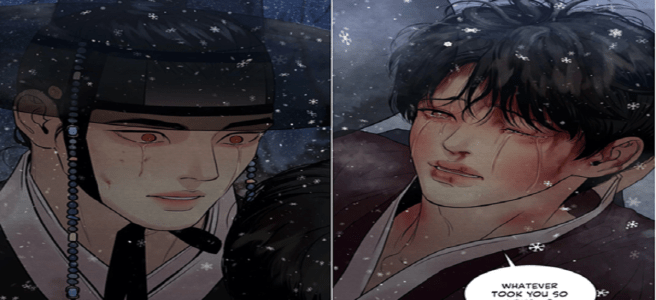
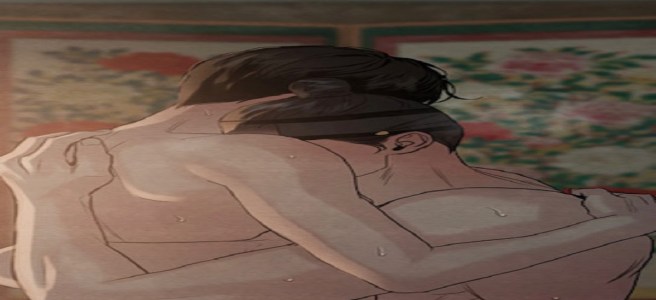
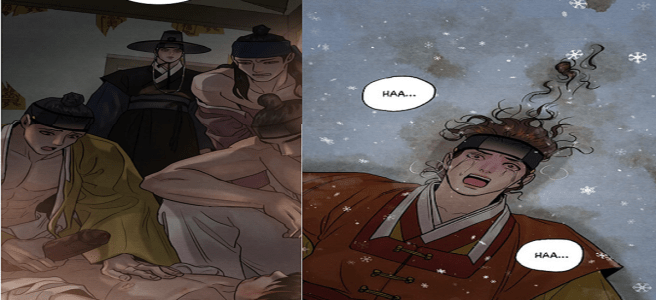
 Bebebisous33s' analyses in K-Dramaland and Manhwas