
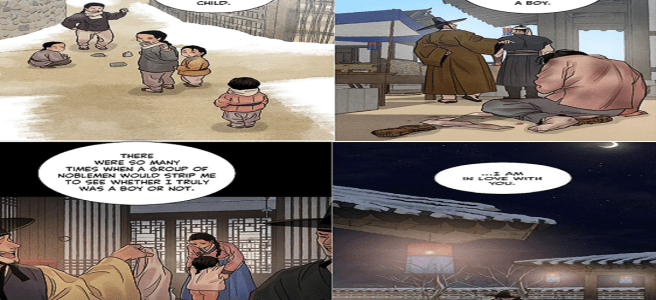
This is where you can read the manhwa. https://www.lezhinus.com/en/comic/painter But be aware that this manhwa is a mature Yaoi, which means, it is about homosexuality with explicit scenes. If you want to read more essays, here is the link to the table of contents: https://bebebisous33analyses.wordpress.com/2020/07/04/table-of-contents-painter-of-the-night/
It would be great if you could make some donations/sponsoring: Ko-fi.com/bebebisous33 That way, you can support me with “coffee” so that I have the energy to keep examining manhwas. Besides, I need to cover up the expenses for this blog.
Announcement: The essay “Powerful fellatios” was updated.
Before elaborating my new discoveries, I would like to repeat the following principles on which the story was developed:
- There is always a reflection within the same chapter.
- The next episode is mirroring the previous one, naturally with slight changes.
- Each season is reflected in the previous and the future one.
- The author is working on positive and negative reflections.
- Thus the story is going in circle.
- Thus the lord’s destiny is reflected in the painter’s.
Like explained before, the reason for this huge amount of reflections is that her story is constructed like a kaleidoscope. Therefore it is not surprising that I keep contrasting many images and chapters with each other. That way, we can get new insight about the past. At the same time, the author can not expose the whole truth for two reasons. We don’t have a narrator, and since it is a manhwa, the narration is really limited. Moreover, Yoon Seungho might confess to Baek Na-Kyum about his traumatic past, yet his testimony will never mirror the entire verity. Why? It is because as a victim, he didn’t know everything. He had no idea what people would think and do behind his back. Since he had no idea about a conspiracy in season 1, 2 and 3, I conclude that it was the same in the past!! Hence it is up to the readers to fill the blanks and as such to solve the puzzle.
Striking is that after the end of season 2, I had examined the topic “farewells” [For more read essay 195 “Farewell” ] which sounds quite similar to the title of this analysis. One might fear that I could repeat myself. However, this is just a deception, for I am focusing now on season 3. With the new panels, I could get new clues about the painter’s departure from the gibang. So far, I had stated this: Heena did it for the painter’s sake. It was to protect him, 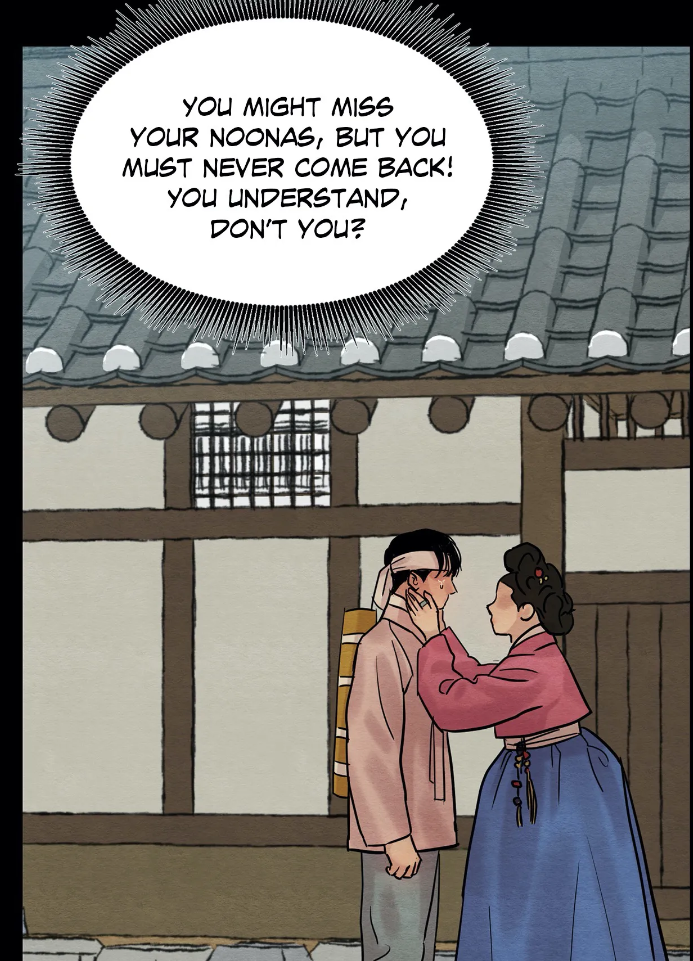 (chapter 46) This was actually implied by Heena’s words and gestures, yet I had already questioned this, for Heena appeared as dishonest. Now, it is time to expose my new interpretation concerning Baek Na-Kyum’s eviction from home.
1. Exits in episode 94
What caught my attention is that chapter 94’s main topic was departure. How did I come to this perception? First, we have the well which reminded Yoon Seungho of the scholar and his poem.  The latter had given the poetry referring to exit to the painter as a farewell gift. Why was the lord thinking of Jung In-Hun in that moment? It is because he had read the letters from Heena and as such her accusation against him. He had killed the learned sir, hence in the lord’s mind, it was only a matter of time until Baek Na-Kyum would bring up the subject and decide to leave him. The letters are not destroyed, for he asked this to the painter:
  (chapter 94) Yoon Seungho had two reasons to expect such an outcome. First, it was related to Yoon Seungho’s offer to Baek Na-Kyum.
  (chapter 44) Secondly, Baek Na-Kyum had already showed to the main lead that he could leave him at any moment.
  (chapter 85) Finally, what mattered to the artist the most was the lord’s love and trust.
  (chapter 85) He believed in his affection while thinking that Yoon Seungho would keep his promises. But if there was a slight doubt about him, in Yoon Seungho’s mind, the painter would choose his noona over him, like he had experienced it in the study. To sum up, in the gibang, the lord was fearing the artist’s departure. Moreover, when the painter confessed his love to the noble, he was also leaving the scholar’s side. His path was no longer following the teacher’s. Thus when he said this
  (chapter 94), he was actually biding farewell to Jung In-Hun. He was moving on. Finally, if you include these panels from chapter 94,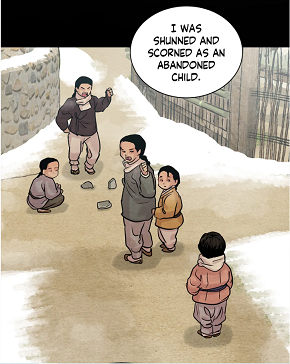
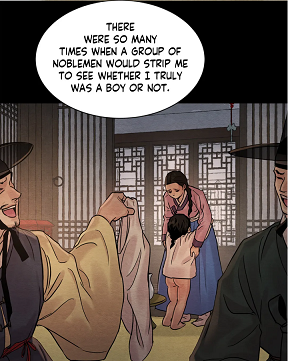
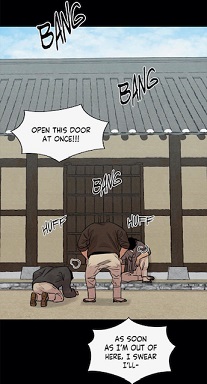
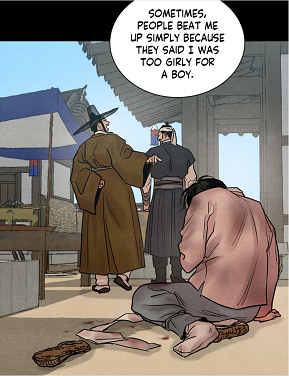 , the painterofthenight-stans can notice that people are about to leave. In the first image, the young artist is chased away by the comments from the other children. Then the painter is standing in front of his noona Heena, he has just left the side of the sitting nobles. He is definitely crying, he wished to be embraced and taken away by Heena from the room. As for the last picture, we see two “nobles” leaving the painter behind. They are the ones leaving the gibang, for the exit is close. The painter ‘s face had been beaten, hence we could view drops of blood on the ground and the white head-band.
Interesting is that these three departures were all painful. First, Baek Na-Kyum’s heart got broken, for he was excluded by the children forcing him to live in the gibang. After that, he lived in seclusion. The children used their words and gestures to make him leave. Simultaneously, this panel indicates that the painter had left the kisaeng house and strolled through the streets. Then in the second image, the nobles were more aggressive, for they had removed the painter’s pants. As the manhwalovers can detect, the violence was increasing, thus when the painter’s visage was wounded, it represents the high peak of violence against the painter. Under this new light, it becomes comprehensible why the author chose not to follow the chronology. In this panel, the painter had still a braid (chapter 94) (chapter 94), but not here. This means that the rejection from the “peasants” happened afterwards. And now, if I include Jung In-Hun’s departure, the latter is supposed to have been killed, it becomes palpable that in Painter Of The Night, departure is strongly associated to blood, desertion, imprisonment and death. But this doesn’t end here.
2. The painter’s departure
I couldn’t help myself connecting this scene (chapter 94) with this physical assault in front of the learned sir’s home: 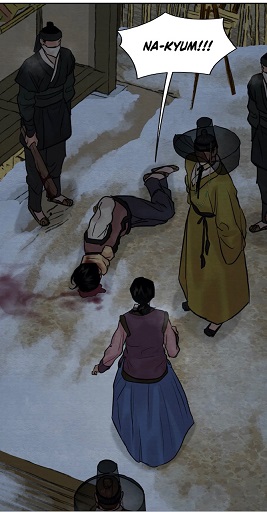 (chapter 99) In these two scenes, the painter got so hurt that he was bleeding. In addition, the painter’s hair was free. In front of Jung In-Hun’s house, the perpetrators had removed his headgear, while in the gibang, the white head-band was on the ground. To conclude, the painter’s short hair was visible. Don’t forget that the short hair was indicating that the artist was an orphan. So by removing the headgear for noblewomen, Min and the black guards made sure to expose that the victim was just a low-born without any family. But let’s return to our comparison. Min was wearing a similar hanbok than the noble in the gibang. Furthermore, the black guard resembles a lot to the aristocrat with the hunting outfit in the kisaeng house house. The painter’s white headband is now serving as a cover for masking the black guards’ identity. As you can see, due to these similarities, I came to the conclusion that this scene (chapter 94) was the reason why Baek Na-Kyum left the gibang. Why do I think so? First, it is related to Heena’s absence.
3. Heena’s role
Where is she? Why didn’t she come and protect her brother? The perfect excuse would be that she was busy with a client. And this leads me to the following observation. Note that in this scene, Heena was standing in front of the door. (chapter 94) She was actually the one hindering the painter to run away. She didn’t act like Jung In-Hun at all 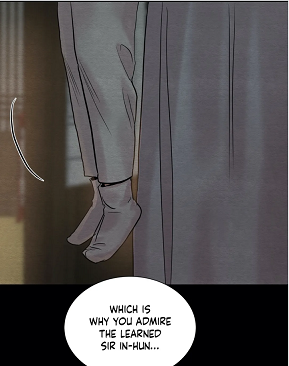 (chapter 68). She let her brother hear the laughs from the younger masters. It looks like she is consoling her brother, yet she is not, for she is not embracing him. She is grabbing him by the shirt which reminded me of this gesture:
 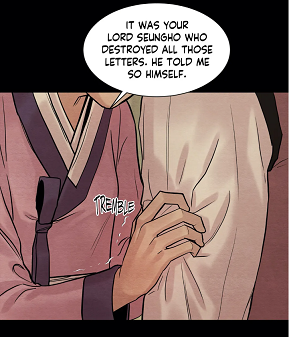 (chapter 97) Hence I deduce that this scene in the gibang (chapter 97) is a reflection of the incident in the painter’s youth. (chapter 94)
| Chapter 94 negative reflection | Chapter 97 positive reflection |
| Painter in tears | Painter smiling, even when he gets scared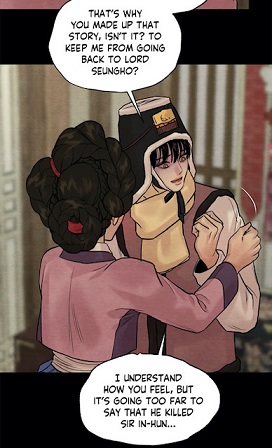 |
| Heena brings a table with food. | Baek Na-Kyum returned to the room in order to fetch the “paper”. |
| Heena says nothing and feels sorry for the painter – | She talks the whole time |
| She remains next to the door. | She approaches her brother in the room. |
| She grabs him by the shirt | She grabs him by the shirt |
| BNK wants to be hugged | Heena wants to hug her brother, but she is rejected |
| BAek Na-Kyum believes her | Baek Na-Kyum reproaches her to tell stories |
| Heena doesn’t weep | She is now in tears |
| Heena definitely portrayed the nobles as ruthless and filthy. | Now, she found a nobleman who would help them |
| Heena stands in front of the entrance. | Heena stands in the way to the door. |
As you can see, these two scenes share so many parallels that I came to the conclusion that in both cases Heena was stopping her brother from leaving the room. (chapter 94) The table and the kisaeng were in his way. In other words, in this scene, she didn’t let the painter leave the room. However, the huge difference is that contrary to episode 97, she was acting under the influence of her unconscious/subconscious. This means that she was not doing it on purpose contrary to her confrontation with her brother in the annex. Here, she desired that her brother wouldn’t return to Yoon Seungho’s mansion. He should remain by her side and follow her. In chapter 94, she could have acted like the scholar (chapter 68) But she did not. Don’t get me wrong. I don’t think that she had bad intentions here. However, her passivity caught my attention. She was immobile and silent. (chapter 94) Hence Byeonduck drew her without mouth. Her behavior contrasts so much to this scene: 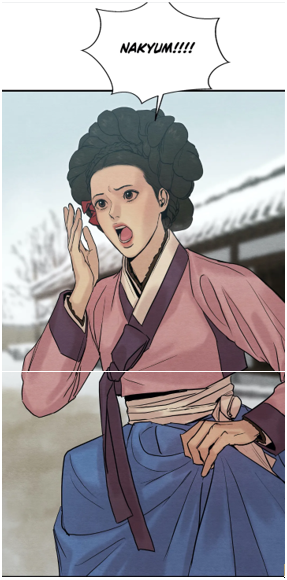 (chapter 65). Thus she gave more the impression of being righteous and truly concerned.
Moreover, another detail caught my attention: (chapter 94) The presence of the moustache beard!! Three of them have one!! (chapter 94) The painterofthenight-lovers will certainly recall Yoon Seungho’s words:  (chapter 44) However, there exists a difference between the painter and the lord’s association for beards in my opinion. The latter suffered due to old men wearing a long moustache beard with whiskers.
 (chapter 82)
 (chapter 83)
 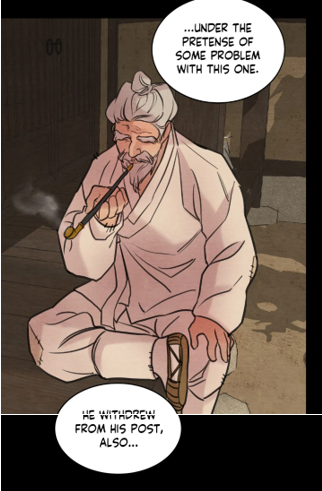 (chapter 37)
“Noblemen’s grooming styles for facial hair found in thirty portraits handed down from the Joseon Dynasty are as follows. Facial hair is classified into three types: beards, moustaches and whiskers according to its location. Twenty one portraits show that the subjects groomed all three types of facial hair.” Quoted from http://www.rjcc.or.kr/journal/article.php?code=7079
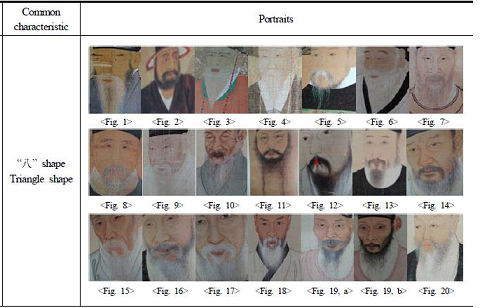 But there exists another style of moustache beard.
The remaining nine scholars also grew and trimmed their moustaches in the 八shape neatly, and had beards in an inverted triangle long enough to reach the lower part of the neck. However they do not have whiskers in their portraits. Quoted from http://www.rjcc.or.kr/journal/article.php?code=7079

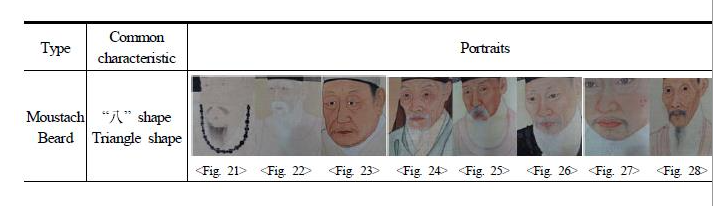 Striking is that Kim is also wearing such a moustache beard.
 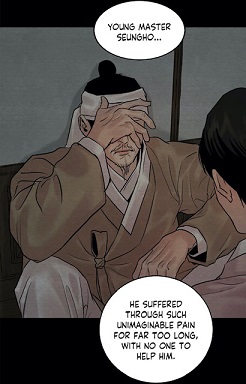 (chapter 87) However, so far in the story, this type of moustache beard was only present among commoners and not nobles!!
  (chapter 39)
 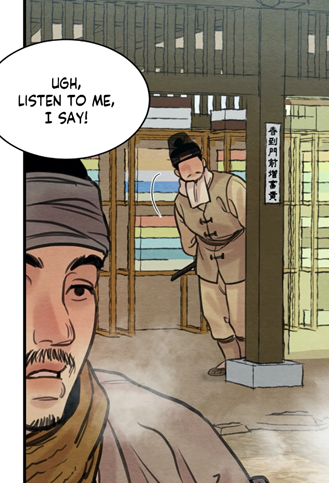 (chapter 45)
 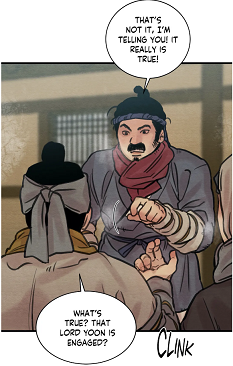 (chapter 45)
 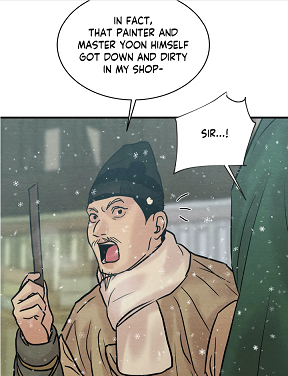 (chapter 64)
 (chapter 78) Hence I started suspecting if these two persons were truly nobles in the end. (chapter 94) Just because they are wearing clothes destined to aristocrats, this doesn’t mean that they are truly lords. And don’t forget that when the painter was attacked in front of the learned sir’s home, many people were disguised. The kisaeng Heena was dressed like a commoner’s wife
  (chapter 99), Min was cosplaying Lee Jihwa, the guards were covering their mouths, Baek Na-Kyum had been wearing a expensive scarf and a headgear for noblewomen,
 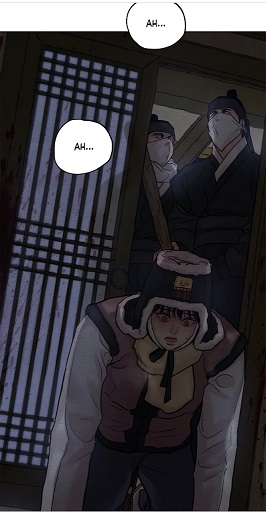 (chapter 99) so that he had been mistaken for a young master.
  (chapter 91). Therefore I came to the conclusion that the painter has repressed the link between the moustache beard and nobles. Since the noona kept saying nobles, what made Baek Na-Kyum shudder in the past were nobles. But the connection between the beard and nobility is existent in the painter’s subconscious. This explicates why Baek Na-Kyum would show such a respect to valet Kim, he would call him sir and listen to him.
 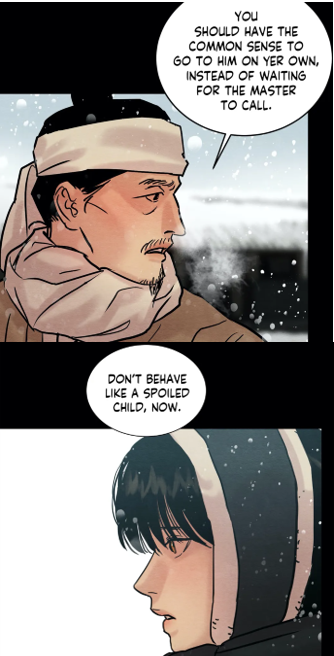 (chapter 52) However, the more time passed on, the more the butler kept pointing out that he was just a servant, so that this moustache beard is losing its meaning, the symbol for power and nobility. At the same time, the painter met more and more people with beards, like for example the tailor
 (chapter 74), the physician
 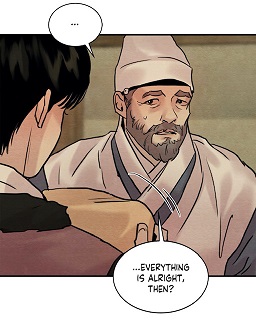 (chapter 74), Bongyong
  (chapter 78) and finally Yoon Chang-Hyeon
  (chapter 87). However, note that when the patriarch left, the main character only paid attention to his gaze and not his beard.
  (chapter 87) This explicates why Baek Na-Kyum is not mentioning the beard concerning nobility, while Yoon Seungho never made the connection between the old bearded men and Kim, though the latter has now a moustache beard! To conclude, I don’t think that this physical assault (chapter 94) was really done by nobles. Moreover, we shouldn’t forget that the gibang is not only visited by aristocrats, but also by commoners (rich merchants, small shop owners, workers).
  (chapter 99). That’s the reason why I came to the following theory. These persons wounded the painter on purpose and in my eyes, it was suggested by Heena. (chapter 94) She couldn’t ask nobles to commit such a crime due to her social status, hence she asked the assistance of low-borns. Striking is that the painter was mostly hurt by commoners in the different seasons: The servants
 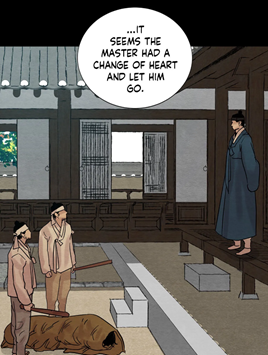 (chapter 13), the maid (though not intended)
  (chapter 36, here the painter is drugged against his will), Deok-Jae
 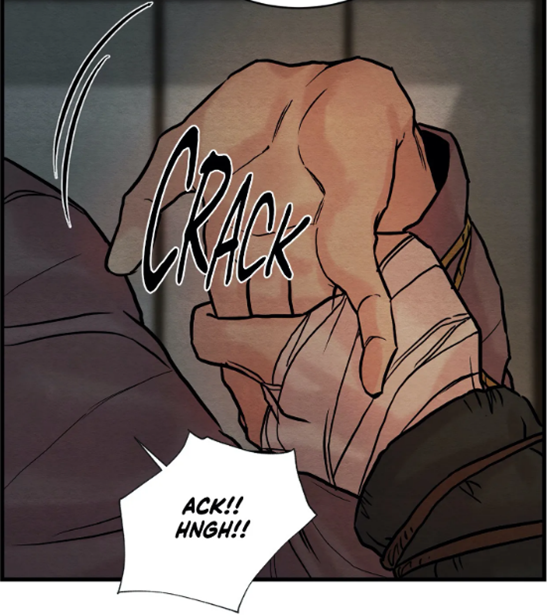 , Nameless,
 (chapter 60), Kim
  (chapter 66) [As you already know, for me Kim was the one who tried to kill the painter during the abduction], Bongyong
  (chapter 78), the calligrapher with his insults
  (chapter 91), the maids with their reproaches
 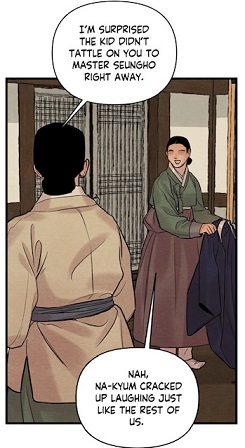 (chapter 91)
  (chapter 98) and the black guards from Min. (chapter 99) The commoners are often the helping hands of the nobles. But as you know, Heena has been denying their existence and involvement. Why? It is because she has been a helping hand herself. Under this new approach, you comprehend why I came to the deduction that Heena had utilized people to make her brother desert the kisaeng house. This is no coincidence that in chapter 97, the painter was accompanied by 2 servants
  (chapter 97), two commoners who neglected him totally. By the way, the one with the green shirt and white jacket vanished later. He was not seen in the mansion. Anyway, the two domestics wouldn’t even follow the lord’s orders properly, for they never stayed by the painter’s side. And since it is a reflection from chapter 94, I deduce that the two “nobles” acted the opposite. They played their role perfectly to the point that the painter was terribly wounded and he never doubted their identities. They were just nobles! And that’s the point. That way, no person was truly blamed for the incident.
Hence Heena didn’t suggest the painter’s exit right after this incident, she had to wait for his recovery, and naturally she had to blame someone: the nobles!! She played with his prejudices in the end. The first evidence for this theory is that during that fateful night, Baek Na-Kyum didn’t go straight to the teacher’s home, for he first returned to Yoon Seungho’s mansion. This time, she couldn’t convince her brother to follow her suggestion, an indication that the indoctrination was no longer effective. This stands in opposition to chapter 94, where the painter’s self-esteem was ruined. Thus he chose to listen to her advice without resisting. This explicates why during their first farewell, the readers were able to see the painter’s face and the white headband on his head!! 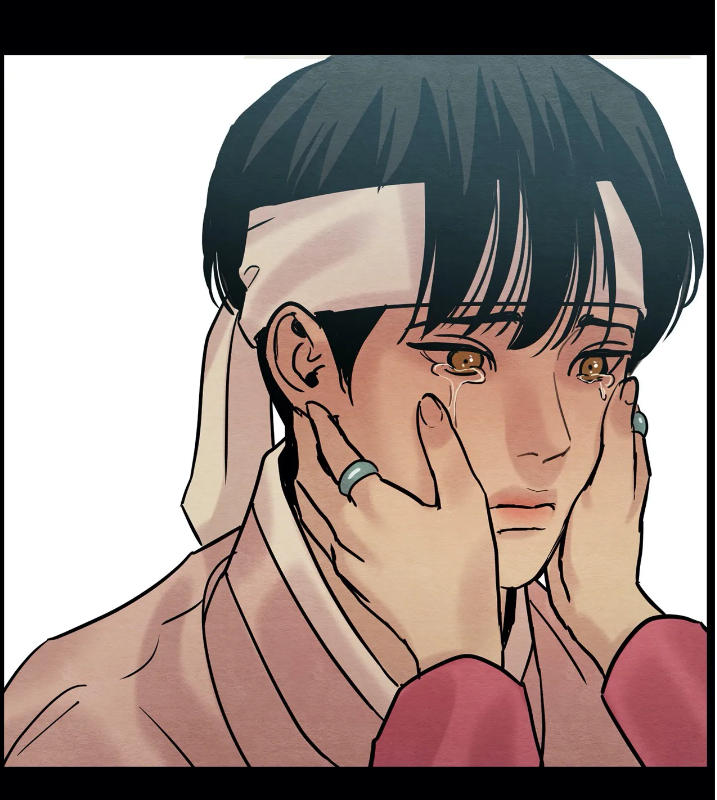 (chapter 46) This was the “positive” reflection of this scene: (chapter 94) No matter what… Baek Na-Kyum should leave the kisaeng house. What caught my attention is that she only presented her argument, the moment the painter was about to leave her. Thus he recalled her words when he was on his way to the gibang (chapter 46) and as such to the scholar’s home.
 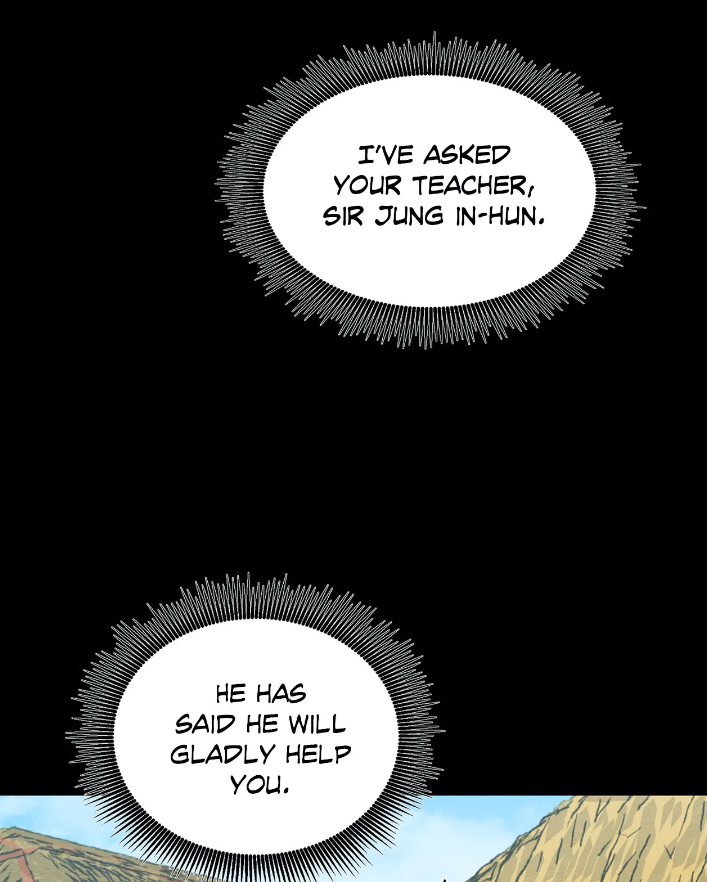 (chapter 46) Moreover, I am now doubting that Baek Na-Kyum and Heena were seen in front of the gibang. (chapter 46) Why? It is because of the building and the absence of the cheongsachorong (the blue and red lantern). First, the gibang is surrounded by a wall made of stones!
 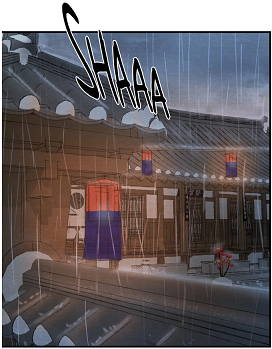 (chapter 19)
 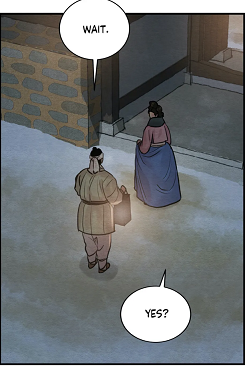 (chapter 69)
 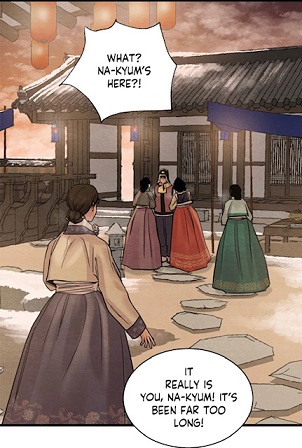 (chapter 93) Secondly, there is no window next to the entrance of the building contrary to the image from chapter 46. Consequently, I deduce that Heena had left the gibang with her brother saying that she was meeting a client, and just before entering the mansion, she sent away her brother. This explicates why he had only taken his tools and nothing more. Remember what the noonas said in chapter 93:
 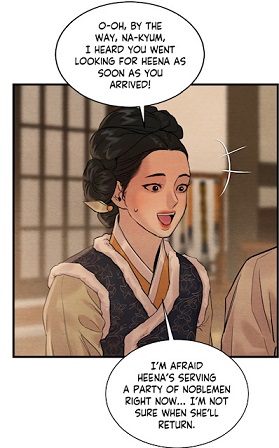 (chapter 93) She implied that the noona was not present in the kisaeng house, while in reality she was punished, trapped in a storage room. And now, you comprehend why Heena said this to her brother: (chapter 46) He couldn’t bid farewell to his noonas, for he had already left the kisaeng house. But he had no idea that he would be sent away during that day. The other evidence for this theory is that the painter went to his lover’s home before visiting the scholar’s house. (chapter 97-98) Furthermore, the night before, the noona had implied that Heena had left the gibang. Thus I conclude that Baek Na-Kyum was truly abandoned by Heena in the end, but he got deceived by her gentle words and gestures. The physical abuse in the kisaeng house and her kind gestures had played a huge role in this. He could no longer be protected there. She justified this that it was for the painter’s best interests. She knew what the artist truly desired. However, this was not true, as she had manipulated him and she had never asked him. Under this new light, you comprehend how Heena could deceive her colleagues so easily with this statement:
  (chapter 93) He had suddenly vanished without voicing such a desire before. And note that in chapter 97, she was already acting on Min’s orders, a sign that in the past, it was different. She had done it on her own accord. In the annex, the kisaeng was definitely scared, hence she was trembling. (chapter 97) I have always said that the painter’s departure from the kisaeng house (chapter 1-46) was related to a crime, but the noona was not aware of this, or deep down she knew, but she chose to close an eye to this. Why do I think that this is related to murder? Simply, because in front of the scholar’s house, she faked her death and the painter had been wounded too.
 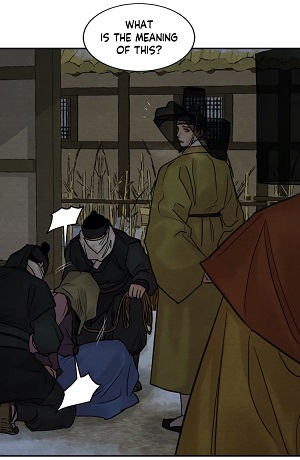 (chapter 99) Finally, we have this execution in chapter 1. During that night, Baek Na-Kyum should have died. But let’s return to episode 97. Here, she was resenting her brother.
  (chapter 97) She was totally unhappy which stands in opposition to chapter 46 in my eyes. Hence she was looking for new tissues at the tailor’s.
 (chapter 64) This would explain why she never looked for her brother afterwards. This shows that unconsciously, the painter had judged her betrayal and abandonment correctly, but he had been deceived by her argumentation and attitude. In other words, he was in denial.
4. The purpose of these reflections
I believe that these incidents are created to expose the transformation and evolution of characters. Heena felt powerless and scared, when she was young. Due to her anxieties (according to me, genophobia) she made wrong decisions, thus she let the protagonists suffer. She was definitely a victim due to her social status as kisaeng, for it was not her choice to become a kisaeng. Nonetheless, the problem is that in chapter 94, she utilized the painter as her shield. The real victim in this scene is not Heena, but Baek Na-Kyum. She had brought the table and let the painter approach the nobles. Why did they want to confirm, if he was a girl or a boy? (chapter 94) The clothes were indicating that he was a boy!! Moreover, why did she let him approach these men? It was during the night, for he was wearing his night clothes. So he should have slept. In my opinion, she utilized the painter in order to explain why she couldn’t perform her duties as a kisaeng. She was constantly followed by the painter. Simultaneously, she could utilize this incident to portray herself as a victim of violent and filthy nobles. She could lie to her brother, and explain that when he was not with her, she had to bear such an attitude. He would believe her, for he had experienced it once. She was clearly avoiding her fate as a kisaeng. Furthermore, she could explain why she was not working or sharing her bed with the other noonas.  (chapter 87) So in this scene,
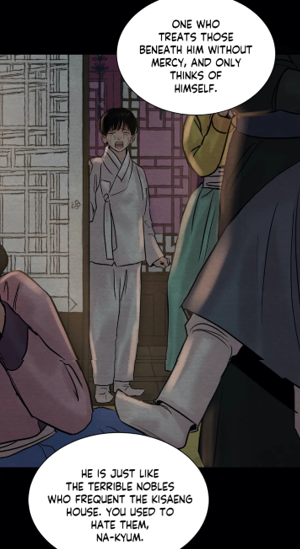 (chapter 68), Baek Na-Kyum had the impression that she was telling the truth. It looked like she was a victim of violence, while in reality, Yoon Seungho was the real victim. He got dragged and tied up! Today, I just discovered another evidence for this interpretation!
  (chapter 68) The blue skirt is revealing her presence. She is next to the door and observe that there is a table to her right!! Exactly like in chapter 94! But it was much bigger. This means that she left the room. And since the table was not present in this image,
 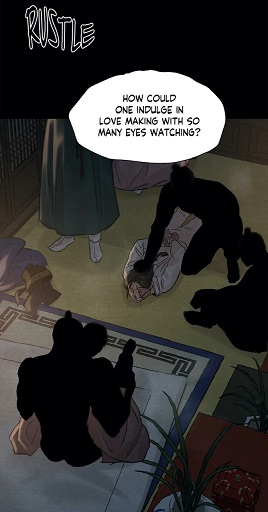 (chapter 86), I deduce that Heena explained her desertion by taking away the table so that she had the perfect excuse to leave this room and abandon Yoon Seungho. It was not her business. But if she left the room during that night, she could have followed her brother. But she never did it. She let her brother imagine that she was suffering.
  (chapter 70) Terrible, right? However, since the painter had been deceived by impressions, he came to believe her version and lies. But there is more to it. Because the artist was so young, he never realized that he could have detected her manipulations!! How? She should have become a wreck… have bruises on her body, but she never had any.
This new interpretation is truly important, because it made me realize why Heena got punished in the storage room. 😮 (chapter 93) Since she excused her vanishing by saying that she had to remove the dishes and as such was busy in the kitchen, it is normal that she was imprisoned next to the kitchen 10 years later!! Here, we can recognize the kitchen by the door made of wooden planks:
 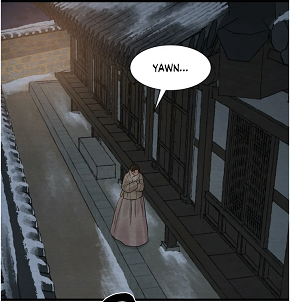 (chapter 95) But there exist two other evidences why Heena is associated to the kitchen. Remember the painter’s thoughts in the inn:
 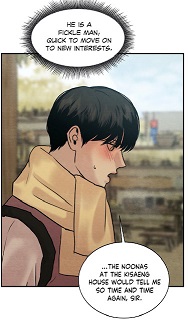 (chapter 75) They let see that he was thinking of Heena, though he spoke of his noonas. However, the presence of religion was introduced with food.
  (chapter 75) This truly exposes that Heena preferred working in the kitchen. That way, she could avoid sex with the clients. Another interesting aspect is that when she was sitting at the table with nobles, she was not talking to her neighbors.
 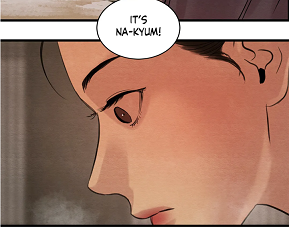 . (chapter 93) She was not even serving the noble next to her.
 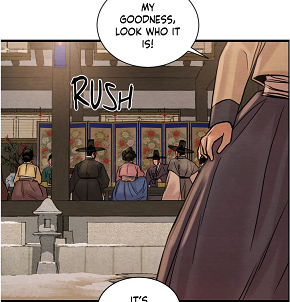 (chapter 93) Once again, she was passive and immobile. Since she was doing nothing, she could hear her brother’s name and turn her head.
  (chapter 93) Under this new light, it becomes understandable why Baek Na-Kyum didn’t detect her presence in the patio. It was not her usual place. At the same time, the readers can grasp why the artist didn’t mind eating in the kitchen with the maids and felt comfortable around the head-maid.
  (chapter 46) This was reflecting his past relationship with Heena. And now, you comprehend why Heena never paid attention to the painter’s education. She had not the time and the motivation to do so. She was busy in the kitchen during the evening and night, yet keep in mind that the painter was her excuse to keep her distance from the nobles in the beginning. This explicates why Yoon Seungho crashed the table in the gibang:
  (chapter 99) This was Heena’s karma. She could no longer use the table as an excuse to betray and abandon a young boy. Moreover, we could see this gesture as a compensation for the past incident. (chapter 68) Finally, the lord could voice his frustration and his resent for the kisaeng who had “deceived” him. Now, I am wondering if during that night, the rice had not been spoiled too. The most important aspect is that she had definitely seen the abduction and sequestration, yet she did nothing. But if the food was spoiled, then I can understand why she acted that way. She didn’t want to be punished. But if this theory is correct, , it depends on if she was involved in this incident or not. Yet I don’t believe that she was responsible here. She preferred Yoon Seungho taking the fall. So she took the table with her colleague and left the room.
 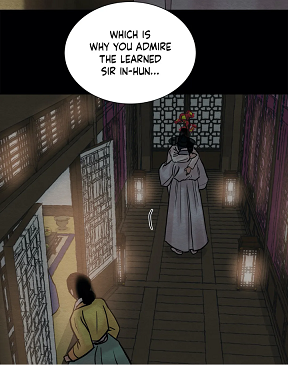 (chapter 68) How do I come to this idea? It is because there is a progression in the responsibility. But we will see, if the lord’s anger was caused by spoiled rice. One thing is sure: the butler is recreating events from the past. And shortly after the painter’s departure from his noona situated in chapter 46, (chapter 46), we had this incident:
  . (chapter 47). That’s the reason why I am connecting the kisaeng to the food. And I had already demonstrated that there exists a link between the gibang and the lord’s kitchen.
That’s how I made a new connection between Heena and Nameless. The latter is a butcher, and he was seen in the kitchen.  (chapter 60) And now, we know for sure that the chicken blood was used to stage the crime scene in the scholar’s house.
  (chapter 101) For me, Nameless was behind this prank. It sounded so harmless, but the reality is totally different. Consequently, Heena can become the prime suspect in the scholar’s disappearance. Remember that according to me, Yoon Seung-Won went to the gibang after leaving his brother’s mansion and discovered that he had been deceived. For me, there is no ambiguity that Yoon Seung-Won and lord Song are behind the learned sir’s murder, for both had a huge interest for his vanishing. But in my eyes, Heena is the link between the nobles, lord Song and No-Name, because the kisaeng house is frequented by all kind of people. I have already mentioned that the learned sir must have gone to the kisaeng house after meeting the fake servant.
  (chapter 38) This encounter took place during the day, however he returned during the night. So he must have spent some time elsewhere. Because of the connection between Heena and the kitchen, I think, she will have to take the fall for No-Name’s crimes. Under this new light, I comprehend why Byeonduck declared that she had no longer planned Mumyeong and Lee Jihwa. Both were already receiving their punishment, when they fled. But since I detected a connection between Heena and No-Name, I am quite sure that she is also responsible for the downfall of No-Name. And don’t forget that during the incident in the bedchamber, we had a party!!
 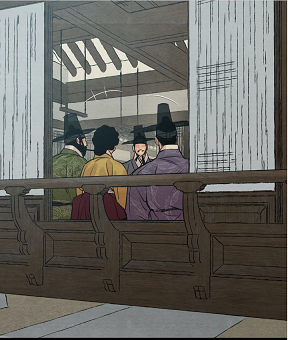 (chapter 83) Then I had already demonstrated that the kisaeng had already visited the mansion, for she knew where the painter’s room was.
 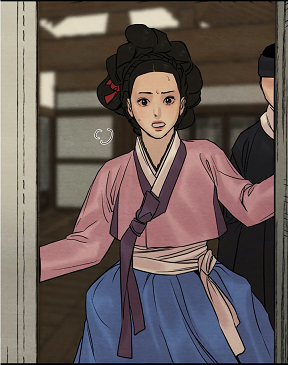 (chapter 65) So she could have worked in the kitchen… helping the other maids. To conclude, the kisaeng had committed the following wrongdoings. She had manipulated her brother with a mixture of belief and prejudices to cover up her own fears and wrongdoings. While in chapter 94, she stopped the painter from leaving the room unconsciously, it was no longer the case with Yoon Seungho, as she was standing in front of the door. (chapter 68) She contributed to his abduction and sequestration. But this doesn’t end here. She was also a witness of his sexual abuse, but she chose to close an eye. Thus she said this to the painter:
 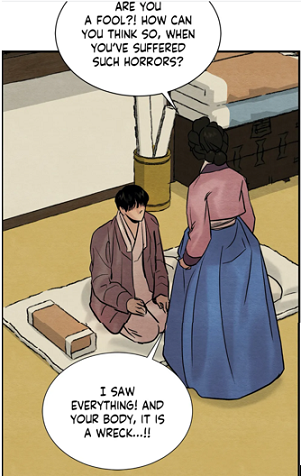 (chapter 68) For her, sex had become a synonym for torture and death. Her wrong choices reinforced her fears about sex in my eyes. Every time, she decided not to face the truth, she preferred being blind. Thus the goddess chose to punish her by letting her deceived by impressions.
 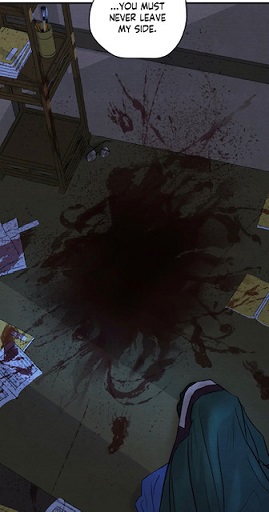 (chapter 88)
  (chapter 66) Here, she couldn’t help her brother, though the “sequestration” was nothing compared to what Yoon Seungho had experienced at such a young age. She had deceived her brother in the past, and now she was put in the same position. She was the fool one. In addition, she was forced to be confronted with reality, because she needed to admit her wrongdoings. Since she was behind this assault (chapter 94), she had to see her brother wounded, the consequences of her lies and manipulations. (chapter 99) Yet, each time she refused to become responsible. She always had a perfect excuse: the nobles were to blame for this, the lord had acted like a spoiled child etc…. In front of the scholar’s house, it was because her brother had not listened to her. Besides, Min was also accountable for this.
 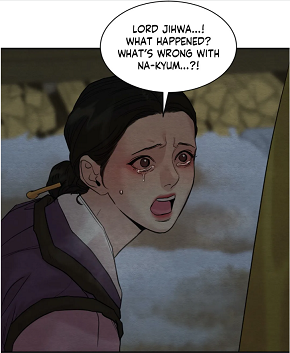 (chapter 99) She never pointed her finger to the black guards, for she knew that they could reply that she was responsible for her brother’s resistance. She had not been able to convince him to follow Min. She preferred blaming innocent people (Baek Na-Kyum, Yoon Seungho and “Jihwa”) than recognizing her own guilt and her bad choices. Since in the past, she stood in front of her door, her punishment was to remain outside. She could never enter the room (chapter 66)
 . (chapter 96) She even got sequestered herself. (chapter 93), therefore it is not surprising that at the end, she was determined to leave the kisaeng house. But this doesn’t end here. The painter had been denied the right to bid farewell to his noonas a second time because of Heena (again),
  (chapter 99), this means that her punishment will be that she will never see her colleagues again. Since she faked her death (chapter 99), her karma will be that she gets killed for real. In my opinion, Heena is destined to suffer and die a horrible death. Remember that in this story, karma will be 1000% worse than the crime itself. She will be definitely blamed for the murder of many people. Since she claimed that nobles were filthy and violent liars, her doctrines and belief could be used against her, the moment the police investigate Black Heart’s death.
 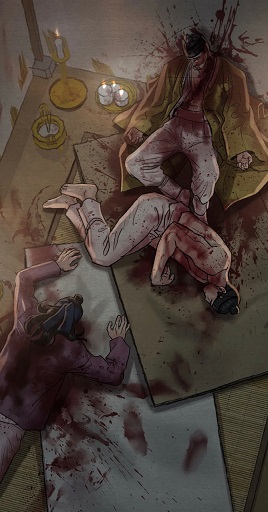 .(chapter 102) She is a Christian, hence she could be accused of sacrilege too. In my eyes, Heena will never be able to bid farewell to her brother again. His words in the mansion will become a reality.
 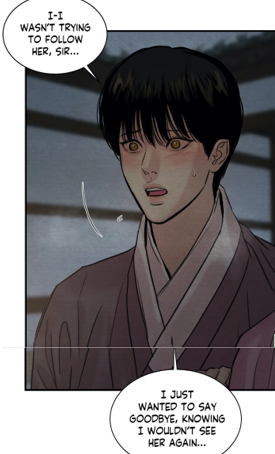 (chapter 69) As you can see, I am detecting a progression in her wrongdoings. She is getting more and more involved, though there is no ambiguity that she was deceived herself in season 3. But this doesn’t excuse her crimes, for she refused to listen to her brother and called him an idiot. At no moment, she pondered on the situation. Her decisions were strongly influenced by her emotions (fear, anger and hatred). That’s the reason why I am convinced that if she is not dead (my theory), her attitude towards her brother will worsen to the point that she will call her brother a bird of misfortune!
 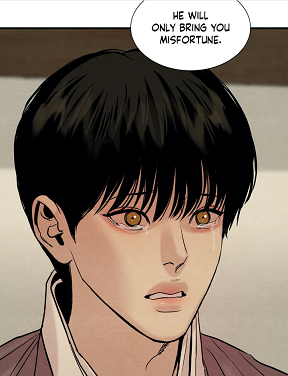 (chapter 68) Remember her metaphor concerning the gibang, it was viewed as a nest. She was already comparing her brother to a bird. (chapter 93) Thus the only thing that is missing is “of misfortune”. And she can only adopt such a belief, for everything she had planned never worked out. She imagined that she could exchange her brother for her freedom
  (chapter 97) which represented a betrayal of her own doctrines. But the result was that Min was killed, hence her situation can only deteriorate. If she can escape punishment concerning the nobles’ killing, she has then an opportunity to change her situation by putting the blame on her brother. Why? It is because Baek Na-Kyum will be perceived by Kim and the pedophile as the bird of misfortune. They will be reunited by this “belief”. This reinforces my conviction that the departures in season 4 will become very bloody and painful. The irony is that her metaphor with the bird revealed more about her own thoughts than she imagined. She just needed to give him some warmth, feed Baek Na-Kyum, and that was it. He had a bed and he could eat. A smile and a caress on the cheek were enough to motivate the painter. Her affection was fleeting and trivial in the end. However, while writing this essay, I realized why Baek Na-Kyum ended up drawing in the courtyard. It is because this was the only place where he could be in peace. In the room, he got assaulted by the nobles (chapter 94) or he had to witness his noona getting “beaten” by a violent noble (chapter 68). As you can see, the kitchen and the courtyard seemed to be the only place where he was left alone, until he got assault in the courtyard. Naturally, it was only possible during the day. Thus the learned sir had such a memory.
 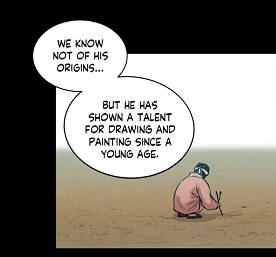 (chapter 01)
5. Conclusions
The story is not only reflecting Heena’s metamorphosis and downfall, but also it serves as an example for the painter. Through her, he can grasp why Yoon Chang-Hyeon had such a cold gaze towards his own son. The ruin of their relationship will make him realize why the father could turn his back on his own son, the refusal of admitting his wrong choices and guilt. If he recalls their last argument, he can already notice the change in her gaze. 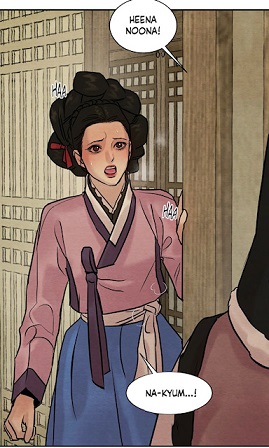 (chapter 97) Fake concern versus anger and resent (chapter 97) The only difference is that here her fury and hatred were addressed more towards Yoon Seungho than the painter. However, gradually she was slowly revealing her anger towards her brother. At the end of season 3, her exit is quite sudden and brutal: staged death! (chapter 99) But by faking her death, she not only hides her desertion, but also she is not able to bid farewell to her brother. He is left behind unconscious, so he can not notice her “death”, while in her mind, she can only remember this image: (chapter 99) Baek Na-Kyum lying unconscious and his head covered in blood. Will she feel remorse and blame herself for his “death”? If she is still alive, it is possible, however the moment she realizes that Baek Na-Kyum escaped death and as such staged his curtains, she can only resent him, for he deceived her. In reality, she was the one who deceiving everyone: Jihwa and the other nobles. To conclude, she played a bigger role in Yoon Seungho’s suffering in the end.
Feel free to comment. If you have any suggestion for topics or manhwas, feel free to ask. If you enjoyed reading it, retweet it or push the button like. My Reddit-Instagram-Tumblr-Twitter account is: @bebebisous33. Thanks for reading and for the support, particularly, I would like to thank all the new followers and people recommending my blog.

 (chapter 1)
  (chapter 36) In addition, after realizing that each location is associated to a certain event in the past, I came to the conclusion that the inn represents no exception. Hence the tavern is full of symbolism too.
 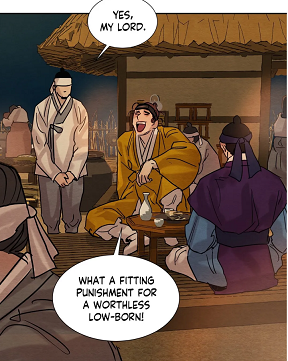 (chapter 12) In episode 36, we have Min, Lee Jihwa and the noble with the mole.
  (chapter 57) In episode 59, the tavern owner asked No-Name to take away Lee Jihwa
 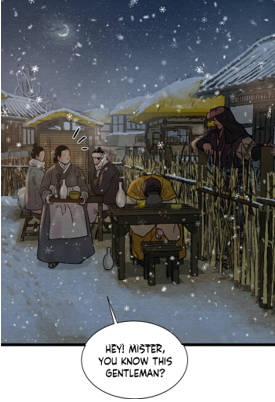 (chapter 59) And in episode 92, Black Heart joined the couple
 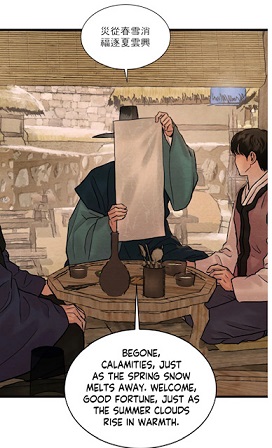 (chapter 92). The only exception seems to be the scene in chapter 75:
  (chapter 75) However, this is just an illusion, for the ghost Jung In-Hun was present. And even before, the painter kept thinking about Heena noona. As you can see, the painter’s words were influenced by his “surrogate parents”, the third party. But let’s return to the major parallel: the confession leading to a rejection.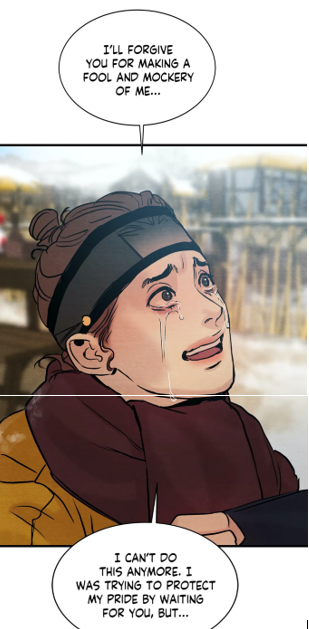
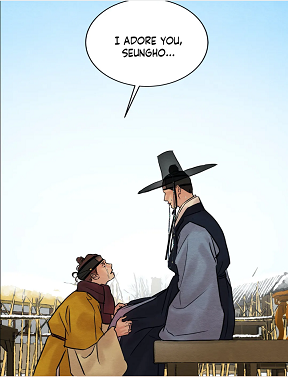 (chapter 57) Though Yoon Seungho had punished his friend for his forged letter, he still listened to his confession before rejecting him properly. He gave an explanation why he would never reciprocate the affection towards his friend.
  (chapter 59) What caught my attention is that Lee Jihwa perceived the rejection as abandonment, while in truth the protagonist was not truly cutting ties with him. The real traitor was someone else: the noble with the mole, who ran away, when Yoon Seungho confronted his friend.
  (chapter 57) In that scene, the young master Jihwa had drunk before the arrival of his friends, though he was in full possession of his mind.
  (chapter 56) As you can detect, in this scene, the author employed the following elements: confession, sanity, tears, sadness, rejection, alcohol and abandonment.
  (chapter 75) He was heartbroken due to the loss of his passion and his loved one. At the same time, he was plagued by guilt. He felt responsible for Jung In-Hun’s failure. This is important, because it shows that guilt is another common denominator. In chapter 57, Yoon Seungho was guilty for the antagonist’s suffering.
 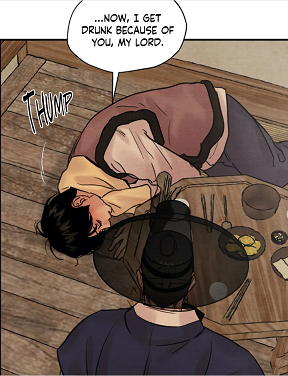 (chapter 75) Why? It is because he was also rejecting the lord. He couldn’t give him his heart, for the lord had such a fickle nature.
 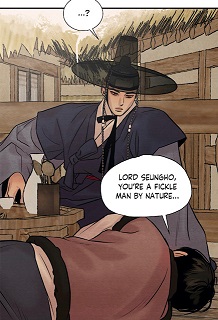 (chapter 75) He was responsible that the painter wouldn’t get close to him. He was judged as not trustworthy. At the same time, the painter’s confession in the tavern mirrors that Baek Na-Kyum was not delirious. Despite the influence of the drug, he could think and speak properly about his feelings and thoughts, similar to Lee Jihwa in chapter 57. To conclude, in season 2, the commoner and the red-haired noble were not stoned during their confession, which stands in opposition to the First Wedding Night::
  (chapter 21) And this common denominator reinforces my theory that when Yoon Seungho got kissed in the study, he was not in full possession of his mind.
  (chapter 77) As you can see, the drug is not only strongly associated to rejection and broken heart, but also to delirium and insanity.
  (chapter 92) Min was voicing his longing for Yoon Seungho, he was implying that he had been abandoned by the protagonist. However, note that the lord utilized water to reject Black Heart!
 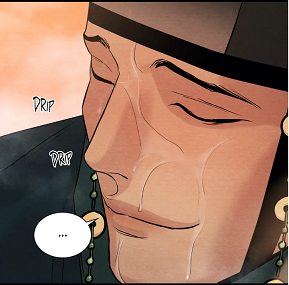 (chapter 92) It was, as if the noble was now crying. The water was displaying the hypocrisy of Min, the “fake tears”. He was not missing the main lead at all, in reality he was yearning for the painter’s gaze. Thus he expressed this in the shaman’s house:
 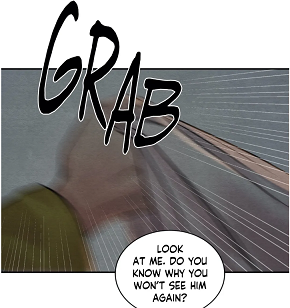 (chapter 99) Striking is that when the lord with the green hanbok complained to his acquaintance, he was also acting as if he was guilt-tripping Yoon Seungho. According to his words, the protagonist had abandoned him. It was, as if he had completely forgotten him.
 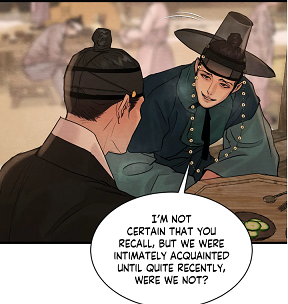 (chapter 92)
  (chapter 92) It was, as if he wanted to bring him back to reality, similar to this gesture:
 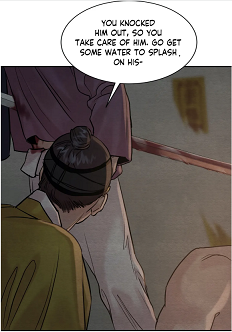 (chapter 102). He explained Black Heart’s attitude with the alcohol. Due to the liquor, Min had become insane and obscene. He was speaking about sodomy in a public place. Striking is that the Joker was portraying himself as a man consumed by lust. He needed the lord’s phallus to feel good. That’s how I detected another similarity: the presence of sex and sensuality in the conversation!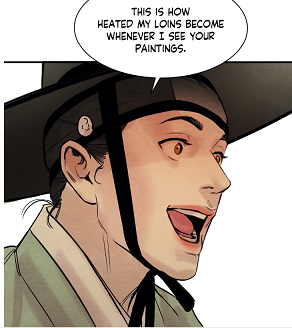

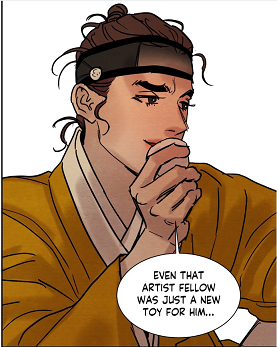 Here, the idiom “toy” was implying sex, though the main characters had not sex together yet.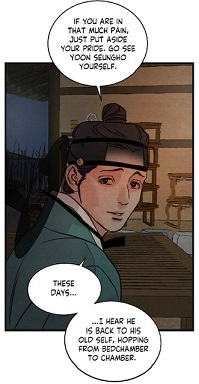

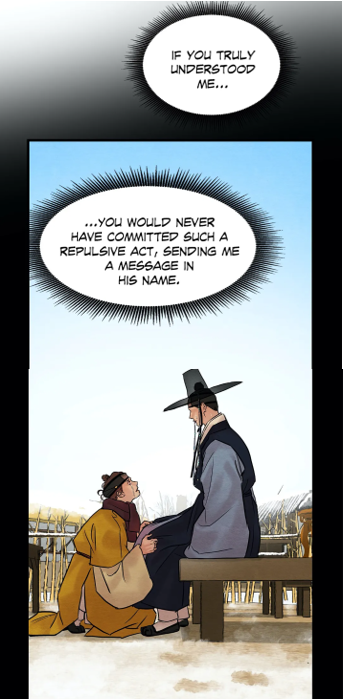
 (chapter 74) As you can see, Baek Na-Kyum was craving for sensuality. But he couldn’t voice it like Min! He was paying attention to social norms.
  (chapter 36) He kept crying, as he couldn’t bear the separation. At the same time, he explained his weeping with the main lead’s past. He was a pitiful creature, for he suffered a lot. Indirectly, he was comparing himself with the main figure. He had gone through a lot too.
  , (chapter 57) On the other hand, with this blame, Yoon Seungho was constantly reminded of the pedophile, lord Song. Thus Yoon Seungho replied this to the antagonist:
  (chapter 56) And observe that Kim never doubted the authenticity of the encounter.
 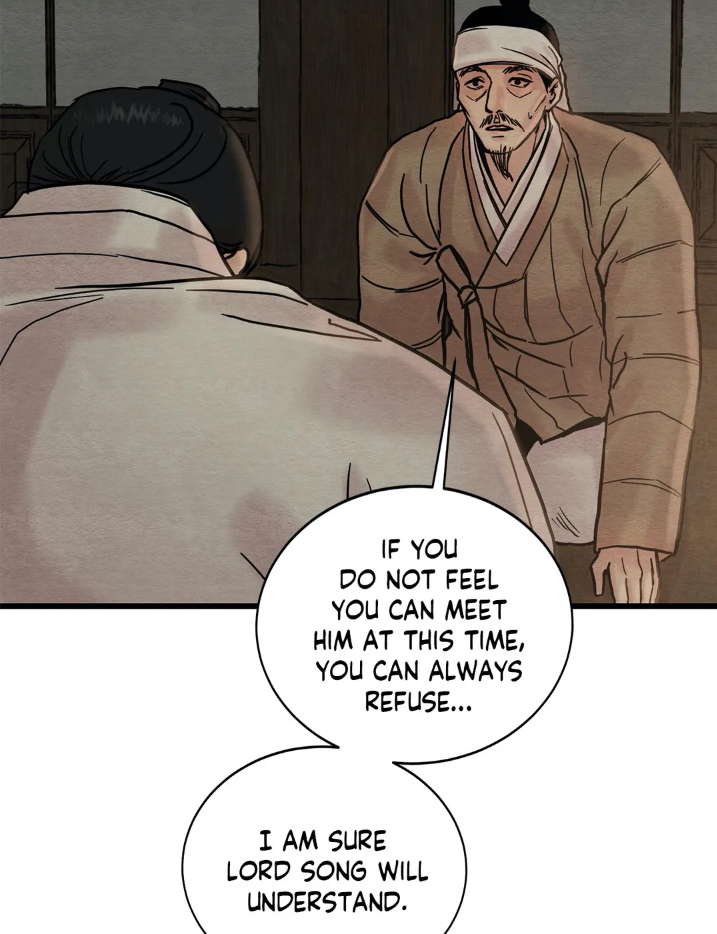 (chapter 56) This signifies that the pedophile must have gone there in the past. 😮
 (chapter 18)
  (chapter 14), whereas in verity, this passion was essential and even vital for Yoon Seungho. In his subconscious, the lord sensed the healing effect. This would make him smile and provoke emotions and arousal!
  (chapter 1) There was no witness for these reasons. No one should notice the execution of the commoner Baek Na-Kyum. Secondly, the book had been switched. The lord had shown this to the butler
 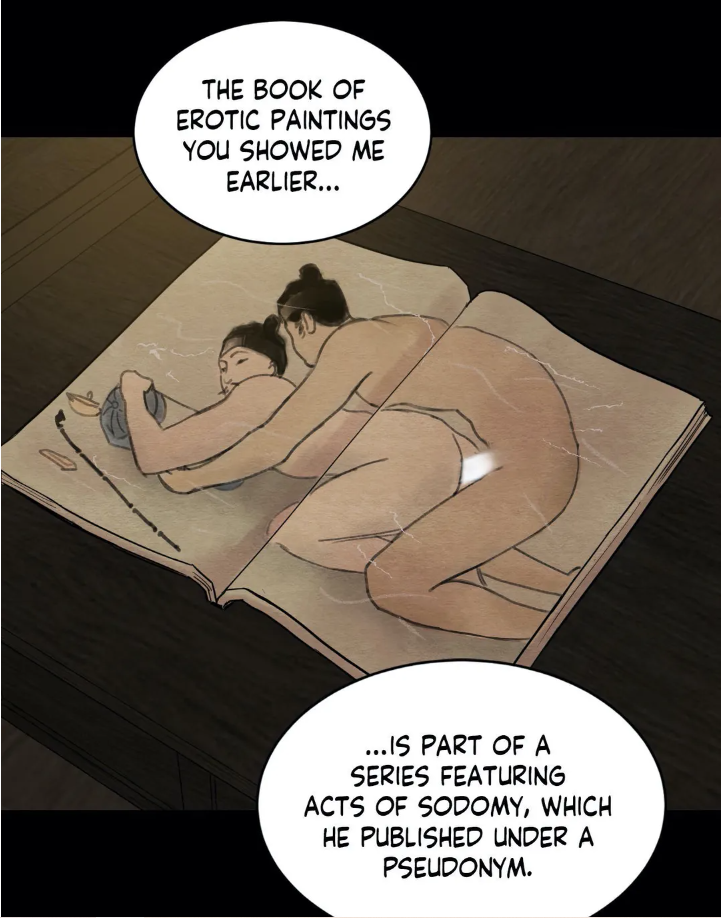 (chapter 1), but when Yoon Seungho interrogated the artist, he exposed a different publication:
  (chapter 1) It was, as if the painter was forced to deny to be the author of this book. There is no ambiguity that the servant had lied to Yoon Seungho, just like the painter was not entirely honest with Yoon Seungho. In my eyes, the painter had not noticed the divergence. As you can see, the meeting was staged. Unknown people were involved in this encounter so that we could say that the protagonists were just pawns during this scene.
 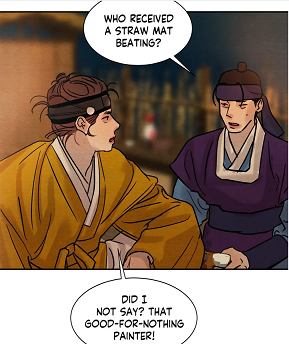 (chapter 12) The drop of sweat on his face clearly indicates that he was just feigning ignorance. This exposes that the noble with the mole was deceiving his friend and as such betraying him.
 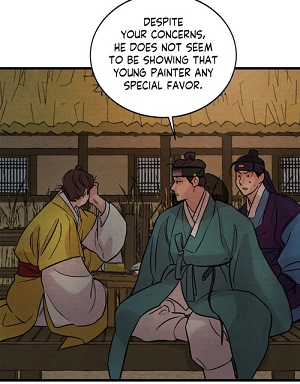 (chapter 36) He was inciting the antagonist to return to the mansion so that he would catch the couple having sex together. That’s the reason why Black Heart made such a comment in the pavilion of his friend:
 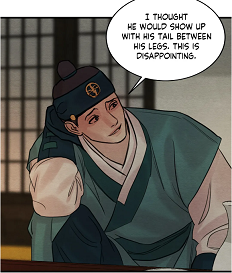 (chapter 43) Yet, this trick didn’t work like Black Heart had anticipated. Why? He imagined that the red-haired noble would resent his friend for his abandonment and betrayal. The reality is that the antagonist reproached The Joker for his lies, he had been manipulating him.
 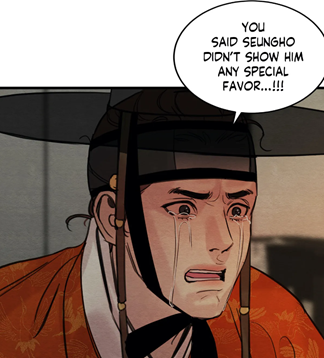 (chapter 43)
  (chapter 59) She wished to get rid of him as soon as possible. Thus she asked the Joker to take care of him.
  (chapter 92) However, he had been informed about the content of the paper, for he could already determine the genre of the text without seeing the writing. At the same time, he also deceived the couple by taking away the Spring poem.
 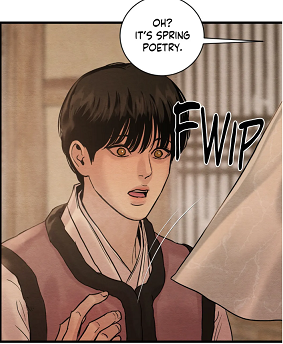 (chapter 92) We never saw him returning it. As for the second trickster, it was naturally Kim who hid under the hanbok which had a similar color than Jung In-Hun’s.
  (chapter 92) He desired to remind the painter of the existence of the scholar. However, this trick failed too. Why? It is because just before the painter had seen a kisaeng wearing the same robe.
 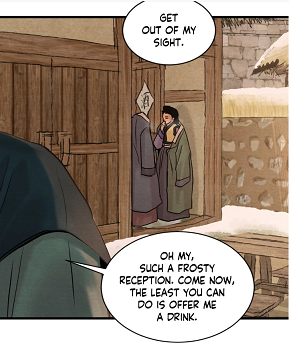 (chapter 92) He was just reminded of his noonas, and not just Heena and Jung In-Hun. Furthermore, the butler had overlooked another aspect: Yoon Seungho had been wearing a similar hanbok.
 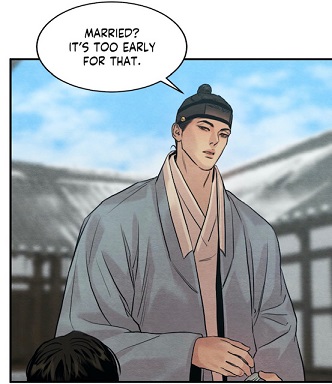 (chapter 78) This means that the painter was no longer associating the lavender color to the learned sir. Slowly, the main lead was replacing the teacher and as such, he was moving on from his crush. Thus such an attitude could be perceived by a malevolent eye as indifference and hatred. My avid readers can already understand who I am referring to with such a statement. However, we are all aware that the painter is still loyal towards the learned sir.
 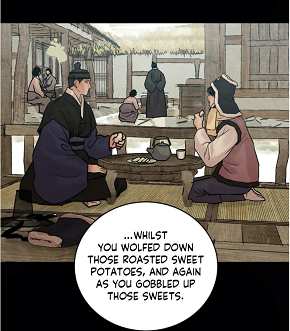 (chapter 92) Yes, the couple was sitting in an inn eating sweet potatoes. When I saw this panel for the first time, the man in black caught my attention. His presence puzzled me, for he was standing next to a kisaeng working in the inn. This is totally unusual, for no noble would remain immobile close to the fire place and as such the kitchen. Secondly, he was not wearing his gat, indicating that he was violating social norms. [For more read the essay Coming-Of-Ages] Back then, I had thought that this was the scholar. However, the latter would always pay attention to his appearances. Moreover, he embodies social norms, so he would never move around without his hat. Was he a Joker spying on the couple? For me yes, especially if you take into consideration that there were always 3 people in each scene taking place in the inn. One thing is sure: Min had been informed about the painter’s desire for a Spring poem and his visit to the calligrapher. This means that during their stay in the tavern, the painter had talked constantly about this. So the kisaeng could have heard about the content of their conversation. One might argue that this stay stands in opposition to the other scenes. In this inn, there was no tear, no alcohol and no “betrayal”. But the manhwalovers shouldn’t forget that during that scene, the lord was actually rejecting the suggestion of the painter. The former saw no reason why they should look for the calligrapher!! Yoon Seungho was on the verge of breaking his promise, a “betrayal”. The irony is that he was so annoyed by the painter’s words, that at the end he gave in.
 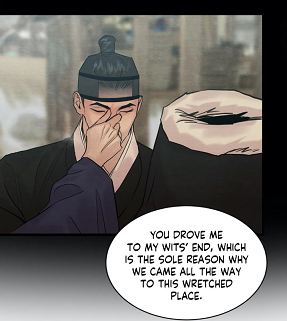 (chapter 91) He was on the verge of losing his “sanity”😉, for the painter kept talking how important it was to protect from bad luck! As you can see, this scene is not different from the others: insanity, longing, trick, betrayal and rejection! The absence of tears and alcohol is easily explainable. The painter was not heartbroken, he just saw this as a necessity. Furthermore, this scene made me realize that the tavern is connected to arts. In almost all the mentioned chapters, the characters implied the erotic publications or arts. The spring poem is compared to a drawing by the painter, the calligraphy reminded him of snow flakes. Once again, the exception of this element is chapter 36! Here, Black Min and Lee Jihwa were only referring to sex and nothing more.
  (chapter 36) From my point of view, Lee Jihwa was aware that his friend had been forced to renounce on his passions. Thus he said this:
 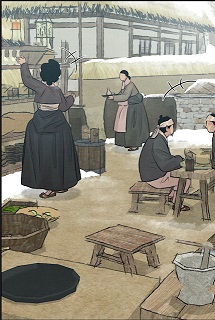 (chapter 74) I had already explained in a different essay that in chapter 75, the painter had been thinking about his noonas and in particular about Heena, because he had seen the kisaeng. Thus he kept thinking about his sister’s words:
  (chapter 1) In chapter 12, the childhood friend praised the main character. He had acted like a true lord with the sentence.
 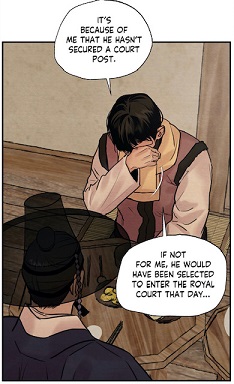 (chapter 75) As for Black Heart, he got insulted in the tavern. He was splashed with water. And what did the noble with the green hanbok reply to this insult? He announced that he would seek revenge on Yoon Seungho
  (chapter 92) Lee Jihwa was also full by resent and revenge, when he realized that the lord had made love to the painter after he had been rejected.
 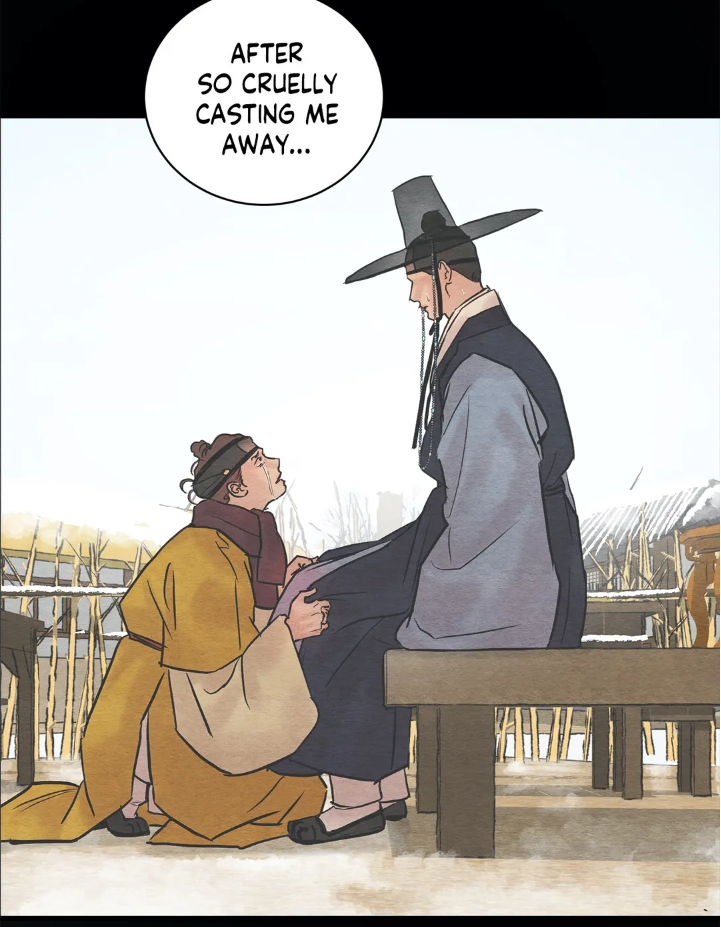 (chapter 60) Thus shortly after, the young man had a weapon in his hand (though according to me, this tool was placed by Kim)
 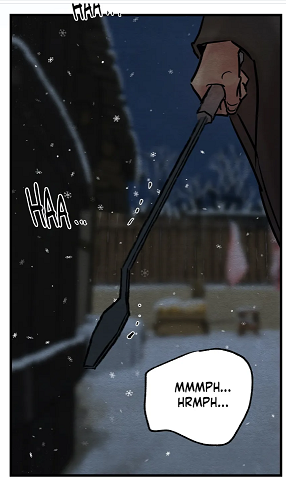 (chapter 60). His intention was to kill the painter, though here he was just acting on affect. As you can see, the inn is in reality connected to a crime, and the desire of revenge! Don’t forget what Yoon Seungho said to the messenger:
 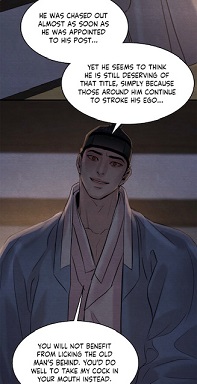 (chapter 80) According to his words, he had insulted the king by not utilizing the correct title. BUT we shouldn’t take this declaration as face-value, for the main lead is just repeating what he has been told. I have always said that the pedophile had been motivated by revenge and lust. The latter had been humiliated! Now, for the first time, I see a strong connection between the tavern and the wrongdoing linked to the mysterious lord. But what is the common denominator between all these scenes? CONFESSION! In chapter 1, Yoon Seungho confessed his admiration for the artist. In chapter 36, Lee Jihwa admitted the existence of a secret and his friend’s torment. In chapter 57 and 75, both ukes confessed their love (the main lead and painting). On the other hand, confession has a different meaning: admission of a crime! Thus I am suspecting that “lord Song” got rejected in this place. Thus he felt humiliated and his thirst for revenge took over. And it is related to arts!!
 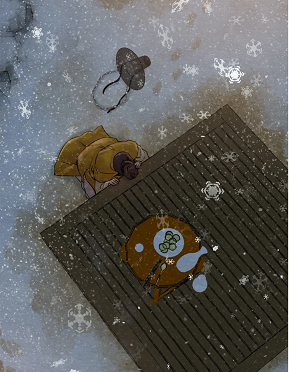 (chapter 59) Then in chapter 75, we should consider Baek Na-Kyum as a servant due to his clothes.
  (chapter 75) And now, if you take into consideration that the servant from episode 1 and 12 were acting on Kim’s behalf, you will realize that the servant in the past can only be KIM. And he was present in episode 92.
 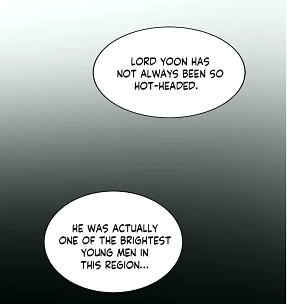 (chapter 57) This incident mirrors the past, the only difference is that the main lead was totally innocent contrary to Lee Jihwa, who had been partially responsible for his friend’s suffering. Under this new perspective, it becomes understandable why the author would start the story more or less in the tavern. But since the place is associated to sanity versus insanity (losing the wits), I am suspecting that the “wrongdoing” from the patriarch never deserved such a “punishment”. This sentence was out of proportion.
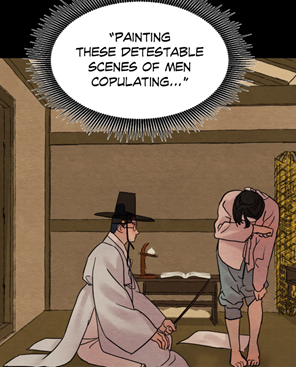 (chapter 34) Technically, he could paint other things (plants, animal etc), like in his childhood. Hence I have the impression that he had been pressured to become a painter of erotic paintings… the former version of season 1. And for me, Heena was behind this. Yet, the painter confessed in the tavern that he could no longer paint.
  (chapter 23) before drawing the orchid!
  (chapter 1) and the element “confession” which is associated to crime. Back then, there was no witness and this scene took place during the night. No ruckus!! People in Joseon were not allowed to walk during the night due to the curfew. This stands in opposition to these scenes: it was not too late, thus the tavern was not closed yet
 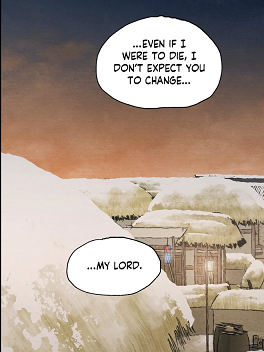 (chapter 75) Finally, I believe that this scene in the tavern is linked to Kim, he will report the painter to the authorities. However, this night won’t end like a nightmare, for the circle is about to get closed, the end of ouroboros, the circle of revenge and hatred!! .
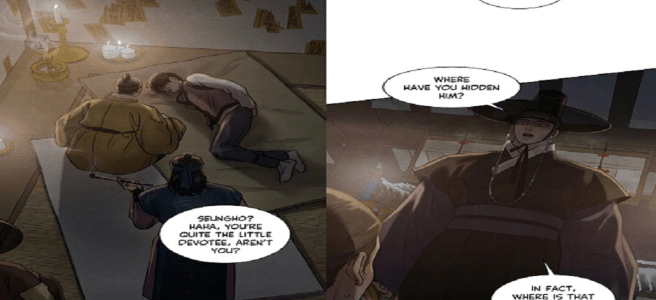

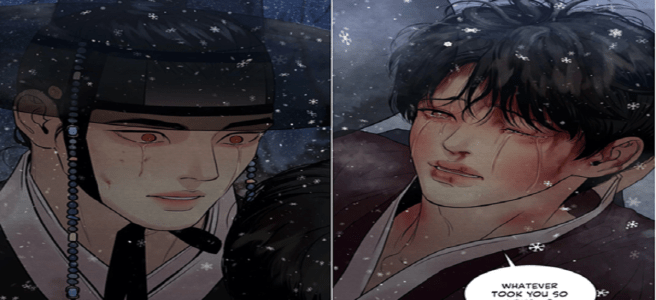

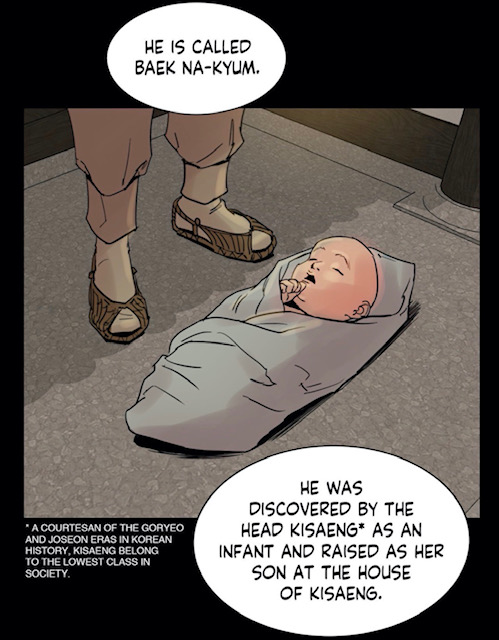 (chapter 01) But after studying the manhwa so closely, I discovered the existence of rules in the manhwa which helped me to dig up new information. I am listing the laws of Painter Of The Night again in order to avoid repeating myself. I will refer to them later in my argumentation (rule 1, 2, eg.). That way the readers can better grasp how I came to new revelations and theories.
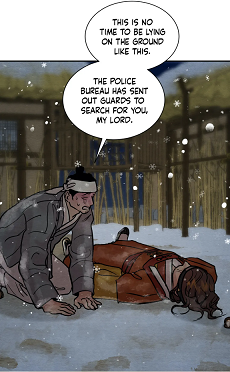 (chapter 101) Striking is that the author used the same method to introduce the memories. First, we see the servant talking before viewing the memories.
  (chapter 101) And now, compare it to chapter 1:
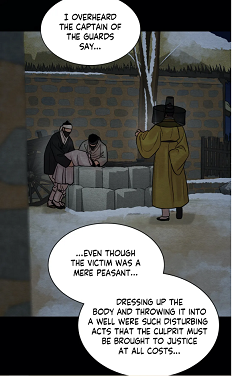 (chapter 101). She was implying that this panel symbolized the vision from the witness, the tailor. This explicates why you see the wall on the left side. The tailor was observing Min in the shadow. This is important, for these images are reflecting the truth, revealing that the servant from episode 101 was actually lying. Thus I deduce that the domestic from chapter 1 was also lying, but contrary to the episode 101, he thought, he was telling the truth. We could say that he was acting as the fake “mirror of truth“. How do I come to this deduction? Simply because the servant in chapter 101 was actually deceiving Lee Jihwa and Yoon Seungho. Note that in the beginning of episode 101, Seokdae tried to defend himself by feigning ignorance.
 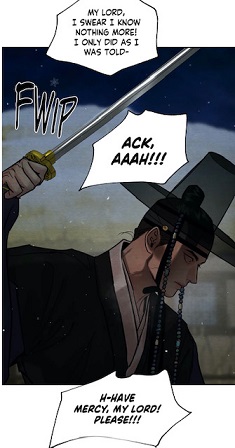 (Chapter 100) He denied his responsibility by putting the blame on someone else („I was told“), yet once facing the young master Jihwa, his declaration exposed his lie.
 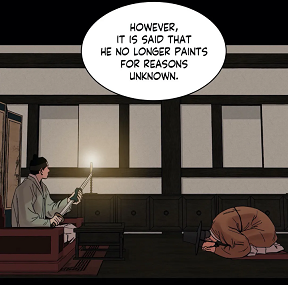 (chapter 1) So in episode 1, the servant was not aware that he was lying to the protagonist, when it comes to the painter’s past. However, the domestic with the brown hanbok lied in one aspect, the publication of the book.
 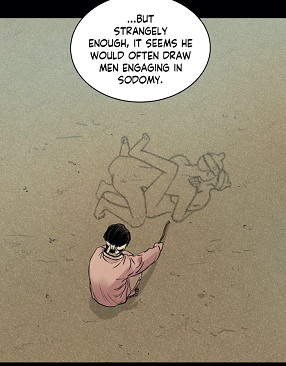 . (chapter 1) This signifies that the witness was close to Baek Na-Kyum which explains why the domestic trusted the source of his information. However, contrary to episode 101, she never divulged the identity of the witness. It is because the person wished to hide in the shadow.
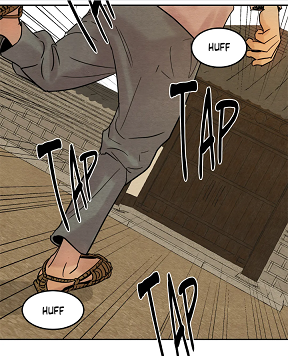 (chapter 4) This is the door! You can recognize it thanks to the pillar on the side.
 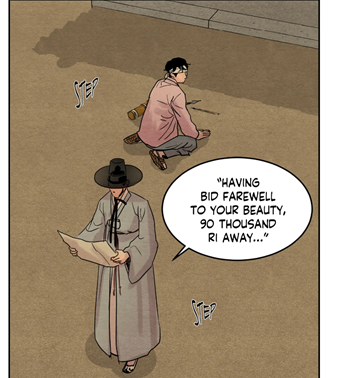 (chapter 4) Here, the shadow was bigger indicating that it was early in the morning. The painter had just woken up. Consequently, I deduce that the baby was brought to the mansion during the day. This signifies that Baek Na-Kyum was never abandoned! He was entrusted to the owner of that mansion!
 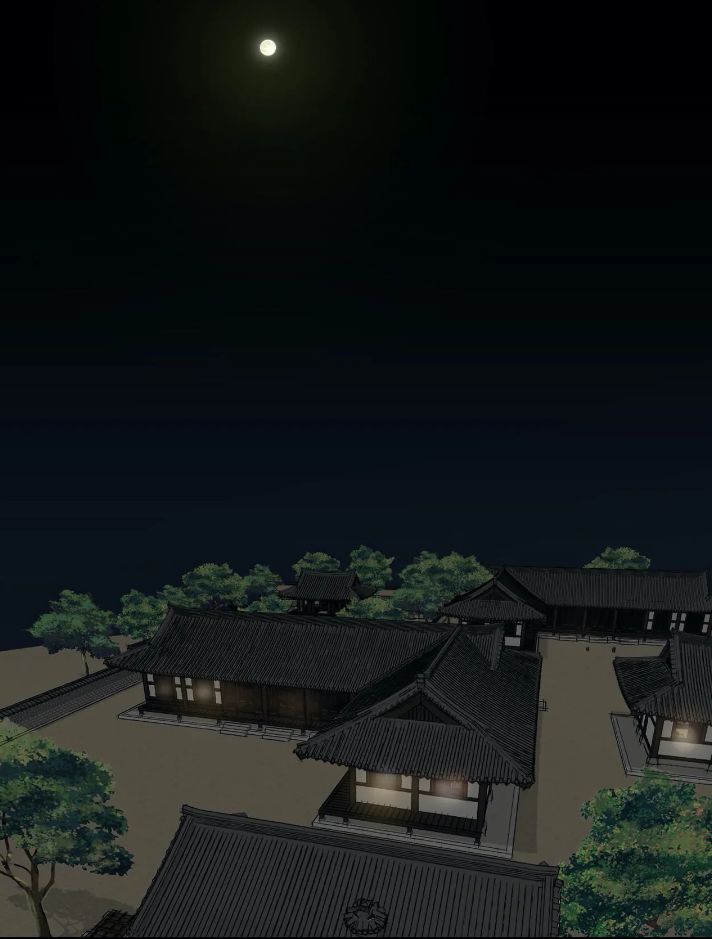 (chapter 1) You can recognize the gate in the background. This is the domain, which you see when the lord is arguing with the painter in the courtyard.
  (chapter 4) Pay attention to the background in this picture. And now, you are probably thinking that the owners of that mansion are the Yoons, as we observed the main lead living there. Nevertheless, I had already pointed out that this was not Yoon Seungho’s mansion. This is the Yoons’ domain:
 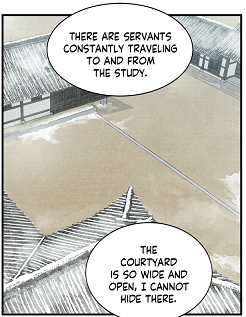 (chapter 51) The courtyard is different. According to me, this is the mansion of the Lees. [For more read the essay 360: Lee Jihwa’s special relationship with Yoon Seungho] And since episode 1 and 101 reflect each other, this can only reinforce my interpretation that the Lees are involved in Baek Na-Kyum’s past, for we have Lee Jihwa present in chapter 101. Baek Na-Kyum was brought to the Lees, thus the scholar Lee keeps calling Baek Na-Kyum a peasant! He knows about his true origins. I had always said that the man was revealing his knowledge with his insult. But does it mean that this was the vision from Lee Jihwa’s father?
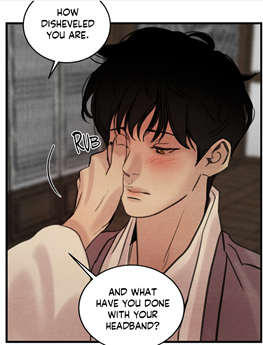 (chapter 38). Besides, father Lee views him as a peasant and not a servant. This observation gets reinforced, when you look at the memories from the painter. In his childhood, he was never wearing a white head-band.
 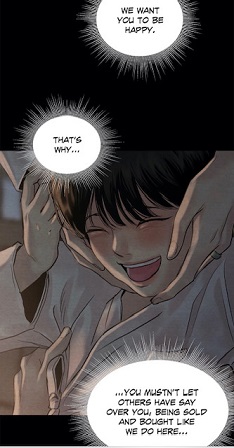 (chapter 87)
  (chapter 70) This means that this panel
  (chapter 101) Look where the red-haired master and the servant are! It is in front of the teacher’s home! In Painter Of The Night, there is never a coincidence. This is a sign that Jung In-Hun is related to Baek Na-Kyum’s past and knows his true origins. However, by treating him like a low-born, he came to view him as one. But this doesn’t end it. Remember the rule 2: the reflection within the same chapter. The painter remembered the words from the gibang:
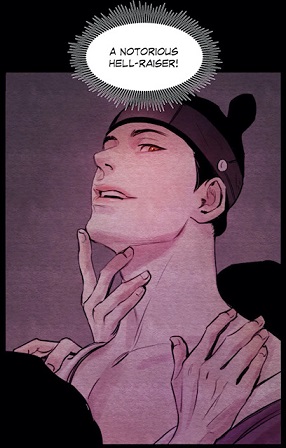 (chapter 1) Jung In-Hun would employ such expressions like fiend and sodomy
  (chapter 18), he was repeating his admired sir’s idioms. Besides, “hell-raiser” is also an indication that the learned sir was a Christian who converted Heena. Thus I deduce that when father Lee received Baek Na-Kyum as a baby, he entrusted him to the learned sir Jung In-Hun who had no connection and no wealth so far. So when the lord described him as such in episode 7, it was not entirely correct. The reality was that the man had been working for the Lees, but he had been “abandoned” at some point. The scholar was his helping hand explaining why he would appear in this scene.
 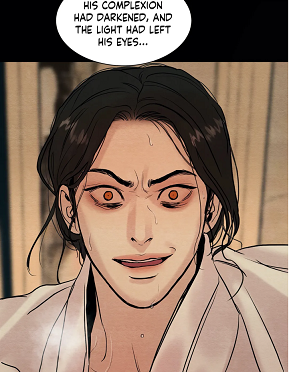 (chapter 57). However, there was a price to pay for the main lead’s emancipation. Lee Jihwa had to lose his topknot!!
  (chapter 59) Without a topknot, the red-haired master no longer looked like a real noble. He had lost his position. Hence I believe that the painter was forced to wear the headband. As you can detect, there was a chain reaction linked to the social status: lord or not, low-born or not.
  (Chapter 10) So a lord is following social norms, when he sentences a slave to death.
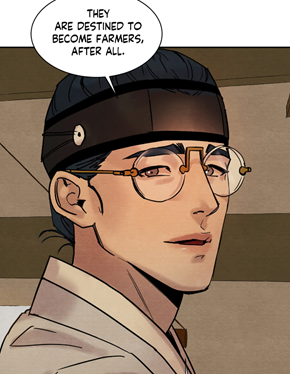 (chapter 6) The painter was never destined to become a farmer. The neglect was done intentionally. And when you recall his words in the library, you can only view his words as pure lies again:
  (chapter 40) He was never born to be a prostitute, but he was sent there on purpose. Under this new perspective, it becomes more comprehensible why Heena sent Baek Na-Kyum to the learned sir. He was the one who had brought the artist to the gibang, and now he was getting older. One might refute this point, for she declared this:
 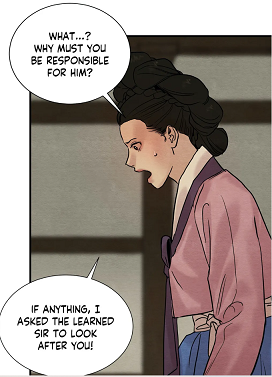 (chapter 68) Nonetheless, the beholder can detect the presence of a drop of sweat on Heena’s cheek. So she was deceiving the artist here. Why? Yes, in her mind, the painter was Jung In-Hun’s son and as such the learned sir should become responsible for the painter, for he was his father. But she had to lie in order to persuade him to leave the mansion. There’s no ambiguity that the head-kisaeng had no idea about the deal between the Lees and Jung In-Hun in the past, I believe that she must have discovered the truth at some point..
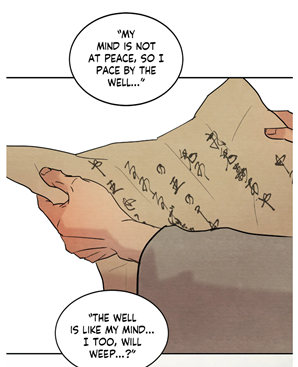 (chapter 4) This was inspired by the poetry from Wang Bang-Yeon!
  (chapter 4) In this poem, the famous author was referring to the death of the young king Danjong who had been killed by his uncle Sejo. Danjong was just a teenager, when he died! As you can see, the text is actually an allusion to royalty and exile. Under this new light, it dawned on me that the scholar Lee had been entrusted to take care of Baek Na-Kyum, but the latter chose to delegate this to the learned sir. There was a reason behind this. For me, he was eyeing at the mansion himself! One might refute this point, for the elder Lee said this:
 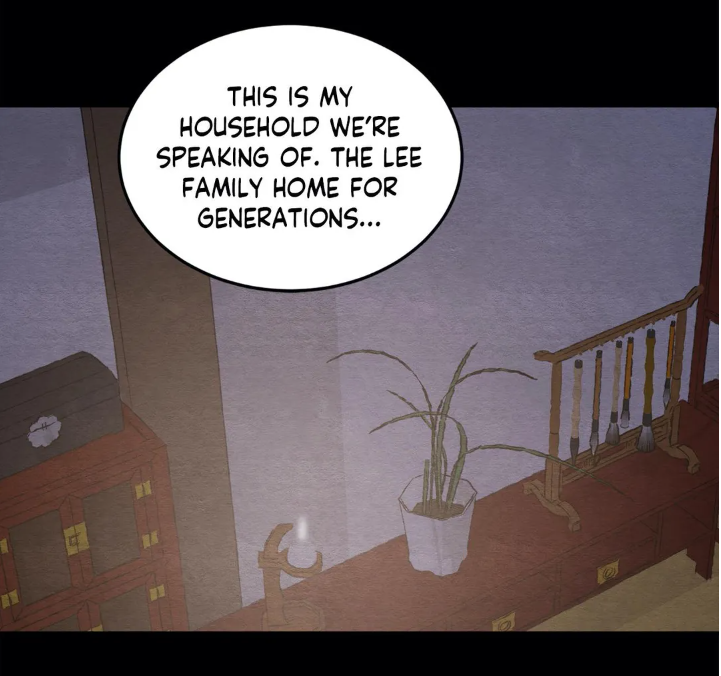 (chapter 82) But note that the man never said that this was his house, just the household of the Lee. Since the artist is related to the king, this signifies that he is related to the elder Lee too, as the family ruling over Joseon belongs to the Lee clan. Hence I am suspecting that Baek Na-Kyum could be the true owner of this mansion.
 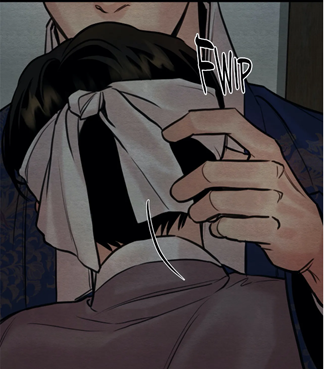 (chapter 53) How does he know it? In my opinion, it is because Baek Na-Kyum resembles to the king. The only difference is that he has no beard. This would explain why Yoon Seungho said this:
 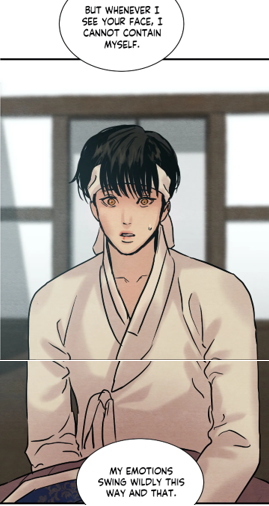 (chapter 55) Why would he get upset? Why would the painter’s face evoke such emotions? He is reminded of his abuser. This is no coincidence that the main lead had such a flashbulb right after, where you could see Lee Jihwa and his father, as they looked like Yoon Seungwon and his father.
  (chapter 55) They are all related. And now, you comprehend why the author wouldn’t reveal the face of the mysterious lord Song in chapter 83
 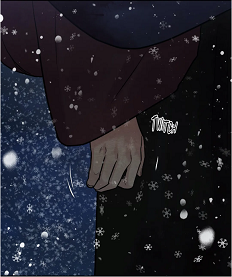 (chapter 102) The colors are already insinuating that the artist belongs to the royalty.
 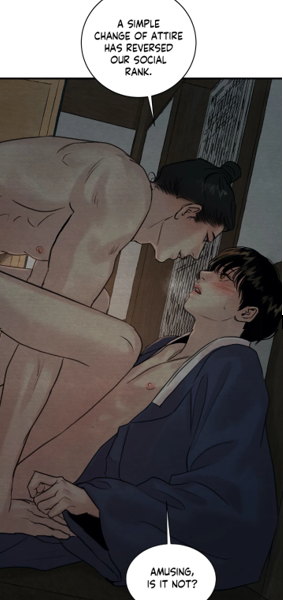 (chapter 71) If the pedophile came to the gibang and crossed the main lead’s path, he couldn’t recognize his relative (son or nephew) due to the hair and the clothes. Besides, I am certain that my avid readers can recall my other theory: the painter was stolen as a child. This new interpretation would corroborate this theory. The painter has been robbed of his true identity, he had been kidnapped, when he was brought to the kisaeng house!! Besides, if he is the true owner of the mansion, then this signifies that Father Lee succeeded in his coup d’Etat (rule 1, rule 3). In season 3, we have an attempted “coup d’Etat” with Yoon Chang-Hyeon eyeing at the seat.
 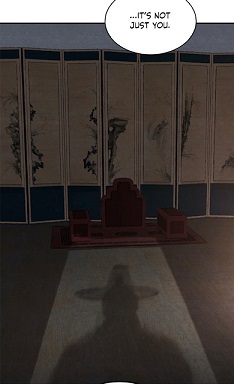 (chapter 86) Moreover, I would like to point out that we have the topic: siblings’ jealousy. This is definitely possible that father Lee is related to the artist, an uncle for example. Finally, if the painter is the king’s son, this is no coincidence that Baek Na-Kyum suffered so much. He was paying for his father’s sins (rule 5). At the same time, if Baek Na-Kyum has to face the infamous lord Song, as his son/nephew, he is put in a position where he can criticize his father/uncle. How could he abandon him and treat Yoon Seungho like that?
 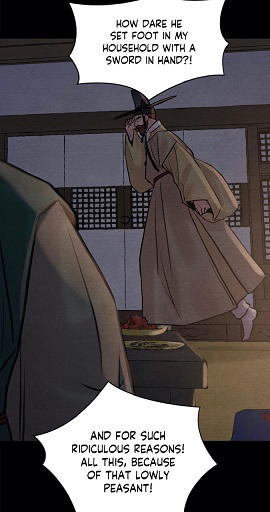 (chapter 82) All his past crimes could come to the surface! He had not taken care of the painter, and he had been neglected on purpose. He had committed a crime (disobedience to the king), thus he was a traitor. On the other hand, they could use the last publication as a justification for his death! He had threatened the ruler, he was blackmailing him with his secret. There’s no ambiguity that lord Song had no idea about the true identity of the artist.
  (chapter 37) Notice that here only 3 men were arrested and tortured. It was, as if the sons had to pay the crime for their father. That‘s how the noble families close to the Yoons died out.
  (Chapter 37) They had lost their heir. So far, we still have no idea about the cause for the treason: Coup d’Etat or attempt of assassination on the king or spying or murder of a royal member (here Baek Na-Kyum)? But this purge is associated to inheritance and the loss of a heir. There’s no ambiguity that the painting in Yoon Chang-Hyeon’s bedchamber was used as an evidence that the elder master Yoon was eyeing at the throne
  (chapter 83) imagining that Yoon Seungho through his “marriage” would become the crown prince. Since the author mentioned “torture”, I have the impression that the main lead was brought to the bureau of investigation and got tormented there. He was naturally framed, he had been acting as a spy. He was hoping to become the king’s successor as his “bride”. So once the artist had been executed, the scholar Jung could have claimed that he had been raising the painter the whole time and receive a huge compensation for his benevolence! And the Yoons were the culprits.
  (chapter 102), I am assuming that his visage won’t be bruised again, so that his foot could get hurt, for the lord and the butler had a broken foot in chapter 77. (rule 3)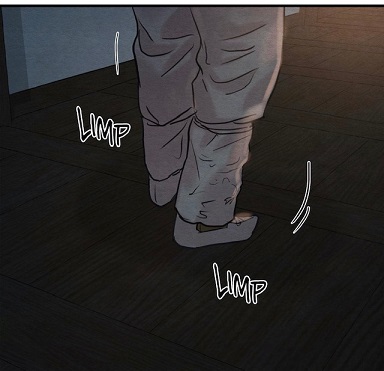
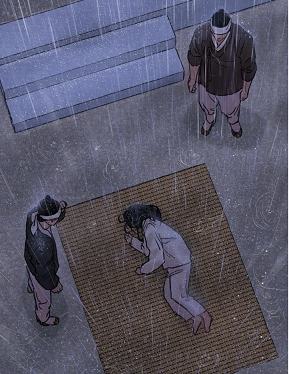 (chapter 77) And that’s how the ruler could discover the truth!! Therefore the culprits would be detected easily: father Lee and naturally Kim, as both knew the real identity of Baek Na-Kyum, but chose to remain silent. Yes, knowledge will become Kim’s downfall in the end. Why do I think so? For me, the feet in this panel are Kim’s
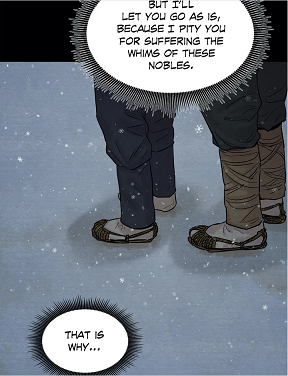 (chapter 66: According to me, this is Kim and not No-Name)
 (chapter 77) Don’t forget rule 1 and 3. Nevertheless, the main point for this interpretation is the way the painter ran:
  (chapter 17)
 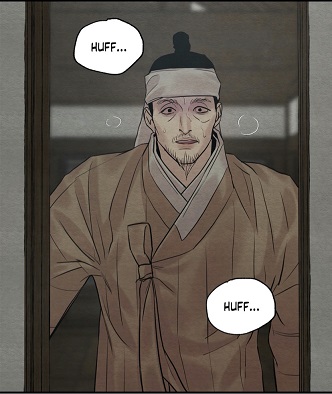 (chapter 85) Here he had faked running. Since he had been introduced with his feet in chapter 1, she needed to create reflections later. Finally, I would like to point out this:
 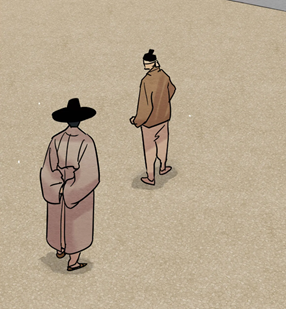 (chapter 7) Their meeting here is an indication that their past must have crossed before because of rule 1!! Since the painter was so devoted to the learned sir, the valet could only jump to the conclusion that the man had truly taken care of Baek Na-Kyum properly.
  (chapter 04) The protagonists’ fate got switched the moment they passed a door. Thus the painter didn’t suffer here contrary to the young master
  (chapter 4) He recognized that the artist was not a servant or slave, but a free man. His words became a reality. He is not embracing a peasant, but a noble, even a member from the royal family. He was speaking the truth, while all the readers were thinking that Yoon Seungho was a hypocrite. We could say that the main lead was under the influence of the spirits/unconscious, thus he caught the artist right on time. At the same time, “peasant” is again a reference to father Lee which reinforces my theory that the scholar Lee is deeply involved in the couple’s suffering.
 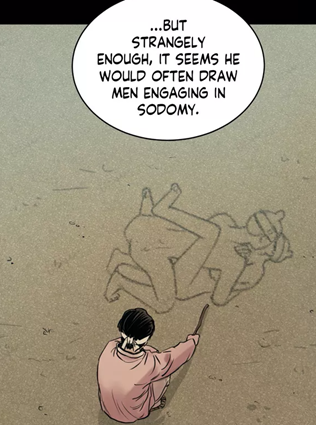 (chapter 1) He had actually painted animals and nature in his childhood, thus the noonas kept his drawings.
 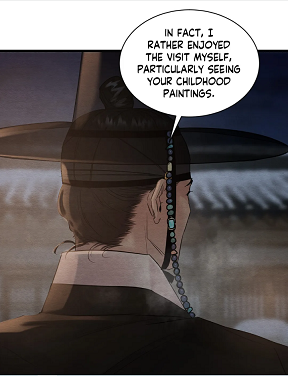 (chapter 94) The man had trusted the learned sir’s testimony without verifying the facts. He had not detected the presence of a blackmail!
  (chapter 1) This truly shows that ignorance is indeed no blessing, and people shouldn’t trust others according to their appearances or social status. At the same time, the servant had forgotten that Yoon Seungho was a noble, though he was dressed like a peasant in the bedchamber.
 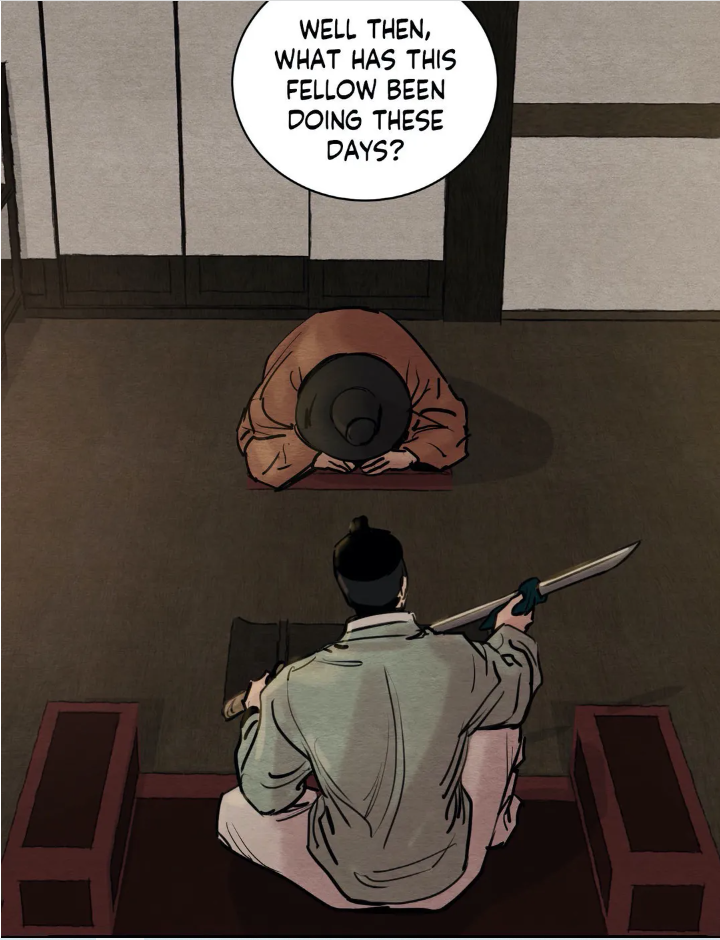 (chapter 1) He was not even wearing a hanbok here, and his head-band was different too. As you can see, both protagonists shared the same experience. They were not treated according to their social status. To sum up, my theory is that the valet Kim brought Baek Na-Kyum to the Lees, who decided to get rid of the painter by entrusting him to the scholar Jung. And Heena became his accomplice, the moment she became his surrogate mother. Let’s not forget that in season 1 and 2, the learned sir was the only one seen with children: girls.
  (chapter 6)
 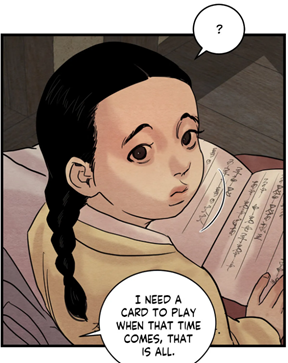 (chapter 29) and Baek Na-Kyum
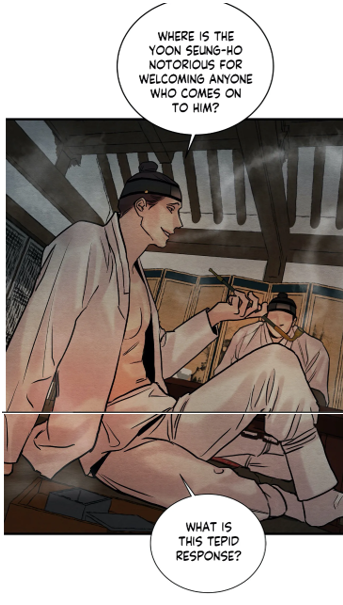 (chapter 52) Finally, he was forced to share anything he owned to others.
  (chapter 52) That’s how I realized that the inner thought from Lee Jihwa was exposing his knowledge. The latter knew about Yoon Seungho’s true conditions. The latter had been treated like a plaything by the pedophile. As the red-haired noble had been raised as an filial son respecting elders, Lee Jihwa saw no reason to change the way Yoon Seungho was “trained”.
  (chapter 57) Besides, he could only benefit from it. Now, he could have sex to his heart content. He only started playing tricks, the moment he felt that his childhood friend was escaping from his claws.
 (Chapter 83) Why? He viewed him like a dog, for he was living in the shed. He even had no proper hanbok and no real hair dress, and the manhwaphiles can certainly remember the idiom: clothes make the man! If he was no man, then he was an animal, a dog. Even his food reminded me of dog food. But why was he living there?
  (Chapter 83) In this essay, I will answer to this question. As a first conclusion, the lord was not even treated like a male kisaeng in the past, but more like a dog. Consequently, I deduce that when Baek Na-Kyum met the lord in the inn (chapter 1), his status had already changed. He was slowly experiencing emancipation. He was living like a male kisaeng. Thus I conclude that Lee Jihwa contributed to his recovery to a certain extent.
  (chapter 57)
  (chapter 62) This explicates why after reading episode 62 for the first time, I had suspected the father to have raped his own son. Yet this thought was dropped shortly after. Then when episode 77 was released, I realized that in the shed the lord was also reminded of Kim’s betrayal, for the latter would always drag him to the shed. Observe the way he was “carried away“. It was like an “embrace“.
  (Chapter 77) In episode 77, the readers can witness 2 incidents how the lord was brought to the storage house.
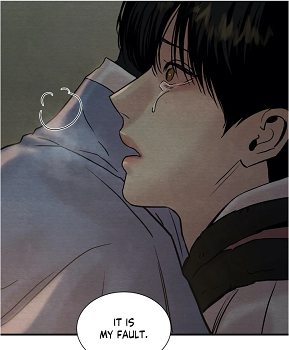
  (Chapter 77, this is a different situation, for we have different servants except Kim) Therefore in the barn, Yoon Seungho behaved like his surrogate father Kim as well. This explicates why we have the fake embrace and the insincere apology.
  (chapter 62)
  (chapter 62) As you can see, the hug from the past was the symbol of violence and hypocrisy. It served to drag the lord to the storage room. And this new observation led me to the following conclusion: Yoon Seungho was copying the behavior from all his abusers from the past: his brutal father, the hypocrite butler and naturally the pedophile.
  (chapter 62) Hence the protagonist grabbed the painter by the hair. For me, the “mysterious lord Song“ used to hurt the main lead by the hair, when he got angry. How did I come to this interpretation? Note that at no moment we never saw Yoon Chang-Hyeon taking his son’s hair. First, the lord’s head was covered with a hat.
  (Chapter 83)
 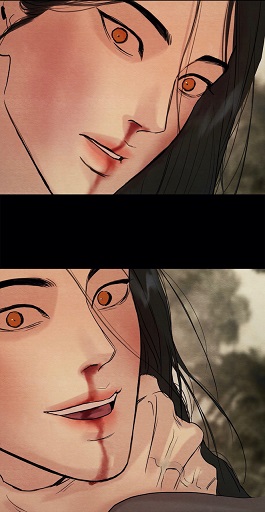 (chapter 83) As for Kim, the latter would always restrain the main lead by the shoulders, the fake embrace.
  (Chapter 57) And now, you comprehend why the lord dragged the two nobles by the topknot.
 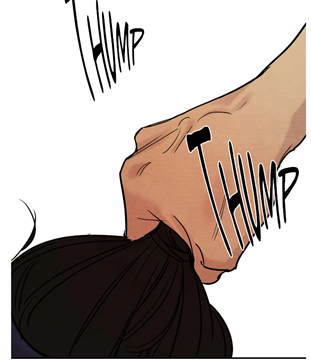 (chapter 8) For a long time, I have demonstrated that this gesture represented one of Yoon Seungho’s biggest traumas. But why would the pedophile do that? One might say that it is because of Yoon Seungho’s resistance and struggling. He needed to punish him for his disobedience. Note that the noble with the mole and Lee Jihwa got humiliated as sanctions.
 (Chapter 18) However, in my eyes there exists another explanation which I will elaborate in this analysis either. From my point of view, the shed and the humiliation are strongly intertwined. This was particularly visible, when the lord forced Baek Na-Kyum to have sex in the courtyard.
  (Chapter 64) But why would he do that in the end? It was to train him, to make him obedient.
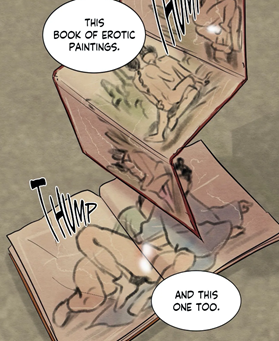
  (Chapter 64) Remember how he had declared that the painter was now his sex toy. He should listen to his master or owner. That’s how I came to this deduction. The infamous lord Song is a sadomasochist. In the worse case, he is simply a pure sadist. I am inclined to believe more in the first view. With this, we would have the link between sex and torment. And the picture from the erotic book where you see the bearded man having a braided man on his lap outside indicates that Yoon Seungho was here getting punished. The pedophile loved seeing Yoon Seungho humiliated and in tears.
  (chapter 01) And now, we have the explanation why the lord could no longer cry and how he came to hate “fake apology”. This was the result of the exposure to the sexual assaults under the form of BDSM.
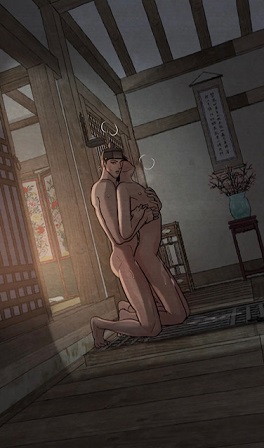 (chapter 96) They ended up in the hallway, anyone could see them. Then in another website, I found the following principles:
 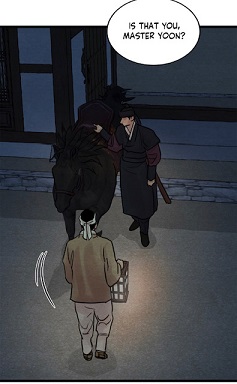 (chapter 25) He even brought the hanbok himself.
 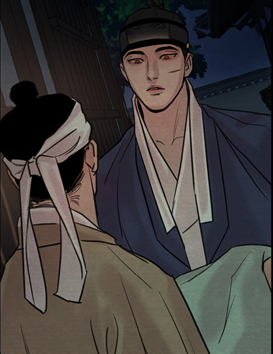 (chapter 26) The lord went so far to take his bath with his lover to clean him.
  (chapter 59) He made sure that his partner wouldn’t suffer.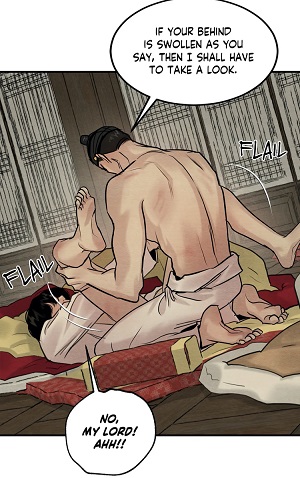
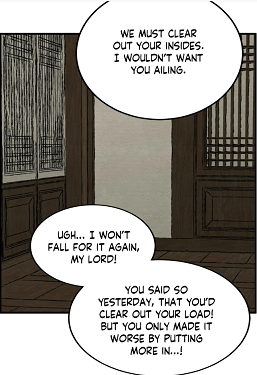 (chapter 89) Yoon Seungho knew by experience that the rest of semen in the stomach would cause him ailing.
  (Chapter 101) He blushed, though he could see that Baek Na-Kyum was in pain, the face covered with blood. Remember what the painter did in the pavilion to the main lead: he scratched his face.
 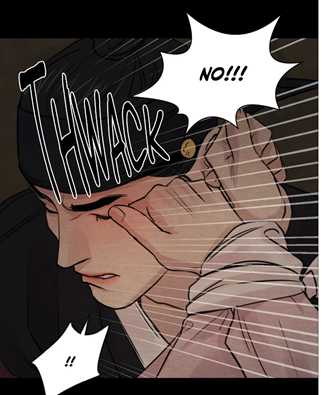 (Chapter 25) Thus we have to envision that the lord must have reacted the same way and wounded his abuser. And imagine the consequence if he had wounded the king on the face. This could be seen as a reason for a punishment.
 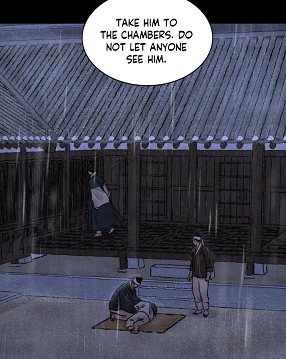 (Chapter 77) Remember Black Heart‘s warning in the shaman‘s house:
  (chapter 102)
 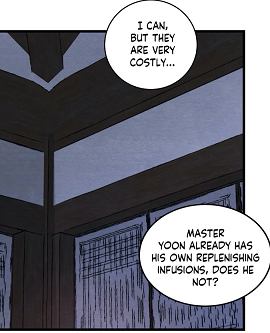 (chapter 33) This is an euphemism for aphrodisiac. Thus we had this confession from the physician.
  (chapter 57) Why did the butler visit the doctor without Yoon Chang-Hyeon? It is because he had been ordered to fetch the aphrodisiac. By feeding him with the drug, they wanted to force Yoon Seungho to accept the advances from the king, and as such to admit his sexual orientation. He was a sodomite.
 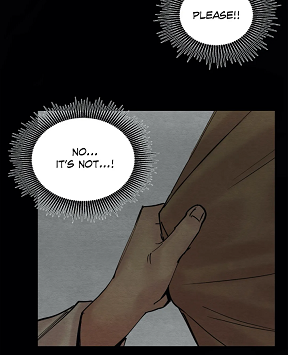 (chapter 65) They faked his “pleasure“ making him feel guity and dirty. That’s how he got tricked. This explicates why the main lead still has no idea of the use of the aphrodisiac.
 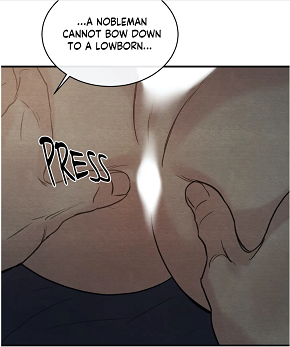 (chapter 71) As a king, he couldn’t bow down to a noble. Observe that the roles of “dominant” and “submissive” are not clearly defined between Yoon Seungho and Baek Na-Kyum. The lord is the dominant sexually speaking, but note the vocabulary:
 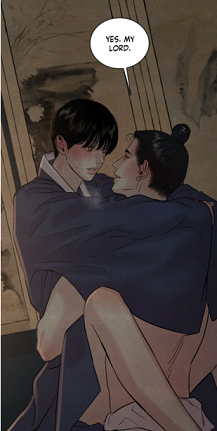 (chapter 72)
  (chapter 89) If you pay attention to their interaction, the lord acts like the servant. The reason is simple. If you take into consideration the second list of recommendations, you will recognize that the roles are switched. Outside a sex session, the submissive becomes the “king“, and the dominant has to act like his servant. That way, a certain balance is created. But this was never the case between the pedophile and the teenager. The latter was always reduced to a plaything and at the end to an animal. The pedophile never called the protagonist by his name.
 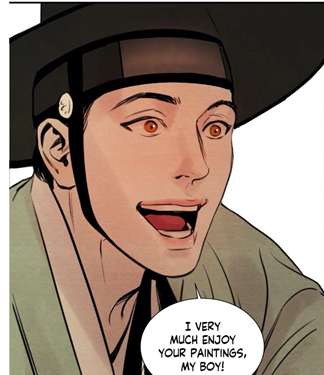 (Chapter 1) He was just called “my boy“. And that was it. He never created a real bound with the main lead. Therefore trust was totally inexistent. And because the young noble could only fear the man, he came to hate him to the point he could die. The latter made promises which he never kept!!
  (Chapter 101) How could he vow to “protect or help“ Yoon Seungho, when the latter was tormented constantly and exposed to violence against his will? And this could only escalate to Yoon Seungho‘s attempt to commit suicide.
  (Chapter 55) I had this idea, for the story is going in circle, meaning that the lord must have done it before, just like he did in season 3. The possible death from the main lead and probably his own pain must have brought the mysterious lord Song back to reality. That‘s the reason why he sent for the physician‘s assistance. He was encouraged to keep his distance from the young man, just like the latter was incited to stay away from the painter in season 1 (sickness, Min), in season 2 (the scholar‘s insult) and in season 3 (the rough sex session in chapter 81-82). Thus I deduce that the pedophile has always kept an eye on Yoon Seungho and his recovery. In my opinion, the man has not forgotten the main lead at all. Why do I think so? It is because he kept the painting…
 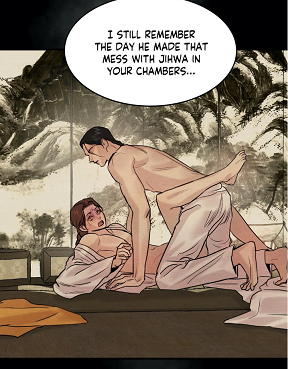 (chapter 82) a souvenir from their time together, just like Min who stole the painting in the study.
  (chapter 74) Thus I am deducing that Seungho-Ya will become the safe word between the two protagonists.
  (Chapter 72)
  The noble with the mole is trapped in a shed, and the color purple, a symbol for royalty, is dominant. From my point of view, the author revealed everything in this tweet. On the other hand, I would like to point out that here the man doesn’t look scared or rejecting the use of the bondage or the dildo.
 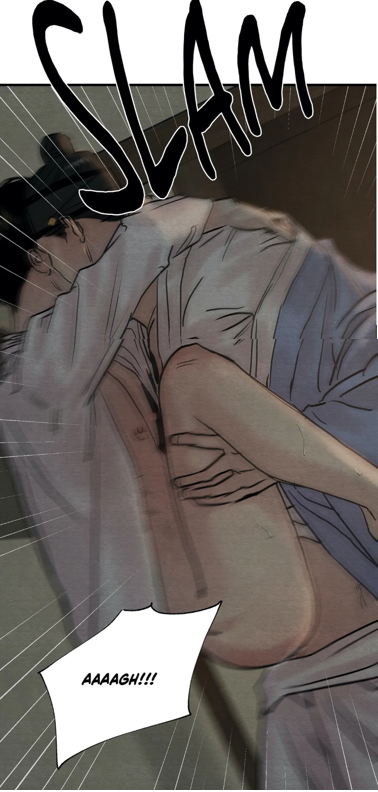 (Chapter 63) He was reliving his biggest trauma. Yet, he never went overboard in the shed. Note that the moment the painter called his lover “lord Seungho”, there was a switch.
  (chapter 63) That’s the reason why the lord changed the painter’s position and faced him.
 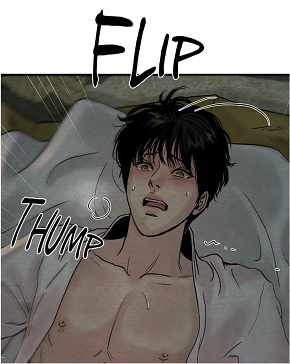 (chapter 63) The lord communicated his feelings and thoughts, and he even made a promise.
  (Chapter 63) This new perception reinforces my impression that there was no rape in the storage room. The painter kept saying “no“, because he was actually scared about his own reactions. Strangely he felt pleasure, thus he kept having climaxes. He was simply in denial. The irony is that the noble attempted himself to be cruel during the night of the revelation (episode 62, 63, 64), but he failed, because the night at the doctor’s house was still fresh in his memory. He couldn‘t forget the tender embrace from the painter.
 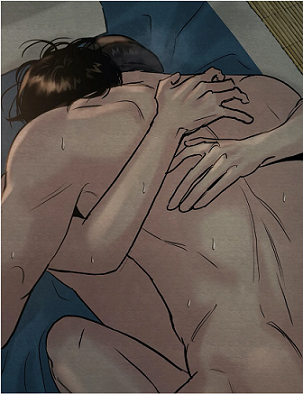 (Chapter 62) This explicates why he stood up during the penetration, he was forcing the artist to hug him, to clinch onto him. He wanted to relive it again.
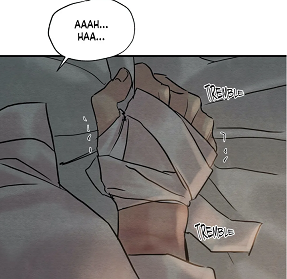 (Chapter 63) He had internalized the marks left by the bondage. This is no coincidence that the artist‘s wrist was covered by the bandage, the reflection from the torment in his youth. Under this new aspect, the presence of the bed in the shed was like a magical tool, which helped the lord to not turn into his tormentor. He was just a ghost from the past, and the word “lord Seungho“ worked like a magic spell, which stopped Yoon Seungho from becoming as vicious and cruel as lord Song. Moreover Lord Song sounds very similar to lord Seungho. And this new discovery confirms my interpretation that Kim was the helping hand of the king. He had to provide him with the white bands for the bondage, just like he had helped for the young master’s kidnapping in the gibang.
  Under this new light, I see it as another evidence that the infamous lord Song could only be the king! He is the only person who has absolute power in Joseon, and as such knows no “real boundaries“. Furthermore, as the ruler, he is expecting no rejection from his subjects. Anyone watching sageuks (historical Korean dramas), is aware that the Joseon king was never an absolute monarch, for he was always controlled by the officials, ministers, the Queen dowager and the Queen. There were also protocols which he was forced to follow. And we have an indication about the king‘s lack of power and wealth.
 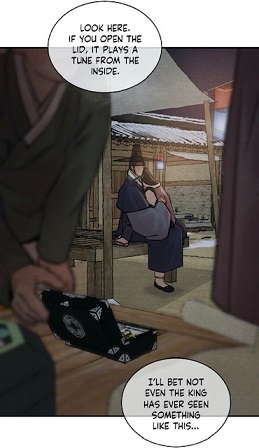 (Chapter 76) Thus I am assuming that the lord Song must have been frustrated about this contradiction. On the one hand, he was supposed to be the most powerful man in Joseon, on the other hand, he had to rely on the aristocracy. Hence I have the impression that the ruler vented his anger and frustration on Yoon Seungho unconsciously. That way, he could outlive his sexual fantasies, where he was powerful. But because of these terrible sexual habits, the young master could never get treated by a physician. Anyone would have recognized the sign of abuse.
 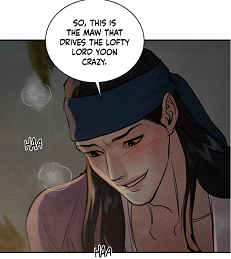 (Chapter 101) are a proof that they never discovered the importance of kisses, embraces, caresses and words during sex. They never recognized that they were denying the existence of love, too obsessed with their heritage and their reputation. The manhwalovers will remember my previous observation. The pedophile had never kissed the main lead. The king like all the nobles had disconnected sex from love. Why? It is because sex was a duty… to continue the lineage. And now, you have the explanation why the pedophile and all the others reduced sex to penetration.
  (Chapter 96) When she heard the noise (PLOP), she was brought back to the past, when she had witnessed a scene of BDSM, though the violence was real. A similar situation to this scene:
 (chapter 73) The pictures from the erotic publication are the evidence for this theory. After hearing the description from the butler about the events in the shed, the noona Heena believed to know what had happened in the shed.
 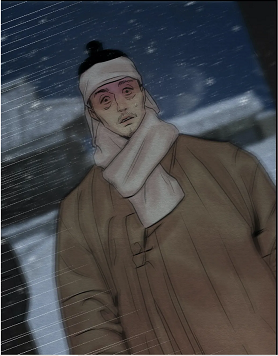 (Chapter 64) The butler thought that the “no“ from the painter was truly real, while the latter was just dishonest. It was the result from the “indoctrination“ from Heena and Jung In-Hun. The valet had been deceived in the end. The humiliation and punishment were not real, for the painter did ejaculate, and back then he was not under the influence of the aphrodisiac.
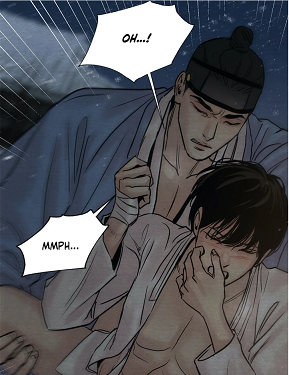 (Chapter 64) This was not like in the past, when the brutality was real. And now, you comprehend why Heena‘s resent towards her brother became more visible after witnessing the love session between the noble and Baek Na-Kyum.
  (Chapter 72) He was copying the habit from the pedophile in my eyes. The latter would never remove all his clothes on his own. As the king, he was used to get undressed by his own staff. Only the teenager as the uke was undressed, unless the lord was accompanied by the other nobles, like in this scene.
 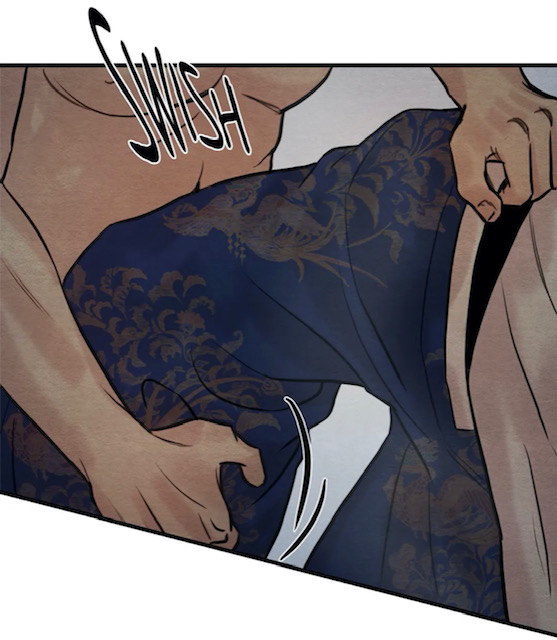 (Chapter 54) And because the ruler was too focused on his own pleasure, he never got to know the young noble. He only realized too late that he had made huge mistakes.
  (Chapter 72) Yoon Seungho was his prey.
 (Chapter 56)
  (chapter 57) This is what he experienced himself in the past. And observe that the childhood friend’s biggest punishment was actually his public humiliation, when he confessed and got rejected.
 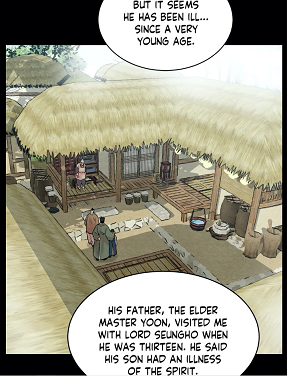 (Chapter 57) Yoon Chang-Hyeon looked down on his son’s critical thinking and came to doubt his words. The author left many clues for this interpretation:
  (chapter 101) Lord Jang got aroused, when he saw the bloodied lips from the painter. Moreover, Black Heart had brought a huge dildo.
 (Chapter 101) The item was huge, therefore it could only injure the artist’s anus.
  (Chapter 100)
 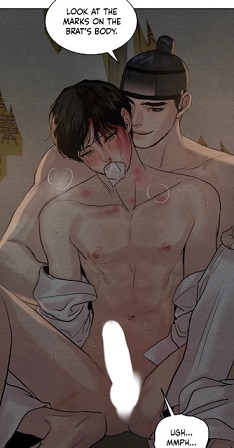 (chapter 101) Even the noble said that this must have hurt. The painter disliked being bitten in the neck.
  (Chapter 88) Furthermore, the lord said this to the painter in the study:
  (chapter 85) These were the words from the pedophile. He was repeating his sexual abuser‘s words. And this proves to me again that the lord was abused in the study, but if he rejected the man, he would be sent to the shed where he would receive his punishment. In other words, Yoon Seungho was punished with sex and violence. And now, you have the explanation why he got gangraped in the end. But the readers should keep in their mind that this was no real BDSM, for the brutality was real. The king couldn’t distinguish between reality and illusion. And this coincides with all my previous interpretations.
 (Chapter 65) Kim had brought him to the barn, because Yoon Seungho was punished there. This could only be suggested by the butler, as I don’t think that the king would ask for the owner of the mansion for permission. This room was definitely taboo, no one was allowed to approach the study or the shed. Yoon Seungho was exposed to rough sex, and Kim knew this, like mentioned above. But he never witnessed it himself, he only discovered the aftermath. From my point of view, this scene occurred after the lord’s loss of virginity.
  (chapter 18)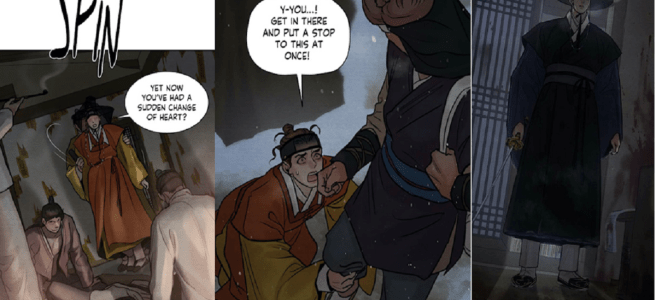
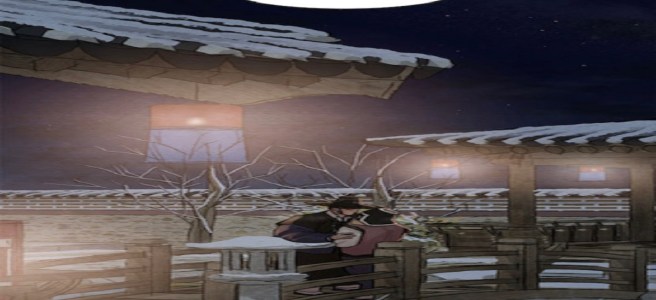

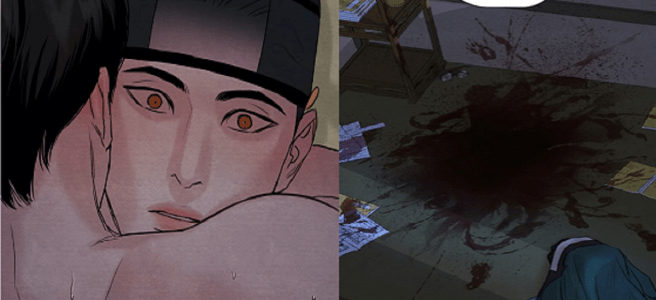

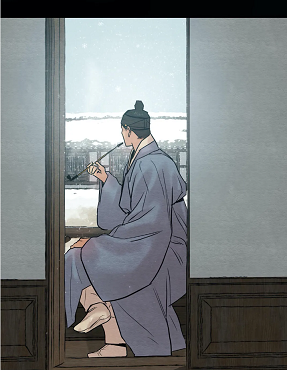 (chapter 61) and opium
  (chapter 52).
  (chapter 52) And this perception got reinforced, when the butler confided this to the physician later:
  (chapter 55) Many readers had the impression that Yoon Seungho had been smoking opium, many went so far to imagine that he had been smoking opium right from the beginning.
  (chapter 5) However, this was just a lie. Yoon Seungho never smoke opium!!
 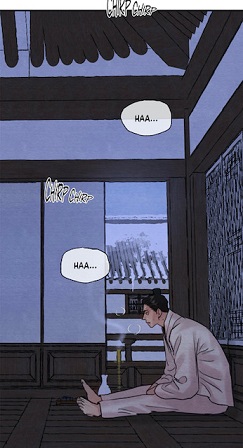 (chapter 74) Hence consuming opium would even instigate his nightmares. In addition, observe that in chapter 5, Yoon Seungho was never euphoric nor sleepy. He could interact with the painter normally.
 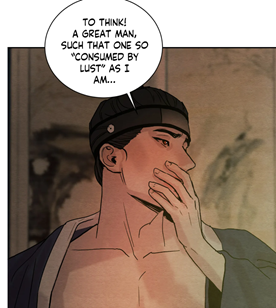 (chapter 05) As you can see, Yoon Seungho had a drug addiction, nitocine.
  (chapter 52) This means, he was conscious and alert. Besides, we saw him later getting in rage
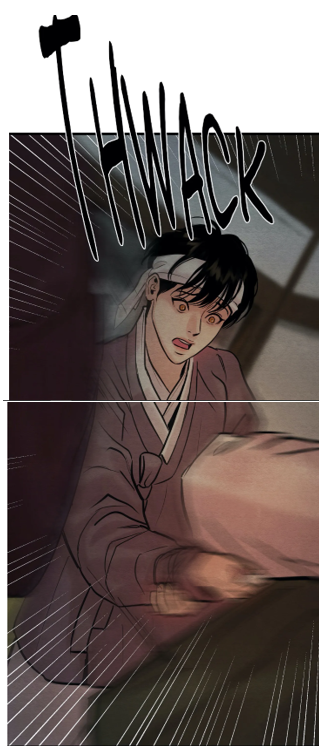 (chapter 53). Here, I would like the manhwaphiles to keep in mind that side effects of opium like euphoria, relaxation and analgesia last for at least 3 to 6 hours. So this outburst of rage is an indication that our protagonist was not under the influence of opium. He was not hallucinating either. He had grasped the whole situation, when he heard Deok-Jae predicting a terrible fate to the artist. In addition, this drug is not considered as a poison inducing psychosis.
  (chapter 52) This explicates why he beat Min and Deok-Jae so furiously, he wasn’t acting under the influence of hallucinations. He was perceptive, he had clearly understood the meaning behind the servant and the noble’s words. As you can see, the lord’s mood swings were more triggered by his addiction to nicotine. This explicates why the main lead had such a violent outburst in the shed after the abduction. He had smoked tobacco the whole day.
  , but hides it under the excuse, he drank too much. He gets in rage, when No-Name calls him a fool.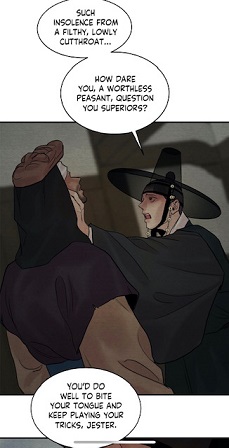
 He can no longer keep his mask contrary to the altercation in episode 41, when Yoon Seungho compared him to a mouse:
 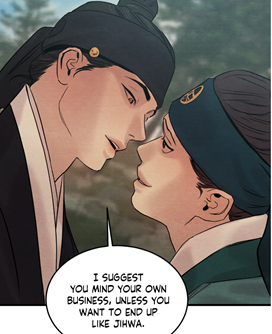 (chapter 41) Besides, we have another evidence that Black Heart has developed an addiction to opium with the following panel:
  (chapter 76) The gaze is different, an indication of the widened pupils. Furthermore, his restlessness is perceptible the way he approaches The Joker. This time, he has to meet the criminal personally. We could say that he rushes to meet the criminal. Like he said, he was “running out of time”…
 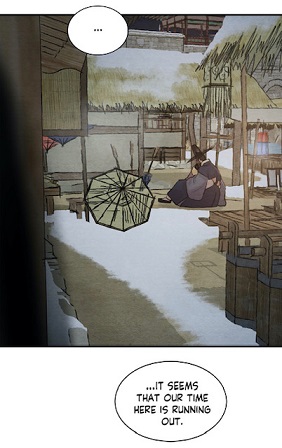 (chapter 76) These words reflect his own troubled mind.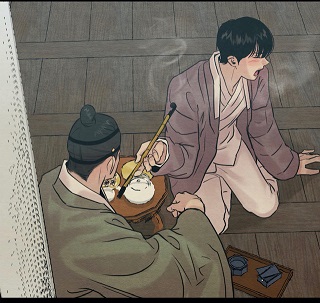
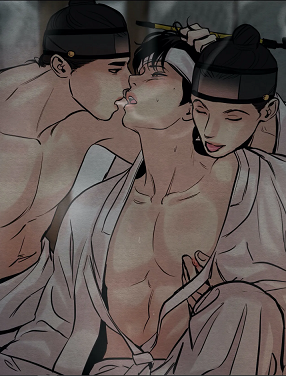
 Note the euphoria and the sedative effect on the artist’s face. This explicates why he didn’t push the rapists away.
  (chapter 53) They wanted to smoke this drug there, for no one would interrupt them. But because Yoon Seungho let them smoke opium, he became guilty by association: he was also an opium smoker. And the readers had fallen into the same trap. As you can see, I believe that the author is using the method on the manhwaphiles. They are misled by what they see and hear without questioning the authenticity of the statement.
  (chapter 55) However, this is another deception. Yoon Seungho is no alcoholic either!! 😲
 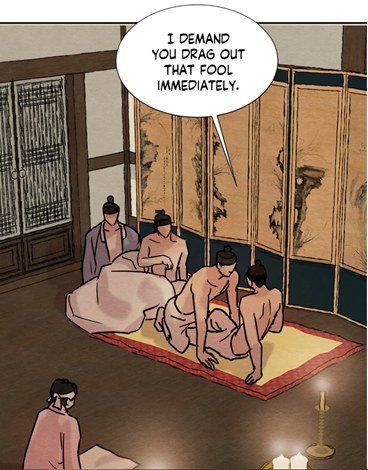 (chapter 08) So his debauchery was linked to sex and nothing more. He would live for sex and nothing else. Furthermore, the manhwalovers will certainly recall the lord’s behavior in the tavern. He ordered wine
 (chapter 75), but notice that he never became drunk like the painter.
 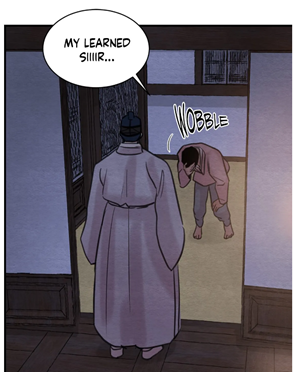 (chapter 19) or he would be so inhibited that he couldn’t walk properly. These were the sign of his addiction. I can’t forget the lord’s words in episode 75:
  (chapter 75) Here, he saw how the alcohol was affecting his lover’s behavior.
  (chapter 53) He was walking straight. When the readers saw the following image, they saw it as a confirmation that Yoon Seungho was a drunk.
 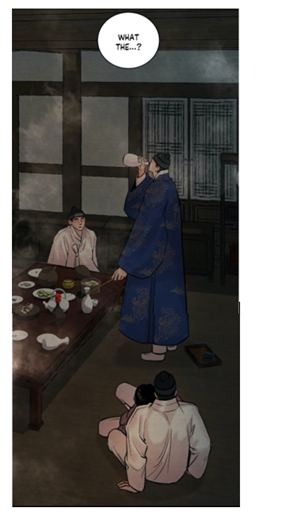 (chapter 54) But in truth, he took some wine in order to overcome his pain, to give himself some “courage” to go through. He had longed for the artist’s warmth after a week of separation, but he knew that Baek Na-Kyum viewed sex as prostitution. He was alert enough to see the consequences of his decision
  (chapter 54), therefore he broke the bottle.
  (chapter 54) This is no coincidence that he destroyed the bottle of wine. He had the impression that this drug was the cause for his “hallucination”, he was seeing the painter in ecstasy which could only remind him of his own past. Besides, he didn’t want his companion to become a shadow of himself:
  (chapter 78), I believe that Yoon Seungho never proposed too much wine to his lover afterwards. He had made the experience that if he did, he would be the reason why Baek Na-Kyum would become a drunk. In my opinion, the painter’s relapse was linked to his own suffering, he was tormented by the idea that Yoon Seungho would abandon him, his affection was not deep. Since they had no longer any sex, he had the impression that Yoon Seungho’s love for him was vanishing. As you can see, the painter’s dependency to wine was linked to his repressed libido and his fear of abandonment.
  (chapter 33) Compare this sex orgy with the following one:
 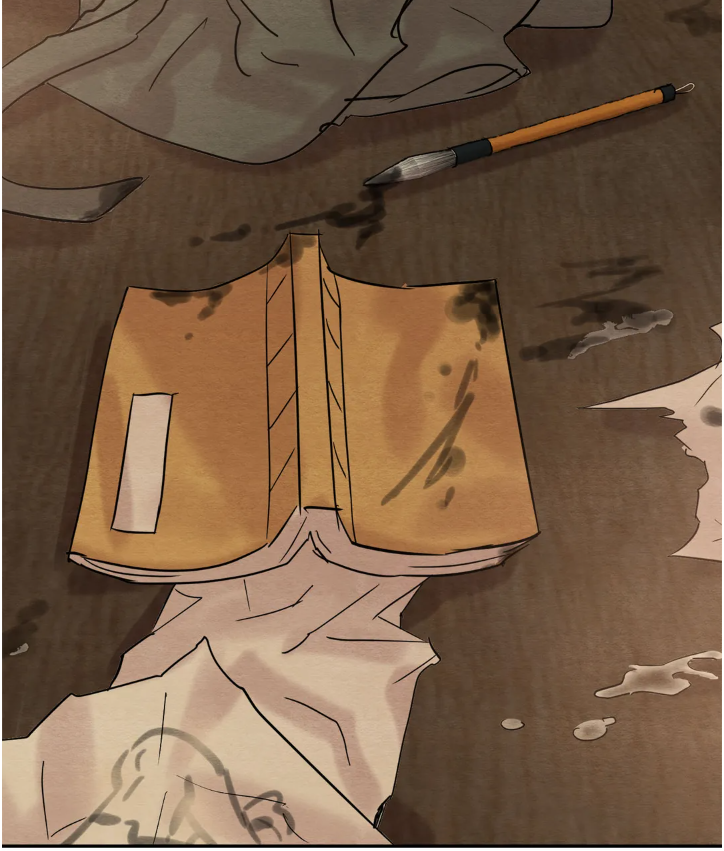 (chapter 8) At Black Heart’s party, wine and tobacco were offered, while in Yoon Seungho’s bedchamber you only had books, pictures and sex. Besides, there were more guests. As you can sense, the parties were totally different: austerity versus luxuriousness. Yes, Min wanted to impress his host Yoon Seungho!! He desired to show him what a true sex orgy was. He desired to prove that he was the real hell-raiser, the real king among nobles.
  (chapter 33) The Joker and the bottle of wine!! The manhwaphiles will certainly recall how the villain offered the expensive alcohol to Yoon Seungho (chapter 19). Moreover, I realized that in episode 33, we have a slight change. While Black Heart is seen first with the pipe full of tobacco,
  (chapter 33), slowly the author brought the villain in connection to the bottle of wine:
  And at the end, we have this:

 .
. 
 (chapter 51), I believe that Black Heart was the main consumer!! And now, you comprehend why Yoon Seungho fell into debauchery.
  (chapter 51) He was far from happy, for his fixation on Baek Na-Kyum had not disappeared at all. Therefore, it is not surprising that he started drowning his sorrow. However, alcohol was no longer effective, he needed something stronger to dull his agony. That’s how he discovered opium. And notice that when the lord got punched in the propriety, he felt no pain.
  (chapter 54) He didn’t protect himself, he had no strength because of the relaxing and sedative effect. He even laughed, a sign that he was under the effect of the drug.
 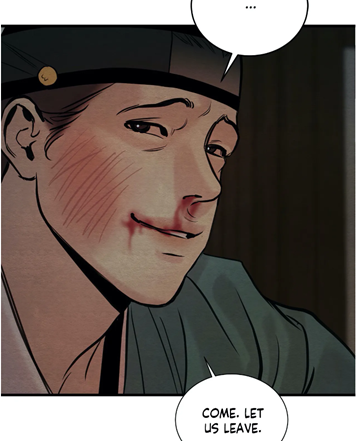 (Chapter 54)
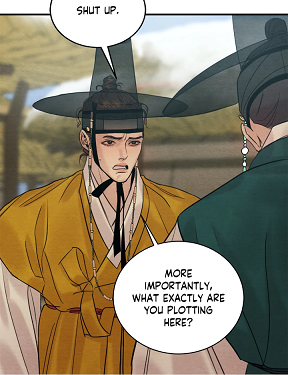 (chapter 83) He is still biting his nails, a sign of remorse and fears, but he is no longer obsessed with Yoon Seungho. From my point of view, the torments the second lead suffered in the second season played a huge role. He started drinking alcohol for another reason.
  (chapter 50) This time, he got afraid of the consequences for the murder. As you can perceive it, there was a slight shifting. This shows that the wine became less and less connected to his obsession with his childhood friend, his desire to have him. This explicates why he was so devastated at the end of the second season. Out of guilt and anxiety, he started drinking again.
  (chapter 76)
 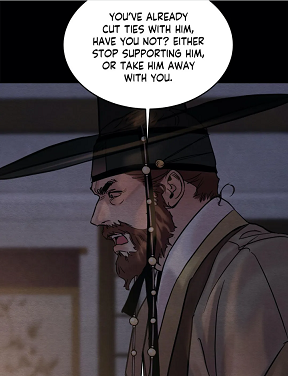 (chapter 82) He knows about his father’s plan. If Yoon Seungho is forced to submit himself to his father, he won’t be able to use his wealth and power to attack him. That’s the reason why he is no longer looking like a wreck. In other words, he is well aware what is going to happen to his friend. He witnessed the abuse, but he doesn’t care, for his “life is in danger”. 🙄 As for Min, he looks more healthy again
 (chapter 83), for he had to plot in order to achieve his goal. He needed to find a new puppet, lord Lee, and as such he needed to make a good impression. He had to become proactive and become more directly involved. Hence he needed to be more alert.
  (chapter 45), for he felt something was missing. Consequently, this is not surprising why Yoon Seungho had a sex marathon in the shed after smoking the whole day. It was to contain his rage, but also to mask his strong desire for the painter. What caught my attention is that after their love session, the main lead started smoking again, exactly like in the past.
 (chapter 74)
  (chapter 83) This observation is important, for it shows that he is no longer using tobacco to hide his inner turmoil. That’s why I believe that Yoon Seungho’s addiction was originally linked to his traumas. It was his way to “anesthetize his emotions”, he had the impression that he would become more clear-sighted.
  (chapter 66), a sign that he is not hardworking. He is very sensitive to criticisms, which was underlined in chapter 83 one more time.
 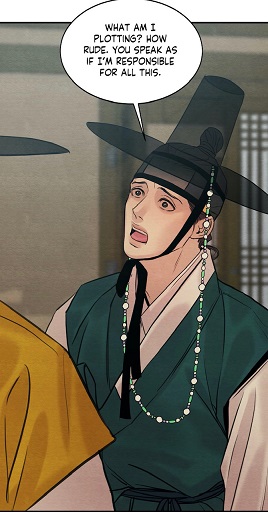 (chapter 83) Therefore I tried to find out if persons suffering from Antisocial Personality Disorder could be suffering emotionally, though they are supposed not to feel any pain and empathy. And yes, such persons are definitely not happy, for they are often lonely.
  (chapter 9) He felt lonely, and hoped that the artist would give him the same gaze, when he looked at the protagonist. He had already snatched Lee Jihwa, but the latter was too obsessed with his childhood friend to look at him in a different way. Min was definitely longing for love, but he could never admit it. Striking is that Min picked his “bride”, exactly like the psychologist Love described it:
 (chapter 66) Hence he could only view the second lead as his puppet. That’s why The Joker had to use “drugs” to mask his emptiness and longing for affection.
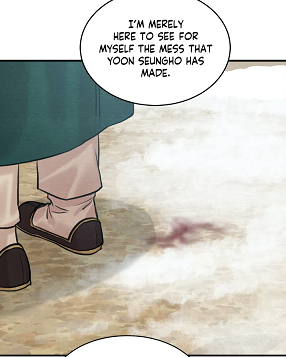 (chapter 83)
 Bebebisous33s' analyses in K-Dramaland and Manhwas