

Please support the authors by reading Manhwas on the official websites. This is where you can read the Manhwa: Jinx But be aware that the Manhwa is a mature Yaoi, which means, it is about homosexuality with explicit scenes. Here is the link of the table of contents about Jinx. Here is the link where you can find the table of contents of analyzed Manhwas. Here are the links, if you are interested in the first work from Mingwa, BJ Alex, and the 2 previous essays about Jinx Breathless in the Light – part 2 and Love is in the Air -part 1
It would be great if you could make some donations/sponsoring: Ko-fi.com/bebebisous33 That way, you can support me with “coffee” so that I have the energy to keep examining Manhwas. Besides, I need to cover up the expenses for this blog.
Finally a Love Confession?
Among all the scenes in Jinx, none has ignited more speculation than the moment inside the Ferris wheel cabin—those few seconds when Joo Jaekyung’s lips move 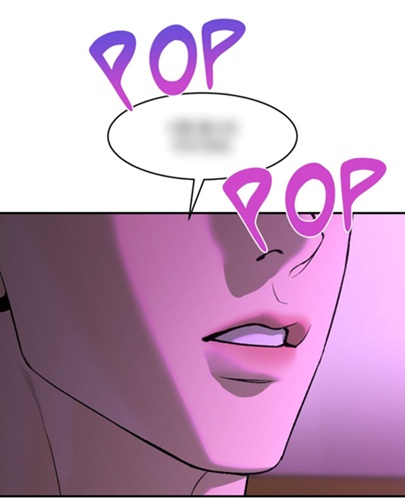 (chapter 84), the fireworks erupt, and Kim Dan turns his head too late.
  (chapter 84) Readers have replayed the blurred panel again and again, straining to decipher the muffled shapes of his mouth. Some are convinced that this is the confession, the moment the wolf finally says aloud what his body has been whispering for months. One Jinx-phile, @4992cb even insisted she had cracked the code: five syllables,
  just enough to match the Korean 좋아해 김단 (jo-a-hae Kim Dan)—“I like you, Kim Dan.”
And truthfully, the scene encourages such a reading. Fireworks often accompany love confessions in East Asian media 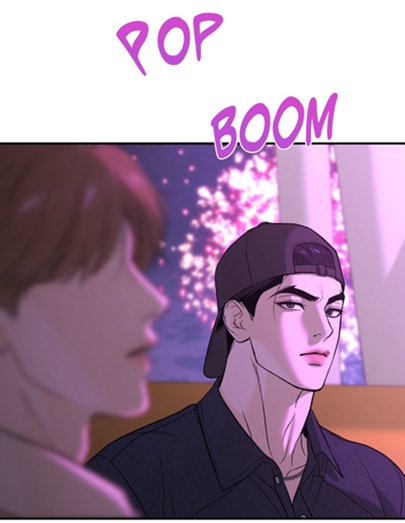 (chapter 84) —especially Japanese summer festivals where boys and girls, dressed in yukata, confess beneath crackling skies. Fireworks symbolize joy, romance, fleeting courage. It is no wonder many readers assumed that Mingwa was drawing on this cultural grammar: purple night sky, glowing lights, two lonely figures suspended above the world. A confession seems almost inevitable. And if it truly was a love declaration, then the champion’s refusal to repeat himself
  (chapter 84) would make perfect narrative sense—confession lost, moment gone, courage spent.
But before we accept the romantic surface, we must pause. Something about the staging feels off—deliberately off. Why would Mingwa construct a confession that the receiver cannot hear? (chapter 84) Why give Kim Dan the long-awaited moment he has yearned for, only to snatch it away with the noise of exploding light? Yes, despite his words, Kim Dan still had the hope to be loved by the athlete. Hence he kept thinking about the athlete’s motivations for his “stay and care at the seaside town”.  (chapter 62)
  (chapter 77) Why does Joo Jaekyung speak exactly when the fireworks begin, as if choosing the one moment when he is guaranteed to be drowned out? (chapter 84) And most importantly: what emotion pushed him to open his mouth in the first place?
 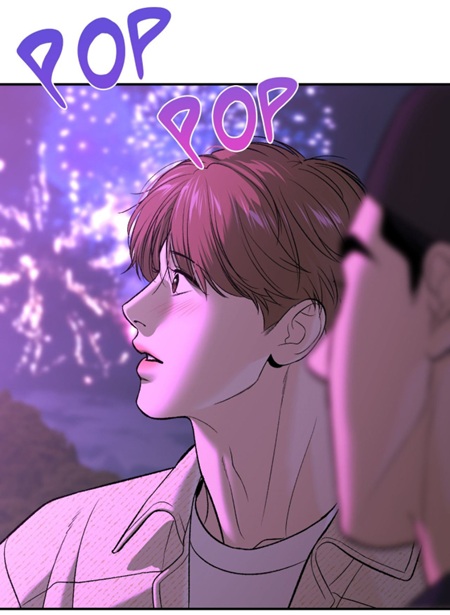 (chapter 84) Was he truly confessing love—or was he trying to verbalize something far more raw, far more primitive, far more difficult?
Before we can decode the stolen syllables, we need to examine the entire machinery around this moment: the champion’s posture, the lighting, the soundscape, the timing, and the emotional triggers accumulated over previous chapters. Only then can we begin to understand what he tried to say, and why the author ensured that Kim Dan—the boy who has always longed to be chosen—could not hear it.
The Mechanics of a Stolen Confession
Everything about the Ferris wheel cabin — the positioning, the posture, the lighting — undermines the idea that Joo Jaekyung was intentionally directing his words toward Kim Dan. The mechanics of his body say more than the bubble ever could. To begin with, Jaekyung is not fully facing Kim Dan when he begins to speak. (chapter 84) How do we know this? His body tells the truth before any words do: his torso is angled half-way toward the window and half-way toward Kim Dan, caught between desire and retreat. His arms remain crossed — a classic defensive posture — as if he is bracing himself against the very feelings he is trying to verbalize. This is not the stance of someone delivering a confident love confession; it is the posture of a man attempting something dangerous, something he is afraid to expose.
Only his head turns slightly toward Kim Dan, a diagonal tilt rather than a direct orientation. (chapter 84) It signals hesitation, testing the water, not a deliberate act of addressing someone face-to-face. And the light confirms this: the violet firework glow still falls on the same side of his face as in the previous panel, proving that he did not rotate his body or head enough to truly face Kim Dan while speaking. (chapter 84) He remains more oriented toward the window, toward the blur of lights outside — toward a safer, less intimate direction.
This halfway posture makes everything clear: Jaekyung is speaking from a place of longing mixed with fear, practicing honesty without yet daring to look directly at the person who provokes it. It is because as soon as his fated partner asks him to repeat, he turns slightly his head away, to the window. (chapter 84) When someone truly wants to be understood, they turn instinctively toward the listener. But when Jaekyung turns away, he is not refusing vulnerability — he is choosing fear. Turning his head toward the window is an instinctive retreat into the only safety he knows: distance.
This is crucial: he begins to speak while refusing to meet the therapist’s gaze. (chapter 84) The words escape sideways — literally.
Then comes the second mechanical detail: timing. He opens his mouth precisely at the moment the fireworks erupt. Deep down, he knows the noise will drown his voice. This is not accidental. It mirrors episodes 76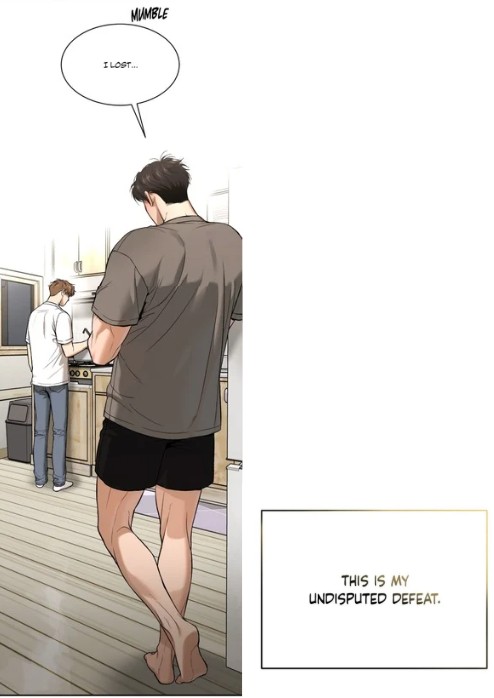 (chapter 76) and 79
  (chapter 79), where he “speaks” only when the other man cannot truly hear him. At the hostel, the mumbling was barely audible: yet according to my observation and deduction, doc Dan seems to have caught something. as later we discover this scene from the champion’s memory:
 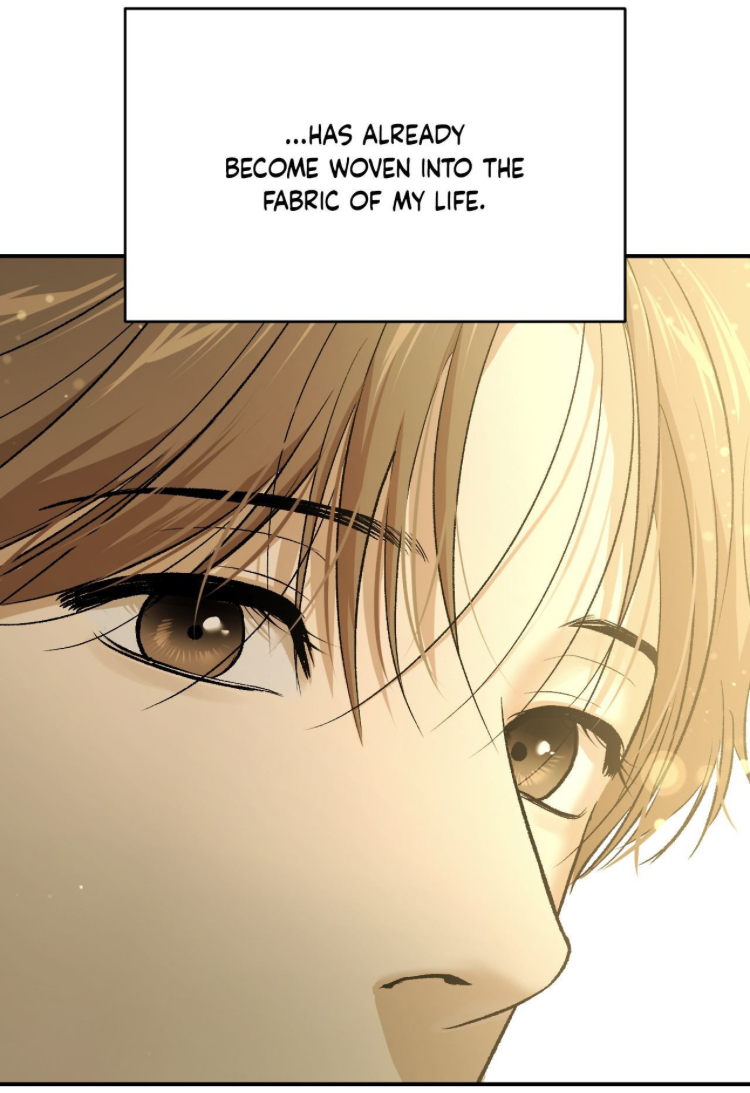 (chapter 77) He already knew that the athlete was standing next to him. However, observe that this vision focused on the doctor’s gaze was accompanied with silence. This means, doc Dan acted, as if he had heard nothing. So if he heard, what did the physical therapist catch exactly in the kitchen? “I lost…”, but it was devoid of any context. Doc Dan had no idea what the director Hwang Byungchul had advised to his former student.
 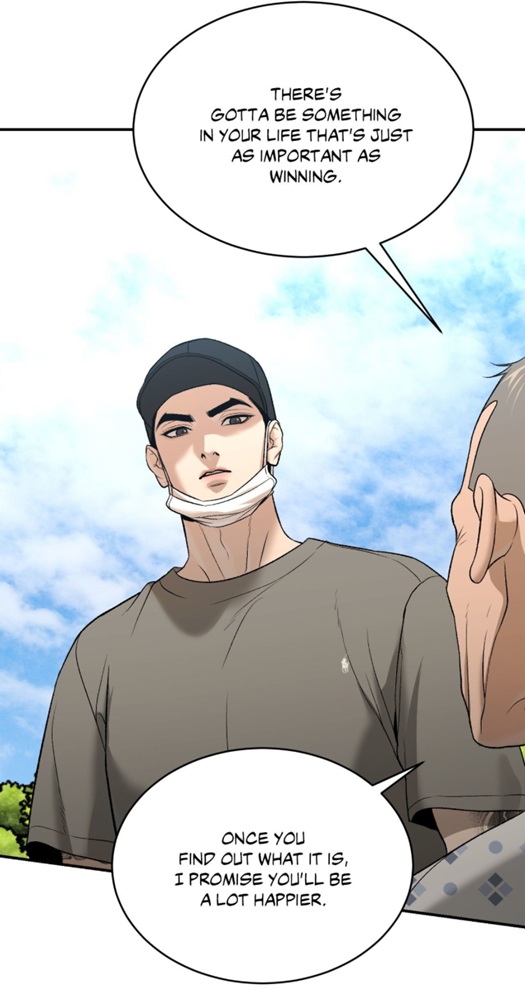 (chapter 75) He could not know that “I lost” referred to something far more intimate: Jaekyung losing control over his own emotional detachment, he was totally vulnerable in front of doc Dan. His heart was stronger than his “mind and fists”. Naturally, if Kim Dan interpreted the phrase at all, he would connect it to the only “loss” he understood: the tie with Baek Junmin. A humiliating defeat. A source of shame. This misinterpretation perfectly explains why in the cabin, the hamster immediately assumes that the champion is once again determined to regain his title:
 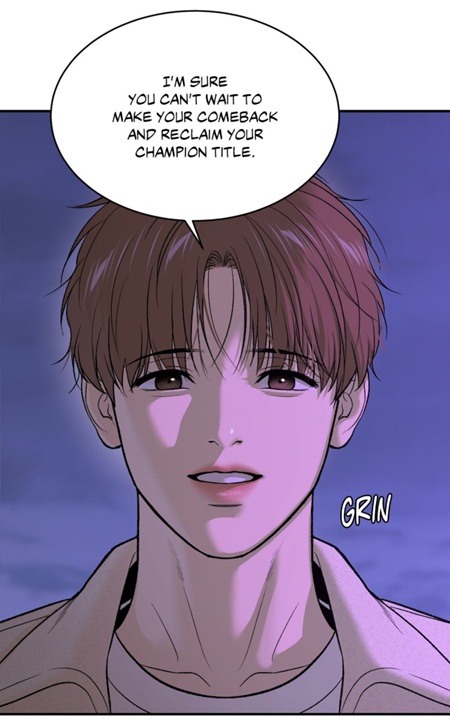 (chapter 84) He is taking the champion’s words at face-value.
  (chapter 77) He trusts the explanation Jaekyung himself gave under the tree. And here lies the deeper revelation: Kim Dan’s misunderstanding exposes the true meaning of the tree confession. Why did Jaekyung suddenly accept the match? Why frame it entirely in terms of “I need you for these two fights”?
Because work was the only safe language he had left for reconnecting with the therapist. He could not say, “Please stay with me.” He could not say, “I don’t want to lose you.” So he said the only thing he believed he was allowed to say:
“I need you for my return match… and my title match.”
It is a substitution — a mask — a plea disguised as practicality.  (chapter 84) A deadline designed to keep Kim Dan close without revealing the depth of the emotional dependency underneath. Finally, before we even analyze posture or timing, we must acknowledge the ghost that is sitting inside the cabin with them — Jaekyung’s own admission of dishonesty. Just minutes earlier, the narrative revealed again a thought he had never dared to voice aloud: (chapter 84) This line is essential, because it exposes the truth behind every failed confession that came before it: Jaekyung did not rekindle with doc Dan with honesty. His first instinct was deception (lie by omission), not vulnerability. Keeping Kim Dan near him mattered more than telling him the truth. So his “love” was still more influenced by possessiveness.
And that is precisely why his apology in the cabin lands with such weight. 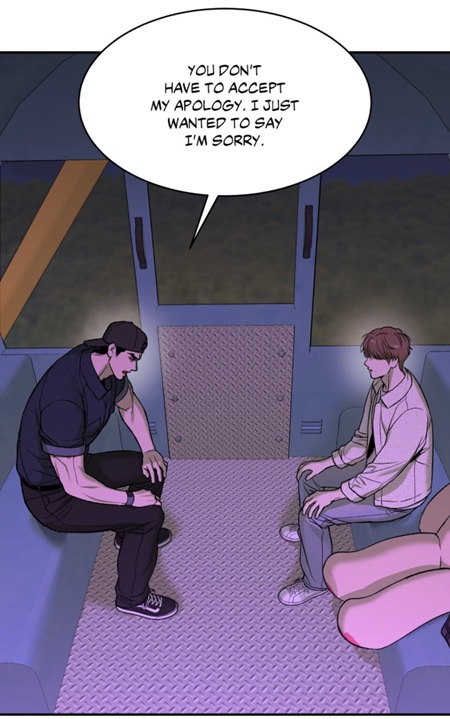 (chapter 84) For the first time, he admits wrongdoing without deflecting, without rage, without pride. This apology is not strategic; it is confessional. A tone we have never heard from him before. It is no coincidence that just before, he employed this expression:
  (chapter 84) This is the language of surrender — not to defeat, but to vulnerability and selflessness. The champion who once insisted on keeping Kim Dan “one way or another” (chapter 84) now articulates the opposite impulse: the willingness to release him, to give him a choice. (chapter 84) Kim Dan can actually never forgive him. He is giving up, on his possessive love — the possessiveness that fueled all his earlier attempts to hold onto Dan through contracts, pressure, intimidation, manipulations or work-related obligations.
Here, his grip loosens. Here, his desire is no longer expressed as ownership, but as remorse. And this shift matters profoundly for the blurred confession. (chapter 84) By apologizing, Jaekyung crosses a threshold he has never crossed before: he speaks without power, without defense, without dominance.
For the first time, he tells Kim Dan something that is not a command, not a justification, not an excuse — but a truth about himself. Yet this emotional shift, as liberating as it is, does not make him ready to say “I love you” or even “I like you” in a clean, intentional, adult way. In fact, the opposite is true. When guilt falls away, he does not step into romantic maturity — he reverts to emotional childhood. This explicates why later he felt so embarrassed on his bed, hiding his face under the pillow. 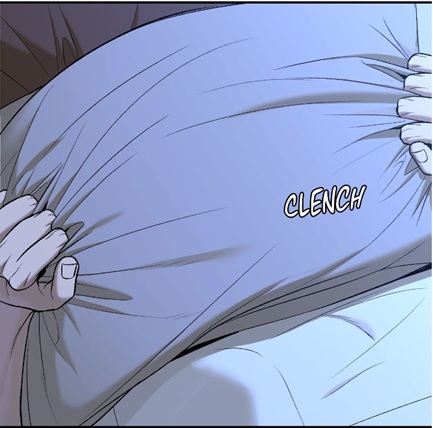 (chapter 84) Thus for me, in the cabin the champion became, for a moment, the boy with no mother’s gaze, no father’s protection, no safe place to rest. He must have said something cheesy, something a young person would say. Purity returns before experience does. Honesty returns before articulation. And in that moment inside the cabin, Mingwa makes a decisive artistic choice: we do not see Jaekyung’s eyes. (chapter 84) The panel hides them completely — not out of convenience, but out of protection. It is as if the author herself shields the wolf’s vulnerability from the reader, granting him a moment of privacy at the precise instant he attempts something emotionally dangerous.
Just as in episodes 76 and 79, his words are not fully directed at Kim Dan. They are spoken near him, not to him.
They slip out sideways — half internal, half external — the verbal equivalent of a heartbeat too quiet to be called speech. In other words, what happens inside the cabin is not the flowering of romantic eloquence. It is the first trembling attempt of someone who has never been loved to express the only version of love he knows: instinctive, needy, unpolished, raw.
This is why he cannot possibly be saying a line as adult and structured as “I love you” or even “I like you.”
Such sentences require three things he does not possess yet:
- A sense that he himself is lovable → he does not. Hence he still views himself as nonredeemable and as a burden.
- A sense that Kim Dan feels the same → he has no proof. Besides, doc Dan keeps avoiding his gaze, feels uncomfortable in front of him. He is not speaking his mind. He keeps reminding him of their limited contract.
- A sense of equality in the relationship → they are not there yet. Joo Jaekyung feels now inferior with all his sins and wrongdoings. Due to his last words, it becomes clear that he is not expecting something in return.
What he can say at this stage — and what fits the emotional mechanics of the scene — is something far younger, far simpler, far more primal, like for example “Stay with me” or “I want to kiss you ” or “I want to hold you”…
These are not love declarations. They are the vocabulary of a neglected child whose first experience of safety has finally returned — and who now fears losing it more than anything else.
And crucially, this would explain everything about the staging:
- why he chooses fireworks (the sound protects him from being truly heard),
- why his body angles away (he speaks sideways, not directly),
- why his voice is blurred (because the reader is not meant to hear it yet),
- why he panics when Kim Dan asks him to repeat,
- why he instantly retracts with “Never mind.”
A man confessing love does not recoil. A child confessing need always does. It is also why the author hides the line. Not because it is a grand romantic confession, but because it is too emotionally naked, too immature, too early, too cheesy. A sentence like “I wish to …”, whispered by a man who has never held anyone without ownership, is more intimate than any polished “I love you.”
And Mingwa knows it. The confession is blurred not because it declares love, but because it reveals Jaekyung’s inexperience with love. He can finally be honest — but he cannot yet be articulate.
He can reach — but he cannot yet claim. He is pure — but not ready. Hence later, he is seen wearing a white t-shirt for the first time. 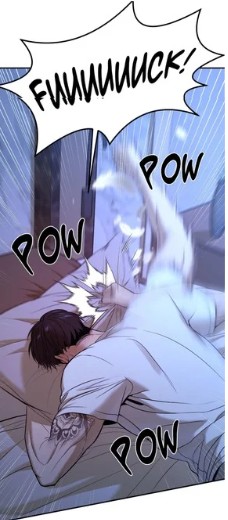 (chapter 84) This pigment stands for innocence, purity, new beginnings and even equity.
Innocence and purity: White is the beginning of everything, before anything is muddied or thinking is ‘colored’.
New beginnings: White represents the clean slate, helping us through times of stress, and allowing us put the past behind us and preparing us to move on.
Equality and unity: White represents the positive as well as the negative aspects of all colors. It contains an equal balance of all the colors of the spectrum. Quoted from https://www.empower-yourself-with-color-psychology.com/color-white.html
That is why the fireworks stole the words. 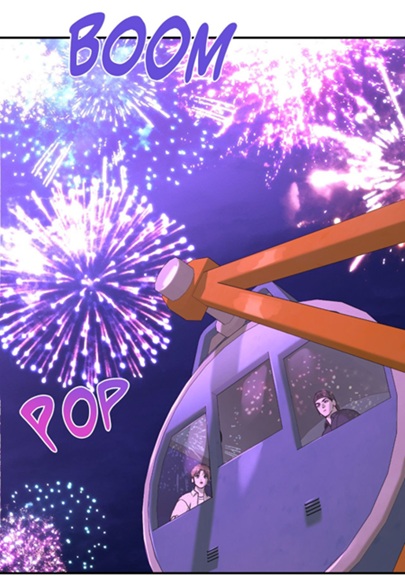 (chapter 84) Because they were not yet meant to be received, only meant to be released. The fireworks allow him to finally attempt a more honest sentence, but in conditions where it cannot reach its target.
Noise replaces courage.
Light replaces eye contact.
Fear replaces clarity.
A man who has only just begun to tell the truth about his wrongdoing cannot yet tell the full truth of his love.
His apology creates the emotional opening — but it also exposes how unprepared he is to verbalize the feelings that have been building silently for 84 chapters. So far, he has never verbalized his desires and emotions, hence he kissed doc Dan right away in the swimming pool.  (chapter 81) Yet this is also the limit of what he can say.
But let’s return our attention to the scene in the penthouse (chapter 79), which is similar to the scene in the kitchen and at the amusement park. Though the star was once again mumbling, this time Doc Dan reacted to his words. However, Jinx-philes can sense a divergence between the other two scenes (chapter 76) (chapter 84). It is because doc Dan was looking at him this time:  (chapter 79) Thus he could see the athlete’s mouth moving and hear sound. Nevertheless, observe that the moment the wolf reached to the doctor’s words, he bowed his head and looked down. From this
 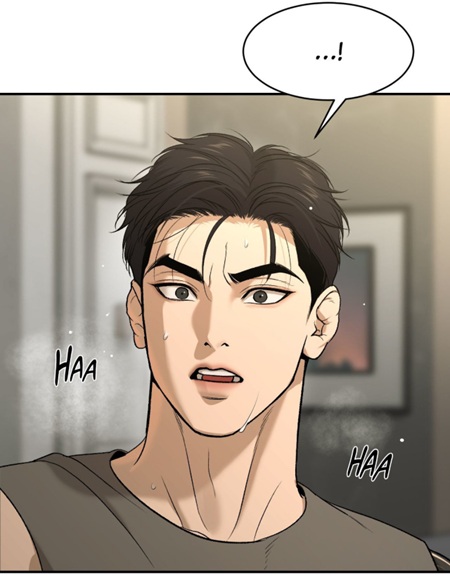 (chapter 79) to this (chapter 79) As you can sense, he fears his lover’s gaze, a new version of this situation:
  (chapter 79) However, he doesn’t fear coldness, but ridicule and mockery, the father’s gaze:
 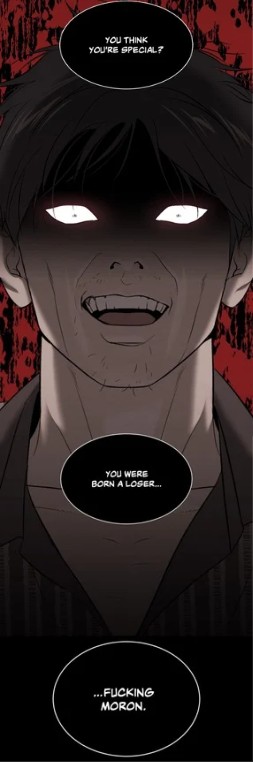 (chapter 73) Under this light, people can grasp why Joo Jaekyung was not facing doc Dan directly in the cabin. To conclude, the mechanism is identical, but amplified. (chapter 84) Instead of mumbling, he lets the fireworks perform the silencing. It is not that the environment interrupts him; it is that he chooses a moment when interruption is guaranteed. However, one detail caught my attention: he’s getting physically closer to Doc Dan!! The distance is getting reduced. It was, as if he was practicing how to confess his affection. And so far, he never used the words « I love you ».
 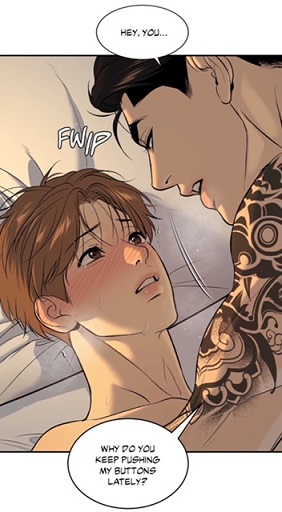 (Chapter 44) (chapter 76) At the same time, Jinx-philes can detect the existence of another common denominator: the physical therapist’s gaze.
The Spark behind the Wolf’s Confession
To understand the blurred sentence — the words the firework stole — we must first shift our attention away from language entirely and back to what truly matters in this scene: vision. What drives Joo Jaekyung to the brink of confession in chapter 84 is not romance, nor timing, nor even the apology he had just managed to deliver. It is Kim Dan’s gaze. (chapter 84) He is moved by such a pure gaze, full of awe.
The panel makes this undeniable. Before speaking, the champion is watching the therapist’s face illuminated by fireworks, softened into wonder. (chapter 84) This is not the gaze of a caretaker, nor a tired worker, nor a subordinate fulfilling a duty. It is the open, trusting gaze of a child witnessing beauty. And for Joo Jaekyung, that gaze is both intoxicating and devastating.
The champion has lived his entire life without soft eyes directed at him. His mother, always drawn from behind, is eyeless — a woman who never truly saw him. 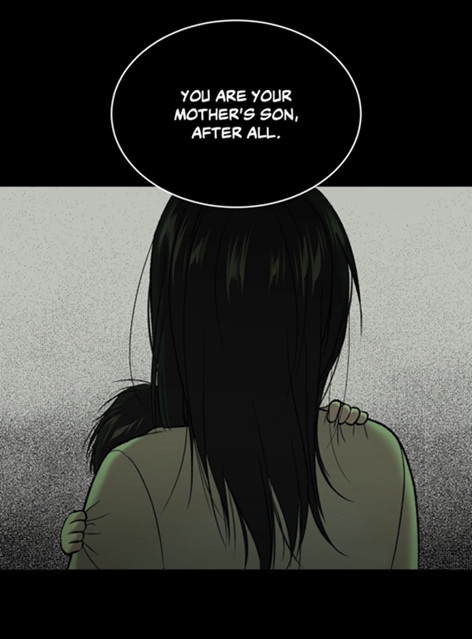 (chapter 73) Besides, the head of her position is indicating that she was not looking at her son, the boy was hiding his face from Joo Jaewoong and his mother. Then his father mocked him, degraded him, and used resemblance as an insult: “ (chapter 73) Moreover, Hwang Byungchul reduced him to a lineage of failure or talent, not a person deserving recognition. He constantly compared him to his father
  (chapter 74) or his mother (a poor but good mother), he was not seen for whom he was: a child, a boy. Jinx consistently links sight with recognition, and recognition with love.
  (chapter 53) Jaekyung has never been granted either.
  (Chapter 45) Thus when he got upset with the present, he indirectly expressed the wish to be « looked at ». Moreover, in his visions or memories, this is what he keeps seeing:
  (chapter 54)
  (chapter 75) Doc Dan’s gaze!
This is what makes the locker-room scene in chapter 51 so crucial. Kim Dan looks at him with shock, vulnerability, and a plea:  (chapter 51) And for the first time, Jaekyung freezes.
 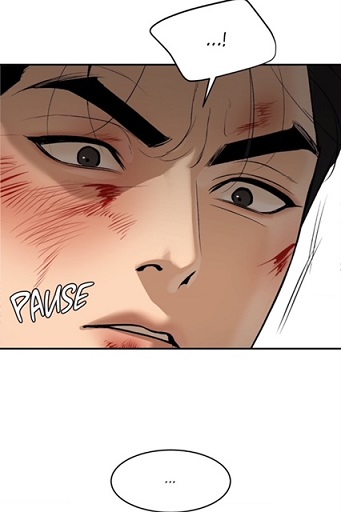 (chapter 51) His breath catches; his eyes widen. It is the moment he realizes his mistake. He never thought that doc Dan had been trusting him. That moment marks the first rupture in his emotional armor, not only because it hurt, but because it revealed. He realizes with terror that he wants to be seen by Kim Dan, but when he faced such a gaze, he could only feel guilty and bad. Thus it is not surprising that later, his nightmare let transpire his guilty conscience. (chapter 54) He is the one who made his fated partner cry. No wonder why he first tried to find a new toy, he felt uncomfortable.
In the Ferris wheel cabin of chapter 84, he encounters his fated partner’s gaze again — (chapter 84) but now it is purified, childlike, unguarded. Kim Dan glows under the fireworks, mesmerized by beauty instead of violence, by wonder instead of fear. And Jaekyung wants — desperately — for that softness to be directed at him. Not at his victories. Not at his muscles. Not at the persona he built to survive. But at the man beneath all of it. A man worthy of admiration, affection, safety. A man who could be held, kept, loved. That’s why I wondered for a while if Joo Jaekyung had not copied Arnaud Gabriel’s flirt  (chapter 82), as the champion has always used his surroundings as a source of inspiration.
 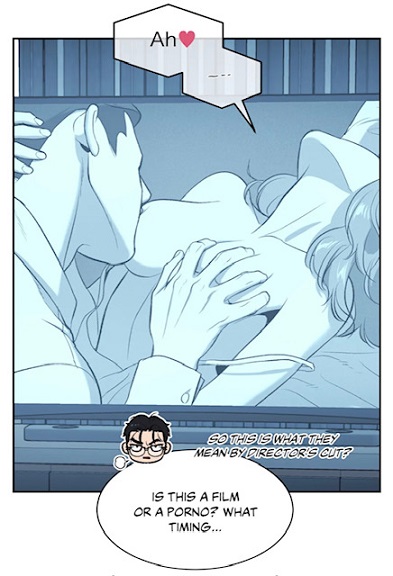 (Chapter 29) It would also fit with 5 syllabes in Korean. And it would be cheesy too. Yet, I have my doubts about this theory which I will explain further below. Nevertheless, one thing is sure. The champion loves the doctor’s eyes and they have the power to move not only his heart but also his mouth. He is encouraged to verbalize his emotions.
This is the true trigger of the confession. Not desire in the adult sense, and certainly not a strategic “I like you” or “I love you,” but a longing to be seen — and therefore, to be wanted. Every wound in Jaekyung’s life is tied to vision: the eyeless mother who vanished, the father who asked whether she would even want to live with him if she saw what he had become, the locker-room moment that shattered his self-perception. All of this returns when he sees Kim Dan’s shining eyes reflecting the fireworks.
He wants those eyes turned toward him with love. Not gratitude. Not dependence. Not fear. Love. What he wants most
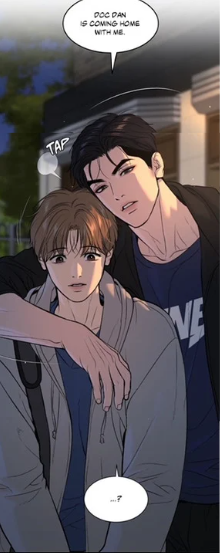
and what he fears most come from the same place: Kim Dan’s gaze.  (chapter 84) The gaze under the fireworks triggers emotions in him. Thus he blurted out something. But for me, he does not know how to say “I love you.” He cannot even say “I like you.” Those sentences belong to someone who has matured emotionally — someone who can identify feelings properly, but so far he keeps saying: “to stay by his side” and his « affection declarations » were all linked to negativity.. Thus my idea was that Joo Jaekyung could have said this: “I want to hold you!” (안고 싶어 너). Let’s not forget that so far, the champion had never expressed such a longing before; a warm embrace. He would always follow his instincts:
  (chapter 4)
  (chapter 43)
 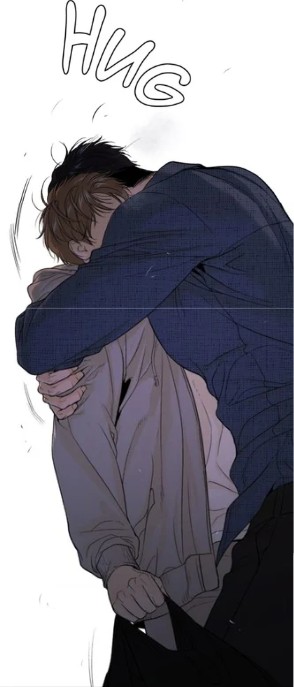 (chapter 69) The hug represents a metaphor for “staying by his side, for home and to be seen”. Moreover, in French embrasser can mean kiss and hug. And strangely, I noticed that the protagonists were never looking at each other during an embrace.
 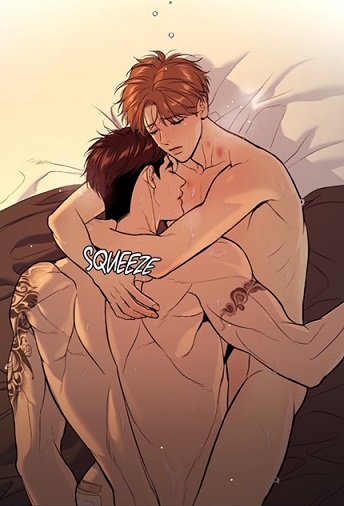 (chapter 44) And let’s not forget that such a gesture is strongly intertwined with “childhood”.
  (chapter 65) It is for “babies”. No wonder why he retracted immediately.
To conclude, the words that escape him in the dark — too soft to be caught, swallowed by the firework’s explosion — become the linguistic equivalent of reaching toward warmth without daring to touch it. The sentence he forms must fit his emotional stage: childlike, inexperienced, driven by instinct rather than maturity. It must reflect longing, not possession; desire, not declaration. And it must match the blurred outline of five syllables we see in the panel. (chapter 84) 안고 싶어 너: I want to hold/hug you!
The Secret behind the Blurred Words
And now, you are wondering what other secret could be hidden behind these words. It is related to the physical therapist him. Why did Mingwa, the goddess of “narrative fate”, ensure that doc Dan couldn’t hear the athlete’s words? (chapter 84) First, recall that in the previous parallel scenes (76 and 79), doc Dan is portrayed as someone who doesn’t hear Jaekyung’s confessions. But as I argued earlier, we must question whether this is truly the case — especially the one in episode 76. The panel arrangement suggests that something was heard, but not acknowledged. Then during the fireworks, he does not say, “I couldn’t hear what you said.”
He says: “I didn’t catch that.” “Catch” implies arms, grasping, holding — the very things stolen from him as a child.
And then comes the detail that betrays everything: the small drop on his cheek. A sign of discomfort… and something deeper: recognition. The drop on his face was not present before. (chapter 84) For me, everything points to the same conclusion: doc Dan might have heard something — but he cannot yet allow himself to process it.
This denial explains his expression in the shower at the hotel: 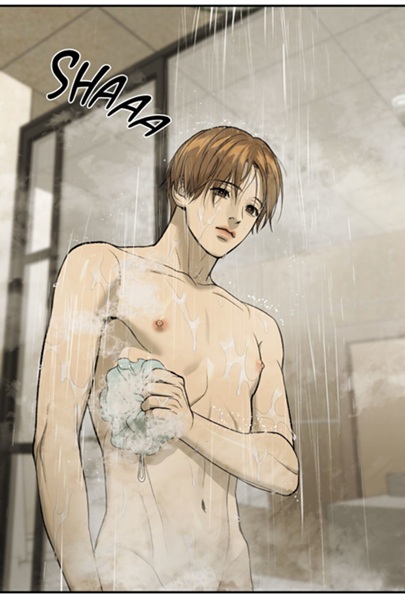
 (chapter 84) Here, the doctor looks sad and wounded. His eyes are unfocused — he is not seeing the present. The water running down his eyelashes gives the impression of tears, even though he is not crying. His gaze is distant, fixed on something internal. His mouth looks tense, almost trembling. The mouth especially is a clue: Kim Dan’s emotions always gather there when something from the past resurfaces.This is the expression of someone thrown into an involuntary flashback. He is inside a memory. This explicates why this scene is similar to the champion’s shower after the latter had met Baek Junmin:
 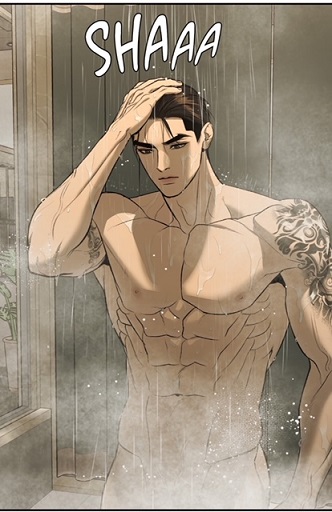 (chapter 49)
  (chapter 49) Both scenes show a man pulled violently into a buried memory. Thus, my assumption is simple: the champion said something that pierced straight into Kim Dan’s oldest wound and brought his trauma to the surface. And this brings me to my next observation. Inside the cabin, there are not two people — there are three: the champion, the therapist, and the Teddy Bear.
 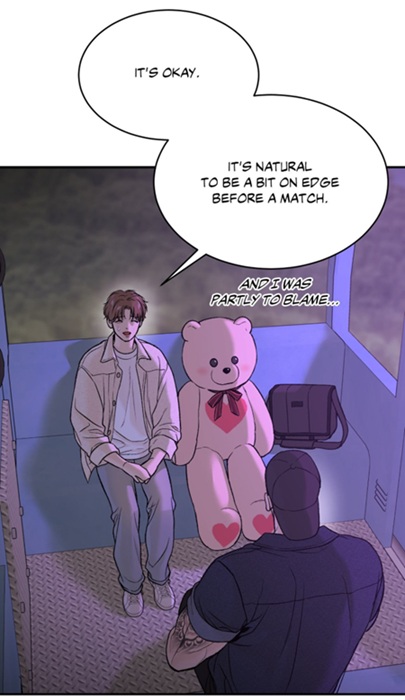 (chapter 84) Furthermore, we have a window. We have a phone (dead, but present). We have a childlike toy — symbol of stolen innocence.
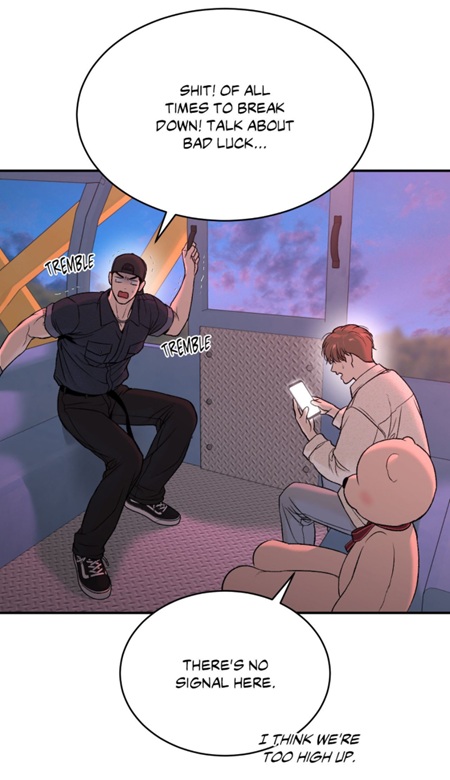 (chapter 84) And now, look again at episode 19:
  (chapter 19) A window with no view. Three figures: halmoni, the boy, and the phone placed between them like a knife. And the sound structure is identical, but reversed:
silence – sound – silence in episode 19
vs
sound – silence – sound in episode 84, as the Teddy Bear is a silent “witness”. In both scenes, something is stolen.
In both scenes, a child loses something he cannot name. Thus, what Jaekyung said must have resembled the emotional tone — if not the wording — of the words spoken over the phone on that catastrophic day.
This explains why Kim Dan ends the scene wearing black instead of white. 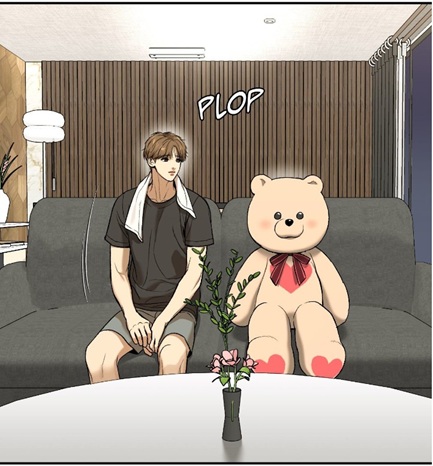 (chapter 84) It is not a fashion choice. It marks the moment when innocence collapses and the past reopens.
And now compare the cabin (chapter 84) with the memory that precedes the parents’ disappearance. You will notice the huge difference: the overwhelming silence inside the house. The halmoni sits beside the phone. She must have heard everything. She must have heard the child as well, if the latter spoke She holds him tightly by the shoulder — as if trying to support him. (Chapter 19) To conclude, she knew something was happening. This recollection represents a repressed memory, and so far doc Dan has always avoided to face his biggest fear: his abandonment issues and the loss of his “parents”. 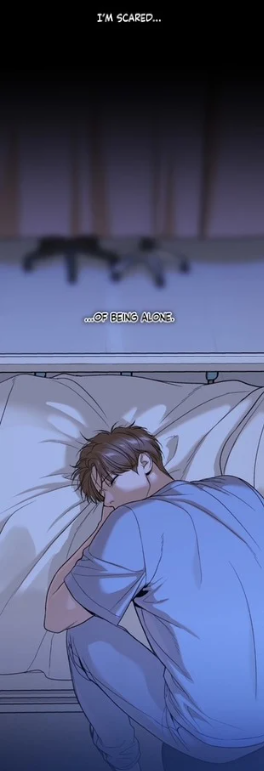 (chapter 56) In other words, wearing black is more than just a change of personality or mourning. It becomes the color of mystery, the beginning of descent into truth.
  (chapter 84) However, observe that doc Dan is holding, even squeezing the teddy bear’s hand, a sign that he is rekindling with his lost childhood. We are getting closer to the revelation behind the photograph — the day doc Dan has never willingly shown to Joo Jaekyung.
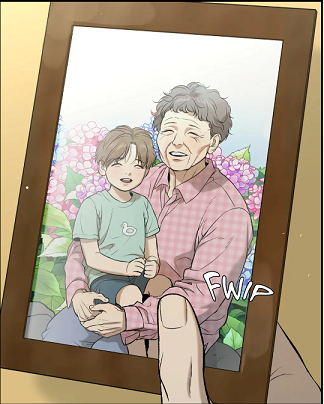 (chapter 19). Observe that in the penthouse, doc Dan has never placed the frame
 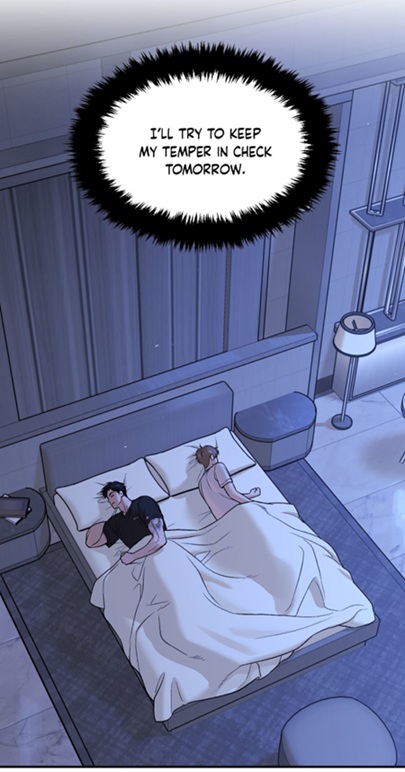 (chapter 79) on the night table.
And what is the other denominator between episode 19 and the amusement park?
Theft.
Stolen childhood.
Stolen confession.
Stolen clarity. (chapter 84)
Exactly like in the cabin, (chapter 19) the words on the phone are inaudible. And now, you comprehend why I came to link the athlete’s blurred words to embrace and longing, as the grandmother’s embrace couldn’t diminish or erase the child’s pain. Finally, Jinx-philes can detect another pattern, the absence of gaze. Not only the boy can not see the person on the phone, but also the characters are turning their back to the readers which reinforces the mystery surrounding the conversation and the reactions of the listeners.
Now, connect it with the lost teddy bear  (chapter 21) and
  (chapter 47). Dan once had toys — proof that once, someone loved him enough to give him gifts which contrasts to the wolf’s childhood.
  (chapter 84) Every time innocence is ripped away, a teddy bear disappears from the story.
So what if Jaekyung’s whispered sentence — a gift of raw affection — triggered the memory of another gift? What if the words under the fireworks echoed the tone of something said just before Dan’s world collapsed?
If this is the case, then doc Dan did not miss the confession entirely. (chapter 84) He remembered something far more painful. It is important, because by remembering his past, he can regain his own identity and get stronger mentally and emotionally. The scene in the cabin represents the positive version of the locker room, which signifies the return of “trust”. That’s why I am more than ever convinced that something at the weight-in 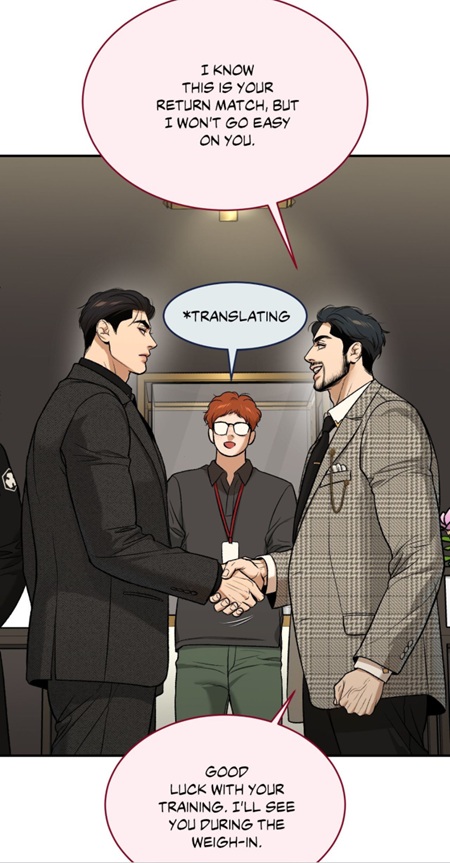 (chapter 82) will happen linked to the protagonists’ past (recent and childhood). Let’s not forget that doc Dan still has no idea what Joo Jaekyung went through after his departure: the slap, the drinking, the headache and the indifference of Team Black, just like the athlete has no idea about the blacklisting and bullying in the physical therapist’s past.
 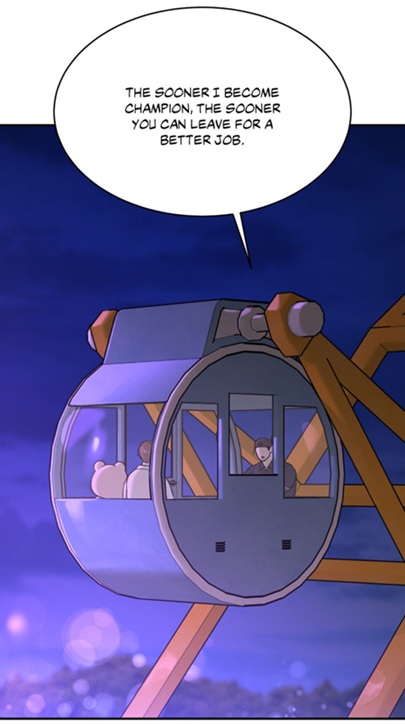 (chapter 84) So by wearing black, doc Dan indicates that he is gradually becoming responsible for Team Blackand Joo Jaekyung the athlete. (chapter 84) They should realize that their life is not so different from each other, in fact they share the same pain and trauma.
Feel free to comment. If you have any suggestion for topics or Manhwa, feel free to ask. If you enjoyed reading it, retweet it or push the button like. My Reddit-Instagram-Twitter-Tumblr account is: @bebebisous33. Thanks for reading and for the support, particularly, I would like to thank all the new followers and people recommending my blog.




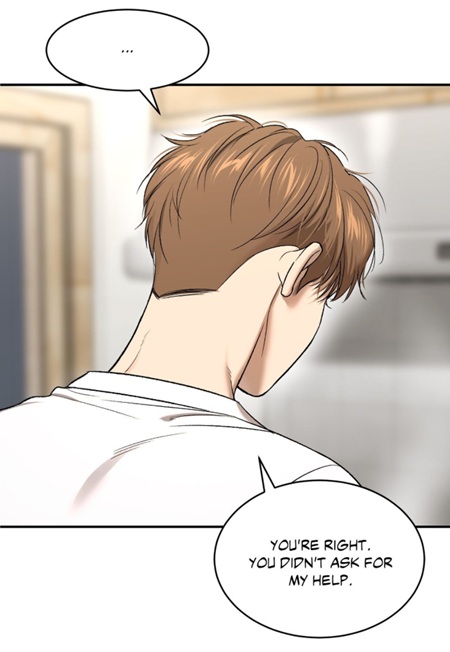 (chapter 76) For the first time, he uses the expression you’re right in front of his fated partner. He seems to concede with this idiom. Yet this apparent submission hides a deeper reversal. By admitting Jaekyung never asked for his help, he redirects the exchange toward his own truth: the loneliness of having no one to care for you.
 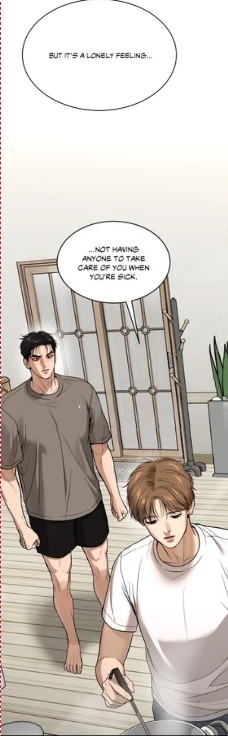 (chapter 76) What unfolds in the kitchen is not a quarrel about porridge but a fragile recognition. Dan’s “You’re right” acknowledges Jaekyung’s perspective without bitterness, while Jaekyung’s “I lost”
  (chapter 9)
 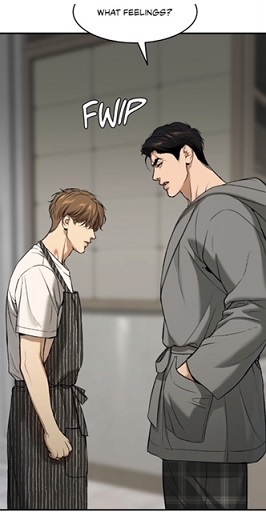 (chapter 45)
  (chapter 76) The kitchen scene closes one cycle and announces another.
  (Chapter 76) In this view, his fixation would be the product of ambition, pride, or ego: the expected cost of survival in a cage where only victory pays.
  (chapter 76), because the adults in his life cut them off before they could exist. Winning became his only mode of survival because every formative argument in his youth ended in defeat, and not the kind decided by a referee. With his father, mother, coach, and manager, words never led to recognition — only to insult, silence, utility, or obedience. He learned early that dialogue could not protect him; only victory could. His victories were not chosen freely, but forced into being by guardians who made him feel like a burden, until relationships themselves became burdens.
 “(chapter 73). It was not just defiance; it was a vow that victory would silence abuse once and for all. When he returned with the trophy, he shouted triumphantly,
 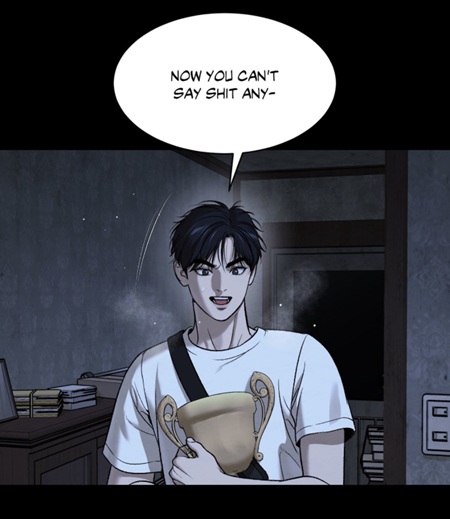 (chapter 73) ready at last to claim, “I was right.” Yet reality betrayed him. His father’s death denied him the only acknowledgment he had sought.
 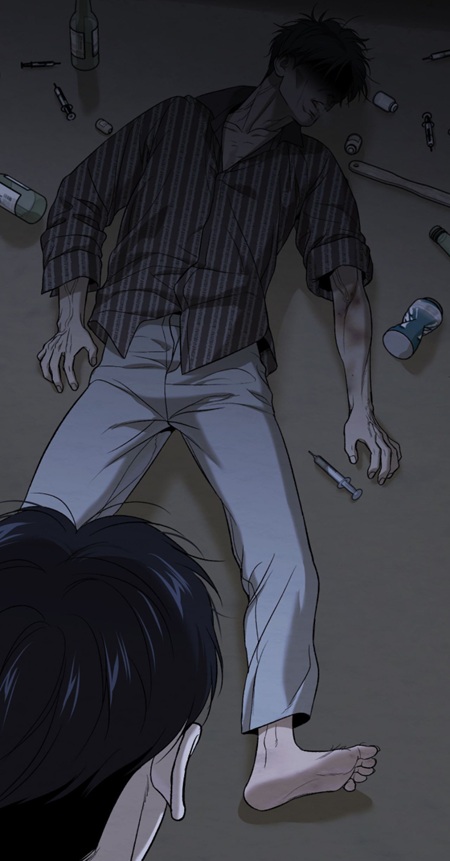 (chapter 73) The words “I was right” died in his throat. He had proved himself, yet there was no one left to recognize it. His own prediction — that his father’s death would mean nothing — proved false. The absence cut deeper than the insults had, leaving Jaekyung not with triumph but with the bitter aftertaste of self-loathing. Victory had silenced his father, but it also silenced the son. He had proved himself, yet there was no one left to hear it.
  (chapter 74) At the funeral he remained dry-eyed, his face locked in shame (ch. 74). No one saw his guilt, but it consumed him: the one man he needed to hear “I was right” from could no longer answer. At the same time, his smile and laugh were also linked to misery. For Jaekyung, laughter was never the sound of joy, but the echo of mockery and rejection due to the father. Just as tears became tied to betrayal and abandonment through his mother, so too did his father twist laughter into a weapon
  (chapter 72) To the boy, she was not silent at first: she must have definitely told him to become strong, to endure, to wait. She gave him her number, leaving the illusion that her departure was not abandonment but necessity. Victory and wealth became her conditions for love. That is why he swore over the payphone to work hard
 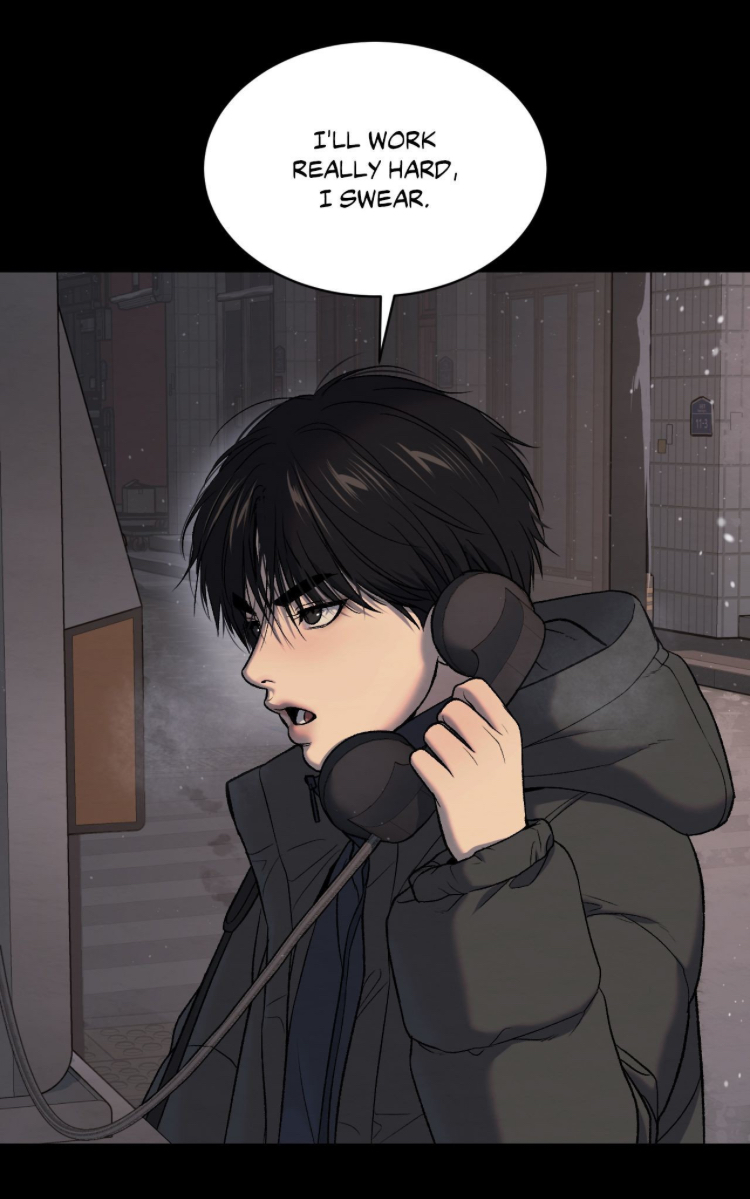 (chapter 72) and “make money” so she could return, and why after his father’s death he still hoped for her homecoming.
  (chapter 74) But when the calls went unanswered, her silence became the sharpest weapon of all. Her eventual reply
 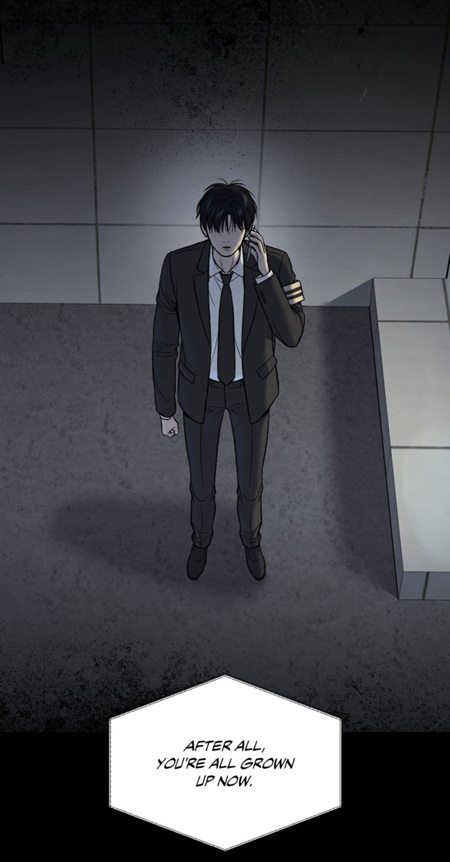 (chapter 74) confirmed that his effort had never mattered. For the first time, he cried
 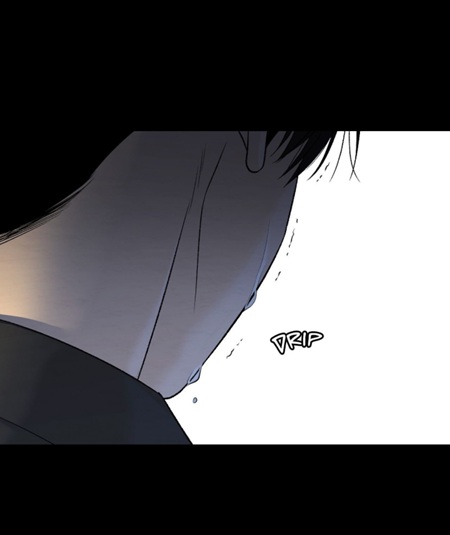 (chapter 74), his tears expressed not just grief but the recognition of betrayal. From then on, tears themselves became equated with loss, weakness, and abandonment. This is why, in the wolf’s nightmare, Dan’s crying form
  (chapter 76) appears: the sight of tears recalls the moment he unconsciously realized that even his mother’s “you’re right” was a lie. At the same time, those tears function as a mirror. The champion projects onto Dan the very weakness he has always forbidden himself to show.
 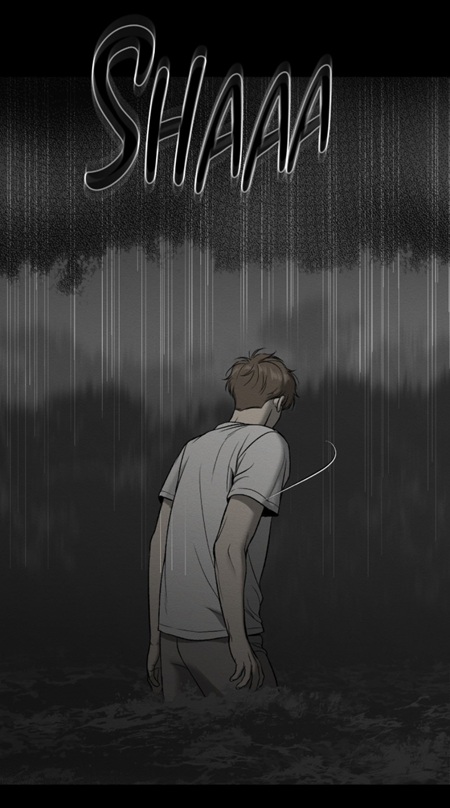 (chapter 76), the boy he once was who longed to weep but had to swallow it down. At the same time, Jaekyung himself occupies the place of the “adult” —
  (chapter 74) Hence the wolf’s tears were quickly replaced by rage and violence.
 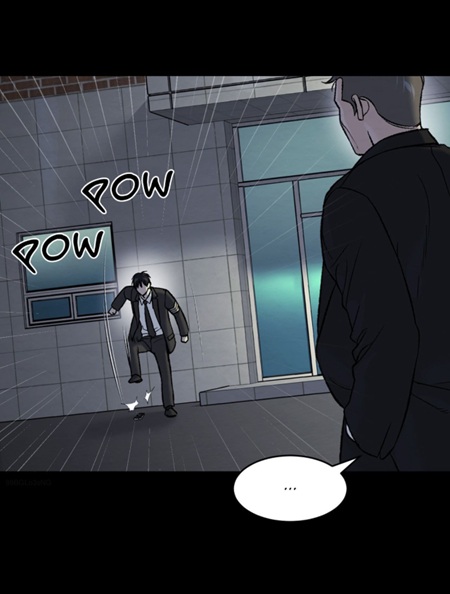 (chapter 74)
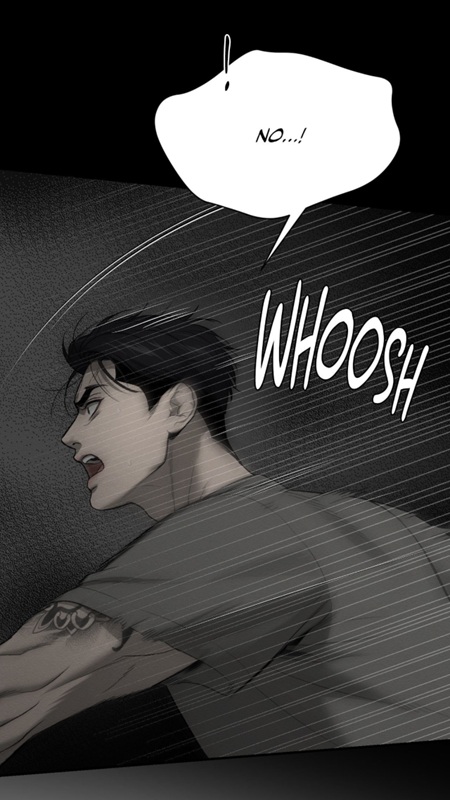 (chapter 76) His trembling hand upon waking
 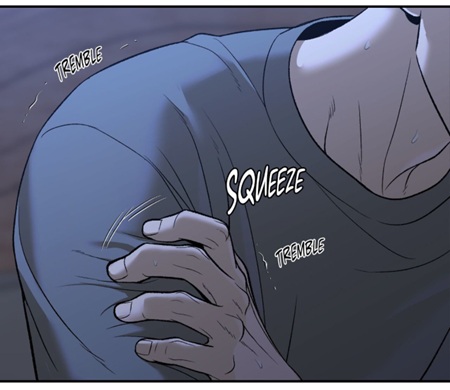 (chapter 76) shows the yearning to be held, comforted, reassured — something he never received from either parent. He is not entirely responsible for the physical therapist’s suffering. And here lies the difference: Dan’s tears are not manipulative or hypocritical , like the ones Jaekyung suspects from his mother, but unfiltered honesty. He expressed his emotions, not just through tears, but also through body language!
  (chapter 1) He was shaking, he was bowing and asking for forgiveness! Dan embodies a form of vulnerability that is real, legible, and forgiving contrary to the mother. When the teenager heard his mother’s voice after such a long time, the latter never brought up her past action. She never asked him for forgiveness.
  (chapter 74), whose quiet devotion and silence kept the gym alive, nor Jaekyung’s, whose absence he accepted without challenge.
 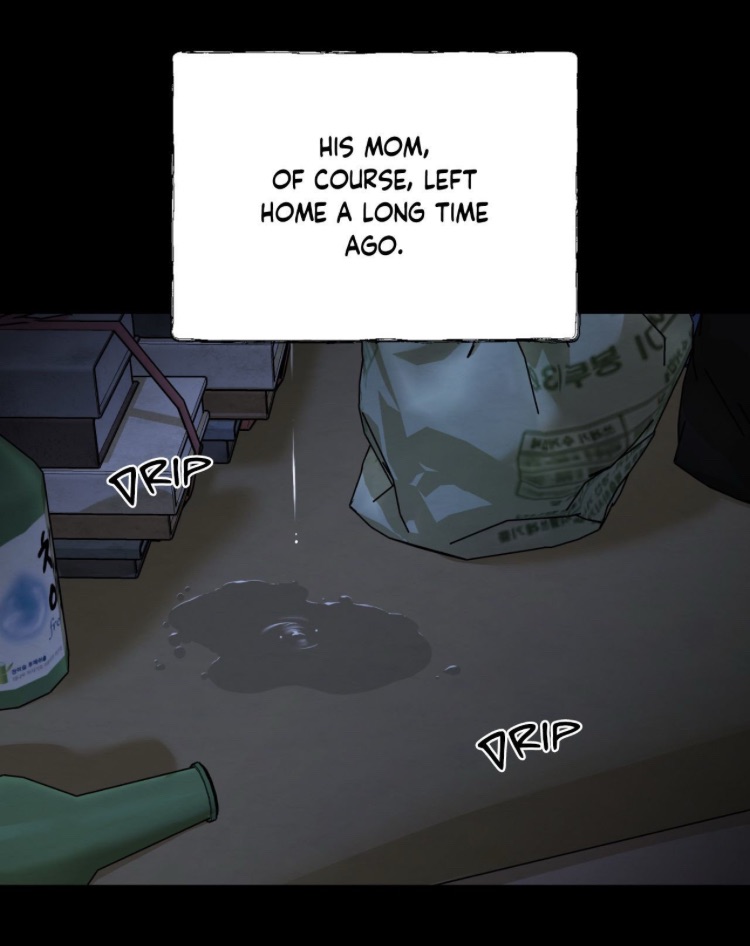 (chapter 72) In fact, his own mother’s submission reinforced this flaw: her blind trust in her son, her refusal to question his choices and the boxing world, taught him that authority need not be examined, only endured or seen as trustworthy. For him, hierarchy was unquestionable, and so he perpetuated it. Thus he stands for lack of critical thinking. This is why, with Hwang, the vocabulary of “right” and “wrong” was never about dialogue but about obedience. No wonder why he became so violent at the police station.
  (chapter 74) Unlike Jaewoon’s domination or the mother’s evasive silence, Hwang cloaked his authority in the language of advice — yet beneath it lay a black-and-white dualism: winners and losers, villains and victims. Thus Joo Jaewoon was blamed for becoming a thug
  (chapter 74), while the wolf’s mother was a victim. He viewed her as a selfless and caring mother:
  (chapter 74)And observe how he provoked the main lead.
  (chapter 74) When Hwang sneers, “What, am I wrong? Come on, answer me!” he is not inviting dialogue — he is staging a trap. The question is rhetorical, a demand for submission. Let’s not forget that he had witnessed the phone call in front of the funeral hall, but back then he had done nothing. And when the boy hesitates
  (chapter 74), unable to answer, Hwang strikes him in the chest.
  (chapter 74)and justifies his action behind social norms.
 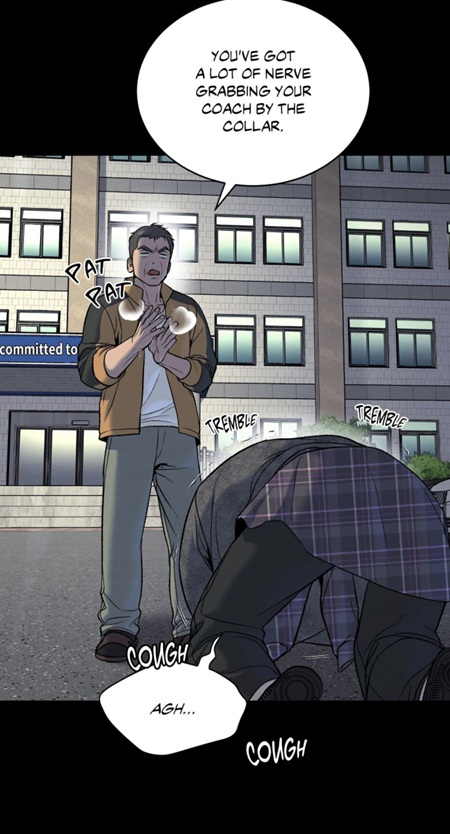 (chapter 74) In that instant, he takes the role of judge, referee, and executioner, collapsing “argument” into violence. The very words “Am I wrong?” contain the irony: the coach is less interested in truth than in reasserting his own authority. Silence is treated as guilt, hesitation as defeat.
 (chapter 74), he effectively admitted “you’re right” to the coach. Yet this wasn’t simply genuine agreement — it was submission, respect mixed with survival. The director misread it as validation of his worldview. This only reinforced his certainty, encouraging him never to reconsider his role.
  (chapter 74) When the protagonist finally left, the director could declare with satisfaction:
  t(chapter 74).
 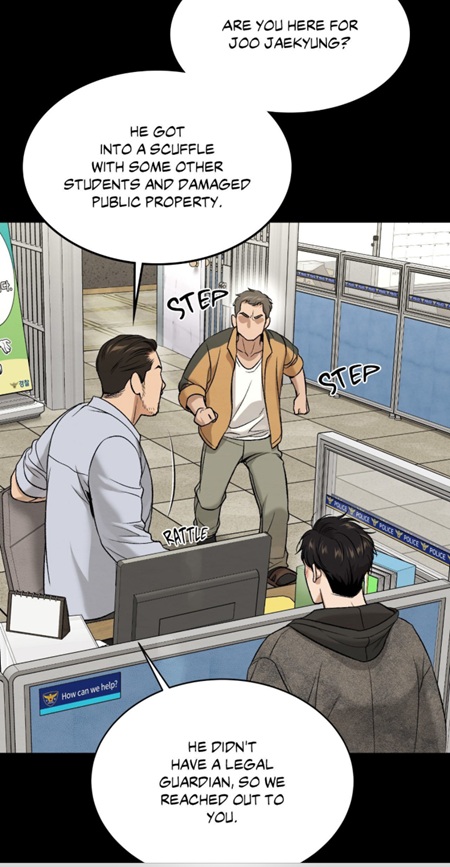 (chapter 74) The reality was that the old man had never truly become the star’s home and family, which explains why he constantly leaned on other adults, the mother or the father, to provide the guidance he himself refused to give. At the same time, I come to the following deduction: he must have lost his boxing studio, and with its vanishing, the elder was forced to face “reality”: loneliness, sickness and absence of happiness in his life!
 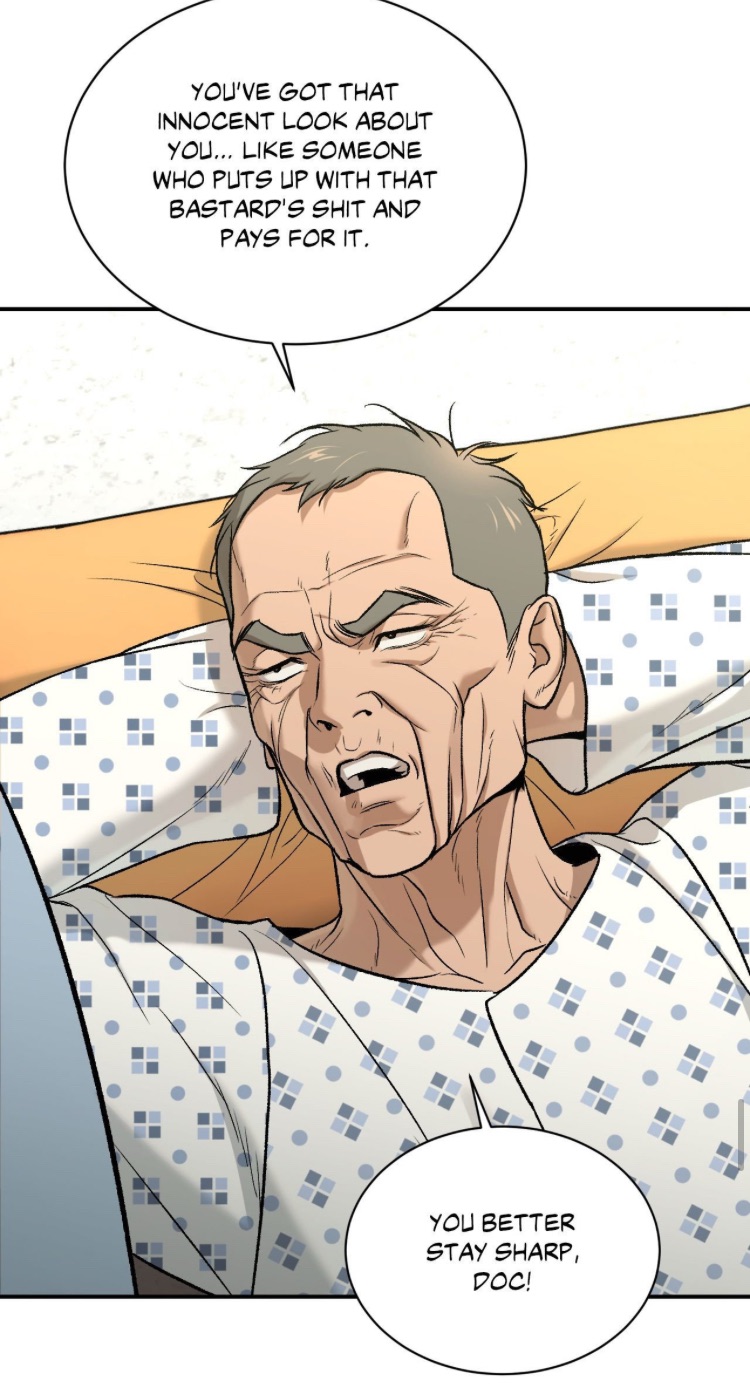 (chapter 70) Once again, Jaekyung is reduced to “that bastard” — a label, not a person — while Dan is framed as the pitiable victim. The old coot remains the righteous observer, untouched by guilt, protected by a rhetoric that always shifts responsibility elsewhere.
 (chapter 75) He was happy again, though he initially tried to hide it. We have to envision that before the wolf’s visit, the elder had to face what his own life outside the gym looked like: sickness, solitude, the collapse of the studio that had sustained him and came to resent the main lead. Yet, Joo Jaekyung’s behavior changed everything:
 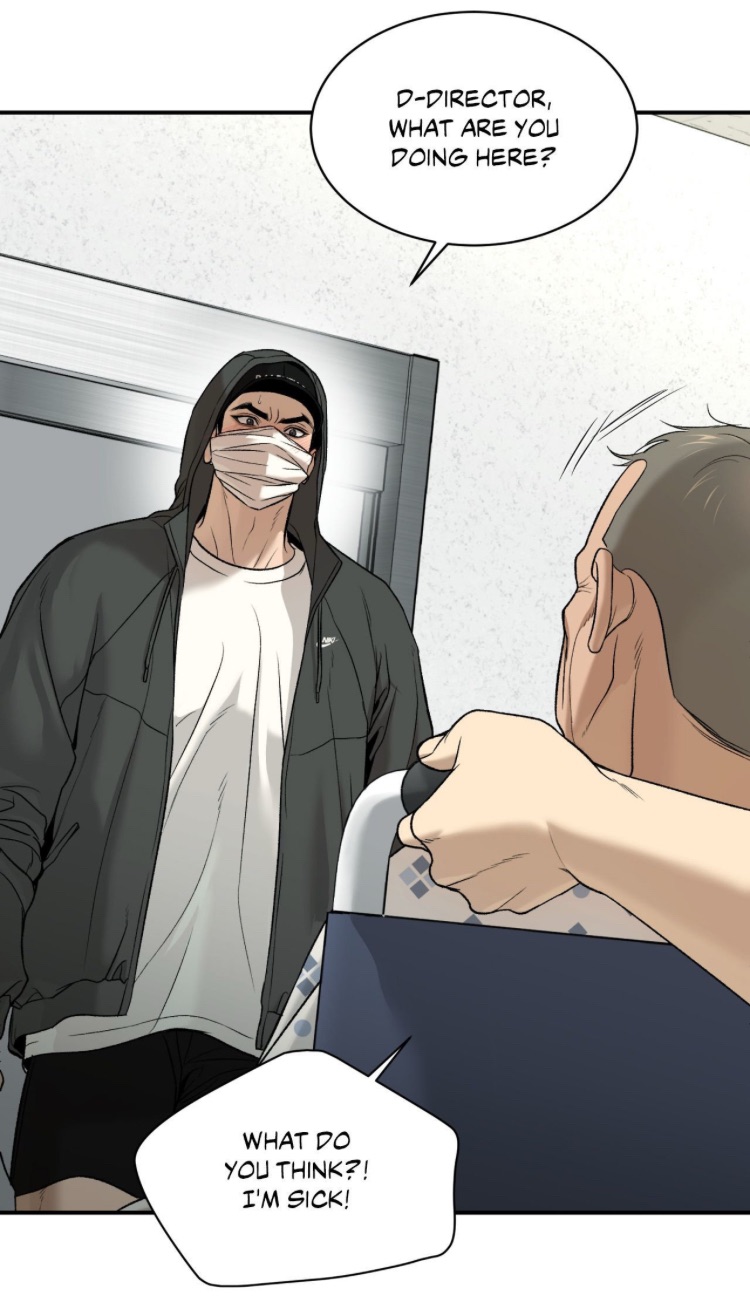 (chapter 71)
 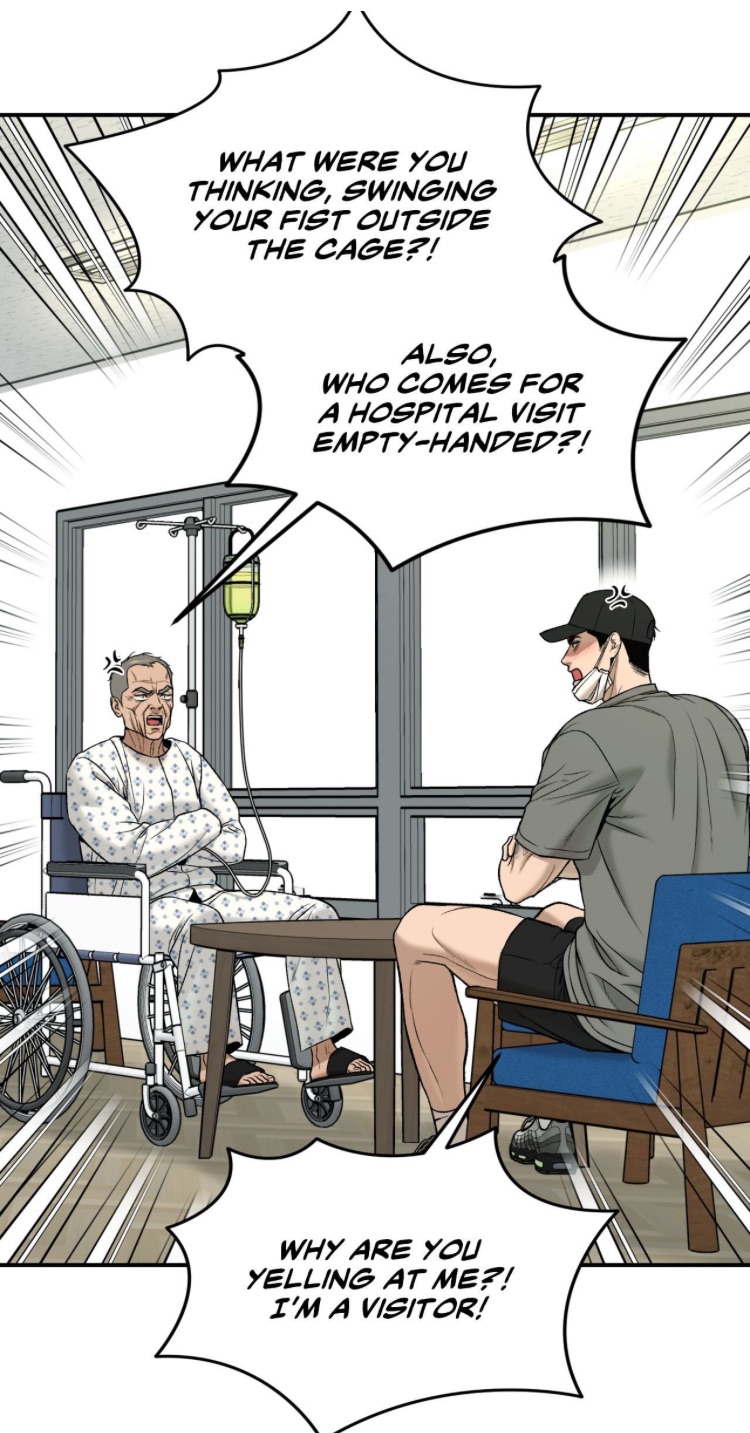 (chapter 71) Only during the champion’s visit, did his words alter.On the rooftop of the hospice, he finally tells Jaekyung:
 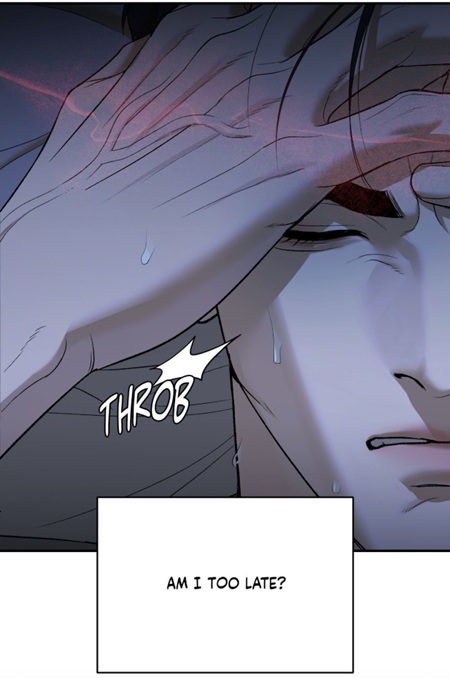 (chapter 76) It is not too late. The question “Am I too late?” is the consequence of Hwang byungchul’s words and it gradually indicates the switch in the champion’s mentality. It is no longer about being right or wrong. However, the nightmare reveals another aspect: the world is not black and white, but grey.
 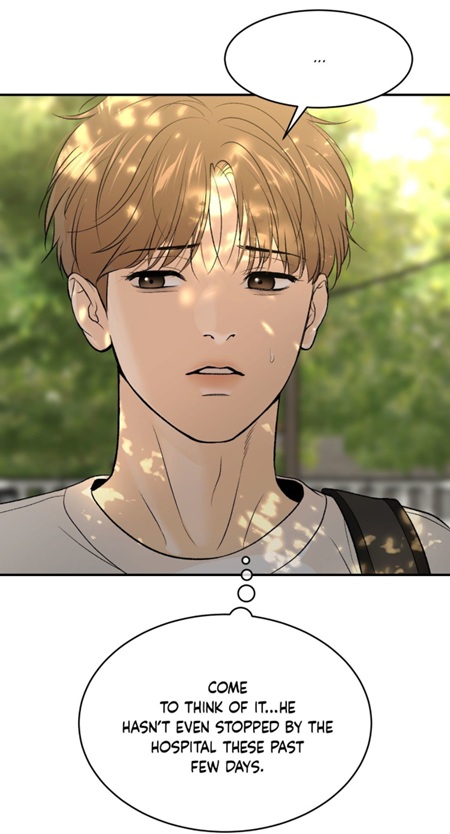 (chapter 76) Hence he remained silent and avoided his gaze. But like the director showed it, it is never too late:
  (chapter 76)
 (chapter 69) Thus my avid readers might jump to the conclusion that his biggest flaw is blindness, similar to the director. Besides, I had often criticized him for his blindness and ignorance. However, this is just a deception. The manager’s real defect is actually his deafness. How so? He does not hear Jaekyung’s words
  (chapter 17) at all. The verity is that he refuses to listen to his thoughts and emotions
  (chapter 31) in good
  (chapter 45) or in bad times. It goes so far, he does not take his silences seriously, and does not register his pain. This explicates why the manager saw in the champion’s silence at the restaurant as an agreement for a new fight!
  (chapter 69) His role is not to guide or protect, but to extract: money, victories, publicity.
 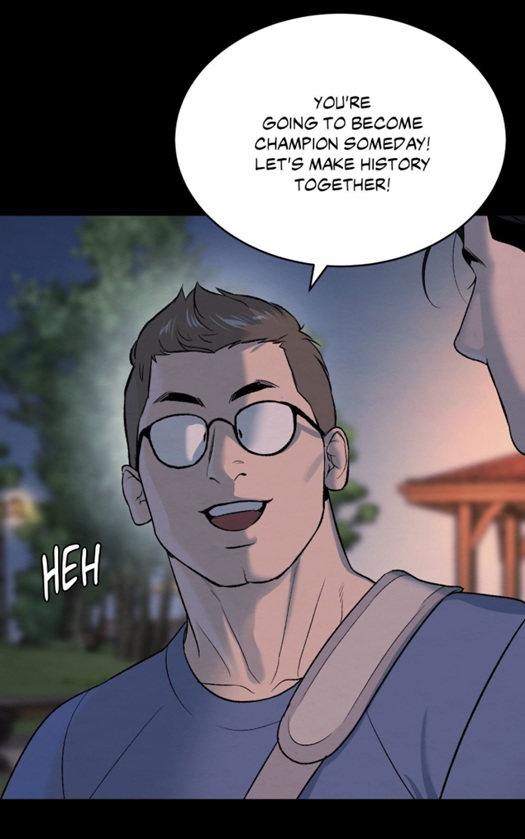 (chapter 75) In my opinion, he is fighting against oblivion through the star. This hidden disability explains why the coach can never truly connect with the champion. He listens instead to other voices – the CEO of MFC
  (chapter 69), the rumors among the directors
  (chapter 46), the media
  (chapter 52), the sponsors
  (chapter 41), the spectators or “authorities”
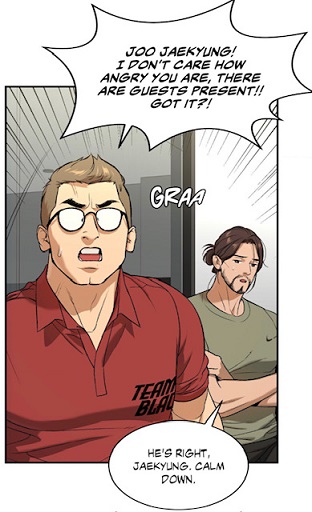 (chapter 36) — and reacts to them, even violently, as in chapter 52, when public criticism painted Jaekyung in a negative light.
  (chapter 52) The slap was less about Jaekyung’s behavior than about Namwook’s own fear of outside judgment. He was not listening to the man in front of him but to the noise around him. He feared losing control in the end, especially after the athlete’s words let transpire his true position at the gym:
 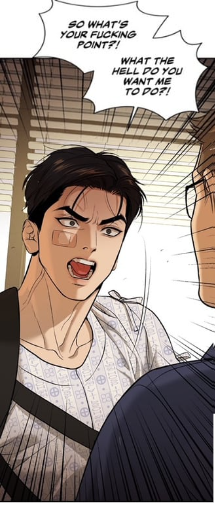 (chapter 52) His question is not mere anger. It is a confession of position — an inadvertent acknowledgment that he knows he is the true backbone of the gym. He is the one responsible, the one carrying the burden that Namwook refuses to admit. These words crack the illusion: the fighter is not subordinate, but owner. The gym lives because of him.
 (chapter 52) He acted as a child, faked “tears” in order to use empathy to his advantage.
 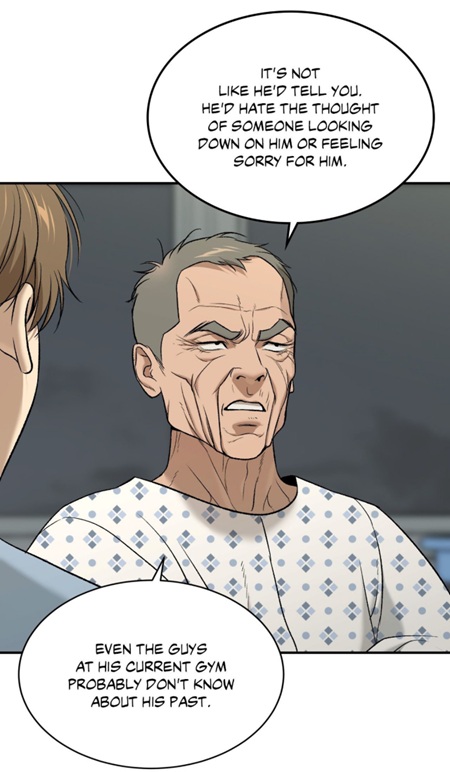 (chapter 71), hence he tried to help in his own way. On the other hand, Park Namwook shows clearly no sign to be interested in the private life of his boss. He is preferring ignorance over “knowledge and connection”.
  (chapter 66) Despite the incident, the manager hasn’t changed yet. He clinched onto the past, thinking that everything will be like before, as soon as the athlete enters the ring. He images a return to normality with the next match.
 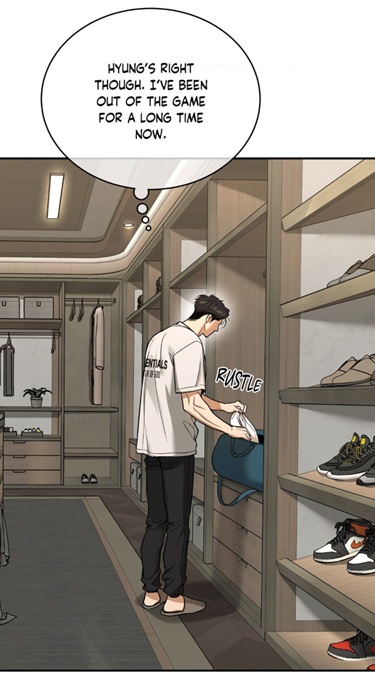 (chapter 66) For years, he had accepted his manager’s judgments out of habit, mistaking silence for consent. But here, for the first time, the repetition feels deliberate — not resignation, but reflection (“though”). The phrase becomes a question more than an agreement: is he truly right? He is admitting this out of habit.
  (chapter 69) His silence has shifted from obedience to suffocation. The weight of Namwook’s deaf authority is no longer bearable. And yet, even here, his confession is muted, confined to the private space of his car. He is not yet ready to speak the words aloud — not until someone appears who will listen.
  (chapter 48) This scene was observed by Kwak Junbeom, so the latter could have reported it to the coach. If it truly happened, this would expose the coach’s deafness and cowardice. He chose passivity instead of confronting the doctor or the champion. That way, he avoided responsibility. And this brings me to my final conclusion concerning the deaf manager. His main way to contact the celebrity is the cellphone:
  (chapter 66) It is both his mask and his crutch — a tool for barking orders, never for dialogue. The moment the line goes dead, his authority collapses, for he has no other means of contact. His power depends on Jaekyung’s reception, not his own strength. In truth, the manager’s disability is exposed here: deaf to Jaekyung’s voice, he has trained himself to hear only the ring of a phone. A fragile authority built on silence, ready to crumble the instant Jaekyung decides to switch it off.
 (chapter 76) must be read not as pride, but as a desperate shield against annihilation. In other words, in episode 76, the athlete is too harsh on himself, though I am not saying that he is innocent either. He only thought of himself because he had taught to behave that way. He was just mirroring the adults surrounding him who hid their weaknesses and wrongdoings behind “lies, social norms and hierarchy”.
 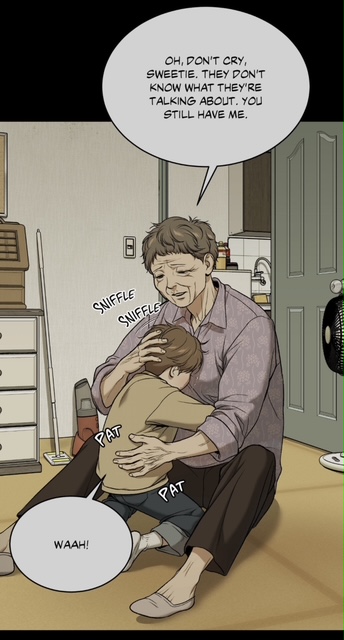 (chapter 57) With his grandmother and with every authority he encountered — doctors, employers, even predators — he believed unquestioningly that others were right and he was wrong. Hence he trusted others blindly. He was trained to accept decisions made for him or against him.
  (chapter 70) Thus he accepts criticism with defending his own interest. He was not taught how to fight back or resist or even argue.
 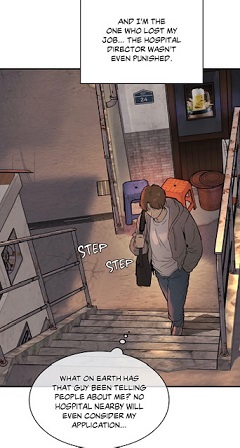 (chapter 1) He never tried to seek justice. His “you’re right” was not recognition but submission, the language of someone who could not afford to resist. In season one, this made their relationship combustible: Jaekyung spoke only in victory and as such submission, while Dan accepted every loss as natural. He also adopted this mind-set. On the other hand, because their initial interaction was based on a contract,
  (chapter 6), both were forced to discuss with each other about the “content of the agreement”. That’s where the champion was trained to communciate with the physical therapist. Thanks to the champion, because of this victory/loss mentality, the doctor learned gradually to argue and “reply” with his “boss. However, due to his childhood, he couldn’t totally drop his old principles like for example “saying no”.
 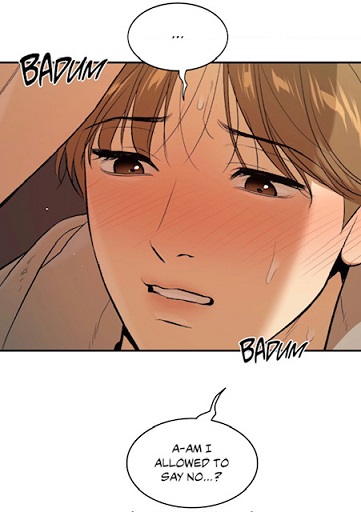 (chapter 34) To conclude, before their fateful meeting, neither man had learned how to argue as equals. But in the kitchen in front of the stove, this changed: both are right and wrong!
 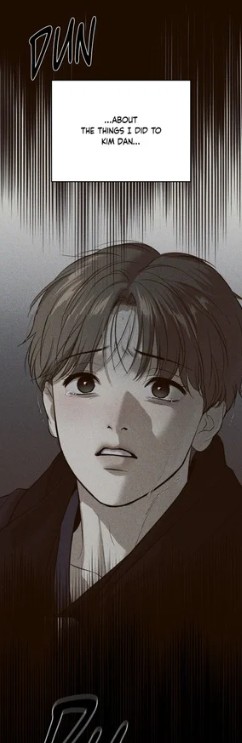 (chapter 76) He speaks like someone expecting rejection. Hence he keeps his distance. Yet the very fact that he says it at all signals change. Where once he would have doubled down — by barking an order, by firing Dan, by retreating into silence — he now admits defeat. The vocabulary of winning and losing, inherited from his father and reinforced by every adult in his life, collapses in the presence of Dan’s quiet honesty.
 (chapter 76) — an acknowledgment that he can no longer keep his walls intact. He is now willing to rely on doc Dan exclusively.
 (chapter 76). His confession reveals not strength but guilt. Kim Dan’s suffering was the price of his victories, and he knows it. “On the other hand, his mea culpa should be relativized, for both were the targets of a plot!
 (chapter 76) These words expose both responsibility and shame: he had prioritized survival over connection, career over compassion. What boils under his skin is not pride but remorse.
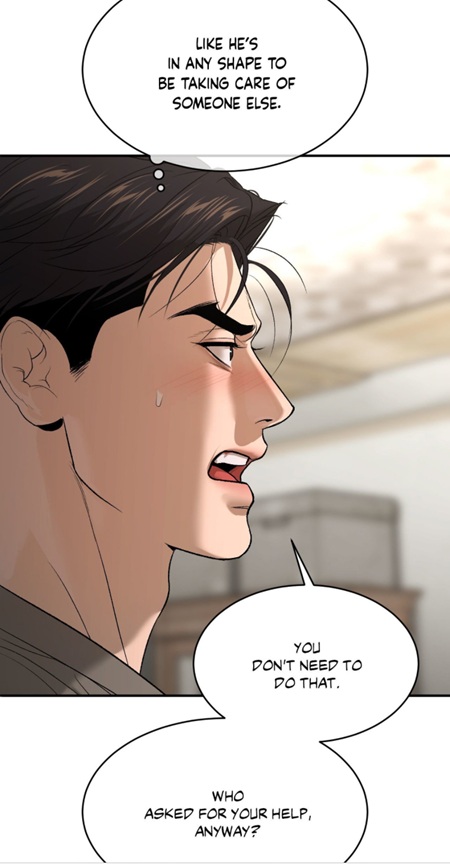 (chapter 76) The star’s thoughts in the kitchen are actually mirroring the ones in the bathroom:
  (chapter 68) In the bathtub, he still saw himself as the one in control, with the upper hand… but this is no longer the case in the kitchen. Through the physical therapist, the wolf is learning that even being in a vulnerable state doesn’t mean that this person is powerless. It is just that his “strength” lies elsewhere. In other words, someone struggling can also give comfort to another person in pain.
  (chapter 72) a place of solitary consumption rather than shared meals, the bed was the place where the little boy would drink his milk.
 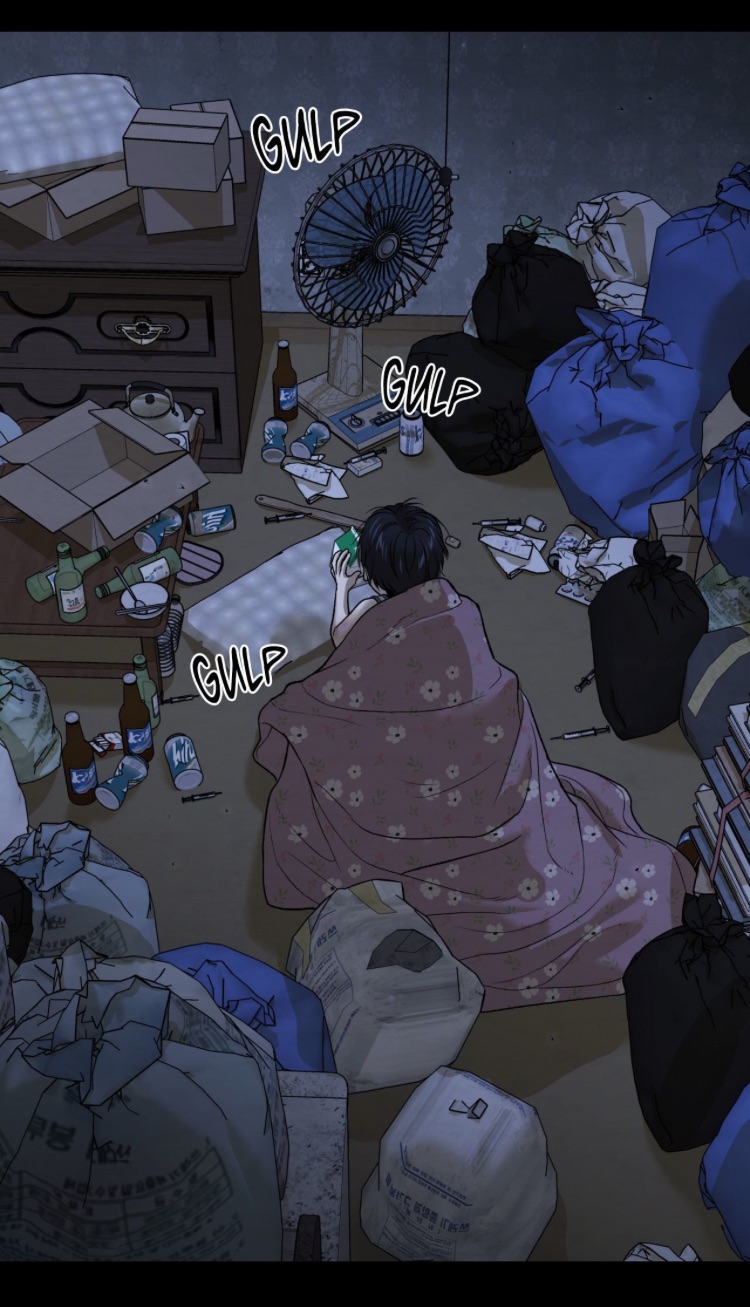 (chapter 72) It is interesting that actually, Doc Dan wanted to bring the porridge to Joo Jaekyung to his bed during that full moon night, thus the latter made the following request:
  (chapter 76) But the wolf didn’t understand the hamster’s intention and followed his “hyung” to the kitchen. That’s how a misunderstanding was born which is also reflected in this interaction:
 (chapter 76) However, doc Dan agreed to this, he remained calm.
  (chapter 41) The latter actually represented a hindrance between them, it marked their relationship: boss and “employee” (servant). Moreover, since the table in the champion’s childhood was linked to one person (the father), it is clear that the champion has never shared a table with someone. And this aspect brings me to my other observation.
  (chapter 22) Whether in meetings, weigh-ins, or dinners with the CEO
  (chapter 46) It was a place where others dictated terms, while Jaekyung’s silence was mistaken for consent. And now, you comprehend why the two main leads could get closer in front of the stove in the kitchen. This place stands for warmth, care and family.
  (chapter 13) a meal after his collapse. He refused to bring a meal to the bed, he asked him to join in the dining room and sit at the table. And what did they do there? The champion talked about his career, his fight etc…
  (chapter 13) the champion has long associated the table to business and not “care”. That’s why it is important for him to remember the significance of the bed in his childhood. It was the place where he could feel comfortable and safe, where he would eat!
 (chapter 48) Why did the Webtoonist gave us the time, when the next episode starts another day? On the one hand, it exposes that the schemers knew about the champion’s nightly activities. He wouldn’t sleep much and he would keep his cellphone next to him.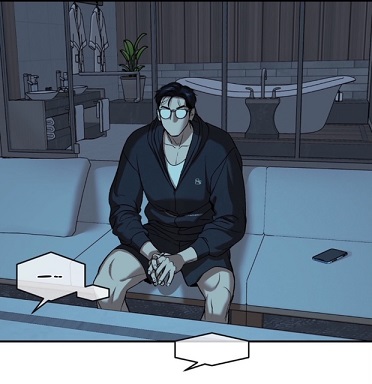
 (chapter 48) It shows once again that the traitor is close to the athlete, for he knows about his way of life. Furthermore, the unknown person could text to the champion, hence this means that his cellphone number got leaked by a person close to him. On the other hand, I am quite certain, the Webtoonist desired to fool her readers making them anticipate a confrontation between the two protagonists. However, nothing happened indicating that Joo Jaekyung didn’t react, like the plotters had anticipated it. Thus they had to create a new scheme. First, let’s not forget that they had used a similar method in the past.
 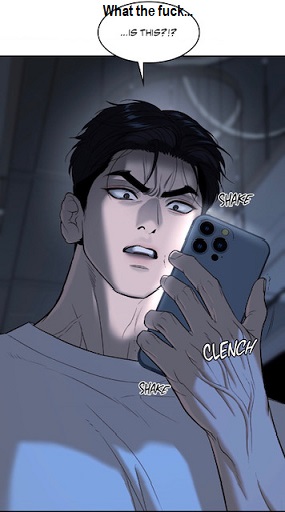 (chapter 35) This made me think of Painter of The Night and No-Name’s advice:
  (chapter 76) “A deed once foiled has no chance of success the second time around”.The criminal was referring to learning through experience. After going through such an event once, the athlete is no longer caught by surprise. We could say that he learned not to jump to conclusions and control his emotions. That’s the reason why in episode 48 he remained level-headed. Because the champion didn’t get angry, he could be more attentive.
 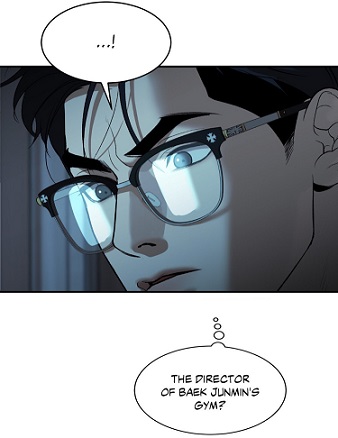 (chapter 48) Secondly,
 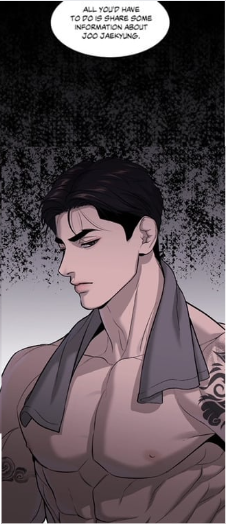 (Chapter 48) The irony is that the doctor had been able to treat the star’s injury. For me, the Summer Night’s Dream played a huge role, as during that night, Joo Jaekyung felt treasured and loved. Therefore the pictures could only expose the duplicity of the director of King of MMA. Under this new light, it becomes understandable why the celebrity didn’t fall into their trap and why they had to turn doc Dan into a traitor by giving him a weapon without his knowledge. Finally, I believe that Joo Jaekyung had another reason not to confront the physical therapist. How so? It is because he had sent away his soulmate, while the latter had approached him.
  (chapter 48) He had missed the opportunity.
 (chapter 30) Here, he wished to seek the doctor’s closeness. Nonetheless, if he had gone to Kim Dan’s bedroom during that night, he would have achieved the opposite: he would have created distance and caused an argument. The latter could have told him that he was looking out for himself, for Joo Jaekyung had threatened to fire him. Through these observations, it becomes visible why the athlete couldn’t ask Kim Dan at all. Consequently, I come to the conclusion that the clock
 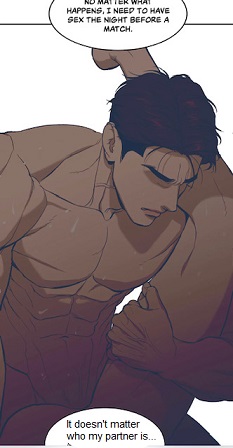 (chapter 2) He is not jinxed, but his failures are the result of his bad choices, like for example trusting the wrong people or not listening to the trustworthy ones or keeping secrets. Or we could say that he is just the product of his education and childhood. He is cursed, for he was not properly raised. He refused to listen to his PT, when the latter wished to tell him something.
 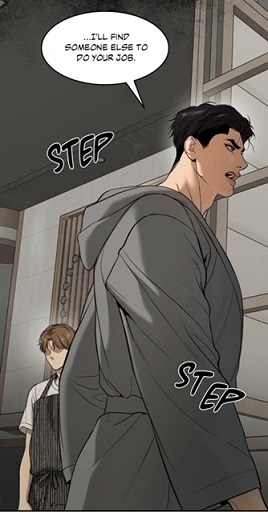 (chapter 45) Then in the bedroom, he had rejected all his requests (massage, conversation). It was, as if he no longer needed him. He was no longer eating his breakfasts too.
 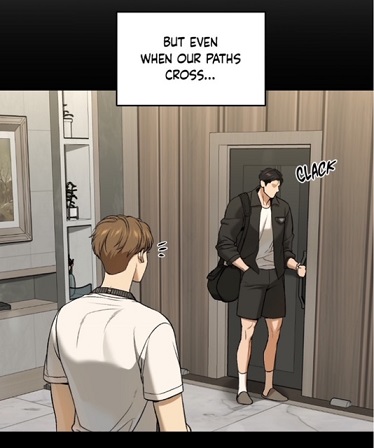 (chapter 47) Under this new light, Manhwa-lovers can comprehend why he looked annoyed in the hallway.
 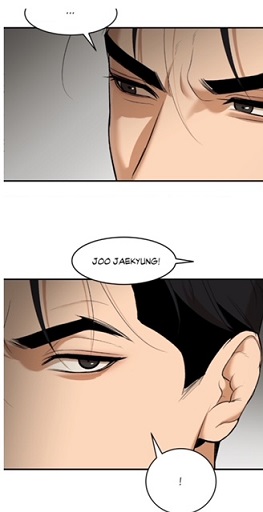 (chapter 49) The gaze displays not only worry and anxiety, but also regret. It was too late to ask the doctor. For me, he chose silence, for he was regretting his reactions in the penthouse. He feared to ask Kim Dan, because if he brought up the meeting with Choi Gilseok, this could push the hamster to quit his job. However, thanks to Kim Dan, the star’s condition improved greatly. That’s how it dawned on me why the champion became a beast and why he is hiding his past:
 (chapter 26) It is because the man is full of regrets and resent. But by creating new regrets, the champion is incited to focus more on the present so that he stops missing the timing. Because of his immense regrets and frustration, he was still trapped in the past. So he was unable to move on. To conclude, Kim Dan and Baek Junmin pushed him to face his youth and the source of his own unhappiness. His biggest suffering is a secret, because he would appear as weak and pitiful which would ruin his image as the strongest man in the world.
 (chapter 48) But why is midnight so important? It is because the number 12 carries religious, mythological and magical symbolism, generally representing perfection, entirety, or cosmic order.
 (chapter 12) the couple was supposed to reach Nirvana, but the athlete failed terribly. Under this new light, it becomes comprehensible why the protagonist chose not to confront Kim Dan in episode 48. It was, as if the champion was closer to the heavens. This represents the champion’s leap of faith. Don’t forget that the star got scared for one moment
 (chapter 48), when he noticed doc Dan’s presence too late. But nothing happened to him, that’s how he got incited to trust Kim Dan. The latter wouldn’t backstab him. Under the blue light, the champion got transformed.
  (chapter 48) On the other side, the fact that the champion is always targeted during the night is a sign that the villains desired to approach him, when he was isolated. So they know not only about his insomnia, but also about his solitude. I would even add that the plotters are aware of his association between the night and danger. Remember how he described relaxation: he would give an opportunity to his enemies to attack him
  (chapter 29) This new observation reinforces my past theory: he would be suffering from Somniphobia due to traumas. [For more read






 (chapter 13) It is important, because through this terrible experience, Joo Jaekyung came to internalize the connection between sex and danger. This would explain why he has been so rough in bed before. He came to see it as a normality, a sign that his perception of sex had been negatively influenced. And this can only come from bad experiences. It had nothing to do with “enjoying the moment”, until the protagonist met the shy hamster. We can see his gradual transformation. In episode 12, he definitely saw the night as “carpe diem”
  (chapter 49) In the previous essay, I had mentioned the theory that the champion might have been raped and even gangraped which would fit the criteria (sex, danger and urgency). Finally, the recurrence of “delicacy” during the night is an indication that the athlete must have been like Kim Dan in the past! Vulnerable and alone!
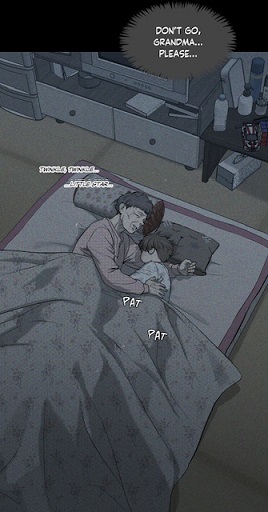 (chapter 21) Furthermore, the champion exposed why he could never relax:
 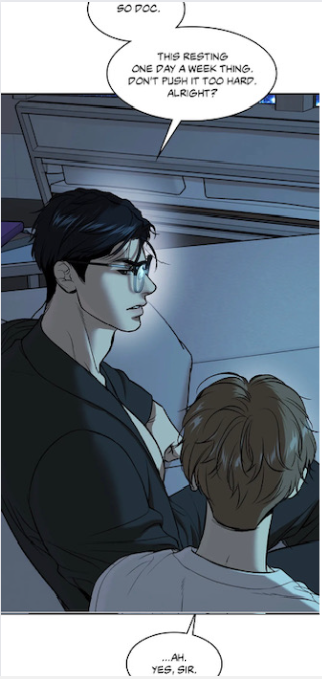 and 48:
 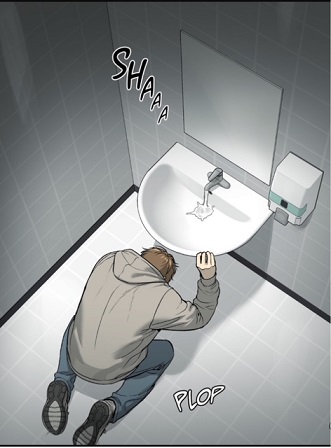 , for he had been recollecting the diagnosis from Kim Miseon and kept thinking of his grandmother. After this painful meditation, he came to recognize his selfishness and his relative’s love and generosity
 (chapter 47). And what was the main lead feeling after that terrible night? Regret, for he had not been able to notice his relative’s suffering and sacrifice!
 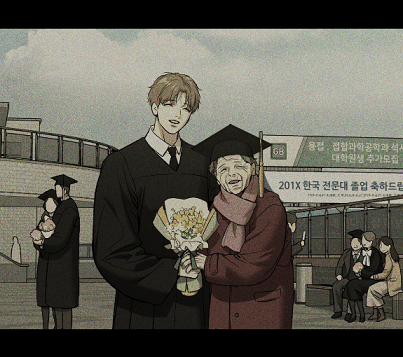 (chapter 47)
 (chapter 19) or a new request like swallowing the sperm
 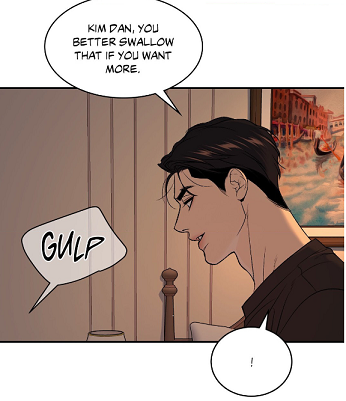 (chapter 39) or kissing the champion’s ruined ears
  (chapter 44)
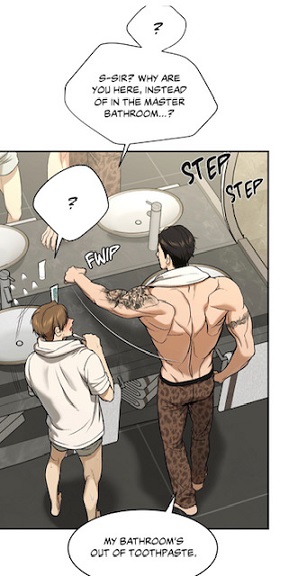 (chapter 30) He was rough and used the toothpaste as an excuse.
  (Chapter 40) That’s the moment he stopped considering the hamster as a prostitute, while from chapter 2 to 18, he viewed Kim Dan as a tool, as a talisman against his jinx. However, I detected a transition after he kissed the physical therapist. From that moment on, the doctor was connected to food and sweetness.
  (Chapter 18) And now, observe that during the night in the bathroom, doc Dan was associated with a baby receiving food:
 (chapter 20) As you can see, here the champion started viewing him as a human being. It exposes that little by little, his perception of the physical therapist improved. So from chapter 30 to 39, Joo Jaekyung was forced to question the nature of his relationship with Kim Dan: a PT or a prostitute or a pet?
  (Chapter 34) Here, he was in denial, he described the main lead as a possession, but he couldn’t fool the actor. Under this new light, it becomes comprehensible why the nights in chapter 19, 29 and 39 were so magical, they announced a transition or better the end of viewing Kim Dan as an object (tool for his jinx) and possession. From 41 to 49, the champion was cornered to recognize Kim Dan as a physical therapist and not just as a member from Team Black. Don’t forget his attitude in the car, when the main lead suggested him not to train.
 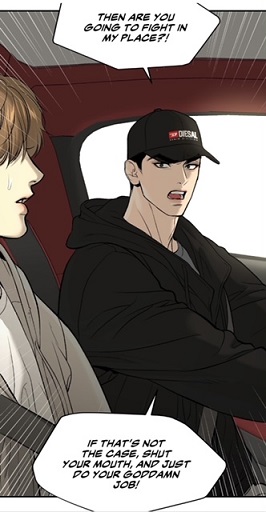 (Chapter 42) He rejected his advice, a sign that he was doubting doc Dan’s skills and competences. That’s the reason why I come to the conclusion that with the pictures, the champion was pushed to admit that Kim Dan is his physical therapist
  (Chapter 49)
 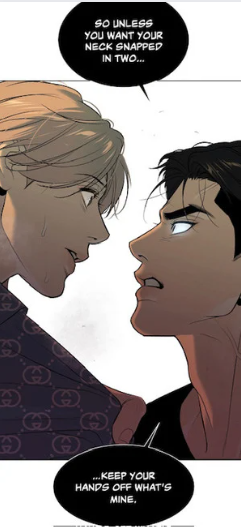 (chapter 34), then the fake star Baek Junmin
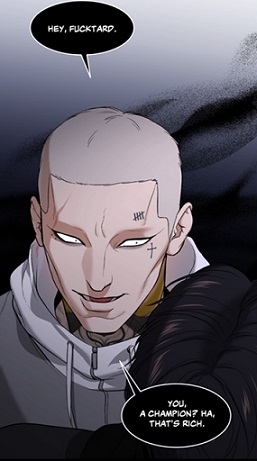 (chapter 49). These meetings are not random at all, a sign that someone knows about the athlete’s hidden suffering very well. Observe that both characters challenged the celebrity by giving him an order:
 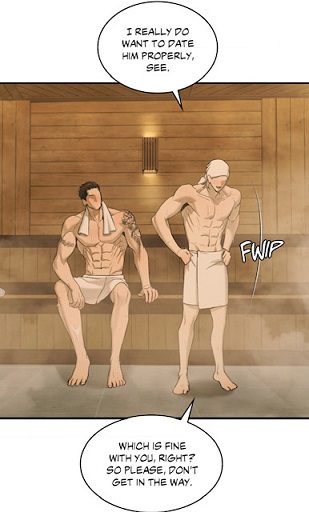 (chapter 34) “Don’t get in the way” and “make sure you give her a good polish”.
  (chapter 49) The sportsman is viewed as a hindrance to their dreams, he should clear the way for them. I deduce that in his youth, people must have treated him the same way. He represented an obstacle, therefore these two figures must have challenged him in the past too. Their confidence comes from their past experiences with the athlete. Both must have defeated Joo Jaekyung, but naturally they must have tricked him.
  (chapter 33)
  (chapter 49) Then I noticed another parallel between the two plots: the presence of a scapegoat, and the involvement of a third person. Heesung faked his injury by putting the blame on the athlete, while he asked Kim Dan as compensation. In the second plot, the roles are switched. Kim Dan is now the perpetrator, while the athlete is the victim! Baek Junmin is the beneficiary of this scheme. And what do these plots have in common? Joo Jaekyung is the victim of a trick, though Heesung’s manipulation was rather benign. First, he acted on his own.
  (Chapter 31) Moreover, he utilized the genuine concern and innocence of his surroundings. In other words, he used his image as a good and honest man to his advantage. Thus I come to the conclusion that the artist’s sin in their youth was rather minor, as the artist tends to violate social norms. So though it was no illegal, the actor’s wrongdoing definitely left scars on the protagonist’s heart.
 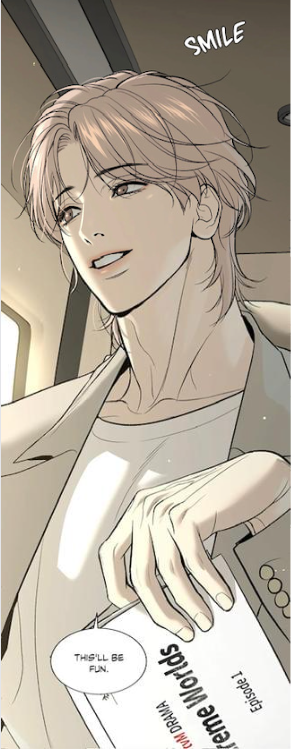 (chapter 29) Probably, Heesung utilized Joo Jaekyung’s innocence to his advantage in order to maintain his good reputation, like for example he was not supposed to be smoking or he took away a friend from him, as the topic of their conversation was about the theft of a person
  (chapter 33)
 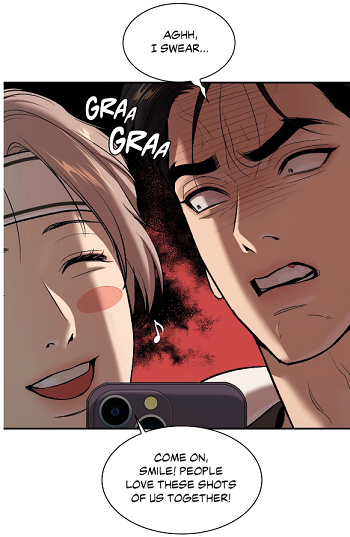 (chapter 30), because it always makes him appear as a well-mannered and honest man. He gets fun at his frenemy’s expense. In addition, he could play tricks without getting caught… and the other would appear as the bad guy and take the blame, like we could observe at the gym with the manager’s judgement.
  (Chapter 30) Another common denominator between The Shotgun and Heesung is their envy and greed.
  (chapter 5) Joo Jaekyung destroyed the sandbag, when he imagined that doc Dan had blocked him! This signifies that the former could no longer contact the shy hamster. Joo Jaekyung saw it as an affront, a challenge!
  (chapter 46) could be seen as a reflection from the arcade and the star’s past. And since Kim Dan wounded Joo Jaekyung in the locker room
  (chapter 49), I deduce that such an action must have happened in the champion’s youth. He got not only hurt by people, but also betrayed by a friend. There exists many reasons for this hypothesis.
 (Chapter 04) and be rude towards others.
 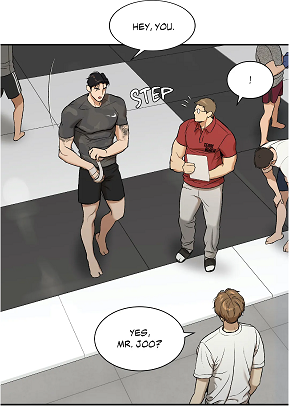 (Chapter 7)
  (chapter 37) But Mingwa left many clues that the celebrity’s personality shouldn’t be judged by impressions. During their first night together, Manhwa-lovers could see books next to the bed.
 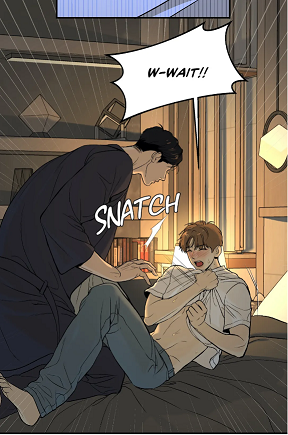 (Chapter 3) Some of them are not written in Korean or English. Moreover, the Webtoonist revealed that one of his hobbies is reading. This explains why he can talk prettily.
 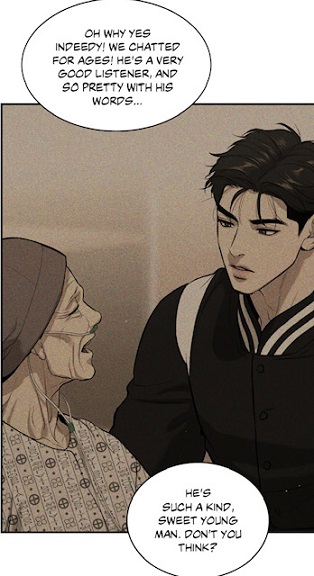 (chapter 22) This shows that his behavior mirrors the counterpart’s. Consequently, it is not surprising that the champion is rough with his own body, as Park Namwook is not treating him like a delicate child.
  (Chapter 37) Even stressed and filled with anger, he could understand and speak fluently in English.
 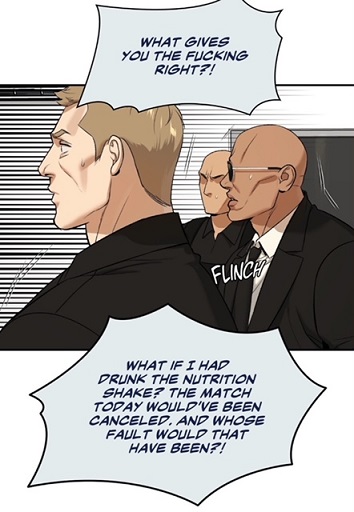 (Chapter 40) Compare Kim Dan’s English skills in the same scene:
  (chapter 40) Besides, Jinx-philes should question why Mingwa is not divulging his scores as a student contrary to Kim Dan or Jinwon from BJ Alex. It is because she wants to create a certain image about the champion: he is a bad boy. In my eyes, she is playing with prejudices about MMA fighters. People often imagine, they lack social manners and education. They chose this path, for they could do nothing else. And this brings me to my next remark. We know that Kim Dan selected PT because of his halmoni.
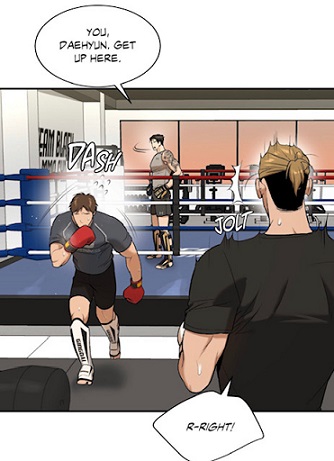
 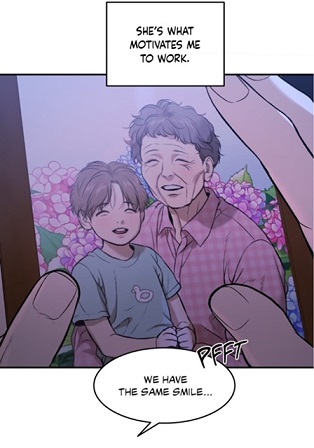 (chapter 47) So what was the protagonist’s motivation to become a MMA fighter? In my eyes, this question represents the core of the mystery. My idea is that the suffering in his youth led him to become a boxer. It is definitely related to his experienced powerlessness and loneliness. So when he suggested the sparring to Kim Dan, we should see it as a reflection from the past:
  (chapter 26) Joo Jaekyung was also an amateur in the past, but his motivations were his rage and resent. On the other hand, contrary to his soulmate, the athlete likes sports as well. His other hobbies are jogging and swimming. Thus I am suspecting that Joo Jaekyung might have been part of a swimming club in the past. Striking is that he forgot his passion due to his career as a MMA champion.
 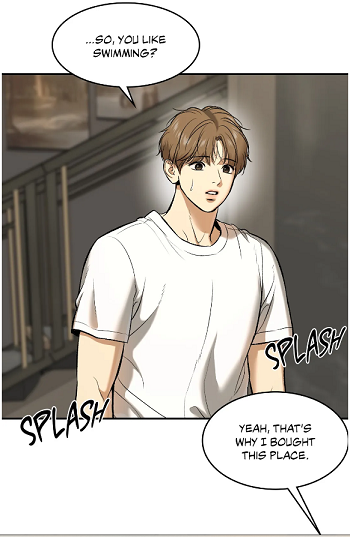 (chapter 27) I see a contrast between these two sports: swimming which is related to relaxation, pleasure and fun and MMA fighting which stands for challenge, pain and seriousness. This contrast is even more present in the following panel:
 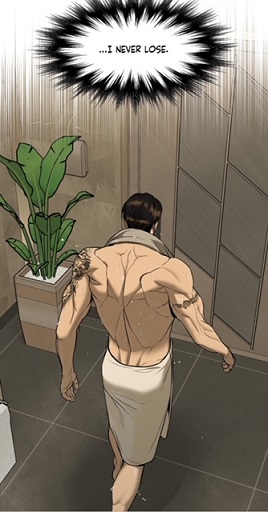 (chapter 49) Is it a coincidence that this Enlightenment took place under the shower? For me, no! I see a strong link between water, swimming and the champion’s job. It looked like swimming represents a source of danger for the athlete’s job, as it is an entertainment! Hence I can’t shake the feeling that in the past, Joo Jaekyung might have shown aptitude for becoming a natation athlete! Let’s not forget that for the calendar 2024, the champion was seen carrying swimming googles and not “MMA gloves”. This detail caught my attention and made me wonder why Mingwa selected these items.
  (chapter 49) He is a hyena, hence his color is brown.
  (Chapter 48) And The Shotgun has a similar attitude:
  (chapter 49) Interesting is that his description of the challengers fits the situation in the new plot perfectly. The Shotgun imagines that he will fight against a diminished champion. His shoulder is injured and they have planned to add a new injury. The hyena stands for balance and cleansing as their task is to remove the weak ones.
 (chapter 49) As an old man, Choi Heesung is revealing vulnerability and senility. Due to his old age, he could be replaced by another hyena, a younger hyena!
 (chapter 5), as he is the only person who has not appeared yet, though the champion has his cellphone number. And this remark brings me back to the present and the night messages and the hyenas.
 (chapter 36) which could only affect the members from Team Black. Their loyalty could waver. Then he got to hear bad comments from the Internet
 (chapter 36), creating the illusion that he was losing popularity. That’s how the lawyer could convince the champion to accept a new match in such a short-time. Finally he got reprimanded for his outburst.
  (chapter 41) With the pictures
  (chapter 13) This could have ended badly. Another wrongdoing could be the rejection of his birthday present and his harsh reaction.
  (chapter 47) At no moment, the physical therapist brought up his misdeeds and asked for an apology. His silence became the symbol for his tolerance and even forgiveness. In addition, the doctor and his halmoni embody both vulnerability and poor health, which is strangely connected to crime and scandal.
  (chapter 48) Through them, the champion is learning that hunting weak and pitiful creatures is not only a sin, but also a crime! In the first case, he could be accused of hurting an innocent.
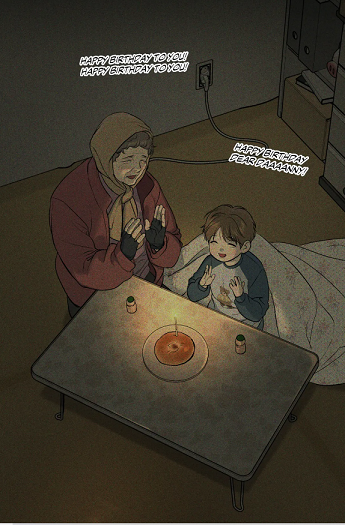 (chapter 11) He wished to receive attention and to have a normal conversation. Consequently, I assume that the champion has been copying his role model. That’s how he was pushed to grow up too quickly. For me, he had no childhood at all, hence when he met Kim Dan, he was encouraged to develop his inner child!
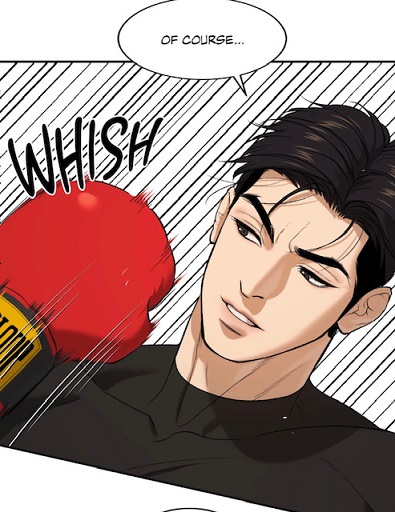 (chapter 26) For the first time, he had fun sparring. Hence he kept smiling. It is no coincidence that soon after he chose to accept to take a day-off, when Kim Dan made the suggestion.
 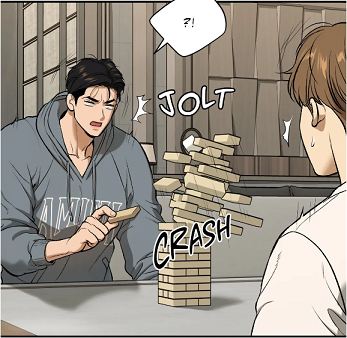 (chapter 27) That’s how he remembered that he liked swimming and he could play a prank on his lover.
  (chapter 27) Here, he could smile, because it was fun and there was no real expectation. It was not truly connected to money.
  (chapter 35) and not in episode 48. It is because Kim Dan had paid him a visit during that night, a sign that he was thinking of him as his patient and VIP client.
 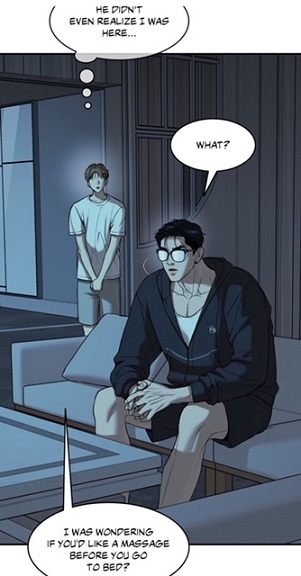 (Chapter 48) On the other hand, I am inclined to think that when a terrible incident in his youth occurred, he couldn’t contact his family or guardian. Hence he keeps his cellphone by his side constantly. Yes, I was thinking of the doctor’s assault in the street and his failed rape:
  (Chapter 16) Heo Namwook’s minions had confiscated his cellphone. Hence it was impossible for him to call for help. And now take a closer look at this scene:
 (Chapter 16) Though he had been on the phone and it was daylight, no one stopped the thugs from kidnapping the main lead or reported the incident to the police. Hence I am also suspecting that Joo Jaekyung must have faced a similar situation: he was surrounded by malicious people and no one had assisted him. So he could have been targeting at school due to his grads or his social status. And his isolation at home could push to seek company outside, to look for friends at school.
  (chapter 37)
  (chapter 49) And the anonymous person on the other side of the phone was definitely calling in order to be updated about Joo Jaekyung, for his coach asked him about his physical conditions.
 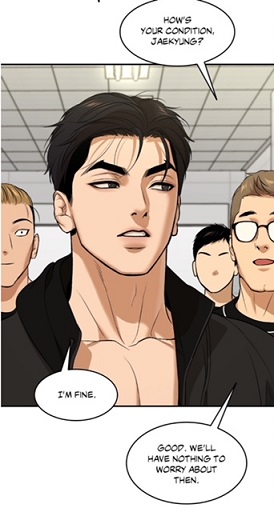 (chapter 49) That could be the hidden guardian who has not showed up yet, I am thinking of Seo Gichan. And now it is time to close this long essay.


 (chapter 1) He was even called a psychopath, for he resorted to kidnapping
 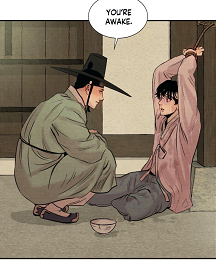 (chapter 1) sequestration, threats
 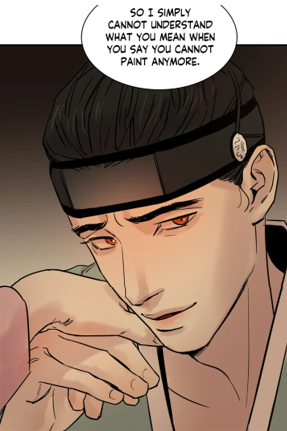 (chapter 2) and blackmail and he initially showed no remorse.
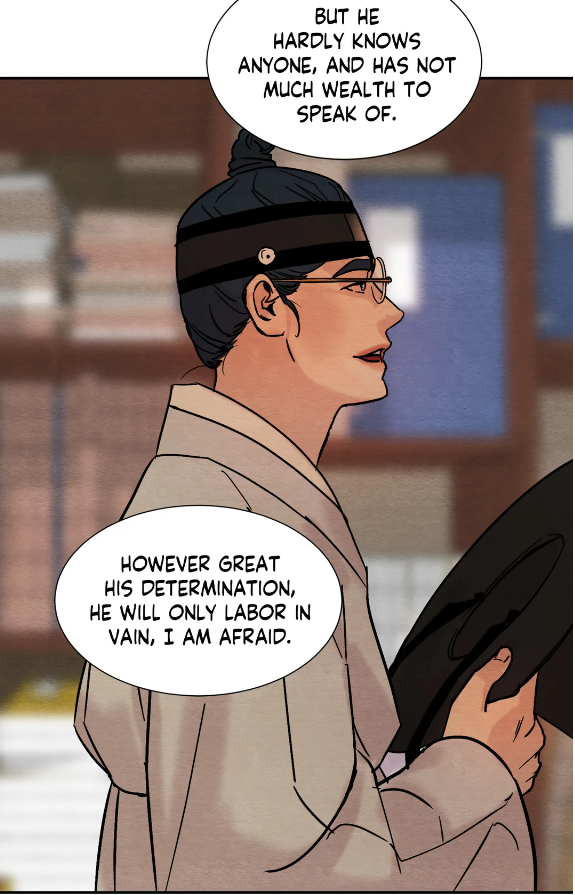 (chapter 7). On the other hand, he never got into trouble for his wrongdoings. Why? It is because he wasn’t violating social norms.
  (chapter 10) It was his right to punish servants, for they are not considered as humans but as propriety. As a lord, he could treat commoners, like it pleased him. Though murder is prohibited, even against a lowborn,
 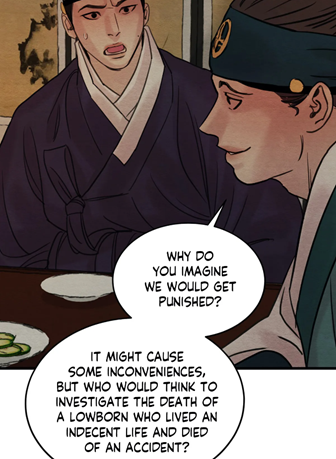 (chapter 43), the reality is that nobles would never get into trouble!! As you can see, there exists a discrepancy between laws on the paper and the reality which was exposed by the rumors in episode 106.
 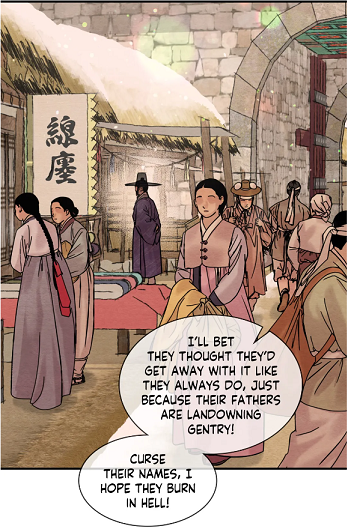 (chapter 107) The fathers would use their position and influence in order to cover up their children’s wrongdoings. And we have the perfect illustration, when the elder master bribes the governor.
  (chapter 127) That’s the reason why the younger generation could do everything! Though the lord appeared as a monster first, he became a “normality”, the more we got to read this story. Under this explication, it becomes comprehensible why lord Min was so sure not to get bothered by the authorities.
 (Chapter 101) He had bought the officers (“the guards”). This explains why Black Heart could threaten No-Name.
  (chapter 76) He didn’t need to dirty his own hands, he could simply frame him. Consequently, I deduce that he had learned this misconduct through the elders’ behavior.
  (chapter 116) This shows that neither Black Heart’s father nor Yoon Chang-Hyeon truly love their children, as according to Erich Fromm, love is knowledge, respect, care and responsibility. However, the elder master Yoon is totally ignorant about his son’s talents and good nature. Thereby, I see lord Seungho from season 1 as the perfect illustration of the corrupted world of the nobility. The monster “Yoon Seungho” was just a reflection from this ruthless and immoral society. Since he committed wrongdoings, his karma was to pay for his sins. It starts with a murder, and the main lead ended up killing people. He might have not broken “traditions” like the disregard of the yangbans against lowborns, but it is considered immoral. He had sinned and now, he is paying for his sins. Therefore his words in the prison resonate differently.
  (chapter 126) He expresses regret. He confesses his crimes, he killed people! This means that he is now siding with the lowborns. Their life is as precious as the ones from the nobility. Yet, note that in this image, the author didn’t drew his eyes. Why? It is because in the moment he executed people,
 (chapter 102) he was either not himself or he did it out of reflex to protect himself. He was influenced by his past experiences and as such traumas. In the shrine, it becomes more obvious, for he has a lost gaze. He is not even looking at his target. Finally, when he met lord Song, he did it to “protect” himself.
  (chapter 123) For me, in episode 1, the execution was triggered by his desire to protect himself and his traumas. And what is the common denominator between these three scenes? The father Yoon Chang-Hyeon! Don’t forget that the petition was the reason for their meeting. And now look at the actions from the patriarch.
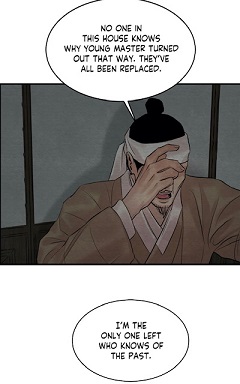
 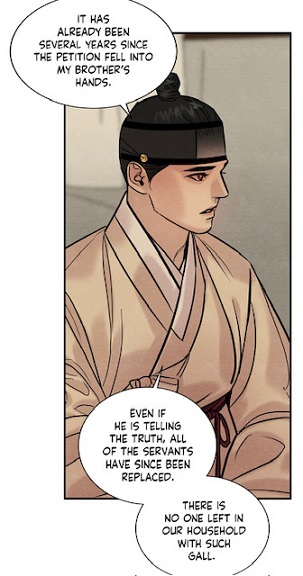 (chapter 116) He had given the order to eliminate all the servants, for they could represent a threat to his “treason”. This explains why the butler describes himself as the only survivor and witness.
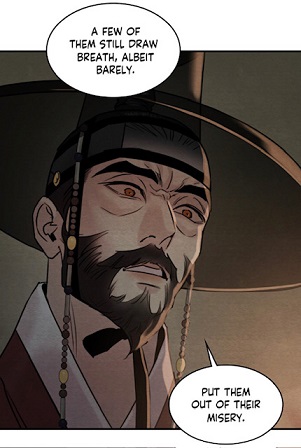
  (chapter 86) And we see him giving the order to kill the surviving guard
  (chapter 125) Besides, he had no problem to order the assassination of his own son which was stopped by the intervention of a helping hand. The father had never asked to spare the main lead’s life.
  (chapter 124). He was his bad role model. But he is not the only one. There is another one…
  (chapter 51) Once a criminal, always a criminal… therefore it is not surprising that the joker chose assassination as second work. By working for the nobles, he would be able to escape punishment, because if he got arrested, he could denunciate them. To conclude, justice is inexistent in Joseon. Yes, we are witnessing the downfall of Joseon, or precisely the king’s bad ruling. The latter is not capable of providing justice to anyone. And this coincides with the purge!
  (chapter 37) What is a purge?
  (chapter 107) “Stepping down” was actually an euphemism for removal. The officials were chased out,
 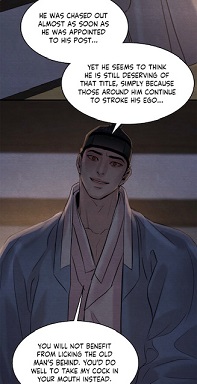 (chapter 80) but their evictions were turned into stepping down.
 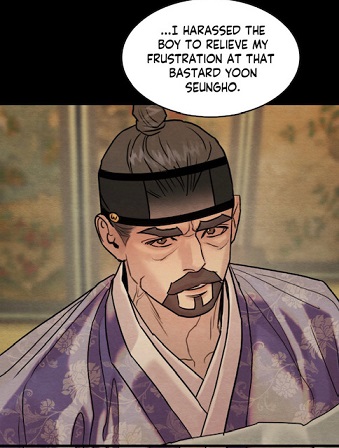 (chapter 122) No wonder why lord Song came to resent the protagonist. Under this new light, it becomes comprehensible why the purge was not noticed by commoners. There was no fire and the staff was sparred.
  (chapter 103) The boots were the indication that this person was working for the government. And it was an elder, for he was wearing this particular headgear.
 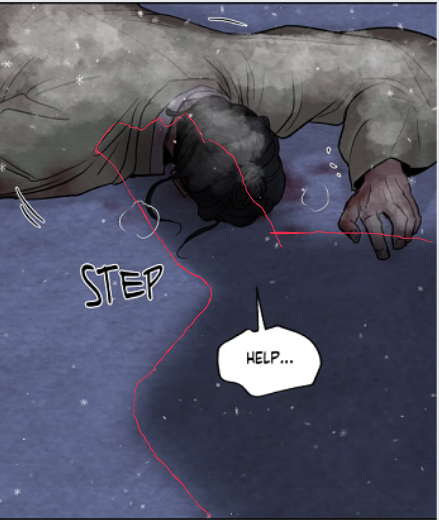 (chapter 103)
  (chapter 67) The murder of lord Shin is the evidence of the anarchy in Joseon. But actually, the monsters are actually everywhere, and not just among the nobility. The Chungin with the scholar and the physicians who have no problem to lie, participate in a kidnapping and drugging people… the kisaengs, the maids, the servants. They are all accomplices, for they feigned ignorance or chose to remain passive, for they preferred avoiding trouble. What people failed to realize is that no one is safe from this tyranny. Hence people could get killed and thrown into a well so easily
 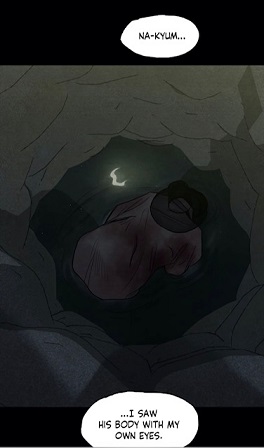 (chapter 97)
 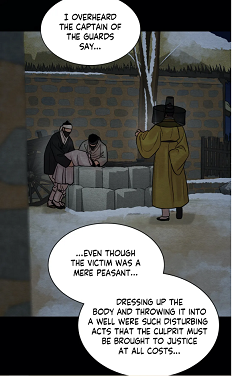 (chapter 101) and their perpetrators got scot-free. Why? It is because the mastermind and the helping hands are protecting each other, like we could see in the Joker’s case. However, the latter in season 3 had no idea that they would face divine retribution and pay with their life.
  (chapter 102) In front of gods, humans are all equal. There is no distinction between gentry, Chungin and commoners. That’s the reason why I come to the conclusion that Yoon Seungho is the divine hand of justice, he is bringing the “divine retribution”. This explicates this vision:
  (chapter 83) Under this new approach, it becomes comprehensible why he is called “the bird of misfortune”. People around him got to suffer, for they received their karma. Funny is that lord Song mocked him by calling him a grim reaper.
 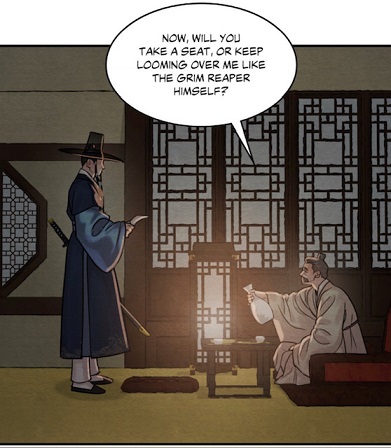 (chapter 123) He underestimated his opponent, not imagining that the latter would use his sword against him. So he became a grim reaper. Lord Song Haseon must have thought that his minions, just like his age and status, would protect him. But no, someone had planned his death and counted on the main lead’s decision.
 (chapter 99) Thus Min’s karma was to die in the total indifference of others. No one is missing him, for he was turned into a brigand himself.
  (chapter 113) But wait… Why did Black Heart get killed in the end? One might say that it was his karma, for he had planned the murder of Baek Na-Kyum in the past. In my opinion, the uke serves as a representative of the divine retribution. The artist is the “judge” and his lover is executing the sentence: death. And we can detect this gods’ intervention through the learned sir’s case as well. Jung In-Hun had looked down on the artist for his origins and education. When the generous main lead chose to accept his apology (attempted rape),
 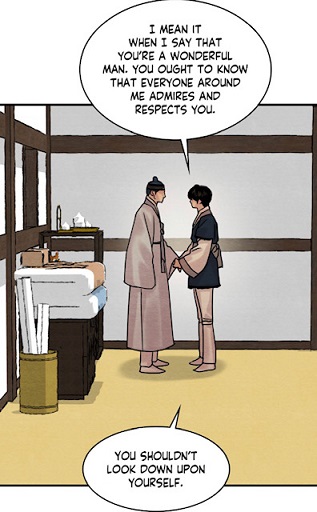 (chapter 120), the latter reminded him that contrary to Yoon Seungho, he was admired. He had such a good notoriety! Since he betrayed the artist and had almost him killed, the scholar ended up losing everything.
 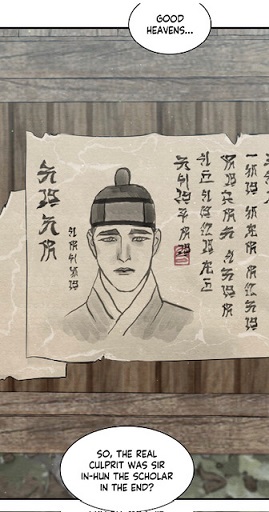 (chapter 127) He became the scapegoat for this incident, for he played a huge role in the painter’s suffering (kidnapping, assault, murder and brainwashing). His success at the civil service examination was erased within a few weeks and now he is viewed as a brigand. How could such a person get selected as an official? His fate gives a bad impression of the civil service examination. And what is the common denominator between these two villains? They both belong to different social classes. Their cases is exposing the king’s negligence and arbitrariness. The latter is the perfect personification of this corruption. Not even Confucianism is respected, for fathers are abusing their own children or even killing them. Season 4 is exposing the chaos in Joseon. Therefore it is not surprising that the sacred tree and the shrine got burned.
  (chapter 106) The gods were using the humans to voice their anger. At the same time, when the woman made this comment, the Manhwa lovers can detect the huge gate in the background, the symbol for royalty. And now, you comprehend why Yoon Seungho was pushed to go to Hanyang. It is his fate to face the king! His task is to clean the palace of these old bearded men.
  (chapter 44) I had already portrayed him as a black shaman in the essay “
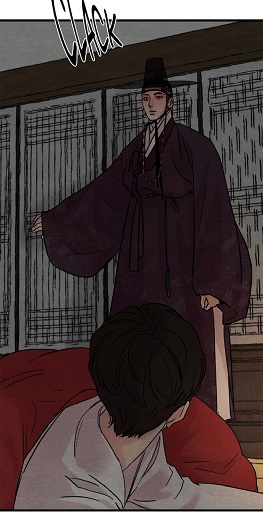
 (chapter 65) Don’t forget that the monarch is the only one who stands above the laws, though he is controlled by social norms and his officials. In my opinion, this can only take place, when a new scheme takes place. How so? Note that in the scholar’s case, Jung In-Hun received his karma, but not real human justice. For me, he is not dead. Besides, don’t forget that someone took the petition from lord Song, before Yoon Chang-Hyeon came to the bloody place. There is no ambiguity that the accomplices and schemers didn’t get happy with the last outcome. The couple might be separated physically, but they are attached to each other by their strong love. And since the main lead kept wearing hanboks with the phoenix
 (chapter 34)
  (chapter 45), it indicates that someone saw him as his bird of fortune. And this can not be Yoon Seungho, for the latter was full of self-hatred. Finally, his own father, Kim and Heena called him as a bird of misfortune. As you can see, the king could no longer see the main lead due to the artist’s presence. He is his bird of fortune, for he could live out all his dreams thanks to him, and at no moment he got into trouble. No one is suspecting his intervention.
  (chapter 127) I recognized why the painter and Yoon Seungho had to go separated ways. It is because the schemers wanted him to return to Hanyang. Remember the learned sir’s suggestion before his departure.
  (chapter 44) Why? It is because now the main lead is an adult. Since my theory is that the pedophile is the ruler, he can no longer approach the protagonist like that. The latter is no longer visiting the gibang. He wants their path to cross again so that they can rekindle. Hence he had to create an opportunity proving that their meeting is not a coincidence. Under this new approach, it becomes comprehensible why Yoon Seungwon encouraged his brother to reconcile with their father.
  (chapter 37) That way, he would be “following” the tradition and become an official. But since Yoon Seungho developed a fear of “old bearded men”, he had no reason to go there.
  (chapter 46)
  (chapter 68)
  (chapter 97)
  (chapter 111)
  (chapter 120)
 (chapter 127) As you can see, the painter was feverish. Why? From my perspective, he was drugged. He was not allowed to see his loved one, because they don’t want him to remember their departure. The schemers desire him to feel abandoned like in the gibang (chapter 105). The reason why I am suspecting a drug is that this panel
  (chapter 127) is similar to the first Wedding Night:
  (chapter 21) At the same time, this scene is also a reflection from the night after the massacre in the shrine.
  (chapter 103) Back then, he was also under the influence of an aphrodisiac. They don’t want him to remember his last words. And since he didn’t take care of him during that night, though he was unwell, they hope to create the illusion that Yoon Seungho neglected him. He broke his promise. But their trick can no longer work because of the lord’s visitation in the prison and his words.
  (chapter 126)
  (chapter 127) The separation arc is there to prove these plotters wrong. Their affection is not trivial and momentary. He is not a plaything, but his “partner”. In fact, they have absolute trust in each other, and their source of strength will be their short happy moments together. Besides, I am quite certain that the artist will remember the lord’s whisper from that night, since he had problems to recall the First wedding Night and the incident in the shrine. Both are related to his bad conscience. Besides, I have another reason for that, the power of the unconscious knowledge.
 (Chapter 108) Though both were close physically, they still allowed others to manipulate them, for their trust was not complete. In other words, the schemers are thinking that time is working for them!! On the other hand, since Kim is by his side, the painter can only consider his presence as the evidence of the lord’s care.
  (Chapter 127) This coincides with the beginning of the Manhwa, when the lord was seen without his butler.
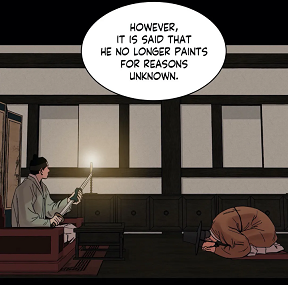 (Chapter 1) The latter only appeared in episode 7, and back then Yoon Seungho had to dress himself.
  (Chapter 7) Finally, I am expecting schemes again.
 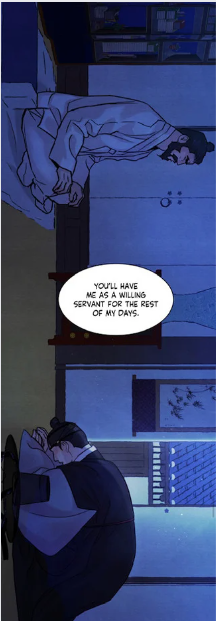 (chapter 127) This means that he is giving up on his status and freedom for Baek Na-Kyum’s sake.
 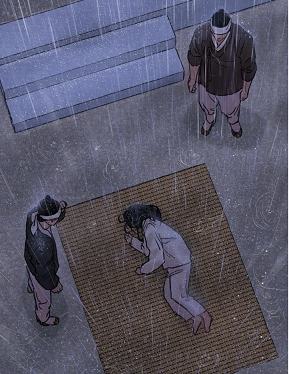 (chapter 127) Here Yoon Seungho had been treated like a servant, because he had been submitted to the straw mat beating. Exactly like in the past, there was a promise. Notice how similar the words are: “No matter”.
  (chapter 77) However, there exists a huge difference. Back then, the vow was made between the butler Kim and Yoon Chang-Hyeon. As you can see, Yoon Seungho is now copying his surrogate father’s behavior.
  (chapter 127) This shows that the young master is following Kim’s path. On the other hand, the domestic employed the future tense in his pledge (“I will do as he commands”), whereas the “spiritual son” is using the present (“I swear to live as you command”). Moreover, the main lead is talking about his way of life and not “order”. And what does the father desire?
  (Chapter 86) Making connections so that the Yoons can become influential again!! But how can he do that? By showing his talent? I have my doubts about it. Why? It is because in season 1, the lord was having sex with his peers, and back then they were like battles… for an exchange of favors. I hope, I might be wrong, but I fear that he is about to become a male kisaeng again. Or if not, then this is what the king is expecting from him. And we have the best example in this scene:
  (chapter 118) Why does he need the protagonist? It is because he needs “connections”. And how can he get these connections? Through his brother. But with the last incident, it looks like Yoon Seungwon jeopardized the remains of his influence, for the noble ignored him.
  (chapter 127)
 (Chapter 56) Yet, the domestic is only bowing with his head and not his body. The protagonist is dressed exactly like his father. This comparison exposes that my past interpretation was correct: the butler had awakened his master during the night by lighting the candles. And after receiving this letter, Yoon Seungho dressed himself in order to meet his childhood friend, which reinforces my theory that the valet won’t follow the protagonist.
  (chapter 86) However, back then, he was considered as the eldest son. One of his duties was to continue the lineage
  (chapter 82) and because of the stolen kiss, the patriarch became obsessed with sexuality. Observe how lord Song Haseon described the father’s attitude. He knew about the atrocities that the young master was exposed to
 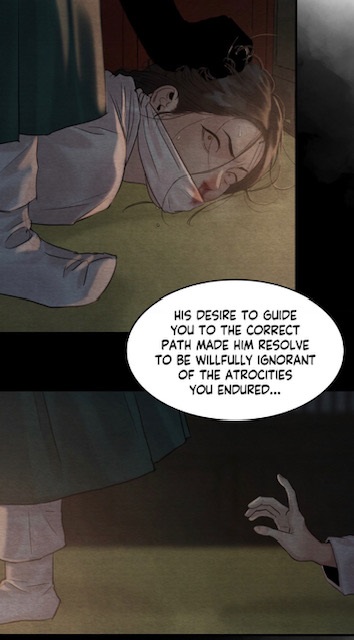 (chapter 123), but he chose to turn a blind eye, for he believed that the end justifies the means. This explicates why he left the room so quickly and abandoned his son. Yoon Chang-Hyeon’s resent for the eldest son came from his high expectations. This can only reinforce my past interpretation that Yoon Seungho is a new version of Prince Sado. Thus the elder master Yoon’s personality is based on king Yeongjo. Moreover, lord Song alluded to the execution of a prince ordered by the monarch.
  (chapter 107)
  (chapter 55) But what did he see in his father’s gaze? Anger and disappointment, for he was never able to satisfy Yoon Chang-Hyeon’s expectations.
  (chapter 55) With the release of episode 127, I had this sudden revelation concerning this memory. In the past, I used to think that he had been submitted to the straw mat beating. But now, I think that in this scene, Yoon Seungho was forced to bow to his father by the servants or guards!! Yes, the former version of this scene.
  (chapter 126) This idea came to my mind, the moment Yoon Seungho emphasized his bowing!
 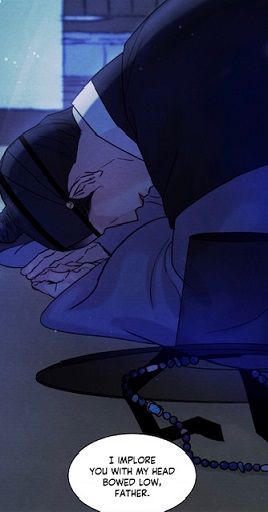 (chapter 127) The protagonist’s words imply that he had never done it before!! And now, you know why Yoon Chang-Hyeon agreed to make a deal with his eldest son.
 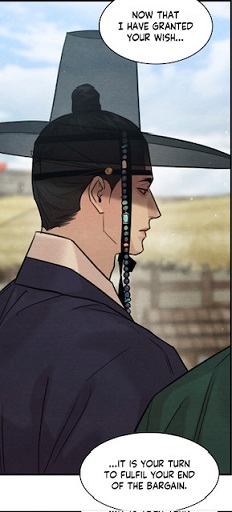 (chapter 127) Yoon Seungho’s bow and oath stand for blind obedience and loyalty. This explicates why the author drew him without eyes.
  (chapter 87) That way, he can act, as if the purge and the humiliation had never happened. So by submitting himself to his father’s will, it looks like Yoon Seungho is put in the same position than in the past. He is “exposed” to the harsh judgement from the patriarch. However, it is just an illusion. How so? First, what caught my attention is the absence of the protagonist’s eye.
 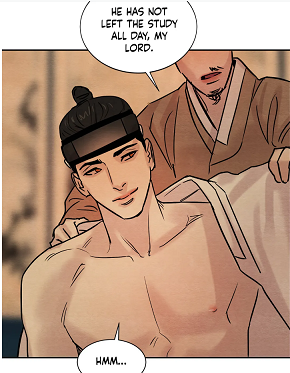 (chapter 11)
  (chapter 35) Does it signify that the protagonist has the intention of betraying his own father? I don’t think so, but the manhwaphiles shouldn’t forget the lord’s wish in the kitchen: “I shall remember this moment for as long as I live”.
  (chapter 118) This shows that when the lord bowed to his father, he was thinking of Baek Na-Kyum in the kitchen. His body might be by his father, but his mind and heart were elsewhere. Thus I couldn’t help myself thinking that Yoon Chang-Hyeon will get betrayed and abandoned by his own son. During the same night, he made 2 vows. It was, as though he had two “lords”! His goal is to meet his loved one again.
  (Chapter 127) Finally, don’t forget that the main lead is following Kim’s path. He will have to choose between his father and the painter. Yoon Seungho is actually applying the father’s principle: the end justifies the means. So if necessary, he can break his vow to his father.
  (chapter 116) I still believe that the painter has the original petition. And who is by Baek Na-Kyum’s side? Kim!!
  (Chapter 108) By living by his side, he can lead a quiet life far away from Hanyang. However, this signifies that the artist has become a “prisoner”. As long as he lives in Yoon Chang-Hyeon’s claws, his loved one can not return to his side. Interesting is that a carriage was used to carry away the protagonist.
  (Chapter 78) But where is the painter going? To the mansion? Or to another secluded place? In my eyes, the location is important. His existence is still a source of problems for the schemers. I see a future conflict in the lord’s life, for one oath stands in opposition to the other. Moreover, should the patriarch lose Baek Na-Kyum, he can no longer control his son. He can not suddenly blame the painter for the death of lord Song, for Jung In-Hun has been now convicted for the crime.
  (Chapter 7) Now, the positions are switched. He is the one getting coerced! And this brings me to the following observation. Why did the elder master agree to this deal in the end? First, he refused to assist his son.
 (chapter 127) He believes that he has the petition, therefore he can no longer be blackmailed by his eldest son. The latter has no longer any leverage over him! However, he changed his mind.
  (chapter 127) For me, it is related to the bow. I noticed that the patriarch pays a lot of attention to “manners” and etiquette. Therefore the guards apologized on different occasions, yet the elder master always accepted their excuses
  (chapter 125)
  (chapter 126) Yet, in reality they were fake excuses. I have already pointed out that the servants would act on their own. But more importantly, their fake apology hid their failure as guards. How could they let the young master barge into the lord’s bedchamber? With a simple apology, this wrongdoing was overlooked. And now, observe what happened during the same night:
  (chapter 127) Yoon Seungho was followed by the guards! It looked like they were serving him. This scene reminded me of the officers’ appearance in front of the mansion.
  (chapter 94) This can only reinforce my theory that the main lead will turn against his father in the end. Keep in mind that there is a deal, so should the situation change (the painter’s desertion or the discovery of the second petition for example), the lord is no longer forced to keep his vow towards his father. Moreover, since Baek Na-Kyum got lied, “brainwashed”
 (chapter 125), “drugged” and slapped by Yoon Chang-Hyeon, he is destined to receive his karma through his son. And what was his dream?
  (chapter 125) and paid the governor
  (chapter 127), he could get into trouble for it was, as if he was admitting his responsibility.
  (chapter 87), whereas Yoon Seungho stands for change and hope.
 (chapter 127) Where was Heena noona, when her brother was in prison? This rumor can only create the illusion that the painter is still devoted to the learned sir. Yet, after the last incident, the painter came to regret to have trust the learned sir. Both characters are now healed from their traumas (abandonment issues) and they are in full possession of their mind. This makes them less weak to manipulations.


 (chapter 115)
  (chapter 103) This had been truly a manhunt! Because both people are wearing items belonging to the upper class, I come to the deduction that the perpetrators were elders, both officials.
 (chapter 82) and Father Lee wearing one. But I am excluding the patriarch Yoon, as the testimony from the masked guard represents the elder’s innocence.
  (chapter 107) Besides, he doesn’t have any high position and the form of his hat is a little different (3 peaks on the side)
  (chapter 88) Remember what I had written in the essay “The shadow behind the shrine”. This picture exposes betrayal, something lord Shin was not expecting at all. And what is the worst betrayal? The son backstabbed by his own father! And we would have two elders involved! Naturally, this signifies that they were working together during that night.
 (chapter 107) He was initially trying to repeat the same action from the past, but he failed. Therefore he targeted Yoon Seungho, and this time, the elder master gave in:
  (chapter 107) However, the cause for this assassination was blackmail.
  (chapter 107) It is because he needed a justification for the meddling in the Yoons’ affair. The document in question is the petition Yoon Seungwon stole from his father:
  (chapter 118) This explicates why the assassination failed, as Yoon Seungho was not the real owner of the paper.
  (chapter 116) In other words, both brothers were protecting each other in a certain sense. But by entrusting the petition to Baek Na-Kyum, Yoon Seungwon turned the painter into a target!
  (chapter 88) In the bedchamber next to Baek Na-Kyum, Yoon Seungho was recalling a memory, but he couldn’t just identify the face, for his memory had been long repressed. The latter had refused to listen to him exactly like with lord Shin in the woods:
  (chapter 88), I come to the conclusion that this shadow was Kim’s.
  (chapter 107) Why? There exist 2 possibilities. Either he lived in exile or he was living in Hanyang and working as an official. I am more tending more towards the second possibility. Why? It is because he spent a lot of money for that night in episode 107:
  (chapter 107) Hence the kisaengs were asked to welcome the important guest at the gate. He was definitely a rich influential nobleman.
  (chapter 102) Why was he so sure? It is because his father had a high position. He was definitely relying on his father’s influence! And now, observe the evolution of the story. Black Heart is now framed for everything, he has become the scapegoat!
  (chapter 113) This explicates why Min was accused of lord Shin’s murder.
  (Chapter 107) The purpose was to hide the intervention of a third party! Note that Yoon Seungho suspected his father immediately after visiting the burned shrine. He is not envisioning the involvement of other elders. Anyway, the blame on Black Heart signifies that the reputation of Min’s family has been tarnished, unless this gossip was created for the learned sir’s ears. If this gossip is circulating around, not only Min’s father lost his heir, but also he failed in his duty to keep the lineage
 (chapter 83), for the latter had been seen wearing a purple hanbok with a design. However, the hair color, the shape of the beard and the design of the hanbok indicate that we are dealing with different people.
 (chapter 118) They needed him to betray Yoon Seungho.
  (chapter 83) How did Lee Jihwa know his name?
  (chapter 83) And observe what the learned sir said after burning the letter:
  (chapter 115) Min has also been investigating Yoon Seungho’s past in order to find his weaknesses. However, he couldn’t find the person lord Song! As you can see, this name oozes mystery and danger. And this reinforces my theory that people have been impersonating “lord Song” and the latter’s name has become a taboo! And that would fit to No-Name’s situation.
  (chapter 76) He doesn’t possess a name, and as such he has no identity. Moreover, he is wearing a mask indicating that he is playing different roles. Moreover, he often vanishes. He is like a ghost! Exactly like lord Song… Yoon Seungho only knows his name, but he has not been able to identify his face!
  (chapter 86)
  (chapter 103) Another important detail was the absence of footprints in the snow. The imprint would have revealed the identity of the perpetrators: the boots, the evidence of the involvement of officials. To conclude, the elders are responsible for the young lords’ death: Min, lord Jang, lord Park and lord Shin! By tricking Yoon Seungho and Min, the result was that they were forced to dirty their own hands.
 (chapter 106) strolling through town, they jumped to the conclusion that this must be lord Song! They remembered the recollection from Lee Jihwa.
  (chapter 106) impersonating „lord Song“
  (chapter 94)
  (chapter 97)
  (chapter 37) The empty street was the indication that the monarch was present in the city. And now pay attention to the situation in episode 105:
  (chapter 105) Why is the street empty, when it was not the case during the night in episode 69?
  (chapter 69) For me, the pedophile was in the kisaeng house. But let’s return our attention to episode 37.
  (chapter 106) To sum up, for me, the 4th “lord Song” was present in this scene, but the protagonist couldn’t detect his presence, for the other “shadows” were there to divert his attention.
 (Chapter 106) As you can see, they used a prank to wound the artist. Their goal was to incite the painter to return to the kisaeng house. He should cut ties with the main lead, as the latter is a man with a fickle nature. Yes, episode 106 was the negative version of chapter 75.
 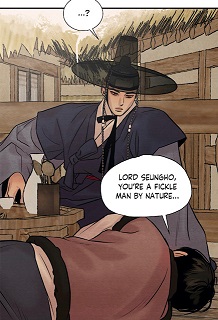 (chapter 75) That’s the reason why the couple was sent to the same inn. However, I don’t think that they had expected the painter’s fainting.
 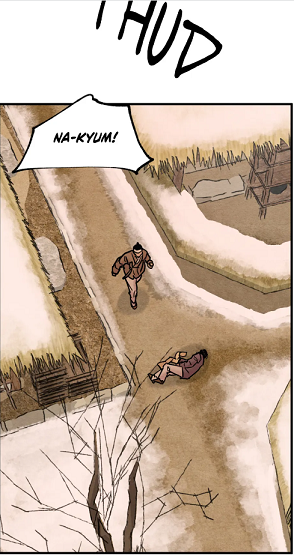 (chapter 106) For me, this is a blessing in disguise.
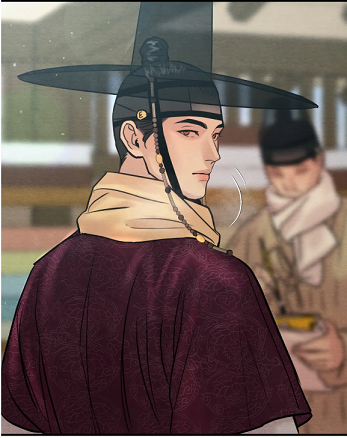 (Chapter 106) The latter had to be informed not to send the new clothes to the kisaeng house, but to his own mansion. That’s the reason why Baek Na-Kyum asked this question to the butler.
  (chapter 106) That’s how the schemer and his accomplices knew for sure that their original plan had not worked out. And if you read my previous analyses, you are aware that I had discovered the existence of two tailors!!
  (chapter 45) and 74
 (chapter 74) This tailor is wearing the scarf the same way than the artist‘s. Finally, in episode 64, the manhwalovers could see the face of the second tailor. :
  (chapter 64) In the past, I had already outlined the divergences in the body shape and the clothes, but the most visible evidence is the scarf!! Finally, I would like my avid readers to detect that the tailor from chapter 64 has been calling the main lead master Yoon, and not lord Yoon Seungho. This shows that this man is involved not only in the recent prank, but also in the main lead‘s suffering. He is not recognizing Yoon Seungho as a real lord. The usage of different hanboks is the proof that the tailor is an accomplice in the latest trick. But this also explicates why the tricksters had not planned the artist’s fainting. First, he had been able to run after his lover.
  (chapter 105) Besides, this is how Baek Na-Kyum acted, when he saw his lord looking at him:
  (chapter 106) The fake smile from Baek Na-Kyum was hiding his true condition, he was still suffering from PTSD. Nonetheless, for the tailor and the other witnesses, it looked like the artist was strong. Nonetheless, since the main lead had learned in the past to fake his smile, he could detect that his lover was far from feeling well.
  (chapter 106) But there is another reason why they had not predicted such an outcome: the doctor!! They had to ensure that the lord’s path never crosses the physician’s! That’s the reason why the manhwaphiles never saw him in episode 106. He was like a ghost. But there is more to it.
  (chapter 106) Yet, in the Spanish version, the butler informs them that it’s soon their turn. This means that they are next to the medicine store. But let’s return to our main observation. Why was the couple pushed to „eat“? For the painter had wounded his hand, the first priority would have been to ask for an immediate treatment. Since the valet mentioned that it was about time to go to the medicine story, the manhwalovers should wonder why it was time. Thanks to the Spanish version, we know that according to the valet, the doctor had been treating other people before indicating that lord Yoon could not receive special treatment.
 (chapter 57) Yes in the kitchen of the physician! Then in a different image, you can the kitchen with the stool and the circle with the shamanism drawing right behind the lord’s back.
  (chapter 106) We assumed that the couple was eating in an inn, but it is true? Finally, in the shelves, the manhwalovers can see small packages hanging around,
  (chapter 106), they look exactly like the medicine Kim fetched in episode 55.
  (chapter 55) Because of these parallels, I started wondering if the couple and the readers had not been fooled in the end. They were actually sitting in the medicine store, but due to the butler’s words and episode 75, the manhwalovers had the impression that the couple was in an inn. And the Spanish version seems to confirm my suspicion. I had already outlined that the furniture and shelves in the library had been switched. So it could be the same with the doctor’s office. Besides, the form of the building reminded me a lot of the house from the physician’s.
  (chapter 106)
  (chapter 74) Once you remove the cupboard from the side, you have a patio where you can eat. Under this new light, it explains why Yoon Seungho would say this to the butler:
  (chapter 106) It is because they were already there! And this would explain why the painter went to the restroom!
  (chapter 106) This coincides to the night of the abduction executed by No-Name!
  (chapter 59) To conclude, there was another ghost in episode 106, the invisible doctor. No matter what, the couple was not supposed to see the physician. Why? It is because he would have noticed the existence of two different doctors. That’s the reason why Kim acted as a mediator!
  (chapter 106) This was not to help his master and the painter at all. Quite the opposite. He had to cover up his own wrongdoings and help the schemer. Therefore it is not surprising that the valet was confronted with the artist’s fainting!
  (chapter 106) The latter had played a mean prank on Baek Na-Kyum!! Yes, you are reading it correctly. Now, you are wondering when the valet fooled the pure painter. Observe that Kim had joined his master
  (chapter 106) He had barely moved… maybe run for 4 meters! How could he be out of breath? Besides, why would he scream like that, when the lord was standing next to him?
  (chapter 106) It is because he needed Baek Na-Kyum to hear his lover’s departure!! Because we see this panel, we assume that the valet was left in the dark, especially after witnessing such a scene.
  (chapter 106) Our brain is trying to fill the blanks. But the moment you realize that Kim didn’t run such a long distance to be out of breath, you will realize that this “abandonment” was staged. This was the reflection of chapter 85, another fake run!
  (chapter 85)
  (chapter 86) Thus the butler got punished for his acting. He has now to take care of an unconscious painter.
  (chapter 106) Besides, I have another evidence that the painter got fooled by the valet. According to my observation, there is always a reflection within the same episode. Since the lord got fooled and was incited to follow the man with the purple hanbok, the artist had to experience the same. However, while the one got scared out of abandonment issues, the other got worried because of “lord Song”‘s obsession! Besides, because neither the butler nor the physician got punished for their crimes (passivity, silence, lies and disobedience), both need to receive their “punishment”. Let’s not forget what Yoon Seungho had said to the artist back then:
  (chapter 58) Kim had usurped his authority, he had made a decision without his master’s permission.
  (chapter 24) The gate serves as the indication.
  (chapter 24) And in that episode, the artist got dragged twice.
  (chapter 24) First, it was the scholar, then the butler. However, in that scene, the butler had lied to the artist, for the noble had never requested to meet the artist in the pavilion. From my point of view, he was still hunting in the woods. As you can see, episode 24 contained all the elements of an abduction, though it was not perceptible. That’s the reason why I am suspecting that Yoon Seungho might think that his lover has been kidnapped again, especially after hearing such horrible gossips. Nonetheless, since the painter fainted, the valet will be forced to take care of Baek Na-Kyum. In addition, observe that the butler brought back the unconscious painter to the mansion, though the doctor was right next to them! This shows that Kim and the physician had not the artist‘s best interests in heart. He should have been treated right away.
  (Chapter 76) Coincidence versus trick! They wished to scare Yoon Seungho, to let him think that „lord Song“ knew about his crime and was about to denunciate him. Yes, in my eyes, the man with the purple hanbok embodies treason and was the reason why Yoon Seungho got arrested and tortured in the past!! Under this new light, it becomes comprehensible why the lord would get so mad at his childhood friend.
  (Chapter 59) But the moment Yoon Seungho’s mother killed herself, it became clear that her son had been unfairly arrested and tormented. So someone had to take the fall for the injustice, the real lord Song.
  the (chapter 82) Nonetheless, there is no ambiguity that in reality the one behind the denunciation was father Lee. But the purple hanbok is connected not only to the arrest and torture, but also to the sexual abuse. Thus the painter had such a memory in the gibang:
  (chapter 1) The latter is the witness of Yoon Seungho’s sexual abuse. And what did the women say in the street?
  (chapter 102), Lee Jihwa was behind the scheme… and what had Lee Jihwa done in the past? He had sent a letter in his name.
  (chapter 59) Back then, Yoon Seungho assumed that his childhood friend knew nothing… but now, he is seeing the ghost lord Song circulating in town. So he could jump to the conclusion that the Lees have been helping lord Song. Finally, the manhwaworms will certainly recall the red-haired master’s confession, he knew everything!!.
  (chapter 57)
 (chapter 106) And this scene is a reflection of episode 64, where the two women were ignorant about the incident of the previous night.
  (chapter 64) Once again, this proves that the tailor is involved in the scheme.
  (chapter 106) The Spring Poem is actually reflected in this scenery:
  (chapter 92) Yet this doesn’t end here. Episode 92
  (chapter 92) is the positive reflection of episode 106:
  (chapter 106), she contradicted her statement right after.
 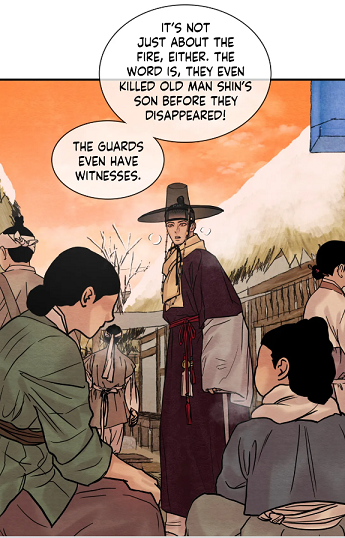 (chapter 106) If nobles were involved in this, why did they kill the son of lord Shin? Besides, let’s not forget that Yoon Seungho never ordered the fire in the shrine and he never killed lord Shin! This means that he is innocent. That’s the reason why I come to the conclusion that contrary to their expectation, the lord won’t decide to leave the painter behind because of the imminent misfortune! From my point of view, Yoon Seungho could ask his lover to paint a lucky charm on their house, the tiger!
  (chapter 105) That way, the artist would feel that his master needs his help and talent. Moreover, I have the feeling that the main lead will go to the authorities and ask for their assistance.
  (chapter 103) As you can see, the schemers are no longer able to control Yoon Seungho and his lover, for both are supported by the gods. Chance stands on their side!
  (chapter 100)
  (chapter 104) Though there is a manhunt, where is he?
  (chapter 106)
  (chapter 98) To conclude, while the schemers thought that due to his crime, Yoon Seungho would lie low and cut ties with his lover, due to their meddling, they achieved the opposite. The lord will request an investigation… something he has never done before. He could even denunciate Lee Jihwa
  (chapter 67), that way he can escape punishment. This means that Black Heart’s last confession (and lie) could help the lord to protect himself and his lover. Finally, if Yoon Seungho were to mention the purple hanbok to his lover, the latter’s memory could get triggered and he could remember this night:
 (chapter 105) „Thank god, he didn’t see nor hear a thing about that awful matter“. This is what Heena said in the original version. [Here I would like to thank my follower @katamins again for her help]
  (chapter 105) He desired to spare his heart. To conclude, “that awful matter” is referring to the whole prank and its consequences.
 (Chapter 97) At the same time, the idiom includes the staff‘s tricks as well: the corpse in front of the gate and the maids‘ badmouthing
  (chapter 98), because it happened during the day and at downfall. Due to this expression, the readers can detect the presence of Yoon Seungho’s white lie. The painter had clearly mentioned what he had heard before.
 (Chapter 104) However, he had been silenced by his lover, when the latter suggested to him to view everything as a nightmare. The lord made the mistake not to listen to the victim and witness.
  (chapter 105) With such a contrast, the manhwalovers can detect the link between ignorance and absence of memories. To conclude, in both versions, the main lead is “lying” out of ignorance. This is the positive version of “ignorance is a blessing”. Hence the noona thinks herself safe.
 (Chapter 99) It was clear that her brother would meet the noble, as their meeting didn’t surprise her. She was more upset that Baek Na-Kyum was unconscious.
  (chapter 99) However, her question „What’s wrong with Na-Kyum?“ divulges her hypocrisy and acting. How could she not realize that her sibling had been beaten?
  (Chapter 99) His head was bleeding, and the black guards were carrying sticks. It was clear that his state was not caused by an illness. To conclude, the calling “lord Jihwa” is the proof of her complicity, though in front of Yoon Seungho it serves as an excuse to portray herself as a victim.
  (chapter 105) Thus I deduce that Heena thinks, the painter could not witness her acting in front of the scholar’s house, for his head was turned around and he was not moving. She feels secure concerning that night, while I am expecting the opposite. Nonetheless, her past behavior in the kisaeng house represents a source of danger for her. That’s the reason why she has to hide the “attempted murder” from her brother. The moment Heena mentions that she has been hurt, the painter won’t believe her. Why? It is because in the kisaeng house, he has not forgotten her words:
  (chapter 97) She had helped Min, and she can not claim ignorance. As you can see, Yoon Seungho was encouraged to hide the “attempted murder” from Baek Na-Kyum for selfish reasons. Therefore it is no coincidence that when the lord visited Heena, he made sure that his lover wouldn‘t see Heena in bed.
  (chapter 105) She has now the perfect excuse to avoid nobles. She has been hurt, hence she can not work. The lord never questioned her attitude, for he wished himself that the painter would take a rest and remain in bed.
  (Chapter 104) This explicates why later the lord was hugging his lover under the cover.
  (Chapter 104) Hence I conclude that Heena must have thought the same way about Yoon Seungho. „Thank god, he didn’t see or hear a thing about that awful matter“. He has no idea about her altercations with her brother in the kisaeng house. It is important, because our beloved seme has the impression that the noona has her brother’s best interests at heart, but actually he is wrong. In my opinion, the relationship between Heena and his lover serves as a mirror to his relationship with Yoon Seungwon. So far, the young noble doesn’t suspect his brother to have betrayed him. Note that he blames his father more than his younger sibling.
  (chapter 105) Yet, this incident was presented as Yoon Seungho’s memory. This panel could be used as an evidence that my theory, Heena was present next to the shaman’s shrine during the bloodbath, was wrong. Nonetheless, this image didn’t make me change my mind. Why? I paid attention to details and judged this rescue as “fake” again. The servants had a drop of sweat on their face, the symbol for deception. Secondly, the kisaeng was wet, while the staff’s clothes weren’t damp. How did they save her then? Besides, where are the foot prints? Moreover, where was the head cover?
  (chapter 99) Finally, her hands and feet were not tied. So where did the items go? Since we saw her “execution”, we are the witnesses, and as such we know the truth about that “awful matter”, but it is not the case for the lord. This image contains so many errors, hence it can not reflect reality.
  (chapter 103) Hence he could have never been outside the mansion. That’s how I realized that the author was presenting us a false memory. This means that the manhwalovers are facing an implanted memory. But how could this happen? First, false memory is quite normal and is often of no consequence. But a false memory relayed during criminal testimony might lead to the conviction of an innocent person. As the manhwalovers can detect, it represents a serious problem.
  (chapter 58), it makes him particularly vulnerable to false memories.
  (chapter 104), the lord and even the readers imagined to see medicine in the white bowl!
  (chapter 105) Besides, the author had always connected the drug with the tray.
  (chapter 23) As you can see, the readers interpreted this scene due to associations. Nonetheless, like mentioned in the previous analysis, the different color and the traces on the edge were the evidences that it was ink.
  (chapter 36) Besides, Heena was in bed indicating that she was still weak. The circumstances led people to have a different perception of “verity”!! Only through the mind’s eye, the manhwalovers can detect that this scene was staged.
  (chapter 103) The protagonist projected his own thoughts and emotions onto one servant: shock!
  (chapter 61) This was interference by excellence. Besides, emotions can affect your memories. Since the lord was so under shock after witnessing the painter’s unconsciousness, it is not surprising that he imagined to have witnessed this scene. At the same time, when he left the shrine in trance, he could have overlooked the presence of a third person… similar to Lee Jihwa next to the shed. That’s how he doesn’t recall anything from that night except his crime. He didn’t see and hear the person by his side. Where is the sword? Where did he get the hanbok from?
 (chapter 102) Therefore it is not astonishing that he imagined a similar scenery.
  (chapter 1) This shows that the artist had only heard his name without seeing his face before. This explicates why the main lead’s gaze and facial expressions were similar
  (chapter 1)
  (chapter 1)
  (chapter 103)
  (chapter 104) My avid readers can certainly recall the rule I had detected: each chapter will be reflected in the next!
  (chapter 94) Furthermore, the painter is associating the learned sir to the moon and as such the night.
  (chapter 94) Thus I am now suspecting that this image
  is a false memory. But I have another reason to think that the painter’s idolization was more the result of “brainwashing” and as such “false memories”.
  (chapter 105) How can she date this incident so precisely? The moment I read her testimony, I discovered that in episode 94 the author had never shown us the painter crying!
  (chapter 94)
  (chapter 94)
  (chapter 94) It was, as if the noonas had never been informed about the painter’s suffering and tears. This shows that Heena has been hiding many things from her colleagues. But there is more to it! The manhwaphiles saw the artist’s tears in his childhood.
  (chapter 68) But here he was much older!! Under this new perspective, I realized that the following image could have been a false memory:
  (chapter 68) Heena was misremembering that night, and she was misattributing the painter’s tears. In other words, she was confusing two incidents.
 (chapter 105) It is the same facial expression, though the redness around the eyes is more pronounced. This observation confirms that the noona’s memories in the kisaeng
 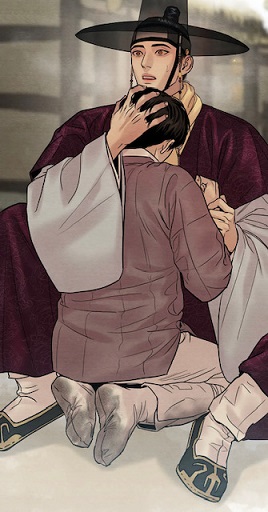 (chapter 105) He had run after his lover in socks. While in “Baek Na-Kyum’s foot”, I thought that this memory was true, I come now to a different signification. It was a false memory in order to hide a crime related to Heena. I would like to outline that in the kisaeng’s comment, we have the notion of “shame” and as such “guilt”. First, I thought of rape, but then it could be much simpler. The painter could have witnessed his noona having sex with the learned sir. But because he was too young, he misjudged the situation… as a virgin, she had to bleed. Because he saw blood, he imagined that the learned sir had hurt Heena. This would explain why the artist was afterwards anxious around the teacher. One might think that this is not terrible. But let’s not forget that as a kisaeng, she can not have sex like that.
 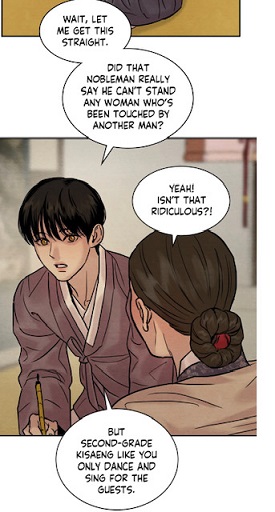 (chapter 105)
  (chapter 96) A similar situation had happened in the past.But because of her brother’s reaction, his huge tears, she got scared.
 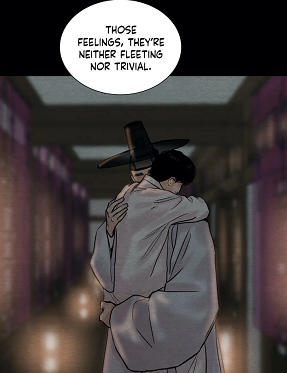 (chapter 68) Through suggestions, she had been able to convince her brother that the learned sir was a nice person. This explicates why the caresses and hugs were used to silence the artist. By repeating to her brother, he liked Jung In-Hun, he came to develop such feelings. The kisaeng’s statement implies that the admiration for the teacher was not constant.
  (chapter 46) A change of heart versus “eternity”. This shows that the painter’s decision to go to the learned sir’s house was never his choice. He had simply followed Heena’s suggestion. She was definitely distorting his past. Furthermore I detected a strong connection between love and memory.
  (chapter 94) If it is a loved one, then it can only be a good memory. Therefore it is not surprising that by saying constantly saying that the painter likes the scholar, he is repressing the bad memories with the scholar (the beating in episode 34, the betrayal in chapter 29, his words in the library and his reproach about his job). So far, he only mentioned one negative incident.
  (chapter 105) In the original version, this is what the artist thought:
  (chapter 76) So while the painter was following his lover, the latter turned around and hugged him. Afterwards, he asked him to go to his noonas, for he needed to talk to Heena. Moreover, contrary to Yoon Seungho, Baek Na-Kyum paid attention to time. He was not lost in thoughts or had lost the sense of time
 (chapter 105) But the latter acted, as if his hand was not wounded.
  (chapter 105) He ignored his physical pain and heartache.
 (chapter 105) This is important, because the stumbling symbolizes the intervention of the gods… We have the perfect example at the end of season 3. The lord fell on his knees in front of the scholar’s house, hence there is a hand print on the snow.
  (chapter 100) That’s how he refused to view Lee Jihwa as the murderer of his lover, Baek Na-Kyum”. YES, the falling is the real manifestation of CHANCE! How so? I would like the manhwaphiles to keep in mind that chance is the antonym of trick and scheme! The latter are connected to plan and organization. Thus I come to the conclusion that the noble will decide to go to the doctor’s office in order to treat his lover’s hand.
  (chapter 57) he was feverish so that he couldn’t pay attention to the physician. Besides, the man never remained by his side. Finally, in episode 74, the man never left the office!!
  (chapter 74) I conclude that Yoon Seungho never saw the physician for commoners! Besides, I doubt that he remembers him from his childhood. But this is not the same, when Baek Na-Kyum was ill. He met the other doctor twice.
  (chapter 33)
  (chapter 103) On the other hand, the artist assumes that the man in the office is Yoon Seungho’s doctor!! He heard his confession:
  (chapter 57) There exist two physicians in the city at least. That’s how a part of the truth will come to the surface! And who had fetched the doctor?
  (chapter 103) The staff… I would like to outline that in this panel, Kim was no longer seen next to the couple.
  (chapter 105) So where did he vanish? Probably to the mansion, for he had to warn the domestics that the artist would be returning! But if he left the couple behind, this means that he can’t witness what Yoon Seungho and Baek Na-Kyum will do next. And if they don’t go to the doctor, there is no ambiguity that the main lead will send for the doctor again. But according to me, the man disappeared.
  (chapter 103) To conclude, I am expecting that Yoon Seungho will make a huge discovery in the next episode… just like the painter did in the gibang.
  (chapter 105) Imagine that despite his rush, he was clear-minded enough to take the yellow scarf, a present that the noble had just bought him before. 😢 The item had more value than the mituri (shoes). Thus he was running in socks. His gesture displayed how much the lord means to the painter. He cherishes everything the lord does for him. At the same time, it indicates his heartache. He was so desperate and scared, for he felt that he was about to get abandoned one more time.
  (chapter 105) According to my follower @katamins, in the Korean version, this is what Baek Na-Kyum yells:
  (chapter 105) it works like a spell or a prayer. The artist is clinching onto this phrase hoping that the noble is remembering his promise. The irony is that the low-born was smiling like a fool,
  (chapter 83)
 (chapter 85) This means that Baek Na-Kyum was put in the same situation than his lover who wished to keep the artist by his side, but feared to open up to him out of self-hatred and guilt. The painter could get burdened or horrified by his revelations. Hence the painter’s reaction at the end mirrors the yangban’s in the study. Both were or are pleading the partner to stay by their side,.
  (chapter 85)
  (chapter 105) Nevertheless, their behavior diverges so much. The aristocrat couldn’t raise his voice or become violent by using his hand, because he could scare the artist and as such break his previous promise. Finally, by destroying the music box, he had already witnessed that he had pushed his lover further away.
  (chapter 85) At the same time, since he had been taught that no noble should lower himself in front of commoners, it is normal that he couldn’t beg Baek Na-Kyum on his knees. To sum up, the noble had to restrain himself extremely, his face and words were the only way to show his emotions and despair. And the artist sensed it, though the lord was not weeping. The proof is that when the father appeared, the artist changed his mind. He was no longer willing to leave, in fact he chose to look for his lover.
  (chapter 87) This shows that through communication, the lord had been able to affect the painter‘s mind and heart. On the other hand, we shouldn’t underestimate the lord’s flashback and Na-Kyum’s conversation with the butler which played a huge part in the artist‘s decision to vow loyalty to Yoon Seungho despite the secret.
 (chapter 105) Then I noticed that contrary to his lover, the artist asked the reasons for his decision.
  (chapter 105) Why did he change his mind? Is he responsible for this? As you can see, the painter came to voice his guilt and the remains of his deeply rooted self-hatred.
  (chapter 105) He must have committed a wrongdoing, he is responsible for the situation. He feels like a burden, for the lord had to take care of him each night.
  (chapter 104) They are no longer sharing the same bed, the lord is sitting by his side comforting him, when the young man has a nightmare. Under this new light, it becomes comprehensible that the artist was working in the backyard.
  (chapter 104) He wished to help, that way he wouldn’t be seen as a spoiled child. He has to justify his presence in the mansion. Who is he exactly that he is sleeping in the lord’s bed? I am suspecting that there is a rumor circulating within the propriety, a new version of this scene:
  (chapter 38) which I will explain more in details below. Thus the artist is making sure to cause no trouble to Yoon Seungho and the staff, especially the maids. Hence he folds the cover and clean the bedroom.
  (chapter 104) Then he washes clothes. He makes sure that he is no burden to anyone. Yet, my impression is that the staff is taking advantage of the artist’s goodness. That’s how they fuel his guilt and shame.
  (chapter 104) This intention was again verbalized in the gibang.
  (chapter 104) He was told not to question what he had heard… he should simply consider everything like a nightmare. However, this method is actually wrong.
  (chapter 07)
  (chapter 104) Not only he knows about the lord’s traumatic past, but it is the same for the painter. In addition, we have another explanation for Yoon Seungho’s insomnia and dissociative state.
  (chapter 57) Not only the latter was turned into the scapegoat for the downfall of the Yoons, but also he was not allowed to reveal the incident, the so-called treason. Why? It is because if he had spoken, the truth would have come to the surface. He was simply a victim. And now, the schemers and accomplices are repeating the same MO. Who suggested to Yoon Seungho to say this to his lover?
  (chapter 104) Naturally, Kim, because he is now the only one in the mansion who knows his past. Besides, why do you think that the lord’s past is coming to the surface as a nightmare? It is because he was incited to repress everything. But since the painter is going through the same experiences, this is not surprising that the noble’s memory is triggered and the past emerges again.
 (chapter 27) Put yourself in the young man’s shoes. You suddenly witness how the whole family is moving houses and leaving you behind! This must have been terrible for Yoon Seungho. One might argue that Kim stayed by his side, so he was not alone. But it is false for 2 reasons. The white bearded servant had been working in the mansion
 (chapter 27), when the other domestics left the propriety. This was his memory. Besides, like the servant confessed to Jung In-Hun, a huge part of the staff got replaced. This means that the lord was suddenly surrounded by people he didn’t know. Because my theory is that the young man was treated as a male kisaeng, this signifies that the new staff could never view the main lead as a noble. Besides, despite the betrayal, the elder master and Yoon Seungwon were his real family. Finally, Yoon Seungho had no saying in this, and I can imagine that the reason for this decision was not explained immediately. This must have been a huge blow for him as well. He must have felt lost and homeless. The result was that from that moment on, he became more dependent on the butler. And we have to question ourselves what the butler did with this huge responsibility, when the elder master moved to the second house.
 Since this phrase appears in connection with the staff (maids and servants) in the courtyard, I come to the conclusion that the authors of this gossip are in the domain. “Fellows” indicate that they are speaking among themselves. But I have two more clues proving that the traitors are the domestics. First, observe how they call the protagonist: Young Master Yoon.
  So far, people in town only calls the protagonist lord Yoon
 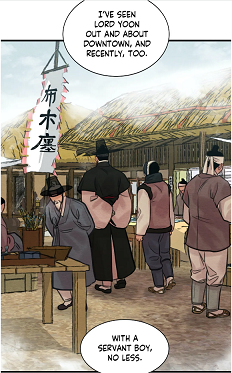 (chapter 45)
  (chapter 45) or lord Yoon Seungho
  (chapter 39) or my lord.
 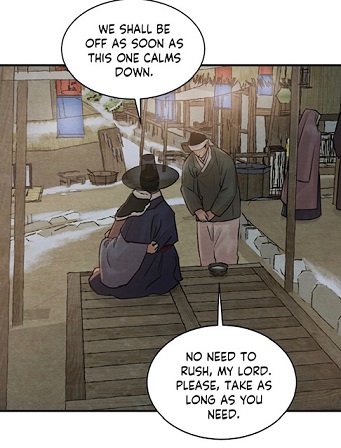 (chapter 76) Only the staff addresses him as “young master”.
 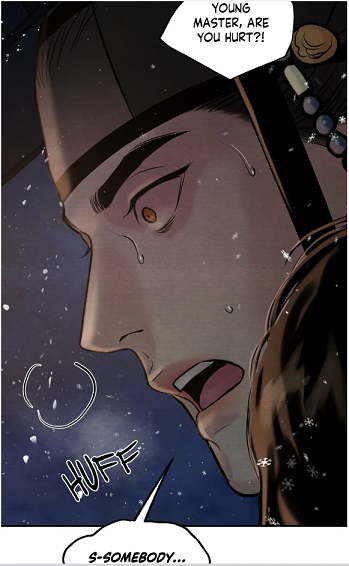 (chapter 103), and this since season 3. This coincides with the meddling of the Yoons. The servants treat him, as if he was not an adult, no real lord. But they are wrong, because he is wearing the topknot with the gat. Hence he is a lord. Finally, only people close to the couple could know about the painter’s tragedy.
 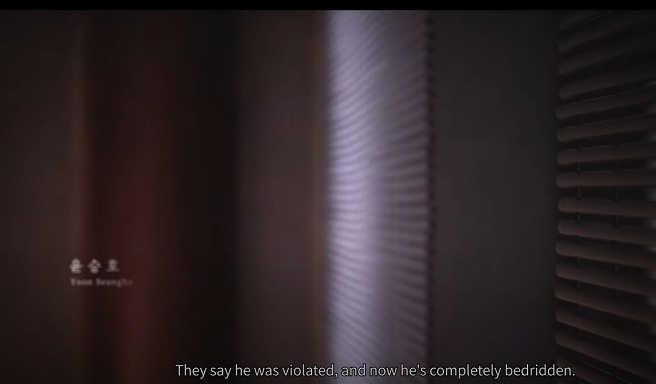 , because in the village and town, there exists another gossip:
 (chapter 104) Thus I conclude that the gossip from the trailer is spread among the staff on purpose. They wished Baek Na-Kyum to hear it so that he will feel responsible, especially after hearing this.
  He is responsible for the lord’s lunacy. Under this new perspective, it explains why the painter is leaving the bed and working. He wishes to prove the words wrong. On the other hand, I think that Yoon Seungho also heard a grapevine in the domain, but a different one:
  (trailer). “He has many enemies”. How did I come to this idea? It is because he is addressed as Yoon Seungho! By underlining the painter as his weakness, the author of this rumor wishes to separate the couple. If he were to place the painter elsewhere, not only the latter would no longer be targeted, but also the lord would have no longer any weakness. Since there is always a reflection within the same chapter, I conclude that a second grapevine was spread in episode 104. This happened, while the lord was away. Thus the painter smiled like a “fool”, when he saw the lord:
  (chapter 104) As you can imagine, for me the maids were the perpetrators, a new version of episode 79
 (here, the woman implied that the artist was responsible for Yoon Seungho’s insomnia, thus the painter has a drop of sweat on his face, a sign for shame) and chapter 98
  (chapter 103) Finally, the staff has every reason to get rid of the artist, for he is the witness of their wrongdoings. They definitely played a major role in the “prank”. They didn’t learn their lesson.
 (chapter 29) This time, the one smiling like a fool
  (chapter 29) was Jung In-Hun who acted, as if he knew nothing and had seen nothing.
  (chapter 29) However, I have already pointed out that he was present, when the rape took place, for he knew where Yoon Seungho would meet the artist: the pavilion. And what have all these episodes in common? The first thought would be to say: abandonment and betrayal. The painter in front of the gibang felt “betrayed” and abandoned, but what shocked the lord so much was when the artist started blaming himself:
  (chapter 105) “I had known, I would have never confessed” Nonetheless, he never finished his phrase, for in reality, he had no regret!! He was sure that he had made the right decision. It is because he had pondered a long time about this. He had observed his lover. That’s the reason why he mentioned their mutual love confession and as such their promise to stay together. And this brings me to the next observation. All these scenes have another common denominator: BAD DECISIONS!! The lord had made the wrong decision to entrust the painter to the kisaengs. Thus he came to regret this. He had made his lover cry, and even wounded him, though he desired to do the opposite. Therefore it is not surprising that he apologized to his lover.
  (chapter 105) This shows that the painter is showing him what true love and loyalty are. Moreover, he is teaching to make good decisions.
 (chapter 246), I realized why Yoon Seungho suffered so much. Self-made decision implies a conscious choice. It is made deliberately and thoughtfully, considers and includes all relevant factors, is consistent with the individual’s philosophy and values. As you can see, it implies knowledge. This definition exposes that making a choice for the sake of another person without his consent or knowledge can never be a good decision. One might argue about this, because children are too young to make decisions. In Doctor Frost, this man
  (Doctor Frost 246) decided to support a terror attack, and justified this by saying that this was for his daughter’s sake. But like the counterpart pointed out, he questioned his decision. Was it truly his choice, or was he simply following the leader’s suggestion? As you can see, the daughter was used as an excuse, it was never for her sake. This shows that children are the exception, besides they are often raised by two parents. Thus they are making deliberations together. But like the author revealed in Twitter, Yoon Seungho’s mother hated her husband so much that she neglected her eldest son. The patriarch made decisions on his own, but observe that it was always for the Yoons’ sake. This means that the father never took his son’s well-being into consideration, he never asked him about his opinion. He imposed his will, but he listened to others, like we could see in different occasions.
  (chapter 57) He fed his son with the drug prescribed by the physician, though the latter stated that he had no idea about the illness. Then he listened to father Lee’s complains and reproaches. He never questioned the intentions behind his actions and words.
  (chapter 82) Here, the red-haired bearded man was encouraging the elder master Yoon to return to the mansion and claim his rights. Finally, the young master admitted this to the messenger:
  (chapter 86)
  (chapter 104) But he simply employed reverse psychology.
  (Chapter 85) Yoon Seungho was coerced to open up. If he did not, he wouldn’t be forgiven. Naturally, the painter meant it well, yet the main lead was pressured to reveal his „bad action“. The main lead feared his negative judgement and rejection. We could say that the artist had made this request for the lord’s sake, however this was not a conscious and long deliberated decision. And now, you comprehend why the main leads suffered both so much!! Yoon Seungho’s mother neglected her eldest son, but she kept her distance from her husband. They never talked to each other, and as such never made decisions together. And it was the same for the painter. The kisaeng Heena was the one who made the decision without the noonas’ consent and her brother‘s opinion.
  (chapter 105) She is still viewing the painter’s decision as a bad choice. But she is simply wrong, for the painter listened to her advice and after deliberations, he chose to open his heart. His confession was not made in the heat of the moment.
  (chapter 62) The lord’s vision
  (chapter 62) became a reality
 (chapter 63) Because the painter has always been betrayed and abandoned himself too, such words could only move the artist. There was someone willing to be by his side and to give him a home. Therefore it is no coincidence that the artist brought up these words from that night.
  (chapter 105) This signifies that the noble will decide not to follow the noona’s advice:
  (chapter 105) But by learning about the learned sir’s past, the protagonist will realize that he only knew a side about Jung In-Hun.
  (chapter 105) with the noona’s statement, the painter looks happy with Yoon Seungho despite the tears, it looks like the noona is slowly coming to terms with her brother’s relationship. But I have to admit that I believe that her “decision” is just short-lived. First, in season 2, the noona had accepted to let her brother stay at the Yoons’
  (chapter 69) But then she had changed her mind after hearing the menace from the servant. However, I have three other reasons to expect a change of heart from the head-kisaeng. First, Heena is the younger reflection of the butler. The manhwaphiles shouldn’t forget that the valet had almost come to terms with the painter’s presence
 (chapter 65), but the ruckus caused by the kisaeng had provoked a change of heart in the valet. Then, the lord had made the following condition to the kisaeng:
  (chapter 105) The lord is keeping his lover by his side, as long as nothing happens to him. So if he gets into trouble… she could achieve her goal, the painter is returned to her. But the most important clue is for me the bowl!
  (chapter 36)
 (chapter 77) Besides, it never leaves traces on the edge.
  (chapter 36) The painter used white bowls while painting. On the other hand, the lord wrote a letter during that time. As you can see, in episode 36, we have the combination of painting, seduction (touching) and medicine… exactly like in episode 105. The artist tried to paint a lucky charm, a tiger, but he didn’t finish it. He got interrupted… which is very similar than in chapter 36. So the letter should represent another common denominator.
 (chapter 105) onto Yoon Seungho. Will she come to regret her action or not? One thing is sure, the painter accepted the sincere apology from his lover. How could he not forgive him after calling „Nakyumah“ and embracing him!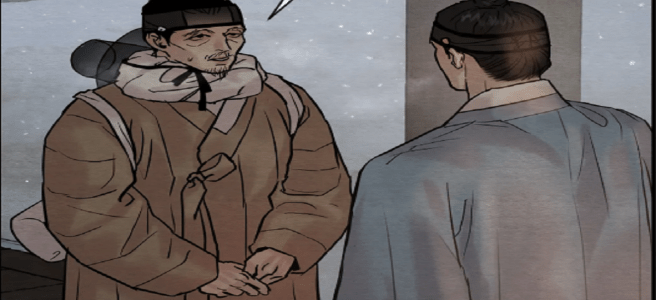
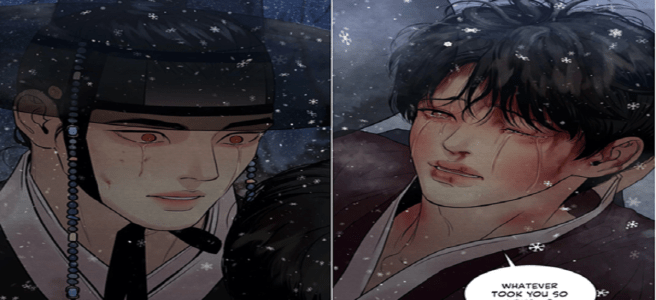
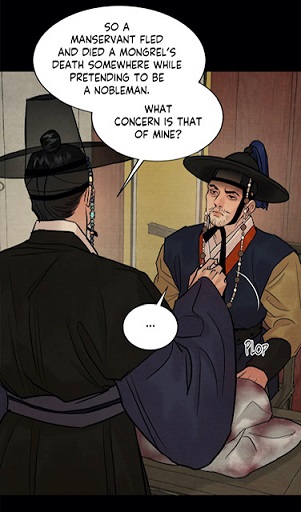 (chapter 98), although he was wearing clothes similar to the learned sir’s. What caught my attention is the expression Yoon Seungho employed: “pretending”. With such an idiom, he was implying that the servant had not only violated social norms, but also he had been acting. As you can sense, these two situations have one common denominator: playing a role and the clothes served as a disguise. It was, as if both victims of a murder had been playing in a theater play. This explicates why in the fanart, the author is portraying Baek Na-Kyum and Yoon Seungho as actors who are working in a sageuk.
  And this made me think of the famous poem from Shakespeare who describes life as a stage, where a person plays different roles all along his life: an infant, a school boy, a lover, a soldier, etc., until he dies, which is symbolized by an eternal sleep.
  (chapter 98) Why? From my point of view, they were trying to scare the main lead, to remind him that he could never replace Jung In-Hun in the painter’s heart, to shake his belief. But the problem is that the schemers had missed the right timing, for the artist had already confessed his love for Yoon Seungho and this twice. Therefore the latter couldn’t doubt his lover’s words, and mistake it for an illusion. As a conclusion, the clothes were used tools to trick the couple, they had become costumes!! However, because the author is using karma as poetic justice, this signifies that the hanboks and shirts can serve as a clue to perceive the truth too. The ones who tried to deceive the protagonists with clothes and words, should be fooled by their own manipulations.
  were different from the head-maid and her colleague?
 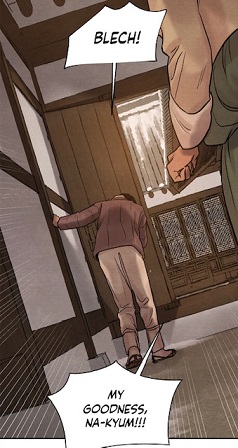 (chapter 98) What was the painter wearing on his way to the bedchamber? White pants with his Mountbatten pink jacket. But how did he show up at the learned sir’s home?
  (chapter 98) He was dressed differently. 😮 He had changed his pants, put on his scarf and hat. But when he went to the lord’s study, he was not carrying them!! How do we explain the difference? The answer is quite simple. He had returned to his room in order to fetch his clothes. And since Baek Na-Kyum took the lord’s clothes, this signifies that he had the intention to return to the domain. The readers will certainly recall the artist’s behavior, when he had threatened the main lead to leave Yoon Seungho. He had switched his clothes, and put on his old clothes.
  (chapter 98) Thus if the lord had gone to the study, he would had realized that the painter had not deserted the propriety, for he had not taken his belongings with him. The hat and scarf were signalizing that Baek Na-Kyum considered himself as a member of the Yoons‘ household.
 (rule 3) If only Yoon Seungho had left a word… The servants served as his messenger. Hence I am convinced that Baek Na-Kyum must have talked to the maids and told them where he was going!! He copied his lover, yet contrary to him, he must have given a precise information. (Rule 5) This means that he had informed the staff about his departure!! Moreover, in chapter 98, the maids acted, as if they had not detected the painter’s presence while badmouthing Yoon Seungho.
  (chapter 98) Hence they were portrayed without eyes and with a drop of sweat on their face, a sign for deception. So the negative reflection would be that Baek Na-Kyum had informed the maids, and he had gone to the kitchen for that reason. From my point of view, when he met them, he was already wearing his hat and scarf. To sum up, the artist had never left the maids in the dark. And the clothes are the evidence of the staff’s lie.
 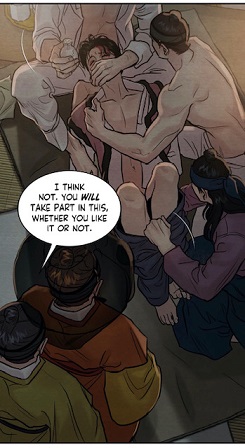 (chapter 100) And now observe that after Lee Jihwa’s departure, the artist’s clothes except the white shirt vanished too.
  (chapter 102) Where did they go? The readers saw Black Heart leaving the building, but we should question this: WHY? He never went there to fetch lord Shin, since he abandoned him outside. We all imagined that he left the room empty-handed. But it is true? Now, I don‘t think so. He had to get rid of the clothes in order to mislead the main lead!! A new version of chapter 61
  and
and (chapter 101) Because the readers could detect the presence of a shadow in episode 102
  , I am now envisioning that Min was not alone outside during that night. In fact, someone had misled Black Heart telling him that lord Jihwa had ran away. However, the unconscious lord Shin should have made him think that Lee Jihwa had fought back… Hence he had not fled, rather betrayed them. Moreover, he was not looking at the direction of the entrance and gate. In fact, he was turning his gaze in the direction to the shrine.
  (chapter 98) They were waiting for his return to fake their anger and search. And now, you comprehend why the servants mentioned the kisaeng in front of Yoon Seungho. It was to stop him from going to the study… to divert his attention. Under this new approach, the artist’s last words get a new meaning.
  (chapter 102) Since he had informed Yoon Seungho through the maids about his whereabouts, Baek Na-Kyum was expecting that he would come to his side. I would like the manhwalovers to keep in their mind that the artist was not conscious, when he moved to the shaman’s house. So in his mind, he was not far away from the learned sir’s house. Finally, since he had informed the maids, he could anticipate that the lord wouldn’t get mad at him, and wouldn‘t imagine that he had abandoned him
  (chapter 101) He trusted his lover’s heart in the end. That’s the reason why Black Heart’s superficial promise had no effect on Baek Na-Kyum. The latter truly believed that Yoon Seungho had been informed. But how could they play such a trick on the couple?
 This is an indication of their involvement, though we need to discern the head-maid from the women in chapter 98. That’s the reason why the moment the maid appears, observe her clothes and try to discern her identity. Is this the head-maid or one maid from season 3? The preview displayed the arrival of the doctor.
 (chapter 103)
  The form of the beard is also similar. But now, I have another evidence that this doctor from season 4 is not the physician from season 2!!!
 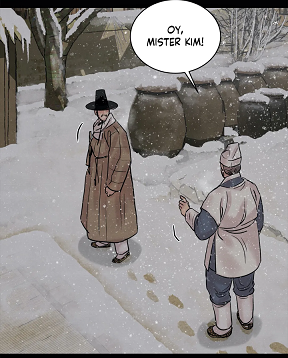 (chapter 63) The shoes are also different! That’s the reason why in the trailer, the beholders are seeing the physician’s shoes!!
  He doesn’t possess mituri like the other. Moreover, he is wearing a hanbok under his apron
  , while the other is dressed more like a commoner, a shirt with pants. And note that in chapter 33, we had the following combination: Min’s party, the visit of the doctor, Baek Na-Kyum’s illness, the maids and Yoon Seungho who “ran away” after his mistake. (rule 1 and 4)
  (chapter 33) And what had Kim done during his examination? He had not only threatened the physician
  (chapter 33), afterwards he had even badmouthed him, for he had not given the correct diagnosis.
  (chapter 33) However, here the butler had simply lied to hide his own wrongdoings: his passivity and silence. And note the doctor’s words addressed to the “beholder”:
  (chapter 57) The latter was introduced to Yoon Chang-Hyeon through the butler. The protagonist must have had a doctor in the past. Can you imagine a life without a doctor for 13 years? And this assumption was proven correct after the release. But let’s return our attention to the physician from season 4.
  (chapter 33) (rule 1-2-3) But why would he do such a thing? Simply, because he had been helping Min. He needed the protection of a powerful lord, since Kim had abused his position by threatening him. After seeing the new pictures from chapter 103, I had this sudden revelation. What did Min do after getting beaten by Yoon Seungho?
  (chapter 54) He certainly didn’t let his wounds untreated. Thus the next morning his face
  (chapter 56) looked much better. He had no swelling and the redness was already vanishing. From my point of view, he asked for the doctor’s assistance and that’s how the both came to an understanding. But since Min is now dead, the physician could get into trouble, for he helped the lord and now he is dead. But why am I so sure that the physician is about to run away? Look at all these images:
  (chapter 44)
  (chapter 44)
  (chapter 45)
  (chapter 100)
  They are all carrying the white bag on their back… and they are about to depart! Kim wished to leave the propriety with his master under the pretense that he was bringing misfortune to the painter. All this proves that the doctor is far from being innocent. Hence he wishes to run away. However, if he does this, this means that he exits the “play”. So he could die. Moreover, how did he know that the lord would return to the mansion with the wounded painter? I can not answer to this question with certainty. However, I would like to point out that since Min talked to someone in the shadow, it is very likely that this person had long planned Black Heart and his friend’s demise. Nonetheless, the schemers had not foreseen two three elements:
  (chapter 61) [For more read the essay “No matter what… Baek Na-Kyum must vanish”]
 (chapter 59) Lord Jang had disguised himself as Black Heart’s friend, the hanboks looked very similar.
  (chapter 99)
  (chapter 59) The schemers mistook him for the noble with the mole.
 (chapter 61), for the colors grey-white off are only seen at the Lee’s.
  (chapter 9)
  (chapter 18, Lee Jihwa’s spy)
  (chapter 41)
  (chapter 50)
  (chapter 100) And now compare these servants to the staff from chapter 97:
  (chapter 33) Yet, the painter survived, hence the doctor has every reason to run away. His complicity could come to light… on the other hand, the moment he leaves Yoon Seungho’s side, he is no longer protected. The reason is simple. He owns a part of the truth, and what the schemers are attempting to do is the exact opposite: burying the truth so that their act is not discovered. And now who participated in this huge “drama”? The list of the suspects is quite long… Father Lee
  (chapter 82), lord Yoon Chang-Hyeon
 (chapter 86), the other physician
  (chapter 74), “lord Song”
  (chapter 37) There is no doubt that a tailor was involved, for he had to create similar clothes, the costumes …
 of season 4 for this essay, though my focus is the past, and more precisely Yoon Seungho’s suffering. It is because the darkness surrounding the protagonist not only refers to his tragic youth, but also it reflects the situation of the manhwalovers. The latter are still in the dark concerning his torment. His terrible secrets have not been totally unveiled. So far, the author allowed the readers to see glimpses of his past, like f. ex. the gangrape or the suicide of his mother. But these were just small pieces of the puzzle, thus it is still impossible to have a complete picture of his martyrdom. There are many reasons for this. The main victim never testified about his suffering, he refused to open up to Baek Na-Kyum.
  (chapter 84) Then many witnesses vanished
 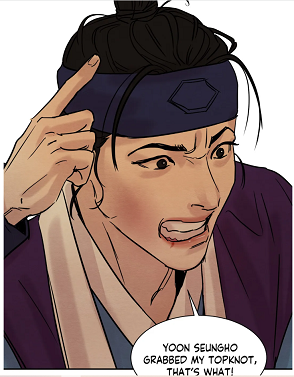 (chapter 9), so that the latter visited Lee Jihwa to arouse his jealousy. It was to push him to commit a crime so that Baek Na-Kyum would be removed from the main lead’s side. As you can see, there were 3 people involved, though the readers only saw the result.
  (chapter 12) They had the impression that the red-haired master had acted on his own. However, he had been manipulated, incited to commit a crime. But my point is not to diminish his wrongdoing, rather to expose the involvement of the schemers. Hence at the end of season 1, the author unveiled their true role and as such their identities.
  (chapter 43) However, observe that when Lee Jihwa went to the pavilion, the noble with the mole had other guests. 2 nobles left the place, as they refused to participate in a murder.
  (chapter 43) Funny is that they are now witnesses of Min’s crime. This can have repercussions in season 4. Black Heart had been the one who had suggested the assassination to Lee Jihwa. And the aristocrats were still there, when he had made this proposition.
  (chapter 19) And this is related to Kim and the gibang. Yet, the butler ruined Black Heart’s plan. To conclude, we have two main plotters in season 1, but the butler’s bad intentions were not detected, for Yoon Seungho’s bad actions were more eye-catching. People had the impression that the valet was defending the artist’s best interest. From my point of view, the number of persons involved in the plot kept increasing, as they needed more and more accomplices. The reason is that their plans didn’t work out like expected. At the end of season 3, Min involved the kisaengs in the gibang, while Kim asked the assistance of the staff, the maids
  (chapter 91) and the servants
  (chapter 8) Thus in season 2, he came to this resolution:
  (chapter 56) He had planned to rape him before having him eliminated. This shows his inner conflict. From my point of view, the painter’s death is connected to the incident in the gibang.
  (chapter 16) This doesn’t look like a crime. However, it is one! It was done on purpose, to separate the couple. Someone had intervened in order to interrupt this session, and as such someone had been spying on them. Deok-Jae only revealed his spying activity from chapter 16 in season 2:
  (chapter 53) Yet, the one opening the door had been Kim. This gesture can be considered as trespassing and invasion of privacy, the new version of this scene.
  (chapter 16) But instead of revealing the truth, the butler sided with Lee Jihwa, and allowed him to trespass the propriety again. In my eyes, the butler thought
  (chapter 17) that Yoon Seungho would come to perceive the painter as a man consumed by lust. He imagined that he would caught them fooling around. As you can see, this ruckus was also a plot, though it doesn’t look like one. Why would the maids gossip in the courtyard?
  (chapter 18) From my point of view, the valet expected that the lord would fear people’s gaze and a scandal. Thus he would send away the painter to protect his “reputation”, but the opposite happened. Under this perspective, the manhwalovers can grasp why it is difficult to calculate accurately the number of plots and accomplices. Besides, some were naïve pawns, others not. And since I examined the first season more closely, it is necessary to analyze the vanishing of Jung In-Hun. His disappearance is strongly intertwined with Yoon Seungho’s secret. How so? The learned sir was determined to find the lord’s vulnerability and as such secret.
  (chapter 88) Thus many readers jumped to the conclusion that the learned sir had already switched sides and was plotting against the main lead. They had his following words in their mind:
  (chapter 29) Thus many concluded that he had participated in the prank, faking his death. On the other hand, the manhwalovers believed to have seen Heena’s death!
  (chapter 37) Since Baek Na-Kyum was wearing a hanbok, Yoon Seung-Won thought that the person hidden under the hanbok was no commoner! Thus he called him a fellow. However, this motive is quite thin! Yet, two new details caught my attention. His visit to the “fake shaman” and his request. Notice what he told the man:
 (chapter 86) However, in reality, he was relying on the king’s help and intervention. And this confession to the “fake shaman” represents the learned sir’s karma. He had asked the painter to act like a spy
  (chapter 24), not realizing that he could be spied himself! He didn’t grasp that he exposed his weakness to the commoner: the civil service examination. Thus the man had constantly drops of sweat
 on his face and interrogated Jung In-Hun.
 (chapter 29) The girl was there to create a certain closeness. He was acting like Kim, asking why! But the stupid and arrogant learned sir thought that because the man was a commoner, he was ignorant and could be manipulated like the painter!
  (chapter 29) He thought that the low-born would buy his lie here… but in my eyes, it was the opposite. He had already perceived the learned sir’s true nature. But he acted, as if he was agreeing. In other words, the scholar fell into his own trap. He envisioned that the man was “powerless”, but he overlooked his connections. The manhwalovers can see the contradiction, for he had approached the man due to his connections! .As you can see, I am more than ever convinced that the scholar has long been murdered. He was betrayed, exactly like he had planned to abandon Yoon Seungho! The pedophile must have heard from the servant about Jung’s plan, as he had confided it to the worker!!
  (chapter 37) Yoon Chang-Hyeon was portrayed as a traitor! The “fake servant” implied with his statement that there was a conspiracy, and the patriarch was involved. But in exchange to save his own skin, he had tattled on the others! He was trying to insinuate that if Jung In-Hun interacted more with the Yoons, his reputation could get tainted. He could get suspected of “treason” too, or he could get betrayed too. While the man met the learned sir during the day, the brother went to the villa in a hurry during the night.
  (chapter 36) Hence he chose a different approach: filial duty. And the brother’s observation could only corroborate the pedophile’s perception. The scholar was Yoon Seungho’s lover, but he was also a backstabber. But let’s return our attention to the “mysterious lord Song”‘s statement: Yoon Chang-Hyeon is a denunciator, not a man of honor.
  (Chapter 67) Lee Jihwa had not only been denunciated, but he had been confronted by his friend! And the traitor was right by his side. As you can see, chapter 67 was a reflection from episode 37!! These two episodes have another common denominator: the betrayer had made the following suggestion.
  (chapter 67) In exchange for his “survival”, he should help Black Heart and allow him to act on his behalf. This was the new plan. That’s how he started impersonating Lee Jihwa. That’s the reason why I come to the conclusion that in the past, the impersonation must have happened, but it took place in the beginning. Secondly, I am assuming that a traitor must have suggested to Yoon Chang-Hyeon to leave the mansion and abandon his son behind!
  (chapter 27) Someone had tattled on the Yoons in the past, but the patriarch was turned into the traitor himself which the young main lead came to believe. Thus Yoon Seungho could say this to his father:
  (chapter 86) However, I am suspecting that this is not true, someone else tattled on the powerful family and made a false accusation! As you can imagine, I am inclined to think that father Lee must have been behind this! Why? It is because he can no longer do it! Thus in season 3, he approached the patriarch Yoon.
  (chapter 82) If the lord Seungho had truly committed a crime, he should have reported it to the authorities. The stupid Yoon Chang-Hyeon never wondered why the elder Lee visited him during the night and asked for his assistance. Furthermore, the elder Lee had been allowed to enter the bedchamber and see the huge drawing which could have been perceived as a sign of treason. He was eyeing at the throne.
  (chapter 82) Note that the aristocrat mentioned “punishment” in this context. So maybe, he denunciated the patriarch so that the whole family would get punished. Father Lee was definitely played in this scene, hence I believe that someone had already anticipated his reactions. He would seek revenge. But this doesn’t end here. I had connected “rash departure” to “treason and spying”. And now, observe what Yoon Seungho said to his butler
  (chapter 50) He had sent Jung In-Hun away in order to get rid of him! However, because of the expression “I thought”, I am quite certain that this idea had been suggested to him by the valet! I would like to underline that in this episode, the valet was acting as a tattler!
  (chapter 50) But in order to hide his own crime, he portrayed it as a rumor (It may not be accurate”). This truly underlines the butler’s MO. He used information and turned it as gossips to hide his spying activities. The shadow… Simultaneously, he turned gossips into a verity!! This is no coincidence that in season 3, the same method was employed. Yoon Seungho was supposed to have murdered the scholar and Deok-Jae! My avid readers can sense the leitmotiv in all these episodes. RUMORS are turned into a reality, and as such a CRIME! Even here…
  (chapter 37)
 (chapter 86) But since our beloved man started living in the bedchamber, this became a reality. That’s the other reason why Yoon Seungho was encouraged to live in debauchery and not to take the civil service examination. But this only occurred, the moment the lord returned living in the mansion and not before!! Secondly, I realized that this statement about Yoon Chang-Hyeon will become a reality for the “fake servant” himself.
  (chapter 94) This means that he acted as a traitor, tattling on his own relative. Finally, observe that once confronted with brutal reality, the father did run away.
  (chapter 87) The white bearded man’s words became a reality. However, since the fake servant, the mysterious lord Song, judges the elder master Yoon as a troublemaker and hypocrite, there is no ambiguity that the elder master Yoon will get into trouble. Since he did it in the past, he can only get suspected in the present.
  For me, the younger brother’s biggest wrongdoings are spying, tattling and badmouthing. And the best evidence for this interpretation is this situation:
  (chapter 44) He had given the ruined painting to his father, putting the blame on his brother, well aware that the latter would get angry. He was observing his father’s reaction.
  (chapter 44) Yet, there is a difference to the past. Here, he had been fooled! He truly believed that this was his brother’s doing, whereas in truth the butler had been the one who had fooled him.
  (chapter 38) And this is important, because when the letter was given to the brother, Jung In-Hun witnessed the wrongdoing from the butler!!
  (chapter 38) And now, you know why the learned sir had to die!! He had caught the valet in the act. He had betrayed Yoon Seungho, though he didn’t realize it. The learned sir tried to discover the content of the letter, and as such was prying on his sponsor’s weakness.
 (chapter 38) Hence I come to the conclusion that KIM played a huge role in the learned sir’s death as well. I would even say that he was the one who pushed the others to have the scholar and the painter killed. Both knew about the butler’s tricks without realizing his significance.
  (chapter 37) Hence I deduce that as the story progressed, the role of the butler started changing. Now, I see him as a the main plotter, while all the others are now his pawns. We could say that the valet has gradually followed the pedophile’s path. However, there is no ambiguity that it was not the same in the past!
  (chapter 37) An idiom that Yoon Seungho constantly utilized: chapter 16, chapter 21
 , chapter 50, chapter 71
  (chapter 71). This means that he couldn’t understand, for he has a different way of thinking. This outlines his narrow-mindedness and his tendency to plan everything. He doesn’t like surprises.
  (chapter 69) Hence I started wondering if the mysterious man with the beard was not impersonating someone, for example “lord Song” and in reality he was just a merchant. Why merchant? It is related to the shungas and the hanboks. The king can not be involved in trading directly. However, this is what Yoon Seungho told to the learned sir:
  (chapter 22) Nevertheless, the main lead could have never been involved in commerce, for he lived as a prisoner for many years. And this is what was said about the ruler:
  (chapter 76) He is not so wealthy. How come? Yoon Seungho’s fortune must have a different origin.
  (chapter 102) Min had never predicted that the young master would run to his friend and denunciate him to Yoon Seungho. However, since Black Heart had employed the assistance of servants
 (chapter 95)
  (chapter 96), the officer
  (chapter 98), No-Name, the doctor with the drugs and butler Kim, this signifies that behind the name Lee Jihwa stand many people! As you can see, the name “lord Song” doesn’t refer to one person, but many… My theory is that No-Name is the true owner of the title, but that’s how he ended up losing his home and his name! That’s the reason why I believe that in this image
  (chapter 71)
  chapter 87) and
  episode 92. The schemers in the past had definitely played with illusions and tricks. Thus I am expecting that it is now the pedophile’s turn to get fooled.
 (chapter 54) and 3.
  (chapter 100) The nobles made him smoke opium or drink the aphrodisiac. The purpose of such drugs is to obtain the painter’s submission and control his mind and reactions. Striking is that each time, the perpetrators were “punished”. Kim was insulted and his plan didn’t work out.
  (chapter 37) As for the young lords, they were evicted like commoners and later the others were even killed. As you can see, each time the poison was employed, there was a retaliation.
  (chapter 47)
 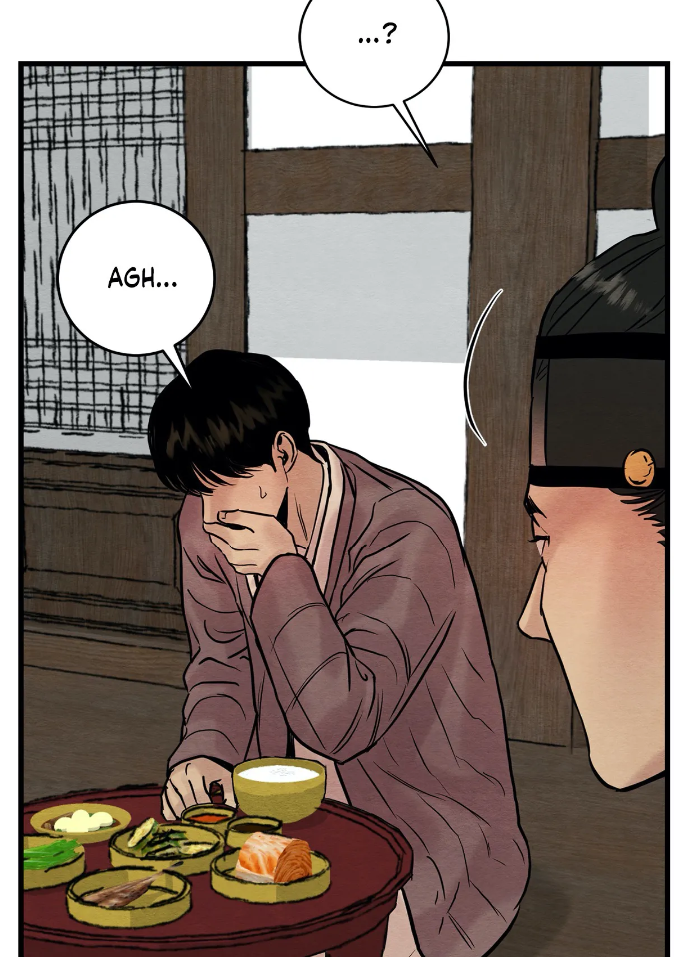 (chapter 47) If the painter had not eaten with the lord, the latter would have never noticed the incident. However, he believed the maids’ words.
  (chapter 47) Hence he never investigated the matter. But this prank represented a serious issue. This could have been judged as an attempt against the owner of the mansion.
 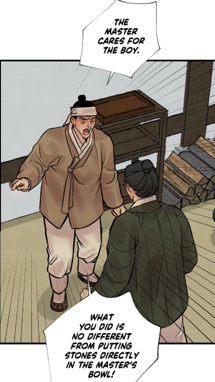 (chapter 47) And now look at this panel:
  (chapter 83) Yoon Seungho had refused to take the drug! The bowl reminded me of the one from chapter 47! Finally, the butler had tried to give his master the drug in season 3
  (chapter 77) Kim calls the drug “medicinal tea”, truly an euphemism. It is also possible that the real target of the poisoning was Yoon Seungho, but since he was protected by the gods, someone ended up taking the “drug”. Because he was wearing a purple hanbok, the investigator mistook his identity, a royal member. Hence the Yoons were suspected of treason. Don’t forget that during this party, there was a kisaeng by their side.
  (chapter 56), he came to adopt this title in order to hide his identity and actions. Byeonduck explained in her notes that Baek Na-Kyum had no idea about Min’s name. And this is the same for Yoon Seungho. The pedophile could continue hiding behind “lord Song”, as the latter was blamed for everything. The pedophile could divert attention from his own tricks. That’s the reason why he would never write any letter to Yoon Seungho under this name. This means that at the end, the main culprit, the king, will be perceived as the main responsible for Yoon Seungho’s torment, similar to Min’s situation, just before got killed. Though many other people were involved, Yoon Seungho was able to judge the joker’s actions correctly, he was the main mastermind behind the plots. This explicates why the gods made Yoon Seungho forget the old bearded men’s face.
 Yes, when people read juicy deeds, they were already imagining that I would describe a love session like this one
  (chapter 96), because of the expression „to do the deed“:
  (chapter 87) However, the deed is not just related to intercourse, like the manhwaphiles could discover it in chapter 51.
  With „deed“, Deok-Jae was referring to murder and assassination. As you can see, deed has other meanings than sex. Thus it has for synonyms action, accomplishment and reality!! So when I selected this name for the essay, I was thinking of the relationship between action and word. And this connection came to my mind, when Byeonduck released the last picture, because the painter’s action symbolizes a conversation and as such words.
 (Chapter 88) By reaching his hand, the painter was letting him know that he was no longer alone in this world. He was not only joining his side, but he was willing to try to understand the main lead.
  (Chapter 88) This gesture stands in opposition to the situation with Yoon Chang-Hyeon.
 (Chapter 86) During that fateful night, the father neither talked to his son nor looked at him. He even turned his back to him, when the young master attempted to grab his father‘s hanbok. Both scenes from chapter 88 and 86 have two common denominators: an action accompanied with silence!! Yet, what distinguishes them from each other is the nature of the deed, the action. Alliance and empathy versus abandonment and estrangement! This is no coincidence that after reaching his hand, Baek Na-Kyum started confessing his thoughts and emotions to his lover:
  (Chapter 88) As you can sense, the hand gesture delivered a message, but the painter still felt the need to clarify the meaning of his hand. He was willing to remain by his side, but he was still afraid of him. He didn’t want to create a misunderstanding, like for example that he wouldn’t argue with him or that his loyalty was now unconditional or total. That way, Yoon Seungho wouldn’t come to view him as a hypocrite or as dishonest, if an argument would appear. Thus he needed words to explain his position. He would remain by his side and attempt to sympathize with him, but he still felt insecure and had doubts. In other words, his action (his hand gesture) was not truly reflecting his mind and heart.
  (Chapter 88) Later he even asked his lover not to leave his side no matter what.
  (Chapter 88) To conclude, the hand gesture in episode 88 was connected to insecurities and as such fear, yet the painter had shown no hesitation to take his hand. The anxiety was not visible.
 (Chapter 30) His fingers barely grabbed his hand, so when he made the following vow, he was not entirely sincere or better said, truly determined to keep his promise.
  (Chapter 30) The words were not truly in unison with the gesture either. Therefore he once tried to leave the mansion in season 2. When he pledged loyalty, his intention was to protect his teacher. To conclude, fear has always been present, when the painter took Yoon Seungho’s hand. Even in chapter 88, but contrary to the scene in the courtyard, his hand was not shaking.
  (Chapter 82) This explicates why the artist chose to remain by his side, though the lord had broken his promise.
  (Chapter 82) On the other hand, in this scene
  (chapter 82), the lord was grabbing his lover’s hand out of fear. He was recognizing his mistake and was trying to beg for his forgiveness, though he couldn’t express it directly. Striking is that during the lord’s flashback, his hand was trembling as well, grabbing onto his partner’s body.
  (Chapter 81) It was, as if Baek Na-Kyum was his rescue buoy, helping him not to be swallowed by the darkness. Thus I came to the conclusion that the protagonists’ hand gestures are all connected to anxiety and pain. 😲 Hence I am deducing that in this scene, Baek Na-Kyum is holding his lover’s hand,
 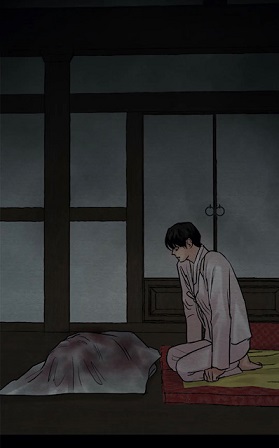 (Chapter 98) Back then, he had been waiting for his lover‘s return and explanations. He wanted to hear him and get his reassurance and comfort. .
 (Chapter 98) The latter couldn’t reassure the painter with his hand contrary to the previous night.
  (chapter 97) Exactly like mentioned above, the painter’s hand gesture is connected to fear and conversation.
 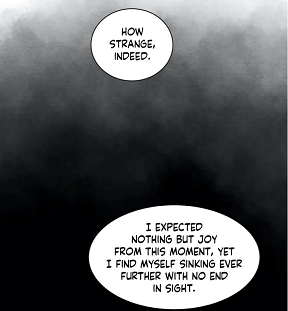 (chapter 97) Striking is that in the gibang, the lord confessed his biggest fear to his future “spouse”. He feared to lose him, though one of his biggest desires had been finally fulfilled. This means that Yoon Seungho felt even more insecure and frightened than before after receiving the artist’s love confession. That’s the reason why I believe that the new picture is standing in opposition to the scene in the gibang. The lord will feel relief after his admission. As a conclusion, the image is announcing
  (Chapter 89) While the painter was sitting on his partner’s lap
 (chapter 89), he was massaging the wounded fingers. It was, as if he was treating his companion’s wound. Note that after his terrible flashback, the painter had avoided to grab his hand out of fear that he might hurt Yoon Seungho even more.
  (Chapter 84) Therefore I conclude that the new panel is an allusion to treatment. While in episode 89, the painter was acting as a doctor, in the new image, the young man is working more like a counselor or psychologist. The aristocrat’s hand might not be wounded in that scene, but this is not the case for his heart and mind. So for me, this scene is connected to mental treatment.
 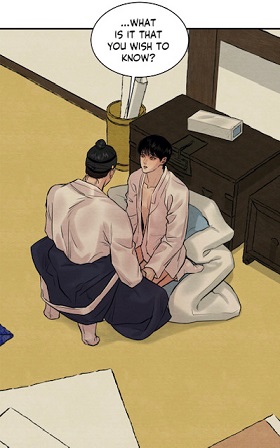 (Chapter 84) However, the lord had refused to open up. This is no coincidence that the author had not created such a picture during that chapter. As the manhwalovers can detect, I believe that in that scene,
 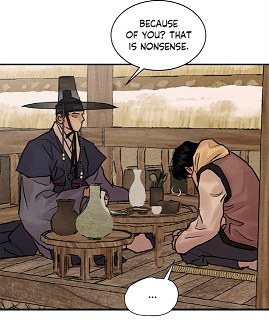 (chapter 75) And because I detected a discrepancy between words and gestures, I recognized the presence of another trick from Byeonduck.✨
 (chapter 91), the latter denied this with the following statement.
  (chapter 91) But when did the painter admit that he liked embracing him? In this panel!
  (chapter 88) That’s the reason why the lord got surprised and moved. As you can see, the author never revealed this whispering to the manhwalovers! The latter had the impression that the lord’s reaction was related to the loving embrace, but it was only partially correct.
  (chapter 62), when the lord had confessed to adore him.
  (chapter 62) This explicates why Yoon Seungho was so pained in season 2. He got embraced, but there were no words. Consequently, when the painter vanished during that night, the lord could only perceive the embrace as hypocrisy and fakeness. That’s how I realized that the story is developed on the contradiction between words and actions. But not only that, there exists a strong link between silence and passivity. Thus after the abduction in season 2, Baek Na-Kyum remained more or less silent
 (chapter 62), and as such he was totally passive. He never stood up and begged the lord for his leniency. He stayed there on the bed giving the impression that he was indifferent. That’s the reason why Yoon Seungho got more enraged, for he felt fooled. This means that the absence of words represent inaction… This explains why Yoon Seungho had to corner the main lead in chapter 48
  (chapter 48) to say something, as he had sensed his passivity behind his „submissive attitude“. This is no coincidence that during this night, the painter felt extreme pleasure to the point that he peed. Therefore he could voice his wish to Yoon Seungho during the love session from season 2.
  (chapter 73) That’s how the lord concluded that the painter liked riding him, while in reality such a climax had appeared for the first time, when both were facing each other!
  (chapter 49)
  (chapter 4) than season 2. He was encouraged by his future partner to speak up, yet the moment he got heartbroken, he was left speechless. And note that when the lord played his prank in the bedchamber, he never said anything to his father.
  (chapter 83) He didn’t move as well. Why? It is because he knew that talking to his father was pointless. However, Yoon Seungho had hoped that with his prank his father would finally see the truth. He had been fooled by Lee Jihwa and father Lee!! But the stupid father never realized it. As you can see, the lord had in that scene long given up to use words, he hoped that his father would see the truth with the prank. Don’t forget that deed stands for truth and reality. He thought that “actions would speak louder than words”, but he was proven wrong. This signifies that in this scene,
  (chapter 86) Yoon Seungho had acted the opposite, he had tried to speak up, but he had been muted. I am also thinking that the young master must have attempted to converse to his father
  (chapter 77) Silence was considered as an admission. This is no hazard that the butler didn’t take care of his young master. This scene symbolizes the quote “Actions speak louder than words”
  (chapter 77) The butler had betrayed the young master’s trust, for he had not intervened. He should have defended Yoon Seungho, but no in fact he had sided with the elder master Yoon once again. Not only he had not reminded Yoon Chang-Hyeon of his promise, but also he had assisted the ruthless father by giving himself the straw mat beating!
  (chapter 98) Here, he examined the robe and questioned the officer. The problem is that he was still relying on his staff and as such Kim. Therefore it is not surprising that he could still be manipulated by the schemers. Hence I am anticipating a total change in season 4. By conversing with the painter, the lord can only become more proactive to the point that he will be able to ruin the next schemes. I am even expecting a prank from the protagonists in season 4!! But this doesn’t end here. I am deducing that in the past, Yoon Seungho suffered because one tormentor would do things and say nothing, while the other would talk a lot, but act the opposite!! For me, these descriptions fit to Kim and the pedophile. I have the impression as well, that both characters came to switch their behavior. In one circle, Kim did many things, but remained mute, but later he did the exact opposite. I would like to point out that in season 3, he acted this way. He would promise loyalty to the lord,
  (chapter 77), but backstabbed him in the shadow. Besides, we shouldn’t forget that a narcissist’s words don’t match their action, because they are pathological liars. And so far, I had portrayed father Yoon (overt), Kim (covert) and even Jung In-Hun (overt) as people suffering from NPD. And I am assuming that the mysterious lord Song is not different from them, though I am suspecting that he must be a covert type.
  (chapter 77) Besides, it also snowed, when the painter got abducted twice, a sign that actually a promise had been broken.
  (chapter 76)
  (chapter 53)
  (chapter 87), while the same extremity symbolizes the opposite with the villains and antagonists: violence, silence, submission
  (chapter 83), hatred and resent
  (chapter 97) Here, Heena was hurting her brother, because she wanted him to face “reality”. What caught my attention is that we never saw the father’s hand in chapter 86!
  (chapter 86) Why? It is because it reveals his powerlessness. And this leads me to the following conclusion: the deed stands for reality and honesty, while the words symbolize emptiness, illusion and deception. And now, you comprehend why this work is composed by the dichotomies: dream, words and mouth versus reality., action and the hand. This means that in season 4, the manhwaphiles should try to analyze the thoughts and emotions of the characters behind the hand gestures. At the same time, they can also verify if my interpretation is correct. Is the zoom of the protagonists’ hand connected to fear, confession, empathy and assistance?
 (chapter 1) This means that no one had witnessed the wrongdoing committed on the anonymous lord. However, it is important, because it exposes how a person committing a wrongdoing could escape scolding and punishment, even from the readers. There was no witness! Only an attentive reader could detect this. Hence you have the explanation why Yoon Seungho suffered for so long. There was either no witness or the persons chose to close an eye and remained silent. Since it was the negative reflection from Baek Na-Kyum’s slap and the main lead had used his right hand
  (chapter 11), I deduced that the culprit was left-handed. That’s how I could identify the culprit, lord Min. The lord was in reality left-handed. We could observe this in chapter 8
 , episode 19
  , chapter 33
 and episode 43
 , but also in episode 76
 , in episode 100
 and finally in chapter 102
  ! Yet, in other occasions like in episode 33
  or 43, or 52
 , he used his right hand! Thus one might argue that Min was simply ambidextrous. However, I can prove 100% that Black Heart is left-handed!😮 The evidence is the usage of the bow.
  (chapter 22) This is how a right-handed man shoots an arrow. On the other hand, we never saw Min using the bow. The bird was already wounded by the arrows, when the scene of the second hunt took place.
  (chapter 41) However, the manhwaphiles can discover the verity thanks to one detail: the bag of arrows.
  (chapter 22) As you can see, the bag is carried on the right side, but the arrows are almost touching the left shoulder. They need to be on the other side, since the scholar needs his right hand to grab the item. And now compare the position of Min’s bag. It is inclined in the opposite direction, hence the arrows are visible on his right side!
  (chapter 41) Thus the noble is carrying the bag
  (chapter 41) differently from the painter too.
  (chapter 22) Under this new light, it becomes comprehensible why Byeonduck never showed the Joker’s hunting skills. People would have noticed that he is left-handed immediately. She made sure to hide this important fact, thus within the same chapter Min was often portraying as using both hands. In episode 43, he employed his left hand to pour the alcohol in the glass
 (chapter 43), when he gave the drink to Lee Jihwa.
  (chapter 9) Here, he was still present, but even before the end of the sex session, he had already vanished.
  (chapter 9) Finally, when the noble with the mole visited Lee Jihwa, the latter claimed that he had spent a long time at Yoon Seungho’s.
  (chapter 9), and his friend never denied it. As you can see, the characters made sure to confuse the readers with the change of the chronology. As you can see, it took me a long time before noticing the bruised face (only during season 3), then to bring up the conclusive evidence that Min was the culprit of the slap. Then in the shaman’s house, he took the dildo with his left hand, because he was angry and frustrated.
  (chapter 100) too. This shows that he could barely control himself here. And once he faced the main lead’s sword, he got so scared that he showed Jung In-Hun’s glasses with his left hand again.
  (chapter 92) The irony is that in this scene, the main lead employed his left hand too, the positive reflection from the night in the pavilion (chapter 43). While here it was to bring him back to reality, in the pavilion, the Joker had the opposite intention: to lure Lee Jihwa to believe in illusions.
 (chapter 74) They announce the future events, though the information is not given properly. On the other hand, since they are memories either, this signifies that they contain insight about the lord’s tragedy. Thus I noticed that the anonymous perpetrator used his left hand to grab his hanbok!! I deduced that the perpetrator in the past is also left-handed!! Secondly, since this vision can also be seen as the announcement of the painter’s second kidnapping, this is no coincidence that Byeonduck created such panels during the painter’s last torment.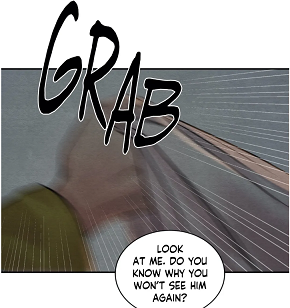
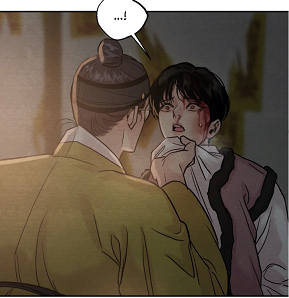 (chapter 99) However, in the shaman’s temple, Black Heart grabbed Baek Na-Kyum with his right hand. He was trying to manipulate the artist, he was acting. He was not showing his true self. Yet, the vision was revealing the truth: the future mastermind of the last scheme was in reality left-handed!! It didn’t matter, because at the end, the main lead was able to discern the truth. He sentenced Black Heart, for he believed that he had killed his loved one! That’s how I realized why the author would focus so much on the hands and on the distinction between unconscious and conscious! The hand in Painter Of The Night represents the crucial clue to identify the culprits!!
  In season 1, we had the hands in the illustration. The hands were revealing the crime committed against the main lead. The latter was totally passive in this picture. The hands are touching and unclothing the immobile man. It also shows that Yoon Seungho was at the center of the conspiracy, in the past and in the present! The painting in the background indicates the presence of a hidden painter. Thus Baek Na-Kyum was not drawn in the cover. The painter of the night was in truth someone else, the painter from the past! Nevertheless, the main lead was looking at the readers, indirectly at Baek Na-Kyum, the young painter of the night. This describes the arrival of Baek Na-Kyum in his life. Striking is that the painting in the background was destroyed… indicating that the portrayed relationship was no longer existent. This represents another clue that the lord’s suffering is linked to a previous relationship. Then in season 2,
  the author revealed Baek Na-Kyum as the painter, who had now become the target of the plot. Yet behind him we see Yoon Seungho’s foot. The latter symbolizes the main lead feared to get close to him, but he wouldn’t leave his side. Moreover, this corresponds to the lord’s impulsive decisions, he let his foot guide him. Thus during the first night of the failed gangrape, he walked towards the study and stopped unconsciously, when he was next to the room.
  (chapter 53) Due to his strong denial, he was strolling not realizing that his feet were under the influence of his subconscious. And it was the same, when he opened the door with his foot at the Lees’
  (chapter 67) Nonetheless, I believe that the author had another reason to draw the foot in the cover. The foot prints are the evidence of the crime, and as such the deceptions and the culprits.
  (chapter 59)
  (chapter 60)
  (chapter 61) The shoes were the clues how to recognize the perpetrators and accomplices. That’s why I compared these feet
  (chapter 59) with those
  . (chapter 66) My avid readers are already aware of my theory. For me, we have two kidnappers, and one tried to kill the artist! To conclude, Byeonduck left the clues how to unveil the mystery from the past and the present in the illustrations of each season. The paper in the second cover
  (chapter 56) and the painter’s break! At the end of season 2, he was no longer painting and in the beginning, he had also stopped due to his heartbreak. Simultaneously, we have the presence of water which serves as a connection to season 1 with the ruined painting and to season 3 with the well and drowning. The dark shades were an allusion to the lord’s darkness and suffering. The latter would come to the surface. However, since the cover only showed the lord’s foot, it exposes that the lord would not divulge his traumatic past.
  (chapter 78) In season 3, this time the main leads were facing each other, they were recognizing each other: their true self! But this stands in opposition to the deceased people without identity!
  , the back
  Here, we have 3 men, and don’t forget the left hand from before.
  (chapter 99) That’s the reason why I am anticipating a cover with the gibang. It would be the perfect place to find closure for the couple. It is a place where both suffered. Moreover, I think, belongings should serve as an evidence for the identification of the schemers and accomplices. Remember that we had the glasses as the evidence of a murder in season 3, yet I am sensing that the possession should serve to identify the perpetrators from the past and the present. Since the clothes were used to confuse people in season 3, I am assuming that in season 4, they should help to recognize people, but at the same time, it is totally possible that our main leads decide to employ the same method to fool the schemers and accomplices. And now, we have the cover for season 4. Both protagonists are not only facing each other, but also touching each other. They are no longer hiding their emotions and thoughts.
  This image represents the opposite to the other seasons. At the same time, the author is again referring to the bedchamber indicating that this place is strongly connected to the protagonists’ suffering. On the other side, since the painter is wearing a silk white shirt, it implies that he is not a commoner. This panel indicates that the main lead was able to the true owner of the study and even bed. However, due to the tears, the beholder can sense that this season will be painful as well. Striking is that in the cover, they were either alone, or they were just looking at each other, hence they didn’t pay attention to their surroundings. Consequently, they couldn’t sense the presence of a plot and the schemers. This indicates that the couple is still not prepared to face new schemes. To sum up, the author selected such covers because she had planned to leave clues there about the mystery! But wait… I had outlined that the person who grabbed the young master Seungho was left-handed, and he played a huge role in the main lead’s downfall and suffering! But who is left-handed in this story?
  (chapter 12)
  (chapter 56). But then I noticed that he carried his master on the left side.
  (chapter 66) and since it is for me the butler, he was not the person from the nightmare. That’s the reason why I am excluding him from the suspect list. For me, if he was involved in the past, it is because he lit the candles
  (chapter 74). Furthermore, don’t forget that in his nightmare, the author exposed the presence of plates with 3 candles
  (chapter 74) which were also used in the shaman’s house. Finally, in this picture, we have a right-handed person.
  (chapter 74) So Kim could have been the one silencing him with his hand.
 (chapter 86) On the other hand, at the doctor’s office, he employed his right-hand to keep his son by his side.
  (chapter 57). Why is there this change? The turning point was the prank in the bedchamber.
  (chapter 83), then with the left! Striking is that the author never showed, when the patriarch employed his left hand. The readers could only hear the sound, and see the result of the beating. Both cheeks were wounded. From my point of view, he was conditioned exactly like Min! He was not allowed to use his left hand, but the angrier he got, the less he could hide his true self: he was left-handed and he was a stupid and brutal father!!
  (Chapter 74) I don’t believe in hazard. Besides, the lord had his nightmare during the same chapter. This means that he could have leaked this information about Yoon Seungho to an outsider, like he did with the painter. As the manhwalovers can grasp, the physician is more suspicious than before.
  (chapter 92) Besides, observe that the angry man put the brush on the left side.
  (chapter 92) The man is left-handed! And what did Yoon Seungho do?
  (chapter 92) He grabbed him by the collar! Exactly like in the dream!!
  (chapter 44) or patio of his mansion, similar to Heena’s. And since the young main lead suffered so much, it is normal that he doesn’t have such believes. IT is also possible that the young master Seungho played a prank which made the man angry and humiliated. As you can see, I come to the conclusion that jealousy and resent were the reasons why he got involved in the first place. Moreover, we shouldn’t forget that the calligrapher is linked to the kisaengs! He even recognized Baek Na-Kyum, as he called him a peasant.
  (chapter 92) Yet, he was either perceived as servant, a noblewoman or as a sir so far! He was never recognized as a peasant. Since he could identify the artist, it is also possible that he was also able to identify Yoon Seungho. But he thought that he was not well educated after living as a male kisaeng for so long. From my point of view, the man could have decided to get revenge on Yoon Seungho and participated in his abduction and gangrape!! Thus his karma was to lose his home!
  (chapter 91) The fact that Yoon Seungho grabbed him the same way than in the nightmare is not random. It was, as if he was getting justice. Honestly, I am more and more suspecting that in the past, Yoon Seungho got raped by commoners! Naturally, I have not changed my mind that the king was behind this plot: to get revenge on the Yoons! Who benefitted the most from the crime? Definitely the king, as he was able to ruin their influence.
  (chapter 86) Let’s not forget that in season 3, clothes were used to deceive Yoon Seungho, and the authorities played along. Besides, as the painter had become the love interest of Yoon Seungho and Black Heart, it is very likely that in the past, the victim was exposed to two different abusers, but they all hid behind the name: lord Song. Note that during this feast, one man had a moustache beard which is in Painter Of The Night the sign that he is no yanbang, not even chungin, the upper-middle class. He could be a rich merchant. Just because they are all wearing hanboks
  (chapter 87), this doesn’t mean that these men belong to the aristocracy. Furthermore, Kim never said “nobles”, he just said “visitors”!! Finally, I would like to point out that since Yoon Seungho lived secluded for 10 years, I doubt that he had the means and the knowledge to be involved in the trade:
  (chapter 39) Thus I am deducing that the barn in season 2
  (chapter 51) could have belonged to the tailor or the owner of this shop. And note the couple was in the same position than with the kisaeng with No-Name in episode 51!
  (chapter 51) This was the negative reflection from episode 39: no penetration versus penetration, no interruption versus interruption, no rumor versus rumor etc. And this contrast clearly displays that the tailor shop is involved in Yoon Seungho’s suffering. And the best evidence for this is the nightmare. The main lead’s clothes had a design.


 Bebebisous33s' analyses in K-Dramaland and Manhwas