

This is where you can read the manhwa. https://www.lezhinus.com/en/comic/painter But be aware that this manhwa is a mature Yaoi, which means, it is about homosexuality with explicit scenes. If you want to read more essays, here is the link to the table of contents: https://bebebisous33analyses.wordpress.com/2020/07/04/table-of-contents-painter-of-the-night/
Feel free to make some donations/sponsoring: Ko-fi.com/bebebisous33 That way, you can support me with “coffee” so that I have the energy to keep examining manhwas.
I have to admit that when I chose this title, I imagined that this analysis would be very short, for I mainly desired to talk about Min. However, the more I pondered about the content of this essay, I realized that I should actually include all the drugs in Painter Of The Night. This led me to examine all the other characters suffering from drug addictions. That’s how I made new discoveries again.
1. The drugs in Painter
First, it is important to list the drugs present in this manhwa. We have alcohol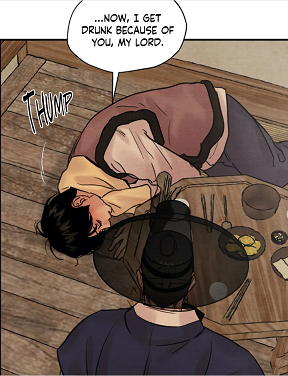 (chapter 75), tobacco
 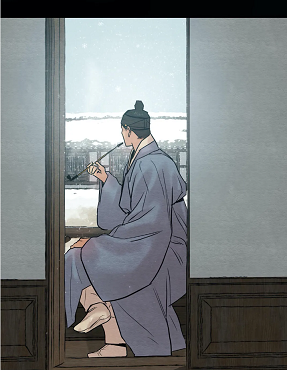 (chapter 61) and opium
  (chapter 52).
And because Min and his friends brought opium to the Yoon’s residence and the main lead was present, the readers jumped to the conclusion that the main lead would smoke opium too.  (chapter 52) And this perception got reinforced, when the butler confided this to the physician later:
 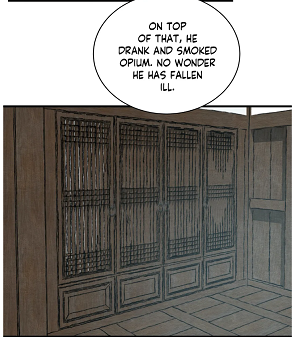 (chapter 55) Many readers had the impression that Yoon Seungho had been smoking opium, many went so far to imagine that he had been smoking opium right from the beginning.
  (chapter 5) However, this was just a lie. Yoon Seungho never smoke opium!!
2. Yoon Seungho’s true addiction
And now, it is time to prove my interpretation. First, you’ll realize the deception, once you read the side effects of opium:
“Short term effects may include: 1. euphoria, 2. relaxation, 3. analgesia” quoted from https://adf.org.au/drug-facts/opium/
This drug has a sedative effect, therefore the opium smoker falls into a torpor and semi-sleep. And we know that Yoon Seungho avoids sleep, for he is plagued by nightmares. 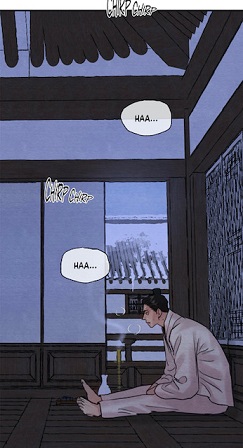 (chapter 74) Hence consuming opium would even instigate his nightmares. In addition, observe that in chapter 5, Yoon Seungho was never euphoric nor sleepy. He could interact with the painter normally.
Nicotine causes a range of effects on both the body and mind, including:
Decreased appetite
Heightened mood […]
Sweating
Nausea
Diarrhea
Better memory
Increased alertness
https://www.verywellmind.com/nicotine-addiction-101-2825018
As you can see, nicotine increases alertness and memory. Therefore the lord never forgot the words from the painter during the day. They bothered him so much that he kept thinking about his own image: 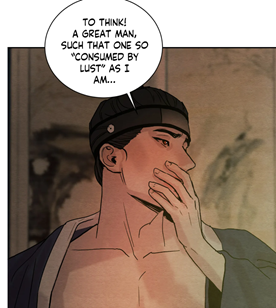 (chapter 05) As you can see, Yoon Seungho had a drug addiction, nitocine.
One might argue that he started smoking opium only later.
And now, pay attention to this image. (chapter 52) The noble in the background was the one smoking opium. Besides, the manhwaphiles will certainly remember how Yoon Seungho behaved in that scene. He heard Min’s words addressed to the painter, he walked straight to Black Heart in order to protect his lover, well aware that Min would invite the painter to join the party.  (chapter 52) This means, he was conscious and alert. Besides, we saw him later getting in rage
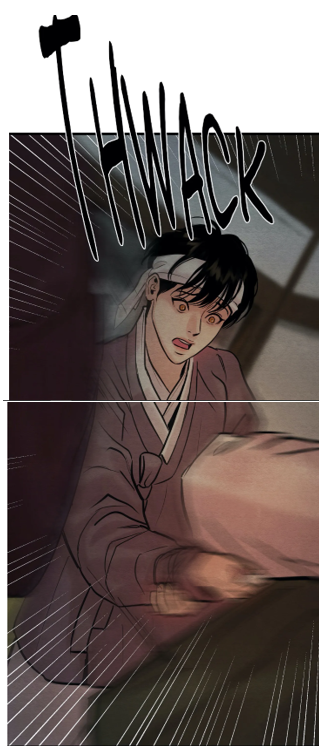 (chapter 53). Here, I would like the manhwaphiles to keep in mind that side effects of opium like euphoria, relaxation and analgesia last for at least 3 to 6 hours. So this outburst of rage is an indication that our protagonist was not under the influence of opium. He was not hallucinating either. He had grasped the whole situation, when he heard Deok-Jae predicting a terrible fate to the artist. In addition, this drug is not considered as a poison inducing psychosis.
“opiates are the only sedative drugs that possess an anti-psychotic effect.” quoted from https://pubmed.ncbi.nlm.nih.gov/24563427/
However, this doesn’t mean that an user from opium won’t suffer from any psychotic symptoms. They are more related to withdrawals or to hallucinations due to the big consumption of opium. https://www.therecoveryvillage.com/opiate-addiction/related-topics/opiate-psychosis/
However, one of the side effects of nicotine is heightened mood, this would explicate his outburst of rage and his irritability right after smoking tobacco.  (chapter 52) This explicates why he beat Min and Deok-Jae so furiously, he wasn’t acting under the influence of hallucinations. He was perceptive, he had clearly understood the meaning behind the servant and the noble’s words. As you can see, the lord’s mood swings were more triggered by his addiction to nicotine. This explicates why the main lead had such a violent outburst in the shed after the abduction. He had smoked tobacco the whole day. (chapter 61) Remember how I compared him to dormant volcano, here he was boiling internally.
On the other hand, a person consuming opium will show signs of withdrawals 24 hours after the use. And these are the following signs of opioid withdrawal: Anxiety, insomnia, sweating, vomiting, diarrhea, shaking, yawning, restlessness, widened pupils, body aches, seizures, hallucinations, body aches, rapid breathing, fast heartbeat and more importantly irritability. https://www.webmd.com/mental-health/addiction/opioid-withdrawal-symptoms#1
Min shows all the signs of a withdrawal in chapter 76. First, he vomits , but hides it under the excuse, he drank too much. He gets in rage, when No-Name calls him a fool.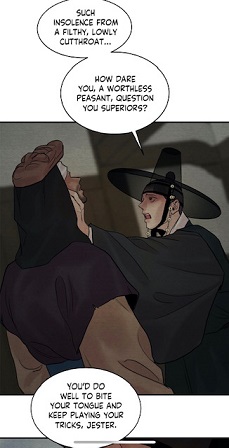
 He can no longer keep his mask contrary to the altercation in episode 41, when Yoon Seungho compared him to a mouse:
 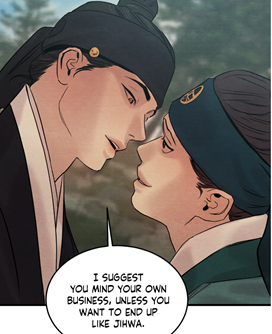 (chapter 41) Besides, we have another evidence that Black Heart has developed an addiction to opium with the following panel:
 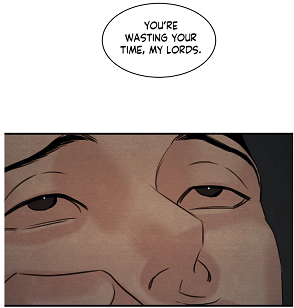 (chapter 76) The gaze is different, an indication of the widened pupils. Furthermore, his restlessness is perceptible the way he approaches The Joker. This time, he has to meet the criminal personally. We could say that he rushes to meet the criminal. Like he said, he was “running out of time”…
 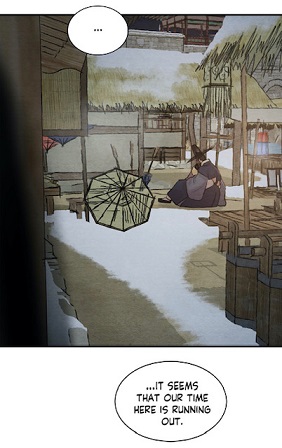 (chapter 76) These words reflect his own troubled mind.
However, you can see that the lord didn’t get any sign of withdrawal after that terrible night in episode 52. Yes, he got sick, but it is because he didn’t sleep and he had no clothes on. Therefore he caught a cold. Let’s not forget that he had lived for a week without eating or sleeping properly. But my most conclusive evidence is this panel: 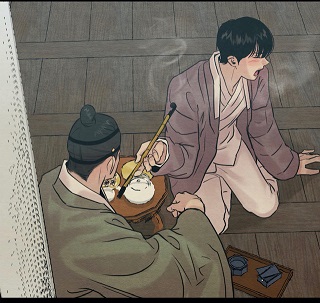
(chapter 74) Observe the painter’s reaction. He is coughing, he doesn’t seem affected by the smoke, while he had a total different reaction in chapter 54: 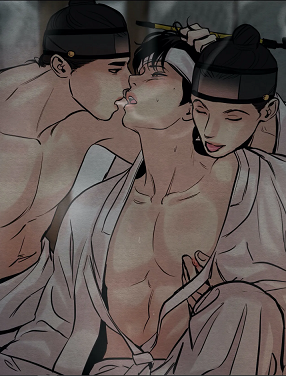
 Note the euphoria and the sedative effect on the artist’s face. This explicates why he didn’t push the rapists away.
As a conclusion, Yoon Seungho is not addicted to opium, he never smoked it. The aristocrats chose his place to smoke it, because they wouldn’t be caught by their parents. That’s the reason why the noble said this to Black Heart.  (chapter 53) They wanted to smoke this drug there, for no one would interrupt them. But because Yoon Seungho let them smoke opium, he became guilty by association: he was also an opium smoker. And the readers had fallen into the same trap. As you can see, I believe that the author is using the method on the manhwaphiles. They are misled by what they see and hear without questioning the authenticity of the statement.
The manhwaphiles will say that Yoon Seungho has another addiction: alcohol.  (chapter 55) However, this is another deception. Yoon Seungho is no alcoholic either!! 😲
I have many evidences for this. First, notice that during the first sex orgy, there was no drink and food offered. It was simply sex!! 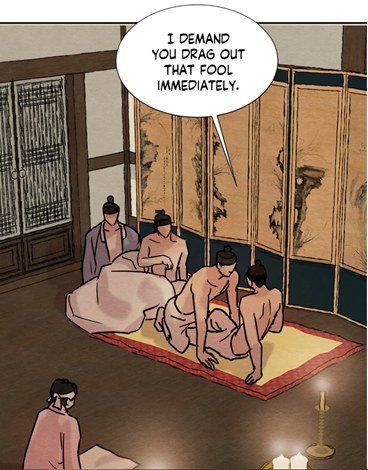 (chapter 08) So his debauchery was linked to sex and nothing more. He would live for sex and nothing else. Furthermore, the manhwalovers will certainly recall the lord’s behavior in the tavern. He ordered wine
 (chapter 75), but notice that he never became drunk like the painter. (chapter 75) The main lead can consume wine in moderation contrary to the painter!! Therefore he has no addiction to alcohol.
And this is different for Baek Na-Kyum, who became a drunk after his abandonment.  (chapter 1) Notice that each time, Baek Na-Kyum would drink alcohol, he could never stop until he almost lost consciousness and started hallucinating
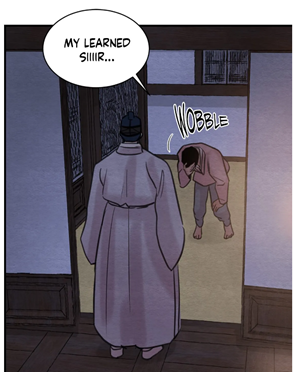 (chapter 19) or he would be so inhibited that he couldn’t walk properly. These were the sign of his addiction. I can’t forget the lord’s words in episode 75:
  (chapter 75) Here, he saw how the alcohol was affecting his lover’s behavior.
Notice that at no moment during the night (52-53-54), Yoon Seungho walked under the influence of alcohol. His feet were the proof that he never consumed wine to the point he would lose consciousness or started hallucinating.  (chapter 53) He was walking straight. When the readers saw the following image, they saw it as a confirmation that Yoon Seungho was a drunk.
 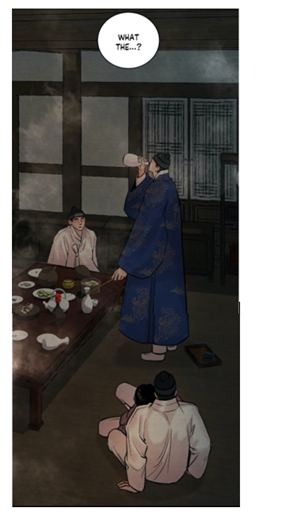 (chapter 54) But in truth, he took some wine in order to overcome his pain, to give himself some “courage” to go through. He had longed for the artist’s warmth after a week of separation, but he knew that Baek Na-Kyum viewed sex as prostitution. He was alert enough to see the consequences of his decision
  (chapter 54), therefore he broke the bottle.
  (chapter 54) This is no coincidence that he destroyed the bottle of wine. He had the impression that this drug was the cause for his “hallucination”, he was seeing the painter in ecstasy which could only remind him of his own past. Besides, he didn’t want his companion to become a shadow of himself: (chapter 54) He recognized the perversion of the artist’s redness and lost gaze. He loved him for his pure gaze and blushing.
For an alcoholic, a single drop of alcohol is a synonym for a relapse. Hence the addicted has to avoid anything related to alcohol, like vinegar or medicine containing alcohol. So when the lord proposed the wine, he had no idea about the consequences of his offer. So imagine his reaction, when he heard this: (chapter 75) The lord was responsible for his relapse!! Naturally, this could only pain the lord, for the latter wanted to make his lover smile. On the surface, Baek Na-Kyum’s words were reflecting the truth, as the master had encouraged his lover to take the soju. Hence Yoon Seungho could only feel accountable for this situation. He decided to act as a mature man who should take care of his lover’s intoxication. On the other hand, during the whole dating, Yoon Seungho always remained clear-minded, this was another indication that he never abused alcohol.
So when he said this to Bongyong (chapter 78), I believe that Yoon Seungho never proposed too much wine to his lover afterwards. He had made the experience that if he did, he would be the reason why Baek Na-Kyum would become a drunk. In my opinion, the painter’s relapse was linked to his own suffering, he was tormented by the idea that Yoon Seungho would abandon him, his affection was not deep. Since they had no longer any sex, he had the impression that Yoon Seungho’s love for him was vanishing. As you can see, the painter’s dependency to wine was linked to his repressed libido and his fear of abandonment.
As a conclusion, Yoon Seungho was never addicted to opium or wine. However, this doesn’t mean that nicotine addiction is no big deal. In truth, this drug is as unhealthy as any other drug. The withdrawals are only perceptible, when a consumer stops smoking. The addiction is never obvious like opium or heroine. In addition, the body doesn’t just get poisoned because of nicotine, but the latter also affects sexuality and as such relationships.
“The investigators began to realize that smoking actually became a method of subtle communication for members of the couples being studied. Lighting up gave clues to each partner that it was time to talk, time to give space, or even time to defend yourself because a world-class argument was about to begin. federally funded study is scheduled to go on for another year, and hopefully, will provide methods to help counsel couples how to recognize cigarettes as an abusive third member of their relationship. If couples are going to weed the habit from their lives, the researchers say they will have to find other ways to relate to each other, and more often than just during the familiar after-sex smoke. And of course, as Jordan found, smoking can directly torpedo the sex, too.” quoted from https://www.webmd.com/men/features/want-better-sex
3. The truth behind Kim’s statement
But then why would the butler describe his master as a man addicted to wine and alcohol (chapter 55), if this was not correct? It is related to the situation how the lord became ill: the orgies and more precisely the presence of Black Heart.
What caught my attention is this:  (chapter 33) Compare this sex orgy with the following one:
 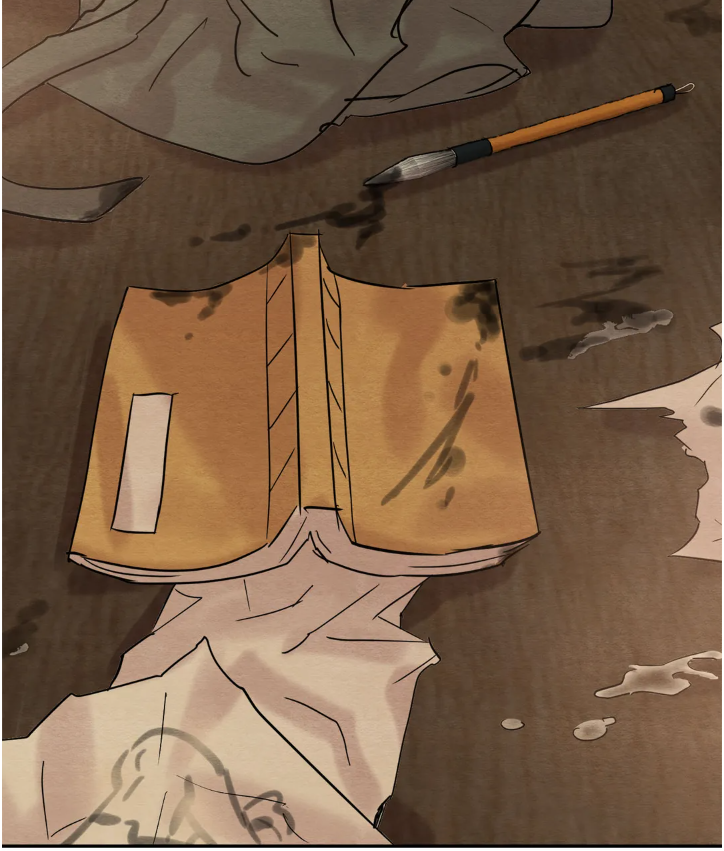 (chapter 8) At Black Heart’s party, wine and tobacco were offered, while in Yoon Seungho’s bedchamber you only had books, pictures and sex. Besides, there were more guests. As you can sense, the parties were totally different: austerity versus luxuriousness. Yes, Min wanted to impress his host Yoon Seungho!! He desired to show him what a true sex orgy was. He desired to prove that he was the real hell-raiser, the real king among nobles.
Besides, another detail caught my attention:  (chapter 33) The Joker and the bottle of wine!! The manhwaphiles will certainly recall how the villain offered the expensive alcohol to Yoon Seungho (chapter 19). Moreover, I realized that in episode 33, we have a slight change. While Black Heart is seen first with the pipe full of tobacco,
  (chapter 33), slowly the author brought the villain in connection to the bottle of wine:
  And at the end, we have this:
  (chapter 33) The pipe is no longer present, but Byeonduck focused on the bottle. In my eyes, she desired to outline that Min was slowly getting addicted to alcohol. This means, Black Heart is not only addicted to nicotine and opium, but also wine! Notice this:
- chapter 43:

- Chapter 83:
 .
.
In these two scenes, Min was serving alcohol or encouraging Jihwa to drink! And now, you have an explanation why the red-haired master became a drunk, when he got abandoned by his lover or tormented by the murder plan. Black Heart was the one introducing this addiction to the second lead. And this interpretation becomes more visible, if the manhwaphiles revisit the event around the failed gangrape.

The person laughing so loudly was in reality Min. You recognize him with his green hanbok. So he was visiting his “acquaintance” and was drinking wine there. While the maid thought, the lord would be the drunk one (chapter 51), I believe that Black Heart was the main consumer!! And now, you comprehend why Yoon Seungho fell into debauchery. (Chapter 55) There was this peer pressure coming Min, who loved luxurious parties. But these parties were no longer sex orgies, for the protagonist was no longer interested in sex. He needed to offer something else to his guests: alcohol and food. Therefore the last picture above is actually more deceiving the readers than anything else. It gives the impression that Yoon Seungho was consuming wine all the time, while in truth he was killing time with these parties. He was alert for the most part of time keeping his thoughts to himself.
But like I outlined above, Black Heart was the one who became more and more addicted. First nicotine, then wine and finally opium. But why? Notice that this coincides with his obsession with the painter. He grabbed the bottle of wine (chapter 33), when Yoon Seungho refused to share his painter with him. So when he heard that Yoon Seungho was organizing parties again, he envisioned that his plan had succeeded. Hence he visited the mansion, yet his loud laugh was actually masking his pain.  (chapter 51) He was far from happy, for his fixation on Baek Na-Kyum had not disappeared at all. Therefore, it is not surprising that he started drowning his sorrow. However, alcohol was no longer effective, he needed something stronger to dull his agony. That’s how he discovered opium. And notice that when the lord got punched in the propriety, he felt no pain.
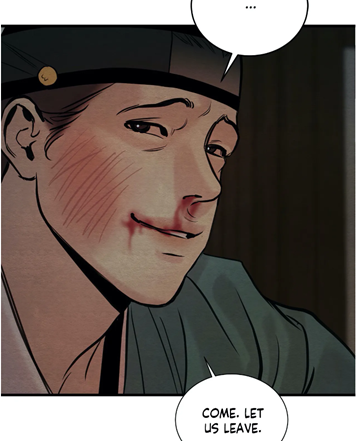
  (chapter 54) He didn’t protect himself, he had no strength because of the relaxing and sedative effect. He even laughed, a sign that he was under the effect of the drug.
  (Chapter 54)
However, this doesn’t mean that Min left the house happily! All the guests got evicted like vulgar commoners. His ego was definitely hurt, just like the other nobles’. Therefore on his way out, he told Kim that they had been evicted due to Yoon Seungho’s intoxication. He was under the influence of alcohol and opium. That way, appearances were saved. For the butler, the truth didn’t matter. He could just portray his master as a man living in debauchery, so that no one would ever blame him for this! The appearances were against him. He had indeed organized parties, but they were no longer sex orgies.
The most infuriating is that the butler was to blame for this “relapse”. He had made sure that the painter and his lord would no longer be together. Since he had no sex, then he could only offer wine and food. But there’s another point why I don’t believe that Yoon Seungho ever consumed opium. Since this drug was illegal in Joseon, the butler would have to dirty his own hands to buy such a thing. Besides, notice that the nobles brought the drug themselves. (Chapter 52) This shows that the aristocrats had to buy the opium themselves. This was too dangerous to give this task to a domestic, the latter could definitely betray them. So when Black Heart said that the main lead was smoking opium, his true goal was to ruin the main lead’s reputation. And for Kim, it was perfect. He needed his master to have a bad reputation so that he could live his life peacefully.
4. The connection between sex and drugs
In my opinion, Min’s addictions are his karma. He had to pay a huge price for plotting in order to obtain the painter. He became more and more addicted to the wine, and later to the opium, when he thought that his plan had succeeded. In other words, his opium’s addiction is the divine retribution for hurting the shaman. The irony is that his obsession for Baek Na-Kyum never disappeared. In other words, since he couldn’t have sex with the painter, he replaced sex with drugs. That’s how I realized the following connection. Baek Na-Kyum, Jihwa and Black Heart used drugs to cover up the absence of sex and indirectly love. For me, they somehow symbolize a subterfuge, to mask the absence of passion.
Notice that the artist’s libido is strongly intertwined with the paintings, so the moment he could no longer paint, he was forced to become chaste. Hence he started drinking. (chapter 75) This strong connection between sex and drugs gets even confirmed in the same episode. Notice that in that scene, Yoon Seungho had not sex with the painter for a while, and Baek Na-Kyum was definitely missing it. Naturally, his true desire was to get loved by his companion. For the low-born, sex is a symbol of love. Hence he drunk because of Yoon Seungho. (chapter 75) He felt the need to fill the void. But I believe that the incident with Nameless was a wake-up call for the artist. Through the hug and the music box, he realized that the lord’s affection had not diminished at all. And now, you comprehend why the painter is no longer addicted to the wine. He no longer feels awful and fears abandonment…
As for Jihwa, he drank, when he was happy, for he imagined that he would get his friend’s attention again, or when he was sad, for he had been repudiated. Once he got abandoned, he could no longer have sex…  (chapter 36) and he drowned his sorrow in wine.
 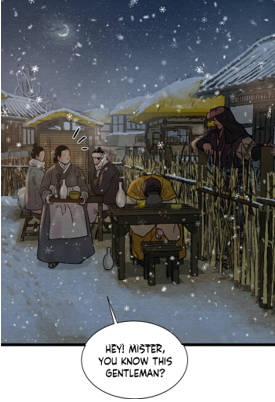 (chapter 59) However, this association between alcohol and his lust for Yoon Seungho started changing, after Jihwa had sex with Nameless. Notice that in episode 83, he is no longer looking like a wreck.
 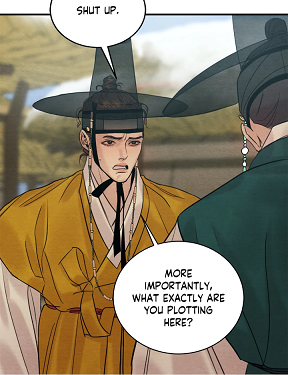 (chapter 83) He is still biting his nails, a sign of remorse and fears, but he is no longer obsessed with Yoon Seungho. From my point of view, the torments the second lead suffered in the second season played a huge role. He started drinking alcohol for another reason.
  (chapter 50) This time, he got afraid of the consequences for the murder. As you can perceive it, there was a slight shifting. This shows that the wine became less and less connected to his obsession with his childhood friend, his desire to have him. This explicates why he was so devastated at the end of the second season. Out of guilt and anxiety, he started drinking again.
  (chapter 76)
And now, we have to wonder why Lee Jihwa doesn’t seem plagued like in the past. (chapter 83)It is because his father got involved again, and visited father Yoon. The second lead imagines that after his father’s intervention, his problems will be solved. He won’t have to fear for his life, for Yoon Seungho will be sent away to his father. 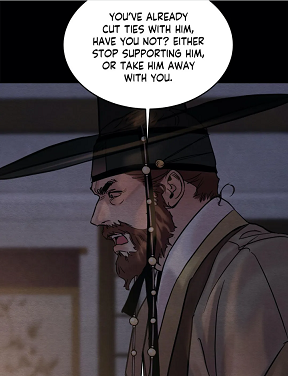 (chapter 82) He knows about his father’s plan. If Yoon Seungho is forced to submit himself to his father, he won’t be able to use his wealth and power to attack him. That’s the reason why he is no longer looking like a wreck. In other words, he is well aware what is going to happen to his friend. He witnessed the abuse, but he doesn’t care, for his “life is in danger”. 🙄 As for Min, he looks more healthy again
 (chapter 83), for he had to plot in order to achieve his goal. He needed to find a new puppet, lord Lee, and as such he needed to make a good impression. He had to become proactive and become more directly involved. Hence he needed to be more alert.
As for Yoon Seungho’s addiction, it becomes obvious why Yoon Seungho smoked in the past. It was not related to sex, but to his inner turmoil. He had to calm down his frustration and negative emotions. Notice that only he smoked during the day, a sign that this was not connected to sex at all. However, it started changing too. Yoon Seungho felt the need to smoke while having sex with the painter (chapter 45), for he felt something was missing. Consequently, this is not surprising why Yoon Seungho had a sex marathon in the shed after smoking the whole day. It was to contain his rage, but also to mask his strong desire for the painter. What caught my attention is that after their love session, the main lead started smoking again, exactly like in the past. (Chapter 74)However, there is a huge difference. In my opinion, he was trying to control his sexual desires. Remember the quote above: nicotine has a huge effect on libido. That’s another reason why Yoon Seungho was so chaste in the study:
  (chapter 74)
However, what caught my attention is that during the third season, we never see Yoon Seungho smoking. Though he hurt the painter and felt terrible, he decided to leave the mansion in order to hunt. He wanted to vent his anger and hide his anxieties:  (chapter 83) This observation is important, for it shows that he is no longer using tobacco to hide his inner turmoil. That’s why I believe that Yoon Seungho’s addiction was originally linked to his traumas. It was his way to “anesthetize his emotions”, he had the impression that he would become more clear-sighted.
5. Personality and drugs
I have to admit that when I started preparing this analysis, I tried to discover why Min, who is a psychopath, would come to consume drugs. That’s how I discovered that personality indeed plays a huge role.
The Five-Factor Model of Personality
The Five-Factor Model of Personality is a group of five broad trait aspects that help explain personality differences and people’s behavior. The five traits include:
Extraversion- is when someone enjoys being around other people more than being alone.
Neuroticism- is the tendency to be in a negative, stressed, or anxious emotional state.
Agreeableness- is a set of characteristics perceived by others as being sympathetic, warm, kind, and considerate.
Conscientiousness- is being careful or diligent, hoping to do a job or task successfully, and to take obligations seriously. Conscientious people tend to be organized and efficient.
Openness to Experience- indicates how open-minded a person is, and is characterized by being imaginative and curious, and enjoyment in trying new things.
Generally, those who use drugs or alcohol are characterized by having high Neuroticism, high Openness to Experience, low Agreeableness, and low Conscientiousness.
quoted from https://www.fortbehavioral.com/addiction-recovery-blog/personality-traits-related-to-drug-use/
After reading this quote, you can recognize that Black Heart has a predisposition for addiction. He fits the following profile: “high Neuroticism, high Openness to Experience, low Agreeableness, and low Conscientiousness”. He loves experiencing new things (chapter 52), he is always seeking entertainment (chapter 66), a sign that he is not hardworking. He is very sensitive to criticisms, which was underlined in chapter 83 one more time.
 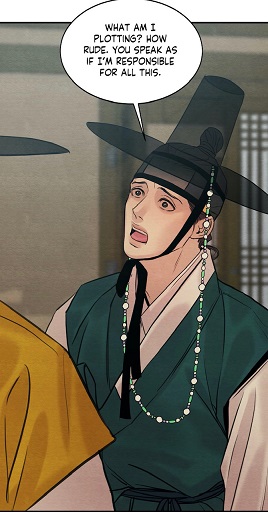 (chapter 83) Therefore I tried to find out if persons suffering from Antisocial Personality Disorder could be suffering emotionally, though they are supposed not to feel any pain and empathy. And yes, such persons are definitely not happy, for they are often lonely.
“psychopaths may be unhappy due to the quality of their interpersonal relationships. Romantic relationships and friendships are critical to happiness. […] The results from our studies suggest that people with high levels of psychopathic tendencies are generally unhappy. They show low levels of positive emotions and life satisfaction, and high levels of negative emotions and depression. Further, this unhappiness is partially explained by the poor quality of their romantic relationships. ” quoted from https://www.psychologytoday.com/us/blog/the-happiness-doctor/201701/are-psychopaths-happy
This explicates why Min was so obsessed with Baek Na-Kyum. (chapter 9) He felt lonely, and hoped that the artist would give him the same gaze, when he looked at the protagonist. He had already snatched Lee Jihwa, but the latter was too obsessed with his childhood friend to look at him in a different way. Min was definitely longing for love, but he could never admit it. Striking is that Min picked his “bride”, exactly like the psychologist Love described it:
“For instance, Love notes that individuals high on the psychopathy spectrum prefer friends who contribute to their volatile lifestyles, such as criminals, fellow thrill-seekers, or ego-feeding suck-ups. Teaching psychopaths how to form healthier, more positive, interpersonal relationships with emotionally stable individuals, however, may help to reduce their antisocial behaviors.” quoted from https://qz.com/819283/can-people-who-have-psychopathic-symptoms-feel-love-or-be-truly-happy/
And now, you comprehend why Min was dissatisfied with Lee Jihwa in the end. The latter was a delinquent, a selfish man who desired Yoon Seungho’s constant attention. He could never give him the attention and love Black Heart was longing.  (chapter 66) Hence he could only view the second lead as his puppet. That’s why The Joker had to use “drugs” to mask his emptiness and longing for affection.
On the other hand, the Five-Factor Model of Personality explicates why Yoon Seungho never fell into debauchery so deeply. First, he didn’t have many addictions despite suffering for a decade. His tumultuous sex life was influenced by the brainwashing and his traumatic past. In my opinion, the principles from Taoism were another reason why the protagonist never became a drunk or desired to smoke opium. Then he reads books, but no one knows this except the butler. Finally, he definitely worked hard, for he could gather wealth and create connections. From my point of view, the enemies are definitely underestimating his power.
As a conclusion, when in chapter 52 we had this cold war between Black Heart and Yoon Seungho, we didn’t assist to a sex party, but to a drug party: tobacco, opium and wine. There was no sex at all!! Hence Yoon Seungho had no erection… however, they attempted to turn this into a sex orgy (chapter 54), but fortunately they failed. Thus when I look again at this sex orgy (chapter 8), I can only view this as quite harmless: this party reflected the main lead’s purity. He is definitely no hell-raiser!! The real one is Black Heart, but father Lee has not realized it yet, for he believes in reputation and rumors. Since Min was able to keep his name intact, the lord Lee trusted in the noble’s integrity. He never discovered that his son was under the influence of a vicious and perverted man. I would say now, Jihwa is supporting a murderer. 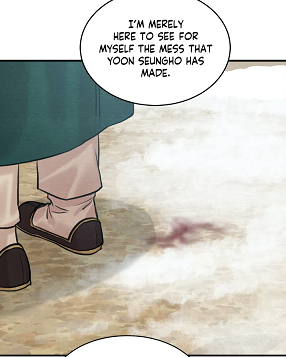 (chapter 83)
Feel free to comment. If you have any suggestion for topics or manhwas, feel free to ask. If you enjoyed reading it, retweet it or push the button like. My Reddit-Instagram-Tumblr-Twitter account is: @bebebisous33. Thanks for reading and for the support, particularly, I would like to thank all the new followers and people recommending my blog.
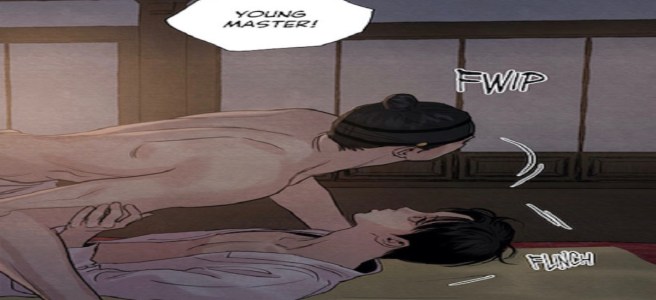


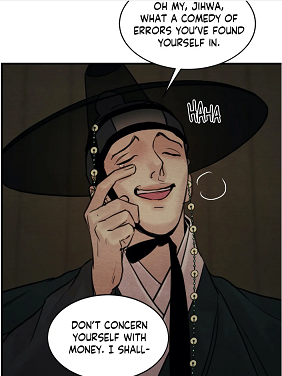 (chapter 76) which was totally new in the manhwa. We never saw such a combination: a single tear with a laugh. Moreover, for the first time, The Joker had shed a tear. The manhwalovers will certainly recall that so far, we had tears of happiness (chapter 21) and sadness
  , (chapter 59) but never tears out of laughing.😂🤣 Therefore I came to recognize the significance of this scene. First, it divulged a lot about Black Heart’s personality, and announced a turning point in his life. At the same time, this observation gave me a new idea, which I will elaborate in the second part. Striking is that until now, I had examined the painter and Jihwa’s tears, yet I had never focused on this topic itself. Hence in this analysis, I would like to study not only the weeping of the characters, but also the absence of their tears.
 (chapter 22). The rock is a metaphor of his heart: he will remain cold-hearted. Striking is that even after the humiliation during the hunt, he never shed a tear. He was only frustrated and angry at his opponent and sponsor. His huge ego had been hurt by the main lead’s mockery, but despite his wound, he chose to look up to the sky, apparently waiting that fate/karma would punish the wealthy noble for his wrongdoing. This outlines that the learned sir still believed in his superiority. In other words, Yoon Seungho had not reduced the scholar to tears with his words, which stands in opposition to the second lead’s reactions.
 (chapter 18)
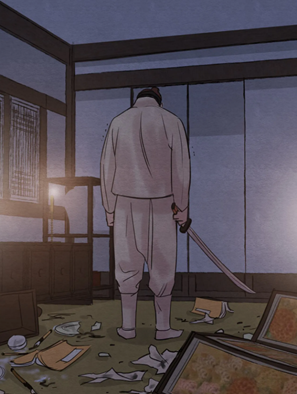 He broke out to tears. And note that in that moment he was standing with a sword in his hand, another evidence that his tears were triggered by his frustration and bruised ego mixed with sadness and anger. And now, you comprehend why he represent a negative reflection of Baek Na-Kyum, the latter embodying humbleness and modesty. However, unlike the scholar, Jihwa was slowly learning his lesson and as such changing. Since the low noble’s heart is made of stone, he will never change in my opinion.
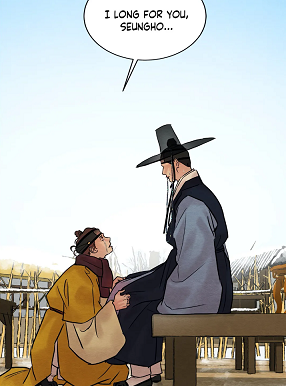 (chapter 57)
 (chapter 56). This signifies that his tears are not related to pride, but to his traumas. The lord can no longer weep due to the constant exposure to physical, mental and emotional pain. However, since he has been taught not cry in the presence of the butler, in chapter 56 it was, as if he was blinking back tears.
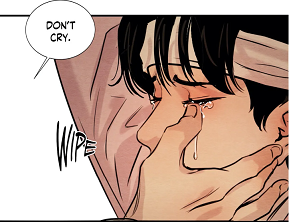 (chapter 2) And now, you can imagine which idiom I am about to bring up:
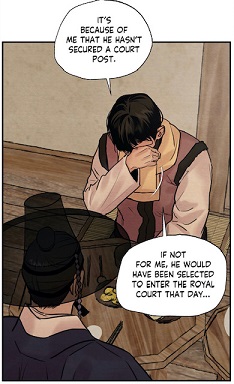 (chapter 75) This truly exposes the teacher’s cruelty and ruthlessness. We could say that the painter reinforced his admired sir’s cold-heartedness. Therefore I come to the following conclusion: Jung In-Hun will never feel remorse or empathy. He is destined to become a monster, as his wounded pride will just arouse brutality, resent and thirst for revenge.
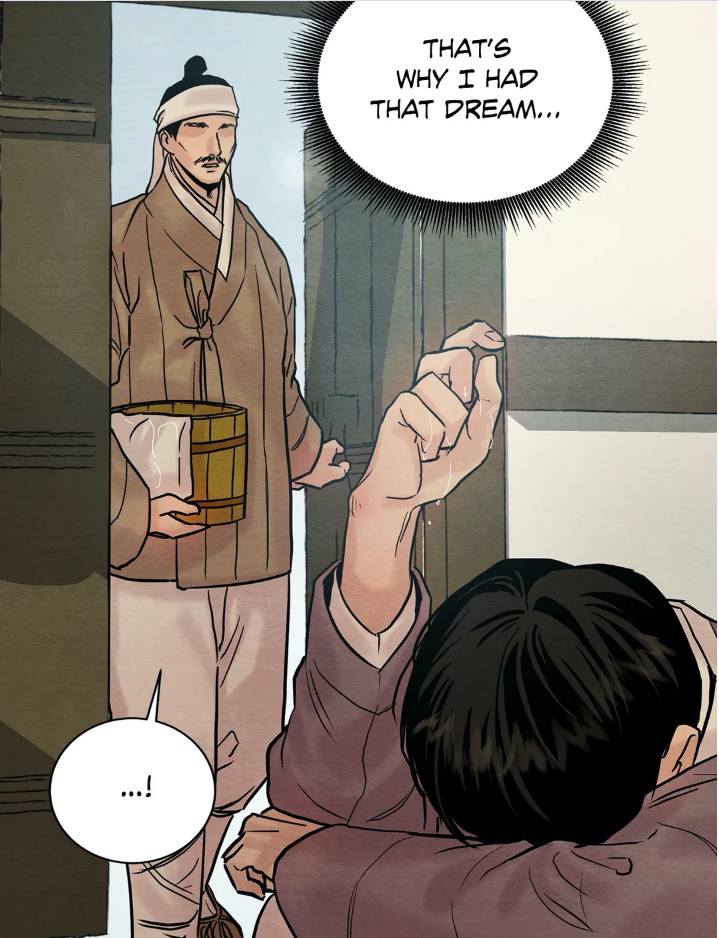 (chapter 56) I couldn’t help myself laughing, when I discovered it. I have no idea, if there’s such an expression in Korean. This slang expression comes from “to cry buckets”, which signifies that the person is like a cry baby. This new discovery made me realize that Yoon Seungho played a similar role to his admired valet than Baek Na-Kyum to his learned sir. Since the main lead was constantly facing terrible experiences, due to his cowardice and powerlessness the domestic chose not to take to heart. The more he witnessed, the more unconcerned he became. Therefore I deduce that Kim will never change his mind-set. He will prefer detachment, cowardice and blindness, because that way he is not suffering: neither regret nor heartache.
 (chapter 65), bringing lunches or announcing the arrival of a guest. And this observation made me realize that the lord started working hard, the moment he desired to woo Baek Na-Kyum. He dressed up, ordered some medicine for excessive drinking, organized two hunts, started strolling through downtown. Yet, this is no real work. And note that Jihwa behaved in a similar way, when he sensed danger from the painter. He also dressed up, had to plant a spy and trespass the mansion on different occasions. From my perspective, Yoon Seungho will start working the moment he behaves like a master. He needs more than just give orders to his staff. He has to control them and pay attention to finances. From my point of view, it is also his duty to take care of them as well, as the head of the mansion. To sum up, he has to learn how to manage the mansion. That’s why I believe that the lord’s tears will only return, the moment all the conditions are met: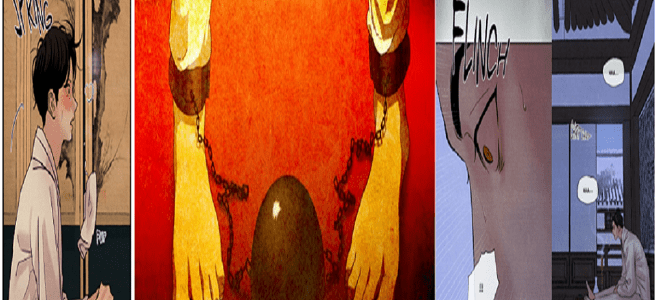

 (chapter 149). This means, this terrible incident with these painful memories will always be a part of his life and he will always have to fight to find the right balance. That’s why he describes the patient’s life as a long journey
  , where the figure has to find a way to overcome his trauma.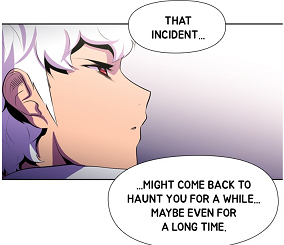
 (chapter 149) As you can see, a patient suffering from flashbacks and PTSD is on his own in the end, the psychologist can only give him support, advice and comfort, but in the end Yeonshik is the one who has to work on himself and find the right balance.
  (chapter 63) But note that it took the lord a long time to recognize and externalize this thought. And so far, the painter has still no idea what truly makes him happy.
  (chapter 74) and thoughts
  (chapter 74) from his lover.
 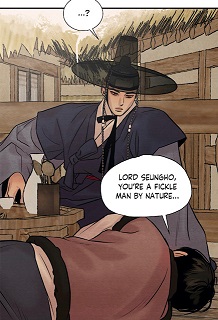 (chapter 75) He might have asked for his help in chapter 76
 , yet it was a spontaneous and natural gesture. But once he starts thinking with his mind, the closeness won’t remain. There’s no doubt that the painter is still afraid to admit his attraction and affection to Yoon Seungho. The negative image of sex, influenced by Jung In-Hun and Heena noona, has not been entirely removed. Furthermore, Yoon Seungho never revealed to the artist that he knows now about the kidnapping. He detained information from his lord Na-Kyum. That’s why I deduce that the painter and the aristocrat will have to discover on their own that for happiness, they must be open and truthful to themselves and to their partner. A white lie, lie by omission or a silence can have devastating consequences.
 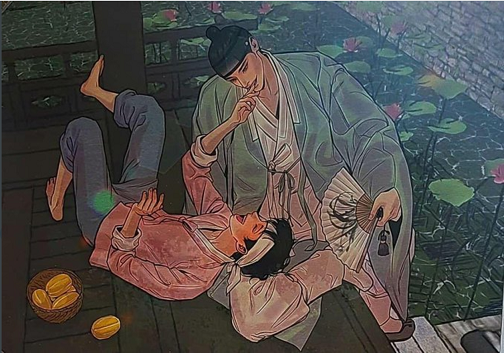 Yoon Seungho will always have mental issues, but at the end he won’t let his traumas take control of his life anymore. Yet this doesn’t mean either that this story will have a tragic ending due the expression “in their own way”. Both protagonists have to recognize that first, they need to liberate themselves from their past and traumas. Yoon Seungho is still suffering from partial memory loss due to his huge traumas. However, thanks to the painter who creates good memories for the noble, the latter is slowly recovering from his amnesia. This is important, for it signifies that Yoon Seungho is regaining his identity and as such returning to his old self. But by slowly remembering his past, he is getting the chance to discover the truth about the causes for his misery. Little by little, Yoon Seungho is realizing the butler’s betrayal and abandonment,
  (chapter 77) just like he is now remembering that lord Song is responsible for his martyrdom.
 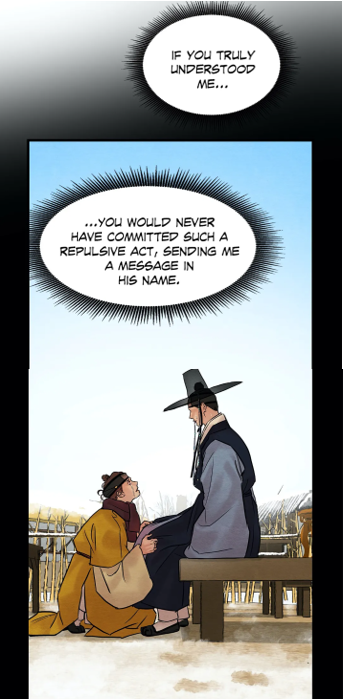 (Chapter 59) Compare the lord’s attitude in season 1.
  (chapter 37) So far, he only blamed the father. Sure, in season 3, he still reproaches the father‘s responsibility, but observe that his blame is more related to the Yoon Chang-Hyeon‘s bad choices.
 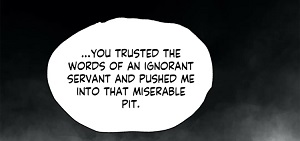 (Chapter 86) He trusted the wrong people, in other words, he sensed that his father had been misguided. This explicates why he blames the father for the absence of his critical thinking.
 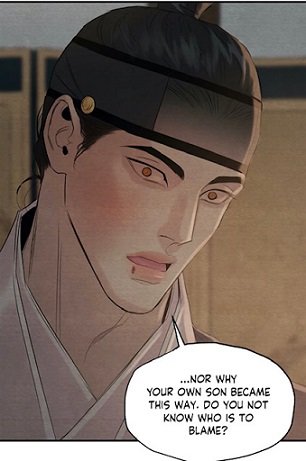 (Chapter 86) He never pondered on the question how the tragedy could occur. He was simply satisfied with the easiest solution: Yoon Seungho was responsible for this. This conversation is important, as it actually outlines how different the lord is from his own father. At the end of season 3, Baek Na-Kyum asked his lover this:
  (chapter 102) How come that he left his side? For the main lead, it sounded like a blame, while in reality, it was a question. By asking Yoon Seungho this, he is pushing the lord to investigate the matter. Discovering the truth is relevant, for it will reveal that Yoon Seungho’s crime had been planned all along!! He was incited to kill people, thus he had the sword in the hand. And since the situation mirrors the past, the main lead will slowly unveil the truth about his own past. Now, you are probably wondering how this is related to happiness. The answer is simple. As long as the protagonist is trapped in the past, he could never become happy. He couldn’t simply move on. But by leaving everything behind, he makes a clean start, and he is forced to rely on himself and as such to trust himself, if he wants to take care of the painter properly.
 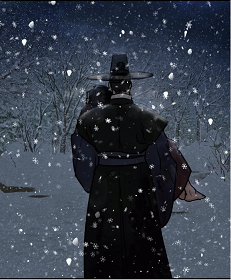 (Chapter 102) That’s the reason why the author said that they will find happiness on their own.
  (chapter 74) At the end of the second season, Heena noona’s influence is still palpable. In that aspect, Yoon Seungho is much further than the artist, as the lord is no longer in denial about his love for Baek Na-Kyum. Yet, at the end of season 3, Baek Na-Kyum makes a similar experience. He recognizes that his sister has been manipulating him in order to achieve her goal.
 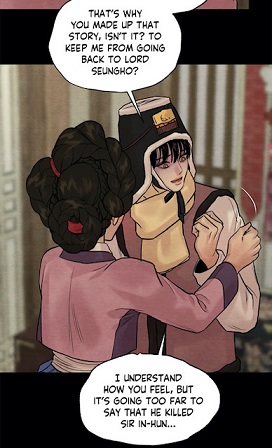 (Chapter 97) Furthermore, because he listened to the ghost Jung In-Hun and the comments from the staff, he fell into the trap set by Min. Once facing Black Heart, he got aware of the deception right away.
 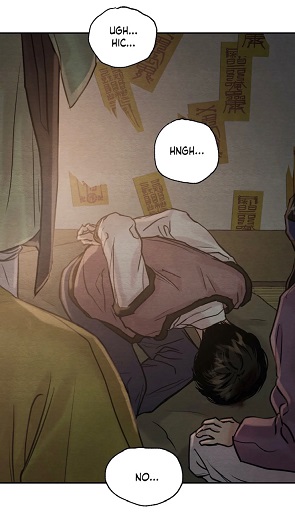 (Chapter 99) In other words, due to the last tragic incident, he experienced that he should mistrust people’s words. He shouldn’t take their statement as face-value. This is important, for the artist is learning to become more and more independent. His critical thinking is developing. As you can observe, both main leads have to find their own way to become happy. But they can only become happy, if they discover the truth and as such their past. Thus I am deducing that Yoon Chang-Hyeon will never find happiness, for he never tried to discover who was behind the bad reputation of the Yoons. This explicates why he is repeating the same mistakes from the past in season 3. He still trusts valet Kim.
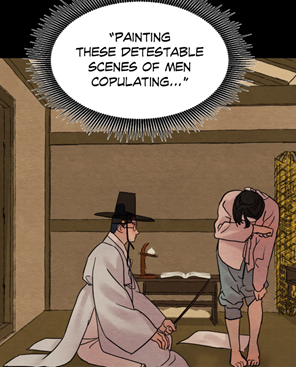 (chapter 34), only spiritual love was allowed
 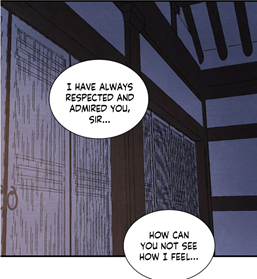 (chapter 19)
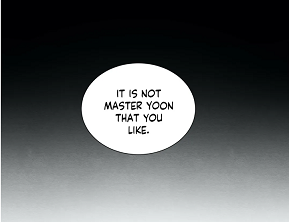 (chapter 68). This signified that in his education, not only sex was prohibited, but also sexual desires were denied. Although love was expressed through hugs
 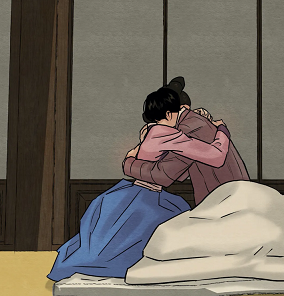 (chapter 66)
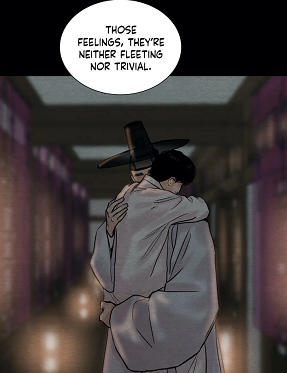 (chapter 68) and caresses
  (chapter 10)
  (chapter 68), they were devoid of sexuality. The painter experienced love, but was not allowed to experience sexuality. He was only authorized to paint it for the scholar’s sake. On the other side, Yoon Seungho was raised the opposite: love was not allowed, as it was a sign of submission and weakness. Sex was permitted, because it was considered as a fight in order to defeat his opponent. These were the butler’s doctrines. That way, he could still have a connection to the main lead. If he came to love someone (the pedophile), the lord could definitely abandon the valet and reveal his betrayals. In other words, he used pity as a way to tame the lord. At the same time, sex also served to gain some benefit, as it was an exchange of favors (giving versus receiving),
  (Chapter 71). I connect this philosophy to the king and indirectly to the butler. With sex, the nobles could exchange some favors. These huge divergences in the mindset explicate why there were so many misunderstandings between Yoon Seungho and Baek Na-Kyum, as their education diverged so much.
 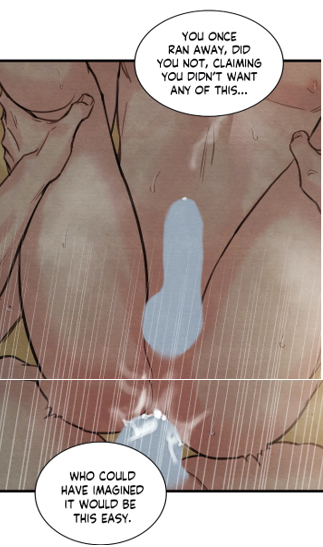 (chapt45), as the painter had accepted him as his sexual partner, he had to realize slowly that he was wrong. He imagined that since the artist had remained by his side and was accepting to have sex with him, he had achieved what he wanted: in his unconscious it was to be loved. Yet, it was just an illusion. The painter saw himself as a whore and the master as a man consumed by lust. As you can see, the noble was forced to judge the nature of the sexual encounters differently. He had associated sex to love due to their Wedding night, therefore he imagined that the moment the painter was accepting him, the problem was solved. He would be able to relive this wonderful moment, but however nothing like that happened. He felt never satisfied, as there were no feelings at all. Hence he even had sex during the day
 , believing that the artist’s lack of experience was the problem.
  (Chapter 45) While the lord became Baek Na-Kyum’s sexual emancipator, the painter became the lord’s teacher for love. This explicates why the low-born forced the lord to question his own identity and feelings.
  than a master- servant relationship, because the commoner was never treated like a domestic. He only had sex with the lord and had some privileges.
  (chapter 46) He was never asked to do other work, although the artist tried to change his situation. Since he was behaving like a whore, he felt that he had no right to express any thought and emotion. He couldn’t show any pleasure. That’s why there were no feelings in their sex encounters, and the lord could sense the difference. Consequently, when the lord realized that he was still perceived as a man consumed by sex
 (chapter 48), he changed his behavior. He acted like a real client at the brothel
 (chapter 48), but at the same time he cornered the painter to have multiple climaxes in order to let him experience that he liked having sex with him.
 (chapter 49) As you can observe, the lord linked sensuality to love. If he could provoke ejaculations, then it meant that the artist was definitely feeling something for him. However, the moment the lord liberated the painter from his pejorative perception about himself (he is a prostitute), the painter reacted the exact opposite. Now, he was the one using Yoon Seungho, the latter was his plaything.
 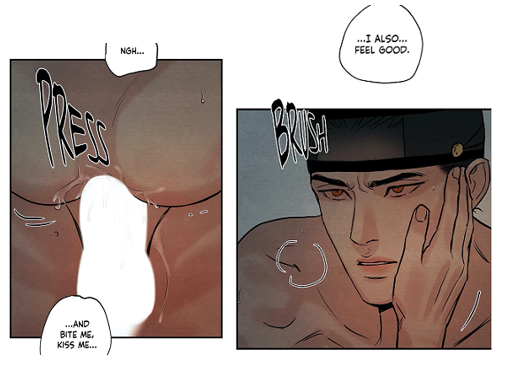 (Chapter 49), his prostitute, for he was the one procuring pleasure to Yoon Seungho. As you can see, the roles had been switched. This means that now the painter had the upper-hand in their relationship. We could even say that the noble was willing to accept his fate.
  (Chapter 49) Yet there was a difference from the past. Yoon Seungho would feel pleasure as well. This is not surprising that Kim chose to intervene and separate the couple right after. Without sex, the painter had no power over the master. That’s the reason why the butler revealed his knowledge the morning after. The protagonist had to hear from his butler the real cause for Baek Na-Kyum’s passivity and torpor:
 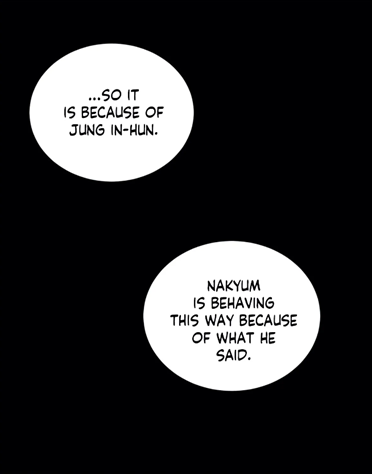 (chapter 50). Through this revelation, the lord was indirectly confronted by his own reflection: he was indeed asking from Baek Na-Kyum sexual favors in exchange for his stay at the mansion. That’s the reason why the lord had a “relapse“ and kept his distance from the painter.
  (chapter 52). This was important, because for the noble, it meant that he could no longer have sex with other partners. Without sex, the lord was forced to question himself and ponder on the true nature of his relationship with Baek Na-Kyum. He felt jealousy during that night, he was very protective as well.
  (Chapter 52) His sexuality had already become an expression of his love, although the main lead was still unaware of his own feelings. That’s why I come to the conclusion, chapter 52 was actually revealing Yoon Seungho’s monogamy, although it looked the opposite. And this becomes truly visible, when the gangrape was about to occur. He felt no urge, when he was with the guests, yet the moment he brought the artist to the bedchamber, he couldn’t stop himself from kissing his loved one.
  (chapter 54) He was definitely longing for his warmth. This explicates why the noble got so infuriated, when he was confronted with the consequence of his bad decision:
  (chapter 55), deep down he sensed that his master had protected him. This night was important for the main lead: he was forced to admit his own feelings for the painter. Therefore, we could say that the issue with the prostitution was solved after chapter 54. Yoon Seungho thought that the moment he confessed, the painter would get scared and run away, but it didn’t happen. Why? Love among men and especially between a brutal noble and a commoner, was a taboo, like Min had underlined. Secondly, if the lord had indeed feelings for him, he had behaved like a beast during that night. He had mistreated Baek Na-Kyum. In his mind, the artist would never accept him.Besides, the painter had clearly denied the affection from the main lead. In his eyes, the painter’s words were indicating a rejection.
 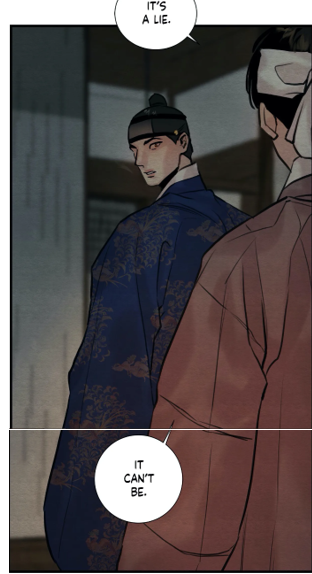 (chapter 54) Thus I conclude that Yoon Seungho and Baek Na-Kyum had come to an implicit agreement: they had a master-servant relationship
 (chapter 56), although Baek Na-Kyum started perceiving himself as a domestic from chapter 51 on again. He kept following the head-maid
 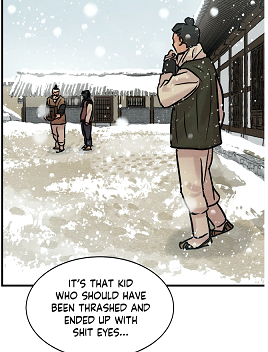 (chapter 51) in order to help them. Therefore the readers could witness the return of the white headband in chapter 52: his task was to paint for his master.
 (Chapter 52)
  (chapter 62) here, he whispered to Baek Na-Kyum that he adored him), he would bind the artist to himself.
  (chapter 63), exactly like he had wished in chapter 49. The only difference is that this time, the painter was here for the lord’s pleasure. The roles had been switched again. As the manhwaphiles can perceive, the noble and painter had a similar reaction: they both tried to deny the existence of love in their relationship. That’s the reason why the noble stopped the artist from confessing:
 (chapter 63) They just had a sexual relationship which could provoke pleasure, but that was it. But in order to ensure that the artist wouldn’t run away again, he used sex to “tame“ Baek Na-Kyum. If the main lead could procure multiple climaxes to the artist, then the latter was forced to admit that only Yoon Seungho could be his “partner“. This explicates why the noble kept pointing out how the artist would react to his lover’s body.
 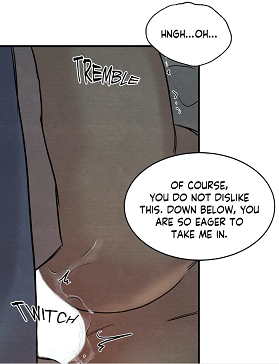 (Chapter 63)
 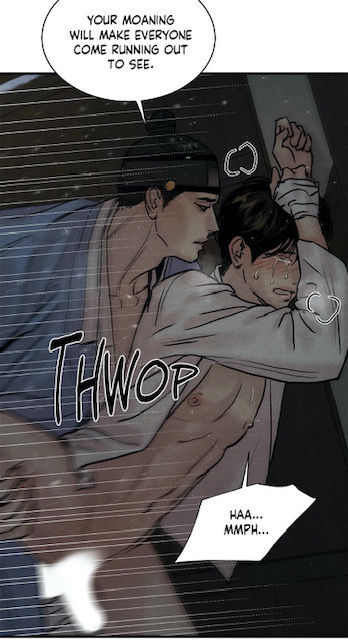 (chapter 64) He was moaning and would ejaculate constantly thanks to the main lead. Yet, during this second marathon, the noble was actually deceiving himself.
  (Chapter 62)
 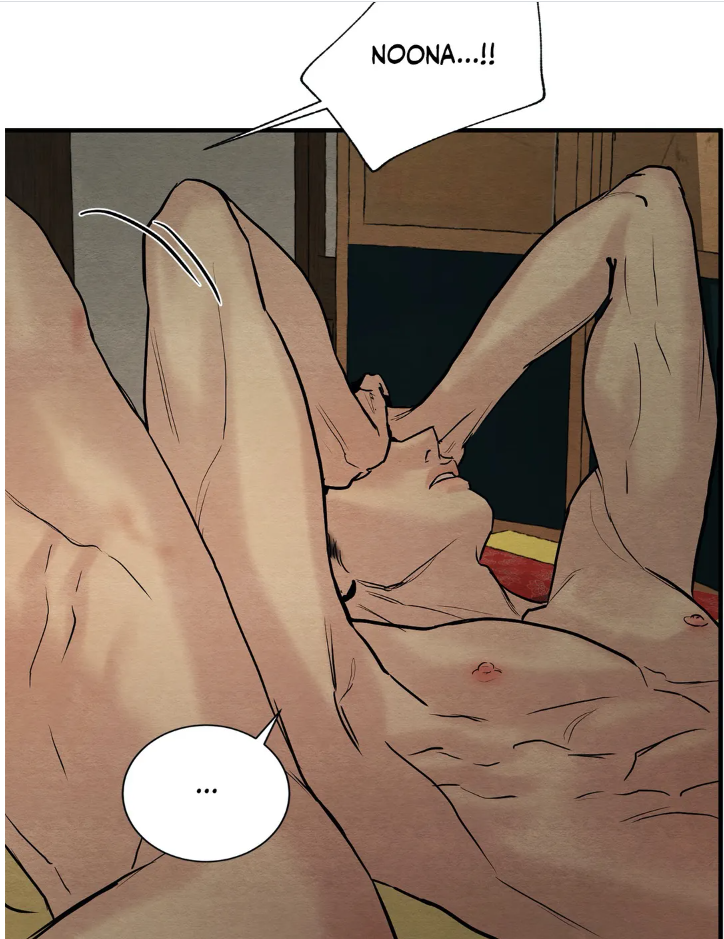 (Chapter 65) This shows that the painter had gained a new position: he was indeed a favored servant. He was allowed to spend the night in his lover’s bed and he could see the lord getting dressed.
  (Chapter 65) The slight change was that now the main lead was aware of this. This truly exposes the lord’s affection for the artist. He might have treated him like a plaything in the shed, in reality he had attempted to show “his skills“ as a lover. He had licked him, bit him and the painter had felt pleasure, though he kept saying no! This is not surprising that Yoon Seungho had denied the kiss in the study.
 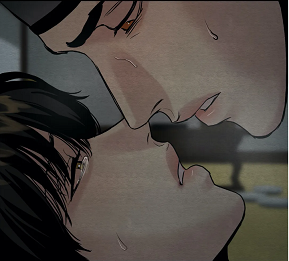 (Chapter 64) Because that’s how he had been deceived that night in the study.
 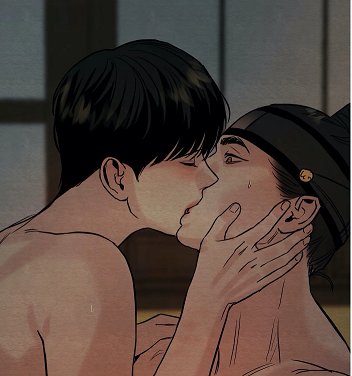 (Chapter 49) Baek Na-Kyum had silenced him with the kiss, as the main lead was about to protest.
  (chapter 65) What caught my attention is that the painter’s disappearance mirrored the lord’s wrongdoing. Lee Jihwa and the main lead had both kidnapped the artist. That’s why I believe that when he heard Heena’s words in the study
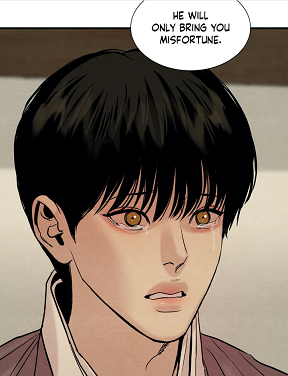 (chapter 68), the noble could only come to the following conclusion: he could only let the painter choose his destiny. But the moment the artist decided to remain by his side, he needed to change Baek Na-Kyum’s position in the mansion. He was no longer a servant, but a noble guest. Hence the lord tied the scarf like aristocrats did.
 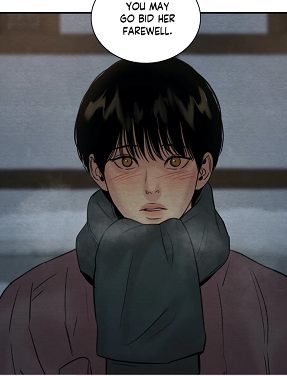 (chapter 69) Consequently, we could say that the painter had a similar status than Jung In-Hun. Yet, there was a huge difference: the owner of the mansion was now acting like the painter’s servant. Hence Deok-Jae’s words came true:
 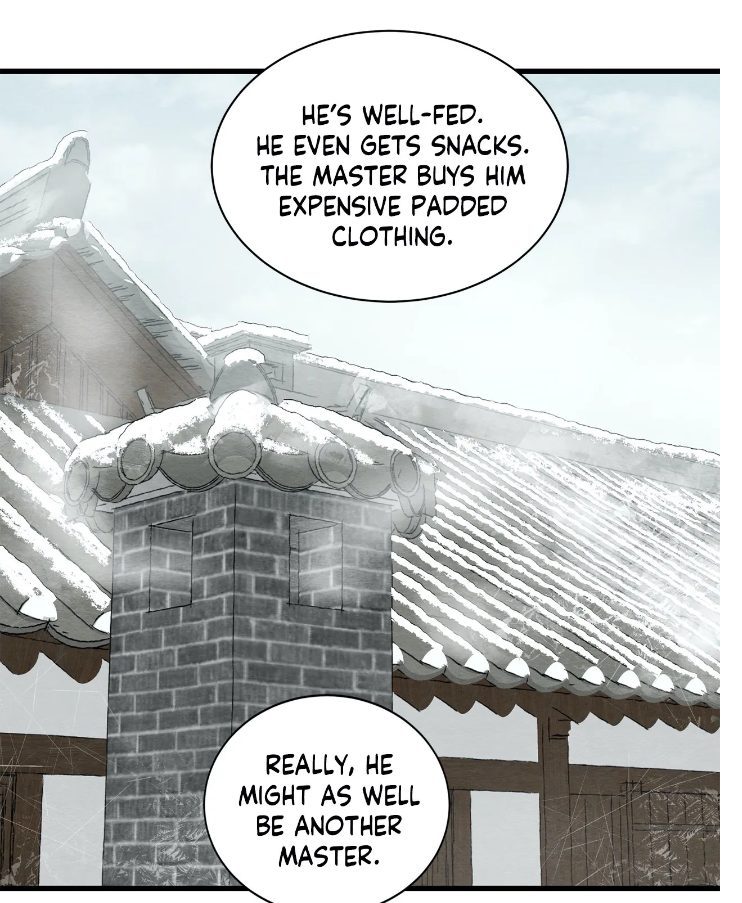 (chapter 46).
  (chapter 71). Why? It is because the lord made the decision that the painter chose him, then this means that he became his wife, though at the end of season 2, he was not thinking about marriage yet. He was not aware of this perception. By becoming his official partner, the spouse obtains the status of his husband: nobility. This explicates why the lord ate with his lover
 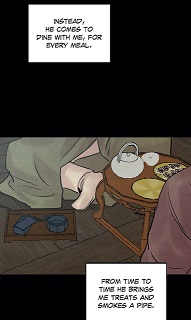 (chapter 74) and allowed him to smoke. Then in season 3, he gave him ladies-in-waiting in order to give him some company.
  (Chapter 78) He even gave him the music box, which was mistaken as a dowry. However, the problem is that the painter was still fighting his own feelings for the protagonist due to Heena noona’s words and past experience with the scholar. He feared that this new situation was too beautiful to be true, hence he thought that the lord’s feelings would fade away. But there was another reason for doubting the lord’s affection: there was no sex.
 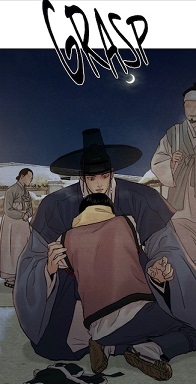 (Chapter 76) The main lead didn’t reject the painter’s urge for a hug in front of commoners. At no moment, Yoon Seungho felt embarrassment. He treated him like a special treasure. That’s how the painter came to realize that Yoon Seungho‘s love for him was true and genuine. Consequently, he decided to rely on him and to trust him. That’s why in this panel, the painter closed his eyes:
  (chapter 76) We could say that he was reminded of his own past. When he was a child, he sensed love through hugs and caresses. Since the painter could feel the lord’s genuine affection and warmth, he recognized that even when there was no sex, love was present. All his senses made him perceive the lord’s love:
 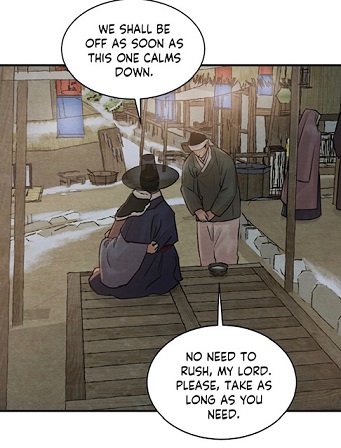 (chapter 76) His words showed his care and concern, then he bought him an expensive music box.
  (Chapter 76)
 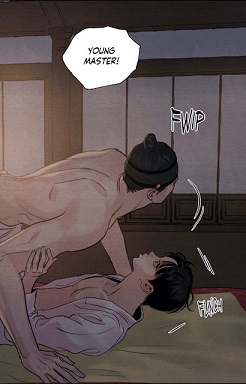 (Chapter 80) And now, you comprehend why the painter didn‘t confess during that night. He got interrupted. The kiss was the symbol for their love. Thus it is no coincidence that just after his confession,.
  (Chapter 94) the painter initiated a long and sensual kiss with his “husband“.
  (Chapter 95) Since the painter had received caresses and embraces in his childhood, he came to view the kiss as the symbol for true love. And note that the kisses exchanged in the gibang were full of passion and love. This was the perfect combination of love and sex.
  (Chapter 95)

 (Chapter 96) This shows that Yoon Seungho has always longed for a pure and spiritual love in the first place. His sexual preferences were already palpable in the last love session (season 2):
  (chapter 72) We could say that he discovered all his sexual preferences thanks to the painter.
  (Chapter 80) But he failed due to the intervention of the butler and other schemers. Besides, the whispering of „Kyumah“ could only make his heart race. Let’s not forget that his painting in the sand
 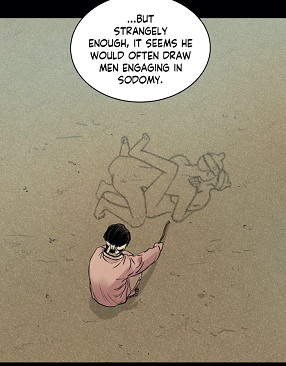 (chapter 1) externalized his own philosophy: love and sex can’t be separated. Note that the couple is is hugging and kissing at the same time! 😍 This picture will represent the peak of their love! Striking is that when the couple confirmed their mutual affection, they did in the kisaeng house, the symbol for prostitution. This truly exposed that Yoon Seungho had been treated like a male night servant in the past. .
 (chapter 72) in the next season, for the painter is still calling his lover “lord Seungho“
  (chapter 99)
  (chapter 102) This means that he is still viewing himself as a low-born. But note that contrary to the past, Baek Na-Kum is now wearing a hanbok and he has no other clothes. Thus I am deducing that the painter’s next lesson is to drop his notion that he is a commoner. He will be taught to view himself as an equal to Yoon Seungho. Only when he has internalized that there is no gap between him and his lover, then he will be able to address him as “Seungho-YA!“ At the same time, both protagonists will come to realize that they can express their love differently. Poetry, painting and more importantly through their desire to protect their loved one. The lord will start protecting Baek Na-Kyum more actively, just like the painter will decide to show more interests in his lover’s skills and past life. Baek Na-Kyum will feel responsible for the bloodshed in the shaman’s house. In my opinion, the lord will confide to him what happened to Min and the other nobles. I am assuming this, for the lord remained silent, when the messenger of his father came to the mansion. He didn’t want to scare his lover because of his brutal outburst.
 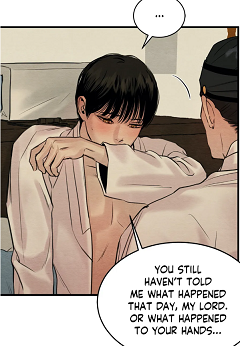 (chapter 84)
 The trigger for the change is the noble’s words. The latter keeps talking to the painter asking for an reply. Hence in my eyes, there are glimpses of love the moment Baek Na-Kyum said this:
  It sounded like a confession, hence the seme became more passionate:
 Here the lord acted like a client. Yet, notice that the lord is speaking again forcing to express himself. And the moment the painter cried and started voicing his own opinion, the sexual encounter was affected.
  (chapter 49) An expression of love and affection, but the painter rejected it, as he mistrusted his own judgement. He couldn’t help thinking of the learned sir’s fake embrace. Striking is that despite the rejection, the painter kissed and hugged back his lover
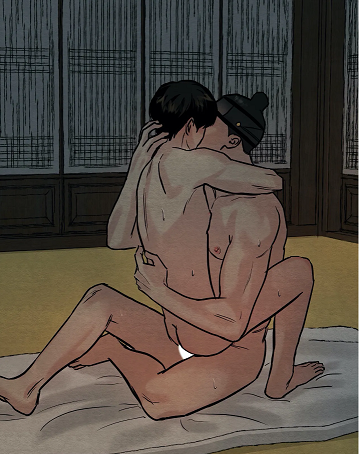 (chapter 49), which made the lord believe that he could only get embraced by the painter, if they had sex.
  . Although the second sex marathon starts like a pure sex session, the moment the painter calls Yoon Seungho differently
 , the lord’s attitude changes. The painter is turned around and faces his lover
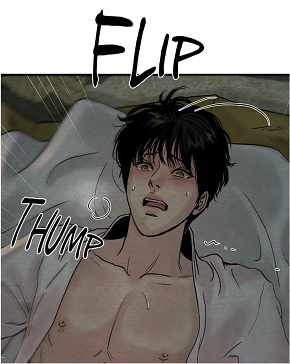 , a sign that they are getting closer. Striking is that again through their conversation, the painter is pressured to think about his own emotions.
  However, due to his own insecurities and fear, the noble still can’t trust the artist’s words, therefore there’s no confession.
  (Chapter 58) Thus he should become responsible for him. Yoon Seungho was unconsciously trying to push the painter to reciprocate his feelings, an imitation of Lee Jihwa‘s confession. Nevertheless, the painter remained silent, therefore it meant that his love was still denied. That’s why it stands more under the sign of dream and illusion. Consequently, the night in chapter 70, 71, 72 and 73 contrasts so much to the one from chapter 58. This time, it symbolizes the lord’s pure love. As such, the sex is already a real expression of love. That’s why the lord asked to be called intimately: Seungho-Ya
 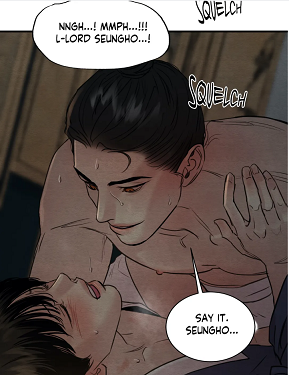 (chapter 72) On the other hand, this love session was strongly intertwined with the notion of forgiveness and punishment as well. This is important, it reveals that Yoon Seungho had internalized that sex was the expression to redeem himself. He had been tasked in the past that if he desired to obtain “forgiveness“, then he should have sex. And by comparing all these sexual encounters, I came to the following conclusion: the lord’s words definitely contributed to change the nature of the sex session, just like the hug.
  In chapter 66, he had a flashback, hence he couldn’t witness his lord’s attention and care.
 But the lord discovered this kind of embrace, when he helped the painter in chapter 53:
  That’s how the noble experienced the embrace as a source of comfort and affection. Therefore you can comprehend, why I wrote above that the painter was teaching the lord how to love properly, but also why the embrace became the symbol for love in the lord‘s eyes. He had never been embraced before by a man. And Lee Jihwa had recognized the true signification of this gesture, when he spied on the couple (chapter 43). That‘s how he knew the friend‘s biggest desire: and was deeply hurt after this discovery
 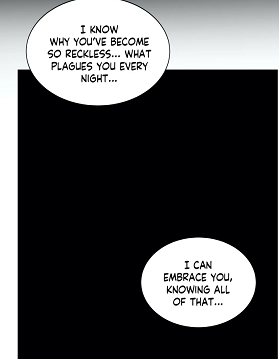 (Chapter 57) However, this shows that Yoon Seungho is a quick learner, because he knew what to do, when the painter was in pain and destress. At the same time, it explains why he could fake the embrace in chapter 62:
  This hug stands in opposition to the one at the end of season 3:
  (chapter 102) The artist was forgiving his lover! Love represents selflessness, tolerance, forgiveness, warmth, affection and assistance which is transmitted by the embrace. Now, you understand why Yoon Seungho was still not satisfied after the sex session in the study, he was longing for the hug.
  (Chapter 84) In his unconscious, he knew that if the artist hugged him, he would have forgiven him. But he had no idea about it, thus he couldn’t suggest this. So far, he had experienced the embrace from the artist while having sex. Deep down, he had already internalized the embrace to forgiveness. So we could say that the absence of the embrace in this scene was the lord‘s punishment for the fake hug in the shed. And the painter let him discover the true nature of a warm embrace:
  (chapter 88) This is not surprising that this hug was not connected to sex at all. Yet it moved the lord so deeply. As the manhwalovers could sense it, season 3 was focused on love and sensuality. During that season, the couple was able to voice about their sexual desires and their preferences.
  (chapter 91)
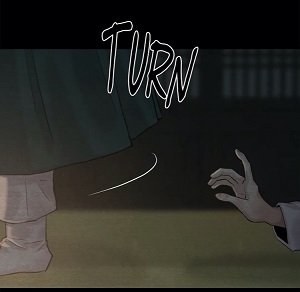 (Chapter 86) No one close to him had grabbed his hand in order to show their support. This gesture in the picture embodies abandonment. On the other hand, the painter had been the first one to take his hand and to swear “loyalty“.
 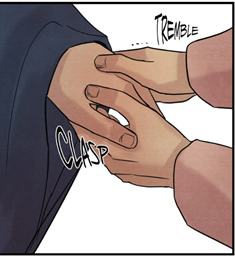 (Chapter 30) The joined hands were repeated in season 3 , the only difference is that this time, Baek Na-Kyum was doing it willingly.
 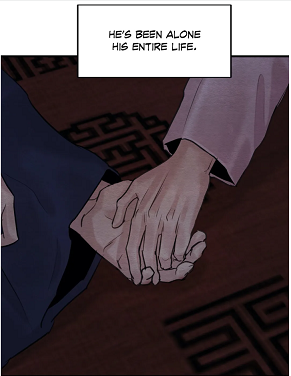 (Chapter 88) The symbol for support, company and responsibility.
 (chapter 41) Under this perspective, it becomes understandable why the couple neglected these pictures. They were all devoid of affection, it was more about prostitution and battle! And here is now the question? Where are these drawings?
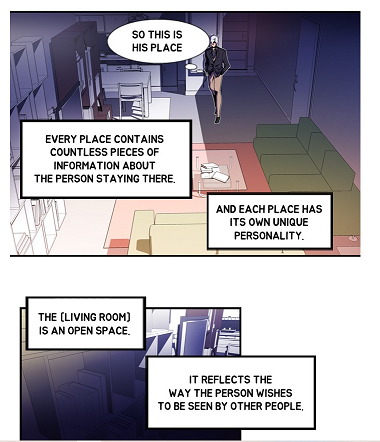 (Dr. Frost, chapter 8) As you can see, home is strongly connected to identity and personality. In other words, without home a person loses his identity. This is no coincidence that homeless people often have no ID.
  He felt so lonely and lost, for he had no place he could call home. It was, as if he had no identity. When he deserted the mansion, he first thought of the kisaeng house and his noonas
 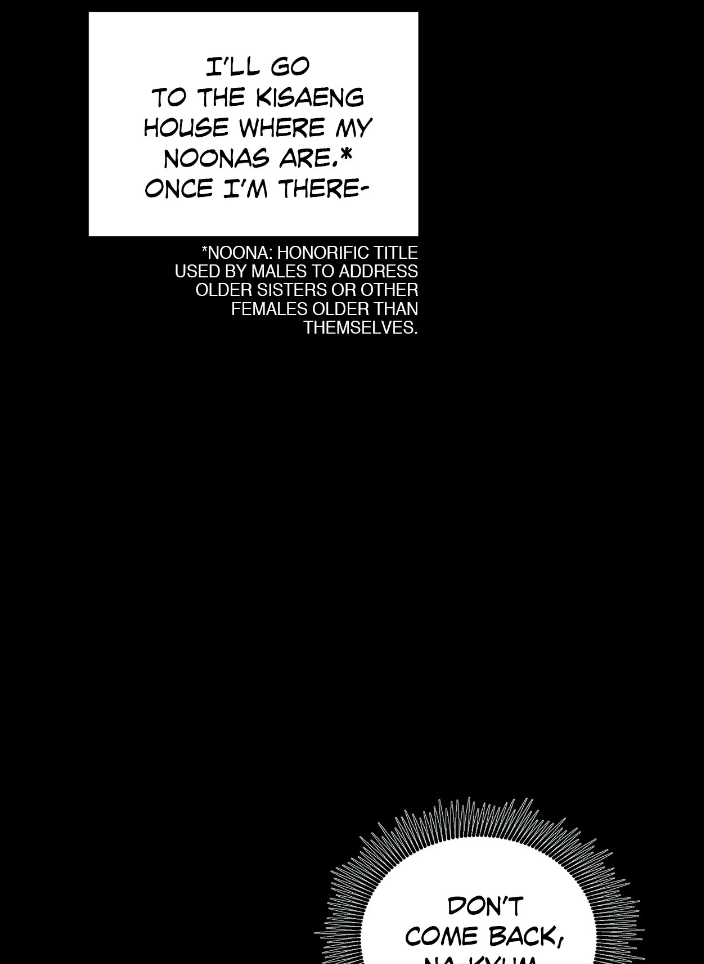 (chapter 46), until he remembered how he had been sent away by Heena noona.
 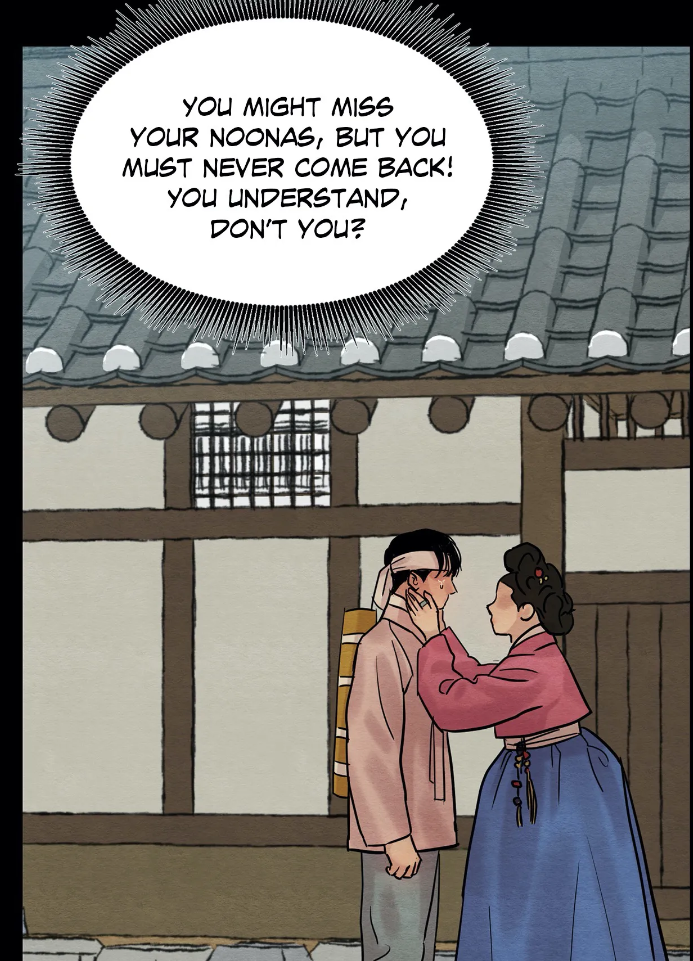 (chapter 46) This moment was terrible for the painter, because he had the impression to be abandoned a second time. Note that he is not calling the kisaeng house his home… for him, it was no longer a home, because his heart had been wounded there. Hence the manhwaphiles sense why the painter was using his mind in chapter 75
 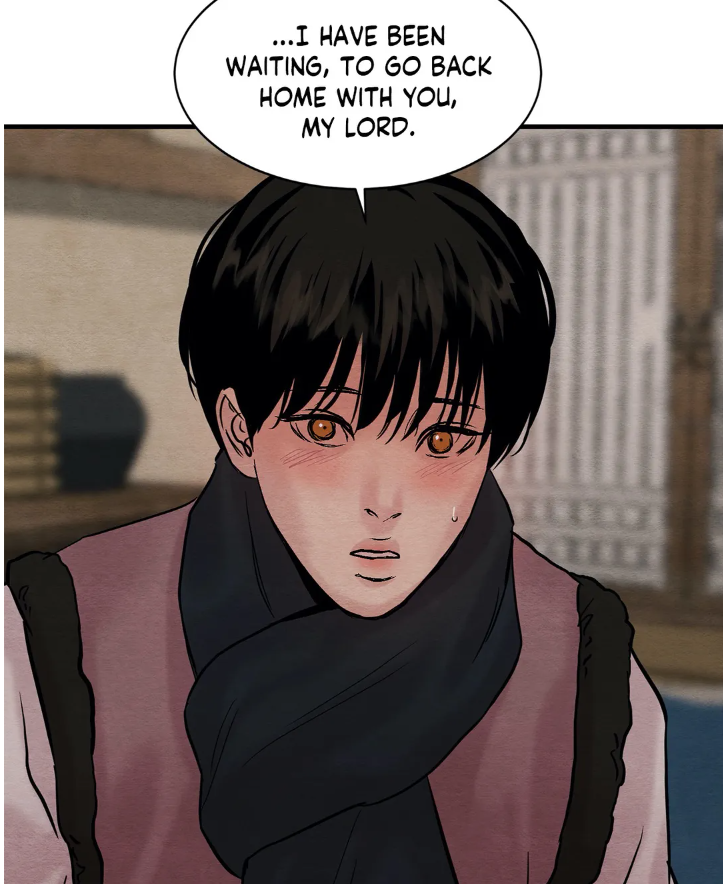 (chapter 58) And now, you comprehend why he stopped in the middle of the street during his escape. He had recalled how Heena had sent him away.
  (chapter 68) Observe how she blames her brother for not contacting her, while she had strictly forbidden him to come back. At the same time, the readers should question her behavior. How come that she never showed any concern for Baek Na-Kyum for 18 months, until she found out that he was living with Yoon Seungho? Why didn’t she contact him in the first place in order to check out if he was living properly? She gave him instructions, and the main lead listened to her, and now she is reproaching him that he should have disobeyed her. In my eyes, Heena noona acts more like a person with a fickle nature. She shows great care and concern in chapter 65 and 68, but she never searched for her brother’s whereabouts before. So far, the readers can only assume that she had no idea that he had been living as a drunk, and she only discovered his whereabouts by hazard.
  (chapter 64) Yet, this is just an impression because of this scene. Yet, in season 3, Heena confided to Min, and the latter revealed the content of her confession:
  (chapter 99) The idiom “bittersweet affections” indicated that the learned sir had expressed regret and disappointment concerning Baek Na-Kyum. This means that Heena knew that Jung In-Hun’s affection towards the low-born had been changing. As you can see, I come to the conclusion that Heena was already aware of the existence of tension between the painter and his former teacher.
 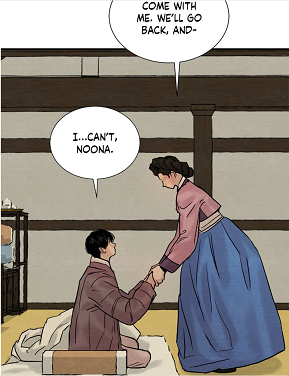 Heena noona is not even using the word “home”. At no moment, she employs this expression. When she parted from her brother in chapter 46,
 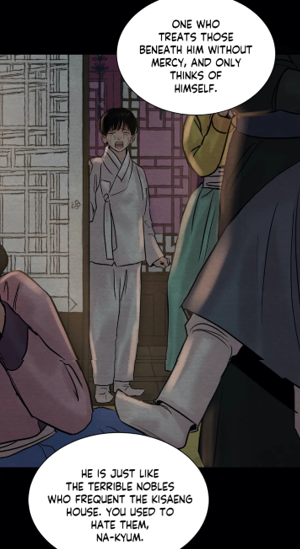 (chapter 68) Hence in her mind, when she asked her brother to leave the kisaeng house, she imagined that she was helping the painter to escape from prison. Since she admires the scholar so much, she saw in him her helping hand. He would assist her brother to become a free man. The readers should notice that the learned sir always left the kisaeng house with the low-born
 (chapter 68), when there was a ruckus. So when the kisaeng made the request to the teacher
 (chapter 46), she envisioned that he would acquiesce her request, since he had done it so many times in the past (taking care of Baek Na-Kyum and becoming responsible for him). Moreover, she knew that the artist liked and admired Jung In-Hun. For her, the scholar was a liberator, because he acted so differently towards the kisaengs and Baek Na-Kyum. That’s the reason why she thought, she was doing the right thing for her brother, while in reality she was just projecting her own desires into the artist. And this interpretation was proven correct, because when she vanished from the gibang in season 3, she was no longer dressed as a kisaeng.
  (chapter 99) She was deserting the kisaeng house, and as such the noonas. And note the parallels between chapter 46 and 97/99. In both cases, the painter couldn’t bid farewell to the other kisaengs.
  (chapter 99) It is because she was using her brother. In the first desertion, her choice was influenced by her unconscious. She had just projected her own thoughts and desires onto the artist’s. In season 3, she had made a conscious choice. In exchange of her brother, she would gain her freedom. Thus she used the expression “us”
  (chapter 97) This time, it was for her own sake. But the price for her freedom was that she had to sell her brother. She could still have a clean conscience by convincing herself that Yoon Seungho had killed her idol. At the same time, she needed to fake her death.
  (chapter 99) [For more explanations read the analysis “Heena’s curtains”] This means that she was betraying the eonnies one more time. And that’s how I had another revelation. In my eyes, after their separation, Heena had come to view her life in the gibang differently. She had been able to perceive the good aspects of her life as a kisaeng. She could live a comfortable life and as such get new hanboks.
 reinforced her bad impression about Yoon Seungho. That’s why Heena noona will never believe that this place can become the artist’s true home. For her, this place can only represent a new prison, for she has a negative perception of nobles. Hence she needs to rescue her brother.
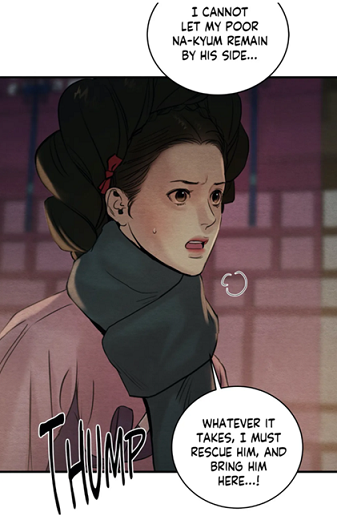 (chapter 69) Besides, I believe that she has another reason. The lord is connected to her own guilt, but she is not admitting her responsibility. In the first version, I had expected that due to his confession, the kisaeng would never trust Baek Na-Kyum’s words later. And this was proven correct. Why? First, Heena noona embodies a certain kind of knowledge: prejudices. Because she has already experienced many things, she has the impression that she knows everything. However, she is not realizing that her world view is based on her own perception. Secondly, her superficial knowledge turns her into a blind and deaf person. What she sees and hears will be interpreted the way she perceives the world. I had even written this back then:
 (chapter 97) Contrary to him, she knows, because she saw and heard things, when Yoon Seungho suffered! Yet, her knowledge is totally superficial, like the last panel exposes it. She just jumped to (false) conclusions. That’s how she got herself manipulated. Because of her bias, she became an easy target of deceptions. That’s the reason why she believes herself in rumors. Like the scholar said it himself,
  (chapter 29) there exists a kernel of truth in the grapevine. Moreover, with her caresses and hugs, she used love to stop her brother from speaking his mind.
 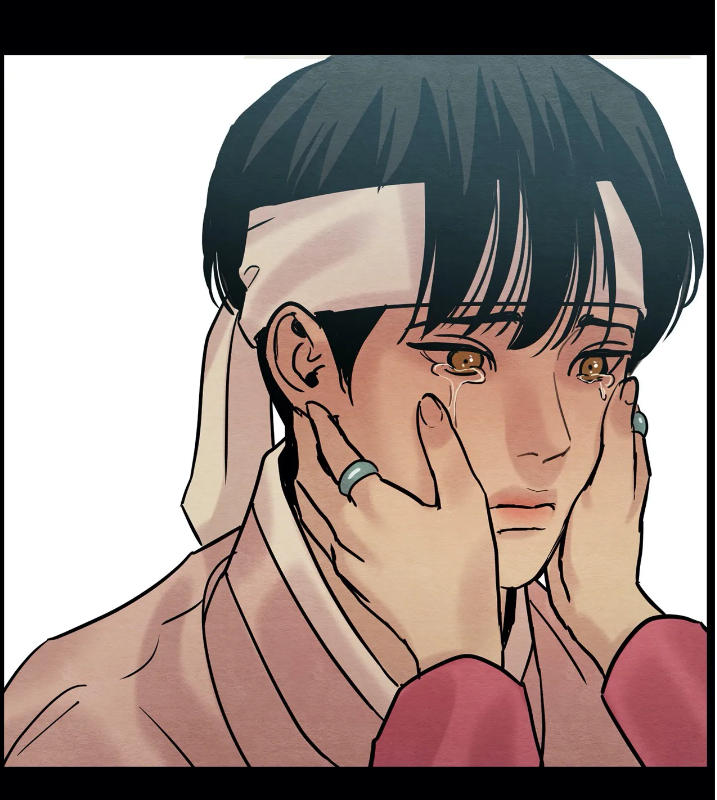 (chapter 46) That’s the reason why Baek Na-Kyum could only express himself through painting, as he had become mute. Due to her decisions and actions and the scholar’s, she contributed to turn the artist into a boy full of insecurities, unable to express himself. Consequently, Heena noona was put in front of the same choice in season 3. Note that the return of the painter to the gibang coincides with her departure. This means that due to the couple’s love session, she was reminded of her own past. She was forced to recall why she had associated the gibang to hell in the first place.
  (chapter 96) She was definitely scared in that scene. That’s the reason why at the end, she utilized her brother to leave the gibang.
 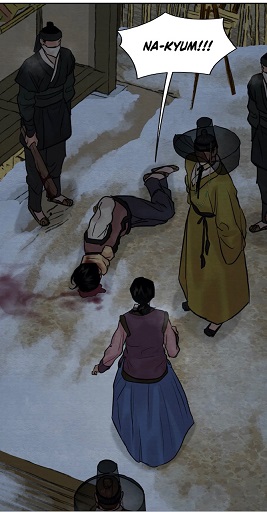 (chapter 99) This mirrors that her original dream was to live with her brother and the scholar, but this was just an illusion. She had hoped that once the artist was by Jung In-Hun’s side, the learned sir would come to buy her, and they would live together. She counted on the learned sir’s affection for the painter. But this was never Jung In-Hun’s intentions and he excused his behavior by putting the blame on the protagonist.
 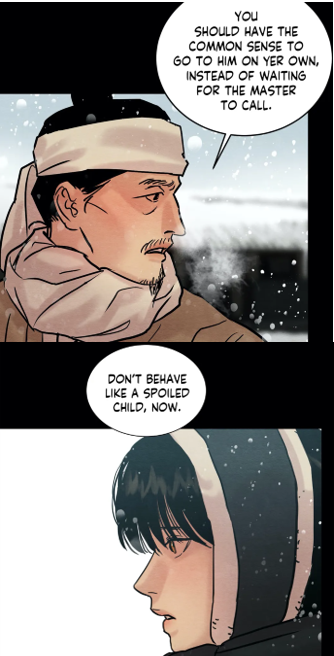 (chapter 52) And finally Yoon Seungho treated him well on different occasions by sharing his breakfast with him or sending him to the doctor or by protecting him from Deok-Jae. Yet I believe that the decisive factor is the momentary separation. Although the painter had lost his position as favored servant, the noble never sent him away. He let him live in the study and kept treating him well. The artist could sense that despite the distance, the noble was not willing to cut ties with him. This explicates why Baek Na-Kyum resisted to the vicious servant, when the latter tried to force him to leave the property.
 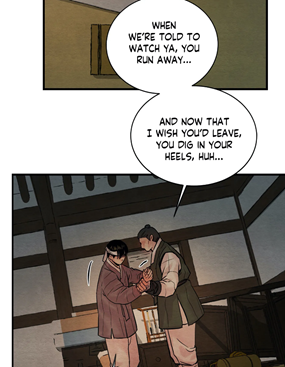 (chapter 53) This was his home now, and he wanted to protect what he had finally found. Despite the pain, he didn’t move. He was ready to do anything for his home. This gives us a glimpse of the painter’s future behavior, when his lover is targeted. There’s no doubt that he will fight for him. And now, if you compare the two following panels, you’ll realize the similarities between the two scenes:
 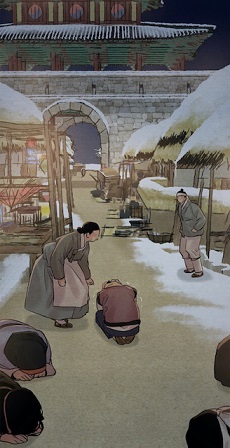 (chapter 76) In both scenes, the painter has a revelation. In chapter 46, he is alone and has no place to go. However, he is strong enough to stand on his feet, while in episode 76, he is paralyzed by fear and becomes so weak. Yet, exactly like in the first image, he feels lonely, but since he can’t escape, this position makes him realize his vulnerability. He needs help and protection. That’s why the moment he realizes the noble’s presence
 (chapter 76), he seeks his embrace and warmth.
  (chapter 76) With these words, it truly outlines that the mansion has become Baek Na-Kyum’s real home, a place where he feels comfortable and secure, which represents a continuation of chapter 46. While in chapter 46, he just considered the mansion more like a refuge or shelter, now he connects it to family. It has truly become part of his identity. But the embrace on the street let him discover that Yoon Seungho could become a home too.
  and English version, when the lord replies to his request.
  In the original version, the lord is now admitting that the mansion is also his home now, whereas in the past it was just a prison and he wanted to have a companion by his side. In the English version, there’s only silence. This difference affects a lot the interpretation. By remaining silent, the noble is not acknowledging the mansion as his home, but this doesn’t mean that he has no home. In my opinion, Yoon Seungho perceives the painter as his home, hence he prefers remaining there hugging his lover. The painter gives him the warmth and love the lord has always been longing. That’s why he gives the excuse that they should stay there. It seems that the English version
 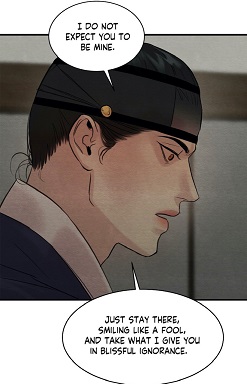 (chapter 85) Baek Na-Kyum represented the foundation of his home. Without him by his side, his “home” would crumble.
  hence his head moves closer to Yoon Seungho’s
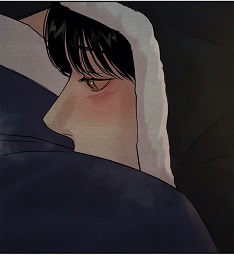 and at the end he even closes his eyes
 (chapter 74) This was a new version of the chapter 51 and 52. And you all know the saying:
  (chapter 78)
 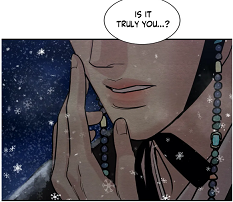 (chapter 102) As long as he is by his side, everything is fine. This new definition of home appeared, when the painter and the lord confessed to each other.
  (chapter 96) It didn’t matter where they were. Thus they could confess in a gibang. They felt safe together. And this is the same in the mountain. Observe that the painter is not asking why they are in the mountain and what the lord intended to do there. In fact, he was more focused on the past than the present. However, for the painter, home is not just a family, he liked to sleep in a warm bed and have a warm meal each day
  (chapter 68), since he had lived like a homeless for a while. Hence both will have to look for a real home, a house. Moreover, the lord will have to provide for the painter, and the latter will feel obligated to assist his lover. This means, in season 4, home should have a new definition. It is not just a family, but also the mansion and the country! Don’t forget that many people died in season 3.
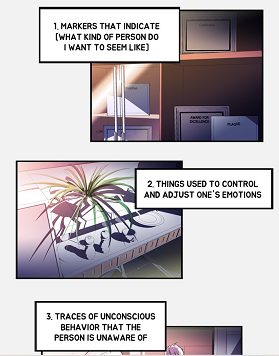 (doctor frost, chapter 9). What caught my attention is that the lord’s bedchamber is literally empty: There are only one big white vase, a red box, candles
  (chapter 55) and a windscreen.
  (chapter 55) The latter shows trees painted in black, there’s barely nature in the end. It mirrors the lord’s symbolic death. The emptiness of his room reflected the lord’s life. He was living like a zombie and avoided emotions, as he had no souvenir at all. Although he reads a lot, you never see them in his room. Why? It is because he separated his spirit from his body. In his bedchamber, he was a captive trapped in the past, hence he had nightmares. Moreover, I think that his bed is the source of his nocturnal panic attacks, as the colors are the same than the king’s. And now, the manhwaphiles can better comprehend why the noble has never considered his mansion a home. In this house, and in this room, he had traumatic experiences (abuse), which were so horrible that he had entirely repressed it. Nonetheless, the moment the painter calls the mansion his home, this has a huge impact on the lord’s life. The latter is now “forced” to consider the mansion as his home too. Hence in the Korean version, we have this panel:
 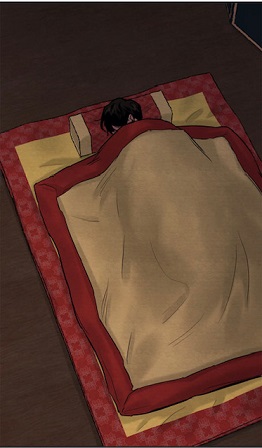 (chapter 98) This shows that he had conquered the bed. Season 3 exposes the painter’s conquest of the bedchamber. The turning point took place in chapter 87, when the artist went to the study on his own volition.
  (chapter 87) I can’t help myself thinking that in season 4, the painter will bring his possessions to the bedchamber for good contrary to season 3.
  (chapter 79) The music box was brought back to the painter’s studio after the argument. Since the lord bought a music box for Baek Na-Kyum, and the latter treasures this item, it also has a special meaning for the lord too. The music box represents the lord’s heart, but the main lead didn’t grasp the true meaning, until it was too late. So far, the broken music box got neglected after their argument
 (chapter 85), yet I am still hoping for its return, for the lord had recognized its true signification to the painter afterwards.
  (chapter 85) But we shouldn’t forget the lord’s Spring poem
  (chapter 92) Little by little, the lord’s study will be filled with treasures belonging to Baek Na-Kyum which are connected to the noble. This is relevant, because thanks to them, the lord can recall the good moments with the artist. Slowly the lord’s bedroom will become more and more a study. With the arrival of souvenirs, the bedchamber will be filled with life again. This will symbolize that the lord is slowly taking over the bedchamber, and filling his room with things he likes. Where is the orchid? So far, all the nobles had plants in their room:
  (chapter 43)
 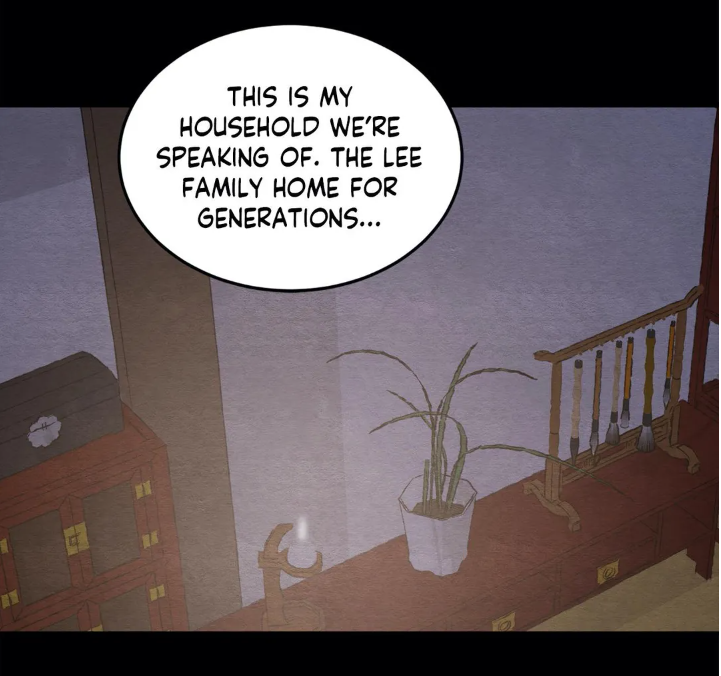 (chapter 82) Hence I am wondering if Yoon Chang-Hyeon didn’t punish his son by taking away the orchid, when he painted on the servant’s body:
  (chapter 36).
  (chapter 99) This new interpretation leads me to the following observation. In season 4, we will witness a new battle again, and it will be about the ownership of the mansion. Who is the true owner of the propriety? Kim, Yoon Chang-Hyeon, Yoon Seungho or lord Song?
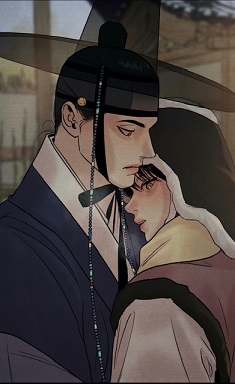 Yet, the peak was reached with the following picture, for Baek Na-Kyum and Yoon Seungho seemed to have merged as one:
  The readers can barely detect the painter’s presence: only his head and hand are visible indicating the depth of their intimacy and closeness. However, the title is mentioning the presence of a ghost. The latter can not be Yoon Seungho, because the panel above announces his official wedding with the commoner due to the presence of the red and blue lanterns called Cheongsachorong. These are used for wedding ceremony in Joseon. Therefore who is the ghost? And why do I perceive the existence of a spirit in this chapter? But before revealing the identity of the ghost, I would like to expose the reason behind such a title. While focusing on the embrace, I came to the following observation.
 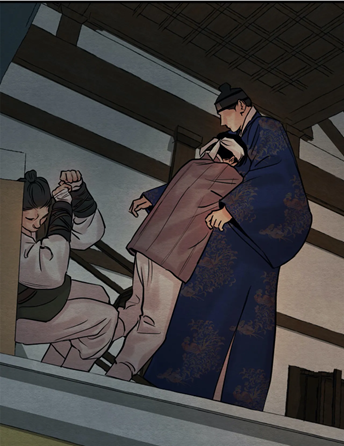 ,
,  ,
,  ,
,  (chapter 29), therefore he chose to push away the wealthy aristocrat out of fear that he might get hurt and betrayed again. The commoner judged the embrace and warmth as a deception. This means that the low noble as a “spirit” was the reason why both protagonists couldn’t get closer. The low-born was only acknowledging Yoon Seungho as his sex partner and nothing more. Striking is that in episode 76, we have a reference to the hug from chapter 49, as the position of the painter’s head in this image
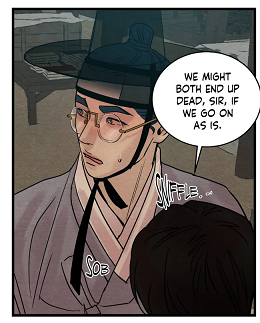 (chapter 29) The low noble feared people’s gaze, his attitude truly showed that he didn’t want to be connected to Baek Na-Kyum. His action was definitely a sign of hypocrisy and cowardice. That’s why in chapter 76, the painter could only come to the conclusion that the lord’s embrace was genuine and the lord’s feelings were not trivial. Moreover, the main character never pushed his lover away
 However, he was stopped with a frightful gaze:
 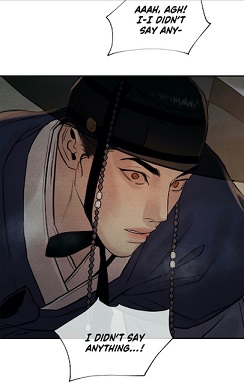 Besides, when the noble kept calling the protagonist in an informal way (Na-Kyum-Ah), people could realize his real intention. He meant no harm. In fact, he was treating the low-born like a precious treasure, who needed help.
 (chapter 29) The former teacher was just caught by surprise, hence “Na-Kyum” was said more or less randomly. On the other hand, Yoon Seungho used this name as a sign of intimacy. He desired to give comfort and warmth to his lover. And now, you understand why Baek Na-Kyum hugged his lover by instinct.
 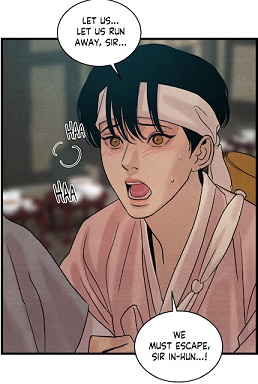 (chapter 29) thus he tried to find him. And now the mansion has become the painter’s home, just like the lord’s embrace. It is a synonym for comfort, warmth and safety. Another huge contrast is that for the first time, the painter asked for Yoon Seungho’s help directly.
 (chapter 65). Surprising is that when he was bullied by Deok-Jae, he never complained and asked for the head-maid’s assistance or his lover’s. His attitude to never rely on others was even more perceptible in his escape in chapter 46. The cause for this behavior is linked to his abandonment issues. Due to his past, he was forced to only rely on himself. Nonetheless, in chapter 76 he changes his attitude. This shows that he is now opening up. That’s why his head rests on the lord’s shoulder completely.
  (chapter 53), hence the gentle boy needed to intervene directly. The lord was definitely deaf to the artist’s words. Striking is that here again, we had the presence of danger, the painter feared for Deok-Jae’s life. Moreover, despite his fear and shaking hands,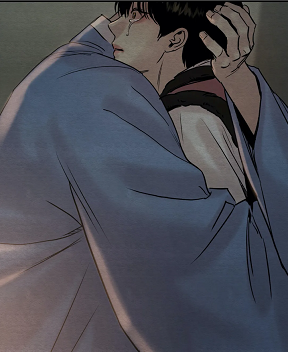
 (chapter 62), whereas in chapter 66 the artist had a flashback, hence he wasn’t himself.
  (chapter 66) This meant that in both episodes, neither the aristocrat nor the commoner could sense the lover’s comfort and warmth.
  (chapter 66) Both of them didn’t feel safe and displayed extreme fear due to betrayal and abandonment.
 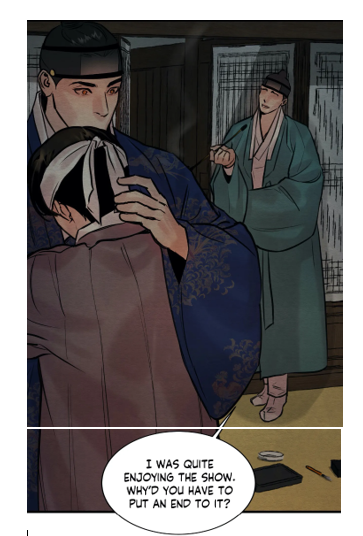 There’s no doubt that the vicious noble felt extremely jealous in both episodes (53-66). The manhwaphiles should envision that despite his rage and his terrible behavior, the artist was willing to embrace such a man, which could only make Min envious. Moreover, the low-born showed courage and even strength. He didn’t reproach anything to his sexual partner. He just attempted to calm him down.
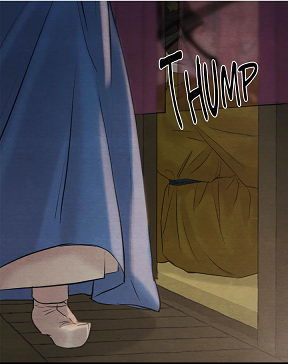 (chapter 69) That’s why he was waiting there. He imagined that the boy would be delivered to him on a silver plate, yet nothing like he had expected happened. In chapter 76, we have a new version of chapter 53. However, when Black Heart witnesses the painter’s second embrace, he can detect the huge difference.
  (chapter 54), in episode 76 Black Heart is truly defeated. And by contrasting these two scenes, it becomes obvious why Yoon Seungho assaulted his guest back then. The noble was in fact punishing The Joker for insulting his lover, as the latter was just reduced to his status: a low-born. He had no name and as such no identity. The powerful aristocrat didn’t do it in order to protect his honor, but the artist’s. At no time, the main lead was afraid of losing his reputation, he is well aware of his bad notoriety. Thus this shows that in chapter 54, the one who feared more social norms was indeed Baek Na-Kyum, which was still visible in chapter 75. That’s why the commoner denied the lord’s affection.
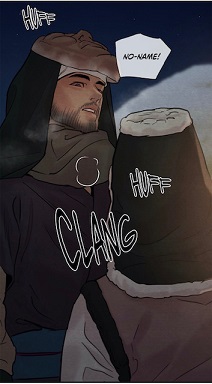 (chapter 76), the ghost from his nightmare
 (chapter 61), the painter got so panicked that he got paralyzed. Only the lord’s embrace could calm him. As you can see, the commoner denominator between 53 and 76 is that the presence of a terrible ghost. The latter pushed the artist to embrace his lover. This time, he needed himself protection. However, Nameless was not the only ghost witnessing the protagonists’ embrace. Lord Min has already become a ghost himself in my opinion. First, he is wearing a black hanbok which I am associating to death. Moreover, because he threatens the criminal to kill him
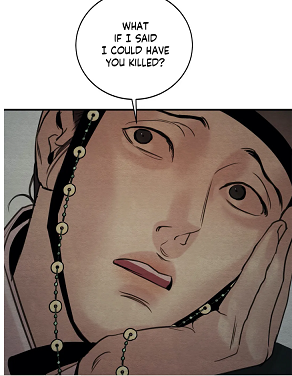 (chapter 76), I view The Joker as a grim reaper. What caught my attention is his reaction, when he saw the heartfelt hug. He had to vomit and this is no coincidence.
  (chapter 76) Observe that the color green is connected to two reactions: “to be green with envy” and “to be green” (sickly). Besides, we have in French “être vert” as a synonym for fuming, furious and disgusted. Hence it’s not surprising that it exist these emojis: 🤮🤢. Both contain green. That’s why I believe that when Min saw the embrace between the protagonists, he got so upset and disgusted that he felt the urge to vomit. It was definitely a mixture of envy and rage. However, he had to lie to the others in order to hide his “weakness”.
  (chapter 76) For me, there’s no ambiguity that The Joker was not honest here. First, he has no dark circle and red eyes like Jihwa who definitely drank again.
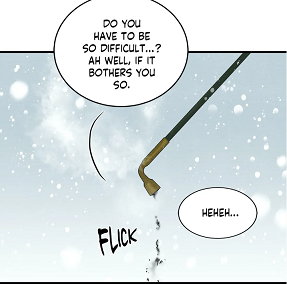 (chapter 52), he never expressed a real apology, he rather criticized the other for ruining the good mood and his fun. Besides, he looks down on low-borns and even Jihwa…
 (chapter 56) and the pattern reminds the readers of opium smoke. Contrary to Yoon Seungho who only smoked it once during that terrible party, Min chose to keep smoking opium. First, the manhwaphiles could detect that he enjoyed the kick in chapter 52.
 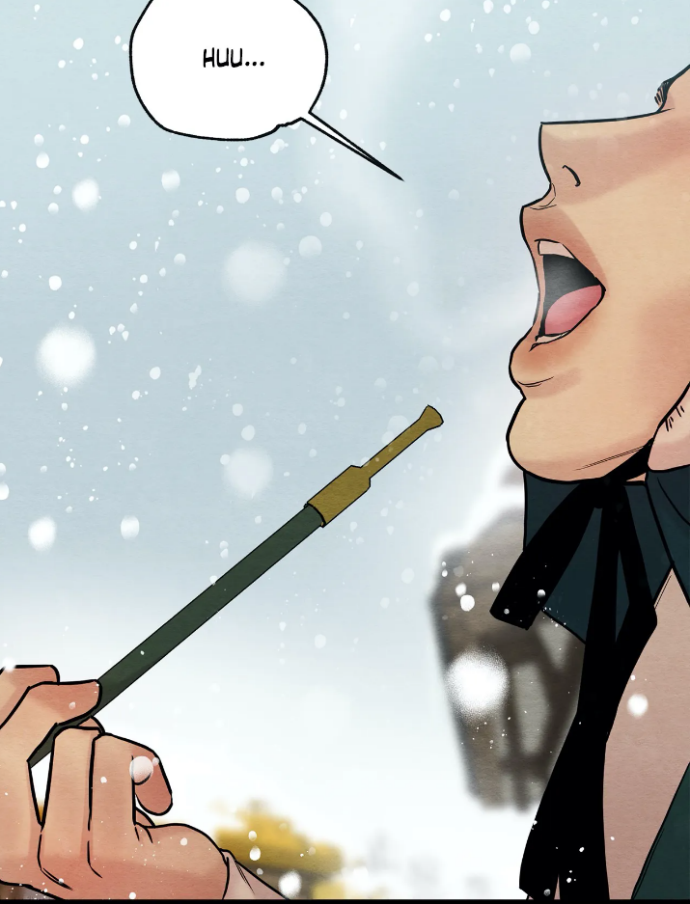 (chapter 52) Secondly, the hanbok was another indication. Finally, I perceive the lord’s nausea in chapter 76 as another evidence for Black Heart’s opium addiction. Vomiting/nausea are listed as side effects of opium. From my point of view, when he saw the happy couple in the street
 (chapter 74), he chose to smoke one pipe in order to relieve his frustration before visiting Jihwa and urging him to contact Nameless. This was a new version of chapter 56. That’s why they came both to meet the criminal.
 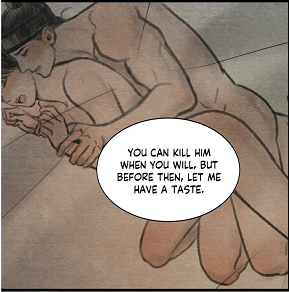 (chapter 56) Therefore I deduce that this second embrace is forcing him to change his plan again. From my point of view, he is no longer interested in tasting the painter once and have him killed afterwards. Black Heart is now determined to take away Baek Na-Kyum from Yoon Seungho. He is definitely longing for the artist’s love. He has every reason to be so jealous. The painter showed such a loyalty and courage. He is no longer fearing people’s gaze unlike in the past. Then, he even forgave his lover for his violence and mistreatment. Slowly, Min is showing his vulnerability in front of Jihwa and as such losing his power over him. He is definitely less laughing. As a conclusion, in chapter 76, the ghost Jung In-Hun vanished for good, while a new one appeared: Black Heart, who is now dressed like a grim reaper. However, there’s a huge difference, because Min has never entered Baek Na-Kyum’s mind and heart. He has no chance at all.
 (chapter 71) My explanation is the following: Baek Na-Kyum wasn’t sure how to judge the lord’s behavior. Imagine that in the morning, his lover had tied him up, while in the evening he was so gentle and calm. That’s why I believe that in this hug, the artist wasn’t certain how he should perceive the lord’s embrace. He knew that it was no longer fake, but like he explained it much later… how long would Yoon Seungho have feelings for him? Therefore I believe that in this scene, Baek Na-Kyum viewed him as an illusion, a spirit who could give him warmth and comfort.
 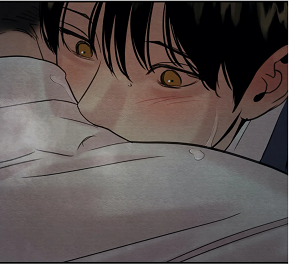 (chapter 71) Note the difference with the following picture:
 (chapter 40)
  (chapter 75: repetition from chapter 74)
 (chapter 40) versus
 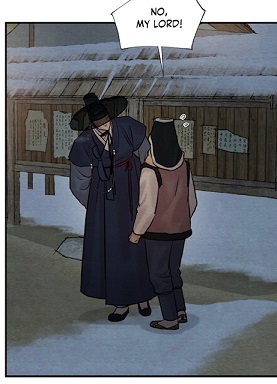 (chapter 75)
 (chapter 40) versus
 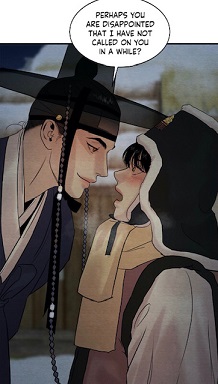 (chapter 75)
 (chapter 40) versus
 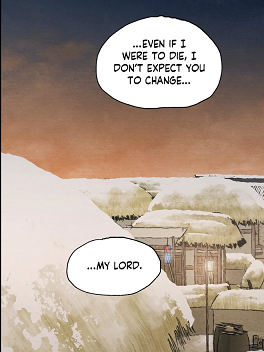 (chapter 75)
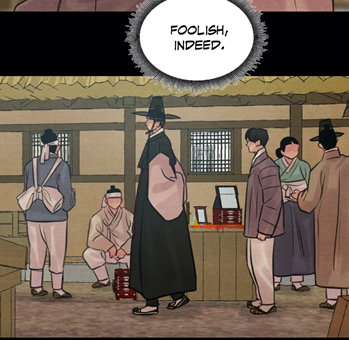 (chapter 40) versus
 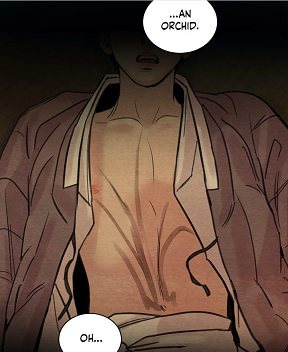 (chapter 75)
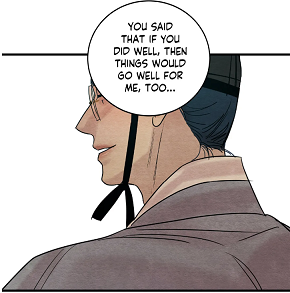 (chapter 29) Thanks to the memories, the low-born had gathered courage and faced his teacher. However, this discussion led to a tragedy. Baek Na-Kyum got hurt, because his learned sir chose to destroy him in the worst possible way. With his words, he showed his true thoughts
  (chapter 40) and in order to reinforce his statement, he made sure that Baek Na-Kyum would perceive his real gaze: cold and ruthless.
 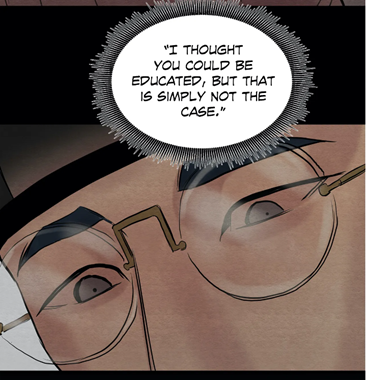 (chapter 41) But more striking is that the scholar used memories (the kisaeng house) to define the painter’s identity: he was born to be a prostitute despite his “lessons”. He puts the whole responsibility and blame on the commoner. As a conclusion, the memories served in the conflict to identify Baek Na-Kyum. Who was he really to the scholar? Was he his helping hand, like the low-born claimed, or was he just a “prostitute” according to the scholar?
 (Chapter 75), an indication that his short-term memory was defective due to his lack of sleep.
 (chapter 36) Therefore I come to the conclusion that Yoon Seungho’s short-term memory is not working properly. Imagine, he could remember one incident from his childhood, but he couldn’t remember painting the orchid. Hence I believe that the lord can’t even reminisce the drawings in chapter 8
  . Only thanks to Baek Na-Kyum’s mention, he was able to recall the drawing. Thus the manhwalovers can comprehend why I consider the artist as a synonym for memories.
  (Chapter 65) While he can’t remember what truly happened due to his poor emotional and physical state, Kim somehow blames him. The young master is so confused that he has to defend himself. This means that after the first rape, the domestic didn’t even comfort the protagonist, but he used the victim’s vulnerable state of mind (who was confused due to this terrific incident) to manipulate the noble’s memory.
 (Chapter 68) He mixed facts with lies in order to confuse his master’s judgement and memory. That’s the reason why it is important now to recall my initial statement: without any memory, there’s no identity. This signifies that in chapter 68, when Kim tried to give him memories, he desired to give him a certain identity: he was similar to his father. The latter would punish or imprison the boy and not release him. Giving a false reflection and identity is something Kim had never done before in front of his master, as he knew that his master feared his own image. However, he never imagined that Yoon Seungho would react differently. Instead of pushing away the painter, he let the artist choose his fate.
  (Chapter 18) In my opinion, this shows that Yoon Seungho had no true memory in reality. He knew that they had sex together, but that was it. It was more like “the night is long and I need to kill time so that dawn can come faster.” Note that he never mentions their childhood together. With this interpretation, it becomes comprehensible that the main lead could act, as if nothing had happened between Jihwa and himself after the topknot incident.
  From my point of view, he had literally forgotten the incident, yet for Jihwa, it meant that he had been forgiven.
  (Chapter 59) And this explicates why Yoon Seungho barges in the mansion in chapter 67: he makes it clear that he won’t forget what happened.
  (Chapter 67) The real forgiveness occurred in chapter 59: Despite the caused pain, Yoon Seungho was willing to overlook the terrible action
 (chapter 55)
 (chapter 56), when he heard that lord Song asked for a meeting. The latter could definitely reveal new information and let the protagonist realize that he was truly suffering from memory loss.
 (Chapter 1) Striking is that when Baek Na-Kyum confronts him with his poor image (“man consumed by lust”)
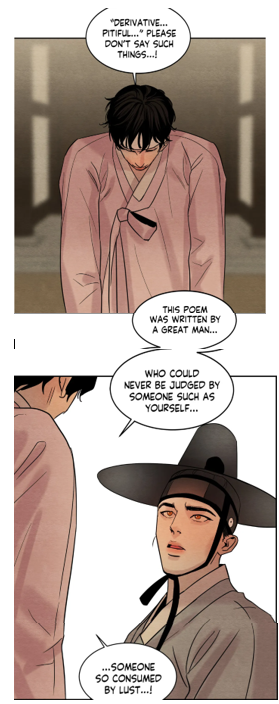 (chapter 4), the lord is bothered. He is forced to ponder why he is described like that, hence he has to recall events from the past. At the same time, when the lord read the poem, he was encouraged to recall the original sijo. This shows that at some point, Yoon Seungho rediscovered literature. Words and paintings helped to create memories. Thus if you pay attention, you’ll notice that the more time passes on, the more memories the lord has. They are strongly intertwined with the paintings. The latter helped him to reminisce the sex sessions and his past. He can’t forget how the painter masturbated behind the door. He is even getting more and more good memories.
  (chapter 18) Then in chapter 19, he reminisces the painter’s facial expressions which puts him in a good mood.
  (Chapter 19) This explicates why Yoon Seungho was so moved by the painter’s confession during their Wedding night. For the first time, he experienced warmth and love, he even heard a love confession. This could only be stored as a wonderful memory. At the same time, he hoped, the artist would create a picture of this night in order to ensure that this memory was real. Moreover, note that in chapter 58,
  he externalized how much this night meant to him.
  (Chapter 58)
 (Chapter 75) His feelings will fade away just like memories. He will forget him. What the painter doesn’t realize is the following: this date is actually an important moment in Yoon Seungho’s life. For the first time, he gets to discover the painter’s memories and past, which now the noble can store as his own. He will never forget this day, especially when he heard that the painter would cry because of him
  (a new version of chapter 21:
  (chapter 21) , but here out of concern. In other words, Baek Na-Kyum would like to be remembered. Hence he complains that the lord didn’t call for him. And this can only make the lord happy, because he can detect through the painter’s words that the latter is longing for his presence and care. From my perspective, Yoon Seungho has finally grasped why the artist is not truly honest with him. Therefore he can only tease his lover pushing him to make the first step. Let’s not forget that right now, the master is now treating his lover as his new lord. So the latter has to call for him.
 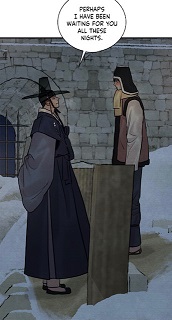 (Chapter 75) Here, the protagonist clearly displays that he has never forgotten his companion. Their date is so important for two reasons. It allows the noble to gather more information about the commoner, and get a really good memory before the next tragedy.
  (Chapter 60) and could cope with the kidnapping much better. Note that he has no nightmare afterwards. And this detail is important, because we have to envision that while Yoon Seungho was exposed to physical and sexual abuse for a decade, he had no good memory at all in order to remain sane. Moreover, he never felt loved. Consequently, he couldn’t even think of anyone in a positive way. That’s why he was so damaged in the end. (Chapter 57)
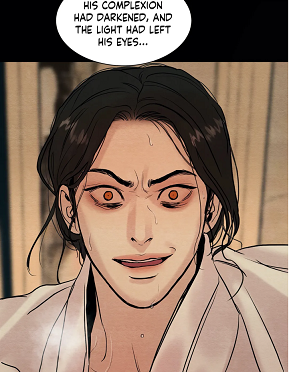 The presence of a loved one is necessary in order to cope with traumatic childhood abuse.
  (Chapter 58) This signifies that he is unsure if what he is experiencing is real or not. From my point of view, the memory loss and his life as ghost affected his brain and the way to encode and store information. Hence he has no real recollection of the incident with Deok-Jae (chapter 30 and 53). That’s why he is not asking for his whereabouts. However, I believe to see a turning point in chapter 75. By giving the lord the opportunity to have a real date, where he could hear and see that Baek Na-Kyum was definitely affected by him, the noble will react differently compared to the first abduction and after the painter’s first flashback. He will not lose his mind blinded by his emotions and insecurities, he knows that the artist chose him. And he won’t blame himself like for the first flashback. Remember that in chapter 66, he never called the physician. Why? Because someone told him that the painter needed the presence of a loved one to recover. Kim made sure that Yoon Seungho would feel guilty. Deep down, Yoon Seungho knew that he was responsible for the panic attack.
 (Chapter 66) But the real cause for all this was the butler’s silence and complicity. That’s why he remained by his side, until the artist had recovered. Thus I had predicted that after meeting Nameless, Baek-Na-Kyum would get a panic attack.
 (Chapter 75)
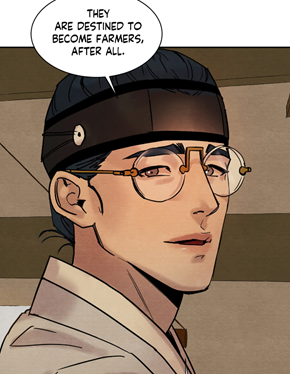 (Chapter 6) They can not escape their conditions. Thus the gods chose to punish him the following way: he could never escape his own situation. He would remain a man with no wealth and connection. Thus no matter what he did, it ended with a failure. Therefore it is not surprising that he came to resent the painter, for he caught the attention of a powerful noble and this at least twice. The scholar was offered a position, but due to the incident in the gibang, the sponsor changed his mind. Hence he blamed Baek Na-Kyum for not securing a post. It was, as if he had stolen it from him. I think, Jung In-Hun published poetry, but couldn’t get recognition. Therefore he used the incident (discovery of the erotic pictures) in order to punish him and force him to give up on painting. He couldn’t allow that a commoner was more successful than him. At the same time, it was the reason why there was a ruckus in the gibang too. But now, we have to wonder why Baek Na-Kyum talked about his past. From my point of view, an important detail played a huge role at the inn:
  (Chapter 74) Observe that the woman has a similar hair dress than his noona. That’s why I believe that when he saw her, he must have been reminded of her. Note that when he speaks about the leftovers, he describes leaving food as a sin,
 (Chapter 41) He didn’t eat all the sweets or even skipped meals.
  (Chapter 41) In other words, he didn’t eat everything and committed a sin. This indicates a certain hypocrisy, simultaneously Baek Na-Kyum’s lack of critical thinking, when it comes to his noona. Moreover, he says the opposite of what he thinks. In chapter 74, he claims that the lord has changed
 (chapter 57), which will assist him to regain his lost memories.
 (chapter 74), exactly like in the past.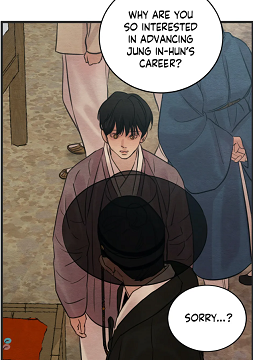
 (Chapter 40) That’s why after pondering, the artist visited his teacher and expressed his wish for the first time that he would like Jung In-Hun to become responsible for him, like the former had promised. As you can see, the red dot and the questions did cause an Awakening. But it was a brutal waking up, as the painter discovered how the learned sir truly viewed him: a prostitute and nothing more.
  Imagine, the commoner was walking right behind him, yet Baek Na-Kyum was not mentally and emotionally present. His thoughts were directed at the scholar. This is not surprising that Yoon Seungho resented his lover. In the aristocrat’s mind, this signified that the painter was not even enjoying his time with him. He preferred thinking about the learned sir than talking or looking at his lover. In other words, he was standing behind the lord absentminded. And the lord sensed it, hence he looked behind
 . How did he notice it? It is because the artist didn’t keep asking about the date.
 Note that with such a comment, the noble is not interested in initiating a conversation, he already knows what the low-born is thinking. And if you contrast this to the scene in episode 74, you’ll detect a huge difference. Although the artist is absentminded as well, he is already meditating about his lover
  (chapter 74) is the trigger for him to ponder. And this shows the noble’s increasing influence on Baek Na-Kyum. Meditating is definitely the lord’s favorite occupation so far. In addition, this shows how much the aristocrat means to him. All his thoughts are now directed at Yoon Seungho. Therefore we have to imagine this. While Baek Na-Kyum is walking, the lord notices that he is just walking lost in his thoughts. Hence he throws him the hat as a joke. On the one side, he definitely wants him to be present mentally and emotionally, like in the past. On the other hand, note that unlike in the past, there’s no reproach, in truth he desires to discover what the artist is thinking.
  This is one of the biggest wishes Yoon Seungho has ever had:
  (chapter 49) The lord always felt the need to share what was in their mind. Now, I can truly grasp why it’s a dream for Yoon Seungho. Remember when I described how the lord lived for so many years in the darkness. He only knew that he existed through his mind and thoughts. But during this whole time, he could never communicate his thoughts to anyone, he felt terribly lonely. This explicates why he had such a huge desire to communicate with the painter. He felt closeness in their soul, which he could detect in the art. As you can see, although the noble detected that his lover was lost in his thoughts, he no longer reprimands him. In fact, he voices curiosity. Moreover, he is no longer claiming that Baek Na-Kyum is transparent contrary to chapter 40. There’s a reason for that. The artist has changed so much as well. He is indeed applying his lover’s philosophy: introspection and meditation. And this leads me to the next observation. There is a huge difference between these two scenes: the chronology.
 (chapter 74) versus
  . He still had that dream, this explicates why he mentioned Jihwa. He envisioned that the artist would get jealous. But the artist remained silent. Then he confessed twice (“I adore you” and
  ) in order to push the protagonist to reply to his confession. He definitely dreamed that if he confessed, the painter would feel pressured to return the affection. That’s why the painter was trapped under the noble and the latter was grabbing the painter’s hand.
  (Chapter 58) His gestures illustrated the pressure made on the artist. But the master never got a reply. Thus it elucidates why the noble got infuriated after the painter’s disappearance. He might have admitted his defeat, nevertheless he hoped for a confession, as a new form of allegiance. That way, Baek Na-Kyum was obliged by his words. However, in chapter 74, the only desire the noble has is to exchange their thoughts. He has truly given up on his dream. When in chapter 49 the master voiced this wish for the first time, he was lowering his expectations. That’s why I believe that this indicates that Yoon Seungho is no longer hoping for more. He is so in love, and the past Yoon Seungho would call him: a fool!
  , (chapter 74) when the noble visits his study. All this exposes that he is longing for the lord’s warmth. A simple kiss is enough to make the painter blush, but not enough to satisfy his “thirst” for affection.
  That’s why his eyes are bigger than before, like in this panel.
  (Chapter 74) He is literally glowing. He is enjoying this moment with the noble, hence he stares at him so intensively. And this represents the biggest contrast to the chapter 40. Back then he didn’t truly enjoy the walk with the master. He was either embarrassed or thinking about the scholar. At the end, he was even called “a fool”.
  . (Chapter 7) Secondly, as the lord is the mirror of the artist and the former once expressed the wish to see the painter’s smile
 (chapter 10) or silenced him with a caress
 . Heena noona had a similar atttitude, she never asked for his opinion, when she sent him away.
  due to the Joker’s arm and hand.
 (chapter 102) How come that Black Heart had the learned sir’s glasses? He has now to prove his reliability and trustworthiness towards his partner. He should become more proactive, if he wants to protect his loved one better. My final conclusion is that in chapter 74, we don’t have one fool in love, but two!
  If he hadn’t thought too much about Yoon Seungho due to the separation and been surprised by Min, he would have realized that his life was in danger. Both protagonists are so in love that they don’t realize that their special relationship represents a threat to others, especially to people who stand for social norms and traditions. Simultaneously, their scandalous relationship is a source of envy for others, as Baek Na-Kyum and Yoon Seungho were able to break free from the shackles of social customs and hierarchical society. The couple becomes a symbol of liberty and true love … no wonder why The Joker is so envious. Because both were two fools in love, they couldn’t detect the enemies around them and the existence of the plot. On the other hand, the last tragedy brought back the two lovers to reality. They needed to pay more attention to their surroundings.

 (chapter 31) Consequently in chapter 34, the painter sensed a change of perception about his body after the sex marathon. For the first time, he detected his heartbeat and the butterflies in his stomach, which were triggered by the main lead’s presence.
 (chapter 34) The parallels can be observed by the absence of the eyes of the protagonists in certain panels. Compare the picture with the mirror
  (chapter 63) Striking is that the character represented with eyes plays the role of the liberator for his sex partner. Due to the sex marathon, Yoon Seungho had helped the painter to free himself from his torpor, since due to the coercive persuasion, the artist had come to deny not only his sexual orientation, but also the existence of his own body. That’s why he could no longer admire his learned sir like before after the sex marathon. By recognizing the existence of his own body, the painter couldn’t feel the same attraction towards the teacher. And since the sex marathon played a huge role in his healing process, we have to imagine that the sex scene in the barn has the same signification for Yoon Seungho. He is on his way to be liberated from his self-hatred, but as you can imagine, it will be a painful process. Back then, the painter got ill and the lord ran away from his responsibility. That’s why this time, the blinded person will be the one suffering from the sex marathon: he will feel like dying, when he realizes that he wounded his lover blinded by his prejudice and anxieties.
  (chapter 63)
 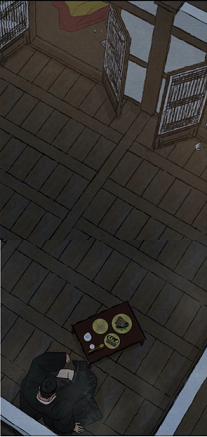 (chapter 69) He had ruined his relationship with the artist. Because he refused to make the leap of faith in the shed, Yoon Seungho decided to make the opposite choice. He let the painter decide about his own fate, yet he was definitely living in agony. The wounded, fearful and desperate gaze revealed his turmoil.
  (chapter 69) In my eyes, the absence of the lord’s eyes during the night of revelations stands in opposition to the lord’s gaze full of expressions in chapter 69. Note that in that episode, the author always drew his eyes, underlining that now the noble was using his own eyes finally. He is no longer relying on Kim and his information. I was also right that this night would affect Yoon Seungho’s relationship with the valet, yet I didn’t expect, it would unveil his true personality. For me, this second sex marathon was a real eye-opener: it made me recognize Kim’s hypocrisy and cowardice. From that moment on, I could no longer view him as a real father figure.
 (chapter 62)
 He rejected his concern and yelled at him. In chapters 62-63, the positions are switched. Yoon Seungho is the one upset and pained, since he is convinced that the artist abandoned him, therefore his anger is aiming at the commoner. Yet, the true culprit of his wound is his childhood friend Jihwa. Simultaneously both have a common point: Baek Na-Kyum gets hurt, because he becomes the target of Yoon Seungho’s anger, while in chapter 40, he is backstabbed by his admired sir and used the master to get some comfort. Yet, the situation is similar, as the real culprits of the wound never witness the consequence of their actions and words.
  (chapter 63) And if we take the chapter 41/42 into consideration, the painter did request that the lord should be particularly rough.
 (chapter 42) As you can see, the chapter 40 can not be really detached from the sex scene which follows the teacher’s betrayal. Another contradiction is that the painter is just asking the lord to stop, since Baek Na-Kyum is exhausted, while the aristocrat believes that the commoner is pushing him away, begging him to let him go for good.
 (chapter 63) But this divergence comes from the fact that this scene is a new version of the sex marathon, which I mentioned above. Back then, the painter made a similar request. As conclusion, the violence of the sex in chapter 62-63 is strongly connected to an emotional wound, a repetition of chapter 41/42. And in my opinion, the artist understood the situation and the lord’s motivation. Hence he doesn’t feel badly about Yoon Seungho. Notice that the next night, Baek Na-Kyum doesn’t think badly of this sex marathon.
 (chapter 40)
 He needed to see with his own eyes, how the learned sir had truly abandoned him. This represents another explication why the low-born didn’t react like Kim and Min anticipated. He didn’t follow his sister out of loyalty, compassion and a certain trust. However, Heena noona was able to sow seeds of doubts.
 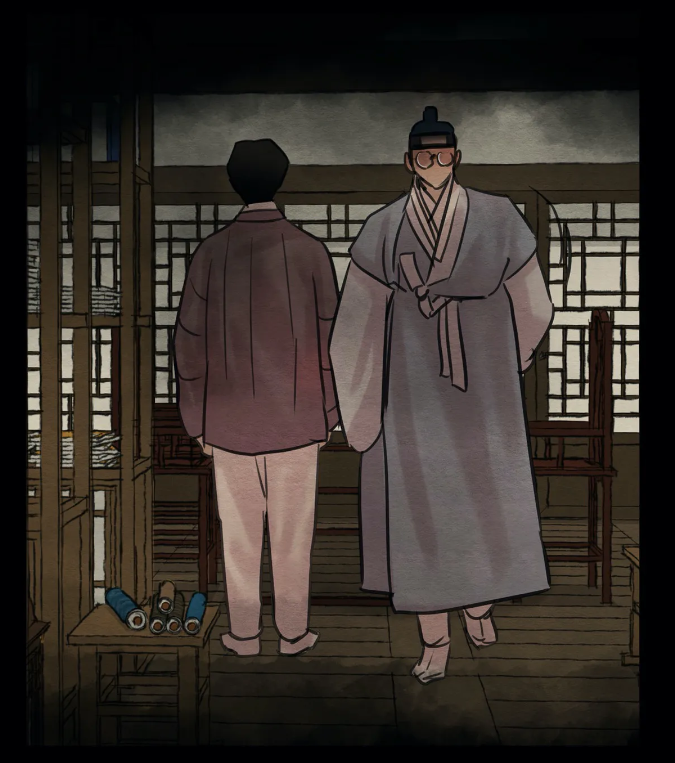 (chapter 40) In this picture, the scholar leaves the painter behind, a metaphor for his abandonment. He even repeats this action, when he leaves for the capital. In chapter 62-63, Yoon Seungho sees in the commoner’s escape a rejection and betrayal.
  (chapter 62) This panel illustrates the thoughts of the protagonist: the commoner has turned his back on him.
 (chapter 40)
  (chapter 62)
  (chapter 63) In both cases, the aristocrats questions the commoner’s motivations for his actions. While Jung In-Hun’s interrogation serves him as an occasion to break his promise by putting the blame on Baek Na-Kyum, the other character is more curious to know about the reasons for his desertion. From my point of view, this shows the noble’s desire to comprehend the painter better. And this illustrates that his obsession with the “why” is well meant. Why is he pushing him away? If he knows the cause, he could find a solution in order to bring the painter to his side.
  (chapter 40)
 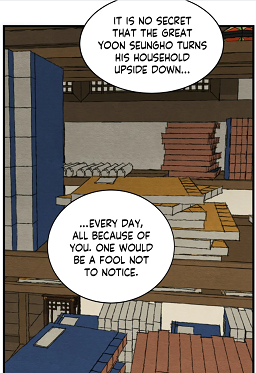 (chapter 40) The former had Yoon Seungho’s attention all the time, and we all know that Jung In-Hun’s desire is to get attention and admiration. Striking is that the comparison enlightens the materialistic and narcissistic side of Jung In-Hun, while Yoon Seungho appears purer. He is just content with a smile. Besides, he would like to be the source and recipient of Baek Na-Kyum’s smile, whereas the other wishes to get favors (clothes, a room closer to the lord’s chamber, the favor to spend the evening in the bedchamber etc). That’s why by contrasting both chapters, the protagonist’s purity and simplicity become even more palpable, which is hidden due to the violence employed during that confrontation.
  Furthermore, if we take the chapter 41 into consideration, since we have a flashback of the incident at the library,
 (chapter 41) He only knew sex. In chapter 62, the lord hold the artist in his arms, only to betray him afterwards. The warmth is faked.
 (chapter 40) while in chapter 63, it is the turn of our seme to reveal his expectations and desires.
  ,(chapter 62) while the scholar calls the artist a fool
 . (chapter 41) He is just jealous, furious and repulsed. Yoon Seungho is seeking closeness and uses sex in order achieve his goal, therefore he is is refusing to stop. He is so desperate to remain intimate with the painter, while the other noble has only one thought: keeping his distance from the low-born.
  (chapter 63) and words
 (chapter 40)
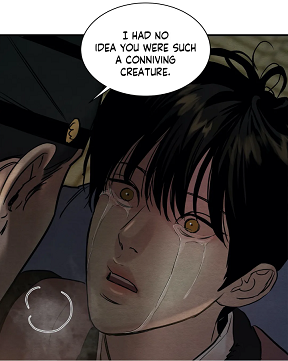 (chapter 62)
 (chapter 71) and Yoon Seungho’s outburst
 (chapter 70). Furthermore, when the painter is able to calm down the main lead by calling his name “Lord Seungho” and showing a blushed face, the aristocrat initiates a real conversation
  (chapter 71) There was a “love confession” in the barn, but the lord didn’t use the typical expression for that: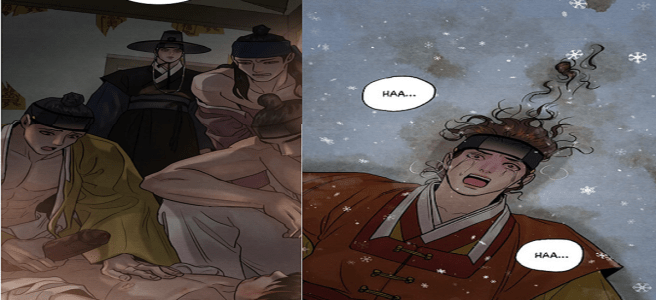


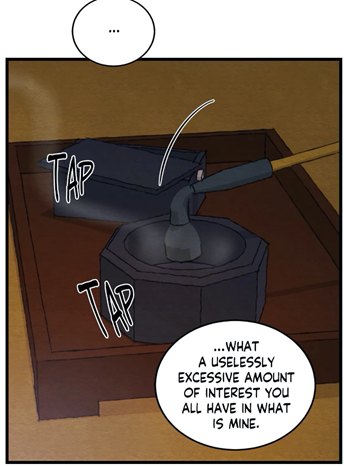 (chapter 33) At the same time, due to Black Heart’s words, the noble was reminded of the painter’s health conditions. Although the lord was talking about the artist, as though the latter was just an object, the reminder forced him to recall that Baek Na-Kyum was a human who could die. That’s why he returned in the end. His abandonment reflected his cowardice, he didn’t desire to be confronted with the consequences of his bad behavior. Consequently, just like in the Russian novel, the main lead was reminded that the low-born was just a human. As you can see, both characters had a similar disposition and also a change of heart.
 (chapter 34) Kim’s remark was in fact insinuating that the lord had been very generous and caring for him. He gave the impression to the low-born that the noble was treating him like a noble, as the latter had sacrificed his bed for his recovery. However, this was not true, as the lord had brought the artist to the study before the doctor’s arrival.
  (chapter 33) At the same time, the butler was not entirely lying either. The lord had indeed shown generosity and care, since he had called for the physician. Yet, once he had heard about the doctor’s precription, the aristocrat had ran away from his responsibilities
  (chapter 33) and left everything in Kim’s hands. Remember my statement: Kim is always telling half-truths. Kim was in reality the one who brought him to the noble’s bed.
  (chapter 33) He needed to portray his master in a much more positive light in order to obtain the painter’s cooperation. The valet hoped that the artist would follow his order
  (chapter 34) and become the lord’s sex toy:
  The irony is that although the valet treated the painter as a honorable guest (bringing him to the lord’s chamber and taking care of him as if he was his master), in truth he was just viewing the low-born as an object and tool. was truly making sure that Baek Na-Kyum would get the best treatment, but the domestic used the opportunity to praise his master indirectly.
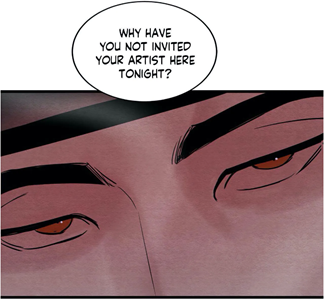 (chapter 33) While he was at the sex orgy, he remembered the exhausted young face of the painter, while they were talking about him.
 (chapter 18) In my eyes, the butler’s cowardice is connected to the social norms. He had deeply internalized the social values from Joseon, hence he represents a reinforcement of authorities. As you can see, there are many explanations for his behavior: guilty conscience, out of concern, self-introspection… On the other hand, he is only partially running away from his responsibility, as he had asked the servant Kim to take care of the artist. This is why this “abandonment” stands in opposition to the scholar’s. The latter betrayed during the rape, as he didn’t intervene and acted as if nothing was happening. And the next day, he brought him back to the mansion and abandoned him by letting Yoon Seungho drag him to the bedchamber. At no moment, he tried to stop his sponsor. That’s why he remains invisible in chapter 32.
  (chapter 33) He was acting as a mediator between the master and the low-born which looks like a good thing. In reality, he was meddling in their relationship. Who was he to intervene? That’s why he acted like a father. With his words, the butler was implying that his lord had been affected by his illness, hence he remained away. However, I believe that in the valet’s mind, there existed a different explanation. For Kim, his master was just a coward. That’s why he said this comment in front of the physician:
  (chapter 33) He anticipated that his master was avoiding to face the consequences of his selfish behavior. For me, Kim doesn’t truly love his master. He views the Yoons as terrible, but he will never confront them. But for his own safety, he needed to deceive the painter. Let’s not forget that Kim had played a role in his escape and the low-born could reveal it to his master. That’s why he needed to fake his care and concern for the painter so that the artist wouldn’t mention the past. Thus he begged the young man not to wander around as a sign of care and gentleness.

 (chapter 32) However, the valet Kim was not present, hence when he lied to Baek Na-Kyum, he had no idea that in reality his words were containing more truth than lies in reality. That’s why I chose the kiss as illustration for the analysis. The roles were switched. The master acted as a servant, and the low-born was now the lord. The male lead was acting like Vasili Andreyevich Brekhunov from the Russian novel. Yoon Seungho was even willing to give water to the exhausted man. This situation was repeated in chapter 76:
  (chapter 76). The lord made sure that the painter would feel better with the water. But let’s return our attention to chapter 33. In the bedchamber, the main lead was to blame for Baek Na-Kyum sickness, as he hadn’t paid attention to the artist’s condition. He had acted selfishly, exactly like the protagonist from Master and man. Both realized their huge mistakes, came to regret and took some responsibility, although the chronology in the Russian story diverges. But this shows that both aristocrats came to realize that commoners were humans and no possessions.
  (chapter 35) and his preparations for the exam were more important than the painter’s life.
  (chapter 35) For the first time, Baek Na-Kyum could sense that Jung In-Hun was selfish and not kind. Moreover, he even reminded him that as a low-born the noble shouldn’t spend so much money for him. Indirectly, Jung In-Hun was telling him that if he had been Yoon Seungho, he would have done the opposite: not giving him the best room, not sending for the physician and not spending so much money for the medicine. In that chapter, Baek Na-Kyum could finally see glimpses of Jung In-Hun’s true personality. Therefore I think that the servant’s words did influence the young man, he didn’t blame and resent the noble for his condition. He saw the caring gestures, although he was absent… whereas Jung In-Hun was absent due to his own interest.
 (chapter 35) No wonder that after his departure, the artist was disappointed and heartbroken.

 (chapter 36), until he saw the painter’s erection. He was willing to give up his position as master. That’s why he prioritizes the painter’s pleasure all the time.
  (chapter 36) So their relationship master-servant stopped at this moment, hence he lets him stay by his side, when the brother Seung-Won is in his chamber.
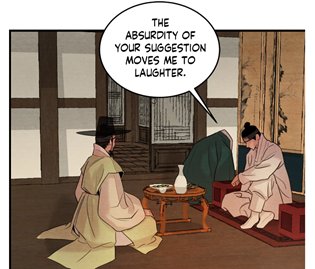 (chapter 37) Notice that his position had changed. He was sitting by the lord’s side. He even asked the artist to sleep by his side and let him stay in his bed without waking him up the next morning. As you can observe, the characters’ position illustrated their actual position in their relationship. When Baek Na-Kyum woke up the next morning, he was alone in the bedchamber. The lord preferred to leave his bed and eat elsewhere. In other words, Kim’s words from chapter 33 became a reality. He let him rest in his bed. Yoon Seungho showed so much consideration that in the chapter 39, he even went to the kitchen in order to fetch the low-born.
 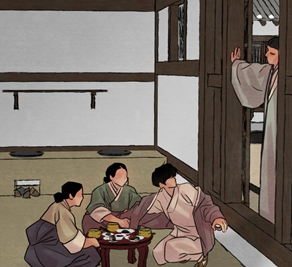 (chapter 38) He didn’t even send his loyal assistant. He had become the “servant” himself. In other words, we witnessed the lord’s slow conversion during the chapter 36 and the small changes from that moment. The nature of their relationship had changed, hence he claimed Baek Na-Kyum as his bride unconsciously.
  Bebebisous33s' analyses in K-Dramaland and Manhwas