
Please support the authors by reading Manhwas on the official websites. This is where you can read the Manhwa: Jinx But be aware that the Manhwa is a mature Yaoi, which means, it is about homosexuality with explicit scenes. Here is the link of the table of contents about Jinx. Here is the link where you can find the table of contents of analyzed Manhwas. Here are the links, if you are interested in the first work from Mingwa, BJ Alex, and the 2 previous essays about Jinx Kim Dan on Thin Ice and The Watery Point Of No Return
It would be great if you could make some donations/sponsoring: Ko-fi.com/bebebisous33 That way, you can support me with “coffee” so that I have the energy to keep examining Manhwas. Besides, I need to cover up the expenses for this blog.
First of all, I would like to thank my new readers from China. 😍 Nowadays, my blog is exploding again thanks to them.
The Poster as a Manifesto of Shadows and Smoke
When I first saw the new promotional image titled 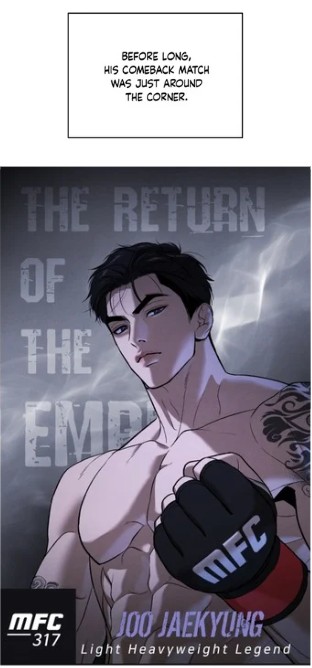 “The Return of the Emp”, I had to pause. Something in it refused to make sense — or perhaps, it made too much sense. Here stands the celebrity fighter alone, shirtless, his upper body carved out of darkness, while a faint cloud floats behind him accompanied by a hidden spotlight. Beneath him glows the number 317, a detail too deliberate to be accidental. And yet, where is the opponent? Every previous MFC poster — from Randy Booker’s green inferno
  (chapter 13)
 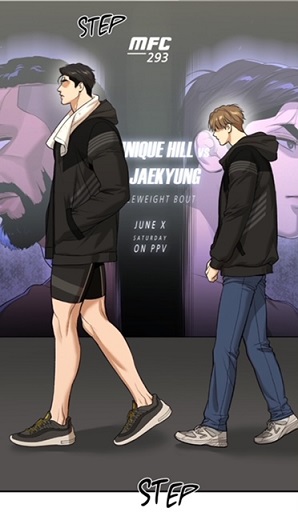 (chapter 40) to Baek Junmin’s red blaze
  (chapter 48) — had mirrored faces, two bodies, two lights. This time, there is only one. The duel has vanished. What remains looks less like a fight and more like a myth in the making. (chapter 81)
So I began to wonder, my fellow Jinx-lovers, who made this image? One might reply, of course, the marketing branch of MFC, eager to sell the comeback of their most profitable star. And yet, something doesn’t add up. Unlike the posters for Randy Booker (chapter 13) or Dominic Hill (chapter 40), this one shows no date, no place, no trace of logistics (no TV diffusion like in the States “On PPV”). Only a face, a body, a void. Why would MFC release such an abstract announcement, stripped of all practical information? Why design such a poster which makes this event look more like a secret rendez-vous?
At that point, another possibility emerged. Perhaps this is not merely MFC’s doing but Mingwa’s own design — a deliberate distortion, letting fiction expose the machinery that feeds it. The result, I believe, is an image that speaks in two voices at once: one belonging to the league’s publicity team, and the other to the storyteller who knows what must eventually rise from the smoke. But I am suspecting a third voice hiding behind MFC which I will reveal below.
But the first mystery is not the smoke or the color. It is the absence of Arnaud Gabriel, the French kickboxer  (chapter 81) chosen to face the Emperor. According to Oh Daehyun, this man is fighting for the title of the hottest male athlete in the world.
 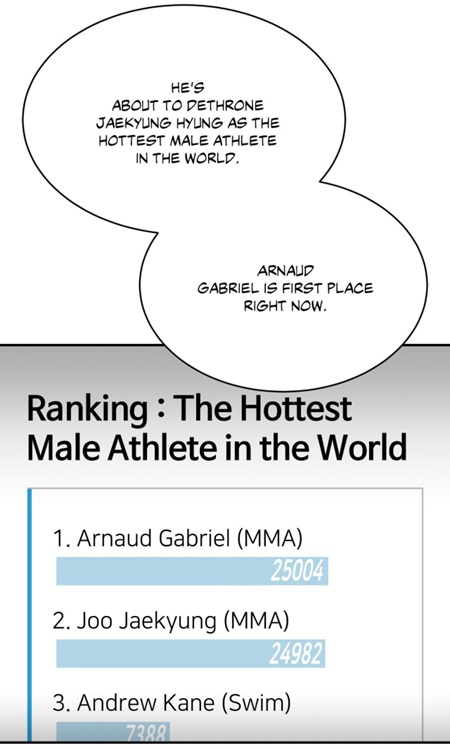 (chapter 81) So why is he not placed in the poster? Does he fear comparison — or has someone decided that no comparison should be allowed? Each missing element feels intentional — the kind of silence that makes the viewer uneasy, as though something essential was being hidden in plain sight. (chapter 81)
Then there is the pose — a quiet rupture in Mingwa’s visual language. Instead of the usual mirrored confrontation, the camera turns entirely toward the champion, revealing the torso and the raised fist. The MMA star faces not his rival, but the audience itself, as if daring the beholder to guess what has changed. For once, no familiar emblems frame him — no belt, no symmetry, only a body standing between light and smoke. Why this exposure now, and what does it conceal?
The light, too, behaves differently. In earlier posters, illumination came from behind (chapter 13) or within (chapter 48) — from the collision of two forces. Here, the glow seems to rise from below, slightly to the right, and yet the source remains unseen. Why there, and why invisible? What are we supposed to read in that slanted brightness — revelation or exposure, ascension or downfall?
And finally, the text itself: “The Return of the Emp.” (chapter 81) For the first time, words intrude upon the image — not just names, but a sentence, an unfinished promise. “Emp”: a fragment of Emperor, a crown cut short. 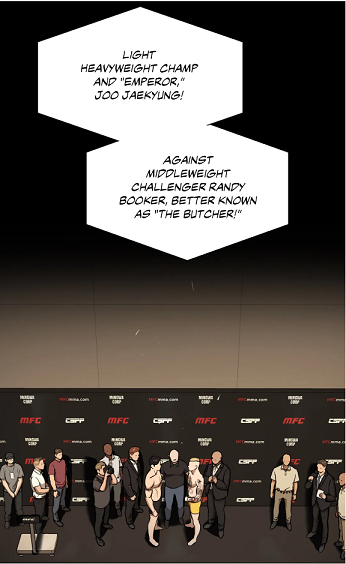 (chapter 14) Why is there this abbreviation? Why does the image proclaim a return while simultaneously concealing the full title? What does it signify?
These details — the number 317, the smoke, the missing rival, the hidden light, the fractured title — weave a code of absence and expectation. They refuse to settle into one meaning, riddles disguised as design choices. From these visual clues, my previous theory  seems to be corroborated: this event doesn’t announce the glorious comeback it pretends to be, but a carefully staged trap. However, there is more to it. The longer I examine the composition (chapter 81) — the fist aimed at the viewer, the smoke curling like a stage curtain, the void where the opponent should stand — the clearer it becomes that this poster already sketches the scene of the athlete’s anticipated demise. It reveals not just a fight, but where and how the next act will unfold 😲— before an audience that may not be what it seems.
The Absent Rival – Arnaud Gabriel and the Art of the Mask
Every puzzle begins with a missing face. And here, the first enigma is Arnaud Gabriel himself (chapter 81) — the man selected to stand against the Emperor, yet nowhere to be seen. Why choose him, a French fighter known less for his record than for his looks? (chapter 40) Where every previous MFC announcement balanced two visages, two auras, two lights, this one shows only the wolf. The French kickboxer has been erased before the match even begins. (chapter 81)
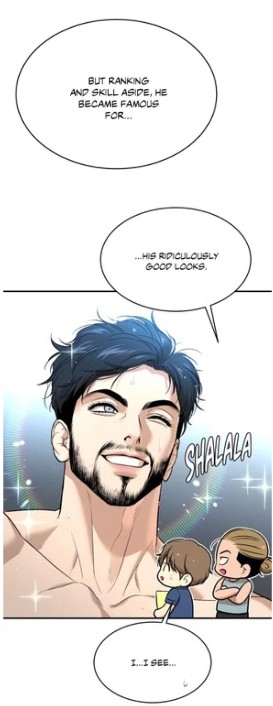 (chapter 81) According to Oh Daehyun, his goal is not victory but visibility — to be crowned the hottest male athlete. (chapter 81) That title alone tells us everything about his mindset. For Arnaud, competition is not victory but exhibition. His sport is not combat; it is choreography. Every gesture (the smile, the wink, the tilt of his head) (chapter 81) seems designed for the lens rather than the opponent.
And perhaps that is precisely why he was chosen. A kickboxer fights with distance. (chapter 81) His weapon is reach, not contact — the opposite of boxing, where rhythm and proximity create truth. Arnaud’s martial art allows him to attack without connection, to strike without touching — the perfect metaphor for a system built on façade. In this sense, he does not merely fight; he performs the idea of fighting. For him, combat is not confrontation but more dance, not survival but fun. It is sparring in its purest, most aesthetic form — controlled, rhythmic, pleasing to the eye. Every kick and grin seems rehearsed to delight the crowd.
His entire persona seems imported from the cinema rather than the cage. One cannot help but think of Jean-Claude Van Damme, the Belgian kickboxer and martial artist turned movie icon, whose blend of violence and grace transformed the fight into spectacle. Like Van Damme, Arnaud Gabriel stands at the crossroads between athlete and actor — between authenticity and artifice. And now, you comprehend why certain readers felt a connection between this fighter and Choi Heesung: 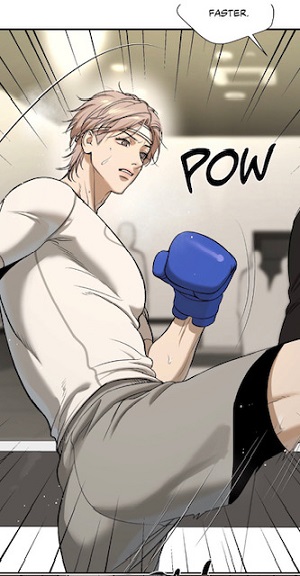 (chapter 30) The latter had to learn fighting in order to play his role in the drama Extreme Worlds
 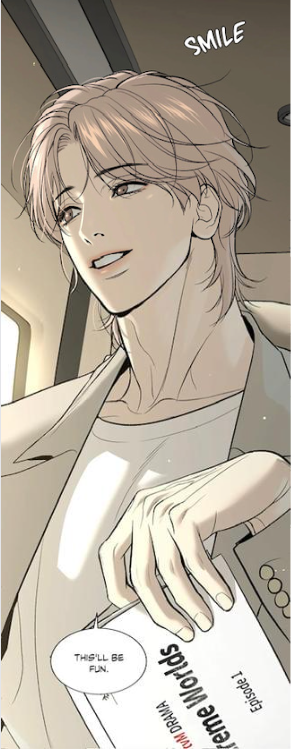 (chapter 29).
The fighter’s origin deepens this impression: France. The latter is famous for the spirit of savoir vivre — the art of living well, of savoring the moment. “Savoir vivre” is definitely part of his professional philosophy. Arnaud’s smile proclaims respect, pleasure and not perseverance or Schadenfreude. (chapter 81) He embodies a hedonism of the ring, a man who delights in admiration more than victory. Yet beneath the charm lies subtle anxiety. The beard that frames his grin functions as disguise — not to conceal aging, but to simulate experience, to appear older, to lend him a gravitas he has not earned. It is artifice masquerading as mastery.
It is funny, because in the analysis I had predicted that the match would take place in Europe. However, what my avid readers don’t know is that I was hesitating between France and Germany because of the desserts. And guess what… not only my prediction was proven correct, but also my hesitation. Why? Arnaud is a French name but its origins are Germanic. Arnaud, from arn (eagle) and wald (rule), means “he who rules like an eagle.” His name carries a certain arrogance. A creature of height and distance, he surveys from above, untouched by the chaos below. Gabriel, the angelic messenger, completes the illusion: an eagle crowned with divinity, a herald of light who never lands. Together they form the symbol of a man who rules through air — dazzling, distant, and hollow. Under this perspective, the smoke behind the champion could be interpreted as a veiled reference to Arnaud Gabriel. (chapter 81) He could attack him from behind or above. The smoke lingers behind both the title and the wolf, hinting that this elegant newcomer may have been placed as a pawn — not to challenge the champion’s skill, but to block his return to the title of Emperor. Consequently, he represents a real threat to Joo Jaekyung, while on the surface he looks harmless. That’s why for Park Namwook, Arnaud Gabriel seems to be an easy rival. No wonder why he described this encounter as a breeze (air element)  (chapter 81), while in reality a “storm” is actually coming.
But in Jinx, there exists another eagle in the sky: Oh Daehyun.  (chapter 8) His eagle is spreading his wings in front of his god, the sun, attempting to fly closer to the sun. According to me, Joo Jaekyung is the sun. This explains the loyalty of this purple belt fighter toward the protagonist!
Because of these parallels, I couldn’t help myself envisaging this possibility that Oh Daehyun ends up facing the other eagle. And that’s how the “novice” would get his breakthrough. 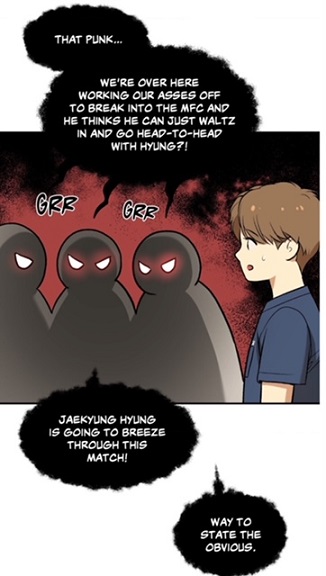 (chapter 47) But that’s one possibility among others, one thing is sure. Oh Daehyun will play an important part during their stay in France.
And yet, for all this lightness, the Frenchman is nowhere to be seen. (chapter 81) His absence from the poster betrays the truth: he is not a rival but a tool. MFC’s marketing machine uses him as a prop, an emblem of beauty to bait the audience, to divert attention. The company doesn’t need his fists — only his face — and even that, now, has been erased. His omission signals that the game is fixed before it begins. Yes, the poster is implying the existence of a rigged match.
The same is true for the missing championship belt. (chapter 13) Once gleaming over the champion’s shoulder — as in the poster with Randy Booker — it has vanished. It absence in the fight against Baek Junmin revealed (chapter 48) MFC’s true intentions. The tie had long been decided in order to create a smooth transition. MFC’s goal becomes clear: to take away the belt and give it to someone else, while appearing clean. The wolf’s success represented a threat to their illegal business (gambling and money laundering).  (chapter 46) People would bet on him and win… they needed him to lose and break his “lucky streak”. In other words, the organization betrayed the body they once sold. They had prepared the fall long before the injury, the surgery, or the suspension. But their plan failed. Despite every setback, the wolf remained beloved at home. People still admired him, not for the trophies, but for his kindness
  (chapter 62), humility
  and strength
 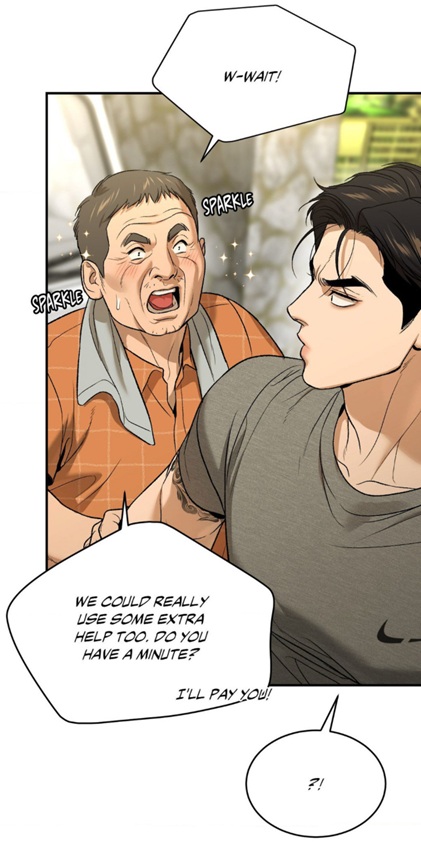 (chapter 62) In other words, what the champion did in the seaside town had a huge impact in his life and world. He lingered in the hearts of those he touched. He was not a fallen idol, nor a forgotten champion, but a living memory — proof that integrity leaves deeper marks than victory ever could. To conclude, his fame no longer comes from spectacle only but also from empathy and presence — from the very qualities the schemers and media system fail to grasp.
And so the game shifts. What cannot be destroyed by defeat will be targeted through image.  (chapter 81) The new battlefield is the face. Under this light, Jinx-philes will grasp why the agents from the Entertainment agency were so zealous in defending the star’s reputation. If he were to lose his good looks, they would lose one of their most profitable clients. (chapter 81) They hadn’t intervened when he was suspended or stripped of brand value — back then, he was still only a fighter, not a product. The entertainment world belongs to artists, not athletes. In truth, the celebrity now stands between two worlds: the ring and the stage, the punch and the pose, the man and the myth. If the schemers cannot ruin his record, they will try to ruin his reflection.
Here, I suspect, lies the invisible hand of Baek Junmin — the man whose own face was once disfigured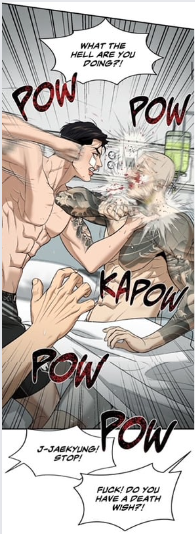 (chapter 52), whose envy of beauty turned into a creed. Imagine this. Now he holds the championship belt, yet no one admires him. His ruined face became the excuse for his bitterness,
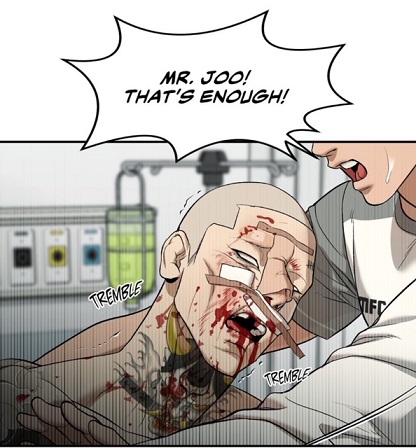 (chapter 52) and his rival the embodiment of everything he lost. He had to flee to Thailand to claim glory and admiration
 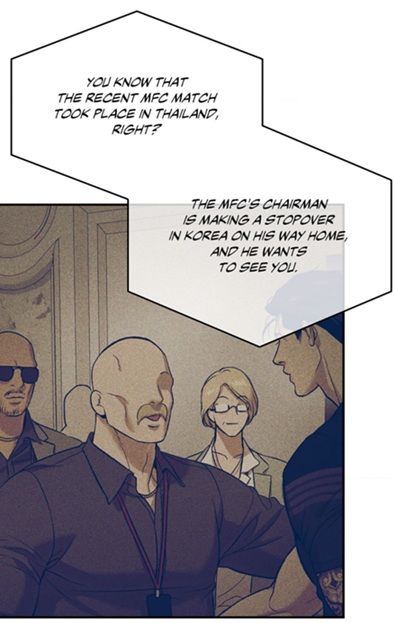 (chapter 69), only to discover that ownership without recognition is hollow. Even with the title, his name barely circulates in the media.
  (chapter 77) MFC can not promote him so easily, as his title could get questioned. He remains unseen — a champion without a face.
If Baek Junmin cannot be admired, he will annihilate admiration itself. (chapter 81) To him, visibility has become an offense. And this poster lets that mindset leak through. His presence is everywhere — not in the body of the opponent, but in the photograph chosen, in the smoke curling behind the champion, and in the raised fist, the same one that once struck him down.  (chapter 52) In the past, his insult
 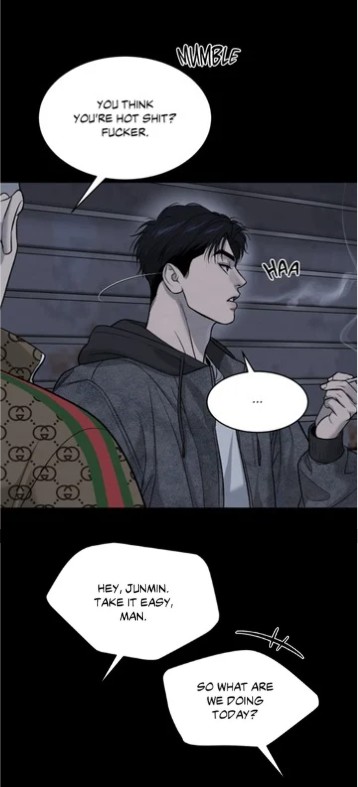 (chapter 74) merged anger with heat; now that very “hotness” materializes in the media and poster as smoke, an image of resentment turned into atmosphere. (chapter 81)
And yet, the smoke behind the celebrity’s silhouette may carry another, more literal association — one tied to France itself. (chapter 81)
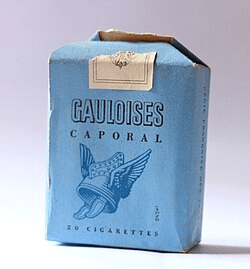
The old blue packs of Gauloises Caporal, adorned with a winged helmet, were once the emblem of French masculinity and freedom — a breath of rebellion. “Gauloises,” meaning “Gallic,” evokes both the air of the bird (rooster/eagle) and the pride of the soldier. How fitting, then, that the French opponent, Arnaud Gabriel, should enter the narrative surrounded by air and smoke, like a man of wings rather than roots.
But here the image turns double-edged. To Baek Junmin, smoke is not freedom but submission  (chapter 74): the visible trace of a man who dares to rebel. He once watched the fighter smoke a plain cigarette and sneered at him for it, precisely because he knew it was not a joint. In Junmin’s world, violation meant courage and power intoxication. He assumed that fearlessness linked to drugs would bring admiration and success. Jaekyung’s refusal to accept their drug wasn’t prudence; it was, to him, an insult — a quiet act of superiority. The wolf’s restraint exposed his indifference and own dependency, and that humiliation still burns.
Now that same symbol returns, ready to be twisted. (chapter 81) The schemers can weaponize the image of smoke — turning a mundane habit into proof of moral decay. What once marked distance from corruption could now be rebranded as relapse. Under this light, the haze on the new poster reads like the resurrection of that old resentment: smoke as proof, as provocation, as the spark that might ignite the next fall.
Worse still, the smoke doesn’t surround the fighter, it floats behind him. The poster makes the celebrity appear like vapor itself: fleeting, unsubstantial, “hot air.” The man of iron and will is reduced to mist and memory, a puff of illusion dissolving under false light. And now, we can finally grasp why the word “Emperor” remains unfinished. Emp no longer stands for empire, but for emptiness in the schemers’ eyes — the very image of a man hollowed out by rumor, stripped of body and voice, left to vanish in someone else’s smoke.
The Message Behind The Colors
At first glance, the black-and-white palette of the new poster might seem to echo the timeless harmony of yin and yang — two forces locked in mutual creation (chapter 81), night feeding day, death feeding life. Yet the longer I stared, the more this equilibrium seemed broken. Instead of flowing into each other, black and white now collide: the darkness doesn’t cradle the light, it devours it. The world becomes gray. And that’s the intention of the creators, though yin and yang will be present in the match.
My fellow Jinx-lovers might also recall that in South Korea, black and white are not symbols of elegance or neutrality — they are the colors of mourning. 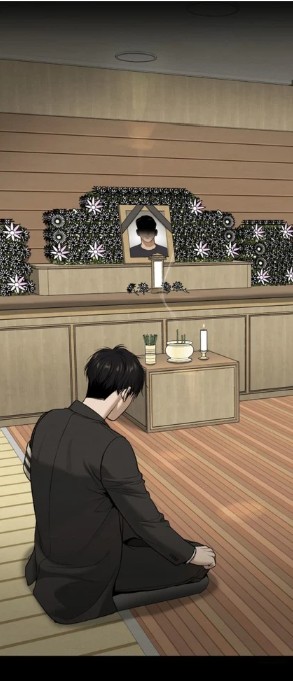 (chapter 74) The main lead was seen “wearing a black suit with three white strips” showing that he was the chief mourner.
 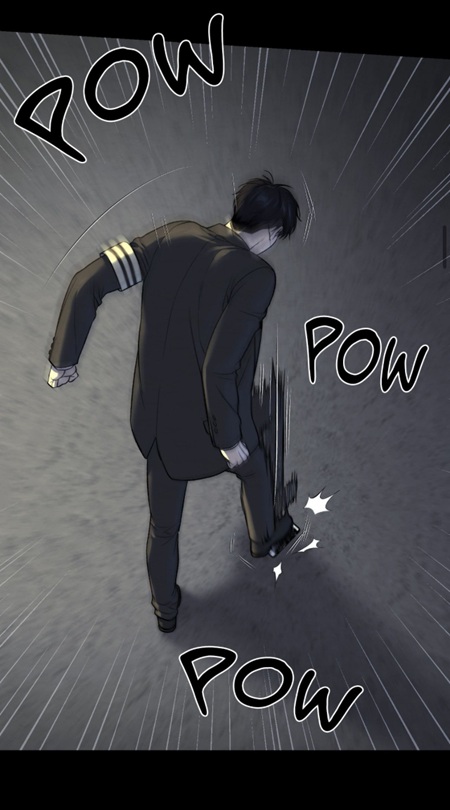 (chapter 74) Once you recognize this (chapter 81), the image takes on an entirely different meaning. The smoke rises not like balance restored, but like incense burning for the dead, a soul leaving a body. This inversion transforms the poster into something closer to a memorial portrait.
And then there is the light purple haze — a color that at first might seem aesthetic, even noble. Yet in this context, it suggests something bleeding, rotting, fermenting, like wine left too long in the glass. It blurs the boundary between beauty and decay, pleasure and loss. In religious iconography, purple once stood for power and resurrection; here it becomes the color of corruption — the slow decomposition of glory. This could be seen as a clue that the authors of this poster are aware of the athlete’s past drinking.  (chapter 54) The wolf is wrapped not in triumph, but in the faint perfume of something dying beautifully. He is shown before his decomposition, which reminds us of his father’s fate:
 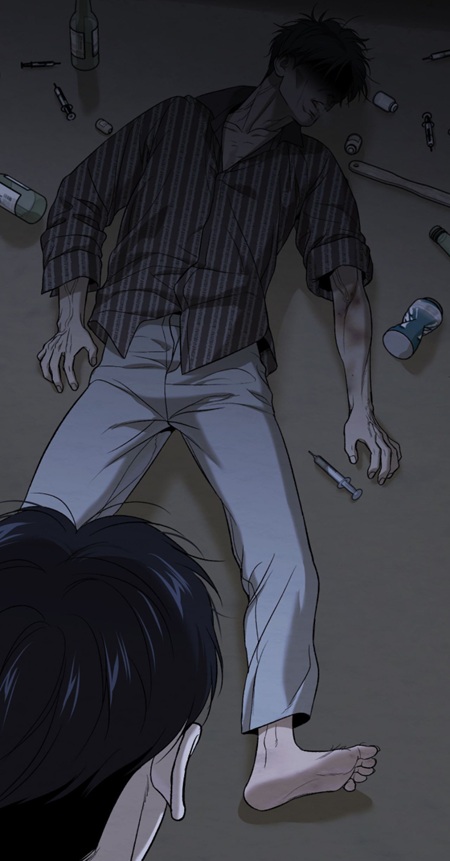 (chapter 73)
 (chapter 74) The dense, rising smoke recalls the funeral altar we once saw during Joo Jaewoon’s death scene — white blossoms, a dark frame, and a half-erased face. The emperor’s comeback has been reframed as his own commemoration: a legend embalmed in monochrome.
What makes this echo even more haunting is the photograph chosen for Joo Jaewoon’s funeral — his portrait as a boxer. One part of his face is covered. Moreover, his burial fused the professional and the personal, erasing the line between athlete and man. When his father died, he vanished both as a sportsman and as a person — an identity consumed by a role. And now, the poster of “The Return of the Emp” seems to repeat the same logic. The fighter clenching his MFC-branded fist mirrors that old photograph. It’s as if the marketing team were unconsciously recreating the father’s memorial, predicting the son’s fall. The image proclaims not revival, but elimination in advance — the death of the fighter, and with him, the man.
And that, I believe, is precisely what Baek Junmin desires. Unlike the champion, Junmin never lived the disciplined life of a true athlete; he was a thug from the very beginning, fighting not for mastery, but for longing and recognition. He has always been a man of the shadows  (chapter 73), hiding behind his hyungs, the mobsters who granted him borrowed strength and false belonging. Joo Jaekyung, by contrast, was raised in the ring — the gym shaped him as both a professional and a person.
But here is the difference between the two “altars”: the smoke in the poster is placed not in front of the picture (chapter 74), but behind and it is going in the opposite direction: (chapter 81) Mingwa is announcing the failure of the trap. In other words, the athlete is about to earn his stage name “The Emperor” for good! Observe that so far, this stage name was only announced once and it was never written. Under this light, it becomes comprehensible why the fighter’s name is placed at the bottom. They are trying to erase his name, while he is about to become a real legend: the Emperor!
But let’s return our attention to The Shotgun and his relationship with the wolf!  (chapter 49) If you have read my previous essay, you’ll remember that I connected the arc of chapters 80 to 89 to the theme of jealousy. Baek Junmin embodies that poison completely. His words — “
 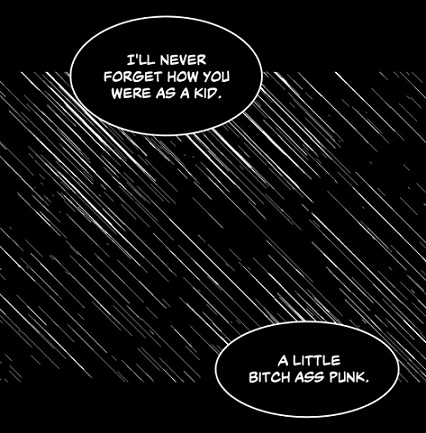 (chapter 49) “kid”, “coward,” “chicken” (chapter 74)— reveal not confidence but a profound inferiority complex. Obsessed with the Emperor, he wants to destroy the man he cannot become.
Yet in that obsession, Baek Junmin has frozen in time. His envy, greed, and resentment prevent him from truly living. He remains trapped in the past, mirroring the ghost of Joo Jaewoon, whose death also fused ambition and ruin. 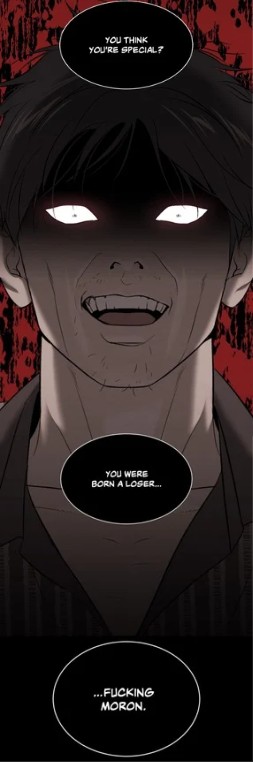 (chapter 73) Both men are haunted by the same delusion: that to win, one must erase the other.
That’s why the poster’s mourning tone resonates so powerfully — because it visualizes Junmin’s fantasy: to see the Emperor vanish, not only as a fighter, but as a man. And when he realizes that the wolf is not dying but living — that he has found peace, love, and laughter again — his envy will not fade. It will ignite.
And yet, the author behind this illustration — whoever designed it within the MFC hierarchy — does not realize how prophetic it becomes under Mingwa’s hand. (chapter 81) For what they intended as a visual obituary might instead signal transformation: the end of a man defined by violence and the birth of one reborn through empathy. Yes, the title of the match could be read like this: The return of Empathy. One might argue that this took place before. However, so far, none of the members from Team Black noticed it. In fact, the athlete stopped doc Dan from treating other members of Team Black.  (chapter 79) And the hamster followed the wolf’s request. This explicates why Potato is wearing a knee support brace — a sign that he is now tending to his own injuries without the doctor’s assistance.
 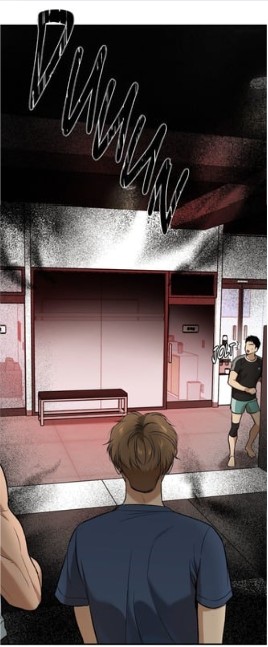 (chapter 81) It is a subtle but telling detail: the physical separation mirrors the emotional boundary now forming within the team. The healer’s hands have been withdrawn. So the emperor’s empathy is incomplete, hence he is only EMP. It extends only toward his chosen one — the doctor — and not yet to the others around him. True empathy, however, cannot be selective; it must reach beyond intimacy to encompass even those who do not stand at the center of affection.
Potato’s knee brace exposes the current limit of the wolf’s compassion: he protects Kim Dan but neglects the rest. Yet the injured knee also foreshadows the coming fight. Arnaud Gabriel, the “eagle,” is a kickboxer — his power rests on his legs, his rhythm, his ability to stay aloft through movement. By highlighting Potato’s injury, the author discreetly reveals the eagle’s own weakness: the knee, the joint that bridges grace and collapse. Without his legs, the eagle cannot kick or dance — he becomes a chicken, earthbound and ridiculous. And how was the main lead described in the past?  (chapter 1) He was a beast of destruction, someone who made sure to crush his opponents without mercy
 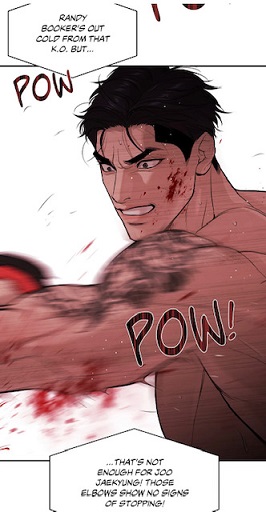 (chapter 15) Unstoppable in his rage, he moved like a man possessed — bloodthirsty, unrelenting, fighting not for glory but for survival. Each strike was a declaration: I will not die.
The French MMA scene, by contrast, stands for the opposite ethos — for entertainment, glamour, and spectacle, not mortal struggle. For the eagle, the ring is a stage; for the wolf, it has always been an arena. Thus, if the champion were to injure Arnaud Gabriel seriously, the audience’s outrage would be immediate. He would be condemned not as a fighter but as a monster. (chapter 81) Yet, this does not make the eagle harmless. He embodies dream and danger alike — beauty that glides above the earth, but also talons sharp enough to wound.
In my eyes, Arnaud Gabriel personifies both illusion and seduction, much like the cloud — an image that leads us back to Kim Dan himself.  (chapter 38) The doctor, too, has always been associated with clouds: soft, elusive, shifting with emotion. Thus I deduce that their paths will inevitably cross, dream and danger meeting in vapor and light. But more importantly, I perceive the smoke as a reference to the rising of doc Dan as physical therapist. (chapter 81) So far, his efforts were never noticed. Park Namwook’s gratitude was rather a lip service than a true recognition, because after the debacle, he was ready to hire a new physical therapist. And according to me, the schemers are all expecting the arrival of a diminished “MMA fighter” reaching the end of his career. That’s why the light is directed at the cloud/smoke! The one behind him is his hidden support.
And if the match truly takes place, I believe the champion’s way to ruin the schemers’ plan will not be through annihilation but transformation. He has to become himself an ARTIST!! [I will elaborate more about this aspect below] This time, victory will not depend on blood, but on how he fights — by returning to his origins, to boxing, to the simplicity of rhythm and breath, to the era when his smile was genuine. By having fun… In that sense, Joo Jaekyung may no longer be fighting for MFC but as the living embodiment of his own gym — Team Black reborn as the Emperor’s court.
But before we reach that possibility, another layer of meaning unfolds through Team Black itself. 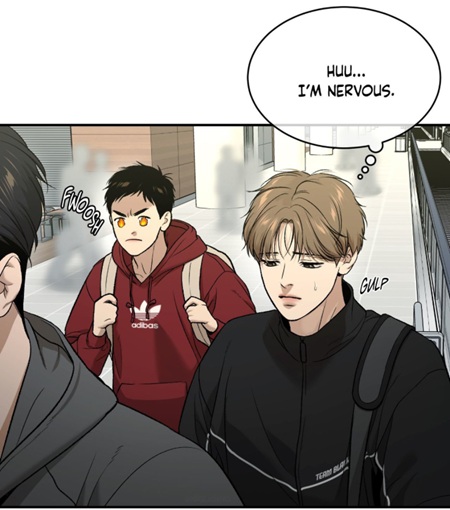 (chapter 81) The team’s black-and-white uniform (chapter 81) echoes the same mourning duality: black in the center, white on the sides — precisely like the arrangement of smoke behind the poster’s title. Yet when the team steps into the airport, the palette explodes into the full five Korean colors (오방색):
- Black (north, water): Kim Dan, wearing the Team Black jacket — still faithful, yet marked and exposed.
- White (west, metal): Park Namwook, disciplined but cold.
 (chapter 81)
 - Blue (east, wood): Joo Jaekyung, vitality and growth, standing quietly at the center.
- Red (south, fire): Potato, radiating warmth and impulsive energy.
- Green (center, earth): Yosep, grounding the group in human normalcy.
Only Oh Daehyun’s clothing remains unseen, though his blond hair shines like yellow, the missing balance of the circle. Taken together, they form a living flag of South Korea, suggesting that for the first time, Team Black stands united not by uniform, but by spirit.
This silent unity contrasts sharply with their earlier appearance during the Baek Junmin match, when they were clothed alike but divided in heart and mind. 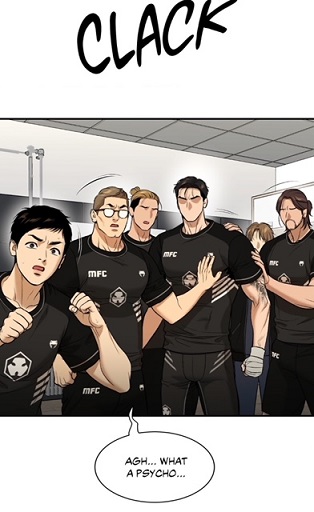 (chapter 49) What looked like teamwork was mere coordination. Now, the visual disarray hides emotional harmony — the perfect yin-yang inversion of their past selves.
The poster may wear the colors of death, but the airport scene (chapter 81) quietly answers it with the colors of life, diversity, and rebirth. Behind the mourning veil, something in this team has already begun to live again.
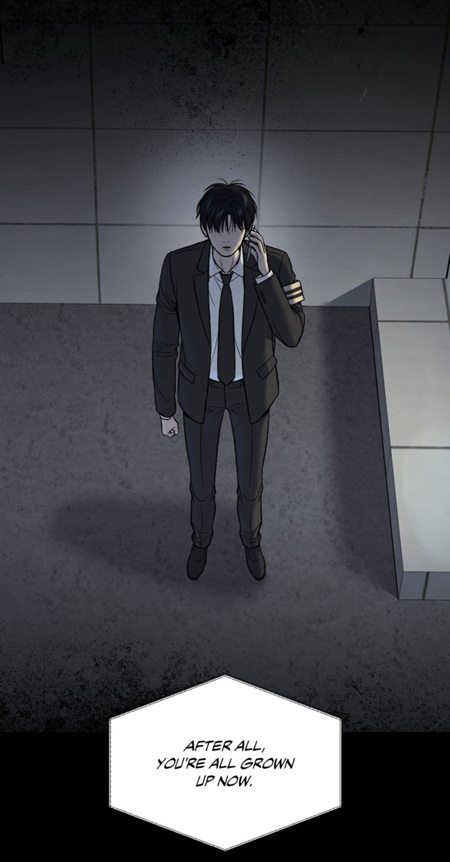
As you could see, I detected parallels between the match in the States and the one in France. Everything is pointing out the existence of another trap. (chapter 81) People started wondering about the doctor’s jacket. Why is he the only one wearing it? It is clear that this cloth truly belongs to the physical therapist, because the sportsman’s has always been too big for the “hamster”.  (chapter 36) One could think, the other members are not wearing it, for they don’t want to be associated with the champion. He has been stigmatized as a thug or a child losing his temper, the consequences of Park Namwook’s badmouthing. However, observe that even the star is not wearing it. (chapter 81) It, was if they didn’t want to be recognized.
I think, there exists another explanation. Don’t forget that the jacket had different logos on the back: 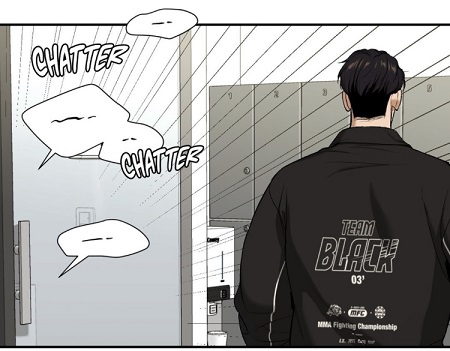 (chapter 36) What once symbolized sponsorship and solidarity has quietly disappeared. The explanation seems obvious at first: the loss of commercial partners following scandal and suspension.
  (chapter 54) Yet the deeper implication is far more unsettling. The jacket was more than a uniform; it was a contract, a visible bond between fighter and system. Its absence signals abandonment. The champion may still fight under the MFC banner, but the federation no longer claims him with pride. He is now a free agent trapped in an invisible cage — tolerated, not trusted. He questioned MFC and their competence (see chapter 67 and 69).
And what about the doctor? His jacket, now a solitary relic, must have arrived after his departure and given to him after his return. The Team Black jacket makes him a walking target. By still carrying the brand, he becomes the visible trace of a world that wishes to erase itself. He wears proof of loyalty in a landscape where faithfulness has become liability. If the upcoming match is indeed a trap, his uniform can mark him as bait or as a disguise!  (chapter 37) He could be mistaken for the owner of the gym or a person involved in the scheme. And this leads me to my next observation: the champion’s picture and posture!
The Body That Faces the Crowd – From Defiance to Dialogue
If the smoke and the black-and-white palette whisper of death, the body posture roars of defiance. On the poster, the MMA fighter stands half-turned toward us, left fist raised, the logo MFC glinting on his glove like a brand or a curse. The light strikes him from below and from the right, revealing one side while leaving the other in shadow — a visual echo of his divided self: the professional mask and the wounded man beneath.
The position of that raised fist is crucial. It does not challenge the opponent — there is none in sight. It challenges the beholder. The blow is aimed outward, toward the audience, toward a world that has mocked, condemned, or abandoned him. The poster transforms the traditional stance of the victor into something closer to revolt. The “comeback” it advertises is not a return to sport, but a return against the crowd. Despite his handsomeness, he seems to have a bad personality (provoking, insulting, challenging the audience). They made him look like a bad guy: ruthless, arrogant and rebellious. As you can see, they are attempting again to ruin his fame and name.
Light purple bleeds through the smoke, carrying an undertone of resentment — bruised flesh, fermented wine, or the slow rot of disillusion. It’s the color of pride wounded yet unyielding, the hue of someone who refuses to forgive the world for its betrayal. In this light, the athlete seems less a man celebrating triumph than a revenant demanding recognition.
This reversal also tells us something about the system around him. In earlier matches, such as the one in the United States, both fighters were cheered, embraced as performers in a shared spectacle. Here, the scene will be different. No shared ovation, no brotherly arm around the shoulder, as with Dominique Hill. The poster prepares us for isolation, for a battle where the crowd itself becomes the enemy.
The schemers are expecting an angry and resentful man, while in verity this is a projection from the Shotgun. But because MFC is placed twice, it exposes the company’s greed and possessiveness. With the logo on the glove, they insinuate that they are the one deciding when Joo Jaekyung will fight or not. He is their puppet, and they decide when to discard him.
And perhaps that is the deepest irony. Team Black, still unaware that the previous match had been rigged — blind to the partial commentary, the biased jury, the manipulated outcome — walks toward a trap thinking it’s a stage. Neither the champion nor his coach nor his companion suspects that this time, the audience’s hostility has been engineered. The raised fist is both prophecy and warning: he will fight alone, not just in the ring, but against perception itself. Yet, he will supported by the “vapor”.
What the schemers read as fury, however, may become the seed of transformation. The same gesture that once meant aggression could turn, under a new light, into assertion — not of anger, but of presence. If the previous posters framed the fighter as spectacle, this one shows him claiming his body back from those who profited from it. I would even go so far to say that the athlete will end up challenging the authority MFC and even sue them. (chapter 81) And that’s how he could make history. He will be remembered as the Emperor, the one who put an end to crimes!
317 — The Date That Isn’t There
After the smoke, the colors and the picture, the next enigma lies in what the poster refuses to specify: no date, no location, no time. Every previous MFC announcement was anchored in visibility — April X, Saturday, on PPV , June — a fixed promise to the public. Here, all coordinates vanish.
That erasure extends beyond the poster. When Team Black lands abroad, the airport — once a stage for flashbulbs and microphones — stands eerily still. (chapter 81) That erasure extends beyond the poster. Behind Potato and Kim Dan drift a few gray silhouettes, barely human, half-formed shadows of what should have been journalists or fans. They look less like people than ghosts of publicity, residues of a crowd that never came. No banners, no reporters’ questions,  (chapter 36) no cheering spectators — nothing recalls the hero’s welcomes of earlier arcs.
And yet, paradoxically, this match was an invitation from the CEO himself, supposedly a prestigious opportunity. The absence of press coverage therefore exposes a contradiction: the greater the supposed honor, the deeper the concealment. No one outside the organization has been informed; the public is deliberately kept in the dark. What pretends to be a triumphant comeback is, in truth, a private operation, an exclusive fight designed for a restricted audience. (chapter 81) Thus I deduce that the athlete won’t fight in a huge arena, but in front of a small circle, where people might smoke. A new version of this scene (chapter 74) but with a different public.
Still, one element gives the illusion of authenticity: the number 317. It appears on the poster like a seal of legitimacy — the next official bout in MFC’s timeline. And that is precisely the brilliance of the trap. The number suggests continuity, reassuring the team that everything follows protocol. The wolf and his court walk straight into the ambush because the system’s familiar numbering masks the rupture beneath.
In this silence, the gray figures become a visual metaphor for the event’s nature: visible enough to seem real, but hollow when touched. The “return of the Emperor” is not a broadcast — it’s a ghost match, orchestrated for unseen eyes, similar to the high-rollers who once financed Baek Junmin’s underground bouts for “commoners”. 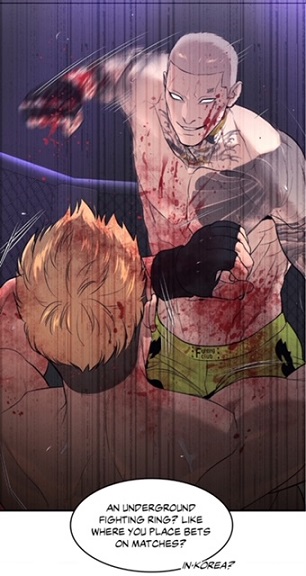 (chapter 47) Thus, 317 functions like a counterfeit signature — convincing enough to deceive even those inside the organization. What looks like promotion turns out to be execution by design, a fight that exists on paper but not on record. Hence no one is waiting for them at the airport.
At first glance, 317 might seem to follow the ordinary sequence of MFC events, yet the attentive reader will recall the last recorded bout — MFC 298  (chapter 54), the match where the Emperor faced Baek Junmin. That small arithmetic gap hides something extraordinary: eighteen events have supposedly taken place since then, in barely three months. Such acceleration borders on absurdity. It feels less like a sports calendar than a purge — as if the federation were rushing to overwrite history, to bury the memory of its fallen champion beneath a flood of new numbers.
The more I pondered this, the more the number 317 began to sound not like continuity, but conspiracy. The digits 3, 1, and 7 echo two pivotal moments in the narrative: chapter 16 (1+6= 7), where the doctor was almost raped  (chapter 16), the moment Heo Manwook thought that the “hamster” was working as an escort due to the name “Team Black”.
  (chapter 16) So because of the jacket Team Black, doc Dan could be mistaken for a prostitute. Naturally, Jinx-lovers will remember the great fight between Heo Manwook and his minions, when the athlete saved his fated partner. Back then, no one discovered his great action.
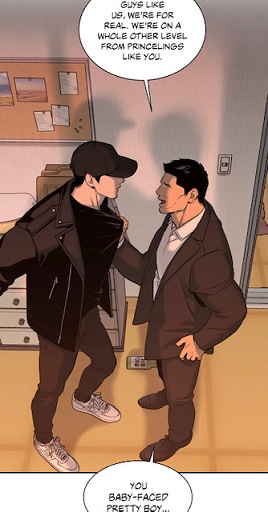 (Chapter 17) And how did the loan shark describe their world? Fake… he even called him a princeling, because he stands for the glamor and artificiality of MFC. He is the cover for the underground fights, drugs and money laundering. This connection reinforces my interpretation that the future match is « fake » and as such rigged. Then in chapter 37, the hamster met a Korean disguised as a MFC manager. (chapter 37) Both episodes revolve around misunderstandings, silence and deception. In this light, 317 fuses these numbers into a single cipher of repetition: history threatening to repeat itself.
The absence of any date or place only amplifies the unease. “The Return of the Emp” seems less like a public comeback than a covert operation. A fight that exists everywhere and nowhere. Its secrecy betrays its true nature — not an open competition, but a private spectacle designed for those already in the know.
And who are “those”? The answer leads us back to the high rollers. 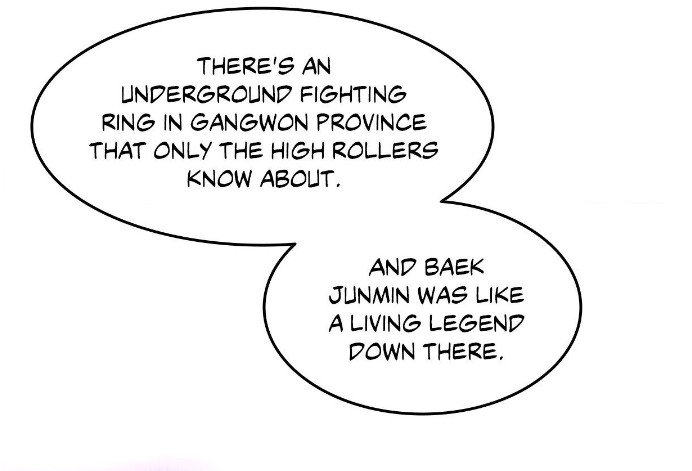 (chapter 47) In the past, they participated in the underground matches of Gangwon Province, where Baek Junmin reigned as a local legend — a thug made myth through blood and rumor. (chapter 47) There, they would even cheat with weapons to ensure the right outcome
 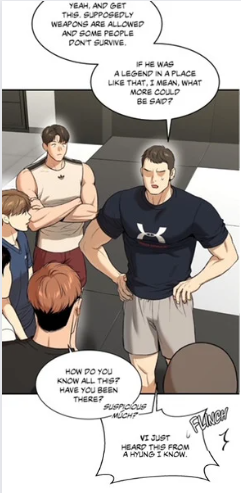 (chapter 46), as they didn’t want to lose money. And what did Park Namwook say in episode 46?
  (chapter 46) But now, the same hunger for spectacle has simply migrated upward. What once belonged to the alleys has climbed into the penthouses. The illegal thrill of the poor has become the curated decadence of the rich. And they were invited to witness the death of the “emperor”, someone who tried to escape from his origins. Thus I deduced that this is only a match that the high rollers (I suppose, mostly people from the Occident, though expect some from South Korea) know about.
Baek Junmin’s smoky basements have found their mirror in Arnaud Gabriel’s illuminated arenas. One fed the working man’s fantasy of domination, the other gratifies the elite’s appetite for risk (chapter 81) — both sustained by the same voyeuristic instinct to watch another man fall. That’s why he doesn’t need to be seen in the poster. His source of income comes from sponsors in the end. They come from the elite.
And this time, the high rollers know precisely what they’re buying. They have been definitely briefed: the celebrity has had shoulder surgery, suffers from headaches, drinks, and dismissed his own physical therapist. He avoided the gym for a while. He is someone who gets easily triggered, and once he is furious, he makes mistakes. They are not ignorant; they are investors in ruin, betting on a man already wounded. The match is not entertainment but a calculated execution disguised as sport. (chapter 46) Hence the French kickboxer can see his art as entertainment and fun, for he is facing a so-called injured opponent. To conclude, they have ascended into a new form of decadence. The same pattern persists, merely transposed to another altitude. Baek Junmin’s world of illegal betting has found its reflection in Arnaud Gabriel’s world of sponsored violence. One feeds the poor man’s fantasy of power; the other, the rich man’s craving for risk. At the same time, the Korean thug had connections to high rollers too, but mostly Korean people. And the CEO is the link between these extreme two worlds. In other words, this match is bringing up the corruption to the surface. However, they are not expecting “change” and as such coincidence. Consequently, I am assuming that their plan will fail. And if they bet against the champion, imagine their reactions, when the opposite happens. They might feel deceived and betrayed. They could even lose, if someone else takes his place and he acts as the director of the gym. And who agreed to this match? Park Namwook… He wanted a match at any cost thinking that this would revive his boy’s “reputation” and fame. And now, you comprehend why no advisor was sent to develop a strategy against Arnaud Gabriel, the angel of death from the CEO!! Both sides are underestimating and deceiving each other. In this case, Park Namwook’s blindness and ignorance becomes a virtue. The enemy is left in the dark.
Thus, 317 becomes the code of collusion — the bridge between the basement and the penthouse, between the mud of Gangwon and the marble of Paris. A number that hides a shared agenda: the silent elimination of the Emperor. And now, you are wondering how the main leads can escape from this trap! If he wins and its victory reaches the ears of the public audience, the schemers will definitely attempt to accuse him of selecting a wrong fighter. If he loses, he will be “disfigured” and forgotten. Don’t forget that according to me, the French kickboxer will aim at his face and shoulders, his weaknesses. By losing his second title, Joo Jaekyung won’t be able to appear in the covers or social media! Another possibility is that he lets someone else fight in the ring due to circumstances, yet I have my doubts about this. You will discover soon why. But if my theory is correct and the champion shines in that fight so that the downfall doesn’t happen, the VIP audience might get upset against the CEO. The latter deceived them in order to earn a lot of money! They have been tricked by his lies and bet against the athlete. And the high rollers could decide to switch sides and question the new champion’s victory. One might think, a tie could be a possibility, but the poster is suggesting otherwise: it is a rigged game at the athlete’s expense. There’s another way that the wolf can succeed: it is to become an artist!! But what does it mean exactly?
Be Water, my friend
The heading is an important quote from the famous martial arts fighter Bruce Lee:
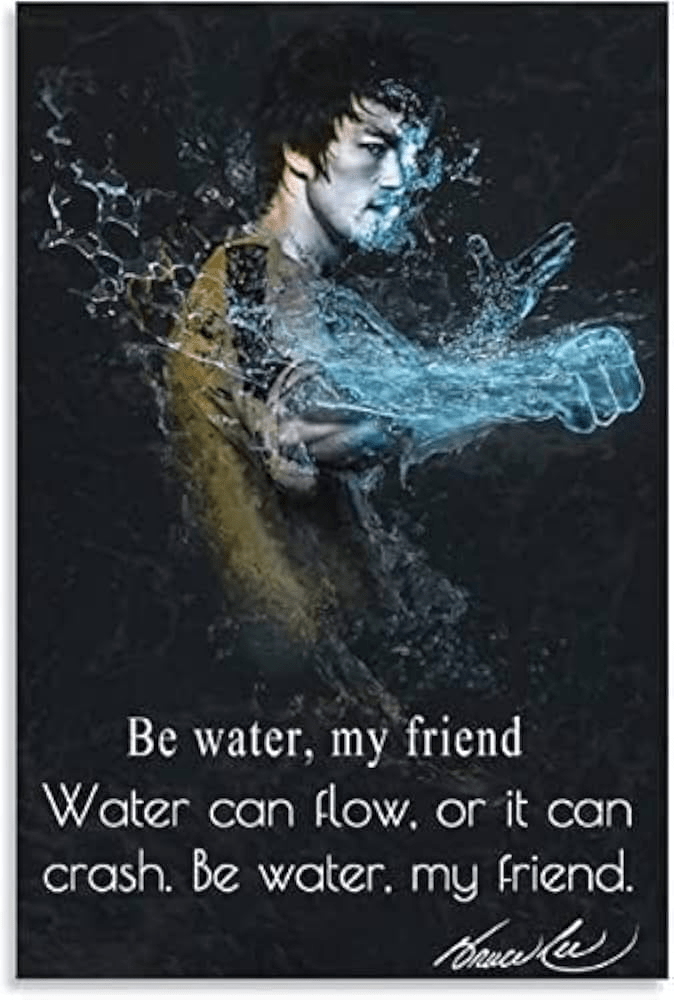
“Here is natural instinct, here is control. You are to combine the two in harmony. If you have one to the extreme, you’ll be very unscientific, if you have another to the extreme, you’ll become all of the sudden a mechanical man, no longer a human being. So it is a successful combination of both. The word Superstar really turned me off because the word Star man is an illusion. It’s something what the public calls you, you should look upon oneself as an actor. All type of knowledge ultimately means self knowledge. Therefore they ask me to teach them not so much how to defend themselves, rather they want to express themselves through movement, be it anger, be it determination, or what so ever… to me, martial arts means expressing yourself. And it is very difficult to do… to express oneself honestly … not lying to oneself That my friend is very hard to do. you have to train, you have to keep your reflexes so that when you want it is there. When you want to move, you’re moving. And when you move, you’re determined to move all the time you are keeping the continuity going, bending, stretching … to this, the journalist said, you seem like a ballet dancer. Bruce Lee: To Them, running water never grows stale so you just got to keep flowing.
After reading his definition about Martial Arts, it becomes clear that the pool scenes are not just there for the doctor’s sake, they’re the curriculum. In water, the champion rehearses the very balance Bruce Lee describes—moving without forcing  (chapter 81), breathing without bracing, learning that flow is strength. The author placed the swimming lessons here so we’d see him practice calm under pressure before he performs it in the ring. But observe that when he is in the swimming pool, he is expressing more and more his emotions.
 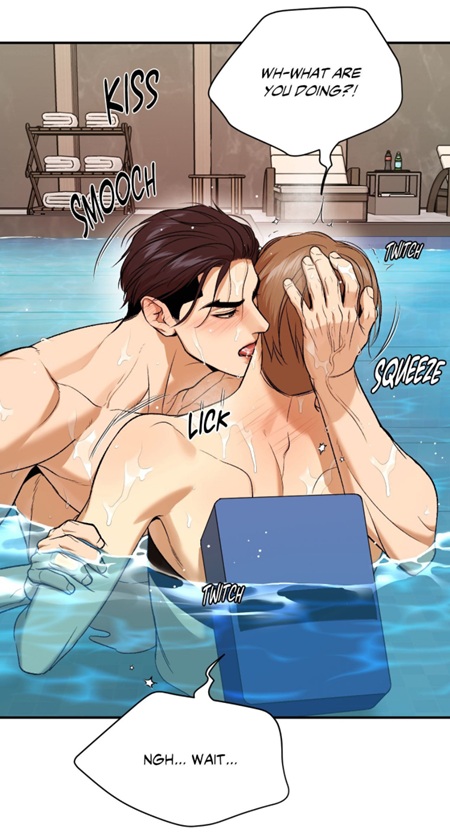 (chapter 81) At the same time, he is also incited to control his pulsions and body.
  (chapter 81) In other words, during the swimming lessons, he was encouraged to find the right balance between instincts and control, which Bruce Lee recommended. It is no coincidence that he referred to the philosophy of yin and yang!
Bruce Lee warns: “If you have anger toward others, they control you.” That’s been the wolf’s trap from chapter 14 onward—rage as a leash. 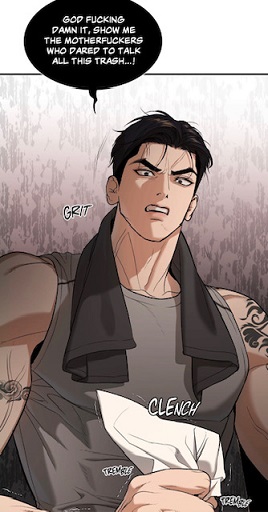 (chapter 36) The pool inverts it. Laps replace lunges; rhythm and love replace revenge and hatred. Anger loses its grip because water refuses to hold it. And now, you can grasp why the athlete was calm during the meeting:
 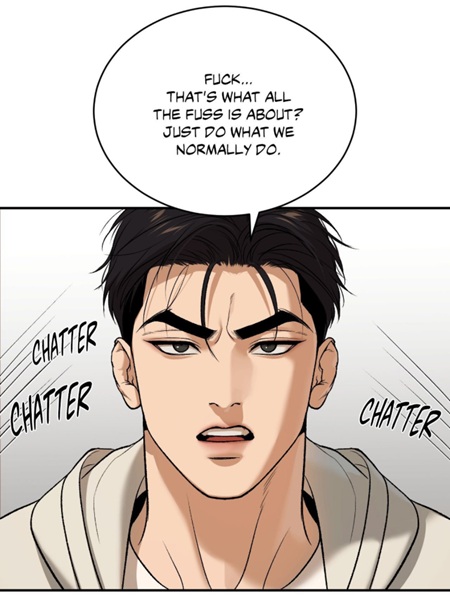 (chapter 81) His fear and anger were no longer controlling his heart and mind. “One of the best lessons you can learn in life is to remain calm.” The swimmer learns it; the fighter must now prove it. Thanks to doc Dan, the athlete was incited not only to accept himself, but also to get self-knowledge.
Across from him stands the eagle: instinct without control —aerodynamic, moving based on the circumstances. Arnaud Gabriel fights based on the reaction of his opponent. He is air: elegant, distant, untouched. But the problem is that he has no strategy at all (“the unscientific”), as he is dependent on the air, his opponent. This gives another explanation why the Entertainment agency offered no advisors to the athlete.  (chapter 81) Arnaud Gabriel is totally unpredictable which makes him dangerous but also weak. So what happens when the athlete uses a totally different strategy? The eagle will get caught by surprise. Thus in the past, we have to envision that the wolf was the mechanical man, iron and fire, surviving by destruction. Bruce Lee’s middle path—instinct guided by awareness—is the only way out of this binary. That’s why the story moves him from steel to steam, from panic to presence.
“Life itself is your teacher  (chapter 62), and you are in a state of constant learning.
  (chapter 80) The seaside town and doc Dan taught him kindness, the pool teaches him composure and precision, the poster’s smoke teaches him restraint: you don’t swat at vapor; you breathe and move through it. “It is far better to be alone than to be in bad company”—so he steps out of the schemers’ frame. “When you accept yourself, the whole world accepts you”—so he stops fighting the audience and starts speaking to one person who matters, then to many. In my opinion, Joo Jaekyung will use this bout to express his feelings for Doc Dan (“to me, martial arts means expressing yourself“) and the birthday card
  (chapter 81) with the key chain represents now his motivation. Thus he resembles more and more to the physical therapist.
  8chapter 81) Under this new light, it becomes comprehensible why the athlete has not confessed his feelings yet. In my eyes, the confession will be strongly connected to the imminent match. In other words, by spending time with the physical therapist, the Emperor regained his voice and body. He can now express himself in the ring, making sure to catch doc Dan’s gaze and admiration. And now, you comprehend why I mentioned that Joo Jaekyung will come to see this fight as a source of strength and inspiration: it will be more about love and recognition from his loved one than the money or hatred from the audience.
Practically, this means the bout must look less like slaughter and more like sparring—measured pressure, controlled power, no needless cruelty. That choice does two things at once: it denies the high-rollers their blood-script and leaves the kickboxer no “reason” to obey orders to ruin a face or a shoulder. Arnaud only embodies instinct — rhythm without reflection, showmanship without soul. So he is not guided by negative emotions. Be water becomes case law: adapt, absorb, answer—without being owned by anger.
So air meets water: (chapter 81) spectacle meets expression. The eagle can only descend to strike; water rises, falls, returns. And since Bruce Lee’s punch turn into water  , I came to imagine that the athlete might strike him like “water”, hard enough to make him lose the balance and defeat him, but not too strong to damage his knee for good.
If he carries the pool into the cage, the “emp” on the poster will cease to read as emptiness. It will resolve into empathy—calm under fire, feeling without being ruled by it. And the smoke behind him? Not a death shroud, but iron turning to steam—a body once forged in rage, now speaking in flow. And now, look at the other tattoo on his left arm: it is a cloud or steam!  (chapter 17) And once the cloud (doc Dan) meets the steam (chapter 81), they can be together as a couple. To conclude, though this poster was created as an epitaph, the reality is that it announces the emergence of Joo Jaekyung, the dragon! Kim Dan is the one who is turning the athlete Joo Jaekyung into an actor, the emperor! Even if his career as MMA fighter ends, he can still work as an actor or as the owner of his gym. He will never be forgotten as an athlete like his father or Hwang Byungchul. His name Emperor will remain forever in the memory of people and maybe because of his “fight” with MFC and thugs. At the same time, it displays the increasing conflict between Team Black and MFC. The fist could be seen as directed at MFC. The Emperor represents a menace for the CEO in the end. One thing is sure: since Baek Junmin chose the nickname “The Shotgun”, it becomes clear that he has become the negative version of his rival: he is now the mechanical man (control without any natural instinct). He lost his balance and can no longer rely on others. What he fails to realize is that by bringing more and more people in the schemes, he is actually endangering the whole organisation MFC! Furthermore, contrary to the past, the athlete will pay attention to his fated partner in France, so a meeting between Arnaud Gabriel and Kim Dan will definitely reach the athlete’s eyes and ears.
This is the longer interview of Bruce Lee:
Feel free to comment. If you have any suggestion for topics or Manhwa, feel free to ask. If you enjoyed reading it, retweet it or push the button like. My Reddit-Instagram-Twitter-Tumblr account is: @bebebisous33. Thanks for reading and for the support, particularly, I would like to thank all the new followers and people recommending my blog.


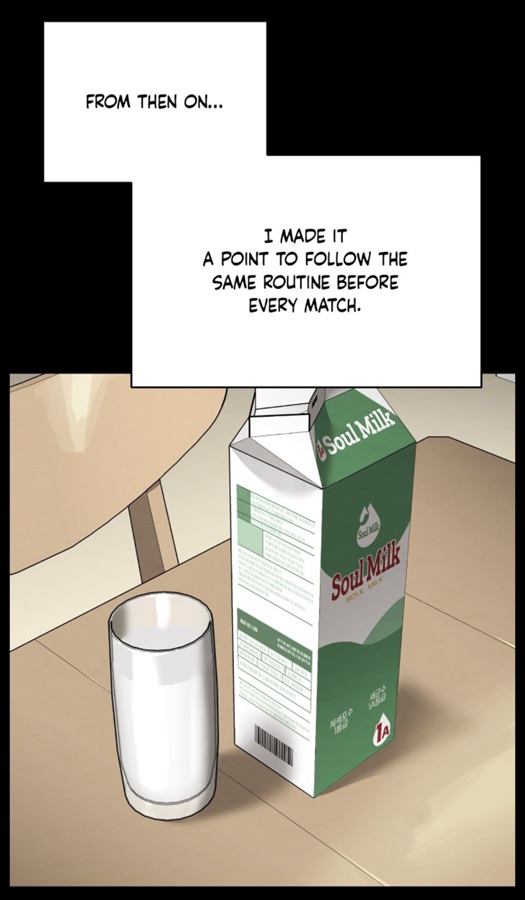 (chapter 75), the perfume
  (chapter 75), the nights of sex before a fight
  (chapter 75). His words seemed like a confession, a key to the riddle of the Night Emperor. But do we truly know him now? Yes and no. Yes, because his testimony reveals patterns we had only noticed before. No, because those patterns are only the ones he decided to share. The tattoos
  chapter 75) that suddenly appeared on his body
  (chapter 75), for example, were left unmentioned — proof that silence still surrounds him.
 (chapter 75) Why fight as though every match were a matter of life and death? Why keep repeating the same acts, long after survival was secured?
  (chapter 75) What does the jinx truly represent for him — mere superstition, a ritual of control, or something he himself has not yet dared to name? For Jaekyung himself cannot fully explain it. He confesses what he knows — that sex steadies him, that milk soothes him, that perfume sharpens him — but he does not grasp what lies beneath these habits. The origin of the jinx remains hidden, lodged somewhere between memory and trauma, where even he cannot follow. Are these rituals mere superstition, a desperate bid for control? Or are they fragments of something deeper — pieces of a story he has never fully told, even to himself?
 .(chapter 75) They are the product of a long chain of humiliations, betrayals, and systemic exploitation, each layering onto the next until a young man’s raw talent was encased in a carapace of compulsions. To understand the jinx is to understand how the protagonist’s life collapsed around the word loser, and how the fighting industry transformed his private shame into public myth.
 (chapter 72) Even before stepping into a professional cage, his life had been a series of trials to prove he was not worthless.
 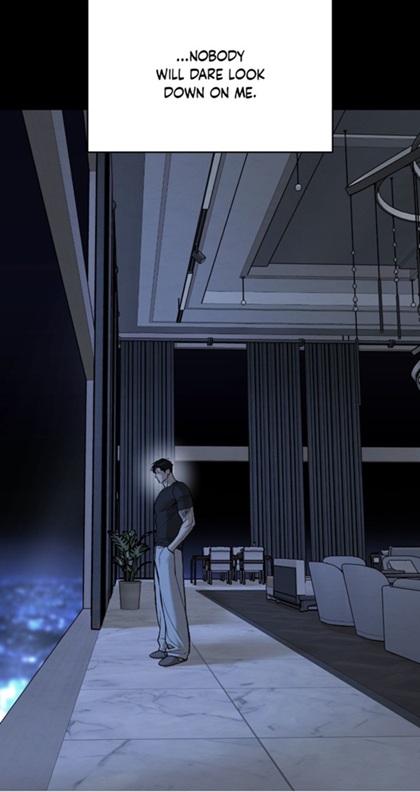 (chapter 75)
 (chapter 69)
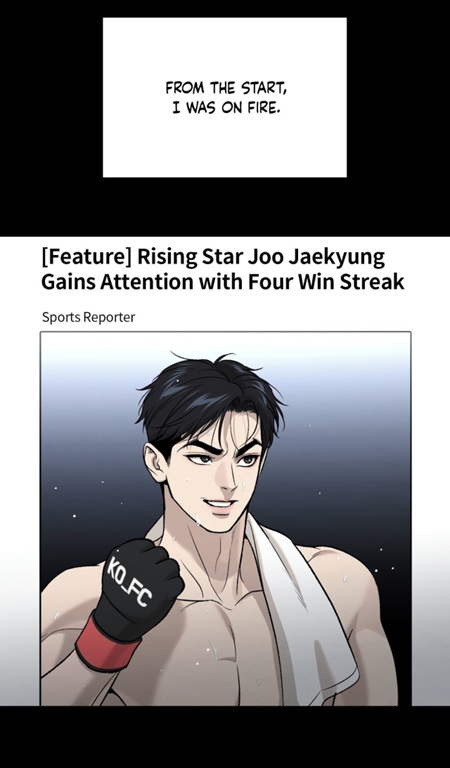 (chapter 75) — a boy who fought with the desperation of someone who had nothing else. Victory after victory gave him the illusion that he had escaped his father’s shadow. As long as he was winning, he could suppress the pain, bury the insult loser, and silence the memory of that cursed night when his father died and his mother abandoned him. Triumph became his shield, proof that he was not what he had said he was.
 (chapter 75)
  (chapter 75) To them, a fighter’s struggles had only one explanation: weakness. Park Namwook and the other coach dismissed his losses as nerves
  (chapter 75), as if the only measure of worth were what happened under the spotlight. They never thought to ask what kind of weight he was carrying, what kind of nights he was surviving before he entered the cage. While the other fighters were well aware of the champion’s insomnia
 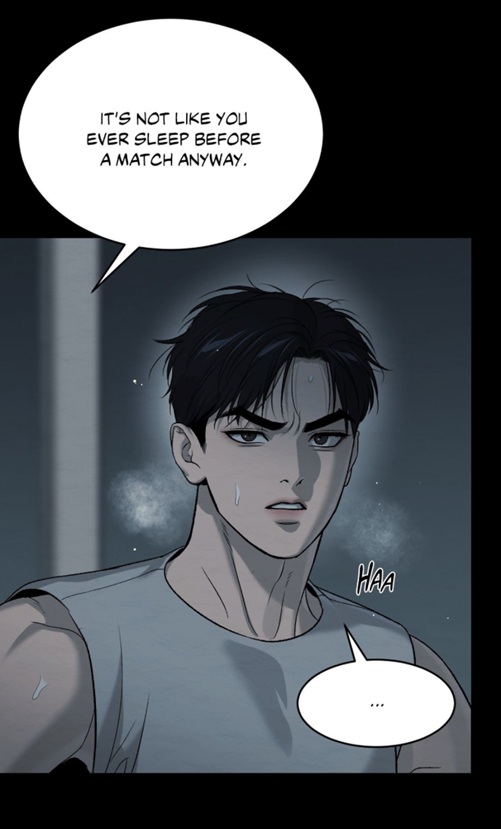 (chapter 75), Park Namwook still has no idea of the champion’s struggles. This shows how disconnected he is from his “boy”.
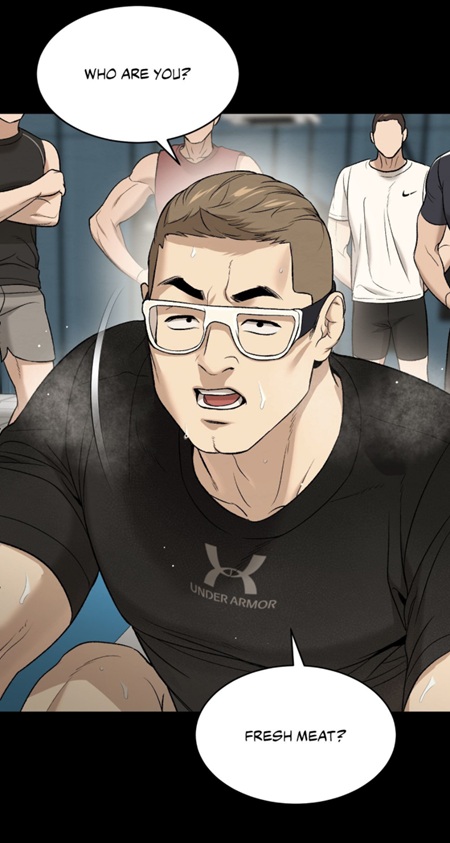 (chapter 74) bodies to be tested, pushed, and discarded if they broke. Where Jaekyung’s defeat cracked open childhood trauma, they saw only performance failure. What he lived as suffocation and despair
 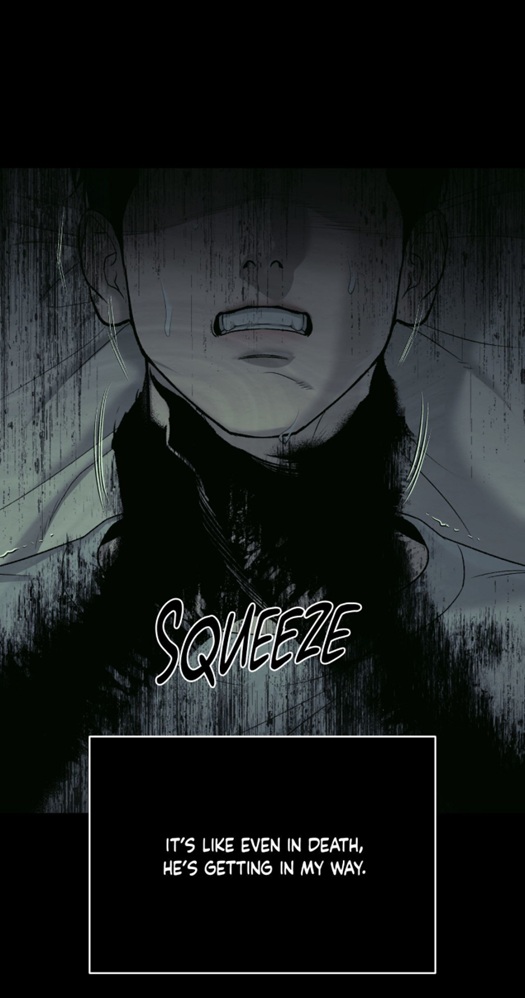 (chapter 75), they reduced to cowardice, bad luck or lack of discipline.
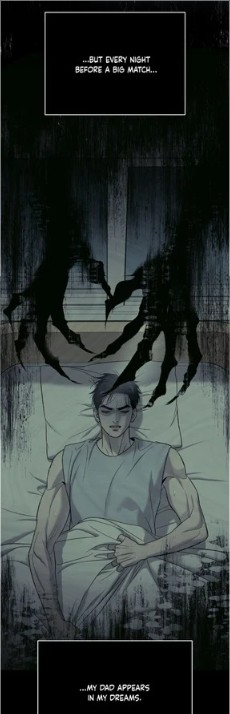 (chapter 75) Shadowed hands stretched over his body, pressing down, suffocating him as he tried to sleep. The man was dead, but still he choked the air from his son. It was, as if the father wanted to bring his son to the afterlife.
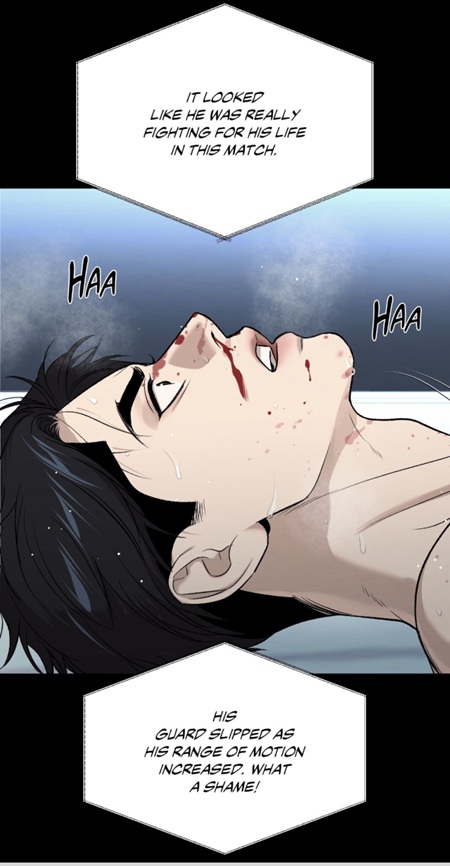 (chapter 75) Even before his first loss, Jaekyung fought like a cornered animal, pouring every ounce of strength into proving he could not be beaten. That’s why he rose so fast. But why? The reason is that all his opponents were reflections of his “father”.
  (chapter 29) Hence all the challengers have empty eyes and a smirk on their face, just like Joo Jaewoong.
  (chapter 75) Consequently, his matches always looked like life-and-death struggles. He wasn’t strategizing against a specific fighter; he was exorcising a ghost. That’s why he never refused a challenge. His opponent never mattered. Besides, as long as he could win, it didn’t matter.
  (chapter 75), the more the cracks showed — and the ghosts of his father and mother made every fight feel like a replay of abandonment and accusation. The five losses
  (chapter 75) were not just setbacks in his career; they were the repeated reopening of a wound that would never heal. Each one confirmed his father’s curse. Each one reinforced the sense that he was marked, that no matter how high he climbed, he would always be dragged down again.
 (chapter 73) To the boy, it was a cry for pain and survival — an instinctive urge to escape despair and criticism. To the father, it was betrayal. Already emasculated by failure and drink, he was reminded of his wife’s discontent, the specter of another abandonment. He lashed out the only way he knew:
  (chapter 73), and that the man’s final judgment on him would never be undone. Love and hatred, longing and guilt fused in that moment. He loved his father despite the abuse. And yet he would forever wonder if leaving — even just threatening to leave — had killed him. Worse, because death came so suddenly, there was no time left.
 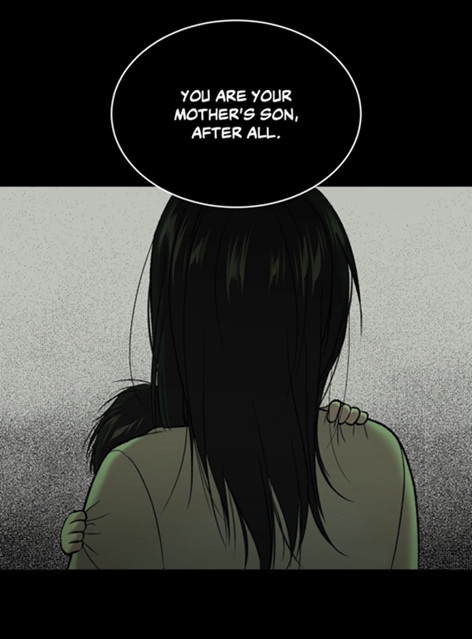 (chapter 73), unable to voice his own vulnerability.
 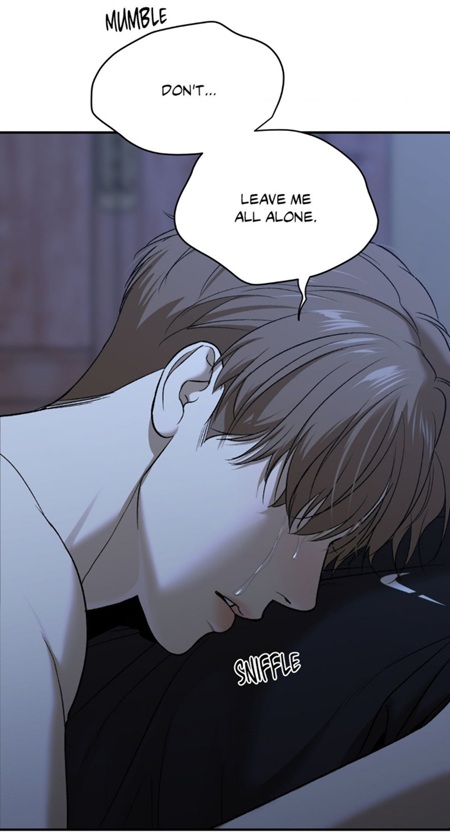 (chapter 66) — speaking not with fists or insults but with tears and an embrace.
  (chapter 66) His sleepwalking reacting to a simple touch
 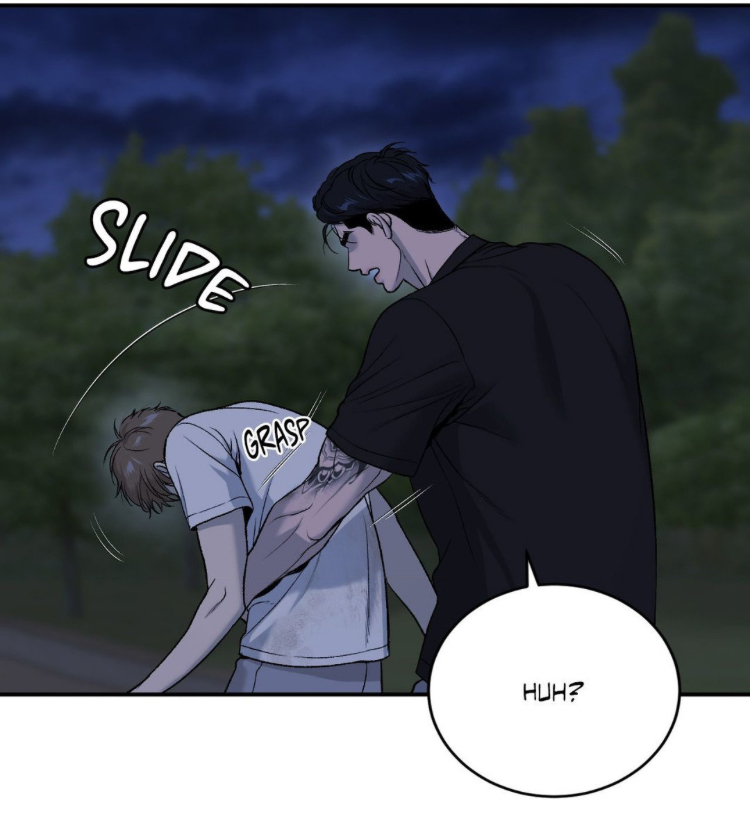 (chapter 65), his dissociative pleas
 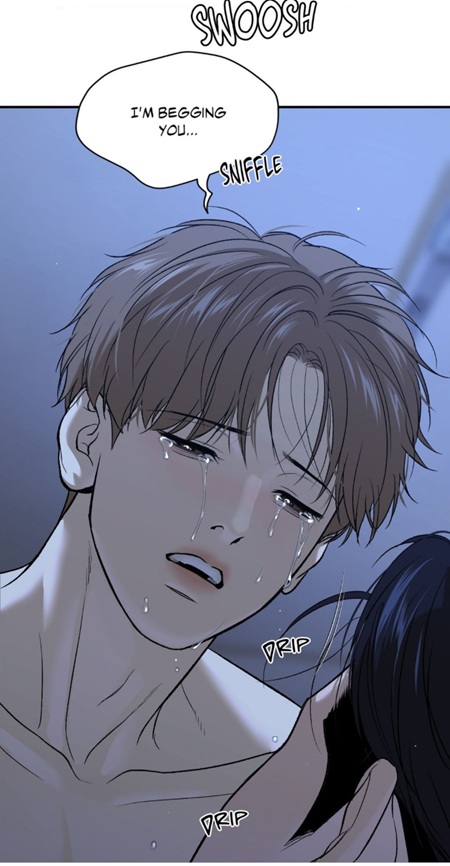 (chapter 66) give Jaekyung the words his father could not say. Where the father’s unconscious leaked out in aggression, Dan’s unconscious offers gentleness and honesty. Both men speak from a place deeper than reason; one chained Jaekyung to guilt, the other opens the possibility of release. In Dan’s trembling body, Jaekyung sees the tender reflection of his father’s hidden plea
  (chapter 73) Why does the champion have no grand-parents?
 (chapter 74) With no parents, no siblings, and eventually no wife, he had nothing to fall back on and saw in the criminal world another form of “family”. The family he created became his one fragile shelter — and when that shelter cracked, there was nothing left to hold him.
 (chapter 72) His violence expressed his powerlessness. And when his son shouted his desire to leave the “dump of a house,”
  (chapter 57) Violence and insult became his only idiom. “Loser” was not simply an accusation, but the displaced confession of his own defeat: I was abandoned. I failed. I have nothing.
 (chapter 73) The boy’s boxing talent was a source of pride — proof of strength — but also a threat. Strength meant escape. Escape meant abandonment. The father, who had already lost his wife and his dignity, projected onto his son the terror of losing everything once again. His resentment was not born of disappointment alone but of recognition (unconsciously): you are me, and you will leave me too.
 (chapter 65) The absence is not an oversight but a theme. Jaekyung comes from severed roots: no grandparents, no siblings, no extended family to lean on. Hence he was alone at the funeral.
 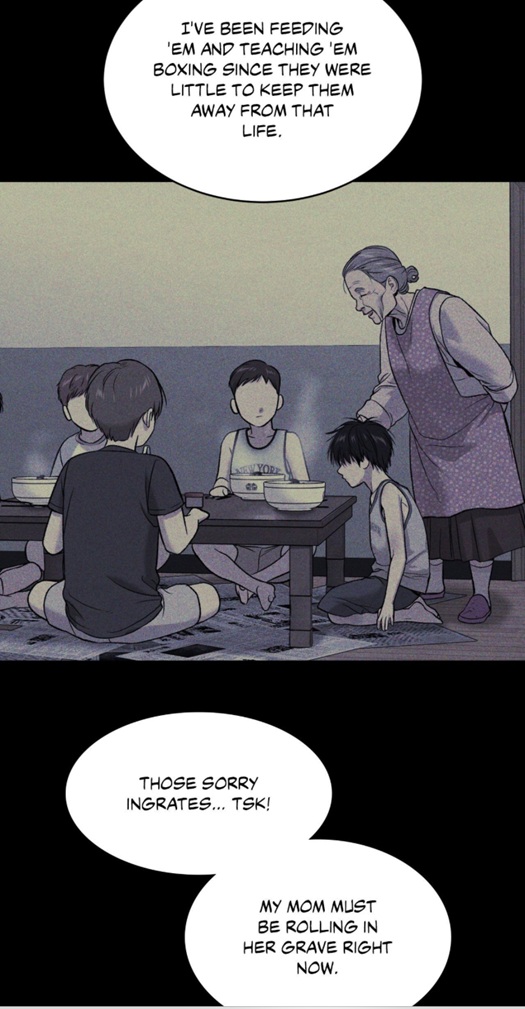 (chapter 73), while keeping Jaewoong’s own origins shrouded. Hwang had someone by his side — gentle, quiet, but present — while Jaewoong had no one, as according to me, the mother was counting on her “husband”‘s success and dream. The director’s stability, however fragile, was rooted in that maternal figure. Jaewoong had no such guide, and without it, he simply made the wrong choice.
 (chapter 74), she never once spoke to her son about it, never asked what he felt. She did not grieve with him, nor allow him to grieve. Besides, the main lead’s words were ambiguous: Was the father dead or had he abandoned his son too? The fact that she never asked exposes that it didn’t matter to her. She was not interested in the truth, her only concern was herself — her new life, her fear of losing it. Where the father left him branded, the mother left him erased.
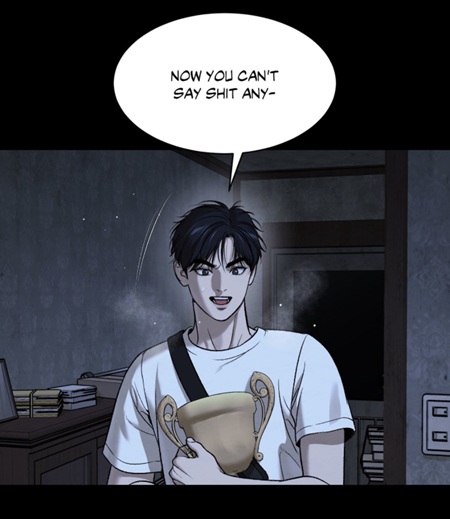
  (chapter 75) One condemned him, the other abandoned him, and between them Jaekyung was left with neither recognition nor belonging.
 (chapter 73); every triumph, by the echo of rejection
 (chapter 73). To win was to prove his father wrong, but to stand alone in victory was to prove his mother right. Success and emptiness became inseparable.
 (chapter 56), seemingly fragile and dependent. But unlike her, he stays. Where the mother left, Dan endures. He only left because of the champion’s final words:
 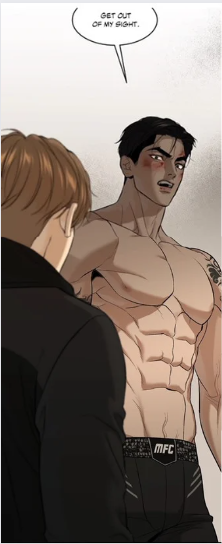 (chapter 51)
  (chapter 73) mirrors what the director later whispers to Jaekyung:
 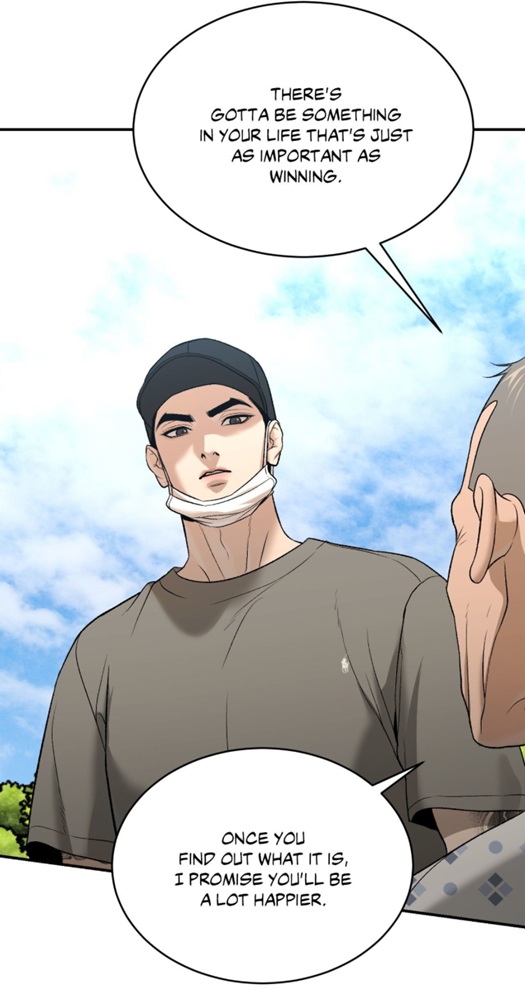 (chapter 75) Both men — the broken father and the regretful coach — carry the same hidden insight: that fighting cannot be the whole of life, and that reducing yourself to fists and violence only leads to ruin.
 (chapter 75) This is the wolf’s ritual in front of the tender mirror: the fighter who lived by curses and silence finally meeting their reflection transformed into gentleness and endurance.
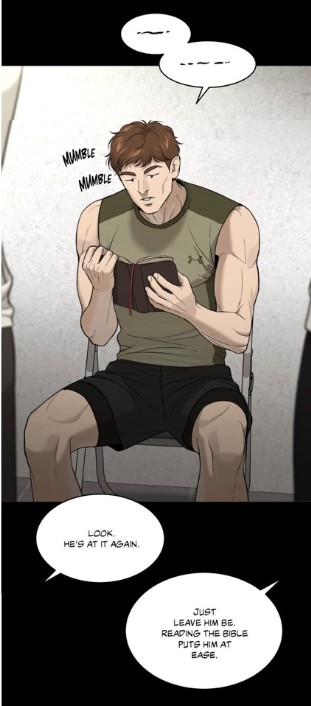 (chapter 75) This man’s jinx was startlingly simple: he read the Bible before every match. One book, one ritual, one anchor. To outsiders, it may have seemed quaint, even laughable, but to Jaekyung it was enviable.
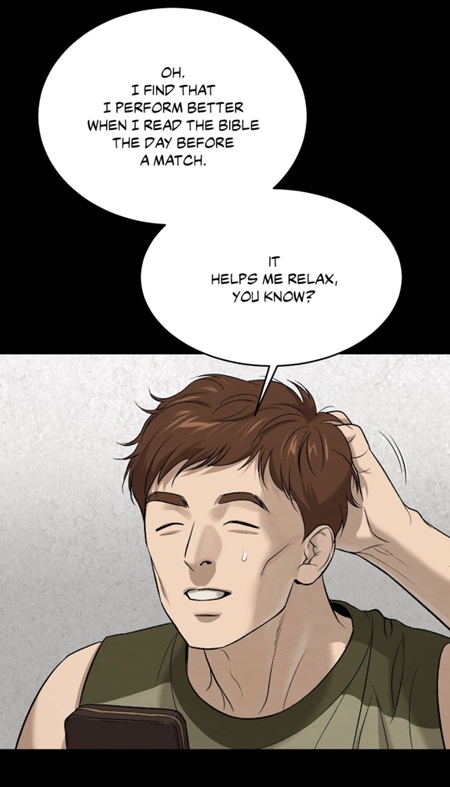 (chapter 75) When he prayed, it was not only for victory, but for coherence. Win or lose, the ritual bound him to a sense of belonging that Jaekyung had never tasted.
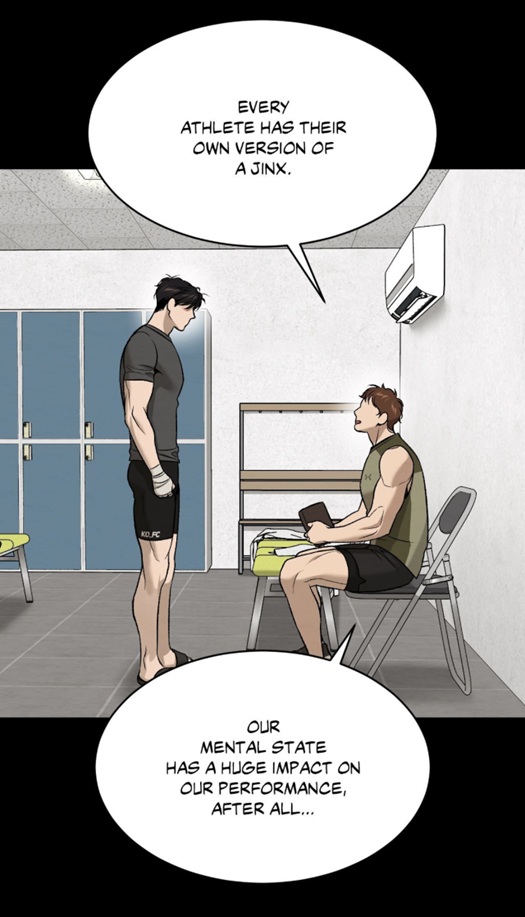 (chapter 75) If ritual could bend fate, he would build his own. But where the Bible fighter had a single, unifying story — scripture, God, fellowship — Jaekyung had nothing to draw on. No faith to lean on, no parental blessing to inherit, no safe home to return to. Instead, he began to stitch together a mosaic of rituals, each one disguising a different childhood wound. To outsiders it looked obsessive, neurotic, almost superstitious. To him, it was survival. Each gesture was both repression and remembrance, a scar disguised as armor. And this is the paradox: the rituals made him strong enough to survive, but too broken to live.
 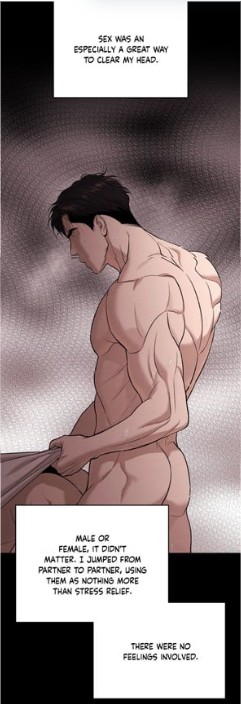 (chapter 75) By using another body, he cleared his head, numbed the loneliness, and convinced himself he was in control. But it was also a grim reenactment of abandonment: he could take without being left, dominate rather than risk being deserted. At the same time, he considered his sex partners as toys in order to avoid guilt. A toy can not die, it can be “thrown away”.
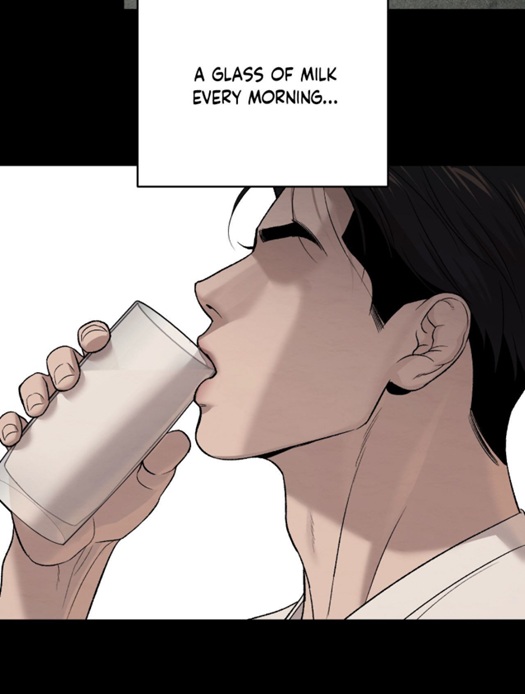 (chapter 75) But in truth it was a disguised memory of hunger
 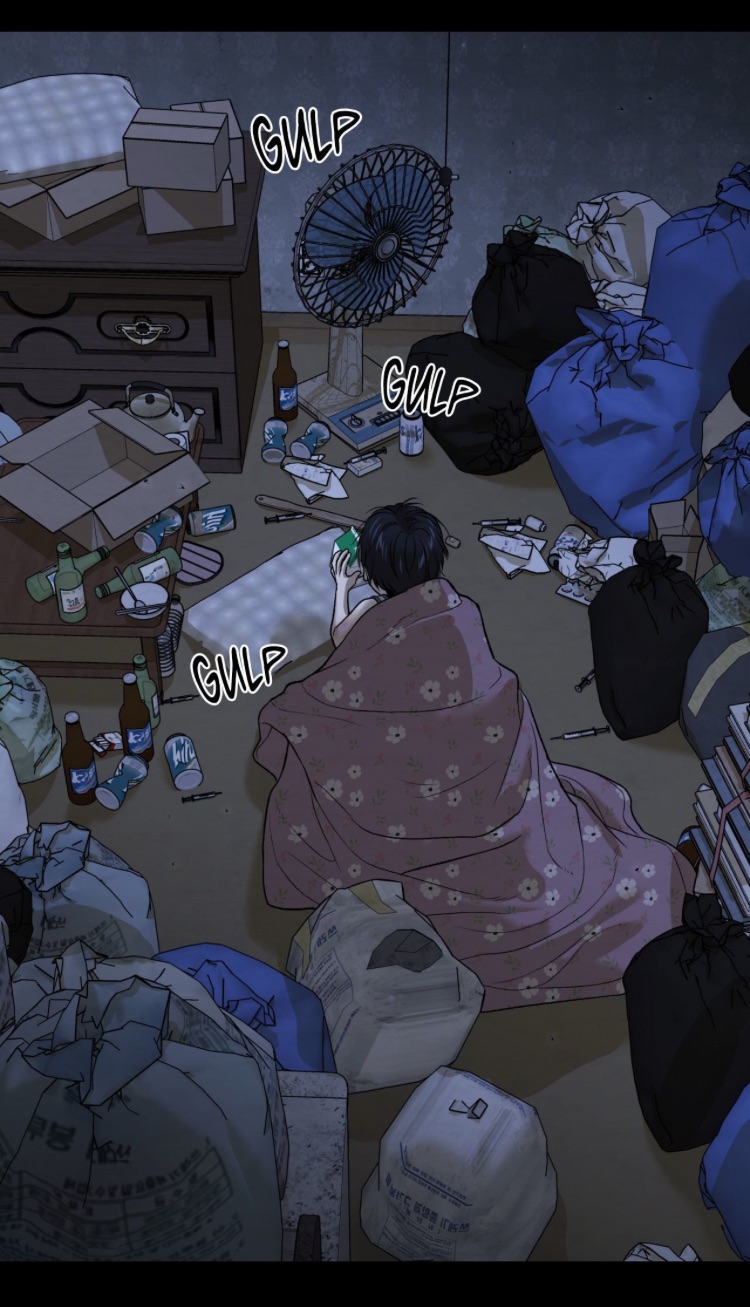 (chapter 72), of nights when there was nothing to eat, of shame attached to poverty.
  (chapter 75) To drink milk was to rewrite the past: I will not go hungry again. Yet the act was also a reminder that he once had.
 (chapter 27) , self-punishment, the willingness to suffer endlessly for the cage. He didn’t fear pain. Their sudden appearance
 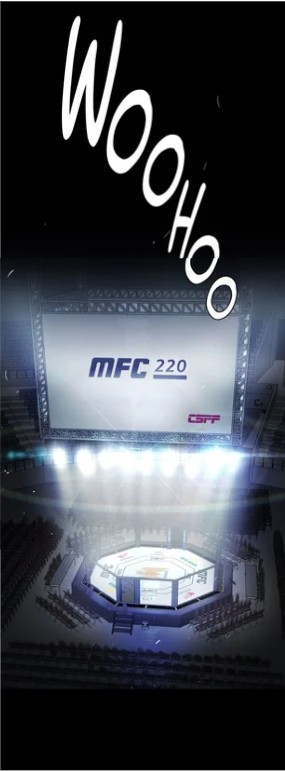 (chapter 75), a reminder that he had entered a machine in motion, a system that swallowed fighters whole and spat out statistics. From that point, the acceleration was merciless: by April, he was in the 272nd bout against Randy Booker
 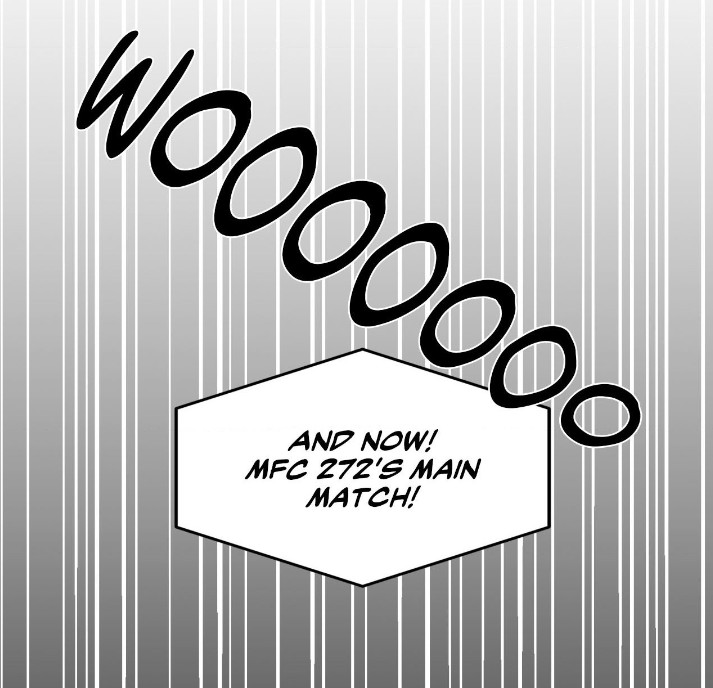 (chapter 14); by June, the 293rd against Dominic Hill
  (chapter 40); and by July, the 298th against Baek Junmin.
  (chapter 50)
 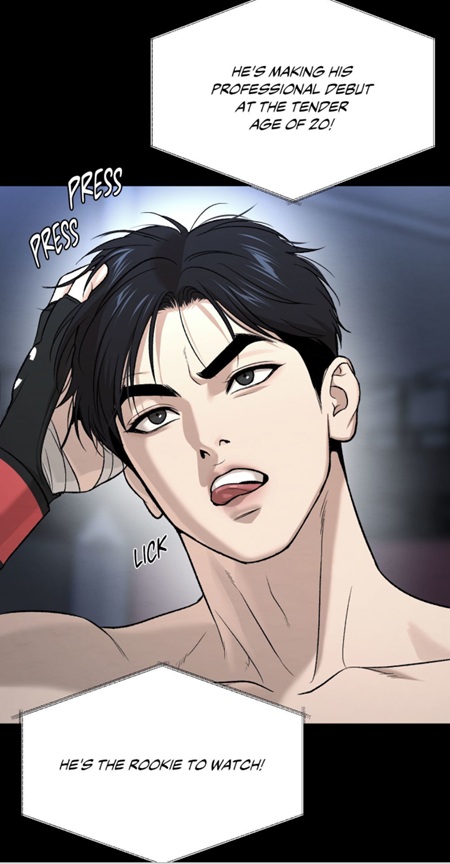 (chapter 75), he had not merely “built” a career, he had been consumed by one. There was no time to recover from injuries, no space to process victory, no room to integrate defeat. No wonder why his shoulders were in bad shape.
  (chapter 75) Every fight blurred into the next, every opponent older, stronger, more experienced. And yet Jaekyung fought them all with the same desperate, survival-driven ferocity.
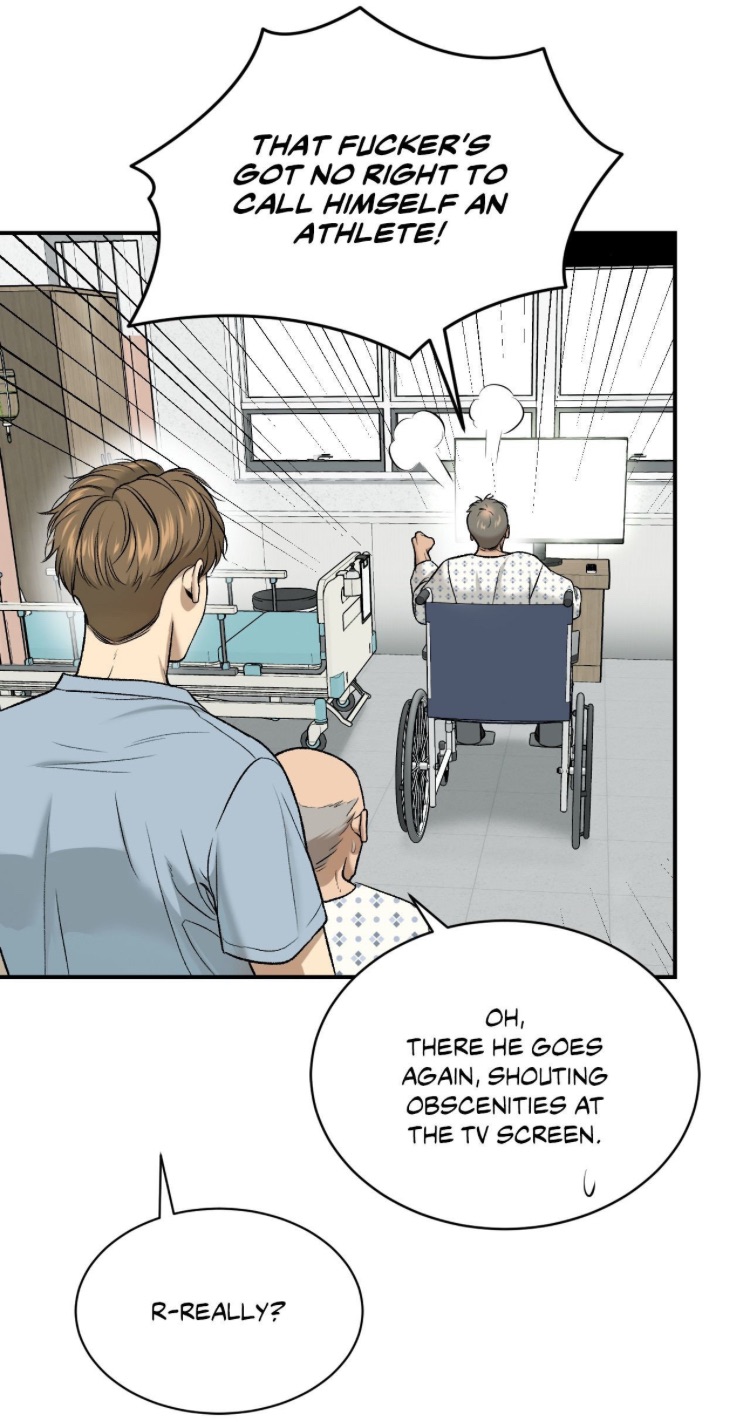 (chapter 71) and Dr. Lee
  (chapter 27) still called him an athlete — someone whose body required balance, protection, recovery. But MFC and KO-FC never did. For them, the main lead or his colleagues were addressed as
 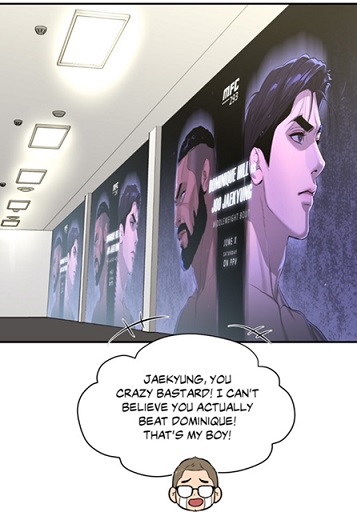 (chapter 40), “my boy”,
 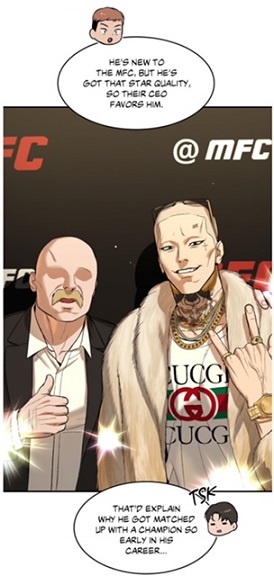 (chapter 47) “a potential star.” Not a person, not even a professional, but branding material — a body to be consumed by audiences and discarded once spent. The absence of the word athlete marks what he lost: recognition as a human being. And guess what?
 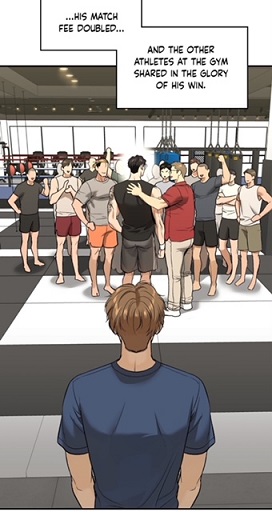 (chapter 41) Only doc Dan at the gym saw the fighters as athletes!
 (chapter 47). Thus only doctors are allowed to do them officially. But Jaekyung’s rise shifted that meaning. As “The Emperor,” he normalized tattoos for the new generation of fighters, transforming what once marked marginality into a badge of visibility. This is why even Oh Daehyun, one of his admirers and members of Team Black, now carries one:
 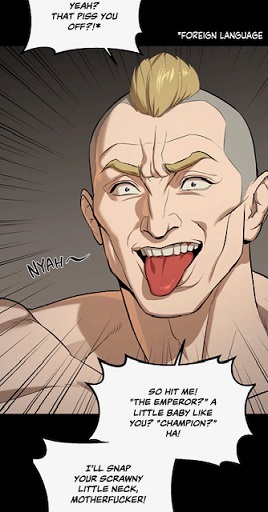 (chapter 14) ripping open the scar of his father’s “loser” and his mother’s absence and silent parentification. Not long after, an article exposed his shoulder injury
 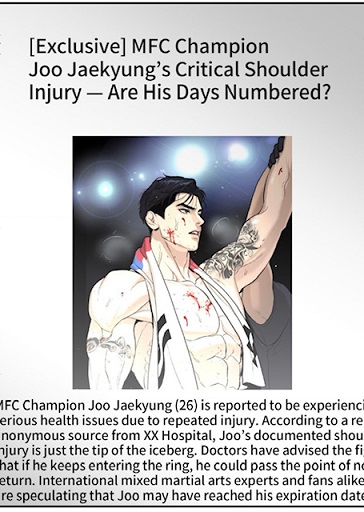 (chapter 35), reducing years of discipline to a liability on the page. Later came the suspension narrative
  (chapter 54) Even the match with Baek Junmin was twisted against him — accepted under pressure, then reframed as recklessness. To the system, his crown had been too secure, his presence too dominant. He had been champion for “too long.”
 (chapter 5) the name Seo Gichan appeared here for the first time… a faceless name!
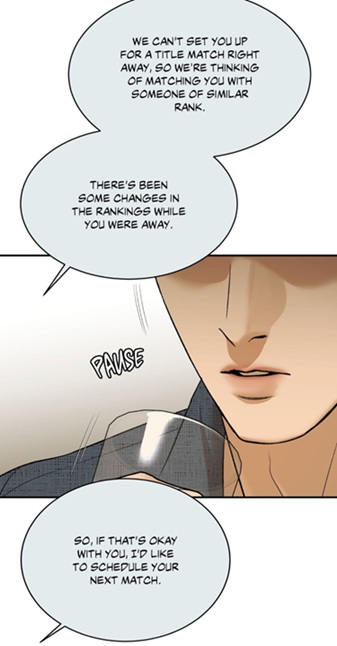 (chapter 69) The danger lay in the very identity of his next challenger. If they pitted him against a newcomer who had rocketed through the ranks as quickly as Baek Junmin once did
 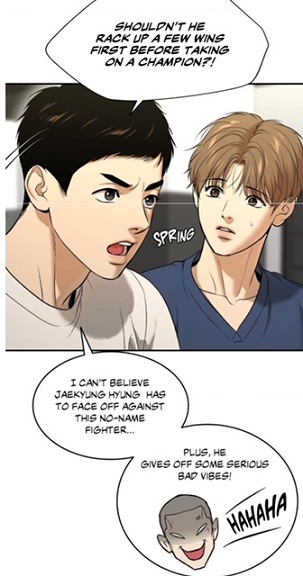 (chapter 47), questioning the selection of Baek Junmin, is so crucial. It shows that the manipulation of opponents was no accident — it was systemic. Matches were not about fair combat but about narrative management: making sure the emperor’s story served the company’s balance sheet.
 (chapter 51) On paper, it was a draw. In practice, it was soon reframed as a loss
 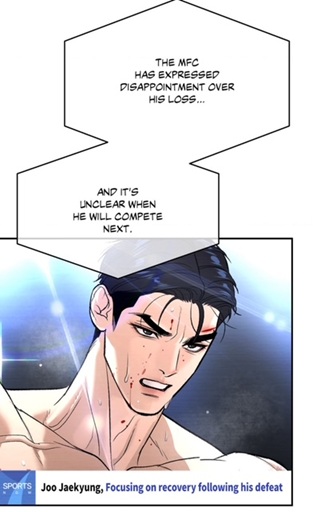 (chapter 57). By late August, Jaekyung had slipped to third place.
  (chapter 69) And strikingly, no one questioned it. Not Park Namwook, not the officials, not even Joo Jaekyung or the commentators who had once praised his streak. The silence was louder than any insult.
 (chapter 75) Here, it looks like a mirror, but naturally it is a fake one. It was not earned with fists alone; it could be stripped, reassigned, reshaped at will. One tie, one whisper, one adjustment in the rankings, and the Night Emperor was dethroned without ceremony.
 (chapter 75), not for intimacy but to clear his head and stave off loneliness, emptiness and his abandonment issues.
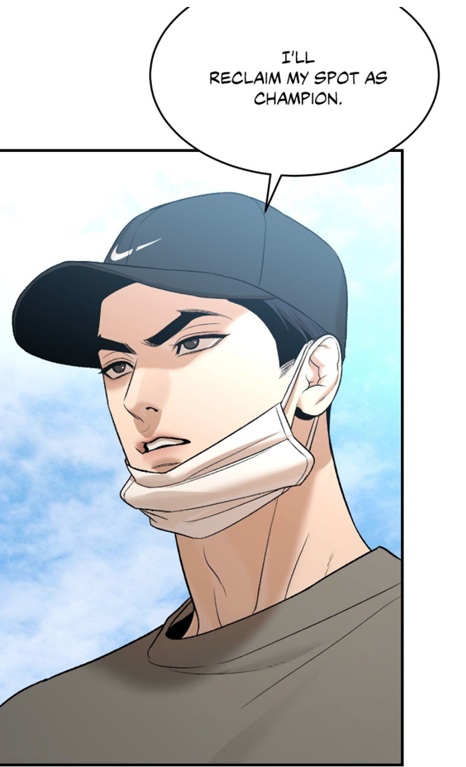 (chapter 75) must be read in this light. It is not a relapse into the system’s treadmill, nor a blind return to the pitfall laid before him. Notice that he does not say he will fight in the fall, nor does he mention the upcoming match that everyone else is waiting for.
  (chapter 71) Instead, he frames his goal with a word that changes everything: reclaim.
 (chapter 73), but he lost his father and his mother abandoned him.
  (chapter 51) When his world threatened to collapse again — the tie with Baek Junmin, the looming humiliation — he erupted in rage. He screamed at Dan, he let the words spill out violently, breaking the silence that had once shackled him. It was an act of defiance against the curse: if he could not silence the nightmare, he would shout it down.
 “Don’t you trust me?” (chapter 54) That moment reverses the old script entirely. Where his father’s last word was condemnation, Dan’s is invitation. Where his father’s voice ended the dialogue forever, Dan opens one. Where his father made trust impossible, Dan asks for it. Besides, the latter encouraged him to reflect on himself.
 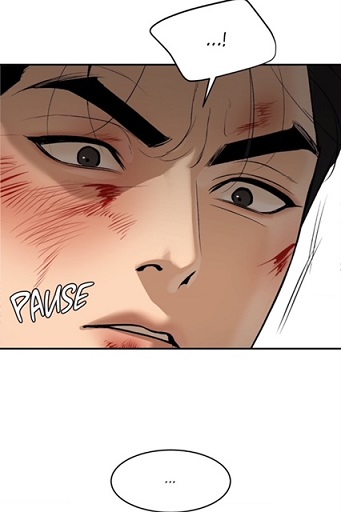 (chapter 51) The mirror is clear: the cycle can be broken, but only if he dares to answer the question that was never asked of him before. Therefore it is not surprising that the physical therapist’s question appeared in the champion’s vision:
  (chapter 54) His unconscious was telling him to have faith in his “doctor”. Thus later, the champion told the director of the hospital this:
 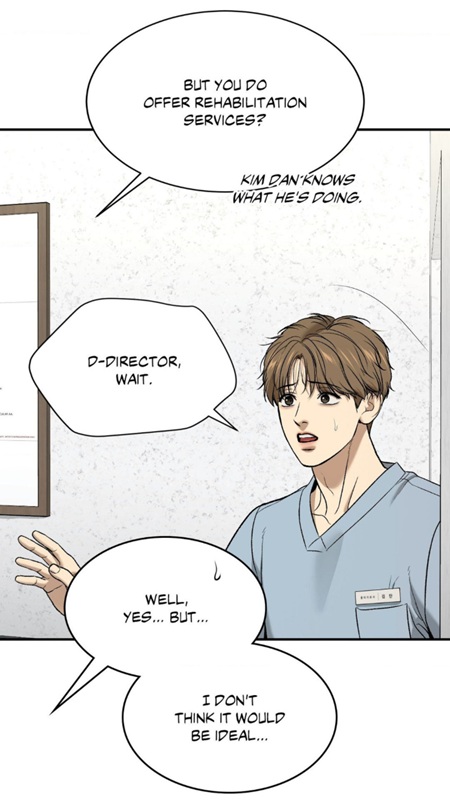 (chapter 61) He was acknowledging the main lead as a real physical therapist.
 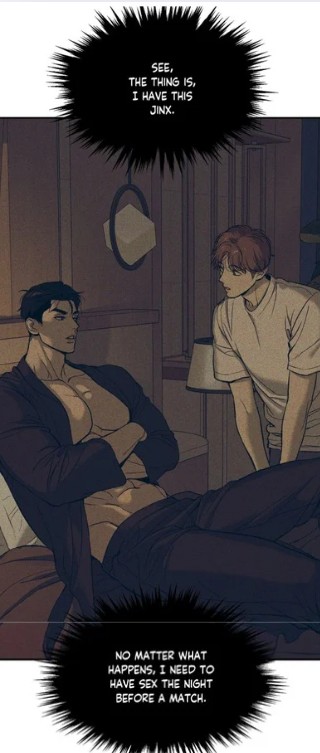 (chapter 62)— and even to those closest to his body — it looks like nothing more than sex. That was all the uke from chapter 2 saw, and it was enough for him to sneer:
 (chapter 2) The insult landed with devastating familiarity, not as a new wound but as an echo of his father’s curse: “loser.” Both words reduced Jaekyung to nothing — not a man, not an athlete, just a fraud kept alive by crutches.
 (chapter 2) In slamming his former partner against the wall, he was not merely silencing a lover’s cruelty. He was fighting the ghost of his father, the voice that had branded him weak, cursed, unworthy. The jinx that kept him alive was being twisted into proof of his failure, and he could not bear it.
  (chapter 2)
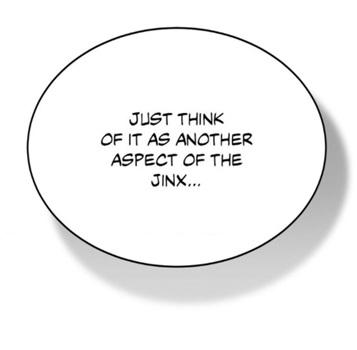 (chapter 62), Dan recoiled.
 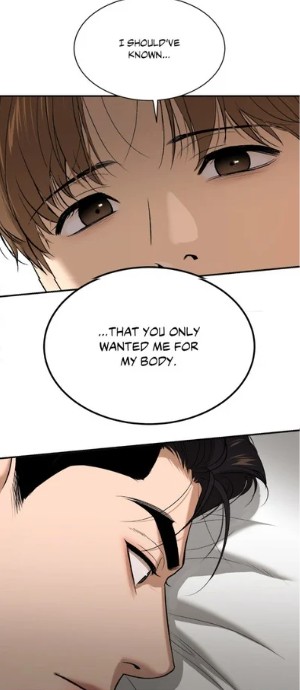 (chapter 62) To him, “jinx” meant objectification, a reduction of their bond to sex.
 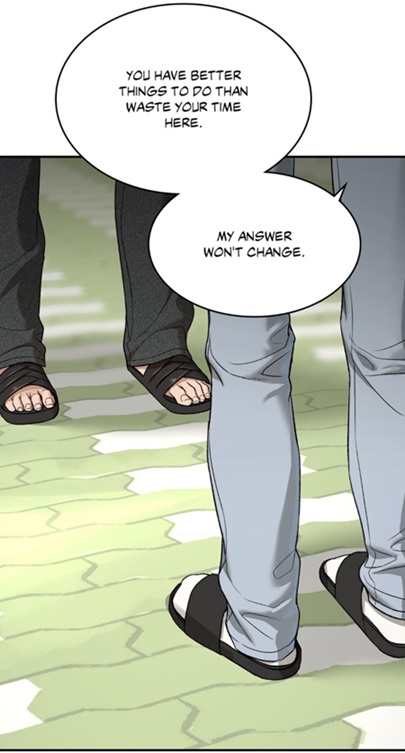 (chapter 62) but as a therapist he trusted. His words about wanting to return to the “usual pre-match routine”
  (chapter 62) were, in his mind, a way of saying: I need you to bring back wholeness, to help me steady myself again. But because Dan only knew fragments of the jinx, the message landed with devastating distortion.
  (chapter 41) but not the others. He had never seen how layered and fragmented Jaekyung’s survival system truly was: the shower and perfume, the milk, the tattoos, the obsessive fight schedule. Thus, when Jaekyung invoked the jinx, Dan heard only objectification: you want me for my body. However, this is not what the “wolf” meant. Thus he got surprised by such a statement.
  (chapter 62) For Jaekyung, the plea was about coherence; for Dan, it sounded like reduction.
 (chapter 22) He cooks breakfast for Jaekyung, offering something warm, homemade, human — a substitute for the cold, industrial glass of milk.
  (chapter 22) or cry out of joy.
 (chapter 54) throws the plate away
 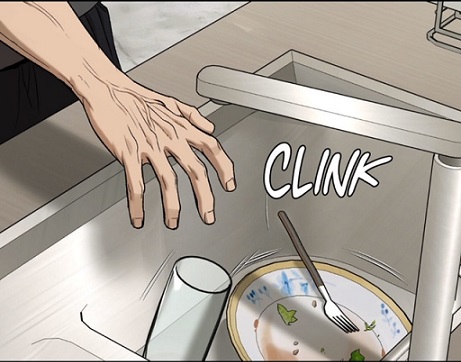 (chapter 54), or sits at a vast table in silence.
  (chapter 54) But when Dan cooks, Jaekyung is surprised, even touched. For once, nourishment is not consumption but connection. The milk was always a disguised memory of deprivation; Dan’s meal becomes the antidote — food as presence. So for him, the prematch-routine was also referring to the meals prepared by his fated partner. And I feel the need to bring another aspect. Since there was no “family” in the athlete’s life, he never got the chance to discover the joy of the table.
  (chapter 22) Hence it is not surprising that he looked at his phone, while the others were eating and discussing. He never had a real conversation with a family member around the table.
  (chapter 40) Perfume was one of Jaekyung’s protective rituals — masking shame, creating an armor against the memory of bullying and ridicule. Yet Dan shows that none of this is necessary. The panel where he clings to the bedsheets after their Summer Night’s Dream together
 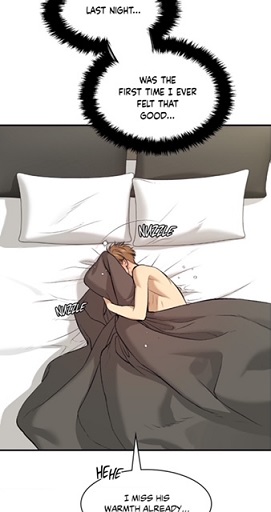 (chapter 45), whispering that he misses Jaekyung’s warmth, reveals that the champion’s natural scent is already enough. He never gets to see this — Jaekyung doesn’t know how deeply Dan treasures his smell.
 (chapter 40) Here he turned around and placed his lover in the middle of the bed. He even let him rest.
  (chapter 2), and not the other rituals? Because to admit the rest would be to expose the origin of the jinx: the father’s insult, the mother’s abandonment, the hunger, the bullying. Sex was the only ritual that could be spoken without directly dragging the past into the room. It was the “safe” shorthand — though tragically, it became the most dangerous. Homosexuality is definitely a stigma among boxers and MMA fighters.
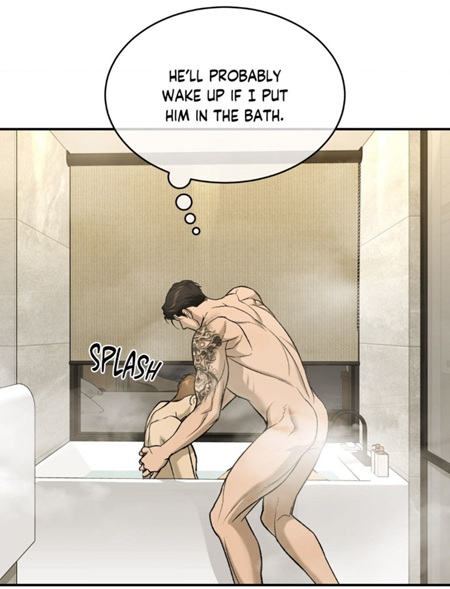 (chapter 68) In his own way, he was showing him that he did care! He was more than just a body… or even a physical therapist!!
 (chapter 35) It is the steady mirror of Kim Dan.
 (chapter 13) — helpless, cornered, often pleading. Thus the champion taught the doctor to overcome his fear and fight back:
  (chapter 26) This imbalance was no accident. It replayed Jaekyung’s own childhood roles: he became what his father had been to him (the better version naturally, for he is the mirror of truth), and forced Dan into the position he had once held himself. Through Dan, Jaekyung unconsciously re-enacted his trauma, reversing their positions as if to master what had once mastered him. That way, he was pushed to mature emotionally! That’s why he could connect with the main lead unconsciously. His trembling words in Chapter 51
  (chapter 71) He believes to know the truth, while he is ignorant. He is insecure, extreme in his behavior (drinking)
 (chapter 71), but also selfish and questioning, still fragile yet capable of protest. He is struggling with his own emotions and thoughts.
  (chapter 71) How can he trust the athlete, when he doubts himself so much? From my point of view, he is on the verge of become “mature mentally” and as such “responsible”. At the same time, Jaekyung is revealed as the adult in crisis. His exhaustion
  (chapter 70)
 (chapter 74) It is because thanks to the director’s confession, the “hamster” is able to see the champion as a “a kindred spirit“, an orphan and as such as the younger “boy”.
  (chapter 7)
  (chapter 26), because it is play, because it is chosen.
 (chapter 69) It is not about treatment or jinx, but about presence. This hug reframes the meaning of strength. True strength is not the ability to fight endlessly, but the ability to hold and be held, to mirror” is like touching oneself! Let’s not forget that the mirror represents the reflection of a person. Respecting the physical therapist signifies respecting oneself!
 (chapter 36) He can remain indifferent to their “provocations”, as he has long matured emotionally.

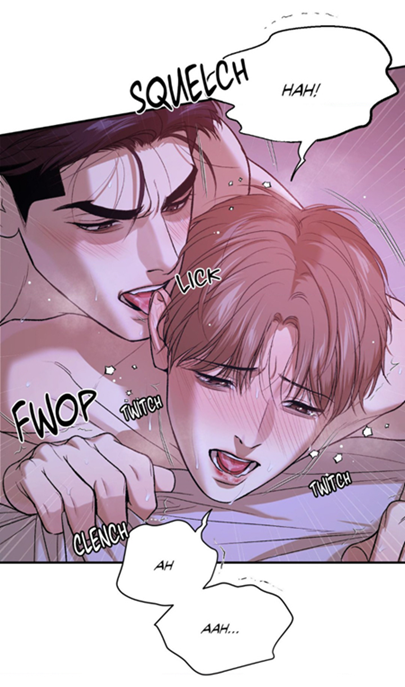 (chapter 64), and the language of touch—their dynamic undergoes a profound shift. This moment is not just about desire but about power, communication, and the fight for control. It is in this intimate space that both men are confronted with their vulnerabilities
 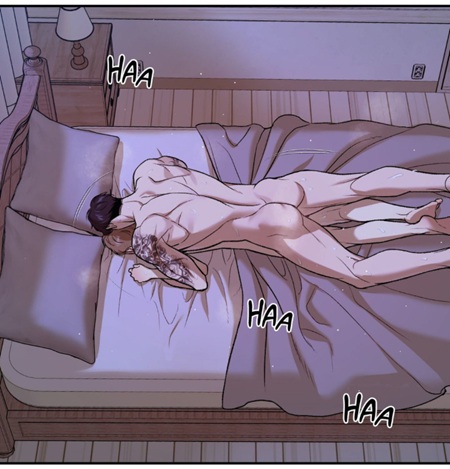 (chapter 64) and the evolving nature of their relationship. During this lavender-tinted night, their intimacy is no longer just a matter of physicality—it becomes a language of contradictions. Through grasping, biting, and kissing, their touch oscillates between control and vulnerability, rejection and longing. This moment encapsulates the shifting power dynamics between them, where Jaekyung’s physical presence no longer guarantees submission
  (chapter 64), and Kim Dan begins to push back, not with force, but with emotional detachment. He avoids his gaze, hides his moaning and as such remains silent. This night is a pivotal moment, signaling the champion’s awakening to his emotions and Kim Dan’s assertion of his autonomy.
 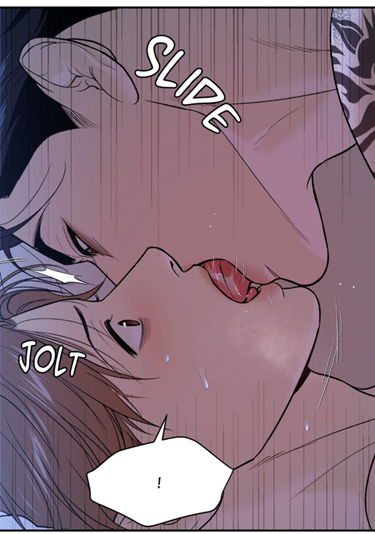 (chapter 63) it is a stark contrast to the usual aggressive or mechanical physicality of their past encounters. Let’s not forget that when the athlete kissed the doctor for the first time
 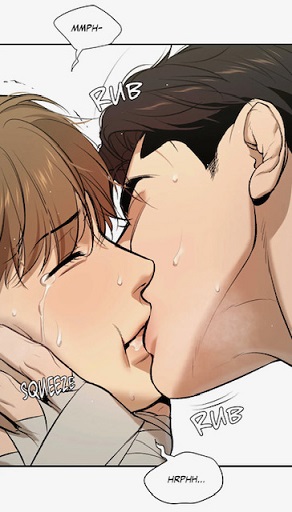 (chapter 14) in the locker room, he not only used his hand
 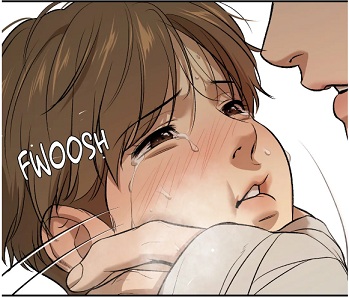 (chapter 14), but also remembered his hyung’s advice.
 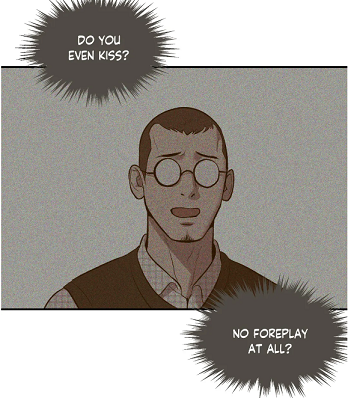 (chapter 14) This comparison outlines that their first kiss was more the result of conscious and tactical decisions than of passion and desire. It was not only to protect the hamster’s life, but also to be able to fight against Randy Booker. In other words, their first kiss was strongly intertwined with work and absence of consent. He had not informed Doc Dan before.
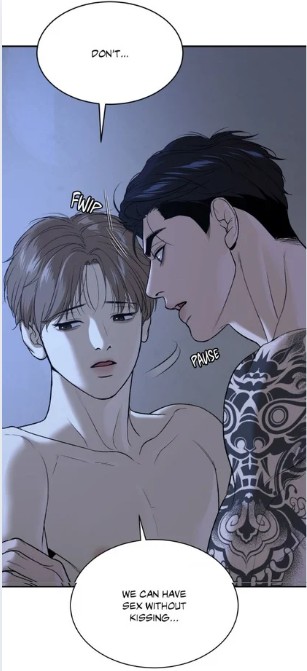 (chapter 63), yet he licked the doctor’s lips
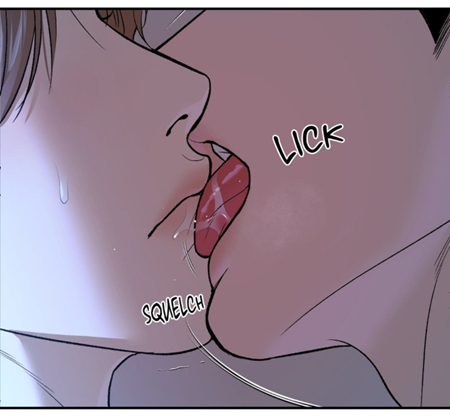 (chapter 63), until the latter finally opened his mouth. This gesture reminded me of a wolf licking his progeniture in order to show affection. My avid readers will certainly recall my analysis of their “love session” at the penthouse in Episode 44: there were traces of “animalistic behavior”
  (chapter 44) Therefore it is not surprising that in that little town, the star is no longer following any suggestion coming from his surrounding. He is not recalling Cheolmin’s words or not watching movies. This means that this kiss in episode 63 is born from desires and passion. This explicates why contrary to the one in the locker room
 (chapter 15)
 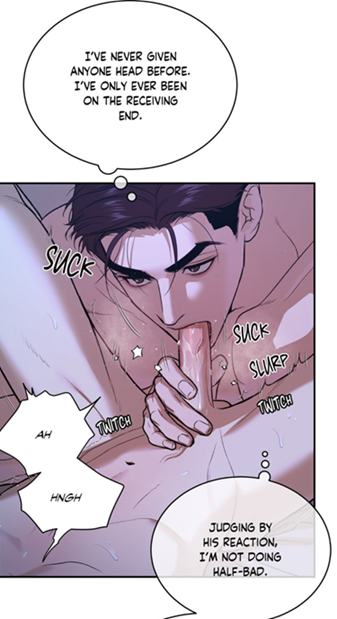 (chapter 63) represented the next step of his “generosity”. Yet, the divergence is that the star had done the French Kiss by instincts, whereas the fellatio was more a calculated move. He selected this new approach based on his own likes and experiences. In other words, this magical night represents the birth of a “lover” and “boyfriend”.
  (chapter 15) The beginning of “emotions”. That’s why the physical therapist asked him to let him know in advance. And what did the athlete do during their reunion? One might reply that he ignored the request from the doctor.
  (chapter 62) The celebrity could do anything he wanted. In other words, he had clearly giving him his consent to be kissed and the doctor could not refuse as such.
  (chapter 63) It is clear that Kim Dan had anticipated a different approach: a renewal of their First wedding night. The irony is that the French kiss and the fellatio became the evidence that the star was not treating the doctor as a doll per se. Why? The star has changed a lot due to the main lead’s influence. He had gained knowledge and confidence. Nevertheless, their interaction here forces a confrontation not just between them, but within themselves—Jaekyung, who has always relied on physical dominance to maintain control, is confronted with a newfound uncertainty, while Kim Dan, whose silence once reinforced Jaekyung’s belief in his own power, now wields that same silence as a weapon.
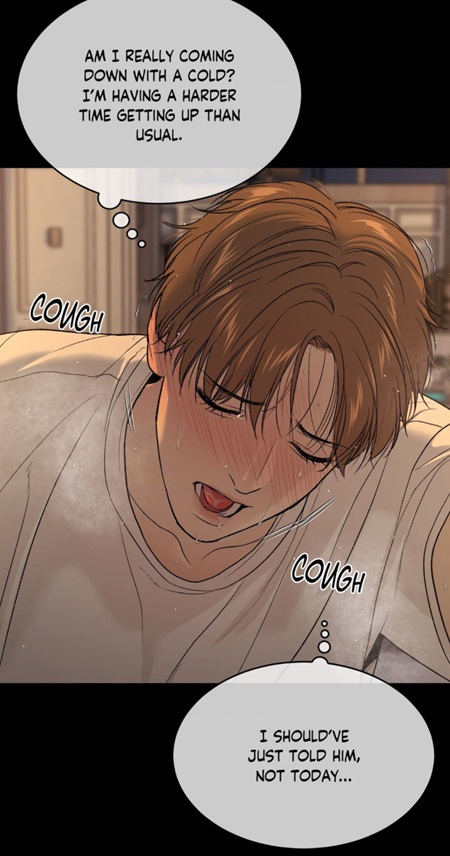 (chapter 61) or exhaustion—has his tongue metaphorically freed by this act.
 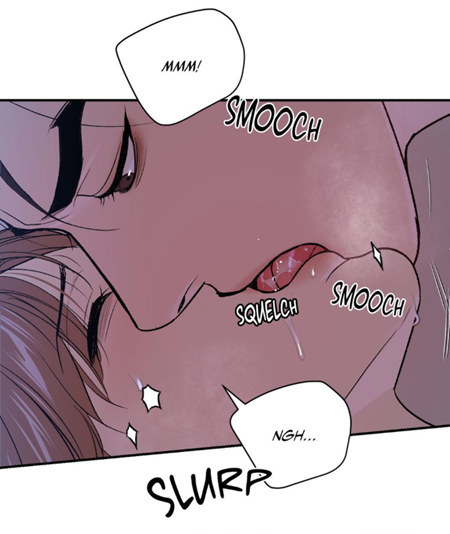 (chapter 63) The significance of this kiss becomes evident when, later that night, he finally speaks up, voicing everything he has suppressed.
  (chapter 64) It is, as though Jaekyung has unknowingly opened a door within the hamster. Yet, despite this newfound ability to speak, Kim Dan still bites his lip at times, revealing his continued hesitation. He is not yet ready to embrace vulnerability fully, but this moment marks the beginning of that journey.
 (chapter 64), the scent in the air
 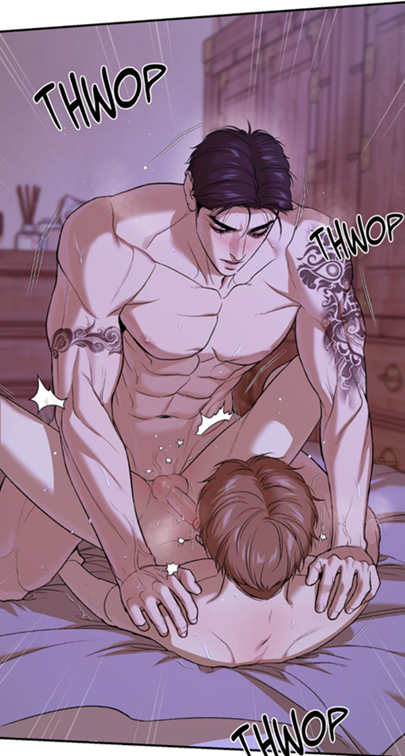 (as seen through the presence of scent sticks in the background), and the vision and sensation of the man beneath him. Unlike the previous intimate moment in Chapter 44, where he was inebriated, this time he is conscious.
 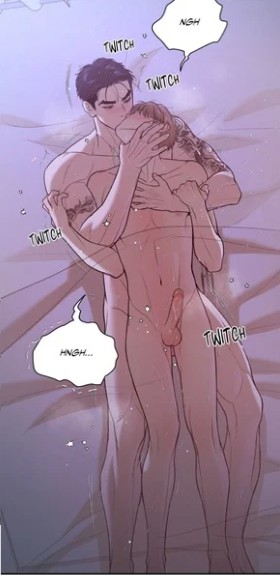 (chapter 64) This is the rebirth of Jaekyung—not as the infallible champion but as a man experiencing intimacy in a new way.
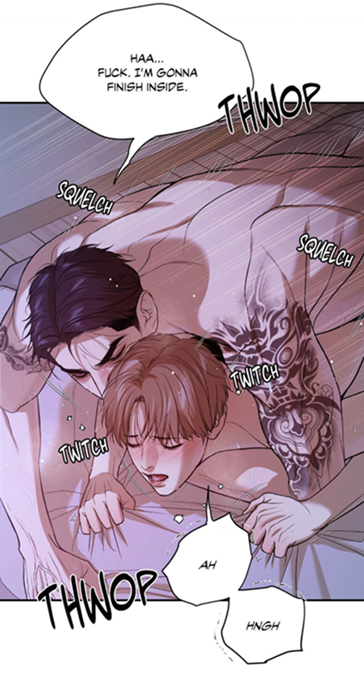 (chapter 64) It indicates that the star was actually revealing his attraction toward his companion. We could say that with this attitude, he was gradually lowering his guard. But there’s more to it. Just before he “was going to finish inside”, he chose to kiss his partner.
  (chapter 64) From my perspective, his gesture displays a transition. The ejaculation is no longer the symbol of dominance and manhood, but of attachment and care. This new observation reinforces my previous interpretation. This night was there to teach the champion to differentiate between the ring and the bed.
 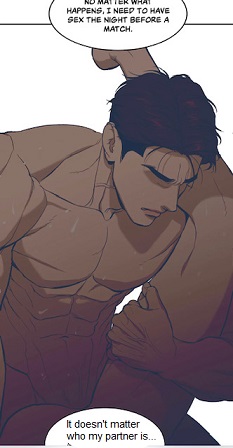 (chapter 2) The latter can not serve as a surrogate place for fights. The bed is the place for rest and closeness. This represents the moment the athlete is forced to drop his belief, the jinx, for it is no longer about the celebrity’s “pleasure”. Now, it is a moment where both feel the same, something Kim Dan denied afterwards. But let’s return our attention to the champion’s orgasm. I would even add that the kiss became strongly attached to the climax. Therefore the author showed us first the couple lying on the bed kissing
  (chapter 64) This privileged position indicates that the main lead was not ready to face Kim Dan’s gaze during an orgasm. In other words, he had not entirely lowered his guard in front of the doctor. The reason is simple. While he was giving pleasure to his partner, this is what he was forced to see:
 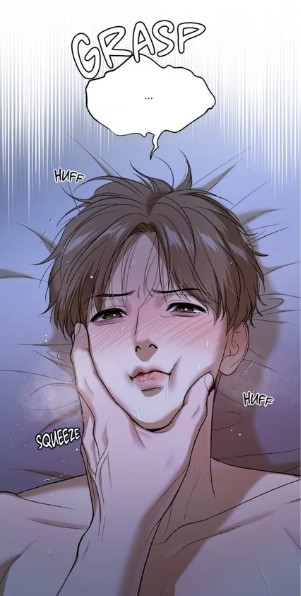 (chapter 64) rejection, anger and resentment. This was not a gaze full of love, the remains from the “surrogate fights”. His facial expression was reminding him that his fated partner was more a prostitute than a lover, for he saw this sex session not as a source of pleasure. That’s why he thought like this:
 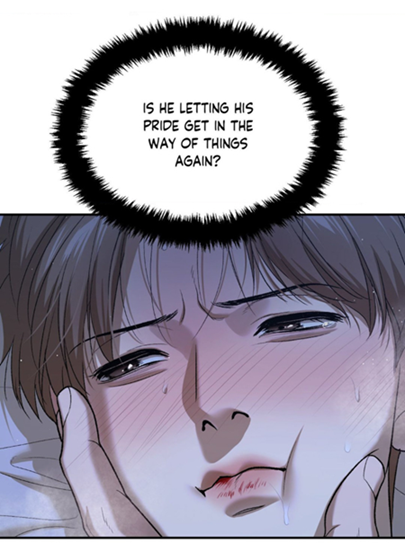 (chapter 64) Under this new light, I deduce that the champion was not aware of the true motivations behind his actions. He was actually longing for the doctor’s love and embrace.
  (chapter 64) His act of biting his lips in Chapter 64 is not just a nervous tic; it expresses not only physical manifestation of his restraint, but also his suicidal tendencies. He doesn’t mind hurting himself. This shows that he still doesn’t value and treasure his own body.
 (chapter 64) The lip bite signifies hesitation but also resistance. It reflects his internal struggle: he does not want to engage, but something within him still reacts. He still has feelings for the athlete. This small gesture encapsulates his frustration—not just with Jaekyung, but with himself.
 (chapter 57) and overworks himself. That’s the reason why I couldn’t truly rejoice when Kim Dan rejected the champion. In fact, he selected work and pain over “joy and pleasure”. And why? Because of the past and the athlete’s actions.
 (chapter 64) Further by licking his lip, he is acting like his doctor and guardian. But there’s more to it. Observe the comment from the champion: he was holding back. This means that by biting his lips, the doctor reminded Joo Jaekyung of his own weak constitution. Thus I interpret that the champion came to associate the kiss with vulnerability and affection.
  (chapter 15) and touches were purely acts of dominance—ways to assert ownership over Kim Dan. However, the ear lick, which almost looks like a bite, in Chapter 64 carries a different weight.
  (chapter 45) or shoulders, which can be overtly sexual or aggressive, the ear is a sensitive spot, connected to emotions and perception. The fact that Jaekyung chooses this specific form of contact suggests a subconscious shift—he is not just trying to control Kim Dan but also to connect with him.
  (chapter 44) Back in Chapter 44, Kim Dan had kissed Jaekyung’s ear, and the champion had reacted with visible annoyance.
  (chapter 44) However, that moment left an impression on him—Kim Dan had laughed, showing genuine amusement. Unbeknownst to Joo Jaekyung, he internalized this interaction, learning that the physical therapist liked this place being touched. Now, as he licks Kim Dan’s ear, he might subconsciously be attempting to return the gesture, mirroring an act of intimacy rather than pure dominance. It is a quiet yet significant moment that signals the sportsman’s slow, unconscious shift toward emotional connection.
 (chapter 56) as well, when Jaekyung first began associating sex with play rather than mere exertion. His use of “play out” back then showed a change in mindset—sex was no longer just about stress relief but something to be experienced and enjoyed. The ear lick in Chapter 64 may stem from that same shifting perception. This explains why Mingwa made the champion blush and this panel is linked to light pink.
 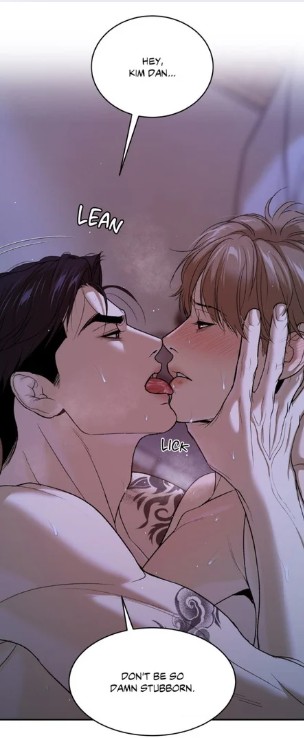 (chapter 64) He refused to see and listen to others and to the athlete, because he was trying to deny the existence of his love. The reason is simple. He is trapped in his own world, full of darkness. He was trying to clinch onto the past, where he portrayed himself as a victim and doll of the champion. But the reality is that doc Dan treated himself as a doll or servant, for he didn’t value his own body. Hence he didn’t eat properly and drank soju to drown his pain.
  (chapter 5) This is a habit he had before he met Joo Jaekyung. Moreover the latter was living in abstinence, until he drank alcohol by mistake because of him.
 (chapter 24) of Season 1. Instead, there is waiting and hesitation, an unspoken question in the way he leans in. For the first time, it seems as though he is searching for something more—perhaps a response, a reciprocation, or even just an acknowledgment from Kim Dan. This shift underscores Jaekyung’s internal transformation; he is gradually internalizing Kim Dan’s values and beginning to approach intimacy differently, even if he himself is not yet fully aware of it.
 (chapter 64). He thought, using strength could still help him to conquer Kim Dan’s heart, though it is just an unconscious attempt.
  (chapter 8)
  (chapter 15)
  (chapter 61) That’s the reason why during this lavender-tinted night, Mingwa used reflections of all sex sessions from season 1. Let’s not forget that Joo Jaekyung was never seen cleaning up “the mess” he made. Doc Dan had to clean himself, which is the reason why he made the following request:
  (chapter 29) Not washing his partner implies his refusal of becoming responsible. The problem is that since it was a first for him, he has no idea about its true meaning. Besides, due to his own traumas and fears, he didn’t pay attention to his PT’s emotions and well-being. Striking is that Joo Jaekyung compared himself to fire during that night.
  (chapter 63) And what is the opposite to fire? WATER!! Thus this image came to my mind. How do you kill desires and passion? One might say by becoming ice-cold! However, my answer is this: by pouring a glass of cold water on the champion’s face! Yes…
  (chapter 37) This means that Joo Jaekyung is getting punished for this gesture. Let’s not forget that he mentioned their stay in the States to bring back good memories. But I have another reference for this interpretation.
  (chapter 64) This panel is a reflection from that particular day:
  (chapter 27) And where did he go to calm down? In the swimming pool…
  (chapter 27) And now, you comprehend why I came to see this scene

 (Chapter 63) The presence—or absence—of clothing during their encounters symbolized the gradual dismantling of their emotional walls. Now, shifting the perspective to the champion, another layer of complexity emerges. Joo Jaekyung’s evolving approach to intimacy is not just a reflection of his growing feelings but also a silent, deeply ingrained struggle with dependence and control.
 (chapter 63) Why does he hesitate to strip entirely, even as he succumbs to desire? Notice that he released his erected phallus before removing his cloth.
  (chapter 63) To answer this, a comparative analysis of earlier sex scenes is necessary, unraveling the hidden dialogue between physical exposure and emotional vulnerability.
 (chapter 30) The doctor instinctively tried to cover his gray boxer shorts with his t-shirt, prompting the champion to question his reaction:
  (chapter 30) In Episode 63, this dynamic appears subtly reversed.
  (chapter 63) The champion, despite holding the dominant role, is now the one retaining a piece of clothing. This suggests an unconscious act of concealment—not of shame in the traditional sense, but of a growing dependency on Kim Dan.
 (chapter 62) with a zoom-in shot on his erection still hidden by gray sweatpants. Striking is that on the one hand he let the doctor feel his reaction to his naked body, when he embraced the doctor:
  (chapter 62) The “hamster” could sense with his leg the excitement. On the other hand, these pants were only removed once he entered the bedroom and was on the bed
  (chapter 63), reinforcing the idea that vulnerability, for him, is confined to this private space. Moreover, the choice of attire in Episode 62
  (chapter 63) Thus I deduce that exactly like the presence of the black underwear, the athlete’s low self-esteem hasn’t been removed completely. He still expects fear and rejection.
 (chapter 55), and ensures that every encounter follows his carefully constructed narrative. However, in Episode 63, a subtle but undeniable shift occurs. For the first time, Jaekyung’s actions reflect something deeper than mere desire or dominance. They reveal his growing emotional investment in Kim Dan, exposing a side of him that even he does not fully comprehend.
  (chapter 63)
 (chapter 12) In the earlier encounter, Jaekyung presented himself as a generous partner, offering Kim Dan a so-called privilege—an opportunity to enter a whole new world, thanks to him. However, his so-called generosity was nothing more than a facade, a way to conceal his inexperience in genuine intimacy. The tool he used was not just an object of pleasure but a mask for his own shortcomings as a lover. He did not know how to pleasure Kim Dan, nor did he care to learn. His focus was not on Kim Dan’s enjoyment but on reinforcing his own power and dominance.
 (chapter 63) Here, he no longer portrays himself as the benevolent provider of an experience.
  (chapter 12) – seeking both to display dominance and to elicit validation
  (chapter 12) —this time, in Episode 63, he prioritizes Kim Dan’s pleasure without explicitly expecting anything in return.
  (chapter 63) Up until this point, Jaekyung has never truly faced rejection.
  (chapter 63) This moment forces him to confront an uncomfortable truth: power and status cannot buy emotional intimacy.
 (chapter 03) or passive-aggressive remarks.
  (chapter 6) However, in this moment, he does not react with anger or coercion.
  (chapter 63) While he does voice his frustration, he does so without force, showing an unprecedented level of emotional regulation. Instead of demanding compliance, he chooses a different approach—he focuses on Kim Dan’s pleasure, attempting to bridge the emotional gap through physical intimacy
  (chapter 63) rather than control. This decision is not merely about sex; it is an unconscious attempt to regain Kim Dan’s attention, to re-establish a connection that he does not yet fully understand but deeply craves.
 (chapter 29) This remark exemplified his detachment, his refusal to acknowledge Kim Dan as a person rather than just a body. Once again, the intercourse was linked to achievement and work. However, in Episode 63, he actively seeks Kim Dan’s gaze, subtly pleading for recognition.
  (chapter 63) This reversal is crucial because it indicates that he no longer sees Kim Dan as just a means to an end. However, his desire for recognition still lingers beneath the surface—just as he once sought validation through dominance, he now seeks it through Kim Dan’s acknowledgment. He wants something more, though he cannot yet articulate what that is, and his actions reflect a subconscious craving for emotional reassurance.
  (chapter 13)
 (chapter 3), removing them only
  (chapter 3) – this image marks the change) when the doctor’s back is turned. Then in Episode 8, during the shower, he continues wearing shorts and underwear
  (chapter 8), and his choice of the doggy style further reinforces his desire to avoid direct, face-to-face vulnerability.
  (chapter 12) before removing it and adding the pink sex toy.
  (chapter 12) Their bodies might have been close, but their minds remained divided. That’s why he couldn’t detect the huge bruises on his companion’s body.
  (chapter 12) This guarded approach is further underlined in Episode 20
  (chapter 20), where even in the midst of nakedness, the athlete deliberately positions the doctor in the dog stance. At the same time, he uses another MO: the darkness of the room to hide himself. This calculated arrangement maintains an emotional buffer, allowing him to remain physically exposed yet emotionally detached—a recurring theme in his behavior.
 (chapter 29) while still cloaked in his familiar blue robe and pajamas. Interesting is that the room is not totally dark like in episode 20, the bedroom is illuminated by the huge TV screen. Importantly, this episode marks the first time they face each other in the bedroom, signaling a significant shift in their dynamic and announcing a switch in position. This newfound mutual visibility lays the groundwork for later developments.
 (chapter 33) —a deliberate act imbued with symbolism. Unlike earlier encounters, the champion remains fully clothed throughout this episode,
  (chapter 33) contrasting sharply with previous moments of exposure. The car scene, where they are now facing each other, reinforces the announced switch in intimacy; the light not only illuminates the scene but also serves as a metaphorical spotlight on his desire to see the doctor’s face and body
  (chapter 33) —a silent assertion that only he can truly satisfy the physical therapist. Let’s not forget that before having sex together, the fighter resorted to a dildo
  (chapter 33) rather direct physical intimacy, because he felt insecure after witnessing the actor’s advances toward Kim Dan. His goal? To reaffirm his dominance and make Kim Dan admit that he needed him for pleasure. It is important because it exposes that deep down, the champion views himself as a bad lover. There is no doubt that Heesung‘s criticism resonated with him.
  (chapter 33)
 (chapter 39) While receiving fellatio, the champion keeps his t-shirt on, only removing it later when he invites the doctor into bed.
  (chapter 39) Maintaining the doggy style during this phase, he uses such intimate acts to mask his true longing and attraction—an effort to control the encounter while keeping his emotions under wraps. Then I noticed that they switched positions, when doc Dan asked for a break.
  (chapter 39) The wolf chose to lie down on the bed:
  (chapter 39) As you can see, through the different intercourses, we can see the different methods the star used to conceal himself, to hide his “weakness”, his growing feelings for the doctor.
 (chapter 61) The physical therapist remembers an encounter bathed in bright light, where they stood before a couch: the doctor had removed his pants while the champion remained fully clothed, positioned behind him.
  (chapter 61) After both reached climax, the sportsman swiftly departed—a stark demonstration of his habitual retreat into distance and fear, even as he ensures the doctor’s pleasure.
  (chapter 63) Now lying on the bed facing each other, the pair’s physical closeness appears more genuine. Yet, even in this seemingly intimate configuration, they avoid locking eyes during penetration.
  (chapter 4), we do not see whether he is wearing anything the morning after. After their “magic night” in the United States (Episode 39), the next morning, he is only shown taking a shower
  (chapter 40) —meaning the audience never sees him leaving the bed. However, in Episode 45, the author deliberately includes a shot of Jaekyung leaving the bed while still wearing his black boxer briefs.
  (chapter 45)
  (chapter 45). This is just a rhetorical question, as he clearly remembers the night.
  (chapter 45) In reality, he was wondering why he had acted this way. This contradiction—pretending to forget while consciously recalling their time together—reflects his internal denial. His next thought,
  (chapter 45) is a transparent excuse to avoid confronting his emotions. The presence of the black underwear in this scene confirms that he had not fully lowered his guard; he still maintained a psychological barrier between himself and Kim Dan.
 (chapter 53), Jaekyung was conditioned through shame and rigid expectations. His worth was not inherent but conditional, entirely dependent on his performance.
  (chapter 54) If he was not good enough, if he did not win, he was nothing.
 (chapter 54) The specter that haunts him—an unnamed figure whose words still echo in his nightmares—was the architect of his relentless pursuit of strength. Striking is that in his nightmare, he is facing the mysterious ghost, a sign that he saw hatred and rejection in his counterpart’s eyes. While Kim Dan’s halmoni took his hand and provided warmth
  (chapter 22), Jaekyung’s guardian likely did the opposite.
  (chapter 5) This represented a source of support for the elderly woman. Secondly, during the intercourse in the lavender-tinted bedroom, neither the champion nor the doctor are trying to take each other’s hand:
  (chapter 63) In the beginning, the champion grabbed doc Dan’s wrist. This shows that the athlete was not used to touch Kim Dan’s hand. And notice how the “hamster” reacted
  (chapter 63) He pushed it away. This means that taking the doctor’s hand represents the biggest challenge for Joo Jaekyung right now. In addition, the last panel indicates the champion’s transformation, he is now willing to seek the doctor’s closeness. It also implies the vanishing influence from his past guardian.
 (chapter 54) There was no room for imperfection, no tolerance for hesitation. Thus I deduce that the champion’s choice of career could have been decided by the guardian, similar to the grandmother’s attitude with Kim Dan. Remember that he loves water and swimming.
  (chapter 5) At the same time, it would highlight the potential danger of Park Namwook’s vision for the gym: an institution that might perpetuate the same cycle of control, shame, and expectation rather than fostering true passion and individuality in young athletes. That’s how I realized why the manager slapped his “boy” after the funny sparring:
  (chapter 26) He explained that the main lead was just a doctor. However, I am quite certain, underneath, the manager thought that doc Dan was not fit to spare: so small and weak. He doesn’t fit the criteria to become a sparring partner. Look at his reaction, when Seonho faced the champion:
 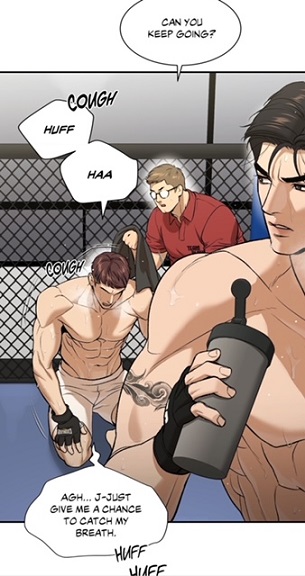 (chapter 46) Under this new light, it becomes comprehensible why Potato was also neglected by the manager. The young maknae belongs to a different weight category. There is this invisible rule that only strong people can become member from the gym. However, the purpose of such an institution shouldn’t be reduced to titles, strong and muscular men or boys. The gym should be opened to anyone who desires to have fun and improve their health.
 (chapter 1), until he received the doctor’s massage in chapter 1. His attitude toward sex mirrors his training in the gym—focused on endurance, performance, and control. His body is a tool, a machine honed for efficiency.
  (chapter 63) Pleasure is secondary; the real goal is lasting, enduring, proving his stamina. Even in his most intimate moments, he is competing against an invisible opponent—his own ingrained fear of inadequacy.
 (chapter 63), why he keeps barriers between himself and Kim Dan, even when his body betrays his true desires.
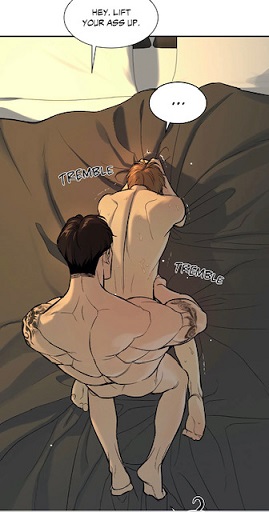 (chapter 4) nudity was a tool of dominance, a means of asserting control. Now, it has become a sign of submission—not in the physical sense, but in the way he is slowly relinquishing the emotional armor he has always relied upon.
  (chapter 44) His decision to keep his underwear on for as long as possible in Episode 63 is not a sign of detachment
  (chapter 63), but of his silent battle against the vulnerability he is beginning to feel.
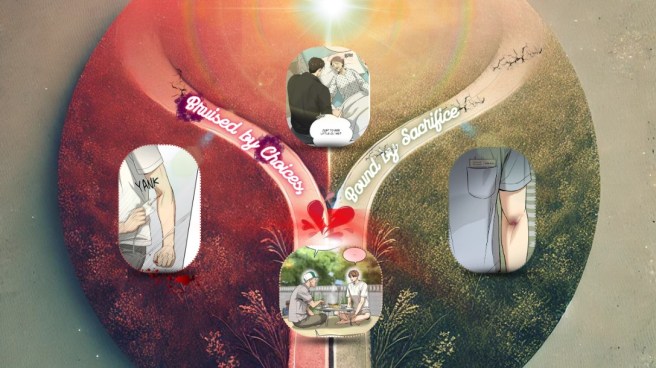
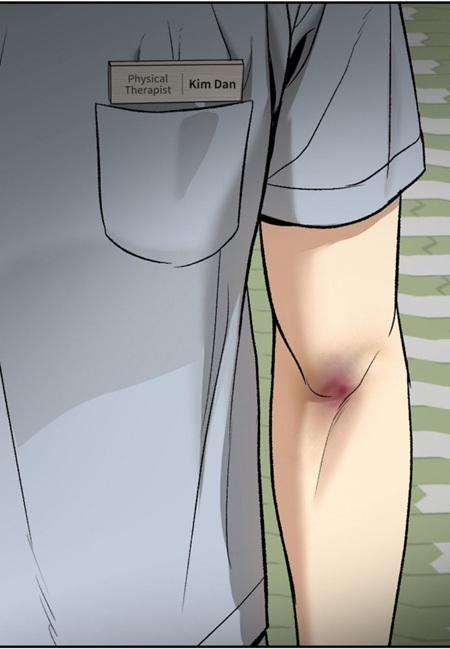 (Chapter 61) However, this moment is not isolated—it reflects patterns in his personality that have appeared throughout the series.
  (Chapter 11)
  (chapter 18) This essay delves into the significance of Kim Dan’s physical and emotional bruises, examining how they symbolize his suffering, internal conflict and transformation. I will examine Kim Dan’s conflicted emotions surrounding gratitude and debt, contrasting his interactions with Joo Jaekyung and his grandmother, Shin Okja. Additionally, I will explore how Kim Dan’s conditioned identity as a caregiver drives his choices, even in his current living situation with the landlord, where he unconsciously replicates past dynamics. Ultimately, I will elaborate how Kim Dan’s newfound awareness could reshape his identity and relationships moving forward.
 (Chapter 61) His unexpected reaction catches Kim Dan off guard, further emphasizing how disconnected the doctor has become from his own well-being. However, contrary to the past
  (chapter 11), Kim Dan is truly responsible for the contusion. He caused the injury by removing the needle from the drip.
  (chapter 60) By taking this action, he absolved Joo Jaekyung of any responsibility for the injury, but this is merely a superficial conclusion.
 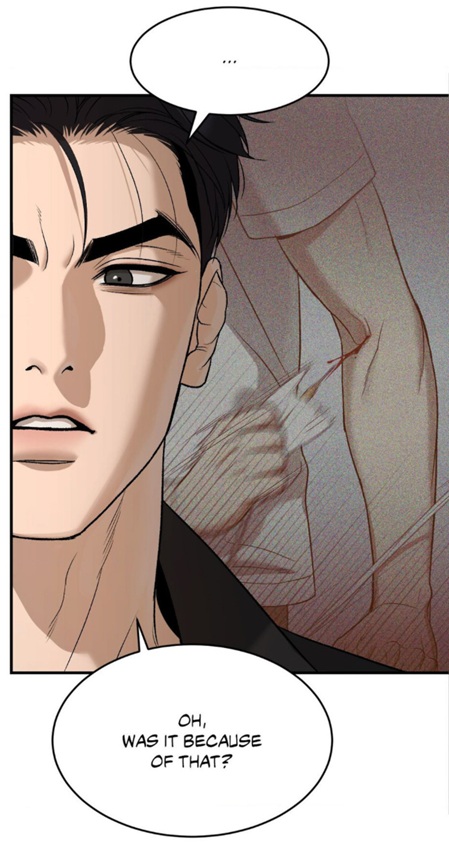 (Chapter 61) On the hand the circumstances surrounding the bruise, where Kim Dan removed the needle on his own, provide insight into his psyche. The deeper cause of the bruise lies in Kim Dan’s declining health, which is intrinsically connected to his malnutrition and the neglect he faces from those around him. It is important to recall that Joo Jaekyung was explicitly informed that Kim Dan needed rest
  (chapter 60). Yet, with his insistence,
 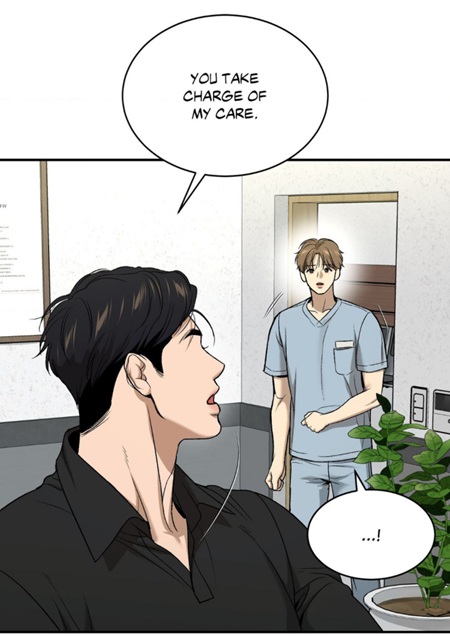 (chapter 61), he forced the physical therapist to keep working, adding even more strain than before. Though the physical therapist attempted to voice his disapproval,
  (Chapter 61) And why did the director override Kim Dan’s need for rest? Money and free PR. Joo Jaekyung’s influence secured the director’s approval, disregarding the doctor’s well-being in favor of business interests. This conversation at the director’s office makes one thing clear: words hold no power against profit. An d that realization led me to another connection—every one of Kim Dan’s bruises is linked to exploitation, whether by authority, obligation, or financial influence.


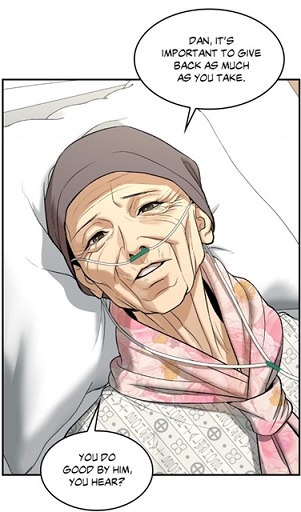 (Chapter 41) It is clear that she was inciting him to work harder than before. This displays that Kim Dan was not allowed to rest. During this encounter, she didn’t ask him about his well-being either. And what is the link between these 3 episodes? The grandmother and her poverty. The latter was responsible for the loan.
  (chapter 56) Kim Dan has only visited the hospital once, and this was solely due to Joo Jaekyung’s intervention. The latter needed medical attention himself
  (chapter 18) and took Kim Dan along, ensuring he was seen as an emergency patient. However, this visit was brief and lacked any comprehensive medical examination—no blood samples were taken, and his underlying health concerns remained undiagnosed. This omission further underscores the neglect Kim Dan has suffered, as even in a medical setting, his long-term health issues were overlooked.
 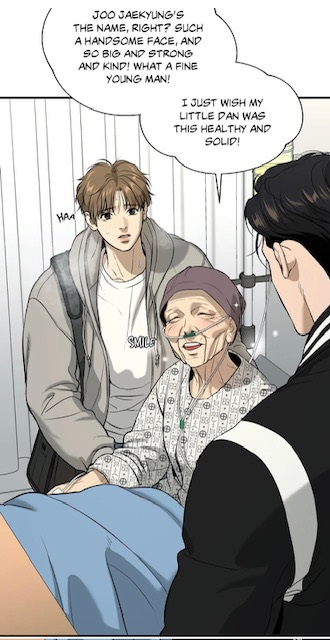 (chapter 21) He had never been healthy and strong. Moreover, when he joined them, at no moment the senior asked if he had gone to the doctor, though he had been sick before.
 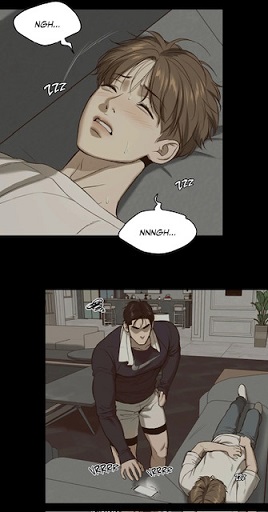 (chapter 21) But back then, the champion didn’t pay too much attention to it. In my opinion, her response will likely reflect her established pattern of emotional detachment and deflection of responsibility. Rather than admitting her lack of concern for his well-being, she may shift blame onto the staff or Kim Dan himself
  (chapter 57). In the last case, she will downplay the severity of his condition, insisting that he has always been stubborn and independent. She could even mention her conversation, when she tried to convince Kim Dan to return to Seoul, but the latter refused to listen to her.
 (chapter 5), or his general reluctance to ask for help. He rejected the athlete’s help and concern.
 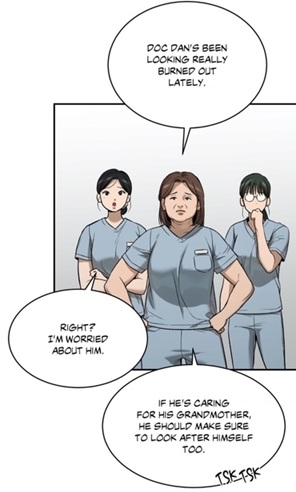 (chapter 57). She blamed the main lead, because she imagined that Shin Okja would worry about him. However, it becomes clear that the halmoni is not worried about her grandson at all. She is acting like a fan in front of the athlete.
  (chapter 61) One might argue that based on this scene, the grandmother didn’t see him with the bruise on his arm.
  (chapter 61) He only remained at the door. However, observe that there was a cut between this image
 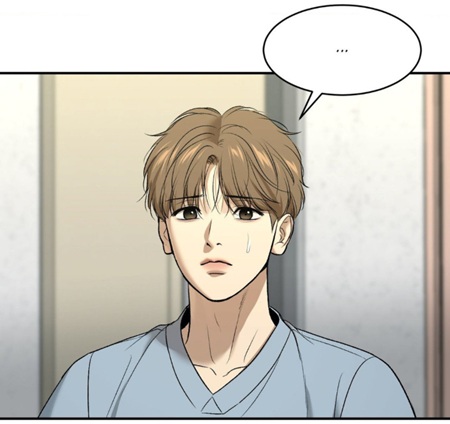 (chapter 61) and the conversation between the main couple in front of the hospice.
 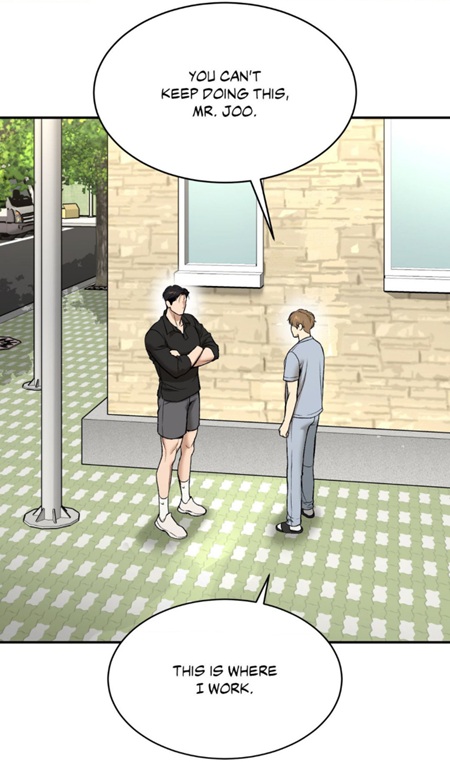 (chapter 61) So he could have made his presence known to his relative before asking Joo Jaekyung to follow him because of his treatment. To conclude, I believe that she had the time and occasion to see her grandchild and his bruise.
 (chapter 13) He is the only doctor who has ever examined the protagonist so closely and even paid attention to his fingernails!
  (chapter 13) At the same time, the chingu from the club was the first one pointing out that his wounds were never treated!! Furthermore, I realized that the doctor’s lies from episode 11
 (chapter 59) He would space out and even fall asleep at any moment.
 (chapter 13) The latter was the cause for the severe exhaustion. However, like mentioned above, the doctor is not blameless either, because he never questioned why his wounds on the hand were bleeding again.
  (chapter 43) He thought, it was related to the massage, yet the reality was that this incident showed that he had coagulation issues. To conclude, all the bruises could have always been noticed by people due to their locations (eyes, hands, arm)!
  (chapter 61) and his relationship with Joo Jaekyung.
  (chapter 61) That’s how I recognized why these women’s warm welcome and curiosity about Kim Dan were rather superficial.
  (chapter 56) His arrival stands for novelty and a breath of fresh air at the institution. However, with this change, the female staff is forgetting their original duty: they need to pay attention to their colleagues. They are behaving like the grandmother
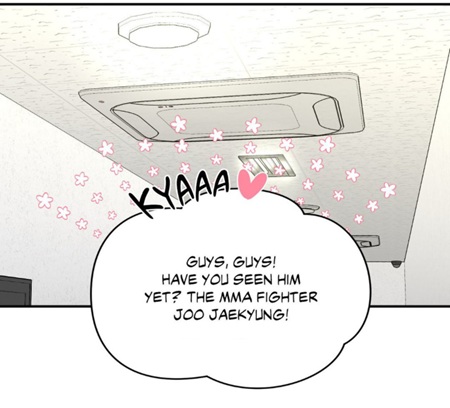 (chapter 61): fangirling over the handsome guys visiting their little town. That’s why Mingwa drew flowers in the last two images. No wonder why no one around Kim Dan is observing the bruise and his deteriorating condition. Moreover, since the physical therapist has a relative at the hospice, the staff is envisioning that Shin Okja is doing “her work”, she is paying attention to Kim Dan’s mental and physical conditions. On the other hand, there is no doubt that the grandmother has already delegated her own responsibility onto others, Kim Dan and the hospice. It is a medical institution, therefore they should pay attention to his working conditions. In other words, since no one feels responsible for the protagonist’s health, no one is worried about Kim Dan at all. At the end of episode 61, he is even so pale and breathless
 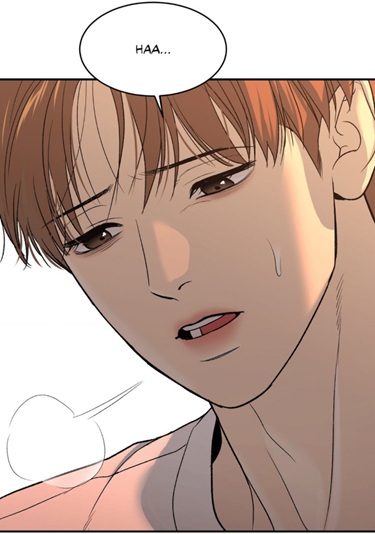 (chapter 61) that I am anticipating a terrible incident leading to a rude awakening for everyone.
 (chapter 47) For Shin Okja, raising him to adulthood marked the completion of her duty, and his current struggles are no longer her concern. This perspective becomes evident in her words from Chapter 57, where she tells him, he can’t stay here forever, and it’s not like he’ll stick around after she dies.
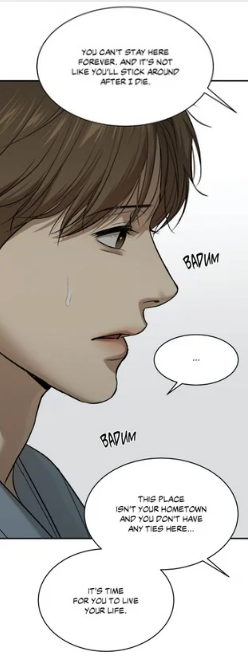 (chapter 57) By declaring that Kim Dan is now responsible for his own life, she emotionally detaches herself, absolving herself of any accountability for his deteriorating condition. However, she is forgetting
  (chapter 56) that she is still relying on him, as he is the one paying her hospice bills. Besides, she still doesn’t know that the loan is no longer existent. It was, as if he had to clean up her mess before her death. At no moment, she asks about the loan or the doctor’s future. She is not thinking about his future at all.
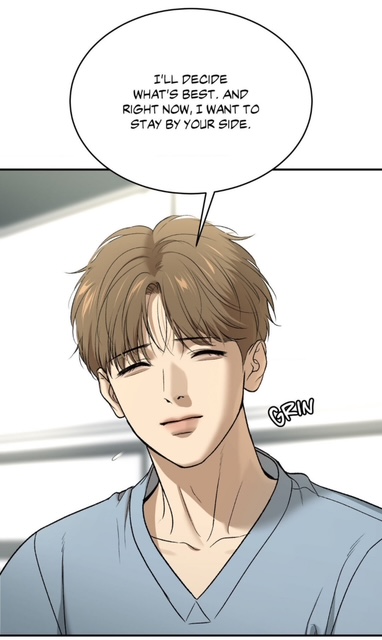 (chapter 57) — reinforces her conviction that she has fulfilled her role. In her mind, his rejection of her advice places the burden of care entirely on him, allowing her to dismiss any further involvement. This emotional withdrawal directly connects to the symbolism of the bruise:
  (chapter 18) In episode 18, when Joo Jaekyung confronts Kim Dan about the loan, the doctor has a bruise on his left eye, symbolizing his entrapment and helplessness. This earlier injury highlights how Kim Dan has been conditioned to view himself as responsible for burdens that are not his own, perpetuating a cycle of sacrifice and self-neglect. And a new bruise appeared just after the athlete reminded the physical therapist of his past promise:
  (chapter 61) His grandmother’s disregard for his well-being amplifies the injustice of this situation; she allowed him to shoulder the debt despite knowing it was never truly his to bear. The bruise becomes a recurring motif, a visual representation of how others have imposed their responsibilities on Kim Dan, leaving him physically and emotionally scarred.
  (chapter 60). The juxtaposition of the vibrant environment with Kim Dan’s deteriorating health underscores the neglect he faces. The hospice is meant to be a sanctuary, yet it becomes a space where Kim Dan is further burdened by the champion and his grandmother’s expectations
 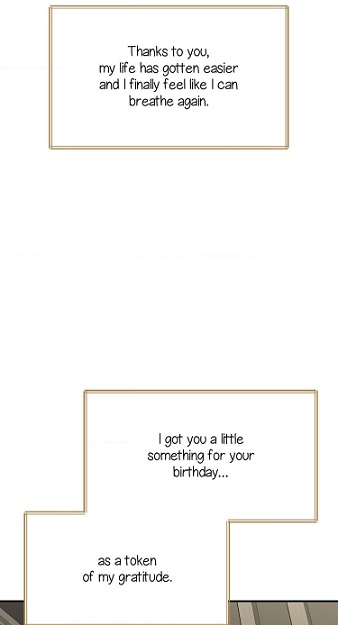 (chapter 55) This line “I finally feel like I can breathe again”, written by Kim Dan, reveals a subconscious acknowledgment that his relationship with the champion represents a breath of fresh air, a chance to escape the suffocating expectations and burdens he has carried for so long. The bruise, a physical manifestation of his struggle, signals the breaking point of his role as a selfless caregiver. It challenges the illusion of invulnerability that Kim Dan has maintained and forces those around him to confront his vulnerability.
 (chapter 60) The beach, with its open and untamed expanse, symbolizes freedom and a return to the self. It foreshadows that Kim Dan’s true journey toward healing will require him to step outside the roles and confines imposed upon him, finding solace not in what is expected but in what feels authentic and liberating.
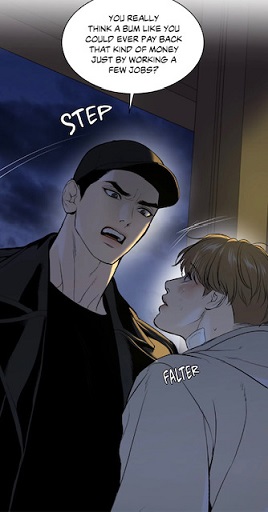 (chapter 18) His grandmother, Shin Okja, played a significant role in this mindset by fostering the illusion that hard work and sacrifice would erase the debts. However, as revealed in episode 18, this was a lie. Shin Okja made the choice to take on the loan and not to seek help
 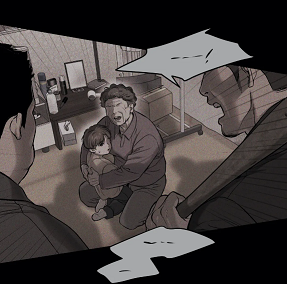 (chapter 5), yet she burdened Kim Dan with it, using his sense of duty and gratitude against him. Her statement in episode 57
  (chapter 18) —or, more accurately, the lack thereof. The champion’s actions were motivated by a desire to help
  (chapter 18), hence the star was waiting for a smile from Kim Dan. Yet the latter perceived it as meddling. His immediate response
  (chapter 53), leaving a note when he moved out that promises to settle the debt. However, by Episode 61, Kim Dan is no longer mentioning the debt, signaling a shift in his priorities and a possible breaking point in his adherence to his grandmother’s expectations.
 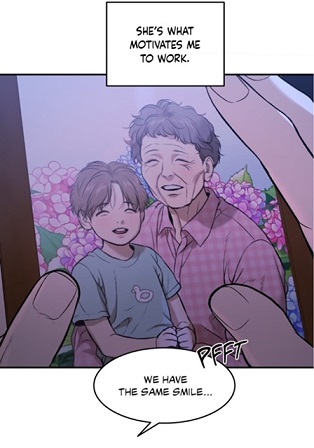 (chapter 47) The physical therapist’s entire existence had revolved around fulfilling her needs, from managing the debt to taking care of her health. With her now approaching death and actively pushing him away, Kim Dan is left grappling with a profound sense of meaninglessness.
  (chapter 60) He had never been given the opportunity to develop dreams or ambitions of his own, as his life was entirely defined by his grandmother’s circumstances. This lack of agency further explains his rejection of Joo Jaekyung’s generosity in Episode 18 and his later promise to reimburse the loan. Clinging to this promise was Kim Dan’s way of creating purpose and meaning in a life that had otherwise been dictated by others. It highlights how deeply entrenched his self-sacrificing tendencies are, as even his attempts to assert independence are rooted in his conditioned need to serve others. That’s why I come to the following prediction. Kim Dan needs to get confronted with illness and death (he could lose his life) so that his will for life comes to the surface. Right now, he imagines that since he is young, he will outlive his relative, but the death of the puppy was a warning to him that youth is no guarantee for a long life.
  (chapter 59) Death can take away anyone and at any moment. In my eyes, if Joo Jaekyung uses his own body to save the doctor again (like for example blood transfusion and CPR), this time Kim Dan would feel truly grateful towards the champion. So far, the doctor has not recognized the star as his savior yet. By removing the needle, he denied the protagonist’s intervention on the beach:
  (chapter 60) Hence his arm got bruised. The contusion was a reminder that something had happened during that night, but Kim Dan chose to ignore the incident. He never questioned why he was on the beach, he acted, as if Joo JAekyung had lied.
  (chapter 60)
 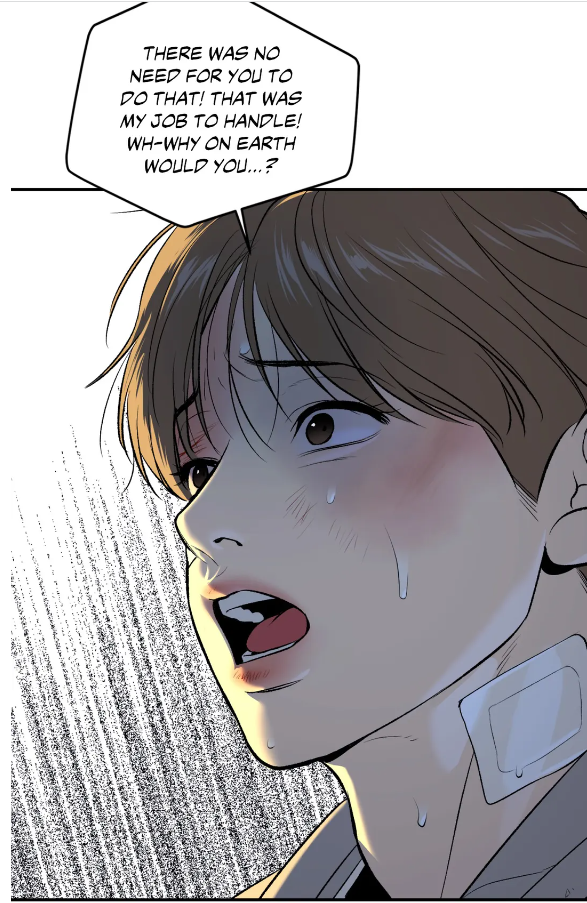 (chapter 18) Deep down, Kim Dan knows that the debt was never truly his responsibility, making it difficult for him to view the champion’s actions as a genuine act of kindness. This inner conflict is compounded by his suicidal disposition, which renders the concept of repaying the debt meaningless.
  (chapter 59) He worked so hard, was even beaten, but he could never voice his torment.
  (chapter 59) Why? It is because the grandmother was no longer by his side and she never talked to him either. The absence of communication indicates her lack of interest in Kim Dan. And it becomes comprehensible why during that night, he felt the need to go to the ocean and drown himself. It is because he was gradually realizing his loneliness. With his relative’s death, he would only keep living a terrible life determined by work and nothing else.
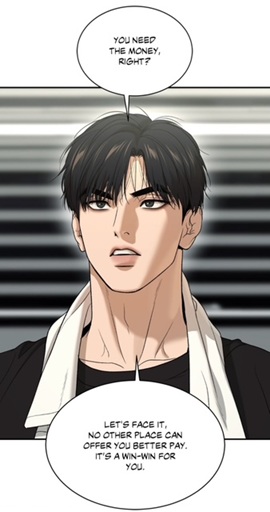 (chapter 60)
  (chapter 11) and even uses his own words against him:
  (chapter 22) The loan was the result of his grandmother’s decision. He never helped him, rather his grandmother.
  (chapter 11) However, he never explained his circumstances to the generous athlete. By keeping him in the dark, he reinforced his negative disposition about the doctor. And chapter 61 exposes this reality. His suffering was the result of his own decision.
 (chapter 61) Do you recognize the room? That was the doctor’s
  (chapter 19)
  (chapter 53) His decision to allow Joo Jaekyung into his bedroom in episode 61 demonstrates that he consented to the relationship, even if begrudgingly.
  (chapter 6) or 8
  (chapter 8) where he would abandon the protagonist right after the climax and not care about his partner’s conditions and feelings:
 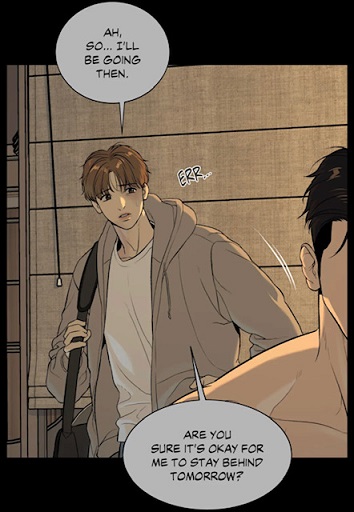 (chapter 13) Since the doctor mentioned that a match was right around the corner
  (chapter 61) It leaves us four possibilities. Randy Booker, Dominic Hill, Alfredo
  (chapter 47) and Baek Junmin. However, for the intercourse took place in the doctor’s bedroom (he wished to be carried to his own bed)
  (chapter 36), for they had sex every day. However, in episode 53, we discover their night before the match against the Shotgun
 (chapter 53) So this scene can only have taken place in chapter 47, when the match with Angelo got canceled and Kim Dan had been confronted with the terrible news about his terminally ill grandmother.
  (chapter 47) In the previous part of this essay, my avid readers could see the strong parallels between 61 and 47. But there exists another reason why I am inclining to think that the sex scene took place later in the story. It is because during that “magical night” (44), Kim Dan learned the notion of “consent”.
 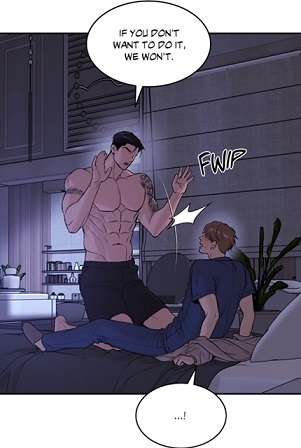 (chapter 44) During that blue hour, Kim Dan discovered that he could say no! And notice that in his memory, he clearly thought that he could have rejected the athlete’s advances.
  (chapter 46) He should mistrust the members from the gym and keep his distance from people. So during that time, Joo Jaekyung did follow his hyung’s advice
  (chapter 47), yet I can’t imagine that this man could become abstinent like in episode 19. Hence at some point, he must have felt the urge to possess Kim Dan, a mixture of fear and dominance. He imagined that way that he could impose his will onto the doctor and control his “loyalty”. With this submission, he would force the doctor to remain by his side. But naturally, this sex as “power play” could increase the gap between the main leads.
 (chapter 53) doc Dan was copying the champion’s behavior from episode 61. Right after the sex, he would leave the bed and return to his bedroom. How did Joo Jaekyung recall this night?
 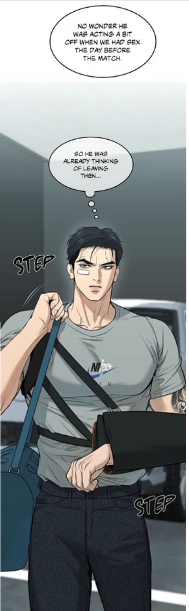 (chapter 53) He saw his attitude as a sign of disloyalty and “abandonment”. And that’s how Kim Dan is feeling in the restroom:
  (chapter 61) The darkness around the eyes is a metaphor for his resent and anger. And the moment you contrast the two memories (53 and 61), you can detect the hypocrisy of the two main leads. They only recall scenes where they were hurt and felt betrayed. However, in reality, they were both victims and perpetrators, because none of them chose to open up and talk to each other. Why? It is because both chose to listen to their “guardian” and their “favor”. Like mentioned before, in a quarrel, no one is right and wrong. The purpose of an argument is to listen to the counterpart and view incidents from their perspective. Finally, the physical therapist’s recollection serves as an important evidence that he had never been powerless and helpless. He could have refused all the time because their deal was never official.He could have used the contract as a shield. But the best evidence of Kim Dan’s power is this rejection:
  (chapter 61) I had already pointed out the increasing resistance and resilience from Kim Dan in episode 60:
 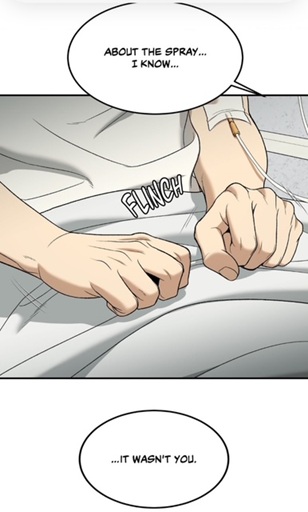 (chapter 61) My prediction came true. In the past, he could have denied the existence of the deal, Joo Jaekyung was free to seek another physical therapist. He never realized that he had some leverage. Yet he still followed the athlete’s requests. He saw himself bound by obligations. However, this was just an illusion. Hence in episode 61, we see him legitimating his consent that there was an imminent fight.
  (chapter 61) He is expected to work despite his declining health, his suffering dismissed by those around him.
  (chapter 40) He is paid to receive bruises, to push his body past its limits
 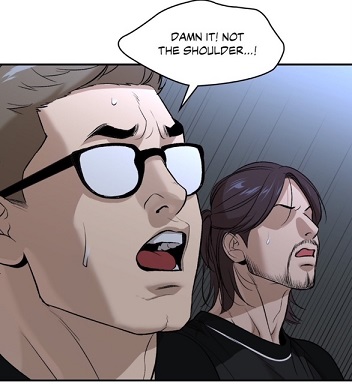 (chapter 50), to endure pain while the public watches and profits are made. His suffering is entertainment, a spectacle that fuels the business of MMA. Though he is a champion, he is still a commodity, expected to perform regardless of his condition.
  (chapter 61) He understands, better than anyone, what it means to be physically used for the sake of others, yet he remains blind to the fact that he has placed Kim Dan in the same position. While one has no file about his health condition, the other has many files, but they are not studied, because this would push the manager to question his decision and even ruin the business:
 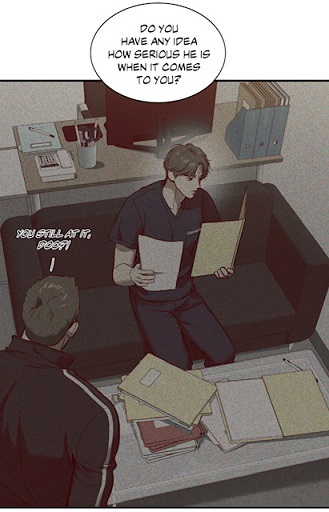 (chapter 17) I doubt that Park Namwook studied them, and notice that the recently hired PT didn’t ask for the champion’s files first:
  (chapter 54) Thus I deduce that the champion’s files are in reality a subterfuge. They give the impression that the doctors and Park Namwook truly care for his well-being, but it is not correct. They are only interested in his body because of wealth and reputation. But let’s return our attention to episode 61 and the champion’s attitude towards Kim Dan.
 (chapter 54) It is clear that the manager wants Joo Jaekyung to return to the ring as soon as possible to erase the last “debacle”. In my opinion, the doctor’s illness could serve Joo Jaekyung as an excuse to delay his return to the ring and even not to accept the next challenge.
  (chapter 57) is another manifestation of his conditioned role as a caregiver. By living with an older man, he creates the illusion of a familial bond, mirroring the dynamic he shared with his grandmother. This decision highlights his struggle to break free from the identity imposed on him—one defined by servitude and selflessness. He assumes that he should take care of the landlord, offering to cook and expressing guilt for not fulfilling this perceived duty. Yet, the landlord subtly challenges this narrative. By inviting Kim Dan to eat breakfast
 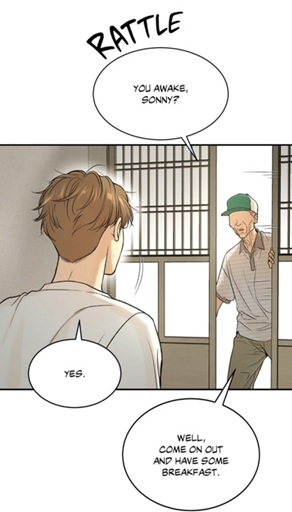 (chapter 57) and dismissing his apologies, the landlord treats him as an equal rather than a caretaker. This dynamic forces Kim Dan to confront his false perception of himself.
 (chapter 57) Despite this, Kim Dan rejects the advice, demonstrating his resistance to being cared for. This moment underscores his internal conflict—he craves independence yet clings to the role of the selfless provider. The landlord’s actions expose the fallacy of Kim Dan’s identity, revealing that his caregiving is not always necessary or effective.
 (chapter 61) is indicating the increasing resent and anger towards the star. Joo Jaekyung is no longer seen as a celebrity and idol, but as a inconsiderate man. This transformation is subtle but meaningful, as it reflects his burgeoning awareness of his own worth and the unjust treatment he has endured. For the first time, Kim Dan acknowledges himself as pitiful
 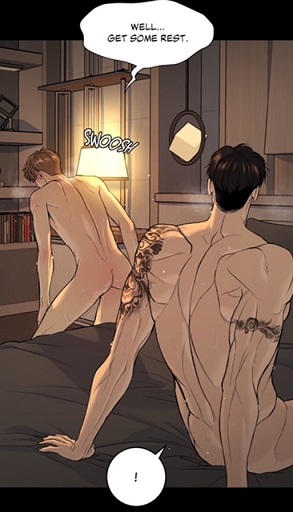 (chapter 53)
  (chapter 61), no longer bound by the roles others have imposed on him but shaped by his own choices and growing self-respect.
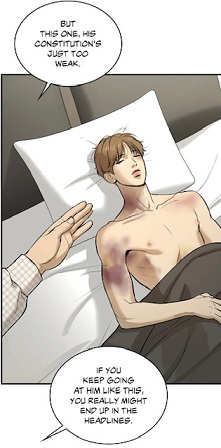 (chapter 13) and the fragility of Kim Dan’s existence. For Kim Dan, it challenges his self-perception as an indestructible caregiver. This realization could lead him to an inevitable conclusion: his own needs and well-being are just as important as those of others.

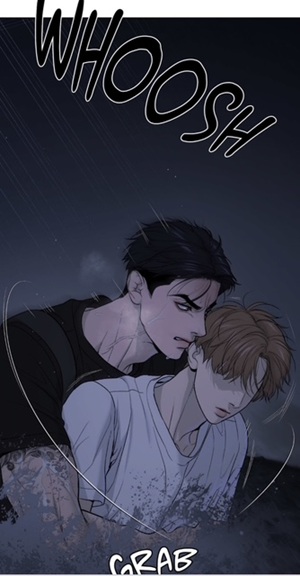 (chapter 59) is a masterful interplay of symbolism, reflection, and narrative breadcrumbs laid out by Mingwa. Central to this exploration is a photograph
  (chapter 59) —an innocent request by the nurses at the hospice
 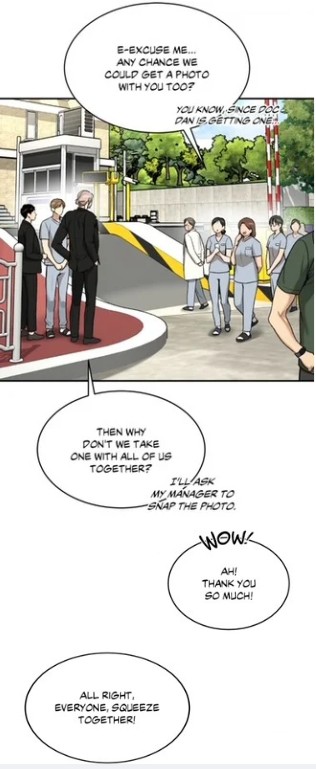 (chapter 59) —which becomes the pivotal clue leading Joo Jaekyung to Kim Dan. Through a careful analysis of the timeline and the use of contrasting events, it becomes clear that Mingwa’s narrative mirrors a kaleidoscope, reflecting positive and negative elements rooted in Taoist principles. While the doctor’s unconscious
 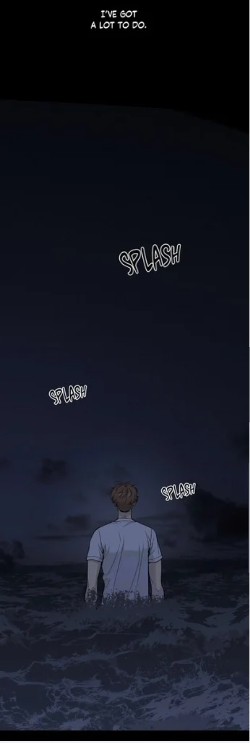 (chapter 59) led him to the shore, driven by despair and suicidal intent, the MMA fighter’s journey stands as its opposite:
 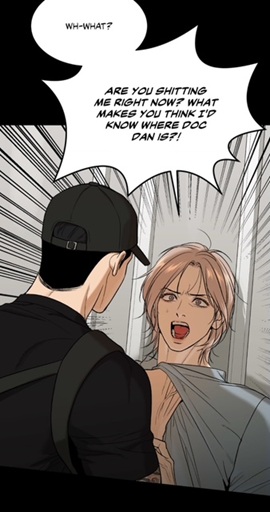 (chapter 59 ) a conscious choice to follow his heart, hence he was full of anger and frustration. Joo Jaekyung was no longer repressing his feelings, even if he had yet to fully recognize his affection.
 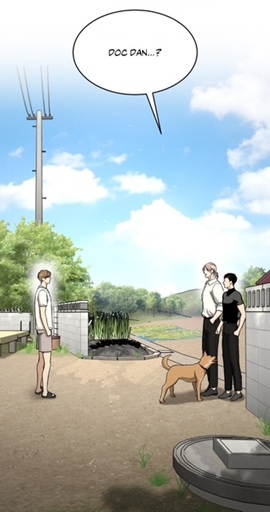 (chapter 59) embodies the negative reflection of Joo Jaekyung’s purposeful arrival. We can detect the divergences: day versus night, work versus break, healthy versus unhealthy etc. Through the juxtaposition of images and situations, Mingwa provides profound insight into the characters’ thoughts, desires, and intentions. The photograph’s role becomes pivotal: while it marks the end of Heesung and Potato’s visit
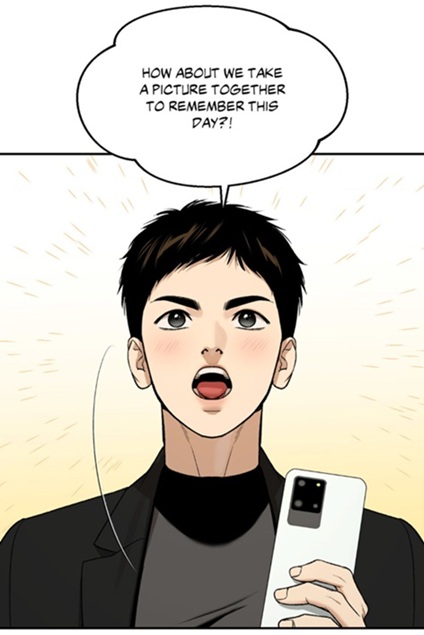 (chapter 59), it simultaneously signifies the first crucial clue in Joo Jaekyung’s search. This marked the turning point where his ongoing efforts were given direction, transforming his pursuit into a decisive journey toward discovery.
 (chapter 59) —each of whom had interacted with Kim Dan
  (chapter 57) during his time at Light of Hope. While these individuals appear as potential candidates for revealing Kim Dan’s location, the true helper remains shrouded in mystery. This ambiguity emphasizes the layered narrative of Jinx, where each small action—no matter how mundane—contributes to the larger theme of fate’s intricate web, offering insight into the power of both intentional and unintentional intervention. If Potato had not suggested the picture
  (chapter 58)
  (chapter 58)
  (chapter 58), ignorance and superficiality
  (chapter 58), becomes the shadowed reflection of the proactive search by Joo Jaekyung. This interplay of light and dark is central to unraveling how fate unfolded.
 (chapter 58) and Potato, despite their contrasting motivations
  (chapter 58), came to the same conclusion: they should not reveal Kim Dan’s whereabouts to Joo Jaekyung. Heesung argued that Kim Dan was better off in his secluded life, away from the chaos of Joo Jaekyung. Potato, deeply trusting his lover’s seniority and judgment, chose to follow Heesung’s lead. Their decision reflects not only their loyalty to Kim Dan’s expressed wishes but also their passive adherence to the belief that avoiding intervention was a form of help which reminds us of Potato’s former principle:
  (chapter 35) This shows that despite the last incident, Yoon-Gu didn’t drop this terrible principle. Notice that he is advocating the same philosophy than Shin Okja. Heesung justified his stance by claiming that it was in Kim Dan’s best interests
  (chapter 59) Importantly, Joo Jaekyung did not arrive during this period, further affirming their resolve. The photograph taken just before their departure was the key turning point. However, the timeline—marked by the sunsets
  (chapter 59)
  (chapter 59) —suggests that Joo Jaekyung arrived only two days after Heesung and Potato left. This indicates that neither Potato nor Heesung leaked the information to Joo Jaekyung, as the champion would have sought Kim Dan immediately if informed by them. Instead, this photograph—seemingly public rather than private—became the clue he needed. Moreover, since the two friends knew where Kim Dan lived, I am assuming that he would have gone right to the doctor‘s rented room. But he did not. He went to the beach. Since the nurses didn‘t notice that Kim Dan was a friend of Potato and Heesung and mistook him for a fan, I am assuming that only the two friends know his address.
  (chapter 8)
  (chapter 37) and Kwak Junbeom was a witness of the encounter between Kim Dan and director Choi Gilseok.
  (Chapter 48) Nonetheless, there exist significant points against this theory. Despite their fondness for the actor
  (chapter 30) and their interactions with Heesung and Potato
  (chapter 35), they are unaware of the actor’s relationship with Potato. The author left many clues for this interpretation. They didn’t notice the maknae’s absence at the champion’s birthday
  (chapter 43), but more importantly the presence of Yoon-Gu‘s embarrassment in front of his hyung indicates secrecy. .
  (chapter 58) His “redness” indicates that he doesn’t want to expose his special relationship with Heesung. Therefore I believe that he didn’t mention this trip to other members. Consequently, I doubt that the members were looking for Potato in such a photograph. Furthermore, from my perspective, members of Team Black are still left in the dark about Joo Jaekyung’s struggles. They are unaware of his drinking habits
  (chapter 56), or his emotional state. They think, he has not come to the gym due to his recovery. Furthermore, they don’t use his cellphone number to contact him. The hiring of a new physical therapist and
  (chapter 57) the interview suggested that Joo Jaekyung was taking a break to recover from his injury, leaving no indication of his active search for Kim Dan. However, Yoon-Gu got informed through Heesung that Joo Jaekyung was desperately looking for him:
  (chapter 58), but probably saw this as another “negative reaction” (bad temper) of a spoiled child. This makes it unlikely that members of Team Black could have provided the critical information.
  (chapter 50)
  (chapter 49), highlighting the failures of relying solely on fate. The champion’s eventual discovery of Kim Dan underscores the necessity of teamwork and active intervention. Notably, this also reflects the flaws in Team Black, whose inaction and superficiality limited their understanding of both Joo Jaekyung’s struggles and Kim Dan’s situation. While Heesung’s stardom and blog
 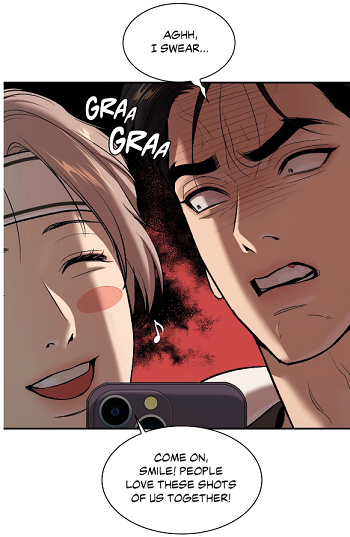 (chapter 30) could have amplified the picture’s reach, it’s unlikely Joo Jaekyung relied on such sources directly. I can not imagine him spying on the actor’s blog. Instead, the role of the helpers — the nurse and her acquaintance— emerge as crucial to piecing together the connection. The inadvertent role of the nurses Mind and Heart, urging Heesung to take the picture, becomes an integral part of the story’s progression.
  (chapter 13) who played pivotal roles in lifting the curse, as Mingwa’s narrative often draws on such reflections. Here, the nurses’ actions, though seemingly minor, echo the same themes of fate and intervention.
 (chapter 13) The latter knew the PT’s face,
  (chapter 13) but didn’t know his identity. He mistook him for someone who was selling his body for money.
  (chapter 13) In addition, Kim Dan never got to know the intervention of this hyung: he was the invisible helping hand in season 1. And now, if you reread the scene in episode 13, you will notice that this conversation between Joo Jaekyung and his friend contains all the ingredients in episode 59: the use of the phone, fainting, malnutrition, secrecy, neglect, secret suffering, pictures and public knowledge
  (chapter 13), the death of a man and finally urgency. Moreover, remember what his friend told him before: the importance of rest and
  (chapter 13) He should send him to the hospital for tests, but the fighter refused. Why? It is because the latter feared his “chingu”. The doctor seemed rather interested in Kim Dan, therefore he feared that the PT might dump him for a “colleague”. That’s why Heesung was sent later to his gym. Karma was punishing him for not listening to his friend’s advice. Finally, it is important to recall his advice:
  (chapter 43) And during that evening, the champion called his penthouse with the doc “Home” for the first time. Finally, in season 2, Joo Jaekyung started visiting each hospital or Sports Rehabilitation Center in Seoul in order to find Kim Dan.
 (chapter 56) And there’s no doubt that Joo Jaekyung got recognized by people forcing him to use a mask to hide his identity. So this frenetic search must have reached the mysterious doctor’s ears, but I doubt that he made the connection between the star’s lover and the physical therapist right away. Since he‘s a guest of XY club,
  (Chapter 13), it is also possible that he could have heard about the last incident in the restroom with doc Dan’s replacement. Since Cheolmin found Dan cute, it is very likely that he was also drawn to the surrogate „Dan“. But I don‘t think, this was enough to intervene, as Joo Jaekyung didn‘t ask for his help.
 and to Neptune
  and strangely, the doctor moved to a place next to the coast. So maybe Cheolmin comes from that little town and the green-haired nurse is his relative. I had already outlined their similarities. Finally, look at the numbers, we have 4 in both episodes, 13 and 59 (13: 1+3 = 4 / 59: 5-9= -4) The -4 would coincide with Kim Dan’s vanishing, but also with the intervention of Cheolmin. And if my theory is correct, this means that the champion will come to regret his past decision
 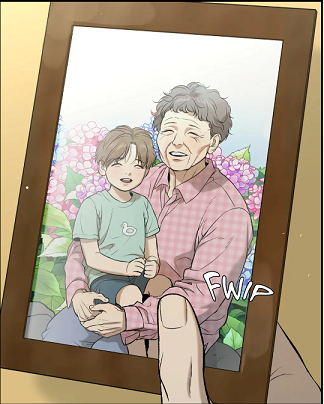 (Chapter 19) and the group photograph at the hospice


 (chapter 140)
  (chapter 149) Both were suffering from survivor guilt. To conclude, Joo Jaekyung and Kim Dan represent the bitter medicine for their scars. I mentioned “bitter”, because through their loved one, they are forced to face painful moments. That’s how they can overcome their past and discover happiness. However, while looking for a new title, I rediscovered the first illustration
  , and it suddenly made click in my head. To conclude, I had another revelation concerning episode 50.
 . (chapter 50) At first glance, the champion is blaming Kim Dan for the wound. He betrayed him. However, his words could have a different signification. Don’t forget that a message always has 4 sides according to Schulz von Thun.
  Consequently, while many saw this question as a “factual information” and as such as an accusation, the reality is that it gave us an insight about the sender too. The sportsman was not using the personal pronoun “I” or “me” in his inquiry. As you can see, the absence of the personal pronoun is indicating that Joo Jaekyung was in reality not referring to him and his wounds. He is not prioritizing himself, rather the doctor and his action. So this question could be prompted by curiosity or a desire to understand the person’s recent activities. Thus I deduce that the champion was asking his lover to tell him the truth. He should come clean. He desired a honest explanation. His attitude reminded me of an adult confronting his child.
 (chapter 51) But note that he never accused Kim Dan of assault, but of leaking information. That’s the reason why I don’t think that this inquiry “What have you done” was about seeking accountability. In that case, he wouldn’t have rejected the doctor’s offer. By letting him treat his wound, Kim Dan would have become responsible for the injury.
  (Chapter 50) It becomes comprehensible why the Emperor refused the offer. The rejection was the symbol of his “trust” in Kim Dan unconsciously. Astonishing, right, though people and Kim Dan had the opposite impression. Yet, because of the “tie”, Kim Dan felt responsible for the incident, therefore he apologized.
  (chapter 51) This means, the main lead recognized his responsibility. He should have checked the spray more carefully. The champion could perceive this excuse as a confession of his complicity. Hence he asked his lover if he was the spy.
 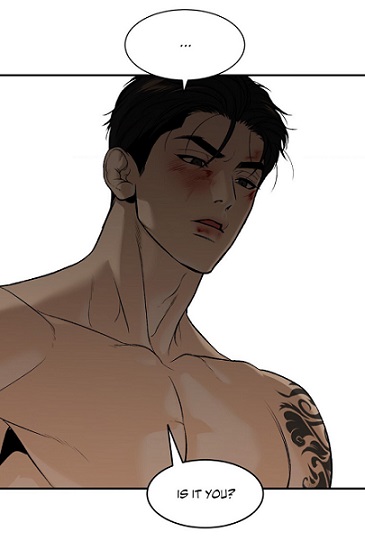 (chapter 51) This signifies that in episode 51, he dared to question his physical therapist’s loyalty. Yes, we have another “Truth or Dare” in episode 51.
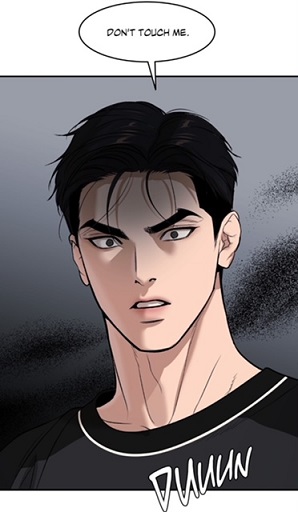 (chapter 50) This is the face of a scarred man. Yet, contrary to the past, he is not expressing his fear through rage. That’s the reason why his emotions were controlled. Under this new light, Manhwaworms grasp why the athlete asked such a question from his soulmate:
  (chapter 51) Interesting is that he was more pained by the idea of a betrayal from Kim Dan than the tie, if you compare these two panels: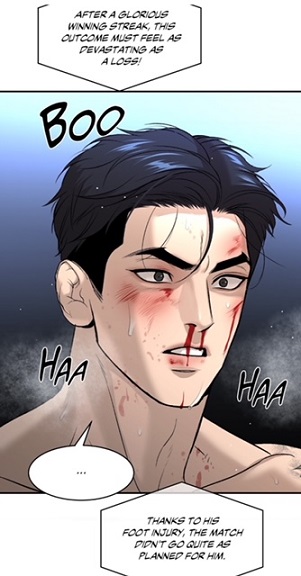
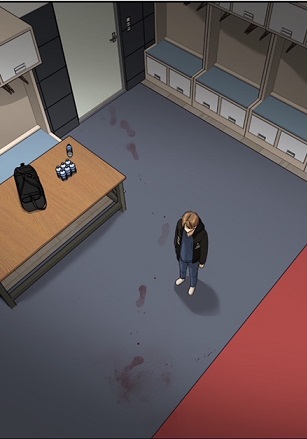 (chapter 51) Thus Kim Dan could overcome this shocking but terrible discovery: he hadn’t earned the full trust from Joo Jaekyung yet.
  (chapter 51) As my avid readers can see, my perception about chapter 50 was confirmed with episode 51. The arguments in the locker room were reflecting the quarrel in the penthouse with Choi Heesung. What is the common denominator between these two scenes? The lack of trust from Joo Jaekyung, but his private PT failed to realize it in the penthouse. Why? It’s because he chose to trust his destined partner.
 I believe you = I trust you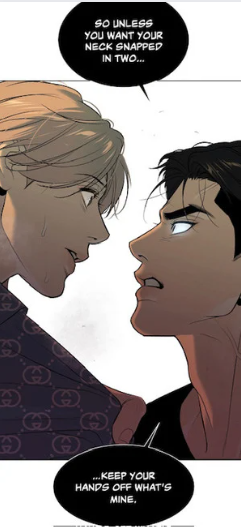


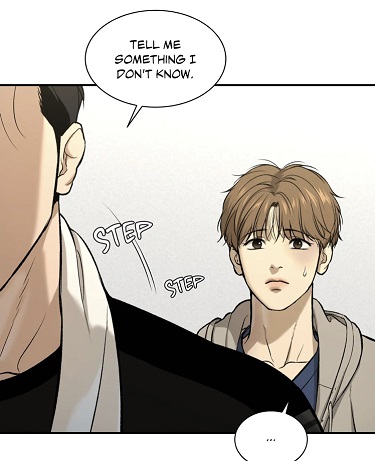 (chapter 15) He told him something that he didn’t know. Note that after the terrible meeting with the actor, Joo Jaekyung couldn’t even find the answer himself:
 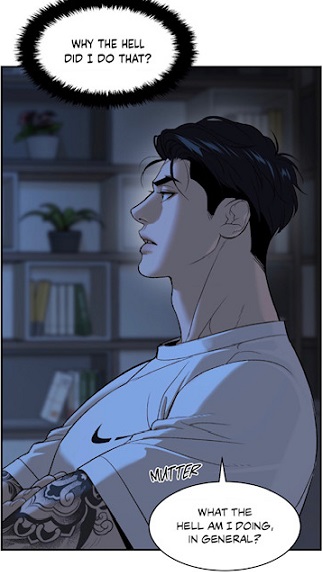 (chapter 35) He was still clueless about the trigger for his behavior. With this inquiry “You don’t trust me”, the hamster pushed his destined partner to face his biggest fear: trust someone and in particular him. This conversation can only incite him to meditate about their relationship. So while in episode 15, he behaved like a pouting child
  (chapter 15), in the latest episode, Jinx-philes can perceive his growth and maturity.
  (chapter 15) This painful incident was a wake-up call Thus I come to the following deduction. Kim Dan will try to earn the champion’s trust, whereas the champion will be forced to take a leap of faith towards Kim Dan. Contrary to episode 34, the champion could see the truth directly through the doctor’s gaze and voice:
  (chapter 34) As a conclusion, while the champion thought that his loved one had dared to cross the line, he was confronted with truth. He was biased and mistrusting his room mate and PT. This shows that though dare was the opposite choice of truth, the fighter ended up to be confronted with verity.
 (chapter 34) These questions were all rhetorical:
  (chapter 34) This signifies that in the sauna, truth was not standing in opposition to daring. The sauna reminded me of the cavern where an imugi hides, until the latter leaves its hidden place and find his star, his yeouiju. Only then, he can turn into a dragon. To conclude, because of Heesung’s pressure, the imugi had to select between daring or lie. In other words, telling the truth became the challenge itself. Heesung knew that Joo Jaekyung would never confess.
  (Chapter 34) What Heesung wanted was actually a lie by omission or commission which would have been presented as the truth. Through this game, the actor thought that he could impose his will onto the celebrity. He anticipated the athlete’s silence. This signifies that he knew about the star’s denial and turned it against him. Besides, that way Heesung could maintain his good image: he had not stolen his partner and as such there was no cheating. No one was betraying him.
 (chapter 34), but also his hand.
 (chapter 34) He caught the actor by surprise, the latter never thought that the celebrity would become violent. The redness on his face was displaying that he was barely controlling his annoyance and impatience.
  (chapter 34) However, they were in a public place, the hotel’s sauna, and the actor is a celebrity. Hence he is protected by his fame and social status. That’s the reason why the champion didn’t hit his frenemy, he had learned his lesson at the gym.
  (chapter 34) Despite his words, the gumiho still got scared. The racing of his heart is an indication of his fright. Therefore he ran away more or less after ordering his trainer not to meddle in his love life.
 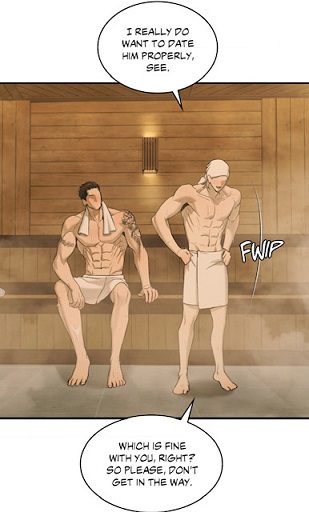 (chapter 34) Note that when he did this, he avoided his counterpart’s gaze. Deep down, he knew that he shouldn’t provoke his frenemy too much. Only when he was at the door, he turned around and LIED!
 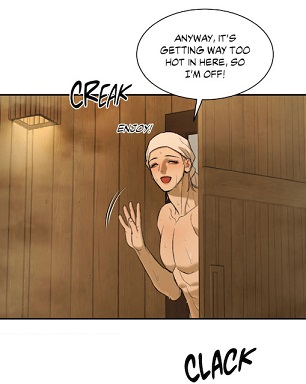 (chapter 34) Yes, after that incident, he chose to give him a fake excuse for his departure. As you can see, this conversation was strongly intertwined with the notion “truth or dare”, but both ended up lying. Whereas the champion didn’t admit any feelings, the other acted, as if there was nothing wrong and he was not scared. The gumiho thought that if he were to remove the champion from the doctor’s side, the latter would be able to open up to the actor.
  (chapter 34) What does it reveal? The actor had been projecting his own thoughts onto the future dragon too. He was the one who didn’t dare to become more honest with the physical therapist. He used work to spend time with Kim Dan. One might say that Heesung failed terribly. Yet, this is just an illusion, because his “failure” pushed him to become more honest with Kim Dan. Thereby he asked to meet the doctor again.
  (chapter 34) Yet, the message is exposing that Heesung was still lying, as he kept using work as an excuse. Hence Joo Jaekyung had to intervene again:
  (chapter 34) The champion dared to challenge his rival.
  (chapter 35) Yes, by challenging the athlete because of Kim Dan, the comedian ended up telling the truth.
  (chapter 34), but his anxiety reached a new peak, the fear that he might be abandoned. Hence he used the sandbag to vent his temper. And what did the cute puppy do during that incident? He dared to offer his help to his idol:
  (chapter 34), yet he was in total denial about the reality: it was dangerous. Deep down, the champion knew that it was impossible for him to control his lover’s time, but also his body. Besides, the other problem is that the athlete is rejecting the notion of love. By denying the existence of his own feelings, he can not claim the doctor’s heart. That’s the reason why the champion got so mad and frustrated.
  (chapter 34) He was not telling the truth, when he stated that Kim Dan was his “possession”. This explicates why he couldn’t stay by the doctor’s side
  (chapter 34) in the end. He manipulated the main lead by letting him think that he had no other choice. Yet the last panel displays his trick. It was up to the doctor to decide how he should spend his free time. Nevertheless, while people were mad at the champion for his deception, many failed to realize that the champion was actually deceiving himself. So all the tricks (episode 33 and 34) were manifestations of avoidance, the fear to face the truth: his affection for Kim Dan and this due to a past betrayal. Hence these chapters stand under the sign of silence hidden by “pranks”.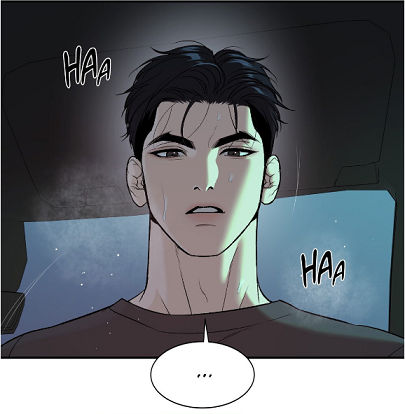
 (chapter 35) On the other hand, the artist could only tell one part of the truth: the presence of feelings. However, the deceptions in the penthouse exposed something else:
 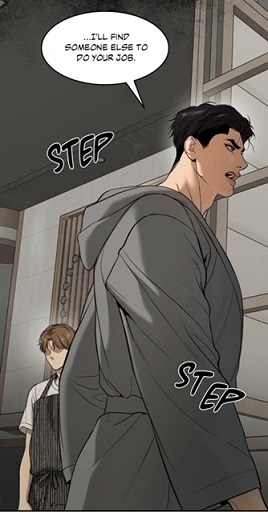 (chapter 45) or left the doctor in the locker room in episode 51.
  (chapter 45) It is because by denying his affection, he needs to justify his presence next to him. He is his PT… forcing his enemies to portray the doctor as a traitor or a bad PT. However, they failed, as the champion is not doubting the doctor’s innocence concerning his wound on the foot. Nevertheless, the incident is not closed, as the culprit has not been brought to justice.
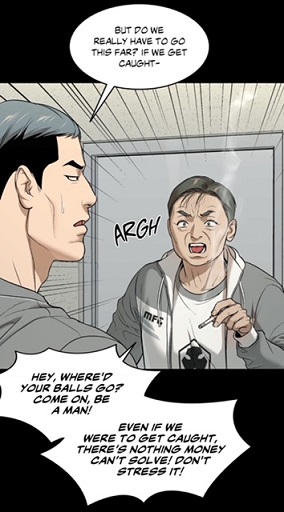 (chapter 50) First, the schemers’ MO corresponds to the game Truth or Dare. Choi Gilseok asked his minion to cross the line. This explicates why they are trying to use tricks and manipulations. Daring means no truth, thus someone will be framed: Kim Dan. Yet, the plotters are not aware that thanks to the cute hamster, the alpha is turned into a mirror of truth. Hence he couldn’t get deceived by the MFC security guys:
 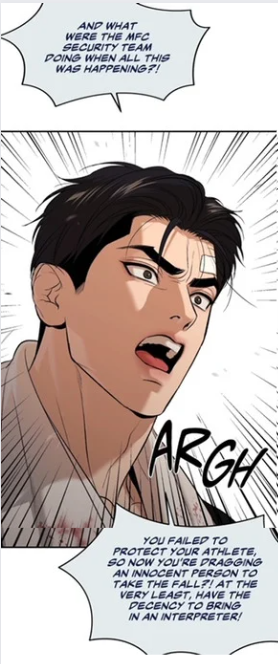 (chapter 40)
  (chapter 36) The lawyer, the journalist and the manager pushed him to choose “dare” and not truth! That’s why there was no interview and the leak was not investigated. He had to prove his strength.
  (chapter 36) And exactly like at the sauna, daring became a synonym for verity. No wonder why the fighter is never rejecting the challenge. It corresponds to his past attitude: he has been burying the truth and as such the past. But let’s return our attention to the plotters.
 (chapter 35), the “fake” MFC agent
 (chapter 42), Baek Junmin whom the champion couldn’t truly identify
 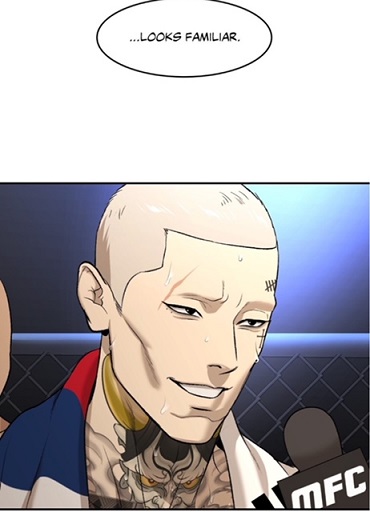 (chapter 47), then he recognized the director without naming him,
 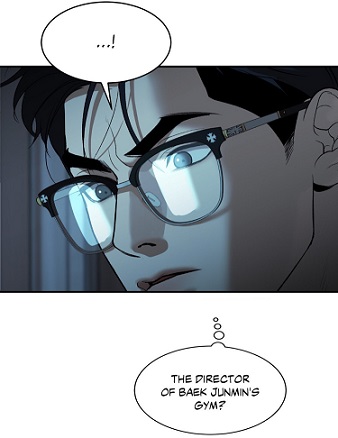 (chapter 48) and finally the ghost from the past
  (chapter 50) This scene exposed that the champion repressed a certain incident which is rather common among victims of a trauma, especially people suffering from PTSD. This shows that some traumatic event took place for quite some time, but the champion acted, as if nothing had happened.
  (Doctor Frost, chapter 140 ) That’s how the champion became a zombie, he couldn’t live properly due to his untreated scars.
  (doctor Frost, chapter 139) But thanks to his fated partner, the traumatic past is slowly coming to the surface.
 (chapter 48) The director created a stage for the betrayal. That should represent the truth, while in reality it was a lie! Nevertheless, Joo Jaekyung could perceive the truth: Kim Dan had met the director from the rival gym.
  (chapter 48) Yes, he didn’t dare to tell him what had happened. No truth… no daring which reflects the games in the sauna and the living room of the penthouse. Kim Dan could have come clean the next morning, but no. This panel explains his silence. He also mistrusted his VIP patient. He had a negative perception of his lover’s mental state. On the other hand, the champion’s attitude reminded me of a parent who has not the time to listen to his child’s problem due to work.
 (chapter 48) Should the athlete remember this night, he will realize that he was the one dismissing his physical therapist, although the doctor could have come clean later. At the same time, Joo Jaekyung’s attitude could be mirroring the parent or guardian’s in the past. They didn’t have the time or the inclination to listen to their son, hence the traumatic incident got buried.
  (chapter 27), hence truth comes to the surface! Kim Dan and Joo Jaekyung feel attracted to each other and have come to love each other. When they speak their mind, they feel comfortable around each other. Truth is strongly connected to communication. Hence the painful conversation in the locker room was necessary. “You don’t trust me?” also reflected the doctor’s attitude. He never tried to approach his room mate
 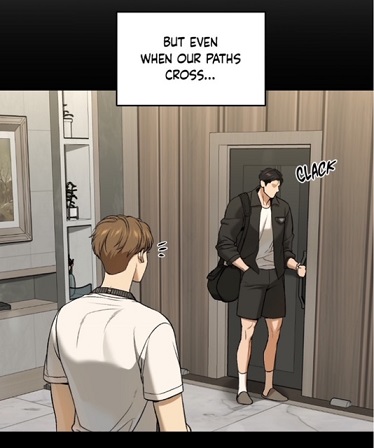 (chapter 47) and voice his true thoughts and emotions:
 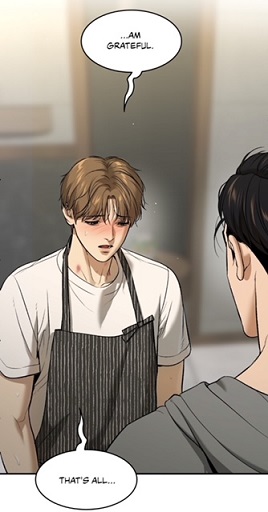 (chapter 45) He lied, when he portrayed himself as grateful. He was avoiding his gaze either. No wonder why the fighter got even more mad and threatened to fire him. Such an attitude could only increase the celebrity’s mistrust, as the latter could discern a certain dishonesty.
  (chapter 49) The latter didn’t even greet the director or acted, as if they didn’t know each other. He exposed the existence of a secret, an uncomfortable secret. Consequently, I believe that the champion could only jump to the conclusion that Kim Dan had been indeed acting behind his back, even coerced to do something.
  (chapter 51) Note that the star never came clean with the truth either.
 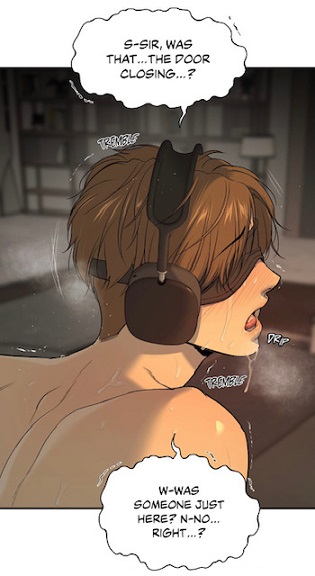 (Chapter 35) Through the doctor, the champion is encouraged to become honest to himself.
 (chapter 33) Simultaneously, it exposes that the champion has a secret, which is strongly intertwined with betrayal, love, money and deceptions. I couldn’t help myself thinking of “blackmail”. Kim Dan had been coerced to do something, as the director was holding something against him. Hence we have the question: “what have you done?”. Remember how the actor chose to approach the angel.
 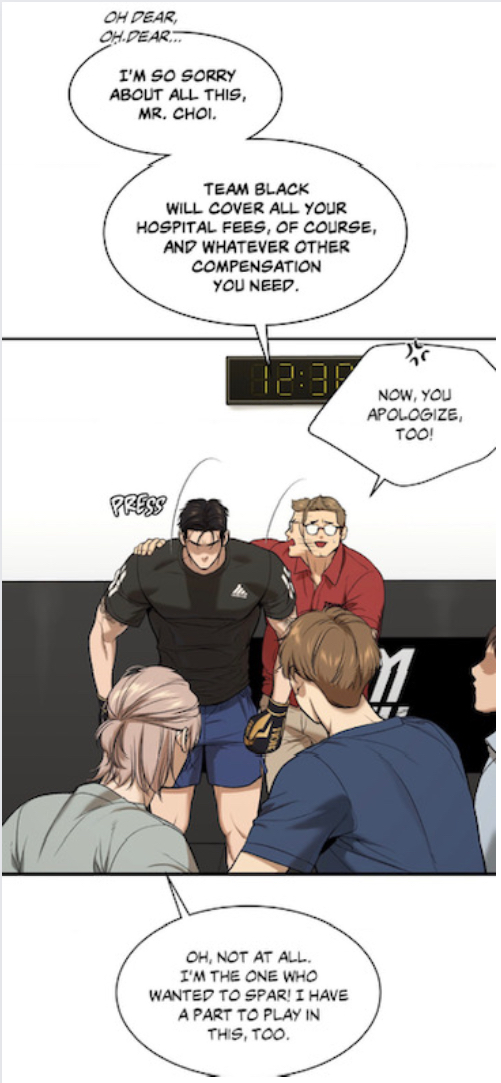 (chapter 31) He tricked his boss by faking an injury. He put the gym under pressure, as this incident could be leaked to the outside. The whole situation reminded me of blackmail. If he did not follow his request, there could be a scandal. That’s the reason why I believe that the champion’s past is linked to blackmail as well. How is it possible? It is because of the game “truth or dare”! The latter is strongly intertwined with divulging information and crossing the line!! To sum up, this game embodies trauma, secret, leaking information, trust and overstepping a boundary or rule. This observation brings me to my next point.
 (chapter 9) And what did happen after they left the restaurant? The champion discovered the truth:
  (chapter 10)
 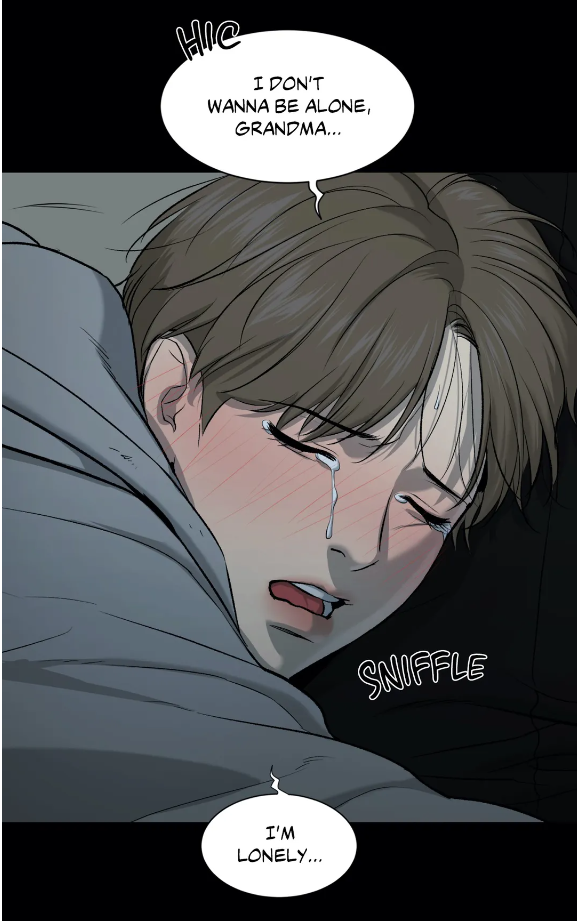 (chapter 10) Kim Dan was terribly poor, but he was also on his own, missing his grandmother.
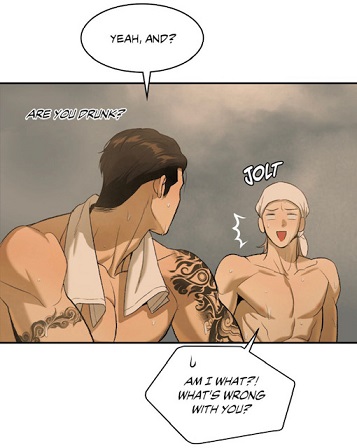 (chapter 34) “Are you drunk?” With this question, the protagonist revealed something about himself. He associates dating and love confession with drunkenness. He implies the existence of a lie. But a confession is strongly associated with verity and sincerity. On the other hand, for the sportsman, no one in his right mind would admit to be in love and in our case to love another man. For me, one part of the problem is that the champion is afraid of admitting his homosexuality. The latter is still a stigma in South Korean society. But there’s more to the game Truth or Dare. If you paid attention to the origin of the last quote, you will realize that this fun is linked to bullying and even hazing.
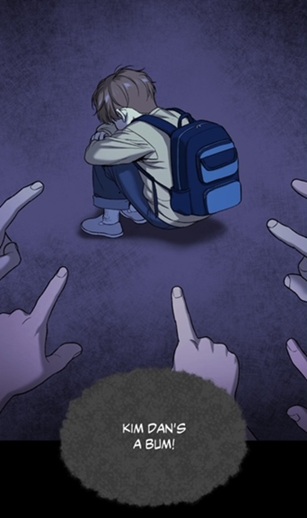 (chapter 57) There is one leader and the others are following the flow, the latter even become more proactive by making new bets and suggestions in order to ensure their own safety. As long as no one divulges the truth, the bullies are safe. But there’s more to it. Striking is that the way they coerced the champion to fight resembles to bullying too. He was manipulated with the articles, then with the advises from the lawyer and manager. Once in the States, they tried to drug him, which corresponds to a physical assault.
  (chapter 37) Finally, note that the schemers are working in teams exactly like the bullying students. Therefore I judge Park Namwook’s attitude as the teacher’s who is closing the eye to the truth. He is rather passive and puts the whole responsibility on his “boy”.
  (chapter 41) It is the champion’s choice to refuse or not the matches. The moment I associated the game with parties, peer groups and bullying, I had many revelations.
 (chapter 1) The main lead never considered her behavior as betrayal and abandonment. In fact, he never considered the crime as a betrayal from an institution.
 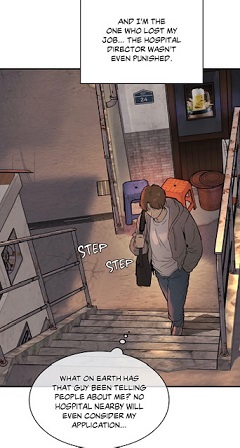 (chapter 1) He put the whole blame on the hospital director himself. He is a liar. Furthermore, through these pictures
  (chapter 47)
 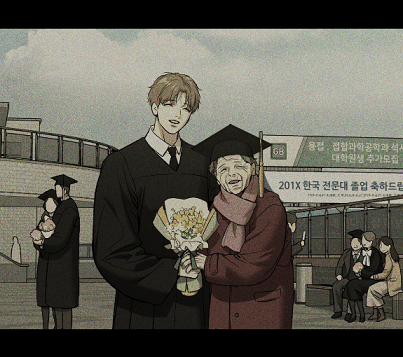 (chapter 47), Manhwalovers can see that Kim Dan was a loner. Therefore I doubt that he had friends during his college years. The only person he knew from his school was his mentor:
  (chapter 1) It is important, because it implies that Kim Dan avoided to socialize and participate in gatherings. Interesting is that in season 2, Jinx-philes discover that Kim Dan had been bullied in the past.


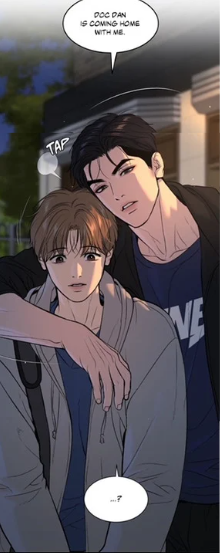

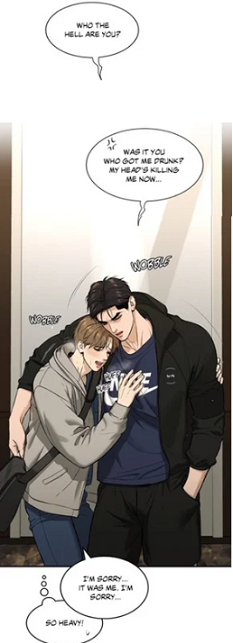
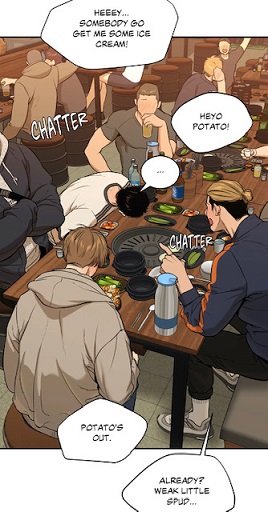 (chapter 9), yet Park Namwook made sure that the physical therapist wouldn’t be abandoned drunk. Thus he tasked his boss to bring him home. And as for Potato, it is clear that Oh Daehyun would take care of him, as he was sleeping in the dormitory next to him. In other words, no one was left behind drunk. But this scene contrasts so much to episode 43. First, no one was missing Potato. No one asked about his absence. Secondly, pay attention that the fighters invited Kim Dan to join them for another round, while they were neglecting their boss, though it was his birthday party.
 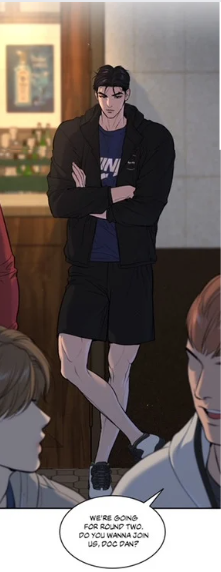 (chapter 43) Moreover, they never wondered about his physical condition. Was he drunk or not? Funny is that the intoxicated character was the one who forced Kim Dan to go home.
  (chapter 43) That’s what a friend is supposed to do.
 (chapter 35) So the auntie could keep an eye on the judo fighter, and it was only a matter of time, until his friend would return. Nevertheless, this scene is implying a certain problem: a drunken person shouldn’t be left unguarded. Thus imagine that during a party, an unconscious person is brought to a room and left there unguarded, as the friend desires to keep partying, similar to this scene:
  (chapter 37) The person could get sexually assaulted, and no one would notice it. Secondly, I would like to outline that the hazing party from the article reminded me a lot to bullying. These freshmen were humiliated, and the perpetrator excused her behavior behind traditions and social norms. So the champion could have been betrayed by a friend, as the latter would have justified his action similarly. So instead of admitting his mistake, he could have justified the incident like this: the victim was responsible for his misery, because he was at the wrong place at the wrong time. It was just his misfortune or better said his jinx. Yes, for me, the jinx is indicating that people responsible for the champion’s traumas were denying their wrongdoings.
 (chapter 3) Neither Kim Dan nor the protagonist were seen both naked in the shower room.
  (chapter 8)
  (chapter 20)
  (chapter 34) He feels uncomfortable naked around people… As soon as you connect this place to a wound, my avid readers can finally better interpret the champion’s irritation in episode 36:
  (chapter 36) Kim Dan’s entrance could be perceived as a violation, for the champion was naked. This intrusion caught him off-guard. But since his gaze was covered, his anxiety masked behind his anger was diminished. On the other hand, this led him to leave the bathtub undressed and have sex in the kitchen.
 (chapter 27) Under this new perspective, I don’t think that it is a coincidence that the champion felt the need to take a shower after meeting Baek Junmin and recalling the past.
  (chapter 49) This helped him to overcome his trauma and past wound.
  (chapter 49) Yet, keep in mind that the athlete’s wounded soul is not the result of one traumatic incident, but of many anguishes.
  (chapter 8) they dared to have sex next to Oh Daehyun and the other fighter. However, note that in all these scenes, neither the doctor nor the champion were honest. They were both lying… not only to their counter-part, but also to themselves.
  (chapter 19) That’s the reason why the argument in the locker room
  (chapter 51) doesn’t represent the final moment where both main leads opened up their heart and mind to each other. They were not truly honest to themselves and to each other. There was no water… and according to me, the spray was a pepper spray, so the champion’s ankle should have been cleaned and not simply covered. For me, both characters need to prove their trust and loyalty to each other. But they are moving in the right direction, for Joo Jaekyung divulged a huge information to Kim Dan.
  (chapter 7)
  (chapter 70) His sexual orientation was exposed in high school, his friends were behind the rumor
  (chapter 70), although we have to envision that his crush played a huge part in it. Why? It is because he didn’t want to be associated with homosexuality.
  (chapter 70) Not only he cut off ties with him, but also he made sure to isolate the main lead from other students. The worst is that this person acted, as if this ostracizing had never occurred.
  (chapter 69), as if he had done nothing wrong. For me, it shows that the traitor never grasped the significance of his actions. Hence Park Sung-Woong could forget Dong-Gyun, while the latter could never forget him at all. The result from this huge betrayal was that the cute uke decided to keep his distance from people.
  (chapter 70) He could no longer trust people, he avoided meetings. In order to outline how severe betrayal trauma can be, the Webtoonist showed us the immediate effects of betrayal trauma: physical and emotional reactions
  (chapter 70)
  (chapter 70) and the long term effects:
 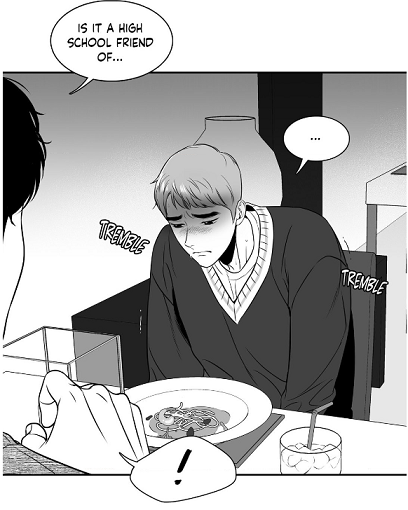 (chapter 69) he is trembling so much, he can not look at his former friend. Readers shouldn’t underestimate the issue. Betrayal trauma is so severe that it is comparable to being hit by a white truck. The pain is so great that it affects the brain functioning and as such personality.
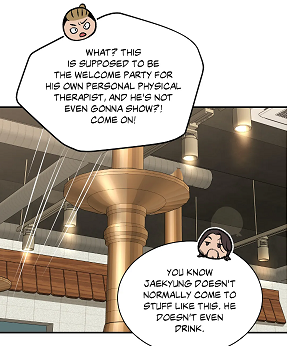 (chapter 9), trust issues
 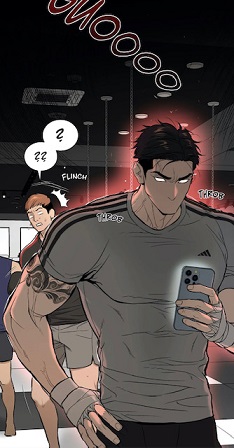 (chapter 05) Then when he stayed at home,
 (chapter 32), it was clear that the doctor’s actions were constantly on his mind. He was so bothered that he had to bring him to Heesung. He made sure that Kim Dan would forget Choi Heesung in the car.
 (chapter 49), the latter was not loved, as he didn’t reach the first place like his older brother. Then we have Interpersonal with Nam Dong-Gyun and his high school friend. However, since the rumor circulated at school, and no adults intervened, we could see it as a reference to Institutional betrayal. Finally, Mingwa presented the last type (partner) with Hweemin.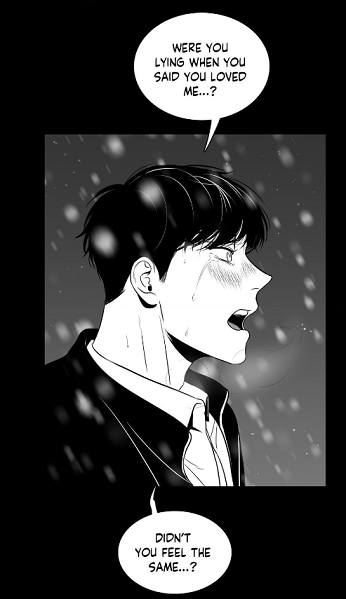
 (chapter 51) But why is betrayal trauma so severe? It is because everything appears as a lie, as an illusion. All the memories become tainted. The victim can only question his own senses and judgment. How could he not detect the lies? Since PTSD and betrayal trauma share some common points, it is not surprising that such persons come to blame themselves and develop huge self-loathing.
 (doctor Frost, chapter 139). And now, it is time to expose my latest observation:
 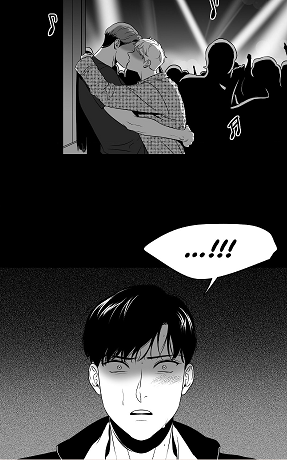 (BJ Alex, chapter 51) Ahn Jiwon caught his first lover cheating on him at a club. Interesting is that the new lover resembles a lot to Joo Jaekyung! Mingwa said that characters from BJ Alex will only appear, but Jinx is not connected to her previous work. Note that they were kissing in a public place. Moreover, the club is a location where students not only meet, but also drink alcohol together. However, once Jiwon saw Hweemin, he dragged him outside so that they could talk. In other words, the “new lover” was left behind. Thus I come to the following conclusion. Joo Jaekyung has been suffering from betrayal trauma exactly like Ahn Jiwon. He was betrayed by his guardian
 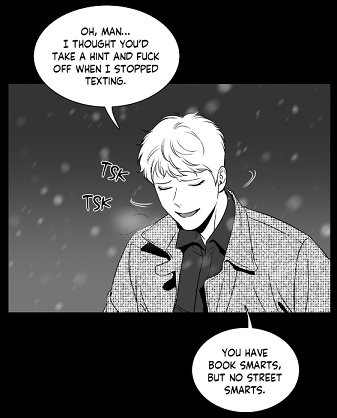 (BJ Alex, chapter 51). If this theory is true, then Mingwa would finally outline the devastating effects of Betrayal trauma on people, something she barely touched in her previous work.
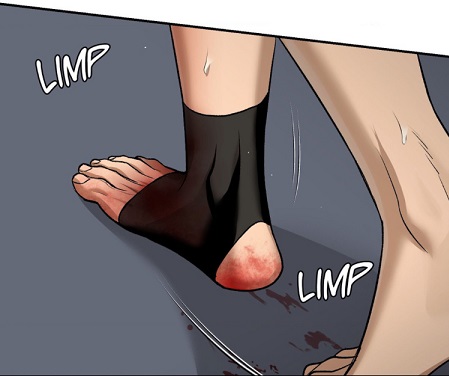 (chapter 51)
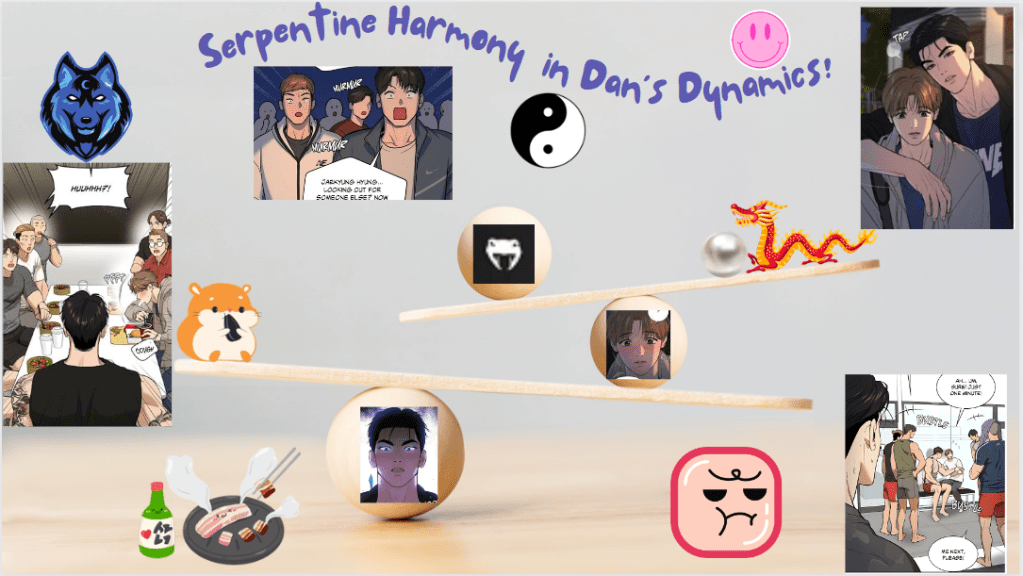
 (chapter 7) In the essay
 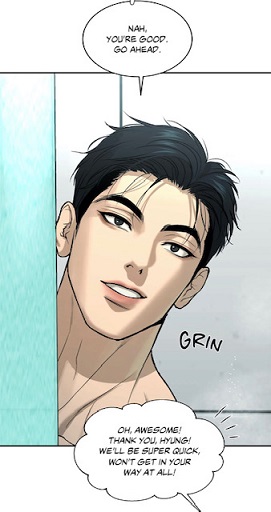 (chapter 8) Secondly, in the analysis “
 (chapter 43) As a conclusion, the physical therapist embodies “sharing” which is strongly connected to eating. Furthermore, the symbol for giving is the hand which fits Heesung’s description about Kim Dan: “Magic Touch”.
  (chapter 31). It is important to recall that the artist came to discover the angel, for the latter offered his assistance unrequested.
 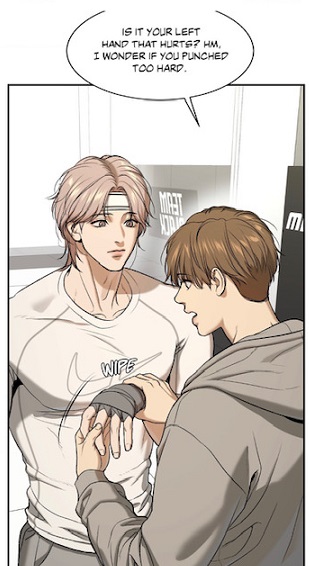 (chapter 30) As a conclusion, Joo Jaekyung is taught how to share through the doctor. This means that at some point, the champion will realize that he has to share the main lead too, if he wants to become truly happy. How so?
 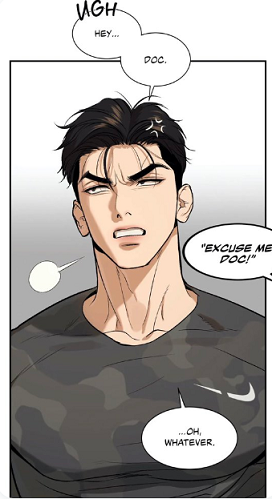 (chapter 7), self-centeredness, poor social skills
  (chapter 43), low empathy, how he is blaming others. Thus I come to the conclusion that one of the doctor’s role is to encourage the celebrity to develop empathy, as the latter is necessary for a high EM. The other task is to let him experience mistakes and learn from them. Like mentioned in the previous essay, Joo Jaekyung is Mister Perfect and Kim Dan Mister Mistake. Through the mistakes, the athlete is experiencing the positive side of errors. This brings me naturally back to “sharing” which is also a synonym for compassion and love.
 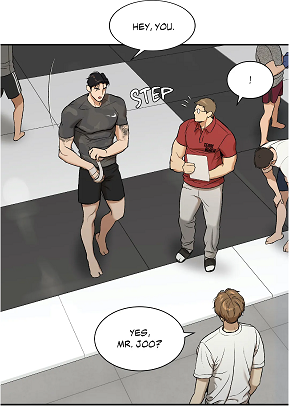 (chapter 7) He didn’t know Kim Dan at all. Thus he utilized the contract as reminder
  (chapter 8), as he felt that he had no other tool to keep his partner by his side. In addition, in order to control his jealousy, he always employed the same method: SEX!!
 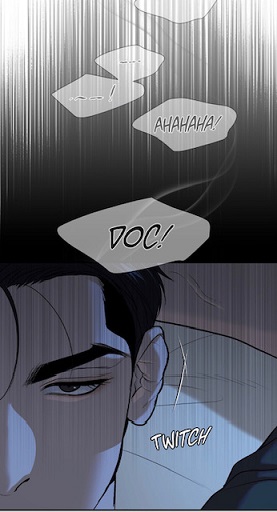 (chapter 37) He was envious that they were the source of Kim Dan’s happiness, whereas he was not. Finally, when the athlete confronted them, the doctor sided with them.
  (chapter 37) In other words, sharing happiness is triggering his jealousy.
 (chapter 22) Each time, the star put an end to this happy mood. In the break room, Joo Jaekyung threatened them, because he considered their suggestions as a threat. Their comments imply that he would have to share Kim Dan, if they came to the penthouse. It looks like the celebrity is in reality jealous of happy people. It was, as if he was going after “happiness and rest”. Therefore it is not surprising that he accepted the next fight.
  (chapter 27) and smiles are an evidence that the protagonist is feeling more and more comfortable around Kim Dan.
  (chapter 41) Yet, he was still crossing his arms while talking to the physical therapist. This shows that he has not completely lowered his guard yet. Finally, Manhwaworms shouldn’t overlook the doctor’s drunken confession accompanied with kisses and embraces.
 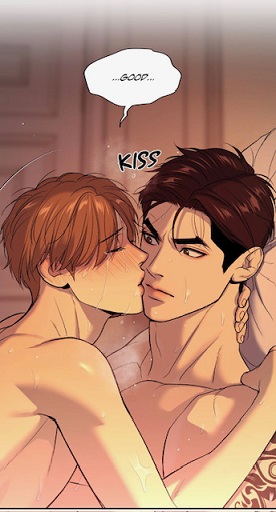 (chapter 39) Consequently, I could observe that the athlete is gradually capable to manage his jealousy, the longer he is living with the main lead. Simultaneously, I believe that the recent transformation of the physical therapist (exhaustion, skipping dinners) incited Joo Jaekyung to observe his lover and meditate.
  (chapter 43) However, I would like to outline that in this scene, he didn’t feel jealous, as Kim Dan was excluded. Hence he had no reason to claim the doctor as his. As you can see, the star’s jealousy was the trigger to change his behavior in front of the members. Thus I come to the deduction that we were witnessing the positive aspect of “jealousy”. He was not questioning the doctor’s integrity and trust. Therefore it is no coincidence that contrary to episode 7, 9, 22 and 37, he didn’t look grumpy, when he stated that Doc Dan is coming with him.
 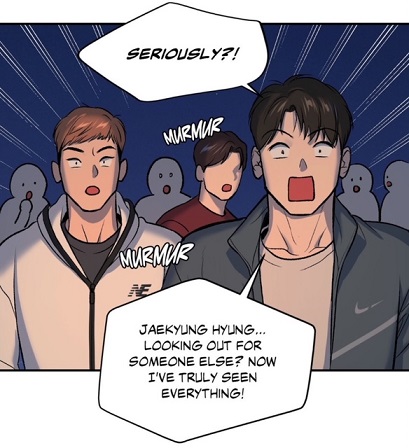 (chapter 43) It was seen as a miracle that Joo Jaekyung was showing such a care for someone. Kim Changmin, as a representative of Team Black, was not at all envious, because they are used to sharing (dinner, dormitories, etc). The boxer felt that he just witnessed a wonder. It is important, because through this scene, we have an explanation for their passivity in the States. They thought that the athlete didn’t really care for Kim Dan.
 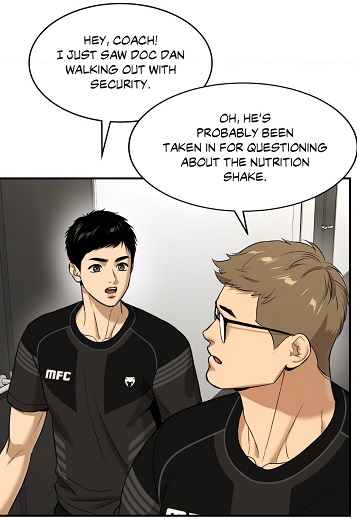 (chapter 40) The champion has always hidden his care for Kim Dan in front of Park Namwook and the others. Don’t forget that the athlete was even particularly rude towards the main figure before the match.
  (chapter 37) I could also include the scene with the new jacket.
  (chapter 36) At no moment, Oh Daehyun and the others could detect the main lead’s jealousy. That’s how it dawned on me why Kim Dan was not informed about the surprise birthday party.
  (chapter 43) He was as astonished as Joo Jaekyung. I deduce that they desired to protect him, in case the celebrity would react so negatively.
  (chapter 43) Since the athlete had been so impolite and rude towards the doctor in front of Oh Daehyun and the other members on so many occasions (7, 9,
  11, 36, 37), they imagined that Joo Jaekyung was treating him the same way than them: if he was not rough, then he was indifferent.
  (chapter 22) When he announced to the staff that Kim Dan was cooking for him, his facial expression and words are indicating that this is no big deal! He was not smiling and voicing his admiration for doc Dan. He created the illusion that the physical therapist was just living at the penthouse for the celebrity’s comfort. It was to do his job and nothing more. But this was only partially true. That’s the reason why I come to the assumption that this miracle in episode 43 will change the dynamics at the gym. Kim Changmin, Oh Daehyun and the others know now that the celebrity not only cares for the doctor, but also has become his friend. Thus they could seek Kim Dan’s closeness in order to get his advices and assistance.
 (chapter 43) So he never took the doctor’s choice into consideration. Although Joo Jaekyung is no longer dragging the doctor like in the beginning of the story, he is not truly respecting Kim Dan’s decisions. But how did this rivalry between Joo Jaekyung and his team start?
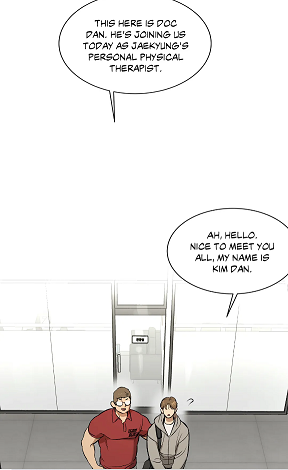 (chapter 7) He occupies a special position, for he is only working for the alpha as doctor. But note that doc Dan crossed the line, the moment he started taking care of Kim Changmin’s problematic shoulder.
  (chapter 7) By treating him, he acted, as if he was the physical therapist of Team Black. Secondly, observe how he got introduced to Team Black.
  (chapter 7) Thus I deduce that Kim Dan still needs to find his own place at the gym. This can only generate tension. Moreover, it dawned on me, neither the champion nor coach Jeon Yosep nor Park Namwook recognized the consequences of his arrival at the gym.
  (chapter 36) After that event, they learned their lesson. However, note that the champion refused that the physical therapist would follow Oh Daehyun and the others to their fight.
  (chapter 23) On the one hand, he was reminding his companion that he was only working for him, on the other hand, the uniform and the treatment from the members were giving the impression that he was also part of Team Black.
  (chapter 23) That’s how he discovered the ritual with high five!! This is something he could share with his lover! By using this gesture, they would not only become closer, but the gap between the fighters and Joo Jaekyung would be reduced. On the other hand, by hindering Kim Dan to follow the group, Joo Jaekyung was hindering the main lead to do his job. This shows as well that they are slowly developing a new routine, but it is not fully deployed. The doctor is bringing the real changes due to his special but unclear position.
 (chapter 36). Moreover, by mopping the floor, he acted like an errand boy, as if he was the lowest member. I doubt that he got consulted for the next fight too.
 (chapter 1) This indicates that the doctor has not the mind-set of an entrepreneur and free-lancer. He allowed Choi Heesung and Joo Jaekyung to determine his work.
  (chapter 31)
  (chapter 32) And now, you comprehend why Kim Dan chose to become a courier
  (chapter 42) and didn’t look for new patients. He needs a role model as entrepreneur and doctor. In my eyes, that’s where Cheolmin comes in. The latter should become Kim Dan’s mentor. Moreover, I would like to outline that by intervening in the doctor’s life and career, the champion was blurring more and more the boundary between private life and profession.
 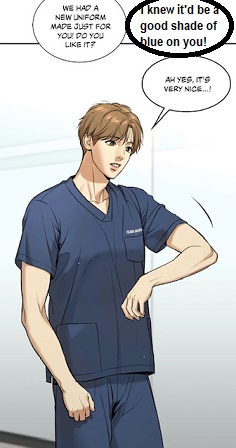 (chapter 9) and the welcome elixir.
  (chapter 9). But like pointed out above, he is actually just his private physical therapist. For Kim Dan, the famous athlete is just a VIP client.
  (chapter 25) It is relevant, because the doctor is not technically involved with the other members. He is attached to them, because they are very nice to him.
 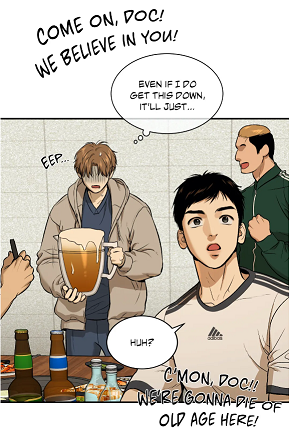 (chapter 9) There exists no contract between them either. Their relationship is simply based on the goodness from the characters. And now, you comprehend why the champion had to come to this welcome party. It is because he feared that the doctor would feel closer to them than to him. His money was already competing with the heart from the fighters. Is it a coincidence that the champion felt the need to remind them that he was the one paying for the party?
  (chapter 9) Funny is that for his birthday party, money was no longer rivaling with the fighters. Furthermore, he was joining the table for real.
 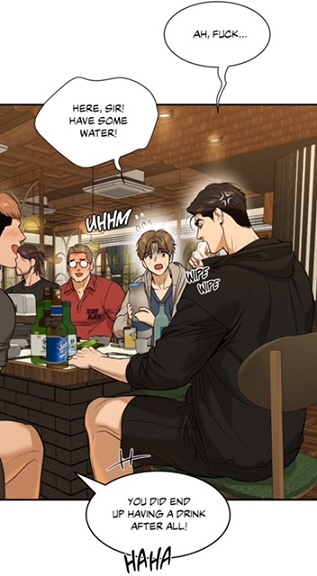 (chapter 43) To conclude, the causes for the tension between the alpha and his members are the undefine position and duties of Kim Dan.
 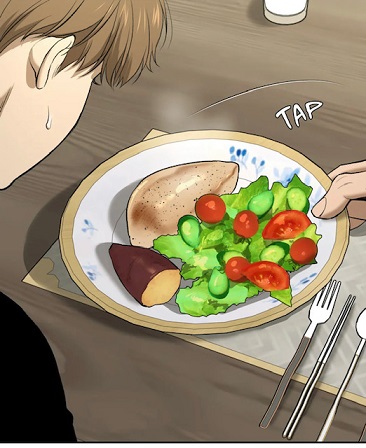 (chapter 13), Park Namwook and Oh Daehyun are representing the other extreme: junk food (too salty, greasy, too much sugar)
  (chapter 22)
  (chapter 37) or fasting!! Notice that Park Namwook preferred Kim Dan resting than eating dinner with them!
  (chapter 25) This was the positive aspect of jealousy. It is not surprising that the champion smiled during this little game.
  (chapter 26) It helped them to become closer. Striking is that none of the boxers noticed the true meaning of this sparring.
  (chapter 26) The members didn’t recognize how gentle the celebrity was towards his partner, therefore Park Namwook imagined that Kim Dan had been coerced to spare and the punch was the expression from anger and frustration against the alpha. Thus he came to misjudge the situation. That’s how Kim Dan got excluded from the ring. And this observation brings me to the following conclusion. Till episode 43, none of the fighters realized that Kim Dan was receiving a special treatment from Joo Jaekyung. They were totally oblivious of the truth, even during this incident!
  (chapter 29) A puppy needs care and protection!!
 (chapter 23) In addition, I would like to outline that Potato had been favored by his hyungs
 (chapter 36) He could become their speaker, their lawyer… a new version from this scene:
 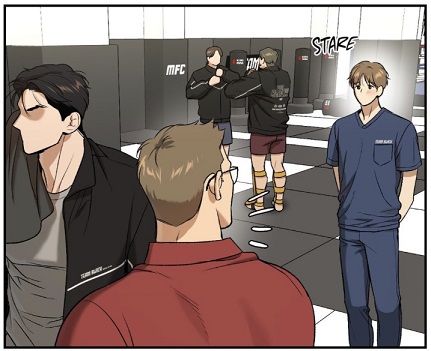 (chapter 36) or he was sitting in the office. It is not surprising that he kept his distance at the hotel, when the champion was taking his meal.
 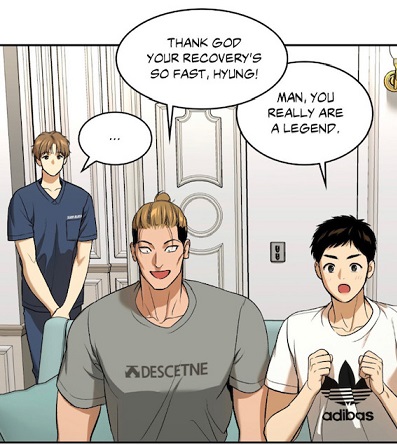 (chapter 37) But it started changing, after the athlete declared him as a part of his team.
  8chapter 40) The problem is that he met the green-haired uke which reinforced his insecurities and low self-esteem. Observe that while returning home, he was only remembering all the champion’s words
  (chapter 43) before his intervention with the MFC security guys. Hence I believe that this statement and embrace
  (chapter 43) He should bring him home. If you read the essay “
 (chapter 11), he chose to close an eye to this. Thus he remained passive.
  (chapter 43) Though the doctor’s hands had been bleeding, Kim Dan chose to treat his patient first before taking care of his own wounds. His selflessness could only catch Joo Jaekyung’s notice. Doc Dan’s benevolence can only make him realize that fame can never be a source of joy and adoration is totally different from true love and warmth.


 (chapter 37) He embodies the positive reflection of Kim Dan. The latter lacks experiences and proper guidance. Besides, when the physical therapist makes decisions
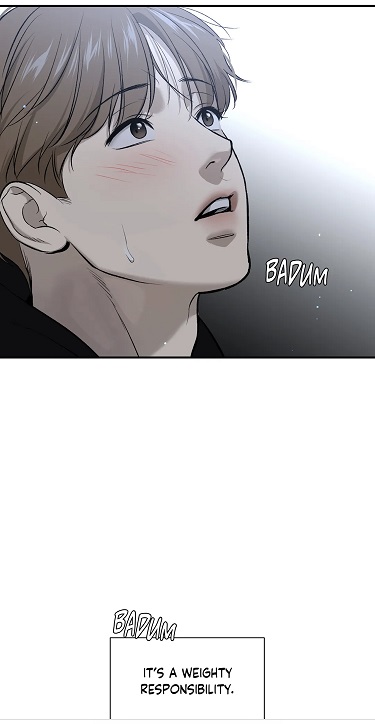 (chapter 15)
  (chapter 22),
  (chapter 37), Joo Jaekyung is now incited to listen to Oh Daehyun and Potato, and as such to trust them. He needs to figure out how the physical therapist got poisoned.
  (chapter 37)
  (chapter 37)
  (chapter 37) One might reply that he needs to respect people. In other words, he has no notion of politeness. He behaves like a tyrant outside the ring. The manhwaphiles shouldn’t forget his nickname: “Emperor”.
 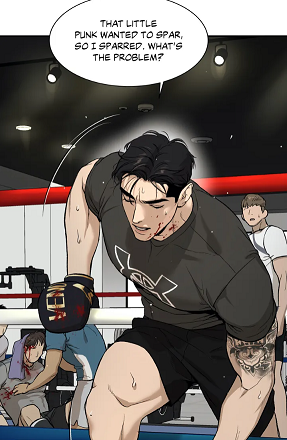 (chapter 1) Why should he restrain himself, when his life and career are always on the line? If he were to lose during the sparring, he imagined that people would question his talents or position. For him, sparring was a synonym for fighting and not playing! This explicates why he is not resting in the end.
 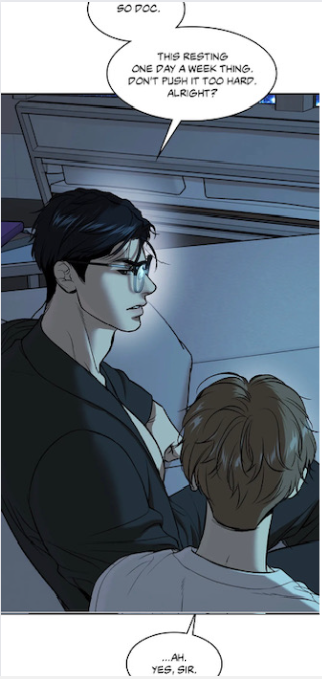 (chapter 29) Under this new light, the Manhwa lovers can comprehend why the champion refused to invite the members from Team Black to his penthouse.
  (chapter 27) This let him reconnect to his past and how he liked swimming. Moreover, we have the best example for “life is a game” in chapter 26.
  (chapter 26) And because life is like a battle for him, it is not surprising that Joo Jaekyung is not capable to say
  (chapter 37) the doctor’s reaction. He is feeling for him.
 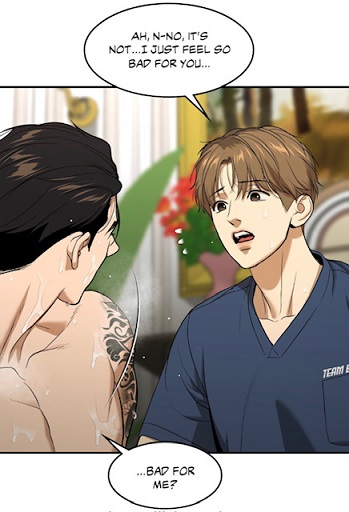 (chapter 37) Consequently, it is not surprising that Joo Jaekyung is not complimenting the doctor either. The former is not receiving encouragements and support from his hyungs. In the ring, the fighters are silent too.
  (chapter 30) However, he was violating the doctor’s privacy. This explicates why he had to find an excuse for his sudden appearance.
 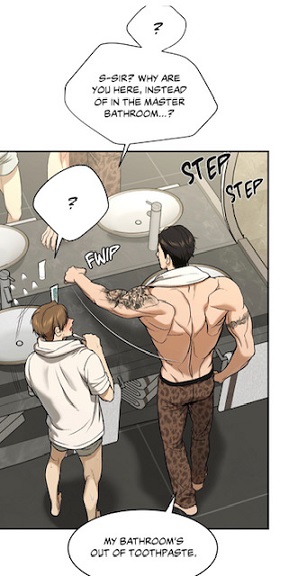 (chapter 30) And now, what is the common denominator between these two scenes? SHARING!! Observe that in episode 37 they were eating together, and they were sharing the chips. In the bathroom, Kim Dan was forced to share “his toothpaste” to his roommate. And what is the common points between all these scenes?
 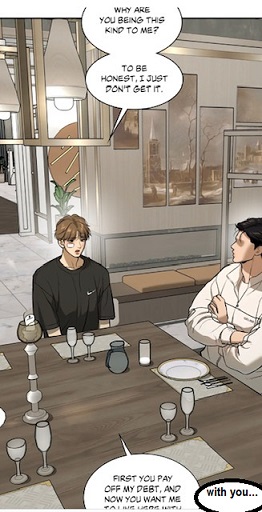 (chapter 18)
  (chapter 21)

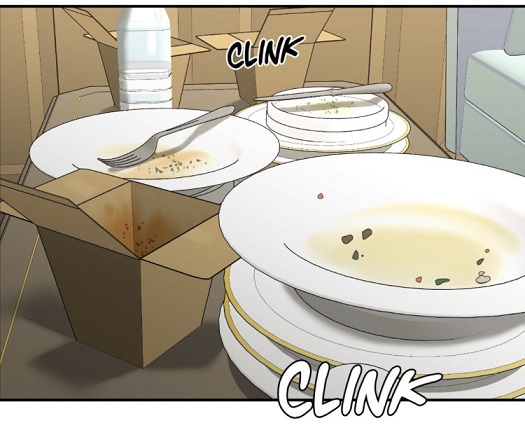 (chapter 37) The champion is never eating with others!! He is not sharing his meals to others. This signifies that he has no notion of a family dinner. This was perceptible in this scene as well.
  (chapter 9) This is important, because once again, it outlines the coaches’ flaw or bad decision. Neither Yosep nor Namwook tried to convince Joo Jaekyung to assist to the meals. I am quite certain that his abstinence
 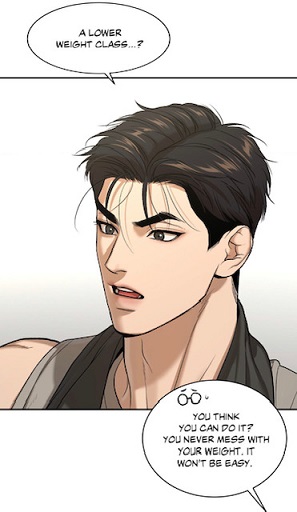 (chapter 36) were used as excuses not to intervene. I am not saying that these two hyungs had bad intentions or excluded him on purpose. It is just that they simply didn’t bother. They could say that he wouldn’t listen anyway.
  (chapter 27) So why bother to invite him? Moreover, if he were present, he would represent a source of trouble. Under this light, it becomes comprehensible why he had to use the company card for his appearance.
  (chapter 31) Thanks to Kim Dan, the fighters’ life improved.
  (chapter 7) He would even talk to them.
 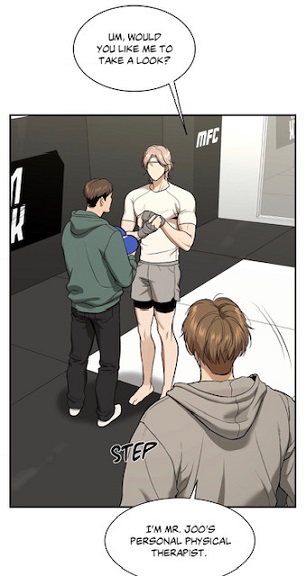 (chapter 30) As you can see, I see a strong link between sharing and communication. Why? It is because conversing is sharing thoughts.
  (chapter 29) Because the champion had shown an interest in the doctor during the day, the latter reacted the same way during the night. Spending time together is like sharing time.
  (chapter 2)
  (chapter 34), it symbolizes that he was willing to share his home to someone. This is no coincidence that later, he proposed to Kim Dan to live with him. Thus I deduce that Heesung will also become Joo Jaekyung’s real friend, as he had been invited to enter his penthouse.
  (chapter 37) which could only make him feel more excluded. But the final straw was, when he heard that Kim Dan was having fun with the others. Not only he was not sleeping like usually, but also he had decided to chat with Potato and Oh Daehyun.
  (chapter 29) He had not been seeking his company. Thus I deduce that he got envious of the chow chow and the eagle! This was the reflection of the doctor’s thoughts.
  (chapter 37) Moreover, it is important to recall that each time Kim Dan spent time with his partner, he would often fall asleep so easily or sleep for a long time.
  (chapter 12)
  (chapter 28) However, with Potato and Daehyun the physical therapist behaved differently.
  (chapter 37) As you can see, this episode exposes the lack of communication between the couple. Why? It is because both are relying on Park Nawmook.
  (chapter 21) Joo Jaekyung was gentle and well-mannered, because the grandmother was nice and polite to him. But we all know that the athlete is not a hypocrite.
  (chapter 13) Both scenes are the perfect illustrations for sharing is caring. Thus I deduce that this “family dinner” was fake
  (chapter 37) He remained silent contrary to episode 1. It is not just Park Namwook’s task to compliment him. However, as long as he doesn’t give any feedback to the insecure physical therapist, the latter won’t open up to him. Why does Kim Dan feel close to Potato and Oh Daehyun? It is because they are sharing their thoughts and emotions. But why is it so important for the champion to share the doctor? It is because through him, the doctor can get recognition and advance in his career. If he secludes him, Kim Dan is bound to make no progress. That’s the reason why I consider Joo Jaekyung’s intervention here as inappropriate.
  (chapter 31) Because he treated Kim Dan like an underling, he received the same treatment later. He was not allowed to defend himself
 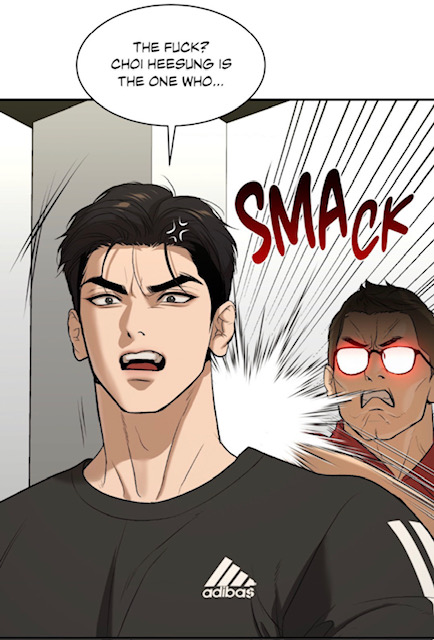 (chapter 31), just like he replied instead of the doctor! Thus I conclude that the moment he sees Kim Dan in pain, this will remind him of his lover’s human nature
 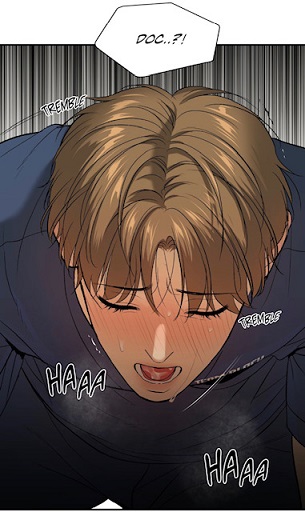 (chapter 37) and as such his vulnerability. In my eyes, this will move his heart… exactly like in that scene.
  (chapter 37) In my opinion, the coach is not involved in the conspiracy, for it looks like Mingwa has no intention to turn the members into bad guys. Nevertheless, this man was not talking to his wife, for the latter had blocked him. This raises the question. Who was he talking to? I have the feeling, that the person on the other side of the phone must have involved in the scheme in order to distract Jeong Yosep: MFC manager or the agent from the entertainment company?
  (chapter 29) Observe that here, the main lead was sleeping in the middle of the bed… he had been placed exactly like Joo Jaekyung would sleep.
 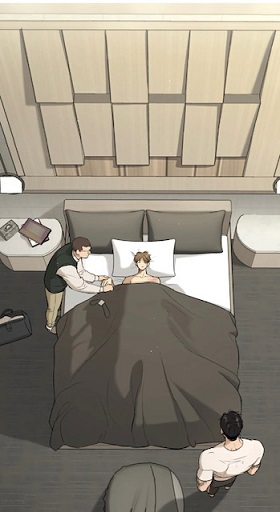 (chapter 13) That’s the reason why the champion didn’t share his bed with Kim Dan. This means that I am expecting a new version of this scene
 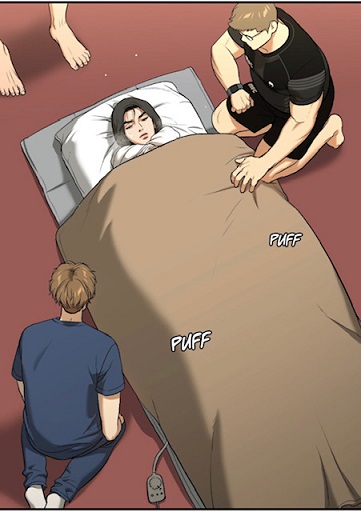 (Chapter 37) Finally, this panel
  (Chapter 27) Additionally, both were on the floor. Finally, we shouldn’t forget that Joo Jaekyung has been learning to take care of the “weak” doctor. He is already experienced how to treat him. Taking care of him in his room is no novelty. Moreover, if Kim Dan notices that the champion could fall asleep despite his presence, he could suggest to Joo Jaekyung to share a bed.
  (chapter 37) So don’t give up hope! Joo Jaekyung still has his own merits.
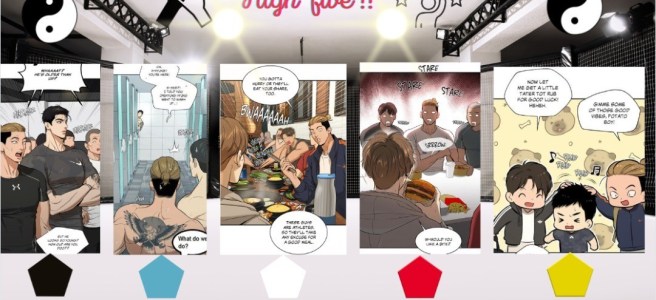


 of season 4 for this essay, though my focus is the past, and more precisely Yoon Seungho’s suffering. It is because the darkness surrounding the protagonist not only refers to his tragic youth, but also it reflects the situation of the manhwalovers. The latter are still in the dark concerning his torment. His terrible secrets have not been totally unveiled. So far, the author allowed the readers to see glimpses of his past, like f. ex. the gangrape or the suicide of his mother. But these were just small pieces of the puzzle, thus it is still impossible to have a complete picture of his martyrdom. There are many reasons for this. The main victim never testified about his suffering, he refused to open up to Baek Na-Kyum.
 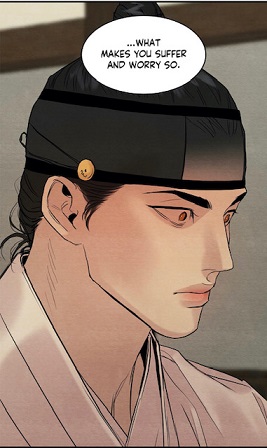 (chapter 84) Then many witnesses vanished
 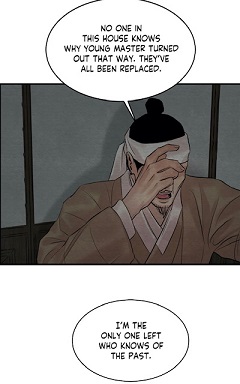 (chapter 86) or the ones alive preferred telling lies in order to hide their own wrongdoings or are simply in denial about their own culpability. Finally, the victim, the perpetrators and accomplices had no idea about the whole truth. They only know or knew certain facts, because many of them were deceived as well. What exactly happened to Yoon Seungho? How could this take place, though he belonged to one of the most powerful noble families? Now, you are probably expecting that I will give you answers to all these questions, and recreate the past. But I have to admit that it is not possible, for I don’t know the whole chronology. Consequently, I added “shadowy” in the title. To conclude, my real intention is more to offer new pieces from the riddle than create a whole new “story”. The main source for this new insight is the painter’s fate which is a reflection from the noble’s past and torment. This means that Byeonduck left traces in season 1, 2 and 3! That’s how I discovered that he had been abandoned and betrayed by everyone, kidnapped, treated as a male kisaeng, robbed, abused, raped and even gangraped at least twice, tortured and finally drugged! But like mentioned above, it is difficult to give the proper order and the persons truly involved in the crimes. On the other hand, what I can guarantee is that Yoon Seungho’s nightmare is linked to conspiracies. I came to this conclusion, because if you compare all the seasons, you will detect the presence of plots. There exists at least 3 main plots in each season, though there definitely exist more. The conspiracies are all connected to incidents.
 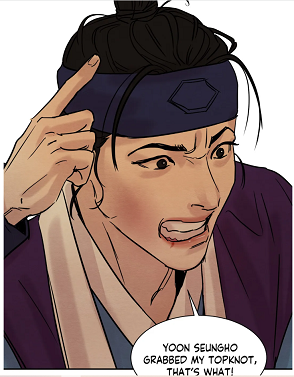 (chapter 9), so that the latter visited Lee Jihwa to arouse his jealousy. It was to push him to commit a crime so that Baek Na-Kyum would be removed from the main lead’s side. As you can see, there were 3 people involved, though the readers only saw the result.
  (chapter 12) They had the impression that the red-haired master had acted on his own. However, he had been manipulated, incited to commit a crime. But my point is not to diminish his wrongdoing, rather to expose the involvement of the schemers. Hence at the end of season 1, the author unveiled their true role and as such their identities.
  (chapter 43) However, observe that when Lee Jihwa went to the pavilion, the noble with the mole had other guests. 2 nobles left the place, as they refused to participate in a murder.
  (chapter 43) Funny is that they are now witnesses of Min’s crime. This can have repercussions in season 4. Black Heart had been the one who had suggested the assassination to Lee Jihwa. And the aristocrats were still there, when he had made this proposition.
  (chapter 19) And this is related to Kim and the gibang. Yet, the butler ruined Black Heart’s plan. To conclude, we have two main plotters in season 1, but the butler’s bad intentions were not detected, for Yoon Seungho’s bad actions were more eye-catching. People had the impression that the valet was defending the artist’s best interest. From my point of view, the number of persons involved in the plot kept increasing, as they needed more and more accomplices. The reason is that their plans didn’t work out like expected. At the end of season 3, Min involved the kisaengs in the gibang, while Kim asked the assistance of the staff, the maids
  (chapter 91) and the servants
  (chapter 97). Thus I deduce that in the past, the same must have happened. Many people were involved in the downfall of Yoon Seungho and his family. But who was the real target in the end? It is difficult to say with 100% certainty.
  (chapter 8) Thus in season 2, he came to this resolution:
 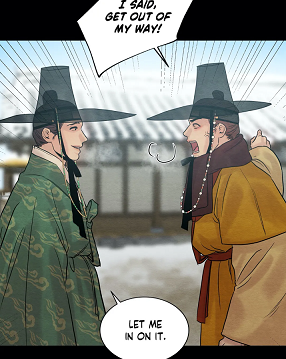 (chapter 56) He had planned to rape him before having him eliminated. This shows his inner conflict. From my point of view, the painter’s death is connected to the incident in the gibang.
  (chapter 1) Baek Na-Kyum was a witness of Min’s wrongdoing, just like the painter was a witness and victim of his crimes in the shrine. (chapter 99) One thing is sure: Min was full of greed and jealousy. He was determined to harm and ruin Yoon Seungho. Hence I come to the deduction that the real target of the conspiracy in the past was Yoon Chang-Hyeon. And his son was used against him.
  (chapter 16) This doesn’t look like a crime. However, it is one! It was done on purpose, to separate the couple. Someone had intervened in order to interrupt this session, and as such someone had been spying on them. Deok-Jae only revealed his spying activity from chapter 16 in season 2:
  (chapter 53) Yet, the one opening the door had been Kim. This gesture can be considered as trespassing and invasion of privacy, the new version of this scene.
  (chapter 16) But instead of revealing the truth, the butler sided with Lee Jihwa, and allowed him to trespass the propriety again. In my eyes, the butler thought
  (chapter 17) that Yoon Seungho would come to perceive the painter as a man consumed by lust. He imagined that he would caught them fooling around. As you can see, this ruckus was also a plot, though it doesn’t look like one. Why would the maids gossip in the courtyard?
  (chapter 18) From my point of view, the valet expected that the lord would fear people’s gaze and a scandal. Thus he would send away the painter to protect his “reputation”, but the opposite happened. Under this perspective, the manhwalovers can grasp why it is difficult to calculate accurately the number of plots and accomplices. Besides, some were naïve pawns, others not. And since I examined the first season more closely, it is necessary to analyze the vanishing of Jung In-Hun. His disappearance is strongly intertwined with Yoon Seungho’s secret. How so? The learned sir was determined to find the lord’s vulnerability and as such secret.
 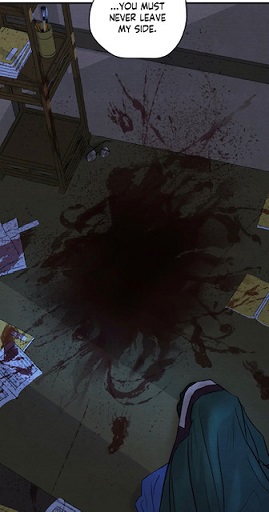 (chapter 88) Thus many readers jumped to the conclusion that the learned sir had already switched sides and was plotting against the main lead. They had his following words in their mind:
  (chapter 29) Thus many concluded that he had participated in the prank, faking his death. On the other hand, the manhwalovers believed to have seen Heena’s death!
 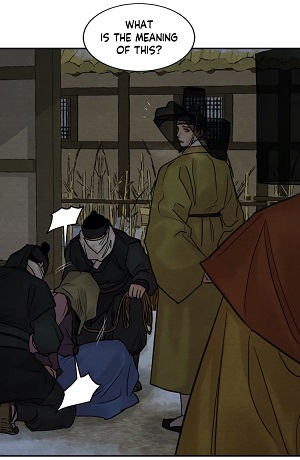 (chapter 99) However, observe that we never saw her corpse. She was still alive in this panel. I had already pointed out that her murder was actually faked. Her mouth was not covered, hence she could have screamed, but she remained silent (blank speech bubble). Secondly, she never moved her legs… contrary to Yoon Seungho’s behavior in the gibang.
  (chapter 68) That’s the reason why I came to the conclusion that
  (chapter 37) who is the king in my eyes. [For more read the essay “
 (chapter 37) Since Baek Na-Kyum was wearing a hanbok, Yoon Seung-Won thought that the person hidden under the hanbok was no commoner! Thus he called him a fellow. However, this motive is quite thin! Yet, two new details caught my attention. His visit to the “fake shaman” and his request. Notice what he told the man:
 (chapter 86) However, in reality, he was relying on the king’s help and intervention. And this confession to the “fake shaman” represents the learned sir’s karma. He had asked the painter to act like a spy
  (chapter 24), not realizing that he could be spied himself! He didn’t grasp that he exposed his weakness to the commoner: the civil service examination. Thus the man had constantly drops of sweat
 on his face and interrogated Jung In-Hun.
 (chapter 29) The girl was there to create a certain closeness. He was acting like Kim, asking why! But the stupid and arrogant learned sir thought that because the man was a commoner, he was ignorant and could be manipulated like the painter!
  (chapter 29) He thought that the low-born would buy his lie here… but in my eyes, it was the opposite. He had already perceived the learned sir’s true nature. But he acted, as if he was agreeing. In other words, the scholar fell into his own trap. He envisioned that the man was “powerless”, but he overlooked his connections. The manhwalovers can see the contradiction, for he had approached the man due to his connections! .As you can see, I am more than ever convinced that the scholar has long been murdered. He was betrayed, exactly like he had planned to abandon Yoon Seungho! The pedophile must have heard from the servant about Jung’s plan, as he had confided it to the worker!!
  (chapter 37) But this doesn’t end here.
  (chapter 37) Yoon Chang-Hyeon was portrayed as a traitor! The “fake servant” implied with his statement that there was a conspiracy, and the patriarch was involved. But in exchange to save his own skin, he had tattled on the others! He was trying to insinuate that if Jung In-Hun interacted more with the Yoons, his reputation could get tainted. He could get suspected of “treason” too, or he could get betrayed too. While the man met the learned sir during the day, the brother went to the villa in a hurry during the night.
  (chapter 36) Hence he chose a different approach: filial duty. And the brother’s observation could only corroborate the pedophile’s perception. The scholar was Yoon Seungho’s lover, but he was also a backstabber. But let’s return our attention to the “mysterious lord Song”‘s statement: Yoon Chang-Hyeon is a denunciator, not a man of honor.
  (Chapter 67) Lee Jihwa had not only been denunciated, but he had been confronted by his friend! And the traitor was right by his side. As you can see, chapter 67 was a reflection from episode 37!! These two episodes have another common denominator: the betrayer had made the following suggestion.
  (chapter 67) In exchange for his “survival”, he should help Black Heart and allow him to act on his behalf. This was the new plan. That’s how he started impersonating Lee Jihwa. That’s the reason why I come to the conclusion that in the past, the impersonation must have happened, but it took place in the beginning. Secondly, I am assuming that a traitor must have suggested to Yoon Chang-Hyeon to leave the mansion and abandon his son behind!
  (chapter 27) And who is it? For me, it is Kim acting on the pedophile’s behalf. Striking is that in episode 27, the learned sir escaped death thanks to the intervention of the old bearded domestic and Baek Na-Kyum. Thus it came to my mind that the pedophile could even claim that he had eliminated the learned sir, because Yoon Seungho had attempted himself to kill him in the past. He had acted on his behalf. And what do have all these chapters have in common? SPYING and tattling! In episode 27, the servant unveiled a part of the past,
  (chapter 27) Someone had tattled on the Yoons in the past, but the patriarch was turned into the traitor himself which the young main lead came to believe. Thus Yoon Seungho could say this to his father:
  (chapter 86) However, I am suspecting that this is not true, someone else tattled on the powerful family and made a false accusation! As you can imagine, I am inclined to think that father Lee must have been behind this! Why? It is because he can no longer do it! Thus in season 3, he approached the patriarch Yoon.
 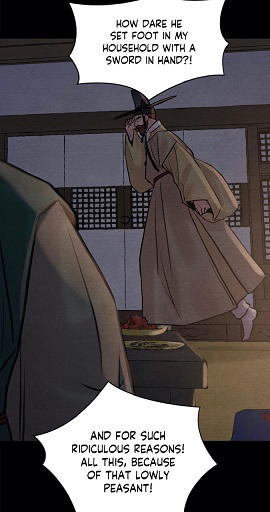 (chapter 82) If the lord Seungho had truly committed a crime, he should have reported it to the authorities. The stupid Yoon Chang-Hyeon never wondered why the elder Lee visited him during the night and asked for his assistance. Furthermore, the elder Lee had been allowed to enter the bedchamber and see the huge drawing which could have been perceived as a sign of treason. He was eyeing at the throne.
  (chapter 82) Note that the aristocrat mentioned “punishment” in this context. So maybe, he denunciated the patriarch so that the whole family would get punished. Father Lee was definitely played in this scene, hence I believe that someone had already anticipated his reactions. He would seek revenge. But this doesn’t end here. I had connected “rash departure” to “treason and spying”. And now, observe what Yoon Seungho said to his butler
  (chapter 50) He had sent Jung In-Hun away in order to get rid of him! However, because of the expression “I thought”, I am quite certain that this idea had been suggested to him by the valet! I would like to underline that in this episode, the valet was acting as a tattler!
  (chapter 50) But in order to hide his own crime, he portrayed it as a rumor (It may not be accurate”). This truly underlines the butler’s MO. He used information and turned it as gossips to hide his spying activities. The shadow… Simultaneously, he turned gossips into a verity!! This is no coincidence that in season 3, the same method was employed. Yoon Seungho was supposed to have murdered the scholar and Deok-Jae! My avid readers can sense the leitmotiv in all these episodes. RUMORS are turned into a reality, and as such a CRIME! Even here…
  (chapter 37)
 (chapter 86) But since our beloved man started living in the bedchamber, this became a reality. That’s the other reason why Yoon Seungho was encouraged to live in debauchery and not to take the civil service examination. But this only occurred, the moment the lord returned living in the mansion and not before!! Secondly, I realized that this statement about Yoon Chang-Hyeon will become a reality for the “fake servant” himself.
 (chapter 94) This means that he acted as a traitor, tattling on his own relative. Finally, observe that once confronted with brutal reality, the father did run away.
  (chapter 87) The white bearded man’s words became a reality. However, since the fake servant, the mysterious lord Song, judges the elder master Yoon as a troublemaker and hypocrite, there is no ambiguity that the elder master Yoon will get into trouble. Since he did it in the past, he can only get suspected in the present.
  (chapter 86) But the worst would be that the painter is blamed for his assassination. He did it out of resent! But this would expose the true thoughts of the schemers, the pedophile and Kim. That’s how they act, when they feel offended and bothered.
  For me, the younger brother’s biggest wrongdoings are spying, tattling and badmouthing. And the best evidence for this interpretation is this situation:
  (chapter 44) He had given the ruined painting to his father, putting the blame on his brother, well aware that the latter would get angry. He was observing his father’s reaction.
  (chapter 44) Yet, there is a difference to the past. Here, he had been fooled! He truly believed that this was his brother’s doing, whereas in truth the butler had been the one who had fooled him.
  (chapter 38) And this is important, because when the letter was given to the brother, Jung In-Hun witnessed the wrongdoing from the butler!!
  (chapter 38) And now, you know why the learned sir had to die!! He had caught the valet in the act. He had betrayed Yoon Seungho, though he didn’t realize it. The learned sir tried to discover the content of the letter, and as such was prying on his sponsor’s weakness.
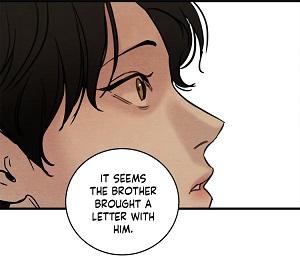 (chapter 38) Hence I come to the conclusion that KIM played a huge role in the learned sir’s death as well. I would even say that he was the one who pushed the others to have the scholar and the painter killed. Both knew about the butler’s tricks without realizing his significance.
  (chapter 37) Hence I deduce that as the story progressed, the role of the butler started changing. Now, I see him as a the main plotter, while all the others are now his pawns. We could say that the valet has gradually followed the pedophile’s path. However, there is no ambiguity that it was not the same in the past!
 (chapter 83) How can he be the same than the one from episode 37? The change of his hair color could be explained by a huge shock. But this is rather thin as a justification. Besides, now I am more inclined to think that these are two different persons, and that the main culprit is the one from episode 37. Why? It is because he smoked and utilized the same expression: “strange”.
  (chapter 37) An idiom that Yoon Seungho constantly utilized: chapter 16, chapter 21
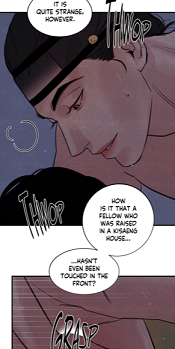 , chapter 50, chapter 71
  (chapter 71). This means that he couldn’t understand, for he has a different way of thinking. This outlines his narrow-mindedness and his tendency to plan everything. He doesn’t like surprises.
  (chapter 69) Hence I started wondering if the mysterious man with the beard was not impersonating someone, for example “lord Song” and in reality he was just a merchant. Why merchant? It is related to the shungas and the hanboks. The king can not be involved in trading directly. However, this is what Yoon Seungho told to the learned sir:
  (chapter 22) Nevertheless, the main lead could have never been involved in commerce, for he lived as a prisoner for many years. And this is what was said about the ruler:
  (chapter 76) He is not so wealthy. How come? Yoon Seungho’s fortune must have a different origin.
  (chapter 102) Min had never predicted that the young master would run to his friend and denunciate him to Yoon Seungho. However, since Black Heart had employed the assistance of servants
 (chapter 101) , the kisaengs
  (chapter 95)
  (chapter 96), the officer
  (chapter 98), No-Name, the doctor with the drugs and butler Kim, this signifies that behind the name Lee Jihwa stand many people! As you can see, the name “lord Song” doesn’t refer to one person, but many… My theory is that No-Name is the true owner of the title, but that’s how he ended up losing his home and his name! That’s the reason why I believe that in this image
  (chapter 71)
  chapter 87) and
  episode 92. The schemers in the past had definitely played with illusions and tricks. Thus I am expecting that it is now the pedophile’s turn to get fooled.
 (chapter 82)
 (chapter 36) Here, the painter was forced to take an aphrodisiac under the pretense of his health. This action was repeated in season 2
  (chapter 54) and 3.
  (chapter 100) The nobles made him smoke opium or drink the aphrodisiac. The purpose of such drugs is to obtain the painter’s submission and control his mind and reactions. Striking is that each time, the perpetrators were “punished”. Kim was insulted and his plan didn’t work out.
  (chapter 37) As for the young lords, they were evicted like commoners and later the others were even killed. As you can see, each time the poison was employed, there was a retaliation.
  (chapter 47)
 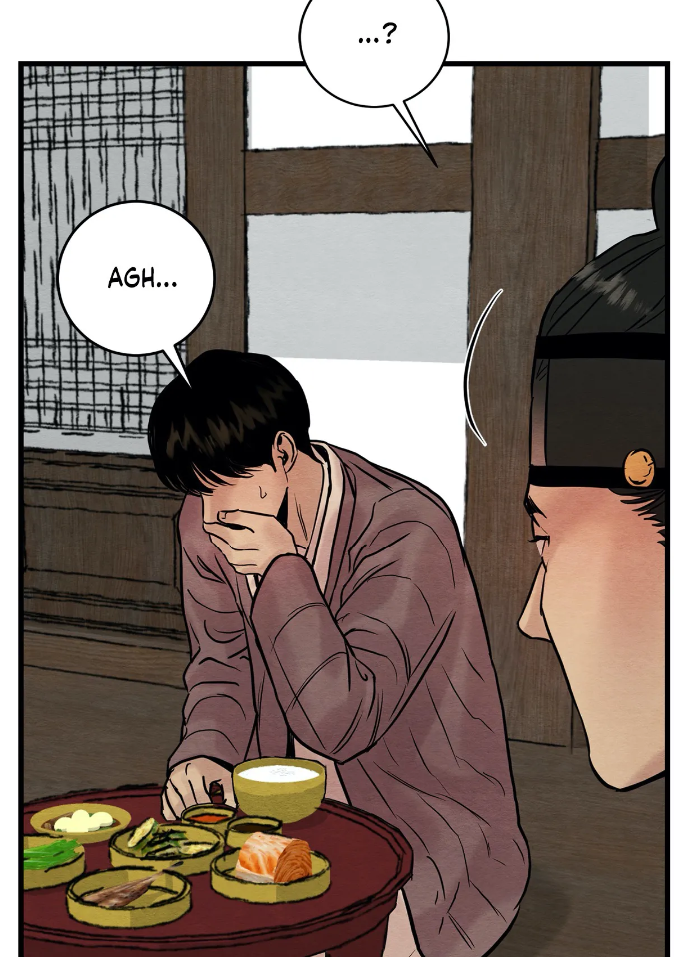 (chapter 47) If the painter had not eaten with the lord, the latter would have never noticed the incident. However, he believed the maids’ words.
  (chapter 47) Hence he never investigated the matter. But this prank represented a serious issue. This could have been judged as an attempt against the owner of the mansion.
  (chapter 47) And now look at this panel:
  (chapter 83) Yoon Seungho had refused to take the drug! The bowl reminded me of the one from chapter 47! Finally, the butler had tried to give his master the drug in season 3
  (chapter 77), but the latter had again rejected it and this twice.
 (chapter 77) Kim calls the drug “medicinal tea”, truly an euphemism. It is also possible that the real target of the poisoning was Yoon Seungho, but since he was protected by the gods, someone ended up taking the “drug”. Because he was wearing a purple hanbok, the investigator mistook his identity, a royal member. Hence the Yoons were suspected of treason. Don’t forget that during this party, there was a kisaeng by their side.
  (chapter 56), he came to adopt this title in order to hide his identity and actions. Byeonduck explained in her notes that Baek Na-Kyum had no idea about Min’s name. And this is the same for Yoon Seungho. The pedophile could continue hiding behind “lord Song”, as the latter was blamed for everything. The pedophile could divert attention from his own tricks. That’s the reason why he would never write any letter to Yoon Seungho under this name. This means that at the end, the main culprit, the king, will be perceived as the main responsible for Yoon Seungho’s torment, similar to Min’s situation, just before got killed. Though many other people were involved, Yoon Seungho was able to judge the joker’s actions correctly, he was the main mastermind behind the plots. This explicates why the gods made Yoon Seungho forget the old bearded men’s face.
  (chapter 44) This was a blessing in disguise. The moment the main lead faces the king, Yoon Seungho will be able perceive the truth. The king was behind his torment, and the butler had been his helping hand all along, the professional spy planted in his family. However, I don’t think that the monarch will admit his crimes and apologize for his wrongdoings. He will need a scapegoat, and this can only be the butler, the only one who knows the truth!
  Bebebisous33s' analyses in K-Dramaland and Manhwas