

This is where you can read the manhwa. https://www.lezhinus.com/en/comic/painter But be aware that this manhwa is a mature Yaoi, which means, it is about homosexuality with explicit scenes. If you want to read more essays, here is the link to the table of contents: https://bebebisous33analyses.wordpress.com/2020/07/04/table-of-contents-painter-of-the-night/
Announcement: I updated the essay “Sins”
In the essay “Sins”, I had pointed out the parallels between episode 40 and 75. We had a stroll through town, and both main leads had a long conversation. But there’s another aspect I had overlooked, the reason why both episodes were connected to each other. While the first one stood under the sign of “responsibility”, the other embodies “regrets”. And now, the manhwaphiles can grasp the connection. The moment a person becomes responsible, he must make choices. And if the decision leads to a disaster, then the person will come to regret his choice. This explains why Jung In-Hun stood in the center of both episodes. Thus I will examine the characters’ decisions and regrets.
1. Definition of regret
But before starting, I would like to outline the difference between remorse and regrets, though these expressions are often employed as synonyms. What distinguishes them from each other is the nature of the action and decision. When the person did something wrong and now feels some remorse, it means that the person acknowledges the wrongdoing. On the other hand, there’s an absence of judgement in regret. It’s totally neutral. The person just wished, he or she had made a different choice. This signifies that a person can regret a decision, but feel no remorse. In other words, he has no guilty conscience. This indication might seem anodyne, yet it is the opposite, for in Painter Of The Night, many characters feel regrets, but are not suffering from pangs of conscience. They don’t see their actions as a crime or a sin. This truly exposes that these characters are not reflecting on their actions, even the absence of remorse displays their ruthlessness and selfishness.
2. Jihwa’s regrets and remorse
Naturally, remorse and regret can coexist. We had a perfect example with Jihwa. First, the red-haired master expressed regret concerning the painter’s abduction.  (chapter 61) Observe that he has realized that Baek Na-Kyum’s disappearance doesn’t change the situation. Yoon Seungho will never come to return his affection. The abduction and even the murder are totally pointless. Yet, while confessing to his “priest”, he doesn’t acknowledge the wrongdoing perpetrated against the artist, for all his thoughts are revolving around his love for Yoon Seungho. He doesn’t see the pain afflicted to Baek Na-Kyum.
He only feels remorse, when it comes to his childhood friend.  (chapter 61) For the first time, he is admitting his sins. He has always hurt his friend (the letter, the ruined painting, the topknot incident
 , chapter 59), that’s why the main lead could never reciprocate the feelings. And now, you understand why the young master Lee said this:
 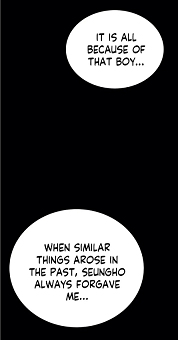 (chapter 59) Since Yoon Seungho would always overlook his wrongdoings, the latter never felt the urge to reflect on his actions. Why should he feel regret or even remorse, for their relationship never changed? But with the painter everything changed. The noble would no longer close an eye to Jihwa’s sins.
Under this new light, the manhwaphiles can grasp why Jihwa made the following reproach to his friend.  (chapter 59) Lee Jihwa used the name of lord Song on purpose, he knew definitely that this would scare and wound Yoon Seungho. I am even thinking that he imagined Yoon Seungho would behave like in the past, refusing to leave his mansion. Since I interpreted that the lord had a flashback in episode 1, I deduce Jihwa had planned with a letter to cause a flashback in Seungho, just like he had done in the past: the topknot incident. We had two clues for this signification.
First, Yoon Seungho had also triggered a flashback in his lover Na-Kyum unconsciously, when he trapped him under the bed in episode 66. 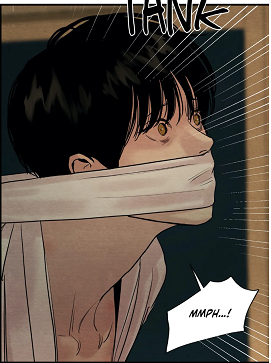 Secondly, the childhood friend had discovered the main lead’s weakness
  (chapter 59). In this panel, Yoon Seungho has a flashback. Thus, Jihwa used this to his advantage, when he was displeased with the protagonist. Nevertheless, I suspect that Lee Jihwa was not truly responsible for the topknot incident, for he had been incited by Min’s words. Yet, instead of regretting his actions, the second lead preferred putting the whole blame on the victim, which often happens with perpetrators and accomplices. He didn’t want to be confronted with his terrible reflection. So back then the young lord Lee didn’t reflect on his actions, rejected his responsibility, for he didn’t want to feel guilty. Let’s not forget that the painter is just a low-born, the second lead didn’t see him as a human.
As you can imagine, Jihwa didn’t realize his wrongdoing, when he let the painter abducted. Since he was still alive, nothing had happened. But the moment Yoon Seungho barged into his room confronting him with his bad action, the other recognized that he had indeed hurt his friend again. But unfortunately, he didn’t learn the right lesson from this experience. He started regretting that the painter was alive. He had now in his mind this: if the artist vanishes, then his crime and sin will disappear. (chapter 61) Really silly regrets! As you can see, he decided to make the opposite decision. And now, you comprehend why Lee Jihwa remained silent, when he got confronted by the Joker. 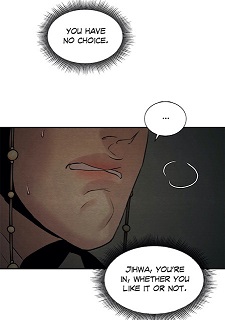 (chapter 76) Min had used his past to bind him to the second scheme. That’s his “punishment” for using the past as a way to tame his childhood friend. This truly shows Jihwa’s lack of intelligence. He never takes time to ponder over events and behaviors. He takes words and behavior as face-values. This is totally normal, for neither Yoon Seungho nor father Lee encouraged him to nurture his mind. Sure, the main lead was too hurt to take this burden. Besides, this is not his role, for he is not his guardian.
The irony is that unlike in the past, Yoon Seungho showed real leniency and forgiveness towards his friend.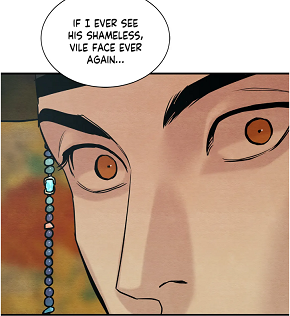 (chapter 67) He caused a commotion, but he never reported the incident to the authorities. Once again, we can detect father Lee’s stupidity, hypocrisy and superficiality. He didn’t scold or warn his son again despite the main lead’s request, allowing Min to influence his son in the bad way.
As a conclusion, as long as the red-haired aristocrat doesn’t acknowledge his sins towards Baek Na-Kyum, he will keep making mistakes and never learn his lessons.
Hence it is totally possible that Jihwa gets punished, when the second crime occurs, even if he is not participating actively. One might get upset and argue that he is innocent this time. But like I said it before, passivity and silence are indeed crimes! He doesn’t use his knowledge to stop a kidnapping and a rape, therefore it is failure to assist a person in danger. Moreover, the readers will certainly remember that The Joker’s second plan was to ask Jihwa to do nothing, while Min would impersonate him at the kisaeng house.
I can’t help myself thinking that Jihwa could obtain his friend’s forgiveness, though the former gets punished by the authorities. Let’s not forget that once the officers get notified, the system can not be stopped so easily. One thing is sure: Jihwa will learn to recognize the nature of a sin, real guilt and the importance of reflection. He needs to focus on education, exactly like Baek Na-Kyum. The only difference is that the latter never had the access to books and to a real good teacher. But let’s stop here with the predictions.
3. The priest’s sins
So the moment the young master Lee expressed his remorse in front of the criminal, the latter changed into a priest receiving a confession. Since the latter is an assassin or thief, he embodies sins and guilt. That’s why he could only become Jihwa’s mirror. The former definitely dirtied his own hands by accepting requests from nobles, while Jihwa accepted to “soil” his hands for Min’s sake by hiring No-Name. The “butcher” will teach to Jihwa the true meaning of guilt and sins. In addition, he shows him the ugly side from aristocrats through their actions. (chapter 61)
Naturally, I believe that No-Name is not different from Jihwa, putting the blame on others and not recognize his own culpability. He puts the blame on the aristocrats, as they are the masterminds behind the crimes. That’s the reason why he showed pity towars Baek Na-Kyum. 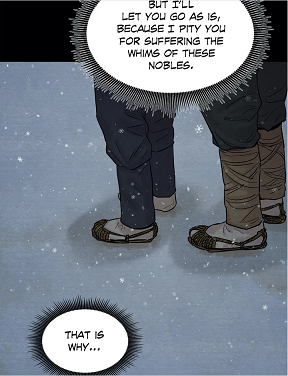 (chapter 66) With these words, he expressed a certain remorse linked to pity, yet it was limited, for he viewed the nobles as the culprits. He never included himself in the reproach, he even showed himself in a good light (“I’ll let you go”). According to him, he was benevolent and generous. But he contradicted himself, as he threatened his prey.
 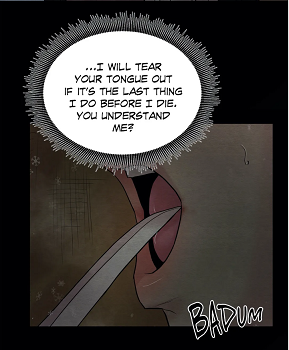 (chapter 66) Moreover, there’s no ambiguity, the painter didn’t pay attention to this confession. The Joker wanted his victim to remember his threat, thus Na-Kyum could only forget the helping hand’s “good heart”. This explicates why the painter got so frightened that he even got a nightmare, he kept remembering the mask of the Joker.
 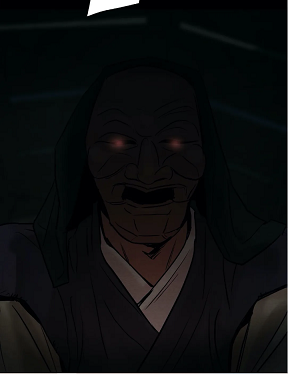 (chapter 61) As a reminder: Baek Na-Kyum never saw Nameless’ face. This image is related to Jihwa at the tavern.
 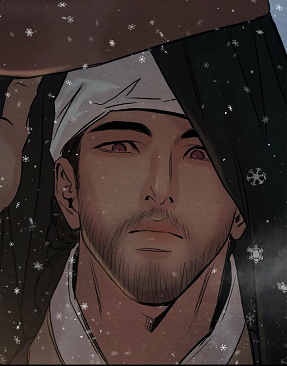 (chapter 59) His pity for the noble Jihwa was stronger than for Baek Na-Kyum’s, hence he didn’t see the negative side of his last actions. In his mind, he had truly showed his good heart! But the painter let him see in chapter 76 the real impact of his so-called “good heart”.
The latter got a flashback because of the mask and the clothes. Baek Na-Kyum noticed the mask and the colors (purple/beige), visible in the nightmare. Nonetheless, even if the aristocrats are schemers, the assistants are by no mean pure and innocent. They are accomplices, and their silence is one of the reasons why the lords are not punished. In addition, without helping hands, the nobles wouldn’t be able to commit so many wrongdoings easily, for they would be forced to witness the consequences of their own actions. (chapter 61) They might feel remorse. Jihwa got so horrified by the brutality, he had to vomit. As you can see, both second leads have a similar attitude in the beginning. This explicates why neither Jihwa nor the Joker recognized the real nature of their wrongdoing, when they took away the artist.
Yet, the incident in town served as an eye-opener for the Joker. 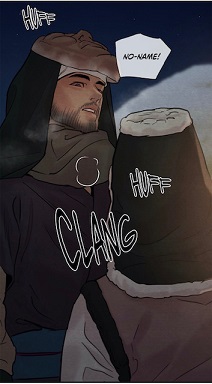 (chapter 76) The latter could realize that his action had affected Baek Na-Kyum. He definitely sensed that the artist had a panic attack and he couldn’t act, as if nothing had happened. This explicates why he kept looking at his previous target.
 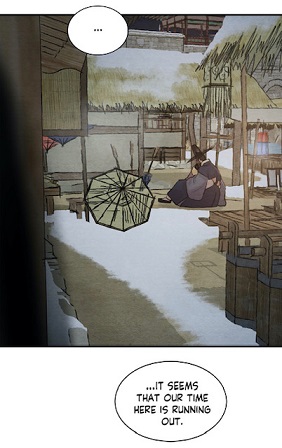 (chapter 76) He could see with his own eyes that both main characters had an affection for each other. Consequently, I deduce that he made the opposite decision from Jihwa. The low-born recognized his sin and guilt. This is the other reason why first he rejects Min’s suggestion
  and even gets infuriated
  (chapter 76), when he gets threatened by Min. He won’t act, as if nothing happened. In fact, now he has every reason to get involved again, though he is refusing the participation. He is well aware that he could get framed. Min already warned him.
 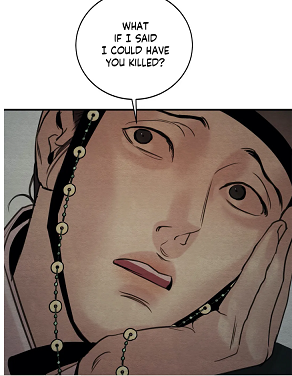 (chapter 76) That’s why exactly like in the beginning of the second season, he will remain passive by monitoring the nobles’ moves. He will definitely use other channels to get updated. And one more time, I am confirming my prediction that Nameless will play a key-role in Min’s defeat. He will definitely help the two protagonists and even Jihwa indirectly by confronting him with his true image.
As you see, I judge Nameless in a better light, though he’s a murderer. He is slowly recognizing that this world is not black and white. His actions are truly condemnable, but I have the impression, he will become Yoon Seungho’s hand of justice. As long as The Joker supports a crime, he is not blameless. His courage, patience and intelligence are his strengths, hence he was able to make the right decision in episode 76. He was no longer willing to dirty his hands for others. Hence I connect him to “pitiful regrets”.
4. Baek Na-Kyum’s regrets
In episode 75, the painter expressed many regrets.
4. 1. The guilty Yoon Seungho and Heena
One of them is that he regretted his decision to stay by the lord’s side. 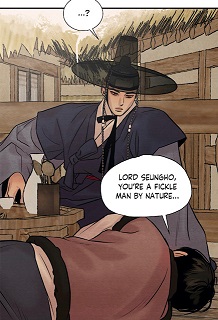 Remember that in chapter 68, he announced to his sister that he wouldn’t follow her. This could only upset his noona, hence she said this:
  (chapter 65) She implied that her brother would come to regret his choice, as he had not realized that he was pressured and it was a rushed decision. She instigated fear in her brother letting him know that such a “love” is just a trivial and temporary emotion. Since the lord had changed, exactly like his noona had predicted, the painter was starting regretting his choice, for he was getting more and more swayed by the noble’s good and kind behavior, while the other had a different evolution: he would love him less and lose his interest for him. The painter was interpreting the inexistence of love sessions as a sign of disinterest from Yoon Seungho, for the latter had always expressed his love through sex. The artist feared a change of heart from his lover. Hence the former felt awful, while in reality he was responsible for his own misery. He just needed to approach the lord himself, as the latter had already declared that he would view Baek Na-Kyum as a lord. But notice that though he was regretting, he put the blame on his lover. He didn’t want to assume the responsibility of his choice, he preferred blaming his companion. Since he had refused to listen to his “mother”, he needed to find someone else for his wrong decision.
Yet, we all know that in chapter 69, Yoon Seungho had planned to let him go, visible thanks to this image:  This was a new version of this situation:
 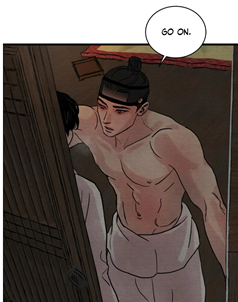 (chapter 34) The problem is that in episode 69, Yoon Seungho never let his companion know. He didn’t even show it by opening the door for him.
But the low-born’s reaction to make Yoon Seungho into the guilty one is normal, because the young man was actually imitating Heena. When the latter met her surrogate son, she put the whole blame on her brother.  (chapter 68) He is now in this situation, because he didn’t come back to the kisaeng house and he didn’t write to her. When the artist dismisses her reproach, he was just following her request, she diverts his attention by saying:
 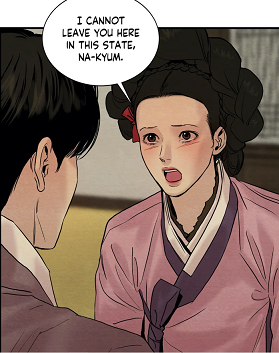 (chapter 68) With these words, she implies that that this is not the time for regret. They have more urgent matters. Because she worries so much for him, they should quickly leave the mansion. And note, at no moment she expresses regret, when she sent him away from the kisaeng house. The absence of regret and remorse from Heena is palpable in this panel too:
 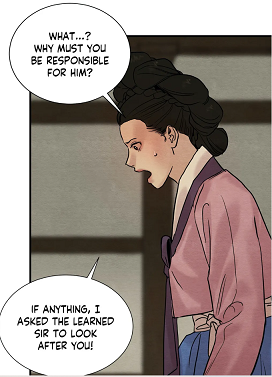 Here, she makes an allusion that if anything, Jung In-Hun is accountable for that situation, for he was supposed to look after him. As a conclusion, the head-kisaeng has never regretted her decision. She even had not the impression that she had done something wrong towards her son. Let’s not forget that she never contacted him herself during their separation and this for a long time (more than 15 months). This means, she doesn’t view herself as a sinner. Her remorseless and regretless attitude really exposes her selfishness, for she is blind to the wounds she afflicted to Baek Na-Kyum: abandonment issues.
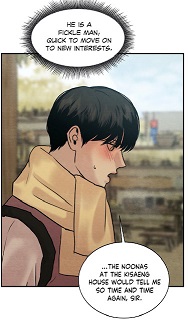
And now, you comprehend why Baek Na-Kyum copied her afterwards. Her behavior tainted on him. Furthermore, I believe that her words and attitude must have wounded her son unconsciously. He must have sensed her lack of sensitivity and selfishness deep down, explicating why he decided to put his fate into Yoon Seungho’s hands, though he feared him. With this new interpretation, it becomes understandable why the painter felt regret later. It was a combination of fears initiated by Heena’s words and his intuition, which he mistrusted now. As you can imagine, I judge his “regret” as quite silly, especially because he was contradicting himself. On the one hand, he had been pleased with the change  (chapter 74), on the other hand he judged the change as something bad: futile and superficial. So in the tavern, the artist was wishing that he had listened to his noona
  . But fortunately, his random encounter with Nameless made him realize that such thoughts were totally pointless. (For more, read the essay “Sins”) Because the lord had changed, he saved and comforted Baek Na-Kyum. He had acted the exact opposite to his attitude during and after the abduction. He rushed to his side, exactly like Baek Na-Kyum had hoped
  (chapter 60) With this incident, the painter experienced that the noble’s feelings had not changed at all, and he was indeed reliable and trustworthy. That’s why he closed his eyes at the end.
  His intuition had not misled him. This signifies that from that moment on, the painter will stick to his initial choice. He won’t leave Yoon Seungho’s side. At the same time, this incident with Nameless destroyed the little power Heena still had over her son. Now, the son is living his life as an grown-up without his mother’s interference.
4. 2. The remorseful painter and scholar
But before regretting his decision to stay in the mansion, the low-born expresses his regret concerning painting. But it only occurs, when the lord gets curious about the reason why he dropped his passion. (chapter 75) He was missing painting. Deep down he wished, he hadn’t vowed to stop painting, because he was so sad and hurt. Though he felt so miserable, he saw it as an obligation, for it was his punishment. Because of him, Jung In-Hun had failed to secure a position.
 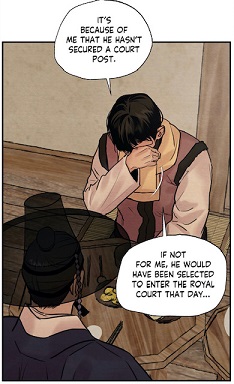 (chapter 75) This means, Baek Na-Kyum felt remorseful. He had the impression, he had done something wrong. It was, as if he had sinned, therefore losing his passion was the price he had to pay for his sin.
This topic came to the surface, because Baek Na-Kyum had started talking about his past and more precisely about his lessons revolving around sin and afterlife, reinforcing my interpretation that the kisaeng house was a place full of Christians. This truly shows that the young artist only received a religious education, because he still can neither write nor read.
In this scene, the painter looks really pitiful, for he is blaming himself entirely. The sin is so big that he accepts the scholar’s hatred towards him. 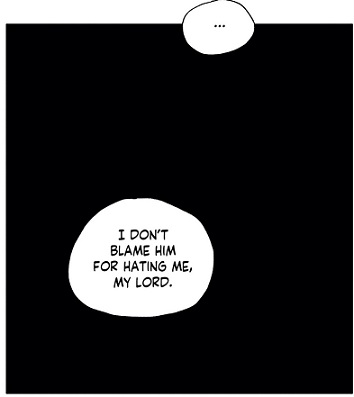 (chapter 75) This explicates why for each bad action Jung In-Hun did towards him before, the latter would still overlook the betrayal and abandonment. He accepted all of this deep down, as he felt culpable. Thus the manhwaphiles can comprehend why Jung In-Hun is still so sure about his power over the painter,
  (chapter 44) and even left him without biding goodbye, though he had hurt him so deeply before. He knows the artist’s weaknesses: his adoration for him and his so-called sin. Thus the teacher appears as remorseless. He has no regret either. He never suffered from huge pangs of conscience, when he beat him or abandoned him.
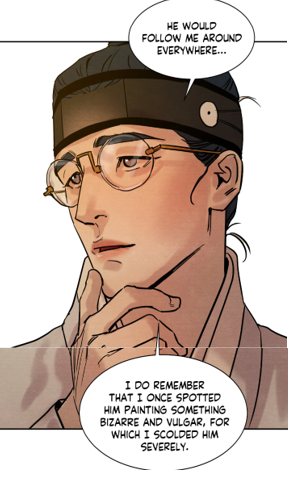 (chapter 6) His attitude resembles a lot to Heena’s.
But remember how I described this conversation in the inn. I compared it to a confession, and Yoon Seungho was a priest embodying Truth.
Back then, he just said this to Baek Na-Kyum 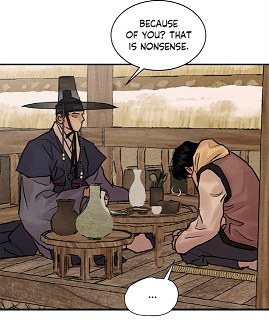 (chapter 75). He tried to free his lover from his guilty conscience. But I doubt that these words were enough for liberate the painter from his remorse. Therefore I am suspecting that in the next season, Yoon Seungho will be forced to reveal the true reason why the scholar failed to secure a high position and expose his lie to Baek Na-Kyum.
Remember how he sent a black man to dig information about the learned sir. For this story is going in circle, we have to anticipate that the protagonist will repeat this action. However, this time he could ask for the learned sir’s dirty secrets. Another possibility is that he mentions the Christian religion, for I am suspecting the scholar of using this religion to get free support from low-borns. And this attempt of separating the learned sir from the painter would definitely serve Kim’s interests, as the latter had already tried to ruin the relationship between the artist and the teacher during the first season. The butler’s initial goal was that the main lead doesn’t meddle in politics and official positions. He had to lie low in order not to attract the attention from the king.
While the painter is still attached to the scholar by his sin, the moment the truth is unveiled, the artist has no reason to feel responsible for the scholar’s fate. And now, the readers can comprehend why the artist said this to the head-kisaeng.  (chapter 68) It was not just, because he wanted to hide his true emotions and thoughts from his mother, he was still bound by his “sin”. Besides, he has other “sins” to cover up: Heena is still unaware of his illiteracy. Remember how the painter felt embarrassed. Once Baek Na-Kyum is freed from his guilty conscience, no one can stand in the way of the lovers.
Therefore I conclude that the scholar has still power over the painter, but it is just a matter of time, until the scholar’s lie is unveiled to Baek Na-Kyum. Byeonduck has already announced that Jung In-Hun’s secret and past will be revealed soon. With such a prediction, Kim will appear in a good light, as he will give the impression that he is helping his lord and the painter again. His stans will come to the deduction that I was totally wrong. However, the explanation is quite simple. Kim’s interests will be just aligned with Yoon Seungho’s. But this doesn’t mean that once the learned sir is sent away, Kim will remain passive again. In fact, this could lead the lord’s next mistake. He trusts the butler one more time, and since the butler has achieved one goal, he can let the second kidnapping occur without dirtying his hands. That way, he can become the unofficial lord of the mansion again. Since I am predicting that Jihwa will do nothing, I am expecting that the valet fakes a letter, for the butler was always connected to a fake letter.
4. 3. Painting and regrets
In chapter 75, the painter felt regretful, when he had to renounce on his passion: painting. And I started pondering about this aspect. I wondered if Heena didn’t regret herself that she allowed her son to draw such erotic pictures. 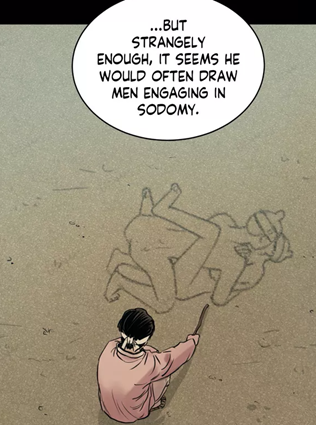 (chapter 1) We know that she neglected him, as she was too young to assume her responsibility as a mother. So maybe she regretted adopting him, hence she wanted to share her burden with others (kisaengs and the scholar). She must have resented him at some point for painting such images, as she despises sex. But then I realized one important aspect in the following panel. Heena could only see the lewd pictures, not the boy’s passion for painting. She never realized that if she had encouraged him to paint something else, he would have picked up a different topic: painting nature and landscapes.
However, since the kisaeng was overwhelmed with the task, the orphan was trapped in a kisaeng house. Besides, the young mother viewed the kisaeng house as a prison. Secondly, in this place people only come for entertainment, yet they act behind veils and closed doors. Hence he could never witness what was going on there. And if the door was open, he witnessed violence. 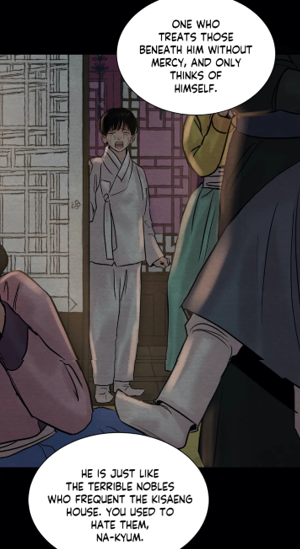 (chapter 68)
So since Baek Na-Kyum was encaged in such a house, he could only seek for topics within his reach. Hence at some point he caught two men having sex as peeping tom. This topic fascinated him so much that he started painting. But deep down, his true desire was just painting. Since the kisaeng neglected him, she couldn’t change the topic of his drawings. That’s why she blamed Baek Na-Kyum for this passion. She associated painting to erotic pictures.
What caught my attention is that Baek Na-Kyum was so impressed by the lord’s orchid. 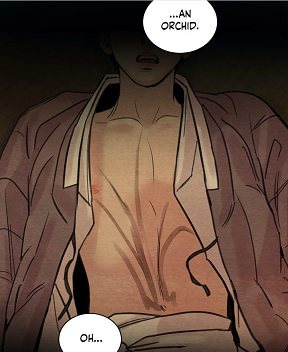 (chapter 75) Then he even created an inauguration painting with Jung In-Hun, revealing that he was inspired by his admiration and love proving that sex is not his obsession. He is just misunderstood by Heena noona. Consequently, I believe that later he will regret to have painted such an image
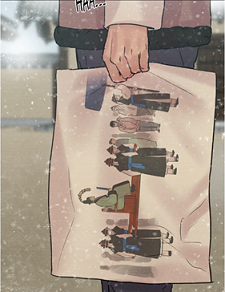 (chapter 44), as it doesn’t reflect reality. That’s why I come to the conclusion that Yoon Seungho could become the painter’s teacher, and not just his muse. As a painter himself, he will incite his companion to select other topics. Let’s not forget that the noble invited his “guest” to a hunt.
 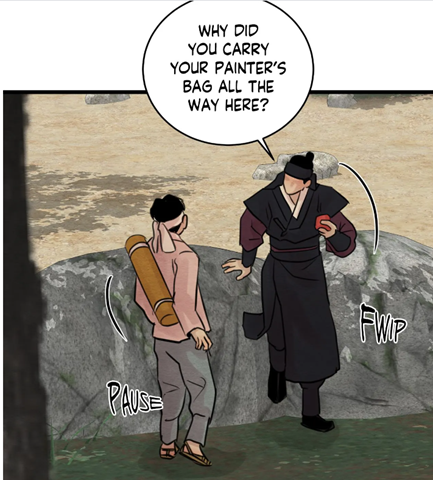 We should envisage that Yoon Seungho makes a similar request: they go outdoors so that the painter can paint a landscape.
In reality, Baek Na-Kyum became an erotic painter due to his circumstances, while his true passion was just painting. Heena never gave him the opportunity to nurture his talent, too blinded by her prejudices and belief.
But as you can imagine, though Heena and the scholar have a similar attitude, I am expecting a different evolution. The kisaeng will be confronted by her sins (not teaching her son writing and reading, misjudging the learned sir’s true nature, her abandonment and betrayal), hence she will feel immense remorse, whereas it won’t be the case for the learned sir. The latter will mostly regret his decisions by putting the blame on others. Silly regrets for Jung In-Hun, but pitiful regrets for the mother, as the latter always believed that she was acting out of love and selflessness.
Feel free to comment. If you have any suggestion for topics or manhwas, feel free to ask. If you enjoyed reading it, retweet it or push the button like. My reddit-Instagram-tumblr-twitter account is: @bebebisous33. Thanks for reading and for the support, particularly, I would like to thank all the new followers and people recommending my blog.

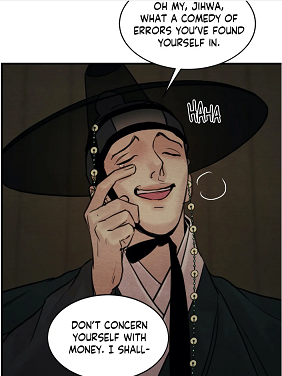 had inspired me.
 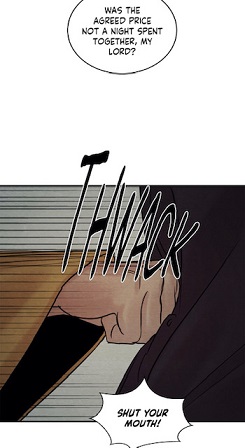 However, as you can imagine, the lord’s punch didn’t hurt the criminal at all. But since Nameless didn’t desire to embarrass his former sexual partner, he acted, as if he had been hurt. In other words, he wasn’t actually honest, when he said this: “That hurt, my lord”. (chapter 76) For the readers, the situation was transformed into a joke and comedy, exactly like Black Heart pointed out right after. Yet, for the villain, it was a serious situation: “Jihwa had fallen so deeply into sodomy that he had reached to a low-born!” Besides, Min hadn’t been able to taste himself the painter.
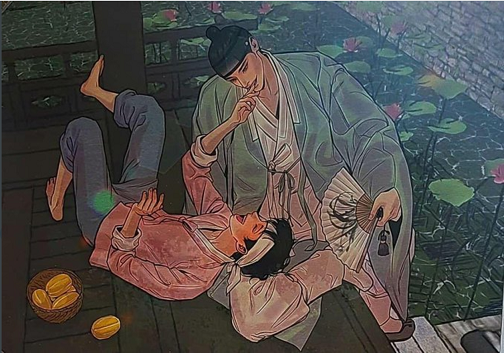 This signifies that Yoon Seungho and Nameless will make jokes and tease their partners. In this picture, the noble is biting the artist’s finger. Let’s not forget that both ukes are always crying so much, when they are sad, angry and pained. It displays that they tear up easily.
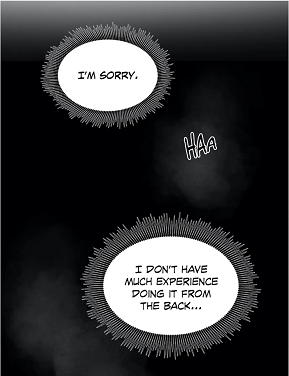 (Chapter 67) Nameless excused his roughness with his lack of experiences. But the readers are well aware that The Joker did it from the back with the kisaeng in episode 51
 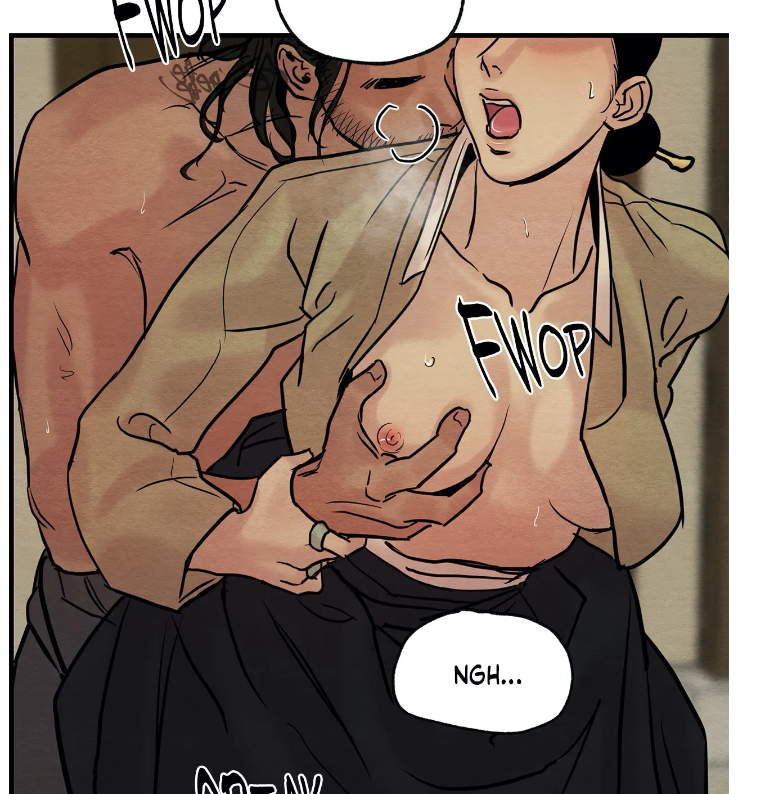 and he has quite a reputation. And when I combined the low-born’s excuse with Jihwa’s reaction, I couldn’t help myself laughing.
 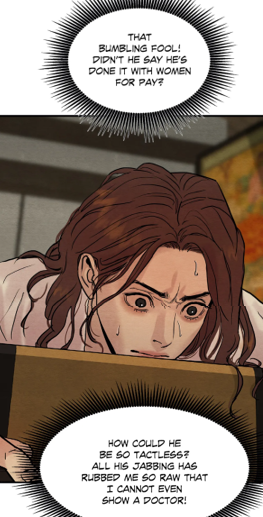 The latter was so innocent here, for he believed the man. He wasn’t able to recognize why Nameless rubbed him so raw. His description reflected the butcher’s passionate desires. The latter couldn’t restrain himself. His heart had been moved by the aristocrat’s remorse and tears. The criminal could sense his purity despite his horrible intentions. The young master imagined that for the criminal had never done it with a man before, he would be more careful. Moreover, if he had done it with women before, in his eyes, it signified, the lover was quite delicate and tender. In other words, Nameless hid his sexual desires and affection behind a false excuse. We have another indication that the low-born did more than rubbing. He left many hickeys on his sex partner, a sign of possession and passion. For the first time, Jihwa experienced what a love session is, but didn’t recognize it. 😉 Nameless is well aware that the aristocrat has no real affection for him, therefore he has to hide his true emotions behind a joke.
 , 74
, 74  and teasing his lover
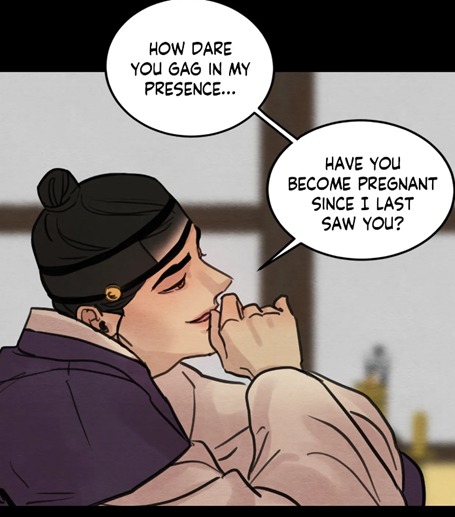 (chapter 23)
 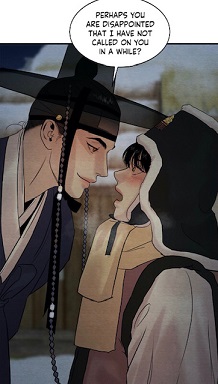 (chapter 75). Nevertheless the latter hasn’t truly recognized his master’s sense of humor due to social norms.
 Though it looks like this secret puts him back in a good mood, I noticed two details:


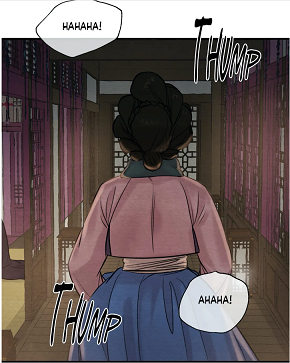
 .
. And note the contrast of the mouth. The lips are positioned in the opposite way than when he smiles. And now, you understand why Min had his eyes closed. He was hiding his true emotions from the others, as the eyes are the mirror of the soul. Yet during that night he could no longer keep his mask as the Joker.
 (chapter 66) Striking is that when the lord found Baek Na-Kyum in a terrible situation, he looked excited. In my opinion, the situation was pleasing to his eyes for two reasons. Min could see how Yoon Seungho had mistreated the painter, therefore he sensed that he could have an opportunity to approach the artist. Since Yoon Seungho was not willing to share his lover to others,. Min had only one possibility left: separate the couple. That’s why he found it entertaining. He imagined that his chances to taste the low-born had increased. This explicates why he takes pleasure in the misery of others. He is able to profit from the suffering of others. In other words, he never had to put a lot of effort. Everything was always delivered to him on a silver plate.
 (quoted from
  , (chapter 59) but never tears out of laughing.😂🤣 Therefore I came to recognize the significance of this scene. First, it divulged a lot about Black Heart’s personality, and announced a turning point in his life. At the same time, this observation gave me a new idea, which I will elaborate in the second part. Striking is that until now, I had examined the painter and Jihwa’s tears, yet I had never focused on this topic itself. Hence in this analysis, I would like to study not only the weeping of the characters, but also the absence of their tears.
 (chapter 22). The rock is a metaphor of his heart: he will remain cold-hearted. Striking is that even after the humiliation during the hunt, he never shed a tear. He was only frustrated and angry at his opponent and sponsor. His huge ego had been hurt by the main lead’s mockery, but despite his wound, he chose to look up to the sky, apparently waiting that fate/karma would punish the wealthy noble for his wrongdoing. This outlines that the learned sir still believed in his superiority. In other words, Yoon Seungho had not reduced the scholar to tears with his words, which stands in opposition to the second lead’s reactions.
 (chapter 18)
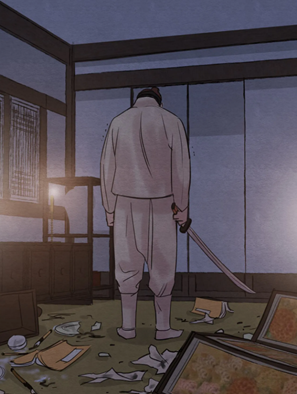 He broke out to tears. And note that in that moment he was standing with a sword in his hand, another evidence that his tears were triggered by his frustration and bruised ego mixed with sadness and anger. And now, you comprehend why he represent a negative reflection of Baek Na-Kyum, the latter embodying humbleness and modesty. However, unlike the scholar, Jihwa was slowly learning his lesson and as such changing. Since the low noble’s heart is made of stone, he will never change in my opinion.
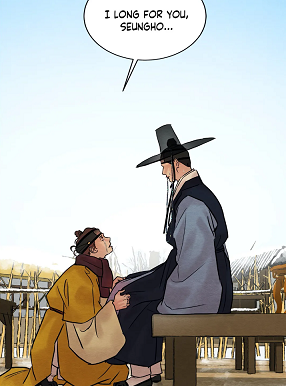 (chapter 57)
 (chapter 56). This signifies that his tears are not related to pride, but to his traumas. The lord can no longer weep due to the constant exposure to physical, mental and emotional pain. However, since he has been taught not cry in the presence of the butler, in chapter 56 it was, as if he was blinking back tears.
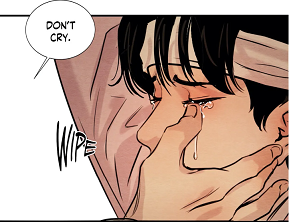 (chapter 2) And now, you can imagine which idiom I am about to bring up:
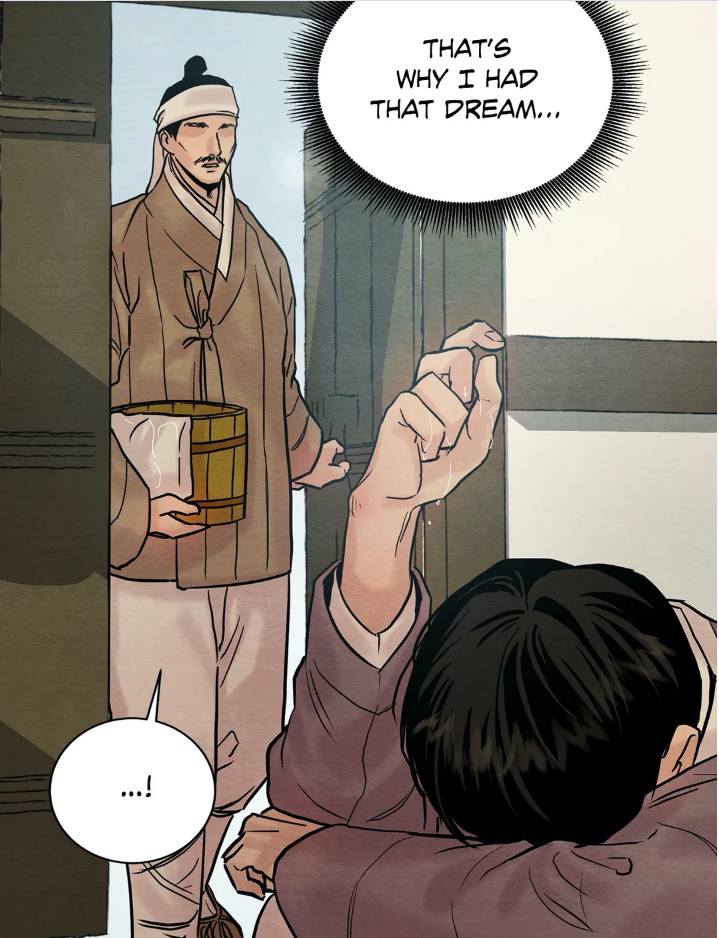 (chapter 56) I couldn’t help myself laughing, when I discovered it. I have no idea, if there’s such an expression in Korean. This slang expression comes from “to cry buckets”, which signifies that the person is like a cry baby. This new discovery made me realize that Yoon Seungho played a similar role to his admired valet than Baek Na-Kyum to his learned sir. Since the main lead was constantly facing terrible experiences, due to his cowardice and powerlessness the domestic chose not to take to heart. The more he witnessed, the more unconcerned he became. Therefore I deduce that Kim will never change his mind-set. He will prefer detachment, cowardice and blindness, because that way he is not suffering: neither regret nor heartache.
 (chapter 65), bringing lunches or announcing the arrival of a guest. And this observation made me realize that the lord started working hard, the moment he desired to woo Baek Na-Kyum. He dressed up, ordered some medicine for excessive drinking, organized two hunts, started strolling through downtown. Yet, this is no real work. And note that Jihwa behaved in a similar way, when he sensed danger from the painter. He also dressed up, had to plant a spy and trespass the mansion on different occasions. From my perspective, Yoon Seungho will start working the moment he behaves like a master. He needs more than just give orders to his staff. He has to control them and pay attention to finances. From my point of view, it is also his duty to take care of them as well, as the head of the mansion. To sum up, he has to learn how to manage the mansion. That’s why I believe that the lord’s tears will only return, the moment all the conditions are met:
 (chapter 55) He doesn’t want to be recognized, but more importantly he is determined to hide his true feelings from Nam Dong-Gyun, for he believes that he has no chance to be his lover again. Moreover, during the Corona pandemic, people are requested to wear a mask in order to stop the contamination.
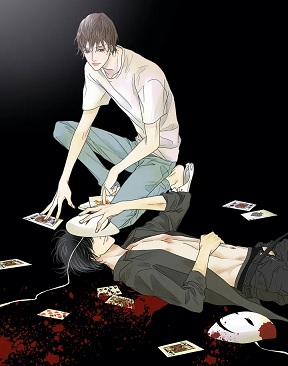 If people knew that he was a psychopath, he would get isolated. His parents are already very distant with him, for they view him as a monster. Due this experience
 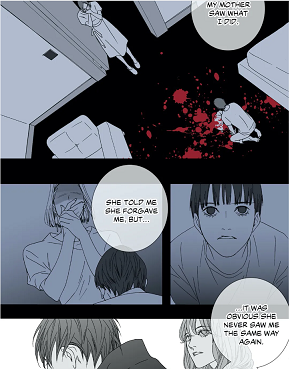 (he killed a dog and his mother caught him), he got aware that he was not allowed to act on his urges. For him, the mask is a necessity, as he is living in society. He doesn’t want to end up in jail. But is it the same for Nameless from Painter Of The Night?
 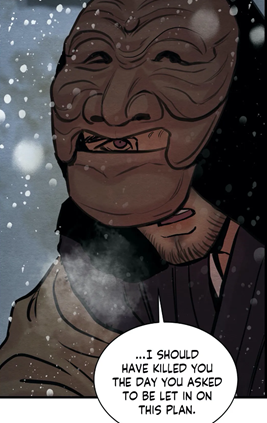 (chapter 54) He is switching his identity to become a killer. In this panel, the manhwaphiles see the transformation of the figure, as his face is already half-covered. He is no longer a joker, but not the ruthless murderer yet. However, when he kills the servant, he has the cover on.
 (chapter 54) By putting a mask, he is protecting himself too, for he is acting as someone else, therefore his heart can’t be wounded.
  In this case, it is more a desire, though in truth it is a combination of both. The “butcher” has to hide his true identity. So when he wears his mask in chapter 44, he is doing his job. He won’t be recognized, but also he won’t feel remorse. He has been paid for that and the mask is helping him not to get emotionally invested. On the other hand when Jihwa met him in chapter 51, the manhwalovers could perceive the low-born’s true personality which coincides with the absence of the mask.
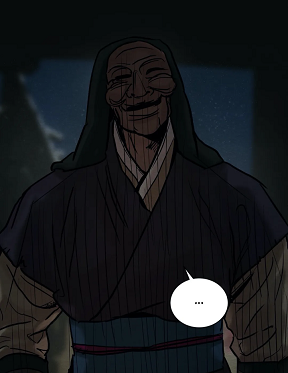
 In that episode, he was literally naked in front of the noble, which explicates why he showed concern and care for his client. He let the noble express his worries. Let’s not forget that the jester is a person with a pure heart, when he is true to himself. Hence I come to the conclusion that the mask serves as a protection for the criminal’s mind and heart. And now, you comprehend why Nameless didn’t feel remorse for hurting the painter. According to me, in this scene, it was Kim who was scaring the painter.
 (chapter 66) This is important, because the mask had two purposes here: to hide the identity of the perpetrator, but also to slip into a role, No-Name’s, the assassin. The main lead’s face was covered and turned around. At no moment, the “butcher” could see the victim’s gaze and facial expressions. The mask helped him to be ruthless, while he threatened Baek Na-Kuym. He might feel pity, but that was it.
 (Chapter 61)
 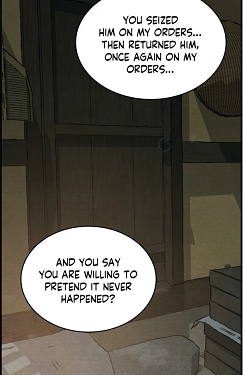 (Chapter 61) Hence the existence of the Joker’s mask outlines the criminal’s duality. He can be a ruthless killer, yet he can be gentle and caring too. At the same time, it implies the presence of a biased view.
 (chapter 73), the moment he is deprived of his powers. It was, as if he became a human. This is particularly perceptible, when he accepts the judgement of Maat and says this.
 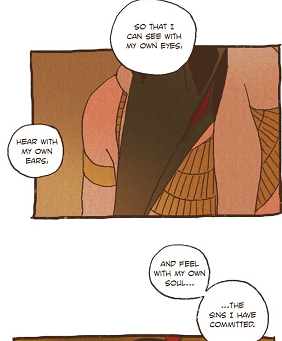 Striking is that in this panel, the mask doesn’t appear as a source of advantage, rather as a hindrance. He couldn’t see and hear the consequences of his crimes due to the mask. He was blind and deaf. By removing his mask, he becomes human and can face reality: he is facing his sins and the suffering of his victims, their wounded soul.
 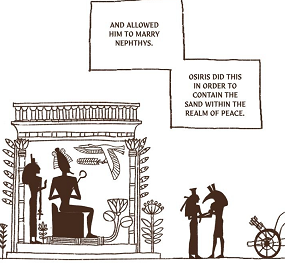 [chapter 35], his son, his title
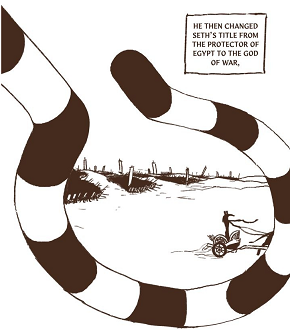 [chapter 35], his power over the desert
 [chapter 35]), he lost his identity. Osiris made sure to imprison his brother, because the former was lusting after him and had the impression that the latter would always escape his control.
  (chapter 35). At the end, he raped him in order to claim him. The latter got literally destroyed, hence he hid his pain behind the mask and chose to hurt others.
 (chapter 37) In other words, the loss of identity was the reason why Seth decided to hide himself under the mask. Who was he in reality? The god was so tormented by his tragic past, Osiris had hurt him with his actions and words. He made sure that his brother would doubt himself. Hence the mask became the only reason to keep living. This item helped him to hide his wounds, but also not to lose himself completely. Hence I conclude that the “evil god” wasn’t just blinded by his heartache, but also by his mask, for the latter hindered him to see the real impact of his terrible actions.
 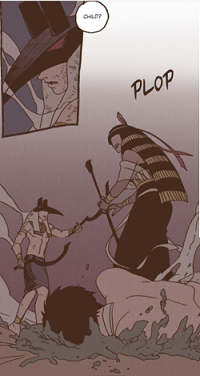 (chapter 37)
  (chapter 73), his son makes the opposite experience. He transforms himself into a god, Anubis, hence he gets a mask.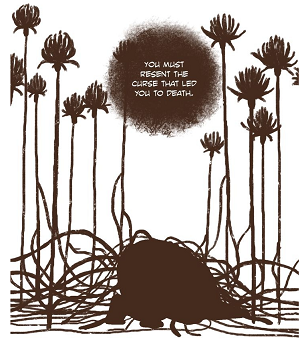
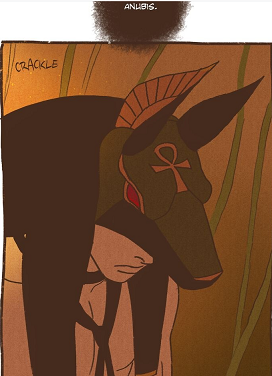 (chapter 73) However, this signifies that he won’t see his wrongdoings too, he will be oblivious to the pain he is causing to others. This time, his blindness will be caused by his resent. While in the past, Anubis was a sensitive and gentle person, but no real god due to Seth’s curse, in chapter 73 he becomes Osiris’ true son, an evil god. Why do I judge him like that? It’s related to Osiris’ words. The latter is encouraging his son to feel hatred for the one responsible for his curse, Seth. Moreover, he asked his son to forget his past signifying that he should cut ties with his previous family. Therefore I believe that in the future, Anubis will fight against Seth and even Horus. Nevertheless, the wounded Anubis doesn’t realize that he has been manipulated by Osiris. The latter used his vulnerability and fear to approach him and appear as his savior.
  (chapter 73) Besides, Osiris was in fact accountable for his injury
 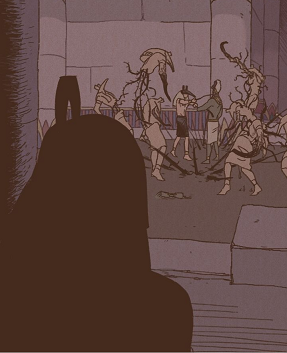 (chapter 37) In other words, the god of the afterlife used a disguise, though his brother had the impression that Osiris was real. Yet, one might argue that in that scene, Osiris was not wearing a mask. However, since he took possession of Anubis’ body, we can clearly see the presence of a cover. Let’s not forget that this terrible god is not allowed to leave the Underworld, hence he needs a subterfuge to enter the world of the living. That’s why I perceive it as a disguise. While the Egyptian god used Anubis as his vessel, Kwon Sungha from Dine With A Vampire took a new identity: he became Sooin’s bodyguard.
  As you can see, in both cases magic provided the villains a new occasion to deceive their target. And this shows that a mask can eventually cover a whole body, when it is to create a new “identity”.
  , just like Ra or Hathor. Yet, note that they are all women. Secondly, if you pay attention to their appearances, you’ll detect the presence of a hair dress and make up, especially around the eyes. This is no coincidence in my opinion. These accessories should be perceived as a “mask”. The make-up and hair dress are a form of disguise. This becomes really obvious in the manhwa “True beauty” from Yaongyi, where the heroine Jugyeong Lim hides her insecurities and true self behind a make-up. This is the real and natural protagonist
 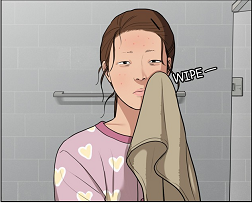 (chapter 7), while we have here the disguised heroine
 (chapter 0). This goes to the point that her boyfriend Sujeon Han has no idea how she really looks like. As a conclusion, the make-up and hair dress should be judged as a mask too. That’s why in traditional Chinese theater, the actors have painted faces. It was, as if they were wearing a mask.
 (Doctor Frost, chapter 2) That’s the reason why the author Black Apricot didn’t drew a mouth, when she presented Song Ji-Sung here.
 (chapter 9). She wanted her readers and the main lead to realize the character’s true personality. The latter was upset, because Kwon Soo-Young was keeping his distance from him and it looked like, he had found a new protector/boyfriend. When the protagonist Kwon Soo-Young had met Song Ji-Sung for the first time, he had only paid attention to his smile. Therefore he had misjudged his personality. And now, if you contrast the previous panel with the following one
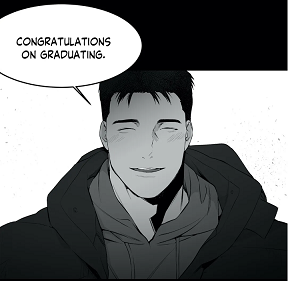 (chapter 16), you’ll notice an important detail: The eyes are closed, when the character is smiling. In this situation, the figure was actually hiding his true thoughts, this explains why the main lead couldn’t correct his false impression about his future lover. He had no idea about his true nature, as the latter keeping concealing his true intentions, he was faking his emotions with his facial expressions. This confirms my interpretation: the face can also be a mask. For me, this character is like Doctor Jekyll and Mr. Hyde. In this picture, Kwon Soo-Young got scared, when he saw this gaze and refused his lover’s advances.
  He is brutal, selfish and very manipulative. And now, you understand why in ENNEAD we had two different kind of masks: Seth and Horus are wearing real masks, while Osiris and Isis use their own face and make-up to conceal their true personality.
 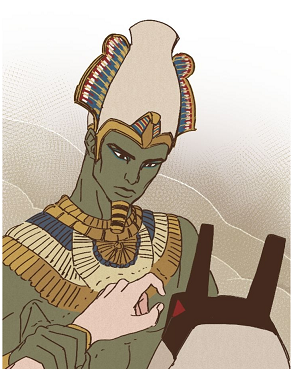 (chapter 7) Sure, the color refers to his death, a decayed body, nonetheless the readers should judge the painting as a cover. Since he is using a whole body to disguise himself, this signifies that he is hiding his true personality and thoughts more than Isis or Ra. That’s why it is not surprising that this god is particularly scheming and deceptive.
 The hair fringe and the shadow serve as a mask. In this scene, she used her body to divert her lover’s attention and hide her true intentions. She was inciting Do Seong-Rok to kill on her behalf. However, this temptation left such a deep impression that the main lead was tormented in his sleep later. His unconscious was telling him that he had been manipulated. As you can see, the absence of eyes in the manhwa can be viewed as the presence of a mask and as such a sign of deception. We have another example in BJ Alex:
  (chapter 10) The mask is a combination of shadow and absence of eyes. Here, Ahn Jiwon was remembering his first love and boyfriend, who faked affection and care for him. As a conclusion, the eyes symbolize honesty and naturality and its absence the presence of a mask.
  and the internist Kwon Sungha
 . While examining their characters, I made a connection between the glasses and their personality. I defined the function of the glasses as a mask, because both almost act the same, as vicious hypocrites. They hide behind their glasses and their fake smiles so that people misjudge them. And remember doctor Frost’s advice:
  Observe that the smile is less pronounced, giving the impression that it is vanishing. Simultaneously, the eyes are shown oozing a rather cold and heartless side. In the scene at the library (chapter 40), he’s finally able to perceive his own reflection in the scholar’s gaze, since the smile has totally disappeared. The gaze exudes coldness, despise and filth.
 Combined with the harsh words “you were born to be a prostitute”, the painter’s identity and personality are literally destroyed. The scholar has reduced Baek Na-Kyum to a prostitute, the lowest rank among the commoner. They have no rights and no real identity as they are forced to do what their clients want.
 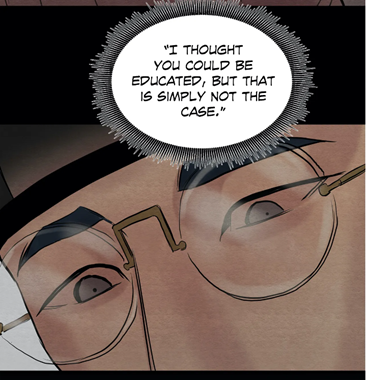 (chapter 41) Hence it is not surprising that the protagonist remembers the cold gaze. His eyes were the other reason why Baek Na-Kyum’s heart was so wounded. He could sense despise and rejection. In other words, the scholar had used two weapons to hurt the main character: the gaze and the words. This connection between the smile and the eyes is visible in Dine With A Vampire too.
 As soon as the smile vanishes, the eyes become visible unveiling their true personality. That’s why it is not surprising that Kwon Sungha has the same behavior towards the main lead Joo Sooin. The former has also destroyed the protagonist and reduced him to a puppet. The villains keeps calling him a pervert. He was even worse than Jung In-Hun in the sense that he kept abusing him mentally and physically after the coercive persuasion. Both are hypocrites hiding behind their glasses and their gaze. Therefore they are portrayed as cruel and mean hypocrites. The other common denominator is their hatred and rejection for homosexuality. Kwon Sungha seems to be even worse than the scholar, as he is in reality a repressed homosexual. He has sex with Joo Sooin, but resents him because he sees in him the reason for his “perverted” sexuality. He rejects sodomy because of the Church and his mother. Both reject this sexual orientation. I could mention Carter Nathan from The Blood of Madam Giselle
 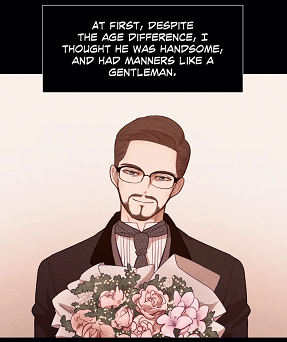 (the fake and the real
 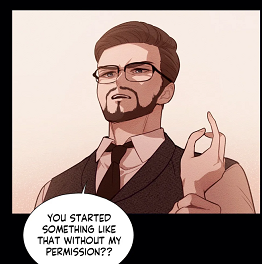 (chapter 13) or Jung from Unintentional Love Story
 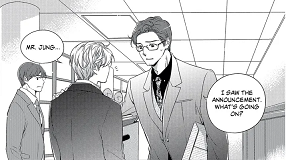 as well as selfish and ruthless hypocrites. In other words, the next time you read a manhwa, be careful with characters wearing glasses, they might be dangerous and their smile might be fake.
 (chapter 16) The main lead explains that he chose to wear glasses, because he desired to avoid rejection and fear. He had noticed that the absence of facial expressions (smile) and his cold gaze would be misjudged by people. Here, Matthew used the glasses as protection. And this illustration reinforces my interpretation: glasses in manhwas have a huge importance in the end, they should be considered as masks too.
  The latter is the only one who can control him.
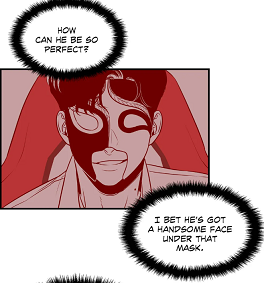 (chapter 1) This is his second identity: BJ Alex. On the one hand, he desires to remain anonymous so that no one can recognize him in real life, on the other hand this signifies that he is living a double life. He would like to protect his privacy, but also his secret life as homosexual. That’s why he said this, when his relationship with Nam Dong-Gyun was revealed:
 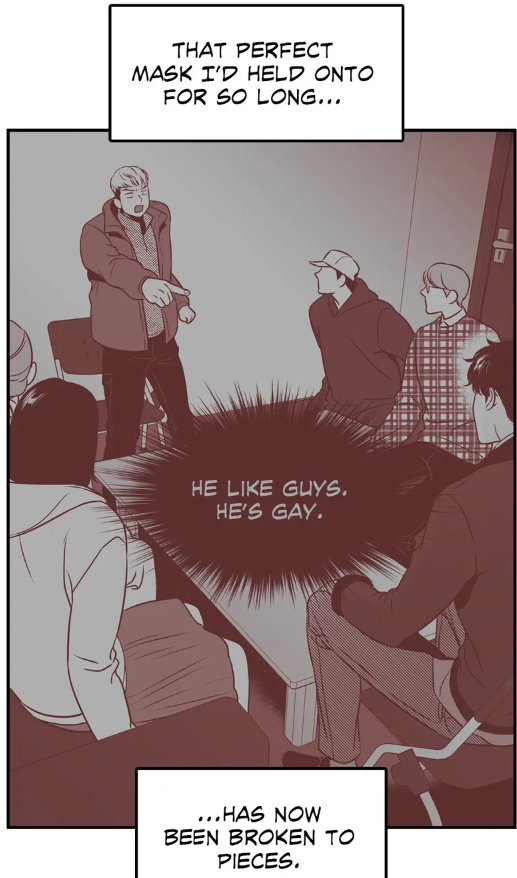 As you can observe, a name and as such notoriety can also serve as a mask. The president of the council was admired by his peers, he was so perfect that some students even wondered, if he was human.
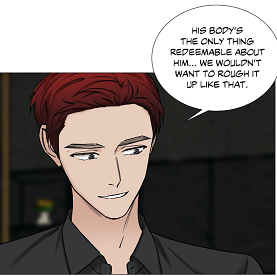 and the president is not recognizing it. But why is reputation a mask? It is, because people often judge others on hearsay and first impressions. The social medias are the perfect example for superficial and quick judgement. But we have to question ourselves about Ahn Jiwon’s initial motivations to hide behind a good notoriety.
 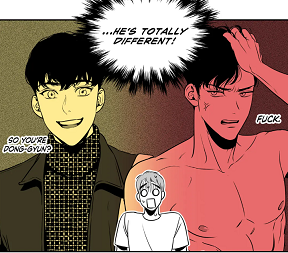 In the beginning of the story, he doesn’t even know the other protagonist very well, yet he is willing to take care of him, when the latter is drunk. The president is seen constantly smiling and has never externalized negative emotions (anger, violence…). This explicates why the uke was so shocked and confused, when he saw a brutal BJ Alex. The latter had discovered his secret, hence the former felt vulnerable. On the other hand, Nam Dong-Gyun wondered about Ahn Jiwon’s true personality. But the uke was not the only one who had no idea about Ahn Jiwon’s true character. The latter was also confused.
  This signifies that the protagonist was never confronted with his own reflection.
  (Doctor Frost, chapter 11). That’s why he became an empty man in the end. He has no idea about his true self (his likes and dislikes). He was forced to follow his parents’ requests and his brother’s shadow. This emptiness is palpable in chapter 49, when the main lead confesses this: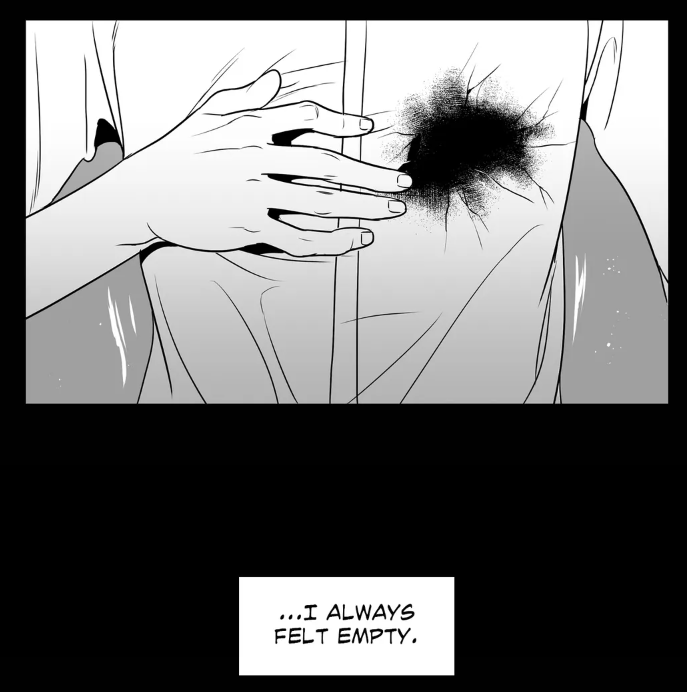
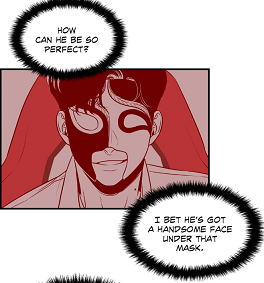 (chapter 1)
 (chapter 49) Since the adults kept criticizing him, he imagined that if he copied his brother, he would get recognition and acceptance. In other words, he forced himself to become a second version of his brother.
  But even copying his hair dress and tastes, he was doomed to failure, for the parents had already categorized him: he would always be inferior to their eldest son. He realized gradually that this wasn’t right, for his parents still didn’t perceive his true identity. That’s why he feels drowning, when he loses his mask.
  He doesn’t have the impression to exist.
 (chapter 49) That’s why he chose a third mask: he tried to be admired at school. He was caring and considerate towards his fellows. However, since he had made this rational decision
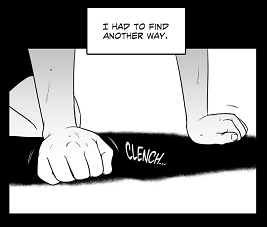 , in his mind he was acting. Hence he didn’t truly enjoy this situation.
 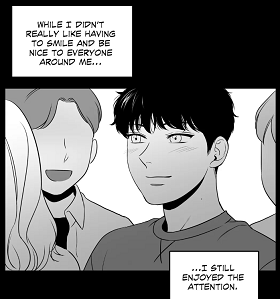 (chapter 49) He felt that he was forced to smile. Besides, I believe as he was fake, this admiration was quite superficial in his mind. Therefore he didn’t feel truly loved. That’s why at some point, he wondered if he would ever be loved…
 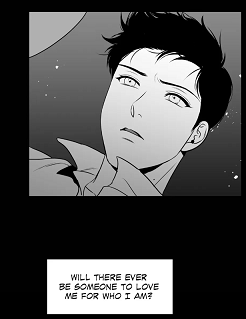 However, the readers should interpret this question differently: he was asking indirectly, when his true self would be recognized by someone. And the one who made him discover his true sexual orientation was unfortunately a player. That’s why the main lead was so devastated and hurt, when he discovered that his relationship was based on deception and fakeness. So after being sent to the army, Ahn Jiwon chose to act like in the past. He became a role model as a student, yet he could no longer hide his homosexuality. Hence he led a double life.
 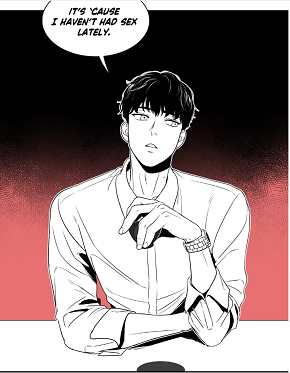 (chapter 08) In this scene, the charater is disguising his true thoughts. The black and red are representing his emotions: he is irritated, because he needs to have sex with Nam Dong-Gyun. Note how Ahn Jiwon is avoiding his counterpart’s gaze. The figure is acting, his mask is his face and the presence of the colors symbolizes the repressed and hidden thoughts and emotions. Mingwa colored one picture in chapter 51 marking a turning point in the protagonist’s life.
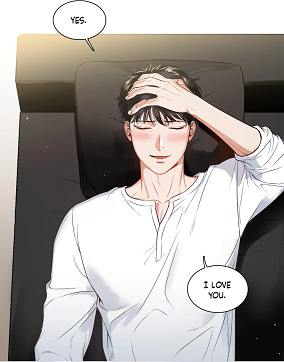 For the first time, he was acknowledging his feelings and as such his own desires. This picture represents the removal of one mask. He is slowly living for real, but in this chapter he still hadn’t found his true personality. The other mask (his reputation as good student) was still existent. Besides, he still believed that his smiling and caring attitude were just an act, while in truth he was genuine and caring. But due to his past, he had already internalized that this was just an act. And now, you comprehend why the latest episodes from BJ Alex are in color. The main lead had finally found his own identity and place.
  (Painter Of The Night, chapter 54), colors, reputation, etc. The protagonists are often hiding their true thoughts and emotions due to their past, while the villains are using masks to deceive people.

 Bebebisous33s' analyses in K-Dramaland and Manhwas