
This is where you can read the manhwa. https://www.lezhinus.com/en/comic/steel_silk But be aware that this manhwa is a mature Yaoi, which means, it is about homosexuality with explicit scenes. If you want to read more essays about other manhwas, here is the link to the table of contents: https://bebebisous33analyses.com/2021/06/06/table-of-contents-of-analyzed-mentioned-manhwas/ Here you can read the last analysis about Steel Under Silk: https://bebebisous33analyses.com/2022/06/04/steel-under-silk-the-power-of-the-dog-%f0%9f%97%a1/
It would be great if you could make some donations/sponsoring: Ko-fi.com/bebebisous33 That way, you can support me with “coffee” so that I have the energy to keep examining manhwas. Besides, I need to cover up the expenses for this blog.
Anyone reading this manhwa will recognize immediately that the title of this essay is the same than the one selected by the author Snob for season 1. But why did she choose such a title in the end?
1. The identity of the dagger and the smile
One might say that the answer is quite simple. If you read the synopsis, this is what you find:
“Hiding a blade behind his beautiful smile, like silk hiding steel, Yeonjo waits for his moment to strike.”
It looks like the dagger is referring to Lee Yeonjo and his desire to get revenge. The smile is an indication that he is hiding his true intentions. In other words, the title is displaying that the person is a skilled but dangerous actor. The smile is diverting the counterpart’s attention faking emotions. However, I would like to point out that the young protagonist is never seen smiling. He is either angry (chapter 5), stoic
  (chapter 20), pitiful
 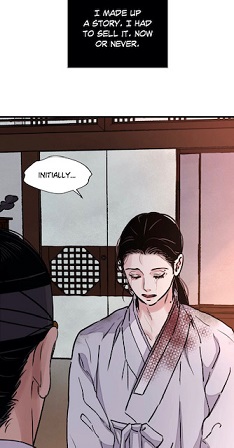 (chapter 20) or enraged and afraid
  (chapter 9). The only times we saw him smiling in the present occurred in front of lord Chang and each time, he was making fun of his sponsor:
 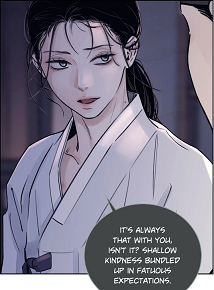 (chapter 5)
  (chapter 16) In both occasions, he was smirking, criticizing lord Chang for his behavior. He wouldn’t mince his words at all. Here, he was brutally honest. This contradicts the previous statement,
“Hiding a blade behind his beautiful smile, like silk hiding steel, Yeonjo waits for his moment to strike.”
, as the smile serves as a way to hide the future assault. In this story, the smile serves as a mask. It should hide the true thoughts from the character, it is a dishonest facial expression. Yet, with the administrator, he was totally honest, when he smirked. On the other hand, we could say that Yeonjo’s words worked like a dagger, when he made fun of Chang Moonwon. However, the synopsis is actually referring to Kwong Hee-Ryang as the target and not to the administrator of work.
Moreover, when Lee Yeonjo rejected the protagonist for the first time (chapter 9), he let him perceive his true emotions and thoughts. That’s the reason why the noble compared him to a wild kitten showing his claws. 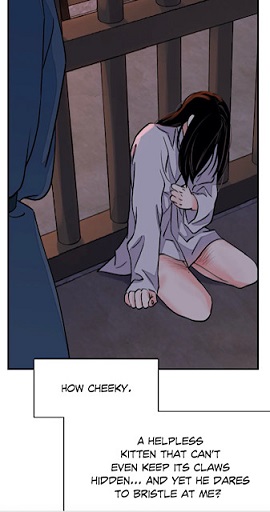 (chapter 13) This means that Kwon Hee-Ryang was well aware of Lee Yeonjo’s true intentions. The young slave was trying to seek revenge. But the governor didn’t mind it at all, because in his eyes, the thin and small domestic doesn’t represent a true danger to him. In the worst case, he can get a new scar and that’s it.
  (chapter 18) On the other hand, Lee Yeonjo would lose his life. To conclude, the dagger hidden behind the smile is not truly referring to the uke in my eyes. We know his intentions and his past. Moreover, he is a poor actor in front of Kwon Hee-Ryang. He is incapable to control his facial expressions,which explains why the official can read him like an open book:
  (chapter 23) He tells him lies, but the governor doesn’t fall for it at all.
 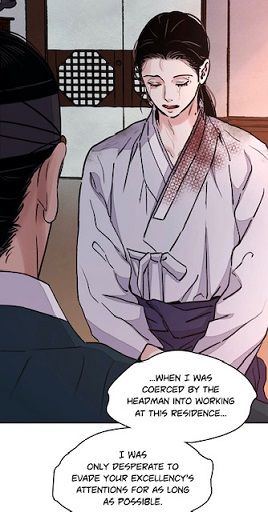 (chapter 22) In verity, the main lead uses the statements from the innocent slave to his own advantage. If he was coerced and raped by Chang Moowon, then Kwon Hee-Ryang will treat him differently. The governor takes each confession from Lee Yeonjo at his words. The result is that the young slave is put in a position where he can choose. He has to prove the veracity of his words and as such his willingness that he selected the main lead in order to improve his living conditions. He has no other choice than to act on his own free will. Thus Kwon Hee-Ryang said this:
  (chapter 20) Yeonjo is forced to turn his lies into a verity. This explicates why the servant admits that he needs to be such a great actor that he has to believe in his own lie.
  (chapter 20) Note that in this image, the young protagonist is not even smiling, he is acting pitiful hoping to get the lord’s sympathy. However, during the intercourse, he is unable to control his true emotions. On the one hand, he is taking pleasure in this, on the other hand, he rejects sodomy due to social norms.
  (chapter 23) Yet, his mouth is betraying him once again.
 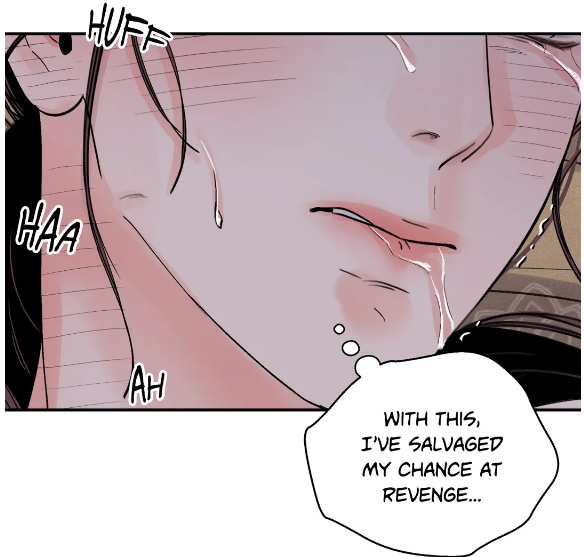 (chapter 23) That’s the reason why Kwong Hee-Ryang interrogated Yeonjo, for he had noticed his dissatisfaction.
  (chapter 23) As a conclusion, so far Lee Yeonjo can not be perceived as the dagger hidden behind a smile! From my perspective, this title is actually hinting to Kwon Hee-Ryang.
2. Kwon Hee-Ryang, the real dagger
First of all, the official is constantly smiling, especially when he is meeting his enemies. 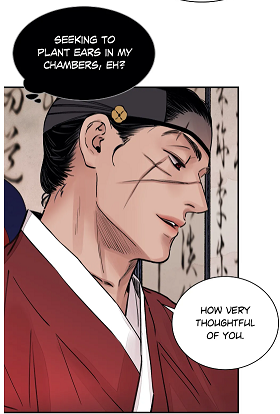 (chapter 3) Here, he was complimenting the headman Choi, though he had already perceived his wrongdoings and motivations. Yet, he was still giving the impression that he was in a good mood. Then
  (chapter 3) when he had organized a huge feast for his new appointment in order to deceive the nobles from the hojok, he continued smiling, though he had been insulted as a host.
 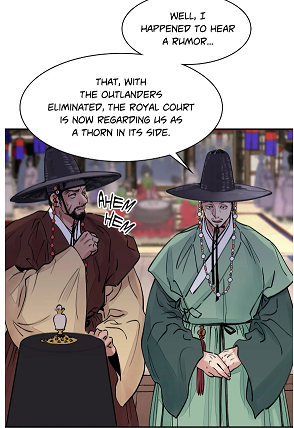 (chapter 3) And note how he replied to the attack to Kwak Gilsoo. He overlooked the insult and reproach, and showed generosity and leniency.
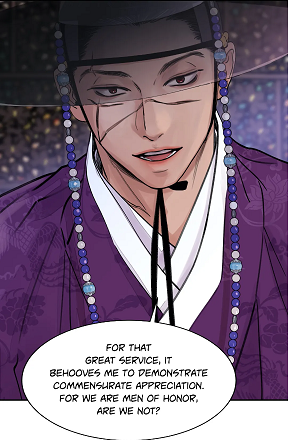 (chapter 3) He acted, as if he only had pure intentions and he was a man of honor. The irony is that he had long selected his target:
 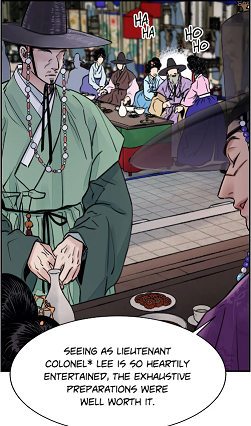 (chapter 3) The lieutenant colonel Lee. This is no coincidence that he was smiling, when he explained to his assistant his next move
  (chapter 6) There was a light smile on his lips, when he offered the poisoned wine to his prey.
  (chapter 6) No one suspected that he would poison the lieutenant colonel Lee, for he had shown no sign of hostility and arrogance in front of the local lords. He had never displayed any mood swings either. In fact, he had acted like a submissive, calm and innocent governor. Once Kwak Gilsoo accused him of murdering the chief of the hojok, Kwon Hee-Ryang returned the situation to his advantage with a smirk on his face.
  (chapter 15) He had been insulted on many occasions, though he had treated the hojok very respectfully.
  (chapter 15) He portrayed himself as a benevolent governor seeking support from the hojok, yet they had somehow rejected his good will. This means that he was turning himself into a victim. He even went so far by asking the crowd if they were declaring war against him and as such the king, leaving the nobles speechless. They got defeated, for if they contradicted his words, they could only be perceived as traitors, for the appearances were against them. The man had organized a huge ceremony for them, had even treated the lieutenant colonel Lee with such a great care. Moreover, he had attended to his funeral. He had always been gentle and smiling, thus he had reasons to get upset. Suddenly the governor’s tone changed which caught the aristocrats by surprise! Hwan Hoon described the main lead like this:
 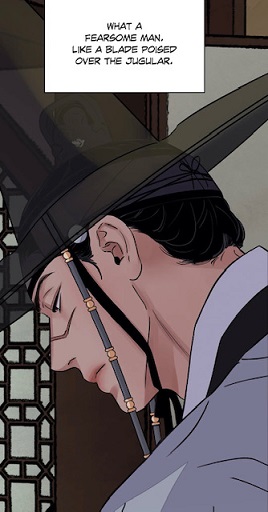 (chapter 15) As you can detect, we have here a reference to the dagger. To conclude, during the funeral, we have this combination between the smile and the dagger.
  (chapter 15) No one, not even Kwak Gilsoo, had even anticipated such an attack. But there exist two other reasons why I think that the dagger hidden behind the smile is hinting on the official, especially after associating him to the blade. On the other hand, I am expecting that Kwang Hee-Ryang’s personality will rub off on Yeonjo. The latter will become a better actor. But let’s return our attention to the governor.
I have other reasons to think like this. First, it is related to his past. We don’t know much about him. So far, I could determine that due to his lowly origins he must have fought hard to become very close to the king. However, in chapter 19, the author implied that there was some bad blood between Kwon Hee-Ryang and Lee Yeonjo’s father.  (chapter 19) The official had connections to the Lees before the downfall of right-state councilor, yet the nature of their relationship is not quite clear: Ex-what? Ex-benefactor, ex-lover or ex-enemy? And according to the assistant, Yeonjo’s father must have wronged the protagonist. In my eyes, the smile from the official should be interpreted under the different light. It is hiding the scars left by the attacks from the past. That’s the reason why he is now holding a dagger in a figurative way. He was not just stabbed by a blade, he was also wounded by words, for he is just the son of a concubine. Thus he learned to use his tongue as a dagger, which we could witness during the funeral.
Secondly, during their last encounter, Kwon Hee-Ryang kept smiling while listening to the naïve slave. 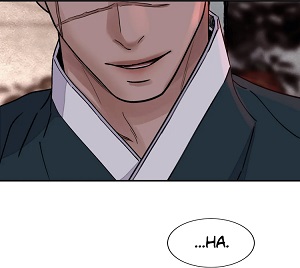 (chapter 20) He could see right through Yeonjo. The readers could sense that he was making fun of him.
 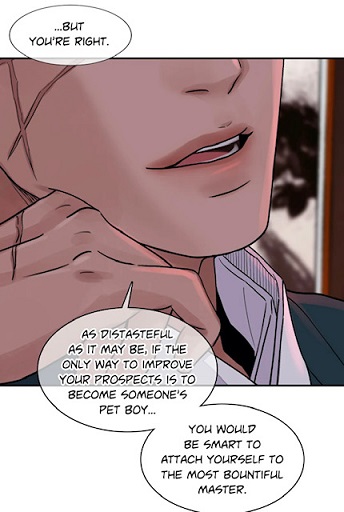 (chapter 20) There is no ambiguity that the governor was here acting, though I perceive his smile as not entirely fake.
  (chapter 20) He was definitely happy that the young man would seek him, as he had already voiced regret before. Nonetheless, the manhwaphiles could sense the official’s manipulations. The kiss on the scar is the best evidence.
 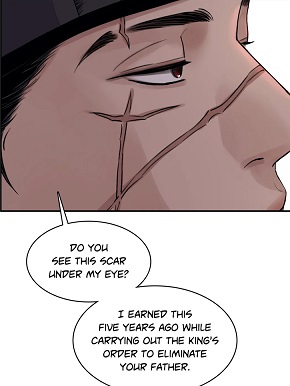 (chapter 20) Here, he was challenging Yeonjo. He should prove his honesty. Like I mentioned above, he was taking the young slave at his words.
 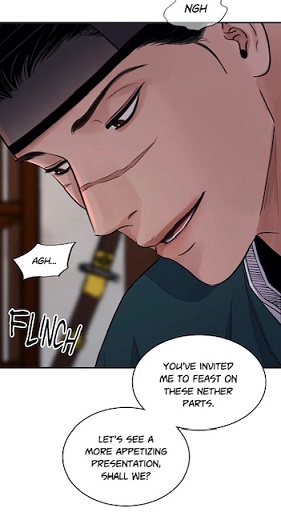 (chapter 21) That way, the young domestic could never make such reproach about him: he had raped him or coerced him. However, this signifies that the main lead is also obliged to keep his words. He has to ensure Lee Yeonjo’s comfort and safety. So while Lee Yeonjo had the impression that he could deceive his counterpart, he never realized that he had been fooled. And to his surprise, Yeonjo discovered his enemy’s true personality: he was a beast! I am quite certain that my avid readers are already aware of the symbolism of blade: the phallus! Lee Yeonjo never expected his “husband” to have such an appetite.
  (chapter 23) He was a monster, a beast! He thought that it would end very soon. However, Kwon Hee-Ryang was far from being satisfied. He wished more.
 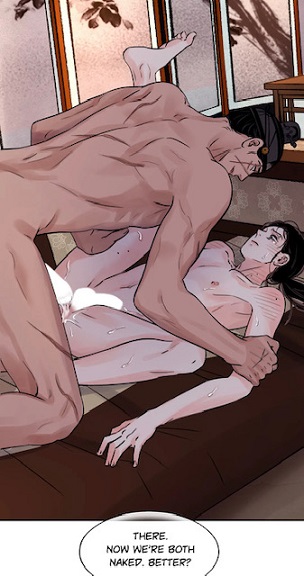 (chapter 23) Striking is that in the last panel, the governor is smiling while holding his “dagger” which caught Yeonjo by surprise. To conclude, the dagger is not just a reference to the weapon or words, but also to sex.😉
3. Lee Yeonjo’s face
And this leads me to the following observation: the former aristocrat is very pure, because he lacks experience. Until his downfall, he had lived in a bubble, far away from politics and schemes. Then as a slave, he never discovered how treacherous the world of officials was. He only encountered sexuality through prostitution. This explicates why he loathes sodomy and gets upset that his own body is betraying him. He definitely feels pleasure. It was never his true choice in the beginning, which stands in opposition to his conversation with the official. And slowly, Lee Yeonjo is forced to reveal his orgasms and sensuality. Why? It is because he has to deceive the governor. (chapter 20) At some point, the deception will become a reality.
In addition, his purity and innocence are perceptible the way he is seeking his revenge. When he dreams of killing his nemesis, he always envisions himself stabbing him. If he truly wanted to hurt Kwon Hee-Ryang, he could have participated in a plot or even poison the governor… but no, his true goal is to wound the official with his own hands. I would like the manhwaworms to keep in their mind that he rejected the offer from headman Choi. He didn’t desire to become a spy. He didn’t consider it as a way to eliminate his nemesis. In my eyes, it is related to that fateful night. Kwon Hee-Ryang defeated Yeonjo’s father personally (chapter 1), he even got a scar. In other words, he was willing to risk his life. Thus I deduce that Yeonjo is copying him. He is facing his enemy directly, similar to a man of honor. In chapter 24, he has even a nightmare because of the stabbing, an indication that he rejects the idea of killing the man in his sleep. Besides, the governor in his own vision is exposing to him how pointless such a plan is. Kwon Hee-Ryang is not an easy target. He is very smart and observant. This can only reinforce my interpretation that Lee Yeonjo is not the dagger hidden behind the smile. However, I am expecting a transformation from Lee Yeonjo influenced by his tutor Kwon Hee-Ryang and his future experiences. Don’t forget that by becoming his lover, the slave can become the target of the hojok. Kwak Gilsoo is well aware of the governor’s sexual preferences
  (chapter 4) and once he hears how headman Choi got evicted from the court because of Yeonjo, the aristocrat will definitely blame the domestic for his “misery”. The aristocrat with the green hanbok envisioned that he had discovered the governor’s secret and as such vulnerability. But the official has never hidden his sexual orientation. One might accuse the governor of treason, because he has a relationship with the son of a traitor, yet this relationship could be judged differently. Lee Yeonjo could be judged as ruthless and immoral, he is sleeping with the murderer of his own family. Besides, this could be seen as a humiliation… the son has to serve the governor as his night servant. That’s the reason why Kwon Hee-Ryang said this to his assistant. It was not kindly… but indignant.
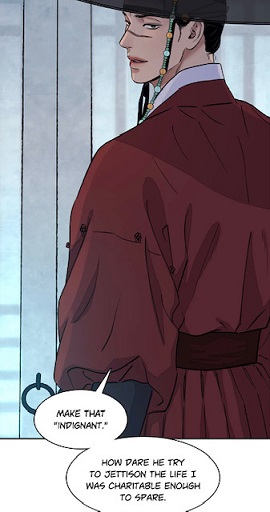 (chapter 19)
What caught my attention is that Kwon Hee-Ryang is paying a lot of attention to Yeonjo’s facial expressions. The manhwalovers could sense the governor’s obsession, when the latter imagined Yeonjo having a climax.  (chapter 4) Then he tried to discern the uke’s feelings in this situation and explain his reaction. (chapter 09). Finally, during their last intimacy, he kept looking at him while kissing
 (chapter 23) or reacted, when he saw Yeonjo’s distance.
 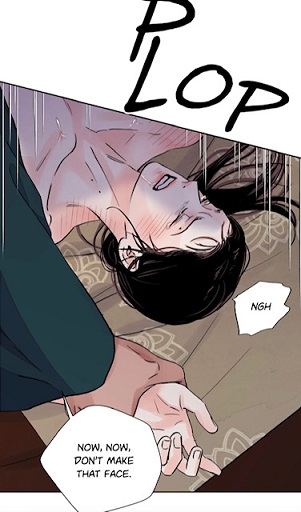 (chapter 23) Why is he so fascinated by his face? It is because it stands in opposition to his own! Note that the lord enjoys the uke’s tears. Secondly, the servant’s facial expressions are oozing genuineness. The protagonist can not control his emotions and thoughts, while Kwon Hee-Ryang is behaving the opposite. He aims to remain calm the whole time. Thus he often smiles. It is his mask. The latter is always hiding his true thoughts and emotions, while he continues smiling. This means that he can never show his pleasure or his pain to others, for they would reveal his weaknesses. Imagine that though he had been wounded that night, he acted, as if nothing had happened.
 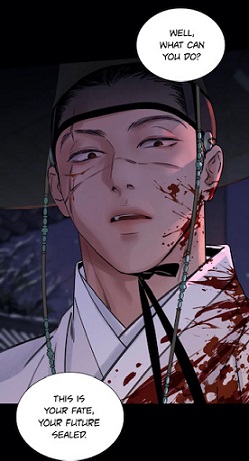 (chapter 1) Yet, in reality he didn’t have the heart to erase the whole household of the Lees.
 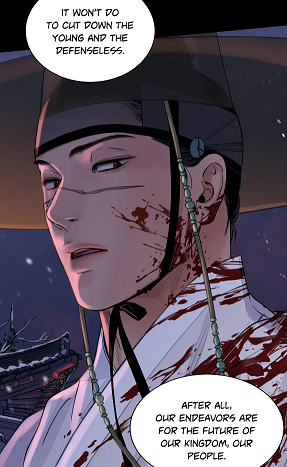 (chapter 9) To sum up, Lee Yeonjo can expression emotions that the official has long repressed. Even his orgasms are restrained
 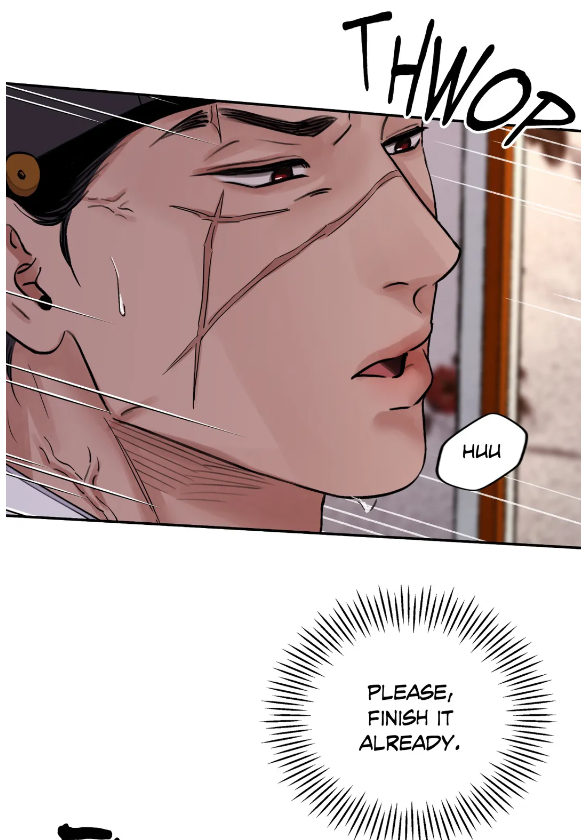 (chapter 23), his mouth is barely letting escape a sound
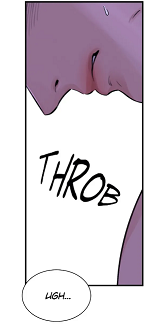 (chapter 4) If I had to associate the official to two notions, I would say, he symbolizes work and control! And the smile contradicts Lee Yeonjo’s tears and moaning. This is no coincidence that he asked his lover to be called “my lord”
 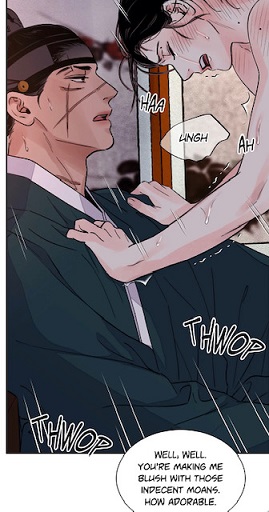 (chapter 23) In this picture, the aristocrat mentions his blushing, but if the readers look at his facial expression, they are not able to detect his reddening. How do we explain this? It is because the lord had long internalized to control his facial expressions. However deep down, his heart was moved by the uke’s whispers. Many readers could sense his growing attachment to Lee Yeonjo. First, he stated that the protagonist would become his plaything, yet in chapter 22, he called himself the main character’s husband.
 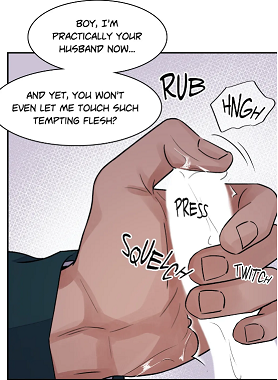 (chapter 22) Then in chapter 24, Kwon Hee-Ryang was even willing to share his bed with Lee Yeonjo. This reflects the lord’s biggest desire. He wishes to keep the young man by his side. Because the slave is showing facial expressions that Kwon Hee-Ryang can not do, it is not astonishing why the governor is under Lee Yeonjo’s spell. Under this new approach, the manhwaworms can grasp why I perceive the governor as the dagger hidden behind the smile. He is a dangerous but mysterious man, and the author is slowly revealing his thoughts and also his past.
4. The blade and the smile
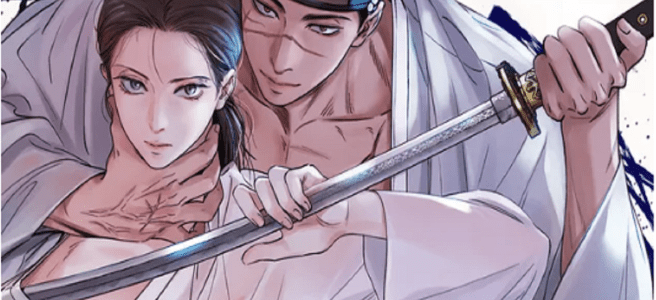
Before closing this essay, I would like the readers to take a closer look at this image: 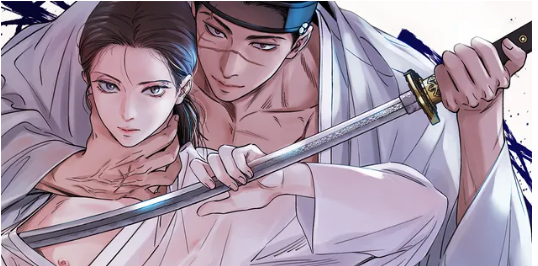 The lord is smiling while holding the sword in front of Lee Yeonjo indicating that the main lead will do anything to keep the uke by his side. Once again, we have the combination of the smile and the blade. Yet, this time, it is not hidden. Why? It is because their relationship is not a secret. This is the topic in the court.
Simultaneously, the domestic is taking the blade with his own hand which means that he will get hurt, an indication that the main lead will definitely get wounded in this story. This coincides with the result of retaliation. “Before you embark on a journey of revenge, dig two graves.” Confucius (504 BC) However, I don’t think that this is truly going to happen, for the simple reason that Lee Yeonjo is not ruthless like Kwon Hee-Ryang.
On the other hand, the couple is not facing each other, a sign that their union will bring them closer due to their enemies. While seeking his revenge, Lee Yeonjo will get involved in politics, and as such he will be forced to face reality. It is about abuse of the hojok exploiting the local population. Finally, in this scene the protagonists are acting. Why? It is because they are facing adversities. On the other hand, Kwon Hee-Ryang’s hand is grabbing the slave by his throat reflecting his obsession and determination to keep the uke by his side. Once trapped behind the blade, Yeonjo won’t be able to leave. By siding with the governor, the young man never anticipated that he could get wounded because of Kwon Hee-Ryang, like this scene exposes it. 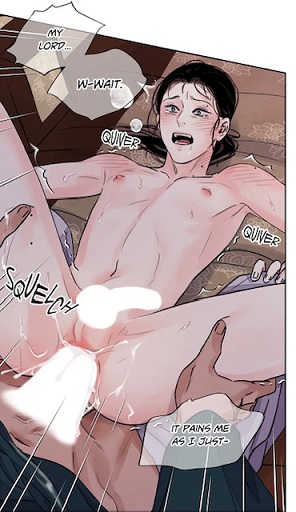 (chapter 23)
Due to his pain and suffering, he didn’t pay attention to his surroundings. He has no idea about the tension between the nobles of the hojok, and how the lords are abusing their position in detriment of commoners. Finally, my avid readers can certainly recall that Lee Yeonjo is embodied by the magical purple lotus flower, implying that he is contributing to the purification of the region. It already started with the removal of the headman Choi. 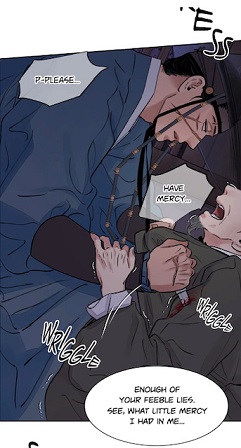 (chapter 11) So who is the next? However, we shouldn’t forget the administrator lord Chang who felt that he had been deceived by the governor.
  (chapter 17) Thus I come to the conclusion that Kwon Hee-Ryang’s plan won’t work so smoothly because of lord Chang’s intervention.
Feel free to comment. If you have any suggestion for topics or manhwas, feel free to ask. If you enjoyed reading it, retweet it or push the button like. My Reddit-Instagram-Tumblr-Twitter account is: @bebebisous33. Thanks for reading and for the support, particularly, I would like to thank all the new followers and people recommending my blog.
 (chapter 1) From that moment on, the main character lost everything. In one single night, he became the son of a traitor, while in reality we have to imagine that the king had made a coup d’état and got rid of his opponents. This explicates why Yeonjo made the following statement: A new king!!
 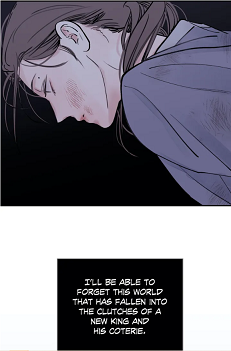 (chapter 1) In other words, Lee Yeonjo’s father was sacrificed. However, this is just the beginning, because now the king is determined to strengthen his authority and power by eliminating the hojok in Hamgil-do. This means that Kwon Hee-Ryang will have to use his blade for the monarch one more time. Simultaneously, Lee Yeonjo as a slave is seeking revenge. He plans to kill the person whom he views as responsible for his family’s death: Kwon Hee-Ryang. But the real mastermind behind this is actually the new king.
 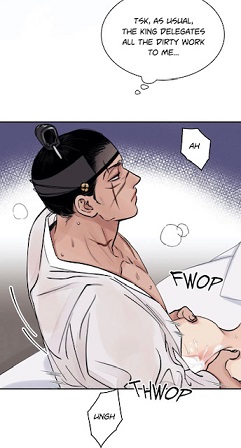 (chapter 2) The reference of the “blade” in the title implies that the relationships between the characters in the story will get affected: severance, sacrifice, liberation and death. There’s no ambiguity that lord Chang won’t be able to use Yeonjo as his boy toy like in the past, or even claim him as his lover due to Yeonjo’s closeness to the new governor Kwon Hee-Ryang.
  (chapter 6)
 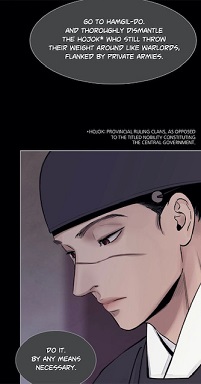 (chapter 2) are removed, for they represent a threat to the royal authority. The monarch is supposed to represent “justice”, but if there exist warlords, the latter can do whatever they please. This means, they can escape any punishment, the king can not control them. Finally, the sword should be perceived as a metaphor for the phallus (penis). As the manhwaphiles can sense, the blade is referring to the main lead Kwon Hee-Ryang. That’s the reason why I believe that when Snob chose the title, she was thinking of the two protagonists, Hee-Ryang was the blade, and the flower was the uke Lee Yeonjo.
 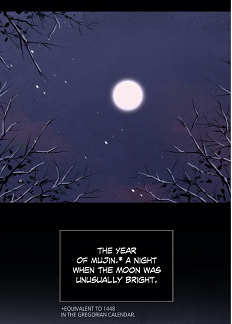 (chapter 1) That’s the reason why I looked into that historical period. This is what I found:
 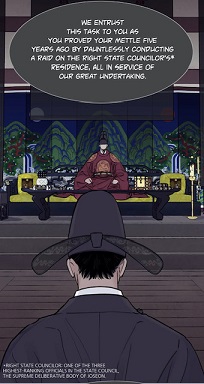 (chapter 2) Hence I am assuming that the author was inspired by Sejo. Kwon Hee-Ryang’s biography indicates that the monarch values more merits than lineage.
 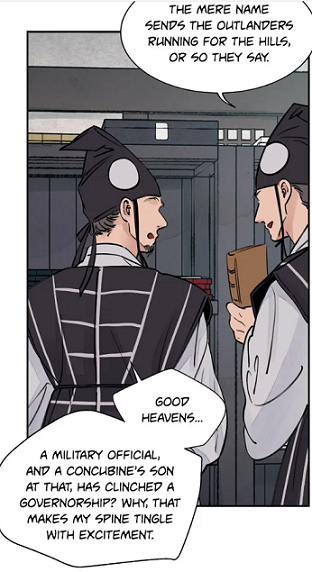 (chapter 1)The main protagonist is the son of a concubine, therefore according to social norms, he should have never expected to raise the ranks and become a governor. He is not the official son. This explains why the main lead has so many scars, and why he is willing to do the dirty work. He had to work hard to reach the top of the hierarchy. This exposes the strong will from the new governor. He never accepted his fate as the son of a concubine, who was supposed to live in the shadow. The manhwalovers should keep in their mind that in Joseon the son was supposed to inherit the mother’s social status. That’s the reason why I don’t believe that Kwon Hee-Ryang truly meant this, when he spoke to Lee Yeonjo.
  (chapter 5) Besides, it symbolizes tenderness and temporality as well. Therefore a beholder will want to protect it. Kwon Hee-Ryang
  (chapter 2) and lord Chang
 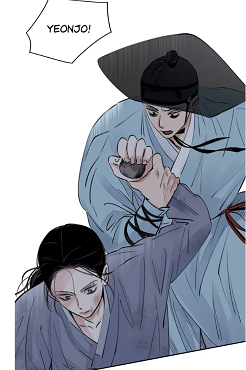 (chapter 1) intervened and stopped the bullying from other slaves. That’s how the two semes perceive the slave due to his frail silhouette. He is small and thin, therefore he reminds them of a fragile flower which could be trampled on so easily by others. However, this is just an illusion, as we can view it in the last image. Lee Yeonjo is not afraid of fights, he will never allow others to look down on him. He can fight back, if he desires it. And this leads me to the English title.
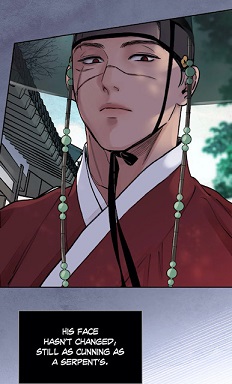 (chapter 2) As you already know, the serpent embodies cunningness, knowledge and seduction. This is important, for “silk” is a reference to the bed. As you can see, the English title gives us a totally different approach. It implies sex. Furthermore, steel symbolizes strength and invulnerability. I would even add: determination and calculation, for a metal is cold and hard. Thus I come to the deduction, steel represents strategy and power. Since steel is used in weapon, I conclude that the author desired to include the notion of a fight in the bed. Yes, here I detect some similarities to Yoon Seungho’s following doctrine: “Sex is like a battle”. The one surrendering to his feelings should be judged as the loser. Though the story has just started, the manhwalovers could sense the presence of struggle during a sex session.
  (chapter 5) No one is allowed to reveal his emotions: neither passion nor pleasure.
 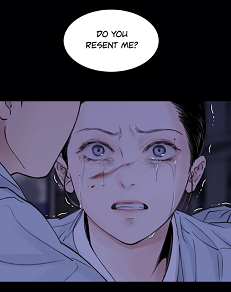 (chapter 1) He watched how the main lead killed the protagonist’s father. He never closed his eyes and looked straight into his enemy’s eyes. Note how he is clenching his jaw, a sign for hatred and strong-will. He didn’t hide his true thoughts and emotions. Furthermore, there’s blood on his face, which is quite similar to the scars from the governor. Despite the blood and the violence, the young boy never closed his eyes, while the older brother was turning his back on Kwon. And now, you comprehend why the governor feels that he has already met Lee Yeonjo. He could never forget this gaze full of resent and determination. In that scene, Lee Yeonjo showed courage.
 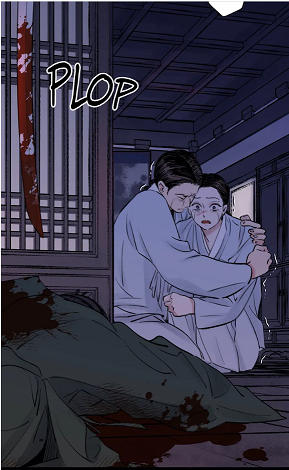 (chapter 1) He didn’t mind provoking his enemy with his daring gaze. Observe the huge contrast to the brother. The latter closed his eyes, and later turned his back on the official. This is not surprising that at the end, Yeonjuk died. He could never bear the cruelty of this world and resigned. I would say, the scene in the first episode revealed the brother’s weakness. Yeonjo might have been trembling, yet the latter was in reality the one comforting his brother. In other words, Yeonjo is a fighter. Therefore it is no coincidence that we could see him imaging how he would attack his enemy.
 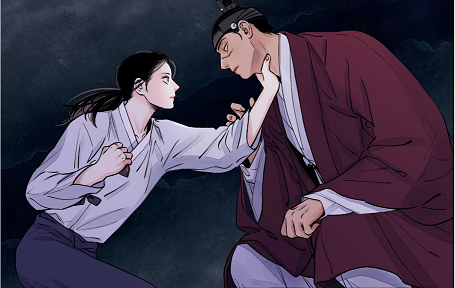 (chapter 6) But he doesn’t let his emotions cloud his judgement. This explicates why in his second meeting with the governor, he didn’t try to take his revenge on the main lead immediately. The uke is calculating, developing how he should approach the official.
  (chapter 6) The bed is the place where the man is totally vulnerable, for he is sleeping. But the main lead is far from stupid, he doesn‘t trust many people.
  (chapter 5) Yet, his hands and his curled toes are betraying him. This means that Lee Yeonjo’s inner struggle about pleasure will keep increasing, the more time passes on. Note that his position changed, the moment he requested from the administrator of public works his assistance and protection. Here, the main lead lied saying that he desired to live a better life.
 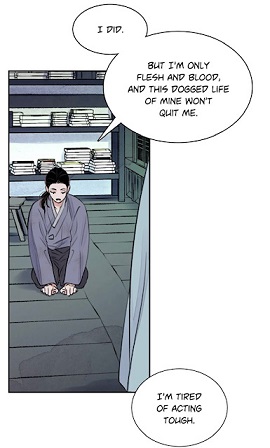 (chapter 2) Lee Yeonjo was implying that he was willing to rely on someone. Hence it is not surprising that lord Chang started treating him more like his lover in episode 5. On the other hand, since headman Choi asked the protagonist to seduce the governor, this means that the slave will be forced to use his body differently. Even if he fails in the beginning, there’s no ambiguity that the young man will be cornered at some point. How can he “seduce” his enemy, if he is as cold as steel? This will force Yeonjo to act, even to fake pleasure. Thus I am expecting that Kwon Hee-Ryang will play a huge role in the slave’s transformation, his acceptance of his sexual orientation. And this leads me to the following observation. Steel under Silk is revealing the presence of a disguise and as such of acting. Note that Lee Yeonjo has been acting tough or respectful in front of the two other main characters. He never shared his suicidal thoughts to lord Chang. He is never honest to his counterparts.
 (chapter 2) How could be thankful towards the man who had brought misfortune to his family? He is in truth steel behind his thin body.
 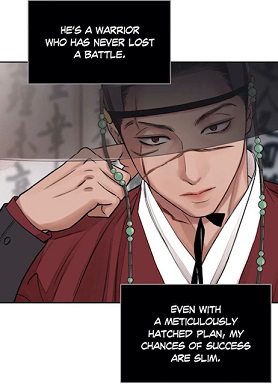 (chapter 2) As a warrior, he was tasked to eliminate the hojok. And he will use every possible mean: poisoning for example. He is a strategist exactly like Yeonjo. The only difference is that he has more experiences than the slave. The noble could perceive the betrayal from headman Choi right away and even anticipate his moves: planting spies through the kisaengs. Since the man is nominated as a governor for 2 years, the warlords are underestimating their opponent’s authority. And this observation leads me to the following conclusion. The slave was the only one who could detect Kwon Hee-Ryang’s true personality. He is a warrior and he is cunning as a snake. Why? It is because he witnessed himself that the man wouldn’t mind to dirty his hands himself.
 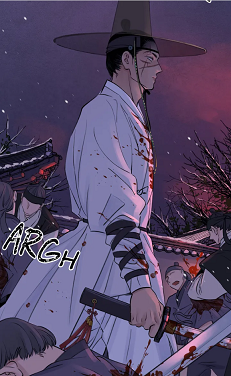 (Chapter 1) He killed the traitor himself. However, due to his “robe” as a governor, his enemies are underestimating his intelligence, ruthlessness and his strength. He can do it without any trouble, since he is backed up by the monarch himself. As a conclusion, the silk can be also a reference to the hanbok and the official robe as the governor. I have to admit that I couldn’t help myself thinking of this scene from Painter Of The Night:
  (chapter 88) The removing of the jacket made of silk… Behind the silk hides a chest made of steel… 😉
 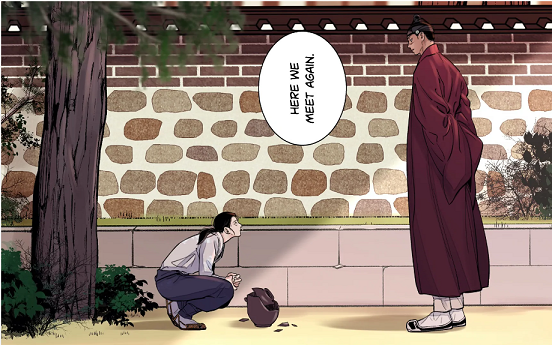 (chapter 6) Yes, Yeonjo is not paying attention to this. But it is only a matter of time, until he discovers the main lead under a different light.
  (chapter 5) It was, as if he was marking Yeonjo as his lover. He thought, he had finally the main lead in his hand. The latter was no longer rejecting him,
  (chapter 2), he was even requesting his help and protection. Thanks to him, he would have an easier life. This explicates why the next time they met, lord Chang was particularly gentle.
  (chapter 5) He could even sense that Yeonjo was feeling pleasure, and it was no longer prostitution.
  (chapter 2) Here, he believed that the main character had moved on and overcome the brother’s loss. That’s the reason why we should expect a transformation of lord Chang. He might raise the rank as well… So far, the administrator seems quite caring and gentle, but I have the impression that he is only showing this side towards the main lead. He showed favoritism which stands in opposition to justice.
 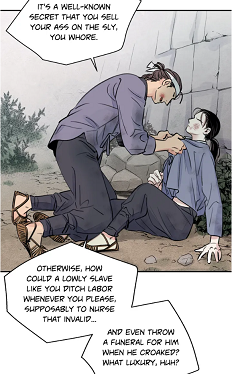 The manhwaphiles should keep in their mind that lord Chang is responsible for the construction of streets or protection walls. This means that he is in charge of many slaves. He could definitely let the workers work to exhaustion so that he could finish his projects on time. Thus I deduce that he is a man of steel as well. He could be as coldhearted as Kwon Hee-Ryang. In other words, I believe that Yeonjo will discover a new side from lord Chang. As the administrator of public work (behind his silk), he could be quite demanding and cold.
  Bebebisous33s' analyses in K-Dramaland and Manhwas