
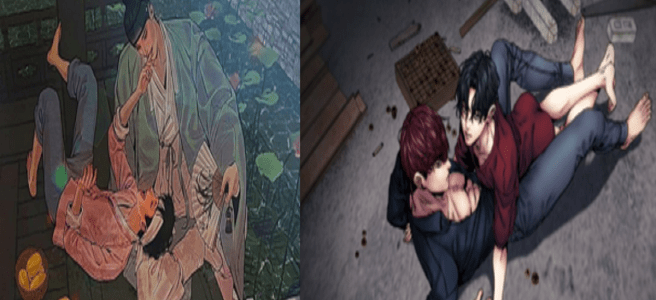
This is where you can read the manhwas. https://www.lezhinus.com/en/comic/pawn https://www.lezhinus.com/en/comic/painter But be aware that these manhwas are a mature Yaoi, which means, it is about homosexuality with explicit scenes. If you want to read more essays, here is the link to the table of contents of Painter Of The Night: https://bebebisous33analyses.wordpress.com/2020/07/04/table-of-contents-painter-of-the-night/ As for The Pawn’s Revenge, this is where you can read other essays: https://bebebisous33analyses.com/2021/06/06/table-of-contents-of-analyzed-mentioned-manhwas/
Warning: I used the German version Snow White “Schneewittchen” as basis. Hence I translated myself the quotes.
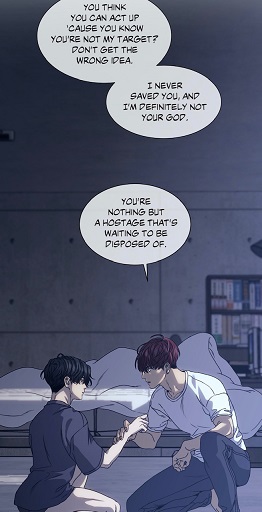
Everything started with this panel: 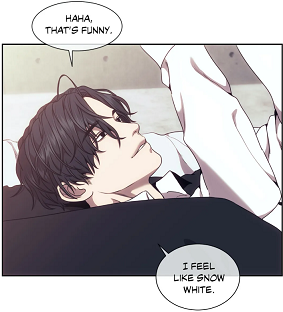 (chapter 22) The protagonist starts viewing himself as the main character from the fairytale Snow White. Hence he comes to the conclusion that since he is Snow White, then there must be a hunter and a witch, the famous stepmother of Snow White.
 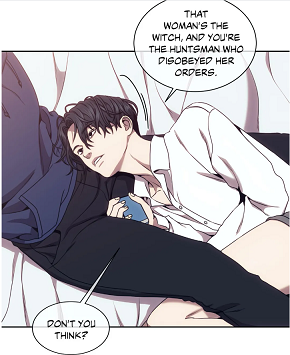 (chapter 22). That’s why he believes that Do Seong-Rok is the huntsman, while Jeon Hee Seong is the witch, because the former didn’t kill him. The former prostitute had planned to get rid of the young man, as he represented a source of danger for her. That’s why she ordered the killing to her lover. Soon after the release, an user asked Evy who was the Prince in this story. The author replied by denying his existence in this story.
What caught my attention is that there are more references of Snow White in this manhwa, like for example the presence of the shared apple. 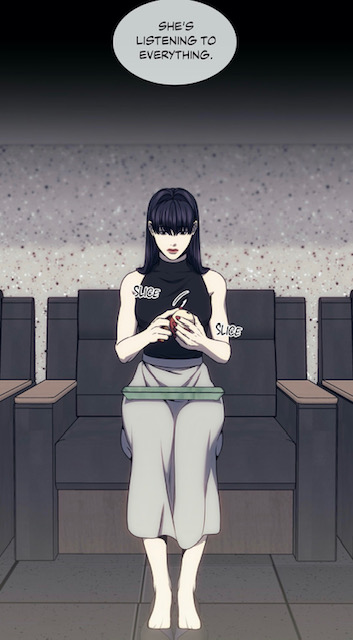 (chapter 24) Thanks to The Pawn’s Revenge, I came to recognize that even Painter Of The Night has so many common denominators with this fairytale.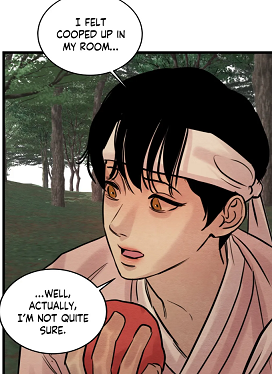
 (chapter 23) That’s the reason why I decided to compare the two manhwas with Snow White. This means, I’ll also explain why they diverge. But for that, it is necessary to explain the fairytale Snow White and its functions.
1. The fairytale Snow White and its purposes
Actually, the focus of this fairytale is the daughter-mother relationship creating some rivalry and jealousy. Though there exists so many stories about this topic (for more read this article https://news.harvard.edu/gazette/story/2020/07/the-tale-of-snow-white-and-what-the-various-versions-mean-to-us/), only two are famous, the fairytale written by the brothers Grimm (19th Century) and the version from Walt Disney, “Snow White and the 7 Dwarfs” (1937).
1. 1. Grimm versus Walt Disney
But the famous psychologist Bruno Bettelheim, who considered tales as very important for the child’s development, looked down on the version from Walt Disney calling it “empty minded entertainment”, as the creators had modified too much the Grimms’ story to the point that it had softened and robbed the meaning of this fairytale. Why did he say that? It is because the darkness from the Grimms’ version had totally disappeared. The stepmother in Walt Disney’s version doesn’t eat the lever and lung of a boar boiled in salt in order to keep her beauty, or she doesn’t asphyxiate Snow White with a lacing strap. The jealousy had turned into more in a rivalry and competition because of beauty. Besides, the movie focused on fated love too, for the prince met Snow White as a child. As you can see, the prince plays a bigger role in the movie. For Bruno Bettelheim, only the Grimms’ version is the true one, as it truly deals with the oedipal complex.
The oedipal complex is when a young daughter feels jealous of her own mother, she is unconsciously attracted to her father. But since having such feelings is forbidden, she projects her own jealousy onto her mother. That’s why the daughter feels that her mother is jealous of her. The darkness from the child is now personified by the “mother”. I need to add that the German authors turned the mother into a stepmother in the second version. For Bettelheim, the fairytale helps a child to overcome the negative emotions (oedipal complex, jealousy, rivalry), it also helps him/her to understand the world around by giving him/her a meaning to life. Furthermore, it explains to the young daughters the future transformation unconsciously: it announces the adolescence and adulthood through sexuality. We have to imagine, when Snow White lives with the dwarfs, she is protected growing up in an environment free from sexuality. So when the Queen offers the apple and both are eating from the same apple, Snow White discovers sex and temptation. The apple is a reference to the bible. And now, you comprehend why I choose such a title. The Queen is a witch introducing Snow White to sexuality. As you can see, Bruno Bettelheim judged the fairytale from the point of view of a psychologist. Yet what he failed to realize is that fairytales have other functions.
1. 2. Fairytale and History
First, fairytales were not written for just children, but also for grown-ups. They were supposed to teach lessons to the adults.
“They were meant to entertain adults while they were spinning, sewing, repairing tools, and doing chores late at night. John Updike tells us that fairy tales were the television and pornography of an earlier age, and a story like that is revelatory about the true uses of enchantment.” quoted from https://news.harvard.edu/gazette/story/2020/07/the-tale-of-snow-white-and-what-the-various-versions-mean-to-us/
How to deal for example, when a lord betrays or abandons a servant? Here, I would like to outline that the notion “family” is strongly connected to the house, and as such a household including the staff. Imagine that Snow White is a maid. Remember that the Queen acts as a lord, the head of the house, so when she orders Snow White’s execution, the young girl can only escape from this terrible fate thanks to the hunter’s fake generosity. This story shows that a servant or even daughter has no right, the lord can do whatever he wants. He won’t get sanctioned. And this remark leads me to the following statement. Bettelheim didn’t recognize that fairytales actually reflect history and the society of their period.
And now, you comprehend why the Disney version was less brutal, more romantic and the Dwarfs were portrayed as rich but hardworking miners. When the American author released the fairytale, marriage in America is associated to love. There exists the myth about fated love too. In addition, American society is promoting free market economy and hard work: American dream. Therefore we see the Dwarfs working so hard in the mine while singing. In the other version, it is just said casually. The parents are supposed to protect their children from any kind of violence, the children have even rights. Consequently the cruelty was removed. Moreover, motherhood is considered as sacred, while in the past, it was different. In the 18th Century and even before, parents didn’t ponder on how to raise their children properly. There were neither psychologist nor pediatrician nor educationalist. The children just needed to learn how to act and dress according to their social status. They were treated like small adults. However, slowly from the end of the 18th Century on, government and as such society started perceiving children differently, as a tool for their own politics. Napoleon created lycées (high schools) in order to increase his army. He promoted education, while in truth he misused it for propaganda and indoctrination. My point is that when the brothers Grimm published Snow White, people treated young children differently than in 1937 in the United States. In Germany, adults used fear to control the children!
Secondly, violence was a way to expose the children to the brutality of their world (there were many revolutions in Germany in 19th Century). But there’s more to it. And we have a proof that Snow White from the brothers Grimm reflected the society of the 19th Century: the presence of a lacing strap.
“But the old woman quickly laced and laced so tightly that Snow White lost her breath and thought she was dead.”
It was a reference to the corset. Young girls would try to lace their corset so tight that they could faint. This was one of the lessons in Snow White: “Don’t lace the corset to tight, because you could have the same fate than Snow White!” This explicates why Walt Disney didn’t include this scene in his story. The corset had vanished from fashion a long time ago. How did I realize that old fairytales are a mirror of the past? It is because when I was a P. A. of a History professor, I was asked to translate his essay about the definition of House and Foreign in late Middle Age and early modern times, and he used the fairytale “Town Musicians of Bremen” from Grimm as an example. The servants were indeed part of the House, once they were old, they would be thrown out of the mansion. The house was a synonym for family, like I mentioned above. During the Middle-Age, European cities, like Bremen, became more and more powerful leading to their emancipation from lords. Bremen like other cities became independent, hence the city councils could hire hire their own musicians. Though this fairytale was written in the 19th Century, it let transpire the social norms and mentality from a previous period. That’s why I came to the conclusion that Snow White must also reflect society from the 19th Century. I could give you another example.
In the Grimms’ version, the presence of sexuality was hidden, because it was symbolized by the apple. Since religion occupied a huge place in the 19th Century, people knew the bible. Consequently they could comprehend the message. But the moment Snow White ate the apple, she discovered sex. But note that she fell into a deep sleep right away. Once she woke up due to an accident occurring during the transportation of the coffin, Snow White had already found her husband, the prince. The latter had selected her as his bride, as he couldn’t forget her. The prince had even asked for the dwarfs’ permission.
“Then he said to the dwarves, “Let me have the coffin, and I will give you what you want for it.”
In other words, this fairy tale was promoting marriage of convenience and the interdiction of sex before marriage, while in the Disney version we have the opposite message. Since the prince kisses the protagonist, before he marries her, it implies that sex can occur before marriage.
Thus even if I consider that The Pawn’s revenge and Painter Of The Night are new versions of Snow-White, they can only be different. Now, sexuality, sexual education and homosexuality are no longer a taboo. That’s the reason why there is no hidden message concerning this topic. As a conclusion, the stories will reflect Korean society or modern society as such. The stories will teach lessons to the readers and give meaning to their life, but only if they decide to ponder about these stories.
This truly exposes that Grimms’ and Walt Disney’s Snow White is just a mirror of the past. But don’t get me wrong: these fairytales are still useful. First, like Bruno Bettelheim, they help children to forge their own identity and to navigate in the world as moral compass. Since the characters are black (evil) or white (good), the children can easily differentiate between right and wrong. Simultaneously, the fairytales prepare them to recognize that reality is more complex. We have the perfect example in Snow White (Grimm) with the huntsman.
1. 3. The lesson taught by the huntsman
It seems that people only remembers him as a good-hearted man, as he had pity and disobeyed the Queen’s orders. But what many don’t know or overlooked is that the huntsman embodies cowardice and selfishness. In truth, he is just a weak-hearted person and a hypocrite.
“And because she was so beautiful, the hunter took pity on her and said, “So run along, you poor child!” The wild animals will soon have eaten you, he thought, and yet he felt as if a stone had rolled from his heart, because he did not need to kill her.“
He acts kind and benevolent in front of Snow White, while in reality he envisions that she will die. At no moment, he wants to save her. She survives, because he doesn’t want to feel guilty and fate is on her side. This means, he just refuses to become responsible for her death. Others will do it for him. That way, his Queen won’t notice that he disobeyed. And notice that the moment the stepmother discovered that she had been played, the huntsman’s disobedience was not punished. Why? It is because she didn’t discover it right away. She ate the lung and lever believing that these were the parts of Snow White.
As you can see, the fairytale was teaching the meaning of fake kindness, cowardice and hypocrisy. But the irony is that in the latest movies, the huntsman was turned into a hero! In addition, it also exposes the “powerlessness” of the Queen. The huntsman could fool her due to her obsession. Simultaneously, it teaches that disobedience doesn’t lead to a death sentence. Here, I would like to point out that after the end of World War II, many German soldiers or guards from camps of concentration claimed that they didn’t dare to disobey. They just followed the orders they had received as a justification for their misdeeds. The reality is that it was just a myth. Historians could prove that no one got executed or no one was forced to become a guard in a camp of concentration.
1. 4. Definition of a fairytale
Because of these parallels between The Pawn’s Revenge, Painter Of The Night and Snow White, I wondered if the manhwas could be considered as fairytales. The presence of violence or sexuality can not be judged as evidences that they can not be fairytales, for they are considered as old form of pornography, destined to adults too. So what is the definition of fairytale?
The story must contain the following elements:
- The presence of magic and supernatural beings: witch, animals acting like humans, fairies etc.
- The characters are seldom given a precise identity. The characters are portrayed very briefly. They are associated to features, like for example, the Queen embodies vanity, superficiality and jealousy.
- The existence of trials, the heroine has to go through different bad experiences in order to grow and mature.
- The place and times: They are usually not defined in order to give a timeless dimension.
- The ending: People usually think that all the fairytales have a good ending, but this is not true. The fairytales from Andersen (The little Mermaid, the little Match girl) have often tragic ending.
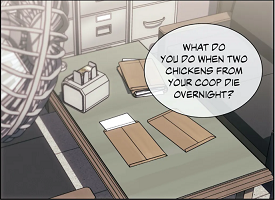
According to this definition, The Pawn’s revenge can’t be considered as a fairytale, for there is no magic. But I would like to point out that The Pawn’s revenge still contains some “supernatural elements”. Lee Je-Oh compares the serial killer to a grim reaper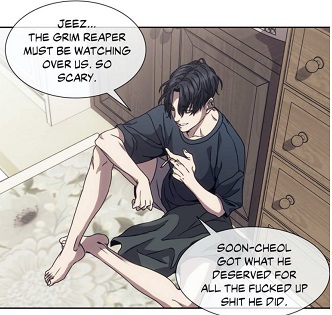 (chapter 1) or
  a god. Then the characters are often associated to animals: dog, mutt,
  snake, horse, pig, elephant, chicken
  (chapter 2). Furthermore, the figures in this story are perceived as living pawns of Janggi.
  (chapter 12) Finally , I compared Jeon See Heong to a mermaid
  (chapter 6) bewitching her prey. On the other hand, the figures have a precise identity. The time and the place are quite defined. As for Painter Of The Night, it looks like the same. We know the birthdays of Yoon Seungho and Baek Na-Kyum and there’s no magic or supernatural elements. Yet, we sometimes see the presence of magic and a lustful spell.
  Imagine, in this scene we have the impression that the painter’s spirit summoned the Ghost Seungho to approach him. Striking is that this repressed desired got fulfilled. While he had his eyes closed, the lord approached him.
 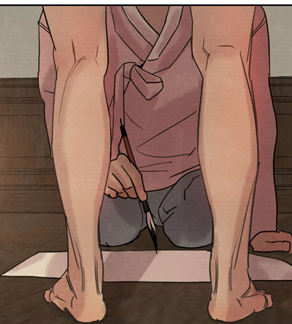 Another positive aspect is that the time and space are not defined. It’s just Joseon period, but that’s it. The mention of Hanyang can not be seen as transgression, because remember that there exists the fairytale Town Musicians of Bremen. The town has no name. Byeonduck said that her manhwa was not a historical story, but she found her inspiration in History. Besides, the trials of the two protagonists are more in the center, while Lee Je-Oh and Do Seong-Rok have already struggled, before the story starts. Consequently, Painter Of The Night resembles a lot more to a fairytale than The Pawn’s revenge, though the sentence “once upon a time” is missing.
On the surface, this comparison seems pointless, yet I wanted to expose that these stories might not entirely correspond to a fairytale, they still resemble to Snow White. Just like the fairytales, the manhwas can have a deeper meaning, for they serve the same purposes: Teach lessons to adults, incite the readers to question their own society and social norms, develop a better understanding of psychology, encourage them to become more committed, less indifferent to injustice, more thoughtful and not judge people too quickly.
1. 5. The ingredients of Snow White
In order to be able to contrast the stories to the fairytale, it is necessary to list all the elements present in Snow White from the brothers Grimm. Besides, this version resembles more to the manhwas due to the sexual content. Seduction and temptation are more obvious. Nevertheless, I will not just list the characters and the relevant items present in the fairytale, but also the topics while giving some explanations:
- The 7 Dwarfs: owners of mines
- The presence of a witch (The Queen as the stepmother in the original story)
- The huntsman
- Snow White: Dark hair, white skin and red lips.
- The prince: a symbol for marriage
- The mirror of truth
- Arrogance and vanity: She keeps looking at her own reflection in the mirror. She feels entitled to be the most beautiful.
- Hidden fears and anxieties: The Queen still doesn’t believe her own eyes, hence she needs a confirmation from the mirror of Truth. In reality, the mother is full of insecurities, that’s the reason why she desires a confirmation.
- Reflection and critical thinking: She doesn’t ponder about the reason why the mirror of Truth is telling her that Snow White is more beautiful. She doesn’t distinguish between seeming and being.
- Jealousy and rivalry
- Oedipal complex
- Guilt and responsibility: Because the hunter didn’t want to feel guilty, he refused to follow the order. Yet he didn’t save her as well. Notice that the stepmother and the hunter desired to put the responsibility on others. The Queen blamed her step-daughter for her failure, whereas the huntsman desired to delegate the dirty work to others (animals). Both showed no true remorse in the end. The Queen failed in her quest, because she never reflected on her own actions. She is definitely responsible for her own failure and misery.
- Loyalty and betrayal: While the Queen betrays the daughter, the huntsman does the the heroine and the Queen. He is only loyal to himself and his own interests. Despite the discovery of the scheme, she doesn’t punish him, she vents her anger on the protagonist. On the other hand, Snow White still has a good impression of the huntsman.
- Neglect: the father seems inexistent and he doesn’t intervene.
- Obsession and blindness: The Queen is determined to become the fairest that she doesn’t understand what the mirror of Truth is telling her. She misunderstands the message: the mirror of Truth is telling her that “Schneewittchen” has the better personality. She is a 10000 better than the Queen, as she is more kind and selfless. The Queen doesn’t recognize her true personality.
- Abandonment: Notice that Snow White is sent away to woods in order to get murdered. This gesture symbolizes abandonment and betrayal. But the Queen is not the only one to blame. The father doesn’t seem to miss her disappearance as well. He neglects and abandons his daughter.
- Selfishness and fake altruism
- Death and murders
- Hypocrisy: Snow White never discovered the huntsman’s true personality.
- Cowardice
- The presence of justice and injustice: While the huntsman escaped a punishment, the Queen was sentenced to death: “Iron slippers had already been heated over a fire, and they were brought over to her with tongs. Finally, she had to put on the red-hot slippers and dance until she fell down dead“. This means that the real perpetrator was only caught many years after the crimes. And it is, because the huntsman had told her what the Queen had ordered him to do. She relied on his testimony. But the protagonist never discovered the true thoughts of the huntsman. Yet, like I mentioned above, the hunter was not innocent. He might have committed no big crime towards Snow White, yet he was definitely a sinner and had not a good heart. According to our actual laws, the huntsman has perpetrated a wrongdoing: non-assistance of a person in danger. The moral of this fairytale is that true justice will never happen immediately or even worse: there exists no real justice.
- Ambition and Greed: Her quest to be the most beautiful exposes her greed. In fact, her fight is pointless, as she can’t fight against aging. She is already doomed to failure.
- Unconscious/conscious: Here, I would like the readers to keep in mind that according to Bruno Bettelheim, the fairytale was speaking to children’s unconscious, while the adults can learn lessons from this story consciously.
And now, it is time to analyze how similar the manhwas are to Snow White.
2. The Pawn’s revenge
As this essay is already long and to outline the similarities, I will put the common denominators to bold. Simultaneously, I will follow the list developed above by examining the main figures.
2. 1. The 7 Dwarves
Since the 7 Dwarves are owners of mines and seem to be very rich, I couldn’t help myself connecting these supernatural creatures to the following characters:  Contrary to the fairytale, they embody not innocence, generosity, selflessness and chastity, but the opposite: sex, hypocrisy, corruption, selfishness, ruthlessness and immorality. They are not owners of mines, but they possess brothels which reminded me of chicken farms
  . They don’t live surrounded by nature and among animals, but in the city. The animals are the humans, they are treated like chickens. In other words, they stand in opposition to the dwarves of the fairytales: corruption, urbanization, poverty and misery. They don’t work themselves, but let others work for them like slaves. Yet they act, as if they were normal citizens abiding laws. This explicates why Ma Jong-Seok hides his affection from Snow White. He can’t be labelled as homosexual. The dwarfs, associated to different vices, symbolize the negative aspects of free market economy and the problems, when the government is not strong enough or too corrupt to stop such an evolution. I could even say, we have here the negative reflection of Snow White and the 7 Dwarves from Walt Disney. Motherhood is no longer sacred, the kids are exposed to any kind of abuse.
 Snow White is now held captive in the mansion of the dwarves! He is exposed to exploitation, the perverted version of Grimes’ version. In the fairytale, the young girl was supposed to take care of the house in exchange of protection, here we have the opposite: Enslavement. The male prostitute has no choice. But what they didn’t realize is that the witch would betray them. Hence I consider the apple as the tool the witch used to get rid of her rivals! The fruit served as a diversion, she was busy listening to their affairs so that she could develop her plan to climb the social ladders.
2. 2. The witch
Since Jeon Hee Seong was the one who introduced Do Seong-Rok to sex, she can definitely be seen as the witch and evil queen.  She seduced him with her experience and insight. She could read him like an open book. She knew that he was so pure and innocent, hence she compared him to a lamb. Her resemblance to the evil mother explains why she is seen with the apple. However, unlike the fairytale, the fruit doesn’t symbolize sexuality, but betrayal. She is actually spying on the boss of the red light district and his minions. She behaves exactly like the Queen, as she is not longing for warmth and love. But her wish is still different, as she wishes power and wealth. Yet, they resemble each other, as both felt somehow powerless. In the fairytale, the absence or passivity of the king, Snow White’s father, gives me the impression that the evil Queen could have been a neglected wife, and the lord selected her as his new wife, out of convenience. He needed to have a wife by his side, and couldn’t remain as a widower. She was treated like a trophy explaining his absence. But because he married her for her beauty, it signifies that she had no power. Her appearance was her source of strength, and now you comprehend why she became obsessed with her image. If she lost her beauty, she would become even more powerless than before. She had nothing else to do. Jeon Hee Seong was forced to marry Choi, and while the Queen from Snow White was neglected, the witch was abused by her husband. So both were unhappy in their marriage and life. This explains their desire to get power in their own way. As the manhwaphiles can detect, both witches have something in common: ambition and greed, though Jeon See Heong uses her beauty differently. She is aware of her own attraction and has no fear or insecurities. She doesn’t need a mirror to tell her how beautiful she is. Her body is her tool, not the mirror. Yet both have another aspect in common: they try not to do the dirty work themselves. Both hire a killer, the only difference is that due to the huntsman’s betrayal, the Queen learned her lesson. She had to do it herself, if she wanted to get rid of her rival. And this leads me to the following observation. The witch from The Pawn’s revenge has two reasons to use others for her dirty work. First, she is no queen, hence she could get charged with murders. Secondly, if we use the fairytale as a parallel, she could have a similar mindset than the huntsman. She doesn’t want to feel burdened by guilt, notice that she is never facing the consequences of her order and decisions. She didn’t see the corpse of her dead husband and the gambler Lee Soon-Cheol.
  She just communicates through a cellphone. Besides, even Do Seong-Rok felt uncomfortable after killing two people. Hence I perceive Jeon Hee Seong as less bloodthirsty than she appears to be. She could be more of a coward.
On the other hand, in the manhwa the witch is still relying on her lover, Do Seong-Rok. She got angry, when she realized that he had disobeyed her and let him become responsible for Lee Je-Oh. However, it is just a matter of time, until she gets aware that Do Seong-Rok is no longer bewitched by her. In chapter 26, he can no longer have sex with her. Hence we have a parallel with the fairytale: the allusion of aging and change. The woman is no longer attractive to him, because he has perceived her true nature. She manipulated him and he got aware that she was fake. With this, we would another similarity with the fairytale, the distinction between seeming and being. He realizes, that her promises were all an illusion.  In this scene, the manhwaphiles can sense her witchcraft.
And since Jeon Hee Seong has already chosen Ahn Jae Oh as her official partner due to his social position, it becomes understandable why her relationship with Do Seong-Rok was doomed to failure. I would say, since the police officer is on the verge to become a congressman, the protagonist could only appear weak to her. His strength were his loyalty and blinded trust. Consequently Ahn reminds me of the king from the fairytale, while I perceive Do Seong-Rok not just as the huntsman, but also as a second Snow White. First, he had dark hair and a white skin like the protagonist.  Secondly, he was as pure as Snow White. But since he was neglected and had abandonment issues, he longed for maternal warmth and love. In the Korean version, we see his father promising to come back, an indication that he had no mother. Hence I judge, Do Seong-Rok’s relationship with the witch was a form of an oedipal complex. She served as a surrogate mother, that’s how much he longed for a mother and family. The manhwaphiles will realize the common denominators: neglect and abandonment perceptible in the beginning of the fairytale. Secondly, note that Do Seong-Rok had changed the color of his hair, when he met her again. That’s why I deduce that the card she gave him should be perceived as the apple from the fairytale.
  (chapter 16) With her appearance, her words and this card, she casted a spell on him. That’s why he was so full of lust during their second encounter. The red hair could be judged as the indication of the lustful spell. Simultaneously, this color implies the loss of virginity and the beginning of adulthood. The most fascinating is that in the bedroom, two colors are prevailing: red and white, which coincidences to the red and white side of the poisoned apple from Snow White. The witch’s beauty was so strong that he had to transform himself.
  (chapter 16) This was his desire to resemble her, to get closer to her. Since he was a man, the witch didn’t see him as a rival. This explicates why she didn’t feel jealous at all. But for me, there’s no ambiguity that she filled the void left by the missing mother. Hence, since he was having sex with a surrogate mother, this can not be considered as the real discovery of sex. I conclude that when he met Lee Je-Oh, he discovered real sexuality. That’s the reason why he can no longer have any erection with the Queen. If we judge The Pawn’s revenge as a fairytale, then it teaches, homosexuality is a normality. He didn’t know about this, until he saw the male prostitute having sex with the pimp and felt aroused.
Moreover, by sleeping with him, Jeon Hee-Seong somehow committed a sin. Let’s not forget that she was already married. The woman embodies evil, for she promotes cheating, betrayal, murder, selfishness and avidity. Her ambition is to become the Queen of the red light district. This means, the readers are witnessing the raising of the evil mother, who is on the verge of becoming the Queen! But due to her greed and ambition, she doesn’t realize her own blindness. Her arrogance makes her overlook the male prostitute, Lee Je-Oh. She trusts too much her beauty, and believes to be smarter than others. Thus her arrogance is the reason why she will fail in the end. She showed her true face to Do Seong-Rok too soon, when she showed her anger,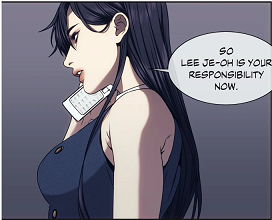 because the huntsman had disobeyed her order. The man could see a glimpse of her true personality. Due to his past experience, he had learned his lesson. In addition, she is underestimating the power of love. Thus she had planned to betray and abandon her lover, but she doesn’t anticipate the killer’s betrayal. Exactly like the stepmother, she is not reflecting on her own actions. She didn’t pay too much attention to her words over the phone and the consequences. The absence of critical thinking will be another reason why she is doomed to fail: too obsessed to reach the top. She has the impression, she is almost there, the presence of the ring offered by Ahn is the proof of her success. And now, you can see why I saw so many parallels with the fairytale.
2. 3. Snow White and the huntsman
Naturally, this is not surprising that Lee Je-Oh considers Do Seong-Rok as the huntsman. 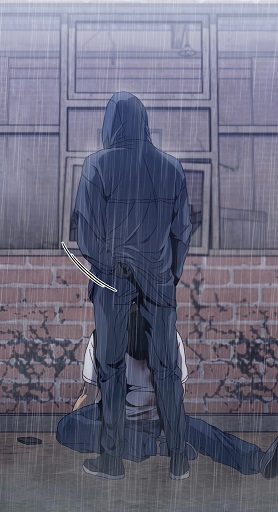 The latter’s actions resemble to the ones from Snow White. Yet, unlike the hunter, the red-haired man has not a weak heart, but a good heart. He is not a coward or a hypocrite. He can feel pity, and doesn’t fear to dirty his hands. On the other hand, he has nightmares
 , as his unconscious is telling him that he made the wrong choice. And in this scene, we have the presence of conscious and unconscious. He shouldn’t have listened to his lover’s suggestions, but he is still in denial. That’s the reason why he keeps starring
  and looking at the letter with a fake confession. Hence I believe that contrary to the hunter, he feels some remorse, as he senses that he has been tricked. In my opinion, by sleeping with her, Do Seong-Rok got tainted by her darkness. This explicates why when he strangled Ma Jeong-Sok, he had an erection.
 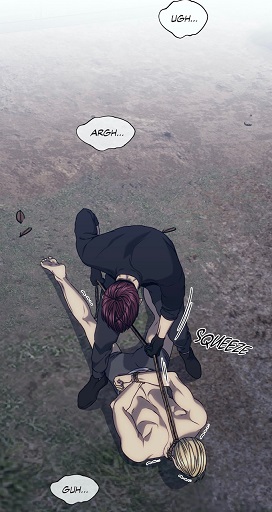 And remember that in the Grimms’ version, we had the presence of a lace in connection to Snow White. And this reinforces my interpretation that the killer is actually more a combination of both characters: the huntsman and Snow White. He has become the “perverted version” due to the Queen’s influence, he is her step-son. Striking is that Lee Je-Oh is giving him another interpretation of his wrongdoings: he liberated him from his prison and misery.
2. 4. Snow White and the mirror of Truth
Since Jeong Hee-Seong resembles a lot to Lee Je-Oh, he appears to be indeed the real Snow White. Exactly like Do Seong-Rok and Snow White, he has dark hair, a white skin and red cheeks. Moreover, similar to the Grimms’ version, the main lead has been neglected and abandoned by his father.
Their fate seems similar, yet there is a huge difference. The male prostitute learned not to rely on others. When he tried to free himself, he didn’t ask for help, he stabbed Ma Jong-Seok himself. However, he was encouraged to use the knife by the witch, that’s how he discovered her true personality. Her beauty can no longer bewitch him. Striking is that he could already perceive her true personality, even before knowing her true identity.
In my opinion, Lee Je-Oh is actually a combination of the mirror of Truth and Snow White. Through his comments, he is confronting Do Seong-Rok and forcing him to reflect on his actions , questioning his relationship with the witch.
  But notice that he has a similar attitude with other characters. He confronts Choi Yeong-Gil with his hypocrisy and negative attitude.
  Just before the pimp is killed, he confronts him with his true personality and sins. He is responsible for the misery and death of many people.
  Once cornered, the “dwarf” is forced to confess his affection to Lee Je-Oh. Both dwarves had something in common: hypocrisy. Hence you can comprehend why I come to the conclusion, Lee Je-Oh is the mirror of truth. He embodies honesty and loyalty, just like the protagonist, he longed for a home and family.
Hence the huntsman’s “jail” corresponds more to the house of the dwarfs from the fairy tale. It’s the place where love, trust and innocence are protected. Since I have already predicted a revolution, I believe, Lee Je-Oh will give another sense to Do Seong-Rok’s murders. They will try to destroy this corrupted world full of selfishness and greed. That’s how Lee Je-Oh will become the witch’s rival. He will ruin her plan due to his sense of justice. The manhwaphiles will certainly remember that the fairytale is centered on jealousy, rivalry and competition. The young boy was already jealous that he felt the need to steal the killer. Right after having sex with him, he considers Do Seong-Rok as his boyfriend. He compliments him and caresses him
 , giving him the warmth and affection the killer had been longing.
What also caught my attention is that both Snow Whites are “corrupted”. While the one kills, the other lies, schemes and steals. This stands in opposition to “Schneewittchen” from the Grimms’ version. It is comprehensible, because both protagonists got tainted by their parents. Lee Je-Oh’s father was selfish and had no sense of responsibility, while Jeon Hee Seong desired to use the main lead’s weaknesses (isolation, lack of experience and innocence) to her advantage. This signifies, both are the products of bad parenting and a ruthless and selfish society. So if the two Snow Whites start working together and keep killing others in order to clean society, what will happen to this city? Chaos. But Lee Je-Oh would see it as delayed justice.
2. 5. The absence of the Prince
Why did Evy say that there was no prince in this story? My explanation is the following. Since the prince embodies “marriage” and in South Korea, homosexual marriage is not allowed, there can’t be a prince. Secondly, since I have already portrayed that the two protagonists have two functions, this signifies that both could also be perceived as the prince. They both free each other, as they give each other what they need. In the episode 27, Lee Je-Oh decided to lie to Kang Hyeon-Jong in order to protect his lover. He gave him an alibi and used the video as an evidence. This means that from now on, he is now responsible for Do Seong-Rok, just like the latter is now accountable for Lee Je-Oh’s survival. And since there’s no justice in this world, I believe that the prostitute Snow White will take matters into his own hands and give justice to others. Remember that Snow White sentenced her stepmother to death! This signifies that she gave justice herself.
As a first conclusion, though The Pawn’s Revenge doesn’t correspond to the definition of a fairytale, the manhwa and Snow White are really similar due to the topics and characters. It truly shows that such stories are a great source of inspiration. Then the readers should question themselves why the city and its inhabitants are portrayed in such a negative light. 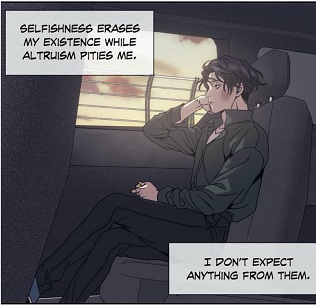 From my point of view, it is related to the huge political scandals South Korea had to face like for example with the president Park Geun-hye, and the economical boom with the development of new districts which doesn’t lead to a diminution of poverty. Then, there was the Sewol ferry incident, where many students died, while the captain and the crew abandoned them. This terrible event caused a huge mistrust in the authorities and the adults’ hypocrisy and selfishness. As the manhwaphiles can detect, I view this story as a mirror of our modern society: the failure of parents as role model, the disintegration of families… Simultaneously, it teaches the same lessons: recognize hypocrisy, selfishness and the importance of reflection. Lee Je-Oh could become the killer’s ally, the moment he recognized his own mistake. He imagined his intelligence made him superior, he underestimated the huntsman’s strong will. He might have felt pity, but he was not a fool, rather a dangerous man because of his strength. He mistook his innocence for stupidity. That’s why Snow White is superior to the witch.
As you can imagine, I won’t write the comparison with the Painter Of The Night here, for the analysis is already so long, however I would like the readers now to ponder on the following question: Who is the witch with her lustful spell, Snow White, the mirror of truth, the 7 dwarves, the huntsman and the prince in Byeonduck’s work?
Feel free to comment. If you have any suggestion for topics or manhwas, feel free to ask. If you enjoyed reading it, retweet it or push the button like. My reddit-Instagram-tumblr-twitter account is: @bebebisous33. Thanks for reading and for the support, particularly, I would like to thank all the new followers and people recommending my blog.
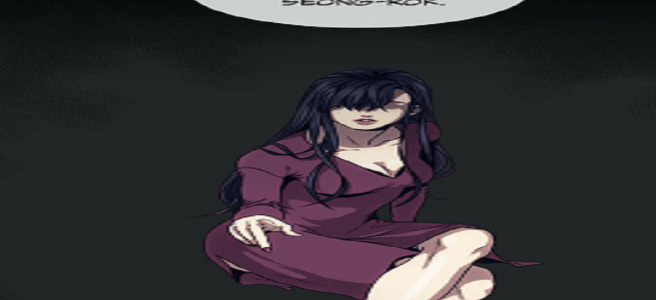
 (chapter 21) As you can detect, both have so many similarities: a memory, an open area, the blue sky with clouds, two people close to each other, a very confidential conversation, a plan and a clear view. When I analyzed the second panel [read for that the essay “Hope”
  This aspect is even reinforced with the choice of color, purple.
  (chapter 11) In her mind, he is just a worker and not a boyfriend. She is unaware that by turning him into a killer, she will change his nature. He can no longer be a lamb or even a simple pawn. That’s why he gets an erection while strangling Ma Jong-Seok.
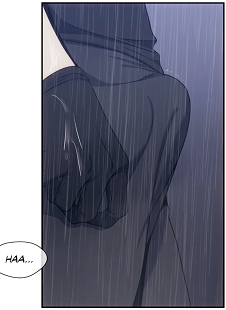 (chapter 18) He has become a weapon, and as the ocean, she can never control him. As you can see, if you interpret such an image, you can already anticipate the evolution of the story and realize the villain’s errors. Besides, pay attention to the place of the biggest cloud. It stands next to the main lead.
 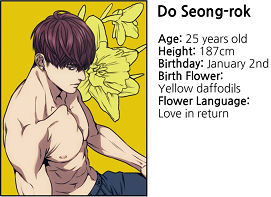 The color yellow! This pigment is often associated to positive features like optimism, cheerfulness, logic and wisdom. [For more information:
  (chapter 1) This negative association comes from the Middle-Age in Europe, where Jews and prostitutes were forced to wear some yellow on their clothes reflecting their social status. This pigment was a warning, and this justifies why in French (yellow=jaune) and in English there exist many negative expressions with yellow: “rire jaune” (two-faced laugh) or “jaune cocu” (cuckold yellow) or “yellow belly” (coward). Therefore yellow represents deception, betrayal, adultery, arrogance, vanity and jealousy. And note that Do Seong-Rok is indeed committing adultery with the main lead,
 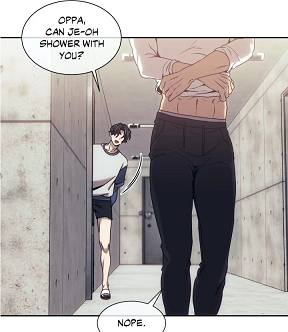 and has the impression that his lover will cheat on him with Jeon Hee-Seong.
 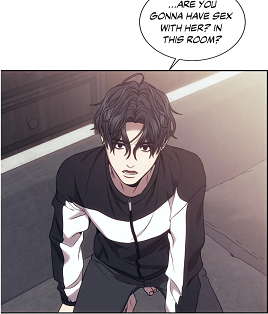 That’s why he gets upset. And now, you comprehend why the femme fatale’s dream is an illusion. She thought, she was deceiving her pawn, while in reality she didn’t recognize her own misjudgment. Her delusion of grandeur is the cause for her future defeat.
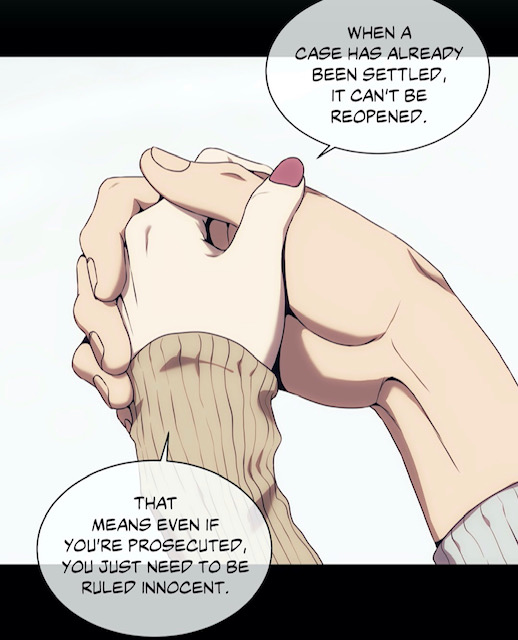 (chapter 24), while the brothers are just sitting next to each other with a certain distance.
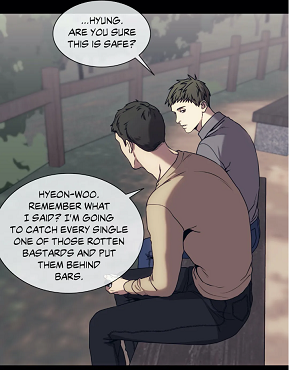 (chapter 21) And when he spoke, he expressed his concern for his brother. This signifies that safety mattered more than his dream back then.
  Yet, this is not visible from behind, for she is wearing a black jacket. The appearance of beige is no coincidence, because this color is associated to loyalty and responsibility.
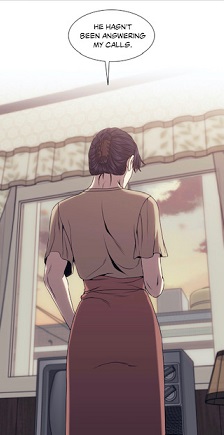 Her bun and her clothes gave the impression that she was just an average married woman, but when she visited her so-called boyfriend, she had dressed up. Her long hair was left in the open, an important sign for seduction, just like the white shirt exudes purity and innocence.
  (chapter 25) At the same time, the black skirt embodies mystery and seduction.
  (chapter 23), while she would let the young man take the fall.
  (chapter 16) And observe that the future assassin was willing to accept this terrible situation
  (chapter 16) He would be her tool. And don’t forget that in that scene, she was trembling on her knees, a sign of huge vulnerability, which could only move his heart. He felt that she needed him, that’s why he accepted to follow her plan. I could use another evidence that truth is her MO. She confided to him this
 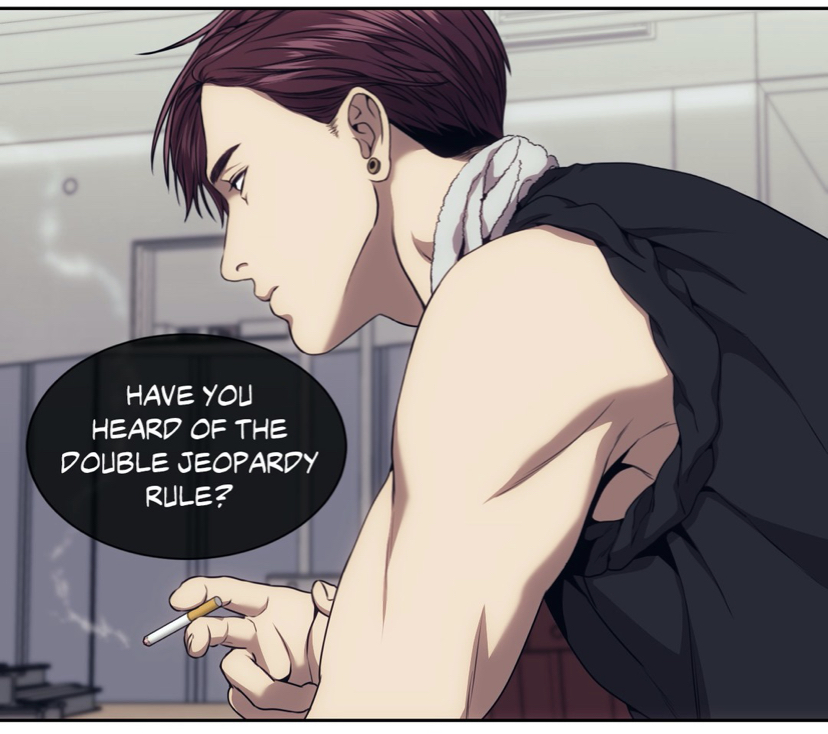 (chapter 24) Once he has been prosecuted and he is proven innocent, he can’t be charged with the same crime. But just because this rule exists, this doesn’t mean that this will be applied in this case.
 (chapter 24) These videos were her weaknesses, therefore the main lead needed to find and erase them. We don’t know for sure that he was tasked with this request as well. That’s my assumption, because she stated that she wanted to erase her past, and the footage was part of her terrible past. Once her husband was removed, she would be able to get rich thanks to the property situated in the redevelopment.
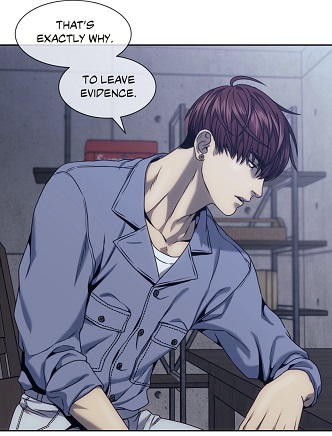
  (chapter 24) She desired to lead the detective to Do Seong-Rok and the pieces of Janggi left on the body would serve as a clue for his involvement in the assassinations. This explicates why Lee Je-Oh wondered about the reason for leaving evidence next to the victims an.
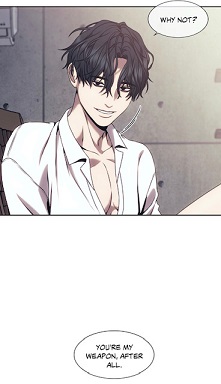
  (chapter 13) The femme fatale has power over his life, because she could reveal the truth. That’s her promise, if his situation worsens, she can save him implying that she has an evidence that could prove Do Seong-Rok’s innocence. However, she knew that once her husband dies, she will become a suspect. Thus she needed the main lead to divert the attention from her. Her plan was to redirect the investigation towards the red-haired man.
 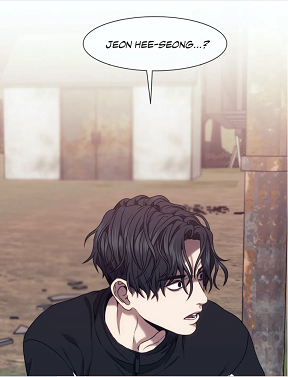 (chapter 25), and has even realized her true goal thanks to Do Seong-Rok’s confession
  (chapter 23) Unlike the female prostitute, the young man made the terrible experience by scheming very early on. He learned that he shouldn’t underestimate the killer’s strength and strong will. Hence he came to realize that he should treat his ally with respect.
 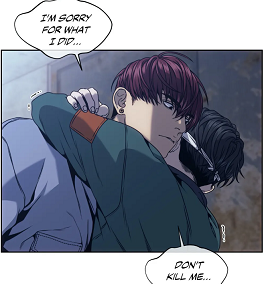 (chapter 12) Do Seong-Rok might not be clever, but he is not weak either. Actually, his major flaw is his innocence, for he is not cunning enough. And remember what I wrote above: she misjudge her lover’s true personality. Therefore she will recognize her error too late.
 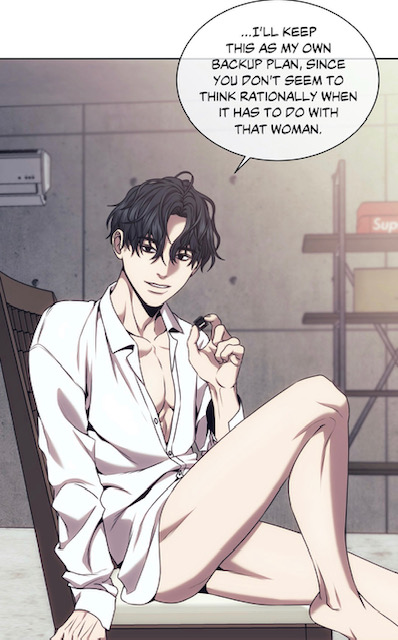 (chapter 23), while the serial killer will become his arm and hand! Besides, don’t forget my recent interpretation. Do Seong-Rok is linked to the ocean, and the manhwalovers will certainly remember how the male prostitute viewed himself:
 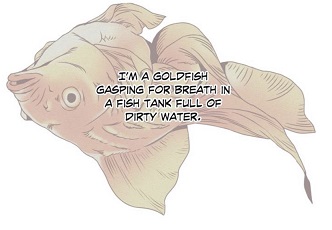 (chapter 1) A fish!! I am well aware that a goldfish is not living in the ocean, but I doubt that the male prostitute could ever afford himself an expensive fish from the ocean. Besides, in the essay “The goldfish and the lamb – part 1”, I had already explained that for me, the young main lead reminded me a lot of the devil firefish / common lionfish.

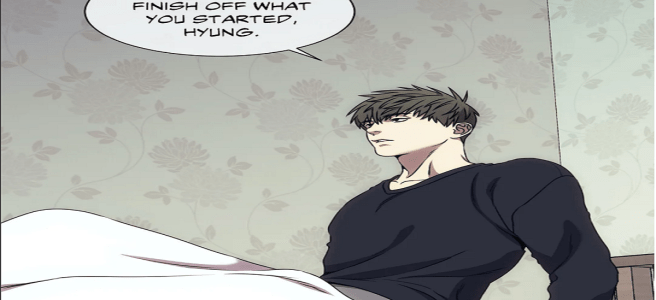
 , it gives you the opposite impression: dark, asphyxiating, destructive and hopeless.
  , the missing brother from lieutenant Kang Hyeon-Woo. When the former confides his intentions to his brother (he would like to clean the corruption in the police forces and remove the dirty connections between authorities and the red-light district), the former appears integer, righteous, courageous and determined. This means, he is full of energy and aspirations to achieve his goal.
 combined with the idioms “chance” and “expose this case to the public”. Note the presence of the wooden plank in the bottom. It was, as if the perspective and the wooden plank were the stage, and the city in the background was symbolizing the public. In other words, the scenery was representing the detective’s vision. He was full of confidence and dream here. Moreover, since it is an open air area, you can breathe more easily. This signifies that the scenery oozes a certain relief, liberation and release. The brother could confide to his brother about his intentions and his latest information. He knew that the young detective was trustworthy and would support him. It represented a moment of relaxation for the investigating Kang Hyeon-Jong. Thus the readers see the machines as a symbol for relaxation and entertainment. Since the hyung was disclosing his discoveries and his evidence, it means that the younger brother was his pillar in his quest to clean up the police forces.
  (chapter 16) Both characters are looking down, both hurt and depressed. The prostitute is full of doubts and resigning to her fate. She will do anything in order to survive, and if it is necessary, she will betray and abandon her lover. She announces that she will be definitely ruthless and selfish. She is no longer expecting happiness and relaxation. It’s a fight for her. Besides, in that scene, the city looks lifeless, as there are no plant or people. I would even say, it’s suffocating, for the sky is so dark and clouded. It was, as if it functioned as a lid. As a conclusion, the weather and the scene reflect the character’s state of mind. The blue sky with clouds is linked to hope, while a raining dark grey day is associated to hopelessness, fear and doubts. Thus the town is related to suffocation, loneliness and resignation. Let’s not forget that the characters are all embodying animals (Lee Je-Oh is a goldfish and a dog, Do Seong-Rok is a dog, Jeon Hee-Seong is a snake etc…), but the problem is that they are all trapped in the Janggi game, that’s why they are not free and feel so oppressed. In my opinion, the Janggi board is in reality the city itself. Instead of representing civilization and progress, the town embodies despair, corruption and asphyxiation: death.
 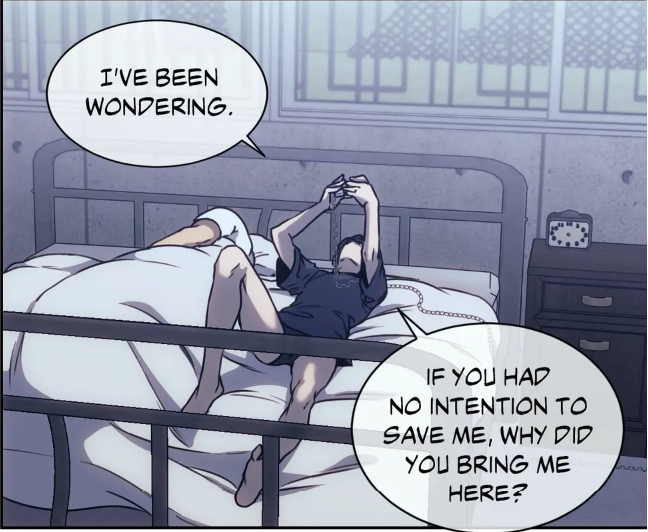 (chapter 7) where grey was the dominant color. Contrary to the scene in episode 7, the main leads are no longer separated by the sheet, and they are facing each other. As you can sense, the color and the position mirror their increasing closeness and trust. I would say that the main couple is full of hope in that chapter. This is particularly perceptible in this image. Lee Je-Oh is already thinking about the future.
  He is confident in his skills and intelligence to protect his partner. The presence of relief and aspiration explains why the main leads are tender and caring towards each other.
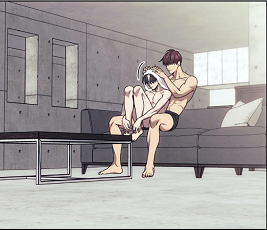 Here, you might argue that we don’t have the presence of nature, hence this contradicts my previous interpretation that nature is a signal of liberation and relief. However, I can refute this argument by pointing out that we don’t see the city here. In my eyes, the room has now become a refuge, a shelter of two wounded and lonely souls. Lee Je-Oh is no longer viewing the bedchamber as a place where he is held hostage. He is now cohabiting with the murderer. Thanks to him, Seong-Rok could sleep much better and wasn’t tormented by a nightmare, though he had killed Ma Jeong-Seok. To sum up, the bedroom shouldn’t be judged as a contradiction to nature. It is the place for privacy and relief as well. Furthermore, the better the bond between the killer and the male prostitute is, the clearer the room appears.
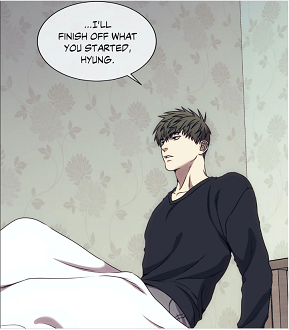 despite the loss of his brother. He hasn’t given up on his dream and ambition. Consequently he makes this promise to fulfil his brother’s hope. Hence Kang Hyeon-Jong’s uniform hangs on the wall at the end of the bed.
 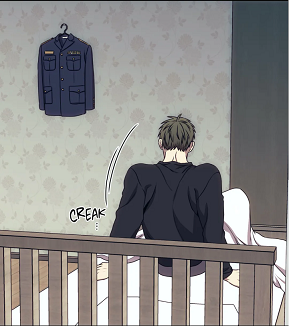 It symbolizes the detective’s goal: he is seeking for the truth and eradication of corruption. The bedroom is the officer’s refuge, where he can express his true thoughts and emotions. He doesn’t feel lonely, because he still has the brother’s uniform by his side. It was, as if the latter was still alive and by his side. And if you pay attention to the images, you’ll detect the indirect presence of nature: the wallpaper. It is slightly green and there are flowers. I tried to identify the flower, but I wasn’t sure. For me, it looks like a chrysanthemum which symbolizes longevity, fidelity, joy and optimism. Naturally, this flower has other meanings, but it depends on the color. A white one is offered to the relatives of the deceased as a sign of grief. On the other hand, a white chrysanthemum signifies loyalty and honesty. Striking is that the flower has the same color than the shirt Kang Hyeon-Jong was wearing, when he was confessing his last discoveries and dream.
  But like I mentioned above, I am not certain about the identity of the flower on the wallpaper. It could be a dahlia too… If you have any idea or suggestion, feel free to leave a comment.
 (chapter 20) Though the latter desires to give the lieutenant the impression that he is honest and supportive, in reality it is the opposite. Since he asked the lieutenant for update, though he is quitting his job, this means that Kim Seung-Tae is actually asking for information. In my eyes, he belongs to the team facing officer Ahn and Jeon Hee-Seong.
 For her, humans resemble to the pieces of the chess board, where the weakest are doomed to disappear. Striking is that many chess players have a similar approach than her. They all see many similarities between real life and chess.
  It is a dog-eat-dog world, and if you want to survive, then you need to become ruthless as well. This negative attitude is really palpable, if you contrast it to Allan Rufus’ quote. The latter views the game and life as a place, where people gain knowledge through experiences. Thanks to the practice and increasing maturity, the person is capable to change or anticipate the next moves. In other words, with the training, people can make a different decision. Furthermore Benjamin Franklin, who has a similar approach, adds that even bad events should be considered as lessons and as such a source of motivation to improve the situation. Both authors promote hope, whereas the femme fatale advocates disillusion and defeatism. Hence, for the Korean figure, life is perceived as an endless battle and nothing more. This signifies that in her eyes, life contains no happy moment and has nothing to offer. Since she compares it to a constant war,
  this signifies that only power matters, as it guarantees survival. I would like to point out that EVY confirmed in a tweet that the femme fatale plans to become a king. This truly reveals that for the former prostitute, dominance is her ultimate goal in life. In her mind, strength symbolizes life. Thereby for her, love has no meaning. Moreover, I also think, she doesn’t believe in values like affection, friendship or respect. The evidence for this the following. Note how many times she utilizes the idiom “kill”, while the male authors outline the importance of insight (“insight”, “foresight”, “forethought” “vigilance”) and wisdom (“knowledge”, “knowing”, “insight”). In other words, while Jeon Hee-Seong is focusing more on action (killing), the other players (Franklin, Buxton, Rufus) privilege pondering and reflection. She is already aiming directly at her final goal: removing the former king and replacing him.
 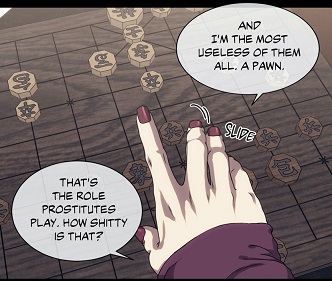 (chapter 6) In her eyes, it has no value at all (“the most useless”), whereas the protagonist and student Seong-Rok views the soldier differently:
 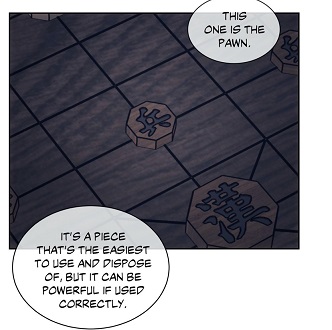 (chapter 13). The latter can be influential, but it depends on its position and the way the general uses it. Sense the contrast between these two descriptions outlining her narrow-mindedness in the end.
 (chapter 18) are removed within a short time. This explicates why the detective Kang Hyeon-Woo suspects her right away.
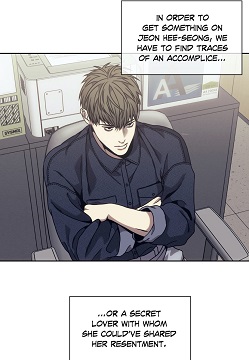 (chapter 8) But why is the femme fatale neglecting reflection, knowledge and foresight in Janggi?
  (chapter 16) and his occupation within a few minutes, when they met for the first time. In his eyes, she appeared as an intelligent woman full of wisdom and experiences. This explicates why he listened to her explanations so carefully, when she was about to manipulate him to kill for her.
  (chapter 16) And that’s how she definitely views herself too.
  (chapter 12) and showed no loyalty towards him
 (chapter 12) She has no idea about Do Seong-Rok’s past experience (the fake promise and abandonment).
  (chapter 13), this signifies that her true role in Janggi is different. She is the player. Consequently, she is sitting on the one side and takes the pieces.
 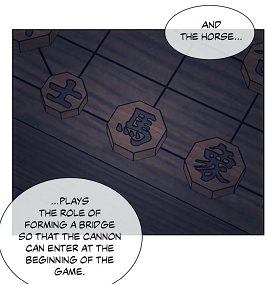 , the elephant
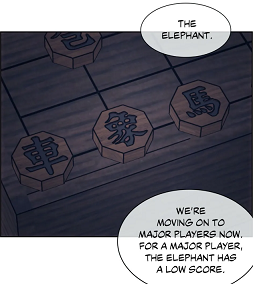 , the counselor/the guard
 , the chariot
  and the cannon
 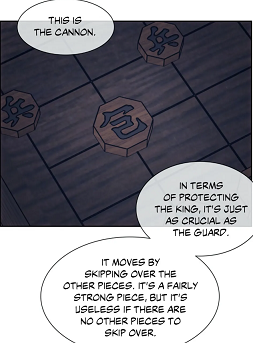 (chapter 13). That’s why I tried to identify the killer’s true role in the game board.
  (chapter 13) The moment the protagonist has eliminated all her targets, he will become useless. Consequently, I deduce that when Jeon Hee-Seong plays chess, she is the “king” and Do Seong-Rok is the cannon.
  (chapter 11). “Some of my guys” is a reference to the lieutenant Park. And remember that the role of the horse is to create a bridge for the cannon. Let’s not forget that Park Gwang-Soo is not really trying to investigate the whole matter, as the victims are all involved in the red-light-district. A real investigation would lead to unveil the corruption among Mijeong police.
  he is not realizing that she is just trying to replace the first team. Jeon Hee-Seong plans to maintain the collaboration between Mijeong police and the red light district, yet the involved parties will be changed.
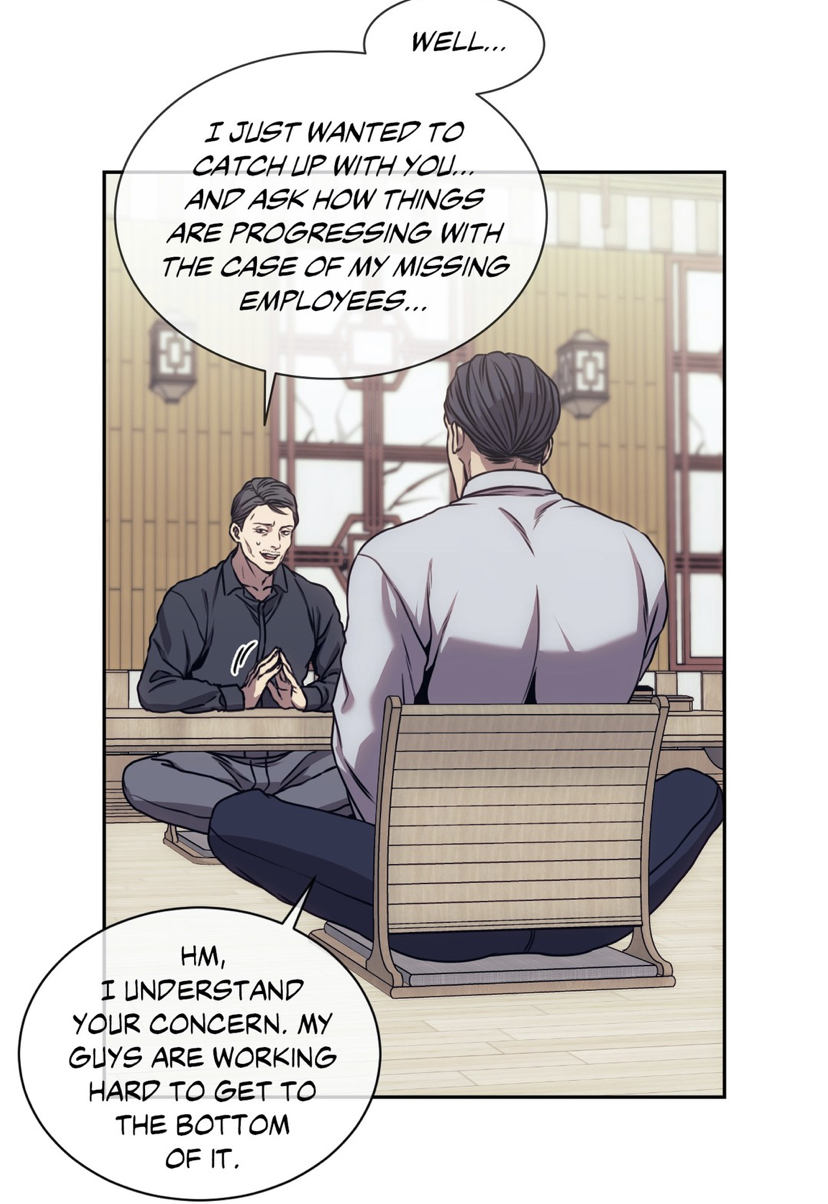 (chapter 11), this signifies that Ahn has been working for this team too. In my opinion, he plays the same role than in the other team: he is the chariot. As for the cannon, I will unveil his identity below. But since we have a whole team, this signifies that there’s a general. Consequently, there exists someone behind the victims, the king and player of the game board. To sum up, Jeon Hee-Seong is playing against a person, whose identity has not been revealed yet. How ironic is that when I was writing this essay, the special episode confirmed my theory:
 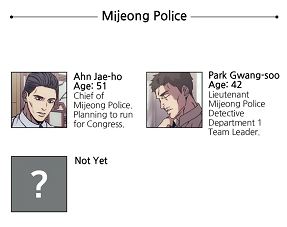 The “not yet” is the player using Koo Jeong-Mo and the others as his pieces. Jeon Hee-Seong entered the game and started a war against the first team. She could win over officer Ahn by appealing to his feelings. She revealed the injustice she was exposed too. That’s why Ahn asks Koo Jeong-Moo about the reason for targeting him.
 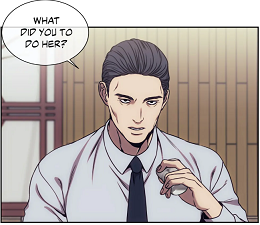 (chapter 11) Ahn could understand her motivation. However, she disguises from him that she is stimulated by her greed and ambition too.
 (chapter 6) It was, as if with the killing, he would go to her side, as in that scene he was facing her.
  (chapter 1). It was, as if he was observing a game and predicting moves. Furthermore, he observed Lee Je-Oh for a long time
 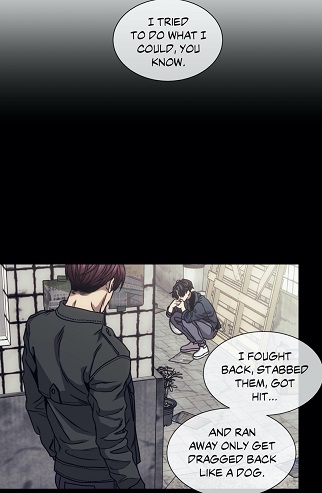 and questioned his role in this team. This truly shows that the main lead was pondering a lot. I would like the readers to keep in mind the advices given from the chess players: foresight, forethought, prudence and vigilance. Moreover, there exists a interrogation point in the image of the male prostitute, which shows that the main character was thinking about Lee Je-Oh’s role in that game. Furthermore, the former could impose himself through his strength in front of Lee Je-Oh.
 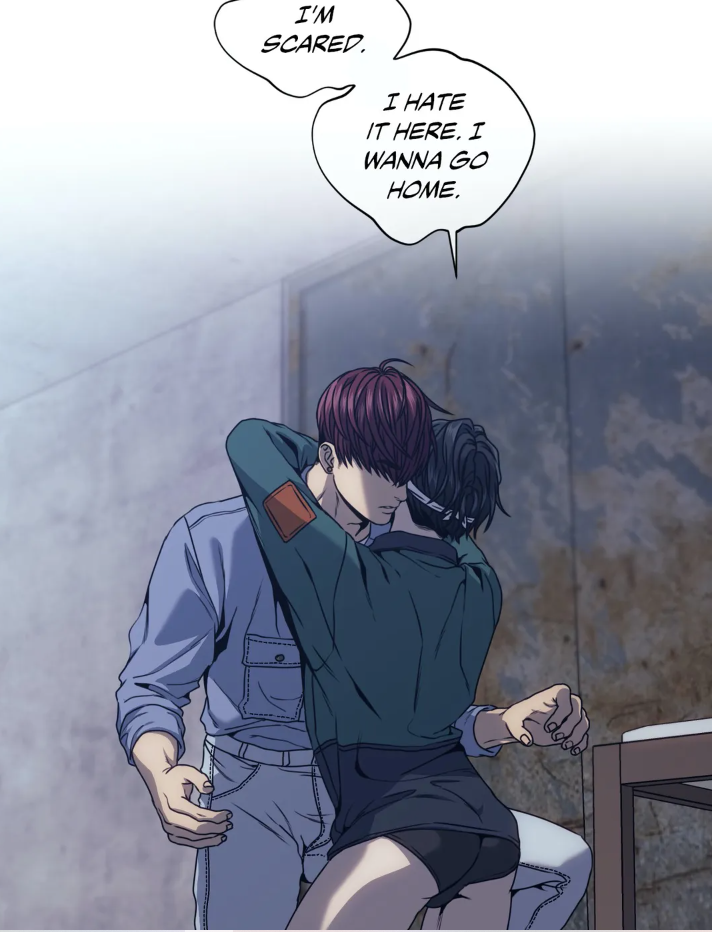 (chapter 12) The latter made the mistake to overestimate his situation and his skills. He imagined with his observation skills and schemes he could prove his superiority and loyalty, but the red-haired protagonist punished him for his “betrayal” and “arrogance”. The red-haired man embodies physical power and is the final authority. Finally, if you observe the way Do seong-Rok taught his new ally Lee Je-Oh about the game, you’ll sense that their position reflects the actual situation: they are sitting on the same side in front of the game.
 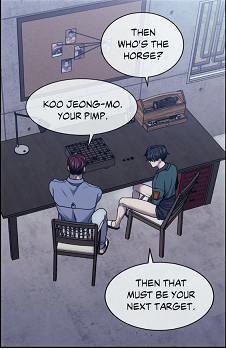 (chapter 13) which contrasts so much to the scene with the former prostitute in episode 6. Since Lee Je-Oh is giving advice to the young criminal (like not leaving any evidence
 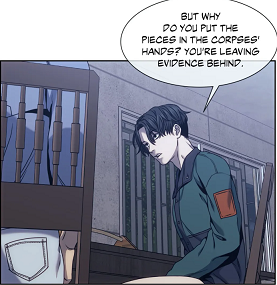 (chapter 13) or not answering Jeon’s calls, I view him as a guard and counsellor. At the same time, he is offering his help to capture the pimp Koo. Hence I consider him as Do Seong-Rok’s horse too. As you can observe, the red-haired man and his lover will play different roles in Janggi. However, right now the two main characters are still working for the femme fatale, but it is only a matter of time, until they build their own team and work for their own survival and ultimate goal.
 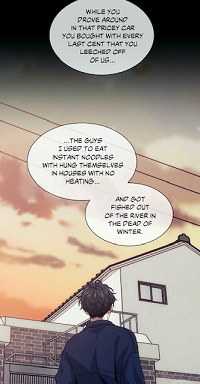 (chapter 18) And strangely, Benjamin Franklin was also involved in American Revolution:
 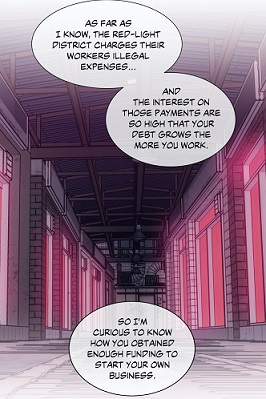 (chapter 8)
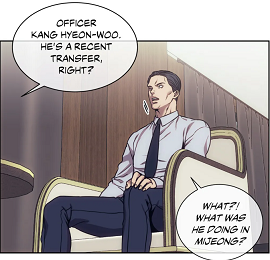 (chapter 11) According to his reaction, the manhwaphiles can deduce that the detective has lived himself in the city before moving out to Seoul. In other words, he is coming back to Mijeong and is determined to remove corruption in the city and police. Since Player 1 (Not Yet) will be aware that officer Ahn has already sided with Jeon Hee-Seong, there’s no doubt that he will try to use Kang Hyeon-Woo to target Jeon Hee-Seong and her helpers. An investigation about the murders in the city is definitely necessary for the player 1. However, since the lieutenant chose to leave the city in the past, this signifies that he suffered himself some injustice in the past and as such was a victim of the king from team 1. Therefore Kang Hyeon-Woo has to ensure that he needs to unveil the whole truth.
  (chapter 11) It is even possible that the femme fatale decides to use the detective for her benefit too, when she believes that it’s time to get rid of Do Seong-Rok. That’s why I believe, the detective will be the lose cannon in the board game. From my perspective, each time they will try to take advantage of his desire for truth and justice in order to divert the attention from their own crimes and wrongdoings.
  And at the end, they will “destroy” this world, just like in the picture. Their reason is simple. They are not aiming at gaining power and wealth. For them, freedom and love matter more.
  As the manhwaphiles can detect, a femme fatale is strongly connected to the fake vow of pleasure and enjoyment.
  (chapter 16) And now, if you connect this promise with the siren’s temptation, you’ll realize what the abandonment signifies in truth: he will drown and die. He will lose his life and soul.
  (chapter 6)
 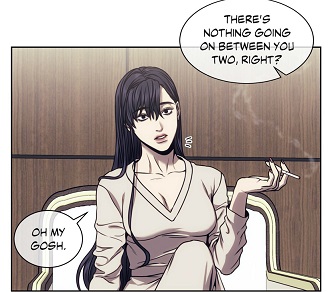 (chapter 11) They are puppets of the femme fatale. This angst is truly palpable in chapter 6. Do Seong-Rok got scared, because before he had met detectives looking for Lee Je-Oh, Ma Jong-Seok and Choi Yeong-Gil and couldn’t get in touch with his lover
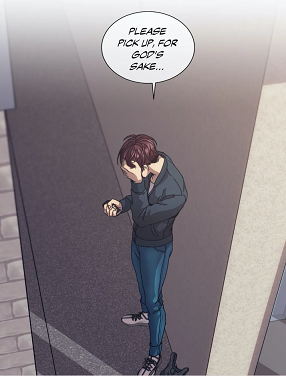 . He felt totally vulnerable. He needed her presence in order to stay calm and find a solution to his problem: the existence of a witness.
 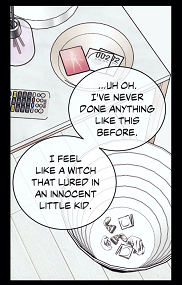 (chapter 16) Yet, if you pay attention to Eva’s role, she was herself a victim, for she listened to the snake and got tempted to eat the fruit.
  (chapter 11) He justifies his crime by saying that he just attempted to run his business. Just like his foe, he is diminishing his sin. On the other hand, his words
  truly outline his immorality and wrongdoing. If it was not murder, then what did he do to her? He calls her a snake, because she betrayed him. However, he was the one who backstabbed her first. There’s no doubt that she was forced to marry Choi Yeong-Gil, a violent man.
 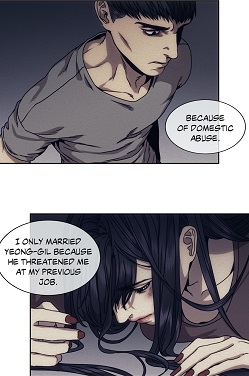 (chapter 9) The former pimp suspects her for being the mastermind behind the murders. Nevertheless, the manhwalovers should keep in mind that she is his competitor too. She is now running her own business. If she was caught and accused, he would get rid of his rival. Since he backstabbed her in the past, it truly exposes that his comparison is only partially correct. As the former prostitute is not just a perpetrator, but also a victim, I come to the conclusion that the female character resembles more to Eva than to the snake.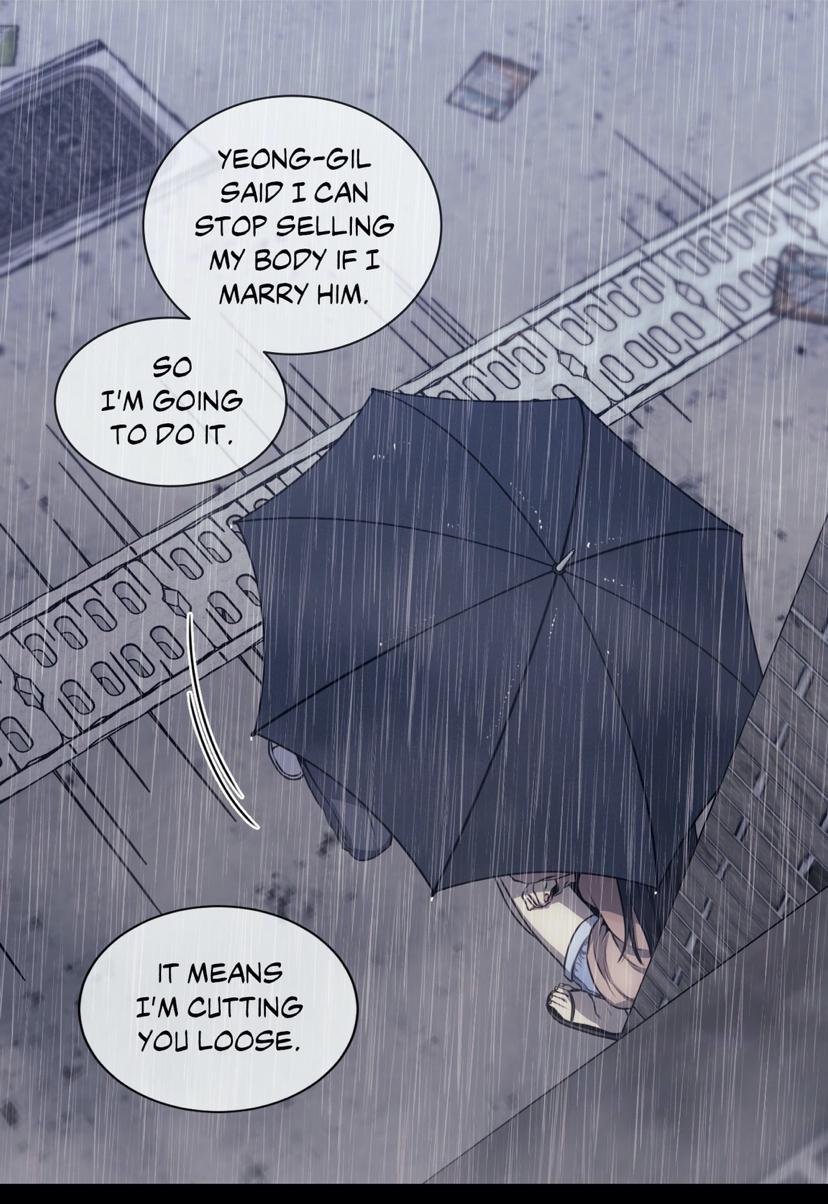
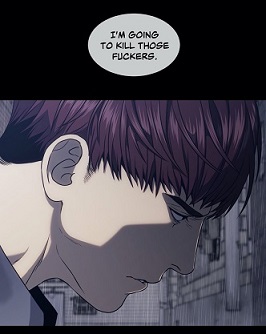 made him the perfect tool for her goal. At the same time, she is overlooking the male prostitute Lee Je-Oh. Since none of her targets has ever resisted her, she can’t imagine that Do Seong-Rok will distance himself from her.
  He even suggests to become his ally. And this observation truly reinforces my former statement: Jeon Hee-Seong and Lee Je-Oh will become rivals. One thing is sure: because the former prostitute is a femme fatale, she won’t get what she truly wants.
 This is relevant, because it already outlines his mysterious nature. This is not just a question of anonymity. Notice that during the whole introduction, he barely talks so that the readers can’t perceive his thoughts. Moreover, he only speaks on two occasions. First, he calls Ms. Jeon and later he describes the actual situation: he has removed the first target:
  (chapter 1) Therefore this is no coincidence that the reason why the murderer didn’t eliminate the prostitute is obscure. In other words, the main figure is an enigma per se, and the readers are asked to discern his personality, whereas Lee Je-Oh’s character is so easily exposed.
 (chapter 1), he uses the cellphone to call his lover, the mastermind of this murder. This explains why his face is only revealed, when he uses the pronoun “I”.
  (chapter 1) That’s the moment he starts existing. He only lives, when he is in contact with Ms. Jeon. Yet through his words, the readers can detect the nature of their relationship. Ms. Jeon is his superior and mentor (he calls her “teacher”/Seonsangnim/ in the Korean version), whereas in the killer’s mind she is his lover.
 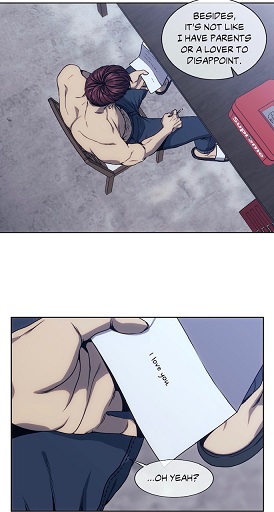 (chapter 8) But if you pay attention, you’ll detect the emptiness of this declaration of affection. First, there’s no name attached to the “I love you”. It is so anonymous. Furthermore, the love confession is at the bottom of the letter, totally separated from the content of the letter. The first scene in chapter 1 already illustrated the gap between these two characters, for Do Seong-Rok was speaking to her formally. The absence of the informal speech is a clue that they are not intimate and close in truth. And now, if you combine this with the “love letter”, you can only come to the conclusion that Ms. Jeon is the one keeping the protagonist at a certain distance. All this truly exposes Jeon Hee-Seong’s true thoughts. She’s using Do Seong-Rok’s naivety and innocence. With a few words and a letter, she could manipulate the protagonist to commit assassinations. What caught my attention is that the main lead was incapable to see through her lies. In chapter 6,
 (chapter 16) This panel exposes the man’s genuineness and purity, as he revealed his true thoughts so easily. I would say that he was easy to read like an open book. So he was seduced by her intelligence and her beautiful body. From my point of view, she wooed him by taking his side in this incident despite her criticisms. Let’s not forget that his colleagues not only were looking down on him, when he refused to follow them,
  (chapter 16), but they also left him behind. Then, when Jeon Hee-Jeong put the card in his hand, she gave him the impression that he had the freedom to come back to her. He had a place to return, when he had finished his mandatory service.
 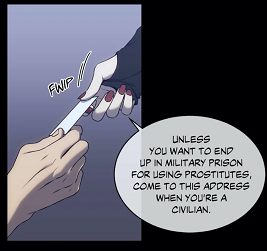 (chapter 16) In other words, she didn’t abandon him, though she left him behind too. And this is important in my opinion, for it explains why the main lead chose to seek her company. She was the first person who accepted him with his flaws, but she didn’t truly leave his side. And this leads me to the following conclusion: Do Seong-Rok has abandonment issues.
  (chapter 12) However, the father left a letter behind announcing that he would come back at some point, but it never happened. What caught my attention in this picture is the person reading the letter left by the relative. The house looks well-maintained and the woman is wearing an apron. Yet, she seems so cold and unfriendly due to the absence of a smile and the eyes. In the first version, I thought that he had not been abandoned in an orphanage, but he was confided to a particular person. However, it turned out to be wrong. The reality is that he grew up in an orphanage
 (chapter 27), yet the persons working there could never give what he truly wished: a family.
  This signifies that I had perceived the person’s attitude correctly. The personal could never give the affection and warmth he had been longing. On the other hand, From my perspective, Do Seong-Rok grew up in a family from the middle-class. This signifies that he never had to face financial struggles, on the other hand the absence of eyes in the woman exposes her displeasure. So though he received a proper education, he must have felt as a burden as well. This would explain why Do Seong-Rok lived in a bubble for a long time. Abandoned by his biological parent, he didn’t desire to annoy more people, especially the family who took him in. That’s why he felt the need to abide by laws and to be very strict. He didn’t want to stand out. For him, assimilation was a mean to get acceptance. Therefore you understand why Do Seong-Rok is a lamb, for “conformity” was like a safety net. Consequently, Lee Je-Oh and the murderer have both something in common despite the social gap: isolation, lack of warmth and acceptance. On the other hand, the huge difference in their social status explains why Do Seong-Rok is so inexperienced and naïve. He never had to struggle to survive. Thus this explicates why Lee Je-Oh is so street-smart, while the other is so clumsy. By abiding to laws, he didn’t have to use his brain properly. Furthermore, I believe that due to the abandonment he kept his distance with people… out of fear that he might appear as a burden. That’s the reason why he had no girlfriend, until he met the prostitute. Besides, it is also possible that in his childhood he could only meddle with people with a similar background, hence he never had to encounter people with terrible fates. But by entering the army, it changed, as he was forced to interact with people from other social classes and with a different mindset. This explains why Do Seong-Rok entered the red-district for the first time, when he was 22 years old.
 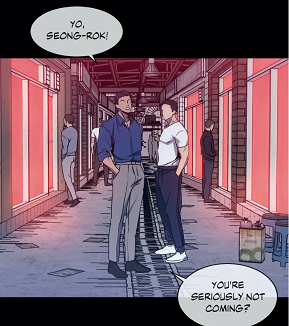 This truly outlines a certain compliance and obedience. On the other hand, once arrived there, he realized the purpose of their visit. Hence he refused to do the same, revealing his integrity. Thus it is no surprise that he values monogamy so much. Since he had his first sexual experience with Jeon Hee-Seong, he could only judge her as his companion and lover. Besides, when they met for the second time, she made him feel special. She was dedicating her free time to him.
 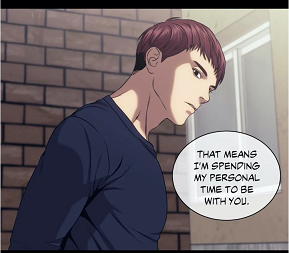 (chapter 16) Therefore it is not astonishing that Lee Je-Oh considers Do Seong-Rok as a dog. The animal symbolizes loyalty, unconditional love and protection. When I read the prostitute’s comment in this panel
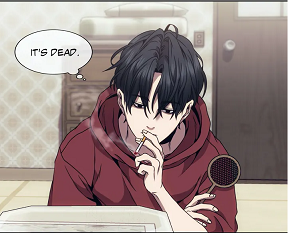 ) and both characters have a similar reaction. They are neither shocked nor scared. They remain calm and indifferent. Yet what is more surprising is that in the two situations, the author let us see the corpse through their eyes.
  Striking is that Lee Je-Oh can’t help himself making a comment in his head, while watching the floating corpse.
 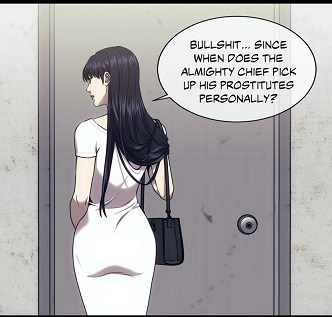 (chapter 16), while in reality the usurer had some feelings for him. He needed to ensure that Je-Oh would remain by his side. That’s why the young man was constantly brought to the clients and his minions were asked to keep an eye on him. Because of this mistake, she never gave any instruction about the male prostitute. Consequently Do Seong-Rok had no idea how to deal with him. Simultaneously, when he kept an eye on him, he was reminded of Jeon Hee-Seong’s fate. He could only pity the male whore, hence he was reluctant to kill him.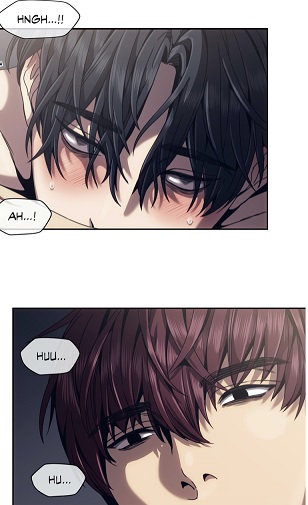
 (chapter 2) In other words, Lee Je-Oh could have decided to call the cops and report an intruder before entering his home, but he never did. In my eyes, all this contributed to confuse the killer. Somehow he realized that the prostitute had been helping him. Therefore he didn’t kill them in the flat. Since they were together, he had to kidnap them together. But as you can see, Do Seong-Rok had a weak spot for the main lead, but he was definitely less important than his lover Jeon Hee Seong. That’s why the main lead is not allowed to touch her belongings.
 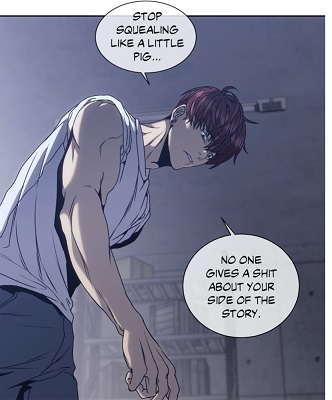 In my eyes, his words must have triggered Do Seong-Rok’s memories concerning his girlfriend. The former prostitute made sure to portray her husband, the chief and the pimp as dark as possible, while she made herself appear as pure and innocent as possible. She was forced to marry Choi Yeong-Gil, yet the naive lamb couldn’t detect her lies. Let’s not forget that during their first meeting, she acted as the prostitute’s superior and chased away her minion. So she was no longer a simple victim, she was reinforcing the system of exploitation. She was already higher in the hierarchy. Secondly, like I explained in the previous essay, she was already possessing a parlor, when he husband got killed. She ensured to trigger negative emotions in the young man so that the latter would feel the need to kill her so-called oppressors.
 (chapter 16) That’s why I believe that Koo Jeong Mo is correct about his assessment of the former prostitute.
 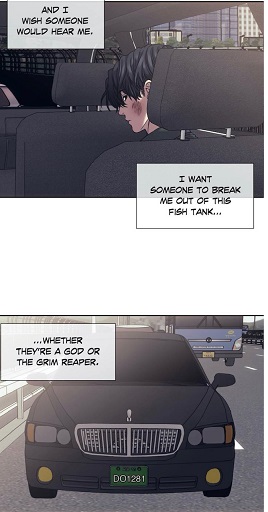 (chapter 2) The reason for his mistakes is simple: he was an idealist lulled in an illusion, hypnotized by Ms. Jeon’s words. That’s why he had a nightmare
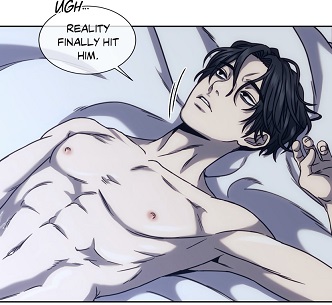 (chapter 8) Besides, let’s not forget that after the nightmare, the protagonist gave a honest portrait of Do Seong-Rok. He is a sensitive murderer .
 (chapter 6). The black-haired man’s role is important, as he forces his ally to question the nature of his relationship with his girlfriend.
  (chapter 8) and she is not even imagining that he has found an ally and is disobeying her words. She is so confident about her seductive skills and her beauty. This explains why Do Seong-Rok’s sexuality is gradually changing, though he tried to deny pleasure in the beginning. On the other side, since the prostitute has associated sex with power and violence, this is no coincidence that the killer feels aroused while strangling Ma Jong-Seok.
 (chapter For the snake, Do Seong-Rok was a lamb and her cannon. As for the dog
 or he confesses that he is aroused.
  (chapter 18) Thus I come to the conclusion that the killer was living in a similar situation than Je-Oh’s in his past: he was invisible to people and didn’t truly feel alive.
 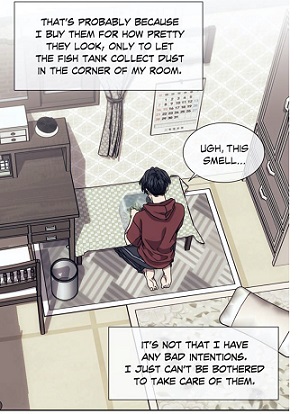 (chapter 1). In this panel, the young man has the impression that he bought an aquarium, because he found the fish pretty, but notice that although they keep dying (this is the third one), he is still determined to keep a fish by his side. This is important for two reasons. It shows his loneliness and as such his need for company. Let’s not forget that Je-Oh has to reimburse the debt left by his father, so this signifies that his budget is limited. Yet each time a goldfish died, he still bought a new one revealing that he considered it at some point as a necessity to have a goldfish by his side. He is well aware that he doesn’t take care of it very well, he can’t help himself buying a new one. This incident exposes too that Je-Oh has no idea how to treat a companion properly, for he has been alone for a long time. As a conclusion, right from the start, the reader can sense the escort’s solitude and selfishness. He feels the need to detect the presence of someone by his side, yet he is not willing to invest too much time and emotions in it. A fish is the perfect solution, for the aquarium serves as boundary and a fish can’t be touched like a cat or a dog.
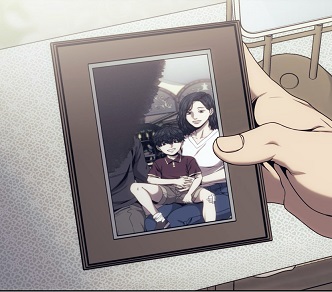 (chapter 16) Thanks to the image, we can detect that Je-Oh is missing his mother. This is perceptible, for the main lead still has a framed picture of his mother. Since he is smiling, this indicates that he was happy, as long as his mother was around him. However, the moment he was left alone with his father, the latter only viewed him as trash and burden. This explicates why he removed the father’s portrait from the picture. He really hated his father. He had many reasons for his disdain.
  Instead, he displayed no understanding and just made the son guilty. Besides, the relative kept insulting him, calling him filthy and dirty.
  (chapter 9) This incident at the convenience store explains why the young boy resented so much his father.
  (chapter 9) Note that the young boy was smiling after the theft, he didn’t see it as a real wrongdoing… let’s not forget that the father bought things from the supermarket and always put it on tab, but never paid back the debt immediately.
 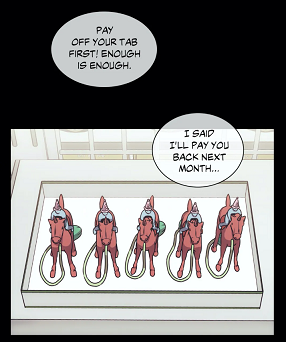 (chapter 9) The young boy could only learn that it is no big crime, if he doesn’t pay the figurine. The irony is that during that incident, the father couldn’t put the bug spray on tab, as the shop owner refused to due to the huge amount of unpaid bills. This incident reveals that the father was already deeply indebted. Simultaneously, due to the harsh scolding and insult, the main character learned that he needed to act behind his father’s back in order to achieve his goal. He knew that his father would never do anything for him, since he represented a source of annoyance. For the father, Je-Oh was a burden.
  (chapter 1) When the main character discovered his father’s suicide, he only showed calmness and indifference.
 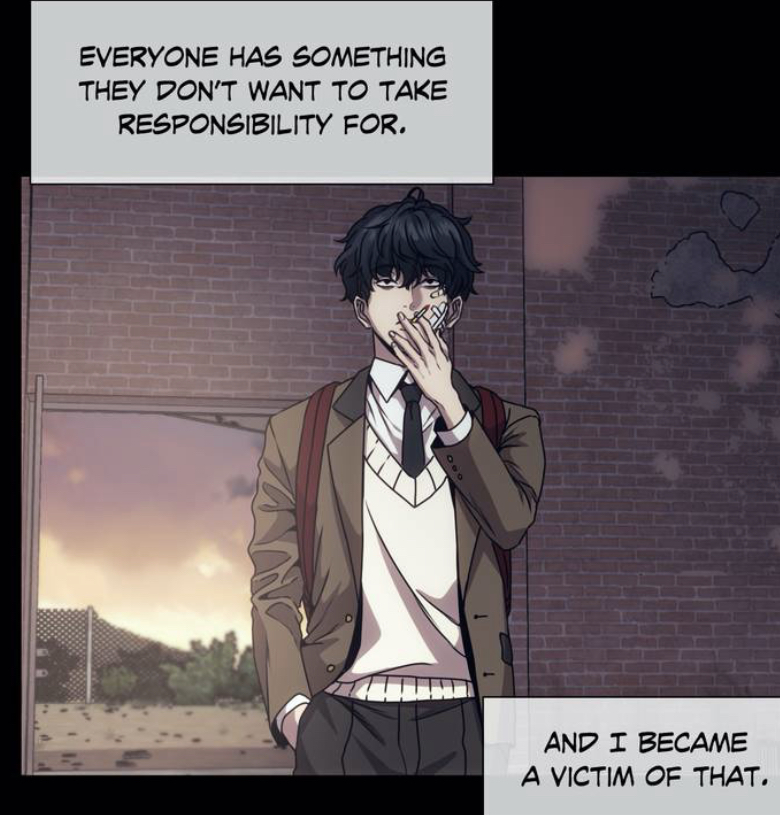 (chapter 1) The suicide was the peak of the father’s abandonment and neglect. That’s the reason why the student wasn’t shocked or upset and kept smoking in front of his father’s corpse. And now, you understand why the young boy hated his father.
  Yet, these words reveal that the relative didn’t feel responsible for his education at all. With his statement, he was putting the whole blame on his own son, while in reality the man was refusing to educate the boy properly. In other words, Lee Je-Oh should be considered as a orphan who had no good role model in his youth. The manhwaphiles can grasp why he stole the toy or why he started smoking, though he was still a minor. There was no one around him who showed concern and care for him.
  (chapter 17) He was willing to be responsible for his father’s mistake, though he despised him. The reality is that he was forced by Ma Jong-Seok to sell his body. Because of this terrible experience and the indifference of people, the teenager learned that he would never receive any help. He was on his own, that’s why he tried to rebel and escape on his own from the claws of the pimp Koo Jeong Mo and the moneylender Ma many times.
 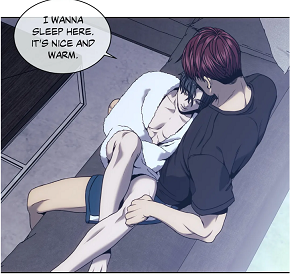 Then this observation made me realize why the protagonist’s life was similar to the goldfish’s.
  , the main lead was living in a flat on his own. He would get picked up by Lee Soon Cheol or Choi Yeong-Gil or even Ma Jong-Seok and brought to his clients 3 times a day. This clearly displays that the young man had a different clientele. In my opinion, he was more working for people with money. And this explains why Jeon Hee-Seong didn’t know Lee Je-Oh’s true place in the end. In her eyes, he had the same position, as he was selling his body for money. She was surprised to hear that the loan shark would pick up himself a prostitute and wondered this situation.
  (chapter 1), and since they are married, I believe that they hide their homosexuality. Furthermore, if you consider that he only had maximum three clients a day, this meant that the young man was a special escort. That’s why I believe, the main lead was sent to serve a different clientele than Jeon Hee-Seong in the end. This would elucidate why her husband asked the main character not to get caught and create a scandal.
 (chapter 1) Consequently, I conclude that he was definitely having sex with rich people. And if you take into consideration Chief’s behavior, you’ll notice the parallels between the “bunch of horny men” who felt guilty by having sex with the young man: Ma Jong-Seok only confessed he had some feelings for the main lead the moment he was facing death. He hid his “emotions” behind his behavior. That’s why he raped him 3 years ago and tasted him in the second episode and used a pill to achieve his goal. In my opinion, the Chief was not willing to admit his attraction to Je-Oh and used his position to sleep with him, whenever he wanted.
 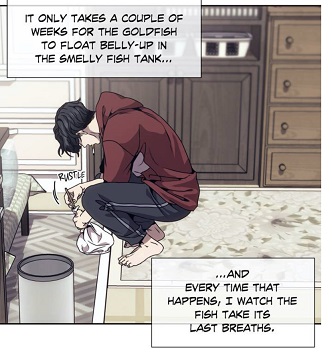 He was neither desperate nor afraid of death, but he was not repelled by the scent of the dead fish. Furthermore, he even touched the corpse. And these gestures made me think that the main lead was very fascinated by death
  (chapter 1). And this led me to suspect that Je-Oh could be suffering from necrophilia. In the first chapter, he showed this tendency. Then he witnessed how Seong-Rok was strangling the usurer in episode 18, he got fascinated and aroused as well.
 (chapter 2) Therefore you comprehend why the main lead claimed to his kidnapper that he had been raped. (chapter 3).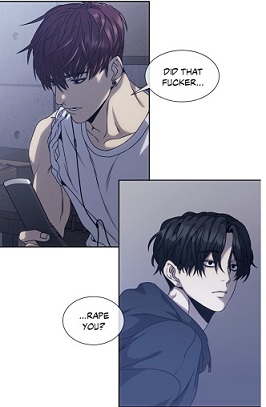
 He wasn’t just trying to manipulate the red-haired man to get rid of his abuser, he was also telling the truth. The protagonist didn’t have sex with the usurer willingly. Thus the manhwalovers can understand why the main lead is now reacting sexually, when he sees someone getting strangled or punched. For him, violence can no longer be dissociated from sex. The only difference is that, now he is no longer the victim, hence he can enjoy this. The manhwaphiles could detect this in two occasions. First, in chapter 3 he enjoyed so much how the serial killer was punching the usurer that he got an erection.
  (chapter 3) Then, in episode 17 he felt excited, when the moneylender was begging for his life.
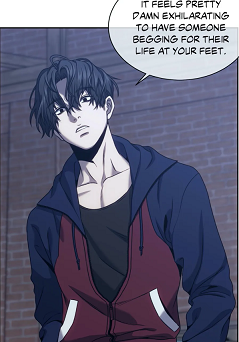 His words expose the connection between pleasure and power again. The violence is present here, as Ma Jong-Seok is getting threatened and humiliated: let’s not forget that he is on the verge of losing his life. As you can observe, the main lead’s sexuality is already linked to violence and corpse. And now, you can comprehend why he is so fascinated by the serial killer Seong-Rok. He embodies everything that he likes: strength, power, violence, but also a certain sense of innocence, sensitivity and justice.
 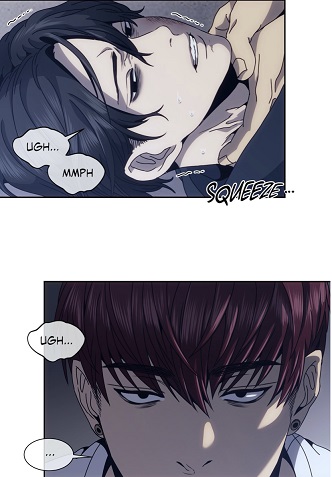 (chapter 3) This explicates why the prostitute didn’t stop the moneylender from strangling him during their duel. He counted on Seong-Rok’s good heart and pity to protect him in the end.
 (chapter 6), until Seong-Rok rejected this idea.
 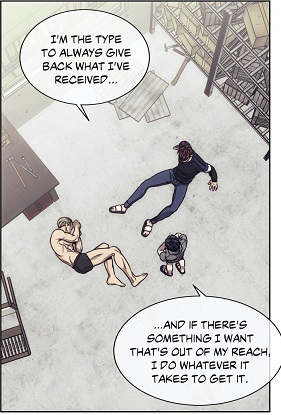 or survival, for the first time Je-Oh had the impression to have found a purpose in life. There was someone who was strong, but also vulnerable at the same time implying that the latter would have to rely on someone. Besides, Je-Oh felt indebted towards his savior. Thanks to him, he had become released from his prison.
 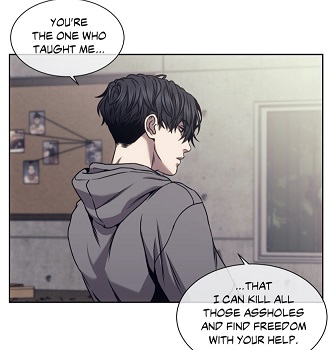 With these words, you can observe, “help” plays a huge role in Je-Oh’s mentality. That is the reason why he desires to be by Seong-Rok’s side in the end.
  , though the red-haired protagonist kept rejecting this role. And now, you comprehend why Je-Oh is eyeing at Seong-Rok. The latter has already shown a weak spot towards the young man. He didn’t let him die by Ma Jong-Seok’s hand (chapter 3), then he showed him a special treatment by letting him sleep in the same room. The latter could take a shower and got clothes. No one had ever paid attention to his needs before. He might say that he dislikes love
 , yet in front of Seong-Rok in tears, he feels himself moved.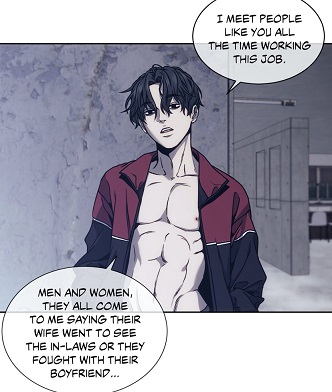
 (chapter 9) All of them were treating him, as if he was inexistent. His clients never paid attention to his feelings, when they confessed their sins. Moreover his masters treated him like trash. And this signification makes the readers realize that the killer’s lover Ms. Jeon will become Je-Oh’s true enemy and rival, for the former will claim Seong-Rok as his own. That’s why in chapter 18, he makes the red-haired protagonist feel guilty.
 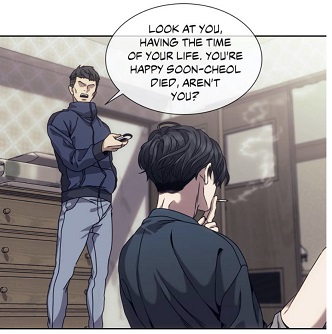 (chapter 1), while in reality the former had showed no respect to the deceased himself too.
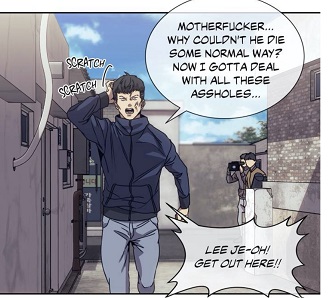 Ma Jong-Seok claimed to have feelings for the main character (chapter 17)
 (chapter 17), yet until now he had mistreated Je-Oh, as if the latter was a pet. Thanks to Seong-Rok, the prostitute could feel free for the first time, though he was a hostage. Imagine the irony of the situation. This is not surprising that the prostitute rejected the usurer’s offer.
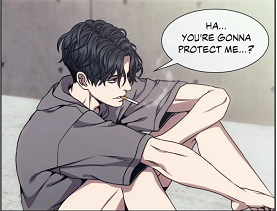 The main lead was truly aware of Ma Jong-Seok’s hypocrisy. He knew that this was an empty promise, visible through the points of suspension and the question. The main lead was not naive: the loan shark would always prioritize money over Je-Oh, once he had escaped from the jail. Let’s not forget that the usurer was living a good life according to the main lead’s words.
  Due to his sharp senses, the main lead knew that someone was in his house, but he remained silent, as he was hoping that the murderer would help him by eliminating the loan shark. This truly shows that Je-Oh is an opportunist, he can see which situation benefits him more. Simultaneously, it also shows that the protagonist is a gambler, willing to risk his life, though he had a reason to envisage that the killer was not targeting him. Do Seong-Rok had never approached him before, while Lee Soon Cheol was already dead, yet the murderer had been observing him for a while and Je-Oh was aware of that.
  and imagined burning the world
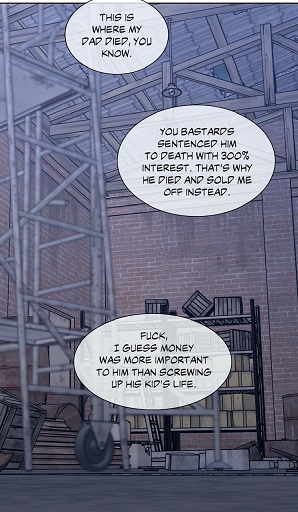 (chapter 17) This means, in chapter 17 Ma Jong-Seok is going through the same experience than the main lead.
  If he commits a crime, then he will lose his “humanity”. This is no coincidence that the chief talks about righteousness and as such humanity. Let’s not forget that the latter is a synonym for benevolence and kindness. Facing death, the hypocrite starts treating Je-Oh as a human and no longer as his pet. This doesn’t escape the main lead’s attention who points out his hypocrisy.
  He has behaved like a man without any conscience and heart until now. And this explains why at some point Ma Jong-Seok confesses to like Je-Oh. The moment the loan shark views him as a human being and no longer as whore, he can admit to have some feelings for him.
 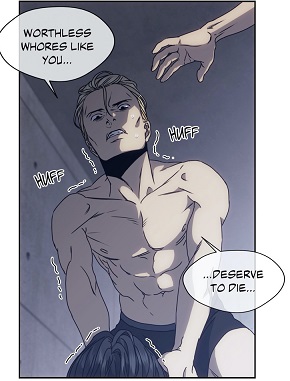 (chapter 3)
 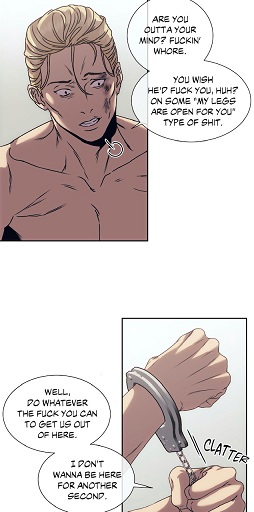 (chapter 5) He kept treating him as his tool. The main lead had to listen to his order and show loyalty and obedience. Sure, he was definitely stressed and desired to survive, well aware that Do Seong-Rok could kill him at any moment. But he acted like that even before the abduction and sequestration.
 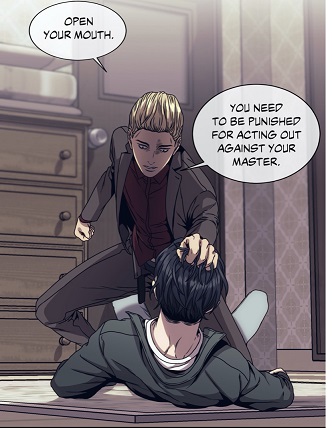 (chapter 2)
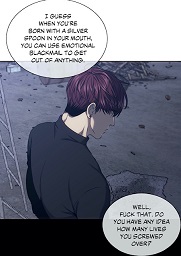 He criticizes Ma Jong-Seok for being responsible for the death of so many people. With his ruthless job, he sentenced people to their death. In other words, the violent moneylender is a murderer, though he never pulled the trigger himself.
  (chapter 1)
 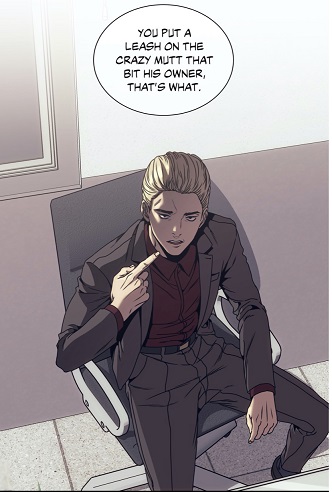 (chapter 2), while Je-Oh used the same expression for Do Seong-Rok.
 (chapter 10), while he associated his minions to chickens.
 (chapter 2)
  (chapter 11)
 (chapter 2) Here, Hongok-Dong is presented as a paradise, while in reality there’s only poverty and misery. This poster reminded me of the last commandment in the farm. “All animals are equal, but some animals are more equal than others.” This served as propaganda in order to legitimate Napoleon’s dictatorship. In other words, the banner from that Korean city made me think of propaganda. By showing such pictures, the inhabitants are lulled into in the illusion that everything is alright, whereas in reality there exists only selfishness and indifference due to corruption and injustice. Secondly, the pictures about the red-light district
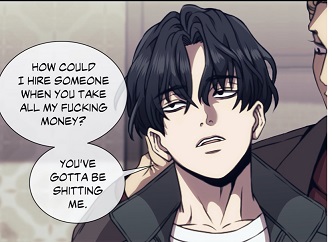 (chapter 2) This situation is quite similar to the life of the pigs at the farm.
  , as Janggi. That’s why I believe that the city is like the animal farm, as Janggi is limiting the world. The animals are represented by a piece of chess. The only difference is that we also have wild animals, unlike the English novel. The killer is a player of Janggi, he is the one who uses the different pieces (chariot
 (chapter 11), when the naive lover killed her husband. But why did she ask Seong-Rok to eliminate so many people (Ma Jong-Seok; Choi Yeong-Gil, Koo Jeong Mo and Lee Seon-Chol)?
  (chapter 11). The femme fatale purchased land in Hongok-Dong so that she will get rich, when the redevelopment starts.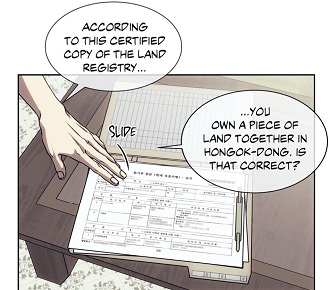
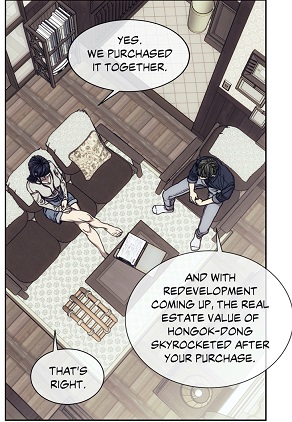 (chapter 9) But in order to achieve her goal, she has to erase her past as a prostitute. She needs to eliminate people who know her from her origins. And this leads me to the following observation: since this world is described as a game of war
 (chapter 3) He was applying this theory, yet deep down he desired that the main lead would seize this opportunity to get revenge on the usurer.
  (chapter 3) As you can detect, the red-haired man was pushing the hostage to get revenge on his abuser.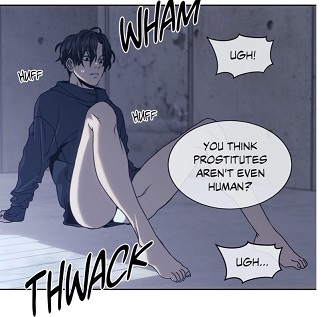
 (chapter 3) after hearing how the usurer looked down on the main lead. Since he was just a whore, he had no right to survive. The red-haired man hated so much that Je-Oh was insulted for his “profession”.
 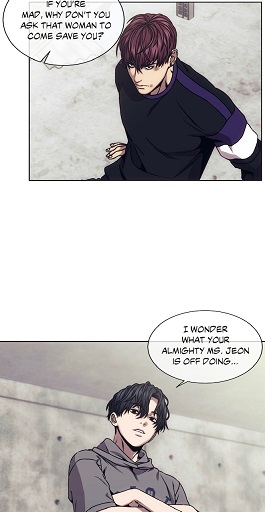 and her relationship to the serial killer. Like I had mentioned it before, Ms. Jeon desires to erase any trace about her origins and plans. So the male prostitute already represents a threat to her plan. On the other hand, the woman has no idea about this, because in her eyes, he is just a pawn. But like the red-haired main lead pointed out,
  Bebebisous33s' analyses in K-Dramaland and Manhwas