

Please support the authors by reading the manhwas on the official websites. This is where you can read the manhwa. https://tapas.io/series/under-the-green-light But be aware that this manhwa is a mature Yaoi, which means, it is about homosexuality with explicit scenes. Here is the link, if you are interested in more analyses about this manhwa and others: https://bebebisous33analyses.com/2021/06/06/table-of-contents-of-analyzed-mentioned-manhwas/ I am also using Doctor Frost as reference again. https://www.webtoons.com/en/mystery/dr-frost/list?title_no=371
It would be great if you could make some donations/sponsoring: Ko-fi.com/bebebisous33 That way, you can support me with “coffee” so that I have the energy to keep examining manhwas. Besides, I need to cover up the expenses for this blog.
Anyone reading Under The Green Light is aware that „Potato“ is Matthew‘s nickname created by Jin, when both lived in the orphanage. 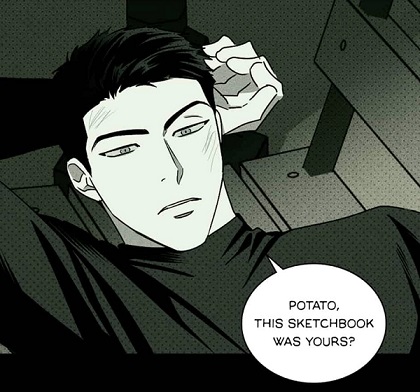 (chapter 39) But why did he give him such a nickname? It is related to the moment he saw clay in the child‘s hand.
 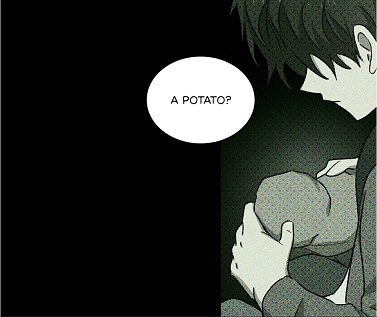 (chapter 29) He couldn‘t recognize what it should represent. At that time, Matthew was attempting to create a sculpture, a rabbit, as the main lead felt attracted to the rabbit that was living at the orphanage. However, the fact that Jin associated this form of clay to a potato reveals much more about Jin‘s personality than the main character realized. How so?
Because the sculpture was not finished, the protagonist had to interpret the form. Since I wished my avid readers to comprehend where this thought came from, I have to refer doctor Frost once again.  (doctor Frost, chapter 2)
  (Doctor Frost, chapter 2)
  (Doctor Frost, chapter 2). Thus I deduce that the potato exposed Jin’s subconscious.
1. The signification of potato
What does a potato symbolize? First, it can symbolize love and warmth, hence there exists this custom to send a potato to a loved one. By doing so, they desired to express their care and concern for the acquaintance. They are nurturing their loved one in a figurative way. And look how he behaved with the young orphan. He would pet his head with his big hand or he would smile to Matthew. 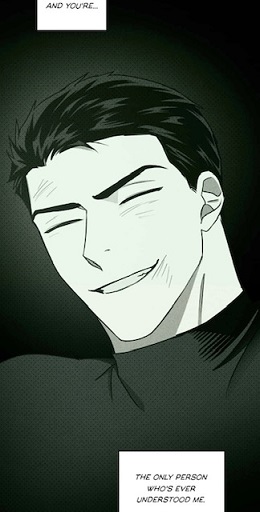 (chapter 29)
Moreover, I associate potato to humbleness and simplicity, for it is connected to agriculture and peasant hood. Naturally, “potato” can signify “stupidity or naivety”, consequently people utilize “potato-head” as an insult. This coincides with the young man’s warning: 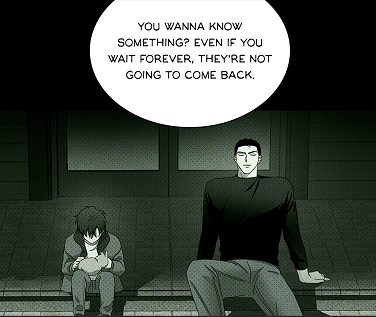 (chapter 29) He desired Matthew not to have any false hope and illusion. He should lose his naivety. Yet, the main character had no idea that the boy had already gone through a terrible experience. The suicide of his parents and the greed expressed from “adoptive parents” had opened his eyes. The adults were superficial, selfish and avid. They all had expectations from him.
  (chapter 29) This explicates why Matthew chose to push people away and remained silent. He just wished to be left alone. To conclude, Matthew was far from being innocent, but his meeting with Jin changed his life. Through him, he discovered that all people weren’t like that. There was hope, which is represented by GREEN,
In addition, potato can also be linked to weakness, for the vegetable is dependent on different elements like warmth through the sunlight, water and the hand of a farmer. Without them, it can not grow properly. That’s how Jin Cheungwoo judged the child.  (chapter 39) He needed to be protected from the abusive priest. Besides, he became angry, for due to the adults’ intervention (they had killed the rabbit), Matthew had stopped drawing. It was, as if they had ruined his talent.
  (chapter 39) Jin saw Matthew as a talented, lovable but weak child who needed advices and protection.
  (chapter 29). He had detected his exclusion, unaware that this was actually his own choice. What caught my attention is that the future director of Shinhae acted like a surrogate parent to Matthew. He stopped the bullying and advised him to change his attitude:
 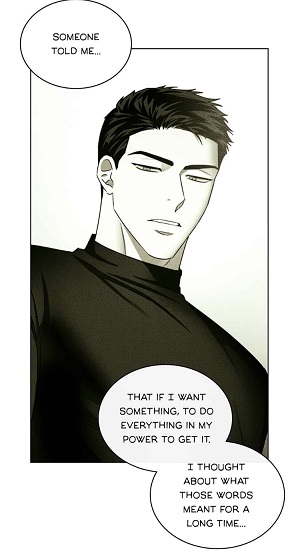 (chapter 31) He should become proactive. He should have desires and try to achieve them. The irony is that the young boy misinterpreted Jin’s recommendation: he should stop to rely on others, and as such to reject the money from his inheritance. He should do things on his own! He pushed him to become a sculptor. On the other hand, this association “potato” exposed Jin’s true desire: he was hungry for warmth and sweetness in his life.
 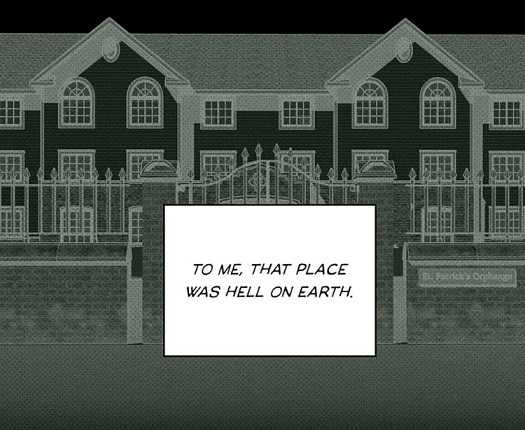 (chapter 39) And this is exactly what Matthew could give him through his drawings. The young man could forget his disenchantment and his suffering thanks to his art.
 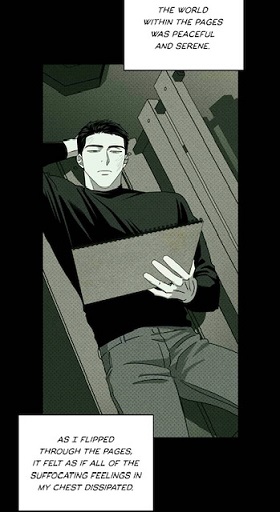 (chapter 39) They represented an escape from his terrible life, it was, as if an breath of fresh air had entered the orphanage. Therefore it is not surprising that the main lead became very protective of the child. Both needed each other.
So when Jin gave him a nickname, Matthew could only feel that he was special to Jin. That’s the reason why the artist was hoping to be called Potato again. And his dream came true, yet the unconscious sculptor couldn’t witness it:  (chapter 39). Consequently, I come to the conclusion that the nickname “Potato” actually reflects Jin’s true personality as well. Thereby he could sleep peacefully in the studio under the green light. Don’t forget that a potato grows in the dark soil. In the beginning, the director is a humble, loyal and warm man who longed to have a family and as such a home!
His hope to have a home was displayed, when he looked at the building. He dreamed to live in a skyscraper 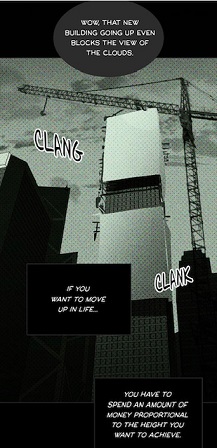 (chapter 5) He imagined that he could only obtain it, if he became wealthy and powerful. This is no coincidence that Brandon Lee gave him as a reward the building. And now, you comprehend why Jin Cheungwoo refused to follow his former boss. He had sold his soul to achieve his dream: a home, and it was for nothing! Why? Once he had the property, Brandon Lee asked him to switch side and follow him to the new company he had founded. However, by acting so, Jin realized the falsehood of his dream. If the home is empty, then it is meaningless. This explicates why Jin said that the scar on his back has no meaning now. And even Brandon had a similar perception:
  (chapter 32) This is no coincidence that we have a reference to food here. Jin has always been longing for a potato, but not for a cup of tea. Simplicity versus sophistication. It also explains why the betrayer bought a cheap wine in order to rekindle with his former “dog”.
The manhwaphile can detect the purity in Jin, because he suffered by dirtying his hands. 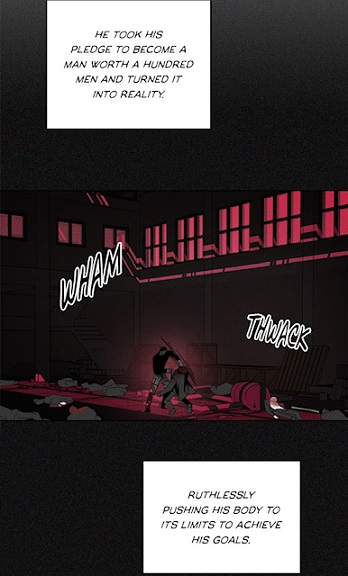 (chapter 32) He needed drugs to forget his sins.
 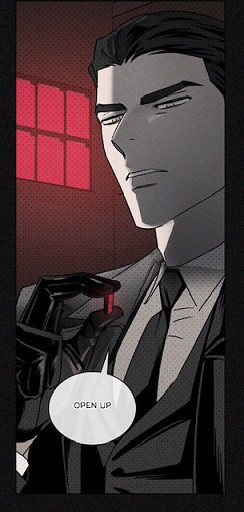 (chapter 32) And that’s how he lost his true self, and became a cynical and cold-hearted man. Yet, he could never mask his true identity. He still values loyalty. The tragedy is that the real sinner was Brandon Lee who would give his orders without dirtying his own hands. Observe that he is always wearing gloves. Now, Jin is full of remorse, hence he has sleeping problems. Therefore, the readers should judge Jin’s following statement as a lie:
 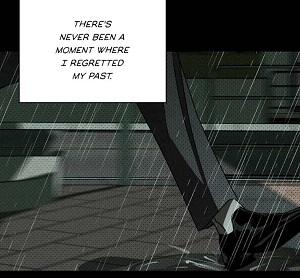 (chapter 39) He has such a negative perception of himself that he describes himself as rotten to the core.
 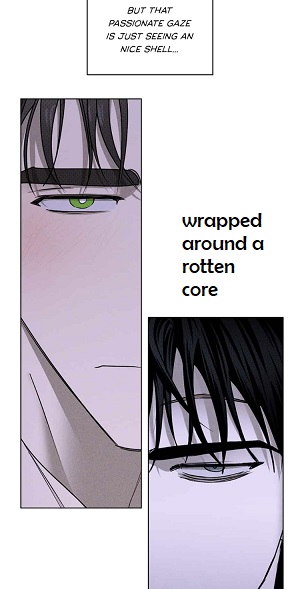 (chapter 35) These words mirror his self-loathing. Therefore I believe that when he called Matthew a psychopath, he was actually projecting his own thoughts onto the artist. He perceives himself a “psychopath”, for he killed so many people. He is so tormented by his sins
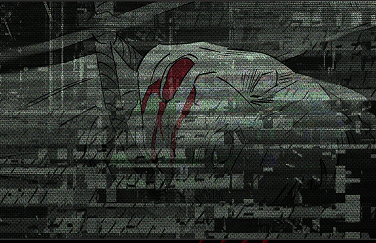 (chapter 4) that he needed sex combined with drugs to distract his mind. However, thanks to Matthew, Jin could slowly keep his distance from drugs. Matthew is nurturing him, he is his sweet potato, his cure to recover his memories and rediscover his true self. That’s the reason why he was willing to sacrifice himself for the artist’s sake.
 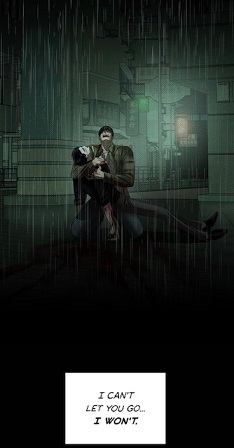 (chapter 39)
We could say that Matthew replaced the drug. Jin could enjoy sex with Matthew and forgetting everything, hence the colors during their last love session was blue and purple. However, when Matthew started confessing to him, Jin felt the need to reject his affection, for he viewed himself as not worthy. Once again, Jin thought that the student was just a “potato-head”, he was too naïve. He had no idea about Jin’s true personality: the latter was a monster who lives in a dangerous and cruel world.
2. Under The Green Light
The irony is that Jin was wrong. Matthew is the one who knows Jin the best. He met the main lead before he got corrupted by Brandon. That’s how I realized the function of “Potato”. Matthew would bring Jin back to nature, so that he could rediscover his true self. Yes, the manhwaphiles shouldn’t forget that the potato is connected to nature. Hence I am connecting Brandon to civilization and corruption (money) (chapter 11), while Matthew is symbolized by nature. This is no coincidence that both are green.
It was, as if Matthew was encouraging the director to view life differently. This explains why Jin saw flowers, when he admired the artist’s handsomeness.  (chapter 31) I had already explained in the previous analysis that Matthew would bring colors into Jin’s life. But now, I would like to be more precise. How did Jin discover serenity and peace of the mind? Through Matthew’s drawings. They were all showing nature.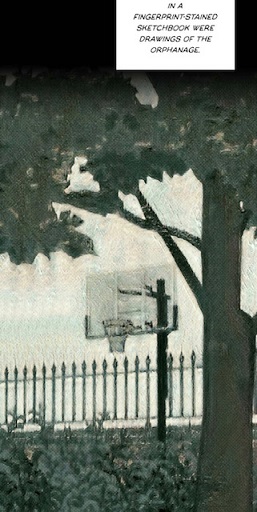
 (chapter 39) One might argue that in these images, the beholder can detect the presence of civilization: the basket hoop, the swings and the bank. However, you will recognize that the tree is in the foreground, the ants and the sunset were the main topics. Matthew had actually focused on these elements, when he had selected the places. Besides, the swing, the bank and the basket hoop have a common denominator: leisure. But this doesn’t end here. In no picture, you can find people. These drawings reflected Matthew’s desire for solitude. This represents his rejection of “civilization”. In fact, he selected places which he associated to the director of Shinhae.
  (chapter 29)
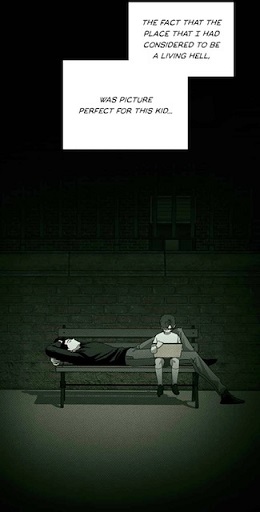 (chapter 39) In other words, since his youth, Jin has always been the protagonist’s muse. Thus Matthew said this concerning the main character: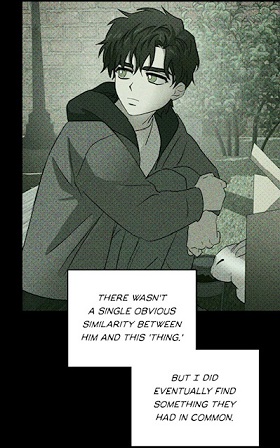
 (chapter 29) And now, you comprehend why Matthew had asked Jin to be his model.
But why could Jin grasp the young boy? It is because the former was exactly like the sculptor. Jin was also a lonely soul, though he was surrounded by people.  (chapter 29) This means that here, the young man was faking a smile. And note how he recalled the orphanage: he connects it to the building and not to people. (chapter 39) This exposes that Jin was never close to anyone except Matthew. The director of Shinhae had a similar dream: keeping distance from people. He wanted to live high up in the sky, far away from people. (chapter 5) The role of Potato is to push Jin to cut ties with the mafia, to be far away from people and corruption. But how can he do that? Through his money, love and art. Yes, his money…
 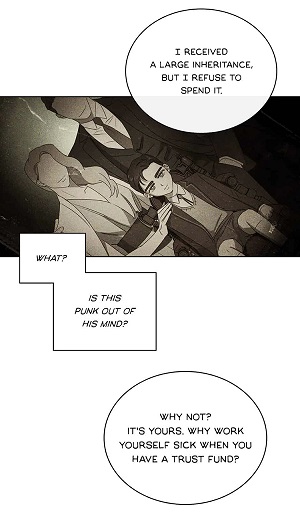 (chapter 31) So far, he saw no need to use it. But if it means that with his money, he can have Jin, then he will spend it. Don’t forget that for Jin, without money, you are powerless. Moreover, in their last love session, Matthew was already forcing the main lead to choose him and to focus on only him.
  (chapter 34) But Jin rejected him by letting him see his “true face”: he would take drugs and he was a murderer, for he would use a knife. In my eyes, this was the main lead’s attempt to resist temptation. He feared to become attached to Matthew, as he had already experienced disappointment and betrayal due to Brandon. Nonetheless, the mafia boss had long forgotten that Matthew knew this side from him. He had witnessed the character’s brutality. Nevertheless, for the sculptor, this was justified, as he was trying to protect him.
  (chapter 39) Matthew was also aware that the priest was abusing Jin too. The latter had explained that he was sacrificing himself for the sake of the other children. That’s the reason why the boy with the green eyes never condemned the protagonist as a sinner. This positive perception was particularly perceptible in this scene. After beating the priest, Matthew feared more Jin’s departure than his violence.
  (chapter 39)
Therefore I see the discovery of the drug in the soil as a metaphor for a turning point in Jin’s life, the drug will be removed and replaced by a museum. And don’t forget that the potato grows under the soil! It was, a field had prepared for potatoes in a symbolic way. But the problem is now that Jin is badly hurt. This is important, for the artist could lose his muse for a second time. (chapter 39) Besides, he hasn’t finished his sculpture yet.  (chapter 27) This would be a huge catastrophe for the artist, he would be more devastated than with the rabbit’s death. (chapter 39) This would literally kill the young man. He wouldn’t be able to create.
But since Jin could finally remember Matthew, he has no longer any reason to push away Matthew. The author wrote in the note that the second season will be less dark. And after reading my interpretation, you can grasp how. We observe the return of nature through art. First, Jin is forced to visit a museum  (chapter 1), then to look at the main lead’s sketches. (chapter 27) The man stands in the center, and not money. This announces the return of Jin’s humanity. That’s the reason why I think that Matthew’s sculpture of Jin could help the protagonist to see himself in a different light. Moreover, since the latter liked the prodigy’s drawings so much, he can only encourage his lover to keep creating and draw landscapes like in the past.
3. The fight between Potato and Gloves
This means that Matthew Raynor will have to fight Brandon Lee, as the latter is the one responsible for Jin’s addiction and misery. This scene (chapter 32) stands in opposition to this one: (chapter 39) First, it is important to outline the similarities. Both are taking place during the night. Then we have two people: while one is waiting (Jin/Brandon), the other is “working” (Matthew/Jin). However, in the first scene, Brandon only arrived after the massacre and gave his “dog” his reward, the drug and the property, whereas the young man on the bank was keeping company to the artist. He could relax waiting for a new drawing from Matthew. With his behavior, he was showing unconditional support to the creator. Brandon criticized his dog, saying that he had never asked him to kill them. But is it true? He could have just given an ambiguous order. But by doing so, he was remaining clean, it was not his responsibility. Moreover, the silence had a different signification: death versus peace. That’s why I am expecting a showdown between the former lover and the young student. Matthew has no problem to dirty his hand contrary to Brandon Lee, who always uses assistants and gloves. Brandon Lee said that since Jin never killed him, then for him, it meant that they would rekindle at some point. Matthew will definitely resent Brandon for changing his muse. He had already experienced the negative impact of wealth: superficiality and hypocrisy which led his parents to commit suicide. But how can Potato represent a danger to Brandon Lee?
People tend to forget that the potato plant is poisonous. Potato plant poisoning occurs when someone eats the green tubers or new sprouts of the potato plant. Hence the boss of Bumyung construction corporation shouldn’t underestimate Matthew Raynor, whom he will definitely consider as a green man. But since his youth, he was the witness of death: his parents, the rabbit, the priest… Potato showed his resistance, when he fought back the assassin sent to remove him. And after witnessing Matthew’s despair at the end of season 1 (chapter 39), there’s no doubt that he will resent the person behind Jin’s injury. During his childhood, he couldn’t protect Jin, but now, he is no longer a child. He is strong and big.
As a conclusion, Matthew and Jin are fated to each other, for they both are represented by the potato. Moreover, they have the similar inclinations: their desire for peace, solitude, sincerity and for warmth. Both enjoy nature, tranquility and peace by keeping their distance from people. But by meeting Jin again, Matthew discovered a side of Jin: sexuality. And that’s how they will be able to create their haven of peace. Yet, before this can even happen, Brandon has to be removed, as he stands in the way.  (chapter 30) The latter wants to return to the past, but not the same one than Matthew’s.
Feel free to comment. If you have any suggestion for topics or manhwas, feel free to ask. If you enjoyed reading it, retweet it or push the button like. My Reddit-Instagram-Tumblr-Twitter account is: @bebebisous33. Thanks for reading and for the support, particularly, I would like to thank all the new followers and people recommending my blog.
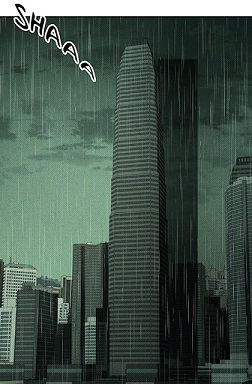 (chapter 11) It was, as if this world was monochrome. However, I started wondering why the author chose green monochrome pictures as process and as such why she selected such a title. As you can imagine, there are many possible answers, and it is up to the readers to give an answer. Thus I will try to give different explanations for the choice of JAXX. Naturally, this is my own interpretation.
 (chapter 5) This is connected to the sign “exit”. From my point of view, this panel could be an indication for the progression of the story. Why? It was, as if this atelier represented the whole world for Matthew, and Jin is the reason why Matthew Raynor decided to leave behind his solidary life for good. Through him, he is forced to interact with other people. Therefore he listens to the minions’ story. Notice that in the atelier, the artist can hide from people’s gaze, he can work in peace and even focus on Jin, his muse. However, for the thug, this panel has a different meaning. It forces him to recall his past, and as such to move on from this traumatizing past with Brandon Lee. Since Matthew’s studio is situated in the basement of the building, he can’t restrain himself thinking about his own past. That’s how the readers can discover that initially both protagonists have a common denominator. The thug would also live in the basement
 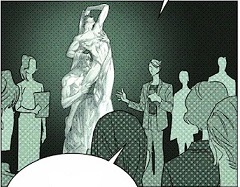 (chapter 1) He feels nothing for this statue. People surrounding the sculpture remain anonymous, for he is not paying attention to them. Every seems to be blank and cold. For him, only money and power matter. However, Jin is in truth a very passionate and strong-willed person. This explicates why his vision changes, when he thinks about sex.
  (chapter 4) And now you comprehend why the author used a different color, red. Jin is still thirsty for love and warmth, but he is in denial. Therefore it is not surprising why he is using drugs to stop his longing. These serve him as a substitute. They create an illusion, the world looks more colorful. Due to Brandon’s treason, Jin learned a terrible lesson. He would never get attached to anyone. However, as you can imagine, through Matthew’s inexperience, Jin discovered sexuality under a new light. The student is linked to purity. Yet Matthew is exactly like him, he has a huge libido, a sign that both are in truth longing for a deep affection.
 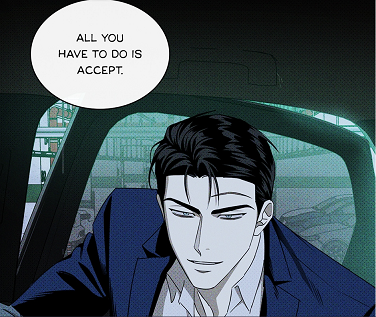 (chapter 20) Consequently, I deduce that the green light “exit” is no coincidence. Observe the parallels with the first sex session and this new sex session: basement, a new sexual experience for Matthew and the presence of the green light. From my point of view, it shows that Matthew symbolizes the exit for Jin. Thanks to him, the director will be able to leave the darkness of his world. This is no surprise that the main lead is gradually changing his attitude towards the student. He has no idea that Matthew has always admired him. But it is the same for Matthew. Thanks to the director, the student’s life will become more colorful and bright. Therefore I perceive this picture full of symbolism.
 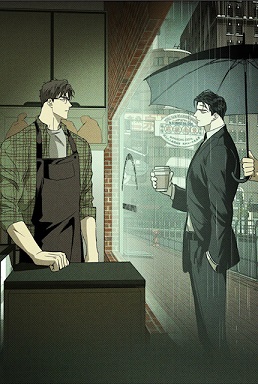 (chapter 1) Both are trapped in their own world, yet the moment Jin entered his world, therefore Matthew was able to leave his seclusion and could follow him.
  and in certain chapters, we discover his own thoughts. It was, as if the story was told from his perspective as well.
  (chapter 1) Her drawings are composed by a multitude of points. So why? I couldn’t help myself connecting these two elements (green and points) to the disease: color-blindness!
  I started wondering if Matthew was not suffering from daltonism, and as such from protanopia.
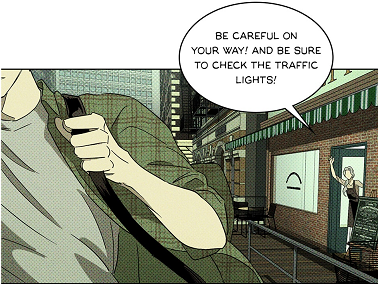
  This means that he can’t see red. First, this would explain why the café owner asked the student to be prudent on his way to the museum.
  (chapter 1) , why Matthew’s clothes look so plain
  and why he is wearing glasses in the end.
  (chapter 16) There exist glasses that help people to overcome this handicap. Besides, notice that when the minions were talking to Matthew and Alex, the café owner, JAXX used a lot of purple and yellow, which reminded me of the colors perceived by people suffering from protanopia. I know, there is no guarantee that this interpretation is correct. However, I really wondered why the author would use the points in the drawings and why she would create such a panel.
  The manhwalovers can recognize Jin’s tattoo and the smear could be perceived as an indication for blood. Yes, it was, as if the letter was bleeding. However, a person suffering from daltonism can not recognize blood as such. This means that Matthew won’t be scared by a blood trail. Observe that anyone seeing Jin’s minion and even Jin would recognize that he is connected to the mafia. Striking is that this never repulsed the protagonist. In fact, he even desired to join his side. He had been looking for him all this time.
 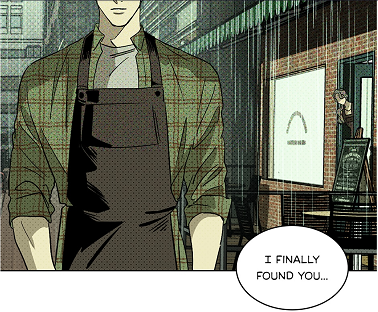 (chapter 1) Striking is that the author refused to let the readers see the character’s gaze. From my point of view, it is related to the other condition why in the artist’s world, there barely exists passion and as such red. If the manhwalovers had seen his gaze, they would have been surprised by the contrast between his words full of hope and warmth and the distant and indifferent gaze. It is already palpable by the absence of the protagonist’s smile. The character has definitely some problems. This is perceptible in the following panel:
 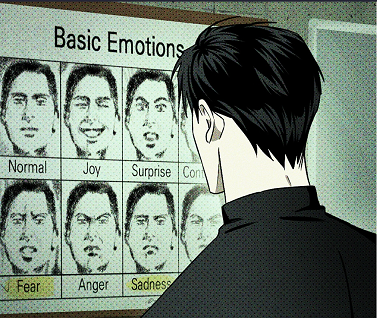 (chapter 16) The artist can not recognize people’s emotions. He needs a manual how to read them. That’s why some readers started wondering if the artist was not suffering from autism or was not a psychopath. Even Jin memorized his number on his cellphone as “psycho”. He even describes him as creepy. Moreover, the readers even imagined that he had killed the rabbit, for he was longing for its closeness. One of the reasons was that they were disturbed by the protagonist’s smile.
 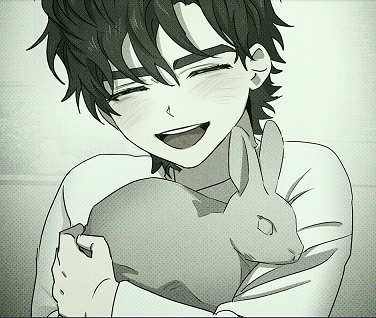 (chapter 27) The latter appeared at the wrong time, when the cute rabbit had died. For an outsider, it really looked like the young boy was rejoicing about the animal’s death. However, I believe that there could be another explanation. He could feel relieved that his rabbit would never abandon him. But autism and psychopathy are not explaining why Matthew would barely express his own emotions. That’s how I come up with this new idea.
 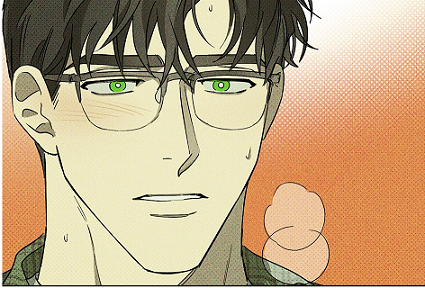 (chapter 1) For the first time, Matthew’s heart is racing, the readers can assist to the resurfacing of Matthew’s emotions which were also buried. Furthermore, the more he looked at his idol, the redder it became:
 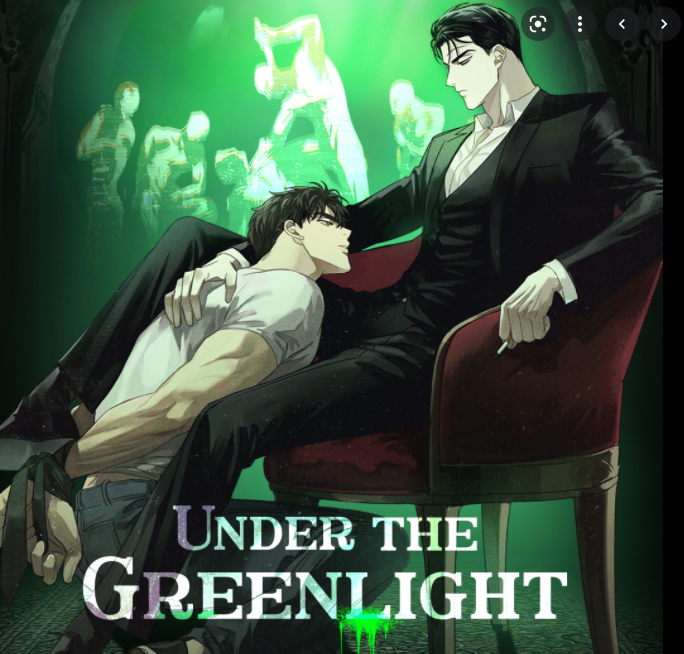 illustrates their relationship. Matthew is trapped, and can’t escape from Jin’s spell. This means that the student enters the world of the mafia because of the director. At the same time, this illustration could show the director’s terrible past. Notice that in the image the sculptor illustrates a murder scene. I detect a strong connection between the art and death. Don’t forget that the rabbit got killed, the moment the artist had finished his work. Consequently, I deduce that the end of their monochrome world is strongly intertwined with blood and death.
  Bebebisous33s' analyses in K-Dramaland and Manhwas