

Please support the authors by reading Manhwas on the official websites. This is where you can read the Manhwa: Jinx But be aware that the Manhwa is a mature Yaoi, which means, it is about homosexuality with explicit scenes. Here is the link of the table of contents about Jinx. Here is the link where you can find the table of contents of analyzed Manhwas. Here are the links, if you are interested in the first work from Mingwa, BJ Alex, and the 2 previous essays about Jinx The Man Who Knew Too Much – part 1 and part 2
It would be great if you could make some donations/sponsoring: Ko-fi.com/bebebisous33 That way, you can support me with “coffee” so that I have the energy to keep examining Manhwas. Besides, I need to cover up the expenses for this blog.
The Language of Foreshadowing
Have you ever noticed how Jinx often tells us what is about to happen, long before the characters themselves realize it? I am quite certain that my avid readers are already thinking about the puppy 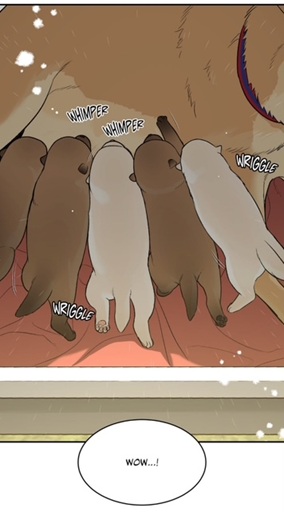 (chapter 57) and its future adoption which got reinforced with the reappearance of an old picture showing Kim Dan holding a puppy.
  (chapter 94)
Yet a small detail from episode 93 (!) caught my attention, and I couldn’t ignore it. Do you remember the breakfast scene in episode 18? 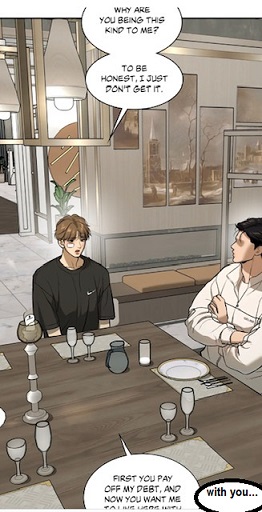 (chapter 18) Kim Dan and Joo Jaekyung are sitting together, but there is still a distance between them. And between them, almost quietly, hangs a painting: a winter landscape. Bare trees, cold tones, a distant city. Everything feels still… almost frozen.
  (chapter 18) This image reflects their state at that moment, that’s why it is placed between them, even behind them. They are close in space, yet emotionally far apart — trapped in silence, routine, and roles. Alive, but not truly living. At the same time, this shows how they treat their past and themselves. Additionally, they seem to draw a line between themselves and others, as if hiding behind invisible walls. Present, yet unreachable.
The painting reinforces this impression. It is not shown as a single, unified image, but divided into separate panels. Fragmented—just like them. They are not whole.
Much later, in episode 93, we encounter a similar composition. 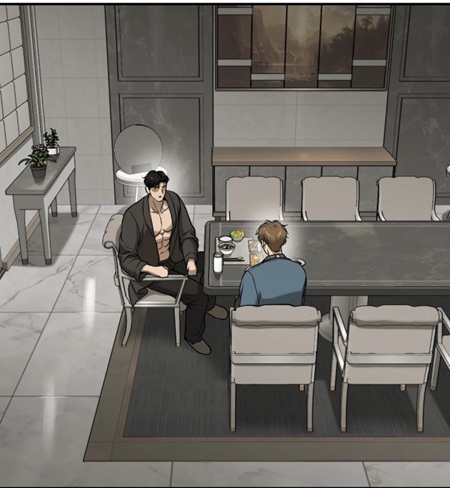 (chapter 93) The setting remains, but the painting has changed. Winter has given way to a living landscape: trees with leaves, a mountain rising in the background, and beneath it a stretch of water reflecting the light.
 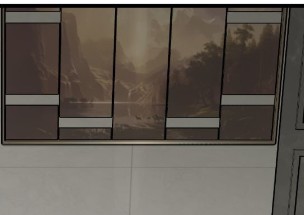 (chapter 93) The atmosphere is warmer, softer, alive … yet not fully bright. The colors matter. The trees are not green, but muted—brown, almost beige. Life has returned, but it remains subdued, as if the scene itself is hesitating between seasons. And yet, the structure persists. The image is still divided. The fragmentation remains—but the distance between the panels has narrowed.
This shift is not incidental. It reflects a transformation in both Joo Jaekyung’s and Kim Dan’s internal states. (chapter 93) The winter of isolation gives way to a quieter, emerging warmth—one that prepares the ground for the conversation on the beach. There, under the amber light of the setting sun, this internal change becomes visible: what was once buried in silence begins to surface, and what once signified loneliness is reinterpreted as endurance.
But the characters are not whole yet. The walls have not disappeared. They had only begun to soften, until the both of them went to the beach together.
So what exactly are we witnessing here? 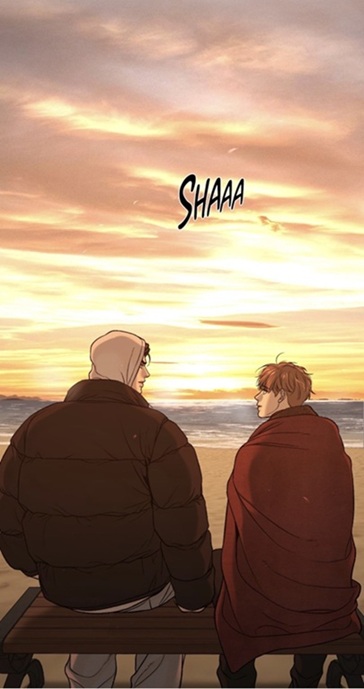 (chapter 94) A simple change in atmosphere? A moment of intimacy? Or the beginning of a deeper transformation in the way Kim Dan and Joo Jaekyung perceive themselves and, above all, each other?
To answer that question, we need to look more closely at what comes next. I would like to begin with a contrast: the expensive golden keychain on the one hand, and the beach conversation on the other. Why gold then—and why amber now?
Gold as Silence
The contrast began long before the beach. On his birthday, Kim Dan tried to express what he felt through a gift and a card. He chose an expensive golden keychain 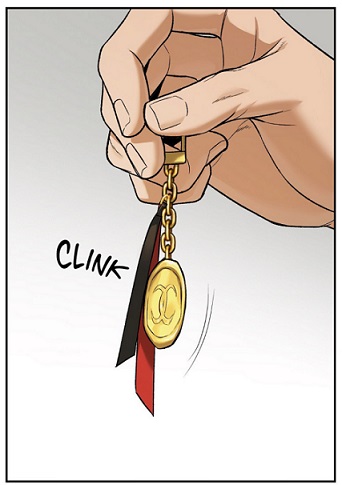 (chapter 55) —something polished, valuable, appropriate. Alongside it, he wrote a message that sounded careful, respectful, almost rehearsed:
 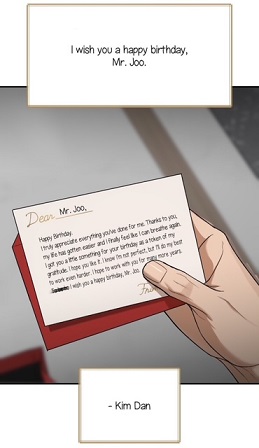 (chapter 55) “I truly appreciate everything you’ve done for me.” “I’ll work even harder.” “I hope to work with you for many years.” At first glance, nothing seemed wrong. The gesture was thoughtful, the words polite. And yet, something felt restrained.
The language belonged to a world of duty and hierarchy. It reflected the position Kim Dan believed he had to occupy: a subordinate expressing gratitude to someone above him. His words were correct—but they were not fully his. And the card itself revealed that.
He began to write “To be honest”… but stopped after “To be ho”.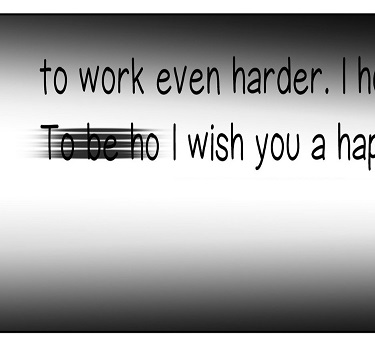 (chapter 55) The letters were erased before the sentence could even exist. This is not a correction. It is a hesitation made visible. The thought emerged—but it was interrupted. Before honesty could take shape, it was already suppressed.
What remained on the card was therefore not what he first intended to say, but what he allowed himself to say. What was missing was not sincerity, but freedom. He did not speak from a place of confidence, but from a need to maintain balance. The gift and the card functioned as a safe substitute for something he could not yet articulate. They allowed him to remain within the structure he knew: gratitude, effort, loyalty.
Gold, in this context, carried a precise meaning.
It represented value, recognition, and status. It was something that could be measured, offered, and accepted without ambiguity. But it was also impersonal. It created distance rather than closing it. The keychain was expensive, but carried no warmth of its own.
This only becomes fully clear later, on the beach. 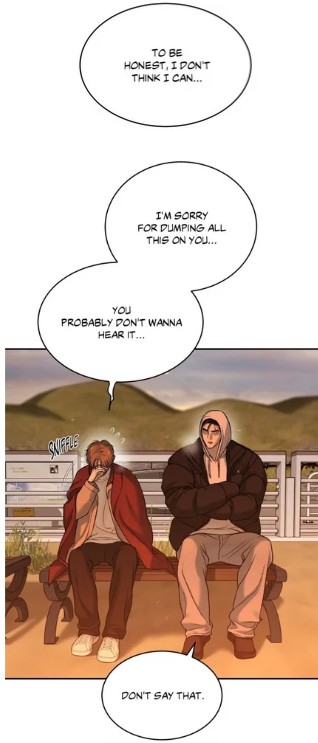 (chapter 94) There, when he finally spoke without the protection of formality, his words shifted. He admitted what had remained hidden at the time of the gift: To be honest, he did not think he could do it. He did not feel confident enough to stay by Joo Jaekyung’s side.
 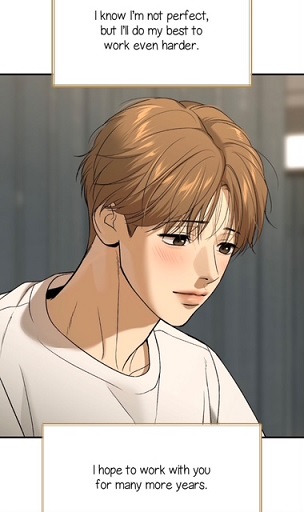 (chapter 55) Though his words seemed clear, this “hope” was not entirely his. It was shaped by something that had not yet been severed. At that point, Kim Dan had not truly separated himself from his grandmother.
 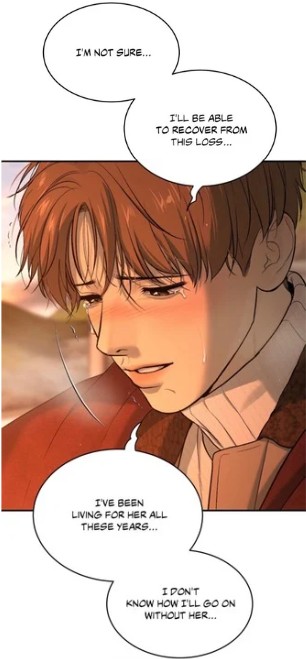 (chapter 94) His sense of self was still tied to her—emotionally, morally, almost structurally. He was not yet standing on his own, but continuing a role he had long internalized: enduring, adapting, staying where he was needed.
So when he spoke of “many more years,” it was not the expression of a free decision. It was an extension of obligation. 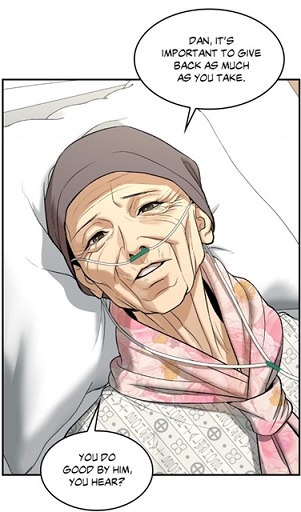 (chapter 41) A continuation of a life he had learned to accept, rather than one he had chosen. This is why the card feels so careful, so measured. Not because he lacked sincerity – but because he lacked strength in his eyes.
And the erased beginning—“To be ho”—makes this even clearer. Because what he had wanted to say was not a promise. It was doubt. He did not trust himself.  (chapter 51) And because of that, he clung to Joo Jaekyung—not simply as an employer, but as a figure through whom he could stabilize his own sense of worth. Remaining by his side, working harder, staying useful… all of this allowed him to compensate for what he felt he lacked. (chapter 55)
His “hope” was therefore not an expression of desire, but a strategy. A way to hold himself together. This is why the confession on the beach reframed the entire birthday scene. (chapter 94) He can no longer use his grandmother or the champion to define himself, as their collaboration is limited in time as well.
What had once appeared as gratitude now revealed itself as restraint. What had sounded like commitment now exposed hesitation. And what looked like gold… turned out to be something else entirely. Under this new light, we begin to understand why Kim Dan could neither confess his affection—nor fully express his gratitude.”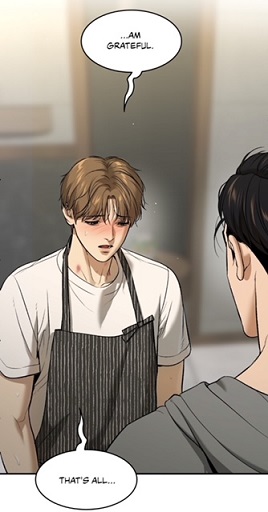 (chapter 45) Because gold, in that moment, could only represent value imposed from the outside—status, reward, recognition.
But the sunset on the beach spoke a different language. 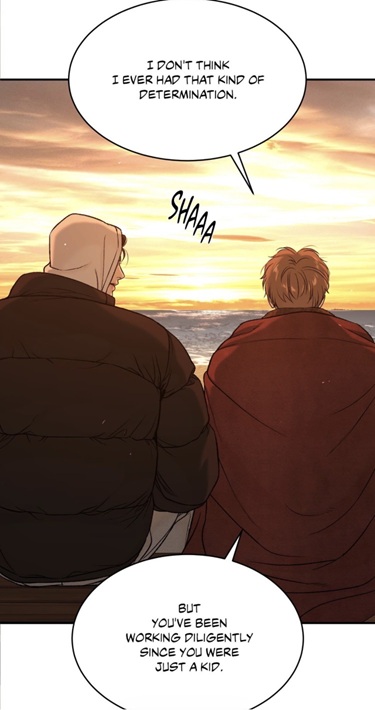 (chapter 94) And perhaps this shift is not only carried by words—but already visible.
If we look closely, something subtle emerges. (chapter 94) The colors of the scene echo the keychain itself. (chapter 55) The gold, of course—but also the red and black attached to it. On the beach, these same tones reappear in what they wear, in how they are visually composed within the frame.
What had once existed as an object—held, offered, external—now surrounds them. It is no longer something exchanged between them. It is something they inhabit together. (chapter 94) But there is more. They are not simply sitting side by side. They are looking at each other. And that gaze changes everything. Because for the first time, the connection is no longer mediated—neither by a gift, nor by roles, nor by unspoken expectations. It is direct. Mutual. Sustained. The gaze becomes the binding element.
It replaces the object. It replaces the silence. And in doing so, it creates something new. Without fully realizing it, they begin to form the outline of a team—one that is no longer defined by hierarchy or obligation, but by presence and recognition.
Not of display, but of transformation. Not of perfection, but of something preserved, altered, and made meaningful over time. And this is why I could no longer associate that scene with gold. The gold had spoken in his place—but it had spoken the wrong language. Only later did Kim Dan begin to replace that language with something more direct, more vulnerable. And it is precisely at that moment that the tone of the story begins to change.
The shift from gold to amber starts here.
Between Silence and Honesty
If we return to the beach scene, something immediately stands out—not only what Kim Dan says, but how he says it.
“To be honest…” (chapter 94) 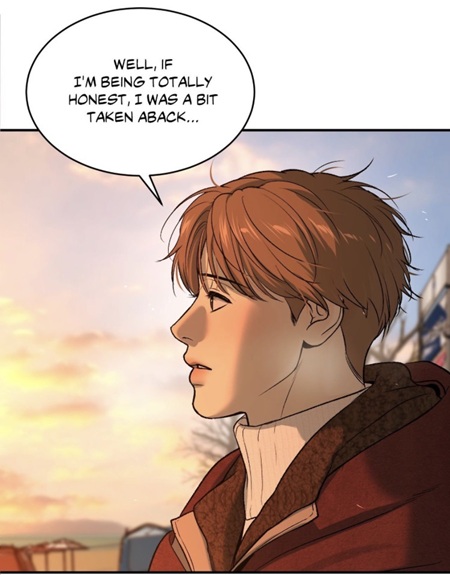
(chapter 94) “If I’m being totally honest…”
This phrasing is not new, as we have seen its interruption before. On the birthday card, the sentence never reached completion. It stopped at “To be ho”. But what was interrupted there was not simply honesty. It was the fear of burdening someone else.
For Kim Dan, speaking honestly had never been neutral. (chapter 94) To express doubt, sadness, or uncertainty meant placing weight on another person. It meant becoming a problem rather than a solution. And this was something he had learned to avoid.
Even in small, seemingly harmless moments, this pattern had already been visible. Being called a “crybaby” may sound trivial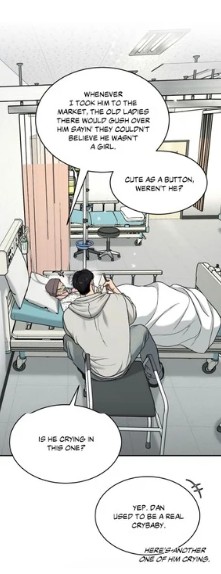 (chapter 94), but it reveals something deeper: emotions were not meant to be expressed freely. They were something to control, to contain, to keep from overflowing. This means that by his grandmother’s side, he learned to hide his suffering behind a smile, something I had long detected.
Sincerity, for him, was inseparable from vulnerability. And vulnerability risked becoming a burden. This is why the sentence could not be completed. “To be honest…” was not just difficult to say. (chapter 94) It was something he believed he should not say.
And yet, on the beach, that same sentence returns. (chapter 94) Not once—but twice. Not as a clean declaration—but as something he repeats, almost carefully, as if testing whether he is allowed to continue. Each time, he creates a small distance before speaking, as if preparing both himself and the other for what might follow.
The hesitation is still there. Either he apologizes or he makes a pause. He lowers his gaze or looks at the horizon. He assumes that what he says might not be welcome. It even becomes truly palpable, when he employs this idiom for the first time on the beach: (chapter 94) He fears reproaches or discomfort. And this is where something shifts. Joo Jaekyung interrupts him: “Don’t say that.”
At first glance, this could sound like a refusal—as if he were rejecting what is about to be said. But in reality, it does something else. He is encouraging Kim Dan to speak. He rejects the assumption behind his words. Not the confession—but the idea that it is unwelcome. In that moment, Kim Dan is not silenced. He is allowed to continue. And this changes everything. He proceeds carefully, but he proceeds. So he is honest, but not yet free. And this is precisely what makes the moment meaningful. Because this time, he does not stop; not because fear has disappeared, but because it is no longer decisive.
And yet, something else becomes visible here. When he later says, (chapter 94), he does not look directly at Joo Jaekyung. His gaze shifts toward the horizon. At first, this might appear as hesitation reflected by the points of suspension, but it carries a different meaning. He is not withdrawing. He is protecting it. Because what he is about to say touches on something deeply personal—not only for himself, but for the other as well. By avoiding direct eye contact, he creates a space in which Joo Jaekyung does not have to respond, does not have to defend himself, does not have to expose what he may not yet be ready to show. In this sense, his restraint is not a sign of fear or shame. It is a form of respect. A way of allowing honesty to exist without embarrassing the other and forcing him into vulnerability.
To understand why he speaks here—and not before—we need to look at the place itself. 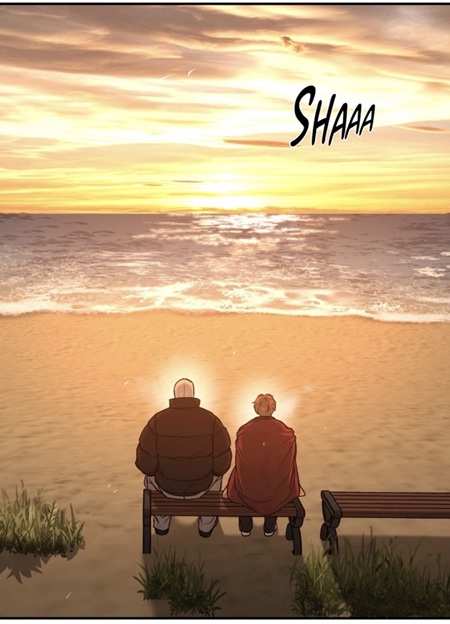 (chapter 94) The beach is not a random setting.
But there is another reason why this place matters. Kim Dan does not only go there when he is alone. 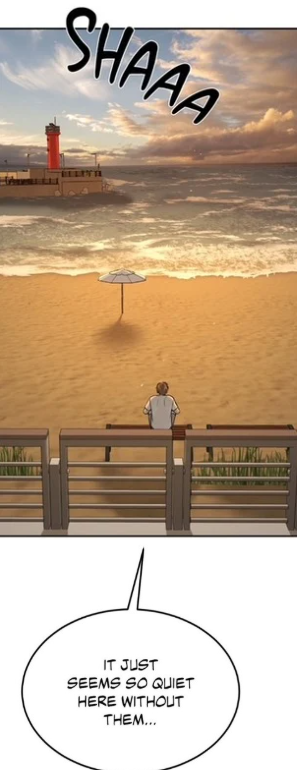 (chapter 59) He goes there when he is struggling—when something within him can no longer be contained.
 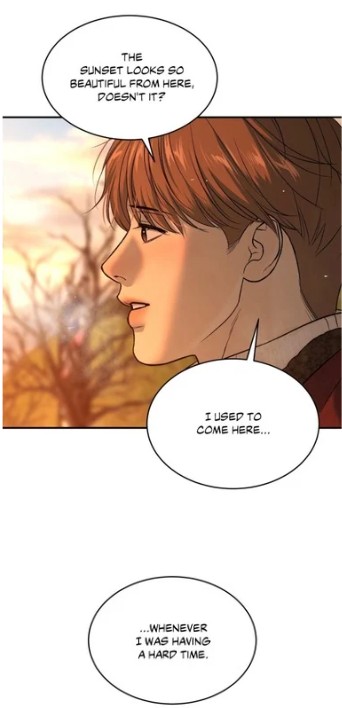 (chapter 94) In those moments, the usual mechanisms—enduring, adapting, maintaining balance—begin to loosen. The roles he has learned to perform no longer fully hold. And this is what links the beach to something more fundamental.
Honesty. Because if we think back, the first time this place was truly defined was not through him—but through his grandmother. 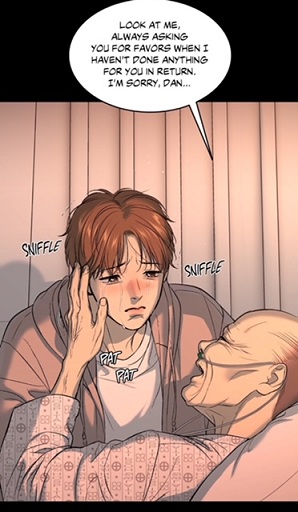 (chapter 53) At the hospital, she spoke openly. She expressed regret, desire, and a final wish without filtering it, without protecting him from the weight of it.
  (chapter 53) It was a moment of sincerity that did not try to reduce itself.
And Kim Dan carried that moment with him. So when he returns to the beach, he is not only seeking comfort. He is returning to a place that has already been marked by truth—a place where emotions are not managed, but felt.
This is also why the scene in episode 59/60 becomes so significant.  (chapter 60) When he reaches his breaking point, it is here that the boundary between control and collapse begins to dissolve. The beach is no longer just a refuge—it becomes a space where everything that has been contained threatens to surface at once.
And this is what Joo Jaekyung perceives as well.  (chapter 80) For him, the place becomes associated with something dangerous: loss, disappearance, the possibility of not returning. Hence he taught him later how to swim.
But for Kim Dan, the meaning is different. The beach is not where he wants to disappear. It is where he can no longer pretend. He had come here before, in chapter 59, after Heesung and Potato had left. (chapter 59) It was already a place he chose in difficult moments. Not to avoid something—but to face it in his own way.
And this place carried meaning.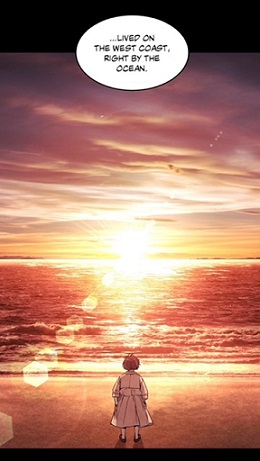 (chapter 53) Through his grandmother , the ocean had been described as something beautiful, something capable of giving strength and comfort
  (chapter 53) — even when experienced alone. It did not require company to feel complete. Kim Dan held onto that idea.
So when he returned here, he did not come empty-handed. He came with an expectation. (chapter 59) That this place could give him something. That it could help him endure. That it might allow him to feel what she had felt—and, perhaps, soften what he himself was feeling. In that sense, the beach was more than a memory. It was a possibility. That’s why he visited the beach, when he was struggling.
But there is another layer to this. The beach was not only a place he returned to when he was struggling. It was also a place through which he tried to reconnect. (chapter 94) Not simply to escape— but to experience, in her place, what she had once described. To share that moment indirectly, as if the beauty of the ocean could bridge the distance between them, soften the absence, and momentarily silence his loneliness.
This is what gave the place its meaning in the past. Because if he could see what she had seen — if he could feel what she had felt — then perhaps he would not be alone in it. (chapter 59) And yet, this meaning does not remain stable.
In episode 94, he returns to the same place—but for a different reason. (chapter 94) Not to maintain the connection — but to bring it to an end.
But this possibility is no longer simple. Because the beach is also tied to his grandmother in another way. 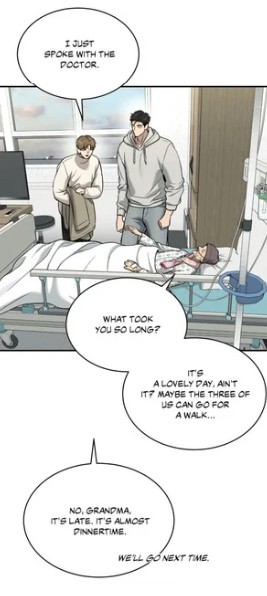 (chapter 94) When she suggested going for a walk together, he refused, for in his mind, the destination would be the ocean. To go there with her would have meant transforming that space into something else: a shared moment marked by what was about to end (chapter 53). It would have forced him to confront her condition directly, and don’t forget that this place is strongly intertwined with sincerity. He couldn’t mask his feelings. So he postponed it. And instead, he returns later—with Joo Jaekyung.
Now ask yourself: why here, and why with him? Because this is where the scene shifts. Kim Dan did not only come to the beach to find comfort. He also came to reach a form of closure. 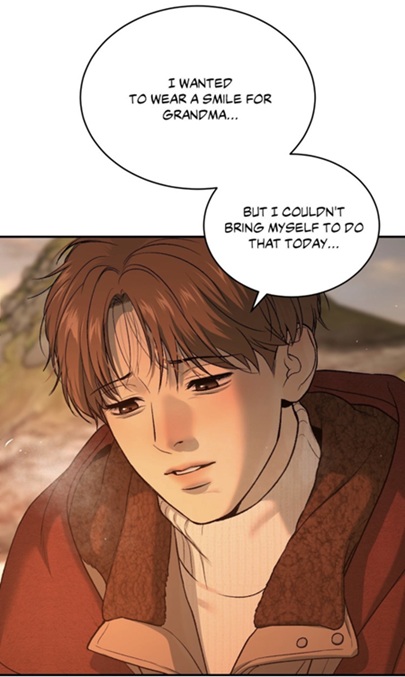 (chapter 94) For the first time, what had always structured him—enduring, adapting, protecting others—no longer works.
And in that moment, he is not alone. Joo Jaekyung is there. He could have stayed in the car. 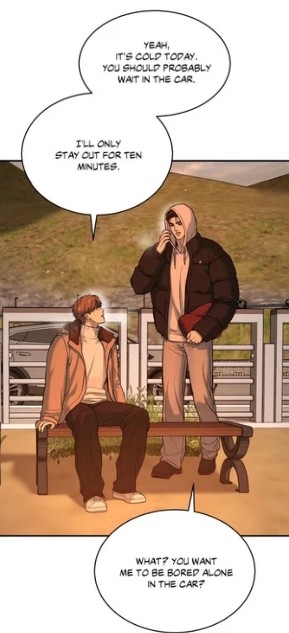 (chapter 94) He was even told to. But he didn’t. He chose to remain beside him.
This changes the situation entirely. Because Kim Dan is no longer speaking into silence. He is speaking in the presence of someone who stayed. And that creates a new tension. On the one hand, he still does not want to burden him. On the other, he can no longer remain silent. This is why his honesty takes this form: hesitant, repeated, apologetic—but expressed. So what are we witnessing here?
Not simply a confession. But a shift in conditions. The place offered meaning—but not enough to contain what he felt.
The memory of his grandmother gave direction—but not resolution. 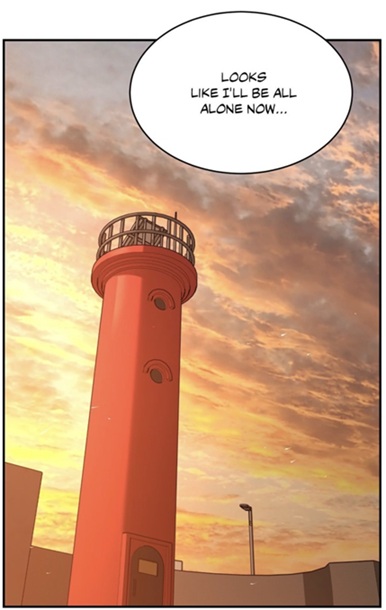 (chapter 94) And the presence of Joo Jaekyung created something new: A space where silence was no longer the only option. The sentence that once stopped at “To be ho” now reaches its end.
Not because fear has disappeared — but because, for the first time, it is no longer stronger than the need to speak.
The Shore: Where Two Worlds Meet
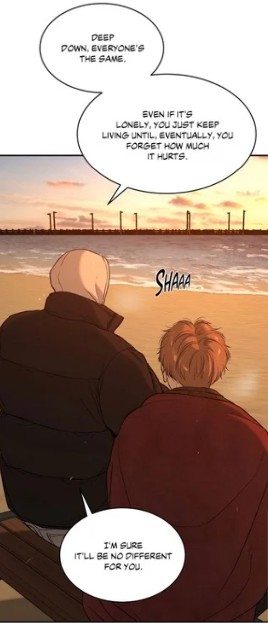
If we look more closely at the setting of this scene, we begin to understand why it had to take place here—and nowhere else.  (chapter 94) The beach is not just a backdrop. It is a boundary.
A meeting point between two elements: Water and earth. Movement and stability. Depth and surface.
Water carries memory. It is fluid, unstable, impossible to fully grasp. It reflects what lies beneath—emotion, unconscious experience, everything that cannot easily be contained or articulated. The shore, by contrast, belongs to the realm of the tangible. Sand, ground, the space one can stand on. It represents reality, structure, adulthood—the world of roles and responsibilities.
And where are Kim Dan and Joo Jaekyung positioned? (chapter 94) Exactly at that threshold. They are not in the water. They are not fully on stable ground either. They sit at the point where both worlds meet. And psychologically, this position mirrors their state. Both men are suspended between two identities:
- the child shaped by past experiences
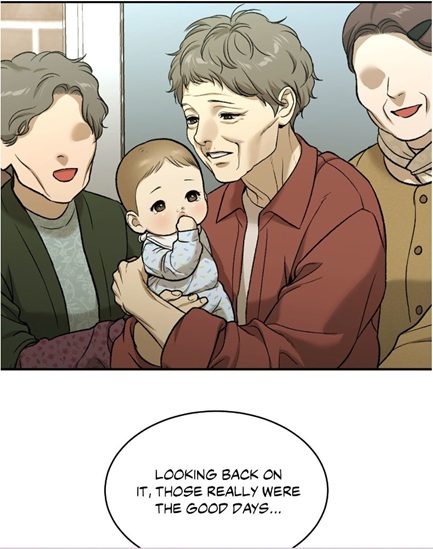 (chapter 94)
 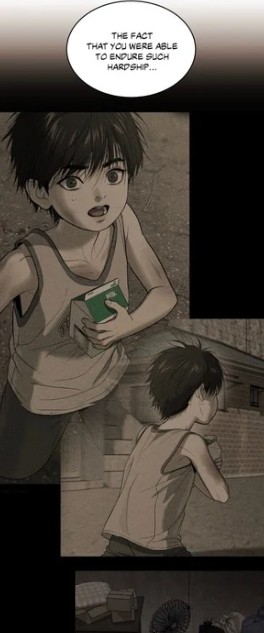 (chapter 94)
 - the adult defined by roles, expectations, and survival strategies
 (chapter 94) (chapter 94)
The amber light of the setting sun intensifies this ambiguity. It does not belong fully to day or night. It merges opposites rather than separating them. Just like this moment. Just like them.
But the meaning of this place becomes clearer when we compare two moments that occur here. When the grandmother speaks about Kim Dan, her words establish a distance:  (chapter 65) Even though they have lived together for years, she positions herself outside his inner world. She observes him—but does not truly reach him. And the image reflects this separation. The water and the sand remain clearly divided. The boundary holds.
Now compare this to the later scene. (chapter 94) Joo Jaekyung appears to create distance—but in reality, he reduces it. The “friend” is himself. What cannot be said directly is nevertheless expressed. And this time, the image of the shore changes. The colors warm. The boundary between water and sand begins to dissolve. The elements no longer remain strictly separated—they begin to blend.
This shift is decisive. Where the grandmother’s words maintained distance, Joo Jaekyung’s words—however indirect—open a space. And this is why Kim Dan can ask a question here. 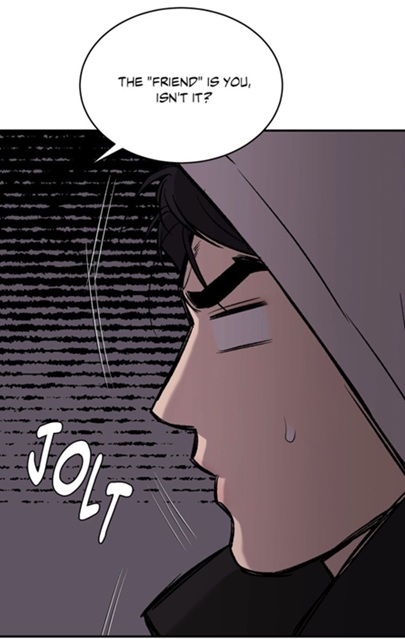 (chapter 94) Because he does not interrupt. He listens.
 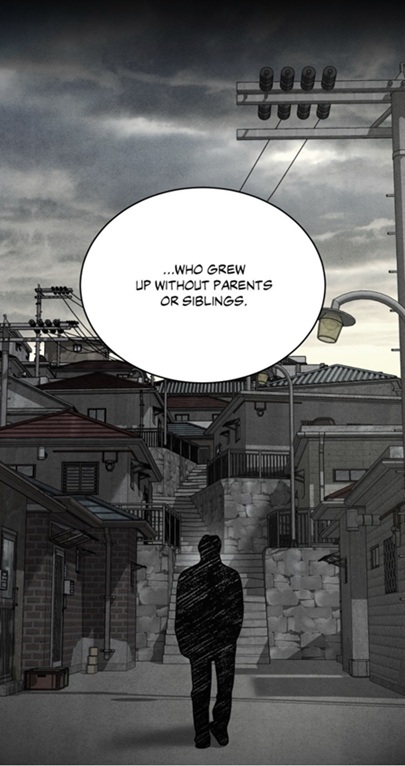 (chapter 94) He allows the confession to unfold—even in its distorted form. And once it has been spoken, he does something no one else has done before. He recognizes it. (chapter 94) In that moment, indirect speech is no longer needed. What Joo Jaekyung could not say directly is named—clearly, without hesitation. And this act changes the structure of the exchange.
Because Kim Dan is not simply responding. He is translating. 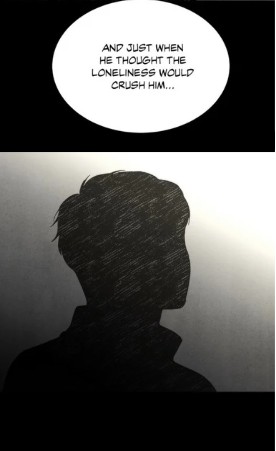 (chapter 94) Not simply because of the place. But because of who is beside him.
Joo Jaekyung does not fully understand him. But he does something essential. He stays, as he has come to associate solitude with boredom. (chapter 94) He waits and later listens. And he does not turn away. He shows an interest in his thoughts and inner world. (chapter 94)
For the first time, Kim Dan is no longer facing a boundary that reflects distance—but a presence that allows something to pass through it. The shore, then, is not only a line between two worlds. (chapter 94)
But this exchange is not one-sided. Because Joo Jaekyung’s confession does more than reveal something about himself—it creates a form of acceptance and reciprocity. By exposing his own vulnerability, however indirectly, he does not remain outside Kim Dan’s inner world. He steps into it—and, at the same time, invites Kim Dan to do the same. Hence he is now capable to express his true admiration: (chapter 94)
And this changes not only their exchange—but the meaning of the place itself. Because for Kim Dan, the beach had never been just a location. It was tied to a memory that was not his own. To something his grandmother had described—something beautiful, something meaningful—but always experienced alone. What he sought there, in the past, was not simply comfort. Like mentioned above, it was connection.
The hope that, by returning to that place, he might feel what she had felt. That the beauty of the ocean could bridge the distance between them. That it could, even briefly, soften his loneliness. But that experience had always remained incomplete. Because it was never shared. Now, for the first time, that changes.
He is no longer alone in front of the ocean. He is not imagining what someone else once felt. He is living something—here, in the present—with someone beside him. (chapter 94) A moment that is not remembered. Not borrowed. Not projected. But shared.
That’s why he will never forget this moment. Because what he had longed for was not only to be understood—but to experience something meaningful with another person, without distance, without roles, without having to carry it alone.
And this is where the difference with the grandmother becomes clear. She spoke about Kim Dan without ever truly entering his experience. The distance remained intact. Joo Jaekyung, by contrast, does something else. He does not know Kim Dan’s entire past —but he reaches toward him. Not by asking directly. But by making himself available.
And this movement carries an implicit request: (chapter 94) not to remain alone in what has just been revealed.
In other words, Joo Jaekyung is not only confessing. He is asking—quietly, almost unconsciously—to be trusted and as such accepted. And Kim Dan responds to that request. Not by withdrawing. Not by protecting the other through silence. But by speaking.
The shore no longer separates. It begins to connect. Not fully. Not clearly. Not without hesitation. But enough for something new to emerge.
And this “something” can now be named more precisely. (chapter 94): friendship.
Not as a completed bond—but as a shift in how they relate to one another. Until this moment, their interactions had been structured by roles: patient and therapist, employer and subordinate, champion and supporter. Each exchange was framed by function, expectation, or necessity. Here, that structure loosens. They are no longer speaking from their roles—but to each other. Hence they look at each other at the end.
Not to fulfill a function. Not to maintain a balance. But to share something that belongs to neither of those frameworks. The first moment that carries the shape of friendship.
Signs of Direction: Sun, Lighthouse, Pier, and Umbrellas
If the shore marks a boundary, the horizon introduces another question altogether: not where they are, but where they are heading. (chapter 94)
And here, the visual composition becomes extremely revealing. The scene does not simply give us a beautiful beach. It places in front of the reader several structures of orientation: the sun 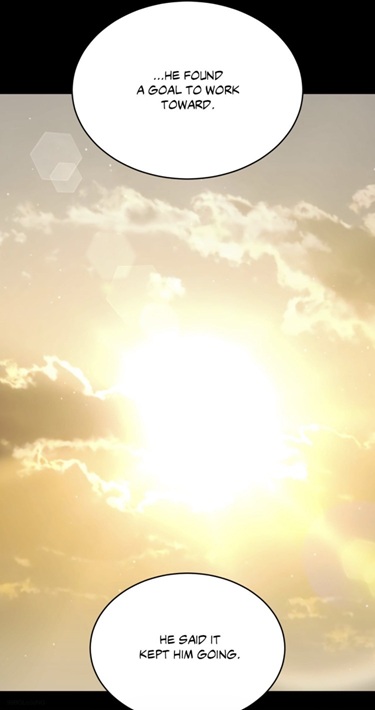 (chapter 94), the lighthouse (chapter 94), the pier (chapter 94), and, more discreetly, the red tent with the two umbrellas
 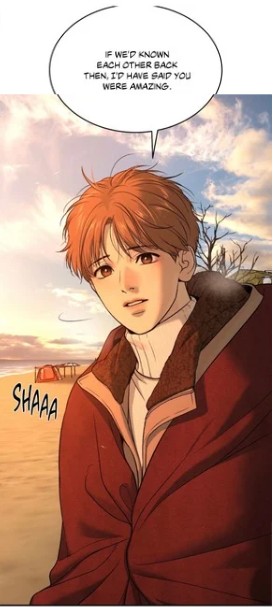 (chapter 94). None of them is accidental. But their meaning is not only symbolic. They reveal something that neither of them have not yet fully realized. That they were never entirely alone.
The Lighthouse and the Sun: Two Models of Survival
The contrast between the two protagonists is rooted in how they seek light. For Kim Dan, orientation was never about an abstract goal, but a concrete person: his grandmother. She was the fixed point that prevented him from drifting into total darkness.
This is why the lighthouse is his defining symbol. (chapter 94) It stands visible and steady—a structure built to guide and prevent loss. Yet, Kim Dan associates it with loneliness. The lighthouse embodies the gap between what is present and what he is able to perceive. It provides direction, but not warmth; it signals, but does not embrace. It stands near, yet remains fundamentally separate. For Dan, the lighthouse represents support without true intimacy—a guidance that keeps him vertical but leaves him emotionally shivering.
Joo Jaekyung operates by a different celestial logic. When he speaks of his “friend,” he associates survival with the sun—a distant, overwhelming source of power. (chapter 94) In Jaekyung’s philosophy, one endures by fixing their eyes on a high, unreachable goal. The sun provides the energy to keep moving, but like the lighthouse, it offers no closeness. It is a strategy of survival based on projection and distance. It kept him alive, but it also kept him isolated. His “goal” is like his life strategy: disciplined and bright, but emotionally unreachable. And what is the common denominator between them? By keeping their gaze on the sun or lighthouse, they couldn’t see that they are surrounded —by nature and by human structures. (chapter 94) They are in reality not alone. The sea, the sky, the light… but also the lighthouse, the pier, the tent.
The Pier: The Human Path
Between the verticality of the lighthouse and the distance of the sun lies the pier. Extending outward into the water, it represents something fundamentally different: not a distant point, not a fixed signal—but a path. A human construction.
A movement toward something not yet reached.
But more importanty, the pier leads toward the lighthouse.  (chapter 59) In other words, it connects movement to orientation.
And this is exactly what happens in the dialogue.
(chapter 94) his words seem, at first, to reinforce isolation. They reduce human experience to sameness. They remove the possibility of being uniquely understood. But that is only one side of it. Because these words also do something else. They reach Kim Dan. They meet him precisely at the point of his fear: the fear of being alone, of being left behind, of losing the only structure that gave his life direction.
By framing loneliness as something universal, Jaekyung transforms it. Not into something to escape—but into something survivable. And this is where the visual composition becomes decisive. While he speaks, the pier extends behind him—toward the lighthouse. His words follow the same movement. They begin in distance— but they arrive at Kim Dan, the “lighthouse”.
Even if unconsciously, he builds a bridge. On the other hand, his advice reflects his past philosophy. One could say that he isn’t offering empathy, for he is erasing difference. By reducing everyone to a single condition, he creates a defense against true connection. If everyone is “the same,” no one is uniquely lovable or truly distinct. His words reflect his indifference towards others.
Yet, his life contradicts his cynicism. He speaks as if he survived by solo strength, ignoring the “piers” in his own life—people like Hwang Byungchul 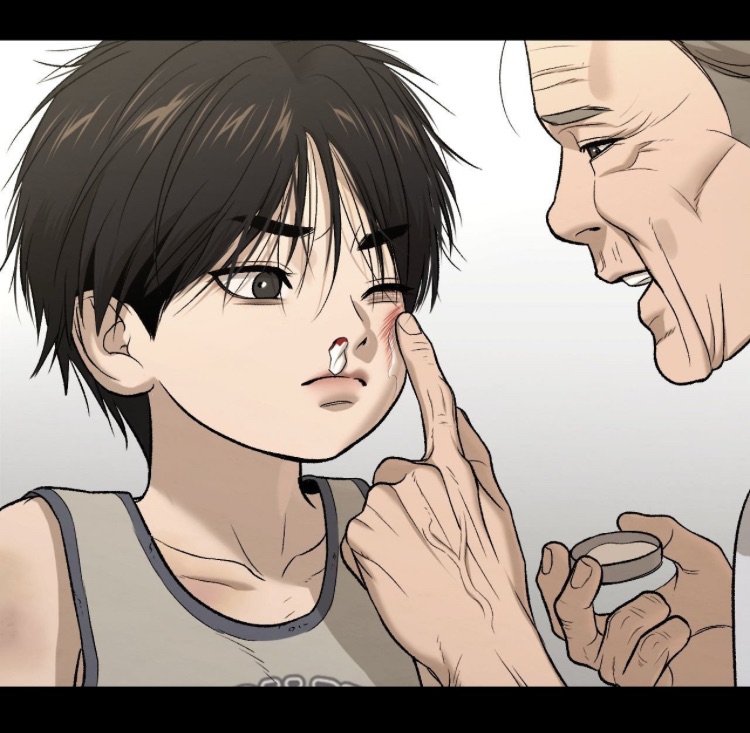 (chapter 72) or his mother. He resists any narrative of dependence because to acknowledge others is to acknowledge vulnerability. He looks at the horizon and overlooks the pier at his side, even though he has been standing on it all along. It is because he was constantly staring at the “sun”. Therefore his reaction is not surprising.
 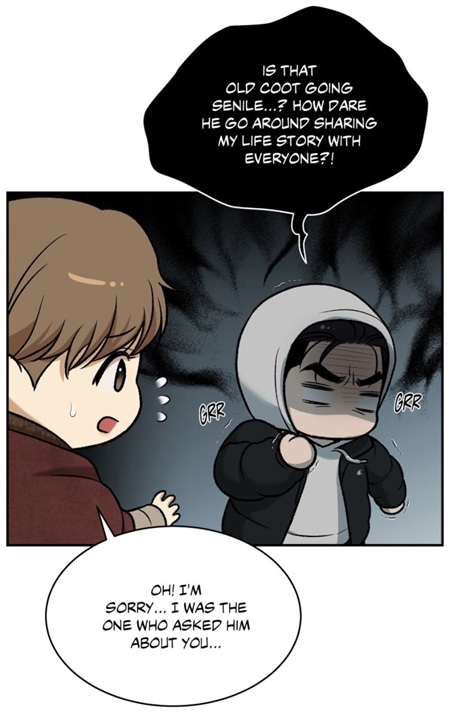 (chapter 94) To acknowledge others would mean acknowledging vulnerability—not just as a condition, but as something shared. So instead, he generalizes. He replaces relationship with sameness. And in doing so, he protects himself from the risk of trust.
As you can see, each element reflects something about Kim Dan and Joo Jaekyung’s inner state and philosophy. This means that as soon as the athlete’s words reached the doctor’s lighthouse, the latter showed him that there was a light much closer to him than the “sun”… the “lighthouse”.
And then there are the more discreet signs in the background: the red tent and the two umbrellas. (chapter 94) These details are easy to overlook, and yet they may be among the most intimate symbols in the entire sequence. Observe that when Kim Dan admits that he wished he had met him sooner, the red tent and the two umbrellas already stand there in the background.
The symbolism is almost painfully clear. The red tent suggests shelter, enclosure, perhaps even the outline of a home. The two umbrellas echo the possibility of shared protection, of two people occupying the same protected space. And yet, neither character has stepped into that space. The tent remains in the distance, just as the umbrellas remain unused. Home exists as a possibility, but it is not yet inhabited.
This is what makes the image so moving. They are no longer completely separate, but they are not “inside” yet either. They are still outside the shelter that awaits them. The home is there, but it has not yet been entered. In other words, the beach scene does not conclude their journey. It stages the threshold of it.
And that is why all these directional symbols matter together.
The sun shows the old logic of survival through distant purpose. The lighthouse shows the old logic of attachment through lonely guidance. The pier shows the beginning of a path toward someone else and stands for connection, endurance and trust. The tent and the umbrellas show the possibility of a shared dwelling that has not yet been claimed.
So the horizon in this scene is not empty at all. It is crowded with future meanings. But none of them is fully realized. The characters are still between states, between models of life, between kinds of love. They can see direction now, but they have not yet arrived. And perhaps this is precisely the point.
The scene does not tell us that they are already safe. It tells us that they are no longer directionless and alone. (chapter 94) They are moving toward each other mentally and emotionally.
The Champion Without a Childhood
And yet, even within this setting, something is still missing. When Joo Jaekyung speaks about his past, the visual language becomes striking.´We do not see a child. (chapter 94)
We see an adult figure—walking through a space that should belong to childhood. A silhouette. A presence without age. It is not simply that the child is absent. It is that he was never allowed to exist. But this absence does not emerge in isolation. It is embedded in the environment itself. Look closely at the setting of his memory. The narrow streets. The damaged houses. The dense accumulation of structures. Everything is gray, as if there was no life at all.
And above all: the mountain in front of him—blocked, obscured, almost inaccessible. He is surrounded by civilization. But not in the sense of protection or community. Rather, as constraint. As enclosure. As a space already marked by hardship, deterioration, and survival. This is not a childhood landscape. It is a system.
And this observation leads me to the following deduction. Jaekyung does not know nature. Not as openness. Not as refuge. Not as something one can enter freely.
The mountain is there —but it is not reachable, as it has lost its true function. The sky is present—but it is not experienced. Everything is filtered through structures. Through walls. Through streets. Through necessity.
This is why the sun becomes so central in his narrative. (chapter 94) Not as beauty. Not as warmth in a relational sense. But as something else: as air. (chapter 94)
As the only available form of escape. When he speaks of finding “a goal to work toward,” and the image shifts toward the sun, this is not just ambition. It is survival. The sun is the only thing that cannot be blocked by his environment. The only thing that exists beyond the system surrounding him. He does not move toward nature. He looks upward—because upward is the only direction that remains open.
And this is precisely where Kim Dan’s response becomes so striking. (chapter 94) He can’t help himself asking him for a confirmation. When Joo Jaekyung begins with (chapter 94), the formulation appears to create distance. It suggests another person, another life, another experience. But this distance does not hold.
Because the narrative that follows immediately undermines it. The “friend” is described as someone who, at a decisive moment, felt as if he was completely alone in the world. 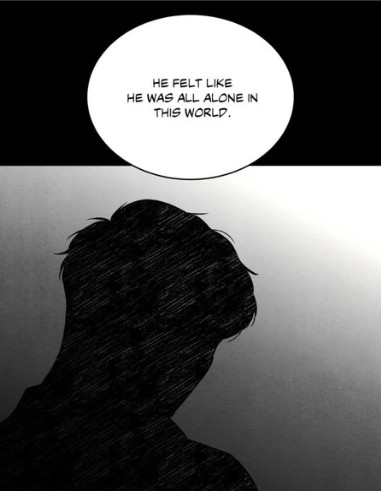 (chapter 94) Someone who grew up without parents, without siblings, without any form of support. The statement is absolute. It leaves no room for exception. And this is where the logic of the confession reveals itself.
If this person truly experienced himself as entirely alone—if there was no one to rely on, no one to turn to—then the very idea of a “friend” becomes impossible. The term contradicts the condition it describes. (chapter 94) In other words, the story cancels its own premise. The “friend” cannot exist as a separate figure. He can only be the speaker himself. At the same time, the main lead’s confession displays that he has no true friend in his life in the end. These words expose his isolation and loneliness.
In addition, this allows us to understand the deeper structure of his trauma. This is not only parentification. It is deprivation on multiple levels. Emotional, yes. But also spatial. Experiential. He was not only denied care. He was denied an environment in which childhood could unfold. 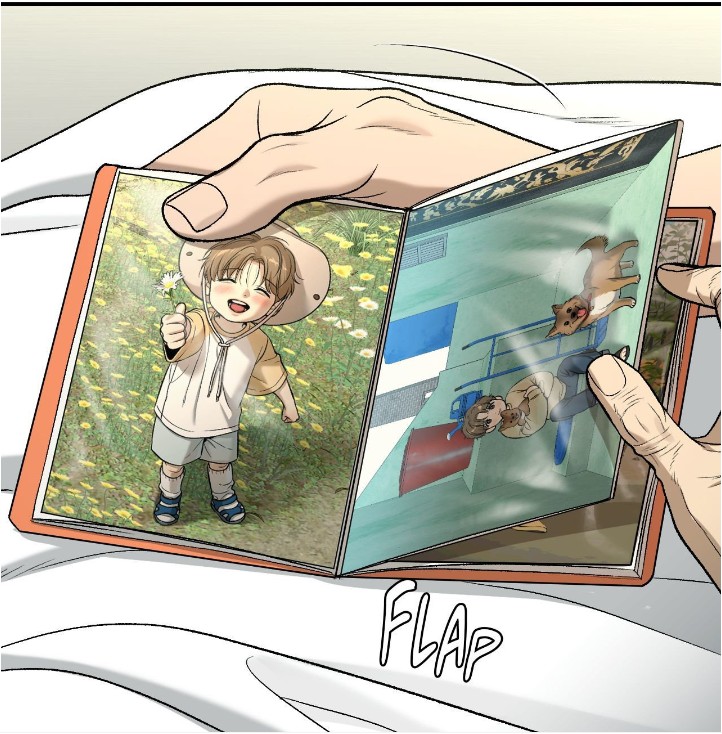 (chapter 94), the exact opposite of Kim Dan.
This is why the visual metaphor is so radical. (chapter 94) There is no rupture between past and present. No transition. No visible child. Only continuity. A life that begins already in function. A childhood replaced by endurance.
And this absence is reinforced later. When his mother denies this reality 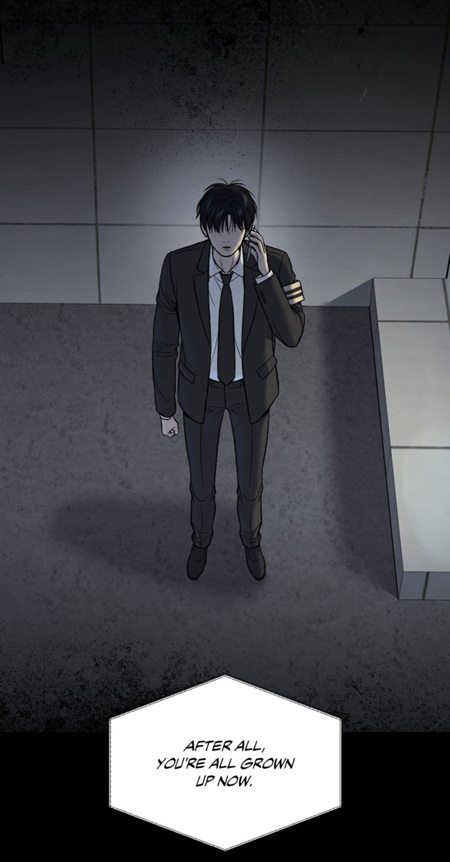 (chapter 74), she does not simply reject his suffering. She erases the condition that produced it. Which leaves him with no framework to understand what is missing.
This explains everything. Why he distances himself. (chapter 94) Why he reduces relationships to roles. Why he cannot understand his own emotions. Because there is no internal reference for them. The child is missing.
And this is precisely where the connection to the present becomes decisive. Because the landscape he carries within him—the enclosed streets, the obstructed mountain, the unreachable outside—stands in direct contrast to the image that surrounds him now.
The open horizon. The visible sea. The unobstructed light. (chapter 94) This shared experience makes him see the world in a whole new light. It is no longer gray, but colorful, as he is not alone anymore. He no longer needs to look at the horizon or the sun. 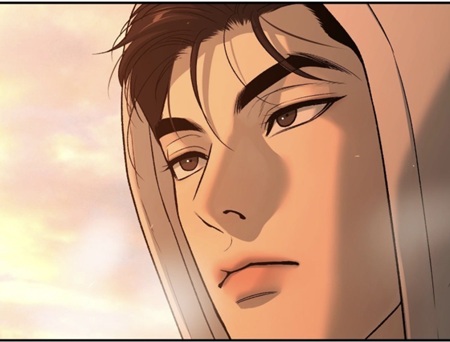 (chapter 94)
And even more importantly: the painting. (chapter 93) The mountain.
The sunlight. A version of nature that is no longer blocked—but offered. This is not accidental. It suggests something fundamental: what was once inaccessible is now placed before him. But he cannot reach it alone.
This is where Kim Dan’s role becomes clear. Because Kim Dan is not only the one who listens. He is the one who already belongs to that space. He understands nature—not as distance, but as experience. (chapter 94) Not as something to look at—but something to enter.
And this is where we can return to the director’s words. 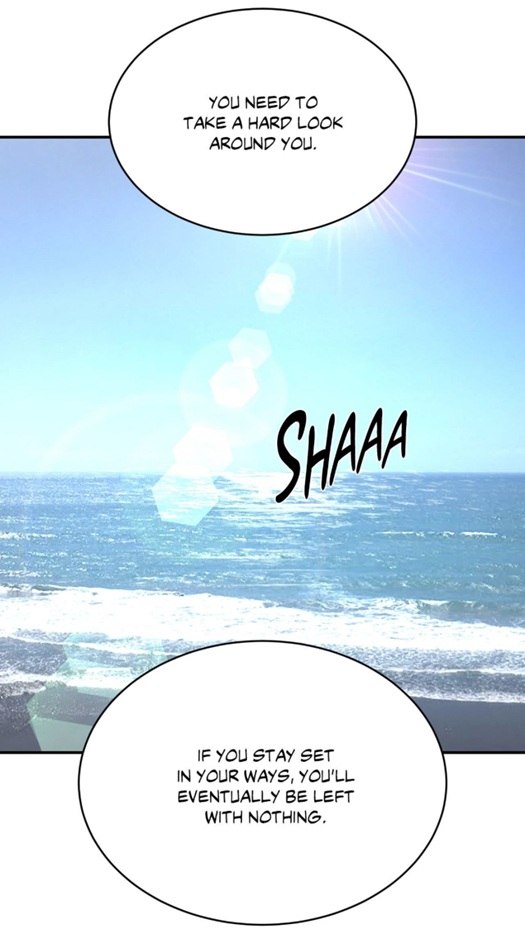 (chapter 75) This was never only about people. It was about environment. About perception. About everything that exists beyond the narrow structure in which Jaekyung learned to survive: shared experience.
In that sense, Kim Dan does not simply recognize the child in him. 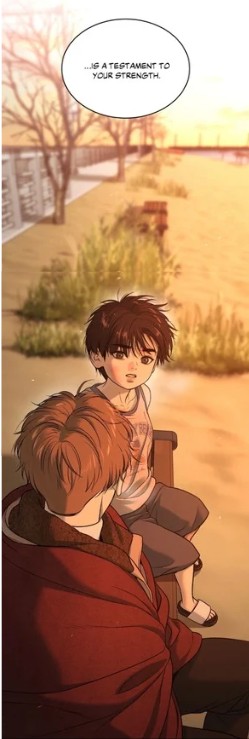 (chapter 94) He represents something else: a path. Not upward, like the sun. But outward. Toward a world that was always there— but never truly lived.
The Piercing Amber Gaze
And this is precisely where Kim Dan’s role becomes decisive. When he says, (chapter 94) something subtle, but profound, happens. He is no longer addressing the champion, the figure admired by others for his strength and victories. He is speaking to the child. Not the one who succeeded, but the one who endured. That’s why later the author turned the adult Joo Jaekyung into a “child” (chapter 94) In that moment, admiration shifts into recognition. What is acknowledged is not performance, but survival.
This is where the symbolism of amber becomes essential. Amber is not merely a color. It is fossilized tree resin—something that once flowed from a living organism, exposed to light, warmth, and time. Over time, this fluid substance solidifies, preserving within it traces of what once existed: fragments of life, suspended and protected. For this reason, amber has long been associated with the preservation of time, with memory made tangible, with something that endures beyond its original state. But this preservation is not neutral. What amber holds within it are not only traces of life, but also moments of rupture —organisms (insects, pollen) that were caught, immobilized, unable to escape. In this sense, amber is inseparable from loss. It preserves not only what once lived, but also what was interrupted, what was wounded, what could not continue. It is memory—but memory marked by pain.
But amber carries another layer of meaning. Often described as “sunlight in solidified form,” it is linked to warmth, vitality, and life energy. At the same time, across many cultures, it has been used as a protective talisman—worn to ward off harm, to bring balance, to protect the vulnerable. It is both a carrier of memory and a source of protection. Something that does not erase what has been, but transforms it into something that can be held, endured, and even passed on.

This dual nature is crucial. Because Kim Dan embodies precisely this transformation.
Like amber, he originates from something living—from the “tree,”  (chapter 41) from a place of growth, exposure, and vulnerability. This interpretation gets once again validated on the beach. (chapter 94) A tree is placed right behind the main lead. Doc Dan has experienced loss, abandonment, and instability. And yet, unlike Joo Jaekyung, he has not responded by distancing himself or hardening into detachment. He has not rejected what he felt. Instead, he has absorbed it.
What he carries is not untouched innocence, but something altered through time—something that has endured. His capacity to care, to attach, to return to others despite the risk of loss is not naïve. It is the result of transformation.
This is what defines his gaze. 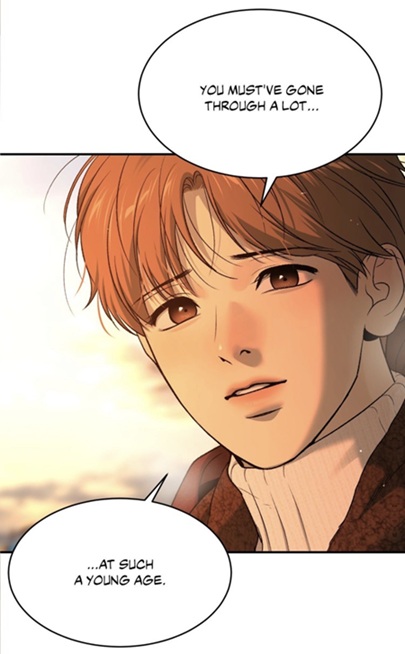 (chapter 94) When Kim Dan looks at Joo Jaekyung, he does not stop at the surface—the fame, the strength, the constructed identity. He perceives what lies beneath it, but he does not expose it in order to dismantle it. He preserves it differently. (chapter 94) And this is where the nature of his admiration becomes clear. Kim Dan does admire strength, but not the kind that needs to be constantly proven or displayed. (chapter 94) He recognizes something prior to all of that: endurance, resistance, the ability to survive without support, without childhood, without refuge.
When he says that enduring such hardship is a testament to Joo Jaekyung’s strength, he does not diminish that strength—he relocates it. (chapter 94) He shows him that it was never dependent on winning, never tied to performance or recognition. It existed long before the fights (chapter 94), long before the titles, long before anyone acknowledged it. And this changes everything. Because if strength has already been proven, then it no longer needs to be demonstrated again and again. It no longer needs to be defended, tested, or confirmed through every challenge.
This is why the moment is both destabilizing and liberating. It destabilizes Joo Jaekyung because it undermines the foundation of his entire system (chapter 94), which was built on proving himself through action and endurance. But at the same time, it frees him from that necessity. For the first time, strength is no longer something he has to chase: it is something he already possesses.
And this shift has a deeper implication, because it directly contradicts the words that had defined him for so long. The father’s voice that told him: 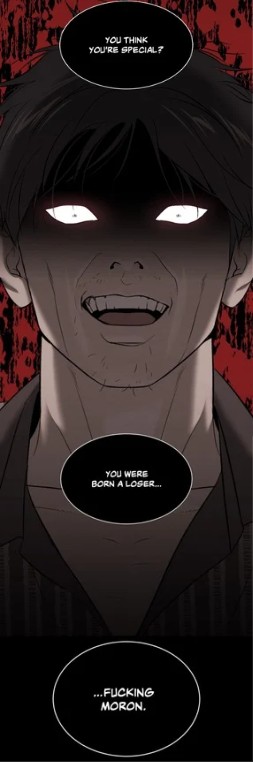 (chapter 73) A statement that reduced his existence to failure from the very beginning, leaving him with only one option—to prove, endlessly, that this judgment was wrong.
Up until now, everything in his life can be understood as a response to that accusation. Every fight, every victory, every act of endurance functioned as a counterargument. Strength was not something he had—it was something he had to demonstrate, again and again, in order to negate that original condemnation. But Kim Dan’s words on the beach break that logic. (chapter 94) He even wishes, he had known him before so that he could express his admiration much sooner. That’s how the jinx gets removed.
By recognizing his endurance as strength, he removes the need for proof. He does not argue against the past. He does not deny what happened. Instead, he reframes it. What was once the basis for humiliation becomes the evidence of resilience. What was meant to define him as a “loser” is revealed as the very condition that required strength to survive.
In that sense, Kim Dan is not simply comforting him. He is undoing the structure of that internal voice. Because if Joo Jaekyung’s strength is already real—already proven through what he endured—then the accusation loses its power. It no longer requires an answer. It no longer demands a reaction. This is precisely why his response is not verbal, but visual. (chapter 94) He keeps looking at Kim Dan, unable to look away, as if held in place by something he cannot yet fully process. It is not fascination in the superficial sense, but recognition. The words reach a part of him that had remained unaddressed for years. 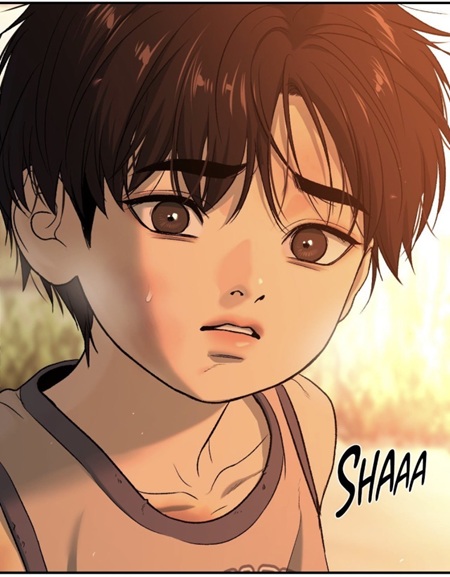 (chapter 94) The child, who had long been denied acknowledgment, is finally being seen—and more importantly, affirmed.
If he no longer needs to disprove that he is “nothing,” then he is no longer bound to constant confrontation. He no longer needs to accept every challenge, no longer needs to measure himself through endless trials. For the first time, he can step out of that cycle. He can choose. He can decide what is worth engaging with—and what is not.
In other words, Kim Dan’s recognition does not simply validate him. It releases him. What he is responding to is not only kindness, but accuracy. For the first time, someone names his past without reducing it, without turning it into weakness or failure. (chapter 94) And this is what makes Kim Dan’s words so powerful: they do not impose meaning—they reveal it.
Because in that moment, the structure through which Joo Jaekyung had perceived both himself and others begins to shift. Kim Dan is no longer reduced to a role, no longer confined to the position of a physical therapist or a tool meant to counter his “jinx.” He becomes something else entirely.
A presence. Someone who sees him. Someone who understands him. Someone who reaches him. In other words, for the first time, Joo Jaekyung is able to recognize him not through function, but through relation. Not as a means—but as a person. And this is precisely what opens the possibility of something he has never truly experienced before:
friendship.
This is exactly what amber does. It does not erase the past, nor does it glorify it. It preserves it, but transforms its meaning. What was once a source of isolation becomes something that can be acknowledged. What was once hidden becomes something that can be seen without shame. This is why Kim Dan’s gaze is piercing—not because it is aggressive, but because it reaches what had been sealed away and makes it visible without destroying it.
And this transformation has consequences. Because if his past is no longer a source of shame, but of strength, then it no longer renders him silent. What he had once accepted—criticism, blame, humiliation—because he believed it reflected who he was, begins to lose its legitimacy. The internalized voice that reduced him to nothing is no longer left unanswered. And in doing so, it offers something new. Not judgment.  (chapter 57)
 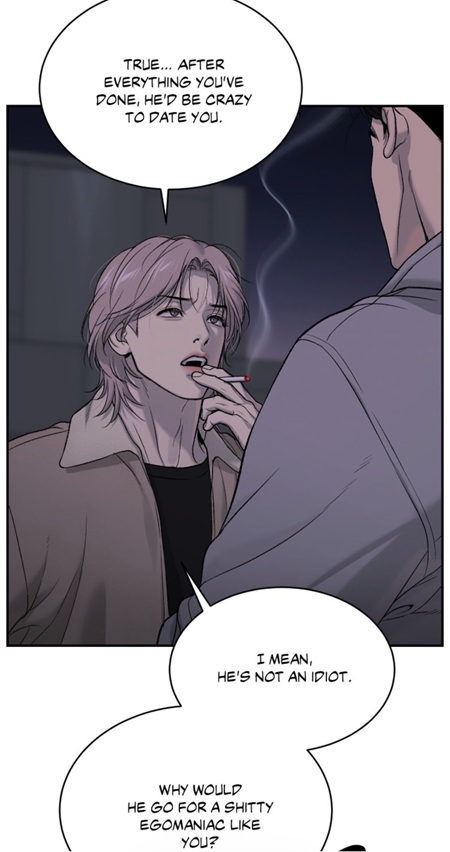 (chapter 89) Not expectation.
 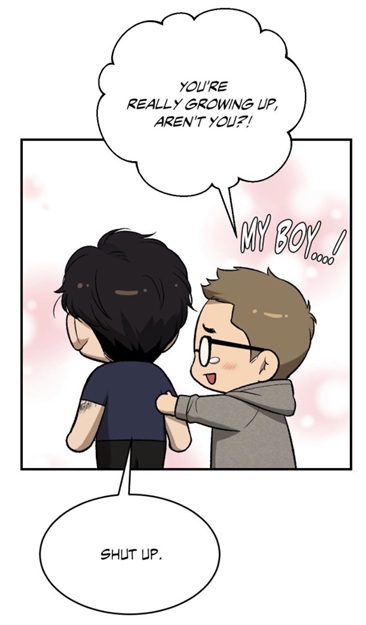 (chapter 88) But a form of recognition that restores his position in relation to others. For the first time, he is no longer defined by what was done to him. He is no longer confined to enduring in silence. Instead, he gains something he had been denied: the ability to respond.
To speak back. To defend himself. To demand respect—not as a performance, but as a condition of his existence.
Seeing Each Other
This is why the final image of the scene carries so much weight. (chapter 94)
They sit on the same bench. They face the same horizon. There is no confrontation. That’s why they are no longer facing each other like rivals or challengers.  (chapter 9) The tension that once structured their encounters has disappeared.No imbalance of power. No role to perform. For the first time, their positions align. (chapter 94)
Earlier, the movement seemed to come from Joo Jaekyung. (chapter 94) Like the pier, he extended something of himself outward—hesitant, indirect, not fully conscious—yet reaching toward the other. His words, even in their abstraction, had begun to bridge a distance. Now, something shifts. It is as if the lighthouse responds. (chapter 94) That’s why doc Dan is wearing the color than the lighthouse. Not by moving—but by illuminating.
By revealing how far that movement has already gone. (chapter 94) By casting light on a path that was not recognized as such. What Joo Jaekyung could not see—what he could not yet name—is made visible through Kim Dan’s recognition. The distance he believed to be absolute is shown to be already crossed, at least in part.
And this changes the meaning of the moment. Because for the first time, they are not approaching each other from opposite sides. (chapter 94) They are already there. Together. And this is why for the first time, they see each other.
Not as:
- champion and employee
- strength and dependence
- giver and receiver
But as two individuals shaped by their past. Two people who have endured. Two people standing—at different points—on the same threshold between what was and what might still become. They are finally friends.
The Direction of The Gaze
So if we return, one last time, to the images that quietly accompanied them—the paintings—we might begin to see it differently. At first, it seemed to reflect distance. (chapter 18) A frozen landscape, divided, silent. Then, later, it changed: the trees regained life, a mountain appeared, water began to reflect the light. The scene softened, but it never became whole. (chapter 93) The fragmentation remained.
And perhaps this is precisely the point. Because what the painting was showing was not only a change in atmosphere—but a direction.
A destination. The forest. The mountain. The water.
Places that exist beyond the walls, beyond the roles they had learned to inhabit. And perhaps the scene in episode 93 makes this even clearer. (chapter 93)
This time, Kim Dan is the one facing the painting. He looks toward the landscape—the trees, the mountain, the water—while Joo Jaekyung sits beside it, almost turned away. The image is closer to him, placed on his side, and yet he does not truly see it. The distance between them has narrowed—but their orientations are not yet the same.
Kim Dan is already aligned with what the painting suggests. Joo Jaekyung is not. The destination is near him—but not yet accessible to him. And this is where their roles begin to shift. The painting is already announcing that doc Dan is taking the lead. Thus Joo Jaekyung followed him to the beach. 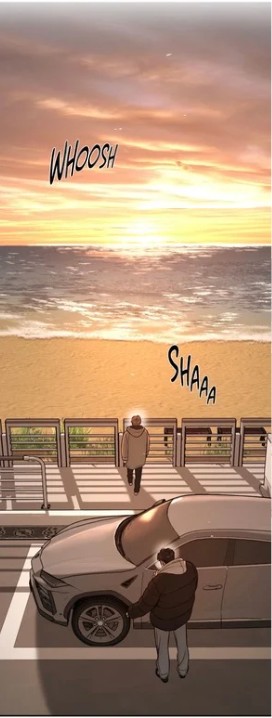 (chapter 94)
Because if the painting indicates a direction—toward the woods, the mountain, a space beyond the structures that confined them—then it is Kim Dan who is able to recognize it. Not because he is stronger. But because he has already learned to move through loss without closing himself off. Hence he could confess in his drunken state and later recognize his feelings pretty quickly. 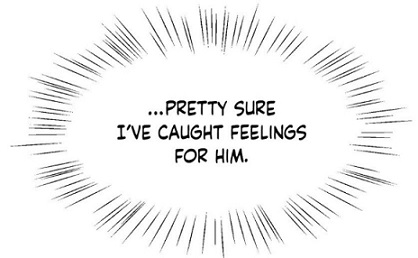 (chapter 41)
And this is where the story quietly folds back onto itself. The puppy and the dog we are invited to remember… are no longer there. (chapter 94) They vanished from Doc Dan’s life, exactly like the puppy who is now buried near those same hills and trees. 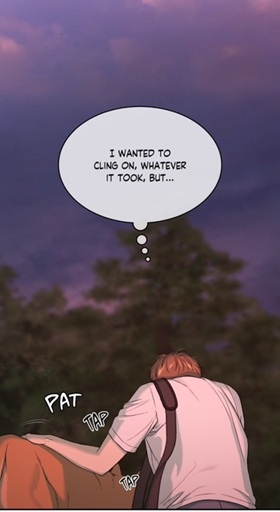 (chapter 59) The image of warmth we associate with it is, in reality, the trace of a loss. So he did not just lose his parents, but also pets.
Just like the painting. Just like the beach. What appears as beauty is never separate from what has been lost.
And yet—this is where Kim Dan becomes truly significant. Because despite that loss, he did not turn away.
He did not close himself off 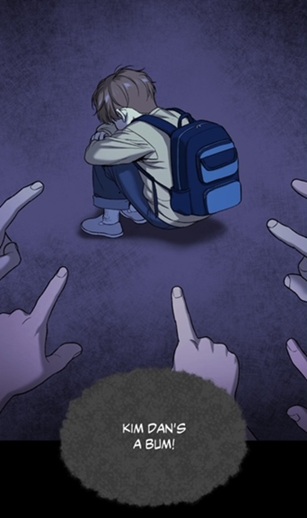 (chapter 57), nor reduce others to something distant or manageable. Instead, he remained capable of attachment. Of care.
  (chapter 7) Of returning, again and again, to places that carried pain—because they also carried meaning.
In this sense, the painting was never just a background. (chapter 93)
It was a quiet anticipation. Not only of the beach, or the conversation, or the emerging honesty—but of something more fundamental: a way of being. Not whole. Not free from fragmentation. But no longer frozen.
And perhaps this is why the image never becomes fully bright. Because what we are witnessing is not a completed transformation—but a movement. From silence to speech. From distance to presence. From loss… to the possibility of loving again.
And perhaps this is where the meaning of that moment on the beach becomes clearest. Because this is also where Joo Jaekyung begins to find an answer to a question he could not yet articulate: 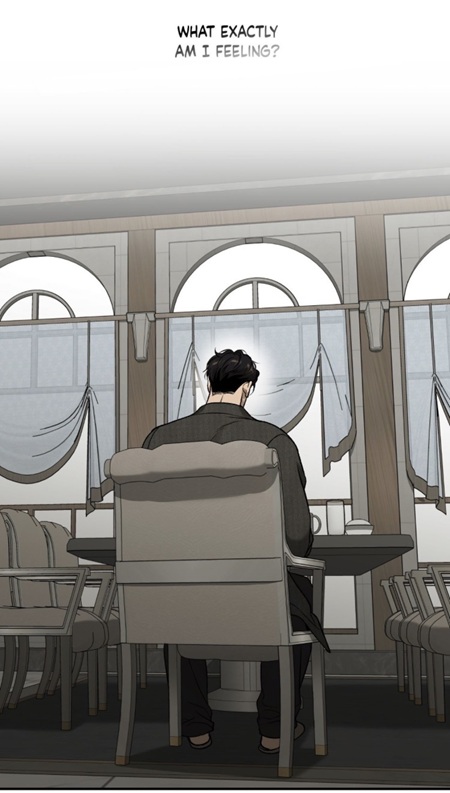 (chapter 93) “ The answer is not given to him directly. It appears in front of him on the beach. (chapter 94)
In the way Kim Dan looks at him—without distance, without calculation, without turning away. There is no performance in that gaze, no role to maintain. Only a quiet, unguarded presence. And in that moment, something shifts.
The one who had learned to distance himself, to objectify, to control… is now confronted with something he cannot reduce. Not strength. Not obligation. But something else. Something he does not yet fully understand — but can no longer ignore. Love. And perhaps this is why the image lingers. Because while the champion is still searching for words, the “child” has already sensed it.
Feel free to comment. If you have any suggestion for topics or Manhwa, feel free to ask. If you enjoyed reading it, retweet it or push the button like. My Reddit-Instagram-Twitter-Tumblr account is: @bebebisous33. Thanks for reading and for the support, particularly, I would like to thank all the new followers and people recommending my blog.


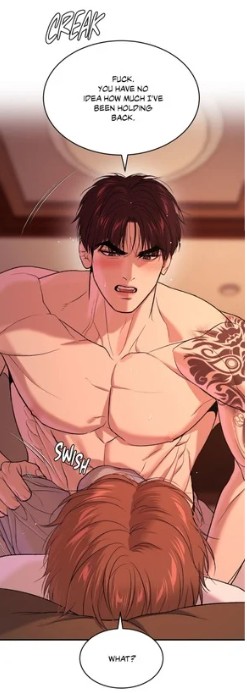 (chapter 85) represents the positive reflection of this night
  (chapter 58)
  (chapter 58)
  (chapter 58), when the physical therapist chose to give up on the athlete and stop listening to his heart. Here, I am not only referring to the numerical symmetry but also to the doctor’s shifting vision of Joo Jaekyung.
 (chapter 85), Jaekyung appears with a towel around his neck. This simple object evokes water and sweat, but in Jinx, these elements are never neutral. They are tied to one of the champion’s earliest traumas: the humiliation of being called “dirty”
  (chapter 75) and “smelly” as a child. This is why Jaekyung learned to perfuse his body with cologne after every shower
 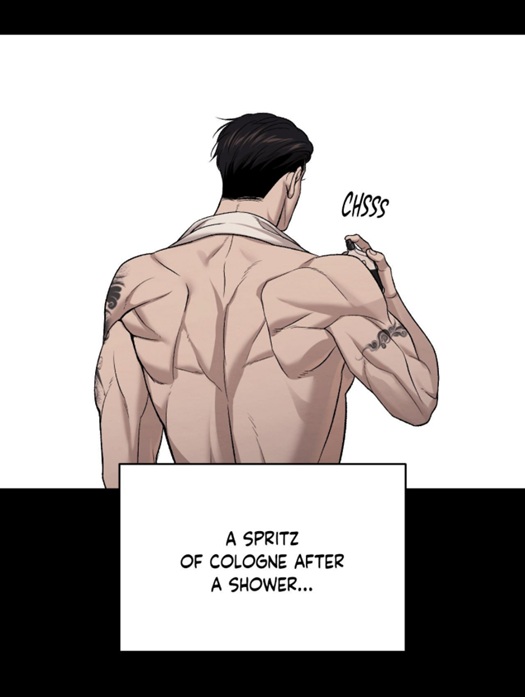 (chapter 75) and why physical proximity has always carried the risk of shame. Hence he kept people at arms length. In chapter 40, when he rescued Kim Dan from the security guards, he kept his distance
 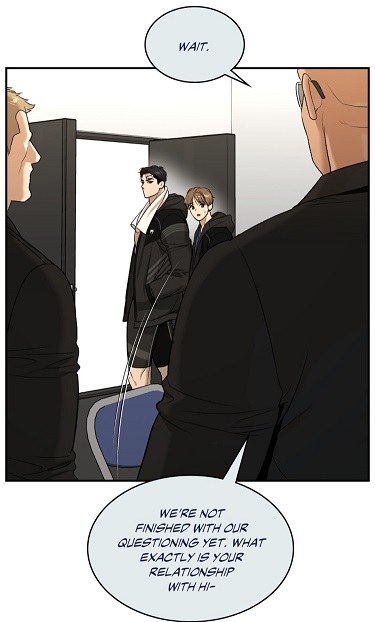 (chapter 40) — he had not yet showered, for the towel on his shoulders was stained with blood. Mingwa was indirectly referring to the champion’s psychological wounds.
  (chapter 40) It was, as if the fear of smelling “wrong,” of being perceived as contaminated, was still dictating his movements. Hence he could only claim doc Dan as one of his own, but not as his “physical therapist” or even “family”. And interesting is that doc Dan copied his attitude. In the hallway, he maintained a certain distance from the athlete.
  (chapter 40)
 (chapter 40) the moment he dried off
  (chapter 85) His hair is unstyled, his scent unmasked — and yet he approaches Dan without hesitation. He even kisses him. The item that once symbolized rejection now signifies trust: without fragrance, he is certain that doc Dan will not call him “dirty,” will not recoil, will not shame him. What once provoked distance becomes an unexpected bridge, revealing that Jaekyung is finally letting someone remain close, when he feels most vulnerable. The night in Paris does not simply suggest a return of desire; it announces the return of hope
 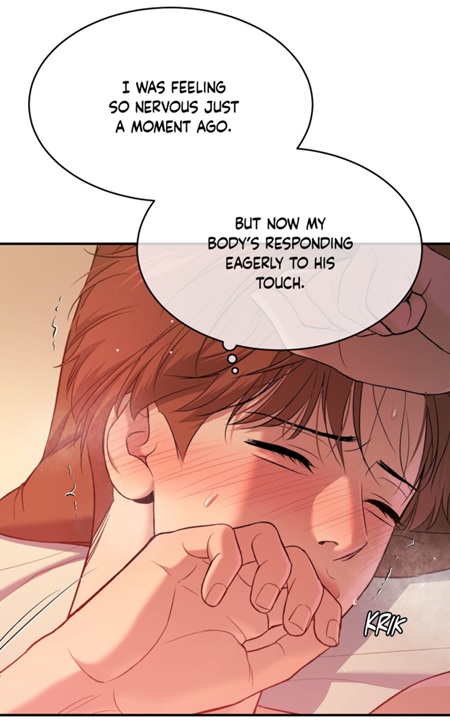 (chapter 85) and trust — and perhaps even the moment when Dan chooses, for the first time, to be honest with his own body and heart.
  (chapter 85)
  (chapter 85) — fulfilling, without knowing it, a secret wish the physical therapist has harbored since childhood
  (chapter 61) [I will elaborate it further later]. And perhaps this is why the moment feels so disarming: because the downfall is not tragic but tender, not humiliating but intimate. Sweet, even.
 (chapter 85), when a single careless comment shattered the champion’s composure and revealed just how fragile his newfound hope really was.
 (chapter 85) In contrast, both Park Namwook and coach Jeong Yosep wear generic MFC T-shirts.
  (chapter 85) Dan is lost in his thoughts — anticipating the night ahead with the champion — and has barely touched his food. Park Namwook notices this. One might think, such a remark displays the manager’s concern for the main lead’s well-being. However, the manager adds that the other members of the team are all almost finished. With such a remark, it becomes clear that the manager is urging the protagonist to finish his plate. Although Park Namwook addresses Dan as if showing concern, the content of his remark betrays his true priority: not Dan’s well-being, but the team’s schedule. By pointing out that ‘the rest of us are almost finished,’ he urges Dan to keep pace, treating him as staff who had to follow the group rather than someone with personal needs. As you can sense, schedule is essential for the manager. However, because doc Dan couldn’t reveal the true reason behind his behavior, he gives an excuse for his lack of appetite.
  (chapter 53) The manager’s words bring Joo Jaekyung back to reality and its uncomfortable truth that Dan’s presence now is still bound to a contract — temporary, contingent, never fully his. In other words, with his remarks, Park Namwook is reopening old wounds which shows his total blindness and lack of finesse and of empathy. He treats the last match, as if nothing bad had happened. The incident with the switched spray is simply erased.
 (chapter 53) leaving without thinking; now, after Dan vanished from his life entirely, that earlier departure feels like a sign he failed to read. Park’s question brushes against this bruise, and Jaekyung’s lips reflect the discomfort.
 (chapter 85) The younger fighter suddenly bursts into panic, declaring how nervous he would be in Jaekyung’s place, how his heart would be pounding out of his chest. His outburst is sincere, naïve, and completely focused on the champion — he never once considers Dan’s feelings. Yet these words strike deeper than he intends. At the mention of a pounding heart, Jaekyung’s eyes lift upward in a brief, involuntary movement. It is the smallest gesture, but it exposes everything he wishes to hide. Because his heart is pounding — but not for the match. It is because of doc Dan!
  (chapter 85) “Come to my room at 11.”
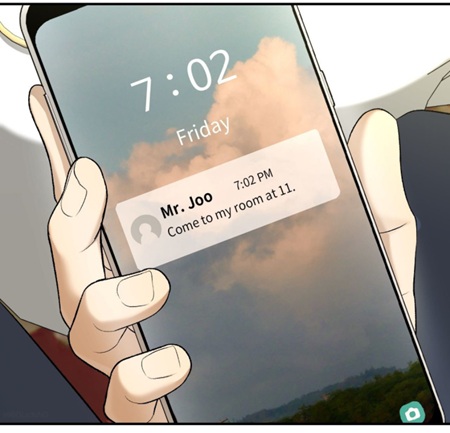 (chapter 85) the need for reassurance, the wish to rewrite the pattern of the past, the quiet hope that Dan will not leave him again — not tonight and not afterwards.
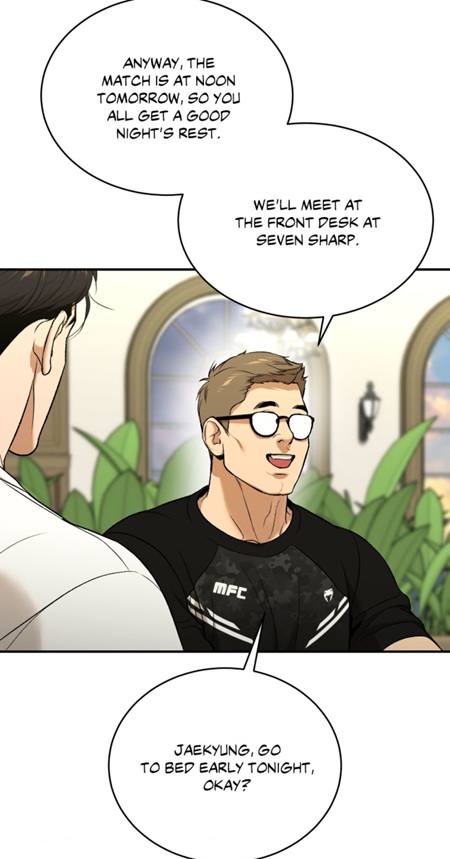 (chapter 85) Schedules are his armor, punctuality his hiding place. Whenever something threatens to slip beyond control, he retreats behind procedure.
  (chapter 85), as soon as the athlete stands up right after his recommendation and announces he is now returning to his room.
  (chapter 54)
  (chapter 85) In theory, this is the perfect window to do what he used to do in the States
 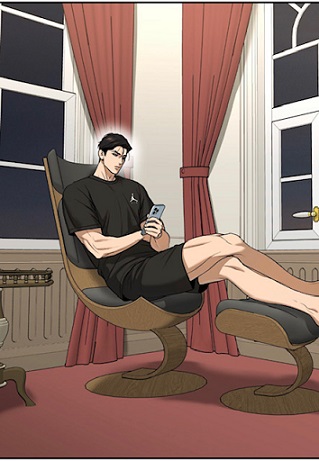 (chapter 38) and Korea
  (chapter 48) before a big fight: watch his opponent’s videos, study their habits, rehearse counters. If we only looked at the clock, we might assume he spent the evening thinking about Arnaud Gabriel.
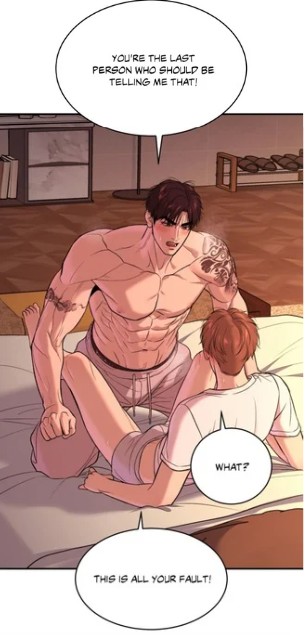 (chapter 85) From 7:02 onward, the question is no longer “How do I beat Gabriel?” but “How do I win doc Dan’s heart?” The clock from 7:02 to 11:00 p.m. stops being a “training window” and becomes an emotional countdown. He is no longer the champion preparing for an opponent—he is the man hoping not to be abandoned again. This is why the later scene at the door feels so contradictory: when Dan finally arrives, Jaekyung behaves like someone who couldn’t wait.
  (chapter 85) He opens the door and immediately grabs him inside
 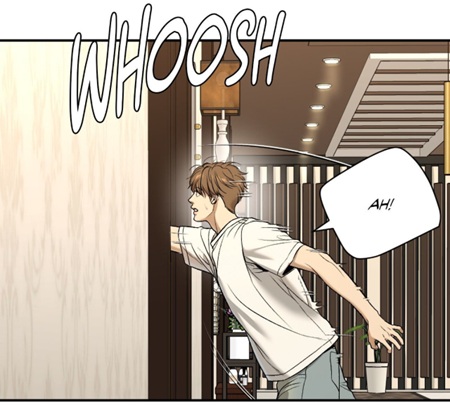 (chapter 85), cutting off any possibility of hesitation. The way he drags him over the threshold, presses him against the wall
  (chapter 85) This is not the controlled, casual emperor of old; it is someone who has been holding back for hours and refuses to risk even a second in which Dan might change his mind.
  (chapter 65) and the comment of the champion in front of this movie:
 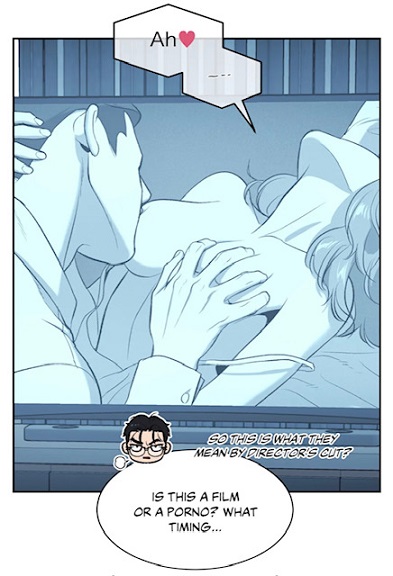 (chapter 29) Moreover, I consider this scene
 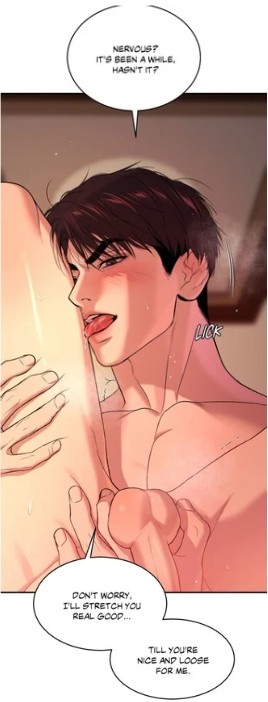 (chapter 85) as a new version of Choi Heesung’s advice: Doc Dan just needs to sit back and enjoy!!
 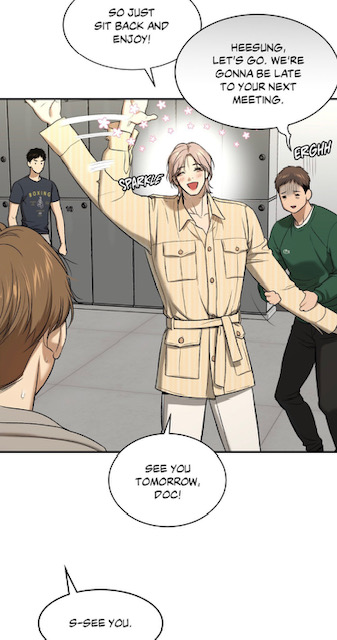 (chapter 31) Joo Jaekyung is now doing everything, as deep down he wants to become the perfect lover! And how had I described the night in the States?
  Back then, the hamster Dan had become the champion’s perfect lover, especially because he had kissed his face, hugged him and confessed to him.
 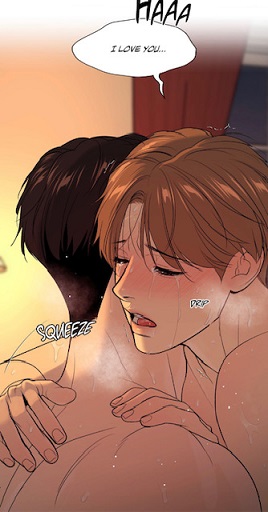 (chapter 39) But if his fear to lose doc Dan was so huge, why did he ask him to come so late then?
  (chapter 38) One might reply that the athlete desired to maintain appearances and as such to hide his suffering and anxiety. In other words, he was hiding his emotions behind routine, Jinx-sex would always start at 11 pm. However, this idea is not entirely satisfying because once doc Dan was in his room, the fighter was no longer hiding his emotions and desires.
  (chapter 72), when the latter would return late from his “work” and the death of his father
 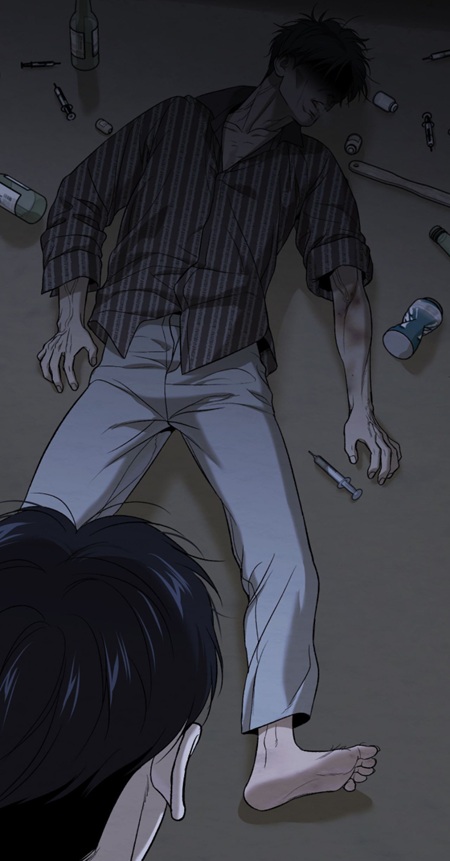 (chapter 73).
  (chapter 85) Because doc Dan could have refused. He could have used his queasiness as an excuse, could have stayed in his room, could have claimed exhaustion. Instead, he obeyed the request — a request sent by someone who had hurt him deeply in the past. Doc Dan’s arrival is proof that he is not rejecting him. Proof that the night is real. Proof that the attempt to do better might actually matter. At the same time, doc Dan couldn’t miss the true meaning behind this text sent in front of others: the athlete’s anxiety and suffering.
  (chapter 85) This explains why his worried gaze followed his fated partner.
  (chapter 85) In other words, the text had a different meaning. It was not an order, but rather a wish…and it had nothing to do with his match against Arnaud Gabriel. During that night, Joo Jaekyung is not seeing a surrogate fighter in front of him or a sex toy, but his real partner, his future boyfriend. This means, this night stands in opposition to the one in the penthouse:
  (chapter 85) This is why he touches Dan’s face instead of flipping him over.
 (chapter 85) — something he has never done before. This does not come from instinct. It comes from intention. It comes from effort. It comes from learning. He is indeed showering doc Dan with love and tenderness, therefore it is not surprising that the “hamster” is moved sensually and emotionally. Exactly like during the Summer Night’s Dream, he is reaching nirvana, hence Jinx-philes are constantly seeing stars,.
 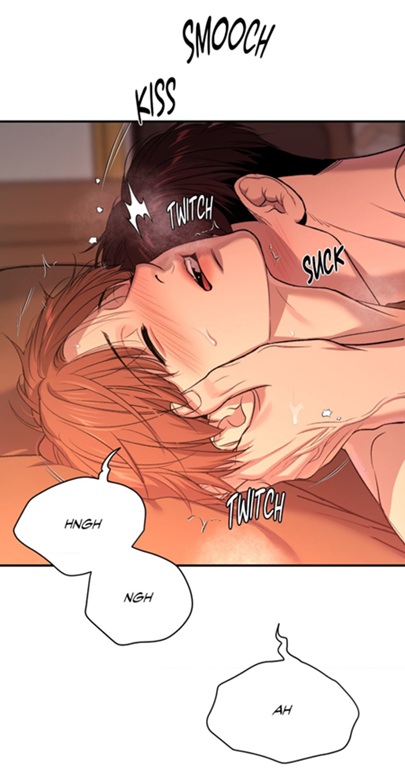 (chapter 85)
  (chapter 85) — or the emotional slip that comes with resurfacing feelings: the therapist losing distance, falling back into intimacy. All of these readings sound plausible at first glance.
  (chapter 85) Styled up, hardened with gel
 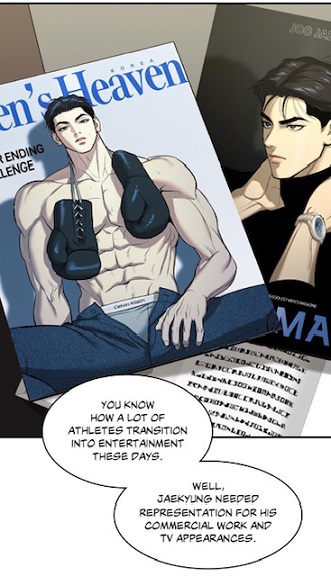 (chapter 30) , perfectly arranged — it is the crown of the Emperor, the symbol of his control, his discipline, and the myth that MFC sells:
 (chapter 82) When the hair stands, the image stands.
 (chapter 85) — but not the way adults or professionals usually do.
 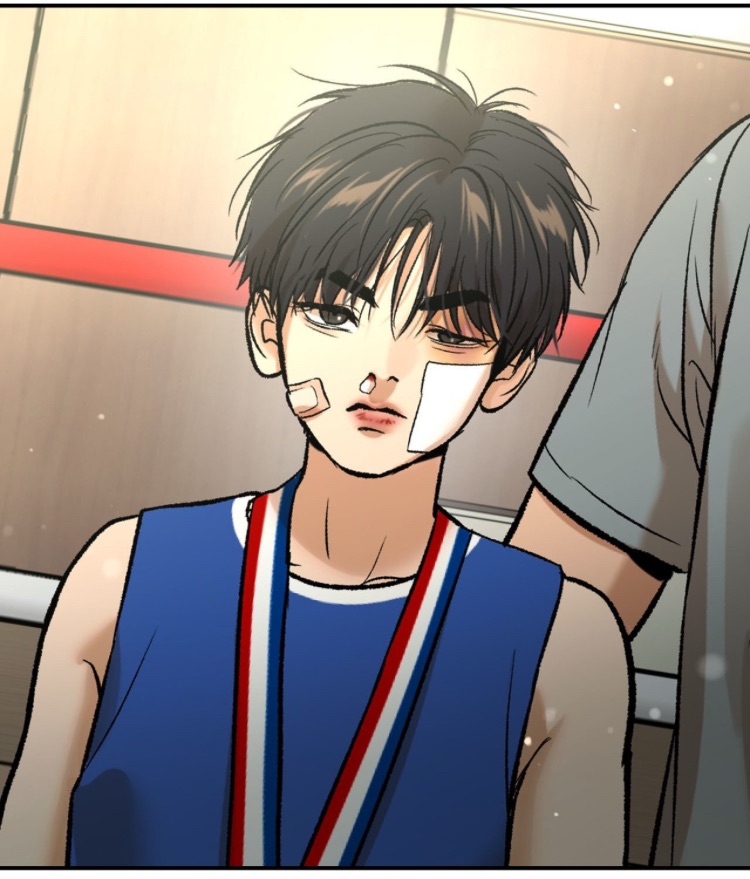 (chapter 71) So doc Dan could recognize the little boy in the athlete, the more he sees the protagonist with his hair down. Furthermore, I noticed that contrary to season 1, Doc Dan has now more memories of the “wolf” facing him.
  (chapter 85) In the past, he would more look at him from behind:
  (chapter 35)
  (chapter 35) Seeing his face reflects not only the increasing care for each other, but also the improving communication between them.
  (chapter 85) more mature, more “masculine” in the traditional sense. This explicates why the stylists had to dress him up.
  (chapter 82) Yet such an intervention did more than prepare him for the cameras — it tightened the restrictions around his own image, reducing the fighter’s rights over how he appears to the world. With the suit, he appeared older and more powerful. The French fighter leans into age, while the Korean champion leans into youth — a symbolic inversion that reinforces the central tension in the Paris arc: Gabriel performs adulthood; Jaekyung rediscovers the adolescence he never lived.
  (chapter 85) But just as Jaekyung begins to slip into these youthful, softer identities, MFC reasserts control.
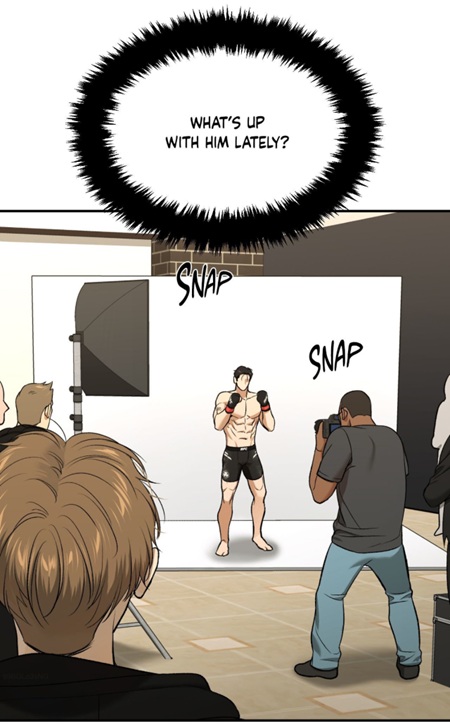 (chapter 85) hair up, face polished, a look engineered for posters and rankings. He becomes once again the Emperor — the man who must appear older, sharper, more intimidating, more manufactured.
 (chapter 79) This is the boy from the childhood photograph.
 In the rain, with his hair heavy and unstyled, his gaze dark and sensual, Jaekyung appears nothing like the commanding emperor. He looks free — freed by weather, freed by desire, freed from roles. It was foreshadowing, not just fanservice. It announces the end of the « jinx » in reality.
  (chapter 85) He is describing himself. His sweetness is the taste of freedom — freedom from performance, freedom from control, freedom from MFC, freedom from fear. He is enjoying this moment. Dan tastes sweet because Jaekyung is finally tasting the life he never allowed himself to want.
 (chapter 21) The image of winged rescue and divine protection hangs over the very piece of furniture that, throughout the series, has functioned as Dan’s private sanctuary. This is not incidental. In Jinx, the couch is tied to his deepest memories of care and abandonment, and Mingwa activates this symbolism each time Dan gravitates to it.
 (chapter 21) Why does he consistently feel safer on the couch than in a bed?
 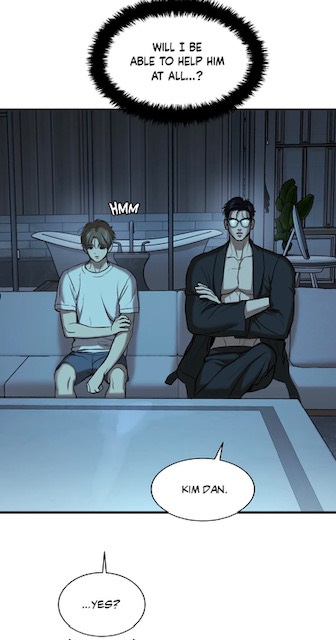 (chapter 29) Why, after the second swimming lesson, did he refuse to return to the bed
 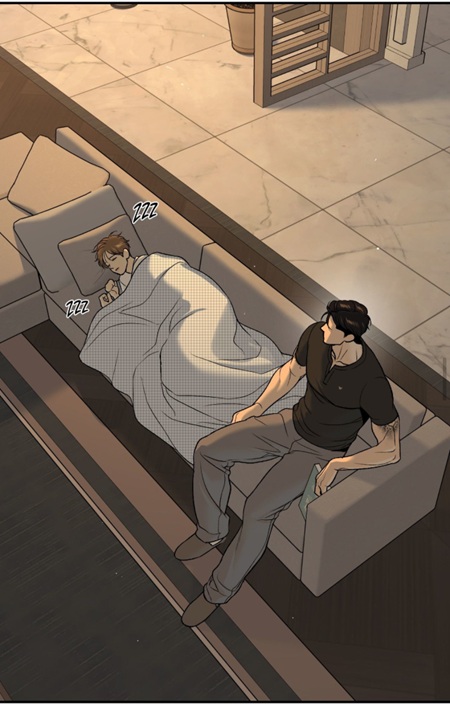 (chapter 81), even though he was exhausted? Why does he place the teddy bear
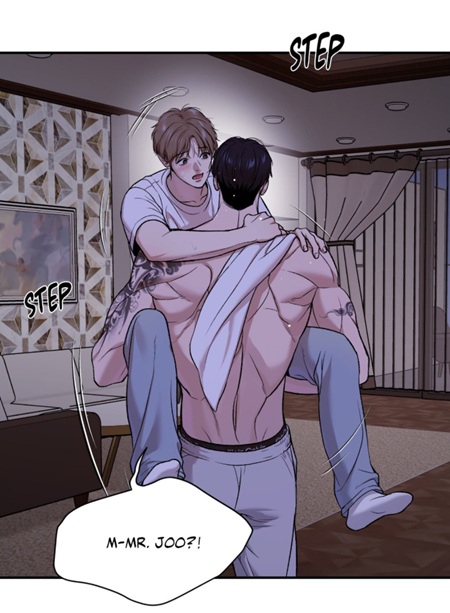
  (chapter 84) —his last substitute for lost parental affection—on the couch and not on the bed? And finally, why has he always harbored the secret wish to be carried to bed, as confessed through his memory in chapter 61?
  (chapter 10) Secondly, at no moment, we ever witness the grandmother carrying the little boy to bed. Either she is rocking him to sleep outside the house
  (chapter 47) or he is already in the bed. We never see her bringing him to bed.
  (chapter 44),
  (chapter 44) traces from parents. And now, you comprehend why the hamster could never truly rest in the bed. The couch is therefore not an adult preference; it is a trauma imprint. Resting there feels safe because beds—large, empty, abandoned spaces—became reminders of whoever no longer carried him. Hence it is no longer surprising that he woke up, when he sensed the vanishing of warmth.
 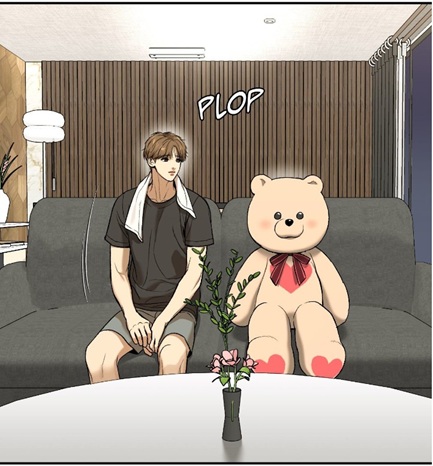 (chapter 84): the bear stands in for a lost comforting presence. It also represents the main lead, Joo Jaekyung. The latter is gradually reentering in the physical therapist’s heart and life. Therefore it is not surprising that there, he squeezes the hand of the toy. It is also why Doc Dan curls around it like a child who deep down hopes to be chosen, lifted, and held. And it is why, even as an adult, his body still whispers the same yearning: someone, please carry me to bed again.
 chapter 40, chapter 65, chapter 68, chapter 79)
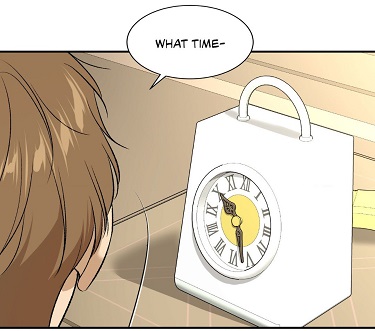 (chapter 85) and he was still able to arrive on time in the arena.
 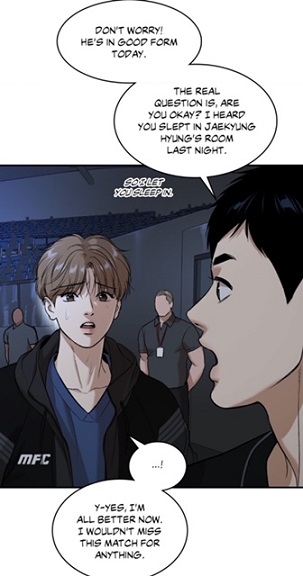 (chapter 40) For me, it is a clue that the manager would always request to meet around 7.00 am, when the match was at noon. But what should do the athlete do during all this time? He can only get nervous and feel pressured.
 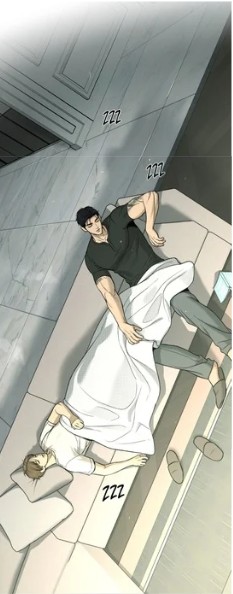 (chapter 81) I noticed that in different scenes from season 2, the athlete started waking up later and even after doc Dan.
  (chapter 66) But the manager’s rigid schedule threatens even that. An early morning summons drains the fighter’s cortisol reserves before the match has even begun, creating a long, empty corridor of waiting — a period where tension, anxiety, fatigue, and irritation ferment in the body. Instead of resting, centering, and preparing, the champion would spend hours fighting against the clock imposed on him.
 (chapter 54) , he might even jump to the wrong conclusion: that Jaekyung drank again — this time behind his back.
  (chapter 82) The irony is striking. Two days before the match, it was Park Namwook who overindulged with the others, yet he may now project that same carelessness onto the athlete. In his mind, the DND sign does not simply mean “rest”; it becomes a warning signal, a possible confirmation of the irresponsibility he fears but has never actually witnessed. Thus I can already imagine him panicking.
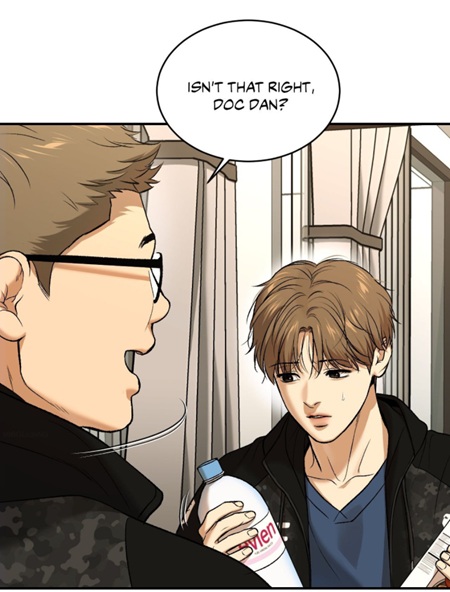 (chapter 82), his look
 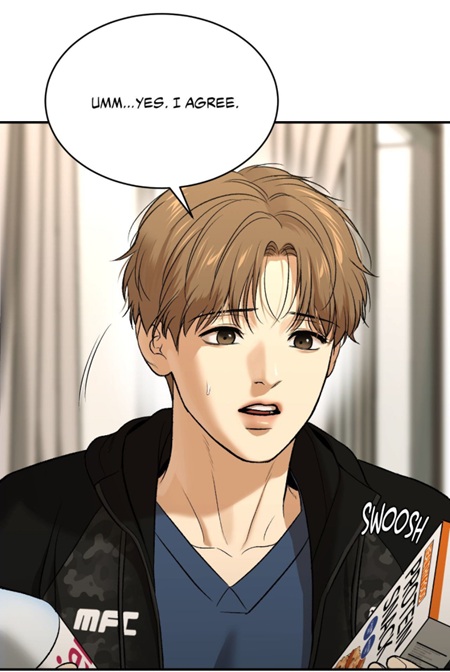 (chapter 82), his free time and took care of the champion’s emotional needs. In Paris, the « hamster » became the champion’s manager de facto, the unofficial right-hand. That’s why if they are late and they need a scapegoat, the manager can blame the physical therapist for the « delay », he would always come late to appointments (chapter 17: meeting the doctor) and to the fights (Busan, in the States).
 Bebebisous33s' analyses in K-Dramaland and Manhwas