Protected: Jinx: Unseen 👀 Savior🦸🏼♂️ : The Birth of Jaegeng

Bebebisous33s' analyses in K-Dramaland and Manhwas
Analyses of K-dramas and Manhwas (for the most part Yaoi)




Please support the authors by reading Manhwas on the official websites. This is where you can read the Manhwa: Jinx But be aware that the Manhwa is a mature Yaoi, which means, it is about homosexuality with explicit scenes. Here is the link of the table of contents about Jinx. Here is the link where you can find the table of contents of analyzed Manhwas. Here are the links, if you are interested in the first work from Mingwa, BJ Alex, and the 2 previous essays about Jinx Perfect👼🏼 Defect and The Secret Doctor’s Jinx
It would be great if you could make some donations/sponsoring: Ko-fi.com/bebebisous33 That way, you can support me with “coffee” so that I have the energy to keep examining Manhwas. Besides, I need to cover up the expenses for this blog.

The Hippocratic Oath, one of the oldest binding documents in history, originates from Ancient Greece and has long been regarded as the ethical foundation of Western medicine. Traditionally attributed to Hippocrates, often called the ‘Father of Medicine’, the oath originally included commitments to treat the sick to the best of one’s ability, to preserve patient confidentiality, and to pass on medical knowledge without demanding payment.
The text of the Hippocratic Oath (c. 400 bc) provided below is a translation from Greek by Francis Adams (1849).
I swear by Apollo the physician, and Aesculapius, and Health, and All-heal, and all the gods and goddesses, that, according to my ability and judgment, I will keep this Oath and this stipulation—to reckon him who taught me this Art equally dear to me as my parents, to share my substance with him, and relieve his necessities if required; to look upon his offspring in the same footing as my own brothers, and to teach them this Art, if they shall wish to learn it, without fee or stipulation; and that by precept, lecture, and every other mode of instruction, I will impart a knowledge of the Art to my own sons, and those of my teachers, and to disciples bound by a stipulation and oath according to the law of medicine, but to none others. I will follow that system of regimen which, according to my ability and judgment, I consider for the benefit of my patients, and abstain from whatever is deleterious and mischievous. I will give no deadly medicine to any one if asked, nor suggest any such counsel; and in like manner I will not give to a woman a pessary to produce abortion. With purity and with holiness I will pass my life and practice my Art. I will not cut persons laboring under the stone, but will leave this to be done by men who are practitioners of this work. Into whatever houses I enter, I will go into them for the benefit of the sick, and will abstain from every voluntary act of mischief and corruption; and, further from the seduction of females or males, of freemen and slaves. Whatever, in connection with my professional practice or not, in connection with it, I see or hear, in the life of men, which ought not to be spoken of abroad, I will not divulge, as reckoning that all such should be kept secret. While I continue to keep this Oath unviolated, may it be granted to me to enjoy life and the practice of the art, respected by all men, in all times! But should I trespass and violate this Oath, may the reverse be my lot! Quoted from https://www.britannica.com/topic/Hippocratic-oath
Over centuries, this oath has undergone numerous revisions to reflect the changing nature of medicine and ethics in society. While its core values—non-maleficence, beneficence, and fidelity—remain intact, modern versions are more secular and inclusive, often omitting archaic references to gods or master-apprentice hierarchies. The intention behind the oath has always been clear: to put the well-being of the patient first and to uphold the dignity and responsibility of the medical profession. These noble intentions raise important questions in today’s context. To what extent are they still fulfilled? Do contemporary medical professionals act in the spirit of this oath? And can structural realities—limited time, profit-driven care, burnout—undermine a physician’s ability to live up to its promise?
These critical perspectives crystallized while reading Chapter 67 of Jinx, and triggered a thought-provoking exchange between my friend @Milliformemes2024 and me. Our diverging interpretations of the sleep specialist in chapter 67 helped to shed new light on the enduring relevance—but also the limitations—of the Hippocratic tradition. What began as a discussion about a single consultation evolved into a broader reflection on symbolic language, institutional care, and the ethical cost of modern medicine. In truth, both perspectives hold merit. Our conversation mirrored a larger dialogue between Idealism and Reality: one of us defending the emotional depth and symbolic resonance in care, the other grounded in the necessity of boundaries and pragmatism. This essay unfolds in three parts: first, a symbolic analysis of the sleep specialist and the contrasting figure of Cheolmin; second, a comparison of institutional care and how financial motives shape medical ethics; and third, a visual exploration of hospitals and their architectural relationship to nature.
Our discussion began with differing impressions of the sleep specialist in Chapter 67. My friend viewed her approach as textbook 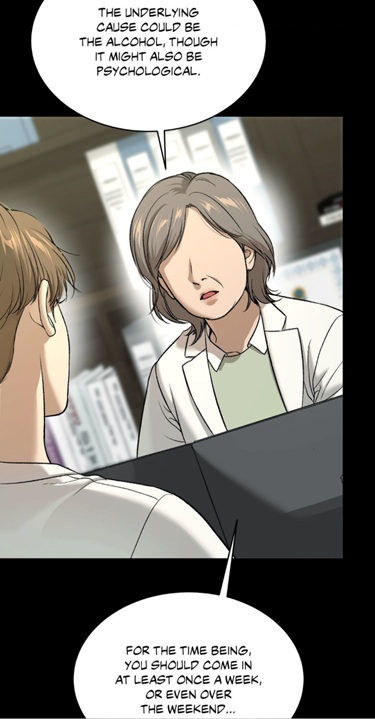 (chapter 67): the brief diagnosis, the recommendation for weekly visits, the specialist’s tentative attribution of Kim Dan’s condition to either alcohol or a possible psychological cause, emphasizing the need for continued observation and weekly visits before offering a definitive diagnosis —all standard responses. For her, this was a doctor following routine procedure without overstepping professional boundaries. However, I perceived her behavior very differently. I saw someone who remained emotionally detached and almost absent, reducing the complexity of Kim Dan’s condition to simplistic surface-level causes without genuine inquiry.
This divergence in opinion hinged on what each of us prioritized. My friend appreciated the clinical neutrality, interpreting it as a mark of competence. I, however, found it troubling—too minimal, the possible psychological cause was only mentioned. The symbolism in her appearance intensified my reaction. She is portrayed eyeless, a metaphor for her blindness—not in vision, but in perception. Her gaze is absent; her diagnostic process relies not on what she sees but on what others report, most notably, Joo Jaekyung.  (chapter 67) Rather than forming an independent assessment, she accepts the narrative of a third party, which introduces bias and limits her understanding. One might argue about that, because she is looking at a paper, probably result of a blood test which seems to corroborate the guardian’s statement. Hence the sleep specialist concludes that Kim Dan is suffering from insomnia, alcohol addiction and sleepwalking. The problem is that his statement is based on external observations (halmoni and the landlord) and their limited knowledge. Moreover, Jinx-philes should keep in mind two important aspects:
  (chapter 61) The champion had been himself suffering from similar symptoms which could be seen as a projection on his loved one. Additionally, based on previous observations, I have interpreted Kim Dan’s nightly walks not merely as sleepwalking, but as dissociative episodes—likely triggered by overwhelming guilt, unresolved trauma, and a chronic sense of disconnection from his body and surroundings. But how could the champion know about this? He’s not a doctor himself. In order to have a more accurate picture of the whole situation, she should have talked to the patient himself. But by relying on papers and the guardian’s testimony, she not only distances herself from the patient physically and emotionally, but also delegates the responsibility of interpretation. She is using the eyes of others.
She wears an open white coat, (chapter 67) revealing a light green pullover layered over a white shirt—clothing that clearly belongs to her private wardrobe. This visual detail suggests a separation between her personal identity and her professional role. It’s as if donning the coat is enough to signal her authority, without requiring emotional engagement. The coat becomes a badge, not a commitment.
Yet one could argue that this very distinction is essential. The boundary between self and profession is what prevents the physician from becoming emotionally overwhelmed. Without such a barrier, the practitioner might absorb too much of the patient’s pain—leading not only to fatigue but to burnout. 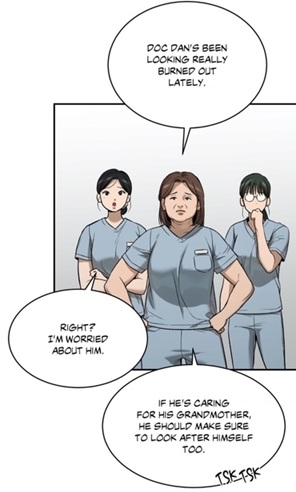 (chapter 57) Perhaps the doctor’s detachment is not indifference, but a survival mechanism in a healthcare system that demands efficiency over intimacy.
The white coat in this scene does not function as a symbol of care (chapter 67): it becomes an emblem of role-playing. What caught my attention is that she doesn’t directly address the patient, she doesn’t ask him any question either. She is not curious at all. If she had, she would have heard this:  (chapter 67) indicating that his alcohol addiction is not the real reason for his insomnia. Then she fails to examine Kim Dan physically, the desk is between them. Therefore she can not detect his visible malnourishment.
Both insomnia and malnutrition are quite common and can cause similar negative consequences, such as falls, depression, and cognitive impairment in older adults, but there is no study investigating the relationship between the 2. The aims were to investigate relationships between insomnia/insomnia severity and Mini Nutritional Assessment (MNA) score and serum nutrient levels. […] There is a close relationship between MNA scores and insomnia or insomnia severity in older adults. Therefore, when evaluating an older patient with insomnia, malnutrition should be evaluated, or insomnia should also be questioned in an older patient with malnutrition. Thus, more effective management of the 2 can be possible. Quoted from https://pubmed.ncbi.nlm.nih.gov/31109907/
But she couldn’t see it, as she relied on second-hand testimony (Joo Jaekyung’s words). The irony is that the latter failed to notice it. Each time he saw the doctor’s body, he got aroused. 
 (chapter 62) Moreover, both the landlord and the grandmother never brought up this aspect, though Shin Okja had observed this terrible transformation:
  (chapter 57)
And this raises the following question. Why did the sleep specialist not question the main lead directly and relied on other sources?  (chapter 66) It is because the physical therapist is just a number (2) and as such a file. Therefore the doctor is not seeing the patient as a human. I can not blame the woman either, for she has so many patients to treat during the day. And now look at the building of the hospital:
  (chapter 66). It is huge reminding me of a factory. This “modern hospital” with its sleek architecture, expansive buildings, and impressive specialization exudes a sense of advancement and trustworthiness. Yet beneath this polished surface lies a business-oriented structure, one that prizes efficiency, reputation, and patient turnover over genuine patient connection. This “modern hospital” (chapter 67) functions like one factory: patients are numbers in a queue, doctors are overloaded, and individual care becomes secondary to systemic goals. The very design of the building reflects this: towering facades and compartmentalized departments, where nature and warmth are pushed to the background. In such an environment, the Hippocratic Oath—rooted in ideals of empathy, presence, and personal responsibility—is reduced to ritual, overshadowed by institutional pragmatism and economic demands. Hence she is simply treating his symptoms: insomnia and “sleepwalking”! She is prescribing him “sleeping pills”.
 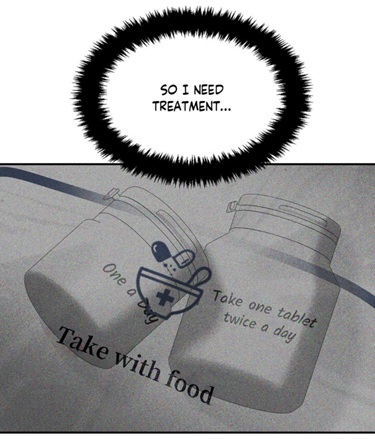 (chapter 67) She is doing exactly what Shin Okja wanted:
 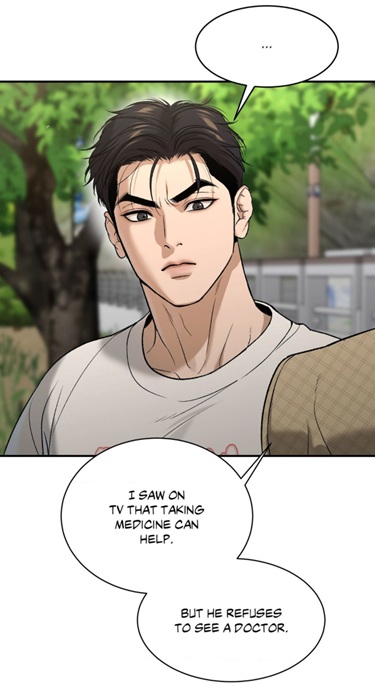 (chapter 65)
 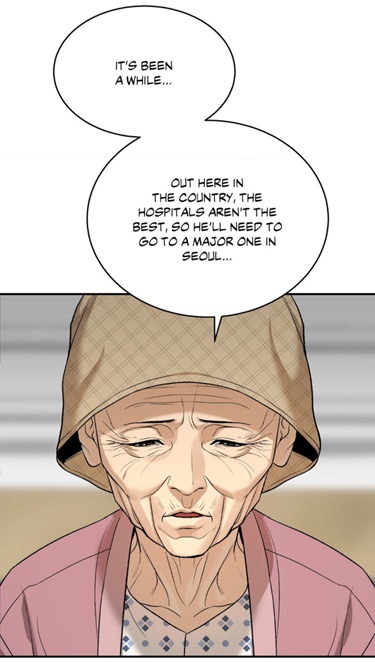 (chapter 65) It is as though thanks to the drug, the odd behavior from Kim Dan would simply vanish. (chapter 67) That’s the reason why Mingwa didn’t give the doctor a name. She has become a soulless doctor, like a robot. On the one hand, the absence of her name implies that she is not trying to seek fame like Kim Miseon
  (chapter 5) with the new medicine. On the other hand, it implies that the light-brown haired woman is doing her job for her paycheck which reminds me of Cheolmin’s statement:
  (chapter 13): “Oh no, no. That won’t do. My precious paycheck!”.
This “namelessness” is not a coincidence. It mirrors how large hospitals treat their staff: as interchangeable parts of a system that prioritizes efficiency and profit over personalized care. (chapter 67) The sleep specialist becomes a faceless figure in an institution where doctors are overworked, underpaid, and pressured to diagnose quickly. Her task is not to heal, but to manage—preferably in under 10 minutes. This reminds me of a confession I received from my own osteopath-orthopedist-chiropractor. He once told me that in hospitals (Germany), proper care is nearly impossible. Due to pressure and time constraints, most doctors are given no more than two or three minutes per patient. As a result, many end up recommending surgery as the default solution—not necessarily because it’s the best, but because it’s fast and system-approved.
Disillusioned by this assembly-line approach, he eventually left the hospital and opened his own private practice. There, he devotes at least one full hour to each new patient—first to examine, then to diagnose, and finally to treat them himself. I remain deeply grateful to him, because he was the only one able to resolve my long-standing shoulder and neck pain. While others focused on symptoms—treating the neck in isolation—he identified the true origin: spinal blockages further down the column. What struck me even more is that he once recognized signs of depression in a patient—not through tests or charts, but simply by observing how the symptoms would worsen or improve. He talks to his patients while treating them, listening not only to their words, but also to their bodies. This interaction allows him to adjust the treatment in real-time and to notice subtle signs others might miss. That’s what makes him a true healer. He doesn’t rush; he takes his time and creates space for the patient to be seen and heard. In doing so, he provides something that modern hospitals often fail to offer: attention without judgment, and care without hurry.
On the other hand, he also confided in me that he has learned to select his patients. Some individuals came to him with fixed expectations, treating him like a service provider rather than a medical expert. They arrived with their own self-diagnoses and requests, expecting him to execute treatment plans they had already designed in their minds. In those cases, he had to draw a line—because healing, in his view, depends on trust and dialogue, not on fulfilling demands. A doctor, he reminded me, is not a technician carrying out orders, but someone who must observe, assess, and guide with discernment. This dynamic reminded me of Joo Jaekyung, who often treated both Dr. Lee and Kim Dan  (chapter 27)
  (chapter 49) as mere service providers. Whether it was brushing off medical advice with “Don’t push it, I know my body better than anyone else” (chapter 27) or demanding instant pain relief to continue training (chapter 49), the champion positioned himself as the ultimate authority over his own treatment. Since his attitude echoed the confession of my osteopath, it is understandable why my osteopath-orthopedist began to select his patients carefully. This mirrors Kim Dan’s evolution, when the latter chose to reject the champion’s offer. Indirectly, he is “learning” to select his job and not take them by opportunism. He is also learning to select his “patients”. Striking is that Shin Okja has a similar attitude than the athlete.
  (chapter 7) She desired to have a treatment with less side effects and less painful. And the moment she was confronted with reality, this painful new treatment only brought pain and nothing more, she chose to leave this institution and move elsewhere.
 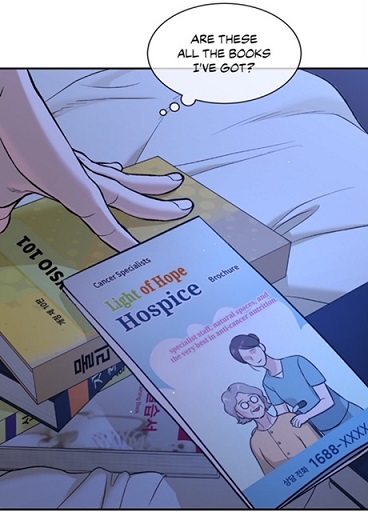 (chapter 53) Therefore it is not surprising that she is treating the protagonist the same way: she knows what is the best for him.
  (chapter 57) She is treating him like a service-provider, she is now rejecting that he has lost his “usefulness”. His pay here is not high, …
But let’s return our attention to the anonymous sleep specialist. The latter has just become a victim of this terrible health system. She is not engaging with Kim Dan’s trauma, nor investigating his psyche, for she doesn’t have the time for it. Her task is not to heal deeply, but to manage efficiently. Secondly, she is specialized in sleep medicine, so she is no psychologist or psychiatrist. Therefore it is not surprising that she is focusing on certain aspects. But sending him to a different department would mean that she would lose her „new patient“. If you have ever watched series about hospitals, you are aware of the competition between departments. Here I can recommend the K-drama LIFE. Since she is more treating him in such a short time, it is not astonishing that doc Dan is doubting her words,  (chapter 67) and not even following her recommendation.
 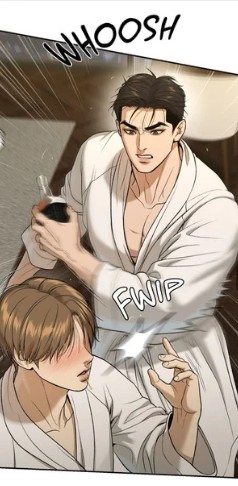 (chapter 67) He felt misjudged and misunderstood; reduced to a file number, not seen as a complex human being.
However, there’s more to it. Two details stood out to me in particular. First, consider what the anonymous doctor told Joo Jaekyung  (chapter 67) and second, what Kim Dan actually received as treatment: (chapter 67) pills in a plastic bag marked with a standard instruction: “Take with food”. These two panels capture more than a routine prescription, they reveal the institutional deflection of responsibility and the impersonal mechanics of care.
By printing the instruction on the packaging rather than saying it aloud, the doctor shields herself from accountability. If something goes wrong, she can point to the label. She doesn’t have to engage, explain, or ensure understanding. It’s a subtle but calculated transfer of responsibility—from physician to patient, and even more so, to the guardian. Now it’s not just Kim Dan who’s expected to monitor himself, but Joo Jaekyung as well. The burden of care is silently offloaded onto those least equipped to manage it.
What makes it worse is that Joo Jaekyung is never shown holding or reading the bag. The implication? He likely never noticed the fine print at all. No one is actively guiding the treatment. No one is watching over Kim Dan.
Her verbal emphasis is even more revealing. Instead of discussing the food requirement or giving Kim Dan any personal advice, she delivers a single, sweeping command: “Drinking is off-limits.” It’s not just vague—it’s scolding. The patient’s alcoholism isn’t treated; it’s sidelined. The system checks the boxes—and moves on. It frames her as an authority figure who cares more about issuing warnings than offering help. There’s no nuance, no tailored support, no effort to build trust. What Kim Dan hears is not empathy, but judgment. He’s treated as a risk to be managed, not a human being to be helped. She can only reinforce his low self-esteem: he‘s a burden.
This is what deepens his sense of being misdiagnosed, as if the doctor was painting his condition so negatively in order to scare him. He doesn’t receive insight or compassion—he receives protocol. And in a healthcare system ruled by efficiency and liability protection, the doctor’s priority becomes covering herself—not ensuring the well-being of her patient.
Cheolmin  (chapter 13), in contrast, enters the story with no white coat at all. He carries only a doctor’s bag, dressed in a green pullover and a beige checkered shirt.
  (chapter 13) Despite this informal attire, he immediately recognizes Kim Dan’s symptoms and engages both the guardian and the patient. He doesn’t need institutional support to assert authority; his presence and diagnostic clarity define him. While his clothes might elsewhere be read as conservative or emotionally restrained, here they highlight that care can come outside rigid systems.
Previously, we interpreted Cheolmin’s clothing as a reflection of a certain emotional reserve. The beige checkered shirt, covered by the green pullover, suggests a guarded personality; someone who perhaps maintains a protective layer between his professional and emotional worlds. And yet, this emotional caution doesn’t hinder his ability to act with warmth and competence.  (chapter 13) Quite the opposite. He doesn’t hide behind his distance; he manages it. His approach is practical and grounded, but never cold. He doesn’t wear a white coat, yet he brings with him a doctor’s case and an unshakable sense of responsibility. His tools are simple (his own body), (chapter 13) his posture relaxed, and his tone—often sprinkled with humor—adds a human touch that the eyeless doctor sorely lacks. And what is the cause for this huge difference? It is because the “famous sleep specialist” is relying on her institution (nurses, blood tests, drugs). She is following a procedure, as the visit took place at the hospital.
Unlike Cheolmin, who uses his emotional detachment constructively, the sleep specialist disappears behind it. She neither touches nor addresses the patient directly. She offers no humor, no effort to ease the atmosphere—only sterile authority and detached warnings.
Ironically, while Cheolmin may seem less emotionally expressive at first glance, he is far more emotionally present. His humor isn’t just a personal trait—it’s a therapeutic tool.  (chapter 13) It bridges the gap between roles, making the patient feel seen rather than categorized.
 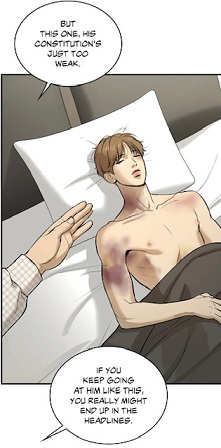 There’s no judgement in their relationship. The eyeless doctor may appear neutral, but in truth, she is hollow. Cheolmin appears reserved, yet his actions speak with empathy. Where she recites guidelines, he initiates dialogue.
  (chapter 13) Where she avoids involvement, he offers engagement.
In short, Cheolmin’s clothes reflect thoughtful distance—not absence. He remains attentive, responsive, and subtly warm. His restraint is a choice, not a flaw. And it is precisely this contrast that reveals what the Hippocratic Oath should still mean today: presence, humility, and care; and not money, drug and efficiency.
The positions between my friend and me reflect a core conflict between reality and idealism. She values adherence to clinical norms and sees the specialist’s behavior as a rational expression of professional boundaries. Emotional distance, she argued, is often necessary—not just to ensure objectivity, but also to protect healthcare professionals from burnout, especially in overburdened systems. I agreed in principle, but maintained that detachment becomes damaging to the patients and the doctors. It affects the relationship between them, because it prevents accurate diagnosis or erases the patient’s voice entirely or the patient starts seeing himself as a “client” and the doctor as his “service provider”. A middle ground must be found—where presence doesn’t equate to over-involvement, but where empathy still has space. My orthopedist found his solution: open a small office where he tries to help his patients to avoid surgeries. He told me: “The first surgery in his field is always an option, the second one will always be a necessity.”
Moreover, our analysis acknowledged the limitations the doctor faces. The specialist likely juggles a tight schedule. A queue of patients, like the one displayed before Kim Dan’s session, signals the industrial rhythm of care. In such a system, she may not have time for deeper engagement. But for patients like Kim Dan—vulnerable, undernourished, spiraling emotionally—this neglect can reinforce their invisibility. In contrast, Joo Jaekyung receives deferential treatment, because he is famous. The medical world depicted in Jinx bends toward prestige, not need.
This contrast reveals something vital: in medicine, presence matters. The specialist hides behind procedures. Cheolmin shows up. The white coat, then, becomes a mirror: does it reflect a vocation or disguise institutional distance?
In Jinx, medical care unfolds within a tapestry of institutions—anonymously vast hospitals  (chapter 61)
  (chapter 67), the Light of Hope hospice
  (chapter 61), the sleek University hospital dedicated to research
  (chapter 5), and more intimate yet modern facilities like this one.
 (Chapter 27) Each medical setting not only has its own architecture but also its own moral blueprint. In the essay “Doctor Romantic 3 (locked)“, I had already compared doctor Lee’s workplace and behavior to the “beautiful Kim Miseon” from the University Hospital. Season 2 introduced us to new institutions. Each place claims authority through professional codes and visual symbols, but the deeper narrative explores how care is either embodied or abandoned. Mingwa uses attire, body language, and structure to draw sharp distinctions between appearance and intent.
Kim Miseon (chapter 5) from Sallim University Seongshim Hospital: This research-driven university hospital is connected to Kim Miseon, the doctor who prescribed a new experimental treatment for the grandmother. (chapter 5) Despite the pristine exterior of the building and the promise of scientific advancement, her actions raise ethical concerns. She dilvuged information in the hallway.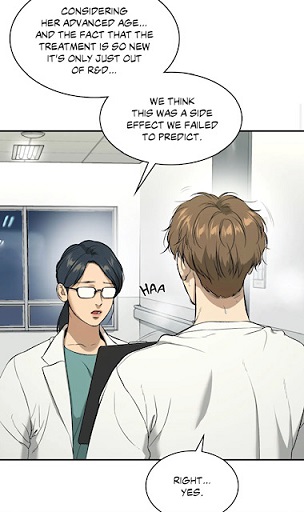 (chapter 21) Then the treatment’s failure is attributed either to the grandmother’s frailty or Kim Dan’s late arrival and absence, subtly shifting blame.
 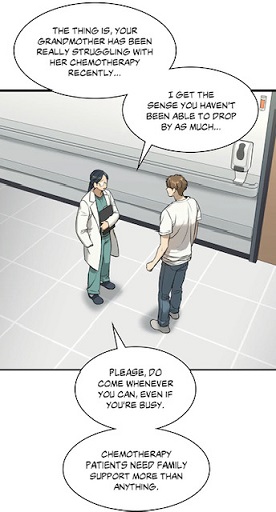 (chapter 21) Like mentioned before, this treatment wasn’t even properly recorded in the patient file raising the suspicion of deliberate concealment.
  (chapter 56) It appears as “pain killers”. Her open white coat (chapter 21), worn over a green uniform resembling surgical scrubs, aligns her visually with institutional authority, while her eyeless portrayal emphasizes detachment. (chapter 21) Her motivation seems driven not by compassion but ambition: a pursuit of recognition and success through experimental medicine, regardless of consequence. It seems that this new therapy didn’t bring her the results she hoped, and strangely later director Choi Gilseok
  (chapter 48) got aware of Shin Okja’s conditions, implying that patient confidentiality had been breached.
Park Junmin  (Chapter 61): In contrast, Park Junmin
  (chapter 61) represents the polished face of a business-oriented clinic. While his office projects sleekness and personalized care, his comments betray his priorities. He praises Joo Jaekyung’s fame and urges a return to the ring—not out of medical concern, but because it would guarantee the champion’s return as a paying patient. He wants to retain a high-profile client. His friendliness is strategic. (chapter 61) He does not embody the Hippocratic Oath but rather a service model. The coat becomes a costume that sells recovery. It is clear that he is promoting his own hospital. Joo Jaekyung, however, surprises him by refusing
  (chapter 61), highlighting that the athlete has become aware of what genuine care should look like. When the champion calmly declares, “I’ll be receiving rehabilitation services in another hospital,” Junmin answers with a stunned “Sorry?”. But this is not confusion. It’s a reflexive mask for shock. He did not expect to lose control of the situation. Beneath that one-word response lies disbelief, disappointment, and veiled panic. He’s losing a lucrative patient—and more importantly, a public endorsement. The moment exposes how fragile his authority truly is when faced with a patient asserting autonomy. Let’s not forget that when the champion was facing a mental and emotional breakdown, the latter offered no other support than “rest”. He even avoided his gaze.
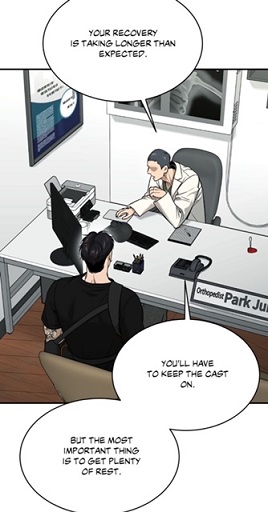 (chapter 54) The athlete was left on his own.
Light of Hope Director 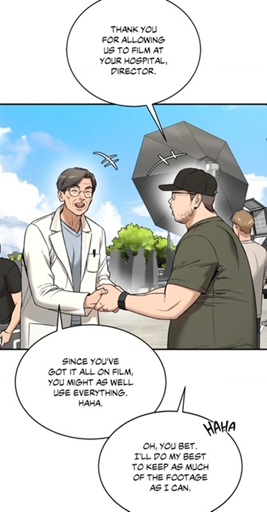 (Chapter 59): At first glance, the hospice appears to be underfunded and outdated.
  (chapter 61) However, its director breaks expectations. Unlike the smooth-talking or indifferent doctors at larger institutions, he is directly involved in patient care. (chapter 56) He informs the physical therapist about the grandmother’s condition, works late at night
  (chapter 60), criticizes people for their rude behavior
  (chapter 59) or actively disciplines staff
 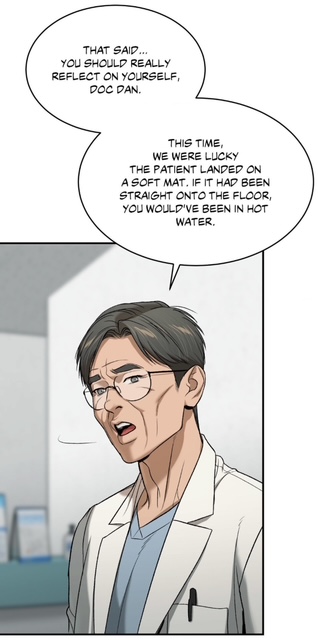 (chapter 59) when mistakes are made. Though he also flatters the champion
  (chapter 61) and sees promotional potential, he never exploits patients.
  (chapter 61) The juxtaposition of humility and responsibility in his demeanor, combined with his stunned reactions to sudden events, suggests an overworked and understaffed environment—but not one without moral grounding. His white coat and blue medical uniform echo the nurses’ attire, subtly promoting a sense of equity among staff. Despite being a director, he doesn’t separate himself from frontline caregivers. His uniform also contrasts with the green worn by Kim Miseon or Park Miseon, suggesting a focus on practical responsibility over prestige. By blending in with the team, he fosters a culture of shared accountability, not rigid hierarchy. Among all institutional figures, he comes closest to balancing authority with integrity.
Hospital Director  (Chapter 6): While this figure appears authoritative
 (chapter 1), the details of his attire tell another story. Wearing a suit beneath his coat implies professionalism, but here it also suggests a business-driven mindset. The coat becomes a sleek outer layer masking deeper intentions. His charming demeanor conceals a more sinister reality—he weaponizes authority for personal gain. His use of professional attire isn’t about respectability but manipulation. Beneath the surface, profit, control, and coercion drive his actions.
  (chapter 1) The white coat, in his case, is not a symbol of healing but a façade for exploitation. drives his authority. The coat becomes a literal cover for abuse—harassment disguised under professionalism. His entire persona is a façade: calculated, charming on the surface, but predatory and morally bankrupt beneath.
The Sleep Specialist (Chapter 67): (chapter 67) Eyeless and detached, the sleep doctor treats Kim Dan without any emotional or physical engagement. Her absence of a name symbolizes depersonalization. She doesn’t speak directly to Kim Dan, doesn’t examine him, and only echoes what she heard from Joo Jaekyung. The prescription she offers is another layer of critique. The instruction “Take with food” appears only in print—never verbally stressed—thus shifting liability. If Kim Dan suffers side effects or mixes medication with alcohol, responsibility falls on him or his guardian. This is institutional medicine in its most risk-averse form: impersonal, quick, and shielded from consequence.
Dr. Lee (Chapter 27): Dr. Lee is the only named and truly visible doctor. 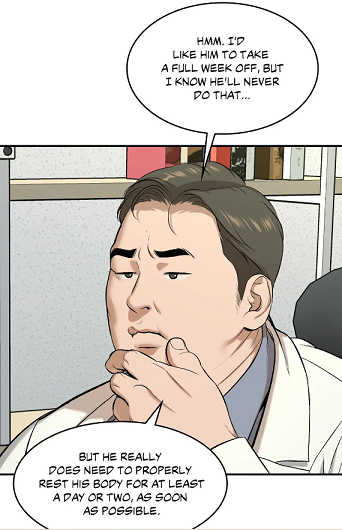 (chapter 27) His gray shirt signals a more relaxed approach,
 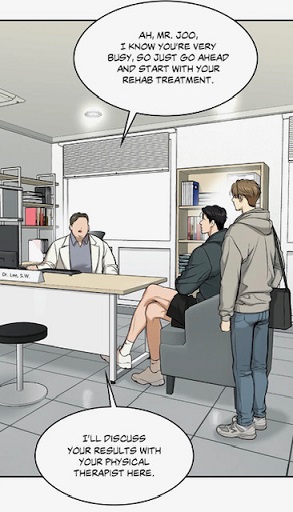 (chapter 27) and his facial expression conveys a certain empathy—though his words also betray resignation. He sits beside the patient, not opposite, visually erasing the typical hierarchical divide between doctor and athlete. His recommendation that Joo Jaekyung rest is gently delivered, but he knows it will likely be ignored. He represents the tension between medical idealism and the pressures of athletic performance. He is trying his best to protect Joo Jaekyung’s career.
  (chapter 27) Notably, he doesn’t chase fame or loyalty—he’s realistic, yet still rooted in care. (chapter 27) His clinic, with open blinds and wide windows, stands for transparency and modern ethics.
Cheolmin (Chapter 13): 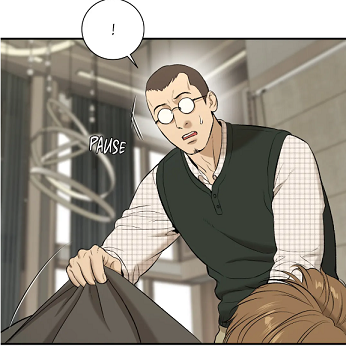 (chapter 13) Finally, Cheolmin exists outside the hospital system. He wears no white coat, but his behavior mirrors a true physician’s. He diagnoses accurately, gives immediate advice, and engages both patient and guardian. His attire—a shirt layered under another—might suggest emotional restraint, but it doesn’t interfere with his actions. He jokes and teases, breaking through tension and inviting trust. He acts not because protocol demands it, but because someone needs help. That’s enough.
This comparative tableau reveals that white coats do not guarantee compassion—and their absence doesn’t negate it. In Jinx, only those who break institutional molds offer real help. The rest follow protocols, serve systems, and sometimes cause harm through inaction or self-interest. It exposes that doctors are simply humans and not gods.
Furthermore, the financial aspect underpins all these interactions. Hospitals in Jinx are not purely charitable; they’re businesses. The emphasis on new medicine, fame, or facility branding often outweighs the patient’s actual condition. Misdiagnoses, evasions, and moral compromises follow from this reality.
Kim Dan’s journey through these institutions underscores how vulnerable patients are when medicine is transactional. Blame is subtly shifted. Responsibility is diffused. And yet, in emergencies, the expectation remains: doctors should act.
A striking feature in Jinx is the architectural integration of nature into hospital design. (chapter 67) Trees and greenery appear in every facility—but their placement and symbolism vary. These visual cues subtly reveal each institution’s philosophy of care.
At the university hospital where Kim Miseon works, 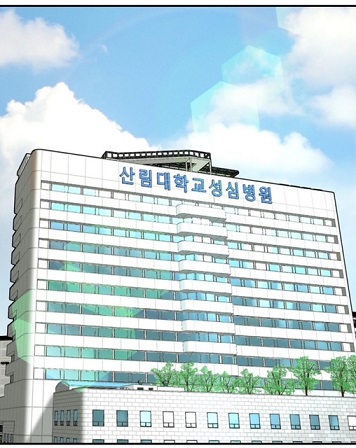 (chapter 41) nature is neatly confined. Rooftop gardens and structured greenery exist, but more as visual accessories than lived environments. The hospital is a towering research center, representing scientific advancement—but also bureaucratic coldness. Here, nature exists to impress, not to comfort. This artificial balance between concrete and green reflects a clinical detachment: nature is curated, not embraced. It aligns perfectly with Kim Miseon’s demeanor—professional, pristine, but ultimately distant and ambition-driven.the environment feels controlled.
 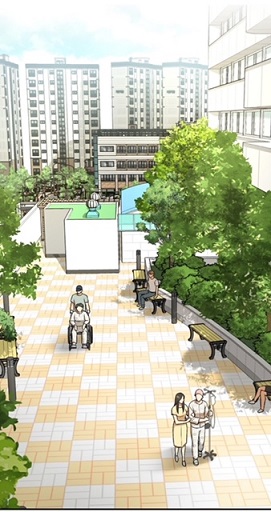 (chapter 41)
In the rain-drenched hospital  (chapter 54) where Joo Jaekyung receives treatment, the rooftop greenery appears remote and ornamental, disconnected from patient care. (chapter 61) Nature is present but removed, almost symbolic of lost ideals. The building is imposing, gray, and bureaucratic, which is quite similar to the university hospital.
In the sleep therapy hospital (chapter 67), the setting amplifies this detachment. Trees do appear, but they are overwhelmed by massive, impersonal structures. The greenery seems almost trapped, overshadowed by glass and steel. This mirrors the interaction with the sleep specialist, who issues warnings and prescriptions without genuine communication. In this environment, nature is not a partner in healing—it is background noise, a symbolic performance of care in a place that prioritizes liability and speed over connection.
By contrast, the Light of Hope hospice (chapters 61) is embedded in a hillside, its architecture low to the ground, surrounded by untamed, organic greenery. The trees are not ornamental—they embrace the building, echoing a kind of natural protection. Nature here is not only real, but alive. It reflects the ethos of the institution: flawed, underfunded, but grounded in human presence. The hospital director may wear a coat, but his modest blue uniform aligns him visually with the nurses, suggesting equity and participation rather than hierarchy. Just like the unpolished trees, he is there not to be admired but to serve.
A fourth setting appears with Dr. Lee’s clinic (chapter 27). The building is smaller,  (chapter 18) modern, and set among scattered trees.
  (chapter 18) Large windows suggest openness and transparency—the very qualities Dr. Lee brings to his interaction. This is a space that, while modest, is genuinely attentive. Here, nature doesn’t impress, it is integrated in the landscape. The park is not surrounded by huge buildings.
Through these varied landscapes, Jinx critiques the illusion of healing as something that can be staged through architecture. It exposes how hospitals, like people, can hide behind appearances. Trees and plants, like white coats and professional titles, can be used to mask indifference just as easily as they can accompany real care. Healing does not bloom in greenery alone—it flourishes through presence, attentiveness, and trust.
Yet these visual patterns also contain hope. The presence of even small parks and rooftop gardens within institutional designs reflects an underlying truth: nature matters. (chapter 41) These green spaces acknowledge, even if superficially, that human beings do not heal through medicine alone. They need sunlight, air, softness—a sense of rhythm beyond fluorescent lights and steel corridors. Nature grounds. It breathes.
The science of the healing power of nature
There are numerous studies that support the healing power of nature. A study of 20,000 people found that those who spend at least 120 minutes per week in nature, whether in a local park or other natural environment, were more likely to report better health and well-being.
The World Health Organization recently released a report called Green and Blue Spaces and Mental Health, which shows that time in nature, including urban areas, improves moods, mindsets and mental health. Furthermore, research suggests that exposure to forests, parks, gardens or coastlines can help mitigate the psychological impact of climate change, promote physical activity and provide opportunities for social interaction. Quoted from https://www.uc.edu/news/articles/2023/08/the-healing-power-of-nature.html
That is why the small town, 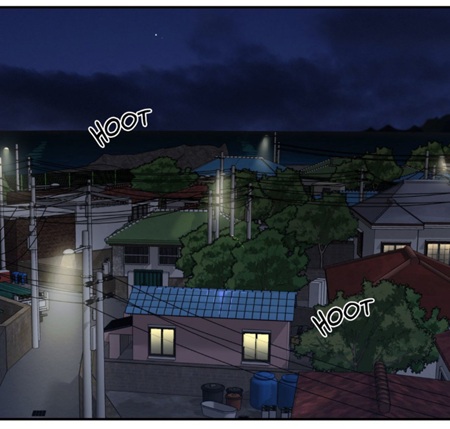 (chapter 65) nestled in the countryside and far from institutional rigidity, emerges as a space of true potential. In returning there, Joo Jaekyung and Kim Dan are not just escaping their past—they are moving toward a form of healing that modern hospitals imitate but rarely achieve. Closer to nature, they are closer to themselves. If hospitals imitate forests, the village becomes the forest. And in that simplicity, Jinx suggests, real happiness might grow.
From open to closed, from crisp to wrinkled, the white coat becomes a symbol of ideology. Some wear it like armor, others like a mask—and some not at all. But it is not just the coat that deceives. Buildings too wear their own uniforms. Grand glass hospitals draped in rooftop gardens and courtyard trees promise healing, yet often fail to deliver. Nature becomes another costume—just like the coat.
But Jinx reminds us: real care cannot be faked. It is revealed not through polished surfaces or institutional prestige, but in action—staying late, listening carefully, protecting the vulnerable. The doctors who truly heal are those who treat the person, not the file.
And why, then, do so few doctors recommend sunlight, trees, or quiet walks? The answer is simple: nature costs nothing. It cannot be patented or billed. And yet, its presence in every hospital design is a silent confession that healing lies outside the system. That, in the end, true recovery begins where profit ends. This is precisely what Jinx shows through Joo Jaekyung’s arc: once he leaves the sterile confines of the gym and begins spending time outdoors,  (chapter 62) surrounded by greenery, animals, and people who don’t treat him as a product—his health improves. His muscles may still ache, but mentally and emotionally, he is lighter. Research confirms what the story suggests: sunlight and time in nature significantly boost mental health. In that way, his borrowed floral pants and farmwork reflect something deeper—a return to balance. Nature becomes not just a background, but a remedy.
The Hippocratic Oath promised to do no harm. But in a medical world where patients are reduced to symptoms, empathy is replaced by protocol, and care becomes a product, harm happens quietly—disguised in good intentions and sealed with institutional polish.
And yet, what the Oath once embodied still exists—just not in the systems that claim it. It lives in a shared meal, a walk under trees, a quiet moment in the sun.  (chapter 57) It lives where no one is watching and no one is billing. In Jinx, the real medicine lies outside the chart—in the dirt on borrowed floral pants, in sweat earned under open skies. Nature becomes the unspoken vow that systems forgot.
The coat may still be white. The walls may be green. But healing comes not from the symbols, but from the soil.
That’s the truth behind the Oath of Hippocrates.
Feel free to comment. If you have any suggestion for topics or manhwas, feel free to ask. If you enjoyed reading it, retweet it or push the button like. My Reddit-Instagram-Twitter-Tumblr account is: @bebebisous33. Thanks for reading and for the support, particularly, I would like to thank all the new followers and people recommending my blog.

Please support the authors by reading Manhwas on the official websites. This is where you can read the Manhwa: Jinx But be aware that the Manhwa is a mature Yaoi, which means, it is about homosexuality with explicit scenes. Here is the link of the table of contents about Jinx. Here is the link where you can find the table of contents of analyzed Manhwas. Here are the links, if you are interested in the first work from Mingwa, BJ Alex, and the 2 previous essays about Jinx 𓇢𓆸 Prove Me Wrong Again 💢😂 and Perfect👼🏼 Defect
It would be great if you could make some donations/sponsoring: Ko-fi.com/bebebisous33 That way, you can support me with “coffee” so that I have the energy to keep examining Manhwas. Besides, I need to cover up the expenses for this blog.

In the world of Jinx, superstition often masks deep psychological wounds. Readers are well aware of Joo Jaekyung’s belief in a hex: 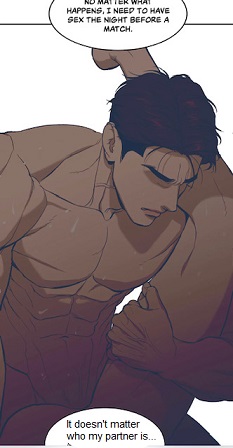 (chapter 2) his ritualistic sex before fights, his fear of losing control,
 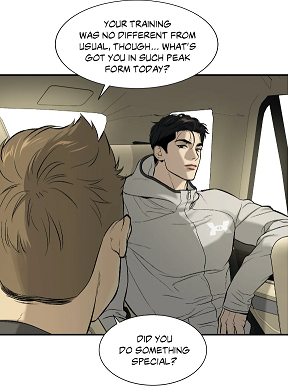 (chapter 5) his reliance on routine. Yet there is another jinx in this story, one far less visible and perhaps even more tragic: Kim Dan’s.
In earlier analyses—particularly in the essay “Jinxed: Behind The Scenes 🎬” I stated that Kim Dan, like Joo Jaekyung, might have perceived his life as cursed. This conclusion emerged from his grim familial and financial circumstances: his overwork, exploitation by the loan shark, and his identity eroded by relentless sacrifice. At that time, the interpretation leaned heavily on visible hardships and his devotion to his grandmother. His silent plea 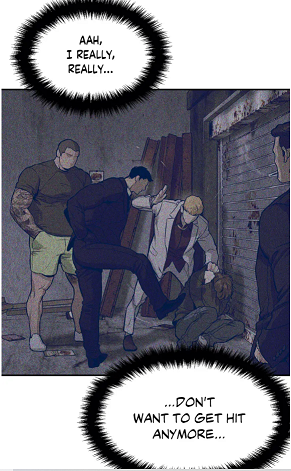 (chapter 1) was seen as the core expression of a man who believed he was doomed.
However, Season 2 invites a more nuanced reading. I came to realize that Kim Dan never consciously viewed himself as jinxed.  (chapter 56) In Chapter 56, Kim Dan is seen curled up next to a bed, whispering: “I’m scared… of being alone.” What makes this moment especially revealing is that he is not physically alone, for he is resting next to his grandmother. The presence of the very person who raised him should, in theory, offer comfort. And yet, the fear persists.
This contrast underscores the depth of Kim Dan’s emotional wound. His fear isn’t simply about being left in the future — it’s the echo of a past abandonment so profound that even proximity can’t soothe it. His grandmother is alive, mere steps away, yet his body curls into itself, instinctively shielding against an absence that has already been internalized.
That he doesn’t say “I’m scared of being abandoned” or “of being jinxed” shows that this fear hasn’t been processed into words or reason. It’s not part of his conscious self-concept. Unlike the celebrity, who ritualizes his fear as a “jinx” and tries to control it through actions, Kim Dan’s trauma remains trapped in silence. He doesn’t believe he is cursed — not on the surface. But emotionally, he lives as if he were. The hex exists, not in his language, but in his body.
His whispered fear in the dark — “I’m scared… of being alone” — is the clearest window into his hidden jinx. And perhaps the most heartbreaking part is this: he voices it not, when he is abandoned, but when someone is still there. That’s how deep the fear runs.  (chapter 21) And this issue didn’t begin in adulthood. In Chapter 21, Kim Dan dreams of a night from his childhood: he wakes up alone, glances around the room in quiet confusion, and softly calls out for his grandmother. The room is dim, the bed beside him empty. This image carries more than just childhood anxiety:
 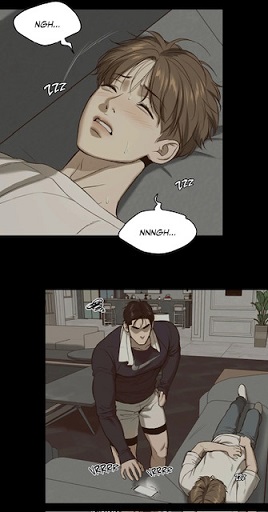 (chapter 21) It weaves together absence, silence, and the specter of loss. What’s striking is that the nightmare surfaces, not when he’s alone in the present, but after he has just returned from watching over his hospitalized grandmother.
 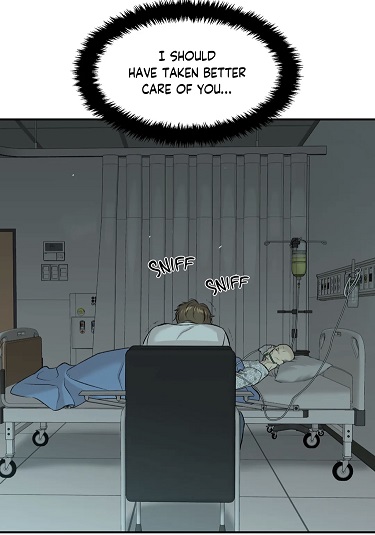 (chapter 21) He lies on the couch and dreams of a night when she vanished from their shared bed.
 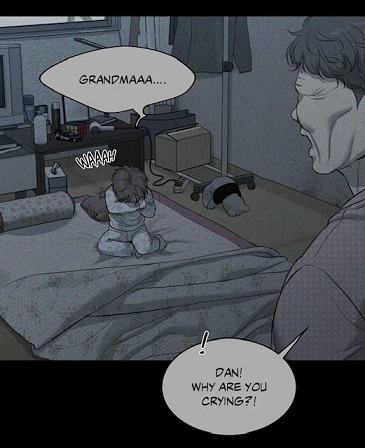 (chapter 21) This reveals how, in Kim Dan’s subconscious, the night and an empty bed have become synonymous with death. The trauma is deeply embedded, where even temporary absence is tied to the irreversibility of loss. For Kim Dan, solitude at night
  (chapter 67) is not mere loneliness—it is abandonment, it is death, it is the erasure of home. It is repressed, hidden beneath his quiet demeanor and years of survival-based behavior. Rather than a rational belief, it is a subconscious wound that only surfaces in moments of extreme vulnerability—especially at night.
So while Joo Jaekyung’s curse is shouted and choreographed  (chapter 2), the doctor’s is secret and involuntary. His actions—his fearful expressions
  (chapter 57), his pattern of emotional detachment
  (chapter 67), and his obsessive loyalty to his grandmother
 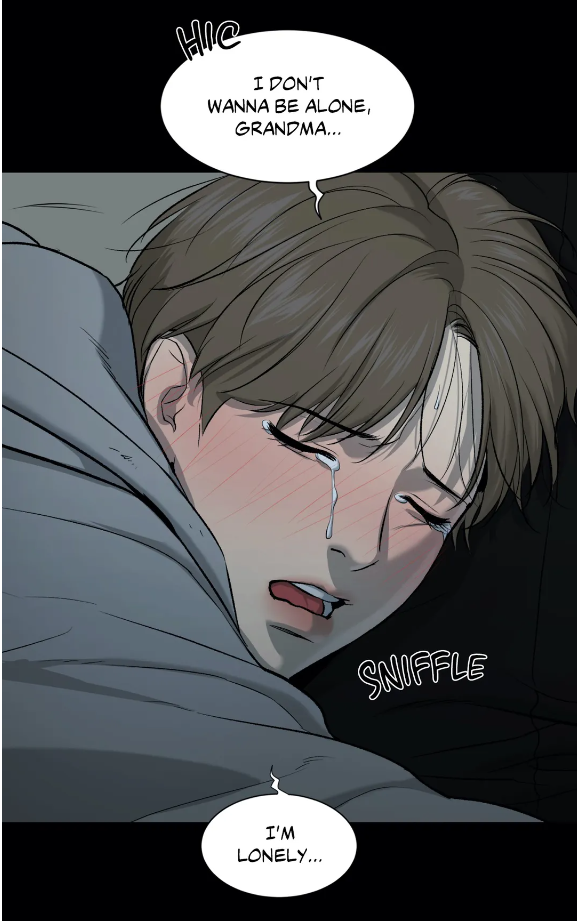 (chapter 10) signal a suppressed conviction: that he is destined to be left behind. What seemed like devotion now appears as coping; what appeared stoic was survival. And with the impending death of his grandmother, the anchor holding this hidden jinx in place is slipping away.
The key lies in the night. The most pivotal emotional regressions in Kim Dan’s life happen after dark. Whether it is the first night with Joo Jaekyung in Chapter 2 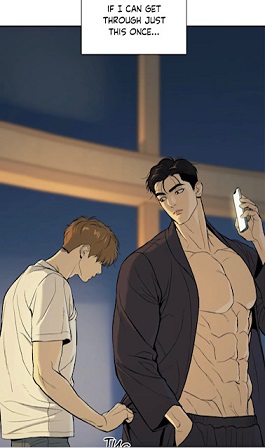 (chapter 2), the trembling kiss
  (chapter 44) and touch
  (chapter 44) in Chapter 44, the complete breakdown
 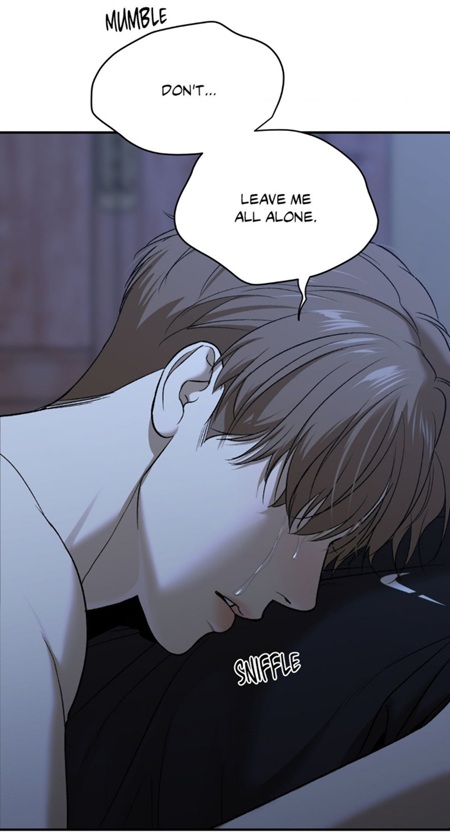 (chapter 66) in Chapter 66, or the transactional submission
 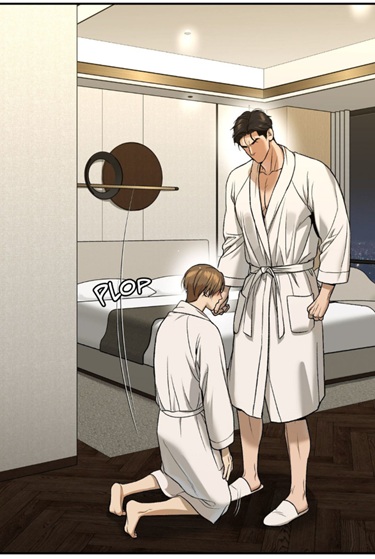 (chapter 67) in Chapter 67, nighttime becomes the stage for his unresolved trauma. These nights mirror one another and suggest an origin story that predates them all: a night when Kim Dan was abandoned by his mother.
This theory is supported by visual cues and character behavior. In Chapter 56, Kim Dan curls into himself in bed, unable to sleep. He admits silently, “I’m scared… of being alone.” That fear is not adult anxiety—it’s childhood terror. (chapter 56) The body language, the shadows, the loneliness—they evoke the image of a small child who once cried through the night, waiting for someone who never returned.
Kim Dan’s actions echo those of someone who was left too early—possibly around the age of six. Psychologists describe this stage as a turning point in emotional development. If a caregiver vanishes at that time, the child internalizes the absence as a personal fault. He grows up believing that love is conditional, that if he’s quiet, obedient, invisible—maybe no one else will leave.
Mingwa subtly ties this back to animal behavior through the inclusion of puppies. 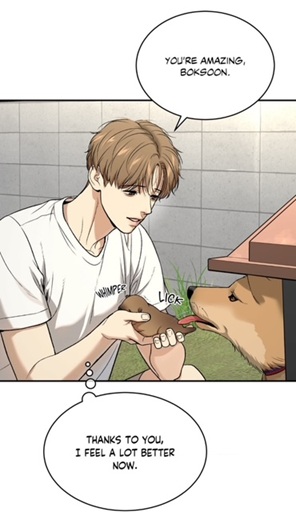 (chapter 57) A puppy needs at least eight weeks with its mother to grow emotionally secure. By drawing this parallel
 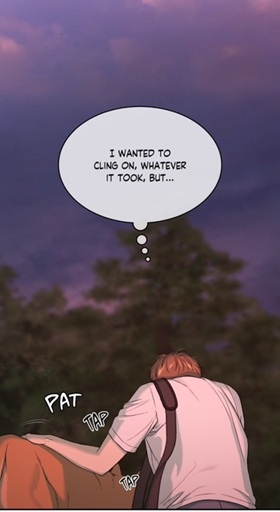 (chapter 59), the story tells us: Kim Dan was separated too soon. He was not ready.
Kim Dan’s grandmother became his emotional anchor: 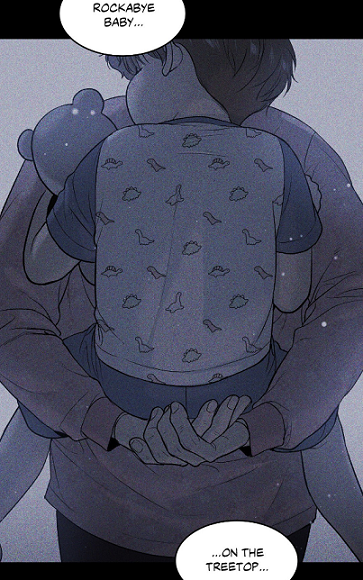 (chapter 47) the one person whose presence could keep the jinx at bay. As long as she was there, he could suppress the trauma, function, survive. She was his talisman. But she was never a healer, for she never spoke about his parents. She never addressed the core of his abandonment, like we could witness in the doctor’s nightmare:
 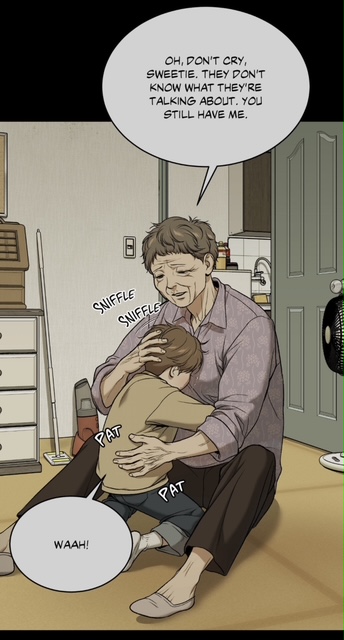 (chapter 57) And silence, when it comes to trauma, does not protect—it festers.
Her infantilization of him is also telling. 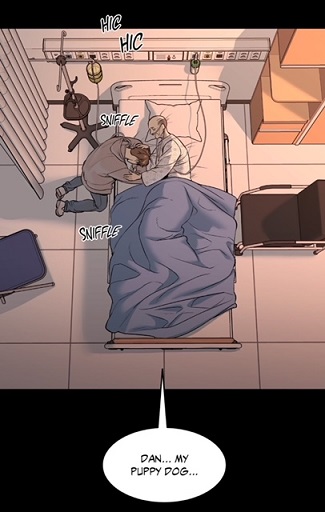 (chapter 53)
 (chapter 65) One might argue about this, for in this scene,
  (Chapter 56) he tucks her in. Their roles are reversed. He behaves like a parent, whereas in truth, he is reverting emotionally to a child terrified of being alone. This reversal highlights the internal dissonance between his outward behavior and emotional reality. Though he was forced to grow up quickly
 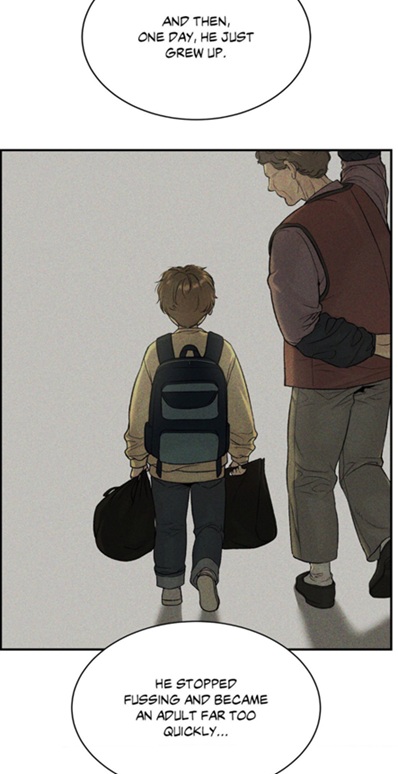 (chapter 65), he still carries the emotional wounds of a child. And from my point of view, the grandmother knows it, therefore she treats him as a child. And this observation led me to the following question: why does she still view him as a “boy”, though he has been working since his youth? It is because he can not sleep alone! What caught my attention is that she never stated, when the doctor started smoking or drinking. (chapter 65) Was it the moment, when she went to the hospital? The timing is crucial, as it can give clues about the main lead’s sleeping trouble. In episode 67, the protagonist finally exposed his cause: (chapter 67) This reinforces my hypothesis that his bad drinking habits are related to the absence of a loved one next to him.
In other words, he can not sleep alone and from my perspective, Shin Okja knows it, but is refusing to become responsible for this situation. (chapter 47) She witnessed this since he was a child, which explains why she never truly addressed his fear of being left behind. This would explain why the halmoni tried to send him away from the hospice in episode 56:  (chapter 56) Imagine what it means for her: her grandson is already 29 years old and he can not sleep alone. Under this perspective, Jinx-philes can grasp the relative’s reasoning. The problem is that her knowledge is actually wrong! How so? It is because the protagonist was able to sleep so well alone in the penthouse, to the point that the athlete was envious of him.
  (chapter 29) That’s how it dawned on me why Shin Okja was so determined to send back her grandson to Seoul.
The grandmother’s insistence on Kim Dan “living his life”  (chapter 65) and going back to Seoul under the guise of freedom and career advancement takes on a deeper meaning when viewed through the lens of emotional avoidance. Her words may sound supportive, but they conceal a subtle attempt to sever the emotional tie without taking responsibility for its existence. Now, rather than confronting this vulnerability head-on, she shifts focus to the one thing she believes can replace human closeness: work. A busy man has no time to wallow, no time to drink, no time to remember the empty bed. A man with a career won’t ask for someone to hold his hand at night. In that sense, her vision of “a good life” is one of functionality, not emotional fulfillment. If he works, he won’t be a burden. If he’s successful, she doesn’t have to worry. Yet this approach doesn’t cure the root wound — it just redirects it. This situation mirrors the wolf’s:
  (chapter 19) The latter is obsessed with work, while he is suffering from insomnia.
The tragedy here is that in encouraging him to grow up through labor, she’s also denying him the right to be a child — something he never got to be in the first place. Her version of love is sacrifice and survival.  (chapter 65) And the best evidence for her selfishness and neglect is her ignorance about her grandson’s plan for his future. She is not discussing with him about what he likes or dislikes. She is directing his life, like she did it in the past in the end. And while she may think she’s doing what’s best, her silence about his fears, her ignorance about his true conditions (no home, blacklisted in Seoul) and her refusal to discuss his emotional future reveal a lingering discomfort with the very idea of dependence — perhaps because it reminds her of her own failures or helplessness as a parent figure.
In the end, her encouragement to “live his life” isn’t truly about Kim Dan finding happiness or chasing dreams. It’s about the grandmother relinquishing responsibility — an emotional handoff wrapped in the language of care. (chapter 65) By urging him to return to Seoul and focus on work, she’s hoping that if he stays busy enough, he won’t have time to feel the crushing loneliness that has always shadowed him. She wants him to mature overnight, not because she believes he’s ready, but because she can no longer carry the weight of his dependency. One might say, he is already 29 years old, so she is right. In truth, this isn’t guidance — it’s guilt management. Notice that she is entrusting the main lead to the champion which is not pushing Kim Dan to become „independent“. Her attitude, summed up by the phrase “out of sight, out of mind,” unintentionally mirrors the same abandonment he experienced in the past. She is refusing to worry about him, her peace of mind matters more than his well-being and the champion’s. 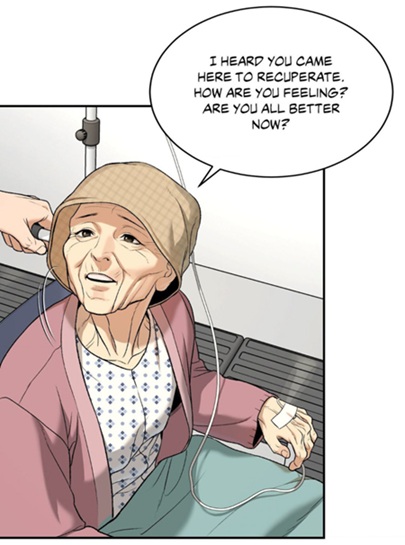 (chapter 65)
This connects directly to one of the most telling moments in Chapter 67, 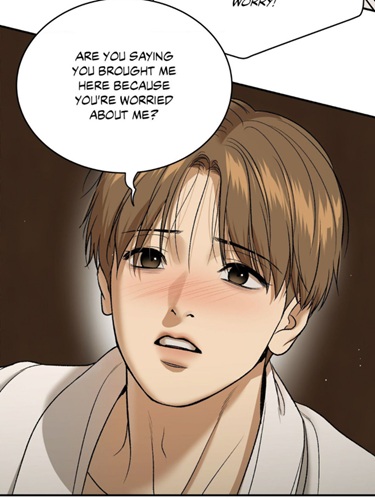 (chapter 67) when Kim Dan, eyes wide and voice trembling, asks Joo Jaekyung: “Are you saying you brought me here because you’re worried about me?” His expression reveals everything — a fragile hope for genuine concern. But the only response he gets is silence.
 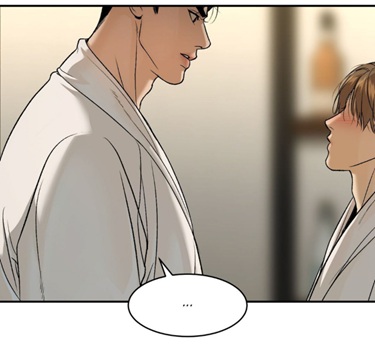 (chapter 67) This unspoken answer reverberates with painful familiarity: from his vanished mother, from his halmoni who rarely expressed love (rather gratitude and pity), and from a world that reduced him to his usefulness. What he really wants to know is: “Do I matter to you as a person?” And just like his grandmother, the champion fails to offer direct emotional reassurance. Yet unlike her, Joo Jaekyung is still learning. His silence isn’t rejection, but emotional illiteracy — a work in progress.
The irony is that while Park Namwook represents over-control disguised as concern, Shin Okja represents detachment masked as selflessness. She doesn’t want to worry anymore, so she chooses to send Kim Dan away — to someone she thinks should take over. Nonetheless, in my eyes, this isn’t responsibility; it’s avoidance. And for someone like Kim Dan, who already associates nighttime with abandonment, silence with rejection, and empty beds with death, being handed off again only reinforces his unconscious belief: I’m jinxed to be left behind.
The grandmother may never have raised a hand against him, but her silence, her emotional evasiveness, and her idealized image of herself as a “sacrificing protector” created a one-sided bond rooted more in guilt than in love. Her presence was constant, but the emotional quality of her care — the nurturing, the honest affection — was lacking. Hence she still doesn’t know that Kim Dan has no home in Seoul.  (chapter 65) And when we remember that Kim Dan tried to call her, she
 (chapter 65) replied with a silence. Here, she claims that he addressed her as “mom”, but it is possible that she was just projecting her own fears onto her grandson. Since she was by his side all the time, she feared to be seen as his mother. Like mentioned above, the mother might have been busy due to work (or sick) and asked her relative to take care of her grandchild.
Ultimately, what he longs for is simple: to be seen, talked, loved, and to be chosen — without conditions. But those around him have always expected him to be strong, quiet, grateful. So he became all of those things… at the cost of his own soul.
Shin Okja never kissed him like a mother. (chapter 57) Yet in Chapter 44, Kim Dan kisses Joo Jaekyung with soft, maternal gestures—on the cheek, on the ear.  (chapter 44) These gestures suggest he had once received such kisses, most likely from his mother. It means he remembers love, even if he doesn’t know how to process its loss.
Her insinuation that Kim Dan owes her everything created a myth of self-sacrifice—one that replaced genuine emotional closeness. She demanded gratitude, not emotional connection. She lived in the mindset of having, not being. As a result, Kim Dan grew up confusing love with obligation, gratitude, and performance. His difficulty in expressing love isn’t due to coldness or immaturity—it’s the byproduct of a dysfunctional emotional education.
This is why, even though he once confessed “I love you” to Joo Jaekyung in the States 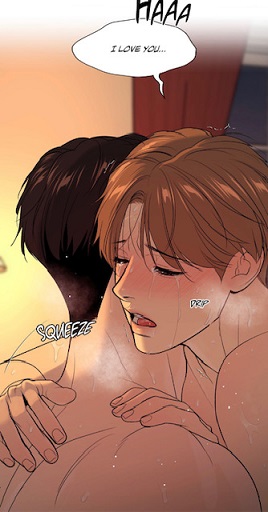 (Chapter 39), the moment is tainted. It occurred under the influence of an aphrodisiac, intertwining love with sex. Furthermore, he has never voiced this sentiment to his grandmother—perhaps because she never said it to him. It was never modeled. While others might judge Kim Dan’s emotional restraint, I desire to stay neutral. He is not an emotionally stunted adult by choice—he is a product of emotional neglect. That’s the reason why Mingwa has associated him with an angel.
 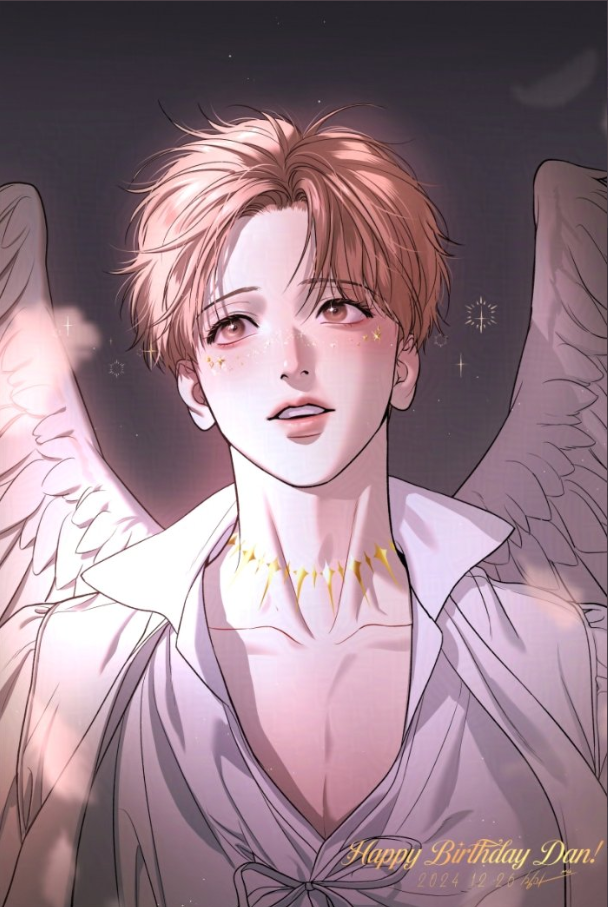 He is carrying the sins of “adults”. By likening him to an angel, Mingwa frames his pain not as weakness, but as unjust burden. He embodies purity, sacrifice, and resilience, not because he was allowed to thrive, but because he endured. The angel metaphor becomes even more striking when you think about traditional symbolism: angels don’t belong to Earth, yet they walk among the living, often suffering in silence and helping others. That’s exactly Kim Dan — out of place, bearing the consequences of others’ choices, carrying guilt, debt, and unspoken grief that were never his to begin with.
He’s carrying the sins of adults: – A school which allowed bullying
– A grandmother who turned emotional dependence into silent expectation.
– A mother who vanished, whether through death or abandonment.
– A society that reduced him to labor, debt, and obedience.
– And even a partner, at first, who used his body without recognizing his soul.
Interestingly, his emotional jinx is also spatial. When living in the penthouse, Kim Dan began to sleep peacefully 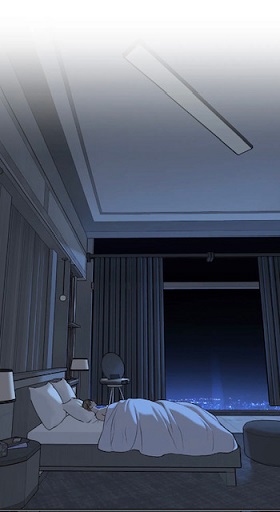 (chapter 29) —not because of physical intimacy with Joo Jaekyung, but because he felt safe. For a time, the place became his illusion of home. But when the champion showed mistrust, the illusion shattered.
  (chapter 51) The penthouse was never truly his. It was borrowed space. This explicates his refusal to spend the night there.
  (Chapter 67) Observe how Joo Jaekyung called the penthouse: not home, but his place. Due to the last altercation, the emotional safety collapsed. This experience reactivated his fear of abandonment and solidified the belief that he has no home.
  (chapter 65) Even the family photo (where and by whom it was taken is unclear) emphasizes the fragility and incompleteness of his sense of belonging.
Each major night scene—Chapters 2, 44, 66, and 67—reveals another layer of the doctor’s jinx. Chapter 2 introduces the concept of the jinx explicitly: Joo Jaekyung believes he must have sex before each match, regardless of partner. This idea of impersonal routine and bodily sacrifice mirrors Kim Dan’s own subconscious belief: 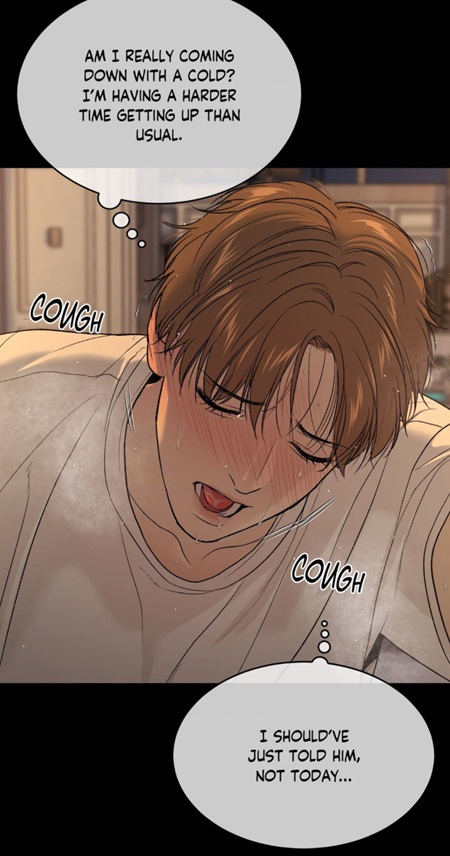 (chapter 61) that he must sacrifice his “needs” and identity to be accepted.
Yet in order to truly break Joo Jaekyung’s so-called “jinx”—which, as theorized, may stem from rigged matches and trauma masked by routine—the doctor’s hidden curse must be broken first. As long as Kim Dan sees himself as inherently unworthy and destined for abandonment, he will unconsciously reinforce a dynamic where emotional distance feels safe and predictable.
Chapter 44 shows the beginnings of intimacy (chapter 44), yet even then, it is expressed through regression. Kim Dan’s kisses are gentle, reminiscent of a child seeking comfort, not a lover expressing desire.  (chapter 66) Therefore it is not surprising that he laughes like a little child during that night.
  (Chapter 44) Chapter 66 represents its negative reflection, the emotional climax of this regression:
 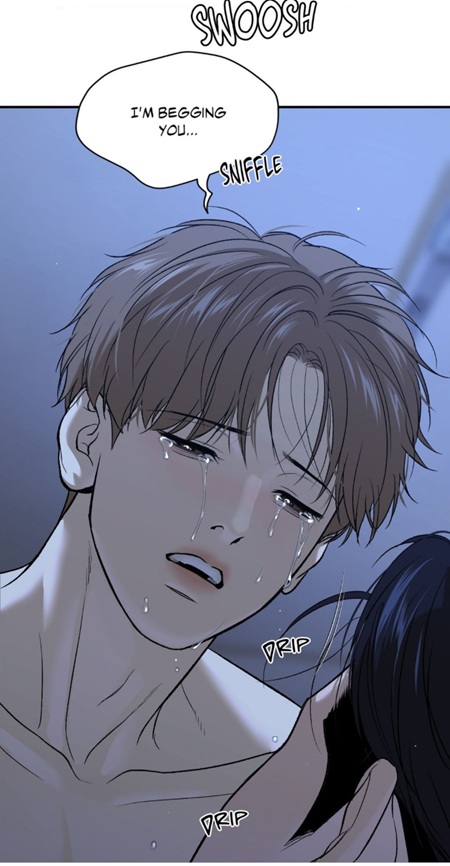 (chapter 66) he cries, begs,
 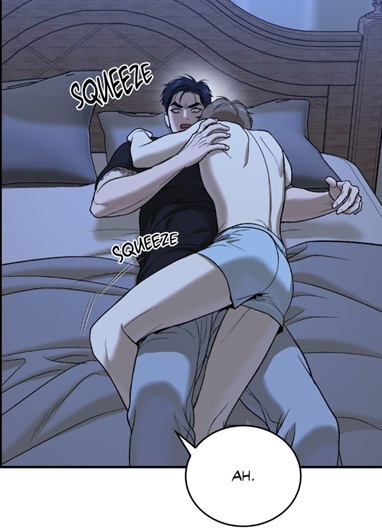 (chapter 66) holds on—“Don’t leave me.” (chapter 66) His squeezing fingers holding onto the athlete’s shirt
 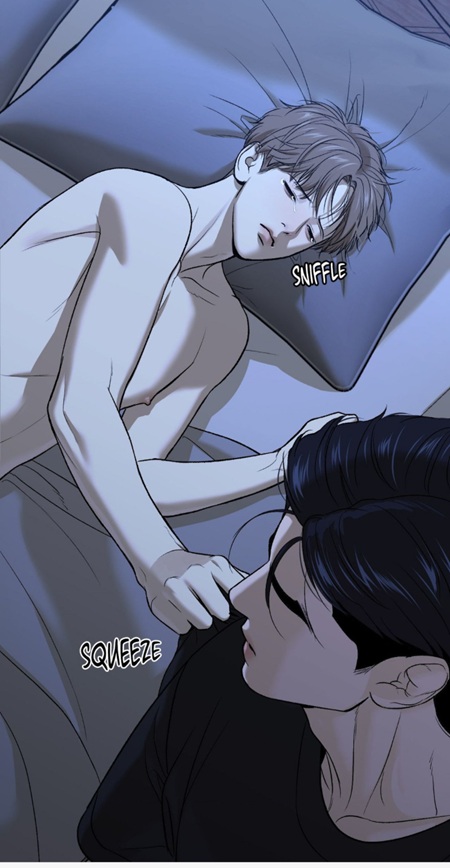 (chapter 66) and desperate pleas are not about romance—they’re about survival, longing and regret. Deep down, he wished, he had hold onto his “mother” in the past, stopped her from leaving him. Is it a coincidence that this gesture from that night mirrors the one during their first night? (chapter 2) And what had the protagonist said right after this gesture?
 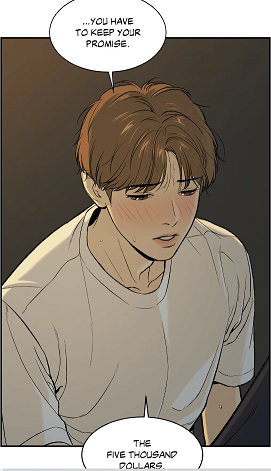 (chapter 2) He wanted the champion to keep his promise. From my point of view, the parent’s vanishing is strongly intertwined with a broken promise… And that’s exactly what the grandmother did to her own grandson: she didn’t keep her words either.
  (chapter 11)
  (chapter 53)
Then comes Chapter 67. Though no longer crying, he submits once more 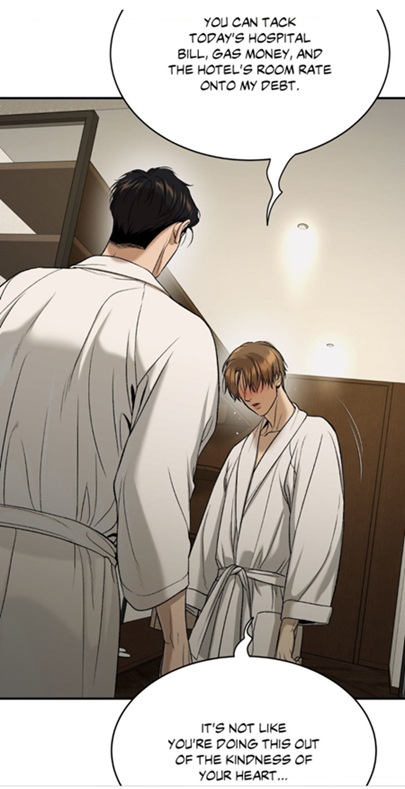 (chapter 67), but this time, with eerie detachment. He kneels before Joo Jaekyung like a servant, (chapter 67) asking for sex again. Yet the power dynamic is not as it seems. Though Kim Dan is physically lower, it is Joo Jaekyung who ultimately submits:
 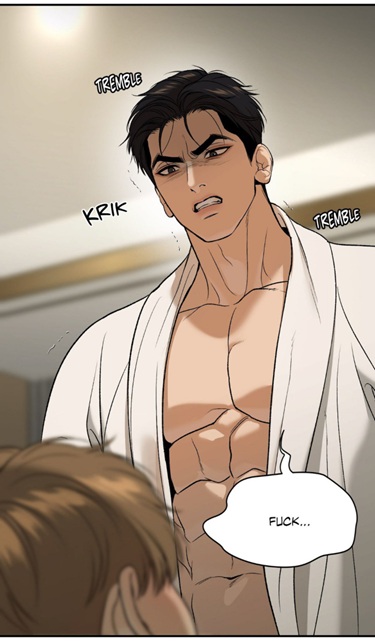 (chapter 67) his arousal betrays a loss of emotional control. Though he is on his knees, it is Joo Jaekyung who is emotionally yielding. His body betrays his composure, responding to Kim Dan’s touch and gaze. Kim Dan, watching the tremble in the fighter’s expression and the rising heat in his body, feels the shift. His soft blush is not simply one of affection or embarrassment—it’s a flicker of recognition.
 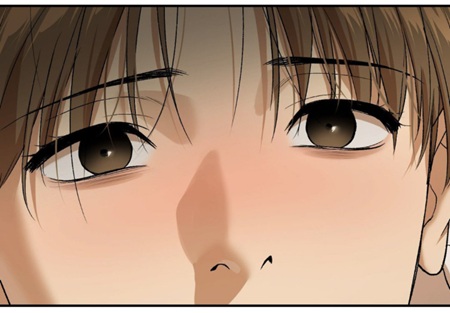 (chapter 67) He senses that the one usually in control is now unraveling. Appearances deceive: beneath this scene lies a quiet reversal of power. The blush on his cheeks is a trace of a brief moment of clarity: he sees that the person who once held all the control is now faltering.
Ultimately, this mirrors Chapter 2 once more. Back then, Kim Dan surrendered his body, believing it was his only tool for survival. But Chapter 66 reveals that even in moments of closeness 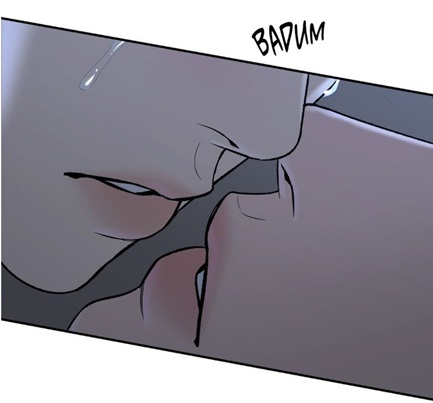 (chapter 66), his body is still a vessel for mourning. Hence there is no kiss during that blue night. Each night carries the residue of that first trauma: the night he was left alone. Whether his mother disappeared or passed away in the night, the result is the same—nighttime became synonymous with loss.
This is why he fears being alone after dark. This is why he clings to those who stay past midnight. And when Joo Jaekyung, the one person who broke that pattern, walked away, even briefly, it fractured him. 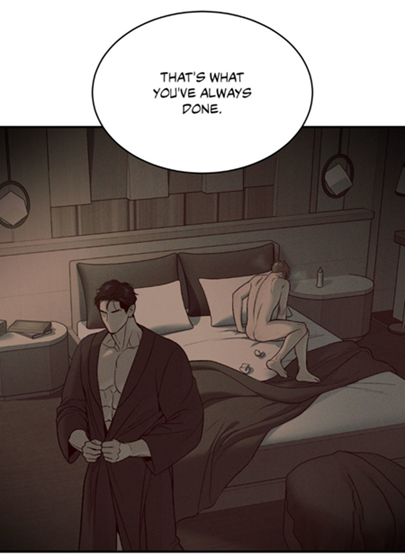 (chapter 63) His so-called jinx is not some irrational superstition. It’s a scar. It’s the quiet belief that the people he loves will vanish the moment he lets his guard down.
So while the champion’s jinx revolves around physical ritual and control, Kim Dan’s is rooted in emotional suppression and dread. Both stem from the same core wound: fear of abandonment.
But Chapter 67 deepens the tragedy: this time, he doesn’t just mourn: he gives in. The act is no longer about clinging to someone or begging them to stay. Instead, it is performed with emotional detachment, a mechanical reenactment of what once held meaning. His internal monologue (chapter 67) makes it clear: he isn’t trying to survive, he’s quietly unraveling. His decision to mix alcohol with medication is not rebellion  (chapter 67), it’s resignation. Hence he is not expecting to be cured with the pills. (chapter 67) Thus, chapter 67 reveals the darkest layer of his jinx: not fear of abandonment, but the numb certainty that love, safety, and home are illusions that always vanish with the night.
Observe the decoration on the wall: (chapter 67) It looks like the moon and Saturn are meeting each other. For me, the moon imagery in Chapter 67 is not accidental. Saturn, the planet of hardship and emotional lessons, casts its shadow over this night, mirroring the heavy atmosphere between them. When Kim Dan asks Joo Jaekyung if he brought him here out of concern, the champion remains silent—a silence louder than words. That silence is devastating. In that moment, Kim Dan’s deepest fear is realized: he is not loved, merely tolerated. And so, in an act of resignation rather than seduction,  (chapter 67) he offers sex to “settle up,” citing his own preparations like a transaction. (chapter 67) The room’s muted lighting and circular wall decor even evoke the image of an eclipse—as if the moon (emotion) is being overshadowed by Saturn (cold logic and debt). This alignment encapsulates the heart of the scene: vulnerability eclipsed by duty, affection swallowed by silence. That’s the reason why I can’t help myself thinking that Kim Dan might end up in the emergency room later. Besides, we never saw him eating before taking his pills: (chapter 67) while he drank alcohol with the medicine. (Chapter 67) Until now, the champion has a blind faith in drugs, just like the grandmother.
One of the most striking revelations is the emotional split between the protagonists. Joo Jaekyung acts like a child during the day 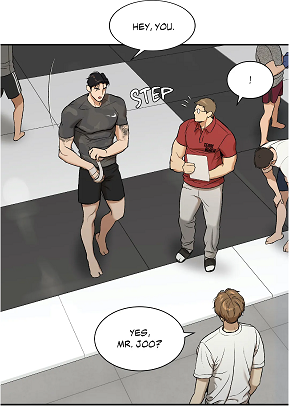 (chapter 7), while Kim Dan becomes a child during the night.
By day, Jaekyung seeks routine, praise, validation, and control. His outbursts, tantrums, and need for order mirror the emotional needs of a child. He’s the performer, the strongman, but behind that exterior lies someone seeking parental structure.
At night, Kim Dan’s walls crumble. His trauma surfaces. He cries, begs, trembles—not for pleasure, but out of fear. These breakdowns are not romantic; they’re regressive. And until these wounds are addressed, he can’t become the nurturing figure Jaekyung truly needs. This explicates why during the day, Kim Dan tries to act like an adult and rejected the champion‘s help.  (Chapter 66)
For their relationship to heal, Kim Dan’s nightmares must be addressed. Only then can he grow into the “motherly” role he’s beginning to fill during the day—someone who can offer stability, not just silent service. Until the end of season 1, his care was more rooted in duty, than real love and genuine concerns. He didn’t argue with the fighters 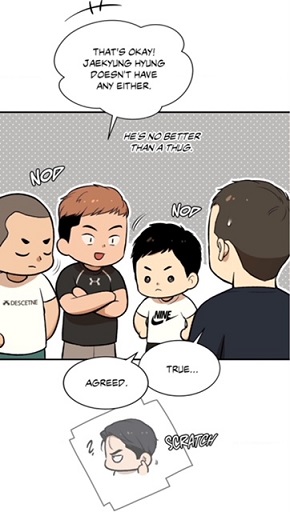 (chapter 47), when the “wolf” was portrayed as a thug, though the latter had assisted him on multiple occasions.
Now, the imminent death of the grandmother and the puppy bring everything back. Kim Dan isn’t just afraid of the future—he’s haunted by the past. Their death isn’t merely a loss—it’s a reawakening of everything he suppressed. The loneliness, the silence, the night—“It’s happening again.”
But this time, he’s not numb. He’s unraveling. His subconscious belief—the doctor’s secret jinx—is finally being revealed. He is destined to be abandoned… unless something breaks the cycle. It is clear that Joo Jaekyung will be that person, but this change is definitely linked to pain. In chapter 66, for the first time, the doctor’s jinx had a voice. And it sounds a lot like: “Please… don’t leave me.” The problem is that Joo Jaekyung chose to listen to Shin Okja, rather than talk to Kim Dan.
Feel free to comment. If you have any suggestion for topics or manhwas, feel free to ask. If you enjoyed reading it, retweet it or push the button like. My Reddit-Instagram-Twitter-Tumblr account is: @bebebisous33. Thanks for reading and for the support, particularly, I would like to thank all the new followers and people recommending my blog.

Please support the authors by reading Manhwas on the official websites. This is where you can read the Manhwa: Jinx But be aware that the Manhwa is a mature Yaoi, which means, it is about homosexuality with explicit scenes. Here is the link of the table of contents about Jinx. Here is the link where you can find the table of contents of analyzed Manhwas. Here are the links, if you are interested in the first work from Mingwa, BJ Alex, and the 2 previous essays about Jinx Wheels 🛞 and Waves 〰🌳 – p️art 2 (locked) and 𓇢𓆸 Prove Me Wrong Again 💢😂
It would be great if you could make some donations/sponsoring: Ko-fi.com/bebebisous33 That way, you can support me with “coffee” so that I have the energy to keep examining Manhwas. Besides, I need to cover up the expenses for this blog.

The recent developments in Jinx Chapters 65 and 66 provide a striking insight into the ongoing inner turmoil between Joo Jaekyung and Kim Dan. Many readers have long labeled Joo Jaekyung as a ‘red flag,’ and as such as a demon. Therefore when he used the idiom ‘defect,’  (chapter 66) they saw it as further confirmation of their perception—reinforcing the idea that he is terribly flawed. However, a deeper analysis suggests that this term reflects not just his character but also his evolving mindset and struggle with emotional vulnerability. This essay will explore the paradox at the heart of their dynamic—how both men refuse to acknowledge the emotional weight of their relationship, leading to a cycle of denial and misperception. It will examine how the concept of the jinx evolves, the continued influence of Park Namwook’s manipulations on Joo Jaekyung, and the role that mutual ingratitude plays in their emotional stagnation.
Initially, Joo Jaekyung’s jinx was a ritual designed to maintain control and secure victory. (chapter 2) This belief system dictated that, no matter what, he had to have sex with a man before every match—reinforcing the illusion that he could manipulate fate through repetition. The identity of his partner was irrelevant; what mattered was the act itself, which he perceived as a necessity rather than a choice. This routine provided him with a sense of control, but it also underscored a fundamental reliance on external factors rather than his own abilities. In Chapter 65, however, a subtle shift occurs. While the champion has not dropped his belief yet:  (chapter 65), the nature of his principle has changed:
  (chapter 65)The athlete is admitting his dependency on doc Dan. The jinx is now directly tied to Kim Dan, not just as a concept but as a tangible element of Joo Jaekyung’s career stability. The second switch is that sex is no longer a condition to ward off bad luck. In fact, the celebrity is recognizing the importance of his daily training and, as such, his hard work.
 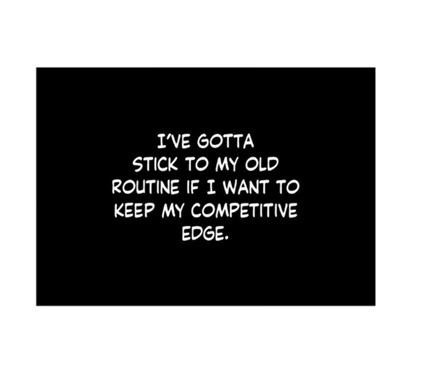 (chapter 65) The inner thoughts of the sportsman reveal that the champion is feeling less powerless than before. His champion status is no longer reliant on superstition but on tangible efforts—his “old routine” and, crucially, Kim Dan’s expertise as a physical therapist. This marks a significant transformation in his perception of Kim Dan, whom he now values for his professional skills rather than as a mere tool for maintaining a ritual. Thus, Joo Jaekyung should be less inclined to request Doc Dan’s sexual services. Then, in episode 66, a new change became visible. (chapter 66) The term defect emerges in his inner monologue, marking a transition from viewing the jinx as a form of dependency to seeing Kim Dan as someone in need of repair. This linguistic change is crucial—jinx implies something external, uncontrollable, and tied to fate, whereas defect introduces the notion of something that can be fixed or even improved.
Joo Jaekyung’s use of the term ‘defect’ stems from his deeply ingrained perception of both himself and others as products rather than individuals with intrinsic worth. Instead of saying that Kim Dan is ‘sick’ or struggling, he labels him as ‘defective,’ mirroring his own self-perception. The champion has long seen himself as nothing more than an athlete, a machine built for fighting—functional when at peak performance, broken when failing. This perception is reinforced by his manager, Park Namwook, who treats him as nothing more than an ATM  (chapter 11), a tool to generate money and maintain the gym’s reputation. Hence he blames him, when members leave the gym.
  (chapter 46) The manager used the incident with Seonho to justify the desertion of the other athletes. However, it is clear that some left the gym because they didn’t become successful like Joo Jaekyung. However, their lack of success is explained by their lack of talent
  (chapter 46) exposing the lack of ambition and commitment from the two hyungs. It is clear that Joo Jaekyung’s wealth and fame was used to attract the sportsmen creating a myth that they could experience the same success. Nevertheless, as time passed on, the fighters were confronted with reality. It was, as if the athlete’s achievement had become a curse for Team Black. Nonetheless, neither the manager nor the coach can admit it, the champion’s bad temper is utilized to cover the mismanagement within the gym. Striking is that by portraying the protagonist as a person with a bad temper and personality
  , (chapter 9) the manager and his colleague described their boss as defective. The contrast between Joo Jaekyung’s perception of ‘defect’ and the coach’s view of him as a ‘maniac’ is particularly telling. When the protagonist refers to Kim Dan as having a defect, there is an implicit acknowledgment that something can be repaired or improved. In contrast, Park Namwook’s statement about ‘handling that maniac’ suggests that the star is beyond fixing—someone who must be tolerated and controlled rather than understood or helped. This fundamental difference in perspective reveals how deeply the manager has shaped the champion’s self-perception, reinforcing the idea that he is nothing more than a force to be managed rather than a person who can change or grow.
Ironically, (chapter 11) Joo Jaekyung once accused Kim Dan of seeing him as an ATM back in Chapter 11, but in reality, it is his manager who exploits him as a financial asset rather than recognizing his humanity. Hence he wants him to return to the ring as soon as possible.  (chapter 54)
Under this new light, Jinx-philes can grasp why the “demon” (chapter 66) refers to Kim Dan’s condition as a ‘defect’ rather than acknowledging that the doctor is unwell. In doing so, he mirrors how he has been conditioned to see himself—not as a person who can be sick or in need of help, but as something that must either function or be discarded. The paradox is that without him, the gym can no longer attract members, hence Team Black would be forced to close its doors. That’s the reason why the manager is inciting the athlete to return to the gym.  (chapter 66) His presence is necessary to maintain the “myth” alive.
But let’s return our attention to the fighter. (chapter 66) Notice that the champion doesn’t say that Kim Dan is sick or suffering from sleeping problems. His words expose that Joo Jaekyung still views life through the lens of having rather than being, seeing both himself and others as assets to be maintained rather than individuals with intrinsic worth. Furthermore, this label is deeply connected to Kim Dan’s own sleeping problems, which mirror Joo Jaekyung’s insomnia.
By recognizing a flaw in Kim Dan, he unconsciously acknowledges his own suffering without explicitly confronting it. Therefore he is accompanying the protagonist to the sleep specialist. 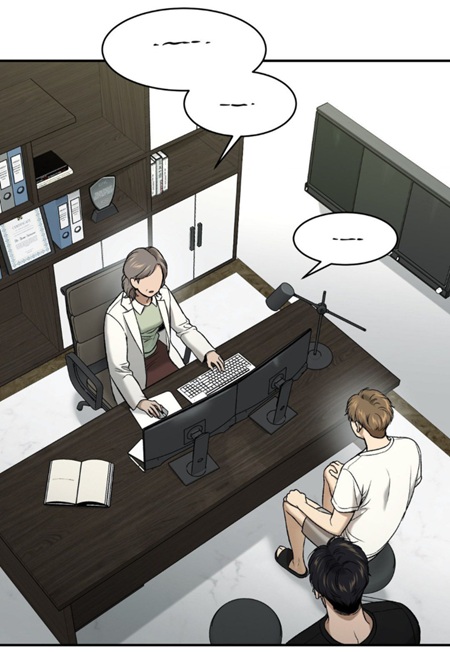 (chapter 66) In calling Kim Dan ‘defect,’ Joo Jaekyung is unknowingly projecting his own self-perception onto him. The term suggests something broken but also something that can be repaired, reflecting an unconscious shift in his perspective. Instead of simply using Kim Dan as part of a superstition, he is beginning to see his vulnerability, perhaps even recognizing a parallel to his own struggles. His choice of words also reveals his deeply ingrained belief in self-reliance. (chapter 66) Kim Dan’s nighttime distress contradicts this principle, as it suggests an inability to be alone. This mirrors Joo Jaekyung’s own realization in the garden (chapter 65), where he admitted to himself that he was no longer entirely self-reliant. By calling Kim Dan ‘defect,’ he not only acknowledges the therapist’s struggles but also his own growing dependency on him—though he remains unwilling to fully confront it.
This shift is significant because it alludes that Joo Jaekyung is beginning to see himself as capable of affecting change. For someone conditioned to endure suffering without seeking help, viewing another person as defective paradoxically offers him a sense of power and responsibility. (chapter 66) Hence it is no coincidence that he chose to bring himself the “hamster” to the hospital.  (chapter 66) Nevertheless, the idiom (“he’s got a defect”) reveal that Joo Jaekyung is still under the manager’s influence. This means that this shift is not immediate or conscious; it is restrained by his continued loyalty to Park Namwook and his ingrained avoidance of emotional vulnerability.
Striking is that in season 2, the champion is almost never seen with the other members from Team Black. 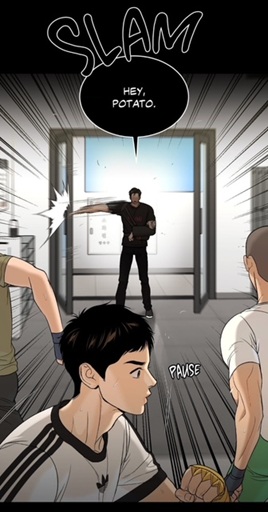 (chapter 60) This scene represents the exception. For the most part of the time, the star only visited the gym because Park Namwook had contacted him.
 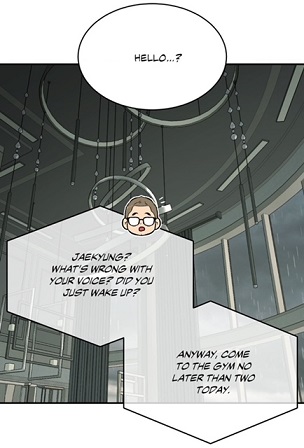 (chapter 54)
  (chapter 66) Striking is that by each meeting, the champion was alone with the manager. The latter was no longer followed by coach Yosep. It was, as if Park Namwook wanted to have some privacy with the celebrity. However, through this contrast, Jinx-lovers can detect a certain MO from the manager: he is isolating the champion, limiting his interactions with other members. This explicates why he remains a pivotal force in Joo Jaekyung’s stagnation.
A clear example of Park Namwook’s manipulative tendencies emerges in his interactions with Joo Jaekyung in Chapter 66. He subtly pressures the champion to return to the gym by implying that his current behavior—isolating himself—is not normal. 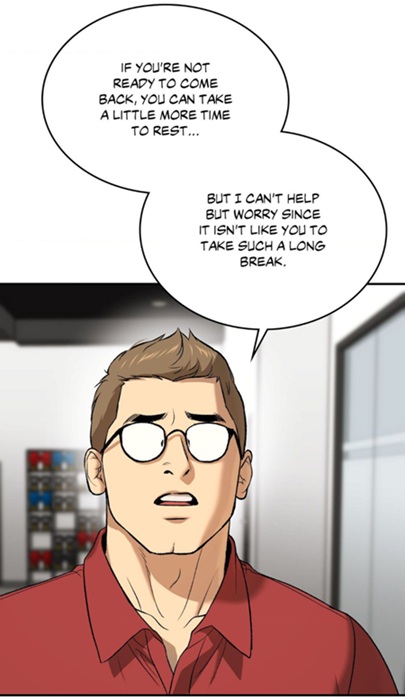 (chapter 66) Yet, just moments later, he tells him that he can take more time to rest, as if feigning concern. This contradiction is striking because it exposes his underlying agenda: he wants Joo Jaekyung back in the gym but doesn’t want to appear forceful. Instead, he makes it seem like Joo Jaekyung is the one making the decision, fostering guilt by implying that his long absence is unnatural.
What makes this irony even more apparent is that Park Namwook has, in the past, dismissed Joo Jaekyung as a ‘spoiled child with a bad temper.’  (chapter 52) His sudden shift—acting as though the champion is no longer himself—reveals his inconsistency. When Joo Jaekyung was compliant, he was simply a reckless athlete with an attitude. Now that he is exhibiting autonomy, Park Namwook implies that something is wrong with him. It was, as though he was missing the old version of the champion. 😂 But this is what he complained about him in the past: he was a workaholic!
  (chapter 27) This double standard highlights Park Namwook’s true role: he is not a supportive figure but a handler, ensuring that Joo Jaekyung remains under control and fulfilling his duties as a fighter. His words are not meant to provide genuine support but to keep Joo Jaekyung tethered to a system where his worth is defined solely by his success in the ring.
His subtle manipulations ensure that Joo Jaekyung remains dependent on his management, discouraging emotional entanglements that might threaten his control. This is evident in the way he frames Joo Jaekyung’s return to training in Chapter 66, focusing on ensuring compliance rather than addressing the champion’s personal struggles. (chapter 66) Park Namwook ensures that Joo Jaekyung remains confined within the narrow definition of an athlete whose sole purpose is to generate victories and revenue. By subtly invalidating the fighter’s autonomy, he fosters a cycle of dependency, discouraging any form of emotional connection or self-reflection that might lead Joo Jaekyung to question his control. The manager’s contradictions—both urging him to take his time yet implying his behavior is unnatural—serve to reinforce this conditioning, ensuring that the champion remains locked in a pattern of obligation rather than self-discovery. In doing so, Park Namwook not only suppresses Joo Jaekyung’s potential for growth but also reinforces the deeply ingrained perception that his worth is conditional and transactional.
His tactics extend beyond mere coaching—he controls information, as seen in his omission of lost sponsorships  (chapter 54) or (un)favorable interviews about the athlete.
  (chapter 54)
  (Chapter 57) As a manager, Park Namwook’s role involves overseeing Joo Jaekyung’s career, securing contracts, and ensuring his reputation remains intact. Yet, as seen in Chapter 66, his actual concerns seem remarkably narrow in scope. (chapter 66) When speaking to Joo Jaekyung, Park Namwook focuses exclusively on the gym—as if the athlete were merely a member rather than the actual owner. This detail is particularly ironic, as it reveals that the man with the glasses sees himself as the one in charge, entitled to dictate Joo Jaekyung’s movements and decisions. His fixation on the gym exposes why he shows no interest in other crucial aspects of the champion’s career, such as contracts, endorsements, or emotional and physical recovery. His management is driven not by genuine concern for the fighter’s well-being, but by a desire to uphold the gym’s operation and reinforce his perceived authority within it. To conclude, his true motivation lies in preserving the gym’s function and image, treating Joo Jaekyung as a means to that end rather than supporting him as a multidimensional individual with emotional and professional needs. That’s the reason why he shows no curiosity about his star’s private life: “I don’t know what you’ve been up to lately”. (chapter 66)
Because his failure to reveal lost sponsorships and unfavorable interviews in Season 2 suggests a pattern of withholding critical information, I couldn’t help myself thinking to see as another clue that his omission extends to the fateful meeting between Choi Gilseok and Kim Dan, which took place in front of “HIS” gym!  (chapter 48) Back then, there was a witness, Kwak Junbeom and the latter could have reported to the “hyung”. These incidents indicate a consistent effort to control what the champion knows, raising the critical question: why?? His silence on this matter suggests not only a strategic decision to keep the star uninformed, but also an attempt to avoid responsibility. The supervisor often hesitates to make decisive choices
 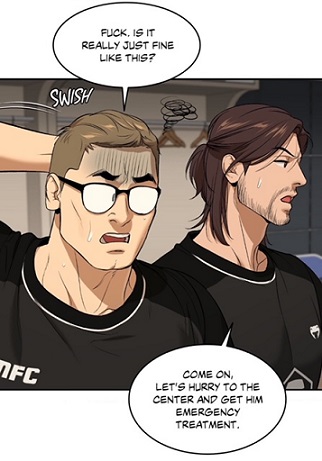 (chapter 50), preferring instead to remain passive so that any negative outcomes can be blamed on the champion. At the same time, this passivity helps him maintain control—as if Joo Jaekyung, without his guidance, would be left ‘alone’ and directionless. In this way, the man with the glasses sustains a dynamic in which the champion feels dependent on his presence, even as he is subtly undermined. By neglecting to inform him of these events, Park Namwook ensures that the champion remains unaware of external factors that could influence his choices. This pattern reinforces the possibility that Park Namwook was aware of the meeting with Choi Gilseok and deliberately ignored it, likely expecting that Joo Jaekyung would take care of it, while absolving himself of responsibility.
Park Namwook’s motivations become clearer when viewed through this lens. In his eyes, Joo Jaekyung is now physically perfect (chapter 66) —his shoulder has healed, and he should be able to return to the ring. However, at the same time, he regards him as defective (chapter 66) because he no longer displays the same single-minded devotion to fighting. Joo Jaekyung’s emotional distance from the gym and his growing attachment to Kim Dan mark a transformation that the manager interprets as a threat. Instead of embracing this evolution, the “supervisor” views it as a flaw—proof that the champion is no longer operating under the selfish, work-driven mindset he once encouraged. This contradiction reflects the “hyung”’s twisted priorities: he sees the gym as the center of value and promotes an ideology of workaholism, selfishness, and emotional suppression. Since he has no one by his side, he should come to the gym, as if he would nurture relationships there. To him, the ideal fighter is one who exists solely for the ring, forgoing connection or personal growth. In that sense, the protagonist becomes the Perfect Defect—flawless in form but, in Park Namwook’s eyes, failing in function by daring to become more human. The manager’s repeated emphasis on the gym reveals his narrow view of the champion’s purpose, treating him as a member rather than the rightful owner. This misperception reflects Park Namwook’s deeper worldview: he represents workaholism, selfishness, and greed, believing that the only acceptable behavior is unwavering devotion to the gym and career success.
Despite these moments of introspection (chapter 65), the “wolf” does not immediately alter his behavior. 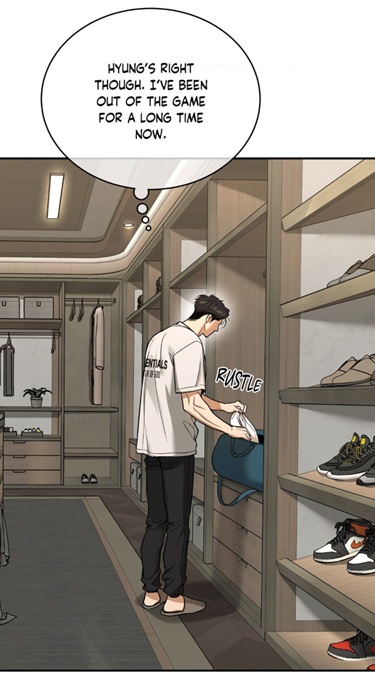 (chapter 66) This hesitation stems from deeply ingrained beliefs about relationships and fidelity. His loyalty to Park Namwook prevents him from fully confronting the possibility that his manager may not have his best interests at heart. Moreover, his own emotional repression makes it difficult for him to recognize his evolving dependency on Kim Dan as something beyond physical necessity.
But there exists another reason for his slow transformation, the influence of the location. Notice that he agreed to his hyung’s statement, when he was in the penthouse. The latter stands for civilization and as such “corruption”. Thus I came to the following interpretation. The penthouse represents the manager’s power over the champion, which explicates why Oh Daehyun and the other fighters spoke about that place in admiration in front of their coach. 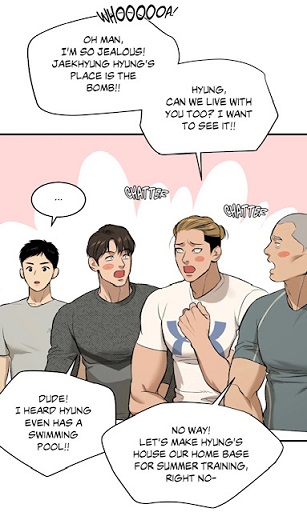 (chapter 22) They had heard about his place, for the manager must have talked about it. The protagonist is not someone who will talk about his private life to others. The manager must have dangled promises in front of them, making them believe that if they’re lucky enough, they too could live like the champion. However, their reactions reveal something crucial—they are not motivated by greed but by genuine admiration. They simply want to experience the luxury once in a while, reinforcing that their bond with Joo Jaekyung is rooted in camaraderie rather than material envy. This further highlights the contrast between Park Namwook’s manipulation and the sincere regard his teammates have for him. This scene is important, because it exposes the manager’s prejudices and lack of discernment.
  (chapter 46) Not everyone is the same and more importantly like him! It is clear that the man is projecting his own principles onto others and in particular onto the champion.
His reluctance is further reinforced by the lack of validation from Kim Dan.  (chapter 66) Neither of them fully understands how to acknowledge care or support. Just as Joo Jaekyung struggles to recognize his actions as stemming from concern
 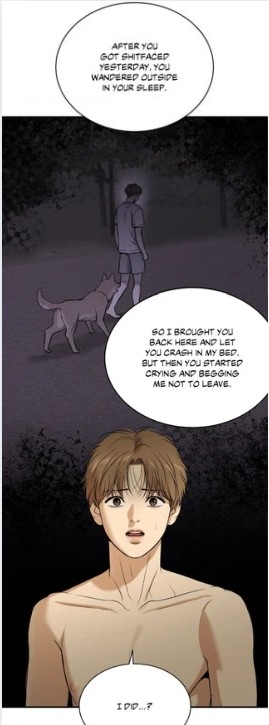 (chapter 66) rather than routine, Kim Dan fails to see Joo Jaekyung’s interventions as genuine help. This mutual misunderstanding deepens the emotional rift between them, ensuring that both remain trapped in their own perceptions of obligation rather than connection. In Chapter 66, he openly expresses frustration, stating,
 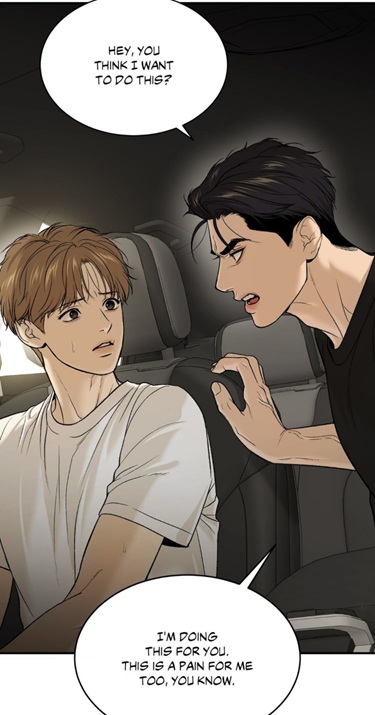 (chapter 66). This moment highlights a rare glimpse of honesty: he is not acting purely out of self-interest, but he frames it as an obligation rather than a choice. From my point of view, such a statement could only reach the physical therapist’s mind, for in the latter’s eyes, the champion has always been a “demon”: self-centered and inconsiderate. Observe the absence of reply from the “hamster”. He couldn’t contradict the star, as the latter was using this negative image: bad tempered and selfish.
Mingwa has long associated doc Dan with an angel. . The reason is simple. He was portrayed as someone who would do favors to people constantly: his grandmother 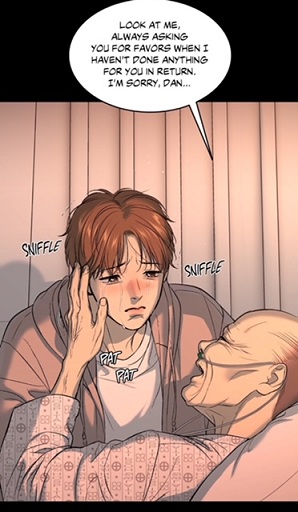 (chapter 53), the manager (chapter 9), the fighters
  (chapter 7) and even Choi Heesung. Hence the latter called him like that:
 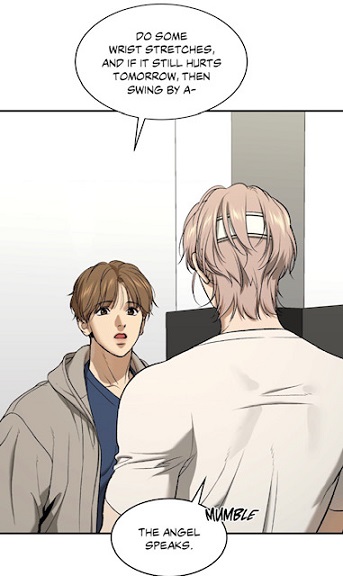 (chapter 30) Kim Dan’s perception of himself as an “angel” has long shaped the way he interprets his relationship with Joo Jaekyung. Reinforced by his upbringing and Park Namwook’s subtle manipulation
 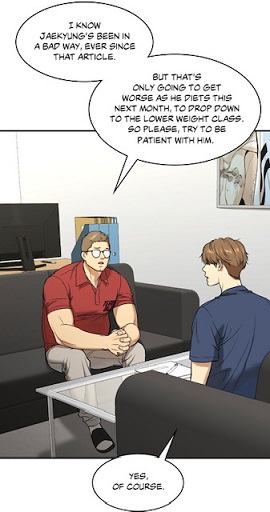 (chapter 36), he has unconsciously placed himself in a position of moral superiority. He is the patient, understanding figure, while Joo Jaekyung, in contrast, is violent
  (chapter 1), selfish, and emotionally stunted. However, this self-perception is deeply flawed. By believing himself to be inherently better
  (chapter 64) than the champion, Kim Dan avoids confronting his own emotional repression, his weaknesses, and his own form of “defectiveness.” He fails to see that he is just as human—just as fragile—as the man he silently judges.
 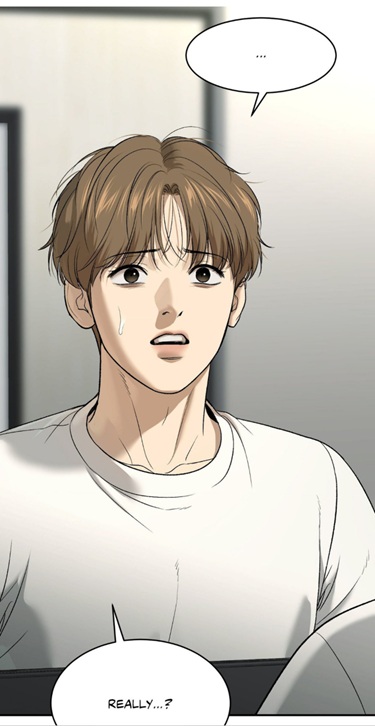 (chapter 66) The expression “Really…?” is not just about disbelief but also about a moment of confrontation with reality. Up until this point, Kim Dan has been dismissing his own suffering, suppressing his struggles, and functioning on autopilot. However, hearing a professional confirm that he is indeed sick forces him to acknowledge what he has been denying.
The word “really” acts as a bridge between doubt and acceptance, signaling that reality is crashing down on him. This corresponds to the downfall of an angel. He can no longer minimize or rationalize his exhaustion as something temporary—it’s a legitimate condition, one that requires attention. This realization is significant because it directly challenges his self-perception. He has always seen himself as someone who must endure, someone who cannot afford to be weak. But now, he is faced with undeniable evidence that he is not just tired—he is unwell.
This moment marks a turning point, where the truth of his condition is no longer something he can push aside. So far, he has always dismissed the champion’s remarks as “lies”:  (chapter 60) or exaggerations.
 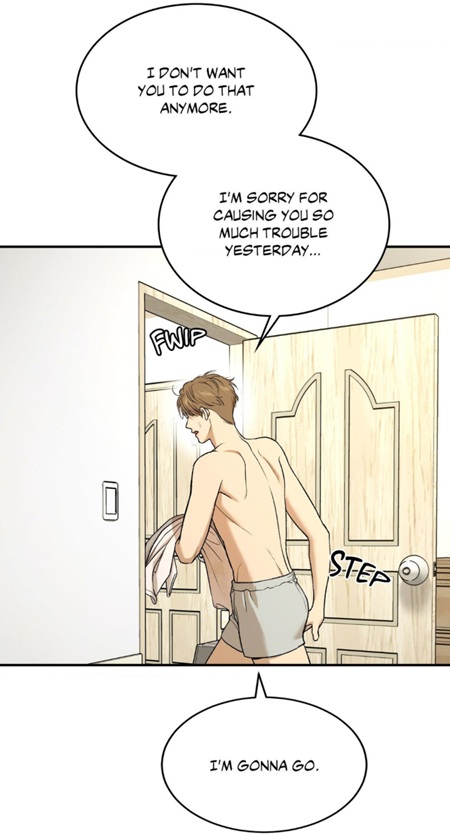 (chapter 66) It also forces him to consider that others—especially Joo Jaekyung—were right to be concerned, which in turn may lead to a shift in his perception of the champion’s actions.
Furthermore, Kim Dan grew up in an environment where repressing his desires was not just expected but necessary for survival. He was conditioned to associate sex 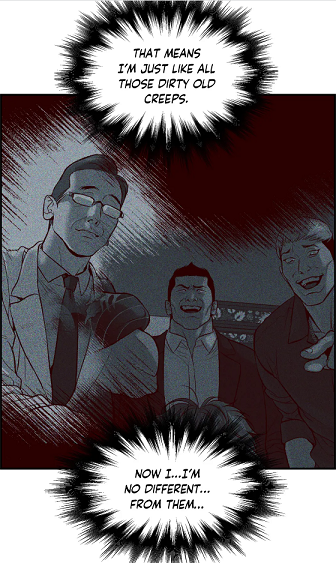 (chapter 20) with shame, something impure that should be avoided or hidden. This internalized belief made it difficult for him to separate his own experiences from moral judgment. When he encountered the champion —who treated sex as nothing more than a professional ritual (chapter 2)—this stark contrast reinforced his existing worldview. He saw the celebrity as reckless, immoral, and impulsive, someone who lacked restraint and viewed intimacy as just another means to an end. In contrast, Kim Dan unconsciously positioned himself as purer—someone who was above such base instincts.
However, this sense of superiority is deeply paradoxical. While he judged Joo Jaekyung for his behavior, he was also the one who allowed himself to be drawn into the transactional dynamic without resisting it. Instead of questioning or confronting the situation, he passively accepted it, reinforcing his own role within the dynamic. His moral disdain for Joo Jaekyung did not stop him from complying with the athlete’s demands. This contradiction highlights Kim Dan’s deeper struggle: he is caught between his ingrained judgment and his own passivity. He wants to believe he is different from Joo Jaekyung, yet his actions—or lack thereof—suggest otherwise. This explicates why he is projecting his own behavior onto the athlete’s: 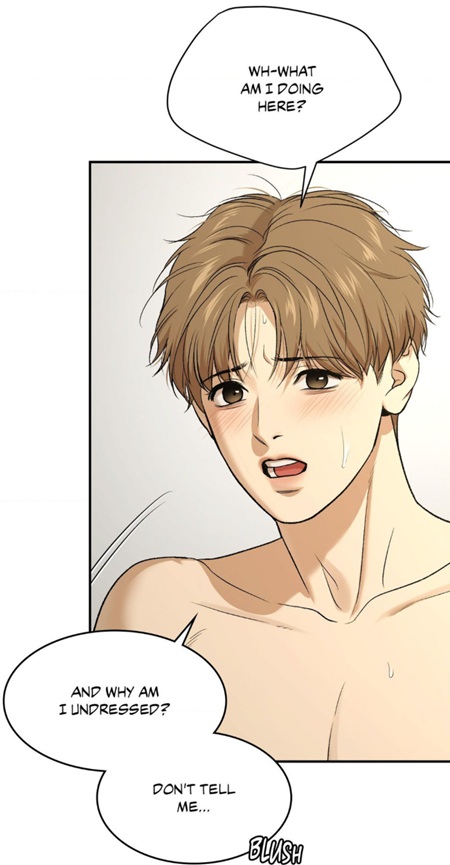 (chapter 66) He assumed once again that the star had taken advantage of his “drunkenness”, something Kim Dan had done himself in the past.
This internal conflict plays a crucial role in why he struggles to acknowledge the changes in Joo Jaekyung’s behavior. If he were to admit that the champion is not just a brute, that he is capable of genuine concern, it would force him to reconsider his own beliefs—not just about Joo Jaekyung, but about himself. To do so, however, means dismantling the rigid perception of morality and purity he has clung to for so long. Until Kim Dan comes to terms with his own contradictions, he will continue to misunderstand Joo Jaekyung’s intentions, keeping them both trapped in a cycle of mutual misperception.
Mingwa has frequently associated Kim Dan with angelic imagery, but this serves as a double-edged sword. While it elevates him in the eyes of others, it also creates a psychological barrier that prevents him from recognizing his own suffering. His insomnia, his malnutrition, his growing depression—these are all things he ignores or downplays (chapter 66), even as they take a visible toll on his body. If he were to acknowledge his own vulnerabilities, he would have to admit that he is not above needing help, something he has spent his entire life avoiding. Instead, he clings to the idea that he must endure in silence, reinforcing the very behaviors that keep him trapped in a cycle of self-neglect.
This ties directly into the slow transformation of both characters. The angel needs to be reminded of his own true nature: he is human, and like any human, he can get sick, he can struggle, and he can fail. On the other hand, the champion, who has long internalized to see people through the lens of function and utility, has to recognize that being “defective” can represent a source of strength. So far, for him defect meant being worthless. Their reluctance to break away from these ingrained perceptions of themselves is precisely what keeps them at odds. Kim Dan resents Joo Jaekyung for his supposed lack of morality, yet he does not realize that his own self-righteousness blinds him to the reality of their relationship. Likewise, Joo Jaekyung, having always been valued for his physicality rather than his emotions, fails to grasp that true strength lies in acknowledging weakness—not erasing it.
This is why their transformations are not immediate. Their beliefs have been deeply ingrained through years of conditioning, and it takes more than a few interactions to dismantle them. Imagine this: a demon speaking to an angel, it perfectly encapsulates why they struggle to find common ground. Their fundamental worldviews have been shaped by entirely different environments—Kim Dan, who has been conditioned to suppress his desires and associate sex with shame, and Joo Jaekyung, who treats it as a necessity detached from emotion. This contrast creates a deep chasm between them, where one views the other as morally inferior, while the other sees emotional attachment as unnecessary or even a weakness.
Yet, the only place they can truly meet is Earth—neutral ground where neither absolute morality (Heaven) nor pure instinct (Hell) dictates their actions. And that would be the little town on the coast. (chapter 65) Symbolically, this reflects their respective journeys. The demon (Joo Jaekyung) is slowly leaving the underworld of detachment and blind routine, stepping toward vulnerability. Meanwhile, the angel (Kim Dan) is descending from his idealized, self-righteous perception of himself, recognizing his own flaws, desires, and limitations. Both must step away from their extremes—Kim Dan from his unconscious moral superiority and passive victimhood, and Joo Jaekyung from his emotional repression and transactional mindset.
Until they meet in the middle—on Earth, where human connection, vulnerability, and compromise exist—they will continue to misunderstand each other. Their so-called defects are what ultimately bind them together, but until they acknowledge them, they will remain locked in their cycle of denial and emotional stagnation. Kim Dan must first recognize that his suffering is valid, that he is not above pain, and that needing help does not make him weak. Likewise, Joo Jaekyung must learn that genuine care is not a transaction, nor is vulnerability a flaw. Until both confront these truths, they will continue to misunderstand each other, pushing one another away even as they inch closer to genuine connection.
The absence of gratitude on both sides serves as the linchpin of their emotional stalemate. Joo Jaekyung, for all his power and success, has never been properly acknowledged outside of his career achievements 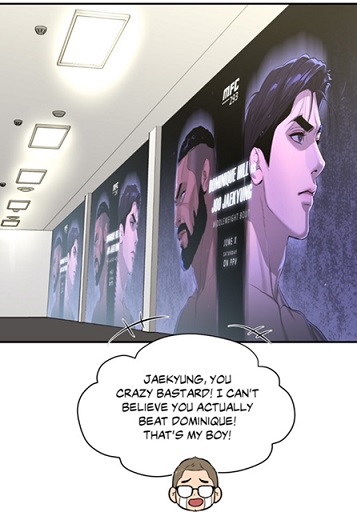 (chapter 40) , while Kim Dan, conditioned by years of emotional neglect, sees gratitude as a transactional exchange rather than an expression of genuine appreciation. (chapter This creates a vicious cycle—Joo Jaekyung continues to view Kim Dan as a ‘defect’
  (chapter 66) because Kim Dan does not recognize his efforts, while Kim Dan cannot see past his own survival instincts to notice that Joo Jaekyung’s actions are slowly shifting from obligation to care. Kim Dan, conditioned by years of neglect and survival-driven thinking, does not see Joo Jaekyung’s actions as genuine care. (chapter 66) He assumes everything comes with a price, failing to recognize moments where Joo Jaekyung acts beyond obligation.
Conversely, Joo Jaekyung, still in denial about his emotional investment, refuses to acknowledge any deeper attachment to Kim Dan. (chapter 66) And now, you comprehend why the champion employed the idiom “defect”. As long as Kim Dan does not express gratitude, Joo Jaekyung can continue convincing himself that his actions are dictated by habit or self-interest rather than care. Their inability to recognize and articulate their changing dynamic keeps them locked in a cycle of emotional detachment. Nevertheless, it becomes clear that this vicious cycle will stop, as now these two men are little by little influenced by the nice landlord: 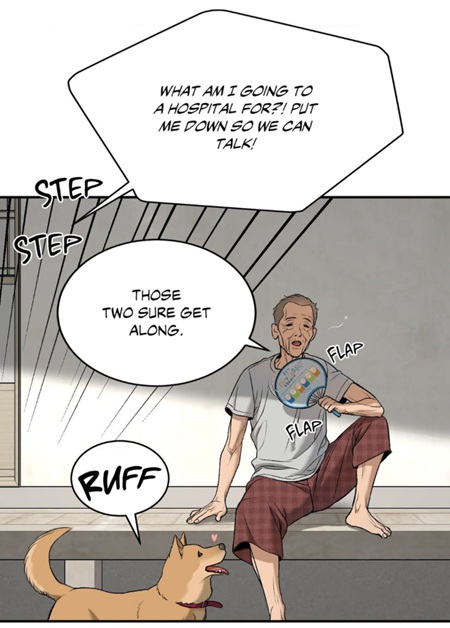 (chapter 66) And the latter can see beyond the appearances.
In the end, the irony is that both characters see the other as defective in some way—Kim Dan as someone who is broken and in need of fixing, and Joo Jaekyung as someone incapable of expressing genuine care. Yet, it is precisely their emotional shortcomings that make them a perfect mirror for each other. The evolution of the jinx into defect signals an impending shift, but until gratitude is exchanged—until one of them acknowledges the other’s role in their life—the cycle will persist. As long as Kim Dan remains emotionally detached, Joo Jaekyung will continue denying his own feelings, making them each other’s Perfect Defect.
Feel free to comment. If you have any suggestion for topics or manhwas, feel free to ask. If you enjoyed reading it, retweet it or push the button like. My Reddit-Instagram-Twitter-Tumblr account is: @bebebisous33. Thanks for reading and for the support, particularly, I would like to thank all the new followers and people recommending my blog.

Please support the authors by reading Manhwas on the official websites. This is where you can read the Manhwa: Jinx But be aware that the Manhwa is a mature Yaoi, which means, it is about homosexuality with explicit scenes. Here is the link of the table of contents about Jinx. Here is the link where you can find the table of contents of analyzed Manhwas. Here are the links, if you are interested in the first work from Mingwa, BJ Alex, and the 2 previous essays about Jinx Wheels 🛞 and Waves 🌊〰 -part 1 and Wheels 🛞 and Waves 〰🌳 – p️art 2 (locked)
It would be great if you could make some donations/sponsoring: Ko-fi.com/bebebisous33 That way, you can support me with “coffee” so that I have the energy to keep examining Manhwas. Besides, I need to cover up the expenses for this blog.

When you look at the illustration, your eyes are immediately drawn to the broken mirror at its center. As you can imagine, the cracked reflection, fragmented and distorted, is essentially referring to our protagonist Kim Dan. The broken mirror echoes Kim Dan’s shattered self-esteem. It is a visual representation of his inner dialogue: the doubts, fears, and insecurities that have long dictated his life. His reluctance to assert himself  (chapter 36), his tendency to retreat rather than challenge his own doubts
 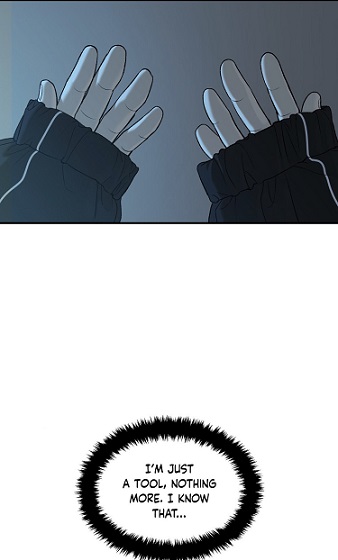 (chapter 36), and his overwhelming fear of disappointing others
  (chapter 51) are all reflections of these internalized obstacles. Recognizing them as external impositions rather than intrinsic truths is the first step to breaking free. That’s the reason why in the reflection of the broken mirror, you can detect an open window in the background. By focusing too much on his reflection, the physical therapist is trapped in his own negative world. One could perceive it as the opposite version of Narcissus. Yet rather than falling in love with his image, he sees only his flaws, reinforcing his belief that he is unworthy. The open window suggests an escape, a possibility for change, but the problem is that the main lead is too fixated on his shattered self-perception to pay attention to his surroundings. Hence he comes to neglect his own body and people next to him.
The mental obstacles we impose upon ourselves can be some of the most difficult to overcome. In the article “The mental obstacles you put on yourself to stop moving forward” Jennifer Delgado explains that these barriers often originate from the voices of significant figures in our past. They can be parents, teachers, or even childhood bullies who shaped how we see ourselves.
‘If you pay attention to some of the phrases you say to yourself when this inner dialogue is triggered, you will realize that these phrases do not belong to you and, if you look into your past, you will find their true owner. Quoted from The mental obstacles you put on yourself to stop moving forward”
Kim Dan’s struggles reflect this reality, just as Joo Jaekyung’s nightmare  (chapter 54) suggests he too is haunted by such internalized voices. Under this new light, you comprehend why I wrote in the introduction that the broken mirror was mostly alluding to the doctor. Both protagonists are suffering from mental hurdles, trapped in a psychological prison. The significant difference is that while Kim Dan is consciously recognizing his self-doubt
  (chapter 62), Joo Jaekyung does not. The evidence for this interpretation is the champion’s nightmare: (chapter 54) Instead of realizing the words stem from an external source, an abuser from his past, he sees them as a reflection of his own fears and inadequacies. This explicates why he chose to drink. This terrible vision illustrates how internalized criticism functions: it feels personal, nonetheless its origins lie in past experiences. Both Kim Dan and Joo Jaekyung are trapped in cycles of learned helplessness, shaped by voices that do not truly belong to them. Their self-doubt was not inherent; it was shaped by the expectations and criticisms of those around them. Striking is that Mingwa let us see how these mental obstacles are born. Observe that
  (chapter 18) the doctor (chapter 36) repeated the exact same words than his boss. This means that , the doctor internalized these limiting beliefs, thinking that he was not in a position to speak up or assert himself. This explicates why he had to convince himself that he was just a tool to the athlete. This explicates why at the end, he returned the champion’s jacket. The athlete never recognized him as a stan either. Simultaneously, the athlete was also the physical therapist’s emancipator, because he encouraged him to improve his skills and knowledge
  (chapter 25) Therefore the physical therapist bought books. Moreover, we should consider this argument
  (chapter 45) as a revocation of the star’s statement in episode 18. Kim Dan was no longer perceived as a tool, but as a real physical therapist. On the one hand, this request boosted the “angel’s ego”, on the other hand, he was put under immense pressure, for he was compared to his colleagues.
 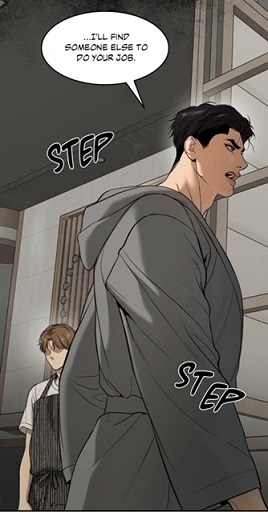 (chapter 45) Since in Seoul, Kim Dan has only been hired because of sex (Joo Jaekyung, the perverted hospital director) (chapter 6), he came to accept that he was not truly talented. The champion had no trust in him and later, the word jinx triggered a repressed bad memory.
  (chapter 62) Due to his bad past experiences, he concluded deep down that his CV was not reflecting the truth.
 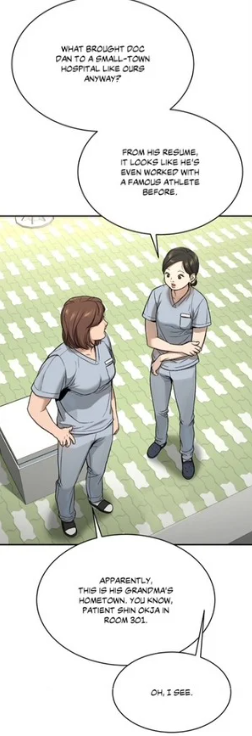 (chapter 56) That’s the reason why he was devaluing himself and as such not looking for a high position.
In her article, the psychologist outlines three primary mental barriers that keep individuals from moving forward:
Striking is that in season 1, we could detect these three mental obstacles in the physical therapist’s life.
His unwillingness to defy Joo Jaekyung’s dismissal in episode 48  (chapter 48) exemplifies this pattern:
  (chapter 48) It was not the right time. He assumed his voice held no weight, reflecting years of learned helplessness. It shows how Kim Dan internalizes responsibility for things beyond his control. He thinks that withholding information is an act of protection rather than avoidance. Yet in doing so, he denies himself agency in his own life.
This aligns with Delgado’s argument—these limiting beliefs were not inherent truths but external influences that he internalized, preventing him from asserting himself. Thus I deduce that Kim Dan has unknowingly adopted his grandmother’s behavior—withholding information under the justification of “protecting” others. Therefore it is not astonishing that her grandson treated her the same way. He already concealed many things from her in order to protect her, and she was his only role model. Just as she concealed things from him (like her true feelings, the absence of the parents or even the way she spoke about him behind his back), Kim Dan did the same to Joo Jaekyung in episode 48. His rationale in this scene mirrors her method of control through omission.
Season two of Jinx only intensifies these self-imposed constraints. I noticed that the switched spray incident 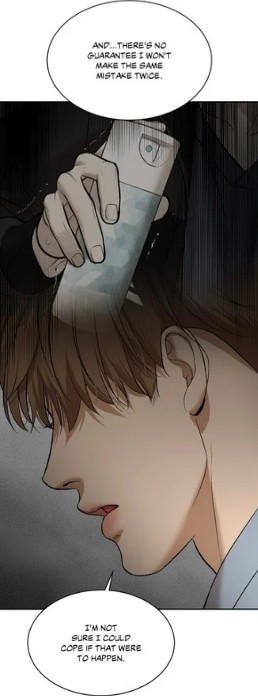 (chapter 62) completely devastated Kim Dan’s already fragile self-esteem.
 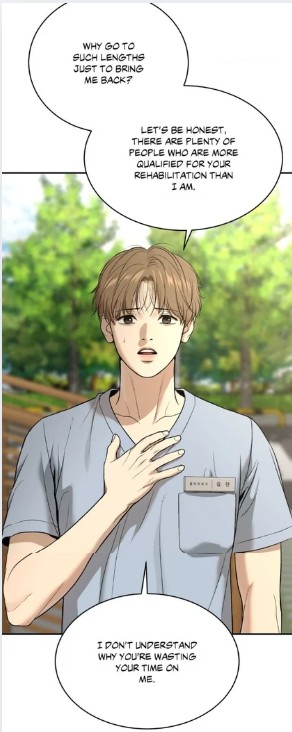 (chapter 62) First, he considers himself as waste. While in the past, he was at least a tool, he is now garbage. Hence his feelings are “trash”.
  (chapter 62) This means that in episode 62, he felt worse than in episode 18! The idioms “trash” and “waste” revealed the doctor’s own self-perception in episode 62: he saw himself as totally useless. He belonged to the “wastebasket”, just like the golden key chain.
  (chapter 46) Thus I deduce that the fate of this item echoes the doctor’s.
But let’s return our attention to his transformation in season 1. He was making progress thanks to Joo Jaekyung’s trust, but that one moment undid everything. (chapter 51) When he realized that the champion didn’t put his faith in him, he lost his motivation. This observation reminded me of the main lead’s previous statement. 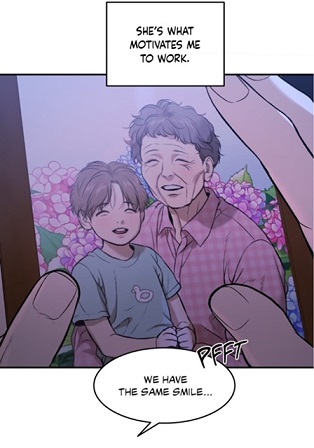 (chapter 47) He had selected this profession because of her. This shows that until now, he has never developed any ambition on his own. The loss of faith from someone he relied on for motivation made him feel completely worthless. This reinforces that his confidence and sense of direction were never self-sustained: they depended on others’ recognition. This pattern suggests that Kim Dan has never truly asked himself what he wants. His entire existence has revolved around meeting expectations, whether from his grandmother, Joo Jaekyung, or even his profession. His current crisis—feeling like waste—stems from the realization that without someone to validate his worth, he sees himself as nothing.
One might question this statement because of this scene: (chapter 59) However, observe that he is using the expressions “do” and “now”. This has nothing to do with the future and dreams. It is not a reflection on his own desires but rather an immediate reaction to his circumstances. His mindset is still trapped in survival mode, seeking a course of action rather than contemplating what he truly wants. His words reflect an urgency to act rather than an opportunity to dream. This highlights that he has spent his entire life making decisions based on necessity rather than personal fulfillment. Even when faced with uncertainty, he does not ask himself what he wants—only what he must do next. His transformation will only be complete when he begins to question not just how to survive, but how to live on his own terms. That’s how I realized why Mingwa put this question in front of the window covered with Venetian blinds [which made me think of this scene
  (chapter 39 – Venice, a travel to Italy]. The window with the Venetian blinds represents a metaphor for the doctor’s trapped dreams. This interpretation made me recognize another aspect. Kim Dan is pushed to meditate, when he is front of a window or better said close to the sky! Hence the hamster started thinking about his own future in the penthouse
 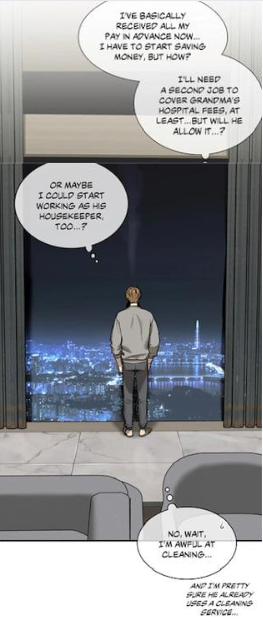 (chapter 19) or when he looked at the sun and sky:
  (chapter 41)
  (chapter 41) And the best evidence for this interpretation and expectation is doc Dan’s cellphone screen display.
  (chapter 38) My avid readers will certainly recall that clouds embody dreams! Why? It is because in verity, doc Dan is a dreamer, an ambitious man. What caught my attention is that his contact Joo Jaekyung was not saved with a picture!! And what had motivated Kim Dan in the past?
 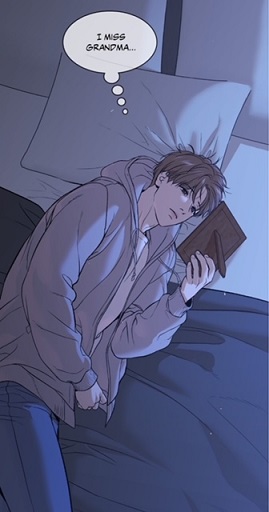 (chapter 47) The picture from his childhood: himself with his grandmother. (chapter 66) But the latter was not related to work, but to fun and nature. Striking is that Joo Jaekyung has an empty phone screen display indicating that he has no real dream on his own either:
  (chapter 38) No wonder why he questioned the meaning of his champion title:
  (chapter 54). He saw the belt as something rather “meaningless”.
To conclude, for the couple to break free from their terrible mindset, they need to find purpose within themselves rather than constantly seeking external validation. But let’s focus more on doc Dan again. This also ties into the broader theme of meaningful praise—instead of being recognized for what he does, he needs to be valued for who he is. How can this take place? By taking a picture together!  (chapter 43) This would boost the doctor’s self-esteem. He is not trash, but an acknowledged fan and friend. The picture would encourage the physical therapist to develop his own ambitions. As soon as I made this discovery, another detail caught my notice:
  (chapter 66) The celebrity has no picture of Park Namwook in his contacts divulging the superficiality of their relationship.
Then in her article, the psychologist mentioned two other mental barriers. “I’m not an expert”. That’s the reason why in episode 42, doc Dan used his colleague to voice his own thoughts.  (chapter 42) The problem is that the athlete took this recommendation personally. He felt as if his job as fighter was questioned.
 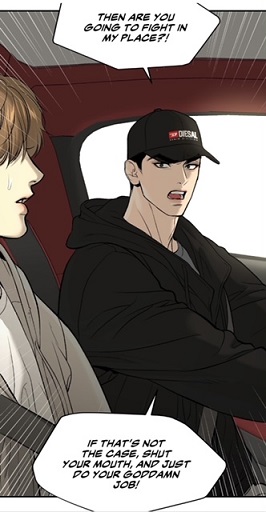 (chapter 42) As you can see, the doctor’s hesitations were exposing his mental obstacles, which was reflected in the champion’s attitude. No wonder why doc Dan chose to become a courier as a second job instead of finding a new VIP client. While the interaction between the athlete and Kim Dan in front of the hospice display the return of doc Dan’s past mental hurdles:
(chapter 62)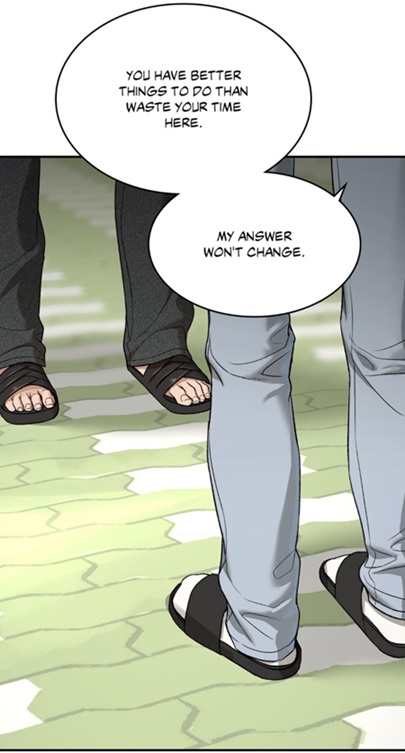 (chapter 62) According to the main lead, the champion is “wasting his time here”. (chapter 62)
The only difference to the past is that now the athlete could detect the presence of his partner’s negative thoughts. Nevertheless, by examining closely the statements from the main lead, I noticed other mental barriers that people place on themselves, which Delgado did not mention but are still strongly related to the other three:
(chapter 62) Therefore the athlete tried to persuade his fated partner to accept his offer by saying this: “Don’t overthink”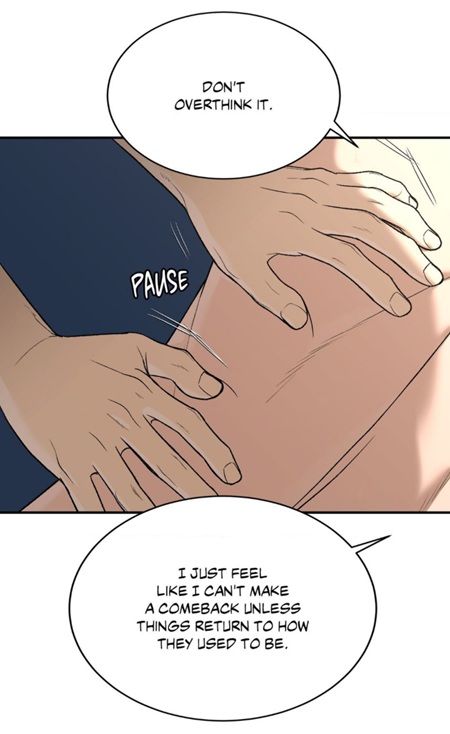 (chapter 62)
 (chapter 57) Hence it is clear that in the future, the physical therapist would refuse to use any kind of spray. On the other hand, it is important to recall that back then, Joo Jaekyung had made the request himself: (chapter 49) So in the doctor’s mind, if he agreed to the champion’s request, he would be treated like in the past. He would have to simply to follow the athlete’s lead. That’s why he is imagining that he might be put in a similar situation than in the past. But there exists another reason why he refused the champion’s offer right from the start. It is because he has always perceived himself as “hands” which stand for selflessness and generosity. The latter defined doc Dan. Hence he looked at them, when he declared himself as a tool: (chapter 36) Under this new light, it occurred to me why the hamster had to reject the star’s offer right from the start. It is because he came to identify himself as the “spray”. Hence Mingwa created such panels, where Kim Dan’s terrible memories
 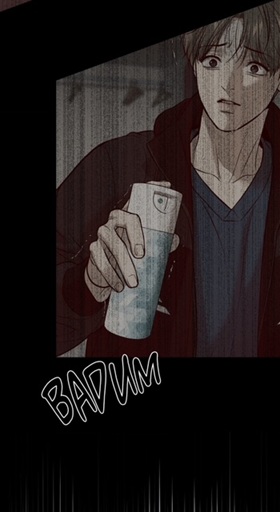 (chapter 57) (chapter 62) are combining the doctor’s hands with the spray. Then a spray is an item destined to be discarded. Is it a coincidence that Kim Dan “switched” places
  (chapter 1) with a previous PT like the spray? No wonder why he called himself “trash” in the end. (chapter 62) and let others handle things, rather than risk making another mistake. His patients at the hospice are all terminally ill, therefore they don’t have high expectations from him.
 His belief that others are ‘wasting their time’ on him echoes a deeper conviction—that he himself is waste. By equating attention and care with wasted effort, he subconsciously devalues his own existence, reducing himself to something disposable, like the “poisoned spray”. This mindset aligns with the toxic inner dialogue shaped by years of neglect and emotional suppression. It was the one thing helping him grow, yet now, he questions whether he deserves it at all.
Returning to the illustration  , people might wonder why I selected dandelions as a frame for the selected.. It’s clear that the dandelions aren’t just there for aesthetic balance. Their symbolism is profound. Dandelions are often associated with childhood innocence, wishes, and fleeting moments of beauty, yet they also wither quickly, easily scattered by the wind. In the context of Jinx, they represent a transitory force—something that struggles to take root, much like the intangible and fleeting elements in Kim Dan’s life. But there’s more to it. Before delving into deeper analysis, consider this: what is the common denominator in all these scenes?
| Chapter 1 | Chapter 15 | Chapter 30 | Chapter 31 |
|---|---|---|---|
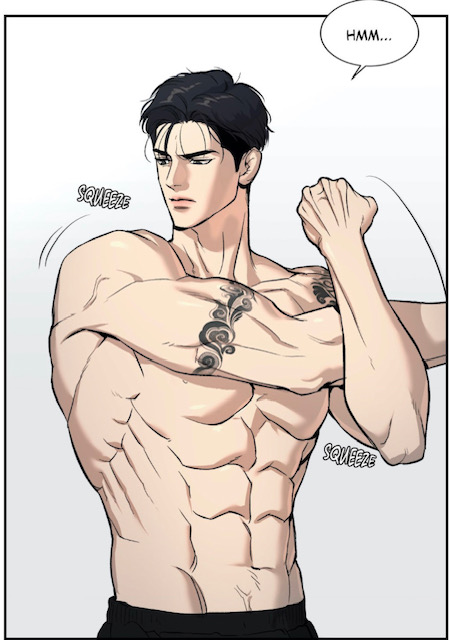  |  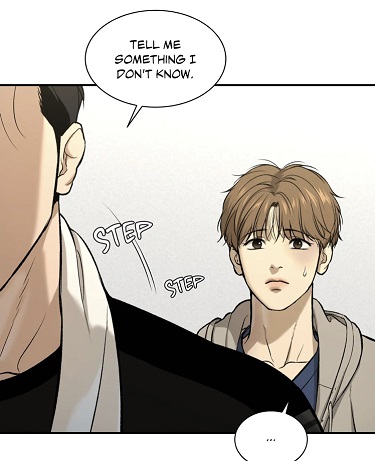 | |  |
| Chapter 40 | Chapter 43 | Chapter 56 | Chapter 62 | Chapter 66 |
|---|---|---|---|---|
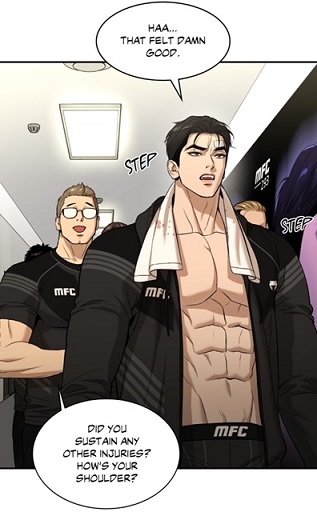 | 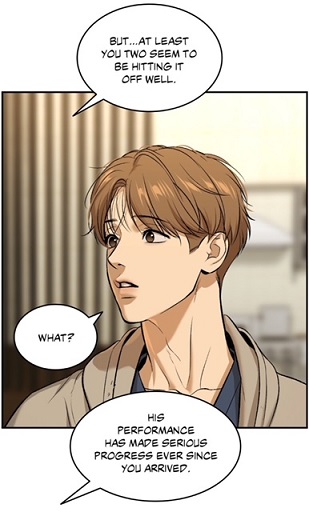 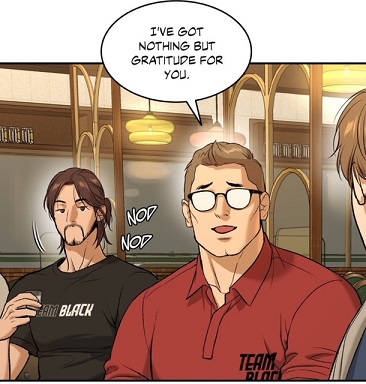 | 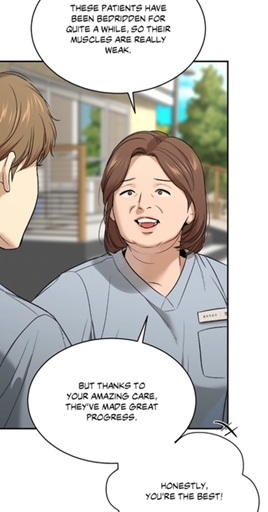 |  |  |
The answer is compliments. However, here it is important to make a distinction. In most of the selected scenes, the physical therapist is the one getting praised. In the actor’s eyes, he is not only an angel, but also the best. But why did he say that? One might say that Kim Dan offered his services for free. LOL! (chapter 31: I will explain this further below) Besides, the manager is saying that the champion’s performance has improved thanks to his presence. Halmoni is describing her grandson as a diligent and hard-working physical therapist. The nurse expressed a similar praise than the comedian. He is the best! All the support he received was linked to his job as physical therapist.  (chapter 37) Therefore it is not surprising that the main lead couldn’t view the members as friends in the end.
Striking is that I picked up three scenes where the “wolf” came to be praised. In chapter 15, for the first time, the doctor voiced his admiration to the athlete: “You were amazing!” to which the champion responded: “Tell me something I don’t know!” But why did he say this? It is because his manager always complimented him for his performance in the ring: (chapter 40) And now, my avid readers can sense a parallel between Joo Jaekyung’s reply and the title of this essay: “Prove me wrong again!”
If we examine the praises Kim Dan receives throughout the series, we could see that these nice words never reached Kim Dan’s soul and heart. But why didn’t they help him to boost his ego? Delgado’s second article, Praise That Completely Destroys Children’s Self-Esteem, offers valuable insight into why:
(chapter 56) emphasize innate talent rather than the effort he puts in. This means that when he fails, he interprets it as proof that he was never truly capable to begin with.And now, you comprehend how I came to associate dandelion seeds to empty flatteries. The connection between dandelion seeds and hollow praise lies in their fleeting, weightless nature. Just as dandelion seeds are easily carried away by the wind, hollow compliments—those that are vague, exaggerated, or disconnected from genuine effort—disperse without truly taking root in the person they are meant to uplift. They may seem pleasant in the moment, but they fail to provide real nourishment or stability for self-esteem. Hence Potato’s admiration couldn’t move the athlete’s heart and mind:  (chapter 41) And now, you comprehend why Joo Jaekyung has always disliked his birthday and the “congratulations” from people in general. The gifts and words were like poisoned praises to his soul. They were pushing him to live like a “god”.
Dandelions are often associated with impermanence, a plant that thrives briefly before its seeds scatter, lost to the wind. Similarly, the praise Kim Dan receives—“You’re the best,” “You’re amazing,”—floats around him but never lands deep enough to strengthen his self-worth. It is momentary validation, gone as quickly as it appears, leaving him feeling just as uncertain and fragile as before.
This is why the illustration places hollow praise within the dandelion blooms—it highlights the transient, superficial nature of these compliments. Instead of fostering deep confidence, they merely swirl around him, reinforcing his feeling of disconnect between others’ perception of him and his own self-image.
That’s how I came to the first following conclusion. Dandelions and photographs serve as opposing symbols in Jinx. The dandelion seeds represent fleeting, empty compliments—words that drift away with the wind, never taking root. Conversely, photographs preserve meaningful moments (chapter 66), cementing their value over time. Unlike dandelion seeds, which scatter meaninglessly, photographs stand for memory, permanence, and proof of (genuine) human connection. 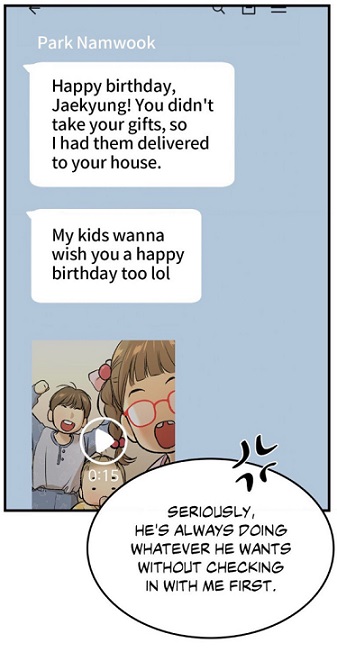 (chapter 45) Kim Dan’s only adult photograph, taken with Choi Heesung and Potato, ties into his professional world, reinforcing how his identity has always been defined by what he does rather than who he is.
  (chapter 59) While this photography was not a personal and intimate picture, it also symbolizes his first root in the little community: Light of Hope Hospice. He is part of the staff and as such of the little town. On the other side, we could say, he is gradually entering the scene as a PT. Note the contrast to the food truck: (chapter 31) There was no picture of “Angel Dan”!! It was, as if the comedian was using doc Dan’s image to promote himself 😮, similar to this scene:
 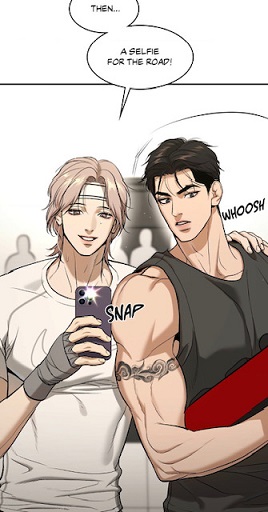 (chapter 30) In other words, it exposes the actor’s hypocrisy and wrongdoings. And now, you understand why I wrote genuine in parentheses above [proof of (genuine) human connection]. Photography in Jinx also represents the evidence of wrongdoing
 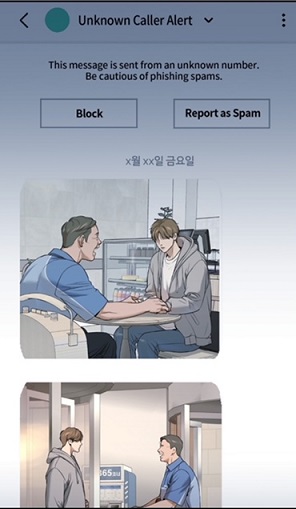 (chapter 48) and deception: (chapter 66) This picture is not just the symbol of innocence and joy, it is strongly intertwined with the vanishing of the parents. There is a secret behind this picture. Yet, for Joo Jaekyung’s, it looks like Halmoni was enough for Kim Dan, as she could make him smile once. The photography, the emblem of civilization, can be traced back, and as such exposes the identity of the perpetrators and accomplices:
 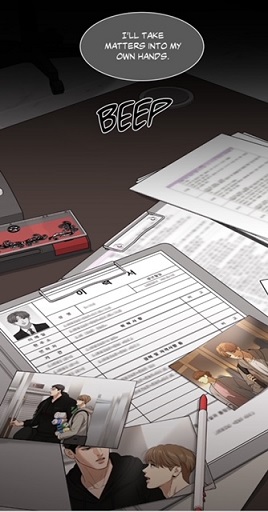 (chapter 46) The exact opposite of the dandelions.
Joo Jaekyung’s act of bringing Kim Dan to the sleep specialist is the embodiment of actions over words. (chapter 66) It is a direct contradiction to the hollow praise doc Dan has received all his life. (chapter 53) He was treasurable, for he did favors to his grandmother all the time. Instead of simply saying that Kim Dan matters, the champion proves it. He challenges the physical therapist’s own perception of himself, demonstrating that he is not just useful—he is precious. Secondly by justifying his action for the doctor’s sake, (chapter 66) he contradicts not only Kim Dan’s self-perception, but also his past accusations: (chapter 66) that he was merely a tool for Joo Jaekyung’s success. By taking him to the sleep specialist, the champion proves something that Kim Dan had refused to see: he matters beyond his utility. This moment mirrors Joo Jaekyung’s past words— (chapter 15) into an action that Kim Dan never expected, an undeniable truth he can no longer ignore. And keep in mind that this reply was linked to doc Dan’s praise concerning his recent fight: (chapter 15) What Joo Jaekyung wants to hear from doc Dan is that he is a good person outside the ring, he wants to be praised for his good actions too.  (chapter 62) This shows that deep down, he desires to obtain doc Dan’s gratitude. No wonder why he got so upset after hearing the displeased comment from Kim Dan. (chapter 66)
Moreover, the key chain’s presence in the dressing room  (chapter 66) reveals Kim Dan’s elevation in the champion’s life. The dressing room symbolizes privacy and closeness. No longer seen as a mere tool, Kim Dan has become an integral part of Joo Jaekyung’s world, not because of what he can do but because of who he is.
 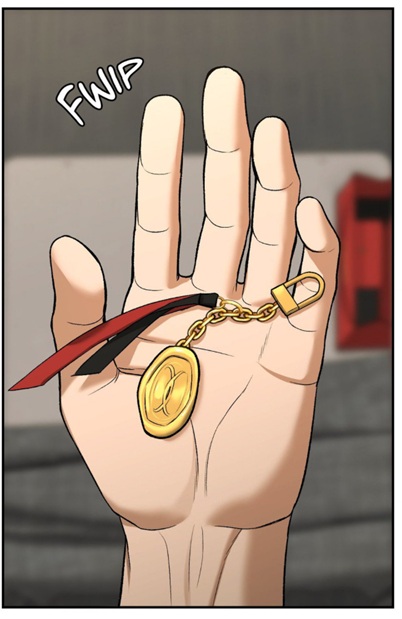 (chapter 66) Therefore the champion is holding the expensive gift with his whole hand contrary to the past:
  (chapter 55) As a conclusion, by bringing him to the sleep specialist, the star proved doc Dan’s words wrong! He told him something that doc Dan didn’t know: he is precious. He needs to pay attention to his health and body.
On the other hand, actions are not enough, in particular for both protagonists. The past words have to be erased, and this can only become effective with encouragement and good compliment. So how should compliments be in order to help the children? For praise to be meaningful, it must be like a deeply rooted plant, not a dandelion seed—grounded in reality, tied to effort rather than ability, and capable of fostering real growth. Moreover, the words have to be specific. Third, the person has to avoid exaggeration and give some motivation, like for example the picture!
Mingwa gave us an illustration for a good appreciation: (chapter 66) The champion was praised for doing paperwork. “Good work” was specific, simple and related to an effort. Joo Jaekyung has been patient, diligent and docile in the office. For once, Joo Jaekyung was validated for something outside the ring 😉—something that had nothing to do with his physical strength or his ability to fight. That compliment planted a seed of recognition: his value is not solely tied to his role as a champion. This scene made me laugh because by giving such a flattery, the coach was not realizing that he was pushing his “boy” to take care of administrative tasks. This means that the main lead is destined to become a “white-collar”, a manager!! Kim Dan’s vision should become a reality.  (chapter 32) And now, you comprehend why the athlete didn’t fall for Park Namwook’s manipulations afterwards.
When Park Namwook tells Joo Jaekyung, (chapter 66) “I don’t know what you’ve been up to lately…”, it carries an accusatory undertone, subtly suggesting that the champion has been avoiding him. By framing it this way, Park Namwook is not just asking about Joo Jaekyung’s well-being—he is asserting his discontent over losing control. His follow-up suggestion, “Instead of being alone all the time, why not come to the gym?”, reinforces the idea that he sees the gym as a tether, a way to keep Joo Jaekyung within his domain of influence. In addition, he is suggesting that the athlete has been using his injury as an excuse to avoid training. There’s an undertone of doubt and accusation, as if he does not fully believe the champion’s recovery process is valid or necessary. Instead of expressing genuine concern, Park Namwook is subtly framing Joo Jaekyung’s absence as a sign of laziness or avoidance. The small compliment from the manager (“good work”) represents a turning point in the athlete’s life. Park Namwook can no longer treat the athlete like in the past.
But there’s more to it. What caught my attention is that days before, Kim Dan had expressed a huge reproach to the athlete: (chapter 66) This criticism represents the negative version of the manager’s flattery. However, Kim Dan’s words left a huge impact in the champion’s mind and heart for one reason. Through his reproach, he reminded the star that he had a life outside the spotlight and ring. One might say that he was blamed for his bad behavior. Nonetheless his words implied that he viewed the celebrity as an adult, accountable for his actions! Jinx-philes will certainly recall that Park Namwook chastised the celebrity as a spoiled child  (chapter 7) (chapter 52) Joo Jaekyung was portrayed as someone with a bad temper and personality. The manager was focusing on the ability, was exaggerating and put pressure on him by using his hand! That’s how it dawned on me why Joo Jaekyung could become resistant to Park Namwook’s short and superficial appreciation. Doc Dan’s harsh words served as an antidote to the manager’s tactics. How so? First, Doc Dan brought up the existence of feelings which Joo Jaekyung has been denying all this time. Then he blamed the champion for his actions and not for his character contrary to the manager!! Therefore he left room for Joo Jaekyung to improve himself. The idiom “always” served as a motivation for the athlete. Here, he could change. That’s why Joo Jaekyung, though hurt and angry, didn’t leave doc Dan’s side.
  (chapter 65) At the same time, such a disapproval (chapter 64) implies the existence of past hope and expectations. This means that the star has the possibility to revive these buried expectations and hopes by acting differently. By portraying the main lead as a maniac or bad-tempered person, Joo Jaekyung had the impression that he could never change Park Namwook’s perception no matter what he did! The only way to please him was to be in the ring. This was an “immutable truth” which stands in opposition to doc Dan’s criticism (“change”, private life). As you can see, a person can change for the better not because of compliments, but also because of criticisms, a new version of this scene: (chapter 45)
Striking is that Kim Dan was praised by the protagonist after their first meeting. The champion’s appreciation followed the principles outlined by Delgado: it was specific, effort-based, and motivating. (chapter 1) However, this recognition went completely unnoticed by Kim Dan for three key reasons. First, he was not directly mentioned in the praise, making it difficult for him to associate it with himself. Secondly, Joo Jaekyung didn’t look at him either. Then the star’s phrasing included two negative notions (“not” and “bad”) which subtly diluted the apparent respect behind his words. Rather than perceiving it as validation, Kim Dan likely dismissed it as neutral or indifferent. Finally, it is also important that doc Dan had just made a mistake before  (chapter 1), hence his true desire was to run away from that place. For praise to be effective, the recipient must be open to receiving it, either by looking forward to feedback or having expectations of validation. Since Kim Dan was in a state of distress, he was unable to internalize the champion’s words, reinforcing his long-standing belief that he was invisible or unworthy of acknowledgment. That’s how the champion’s praise became a dandelion seed in the end.
Another important detail caught my attention are the grandmother’s praises. (chapter 53) (chapter 61) They are rather inconsistent and conditional. In front of Joo Jaekyung, she commends Kim Dan for his diligence and productivity, emphasizing his value based on his ability to work and fulfill responsibilities. However, when speaking about him in private or when displeased, she reduces him to his supposed vices—calling him a drinker (chapter 65) or a smoker, hiding his sacrifices and the true causes for his struggles. Her words reinforce the idea that Kim Dan is only as good as his usefulness, that love and recognition are earned through labor, not freely given.
With such a mindset imposed on him from childhood, it becomes evident why Kim Dan does not allow himself to take breaks or seek joy for himself. Rest is seen as unearned indulgence rather than a necessity, and self-care is overshadowed by the guilt of not doing enough. His grandmother’s approval was never unconditional; it fluctuated based on how well he served her expectations. This pattern of conditional compliment shaped his self-worth, making him feel unworthy of being cared for unless he was constantly proving himself through actions. What makes this even more striking is that the praise Kim Dan receives from others follows the same pattern as his grandmother’s. Whether it’s his colleagues, the actor, the nurses, or even Park Namwook, their compliments are always tied to his work and productivity—his ability to heal, to endure (chapter 36), or to meet expectations. None of these affirmations recognize him as a person, only as a professional fulfilling a role.
Rather than boosting Kim Dan’s self-esteem, these empty praises widen the gap between how others perceive him and how he sees himself. His inner voice, shaped by years of self-doubt, tells him that he is undeserving of these accolades. Without specific, effort-based recognition, he is unable to recognize his own progress, leaving him trapped in an endless cycle of self-doubt.
This is why, as I reflected on these observations, I realized that Joo Jaekyung’s praise must be different. It shouldn’t be about Kim Dan’s work at all. It shouldn’t be another generic statement about how great he is at his job. Instead, it should focus on:
Joo Jaekyung saying something as simple as “I missed your presence in the penthouse” would mean more than a thousand empty compliments. It would tell Kim Dan that he is wanted as a person, not just needed. That he matters beyond his function as a doctor. This is the type of praise that could truly help Kim Dan break free from his cycle of self-doubt.
And what is the favorite expression which comes to the champion’s mind, when he observes doc Dan’s behavior?  (chapter 18)
  (chapter 45)
  (chapter 64)
 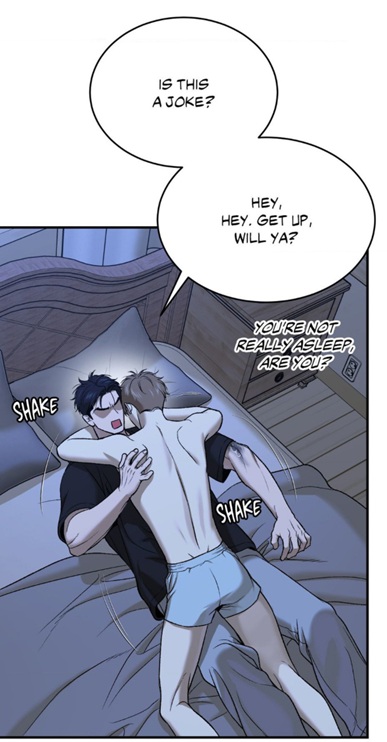 (chapter 66) Is this a joke?
Jinx-philes can notice that the champion is associating doc Dan to a JOKE! The problem is that so far the athlete used this idiom in a rather negative context. Kim Dan made the champion smile and laugh! (chapter 40) However, Kim Dan has never realized it. Either he was sleeping or totally out of it (fear of sex)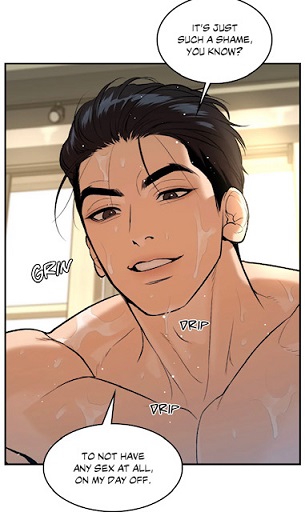
 (chapter 27) It is important to recall the importance of the receiver’s mind-set. The latter has to perceive the sincerity from the speaker. Hence I come to the following deduction: The moment Kim Dan notices Joo Jaekyung’s smile and laugh, then he should come to the conclusion that he matters to the protagonist. I would even say, the two protagonists are destined to make each other laugh and smile: (chapter 44) This would be the best “compliment” for both of them. With Kim Dan by his side, Joo Jaekyung desires to make “jokes”. (chapter 61) No wonder why Shin Okja preferred the champion’s company to her own grandson’s. The latter would ooze such negativity and suffering that his presence reinforced her guilty conscience. His grandmother’s mood got spoiled. On the other hand, Mingwa exposed the existence of fake happiness and fun like in this scene:
  (chapter 58) The friends ignored the main lead’s emotions and struggles. In order to be able to have fun, both main leads must be freed from their past and low self-esteem.
The title “Prove Me Wrong Again” takes on multiple meanings. On one level, it reflects how Kim Dan’s struggles with self-worth repeatedly override any praise he receives. No matter how much others try to uplift him, his mind tells him otherwise. But on another level, it is a challenge—an opportunity for someone, particularly Joo Jaekyung, to show him that true validation comes from being seen, not just being useful.
Kim Dan does not need grand gestures or overblown words. He needs consistency, sincerity, and reminders that his worth extends beyond his profession. The broken mirror in the illustration reflects the damage done to his self-esteem, but the dandelions? Perhaps they represent the possibility of change—of words that, rather than fading, finally take root. Because the doctor is suffering from depression right now, it is now Joo Jaekyung’s turn to make doc Dan happy, to make him smile and laugh.
Feel free to comment. If you have any suggestion for topics or manhwas, feel free to ask. If you enjoyed reading it, retweet it or push the button like. My Reddit-Instagram-Twitter-Tumblr account is: @bebebisous33. Thanks for reading and for the support, particularly, I would like to thank all the new followers and people recommending my blog.
 Bebebisous33s' analyses in K-Dramaland and Manhwas