Protected: Jinx: Craving Mama‘s 👩👦 Shine 🔦 – part 1

Bebebisous33s' analyses in K-Dramaland and Manhwas
Analyses of K-dramas and Manhwas (for the most part Yaoi)


Please support the authors by reading Manhwas on the official websites. This is where you can read the Manhwa: Jinx But be aware that the Manhwa is a mature Yaoi, which means, it is about homosexuality with explicit scenes. Here is the link of the table of contents about Jinx. Here is the link where you can find the table of contents of analyzed Manhwas. Here are the links, if you are interested in the first work from Mingwa, BJ Alex, and the 2 previous essays about Jinx Unspoken Gifts 🎁, Unveiled Truths🪩 in the Light of Hope and Starving For Light – part 1
It would be great if you could make some donations/sponsoring: Ko-fi.com/bebebisous33 That way, you can support me with “coffee” so that I have the energy to keep examining Manhwas. Besides, I need to cover up the expenses for this blog.

After the release of Starving for Light, I made very important discoveries and as such new connections between Kim Dan’s eating disorder, his workaholism and the grandmother’s neglect. However, since the original essay was already very long, I decided to add a second part. According to my observations, Kim Dan is suffering from ARFID (Avoidant/Restrictive Food Intake Disorder). The latter is an eating disorder characterized by an extreme avoidance or restriction of food, leading to nutritional deficiencies, weight loss, or dependence on supplements. Unlike other eating disorders, ARFID is not related to concerns about body image or weight but instead stems from factors such as sensory sensitivities, fear of choking or vomiting, or a lack of interest in eating. It often begins in childhood and can significantly impact physical health, social functioning, and emotional well-being. Treatment typically involves therapy, nutritional counseling, and addressing underlying causes of food avoidance.
In the first part, this is what I wrote:
Since Mingwa didn’t create a souvenir of a shared meal with his grandmother except this one (birthday scene, chapter 11), I believe that Kim Dan never truly experienced the joy of sharing food. Readers always saw him standing by the side, while he watched his boss eating. (chapter 22) Sure, it was because he considered it as a part of his job. Nevertheless, the young man never cooked for himself. He learned to cook from his grandmother, as it was to help her. Thus I can’t restrain myself thinking that Shin Okja never shared a meal with the protagonist.
This suspicion got confirmed while rereading the story. Shin Okja has never shared a meal with Kim Dan together. One might argue about this statement because of his memory concerning his birthday.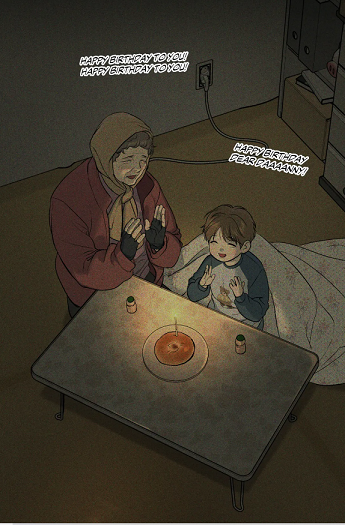 (chapter 11) Here, she offered him a sweet bread as present, but since it was his birthday cake, he had to share his “own present” with his grandmother. The little he possessed was given to his grandmother, a new form of this scene
 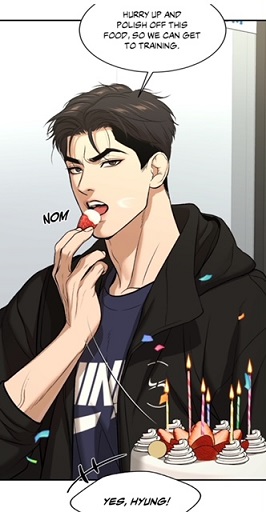 (chapter 43) In other words, he was the one sharing his food with her. But there exist more conclusive evidences.
  (chapter 5) When he visited her in episode 5, the main lead was the first one to bring up the topic “dinner”. How did the grandmother respond to his question? “You know your granny never skipped a meal”. Her statement is implying that someone else skipped his meals before. That can only be the doctor. So she knows that he has not been eating on a regular basis. And what is the opposite of “never”? ALWAYS! Yet, observe that she is smiling, when she is saying this. It exposes that she never saw the doctor’s skipping meals as worrisome. She must have probably thought that her grandson was a picky eater.
Moreover, I would like my avid readers to keep in mind that Kim Dan was eating his snacks alone, when she was standing next to him: 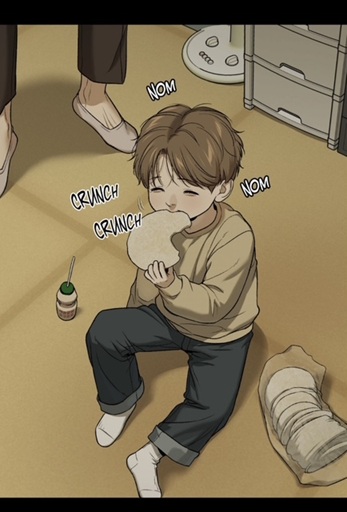 (chapter 57) So she was not sitting down to a meal with her grandchild literally. In addition, when she suggested snacks to console him, she didn’t realize the terrible consequences of her decision. Once it was dinner time, Kim Dan would no longer feel hungry. With the introduction of such a ritual (eating became the synonym for repressing negative emotions), it is normal that the little boy would stop eating with his grandmother. That’s how the routine of eating on a regular basis got dropped, as it was strongly intertwined with his negative emotions and terrible incidents.
But let’s return our attention to the scene in episode 5. (chapter 5) Notice that she only asked him if he had already eaten after hearing his question. In other words, if Kim Dan had never inquired about her meals, she would have never shown an interest in his meals. Only after hearing that he would eat later, she got worried: 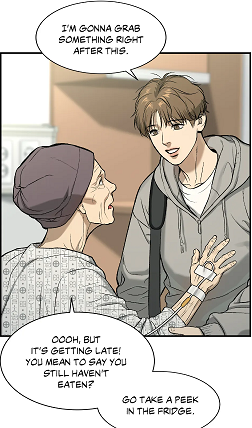 (chapter 5) Thus she offered him two sweet yogurts.
  (chapter 5) Her words “You used to love these when you were little” are alluding that she perceives the main lead as a picky eater. As a child, he would never refuse the drinks. So when she offers them to him, she is sure that he will eat these. Finally, when she saw the celebrity, she indirectly put the blame on her grandson. He is thin and weak, because he didn’t eat properly.
 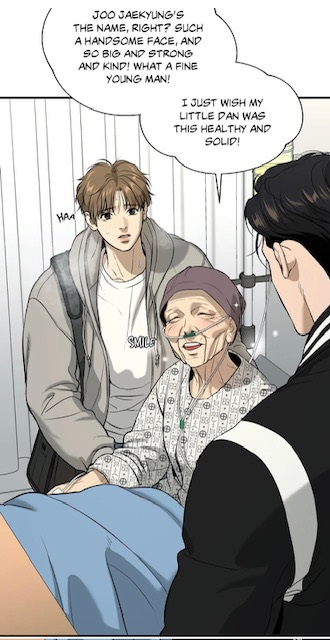 (chapter 21) In her eyes, Kim Dan’s habit for skipping meals was the expression of an avoidance of certain foods. It was because he was a picky eater. This shows that she never questioned herself and her past decisions. Then in the latest episode, she is seen eating her lunch,
 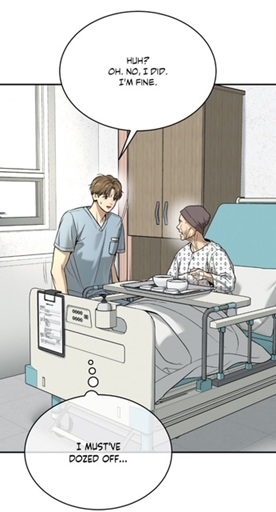 (chapter 57) yet at no moment she shares her food or questions him if he has already eaten. For me, this scene exposes her neglect. Her focus lies elsewhere:
 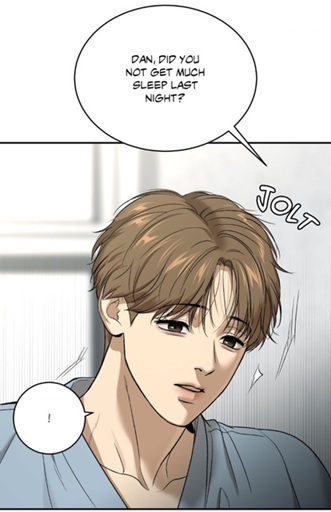 (chapter 57) She asks this question, because she has already witnessed him sleeping next to her. She associates tiredness with lack of sleep, but she is not making the connection between malnutrition and his exhaustion.
  (chapter 57) On the other hand, the expression “wasting away” displays her realization. She is seeing how Kim Dan is losing weight!! To conclude, she is not totally blind. Her grandson is not eating properly. But why is she not questioning her grandson about his meals? It is because he is working at the hospice where lunches are provided to the staff.
  (chapter 56) In other words, she is relying on the hospice, while the staff is too busy and overwhelmed with work to notice that Kim Dan has been working too much and even avoiding lunches.
 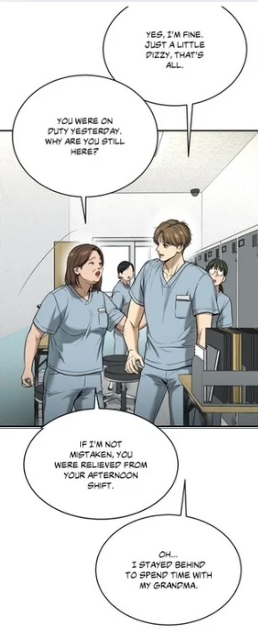 (chapter 57) It took them days before the nurse noticed that he shouldn’t be there. Interesting is that the nurse “Mind” is starting to put the blame on the physical therapist
 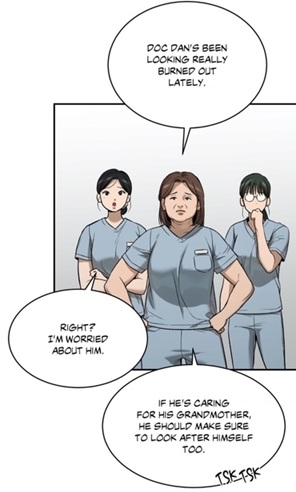 (chapter 57) for his attitude and is now siding with the grandmother. They assume “burn out”, while the reality is that he is suffering from different traumas. But notice that he was only sent away, after Kim Dan got dizzy.
  (chapter 57) This shows that Kim Dan had become a ghost at the hospice for the last few days, and no one paid attention to him. He was invisible because it was his way to be “accepted” and not stigmatized as “bun” or “orphan”. People only noticed him, until he created some ruckus at the institution. However, this means that the man must have spent the night with his grandmother. Yet, at no moment she sent him away or even shared her meals with him. This shows her indifference and egoism. She contrasts so much to the protagonist’s landlord.
Though the latter doesn’t know him that well, he is paying attention to his every move: 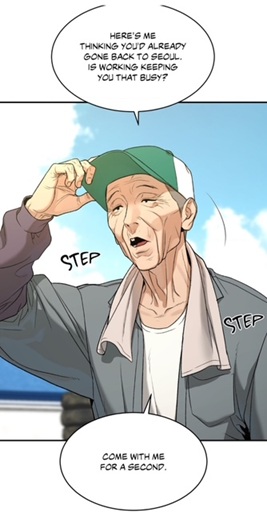 (chapter 57) He noticed right away that he was missing. Why? It is because his room was empty.
 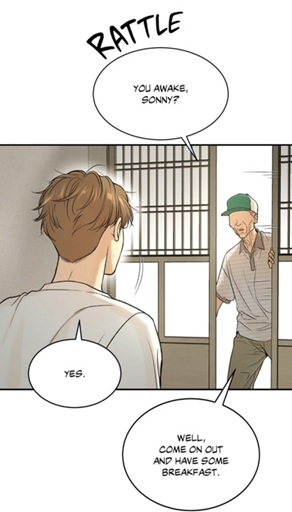 (chapter 57) This scene represents the man’s new routine. He would go to Kim Dan’s bedroom and ask the protagonist to eat breakfast with him. On the other hand, though he noticed the doctor’s absence, he jumped to a false conclusion. He imagined that his new room mate had returned to Seoul. This raises the following question. Why is this caring man assuming that Kim Dan moved to that small and insignificant town just for a short moment?
  (chapter 57) And why did he think that Kim Dan had left for good? First, I can imagine that the doctor looked for a place without deposit.
 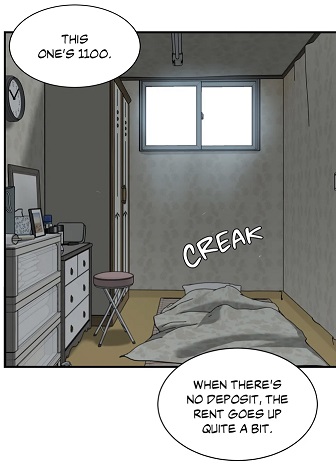 (chapter 16) But more important, it is because the physical therapist only arrived on the West Coast with two small bags.
 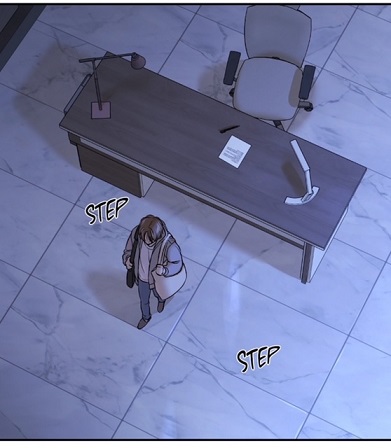 (chapter 53) And now pay attention to the PT’s departure on the day he was sent back:
 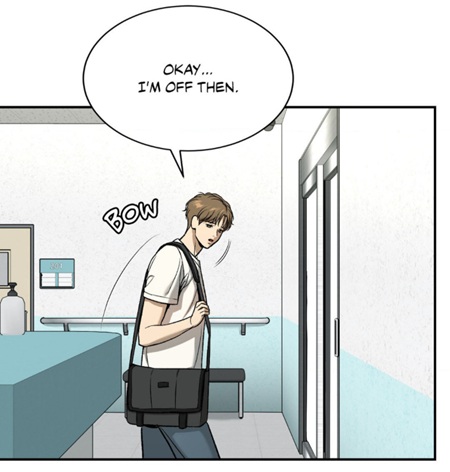 (chapter 57) He had gone to the hospice with all his belongings, a sign that he had planned to stay with his grandmother until his “death”. In other words, his “workplace” would have become his tomb. This means that the landlord already noticed that the main lead only had a few belongings, and the moment he didn’t see the black bag with the halmoni’s picture, he assumed that Kim Dan had returned to the city. Thanks to the introduction of the new landlord, my interpretation about the champion’s biased judgment got confirmed.
 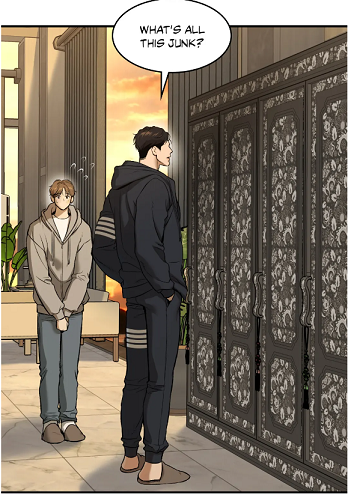 (chapter 19) When Joo Jaekyung saw the huge Wedding Cabinet, he thought that Kim Dan had many clothes. Thus he saw it as a sign of “greed”, Kim Dan was poor, because he was not able to save money. And this observation brings me back to the landlord: (chapter 57) In my opinion, this man doesn’t know the real profession of Kim Dan. Notice that he is talking about “work” in general. He can not understand why his tenant would work for days so much. Another evidence for his ignorance is that he never went to the hospice to ask if the physical therapist was there. I would even add that this man is also ignorant about the existence of Kim Dan’s grandmother. How did I come to this deduction? It is simply that the old man is anticipating the doctor’s departure. Who would move to that little town with only two bags? It is important because despite his mistakes
  (chapter 57; here he used guilt and shame to incite Kim Dan not to drink), he is attempting to be close to his new room mate, to understand him. The problem is that the protagonist is keeping everything to himself. He is not speaking about himself and his past. This is quite understandable, as the grandmother keeps telling him that he has no roots here.
 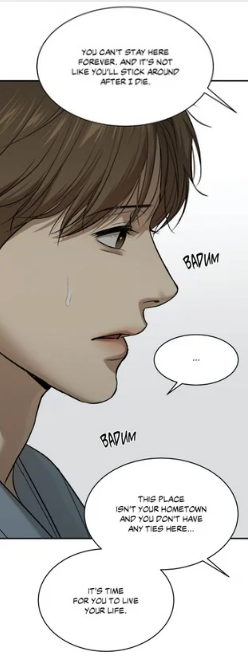 (chapter 57) I would even add that with this advice, she was restraining him from becoming close to people in this hometown. It is her place, not his… In other words, she was forbidding him to make friends here and have a good relationship with the staff. Finally, when the grandmother says Kim Dan has “no ties here,” it mirrors the hurtful stigmatization he faced as a child when he was labeled as an orphan, a “bum.”
 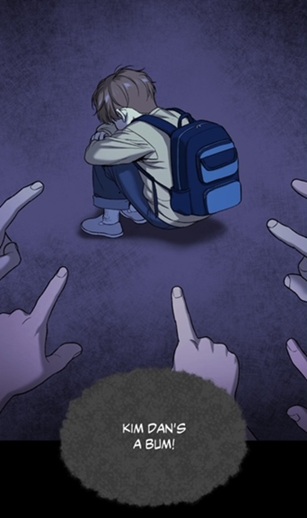 (chapter 57) Her words inadvertently repeat the narrative of abandonment and lack of belonging that has followed Kim Dan throughout his life. It feels as though she’s repeating those same accusations, reinforcing the idea that he is rootless, unworthy, and out of place. Instead of acknowledging the sacrifices Kim Dan has made for her, the grandmother dismisses him as someone without meaningful ties, perpetuating the feelings of invisibility and worthlessness he’s battled since childhood. So with this declaration “This place isn’t your hometown and you don’t have any ties here” she was triggering his abandonment issues and low self-esteem. This outlines her lack of empathy, self-centeredness and ignorance. Thus I have to admit that I am even wondering if he has not been adopted by Shin Okja.
And because the halmoni claims to be part of this hometown and the landlord belongs to the same community, I can’t help myself thinking that once he hears about Kim Dan’s true job and his halmoni, he will go to the hospice and meet her. Let’s not forget that no one recognizes or remembers her. Why? My explanation is simple. This is the place where her maiden family has been buried, but like her words display it: she never went to the hometown to visit the graves of her ancestors. The grandmother is projecting her own history of not “sticking around” for her deceased relatives onto Kim Dan. Just as she distanced herself from her family in the past (e.g., after their deaths), she now assumes that Kim Dan will do the same to her, reflecting her awareness of how such disconnection has defined her relationships. We could say, she “forgot” them, but once she is about to die, she wants to be remembered as a part of this community. This shows that this woman values tradition and the past, but in a superficial manner.
However, since the doctor has become the symbol of her past suffering, she would like to send him away. She is refusing to be burdened by worries and a guilty conscience. To conclude, she is rejecting her past and as such her responsibilities. She is now advocating “self-reliance”, while in the past, she used to ask him for favors. 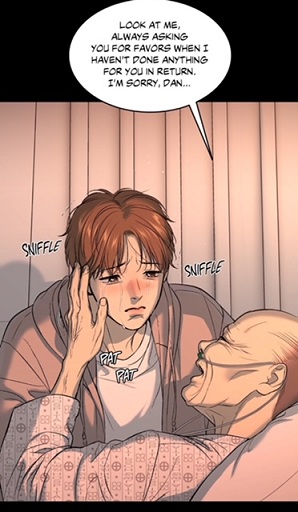 (chapter 53) On the other hand, the landlord embodies the opposite notions:
  (chapter 57) Care, curiosity and responsibility. Here he is asking for help as well. Nevertheless the nature of his request is different, for it is not about himself, but about Boksoon and her puppies. As you can see, he is making sure that she gets the best environment to raise her puppies. On the other side, Shin Okja used to prioritize herself and her own suffering. Notice that the doctor was resting under a tree in the yard
  (chapter 57), until the owner appeared. Thus I couldn’t restrain myself thinking that this man is strongly associated with the sun (fatherly figure) and life, whereas the grandmother stands for darkness
 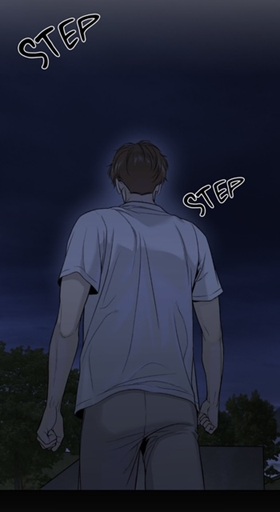 (chapter 57), night and death.
Since I detected symptoms of ARFID, it occurred to me the significance of the drugged beverage. 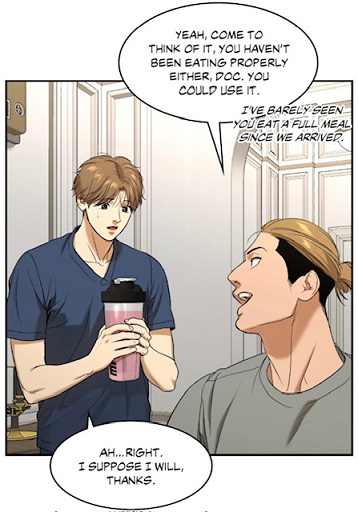 (chapter 37) Kim Dan has never associated food with pleasure, love and happiness. Yet, for the first time, someone paid attention to his eating habits and suggested him to drink this nutrition shake. So the food became “poison” to him, this could only reinforce his negative disposition about eating. Is it a coincidence that soon after, he is seen sleeping and skipping meals?
  (chapter 43) No, his avoidance of eating increased. Park Namwook and the others assumed like many readers that it was related to his overwork and exhaustion, but it is only partially true. Sleeping was also his way to avoid food in the end. And this brings me back to the incident with the switched spray:
 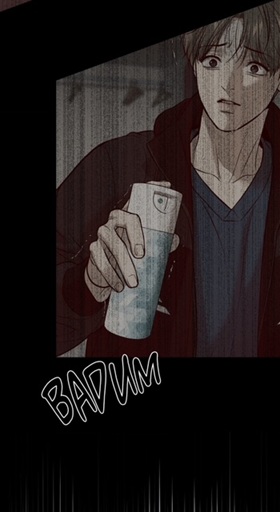 (chapter 57) This crime triggered a trauma in the doctor. Hence his hands were shaking, and he is plagued by a huge guilty conscience. It was, as if his hands had become poison too. However, hands are necessary to eat. To conclude, this could only worsen his condition. And notice that even with the landlord, he is not seen eating. In fact, he is patting the dog.
 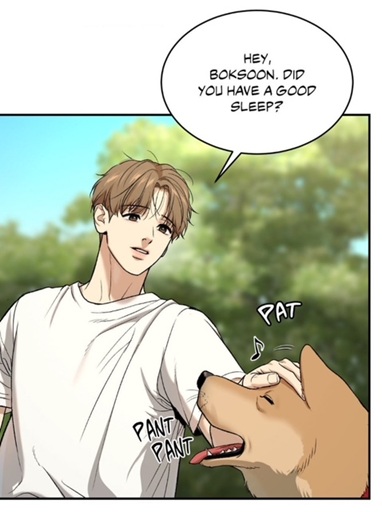 (chapter 57) That’s the reason why I don’t think that Kim Dan’s ARFID can be suddenly cured, the moment Potato reveals the truth about the incident. He has to develop a routine around eating. Someone has to put food right into his mouth, to feed him literally. On the other hand, I can imagine that a change will take place, when he sees his fighter totally diminished. He would serve as a reminder and reflection to himself.
And what is the common denominator between the switched spray and the drugged beverage? They reinforced his mental issues: ARFID, his depression and his low self-esteem. But the problem is that MFC  , (chapter 41) the doctors and the authorities diminished the importance of such a wrongdoing, because they denied the existence of psychological sequels. Thus they only investigated it from the athlete’s perspective:
 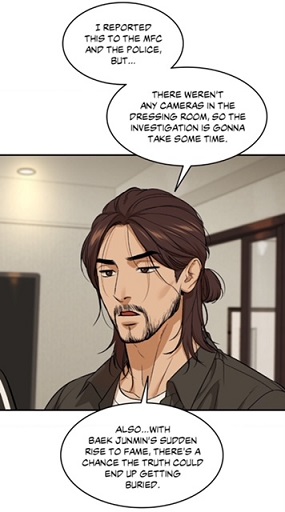 (chapter 52) He was the only target and victim. Therefore it was reduced to the work of a hater and rival. Nevertheless, they didn’t interrogate the real victim of the crime correctly. Either he was about to get framed or his involvement was totally denied. It was, as if he had not been present. By not taking the physical therapist’s psychological damages into consideration, they actually expose their true nature. They don’t care about mental health at all. This explicates why the athlete had to prove his worth constantly. We should see these comments as a new form of bullying
 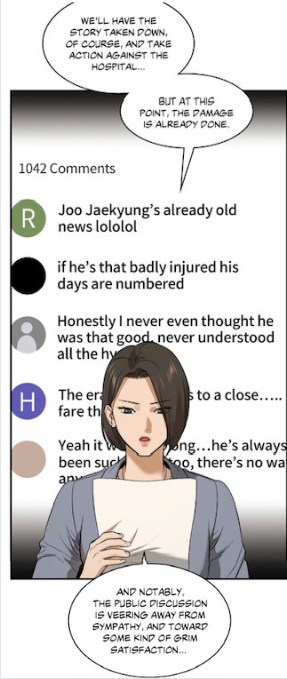 (chapter 36), which were supported by MFC, the Entertainment agency and Park Namwook. Joo Jaekyung had to prove them wrong: his career is not finished yet. So when the couple meets again, they should quickly realize the importance of mental health, as both are definitely at their lowest point in their life. In other words, the mental issues from Kim Dan serve a purpose in this story: people close to him should come to the realization that mental health is essential in life, something they neglected before. Either they didn’t feel concerned or they were biased or simply ignorant. Thus the athlete in the illustration for season 2 is looking at his fated partner’s face :
  He is now paying attention to his facial expressions and trying to discover his thoughts. Moreover, note that he is also grabbing his wrist, which could be interpreted like this. On the one hand, he is attempting to stop Kim Dan from working, as the symbol of a PT is the helping hand. He should relax and rely on the fighter’s care and protection. He is his shelter and home. On the other hand, it could be seen as his attempt to stop Kim Dan from using his wrist against the sinners and criminals: Kim Miseon who used her halmoni as guinea pig, Choi Gilseok who tricked him etc… Yes, I have the impression that at some point, the physical therapist could end up feeling like his fated partner:
 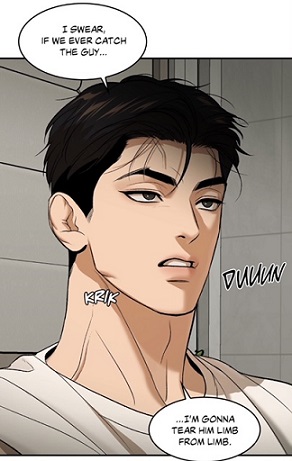 (chapter 41) Kim Dan is looking for light, because he has been trapped for too long in that darkness: (chapter 57) Because of ostracism and bullying, invisibility became his copying mechanism and the absence of shared meals could only reinforce his negative perception of himself. At the same time, the grandmother’s existence became his only source of life. So his meeting with Potato and Heesung is to remind him that he is not alone.
 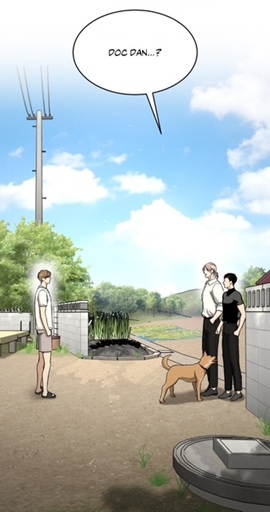 (chapter 57) He was not forgotten, he left traces in their life. He was their sunlight, their angel.
Feel free to comment. If you have any suggestion for topics or Manhwas, feel free to ask. If you enjoyed reading it, retweet it or push the button like. My Reddit-Instagram-Twitter-Tumblr account is: @bebebisous33. Thanks for reading and for the support, particularly, I would like to thank all the new followers and people recommending my blog.

Please support the authors by reading Manhwas on the official websites. This is where you can read the Manhwa: Jinx But be aware that the Manhwa is a mature Yaoi, which means, it is about homosexuality with explicit scenes. Here is the link of the table of contents about Jinx. Here is the link where you can find the table of contents of analyzed Manhwas. Here are the links, if you are interested in the first work from Mingwa, BJ Alex, and the 2 previous essays about Jinx Nature’s Touch in Jinx and The Ghost Elephant 🐘 at The Light 🕯️of Hope ❇️
It would be great if you could make some donations/sponsoring: Ko-fi.com/bebebisous33 That way, you can support me with “coffee” so that I have the energy to keep examining Manhwas. Besides, I need to cover up the expenses for this blog.

The hospice named “Light of Hope”  (chapter 56) in Jinx serves as a powerful symbol and narrative device, encapsulating the themes of observation, communication, and truth, as reflected in the title “Unspoken Gifts, Unveiled Truths in the Light of Hope.” Its name evokes images of enlightenment and clarity, which stand in stark contrast to the gym Team Black and the grandmother’s internal state of denial and her rejection of responsibility. This tension between the hospice’s symbolic essence and the grandmother’s actions deepens the narrative’s exploration of personal accountability and transformation.
Unlike the anonymity of the city  (chapter 35), where people’s actions and words can go unnoticed, the hospice fosters an environment of close-knit relationships and mutual observation.
 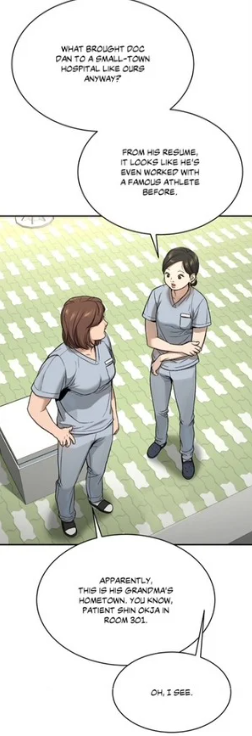 (chapter 56) In this communal setting, actions carry weight, and behaviors are scrutinized. Thus the door to the meeting room is made of translucent glass.
  (chapter 56) While in the previous essay, I pointed out that this door reflected Kim Dan’s emotional entanglement—he is physically present but emotionally excluded from his grandmother’s world, highlighting the imbalance in their relationship -, in verity this transparent door offers an opportunity for the main lead. How so? The glass door stands not only for transparency, but also for “emotional distance”. The glass allows visibility but creates a barrier, symbolizing a balance between openness and detachment. This is essential in a hospice environment, where the focus is on providing care and support without becoming overly attached to the inevitable outcome: death. For the staff, maintaining a degree of detachment is necessary for their well-being, as becoming too attached could make the emotional toll of their work unbearable. Therefore I am suspecting that the two nurses
  (chapter 56) will become the physical therapist and champion’s mentors and advisors. Why? It is because the nurse with the brown hair embodies those values. Her emotional distance is already perceptible in her conversation with her colleague: (chapter 56) “Apparently” indicates a certain reservation suggesting that the speaker is relying on logic or observation rather than direct emotional involvement. That’s how the readers in the English version got finally to discover the grandmother’s name: Shin Okja. The latter has a name and a room number. While her description about the grandmother oozes objectivity and facts, she shows a different attitude towards the main lead later. Here, she is speaking from her heart:
 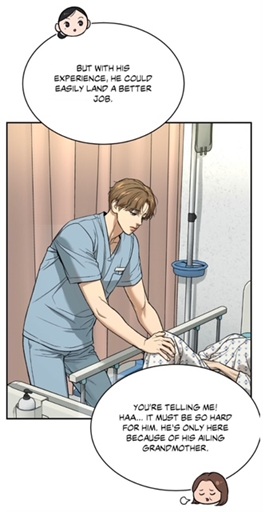 (chapter 56) She is projecting herself in his shoes. Why? IT is because she got influenced by the comment from her colleague. That’s how I realized that together, they represent the balance of heart and mind, their unity and understanding forming a cohesive whole. That’s how both are able not to become indifferent or too much attached. This coincides to the dualism of their profession: care but also detachment. Under this new perspective, it becomes comprehensible why the second nurse is not referring to facts, but to impressions and imagination. Her words are strongly intertwined with rumors: “with his experience”. So far, the main lead had barely experience in his field, as his first big gig ended up in a fiasco. He didn’t stay that long at the hospital and it is the same for the champion. He only worked at the gym for three months. The dark haired woman might have seen Kim Dan’s resume and the last employer, but she didn’t notice his name (Joo Jaekyung). This is her MO for „detachment“, she doesn’t pay attention to names. Moreover, she didn’t detect that he had barely worked as a PT before indicating that she has no notion of „time“. The discrepancy between her thoughts and reality can be easily explained. She also recognized the transformation in the patients, and could link it to the doctor’s skills. The reference to “famous athlete” and the doctor’s skills created a false perception, and this had an influence on her colleague: “You’re telling me!”.
The grapevines, both literal and figurative, symbolize the interconnectedness of the residents and the flow of information that can subtly reveal hidden truths. The grandmother, who once thrived under the city’s indifference, now finds herself navigating the attentive and watchful gaze of the hospice community.  (chapter 56) Her hypocrisy, particularly in her treatment of Kim Dan, remains hidden behind the guise of socially acceptable behavior. Within the hospice, residents maintain a positive opinion of her, which enables her to mask her neglect and selfishness effectively. But since the two nurses are sharing their thoughts and working as a team, it signifies that Shin Okja’s wrongdoings could be detected this time. Or better said, they will realize the true suffering from the protagonist. Nurse Heart and nurse Mind will do their best to protect their new mascot and give him what he truly needs: (chapter 56) Comfort and even a home! It is important, because this evolution represents a contradiction to the athlete’s past: Park Namwook portrayed himself as Joo Jaekyung’s savior and family.
  (chapter 26) The reality is that he still has no idea why the champion was acting that way. He tried to explain his odd behavior by jumping to conclusions (prejudices: a spoiled child) and by listening to others. He never used his heart and mind, rather his ears and eyes. And this brings me to my next part.
The partnership between the two nameless nurses contrasts sharply with the fractured dynamic between Park Namwook and Jeong Yosep in Team Black, where miscommunication and hidden motives reign. Observe that only in episode 5, the champion and the manager heard about the coach’s divorce and its circumstances. 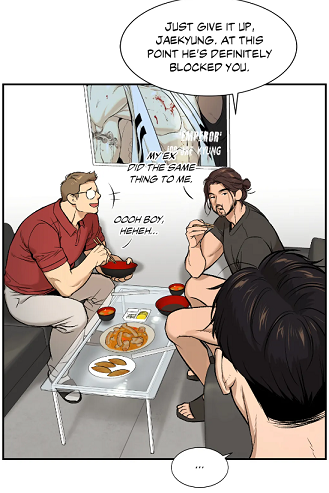 (chapter 5) And the other laughed. Then the coach seems to have no cellphone. Maybe he believes to have no need for it, for he goes to the gym every day. This signifies that he expects to be informed by his hyung Namwook. However, like mentioned in the previous essay, I believe that the manager has been sweeping under the rug the terrible condition of his “boy” from the coach and the team members. To sum up, Team Black embodies the opposite of the hospice’s values. There is no transparency, because the conversation took place not outside, but behind closed door. The door might be translucent, the reality is that they sent away all the members.
  (chapter 36) The gym, while ostensibly a team environment, is ruled by indifference, anonymity, and a lack of genuine camaraderie. The heart and the mind are not working together. Why? It is because the coach is trusting the manager, as he views him as the heart of the gym. What he fails to see, is that Park Namwook is neither the heart nor the mind, for he is more reflecting his surroundings: money. Secondly, the manager is easily influenced and is using conformity and social norms to avoid responsibility. He fears making decisions and lets others become proactive. Joo Jaekyung, the leader, relies exclusively on Park Namwook, the manager, who undermines team spirit by fostering distrust and misinformation.
 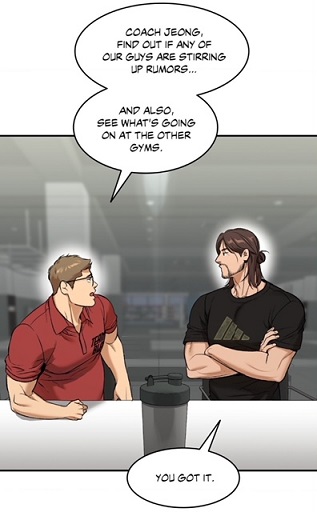 (chapter 46) The member’s loyalty got questioned, but the irony is that they had the real insight.
 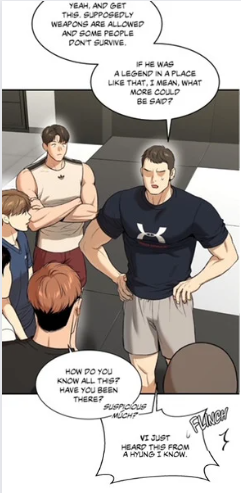 (chapter 47) Thus rumors about Baek Junmin being an illegal fighter never reached Jaekyung’s ears. That’s why the author made fun of the main lead here:
 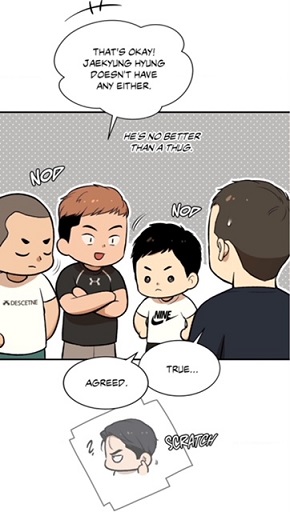 (chapter 47) His ear seemed to have caught their badmouthing, but not the real information. But why did he not listen to the members? It is because Namwook had encouraged the champion to keep his distance from others. He had even planted seeds of distrust among the team with his badmouthing about the champion. He has a bad temper and is a spoiled child, so no one needs to pay attention to him and his moods. The slap was the evidence of his disrespect and hypocrisy.
  (chapter 52) He was not willing to listen to the fighter’s suffering, because he didn’t want to be burdened. In fact, the opposite happened.
  (chapter 52) The man acted, as if he had been the biggest victim. Moreover, Namwook’s actions often reflect a lack of genuine loyalty, as seen in
  (chapter 22) episode 22, when he falsely claims ownership of the gym and again in episode 56 when he reminds the champion of his absence from the gym, behaving as though he were the boss.
  (chapter 56) In reality, the true owner of the gym is the “wolf,” and Namwook’s behavior underscores his disregard for loyalty and responsibility. In fact, his words mirror the nurse’s at the hospice: (chapter 56) Since she approached the physical therapist to get closer to him and used work to create a connection, people can see the similarities between her and the manager. While she represents honesty, curiosity, care but also “ignorance”,, it means that Park Namwook embodies the opposite values: indifference and a certain dishonesty.
 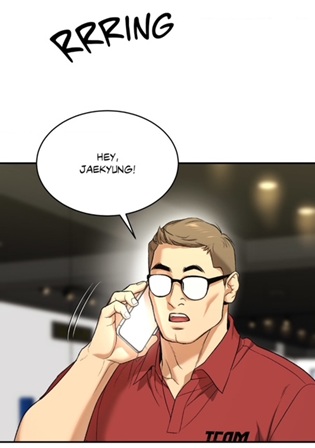 (chapter 56) Hence he is seen talking over the phone and not face to face, unlike the nurse. He knows that his boy is struggling, but he acts, as if he didn’t know. This contrast validates my previous interpretation of the manager. His question “Is everything okay with you?” exposes his lack of genuine concern. He uses work not to praise his “boy”, but to blame him for his “negligence”. He downplays the champion’s struggles while still recovering from surgery. This lack of care creates an atmosphere of apathy, anonymity, and selfish expectation, sharply contrasting with the hospice’s values of dignity and communal care. But how do we explain this huge divergence? First, the main principles of the hospice are dignity and care, and not primarily money. Therefore the institution offers free health check once a month: (chapter 56) Then they don’t pay attention to drugs and treatment, as they are useless there. Therefore they are less prone to corruption and greed contrary to the hospitals in Seoul. This means that this institution should become the main support for the main couple. Let’s not forget that Joo Jaekyung is suing a reputable hospital, but there’s no doubt that all the institutions are siding with the medical world and not the fighter.
Furthermore, though Light Of Hope and Team Black are strongly intertwined with fighting, their focus diverges significantly. The hospice prioritizes mental well-being, addressing the emotional and psychological needs of patients who have already relinquished hope for physical recovery. 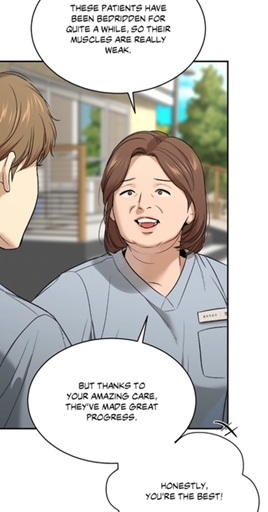 (chapter 56) This contrasts with the gym, where fighting is treated as entertainment and sport, emphasizing the physical aspect while neglecting the mental health of its athletes. Ironically, even the physical treatment of its members was neglected at the gym from the very beginning, like we could see it in two occasions:
 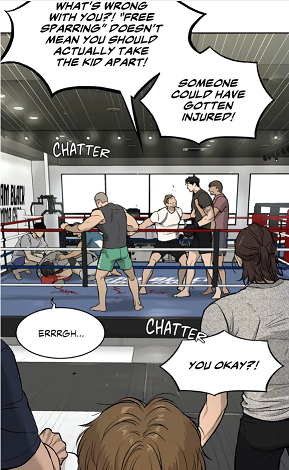 (chapter 1) The fighter with the head injury received treatment from the members (self-medication) and Kim Changming had a shoulder injury which got neglected.
  (chapter 7) These incidents reflect the gym’s underlying indifference and mismanagement. This disparity explains why Jaekyung’s mental health suffered under Namwook’s leadership, as the gym lacked the supportive and transparent environment required to nurture emotional resilience. Jaekyung’s stay at the hospice is likely to open his eyes to this overlooked aspect, prompting him to reconsider his leadership style and the values governing Team Black. But it is the same for Kim Dan, especially if he sees how weak and neglected the fighter looks:
 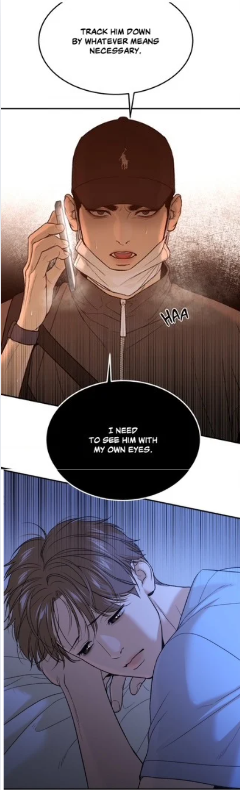 (chapter 56) he has already become a shadow of himself.
Light, a recurring symbol of enlightenment and awareness, serves different functions in the hospice and Team Black. In the hospice, light represents the revelation of truths previously hidden by denial and pretense. (chapter 56) The nurses might come to wonder how the grandmother can happily chat and smile when her relative is barely eating and spending all his time at the hospice. For the grandmother, this light exposes her selfishness and misguided belief that she can evade accountability.  (chapter 56) Her actions, such as allowing Kim Dan to stay by her side and covering him, contrast sharply with her earlier attempts to push him away. In this scene, a caretaker might pass through the rooms to ensure everything is in order, noticing the doctor present. To an outsider, the visible outcome suggests that she accepts her grandchild’s relentless care without protest. It was, as if she had said nothing at all. Yet, this perceived acceptance masks her internal struggle and the discomfort of being dependent on Kim Dan, reflecting her conflicted emotions. These moments of vulnerability and acceptance highlight the gradual erosion of her denial under the hospice’s symbolic light.
The idea of gifts further underscores the theme of communication and truth, as gifts convey a message and reveal the nature of the relationship between the giver and the receiver. For instance, Park Namwook treats the gym as though it were a “gift” bestowed upon him, despite this being far from the truth. (chapter 22) Rather than acknowledging the champion’s suffering and generosity, he exploits his position thanks to his seniority, treating the gym as his personal domain. This false sense of ownership leads to his manipulative behavior and disregard for loyalty, as he capitalizes on Jaekyung’s trust and struggles.
Similarly, the grandmother’s wedding cabinet, made of mother-of-pearl, was a symbol of her dowry and seems to hold sentimental value for her.  (chapter 19) However, for Kim Dan, this object represented a burden rather than a gift. He had troubles to find a new place to stay because of her „treasure“:
 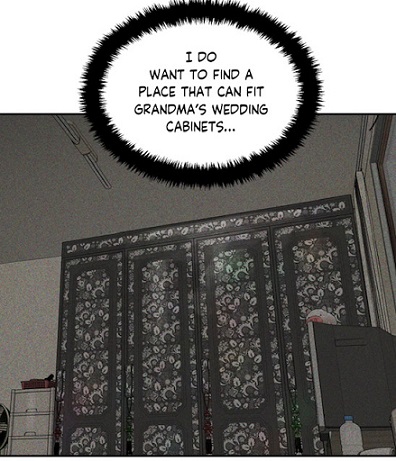 (chapter 16) Despite its substantial value, the grandmother never sold the cabinet to pay off the debts, prioritizing its preservation over the survival of her home and family. On the one hand, this reveals her immaturity and selfishness, as she put up with her grandson’s suffering. On the other hand, her decision created the impression to Kim Dan that this belonging had just a sentimental value and nothing more. So when the champion saw that huge Wedding cabinet, he judged it as „junk“ and that’s how the doctor got this perception validated. (Chapter 19) Hence it is not surprising that at the end, he chose to abandon this huge cupboard.
  (Chapter 53) Finally during her move to the Light Of Hope, she did not ask about the whereabouts of her belonging which could only reinforce the impression that this item had no real value. It had even lost its sentimental value, as she was no longer thinking of her former home. Her ignorance and forgetfulness are once again outlining her superficiality, self-centeredness and lack of empathy. The sentimental value of her Wedding Cabinet was rather shallow. But the tragedy is that when the furniture was moved the penthouse, the champion noticed this item for the first time and came to associate this cupboard with the doctor. (chapter 19) Thus I am suspecting that this Wedding Cabinet created a false impression about the doctor: Joo Jaekyung thought that Kim Dan had many clothes in this cupboard, the negative version of this scene,
  (chapter 42) This explicates why the athlete didn’t pay attention to his soulmate’s clothes. And now, observe that the doctor is only wearing his PT uniform.
  (chapter 56) Thus I am predicting a huge awakening for the champion. Without the cupboard, the champion can see that the physical therapist almost has no cloth. Thus he can only admit his humbleness and benevolence. However, the moment he hears that this furniture belonged to the grandmother, the champion can only perceive the relative in a different light. Yes, the gift should expose her true personality. At the same time, Shin Okja never gave her Wedding Cabinet to Kim Dan, so should she discover that she lost her gift or the latter ended up in the athlete’s hands, she could protest and reclaim it. My point is that this legacy serves as a tool to expose the grandmother’s childish and shallow nature.
But I believe that we should combine this present from the past with the scarf she received from her grandson: 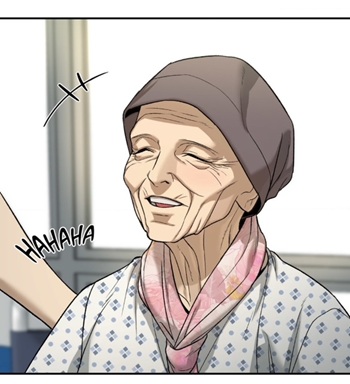 (chapter 56) She is wearing it daily and is proud of it. Deep down, she knows the true value of the scarf: it was expensive
  (Chapter 41) as she employs the expression „spoil to death“. By wearing the scarf with flowers, she appears wealthy, but also vain! Since I detected that Kim Dan likes pink flowers, my interpretation is that this gift mirrors the doctor’s taste indicating that he was slowly regaining his identity and confidence..
  (chapter 31) And notice that the bouquet of pink roses pushed Kim Dan to talk to Joo Jaekyung about his taste. That’s how I detected a strong connection between presents and communication. Notice that on the champion’s birthday, the manager sent a message while the presents were delivered.
 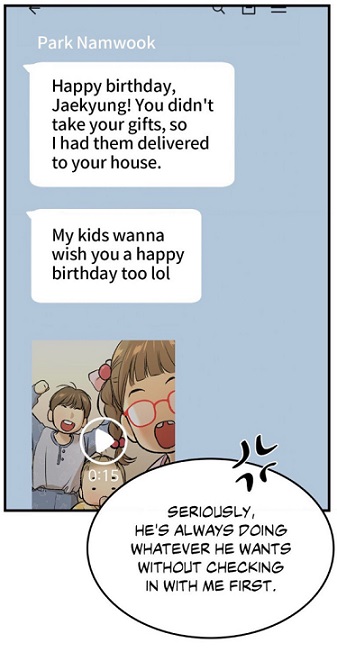 (chapter 45) This aspect gets even validated with the doctor’s keychain. The latter not only caused an argument between the two room mates
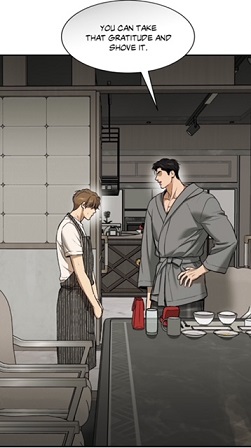 (chapter 45), but also encouraged the doctor to convey his thoughts and expectations in the card. On the other hand, he didn’t expose the whole truth
  (chapter 55) Another interesting aspect lies in the doctor’s shaking hands which the champion noticed, when he offered the present:
  (chapter 55) This scene reminded me of their first encounter:
 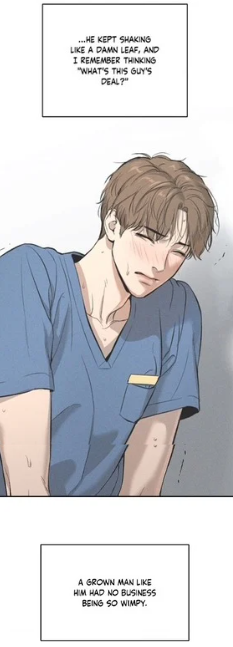 (Chapter 56) So the man must have recognized the doctor‘s fear, which explains why the champion could voice his anger later. But back then, he never wondered why the doctor‘s hands were shaking like leaves. It is because the doctor feared rejection. The present had the following meaning for the physical therapist: recognition and acceptance. The gift was the symbol for „conditional affection“ which he had long internalized due to his grandmother. But this doesn‘t end here. The shaking hands appeared in a different scene:
  (chapter 49) The common denominator between these three scenes is the mistake. Kim Dan feared to have made a mistake with the present, because he was afraid of the champion‘s reaction: will he accept him or not? But let‘s return our attention to the gifts from the doctor.
And what is the huge divergence between the champion and the grandmother? The latter has always accepted doc Dan’s gifts, and even kept them, though she is well aware that her grandson is broke. He might have no longer any debts, but she doesn’t know it. So should the main lead meet the grandmother wearing the beautiful and expensive scarf, he should realize the value of the cloth. He should notice that the spoiled and greedy child is the halmoni, and not his fated partner. (chapter 41) Her words at the hospital are going to come back to bite her. She should have refused them in order to save some money. To conclude, the gifts serve to expose the truth about the receivers’ personality, like we could observe in another occasion: 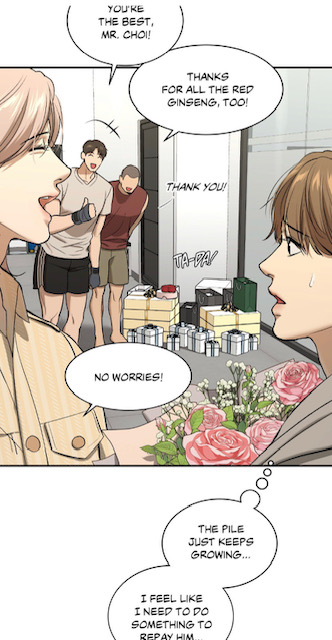 (chapter 31)
Funny is that her Wedding Cabinet was never intended as a gift for Kim Dan but as a reflection of her own past. Similarly, the scarf becomes a symbolic extension of this dynamic, illustrating the disparity in how gifts are perceived and valued. Through these gifts, the true nature of the relationships and the inherent imbalances are exposed. The cabinet, meant to represent care and love, becomes a mirror of her selfishness and refusal to take responsibility for Kim Dan’s sacrifices. These gifts underscore the imbalance in relationships where one party takes advantage of the other’s kindness or generosity. So paying back the fighter should be seen as a reflection to the scene, where the champion rejected the keychain. Simultaneously, the money transfer 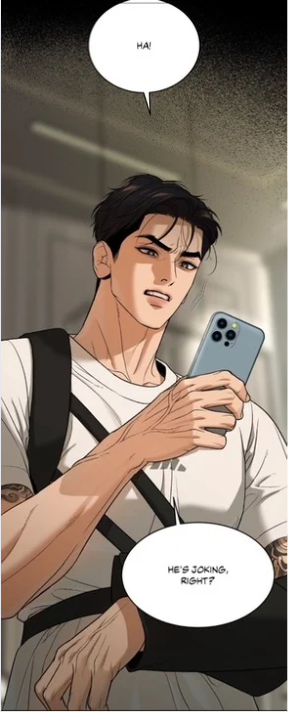 (chapter 55) implies that as soon as the main couple meet each other, they will have to discuss this matter. To sum up, a gift encourages the couple to communicate, yet contrary to season 1, both should be more honest to each other at the Light Of Hope. Every word and action will appear in a different light. Another aspect is that none of them takes things for granted, which stands in opposition to hyung Namwook and the grandmother. This explicates why the latter have no problem to spend money.
Light, a recurring symbol of enlightenment and awareness, serves different functions in the hospice and Team Black. In the hospice, light represents the revelation of truths previously hidden by denial and pretense. (chapter 56) The nurses might come to wonder how she can happily chat and smile, when her relative is barely eating and even spending his whole time at the hospice. For the grandmother, this light exposes her selfishness and misguided belief that she can evade accountability. (chapter 56) Her actions, such as allowing Kim Dan to stay by her side and covering him, contrast sharply with her earlier attempts to push him away. In this scene, a caretaker might pass through the rooms to ensure everything is in order, noticing the doctor present. To an outsider, the visible outcome suggests that she accepts her grandchild’s relentless care without protest. It was, as if she had said nothing at all. Yet, this perceived acceptance masks her internal struggle and the discomfort of being dependent on Kim Dan, reflecting her conflicted emotions. These moments of vulnerability and acceptance highlight the gradual erosion of her denial under the hospice’s symbolic light.
In contrast, Team Black’s symbolic “darkness” represents ignorance, despair, and unhappiness. The gym’s lack of transparency and trust fosters a culture of disconnection and secrecy. This explicates why Kim Dan and Joo Jaekyung got betrayed and abandoned by the staff. Though they were both victims, no one sided with them. No one went to fetch them either or to call them. The name “Team Black” itself evokes these negative qualities, further emphasizing the divergence from the hospice’s values of clarity and interconnectedness. On the other hand, one origin of this problem is that the gym was founded for the athlete’s own needs. That means that the company must change its philosophy and in my opinion, it is related to Kim Dan. The latter embodies other values like family, dedication and selflessness. Work is not linked to money, but to self-worth. Like mentioned before, the doctor is about to conquer the gym and as such he is the true game changer.
For Jaekyung, the hospice’s light serves as a metaphorical mirror, reflecting the shortcomings of his leadership and his failure to build a true sense of community within Team Black. By entering this environment, he begins to see the value of actions over appearances and the importance of genuine relationships, which contrasts with the superficial and transactional nature of his gym.
The hospice’s name also reflects its role as a catalyst for transformation. While it offers hope and care to its residents, it also demands honesty and responsibility. The grandmother’s journey within this space is marked by a slow but inevitable confrontation with her own hypocrisy. Her interactions with Kim Dan and the hospice community challenge her to embrace the very principles that the “Light of Hope” embodies—truth, responsibility, and genuine care.
Similarly, Jaekyung’s time at the hospice serves as a turning point. Surrounded by people who value authenticity over status, he begins to shed his reliance on Park Namwook and reevaluates his treatment of Team Black. The hospice helps him uncover buried traumas and understand the impact of his actions on others, including Kim Dan. This newfound awareness sets the stage for his transformation as a leader and as a person.
The hospice “Light of Hope” is not merely a setting in Jinx; it is a microcosm of the story’s broader themes. It stands as a beacon of enlightenment, forcing characters like the grandmother and Joo Jaekyung to confront uncomfortable truths and redefine their relationships with themselves and others. While the grandmother initially resists this process, the hospice’s environment and its symbolic “light” gradually guide her toward self-awareness and accountability. For Jaekyung, the hospice provides an opportunity to recognize the flaws in his leadership and to embrace a more empathetic and authentic approach to life. In doing so, the “Light of Hope” becomes a place where denial fades, truths are revealed, and the potential for transformation is realized.
Feel free to comment. If you have any suggestion for topics or Manhwas, feel free to ask. If you enjoyed reading it, retweet it or push the button like. My Reddit-Instagram-Twitter-Tumblr account is: @bebebisous33. Thanks for reading and for the support, particularly, I would like to thank all the new followers and people recommending my blog.

Please support the authors by reading Manhwas on the official websites. This is where you can read the Manhwa: Jinx But be aware that the Manhwa is a mature Yaoi, which means, it is about homosexuality with explicit scenes. Here is the link of the table of contents about Jinx. Here is the link where you can find the table of contents of analyzed Manhwas. Here are the links, if you are interested in the first work from Mingwa, BJ Alex, and the 2 previous essays about Jinx Sweet 🍬 Redemption or Sweet Poison ☠️? The Price of Desire and Burning Up, Losing Control
It would be great if you could make some donations/sponsoring: Ko-fi.com/bebebisous33 That way, you can support me with “coffee” so that I have the energy to keep examining Manhwas. Besides, I need to cover up the expenses for this blog.

In Jinx, nature emerges as a symbol of purity and authenticity, a stark contrast to the city, which embodies corruption, materialism, indifference, and anonymity.  (chapter 56) This dichotomy in season 1 is vividly illustrated in a scene where Kim Dan, under the dappled light of a tree
 (chapter 41), experiences a profound moment of awakening. As his hand seems to reach towards the leaves
 (chapter 41), his senses come alive—he sees the light filtering through, feels the breeze, and hears the faint rustling sound. It is, as if in that moment, he reconnects to his true nature. Like a tree, Kim Dan is deeply rooted, yet capable of growth and resilience.
  (chapter 41) Nature awakens something within him— his heart and as such his third eye —allowing him to realize his affection for Joo Jaekyung. This quiet yet powerful moment emphasizes how nature offers clarity and purity, serving as a contrast to the suffocating, impersonal urban world where Kim Dan often found himself lost. Striking is when Joo Jaekyung met Kim Dan for the first time, he compared him to a “leaf,” shaking and fragile—an unconscious recognition of his true nature. (chapter 56) Leaves are part of trees, symbols of growth, life, and resilience, but since Kim Dan is just a “leaf”, this signifies that he is actually mutilated, reflecting his emotional and physical vulnerability caused by repeated abandonment and suffering. Joo Jaekyung, though dismissive at first, catches a glimpse of Kim Dan’s deeper essence—one connected to nature but battered by his struggles.
Interesting is that the return of the physical therapist in season 2 was presented in a similar situation:  (chapter 55) However, note that the main lead isn’t stretching his hand to the sky and sun. He is almost immobile. Just before, he was holding the cellphone in his hand:
 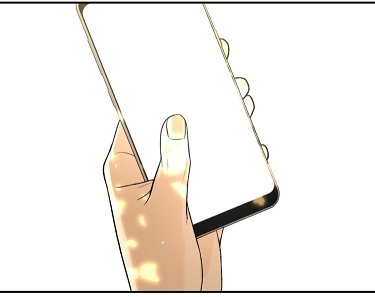 (chapter 55) Another divergence to the scene in episode 41 is that Jinx-philes couldn’t see his face. It indicates that the doctor reverted to his old self, and as such he is not true to himself. Therefore I come to the following conclusion. Mingwa uses nature as a mirror to Kim Dan’s emotional and spiritual state. While moments of connection with nature reflect clarity and self-realization, the juxtaposition in this scene underscores the opposite. Here, Kim Dan sits surrounded by trees and bathed in sunlight, yet his attention is consumed by his cellphone—symbolizing his entanglement with money, duty, and his ongoing struggles. Just moments prior, he wired money to the champion, a decision rooted in his past traumas and present desperation. The irony of the setting cannot be overlooked: though nature surrounds him, its purity and tranquility remain unnoticed, emphasizing how Kim Dan is still trapped in patterns of survival, burdened by his circumstances. He has become a ghost once again. This disconnect reveals how the weight of his past prevents him from embracing the present moment and reconnecting with his true nature, contrasting starkly with earlier scenes where his senses came alive under the trees.
In episode 56, Mingwa introduced Kim Dan’s world with the following panel:  (chapter 56) The empty beach scene, with its sunlight and tranquil beauty, reflects peace, but also unfulfilled connections. Kim Dan’s absence from this moment underscores his failure to keep a heartfelt promise to his grandmother:
  (chapter 53) to watch the sunset together. This failure stems not only from Joo Jaekyung
  (chapter 53) —now associated with the sunlight, symbolizing life and vitality—but also from Kim Dan’s fixation on his own suffering.
  (chapter 56) Abandoned once again, Kim Dan is consumed by the weight of his trauma, isolating himself emotionally and excluding himself from others.
This emotional isolation becomes apparent in his interactions with those around him. 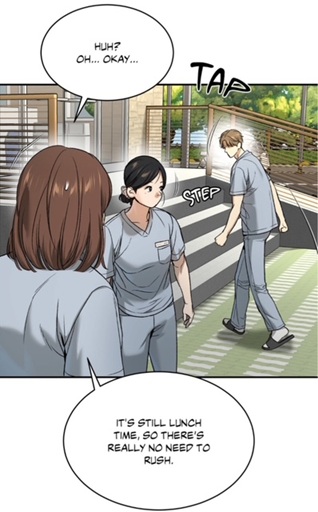 (chapter 56) When approached and complimented, such as when the nurse praises him and encourages him to take a break for lunch, Kim Dan pointedly ignores the praise and instead chooses to return to work. His inability to engage with others reflects the same disconnection that prevents him from connecting to nature. Mingwa subtly reveals a painful truth: Kim Dan’s fixation on his suffering not only blinds him to the solace and clarity offered by nature, but also hinders his ability to nurture relationships. (chapter 56) By choosing to exclude himself, Kim Dan becomes his own worst enemy—trapped in a cycle of abandonment, survival, and self-imposed isolation.
This disconnection deepens the symbolic duality of the sun and moon. While the sun, embodied by Joo Jaekyung, represents life, vitality, and intensity, the moon reflects subtle constancy, support, and quiet presence. However, Kim Dan’s emotional entrapment prevents him from recognizing it either. By turning his back to nature 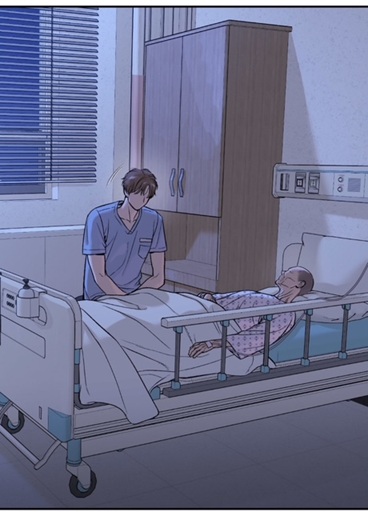 (chapter 56) and, symbolically, to the moon, Kim Dan remains oblivious to what has always been there for him: the enduring forces of love, stability, and healing.
Mingwa also underscores the impartial and eternal nature of the wind, the moon,  (chapter 56) the ocean and celestial elements like Saturn (Kim Dan stands for this planet). These forces, outside human control and independent of Kim Dan’s struggles, offer opportunities for renewal and clarity. Yet Kim Dan, consumed by his pain, remains trapped in patterns of survival and alienation. Nature’s constancy mirrors what he needs most—connection, healing, and presence—yet his inability to see it reflects his broader struggle to connect with others and himself.
By highlighting Kim Dan’s exclusion from both nature and human relationships, Mingwa reveals a poignant truth: Kim Dan’s suffering is not only external but also internal. While circumstances and abandonment have shaped his pain, his inability to step outside this trauma keeps him rooted in isolation. Mingwa’s use of nature—both as a symbolic force and a reflection of Kim Dan’s emotional state—invites readers to see that healing, like the tree, moon and wind, is constant and present. However, it requires awareness, acceptance, and the courage to connect—to nature, to others, and to oneself. The comparison to a leaf ties Kim Dan’s state of being to nature once more. A leaf shakes, when the tree it belongs to, is vulnerable. Yet it also signifies life, beauty, and renewal. Joo Jaekyung’s early observation foreshadows Kim Dan’s journey: a leaf that is fragile but has the potential to flourish again when given the right conditions. Kim Dan’s healing, like a leaf reconnecting to its tree, can only begin when he turns toward nature, relationships, and, ultimately, himself. But how can the athlete break this vicious circle and make him to turn to nature? One might say that he needs a true home. However, with the last incident, where the champion pushed him away 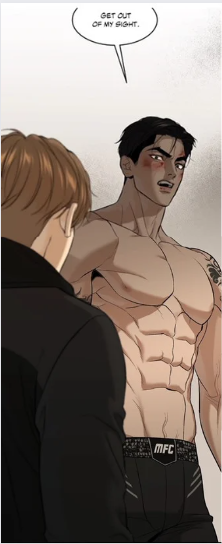 (chapter 51), the doctor learned the following lesson: it is better to keep people at a certain distance, because he got his heart broken. That’s the reason why he is avoiding the nurses and not eating lunches. He is simply avoiding gatherings. He is seeking solitude on purpose. That’s how it dawned on me that he is living like the athlete in season 1!! His whole world is revolving around work and as such taking care of patients.
That’s how I recalled an important change in the doctor’s attitude in season 1:  (chapter 26) Yes, the day where they sparred out of fun. For the first time, Kim Dan chose to accept a challenge for himself and for Potato. He felt a connection with Yoon-Gu, because he saw in him a puppy:
 (chapter 29) That’s the moment he started opening up to others, he confided his struggles to Oh Daehyun and Potato:
  (chapter 37) The puppy symbolizes not only nature, but also innocence. Let’s not forget that he was moved by the actor’s flowers in the past: (chapter 31) Thus it dawned on me how Kim Dan’s soul could be healed:
 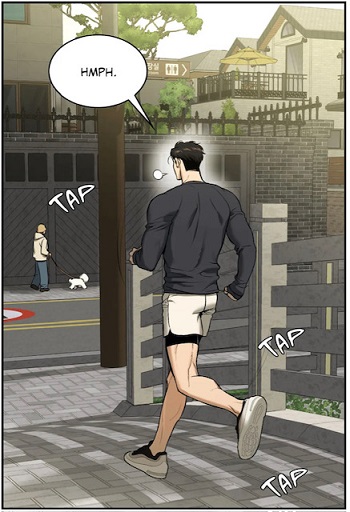 (chapter 21) Yes, by offering him a puppy! Is it a coincidence that the author made the champion jog next to a dog owner? I don’t think so. Until now, nothing could move Kim Dan’s heart: (chapter 31) Here, the main lead saw the gifts as a burden, for they made him think of money and debt. He never saw them as a sign of affection. In fact, dogs have a healing power.
The companionship that our furry friends offer is incredibly beneficial. Studies have found that dog owners are less likely to experience loneliness and depression. Dogs not only provide direct emotional support but also encourage social interaction with other dog owners, strangers, and friends. This helps create a sense of community and belonging, which further supports emotional well-being and can indirectly reduce anxiety. […] Research has shown that dog ownership can significantly reduce the stress hormone cortisol. This decrease in cortisol levels has been linked to improvements in various mental health conditions, such as post-traumatic stress disorder, anxiety, and depression. […]
Matlock taught me to live in the moment, cherish every belly rub, and perceive my intrusive thoughts as background noise I could control. Our daily walks became a therapeutic ritual, gradually making my anxiety more manageable. We explored various outdoor spaces, such as lakes, dog parks, and hiking trails. These activities helped me stay grounded in the present. Quoted from https://www.psychologytoday.com/intl/blog/its-not-just-about-the-food/202407/the-healing-power-of-paws#:~:text=Research%20has%20shown%20that%20dog,disorder%2C%20anxiety%2C%20and%20depression.
They boost our oxytocin levels (the love hormone), therefore they provide unconditional love. In addition, they lighten the atmosphere, and bring a sense of stability. Finally, I would like to outline that our famous doctor believed to see a “cat” in his fated partner: which made the doctor laugh for the first time:  (chapter 44) In other words, Kim Dan feels a strong connection to animals, but he could never have one due to his poverty and his grandmother. By taking care of a dog, he would be forced to pay attention to nature and in particular to trees. Naturally, I believe that Potato will play a similar role in the future, for Mingwa associated him with a dog.
 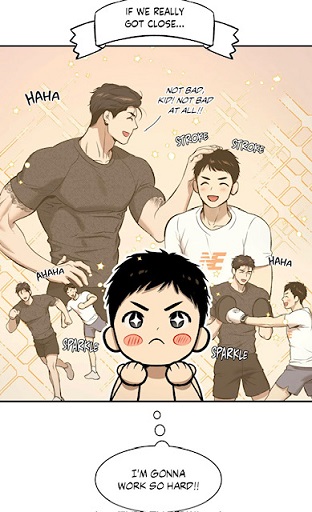 (chapter 23) While this was his original dream, after the last incident, there is no doubt that the young maknae must feel guilty and unhappy. He had not been able to protect and defend his new hyung. However, I have to admit that I would like to see the main couple having a pet! The latter would bring life in the penthouse, but also force the two protagonists to have a new routine. The penthouse would truly become a real home.
In Jinx Season 2, Mingwa introduces a new thematic focus: womanhood, symbolized through natural elements and the increasing presence of feminine energy. This shift is intertwined with the color blue —a hue often associated with calm, introspection, and the feminine principle. Blue dominates the imagery of the ocean, the beach, and the moon, natural symbols that deepen the narrative’s exploration of love, renewal, and emotional awakening. The ocean, in particular, evokes the myth of the Birth of Venus, where the goddess of love and beauty rises from the sea. By aligning Kim Dan’s journey with the ocean and the moon, Mingwa reinforces themes of rebirth, love, and emotional nurturing.
One might object to this interpretation, pointing out that women were already present in Jinx Season 1. We encountered Kim Dan’s grandmother, the oncologist Kim Miseon (chapter 47), the nursing attendant
  (chapter 21) or the reporters:
 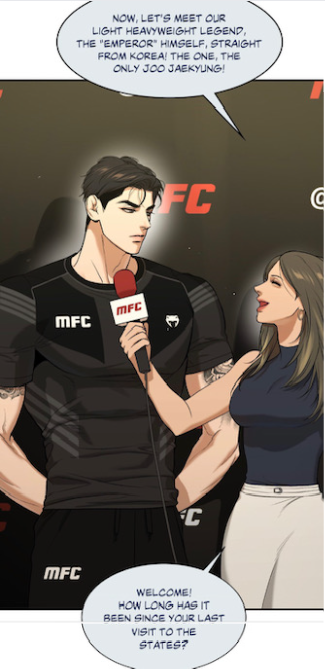 (chapter 37)
 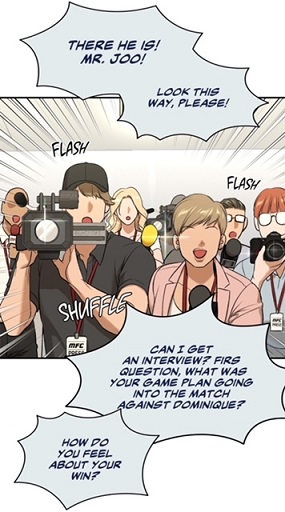 (chapter 40) However, Manhwa-worms will notice a significant distinction: in Season 1, these women were all tied to the world of work. Even Kim Dan’s grandmother, though she represents a familial figure, falls into this category.
Kim Dan’s grandmother complicates the notion of family and care. Though on the surface, she appears as a caring relative, the reality is that she is doing nothing. Her worries remain just words  (chapter 56) Moreover, the grandmother’s choice of words, “Why don’t you turn in?”, implies that she sees Kim Dan’s presence as a form of “work” or duty. This phrasing is often associated with someone finishing a day’s tasks or obligations before going to bed, which fits into the broader dynamic between Kim Dan and his responsibilities. In my eyes, it shows that she is seeing her grandson more as a caretaker than as a family member. We shouldn’t forget that she was the reason why the main lead became a PT. It was, as if her dream had come true. Nevertheless, the verity is that his grandmother is receiving treatment from his colleagues. (chapter 56)
So when she suggests to Kim Dan to return to Seoul, it makes her look like a heartless person.  (chapter 56) It looks like she’s pushing him away. On the one hand, her request sounds right, for she is treated quite well and the suggestion was made out of concern. She sees her grandchild struggling, and probably imagines that this move must weight down on Kim Dan. On the other hand, I can’t help myself thinking that this woman also has other reasons to send him back to Seoul. The nurse was already pitying the physical therapist: (chapter 56) She was seeing their move as the grandson’s sacrifice. And there’s no doubt that many people at the hospice must think similarly. So this could have reached the halmoni’s ears. Like mentioned in a previous analysis, I detected that the grandmother uses pity to achieve her goal, yet her grandson is receiving a lot of sympathy and attention. It looks like there’s a competition who is more pitiful in this.
But there’s more to it. By suggesting him to return to Seoul, she appears cruel, because she doesn’t know about all the changes in his life. She remains unaware that Kim Dan has no longer a home in Seoul due to the redevelopment and his resignation. He quit his job because of her. But she is not stupid, she can imagine it. At no point does she inquire about his needs, emotional state, or financial situation. Why? It is because she doesn’t desire to be burdened. For me, she feigns ignorance on purpose. (chapter 56) I also noticed a pattern: she only focuses on the moment. Hence she reacted so violently first to the new expensive treatment  (chapter 7) before she got reassured. Then she made this request (chapter 53) after hearing the bad news. She has the mind of a child, therefore she never thinks of the consequences of her choices and words. Her “ignorance” exposes a form of neglect: she takes his sacrifices for granted, further isolating him. Ironically, her detachment pushes Kim Dan further away, undercutting her role as a source of familial love and support. (chapter 56) As a result, she ceases to embody “real family” and instead represents the emotional burdens that trap Kim Dan in survival mode.
It is only in Season 2 that Mingwa shifts the portrayal of womanhood to emphasize its connection to family, emotional intimacy, and private life. A notable example is the conversation between the two nurses (chapter 56) where one speaks candidly about her personal desires —having Kim Dan as a son-in-law – while the other calls him cute, giving the impression that she might consider him as a potential boyfriend . This dialogue marks a departure from the women of Season 1, who were defined solely by their roles as professionals or authority figures. Here, womanhood begins to represent emotional connection, care, and the nurturing qualities of family life—values that Kim Dan has been missing.
But it already started much earlier, when the cleaning lady made a teasing remark about the empty bottles of wine 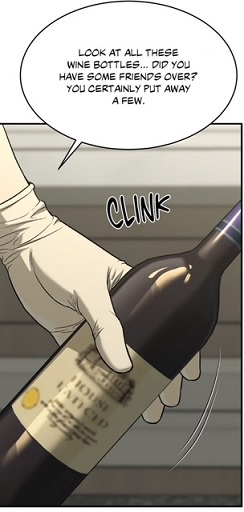 (chapter 55) and later brought the doctor’s present:
 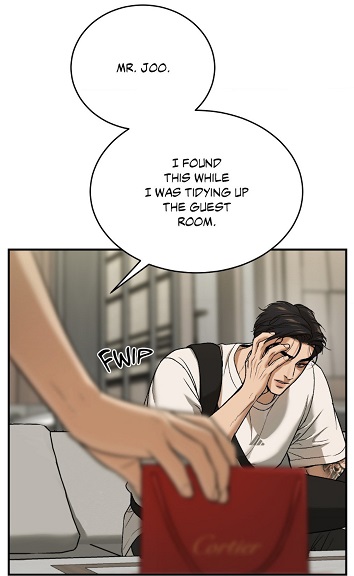 (chapter 55) And what is the common denominator with these two images? The woman’s hand. In the previous essay, I explained that her intervention signalized that the champion would stop drinking and was starting acknowledging Kim Dan. The zoom on the cleaning lady’s hand is a powerful visual cue that encapsulates many of the symbolic meanings associated with a woman’s hand, reinforcing the themes of care, healing, humility, and transformation.
Unseen Strength: The hand also carries an understated strength. While the cleaning lady’s actions are gentle, they require perseverance and resilience—qualities that align with Kim Dan’s own endurance and hint at the kind of emotional strength Joo Jaekyung will need to cultivate.
Care and Nurturing: The cleaning lady’s hand, likely engaged in a modest task like wiping or tidying, emphasizes the quiet but essential role of care. Her hand symbolizes the unseen work of women—work that brings order, comfort, and emotional warmth. This gesture contrasts with the harsh, physical force seen in earlier parts of Jinx, especially through Joo Jaekyung’s fists.
Healing and Emotional Connection: While seemingly mundane, her hand represents the nurturing touch that Kim Dan’s life lacks. Cleaning and caregiving symbolize acts of renewal and healing—clearing away what is dirty or broken to make space for something better. This resonates with Kim Dan’s need for emotional renewal and a gentler kind of care. At the same time, it also explains why the physical therapist was so bad at cleaning as well. 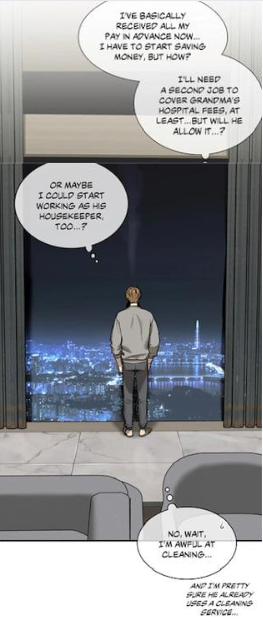 (chapter 19) He is not capable to take care of himself well.
Humility and Sacrifice: The hand of a cleaning lady also carries connotations of humility and unacknowledged sacrifice. Like Kim Dan, her role may be overlooked, yet her work is indispensable. This subtle symbolism mirrors Kim Dan’s own existence—his quiet struggles, unrecognized sacrifices, and the way he shoulders emotional and physical burdens for others.
Transformation and Softness: In contrast to the yang energy of fists, the cleaning lady’s hand introduces a feminine yin energy: soft, restorative, and transformative. This moment of focus suggests that the solution to Kim Dan’s struggles lies not in power or force, but in gentleness, patience, and care. That’s what the champion needs to discover. By meeting her, he discovered the magical “woman’s touch”.  (chapter 55) Observe how she smiled to him by saying goodbye. This is a sign that her respect and care are genuine. One might think that this nameless cleaning lady was unfortunately portrayed as eyeless:
 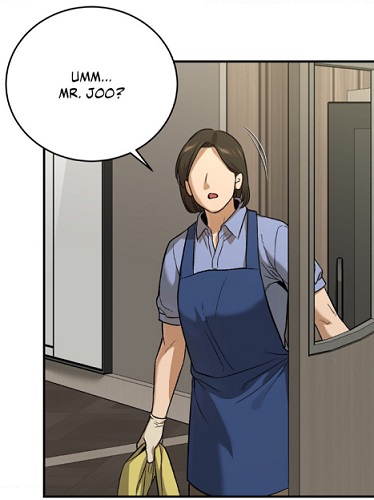 (chapter 56) I don’t think, we should see it in a pejorative light, like for an example of blindness or manipulation. In my eyes, the absence of her eyes are mirroring the nature of their relationship between the champion and the cleaning service. So far, he never met these people, as he was always away. In other words, the absence of the eyes is showing that the sportsman doesn’t know her that well. But it could change and this because of Kim Dan.
This thematic evolution aligns with Mingwa’s yin and yang motif. Season 1 emphasized the masculine yang: work, dominance, survival, and external conflict. Women, though present, were tied to this yang energy, inhabiting roles that reinforced Kim Dan’s emotional isolation and struggles. In contrast, Season 2 introduces yin energy—introspection, emotional nurturing, and family dynamics—through both nature (the ocean, the moon) and the increasing presence of women embodying these qualities. This shift reflects a new balance in the narrative: as Kim Dan navigates his journey, the story begins to explore the softer, more intimate aspects of relationships and healing.
For Joo Jaekyung, this shift signifies a challenge. The increasing presence of feminine energy and family-oriented symbolism suggests that his approach to Kim Dan must change. In Season 1, Joo Jaekyung relied on power, money, dominance, and force—tools that align with yang energy. However, in Season 2, this will no longer suffice. To truly connect with Kim Dan, Joo Jaekyung must embrace his yin side: patience, emotional vulnerability, and nurturing. If he wants to reconnect with the physical therapist, he needs to reveal more about his past and in particular his relationship with Baek Junmin. He has to explain why he doubted him:  (chapter 51) Women in Season 2—more prone to conversation and care—foreshadow this necessary transformation. Joo Jaekyung must learn to move Kim Dan not with his fists, but with empathy, understanding, and love. In essence, he must uncover his “motherly side” to create a genuine bond with Kim Dan.
By contrasting the utilitarian portrayal of women in Season 1 with the emotionally intimate depiction in Season 2, Mingwa highlights the evolving themes of family, balance, and healing. Womanhood becomes a vehicle for Kim Dan’s emotional growth and Joo Jaekyung’s transformation. It is through this shift—both in narrative tone and symbolism—that Mingwa begins to unravel the yin energy of Season 2, bringing the story closer to the emotional clarity and connection symbolized by the moon and ocean. And now, you are wondering why I included this image 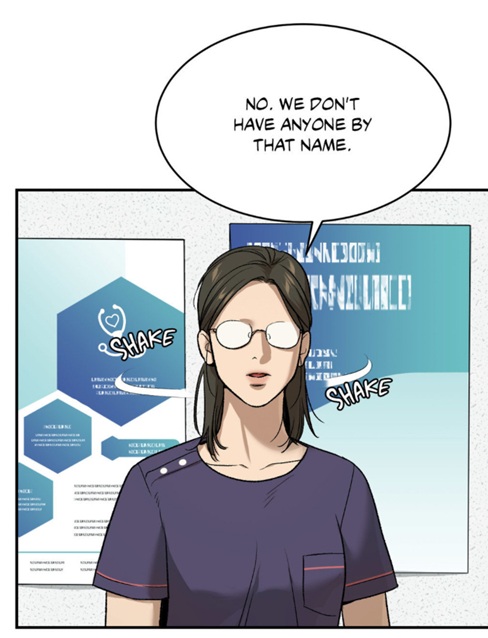 (chapter 56) in the illustration. It is because I realized that the champion first looked for Kim Dan at Sports Therapy Centers
  (chapter 56) before realizing that his fated partner might have switched the focus in PT, geriatrics. And what did the PT say at the Light Of Hope Hospice?
 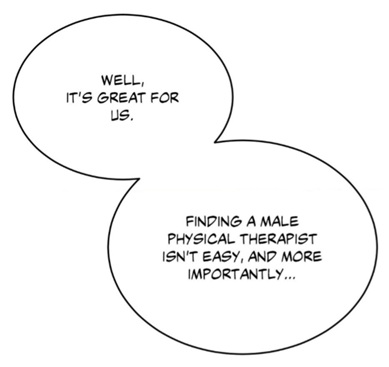 (chapter 56) Male physical therapists like this one
  (chapter 54) prefer specializing in treating athletes because it brings more money and fame, whereas female PT ends up at hospices due to their nature (nurturing, family). This means that by going to the hospice, the athlete will enter a whole new world. The appearance of the woman with glasses was indicating that the athlete was slowly broadening his horizon. As you can see, little by little, the fighter is opening his mind to new things. So how will he react, when he sees that his beloved “hamster” is withering again? This time, he can not blame the doctor. Since I detected similarities between Kim Dan’s current attitude and the champion’s past behavior, I have the feeling that the fighter will recognize himself in his loved one or someone will give him some advice. He will have the answer to this:
 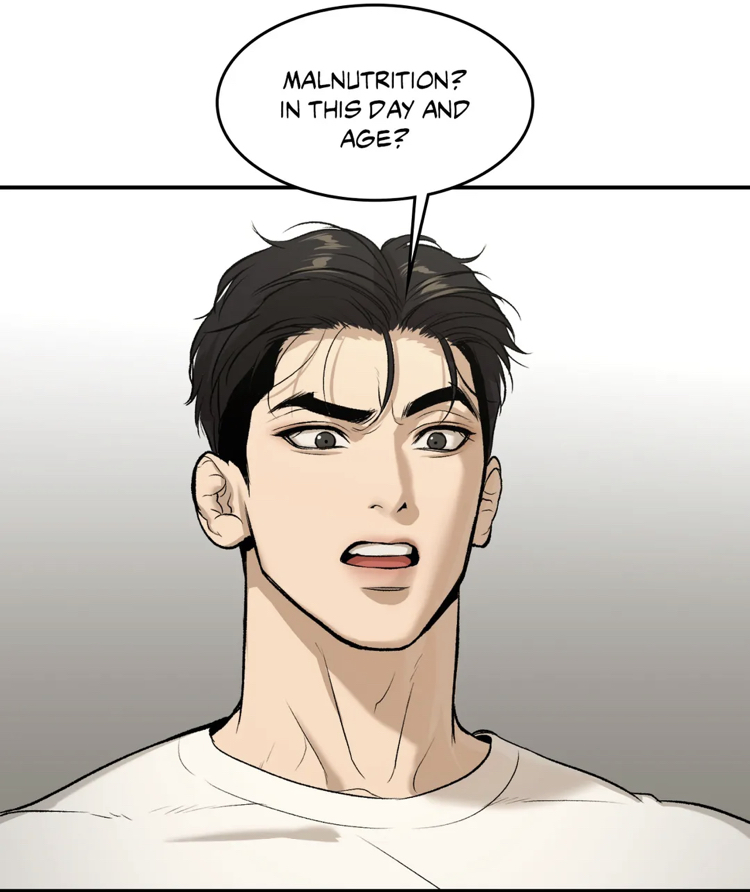 (chapter 13) He is neglecting himself to the point of exhaustion, because he is living as a PT non-stop. While the champion was fighting with his bad shoulder, the other is using his hands for treatment, hence he is not eating.
In Jinx, Mingwa masterfully intertwines the symbolism of nature and womanhood to chart the emotional and relational evolution of Kim Dan and Joo Jaekyung. Nature—embodied through the ocean, the moon, and the color blue—represents purity, healing, and timeless constancy. It serves as a reflection of Kim Dan’s true self, a gentle yet resilient force that has been overlooked and mutilated by suffering. At the same time, nature’s yin qualities—calm, nurturing, and transformative—align seamlessly with the growing presence of womanhood in Season 2.
While Season 1 portrays women solely in the realm of work and survival, Season 2 introduces women as symbols of family, emotional connection, and healing. The cleaning lady’s hand, the nurses’ conversations about private lives, and the emphasis on yin energy shift the narrative focus toward care, introspection, and renewal. This change mirrors nature’s role as a constant yet quiet guide, offering opportunities for rebirth and balance that Kim Dan has yet to embrace.
By linking nature and womanhood, Mingwa constructs a path for transformation. For Kim Dan, this path lies in reconnecting with the nurturing forces of life—both within himself and in the relationships around him. For Joo Jaekyung, the presence of nature and feminine energy signals a challenge: to abandon the yang-driven tools of dominance and force, and instead embrace qualities of care, patience, and emotional vulnerability. This announces his „separation“ from his hyung Park Namwook and as such his maturity.
In conclusion, nature and womanhood act as two sides of the same coin in Jinx: both are timeless, restorative, and essential for healing and balance. Through these symbols, Mingwa not only reflects Kim Dan’s emotional state but also reveals the steps needed for growth, connection, and love—a journey that transcends survival and allows the characters to embrace life in its fullest, most harmonious form. That‘s how they will find happiness.
Feel free to comment. If you have any suggestion for topics or Manhwas, feel free to ask. If you enjoyed reading it, retweet it or push the button like. My Reddit-Instagram-Twitter-Tumblr account is: @bebebisous33. Thanks for reading and for the support, particularly, I would like to thank all the new followers and people recommending my blog.
Please support the authors by reading Manhwas on the official websites. This is where you can read the Manhwa: Jinx But be aware that the Manhwa is a mature Yaoi, which means, it is about homosexuality with explicit scenes. Here is the link of the table of contents about Jinx. Here is the link where you can find the table of contents of analyzed Manhwas. Here are the links, if you are interested in the first work from Mingwa, BJ Alex, and the 2 previous essays about Jinx Illumination in the Tiled Sanctuary (locked) and Sweet 🍬 Redemption or Sweet Poison ☠️? The Price of Desire
It would be great if you could make some donations/sponsoring: Ko-fi.com/bebebisous33 That way, you can support me with “coffee” so that I have the energy to keep examining Manhwas. Besides, I need to cover up the expenses for this blog.

In episode 56, we could see Joo Jaekyung losing his cool, the more he tried to find Kim Dan. This huge transformation can be detected, when Jinx-philes compare these two following images.  (chapter 56) and
 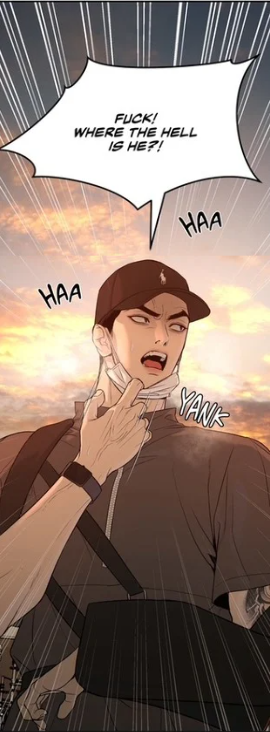 (chapter 56) While in the first picture, Joo Jaekyung is calm, concentrated and silent, in the second one, the fighter is agitated, lost, breathless and yelling. These two mental dispositions are reflected in the location. In the first image, the MMA celebrity appears behind the steering wheel, which is a symbol for power, determination and control, whereas in the second panel the champion is wandering alone in the street. This running is no longer part of his training and routine, but it exposes his powerlessness, loneliness and despair. He has no idea where to go contrary to the first picture. This means that the latter embodies goal and destination, whereas the second image represents the opposite values: beginning, start, ground zero and source. In other words, the end of episode announces the athlete’s rebirth or better said, the start of a new life. I will elaborate further below. But let’s return our attention to the symbolism of the auto.
As you can see, the latter stands for success, wealth, authority and domination.  (chapter 56)
  (chapter 56) Even if the main lead is moving among other cars, people can recognize that the owner of such a car is rich and probably famous due to the brand and design. On the other hand, by roaming in the street, the champion blends into the background and as such to the mass. (chapter 56) Because Joo Jaekyung doesn’t want to be recognized, he is wearing a mask and a cap. This gesture stands for anonymity, hence no one is paying attention to him. Contrary to his frenemy at the cafe
  (chapter 35), Joo Jaekyung succeeded. He is just a passerby. In other words, the avenue indicates not only his failure to find Kim Dan, but also his loss of power and status. He has just become a nobody. Thus we should consider this as the athlete’s karma for thinking that Kim Dan could be replaced, because he was just a nobody:
 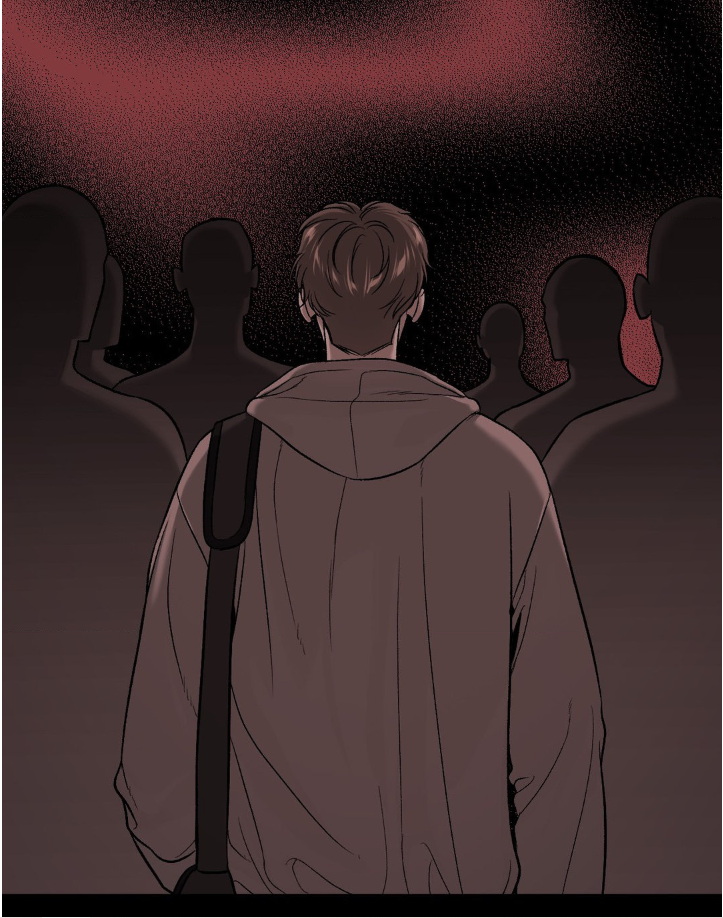 (chapter 55) It is no coincidence as well that the author showed us the star’s back, when the latter called his hyung Park Namwook. (chapter 56) Moreover, the shades are quite similar: red/orange and brown. Without his car, he is like everyone else: a human with his flaws and imperfections.
I have to admit that when I read episode 56, I couldn’t restrain myself connecting episode 56 to chapter 33 and in particular due to my essay called: 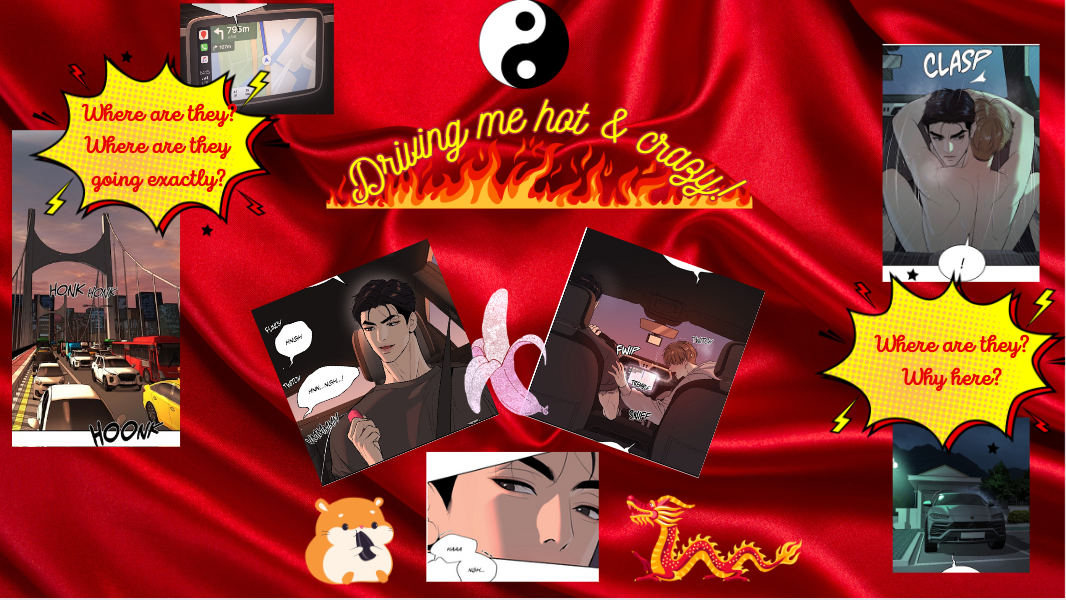 These two chapters are similar, for they convey the same emotions: anger, anxiety, frustration and despair of the fighter. In the car, the champion attempted to control the doctor’s libido.
  (chapter 33) On the one hand, he appeared calm and concentrated like in 56, yet deep inside, he was burning up. The pink dildo was used as a tool to voice his negative emotions (abandonment issues, insecurities and jealousy). With the release of episode 56, another reason came to my mind why the athlete proposed to drive the physical therapist to Choi Heesung.
 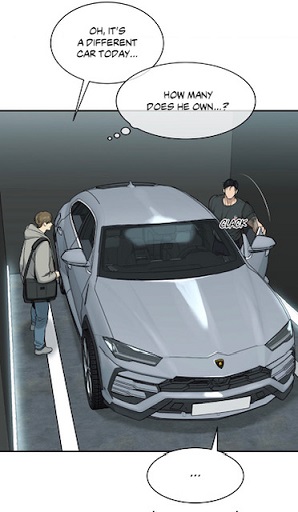 (chapter 32) First, he switched the car in order to demonstrate his wealth and status. It was, as if he wanted to show off to his fated companion, which reminded me of the actor. The latter would bomb doc Dan with “presents”, an indirect demonstration of his fortune. In addition, Jinxphiles will certainly recall that during the same day, the comedian came to fetch the physical therapist with his white Porsche.
  (chapter 32) Consequently, I came to the following deduction. The man selected the gray car in order to distinguish himself from his rival, to impress his companion.
Secondly, it was the wolf’s way to keep the doctor in check, to control the situation. He is behind the wheel, hence he takes the lead and had the saying in their relationship, like we could observe it in another situation: 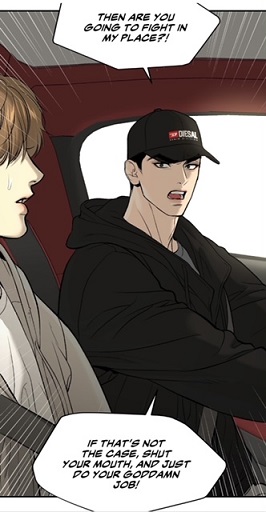 (chapter 42) And what was his attitude there? He would not listen to his passenger. Moreover, he would separate his job from his roommate’s. It looked like they were living in two different worlds, though they were sharing the car. This scene exposes miscommunication, lack of faith, stubbornness and prejudices. The fighter was not willing to accept the physical therapist’s doubts and chose to go through with the training and match.
Thus I deduce that the vanishing of his car is indicating that the athlete is now ready to LISTEN! He is no longer cut off from the world, he is moving among humans. His penthouse and his car were the reasons why he kept people at arms-length and why he preached self-reliance. They were the symbols of his success and identity:  (chapter 2) (chapter 32) So by leaving them behind, it indicates that Joo Jaekyung is transforming and as such maturing. But why is he so desperate to control his life and even Kim Dan’s by leaving no room to change or “surprise”? I believe to have found the answer: chronic abuse. I know that the quote is quite long, but in this description, Jaekyung-addicts can recognize their beloved character:
Victims of chronic trauma often have an overwhelming desire to control their surroundings.
Victims can improve their recovery by recognizing any maladaptive control issues they may have developed in response to trauma.
Trauma victims can take back some of their personal power by impartially examining their need for control. […]
They are extremely uncomfortable, often to the point of panic, in ambiguous situations. They set rigid boundaries with no wiggle room allowed. Rigid boundaries leave no space for guessing, which makes outcomes more predictable in the long run.
They may be reluctant to share personal information and are often extremely private people. Their fear of information being used to take advantage of them in some way usually overrides their desire to open up to others.
Their past is off-limits. They often refuse to discuss or even think about the past out of fear that it will be repeated or trigger them to relive past experiences. They seem avoidant of intimate relationships. It is often hard to get to know them, which, for them, is a safeguard against being hurt again.
They believe the worst in most situations. Misplaced trust may have led to traumatic experiences for them in the past, so they are cautious of making this same mistake again.
They can be unrelenting when it comes to loyalty. You are either on their side, or you are the enemy. Their fear of being hurt by others is magnified when someone lets them down, even in seemingly minor ways, and it can be a deal-breaker in relationships when they feel others cannot be trusted to protect them.
They may have unrealistic expectations. Out of an innate need for every situation to be predictable, they may seem to demand perfection from their relationships and themselves.
They refuse to take risks. Chronic trauma victims may want to avoid perceived danger however possible, so they often refuse to engage in any risk-taking behaviors, which could include risky financial moves, uncertain career changes, or even potentially hazardous recreational activities.
They fear abandonment. Because they were unable to trust people in the past and were routinely exploited in some way, chronic trauma victims often generalize these experiences to every future relationship. Even in the face of contrary evidence, their fear reactions may compel them to see the potential for abandonment in all of their relationships. […] Quoted from https://www.psychologytoday.com/intl/blog/stress-fracture/202203/how-chronic-trauma-can-make-person-controlling
After reading this, my avid readers can grasp why the champion’s past has been kept in the dark by the author and why the athlete dislikes it, when his past is mentioned: (chapter 26) First, he repressed it, but thanks to doc Dan, he is encouraged to face his traumatic past. But for that, he needs to trust someone, a person who wouldn’t judge him and would show understanding. He came to associate “pity”  (chapter 37) with arrogance and weakness, but this is not true. [For more read this https://psyche.co/ideas/pity-is-an-emotion-easy-to-scorn-but-central-to-our-humanity]
This new discovery reinforces my previous hypothesis that the main lead was exposed to chronic abuse (emotional abuse, parental criticism and probably bullying), which remained undetected. So by “losing his car”, he is gradually giving up on his control issues. At the same time, it gives him the opportunity to redefine his own life. What does he want from life and his career as MMA fighter? Consequently, I come to the deduction that Joo Jaekyung is about to become the true owner of his time and as such of his own life. Let’s not forget that even in season 2, his manager is still the one “controlling” his time. 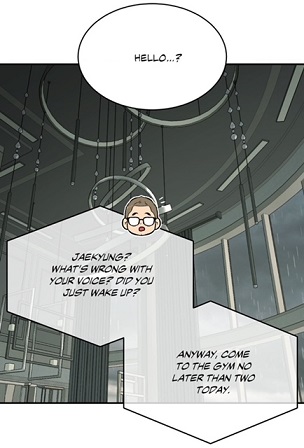 (chapter 54) (chapter 56) This signifies that the champion is about to discover that in reality, he was not truly free. While he thought, he was controlling his life behind the wheel, in verity, he was just a puppet, for his decisions were influenced by his fears and past. I would even add that the loss of his routine announces his willingness to accept changes and surprises in his life. The latter are no longer perceived as a threat.
Because Joo Jaekyung connects car with power and leadership, I came to realize why the champion trusts so much coach Jeong Yosep and his other hyung:  (chapter 5) He allows the coach to drive the car and the manager to sit in the front. Thus they represent the higher authorities. However, so far, the doctor had only been his passenger. Thus a new idea popped up: what if the athlete let the physical therapist drive his car? Let’s not forget that the loner wolf shouldn’t be driving on his own, for his shoulder has not healed properly yet. I already pointed out the wrongdoings from the two hyungs.
 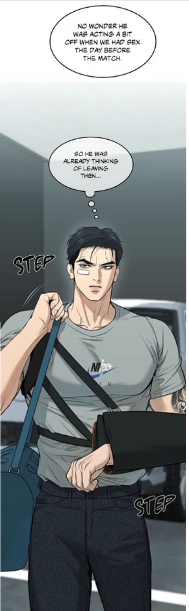 (chapter 53) They should have brought him home. They stand for neglect and indifference due to their passivity and routine. In my eyes, they are happy at the gym, the latter represents their second family. So they imagine that it is the same for their boss. In other words, they projected their own thoughts and feelings onto the celebrity. They embody silence and lack of communication and this is actually palpable in the car. In episode 5, the manager and the MMA fighters lied to each other:
  (chapter 5) Then in episode 49, the champion kept The Shotgun’s words as a secret, while his coach confessed his trust in his “boy”
 (chapter 49). Yet, he revealed his true thoughts at the hospital: (chapter 52) He has no real trust in the athlete. Finally, my avid readers should notice that we never heard coach Jeong Yosep speaking up or exchanging his thoughts to the other members there. To conclude, I interpret the car as a symbol for censorship, silence, miscommunication, stubbornness and deafness. In other words, this place is also polluted. (chapter 53) So when the champion returned home on his own after the surgery, it displays the high peak of the censorship and uncommunicativeness from the two hyungs. They didn’t bring up the eventuality that Kim Dan might have moved from the penthouse. They kept doc Dan’s departure under wraps and waited for the right opportunity. But the best evidence for this interpretation is the absence of Jeong Yosep after episode 52. From that moment on, he is no longer present in the star’s life. But there’s more to it. I noticed the absence of Jeong Yosep’s phone number. At no moment, we see him contacting the protagonist through the phone. (chapter 52) Imagine that he only reported his investigation and actions afterwards. Then on the athlete’s birthday, he didn’t send any private message as well. (chapter 45) It gives the impression that he owns no cellphone, especially if Jinx-philes recall this situation in the States:
  (chapter 37) He was using the landline telephone. This observation is relevant, because it exposes the coach’s dependency on Park Namwook. The latter’s task is to keep in touch with his boss and champion, for he has his cellphone number. Nevertheless, how do we explain the absence of the coach’s cellphone? I have the feeling that this could be related to his divorce. (chapter 5) When his wife suddenly blocked him, he got shocked and hurt. And don’t forget that we have another person traumatized with a phone call: Kim Dan, who got abandoned during that day.
  (chapter 19) Thus this observation made me think that the coach could have something in common with Kim Dan. And that’s how the champion will demonstrate his strength to his hyung. Contrary to him, he didn’t accept the divorce so “easily”. In fact, he is fighting for the doctor in his own way. The problem is that he is his own worst enemy.
Interesting is that each time the MMA star was seen in the backseat (chapter 49), Jinxphiles could never view the driver. (chapter 5) According to my theory, this should be the coach. And the latter lost his wife despite his success. Now, Jinxphiles can grasp the discrepancy. Though the coach is the driver, he is not the one with the upper hand. In reality, he is putting his faith and trust in his passenger, Park Namwook. How so? It is because he is viewed as the counselor and expert. And how is the manager reacting to the fighter’s change of behavior? (chapter 56) He doesn’t look worried, scared or despaired. In fact, he is pretty calm, the opposite to this scene:
 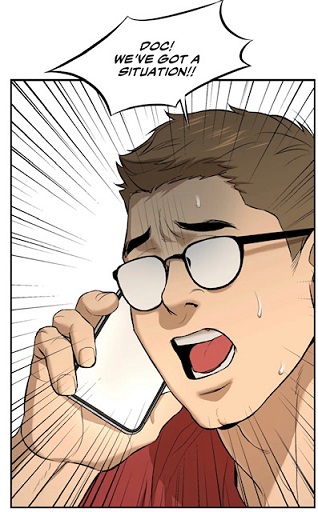 (chapter 13) His question “Is everything okay with you?” is purely mechanical and as such meaningless, for he doesn’t inquire, when he hears a silence from the other side of the line. I would even say that he doesn’t really wait for his boy’s answer as well. (chapter 56) Finally, his comment is full of hidden criticism: “I haven’t heard from you…; You haven’t been coming…”. He is reproaching his star to neglect his work, though he is still in recovery. I have to confess that Park Namwook’s short scene drove me hot and crazy 🔥😂 One thing is sure: Despite the outcome of the last match, the hyung has not made up his mind to change his routine at all. But he is not realizing that this phone call represents a turning point in their relationship. How so? It is because if the champion switches his phone number
 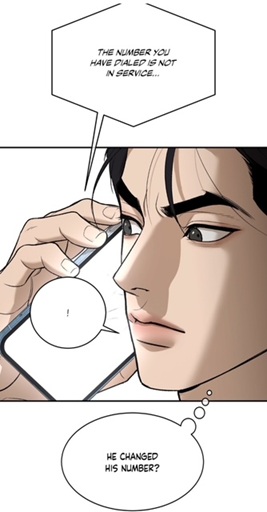 (chapter 56), he could end up in the same situation than the protagonist. And keep in mind that the coach Yosep is actually relying on the manager. Thus I reckon that the champion’s other source of power is actually his cellphone! Without him, he has no connection
  (chapter 5), no money
 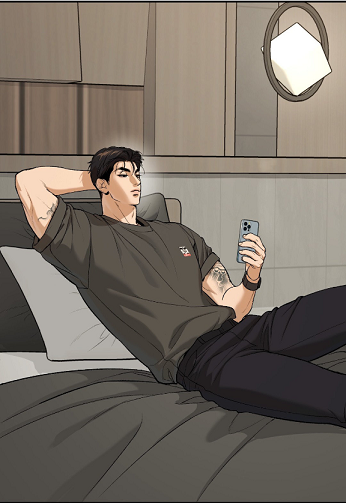 (chapter 32) and no power. His call to the manager during that evening represents his last resort. Thus he is calling the manager “Namwook hyung” contrary to episode 5.
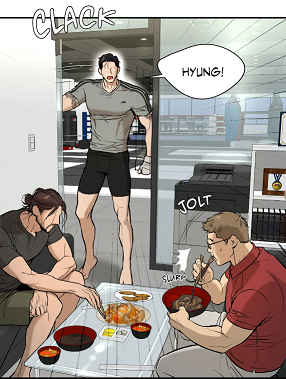 (chapter 5) This title is indicating that the champion is opening up, and willing to show his vulnerability and despair. On the other hand, this change also implies “expectations” from the fighter, (chapter 56) just like the doctor tried to show his appreciation to Joo Jaekyung with the gift: (chapter 55) The physical therapist hoped to get recognition, gratitude and acceptance from his soulmate. That’s the reason why I perceive this conversation over the phone as a reflection from that scene:
 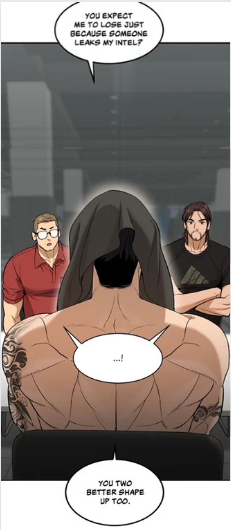 (chapter 46) Keep in mind that at the gym, the athlete denied the relevance of information. Though both hyungs were warned, the reality was that they got off scot-free. They never received any blame for failing to protect him and this twice. And now, he is looking for intel about the doctor. Indirectly, fate is teaching him to recognize his error. In fact, information can procure a good insight about people’s behavior and as such fears. Let me give you an example: if Joo Jaekyung were to hear about Kim Dan’s first employment as PT, he should understand why the PT made mistakes, why he took odd jobs and why he “left” Seoul. If he wanted to work as PT, he needed to go elsewhere.
But let’s return our attention to the champion. In episode 46, he denied the importance of intel on the impact of a match. Hence I deduce that with the doctor’s vanishing, he is learning another tough life lesson. It is important to get to know his roommate and even to converse with him. This is something he didn’t do in the past. I will explain below why. On the other hand, the contrast between 46 and 56 reinforces my conviction that one of the schemers knows about the champion’s fears and past. Thus the fighter was more and more confronted with the past thanks to doc Dan. So by unlocking his past, the fighter not only gets released from his mental prison, but also will be able to detect his enemies in the future.
To conclude, the car and the phone in Jinx symbolized not only the champion’s powers, but also his “identity”. When he was driving his auto, he thought, he was independent and as such the owner of his “life”. He thought, he was controlling his life. He was the famous and rich MMA fighter. Yet, this was just an allusion. The routine was there to make him forget his painful childhood. So by seeing him alone in the street (chapter 56), I feel like he is about to lose everything. Destruction is necessary so that the sportsman can rebuild a new life. The vanishing of his routine was also a necessity, because the athlete needs to include Kim Dan in his life. That’s the real definition of “living together”.
Though the athlete is appearing lost and weak on the street, his mind-set oozes the opposite. Determination!! He knows what he wants: (chapter 56) He wants to meet his companion again. He already describes him as a need. This implies that the hamster has almost become a “necessity ” for the celebrity. On the other hand, these words expose that the fighter is still not ready to meet his fated partner. How so? It is because his words divulge the absence of “conversation”. In the beginning, he wished to talk about his feelings to Kim Dan so that he could get closure. 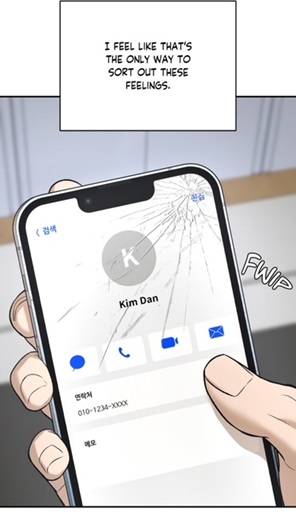 (chapter 56) He somehow expected doc Dan to listen to his words and accept them. That was it. Then at the end, it is just about seeing doc Dan and nothing more. At no moment, he voiced the desire to get to know his partner or to listen to his side of the story. Why? It is because he had strongly internalized that the man was a liar. He never questioned his perception and detected his own prejudices. It is important to recollect how Jinx-philes could sense a positive change in the physical therapist:
 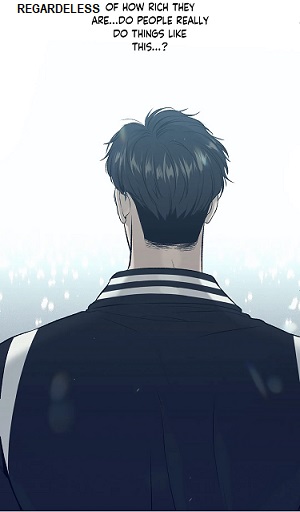 (chapter 22) Yes, it is the view with the star’s back. The author selected such a position on purpose. The face represents the character’s identity and as such his personality. By showing the back, Mingwa is implying that the beholder is full of prejudices and doesn’t know his partner that well. That’s why I judge this image (chapter 55) as a reflection from the one in episode 22. Nevertheless, this represents the sportsman’s prejudices about the doctor. But contrary to doc Dan in episode 22, the wolf wanted to forget him. In other words, he refused to become curious about doc Dan. This means that he initially regressed, as he made the wrong decision. However, it was a necessary step for the fighter, for the latter has always put himself under pressure: he was such a perfectionist. That’s the reason why I interpret the following image (chapter 56) as a mini-confession from the manager. He is gradually admitting that he doesn’t know his boy that well. Yet, he still puts the blame on the main lead. On the other hand, I believe that the manager in this picture should be seen as a reflection from the champion’s mind: (chapter 56) He believes to know his hyung, that’s why he trusts him so much. Hence he is willing to expose his vulnerability and despair: (chapter 56) He expects no contempt or shock from him. He anticipates acceptance and tolerance. But is this man willing to overthrow his conscience and integrity for his “champion’s sake”? Since he is portrayed as eyeless, it implies the champion’s prejudice and blindness. He doesn’t know his manager that well either: the man is rather a coward and a child than a mature father. Thus I started wondering how Park Namwook would react to this request. Will he accept it? Keep in mind that the main lead is not saying that he wants to hire doc Dan, it is only about seeing him. And this aspect made me realize why Joo Jaekyung got so upset and scared in the past:
  (chapter 7)
 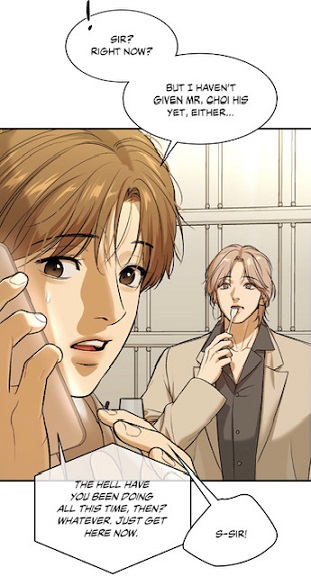 (chapter 32)
 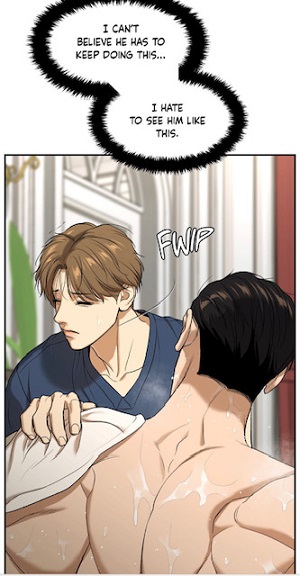 (chapter 37)
  (chapter 40)
 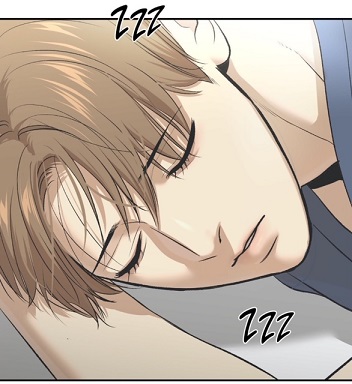 (chapter 43)
  (chapter 45)
 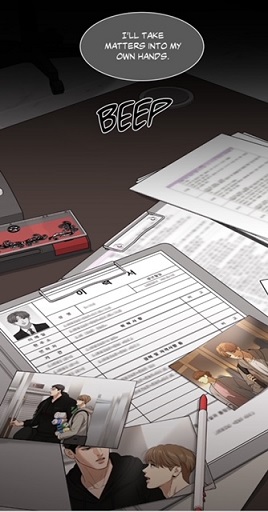 (chapter 46)
 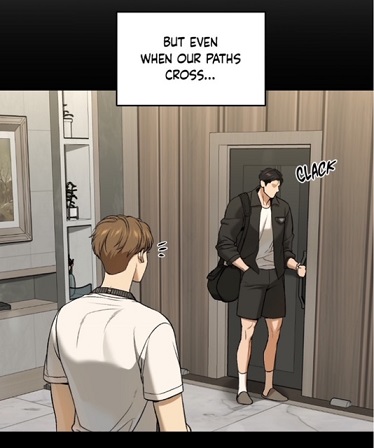 (chapter 47) Looking at his face had become his new secret ritual and as such his source of joy. Naturally, his heart and unconscious were the causes for this new habit. This explicates why he hated hearing the doctor leaving the penthouse during the night: he feared that he would no longer be able to see his cute face. That’s also the reason why Joo Jaekyung got angry/upset, when he saw the doctor turning his head away (chapter 37) or the shocked and wounded doctor’s visage: (chapter 51) Kim Dan’s face which had become his secret source of joy, became a weapon suddenly! It brought him pain. And what did he say afterwards to the doctor in the locker room? (chapter 51) He wished not to see his “face”. The latter had become his “addiction”. Thus his face in tears came to haunt him.
  (Chapter 54) This nightmare exposed his regret which he tried to deny and bury. At the same time, I have the feeling that his secret desire was to wipe away his tears as well. Nevertheless the problem is that such a love is rather superficial, for people’s body deteriorate over time. What matters in love is a good personality and a good heart. According to Erich Fromm, love is knowledge, respect, care and responsibility. Hence this separation became a necessity for the fighter. Fate had to force him to admit this: (chapter 56) He needs to see his face. A picture won’t be enough or even hear a report about him. Furthermore, he imagines that if he sees Kim Dan doing well, he can get closure and move on. That’s the reason why I think that Joo Jaekyung needs to get a new insight about the doctor or about himself before meeting him. He needs to admit his ignorance and bias. So far, he felt more “pity” and showed more understanding towards the grandmother than towards Kim Dan. The evidences for this perception are the way he behaved towards her: he was gentle, he paid her bills
  (chapter 21) and almost got shocked
  (chapter 56), when he imagined that she had died. In reality, he helped financially more the grandmother than Kim Dan himself. Kim Dan is the one he should really empathize with. He has always been a victim of circumstances.
Nonetheless, we could see his wandering in a positive light: (chapter 56) Joo Jaekyung is slowly turning into a real human. At its core, to be “human” involves:
For Joo Jaekyung, being a star or fighter meant embodying strength, invincibility, and control. These traits distanced him from others, presenting him as more of an ideal or symbol rather than a person. Despair often marks a catharsis or turning point in literature and character arcs. It is the moment when a person realizes their limitations and confronts their authentic self. By experiencing despair on the street, Joo Jaekyung steps away from his constructed image and embraces his real identity. He is no longer just “the fighter” or “the star”; he is a man who can lose, suffer, and feel deeply. This coincides with the dropping of his routine and the neglect of his duties. His life is now chaotic, as the protagonist started forgetting his title and career. The manager could think, his boy lost his sight on what truly matters. The reality is that his life has always been meaningless and aimless. He always felt emptiness, but the title masked this emotions. His obsession with the doctor is bringing to the surface his hidden struggles and fake believes.
However, I don’t think that the man has reached the bottom yet. How so? It is because he is still relying on his “hyung”, money and power: (chapter 56) Moreover, by utilizing the expression “by whatever means necessary”, he is asking his hyung to disregard morality and laws. It was, as if he was encouraging the manager to throw over board his conscience and integrity. It looks like he is encouraging his manager to behave like Director Choi Gilseok: spies and connections. (chapter 46) But the hyung stands for “conformity and social norms”. Moreover, observe that Joo Jaekyung is turning his search of Kim Dan into a manhunt “Track him down”. His vocabulary evokes a predatory, almost feral quality, suggesting desperation and a lack of integrity. Readers know why he became obsessed with doc Dan, but is it the same for the manager? The main lead’s words reminded me of the loan shark Heo Manwook, which could let his enemies misunderstand the athlete. He resents the PT and wants to put the blame on him. This moment highlights a significant shift in his character: rather than adhering to rationality, morality, or compassion, he is overtaken by raw instinct, much like a wolf hunting its prey. This explicates why the author created such a panel: 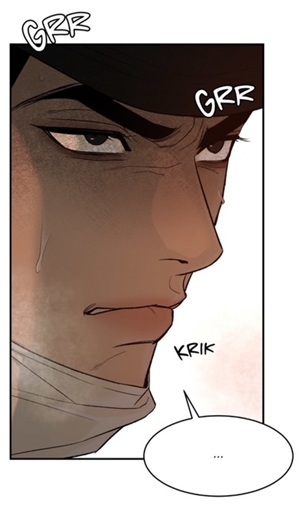 (chapter 56) Desperation can strip away the higher faculties that make us human—reason, empathy, and self-control—exposing something primal. (chapter 56) In this moment, Jaekyung’s words highlight his transformation into someone governed by instinct (desperation to find the doctor at all costs), which challenges the notion of his humanity. His inability to address the situation with trust or compassion reinforces his struggle to act as a “real human” with integrity. The latter is defined as adherence to moral principles and honesty. Jaekyung’s behavior here reveals an absence of both, exposing a darker, corrupted side of his personality. He looks more like a wolf. (chapter 56) This means that he is not showing his true self. And now pay attention to the time and sunlight: (chapter 56) It is the golden hour or better said, between dog and wolf (“Entre chien et loup”). This idiom refers to “at dusk, twilight, nightfall”. At the same time, this idiom evokes this image of transformation and duality, two natures fighting against each other. Is the champion a “dog” or a “wolf”, when it comes to Kim Dan? I had already outlined the huge signification of this time in the following essay: “Magical Hours“. Back then, I had outlined the difference between “golden hour” and “blue hour”:
  (chapter 17) and
  (chapter 11). In season 1, the athlete stands for golden hour, whereas Heo Namwook embodies blue hour. “Entre chien et loup” is the time of day when the light is such that is becomes difficult to distinguish between a dog and a wolf, between friend and foe, between known and unknown. Hence I am thinking that if the next episode represents a continuation of that nightfall, it signifies that the champion is on his way to meet someone from the past. Moreover, I detected that the pavement is the same than in front of the gym: (chapter 56) (chapter 35)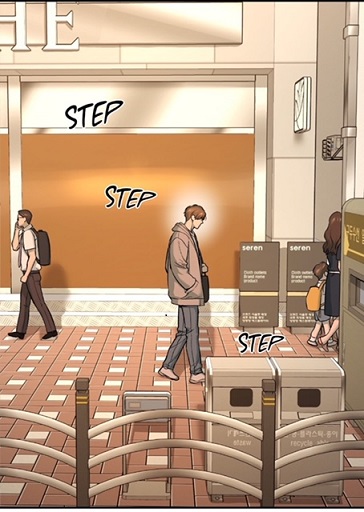
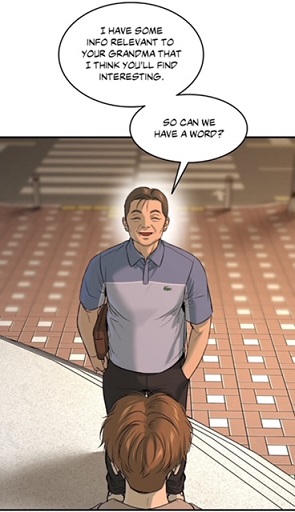 (chapter 48) As you can see, this detail made me realize that the next chapter should contain reflections from episode 35 and 48, the meeting with an old/new acquaintance. I am writing new and old together on purpose, for Director Choi Gilseok had been the halmoni’s loan shark, but the “hamster” had no idea. Choi Gilseok is the boss of Heo Manwook. If this encounter takes place, it signifies that on the one hand, it will cause pain and suffering to the athlete, on the other hand, this incident will become a “blessing in disguise”, for it will push the champion to reflect and mature. That’s how I had the following revelation. Why did the author ensure that the MMA fighter’s shoulder would get badly injured?
  (chapter 52) It is because this exposes the champion’s bad coping mechanism. The champion always uses his fists, therefore he doesn’t reflect and as such analyze his emotions.
 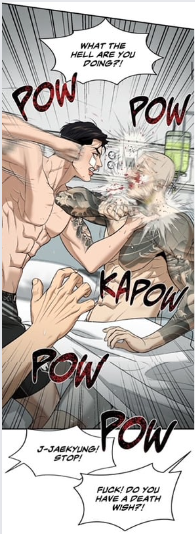 (chapter 52) That’s how he felt right into the trap of the schemers. So by having his splint, Joo Jaekyung is indirectly coerced to meditate on his feelings., as he can no longer use his shoulder and as such his fist. His physical injury represents in reality his “lucky charm”, for it helps him to transform, to overcome his trauma and face the shadows from his traumatic past. Notice that for the first time, the athlete came to accept the existence of feelings for Kim Dan. (chapter 56) However, he is not talking about love and gratitude yet. Without his left shoulder, he is forced to use his brain and as such his third eye. It is important, because it implies that the fighter is gradually learning how to control his emotions. Compare his attitude on the street (chapter 5) to the one at the gym from episode 5:
 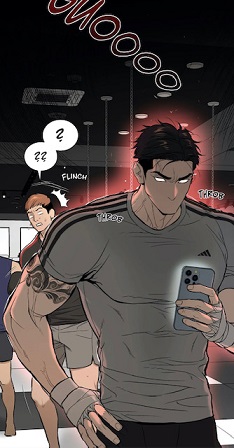 (chapter 5) He is much calmer. He is not oozing red and remaining silent. He is not burning up inside, in fact he is expressing his thoughts and emotions: (chapter 56) That’s the reason why I believe that in the next episode, the fighter won’t act on his feelings like in the past. But there exists another common denominator between episode 5 and 56. The athlete’s request mirrors the situation in episode 5.
  (chapter 5) In both cases, the athlete asked for his manager’s help. However, as Jinx-philes can sense, there exist two huge differences between the past and present. Back then, Park Namwook didn’t care for Kim Dan. He was just a PT like any other doctor. He didn’t even care that Joo Jaekyung would lose his temper and ruin the sandbag.
  (chapter 5) It was not worrisome in his eyes, because his day would consist of training and punching the sandbag. The problem is that the fighter is no longer coming to the gym and he is not even calling him: (chapter 56) While the contrast between episode 5 and 56 reflects their growing gap and gradual separation, it seems to indicate that Park Namwook will follow the athlete’s request. He would have two reasons for this: money and hope that this would give some closure to his boy so that the latter can focus on his “training” again. But by following his request, he could expose his “connection” which is linked to the champion’s past. But I could be wrong. He could refuse it, for this request sounds so scary and immoral. Notice that the author didn’t let her readers hear his answer. We will see. Finally, it is important to recall that the fighter is dressed differently and he is more on the mode “listening” than “seeing”, as he had to hear the answers from his investigation: (chapter 56) Notice that even at the end, readers were not even able to see the PT’s faces:
  (chapter 56) This shows that the athlete is using more and more his intelligence, he is forced to interact with people. He is gradually developing his social skills which stand for COMMUNICATION. And how did he get deceive in the past?
  (chapter 48) He got manipulated by his eyes! They used a trick to deceive the athlete: delivering the truth in delay. Joo Jaekyung didn’t confront Kim Dan, because he saw the pictures as proofs! He never tried to hear his side from the story. And now, you comprehend why I am expecting that the champion will suffer another “blow” in the next episode. In my opinion, he will hear an important information. The fire in the illustration is there to indicate “Tabula Rasa”, a clean state. Joo Jaekyung has to lose all his principles and his bias about doc Dan. But for that he needs to face his own past and mistakes. Only through this effective anguish, he can become a better man, a new man.
Feel free to comment. If you have any suggestion for topics or Manhwas, feel free to ask. If you enjoyed reading it, retweet it or push the button like. My Reddit-Instagram-Twitter-Tumblr account is: @bebebisous33. Thanks for reading and for the support, particularly, I would like to thank all the new followers and people recommending my blog.

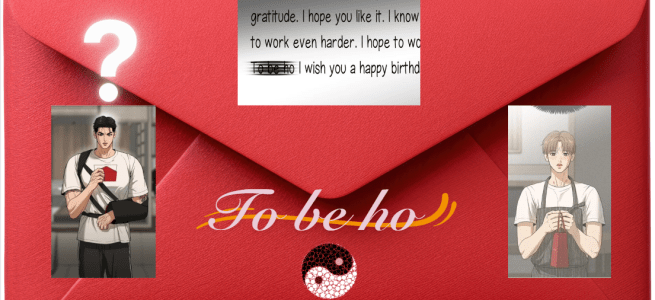


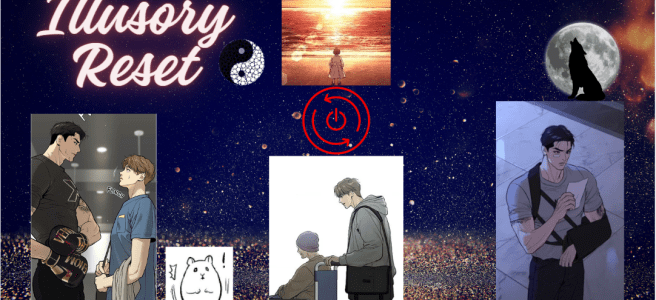

Please support the authors by reading the Manhwas on the official websites. I am also using doctor Frost and Bj Alex as references. This is where you can read the Manhwas: Bj Alex, Jinx and Doctor Frost. But be aware that the first three Manhwas are mature Yaoi, which means, it is about homosexuality with explicit scenes. Here is the link of the table of contents about Jinx. Here is the link where you can find the table of contents of analyzed manhwas. Here are the links, if you are interested in the first analysis about BJ Alex, and the previous essay about Jinx “Precious Puppy Pals“
It would be great if you could make some donations/sponsoring: Ko-fi.com/bebebisous33 That way, you can support me with “coffee” so that I have the energy to keep examining manhwas. Besides, I need to cover up the expenses for this blog.

The trigger for this title was initially chapter 34. 😮 When the latter was released, this title came to my mind, but I never got the time and chance to write about it, for people were too upset about the champion’s behavior. He had broken the doctor’s trust by exposing their relationship to Choi Heesung. Back then, many Jinx-philes were upset to the point that I chose to focus on the author’s decisions for such an outcome. Thus I wrote the essay “Why?“. Since the whole story hasn’t been completed yet, I could only present assumptions. Hence that analysis contains some errors, though the main interpretation was correct. The relationship between the two main leads helps them to heal each other so that they can find happiness. This reminded of Doctor Frost, where the psychiatrist in charge of Doctor Baek tried to treat his PTSD by encouraging him to treat another patient suffering from the same disorder. 
 (chapter 140)
  (chapter 149) Both were suffering from survivor guilt. To conclude, Joo Jaekyung and Kim Dan represent the bitter medicine for their scars. I mentioned “bitter”, because through their loved one, they are forced to face painful moments. That’s how they can overcome their past and discover happiness. However, while looking for a new title, I rediscovered the first illustration
  , and it suddenly made click in my head. To conclude, I had another revelation concerning episode 50.
I could connect my illustration to episode 50 and in particular to this image:  . (chapter 50) At first glance, the champion is blaming Kim Dan for the wound. He betrayed him. However, his words could have a different signification. Don’t forget that a message always has 4 sides according to Schulz von Thun.
  Consequently, while many saw this question as a “factual information” and as such as an accusation, the reality is that it gave us an insight about the sender too. The sportsman was not using the personal pronoun “I” or “me” in his inquiry. As you can see, the absence of the personal pronoun is indicating that Joo Jaekyung was in reality not referring to him and his wounds. He is not prioritizing himself, rather the doctor and his action. So this question could be prompted by curiosity or a desire to understand the person’s recent activities. Thus I deduce that the champion was asking his lover to tell him the truth. He should come clean. He desired a honest explanation. His attitude reminded me of an adult confronting his child.
Finally, the expression “What have you done?” (chapter 50) is strongly intertwined with the notion “crossing the line” or “daring”. It was, as if the physical therapist had dared to do something… Thus I believe that Joo Jaekyung must have perceived the gesture as the game “Truth or Dare” and not as betrayal. How is it possible? Don’t forget the absence of the personal pronoun “I” or “me”. He was focusing on the action itself. However, after the match which ended with a tie, he needed to find an explanation for his “failure”.  (chapter 51) But note that he never accused Kim Dan of assault, but of leaking information. That’s the reason why I don’t think that this inquiry “What have you done” was about seeking accountability. In that case, he wouldn’t have rejected the doctor’s offer. By letting him treat his wound, Kim Dan would have become responsible for the injury.
  (Chapter 50) It becomes comprehensible why the Emperor refused the offer. The rejection was the symbol of his “trust” in Kim Dan unconsciously. Astonishing, right, though people and Kim Dan had the opposite impression. Yet, because of the “tie”, Kim Dan felt responsible for the incident, therefore he apologized.
  (chapter 51) This means, the main lead recognized his responsibility. He should have checked the spray more carefully. The champion could perceive this excuse as a confession of his complicity. Hence he asked his lover if he was the spy.
 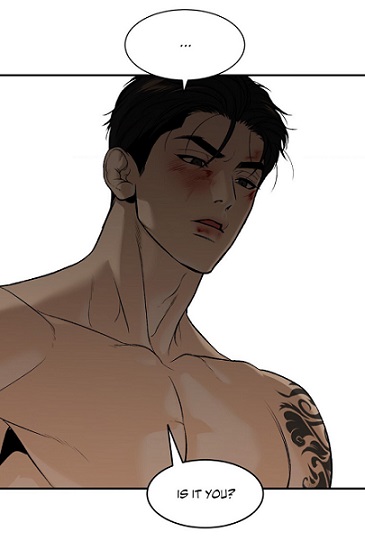 (chapter 51) This signifies that in episode 51, he dared to question his physical therapist’s loyalty. Yes, we have another “Truth or Dare” in episode 51.
But why would the athlete think of the game “Truth or Dare” in the locker room? It is because the star has long internalized this “mind-set”. From my perspective, this game played a huge role in his traumas. My theory is that he is suffering from different traumas, and one of them is BETRAYAL Trauma, which I will elaborate further below. But let’s return our attention to the two protagonists. My avid readers will certainly recall that I had long detected the existence of “challenges” between Kim Dan and Joo Jaekyung. [For more read the essay Delicate challenge]. However, this game became truly obvious in episode 34 with Choi Heesung. It is important, because truth plays an important part in overcoming mental illness (abandonment issues, trust issues). The patients need to face verity and as such they need to cross the line: return to the painful past. Thus I come to the conclusion that in episode 50, the champion was not able to face his biggest fear: betrayal. 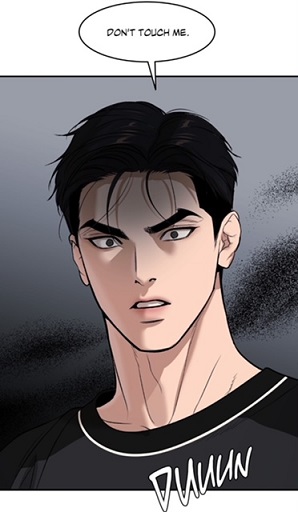 (chapter 50) This is the face of a scarred man. Yet, contrary to the past, he is not expressing his fear through rage. That’s the reason why his emotions were controlled. Under this new light, Manhwaworms grasp why the athlete asked such a question from his soulmate: (chapter 50) He was afraid of confronting his physical therapist. His inquiry was ambiguous contrary to the one in episode 51. The problem is that he had to hear that he had not won.
  (chapter 51) Interesting is that he was more pained by the idea of a betrayal from Kim Dan than the tie, if you compare these two panels:
 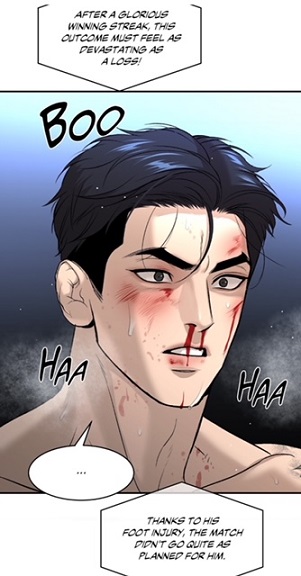 (chapter 51) He imagined that Kim Dan had dared to cross the line because of money.
  (chapter 51) But note that at no moment, he is accusing him of an assault. Because of this confrontation, Joo Jaekyung and Kim Dan had a honest conversation. The doctor asked him a painful question (chapter 51) which the emperor needed to hear. He has trust issues. And the moment he saw the doctor’s facial expression, he could only get shocked and hurt.
  (chapter 51) He could sense the wound in doc Dan’s voice and gaze. It is important, because the sentence “You don’t trust me?” is actually constructed like a statement and not like a question. It only becomes a question through the tone. Through the latter, the champion could detect his partner’s genuine pain. The wounded tone could only move the champion’s heart. Kim Dan dared with a single question to shake the fighter’s confidence. No wonder why he reacted badly. (chapter 51) On the other hand, don’t let yourself get fooled by this rude request. The reality is that the alpha didn’t chase away the doctor, in truth he was the one running away.
 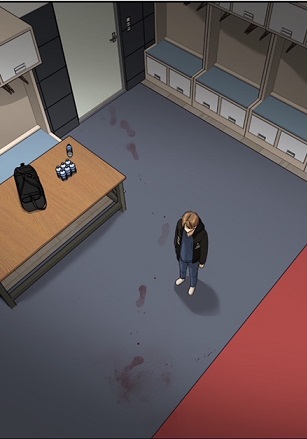 (chapter 51) Thus Kim Dan could overcome this shocking but terrible discovery: he hadn’t earned the full trust from Joo Jaekyung yet.
  (chapter 51) As my avid readers can see, my perception about chapter 50 was confirmed with episode 51. The arguments in the locker room were reflecting the quarrel in the penthouse with Choi Heesung. What is the common denominator between these two scenes? The lack of trust from Joo Jaekyung, but his private PT failed to realize it in the penthouse. Why? It’s because he chose to trust his destined partner.
| Chapter 34/35 | Chapter 51 |
|---|---|
 I believe you = I trust you I believe you = I trust you | Here, the doctor is forced to meditate on the reasons for the champion’s mistrust. This can only incite him to reflect on his past behavior (the silence about his meeting with Choi Gilseok) |
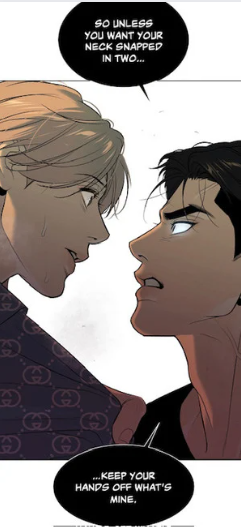 | |
 | |
 | 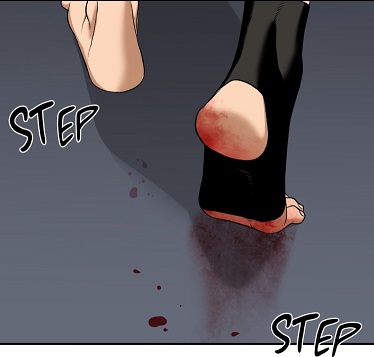 |
And this brings me to the following remark. In the locker room, through the question “You don’t trust me?” Kim Dan was actually fulfilling the athlete’s wish: 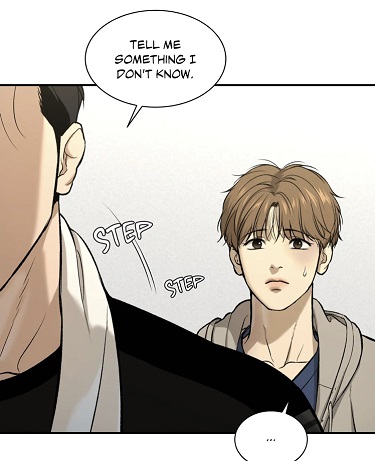 (chapter 15) He told him something that he didn’t know. Note that after the terrible meeting with the actor, Joo Jaekyung couldn’t even find the answer himself:
 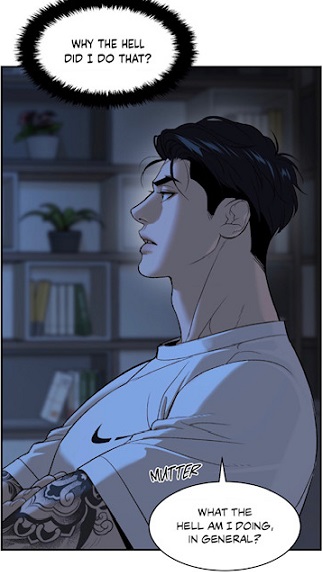 (chapter 35) He was still clueless about the trigger for his behavior. With this inquiry “You don’t trust me”, the hamster pushed his destined partner to face his biggest fear: trust someone and in particular him. This conversation can only incite him to meditate about their relationship. So while in episode 15, he behaved like a pouting child
  (chapter 15), in the latest episode, Jinx-philes can perceive his growth and maturity. (chapter 51) His gaze is softer, he is no longer hiding his emotional wound and he is able to ask a painful question.
 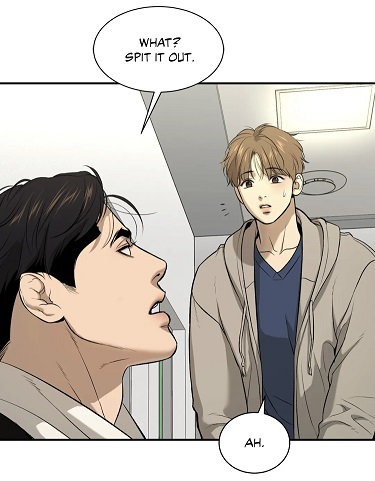 (chapter 15) This painful incident was a wake-up call Thus I come to the following deduction. Kim Dan will try to earn the champion’s trust, whereas the champion will be forced to take a leap of faith towards Kim Dan. Contrary to episode 34, the champion could see the truth directly through the doctor’s gaze and voice: (chapter 51) This scene stands for honesty and forthrightness, whereas the encounter in the penthouse symbolizes acting, artificiality and self-deception.
  (chapter 34) As a conclusion, while the champion thought that his loved one had dared to cross the line, he was confronted with truth. He was biased and mistrusting his room mate and PT. This shows that though dare was the opposite choice of truth, the fighter ended up to be confronted with verity.
And now, it is time to present my observations about episode 34 which I couldn’t present before. Choi Heesung dared to challenge the Emperor by forcing him to deny the truth. He had no feelings for doc Dan.  (chapter 34) These questions were all rhetorical:
  (chapter 34) This signifies that in the sauna, truth was not standing in opposition to daring. The sauna reminded me of the cavern where an imugi hides, until the latter leaves its hidden place and find his star, his yeouiju. Only then, he can turn into a dragon. To conclude, because of Heesung’s pressure, the imugi had to select between daring or lie. In other words, telling the truth became the challenge itself. Heesung knew that Joo Jaekyung would never confess.
  (Chapter 34) What Heesung wanted was actually a lie by omission or commission which would have been presented as the truth. Through this game, the actor thought that he could impose his will onto the celebrity. He anticipated the athlete’s silence. This signifies that he knew about the star’s denial and turned it against him. Besides, that way Heesung could maintain his good image: he had not stolen his partner and as such there was no cheating. No one was betraying him.
On the other hand, though the protagonist was silent, he couldn’t repress his emotions: Anger! Readers could observe that his rage was coming to the surface. Not only his gaze exposed his emotions  (chapter 34), but also his hand.
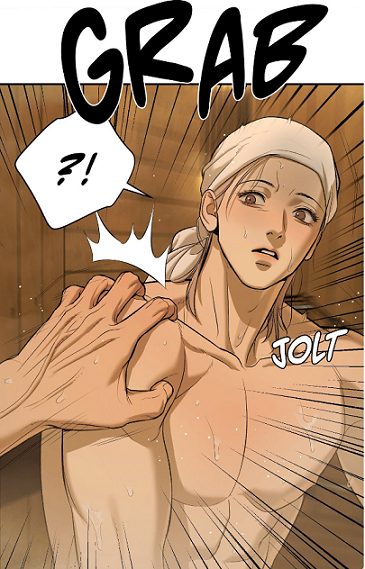 (chapter 34) He caught the actor by surprise, the latter never thought that the celebrity would become violent. The redness on his face was displaying that he was barely controlling his annoyance and impatience.
 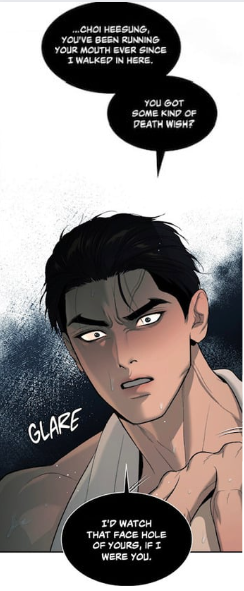 (chapter 34) However, they were in a public place, the hotel’s sauna, and the actor is a celebrity. Hence he is protected by his fame and social status. That’s the reason why the champion didn’t hit his frenemy, he had learned his lesson at the gym.
  (chapter 34) Despite his words, the gumiho still got scared. The racing of his heart is an indication of his fright. Therefore he ran away more or less after ordering his trainer not to meddle in his love life.
  (chapter 34) Note that when he did this, he avoided his counterpart’s gaze. Deep down, he knew that he shouldn’t provoke his frenemy too much. Only when he was at the door, he turned around and LIED!
  (chapter 34) Yes, after that incident, he chose to give him a fake excuse for his departure. As you can see, this conversation was strongly intertwined with the notion “truth or dare”, but both ended up lying. Whereas the champion didn’t admit any feelings, the other acted, as if there was nothing wrong and he was not scared. The gumiho thought that if he were to remove the champion from the doctor’s side, the latter would be able to open up to the actor.
  (chapter 34) What does it reveal? The actor had been projecting his own thoughts onto the future dragon too. He was the one who didn’t dare to become more honest with the physical therapist. He used work to spend time with Kim Dan. One might say that Heesung failed terribly. Yet, this is just an illusion, because his “failure” pushed him to become more honest with Kim Dan. Thereby he asked to meet the doctor again.
  (chapter 34) Yet, the message is exposing that Heesung was still lying, as he kept using work as an excuse. Hence Joo Jaekyung had to intervene again:
  (chapter 34) The champion dared to challenge his rival. (chapter 34) Should he cross the line and steal his “possession”, the other would retaliate and as such cross the line. The dragon pushed the comedian to come clean!!
  (chapter 35) Yes, by challenging the athlete because of Kim Dan, the comedian ended up telling the truth.
However, we can not say that Joo Jaekyung won the defy either. After the first challenge, he might have controlled his temper (chapter 34), but his anxiety reached a new peak, the fear that he might be abandoned. Hence he used the sandbag to vent his temper. And what did the cute puppy do during that incident? He dared to offer his help to his idol:
  (chapter 34), yet he was in total denial about the reality: it was dangerous. Deep down, the champion knew that it was impossible for him to control his lover’s time, but also his body. Besides, the other problem is that the athlete is rejecting the notion of love. By denying the existence of his own feelings, he can not claim the doctor’s heart. That’s the reason why the champion got so mad and frustrated. (chapter 34) Thus he had to play a trick. Because this nightly meeting represents another round of “Truth or Dare”, (chapter 34) I deduce that he chose lie in the end, for he dared to expose his relationship to Heesung.
  (chapter 34) He was not telling the truth, when he stated that Kim Dan was his “possession”. This explicates why he couldn’t stay by the doctor’s side (chapter 35) after the actor’s departure. He had been acting in front of Heesung. This confession could only kill any desire. Would you feel attracted to a tool or possession? No… Under this new light, it becomes comprehensible why Joo Jaekyung had to cover his lover’s eyes and ears. The celebrity knew deep down that if the doctor were to hear his confession, he would be shocked and feel betrayed and hurt. Besides, don’t forget that the protagonist serves as the mirror of truth for Kim Dan. Thereby Jinx-philes can grasp why the visit from Heesung could only remain a secret. He should only hear the truth. Joo Jaekyung chose avoidance and deceptions
  (chapter 34) in the end. He manipulated the main lead by letting him think that he had no other choice. Yet the last panel displays his trick. It was up to the doctor to decide how he should spend his free time. Nevertheless, while people were mad at the champion for his deception, many failed to realize that the champion was actually deceiving himself. So all the tricks (episode 33 and 34) were manifestations of avoidance, the fear to face the truth: his affection for Kim Dan and this due to a past betrayal. Hence these chapters stand under the sign of silence hidden by “pranks”.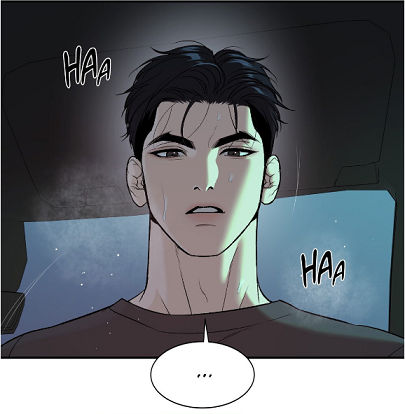
Interesting is that Kim Dan chose to trust his partner blindly. (Chapter 34) To conclude, he chose TRUTH! The words “I believe you” were important, because the athlete was in the position where he could violate and break that trust. He became the “traitor” which Heesung and readers witnessed. And through that experience, Joo Jaekyung came to trust Kim Dan more, as the latter had put his fate in his hands. Yes, he was encouraged to mirror his attitude. Finally, despite his lies and tricks, the gumiho was able to perceive the truth:  (chapter 35) On the other hand, the artist could only tell one part of the truth: the presence of feelings. However, the deceptions in the penthouse exposed something else: (chapter 34) his mistrust towards the cute “hamster” and his abandonment issues. He had to deceive him. Under this new light, Manhwaphiles can see why the champion made such a threat to Kim Dan
  (chapter 45) or left the doctor in the locker room in episode 51. (chapter 51) He wished not only to keep the upper hand in their relationship, but also to keep Kim Dan by his side. That’s how it dawned on me why Joo Jaekyung didn’t mention the jinx in the dining room and why he started treating him as his real PT.
  (chapter 45) It is because by denying his affection, he needs to justify his presence next to him. He is his PT… forcing his enemies to portray the doctor as a traitor or a bad PT. However, they failed, as the champion is not doubting the doctor’s innocence concerning his wound on the foot. Nevertheless, the incident is not closed, as the culprit has not been brought to justice.
There exists another cause why episode 34 is related to the wound in the locker room. (chapter 50) First, the schemers’ MO corresponds to the game Truth or Dare. Choi Gilseok asked his minion to cross the line. This explicates why they are trying to use tricks and manipulations. Daring means no truth, thus someone will be framed: Kim Dan. Yet, the plotters are not aware that thanks to the cute hamster, the alpha is turned into a mirror of truth. Hence he couldn’t get deceived by the MFC security guys:
  (chapter 40)
And it was the same with the first attempt. What did the manager from the Entertainment agency ask to his client? “You think you can do it?”  (chapter 36) The lawyer, the journalist and the manager pushed him to choose “dare” and not truth! That’s why there was no interview and the leak was not investigated. He had to prove his strength.
  (chapter 36) And exactly like at the sauna, daring became a synonym for verity. No wonder why the fighter is never rejecting the challenge. It corresponds to his past attitude: he has been burying the truth and as such the past. But let’s return our attention to the plotters.
Because of dare, in the States, the antagonists had planned to trick the champion with the drug.  (chapter 37) This mysterious man dared to act as a MFC manager, though my intuition is telling me that he works for MFC. The irony is that by challenging constantly the champion, the plotters are not realizing that through their game, the truth is slowly coming to the surface. How so? In the last panel, the doctor noticed his origins: He is Korean indicating that the conspiracy started in South Korea. As you can see, Kim Dan was able to perceive a glimpse of the truth. Then at the café, Choi Gilseok confessed many things to the doctor: he owns the café, he has connections to the company F Pharmaceutical. Moreover, through this game, the champion is confronted with his fears and past. That’s how he can overcome his traumas. The doctor is the mirror revealing the monsters. Hence I come to the following deduction: the succession of new characters mirrors the champion’s past and traumas. The following characters are involved in the champion’s suffering, though the order of the appearance is exposing the gravity of the involvement: Heesung,
  (chapter 29), the journalist without a face
  (chapter 35), the “fake” MFC agent (chapter 37), the invisible man in the flat
  (chapter 42), Baek Junmin whom the champion couldn’t truly identify
 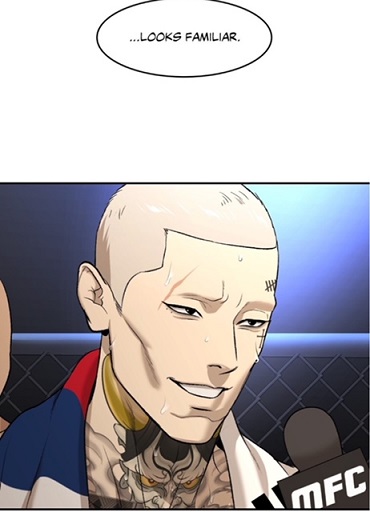 (chapter 47), then he recognized the director without naming him,
 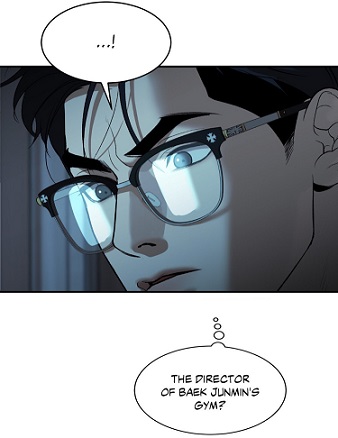 (chapter 48) and finally the ghost from the past
  (chapter 54). These characters are all connected to “Truth or Dare”.
  (chapter 50) This scene exposed that the champion repressed a certain incident which is rather common among victims of a trauma, especially people suffering from PTSD. This shows that some traumatic event took place for quite some time, but the champion acted, as if nothing had happened.
  (Doctor Frost, chapter 140 ) That’s how the champion became a zombie, he couldn’t live properly due to his untreated scars.
  (doctor Frost, chapter 139) But thanks to his fated partner, the traumatic past is slowly coming to the surface.
The moment you link the game Truth or Dare to the locker room, it is necessary to include chapter 48. Since the doctor rejected the option “Dare”, he should betray his boss and lover, Choi Gilseok chose to play a trick on Kim Dan and expose him as a traitor. (chapter 48) The director created a stage for the betrayal. That should represent the truth, while in reality it was a lie! Nevertheless, Joo Jaekyung could perceive the truth: Kim Dan had met the director from the rival gym. (chapter 48) Interesting is that Kim Dan didn’t take the risk to bring up the topic to him.  (chapter 48) Yes, he didn’t dare to tell him what had happened. No truth… no daring which reflects the games in the sauna and the living room of the penthouse. Kim Dan could have come clean the next morning, but no. This panel explains his silence. He also mistrusted his VIP patient. He had a negative perception of his lover’s mental state. On the other hand, the champion’s attitude reminded me of a parent who has not the time to listen to his child’s problem due to work.
 (chapter 48) Should the athlete remember this night, he will realize that he was the one dismissing his physical therapist, although the doctor could have come clean later. At the same time, Joo Jaekyung’s attitude could be mirroring the parent or guardian’s in the past. They didn’t have the time or the inclination to listen to their son, hence the traumatic incident got buried.
But let’s return our attention to our alpha and his hamster. Both share the responsibility for the miscommunication: silence, no risk, but as such no communication and no truth. Yes, when they are together, they dare things (chapter 27), hence truth comes to the surface! Kim Dan and Joo Jaekyung feel attracted to each other and have come to love each other. When they speak their mind, they feel comfortable around each other. Truth is strongly connected to communication. Hence the painful conversation in the locker room was necessary. “You don’t trust me?” also reflected the doctor’s attitude. He never tried to approach his room mate (chapter 47) and voice his true thoughts and emotions:
 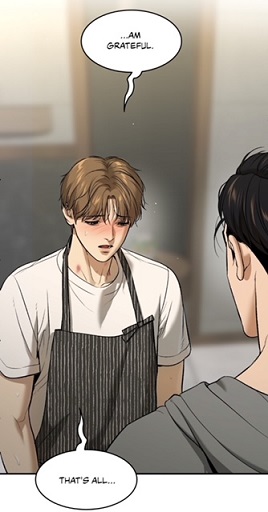 (chapter 45) He lied, when he portrayed himself as grateful. He was avoiding his gaze either. No wonder why the fighter got even more mad and threatened to fire him. Such an attitude could only increase the celebrity’s mistrust, as the latter could discern a certain dishonesty.
So when Choi Gilseok encountered the “puppy” in the hall, the celebrity could notice the doctor’s discomfort.  (chapter 49) The latter didn’t even greet the director or acted, as if they didn’t know each other. He exposed the existence of a secret, an uncomfortable secret. Consequently, I believe that the champion could only jump to the conclusion that Kim Dan had been indeed acting behind his back, even coerced to do something. (chapter 50) We shouldn’t overlook the usage of present perfect in the question, a sign that the champion was referring to the past as well. Consequently, it is no coincidence that there was a trick. That way, the verity would come to the surface. He was a “traitor”, but the irony is that Park Namwook’s words and blindness stopped the dragon from blaming his soulmate for his injury.
  (chapter 51) Note that the star never came clean with the truth either.
 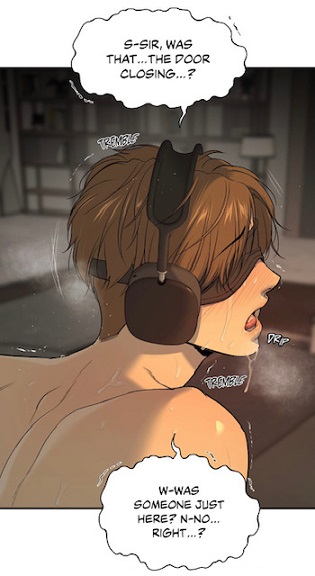 (Chapter 35) Through the doctor, the champion is encouraged to become honest to himself.
What are the common denominators between these three chapters (34/50/51): SECRET, BETRAYAL and CHEATING! The latter is not just a reference to infidelity, but also to dishonesty. Choi Gilseok used the spray to weaken the emperor and bought the referees and moderator. Keep in mind that in the sauna, the actor desired to come clean with the fighter by divulging his intention. This signifies that the gumiho was actually dropping this principle for the doctor’s sake.  (chapter 33) Simultaneously, it exposes that the champion has a secret, which is strongly intertwined with betrayal, love, money and deceptions. I couldn’t help myself thinking of “blackmail”. Kim Dan had been coerced to do something, as the director was holding something against him. Hence we have the question: “what have you done?”. Remember how the actor chose to approach the angel.
 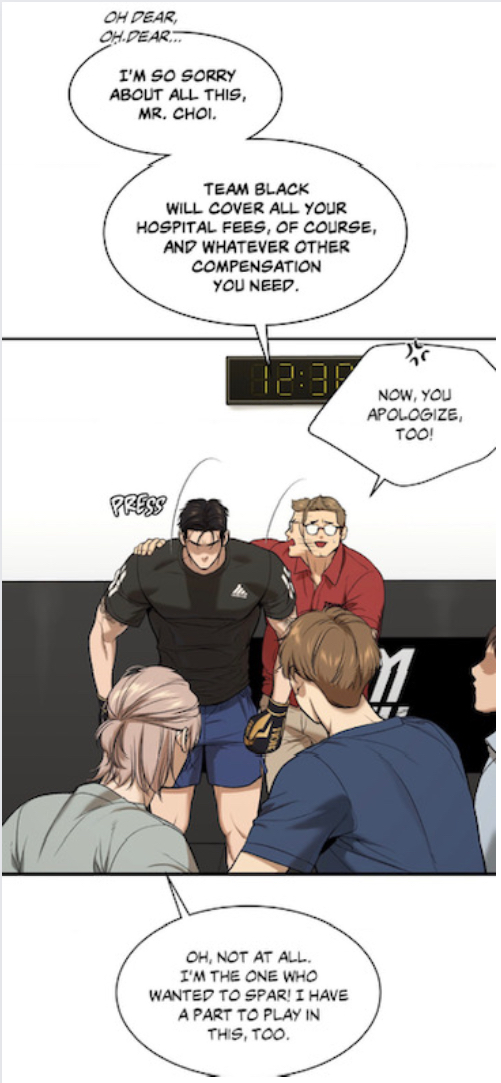 (chapter 31) He tricked his boss by faking an injury. He put the gym under pressure, as this incident could be leaked to the outside. The whole situation reminded me of blackmail. If he did not follow his request, there could be a scandal. That’s the reason why I believe that the champion’s past is linked to blackmail as well. How is it possible? It is because of the game “truth or dare”! The latter is strongly intertwined with divulging information and crossing the line!! To sum up, this game embodies trauma, secret, leaking information, trust and overstepping a boundary or rule. This observation brings me to my next point.
First, this game is often played with friends. Therefore many are thinking that this game is harmless, yet it is far from the truth.
Even though the game is meant to be fun to challenge a dare to our friends and watch them face awkward situations, most of us know when to STOP and are aware about the Do’s and Don’ts and acknowledge the need to maintain rationality in our action. But sometimes we do cross the line into making it a psychological trauma for some. Quoted from http://www.stopbullyingsystem.com/blog/truth-or-dare
The author is pointing out that such a game can cause traumas. First, one problem lies with the limit. Secondly, truth signifies that people are disclosing personal information. Hence TRUST is essential. Without “trust”, the honest confession can be used against them later. Another important aspect is that this fun is strongly intertwined with peers and alcohol! We have the perfect example with this defy:  (chapter 9) And what did happen after they left the restaurant? The champion discovered the truth:
  (chapter 10)
 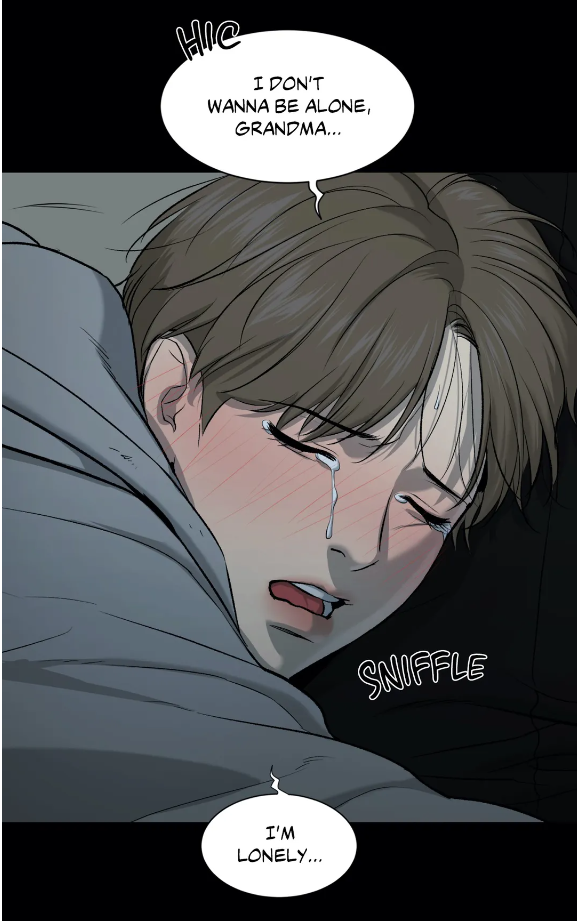 (chapter 10) Kim Dan was terribly poor, but he was also on his own, missing his grandmother.
Under this new light, it becomes comprehensible why the athlete avoided the gatherings, before the doctor entered his life. For me, he must have been exposed to the game “Truth or Dare” which led him to suffer greatly. Moreover, look at the reaction of the champion, when he heard about the comedian’s intentions: 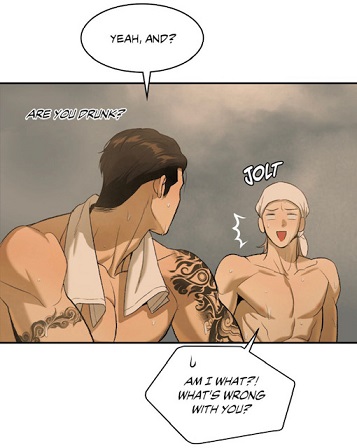 (chapter 34) “Are you drunk?” With this question, the protagonist revealed something about himself. He associates dating and love confession with drunkenness. He implies the existence of a lie. But a confession is strongly associated with verity and sincerity. On the other hand, for the sportsman, no one in his right mind would admit to be in love and in our case to love another man. For me, one part of the problem is that the champion is afraid of admitting his homosexuality. The latter is still a stigma in South Korean society. But there’s more to the game Truth or Dare. If you paid attention to the origin of the last quote, you will realize that this fun is linked to bullying and even hazing.
The school counselor entered and much to my surprise the counselor was there to talk about the game “Truth or Dare”. A fad of this game started at the beginning of the school year and apparently some students were bullied and out casted for not doing a dare. The frustration, and hurt associated with this game is not realized seriously as it should be. The students assume that it is fun to embarrass each other but it is hurtful to some who do not end up enjoying it. One word that instantly crosses my mind is “Bullying”. Some may not agree with that or may even put it in the category of peer-pressure but wherever purposeful action that causes pain and trauma comes, it automatically puts it in the same basket. The main motive of games is to create a healthy environment of fun and laughter and not stress or tension. Quoted from Quoted from http://www.stopbullyingsystem.com/blog/truth-or-dare
If you think carefully, bullying is working similarly to this game. As long as no one reports the students’ aggressive behavior to parents, teachers or authorities (“truth”), the juniors feel safe and can go to the extreme. Many beholders had the impression that Joo Jaekyung had been a victim of bullying due to Baek Junmin’s confession.  (chapter 49) Furthermore, bullying is never done alone, but in groups. (chapter 57) There is one leader and the others are following the flow, the latter even become more proactive by making new bets and suggestions in order to ensure their own safety. As long as no one divulges the truth, the bullies are safe. But there’s more to it. Striking is that the way they coerced the champion to fight resembles to bullying too. He was manipulated with the articles, then with the advises from the lawyer and manager. Once in the States, they tried to drug him, which corresponds to a physical assault.
  (chapter 37) Finally, note that the schemers are working in teams exactly like the bullying students. Therefore I judge Park Namwook’s attitude as the teacher’s who is closing the eye to the truth. He is rather passive and puts the whole responsibility on his “boy”.
  (chapter 41) It is the champion’s choice to refuse or not the matches. The moment I associated the game with parties, peer groups and bullying, I had many revelations.
First, I couldn’t help myself connecting this “fun” to college and students. That’s how I found this article:
It’s no secret that excessive drinking and sometimes violent hazing happen at welcoming parties for university freshmen. The most recent case which came under the media spotlight involved Dong-A University students in Busan being soaked with makgeolli, a traditional fermented rice drink, mixed with food waste. In a photo posted on the school’s Facebook page, a group of freshmen are standing in a room, with a vinyl curtain hanging behind them. A woman in front of them is pouring makgeolli from a blue plastic bowl onto their heads. Quoted from https://www.koreatimes.co.kr/www/nation/2024/02/113_201344.html
Yes, the sophomore’s gesture reminded me of the champion’s action at the hotel:  (chapter 37) Interesting is the athlete described this night as a party which made me think of a students’ party. Therefore I couldn’t help myself wondering if the champion didn’t go to college, but due to an incident, he was forced to drop out. And the latter could be related to a party organized by students. The latter chose to cover up the incident by remaining silent. I would like to outline that the doctor got fired, though he was actually sexually harassed by his superior. The nurse never testified in his favor, she chose to close an eye to the crime.
  (chapter 1) The main lead never considered her behavior as betrayal and abandonment. In fact, he never considered the crime as a betrayal from an institution.
 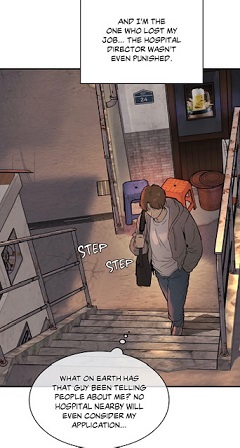 (chapter 1) He put the whole blame on the hospital director himself. He is a liar. Furthermore, through these pictures
  (chapter 47)
 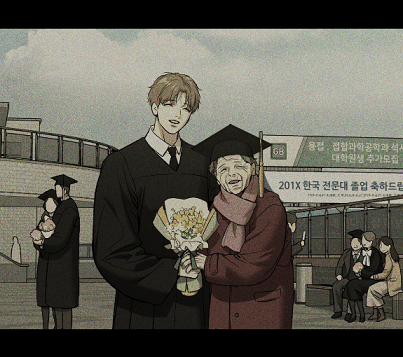 (chapter 47), Manhwalovers can see that Kim Dan was a loner. Therefore I doubt that he had friends during his college years. The only person he knew from his school was his mentor:
  (chapter 1) It is important, because it implies that Kim Dan avoided to socialize and participate in gatherings. Interesting is that in season 2, Jinx-philes discover that Kim Dan had been bullied in the past. ( chapter 57) This new discovery reinforces my hypothesis that his fated partner went through a similar experience. Thus I had the following idea.
What if the champion was present at a party and had been left behind by his friend, though he was drunk? Observe the parallels:
| Chapter 9 | Chapter 35 | cHapter 43 | Chapter 44 |
|---|---|---|---|
 |  | 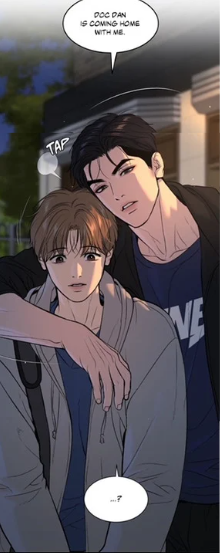  | 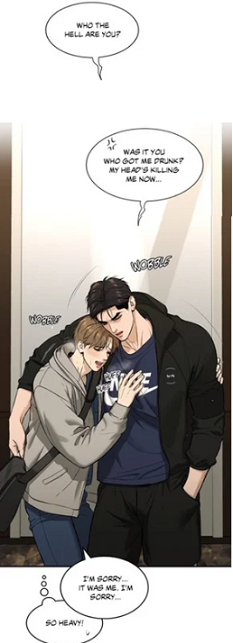 |
In episode 9, both puppies were drunk, 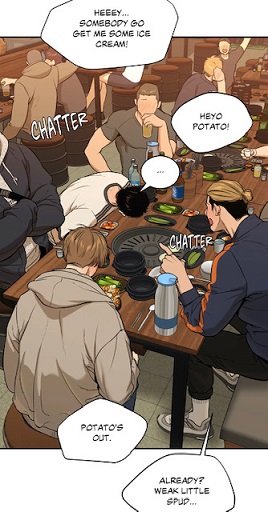 (chapter 9), yet Park Namwook made sure that the physical therapist wouldn’t be abandoned drunk. Thus he tasked his boss to bring him home. And as for Potato, it is clear that Oh Daehyun would take care of him, as he was sleeping in the dormitory next to him. In other words, no one was left behind drunk. But this scene contrasts so much to episode 43. First, no one was missing Potato. No one asked about his absence. Secondly, pay attention that the fighters invited Kim Dan to join them for another round, while they were neglecting their boss, though it was his birthday party.
 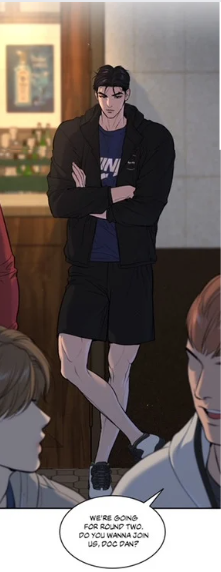 (chapter 43) Moreover, they never wondered about his physical condition. Was he drunk or not? Funny is that the intoxicated character was the one who forced Kim Dan to go home. (chapter 43) Actually, it should have been the opposite. The drunk champion should have been protected, but no. For me, it exposes a certain neglect from the members of Team Black, even Park Namwook and Jeong Yosep. Besides, imagine the irony. If Joo Jaekyung had not voiced his desire, triggered by his jealousy,… no one would have paid attention to the protagonist. (chapter 43) It was, as if he would have been indeed left behind. His behavior is the reason why Kim Dan chose to bring him home.
 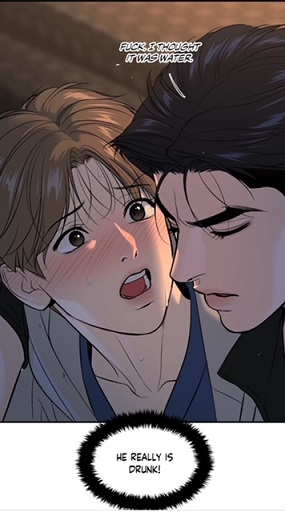 (chapter 43) That’s what a friend is supposed to do.
And this observation leads me to chapter 35 which I didn’t bring up first on purpose. What caught my attention is that Mingwa placed 2 characters from BJ Alex in episode 35. (chapter 35) Nam Dong-Gyun is taking care of his drunken chingu Kim Myun-Dae. The former is showing an exemplary behavior. But what about Heesung and Potato? (chapter 35) They left Kwak Junbeom behind. Note that Oh Daehyun had gone to the bathroom, so the fighter was alone for a moment. On the other hand, Junbeom was quite safe there, for the owner of the tent knew them.  (chapter 35) So the auntie could keep an eye on the judo fighter, and it was only a matter of time, until his friend would return. Nevertheless, this scene is implying a certain problem: a drunken person shouldn’t be left unguarded. Thus imagine that during a party, an unconscious person is brought to a room and left there unguarded, as the friend desires to keep partying, similar to this scene:
  (chapter 37) The person could get sexually assaulted, and no one would notice it. Secondly, I would like to outline that the hazing party from the article reminded me a lot to bullying. These freshmen were humiliated, and the perpetrator excused her behavior behind traditions and social norms. So the champion could have been betrayed by a friend, as the latter would have justified his action similarly. So instead of admitting his mistake, he could have justified the incident like this: the victim was responsible for his misery, because he was at the wrong place at the wrong time. It was just his misfortune or better said his jinx. Yes, for me, the jinx is indicating that people responsible for the champion’s traumas were denying their wrongdoings.
By connecting the game to bullying and coercion, a sudden question popped up. Why would Joo Jaekyung hate to share the shower room with members from Team Black?  (chapter 8) From my point of view, this place is not just symbolizing purification and reflection, but also indicating the presence of a wound. As soon as I connected the bathroom and as such water to pain, all the champion’s past behavior appeared in a different light. In episode 3, when he went there, he was wearing his pajamas.
  (chapter 3) Neither Kim Dan nor the protagonist were seen both naked in the shower room.
  (chapter 8)
  (chapter 20)
  (chapter 30) Therefore I perceive the champion’s last comment as relevant. In my opinion, Kim Dan’s gesture reflected the champion’s mind-set. So by saying this, Joo Jaekyung was forced to admit the absurdity of such an attitude. Therefore Manhwalovers can understand Joo Jaekyung’s annoyance at the sauna. He imagined that he would be alone there.
  (chapter 34) He feels uncomfortable naked around people… As soon as you connect this place to a wound, my avid readers can finally better interpret the champion’s irritation in episode 36:
  (chapter 36) Kim Dan’s entrance could be perceived as a violation, for the champion was naked. This intrusion caught him off-guard. But since his gaze was covered, his anxiety masked behind his anger was diminished. On the other hand, this led him to leave the bathtub undressed and have sex in the kitchen.
  (chapter 36) For me, everything is pointing out that one of the champion’s fears is intimacy with water. He has long internalized this association. Don’t forget that the sexual encounter in the swimming pool started with clothes, before they got completely removed.
 (chapter 27) Under this new perspective, I don’t think that it is a coincidence that the champion felt the need to take a shower after meeting Baek Junmin and recalling the past.
  (chapter 49) This helped him to overcome his trauma and past wound.
  (chapter 49) Yet, keep in mind that the athlete’s wounded soul is not the result of one traumatic incident, but of many anguishes.
Another common denominator between all these scenes is that this place is also connected to a challenge: (chapter 3) Kim Dan dared to make him wait (I don’t think the athlete was truly honest here).  (chapter 8) they dared to have sex next to Oh Daehyun and the other fighter. However, note that in all these scenes, neither the doctor nor the champion were honest. They were both lying… not only to their counter-part, but also to themselves.
  (chapter 19) That’s the reason why the argument in the locker room
  (chapter 51) doesn’t represent the final moment where both main leads opened up their heart and mind to each other. They were not truly honest to themselves and to each other. There was no water… and according to me, the spray was a pepper spray, so the champion’s ankle should have been cleaned and not simply covered. For me, both characters need to prove their trust and loyalty to each other. But they are moving in the right direction, for Joo Jaekyung divulged a huge information to Kim Dan. There’s a spy in the gym, hence the doctor will become more observant. He is pushing him to question people’s words and actions, even to say no to others. To conclude, I connect the champion’s trauma to water… and don’t forget that in episode 7, the athlete acted like a bullying member.
  (chapter 7)
Because I made a connection between Betrayal trauma, truth or dare, bullying and BJ Alex, I could help myself bringing up Nam Dong-Gyun’s tragic past. The latter represents the perfect example of a person suffering from betrayal trauma.  (chapter 70) His sexual orientation was exposed in high school, his friends were behind the rumor
  (chapter 70), although we have to envision that his crush played a huge part in it. Why? It is because he didn’t want to be associated with homosexuality.
  (chapter 70) Not only he cut off ties with him, but also he made sure to isolate the main lead from other students. The worst is that this person acted, as if this ostracizing had never occurred.
  (chapter 69), as if he had done nothing wrong. For me, it shows that the traitor never grasped the significance of his actions. Hence Park Sung-Woong could forget Dong-Gyun, while the latter could never forget him at all. The result from this huge betrayal was that the cute uke decided to keep his distance from people.
  (chapter 70) He could no longer trust people, he avoided meetings. In order to outline how severe betrayal trauma can be, the Webtoonist showed us the immediate effects of betrayal trauma: physical and emotional reactions
  (chapter 70)
  (chapter 70) and the long term effects:
 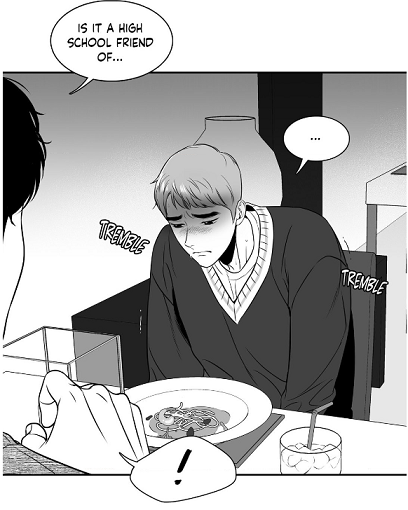 (chapter 69) he is trembling so much, he can not look at his former friend. Readers shouldn’t underestimate the issue. Betrayal trauma is so severe that it is comparable to being hit by a white truck. The pain is so great that it affects the brain functioning and as such personality.
The 7 signs of betrayal trauma are: anxiety, avoidance, trust issues, negative intrusive thoughts (shame, guilt), withdrawal and rumination.
We can see these signs in Joo Jaekyung: anxiety (chapter 34), avoidance (alcohol, gathering)  (chapter 9), trust issues
  (chapter 30), negative intrusive thoughts
  (chapter 29), withdrawal (we know nothing about his family and he dislikes going to gatherings, he is not meeting his hyung Cheolmin) and rumination: he got upset, when the hamster ignored his calls. (chapter 05) Then when he stayed at home,
 (chapter 32), it was clear that the doctor’s actions were constantly on his mind. He was so bothered that he had to bring him to Heesung. He made sure that Kim Dan would forget Choi Heesung in the car.
  (chapter 33) Interesting is that this trauma resembles a lot to PTSD.
Betrayal trauma encompasses a distressing range of experiences that stem from breaches of trust and safety, often occurring within intimate relationships. This form of trauma can lead to the development of post-traumatic stress disorder (PTSD) and various emotional, psychological, and physical symptoms. The deep-seated connection between betrayal trauma and PTSD is notable, as this type of trauma can cause symptoms akin to those found in traditional PTSD. […]
Despite these differing origins, research has shown that individuals who experience betrayal trauma often exhibit symptoms and triggers that closely resemble those seen in individuals with PTSD. These shared characteristics might include intrusive thoughts, flashbacks, heightened anxiety, emotional numbness, and difficulties in establishing trust with others. Both betrayal trauma and PTSD can lead to a persistent state of hypervigilance, where the individual is constantly on alert for potential threats, even in situations that might seem safe to others.
Understanding the connection between betrayal trauma and PTSD is crucial for several reasons. Firstly, it emphasizes the profound emotional impact of betrayal on an individual’s mental well-being, potentially leading to symptoms comparable to those experienced after traditional traumatic events. Recognizing the commonality of these symptoms helps validate the experiences of those who have undergone betrayal trauma and underscores the significance of addressing their psychological needs. Quoted from https://www.evolvetherapymn.com/post/betrayal-trauma-and-ptsd
As you can see, through the game “Truth or Dare”, I could connect one cause for the champion’s suffering, betrayal trauma, and the latter was never treated. But there exists different kind of betrayal.
Parental: Children who live with abuse from their parents or guardians can experience betrayal trauma.
Institutional: This includes professional relationships and social support systems in categories such as employers and lawmakers.
Partner: Betrayal trauma can occur because of spousal abuse.
Interpersonal: Dysfunctional interactions between friends, co-workers, and family members can cause betrayal trauma. Quoted from https://www.medicalnewstoday.com/articles/betrayal-trauma#types
In BJ Alex, Mingwa presented four types of betrayal trauma: the parents with Ahn Jiwon 
 (chapter 49), the latter was not loved, as he didn’t reach the first place like his older brother. Then we have Interpersonal with Nam Dong-Gyun and his high school friend. However, since the rumor circulated at school, and no adults intervened, we could see it as a reference to Institutional betrayal. Finally, Mingwa presented the last type (partner) with Hweemin.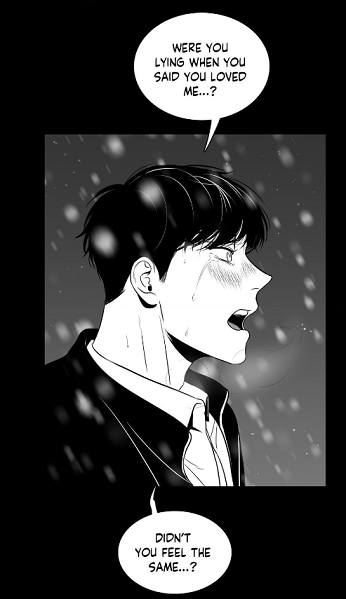
 (chapter 51) But why is betrayal trauma so severe? It is because everything appears as a lie, as an illusion. All the memories become tainted. The victim can only question his own senses and judgment. How could he not detect the lies? Since PTSD and betrayal trauma share some common points, it is not surprising that such persons come to blame themselves and develop huge self-loathing.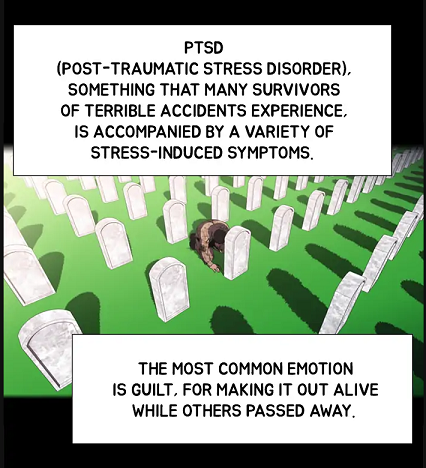
 (doctor Frost, chapter 139). And now, it is time to expose my latest observation:
 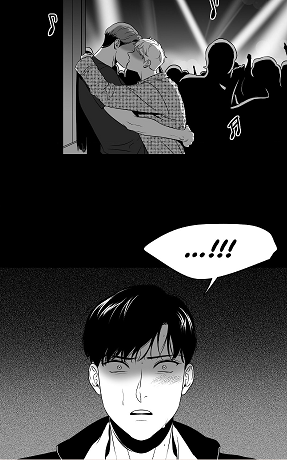 (BJ Alex, chapter 51) Ahn Jiwon caught his first lover cheating on him at a club. Interesting is that the new lover resembles a lot to Joo Jaekyung! Mingwa said that characters from BJ Alex will only appear, but Jinx is not connected to her previous work. Note that they were kissing in a public place. Moreover, the club is a location where students not only meet, but also drink alcohol together. However, once Jiwon saw Hweemin, he dragged him outside so that they could talk. In other words, the “new lover” was left behind. Thus I come to the following conclusion. Joo Jaekyung has been suffering from betrayal trauma exactly like Ahn Jiwon. He was betrayed by his guardian (chapter 54) who refused to help him. If he got bullied as a kid, this signifies that he was bullied at school and the institution failed him. (chapter 49) Then if he was exposed to violence and his friend chose to close an eye to his situation imagining that he would report the incident to his own parent, the friend betrayed him too. And that could be Heesung who stands for passivity and distance. Finally, Joo Jaekyung could have been backstabbed by a lover as well and this because of money reminding us of Hweemin.
 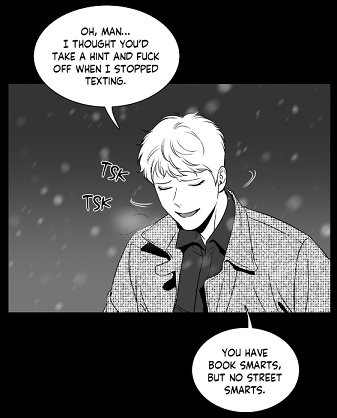 (BJ Alex, chapter 51). If this theory is true, then Mingwa would finally outline the devastating effects of Betrayal trauma on people, something she barely touched in her previous work.
Finally, if the athlete was betrayed by a previous lover, Kim Dan would be forced not only to confront him, but also to claim his place. He is not interested in Joo Jaekyung for his money and for fun, but for his amazing talent and personality. Joo Jaekyung is actually very tolerant in front of the hamster: (chapter 51) No rough grabbing, no death threat, no punch … Imagine that he left the doctor in the locker room giving him privacy, while he went elsewhere. Don’t forget that he was wounded. 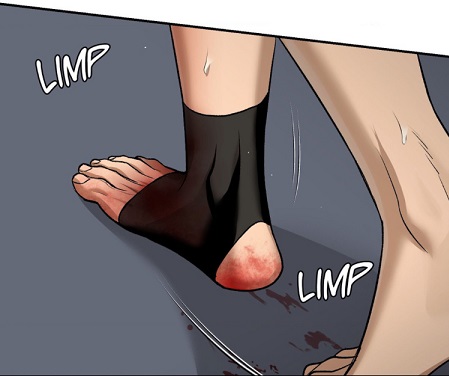 (chapter 51)
To conclude, the game truth or dare is associated with wrongdoing, pain and deceptions. The main leads are choosing more often “daring” which stands for truth, whereas the enemies prefer daring, unaware that they are bringing truth to the surface. However, imagine that I didn’t say everything about the dangerous game “Truth or Dare”, hence I will write another part.
Feel free to comment. If you have any suggestion for topics or manhwas, feel free to ask. If you enjoyed reading it, retweet it or push the button like. My Reddit-Instagram-Twitter-Tumblr account is: @bebebisous33. Thanks for reading and for the support, particularly, I would like to thank all the new followers and people recommending my blog.
Please support the authors by reading the manhwas on the official websites. This is where you can read the manhwa: Jinx. But be aware that the Manhwa is a mature Yaoi, which means, it is about homosexuality with explicit scenes. Here is the link of the table of contents about Jinx. Here is the link where you can find the table of contents of analyzed manhwas. Here are the links, if you are interested in the first work from Mingwa, BJ Alex, and the previous essay about Jinx “Facing The Shotgun: Embracing Change“
It would be great if you could make some donations/sponsoring: Ko-fi.com/bebebisous33 That way, you can support me with “coffee” so that I have the energy to keep examining manhwas. Besides, I need to cover up the expenses for this blog.
One might wonder why I selected such a picture for the background. While looking for a symbol for past, I discovered on Canva the clock as symbol for “past”. Why? It is because the clock represents time which includes past. As you can imagine, in the illustration, the clock is representing not only the past, but also Joo Jaekyung and his youth. But before presenting my new observations about the champion’s mysterious youth, I would like to focus on the clock.
There was another reason why I chose this image. I couldn’t help myself thinking of this panel:  (chapter 48) Why did the Webtoonist gave us the time, when the next episode starts another day? On the one hand, it exposes that the schemers knew about the champion’s nightly activities. He wouldn’t sleep much and he would keep his cellphone next to him.
 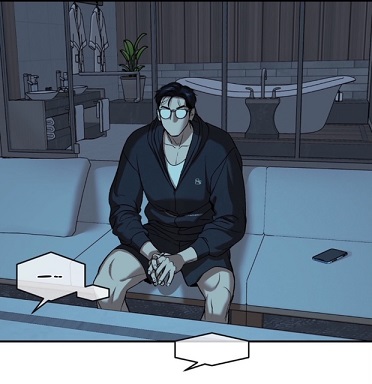 (chapter 48) It shows once again that the traitor is close to the athlete, for he knows about his way of life. Furthermore, the unknown person could text to the champion, hence this means that his cellphone number got leaked by a person close to him. On the other hand, I am quite certain, the Webtoonist desired to fool her readers making them anticipate a confrontation between the two protagonists. However, nothing happened indicating that Joo Jaekyung didn’t react, like the plotters had anticipated it. Thus they had to create a new scheme. First, let’s not forget that they had used a similar method in the past.
 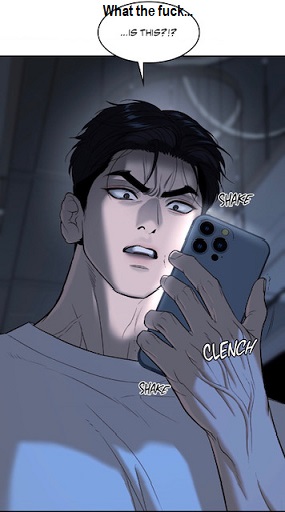 (chapter 35) This made me think of Painter of The Night and No-Name’s advice:
  (chapter 76) “A deed once foiled has no chance of success the second time around”.The criminal was referring to learning through experience. After going through such an event once, the athlete is no longer caught by surprise. We could say that he learned not to jump to conclusions and control his emotions. That’s the reason why in episode 48 he remained level-headed. Because the champion didn’t get angry, he could be more attentive. (chapter 48) Secondly, (chapter 48) contrary to the journalist, the sender of the pictures remained anonymous. He was exposing his personality: a traitor and a coward. So what did the anonymous sender want to divulge with these images? In my opinion, they wanted to create the illusion that Kim Dan was leaking information about the champion’s physical condition. That’s the reason why Choi Gilseok was seen smiling and taking the doctor’s hands. It looked like he was thanking him.
  (Chapter 48) The irony is that the doctor had been able to treat the star’s injury. For me, the Summer Night’s Dream played a huge role, as during that night, Joo Jaekyung felt treasured and loved. Therefore the pictures could only expose the duplicity of the director of King of MMA. Under this new light, it becomes understandable why the celebrity didn’t fall into their trap and why they had to turn doc Dan into a traitor by giving him a weapon without his knowledge. Finally, I believe that Joo Jaekyung had another reason not to confront the physical therapist. How so? It is because he had sent away his soulmate, while the latter had approached him. (chapter 48) He had missed the opportunity.
“The past is already gone, the future is not yet here. There’s only one moment for you to live, and that is the present moment” Buddha Quoted from https://www.goodreads.com/quotes/80868-the-past-is-already-gone-the-future-is-not-yet
Too obsessed with his upcoming match and as such the future, he had neglected the present. But imagine this. If he had gone to doc Dan’s bedroom and questioned him, once he had received the message, the latter would have appeared not only as selfish, rude, but also as indecisive, mistrusting and easily manipulated. However, the athlete’s biggest desire is to look confident, reliable and strong. Because he had missed the timing, he was encouraged to analyze the images and ponder on them. Furthermore, I couldn’t help myself connecting this scene to the one in the bathroom:  (chapter 30) Here, he wished to seek the doctor’s closeness. Nonetheless, if he had gone to Kim Dan’s bedroom during that night, he would have achieved the opposite: he would have created distance and caused an argument. The latter could have told him that he was looking out for himself, for Joo Jaekyung had threatened to fire him. Through these observations, it becomes visible why the athlete couldn’t ask Kim Dan at all. Consequently, I come to the conclusion that the clock (chapter 48) was announcing missed opportunity. It is important, because it displays the falsehood of the champion’s belief.
  (chapter 2) He is not jinxed, but his failures are the result of his bad choices, like for example trusting the wrong people or not listening to the trustworthy ones or keeping secrets. Or we could say that he is just the product of his education and childhood. He is cursed, for he was not properly raised. He refused to listen to his PT, when the latter wished to tell him something. (chapter 48) He had ignored him by not even looking at him. And this brings me to my next observation: REGRET. I am quite sure that after receiving the message, Joo Jaekyung must have felt regret. First, he had yelled at Kim Dan and menaced him to terminate his contract. (chapter 45) Then in the bedroom, he had rejected all his requests (massage, conversation). It was, as if he no longer needed him. He was no longer eating his breakfasts too. (chapter 47) Under this new light, Manhwa-lovers can comprehend why he looked annoyed in the hallway.
  (chapter 49) The gaze displays not only worry and anxiety, but also regret. It was too late to ask the doctor. For me, he chose silence, for he was regretting his reactions in the penthouse. He feared to ask Kim Dan, because if he brought up the meeting with Choi Gilseok, this could push the hamster to quit his job. However, thanks to Kim Dan, the star’s condition improved greatly. That’s how it dawned on me why the champion became a beast and why he is hiding his past: (chapter 26) It is because the man is full of regrets and resent. But by creating new regrets, the champion is incited to focus more on the present so that he stops missing the timing. Because of his immense regrets and frustration, he was still trapped in the past. So he was unable to move on. To conclude, Kim Dan and Baek Junmin pushed him to face his youth and the source of his own unhappiness. His biggest suffering is a secret, because he would appear as weak and pitiful which would ruin his image as the strongest man in the world.
Nevertheless, I believe that the author had another reason to create such an image. (chapter 48) It is related to the time. It’s 12: 13 and 47 seconds. I have to admit my hesitation about the minutes: 13 or 14 minutes? But I opted for the first choice, for there are only 13 seconds left, until it is 14 minutes. So the minutes hand had to move closer to 14. Because it is midnight, I couldn’t restrain myself thinking of Cinderella and her transformation, especially when Kim Dan noticed that the athlete returned home just before midnight!  (chapter 48) But why is midnight so important? It is because the number 12 carries religious, mythological and magical symbolism, generally representing perfection, entirety, or cosmic order.
The number 12 is strongly associated with the heavens—the 12 months, the 12 signs of the zodiac, and the 12 stations of the Moon and of the Sun. The ancients recognized 12 main northern stars and 12 main southern stars. Quoted from https://www.britannica.com/science/the-number-twelve
This explicates why in the fairy tale Sleeping Beauty from Grimms 12 fairies who are called as “wise women” in the story.
He did not just invite his relations, friends and acquaintances but also the Wise Women so that they would favor the child and help her. There were thirteen in the kingdom. But because he only had twelve golden plates, one of them had to stay at home. Quoted from https://www.ellajsmyth.com/fairy-tales/sleeping-beauty-brothers-grimm/
In episode 12,  (chapter 12) the couple was supposed to reach Nirvana, but the athlete failed terribly. Under this new light, it becomes comprehensible why the protagonist chose not to confront Kim Dan in episode 48. It was, as if the champion was closer to the heavens. This represents the champion’s leap of faith. Don’t forget that the star got scared for one moment
 (chapter 48), when he noticed doc Dan’s presence too late. But nothing happened to him, that’s how he got incited to trust Kim Dan. The latter wouldn’t backstab him. Under the blue light, the champion got transformed. (chapter 48) Observe that Jinx-philes can see the champion’s gaze again, an indication that his “blindness” vanished which contrasts to this image:
  (chapter 48) On the other side, the fact that the champion is always targeted during the night is a sign that the villains desired to approach him, when he was isolated. So they know not only about his insomnia, but also about his solitude. I would even add that the plotters are aware of his association between the night and danger. Remember how he described relaxation: he would give an opportunity to his enemies to attack him (chapter 29) This new observation reinforces my past theory: he would be suffering from Somniphobia due to traumas. [For more read Twinkle, twinkle … little star] That’s how I realized the role and significance of the nights Joo Jaekyung spent with Kim Dan. One purpose of these nights was to change Joo Jaekyung’s perception of the night. That’s how the Beast could be tamed and even transform into a lovely and cute cat. In other words, he should make different experiences during his nightly activities. But there’s more to it. Thus I listed all the nights where the couple was together.
| Chapter 4 | Chapter 9/10 | Chapter 12 | Chapter 13 | Chapter 19/20 | Chapter 29 |
|---|---|---|---|---|---|
  |  | |  |  |   |
| The champion called the doctor, because it was urgent. The reality is that he wanted to have good sex due to his jinx. Yet he enjoyed the night so much that he allowed Kim Dan to sleep in his bed. | Kim Dan voiced his loneliness and his longing for warmth. He wished that his grandmother wouldn’t leave him behind. For me, that’s the moment Joo Jaekyung took over Shin Okja’s role. | The sex was initiated due to Kim Dan’s request. He needed money: dire situation. Interesting is that he called this night a lucky day! | Here, he had restrained himself out of fear that he might endanger Kim Dan’s life. No emergency, but a secret, as he was turning his back to Kim Dan. | “I want to fuck”: urgent, hence the doctor had to prepare himself. The champion witnessed for the first time Kim Dan’s ejaculation. He could procure pleasure to his partner. He compared the doctor’s anus to a baby’s mouth. | The champion confessed a lot to Kim Dan, before they ended up having sex. Joo Jaekyung brought up the notion “pregnancy”, when Kim Dan expressed the wish that the athlete would use protections. No urgency, but he divulges his secrets: fears and insomnia. |
| Chapter 33 | Chapter 34 | Chapter 39 | Chapter 44 | Chapter 45 | Chapter 48 |
|---|---|---|---|---|---|
 | |  |   | 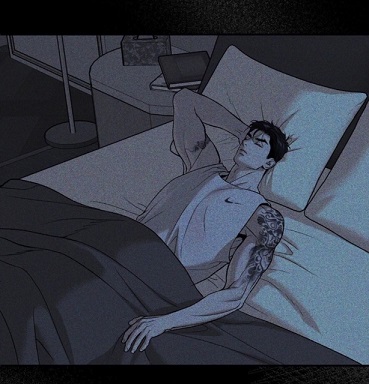 | |
| The sex here was an emergency, for Joo Jaekyung feared that he might end up losing Kim Dan. The doctor didn’t know the cause for such a behavior (secret). | Contrary to the previous sex session, the champion directed his fears and anger at Choi Heesung. Another emergency! The actor’s visit was kept a secret. | This wonderful night was an illusion, for the doctor was acting under the influence of the drug. Emergency! The doctor had to join his boss during the night: secret meeting. | Here, the roles were switched, as now it was the champion’s turn to act under the influence of the soju. The doctor chose to have sex, as he didn’t want to miss an opportunity. But the hickeys threatened to expose the nature of their relationship: secret. | The protagonists kept secrets from each other. The champion noticed the departure of his soulmate which could only make him anxious. | Like mentioned above, the champion refused to listen to Kim Dan. Since the latter entered silently, he caught his room mate by surprise: secret visit which stands in opposition to episode 29. |
By creating this table, I noticed the following parallels: emergency, delicacy and secrecy. What I mean with delicacy is the allusion to babyhood, vulnerability and inexperience (chapter 9, 10, 12, 13, 19, 29, 44). After the “lucky day”, the champion had to hear that he was risking his partner’s life with such a rough behavior. 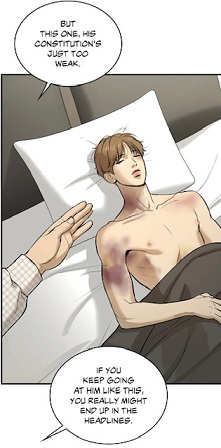 (chapter 13) It is important, because through this terrible experience, Joo Jaekyung came to internalize the connection between sex and danger. This would explain why he has been so rough in bed before. He came to see it as a normality, a sign that his perception of sex had been negatively influenced. And this can only come from bad experiences. It had nothing to do with “enjoying the moment”, until the protagonist met the shy hamster. We can see his gradual transformation. In episode 12, he definitely saw the night as “carpe diem” (chapter 12), until he was confronted with the consequences of his lack of empathy and interest. Due to his selfishness and prejudices, he didn’t notice the bad shape of his partner. Secondly, the fact that sex is strongly connected to urgency made me think that in the past, Joo Jaekyung must have been himself in a dire situation too. And it must have happened during a night, because all his memories with Baek Junmin are connected to darkness. (chapter 49) In the previous essay, I had mentioned the theory that the champion might have been raped and even gangraped which would fit the criteria (sex, danger and urgency). Finally, the recurrence of “delicacy” during the night is an indication that the athlete must have been like Kim Dan in the past! Vulnerable and alone!
And the moment I recognized the role of the nights in Jinx, it is to push the protagonists to open up their mind and heart, I started pondering on the symbolism of the night. The latter can signify:
Fears and dangers: The darkness and shadows of night can evoke feelings of apprehension and vulnerability, as visibility decreases and the unknown becomes more prominent. Therefore the halmoni sang the lullaby “Twinkle, twinkle little star”. 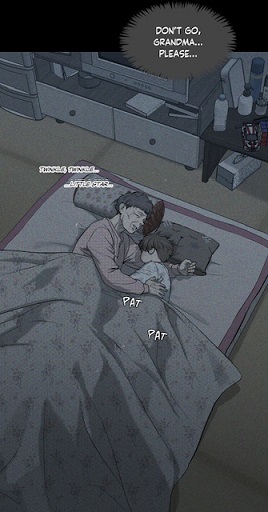 (chapter 21) Furthermore, the champion exposed why he could never relax: (chapter 29) He could get assaulted the moment he rests or sleeps.
Reflection and introspection: The quietude of the night often invites contemplation and self-reflection, providing an opportunity for individuals to delve into their thoughts and emotions. This would correspond to the night in episode 29 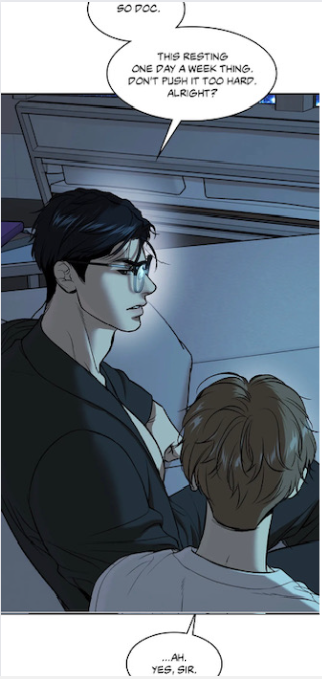 and 48:
Transformation and rebirth: The transition from day to night can represent a period of transformation or renewal, as darkness gives way to the promise of a new day. Remember how I compared Jinx to the fairy tale Beauty and the Beast [for more read Belle 👸 and the Bear🧸 in the penthouse – part 1] and Summer Night’s Dream. [For more read 🌹A Summer Night’s Dream 🧚♂️]
During their evening conversations, away from the hustle and bustle of daily life, Beauty and the Beast have the opportunity to truly get to know each other beyond their initial impressions. These moments of quiet reflection and intimacy allow them to share their thoughts, feelings, and experiences, fostering a sense of understanding and empathy between them. For example, in the evening scenes, Beauty and the Beast engage in heartfelt discussions about their pasts, their hopes for the future, and the true nature of love and compassion. These conversations reveal layers of complexity in their characters and deepen their bond as they learn to see beyond outward appearances and appreciate each other for who they truly are. The evening setting adds a sense of intimacy and vulnerability to their interactions, creating a space where they can open up to each other and build trust and affection over time. As they share these moments together, the evening becomes a symbol of the transformative power of connection and empathy, marking the beginning of a profound journey of growth and love for both Beauty and the Beast.
As for “Summer Night’s Dream” by William Shakespeare, the night serves as a pivotal time for the characters, marking the beginning of transformative experiences and the resolution of conflicts. One example of this is the final scene which brings resolution to the romantic entanglements and conflicts among the characters. As dawn breaks, we witness the reunion of Hermia and Lysander, who had been separated by the interference of magic and the meddling of others. Similarly, Helena and Demetrius find themselves united in love, overcoming the misunderstandings and obstacles that once stood between them. Moreover, the fairy king and queen, Oberon and Titania, reconcile their differences, restoring balance to the natural world and the fairy realm. Their reconciliation symbolizes the restoration of order and harmony after a night of magical mischief and confusion. As the sun rises on a new day, the characters emerge from the enchanted forest transformed by their nighttime experiences. The transition from night to day signifies not only the resolution of conflicts but also the beginning of a new chapter in their lives, marked by love, reconciliation, and the promise of a brighter future.
Spiritual connection: Many cultures view the night as a time for spiritual connection or communion, whether through prayer, meditation, or rituals performed under the cover of darkness. So we could see the doctor’s kneeling in the bathroom as a spiritual connection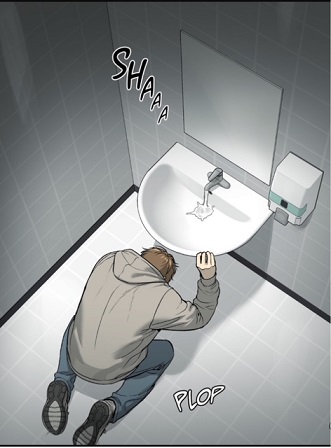 , for he had been recollecting the diagnosis from Kim Miseon and kept thinking of his grandmother. After this painful meditation, he came to recognize his selfishness and his relative’s love and generosity
 (chapter 47). And what was the main lead feeling after that terrible night? Regret, for he had not been able to notice his relative’s suffering and sacrifice! (chapter 47)
Creativity and inspiration: For some, the night sparks creativity and inspiration which could be observed during the sex sessions: we have sex in front of a mirror  (chapter 19) or a new request like swallowing the sperm
 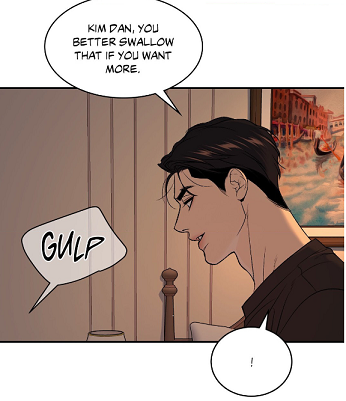 (chapter 39) or kissing the champion’s ruined ears
  (chapter 44)
Surrender and release: As the day comes to a close, the night can symbolize a time to let go of worries or burdens, embracing a sense of surrender and acceptance. After his conversation on the couch, the star attempted to seek closeness and intimacy with his fated companion. But he failed unfortunately, as he was not truly honest: 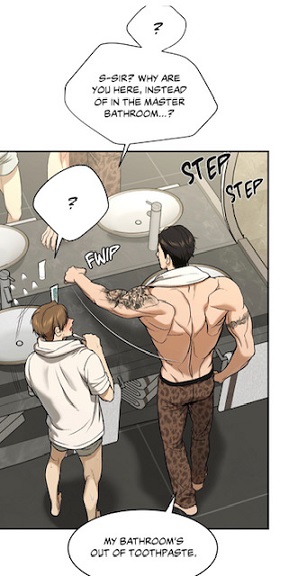 (chapter 30) He was rough and used the toothpaste as an excuse.
Temptation and allure: The darkness of night can also evoke feelings of temptation or allure, drawing individuals into the unknown or enticing them with forbidden desires.  (Chapter 29)
Endings and beginnings: In literature and mythology, the night often marks the end of one chapter and the beginning of another, symbolizing transitions and turning points in characters’ lives. The Beast turned into a prince during the night, when Belle’s tears fell onto her husband. And now, if you look at all the nights mentioned above, you can see how they marked a change in the relationship between the two protagonists. I would say that between 30 and 39, the star was forced to question the place Kim Dan had in his heart. In chapter 40, he came to admit that the PT was part of his team.  (Chapter 40) That’s the moment he stopped considering the hamster as a prostitute, while from chapter 2 to 18, he viewed Kim Dan as a tool, as a talisman against his jinx. However, I detected a transition after he kissed the physical therapist. From that moment on, the doctor was connected to food and sweetness.
  (Chapter 18) And now, observe that during the night in the bathroom, doc Dan was associated with a baby receiving food:
 (chapter 20) As you can see, here the champion started viewing him as a human being. It exposes that little by little, his perception of the physical therapist improved. So from chapter 30 to 39, Joo Jaekyung was forced to question the nature of his relationship with Kim Dan: a PT or a prostitute or a pet? (Chapter 34) Here, he was in denial, he described the main lead as a possession, but he couldn’t fool the actor. Under this new light, it becomes comprehensible why the nights in chapter 19, 29 and 39 were so magical, they announced a transition or better the end of viewing Kim Dan as an object (tool for his jinx) and possession. From 41 to 49, the champion was cornered to recognize Kim Dan as a physical therapist and not just as a member from Team Black. Don’t forget his attitude in the car, when the main lead suggested him not to train. (Chapter 42) He rejected his advice, a sign that he was doubting doc Dan’s skills and competences. That’s the reason why I come to the conclusion that with the pictures, the champion was pushed to admit that Kim Dan is his physical therapist (chapter 48) and he can not fire him like that. Thus I come to the conclusion that in the locker room, there should be an open conversation between all the members of Team Black. (Chapter 49)
But wait… if Joo Jaekyung has been trapped in the past, this signifies that in the present timeline, he has to be confronted with his past. That way, he can overcome his traumas and become happy. And now, you comprehend why his path led him to meet the star Choi Heesung (chapter 34), then the fake star Baek Junmin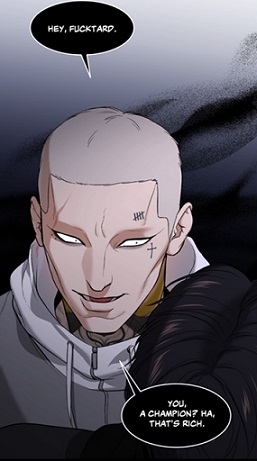 (chapter 49). These meetings are not random at all, a sign that someone knows about the athlete’s hidden suffering very well. Observe that both characters challenged the celebrity by giving him an order: (chapter 34) “Don’t get in the way” and “make sure you give her a good polish”.
  (chapter 49) The sportsman is viewed as a hindrance to their dreams, he should clear the way for them. I deduce that in his youth, people must have treated him the same way. He represented an obstacle, therefore these two figures must have challenged him in the past too. Their confidence comes from their past experiences with the athlete. Both must have defeated Joo Jaekyung, but naturally they must have tricked him.
  (chapter 33)
  (chapter 49) Then I noticed another parallel between the two plots: the presence of a scapegoat, and the involvement of a third person. Heesung faked his injury by putting the blame on the athlete, while he asked Kim Dan as compensation. In the second plot, the roles are switched. Kim Dan is now the perpetrator, while the athlete is the victim! Baek Junmin is the beneficiary of this scheme. And what do these plots have in common? Joo Jaekyung is the victim of a trick, though Heesung’s manipulation was rather benign. First, he acted on his own.
  (Chapter 31) Moreover, he utilized the genuine concern and innocence of his surroundings. In other words, he used his image as a good and honest man to his advantage. Thus I come to the conclusion that the artist’s sin in their youth was rather minor, as the artist tends to violate social norms. So though it was no illegal, the actor’s wrongdoing definitely left scars on the protagonist’s heart. (chapter 29) Probably, Heesung utilized Joo Jaekyung’s innocence to his advantage in order to maintain his good reputation, like for example he was not supposed to be smoking or he took away a friend from him, as the topic of their conversation was about the theft of a person (chapter 33) (chapter 34)!! That’s why Choi Heesung had a smile on his face, when he thought of the champion’s future reactions: sour mood. He likes provoking the celebrity (chapter 30), because it always makes him appear as a well-mannered and honest man. He gets fun at his frenemy’s expense. In addition, he could play tricks without getting caught… and the other would appear as the bad guy and take the blame, like we could observe at the gym with the manager’s judgement.
  (Chapter 30) Another common denominator between The Shotgun and Heesung is their envy and greed. (chapter 49) The actor tried to get the doctor as his lover. The expression “That’s rich” is not random, it indicates that The Shotgun is jealous of his social status.
Furthermore, I am assuming that his scheme is related to gambling and the arcade. (chapter 26) Why would the athlete go there and utilize the punching machine so many times? The arcade is a place for young people, especially for high school students seeking entertainment. So I assume that Joo Jaekyung went there, because he was trying to find someone, and at the same time he wanted to prove something: he was not weak at all. My avid readers will certainly recall this scene: (chapter 5) Joo Jaekyung destroyed the sandbag, when he imagined that doc Dan had blocked him! This signifies that the former could no longer contact the shy hamster. Joo Jaekyung saw it as an affront, a challenge! (Chapter 26) Thus I view this past incident as a challenge which led him to face terrible consequences. He got blacklisted. It made him look like a black sheep. As you can see, I believe that there exists a connection between Baek Junmin and the arcade. This panel  (chapter 46) could be seen as a reflection from the arcade and the star’s past. And since Kim Dan wounded Joo Jaekyung in the locker room
  (chapter 49), I deduce that such an action must have happened in the champion’s youth. He got not only hurt by people, but also betrayed by a friend. There exists many reasons for this hypothesis.
Many Jinx-philes initially thought that Joo Jaekyung was an uneducated brute due to his lack of manners and poor vocabulary. He would constantly swear  (Chapter 04) and be rude towards others.
 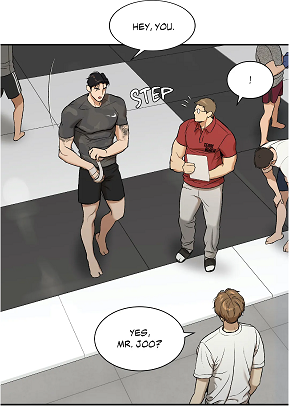 (Chapter 7)
  (chapter 37) But Mingwa left many clues that the celebrity’s personality shouldn’t be judged by impressions. During their first night together, Manhwa-lovers could see books next to the bed.
 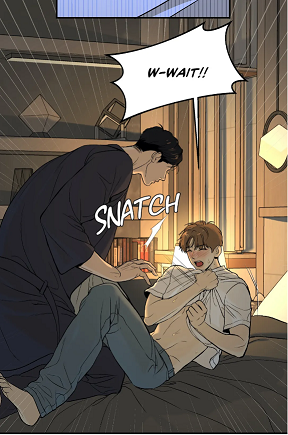 (Chapter 3) Some of them are not written in Korean or English. Moreover, the Webtoonist revealed that one of his hobbies is reading. This explains why he can talk prettily.
 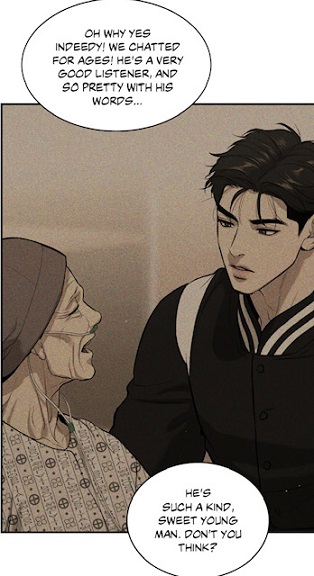 (chapter 22) This shows that his behavior mirrors the counterpart’s. Consequently, it is not surprising that the champion is rough with his own body, as Park Namwook is not treating him like a delicate child.
 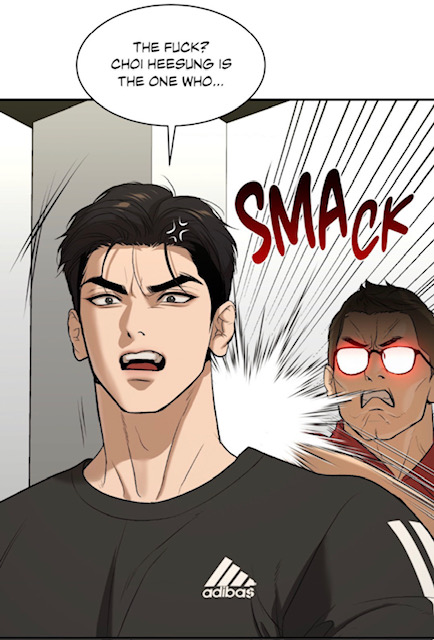 (chapter 31) But there exists another proof for his intelligence. The celebrity is capable to lead an interview in English on his own.
  (Chapter 37) Even stressed and filled with anger, he could understand and speak fluently in English.
 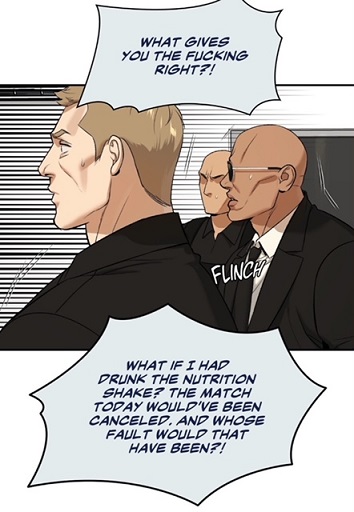 (Chapter 40) Compare Kim Dan’s English skills in the same scene:
  (chapter 40) Besides, Jinx-philes should question why Mingwa is not divulging his scores as a student contrary to Kim Dan or Jinwon from BJ Alex. It is because she wants to create a certain image about the champion: he is a bad boy. In my eyes, she is playing with prejudices about MMA fighters. People often imagine, they lack social manners and education. They chose this path, for they could do nothing else. And this brings me to my next remark. We know that Kim Dan selected PT because of his halmoni.
 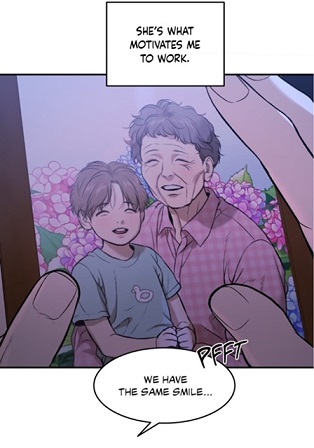 (chapter 47) So what was the protagonist’s motivation to become a MMA fighter? In my eyes, this question represents the core of the mystery. My idea is that the suffering in his youth led him to become a boxer. It is definitely related to his experienced powerlessness and loneliness. So when he suggested the sparring to Kim Dan, we should see it as a reflection from the past:
  (chapter 26) Joo Jaekyung was also an amateur in the past, but his motivations were his rage and resent. On the other hand, contrary to his soulmate, the athlete likes sports as well. His other hobbies are jogging and swimming. Thus I am suspecting that Joo Jaekyung might have been part of a swimming club in the past. Striking is that he forgot his passion due to his career as a MMA champion.
 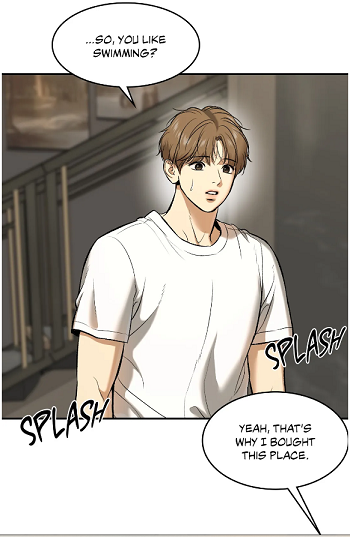 (chapter 27) I see a contrast between these two sports: swimming which is related to relaxation, pleasure and fun and MMA fighting which stands for challenge, pain and seriousness. This contrast is even more present in the following panel: (chapter 29) The position of the zombies made me think of waves of challengers. I feel like the protagonist’s future was changed and even manipulated. Similar to the way Kim Dan ended up as the champion’s PT. First, he was treated like a prostitute, until the athlete came to value him as a real physical therapist.
Another thought came to my mind when I examine the last image closely. The champion views life as a constant battle, where he is always challenged. It was, as if his masculinity and strength were constantly questioned. If he doesn’t accept these defies, then he will submerged and end up drowning. However, thanks to Kim Dan, the champion was able to touch the ground. He is a champion, hence he never loses. (chapter 49) Is it a coincidence that this Enlightenment took place under the shower? For me, no! I see a strong link between water, swimming and the champion’s job. It looked like swimming represents a source of danger for the athlete’s job, as it is an entertainment! Hence I can’t shake the feeling that in the past, Joo Jaekyung might have shown aptitude for becoming a natation athlete! Let’s not forget that for the calendar 2024, the champion was seen carrying swimming googles and not “MMA gloves”. This detail caught my attention and made me wonder why Mingwa selected these items.
But one detail from this image (chapter 29) caught my attention. He described himself as a prey chased by a pack of hyenas. The expression “nipping at my heels” implies that the athlete is trying to flee, but he is followed by dangerous and voracious animals. Consequently, I consider this confession as a reflection from the past. Note that he doesn’t say “fighters”, but “challengers”. For me, we should include the actor under this idiom. Don’t forget that he challenged him at least twice. And what is the symbolism of “hyenas”?
In African literature and folklore, hyenas are commonly associated with cunning, trickery, and deceit. They are often depicted as opportunistic scavengers, lurking in the shadows and preying on the weaknesses of others. In many African myths and stories, hyenas are portrayed as cunning and sly creatures who use their intelligence to outsmart their prey and rivals. They are sometimes seen as symbols of chaos and disorder, disrupting the natural order of the animal kingdom.
In some African cultures, hyenas are also associated with witchcraft and dark magic. They are believed to possess supernatural powers and are often feared and revered as powerful spiritual beings. In this context, hyenas may symbolize the unknown and the mysterious forces of the spirit world.
The Mbugwe believe that witches use their hyenas to perform various malicious acts, such as causing sickness and death in people and animals. When one of these night cattle is seen prowling around a village at night, it is assumed that a witch is present, and the villagers will take steps to protect themselves from any potential harm. As with many superstitions, the Mbugwe believe that certain methods can be used to ward off the power of a witch’s hyena. […] African mythology and folklore have long seen the hyena as a symbol of cunning, trickery, and conflict. In East African legend, hyenas symbolize chaos and discord, while in West African lore, they represent the trickster figure. In some communities, hyenas are associated with evil and witchcraft. Quoted from https://centerspirited.com/animal-symbolism/hyena/
In Asian literature and folklore, hyenas are less commonly depicted but still hold symbolic significance. In some cultures, they are associated with similar traits of cunning and deception as in African folklore. However, their symbolism may vary depending on the cultural context and beliefs of the region.
One notable modern depiction of hyenas in literature and popular culture is in Disney’s “The Lion King.” In the film, the hyenas are portrayed as villainous characters who serve as the henchmen of the main antagonist, Scar. They are depicted as greedy and power-hungry creatures who will do anything to serve their own interests, even if it means betraying their fellow animals and causing chaos in the Pride Lands. And how do we recognize hyenas? Through their laugh and as such smirk!
Communication is among the Hyena’s attributes because its warning calls, just with a change of inflection, have many purposes. Hyena’s mindful chortle shows its age, social rank among other Hyenas, and even acts as a letter of introduction. They use their voice to organize strategic food-gathering groups, gather allies in the face of a formidable predator, and establish dominance. A Hyenas have complex relationships based on, in part, their verbalization and a rich repertoire of visual cues. Quoted from https://whatismyspiritanimal.com/spirit-totem-power-animal-meanings/mammals/hyena-symbolism-meaning/
This explains why this animal represents communication. The latter is needed to create a plot. Is it a coincidence that Choi Gilseok has connections and is constantly talking and smirking?  (chapter 49) He is a hyena, hence his color is brown.
  (Chapter 48) And The Shotgun has a similar attitude:
  (chapter 49) Interesting is that his description of the challengers fits the situation in the new plot perfectly. The Shotgun imagines that he will fight against a diminished champion. His shoulder is injured and they have planned to add a new injury. The hyena stands for balance and cleansing as their task is to remove the weak ones.
Throughout history, the Hyena has gotten bad reviews, perhaps this is because of their scavenging behavior. Yet, scavengers are the world’s cleaning crew. Hyenas are an essential part of the African ecosystem. It is the most abundant carnivore playing a pivotal role in the food chain. They waste nothing and teach humankind the value of things that they often overlook or think unimportant. As a Spirit Animal Guide, Hyena has ties to resourcefulness, balance, and gratitude. Quoted from https://whatismyspiritanimal.com/spirit-totem-power-animal-meanings/mammals/hyena-symbolism-meaning/#African-Asia-Hyena
And the moment I read gratitude, I was reminded of the fake star’s fake gratitude: (chapter 49) He was thanking the star, as the latter would be delivering the medal on the silver plate. And the moment I made the connection between King of MMA and hyenas, I started laughing because of the athlete’s criticism to the director:  (chapter 49) As an old man, Choi Heesung is revealing vulnerability and senility. Due to his old age, he could be replaced by another hyena, a younger hyena!
And this observation brings me back to the champion’s youth. The latter became the target of schemers due to his vulnerability, isolation and probably due to his wealth. For me, the star comes from a chaebol family. The hyenas took advantage of his “innocence, ignorance and solitude” to gain something in exchange. However, there is no ambiguity that karma retaliated. Baek Junmin’s scheme led him to become a criminal, while Choi Heesung’s popularity never reached the same peak than Joo Jaekyung. And because of my association with the hyenas, I come to the following conclusion that the main character was bullied and even physically assaulted. But no one took his side, until he caught the attention from someone: (chapter 26) That’s how he ended up entering MMA. This person knew about his struggles and fears from the past and took advantage from this. Hence I am suspecting Seo Gichan (chapter 5), as he is the only person who has not appeared yet, though the champion has his cellphone number. And this remark brings me back to the present and the night messages and the hyenas.
The latter are working as a team in order to corner the target. In other words, their task is to ensure the prey’s isolation. But what is the point of such a MO? It is to exhaust the prey. The latter is forced to run constantly, until he is too weak to keep fleeing. That’s why the champion described it as an endless running. (chapter 29) And that’s how they are operating with the messages: isolation. We could see it through the article and its impact. The protagonist was in a sour mood (chapter 36) which could only affect the members from Team Black. Their loyalty could waver. Then he got to hear bad comments from the Internet (chapter 36), creating the illusion that he was losing popularity. That’s how the lawyer could convince the champion to accept a new match in such a short-time. Finally he got reprimanded for his outburst.
  (chapter 36) Under this new perception, Manhwaphiles can grasp why the MFC manager offered him a new defy right away. They needed to exploit his injury!
  (chapter 41) With the pictures (chapter 48) and the switched spray, they are now attempting to portray the doctor as a member of the pack. He is a hyena himself, a backstabber. Joo Jaekyung shouldn’t trust his soulmate, he is a hypocrite. But what these villains don’t know is that the champion committed wrongdoings against Kim Dan in the past, like for example the sex session with the dildo.
  (chapter 13) This could have ended badly. Another wrongdoing could be the rejection of his birthday present and his harsh reaction.
  (chapter 47) At no moment, the physical therapist brought up his misdeeds and asked for an apology. His silence became the symbol for his tolerance and even forgiveness. In addition, the doctor and his halmoni embody both vulnerability and poor health, which is strangely connected to crime and scandal. (chapter 13)
  (chapter 48) Through them, the champion is learning that hunting weak and pitiful creatures is not only a sin, but also a crime! In the first case, he could be accused of hurting an innocent.
Since the beginning of this Manhwa, I have been presenting theories about the champion’s youth, like for example he could have suffered from Traumatic Brain Injury (for more read the essay Joo Jaekyung, the strongest man in the world) which would explain why he has problems with memories. Then in Shocking discoveries!!” I had pointed out Somatosensory affectionate deprivation, SAD as an explanation for the champion’s attitude. He was deprived of motherly affection. This made me think that he had no female role model in his youth. Then I had described him as a silenced and invisible child due to neglect. This interpretation got validated in chapter 45. How so? It is because he only received the presents from the fans and a text from Park Nawmook accompanied with a short video! (chapter 45) At no moment, the author let us see the celebrity receiving a gift or a message from a family member! It was, as if he was an orphan and had no family. Their absence and silence are the evidences of neglect. But one might argue that his parents could be dead, something I had already envisaged in the past. However, if so, as a teenager and young man, he needed to have a guardian by his side, exactly like the doctor with his halmoni. And Park Namwook is not acting as his guardian, for he doesn’t visit him in the penthouse or calls him there. So where was the guardian in episode 45? Invisible, silent and passive! Like mentioned above, I am suspecting the mysterious Seo Gichan. Thus I consider the champion’s criticism as the expression of deep scars which came to the surface: (chapter 45) He wanted Kim Dan to look at him and take care of him. In other words, he wished to be seen and not neglected! He has not realized it yet, but he is longing for a companion, a playmate. He desires to have someone by his side who would talk to him and listen to him. From my point of view, the champion must have received on his birthdays many presents, but he was all alone. He had no one by his side. The gifts couldn’t replace the warmth from a loving parent. The moment I made this connection, it dawned on me what the nightly desertions could have meant for the star. (chapter 45) He could have been reminded of the behavior from his family (father, mother or guardian) who would abandon him during the night for work or would return home very late due to work. In other words, the doctor’s departure triggered his abandonment issues too. Under this new light, it becomes comprehensible why Joo Jaekyung rejected the golden medal and why he became workaholic. There was no family celebration like here: (chapter 11) He wished to receive attention and to have a normal conversation. Consequently, I assume that the champion has been copying his role model. That’s how he was pushed to grow up too quickly. For me, he had no childhood at all, hence when he met Kim Dan, he was encouraged to develop his inner child!
The inner child is a young part of our psyche that influences how we think and react as adults. Often used in psychotherapy and spiritual settings, the inner child can symbolize hardship, trauma, and even triumph we experienced during our youth.1 Yet, when we ignore our inner child and subsequently ignore how our past is painting our present, we do ourselves a major disservice. We can end up overlooking important formative experiences that may be critical in healing some of our maladaptive coping mechanisms. […] When you lose conscious awareness of your inner child, you lose conscious awareness of a part of yourself. In turn, you may experience difficulty regulating your emotions and act from a regressed state when upset. Quoted from https://www.verywellmind.com/inner-child-work-how-your-past-shapes-your-present-7152929
We could observe the awakening of the champion’s inner child, when he suggested a sparring to Kim Dan.  (chapter 26) For the first time, he had fun sparring. Hence he kept smiling. It is no coincidence that soon after he chose to accept to take a day-off, when Kim Dan made the suggestion.
 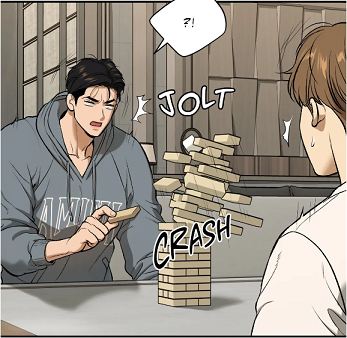 (chapter 27) That’s how he remembered that he liked swimming and he could play a prank on his lover.
  (chapter 27) Here, he could smile, because it was fun and there was no real expectation. It was not truly connected to money.
There are many reasons to why our inner child gets wounded. Most of us have experienced various forms of trauma. However, trauma does not necessarily have to be as extreme as growing up in a war or being physically and mentally abused. There are many forms of trauma:
Having unavailable parents who withheld their affection from you and didn’t emotionally encourage or support you.
Being the recipient of inappropriate sexual behaviour, including getting subjected to pornography.
Growing up in a home where your parents kept fighting, arguing and eventually ended up divorcing.
Being given inappropriate or burdensome responsibilities such as looking after the family and doing most of the chores.
Being abandoned by one or both parents.
Being rejected by your peers.
Not having a safe home to sleep in, or a clean hygienic environment.
Growing up with parents who would abuse various substances, such as drugs or alcohol, to numb their emotions.
Parents or family members who were overprotective and interfered with everything you wanted to do, which denied you of your confidence.
Judgement of your personality, interests, passions or sexual orientation.
Parents or family members who were excessively demanding and had high expectations or who projected their feelings in unhealthy ways (i.e. anger, verbal attacks and emotional blackmail).
Parents or family members who humiliated you, or did not address any issues you experienced at school (such as bullying).
Growing up with a parent who had low self-esteem and body image issues.
Emotionally unavailable parent/parents who did not know how to hold space for your feelings. Quoted from https://mentalawakening.com.au/the-inner-child-and-its-connection-to-tms/
As you can see, this long list contains a lot of elements which I observed with Joo Jaekyung. Everything is pointing out that the young man suffered in his youth, and feared rejection and condemnation for showing vulnerability and tears. And if his family or guardian was too busy, there is no ambiguity that when the athlete faced a huge problem (bullying, rape etc.), he wouldn’t have confided to his relatives.
Moreover, I had already underlined the great importance of the cellphone in the champion’s life, the fake illustration for “sharing is caring”. Maybe it is because his family or guardian were too busy to take care of him, that they used the cellphone to keep in touch with him. That’s how he internalized this terrible habit: connect with people through the cellphone. I noted that when the doctor was next to him during the night, the champion would never bring his cellphone! This exposes that the item is embodying a “person”. And now, you comprehend why the champion fell for this trick here  (chapter 35) and not in episode 48. It is because Kim Dan had paid him a visit during that night, a sign that he was thinking of him as his patient and VIP client.
 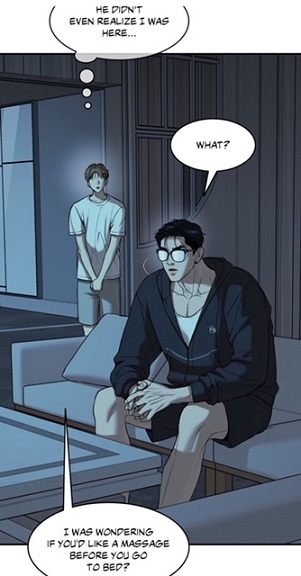 (Chapter 48) On the other hand, I am inclined to think that when a terrible incident in his youth occurred, he couldn’t contact his family or guardian. Hence he keeps his cellphone by his side constantly. Yes, I was thinking of the doctor’s assault in the street and his failed rape:
  (Chapter 16) Heo Namwook’s minions had confiscated his cellphone. Hence it was impossible for him to call for help. And now take a closer look at this scene:
 (Chapter 16) Though he had been on the phone and it was daylight, no one stopped the thugs from kidnapping the main lead or reported the incident to the police. Hence I am also suspecting that Joo Jaekyung must have faced a similar situation: he was surrounded by malicious people and no one had assisted him. So he could have been targeting at school due to his grads or his social status. And his isolation at home could push to seek company outside, to look for friends at school.
What caught my attention is that before each scheme, his hyungs were both seen talking over the phone. (chapter 37)  (chapter 49) And the anonymous person on the other side of the phone was definitely calling in order to be updated about Joo Jaekyung, for his coach asked him about his physical conditions.
 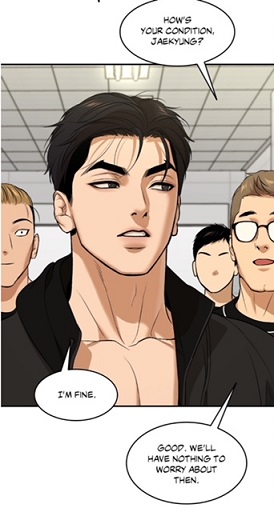 (chapter 49) That could be the hidden guardian who has not showed up yet, I am thinking of Seo Gichan. And now it is time to close this long essay.
Since the champion, as a new version of Simba, was chased away by hyenas, I am inclined to think that his bad luck is not the result of a curse, rather the cause of a bad surrounding. He was not raised properly, for the adults failed to protect him correctly. Despite his super living conditions, he was confronted to the cruel brutality of the civilization where he was exposed to violence, schemes, gambling, drugs, prostitution and abuse. He discovered the existence of hyenas among Korean society behind their fake smiles and “gentle gestures”. The problem is that no one has ever detected their presence. That’s how he lost faith in humanity and developed Philophobia. (For more read (Un)Wanted love) But thanks to his soulmate, he is learning to see the positive aspects of life. What appeared as a weakness can become a source of strength. Compassion and love can put an end to the loneliness and misery. And in order to be happy: 
Feel free to comment. If you have any suggestion for topics or manhwas, feel free to ask. If you enjoyed reading it, retweet it or push the button like. My Reddit-Instagram-Twitter-Tumblr account is: @bebebisous33. Thanks for reading and for the support, particularly, I would like to thank all the new followers and people recommending my blog.



Please support the authors by reading the manhwas on the official websites. This is where you can read the manhwa: Jinx But be aware that the manhwa is a mature Yaoi, which means, it is about homosexuality with explicit scenes. Here is the link of the table of contents about Jinx. Here is the link where you can find the table of contents of analyzed manhwas Here are the links, if you are interested in the first work from Mingwa, BJ Alex, and the previous essay about Jinx Eternal yin and yang (part 2)
It would be great if you could make some donations/sponsoring: Ko-fi.com/bebebisous33 That way, you can support me with “coffee” so that I have the energy to keep examining manhwas. Besides, I need to cover up the expenses for this blog.

Once again, Joo Jaekyung was labelled as one of the worst semes in BL manhwas. Why? It is because he criticized Kim Dan for his incompetence 
 (chapter 28) and his attitude
  (chapter 28) Hence he grabbed the doctor and brought him back to the swimming pool
  (chapter 28) He wanted to make sure that Kim Dan wouldn’t escape from him and ruin the flow.
  (chapter 28) He was taking advantage of his fear of the water! For certain readers, the champion had not changed at all. He was still rude and selfish. However, these manhwaphiles were overlooking two important aspects. First, the athlete’s selfish attitude was necessary! How so? It was to teach Kim Dan to become more selfish! Don’t forget that Mingwa is applying the philosophy yin and yang. Secondly, certain manhwaworms took all the champion’s words at face-value! I would like to point out if the doctor had truly hurt him with his teeth, his phallus would no longer be erected!! Moreover, he wouldn’t have some precum on his phallus (chapter 28). As a conclusion, he had enjoyed it so much, hence he said this:
  (chapter 28) From my perspective, he needed an excuse to stop the fellatio, as he could no longer wait for the penetration. Thus he asked if the doctor was already loose right after.
  (chapter 28) He wanted more. Finally, observe that he had kissed the doctor and asked for a blow-job before. Why? It is because he had experienced Kim Dan’s rejection at the gym! (chapter 27) Back then, he had grabbed his butt directly. Therefore he had learned that he couldn’t go for a penetration right away. This stands in opposition to the sex sessions at the gym, where there was no time for foreplay!
  (chapter 8)
 (chapter 24) As you can see, the different intercourses expose the fighter’s transformation. He is getting gentler despite his roughness. Exactly like I had anticipated in the previous essay, the couple is now facing each other while having sex. And Joo Jaekyung prefers facing his lover
  (chapter 28) in the end despite this statement.
  (chapter 28). He gets a climax each time he sees his partner oozing sensuality and pleasure. In other words, Joo Jaekyung learned an important lesson in the swimming pool, he might be enjoying such a view
  (chapter 28), yet he favors this position (chapter 28), for the doctor is more proactive! The blushing, the squeezing, the kissing, the scratching, the moaning are the evidences of the doctor’s participation!! Pay attention to the doctor’s fingers on the champion’s back. And Joo Jaekyung could sense and see it!
Moreover, his reproaches to the doctor let transpire his frustration: Kim Dan is never seeking his closeness! While Joo Jaekyung got jinxed with such a view  (chapter 27), Kim Dan always appears as calm and indifferent towards him. Hence he keeps rejecting him or he is passive during the intercourses. That’s the reason why the champion asked from the doctor to become more active next to the swimming pool.
  (chapter 28) This shows that the boxer has sensed that Kim Dan has not truly accepted him. It is no coincidence that the physical therapist chose to turn his back to the champion, when he was on his lap. (chapter 28) It was the doctor’s method to draw a line between him and his client. He desired to keep Joo Jaekyung at a distance. What the boxer didn’t know is that the doctor had also been charmed by a certain view:
  (chapter 28) This made his heart race!
  (chapter 28) Too overwhelmed by such a view, he decided to show his back to the champion. He wanted to remain level-headed. This was the negative version of this panel:
  (chapter 27)
But there exists another explanation why Joo Jaekyung appeared cold too.  (chapter 28) The idiom “mess around with foreplay” divulges the champion’s deficiency. He is really bad at foreplay. He knows about his lack of dexterity and gentleness! Hence he asked the doctor to prepare himself!
  (chapter 28) However, Joo Jaekyung got impatient (chapter 28) To conclude, behind his rude remarks, he is masking his own flaws and insecurities!
Like mentioned above, the champion’s selfishness serves a huge role in the doctor’s transformation. Kim Dan is encouraged to become more selfish! Don’t forget that the physical therapist was once again acting like he had done it with his halmoni. He would do everything for the person for whom he feels responsible. Thus he was already imagining his own future and this would be determined according to Joo Jaekyung’s needs!  (chapter 22) This explicates why he decided to sacrifice his night and day off for the champion.
 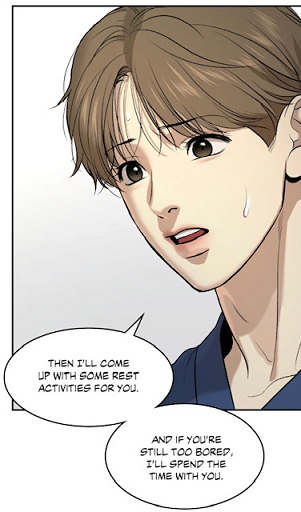 (chapter 27) One might say that this had been suggested by the fighter.
  (chapter 27) However, don’t forget that Joo Jaekyung never asked the doctor to spend the whole night thinking about the activities he would propose.
  (chapter 27) What we were witnessing is a new version of the past with the halmoni. Because she had adopted him, he felt obligated to dedicate his whole life for her! Everything in his life was evolving around her: his career, his emotions, his home, his meals, his money, his time eg. By putting the whole burden on her grandchild, Kim Dan internalized this pattern. Hence the moment the “goddess” praised the protagonist to her grandson
  (chapter 21) and the champion made his grandmother smile
 chapter 22), the doctor felt also indebted towards the athlete. He could see the generosity from Joo Jaekyung. The consequence was that he acted the same way with the athlete than with his halmoni. He would cook for Joo Jaekyung without eating with him
 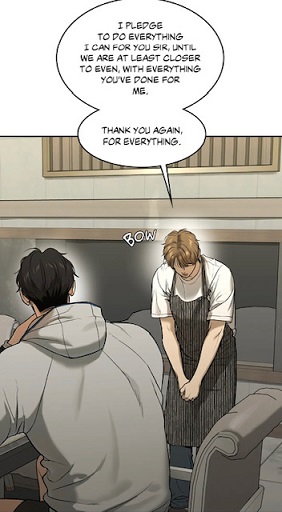 (chapter 22), he would sacrifice his day-off for the champion etc. Selflessness was repaid by selflessness. However, this means that he is still neglecting his own life and as such his own desires and needs. It is not by chance that this expression from episode 22
 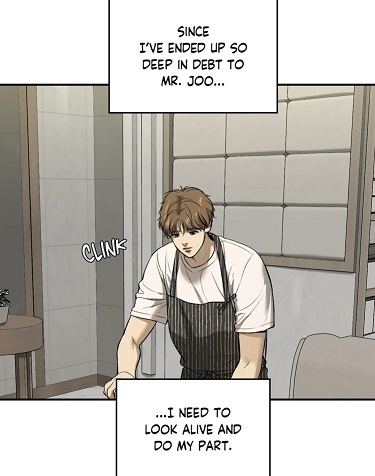 (chapter 22) appears in episode 28: look alive!
  (chapter 28) This exposes that he was still in denial about his own life! And because the athlete acted like a selfish person, the doctor is encouraged to behave the same way. Consequently, I conclude that this scene at the swimming pool corresponds to the doctor’s spiritual awakening. He is alive, he is a man on his own! He is now making choices for himself. Like my friend @becalmandhappy_1111 realized, this scene
  (chapter 28) at the swimming pool corresponds to the moment the imoogi is grabbing the yeouiju!
“Yeouiju is pretty much the same dragon ball that you think of from the anime. A mystical orb that grants your wishes. In Korean mythology, a snake (Imoogi) goes through a 1,000-year spiritual training session. It then obtains a Yeouiju to become a dragon and rise to the sky. But there’s a catch. It must hold only one Yeouiju. A greedy Imoogi will collect more orbs and can never be a dragon. It just ends up being a stronger Imoogi. I think there’s a lesson about greed here. The supernatural power of Yeouiju is the reason why Korean dragons can fly in the sky, call the winds and summon the rains. […] When a dragon loses its Yeouiju, it will lose its power, fall to the ground and become an Imoogi again. So, Korean dragons are often depicted holding that orb tight in its mouth, or sometimes under its chin or even inside its brain.” Quoted from https://linguasia.com/korean-dragon
This would explain why Joo Jaekyung likes carrying Kim Dan in his arms.  or enjoys kissing his partner. Observe that the swimming pool is situated in the penthouse which is close to the sky. And exactly like I had predicted in the essay “The duck and the dragon in the bathroom”, in this scene Manhwa lovers could assist to a new metamorphosis of the protagonists. Another spiritual awakening! Their true self comes back to the surface! On the other hand, this signifies that the characters are slowly moving away from their old believes! Hence I come to the conclusion that chapter 28 announces the slow emergence of a new religion. Therefore the character went under the water 3 times: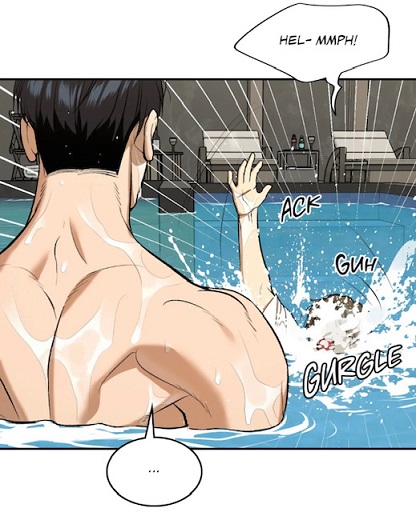

 (chapter 28) It was, as if he got baptized! Don’t get me wrong: the new religion is not truly developed yet. But where was the transformation of the couple visible? We could detect a change in these two panels
  (chapter 28)
  (chapter 28)
I am quite certain that you are surprised by this selection. How does the champion’s words reveal a change? (chapter 28) It is because for the first time, the champion is satisfied with only one round! 😮 Compare the previous intercourses with Kim Dan at the penthouse:  (chapter 4)
  (chapter 7)
 (chapter 12)
  (chapter 20) Joo Jaekyung never wanted to stop after one round! However, after his first climax, he wishes Kim Dan to leave his side. This is a true novelty! The moment I detected this modification, I began wondering why the fighter would ask Kim Dan this: (chapter 28) In my opinion, such an attitude is exposing the fighter’s anxieties: he dislikes intimacy and as such embraces! This explicates why Joo Jaekyung shook the doctor in order to get rid of him. On the other hand, I also think, he felt satisfied for the doctor had shown his pleasure. Striking is that despite the shaking, the doctor disobeyed Joo Jaekyung! He still clenched onto him!
  (chapter 28) One might argue that the doctor is unconscious! However, I don’t think that he has truly fainted yet. The evidences for this interpretation are the way he is holding onto the fighter. Observe that he has already moved his head, as we can see his hair now, whereas before his head was resting on the champion’s shoulder (chapter 28) Furthermore, the muscles from his back are tense, but if he was unconscious, he would lose control of his body like in this scene:
  (chapter 12) In fact, his arms would relax and he would fall in the water. Finally, he was thinking, when he was in the boxer’s embrace: (chapter 28) Certain readers thought that these words were coming from the athlete, but it is not possible. First, the sportsman has no notion of time and indirectly of time flow! First of all, Joo Jaekyung is known for his impatience. Thus he is not thinking about the future. Note that until he met Kim Dan, all his life was evolving around his jinx! He needed to have sex the night before a match!
  (chapter 2) That’s how his time was defined. He would only think in a short term, one fight after another!
  (chapter 27) Furthermore, I would like to underline this expression “I barely have enough time to train” which contrasts to Park Namwook
  (chapter 27) and Dr. Lee’s statement
 (chapter 27) As you can see, Joo Jaekyung had the impression that he was always running out of time. He always feared his jinx and as such the night before the fight, as he needed to have sex with someone! Moreover, I would like to outline that Kim Dan as his mirror and teacher is constantly referring to time: day, week, saturday, minute, second.
  (chapter 27)
  (chapter 28)
  (chapter 28) Why? It is because Joo Jaekyung has no life outside the gym! All his days looked the same, until the protagonist entered his life! Besides, if you’ve already read my essay “Whatever took you so long” about Painter Of The Night, you already know the importance of time in a human’s life! Without time, a person can not have memories. This explicates why babies and young children have no memories of their early childhood, for they have no notion of time. But the problem is that without memories, the person has no identity either. To sum up, there is a strong connection between time and identity. We could say that time is a construction of the self, for through time, people make experiences! This shows that exactly like Kim Dan, the champion is not really living! This corresponds to the 1000 years of the imoogi. But this signifies that Joo Jaekyung has no time perspective either!
“Time Perspective is the process by which people categorize, archive and recover personal and social experiences through temporal frames (past, present, and future), influencing various aspects of human behaviour and cognition.” https://www.researchgate.net/publication/255907745_Time_Perspective_and_Self-Esteem_Negative_Temporality_Affects_the_Way_We_Judge_Ourselves
Hence he is never talking about his past, present and future. What does he truly want in life? We had the perfect illustration in this scene.  (chapter 05) The words “Today and something special” from Park Namwook triggered the champion’s memory: the presence of Kim Dan at his penthouse.
  (chapter 5) And right after, he expressed this wish:
  (chapter 5) Interesting is that there exists a strong link between time, time perspective and self-esteem! Someone with no notion of time and no time perspective has a poor self-esteem! Therefore it is not surprising that the athlete doesn’t trust his own talent. Hence I deduce that this sex session played a huge importance in the champion’s life. He could see with all his senses (touch, sight, hearing, taste) that he had pleased Kim Dan! (chapter 28) He had been accepted as the doctor’s partner! Another memory was created, and as such Joo Jaekyung is slowly learning the notion of time! This is important, because the notion of time generates the possibility of dating!
What an irony, for the doctor has the intention of pushing the champion away. He dislikes the idea of losing control over his body and mind! (chapter 28) This means that while Kim Dan is slowly accepting the idea of sex in general, he doesn’t want to have it in his life. This means that Kim Dan has decided to view the champion as a friend and nothing more. Hence Mingwa had added the blue heart💙, when she announced the release of episode 28. This emoji represents bromance and as such a platonic connection. We could add that Joo Jaekyung is now “friend zoned”. That’s the reason why I crossed the heart in fire in the illustration.  This signifies that he will treat Joo Jaekyung as a lone wolf and Kim Dan will keep acting as a hamster, whereas he has already turned into a real duck! But why? It is because the doctor has been advocating pure love so far. Loving someone more than yourself yet in return not expecting anything is pure love. Hence the Webtoonist had mentioned 🤍 in the tweet too. But by saying this (chapter 28), he was also moving on from his own belief “pure love”. He is learning to prioritize himself. He doesn’t desire his life to be affected by the champion.
On the other hand, Joo Jaekyung represents sex! Two different religions: pure love versus fuck! … This is no coincidence that Joo Jaekyung employs this expression “For fuck’s sake” 
 (chapter 28) Then he complained about his lack of competence in bed (chapter 28) What caught my attention is that he described the intercourse as work and not as pleasure! (chapter 28) As you can see, the champion had not got rid of his old principles entirely yet. However, we know for sure that he is now looking for sensuality and pleasure. Hence he likes kissing the doctor. To conclude, in the swimming pool, Kim Dan made the following decision. He is no longer rejecting the athlete’s philosophy (fuck), but he doesn’t want to be part of it. At the same time, he is dropping “pure love” as well, for he is thinking about himself for the first time. He chose “bromance” and “friendship”!💙 This corresponds to the blue of the swimming pool. (chapter 28) It is his new philosophy. However, what Kim Dan failed to realize is that by holding onto the athlete and by scratching his back,
  (chapter 28), he was marking him as his lover! His decision is contradicting his own actions! It is because he still fears sex!
As for the champion, it is the opposite. He is slowly accepting that Kim Dan is crossing the line! (chapter 28) He could have pushed the doctor away very easily, but he didn’t do it.  (chapter 10) And remember that after this embrace, Joo Jaekyung brought the doctor to his penthouse, for his heart got moved!! From my point of view, the athlete’s heart is little by little warming up to the idea of affection! In other words, he is slowly adopting the doctor’s philosophy (love)!
This explicates why Mingwa created this vision. It was like a premonitory dream : 
 (chapter 25) Kim Dan would be on the champion’s lap, the latter would long for his lips, and the doctor would hug his companion. It was announcing how Kim Dan would get the upper hand in the relationship!
  (chapter 28) Don’t forget that according to the champion’s belief, the sex sessions are all like surrogate fights. By putting the doctor on his lap, he was admitting his inferiority! This shows that he is moving on from his fake faith. Thus I deduce that we should have a new version of this position in the future which will reflect the doctor’s increasing power over the fighter and his gradual transformation.
But since Kim Dan has decided to reject passion in his life, this signifies that he isn’t truly living yet.
“To fear love is to fear life, and those who fear life are already three parts dead.” Quote from Bertrand Russel
If he lived truly, he wouldn’t try to control his mind and body constantly. Yet, he got closer to his true self. It is because he is admitting the existence of his eyes, mouth and ears! (chapter 28) This scene is the negative reflection from the sex session in the bathroom:  (chapter 20) Here, the champion was comparing the doctor’s hole to a baby! (chapter 20) Consequently, I came to the following deduction. Kim Dan will try to find a new partner for Joo Jaekyung!
  (chapter 19) His reasoning is the following. The champion likes having sex and he has been treating him more or less like a sex toy, the doctor will try to find a subterfuge to divert attention from himself. Because I detected many similarities between episode 12/13
 (chapter 13) and episode 28 (chapter 28) [the kiss, the foreplay, the marks of passion
 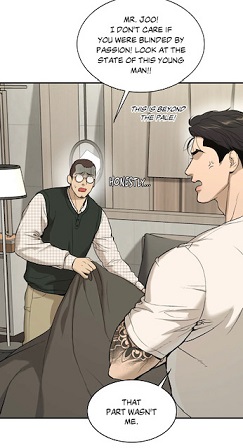 (chapter 13) (chapter 28)], I am now expecting the return of Cheolmin! Here, Kim Dan faked his fainting, yet the champion has already experienced such an incident and he has not forgotten it. Finally, he always bought the doctor’s white lie as well.
 (chapter 11) And that’s how Kim Dan will discover the existence of the club!!
  (chapter 13) Hence my impression is that he will suggest to Joo Jaekyung to go to the club with the hope that his friend will find a new partner! He just needs to say that the champion likes to go there. The day off, Saturday, would be the perfect excuse. However, since the doctor is so innocent, he will not realize that by going there, he will become the target of other guests! This uke could resurface!
 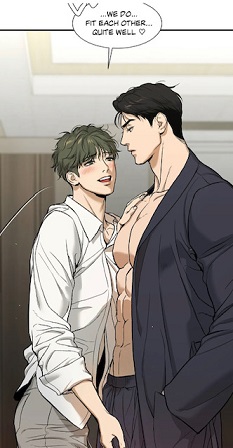 (chapter 2)There is not ambiguity that the champion will never bring the physical therapist to the club on his own. He has already marked the doctor as his partner. And the result can only be that Joo Jaekyung declares Kim Dan as his boyfriend! The emoji 💙 would get a new meaning: the heart of the dragon! This means that the doctor’s decision in episode 28 will push Joo Jaekyung to question his fake belief: the jinx, the existence of a line and the rejection of love in his life. Keep in mind that the champion always makes decisions by instincts, he never ponders on things like the doctor! Similar to this scene, where he paid off the doctor’s debts.
Feel free to comment. If you have any suggestion for topics or manhwas, feel free to ask. If you enjoyed reading it, retweet it or push the button like. My Reddit-Instagram-Twitter-Tumblr account is: @bebebisous33. Thanks for reading and for the support, particularly, I would like to thank all the new followers and people recommending my blog.


 Bebebisous33s' analyses in K-Dramaland and Manhwas