

This is where you can read the manhwa. https://www.lezhinus.com/en/comic/madplace_en But be aware that this manhwa is a mature Yaoi, which means, it is about homosexuality with explicit scenes. Here is the link, if you are interested in more analyses about other manhwas https://bebebisous33analyses.com/2021/06/06/table-of-contents-of-analyzed-mentioned-manhwas/
It would be great if you could make some donations/sponsoring: Ko-fi.com/bebebisous33 That way, you can support me with “coffee” so that I have the energy to keep examining manhwas. Besides, I need to cover up the expenses for this blog.
After reading such a title, readers familiar with this story will wonder how I came to select such a headline, because it gives the impression that this manhwa contains supernatural elements, while in reality the story is a mystery, or more precisely a crime novel. Besides, the illustration of Mad Place is clearly reflecting this situation. The Korean prosecutor, Gu Sehyuk, has handcuffed and trapped in his arms the suspect Ha Ideun, while holding the keys of the handcuffs in one hand. But if you pay attention to the scenery, you will notice that the district attorney is also trapped, hugged by the chaebol Ha Ideun. Yet, at no moment there‘s a presence of a ghost or a priest.
However, the manhwaphiles should look carefully at the way the two protagonists are introduced and even portrayed. Only through a meticulous analysis, they will realize that both characters are more than just a prosecutor and a chairman‘s son.
1. Ha Ideun: the smiling ghost
And now, it is time to focus on Ha Ideun. 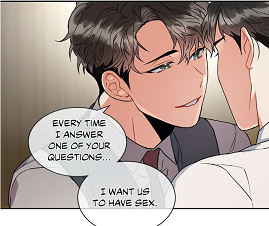 (Chapter 7) After viewing such a panel, the readers can only judge him as weird, but funny. Though the main lead is now a murder suspect, he keeps smiling while making requests, and as you can see, his main condition is sex. Because of such a behavior, he can not look trustworthy in the attorney district’s eyes, rather obsessed with sex. It was, as if he was amused by this situation. That‘s even how Gu Sehyuk views him in the beginning of this story. Nonetheless, this is just a deception. The man is actually using the situation for his own benefit. Why? First, his first request is quite serious. He is asking for an investigation.
  (Chapter 2) This signifies that he needs Gu Sehuyk’s help and power as district prosecutor. And this observation leads me to the following conclusion. He created such an opportunity to approach his target, Gu Sehyuk. How did I come to such a conclusion?
1. 1. The true relationship between Ha Ideun and Gu Sehyuk
The author gave us clues on different occasions. First, he knows the code for the house. 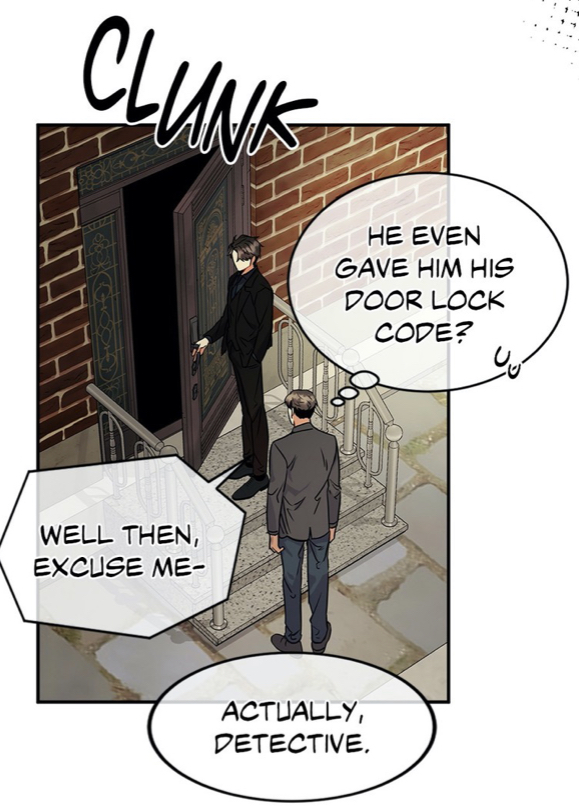 (Chapter 12) I doubt that the main lead gave it to the „suspect“, since the latter is under investigation. Secondly, he knows the prosecution officer’s life so well. Observe that he is the one telling the young detective how long Gu Sehuyk will stay at work.
  (Chapter 12) Moreover, he knows about the death of Gu Sehyuk’s brother and the circumstances of his assassination. That’s why he sent him a picture of the killer, Yoon Gyuho, who had committed suicide right after. Then, the manhwaworms can witness
  him kissing the prosecutor’s wrist tenderly, a sign of affection. He might have introduced himself as his biggest fan
 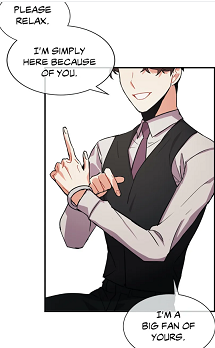 (chapter 2), yet such a gentle kiss expresses more than just admiration. Moreover, I would like to point out the absence of the eyes in the last picture, a sign that the protagonist is here wearing a mask and not entirely honest.
All these elements truly expose that he is well informed about the district attorney‘s life. But since the latter has no idea how he is connected to the „suspect“, the first assumption would be that Ha Ideun has been spying on him like a shadow. A second possibility would be that he was an acquaintance of Gu Sihwan, the assassinated brother, but the prosecutor was left in the ignorance. Yet, I have to admit that I have a different theory. I am actually more inclined to perceive him as a ghost from Gu Sehyuk‘s past, but the latter has no recollection due to his trauma. This means that he would have ghosted Ha Ideun. This theory would also explain why he proposes the deal: sex in exchange for information. That way, he would restore their past relationship. As you can detect, for me the sex scenes in a really good manhwa are not just created for entertainment, they always have a purpose (see Painter Of The Night, The Pawn’s revenge etc.) Moreover, we could perceive the ghost’s behavior in episode 18 as an evidence for this thesis. 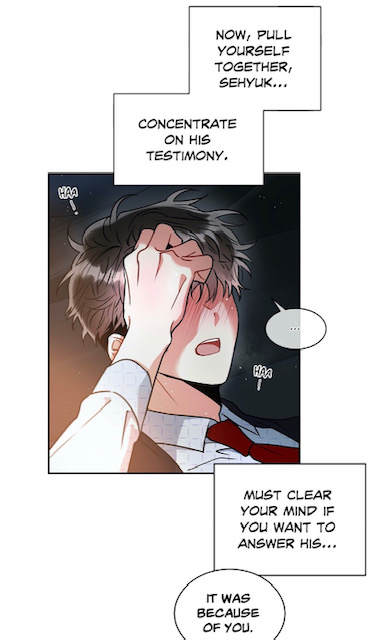 (Episode 18) Notice that in this scene, the „suspect“ is blushing and hiding his gaze with his hand, while he admits that he did it because of him. In addition, he reminds the attorney district of their actual situation. One sex session means the divulgation of intel. Here, Gu Sehyuk had the impression that he was the only one who got carried away, whereas Ha Ideun was still able to remain rational and calm. Yet, due the blushing and the covering of his eyes, it becomes obvious that the „suspect“ was definitely moved. Besides, Ha Ideun justifies his action with the prosecutor. It is for him or his brother. Then he begs him for his trust. Yet, this is just a theory of mine and you have every right to think otherwise. But one thing is sure: the young man is definitely more close to Gu Sehyuk than the latter is aware.
1. 2. The traces of a spirit
As you could see, I used in two opportunities the idiom „ghost“, when I described his relationship with the prosecutor:
- to ghost someone one: (slang) to ignore someone, until they go away. This phrase is often applied to failed love relationships.
- a ghost from (one‘s) past: the reappearance in the present of someone or something unsettling from one‘s past. Quoted from idioms.thefreedictionnary.com
Yet, at no moment I elaborated why I couldn‘t help myself connecting the chaebol‘s son to a phantom. First, the protagonist is presented as Gu Sihwan‘s shadow 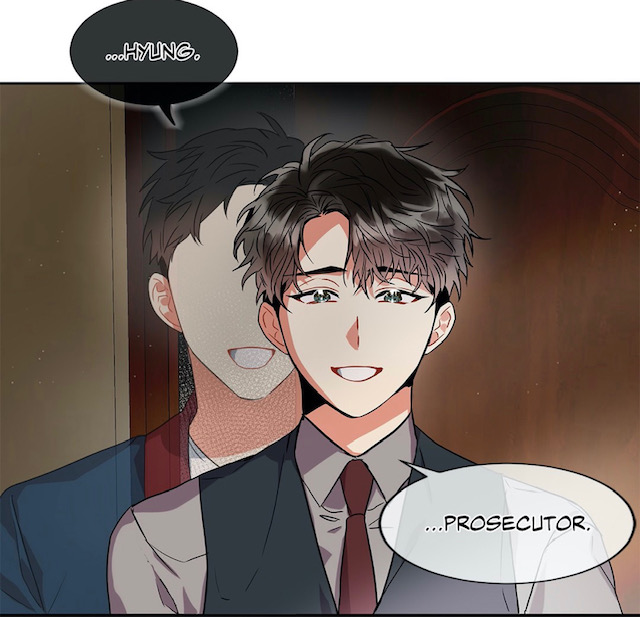 (chapter 6), exposing that both characters are similar and in fact related. Furthermore, what caught my attention is that the face of the chairman’s third son is never revealed to citizens, when his arrest is mentioned in the news. In fact, we only get to see a white television screen.
  (Chapter 1) But this doesn‘t stop here. Later, when the attorney district meets the deputy prosecutor general Na Joohwan, the latter reveals that during a search concerning the existence of a slush fund, he noticed that Ha Ideun’s room was devoid of life.
 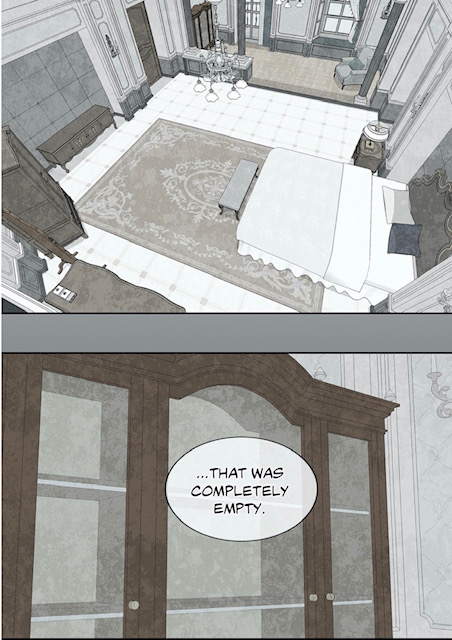 (chapter 8). There was no picture and no cloth. It was, as if the owner of the room was a phantom. Besides, note that we have the presence of white again. The manhwaphiles certainly know the expressions „white as a sheet“, „pale/white like a ghost“. As you can see, these panels reflect these idioms. That’s how I connected the chaebol’s son to a ghost.
Furthermore, if the manhwalovers recall how the young man is described, they will notice that neither the detective and the prosecutors can truly perceive his identity. He is rumored to be consumed by sex  (chapter 7), he is not working and he doesn’t own any apartment. In other words, he is living in the shadow, for he has no possession and is not interacting with people. His sexual habits are presented as hearsay. And now, you comprehend why I made this association. That‘s why it is not surprising that at the end of episode 18, Gu Sehyuk wondered about Ha Ideun‘s true personality.
And note again that the young man appears quite emotional, once he is alone in front of the mirror. This truly exposes that their last sex session definitely affected him and he was controlling himself, when he made new revelations.
Another parallel is his words addressed to Gu Sehyuk. First, he confesses to him that he knows the truth.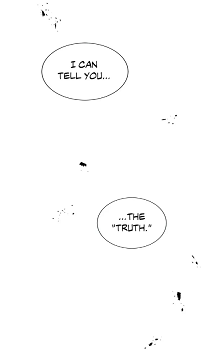 (Chapter 5), while the district attorney is only aware of facts.
  (Chapter 4) There’s no doubt that the suspect is telling the truth. He is not blinded by agony, like Gu Sehyuk who suffered a lot from his brother’s loss. I will explain the difference between truth and facts more in details later. Besides, let‘s not forget that a spirit is able to see more than humans, because they are detached from the physical world. They can move from one place to another very easily. Therefore they can gain more insight than mortals. As a ghost, he is able to spy and discover new clues.
1. 3. The spirit’s light
Since Ha Ideun is related to the color white, a symbol for purity, wisdom, knowledge and light, it becomes obvious that the young man is in reality more than just a hedonistic and carefree person. Observe this scenery:  (chapter 2) The light oozing from the television stands in the protagonist’s back and illuminates the prosecutor. It was, as if Ha Ideun was bringing light into the main lead’s darkness. With his knowledge, he will be able to help to unveil the mystery of his brother’s death. For me, there’s no ambiguity that he has long planned to approach the prosecutor and he knows very well, why Gu Sihwan was murdered. But he can‘t reveal everything at once, because the latter would never believe him. Besides, he needs to prepare the protagonist to face the truth and exactly for this reason, the young man has to investigate himself. Only by becoming the investigator, Gu Sehyuk can discover and accept the verity. Moreover, Ha Ideun has to gain the prosecutor‘s trust. And now the manhwaphiles can comprehend why he is asking for the prosecution officer‘s confidence.
  (Chapter 15) Therefore he is willing to be investigated and questioned by Gu Sehyuk. He has no problem to get tested. Since he is clean, he has nothing to fear. On the other hand, he is not releasing much information, because he is well aware that his knowledge could generate suspicions among the prosecution office. Observe that once caught in the CCTV, he was immediately turned into a murder suspect. Words can be misinterpreted, hence he is very reluctant to speak so freely. The readers should keep in their mind that each information he gave was related to a concrete evidence (the picture, the bag full of drugs and the knife),
  (Chapter 15) something that can not be tampered, as long as the district attorney is supervising the investigation. In other words, he is guiding the district attorney to unveil the mystery.
1. 4. The reason for the ghost‘s appearance
And now, you might be wondering why he approached the prosecutor after two years. In my opinion, it is related to his good notoriety. Gu Sehyuk has become famous as a hardliner, as a serious and integer prosecutor. He made sure that the accused would always receive a harsh sentence. Nonetheless, there exists another reason from my perspective. Since Ha Ideun is a „ghost“, this signifies that he is powerless. I suspect that the absence of his life and presence is related to his other brother Ha Sungjoon.  (Chapter 2) After analyzing so many manhwas, I discovered that many characters wearing glasses were hypocrites, often manipulative and ruthless. Hence I am suspecting that everything is related to Hasung Group. I believe that Ha Ideun’s powerlessness is related to Ha Sungjoon. Note that in that scene, the main lead showed a disdain towards his brother, when the latter appeared on television. There exists a rivalry and Ha Ideun‘s bad reputation (lazy, consumed by sex) is definitely playing into Ha Sungjoon‘s hands. Simultaneously, it could be a diversion from the main lead‘s part, that way he could deceive his brother and investigate his crimes. The manhwaworms shouldn‘t forget the existence of a slush fund and the sudden increase of benefits from Hasung Group.
Finally, by approaching the district attorney, Ha Ideun is slowly revealing his existence to the outside world. For the first time, his name becomes public. This means, he can no longer be hidden. This is no coincidence that he allows the NFS to take his hair and blood, because that way he can prove his existence. I have to confess that Ha Ideun sounds similar to „hide“. From my perspective, it looks like the protagonist was forced to live in the shadow. And now, with this interpretation, it becomes more understandable why he would make the request to have sex. Through sexual encounters, he has the impression to feel alive. It was his only way to prove his existence. Furthermore, it would give him the perfect excuse to hide his true intentions. He needs Gu Sehyuk’s strength and trust, and through intimacy, he can get his faith and as such justice.
2. Gu Sehyuk: The sinful priest
Now, the manhwaphiles are wondering about the origin of this interpretation. What caught my attention is the protagonist’s behavior. First, he lives like a hermit, keeping his distance from his coworkers and totally disinterested in worldly pleasures. This explicates why after his victory at the trial he refuses to celebrate with his colleague. 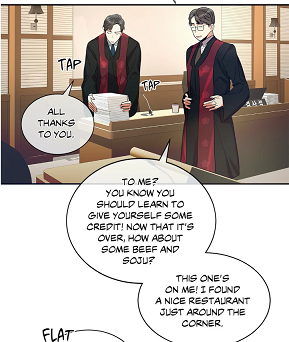 (Chapter 1) His whole life is revolving around his work as prosecutor, a life full of dedication, humbleness and chastity. He is actually not truly living, just determined to keep his vows. He is making sure that the defendants are all receiving harsh sentence.
  (Chapter 1) What the other district attorney calls as obsession, is in my eyes the protagonist’s religion.
2. 1. Gu Sehyuk‘s cult
The way I portrayed the main lead reminds me of a priest, and more precisely of a monk: seclusion, modesty, abstinence of worldly pleasure, hard work and virtue are the features corresponding to a ascetic. His cult is to make sure that culprits are receiving their punishment, since he failed to do it with his brother. It was, as if he was trying to absolve his sin towards Gu Sihwan. But if Gu Sehyuk is a priest, then he needs to have a shrine. (Chapter 3) The pictures on the cupboard are representing his „idol“ or „saint“. Since Gu Sihwan got assassinated, he became a martyr and his brother turned him into a „saint“. And now, you comprehend why Ha Ideun is not allowed to touch his deceased brother’s belonging. They are sacred relics.
  Therefore it is not surprising that the brother’s bedroom is associated to white as well:
  It was, as if his bedroom was a crypt. That’s why I came to the following interpretation. The mansion, which Gu Sehyuk described as „frozen in time“, is his tempel. Consequently, his residence is intemporal. Because this is a sacred place, he can’t live properly there. At the same time, he feels the intrusion of a stranger as a sacrilege. Therefore the manhwaphiles can grasp why Gu Sehyuk cleaned the house after the ghost‘s visit.
 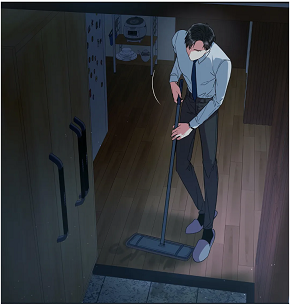 (Chapter 3) The tempel had lost his purity. The reason for his transformation is naturally his brother’s murder. The latter suffered so much from it, that he couldn’t move on. This is no coincidence that once he is confronted with the culprit’s face, he gets a flashback, a panic attack.
 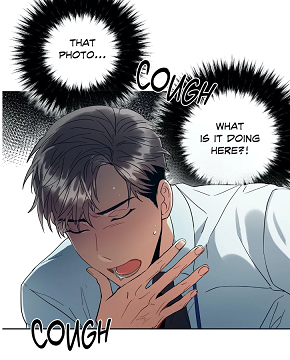 (Chapter 3) But since he is so trapped in his past, he starts suffering, once he encounters Ha Ideun, for the latter forces him to remember his repressed memories.
2. 2. Truth versus facts
Because he lived as a monk, he never got the occasion to get emotional. However, once the „ghost“ touched his wounds from the past, the prosecutor could only get infuriated and upset, and as such became a sinner. This is not surprising that he even got violent. And now, it is time to explain what Ha Ideun meant with this:
(Chapter 4) The hard working man witnessed Gu Sihwan’s murder and caught the culprit at the crime scene. Hence he could never forget his face. 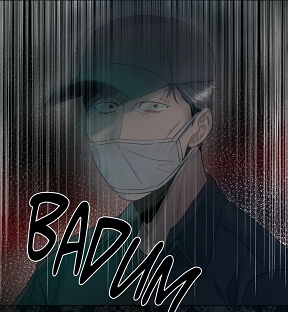 But the problem is that memories are never objective. They are definitely influenced by the subject‘s past experiences, emotions and mentality. What Gu Sehuyk saw here could be viewed differently. He views a murderer in this image, while I detect the killer‘s despair and angst through the eyes. From my point of view, the man was not lusting for blood, though he stabbed him 7 times, a sign for rage and madness. And notice that after the crime, Gu Sehuyk investigated the matter from the culprit‘s perspective. Why would he stab his brother 7 times? Why would he do this? In other words, he tried to find out his motivations. But like Ha Ideun pointed out, he was missing something important there: the victim.
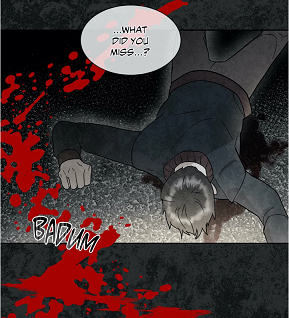 (Chapter 4) Because he was close to his brother, he had the impression that he knew his brother: he was a smiling and cheerful person with no secret.
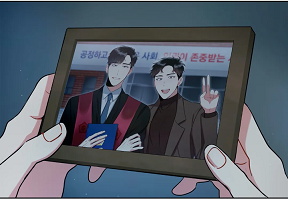 The picture of his idol exposes Gu Sehyuk‘s blindness. And now, you comprehend why the „ghost“ put it down in the end. This was not the truth, Gu Sihwan hid things from his brother. And this leads me to the following conclusion. Because the prosecutor idolized his brother so much, he couldn‘t discover the truth. Moreover, he acted like every district attorney. They just need to catch the culprit and the case is closed. However, there‘s a huge difference between truth and identifying the perpetrator‘s identity. There was definitely a conspiracy, but the protagonist failed to see this, as he was too obsessed with the assassin. Here I would like to mention my other essay called „Truth and memories: Memorist, Nobody knows, Find me in your memories and The King“, where I elaborated the problematic of unveiling the truth through memories.
Under this new light, it becomes comprehensible, why Ha Ideun switched on the light in the prosecutor‘s residence, which caught the district attorney by surprise. This has a methaphorical signification. He brings the prosecutor closer to the truth, he enlightens him. This explicates too why the spirit entered Gu Sihwan‘s room and grabbed his book. He was violating the sacred place for one reason. He wanted Gu Sehyuk to leave the darkness of his temple and fight for his brother’s rights.  (Chapter 4) Why did he have to die? Ha Ideun needs to transform the deceased brother into a human so that Gu Sehyuk decides to look into his brother’s past life.
2. 3. Mad Place
However, Ha Ideun has to change the prosecutor’s way of life as well. He needs to force him to become sinful so that he stops being a monk and the house is no longer perceived as a shrine. That’s another reason why the „suspect“ requests sex as an exchange for information. He is inciting the main lead to become a sinner. That way, the main lead is pressured to drop his role as an ascetic. By turning him into a sinful priest, the latter is forced to question himself. Hence the main lead gets violent enraged in the episode 3 and 4, signs of wrongdoings. Besides, this is exactly what is happening in episode 18. For the first time, he discovers pleasures  and is taken by surprise. He wonders why he acted like this.
  (Chapter 18) In my eyes, this scene indicates that Gu Sehyuk is slowly coming back to life. But the problem is that the main lead has lived like that for two years, therefore he won’t change right away. From my point of view, his „temple“ will become a mad place, because he commits a sin in a sacred place.
 (Chapter 1) Ha Ideun won’t be able to remove the prosecutor’s religion despite their sex sessions, as long as the truth is not totally unveiled. This is my explanation why Junah chose such a title.
And now, you comprehend why both protagonists are trapped in each other‘s embrace. Both need each other in order to unveil the whole truth. Ha Ideun is definitely lacking power, as he has always lived in the shadow. He needs to become a human in order to get justice, just like Gu Sihwan.
Feel free to comment. If you have any suggestion for topics or manhwas, feel free to ask. If you enjoyed reading it, retweet it or push the button like. My instagram-tumblr-twitter account is: @bebebisous33. Thanks for reading and for the support, particularly, I would like to thank all the new followers and people recommending my blog.
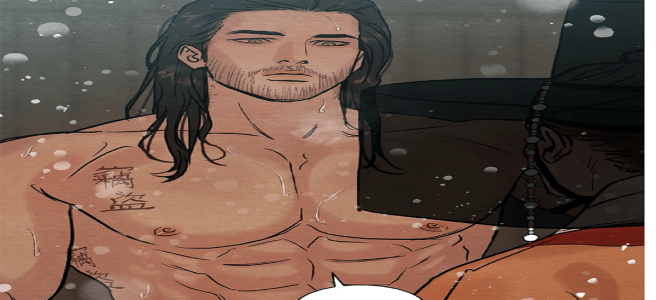

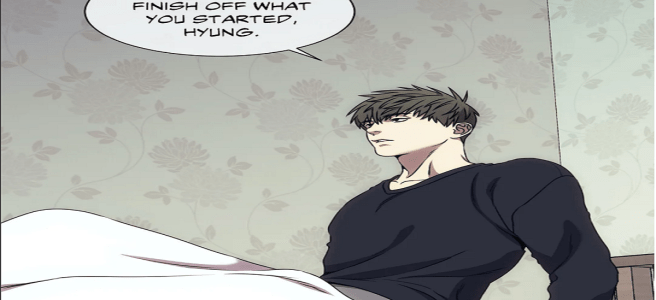
 , it gives you the opposite impression: dark, asphyxiating, destructive and hopeless.
  , the missing brother from lieutenant Kang Hyeon-Woo. When the former confides his intentions to his brother (he would like to clean the corruption in the police forces and remove the dirty connections between authorities and the red-light district), the former appears integer, righteous, courageous and determined. This means, he is full of energy and aspirations to achieve his goal.
 Not only they have a perfect view over the city, but also the weather is quite nice. The sky is blue and there are a few clouds. Finally they are sitting in a park surrounded by nature. As you can imagine, in my eyes this scenery is not random at all. This scene is full of symbolism.
 combined with the idioms “chance” and “expose this case to the public”. Note the presence of the wooden plank in the bottom. It was, as if the perspective and the wooden plank were the stage, and the city in the background was symbolizing the public. In other words, the scenery was representing the detective’s vision. He was full of confidence and dream here. Moreover, since it is an open air area, you can breathe more easily. This signifies that the scenery oozes a certain relief, liberation and release. The brother could confide to his brother about his intentions and his latest information. He knew that the young detective was trustworthy and would support him. It represented a moment of relaxation for the investigating Kang Hyeon-Jong. Thus the readers see the machines as a symbol for relaxation and entertainment. Since the hyung was disclosing his discoveries and his evidence, it means that the younger brother was his pillar in his quest to clean up the police forces.
  (chapter 2) Note the similarities: We had a nice weather with clouds and a hill in the background. The male prostitute was also full of hope here. He could breathe in that moment, he had lost another violent tormentor to his relief. Therefore I came to realize the existence of the connection between dream and nature contrasting to the city represented as a chicken battery.
 (chapter 1) Furthermore, he abandoned the corpse in an abandoned area. This scene was quite oppressing and depressing which mirrored the perpetrator’s disposition. Let’s not forget that later the manhwaphiles could witness the murderer’s fears, when he had a nightmare.
  (chapter 6) Instead of looking up to the sky (a symbol for dream and hope), the criminal looked down. I could bring up another scene:
  (chapter 16) Both characters are looking down, both hurt and depressed. The prostitute is full of doubts and resigning to her fate. She will do anything in order to survive, and if it is necessary, she will betray and abandon her lover. She announces that she will be definitely ruthless and selfish. She is no longer expecting happiness and relaxation. It’s a fight for her. Besides, in that scene, the city looks lifeless, as there are no plant or people. I would even say, it’s suffocating, for the sky is so dark and clouded. It was, as if it functioned as a lid. As a conclusion, the weather and the scene reflect the character’s state of mind. The blue sky with clouds is linked to hope, while a raining dark grey day is associated to hopelessness, fear and doubts. Thus the town is related to suffocation, loneliness and resignation. Let’s not forget that the characters are all embodying animals (Lee Je-Oh is a goldfish and a dog, Do Seong-Rok is a dog, Jeon Hee-Seong is a snake etc…), but the problem is that they are all trapped in the Janggi game, that’s why they are not free and feel so oppressed. In my opinion, the Janggi board is in reality the city itself. Instead of representing civilization and progress, the town embodies despair, corruption and asphyxiation: death.
  (chapter 21), which contrasts to this scene for example
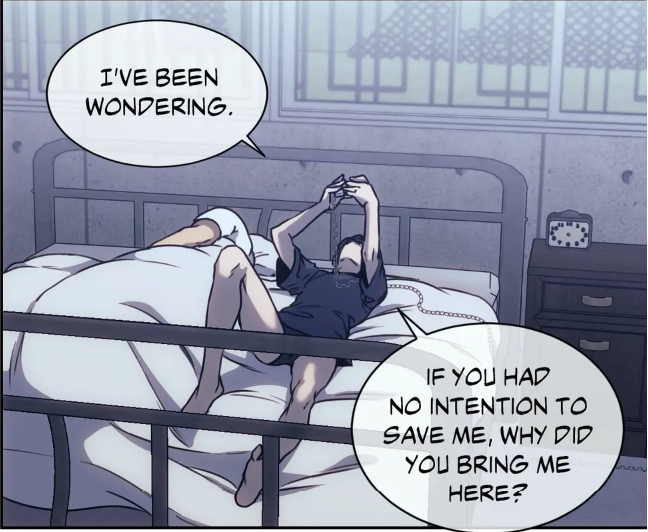 (chapter 7) where grey was the dominant color. Contrary to the scene in episode 7, the main leads are no longer separated by the sheet, and they are facing each other. As you can sense, the color and the position mirror their increasing closeness and trust. I would say that the main couple is full of hope in that chapter. This is particularly perceptible in this image. Lee Je-Oh is already thinking about the future.
  He is confident in his skills and intelligence to protect his partner. The presence of relief and aspiration explains why the main leads are tender and caring towards each other.
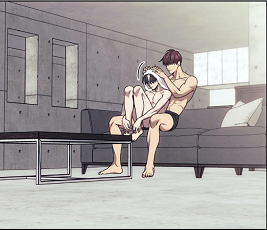 Here, you might argue that we don’t have the presence of nature, hence this contradicts my previous interpretation that nature is a signal of liberation and relief. However, I can refute this argument by pointing out that we don’t see the city here. In my eyes, the room has now become a refuge, a shelter of two wounded and lonely souls. Lee Je-Oh is no longer viewing the bedchamber as a place where he is held hostage. He is now cohabiting with the murderer. Thanks to him, Seong-Rok could sleep much better and wasn’t tormented by a nightmare, though he had killed Ma Jeong-Seok. To sum up, the bedroom shouldn’t be judged as a contradiction to nature. It is the place for privacy and relief as well. Furthermore, the better the bond between the killer and the male prostitute is, the clearer the room appears.
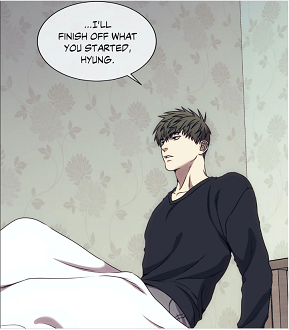 despite the loss of his brother. He hasn’t given up on his dream and ambition. Consequently he makes this promise to fulfil his brother’s hope. Hence Kang Hyeon-Jong’s uniform hangs on the wall at the end of the bed.
 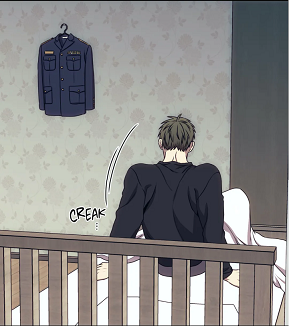 It symbolizes the detective’s goal: he is seeking for the truth and eradication of corruption. The bedroom is the officer’s refuge, where he can express his true thoughts and emotions. He doesn’t feel lonely, because he still has the brother’s uniform by his side. It was, as if the latter was still alive and by his side. And if you pay attention to the images, you’ll detect the indirect presence of nature: the wallpaper. It is slightly green and there are flowers. I tried to identify the flower, but I wasn’t sure. For me, it looks like a chrysanthemum which symbolizes longevity, fidelity, joy and optimism. Naturally, this flower has other meanings, but it depends on the color. A white one is offered to the relatives of the deceased as a sign of grief. On the other hand, a white chrysanthemum signifies loyalty and honesty. Striking is that the flower has the same color than the shirt Kang Hyeon-Jong was wearing, when he was confessing his last discoveries and dream.
  But like I mentioned above, I am not certain about the identity of the flower on the wallpaper. It could be a dahlia too… If you have any idea or suggestion, feel free to leave a comment.
 (chapter 20) Though the latter desires to give the lieutenant the impression that he is honest and supportive, in reality it is the opposite. Since he asked the lieutenant for update, though he is quitting his job, this means that Kim Seung-Tae is actually asking for information. In my eyes, he belongs to the team facing officer Ahn and Jeon Hee-Seong.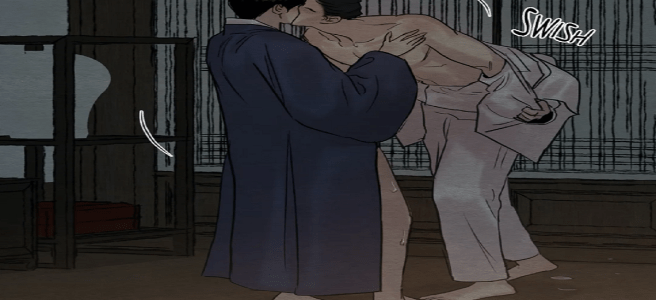
 had inspired me.
 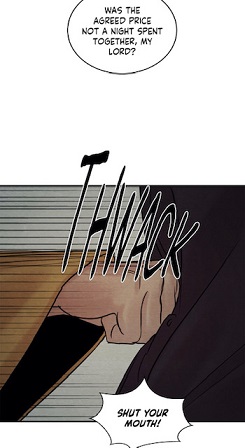 However, as you can imagine, the lord’s punch didn’t hurt the criminal at all. But since Nameless didn’t desire to embarrass his former sexual partner, he acted, as if he had been hurt. In other words, he wasn’t actually honest, when he said this: “That hurt, my lord”. (chapter 76) For the readers, the situation was transformed into a joke and comedy, exactly like Black Heart pointed out right after. Yet, for the villain, it was a serious situation: “Jihwa had fallen so deeply into sodomy that he had reached to a low-born!” Besides, Min hadn’t been able to taste himself the painter.
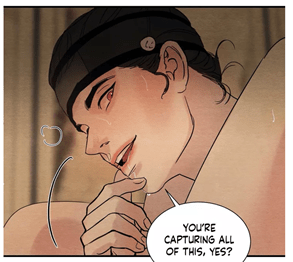
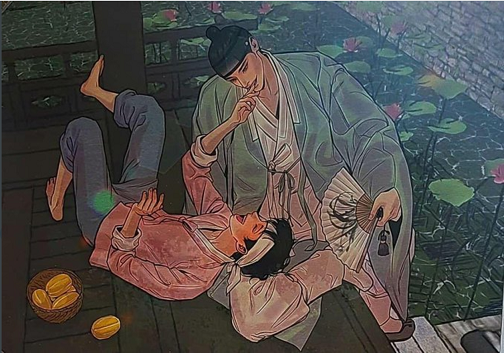 This signifies that Yoon Seungho and Nameless will make jokes and tease their partners. In this picture, the noble is biting the artist’s finger. Let’s not forget that both ukes are always crying so much, when they are sad, angry and pained. It displays that they tear up easily.
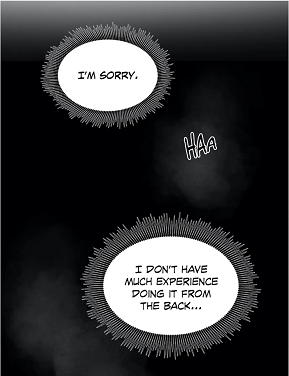 (Chapter 67) Nameless excused his roughness with his lack of experiences. But the readers are well aware that The Joker did it from the back with the kisaeng in episode 51
 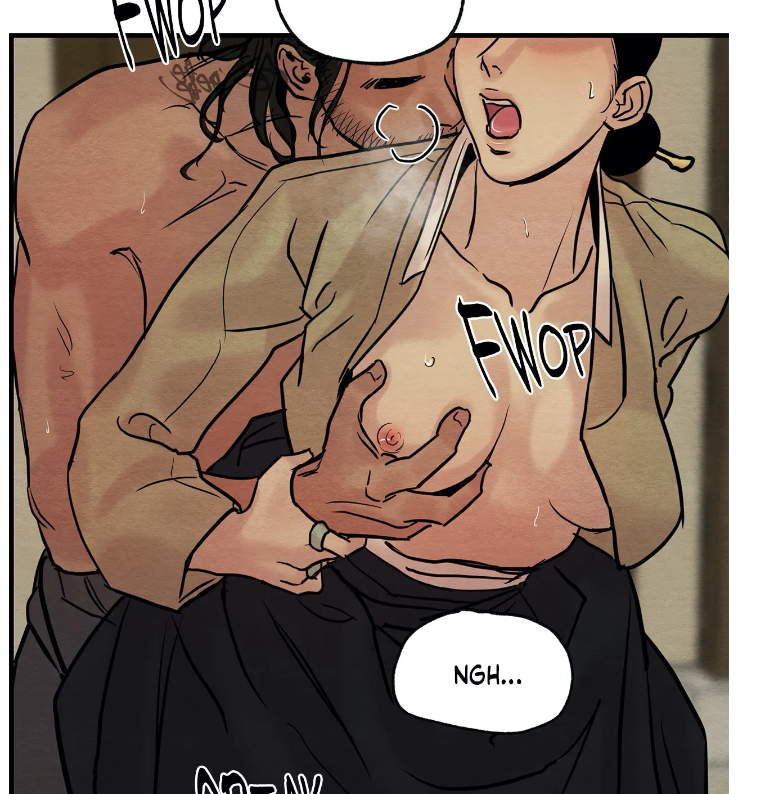 and he has quite a reputation. And when I combined the low-born’s excuse with Jihwa’s reaction, I couldn’t help myself laughing.
 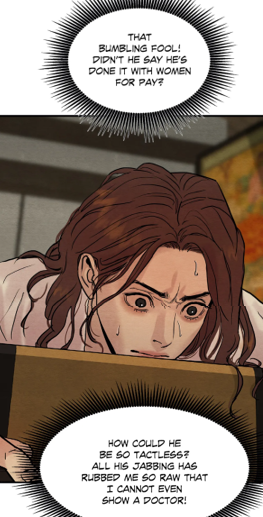 The latter was so innocent here, for he believed the man. He wasn’t able to recognize why Nameless rubbed him so raw. His description reflected the butcher’s passionate desires. The latter couldn’t restrain himself. His heart had been moved by the aristocrat’s remorse and tears. The criminal could sense his purity despite his horrible intentions. The young master imagined that for the criminal had never done it with a man before, he would be more careful. Moreover, if he had done it with women before, in his eyes, it signified, the lover was quite delicate and tender. In other words, Nameless hid his sexual desires and affection behind a false excuse. We have another indication that the low-born did more than rubbing. He left many hickeys on his sex partner, a sign of possession and passion. For the first time, Jihwa experienced what a love session is, but didn’t recognize it. 😉 Nameless is well aware that the aristocrat has no real affection for him, therefore he has to hide his true emotions behind a joke.
 , 74
, 74  and teasing his lover
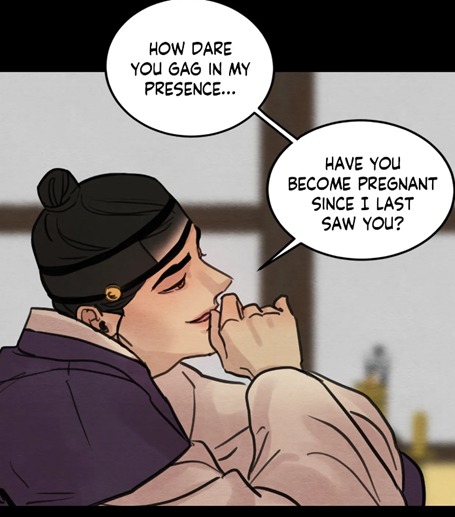 (chapter 23)
 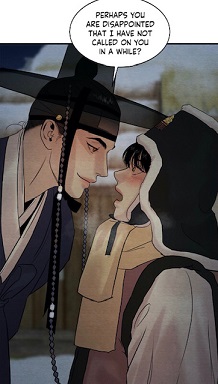 (chapter 75). Nevertheless the latter hasn’t truly recognized his master’s sense of humor due to social norms.
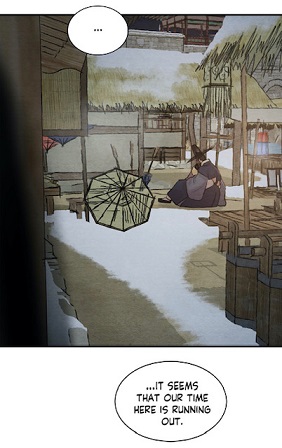 He couldn’t separate them. He was so annoyed and upset by the situation that he vomited. In other words, he was green of envy and simultaneously he was green (sickly)🤢🤮 due to his opium consumption. This signifies that he was definitely not in the best mood.
 Though it looks like this secret puts him back in a good mood, I noticed two details:


 .
. And note the contrast of the mouth. The lips are positioned in the opposite way than when he smiles. And now, you understand why Min had his eyes closed. He was hiding his true emotions from the others, as the eyes are the mirror of the soul. Yet during that night he could no longer keep his mask as the Joker.
 (chapter 66) Striking is that when the lord found Baek Na-Kyum in a terrible situation, he looked excited. In my opinion, the situation was pleasing to his eyes for two reasons. Min could see how Yoon Seungho had mistreated the painter, therefore he sensed that he could have an opportunity to approach the artist. Since Yoon Seungho was not willing to share his lover to others,. Min had only one possibility left: separate the couple. That’s why he found it entertaining. He imagined that his chances to taste the low-born had increased. This explicates why he takes pleasure in the misery of others. He is able to profit from the suffering of others. In other words, he never had to put a lot of effort. Everything was always delivered to him on a silver plate.
 (quoted from
  , (chapter 59) but never tears out of laughing.😂🤣 Therefore I came to recognize the significance of this scene. First, it divulged a lot about Black Heart’s personality, and announced a turning point in his life. At the same time, this observation gave me a new idea, which I will elaborate in the second part. Striking is that until now, I had examined the painter and Jihwa’s tears, yet I had never focused on this topic itself. Hence in this analysis, I would like to study not only the weeping of the characters, but also the absence of their tears.
 (chapter 22). The rock is a metaphor of his heart: he will remain cold-hearted. Striking is that even after the humiliation during the hunt, he never shed a tear. He was only frustrated and angry at his opponent and sponsor. His huge ego had been hurt by the main lead’s mockery, but despite his wound, he chose to look up to the sky, apparently waiting that fate/karma would punish the wealthy noble for his wrongdoing. This outlines that the learned sir still believed in his superiority. In other words, Yoon Seungho had not reduced the scholar to tears with his words, which stands in opposition to the second lead’s reactions.
 (chapter 18)
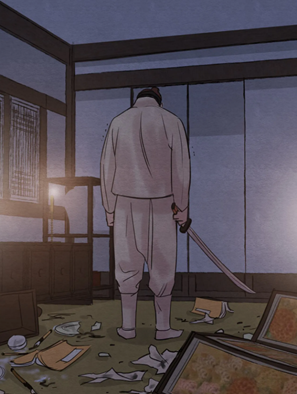 He broke out to tears. And note that in that moment he was standing with a sword in his hand, another evidence that his tears were triggered by his frustration and bruised ego mixed with sadness and anger. And now, you comprehend why he represent a negative reflection of Baek Na-Kyum, the latter embodying humbleness and modesty. However, unlike the scholar, Jihwa was slowly learning his lesson and as such changing. Since the low noble’s heart is made of stone, he will never change in my opinion.
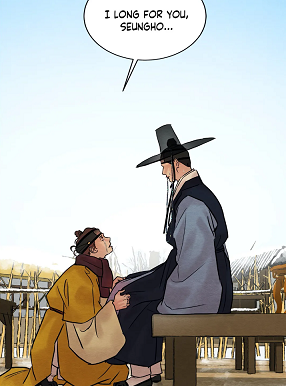 (chapter 57)
 (chapter 56). This signifies that his tears are not related to pride, but to his traumas. The lord can no longer weep due to the constant exposure to physical, mental and emotional pain. However, since he has been taught not cry in the presence of the butler, in chapter 56 it was, as if he was blinking back tears.
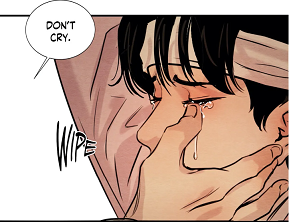 (chapter 2) And now, you can imagine which idiom I am about to bring up:
 (chapter 75) This truly exposes the teacher’s cruelty and ruthlessness. We could say that the painter reinforced his admired sir’s cold-heartedness. Therefore I come to the following conclusion: Jung In-Hun will never feel remorse or empathy. He is destined to become a monster, as his wounded pride will just arouse brutality, resent and thirst for revenge.
 (chapter 56) I couldn’t help myself laughing, when I discovered it. I have no idea, if there’s such an expression in Korean. This slang expression comes from “to cry buckets”, which signifies that the person is like a cry baby. This new discovery made me realize that Yoon Seungho played a similar role to his admired valet than Baek Na-Kyum to his learned sir. Since the main lead was constantly facing terrible experiences, due to his cowardice and powerlessness the domestic chose not to take to heart. The more he witnessed, the more unconcerned he became. Therefore I deduce that Kim will never change his mind-set. He will prefer detachment, cowardice and blindness, because that way he is not suffering: neither regret nor heartache.
 (chapter 65), bringing lunches or announcing the arrival of a guest. And this observation made me realize that the lord started working hard, the moment he desired to woo Baek Na-Kyum. He dressed up, ordered some medicine for excessive drinking, organized two hunts, started strolling through downtown. Yet, this is no real work. And note that Jihwa behaved in a similar way, when he sensed danger from the painter. He also dressed up, had to plant a spy and trespass the mansion on different occasions. From my perspective, Yoon Seungho will start working the moment he behaves like a master. He needs more than just give orders to his staff. He has to control them and pay attention to finances. From my point of view, it is also his duty to take care of them as well, as the head of the mansion. To sum up, he has to learn how to manage the mansion. That’s why I believe that the lord’s tears will only return, the moment all the conditions are met:
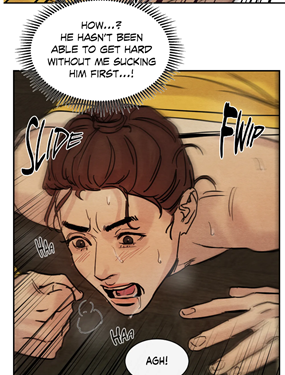 (chapter 3) stimulus, his phallus was still erected after Jihwa’s first climax. It looks like Seungho was attracted by Jihwa… so much that his appetite couldn’t be satiated. This gave Jihwa the impression that something had been triggered in Seungho. He was finally appealed to him, this gave him the illusion that his dream had come true. He mistook the excitement as a sign of “love” making him believe that he had now more privileges than the other sex partners. In his mind, the sex at the pavilion was love and even love for him, while in reality for Seungho it was just the discovery of real pleasure in sex. He had finally come to love sex with men. Since he kept seeing the painting in his mind, it was as if he was making love to himself. Hence I interpret that for the powerful noble the sex at the pavilion is a mixture of sex and love. He finally comes to love sex with men and to love himself as a seme. He feels his own attraction.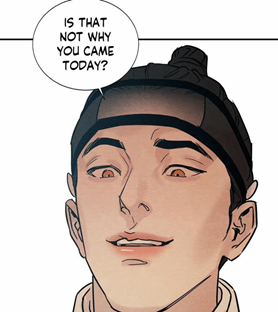
 (chapter 20)
 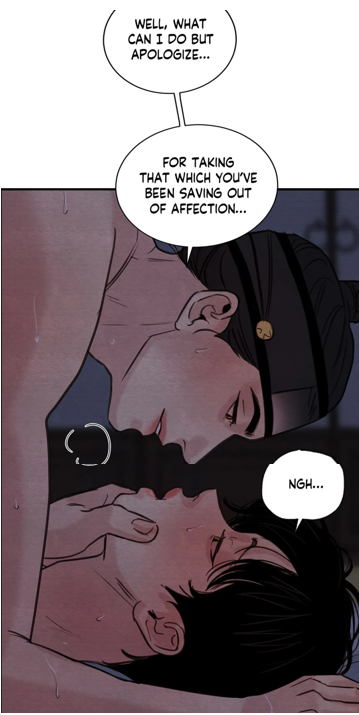 (chapter 21)
 (chapter 25
 (Chapter 32) He has realized that his behavior has not been normal. He is confused hence he doesn’t get angry, when he is criticized by the doctor later. He knows that his emotions made him blind so that he somehow endangered the painter’s life. He must definitely feel guilty but he sees it as his duty to make sure that Baek Na-Kyum can recover.
 Here, it is quite clear what the protagonist’s real intention was. He was looking for sex in order to understand what led him to act like a crazy person in the presence of the painter. What was he looking for? During the separation, he makes a huge discovery: sex is not his true motivation, he gets aware that he has been longing for the painter’s attention and affection.
  Besides, due to Min’s words, he gets aware that he wants Baek Na-Kyum for himself. He is “his”. He knows that now but he has no idea how the artist will react after his recovery. He could definitely blame him for his illness and the sex marathon. Little by little, the main lead is learning to differentiate sex and love. What I mean is that he has learnt that sex is a way to express love, making the partner feel sexual enjoyment and pleasure is making love. It is about to give and not just to take. That’s why from that moment, the seme is focusing on pleasuring the artist. He feels that he needs to wait so that Baek Na-Kyum will come to fall in love with him and will express the need to have sex with him. So he is definitely waiting for Baek Na-Kyum’s move.
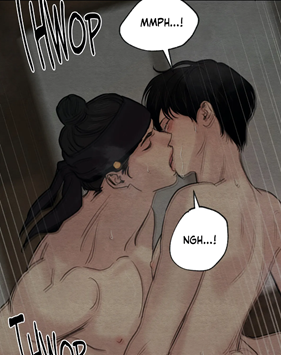 (Chapter 42) Here, there is a mixture of tenderness and passion. He is attempting to evoke other feelings in the uke. He actually shows his love for the commoner. While during their first night, the artist cried out of happiness, here the tears are expressing immense sadness and pain. This is the reality: he had never been truly accepted by the low noble. He always saw his social background, a low-born raised at the brothel. He is admitting his sexual orientation which he is now connecting to prostitution. The painter doesn’t see the love in Seungho’s gestures, too immersed in his own suffering. In other words, the lord wanted love here but only got the opportunity to have sex, while deep down Baek Na-Kyum was longing for love but just asked for sex. However, Seungho attempted to shower him with love at the end but the painter didn’t see it, just like during their first night.

 For her, humans resemble to the pieces of the chess board, where the weakest are doomed to disappear. Striking is that many chess players have a similar approach than her. They all see many similarities between real life and chess.
  It is a dog-eat-dog world, and if you want to survive, then you need to become ruthless as well. This negative attitude is really palpable, if you contrast it to Allan Rufus’ quote. The latter views the game and life as a place, where people gain knowledge through experiences. Thanks to the practice and increasing maturity, the person is capable to change or anticipate the next moves. In other words, with the training, people can make a different decision. Furthermore Benjamin Franklin, who has a similar approach, adds that even bad events should be considered as lessons and as such a source of motivation to improve the situation. Both authors promote hope, whereas the femme fatale advocates disillusion and defeatism. Hence, for the Korean figure, life is perceived as an endless battle and nothing more. This signifies that in her eyes, life contains no happy moment and has nothing to offer. Since she compares it to a constant war,
  this signifies that only power matters, as it guarantees survival. I would like to point out that EVY confirmed in a tweet that the femme fatale plans to become a king. This truly reveals that for the former prostitute, dominance is her ultimate goal in life. In her mind, strength symbolizes life. Thereby for her, love has no meaning. Moreover, I also think, she doesn’t believe in values like affection, friendship or respect. The evidence for this the following. Note how many times she utilizes the idiom “kill”, while the male authors outline the importance of insight (“insight”, “foresight”, “forethought” “vigilance”) and wisdom (“knowledge”, “knowing”, “insight”). In other words, while Jeon Hee-Seong is focusing more on action (killing), the other players (Franklin, Buxton, Rufus) privilege pondering and reflection. She is already aiming directly at her final goal: removing the former king and replacing him.
 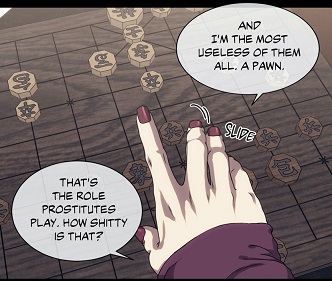 (chapter 6) In her eyes, it has no value at all (“the most useless”), whereas the protagonist and student Seong-Rok views the soldier differently:
 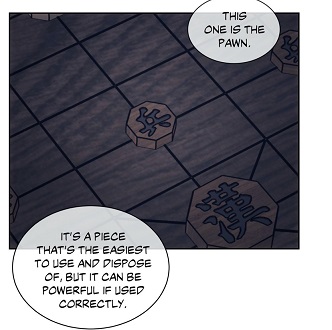 (chapter 13). The latter can be influential, but it depends on its position and the way the general uses it. Sense the contrast between these two descriptions outlining her narrow-mindedness in the end.
 (chapter 18) are removed within a short time. This explicates why the detective Kang Hyeon-Woo suspects her right away.
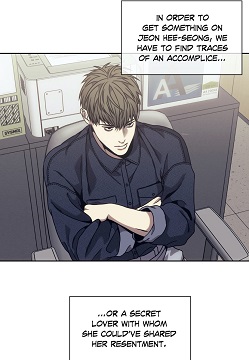 (chapter 8) But why is the femme fatale neglecting reflection, knowledge and foresight in Janggi?
 (chapter 16) and his occupation within a few minutes, when they met for the first time. In his eyes, she appeared as an intelligent woman full of wisdom and experiences. This explicates why he listened to her explanations so carefully, when she was about to manipulate him to kill for her.
  (chapter 16) And that’s how she definitely views herself too.
  (chapter 12) and showed no loyalty towards him
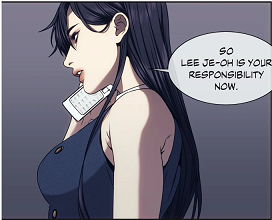 (chapter 12), the young man could only recognize that she was lying to him.
  (chapter 12) She has no idea about Do Seong-Rok’s past experience (the fake promise and abandonment).
  (chapter 11) The red-haired man is perfect for her plan, as his eyes and hands are focused on the game. But what the female character failed to realize is that in Janggi, there exists different pieces: the elephant, the horse, the general/king, the pawns, the chariot and the cannon. Do Seong-Rok is not a pawn in reality.
  (chapter 13), this signifies that her true role in Janggi is different. She is the player. Consequently, she is sitting on the one side and takes the pieces.
 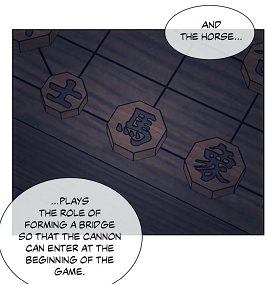 , the elephant
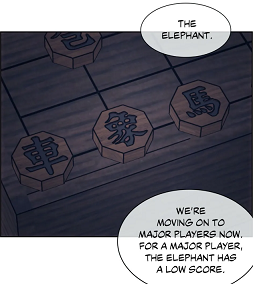 , the counselor/the guard
 , the chariot
  and the cannon
 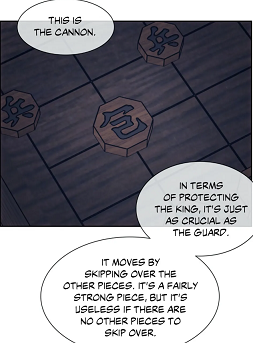 (chapter 13). That’s why I tried to identify the killer’s true role in the game board.
  (chapter 13) The moment the protagonist has eliminated all her targets, he will become useless. Consequently, I deduce that when Jeon Hee-Seong plays chess, she is the “king” and Do Seong-Rok is the cannon.
  (chapter 11). “Some of my guys” is a reference to the lieutenant Park. And remember that the role of the horse is to create a bridge for the cannon. Let’s not forget that Park Gwang-Soo is not really trying to investigate the whole matter, as the victims are all involved in the red-light-district. A real investigation would lead to unveil the corruption among Mijeong police.
  he is not realizing that she is just trying to replace the first team. Jeon Hee-Seong plans to maintain the collaboration between Mijeong police and the red light district, yet the involved parties will be changed.
 ,
,  this means that they are embodying a team. Koo is the horse, Ma is the elephant, Choi the guard and Lee Soon-Cheol the pawn. However, two pieces are missing in this team: the chariot and the cannon. Since the the head manager of Hongok-Dong Red Light District meets officer Ahn in order to beg for his support
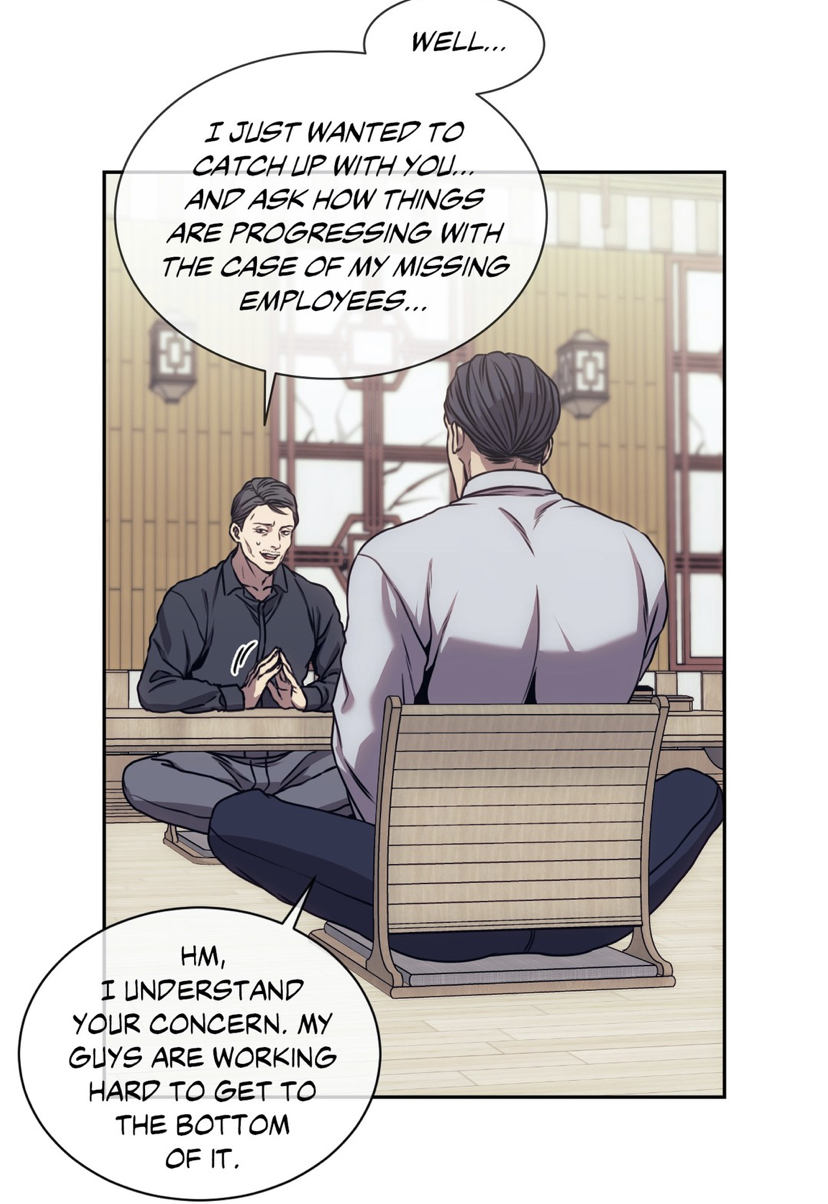 (chapter 11), this signifies that Ahn has been working for this team too. In my opinion, he plays the same role than in the other team: he is the chariot. As for the cannon, I will unveil his identity below. But since we have a whole team, this signifies that there’s a general. Consequently, there exists someone behind the victims, the king and player of the game board. To sum up, Jeon Hee-Seong is playing against a person, whose identity has not been revealed yet. How ironic is that when I was writing this essay, the special episode confirmed my theory:
 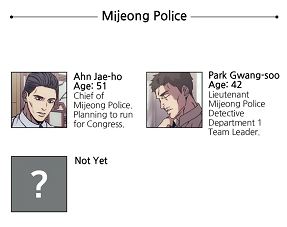 The “not yet” is the player using Koo Jeong-Mo and the others as his pieces. Jeon Hee-Seong entered the game and started a war against the first team. She could win over officer Ahn by appealing to his feelings. She revealed the injustice she was exposed too. That’s why Ahn asks Koo Jeong-Moo about the reason for targeting him.
 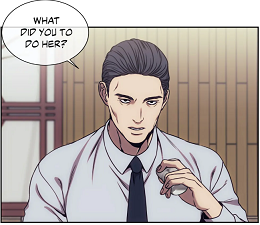 (chapter 11) Ahn could understand her motivation. However, she disguises from him that she is stimulated by her greed and ambition too.
 (chapter 6) It was, as if with the killing, he would go to her side, as in that scene he was facing her.
  (chapter 1). It was, as if he was observing a game and predicting moves. Furthermore, he observed Lee Je-Oh for a long time
 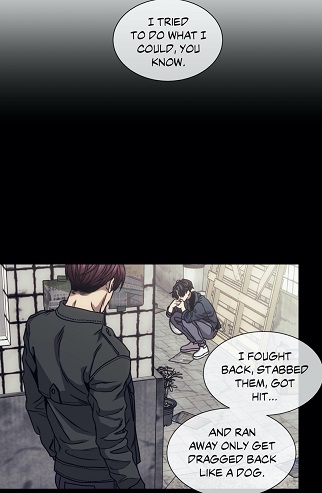 and questioned his role in this team. This truly shows that the main lead was pondering a lot. I would like the readers to keep in mind the advices given from the chess players: foresight, forethought, prudence and vigilance. Moreover, there exists a interrogation point in the image of the male prostitute, which shows that the main character was thinking about Lee Je-Oh’s role in that game. Furthermore, the former could impose himself through his strength in front of Lee Je-Oh.
 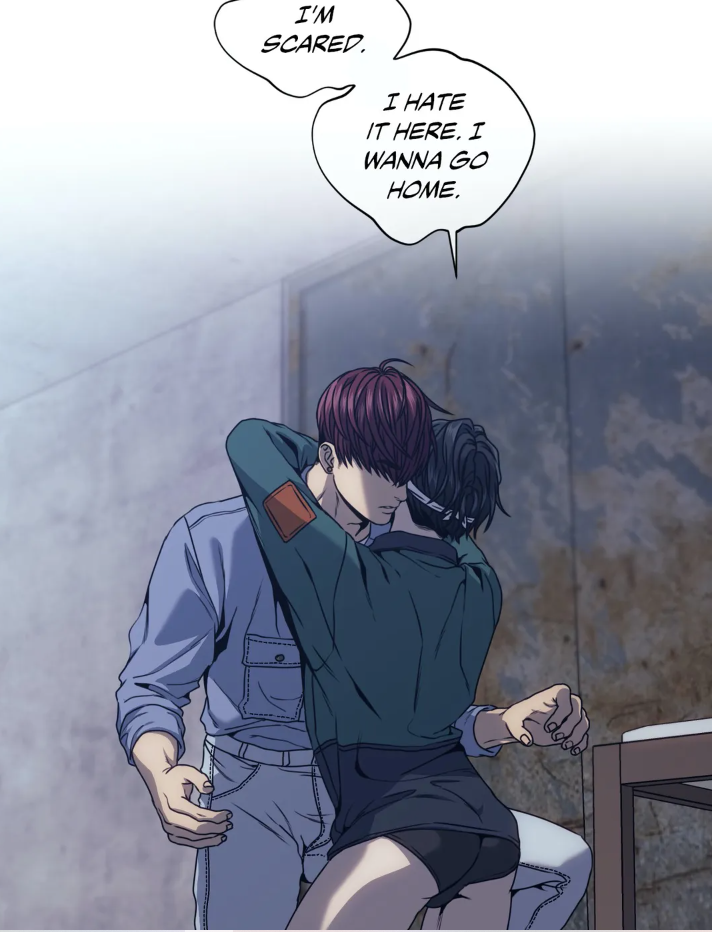 (chapter 12) The latter made the mistake to overestimate his situation and his skills. He imagined with his observation skills and schemes he could prove his superiority and loyalty, but the red-haired protagonist punished him for his “betrayal” and “arrogance”. The red-haired man embodies physical power and is the final authority. Finally, if you observe the way Do seong-Rok taught his new ally Lee Je-Oh about the game, you’ll sense that their position reflects the actual situation: they are sitting on the same side in front of the game.
 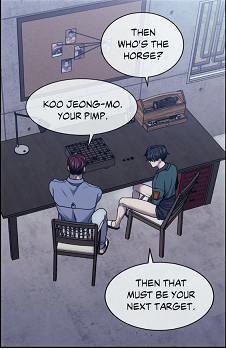 (chapter 13) which contrasts so much to the scene with the former prostitute in episode 6. Since Lee Je-Oh is giving advice to the young criminal (like not leaving any evidence
 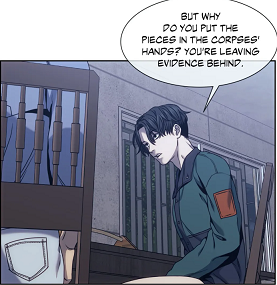 (chapter 13) or not answering Jeon’s calls, I view him as a guard and counsellor. At the same time, he is offering his help to capture the pimp Koo. Hence I consider him as Do Seong-Rok’s horse too. As you can observe, the red-haired man and his lover will play different roles in Janggi. However, right now the two main characters are still working for the femme fatale, but it is only a matter of time, until they build their own team and work for their own survival and ultimate goal.
  (chapter 1) from the male prostitute, for the latter has still a strong sense of justice. He has never forgotten the victims of Ma Jong-Seok.
 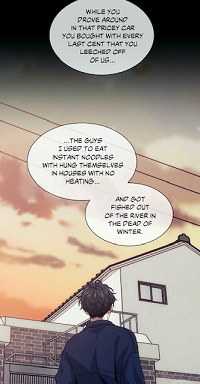 (chapter 18) And strangely, Benjamin Franklin was also involved in American Revolution:
 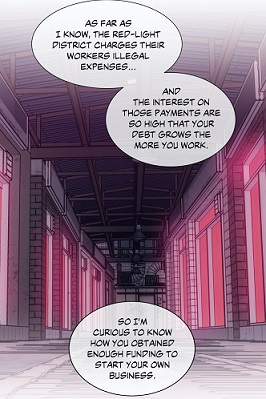 (chapter 8)
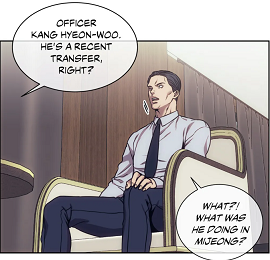 (chapter 11) According to his reaction, the manhwaphiles can deduce that the detective has lived himself in the city before moving out to Seoul. In other words, he is coming back to Mijeong and is determined to remove corruption in the city and police. Since Player 1 (Not Yet) will be aware that officer Ahn has already sided with Jeon Hee-Seong, there’s no doubt that he will try to use Kang Hyeon-Woo to target Jeon Hee-Seong and her helpers. An investigation about the murders in the city is definitely necessary for the player 1. However, since the lieutenant chose to leave the city in the past, this signifies that he suffered himself some injustice in the past and as such was a victim of the king from team 1. Therefore Kang Hyeon-Woo has to ensure that he needs to unveil the whole truth.
  (chapter 11) It is even possible that the femme fatale decides to use the detective for her benefit too, when she believes that it’s time to get rid of Do Seong-Rok. That’s why I believe, the detective will be the lose cannon in the board game. From my perspective, each time they will try to take advantage of his desire for truth and justice in order to divert the attention from their own crimes and wrongdoings.
  And at the end, they will “destroy” this world, just like in the picture. Their reason is simple. They are not aiming at gaining power and wealth. For them, freedom and love matter more.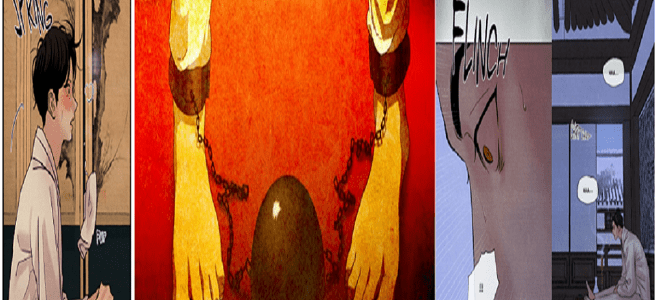

 (chapter 149). This means, this terrible incident with these painful memories will always be a part of his life and he will always have to fight to find the right balance. That’s why he describes the patient’s life as a long journey
  , where the figure has to find a way to overcome his trauma.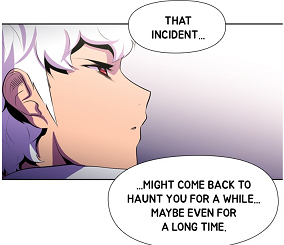
 (chapter 149) As you can see, a patient suffering from flashbacks and PTSD is on his own in the end, the psychologist can only give him support, advice and comfort, but in the end Yeonshik is the one who has to work on himself and find the right balance.
  (chapter 63) But note that it took the lord a long time to recognize and externalize this thought. And so far, the painter has still no idea what truly makes him happy.
  (chapter 74) and thoughts
  (chapter 74) from his lover.
 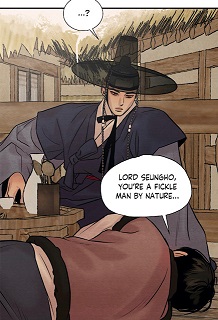 (chapter 75) He might have asked for his help in chapter 76
 , yet it was a spontaneous and natural gesture. But once he starts thinking with his mind, the closeness won’t remain. There’s no doubt that the painter is still afraid to admit his attraction and affection to Yoon Seungho. The negative image of sex, influenced by Jung In-Hun and Heena noona, has not been entirely removed. Furthermore, Yoon Seungho never revealed to the artist that he knows now about the kidnapping. He detained information from his lord Na-Kyum. That’s why I deduce that the painter and the aristocrat will have to discover on their own that for happiness, they must be open and truthful to themselves and to their partner. A white lie, lie by omission or a silence can have devastating consequences.
  (chapter 77) just like he is now remembering that lord Song is responsible for his martyrdom.
 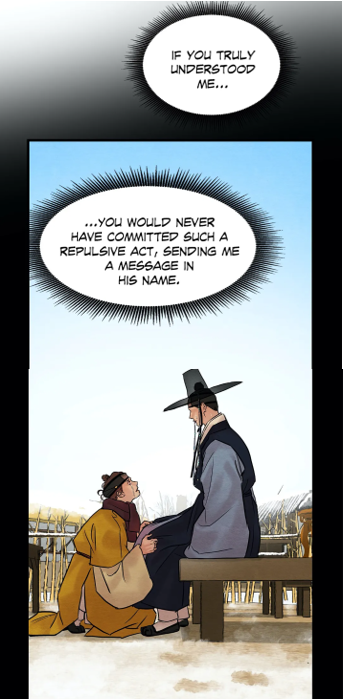 (Chapter 59) Compare the lord’s attitude in season 1.
  (chapter 37) So far, he only blamed the father. Sure, in season 3, he still reproaches the father‘s responsibility, but observe that his blame is more related to the Yoon Chang-Hyeon‘s bad choices.
  (Chapter 86) He trusted the wrong people, in other words, he sensed that his father had been misguided. This explicates why he blames the father for the absence of his critical thinking.
 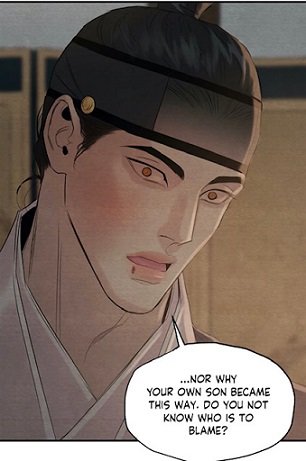 (Chapter 86) He never pondered on the question how the tragedy could occur. He was simply satisfied with the easiest solution: Yoon Seungho was responsible for this. This conversation is important, as it actually outlines how different the lord is from his own father. At the end of season 3, Baek Na-Kyum asked his lover this:
  (chapter 102) How come that he left his side? For the main lead, it sounded like a blame, while in reality, it was a question. By asking Yoon Seungho this, he is pushing the lord to investigate the matter. Discovering the truth is relevant, for it will reveal that Yoon Seungho’s crime had been planned all along!! He was incited to kill people, thus he had the sword in the hand. And since the situation mirrors the past, the main lead will slowly unveil the truth about his own past. Now, you are probably wondering how this is related to happiness. The answer is simple. As long as the protagonist is trapped in the past, he could never become happy. He couldn’t simply move on. But by leaving everything behind, he makes a clean start, and he is forced to rely on himself and as such to trust himself, if he wants to take care of the painter properly.
 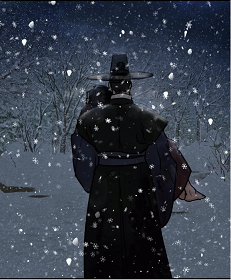 (Chapter 102) That’s the reason why the author said that they will find happiness on their own.
  (chapter 74) At the end of the second season, Heena noona’s influence is still palpable. In that aspect, Yoon Seungho is much further than the artist, as the lord is no longer in denial about his love for Baek Na-Kyum. Yet, at the end of season 3, Baek Na-Kyum makes a similar experience. He recognizes that his sister has been manipulating him in order to achieve her goal.
 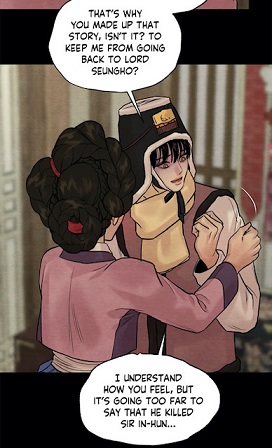 (Chapter 97) Furthermore, because he listened to the ghost Jung In-Hun and the comments from the staff, he fell into the trap set by Min. Once facing Black Heart, he got aware of the deception right away.
 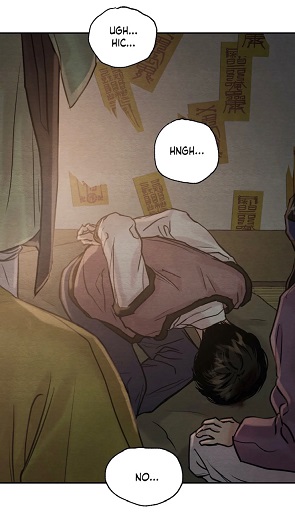 (Chapter 99) In other words, due to the last tragic incident, he experienced that he should mistrust people’s words. He shouldn’t take their statement as face-value. This is important, for the artist is learning to become more and more independent. His critical thinking is developing. As you can observe, both main leads have to find their own way to become happy. But they can only become happy, if they discover the truth and as such their past. Thus I am deducing that Yoon Chang-Hyeon will never find happiness, for he never tried to discover who was behind the bad reputation of the Yoons. This explicates why he is repeating the same mistakes from the past in season 3. He still trusts valet Kim.
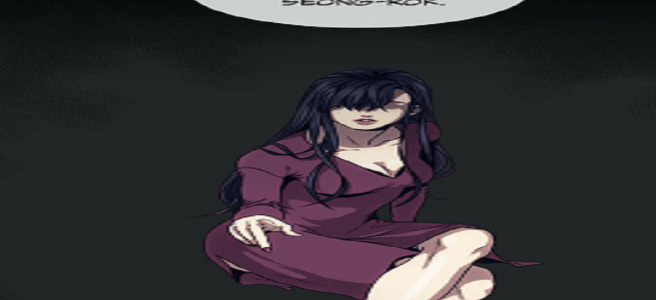
 As the manhwaphiles can detect, a femme fatale is strongly connected to the fake vow of pleasure and enjoyment.
  (chapter 6) Moreover, observe the position of her legs, it definitely reminds us of a siren, as her legs resemble to a fishtail. Moreover, if I include the following panel
 , this perception gets reinforced. Her hair on the bed makes me think of hair under water. Sure, in this panel
 (chapter 16) And now, if you connect this promise with the siren’s temptation, you’ll realize what the abandonment signifies in truth: he will drown and die. He will lose his life and soul.
  (chapter 6)
 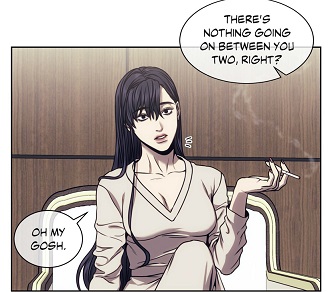 (chapter 11) They are puppets of the femme fatale. This angst is truly palpable in chapter 6. Do Seong-Rok got scared, because before he had met detectives looking for Lee Je-Oh, Ma Jong-Seok and Choi Yeong-Gil and couldn’t get in touch with his lover
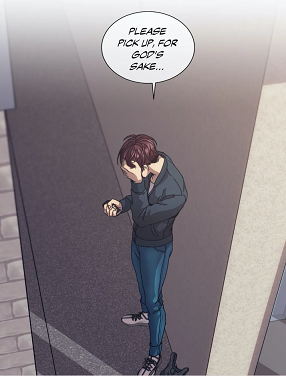 . He felt totally vulnerable. He needed her presence in order to stay calm and find a solution to his problem: the existence of a witness.
 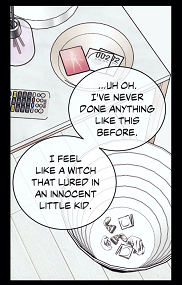 (chapter 16) Yet, if you pay attention to Eva’s role, she was herself a victim, for she listened to the snake and got tempted to eat the fruit.
  This comparison seems to be correct due to her behavior in chapter 6 and 16. Striking is that in this image
 (chapter 11) He justifies his crime by saying that he just attempted to run his business. Just like his foe, he is diminishing his sin. On the other hand, his words
  truly outline his immorality and wrongdoing. If it was not murder, then what did he do to her? He calls her a snake, because she betrayed him. However, he was the one who backstabbed her first. There’s no doubt that she was forced to marry Choi Yeong-Gil, a violent man.
 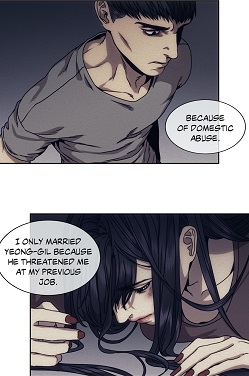 (chapter 9) The former pimp suspects her for being the mastermind behind the murders. Nevertheless, the manhwalovers should keep in mind that she is his competitor too. She is now running her own business. If she was caught and accused, he would get rid of his rival. Since he backstabbed her in the past, it truly exposes that his comparison is only partially correct. As the former prostitute is not just a perpetrator, but also a victim, I come to the conclusion that the female character resembles more to Eva than to the snake.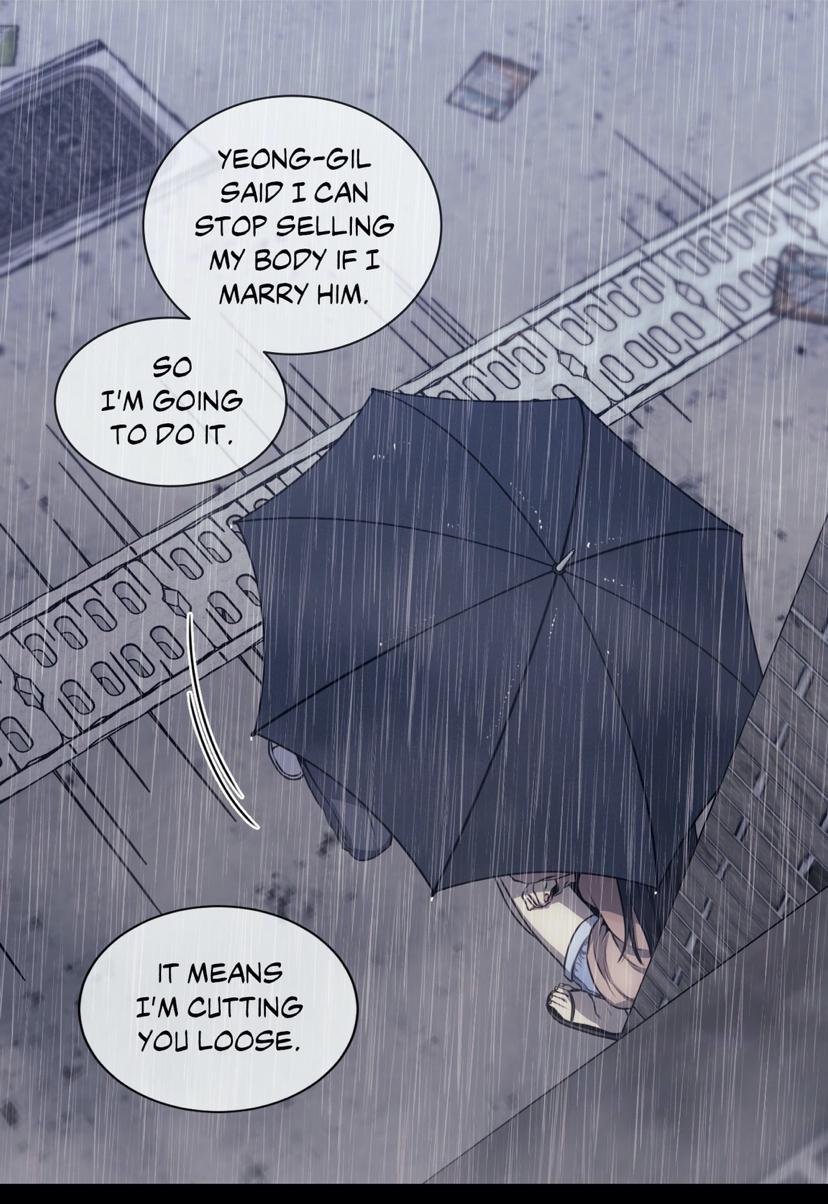
 Note that she announces to the future criminal that she will be ruthless, selfish and she might even betray him in order to achieve her goal. To sum up, she is more paltering than lying by commission.
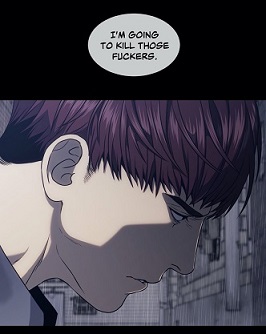 made him the perfect tool for her goal. At the same time, she is overlooking the male prostitute Lee Je-Oh. Since none of her targets has ever resisted her, she can’t imagine that Do Seong-Rok will distance himself from her.
  He even suggests to become his ally. And this observation truly reinforces my former statement: Jeon Hee-Seong and Lee Je-Oh will become rivals. One thing is sure: because the former prostitute is a femme fatale, she won’t get what she truly wants.
  (chapter 55) He doesn’t want to be recognized, but more importantly he is determined to hide his true feelings from Nam Dong-Gyun, for he believes that he has no chance to be his lover again. Moreover, during the Corona pandemic, people are requested to wear a mask in order to stop the contamination.
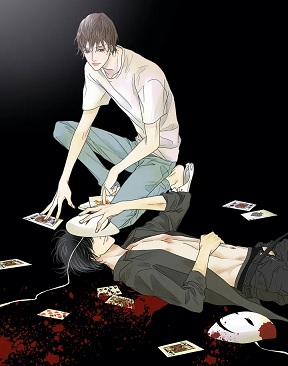 If people knew that he was a psychopath, he would get isolated. His parents are already very distant with him, for they view him as a monster. Due this experience
 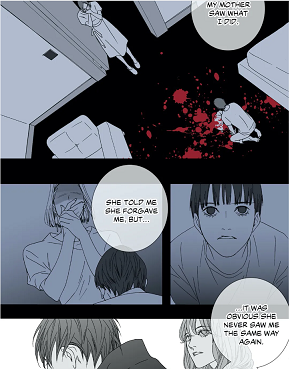 (he killed a dog and his mother caught him), he got aware that he was not allowed to act on his urges. For him, the mask is a necessity, as he is living in society. He doesn’t want to end up in jail. But is it the same for Nameless from Painter Of The Night?
 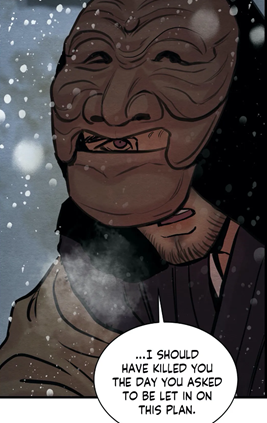 (chapter 54) He is switching his identity to become a killer. In this panel, the manhwaphiles see the transformation of the figure, as his face is already half-covered. He is no longer a joker, but not the ruthless murderer yet. However, when he kills the servant, he has the cover on.
 (chapter 54) By putting a mask, he is protecting himself too, for he is acting as someone else, therefore his heart can’t be wounded.
  In this case, it is more a desire, though in truth it is a combination of both. The “butcher” has to hide his true identity. So when he wears his mask in chapter 44, he is doing his job. He won’t be recognized, but also he won’t feel remorse. He has been paid for that and the mask is helping him not to get emotionally invested. On the other hand when Jihwa met him in chapter 51, the manhwalovers could perceive the low-born’s true personality which coincides with the absence of the mask.
 In that episode, he was literally naked in front of the noble, which explicates why he showed concern and care for his client. He let the noble express his worries. Let’s not forget that the jester is a person with a pure heart, when he is true to himself. Hence I come to the conclusion that the mask serves as a protection for the criminal’s mind and heart. And now, you comprehend why Nameless didn’t feel remorse for hurting the painter. According to me, in this scene, it was Kim who was scaring the painter.
 (chapter 66) This is important, because the mask had two purposes here: to hide the identity of the perpetrator, but also to slip into a role, No-Name’s, the assassin. The main lead’s face was covered and turned around. At no moment, the “butcher” could see the victim’s gaze and facial expressions. The mask helped him to be ruthless, while he threatened Baek Na-Kuym. He might feel pity, but that was it.
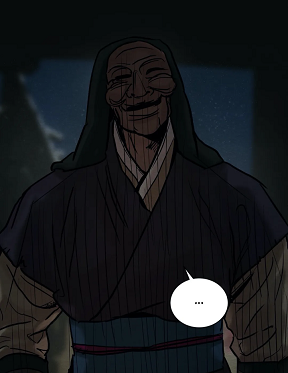
 (chapter 66) In that scene, the manhwaphiles thought that they were seeing Mumyeong, hence they imagined that Jihwa’s safety meant more than the artist’s life and possible scars. But if you take my theory seriously, this was Kim, then the words from the butler had a different meaning. He was hiding his action behind the nobles. Only after paying attention to the mask, I realized the existence of two masks.
  (Chapter 61)
 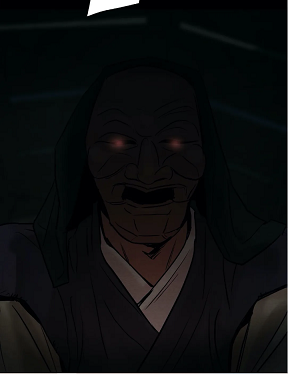 (chapter 61) Smiling mask versus threatening mask. The presence of two masks explicates why No-Name had the impression that after the painter’s return nothing bad had really happened. He was not aware of the butler‘s wrongdoings. Simultaneously, since the artist had not been killed, No-Name imagined that he had done nothing wrong.
 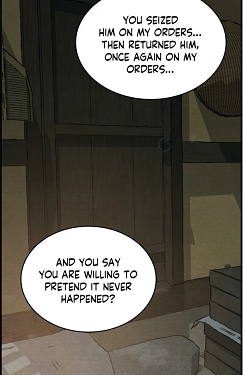 (Chapter 61) Hence the existence of the Joker’s mask outlines the criminal’s duality. He can be a ruthless killer, yet he can be gentle and caring too. At the same time, it implies the presence of a biased view.
 (chapter 73), the moment he is deprived of his powers. It was, as if he became a human. This is particularly perceptible, when he accepts the judgement of Maat and says this.
 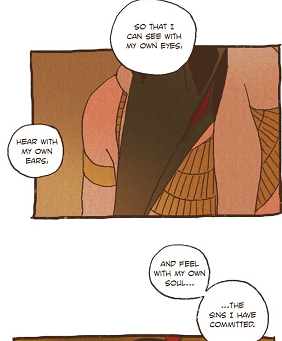 Striking is that in this panel, the mask doesn’t appear as a source of advantage, rather as a hindrance. He couldn’t see and hear the consequences of his crimes due to the mask. He was blind and deaf. By removing his mask, he becomes human and can face reality: he is facing his sins and the suffering of his victims, their wounded soul.
 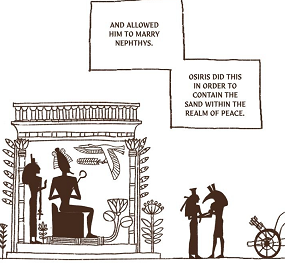 [chapter 35], his son, his title
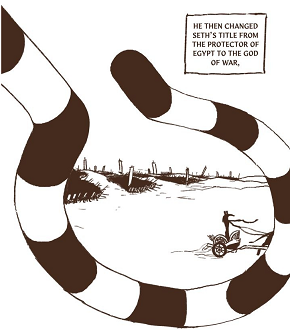 [chapter 35], his power over the desert
 [chapter 35]), he lost his identity. Osiris made sure to imprison his brother, because the former was lusting after him and had the impression that the latter would always escape his control.
  (chapter 35). At the end, he raped him in order to claim him. The latter got literally destroyed, hence he hid his pain behind the mask and chose to hurt others.
 (chapter 37) In other words, the loss of identity was the reason why Seth decided to hide himself under the mask. Who was he in reality? The god was so tormented by his tragic past, Osiris had hurt him with his actions and words. He made sure that his brother would doubt himself. Hence the mask became the only reason to keep living. This item helped him to hide his wounds, but also not to lose himself completely. Hence I conclude that the “evil god” wasn’t just blinded by his heartache, but also by his mask, for the latter hindered him to see the real impact of his terrible actions.
 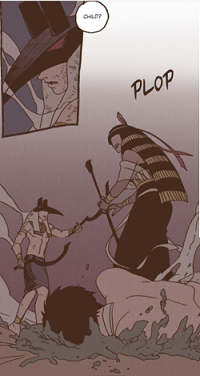 (chapter 37)
  (chapter 73), his son makes the opposite experience. He transforms himself into a god, Anubis, hence he gets a mask.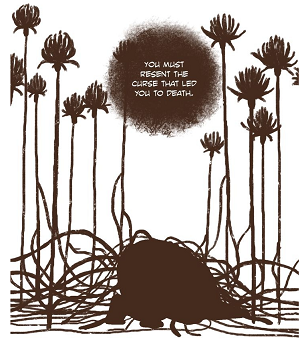
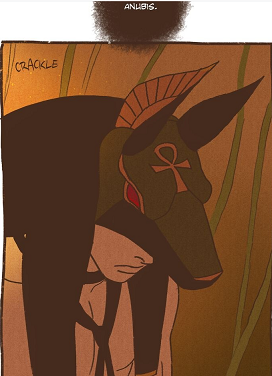 (chapter 73) However, this signifies that he won’t see his wrongdoings too, he will be oblivious to the pain he is causing to others. This time, his blindness will be caused by his resent. While in the past, Anubis was a sensitive and gentle person, but no real god due to Seth’s curse, in chapter 73 he becomes Osiris’ true son, an evil god. Why do I judge him like that? It’s related to Osiris’ words. The latter is encouraging his son to feel hatred for the one responsible for his curse, Seth. Moreover, he asked his son to forget his past signifying that he should cut ties with his previous family. Therefore I believe that in the future, Anubis will fight against Seth and even Horus. Nevertheless, the wounded Anubis doesn’t realize that he has been manipulated by Osiris. The latter used his vulnerability and fear to approach him and appear as his savior.
  (chapter 73) Besides, Osiris was in fact accountable for his injury
 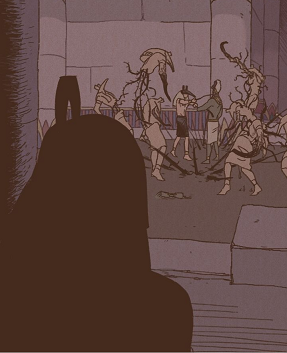 (chapter 37) In other words, the god of the afterlife used a disguise, though his brother had the impression that Osiris was real. Yet, one might argue that in that scene, Osiris was not wearing a mask. However, since he took possession of Anubis’ body, we can clearly see the presence of a cover. Let’s not forget that this terrible god is not allowed to leave the Underworld, hence he needs a subterfuge to enter the world of the living. That’s why I perceive it as a disguise. While the Egyptian god used Anubis as his vessel, Kwon Sungha from Dine With A Vampire took a new identity: he became Sooin’s bodyguard.
  As you can see, in both cases magic provided the villains a new occasion to deceive their target. And this shows that a mask can eventually cover a whole body, when it is to create a new “identity”.
  , just like Ra or Hathor. Yet, note that they are all women. Secondly, if you pay attention to their appearances, you’ll detect the presence of a hair dress and make up, especially around the eyes. This is no coincidence in my opinion. These accessories should be perceived as a “mask”. The make-up and hair dress are a form of disguise. This becomes really obvious in the manhwa “True beauty” from Yaongyi, where the heroine Jugyeong Lim hides her insecurities and true self behind a make-up. This is the real and natural protagonist
 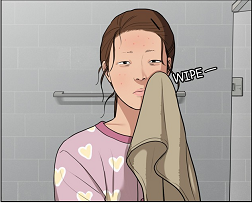 (chapter 7), while we have here the disguised heroine
 (chapter 0). This goes to the point that her boyfriend Sujeon Han has no idea how she really looks like. As a conclusion, the make-up and hair dress should be judged as a mask too. That’s why in traditional Chinese theater, the actors have painted faces. It was, as if they were wearing a mask.
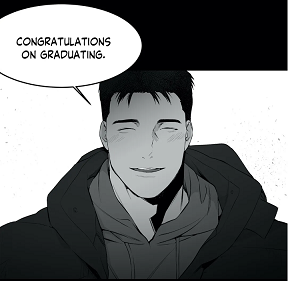
 (Doctor Frost, chapter 2) That’s the reason why the author Black Apricot didn’t drew a mouth, when she presented Song Ji-Sung here.
 (chapter 9). She wanted her readers and the main lead to realize the character’s true personality. The latter was upset, because Kwon Soo-Young was keeping his distance from him and it looked like, he had found a new protector/boyfriend. When the protagonist Kwon Soo-Young had met Song Ji-Sung for the first time, he had only paid attention to his smile. Therefore he had misjudged his personality. And now, if you contrast the previous panel with the following one
 (chapter 16), you’ll notice an important detail: The eyes are closed, when the character is smiling. In this situation, the figure was actually hiding his true thoughts, this explains why the main lead couldn’t correct his false impression about his future lover. He had no idea about his true nature, as the latter keeping concealing his true intentions, he was faking his emotions with his facial expressions. This confirms my interpretation: the face can also be a mask. For me, this character is like Doctor Jekyll and Mr. Hyde. In this picture, Kwon Soo-Young got scared, when he saw this gaze and refused his lover’s advances.
  He is brutal, selfish and very manipulative. And now, you understand why in ENNEAD we had two different kind of masks: Seth and Horus are wearing real masks, while Osiris and Isis use their own face and make-up to conceal their true personality.
 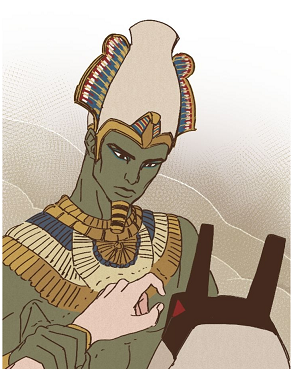 (chapter 7) Sure, the color refers to his death, a decayed body, nonetheless the readers should judge the painting as a cover. Since he is using a whole body to disguise himself, this signifies that he is hiding his true personality and thoughts more than Isis or Ra. That’s why it is not surprising that this god is particularly scheming and deceptive.
  (chapter 10) The mask is a combination of shadow and absence of eyes. Here, Ahn Jiwon was remembering his first love and boyfriend, who faked affection and care for him. As a conclusion, the eyes symbolize honesty and naturality and its absence the presence of a mask.
  and the internist Kwon Sungha
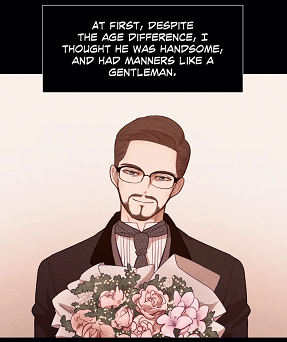
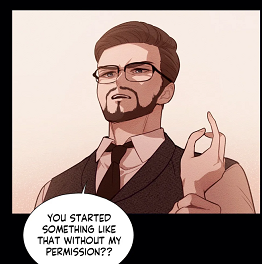
 . While examining their characters, I made a connection between the glasses and their personality. I defined the function of the glasses as a mask, because both almost act the same, as vicious hypocrites. They hide behind their glasses and their fake smiles so that people misjudge them. And remember doctor Frost’s advice:
  Observe that the smile is less pronounced, giving the impression that it is vanishing. Simultaneously, the eyes are shown oozing a rather cold and heartless side. In the scene at the library (chapter 40), he’s finally able to perceive his own reflection in the scholar’s gaze, since the smile has totally disappeared. The gaze exudes coldness, despise and filth.
 Combined with the harsh words “you were born to be a prostitute”, the painter’s identity and personality are literally destroyed. The scholar has reduced Baek Na-Kyum to a prostitute, the lowest rank among the commoner. They have no rights and no real identity as they are forced to do what their clients want.
 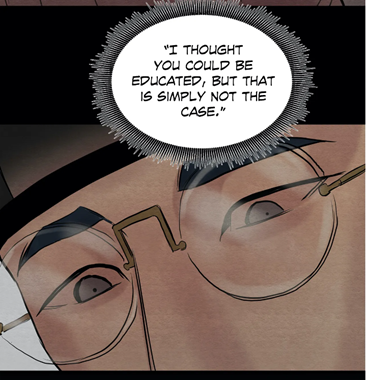 (chapter 41) Hence it is not surprising that the protagonist remembers the cold gaze. His eyes were the other reason why Baek Na-Kyum’s heart was so wounded. He could sense despise and rejection. In other words, the scholar had used two weapons to hurt the main character: the gaze and the words. This connection between the smile and the eyes is visible in Dine With A Vampire too.
 As soon as the smile vanishes, the eyes become visible unveiling their true personality. That’s why it is not surprising that Kwon Sungha has the same behavior towards the main lead Joo Sooin. The former has also destroyed the protagonist and reduced him to a puppet. The villains keeps calling him a pervert. He was even worse than Jung In-Hun in the sense that he kept abusing him mentally and physically after the coercive persuasion. Both are hypocrites hiding behind their glasses and their gaze. Therefore they are portrayed as cruel and mean hypocrites. The other common denominator is their hatred and rejection for homosexuality. Kwon Sungha seems to be even worse than the scholar, as he is in reality a repressed homosexual. He has sex with Joo Sooin, but resents him because he sees in him the reason for his “perverted” sexuality. He rejects sodomy because of the Church and his mother. Both reject this sexual orientation. I could mention Carter Nathan from The Blood of Madam Giselle
  (the fake and the real
  (chapter 13) or Jung from Unintentional Love Story
 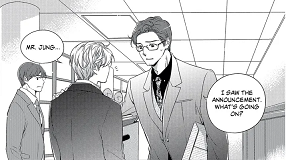 as well as selfish and ruthless hypocrites. In other words, the next time you read a manhwa, be careful with characters wearing glasses, they might be dangerous and their smile might be fake.
 (chapter 16) The main lead explains that he chose to wear glasses, because he desired to avoid rejection and fear. He had noticed that the absence of facial expressions (smile) and his cold gaze would be misjudged by people. Here, Matthew used the glasses as protection. And this illustration reinforces my interpretation: glasses in manhwas have a huge importance in the end, they should be considered as masks too.
  The latter is the only one who can control him.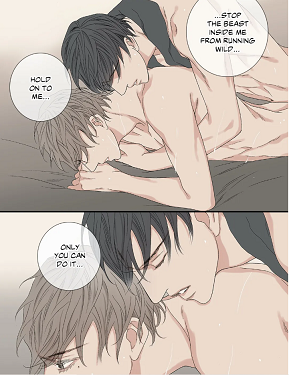
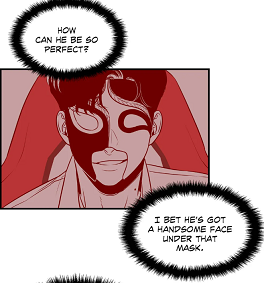 (chapter 1) This is his second identity: BJ Alex. On the one hand, he desires to remain anonymous so that no one can recognize him in real life, on the other hand this signifies that he is living a double life. He would like to protect his privacy, but also his secret life as homosexual. That’s why he said this, when his relationship with Nam Dong-Gyun was revealed:
 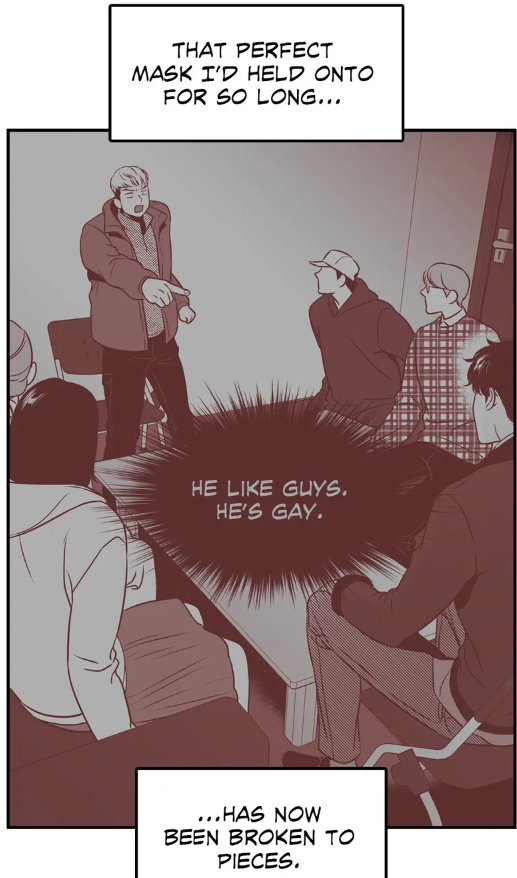 As you can observe, a name and as such notoriety can also serve as a mask. The president of the council was admired by his peers, he was so perfect that some students even wondered, if he was human.
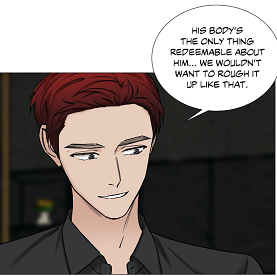 and the president is not recognizing it. But why is reputation a mask? It is, because people often judge others on hearsay and first impressions. The social medias are the perfect example for superficial and quick judgement. But we have to question ourselves about Ahn Jiwon’s initial motivations to hide behind a good notoriety.
 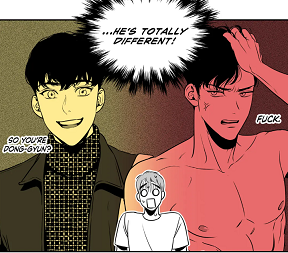 In the beginning of the story, he doesn’t even know the other protagonist very well, yet he is willing to take care of him, when the latter is drunk. The president is seen constantly smiling and has never externalized negative emotions (anger, violence…). This explicates why the uke was so shocked and confused, when he saw a brutal BJ Alex. The latter had discovered his secret, hence the former felt vulnerable. On the other hand, Nam Dong-Gyun wondered about Ahn Jiwon’s true personality. But the uke was not the only one who had no idea about Ahn Jiwon’s true character. The latter was also confused.
  This signifies that the protagonist was never confronted with his own reflection.
  (Doctor Frost, chapter 11). That’s why he became an empty man in the end. He has no idea about his true self (his likes and dislikes). He was forced to follow his parents’ requests and his brother’s shadow. This emptiness is palpable in chapter 49, when the main lead confesses this: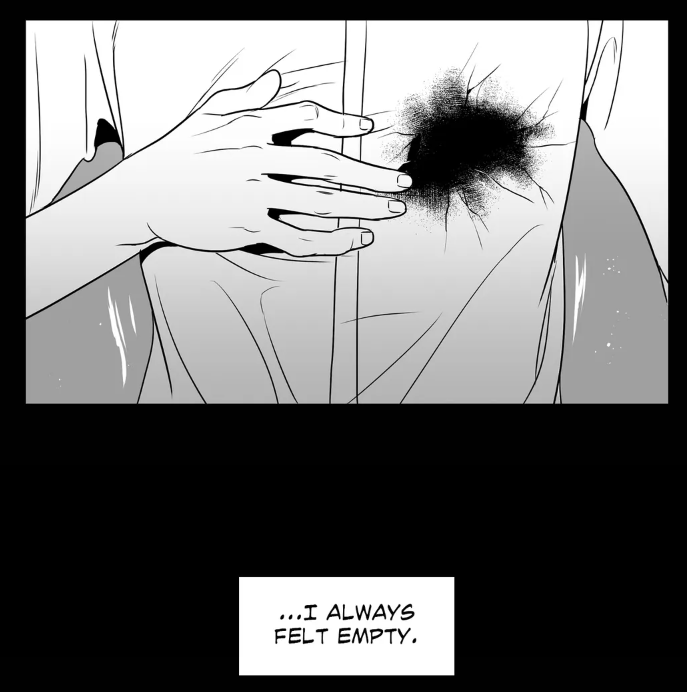
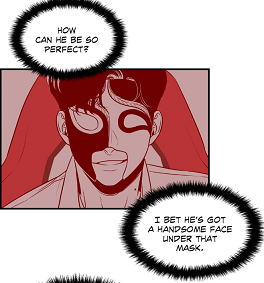 (chapter 1)
 (chapter 49) Since the adults kept criticizing him, he imagined that if he copied his brother, he would get recognition and acceptance. In other words, he forced himself to become a second version of his brother.
  But even copying his hair dress and tastes, he was doomed to failure, for the parents had already categorized him: he would always be inferior to their eldest son. He realized gradually that this wasn’t right, for his parents still didn’t perceive his true identity. That’s why he feels drowning, when he loses his mask.
  He doesn’t have the impression to exist.
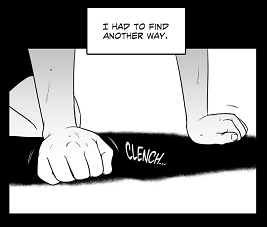
 (chapter 49) That’s why he chose a third mask: he tried to be admired at school. He was caring and considerate towards his fellows. However, since he had made this rational decision
 , in his mind he was acting. Hence he didn’t truly enjoy this situation.
 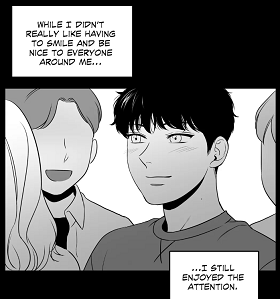 (chapter 49) He felt that he was forced to smile. Besides, I believe as he was fake, this admiration was quite superficial in his mind. Therefore he didn’t feel truly loved. That’s why at some point, he wondered if he would ever be loved…
 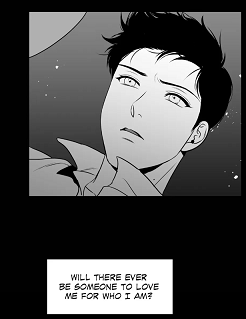 However, the readers should interpret this question differently: he was asking indirectly, when his true self would be recognized by someone. And the one who made him discover his true sexual orientation was unfortunately a player. That’s why the main lead was so devastated and hurt, when he discovered that his relationship was based on deception and fakeness. So after being sent to the army, Ahn Jiwon chose to act like in the past. He became a role model as a student, yet he could no longer hide his homosexuality. Hence he led a double life.
 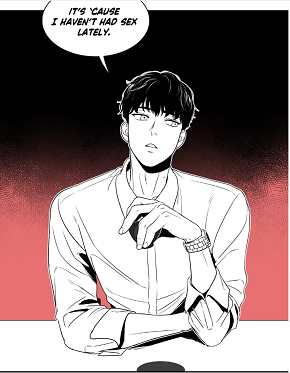 (chapter 08) In this scene, the charater is disguising his true thoughts. The black and red are representing his emotions: he is irritated, because he needs to have sex with Nam Dong-Gyun. Note how Ahn Jiwon is avoiding his counterpart’s gaze. The figure is acting, his mask is his face and the presence of the colors symbolizes the repressed and hidden thoughts and emotions. Mingwa colored one picture in chapter 51 marking a turning point in the protagonist’s life.
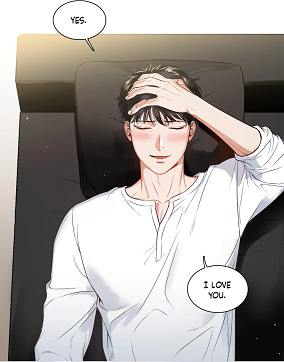 For the first time, he was acknowledging his feelings and as such his own desires. This picture represents the removal of one mask. He is slowly living for real, but in this chapter he still hadn’t found his true personality. The other mask (his reputation as good student) was still existent. Besides, he still believed that his smiling and caring attitude were just an act, while in truth he was genuine and caring. But due to his past, he had already internalized that this was just an act. And now, you comprehend why the latest episodes from BJ Alex are in color. The main lead had finally found his own identity and place.
  (Painter Of The Night, chapter 54), colors, reputation, etc. The protagonists are often hiding their true thoughts and emotions due to their past, while the villains are using masks to deceive people.
  Bebebisous33s' analyses in K-Dramaland and Manhwas