Please support the authors by reading Manhwas on the official websites. This is where you can read the Manhwa: Jinx But be aware that the Manhwa is a mature Yaoi, which means, it is about homosexuality with explicit scenes. Here is the link of the table of contents about Jinx. Here is the link where you can find the table of contents of analyzed Manhwas. Here are the links, if you are interested in the first work from Mingwa, BJ Alex, and the 2 previous essays aboutJinx 𓇢𓆸 Prove Me Wrong Again 💢😂 andPerfect👼🏼 Defect
It would be great if you could make some donations/sponsoring: Ko-fi.com/bebebisous33 That way, you can support me with “coffee” so that I have the energy to keep examining Manhwas. Besides, I need to cover up the expenses for this blog.
In the world of Jinx, superstition often masks deep psychological wounds. Readers are well aware of Joo Jaekyung’s belief in a hex: (chapter 2) his ritualistic sex before fights, his fear of losing control, (chapter 5) his reliance on routine. Yet there is another jinx in this story, one far less visible and perhaps even more tragic: Kim Dan’s.
In earlier analyses—particularly in the essay “Jinxed: Behind The Scenes 🎬” I stated that Kim Dan, like Joo Jaekyung, might have perceived his life as cursed. This conclusion emerged from his grim familial and financial circumstances: his overwork, exploitation by the loan shark, and his identity eroded by relentless sacrifice. At that time, the interpretation leaned heavily on visible hardships and his devotion to his grandmother. His silent plea (chapter 1) was seen as the core expression of a man who believed he was doomed.
However, Season 2 invites a more nuanced reading. I came to realize that Kim Dan never consciously viewed himself as jinxed. (chapter 56) In Chapter 56, Kim Dan is seen curled up next to a bed, whispering: “I’m scared… of being alone.” What makes this moment especially revealing is that he is not physically alone, for he is resting next to his grandmother. The presence of the very person who raised him should, in theory, offer comfort. And yet, the fear persists.
This contrast underscores the depth of Kim Dan’s emotional wound. His fear isn’t simply about being left in the future — it’s the echo of a past abandonment so profound that even proximity can’t soothe it. His grandmother is alive, mere steps away, yet his body curls into itself, instinctively shielding against an absence that has already been internalized.
That he doesn’t say “I’m scared of being abandoned” or “of being jinxed” shows that this fear hasn’t been processed into words or reason. It’s not part of his conscious self-concept. Unlike the celebrity, who ritualizes his fear as a “jinx” and tries to control it through actions, Kim Dan’s trauma remains trapped in silence. He doesn’t believe he is cursed — not on the surface. But emotionally, he lives as if he were. The hex exists, not in his language, but in his body.
His whispered fear in the dark — “I’m scared… of being alone” — is the clearest window into his hidden jinx. And perhaps the most heartbreaking part is this: he voices it not, when he is abandoned, but when someone is still there. That’s how deep the fear runs. (chapter 21) And this issue didn’t begin in adulthood. In Chapter 21, Kim Dan dreams of a night from his childhood: he wakes up alone, glances around the room in quiet confusion, and softly calls out for his grandmother. The room is dim, the bed beside him empty. This image carries more than just childhood anxiety: (chapter 21) It weaves together absence, silence, and the specter of loss. What’s striking is that the nightmare surfaces, not when he’s alone in the present, but after he has just returned from watching over his hospitalized grandmother. (chapter 21) He lies on the couch and dreams of a night when she vanished from their shared bed. (chapter 21) This reveals how, in Kim Dan’s subconscious, the night and an empty bed have become synonymous with death. The trauma is deeply embedded, where even temporary absence is tied to the irreversibility of loss. For Kim Dan, solitude at night (chapter 67) is not mere loneliness—it is abandonment, it is death, it is the erasure of home. It is repressed, hidden beneath his quiet demeanor and years of survival-based behavior. Rather than a rational belief, it is a subconscious wound that only surfaces in moments of extreme vulnerability—especially at night.
So while Joo Jaekyung’s curse is shouted and choreographed (chapter 2), the doctor’s is secret and involuntary. His actions—his fearful expressions (chapter 57), his pattern of emotional detachment (chapter 67), and his obsessive loyalty to his grandmother (chapter 10) signal a suppressed conviction: that he is destined to be left behind. What seemed like devotion now appears as coping; what appeared stoic was survival. And with the impending death of his grandmother, the anchor holding this hidden jinx in place is slipping away.
A Jinx Rooted in the Night
The key lies in the night. The most pivotal emotional regressions in Kim Dan’s life happen after dark. Whether it is the first night with Joo Jaekyung in Chapter 2 (chapter 2), the trembling kiss (chapter 44) and touch (chapter 44) in Chapter 44, the complete breakdown (chapter 66) in Chapter 66, or the transactional submission (chapter 67) in Chapter 67, nighttime becomes the stage for his unresolved trauma. These nights mirror one another and suggest an origin story that predates them all: a night when Kim Dan was abandoned by his mother.
This theory is supported by visual cues and character behavior. In Chapter 56, Kim Dan curls into himself in bed, unable to sleep. He admits silently, “I’m scared… of being alone.” That fear is not adult anxiety—it’s childhood terror. (chapter 56) The body language, the shadows, the loneliness—they evoke the image of a small child who once cried through the night, waiting for someone who never returned.
Kim Dan’s actions echo those of someone who was left too early—possibly around the age of six. Psychologists describe this stage as a turning point in emotional development. If a caregiver vanishes at that time, the child internalizes the absence as a personal fault. He grows up believing that love is conditional, that if he’s quiet, obedient, invisible—maybe no one else will leave.
Mingwa subtly ties this back to animal behavior through the inclusion of puppies. (chapter 57) A puppy needs at least eight weeks with its mother to grow emotionally secure. By drawing this parallel (chapter 59), the story tells us: Kim Dan was separated too soon. He was not ready.
The Role of the Grandmother: A Talisman, Not a Cure
Kim Dan’s grandmother became his emotional anchor: (chapter 47) the one person whose presence could keep the jinx at bay. As long as she was there, he could suppress the trauma, function, survive. She was his talisman. But she was never a healer, for she never spoke about his parents. She never addressed the core of his abandonment, like we could witness in the doctor’s nightmare: (chapter 57) And silence, when it comes to trauma, does not protect—it festers.
Her infantilization of him is also telling. (chapter 53) (chapter 65) One might argue about this, for in this scene, (Chapter 56) he tucks her in. Their roles are reversed. He behaves like a parent, whereas in truth, he is reverting emotionally to a child terrified of being alone. This reversal highlights the internal dissonance between his outward behavior and emotional reality. Though he was forced to grow up quickly (chapter 65), he still carries the emotional wounds of a child. And from my point of view, the grandmother knows it, therefore she treats him as a child. And this observation led me to the following question: why does she still view him as a “boy”, though he has been working since his youth? It is because he can not sleep alone! What caught my attention is that she never stated, when the doctor started smoking or drinking. (chapter 65) Was it the moment, when she went to the hospital? The timing is crucial, as it can give clues about the main lead’s sleeping trouble. In episode 67, the protagonist finally exposed his cause: (chapter 67) This reinforces my hypothesis that his bad drinking habits are related to the absence of a loved one next to him.
In other words, he can not sleep alone and from my perspective, Shin Okja knows it, but is refusing to become responsible for this situation. (chapter 47) She witnessed this since he was a child, which explains why she never truly addressed his fear of being left behind. This would explain why the halmoni tried to send him away from the hospice in episode 56: (chapter 56) Imagine what it means for her: her grandson is already 29 years old and he can not sleep alone. Under this perspective, Jinx-philes can grasp the relative’s reasoning. The problem is that her knowledge is actually wrong! How so? It is because the protagonist was able to sleep so well alone in the penthouse, to the point that the athlete was envious of him. (chapter 29) That’s how it dawned on me why Shin Okja was so determined to send back her grandson to Seoul.
The grandmother’s insistence on Kim Dan “living his life” (chapter 65) and going back to Seoul under the guise of freedom and career advancement takes on a deeper meaning when viewed through the lens of emotional avoidance. Her words may sound supportive, but they conceal a subtle attempt to sever the emotional tie without taking responsibility for its existence. Now, rather than confronting this vulnerability head-on, she shifts focus to the one thing she believes can replace human closeness: work. A busy man has no time to wallow, no time to drink, no time to remember the empty bed. A man with a career won’t ask for someone to hold his hand at night. In that sense, her vision of “a good life” is one of functionality, not emotional fulfillment. If he works, he won’t be a burden. If he’s successful, she doesn’t have to worry. Yet this approach doesn’t cure the root wound — it just redirects it. This situation mirrors the wolf’s: (chapter 19) The latter is obsessed with work, while he is suffering from insomnia.
The tragedy here is that in encouraging him to grow up through labor, she’s also denying him the right to be a child — something he never got to be in the first place. Her version of love is sacrifice and survival. (chapter 65) And the best evidence for her selfishness and neglect is her ignorance about her grandson’s plan for his future. She is not discussing with him about what he likes or dislikes. She is directing his life, like she did it in the past in the end. And while she may think she’s doing what’s best, her silence about his fears, her ignorance about his true conditions (no home, blacklisted in Seoul) and her refusal to discuss his emotional future reveal a lingering discomfort with the very idea of dependence — perhaps because it reminds her of her own failures or helplessness as a parent figure.
In the end, her encouragement to “live his life” isn’t truly about Kim Dan finding happiness or chasing dreams. It’s about the grandmother relinquishing responsibility — an emotional handoff wrapped in the language of care. (chapter 65) By urging him to return to Seoul and focus on work, she’s hoping that if he stays busy enough, he won’t have time to feel the crushing loneliness that has always shadowed him. She wants him to mature overnight, not because she believes he’s ready, but because she can no longer carry the weight of his dependency. One might say, he is already 29 years old, so she is right. In truth, this isn’t guidance — it’s guilt management. Notice that she is entrusting the main lead to the champion which is not pushing Kim Dan to become „independent“. Her attitude, summed up by the phrase “out of sight, out of mind,” unintentionally mirrors the same abandonment he experienced in the past. She is refusing to worry about him, her peace of mind matters more than his well-being and the champion’s. (chapter 65)
This connects directly to one of the most telling moments in Chapter 67, (chapter 67) when Kim Dan, eyes wide and voice trembling, asks Joo Jaekyung: “Are you saying you brought me here because you’re worried about me?” His expression reveals everything — a fragile hope for genuine concern. But the only response he gets is silence. (chapter 67) This unspoken answer reverberates with painful familiarity: from his vanished mother, from his halmoni who rarely expressed love (rather gratitude and pity), and from a world that reduced him to his usefulness. What he really wants to know is: “Do I matter to you as a person?” And just like his grandmother, the champion fails to offer direct emotional reassurance. Yet unlike her, Joo Jaekyung is still learning. His silence isn’t rejection, but emotional illiteracy — a work in progress.
The irony is that while Park Namwook represents over-control disguised as concern, Shin Okja represents detachment masked as selflessness. She doesn’t want to worry anymore, so she chooses to send Kim Dan away — to someone she thinks should take over. Nonetheless, in my eyes, this isn’t responsibility; it’s avoidance. And for someone like Kim Dan, who already associates nighttime with abandonment, silence with rejection, and empty beds with death, being handed off again only reinforces his unconscious belief: I’m jinxed to be left behind.
The grandmother may never have raised a hand against him, but her silence, her emotional evasiveness, and her idealized image of herself as a “sacrificing protector” created a one-sided bond rooted more in guilt than in love. Her presence was constant, but the emotional quality of her care — the nurturing, the honest affection — was lacking. Hence she still doesn’t know that Kim Dan has no home in Seoul. (chapter 65) And when we remember that Kim Dan tried to call her, she (chapter 65) replied with a silence. Here, she claims that he addressed her as “mom”, but it is possible that she was just projecting her own fears onto her grandson. Since she was by his side all the time, she feared to be seen as his mother. Like mentioned above, the mother might have been busy due to work (or sick) and asked her relative to take care of her grandchild.
Ultimately, what he longs for is simple: to be seen, talked, loved, and to be chosen — without conditions. But those around him have always expected him to be strong, quiet, grateful. So he became all of those things… at the cost of his own soul.
Shin Okja never kissed him like a mother. (chapter 57) Yet in Chapter 44, Kim Dan kisses Joo Jaekyung with soft, maternal gestures—on the cheek, on the ear. (chapter 44) These gestures suggest he had once received such kisses, most likely from his mother. It means he remembers love, even if he doesn’t know how to process its loss.
Her insinuation that Kim Dan owes her everything created a myth of self-sacrifice—one that replaced genuine emotional closeness. She demanded gratitude, not emotional connection. She lived in the mindset of having, not being. As a result, Kim Dan grew up confusing love with obligation, gratitude, and performance. His difficulty in expressing love isn’t due to coldness or immaturity—it’s the byproduct of a dysfunctional emotional education.
This is why, even though he once confessed “I love you” to Joo Jaekyung in the States (Chapter 39), the moment is tainted. It occurred under the influence of an aphrodisiac, intertwining love with sex. Furthermore, he has never voiced this sentiment to his grandmother—perhaps because she never said it to him. It was never modeled. While others might judge Kim Dan’s emotional restraint, I desire to stay neutral. He is not an emotionally stunted adult by choice—he is a product of emotional neglect. That’s the reason why Mingwa has associated him with an angel. He is carrying the sins of “adults”. By likening him to an angel, Mingwa frames his pain not as weakness, but as unjust burden. He embodies purity, sacrifice, and resilience, not because he was allowed to thrive, but because he endured. The angel metaphor becomes even more striking when you think about traditional symbolism: angels don’t belong to Earth, yet they walk among the living, often suffering in silence and helping others. That’s exactly Kim Dan — out of place, bearing the consequences of others’ choices, carrying guilt, debt, and unspoken grief that were never his to begin with.
He’s carrying the sins of adults: – A school which allowed bullying – A grandmother who turned emotional dependence into silent expectation. – A mother who vanished, whether through death or abandonment. – A society that reduced him to labor, debt, and obedience. – And even a partner, at first, who used his body without recognizing his soul.
Interestingly, his emotional jinx is also spatial. When living in the penthouse, Kim Dan began to sleep peacefully (chapter 29) —not because of physical intimacy with Joo Jaekyung, but because he felt safe. For a time, the place became his illusion of home. But when the champion showed mistrust, the illusion shattered. (chapter 51) The penthouse was never truly his. It was borrowed space. This explicates his refusal to spend the night there. (Chapter 67) Observe how Joo Jaekyung called the penthouse: not home, but his place. Due to the last altercation, the emotional safety collapsed. This experience reactivated his fear of abandonment and solidified the belief that he has no home. (chapter 65) Even the family photo (where and by whom it was taken is unclear) emphasizes the fragility and incompleteness of his sense of belonging.
The Secret Jinx That Must Break First
Each major night scene—Chapters 2, 44, 66, and 67—reveals another layer of the doctor’s jinx. Chapter 2 introduces the concept of the jinx explicitly: Joo Jaekyung believes he must have sex before each match, regardless of partner. This idea of impersonal routine and bodily sacrifice mirrors Kim Dan’s own subconscious belief: (chapter 61) that he must sacrifice his “needs” and identity to be accepted.
Yet in order to truly break Joo Jaekyung’s so-called “jinx”—which, as theorized, may stem from rigged matches and trauma masked by routine—the doctor’s hidden curse must be broken first. As long as Kim Dan sees himself as inherently unworthy and destined for abandonment, he will unconsciously reinforce a dynamic where emotional distance feels safe and predictable.
Chapter 44 shows the beginnings of intimacy (chapter 44), yet even then, it is expressed through regression. Kim Dan’s kisses are gentle, reminiscent of a child seeking comfort, not a lover expressing desire. (chapter 66) Therefore it is not surprising that he laughes like a little child during that night. (Chapter 44) Chapter 66 represents its negative reflection, the emotional climax of this regression: (chapter 66) he cries, begs, (chapter 66) holds on—“Don’t leave me.” (chapter 66) His squeezing fingers holding onto the athlete’s shirt (chapter 66) and desperate pleas are not about romance—they’re about survival, longing and regret. Deep down, he wished, he had hold onto his “mother” in the past, stopped her from leaving him. Is it a coincidence that this gesture from that night mirrors the one during their first night? (chapter 2) And what had the protagonist said right after this gesture? (chapter 2) He wanted the champion to keep his promise. From my point of view, the parent’s vanishing is strongly intertwined with a broken promise… And that’s exactly what the grandmother did to her own grandson: she didn’t keep her words either. (chapter 11) (chapter 53)
Then comes Chapter 67. Though no longer crying, he submits once more (chapter 67), but this time, with eerie detachment. He kneels before Joo Jaekyung like a servant, (chapter 67) asking for sex again. Yet the power dynamic is not as it seems. Though Kim Dan is physically lower, it is Joo Jaekyung who ultimately submits: (chapter 67) his arousal betrays a loss of emotional control. Though he is on his knees, it is Joo Jaekyung who is emotionally yielding. His body betrays his composure, responding to Kim Dan’s touch and gaze. Kim Dan, watching the tremble in the fighter’s expression and the rising heat in his body, feels the shift. His soft blush is not simply one of affection or embarrassment—it’s a flicker of recognition. (chapter 67) He senses that the one usually in control is now unraveling. Appearances deceive: beneath this scene lies a quiet reversal of power. The blush on his cheeks is a trace of a brief moment of clarity: he sees that the person who once held all the control is now faltering.
Ultimately, this mirrors Chapter 2 once more. Back then, Kim Dan surrendered his body, believing it was his only tool for survival. But Chapter 66 reveals that even in moments of closeness (chapter 66), his body is still a vessel for mourning. Hence there is no kiss during that blue night. Each night carries the residue of that first trauma: the night he was left alone. Whether his mother disappeared or passed away in the night, the result is the same—nighttime became synonymous with loss.
This is why he fears being alone after dark. This is why he clings to those who stay past midnight. And when Joo Jaekyung, the one person who broke that pattern, walked away, even briefly, it fractured him. (chapter 63) His so-called jinx is not some irrational superstition. It’s a scar. It’s the quiet belief that the people he loves will vanish the moment he lets his guard down.
So while the champion’s jinx revolves around physical ritual and control, Kim Dan’s is rooted in emotional suppression and dread. Both stem from the same core wound: fear of abandonment.
But Chapter 67 deepens the tragedy: this time, he doesn’t just mourn: he gives in. The act is no longer about clinging to someone or begging them to stay. Instead, it is performed with emotional detachment, a mechanical reenactment of what once held meaning. His internal monologue (chapter 67) makes it clear: he isn’t trying to survive, he’s quietly unraveling. His decision to mix alcohol with medication is not rebellion (chapter 67), it’s resignation. Hence he is not expecting to be cured with the pills. (chapter 67) Thus, chapter 67 reveals the darkest layer of his jinx: not fear of abandonment, but the numb certainty that love, safety, and home are illusions that always vanish with the night.
Observe the decoration on the wall: (chapter 67) It looks like the moon and Saturn are meeting each other. For me, the moon imagery in Chapter 67 is not accidental. Saturn, the planet of hardship and emotional lessons, casts its shadow over this night, mirroring the heavy atmosphere between them. When Kim Dan asks Joo Jaekyung if he brought him here out of concern, the champion remains silent—a silence louder than words. That silence is devastating. In that moment, Kim Dan’s deepest fear is realized: he is not loved, merely tolerated. And so, in an act of resignation rather than seduction, (chapter 67) he offers sex to “settle up,” citing his own preparations like a transaction. (chapter 67) The room’s muted lighting and circular wall decor even evoke the image of an eclipse—as if the moon (emotion) is being overshadowed by Saturn (cold logic and debt). This alignment encapsulates the heart of the scene: vulnerability eclipsed by duty, affection swallowed by silence. That’s the reason why I can’t help myself thinking that Kim Dan might end up in the emergency room later. Besides, we never saw him eating before taking his pills: (chapter 67) while he drank alcohol with the medicine. (Chapter 67) Until now, the champion has a blind faith in drugs, just like the grandmother.
A Split Between Night and Day
One of the most striking revelations is the emotional split between the protagonists. Joo Jaekyung acts like a child during the day (chapter 7), while Kim Dan becomes a child during the night.
By day, Jaekyung seeks routine, praise, validation, and control. His outbursts, tantrums, and need for order mirror the emotional needs of a child. He’s the performer, the strongman, but behind that exterior lies someone seeking parental structure.
At night, Kim Dan’s walls crumble. His trauma surfaces. He cries, begs, trembles—not for pleasure, but out of fear. These breakdowns are not romantic; they’re regressive. And until these wounds are addressed, he can’t become the nurturing figure Jaekyung truly needs. This explicates why during the day, Kim Dan tries to act like an adult and rejected the champion‘s help. (Chapter 66)
For their relationship to heal, Kim Dan’s nightmares must be addressed. Only then can he grow into the “motherly” role he’s beginning to fill during the day—someone who can offer stability, not just silent service. Until the end of season 1, his care was more rooted in duty, than real love and genuine concerns. He didn’t argue with the fighters (chapter 47), when the “wolf” was portrayed as a thug, though the latter had assisted him on multiple occasions.
Conclusion: It’s Happening Again
Now, the imminent death of the grandmother and the puppy bring everything back. Kim Dan isn’t just afraid of the future—he’s haunted by the past. Their death isn’t merely a loss—it’s a reawakening of everything he suppressed. The loneliness, the silence, the night—“It’s happening again.”
But this time, he’s not numb. He’s unraveling. His subconscious belief—the doctor’s secret jinx—is finally being revealed. He is destined to be abandoned… unless something breaks the cycle. It is clear that Joo Jaekyung will be that person, but this change is definitely linked to pain. In chapter 66, for the first time, the doctor’s jinx had a voice. And it sounds a lot like: “Please… don’t leave me.” The problem is that Joo Jaekyung chose to listen to Shin Okja, rather than talk to Kim Dan.
Feel free to comment. If you have any suggestion for topics or manhwas, feel free to ask. If you enjoyed reading it, retweet it or push the button like. My Reddit-Instagram-Twitter-Tumblr account is: @bebebisous33. Thanks for reading and for the support, particularly, I would like to thank all the new followers and people recommending my blog.
Please support the authors by reading Manhwas on the official websites. This is where you can read the Manhwa: Jinx But be aware that the Manhwa is a mature Yaoi, which means, it is about homosexuality with explicit scenes. Here is the link of the table of contents about Jinx. Here is the link where you can find the table of contents of analyzed Manhwas. Here are the links, if you are interested in the first work from Mingwa, BJ Alex, and the 2 previous essays aboutJinx Wheels 🛞 and Waves 〰🌳 – p️art 2 (locked)and 𓇢𓆸 Prove Me Wrong Again 💢😂
It would be great if you could make some donations/sponsoring: Ko-fi.com/bebebisous33 That way, you can support me with “coffee” so that I have the energy to keep examining Manhwas. Besides, I need to cover up the expenses for this blog.
The recent developments in Jinx Chapters 65 and 66 provide a striking insight into the ongoing inner turmoil between Joo Jaekyung and Kim Dan. Many readers have long labeled Joo Jaekyung as a ‘red flag,’ and as such as a demon. Therefore when he used the idiom ‘defect,’ (chapter 66) they saw it as further confirmation of their perception—reinforcing the idea that he is terribly flawed. However, a deeper analysis suggests that this term reflects not just his character but also his evolving mindset and struggle with emotional vulnerability. This essay will explore the paradox at the heart of their dynamic—how both men refuse to acknowledge the emotional weight of their relationship, leading to a cycle of denial and misperception. It will examine how the concept of the jinx evolves, the continued influence of Park Namwook’s manipulations on Joo Jaekyung, and the role that mutual ingratitude plays in their emotional stagnation.
The Evolution of the Jinx: From Powerlessness to Repair
Initially, Joo Jaekyung’s jinx was a ritual designed to maintain control and secure victory. (chapter 2) This belief system dictated that, no matter what, he had to have sex with a man before every match—reinforcing the illusion that he could manipulate fate through repetition. The identity of his partner was irrelevant; what mattered was the act itself, which he perceived as a necessity rather than a choice. This routine provided him with a sense of control, but it also underscored a fundamental reliance on external factors rather than his own abilities. In Chapter 65, however, a subtle shift occurs. While the champion has not dropped his belief yet: (chapter 65), the nature of his principle has changed: (chapter 65)The athlete is admitting his dependency on doc Dan. The jinx is now directly tied to Kim Dan, not just as a concept but as a tangible element of Joo Jaekyung’s career stability. The second switch is that sex is no longer a condition to ward off bad luck. In fact, the celebrity is recognizing the importance of his daily training and, as such, his hard work. (chapter 65) The inner thoughts of the sportsman reveal that the champion is feeling less powerless than before. His champion status is no longer reliant on superstition but on tangible efforts—his “old routine” and, crucially, Kim Dan’s expertise as a physical therapist. This marks a significant transformation in his perception of Kim Dan, whom he now values for his professional skills rather than as a mere tool for maintaining a ritual. Thus, Joo Jaekyung should be less inclined to request Doc Dan’s sexual services. Then, in episode 66, a new change became visible. (chapter 66) The term defect emerges in his inner monologue, marking a transition from viewing the jinx as a form of dependency to seeing Kim Dan as someone in need of repair. This linguistic change is crucial—jinx implies something external, uncontrollable, and tied to fate, whereas defect introduces the notion of something that can be fixed or even improved.
Joo Jaekyung’s use of the term ‘defect’ stems from his deeply ingrained perception of both himself and others as products rather than individuals with intrinsic worth. Instead of saying that Kim Dan is ‘sick’ or struggling, he labels him as ‘defective,’ mirroring his own self-perception. The champion has long seen himself as nothing more than an athlete, a machine built for fighting—functional when at peak performance, broken when failing. This perception is reinforced by his manager, Park Namwook, who treats him as nothing more than an ATM (chapter 11), a tool to generate money and maintain the gym’s reputation. Hence he blames him, when members leave the gym. (chapter 46) The manager used the incident with Seonho to justify the desertion of the other athletes. However, it is clear that some left the gym because they didn’t become successful like Joo Jaekyung. However, their lack of success is explained by their lack of talent (chapter 46) exposing the lack of ambition and commitment from the two hyungs. It is clear that Joo Jaekyung’s wealth and fame was used to attract the sportsmen creating a myth that they could experience the same success. Nevertheless, as time passed on, the fighters were confronted with reality. It was, as if the athlete’s achievement had become a curse for Team Black. Nonetheless, neither the manager nor the coach can admit it, the champion’s bad temper is utilized to cover the mismanagement within the gym. Striking is that by portraying the protagonist as a person with a bad temper and personality , (chapter 9) the manager and his colleague described their boss as defective. The contrast between Joo Jaekyung’s perception of ‘defect’ and the coach’s view of him as a ‘maniac’ is particularly telling. When the protagonist refers to Kim Dan as having a defect, there is an implicit acknowledgment that something can be repaired or improved. In contrast, Park Namwook’s statement about ‘handling that maniac’ suggests that the star is beyond fixing—someone who must be tolerated and controlled rather than understood or helped. This fundamental difference in perspective reveals how deeply the manager has shaped the champion’s self-perception, reinforcing the idea that he is nothing more than a force to be managed rather than a person who can change or grow.
Ironically, (chapter 11) Joo Jaekyung once accused Kim Dan of seeing him as an ATM back in Chapter 11, but in reality, it is his manager who exploits him as a financial asset rather than recognizing his humanity. Hence he wants him to return to the ring as soon as possible. (chapter 54)
Under this new light, Jinx-philes can grasp why the “demon” (chapter 66) refers to Kim Dan’s condition as a ‘defect’ rather than acknowledging that the doctor is unwell. In doing so, he mirrors how he has been conditioned to see himself—not as a person who can be sick or in need of help, but as something that must either function or be discarded. The paradox is that without him, the gym can no longer attract members, hence Team Black would be forced to close its doors. That’s the reason why the manager is inciting the athlete to return to the gym. (chapter 66) His presence is necessary to maintain the “myth” alive.
But let’s return our attention to the fighter. (chapter 66) Notice that the champion doesn’t say that Kim Dan is sick or suffering from sleeping problems. His words expose that Joo Jaekyung still views life through the lens of having rather than being, seeing both himself and others as assets to be maintained rather than individuals with intrinsic worth. Furthermore, this label is deeply connected to Kim Dan’s own sleeping problems, which mirror Joo Jaekyung’s insomnia.
By recognizing a flaw in Kim Dan, he unconsciously acknowledges his own suffering without explicitly confronting it. Therefore he is accompanying the protagonist to the sleep specialist. (chapter 66) In calling Kim Dan ‘defect,’ Joo Jaekyung is unknowingly projecting his own self-perception onto him. The term suggests something broken but also something that can be repaired, reflecting an unconscious shift in his perspective. Instead of simply using Kim Dan as part of a superstition, he is beginning to see his vulnerability, perhaps even recognizing a parallel to his own struggles. His choice of words also reveals his deeply ingrained belief in self-reliance. (chapter 66) Kim Dan’s nighttime distress contradicts this principle, as it suggests an inability to be alone. This mirrors Joo Jaekyung’s own realization in the garden (chapter 65), where he admitted to himself that he was no longer entirely self-reliant. By calling Kim Dan ‘defect,’ he not only acknowledges the therapist’s struggles but also his own growing dependency on him—though he remains unwilling to fully confront it.
This shift is significant because it alludes that Joo Jaekyung is beginning to see himself as capable of affecting change. For someone conditioned to endure suffering without seeking help, viewing another person as defective paradoxically offers him a sense of power and responsibility. (chapter 66) Hence it is no coincidence that he chose to bring himself the “hamster” to the hospital. (chapter 66) Nevertheless, the idiom (“he’s got a defect”) reveal that Joo Jaekyung is still under the manager’s influence. This means that this shift is not immediate or conscious; it is restrained by his continued loyalty to Park Namwook and his ingrained avoidance of emotional vulnerability.
The Manager’s Manipulations: Control Through Information
Striking is that in season 2, the champion is almost never seen with the other members from Team Black. (chapter 60) This scene represents the exception. For the most part of the time, the star only visited the gym because Park Namwook had contacted him. (chapter 54) (chapter 66) Striking is that by each meeting, the champion was alone with the manager. The latter was no longer followed by coach Yosep. It was, as if Park Namwook wanted to have some privacy with the celebrity. However, through this contrast, Jinx-lovers can detect a certain MO from the manager: he is isolating the champion, limiting his interactions with other members. This explicates why he remains a pivotal force in Joo Jaekyung’s stagnation.
A clear example of Park Namwook’s manipulative tendencies emerges in his interactions with Joo Jaekyung in Chapter 66. He subtly pressures the champion to return to the gym by implying that his current behavior—isolating himself—is not normal. (chapter 66) Yet, just moments later, he tells him that he can take more time to rest, as if feigning concern. This contradiction is striking because it exposes his underlying agenda: he wants Joo Jaekyung back in the gym but doesn’t want to appear forceful. Instead, he makes it seem like Joo Jaekyung is the one making the decision, fostering guilt by implying that his long absence is unnatural.
What makes this irony even more apparent is that Park Namwook has, in the past, dismissed Joo Jaekyung as a ‘spoiled child with a bad temper.’ (chapter 52) His sudden shift—acting as though the champion is no longer himself—reveals his inconsistency. When Joo Jaekyung was compliant, he was simply a reckless athlete with an attitude. Now that he is exhibiting autonomy, Park Namwook implies that something is wrong with him. It was, as though he was missing the old version of the champion. 😂 But this is what he complained about him in the past: he was a workaholic! (chapter 27) This double standard highlights Park Namwook’s true role: he is not a supportive figure but a handler, ensuring that Joo Jaekyung remains under control and fulfilling his duties as a fighter. His words are not meant to provide genuine support but to keep Joo Jaekyung tethered to a system where his worth is defined solely by his success in the ring.
His subtle manipulations ensure that Joo Jaekyung remains dependent on his management, discouraging emotional entanglements that might threaten his control. This is evident in the way he frames Joo Jaekyung’s return to training in Chapter 66, focusing on ensuring compliance rather than addressing the champion’s personal struggles. (chapter 66) Park Namwook ensures that Joo Jaekyung remains confined within the narrow definition of an athlete whose sole purpose is to generate victories and revenue. By subtly invalidating the fighter’s autonomy, he fosters a cycle of dependency, discouraging any form of emotional connection or self-reflection that might lead Joo Jaekyung to question his control. The manager’s contradictions—both urging him to take his time yet implying his behavior is unnatural—serve to reinforce this conditioning, ensuring that the champion remains locked in a pattern of obligation rather than self-discovery. In doing so, Park Namwook not only suppresses Joo Jaekyung’s potential for growth but also reinforces the deeply ingrained perception that his worth is conditional and transactional.
His tactics extend beyond mere coaching—he controls information, as seen in his omission of lost sponsorships (chapter 54) or (un)favorable interviews about the athlete. (chapter 54) (Chapter 57) As a manager, Park Namwook’s role involves overseeing Joo Jaekyung’s career, securing contracts, and ensuring his reputation remains intact. Yet, as seen in Chapter 66, his actual concerns seem remarkably narrow in scope. (chapter 66) When speaking to Joo Jaekyung, Park Namwook focuses exclusively on the gym—as if the athlete were merely a member rather than the actual owner. This detail is particularly ironic, as it reveals that the man with the glasses sees himself as the one in charge, entitled to dictate Joo Jaekyung’s movements and decisions. His fixation on the gym exposes why he shows no interest in other crucial aspects of the champion’s career, such as contracts, endorsements, or emotional and physical recovery. His management is driven not by genuine concern for the fighter’s well-being, but by a desire to uphold the gym’s operation and reinforce his perceived authority within it. To conclude, his true motivation lies in preserving the gym’s function and image, treating Joo Jaekyung as a means to that end rather than supporting him as a multidimensional individual with emotional and professional needs. That’s the reason why he shows no curiosity about his star’s private life: “I don’t know what you’ve been up to lately”. (chapter 66)
Because his failure to reveal lost sponsorships and unfavorable interviews in Season 2 suggests a pattern of withholding critical information, I couldn’t help myself thinking to see as another clue that his omission extends to the fateful meeting between Choi Gilseok and Kim Dan, which took place in front of “HIS” gym! (chapter 48) Back then, there was a witness, Kwak Junbeom and the latter could have reported to the “hyung”. These incidents indicate a consistent effort to control what the champion knows, raising the critical question: why?? His silence on this matter suggests not only a strategic decision to keep the star uninformed, but also an attempt to avoid responsibility. The supervisor often hesitates to make decisive choices (chapter 50), preferring instead to remain passive so that any negative outcomes can be blamed on the champion. At the same time, this passivity helps him maintain control—as if Joo Jaekyung, without his guidance, would be left ‘alone’ and directionless. In this way, the man with the glasses sustains a dynamic in which the champion feels dependent on his presence, even as he is subtly undermined. By neglecting to inform him of these events, Park Namwook ensures that the champion remains unaware of external factors that could influence his choices. This pattern reinforces the possibility that Park Namwook was aware of the meeting with Choi Gilseok and deliberately ignored it, likely expecting that Joo Jaekyung would take care of it, while absolving himself of responsibility.
Park Namwook’s motivations become clearer when viewed through this lens. In his eyes, Joo Jaekyung is now physically perfect (chapter 66) —his shoulder has healed, and he should be able to return to the ring. However, at the same time, he regards him as defective (chapter 66) because he no longer displays the same single-minded devotion to fighting. Joo Jaekyung’s emotional distance from the gym and his growing attachment to Kim Dan mark a transformation that the manager interprets as a threat. Instead of embracing this evolution, the “supervisor” views it as a flaw—proof that the champion is no longer operating under the selfish, work-driven mindset he once encouraged. This contradiction reflects the “hyung”’s twisted priorities: he sees the gym as the center of value and promotes an ideology of workaholism, selfishness, and emotional suppression. Since he has no one by his side, he should come to the gym, as if he would nurture relationships there. To him, the ideal fighter is one who exists solely for the ring, forgoing connection or personal growth. In that sense, the protagonist becomes the Perfect Defect—flawless in form but, in Park Namwook’s eyes, failing in function by daring to become more human. The manager’s repeated emphasis on the gym reveals his narrow view of the champion’s purpose, treating him as a member rather than the rightful owner. This misperception reflects Park Namwook’s deeper worldview: he represents workaholism, selfishness, and greed, believing that the only acceptable behavior is unwavering devotion to the gym and career success.
The Slow Burn: Why The Characters’ Mindset Is Not Changing Abruptly
Despite these moments of introspection (chapter 65), the “wolf” does not immediately alter his behavior. (chapter 66) This hesitation stems from deeply ingrained beliefs about relationships and fidelity. His loyalty to Park Namwook prevents him from fully confronting the possibility that his manager may not have his best interests at heart. Moreover, his own emotional repression makes it difficult for him to recognize his evolving dependency on Kim Dan as something beyond physical necessity.
But there exists another reason for his slow transformation, the influence of the location. Notice that he agreed to his hyung’s statement, when he was in the penthouse. The latter stands for civilization and as such “corruption”. Thus I came to the following interpretation. The penthouse represents the manager’s power over the champion, which explicates why Oh Daehyun and the other fighters spoke about that place in admiration in front of their coach. (chapter 22) They had heard about his place, for the manager must have talked about it. The protagonist is not someone who will talk about his private life to others. The manager must have dangled promises in front of them, making them believe that if they’re lucky enough, they too could live like the champion. However, their reactions reveal something crucial—they are not motivated by greed but by genuine admiration. They simply want to experience the luxury once in a while, reinforcing that their bond with Joo Jaekyung is rooted in camaraderie rather than material envy. This further highlights the contrast between Park Namwook’s manipulation and the sincere regard his teammates have for him. This scene is important, because it exposes the manager’s prejudices and lack of discernment. (chapter 46) Not everyone is the same and more importantly like him! It is clear that the man is projecting his own principles onto others and in particular onto the champion.
His reluctance is further reinforced by the lack of validation from Kim Dan. (chapter 66) Neither of them fully understands how to acknowledge care or support. Just as Joo Jaekyung struggles to recognize his actions as stemming from concern (chapter 66) rather than routine, Kim Dan fails to see Joo Jaekyung’s interventions as genuine help. This mutual misunderstanding deepens the emotional rift between them, ensuring that both remain trapped in their own perceptions of obligation rather than connection. In Chapter 66, he openly expresses frustration, stating, (chapter 66). This moment highlights a rare glimpse of honesty: he is not acting purely out of self-interest, but he frames it as an obligation rather than a choice. From my point of view, such a statement could only reach the physical therapist’s mind, for in the latter’s eyes, the champion has always been a “demon”: self-centered and inconsiderate. Observe the absence of reply from the “hamster”. He couldn’t contradict the star, as the latter was using this negative image: bad tempered and selfish.
Mingwa has long associated doc Dan with an angel. . The reason is simple. He was portrayed as someone who would do favors to people constantly: his grandmother (chapter 53), the manager (chapter 9), the fighters (chapter 7) and even Choi Heesung. Hence the latter called him like that: (chapter 30) Kim Dan’s perception of himself as an “angel” has long shaped the way he interprets his relationship with Joo Jaekyung. Reinforced by his upbringing and Park Namwook’s subtle manipulation (chapter 36), he has unconsciously placed himself in a position of moral superiority. He is the patient, understanding figure, while Joo Jaekyung, in contrast, is violent (chapter 1), selfish, and emotionally stunted. However, this self-perception is deeply flawed. By believing himself to be inherently better (chapter 64) than the champion, Kim Dan avoids confronting his own emotional repression, his weaknesses, and his own form of “defectiveness.” He fails to see that he is just as human—just as fragile—as the man he silently judges. (chapter 66) The expression “Really…?” is not just about disbelief but also about a moment of confrontation with reality. Up until this point, Kim Dan has been dismissing his own suffering, suppressing his struggles, and functioning on autopilot. However, hearing a professional confirm that he is indeed sick forces him to acknowledge what he has been denying.
The word “really” acts as a bridge between doubt and acceptance, signaling that reality is crashing down on him. This corresponds to the downfall of an angel. He can no longer minimize or rationalize his exhaustion as something temporary—it’s a legitimate condition, one that requires attention. This realization is significant because it directly challenges his self-perception. He has always seen himself as someone who must endure, someone who cannot afford to be weak. But now, he is faced with undeniable evidence that he is not just tired—he is unwell.
This moment marks a turning point, where the truth of his condition is no longer something he can push aside. So far, he has always dismissed the champion’s remarks as “lies”: (chapter 60) or exaggerations. (chapter 66) It also forces him to consider that others—especially Joo Jaekyung—were right to be concerned, which in turn may lead to a shift in his perception of the champion’s actions.
Furthermore, Kim Dan grew up in an environment where repressing his desires was not just expected but necessary for survival. He was conditioned to associate sex (chapter 20) with shame, something impure that should be avoided or hidden. This internalized belief made it difficult for him to separate his own experiences from moral judgment. When he encountered the champion —who treated sex as nothing more than a professional ritual (chapter 2)—this stark contrast reinforced his existing worldview. He saw the celebrity as reckless, immoral, and impulsive, someone who lacked restraint and viewed intimacy as just another means to an end. In contrast, Kim Dan unconsciously positioned himself as purer—someone who was above such base instincts.
However, this sense of superiority is deeply paradoxical. While he judged Joo Jaekyung for his behavior, he was also the one who allowed himself to be drawn into the transactional dynamic without resisting it. Instead of questioning or confronting the situation, he passively accepted it, reinforcing his own role within the dynamic. His moral disdain for Joo Jaekyung did not stop him from complying with the athlete’s demands. This contradiction highlights Kim Dan’s deeper struggle: he is caught between his ingrained judgment and his own passivity. He wants to believe he is different from Joo Jaekyung, yet his actions—or lack thereof—suggest otherwise. This explicates why he is projecting his own behavior onto the athlete’s: (chapter 66) He assumed once again that the star had taken advantage of his “drunkenness”, something Kim Dan had done himself in the past.
This internal conflict plays a crucial role in why he struggles to acknowledge the changes in Joo Jaekyung’s behavior. If he were to admit that the champion is not just a brute, that he is capable of genuine concern, it would force him to reconsider his own beliefs—not just about Joo Jaekyung, but about himself. To do so, however, means dismantling the rigid perception of morality and purity he has clung to for so long. Until Kim Dan comes to terms with his own contradictions, he will continue to misunderstand Joo Jaekyung’s intentions, keeping them both trapped in a cycle of mutual misperception.
Mingwa has frequently associated Kim Dan with angelic imagery, but this serves as a double-edged sword. While it elevates him in the eyes of others, it also creates a psychological barrier that prevents him from recognizing his own suffering. His insomnia, his malnutrition, his growing depression—these are all things he ignores or downplays (chapter 66), even as they take a visible toll on his body. If he were to acknowledge his own vulnerabilities, he would have to admit that he is not above needing help, something he has spent his entire life avoiding. Instead, he clings to the idea that he must endure in silence, reinforcing the very behaviors that keep him trapped in a cycle of self-neglect.
This ties directly into the slow transformation of both characters. The angel needs to be reminded of his own true nature: he is human, and like any human, he can get sick, he can struggle, and he can fail. On the other hand, the champion, who has long internalized to see people through the lens of function and utility, has to recognize that being “defective” can represent a source of strength. So far, for him defect meant being worthless. Their reluctance to break away from these ingrained perceptions of themselves is precisely what keeps them at odds. Kim Dan resents Joo Jaekyung for his supposed lack of morality, yet he does not realize that his own self-righteousness blinds him to the reality of their relationship. Likewise, Joo Jaekyung, having always been valued for his physicality rather than his emotions, fails to grasp that true strength lies in acknowledging weakness—not erasing it.
This is why their transformations are not immediate. Their beliefs have been deeply ingrained through years of conditioning, and it takes more than a few interactions to dismantle them. Imagine this: a demon speaking to an angel, it perfectly encapsulates why they struggle to find common ground. Their fundamental worldviews have been shaped by entirely different environments—Kim Dan, who has been conditioned to suppress his desires and associate sex with shame, and Joo Jaekyung, who treats it as a necessity detached from emotion. This contrast creates a deep chasm between them, where one views the other as morally inferior, while the other sees emotional attachment as unnecessary or even a weakness.
Yet, the only place they can truly meet is Earth—neutral ground where neither absolute morality (Heaven) nor pure instinct (Hell) dictates their actions. And that would be the little town on the coast. (chapter 65) Symbolically, this reflects their respective journeys. The demon (Joo Jaekyung) is slowly leaving the underworld of detachment and blind routine, stepping toward vulnerability. Meanwhile, the angel (Kim Dan) is descending from his idealized, self-righteous perception of himself, recognizing his own flaws, desires, and limitations. Both must step away from their extremes—Kim Dan from his unconscious moral superiority and passive victimhood, and Joo Jaekyung from his emotional repression and transactional mindset.
Until they meet in the middle—on Earth, where human connection, vulnerability, and compromise exist—they will continue to misunderstand each other. Their so-called defects are what ultimately bind them together, but until they acknowledge them, they will remain locked in their cycle of denial and emotional stagnation. Kim Dan must first recognize that his suffering is valid, that he is not above pain, and that needing help does not make him weak. Likewise, Joo Jaekyung must learn that genuine care is not a transaction, nor is vulnerability a flaw. Until both confront these truths, they will continue to misunderstand each other, pushing one another away even as they inch closer to genuine connection.
The Missing Gratitude: A Two-Sided Problem
The absence of gratitude on both sides serves as the linchpin of their emotional stalemate. Joo Jaekyung, for all his power and success, has never been properly acknowledged outside of his career achievements (chapter 40) , while Kim Dan, conditioned by years of emotional neglect, sees gratitude as a transactional exchange rather than an expression of genuine appreciation. (chapter This creates a vicious cycle—Joo Jaekyung continues to view Kim Dan as a ‘defect’ (chapter 66) because Kim Dan does not recognize his efforts, while Kim Dan cannot see past his own survival instincts to notice that Joo Jaekyung’s actions are slowly shifting from obligation to care. Kim Dan, conditioned by years of neglect and survival-driven thinking, does not see Joo Jaekyung’s actions as genuine care. (chapter 66) He assumes everything comes with a price, failing to recognize moments where Joo Jaekyung acts beyond obligation.
Conversely, Joo Jaekyung, still in denial about his emotional investment, refuses to acknowledge any deeper attachment to Kim Dan. (chapter 66) And now, you comprehend why the champion employed the idiom “defect”. As long as Kim Dan does not express gratitude, Joo Jaekyung can continue convincing himself that his actions are dictated by habit or self-interest rather than care. Their inability to recognize and articulate their changing dynamic keeps them locked in a cycle of emotional detachment. Nevertheless, it becomes clear that this vicious cycle will stop, as now these two men are little by little influenced by the nice landlord: (chapter 66) And the latter can see beyond the appearances.
Conclusion: The Perfect Defect
In the end, the irony is that both characters see the other as defective in some way—Kim Dan as someone who is broken and in need of fixing, and Joo Jaekyung as someone incapable of expressing genuine care. Yet, it is precisely their emotional shortcomings that make them a perfect mirror for each other. The evolution of the jinx into defect signals an impending shift, but until gratitude is exchanged—until one of them acknowledges the other’s role in their life—the cycle will persist. As long as Kim Dan remains emotionally detached, Joo Jaekyung will continue denying his own feelings, making them each other’s Perfect Defect.
Feel free to comment. If you have any suggestion for topics or manhwas, feel free to ask. If you enjoyed reading it, retweet it or push the button like. My Reddit-Instagram-Twitter-Tumblr account is: @bebebisous33. Thanks for reading and for the support, particularly, I would like to thank all the new followers and people recommending my blog.
Please support the authors by reading Manhwas on the official websites. This is where you can read the Manhwa: Jinx But be aware that the Manhwa is a mature Yaoi, which means, it is about homosexuality with explicit scenes. Here is the link of the table of contents about Jinx. Here is the link where you can find the table of contents of analyzed Manhwas. Here are the links, if you are interested in the first work from Mingwa, BJ Alex, and the 2 previous essays aboutJinx A Body’s Worth and Lavender -Tinted Pillow Talk (locked)
It would be great if you could make some donations/sponsoring: Ko-fi.com/bebebisous33 That way, you can support me with “coffee” so that I have the energy to keep examining Manhwas. Besides, I need to cover up the expenses for this blog.
Introduction: The Evolution of the Jinx
Joo Jaekyung’s perception of his ‘jinx’ has undergone a significant transformation since the beginning of Jinx. Initially, he believed that his routine (chapter 2) —having sex the night before a match—was a necessary ritual to maintain his champion title. However, by Episode 62, his view of the jinx had subtly shifted. (chapter 62) He now includes his entire routine with Kim Dan—not just sex, but also his physical therapy and treatment—as part of this so-called jinx. This shift is crucial because it implies an unconscious recognition of Kim Dan’s significance in his life. What once was purely about his career and success has now expanded to include a specific person and their role in his well-being.
Kim Dan, however, misinterprets Jaekyung’s words. First, the athlete employed the expression “usual pre-match routine” which is quite ambiguous. What was he referring to “usual pre-match routine”? The sex or the treatment he was receiving from Kim Dan: the tasty breakfasts, his company on his way to the gym (chapter 46), the stretching and massage at the gym? The problem is that the champion never complimented the “hamster” for his good work directly. So it was, as if his dedication was nonexistent. Without the champion’s genuine gratitude and appreciation expressed so openly, the physical therapist couldn’t perceive the true message behind the champion’s. Joo Jaekyung’s statement was actually an acknowledgment—a sign that the fighter values their routine, not just for performance but as an integral part of his life. So when the star mentioned his jinx (chapter 62), the doctor’s memory got triggered. Because of his past experiences, he has long associated the jinx exclusively with sex. This contrast in understanding highlights both Jaekyung’s lack of self-awareness and Kim Dan’s tendency to filter reality through his own expectations and trauma. However, the deeper significance lies in Jaekyung’s evolving perception of dependency. His jinx is no longer just a superstition tied to his performance in bed. It now subtly acknowledges that his success has been intertwined with Kim Dan’s intervention. (chapter 62). At the same time, his skills in the ring become more relevant. This explicates why the champion talked about it on the treatment table. The location is not anodyne. This implies that the champion’s torment is moving away from the bed and bedroom. This is not the first time the celebrity has recognized Kim Dan’s good work (chapter 61) By entrusting his care to Kim Dan, he was insinuating that the main lead was trustworthy and competent, yet his inability to verbally express appreciation keeps the doctor unaware of his true feelings. This struggle resurfaced in front of the hospice, where Jaekyung could only bring himself to admit that Kim Dan was not responsible for the incident with the switched spray. (chapter 62) His reluctance to openly acknowledge his gratitude suggests a deeper internal conflict—one that hints at a growing but unspoken emotional reliance on Kim Dan.
Another cause for this inner struggle stems from his difficulty to separate his professional and personal life. While he continues to frame his reliance on Kim Dan as part of his career routine (chapter 62), his subconscious attachment tells a different story. The jinx, once strictly confined to his fights, has now extended beyond the ring, blurring the lines between necessity and emotional dependency. His hesitation to verbalize his appreciation reveals a man grappling with an unfamiliar vulnerability—one that he may not yet be ready to confront.
The champion’s past: fixed foundation or distorted memory?
As you know, articles from Dr. Jennifer Delgado often assist me to grasp better the couple’s personality and issues. Funny is that her articles often coincide with the progression of Jinx. In her recent article, You Are Not Your Experiences, the author explains how people often mistakenly identify themselves with their past experiences, believing that their traumas, failures, or successes define who they are. She argues that while past experiences shape our perspectives, they do not have to dictate our future choices.
The past exists and, in a certain way, it has contributed to making you the person you are today. However, that does not mean that it should continue to condition your decisions and your life. The past has allowed you to accumulate experiences, but you are not only your experiences. In fact, we are much more than a story, because what is truly important is the potential that we have on our horizon.
In fact, the true greatness of the children of Kauai lies in their understanding that their childhood experiences did not have to determine their future. These children did not use their past as a mold to continue making decisions, but instead turned it into a lever to propel themselves forward and build a better future.https://psychology-spot.com/you-are-not-your-experiences/
This means that people need to break free from their past. However, in order to achieve this goal, they have to recognize past experiences as a reference rather than a destiny—something to learn from, but not something that confines personal growth.
Emotional Traps: Fear and Avoidance
One of the most common ways people become trapped by their past is through fear-driven decision-making. Those who have faced failures, disappointments, or trauma may avoid opportunities for change out of fear of repeating past mistakes. This avoidance does not create true freedom but rather reinforces a cycle of limitation.
Conversely, others may become so deeply attached to their past choices that they justify and cling to them, believing that changing direction would undermine their previous efforts. This mindset prevents self-reflection and the possibility of meaningful transformation.
The Power of Choice
True autonomy comes from self-awareness and intentional decision-making. Instead of reacting based on past fears or past justifications, individuals can reclaim control over their future by making choices that align with their present values and aspirations. The ability to consciously choose a path forward, rather than following patterns dictated by past experiences, is what ultimately leads to growth, fulfillment, and personal freedom. I am quite certain that my avid readers could recognize the main characters in these descriptions. It becomes obvious that Joo Jaekyung belongs to the second category. His perspective on time is one of continuity and justification. He sees the past as an unchangeable foundation (chapter 62) that naturally determines the future, a mindset that enables him to move forward without regret. Hence he is sure that he will regain his title and can separate ways with Kim Dan. (chapter 62) It was, as if he was warding off bad luck by repeating the last match. For him, past choices are justified by their results—he has built a successful career through sheer discipline and sees no reason to question his trajectory. His mentality reflects the belief that one’s past is a stable structure upon which the present and future rest. This perception explains his resistance to self-reflection and emotional vulnerability; admitting a mistake would mean disrupting the stability he relies upon.
His refusal to listen to emotional advice, especially concerning Kim Dan’s well-being, can be traced back to his survival-driven upbringing (chapter 54), where emotions were likely dismissed as obstacles. Instead, he follows only what aligns with his success: the advice of figures like Park Namwook and Yosep, who reinforce his pre-existing beliefs about strength, control, and endurance. Hence he was pushed to fight despite his ankle injury. (chapter 50)
However, as recent events unfold, his foundation is beginning to show cracks—particularly with Kim Dan’s absence, forcing him into a state of emotional confrontation that he has never encountered before. His departure made him feel not only lonely, but also cold and stressed. And because his past determines his future, it signifies that Joo Jaekyung is caught in a cycle where his past successes and struggles dictate his present mindset. (chapter 61) This rigid perception prevents him from questioning his past choices or embracing change, reinforcing the illusion that repeating past patterns will restore stability. However, as his reliance on Kim Dan grows, the boundaries between his personal and professional life blur, challenging his belief that he can control his future by clinging to his past. (chapter 61)
But what happens when the past is not remembered correctly? When Jaekyung convinces himself that everything was fine before his tie with Baek Junmin (chapter 62), he is unknowingly rewriting his own history. This distortion is further reinforced by external voices —MFC (chapter 57) and Park Namwook (chapter 54), who claim that Jaekyung ‘lost’ the fight, when in reality, it was a tie. The very way people around him are framing the event warps his perception, creating a false narrative where his struggles seem to stem solely from this supposed ‘loss.’ His belief in a stable past provides him with a sense of security, but that illusion is fragile. In addition, if his struggles predated his championship loss (chapter 29), then reclaiming his title cannot be the solution he believes it to be. Finally, what happens when he is forced to confront the reality that some of his past choices were mistakes – ones that he can no longer attribute to the jinx or external circumstances, (chapter 13) because they affected the doctor’s life? (chapter 41) In one case, he refused to listen to his friend’s advice, whereas he trusted the words from MFC, MFC doctors and his hyung. When the foundation he has relied upon begins to crack, Jaekyung’s entire mindset is shaken, forcing him to question whether his past truly holds the answers he seeks. We could say, the athlete needs to be betrayed by his own past in order to throw his old belief. The latter is strongly intertwined with the organization MFC and authorities in general. Questioning his past equals challenging the company MFC and his past “guardians”: the terrifying ghost and even his two hyungs.
As my avid Jinx-philes can sense, the champion is actually going through a similar path than his lover. Joo Jaekyung has a distorted perception of his past. In Episode 61 (chapter 61), he expresses the belief that reclaiming his championship title will rid him of his headaches, nightmares, and sleepless nights. However, the reality is different—he was already suffering from insomnia long before he lost his title. (chapter 29) The origins of his struggles existed before his recent failures, suggesting that his belief in a simple solution—reclaiming his title—is an illusion. This disconnect reveals how deeply his professional and personal life are entangled; his need for control in the ring has masked his deeper emotional vulnerabilities. He isn’t merely striving for victory—he is chasing the illusion of stability, believing that his success is the sole factor that determines his well-being. (chapter 54) But as his nightmares and frustration intensified, it becomes clear that his problem is not the loss of his title, but the erosion of the identity he has built upon it. This means that the longer he stays away from the gym, the more the fighter is learning about himself. He is more than just a MMA champion. To conclude, he is on his way to redefine himself, to discover his humanity.
The very fact that he associates (chapter 61) the headache and nightmares only with his loss suggests that he has rewritten his own history, convincing himself that he was completely fine before his tie with The Shotgun.
This distortion reflects his habit of suppressing personal struggles—a conditioned mindset that prioritizes his image and career over his mental and emotional well-being.
His unconscious rewriting of events serves a psychological function: blaming the championship loss allows him to avoid deeper introspection. Under this new light, you comprehend why he is not investigating the matter with the switched spray and the rigged game.
This pattern extends to his changing interpretation of the jinx. Originally, his pre-match ritual was about control. It was a way to ensure consistency and maintain a sense of power over his performance. However, by integrating Kim Dan into this ritual, he unknowingly shifts its meaning—it is no longer solely about control, but also about dependence. But there is more to it. The moment you contrast this recollection and belief (chapter 61) with the champion’s rejection in the bedroom with this excuse (chapter 29), you will realize that alone in his penthouse, Joo Jaekyung was actually admitting the importance of sleep and rest. His earlier belief in relentless training as the key to success now clashes with his realization that exhaustion is affecting him. This shift signifies an unconscious admission that his well-being is not just tied to physical endurance but also to recovery and relaxation—something he previously dismissed. This realization subtly parallels his growing dependence on Kim Dan, reinforcing the theme of blurring lines between his professional and personal life. And what had occurred after this magical blue night in the penthouse? (chapter 30) The athlete woke up later than usual. In fact, he was rather late, for he was still wearing his pajamas, while the doctor had already taken his shower. But back then, observe how he opened the door! Like a clumsy beast, grump leopard! Why? In the past, I explained that he was seeking the champion’s closeness, but didn’t know how to approach his partner. I am now adding another aspect. He was actually annoyed, because he had not been following his daily routine!! Under this new light, it becomes comprehensible why the champion had such a “angry” facial expression, while deep down he was happy. The older version of this scene: (chapter 44) However, this means that in episode 30, he never acknowledged his dependency on the physical therapist for his rest loudly. On the other hand, it explains why the champion felt threatened, when the actor approached his “lavender-tinted pillow” or “sleeping pill”. (chapter 31) In fact, he used guilt to create a link between him and his roommate. That’s the reason why I am more than ever convinced that the champion will sleep better after this lavender-tinted night. (chapter 63) But contrary to the past, the athlete should come to recognize his lover’s great sleeping power officially. This made me laugh, imagining Kim Dan’s reaction, when the latter sees that his wish (chapter 62) won’t come true at all. 😉 He will stay longer and ask for Kim Dan’s presence during the night.
Kim Dan: The Past as a Lesson to Escape
Dr. Jennifer Delgado’s assertion that the past should be a reference, not a destiny directly applies to Kim Dan. Although the physical therapist believes he is actively shaping his future by rejecting his past, in reality, his decisions are still dictated by fear—fear of repeating past mistakes, fear of attachment, and ultimately, fear of abandonment. He belongs to the first case described above. He regrets to have developed feelings for the champion, therefore he wants to relive their first night together. (chapter 62)
Fear and Avoidance Dictate His Choices
Rather than truly choosing his future, Kim Dan structures his life around avoiding his past. (chapter 56) His childhood and early adult experiences, marked by financial hardship, emotional neglect, abandonment, betrayal and powerlessness, have conditioned him to associate attachment with suffering. Because of this, he withdraws from relationships (chapter 56) and opportunities that could offer him security, convincing himself that he is protecting his independence when, in truth, he is reacting to past trauma rather than making an intentional choice.
This aligns with Delgado’s concept of emotional traps, where individuals believe they are exercising free will when they are actually making fear-based decisions that keep them stuck. Kim Dan’s reluctance to let Jaekyung back into his life is not just about his personal preferences—it is an extension of his attempt to escape a future that resembles his painful past. (chapter 46) (chapter 46)
The Illusion of Control: Running Instead of Choosing
Delgado emphasizes that true freedom comes from conscious decision-making, not reactionary avoidance. Kim Dan, however, has yet to reach this level of autonomy. By pushing people away, he believes he is exercising control over his life—but in reality, his choices are being made for him by his unresolved fears. He resembles a lot to the athlete in season 1. He is not moving toward something new; he is merely fleeing from what once hurt him. This means that he is imitating his grandmother as well. And now you comprehend why both liked each other immediately. Both could recognize in each other. But living like his halmoni has terrible consequences, for unhealed wounds of the mind fester beneath the surface, seeping into the body like cracks spreading through glass—until even the strongest foundation begins to break. (chapter 19) She became terribly sick, while the other had to get surged and risked his career. There is no doubt that the halmoni is hiding her pain as well. Kim Dan’s declining physical and emotional state further reflects the consequences of living in avoidance. (chapter 61) He is endangering his life. Instead of taking action to improve his well-being, he isolates himself, refusing help even when it is necessary. His reluctance to accept care—be it medical, emotional, or relational—mirrors the very trap Delgado describes: mistaking survival for true agency.
The Turning Point: Breaking Free from the Past
For Kim Dan to truly reclaim his future, he must stop defining himself by what he is running from and start choosing based on what he genuinely wants. Someone needs to remind him of these feelings: (chapter 62) If he continues making decisions based on past fears, he will remain trapped in the same cycle, unable to experience true growth or emotional fulfillment.
Delgado’s article suggests that the key to breaking free lies in self-awareness—Kim Dan must first recognize that his past does not define him before he can truly take control of his life. That’s the reason why I perceive the doctor’s suggestion in a positive light: (chapter 62) Here, he is actually facing his past which he has strongly connected to regret and remorse. Don’t forget that after this night, he is expecting Joo Jaekyung’s departure. (chapter 62) That way, he can move on. But what the “hamster” fails to recognize is that the Jinx was brought up in a different location. (chapter 62) Unlike in the past, this conversation takes place in the living room indicating transition from transactional interactions to genuine connection. Unlike the bedroom (chapter 3), which has been the setting of power imbalances, physical dominance, and silence, the living room represents a shared space—a place where dialogue and openness can exist. But why is the bedroom linked to silence? It is because of the TV, the third invisible companion! (chapter 48) Hence during that night, none of the protagonists talked sincerely to each other. And now pay attention to the living room at the hostel: (chapter 62) The TV is not switched on!! That’s how it dawned on me why Mingwa made Joo Jaekyung live alone for a while. (chapter 54) He needed to get rid of this poor habit: watching TV or cellphone. He had to realize that the TV or cellphones were never real companions and never brought him peace of mind! This was the invisible “love” triangle. Back then, the athlete deceived himself by thinking that he was truly self-reliant, while in verity he was dependent on his cellphone and the TV.
In Episode 62, (chapter 62) the shift to the living room for their conversation about the jinx is significant because it suggests that Jaekyung and Kim Dan’s relationship is evolving beyond purely physical interactions. The living room is typically associated with comfort, social interaction, and daily life, meaning that their dynamic is subtly moving towards something less confined, more integrated into reality. Jaekyung and Kim Dan are neither strangers nor true partners, and the living room reflects this in-between state of their relationship.
For Jaekyung, this space signifies a growing familiarity and trust, as he now acknowledges Kim Dan’s presence in his routine beyond sex. For Kim Dan, however, it is still a space of unease—his perception of their relationship remains tied to his initial trauma, making it difficult for him to see the fighter’s shift in behavior.
Secondly, I would like Jinx-philes to compare Joo Jaekyung’s behavior on the treatment table between episode 62 and the previous scenes where patients received Kim Dan’s treatment:
ChapTER 1
Chapter 27
Chapter 34
Chapter 37
Chapter 43
Chapter 61
Kim Dan doesn’t talk to his patients in general, unless he feels that it is necessary. In addition, all his comments were work-related. His silence is oozing indifference and neglect. This observation exposes his lack of professionalism. Thus no patient is chatting with him and thanking him for his good treatment. On the other hand, thanks to Joo Jaekyung, the “hamster” is also learning not to get too attached to his “patients” as well. A natural distance is still required. Under this new light, it becomes comprehensible why Kim Dan doesn’t feel his job as physical therapist not rewarding and why he felt differently in the past. (chapter 62) Right now, he is not receiving any compliment from his patients, for he is acting like a robot. However with the gym, it was different, for he felt recognized by members from Team Black. They would give him some positive feedback. (chapter 37) And all this started because Kim Dan had taken the initiative. (chapter 7) But now, it is no longer fulfilling for him, because his relationship with them didn’t go beyond their work.
So by relocating the champion’s new confession to the living room (chapter 62), Mingwa is announcing a change in their relationship. The living room acts as a threshold—a place between past and future, where the lines between professional and personal, dominance and dependence, jinx and reality begin to blur. (chapter 03) At the same time, I am also sensing that the treatment table could become the place where Kim Dan starts initiating conversations with his patients so that he can become an active listener and advisor.
To conclude, this confession marks a turning point not only for the champion, but also for the doctor. Both affect each other. Though Kim Dan didn’t grasp that Joo Jaekyung was emphasizing his role in his overall routine, I am quite certain that unconsciously, the “hamster” learned a lesson: the importance of listening and conversing with his patient. Let’s not forget that too focused on his own guilt due to his past trauma, he came to hurt one of his patients. (chapter 59) Striking is that here the doctor didn’t apologize to the elderly man, but only to the family. (chapter 59)
While Joo Jaekyung now sees Kim Dan’s care as part of what sustains him, even if he does not consciously acknowledge it as emotional attachment, the champion is not realizing that life is about to teach him a lesson. Past can not be a source of strength, but of torment, pushing him to throw over the board his belief about the past and jinx. (chapter 62) While he focused too much on his “loss”, he overlooked the importance of the incident with the switched spray on the doctor’s soul. Only through his conversation, he recalled his initial reaction (chapter 62) – which is quite understandable in my eyes. The ones who failed the couple were the two other hyungs from my perspective. The past affected the doctor so much that he views himself and his feelings as “trash” now, yet it is clear that neither Park Namwook nor the coach are suffering from guilt or remorse. The star’s follow-up statement, (chapter 62) further reinforces that Kim Dan has become an integral part of his preparation. Although Jaekyung does not yet frame this as emotional reliance, his words betray an unconscious attachment—one that Kim Dan himself does not recognize. Moreover, by including him in his jinx, the champion is only one step closer to include him in his “success”. Should the doctor be the target of malicious comments, the star will consider it as a personal assault or as his responsibility.
The Ghosts That Surface in Absence
A striking aspect of Jaekyung’s evolution is the way his subconscious reacted to Kim Dan’s absence. (chapter 54) The moment Kim Dan left, nightmares came to the surface The ghosts of his past—his insomnia, his unresolved emotions, his hidden fears—made its entrance revealing that the champion had a false perception of his own past. It was, as if he had erased his time before becoming the champion. This suggests that Kim Dan’s presence was acting as a stabilizing force, even if Jaekyung was unaware of it. He had become his “home”, which Joo Jaekyung forgot due to his intoxication. (chapter 43) Someone needs to remind the athlete of his own “statement”. Simultaneously, since the doctor never got curious about the fighter’s past and family, his presence could only be seen as a bandage covering a rotten body. In order to heal completely, he needs to expose his traumatic past and vulnerabilities.
This aligns with his distorted memory (chapter 61)—he tried to convince himself that everything would return to normal once he regained his title. However, reality proves otherwise:
The insomnia that he attributed to his championship loss existed in the past. Thus if the sportsman doesn’t change his life style, his sleeping problems should still be present after the recovery of his title.
The emptiness in his life remains, unaffected by his standing in the MMA world.
His frustration and irritability increased, indicating that his struggles were never truly about the title (chapter 56), but about something deeper. Here he felt the need to see his beloved “companion” again.
His instinctive blaming of Kim Dan at first is a defense mechanism—an attempt to deny that his life had already changed far more than he was willing to admit.
To conclude, as long as the champion doesn’t expose his past relationship with Baek Junmin and his childhood to Kim Dan, the athlete can not find inner peace and become his true self.
A New Kind of Jinx: The Unconscious Shift in Priorities
At the beginning of Jinx, Jaekyung’s only goal was to maintain his championship title. His ‘jinx’ was a superstition, a tool to reinforce his absolute focus on his career. However, by Episode 62, the nature of this jinx has evolved. (chapter 62)
It is no longer just about winning—it now includes a person.
By extending the jinx to include Kim Dan’s role in his routine, Jaekyung unconsciously acknowledges that his well-being is tied to someone outside himself. He was dropping his past conviction: self-reliance. This explicates why during the same episode, he was seen helping others in the village.
This suggests a new, hidden priority—a source of stability that extends beyond his career.
Whether Joo Jaekung realizes it or not, Kim Dan is now part of his happiness, even if the fighter has yet to define it that way. And if you contrast this to his previous definition of well-being, you will notice that it was defined by the absence of physical and mental pain. (chapter 61) We could summarize his statement with “peace of mind” which is a synonym for “happiness”. This confirms my previous interpretation that in the past, his abuse towards his own body was his way to express his emotional and mental suffering. (chapter 27) At the same time, this confession displays that his past was far from being perfect, the evidence of a distorted memory. After working so hard for the community, he came to receive a treatment from Kim Dan: (chapter 62) This means that he is now treasuring his own body. No wonder why he smiled. (chapter 62) That’s why I come to the following conclusion: The athlete must have felt happy in the living room, for he felt comfortable and safe. (chapter 62) But why did he show his back? One might say that he desired to hide his “satisfaction” and his “reliance” on his fated partner. Or he didn’t feel the need to watch the doctor’s facial reaction, when he would confide his new intentions and the transformation of his jinx. He didn’t expect the physical therapist to mock him for his absurd belief contrary to episode 2: (chapter 2) He trusted the doctor. Yet, in my opinion, there exists a bigger reason behind this change. It is related to his manager: The doctor is treating the star (chapter 62) where Park Namwook used to punish him physically. He is receiving his “sweet” and “reward”. Thus I interpret the sportsman’s admission in the living room as the moment where the manager is losing his influence over the champion. On the other hand, it is clear that the athlete has not realized it yet. Through the massage, the doctor is recognizing that the champion worked hard in his life.
The Convergence: A Future Defined by Choice, Not Circumstance
The irony in their opposing perceptions of time is that they both remain equally bound by their pasts—Jaekyung by his refusal to question it, and Kim Dan by his refusal to acknowledge its lingering control. However, the unfolding of their relationship is gradually pushing both toward transformation. Jaekyung, for the first time, is being forced to fight for something that is not guaranteed by his status, money or power, and Kim Dan is being forced to recognize that fear-based decisions are not true freedom.
Park Namwook exhibits a mindset similar to Jaekyung, where the past dictates his present and future actions. Unlike Jaekyung, however, he is entirely reliant on the champion’s success, living vicariously through him. He positions himself as a figure of authority, even claiming to be the gym owner (chapter 22) when he is not, using his seniority and past influence to assert dominance. His attitude is related to his past decision: from his perspective, he saved the athlete from turning into a criminal. (chapter 26) His dependence on Jaekyung’s achievements makes him resistant to any shift in the fighter’s trajectory (chapter 40), as it threatens his own stability. Rather than acknowledging change, he reacts negatively to it and shifts blame onto Jaekyung, avoiding responsibility for his own shortcomings.
Park Namwook’s reaction to Kim Dan’s presence highlights his discomfort with anything that disrupts his established control. He loves delegating tasks to others. He initially praised Kim Dan’s skills (chapter 43), but when confronted with a serious incident, he failed to take responsibility or make a decisive choice (chapter 50), allowing others to step in instead. Later, rather than addressing his inaction, (chapter 52) he deflected blame onto Jaekyung, holding him accountable for his own passivity and incompetence. Instead of facing the consequences of past mistakes, the coach and manager prefers to erase them entirely, bringing in a new physical therapist (chapter 53), as if the past never happened. By doing so, he reinforces Jaekyung’s belief in his so-called ‘jinx,’ manipulating the fighter’s perception of events and contributing to a distorted memory of reality. Meanwhile, the manager must face the reality that change is inevitable and that Jaekyung’s evolution does not mean his own irrelevance. However, his position must change.
Thus I am still expecting that the doctor will fall very sick. All of these men can not act, as if the past was like the future. They are not immortal. Kim Dan’s worsening condition would force the couple to reconsider their perceptions of time—Jaekyung in terms of regret, and Kim Dan in terms of embracing a future not defined by resignation and fear. I would even add that so far, the doctor has never confessed to the champion that he feels his life jinxed as well. (chapter 59)
The Fickle Nature of Jinx and the Power to Reclaim the Future
And now, you are wondering why I chose to focus on chapter 62 again, where I examined chapter 63 only one time. My reasoning is the following. In season 1, after his first night with Kim Dan, Joo Jaekyung made a terrific experience. (chapter 5) He felt so empowered that he won very quickly. (chapter 5) But this good vibe was attributed to the sex with Kim Dan and unfortunately linked to his match. The reality was that he had slept better and longer. So by recreating the past, Kim Dan places the athlete in front of a choice. What matters in his life? His title or his peace of mind? He is correcting the champion’s distorted memory. Kim Dan is the reason why he can rest properly and not the title. Don’t forget that he was suggesting to go separate ways during the massage. But if he sleeps better before gaining his title, he won’t feel the urge to return quickly to the ring. In the living room, he was still acting as the celebrity, but in the bed chamber he is now gradually pushed to leave his title out of the bedroom. Now, in the bedroom he becomes a man and can almost make a mistake as a lover. (chapter 63)
This analysis Fickle Jinx, Faded Past, encapsulates not only the essence of this transformation, but also outlines the existence of a crossroad. A jinx is something unpredictable, unstable—like Jaekyung’s belief in controlling his own path without interference. But just as a jinx can turn against its owner, his sense of certainty is now in flux. At the same time, relying on a certain person signifies taking a leap of faith. He is taking a new road. Meanwhile, Kim Dan’s faded past represents his attempt to erase what has shaped him, but fading does not mean disappearing—it lingers, influencing every step he takes. He can not erase the death of the poor puppy: (chapter 59) However, he needs to realize that his physical and mental recovery can only happen, if he truly wishes it. From my perspective, the doctor has to sense that he is not on his own, he has someone by his side who supports him emotionally and mentally.
Ultimately, both must reach a point where their decisions are no longer dictated by their pasts but by conscious choice. They need to recognize that freedom does not come from escaping the past or justifying it, but from choosing to move beyond it. However, this can only happen, when both meditate and become true to themselves. At the same time, both must become more curious about their partner and past life. Only then, they will be able to listen to each other and understand each other.
PS: I am still waiting for a confession outside, close to nature: in the woods and in front of the ocean.
Feel free to comment. If you have any suggestion for topics or Manhwas, feel free to ask. If you enjoyed reading it, retweet it or push the button like. My Reddit-Instagram-Tumblr-Twitter account is: @bebebisous33. Thanks for reading and for the support, particularly, I would like to thank all the new followers and people recommending my blog.
Please support the authors by reading the manhwas on the official websites. This is where you can read the manhwa: Jinx But be aware that the manhwa is a mature Yaoi, which means, it is about homosexuality with explicit scenes.Here is the link of the table of contents about Jinx. Here is the link where you can find the table of contents of analyzed manhwas. Here are the links, if you are interested in the first work from Mingwa, BJ Alex, and the previous essay about Jinx“Kiss me”
It would be great if you could make some donations/sponsoring: Ko-fi.com/bebebisous33 That way, you can support me with “coffee” so that I have the energy to keep examining manhwas.Besides, I need to cover up the expenses for this blog.
My avid readers might have been wondering why I haven’t released any new essay since “Kiss me”, not even a podcast, though Mingwa has already published the special episode about Heesung and Potato. The reason is simple. I was taking a break too. Imagine that since 2020 I have been releasing essays non-stop while working as a teacher. I counted 649 analyses from 2020 to 2024. Exactly like Mingwa and Byeonduck, I was exhausted.
1. The protagonists’ jinx in the beginning
But now, it is time to focus on the topic of this essay, the protagonists and their bad luck. In the beginning of the story, Kim Dan and Joo Jaekyung believed both that their life was cursed.
1. 1. Kim Dan’s curse
For the doctor, his misfortune was linked to his familial and financial situation. Since the physical therapist had to reimburse the debts, he was working non-stop giving all his money to Heo Manwook or to the hospital. Hence he could never rest. Because he was physically and mentally harassed and exploited by the loan shark, he became obsessed with money and his grandmother to the point that he came to forget himself. That’s how he became a ghost. It was his way to cope with the violence from the loan shark and the thugs. Naturally, it was impossible for him not to feel pain, hence he wished this: (chapter 1) The problem is that Kim Dan blamed himself for his suffering, as he must have often not paid the interests on time. That’s the reason why he got surprised, when he saw his enemy in front of his humble home. (chapter 1) Due to the lack of rest and time, he didn’t have the opportunity to ponder on his life and even have dreams on his own. Therefore he had no ambition. At the same time, he couldn’t become energetic and proactive due to his low self-esteem and his abandonment issues.
1. 2. Joo Jaekyung’s misfortune
As for Joo Jaekyung, though successful, the latter imagined that his victories were the result of his sexual performances in bed before the match. This shows that he didn’t attribute his success to his team, talent and hard work, but to chance and misfortune. This shows not only his lack of confidence, but also the division and disharmony at Team Black. Hence he developed a ritual, the pre-match sex session, but it was in his home. That’s how his professional life got mixed with his private life. Sex was work. In his mind, no one could help him, that’s why the identity of his sex partner didn’t even matter. Because he was working constantly, he didn’t have to reflect on his life either.
1. 3. The real significance of their jinx
Despite their different backgrounds, both main leads had something in common: their self-loathing and the absence of meditation. And what is the synonym for jinx and bad luck? Misery and unhappiness. In other words, both main leads were unhappy men. But they couldn’t voice their negative thoughts and emotions, as they had no one by their side to listen to their hidden pain and give them some advice. And now, you know why I selected the picture in the background for the illustration.
It was to display not only the absence of happiness, but also the absence of the sun! The latter embodies life and joy. In the selected image, the clouds are covering the sky and as such the sun. It indicates that both characters were not able to give a meaning to their life. Hence they hadn’t found the source for their happiness yet. In other words, the shades (grey, black and white) and the clouds illustrate danger, depression and suffering for our main leads. It shows how their life was before Kim Dan and Joo Jaekyung interacted with each other. (chapter 1) (chapter 2) I selected these two images, because they refer to their respective past and jinx. Both represent bad and painful memories, hence they contain a grey veil. While one is hurt physically, the other is suffering emotionally.
2. The origins for Joo Jaekyung’s misfortune
One might argue about the second panel, for the fighter is represented in a brown color. It indicates that he is somehow alive. However, we should see it as a reference to a rotten body. The main character is acting like a zombie. Therefore he has no eyes and the corners of his mouth are showing displeasure. So we could say that Jinx is the love story between a zombie and ghost. The MMA fighter’s emptiness and corrupted body became truly visible during the couch confession: (chapter 29) The vision about his opponents is mirroring his own reflection. That’s how he views himself. He is surrounded by enemies who will attack him, as soon as he exposes any weakness. Thus it is normal that he is always on the alert. Episode 29 divulged that he was on survival modus. Consequently, it is not surprising that he could trust no one. Should one get too close to him, the former could become a traitor in the last moment. Moreover, this interpretation explicates why he has been so rough on his own body. First, he considered pain as a normality, the side effect of his profession and as such his corruption. In addition, he didn’t have the time to take care of his wounds, for he could get “killed” at any moment. Surrounded by this wave of “rotten bodies”, he imagined that once defeated, he would be swallowed by darkness and literally vanished. This vision displays another important aspect of the athlete’s philosophy. His job is not connected to fun and dream, but to work and nightmare. And now, you comprehend why I selected this panel in the middle of the illustration. (chapter 26) This represents the highlight for the first season. For the first time, both characters had fun together. That’s how they got one step closer to each other. The fighter was enjoying this moment, as he was teaching Kim Dan to become more proactive and fight for himself. The sparring represents the opposite version of the athlete’s vision (chapter 29). He felt safe next to Kim Dan. In fact, his presence boosted his confidence. (chapter 25) It is no coincidence that he employed that expression in front of his fated partner. To conclude, chapter 26 stands for life and happiness, proving that their life is not cursed per se. Consequently, red was the dominant color of this chapter. This pigment stands for love and life. Both felt alive during that day. Moreover, we could see glimpses of the sportsman’s true psyche as well, when he proposed to spar with the main lead. He desired to help the doctor himself. Hence he acted as his mentor and teacher in the ring. There, we could see his generosity, interest and open-mindedness. He wasn’t looking down on the doctor, he saw him as a true member from Team Black.
According to Mingwa, episode 29 displayed the champion’s true personality the best. He is not only vulnerable, but also lonely and isolated. (chapter 29) He has no one by his side. And this observation leads me to my next interpretation. The existence of Joo Jaekyung’s belief is exposing Park Namwook’s neglect and bad management and coaching. We could say that he is partially responsible for the champion’s misery and bad luck. Therefore it is no coincidence that the sparring took place during his absence. (chapter 26)
Remember how I stated above that their unhappiness was the result of their isolation and silence. They could not reveal their suffering, for they had no one by their side who was willing to listen to them. Park Namwook has no idea about his “boy'”s insomnia or his traumas from the past: (chapter 49) But why hasn’t the athlete confided to his manager yet? First, homosexuality is definitely a taboo among boxers and MMA fighters. Their masculinity and strength are questioned. Secondly, his coach views him as a spoiled brat. (chapter 7) Thus he keeps beating the celebrity. (chapter 26) (chapter 31) (chapter 52) The author epitomized the first season with this panel: This shows that Park Namwook has no real respect for the champion. According to my theory, the athlete comes from a wealthy family, hence he is labeled as “spoiled kid”. Due to his social status, the manager can only judge the main lead as “lucky”. Besides, he is successful, for he earns a lot of money and has many fans. He embodies the “American Dream” perfectly. He has everything to be happy in the manager’s eyes. Therefore he couldn’t comprehend the bad mood from the champion. Moreover, Park Namwook embodies social norms and prejudices, and he has many about his star. Not only the latter has a bad temper, but also he is a stubborn workaholic. (chapter 27) But by portraying him like that, the coach gave us a justification why he wouldn’t converse with the gym owner. Why should he talk or listen to Joo Jaekyung, if the latter is stubborn and obsessed with his work? It is pointless. And such an attitude could only get reinforced in this scene: (chapter 46) Yet, according to my interpretation, the main character’s departure was not the sign of stubbornness, but rather of fear and avoidance. Since the manager doesn’t know his star that well, he judges him based on appearances. Moreover, I believe that he has the tendency to generalize, just like certain readers. Since the athlete beat a doctor and was quite brutal with a fighter, he is stigmatized as “thug” or a “spoiled kid”. I am suspecting that the way the hyung met the celebrity affected his perception about the young fighter. (Chapter 26) Oh Daehyun repeated this story, because he had heard it from someone and that can only be from the manager and coach. And it is the same for Kim Changmin either, for the two aren’t long members from the gym. They are not close enough to know the celebrity’s past. These stories must have been spread by the hyung. In my eyes, Park Namwook views himself as Joo Jaekyung’s savior, because Joo Jaekyung (chapter 26) could have become a criminal. Nonetheless, it is an illusion, for MFC is connected to the underworld.
Furthermore, Manhwaphiles should keep in their mind that in chapter 46, Joo Jaekyung had been encouraged to mistrust people. (chapter 46) Despite his attitude, Joo Jaekyung still listened to his hyung’s warning, for from that moment on, he kept his distance from everyone, including the physical therapist. But there’s more to it. Park Namwook keeps associating his star with “good luck”. (chapter 1) (chapter 27) This represents the exact opposite of the star’s jinx. It shows that he is not trying to understand his celebrity. With such a mind-set, it is normal that the champion wouldn’t trust his manager. And the absence of the manager in this panel (chapter 29) represents the evidence that the coach is involved in the champion’s suffering as well. Besides, observe that Park Namwook had the tendency to slap the fighter’s back, a sign that the former was not watching his back at all. In fact, his gesture (chapter 31) stands more for backstabbing.
The author made sure to expose the huge gap between the manager and the celebrity by contrasting their relationship with the interaction between Choi Heesung and his own manager. (chapter 33) The latter truly worries for his star, although he is well aware of his shortcomings. (chapter 30) In addition, he knows about his private life and love life. (chapter 31) Despite his struggles, he accepts his actor. This is the symbol for unconditional love and support. Therefore it is not surprising that Choi Heesung confessed his trick. He was sure that his right-hand wouldn’t betray him. What about the champion? When the latter discovered the verity (chapter 33), he didn’t report it to his hyung. He also kept it a secret. That way, he was not only protecting Kim Dan’s misdiagnosis, but also Park Namwook’s misjudgment. On the other hand, he acted as a real boss, for the comedian is an important client.
In this video, the MMA fighter Myles Jury described what a good MMA manager is.
He declared that honesty and integrity are essential in order to be a good manager. There’s no doubt that the protagonist’s coach is not a corrupted person per se. He is not involved in the schemes targeting his star. (chapter 40) However, he is far from being a honest man. How so? First, he describes himself as the owner of the gym which is not true. (chapter 22) He is just the director of the company. In addition, he is talking big, but he never delivers. But keeping his word is an important condition for a good manager in Myles Jury’s opinion. Park Namwook threatens the members, but in the end, no one is fired by him. He is not following through what he says, he doesn’t keep his promises. I will give you a few more examples. (chapter 23) He promised the fighters that they would win, but the reality is that they failed terribly. (chapter 47) Therefore he bought chicken for them. Instead of showing compassion and understanding for his hungry and miserable champion, he allowed Potato and Oh Daehyun to buy junk food behind the celebrity’s back. (chapter 37) This shows their lack of mental and emotional support. For me, Park Namwook symbolizes ignorance and blindness. Therefore he is portrayed with no eyes.
Additionally, Myles Jury clearly said that a good manager needs to speak the painful truth, like for example, he has to expose the fighters’ flaws which Park Namwook never did. No one informed Potato that his basic posture needed improvement. (chapter 23) He never confronted the members with the truth. They lack skills (chapter 46) or endurance. I would even say that neither Park Namwook nor Jeong Yosep had high expectations for the other members from Team Black (chapter 46). It was, as if they didn’t have the goal to create a new champion. How come? It is because the gym was initially created for Joo Jaekyung’s needs. And now, Jinx-lovers comprehend the dilemna. Team Black needs to redefine itself and its purpose. Moreover, Park Namwook’s true wish is to open the gym for “kids”. And that’s how he treated the staff from Team Black, like little kids. No wonder why many left the gym in the end. They didn’t feel truly supported by the manager and coach. Jeong Yosep and Park Namwook didn’t put any real effort to turn the members into professional fighters. That’s the reason why none of them had a MMA manager, only a coach and nothing more.
For me, Park Namwook’s dishonesty was the most palpable in this scene: (chapter 49) He claimed to trust the champion, but the reality is the opposite. (chapter 52) He blamed Joo Jaekyung for everything: the tie, the doctor’s departure, the suspension and as such the loss of his good reputation. However, even if the champion had vented his anger onto the physical therapist wrongly, he had reasons to doubt Kim Dan. He had not only received the pictures, but he had been warned by the coach himself to doubt the members’ loyalty. There was a spy and a traitor among Team Black. One detail in the last panel caught my attention is the idiom “facts”. It is in plural and not in singular. Fact could be seen as a reference to his own warning, he had not checked the fact either (rumor, suspected disloyalty), yet this is not what he meant. Potato had exposed only one fact to the group: the switch of the spray organized by Choi Gilseok. (chapter 52) So what other fact was Park Namwook referring to? The fighter Baek Junmin and director of King Of MMA had paid Kim Dan. This shows that he had heard the conversation between the two protagonists. (chapter 52) And what did the manager do, after the champion had left the room? He abandoned Kim Dan, followed by the other men. At no moment, he asked Oh Daehyun or Yoon-Gu to take care of the physical therapist. But by following the celebrity or remaining passive, they had implicitly supported Joo Jaekyung’s decision. They had taken his side. And now, you comprehend why all these men chose to put the whole blame on the celebrity. (chapter 52) It is because they didn’t want to feel responsible for doc Dan’s departure. Their admiration and trust in the celebrity is superficial. In other words, they are following the hyung’s lead. Hence there is no regret, only reproaches.
Another important criterion for a good manager is his connections. Therefore the latter is often on the phone (50 or 100 calls a day in order to find sponsors). Nevertheless, we barely saw Park Namwook talking over the phone: (chapter 1) (chapter 49) He should be responsible for his contracts, yet the reality is that the Entertainment agency is the one managing the champion’s career. (chapter 30) This shows that Park Namwook doesn’t have a lot of connections. He should be the one organizing the fights, but no… others are making the propositions (MFC matchmaker and agency). Consequently, the ex-wrestler often voices doubts about the matches. (chapter 41) However, as his manager, it is his duty to protect his star, as the career of a MMA fighter is rather short. Imagine, he let Joo Jaekyung fight three times within 3 months (April- June- July). It is definitely too much. To conclude, he is not doing his job properly, as he is trying to put a lot of responsibility on others (Kim Dan- Joo Jaekyung – the Entertainment agency). According to Mingwa, Kim Dan had been taking care of administrative tasks. However, as the director of Team Black, he should be the one handling it. After the incident at the health center, Park Namwook didn’t contact the press to explain the whole situation. (chapter 52) (chapter 52) The article is indicating that the champion was quickly judged and this within a few days. The article implies the non-intervention of a lawyer or his manager. No one sided with the celebrity. They are not even contacting the media. (chapter 52) Park Namwook never tried to correct this negative reflection, for this is how the manager perceives the man himself. He is an ill-mannered child. This explicates why Park Namwook could slap the patient in his bed. So we should judge the argument between the fighter and his manager (chapter 52) as the negative reflection from that blue night. (chapter 29) He is not standing next to the main lead, but he is facing him. He is like an opponent. Another divergence is that Kim Dan was alone, whereas Park Namwook utilizes Potato and the others from Team Black to corner Joo Jaekyung. The doctor was willing to listen to him, whereas the other gets upset, when the other admits his suffering. Since the gym is facing a crisis, the patient should find a solution to the problem. (chapter 52) The hospital is a place for reconvalescence, rest and not work and pressure. Indirectly, it shows the coach’s lack of respect for the medical world. The champion was right to criticize his hyung, for blaming him was totally pointless. He couldn’t turn back time. The manager desired to hear from the champion (chapter 52) that he regretted his decision and outburst. By admitting his mistake, he would have become responsible for the whole mess. Funny is that he asked compassion from Joo Jaekyung, whereas he showed none to the patient. And what was Kim Dan thinking during that night? (chapter 29) He wondered if he could help him to overcome a defeat. He sensed that the latter could become really depressed. Therefore it becomes comprehensible why the doctor resigned. His decision was influenced by his low self-esteem. However, his departure had a different signification than the other members: it was his way to assist the champion, as he saw himself as not worthy. (Chapter 53) Moreover, he had not earned his patient’s trust. Kim Dan was the only one paying attention to his injured shoulder.
On the other hand, Park Namwook is denying the true physical condition from his athlete. He only talks about it after the slap. Then he is admitting his helplessness. He is unable to assist Joo Jaekyung mentally and emotionally, as he is himself struggling. He is unhappy due to the recent outcome. In order to feel better, he puts the blame on his athlete. (chapter 52) And the only solution he offers to the gym owner is to find a new PT during his a break. (chapter 53) I find it fascinating that the suspension becomes a synonym for “break and rest”. This shows that Park Namwook had no real intention to stop Joo Jaekyung from fighting constantly. This exposes the coach’s hypocrisy. (chapter 27) For me, he is the one obsessed with money and fame. Let’s not forget that a manager gets paid through the earnings from the MMA fighter (in percentage). The more he fights, the more Park Namwook earns money.
The scene at the hospital (chapter 52) resembles a lot to the image with the opponents. (chapter 29) The members from Team Black are surrounding the patient’s bed. But they are supposed to be his “colleagues” and as such “friends”. Let’s not forget that by making constant reproaches towards Joo Jaekyung, they showed no empathy and understanding for a patient. It was, as if they were turning the nightmarish vision into a certain reality. No one paid attention to the celebrity’s mental and emotional well-being. (chapter 52) His scream about his misery fell on deaf ears. This observation brings me back to the video. At the end, the MMA fighter described a good manager as a semi-psychiatrist. He needs to know about the private life of his fighter (drug issues, health, relationships) so that the latter can focus on his training. A MMA fighter needs mental and emotional support. But the father of three kids doesn’t know about his star’s sexual orientation, he was only informed much later that Kim Dan and the star were living together. (chapter 22) Besides, by announcing it in front of this circle, the champion divulged that there existed a certain distance between the manager and the sportsman. Finally, the fact that Park Namwook is still left in the dark about the fighter’s jinx is the evidence that he is a really bad manager. For me, it is because he is afraid of making decisions. He lets other take his burden and responsibilities. Yet, Myles jury declared that a manager needs to take a lot of responsibilities. The gathering in the break room stands in opposition to this one: (chapter 52) For the first time, the champion is no longer looking at his cellphone. He shared his thoughts to others and exposed his powerlessness (chapter 22) and misery (chapter 22), while in the breakroom, he demonstrated his power and silenced the fighters. He was the respected “patriarch”, whereas in the other scene, he is just a heartless child. (chapter 52) Moreover, in one scene, he confessed that they were living together, in the other, he had to hear that the doctor had quit. Shortly after, he discovered the hamster’s departure. This short contrast outlines the parallels and as such the negative role of the manager.
But here is the thing. The members from Team Black knew where the doctor was living. So why did they not visit him there to change his mind? They could have waited for him in front of the building, if they didn’t dare to enter the place, similar to Choi Gilseok’s action. Why did they wait, until the doctor had given his resignation and left the city? It exposes their passivity and hypocrisy. Mingwa didn’t show this, but it becomes perceptible through the mind’s eye. The wrongdoing from Park Namwook becomes even more obvious, as soon as Manhwaphiles notice the parallels between this confrontation (chapter 52) and Kim Dan’s interrogation in the States. (chapter 40) These two situations have many similarities. Both were confronted with an accusation, they were surrounded by people, who were acting as righteous and honest workers. Both were coerced to admit a wrongdoing. In addition, they are actually abandoned by Team Black members, especially the manager. No one is looking for them out of concern. The reality was that they were not their “true colleagues and even less friends. However, like mentioned in a previous essay, the men in black were actually covering up a crime in order to hide the corruption from the organization. This makes me truly wonder if Park Namwook is truly ignorant about MFC’s corruption. He could simply know about the crimes, but he chose to close an eye to the whole situation. (Chapter 46) He is already aware of the existence of illegal betting. Besides, since Joo Jaekyung is paying his taxes properly, Park Namwook could have the impression, he is doing nothing wrong. However, if he knows something and is remaining silent, he “becomes an accomplice” de facto. And what is the other common point with the interrogation from MFC security guards and the hospital visit? No lawyer and the incident was swayed under the rug. (chapter 52) In both chapters, none of the incidents were exposed to the media. And how had Joo Jaekyung reacted to this situation? He had declared the physical therapist as one of his own. (chapter 40) He had rescued him. So by slapping the champion (chapter 52), the manager displayed that the champion was different from the others. “He was not one of them, he was a sinner and wrongdoer”. On the other hand, with his suggestion (to replace the doctor), he denied the star’s previous statement in the States. Kim Dan was not one of them, as he could get easily replaced. To conclude, the slap was there to prepare the separation between Park Namwook and Joo Jaekyung. His departure from Seoul and from the gym was and is necessary. Moreover, the words from the manager could be interpreted like this: the champion doesn’t need to show up at the gym during the break. (chapter 53) He only needs to appear, once the suspension is over.
Moreover, (chapter 52) notice that when he slapped the celebrity, he utilized the personal pronoun “I” twice. It shows that the gesture was motivated by his selfishness. It was triggered by his own negative emotions. Another important element is the expression “thanks to you and your temper”!! This idiom is usually employed to express “gratitude”, yet here he is expressing the opposite. He is blaming the fighter, so the correct expression should have been “because of”. His words are exposing his true personality: he is a hypocrite and his care for the celebrity is not genuine. His gratitude is rather superficial too. Thus I deduce that episode 52 exposed Park Namwook’s true character. He is heartless and selfish, he is a bad manager and coach. Though he claims that he cares for the physical therapist, he is already planning to hire a new one. That way, he doesn’t appear as the bad guy. He is not the one who pushed Kim Dan to leave Team Black, but Joo Jaekyung. Yet, he did nothing to change the situation. For me, he is trying to save his own reputation. He is a honest and good leader, but he is not. In addition, he has another reason to replace the main lead very quickly. Kim Dan’s presence would be a constant reminder of Park Namwook’s own failures. He was not able to prevent three sabotages (I am including the incident at the health center), two members of Team Black became the target of crimes.
Another interesting aspect is that from now on, the manager can no longer threaten the remaining members to expel them from the gym. (chapter 22) They have only 4 members left. Besides, he has to ensure that they don’t mess with their weights too. He can no longer compensate their failures with “chicken and junk food” and new presents, as their income has changed. I would even say that now, the gym is forced to create new champions.
Since the bed scene at the hospital contrasts so much with the one in chapter 29, (chapter 29), I deduce that the slap had the opposite effect than this wonderful night. The gap between the hyung and the athlete got bigger. This represents the moment where Joo Jaekyung is emancipating himself from the hyung’s influence. By refusing the letter of resignation, he clearly indicates that he is rejecting Park Namwook’s suggestion. (chapter 53) He won’t hire someone else. Moreover, the morning after the couch confession, Joo Jaekyung tried to seek closeness with Kim Dan (chapter 30), but failed due to his roughness and cowardice. Hence I assume that the slap was the trigger for the champion to switch Park Namwook’s position with Kim Dan’s. The latter is finally recognized as a friend and even as a competent physical therapist. He is on the verge of becoming Joo Jaekyung’s “hyung”. So far, the athlete has been calling the physical therapist “Kim Dan”. And exactly like that wonderful night, Joo Jaekyung will attempt to seek the doctor’s closeness, resolve the misunderstandings and close the gap between them. He will follow his footsteps, but have a different attitude. Why? It is because the grandmother will be next to them.
Naturally, the champion’s jinx has other origins as well, like for example the schemers who definitely know about his jinx. From my perspective, the way Joo Jaekyung got his previous sex partners played a huge role. That’s why it didn’t matter who the athlete was sleeping with. The jinx is related to a prostitution ring. The plotters must be happy, for they seem to have achieved their goal. Kim Dan left his side. Hence he can no longer testify the involvement of this man: (chapter 37) They imagine that Joo Jaekyung’s recent demise will reinforce his former belief. The prematch-sex session with his regular partner didn’t prevent the misfortune, therefore he needs a replacement. That’s the reason why they made sure to isolate the celebrity. However, they couldn’t be more wrong, for the champion experienced the doctor’s departure as something worse than the whole scandal. (chapter 53) He doesn’t just feel like shit, but like fucking shit! And that’s how Doc Dan is helping the athlete. He is diverting his attention from MFC, his career and jinx. The latter are no longer on his mind. All his thoughts are revolving around his former roommate. (Chapter 53) This explicates why the idiom “jinx” is not even brought up, when he recalls their last sex session. He is not blaming the doctor for not procuring him a “good fuck”. The reason is simple. It is because he had already made this resolution: (chapter 49) He was no longer relying on the ritual.
As for the other cause for the athlete’s jinx, it is related to his bad choices. However, these are strongly connected to Park Namwook. Since the manager is more focused on money and titles, I deduce that the champion’s odd behavior is actually mirroring Park Namwook’s mind-set and attitude. He is rough, selfish and rude, because the other acted that way and even allowed it too. He expressed his thoughts and emotions through his fists and outbursts. (chapter 52), exactly like the athlete. (chapter 52). Did the manager express his regret or apologize towards the doctor? The answer is no. (chapter 53) That’s the reason why the champion has never apologized towards the doctor either. To conclude, the manager had a huge negative influence concerning the sportsman’s mind-set and behavior. Therefore it is necessary for the athlete to distance himself from Park Namwook. That’s how he can get purified. On the other hand, the last incident was essential for the star’s growth. Since the latter hasn’t questioned the integrity of MFC yet, he needed to be suspended in order to realize that his perception of the world was wrong. Though he lost his reputation, he is experiencing that his defeat is not the end of the world. The doctor’s departure was more painful for him. Therefore it was necessary for the champion to make a bad decision. Only through pain, the athlete can turn into a better man. Since Kim Dan left the city for the west coast, I assume that the champion will follow him there. He will reconnect with nature.
3. The champion’s belief at the end of season 1
Interesting is that though Joo Jaekyung had been informed about the protagonist’s resignation, he never anticipated that the latter would move out. This shows that he had already separated his professional life from his private life. We could say that he had already internalized Kim Dan as his friend and even “family”. But he had not realized it yet. And this brings me back to Park Namwook. The latter imagined that he could act like in the past, replace the PTs constantly. But he was forgetting that both men had lived together for 3 months. He had become part of his “home”. The problem is that Joo Jaekyung had not reflected on these changes. And when he had voiced it, he was under the influence of the soju. (chapter 43) So when he discovers the empty bedroom, he is forced to admit that he had become a part of his life. He had liked Kim Dan’s company. (chapter 53) He is now missing him, but he is not capable to express it properly. For the first time, he is confronted with reality. His penthouse feels cold, lifeless and empty. (chapter 19) Yes, we should see episode 53 as the negative reflection from chapter 19, the doctor’s arrival at the penthouse.
And this observation leads me to compare these two pictures: (chapter 19) (chapter 53) Back then, the champion didn’t pay attention to Kim Dan and turned his back to him. His job and training were more important than anything else. Hence he neglected the physical therapist. Mingwa let the doctor stand next to the sun. It is no coincidence. It indicates that Joo Jaekyung never paid attention to his surroundings and in particular to nature. He never looked at the sun. Yet, Kim Dan represents the sun in his life. In other words, he represents his source of happiness. Yet, the latter never got the opportunity to grasp it, for he never rested and took the time to enjoy the present moment. Why? It is because he was chasing after an illusion, the fake light “fame”. It is not random that the synonym for celebrity is “star”. But the brilliance of a star is artificial contrary to the moon and the sun. So when he is looking through the huge window, he is not looking at the moon or the star, but at the city. Why? It is because he has not discovered the existence of cosmos and landscape yet. He only knows one world: the city and the cage. His view of the world is limited. Moreover, the city embodies anonymity and distance. The god Joo Jaekyung needs to go down from his ivory tower and discovers the real world. I had already outlined the importance of travel in Jinx. The latter serves to broaden horizons and as such to remove prejudices. This view over Seoul can only make him feel more lonely. He is truly alone. In addition, because of the doctor’s vanishing, the fighter learned through the hard way that home is not a place, but a person. Home is a synonym for family. Hence he has to look for Kim Dan. At the same time, it pushes the champion to question all his precious believes: the importance of fighting and money, the existence of his “jinx and his traumatic past”.
For me, the doctor’s departure is pushing Joo Jaekyung to travel.And now, you understand why I added the sunlight at the end of the illustration. That represents the champion’s destination. While looking for the doctor, he will discover a new world: mortality but also the beauty of nature. So the grandmother’s wish will affect the champion in a good way. He will be able to reconnect with nature. And that’s how he will become a human. How so? It is because through this journey, he will learn to distinguish between real light and artificial glow. (chapter 53) Here, what Kim Dan saw was not the real sunset, but the lights from the cameras. Far away from the lights from the journalists, the champion will witness the beauty of a sunset, which can not be bought with money. (chapter 53) Humans can only appear as small and powerless. That’s how he could reconcile with the god of time. He will no longer fight against time. I connected nature to temporality of human life because of the grandmother. For me, his break represents a blessing in disguise. He will be able to breathe, to find joy in little things and more importantly he found a true friend and support: Kim Dan. The Webtoonist announced that season 2 would be focused more on feelings which is totally understandable. It coincides with introspection and meditation. Joo Jaekyung will have to prove that he trusts the main lead and he can only achieve this goal by entrusting him his recovery. Moreover, by doing so, he would boost the physical therapist’s confidence. While there was no real seduction in season 1 (money, jinx, treatment, bet during the confession night, drug), we have to envision that their intimacy won’t be so abrupt. It will be more subtle and gradual. The star will have to woo the doctor in order to express his love and affection. Through love, Joo Jaekyung will discover not only happiness, but also strength which will help him to defeat their “enemies” and unmask the criminals. In other words, he should realize thanks to this new journey that he is not cursed, but blessed, for he can help Kim Dan mentally, emotionally and professionally. So far, when the champion travelled, he never visited the cities (chapter 37) or sightseeing attractions. Here, I feel the need to add this French song from Daniel Balavoine (1985): “Aimer est plus fort que d’être aimé” (Loving is stronger than being loved”).
Translation:
You who know what a rampart is
You advance under the wrathful gaze
You write but on the blotter
All the words are reversed
If you speak you must know
That those who cast wrathful glances
Only want to see in the mirror
Only what suits them(These verses remind me of Park Namwook)
You who have broken the ice
Know that there’s no substitute for the truth
And that there are only two races
Or the false or the true
Love carries you through your efforts
The love of all unlocks the secret
Oh, and in the face of all those who devour you
To love is stronger than to be loved
You who know what blasphemy is
You don’t always reap what you sow
You know the supreme ambition
Of those who hate you
They would like to threaten you
To melt you into the mass and suffocate you (Reminds me of the last scheme)
But to sink the icebreaker
It would take a rock
Love carries you through your efforts
The love of all unlocks the secret
Oh, and in the face of all those who devour you
To love is stronger than to be loved
Oh, love carries you through your efforts
Love of all delivers from the secret(That’s how the athlete will reveal his past to Kim Dan, and the latter should do the same)
Oh, and in the face of all those who devour you
To love is stronger than to be loved
Oh, love carries you through your efforts…
Yes, the deceased singer advocated the same than Erich Fromm. (For more read “The Art Of Loving” ).
But let’s return our attention to this picture. (chapter 53) Back then, the champion had looked back at the physical therapist. This shows that he truly cared for the doctor. The latter was not simply his shadow, but also his protector and support. At the same time, this moment represents the doctor’s illumination. In that magic moment, he started associating the celebrity with the sun. The problem is that this light was artificial. Therefore, Kim Dan only perceived the protagonist as a star and not as a human. This explicates why he never wondered about his family. That’s why it is important for the doctor to see the fighter in a different surrounding. Far away from Park Namwook, the media and city, the sportsman can only appear as a human and even as a nobody. To conclude, I am expecting that the champion’s journey will be a journey of meditation and self-discovery. Far away from the toxicity of MFC and the spotlight, he will discover the existence of his own heart and as such his love for Kim Dan. But he can no longer approach him like in episode 1: a trick and money. He should discover the true value of the Wedding cabinet very quickly. It is no junk. Moreover, due to doc Dan’s departure and the last incident, the MMA boxer must have realized that he had totally misjudged the doctor. He is not selfish and greedy. So in season 2, the champion will show a true interest in Kim Dan and his family. He is forced to drop all his prejudices. We should see him talking prettily and gently to Kim Dan too. (chapter 21). By interacting with Kim Dan, he will be able to reconnect with his true self which will change him forever. Notice that after the night in the States, at no moment, the champion mentioned his jinx, but spoke about his physical health. In reality, he was including his mental health. This shows that he was already moving on from his jinx. Moreover, after the tie and the suspension, he is not mentioning or thinking about his former belief. The reason is simple. Because of the doctor, the champion was allowed to perceive glimpses of the truth: corruption and the existence of tricks. This image (Chapter 48) represents the medicine against the champion’s false belief. Moreover, by making him meet his former rival Baek Junmin, the athlete was incited to overcome his past and biggest fears. (chapter 49) The ritual had become obsolete, though he still did it out of routine. Yet, it had already lost its meaning and impact. That’s the reason why the champion didn’t put the blame on the doctor as a bad lover, he had no procured him a good fuck. Because of the last two incidents, the athlete discovered the existence of schemes and corruption, but he has not truly identified the real culprits yet. On the other hand, this exposes that he had already perceived the half-truth. It is just a matter of time, until the verity gets exposed and that will be a real scandal. As a conclusion, at the end of season 1, the fighter’s jinx totally vanished. How so? It is because Kim Dan revealed his self-loathing and lack of confidence to the athlete. He became the personification of the “jinx”. So by entrusting his recovery to Kim Dan, the latter’s self-esteem will be boosted. The doctor’s happiness can only make him feel good and improve his mood. That’s how their misfortune will slowly vanish.
4. Kim Dan’s transformation and jinx
Now, it is time to focus on the doctor’s jinx. How does he feel at the end of season 1? Does he still view himself as jinxed? My answer is yes and no. First, his dream didn’t come true. He wanted to remain by the fighter’s side. (chapter 53) He imagined that he should quit and leave the penthouse. To conclude, he is not entirely free. On the other, thanks to the champion, he was able to get rid of the loan. But more importantly, he was able to experience happiness for short moments.
(Chapter 44) So he was able to create good memories. Besides, he came to fall in love with Joo Jaekyung. Thanks to the latter, doc Dan could overcome his fear (chapter 26) and make others happy too. (chapter 26) He didn’t realize that he brought joy and love to the gym. (chapter 26) The more he spent time with the celebrity, the more confident he became. He was able to voice his opinion and he started becoming more passionate about his job as PT. He studied sports rehabilitation, a sign that he was taking the champion’s career seriously. So when he wrote these words to his soulmate (chapter 53), readers could sense that the doctor had gained some confidence. How so? He employed the comparative “more competent”. So he acknowledges that he has some skills. Let’s not forget that he was able to treat the injured shoulder within a month. The champion was able to fight against Baek Junmin, whereas the schemers and other doctors thought that it would be impossible. (chapter 42) This shows that his self-loathing is gradually vanishing as well. The fact that he is employing the personal pronoun “I” indicates that he is able now to distinguish himself from his grandmother. (chapter 53) Besides, with this sentence, he didn’t realize that he was actually revealing his true wish: he wanted to take care of Joo Jaekyung (“more competent”).
In addition, the word ” I hope” indicates that he is not entirely depressed. There is still “hope” and as such light in his life. Thus the smile on the doctor’s face is a mixture of resignation and peace of mind. (chapter 53) And now, you comprehend what the sunray in the illustration means for Kim Dan. It represents the last light in his life, the champion. He might have become a ghost again. Yet contrary to the beginning of the story, he has now his own identity. Thus he is employing the personal pronoun “I”. We could say that he is actually practicing Potato’s principle: (chapter 35) He is still cheering the athlete on and even wishing him happiness. This exposes that the physical therapist discovered “happiness” through the celebrity. He is no longer believing in the athlete’s jinx.
However, like mentioned above, at the end of season, he became a ghost again because of the grandmother and the last incident. That’s the reason why he appears surrounded by “white”. (Chapter 53), a color symbolizing the spiritual world and purity. But this signifies that going to see the sunset next to the ocean has a different meaning for the physical therapist than the champion. On the one hand, it is strongly connected to death, on the other hand, it also embodies rebirth. I can’t help myself thinking of the legend of Venus’ birth. The goddess of love was born in the sea. It is the reunion of the sky and water. According to me, Yoon-Gu is a representative of this deity. Thus I come to the following deduction. Kim Dan came to discover Yoon-Gu’s principle. It is possible to love someone from far away, which contradicts his past “abandonment issues”. This shows that he moved on from his past suffering. Though his grandmother is about to die, he will still love her. He won’t perceive it as a desertion and abandonment. That’s why the magic of love should take place near the sea. Both characters will meet the goddess of love there.
But let’s return our attention to my initial statement. His transformation to a ghost was caused by the halmoni’s quest. She was no longer thinking about her grandson’s career and job. Joo Jaekyung was no longer important. Only her life and wish mattered. So the champion was not wrong either to state (chapter 53) that the physical therapist had already planned to leave him. He sensed that doc Dan had already started distancing himself from him, because he was bound by this new promise: (chapter 53) Slowly, he was drawing the line between his private and professional life.
Because of the incident with the spray, it is not surprising that the doctor is blaming himself. (Chapter 53) Here, I feel the need to remind my avid readers that though the doctor was victim of a trick, he was not entirely innocent either. He should have come clean with the champion concerning his meeting with the director from the rival gym. His lie still played a huge role in the champion’s mistrust. But why did he not tell him later? It is because he was under the influence of the manager. (chapter 48) The hyung had been his mentor and advisor. Thus he copied his actions and followed blindly his recommendations. (chapter 41) At no moment, he questioned his words and honesty. He should have noticed the hypocrisy of the manager, when he witnessed such a scene. This image contradicts his claim at the restaurant: (chapter 43) How could the athlete be kinder to his own body, when his hyung was slapping him constantly? He was definitely pressured by the former wrestler. This shows that the 29 years old man is lacking critical thinking. On the other hand, we can not blame Kim Dan for trusting the man so blindly, as Joo Jaekyung was behaving the same way. Yet, the fact that Kim Dan cries, when he witnesses this scene shows that he dislikes the scene. For him, it is wrong, yet he doesn’t intervene. This shows that Kim Dan still feared to intervene and even contradict the manager. Why? It is because he thinks, he is the owner of the gym. He is “his employer”, while in reality he is just an employee. His passivity mirrors his affection for Joo Jaekyung. He is not loving him like he is loving his grandmother. He is not taking any risk, he is not ready to sacrifice himself for the athlete’s sake. This shows that he wasn’t loving the champion properly. Exactly like the other members of Team Black, he was following the hyung’s lead.
It is no coincidence that Kim Dan offered the gift at the same time than the coach’s. (chapter 45) Both knew how the champion disliked the birthday and the gifts, but they still chose to ignore the man’s feelings. He believed every word Park Namwook said about the champion in the end. Hence for me, the doctor’s decision to quit was not simply the consequence from champion’s request and reproach, but also from the manager’s indifference and ignorance. At no moment, he contacted him showing that he was necessary for Team Black. His silence and passivity could only be interpreted as a disapproval and rejection.
The other mistake Kim Dan made is that he learned a bad lesson from the celebrity. Having sex with someone is not getting to know someone better. (chapter 44) The intimacy is rather superficial, for it is limited to pleasure and sensuality. This has nothing to do with the partner’s personality. Secondly, during that night, the champion was drunk. In season 1, both protagonists only discovered physical closeness without sharing their thoughts and emotions (chapter 44) . (chapter 44) He never told the athlete that he was so cute or handsome. He kept his thoughts and happiness to himself. The only moment they shared real intimacy was this night: (chapter 29) The problem is that even there, they had sex in form of a challenge. (chapter 29) Moreover, during that sex session, the athlete employed dirty talk. (chapter 29) It was not to express affection.
This interpretation brings me to my next observation. Kim Dan discovered the existence of sex in the most brutal way: (chapter 2) prostitution and rough sex. He never experienced true romance and the birth of “first love”. The courting and seduction were totally absent. His first kiss is connected to fighting, pain, survival and protection. (chapter 14) It had nothing to do with innocent and pure love. For me, Kim Dan didn’t have the time to fall in love with the champion properly. He could even say that his affection is related to his job and he could reduce it to mutual physical chemistry. Thus I deduce that he became a ghost again for one reason. Both need to experience the innocent first love. In other words, we should expect a new version of this magical night: (chapter 20) Till that moment, he lived like a ghost. He had been trying to deny the existence of his own body. And how did the athlete describe his lover in the bathroom? First, he compared him to a whore (chapter 19) before describing him as a baby. (chapter 20) However, we should expect a more pure version, where both act as innocent and inexperienced teenagers, similar gestures: (chapter 44) There should be no drug or no time pressure!! However, there exists another reason why I have such an expectation. First, the grandmother should be close to them. Her presence should represent a hindrance, as the latter is falling back into childhood. Secondly, right from the start, Joo Jaekyung was under the spell from Kim Dan. (chapter 1) He was so attracted to him physically, hence he didn’t pay attention to his partner’s personality. In fact, he had a negative perception of his nature: (chapter 1) By becoming a ghost, the champion is forced to perceive the main lead as a person and as such to pay attention to his personality (dislikes, likes, qualities, career). That’s the reason why I believe that in season 2, he won’t make the same mistake again. He will study the doctor and get to know him better. That’s how he will be able to identify his feelings for the protagonist. He doesn’t love him because of his cute face and body, but because of his big heart and warmth. He is so responsible, generous and dedicated that there’s no one else like him. He embodies true kindness and loyalty. His care and worries are genuine. That’s why the champion will voice his affection differently from the past: “Secret and innocent love behind work”. Under this new light, it becomes comprehensible why both characters had to go to the seascape. Nature is the perfect place to nurture innocent and pure love. Consequently, I don’t think, the author will rush to create a new chapter full of sex… rather full of tenderness and caresses! Thus Mingwa created such panels: The hands are no longer fists used to express anger and resent, but they are wide open, they are expressing love and tenderness. They will convey a different message: respect, teamwork, and communication. Finally, through such gestures, both are able to reconnect. The hands are encouraging them to express their own thoughts and emotions. They are giving them reassurance and confidence. Season 2 stands for sharing, honesty and communication. Expect a revolution at the gym!
To conclude, the Sleeping Beauty is about to be released from his curse. It is just a matter of time. Kim Dan is on his way to find his true home. Through love, both will be released from their inner suffering and can find happiness, like in a fairy tale: HAPPY ENDING.
Feel free to comment. If you have any suggestion for topics or manhwas, feel free to ask. If you enjoyed reading it, retweet it or push the button like. My Reddit-Instagram-Twitter-Tumblr account is: @bebebisous33. Thanks for reading and for the support, particularly, I would like to thank all the new followers and people recommending my blog.



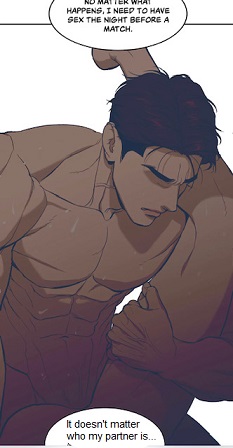 (chapter 2) his ritualistic sex before fights, his fear of losing control,
 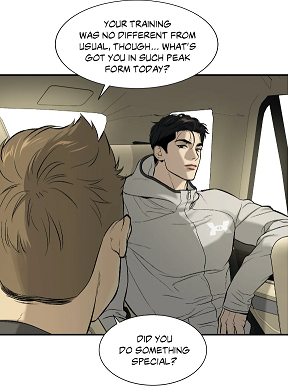 (chapter 5) his reliance on routine. Yet there is another jinx in this story, one far less visible and perhaps even more tragic: Kim Dan’s.
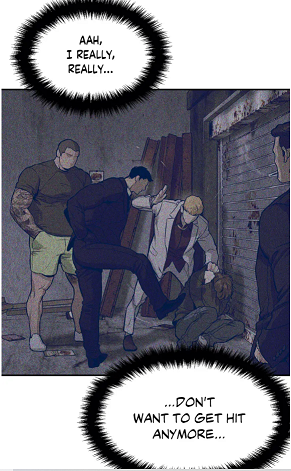 (chapter 1) was seen as the core expression of a man who believed he was doomed.
 (chapter 56) In Chapter 56, Kim Dan is seen curled up next to a bed, whispering: “I’m scared… of being alone.” What makes this moment especially revealing is that he is not physically alone, for he is resting next to his grandmother. The presence of the very person who raised him should, in theory, offer comfort. And yet, the fear persists.
 (chapter 21) And this issue didn’t begin in adulthood. In Chapter 21, Kim Dan dreams of a night from his childhood: he wakes up alone, glances around the room in quiet confusion, and softly calls out for his grandmother. The room is dim, the bed beside him empty. This image carries more than just childhood anxiety:
 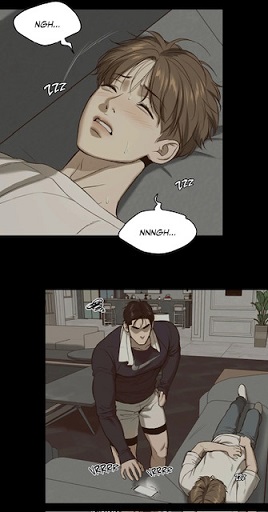 (chapter 21) It weaves together absence, silence, and the specter of loss. What’s striking is that the nightmare surfaces, not when he’s alone in the present, but after he has just returned from watching over his hospitalized grandmother.
 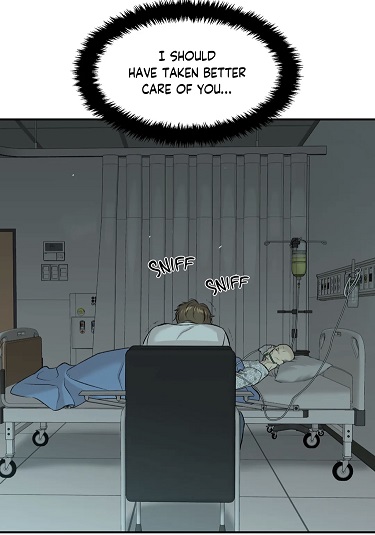 (chapter 21) He lies on the couch and dreams of a night when she vanished from their shared bed.
 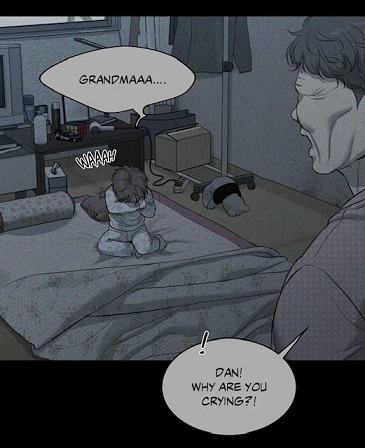 (chapter 21) This reveals how, in Kim Dan’s subconscious, the night and an empty bed have become synonymous with death. The trauma is deeply embedded, where even temporary absence is tied to the irreversibility of loss. For Kim Dan, solitude at night
  (chapter 67) is not mere loneliness—it is abandonment, it is death, it is the erasure of home. It is repressed, hidden beneath his quiet demeanor and years of survival-based behavior. Rather than a rational belief, it is a subconscious wound that only surfaces in moments of extreme vulnerability—especially at night.
  (chapter 2), the doctor’s is secret and involuntary. His actions—his fearful expressions
  (chapter 57), his pattern of emotional detachment
  (chapter 67), and his obsessive loyalty to his grandmother
 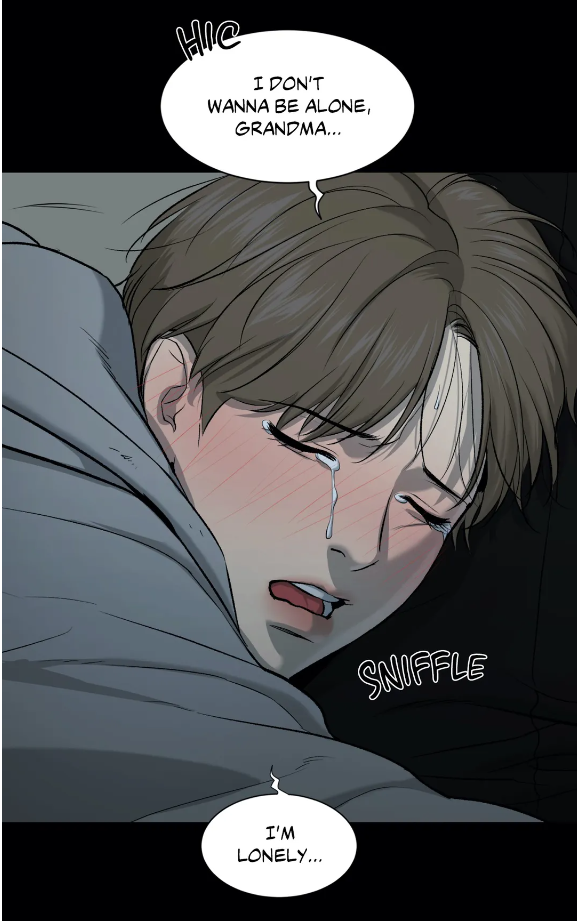 (chapter 10) signal a suppressed conviction: that he is destined to be left behind. What seemed like devotion now appears as coping; what appeared stoic was survival. And with the impending death of his grandmother, the anchor holding this hidden jinx in place is slipping away.
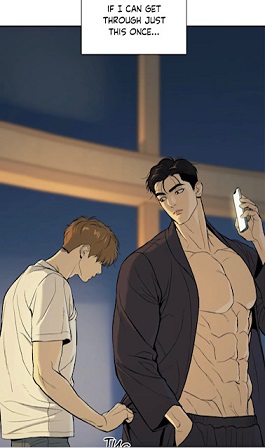 (chapter 2), the trembling kiss
  (chapter 44) and touch
  (chapter 44) in Chapter 44, the complete breakdown
 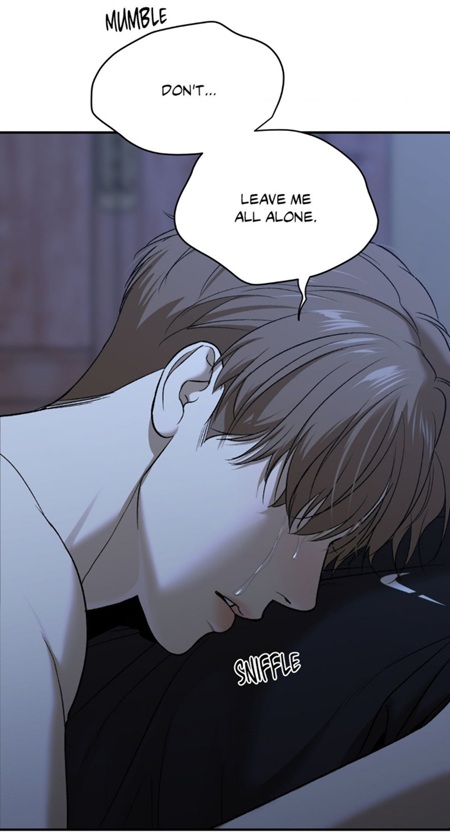 (chapter 66) in Chapter 66, or the transactional submission
 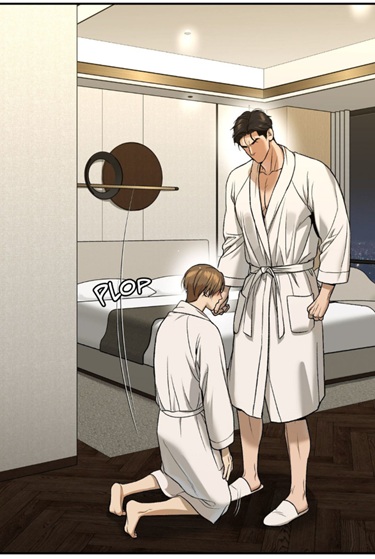 (chapter 67) in Chapter 67, nighttime becomes the stage for his unresolved trauma. These nights mirror one another and suggest an origin story that predates them all: a night when Kim Dan was abandoned by his mother.
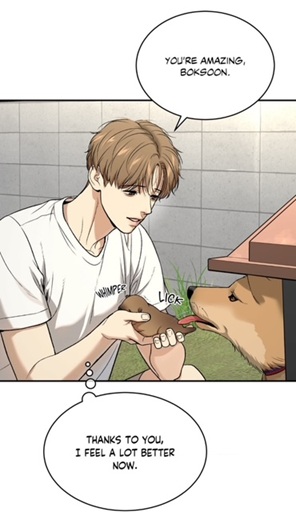 (chapter 57) A puppy needs at least eight weeks with its mother to grow emotionally secure. By drawing this parallel
 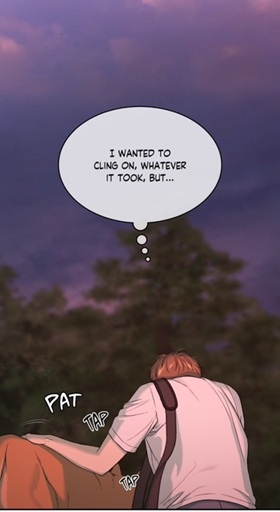 (chapter 59), the story tells us: Kim Dan was separated too soon. He was not ready.
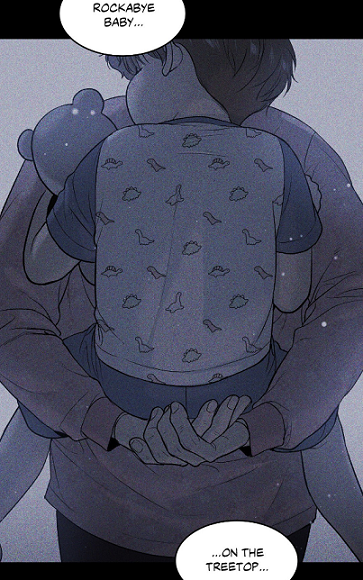 (chapter 47) the one person whose presence could keep the jinx at bay. As long as she was there, he could suppress the trauma, function, survive. She was his talisman. But she was never a healer, for she never spoke about his parents. She never addressed the core of his abandonment, like we could witness in the doctor’s nightmare:
 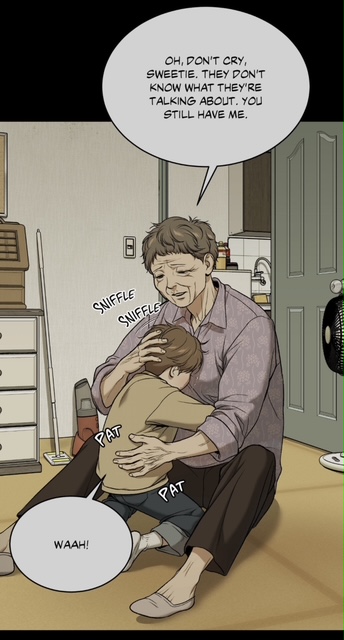 (chapter 57) And silence, when it comes to trauma, does not protect—it festers.
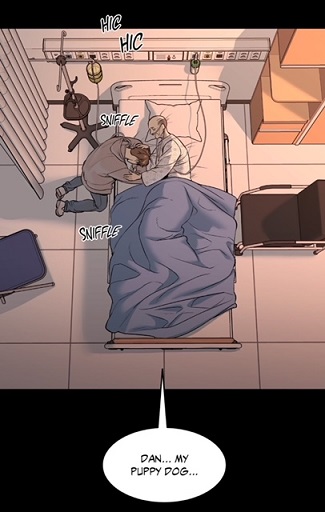 (chapter 53)
 (chapter 65) One might argue about this, for in this scene,
  (Chapter 56) he tucks her in. Their roles are reversed. He behaves like a parent, whereas in truth, he is reverting emotionally to a child terrified of being alone. This reversal highlights the internal dissonance between his outward behavior and emotional reality. Though he was forced to grow up quickly
 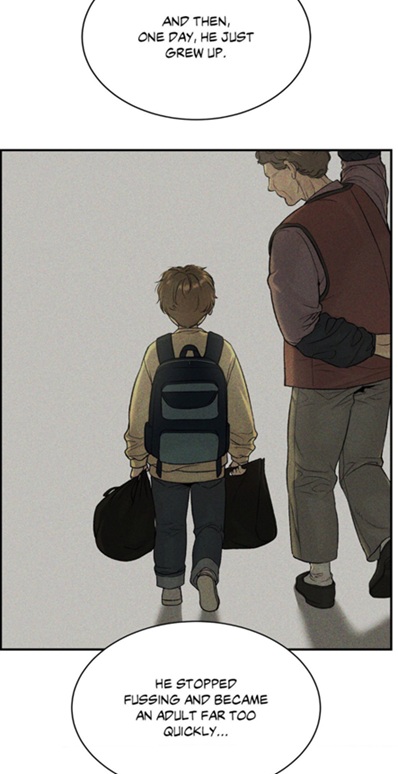 (chapter 65), he still carries the emotional wounds of a child. And from my point of view, the grandmother knows it, therefore she treats him as a child. And this observation led me to the following question: why does she still view him as a “boy”, though he has been working since his youth? It is because he can not sleep alone! What caught my attention is that she never stated, when the doctor started smoking or drinking.
  (chapter 67) This reinforces my hypothesis that his bad drinking habits are related to the absence of a loved one next to him.
  (chapter 56) Imagine what it means for her: her grandson is already 29 years old and he can not sleep alone. Under this perspective, Jinx-philes can grasp the relative’s reasoning. The problem is that her knowledge is actually wrong! How so? It is because the protagonist was able to sleep so well alone in the penthouse, to the point that the athlete was envious of him.
  (chapter 29) That’s how it dawned on me why Shin Okja was so determined to send back her grandson to Seoul.
 (chapter 65) and going back to Seoul under the guise of freedom and career advancement takes on a deeper meaning when viewed through the lens of emotional avoidance. Her words may sound supportive, but they conceal a subtle attempt to sever the emotional tie without taking responsibility for its existence. Now, rather than confronting this vulnerability head-on, she shifts focus to the one thing she believes can replace human closeness: work. A busy man has no time to wallow, no time to drink, no time to remember the empty bed. A man with a career won’t ask for someone to hold his hand at night. In that sense, her vision of “a good life” is one of functionality, not emotional fulfillment. If he works, he won’t be a burden. If he’s successful, she doesn’t have to worry. Yet this approach doesn’t cure the root wound — it just redirects it. This situation mirrors the wolf’s:
  (chapter 19) The latter is obsessed with work, while he is suffering from insomnia.
  (chapter 65) And the best evidence for her selfishness and neglect is her ignorance about her grandson’s plan for his future. She is not discussing with him about what he likes or dislikes. She is directing his life, like she did it in the past in the end. And while she may think she’s doing what’s best, her silence about his fears, her ignorance about his true conditions (no home, blacklisted in Seoul) and her refusal to discuss his emotional future reveal a lingering discomfort with the very idea of dependence — perhaps because it reminds her of her own failures or helplessness as a parent figure.
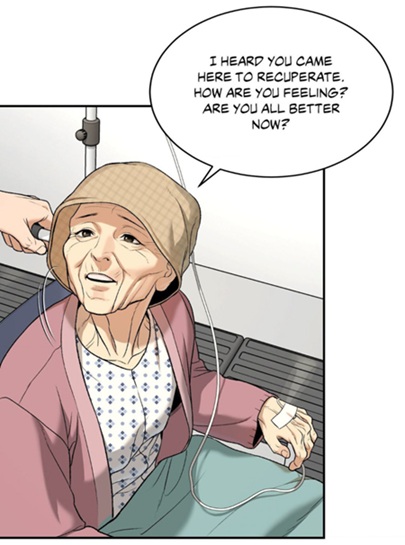 (chapter 65)
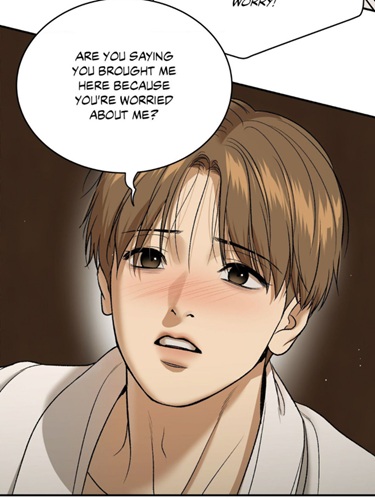 (chapter 67) when Kim Dan, eyes wide and voice trembling, asks Joo Jaekyung: “Are you saying you brought me here because you’re worried about me?” His expression reveals everything — a fragile hope for genuine concern. But the only response he gets is silence.
 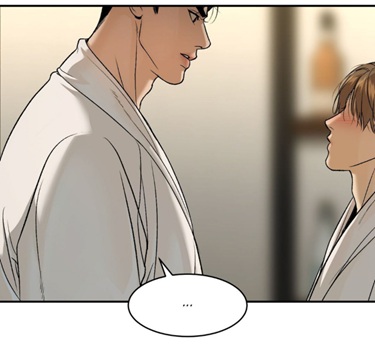 (chapter 67) This unspoken answer reverberates with painful familiarity: from his vanished mother, from his halmoni who rarely expressed love (rather gratitude and pity), and from a world that reduced him to his usefulness. What he really wants to know is: “Do I matter to you as a person?” And just like his grandmother, the champion fails to offer direct emotional reassurance. Yet unlike her, Joo Jaekyung is still learning. His silence isn’t rejection, but emotional illiteracy — a work in progress.
 (chapter 65) And when we remember that Kim Dan tried to call her, she
 (chapter 65) replied with a silence. Here, she claims that he addressed her as “mom”, but it is possible that she was just projecting her own fears onto her grandson. Since she was by his side all the time, she feared to be seen as his mother. Like mentioned above, the mother might have been busy due to work (or sick) and asked her relative to take care of her grandchild.
 (chapter 44) These gestures suggest he had once received such kisses, most likely from his mother. It means he remembers love, even if he doesn’t know how to process its loss.
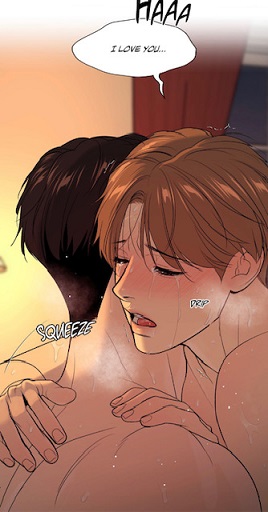 (Chapter 39), the moment is tainted. It occurred under the influence of an aphrodisiac, intertwining love with sex. Furthermore, he has never voiced this sentiment to his grandmother—perhaps because she never said it to him. It was never modeled. While others might judge Kim Dan’s emotional restraint, I desire to stay neutral. He is not an emotionally stunted adult by choice—he is a product of emotional neglect. That’s the reason why Mingwa has associated him with an angel.
 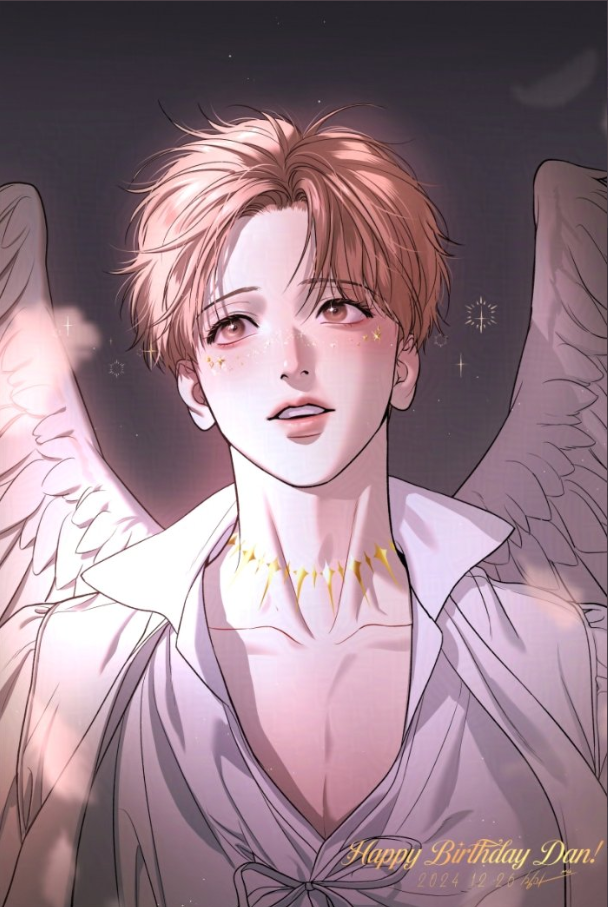 He is carrying the sins of “adults”. By likening him to an angel, Mingwa frames his pain not as weakness, but as unjust burden. He embodies purity, sacrifice, and resilience, not because he was allowed to thrive, but because he endured. The angel metaphor becomes even more striking when you think about traditional symbolism: angels don’t belong to Earth, yet they walk among the living, often suffering in silence and helping others. That’s exactly Kim Dan — out of place, bearing the consequences of others’ choices, carrying guilt, debt, and unspoken grief that were never his to begin with.
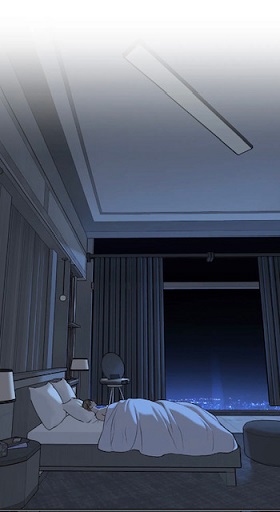 (chapter 29) —not because of physical intimacy with Joo Jaekyung, but because he felt safe. For a time, the place became his illusion of home. But when the champion showed mistrust, the illusion shattered.
  (chapter 51) The penthouse was never truly his. It was borrowed space. This explicates his refusal to spend the night there.
  (Chapter 67) Observe how Joo Jaekyung called the penthouse: not home, but his place. Due to the last altercation, the emotional safety collapsed. This experience reactivated his fear of abandonment and solidified the belief that he has no home.
  (chapter 65) Even the family photo (where and by whom it was taken is unclear) emphasizes the fragility and incompleteness of his sense of belonging.
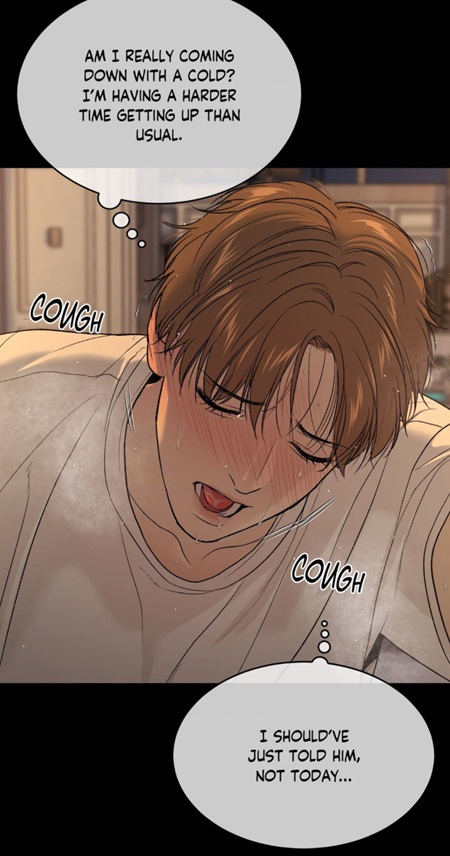 (chapter 61) that he must sacrifice his “needs” and identity to be accepted.
  (chapter 66) Therefore it is not surprising that he laughes like a little child during that night.
  (Chapter 44) Chapter 66 represents its negative reflection, the emotional climax of this regression:
 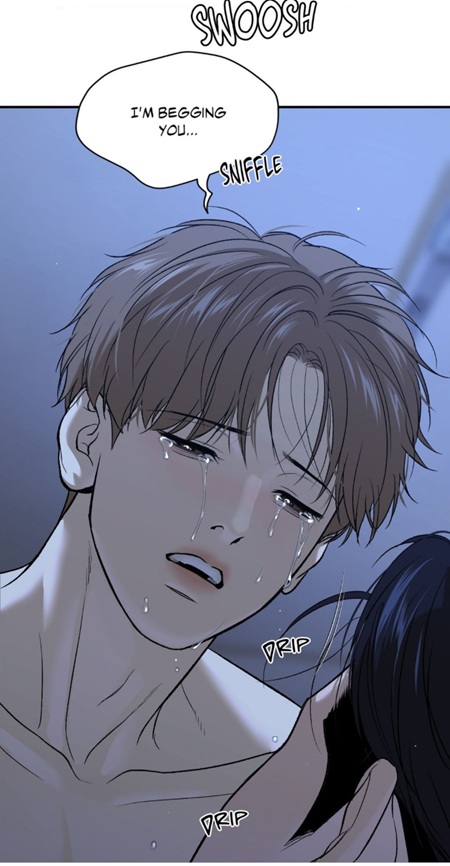 (chapter 66) he cries, begs,
 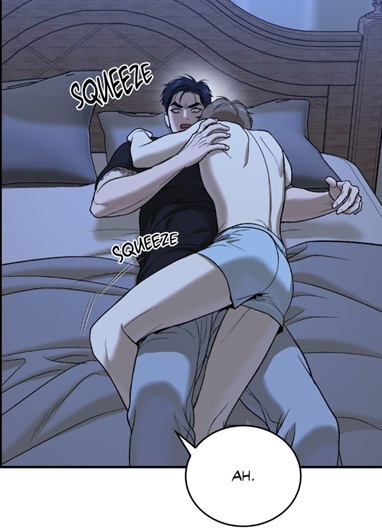 (chapter 66) holds on—“Don’t leave me.”
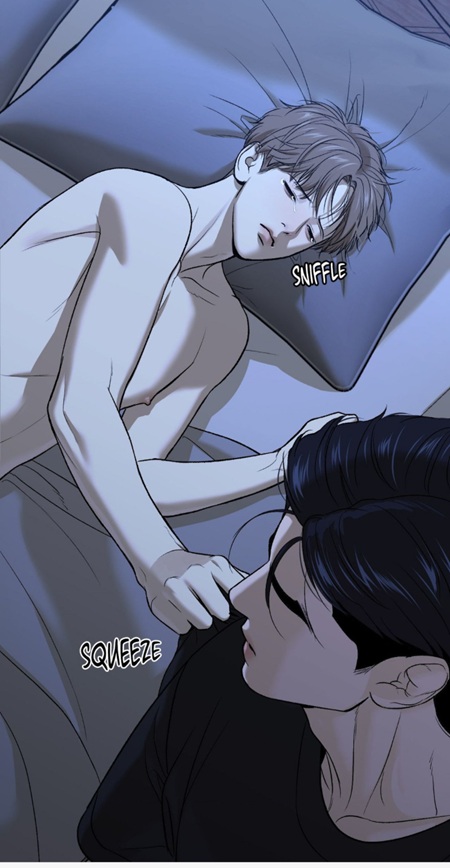 (chapter 66) and desperate pleas are not about romance—they’re about survival, longing and regret. Deep down, he wished, he had hold onto his “mother” in the past, stopped her from leaving him. Is it a coincidence that this gesture from that night mirrors the one during their first night?
 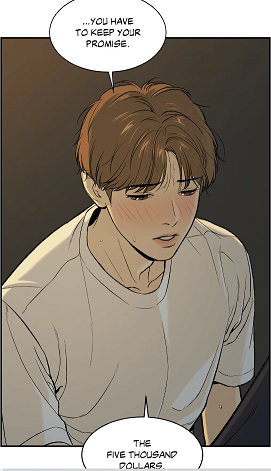 (chapter 2) He wanted the champion to keep his promise. From my point of view, the parent’s vanishing is strongly intertwined with a broken promise… And that’s exactly what the grandmother did to her own grandson: she didn’t keep her words either.
  (chapter 11)
  (chapter 53)
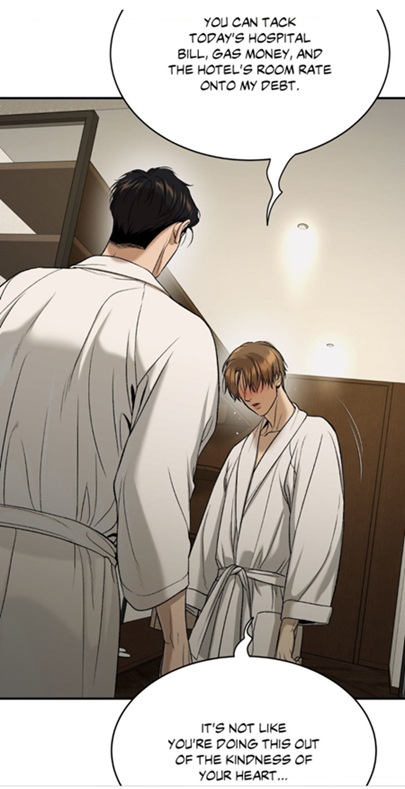 (chapter 67), but this time, with eerie detachment. He kneels before Joo Jaekyung like a servant,
 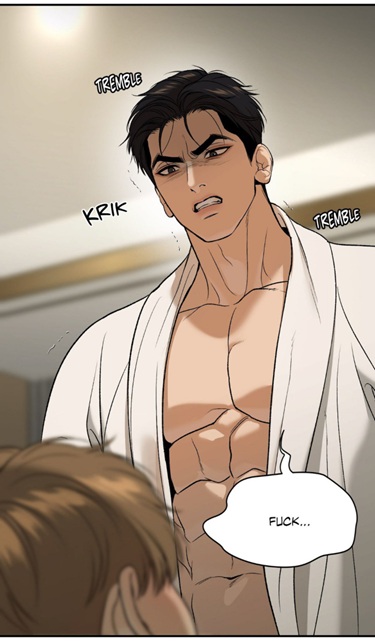 (chapter 67) his arousal betrays a loss of emotional control. Though he is on his knees, it is Joo Jaekyung who is emotionally yielding. His body betrays his composure, responding to Kim Dan’s touch and gaze. Kim Dan, watching the tremble in the fighter’s expression and the rising heat in his body, feels the shift. His soft blush is not simply one of affection or embarrassment—it’s a flicker of recognition.
 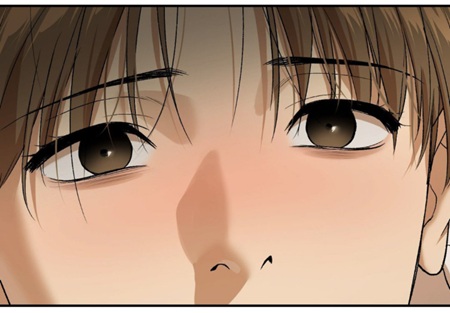 (chapter 67) He senses that the one usually in control is now unraveling. Appearances deceive: beneath this scene lies a quiet reversal of power. The blush on his cheeks is a trace of a brief moment of clarity: he sees that the person who once held all the control is now faltering.
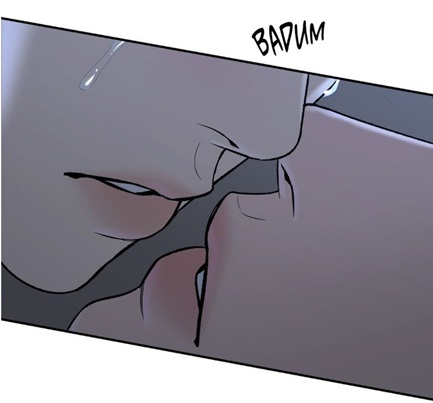 (chapter 66), his body is still a vessel for mourning. Hence there is no kiss during that blue night. Each night carries the residue of that first trauma: the night he was left alone. Whether his mother disappeared or passed away in the night, the result is the same—nighttime became synonymous with loss.
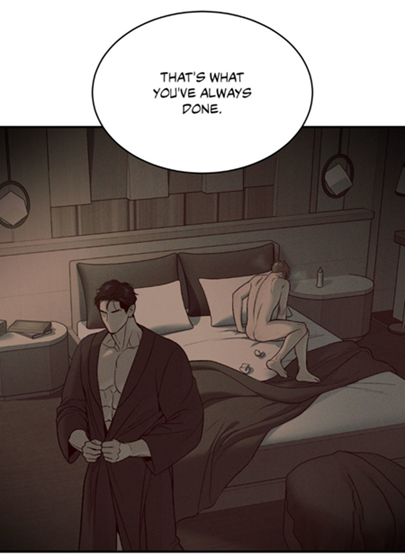 (chapter 63) His so-called jinx is not some irrational superstition. It’s a scar. It’s the quiet belief that the people he loves will vanish the moment he lets his guard down.
 (chapter 67), it’s resignation. Hence he is not expecting to be cured with the pills.
  (chapter 67) he offers sex to “settle up,” citing his own preparations like a transaction.
 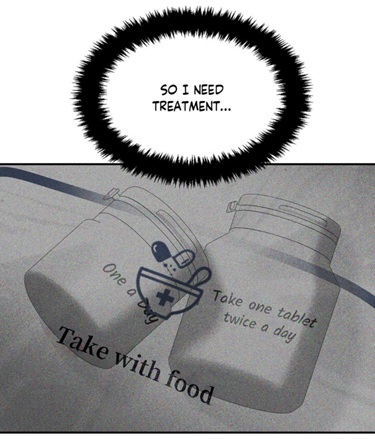 (chapter 67) while he drank alcohol with the medicine.
 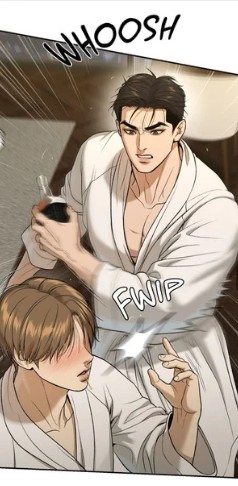 (Chapter 67) Until now, the champion has a blind faith in drugs, just like the grandmother.
 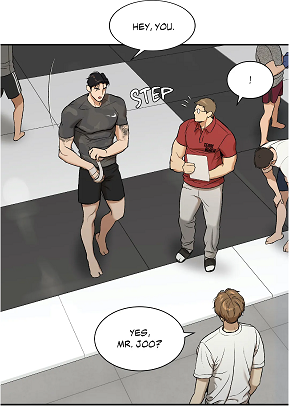 (chapter 7), while Kim Dan becomes a child during the night.
 (Chapter 66)
 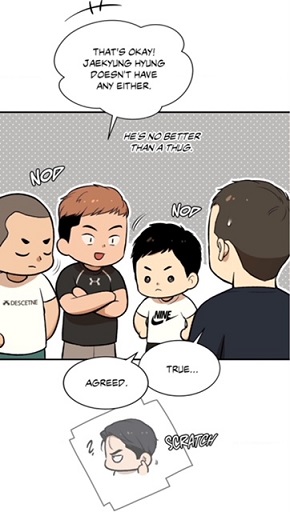 (chapter 47), when the “wolf” was portrayed as a thug, though the latter had assisted him on multiple occasions.

 (chapter 66) they saw it as further confirmation of their perception—reinforcing the idea that he is terribly flawed. However, a deeper analysis suggests that this term reflects not just his character but also his evolving mindset and struggle with emotional vulnerability. This essay will explore the paradox at the heart of their dynamic—how both men refuse to acknowledge the emotional weight of their relationship, leading to a cycle of denial and misperception. It will examine how the concept of the jinx evolves, the continued influence of Park Namwook’s manipulations on Joo Jaekyung, and the role that mutual ingratitude plays in their emotional stagnation.
 (chapter 65), the nature of his principle has changed:
  (chapter 65)The athlete is admitting his dependency on doc Dan. The jinx is now directly tied to Kim Dan, not just as a concept but as a tangible element of Joo Jaekyung’s career stability. The second switch is that sex is no longer a condition to ward off bad luck. In fact, the celebrity is recognizing the importance of his daily training and, as such, his hard work.
 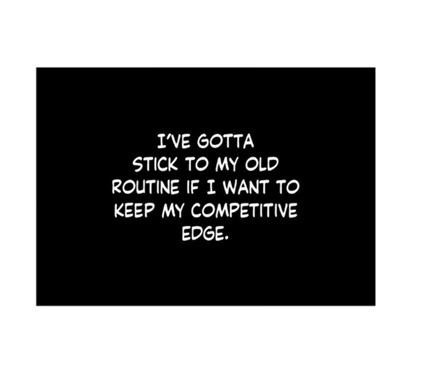 (chapter 65) The inner thoughts of the sportsman reveal that the champion is feeling less powerless than before. His champion status is no longer reliant on superstition but on tangible efforts—his “old routine” and, crucially, Kim Dan’s expertise as a physical therapist. This marks a significant transformation in his perception of Kim Dan, whom he now values for his professional skills rather than as a mere tool for maintaining a ritual. Thus, Joo Jaekyung should be less inclined to request Doc Dan’s sexual services. Then, in episode 66, a new change became visible.
 (chapter 11), a tool to generate money and maintain the gym’s reputation. Hence he blames him, when members leave the gym.
  (chapter 46) The manager used the incident with Seonho to justify the desertion of the other athletes. However, it is clear that some left the gym because they didn’t become successful like Joo Jaekyung. However, their lack of success is explained by their lack of talent
  (chapter 46) exposing the lack of ambition and commitment from the two hyungs. It is clear that Joo Jaekyung’s wealth and fame was used to attract the sportsmen creating a myth that they could experience the same success. Nevertheless, as time passed on, the fighters were confronted with reality. It was, as if the athlete’s achievement had become a curse for Team Black. Nonetheless, neither the manager nor the coach can admit it, the champion’s bad temper is utilized to cover the mismanagement within the gym. Striking is that by portraying the protagonist as a person with a bad temper and personality
  , (chapter 9) the manager and his colleague described their boss as defective. The contrast between Joo Jaekyung’s perception of ‘defect’ and the coach’s view of him as a ‘maniac’ is particularly telling. When the protagonist refers to Kim Dan as having a defect, there is an implicit acknowledgment that something can be repaired or improved. In contrast, Park Namwook’s statement about ‘handling that maniac’ suggests that the star is beyond fixing—someone who must be tolerated and controlled rather than understood or helped. This fundamental difference in perspective reveals how deeply the manager has shaped the champion’s self-perception, reinforcing the idea that he is nothing more than a force to be managed rather than a person who can change or grow.
 (chapter 54)
  (chapter 66) His presence is necessary to maintain the “myth” alive.
 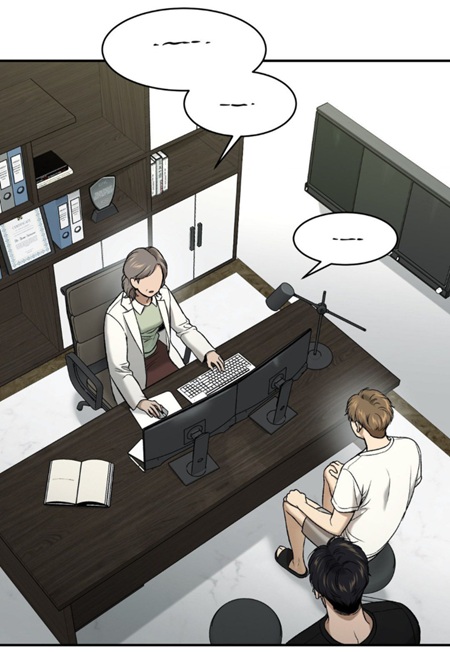 (chapter 66) In calling Kim Dan ‘defect,’ Joo Jaekyung is unknowingly projecting his own self-perception onto him. The term suggests something broken but also something that can be repaired, reflecting an unconscious shift in his perspective. Instead of simply using Kim Dan as part of a superstition, he is beginning to see his vulnerability, perhaps even recognizing a parallel to his own struggles. His choice of words also reveals his deeply ingrained belief in self-reliance.
  (chapter 66) Nevertheless, the idiom (“he’s got a defect”) reveal that Joo Jaekyung is still under the manager’s influence. This means that this shift is not immediate or conscious; it is restrained by his continued loyalty to Park Namwook and his ingrained avoidance of emotional vulnerability.
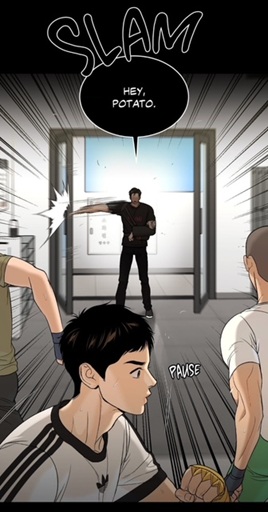 (chapter 60) This scene represents the exception. For the most part of the time, the star only visited the gym because Park Namwook had contacted him.
 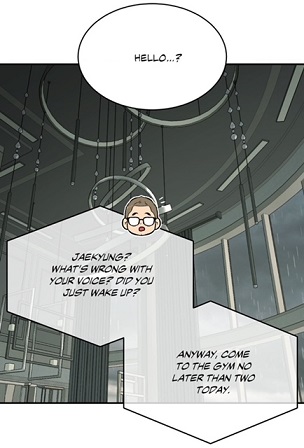 (chapter 54)
  (chapter 66) Striking is that by each meeting, the champion was alone with the manager. The latter was no longer followed by coach Yosep. It was, as if Park Namwook wanted to have some privacy with the celebrity. However, through this contrast, Jinx-lovers can detect a certain MO from the manager: he is isolating the champion, limiting his interactions with other members. This explicates why he remains a pivotal force in Joo Jaekyung’s stagnation.
 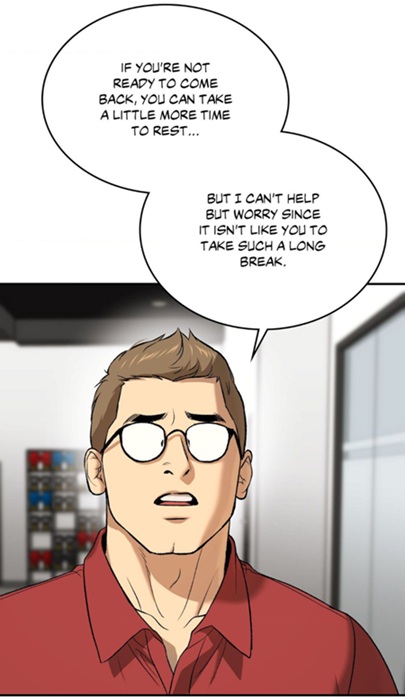 (chapter 66) Yet, just moments later, he tells him that he can take more time to rest, as if feigning concern. This contradiction is striking because it exposes his underlying agenda: he wants Joo Jaekyung back in the gym but doesn’t want to appear forceful. Instead, he makes it seem like Joo Jaekyung is the one making the decision, fostering guilt by implying that his long absence is unnatural.
 (chapter 52) His sudden shift—acting as though the champion is no longer himself—reveals his inconsistency. When Joo Jaekyung was compliant, he was simply a reckless athlete with an attitude. Now that he is exhibiting autonomy, Park Namwook implies that something is wrong with him. It was, as though he was missing the old version of the champion. 😂 But this is what he complained about him in the past: he was a workaholic!
  (chapter 27) This double standard highlights Park Namwook’s true role: he is not a supportive figure but a handler, ensuring that Joo Jaekyung remains under control and fulfilling his duties as a fighter. His words are not meant to provide genuine support but to keep Joo Jaekyung tethered to a system where his worth is defined solely by his success in the ring.
  (chapter 54) or (un)favorable interviews about the athlete.
  (chapter 54)
  (Chapter 57) As a manager, Park Namwook’s role involves overseeing Joo Jaekyung’s career, securing contracts, and ensuring his reputation remains intact. Yet, as seen in Chapter 66, his actual concerns seem remarkably narrow in scope.
  (chapter 48) Back then, there was a witness, Kwak Junbeom and the latter could have reported to the “hyung”. These incidents indicate a consistent effort to control what the champion knows, raising the critical question: why?? His silence on this matter suggests not only a strategic decision to keep the star uninformed, but also an attempt to avoid responsibility. The supervisor often hesitates to make decisive choices
 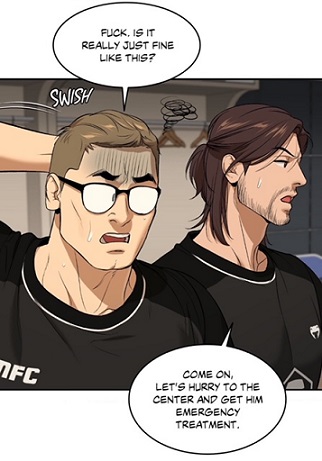 (chapter 50), preferring instead to remain passive so that any negative outcomes can be blamed on the champion. At the same time, this passivity helps him maintain control—as if Joo Jaekyung, without his guidance, would be left ‘alone’ and directionless. In this way, the man with the glasses sustains a dynamic in which the champion feels dependent on his presence, even as he is subtly undermined. By neglecting to inform him of these events, Park Namwook ensures that the champion remains unaware of external factors that could influence his choices. This pattern reinforces the possibility that Park Namwook was aware of the meeting with Choi Gilseok and deliberately ignored it, likely expecting that Joo Jaekyung would take care of it, while absolving himself of responsibility.
 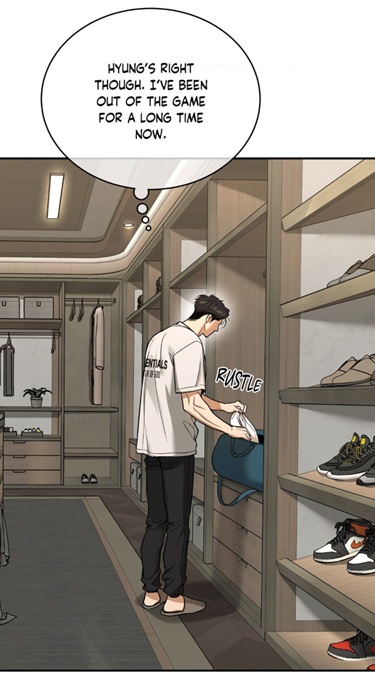 (chapter 66) This hesitation stems from deeply ingrained beliefs about relationships and fidelity. His loyalty to Park Namwook prevents him from fully confronting the possibility that his manager may not have his best interests at heart. Moreover, his own emotional repression makes it difficult for him to recognize his evolving dependency on Kim Dan as something beyond physical necessity.
 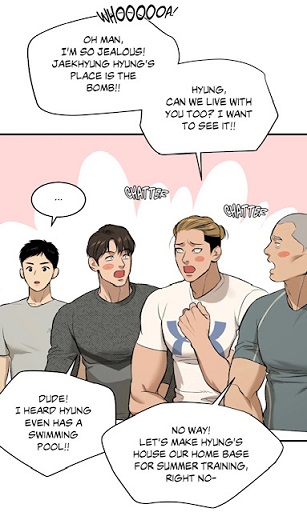 (chapter 22) They had heard about his place, for the manager must have talked about it. The protagonist is not someone who will talk about his private life to others. The manager must have dangled promises in front of them, making them believe that if they’re lucky enough, they too could live like the champion. However, their reactions reveal something crucial—they are not motivated by greed but by genuine admiration. They simply want to experience the luxury once in a while, reinforcing that their bond with Joo Jaekyung is rooted in camaraderie rather than material envy. This further highlights the contrast between Park Namwook’s manipulation and the sincere regard his teammates have for him. This scene is important, because it exposes the manager’s prejudices and lack of discernment.
  (chapter 46) Not everyone is the same and more importantly like him! It is clear that the man is projecting his own principles onto others and in particular onto the champion.
  (chapter 66) Neither of them fully understands how to acknowledge care or support. Just as Joo Jaekyung struggles to recognize his actions as stemming from concern
 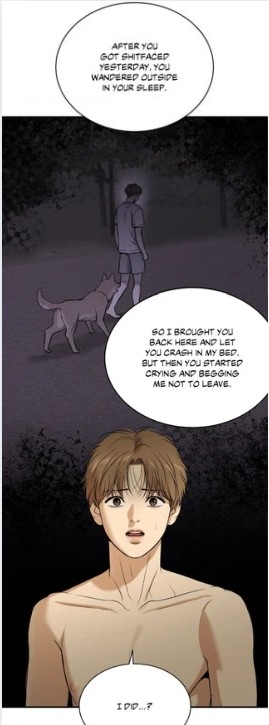 (chapter 66) rather than routine, Kim Dan fails to see Joo Jaekyung’s interventions as genuine help. This mutual misunderstanding deepens the emotional rift between them, ensuring that both remain trapped in their own perceptions of obligation rather than connection. In Chapter 66, he openly expresses frustration, stating,
 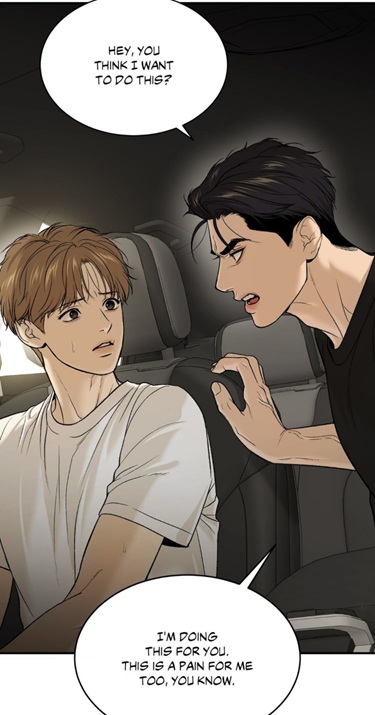 (chapter 66). This moment highlights a rare glimpse of honesty: he is not acting purely out of self-interest, but he frames it as an obligation rather than a choice. From my point of view, such a statement could only reach the physical therapist’s mind, for in the latter’s eyes, the champion has always been a “demon”: self-centered and inconsiderate. Observe the absence of reply from the “hamster”. He couldn’t contradict the star, as the latter was using this negative image: bad tempered and selfish.
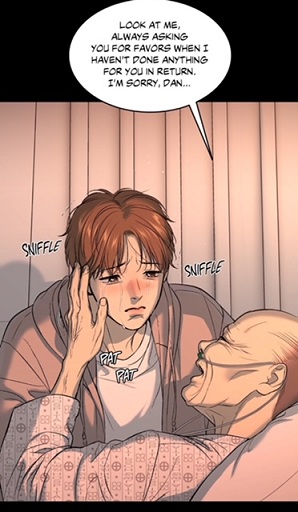 (chapter 53), the manager
  (chapter 7) and even Choi Heesung. Hence the latter called him like that:
 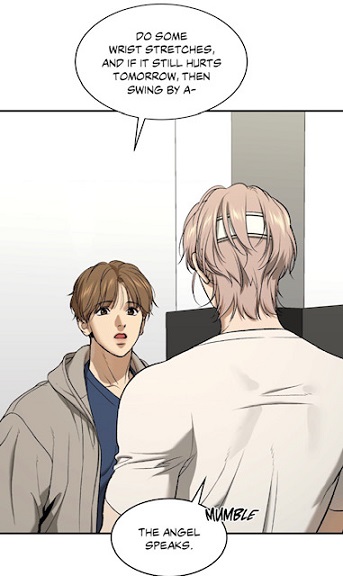 (chapter 30) Kim Dan’s perception of himself as an “angel” has long shaped the way he interprets his relationship with Joo Jaekyung. Reinforced by his upbringing and Park Namwook’s subtle manipulation
 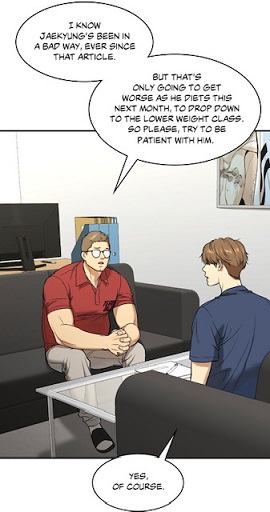 (chapter 36), he has unconsciously placed himself in a position of moral superiority. He is the patient, understanding figure, while Joo Jaekyung, in contrast, is violent
  (chapter 1), selfish, and emotionally stunted. However, this self-perception is deeply flawed. By believing himself to be inherently better
  (chapter 64) than the champion, Kim Dan avoids confronting his own emotional repression, his weaknesses, and his own form of “defectiveness.” He fails to see that he is just as human—just as fragile—as the man he silently judges.
 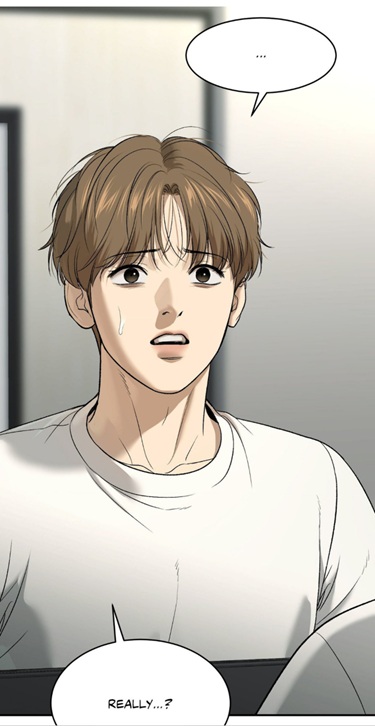 (chapter 66) The expression “Really…?” is not just about disbelief but also about a moment of confrontation with reality. Up until this point, Kim Dan has been dismissing his own suffering, suppressing his struggles, and functioning on autopilot. However, hearing a professional confirm that he is indeed sick forces him to acknowledge what he has been denying.
 (chapter 60) or exaggerations.
 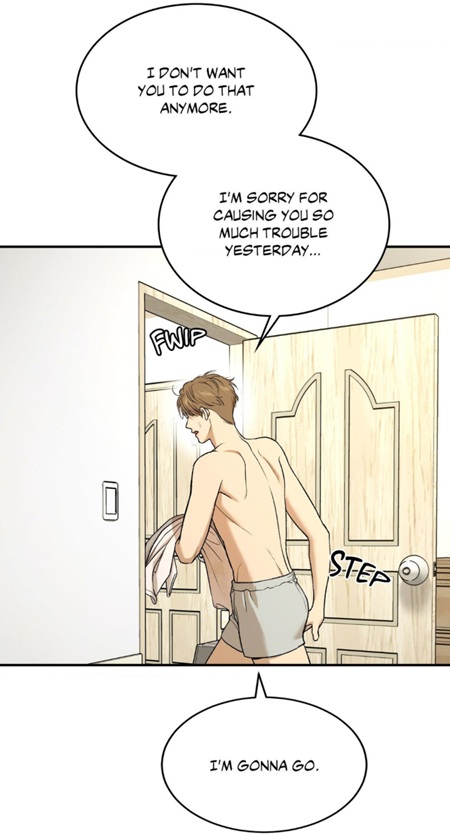 (chapter 66) It also forces him to consider that others—especially Joo Jaekyung—were right to be concerned, which in turn may lead to a shift in his perception of the champion’s actions.
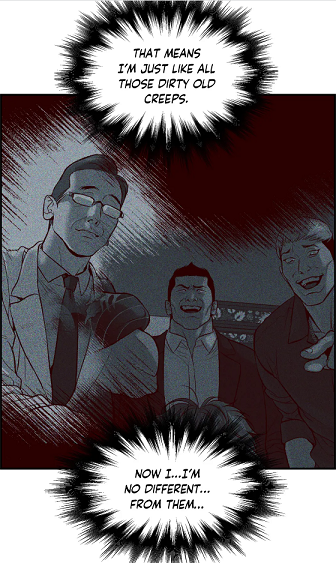 (chapter 20) with shame, something impure that should be avoided or hidden. This internalized belief made it difficult for him to separate his own experiences from moral judgment. When he encountered the champion —who treated sex as nothing more than a professional ritual
 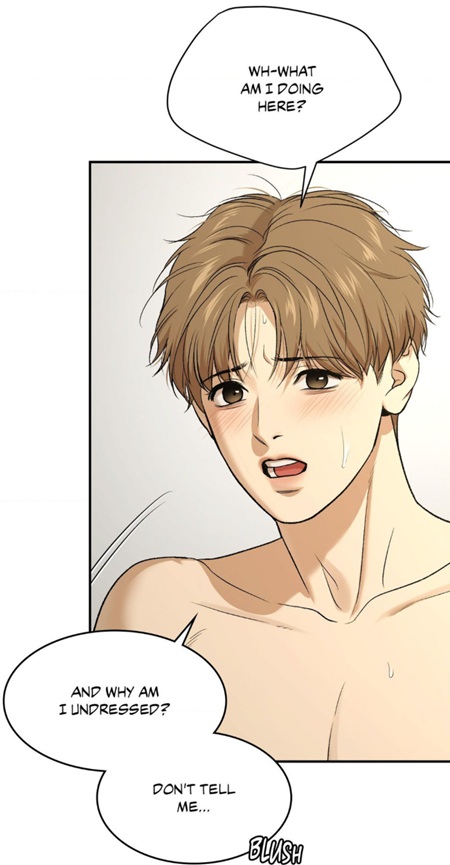 (chapter 66) He assumed once again that the star had taken advantage of his “drunkenness”, something Kim Dan had done himself in the past.
 (chapter 65) Symbolically, this reflects their respective journeys. The demon (Joo Jaekyung) is slowly leaving the underworld of detachment and blind routine, stepping toward vulnerability. Meanwhile, the angel (Kim Dan) is descending from his idealized, self-righteous perception of himself, recognizing his own flaws, desires, and limitations. Both must step away from their extremes—Kim Dan from his unconscious moral superiority and passive victimhood, and Joo Jaekyung from his emotional repression and transactional mindset.
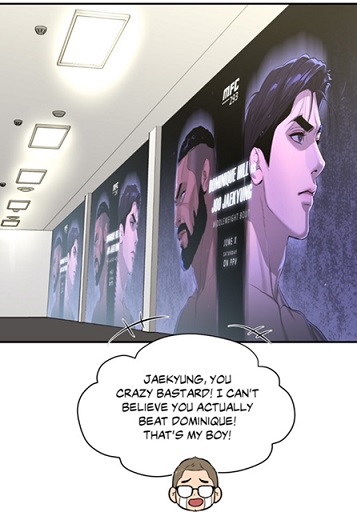 (chapter 40) , while Kim Dan, conditioned by years of emotional neglect, sees gratitude as a transactional exchange rather than an expression of genuine appreciation.
  (chapter 66) because Kim Dan does not recognize his efforts, while Kim Dan cannot see past his own survival instincts to notice that Joo Jaekyung’s actions are slowly shifting from obligation to care. Kim Dan, conditioned by years of neglect and survival-driven thinking, does not see Joo Jaekyung’s actions as genuine care.
 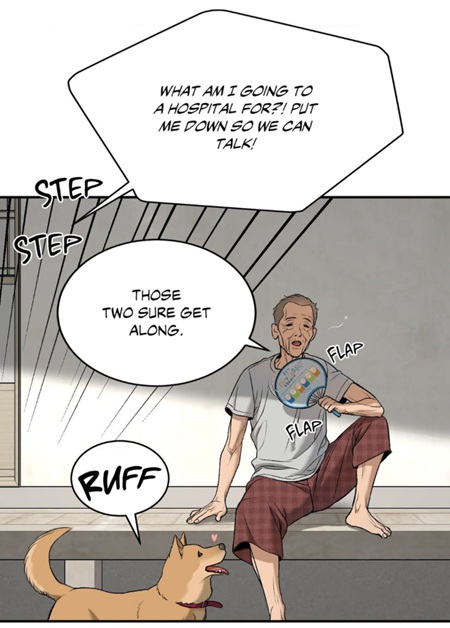 (chapter 66) And the latter can see beyond the appearances.


 (chapter 62) He now includes his entire routine with Kim Dan—not just sex, but also his physical therapy and treatment—as part of this so-called jinx. This shift is crucial because it implies an unconscious recognition of Kim Dan’s significance in his life. What once was purely about his career and success has now expanded to include a specific person and their role in his well-being.
 (chapter 46), the stretching and massage at the gym? The problem is that the champion never complimented the “hamster” for his good work directly. So it was, as if his dedication was nonexistent. Without the champion’s genuine gratitude and appreciation expressed so openly, the physical therapist couldn’t perceive the true message behind the champion’s. Joo Jaekyung’s statement was actually an acknowledgment—a sign that the fighter values their routine, not just for performance but as an integral part of his life. So when the star mentioned his jinx
  (chapter 62), the doctor’s memory got triggered. Because of his past experiences, he has long associated the jinx exclusively with sex. This contrast in understanding highlights both Jaekyung’s lack of self-awareness and Kim Dan’s tendency to filter reality through his own expectations and trauma. However, the deeper significance lies in Jaekyung’s evolving perception of dependency. His jinx is no longer just a superstition tied to his performance in bed. It now subtly acknowledges that his success has been intertwined with Kim Dan’s intervention.
  (chapter 61) By entrusting his care to Kim Dan, he was insinuating that the main lead was trustworthy and competent, yet his inability to verbally express appreciation keeps the doctor unaware of his true feelings. This struggle resurfaced in front of the hospice, where Jaekyung could only bring himself to admit that Kim Dan was not responsible for the incident with the switched spray.
  (chapter 62) His reluctance to openly acknowledge his gratitude suggests a deeper internal conflict—one that hints at a growing but unspoken emotional reliance on Kim Dan.
  (chapter 62) It was, as if he was warding off bad luck by repeating the last match. For him, past choices are justified by their results—he has built a successful career through sheer discipline and sees no reason to question his trajectory. His mentality reflects the belief that one’s past is a stable structure upon which the present and future rest. This perception explains his resistance to self-reflection and emotional vulnerability; admitting a mistake would mean disrupting the stability he relies upon.
 (chapter 54), where emotions were likely dismissed as obstacles. Instead, he follows only what aligns with his success: the advice of figures like Park Namwook and Yosep, who reinforce his pre-existing beliefs about strength, control, and endurance. Hence he was pushed to fight despite his ankle injury.
 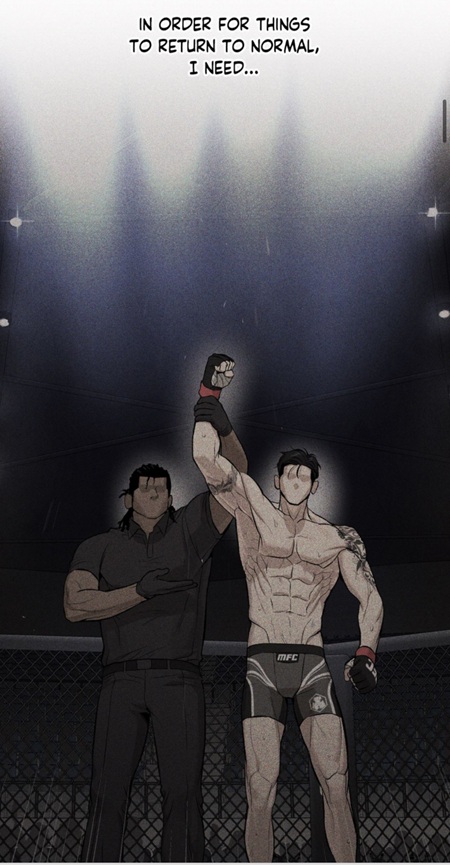 (chapter 61) This rigid perception prevents him from questioning his past choices or embracing change, reinforcing the illusion that repeating past patterns will restore stability. However, as his reliance on Kim Dan grows, the boundaries between his personal and professional life blur, challenging his belief that he can control his future by clinging to his past.
 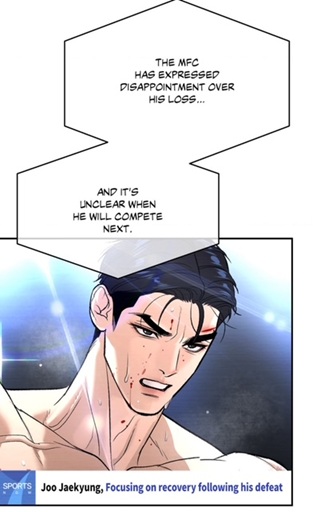 (chapter 57) and Park Namwook
  (chapter 29), then reclaiming his title cannot be the solution he believes it to be. Finally, what happens when he is forced to confront the reality that some of his past choices were mistakes – ones that he can no longer attribute to the jinx or external circumstances,
 (chapter 13) because they affected the doctor’s life?
  (chapter 41) In one case, he refused to listen to his friend’s advice, whereas he trusted the words from MFC, MFC doctors and his hyung. When the foundation he has relied upon begins to crack, Jaekyung’s entire mindset is shaken, forcing him to question whether his past truly holds the answers he seeks. We could say, the athlete needs to be betrayed by his own past in order to throw his old belief. The latter is strongly intertwined with the organization MFC and authorities in general. Questioning his past equals challenging the company MFC and his past “guardians”: the terrifying ghost and even his two hyungs.
  (chapter 61), he expresses the belief that reclaiming his championship title will rid him of his headaches, nightmares, and sleepless nights. However, the reality is different—he was already suffering from insomnia long before he lost his title.
 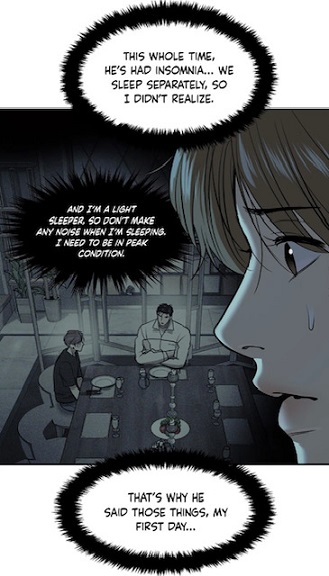 (chapter 29) The origins of his struggles existed before his recent failures, suggesting that his belief in a simple solution—reclaiming his title—is an illusion. This disconnect reveals how deeply his professional and personal life are entangled; his need for control in the ring has masked his deeper emotional vulnerabilities. He isn’t merely striving for victory—he is chasing the illusion of stability, believing that his success is the sole factor that determines his well-being.
  (chapter 54) But as his nightmares and frustration intensified, it becomes clear that his problem is not the loss of his title, but the erosion of the identity he has built upon it. This means that the longer he stays away from the gym, the more the fighter is learning about himself. He is more than just a MMA champion. To conclude, he is on his way to redefine himself, to discover his humanity.
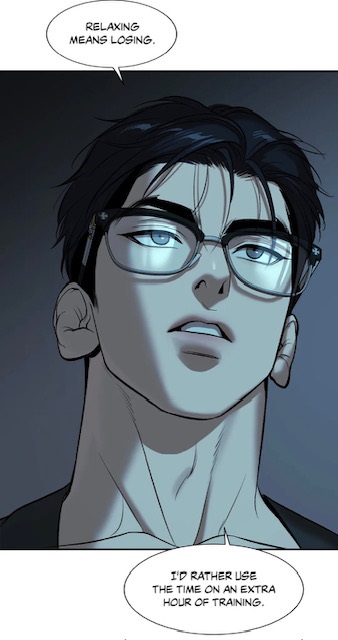 (chapter 29), you will realize that alone in his penthouse, Joo Jaekyung was actually admitting the importance of sleep and rest. His earlier belief in relentless training as the key to success now clashes with his realization that exhaustion is affecting him. This shift signifies an unconscious admission that his well-being is not just tied to physical endurance but also to recovery and relaxation—something he previously dismissed. This realization subtly parallels his growing dependence on Kim Dan, reinforcing the theme of blurring lines between his professional and personal life. And what had occurred after this magical blue night in the penthouse?
  (chapter 30) The athlete woke up later than usual. In fact, he was rather late, for he was still wearing his pajamas, while the doctor had already taken his shower. But back then, observe how he opened the door! Like a clumsy beast, grump leopard! Why? In the past, I explained that he was seeking the champion’s closeness, but didn’t know how to approach his partner. I am now adding another aspect. He was actually annoyed, because he had not been following his daily routine!! Under this new light, it becomes comprehensible why the champion had such a “angry” facial expression, while deep down he was happy. The older version of this scene:
 (chapter 44) However, this means that in episode 30, he never acknowledged his dependency on the physical therapist for his rest loudly. On the other hand, it explains why the champion felt threatened, when the actor approached his “lavender-tinted pillow” or “sleeping pill”.
  (chapter 31) In fact, he used guilt to create a link between him and his roommate. That’s the reason why I am more than ever convinced that the champion will sleep better after this lavender-tinted night.
  (chapter 63) But contrary to the past, the athlete should come to recognize his lover’s great sleeping power officially. This made me laugh, imagining Kim Dan’s reaction, when the latter sees that his wish
  (chapter 62) won’t come true at all. 😉 He will stay longer and ask for Kim Dan’s presence during the night.
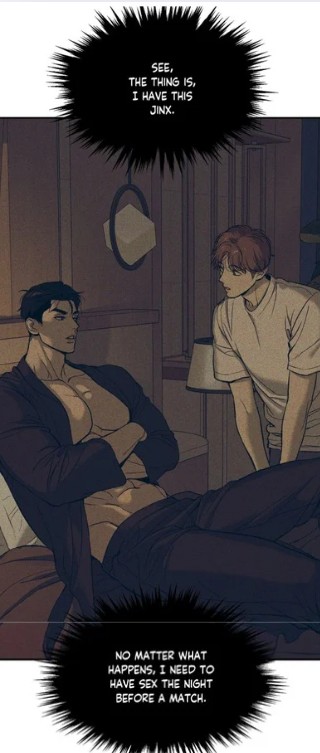 (chapter 62)
 (chapter 56) and opportunities that could offer him security, convincing himself that he is protecting his independence when, in truth, he is reacting to past trauma rather than making an intentional choice.
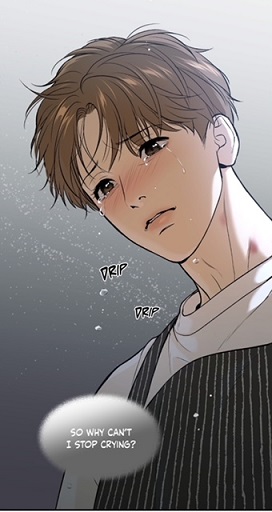 (chapter 46)
 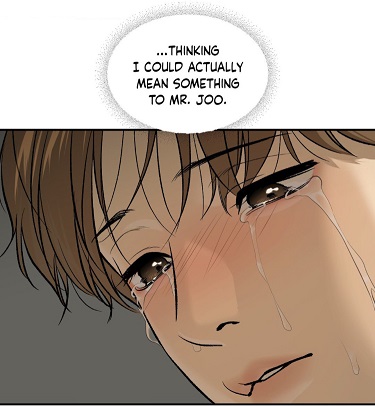 (chapter 46)
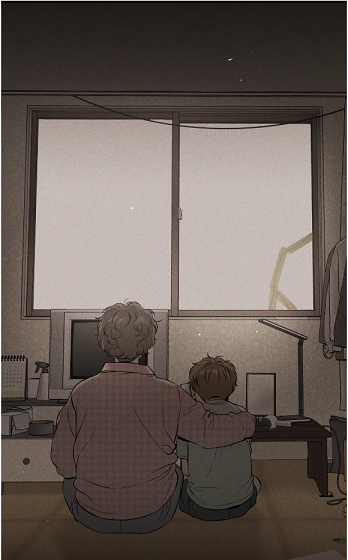 (chapter 19) She became terribly sick, while the other had to get surged and risked his career. There is no doubt that the halmoni is hiding her pain as well. Kim Dan’s declining physical and emotional state further reflects the consequences of living in avoidance.
 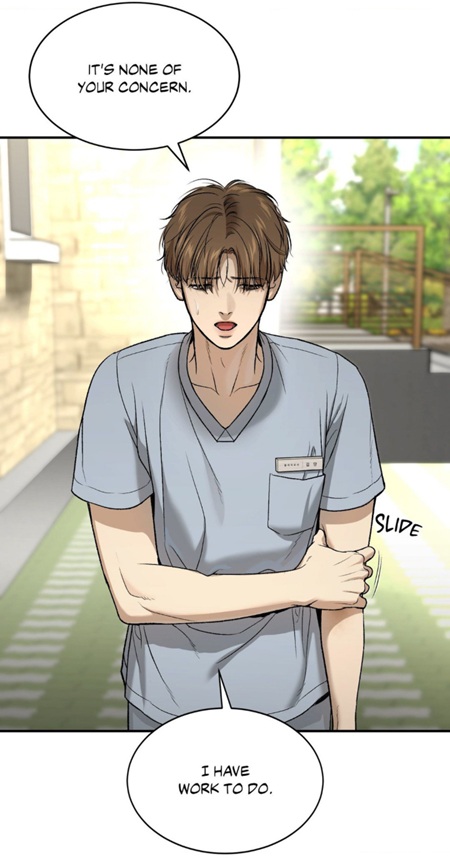 (chapter 61) He is endangering his life. Instead of taking action to improve his well-being, he isolates himself, refusing help even when it is necessary. His reluctance to accept care—be it medical, emotional, or relational—mirrors the very trap Delgado describes: mistaking survival for true agency.
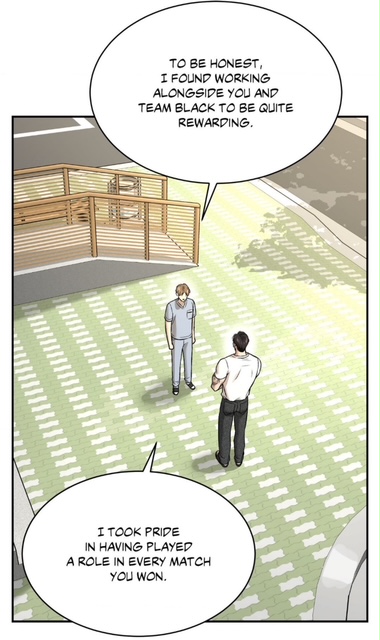 (chapter 62) If he continues making decisions based on past fears, he will remain trapped in the same cycle, unable to experience true growth or emotional fulfillment.
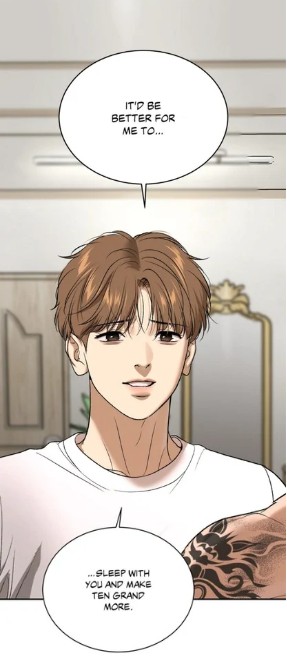 (chapter 62) Here, he is actually facing his past which he has strongly connected to regret and remorse. Don’t forget that after this night, he is expecting Joo Jaekyung’s departure.
 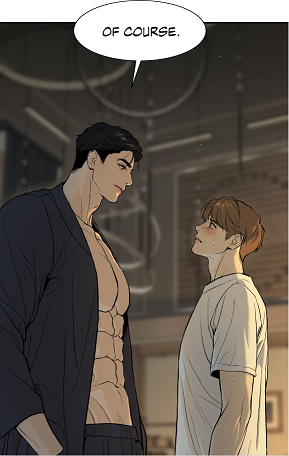 (chapter 3), which has been the setting of power imbalances, physical dominance, and silence, the living room represents a shared space—a place where dialogue and openness can exist. But why is the bedroom linked to silence? It is because of the TV, the third invisible companion!
  (chapter 48) Hence during that night, none of the protagonists talked sincerely to each other. And now pay attention to the living room at the hostel:
  (chapter 54) He needed to get rid of this poor habit: watching TV or cellphone. He had to realize that the TV or cellphones were never real companions and never brought him peace of mind! This was the invisible “love” triangle. Back then, the athlete deceived himself by thinking that he was truly self-reliant, while in verity he was dependent on his cellphone and the TV.



 (chapter 37) And all this started because Kim Dan had taken the initiative.
  (chapter 59) Striking is that here the doctor didn’t apologize to the elderly man, but only to the family.
  (chapter 59)
 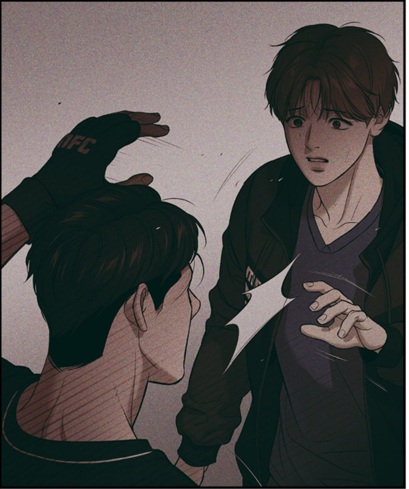 (chapter 62) – which is quite understandable in my eyes. The ones who failed the couple were the two other hyungs from my perspective. The past affected the doctor so much that he views himself and his feelings as “trash” now, yet it is clear that neither Park Namwook nor the coach are suffering from guilt or remorse. The star’s follow-up statement,
  (chapter 62) further reinforces that Kim Dan has become an integral part of his preparation. Although Jaekyung does not yet frame this as emotional reliance, his words betray an unconscious attachment—one that Kim Dan himself does not recognize. Moreover, by including him in his jinx, the champion is only one step closer to include him in his “success”. Should the doctor be the target of malicious comments, the star will consider it as a personal assault or as his responsibility.
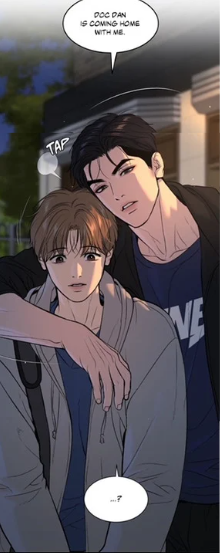 (chapter 43) Someone needs to remind the athlete of his own “statement”. Simultaneously, since the doctor never got curious about the fighter’s past and family, his presence could only be seen as a bandage covering a rotten body. In order to heal completely, he needs to expose his traumatic past and vulnerabilities.
 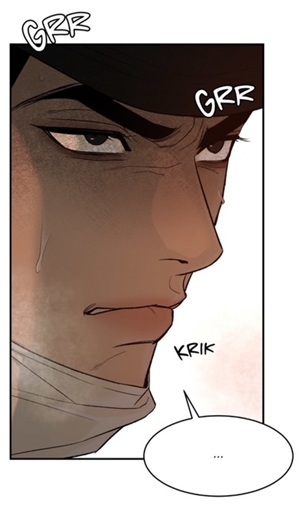 (chapter 56), but about something deeper. Here he felt the need to see his beloved “companion” again.
  (chapter 27) At the same time, this confession displays that his past was far from being perfect, the evidence of a distorted memory. After working so hard for the community, he came to receive a treatment from Kim Dan:
  (chapter 62) This means that he is now treasuring his own body. No wonder why he smiled.
  (chapter 62) That’s why I come to the following conclusion: The athlete must have felt happy in the living room, for he felt comfortable and safe.
 (chapter 62) But why did he show his back? One might say that he desired to hide his “satisfaction” and his “reliance” on his fated partner. Or he didn’t feel the need to watch the doctor’s facial reaction, when he would confide his new intentions and the transformation of his jinx. He didn’t expect the physical therapist to mock him for his absurd belief contrary to episode 2:
  The doctor is treating the star
  (chapter 22) when he is not, using his seniority and past influence to assert dominance. His attitude is related to his past decision: from his perspective, he saved the athlete from turning into a criminal.
  (chapter 26) His dependence on Jaekyung’s achievements makes him resistant to any shift in the fighter’s trajectory
  (chapter 43), but when confronted with a serious incident, he failed to take responsibility or make a decisive choice
 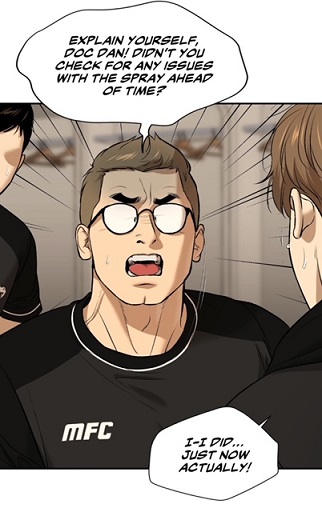 (chapter 50), allowing others to step in instead. Later, rather than addressing his inaction,
 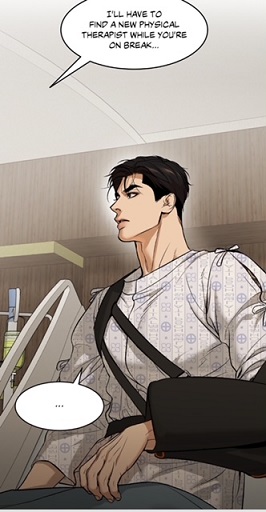 (chapter 53), as if the past never happened. By doing so, he reinforces Jaekyung’s belief in his so-called ‘jinx,’ manipulating the fighter’s perception of events and contributing to a distorted memory of reality. Meanwhile, the manager must face the reality that change is inevitable and that Jaekyung’s evolution does not mean his own irrelevance. However, his position must change.
 (chapter 59)
 (chapter 5) He felt so empowered that he won very quickly.
 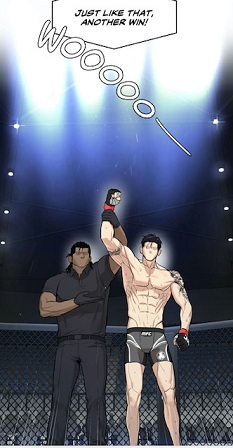 (chapter 5) But this good vibe was attributed to the sex with Kim Dan and unfortunately linked to his match. The reality was that he had slept better and longer. So by recreating the past, Kim Dan places the athlete in front of a choice. What matters in his life? His title or his peace of mind? He is correcting the champion’s distorted memory. Kim Dan is the reason why he can rest properly and not the title. Don’t forget that he was suggesting to go separate ways during the massage. But if he sleeps better before gaining his title, he won’t feel the urge to return quickly to the ring. In the living room, he was still acting as the celebrity, but in the bed chamber he is now gradually pushed to leave his title out of the bedroom. Now, in the bedroom he becomes a man and can almost make a mistake as a lover.


 (chapter 1) Due to the lack of rest and time, he didn’t have the opportunity to ponder on his life and even have dreams on his own. Therefore he had no ambition. At the same time, he couldn’t become energetic and proactive due to his low self-esteem and his abandonment issues.
 (chapter 26) This represents the highlight for the first season. For the first time, both characters had fun together. That’s how they got one step closer to each other. The fighter was enjoying this moment, as he was teaching Kim Dan to become more proactive and fight for himself. The sparring represents the opposite version of the athlete’s vision (chapter 29). He felt safe next to Kim Dan. In fact, his presence boosted his confidence.
  (chapter 25) It is no coincidence that he employed that expression in front of his fated partner. To conclude, chapter 26 stands for life and happiness, proving that their life is not cursed per se. Consequently, red was the dominant color of this chapter. This pigment stands for love and life. Both felt alive during that day. Moreover, we could see glimpses of the sportsman’s true psyche as well, when he proposed to spar with the main lead. He desired to help the doctor himself. Hence he acted as his mentor and teacher in the ring. There, we could see his generosity, interest and open-mindedness. He wasn’t looking down on the doctor, he saw him as a true member from Team Black.
 (chapter 26)
 (chapter 49) But why hasn’t the athlete confided to his manager yet? First, homosexuality is definitely a taboo among boxers and MMA fighters. Their masculinity and strength are questioned. Secondly, his coach views him as a spoiled brat.
  (chapter 7) Thus he keeps beating the celebrity.
  (chapter 26)
  (chapter 31)
  (chapter 46) Yet, according to my interpretation, the main character’s departure was not the sign of stubbornness, but rather of fear and avoidance. Since the manager doesn’t know his star that well, he judges him based on appearances. Moreover, I believe that he has the tendency to generalize, just like certain readers. Since the athlete beat a doctor and was quite brutal with a fighter, he is stigmatized as “thug” or a “spoiled kid”. I am suspecting that the way the hyung met the celebrity affected his perception about the young fighter.
 (Chapter 26) Oh Daehyun repeated this story, because he had heard it from someone and that can only be from the manager and coach. And it is the same for Kim Changmin either, for the two aren’t long members from the gym. They are not close enough to know the celebrity’s past. These stories must have been spread by the hyung. In my eyes, Park Namwook views himself as Joo Jaekyung’s savior, because Joo Jaekyung
 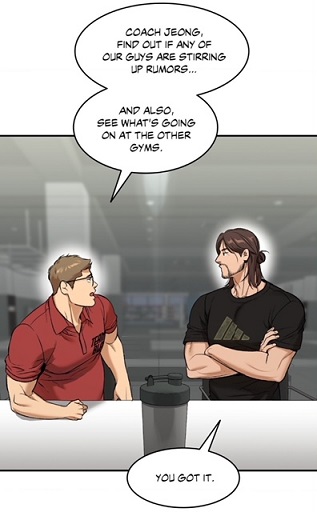 (chapter 46) Despite his attitude, Joo Jaekyung still listened to his hyung’s warning, for from that moment on, he kept his distance from everyone, including the physical therapist. But there’s more to it. Park Namwook keeps associating his star with “good luck”.
  (chapter 1)
  (chapter 27) This represents the exact opposite of the star’s jinx. It shows that he is not trying to understand his celebrity. With such a mind-set, it is normal that the champion wouldn’t trust his manager. And the absence of the manager in this panel
  (chapter 33) The latter truly worries for his star, although he is well aware of his shortcomings.
  (chapter 30) In addition, he knows about his private life and love life.
  (chapter 31) Despite his struggles, he accepts his actor. This is the symbol for unconditional love and support. Therefore it is not surprising that Choi Heesung confessed his trick. He was sure that his right-hand wouldn’t betray him. What about the champion? When the latter discovered the verity
 (chapter 33), he didn’t report it to his hyung. He also kept it a secret. That way, he was not only protecting Kim Dan’s misdiagnosis, but also Park Namwook’s misjudgment. On the other hand, he acted as a real boss, for the comedian is an important client.
 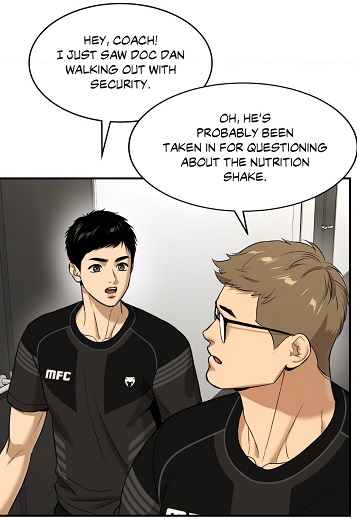 (chapter 40) However, he is far from being a honest man. How so? First, he describes himself as the owner of the gym which is not true.
 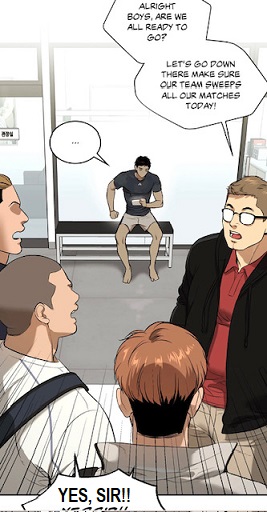 (chapter 23) He promised the fighters that they would win, but the reality is that they failed terribly.
  (chapter 47) Therefore he bought chicken for them. Instead of showing compassion and understanding for his hungry and miserable champion, he allowed Potato and Oh Daehyun to buy junk food behind the celebrity’s back.
  (chapter 37) This shows their lack of mental and emotional support. For me, Park Namwook symbolizes ignorance and blindness. Therefore he is portrayed with no eyes.
 (chapter 23) He never confronted the members with the truth. They lack skills
  (chapter 46) or endurance. I would even say that neither Park Namwook nor Jeong Yosep had high expectations for the other members from Team Black
 (chapter 49) He claimed to trust the champion, but the reality is the opposite.
 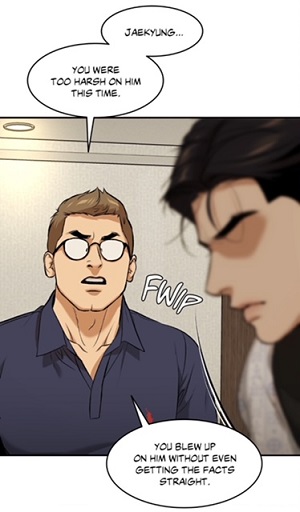 (chapter 52) He blamed Joo Jaekyung for everything: the tie, the doctor’s departure, the suspension and as such the loss of his good reputation. However, even if the champion had vented his anger onto the physical therapist wrongly, he had reasons to doubt Kim Dan. He had not only received the pictures, but he had been warned by the coach himself to doubt the members’ loyalty. There was a spy and a traitor among Team Black. One detail in the last panel caught my attention is the idiom “facts”. It is in plural and not in singular. Fact could be seen as a reference to his own warning, he had not checked the fact either (rumor, suspected disloyalty), yet this is not what he meant. Potato had exposed only one fact to the group: the switch of the spray organized by Choi Gilseok.
 (chapter 52) So what other fact was Park Namwook referring to? The fighter Baek Junmin and director of King Of MMA had paid Kim Dan. This shows that he had heard the conversation between the two protagonists.
  (chapter 52) And what did the manager do, after the champion had left the room? He abandoned Kim Dan, followed by the other men. At no moment, he asked Oh Daehyun or Yoon-Gu to take care of the physical therapist. But by following the celebrity or remaining passive, they had implicitly supported Joo Jaekyung’s decision. They had taken his side. And now, you comprehend why all these men chose to put the whole blame on the celebrity.
  (chapter 52) It is because they didn’t want to feel responsible for doc Dan’s departure. Their admiration and trust in the celebrity is superficial. In other words, they are following the hyung’s lead. Hence there is no regret, only reproaches.
 (chapter 1)
  (chapter 49) He should be responsible for his contracts, yet the reality is that the Entertainment agency is the one managing the champion’s career.
 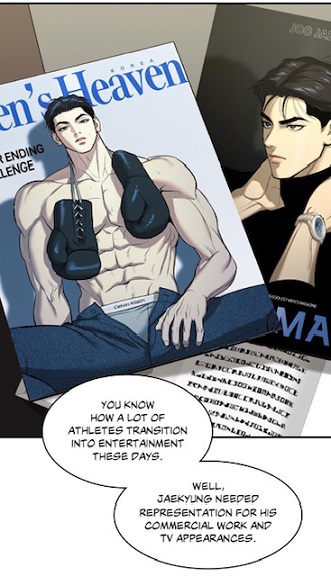 (chapter 30) This shows that Park Namwook doesn’t have a lot of connections. He should be the one organizing the fights, but no… others are making the propositions (MFC matchmaker and agency). Consequently, the ex-wrestler often voices doubts about the matches.
  (chapter 41) However, as his manager, it is his duty to protect his star, as the career of a MMA fighter is rather short. Imagine, he let Joo Jaekyung fight three times within 3 months (April- June- July). It is definitely too much. To conclude, he is not doing his job properly, as he is trying to put a lot of responsibility on others (Kim Dan- Joo Jaekyung – the Entertainment agency). According to Mingwa, Kim Dan had been taking care of administrative tasks. However, as the director of Team Black, he should be the one handling it. After the incident at the health center, Park Namwook didn’t contact the press to explain the whole situation.
  (chapter 52)
  (chapter 52) The article is indicating that the champion was quickly judged and this within a few days. The article implies the non-intervention of a lawyer or his manager. No one sided with the celebrity. They are not even contacting the media.
  (chapter 52) Park Namwook never tried to correct this negative reflection, for this is how the manager perceives the man himself. He is an ill-mannered child. This explicates why Park Namwook could slap the patient in his bed. So we should judge the argument between the fighter and his manager
  (chapter 52) as the negative reflection from that blue night.
  (chapter 29) He is not standing next to the main lead, but he is facing him. He is like an opponent. Another divergence is that Kim Dan was alone, whereas Park Namwook utilizes Potato and the others from Team Black to corner Joo Jaekyung. The doctor was willing to listen to him, whereas the other gets upset, when the other admits his suffering. Since the gym is facing a crisis, the patient should find a solution to the problem.
  (chapter 52) The hospital is a place for reconvalescence, rest and not work and pressure. Indirectly, it shows the coach’s lack of respect for the medical world. The champion was right to criticize his hyung, for blaming him was totally pointless. He couldn’t turn back time. The manager desired to hear from the champion
  (chapter 52) that he regretted his decision and outburst. By admitting his mistake, he would have become responsible for the whole mess. Funny is that he asked compassion from Joo Jaekyung, whereas he showed none to the patient. And what was Kim Dan thinking during that night?
  (Chapter 53) Moreover, he had not earned his patient’s trust. Kim Dan was the only one paying attention to his injured shoulder.
  (chapter 52) And the only solution he offers to the gym owner is to find a new PT during his a break.
  (chapter 52) resembles a lot to the image with the opponents.
  (chapter 22) Besides, by announcing it in front of this circle, the champion divulged that there existed a certain distance between the manager and the sportsman. Finally, the fact that Park Namwook is still left in the dark about the fighter’s jinx is the evidence that he is a really bad manager. For me, it is because he is afraid of making decisions. He lets other take his burden and responsibilities. Yet, Myles jury declared that a manager needs to take a lot of responsibilities. The gathering in the break room stands in opposition to this one:
  (chapter 52) For the first time, the champion is no longer looking at his cellphone. He shared his thoughts to others and exposed his powerlessness
  (chapter 40) These two situations have many similarities. Both were confronted with an accusation, they were surrounded by people, who were acting as righteous and honest workers. Both were coerced to admit a wrongdoing. In addition, they are actually abandoned by Team Black members, especially the manager. No one is looking for them out of concern. The reality was that they were not their “true colleagues and even less friends. However, like mentioned in a previous essay, the men in black were actually covering up a crime in order to hide the corruption from the organization. This makes me truly wonder if Park Namwook is truly ignorant about MFC’s corruption. He could simply know about the crimes, but he chose to close an eye to the whole situation.
  (Chapter 46) He is already aware of the existence of illegal betting. Besides, since Joo Jaekyung is paying his taxes properly, Park Namwook could have the impression, he is doing nothing wrong. However, if he knows something and is remaining silent, he “becomes an accomplice” de facto. And what is the other common point with the interrogation from MFC security guards and the hospital visit? No lawyer and the incident was swayed under the rug.
  (chapter 40) He had rescued him. So by slapping the champion
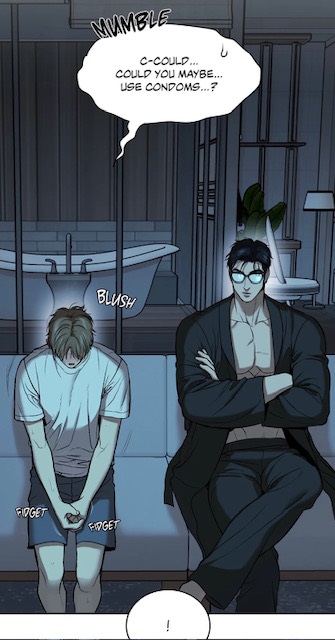 , (chapter 29), I deduce that the slap had the opposite effect than this wonderful night. The gap between the hyung and the athlete got bigger. This represents the moment where Joo Jaekyung is emancipating himself from the hyung’s influence. By refusing the letter of resignation, he clearly indicates that he is rejecting Park Namwook’s suggestion.
 (chapter 53) He won’t hire someone else. Moreover, the morning after the couch confession, Joo Jaekyung tried to seek closeness with Kim Dan
  (chapter 37) They imagine that Joo Jaekyung’s recent demise will reinforce his former belief. The prematch-sex session with his regular partner didn’t prevent the misfortune, therefore he needs a replacement. That’s the reason why they made sure to isolate the celebrity. However, they couldn’t be more wrong, for the champion experienced the doctor’s departure as something worse than the whole scandal.
  (chapter 53) He doesn’t just feel like shit, but like fucking shit! And that’s how Doc Dan is helping the athlete. He is diverting his attention from MFC, his career and jinx. The latter are no longer on his mind. All his thoughts are revolving around his former roommate.
 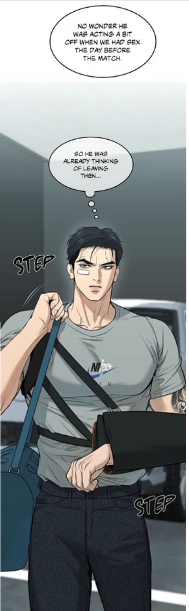 (Chapter 53) This explicates why the idiom “jinx” is not even brought up, when he recalls their last sex session. He is not blaming the doctor for not procuring him a “good fuck”. The reason is simple. It is because he had already made this resolution:
 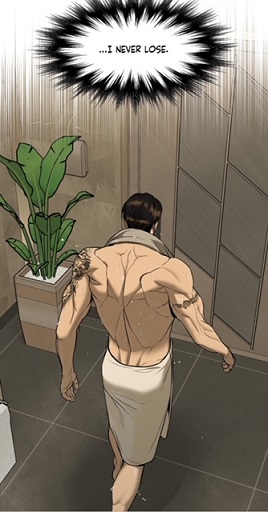 (chapter 49) He was no longer relying on the ritual.
 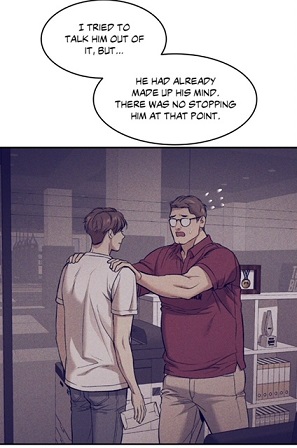 (chapter 53) That’s the reason why the champion has never apologized towards the doctor either. To conclude, the manager had a huge negative influence concerning the sportsman’s mind-set and behavior. Therefore it is necessary for the athlete to distance himself from Park Namwook. That’s how he can get purified. On the other hand, the last incident was essential for the star’s growth. Since the latter hasn’t questioned the integrity of MFC yet, he needed to be suspended in order to realize that his perception of the world was wrong. Though he lost his reputation, he is experiencing that his defeat is not the end of the world. The doctor’s departure was more painful for him. Therefore it was necessary for the champion to make a bad decision. Only through pain, the athlete can turn into a better man. Since Kim Dan left the city for the west coast, I assume that the champion will follow him there. He will reconnect with nature.
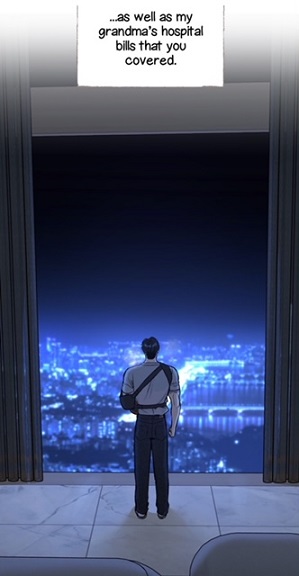 (chapter 53) He is now missing him, but he is not capable to express it properly. For the first time, he is confronted with reality. His penthouse feels cold, lifeless and empty.
  (chapter 19) Yes, we should see episode 53 as the negative reflection from chapter 19, the doctor’s arrival at the penthouse.
  (chapter 19)
  (chapter 53) Here, what Kim Dan saw was not the real sunset, but the lights from the cameras. Far away from the lights from the journalists, the champion will witness the beauty of a sunset, which can not be bought with money.
 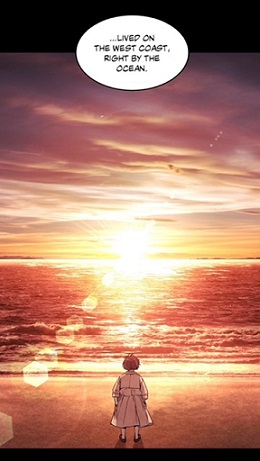 (chapter 53) Humans can only appear as small and powerless. That’s how he could reconcile with the god of time. He will no longer fight against time. I connected nature to temporality of human life because of the grandmother. For me, his break represents a blessing in disguise. He will be able to breathe, to find joy in little things and more importantly he found a true friend and support: Kim Dan. The Webtoonist announced that season 2 would be focused more on feelings which is totally understandable. It coincides with introspection and meditation. Joo Jaekyung will have to prove that he trusts the main lead and he can only achieve this goal by entrusting him his recovery. Moreover, by doing so, he would boost the physical therapist’s confidence. While there was no real seduction in season 1 (money, jinx, treatment, bet during the confession night, drug), we have to envision that their intimacy won’t be so abrupt. It will be more subtle and gradual. The star will have to woo the doctor in order to express his love and affection. Through love, Joo Jaekyung will discover not only happiness, but also strength which will help him to defeat their “enemies” and unmask the criminals. In other words, he should realize thanks to this new journey that he is not cursed, but blessed, for he can help Kim Dan mentally, emotionally and professionally. So far, when the champion travelled, he never visited the cities
  (chapter 37) or sightseeing attractions. Here, I feel the need to add this French song from Daniel Balavoine (1985): “Aimer est plus fort que d’être aimé” (Loving is stronger than being loved”).
 (chapter 21). By interacting with Kim Dan, he will be able to reconnect with his true self which will change him forever. Notice that after the night in the States, at no moment, the champion mentioned his jinx, but spoke about his physical health. In reality, he was including his mental health. This shows that he was already moving on from his jinx. Moreover, after the tie and the suspension, he is not mentioning or thinking about his former belief. The reason is simple. Because of the doctor, the champion was allowed to perceive glimpses of the truth: corruption and the existence of tricks. This image
  (Chapter 48) represents the medicine against the champion’s false belief. Moreover, by making him meet his former rival Baek Junmin, the athlete was incited to overcome his past and biggest fears.
  (chapter 53) He imagined that he should quit and leave the penthouse. To conclude, he is not entirely free. On the other, thanks to the champion, he was able to get rid of the loan. But more importantly, he was able to experience happiness for short moments.
 (Chapter 44) So he was able to create good memories. Besides, he came to fall in love with Joo Jaekyung. Thanks to the latter, doc Dan could overcome his fear
  (chapter 26) and make others happy too.
  (chapter 26) He didn’t realize that he brought joy and love to the gym.
 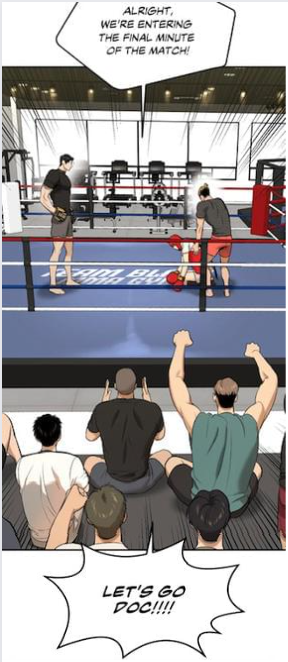 (chapter 26) The more he spent time with the celebrity, the more confident he became. He was able to voice his opinion and he started becoming more passionate about his job as PT. He studied sports rehabilitation, a sign that he was taking the champion’s career seriously. So when he wrote these words to his soulmate
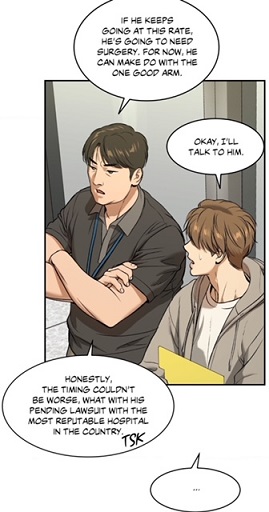 (chapter 42) This shows that his self-loathing is gradually vanishing as well. The fact that he is employing the personal pronoun “I” indicates that he is able now to distinguish himself from his grandmother.
  (chapter 35) He is still cheering the athlete on and even wishing him happiness. This exposes that the physical therapist discovered “happiness” through the celebrity. He is no longer believing in the athlete’s jinx.
 (Chapter 53), a color symbolizing the spiritual world and purity. But this signifies that going to see the sunset next to the ocean has a different meaning for the physical therapist than the champion. On the one hand, it is strongly connected to death, on the other hand, it also embodies rebirth. I can’t help myself thinking of the legend of Venus’ birth. The goddess of love was born in the sea. It is the reunion of the sky and water. According to me, Yoon-Gu is a representative of this deity. Thus I come to the following deduction. Kim Dan came to discover Yoon-Gu’s principle. It is possible to love someone from far away, which contradicts his past “abandonment issues”. This shows that he moved on from his past suffering. Though his grandmother is about to die, he will still love her. He won’t perceive it as a desertion and abandonment. That’s why the magic of love should take place near the sea. Both characters will meet the goddess of love there.
  (Chapter 53) Here, I feel the need to remind my avid readers that though the doctor was victim of a trick, he was not entirely innocent either. He should have come clean with the champion concerning his meeting with the director from the rival gym. His lie still played a huge role in the champion’s mistrust. But why did he not tell him later? It is because he was under the influence of the manager.
  (chapter 48) The hyung had been his mentor and advisor. Thus he copied his actions and followed blindly his recommendations.
  (chapter 41) At no moment, he questioned his words and honesty.
  (chapter 43) How could the athlete be kinder to his own body, when his hyung was slapping him constantly? He was definitely pressured by the former wrestler. This shows that the 29 years old man is lacking critical thinking. On the other hand, we can not blame Kim Dan for trusting the man so blindly, as Joo Jaekyung was behaving the same way. Yet, the fact that Kim Dan cries
 (chapter 45) Both knew how the champion disliked the birthday and the gifts, but they still chose to ignore the man’s feelings. He believed every word Park Namwook said about the champion in the end. Hence for me, the doctor’s decision to quit was not simply the consequence from champion’s request and reproach, but also from the manager’s indifference and ignorance. At no moment, he contacted him showing that he was necessary for Team Black. His silence and passivity could only be interpreted as a disapproval and rejection.
 (chapter 44) The intimacy is rather superficial, for it is limited to pleasure and sensuality. This has nothing to do with the partner’s personality. Secondly, during that night, the champion was drunk. In season 1, both protagonists only discovered physical closeness without sharing their thoughts and emotions
  (chapter 29) Moreover, during that sex session, the athlete employed dirty talk.
  (chapter 29) It was not to express affection.
 (chapter 2) prostitution and rough sex. He never experienced true romance and the birth of “first love”. The courting and seduction were totally absent. His first kiss is connected to fighting, pain, survival and protection.
  (chapter 14) It had nothing to do with innocent and pure love. For me, Kim Dan didn’t have the time to fall in love with the champion properly. He could even say that his affection is related to his job and he could reduce it to mutual physical chemistry. Thus I deduce that he became a ghost again for one reason. Both need to experience the innocent first love. In other words, we should expect a new version of this magical night:
  (chapter 20) Till that moment, he lived like a ghost. He had been trying to deny the existence of his own body. And how did the athlete describe his lover in the bathroom? First, he compared him to a whore
 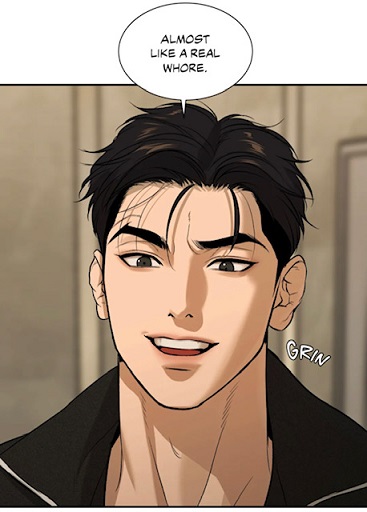 (chapter 19) before describing him as a baby.
  (chapter 20) However, we should expect a more pure version, where both act as innocent and inexperienced teenagers, similar gestures:
 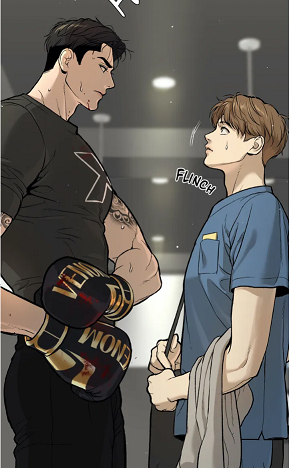 (chapter 1) He was so attracted to him physically, hence he didn’t pay attention to his partner’s personality. In fact, he had a negative perception of his nature:
  (chapter 1) By becoming a ghost, the champion is forced to perceive the main lead as a person and as such to pay attention to his personality (dislikes, likes, qualities, career). That’s the reason why I believe that in season 2, he won’t make the same mistake again. He will study the doctor and get to know him better. That’s how he will be able to identify his feelings for the protagonist. He doesn’t love him because of his cute face and body, but because of his big heart and warmth. He is so responsible, generous and dedicated that there’s no one else like him. He embodies true kindness and loyalty. His care and worries are genuine. That’s why the champion will voice his affection differently from the past: “Secret and innocent love behind work”. Under this new light, it becomes comprehensible why both characters had to go to the seascape. Nature is the perfect place to nurture innocent and pure love. Consequently, I don’t think, the author will rush to create a new chapter full of sex… rather full of tenderness and caresses! Thus Mingwa created such panels:
 The hands are no longer fists used to express anger and resent, but they are wide open, they are expressing love and tenderness. They will convey a different message: respect, teamwork, and communication. Finally, through such gestures, both are able to reconnect. The hands are encouraging them to express their own thoughts and emotions. They are giving them reassurance and confidence. Season 2 stands for sharing, honesty and communication. Expect a revolution at the gym!
 Bebebisous33s' analyses in K-Dramaland and Manhwas