
Please support the authors by reading the manhwas on the official websites. This is where you can read the manhwa: POTN But be aware that this Manhwa is a mature Yaoi, which means, it is about homosexuality with explicit scenes. If you want to read more essays about Painter Of The Night, here is the link to the table of contents.
It would be great if you could make some donations/sponsoring: Ko-fi.com/bebebisous33 That way, you can support me with “coffee” so that I have the energy to keep examining manhwas. Besides, I need to cover up the expenses for this blog.
1. Heaven and life
When many readers heard Yoon Seungho‘s statement  (chapter 119), they got worried and nervous, as they considered the expression „as long as I live“ as a clue for a sad ending. Why? It is because the lord was referring to his own death. Under this light, it becomes comprehensible why I selected „heavenly“ in the title. I was naturally alluding to the afterlife. However, I perceived his words in a positive light. He expressed his desire to live. He is no longer suicidal, he wishes to live a long life next to the painter and treasure his moments with him. That’s the reason why the author included the refraction in the scene. A dream had come true, the lord was finally able to escape the darkness.
  (Chapter 119) He is now truly alive. This explicates either why he smiled and laughed at the end. But why was he so happy? It is because Baek Na-Kyum had just confessed that he loved him not for his wealth or power, but for himself.
  (Chapter 119) He even described him as a treasure. Yoon Seungho had finally achieved his goal: to win the painter’s heart. His presence and love bring happiness to Baek Na-Kyum which stands in opposition to his reputation as bird of misfortune. Moreover, this description contrasts so much to Jung In-Hun
  (Chapter 119) and Yoon Seungwon’s.
  (Chapter 118) where both portrayed the main lead as a man consumed by lust and revenge. In other words, he was presented as a huge sinner. This implies that he stands so far away from heaven. But all these words were erased the moment the painter confessed his love for Yoon Seungho once again. What Baek Na-Kyum didn’t realize is that his love confession is pushing the protagonist to fight for the painter. (Chapter 119) If something were to happen to him, the low-born would be heartbroken and miserable. Baek Na-Kyum is his reason to live. Thus I consider this scene as the positive reflection from that terrible night:
 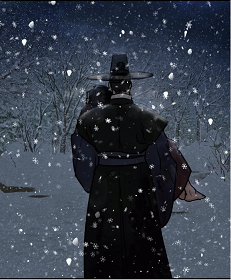 (chapter 102) In episode 102, he was renouncing on everything (life, mansion, wealth and connection), because he imagined that the artist had died. Consequently, I deduce that in episode 119, the painter’s life is attached to the lord’s for good. If the artist got into trouble, Yoon Seungho would side with him and the reverse. Thereby, I come to the conclusion that this moment in the kitchen represents their union, as they are no longer tied to the mansion. They are now a family no matter where they are. Let’s not forget that the painter expressed his wish to run away with his lover.
  (Chapter 119) It is important, because such a departure symbolizes that the bird “Yoon Seungho” is leaving the nest. He is now starting a family on his own.
2. Food, offerings and faith
Striking is that heavenly can be employed in a different context food. Let’s not forget that food is often served as offering to gods and spirits. Interesting is that in Asian societies, it is a tradition to offer the favorite dishes on the anniversary of the relatives’ death. As you can imagine, this custom was already practiced in Joseon. And now, take a closer look at this scene.

Yoon Chang-Hyeon was honoring his ancestors by bowing in front of the shrine. But what caught my attention is that in such an occasion, he should have brought food and his sons to such a ceremony. However, he just had lit incense 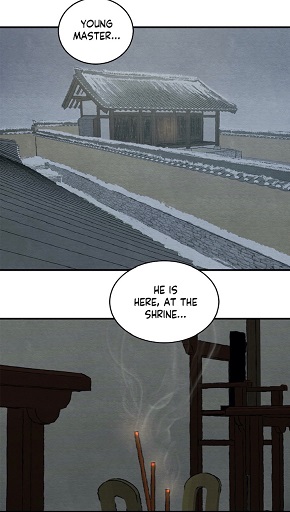 (chapter 85) and put a glass and that was it. This exposes the father’s hypocrisy, ignorance and greed. By acting on his own, he was exposing his true mindset. He views himself as the family. The sons are just the extension of himself, for they are his reflections.
Narcissists need a scapegoat to preserve their self-image, avoid taking responsibility for their actions, and to feel emotionally stable. Quoted from https://unfilteredd.net/why-do-narcissists-need-a-scapegoat/
As a narcissist, the father projects all his flaws onto Yoon Seungho, hence he is his scapegoat.  (Chapter 45) On the other hand, Yoon Seungwon is his golden child, for he represents his positive reflection.
A “golden child” is one who is considered “special” by their family and chosen as a proxy for a parent’s own achievements and magnificence. Unfortunately, the child must live up to perhaps unattainable levels of accomplishment and perfection. Being the golden child does not necessarily represent a positive familial position, and narcissistic parents frequently place this identity on one of their children. Quoted from https://www.choosingtherapy.com/golden-child-syndrome/
This explicates why in the bedchamber, the patriarch called his son a monster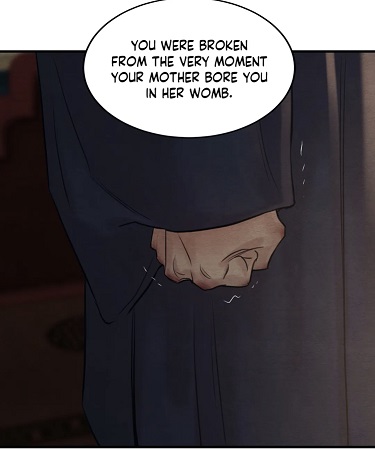 (chapter 86), whereas he put the other on a pedestal
 (chapter 86). Thus I created this illustration.
 Under this new light, it becomes comprehensible why the father could only reject the offer from lord Song in the gibang. Doubting Yoon Seungwon’s sexuality meant to question about the father’s sexual orientation. At the same time, it is not surprising why the elder master would blame Yoon Seungho for everything, for he couldn’t admit his responsibility for the purge. Consequently, the Manhwaphiles can grasp why Yoon Chang-Hyeon came alone to the shrine. If he had brought Yoon Seungwon, the father would have been reminded of the elder son, as both can not be separated. This explicates why the younger master asked his elder brother to submit to his father.
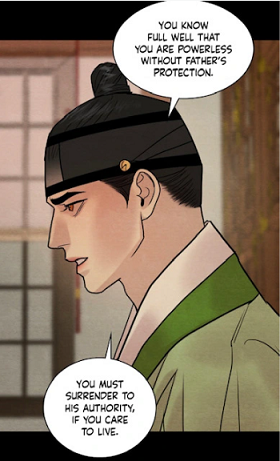 (Chapter 119) I couldn’t help myself smirking when the brother attempted to make him believe that.
 (Chapter 119) the protagonist could ever gain the father’s favor. Yoon Seungwon was definitely playing with his brother’s feelings, as if he could hope that their father would change.
At the same time, his position as golden child explicates why the younger brother resents the father and betrayed him:  (Chapter 118) It is because as a golden child, he is also suffering, but it is naturally nothing compared to Yoon Seungho’s position who could have died.
 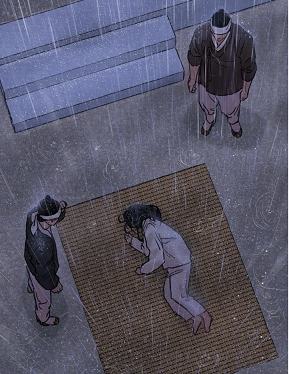 (Chapter 77)
Parents with NPD often shape one of their children into the golden child role. The golden child becomes an extension of that parent, and the child’s role is to please that parent. Narcissistic parents are unable to appreciate the golden child’s unique identity, and attempt to control their child’s interests and activities in ways that would reflect positively on them. They live vicariously through their golden child and they feed on their child’s successes, which serve as the parents’ narcissistic supply. Quoted from https://www.choosingtherapy.com/golden-child-syndrome/
Interesting is that psychologists said that it was easier for a scapegoat child to escape from this nightmare, as they can cut off ties more easily than the golden child who got used to special treatment. Moreover, the flaws from the patriarch rubbed off on Yoon Seungwon which often happens in such a toxic family. This signifies that for Yoon Seungwon, it is difficult to maintain good and healthy relationships in the end too. And now, you comprehend why the younger master made such a request to his brother. He needs him for two reasons.  (Chapter 119) First, by returning the petition to the father, Yoon Seungho would become the culprit. He was not only a traitor, but also a blackmailer of the Yoons and lord Song.
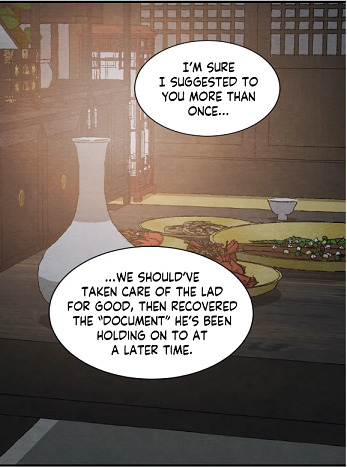 (Chapter 107), for he had stolen the petition. Yoon Seungwon would hide his wrongdoing, he betrayed their father.
 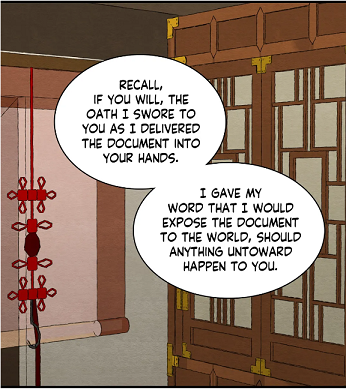 (Chapter 118) There is no doubt that Kim played a role in this as well. In other words, the brother and the valet would bury the truth by diverting the attention of the patriarch towards the main lead, if Yoon Seungho followed this suggestion.
  (Chapter 116) The elder master would no longer seek the truth, similar to the kidnapping in season 2 which was turned into a desertion and later Lee Jihwa’s abduction occulting the instigator and the helping hands. Simultaneously, Yoon Seungwon needs his brother as scapegoat, because the pressure coming from the patriarch and lord Song must have definitely increased. (Chapter 119) How ironic that Yoon Seungwon employed the expression “care to live”. Back then, the protagonist was just surviving, he had already developed suicidal tendencies, when this incident took place.
 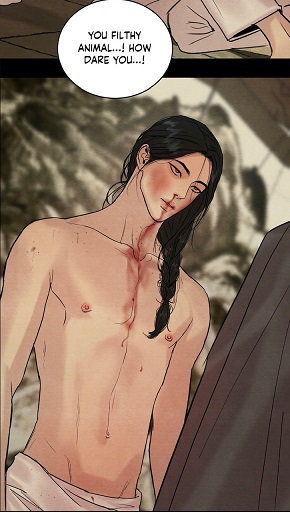 (Chapter 83) This shows that the young master wants to sacrifice his brother once again. Out of selfishness and cowardice, he is trying to convince Yoon Seungho that this is the right thing to do! (Chapter 119) This is a new version of this scene!
 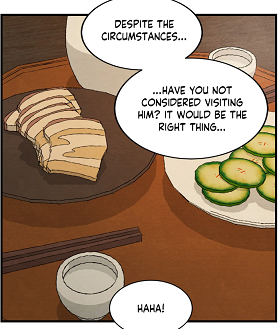 (Chapter 37) He is even implying that he needs to sacrifice himself in order to protect Baek Na-Kyum!! Moreover, he is distorting the reality, because he implies that his father is still powerful. (Chapter 119) However, the purge took definitely place,
  (chapter 37) like the memories from episode 37 are exposing it. It becomes clear that if Yoon Seungho returned the petition, he would die.
 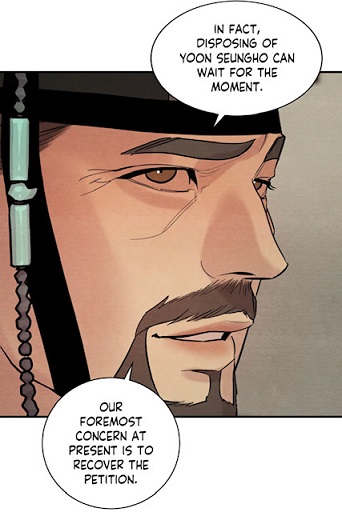 (Chapter 116) Thus I come to the conclusion that the meeting between the brothers in the gibang represents an offering. For the Yoons’ sake, Yoon Seungho should admit his wrongdoings (Chapter 119) and beg for forgiveness. Thus I interpret the scene in the kitchen hearth as true hope (chapter 119) while the table with many dishes in the gibang stands for fake hope and offering. (Chapter 118) It was, as though Yoon Seungwon was giving his brother his last meal before his sacrifice. This situation exposes that in the past, the main lead had been put in a similar situation, covering up for the brother’s mistake.
  (Chapter 55) People had played with his hopes and longing for acceptance and recognition. Interesting is that offerings is a synonym for atonement and sacrifice. But why is Yoon Seungwon so sure that he can repeat the same action from the past? It is because Kim and Yoon Seungwon have known for a long time that Yoon Seungho was longing for acceptance and love from his family, just like the scholar knew about the painter’s love for him.
  (Chapter 119) But everything changed, when the painter met the lord. So who is worse here? Jung In-Hun who tried to rape the painter or Yoon Seungwon who is sentencing his elder brother to death? Let’s say that the valet convinced the younger master to suggest this solution, this doesn’t diminish Seungwon’s responsibility at all. He knows that his father abused his elder brother. In my opinion, he is copying his father, like the former tried to diminish the responsibility of the patriarch.
 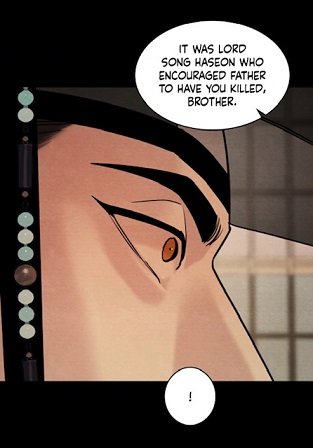 (Chapter 119) Yoon Seungho got hurt because of lord Song and not because of Yoon Chang-Hyeon. This means that the younger master was denying the existence of the patriarch’s choice and the helping hands. And if the brother listened to his advise and the father hurt or killed the main lead afterwards, the younger master could put the blame on the elder master, for the decision and responsibility belonged to the patriarch. Moreover, he heard from lord Song that killing Yoon Seungho was just a matter of time. (Chapter 116) Fact is that the younger master is betraying his brother once again.
Yet, the former is making two huge mistakes. He is considering the painter as a servant (chapter 119), therefore he believes that the artist is tied to the mansion. Secondly, I am quite certain that his perception about the artist is influenced by Kim. This signifies that the latter is also projecting his own thoughts onto the painter, for he is himself a narcissist. The latter is interested in wealth and comfort. If he came to lose everything, he would abandon Yoon Seungho, that’s what Kim is envisaging. Thus if Yoon Seungho were to submit himself to the father, Baek Na-Kyum would lose everything. Besides, I am even thinking that Jung In-Hun’s approach in the gibang is also related to the brother and the butler. All of them had an interest to separate the couple! And note that when the lord went to the noonas’ room, it looked like the painter had deserted him.  (Chapter 119) So technically, this situation could have triggered the protagonist’s insecurities like in season 1
  (chapter 28), 2
 (chapter 60) and 3
 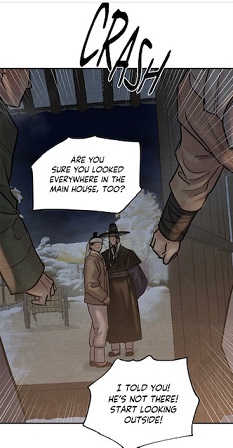 (chapter 98). However, through these constant exposures, Yoon Seungho came to learn not to jump to conclusions and to have faith in Baek Na-Kyum. He knew that he would return to the mansion. Hence he ran to the bedchamber first.
 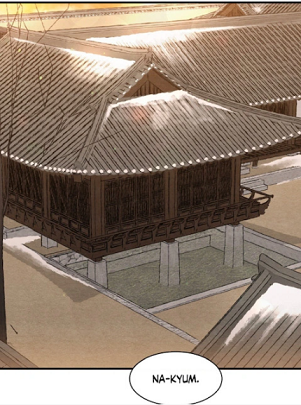 (Chapter 119) Another important detail is that we don’t see any staff in the courtyard or in the kitchen. It was, as if the propriety had been deserted.
 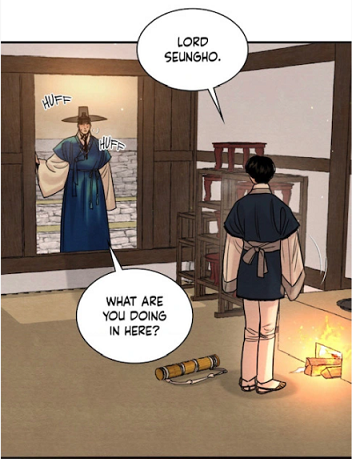 (Chapter 119) This implies that at no moment, he relied on the domestics’ testimonies which contrasts to the following scenes: (chapter 98)
 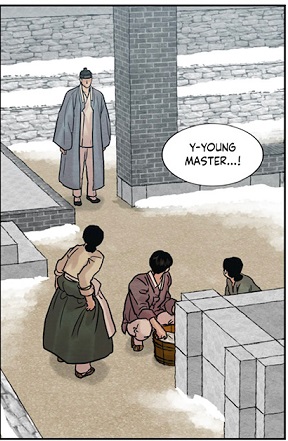 (chapter 104)
 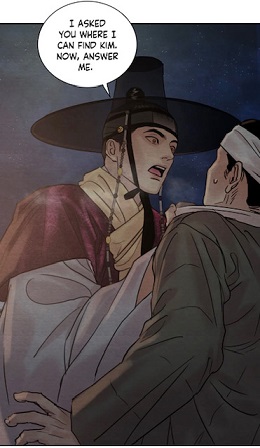 (chapter 107) and
 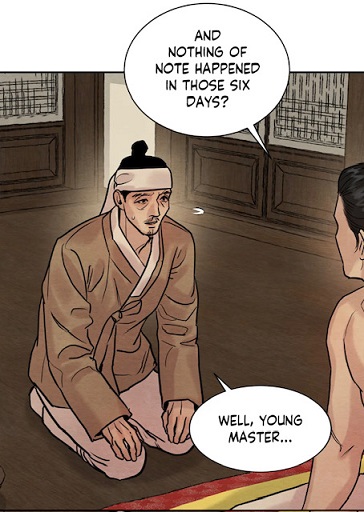 (chapter 116) However, observe that in episode 116, Yoon Seungho had witnessed how his lover had taken care of him, while he was unconscious. Furthermore, the petition had been handed over to the painter and not Kim, a sign that the artist had become the protagonist‘s confident. As you can see, as time passed on, the main protagonist learned the following lessons: he should stop relying on servants, he should only trust his partner. I would even add that he was taught the following principle: “If you want something done right, you have to do it yourself”. In my eyes, (chapter 119) the scene in the kitchen is exposing the betrayal from the staff, that’s the reason why we see no one! They were either expecting their lord’s return and imagined that he would be upset or even violent! At the same time, by not meeting the artist, the servants could feign ignorance about the lover’s whereabouts and claim their innocence. The proof is that this scene (chapter 119) is the positive reflection from that night:
 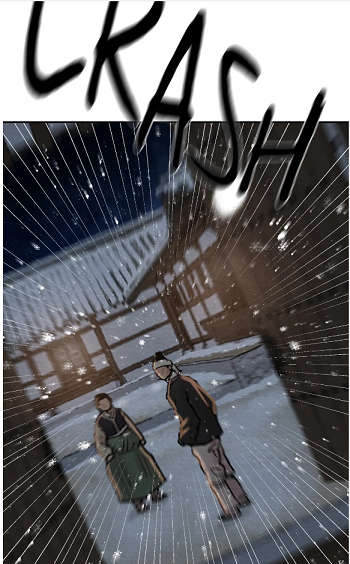 (Chapter 103) Here, they never expected the return of Yoon Seungho and the painter. The staff ‘s absence in episode 119 is the evidence of their desertion! Moreover, I consider Yoon Seungho’s search for his lover as a new version from episode 28/29/30:
 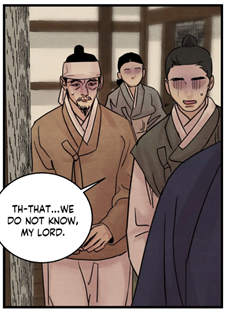 (chapter 28) Back then, they feigned ignorance, but they never anticipated a punishment from Yoon Seungho.
And this leads me to the following observation: Baek Na-Kyum’s action in the kitchen reminded me of an offering! (Chapter 119) Why? It is because he burned a paper. The evidence for this is the presence of the painter’s belongings. This is the place where he used to hide the scholar’s poem (chapter 4). Moreover, the painter is standing in front of the hearth which certainly triggered the manhwaphiles’s memory. Jung In-Hun was seen in front of the hearth burning the letter from Min in order to hide his involvement in the painter’s sexual abuse. 
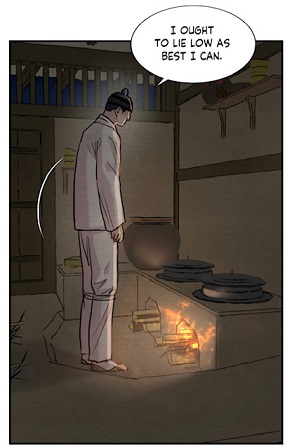 (chapter 115) And now you are wondering how the painter’s gesture can be considered as an offering. It is because the kitchen hearth is considered as sacred due to the fire. First, in shamanism, there exists the god of fire named Jowangshin.
The origin of Jowangshin is the fire of the home. But their realm also extends to the area that uses fire and water harmoniously. It is good etiquette to brig a set of matches when you move to a new house. One can enshrine the house god with an onggi of water placed on/above the stove or utilizing sacred mulberry paper put up on the wall in the kitchen. (…) Jowangshin is the emissary of heaven and will ascend to report the wrongdoings of the home’s inhabitants to Hwanin, God of Heaven. https://www.firelightlotus.com/post/jowangshin-god-of-the-kitchen
In China, people had a similar belief.
Zao Shen, Wade-Giles romanization Tsao Shen, in Chinese religion, the Kitchen God (literally, “god of the hearth”), who is believed to report to the celestial gods on family conduct and to have it within his power to bestow poverty or riches on individual families. Because he is also a protector of the home from evil spirits, his periodic absences are thought to make the house especially vulnerable to becoming haunted at such times. Zao Shen’s identity in life and in the history of his cult are uncertain. The god of the kitchen has also been confused with Huo Shen (god of fire) and with Zao Jun (“Furnace Prince”). Quoted from https://www.britannica.com/topic/Zao-Shen
As you can see, the kitchen is a sacred place. This explicates why next to the hearth, people had to follow the following rules:
- Do not curse while in the hearth.
(Chapter 115)
2. Do not sit on the hearth.
(Chapter 59)
3. Do not place your feet on the hearth.
(Chapter 98)
(Chapter 115)
4. Maintain the cleanliness of the kitchen.
(Chapter 47)
5. You may worship other deities in the kitchen. Quoted from https://en.wikipedia.org/wiki/Jowangsin
That’s how I realized why Byeonduck mentioned that lord Min would help Yoon Seungho. Note that Jung In-Hun cursed lord Min (chapter 115), when he burned the letter! Moreover, let’s not forget Black Heart’s claim during that night: Lee Jihwa  (chapter 102) who was a traitor, for he had tattled on Black Heart and his friends to Yoon Seungho. And now, you comprehend why I connected the shrine to the kitchen hearth. Both places are considered as sacred, for they are connected to gods and spirits.
3. Confessions and truth
And now it is time to return our attention to Yoon Chang-Hyeon.  (Chapter 85) The absence of his sons and of food as offerings reveals that he was not showing true respect to his ancestors. He used religion and social norms to hide his true intentions. He wanted to take over the mansion. Hence the black guards were standing at the entrance of the sacred house. Their presence symbolizes violence. Therefore it is not surprising that the gods chose to punish the elder master through Yoon Seungho. The former was not received properly
 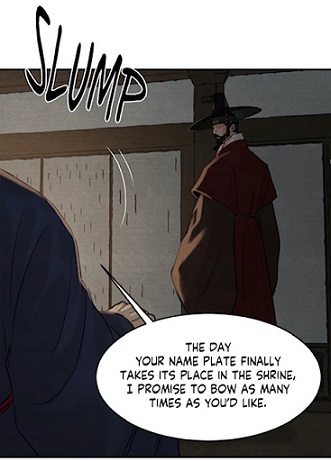 (chapter 86): no bow, no food and no seat.
 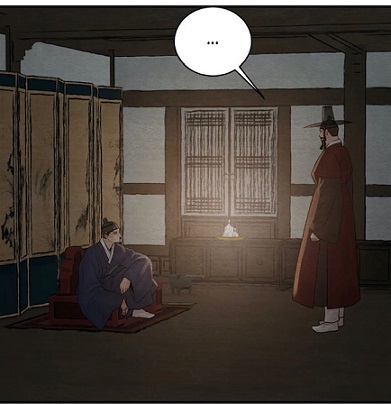 (Chapter 86) Let’s not forget that the elder master had entered the lord’s chambers without the permission of his owner. No wonder why he was left speechless. And now, you are wondering if I am not drifting away from the topic, as these chapters from season 3 don’t seem to be connected to episode 119. However, it is important to realize that these chapters have many common denominators
| Chapter 85-86-87 | Chapter 119 | |
| Death |   Here, we could detect the suicidal tendencies of the protagonist. He wouldn’t fight back. Here, we could detect the suicidal tendencies of the protagonist. He wouldn’t fight back. | Here, he wants to live and as such to fight back in order to protect his lover. |
| Coup d’Etat | 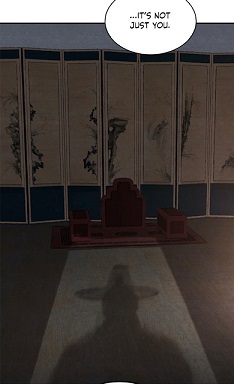 The seat looks like a throne. The seat looks like a throne. | Yoon Seungwon advises his brother to admit submission. It is like a surrendering. |
| The fire |  | Note the contrast. In the furnace, the fire was not properly lit. This explicates why the bedchamber didn’t get destroyed by the fire during that night. |
| The absence of the staff |  The courtyard is empty! No one is defending their master. The courtyard is empty! No one is defending their master. | No one is working in the kitchen. |
| A quarrel with a slap |  | 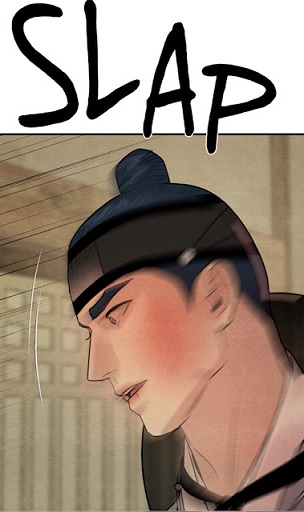 |
| Someone is out of breath | 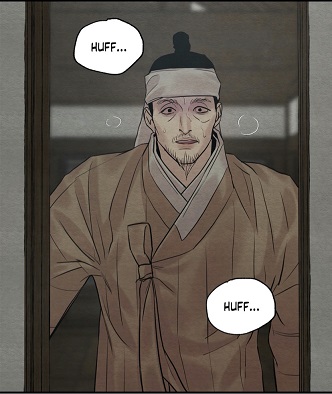 | |
| Treason |  | 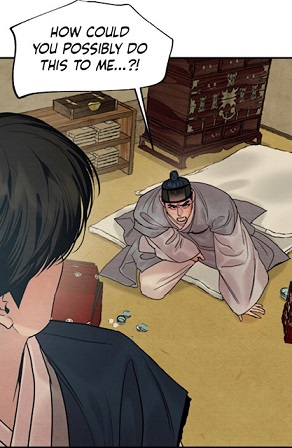 |
| Threat |  | |
| Sexual assault in the gibang | 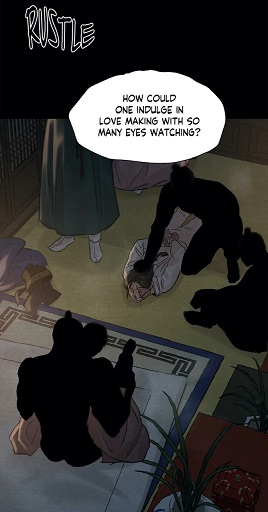 |  |
| A sudden kiss |  |  |
| the importance of family | | |
| The indirect reference to religion (curse, heaven versus hell, faith/trust) |  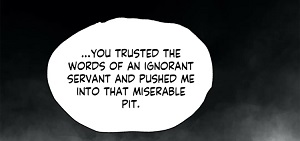 | |
| Wishes (ambition, dream) | | 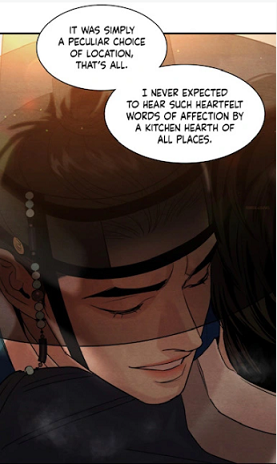 |
| Yoon Seungho portrayed as a depraved monster | 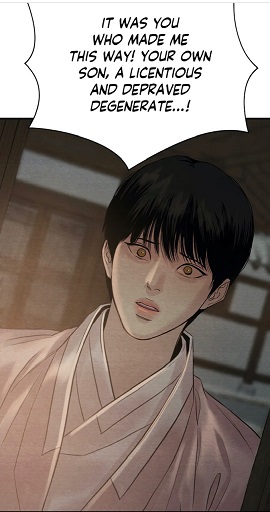 |  |
| An important paper/ document |  | |
| Jung In-Hun |  | Baek Na-Kyum not only wounded the learned sir, but also humiliated a person who passed the civil service examination. He is now a military official. |
| The painter’s escape | He was supposed to remain in the study. Kim allowed him to leave the room. |  Baek Na-Kyum freed himself. Baek Na-Kyum freed himself. |
As you can see, the night from episode 85 to 87 corresponds to the day in chapter 119. And now, it is time to examine the meaning behind this connection. First, the contrast between these two scenes reinforces my interpretation about the butler. At the beginning of the noble‘s suffering, the valet was ignorant, just like the painter is still unaware of the nobles’ death. But it is no longer the case. In episode 85, (chapter 85) he had faked his breathlessness. First, he didn’t need to run from the kisaeng house like Yoon Seungho. The kitchen, the gate or the servants’ quarters are not far from the study. Besides, why did Kim run in the end, when he joined the study? Contrary to his master in episode 119, he knew about his master’s whereabouts, for they had taken their lunch there.  (Chapter 85) The study is even close to the gate.
 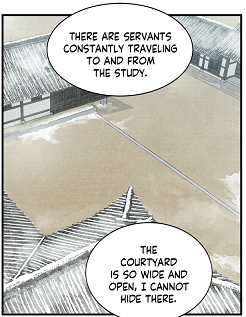 (Chapter 51) He could have reached the study before the father entered the shrine. Finally, observe that the patriarch even arrived to the bedchamber before Yoon Seungho, (chapter 86) though the study is close to the host’s chamber. As you can see, paying attention to the location of the different rooms exposes the betrayal from the staff and especially from the butler. He had been listening to their conversation, hence he knew about their quarrel. Interesting is that in the kitchen, the lord’s wish got fulfilled.
 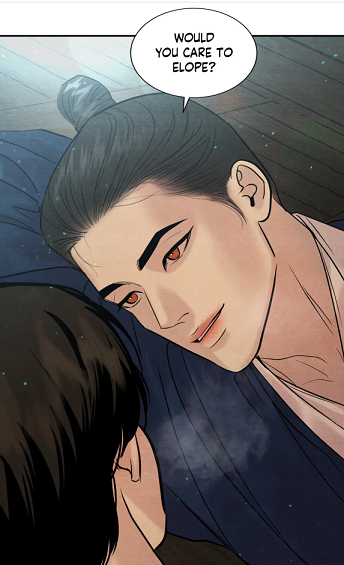 (Chapter 117) The painter wants to leave everything behind too.
  (Chapter 119) Thus I am deducing that the authorities will be involved very soon. (Chapter 86) Why? It is because someone desires to take over the mansion.
  (chapter 119) They are not expecting the lord‘s resistance, for he remained passive all this time (season 2 and 3). The scholar has now the means to do so, and the necessary motivation. Imagine that he got wounded and humiliated by the couple! Besides, we have this broken promise due to Yoon Seungwon
  (Chapter 115) exposing the younger master’s lies and Yoon Chang-Hyeon’s delusions. Without the protagonist’s help, the younger brother would not be „successful“. Furthermore, the absence of food and fire in episode 86 indicates that this house was neglected and even not protected. (Chapter 86) It explains why the argument between father and son oozed hatred, coldness and looked like war! The hearth symbolizes home, family, warmth, love and protection.
Under this light, it is no coincidence that this new confession took place in the kitchen. At the same time, the kitchen hearth symbolizes humbleness and honesty, which stands in opposition to the love confession in the kisaeng house.  (Chapter 94) The gibang is connected to money, power, pleasure, artificiality, sensuality and lack of privacy.
  (Chapter 96) I am sure that you can detect all the contrasts (night, door close, spies, confession outside and inside, no fire, only light). Thus I am deducing that the painter’s words in the kitchen were not heard by others. As you can see, this scene in the kitchen is full of symbolism. In my previous essay “The true face of family”, I had already pointed out that sharing meals represented a criteria to define a real family. Therefore I had demonstrated that Yoon Seungho and Baek Na-Kyum were excluded from the mansion, for they wouldn’t eat their meals in the kitchen like the staff.
  (Chapter 17) Moreover, the hearth doesn’t just provide warmth, but also light! The latter embodies knowledge and as such Enlightenment.
  (Chapter 119) Hence they were clueless about the wrongdoings from the staff. Only in the kitchen, the lord could finally grasp the depth of Baek Na-Kyum’s love for him. It is an unconditional love contrary to Yoon Seungwon’s. The latter would only recognize him, if he listened to him. And he only seeks his assistance, when he needs him. It shows that Yoon Seungho is only approached, when he has power.
  (Chapter 118) (chapter 119) Moreover, because they are embracing each other in clothes, it exposes that their love is pure and not driven by lust. This scene contrasts so much to his meeting with his brother, for the latter never hugged him. He kept his distance from his brother.
 (Chapter 119) I would like to outline that during their conversation, Yoon Seungwon remained calm and indifferent, when he talked about the assassination attempt from Yoon Chang-Hyeon.
 (Chapter 116) But the biggest difference is the absence of fire in the kisaeng house. (Chapter 118) This reflects the lack of empathy from Yoon Seungwon.
Striking is that the couple stood at the entrance of the kitchen, when the painter declared his unconditional love to the noble. (chapter 119) It was, as if two worlds were meeting. Simultaneously, the door step symbolizes the gateway to new opportunities. In other words, it announces changes. Moreover, the embrace and the lord’s words expose that Yoon Seungho is focusing on the present moment and the future. This means that he is now moving on and as such cutting ties with the past! How ironic that Yoon Seungwon’s recommendations came true! (Chapter 118) Nonetheless, I doubt that he is including his brother and father in his future plans. For me, the noble’s words spoken in the bedchamber will become a reality:  (chapter 78) Furthermore, he tried to leave before
  (Chapter 104)
  (chapter 105) Finally, we saw him in the courtyard standing next to a horse and a servant indicating that he had given him a task, and the latter needed to leave.
  (Chapter 108) Hence you comprehend why I am full of optimism in the end. Yoon Seungho has already made some preparations in my opinion. On the other hand, I am quite certain that their love will be tested. Can they face together trouble? Yes, because through their pain, they learned their lessons and changed.
4. The love confession in the kitchen
But why didn’t Yoon Seungho expect that he would be blessed next to the kitchen hearth?  (Chapter 119) It is because in the past, he was never allowed to join the kitchen hearth. This place was either beneath him or he was not worthy of entering the place. Thus he employed the expression scullery boy to Yoon Seungho.
 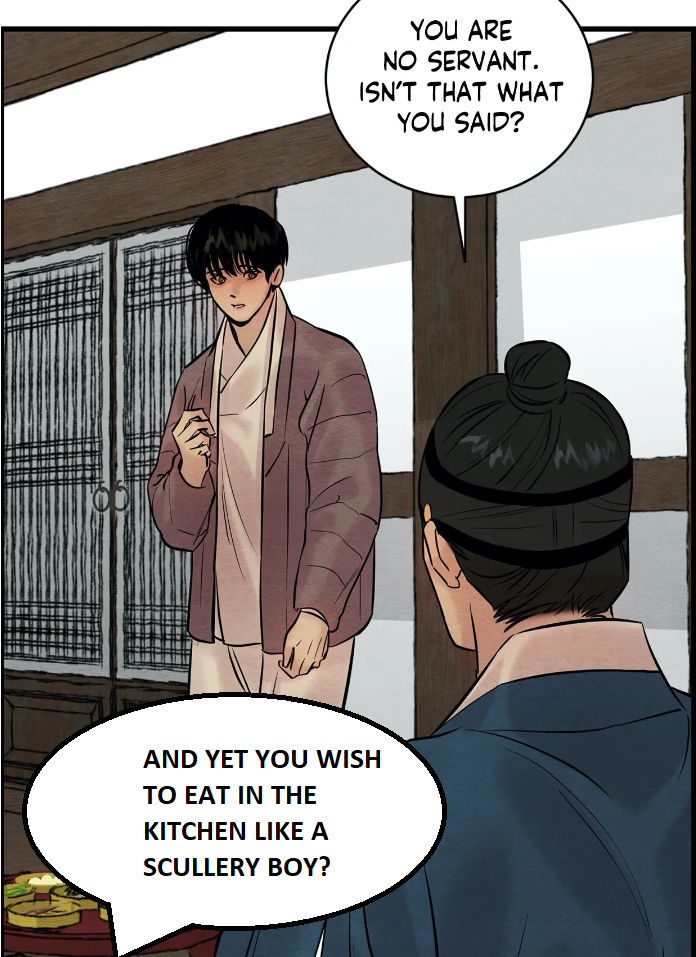 (Chapter 47) Here, I would like to outline that when the protagonist was held in the shed, someone brought him food .
  (Chapter 83) That‘s how I realized that the shed is connected to the kitchen!
- chapter 32:
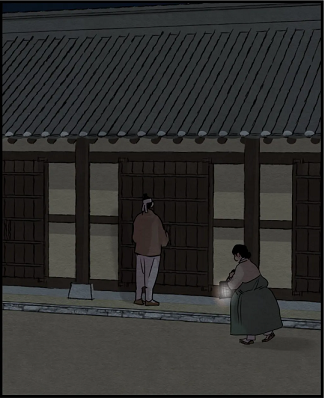 The maid had just brought water to the couple.
 - Chapter 51:
- Chapter 61:
 During that night, Baek Na-Kyum had been held captive in a shed.
 - Chapter 77:
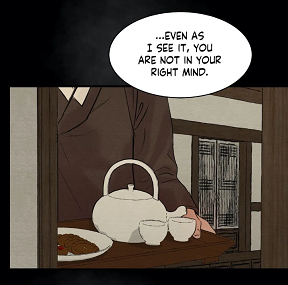
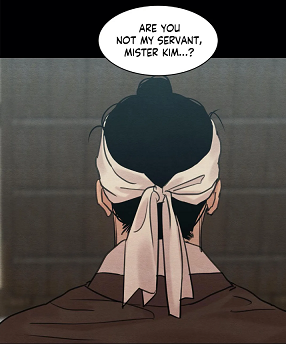
- Chapter 108:
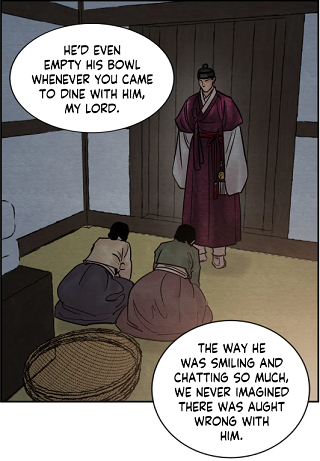

And what is the common denominator between these scenes? Kim was responsible for the kitchen and the shed. This observation brings me to the following conclusion. Then, you know why Yoon Seungho could never imagine that in the kitchen hearth, he would experience unconditional love. It is because the valet never allowed Yoon Seungho to enter the kitchen! And now take a closer look at this scene: 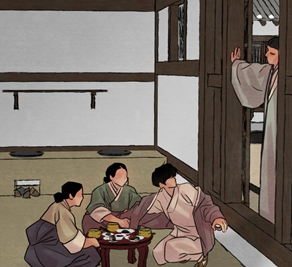 (chapter 38) Yoon Seungho remained outside on the door step. Consequently, I started comparing scenes where the kitchen hearth appeared and that’s how I discovered a pattern:
- A wrongdoing and an argument
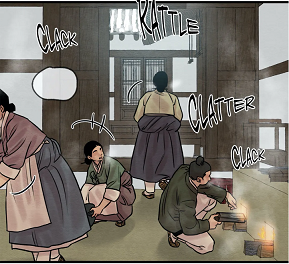
 (Chapter 46)
 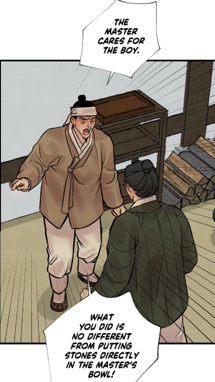 (chapter 47) (Chapter 98)
  (Chapter 110)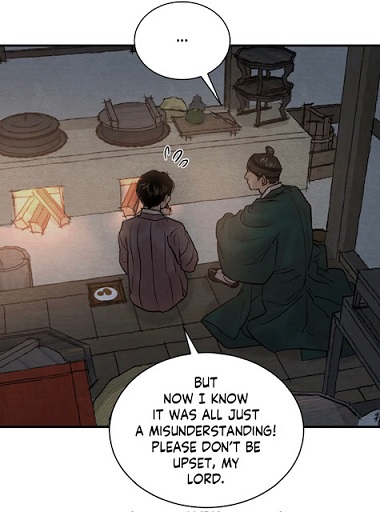
- – An apology – forgiveness:
 (Chapter 77)
 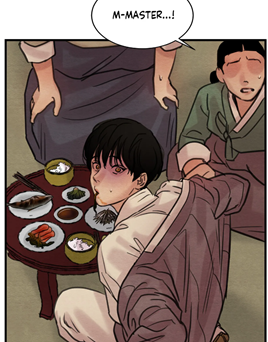 (chapter 38)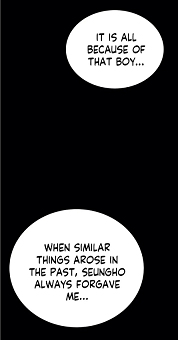
 (chapter 59)
  (chapter 119)
 - A confession
 (chapter 38)
  (chapter 47)
 (chapter 77)
 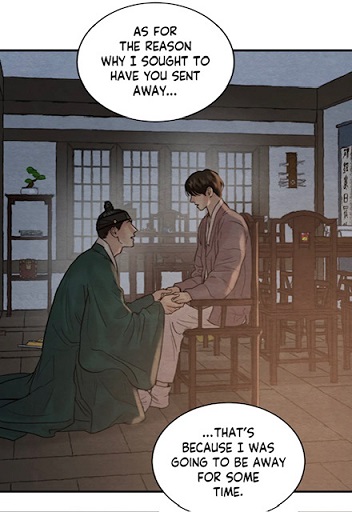 ( Chapter 110)
  (chapter 119)
 - A fire or its absence:
 (chapter 47) (chapter 38) (chapter 110)
To sum up, the kitchen is connected to a wrongdoing, an apology, a confession, a fire and a quarrel. Where was Baek Na-Kyum during the abduction? In a shed, while Lee Jihwa was arguing with No-Name!! That’s how I realized that the gods wanted to teach Kim a lesson. In the past, the butler should have invited Yoon Seungho to the kitchen hearth so that he would have found a family among the staff. Remember how the servant scolded the valet, it is because Kim must have taken pride to be the elder master’s servant.  (Chapter 77) For me, Kim must have looked down on the other domestics. I consider this scene as the best example what Kim should have done in the past. (Chapter 119) He should have brought him to the hearth and hugged him. That’s why Lee Jihwa got embraced during that night. Kim should have comforted him and made him smile! The father wouldn’t have noticed it, for there is a second entrance. The evidence is here:
 (Chapter 119)
  (Chapter 98) One door leads to the backyard and the other to the smaller courtyard. And this scene confirms my previous assumption
The kitchen is detectable thanks to the big wooden door in the smaller courtyard. However, I am quite certain that there’s a second access to the kitchen. They need to have an easy access to the jars situated in the backyard close to the walls. (…) This means that from the kitchen, if you follow the wall, you can pass by the lord’s bedchamber. And if you follow this path, you will discover the pond with the pavilion. Quoted from https://bebebisous33analyses.com/2022/03/31/painter-of-the-night-a-guided-tour-of-yoon-seunghos-domain🏡/
This means that Kim could have done something in the past.  (Chapter 87) Baek Na-Kyum is there to prove him wrong. He had other opportunities, like giving him a good meal.
  (Chapter 63) He should have sided with his master and even remained by his side. This signifies that this scene (chapter 83) exposes the butler’s betrayal and wrongdoing. Thus I conclude that the painter will show to the valet his cowardice and his treacherous nature.
(Chapter 119) So by burning the poem  (chapter 7) the artist is not only cleansing the kitchen, but also cutting off ties with the scholar. The latter is no longer protected. The spirits will intervene through chance. As a conclusion, the hearth has a spiritual and healing power, for it is connected to „Heaven“. Yoon Seungho‘s paradise is to have a family.
Feel free to comment. If you have any suggestion for topics or manhwas, feel free to ask. If you enjoyed reading it, retweet it or push the button like. My Reddit-Instagram-Tumblr-Twitter account is: @bebebisous33. Thanks for reading and for the support, particularly, I would like to thank all the new followers and people recommending my blog.


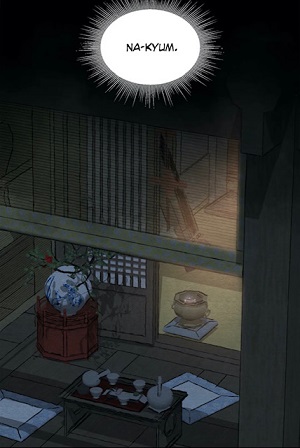
 (chapter 87) Not only the painter and the 3 noonas were sharing the same bed, but also they were taking their meals together.
  (chapter 87) They would even caress each other and laugh together. This scene oozes happiness. Consequently, it is no coincidence that during that night, they shared their honest thoughts to Baek Na-Kyum giving him good advices. But more importantly, the painter was there, when his noonas were struggling.
  (chapter 94) He cried in front of them. His tears symbolized his compassion and love for his noonas. He regarded them as his family. And it was the same for the artist. He had the noonas by his side, when he was in trouble or agony.
 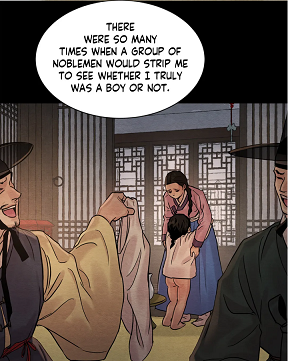 (chapter 94)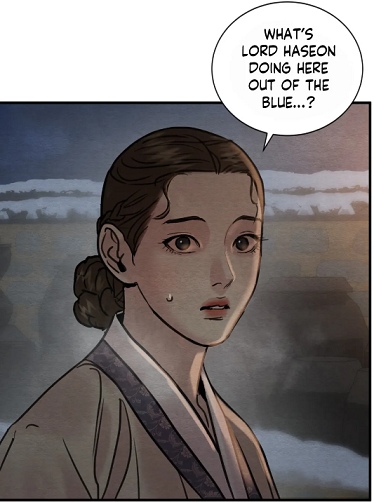
 (chapter 107) However, at some point, it changed!
 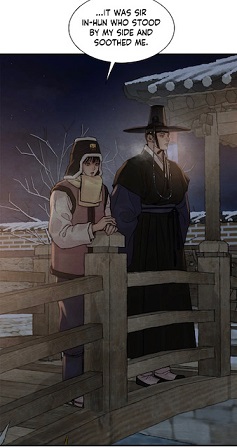 (chapter 94) Jung In-Hun entered his life and consoled him. Thus I deduce that this image
 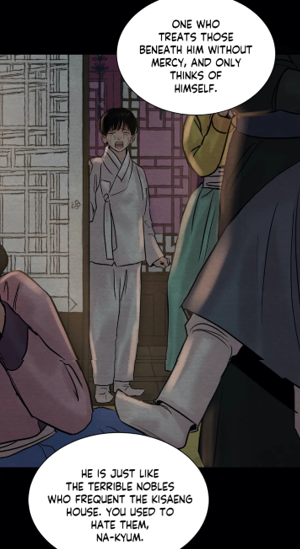 (chapter 68) represents a turning point in Baek Na-Kyum’s life. During that night, the scholar took away the young painter from Heena, hence he couldn’t help her. And now, observe the learned sir’s reaction. He didn’t allow the painter to cry. He shouldn’t share his pain.
  (chapter 70) In fact, he diverted Baek Na-Kyum’s attention from the incident to the moon. The learned sir was smiling the whole time.
  (chapter 70) He was acting, as if nothing had happened. The fact that he didn’t bear the tears from the painter exposes that the learned sir never considered him as a family. Therefore it is not surprising that he got abandoned, when the learned sir struggled:
 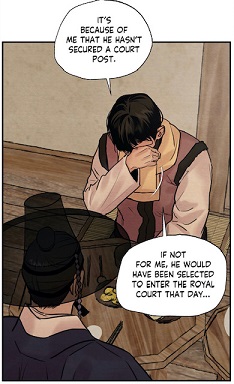 (chapter 75) But we have other scenes where Jung In-Hun didn’t behave like in the poem. When he discovered the truth, he had not been approached by Yoon Seungho due to his talent
 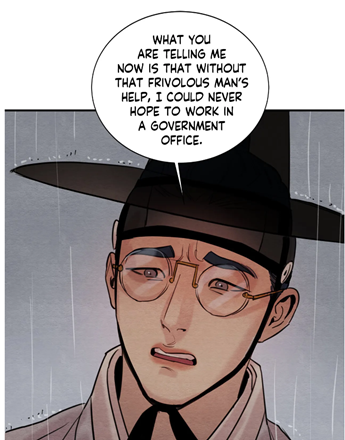 (chapter 19), he pushed away the painter.
  (chapter 19) He was mad, because Baek Na-Kyum was the cause for his sponsoring.
 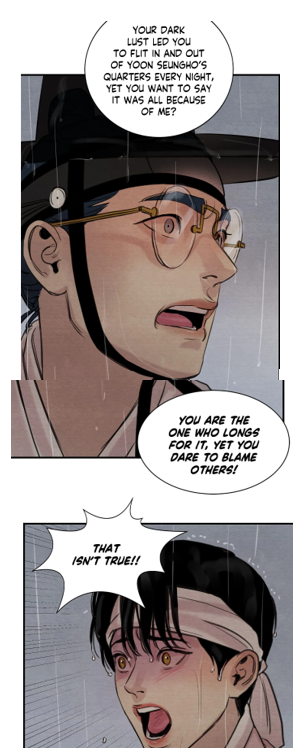 (chapter 19) However, the family serves as pillar and protection. When the scholar’s pride got hurt, he rejected Baek Na-Kyum. He only approached the painter, when he needed him
  (chapter 10)
  (chapter 24)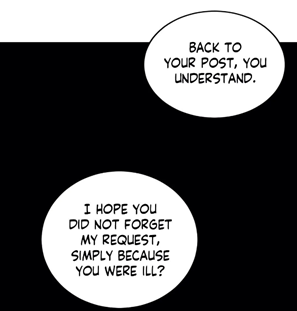
 (chapter 35).
  (chapter 111) For me, in episode 10, he was definitely aware of the existence of a plot, thus he led the painter to the pavilion. Then in episode 24 and 35, he wanted the artist to spy on his benefactor. Finally, in episode 111, he knew that by taking away his former pupil, he would hurt Yoon Seungho, for he was aware of his affection for Baek Na-Kyum. Under this new light, it becomes comprehensible why Jung In-Hun didn’t bid farewell to the main lead in episode 44. Baek Na-Kyum’s presence was not necessary for the preparation for the civil service examination. And this brings me to the last scene between the learned sir and the painter.
  (chapter 118) He is now crying in front of him, as if he was considering him as a part of his family. He is trying to create the illusion that he shares his suffering, just like he shared his happiness during the parade.
 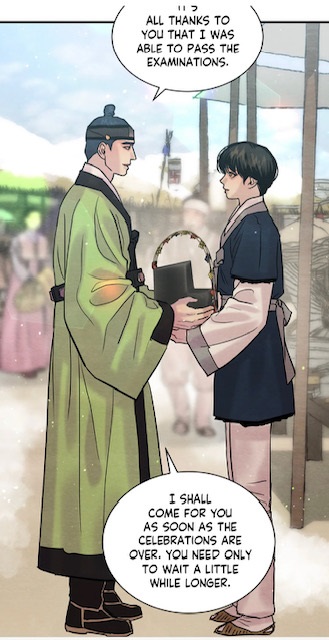 (chapter 111) But in the gibang, the learned sir changed his attitude towards his former pupil, for he kissed the painter.
  (chapter 117) It was, as if the former was starting his family. Baek Na-Kyum is now his “bride”. But naturally, everything is just an illusion. Why? It is because the Manhwaphiles never saw Jung In-Hun share his bed or room with the artist!
  (chapter 27)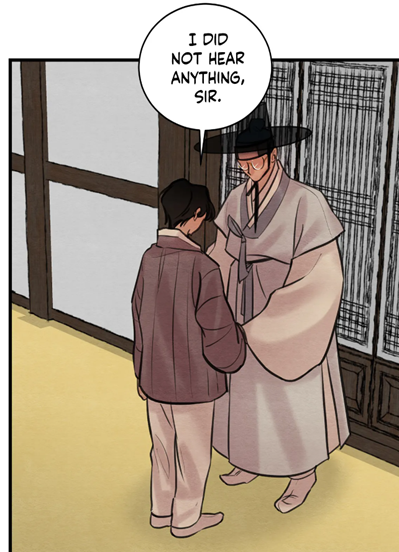
 ) But more importantly, he is not sharing his true thoughts and emotions to the young man.
  (chapter 118) He never explained how his face got bruised! This shows that he approached Na-Kyum for one reason. He was in trouble and he needed him. But he acted, as if he was becoming responsible for him.
  (chapter 118)
  (chapter 118) He didn’t expect a rejection. Why? It is because now, he was treating the main lead as family member. Nonetheless, don‘t get me wrong. In Joseon, servants were considered as a part of the household and as such of the „family“. I don‘t believe that the teacher views Baek Na-Kyum as an equal. Yet, the latter is in reality a free man.
  (chapter 118) Thus out of fear, he made a false love confession which resembles a lot to obsession and possessiveness. His words display his worries and despair. Another important aspect is the absence of the personal pronoun “we” in their conversation. We only have “you” and “me”.
 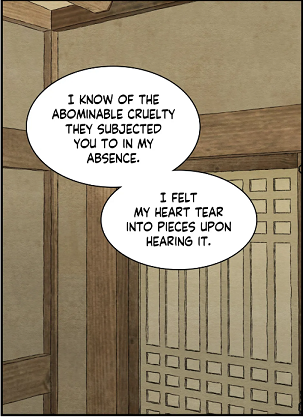 (chapter 118)
  (chapter 40), the latter learned the following lesson: Jung In-Hun had never been his new family. That’s the reason why he was so wounded. Therefore it is no coincidence that his karma is to be abandoned the moment he needs Baek Na-Kyum the most. But why did he not consider the painter as a family member? It is because he came from the gibang. Moreover, he was blinded by his desire to succeed on his own, not realizing the true role of a family.
  (chapter 107) The sexual abuse is something they hid from Baek Na-Kyum! They could never share such a burden with the protagonist. But there is more to it. In fact, Byeonduck illustrated the slow deterioration of Na-Kyum’s s family in season 2, 3 and 4. First, the painter couldn’t talk to his noonas like in the past:
 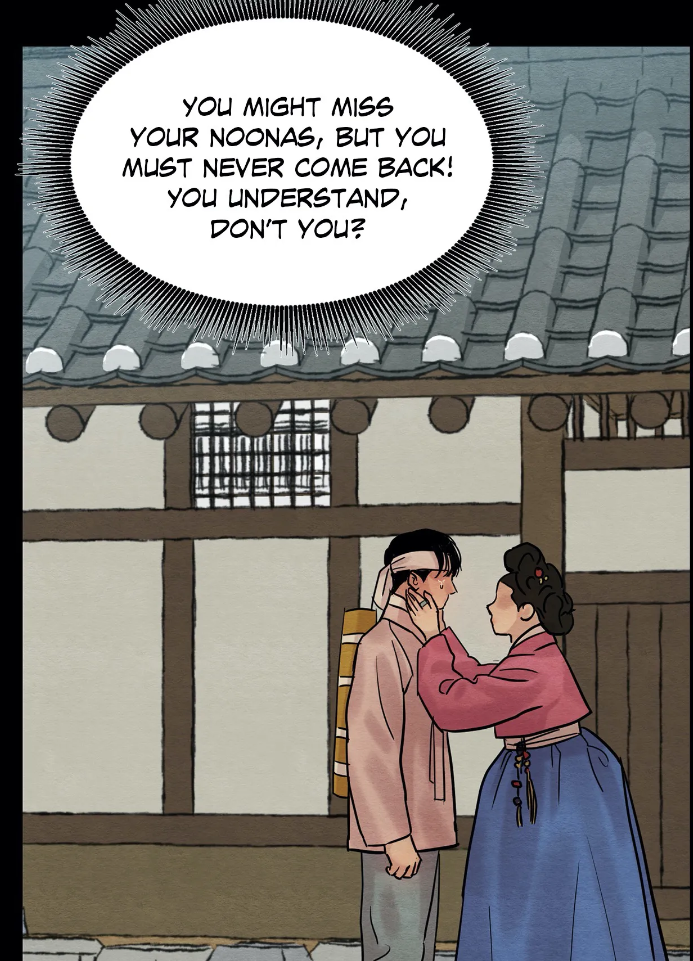 (chapter 46) He was forbidden to announce his departure which indicates that Heena was hiding something from the other kisaengs. Moreover, notice that he never talked back to Heena. He listened to her, though he was in pain.
 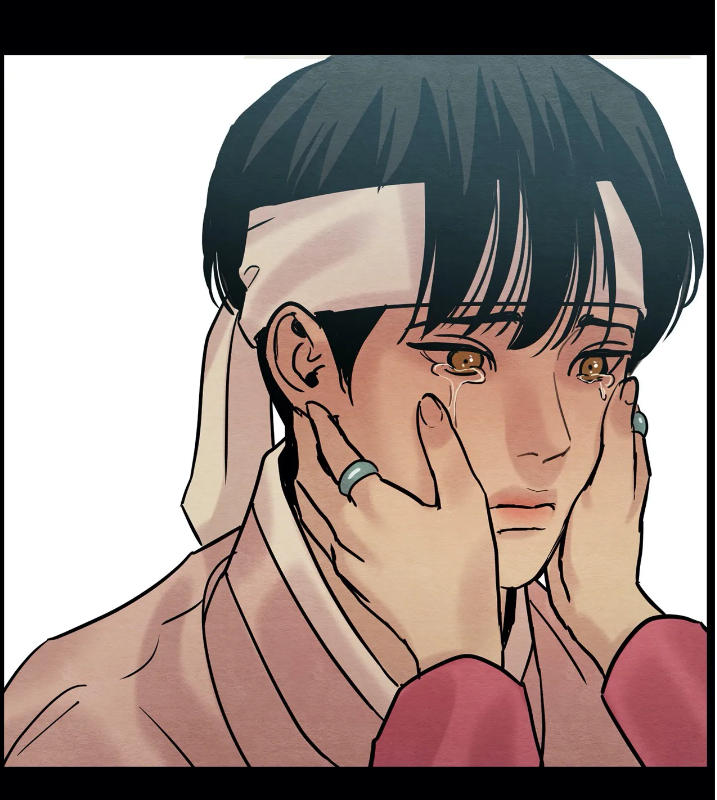 (chapter 46) He could only express his sadness with his tears. Then when Heena reentered his life, she was seen next to his bed while hugging. by his side
 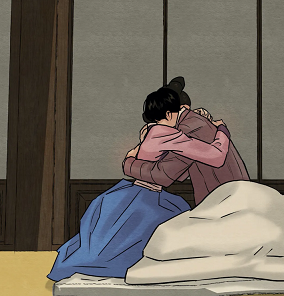 (chapter 66) This means that she would no longer share his cover. This is no coincidence that in the gibang, the noona could no longer enter her brother’s room.
  (chapter 96) Little by little, Heena got excluded from the painter’s life. She could no longer share her meals with him.
  (chapter 93) This explicates why in season 4, Baek Na-Kyum can not penetrate Heena’s room.
 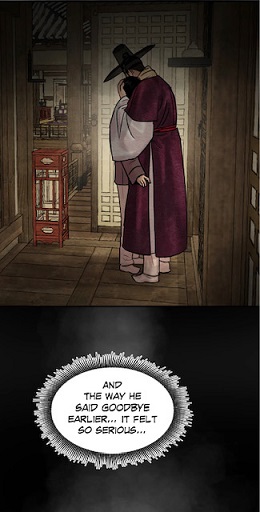 (chapter 105) She is hiding more and more things from her brother: her “illness”, her involvement in the murder of nobles and her lies. On the other hand, the painter still considered her as a part of his family because of her intervention in episode 68/69:
 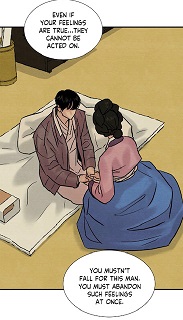 (chapter 68) Their argument was reflecting their trust, though here the kisaeng was questioning her brother’s maturity. Due to her concerns, Baek Na-Kyum felt that they were still a family. However, I sense a rupture, when they argued in the kisaeng house. The artist was no longer trusting Heena’s words:
 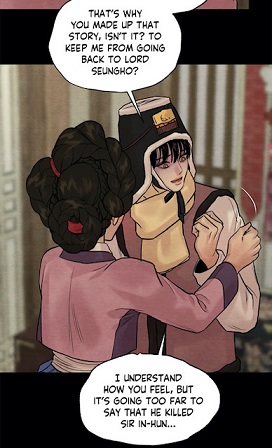 (chapter 97) Interesting is that from that moment on, Baek Na-Kyum and Heena never faced each other! She didn’t join his side during the parade. This means that their argument in the kisaeng house represents their last reunion. And what did Heena do in this scene? She cried
  (chapter 97), while the painter didn’t, though he looked disturbed.
  (chapter 97) He lost all his colors. However, such a scene could be perceived as a sign of indifference, especially for the kisaeng. And this observation made me realize why the kisaeng asked Yoon Seungho not to reveal his suspicions about Jung In-Hun’s involvement to her brother.
  (chapter 105) Here, she implied that Baek Na-Kyum would cry out of pain and shock. But she had seen that he had shared no tears, when he heard about his murder: And it happened again in the shrine.
 (chapter 99) Simultaneously, the request from Heena exposes that they are no longer sharing agony and as such struggles. Moreover, this made me realize why the artist left the mansion after the nightmare. It was out of fear and obligation. For me, he had sensed that Heena liked the learned sir and as she was still part of his family, he had to make sure that this was not true. Yet, even after witnessing the faked crime scene, he still trusted Yoon Seungho. Hence I am deducing that the absence of tears is the trigger for their separation which stands in opposition to their embrace in the mansion:
  (chapter 66)
  . (chapter 68) And what was her reaction, when she saw her brother in tears and yelling at his lover?:
 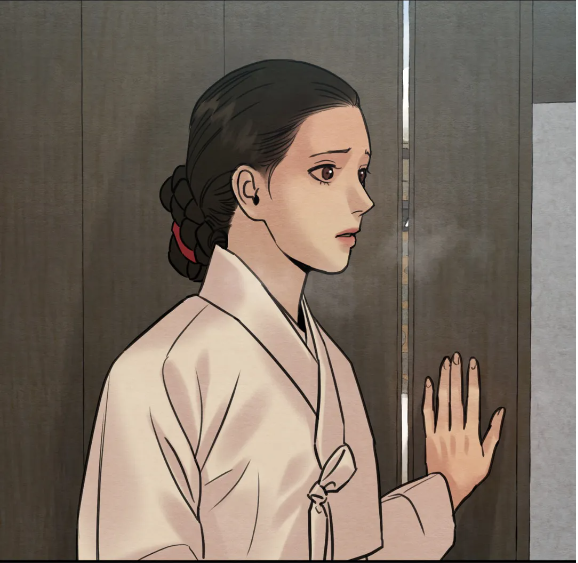 (chapter 105) She remained silent, passive and rather indifferent. This impression gets reinforced, when she is lying next to her colleagues. She is not sharing her thoughts and emotions, rather pensive contrary to these kisaengs:
  (chapter 105) She is even turning her back to them. This displays the dissolution of this family. The kisaeng is no longer sharing her fears, her tears and emotions to others. Therefore she can not sense “happiness or relief” like the others.
  (chapter 93), but the moment the lord joined his side, the honesty started vanishing. Notice that the painter couldn’t talk about his past (how he met Yoon Seungho and how he got abandoned by Jung In-Hun). It was reduced to “I was caught up with something”. He had so many secrets that he couldn’t share to his noonas. And it was the same for the kisaengs.
 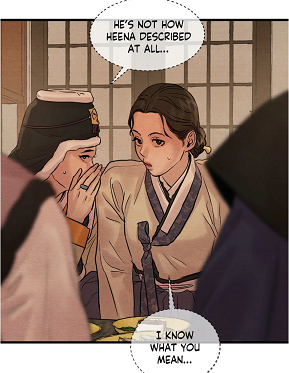 (chapter 93) They also had secrets, hence they were seen whispering. Baek Na-Kyum could confide less to Heena. Why? He sensed that the kisaengs might show no understanding. And note how the painter reacted, when he met his noonas in episode 105.
 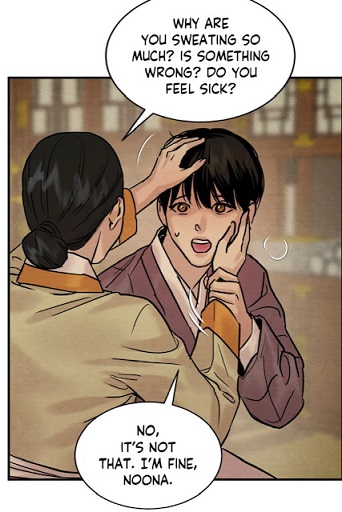 (chapter 105) He lied to his noona, he didn’t voice his worries. He didn’t enjoy his time spent by the kisaengs’ side. He didn’t eat with them either. This is the sign that he was moving on, he was on the verge of starting his new family. In other words, this scene
 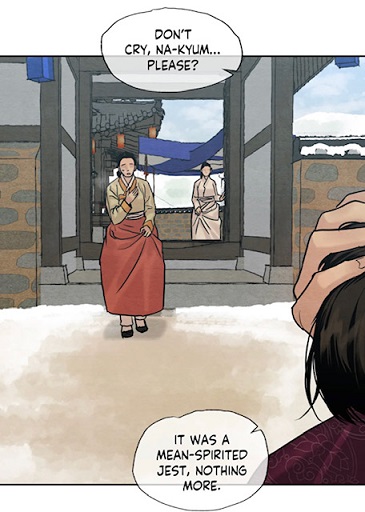 (chapter 105) corresponds to the bird flying from the nest which was witnessed by Heena and the kisaengs. Because the painter was not sincere to his noonas, it is not surprising that they acted the same way. Here,
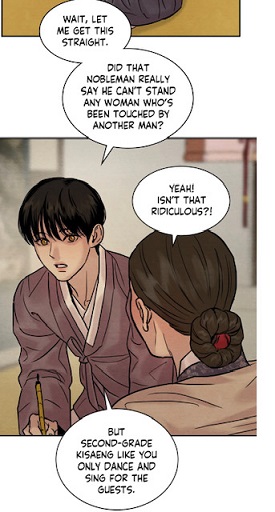 (chapter 105), the kisaeng’s words are a reference to loss of virginity. Yet the painter didn’t grasp the true meaning. Only in his dream and nightmare, he realized the significance of her words:
 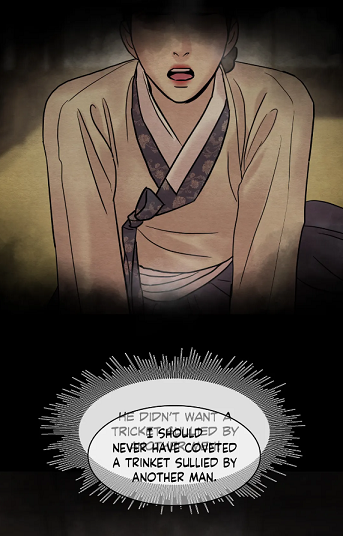 (chapter 109) Hence I come to the conclusion that we are witnessing to the birth of Baek Na-Kyum’s new family: Yoon Seungho.
  (chapter 118) That’s the reason why the painter decided to run away with his lover.
  (chapter 118) However, in order to become a real family, the painter needs to call his husband like this:
  (chapter 72) Under this new light, it becomes comprehensible why the noonas were no longer entirely honest with Baek Na-Kyum in the gibang. They couldn’t share their thoughts and secrets to the artist, as they had played a role in the separation of the couple
  (chapter 99) and the nobles’ execution. Besides, they also had secrets which they had to hide from their donsaeng.
 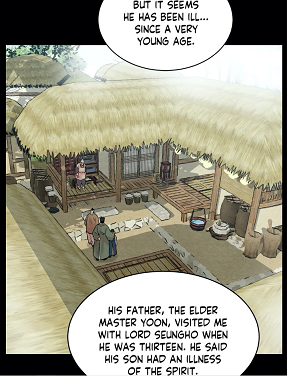 (chapter 57) I believe that it is related to the protagonist’s sensibility and intelligence. My assumption is that Yoon Seungho is a
  (chapter 107)
  (chapter 26) The latter was not allowed to cry! Therefore the artist heard the same reproach from the main lead.
 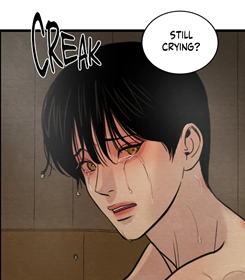 (chapter 26) The valet disliked the tears, because he refused to share the suffering. The reason is simple. If he did, this would have increased his guilt. Furthermore, Kim never shared the cover or his meals with Yoon Seungho in the past
  (chapter 108) So we could assume that he was starting to view the main lead as a family member. But no… for me, it is just an illusion. First, note that he never let the lord see his gaze while weeping. Besides, the noble’s heart was not moved either. They were not crying together, a sign that the two were drifting apart. Moreover, in the shed, the valet never shared the information about the fire at the shrine.
  (chapter 108) Moreover, like exposed above, family in the poem symbolizes trust, love, responsibility, comfort and protection, but the valet failed to fulfil his duties which he admitted in the shed. As a conclusion, the butler didn’t keep such a promise. Moreover, what did the butler do after the painter’s abduction?
 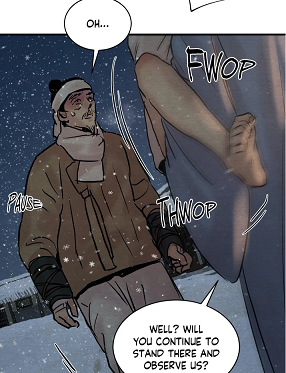 (chapter 64)
  (chapter 64) He ran away. He never saved the painter, just like he didn’t argue with his master in that moment. But he could have, since the latter had no sword by his side. Imagine that he had a heated discussion with Yoon Seungho the very next day, and in the courtyard, the protagonist had the sword in the hand.
 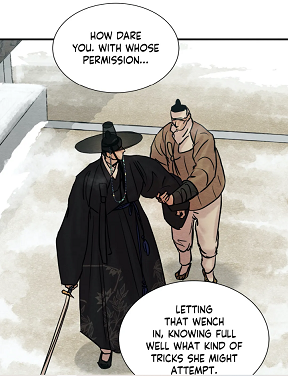 (chapter 68) A sign that he knew that the noble would never slay him! And in the past, the valet had not come to his rescue, shared his suffering or defended his honor. And now, you comprehend why I am more than ever convinced that the valet was never Yoon Seungho’s family: no tear, no joy or no secret shared! His expression “bird of misfortune” embodies the gap between the two characters.
  (chapter 109) The latter would even get the opportunity to eat sweets and sit in the patio
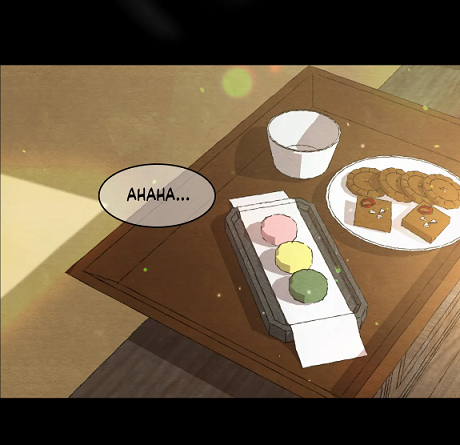 (chapter 109), while the lord was relegated to the courtyard.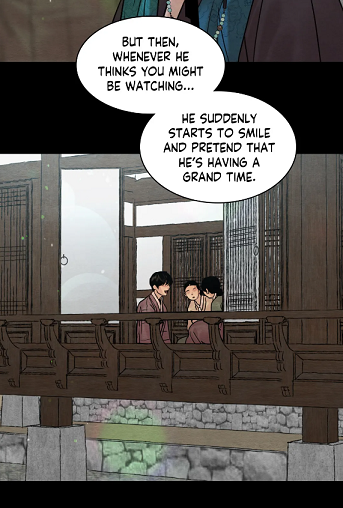
 (chapter 109) And the poem mirrors perfectly the birth of Yoon Seungho’s first family. Baek Na-Kyum is his very first family. Thus he could share his pain, his fears, his resent,
  (chapter 62) and his hope to be happy for one moment:
  (chapter 63) I selected the terrible scene in the shed for two reasons. It symbolizes the verse “how to become a family”. This explicates why in season 3, the artist was slowly using the personal pronoun “we”.
  (chapter 78) This means that the two protagonists were learning how to become a true family. And one of this important step was “crying together” which occurred after the sexual abuse in the shrine,
 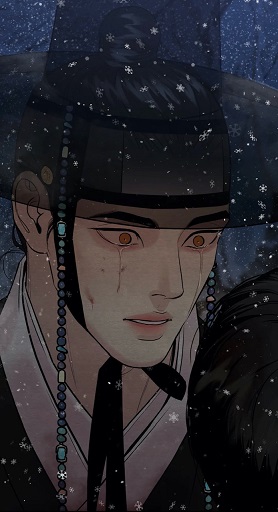 (chapter 102) However, Yoon Seungho had to learn the importance of “secrecy”! He kept his crime from his loved one hidden, not understanding that a real family is to “endure all hardships” together. Consequently, I judge this night
 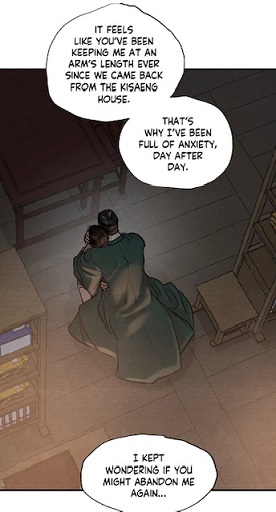 (chapter 110), their happiness
 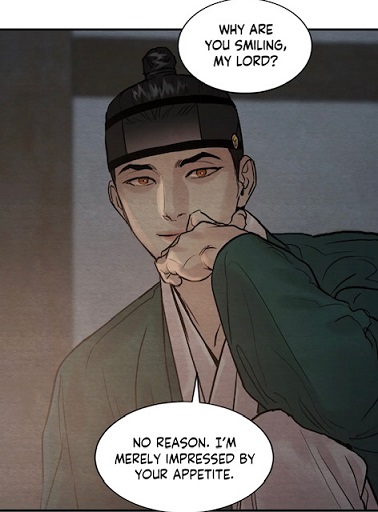 (chapter 110), they sit together while eating
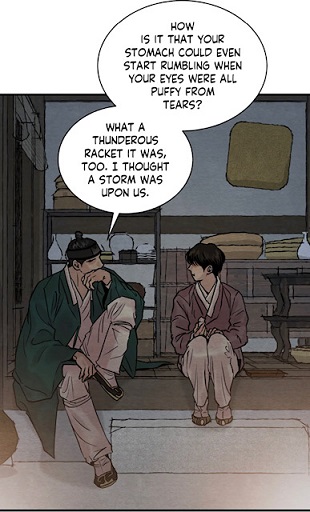 (chapter 110), they embrace each other, they share the same bed. And the lord makes the following promise: there won’t be any secret between them. He will share everything with his lover.
  (chapter 110) So when the brother gave the petition to the artist
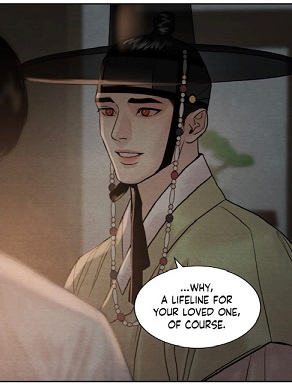 (chapter 116), he even reinforced their bond. It was, as if they had no longer any secret between them. Thus they talked about the document in the pavilion making sure that no one would listen to their discussion.
  (chapter 117) Therefore, it is not surprising that during that same night, the couple slept under the same blanket while hugging each other.
  (chapter 117) The symbol for the new family! But a family is not made just of two members! Is Yoon Seungwon a part of Yoon Seungho’s family? Let’s not forget that he considered the artist as his brother’s wife.
  (chapter 116) What caught my attention is that Yoon Seungho was not followed by his lover, when he met his brother in the gibang.
  (chapter 118) And this reminded me of this scene:
  (chapter 37) He wished to send away the artist, but the host refused. Then if you pay attention to his behavior, you will notice that none of them were seen eating together!
  (chapter 118) Compare it to Black Heart’s behavior:
 (chapter 43) In fact, the two guests were drinking on their own! Yoon Seungwon had even started drinking before the protagonist’s arrival.
  (chapter 118) Moreover, exactly like the scholar, Yoon Seungwon is just employing the pronouns “you”, “I” and “father”. There is no WE at all.
 (chapter 118)
  (chapter 118), but it is only a name! In reality, he desires to use the main lead. He needs him more than ever! Let’s not forget that the patriarch could discover Yoon Seungwon’s betrayal at any moment. Finally, I would like to outline that family stands for effort and understanding, nevertheless the younger master never showed compassion or worries for his brother, who had just recovered from a stabbing. His speech was full of blame.
  (chapter 22), the physical therapist still views her as his family. This corresponds to the verse “no matter where you are”. This explains why he listened to her and started treating the champion differently. From my point of view, they became a family, because they slept under the same cover
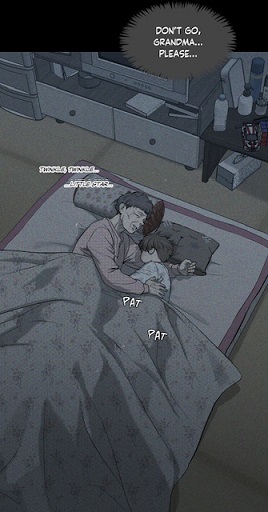 (chapter 21), shared their agony, fears
 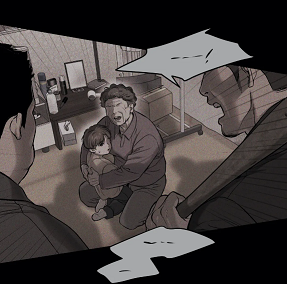 (chapter 5) and their happiness together, though this needs to be relativized.
 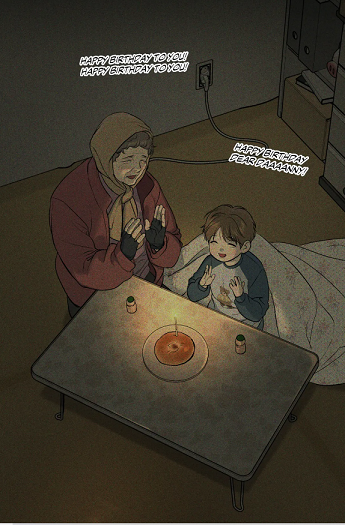 (chapter 11). I will give more details later. Another evidence that they are family is that the grandmother would often sing him songs. Then we could say that the grandmother shares her meals with the doctor, for she is often saving yoghurts for her grandson.
  (chapter 05) She is happy, when she hears good news from her grandson.
 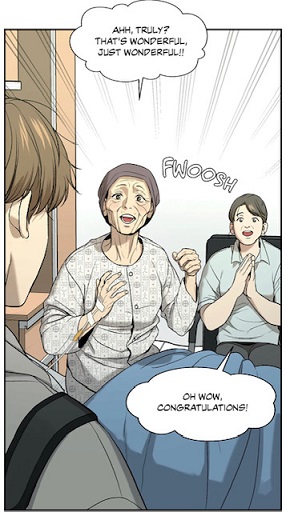 (chapter 07) When she feels lonely or miserable, she asks for his presence.
 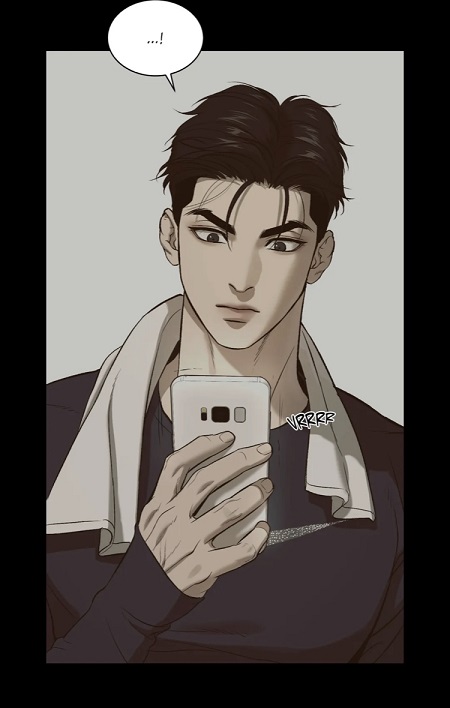 (chapter 21)
  (chapter 5) Nevertheless, there exist two negative aspects. First, I noticed that she didn’t question Kim Dan about his career, only when it was necessary.
 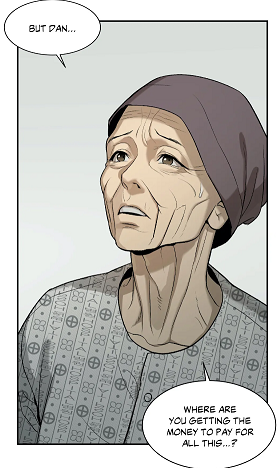 (chapter 07) She is not that involved in his current life.
  (chapter 05) Secondly, what caught my attention is that the halmoni is not letting her grandson weep. With her attitude, she implied that he had overreacted (“Now, now none of that”).
  (chapter 21) Moreover, the poem outlined the necessity of crying together (“be able to cry together”), yet the halmoni was not upset, when she found the little Dan in tears. She didn’t understand his abandonment issues. Thus I deduce that the shared agony was only in one way! If the grandmother was scared or suffering, her grandson should feel the same.
  (chapter 5) This explicates why Kim Dan was willing to sacrifice himself for his halmoni.
 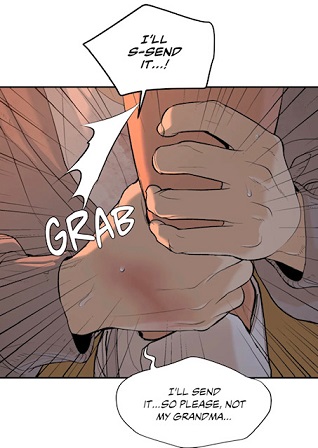 (chapter 16) It is because he knew that her grandmother disliked tears. Besides, in a previous essay, I had already outlined that such an attitude was considered as abusive, for such a young child should have been shielded from harm. However, he was exposed to violence very early on. Under this new perspective, it becomes comprehensible why Kim Dan started having secrets from her. Finally, the family portrayed in the poem implied the notion of effort and work. But the moment the grandmother refused to share his agony, she stopped putting energy in her relationship with Kim Dan. This means that as time passed on, she became more and more passive and relied more and more on the main lead. Another interesting aspect is that Kim Dan came to enjoy K-dramas because of his grandmother.
  (chapter 30) This shows that Kim Dan’s preferences are all influenced by the halmoni. We could say that he didn’t truly develop his own identity. It was, as if he had become the second version of “grandma”. And now, you comprehend why he rejected sex:
 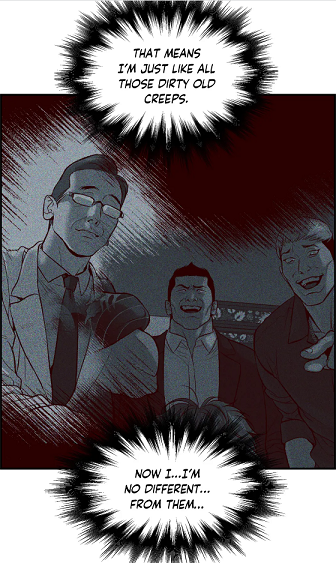 (chapter 20)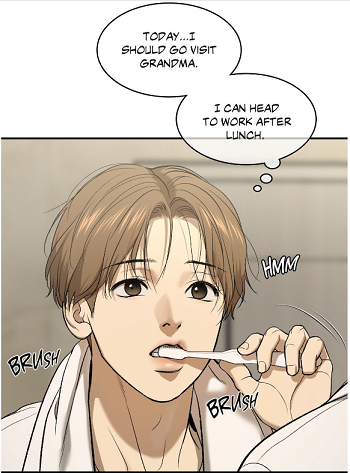
 (chapter 30) Because the grandmother didn’t allow her grandson to share his struggles (no tears), Kim Dan has been hiding many things from his grandmother
 (chapter 07): the beatings from Heo Manwook, his firing from the hospital, the sexual assault from the perverted hospital director and the moneylender, his deal with Joo Jaekyung and the fact that he moved to the penthouse. This means that little by little, the physical therapist is sharing less and less his happiness with her. I doubt that he told her about his trip to Busan, his first MMA fight as spectator
 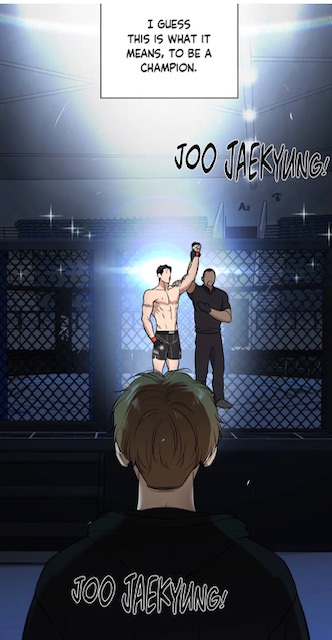 (chapter 15) and his first sparring with Joo Jaekyung
  (chapter 26). But this is a sign that Kim Dan is maturing. Therefore it is no coincidence that after their first day off spent together, Kim Dan is already under the champion’s spell.
 (chapter 30) And at some point, the grandma will notice her little boy’s transformation and the growing distance. And Choi Heesung could be the trigger for a first quarrel
  (chapter 22)
  (chapter 26), they get support from each other
  (chapter 14)
 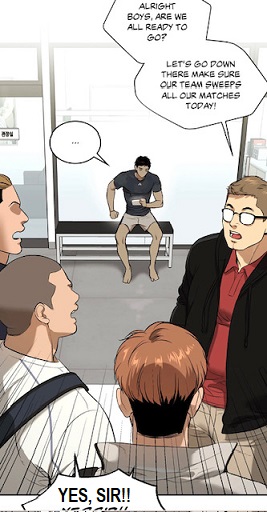 (chapter 23) or they argue
  (chapter 07). Moreover, they call the older members “hyung”
 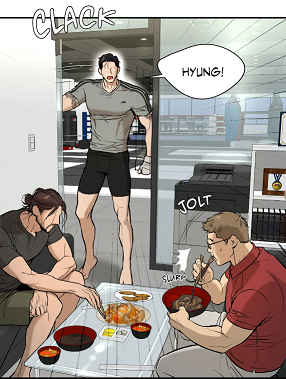 (chapter 5)
  (chapter 23) which is another evidence that Team Black functions more like a family than like a company. What caught my attention is that the doctor is not addressed as hyung
  (chapter 30) but as Doc Dan or doc.
  (chapter 23), though the manager Park Namwook had introduced him as hyung.
 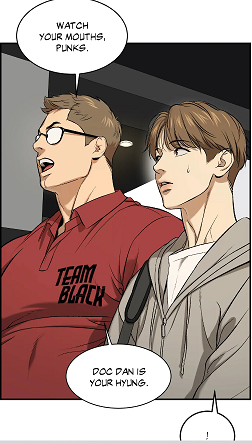 (chapter 07) The reason behind this different title is the champion. The latter addressed him like that:
  (chapter 22) It exposes that the physical therapist occupies a particular position at the gym. On the one hand, it could be interpreted that he has not been entirely adopted as a family member. On the other hand, the physical therapist didn’t exclude that he could have other clients.
  (chapter 25) This means that his “adoption” is not definitive and official. Nevertheless, I would like to outline that though Team Black’s structure resembles a lot to a family, we can not say that it is a true family. Why? It is because Joo Jaekyung is hiding many things from his hyungs and members. He is not sharing his problems to his coach (his insomnia, his jinx, his sexual orientation, his insecurities eg). Imagine that he preferred deceiving his admirer
  (chapter 15) than admitting that his shoulder had been plaguing him. And it is the same for Potato. He didn’t talk about the incident with the office room and the sofa.
  (chapter 25) According to me, Jeong Yosep knows about the true relationship between the physical therapist and the alpha black wolf. But he kept this information to himself as well. However, like pointed out before, family stands for communication and not secrecy! Moreover, so far, we only saw the fighters share their happiness. And what about their struggles or defeat? To conclude, Jinx is actually showing us the transformation of Team Black as company into a family. How they “become” a WE! Park Namwook does consider Team Black as his gym, but he has his own family. However, this is not the case for Jeong Yosep or Joo Jaekyung, who lives as a loner wolf! In my opinion, Team Black will turn into a real family, the moment Kim Dan loses his halmoni. Remember the quote from the poem: “If you can’t say you’re hurt when you feel hurt you’re not family“. Kim Dan won’t be able to hide his sadness and broken heart. In the beginning of the story, he lied to the coach and Kwak Junbeom about the reason for his injuries:
  (chapter 11), because he considered them as superior and colleagues. In other words, the fighters will share their pain with doc Dan helping him to overcome the loss. But this change can only happen, when the owner of Team Black has a change of heart himself as well. Remember how he pushed Oh Daehung and the other members away.
  (chapter 22) He didn’t want them to come to his house.
 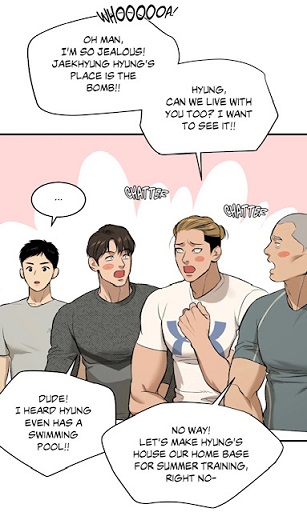 (chapter 22) So far, he didn’t want people to cross the line, but thanks to the physical therapist, this will change. That’s how both protagonists will come to view more and more Team Black as a family. They will share their struggles and happy moments together. I have one evidence that Kim Dan is the key to turn Team Black into a real family. It is because Joo Jaekyung came to the gathering
 (chapter 9), though he had been avoiding such events in the past.
 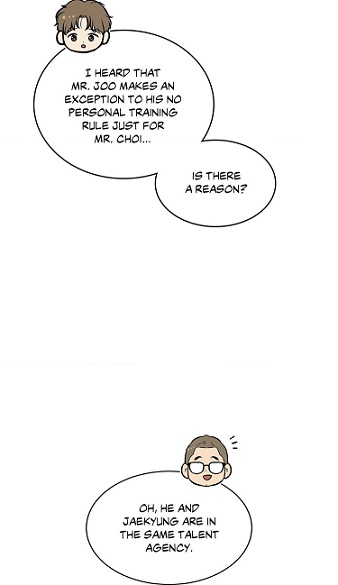 (chapter 30) But he is there an employee. Thus I am suspecting that the talent agency is working differently from Team Black. If there is a scandal, I doubt that the company would side with the star in trouble or they would try to find ways to get rid of the issue, like finding a scapegoat in order to bury the truth. As a conclusion, I am expecting to see companies run differently so that the readers can perceive Team Black as a family company, although it is an incorporation.
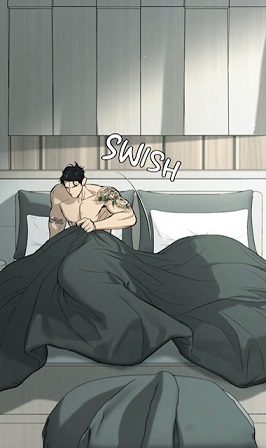 (chapter 4) This was a reference to the blanket in the poem, though here Kim Dan slept in a cocoon. This was a sign that he didn’t feel safe. However, as time passed on, I detected a change in Kim Dan’s sleeping position. He is lying on his back and even in the middle of the bed.
  (chapter 29) It is because Joo Jaekyung always put him there! This exposes that the champion is still thinking that he represents a disturbance to the Sleeping beauty. One thing is sure: Joo Jaekyung will become the blanket taking over the grandmother’s past role:
  (chapter 1) This was the reaction from the champion:
  (chapter 1) He questioned the cause for the tears. He was naturally annoyed (“the hell”), but he didn’t make fun of the doctor. And now, pay attention to the memory Joo Jaekyung had from their first night. He remembered his tears which had moved him deeply:
 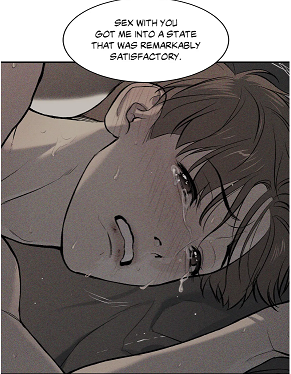 (chapter 6) This shows that the celebrity is not judging the physical therapist as weak due to his tears. In episode 28, he even showed concerns, when he heard the doctor crying.
  (chapter 28)
  (chapter 28) He questioned the doctor once again, why he was in tears. However, he didn’t ask the doctor to stop weeping or to wipe his tears. He wanted to understand him. This exposes the fighter’s tolerance and interest in Kim Dan. For me, it reveals that Joo Jaekyung is willing to share the pain or fears with Kim Dan. Therefore it is not surprising that Kim Dan is remembering this moment!
 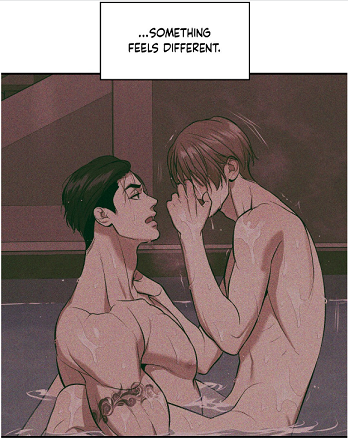 (chapter 30) He was allowed to express his emotions. Interesting is that this image is now connected to red, not to grey/black.
  (chapter 30) The switch of color indicates the doctor’s increasing feelings and sensuality for Joo Jaekyung. That’s the reason why I am expecting that one day, the two protagonists will cry together, something that the grandma hasn’t done until now.
 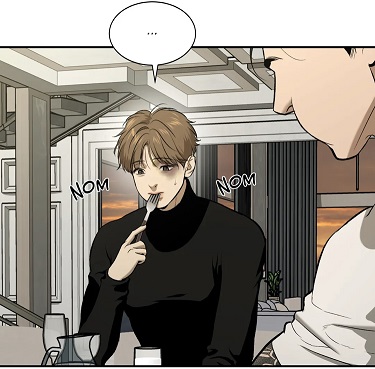 (chapter 13), it doesn’t signify that they are a family now. And it is the same for the penthouse.
 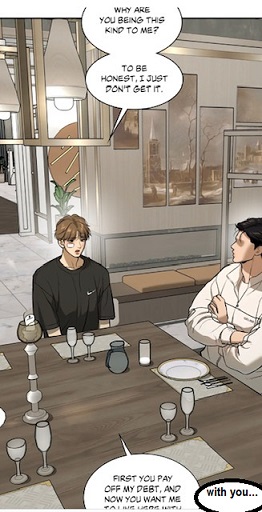 (chapter 18) They might share the same flat, but the penthouse is so huge that they can technically live apart. Joo Jaekyung and Kim Dan are slowly spending more and more time together, either because the champion feels like it
 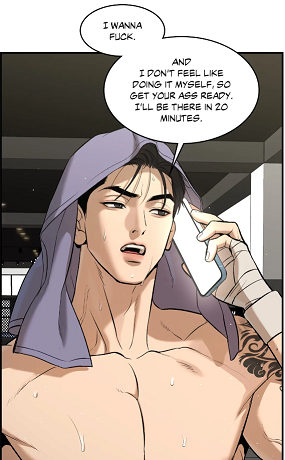 (chapter 19) or it is necessary
  . (chapter 27) During the day off, they shared their thoughts,, their emotions
  (chapter 27)
  (chapter 27), their happiness
 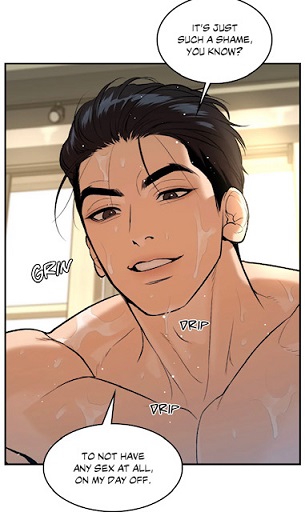 (chapter 28) and their fears
  (chapter 27)
 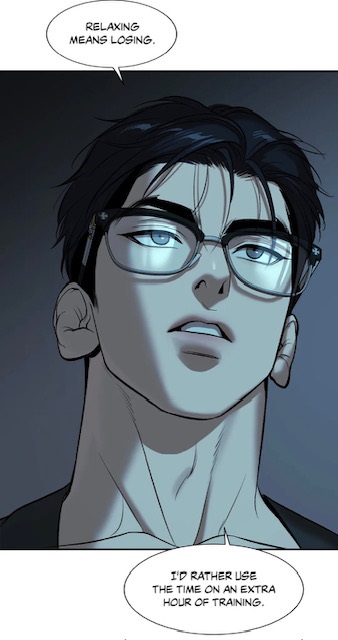 (chapter 29) Because Joo JAekyung confessed his fears and health issues to Kim Dan, it shows that he was trusting him. For me, this night represents another step how to become a true family. “If you can’t say you’re hurt when you feel hurt you’re not family.” This day and night were so magical that it affected the protagonists’ life forever. From that moment on, Kim Dan is feeling more attracted to the champion, hence he is peeping at him.
 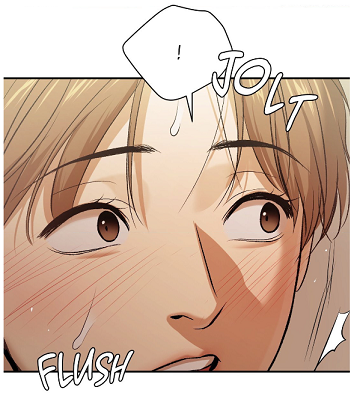 (chapter 30) And it is the same for the champion. Now, he is slowly regretting that they live in two different rooms and they have their own bathroom. Therefore he came to the doctor’s bathroom under the fake excuse that he had run out of toothpaste.
 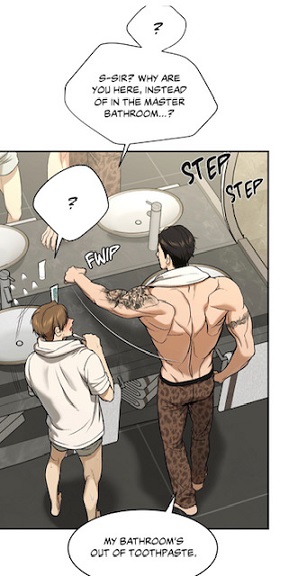 (chapter 30) What was so funny is that he had opened the door like a huge bear. Why? It is because he was so annoyed how to explain his intrusion.
  (chapter 30) This shows that little by little, the champion is regretting his words to Kim Dan in the master’s room.
 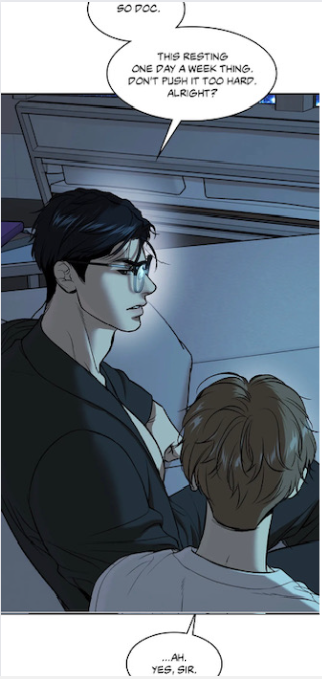 (chapter 29) For me, he will be forced to recognize that work is not bringing him closer to Kim Dan, especially after Choi Heesung met the main lead.
  (chapter 30) For me, this scene is the bathroom represents another step how to become a true family.
  (chapter 30) However, like Mingwa voiced it, they have a long way to go, for Joo Jaekyung and Kim Dan are hiding their true thoughts and emotions from each other.
  (chapter 30) Kim Dan had to hide his blushing, while the champion had to lie for his appearance. Moreover, the fact that he tried to hide his underwear
 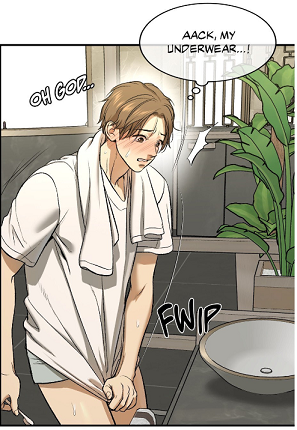 (chapter 30) indicates that their intimacy has not reached its peak. He doesn’t feel comfortable around the athlete to be seen in underwear. Moreover, the champion is also hiding his jealousy and possessiveness towards the main character.
  (chapter 30) But like I said, they need to open up their hearts and mind in order to become a true family. From my point of view, the halmoni could play a huge role in their union. How so? It is because she entrusted her grandson to Joo Jaekyung. The latter also conversed with her
 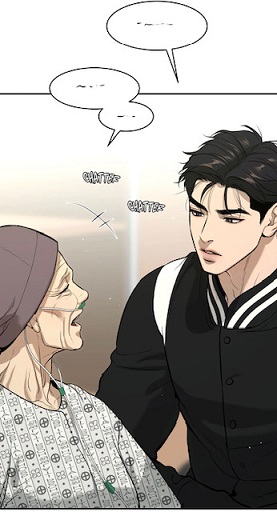 (chapter 21) and even paid her hospital bills. She even took his hand
  (chapter 22) and gave him a yoghurt.
 (chapter 21) So the moment the grandma vanishes, it could also wound the champion’s heart, especially when his sex partner is so heartbroken. It would be interesting if the champion came to voice his feelings about her. If you can’t say you’re hurt when you feel hurt you’re not family.“

 (chapter 117) The learned sir was tasked by the mysterious noble wearing a purple hanbok to retrieve the document. I would like to call my avid readers’ attention that we never saw the man introducing himself to the former teacher. He could have definitely impersonated someone, for this trick has often been used in this story. Anyway, in exchange for this favor, Jung In-Hun got promised a high position in the government.
  (chapter 115) Thus Jung In-Hun has only one option left. He needs to utilize a spy and traitor in order to get the document. Because Jung In-Hun has known the painter since his childhood, it is not surprising that he chose to approach Baek Na-Kyum. As you can imagine, episode 117 is a new version of episode 24
 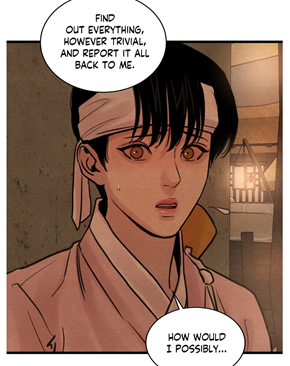 (chapter 24), where the angry learned sir asked the naive artist to spy on their benefactor and episode 35
 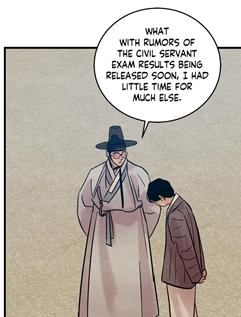 (chapter 35) He hoped for the painter’s understanding. All this because he needed the low-born more than ever. He had not renounced on discovering Yoon Seungho’s weakness yet. However, in season 1, he failed to achieve his goal, because after the night spent with the main lead, Baek Na-Kyum refused to divulge any information about the meeting between the host and his brother Yoon Seungwon.
 (chapter 117) Hence we should consider the scholar’s kiss as the kiss of Judas. The latter, known as the Betrayal of Christ, is the act with which Judas identified Jesus to the multitude with swords and clubs who had come from the chief priests and elders of the people to arrest him. Thus I am expecting an arrest of the painter in the future. Since he is the love interest of Yoon Seungho, he has once again become the target of the next plot.
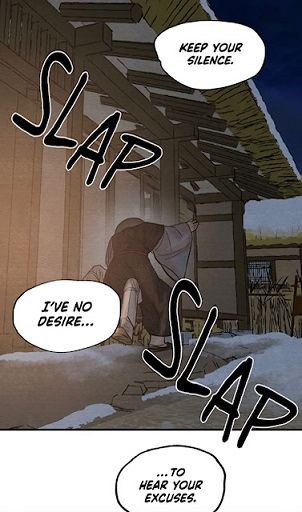 (chapter 115) However, this is impossible. Time is the proof for the lord’s innocence. 7 days have already passed since Yoon Seungho’s violent outburst in front of the learned sir’s home. Don’t forget that it took Yoon Seungho 6 days to regain consciousness.
  (chapter 116) And the manhwaphiles saw that the painter spent the night with his lover after their conversation at the pavilion.
 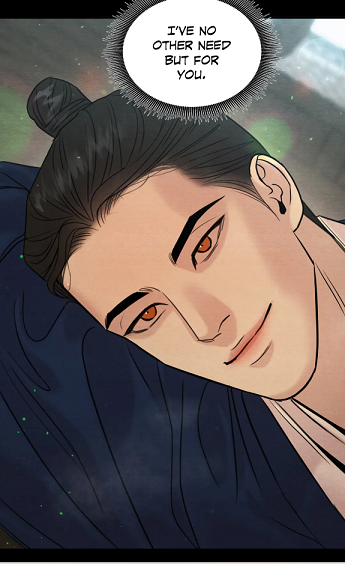 (chapter 117) This means that Na-Kyum’s visit to the gibang could only take place after that night. That’s how I came to the conclusion that the meeting took place after 1 week (6 days+ 1 night). However, the swollen cheek will easily vanish within one week contrary to the stabbing.
 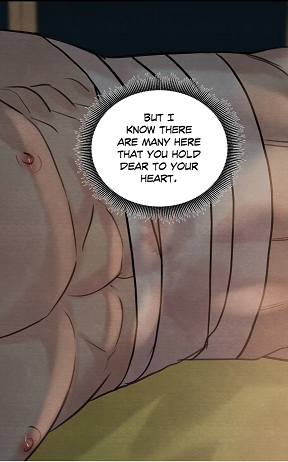 (chapter 117) Therefore after the release of episode 117, I had imagined that the wound from the learned sir was faked with the rouge from the noonas. Yet in episode 118, I detected the busted lip which can not be faked. The scratch is the evidence that the wound is real. Jung In-Hun knew too well that he couldn’t frame his previous sponsor for this. Hence he avoided to reply to the painter’s interrogation.
  (Chapter 117) This must have happened on his way to the gibang or in the gibang itself! So who would do this? Yoon Chang-Hyeon? The noble with the purple hanbok? I will answer to this question further below.
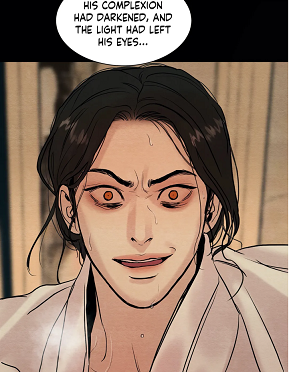 (chapter 57) It is less pronounced, for Jung In-hun only met this mysterious man once contrary to the main lead. Even Baek Na-Kyum noticed the transformation, hence he got scared.
  (Chapter 118) He couldn’t recognize his former teacher. The learned sir had become like a violent beast. But why would he be so frantic and hopeless that he became violent in his gestures and words? It is because he had been threatened again. The wounded lip and cheek are the evidences that he has been coerced to convince the painter that the latter should return to his side.
 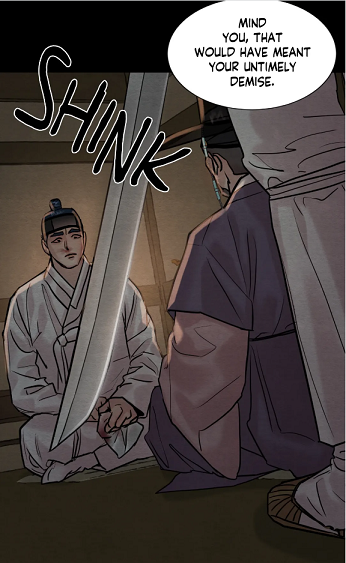 (chapter 117) However, observe that in their meeting, Jung In-Hun spoke about affection
 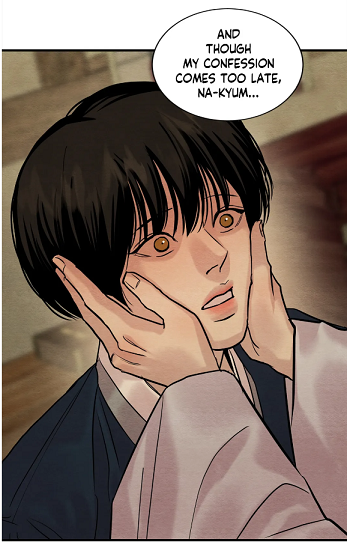 (Chapter 118) and this doesn’t belong to this man’s world (power, lineage, yin/yang, education). And it is the same for Yoon Chang-Hyeon. The latter embodies hatred and rejection for sodomy!
  (chapter 116) That’s how I deduced that the person behind this intervention is actually longing and hoping for love from Yoon Seungho. Thus he requested from the learned sir to take back the painter.
 (chapter 95) The artist had kissed the main lead for two reasons. He desired to convey the sincerity of his attachment and to prove that this was real. Yoon Seungho shouldn’t imagine that this was just an illusion, as he often questioned his own senses and sanity. In the gibang, the learned sir changed the chronology: first the smooching, then the confession. Why? It is because he thought that the painter still loved him, when Baek Na-Kyum showed concern for him.
  (Chapter 118) Due to his arrogance and vanity (the negative aspects of self-love), he jumped to the conclusion that nothing had changed. The painter seemed to be still naive.
  (chapter 118) Hence his surrogate father smirked. The irony is that there exist different kind of love: friendship, family… At the beginning, the artist was still viewing Jung In-Hun as a friend. Thus he got worried about his wounds. Yet observe that he had no intention to bid farewell to the former teacher.
 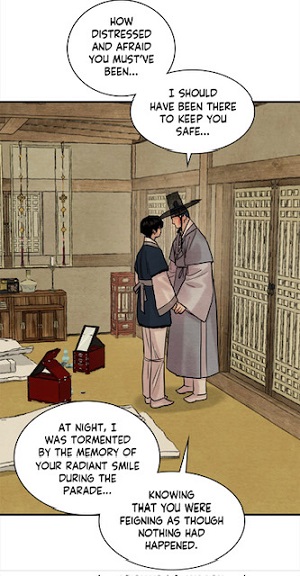 (chapter 118) Baek Na-Kyum, as the mirror of truth, is not only confronting the scholar with his bigotry and dishonesty, but also the mastermind behind this encounter. This explicates why the learned sir spoke about love:
  (chapter 118) This was the same for Yoon Seungho. The sexual abuser had only been obsessed with his own reflection and desires to the point that he never paid attention to his sex partner’s gaze… the loss of light in the gaze, the absence of tears … Besides, there was no agreement, everything was based on coercion and Kim knows that. That’s the reason why Jung In-Hun had tears in his eyes! It is because the main lead used to cry as well… asking for his pity and mercy. Since the scholar never cried before, I believe that the latter had asked to shed some tears in order to move the heart of the counterpart.
  (chapter 118) Baek Na-Kyum was never his young protégé, only his student. Why? It is he never protected him, he just consoled him!
  (Chapter 11) Back then, the painter had the burst lip and the glowing cheek too.
  (Chapter 11) He had protected Jung In-Hun, when the latter was suspected of ruining the painting. And how had Yoon Seungho acted in that scene? He had spoken like a powerful person, like a ruler!
 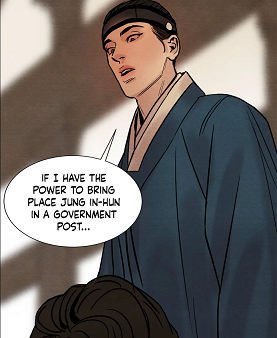 (Chapter 11) As you all know, my theory is that behind the name “lord Song” is hiding the king. But since I made a connection between episode 11 and 118, I deduce that Jung In-Hun has been put in the same position than the painter. His karma… for feigning ignorance and letting Baek Na-Kyum take the fall. He is paying for his wrongdoings all at once (11, 29, 35, 40). And what had Yoon Seungho said to his future lover?
  (Chapter 11)
  (Chapter 11) Yes, so far no one has been talking or thinking about the king as someone involved in the main lead’s suffering. Yet, I would like to outline that the gibang belongs to the state and as such to the king. Only a rich and influential person could hire the kisaengs for the day
 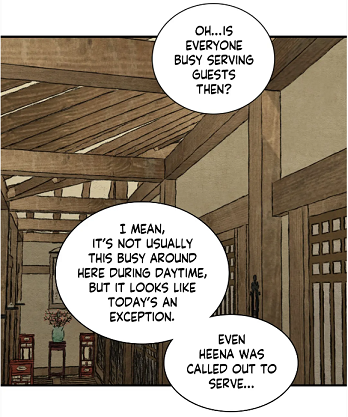 (chapter 118) Not even “lord Song” or lord Haseon from episode 107 couldn’t pull such a trick.
  (Chapter 107) He had announced his visit and the kisaengs had to gather next to the gate. There, the mysterious man selected only one woman.
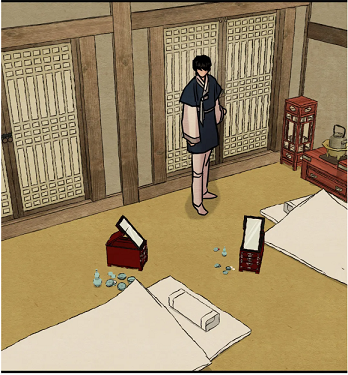
  (Chapter 107) However, in episode 118, the kisaeng talking to Baek Na-Kyum expressed that there were different parties. Each kisaeng was participating in a different festivity (“It’s not usually this busy”). She would have mentioned it, if there was a huge party in the gibang. But there is another clue for the king’s intervention: the pipe is no longer visible in the noonas’ room
 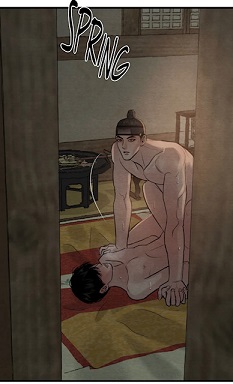 (chapter 96: it’s on the table), just like there are now two mirrors and the number of rouge has also increased.
  (Chapter 118) Finally, this painting, Hokjado, is actually mocking the monarch.
  (chapter 105) The tiger in the painting usually represents the ruling elite, and its ridiculous expression is a satirical commentary on their behavior. He is here portrayed as a lazy man focused on smoking and pondering.
  (chapter 103) And what is the common denominator between these two scenes? Both protagonists rejected the help from the staff, especially from butler Kim.
  (chapter 118) In fact, he blamed his brother and his father for everything, even Yoon Seungho’s way of life. His concern and affection for Yoon Seungho are totally superficial and trivial in the end. Why didn’t he ask about his wounds? He met him the next day after he regained consciousness.
 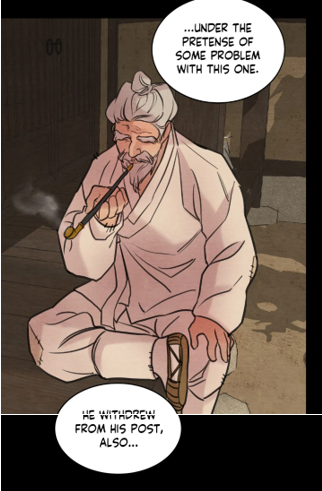 (chapter 37)
  (chapter 107), whereas the main lead had decided to protect his family despite their betrayal and abandonment. Under this new light, it becomes comprehensible why Yoon Seungwon has no interest to expose the petition contrary to the past.
 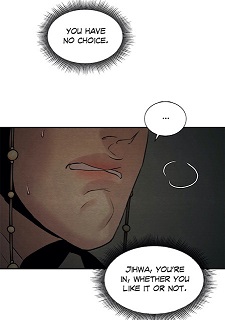 (chapter 76)
  (chapter 117) He was only happy by the painter’s side.
 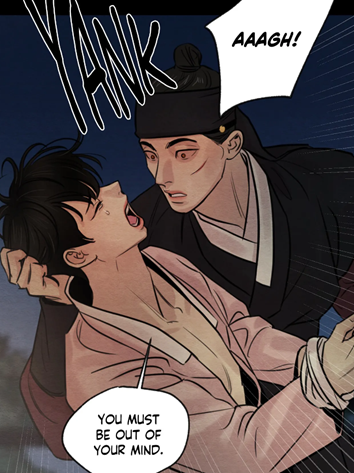 (chapter 25) On the other hand, I had made this connection, even before the release of episode 118. Why? It is because through deductions, I had already come to the conclusion that this was a stolen kiss.
 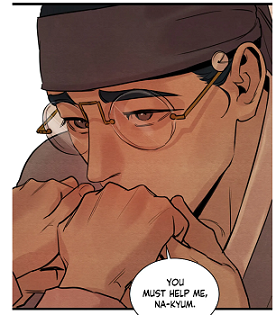 (chapter 24), then he hugged him
  (chapter 29). While the first embrace took place in a deserted area (close to the port), the second hug was witnessed by many people. It was in the open, moreover the so-called “hero” had jumped off the horse during the parade which could only catch the attention from the crowd.
 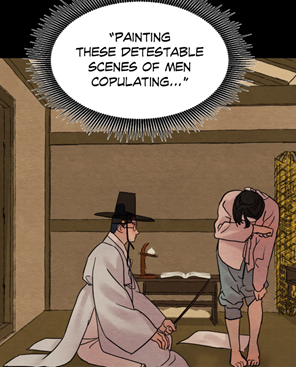 (chapter 34) His kiss is displaying his hypocrisy, which the artist could only feel. Hence he didn’t reciprocate the smooching. His lips remained immobile.
  (chapter 19) Therefore I come to the conclusion that this kiss is like the embrace from episode 29: fake! It is because the learned sir needs him! This statement stands in opposition to the protagonist’s love confession.
  (chapter 111) His gaze oozed not only arrogance, but also blindness. Imagine that he was smirking in front of the painter while looking at the wealthy aristocrat. It was, as though he thought that the artist wouldn’t notice his disdain and vanity. He imagined that the artist was still naive and ignorant like in season 1. This explains why the painter expressed his disapproval about the learned sir with a smile later:
  (chapter 111)
 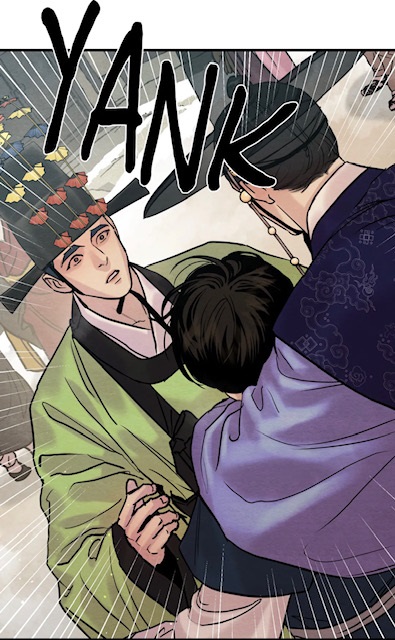 (chapter 111), for Baek Na-Kyum is always accompanied by his soul mate (chapter 40, 45, 74-75, 91-97, 104-105) In addition, people would have recognized him due to the previous parade and noticed his interaction with the artist. Nevertheless, the villain needed privacy, as he was inciting the main lead to commit a wrongdoing: betrayal towards Yoon Seungho. So their meeting could never be mere coincidence and happen in the open. Their reunion had to be planned properly and in secrecy. Thus it signifies that it had to happen behind the dark knight’s back. I would even add that the beloved couple needed to be separated! And now, you comprehend why their meeting had to take place in the gibang! In season 3 and 4, the kisaeng house is the place where the main leads got separated from each other, though the intervention from the noonas didn’t always work like expected.
  Here we witnessed his return. However, the kisaengs badmouthed Yoon Seungho
  (chapter 93) Their attempt was to create a riff between the couple.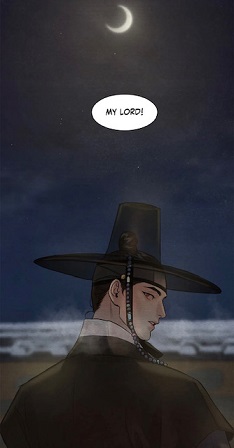
 (chapter 94), when the painter thought that they would go to the pond.
 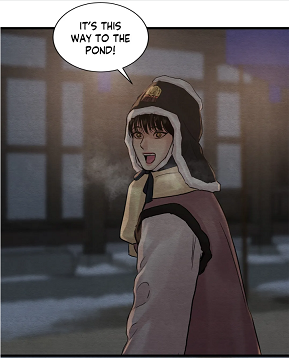 (chapter 94) Why didn’t the artist follow his partner right away?
 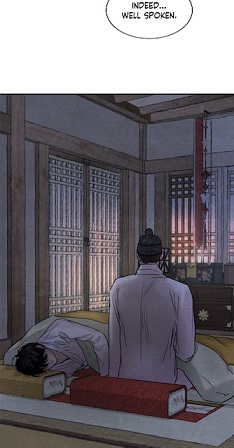 (chapter 97) But it can not be the officers, for they were carrying torches.
  (chapter 97) Yet, the light in the previous image is nearer to the ground than to the top of the door. Besides, carrying a torch in a building made of paper and wood is quite dangerous. For me, the person approaching their suite could only lift such a candle light
  (chapter 19) We have two possibilities left: the kisaeng Heena or the butler.
  (chapter 98) This confrontation didn’t occur in episode 93, for the kisaeng’s back was illuminated by the candle light, whereas the room was darker in episode 93.
  (chapter 93) The light was standing further away from her in this picture. Hence I deduce that the lord must have revisited the kisaeng during that night. Because she was not holding the candle light, I can only deduce that the person witnessing this second conversation was butler Kim! Besides, we have another allusion to him through the reflection of episode 19 and the first Wedding night. Then later, Heena tried to convince her brother to leave Yoon Seungho’s side
 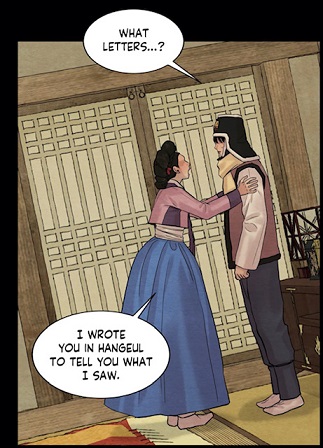 (chapter 97) by blaming him for Jung In-Hun’s murder, but her intervention failed. In reality, the separation could only take place thanks to the intervention of Yoon Seungho’s staff. In episode 97, the servants were definitely manipulating the painter with this corpse
  (chapter 97), whereas in episode 98, the maids had to play their role as well: badmouthing their master
 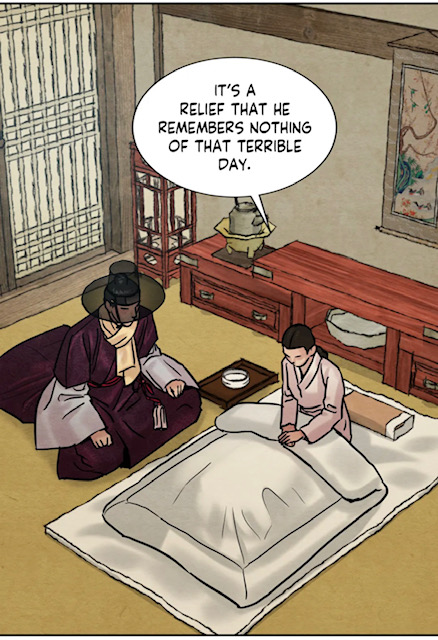 (chapter 105: Heena was strong enough to follow her brother to the door, and this quite quickly, for she witnessed their argument), the other cast doubts in Baek Na-Kyum
  (chapter 105) Yoon Seungho had mentioned that he would return to the kisaeng house in order to fetch his lover.
  (chapter 118) However, I believe that Jung In-Hun was lying, for his visit could be leaked to the owner of the mansion. He has no idea that no one is siding with the main lead. But by saying this, he was covering up for the gibang, and as such Heena. She was definitely her source of information.
 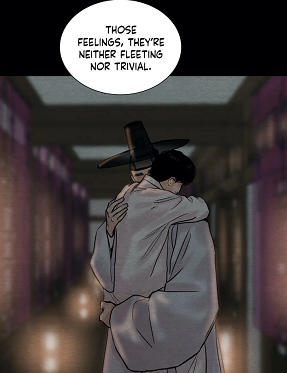 (chapter 68) Why? It is because she has always loved the learned sir and projected her own thoughts and emotions onto the artist. In my eyes, this encounter is to prove the kisaeng wrong, to confront her with reality and her prejudices. What caught my attention is that each time, the painter couldn’t meet Heena, her absence was justified that she was serving a nobleman outside.
 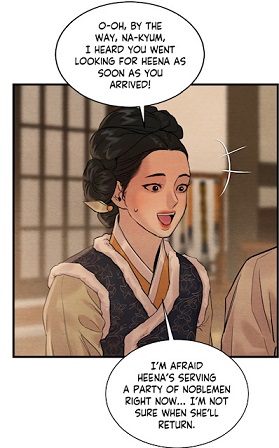 (chapter 93)
 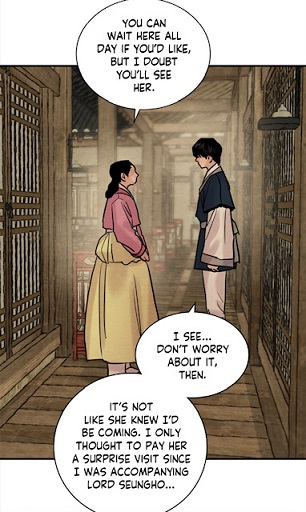 (chapter 118) Notice that the painter is already thinking that she was not expecting him. Yet, it is clear that he would come to the kisaeng house, for Yoon Seungho had been invited by his brother. The invitation had already been proceeded the day before:
 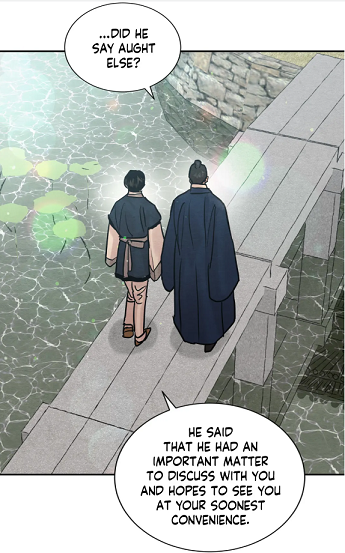 (chapter 117) So if something were to happen, Heena could feign ignorance and as such innocence. After their last argument, the noble has learnt that he shouldn’t keep his distance from the artist and he should confide to him, hence he talked about elopment at the pavilion.
  (chapter 25)
  (chapter 77) in a previous analysis. However, I will only focus on the comparison between episode 19 and 118, for both represent a first kiss!
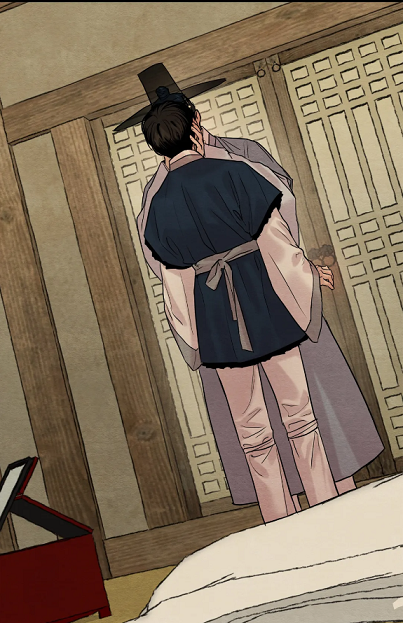 (chapter 118) And remember that in episode 19, the painter had caught the main lead by surprise, when he entered the room.
 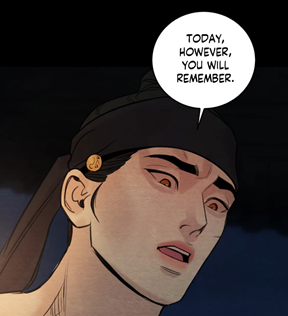 (chapter 25) Thus I am deducing that this scene
 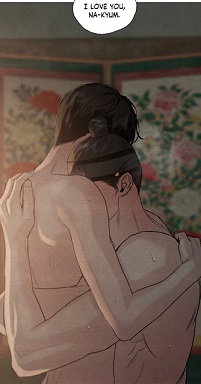 (chapter 96), this means that he has finally accepted his homosexuality. Consequently, the sexual abuser could have the impression that he just needs to remove the painter from the main lead’s side and that’s it. He can replace the artist… impersonation once again!
 (chapter 96) These notions are all reflected in the confrontation between Baek Na-Kyum and Jung In-Hun:
  (chapter 115) In my opinion, he will be framed for the incident in the shaman’s house.
 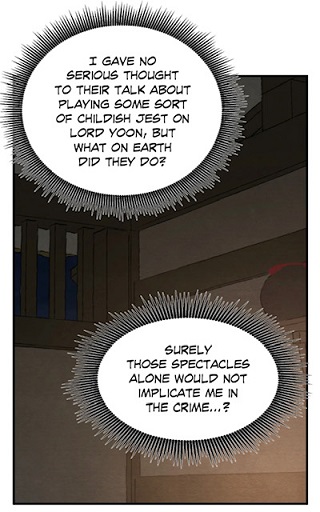 (chapter 115) Hence I have the impression that this stolen kiss will have huge repercussions not only for the learned sir, but also for Heena.
 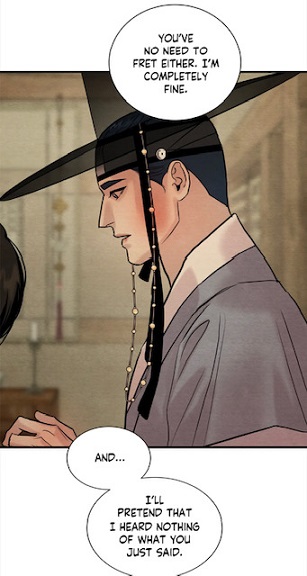 (chapter 118) Observe that the painter wanted to ignore the words from the fake teacher. So he could have a change of heart and report the incident to the authorities. He doesn’t know that his lover killed Black Heart and his friends. The learned sir was admitting that his nightmare had truly happened.
  (chapter 83)
  (chapter 88) From my point of view, the schemers are projecting their own thoughts and emotions on Yoon Seungho. Moreover I am quite certain that they have already calculated the possibility of a rejection. The painter’s so-called wrongdoings from season 1 (chapter 11: the ruined painting, chapter 29: desertion) and season 2 (chapter 61: the desertion) were all perceived as rejections. If he is caught with Jung In-Hun alone, they anticipate that Yoon Seungho will react like his father. He won’t be able to discern the truth. Baek Na-Kyum is not faithful and is now tainted. Or even worse… Yoon Seungho might commit a crime. This thought seems to contradict my previous statement: Jung In-Hun is acting on the pedophile’s order. Nonetheless, my theory is that there exist two conspiracies:
 (chapter 107)
  (chapter 115)
 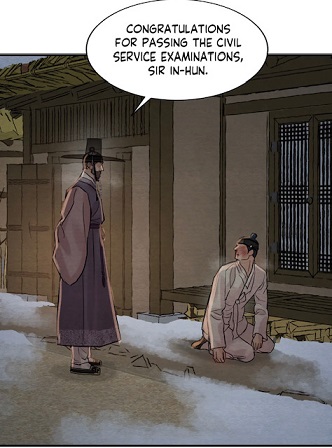 (chapter 115: flower pattern and no sleeve, the beard covers the jaw )
 (chapter 117: no pattern, the lips are covered by the moustasch, straight)
  (chapter 117) There are simply too many divergences to say that it is a mistake from the author. This would actually mean that she is quite sloppy. Furthermore, I decided to rely on my eyes and not a belief: there is only one lord Song. Thus you comprehend why I never called the man talking to Jung In-Hun lord Song. So if my theory is true, this would signify that these men represent the previous gang “dogs of Joseon”, the older version of this:
  (chapter 101) And No-Name was treated exactly like Lee Jihwa, but he got framed and sentenced. Finally, I would like to point out that there were 3 black men involved in the first fake sexual education:
  (chapter 107) Far away from the protagonist, he had to rely on his helping hands and his advisors. He trusted their words. Finally, we have the vision from Lee Jihwa:
  (chapter 101) That’s the moment when the truth will come to light. Someone will get angry, because he got confronted with the painful reality: he was a man consumed by lust, he was selfish, cruel, abusive, ignorant, coward, and even naive. He was never destined to be the protagonist’s life companion.
  , I detected a strong connection between chapter 10 and 117. The common denominator was the pavilion. The learned sir brought the artist under the pretense for a walk in order to seek seclusion and privacy. While he faked his worries
  (chapter 10), he wanted the painter to stop working for Yoon Seungho. He desired him to leave the propriety, for he saw Baek Na-Kyum as a rival. Unlike the painter, the scholar had not been invited to join the party the night before. Hence he had to portray Yoon Seungho in such a bad light!
 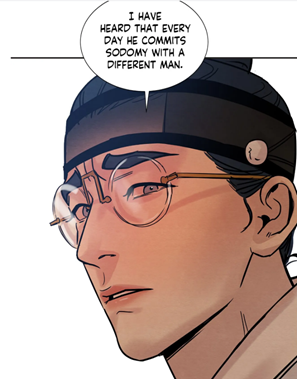 (chapter 10) Back then, the vain and stupid man thought that the main lead had truly liked his poem. Thus he imagined that he could get the attention from the protagonist, once he got rid of his competitor.
 (chapter 10) This is not surprising that the author employed a panel from that chapter.
  (chapter 118) Back then, the artist had not detected the manipulation. Hence he had protected his former teacher, when the latter got accused of ruining the painting. This confession from the scholar
 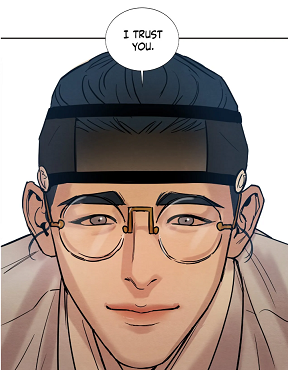 (chapter 10) stands in opposition to Yoon Seungho’s. The latter has no expectation from the artist.
  (chapter 117) The latter is the one deciding about the lord’s fate. But why did he go to the pavilion with the painter? For privacy and intimacy! They needed to discuss the matter about the brother and the petition, a dangerous matter.
 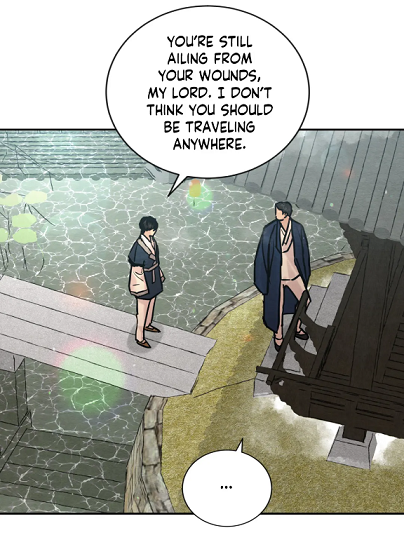 (chapter 117) Here, the painter was acting as the main lead’s right-hand and advisor. He is taking over the butler’s function. He was full of concern for his loved one asking him to postpone the reunion (chapter 117) And the moment the artist voiced his fears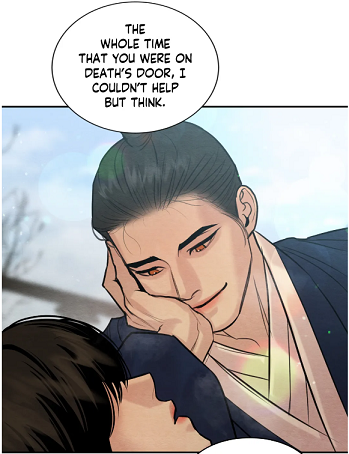
 (chapter 117), the noble suggested to leave everything behind.
  (chapter 117) And what would people see from far away? 2 people showing closeness and attachment, they wouldn’t expect a desertion, an abandonment!! And now you comprehend why Yoon Chang-Hyeon was sitting in the pavilion in town
 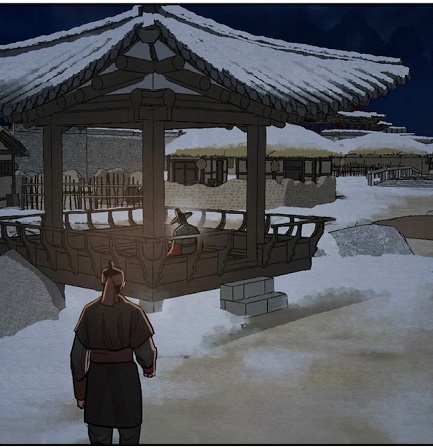 (chapter 116) It was, as if he was trying to get an alibi for his crime: he had planned to have his son killed, but it didn’t happen as expected. Thus he was forced to join his son.
  (chapter 116) This means that he was exposing his crime to people in town. Furthermore, he even confessed his hatred for his own son. He yelled this:
  (chapter 116) Yet, by stating this, he was admitting that he was violating social norms (Confucianism). That’s how I realized that the pavilion is not only the place where Yoon Seungho’s emancipation takes place, it is also the symbol for betrayal and abandonment.
 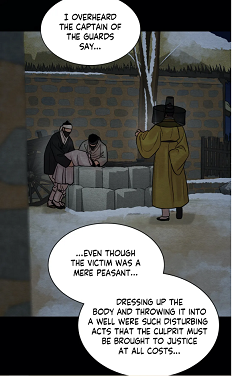 (chapter 101) Finally, a long time ago, I had developed the theory that the pavilion was the place where Yoon Seungho got abused.
  It is the same pavilion than Yoon Chang-Hyeon’s. This means that the couple will purify this place. At some point, the lord and his knight will come to admire the pond with the lotus flowers:
  (chapter 117) Byeonduck let us see a glimpse of their future.
 Bebebisous33s' analyses in K-Dramaland and Manhwas