
Please support the authors by reading Manhwas on the official websites. This is where you can read the Manhwa: Jinx But be aware that the Manhwa is a mature Yaoi, which means, it is about homosexuality with explicit scenes. Here is the link of the table of contents about Jinx. Here is the link where you can find the table of contents of analyzed Manhwas. Here are the links, if you are interested in the first work from Mingwa, BJ Alex, and the 2 previous essays about Jinx Between A Squeeze And A Crack – part 1 and Between A Squeeze And A Crack – part 2
It would be great if you could make some donations/sponsoring: Ko-fi.com/bebebisous33 That way, you can support me with “coffee” so that I have the energy to keep examining Manhwas. Besides, I need to cover up the expenses for this blog.

Where is a Flower in Episode 88?
Episode 88 of Jinx immediately drew readers’ attention to two moments in particular: the training session between Kim Dan and Joo Jaekyung 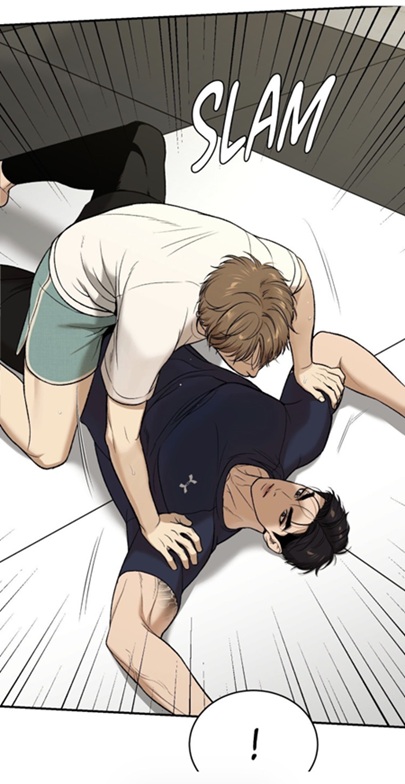 (chapter 88), and the final panel hinting at an imminent confrontation with Choi Heesung.
 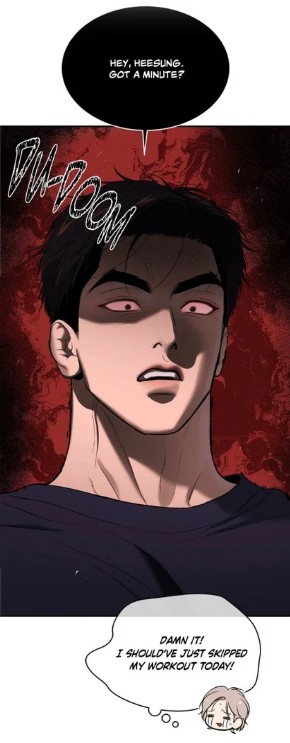 (chapter 88) Discussions largely revolved around physical proximity, discipline, and anticipation — around bodies in motion and the promise of conflict to come. At first glance, the episode seemed to oscillate between intimacy and tension
 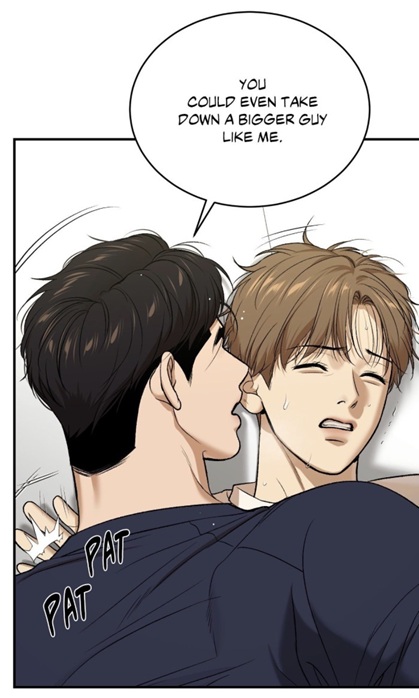 (chapter 88), between preparation
  (chapter 88) and interruption
  (chapter 88).
Only on closer reading does another layer emerge — one that does not oppose these moments, but reframes them. The training session is not merely about discipline or proximity, and the final panel is not only a promise of confrontation. Both scenes 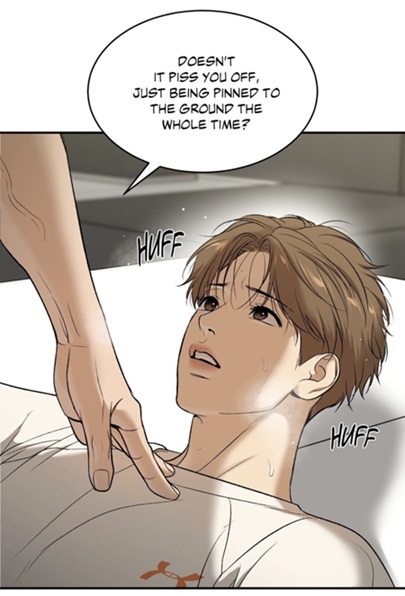 (chapter 88) are structured around restraint (chapter 88): what is held back
  (chapter 88), delayed, or redirected. Words are measured, authority is redistributed, and decisions are deferred
 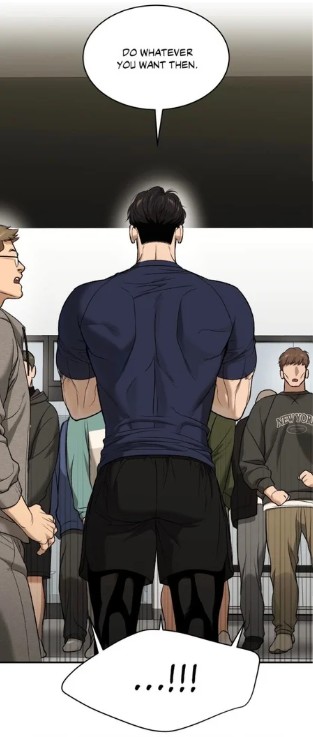 (chapter 88) rather than imposed. What initially appears as physical intensity and narrative suspense begins to reveal a deeper reconfiguration of roles, responsibility, and choice.
At first glance, the title may seem paradoxical. The episode takes place a few weeks after October  (chapter 70)—most likely in November— in late autumn.
 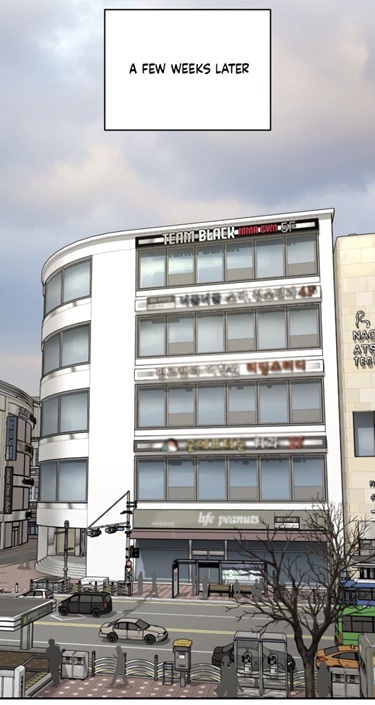 (chapter 88) This temporal setting is visually reinforced by the environment itself: in the opening sequence marked “a few weeks later,” the tree is already bare, its leaves gone. Nature offers no spontaneous image of growth or renewal. If a flower were to appear in this chapter, it couldn’t belong to the season. It must be cultivated, protected, and sustained in a green house—something that emerges not from natural abundance, but from deliberate care. So where does this idea of a flower come from?
Closed Circuits and the Logic of the Number Eight
The title emerged from a visual and structural observation. Chapter 88 is built around the number eight: a chapter defined by two closed circuits that finally cross. Remember how I described the relationship of the main couple in the essay  : a closed circuit which we could witness once again in the training room: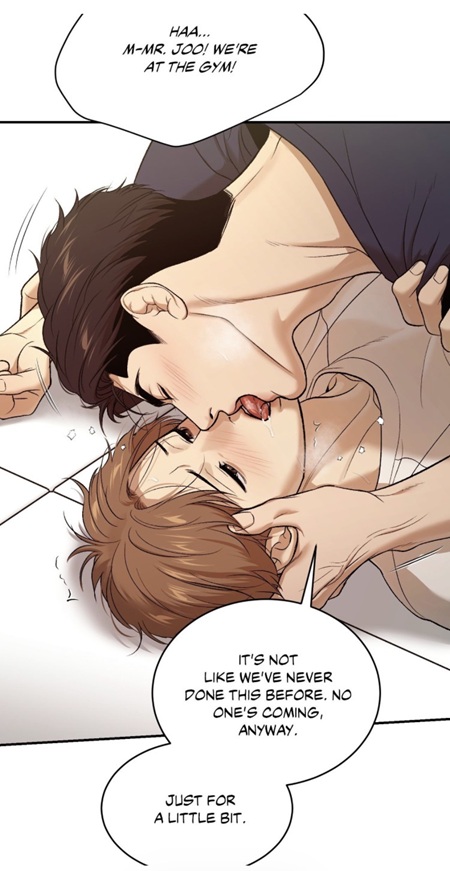
 (chapter 88) There are once again sparks between them. The number 8 is not just related to doc Dan [for more read The Magic Of Numbers ] and his relationship with the athlete, but also to the other couple: Heesung and Yoon-Gu. This means, the latter represent the other closed circuit. Hence the other couple appeared in episode 35 and 58.
  (chapter 58) Two trajectories —long separated, repeatedly missing one another—intersect at last. When two eights overlap, they form neither a loop nor a knot, but a new shape: a flower-like figure, suggestive of opening rather than closure. This crossing does not resolve everything; instead, it creates the conditions for growth for all the characters. We could say that each closed circuit forms two petals so that their interaction with each other will affect them positively.
Color as Emotional Structure
The flower, however, is not only numerical or temporal. It is also chromatic. A flower is never defined by form alone, but by shading—by gradients, transitions, and the coexistence of multiple tones within a single structure. Thus in French certain flowers serve to define pigments: rose for pink, violet for purple. In this sense, episode 88 does not merely contain colors; it behaves like a flower unfolding through shades. Episode 88 is saturated with color: pink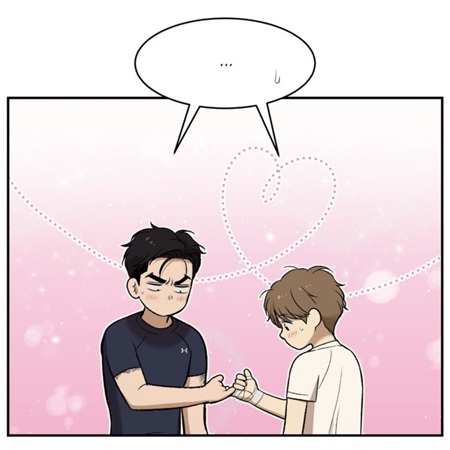 (chapter 88), white
 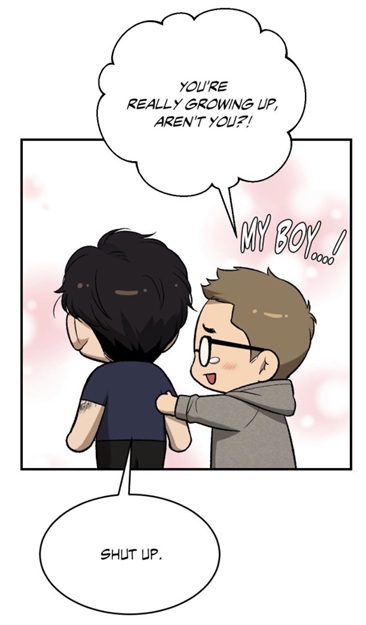 (chapter 88) purple
 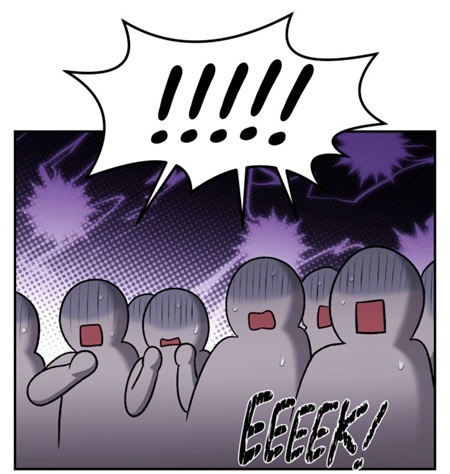 (chapter 88), blue, gray,
 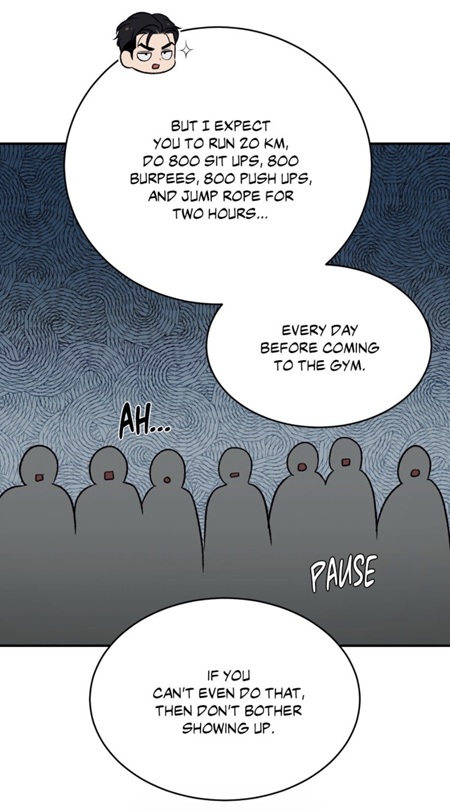 , (chapter 88) red (chapter 88) and black
 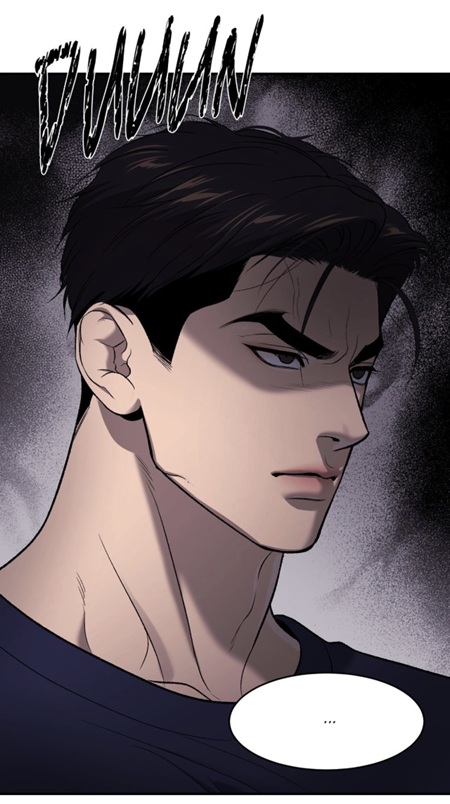 (chapter 88) Pink frames tenderness and mutual awkwardness; purple marks embarrassment and heightened awareness; red signals suppressed anger and looming confrontation; black absorbs fear, silence, and unresolved tension.
White, notably associated with Park Namwook, carries a more ambivalent meaning. (chapter 88) It evokes innocence on the surface, but also ignorance—an unexamined moral comfort that allows him to retreat from responsibility while claiming authority. His lightness contrasts sharply with the weight of the decision he refused to make: visually underlined by the black-lined spiral hovering near his head—an emblem of irritation without accountability.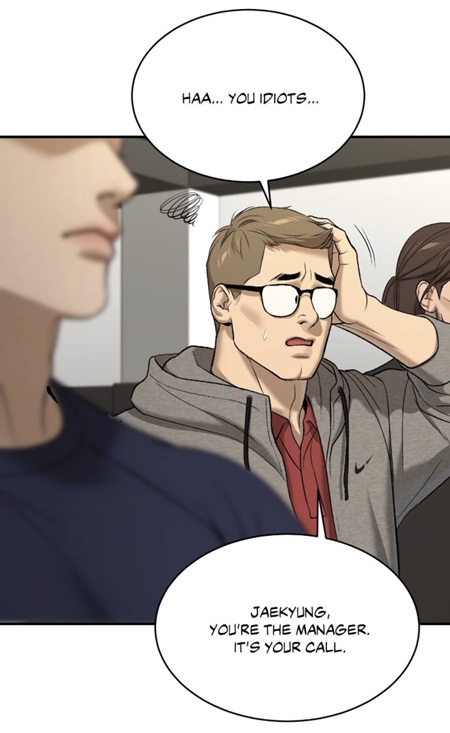
Blue and gray dominate the scene in which Joo Jaekyung announces his seemingly excessive training demands. (chapter 88) On the surface, the atmosphere feels cold and authoritarian. Yet the exaggeration itself reveals something else: the demand is deliberately absurd, almost teasing. Joo Jaekyung is testing resolve, not imposing punishment. The joke —visible thanks to the chibi and the brief spark within the athlete’s gaze— goes unnoticed. No one laughs. The room’s muted colors reflect this misrecognition—care and fun are present, but not yet legible to those receiving it.
At first glance, the setting itself seems to resist any floral reading. (chapter 88) The scene unfolds not in nature, but in a gym in Seoul—an urban, enclosed space associated with discipline, repetition, and control rather than growth or renewal. This tension may explain the readers’ initial surprise: a flower appears where one would expect only concrete, steel, and hierarchy. Yet in Jinx, the flower does not belong to nature as landscape, but to nature as process—to emergence, care, and relational change.
This process is not introduced through scenery, but through bodies marked by green. And the latter symbolizes nature. In episode 88, two characters 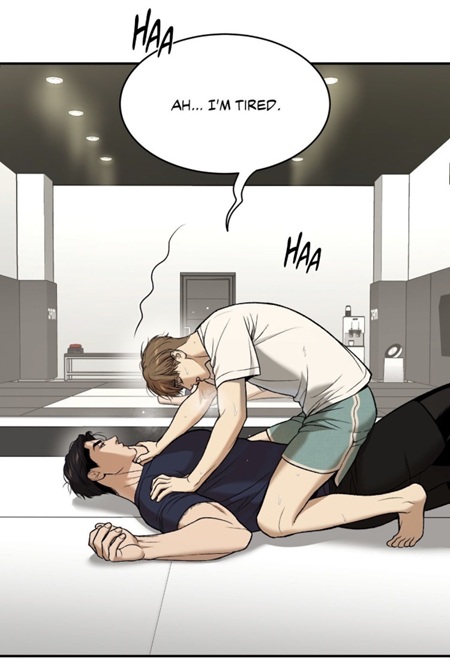 (chapter 88) are dressed in green (chapter 88), a choice that appears unobtrusive—almost practical—yet is unmistakable within Mingwa’s chromatic language. Green here does not function as pure nature or renewal, but as transition: a sign of growth that is still constrained, negotiated, and incomplete. It is not a vivid, liberating green, but a muted one—ranging from green sheen to subdued olive—closer to endurance than vitality, to steadiness rather than expansion. Growth is present, but it has not yet broken free; it remains embedded in effort, restraint, and adaptation.
Crucially, this shorts’ shade recalls the photograph of Kim Dan with his grandmother 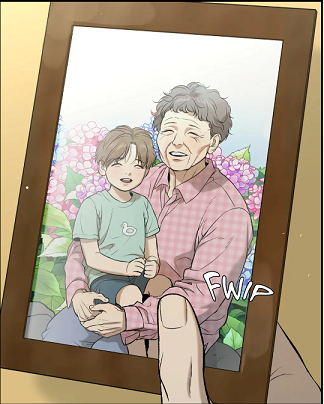 (chapter 19), where green and floral elements once functioned as a silent language of care and containment. The repetition is not accidental. By wearing a similar tone in the present, Kim Dan does not merely revisit the past; he carries it forward. (chapter 88) The color no longer signifies dependency or shelter alone, but continuity of self. It marks a return to an inner disposition that predates trauma—a self capable of care, persistence, and quiet resilience. This means that he is closer to his true self.
Placed within the gym’s dominant blues and grays, this green does not signal leisure or escape. It signals cultivation. Growth here is neither spontaneous nor decorative; it must be trained, maintained, and protected. The flower does not bloom despite the city—it blooms through care, discipline and recognition. What initially appears paradoxical becomes coherent: in Jinx, growth is not opposed to structure. It is shaped by it.
From Flower to Language: Communication Deferred
Crucially, the flower also functions as a metaphor for communication. (chapter 19) Flowers are not passive decorations; they carry meaning, intent, and symbolism. The background is composed of hydrangeas in blue, pink, and pale violet—colors traditionally associated with gratitude, tenderness, apology, and emotional nuance.
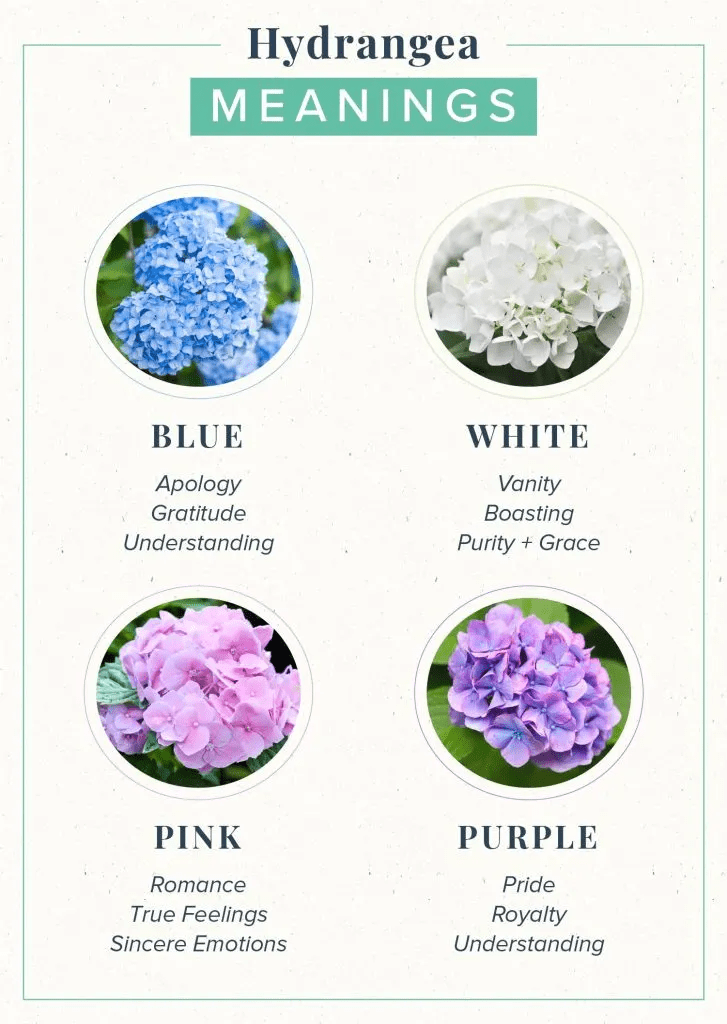
Unlike roses  (chapter 35), which tend to assert a singular message (love, passion, beauty), hydrangeas communicate multiplicity and emotional ambivalence; they speak in clusters rather than declarations. This visual language mirrors Kim Dan’s inner world at the time (chapter 19): affection entwined with dependency and sorrow, care mixed with silence, love present but unspoken.
This chromatic memory resurfaces later through a different floral gesture: the bouquet Choi Heesung offers Kim Dan —pink roses paired with baby’s breath 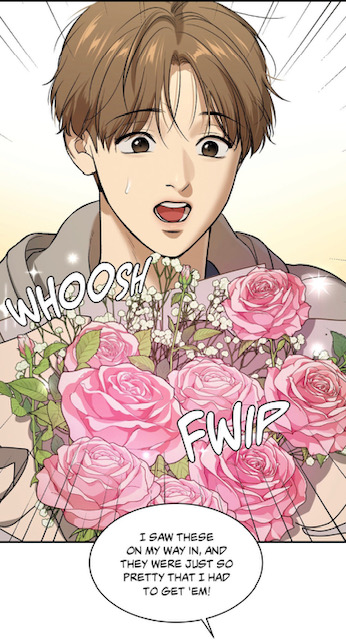 (chapter 31). Here, the symbolism shifts. Pink roses convey affection and admiration, while baby’s breath suggests innocence and fragility. Yet the arrangement is excessive, overwhelming, and mismatched to its recipient. The bouquet does not listen; it speaks at Kim Dan rather than with him. Significantly, Heesung comes to associate Kim Dan himself with the flower—something delicate, beautiful, and deserving of protection, but also something to be handled, displayed, and possessed.
Episode 88 reframes this logic entirely. The “birth of a flower” no longer refers to being perceived as fragile or decorative, but to a return to growth from within. 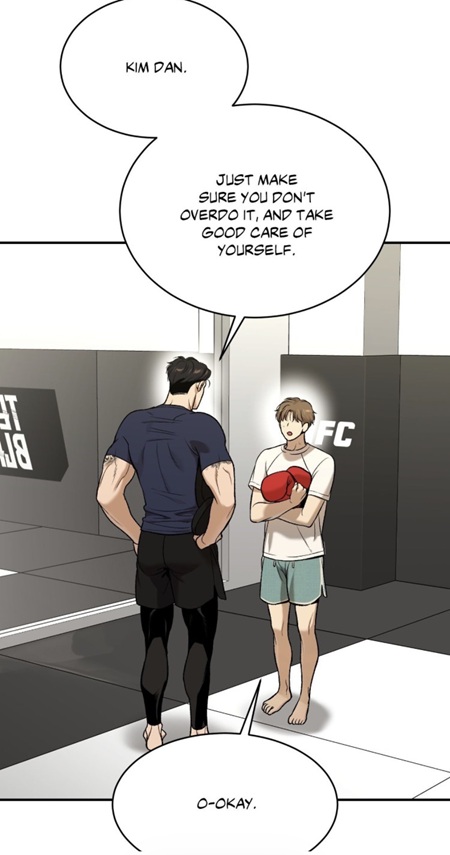 (chapter 88) Kim Dan’s green training clothes—visually echoing the green shirt he wore in the photograph with his grandmother—signal continuity rather than regression. This is not a retreat into childhood dependency, but the reappearance of an inner child now disentangled from obligation and fear. The flower that reemerges here is not gifted, not arranged, not imposed—it grows. In this sense, episode 88 introduces a missing element in the dynamic between the two protagonists: not desire, not care, but communication. And it is here that Choi Heesung becomes central—not as a rival or antagonist, but as a structural bridge, as in reality he represents the rose, “La vie en rose”
  . He embodies speech, playfulness, and visibility, yet also reveals their limits when they are severed from responsibility and respect. I will elaborate about this more below.
The illustration accompanying this essay includes a fifth, shadowed petal inspired by the Mugunghwa—the Rose of Sharon, a national symbol of Korea often associated with endurance, justice, and continuity. This fifth petal does not yet fully bloom. It signals something incomplete, something still forming: a question of justice, choice, and mutual recognition that the narrative has only begun to articulate.
Finally, this essay reads episode 88 through the lens of Erich Fromm’s definition of love—care, responsibility, respect, and knowledge. For me, these 4 notions are represented by the 4 petals. In this chapter, Joo Jaekyung visibly embodies care, responsibility, and a growing respect for others’ autonomy. What remains absent is knowledge: a true understanding of Kim Dan’s inner life, just as Kim Dan himself has yet to fully understand Jaekyung beyond his role and past. The flower, then, is not the endpoint. It is the beginning of a process in which these missing elements may finally emerge.
What follows is not an analysis of victory or defeat, but of growth—quiet, fragile, and cultivated under constraint. This is not the celebration of happiness already achieved 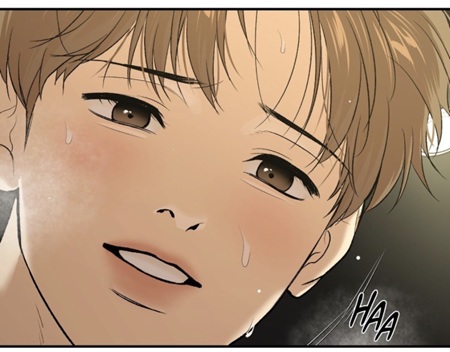 (chapter 88), but the moment in which the conditions for happiness are finally put into place. And now let me ask you this. What is the symbol of happiness? Smiles and laughs. During the training session, Kim Dan smiles. These moments are brief
 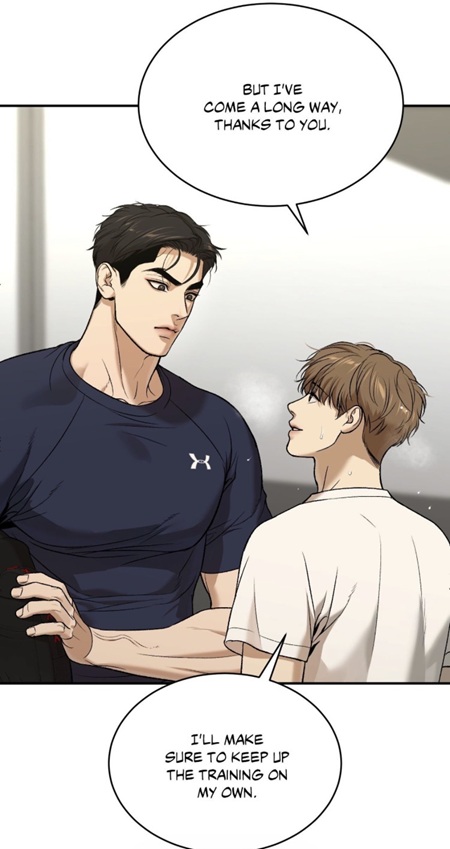 (chapter 88) and goes unnoticed by him (chapter 88) and his fated partner, yet it directly answers what Joo Jaekyung has repeatedly expressed as his desire: to be the source for Kim Dan’s smile and to smile together.
 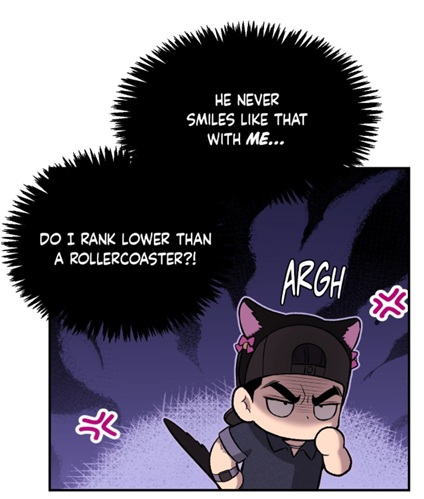 (chapter 83) What is striking is that neither of them recognizes this fulfillment. (chapter 88) Kim Dan does not register his own smile as happiness, and Joo Jaekyung does not realize that he is already producing what he seeks. As elsewhere in Jinx, happiness precedes awareness. It exists before it is acknowledged—by both sides.That’s why I selected the title: the flower embodies happiness, as its life is just as short as happiness.
  (chapter 31)
A. Joo Jaekyung × Kim Dan: The First two Petals
The training sequence in episode 88 cannot be read as a simple exercise scene, nor as a sudden moment of equality or mutual play. It is, instead, the continuation of a long-standing relational pattern in which care is expressed indirectly (chapter 88), asymmetrically, and through the only language both characters know how to use: work.  (chapter 88) What appears at first glance as coercion
 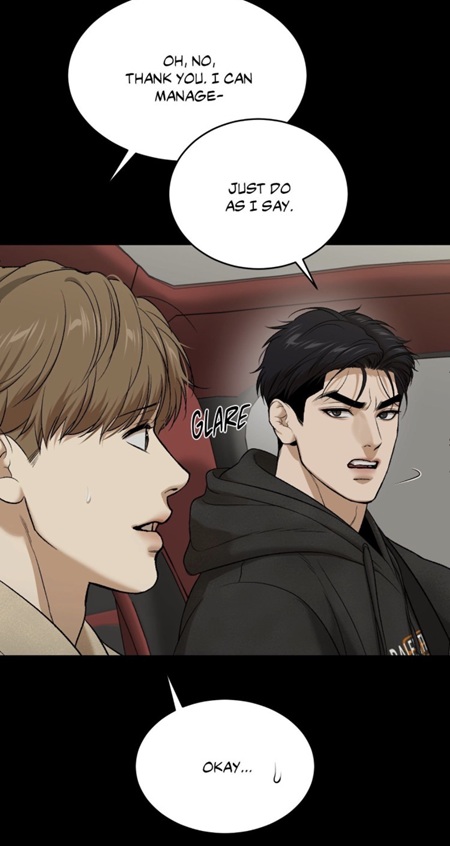 (chapter 88) or discipline is in fact a negotiation shaped by habit, fear of burdening the other, and an inability—on both sides—to articulate desire outside professional roles.
1. How the training is suggested: care disguised as necessity
Crucially, the idea of training does not emerge in the gym itself. It is first introduced in the car 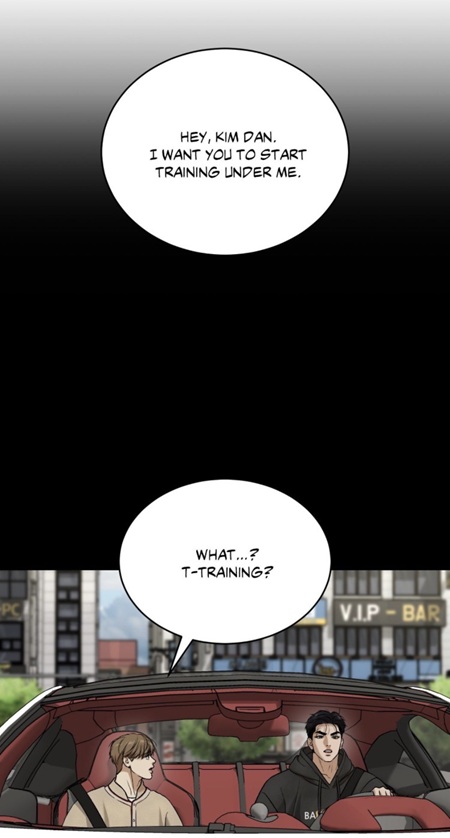 (chapter 88), a space that is never neutral in Jinx. A car has one driver, one direction, one authority. By placing the conversation there, Mingwa signals that the relationship is still structurally asymmetrical at this point: Joo Jaekyung leads, Kim Dan follows.
Joo Jaekyung frames the proposal as a matter of stamina and work. (chapter 88) Training will help him in his career. This framing is not accidental. Joo Jaekyung does not yet know how to say: “I want to spend time with you“, or “I’m afraid you won’t be safe, once you leave my side“. He knows only how to justify closeness through usefulness. Training becomes a rational excuse for proximity, a legitimate reason to demand time without admitting emotional dependence.
At the same time, this proposal is deeply protective. Joo Jaekyung has seen Kim Dan collapse from exhaustion in the past. He knows his physical limits better than Kim Dan himself. 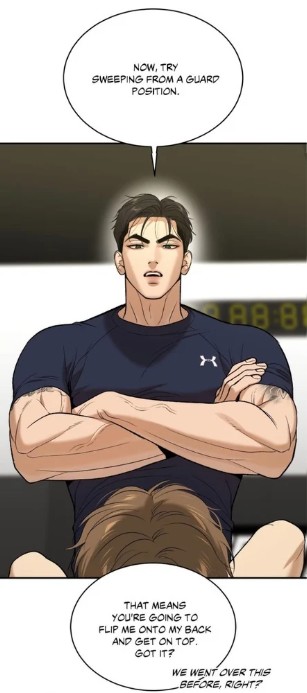 (chapter 88) Secondly, such a training suggests that the athlete is gradually remembering this scene of the almost-rape. (chapter 88) In his subconscious, he knows that this was not prostitution.
 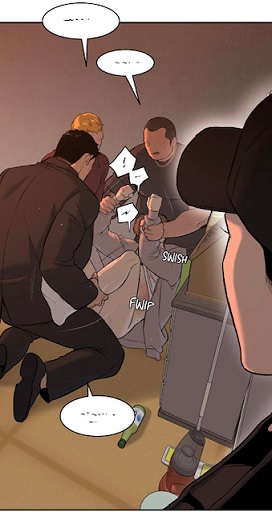 (chapter 17) Therefore it is not surprising that instead of asking permission or explaining concern, he imposes the idea—because that is how he has learned to act as a captain, a fighter, and later a manager. Authority precedes dialogue. (chapter 88)
2. The first refusal: self-neglect disguised as strength
Kim Dan’s first response is immediate: (chapter 88) He refuses. This is not politeness. It is not consideration for Joo Jaekyung’s fatigue. It is a reflex rooted in long-standing self-erasure. Kim Dan genuinely believes he is strong enough. More importantly, he believes that needing care is illegitimate.
This refusal is governed by habit:
- the habit of minimizing himself,
- the habit of overestimating endurance,
- the habit of believing that receiving attention makes him a burden.
At this stage, Kim Dan is not yet protecting Joo Jaekyung; he is protecting the structure that allows him to remain useful and unobtrusive. Accepting training would mean admitting vulnerability—and worse, accepting time, effort, and concern directed at him.
The sportsman ignores this refusal. This moment is important because it reveals both the problem and the intention. Joo Jaekyung acts like a parental figure, not a partner. He overrides consent not out of cruelty, but out of conviction that he knows better. His care still takes the form of command. This explicates why the physical therapist’s agreement is accompanied with a drop of a sweat. “Okay” indicates more discomfort than joy and gratitude. He doesn’t feel indebted toward the athlete, rather embarrassed.
Thus the asymmetry is intact. The training is not born out of his own desire.
3. The pause: time passing, resistance softening
Striking is that this conversation is revealed, after the champion asked doc Dan to get changed. 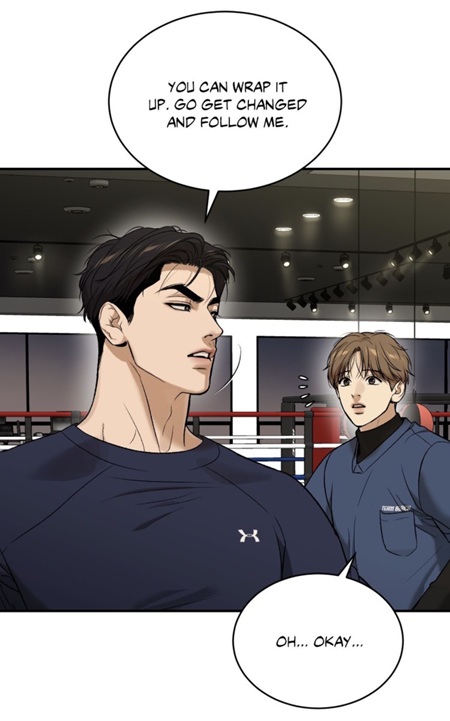 (chapter 88) In other words, the request from Joo Jaekyung appears as a memory from the physical therapist. Why?
 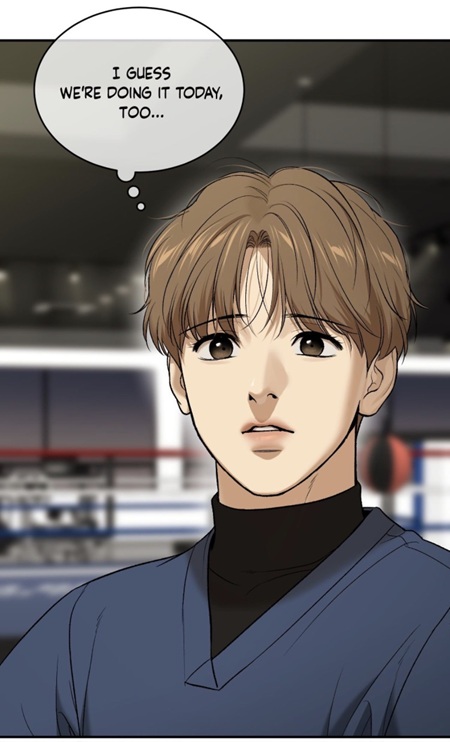 (chapter 88) Because Mingwa refuses the “clean” sequence in which an order is issued and immediately executed. The narration inserts a gap—an interval of off-panel time that we are forced to reconstruct from Kim Dan’s recall. (chapter 88) The narrative does not jump immediately into physical training, because the temporal gap is supposed to mirror the time jump as well. There were other training sessions. This temporal gap matters. The doctor’s inner thoughts (chapter 88) “I guess we’re doing it today, too…” implies routine without inner desire and daily regularity. This means that the training sessions only took place, when the champion asked doc Dan to change his clothes. Doc Dan was not looking forward for the training sessions or reminded the athlete of his promise or request.
That pause changes the meaning of consent and compliance. If the scene were immediate, Kim Dan’s earlier refusal (“Oh no, thank you, I can manage—”) would read as a clear boundary and Joo Jaekyung’s “Just do as I say” as a straightforward override. (chapter 88) But because the chapter returns to the topic through memory, the refusal is not portrayed as a decisive line—rather, it becomes the first phase of a negotiation Kim Dan does not yet know how to conduct. His resistance softens not because he suddenly “wants” the training, but because habit takes over: he is used to accommodating authority, used to re-framing his own limits as irrelevant, used to translating pressure into “normal.” The break between the command and the actual session is precisely where that old reflex does its quiet work.
By the time they appear in the practice room, Kim Dan is showing no hesitation. He is training eagerly. 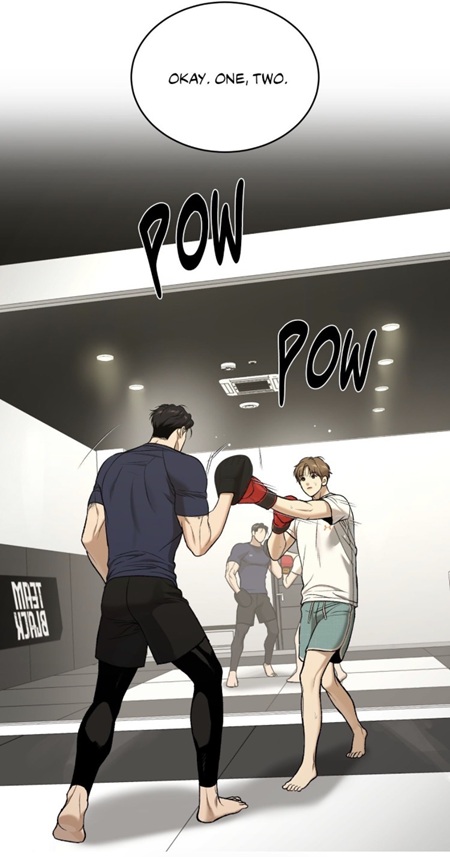 (chapter 88) Instead Kim Dan no longer insists on his own sufficiency. He no longer says “I can manage., but doc Dan admits not only his own lacking.
 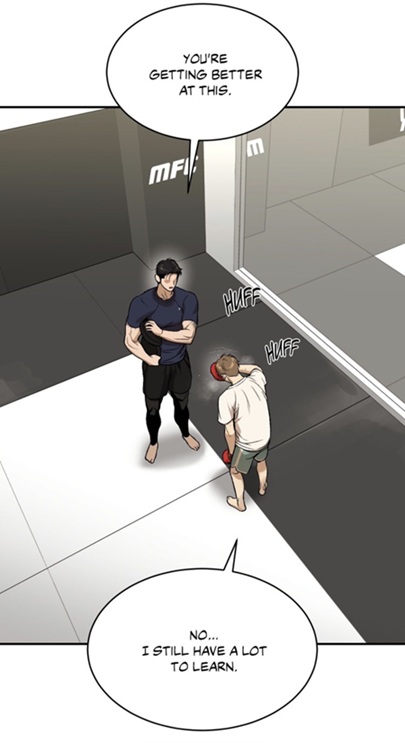 (chapter 88), but also his own desire. He finally expresses his desire to improve, to learn more.
This admission marks a decisive internal shift. In earlier chapters, “I can manage” functioned as a shield: a way to deny need and avoid dependence. Here, Kim Dan allows himself to recognize that improvement exists precisely because limits existed before. The champion’s explicit comparison with the past  (chapter 88) creates a temporal bridge that enables this recognition. Only once change is named from the outside can Kim Dan cautiously acknowledge it from within.
At the same time, this acknowledgment remains fragile. Kim Dan does not fully accept the implications of Joo Jaekyung’s praise. (chapter 88) His response — “I still have a lot to learn” — both accepts growth and reinscribes distance. He recognizes the fighter’s effort and dedication, yet still fears relying on the athlete’s benevolence. (chapter 88) This is why he immediately reframes the future in terms of independence: he will “keep up the training on [his] own.” Gratitude is present, but it remains incomplete, protective rather than connective. He still experiences himself as a potential burden. But why?
It’s because he tried to care for the athlete in his own way by suggesting a rest, but the champion denied it. 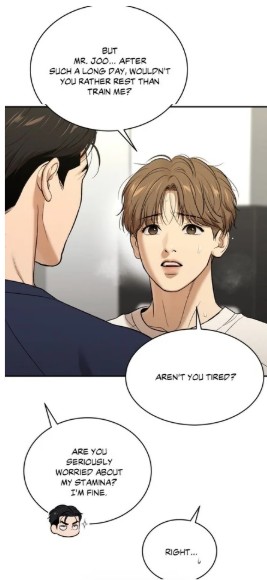 (chapter 88) The problem is that his form of care was influenced by his own mindset and emotions: his physical limitations.
This attempt at care fails not because it is insincere, but because it is misaligned. Kim Dan does not ask whether Joo Jaekyung wants to rest; he assumes that rest must be what is needed, because that is what he himself would need in the same situation. His concern is genuine, yet it is filtered through his own bodily limits and emotional economy. Fatigue, for him, is something that must be managed cautiously, avoided, negotiated. When he encounters a body that does not obey those rules — a body that still has stamina, that refuses the logic of depletion — his offer of care is quietly rejected.
This rejection is decisive. It reveals a gap Kim Dan cannot yet bridge: the realization that Joo Jaekyung’s needs do not mirror his own. (chapter 88) The athlete does not require rest in the same way, and more importantly, he does not articulate his needs through physical exhaustion at all. What Kim Dan fails to perceive is that the training itself is Joo Jaekyung’s way of staying regulated, present, and emotionally grounded. It is also his source of joy. By denying the necessity of rest, the champion is not dismissing care; he is refusing a form of care that does not correspond to him.
Confronted with this mismatch, Kim Dan retreats. If his attempt to care is ineffective, then the safest response is to minimize his demands. This is where gratitude hardens into distance. He thanks Joo Jaekyung for his help with a smile, acknowledges his progress, and immediately insists on autonomy: he will continue alone. The logic is protective. If he does not rely, he cannot burden. If he does not ask, he cannot be refused again.
What emerges here is not self-confidence, but a familiar defense. Kim Dan is not asserting independence from strength; he is withdrawing from uncertainty. His insistence on training alone does not signal rejection of connection, but fear of asymmetry — fear that he cannot offer something equivalent in return. Because he interprets care primarily through physical effort and endurance, he cannot yet recognize that his presence, attention, and willingness to engage already matter.
In this sense, the moment exposes the limits of projection. Kim Dan’s care is sincere, but it remains anchored in his own survival strategies. Until he can decouple care from exhaustion, and need from weakness, he will continue to misread situations where what is required is not restraint, but accompaniment. The training, then, is not only about building strength. It is the first site where Kim Dan begins to confront the possibility that care does not always flow from managing limits — but sometimes from staying, even when one feels unnecessary.
This is significant. It shows that Kim Dan is beginning to speak, but still cannot speak for himself. His old habit remains: if something feels wrong, it must be because the other person needs rest, not because he is tired, scared, or overwhelmed. In other words, care is emerging—but it is displaced.
This is precisely why the gesture that follows (chapter 88) carries such weight. For the first time in this exchange, care is directed back at Kim Dan without condition. It is not framed as instruction, correction, or evaluation. It is neither command nor test. It is a simple, protective statement that mirrors Kim Dan’s earlier concern — but without projection. Joo Jaekyung does not deny Kim Dan’s limits. He acknowledges them. There is no reproach, only concern. 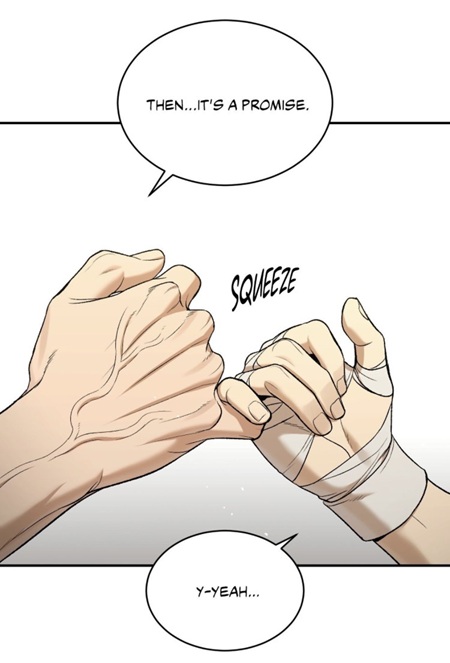 (chapter 88)
Here, the asymmetry softens without disappearing. Joo Jaekyung remains physically dominant, emotionally inarticulate, and structurally in control of the situation. Yet the direction of care shifts. He does not accept Kim Dan’s attempt to exit the dynamic under the guise of independence. Instead, he counters it with responsibility: you matter enough to be protected. The pinky promise that visually accompanies this exchange reinforces the meaning. Promises in Jinx have often functioned as burdens or traps — obligations that freeze people in place. This one is different. It does not demand performance. It does not extract sacrifice. It asks only for self-preservation. (chapter 88)
This is where the flower begins to appear — not as harmony, not as symmetry, but as mutual misrecognition slowly correcting itself. Kim Dan still does not fully grasp that Joo Jaekyung’s desire to train him is also a desire to spend time with him. Joo Jaekyung, in turn, still cannot articulate that desire outside the language of work. (chapter 88) Training becomes the only acceptable medium through which closeness can occur. Pleasure and intimacy surface unintentionally — in teasing, in competition, in shared breath — but remain unnamed.
Crucially, this is not rigidity. It is habit. Both men operate within deeply ingrained routines shaped by survival rather than joy. Rest, breaks, and leisure have only ever been framed in relation to the champion’s career: recovery after injury, distraction after stress, sanctioned release after pressure. They know how to stop working; they do not know how to share fun. There is no vocabulary yet for casual togetherness — no restaurant, no cinema, no idle wandering. Training fills the gap because it is the only space where proximity feels justified.
Thus, the training is neither purely imposed nor fully shared. It begins as Joo Jaekyung’s initiative, shaped by authority and concern, but it gradually becomes a site where Kim Dan starts to renegotiate his self-image. By acknowledging both his limits and his desire to improve, Kim Dan takes a first step away from the logic of endurance alone. He still retreats into self-sufficiency, but the retreat is no longer absolute. He speaks more. He hesitates less. He accepts care, even if he cannot yet rely on it.
The flower here is not bloom, but formation. It is the slow emergence of a relationship that must unlearn the equation between care and burden, strength and isolation, desire and duty. Nothing is resolved. But something has shifted: care is no longer one-directional, even when it remains uneven. And for the first time, both characters participate — imperfectly, awkwardly, but genuinely — in sustaining it.
4. Where pleasure enters—and why it is unspoken
As the training progresses, something shifts subtly. Joo Jaekyung smiles 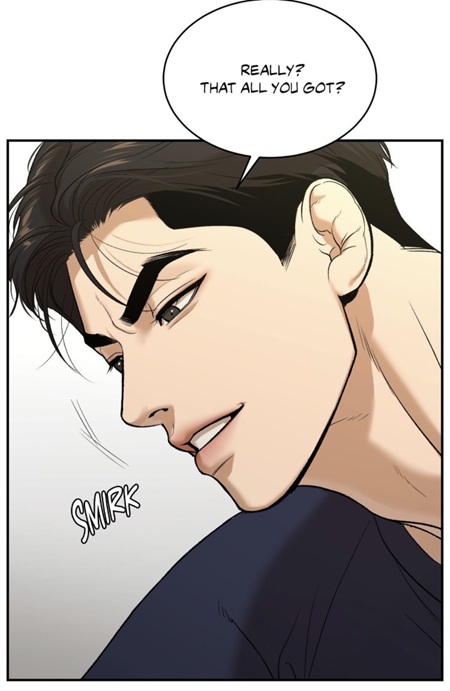 (chapter 88). He teases. (chapter 88) He challenges. He praises:
  (chapter 88)
These are not neutral compliments. They are moments where discipline slips into enjoyment. Joo Jaekyung is no longer training only to prepare Kim Dan for a future without him; he is enjoying the present interaction. And yet, he cannot name this enjoyment.
Pleasure appears within work, not alongside it. Intimacy emerges through exertion 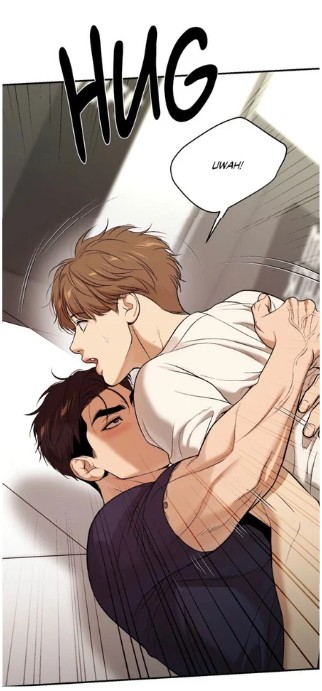 (chapter 88), not rest. Thus the doctor mistakes the embrace for a technique and not the expression of love.
 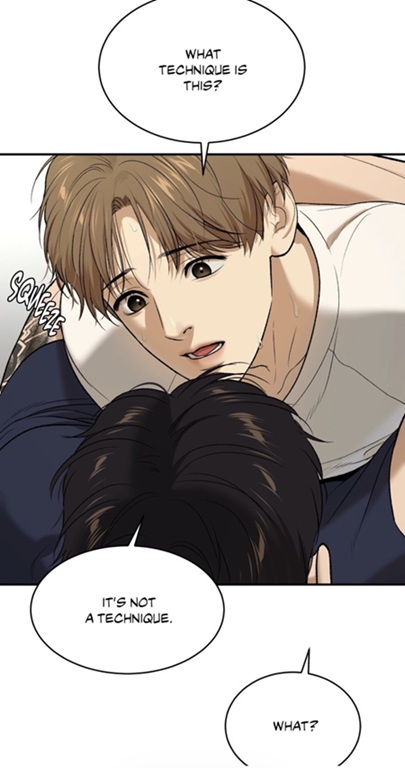 (chapter 88) And observe that the athlete still refuses to express the true meaning of his hug. His explanation still remains technical, defensive, and strategically framed:
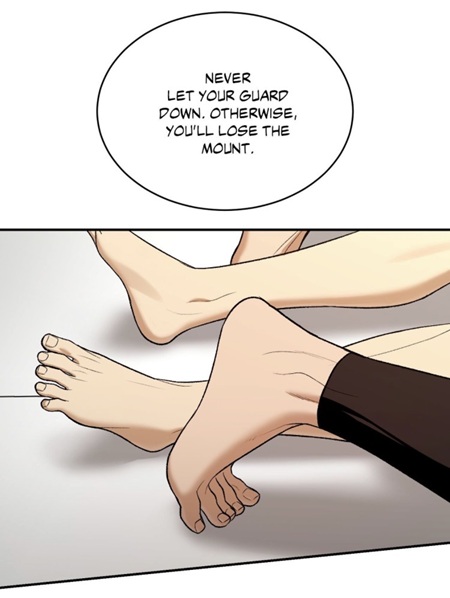 (chapter 88) This sentence is crucial. It reduces contact to function. The closeness of bodies, the pressure of weight, the proximity of breath are translated into instruction. What could be acknowledged as reassurance or care is instead displaced into pedagogy. Joo Jaekyung does not deny intimacy; he relabels it.
What the image reinforces is not distance, but deferral. The focus on bodies — on interlocked legs, grounded feet, balanced weight — emphasizes control and stability rather than vulnerability. Affection is allowed to exist only when it can be defended as functional. The mount is maintained not because Joo Jaekyung wants to keep Kim Dan close, but because losing it would constitute failure.
And yet, the sequence immediately preceding this moment shows both characters acutely aware of their racing hearts,
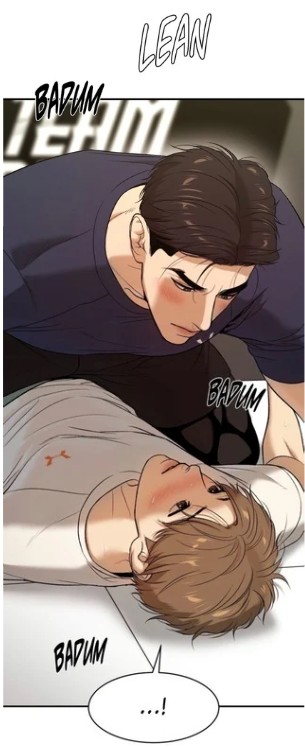 (chapter 88) of breath held too long, of proximity charged with something unnamed. The technical explanation arrives after that awareness, not before it. This confirms that the instructional language functions as a shield — not against intimacy itself, but against having to speak it.
Yet the narrative immediately undermines this technical framing.  (chapter 88) Directly after warning against lowering one’s guard, Joo Jaekyung kisses him.
The kiss is not furtive, accidental, or one-sided. Both characters are fully present. They look at each other. Neither pulls away. The contradiction is deliberate: the body does what the language refuses to acknowledge. Vigilance and intimacy coexist in the same gesture. The warning about control does not prevent closeness; it becomes the pretext through which closeness is allowed.
This is the crucial correction: Joo Jaekyung is not simply disguising intimacy as technique. He is containing it. The kiss does not negate the instructional frame; it slips through it. Pleasure is permitted only insofar as it does not require verbal recognition. Love is enacted, but not named.
For Kim Dan, this ambiguity poses no immediate problem. He has been kissed before. Physical intimacy is not new to him, and he has learned — through prior encounters — not to interrogate its meaning unless forced to do so. He does not question whether the kiss signifies affection, reassurance, desire, or attachment. Instead, he relocates intimacy spatially rather than emotionally. His only objection is not that the kiss happens, but where: (chapter 88) This line is telling. Kim Dan does not resist closeness itself. He resists its placement. Intimacy, in his understanding, belongs elsewhere — to the penthouse, to private space, to moments already coded as sexual or domestic. What unsettles him is not the kiss, but the fact that it occurs inside the domain of work.
In other words, Kim Dan does not yet read intimacy as something that can coexist with discipline. He accepts affection when it appears in designated zones, but not when it disrupts functional categories. The gym is a place of training; therefore, what happens there must remain legible as training. Joo Jaekyung’s technical explanation gives him exactly that permission.
This is why Kim Dan accepts the justification without protest. He does not reinterpret the embrace as love because he does not yet need to. The structure remains intact: work is work, intimacy is intimacy, and when the two overlap, the overlap is attributed to technique rather than feeling.
In this sense, Joo Jaekyung’s restraint protects both of them. It protects Kim Dan from having to reinterpret the gesture emotionally, and it protects Joo Jaekyung from articulating feelings he has no vocabulary for outside the grammar of training. Care is real, but its meaning is postponed. Love is present, but encoded as vigilance.
This postponement explains why the “flower” has not yet opened. It exists, but inwardly folded. Growth is happening, but it is constrained by the only relational language both men currently share: effort, endurance, correction, control.
They know how to train together.
They know how to recover.
They know how to endure crisis.
They know obligation.
They do not yet know how to choose pleasure together — how to eat, rest, shop, watch a movie, or enjoy time without purpose. Even their earlier “break” at the amusement park existed because Joo Jaekyung needed rest, not because they mutually chose leisure. Fun, like intimacy, has always been instrumental.
What episode 88 reveals is not the absence of love, but its confinement. Pleasure appears — undeniably — yet remains untranslated. Sensation does not yet become knowledge. The flower is there, but it has not learned how to open outside the discipline that first allowed it to grow.
5. The slow reversal: from imposed care to accepted challenge
The most important moment comes when Kim Dan manages to reverse positions and pin Joo Jaekyung. (chapter 88) The shock and joy are mutual. Joo Jaekyung is genuinely surprised. Kim Dan is genuinely proud—though he barely allows himself to register it. (chapter 88) This is not equality yet. But it is the first time Kim Dan experiences himself as capable, not merely compliant. The training that began as imposed authority becomes a shared test and experience. Importantly, Kim Dan did not ask for this moment. It emerged because he stayed. This stands in opposition to the sparring in front of the fighters. 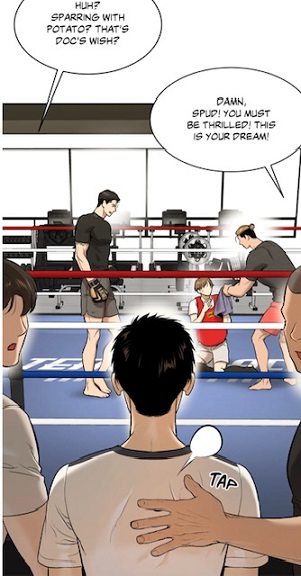 (chapter 26) Back then, Doc Dan had accepted the challenge due to Potato, though deep down he desired to have the champion as his teacher.
  (chapter 25) That’s how it dawned on me that doc Dan has gradually taken over Yoon-Gu’s previous place at the gym. He is an “unofficial member” of Team Black. Thus he mops the floor and Yoon-Gu is not there to stop him or reclaim this position.
 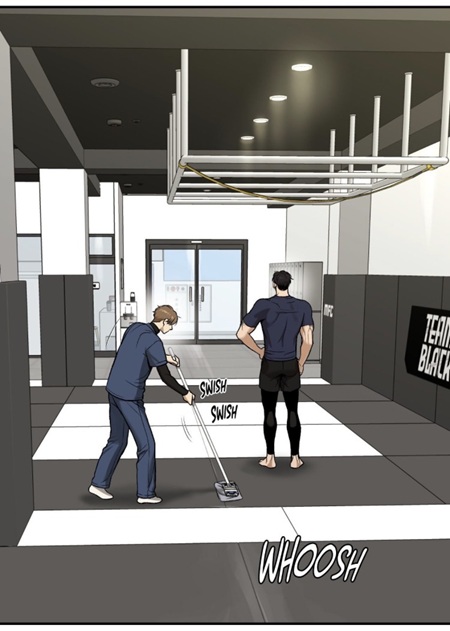 (chapter 88) Yoon-Gu’s position within the gym has improved. He is now considered as a real fighter.
6. Where the flower is
If the previous sections trace a movement, this final observation names its limit. To understand why the flower in episode 88 has only begun to appear, it is necessary to return to Erich Fromm’s definition of love, which rests on four inseparable elements: care, responsibility, respect, and knowledge. [For more read:“The Art Of Loving” (locked)] Love, in this framework, does not exist where only one or two of these are present. It requires all four to be active at once in order to become sustaining, conscious, and mutual.
Episode 88 makes one thing unmistakably clear: in the relationship between Joo Jaekyung and Kim Dan, three of these elements are already in place. One is not.
Care is not what this relationship lacks. (chapter 88) Joo Jaekyung’s care is visible throughout the episode, even when it is expressed awkwardly or through misdirection. His insistence on training, his attention to Kim Dan’s stamina, his refusal to let Kim Dan dismiss his own physical limits (chapter 88), and his final reminder to “take good care of yourself” all belong to the same logic. This care is protective and practical, but it is still delivered under the cover of training—phrased as guidance, risk-management, and performance maintenance rather than as attachment. He is capable of saying “take care,” but he still cannot say what the care ultimately means: I want you close; I worry about losing you; I don’t know how to keep you besides making you stronger. For someone like Jaekyung, whose life has been organized around performance and endurance, this is the only available language of concern. Kim Dan, too, expresses care, though in a displaced form. He worries about Jaekyung’s exhaustion, (chapter 88), minimizes his own needs and tries not to become a burden. Care moves in both directions, even if it rarely reaches its intended target.
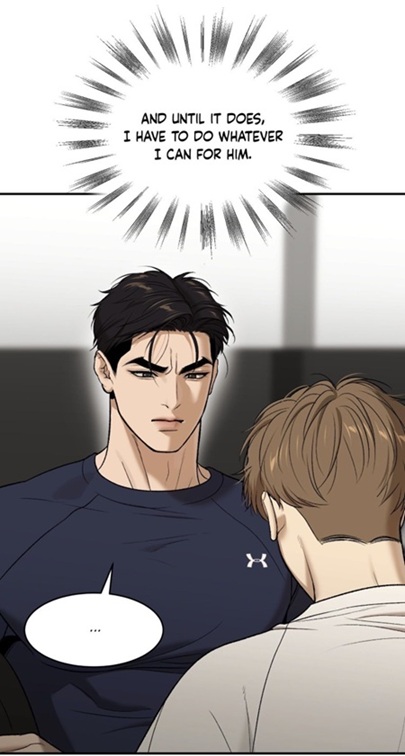
Responsibility is equally present, and equally heavy. Jaekyung assumes responsibility for Kim Dan’s safety and future (chapter 88), particularly in light of his own awareness that their time together is limited. The training is not arbitrary; it is oriented toward what comes after him. Kim Dan, meanwhile, takes responsibility in another way: by insisting on self-sufficiency (chapter 88), by promising to continue training on his own, by framing improvement as something he must manage independently. What stands out is that responsibility exists on both sides, but it is carried separately. Each assumes it alone, without yet allowing it to become shared.
Respect, too, is not absent. Jaekyung respects Kim Dan’s capacity to grow. (chapter 88) He challenges him not because he sees him as weak, but because he believes resistance is possible. (chapter 88) His praise, rare and restrained, signals recognition rather than indulgence. Kim Dan, in turn, respects Jaekyung’s discipline and endurance, sometimes to the point of idealization. This respect remains asymmetrical, but it is real. It has begun to shift from hierarchy toward recognition.
What is missing, and what keeps the flower from fully appearing, is knowledge—not information, not memory, but Fromm’s sense of active understanding of the other as a subject with inner needs, fears, and desires. In The Art of Loving, knowledge means seeing the other as they are, which requires two things at once:
- Honesty toward oneself (recognizing one’s own needs, fears, and desires), and
- Articulation toward the other (making that inner reality available rather than acting it out indirectly).
This is why words matter so much. Without words, care can exist, responsibility can exist, and even respect can exist — but they remain opaque. Joo Jaekyung knows exactly what he wants: time, proximity, continuity. He is acutely aware that his time with Kim Dan is running out. 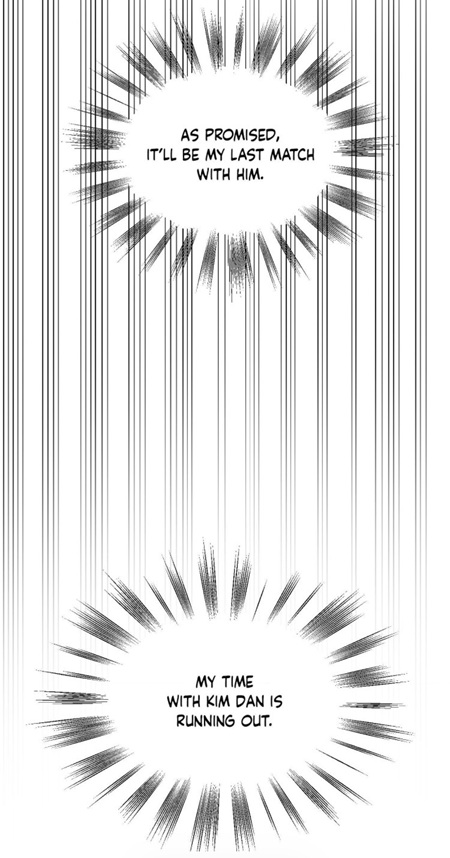 (chapter 88)
What he lacks is not intention, but translation and even courage. He does not know how to express his desire outside the vocabulary of work, discipline, and physical instruction. He can insist, challenge, and protect, but he cannot yet name why he does so. He still thinks, it is not possible to be loved due to his huge flaws and past wrongdoings. Kim Dan, on the other hand, does not yet know how to read care when it is not framed as sacrifice or obligation. He interprets insistence as burden, closeness as technique, affection as something that must be relocated elsewhere—into private space, into the penthouse, into moments that feel safer and more legible.
Their misunderstanding does not stem from a lack of feeling. It stems from a lack of confidence and shared language. Love is enacted rather than understood. Care, responsibility, and respect circulate between them, but knowledge—the capacity to see and articulate the other’s inner reality—has not yet entered the relationship. The reason is that both underestimate themselves. Thus both don’t speak the truth. This is why the flower in episode 88 is real but incomplete. It exists in the slow shift from refusal to engagement, from habit-driven self-denial to cautious participation. It exists in the fact that Kim Dan accepts the training not because he must, but because he begins to recognize the results from Jaekyung’s effort and insistence. He gradually accepts that Joo Jaekyung is genuinely concerned about him. He is gradually enjoying this, thus he voices his desire to learn more. Another problem is that both still think, they know each other. They have not recognized the importance of “words” and “honesty” yet. Nevertheless until knowledge emerges—until what is enacted can also be spoken—the flower remains folded inward. Not absent. Not broken. Simply unfinished.
Heesung × Potato: The Other Two Petals — Knowledge Without Responsibility
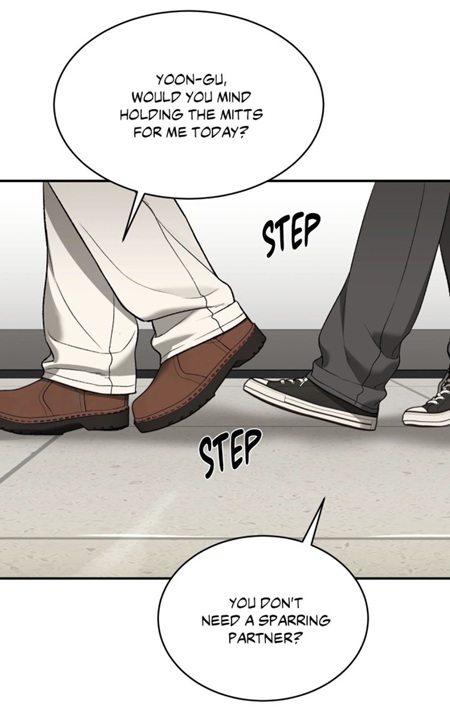
If the bond between Joo Jaekyung and Kim Dan exposes a surplus of care constrained by poor articulation, the dynamic between Heesung and Potato reveals the opposite imbalance:: knowledge without responsibility, and therefore without respect. The actor is able to express his thoughts and emotions all the time, yet he is not taking Potato’s feelings and thoughts into consideration. Thus he simply asks Yoon-Gu to hold the mitts and not be his sparring partner. (chapter 88) The way the “gumiho” speaks to the chow-chow is quite telling. He expects an agreement. Striking is that the young fighter doesn’t agree to the actor’s request, he answers with another question: “You don’t need a sparring partner?”. This question reveals that Yoon-Gu had already imagined himself differently. He had pictured a future moment in which he would not merely assist the actor’s training, but share it. In other words, he had already crossed an internal threshold: from helper to potential partner. The question exposes a private projection — a hope — that had not yet been verbalized until this moment.
That is why this exchange marks Yoon-Gu’s transformation. That’s why he is wearing a olive green sweater. (chapter 88) Olive green is not the vivid green of aspiration or idealization, nor the cold institutional green associated with discipline and hierarchy. It is a grounded, muted green — a color of transition. Symbolically, it sits between admiration and autonomy. By wearing it at this moment, Yoon-Gu visually signals a shift away from the champion’s gravitational pull. He is no longer oriented upward, toward an untouchable figure, but sideways, toward a peer relationship he is beginning to imagine. The green does not announce arrival; it marks movement. Growth here is not explosive but cautious, uneven, and still uncertain.
Crucially, this transformation does not stem from insecurity. Yoon-Gu is not suffering from low self-esteem. On the contrary, he speaks easily, moves freely, and voices his expectations without hesitation. What he lacks is not confidence, but self-awareness. He does not yet understand the structure he is entering, nor the asymmetry embedded in it. He mistakes proximity for reciprocity, access for acknowledgment. And the chow chow’s lack of self-awareness is also present, when he imagined that he could have followed to the amusement park. 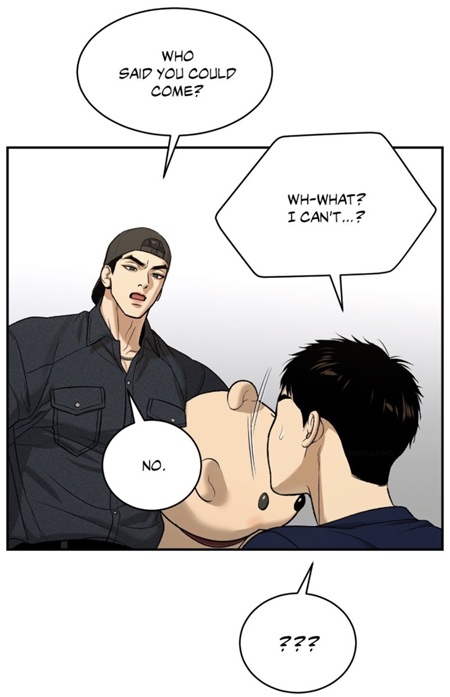 (chapter 87) For him, this trip was related to work, while in reality it was a date in disguise.
This becomes clearer when contrasted with the main couple. Between Kim Dan and Joo Jaekyung, communication is constrained, indirect, and often misaligned, as both are suffering from a low self-esteem and their past traumas. Desires are hidden behind habit, duty, or technical language. By contrast, the dialogue between Yoon-Gu and Choi Heesung is strikingly explicit. Both second leads speak readily. They articulate preferences, make requests, and voice dissatisfaction without visible hesitation. The only difference is that Heesung allows misunderstanding to persist. Joo Jaekyung abruptly corrects it. Neither approach is emotionally generous—but only one produces shock rather than slow erosion.
To conclude, this apparent fluency masks a deeper problem. What is missing here is not expression, but reflection.
Earlier, Yoon-Gu’s actions were shaped by obligation, imitation, or conditional promises (cleaning the floor, holding equipment or a bottle, proving usefulness). Here, the initiative is internal. He is no longer reacting to instructions; he is testing the possibility of recognition. (chapter 88) The desire precedes permission.
The tragedy of the moment lies not in the refusal itself, but in how it is answered. Heesung does not respond to the desire embedded in the question. He bypasses it with a technical explanation — size difference — which neutralizes the emotional risk Yoon-Gu has taken. 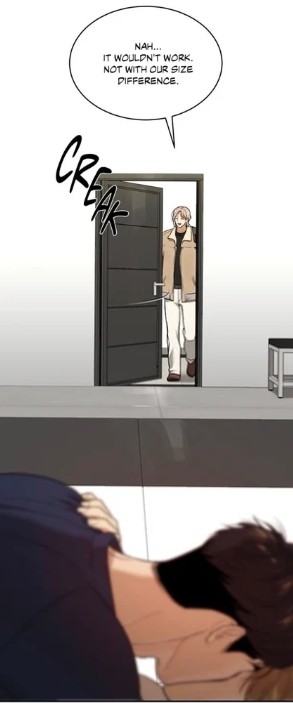 (Chapter 88) The answer restores hierarchy without acknowledging the transformation that has already occurred. Secondly, the answer closes the future by appealing to a supposedly objective limit. Yoon-Gu can never be his sparring partner. The best he can do is hold the mitts and nothing more. The fox is using his seniority and body to have the final say.
This is where Heesung’s pride in knowing turns into arrogance. His explanation contradicts the very logic that governs the gym itself. Joo Jaekyung has just demonstrated explicitly that technique outweighs physical size, that discipline and practice can reverse power relations. 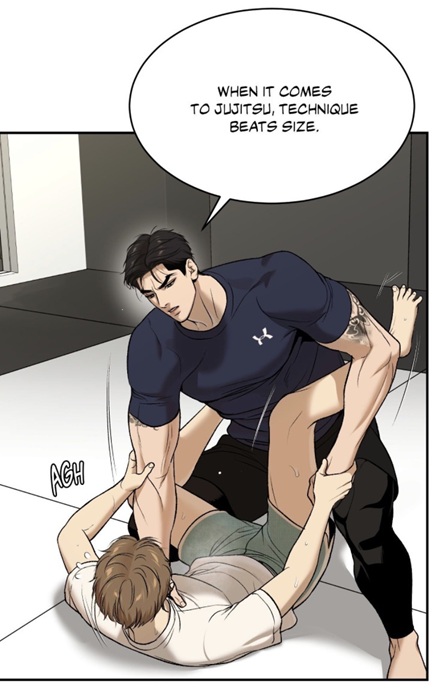 (chapter 88) Under that framework, Yoon-Gu is not disqualified; he is qualified. He has trained. He belongs. So technically, Yoon-Gu could indeed beat the actor, as the “puppy” has trained for a long time at Team Black.
Yet Heesung’s knowledge is not grounded in the present conditions of Team Black. It is grounded on his past experience: he received special training from Joo Jaekyung. In other words, he is biased. Heesung prides himself on knowing.  (special episode 1) He knows people’s patterns.
 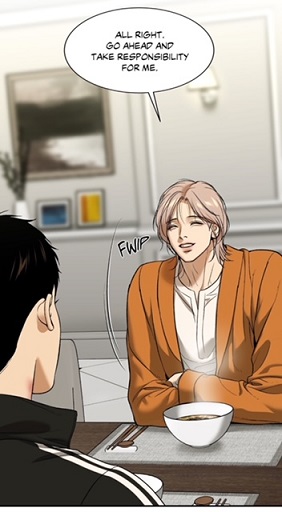 (special episode 1) He knows how relationships fail.
  (chapter 33)
 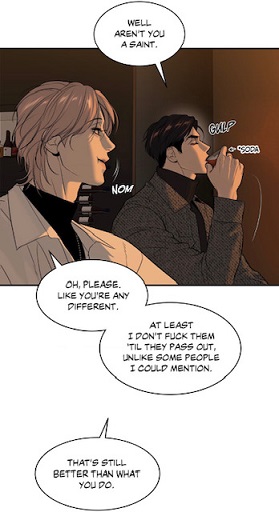 (chapter 33) He knows what he does not want. His language is saturated with judgment shaped by past experiences: lovers who become “too clingy,” attachments that turn inconvenient, people who should remain “better off” elsewhere
 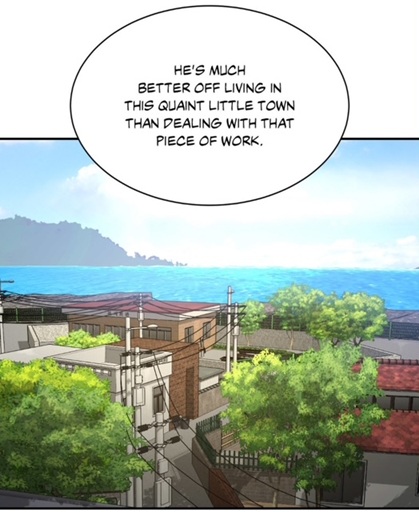 (chapter 58). This knowledge is not neutral; it is retrospective and comparative. It is built from what has disappointed him before, and it governs how he evaluates others in the present. He views himself as superior to the champion morally.
This is where the symbolism of the “grass being greener on the other side” becomes essential.  (chapter 33) Heesung’s orientation is never toward what is unfolding, but toward what might be better elsewhere—another partner, another configuration, another future. His repeated invocation of a “soulmate” is revealing: it displaces intimacy into a hypothetical horizon. By looking at the grass, he is overlooking the flower. Love, for him, is something to be found later, once the conditions are ideal. What exists now is always provisional, always lacking, always subject to replacement. He needs the “perfect” lover, and in his eyes, Potato doesn’t meet his conditions: too innocent and too young.
  (special episode 1) This explicates why the young fighter is only considered as “fuck buddy”.
 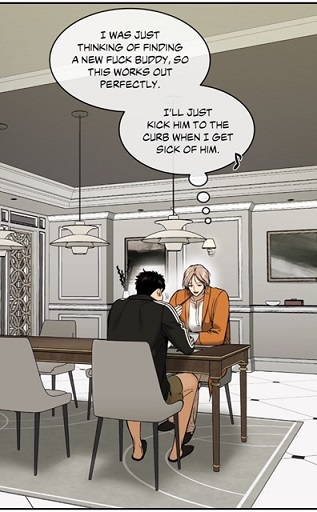 (special episode 1)
Potato exists precisely within this gap. Because he wanted to take responsibility.  (special episode 1), he is present, available, even emotionally invested—but he is never treated as sufficient. He is smaller (chapter 88), younger and as such less experienced, he is positioned as someone who does not yet qualify as a sparring partner, or even less as a boyfriend. Observe how he presented his relationship to doc Dan.
  (chapter 58) Heesung’s use of the pronoun “we” is, on the surface, inclusive. Linguistically, it frames his relationship with Potato as mutual, shared, and consensual. But pragmatically, it does the opposite. The “we” is spoken over Potato’s head, not with him. Thus Potato is physically present but discursively absent. He does not confirm, nuance, or reciprocate the statement verbally. The pronoun thus becomes a rhetorical appropriation rather than a sign of partnership.
What makes the remark particularly uncomfortable is the context: Heesung is not speaking to Potato, but to Kim Dan. The sentence is not meant to communicate within the relationship; it is meant to display the relationship to a third party. In that sense, “we” functions as a prop. It allows Heesung to stage intimacy without assuming responsibility for how that staging affects the person he claims to include. He is not saying that he is dating Yoon-Gu either. In other words, he is behaving like Joo Jaekyung in season 1.  (chapter 31) He denies the existence of feelings and attachment.
The embarrassment of Potato is not accidental. It is structurally produced by the asymmetry of the situation. Heesung controls the narrative, the tone, and the implication. By adding “in more ways than one,” he sexualizes the bond implicitly, while maintaining plausible deniability. Nothing explicit is said; everything is insinuated. This is knowledge without accountability. Heesung knows exactly how the line will land—on Kim Dan, and on Potato—but he does not take responsibility for either impact.
On the other hand, Heesung feels so comfortable around doc Dan, that he is willing to divulge more. He assumes Kim Dan will “understand” him. He is speaking in a coded register, relying on shared cultural assumptions: that closeness implies sexuality, that sexuality implies connection. In doing so, he treats Kim Dan as a potential ally in interpretation, not as a moral interlocutor. He expects recognition, perhaps even complicity, rather than reprimand or judgment.
This is where the contrast with Joo Jaekyung becomes sharp. Joo Jaekyung struggles to name intimacy and often hides it behind work or discipline—but he does not instrumentalize language to control  (special episode 1) or humiliate the other.
 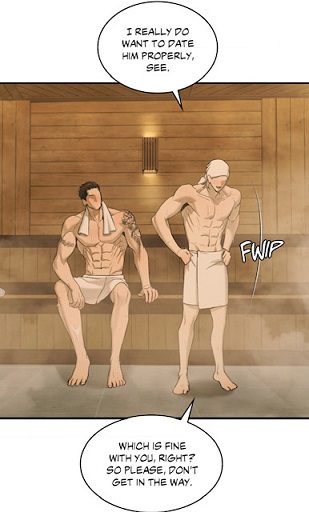 (chapter 34) Heesung, by contrast, is fluent. He can name, joke, insinuate. What he lacks is restraint and responsibility. His ease with words does not signal emotional intelligence; it signals control.
Heesung does not call Yoon-Gu weak outright, but the hierarchy is unmistakable: Potato is handled (chapter 88), redirected 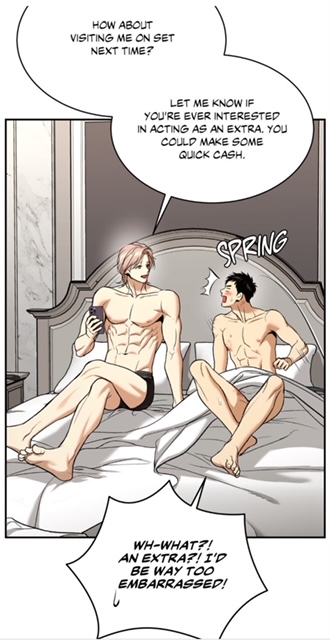 (special episode 2), corrected. (chapter 88) Even when Heesung intervenes on his behalf, it is not through shared responsibility but through dismissal—deciding what is best for him without asking what he truly wants.
This lack of responsibility is crucial. Responsibility, in Fromm’s sense, is not obligation imposed from above; it is the willingness to respond to the other as a subject whose needs and presence matter now. Heesung does not assume this stance. He neither commits nor withdraws cleanly. Instead, he hovers—knowing enough to judge, but refusing the burden of staying.
This explains why Heesung reacts so strongly to the relationship between Kim Dan and Joo Jaekyung. He does not simply misunderstand it; he rejects it (chapter 31) because it violates his model of love. Doc Dan is not introduced or claimed as his boyfriend. For him, it is simply related to the athlete’s jinx. 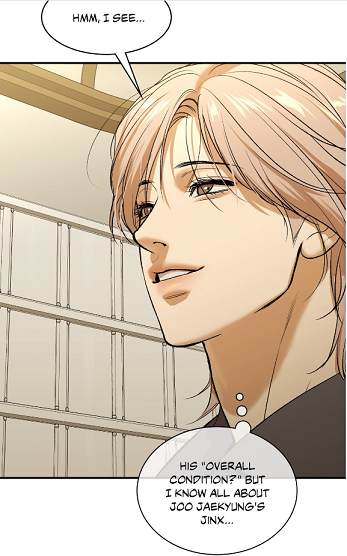 (chapter 32). It has no declared endpoint, no moral clarity (chapter 34), no soulmate label. Rather than engaging with what the relationship is doing —how it functions, how it transforms both participants—Heesung tries to name it away: a jinx, a mistake, a lack of feelings. Naming, here, becomes a defense against involvement.
The scene in the penthouse crystallizes this refusal.  (chapter 34) Heesung enters fully aware of what he is likely to witness. He is not naïve, nor totally surprised. Hence he doesn’t flee right away. Yet instead of acknowledging the reality before him, Doc Dan is not someone the fighter fucks, until he passes out, (chapter 33), he reframes the encounter as an accusation. The man is crazy.
  (chapter 34) Joo Jaekyung becomes the problem, the one who “deserves to suffer.”
 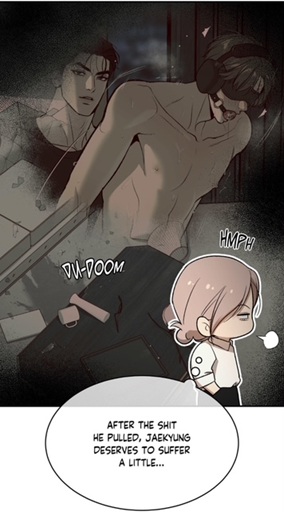 (chapter 58) This moral displacement allows Heesung to maintain distance: if Jaekyung is guilty, then no self-examination is required. Forgiveness—central to this arc (from 79 to 89)—is rendered impossible, because forgiveness would require recognizing shared vulnerability rather than assigning blame.
Potato, by contrast, is repeatedly asked to adapt. Earlier, he cleans, waits  (chapter 25), accepts deferral. Later, he is displaced entirely. Unlike Kim Dan, who gradually moves from imposed participation to earned agency, Potato is never given a space where effort leads to recognition.
  (chapter 85) However, this panel implies that the young man has already been able to enter competition. Striking is that his promise at the seaside sounds like commitment
 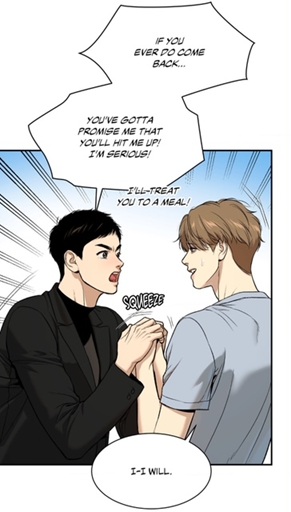 (chapter 59), but the reality diverges. It only binds doc Dan. If the latter returns to Seoul, he has to promise to train with Potato. The reason is simple. He is already committed to the actor, he is already at his beck and call. Potato’s promise echoes the earlier promise forced upon Kim Dan by his grandmother: a future-oriented vow that justifies present sacrifice while guaranteeing nothing in return.
  (chapter 11)
This is the structural tragedy of the Heesung–Potato dynamic. There is confidence and knowledge—sharp, observational, even insightful—but it is not paired with responsibility. And without responsibility, respect and care collapse into condescension. Potato is not met as an equal in becoming, but as someone perpetually not-yet-ready. While Yoon-Gu had been deeply affected by doc Dan’s departure. 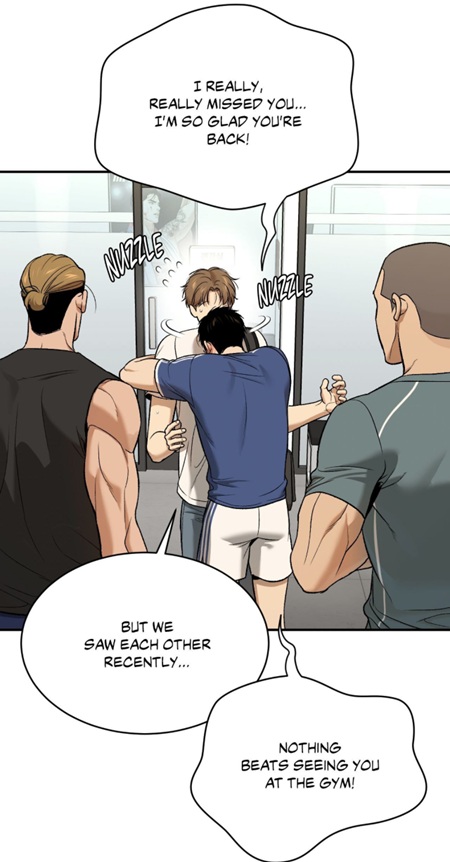 (chapter 78), he didn’t remind doc Dan of his promise. At the same time, observe that none of the fighters apologized or promised something. When they hugged the doctor, they didn’t pay attention to the physical therapist’s reaction: his passivity and silence. The “laugh” lacked genuineness and felt wrong at the time.
  (chapter 78)
But let’s return our attention to the petals Heesung and Potato. Placed beside Joo Jaekyung and Kim Dan, the contrast is stark. Jaekyung lacks fluency, but not commitment. He does not know how to speak love, yet he stays. Heesung knows how to speak about dating and love, hence he offers a bouquet of roses. But he does not remain when love demands endurance rather than evaluation.
Secondly, Heesung embodies selfishness, which is also perceptible the way he appears at the gym. (Chapter 88) He had planned to use the gym without the champion’s consent and knowledge. And Potato was not expecting the presence of the main couple either. 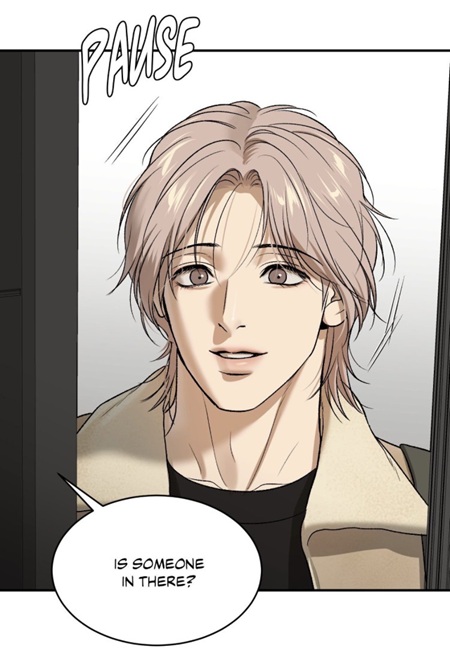 (Chapter 88) This is how it dawned on me why Mingwa recreated such a situation for Heesung. Observe his reaction, when he opened the door. He never answered the question to Potato. In fact, he slammed the door and kept his thoughts to himself. (chapter 88) As you can detect, he remained silent the whole time. It was, as though he was ignoring his lover.
What ultimately exposes the asymmetry in Heesung and Yoon-Gu’s relationship is not overt exploitation, but silence. Episode 88 stages this with remarkable precision. Heesung enters the gym without coordination (chapter 88), without consent from its owner, and without paying any visible cost. He does not announce himself as a guest, does not ask permission, and does not explain his presence. Instead, the intrusion is normalized through omission. Silence becomes the mechanism by which power circulates unnoticed.
Crucially, Yoon-Gu is excluded from the truth of the situation. Readers understand why Heesung is there; Yoon-Gu does not. The actor’s internal reaction (chapter 88) can be read as a moment of comic frustration. In fact, it reveals something far more consequential: this visit was never conceived as a shared activity with Yoon-Gu at all. The training session was not planned for him, nor with him. Yoon-Gu was not included as a subject in Heesung’s intention. He was a means.
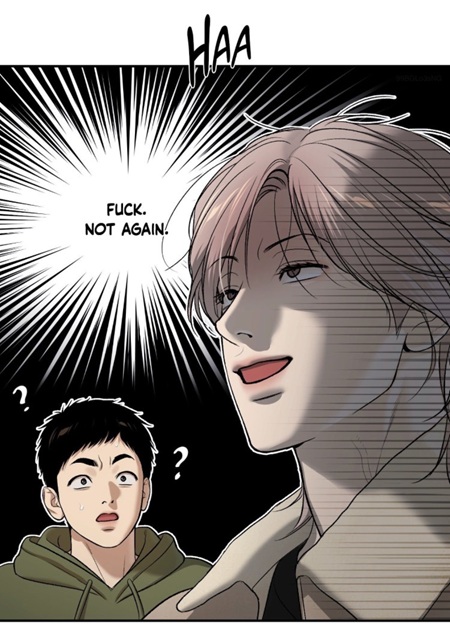
This internal monologue exposes the logic of the intrusion. Heesung did not come to train with Yoon-Gu, nor to support him, nor to acknowledge his aspirations. He came to work off his own emotional agitation, to use the gym as a private outlet. Therefore it is not surprising that Yoon-Gu’s presence is reduced to him holding the mitts. His presence is incidental—useful, but not constitutive. When the situation threatens to escalate (chapter 88), Heesung does not think, What will happen to Yoon-Gu? He thinks only of himself: his inconvenience, his exposure, his embarrassment.
That omission is decisive. It confirms that Yoon-Gu is positioned not as a partner in training, but as an accessory to Heesung’s fitness and fun. He provides access, labor, and cover, yet remains excluded from knowledge and from choice. This mirrors an earlier pattern: just as Kim Dan once provided unpaid care under the guise of compensation (chapter 32), Yoon-Gu now provides unpaid labor and institutional access under the guise of familiarity and generosity
 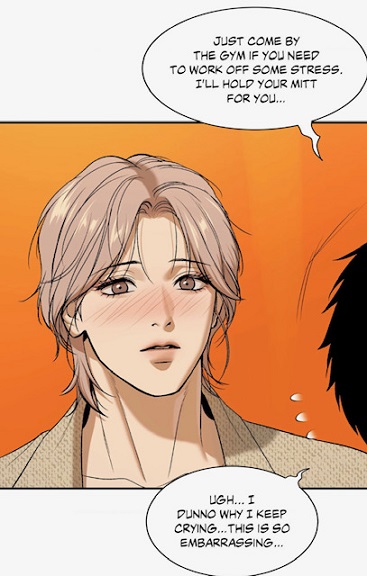 (chapter 35). In both cases, Heesung benefits from proximity without assuming responsibility for the other person’s risk. Silence, here, is not neutral—it is the mechanism by which that asymmetry is maintained.
At the same time, this regret (chapter 88) confirms that Heesung knows he has crossed a boundary. Yet this awareness produces no corrective action. He does not warn Yoon-Gu, does not acknowledge the risk he is creating for him, and does not assume responsibility for the consequences of being discovered. His concern remains entirely self-directed: embarrassment, inconvenience, exposure. Yoon-Gu’s position is not considered.
The irony is that this silence is beneficial for the chow chow . (chapter 88) It actively conceals Yoon-Gu’s complicity while simultaneously depending on it. Heesung could not have accessed the gym without Yoon-Gu. The most plausible inference is that Yoon-Gu provided entry—either by unlocking the space or by lending legitimacy to Heesung’s presence. Yet when the moment of confrontation approaches, Heesung does not speak. (chapter 88) He does not answer Yoon-Gu’s question—“Is there someone in there?”—because answering would reveal responsibility. Another important detail is that though Yoon-Gu provided the access, he simply followed the actor. The latter is the one opening the door to PT Room and not the member of Team Black. It exposes that the fox is really the one committing the wrongdoing, and he can not blame the chow chow for it.
Silence, here, is not absence of speech but a strategy of avoidance. (special episode 1) Heesung does not negotiate, explain, or repair. He doesn’t give any excuse. He moves through spaces as though access were guaranteed and consequences optional. However, this time, his silence is used against him. 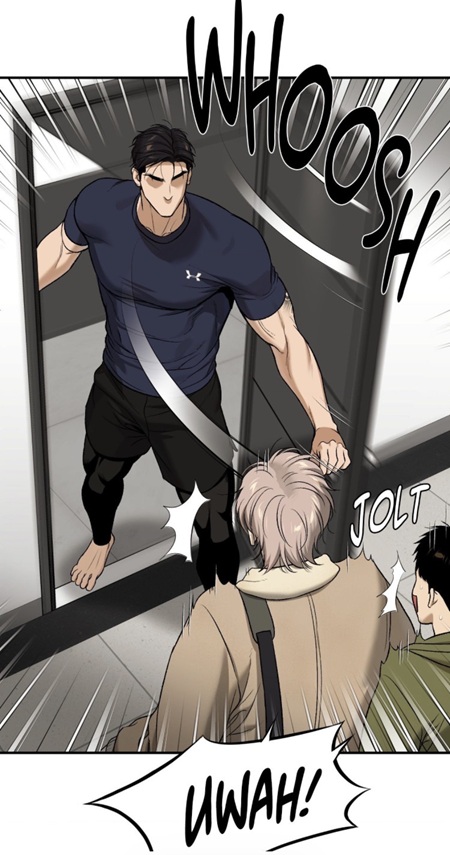 (chapter 88) Forgiveness, responsibility, and mutual recognition—central to the arc unfolding elsewhere—are entirely absent from his conduct. Where Joo Jaekyung begins to redistribute choice and accountability, Heesung consolidates control by refusing to speak.
This is why Heesung cannot embody forgiveness in this arc. Forgiveness requires acknowledgment; acknowledgment requires speech; speech requires responsibility. Heesung chooses none of these. Instead, he preserves his self-image by leaving others to absorb the impact of his actions. Yet, in episode 88, it is no longer possible.
In this sense, the flower associated with Heesung and Yoon-Gu never opens. Knowledge is present. While Heesung understands dynamics, motives, and outcomes, the chow chow heard all the information  (chapter 52) about the switched spray, but he only reported one thing: Kim Dan is innocent. So while insight is present, responsibility is systematically deferred. Without responsibility, respect cannot follow. And without respect, what appears as connection is merely use, quietly sustained by silence.
In the end, the other two petals do not fail because of ignorance. They fail because knowledge, when severed from responsibility, becomes a tool of avoidance. Love is postponed indefinitely—always imagined, never practiced. On the other hand, since he knows about the champion’s past sexual habits, it signifies that the actor became the witness of TRUE LOVE. Joo Jaekyung is kissing doc Dan. 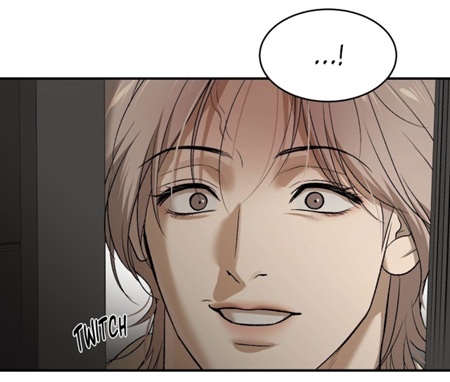 (chapter 88) The irony is that the actor didn’t realize this. He had the impression to be exposed to a similar scene than in the penthouse. (chapter 88) It is important because with this knowledge, he can expose the truth to doc Dan: the athlete loves him. In the past, he could say this without explaining his statement.
  (chapter 35) And now, pay attention to the logo on the doctor’s t- shirt.
  (chapter 88) First, it appears on the left side, positioned close to the hamster’s heart. Moreover, it looks like an orange eye. Orange is not only the color of Heesung the fox
  (chapter 34), but also of friendship and social communication and interaction.
Orange Represents
Adventure and risk taking: Orange promotes physical confidence and enthusiasm – sportsmen and adventure-seekers relate well to orange.
Social communication and interaction: Orange stimulates two-way conversation between people – in a dining room when entertaining it stimulates conversation as well as appetite. Friendship: Group socializing, parties, the community – wherever people get together to have fun and socialize orange is a good choice.
Divorce: The optimism of the color orange helps people move on – it is forward thinking and outward thinking. https://www.empower-yourself-with-color-psychology.com/color-orange.html
That means, doc Dan is on the verge of having true friends. Joo Jaekyung will stop demanding exclusivity by isolating doc Dan from the others.  (chapter 79) Besides, it is the same logo than when Yoon-Gu was spying behind the closed door.
 (chapter 23) That’s the moment Potato realized the truth about the couple: they were intimate. That’s the reason why I am convinced that Heesung will play the role of the messenger and mediator between the wolf and the hamster.
To conclude, I perceive the actor as the bridge between the two main leads. He embodies language, knowledge, love as feeling, but more importantly he stands for friendship and fun, notions which don’t exist in the main couple’s world yet.
That’s it for the first part. In the second part, I will examine the final panel and the significance of the fighters’ return.
Feel free to comment. If you have any suggestion for topics or Manhwa, feel free to ask. If you enjoyed reading it, retweet it or push the button like. My Reddit-Instagram-Twitter-Tumblr account is: @bebebisous33. Thanks for reading and for the support, particularly, I would like to thank all the new followers and people recommending my blog.


 (chapter 26) They have watched his fights
  (chapter 23), memorized his moves and titles, and repeated the anecdotes told in gyms and on TV. They’ve heard how he was “saved” by sports from a darker path, and cheered for him as the “Emperor” — the handsomest fighter, the man who broke the arcade’s punching machine
  (chapter 26), the champion who stands above the rest. But if the champion’s life is already an open book, why did Mingwa wait so long to reveal his childhood and family? The answer is simple. It is because Joo Jaekyung has been called the Emperor till his fight against Baek Junmin! These public portraits — the friendly banter in the gym, the theatrical ring intros — show us the merchandise, not the man. They are the carefully polished surface presented to fans and fellow fighters alike, repeated so often that even those closest to him believe them. Yet behind this image
 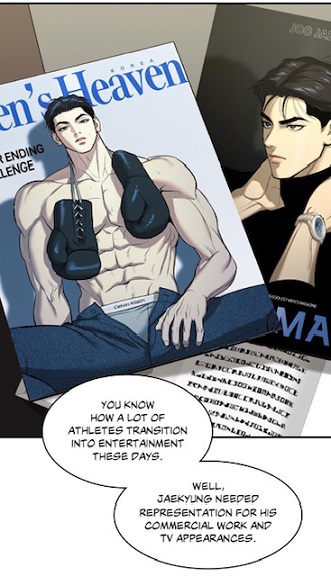 (chapter 30) lies a past left unspoken, a silence so complete that his own history became an empty space others could fill as they wished. This essay brings these two “stories” together — the Emperor and the boy. And now, you may be wondering how I came to connect the champion’s trauma to his future career as an MMA fighter. The answer lies in Joo Jaekyung’s own voice. 😮
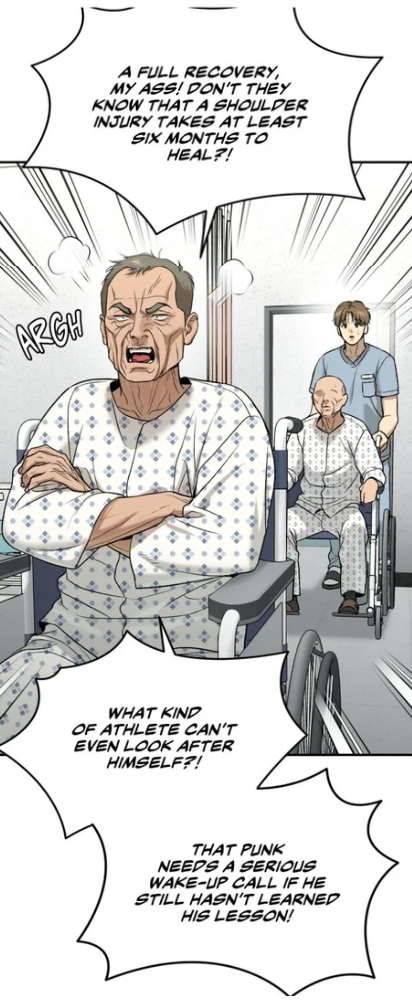 (chapter 70) To him, it looked as though Jaekyung had made the reckless choice to return to the ring so soon. That was the trap: the headline and phrasing were designed to make it appear that the decision was the fighter’s own. The opening line alone
  (Chapter 70) created the illusion that this break had been perceived as a punishment, and that Jaekyung was eager to prove himself once again. No wonder the director assumed he had given his consent.
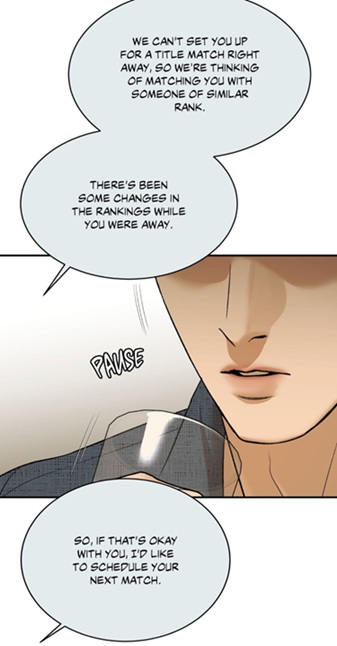 (chapter 69) By erasing these details, the public sees only two players: the Emperor and his anonymous “team.”
 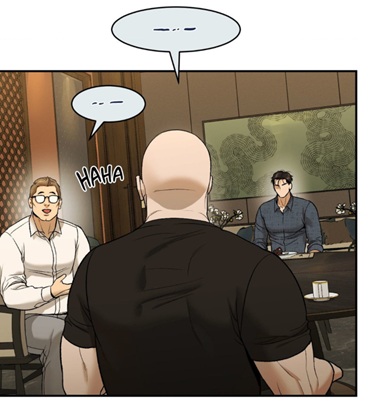 (chapter 69) It was as if the main lead, backed by his team, had personally approached MFC to request the match — an illusion strengthened by the opening line, “MFC’s former champion Joo Jaekyung will be returning to the ring this fall after serving his suspension.” This way, if the decision draws criticism, the CEO can retreat behind the fighter and his team, like they did in the past.
  (Chapter 54) Back then, the champion had not reacted to this comment. Even in the worst case, the CEO can hide behind one of the MFC match managers or doctors.
  (chapter 41) But that excuse would be a fiction: Jaekyung hasn’t even met those doctors or talked to the MFC match manager
  (chapter 05). He has been chasing after his fated partner. Finally, he hasn’t even signed any paper or agreed at the meeting. In fact, he remained silent for the most part of the time and the reason for this urgent meeting was his request for proper investigation concerning the switched spray:
  (chapter 67) That’s the reason why this suggestion from the CEO appeared the very next day.
  (chapter 69)
  (chapter 61), it was paired with a recommendation for rehabilitation — not an immediate return to competition. This was actually a condition for his total recovery. On the other hand, the doctor imagined or suggested that his patient wished to return to the ring so soon. No medical professional ever signed off on an autumn fight. Yet the date is already set, and the headlines frames it as a confident comeback without any medical backup. The Emperor’s name is splashed everywhere, but none of the words belong to him.
 (chapter 57) with one of his close associates — a man whose face was hidden, speaking as though he were the athlete’s voice. That interview was accompanied by a familiar victory image
 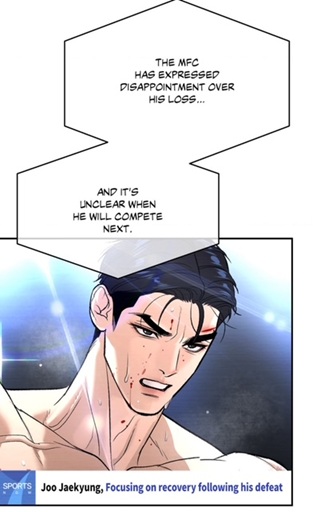 (chapter 57), a stock photo already used in other press pieces. This picture comes from after the fight in the States:
  (chapter 41), while the image released with the fall match announcement was the one from when he first won his champion title.
 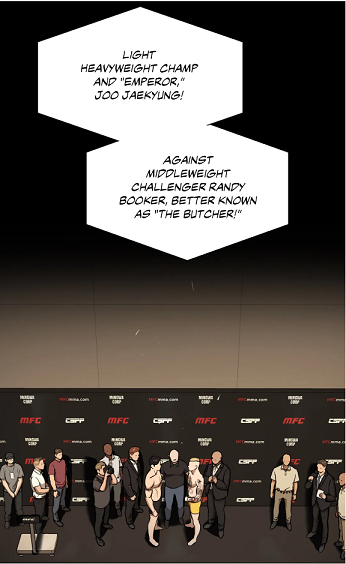 (chapter 14) seems to radiate absolute power — the kind of authority that commands armies, bends laws, and answers to no one. It is meant to ooze charisma and control, a name that suggests the bearer acts on his own will. Yet, in truth, emperors have rarely ruled alone. Behind every throne stand ministers, advisors, generals, and family factions, each shaping decisions from the shadows. An emperor who ignores these forces risks losing his crown.
 (chapter 17) He was blamed for his popularity. The man inside the crown does not act or speak freely; his words are filtered, scripted, or replaced entirely.
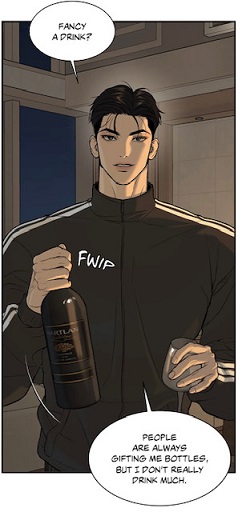 (chapter 12), never mind that he hardly drinks. The gesture fits the fantasy they’ve built around him, not the reality of a man who rejects alcohol due to his addicted father, a reminder that even the tokens of admiration are shaped by the image, not the truth. So who is this so-called close associate or “Joo Jaekyung’s team” exactly that decides for him, speaks for him, and hides behind his title? Besides, why did the journalist change from “one of his close associates” to “Joo Jaekyung’s team”?
 (chapter 57) The nickname, played for entertainment value, was another way of turning the champion into a caricature — a marketable, amusing persona instead of a man with a past and agency. It is quite telling that Park Namwook’s interview aired immediately after the anchor referred to Jaekyung as “Mama Joo Jaekyung Fighter.” This was not the lofty “Emperor” title repeated in gyms and ring intros — it was more a mocking nickname, a deliberate jab meant to provoke. In that moment, the Emperor was verbally pulled down from his pedestal, yet the images shown alongside the segment told a different story: carefully chosen shots of him as a champion, a visual echo of his marketable persona. The dissonance was striking.
 . (chapter 54) In my opinion, the man is trying to return to the past, thinking that his “popularity” can come back, not realizing that he is being manipulated himself. On the contrary, he stepped into the role of spokesperson without hesitation, speaking as if he were Jaekyung’s voice while keeping his own face and name hidden. He only speaks, when he feels safe. He can not be responsible for the champion’s recovery.
  (Chapter 52) This framing lets him claim the prestige of leadership while leaving himself room to withdraw if things go wrong. Yosep was the one notifying MFC and reporting the incident to the police, Potato explaining his discovery to Joo Jaekyung and blaming the star.
 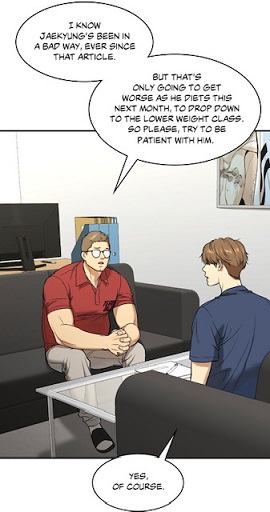 (Chapter 36) He should tolerate the celebrity’s moods and put up with everything. The manager didn’t mind, as long as he didn’t get affected. But what is the consequence of such a passive tolerance? An individual’s self-esteem can slowly erode, leading to a gradual loss of their sense of self. They may stop recognizing their own desires, needs, and rights, often without even realizing this is happening. This is because emotional exhaustion often develops subtly over time, rather than appearing as a sudden, dramatic event.
 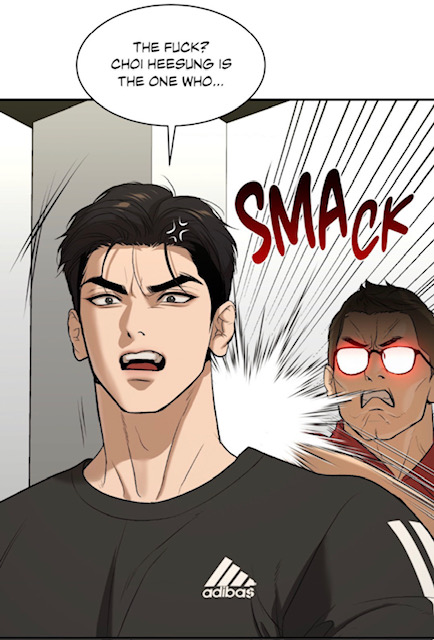 (chapter 31) when punished. In this light, Park Namwook embodies the very dynamic the article warns against: a figure who benefits from another’s compliance, maintaining control not through open dialogue, but through unspoken rules and the threat of exclusion.
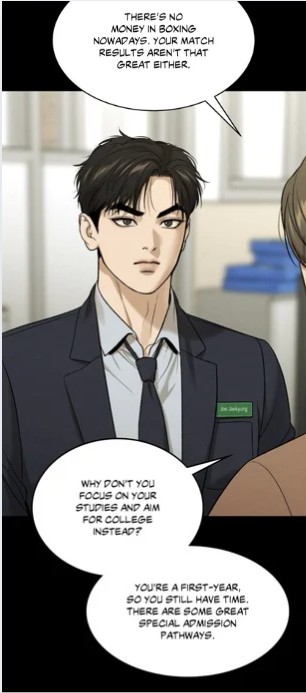 (chapter 73), by becoming a boxer, the champion wouldn’t make a lot of money. With this comment, he implied that boxing in South Korea had been losing popularity 10 years ago. This explicates why gradually, the members from Hwang Byungchul left the studio. And it was likely the same in the illegal fighting circuit.
  (chapter 73) The popularity of MMA in the States gave them the opportunity to revive fighting sports, a figure who could draw crowds and sponsors, making such events fashionable again.
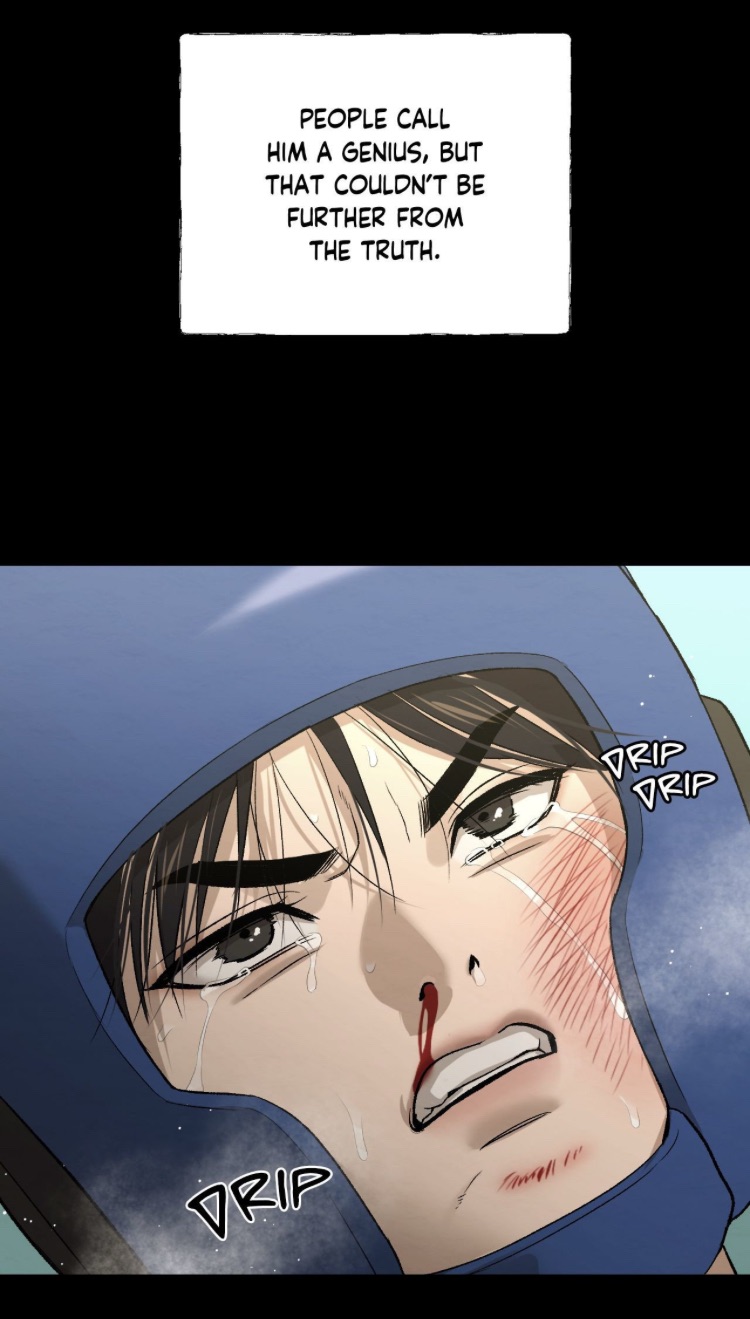 (chapter 72) instead of “hard-working,” a man who “chose sports over a dark path.” Yet if you look closely, this celebrated “ascension”
 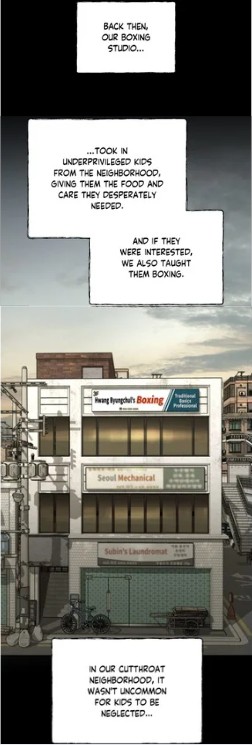 (chapter 72) isn’t tied to the director’s boxing studio at all — it’s linked to the arcade’s punching machine incident.
  (chapter 72), the scars of his family history, and the years of survival before the cage. This is history rewritten, his boxing past and family erased. Why? His origins could expose the ugly verity: the link between criminality and boxing (as such fighting sports). Secondly, because his real story, though moving, lacked the glamorous allure needed to market him. His real story would have revealed that to rise to the top, you need relentless work, not a miraculous moment. That version was never going to sell as well as the “genius” myth.
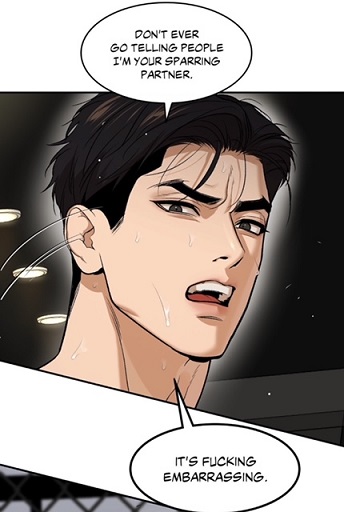 (chapter 46) Most of them thought that by staying close to him, they could benefit from his popularity. To conclude, for many of them proximity to the Emperor wasn’t about learning discipline or technique; it was about absorbing his fame by osmosis. Hence they complained and accepted the gifts and money so easily.
 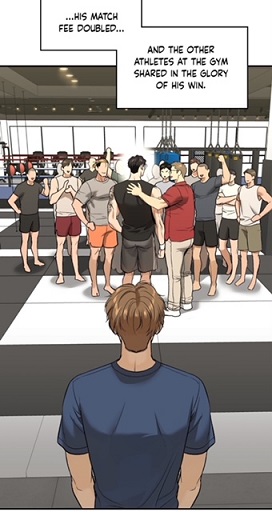 (chapter 41) Observe how the manager is acting here. He is speaking, touching the star like his prize and possession. The Emperor became the merchandise, the illusion, the bait to draw both viewers and fighters. However, being “labeled as genius” can only push desperate fighters to take a short-cut: bribes and drugs. Hence Seonho couldn’t last a whole round.
  (chapter 46) And, like any product, once it was seen as damaged, its value plummeted. The moment he “lost” his title and suffered injury (chapter 52), the dream began to unravel.
  (chapter 52) This panel captures this shift perfectly: two fighters casually dismiss him over dinner. In those words, the Emperor isn’t a mentor, a champion, or even a man — he’s a broken commodity, no longer worth the investment. The same people who once fed off his popularity are the first to abandon him when the promise of easy gain disappears.
 (chapter 22) He is even disposable. He is gradually giving more rights to his “boy”, the real director of Team Black. And the moment you perceive the manager as the main lead’s voice, you can grasp the true significance of the slap at the hospital:
 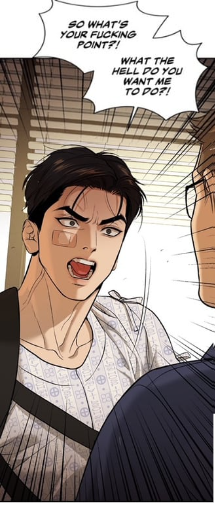 (chapter 52) For the first time, the main lead had voiced his own thoughts and emotions. He had used his real “voice”, revealed his unwell-being:
  (chapter 52) To this outburst, Park Namwook slapped Jaekyung in front of others (chapter 52).
  (chapter 52) That was not the act of a coach correcting an athlete — it was the gesture of an owner disciplining a pet or a possession, a reminder of who controlled the narrative. In that moment, the Emperor did not protest.
 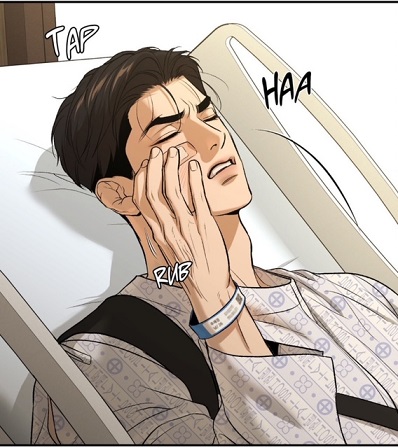 (chapter 52) He chose silence, and later avoidance, staying away from the gym. That silence was not weakness, but choice: he would listen less and less to his hyung.
 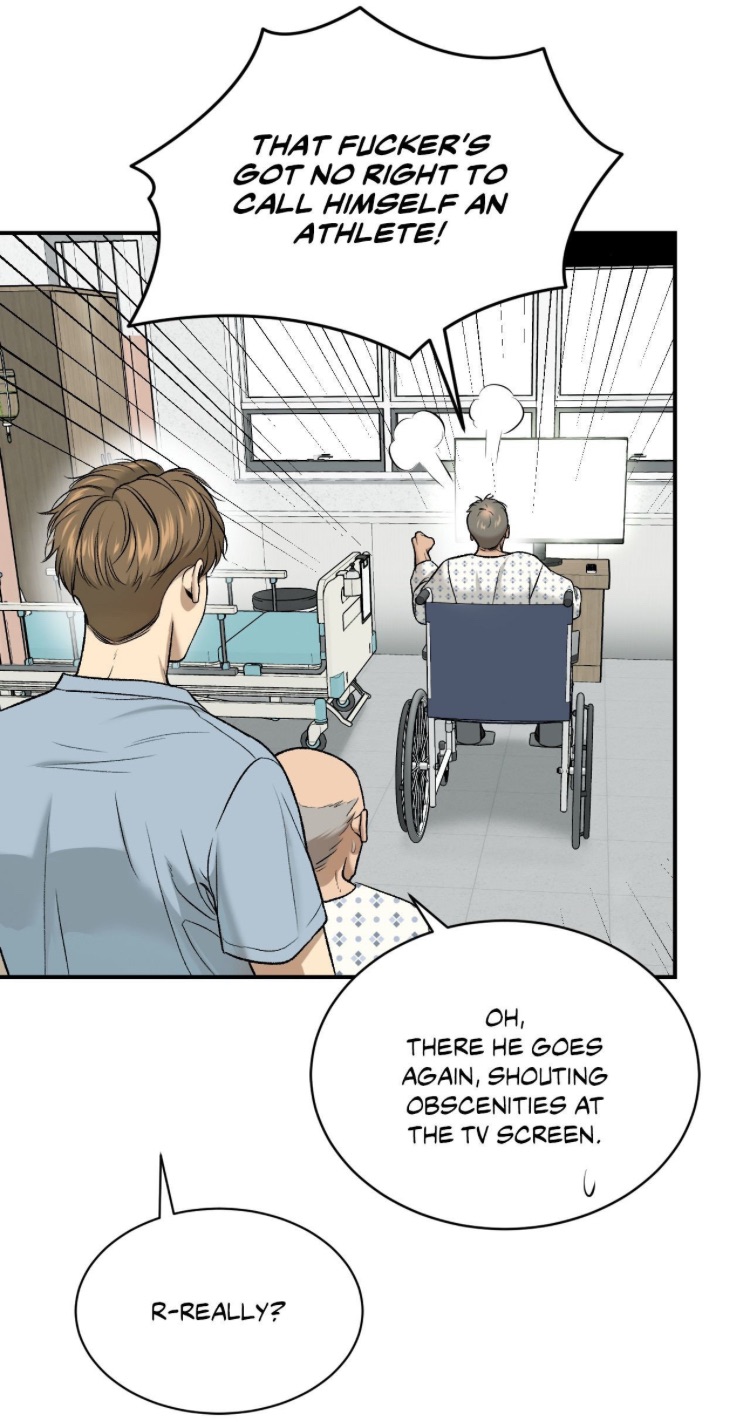 (chapter 70) and more like a product: something to be displayed, sold, and, when necessary, handled roughly to keep in line. The shift in labels is just another layer of that merchandising process — a packaging change to suit the current market, not a recognition of the man inside. To conclude, the champion has always been voiceless all this time, even here:
 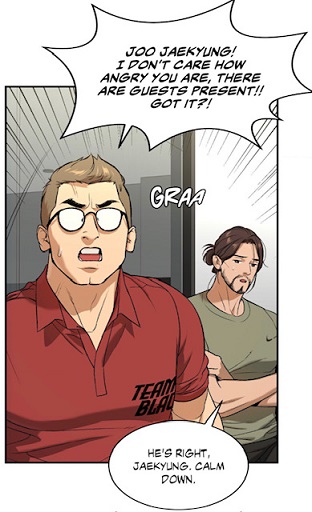 (chapter 36) All he needed to do was to fight:
 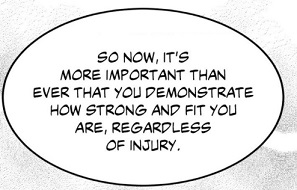 (chapter 36)
 (chapter 73) — unfiltered, unmarketed, unprotected. It was raw, dangerous honesty, and it came at a cost: the loss of his voice!
 (chapter 73) Six years earlier, however, his voice had already been battered by silence. After his mother’s abandonment at age six, the only connection he retained with her was a phone number —
 (chapter 72) We don’t know how many times he called, but each time we see him do it, his face is injured.
  (chapter 72) The phone calls are therefore intertwined with the boxing studio, as though pain itself pushed him toward her. At ten, he picked up the receiver and let it ring only a few times before hanging up. The next time, in the dead of winter, he finally spoke, promising that if she returned, he would protect her from his father and make enough money to keep her safe.
  (chapter 72) Each time what answered him was not her voice, but a machine: “
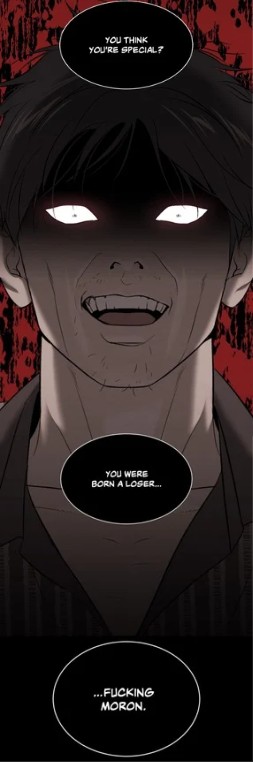 (chapter 73) that he was born a loser, that his dream was a joke. Here, the voice met not silence but resistance, mockery, and humiliation. And unlike with his mother, Jaekyung did not retreat — he cursed back.
 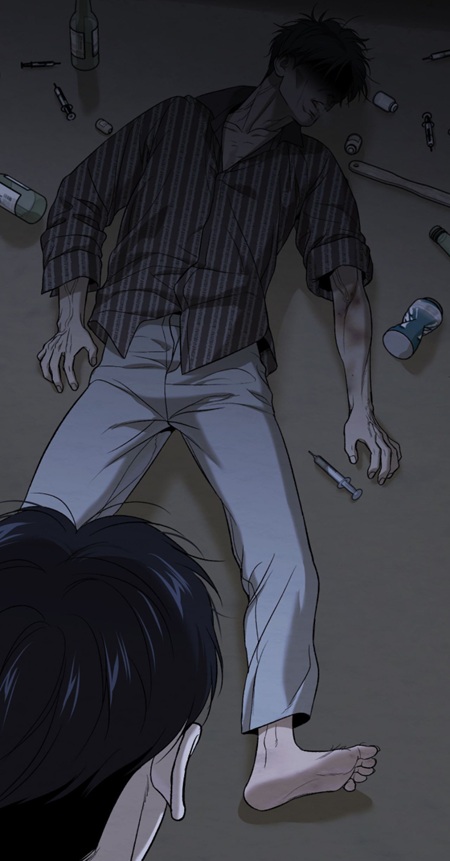 (chapter 73) and with it, another layer of his voice disappeared. He had the impression, he had killed his father. His words had been more dangerous than his punches. Hence he could only come to resent his own voice and words. And now, you comprehend why the Emperor allowed the hyung to become his voice. To conclude, the silence of those nights became the silence of the man. As you can see, the curse did not fall on Joo Jaekyung’s voice in one night — it was built, in stages, over years. But the death of his father linked to the argument represented the final straw that broke the camel’s back.
 (chapter 55)
 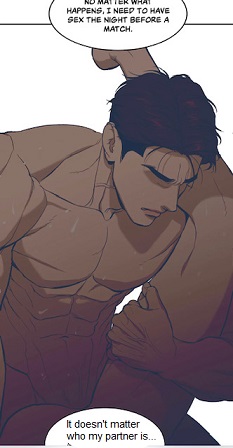 (chapter 2) — a space where he could act without having to speak. In the bedroom, as in the ring, the body could carry the conversation. Here, he could dominate, control, and release tension without the risk of verbal damage. His partners became surrogate opponents: sparring substitutes in a non-lethal match. Treating them as “toys” wasn’t only objectification; it was a form of control that, in his mind, protected both sides. Toys don’t demand answers, don’t talk back, and don’t leave you cursed with regret. They remain safely outside the territory where his voice had once done harm.
 (chapter 1) He embodies innocence and as such lack of experiences. Moreover, he talks, makes suggestions for the champion’s sake
  (chapter 27), spent time with him, asks questions, confronts, and refuses to be reduced to a body in the room. He breaks the rule of silence. With him, Jaekyung can no longer hide behind the physical alone; he is forced to speak, to explain, to voice desires and fears. He pushes Jaekyung to engage in ways he’s spent years avoiding. In this way, Kim Dan becomes the first real threat to the system the champion built after those two curses — and possibly the first person who could prove that words can be safe again. And now, you comprehend why Joo Jaekyung was moved by the birthday card
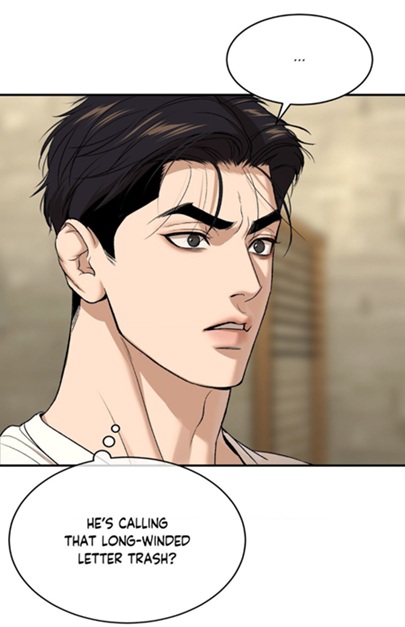 (chapter 62) To most, it might look like a simple gesture, but for him, it was a rare and precious thing — a voice that had taken the time to shape itself into words just for him.
 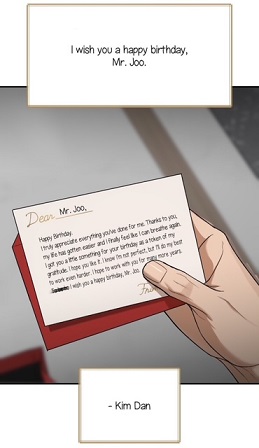 (chapter 55) After years of associating speech with either silence or harm, receiving a long-winded, carefully written message felt almost unreal. He saw the effort behind it, the deliberate choice to put thoughts and emotions into language instead of letting them fade away or turn into weapons. In that card, Kim Dan offered something neither of his parents had managed: a voice that reached him without wounding. No silence, no insult. For the champion, it wasn’t just a card — it was proof that words could be built into a gift, not a curse. The latter expressed his dreams and gratitude. Thus I deduce that the Emperor’s curse will be broken by a spell: words!
 (chapter 55) The “spell” to break it is not some grand external event, but the simple, sustained act of honest communication — something that has been denied to him since childhood.
 (chapter 68), a kiss, a pat, a caress or by simply holding hands
 . In this way, the curse that began when his voice was silenced and his hands were weaponized will only be broken when those same hands learn to speak tenderness. Look how doc Dan reacted to his public embrace:
  (chapter 71) He saw affection in the hug, but he still doubted the champion’s action.
  Until now, the design’s images have played a secondary role, yet the answer lies in a single scene from chapter 41.
  (chapter 41) Under the bright sunlight, Kim Dan reached out toward the leaves, his hand open and unguarded, as he silently thought of the man he loved. This gesture, so simple yet so revealing, became the unspoken confession that marked the start of a different kind of freedom—the freedom to feel.
 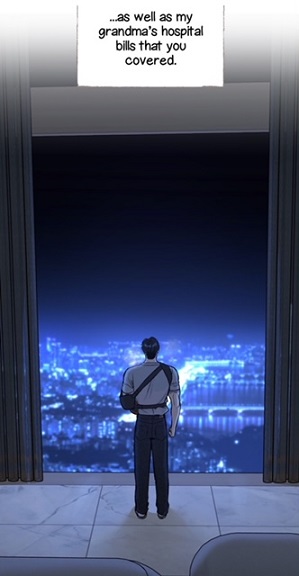 (chapter 53) The glass was an invisible barrier, offering the illusion of freedom while keeping him trapped in the moment of his unresolved trauma. The closer he stood to it, the further he was from true release, his gaze fixed outward to avoid looking inward. That’s why he had no eye in that scene:
  (chapter 55)
 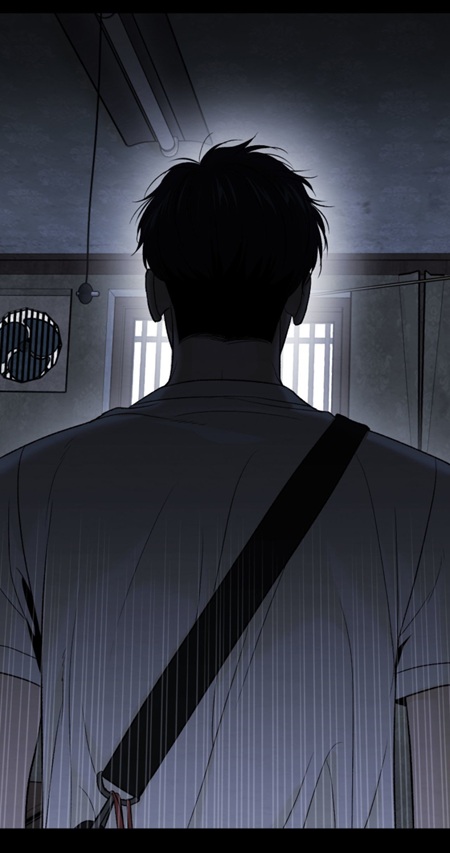 (chapter 73) reveals why that reading was correct: the penthouse window is not just a symbolic device of the present — it is the direct heir of a far older image burned into his memory. Here, as a teenager, he stands before a small barred window in the room where his father’s corpse lies. The resemblance is not visual coincidence but emotional continuity. Both windows let in light without granting escape; both present the outside world as something visible yet forever out of reach.
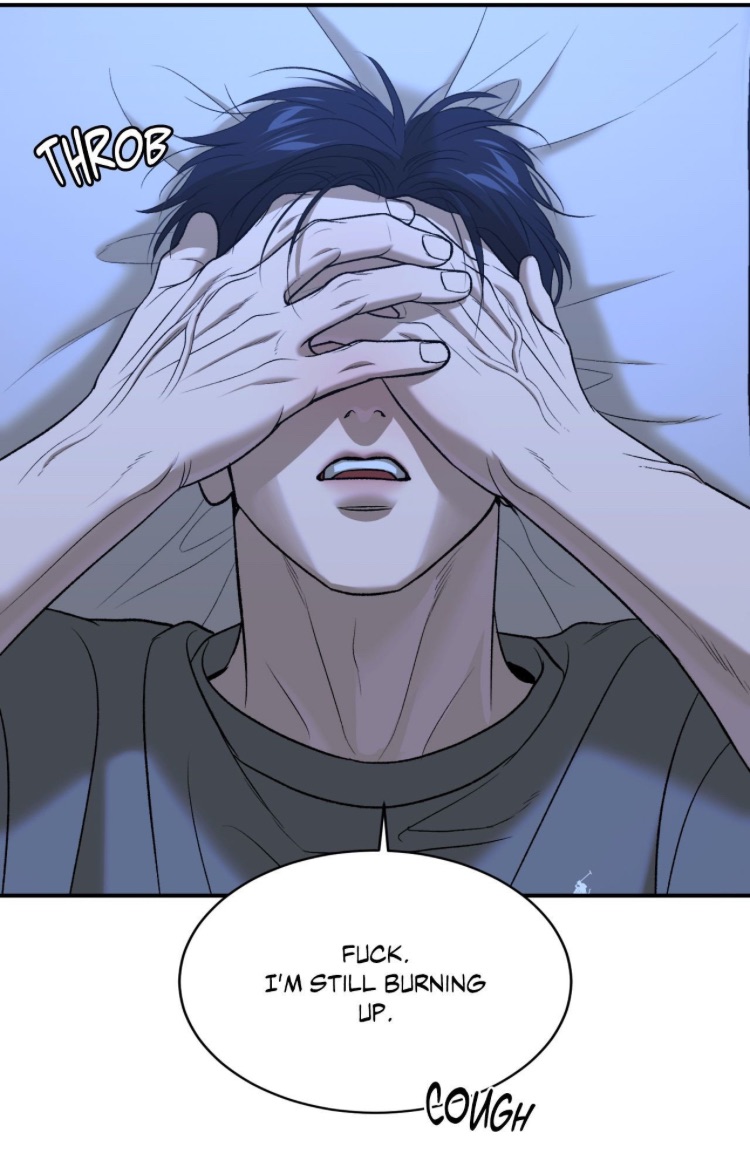 (chapter 71)
 (chapter 70) the night can also be alive, communicative, protective. In that moment, the moon becomes more than a distant light in the sky: it is a patient witness, a calm listener in the stillness, reflecting the truth he has yet to voice.
 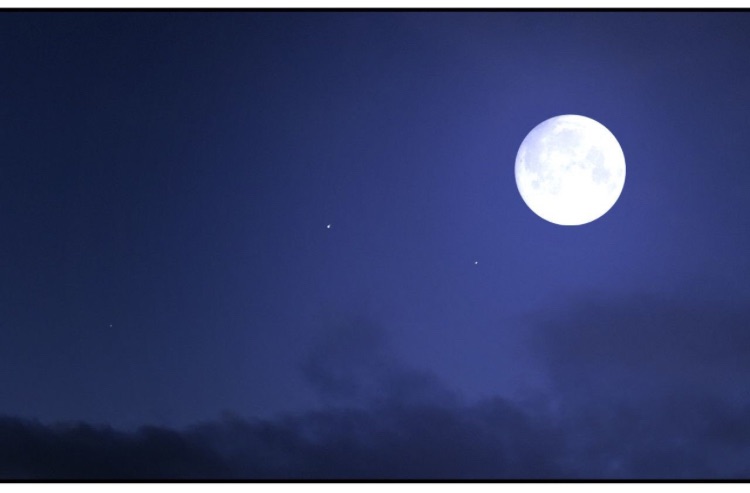 (chapter 70) Its soft glow contrasts with the blinding glare of the cage lights, suggesting that under the moon, there is space for gentleness, for hearing one’s own heartbeat and another’s words. Just as the moon guides travelers through darkness, it can guide him toward a night that does not suffocate him with loss, but offers orientation and connection.
 (chapter 60) they were his own form of therapy. In saving someone else in the night,
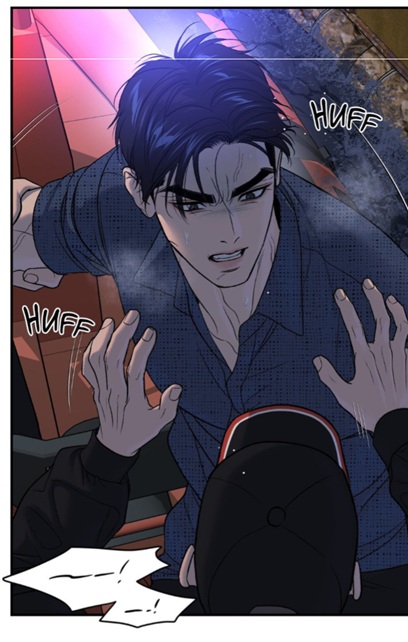
  (chapter 65) he could prove to himself he was not powerless, he was valuable, capable of protecting what mattered.
  (chapter 69) He was not too late either. And the moment doc Dan discovers what the silent hero has done for him so many times, the former will realize that he has always been special to the Emperor. Moreover, the latter had never abandoned him in the end.
 , (chapter 9) as if the champion’s volatility were a quirk (the actions of a spoiled child) to be managed rather than a wound to be healed. It is because he never talked to the champion or investigated his past. It was only about money and glory. The manufactured image of the erratic, temperamental fighter served Namwook well; it excused rough handling, justified bad press, and kept Joo Jaekyung dependent. Once the Emperor can name the truth of that night, the fiction collapses — and with it, Namwook’s control. He can only be judged as a liar and even a traitor, but we know that Joo Jaekyung has a big heart. He could love his father despite the abuse. Now, the missing link is Cheolmin!
  (chapter 13) Observe that this name is a combination between Hwang Byungchul and Baek Junmin! Under this light, my avid readers can grasp why the athlete kept his existence in the dark for so long! It is because the latter belongs to his past and knows the truth behind the Emperor! He was aware of his suffering. For him, he is not just a fighter, but someone who needed FUN in his life!


 (chapter 62), as his actions increasingly reflect a willingness to embrace his own fragility and build meaningful ties with those around him. Through his growing interactions with others and his immersion in the rhythms of town life, the champion begins to redefine his sense of identity and purpose, moving beyond dominance to discover the power of connection. From a man defined by strength, dominance, and transactional relationships
  (chapter 62)
  (chapter 62) and, more importantly, to himself.
  (chapter 62) Thus in this essay I will explore the symbolic meaning behind his actions in the town, the interplay of nature and community in his transformation, and how these moments reflect his internal growth. The analysis begins with his transformative experience in the ocean during his rescue of Kim Dan
  (chapter 60), followed by his newfound attentiveness to his surroundings—jogging in silence and responding to the natural rhythms of life.
 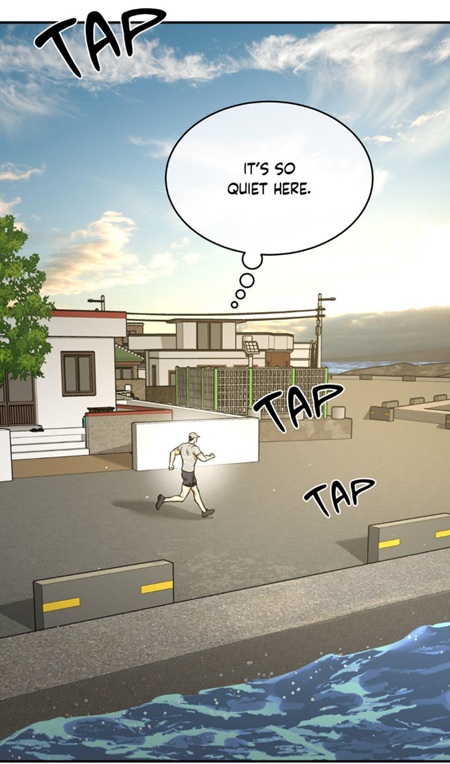 (chapter 62) This heightened awareness paves the way for his burgeoning integration into the town through labor
  (chapter 62) and community service. His gradual acceptance of simplicity, represented by his clothing and the symbolism of cucumbers and potatoes, signals his reconnection to nature and humanity.
  (chapter 62)
 (chapter 60) In many ways, this moment functions as a symbolic baptism, reflecting a deeper narrative of renewal and change. In Chapter 28, Kim Dan’s immersion in water during a pool scene
 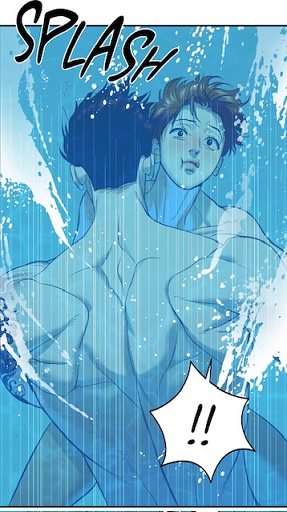 (chapter 28) was symbolic of his acceptance of intimacy, reshaping his view of sex from something “filthy”
 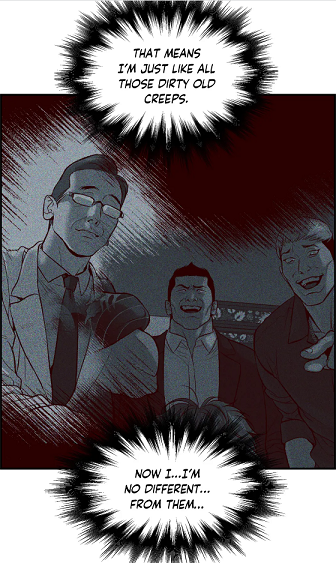 (chapter 20) into something natural and human.
 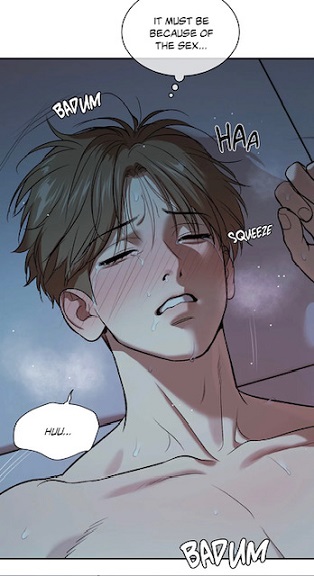 (chapter 29) Similarly, Joo Jaekyung’s dive into the ocean can be interpreted as his baptism into a new “religion”: love and vulnerability.
  (chapter 60) His gesture is not just about saving his loved one, but also showing care to humans in general. He can no longer be indifferent to someone in pain or in danger.
 (chapter 62) He might complain, but in the end he accepts the presents. This change is reinforced by his willingness to accept gratitude in the form of vegetables and food rather than monetary gain, showing a newfound appreciation for simple, heartfelt exchanges over transactional relationships.
 (chapter 59) caused by his grandmother’s neglect, indifference and rejection. The rescue, while focused on saving Kim Dan, also represents the birth of a new understanding for Joo Jaekyung—a recognition of the transformative power of vulnerability and connection.
  (chapter 60) At the time, his eyes were fixed solely on Kim Dan
  (chapter 60), not the natural world around him. The rescue planted a subconscious seed, setting the stage for his later behavior. When Kim Dan denies his assistance in Episode 60
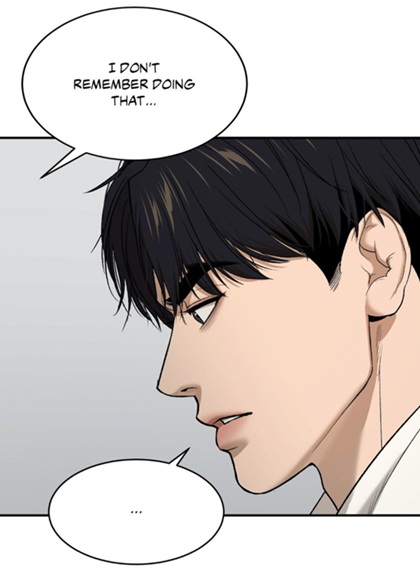 (chapter 60), it’s as if the doctor erases that defining moment, refusing to acknowledge the champion’s care. Yet Joo Jaekyung does not react with anger or frustration. Instead, he takes the doctor’s rejection as challenge.
 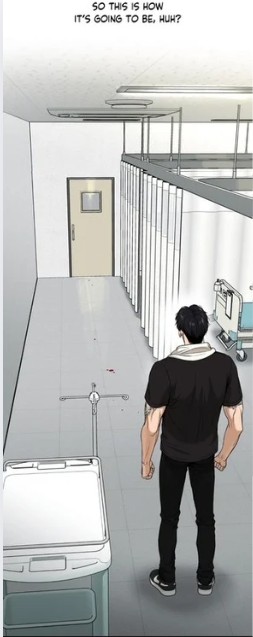 (chapter 60) However, contrary to the past, money and influence seems to have no impact on the physical therapist’s mind and heart. He is keeping the athlete at arms-length.
 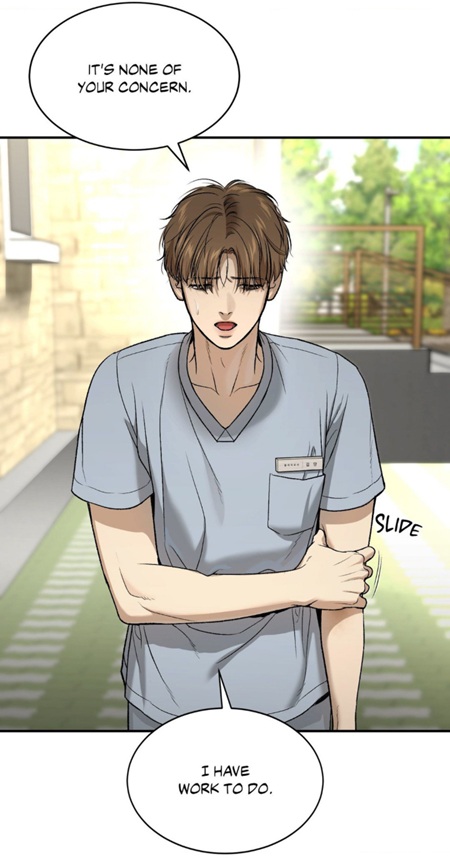 (chapter 61) The moment he moves to that little town
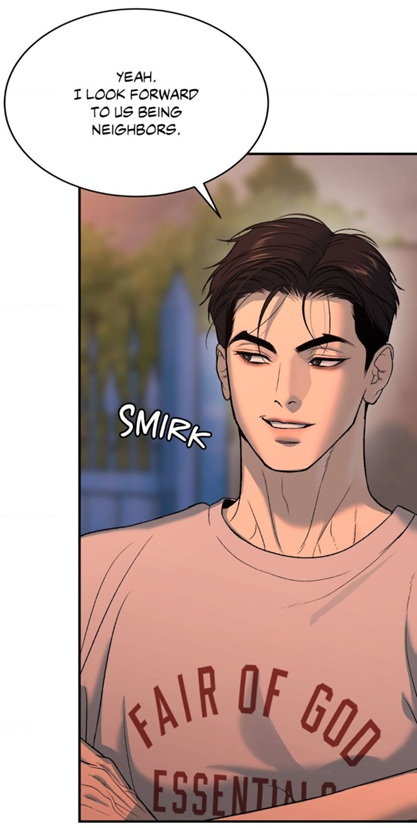 (chapter 61), he begins to demonstrate his growth through quiet, consistent actions—helping others without expecting gratitude in return.
 (chapter 62) For the first time, he is not merely running for fitness or competition; he is paying attention to his surroundings.
  (chapter 62), and the natural rhythm of life around him.
  (chapter 62) Running along the ocean, a setting that profoundly influences his state of mind, Joo Jaekyung demonstrates a newfound openness.
  (chapter 62) This moment underscores his growing ability to connect with others sincerely, without suspicion or defensiveness. His willingness to engage reflects a broader transformation—one that prioritizes meaningful connections over dominance or transactional relationships. This newfound awareness signifies a major shift in his character. His senses are becoming attuned to the world beyond himself, and he is learning to differentiate between what truly matters and what does not.
  (chapter 10), seeing only the “overpowering stench of poverty.”
  (chapter 10) At that time, his perception was clouded by indifference and a focus on material circumstances. Now, however, his response to the elderly woman’s request reflects empathy and an awareness of human vulnerability.
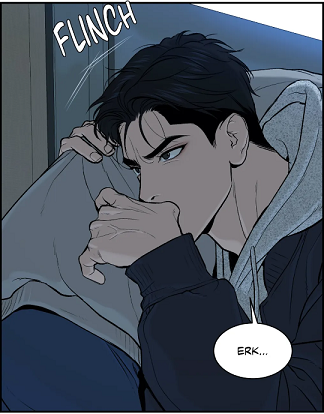 (chapter 10), evoking a sense of cold detachment and judgment. In contrast, the moment where Joo Jaekyung is asked to repair the roof is bathed in daylight
 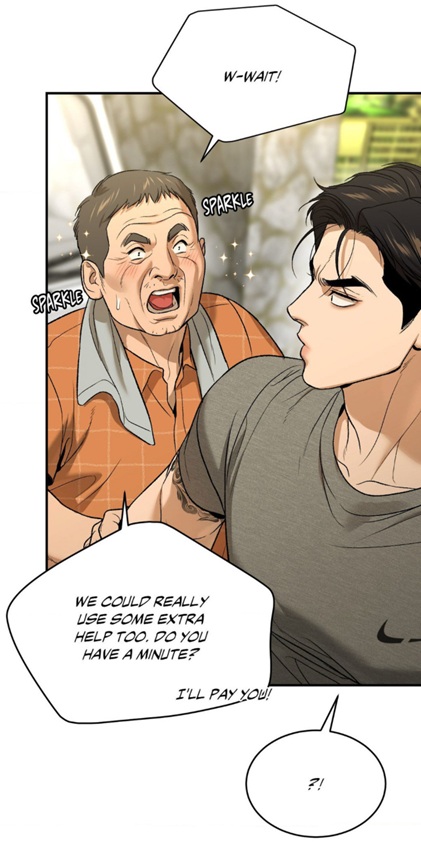 (chapter 62) Thus I deduce that he never accepted any kind of compensation in the end. But none of the inhabitants could accept such a generosity, therefore they brought vegetables or dishes. Unlike his previous life, defined by detachment and impermanence, these acts of community-oriented labor mark a significant shift in how he values his strength—not as a tool for control
  (chapter 62), but as a way to support and uplift others. The admiration from the inhabitants is genuine
  (chapter 62) One might think, he is doing all of this against his will and heart. In my opinion, it is related to his past behavior:
 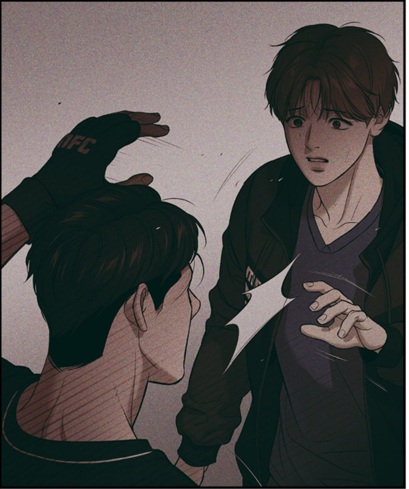 (chapter 62) The champion feels really bad for his rejection after the incident with the spray. And since he believes that Kim Dan comes from that town, he thinks that he can redeem himself by helping his “community”.
 (chapter 47), she rarely prioritized Kim Dan’s nourishment. The grandmother’s actions were driven by financial survival. Joo Jaekyung, on the other hand, receives food as a form of gratitude and recognizes the significance of nourishment beyond monetary gain.
  (chapter 58) with the reality of his evolving personality and his behavior toward others. Choi Heesung’s dismissive remark that Joo Jaekyung would “flip his shit” if he knew the living conditions of Kim Dan implies a static, unchanging view of the champion, one that aligns with a superficial understanding of him as merely ruthless and violent. However, this chapter reveals the fallacy in such an interpretation, exposing the actor’s arrogance and lack of true insight into Joo Jaekyung’s character.
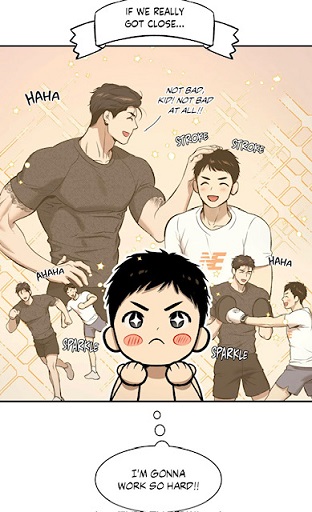 (chapter 23), they could have succeeded. Potato, the youngest member of the team, embodies this missed opportunity.
  (chapter 9) His nickname, “Potato,” while intended as lighthearted and affectionate, is something he despises because he perceives it as demeaning. Yet the reality is quite the opposite—nicknames like these often carry affection and camaraderie. Yet he rejects it out of insecurity or an internalized belief in its inferiority.
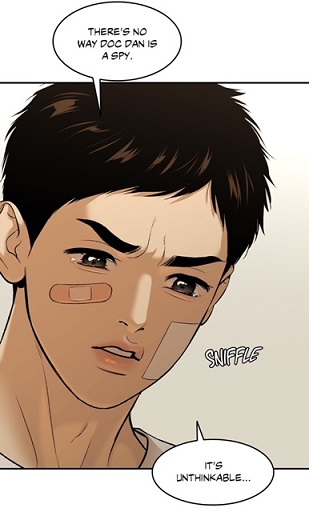 (chapter 52) reveal a missed opportunity for bonding. The champion, who is evolving into a more open and empathetic individual, might have been an unexpected source of support and connection had Potato not listen to others and chosen to embrace this chance instead of harboring negative assumptions.
  (chapter 62) underscores the gap between perception and reality, showing how preconceived notions can prevent genuine relationships from forming. It also reinforces the theme of growth and transformation, as Joo Jaekyung continues to break away from the static image others have of him, proving that even the most misunderstood individuals can surprise us with their capacity for change. The interplay between the nickname “Potato” and its underlying affection further echoes the theme of finding value and beauty in simplicity—a motif central to the champion’s journey as he embraces humility and authenticity.
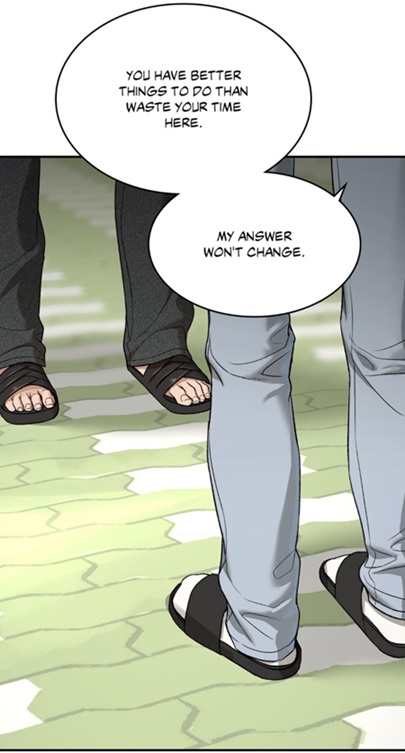 (chapter 62) , while he had put on his expensive jeans and CK tee-shirt.
  (chapter 62). This stands in opposition to the previous scene in front of the hospice:
  (chapter 61) The focus on Joo Jaekyung’s feet
 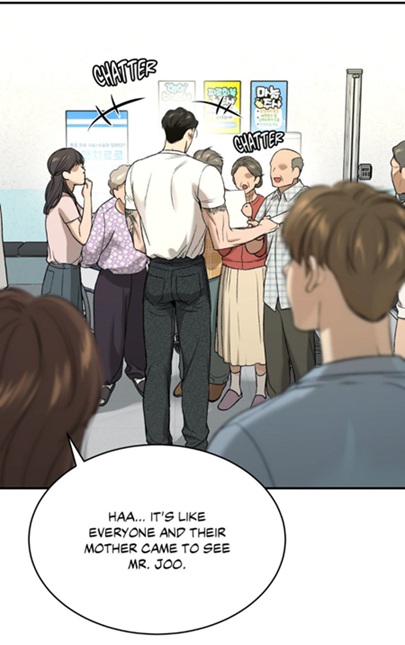 (chapter 62) The hospital or Kim Dan’s presence may provide him with a sense of stability and calmness, allowing him to adopt a more casual and relaxed appearance. Additionally, the contrast between his expensive jeans and branded t-shirt and his unassuming sandals reveals a division between his public image and private self. While his clothing aligns with his status as a wealthy and successful individual, the casual footwear hints at a simpler, more authentic side of him that is emerging in this setting. It reflects his willingness to shed some of the societal expectations tied to his identity.
 (chapter 62) Feet often represent movement or progress, and wearing casual footwear like sandals might signify that he is in a state of personal transformation. The lack of socks further emphasizes this shedding of layers—he is slowly allowing himself to be more vulnerable and introspective, stepping away from his usual, controlled persona. Finally, sandals reflect his connection to the environment. His footwear choice underscores that the hospital is a place where he feels secure and unthreatened. The focus on his feet could symbolize his groundedness in the moment, highlighting that this environment allows him to pause and reflect, rather than act or defend.
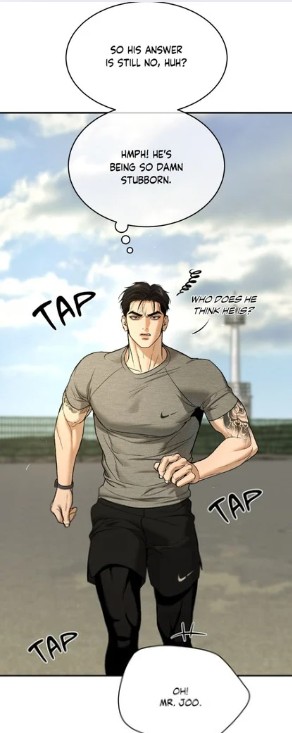 (chapter 62), he is immediately approached by the town chief.
  (chapter 42), where appearances and dominance once took precedence over community and connection.
  (chapter 02) The penthouse, perched high above the city, served as a symbol of isolation and self-reliance—an ivory tower of sorts, detached from the world below. In contrast, the town’s hostel
 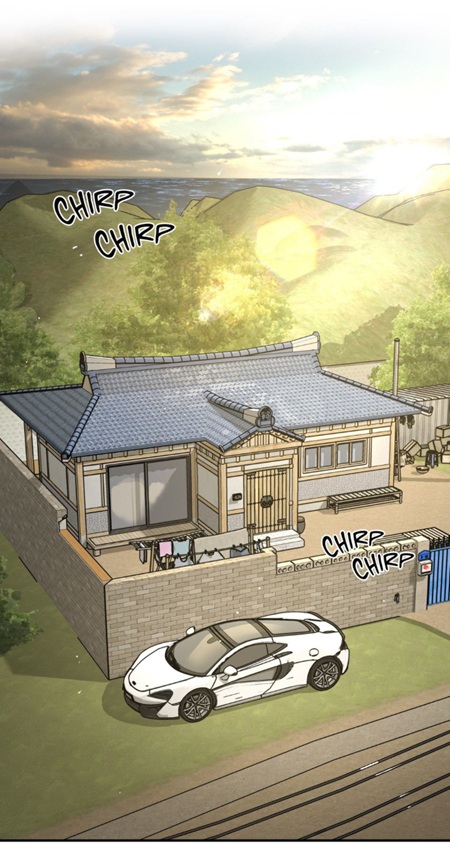 (chapter 62) reflects shared experiences and human connection, embodying a shift toward groundedness and humility.
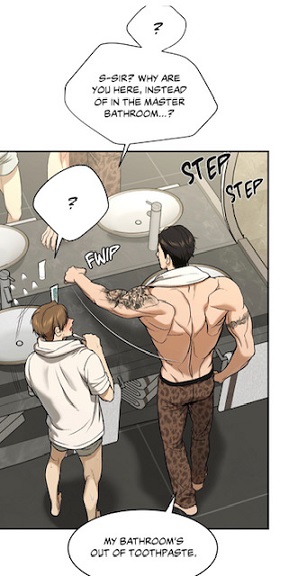 (chapter 30) This evolution from animalistic aggression
  (chapter 30) to floral gentleness mirrors his inner journey—from a man who thrived on dominance to one who values connection and vulnerability. By choosing practicality over intimidation, he signals a readiness to embrace his humanity and shed the pretensions of his past. Moreover, the hat has here a different function: it serves as a real protection from the sun, hence his neck is covered.
 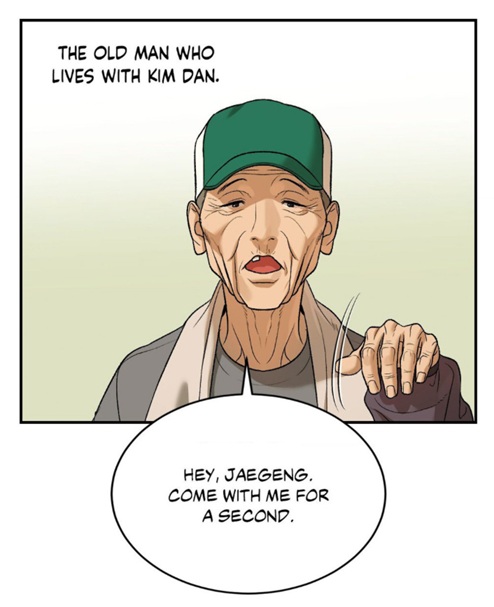 (chapter 62) “Jaegeng.” While this may initially appear as a simple mistake due to the landlord’s poor hearing, it holds deeper symbolic weight. This renaming can be interpreted as part of Joo Jaekyung’s rebirth in the town—a reflection of his evolving identity.
 (chapter 7) Yet here, in the quiet simplicity of the town, he is seen not for his image but for his actions. The landlord’s care and warmth
 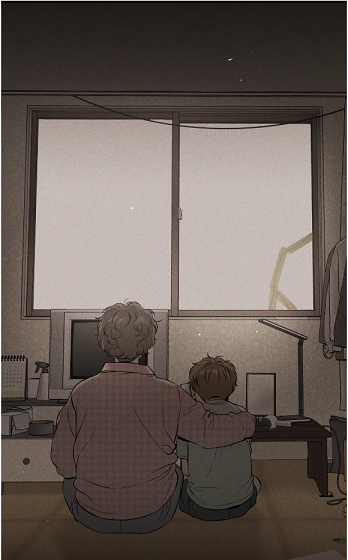 (chapter 19). This creates a fascinating parallel between the two characters: both grapple with the idea of belonging, but from opposing starting points. While Kim Dan longs for acceptance in a community
  (chapter 56) that has continually rejected him (parents, students, hospital; Team Black), Joo Jaekyung is learning how to stop running—physically and emotionally—and to establish a sense of permanence for the first time in his life.
 (chapter 62) So far, the champion has not paid attention to Boksoon. He has not even looked at her, because his eyes are always directed at Kim Dan:
  (chapter 61)
  (chapter 59) Hence I have the impression, she could be the one leading him there, if not Kim Dan. Let’s not forget that the doctor’s deepest wish is to go on a walk through the woods:
  (chapter 47) Another interesting aspect is that the trip to the forest is connected to rest in the physical therapist’s mind. Striking is that though the champion helped the community, he still worked. So technically, he has never had a day’s rest either. But this is what he said to the landlord:
 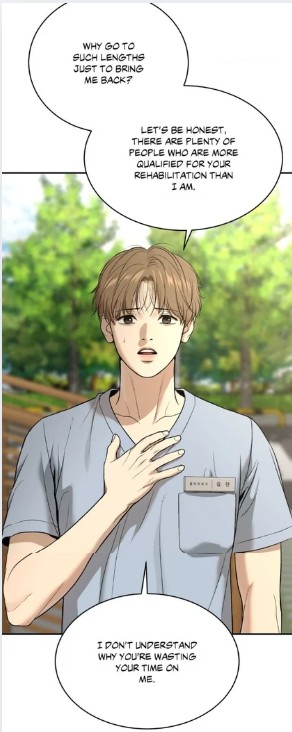 (chapter 62) Ultimately, Joo Jaekyung’s journey is not just one of self-improvement but a quiet challenge to societal values. True strength is not about control, but about the ability to grow, connect, and embrace change. Blooming muscles signifies not just physical power, but a strength nourished by care, community, and the courage to evolve. Finally, I would like my readers to pay attention to the sky, when the champion approached his fated lover:
 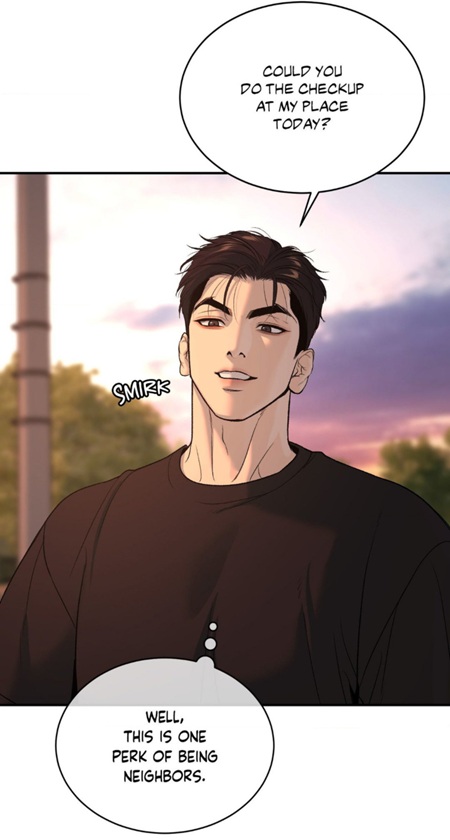 (chapter 62) It was a mixture of white, purple, pink and orange, a sign that not only the champion’s life has become more colorful, but also the night stands under the sign of love, enlightenment and life. At the same time, it reminded me of the night when the puppy was buried:
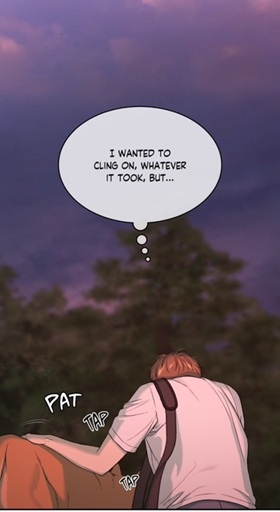 (chapter 59) Thus I am expecting another huge transformation in the next episode.


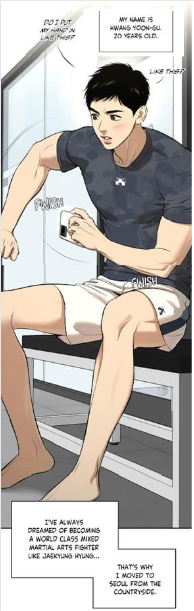 (chapter 23) and dreaming of recognition as his sparring partner.
 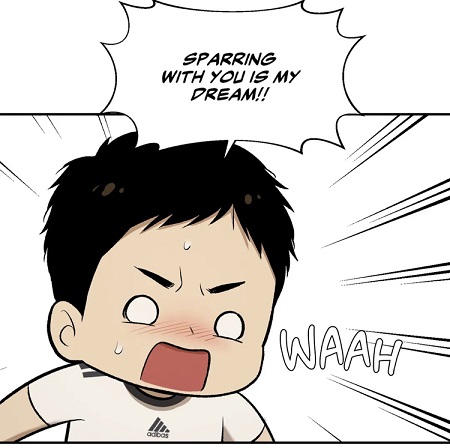 (chapter 23) Joo Jaekyung, much like the prince in Andersen’s story, projects an image that masks the reality of his life. His success, while celebrated, represents years of hard work and immense personal sacrifices. At the gym, Park Namwook undermines these efforts by slapping the athlete
 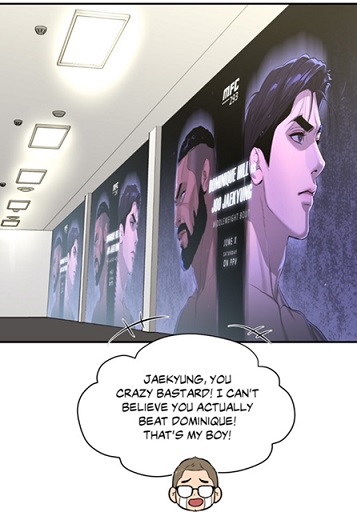 (chapter 40) effectively denying Joo Jaekyung the acknowledgment he deserves for his achievements. Potato is misled by this fabricated image
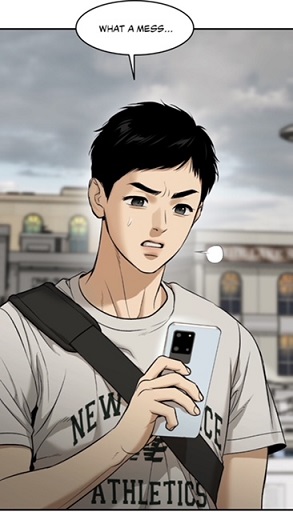 (chapter 52), the amateur starts distancing himself from his former idol. This exposes the fragility of Potato’s dream. Therefore it is not surprising that he starts taking a different path: acting, though I still think, it is temporary. However, behind the glamorous facade of the show business, there exists a dark side as well.
  (chapter 59) Heesung’s fate is similar to the champion’s. Despite his popularity, the actor is deeply unhappy. He feels lonely, for people only know the actor and not the man behind the mask. That’s the reason why he is looking for his soulmate.
  (chapter 23). In reality, he wanted to use the athlete as his servant. The closeness
  (chapter 23) he was seeking was self-serving. While the amateur and the actor are searching for the “perfect companion”, the other couple has no expectation from others. They both have no longer any dream or hope. That’s the reason why Kim Dan was putting this vision of Joo Jaekyung behind a veil:
  (chapter 58) He was giving up on his dream expressed in the birthday card,
 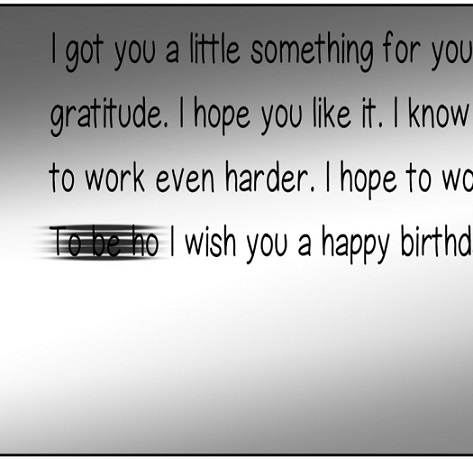 (chapter 55) My newest theory is that he wanted Joo Jaekyung to teach him fighting, but not for himself, but in order to help the fighters and in particular to protect the champion’s body:
  (chapter 25)
 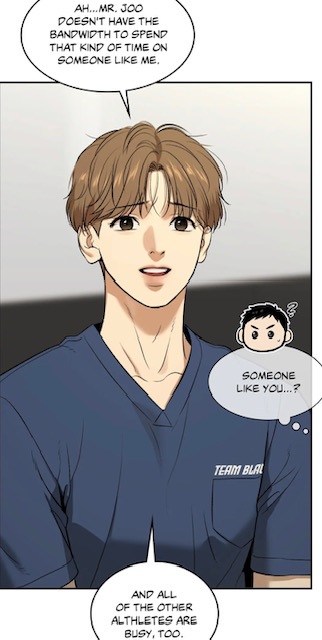 (chapter 25) To develop a training where injuries are minimized. In season 2, it is clear that Joo Jaekyung and Kim Dan have reached the bottom. Both feel empty and exhausted. They were crushed by harsh reality, and they had no one by their side to listen to their pain. Therefore it is not astonishing why the doctor could not confide to the actor and the amateur fighter. They arrived too late.
 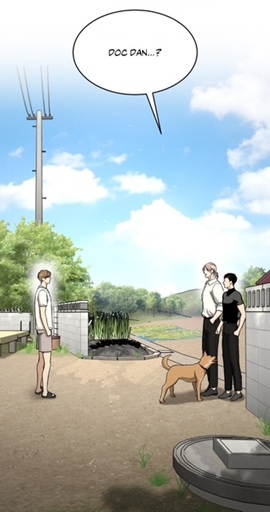 (chapter 58) Their presence definitely diverted the doctor’s attention, lessening his pain.
  (chapter 25) he learns the true nature of the relationship between Kim Dan and Joo Jaekyung. This revelation forces him to confront his own repressed feelings, as he unconsciously realizes his attraction to the fighter.
 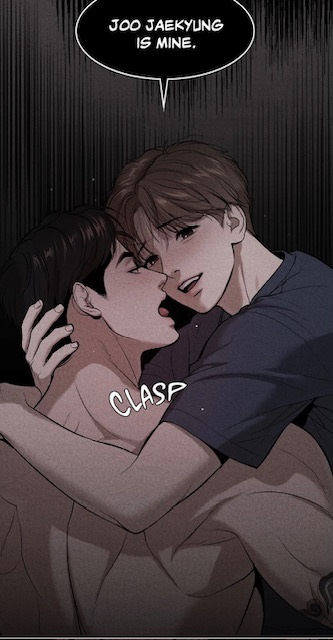 (Chapter 25) Heesung’s involvement further complicates matters, as Potato confesses his love for Joo Jaekyung
  (chapter 35) while simultaneously vowing to sacrifice his feelings for the sake of the couple’s happiness. This act demonstrates Potato’s pure and selfless definition of love,
  (chapter 35) contrasting with the conditional love depicted in Andersen’s tale.
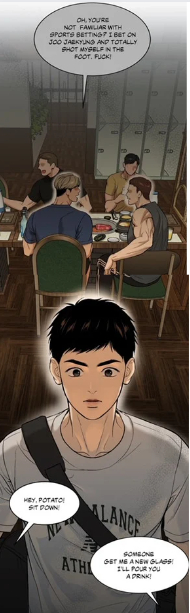 (chapter 52) and the switched spray the
 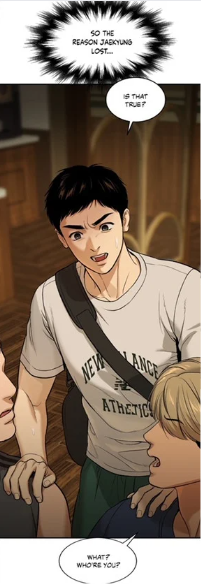 (chapter 52) which is strongly intertwined with the departure of disloyal members from Team Black marks another step in his journey toward disillusionment. While Potato initially views this as an isolated incident, it exposes the broader corruption within the MMA world, including the betrayal, greed, and lack of loyalty that undermine its integrity. While he views himself as loyal to doc Dan and Team Black, for he remained at the gym, his heart was not. He is becoming like his hyungs, Park Namwook and Heesung. In Andersen’s tale, the mermaid’s journey to the sea witch represents a pivotal moment of transformation. By sacrificing her voice and enduring physical pain, she gains entry into the human world, but at the cost of her identity. Similarly, Potato’s journey is marked by painful discoveries that force him to confront uncomfortable truths. Through Kim Dan, he will begin to see his own flaws before he is able to recognize them in those he once trusted.
  (chapter 23)
  (chapter 25)
  (chapter 35) The latter doesn’t mind breaking social norms by yelling or causing a fight at a restaurant. But let’s return to the actor’s confession at a bar. It’s not surprising that Heesung appears indifferent to the affection of those who cared for him. The last partner was described as too clingy. This means that Heesung places himself as the judge. In addition, it was, as if he was a god destined to live forever. He is forgetting his human condition, just like his partner’s. And that’s exactly how the prince in The Little Mermaid views life.
 (special episode 2) Hwang Yoon-Gu didn’t realize that by taking responsibility for the actor, he lost his freedom and as such his voice. Is it a coincidence that Mingwa portrayed the young maknae as someone who would raise his voice due to his emotions in the past?
 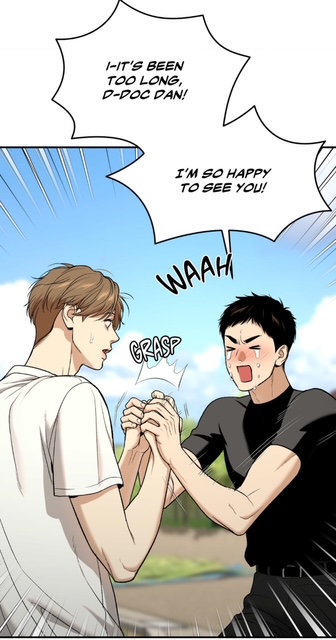 (chapter 58) his behavior is totally different than with the actor:
  (chapter 58) Tears, touch, raising his voice with Kim Dan, but not with the comedian. With the actor, he looks more calm, distant and mature. Heesung’s selfishness is evident in his treatment of Potato, whom he manipulates into becoming an extension of his own image. Hence he is no longer wearing shorts and tee-shirts.
  (chapter 59) One might say that he is gradually elevating Potato’s status through his suggestions.
 (chapter 23) Why? It was due to his low self-esteem.
  (chapter 23) He was not confident enough, for he was the only one with such a weight-category.
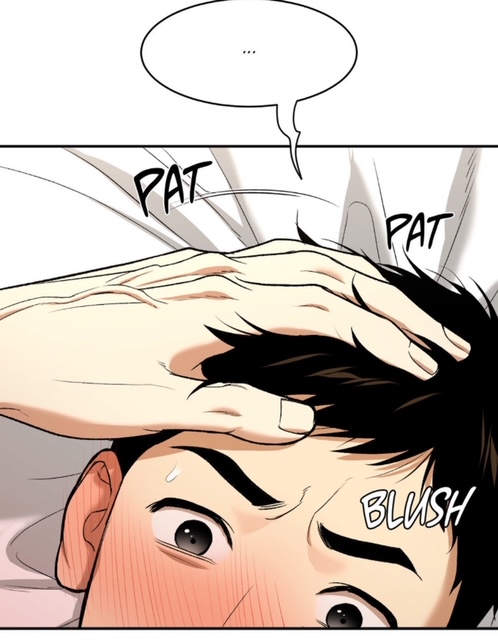 (special episode 2) played a huge influence in Potato’s decision to take the offer as an extra. It was, as if one of his dreams had come true. But is this what he truly wanted?
  (chapter 58) underscores his indifference, symbolizing the unbalanced dynamic in their relationship. Like the prince, Heesung offers no genuine commitment, leaving Potato to grapple with the consequences of his dependency. Thus I perceive Potato’s tears
  (chapter 59) as a signal that he is not truly happy.
  (chapter 58) However, this is about to change. Heesung who likes novelty and change is not realizing that his wish is becoming true. The picture with his last work announces the end of his “friendship” with Potato. How so?
 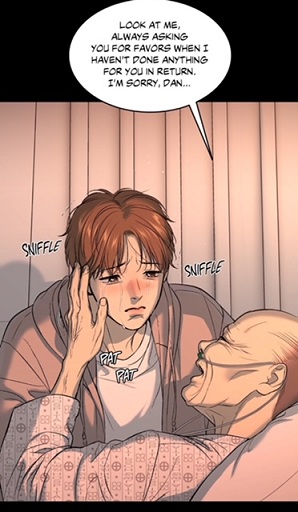 (chapter 53) Kim Dan learned to prioritize the needs of others over his own. His grandmother’s reliance on him mirrored the traditions and expectations imposed on the mermaid by her underwater world. Just as the little mermaid longed for the human world’s light and freedom, Kim Dan yearned for an escape from his oppressive circumstances.
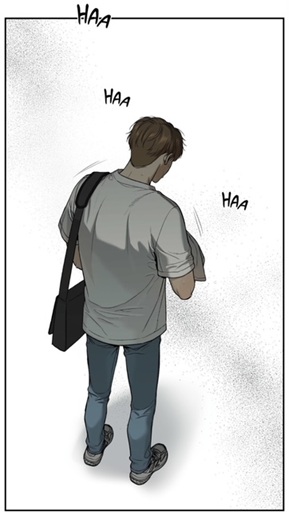 (chapter 59) Kim Dan once referred to Potato as a puppy
  (chapter 29), drawing a connection between the character’s innocence and loyalty.
  (chapter 35) This shows that Heesung has long internalized this pattern: assistance will be only given, if he is called. That’s why he has no true friend in the end. He shows no interest in others. But by doing so, he is putting the whole responsibility on his counterpart. Through the actor and the manager’s behavior, the former errand boy has long adopted this pattern. Hence he didn’t call Kim Dan in the end. He waited for a signal from his part. This behavior mirrors the little mermaid’s sisters, who only realize her absence when it is almost too late to act. Similarly, Potato’s casual farewell highlights a betrayal of Kim Dan’s friendship, further emphasizing Potato’s struggle with emotional awareness. That’s why I mentioned above that Potato is about to discover his true nature: he is also a sinner. This growth parallels the biblical narrative of Adam and Eve, where the acquisition of knowledge leads to the loss of innocence. Heesung, like Eve, introduces Potato to a new world of experiences, including his sexual orientation. However, this newfound knowledge comes with its own burdens, as Potato must reconcile his identity with the harsh realities of the world around him.
 (chapter 5) Heesung could no longer express his needs and desires.
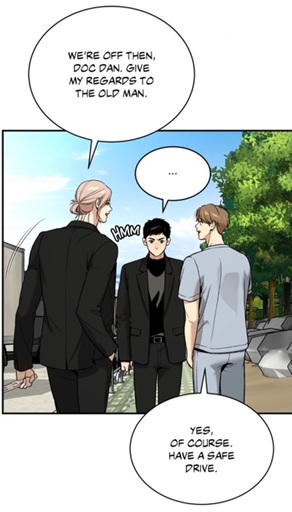 (chapter 59) This event underscores the contrasting paths of Joo Jaekyung and Potato. While Joo Jaekyung is forced to give up his principle of “self-reliance,”
 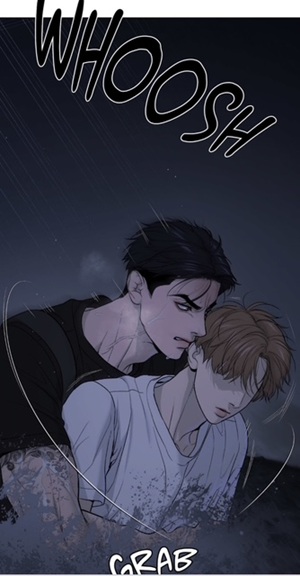 (chapter 59) Potato’s journey is to discover and embrace the principle of “self-reliance” and autonomy. Only when Potato becomes independent in his thoughts and decisions, can he truly help the main couple.
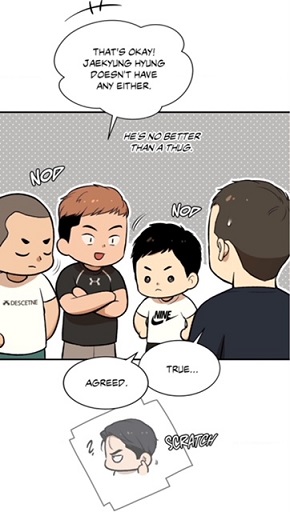 (chapter 47) and 52. Initially, he believed in his hyungs’ description of Joo Jaekyung as a thug, but later he criticized the same fighters for abandoning the athlete
 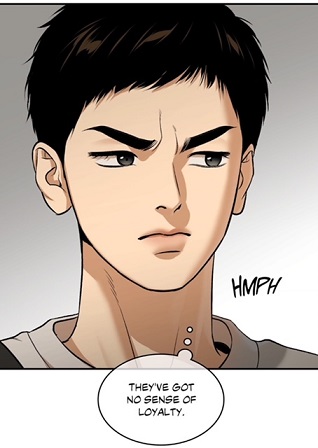 (chapter 52), accusing them of lacking loyalty and dismissing their claim that they had nothing to learn from him. Yet, in episode 52, Potato does not reproach Park Namwook or Yosep for their passivity and naivety,
 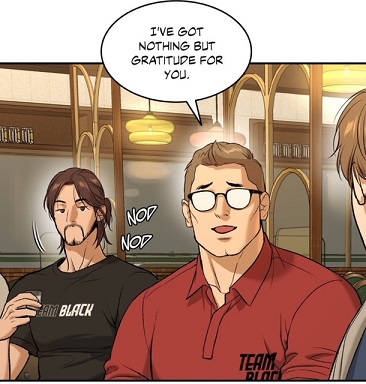 (chapter 43) This absence highlights how Potato has missed key moments of reflection and acknowledgment, which are essential for his growth. It suggests that Potato is destined to detect the flaws in his hyungs—Park Namwook, Yosep and Heesung’s superficiality, passivity, hypocrisy and selfishness—before he can achieve true independence and contribute meaningfully to the lives of Joo Jaekyung and Kim Dan.
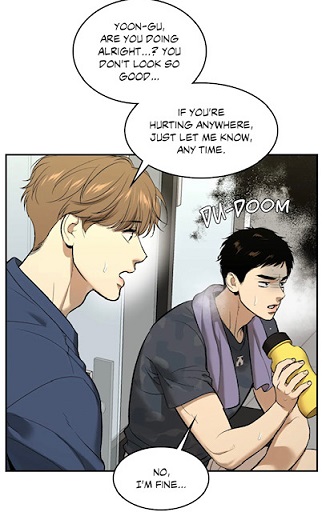 (chapter 23) —taking over his tasks and noticing his unhappiness
 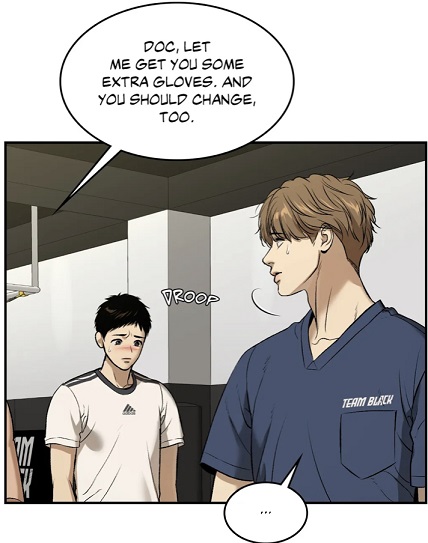 (chapter 25) —demonstrates his capacity for genuine care. This contrasts sharply with Heesung’s selfishness and serves as a reminder of the value of mutual support in relationships. Potato’s potential return to the place where he met Kim Dan could symbolize a rediscovery of authentic connections, marking the beginning of his path toward independence and self-realization.
 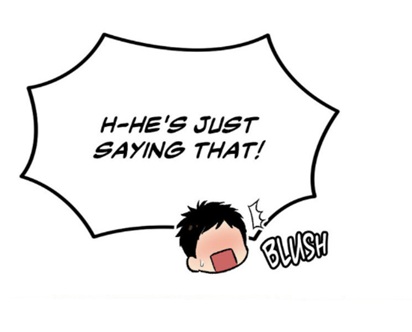 (chapter 58) And like mentioned above, this could become a serious problem for Yoon-Gu. He could be perceived as someone selling himself for a gig. And Heesung is not even realizing the consequences of his intervention and meddling. That’s why it is important for Yoon-Gu to become independent. This lesson resonates with Potato’s journey in Jinx. By recognizing Heesung’s selfishness and breaking free from his influence, Potato has the potential to rediscover his own dreams and individuality. Like Erich Fromm mentioned it, true love is respect, care, knowledge and responsibility. However, Heesung has no idea about the importance of these notions, as everything is evolving around his own needs and dreams.
  (chapter 58) That’s how it dawned on me that little by little Yoon-Gu had been losing his senses:
  (chapter 31), his smell, then his ears
 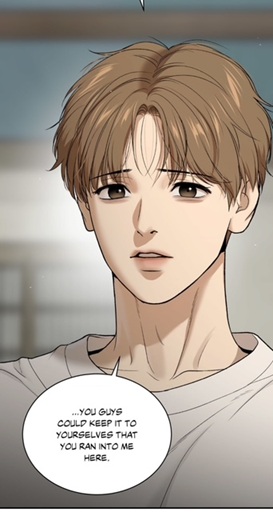 (chapter 58) He forgot the danger coming from Heesung’s words, he could not hear the suffering from the champion due to his bias, and finally he couldn’t see Kim Dan’s distress due to his own feelings and prejudices. We could say that because of the influence from others, he was no longer able to see reality. However, like mentioned before, I sense the return of Potato’s senses in the following panel:


 (chapter 56) This dichotomy in season 1 is vividly illustrated in a scene where Kim Dan, under the dappled light of a tree
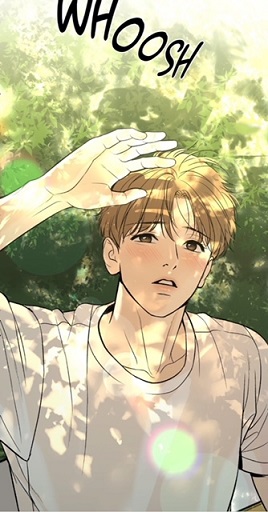 (chapter 41), experiences a profound moment of awakening. As his hand seems to reach towards the leaves
 (chapter 41) Nature awakens something within him— his heart and as such his third eye —allowing him to realize his affection for Joo Jaekyung. This quiet yet powerful moment emphasizes how nature offers clarity and purity, serving as a contrast to the suffocating, impersonal urban world where Kim Dan often found himself lost. Striking is when Joo Jaekyung met Kim Dan for the first time, he compared him to a “leaf,” shaking and fragile—an unconscious recognition of his true nature.
 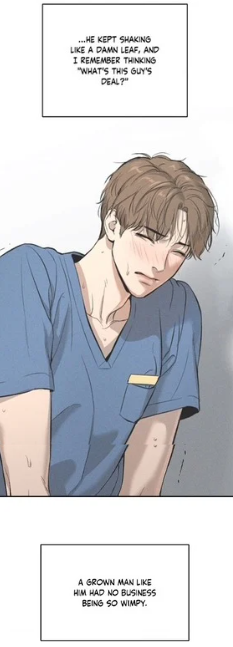 (chapter 56) Leaves are part of trees, symbols of growth, life, and resilience, but since Kim Dan is just a “leaf”, this signifies that he is actually mutilated, reflecting his emotional and physical vulnerability caused by repeated abandonment and suffering. Joo Jaekyung, though dismissive at first, catches a glimpse of Kim Dan’s deeper essence—one connected to nature but battered by his struggles.
 (chapter 55) However, note that the main lead isn’t stretching his hand to the sky and sun. He is almost immobile. Just before, he was holding the cellphone in his hand:
  (chapter 55) Another divergence to the scene in episode 41 is that Jinx-philes couldn’t see his face. It indicates that the doctor reverted to his old self, and as such he is not true to himself. Therefore I come to the following conclusion. Mingwa uses nature as a mirror to Kim Dan’s emotional and spiritual state. While moments of connection with nature reflect clarity and self-realization, the juxtaposition in this scene underscores the opposite. Here, Kim Dan sits surrounded by trees and bathed in sunlight, yet his attention is consumed by his cellphone—symbolizing his entanglement with money, duty, and his ongoing struggles. Just moments prior, he wired money to the champion, a decision rooted in his past traumas and present desperation. The irony of the setting cannot be overlooked: though nature surrounds him, its purity and tranquility remain unnoticed, emphasizing how Kim Dan is still trapped in patterns of survival, burdened by his circumstances. He has become a ghost once again. This disconnect reveals how the weight of his past prevents him from embracing the present moment and reconnecting with his true nature, contrasting starkly with earlier scenes where his senses came alive under the trees.
  (chapter 56) The empty beach scene, with its sunlight and tranquil beauty, reflects peace, but also unfulfilled connections. Kim Dan’s absence from this moment underscores his failure to keep a heartfelt promise to his grandmother:
  (chapter 53) to watch the sunset together. This failure stems not only from Joo Jaekyung
  (chapter 53) —now associated with the sunlight, symbolizing life and vitality—but also from Kim Dan’s fixation on his own suffering.
  (chapter 56) Abandoned once again, Kim Dan is consumed by the weight of his trauma, isolating himself emotionally and excluding himself from others.
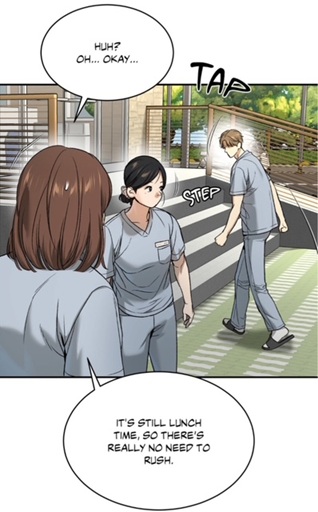 (chapter 56) When approached and complimented, such as when the nurse praises him and encourages him to take a break for lunch, Kim Dan pointedly ignores the praise and instead chooses to return to work. His inability to engage with others reflects the same disconnection that prevents him from connecting to nature. Mingwa subtly reveals a painful truth: Kim Dan’s fixation on his suffering not only blinds him to the solace and clarity offered by nature, but also hinders his ability to nurture relationships.
 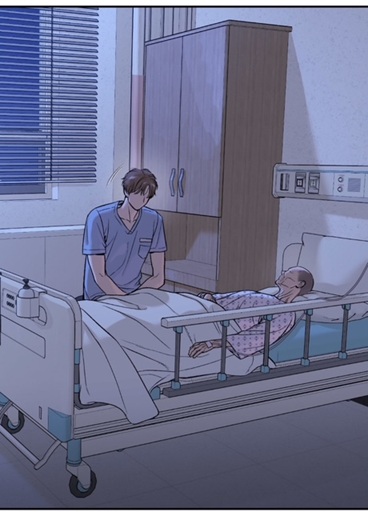 (chapter 56) and, symbolically, to the moon, Kim Dan remains oblivious to what has always been there for him: the enduring forces of love, stability, and healing.
 (chapter 56) the ocean and celestial elements like Saturn (Kim Dan stands for this planet). These forces, outside human control and independent of Kim Dan’s struggles, offer opportunities for renewal and clarity. Yet Kim Dan, consumed by his pain, remains trapped in patterns of survival and alienation. Nature’s constancy mirrors what he needs most—connection, healing, and presence—yet his inability to see it reflects his broader struggle to connect with others and himself.
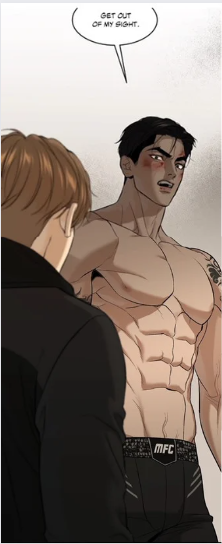 (chapter 51), the doctor learned the following lesson: it is better to keep people at a certain distance, because he got his heart broken. That’s the reason why he is avoiding the nurses and not eating lunches. He is simply avoiding gatherings. He is seeking solitude on purpose. That’s how it dawned on me that he is living like the athlete in season 1!! His whole world is revolving around work and as such taking care of patients.
  (chapter 26) Yes, the day where they sparred out of fun. For the first time, Kim Dan chose to accept a challenge for himself and for Potato. He felt a connection with Yoon-Gu, because he saw in him a puppy:
 (chapter 37) The puppy symbolizes not only nature, but also innocence. Let’s not forget that he was moved by the actor’s flowers in the past:
 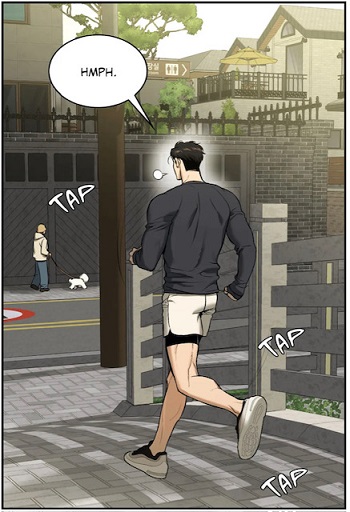 (chapter 21) Yes, by offering him a puppy! Is it a coincidence that the author made the champion jog next to a dog owner? I don’t think so. Until now, nothing could move Kim Dan’s heart:
 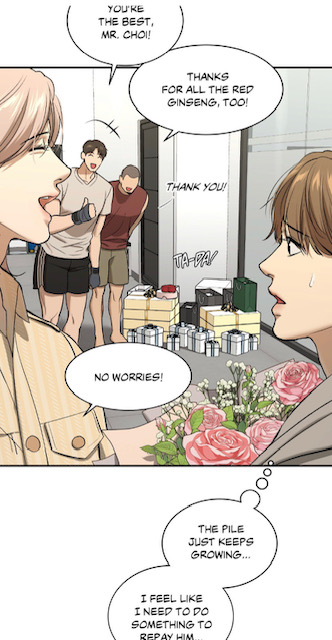 (chapter 31) Here, the main lead saw the gifts as a burden, for they made him think of money and debt. He never saw them as a sign of affection. In fact, dogs have a healing power.
  (chapter 44) In other words, Kim Dan feels a strong connection to animals, but he could never have one due to his poverty and his grandmother. By taking care of a dog, he would be forced to pay attention to nature and in particular to trees. Naturally, I believe that Potato will play a similar role in the future, for Mingwa associated him with a dog.
  (chapter 47), the nursing attendant
  (chapter 21) or the reporters:
 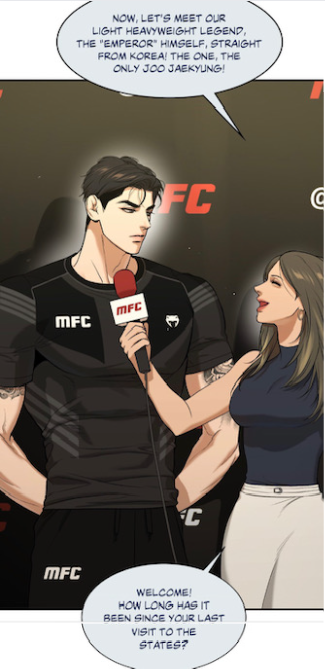 (chapter 37)
 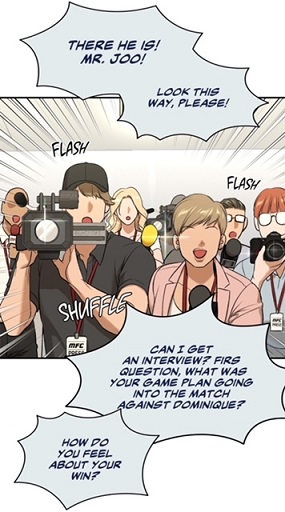 (chapter 40) However, Manhwa-worms will notice a significant distinction: in Season 1, these women were all tied to the world of work. Even Kim Dan’s grandmother, though she represents a familial figure, falls into this category.
 (chapter 56) Moreover, the grandmother’s choice of words, “Why don’t you turn in?”, implies that she sees Kim Dan’s presence as a form of “work” or duty. This phrasing is often associated with someone finishing a day’s tasks or obligations before going to bed, which fits into the broader dynamic between Kim Dan and his responsibilities. In my eyes, it shows that she is seeing her grandson more as a caretaker than as a family member. We shouldn’t forget that she was the reason why the main lead became a PT. It was, as if her dream had come true. Nevertheless, the verity is that his grandmother is receiving treatment from his colleagues.
  (chapter 56)
  (chapter 56) It looks like she’s pushing him away. On the one hand, her request sounds right, for she is treated quite well and the suggestion was made out of concern. She sees her grandchild struggling, and probably imagines that this move must weight down on Kim Dan. On the other hand, I can’t help myself thinking that this woman also has other reasons to send him back to Seoul. The nurse was already pitying the physical therapist:
 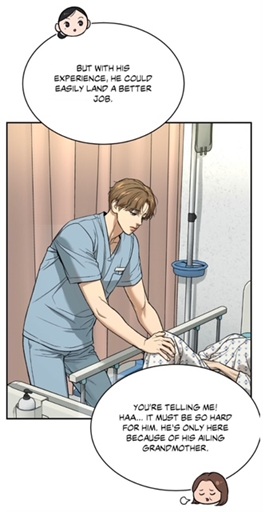 (chapter 56) She was seeing their move as the grandson’s sacrifice. And there’s no doubt that many people at the hospice must think similarly. So this could have reached the halmoni’s ears. Like mentioned in a previous analysis, I detected that the grandmother uses pity to achieve her goal, yet her grandson is receiving a lot of sympathy and attention. It looks like there’s a competition who is more pitiful in this.
  (chapter 7) before she got reassured. Then she made this request
  (chapter 56) where one speaks candidly about her personal desires —having Kim Dan as a son-in-law – while the other calls him cute, giving the impression that she might consider him as a potential boyfriend . This dialogue marks a departure from the women of Season 1, who were defined solely by their roles as professionals or authority figures. Here, womanhood begins to represent emotional connection, care, and the nurturing qualities of family life—values that Kim Dan has been missing.
  (chapter 55) and later brought the doctor’s present:
 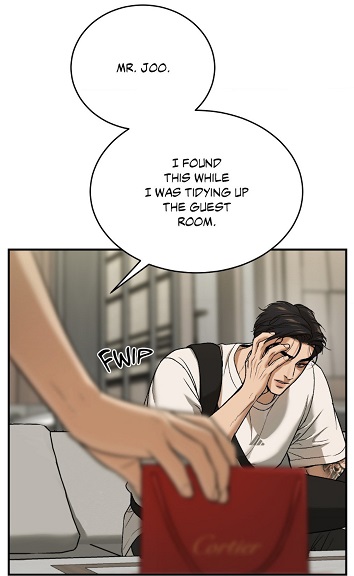 (chapter 55) And what is the common denominator with these two images? The woman’s hand. In the previous essay, I explained that her intervention signalized that the champion would stop drinking and was starting acknowledging Kim Dan. The zoom on the cleaning lady’s hand is a powerful visual cue that encapsulates many of the symbolic meanings associated with a woman’s hand, reinforcing the themes of care, healing, humility, and transformation.
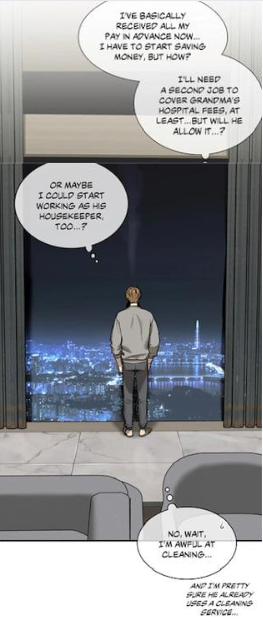 (chapter 19) He is not capable to take care of himself well.
  (chapter 55) Observe how she smiled to him by saying goodbye. This is a sign that her respect and care are genuine. One might think that this nameless cleaning lady was unfortunately portrayed as eyeless:
  (chapter 56) I don’t think, we should see it in a pejorative light, like for an example of blindness or manipulation. In my eyes, the absence of her eyes are mirroring the nature of their relationship between the champion and the cleaning service. So far, he never met these people, as he was always away. In other words, the absence of the eyes is showing that the sportsman doesn’t know her that well. But it could change and this because of Kim Dan.
 (chapter 51) Women in Season 2—more prone to conversation and care—foreshadow this necessary transformation. Joo Jaekyung must learn to move Kim Dan not with his fists, but with empathy, understanding, and love. In essence, he must uncover his “motherly side” to create a genuine bond with Kim Dan.
 (chapter 56) in the illustration. It is because I realized that the champion first looked for Kim Dan at Sports Therapy Centers
  (chapter 56) before realizing that his fated partner might have switched the focus in PT, geriatrics. And what did the PT say at the Light Of Hope Hospice?
  (chapter 56) Male physical therapists like this one
  (chapter 54) prefer specializing in treating athletes because it brings more money and fame, whereas female PT ends up at hospices due to their nature (nurturing, family). This means that by going to the hospice, the athlete will enter a whole new world. The appearance of the woman with glasses was indicating that the athlete was slowly broadening his horizon. As you can see, little by little, the fighter is opening his mind to new things. So how will he react, when he sees that his beloved “hamster” is withering again? This time, he can not blame the doctor. Since I detected similarities between Kim Dan’s current attitude and the champion’s past behavior, I have the feeling that the fighter will recognize himself in his loved one or someone will give him some advice. He will have the answer to this:
  (chapter 13) He is neglecting himself to the point of exhaustion, because he is living as a PT non-stop. While the champion was fighting with his bad shoulder, the other is using his hands for treatment, hence he is not eating.

 (chapter 55) One might think that the causes for his throbbing head are his depression and insomnia. On the other hand, I am quite certain that many readers had a different explanation for his migraine. He is missing his lover, Kim Dan, as the color red symbolizes the headache and the physical therapist’s name is strongly intertwined with this pigment which was once again confirmed in episoe 56.
  (chapter 56) So it is true that his migraine are caused by the doctor’s absence. It was, as if the main lead was suffering from withdrawal symptoms. The fighter has a love addiction, but he is not aware of the existence of this “sweet poison”. But there’s more to it.

 Thus I consider this image, where the champion is seen
 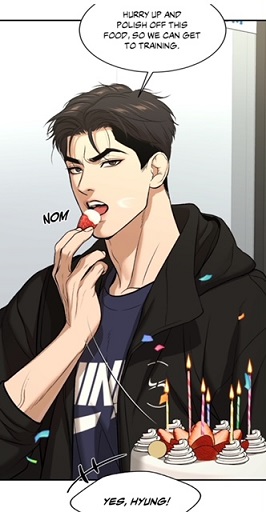 (chapter 43) eating a strawberry with cream as the announcement of the magical night between Kim Dan and his fated partner. The fruit with the cream represented a violation to his strict diet.
  (chapter 55) or the medicine against migraine.
 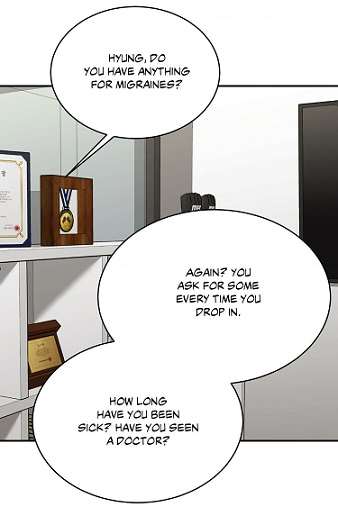 (chapter 54) However, in episode 55, we can observe a huge change in the champion.
  (chapter 55) The latter is finally admitting the inefficiency of the medicine. In other words, in this scene, he was giving up on them. This represents an important step on his way to enlightenment. For me, it signifies that he is stopping relying on pharmaceutical products. Let’s not forget that in the past, he rejected the PT and even neglected them. Why? It is because he trusted more sprays and other medicines than people.
  (chapter 49) Therefore the switch of the spray had to occur. He needed to question his prejudices and attitude. But let’s return our attention to the champion and his throbbing head. One detail in this panel caught my notice.
  (chapter 55) And now, pay attention to the number of the bottles in his room:
 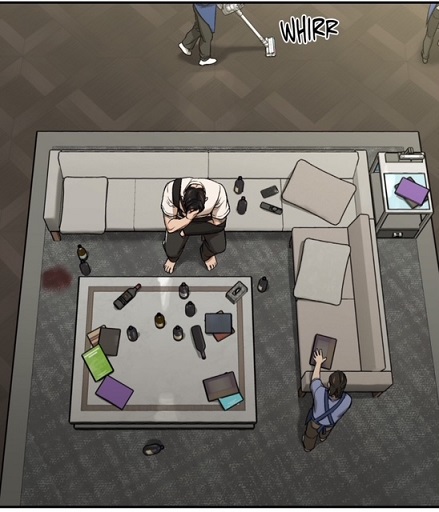 (chapter 55) I count 12 bottles of wine exactly like in the last image from chapter 54. Thus I came to the following deductions:
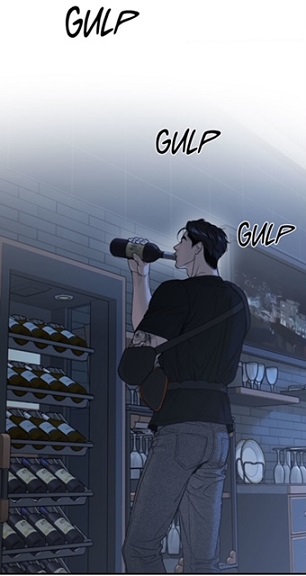 (chapter 54) and the appearance of the staff in chapter 55. It indicates that Jinx-philes can witness time deceleration in season 2. From one month in one chapter, then a week in the next episode, finally we have a reference to a day: Monday. Thus I deduce that in episode 56, only 2 or 3 days elapsed. I have already announced that the couple should meet each other around 25th:
  (chapter 56), for the day Kim Dan wired his money to his “loved one” took place after 10th of the month: XX = two digits.
  (chapter 55)
 (chapter 55) Consequently, I judge the cleaning lady as the positive version of Park Namwook. Though she uses social norms, she doesn’t use them against her employee. She didn’t condemn him, it is a mixture of teasing and reminder. At the same time, her intervention implies that she must have noticed changes in her boss after the arrival of Kim Dan in the flat and his departure. That’s the reason why I have the impression that this image is announcing another turning point in the champion’s life either:
  (chapter 55) He won’t drink like before. However, I don’t think that he will behave like in the past: reject any alcohol entirely.
 (chapter 55), his migraine vanished. Though he is holding his head the next morning and hiding his gaze
  (chapter 55), the Webtoonist didn’t add any red or “throb” as an indication for a migraine. As you can see, his headache is strongly intertwined with repressing the physical therapist and as such locking away memories. However, there exists another cause. What had the doctor done in the past?
  (chapter 44) Yes, the main lead had patted his lover’s head, while the champion had his eyes close. In my opinion, his unconscious had registered this gesture and loved it. However, the champion had not seen it himself. He was drunk and had his eyes closed. This stroke on the head symbolizes appreciation, affection and recognition.
  (chapter 23) That’s how little kids are admired and loved. This stands in opposition to the abuser’s behavior:
  (chapter 54) parental criticism and absence of contact. And how did Choi Heesung express his “love” to Yoon Gu?
 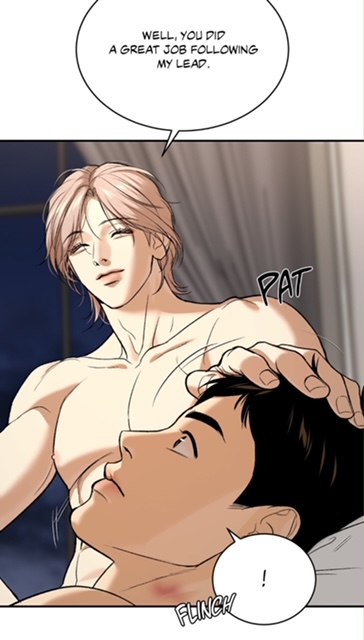 (chapter special 2) The same way than Kim Dan with the patting! In other words, the champion is deep down longing for such a gesture, but he has not realized it yet. Nevertheless, I believe that he just needs a trigger.
 (chapter 55) With his left opened eye!! The exact opposite from this picture:
 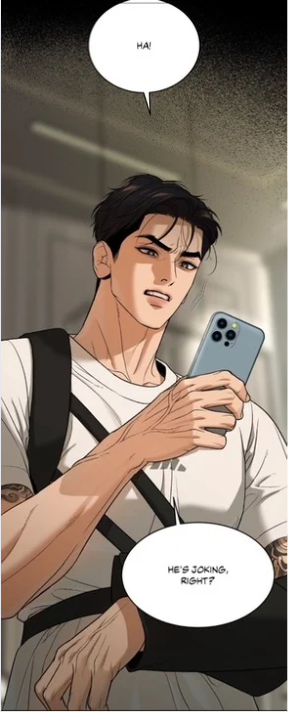 (chapter 55) This observation got confirmed in episode 56, though I couldn’t expose it before the release of the new chapter.
  (chapter 56) As long as the fighter thinks of his fated partner, he is not plagued with a throbbing head. This shows that it has something to do with repressing memories. However, his physical condition is still not improving:
 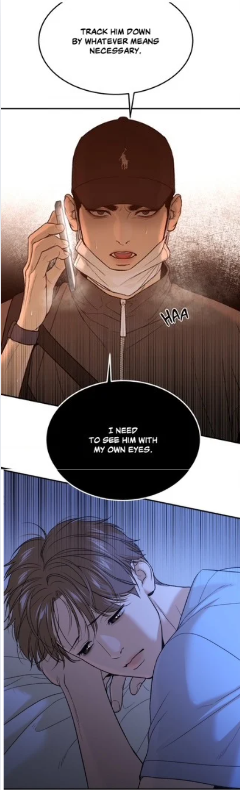 (chapter 56) He even looks worse than before: exhausted and malnourished. There is no one by his side taking care of him: his only interaction with his manager is through the phone. At no moment, the guy felt the need to pay a visit to his boss and champion.
  (chapter 56) Because I discovered the connection between memories and the physical therapist, it is important to examine the interaction between the main lead and the new uke.
 (chapter 55) This signifies that in reality, the uke is the one benefiting more from this relationship, while the “Gucgi guy” is a placebo for Joo Jaekyung. He can not replace the true medicine: Dan’s love. But Joo Jaekyung chose to close an eye to the truth forgetting his “insight” from chapter 2:
  (chapter 2) However, back then, he had just stated it in order to get rid of the mint-goblin. He needed a justification for switching his partner. In other words, this was reflecting more the protagonist’s corrupted mind and heart. Therefore he is designed eyeless, the symbol for ignorance, lies and blindness.
  (chapter 55) And where did he have his migraine exactly?
 (chapter 55) It was on the right side and eye! It truly exposes that Joo Jaekyung was getting punished for his attitude. He is not allowed to bury and forget Kim Dan. The star’s open eyes in this episode symbolize denial, lack of self-awareness and as such the absence of insight. He is also punished for his lies in episode 2. His words might have reflected the truth, but his words didn’t expose a change of heart. He was taking advantage of this situation as well. So when the pain intensified pushing him to close his right eye, we should consider this image as a short moment of reflection and realization. In the restroom, he was forced to admit that only Kim Dan could kiss him. Is it a coincidence that just before Mingwa presented this image
 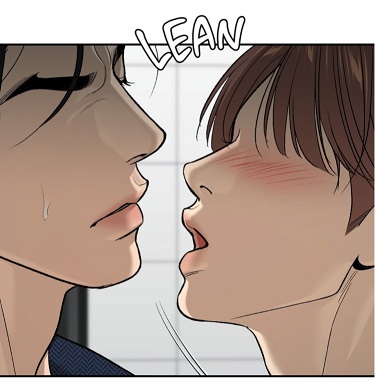 (chapter 55) Naturally no, she was mirroring the attitude of both figures: both were in denial!! Notice that though the star had no reaction in front of the “replacement”, the latter chose not to give up at all. This man was not expecting a rejection, in fact he was in total denial as well. He didn’t notice the star’s passivity and silence.
 (chapter 55) He was just standing there and avoiding his gaze.
 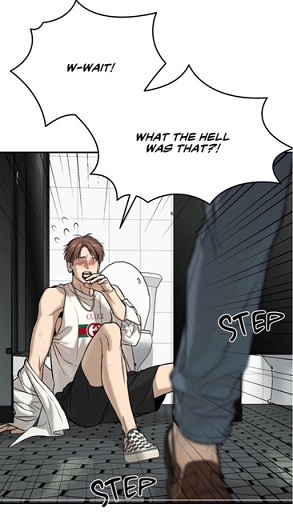 (chapter 55) How can the MMA fighter reject him? This displays his huge confidence or arrogance. There’s no doubt that he will put the blame on Joo Jaekyung. At the same time, I believe that his blindness was also caused by his greed.
 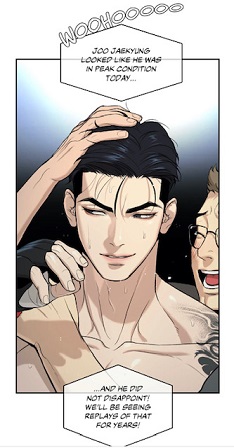 (chapter 5) Therefore he was in a happy mood after that match. A simple gesture with a lot of power! He has been missing this hand or better said this gesture. This action was the main lead’s true motivation.
  (chapter 54) Don’t forget that Dominic Hill had expressed his admiration in a similar way, patting on the back:
  (chapter 40) No wonder why he felt so lost and empty after the last fight.
 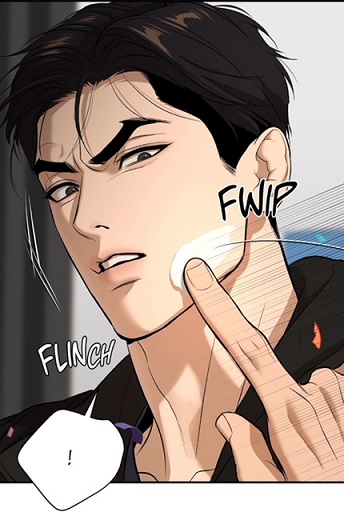 (chapter 43) this was the coach’s hand. In other words, the athlete felt more close to the coach than to the manager. This would explain why he would listen to the coach and even entrust him with huge tasks like the charity event. Strangely, in season 1, we can observe how more or more he is distancing himself from the fighter. Probably related to his secret relationship with Kim Dan. According to my theory, the coach is aware of their relationship. They are more than just boss and employee. As you can see, I don’t think that the champion is right now just missing the doctor’s sweet lips. Deep down, he would like to be patted by his loved one, exactly like Potato.
  (chapter 2) The champion’s reaction is quite telling. He is not easily swayed. But we have another bigger evidence that his intercourses were replacement for “fights”. In The States, the fighter asked Kim Dan to join him at 11:00.
  (chapter 38) He needed to prepare himself mentally, to visualize how he would screw his opponent Dominic Hill. He was just taking the expression “fuck/screw” too literally. The latter idiom has the following synonyms: to cheat, oppress, bleed, coerce, wrest and to tighten. Just before the doctor came to his door, what was the athlete doing? He was watching a video from his challenger:
  (chapter 38) Therefore it is not surprising that he rejected Kim Dan’s request first.
 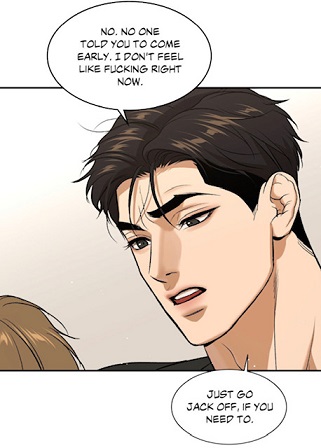 (chapter 39) He didn’t feel like it, because he was not aroused at all. Imagine that he needed two hours for that erection, a sign that during that night, Kim Dan was in reality a replacement for the American fighter.
  (chapter 39) Even when the doctor rubbed his hand against his sex, he had no reaction.
  (chapter 38) In fact, he needed a fellatio to get an erection, and he only started getting excited, when he saw the doctor’s gaze. That’s the reason why he remembered this image under the shower:
  (chapter 55) However, the more time the champion spent time with his physical therapist, the more he came to violate his own rules and principles: It started with their first meeting, when he crossed the line by mixing private and professional life together:
  (chapter 6), Sex was no longer linked to matches, but to his own desires. To conclude, for the first time, the fighter connected sex to pleasure and desires and not “work and fighting”. Because of the deal and Joo Jaekyung’s strange behavior (sex shower scene, …) the PT had the impression that his boss was a man obsessed with sex.
 (chapter 53) The latter didn’t feel the need to have more sex with Kim Dan, he let his partner leave the place. Why? This contrasts so much to their First Wedding Night:
  (chapter 4)
  (chapter 53) Pay attention to the behavior from the fighter during their last night together. He is looking away, he is not paying attention to his fated companion. His mind was elsewhere, focused on Baek Junmin! In my opinion, during that night, the champion had been able to differentiate between the physical therapist and his opponent. Fighting was more important than sex and as such his sex partner. To conclude, the physical therapist had been able to win Joo Jaekyung’s belief and heart. He was no longer a replacement at all. He had become a person close the fighter.
 (chapter 49) he wanted to screw Baek Junmin for real. In this image, the athlete oozes confidence and strength. This means that he was no longer dependent on the good fuck before the match.
  (chapter 53) However, the main lead never realized this huge change, he kept his old belief as a tradition out of habit. This explicates why the fighter tried to replace with a new uke
 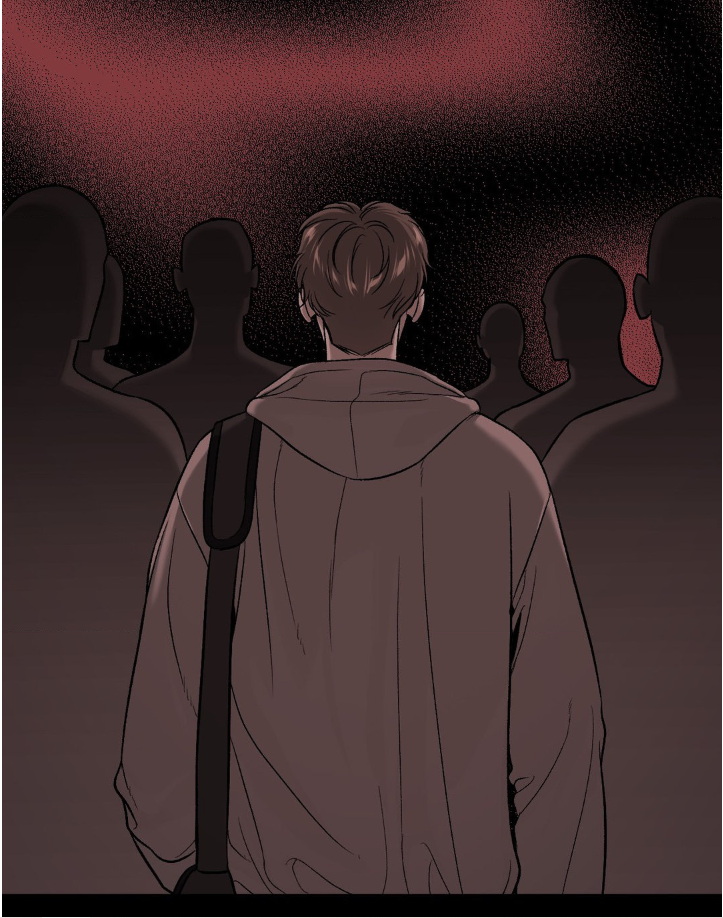 (chapter 55), but here the sex was longer connected to a match, rather to fun. Finally, observe how the champion is now blaming his PT for his ruined match:
  (chapter 56). I don’t think, he was referring to the spray incident, rather to their night before the match. The doctor had not behaved like a real opponent, he had admitted his “defeat” quite easily. He had left the ring before procuring him a good fuck. He was blaming his partner for violating his rule:
  (chapter 44) Sex is a synonym for love and as such it is about giving pleasure and affection to his partner. It is a two-way street. And this is something that the champion has to admit and accept. Thus I deduce that the fighter still has a long way to go before dropping all his fake principles. Like mentioned before, he needs to ponder on the following question: what matters to him the most? His championship or his happiness? Or what is sex to him? Why does he think that he is jinxed? He needs to face his own painful past and remember the face of his tormentor.
 (chapter 49) Baek Junmin and the abusive parent.
  (chapter 54) But the masturbation had taken place before. So who did he have in mind, when he was jerking off? I might shock my avid readers, but I would say: Baek Junmin.
 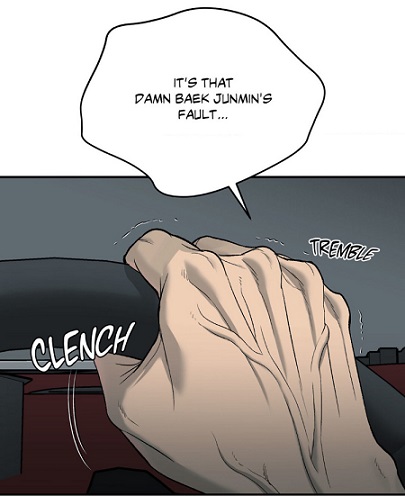 (chapter 54) However, this gesture had the opposite signification: rage, resent… but also sweet revenge! He must have recalled the Shotgun’s face.
 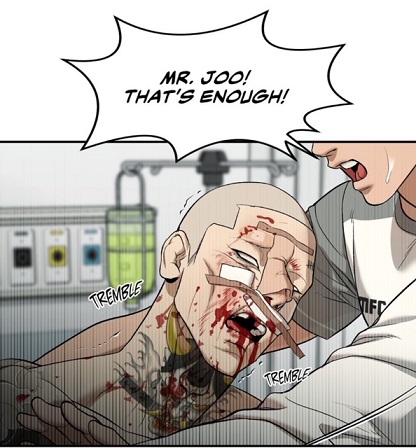 (chapter 52) There’s no doubt that thanks to the doctor, the champion will learn that he can get “justice” and satisfaction through other means. He can defeat the ghosts from the past, not just thanks to his fists and hard work, but also thanks to his surroundings and knowledge. Lawsuit and media!
 (chapter 1) The physical therapist is not only his reward and price, but also his “second shoulder” and as such his pillar. The new PT won’t be able to replace him. Joo Jaekyung is not just a champion, but also a team: Kim Dan as his PT and his lover. As for Kim Dan, the celebrity is his “energy drink”, his source of comfort and joy. He is also his home, for he is the first one who invited him to stay with him! Yes, the grandmother didn’t invite her grandson to live with her, he was just dumped at her place. And because the celebrity is like a home and family, it explicates why the doctor is once again “living like a ghost”.

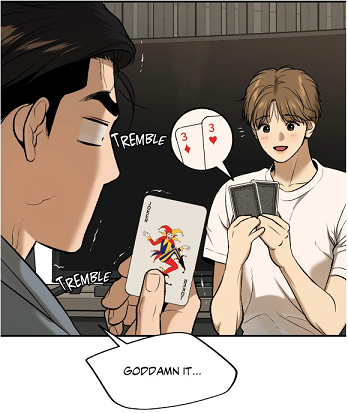 (chapter 27)
  (chapter 13) He is definitely sure that this man won’t betray him. He is not judging him for his job or “sexual preferences”. He embodies fairness, tolerance and impartiality. And since in his cellphone, Doctor Cheolmin is registered under the name Cheolmin hyung, it exposes his closeness with this cute doctor. He is like a “brother”.
 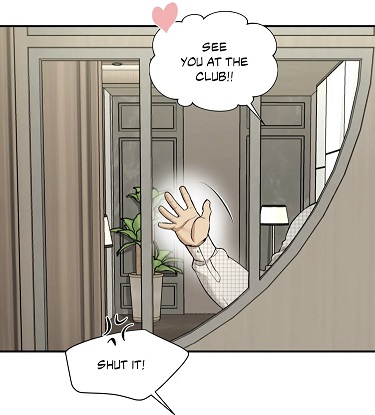 (chapter 13) This gesture with the hand implied not only that he was just looking forward to meeting him again, but also generosity. And if there was a request from Cheolmin, it was just about an information:
  (chapter 13) It had nothing to do with money and promoting his hospital.
 (chapter 33) According to me, the man was calling his friend Cheolmin, because he truly believed that the actor had been hurt. The fact that he went to the rooftop in order to call the person is indicating that he desires to hide his contact from Park Namwook and Jeong Yosep. In other words, he was seeking secrecy, exactly like the actor. As you can see, the dragon and the gumiho had a similar attitude. They thought that the rooftop was the perfect place to hide a secret. So by calling Cheolmin who is working at a hospital, the MMA fighter was making sure that there would be no scandal. However, when he called him, he discovered the truth. Choi Heesung had faked his injury. Therefore how could he use his connection with Cheolmin, when there was no emergency? In his eyes, he would have abused his busy friend’s generosity. That’s the reason why the star chose not to intervene. If he had revealed the truth and as such accused the actor of deception, he would have no one by his side to prove the truth. It was one man against two. Secondly, by revealing his presence on the rooftop, he would have been forced to mention his close friend: Cheolmin hyung. His connection with the athlete would have raised some question. And because he didn’t utilize the Joker in that situation, he became a victim of a trick. It is important, because the champion’s decision to hide Cheolmin’s existence from Jeong Yosep and Park Namwook is a sign that deep down, he is not trusting his two other hyungs. In my eyes, it is related to his homosexuality. But there could be other reasons as well, for example he met this doctor, before he became a celebrity.
 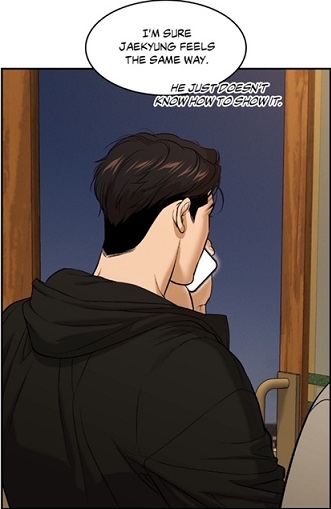 (chapter 33) For me, the doctor was the person Joo Jaekyung was talking to. Interesting is that contrary to episode 33, he didn’t leave the inn in order to talk to his acquaintance. In fact, he did it in front of the door. By acting that way, he didn’t attract the attention from the members. No one questioned the celebrity why he was talking on the phone for quite some time. They just imagined that it was work-related due to the selfie with a stan.
  (chapter 43) They didn’t even bother to wait for him to arrive before drinking and eating, though the man was the birthday child. He was actually the guest of honor.
  (chapter 43) This exposes violation of social norms and even the disrespect towards Joo Jaekyung. He is just seen as a cash cow, hence there was no thank you from them or even a short invitation for him, like Park Namwook and Kim Changmin had done it in episode 9.
  (chapter 9)
 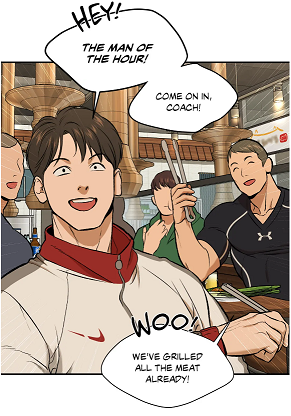 (chapter 9) In fact, Joo Jaekyung was totally neglected at the restaurant, no one even paid attention to his actions. Under this light, I recognized why Mingwa created this incident:
  (chapter 43) It was not just to bring the two main leads closer, but also to expose the wrongdoers. If they had waited for him, the champion wouldn’t have drunk some soju from the glass of water, for Kim Dan couldn’t have used his glass.
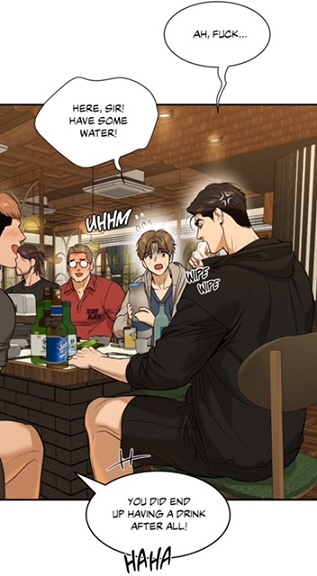 (chapter 43) That’s why the manager got red, a sign of embarrassment. He realized that they should have all waited for the birthday child. Moreover, don’t forget that the star was even paying the bill. And now, you are wondering if I didn’t diverge from my original topic, the Joker and Cheolmin hyung. No, as this new interpretation helped me to understand why Joo Jaekyung talked to his hyung in front of others. He already sensed that no one was observing him or waiting for him.
  (chapter 43) Moreover, it is possible that the mysterious caller desired to congratulate for his birthday or even to thank for his donation. Let’s not forget that just before his real birthday, the celebrity organized a charity event, and it could be related to Cheolmin’s work place.
  (chapter 41) Because I detected ingratitude, selfishness and rudeness from Team Black, I couldn’t help myself thinking that the other person must have behaved differently, which put the young man in a good mood. Therefore he overlooked the incident with the switch of glass:
  (chapter 13) Here we have a threat from the champion to which Cheolmin replied with a joke. Here, we have the same situation: a threat, but people got scared
 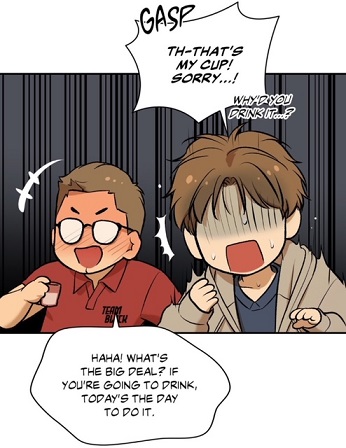 (chapter 43) before Park Namwook tried to relativize the incident.
 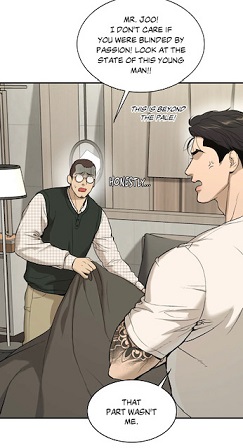 (chapter 13). Hence I believe that the other reason why our cute PT didn’t meet Cheolmin in season 1 is that he was not ready to interact with him. Kim Dan needed to mature, to free himself from social norms in order to accept such a man as a “role model”. That’s the reason why I am expecting the return from this mysterious doctor in season 2. In my opinion, he will play a central role in dethroning the king Park Namwook at Team Black, but also in helping Kim Dan to obtain justice. Keep in mind that according to me, the protagonist was a victim of many crimes committed by doctors. (The hospital director, Kim Miseon, MFC doctors)
 (chapter 46) If he had voiced his struggle to Heesung, the latter would have understood him and “talked” some sense to the dragon. And it is the same for Potato. In the locker room, when Kim Dan was criticized for his sloppiness,
 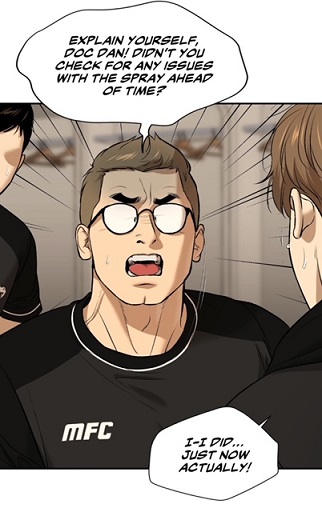 (chapter 50) he didn’t ask from Potato to vouch for him. He could have reached to him, requesting from him to testify in his favor. Yes, I believe that not only the actor and the maknae are to blame for their passivity, the physical therapist is also responsible for his own suffering. He is not seeing that he has already gained two friends. However, he didn’t treat them properly. No wonder why Kim Dan ended up alone at the end of season 1. At no moment, he confided to Potato or other members about his struggles, he kept everything to himself which is similar to his soulmate.
  (chapter 30). Here, I am excluding the scene with his drunkenness. Nevertheless, from his words, Heesung couldn’t detect that he was raised by a single grandmother. He already had a hard time to “accept” the champion’s benevolence
  (chapter 18) He was brainwashed to rely only on himself. Why? It is related to his halmeoni and his childhood. The elderly woman gave the impression that she raised him without any help. She did everything on her own which is only partially true. The young boy was forced very early on to help her.
 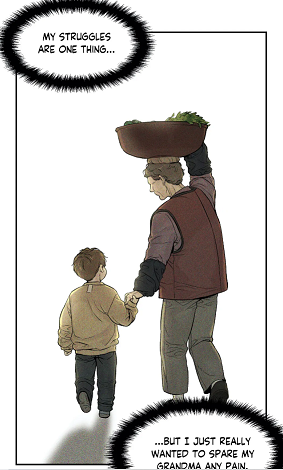 (chapter 5)
 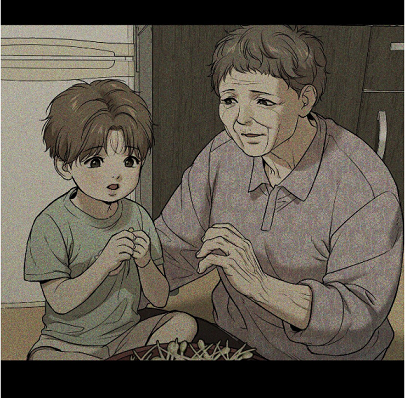 (chapter 47) Hence he was taught cooking. In addition, we can already envision that when he was a high school student, he had to take a part-time job. She definitely minimized his assistance, creating a debt towards her.
 (chapter 7) and
  (chapter 23), he just acted as their “PT” and nothing more. In other words, he acted, as if they only had a professional relationship. This explicates why Kim Dan never talked about himself, in other words he never shared any information with them. However, I doubt that he just considered them as his “patients”. He was happy to give his assistance. For me, the fact that he never lowered his guard is a sign of his low-esteem. So they had a strictly professional relationship, except with Potato.
  (chapter 26) However, even here, Kim Dan never shared his cellphone number with the maknae. If Potato had it, he would have tried to contact him immediately. To conclude, though I criticized Yoon-Gu and Heesung for their indifference and neglect, I feel that Kim Dan is partially responsible for this too. He didn’t take the first step to improve their relationship. Friendship is a two-way Street!
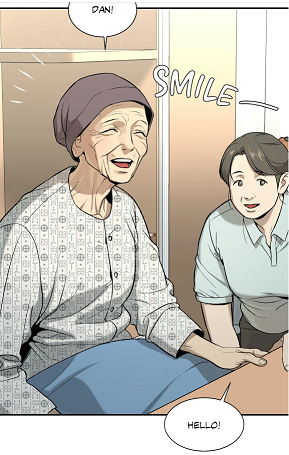 (chapter 7) She needs to pay a nurse to give her some company. Therefore she is forced to rely on her grandson. Then she doesn’t pay any attention to her grandson’s needs and circumstances, for she is only focused on her own suffering and “unhappiness” chasing after an illusion.
  (chapter 53) Because she has no one by her side except Kim Dan, she has no problem to move to a different place where she doesn’t know anyone. Her grandchild is her “home”. This move reminded me a lot to a uprooting. It was, as though the male lead was not allowed to settle for good. Don’t forget that her deteriorated home let transpire that she didn’t consider this place as her true home. It was just a stopping-place. Under this new light, it becomes comprehensible why Kim Dan could never get any friend. Through the cards, I could find more evidences about my past interpretation. The halmeoni is responsible for the protagonist’s self-blame, lack of confidence, suffering and isolation.

 (chapter 53), she implied that she never got the chance to go to the West Coast because of him. It was, as if he had been a burden in her life (“life got so hectic”). This expression made me realize why Kim Dan came to live like a ghost. He embodies “life” for the grandmother: burden, responsibility, missed chance. It exposes her delusional mind-set. She is definitely chasing after an illusion. On the other hand, I detected that despite her words, she was not able to move her grandson’s heart. The latter was actually unwilling to leave the penthouse.
  (chapter 53) His decision was strongly connected to filial duty and not to “love”. Moreover, by fulfilling her request, he is one step closer to become free from self-blame and accountability.
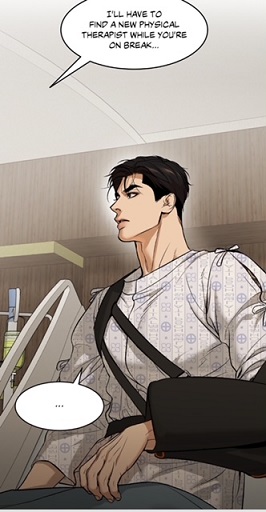 (chapter 53) Neither for the doctor nor for his “boy”.
  (chapter 52)
 (chapter 40) Though he lacked awareness in the States, for he was not present in the interrogation room, he can no longer claim to be oblivious. He knows about Kim Dan’s innocence. But why didn’t he call the physical therapist then?
  (chapter 53) Notice that before leaving the penthouse, the main lead was holding the resignation in his hand. This means that the young man had not informed Park Namwook yet. This gesture exposes that Kim Dan was convinced that the manager was his boss, the master of Team Black. Nevertheless, Jinx-lovers should detect that the “hamster” left the flat during the evening. This signifies that the PT handed out his abdication the next morning, I can’t imagine that it happened during the night, for the man has a family with kids.
 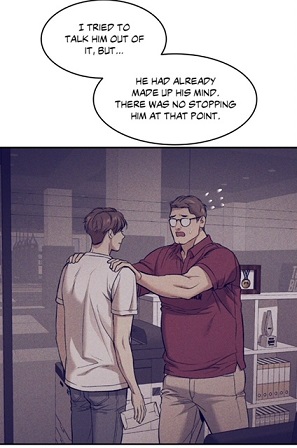 (chapter 53) By leaving the penthouse before going to the gym, it becomes clear that Park Namwook must have realized or even was informed that the doctor would no longer live with the champion, the opposite of this scene where he was caught by surprise:
 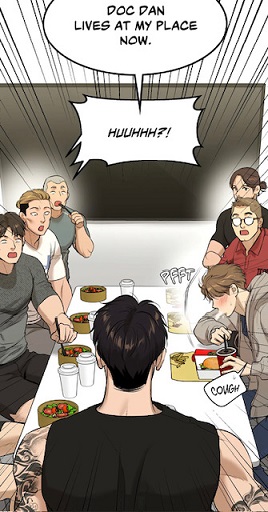 (chapter 22) That’s how I detected the second lie from the manager, lying by paltering. He just mentioned that Kim Dan was quitting, but kept silent about his departure from the penthouse. As you can see, Park Namwook was trying to reduce the main couple’s relationship to a boss-employee contract, while he was trying to act like a close acquaintance and relative from Joo Jaekyung.
  (chapter 53). This signifies that he must have spent some time at the office. To conclude, the young man didn’t vanish quickly from the gym like a ghost, similar to the PT from episode 1.
  (chapter 1) Kim Dan didn’t return to the office just to give his termination. He stayed there for quite some time. It exposes not only Kim Dan’s dedication for the athlete but also the manager’s deception. In verity, he didn’t do his best to stop him from quitting. He had time to talk to him, but chose not. He didn’t see it as an emergency. Hence there was no call! The latter symbolizes need and seriousness.
  (chapter 1)
 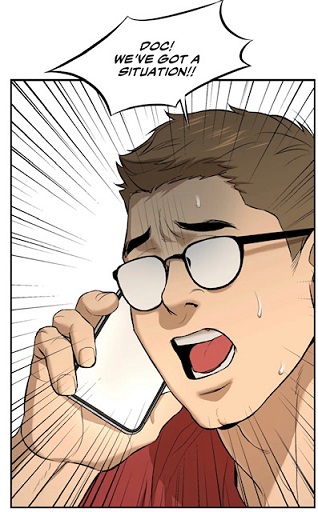 (chapter 13)
  (chapter 20) I selected only three scenes in order to prove my point, but I could give more examples (16, 17, 19, 35, 48). This new perspective corroborates my previous theory: the manager is not so innocent like he appears.
 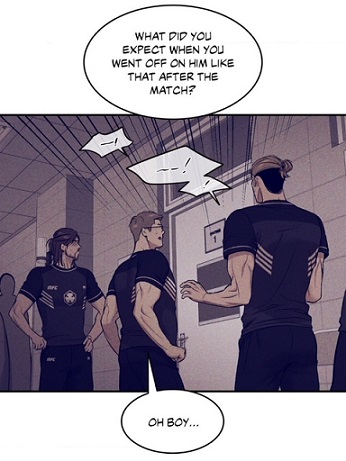 (chapter 53) He gave the impression that he was telling the truth. This incident was used to explain the doctor’s resignation. But here is the thing. If the doctor spent some time at the office in order to organize the files, why didn’t Potato stop him or tried to talk him out of it? That’s how I came to the following deduction. When Kim Dan came to the gym, the latter was empty, only the manager was there!! A new version of this scene:
  (chapter 23) Thus I deduce that all the members from Team Black were busy due to the discovery of the scheme:
 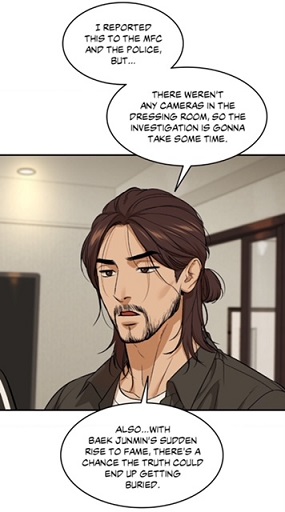 (chapter 52) Yosep was sent to investigate, Oh Daehyun took care of Potato. In other words, they were sent on errants. Moreover, I would like to outline the absence of Kwak Junbeom in the hospital room. The latter had observed the meeting between Choi Gilseok and Kim Dan
 (chapter 48), he was an important witness. Yet he is missing here.
 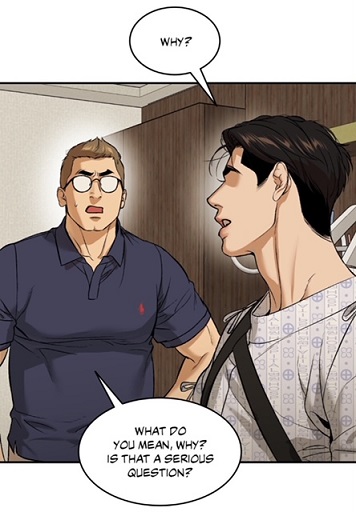 (chapter 53) Why would the physical therapist quit, if he is innocent? It is because Park Namwook said that Kim Dan did it because of the champion. It was, as if the man’s pride had been hurt:. The verity is that he was actually projecting his own thoughts onto the doctor.
  (chapter 53) He took his words to heart. Thus I come to the following deduction: Park Namwook already knew about the physical therapist’s innocence, but he chose to keep the truth from his boss to mask his own wrongdoings: his passivity and negligence. The reason is that the discovery of the scheme took place in the evening, and Kim Dan gave his letter in the morning. Moreover, some days had passed, when they showed up at the hospital. Potato’s vanishing injuries are the evidence. They waited for the right time to announce the terrible news, something similar to this:
  (chapter 48) “If we tell him now, it will only throw him off his recovery or his surgery”. Once again, he chose silence and inactivity. Thus no one called the champion or the doctor.
  (chapter 50) And what did the manager say to the protagonist?
 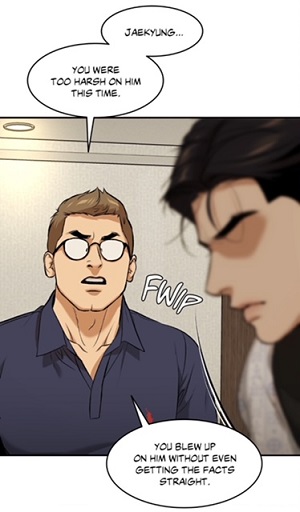 (chapter 52) He should have checked the facts. The letter is exposing the manager’s lie. He is expecting that Kim Dan vanished like the previous PT. However, contrary to the previous one, the “hamster” lived with the celebrity. Thus he left a letter to Jaekyung in the penthouse, and the manager had no way to know the existence of this message. And now, you comprehend why Kim Dan never received any phone call from Park Namwook. It is because he would have to inform him about the existence of the scheme. There was no emergency from his side, for he desired to hide his own wrongdoings (negligence, blindness and stupidity).
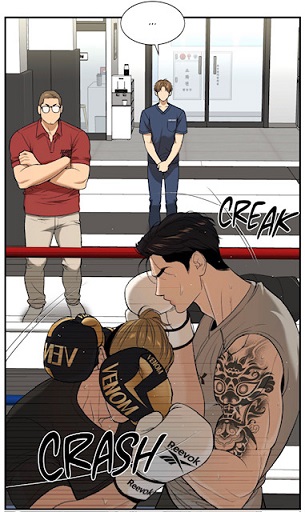 (chapter 36). No wonder why the man is passive. But his inactivity is the result of his indecisiveness (I had portrayed him as someone suffering from Decidophobia). Interesting is that making no decision is the worst people can do. Why?
 (chapter 26) Yes, the spider!! Is it a coincidence that Mingwa drew him with a grey jacket with the arachnid? The negative aspects from the spider are the following:
 (chapter 46) In addition, this new discovery corroborates my connection between chapter 52 and 40. In my eyes, Park Namwook should be perceived as a representative of MFC. I had already compared the scheme in the States to a web and a spider, indicating that MFC is far from being a good organization. As a conclusion, the manager is an accomplice of the schemers, even if he was not involved directly. The reason is simple. With his inactivity and deceptions, he is assisting the villains. However, like explained in an earlier essay, the spider is not only connected to negative aspects. It represents wisdom, patience, creativity and even rebirth. Hence it is likely that this man will change or come to regret it at some point. Contrary to the halmoni, he has time in front of him and I am counting on the champion’s huge heart (for example like forgiveness).
 (chapter 19) This comparison outlines the PT’s metamorphosis. Not only his perception of Joo Jaekyung changed, but also he has become a responsible and dedicated physical therapist. He defines himself as a PT too. Hence he didn’t leave a mess behind with the files (chapter 53). His decision exposes that this was not an escape.
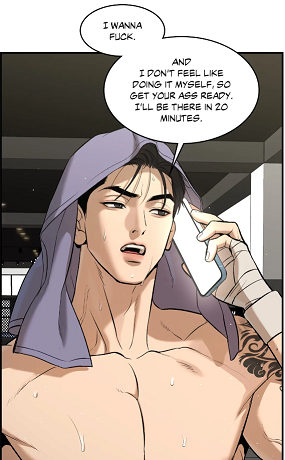 (chapter 19) Striking is that this conversation is strongly intertwined with emergency and racing against time. Back then, I had already developed the theory of the involvement of a third person in their relationship. Why would the champion think of sex suddenly after training for 10 days without any break? Jinx-philes can detect two common denominators: Break and responsibility. How so? In that chapter, Kim Dan was asked to become responsible for the “intercourse” (“I don’t feel like doing it myself, so get your ass ready”). As you can see, the contrast between these two episodes reinforces my hypothesis that the champion will be taking a break, though Park Namwook had not this in mind. The fact that he desires to hire a new PT indicates that he is already anticipating the return of Joo Jaekyung.
 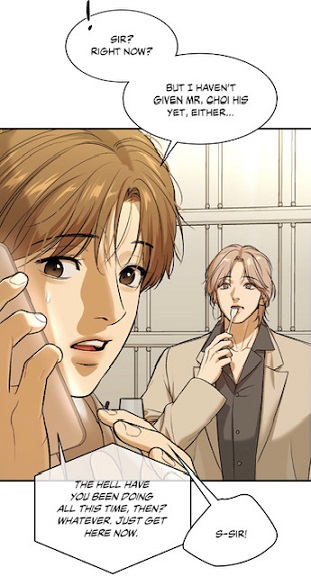 (chapter 32). Here, he prioritized his own needs and desires, he rushed things. He never took his time to understand Kim Dan or discover his life. The letter made him realize that he knows nothing about his PT. He has only noticed just now that he is reliable and honest. He is trustworthy. He even listens to him, accepts his words (he took his words to heart twice: the blame for the incident and the Wedding Cabinet). The other reason why he can not use the phone is this. He also knows that he could get blocked. This means that he will ponder how to find and approach his fated partner.
 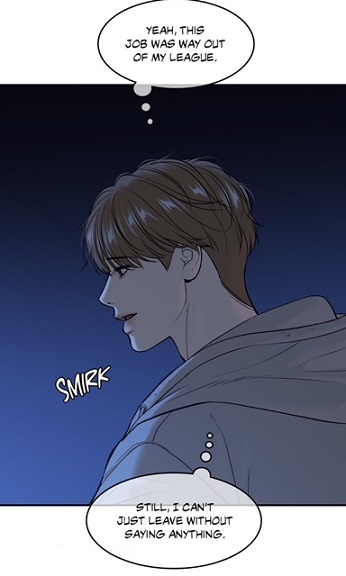 (chapter 53) It is because for Kim Dan saying goodbye over the phone is not proper. The reason is simple. He experienced it himself as a child.
  (chapter 19) And it hurt him terribly. I am suspecting that the person on the phone might have vanished without saying anything.
 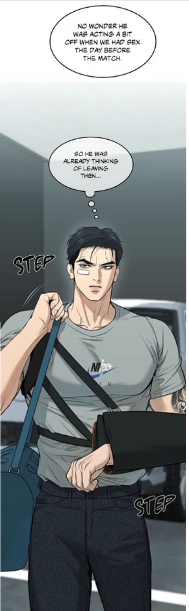 (chapter 53) He just left the hospital after a surgery and he is already carrying a heavy bag. No one is assisting him. There is no driver either. As a PT, Kim Dan can only get worried and feel bad. That’s how Kim Dan will realize that he is needed!
  (chapter 53) Even more than before!! Joo Jaekyung needs assistance and protection. From that moment on, he can grasp that his sacrifice was not the best for both of them, why his sacrifice was in reality pointless. He should have been more selfish and more confident.

 (chapter 16), especially since the latter is rather old. The grandmother could have sold it, but she never did, for the latter has a sentimental value. Consequently, I would say that she had missed her chance, and naturally her misery is the result of her own wrong choices. Under this new light, it becomes comprehensible why the grandmother portrays herself as poor who has nothing to give to her grandchild.
  (chapter 53) Her vocabulary exposes that she became a master and in her mind, the puppy dog has to follow her owner. Therefore it is no coincidence that Mingwa created such an image:
  (chapter 53) Deep down, he would like to be recognized as a competent physical therapist. Moreover, my avid readers should recall that the champion had already noticed the change of heart in the doctor before the scheme took place.
 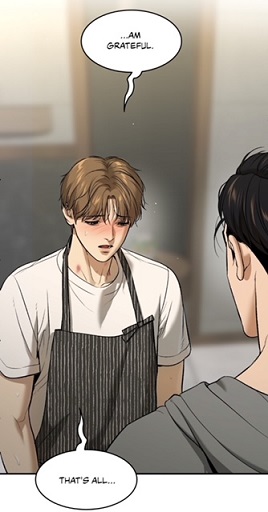 (Chapter 45) But how can he change his condition? I will give the answer below.
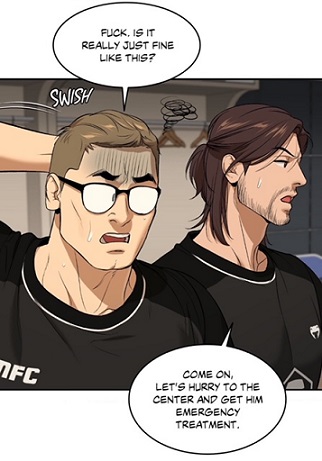 (chapter 50) Hence the last match was not cancelled in the last minute. The athlete is not fighting out of fun and passion, but out of obligation and survival. He is trapped in a world where money is everything. Thus he was always pushed to accept any challenger despite his injuries. That’s how I realized why the athlete always suspected Kim Dan of being greedy. It is because he projected his own thoughts onto his partner. However, this negative perception was definitely influenced by his “hyung”, we have the best example in episode 46. Due to Park Namwook, Joo Jaekyung was the one who was constantly thinking and talking about money in front of Kim Dan.
  (chapter 26) No wonder why he got so surprised by Kim Dan’s reaction in the locker room:
 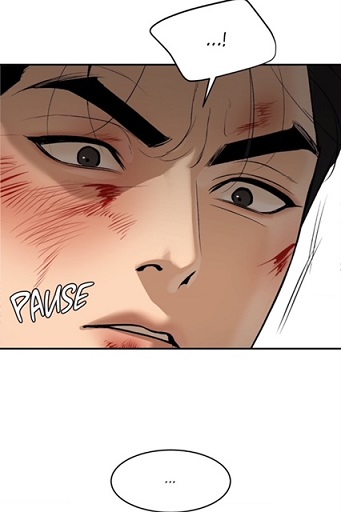 (chapter 51) He was disarmed by a single question and a shocked and disappointed face:
  (chapter 43), yet he added shortly this comment: :
 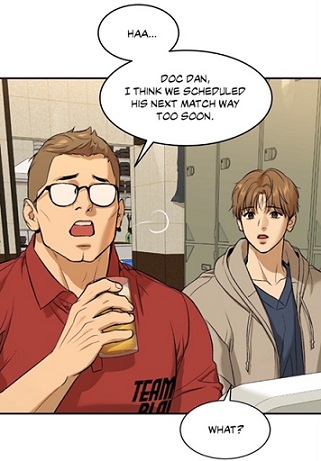 (chapter 43) The hypocrite coach utilized the personal pronoun “WE” indicating that he and his peers had played a role in the athlete’s decision. Funny is that though he complained about the schedule, he still accepted the switch of the fighter later. But he could have voiced his fears and objections. Nevertheless, he did nothing. Since I connected the halmeoni to past, I suddenly realized that the “lanista” embodies the opposite notion. He is trapped in the future, thus he is always anxious. Imagine that in that scene, they were celebrating Joo Jaekyung’s birthday, it should have been a good time. Yet, the manager kept talking about work and the future.
 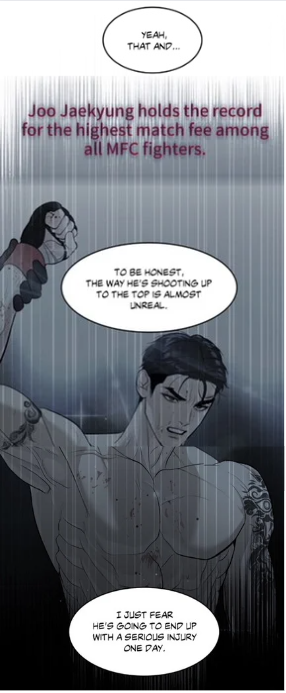 (chapter 43)
  (chapter 43) This is a sign that he was not “enjoying the present”. In my eyes, with his comments, he was actually ruining the party. Fortunately, no one paid attention to his words except the physical therapist and Yosep. By talking like that, he gives the impression that he is caring and paying attention to the fighter. Yet this is just an illusion, for he is not focused on the present. He neglected his duties, therefore the schemers were able to bring drugs to the champion’s rooms.
 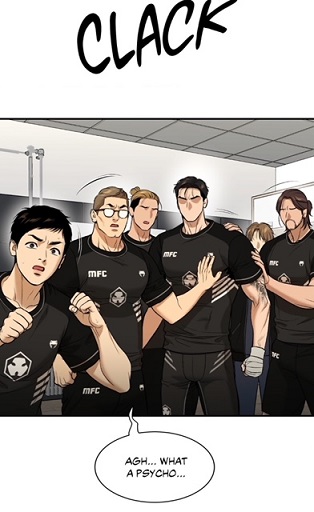 (chapter 49) Notice that he was afraid of an outburst from Joo Jaekyung in the locker room, therefore they were restraining him. This was no real protection. I am suspecting that the manager is trusting MFC and its organization. In addition, his obsession with the future explains why the athlete’s mental health has been neglected by the coach and manager. As a conclusion, Park Namwook is himself trapped in his own world: money, fear of the future and the champion‘s retirement which means the end of his own career as manager and coach. Therefore he is pushing his fighter to race against time. It is only a matter until his boy gets injured!!
 (chapter 36) money, social media, the agency, the lawyer, Park Namwook and Jeong Yosep. For the first time, Joo Jaekyung can think of something else other than work. Nevertheless, the athlete had not realized it yet. Striking is that the longer the fighter thought about the PT’s resignation, the longer he came to object to it.
 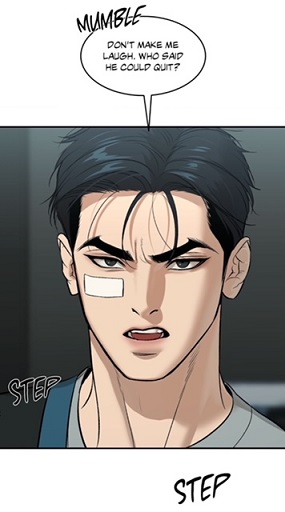 (chapter 53) This means that the fighter was acknowledging the “uke” as an important member of Team Black. In addition, he was recognizing Kim Dan’s effort and talent as PT. Moreover, it exposes the absence of change in Joo Jaekyung’s mentality. He was still “thinking” of work and fighting. It displays that the protagonist had not realized the true signification of his suspension yet. Hence the doctor’s departure was necessary. Joo Jaekyung is forced to think about his fated partner, making him forget his work and his career. His “obsession” with Kim Dan will push him to stop being a workaholic. But there is more to it.
 (chapter 21) to this
 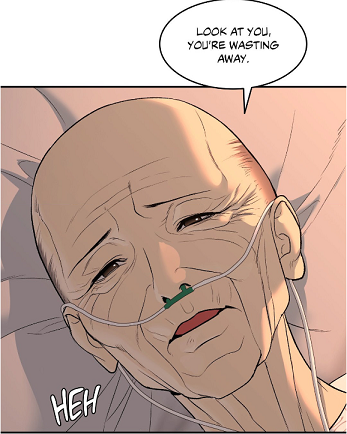 (chapter 47) Money is powerless in front of death and terrible injuries. Therefore he is lucky that his shoulder is not ruined forever. Moreover a trip represents a good metaphor for an escape, a travel is a synonym for freedom and the end of “routine”.
 (chapter 35). However, since he didn’t spend much time in his own home, he never took the time to take care of his soulmate. By leaving the city and Team Black behind, he would become truly alone (as opposition to his trips to Busan, the States) which would give him an opportunity to become more honest to himself and to Kim Dan.
 (chapter 1). Nonetheless, his words sounded more negative due to the usage of negation. Moreover, Kim Dan was too scared to take his words seriously. Consequently, it becomes obvious that Kim Dan needs to hear praises from the athlete himself. It is not just about an apology about his misjudgment, the “hamster” needs to hear from his own patient that he trusts him and his hands. Thus he wants to be needed:
  or like this:
  (chapter 22)
 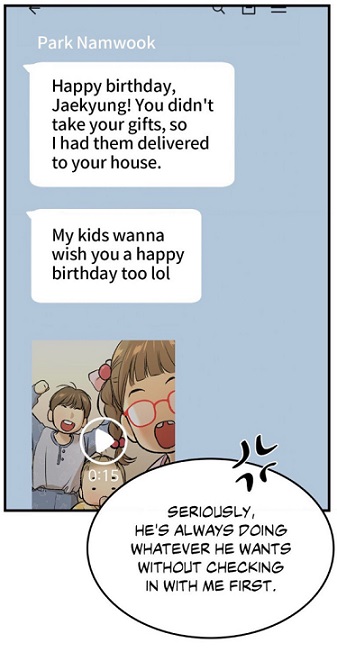 (chapter 45) so much and preferred organizing a charity event for his birthday .
  (chapter 41) The fact that the athlete organized a charity event for his birthday exposes not only his huge heart, but also that he had long recognized the power of generosity. Under this new light, it becomes comprehensible why the champion was willing to pay off the doctor’s debts.
  (chapter 18) Here, he hoped to see gratitude on his fated partner’s face, but it didn’t happen like he imagined. Yet, notice that despite their argument, Joo Jaekyung proposed to the main lead to live with him in the penthouse:
 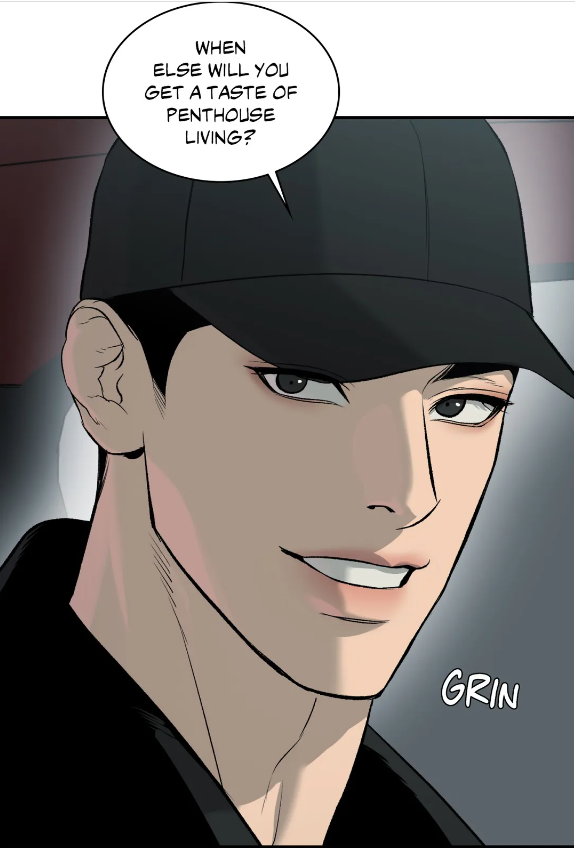 (chapter 18) His facial expression is exposing his true thoughts. He was definitely happy to help the doctor. The reason is simple. He is in control of his heart and life. This shows that deep down, the man has always had a soft heart and could find fulfillment in giving. However, the problem is that the champion had also internalized that there is nothing free in this world. Due to his past experiences, he realized that receivers would exploite his goodness. The green-haired guy was the perfect example.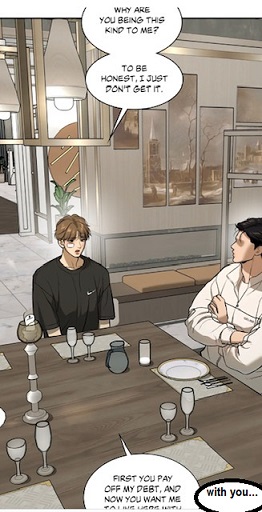
 (chapter 18) He had to, because the man was now living with him. Joo Jaekyung feared that his roommate could come to take advantage of his new position and even consider this place as his own. As you can see, the champion had long discovered the power of giving to others. Yet his problem was that he couldn’t live out this principle: he was either exploited or he has no family or close friend so far.
 (chapter 30) They both desire to be acknowledged and appreciated.
  (chapter 45) With this image, it was, as if Kim Dan wanted to be distinguished from all the stans. Yes, I do think that this has something to do their own negative feelings. However, there is a difference between Choi Heesung and Kim Dan. Note that the gifts are related to his sponsors and the agency. They were related to his work. Moreover, the gumiho rarely gave the meals or the presents personally.
  (chapter 31)
  (chapter 36) However, my avid readers should ponder on the following aspect: how did he buy the jackets and the junk food?
 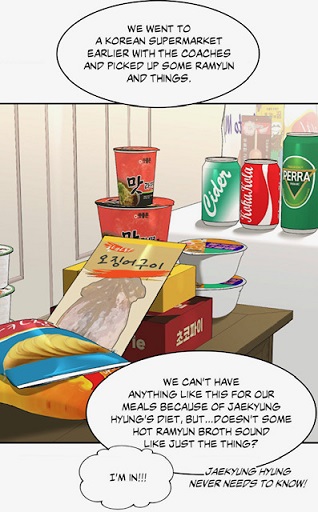 (Chapter 37) This last scene is terrible, for this purchase happened behind the boss’ back. Naturally, everything was bought with the company card!! In other words, Park Namwook’s generosity is fake, for he is not spending his own money. After this new realization, I started wondering if the athlete’s negative attitude towards Kim Dan is not the consequence of Park Namwook’s behavior as well who takes it for granted to spend money on the athlete’s account. Why did the champion anticipate an expectation from Kim Dan, when he received the keychain?
  (Chapter 45) It is because his relationship with his coach has always been based on „conditional love and expectations“. Don’t forget that the coach was particularly nice to the athlete after winning his match in Busan. He was willing to be his „servant“ in that moment. Furthermore, there exists another evidence that in episode 45 the fighter latched out on the doctor because of his unresolved feelings towards his hyung.
  (chapter 41) This frenzy was portrayed as something positive. Jinxworms can observe that the manager is mentioning the existence of „favors“. For me, it is no coincidence that in episode 45, the arrival from presents coming from his hyung coincides with the present with Kim Dan. It shows the underlying conflict between the celebrity and the former wrestler. Nevertheless, the fighter has not grasped it yet. So far, Joo Jaekyung has not tried to defy Park Namwook openly, to claim his place as the true owner of Team Black. We should see his words here as a first attempt to act as the boss
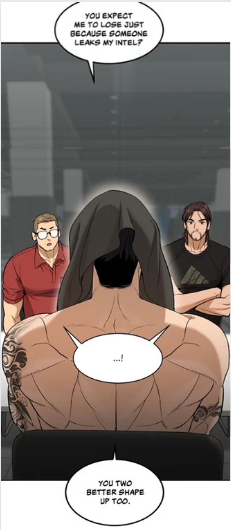 (Chapter 46) The tension reached its peak in that scene:
  That’s where the generosity from Park Namwook comes from: he gives his punches to Joo Jaekyung and takes Joo Jaekyung‘s company for granted. And now, you comprehend why I selected such a title for this essay.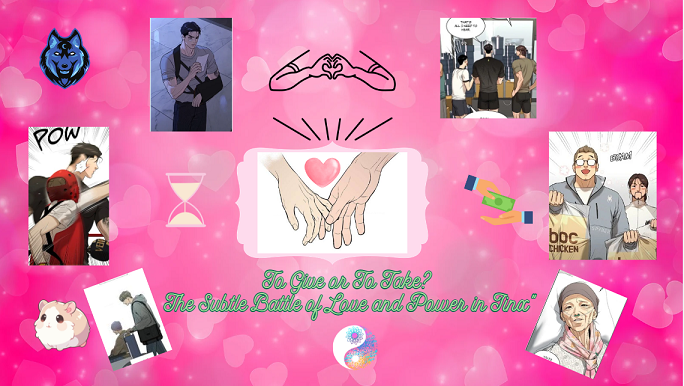
 (Chapter 26) The sparring in episode 26 represents the positive version of giving a punch and taking it. The fighter was not upset about his defeat, moreover he was acting like a real teacher asking the physical therapist to overcome his own fears. On the hand, the slap at the hospital embodies the opposite notions: resent, no real teaching, no reflection, no listening, the one slapping is not overcoming his own fears and vents his anger. The give and take in episode 26 was happiness, true generosity, self-awareness, while this slap displays misery, anger, ignorance:
 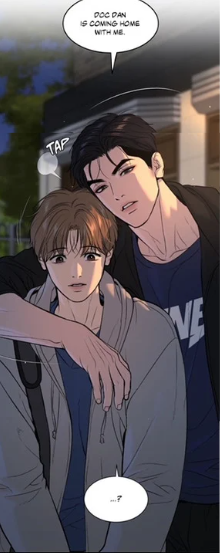 (chapter 43) He needed to seclude him from the others. But where does this possessiveness come from? In my opinion, it is not just the result of his own insecurities, but also the influence of the bad role model he had: Park Namwook. First, only in chapter 45, the manager sent congratulations from his family:
  (chapter 22) This scene at the hospital displays that the fighter had been mirroring the behavior of his counterpart: Shin Okja is sweet and kind. And who is moody, yelling, brutal ? Park Namwook:
  (chapter 43)
 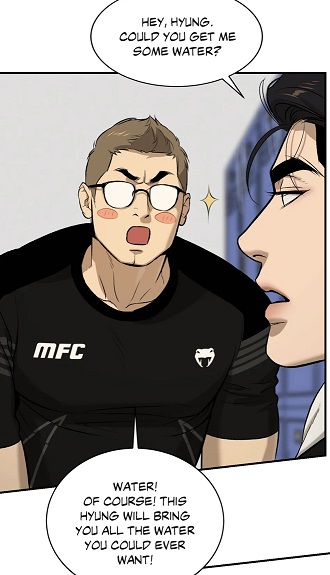 (chapter 15), but as soon as his idol lost his title and got even suspended, he yelled and slapped his fighter:
 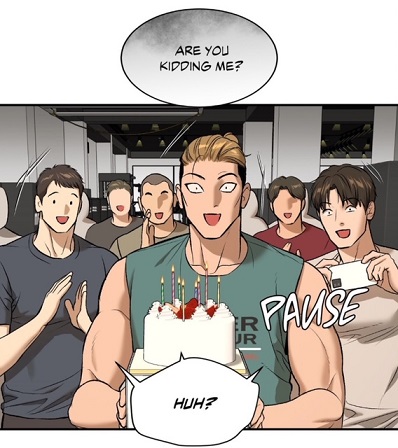 (chapter 43) This exposes his lack of engagement and indifference in the end, but this becomes even more obvious during the night:
  (chapter 43) Where was he, when his star was drunk? It was, as though he had vanished.
 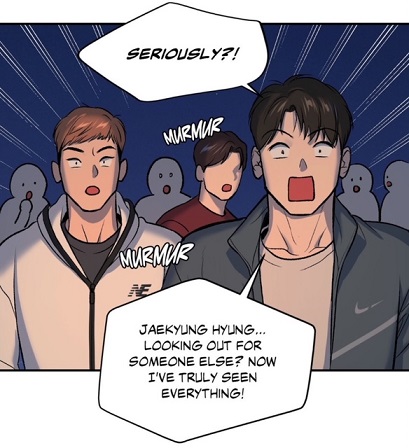 (chapter 43) But the best evidence for this interpretation is this image:
 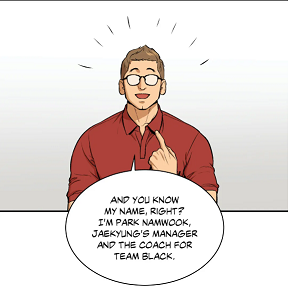 (chapter 9) However, he never presented himself as a father or a husband. It was, as if his children or wife were not a source of his happiness. Why? It is because they don’t bring money, but rather cost money. Thanks to Joo Jaekyung’s popularity, the manager could stand in the spotlight
 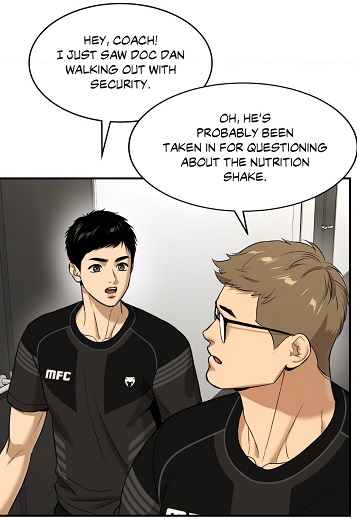 (chapter 40) in the States and even at the gym?
  (Chapter 43) It is because he doesn’t view the uke as a possession contrary to his „boy“. Why? It is because the young man doesn’t bring money or contribute to boast the manager’s self-esteem. In fact, Kim Dan is an expensive PT and the manager is aware of his high salary. Moreover, contrary to the hamster, Park Namwook was never seen in the penthouse, and the celebrity refused to invite the members. This is a clue that the champion could have refused to invite his coach there. The doctor’s stay at the penthouse is something Park Namwook discovered by accident.
  (chapter 41) In his eyes, possessions and money determine someone’s values. Hence he bought an expensive keychain for his fated partner. Furthermore, I have been wondering if this spending is not related to Shin Okja, the latter could have been a spendthrift. In the essay „
 (Chapter 19). Another possibility is that she made sure that her grandchild would spend money on her:
 (chapter 22) after the departure of Joo Jaekyung, but notice how the halmeoni thanked the benefactor:
 (chapter 21) One might argue that the poor woman couldn’t do much to express her gratitude. However, this is just a deception. Shin Okja could have written a letter to express her gratitude to Joo Jaekyung. Why do you think Mingwa created two scenes with a letter or card?
  (chapter 53) The comparison lets transpire the importance of words. The champion might have judged the keychain differently, if he had read the card. But he didn’t. Another parallel between these two scenes is the rejection of a gift! However, in the final episode, Kim Dan voiced genuine gratitude towards his benefactor. The latter had allowed him to work as his PT. With the letter, he could voice his thoughts and emotions much better. And now, you realize that Shin Okja could have acted the same way. This made me realize that deep down, she resents being poor. She likes Dan spending money on her.
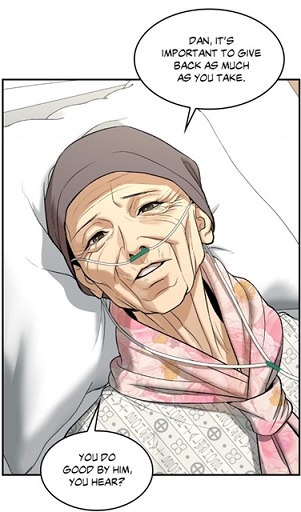 (chapter 41). He should treat the sportsman nicely (“do good”). Kim Dan is the one who should be indebted to Joo Jaekyung. However, observe what she said in front of her grandchild before: she was the one who was grateful to the main lead, and not Kim Dan!!
 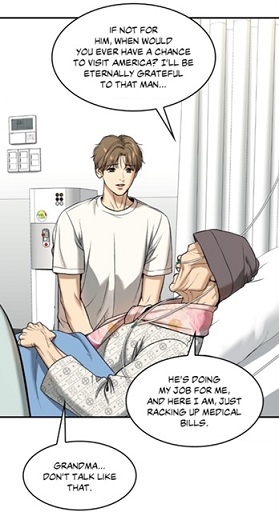 (chapter 41) She should have been the one who expressed her gratitude to Joo Jaekyung, but not Kim Dan for the trip (it was work related anyway). One might argue that the poor woman is trapped in the hospital, she can not do much. But you are wrong. She could have written a letter to her benefactor which means that she would have sacrificed some of her time for the athlete. Imagine that she had sent a message to the athlete, the latter might have decided to pay a visit to her. He is not truly heartless. With this silence, she created the impression that his assistance had changed her situation.
 (chapter 22)
  (chapter 1) In other words, he was not passionate about his profession. This means that he didn’t define himself as PT due to his lack of engagement and low self-esteem. Besides, let’s not forget that he judges people based on their social status and seniority. I would even add, the main lead had not recognized the existence of his own skills (knowledge, genuineness and dedication). But by working for Joo Jaekyung, he came to enjoy his job. This explicates why he kept buying books.
 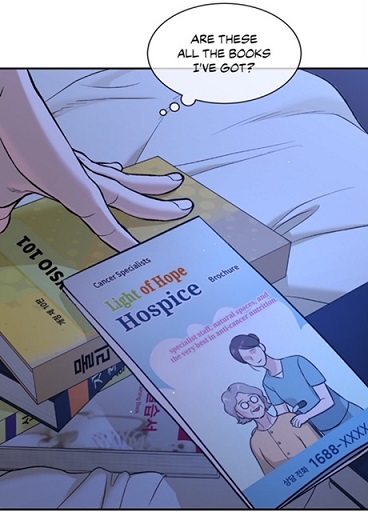 (chapter 53) He likes not only his job now, but also learning as such. This is no coincidence that education in the mode of “being” means that the focus is on learning and developing skills. Hence I still see a change in the hamster at the end of season 1:
 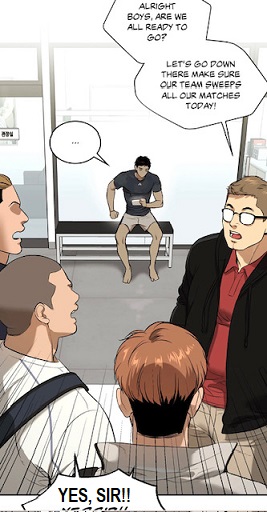 (chapter 23) Then he only focused on the “outcome” and not on the process. Hence he neglected them, delegated his task on the pressured athlete. The latter had to train them:
  (chapter 25) and
 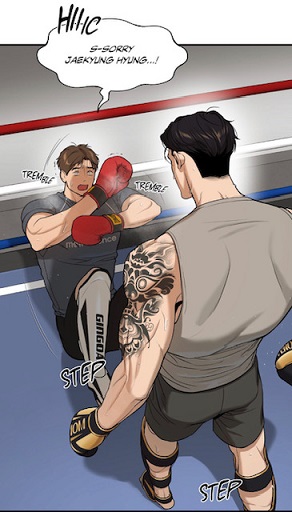 (chapter 36) In my eyes, he didn’t want to play the bad guy. The meeting or his worries were more important
 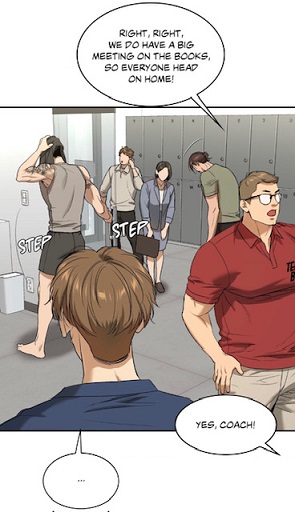 (chapter 36) than their training and career. Moreover, he kept bribing them with junk food
 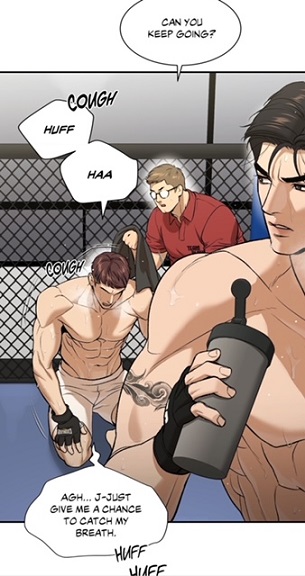 (chapter 46) The latter was a new source of income and fame. Everything was revolving around money. That’s how it dawned on me why the manager got angry for the bet in episode 26:
  (chapter 26) We shouldn’t judge his words as a verity, he was just using the doctor as a false excuse. The reality is that the sparring had brought no money at all! This fight was strongly intertwined with fun. The notion of „entertaining“ stands in opposition to money. Fun means feeling emotions and being to true one’s self. In other words, Kim Dan stands for a different notion of MMA fighting: the sportsmen shouldn’t work for money, but for fun. They are artists too. This signifies that as time passed on, the members of Team Black lost their passion for fighting
 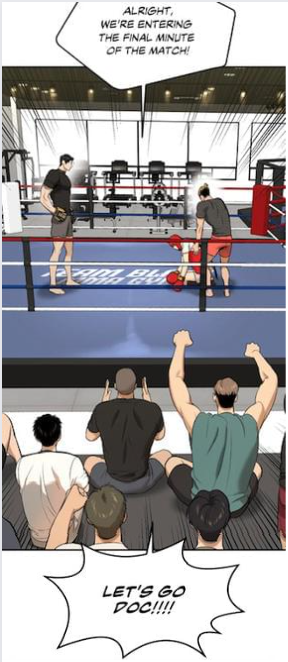 (chapter 26) and became more obsessed with possessions and fame. Potato and the remaining members represent the exceptions. They enjoyed the lessons despite the pain and struggles. The other members became dependent on external tools which led them to lose their integrity. To conclude, the reason for their disloyalty is that at the end, they had long internalized the mode of having and were just interested in getting successful.
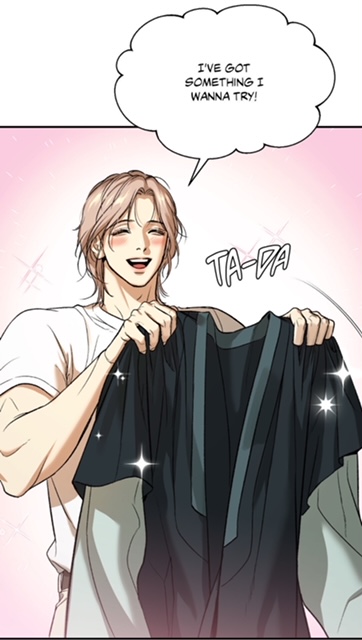 (special episode2 ), but also Cheolmin
  (chapter 48) are full of greedy people who have no problems to commit crimes in order to achieve their goals (more fame, more wealth, revenge, more connections). Baek Junmin became a champion by cheating.
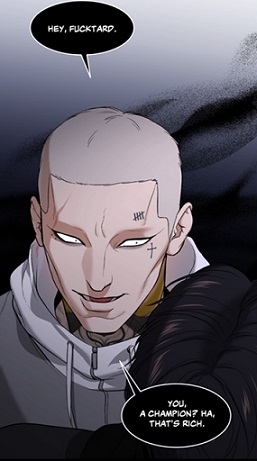 (Chapter 49) Thus he thought, the athlete had earned his title the same way. His fights were rigged, yet the verity is that the idol worked hard to achieve this level. The irony is that The Gunshot experienced much too late that his assumption was wrong.
 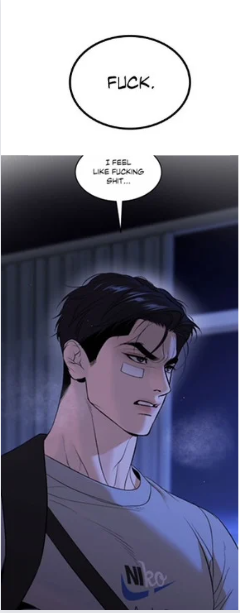 (chapter 53) He is standing at a crossroad. What does he truly want in life? Fame? More money? Or happiness and as such love and fun?

 (chapter 35) Because he is famous and wealthy, he is expecting a similar reaction from the chow-chow. At some point, he will appear too clingy, hence he will perceive his relationship as burdensome. This is no longer fun.
 (special episode 1) With his words, the sportsman implied that he had taken advantage of the actor, while in reality the opposite had happened. Heesung had taken advantage of Potato’s drunkenness
  (special episode 1), ignorance and purity
 (special episode 1).The confession of Yoon-Gu’s wrongdoing could only shock the actor.
  (special episode 1) How did Yoon-Gu come to this reasoning, when he admitted in the same breath that he was drunk? It is because the night before, Heesung had confided that he was heartbroken due to Kim Dan’s rejection.
  (chapter 35) With his behavior, the fox gave the impression that his affection for Kim Dan was running deep. Under the tent, he was drowning his sorrow with soju. Hence in the maknae’s mind, Heesung was still in love with the physical therapist. Yes, the irony is that the chow-chow was also projecting his own thoughts onto the comedian. Let’s not forget that when the young fighter discovered the true nature of the relationship between the doctor and the emperor, he didn’t give up on his admiration and affection for Joo Jaekyung.
  (chapter 35) His description for a partner and as such love doesn’t correspond to the definition of true love: care, respect, knowledge and responsibility (Definition from Erich Fromm, for more read “
 (chapter 32) He didn’t try to protect him from the athlete’s fury. He never clearly stated his true desire, he wished to date the doctor, until he was cornered (threatened).
 (chapter 45). This means when the MMA amateur fighter decided to become responsible and as such to make up for his mistake,
  (special episode 2) However, he is not entirely powerless, like I mentioned in the first part. He is not forced to admit that he had fun after the intercourse.
  (special episode 2) In other words, he is not obliged to say YES either! It is funny because thanks to this examination, I realized that Yes and No have “become” like taboo words. Yoon-Gu is avoiding these idioms by using the expression “I don’t know”. Hence I am suspecting that Heesung will become obsessed with the word “yes”! 😂 Only Heesung can procure him fun and pleasure, and no one else. He is getting disarmed by the sentence “I don’t know”.
 (special episode 2) He was attempting to hide his growing affection for the comedian. He feared that his feelings for him could become a burden for the comedian. In his eyes, Heesung should remain faithful to the physical therapist. He shouldn’t expect any affection from the actor either.
 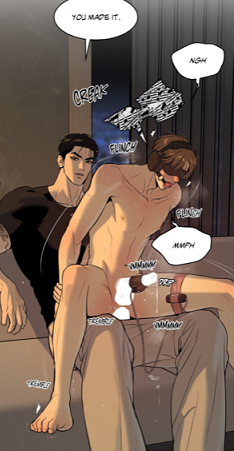 (chapter 34) In this scene, the physical therapist looked like attached to his owner. In the first part of “Passions in Purple: Jealousy and Joy”, I made the following prediction. Heesung would order a sex toy
  (special episode 2) out of annoyance and jealousy
 (special episode 2), for Potato had run away from him. He needs to put him on a leash to feel in control, to obtain his chow chow’s attention. Naturally, there is no guarantee that this prediction is correct. Yet since according to my examination, Potato is thinking that Heesung is in love, it signifies that Heesung is already attached to Kim Dan. Hence he won’t do anything to ruin this attachment… therefore Heesung can only be put in front of a dilemma. How can he make Potato look at him? He could reveal the truth to Yoon-Gu, but by doing so, he would ruin his image as a good and caring guy. Moreover, since he has lived for a long time deceiving himself and others, it is very unlikely that the actor might change his behavior so suddenly. Old habits are hard to die. Therefore for me, honesty won’t be his initial choice, rather acting. He will express his thoughts and emotions behind a new role-play and sex.
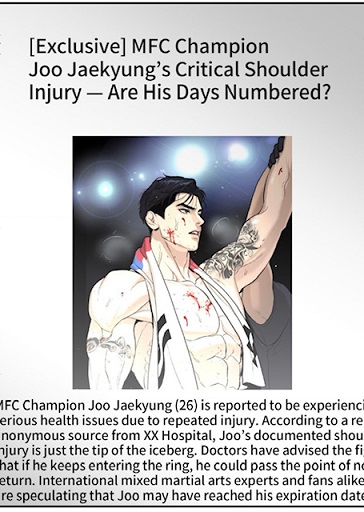 (chapter 35)
 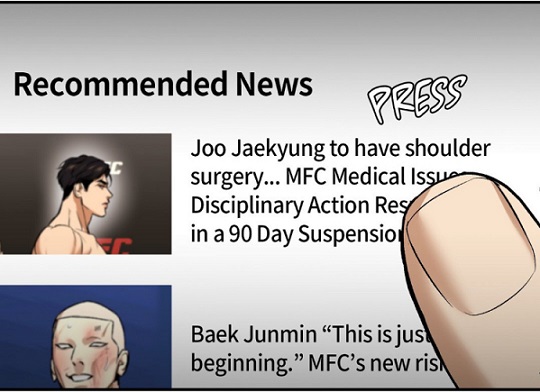 (chapter 52), the enemies, in particular Baek Junmin wrong. Even if he is injured or ends his career as MMA fighter, his life is not over. He is strong, talented and trustworthy, because Yoon-Gu chose to trust him and his career. He is no thug or spoiled child, as despite his injury, he “assisted” someone to become a new fighter.
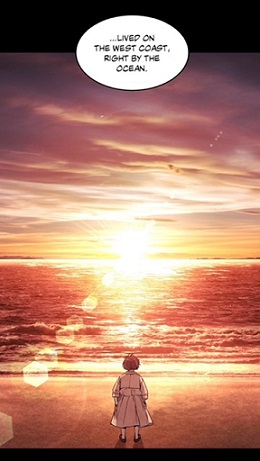 (chapter 53). In this scene, the halmoni was shown as a young child, just before she left this region. Her departure announces the future loss of her innocence. This explicates why she desires to return to her roots. It was, as though she was trying to escape her fate. Moreover, by reconnecting to her childhood, she is actually denying the existence of her grandchild. It was, as if she was trying to erase the time between her departure and return. On the other hand, this scene announces her imminent death as well… it was, as if she wanted to be swallowed by nature (sea, sun). And death is strongly connected to birth. No one can die, if they were not “born” before. Hence I am suspecting that the birth of a new star, the Bantam Fighter Yoon-Gu, is associated with the halmoni’s vanishing. Finally, any reader can notice the two main colors in this image: yellow and red!! And you know that Potato’s colors are yellow and red. From my point of view, Potato is destined to go to the West Coast and naturally Heesung will follow him there. He has to because of the saying “Out Of Sight, Out Of Mind”. Let’s not forget that Heesung treated Kim Dan that way. As soon as he stopped seeing the doctor, he stopped thinking about him. He could fear to lose his soulmate, as the latter forgets him. The gumiho’s fate is to be the “clingy one”.
 There, I included two gemstones, the Bloodstone and the Aquamarine! Choi Heesung, born on 21st March, is represented by these birthstones! In this composition
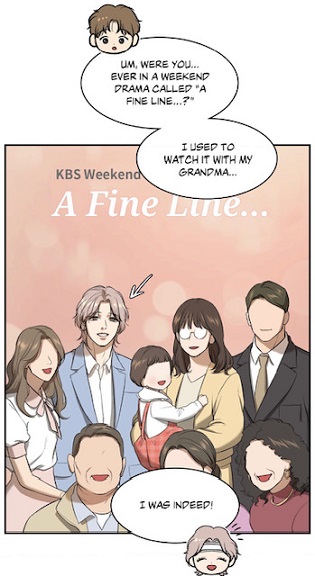 (chapter 30) And what was he wearing in the poster? A blue pale suit which is close to Aquamarine and even to light purple ! The color is no coincidence. I have the impression that thanks to the weak woman, Heesung will become a part of the “new family”. If you look at the sunset again, you will detect glimpses of purple in the sky. As for the second image which came to my mind is this: the actor swimming in the ocean. When the bloodstone is put in water, it changes the color of the sun: red for love. Yes, we should expect a new version of this scene:
 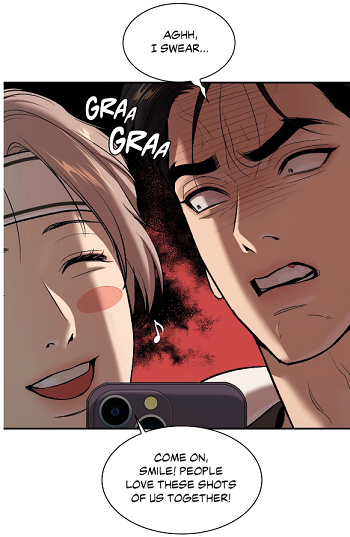 (chapter 30) After getting enlightened, he would know what he truly desires. He would have no interest to get on the champion’s nerves. Potato would be the one bringing him happiness and novelty. Athletes and those seeking to enhance physical endurance often turn to bloodstone for its reputed ability to increase stamina and energy. This signifies that thanks to Heesung’s presence, the champion’s training won’t appear as a torture. Yes, expect a new version of this scene:
  (chapter 37) Here each fighter was on his own, they were not really training together. The champion was the leader due to his imminent match, he put the others under pressure, as he was himself stressed. But with his suspension, he is no longer racing against time. In other words, the training routine should be different. They will help each other, encouraging each other to become better. The presence of Heesung should help them to see the training under a different light. But for that, he has to reconnect to his true nature: bloodstone and aquamarine.
 (chapter 37) or the switch of medicine. Unfortunately, the gumiho was not present both times, hence Kim Dan and Joo Jaekyung became the targets of revenge. On the other hand, the author stated that in season 2, the focus would be more on emotions, which means that there shouldn’t be many plot. Nevertheless, my avid readers should keep in mind my previous interpretation about the “beautiful” Kim Miseon
 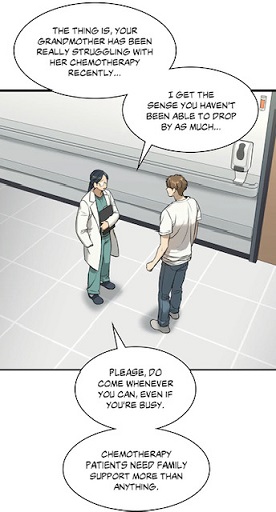 (chapter 21) I had criticized her on many occasions, like disculssing a case in a hallway. Before, she had proposed an expensive treatment, well aware of the grandmother’s age and her weak condition. Moreover, I had suspected her to have leaked information to the director Choi Gilseok. Thus I hope that season 2 will expose her misdeeds and the corruption of the medical world. This was already present in episode 1. But let’s return our attention to the gemstone and its symbolism. In medieval Europe, the stone was deeply linked to the crucifixion of Jesus Christ, believed to have formed when drops of His blood fell to the earth. As you can see, the gumiho is strongly connected to selflessness, sacrifice, death and rebirth. This reinforces my expectation that his encounter with the grandmother will have a huge impact in his life, like for example the “neglect and indifference from his parents”. Exactly like the other main characters, he has abandonment issues. Bloodstone is commonly associated with the root chakra, which governs grounding, stability, and physical well-being.
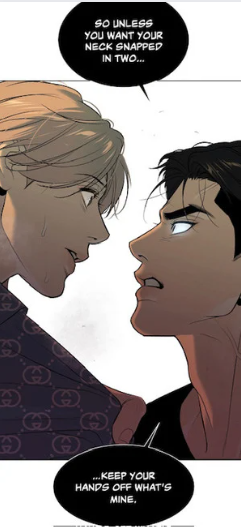 (chapter 34) Here, he forced the champion to claim the doctor as his possession. However, in season 1, the main lead came to regret his actions (34, 43), for he has never been honest to himself. And now, it is time to focus on the second gemstone.
 (chapter 31) They were green. He is attracted to “green”, his origin self. Nevertheless, in episode 31, this was rather a khaki version due to his corruption. No wonder why he played a trick on the champion. And this observation brings me back to the doctor’s clothes. What was he wearing, when he was young?
  (special episode 1) Since the elderly woman confided to Joo Jaekyung, we can assume that she could do the same with the gumiho, as soon as she sees her idol. It is important, because he could grasp the physical therapist’s suffering and low self-esteem.

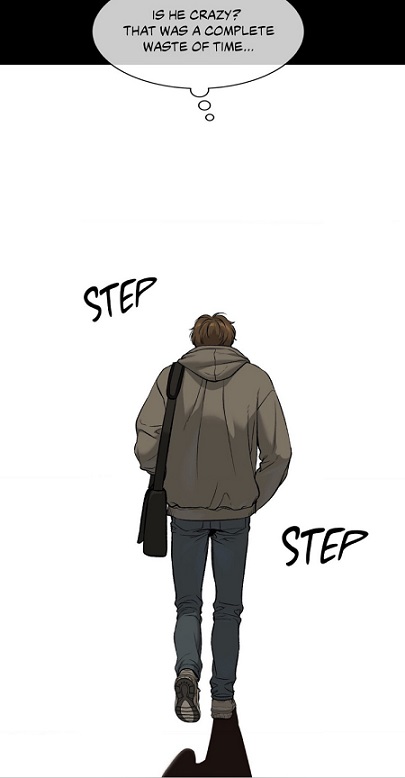

 (chapter 48), but the actor would be replacing the fake director. We had a sunset here, dark water (the coffee), the symbol for corruption. Then notice that he is wearing a blue t-shirt (but two colors, a symbol of his hypocrisy)!! This reinforces my expectation that we should witness the actor’s awakening, the exact opposite of the other Choi, who chose revenge and manipulations. But there is more to it. Thanks to the comment of @Milliformemes24, I had another revelation. The latter wrote that places of knowledge and self-awareness are related not only to the ocean, but also to the mountains. It is normal, as the hill is closer to the sky and as such closer to the gods. Notice that Heesung’s new home is situated on the top of a hill, surrounded by a forest.
  In other words, Heesung could get enlightened on a mountain too, during a stroll for example. And the moment I read this from my friend, this image came to my mind:
  (chapter 41) The huge tree at the hospital!! The latter is even strongly connected to a stroll. In that scene, the doctor thought of his lover, as he associated him with the sun.
  (chapter 41) That’s the moment when he realized his feelings for the fighter. As you can see, Mingwa used the tree and as such nature as a source to spirituality. And now let me ask you this question. Since the story is written with reflections, the tree should have appeared before and after. Where was it then? First, the first plant to appear was the bouquet. The roses from Heesung
  (chapter 31) could be seen a mirror of the tree. The roses encourage the doctor to ponder and show an interest in his employer.
 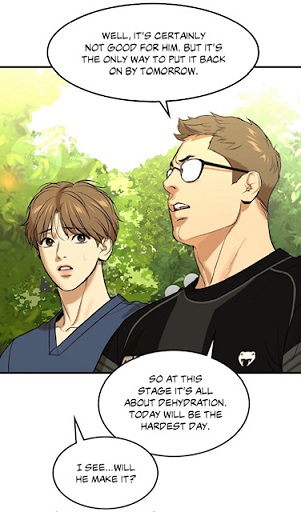 (chapter 37) However, the first time, the tree appeared as such was in the States, and this on two occasions:
  (special episode 2) Yes, the barn!! The tree had been transformed into a home. However, don’t forget that this was just a fantasy from Heesung. However, during this intercourse, he came to expose his jealousy and growing attachment towards his soulmate. Yes, the last two mentioned scenes have two common denominators: a mixture of fantasy and Enlightenment. Nature is strongly intertwined with meditation and communication. To conclude, we should expect the presence of woods and trees in season 2 as well. And this hypothesis got reinforced, when Mingwa released this image on X:
  We have a sunset, a palm tree and purple in the sky… Joo Jaekyung is wearing a similar shirt than Heesung:
  (chapter 34) I consider this as an allusion that the actor will be by the fighter’s side. On the other hand, since the shirt is open, I interpret as the star’s emancipation. The latter has been able to escape from his mental prison and suffering. In his cage, he was racing against time. Now, he is able to relax and enjoy time. At the same time, since the champion in the image from X is seen wearing rings with stones, it somehow confirmed my interpretation about the role of birthstones in Jinx.
 (special episode 2). This pigment is a combination of blue and red/pink. And now pay attention to the last panel. Potato is blushing while wearing dark-green clothes, his lover is standing in front of the blue sky and his skin is rather pale. His hanbok has purple and white shades. As you can see, this wonderful night represents their union: white meets black, blue meets red and yellow (hence purple and green). The light from outside contrasts to the darkness of the shelter. That’s how purple came to shine. On the other hand, since Heesung is acting as the master, and the maknae is relegated to the role of a male servant, the actor is exposing his inner darkness. He is longing for dominance and possession.
  (special episode 2) To conclude, Heesung is gradually showing his true colors: the hidden black spot behind his perfect white skin. However, dark shouldn’t be reduced to evil, for in Taoism, black has another signification. It represents yin, the feminine energy. This means that thanks to that night, Heesung could display his motherly and caring side. Therefore he kissed, hugged Yoon-Gu and stroke his cheek. But this doesn’t end here. After the intercourse, he caressed his lover’s head.
  (special episode 2) The young fighter and his lover are slowly discovering the existence of a double life (public/professional versus private life). This signifies that Potato is learning to distinguish between image (hero) and reality. In fact, he only knows the MMA fighter Joo Jaekyung and not the private man with his troubled past. As for the actor, with his blog
  (chapter 30), pictures and sponsoring
  (chapter 31) he never drew a line between his private and professional life either. He acted, as though he had no secret. That’s the reason why his manager knew about his tragic love life. This explicates as well why he used the “deal” with Park Namwook to go on a date with Kim Dan.
  (chapter 32) The gumiho never felt the need to hide his sexual orientation, it was never a taboo. It indicates that he felt safe among his colleagues and agency. Therefore the manager could talk so freely about his love life in front of others.
  (chapter 30) There was no secrecy and privacy. Manhwaphiles should keep in their mind that homosexuality in MMA world and boxing is a huge taboo. So if Potato’s homosexuality were to be exposed to the netizens, this could ruin his career. This is also valid for Joo Jaekyung. Other fighters could question their manhood. And this brings me back to that night. Purple is strongly connected to yin and as such to the moon, like you can detect in the illustrations below.

 (chapter 20) the main pigments were yellow, rosa, red and orange, whereas on the bed, the roles and topics were switched. Kim Dan’s feminine side was the dominant one. His motherly and caring instincts were so strong that he had no problem to challenge his sex partner.
 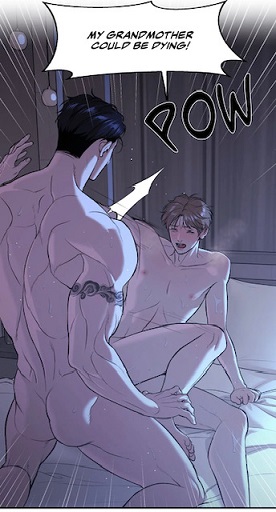 (chapter 21) Here, black and purple were the dominant pigments, similar to the sex scene from the special episode. The moon stands for softness, quietness, but also mystery and receptiveness. And during the night of episode 21, the doctor taught to Joo Jaekyung the importance of family. Besides, the athlete discovered a secret from the physical therapist. Though the former was pushed away, he didn’t react violently. Joo Jaekyung remained passive. This was the influence of Kim Dan’s yin.
 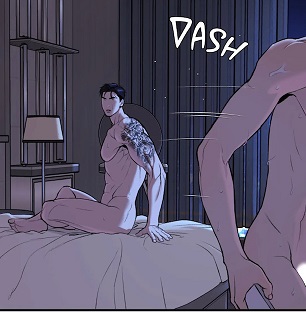 (chapter 21) And the next morning, the emperor chose to show his motherly and caring side to Kim Dan and the halmeoni.
  (chapter 21)
 (special episode 2) Potato is literally glowing, while the other is just wearing a purple hanbok (disguise). One might wonder why. The answer is simple. Potato stands for innocence, reflection and ignorance. Contrary to his new role model (Kim Dan), he has no real prejudices against sex. He doesn’t view it as dirty. This explicates why Potato is always surprised by his own pleasure and always claims his ignorance.
 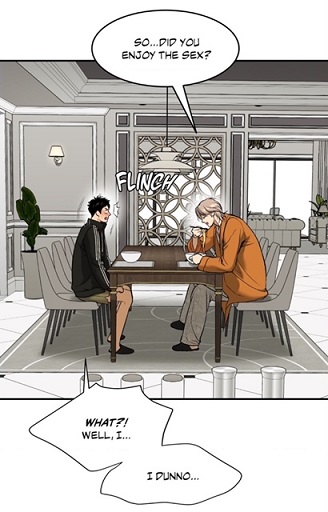 (special episode 1)
  (special episode 2) That’s why the actor was glowing like a star after their passionate role-play. The presence of “stars” indicates his excitement and joy. His heart is racing, hence he is full of joy and feels rejuvenated. Moreover, the Webtoonist already implied the link between Potato and purple in the following scenes:
  (chapter 23) Don’t forget that his family name is Hwang which means yellow in Chinese. That’s the reason why I don’t think, the purple towel is random. One might argue that the towel belongs to the gym, and they got changed later:
  (chapter 36) Park Namwook selected black towels, a sign that he was taking over the gym. But the purple towel announces the moment, where the doctor and Potato gets closer to each other.
  (chapter 23) For the first time, the young fighter showed a certain curiosity towards the physical therapist: the beginning of “Enlightenment” and friendship. Under this new light, Manhwaworms can grasp why Heesung was under Potato’s spell during this intercourse.
  (special episode 2) But we have another evidence that Heesung has always been looking for a “purple” person. It is because he picked up a purple suit for Kim Dan.
 (chapter 32) This means that this night stands under the sign of Yoon-Gu! The latter came to shine to the point that he affected his lover… that’s how the actor blushed more and more.
  (special episode 2) This observation brings me to my next interpretation.
 Dark red… full of passion. The actor could expose his possessiveness and jealousy, though he masked it behind a role-play.
  (special episode 2)
  (special episode 2) With that, I am implying that the actor imagined a scene from a historical drama (Joseon, hierarchical society and the shed). It was interesting, because for the first time, the author allowed us to penetrate Heesung’s mysterious inner world. It shows his “creativity”, inspired by his last shooting
  (special episode 2) and his own desires. As you can see, the sex session is a mixture of dream and reality which is reflected in the color purple.
 (special episode 2) He is blushing, he is enjoying this moment with his partner. He has the impression that his dream has come true. In his mind, he was breaking rules. A prince has sex not only with a man, but with a guard, a commoner. Secondly, they were having sex in the shed, hence they could get caught. He felt like he was playing with fire. This shows that the man enjoys thrilling situations. This explains his blushing in this scene:
 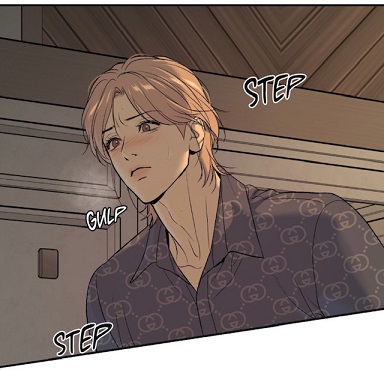 (chapter 34) He was not shocked or disgusted, when he saw Kim Dan having sex with the champion
  (chapter 33) Under this new light, his visit in the sauna appears like an intrusion.
  (chapter 34) He knew about the emperor’s schedule, a sign that he was somehow “monitoring” the main lead’s moves. Here, I feel the need to include this video exposing Heesung’s dark side.
 (chapter 35)
  (special episode 1) There’s a huge gap, he appears as a “seductive” wolf like in the fairy tale “The Little Red Riding Hood” That’s how it dawned on me why Heesung will have problems in his relationship with Potato. It is related to his dishonesty and mistrust which he projects onto others. This explicates why he doubted about Yoon-Gu’s virginity.
  (special episode 1) And what is the synonym for “truth”? Reality and Real World!! And now, you understand why Heesung created a historical drama in his mind for the sex session. It was his way to avoid truth and honesty. He used the role play to expose his jealousy
  (chapter 44) After this wonderful moment, Kim Dan came back down to earth. His present got rejected, he was just viewed as a physical therapist and nothing more.
 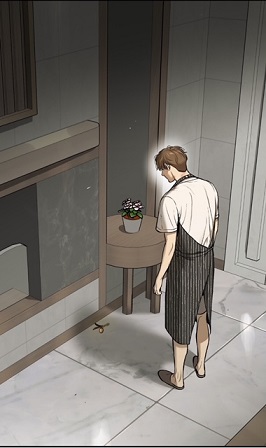 (chapter 45) We also have a refusal in the special episode. Potato initially rejected the offer from his sex partner:
  (chapter 7) who was full of jealousy here! Thus I conclude that this special night ended on a bad note, though Potato had no idea. The fox is no longer amused. Because Heesung is not happy deep down, he is planning something!!
  (chapter 33) Observe the parallels:
 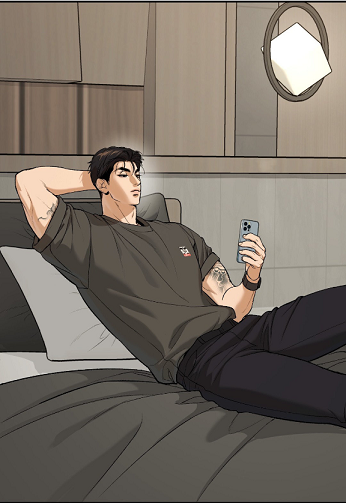 (chapter 33)
  (special episode 2) Yes, we need to question ourselves what triggered Heesung’s fantasy for the role-play.
  (special episode 2) IT is not just because of the costumes. My hypothesis is that the guards are working as an item, you can observe this in the following two panels:
  (special episode 2) This scene triggered his envy and jealousy. He wanted to have someone by his side whom he could talk to. ,
 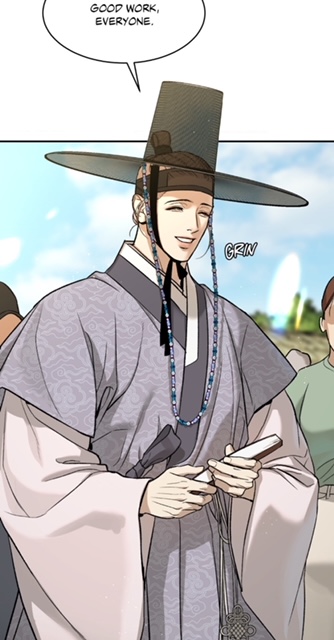 8special episode 2), Here, he thanked everyone, yet he was standing in the middle of the scene, far away from everyone. In reality, his “gratitude” was superficial, for his thank was addressed to no one in particular. Just empty words. Under this new light, Manhwalovers can understand why he made such a suggestion after the intercourse:
  The green color corresponds to sunset or sunrise which makes me think of a moment of transition. This corresponds to the notion of change and as such growth. Moreover, it stands for balance between yin and yang, like quoted above. The shade implies an equity between female and male energy. And now, you comprehend why Mingwa used green light in the car scene:
  (chapter 33) On the one hand, it was an allusion to the emperor’s hidden jealousy. The latter had masked it as a challenge and game:
  But the shade is implying that the fighter was slowly calming down. He accepts the doctor’s embrace, he even grabs his phallus in order to give pleasure to his partner.
 (chapter 33) In the end, he did show a caring side to the doctor.
  (chapter 33) He knew that his lover was sensitive to his touch. He desired to give pleasure to his companion. Yes, I see some parallels between the sex scene in the car and the one in the shed: public place, the connection between work and love life, the miscommunication, the importance to satisfy his partner sexually, a challenge, the grabbing of the phallus:
  (special episode 2), the jealousy, the possessiveness… making sure that the companion is not looking elsewhere… but more importantly, both seme are and were unaware of their growing affection towards their “fuck buddy”. Yet, there exists a huge difference between these two sex sessions: THE KISS!
  (chapter 33) The points of suspension from Joo Jaekyung are exposing his “ignorance”. He doesn’t know what to do, when he sees Kim Dan like this.
  (chapter 33) The emperor has now regained control of his emotions, but he couldn’t interpret his emotions correctly (jealousy, longing for love, insecurities). Moreover, we shouldn’t forget that he has not associated the kiss to love yet. In the locker room, he kissed the “hamster” in order to protect him. He had been simply following his friend’s advice. Then in the swimming pool, he felt attracted towards him.
  (chapter 27) He had acted instinctively… but in the car, his emotions were clouding his judgement. The ejaculations brought him back to reality. He had somehow achieved his goal. He had no idea what to do after the intercourse. That’s why I believe that in this panel
 (chapter 33) He had admitted his defeat. However, this sex scene had the opposite effect on the champion. It didn’t bring him any Enlightenment, he was still clueless and worried, because he felt, he was losing control of his life.
  (chapter 34) As a conclusion, he came to “deny” this reality. He rejected his own emotions, until he was challenged once again in the sauna.

 (special episode 2) This means that this sex session took place during the new moon. Hence we have the color purple… This corresponds to the actor’s transformation. He is revived… he has finally found his soulmate, but he is not aware of it yet. And now, pay attention to this scene: We have the color blue,
  (chapter 39)


 (chapter 1) The problem is that Kim Dan blamed himself for his suffering, as he must have often not paid the interests on time. That’s the reason why he got surprised, when he saw his enemy in front of his humble home.
  (chapter 1) Due to the lack of rest and time, he didn’t have the opportunity to ponder on his life and even have dreams on his own. Therefore he had no ambition. At the same time, he couldn’t become energetic and proactive due to his low self-esteem and his abandonment issues.
 (chapter 29) The vision about his opponents is mirroring his own reflection. That’s how he views himself. He is surrounded by enemies who will attack him, as soon as he exposes any weakness. Thus it is normal that he is always on the alert. Episode 29 divulged that he was on survival modus. Consequently, it is not surprising that he could trust no one. Should one get too close to him, the former could become a traitor in the last moment. Moreover, this interpretation explicates why he has been so rough on his own body. First, he considered pain as a normality, the side effect of his profession and as such his corruption. In addition, he didn’t have the time to take care of his wounds, for he could get “killed” at any moment. Surrounded by this wave of “rotten bodies”, he imagined that once defeated, he would be swallowed by darkness and literally vanished. This vision displays another important aspect of the athlete’s philosophy. His job is not connected to fun and dream, but to work and nightmare. And now, you comprehend why I selected this panel in the middle of the illustration.
 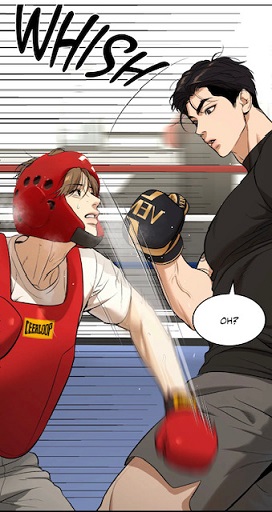 (chapter 26) This represents the highlight for the first season. For the first time, both characters had fun together. That’s how they got one step closer to each other. The fighter was enjoying this moment, as he was teaching Kim Dan to become more proactive and fight for himself. The sparring represents the opposite version of the athlete’s vision (chapter 29). He felt safe next to Kim Dan. In fact, his presence boosted his confidence.
 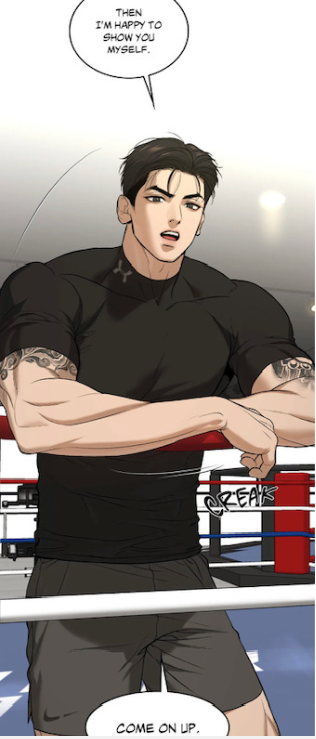 (chapter 25) It is no coincidence that he employed that expression in front of his fated partner. To conclude, chapter 26 stands for life and happiness, proving that their life is not cursed per se. Consequently, red was the dominant color of this chapter. This pigment stands for love and life. Both felt alive during that day. Moreover, we could see glimpses of the sportsman’s true psyche as well, when he proposed to spar with the main lead. He desired to help the doctor himself. Hence he acted as his mentor and teacher in the ring. There, we could see his generosity, interest and open-mindedness. He wasn’t looking down on the doctor, he saw him as a true member from Team Black.
 (chapter 29) He has no one by his side. And this observation leads me to my next interpretation. The existence of Joo Jaekyung’s belief is exposing Park Namwook’s neglect and bad management and coaching. We could say that he is partially responsible for the champion’s misery and bad luck. Therefore it is no coincidence that the sparring took place during his absence.
 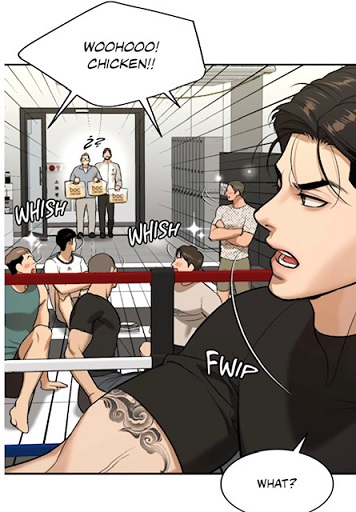 (chapter 26)
 (chapter 27) But by portraying him like that, the coach gave us a justification why he wouldn’t converse with the gym owner. Why should he talk or listen to Joo Jaekyung, if the latter is stubborn and obsessed with his work? It is pointless. And such an attitude could only get reinforced in this scene:
  (chapter 46) Yet, according to my interpretation, the main character’s departure was not the sign of stubbornness, but rather of fear and avoidance. Since the manager doesn’t know his star that well, he judges him based on appearances. Moreover, I believe that he has the tendency to generalize, just like certain readers. Since the athlete beat a doctor and was quite brutal with a fighter, he is stigmatized as “thug” or a “spoiled kid”. I am suspecting that the way the hyung met the celebrity affected his perception about the young fighter.
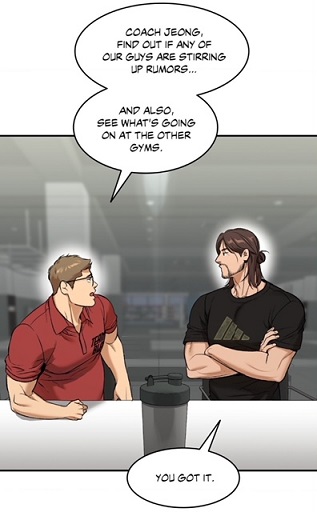 (chapter 46) Despite his attitude, Joo Jaekyung still listened to his hyung’s warning, for from that moment on, he kept his distance from everyone, including the physical therapist. But there’s more to it. Park Namwook keeps associating his star with “good luck”.
  (chapter 1)
  (chapter 27) This represents the exact opposite of the star’s jinx. It shows that he is not trying to understand his celebrity. With such a mind-set, it is normal that the champion wouldn’t trust his manager. And the absence of the manager in this panel
 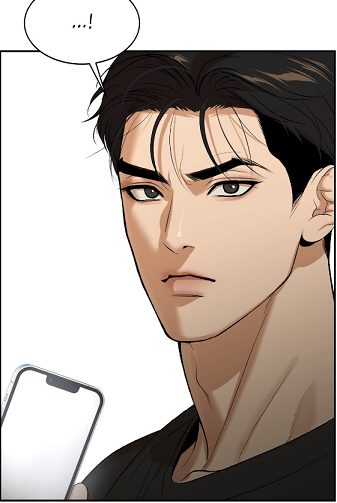 (chapter 33), he didn’t report it to his hyung. He also kept it a secret. That way, he was not only protecting Kim Dan’s misdiagnosis, but also Park Namwook’s misjudgment. On the other hand, he acted as a real boss, for the comedian is an important client.
 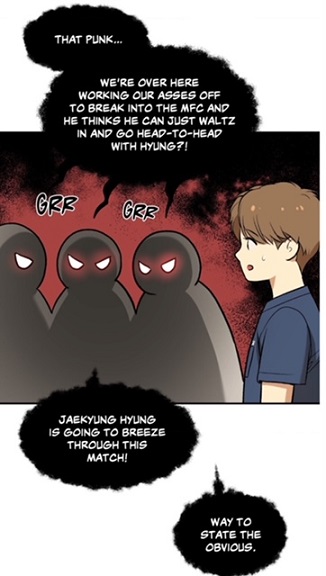 (chapter 47) Therefore he bought chicken for them. Instead of showing compassion and understanding for his hungry and miserable champion, he allowed Potato and Oh Daehyun to buy junk food behind the celebrity’s back.
 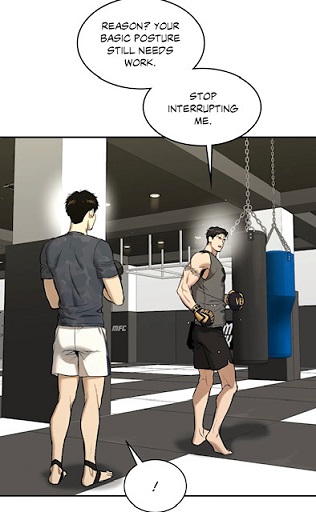 (chapter 23) He never confronted the members with the truth. They lack skills
  (chapter 46). It was, as if they didn’t have the goal to create a new champion. How come? It is because the gym was initially created for Joo Jaekyung’s needs. And now, Jinx-lovers comprehend the dilemna. Team Black needs to redefine itself and its purpose. Moreover, Park Namwook’s true wish is to open the gym for “kids”. And that’s how he treated the staff from Team Black, like little kids. No wonder why many left the gym in the end. They didn’t feel truly supported by the manager and coach. Jeong Yosep and Park Namwook didn’t put any real effort to turn the members into professional fighters. That’s the reason why none of them had a MMA manager, only a coach and nothing more.
  (chapter 49) He claimed to trust the champion, but the reality is the opposite.
  (chapter 52) So what other fact was Park Namwook referring to? The fighter Baek Junmin and director of King Of MMA had paid Kim Dan. This shows that he had heard the conversation between the two protagonists.
 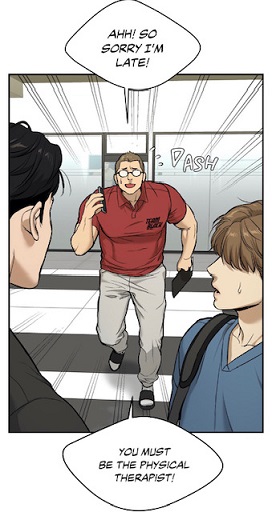 (chapter 1)
  (chapter 49) He should be responsible for his contracts, yet the reality is that the Entertainment agency is the one managing the champion’s career.
  (chapter 41) However, as his manager, it is his duty to protect his star, as the career of a MMA fighter is rather short. Imagine, he let Joo Jaekyung fight three times within 3 months (April- June- July). It is definitely too much. To conclude, he is not doing his job properly, as he is trying to put a lot of responsibility on others (Kim Dan- Joo Jaekyung – the Entertainment agency). According to Mingwa, Kim Dan had been taking care of administrative tasks. However, as the director of Team Black, he should be the one handling it. After the incident at the health center, Park Namwook didn’t contact the press to explain the whole situation.
 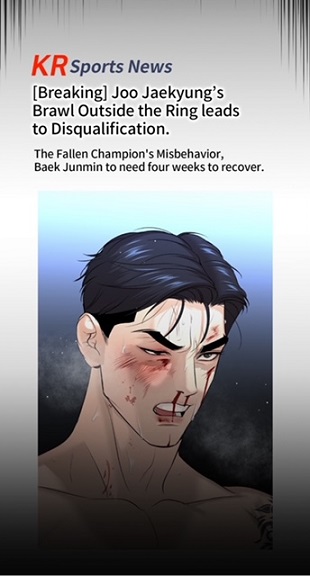 (chapter 52) The article is indicating that the champion was quickly judged and this within a few days. The article implies the non-intervention of a lawyer or his manager. No one sided with the celebrity. They are not even contacting the media.
 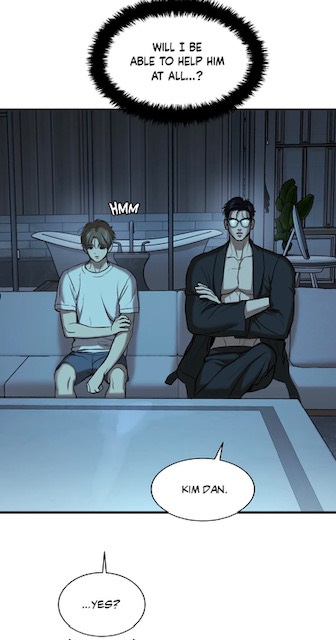 (chapter 29) He is not standing next to the main lead, but he is facing him. He is like an opponent. Another divergence is that Kim Dan was alone, whereas Park Namwook utilizes Potato and the others from Team Black to corner Joo Jaekyung. The doctor was willing to listen to him, whereas the other gets upset, when the other admits his suffering. Since the gym is facing a crisis, the patient should find a solution to the problem.
  (chapter 52) that he regretted his decision and outburst. By admitting his mistake, he would have become responsible for the whole mess. Funny is that he asked compassion from Joo Jaekyung, whereas he showed none to the patient. And what was Kim Dan thinking during that night?
  (chapter 52) resembles a lot to the image with the opponents.
  (chapter 52) For the first time, the champion is no longer looking at his cellphone. He shared his thoughts to others and exposed his powerlessness
  (chapter 40) These two situations have many similarities. Both were confronted with an accusation, they were surrounded by people, who were acting as righteous and honest workers. Both were coerced to admit a wrongdoing. In addition, they are actually abandoned by Team Black members, especially the manager. No one is looking for them out of concern. The reality was that they were not their “true colleagues and even less friends. However, like mentioned in a previous essay, the men in black were actually covering up a crime in order to hide the corruption from the organization. This makes me truly wonder if Park Namwook is truly ignorant about MFC’s corruption. He could simply know about the crimes, but he chose to close an eye to the whole situation.
  (Chapter 46) He is already aware of the existence of illegal betting. Besides, since Joo Jaekyung is paying his taxes properly, Park Namwook could have the impression, he is doing nothing wrong. However, if he knows something and is remaining silent, he “becomes an accomplice” de facto. And what is the other common point with the interrogation from MFC security guards and the hospital visit? No lawyer and the incident was swayed under the rug.
  (chapter 40) He had rescued him. So by slapping the champion
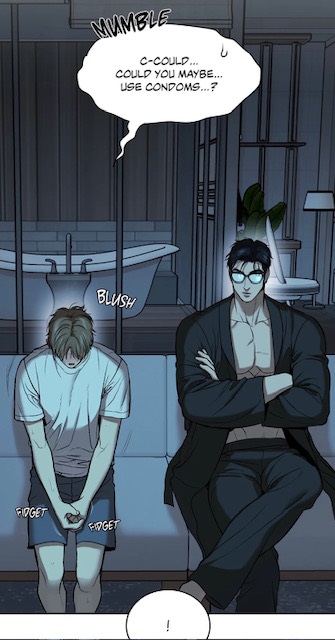 , (chapter 29), I deduce that the slap had the opposite effect than this wonderful night. The gap between the hyung and the athlete got bigger. This represents the moment where Joo Jaekyung is emancipating himself from the hyung’s influence. By refusing the letter of resignation, he clearly indicates that he is rejecting Park Namwook’s suggestion.
 (chapter 19) Yes, we should see episode 53 as the negative reflection from chapter 19, the doctor’s arrival at the penthouse.
  (chapter 19)
  (chapter 21). By interacting with Kim Dan, he will be able to reconnect with his true self which will change him forever. Notice that after the night in the States, at no moment, the champion mentioned his jinx, but spoke about his physical health. In reality, he was including his mental health. This shows that he was already moving on from his jinx. Moreover, after the tie and the suspension, he is not mentioning or thinking about his former belief. The reason is simple. Because of the doctor, the champion was allowed to perceive glimpses of the truth: corruption and the existence of tricks. This image
  (Chapter 48) represents the medicine against the champion’s false belief. Moreover, by making him meet his former rival Baek Junmin, the athlete was incited to overcome his past and biggest fears.
  (chapter 26) and make others happy too.
 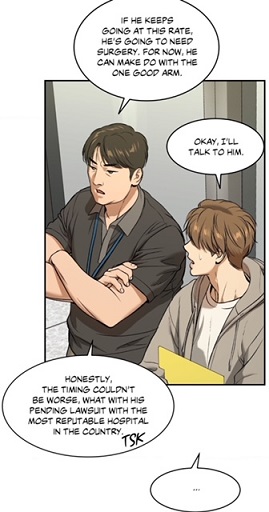 (chapter 42) This shows that his self-loathing is gradually vanishing as well. The fact that he is employing the personal pronoun “I” indicates that he is able now to distinguish himself from his grandmother.
 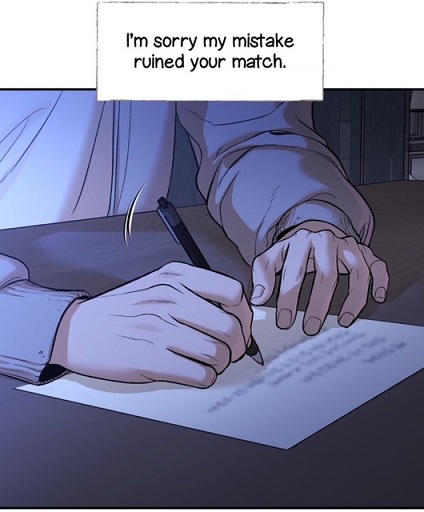 (Chapter 53) Here, I feel the need to remind my avid readers that though the doctor was victim of a trick, he was not entirely innocent either. He should have come clean with the champion concerning his meeting with the director from the rival gym. His lie still played a huge role in the champion’s mistrust. But why did he not tell him later? It is because he was under the influence of the manager.
  (chapter 44) The intimacy is rather superficial, for it is limited to pleasure and sensuality. This has nothing to do with the partner’s personality. Secondly, during that night, the champion was drunk. In season 1, both protagonists only discovered physical closeness without sharing their thoughts and emotions
  (chapter 44) He never told the athlete that he was so cute or handsome. He kept his thoughts and happiness to himself. The only moment they shared real intimacy was this night:
  (chapter 29) Moreover, during that sex session, the athlete employed dirty talk.
  (chapter 29) It was not to express affection.
 (chapter 2) prostitution and rough sex. He never experienced true romance and the birth of “first love”. The courting and seduction were totally absent. His first kiss is connected to fighting, pain, survival and protection.
  (chapter 14) It had nothing to do with innocent and pure love. For me, Kim Dan didn’t have the time to fall in love with the champion properly. He could even say that his affection is related to his job and he could reduce it to mutual physical chemistry. Thus I deduce that he became a ghost again for one reason. Both need to experience the innocent first love. In other words, we should expect a new version of this magical night:
  (chapter 19) before describing him as a baby.
  (chapter 20) However, we should expect a more pure version, where both act as innocent and inexperienced teenagers, similar gestures:
  (chapter 44) There should be no drug or no time pressure!! However, there exists another reason why I have such an expectation. First, the grandmother should be close to them. Her presence should represent a hindrance, as the latter is falling back into childhood. Secondly, right from the start, Joo Jaekyung was under the spell from Kim Dan.
 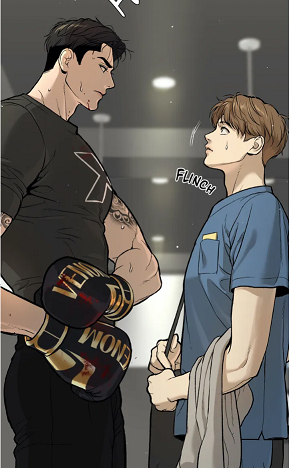 (chapter 1) He was so attracted to him physically, hence he didn’t pay attention to his partner’s personality. In fact, he had a negative perception of his nature:
  (chapter 1) By becoming a ghost, the champion is forced to perceive the main lead as a person and as such to pay attention to his personality (dislikes, likes, qualities, career). That’s the reason why I believe that in season 2, he won’t make the same mistake again. He will study the doctor and get to know him better. That’s how he will be able to identify his feelings for the protagonist. He doesn’t love him because of his cute face and body, but because of his big heart and warmth. He is so responsible, generous and dedicated that there’s no one else like him. He embodies true kindness and loyalty. His care and worries are genuine. That’s why the champion will voice his affection differently from the past: “Secret and innocent love behind work”. Under this new light, it becomes comprehensible why both characters had to go to the seascape. Nature is the perfect place to nurture innocent and pure love. Consequently, I don’t think, the author will rush to create a new chapter full of sex… rather full of tenderness and caresses! Thus Mingwa created such panels:

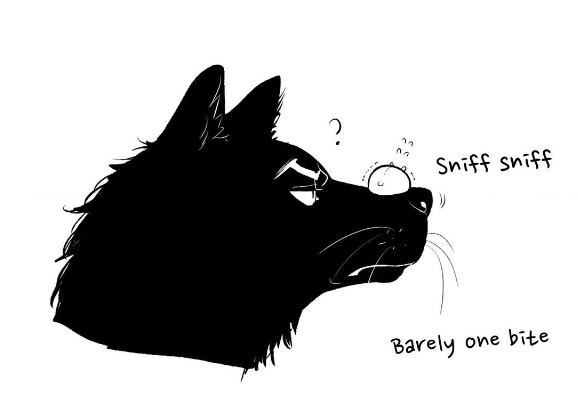 So how did I come to connect the main lead to a puppy dog?
  (chapter 47) It is because Shin Okja called her grandson “her puppy dog”.
 (chapter 5), but a young dog. This signifies that in the bathroom, the main lead’s true nature came to the surface due to the bad news concerning his grandmother.
 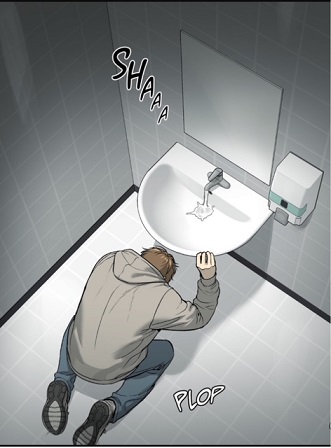 (chapter 47) Yet, a puppy embodies innocence and inexperience. Thus it needs the guidance of a mother. On the other hand, in my essays about the doctor, I kept describing him as a person who would constantly grow and mature. So “a puppy dog” would appear as a contradiction to my previous interpretation. Nonetheless, we shouldn’t forget that this was representing the grandmother’s desire. By turning him into a puppy dog, she expects from him obedience and loyalty. She is denying his right to determine his own life. He needs to follow its master. Hence this scene announces a certain regression for Kim Dan. On the other hand, I believe that this is just temporary. What the elderly woman didn’t know is that by linking him to a dog, she was freeing Kim Dan from society as well. He is now an animal. He belongs to Nature from that moment on. This animal symbolizes freedom and independency. So when the grandmother described him as a puppy dog
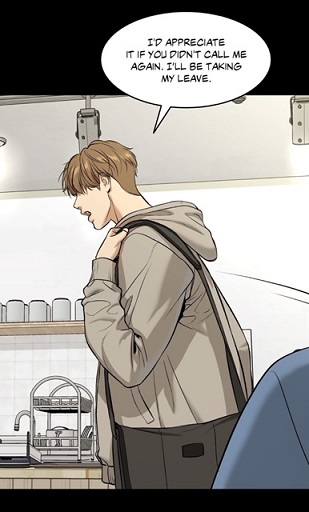 (chapter 48) Furthermore, Jinx-philes could observe how the doctor had followed his instincts during the conversation with Choi Gilseok in different panels, like for example in this image.
 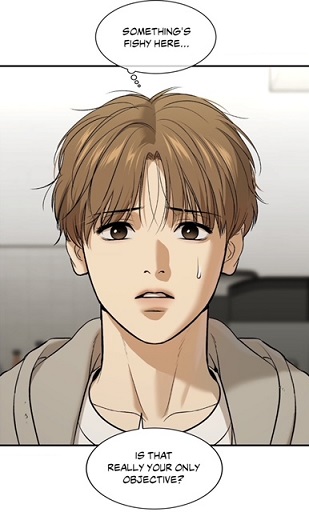 (chapter 48) The idiom “fishy” is a reference to smell, indicating that he was relying on his own senses. But we have another evidence that the puppy dog was using all his senses to judge his counterpart:
  (chapter 48) He rejected the touch from Choi Gilseok. That’s how he could detect the director’s hypocrisy. He refused to drink the coffee from the senior, although it had been recommended. As you can imagine, all his 5 senses were on alert, and the latter are strongly intertwined with instincts. In addition, when he asked his counterpart to go to the point and speak frankly
  (chapter 48), he was urging Choi Gilseok to drop all manners. Yet, Manhwalovers should keep in mind that the synonyms for manners are etiquette and ceremony. This proves that manners stand for civilization. But what are good manners?
 (Chapter 48) This means, he was disrespecting the elder. However, his disrespect didn’t start at the café, but in front of the gym.
  (chapter 48) He refused to take the card from the director. However, the moment his grandmother was brought up, he became obedient and accepted the invitation.
  (chapter 48) He acted out of loyalty and love for her. Nevertheless, the director’s offer for his halmoni served him to see the truth. His behavior during the conversation exposes the awakening of his wild and rebellious side. Thus we could say, Doc Dan showed more and more his rudeness. He left without asking permission and saying goodbye.
 (Chapter 48) To conclude, the conversation displayed that Kim Dan was already following his halmoni’s advice, he was living as a dog. This made me smirk, because I could detect how Joo Jaekyung had rubbed off on Kim Dan!! 😂
  These two characters symbolize true friendship. Thus I come to the following deduction: Kim Dan is about to get truly adopted by Team Black, while it looked the opposite at the end of the season. He might have been wearing a uniform and a jacket Team Black, yet there were signs that he wasn’t truly part of the team.
 (chapter 43) The cause for this issue is that Kim Dan was hired as the private Physical Therapist for the champion. He occupies a special position, for he is no fighter. Yet, he did everything to integrate his new family by treating the other members, though it was never his responsibility officially.
 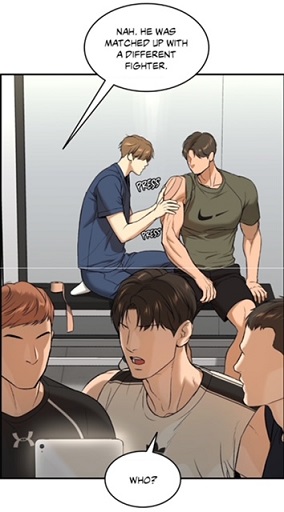 (chapter 47) But for the adoption to happen, he needs to prove his loyalty. How will he do it? Once again… wait for the part with the predictions. Yes, I am taunting my attentive readers.
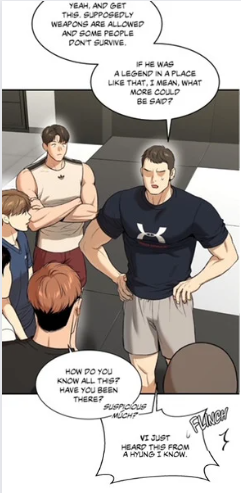 (Chapter 47) That’s the reason why they were not expecting that their idol would get so hurt or lose the fight. Kim Dan didn’t dare to contradict them, especially when Potato asked for his opinion.
 (chapter 47) In my eyes, Doc Dan didn’t dare to ruin the maknae’s illusion about his idol, though he thought otherwise. His broken sentences and his drop of sweat are revealing his discomfort and skepticism. He was not sure about the success of his VIP client. But Kim Dan as his PT knew about the champion’s true conditions: he is not truly healthy. But why are the fighters so innocent?
 (chapter 46) It is because the success of the gym relies only on the champion’s glory and the number of members. Till the end of season 1, he has not changed his behavior yet.
  (chapter 31) It looks like I am diverting from the topic, as I am now talking about the fighters and the gym. No wonder why most of the members switched the gym, as soon as the champion lost and his reputation got tarnished. Nonetheless, keep in mind that his game with Baek Junmin ended up with a TIE. So it is not a complete defeat. In my opinion, the schemers desired to tame the Emperor, not to ruin him, as they definitely need him to make money.
  (chapter 23) Kim Dan and Yoon-Gu had no task at all. The latter were treated like playmates and nothing more. Hence the manager asked patience from the doctor.
 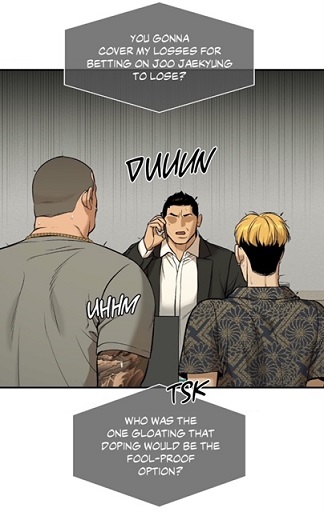 (chapter 46), but also by his greed. He had lost so much money. He needed to refill his pockets. Thus his wish was to “kill” the emperor and as such to ruin Team Black. In other words, he had planned the destruction of the rival gym. With the victory, Baek Junmin could replace the champion, and Choi’s gym King Of MMA would attract members. And my prediction came true. With the tie, many members from Team Black went to King Of MMA hoping that they would come to get rich and famous very quickly.
  (chapter 52) And since the other fighters from Team Black had never been able to break through MFC, it is not entirely surprising why they made such a decision. With their desertion and the champion’s ruined image, the future of the gym Team Black seems to be sealed: failure. Under this new light, my avid readers can grasp the true signification of this gesture:
  (chapter 49) It was not just about Kim Dan’s fate, but also Team Black’s. Hence he can not quit or run away. This new interpretation made me perceive the entrance of Kim Dan in the arena in a new light.
 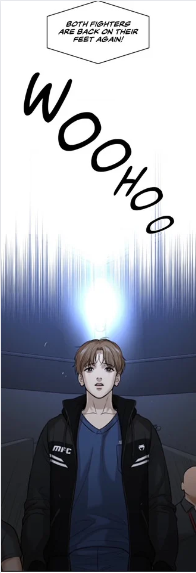 (chapter 50) Remember how I said that the locker room had become a temple. Thus I come to the conclusion that he got baptized there. He discovered the power of his hands, similar to this scene.
 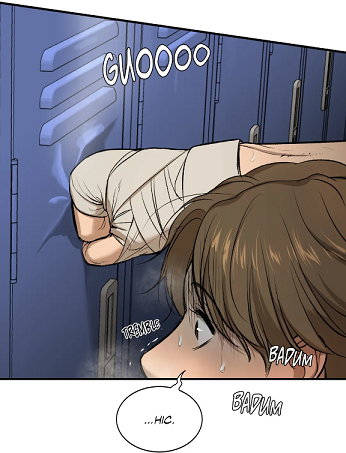 (Chapter 14) So when he comes to the arena, he is still following his instincts, unaware of his own metamorphosis. He is no longer a puppy, but a dog. Deep down, he feels that he has to be there despite his agony. He needs to be there in order to protect his home. To conclude, in the locker room, the doctor reached adulthood. Interesting is the chosen perspective from Mingwa. It was, as though he was flying high in the sky, like a yeouiju.
 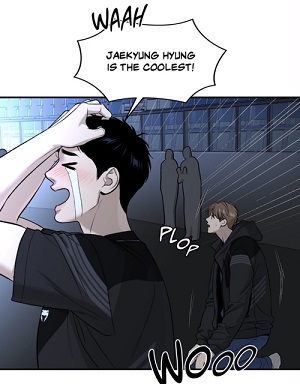 (chapter 40) In this image, he has to look up, whereas in the other panel, the beholder has the impression that doc Dan is rather standing on the same level than his soulmate, the alpha Jaekyung. However, since the athlete blamed him for the incident and rejected his hand, for Kim Dan, it sounded that he was no longer needed.
  (chapter 27) Thus I come to the following conclusion. With the switch of the spray, Joo Jaekyung was forced to recognize the importance of a physical therapist. Keep in mind that till his meeting with Kim Dan, he never saw them as necessary. Even before his immanent match, he kept looking down on his soulmate.
 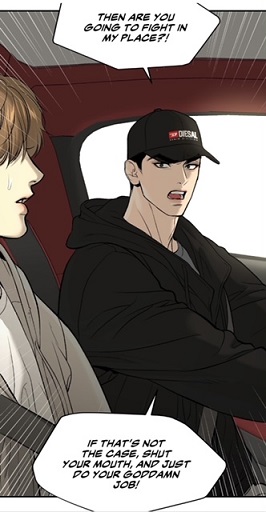 (chapter 42) Here, it becomes obvious that he didn’t see his PT as a partner, but as an underling.
  (chapter 45) Have you ever seen a wolf wearing a collar? No, this animal symbolizes freedom. What the champion wants from his soulmate is the following: he wished his puppy dog to follow him!
 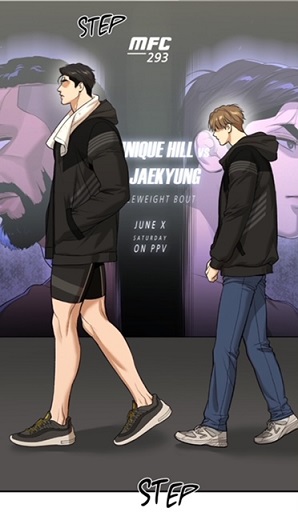 (chapter 40) And that’s how the champion will come to realize that he can not live like before, as Kim Dan can not keep up to him. He is physically weaker. He desires his loved one to always look at him, to never leave his side, to stop living like a stray dog.
  (chapter 53) As you can see, with this new interpretation, I recognized that at the end, Joo Jaekyung stopped being under the influence of PArk Namwook. The latter hasn’t recognized the true role of a PT for an athlete yet. Hence he has no problem to hire a new one.
 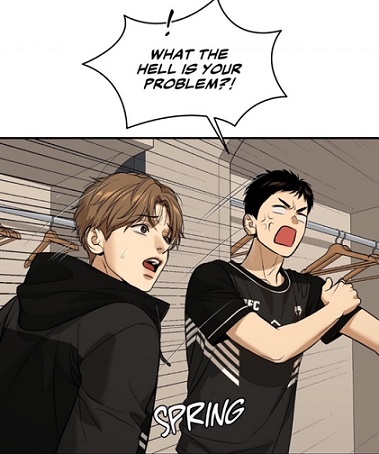 (Chapter 49) Not only he yelled, but also he protected his star by standing in the front line.
 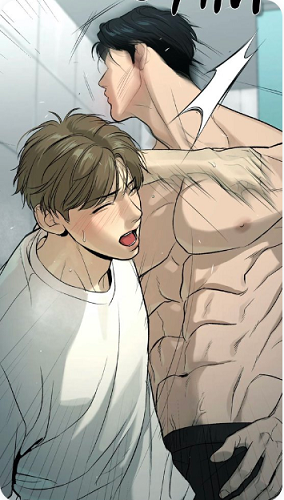 (chapter 7) He might have not wounded his partner terribly, but we shouldn’t forget that he was facing the Emperor. To conclude, by calling him Potato, the fighters were misjudging the young fighter. Kim Dan was the first one to identify him correctly. He was a dog, hence he desired to treat the champion as his master.
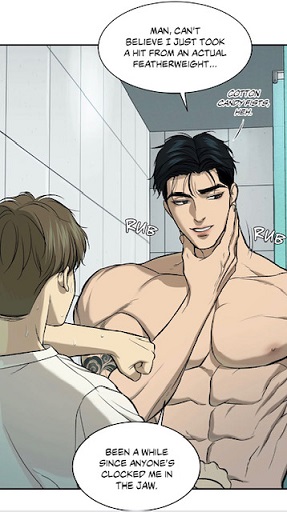 (Chapter 8) I noticed that the champion initially only listened to violence. It was, as if he had internalized this Nature’s law: the strongest prevails. No wonder why the champion didn’t react to Potato’s admiration so positively.
  (Chapter 23)
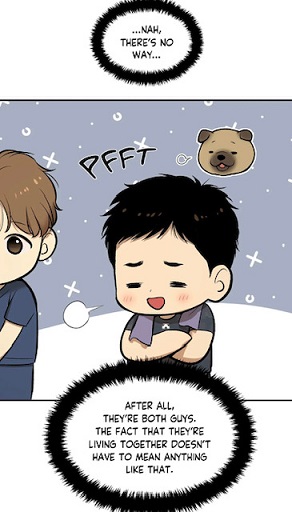 (chapter 23) Interesting is that she cut the chibi Kim Dan in half. Why? In my opinion, the main lead had not found his true self yet. She didn’t place any puppy above his head as well, because she wanted to keep her readers in the dark. However, let’s not forget that a puppy will recognize another puppy much more easily. Therefore Potato felt jealous and resentful first.
  (chapter 25) Moreover, we should interpret his nightmare like this. The puppy doc Dan had already marked his territory:
 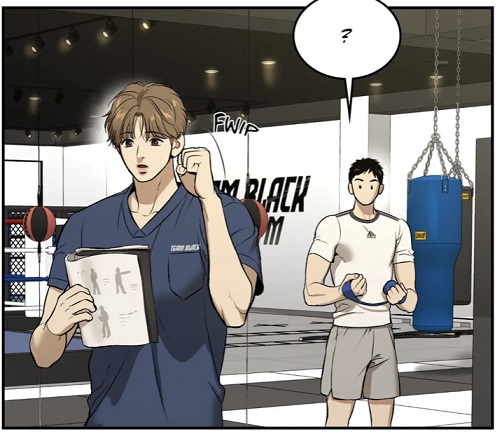 (chapter 25) The latter was trying to learn more about MMA, as he desired to improve his skills as PT.
 (Chapter 25) That’s how Potato came to offer his assistance. Interesting is that Yoon-Gu became the teacher for the physical therapist.
  (chapter 25) It is relevant, because the maknae was acting like a sunbae and not like a junior. He was given responsibility. His task was quite important compared to the coffee incident. With such a task, the cute puppy got to learn the importance of PT. This explicates why Potato always paid attention to the protagonist and his duties afterwards. Though Kim Dan had been constantly diminishing himself as physical therapist, in front of Potato he acted differently: meticulous, dedicated and caring. As you can see, this training session had huge repercussions for the chow chow.
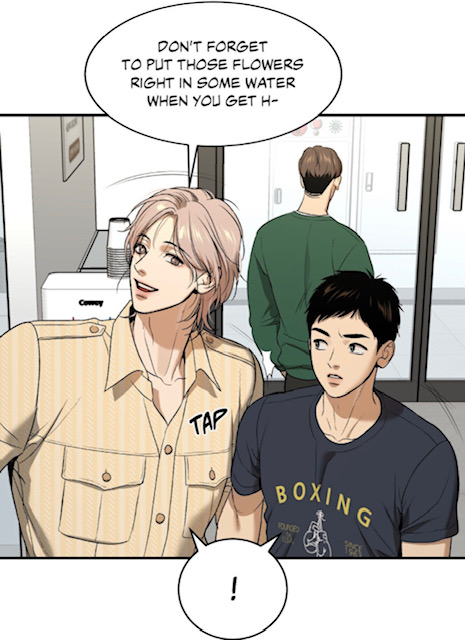 (chapter 31) Secondly, since Yoon-Gu is a dog, this signifies that he can not be bought with money or presents either. Hence he could only mistrust the artist’s generosity. It is important to recall that before meeting the “angel”, Heesung would simply offer meals
  (chapter 30) and not expensive stuff like designer clothes or electronics. So Potato was not wrong either to mistrust the actor first, for the latter was indeed expecting affection in return despite his claim. He did want to date the doctor, but the puppy knew that the protagonists were together. He represented a threat to his new found home.
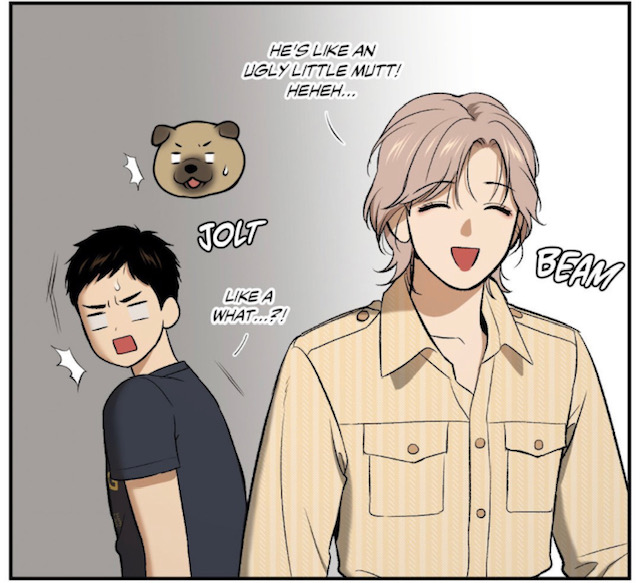 (chapter 31) Heesung described him as ugly, which is actually an insult. Note the contrast. Heesung is smiling despite his words. It is because he was voicing his annoyance at Potato. The latter represented a hindrance to his courting.
 (chapter 40), the former came to appreciate the doctor much more than before.
 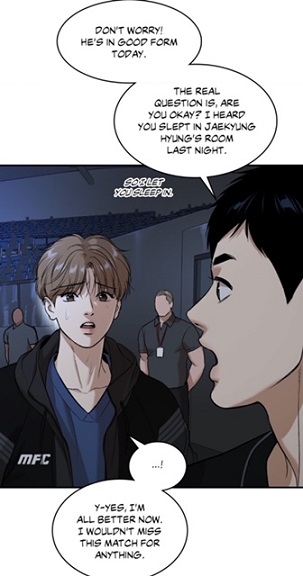 (chapter 40) First, he informs him about his patient’s conditions. On the other hand, it becomes obvious that he worries much more about the doctor’s health. His increasing care started with the party.
  (chapter 37) When Potato and Daehyun saw that Kim Dan was feeling down, they tried to cheer him up. Moreover, let’s not forget that when they got caught partying, the hyung tried to protect them:
  (chapter 37) Besides, Yoon-Gu witnessed the effects of the drug
 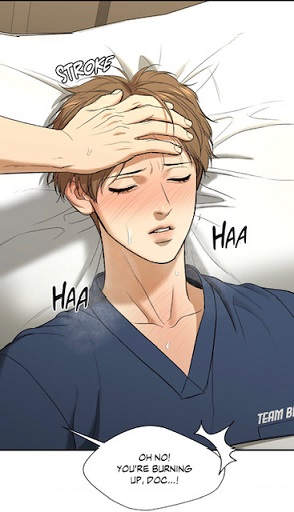 (chapter 38). Contrary to the other fighter, he touched his head. This gesture reminded me of a mother’s. And now, I know why Kim Dan saw Potato as a puppy.
 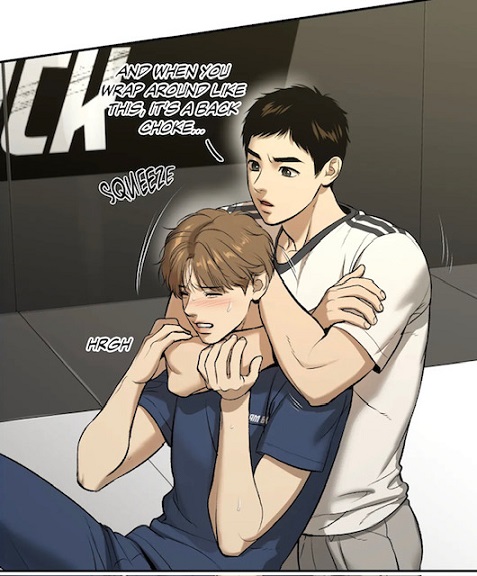 (chapter 25) On the other hand, Yoon-Gu lacks experiences, for he has never been exposed to the cruelty of this world, unlike Kim Dan or Joo Jaekyung. His fighting spirit is not developed yet.
 (Chapter 40) Therefore it is not surprising why after mentioning the incident with the MFC security guys to Park Namwook.
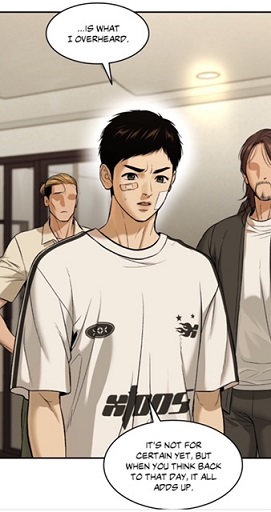 (chapter 52) He never questioned why the coach didn’t stop Kim Dan from quitting. On the other hand, I wondered how he came to change his mind about his idol. It can not be his brutality
 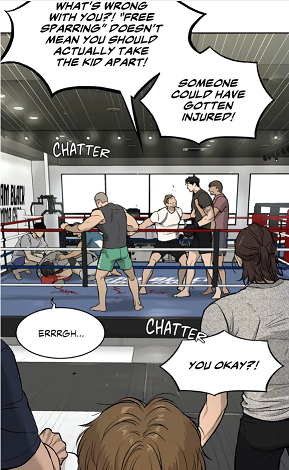 (chapter 1) and rudeness, for he didn’t criticize the athlete in the first episode or episode 7. In my eyes, the maknae lacks critical thinking. Nevertheless, we shouldn’t overlook that he followed the members’ behavior. No one from Team Black called Kim Dan and looked out for him. They all abandoned him after the match.
  (chapter 52) They only talked about the lost members, not about the physical therapist. This exposes that they didn’t treat him as one of them. To conclude, as time passes on, Yoon-Gu came to mimic and think like hyung Namwook.
  (Chapter 49) and helped him. I have to admit that the way the main lead was holding his hand reminded me a little dog.
 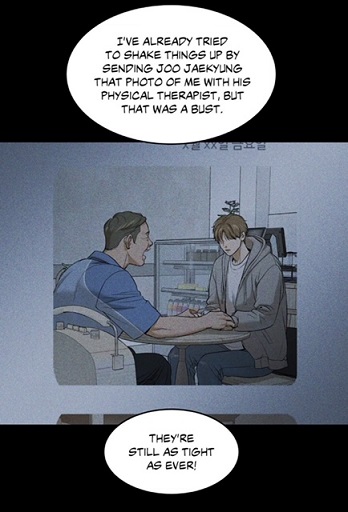 (Chapter 50) However, the doctor
 (chapter 47) was hiding his sadness and pain behind his job. How could Potato notice his suffering? Kim Dan never let his wounds transpire. Finally, we shouldn’t overlook the fact that Kim Dan never confided to the puppy dog as well. The protagonist has always been a loner, like we could see it in his memories.
 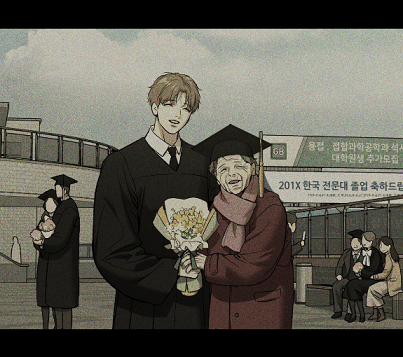 (Chapter 47) He never had a friend before, and Joo Jaekyung was more than a friend.
  (Chapter 21) He was first of all his boss and his landlord. Yoon-Gu is not connected to the main lead because of money. The foundation of their relationship is based on trust, care and respect. Thus I deduce that Potato is on his way to become not only his first true friend, but also his second stan. He might have noticed his angelic nature in the past
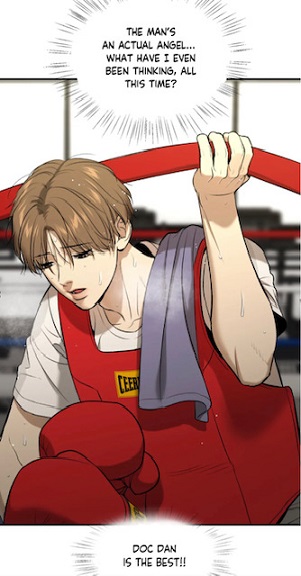 (chapter 26), but his adoration for the champion was still very strong.
  (Chapter 33) Yes, through them, the dragon and the gumiho can become real friends. So far, they had been more frenemies. They know each other’s secret
 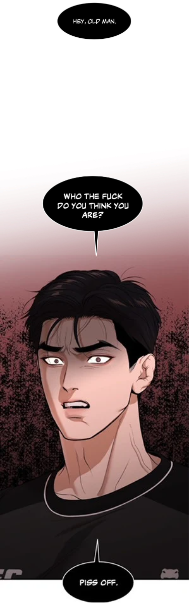 (chapter 49) Respecting the elders! For me, Kim Dan will see red, when he hears the truth about the incident. From that moment on, he will start questioning not only seniors (manager Park Namwook), but also authorities (doctors).
  (chapter 1) Yes, he never exposed the truth. He didn’t even try to sue the man.
 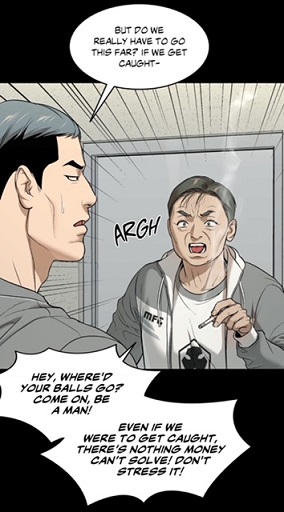 (chapter 50) Therefore he is safe. And how did the main lead describe the antagonist? As a crazy person!
  (chapter 42)
 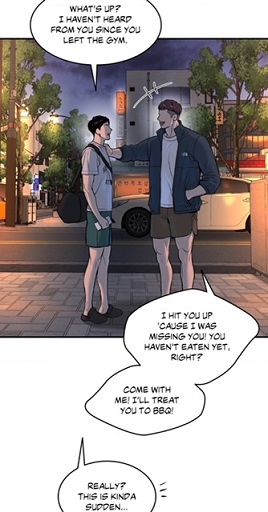 (chapter 52), at the end he chose to leave the restaurant on his own accord. Yes, he stopped being a follower of “herd mentality”.


 (chapter 22) Compare his reaction, when Oh Daehyun was talking about his penthouse
 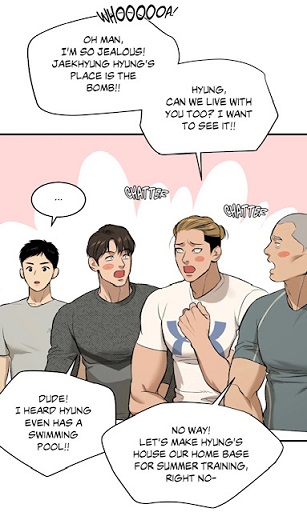 (chapter 22). The latter was silenced with a threat.
  (chapter 22) Then when Potato got rejected by his idol, Kim Dan felt the need to ask the young fighter why he was so upset. Therefore he left the office.
  (chapter 23) A sign that he stands for connection and advice. Interesting is that right after, Joo Jaekyung listened to his sex partner in the treatment room.
  (chapter 24) Thus he gave a task to the maknae.
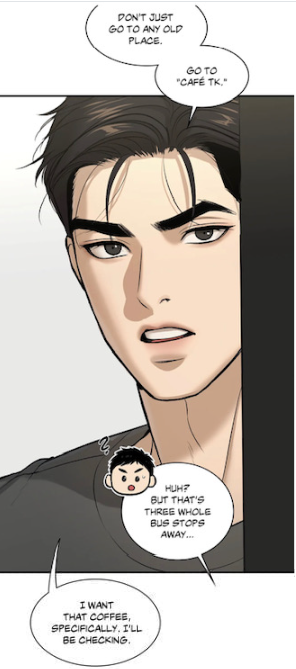 (chapter 24) And Jinx-philes will certainly recall what the pure fighter did during his task: he called Joo Jaekyung!
  (chapter 23) Another symbol for communication. He should voice about his desires. As you can see, his presence helped to improve the relationship between Kim Dan and his boss. Then the next morning, Potato also showed curiosity towards the physical therapist:
  (chapter 25) Once he heard Kim Dan’s intentions, he offered his help and while practicing, both men came to exchange their thoughts and emotions.
 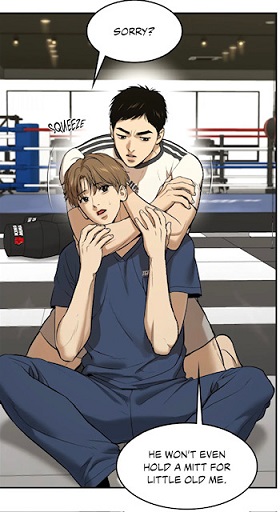 (chapter 25) This explicates why Joo Jaekyung came to propose the sparring to Kim Dan. We could say that Yoon-Gu’s presence gave the doctor’s courage to accept the challenge.
  (chapter 29) And now, you comprehend why the relationship between the main couple improved so much between 22 and 29, it is because of the lucky charm, the “Sardonyx chow-chow”! Thanks to his presence, he encouraged the main couple to communicate and to be more curious about each other. He stands for respect, responsibility and connection. Only through conversation, it is possible to get know someone. No wonder why he is so treasured by Team Black.
 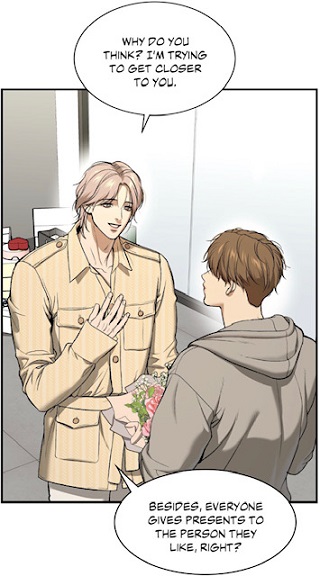 (chapter 31) He said that he didn’t expect anything from the doctor, but the reality is that he wanted to date him. So he had expectations. He was not direct with the physical therapist, as he initially didn’t know what he truly desired. He was just put under the charm of the angel. So what did he like in the physical therapist? His talent or his personality or his face?
 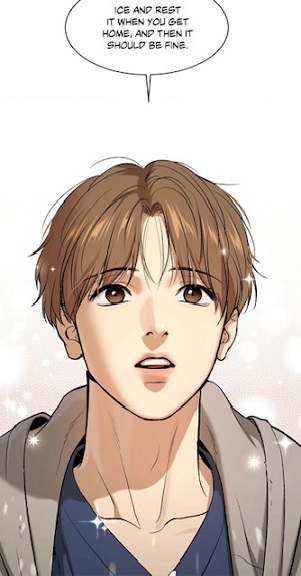 (chapter 30) Hence Kim Dan had problems to accept his appreciation as a fact. I don’t think, the artist was aware of the consequences of his behavior. Interesting is that after bumping into Potato
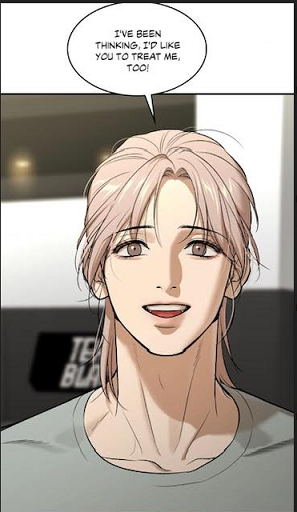 (chapter 31) So he used work to get closer to the physical therapist, which was quite similar to the champion’s approach. Simultaneously, Yoon-Gu was able to detect Heesung’s true intentions.
  (chapter 31) He was interested in the main lead romantically and sexually. We could say that the maknae pushed the comedian to meditate and to be more honest to himself. I would even say that he has a similar effect on the physical therapist, for the latter started pondering on the champion and himself.
  (chapter 36) The fact that he took over the youngest member’s task during that evening indicates his influence. The problem is that the Sardonyx was not present, therefore his dark thoughts couldn’t be pushed away. This scene reveals the hidden power of the gemstone. But there’s more to it. Mingwa created the positive reflection from that night in the States:
  (chapter 40) Once again, Potato helped the main lead to perceive the champion in a positive light. Soon after, he came to accept his feelings for the star. Under this new approach, it becomes comprehensible why after chapter 41, neither Kim Dan nor Joo Jaekyung talked to each other properly.
  (chapter 41)
 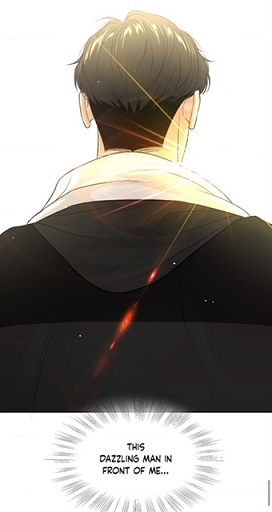 (chapter 40) Under this new light, it becomes comprehensible why the hamster accepted the harsh criticism from his employer in the penthouse.
  (chapter 47) thanks to him, one fighter spoke up and revealed his knowledge about Baek Junmin and the underground fighting ring.
 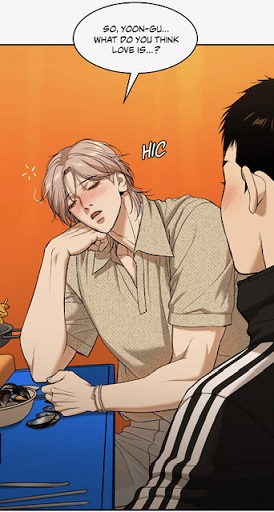 (chapter 35) His presence encouraged the comedian to question himself and his expectations. We could say that thanks to him, Heesung was incited to meditate and not to fall back into his old bad habits. Note that Heesung was actively listening to Potato’s words.
  (chapter 35) The shades corresponds to the gemstones onyx (black/white jacket), sard and sardonyx (brown-dark orange), then we have the Peridot (the green bottles of soju) and finally blue (Sapphire)! Under this new approach, my avid readers can sense why these characters were fated to fall for each other during that night. This was the power of the magical hidden gemstones.
  confronted him with the truth. He should admit to himself that he was sexually attracted to the celebrity.
  (chapter 38) He was the one making the connection between the doctor’s sudden illness and the nutrition booster.
  (chapter 25) Interesting is that this gemstone is quite fragile and needs to be treated very carefully.
  (chapter 26) The red protection gear incited the athlete to see this sparring as a game, it helped him to rejuvenate and rediscover fun. Thus he was smiling.
 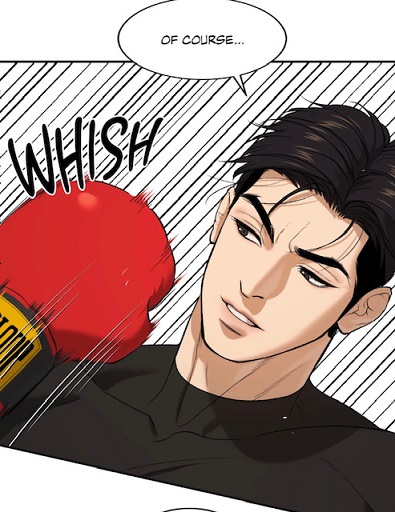 (chapter 26) But it had the same effect on Kim Dan. The latter was forced to overcome his trauma, the physical abuse from that terrible night with the loan shark.
  (chapter 25)
  (chapter 34) Red spinel’s association with the month of August further enhances its significance as a symbol of rebirth and renewal. As the summer months wane and the promise of autumn beckons, red spinel serves as a reminder of the cyclical nature of life and the inherent potential for growth and transformation.
 (chapter 35) He could smile again and move on from his past failure. It encourages its wearer to embrace life’s challenges with courage and determination, knowing that they possess the inner strength to overcome any obstacle and emerge victorious in the end. My avid readers can grasp why red spinel shares some similarities with Sardonyx: courage and strength.
  (chapter 45) This is a sign that the champion had liked that night, but exactly like doc Dan in the past, he chose to lie to himself out of fear. How is this related to Potato? Don’t forget that he was not present at the birthday party, but more importantly he was no longer acting as a supportive friend and confident. Because Yoon-Gu’s philosophy is not to intervene and to admire from afar, he is not realizing that he is actually abandoning Kim Dan and even Joo Jaekyung.
  (chapter 25) The latter had been repressing his homosexuality. I see some parallels between the two characters. Joo Jaekyung ‘s sexual orientation was strongly connected to his career. He could have sex with men, as it was his way to chase away bad luck. Thus I come to the following conclusion: the relationship between doc Dan and Joo Jaekyung can only improve, when Potato interacts with them. It will push him to accept his feelings for doc Dan. While the champion was jealous of him in the past
  (chapter 26), I feel like the chow-chow could become a great source of comfort for Kim Dan and also for the boss of Team Black, just like he did it with Heesung. How so? It is because he stands for courage and strength. Moreover, the moment the owner of Black Team knows about the relationship between Heesung and Potato, he won’t longer feel threatened by them. He needs to discover the existence of friendship. Besides, since Kim Dan sees the maknae as a puppy dog,
 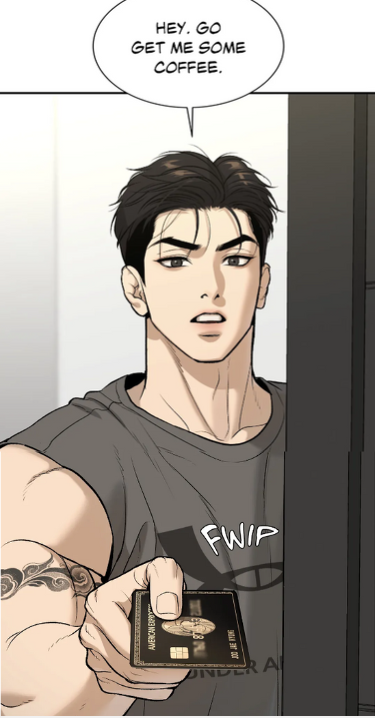 (chapter 24). Then he accepted the request from Doc Dan and announced to Potato that they would be sparring together from now on.
  (chapter 26). Finally, he was able to go to the States.
  (chapter 36) It was, as if the doctor’s presence had activated Yoon-Gu’s qualities from the Sardonyx and Red Spinel: lucky charm and communication. Note that in the States, Potato and Oh Daehyun made sure to deliver the incident with the drugged beverage to the coach and manager.
  (chapter 40) And now it’s time to examine Heesung’s gemstones: Diamond and Sapphire.
 (chapter 31), then the hospital and halmoni:
 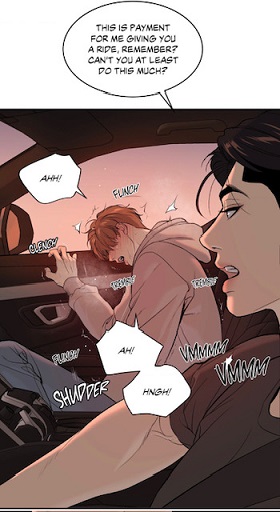 (chapter 33), aggressive
 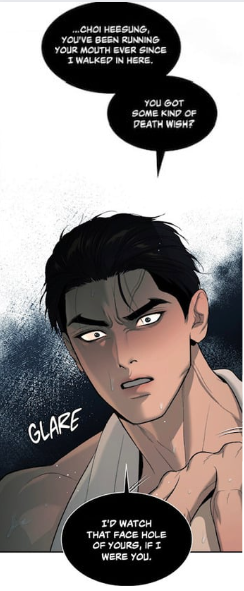 (chapter 34) and even menacing, when it came to the actor.
 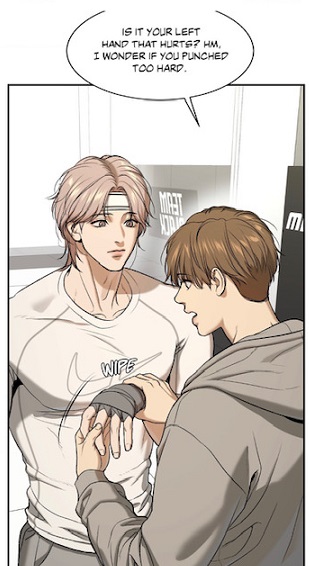 (chapter 30) the latter treated him like a human. He could sense that his offer was not motivated by greed or admiration, for he didn’t know him that well. He was just an uncut diamond. And how is the god Saturn alias Kin Dan connected to the diamond Heesung?
 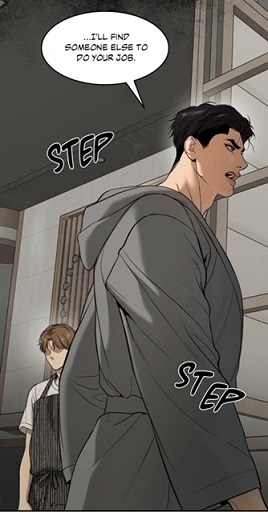 , (chapter 45) and shortly after the physical therapist was offered a new job opportunity.
 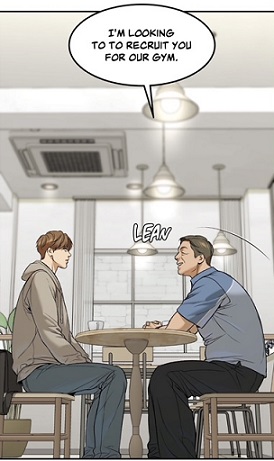 (chapter 48) Thus I deduce that the moment Kim Dan gets the support and protection from Heesung, the former could indeed become the infamous “lord of karma”. So far, Kim Dan has not been even thinking that he could press charges against Kim Miseon.
  (chapter 48) The reason is that he views himself as powerless. But like I had already announced, Heesung is a trickster himself, therefore he can perceive the deceptive nature of humans. This corrupt doctor could get into trouble because of the actor.
  (chapter 48) Kim Dan as Shani Dev was pushing away evil spirits, but at his own expense. Moreover, this signify that the alliance between Heesung and Kim Dan will bring bad luck to the schemers… as Heesung is the sapphire giving power to Kim Dan. Furthermore, the myth of Shani Dev made me realize why there is no “family” and love in the penthouse. Kim Dan needs to receive the support from Potato and Heesung, because their assistance would boost his self-confidence. Since the maknae represents courage and strength, I believe that his influence will rub off on the comedian too. But because Shani Dev symbolizes karmic justice, people came to view him as a god of misfortune.
 (chapter 31) It was not his right to intervene in the doctor’s business. The protagonist is actually a free-lancer. Hence he should be the one to select his clients. This shows that as long as the athlete doesn’t consider the comedian as a friend and supporter, he will never achieve his goal. He needs to value human relationships and see people as precious gems and not everyone as a rival and source of danger. On the other hand, I would like my avid readers to keep in mind that Joo JAekyung still remained silent, when he discovered that the comedian had tricked him.
  (chapter 35) In ancient times, travelers would often wear sapphire as a talisman for protection against illness and misfortune, seeking its benevolent energies to guide them on their journeys. The problem is that he was not present in the States, hence there is no ambiguity that if he came to hear about this incident, he would resent the athlete.
  (chapter 37) On the other hand, this description about Sapphire displays another similarity between the second leads. Both Heesung and Potato are associated with lucky charms and protection.
 (chapter 48) That’s the reason why I am more than ever convinced that the cheap trick played by Choi Gilseok will backfire on them. How so? The champion is not paying attention to Kim Dan, but to the other director. Moreover, keep in mind that Saturn, Shani Dev, is the lord of karma. Finally, we have a blue night… similar to the color of Sapphire

 (chapter 46) On the other hand, chapter 47 exposes that the doctor didn’t lose his interest and attention towards his boss.
  (chapter 47) This exposes that Kim Dan didn’t choose resent or indifference towards Joo Jaekyung despite the inflicted pain. On the other hand, why did I write that the celebrity is Kim Dan’s reflection? Why is the athlete the doctor’s mirror of truth? It is because Joo Jaekyung embodies his negative reflection: independency and toxic negativity. But what is the latter exactly?
 (chapter 31) It is because when the psychologist met the patient with her boyfriend for the first time, he paid attention to his micro-expressions, and more particularly to his mouth. He saw his smirk. Here, I feel the need to give an explanation how these micro-expressions were discovered.
 (chapter 30) As my avid readers can detect, the expression from the boyfriend’s mouth displeased the white-haired psychologist. He could recognize his emotion, though such facial expressions are very short-lived
 .(chapter 30) So what was the “jerk” feeling, when he was conversing with Sihyun? Cynicism.
  (chapter 31) And the reason why he stated that as soon as cynicism or scorn was present in a relationship, the couple would end up breaking up is because of John Gottham’s observations and conclusions.
 (chapter 45) We could sense it in different scenes, though I would say that his cynicism was slowly vanishing:
  (chapter 3)
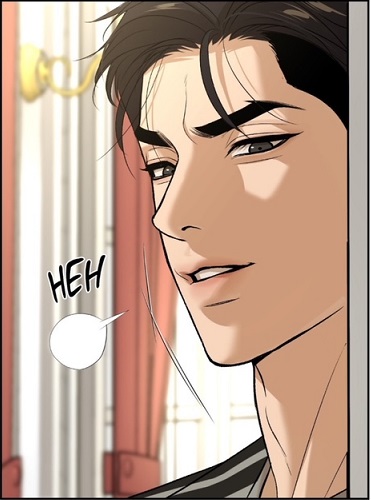 (chapter 40) This is the so-called toxic negativity. Therefore it was to expect that the champion would reject the doctor’s present. He could only doubt the sincerity behind his gesture. How so? Remember how the team desired to celebrate his birthday: a surprise party. They bought a cake…
  (chapter 43) So technically, they offered a cheap cake and got in exchange a super expensive dinner. One might say that this was just a joke. But cynical people are taking things very seriously. This is what the champion learned from this experience, the cake in exchange for a super expensive meal … and now imagine that the next morning, he received an „expensive“ present from Kim Dan which was similar to the gifts from fans (exchange of favors). It is normal that he doubted the genuineness from his doctor, not only because of his past experiences, but also because of the parties before. But there exists another reason why he had to refuse the gift: Cynicism… the end of relationship. Thus dating for the athlete was impossible.
  (chapter 8), in the office, in the car, in front of a mirror, in front of Heesung in the living room… Don’t forget that Diogenes would even masturbate in public.
 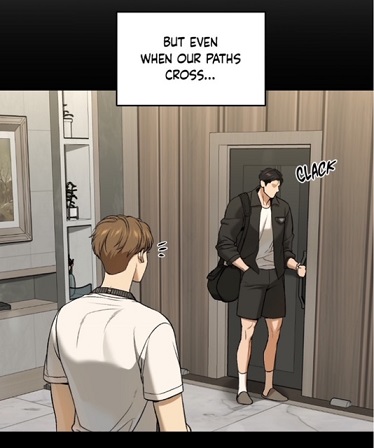 (chapter 47) It is because deep down, the champion sensed that his flat had become a home. He wanted to ensure that the penthouse was still a workplace or a hotel room. Thus he refused to eat the breakfasts prepared from his PT. In his eyes, these meals must have appeared as a violation of his self-imposed discipline. It was more than self-sufficiency. Under this new light, Jinx-philes can grasp why he rejects presents and prefers donating money.
 (chapter 45) It symbolized everything he hates: a reminder of wealth, superficiality, attachment, secrecy and silence. It also exposed the huge difference in their mind-set. Kim Dan is not his disciple! He imagined that he had found a kindred spirit, especially after that night:
  (chapter 39) The reason is simple. The champion had finally found someone who accepted his roughness in bed and could match his stamina.
  (chapter 10) He is not resigning on designer clothes.
  (chapter 45) He might advocate autonomy and self-sufficiency, the reality is that he likes luxury. Hence he is unable to live in harmony with nature. This shows that the fighter is in denial and is living in an illusion. Thus he can not find true happiness, for his freedom is not real. He is attached to the gym which is also strongly connected to his career as the Emperor.
  (chapter 46) With his brutal attitude, he is doing himself a disservice. Exactly like Kim Dan, he is even ruining his career and own reputation. Not only he lost 4 athletes (I am including Seonho), but also his loyal admirers are calling him a thug now:
  No one can survive on his own. This explicates why Cynics had disciples in the end. And now, you comprehend the role of Kim Dan in Joo Jaekyung’s life. It is to remind him of his true nature. He is a human and not a dog-wolf. Thus the champion recommended his PT to live elsewhere, a sign that he was indeed a human.
  (chapter 10)
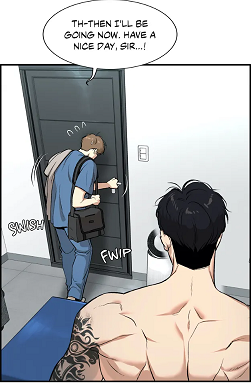 (chapter 1) Then the micro-expressions from Kim Dan exposed his lie
 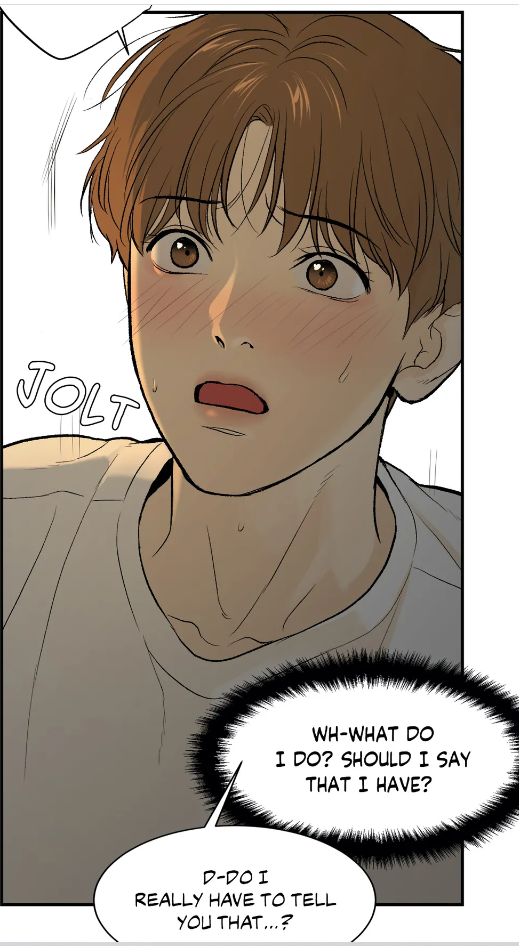 (chapter 3) On the one hand, the champion’s worldview about humans got reinforced, on the other hand the doctor’s deception symbolized his purity. He was a virgin, which was contradicting his “theory” too.
 (chapter 11) He even looked like a ruler abusing his authority.
 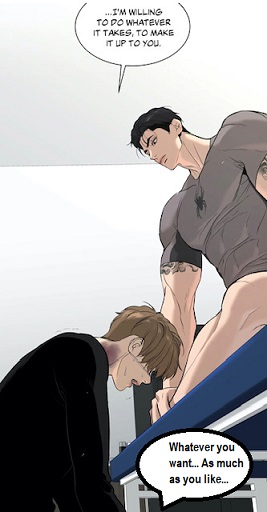 (chapter 11)
  (chapter 11) Here, the champion thought that Kim Dan had been gambling. An emperor or ruler, especially one characterized by a lack of idealism, may embody the cynical belief that individuals are primarily driven by self-interest and that altruistic motives are rare. Therefore the celebrity rejects the notion of soulmate
  (chapter 33) or even the idea of friendship
  (chapter 42), Park Namwook
 (chapter 36)
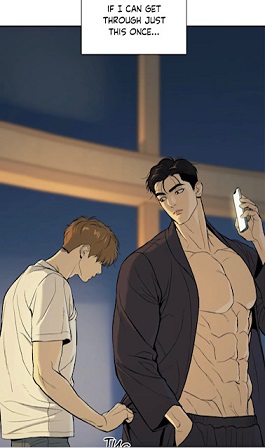 (chapter 2)
 (chapter 45) was showing the doctor’s golden heart. He was just judging his lover based on his past experiences and his negative worldview. And this brings me to list the cause for Cynicism:
 (chapter 2) He learned through Cheolmin that he could kill him. This shows his good nature in verity. Hence he resorted to such gestures, when his cynical depression resurfaced:
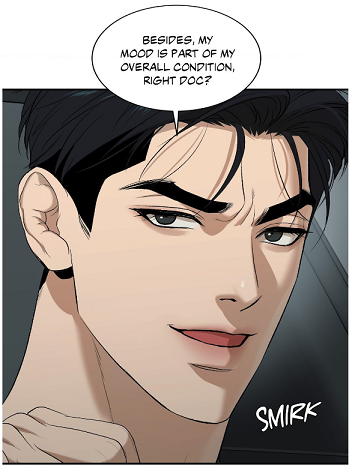 (chapter 32)
  (chapter 36)
  (chapter 45) As you can see, little by little, the champion is learning to control his rage and “cynicism”. During the last argument, he didn’t touch the physical therapist at all. He still allows him to stay at his place and he is shown as caring later.
 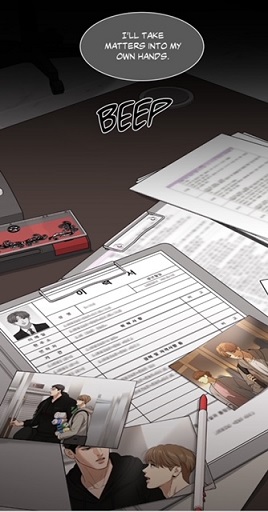 (chapter 46) The irony is that Joo Jaekyung is not recognizing his own transformation. The most obvious evidence for his metamorphosis is the absence of his jealousy towards the doctor.
 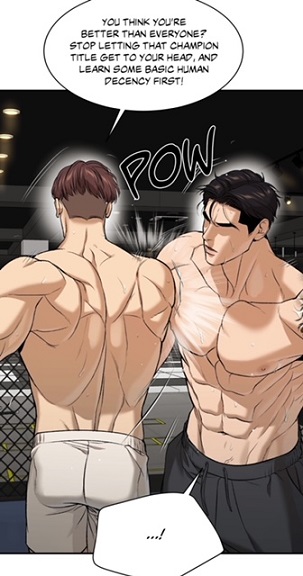 (chapter 46) It is because Kim Dan had not talked back to Joo Jaekyung during their argument. He had accepted his criticism silently contrary to Seonho. Right now, he has the impression that he still has the upper hand, but he couldn’t be more wrong.
  (chapter 40) Then in episode 47, the emperor got manipulated by his so-called loyal advisors.
  (chapter 47) First, I would like to outline that neither the manager from the Entertainment agency nor his acolyte brought up the underground fighting ring and Baek Junmin’s dubious success.
  (chapter 47) With their video, they presented him as an average and reliable fighter.
  (chapter 47) Observe the divergence between the advisors’ words and the members’ from Team Black.
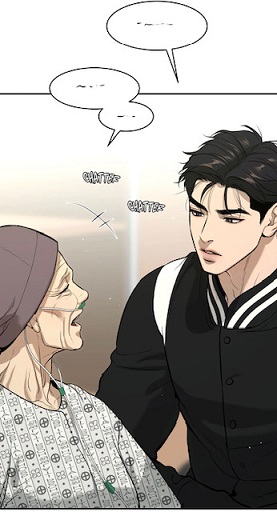 (chapter 21) Moreover, the grandmother’s mortality could serve as a reminder for the champion that he is also a human… just like the others he condemns. Besides, she embodies true selflessness and gratitude. Hence she took the champion’s hand to thank him
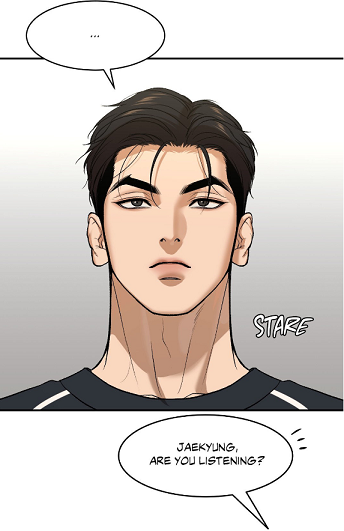 (chapter 47) Should Kim Dan divulge Baek Junmin’s connections to the underground fighting ring or simply show him the message,
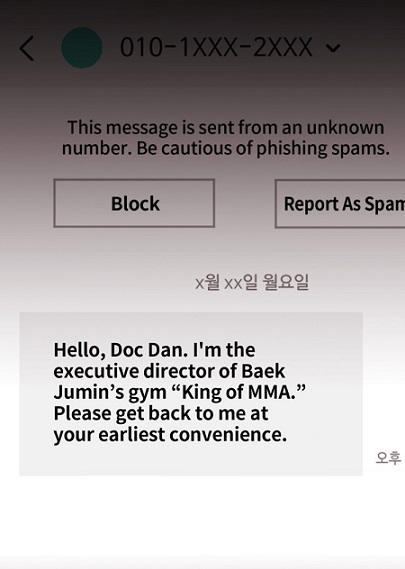 (chapter 47), he would prove his faithfulness and sincerity to the fighter. And the vicious circle would be broken. Though he is broke, he would give up on an opportunity to earn some money easily. To conclude, as long as the champion is still a cynical character, he can not enter a relationship with Kim Dan. For that, he needs to open up his heart and third eye so that he can recognize his partner’s selflessness and honesty. Finally, he will realize that he needs the assistance of others in order to be able to keep his reputation intact (witnesses, supporters). There is no doubt that the Emperor will be badmouthed again.
 Bebebisous33s' analyses in K-Dramaland and Manhwas