

Please support the authors by reading Manhwas on the official websites. This is where you can read the Manhwa: Jinx But be aware that the Manhwa is a mature Yaoi, which means, it is about homosexuality with explicit scenes. Here is the link of the table of contents about Jinx. Here is the link where you can find the table of contents of analyzed Manhwas. Here are the links, if you are interested in the first work from Mingwa, BJ Alex, and the 2 previous essays about Jinx Between A Squeeze And A Crack – part 1 and Between A Squeeze And A Crack – part 2
It would be great if you could make some donations/sponsoring: Ko-fi.com/bebebisous33 That way, you can support me with “coffee” so that I have the energy to keep examining Manhwas. Besides, I need to cover up the expenses for this blog.

Where is a Flower in Episode 88?
Episode 88 of Jinx immediately drew readers’ attention to two moments in particular: the training session between Kim Dan and Joo Jaekyung 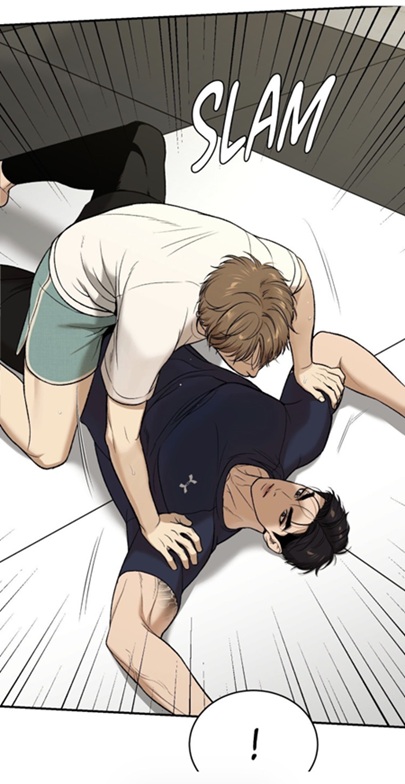 (chapter 88), and the final panel hinting at an imminent confrontation with Choi Heesung.
 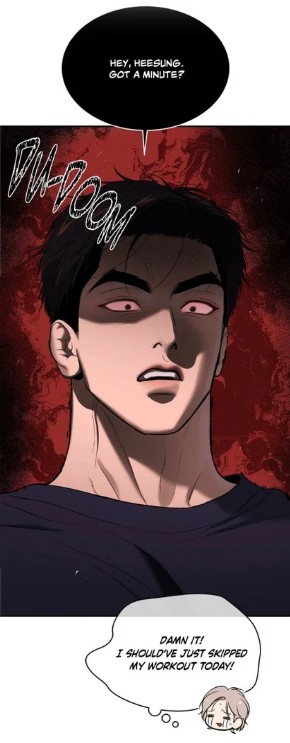 (chapter 88) Discussions largely revolved around physical proximity, discipline, and anticipation — around bodies in motion and the promise of conflict to come. At first glance, the episode seemed to oscillate between intimacy and tension
 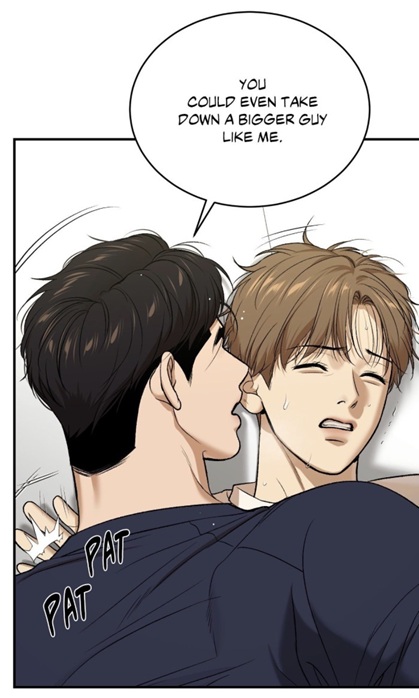 (chapter 88), between preparation
 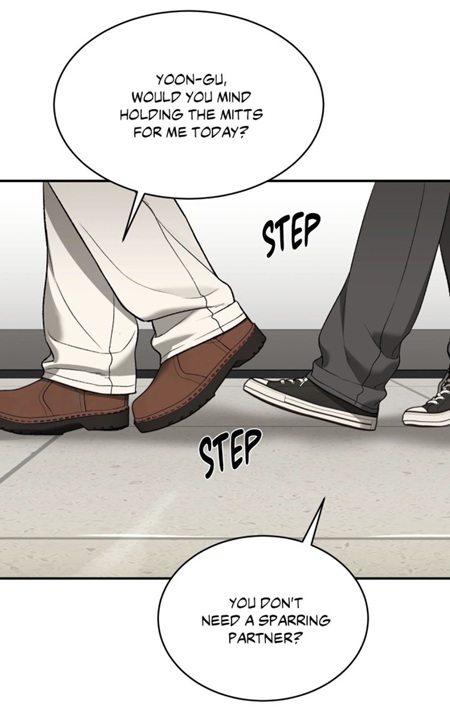 (chapter 88) and interruption
 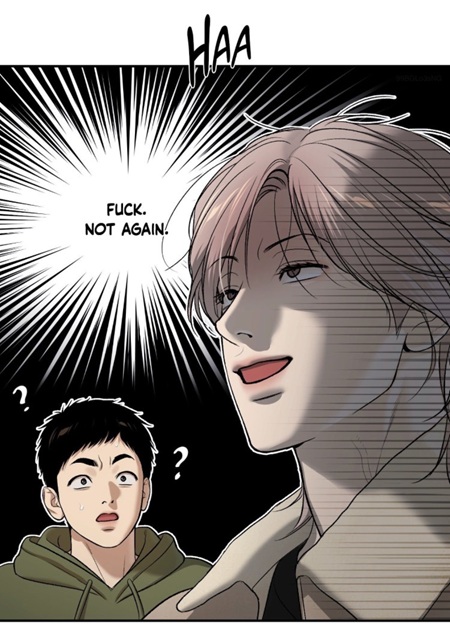 (chapter 88).
Only on closer reading does another layer emerge — one that does not oppose these moments, but reframes them. The training session is not merely about discipline or proximity, and the final panel is not only a promise of confrontation. Both scenes 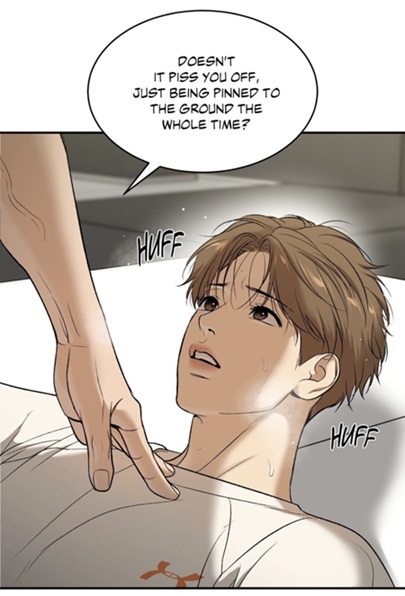 (chapter 88) are structured around restraint (chapter 88): what is held back
 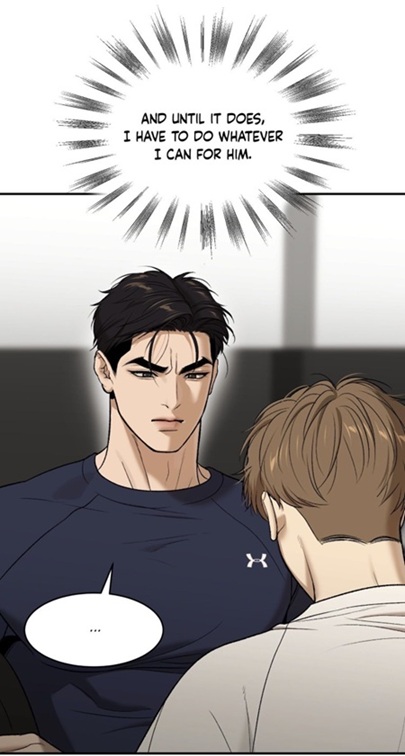 (chapter 88), delayed, or redirected. Words are measured, authority is redistributed, and decisions are deferred
 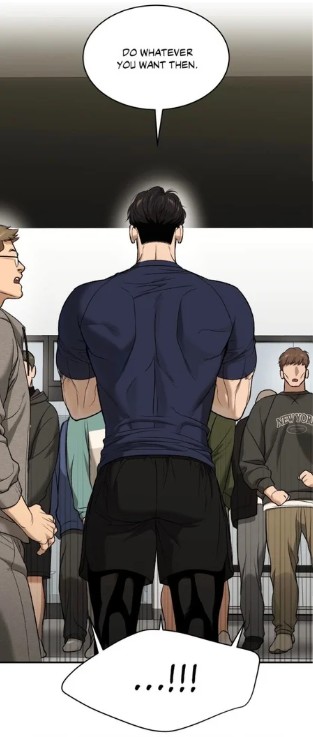 (chapter 88) rather than imposed. What initially appears as physical intensity and narrative suspense begins to reveal a deeper reconfiguration of roles, responsibility, and choice.
At first glance, the title may seem paradoxical. The episode takes place a few weeks after October  (chapter 70)—most likely in November— in late autumn.
 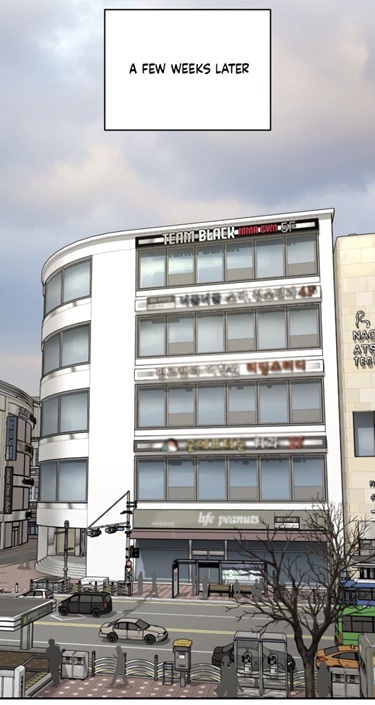 (chapter 88) This temporal setting is visually reinforced by the environment itself: in the opening sequence marked “a few weeks later,” the tree is already bare, its leaves gone. Nature offers no spontaneous image of growth or renewal. If a flower were to appear in this chapter, it couldn’t belong to the season. It must be cultivated, protected, and sustained in a green house—something that emerges not from natural abundance, but from deliberate care. So where does this idea of a flower come from?
Closed Circuits and the Logic of the Number Eight
The title emerged from a visual and structural observation. Chapter 88 is built around the number eight: a chapter defined by two closed circuits that finally cross. Remember how I described the relationship of the main couple in the essay  : a closed circuit which we could witness once again in the training room: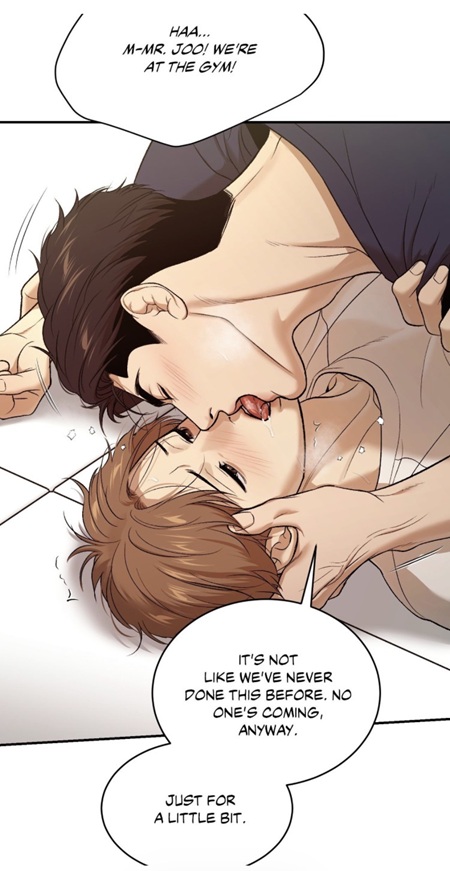
 (chapter 88) There are once again sparks between them. The number 8 is not just related to doc Dan [for more read The Magic Of Numbers ] and his relationship with the athlete, but also to the other couple: Heesung and Yoon-Gu. This means, the latter represent the other closed circuit. Hence the other couple appeared in episode 35 and 58.
  (chapter 58) Two trajectories —long separated, repeatedly missing one another—intersect at last. When two eights overlap, they form neither a loop nor a knot, but a new shape: a flower-like figure, suggestive of opening rather than closure. This crossing does not resolve everything; instead, it creates the conditions for growth for all the characters. We could say that each closed circuit forms two petals so that their interaction with each other will affect them positively.
Color as Emotional Structure
The flower, however, is not only numerical or temporal. It is also chromatic. A flower is never defined by form alone, but by shading—by gradients, transitions, and the coexistence of multiple tones within a single structure. Thus in French certain flowers serve to define pigments: rose for pink, violet for purple. In this sense, episode 88 does not merely contain colors; it behaves like a flower unfolding through shades. Episode 88 is saturated with color: pink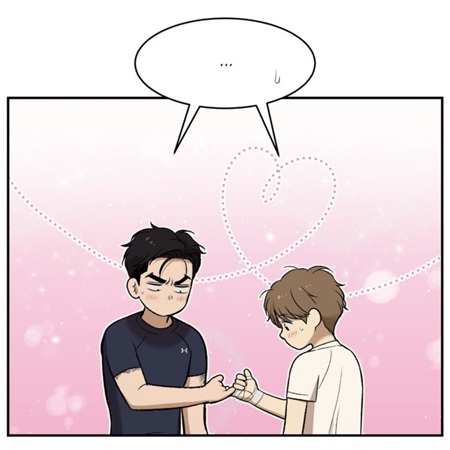 (chapter 88), white
 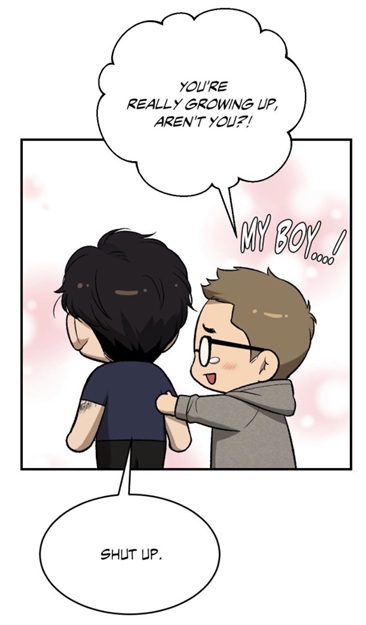 (chapter 88) purple
 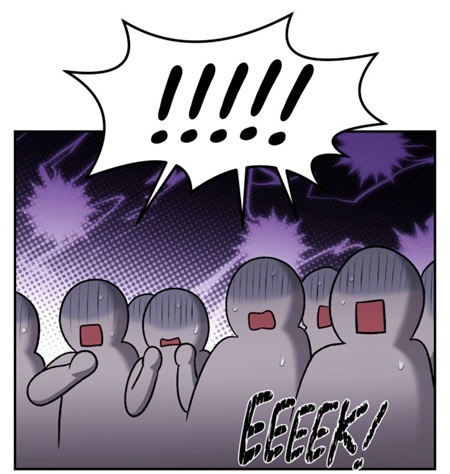 (chapter 88), blue, gray,
  , (chapter 88) red (chapter 88) and black
 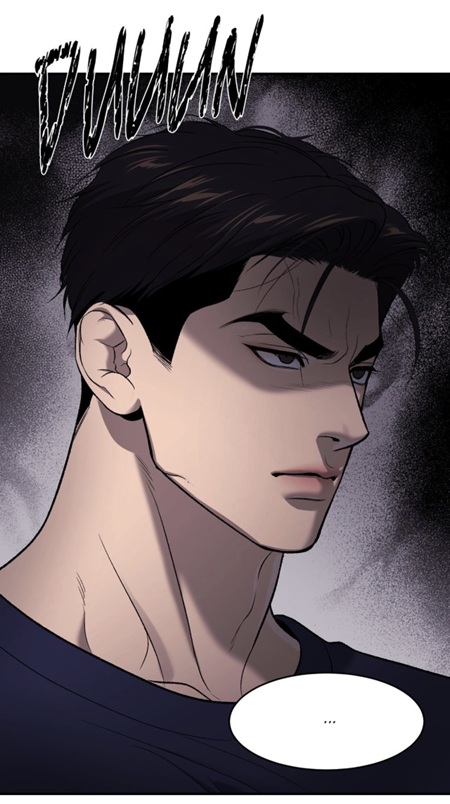 (chapter 88) Pink frames tenderness and mutual awkwardness; purple marks embarrassment and heightened awareness; red signals suppressed anger and looming confrontation; black absorbs fear, silence, and unresolved tension.
White, notably associated with Park Namwook, carries a more ambivalent meaning. (chapter 88) It evokes innocence on the surface, but also ignorance—an unexamined moral comfort that allows him to retreat from responsibility while claiming authority. His lightness contrasts sharply with the weight of the decision he refused to make: visually underlined by the black-lined spiral hovering near his head—an emblem of irritation without accountability.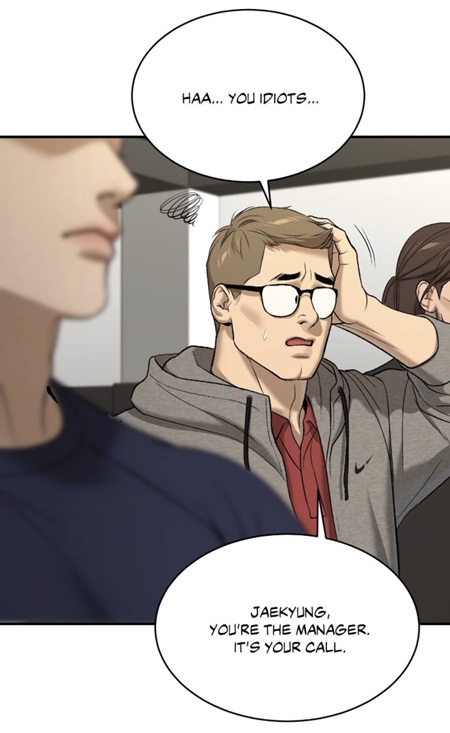
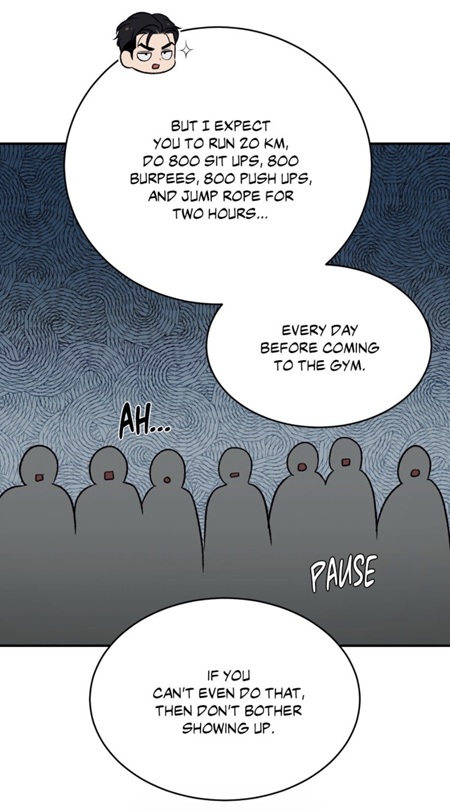
Blue and gray dominate the scene in which Joo Jaekyung announces his seemingly excessive training demands. (chapter 88) On the surface, the atmosphere feels cold and authoritarian. Yet the exaggeration itself reveals something else: the demand is deliberately absurd, almost teasing. Joo Jaekyung is testing resolve, not imposing punishment. The joke —visible thanks to the chibi and the brief spark within the athlete’s gaze— goes unnoticed. No one laughs. The room’s muted colors reflect this misrecognition—care and fun are present, but not yet legible to those receiving it.
At first glance, the setting itself seems to resist any floral reading. (chapter 88) The scene unfolds not in nature, but in a gym in Seoul—an urban, enclosed space associated with discipline, repetition, and control rather than growth or renewal. This tension may explain the readers’ initial surprise: a flower appears where one would expect only concrete, steel, and hierarchy. Yet in Jinx, the flower does not belong to nature as landscape, but to nature as process—to emergence, care, and relational change.
This process is not introduced through scenery, but through bodies marked by green. And the latter symbolizes nature. In episode 88, two characters 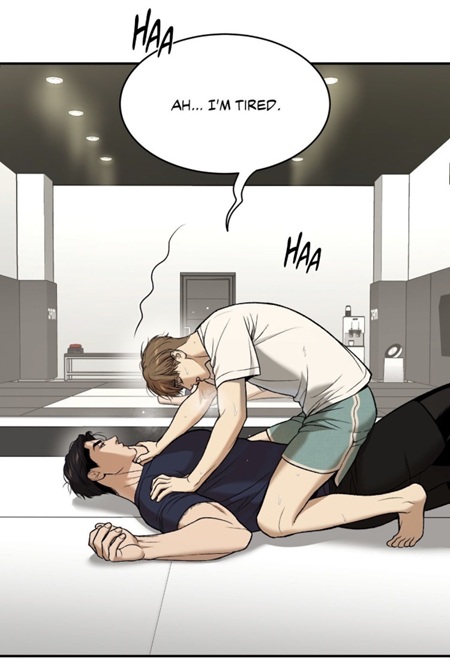 (chapter 88) are dressed in green (chapter 88), a choice that appears unobtrusive—almost practical—yet is unmistakable within Mingwa’s chromatic language. Green here does not function as pure nature or renewal, but as transition: a sign of growth that is still constrained, negotiated, and incomplete. It is not a vivid, liberating green, but a muted one—ranging from green sheen to subdued olive—closer to endurance than vitality, to steadiness rather than expansion. Growth is present, but it has not yet broken free; it remains embedded in effort, restraint, and adaptation.
Crucially, this shorts’ shade recalls the photograph of Kim Dan with his grandmother 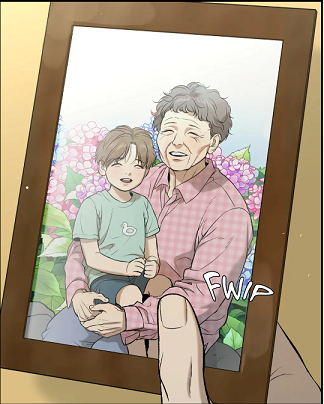 (chapter 19), where green and floral elements once functioned as a silent language of care and containment. The repetition is not accidental. By wearing a similar tone in the present, Kim Dan does not merely revisit the past; he carries it forward. (chapter 88) The color no longer signifies dependency or shelter alone, but continuity of self. It marks a return to an inner disposition that predates trauma—a self capable of care, persistence, and quiet resilience. This means that he is closer to his true self.
Placed within the gym’s dominant blues and grays, this green does not signal leisure or escape. It signals cultivation. Growth here is neither spontaneous nor decorative; it must be trained, maintained, and protected. The flower does not bloom despite the city—it blooms through care, discipline and recognition. What initially appears paradoxical becomes coherent: in Jinx, growth is not opposed to structure. It is shaped by it.
From Flower to Language: Communication Deferred
Crucially, the flower also functions as a metaphor for communication. (chapter 19) Flowers are not passive decorations; they carry meaning, intent, and symbolism. The background is composed of hydrangeas in blue, pink, and pale violet—colors traditionally associated with gratitude, tenderness, apology, and emotional nuance.
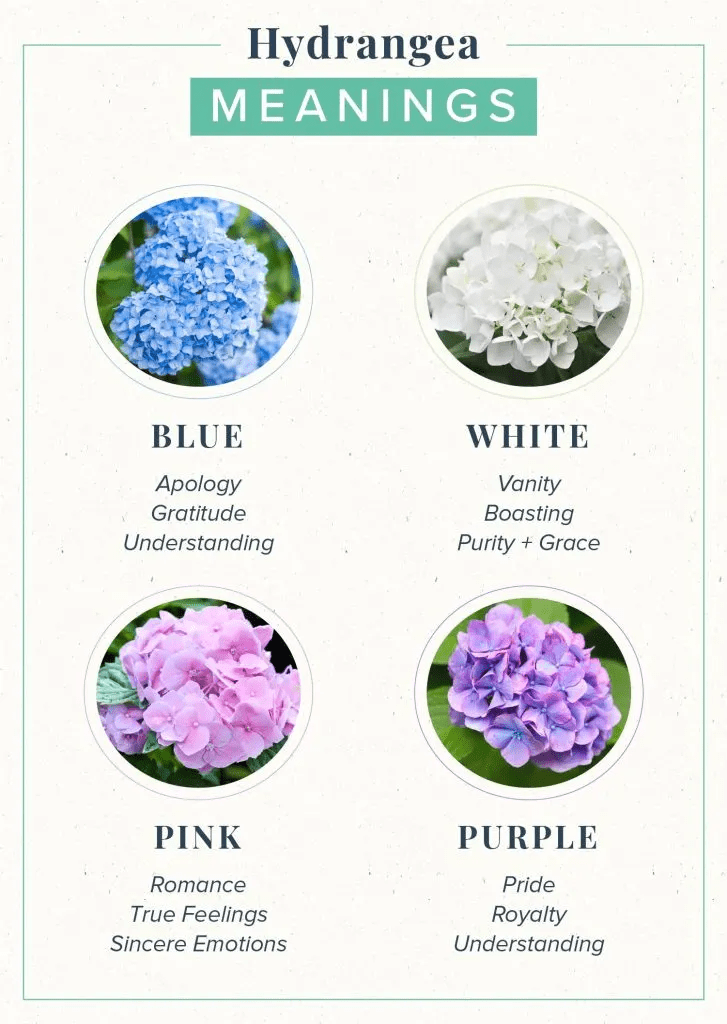
Unlike roses  (chapter 35), which tend to assert a singular message (love, passion, beauty), hydrangeas communicate multiplicity and emotional ambivalence; they speak in clusters rather than declarations. This visual language mirrors Kim Dan’s inner world at the time (chapter 19): affection entwined with dependency and sorrow, care mixed with silence, love present but unspoken.
This chromatic memory resurfaces later through a different floral gesture: the bouquet Choi Heesung offers Kim Dan —pink roses paired with baby’s breath 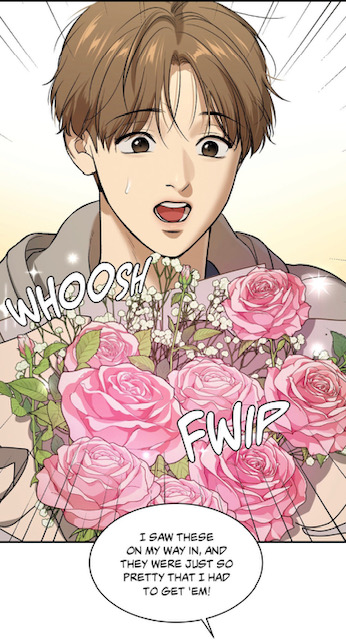 (chapter 31). Here, the symbolism shifts. Pink roses convey affection and admiration, while baby’s breath suggests innocence and fragility. Yet the arrangement is excessive, overwhelming, and mismatched to its recipient. The bouquet does not listen; it speaks at Kim Dan rather than with him. Significantly, Heesung comes to associate Kim Dan himself with the flower—something delicate, beautiful, and deserving of protection, but also something to be handled, displayed, and possessed.
Episode 88 reframes this logic entirely. The “birth of a flower” no longer refers to being perceived as fragile or decorative, but to a return to growth from within. 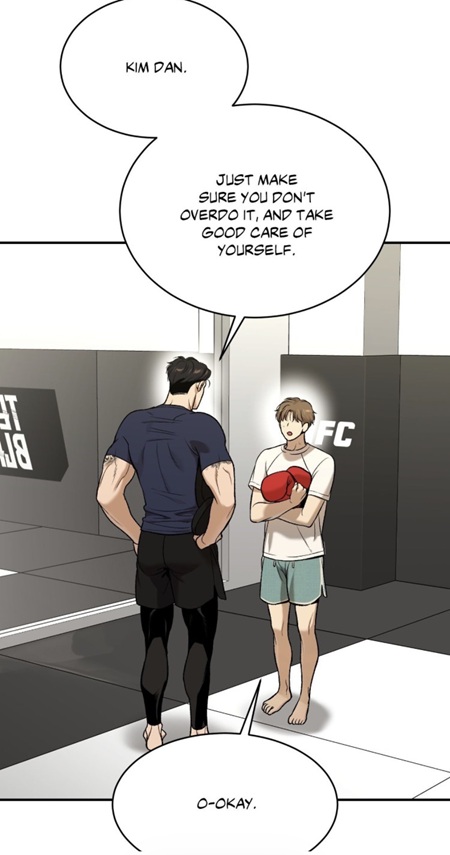 (chapter 88) Kim Dan’s green training clothes—visually echoing the green shirt he wore in the photograph with his grandmother—signal continuity rather than regression. This is not a retreat into childhood dependency, but the reappearance of an inner child now disentangled from obligation and fear. The flower that reemerges here is not gifted, not arranged, not imposed—it grows. In this sense, episode 88 introduces a missing element in the dynamic between the two protagonists: not desire, not care, but communication. And it is here that Choi Heesung becomes central—not as a rival or antagonist, but as a structural bridge, as in reality he represents the rose, “La vie en rose”
  . He embodies speech, playfulness, and visibility, yet also reveals their limits when they are severed from responsibility and respect. I will elaborate about this more below.
The illustration accompanying this essay includes a fifth, shadowed petal inspired by the Mugunghwa—the Rose of Sharon, a national symbol of Korea often associated with endurance, justice, and continuity. This fifth petal does not yet fully bloom. It signals something incomplete, something still forming: a question of justice, choice, and mutual recognition that the narrative has only begun to articulate.
Finally, this essay reads episode 88 through the lens of Erich Fromm’s definition of love—care, responsibility, respect, and knowledge. For me, these 4 notions are represented by the 4 petals. In this chapter, Joo Jaekyung visibly embodies care, responsibility, and a growing respect for others’ autonomy. What remains absent is knowledge: a true understanding of Kim Dan’s inner life, just as Kim Dan himself has yet to fully understand Jaekyung beyond his role and past. The flower, then, is not the endpoint. It is the beginning of a process in which these missing elements may finally emerge.
What follows is not an analysis of victory or defeat, but of growth—quiet, fragile, and cultivated under constraint. This is not the celebration of happiness already achieved 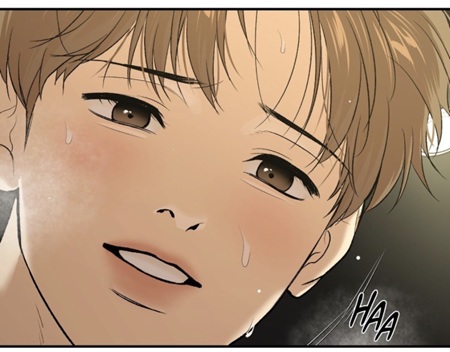 (chapter 88), but the moment in which the conditions for happiness are finally put into place. And now let me ask you this. What is the symbol of happiness? Smiles and laughs. During the training session, Kim Dan smiles. These moments are brief
 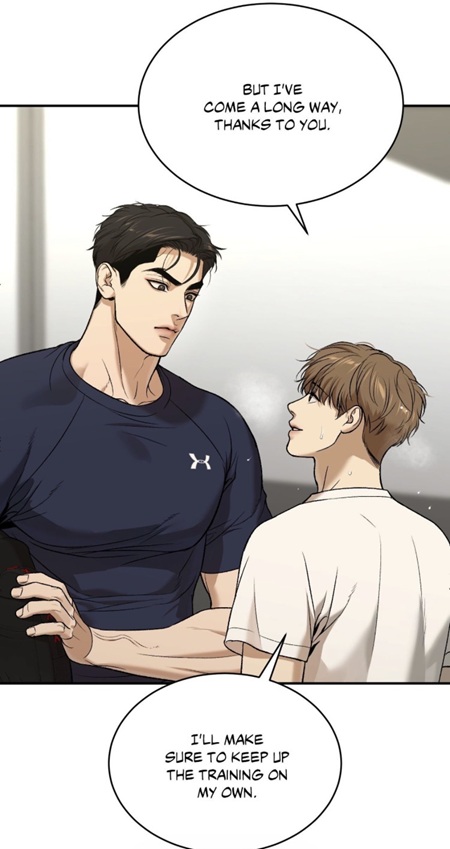 (chapter 88) and goes unnoticed by him (chapter 88) and his fated partner, yet it directly answers what Joo Jaekyung has repeatedly expressed as his desire: to be the source for Kim Dan’s smile and to smile together.
 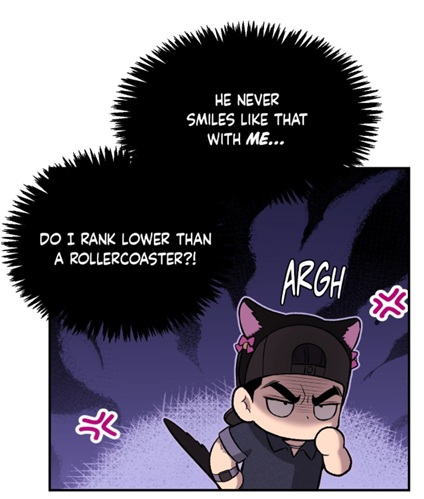 (chapter 83) What is striking is that neither of them recognizes this fulfillment. (chapter 88) Kim Dan does not register his own smile as happiness, and Joo Jaekyung does not realize that he is already producing what he seeks. As elsewhere in Jinx, happiness precedes awareness. It exists before it is acknowledged—by both sides.That’s why I selected the title: the flower embodies happiness, as its life is just as short as happiness.
  (chapter 31)
A. Joo Jaekyung × Kim Dan: The First two Petals
The training sequence in episode 88 cannot be read as a simple exercise scene, nor as a sudden moment of equality or mutual play. It is, instead, the continuation of a long-standing relational pattern in which care is expressed indirectly (chapter 88), asymmetrically, and through the only language both characters know how to use: work.  (chapter 88) What appears at first glance as coercion
 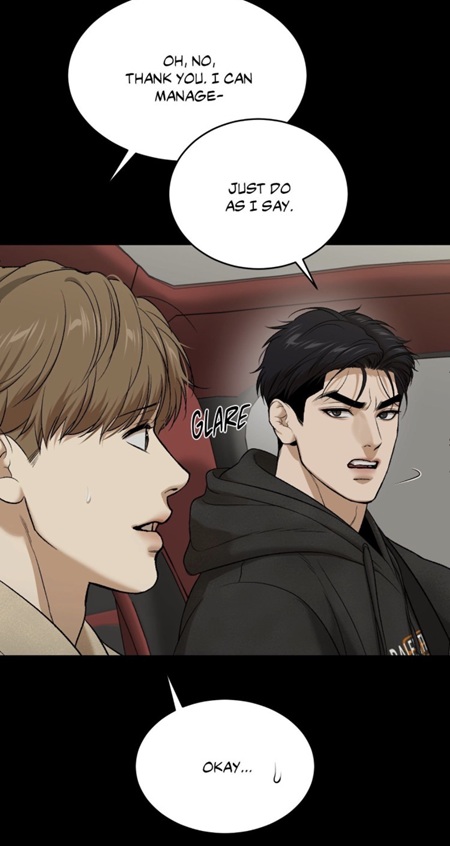 (chapter 88) or discipline is in fact a negotiation shaped by habit, fear of burdening the other, and an inability—on both sides—to articulate desire outside professional roles.
1. How the training is suggested: care disguised as necessity
Crucially, the idea of training does not emerge in the gym itself. It is first introduced in the car 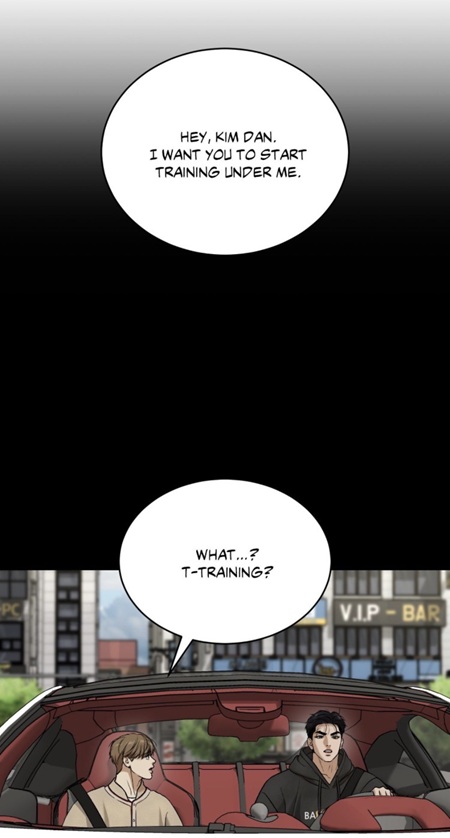 (chapter 88), a space that is never neutral in Jinx. A car has one driver, one direction, one authority. By placing the conversation there, Mingwa signals that the relationship is still structurally asymmetrical at this point: Joo Jaekyung leads, Kim Dan follows.
Joo Jaekyung frames the proposal as a matter of stamina and work. (chapter 88) Training will help him in his career. This framing is not accidental. Joo Jaekyung does not yet know how to say: “I want to spend time with you“, or “I’m afraid you won’t be safe, once you leave my side“. He knows only how to justify closeness through usefulness. Training becomes a rational excuse for proximity, a legitimate reason to demand time without admitting emotional dependence.
At the same time, this proposal is deeply protective. Joo Jaekyung has seen Kim Dan collapse from exhaustion in the past. He knows his physical limits better than Kim Dan himself. 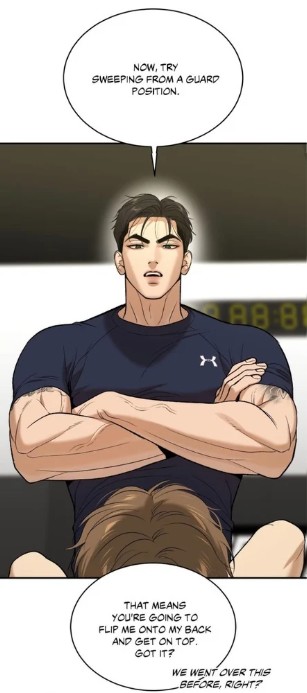 (chapter 88) Secondly, such a training suggests that the athlete is gradually remembering this scene of the almost-rape. (chapter 88) In his subconscious, he knows that this was not prostitution.
 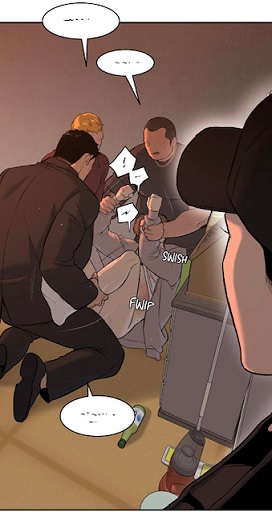 (chapter 17) Therefore it is not surprising that instead of asking permission or explaining concern, he imposes the idea—because that is how he has learned to act as a captain, a fighter, and later a manager. Authority precedes dialogue. (chapter 88)
2. The first refusal: self-neglect disguised as strength
Kim Dan’s first response is immediate: (chapter 88) He refuses. This is not politeness. It is not consideration for Joo Jaekyung’s fatigue. It is a reflex rooted in long-standing self-erasure. Kim Dan genuinely believes he is strong enough. More importantly, he believes that needing care is illegitimate.
This refusal is governed by habit:
- the habit of minimizing himself,
- the habit of overestimating endurance,
- the habit of believing that receiving attention makes him a burden.
At this stage, Kim Dan is not yet protecting Joo Jaekyung; he is protecting the structure that allows him to remain useful and unobtrusive. Accepting training would mean admitting vulnerability—and worse, accepting time, effort, and concern directed at him.
The sportsman ignores this refusal. This moment is important because it reveals both the problem and the intention. Joo Jaekyung acts like a parental figure, not a partner. He overrides consent not out of cruelty, but out of conviction that he knows better. His care still takes the form of command. This explicates why the physical therapist’s agreement is accompanied with a drop of a sweat. “Okay” indicates more discomfort than joy and gratitude. He doesn’t feel indebted toward the athlete, rather embarrassed.
Thus the asymmetry is intact. The training is not born out of his own desire.
3. The pause: time passing, resistance softening
Striking is that this conversation is revealed, after the champion asked doc Dan to get changed. 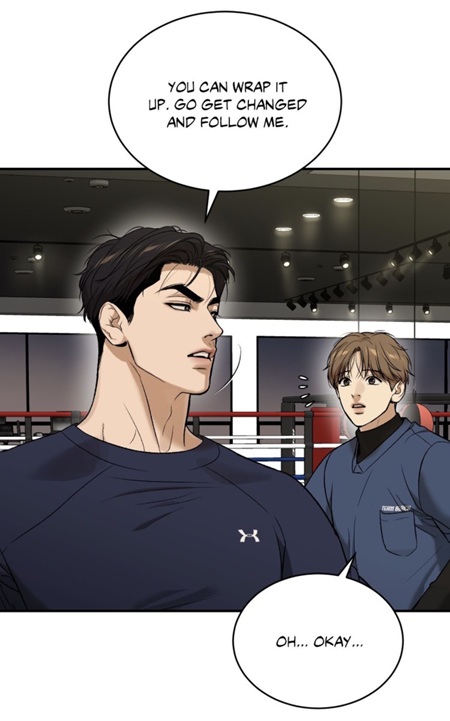 (chapter 88) In other words, the request from Joo Jaekyung appears as a memory from the physical therapist. Why?
 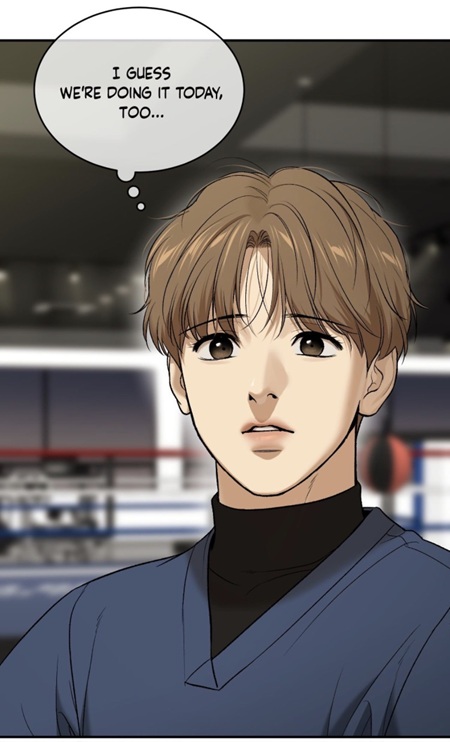 (chapter 88) Because Mingwa refuses the “clean” sequence in which an order is issued and immediately executed. The narration inserts a gap—an interval of off-panel time that we are forced to reconstruct from Kim Dan’s recall. (chapter 88) The narrative does not jump immediately into physical training, because the temporal gap is supposed to mirror the time jump as well. There were other training sessions. This temporal gap matters. The doctor’s inner thoughts (chapter 88) “I guess we’re doing it today, too…” implies routine without inner desire and daily regularity. This means that the training sessions only took place, when the champion asked doc Dan to change his clothes. Doc Dan was not looking forward for the training sessions or reminded the athlete of his promise or request.
That pause changes the meaning of consent and compliance. If the scene were immediate, Kim Dan’s earlier refusal (“Oh no, thank you, I can manage—”) would read as a clear boundary and Joo Jaekyung’s “Just do as I say” as a straightforward override. (chapter 88) But because the chapter returns to the topic through memory, the refusal is not portrayed as a decisive line—rather, it becomes the first phase of a negotiation Kim Dan does not yet know how to conduct. His resistance softens not because he suddenly “wants” the training, but because habit takes over: he is used to accommodating authority, used to re-framing his own limits as irrelevant, used to translating pressure into “normal.” The break between the command and the actual session is precisely where that old reflex does its quiet work.
By the time they appear in the practice room, Kim Dan is showing no hesitation. He is training eagerly. 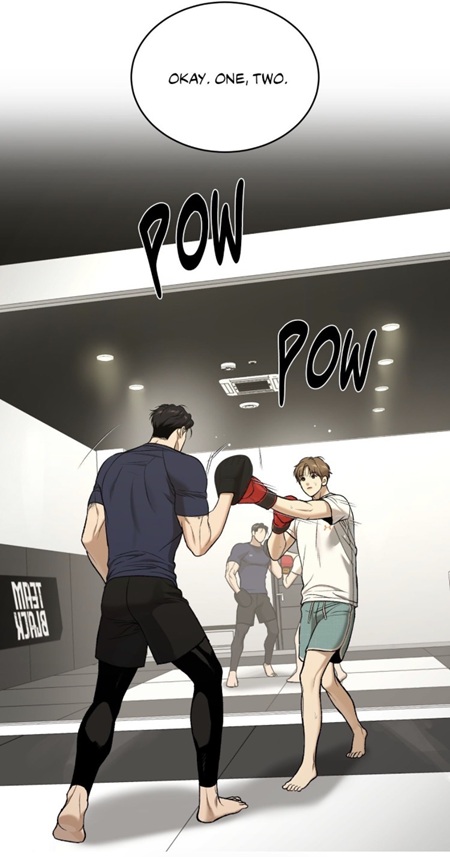 (chapter 88) Instead Kim Dan no longer insists on his own sufficiency. He no longer says “I can manage., but doc Dan admits not only his own lacking.
 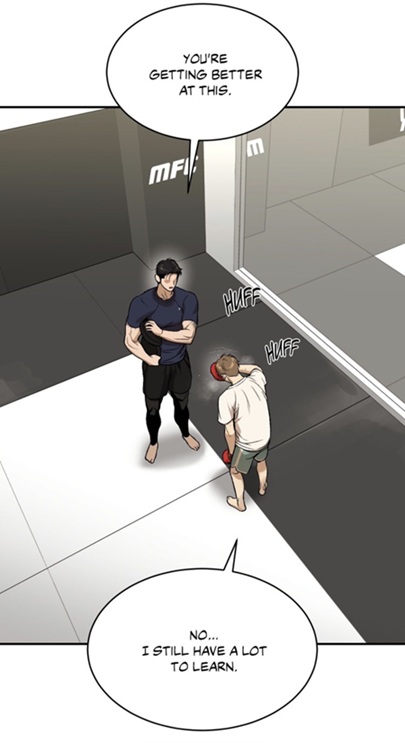 (chapter 88), but also his own desire. He finally expresses his desire to improve, to learn more.
This admission marks a decisive internal shift. In earlier chapters, “I can manage” functioned as a shield: a way to deny need and avoid dependence. Here, Kim Dan allows himself to recognize that improvement exists precisely because limits existed before. The champion’s explicit comparison with the past  (chapter 88) creates a temporal bridge that enables this recognition. Only once change is named from the outside can Kim Dan cautiously acknowledge it from within.
At the same time, this acknowledgment remains fragile. Kim Dan does not fully accept the implications of Joo Jaekyung’s praise. (chapter 88) His response — “I still have a lot to learn” — both accepts growth and reinscribes distance. He recognizes the fighter’s effort and dedication, yet still fears relying on the athlete’s benevolence. (chapter 88) This is why he immediately reframes the future in terms of independence: he will “keep up the training on [his] own.” Gratitude is present, but it remains incomplete, protective rather than connective. He still experiences himself as a potential burden. But why?
It’s because he tried to care for the athlete in his own way by suggesting a rest, but the champion denied it. 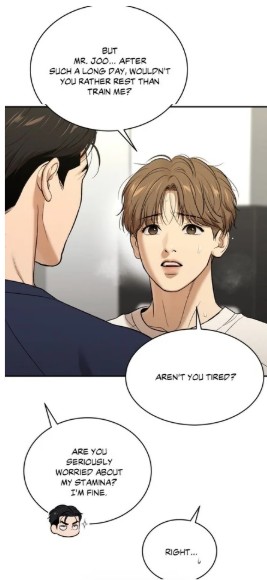 (chapter 88) The problem is that his form of care was influenced by his own mindset and emotions: his physical limitations.
This attempt at care fails not because it is insincere, but because it is misaligned. Kim Dan does not ask whether Joo Jaekyung wants to rest; he assumes that rest must be what is needed, because that is what he himself would need in the same situation. His concern is genuine, yet it is filtered through his own bodily limits and emotional economy. Fatigue, for him, is something that must be managed cautiously, avoided, negotiated. When he encounters a body that does not obey those rules — a body that still has stamina, that refuses the logic of depletion — his offer of care is quietly rejected.
This rejection is decisive. It reveals a gap Kim Dan cannot yet bridge: the realization that Joo Jaekyung’s needs do not mirror his own. (chapter 88) The athlete does not require rest in the same way, and more importantly, he does not articulate his needs through physical exhaustion at all. What Kim Dan fails to perceive is that the training itself is Joo Jaekyung’s way of staying regulated, present, and emotionally grounded. It is also his source of joy. By denying the necessity of rest, the champion is not dismissing care; he is refusing a form of care that does not correspond to him.
Confronted with this mismatch, Kim Dan retreats. If his attempt to care is ineffective, then the safest response is to minimize his demands. This is where gratitude hardens into distance. He thanks Joo Jaekyung for his help with a smile, acknowledges his progress, and immediately insists on autonomy: he will continue alone. The logic is protective. If he does not rely, he cannot burden. If he does not ask, he cannot be refused again.
What emerges here is not self-confidence, but a familiar defense. Kim Dan is not asserting independence from strength; he is withdrawing from uncertainty. His insistence on training alone does not signal rejection of connection, but fear of asymmetry — fear that he cannot offer something equivalent in return. Because he interprets care primarily through physical effort and endurance, he cannot yet recognize that his presence, attention, and willingness to engage already matter.
In this sense, the moment exposes the limits of projection. Kim Dan’s care is sincere, but it remains anchored in his own survival strategies. Until he can decouple care from exhaustion, and need from weakness, he will continue to misread situations where what is required is not restraint, but accompaniment. The training, then, is not only about building strength. It is the first site where Kim Dan begins to confront the possibility that care does not always flow from managing limits — but sometimes from staying, even when one feels unnecessary.
This is significant. It shows that Kim Dan is beginning to speak, but still cannot speak for himself. His old habit remains: if something feels wrong, it must be because the other person needs rest, not because he is tired, scared, or overwhelmed. In other words, care is emerging—but it is displaced.
This is precisely why the gesture that follows (chapter 88) carries such weight. For the first time in this exchange, care is directed back at Kim Dan without condition. It is not framed as instruction, correction, or evaluation. It is neither command nor test. It is a simple, protective statement that mirrors Kim Dan’s earlier concern — but without projection. Joo Jaekyung does not deny Kim Dan’s limits. He acknowledges them. There is no reproach, only concern. 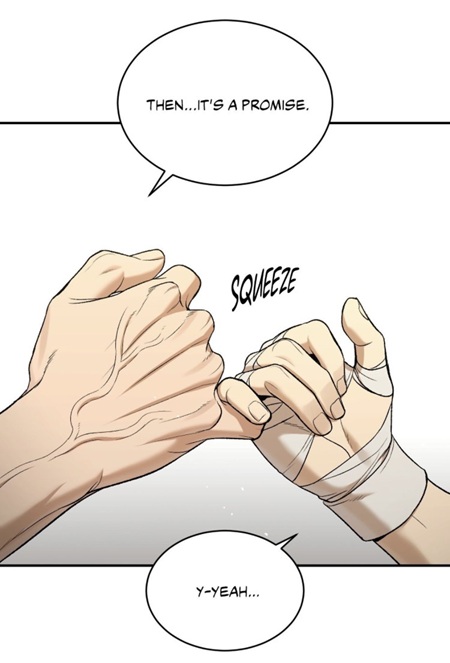 (chapter 88)
Here, the asymmetry softens without disappearing. Joo Jaekyung remains physically dominant, emotionally inarticulate, and structurally in control of the situation. Yet the direction of care shifts. He does not accept Kim Dan’s attempt to exit the dynamic under the guise of independence. Instead, he counters it with responsibility: you matter enough to be protected. The pinky promise that visually accompanies this exchange reinforces the meaning. Promises in Jinx have often functioned as burdens or traps — obligations that freeze people in place. This one is different. It does not demand performance. It does not extract sacrifice. It asks only for self-preservation. (chapter 88)
This is where the flower begins to appear — not as harmony, not as symmetry, but as mutual misrecognition slowly correcting itself. Kim Dan still does not fully grasp that Joo Jaekyung’s desire to train him is also a desire to spend time with him. Joo Jaekyung, in turn, still cannot articulate that desire outside the language of work. (chapter 88) Training becomes the only acceptable medium through which closeness can occur. Pleasure and intimacy surface unintentionally — in teasing, in competition, in shared breath — but remain unnamed.
Crucially, this is not rigidity. It is habit. Both men operate within deeply ingrained routines shaped by survival rather than joy. Rest, breaks, and leisure have only ever been framed in relation to the champion’s career: recovery after injury, distraction after stress, sanctioned release after pressure. They know how to stop working; they do not know how to share fun. There is no vocabulary yet for casual togetherness — no restaurant, no cinema, no idle wandering. Training fills the gap because it is the only space where proximity feels justified.
Thus, the training is neither purely imposed nor fully shared. It begins as Joo Jaekyung’s initiative, shaped by authority and concern, but it gradually becomes a site where Kim Dan starts to renegotiate his self-image. By acknowledging both his limits and his desire to improve, Kim Dan takes a first step away from the logic of endurance alone. He still retreats into self-sufficiency, but the retreat is no longer absolute. He speaks more. He hesitates less. He accepts care, even if he cannot yet rely on it.
The flower here is not bloom, but formation. It is the slow emergence of a relationship that must unlearn the equation between care and burden, strength and isolation, desire and duty. Nothing is resolved. But something has shifted: care is no longer one-directional, even when it remains uneven. And for the first time, both characters participate — imperfectly, awkwardly, but genuinely — in sustaining it.
4. Where pleasure enters—and why it is unspoken
As the training progresses, something shifts subtly. Joo Jaekyung smiles 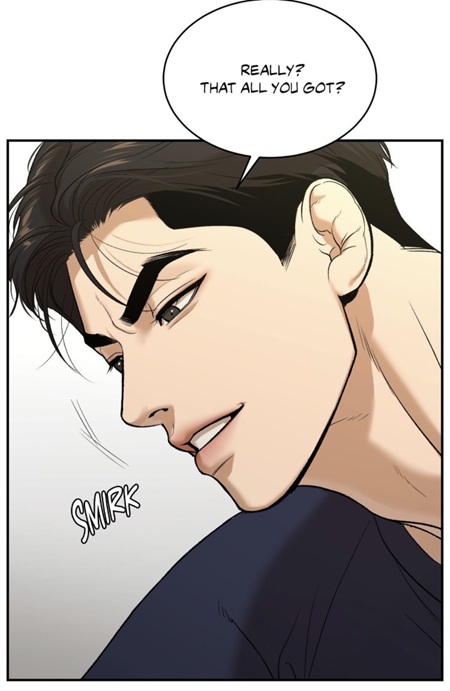 (chapter 88). He teases. (chapter 88) He challenges. He praises:
  (chapter 88)
These are not neutral compliments. They are moments where discipline slips into enjoyment. Joo Jaekyung is no longer training only to prepare Kim Dan for a future without him; he is enjoying the present interaction. And yet, he cannot name this enjoyment.
Pleasure appears within work, not alongside it. Intimacy emerges through exertion 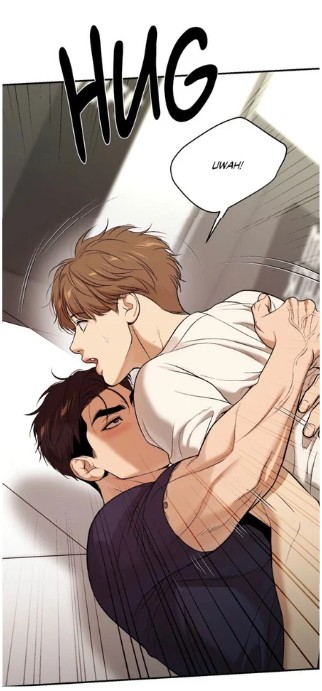 (chapter 88), not rest. Thus the doctor mistakes the embrace for a technique and not the expression of love.
 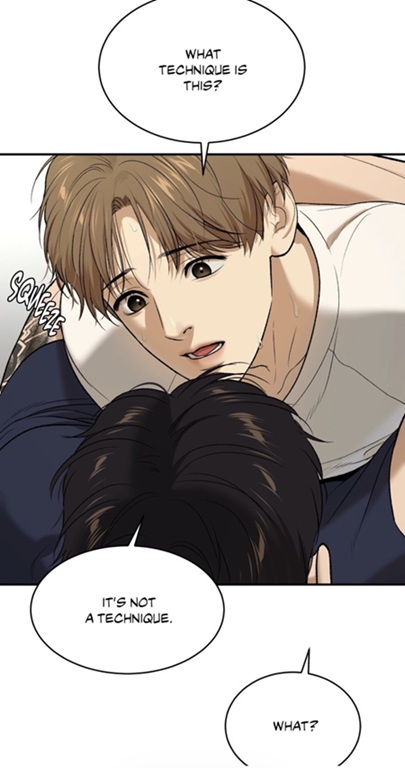 (chapter 88) And observe that the athlete still refuses to express the true meaning of his hug. His explanation still remains technical, defensive, and strategically framed:
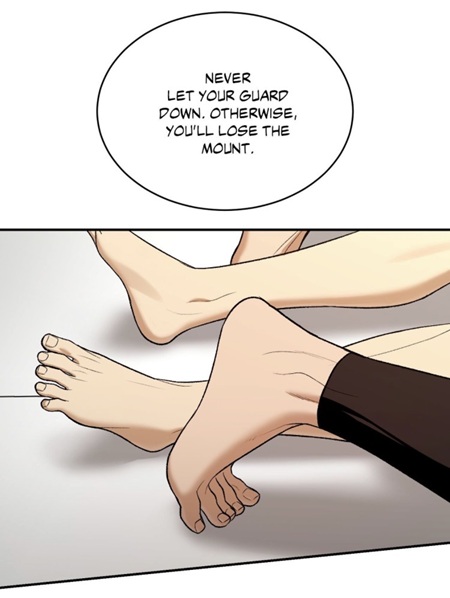 (chapter 88) This sentence is crucial. It reduces contact to function. The closeness of bodies, the pressure of weight, the proximity of breath are translated into instruction. What could be acknowledged as reassurance or care is instead displaced into pedagogy. Joo Jaekyung does not deny intimacy; he relabels it.
What the image reinforces is not distance, but deferral. The focus on bodies — on interlocked legs, grounded feet, balanced weight — emphasizes control and stability rather than vulnerability. Affection is allowed to exist only when it can be defended as functional. The mount is maintained not because Joo Jaekyung wants to keep Kim Dan close, but because losing it would constitute failure.
And yet, the sequence immediately preceding this moment shows both characters acutely aware of their racing hearts,
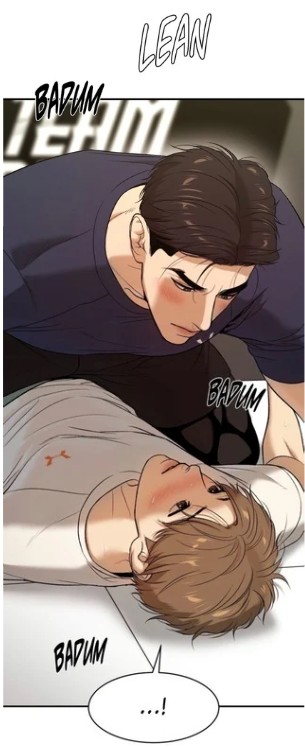 (chapter 88) of breath held too long, of proximity charged with something unnamed. The technical explanation arrives after that awareness, not before it. This confirms that the instructional language functions as a shield — not against intimacy itself, but against having to speak it.
Yet the narrative immediately undermines this technical framing.  (chapter 88) Directly after warning against lowering one’s guard, Joo Jaekyung kisses him.
The kiss is not furtive, accidental, or one-sided. Both characters are fully present. They look at each other. Neither pulls away. The contradiction is deliberate: the body does what the language refuses to acknowledge. Vigilance and intimacy coexist in the same gesture. The warning about control does not prevent closeness; it becomes the pretext through which closeness is allowed.
This is the crucial correction: Joo Jaekyung is not simply disguising intimacy as technique. He is containing it. The kiss does not negate the instructional frame; it slips through it. Pleasure is permitted only insofar as it does not require verbal recognition. Love is enacted, but not named.
For Kim Dan, this ambiguity poses no immediate problem. He has been kissed before. Physical intimacy is not new to him, and he has learned — through prior encounters — not to interrogate its meaning unless forced to do so. He does not question whether the kiss signifies affection, reassurance, desire, or attachment. Instead, he relocates intimacy spatially rather than emotionally. His only objection is not that the kiss happens, but where: (chapter 88) This line is telling. Kim Dan does not resist closeness itself. He resists its placement. Intimacy, in his understanding, belongs elsewhere — to the penthouse, to private space, to moments already coded as sexual or domestic. What unsettles him is not the kiss, but the fact that it occurs inside the domain of work.
In other words, Kim Dan does not yet read intimacy as something that can coexist with discipline. He accepts affection when it appears in designated zones, but not when it disrupts functional categories. The gym is a place of training; therefore, what happens there must remain legible as training. Joo Jaekyung’s technical explanation gives him exactly that permission.
This is why Kim Dan accepts the justification without protest. He does not reinterpret the embrace as love because he does not yet need to. The structure remains intact: work is work, intimacy is intimacy, and when the two overlap, the overlap is attributed to technique rather than feeling.
In this sense, Joo Jaekyung’s restraint protects both of them. It protects Kim Dan from having to reinterpret the gesture emotionally, and it protects Joo Jaekyung from articulating feelings he has no vocabulary for outside the grammar of training. Care is real, but its meaning is postponed. Love is present, but encoded as vigilance.
This postponement explains why the “flower” has not yet opened. It exists, but inwardly folded. Growth is happening, but it is constrained by the only relational language both men currently share: effort, endurance, correction, control.
They know how to train together.
They know how to recover.
They know how to endure crisis.
They know obligation.
They do not yet know how to choose pleasure together — how to eat, rest, shop, watch a movie, or enjoy time without purpose. Even their earlier “break” at the amusement park existed because Joo Jaekyung needed rest, not because they mutually chose leisure. Fun, like intimacy, has always been instrumental.
What episode 88 reveals is not the absence of love, but its confinement. Pleasure appears — undeniably — yet remains untranslated. Sensation does not yet become knowledge. The flower is there, but it has not learned how to open outside the discipline that first allowed it to grow.
5. The slow reversal: from imposed care to accepted challenge
The most important moment comes when Kim Dan manages to reverse positions and pin Joo Jaekyung. (chapter 88) The shock and joy are mutual. Joo Jaekyung is genuinely surprised. Kim Dan is genuinely proud—though he barely allows himself to register it. (chapter 88) This is not equality yet. But it is the first time Kim Dan experiences himself as capable, not merely compliant. The training that began as imposed authority becomes a shared test and experience. Importantly, Kim Dan did not ask for this moment. It emerged because he stayed. This stands in opposition to the sparring in front of the fighters. 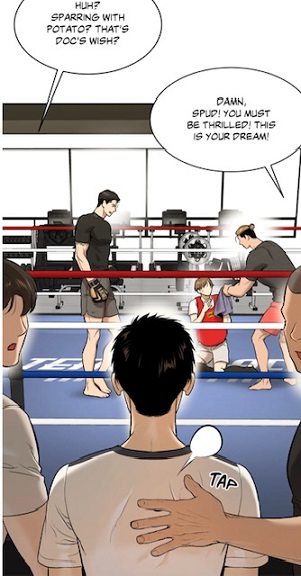 (chapter 26) Back then, Doc Dan had accepted the challenge due to Potato, though deep down he desired to have the champion as his teacher.
  (chapter 25) That’s how it dawned on me that doc Dan has gradually taken over Yoon-Gu’s previous place at the gym. He is an “unofficial member” of Team Black. Thus he mops the floor and Yoon-Gu is not there to stop him or reclaim this position.
 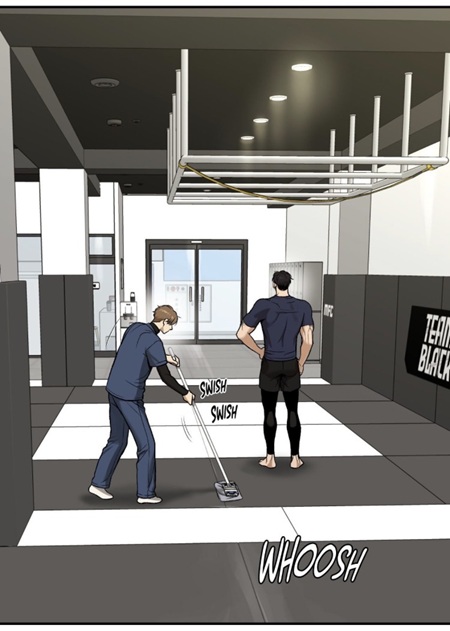 (chapter 88) Yoon-Gu’s position within the gym has improved. He is now considered as a real fighter.
6. Where the flower is
If the previous sections trace a movement, this final observation names its limit. To understand why the flower in episode 88 has only begun to appear, it is necessary to return to Erich Fromm’s definition of love, which rests on four inseparable elements: care, responsibility, respect, and knowledge. [For more read:“The Art Of Loving” (locked)] Love, in this framework, does not exist where only one or two of these are present. It requires all four to be active at once in order to become sustaining, conscious, and mutual.
Episode 88 makes one thing unmistakably clear: in the relationship between Joo Jaekyung and Kim Dan, three of these elements are already in place. One is not.
Care is not what this relationship lacks. (chapter 88) Joo Jaekyung’s care is visible throughout the episode, even when it is expressed awkwardly or through misdirection. His insistence on training, his attention to Kim Dan’s stamina, his refusal to let Kim Dan dismiss his own physical limits (chapter 88), and his final reminder to “take good care of yourself” all belong to the same logic. This care is protective and practical, but it is still delivered under the cover of training—phrased as guidance, risk-management, and performance maintenance rather than as attachment. He is capable of saying “take care,” but he still cannot say what the care ultimately means: I want you close; I worry about losing you; I don’t know how to keep you besides making you stronger. For someone like Jaekyung, whose life has been organized around performance and endurance, this is the only available language of concern. Kim Dan, too, expresses care, though in a displaced form. He worries about Jaekyung’s exhaustion, (chapter 88), minimizes his own needs and tries not to become a burden. Care moves in both directions, even if it rarely reaches its intended target.
Responsibility is equally present, and equally heavy. Jaekyung assumes responsibility for Kim Dan’s safety and future (chapter 88), particularly in light of his own awareness that their time together is limited. The training is not arbitrary; it is oriented toward what comes after him. Kim Dan, meanwhile, takes responsibility in another way: by insisting on self-sufficiency (chapter 88), by promising to continue training on his own, by framing improvement as something he must manage independently. What stands out is that responsibility exists on both sides, but it is carried separately. Each assumes it alone, without yet allowing it to become shared.
Respect, too, is not absent. Jaekyung respects Kim Dan’s capacity to grow. (chapter 88) He challenges him not because he sees him as weak, but because he believes resistance is possible. (chapter 88) His praise, rare and restrained, signals recognition rather than indulgence. Kim Dan, in turn, respects Jaekyung’s discipline and endurance, sometimes to the point of idealization. This respect remains asymmetrical, but it is real. It has begun to shift from hierarchy toward recognition.
What is missing, and what keeps the flower from fully appearing, is knowledge—not information, not memory, but Fromm’s sense of active understanding of the other as a subject with inner needs, fears, and desires. In The Art of Loving, knowledge means seeing the other as they are, which requires two things at once:
- Honesty toward oneself (recognizing one’s own needs, fears, and desires), and
- Articulation toward the other (making that inner reality available rather than acting it out indirectly).
This is why words matter so much. Without words, care can exist, responsibility can exist, and even respect can exist — but they remain opaque. Joo Jaekyung knows exactly what he wants: time, proximity, continuity. He is acutely aware that his time with Kim Dan is running out. 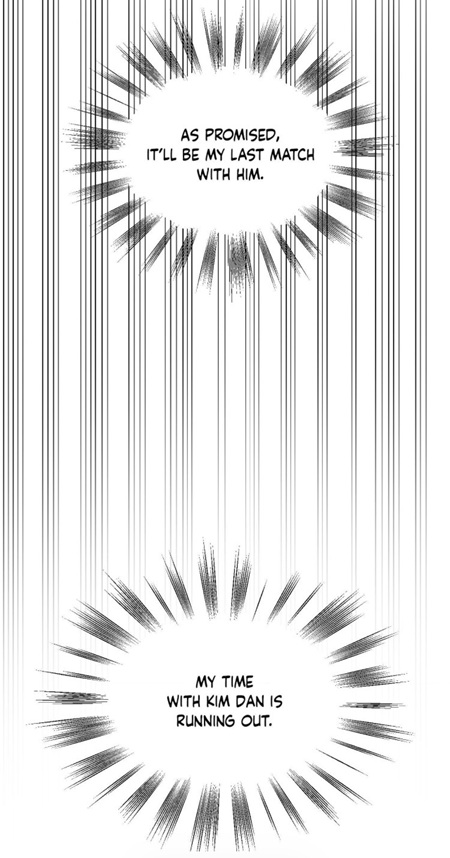 (chapter 88)
What he lacks is not intention, but translation and even courage. He does not know how to express his desire outside the vocabulary of work, discipline, and physical instruction. He can insist, challenge, and protect, but he cannot yet name why he does so. He still thinks, it is not possible to be loved due to his huge flaws and past wrongdoings. Kim Dan, on the other hand, does not yet know how to read care when it is not framed as sacrifice or obligation. He interprets insistence as burden, closeness as technique, affection as something that must be relocated elsewhere—into private space, into the penthouse, into moments that feel safer and more legible.
Their misunderstanding does not stem from a lack of feeling. It stems from a lack of confidence and shared language. Love is enacted rather than understood. Care, responsibility, and respect circulate between them, but knowledge—the capacity to see and articulate the other’s inner reality—has not yet entered the relationship. The reason is that both underestimate themselves. Thus both don’t speak the truth. This is why the flower in episode 88 is real but incomplete. It exists in the slow shift from refusal to engagement, from habit-driven self-denial to cautious participation. It exists in the fact that Kim Dan accepts the training not because he must, but because he begins to recognize the results from Jaekyung’s effort and insistence. He gradually accepts that Joo Jaekyung is genuinely concerned about him. He is gradually enjoying this, thus he voices his desire to learn more. Another problem is that both still think, they know each other. They have not recognized the importance of “words” and “honesty” yet. Nevertheless until knowledge emerges—until what is enacted can also be spoken—the flower remains folded inward. Not absent. Not broken. Simply unfinished.
Heesung × Potato: The Other Two Petals — Knowledge Without Responsibility
If the bond between Joo Jaekyung and Kim Dan exposes a surplus of care constrained by poor articulation, the dynamic between Heesung and Potato reveals the opposite imbalance:: knowledge without responsibility, and therefore without respect. The actor is able to express his thoughts and emotions all the time, yet he is not taking Potato’s feelings and thoughts into consideration. Thus he simply asks Yoon-Gu to hold the mitts and not be his sparring partner. (chapter 88) The way the “gumiho” speaks to the chow-chow is quite telling. He expects an agreement. Striking is that the young fighter doesn’t agree to the actor’s request, he answers with another question: “You don’t need a sparring partner?”. This question reveals that Yoon-Gu had already imagined himself differently. He had pictured a future moment in which he would not merely assist the actor’s training, but share it. In other words, he had already crossed an internal threshold: from helper to potential partner. The question exposes a private projection — a hope — that had not yet been verbalized until this moment.
That is why this exchange marks Yoon-Gu’s transformation. That’s why he is wearing a olive green sweater. (chapter 88) Olive green is not the vivid green of aspiration or idealization, nor the cold institutional green associated with discipline and hierarchy. It is a grounded, muted green — a color of transition. Symbolically, it sits between admiration and autonomy. By wearing it at this moment, Yoon-Gu visually signals a shift away from the champion’s gravitational pull. He is no longer oriented upward, toward an untouchable figure, but sideways, toward a peer relationship he is beginning to imagine. The green does not announce arrival; it marks movement. Growth here is not explosive but cautious, uneven, and still uncertain.
Crucially, this transformation does not stem from insecurity. Yoon-Gu is not suffering from low self-esteem. On the contrary, he speaks easily, moves freely, and voices his expectations without hesitation. What he lacks is not confidence, but self-awareness. He does not yet understand the structure he is entering, nor the asymmetry embedded in it. He mistakes proximity for reciprocity, access for acknowledgment. And the chow chow’s lack of self-awareness is also present, when he imagined that he could have followed to the amusement park. 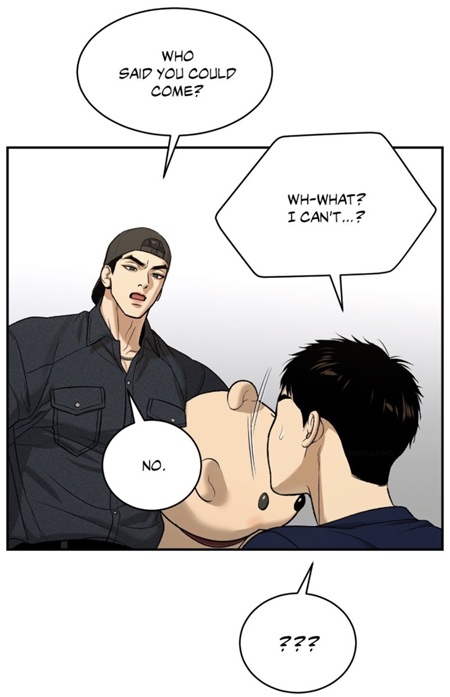 (chapter 87) For him, this trip was related to work, while in reality it was a date in disguise.
This becomes clearer when contrasted with the main couple. Between Kim Dan and Joo Jaekyung, communication is constrained, indirect, and often misaligned, as both are suffering from a low self-esteem and their past traumas. Desires are hidden behind habit, duty, or technical language. By contrast, the dialogue between Yoon-Gu and Choi Heesung is strikingly explicit. Both second leads speak readily. They articulate preferences, make requests, and voice dissatisfaction without visible hesitation. The only difference is that Heesung allows misunderstanding to persist. Joo Jaekyung abruptly corrects it. Neither approach is emotionally generous—but only one produces shock rather than slow erosion.
To conclude, this apparent fluency masks a deeper problem. What is missing here is not expression, but reflection.
Earlier, Yoon-Gu’s actions were shaped by obligation, imitation, or conditional promises (cleaning the floor, holding equipment or a bottle, proving usefulness). Here, the initiative is internal. He is no longer reacting to instructions; he is testing the possibility of recognition. (chapter 88) The desire precedes permission.
The tragedy of the moment lies not in the refusal itself, but in how it is answered. Heesung does not respond to the desire embedded in the question. He bypasses it with a technical explanation — size difference — which neutralizes the emotional risk Yoon-Gu has taken. 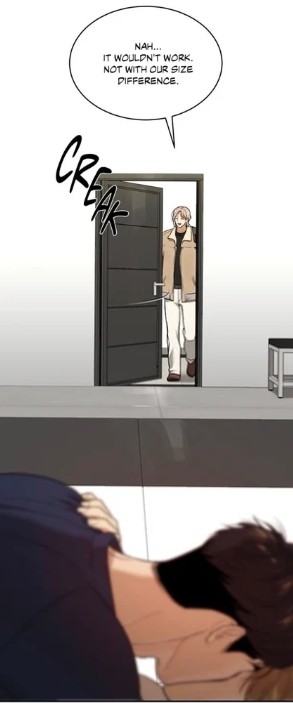 (Chapter 88) The answer restores hierarchy without acknowledging the transformation that has already occurred. Secondly, the answer closes the future by appealing to a supposedly objective limit. Yoon-Gu can never be his sparring partner. The best he can do is hold the mitts and nothing more. The fox is using his seniority and body to have the final say.
This is where Heesung’s pride in knowing turns into arrogance. His explanation contradicts the very logic that governs the gym itself. Joo Jaekyung has just demonstrated explicitly that technique outweighs physical size, that discipline and practice can reverse power relations. 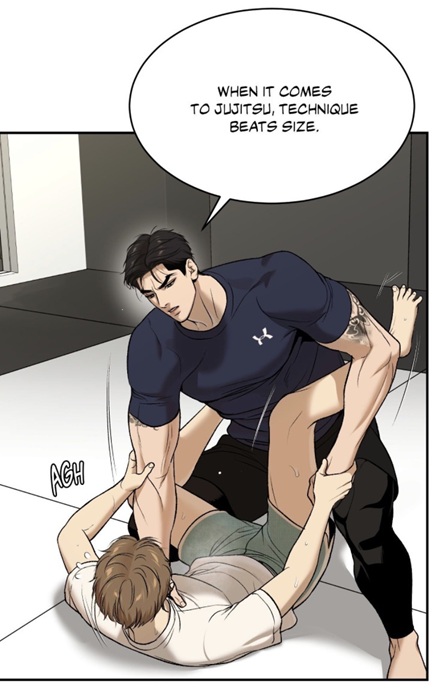 (chapter 88) Under that framework, Yoon-Gu is not disqualified; he is qualified. He has trained. He belongs. So technically, Yoon-Gu could indeed beat the actor, as the “puppy” has trained for a long time at Team Black.
Yet Heesung’s knowledge is not grounded in the present conditions of Team Black. It is grounded on his past experience: he received special training from Joo Jaekyung. In other words, he is biased. Heesung prides himself on knowing.  (special episode 1) He knows people’s patterns.
 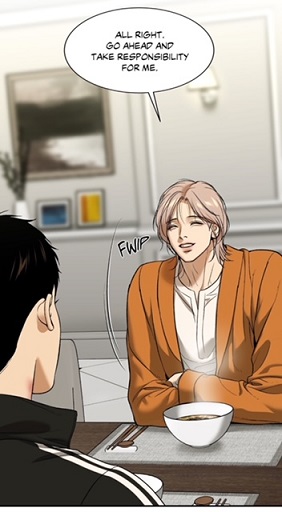 (special episode 1) He knows how relationships fail.
  (chapter 33)
 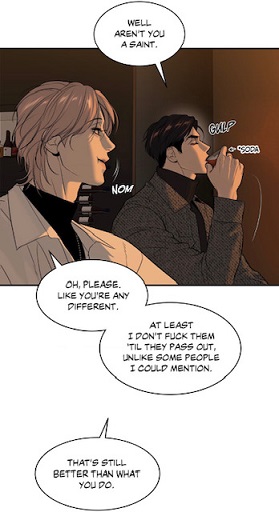 (chapter 33) He knows what he does not want. His language is saturated with judgment shaped by past experiences: lovers who become “too clingy,” attachments that turn inconvenient, people who should remain “better off” elsewhere
 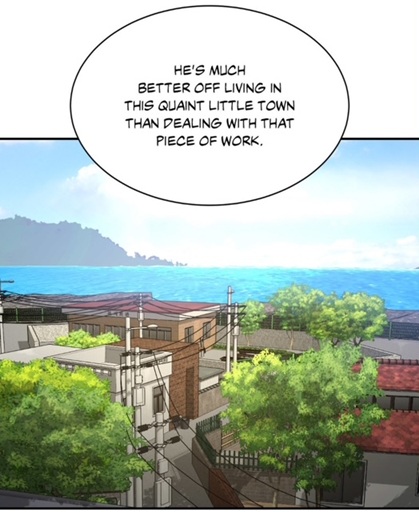 (chapter 58). This knowledge is not neutral; it is retrospective and comparative. It is built from what has disappointed him before, and it governs how he evaluates others in the present. He views himself as superior to the champion morally.
This is where the symbolism of the “grass being greener on the other side” becomes essential.  (chapter 33) Heesung’s orientation is never toward what is unfolding, but toward what might be better elsewhere—another partner, another configuration, another future. His repeated invocation of a “soulmate” is revealing: it displaces intimacy into a hypothetical horizon. By looking at the grass, he is overlooking the flower. Love, for him, is something to be found later, once the conditions are ideal. What exists now is always provisional, always lacking, always subject to replacement. He needs the “perfect” lover, and in his eyes, Potato doesn’t meet his conditions: too innocent and too young.
  (special episode 1) This explicates why the young fighter is only considered as “fuck buddy”.
 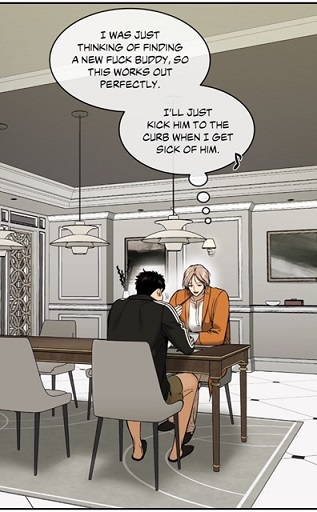 (special episode 1)
Potato exists precisely within this gap. Because he wanted to take responsibility.  (special episode 1), he is present, available, even emotionally invested—but he is never treated as sufficient. He is smaller (chapter 88), younger and as such less experienced, he is positioned as someone who does not yet qualify as a sparring partner, or even less as a boyfriend. Observe how he presented his relationship to doc Dan.
  (chapter 58) Heesung’s use of the pronoun “we” is, on the surface, inclusive. Linguistically, it frames his relationship with Potato as mutual, shared, and consensual. But pragmatically, it does the opposite. The “we” is spoken over Potato’s head, not with him. Thus Potato is physically present but discursively absent. He does not confirm, nuance, or reciprocate the statement verbally. The pronoun thus becomes a rhetorical appropriation rather than a sign of partnership.
What makes the remark particularly uncomfortable is the context: Heesung is not speaking to Potato, but to Kim Dan. The sentence is not meant to communicate within the relationship; it is meant to display the relationship to a third party. In that sense, “we” functions as a prop. It allows Heesung to stage intimacy without assuming responsibility for how that staging affects the person he claims to include. He is not saying that he is dating Yoon-Gu either. In other words, he is behaving like Joo Jaekyung in season 1.  (chapter 31) He denies the existence of feelings and attachment.
The embarrassment of Potato is not accidental. It is structurally produced by the asymmetry of the situation. Heesung controls the narrative, the tone, and the implication. By adding “in more ways than one,” he sexualizes the bond implicitly, while maintaining plausible deniability. Nothing explicit is said; everything is insinuated. This is knowledge without accountability. Heesung knows exactly how the line will land—on Kim Dan, and on Potato—but he does not take responsibility for either impact.
On the other hand, Heesung feels so comfortable around doc Dan, that he is willing to divulge more. He assumes Kim Dan will “understand” him. He is speaking in a coded register, relying on shared cultural assumptions: that closeness implies sexuality, that sexuality implies connection. In doing so, he treats Kim Dan as a potential ally in interpretation, not as a moral interlocutor. He expects recognition, perhaps even complicity, rather than reprimand or judgment.
This is where the contrast with Joo Jaekyung becomes sharp. Joo Jaekyung struggles to name intimacy and often hides it behind work or discipline—but he does not instrumentalize language to control  (special episode 1) or humiliate the other.
 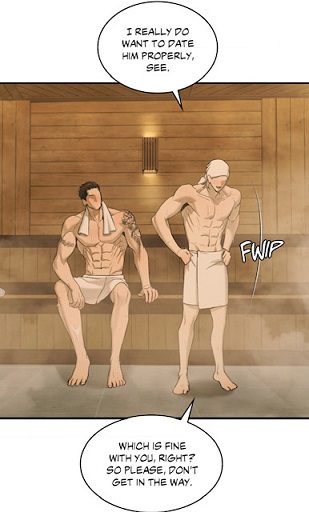 (chapter 34) Heesung, by contrast, is fluent. He can name, joke, insinuate. What he lacks is restraint and responsibility. His ease with words does not signal emotional intelligence; it signals control.
Heesung does not call Yoon-Gu weak outright, but the hierarchy is unmistakable: Potato is handled (chapter 88), redirected 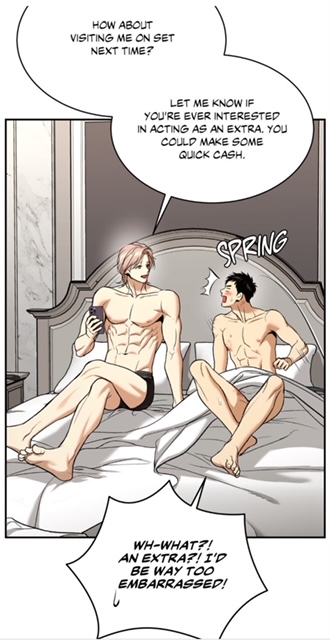 (special episode 2), corrected. (chapter 88) Even when Heesung intervenes on his behalf, it is not through shared responsibility but through dismissal—deciding what is best for him without asking what he truly wants.
This lack of responsibility is crucial. Responsibility, in Fromm’s sense, is not obligation imposed from above; it is the willingness to respond to the other as a subject whose needs and presence matter now. Heesung does not assume this stance. He neither commits nor withdraws cleanly. Instead, he hovers—knowing enough to judge, but refusing the burden of staying.
This explains why Heesung reacts so strongly to the relationship between Kim Dan and Joo Jaekyung. He does not simply misunderstand it; he rejects it (chapter 31) because it violates his model of love. Doc Dan is not introduced or claimed as his boyfriend. For him, it is simply related to the athlete’s jinx. 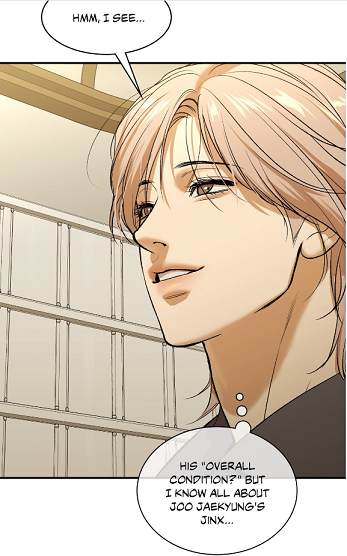 (chapter 32). It has no declared endpoint, no moral clarity (chapter 34), no soulmate label. Rather than engaging with what the relationship is doing —how it functions, how it transforms both participants—Heesung tries to name it away: a jinx, a mistake, a lack of feelings. Naming, here, becomes a defense against involvement.
The scene in the penthouse crystallizes this refusal.  (chapter 34) Heesung enters fully aware of what he is likely to witness. He is not naïve, nor totally surprised. Hence he doesn’t flee right away. Yet instead of acknowledging the reality before him, Doc Dan is not someone the fighter fucks, until he passes out, (chapter 33), he reframes the encounter as an accusation. The man is crazy.
  (chapter 34) Joo Jaekyung becomes the problem, the one who “deserves to suffer.”
 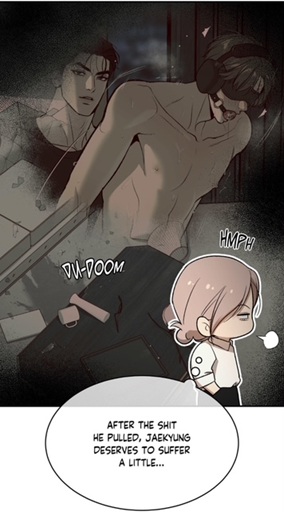 (chapter 58) This moral displacement allows Heesung to maintain distance: if Jaekyung is guilty, then no self-examination is required. Forgiveness—central to this arc (from 79 to 89)—is rendered impossible, because forgiveness would require recognizing shared vulnerability rather than assigning blame.
Potato, by contrast, is repeatedly asked to adapt. Earlier, he cleans, waits  (chapter 25), accepts deferral. Later, he is displaced entirely. Unlike Kim Dan, who gradually moves from imposed participation to earned agency, Potato is never given a space where effort leads to recognition.
  (chapter 85) However, this panel implies that the young man has already been able to enter competition. Striking is that his promise at the seaside sounds like commitment
 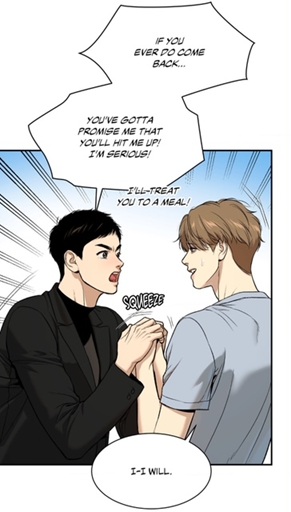 (chapter 59), but the reality diverges. It only binds doc Dan. If the latter returns to Seoul, he has to promise to train with Potato. The reason is simple. He is already committed to the actor, he is already at his beck and call. Potato’s promise echoes the earlier promise forced upon Kim Dan by his grandmother: a future-oriented vow that justifies present sacrifice while guaranteeing nothing in return.
  (chapter 11)
This is the structural tragedy of the Heesung–Potato dynamic. There is confidence and knowledge—sharp, observational, even insightful—but it is not paired with responsibility. And without responsibility, respect and care collapse into condescension. Potato is not met as an equal in becoming, but as someone perpetually not-yet-ready. While Yoon-Gu had been deeply affected by doc Dan’s departure. 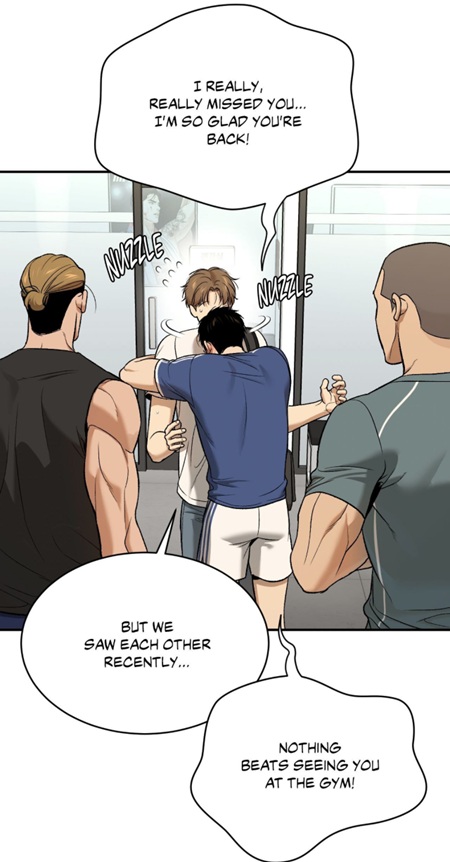 (chapter 78), he didn’t remind doc Dan of his promise. At the same time, observe that none of the fighters apologized or promised something. When they hugged the doctor, they didn’t pay attention to the physical therapist’s reaction: his passivity and silence. The “laugh” lacked genuineness and felt wrong at the time.
  (chapter 78)
But let’s return our attention to the petals Heesung and Potato. Placed beside Joo Jaekyung and Kim Dan, the contrast is stark. Jaekyung lacks fluency, but not commitment. He does not know how to speak love, yet he stays. Heesung knows how to speak about dating and love, hence he offers a bouquet of roses. But he does not remain when love demands endurance rather than evaluation.
Secondly, Heesung embodies selfishness, which is also perceptible the way he appears at the gym. (Chapter 88) He had planned to use the gym without the champion’s consent and knowledge. And Potato was not expecting the presence of the main couple either. 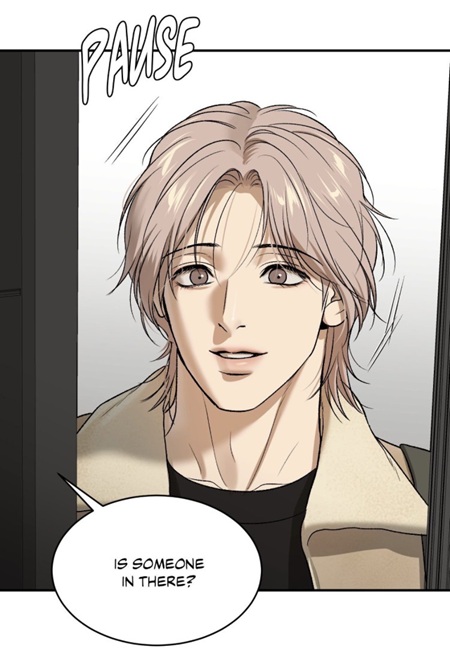 (Chapter 88) This is how it dawned on me why Mingwa recreated such a situation for Heesung. Observe his reaction, when he opened the door. He never answered the question to Potato. In fact, he slammed the door and kept his thoughts to himself. (chapter 88) As you can detect, he remained silent the whole time. It was, as though he was ignoring his lover.
What ultimately exposes the asymmetry in Heesung and Yoon-Gu’s relationship is not overt exploitation, but silence. Episode 88 stages this with remarkable precision. Heesung enters the gym without coordination (chapter 88), without consent from its owner, and without paying any visible cost. He does not announce himself as a guest, does not ask permission, and does not explain his presence. Instead, the intrusion is normalized through omission. Silence becomes the mechanism by which power circulates unnoticed.
Crucially, Yoon-Gu is excluded from the truth of the situation. Readers understand why Heesung is there; Yoon-Gu does not. The actor’s internal reaction (chapter 88) can be read as a moment of comic frustration. In fact, it reveals something far more consequential: this visit was never conceived as a shared activity with Yoon-Gu at all. The training session was not planned for him, nor with him. Yoon-Gu was not included as a subject in Heesung’s intention. He was a means.
This internal monologue exposes the logic of the intrusion. Heesung did not come to train with Yoon-Gu, nor to support him, nor to acknowledge his aspirations. He came to work off his own emotional agitation, to use the gym as a private outlet. Therefore it is not surprising that Yoon-Gu’s presence is reduced to him holding the mitts. His presence is incidental—useful, but not constitutive. When the situation threatens to escalate (chapter 88), Heesung does not think, What will happen to Yoon-Gu? He thinks only of himself: his inconvenience, his exposure, his embarrassment.
That omission is decisive. It confirms that Yoon-Gu is positioned not as a partner in training, but as an accessory to Heesung’s fitness and fun. He provides access, labor, and cover, yet remains excluded from knowledge and from choice. This mirrors an earlier pattern: just as Kim Dan once provided unpaid care under the guise of compensation (chapter 32), Yoon-Gu now provides unpaid labor and institutional access under the guise of familiarity and generosity
 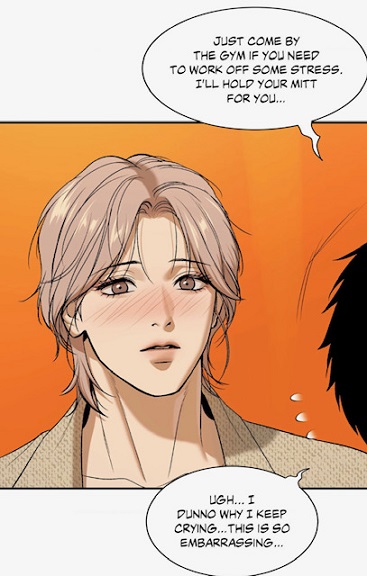 (chapter 35). In both cases, Heesung benefits from proximity without assuming responsibility for the other person’s risk. Silence, here, is not neutral—it is the mechanism by which that asymmetry is maintained.
At the same time, this regret (chapter 88) confirms that Heesung knows he has crossed a boundary. Yet this awareness produces no corrective action. He does not warn Yoon-Gu, does not acknowledge the risk he is creating for him, and does not assume responsibility for the consequences of being discovered. His concern remains entirely self-directed: embarrassment, inconvenience, exposure. Yoon-Gu’s position is not considered.
The irony is that this silence is beneficial for the chow chow . (chapter 88) It actively conceals Yoon-Gu’s complicity while simultaneously depending on it. Heesung could not have accessed the gym without Yoon-Gu. The most plausible inference is that Yoon-Gu provided entry—either by unlocking the space or by lending legitimacy to Heesung’s presence. Yet when the moment of confrontation approaches, Heesung does not speak. (chapter 88) He does not answer Yoon-Gu’s question—“Is there someone in there?”—because answering would reveal responsibility. Another important detail is that though Yoon-Gu provided the access, he simply followed the actor. The latter is the one opening the door to PT Room and not the member of Team Black. It exposes that the fox is really the one committing the wrongdoing, and he can not blame the chow chow for it.
Silence, here, is not absence of speech but a strategy of avoidance. (special episode 1) Heesung does not negotiate, explain, or repair. He doesn’t give any excuse. He moves through spaces as though access were guaranteed and consequences optional. However, this time, his silence is used against him. 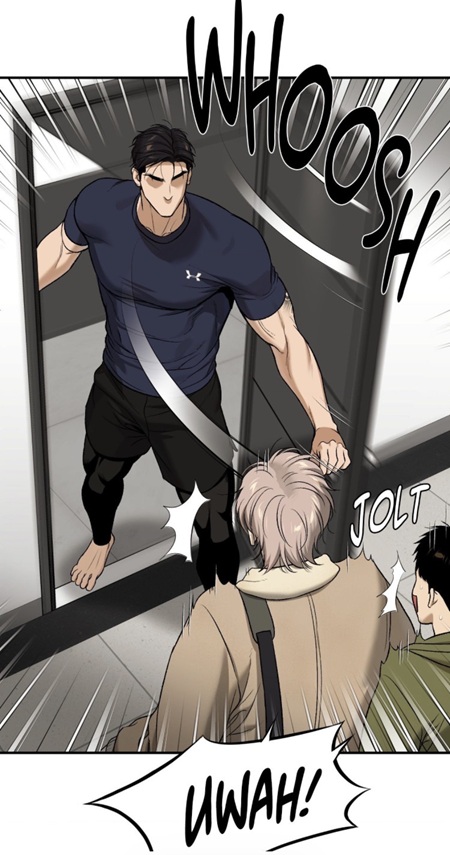 (chapter 88) Forgiveness, responsibility, and mutual recognition—central to the arc unfolding elsewhere—are entirely absent from his conduct. Where Joo Jaekyung begins to redistribute choice and accountability, Heesung consolidates control by refusing to speak.
This is why Heesung cannot embody forgiveness in this arc. Forgiveness requires acknowledgment; acknowledgment requires speech; speech requires responsibility. Heesung chooses none of these. Instead, he preserves his self-image by leaving others to absorb the impact of his actions. Yet, in episode 88, it is no longer possible.
In this sense, the flower associated with Heesung and Yoon-Gu never opens. Knowledge is present. While Heesung understands dynamics, motives, and outcomes, the chow chow heard all the information  (chapter 52) about the switched spray, but he only reported one thing: Kim Dan is innocent. So while insight is present, responsibility is systematically deferred. Without responsibility, respect cannot follow. And without respect, what appears as connection is merely use, quietly sustained by silence.
In the end, the other two petals do not fail because of ignorance. They fail because knowledge, when severed from responsibility, becomes a tool of avoidance. Love is postponed indefinitely—always imagined, never practiced. On the other hand, since he knows about the champion’s past sexual habits, it signifies that the actor became the witness of TRUE LOVE. Joo Jaekyung is kissing doc Dan. 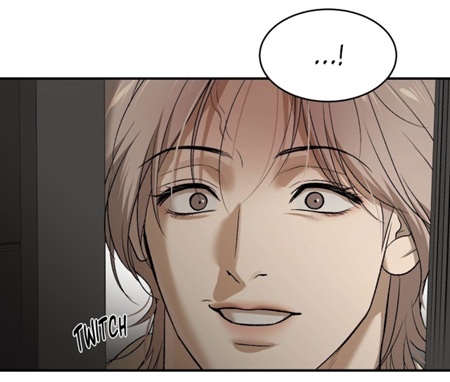 (chapter 88) The irony is that the actor didn’t realize this. He had the impression to be exposed to a similar scene than in the penthouse. (chapter 88) It is important because with this knowledge, he can expose the truth to doc Dan: the athlete loves him. In the past, he could say this without explaining his statement.
  (chapter 35) And now, pay attention to the logo on the doctor’s t- shirt.
  (chapter 88) First, it appears on the left side, positioned close to the hamster’s heart. Moreover, it looks like an orange eye. Orange is not only the color of Heesung the fox
  (chapter 34), but also of friendship and social communication and interaction.
Orange Represents
Adventure and risk taking: Orange promotes physical confidence and enthusiasm – sportsmen and adventure-seekers relate well to orange.
Social communication and interaction: Orange stimulates two-way conversation between people – in a dining room when entertaining it stimulates conversation as well as appetite. Friendship: Group socializing, parties, the community – wherever people get together to have fun and socialize orange is a good choice.
Divorce: The optimism of the color orange helps people move on – it is forward thinking and outward thinking. https://www.empower-yourself-with-color-psychology.com/color-orange.html
That means, doc Dan is on the verge of having true friends. Joo Jaekyung will stop demanding exclusivity by isolating doc Dan from the others.  (chapter 79) Besides, it is the same logo than when Yoon-Gu was spying behind the closed door.
 (chapter 23) That’s the moment Potato realized the truth about the couple: they were intimate. That’s the reason why I am convinced that Heesung will play the role of the messenger and mediator between the wolf and the hamster.
To conclude, I perceive the actor as the bridge between the two main leads. He embodies language, knowledge, love as feeling, but more importantly he stands for friendship and fun, notions which don’t exist in the main couple’s world yet.
That’s it for the first part. In the second part, I will examine the final panel and the significance of the fighters’ return.
Feel free to comment. If you have any suggestion for topics or Manhwa, feel free to ask. If you enjoyed reading it, retweet it or push the button like. My Reddit-Instagram-Twitter-Tumblr account is: @bebebisous33. Thanks for reading and for the support, particularly, I would like to thank all the new followers and people recommending my blog.


 I established that Kim Dan’s number is 8. It is therefore no coincidence that the arc from chapter 80 to 89 should revolve around him—his body, his suffering, and ultimately his recovery. The number 8, often associated with balance, renewal, and continuity, here signals not only the doctor’s rebirth but also the gradual thawing of his frozen world. It marks the moment when the past can no longer remain buried, when the last remnants of family and unspoken pain begin to surface. The mystery behind this phone call will be soon revealed.
  (chapter 19)
 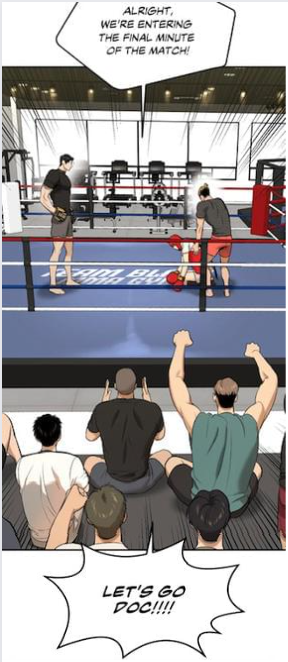 (chapter 26) the sparring between Joo Jaekyung and Kim Dan unfolds under the sign of fun and apparent joy, yet its origin lies in jealousy. The champion, unconsciously triggered by the doctor’s closeness with Potato
 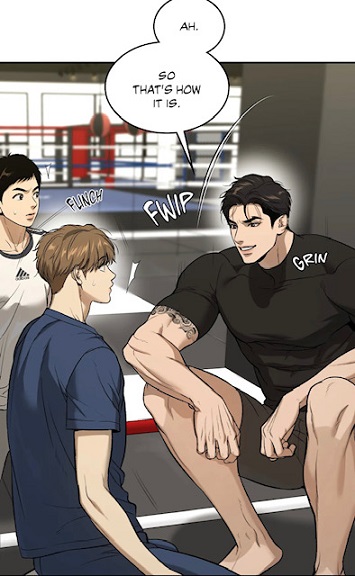 (chapter 25), turns play into a contest—a way to reclaim attention.
  (chapter 25) The gym, usually a place of hierarchy, momentarily becomes a stage where both can laugh, but beneath that laughter runs an undercurrent of rivalry (with Potato). On the other hand, for the first time, the Manhwa allows both protagonists to exist outside the economy of debt and hierarchy. The gym, normally a place of discipline and work, transforms into a playground of laughter. The champion teases the doctor
  (chapter 26), and the latter, clumsy but determined, strikes back with surprising boldness. The crowd cheers, not for the fighter but for the therapist—the underdog, the one who usually stands in the shadow. The entire scene feels like a short-lived holiday, a suspension of order and pain. When Kim Dan smiles at the end of the match, the gesture radiates genuine lightness: he has momentarily escaped the burden of fear and experienced himself as a free, living body.
  (chapter 26) He believes he has accomplished something meaningful and feels, perhaps for the first time, proud of himself. He was taught that he could fight back and overcome his fear.
  (chapter 26) He realizes that the hamster can beam at others, that such light has never been directed at him. In that instant, he no longer sees an employee but a companion whose gaze and embrace he covets, whose approval he unconsciously seeks.
 (chapter 62) The atmosphere is brighter in color but colder in tone. There, Joo Jaekyung got to experience how Kim Dan has lived all this time, helping others, making them happy with his assistance.
  (chapter 62) Here, the protagonist was thinking all the time of his loved one:
 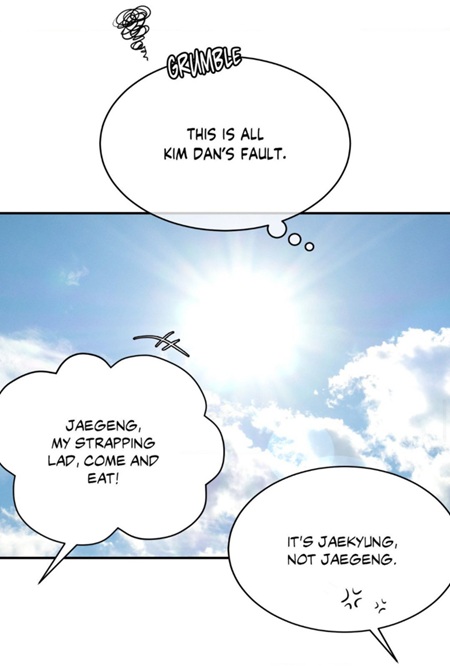 (chapter 62) Indirectly, he hoped to get the doctor’s attention, but he failed. In fact, none of the wolf’s good actions got noticed by his fated partner. Interesting is that though the characters engage in acts of performance and service—helping others, pleasing strangers— their smiles have turned into masks.
 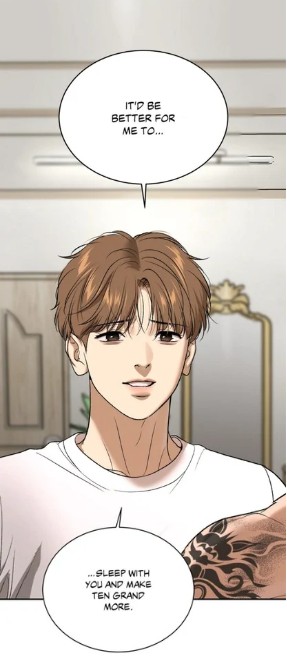 (chapter 62)
 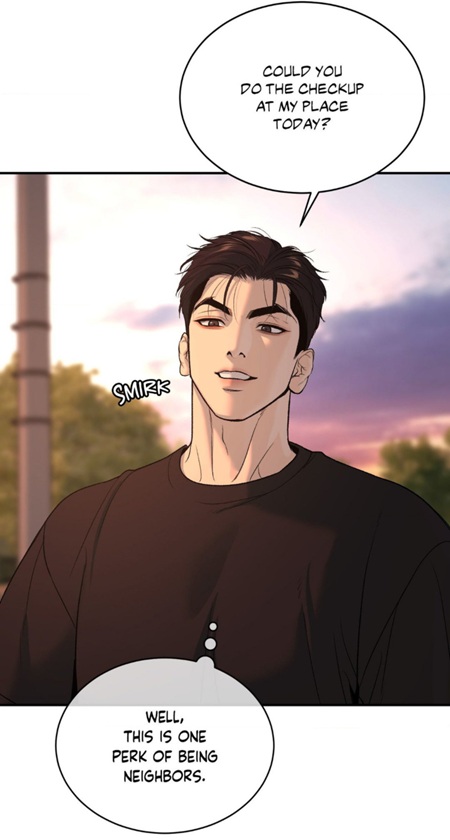 (chapter 62) Where chapter 26 radiated spontaneity, this one reveals calculation and fatigue.
  (chapter 62), where exposure to others leaves both men strangely isolated. The happiness of the crowd no longer unites; it separates. The champion’s outfit, ridiculous and domestic
 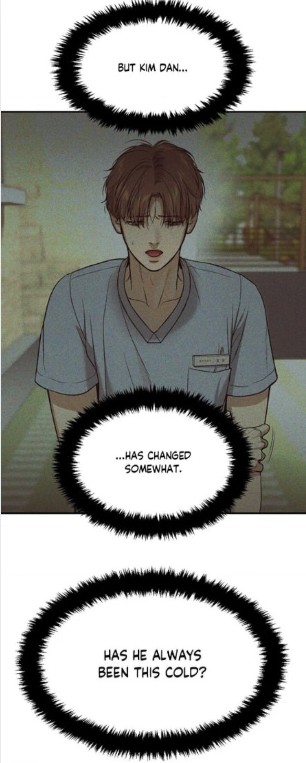 (chapter 62) which is actually his true nature. I will elaborate more further below. For the first time, the wolf looks at his companion and senses distance instead of warmth, as though the man he once touched so easily has withdrawn behind glass. His thought—“Has he always been this cold?”—marks the beginning of introspection, the moment when perception replaces instinct.
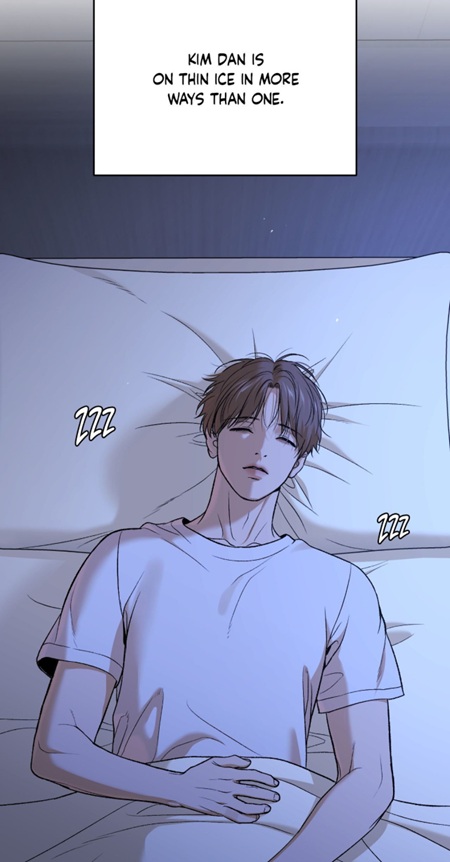 (chapter 80) To “walk on thin ice” is to approach him gently, without force—a lesson the champion must learn if he wishes to thaw what has been frozen by years of duty and self-denial.
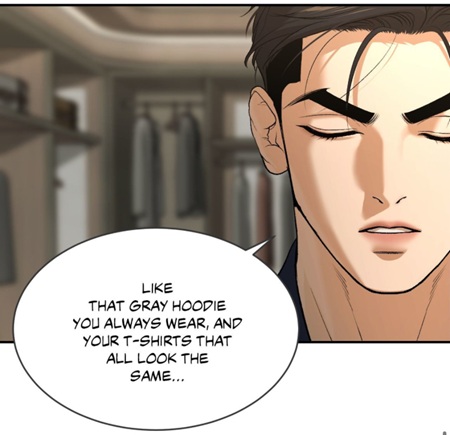 (chapter 80) Hence he made this mistake: he threw the doctor’s clothes without the owner’s consent.
 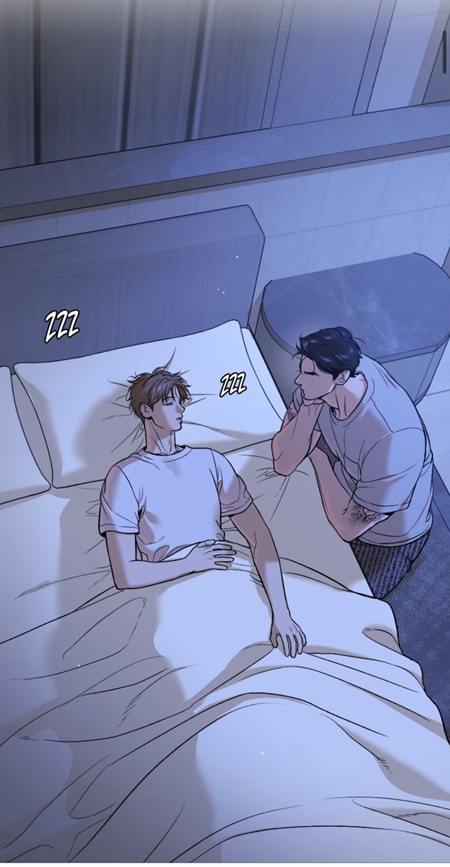 (chapter 80)
 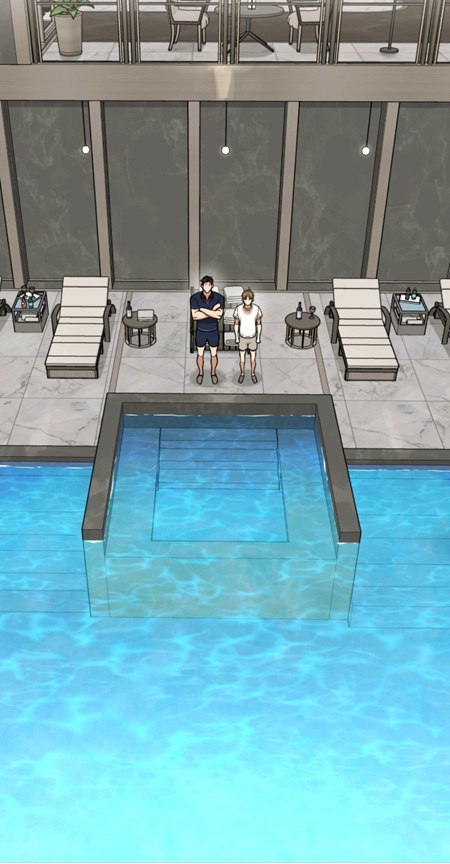 (chapter 80), not red. The atmosphere is fluid, reflective, submerged. Water—not flame—governs this new stage. What we witness is not combustion but fusion—ice meeting water, solid meeting liquid, two states of the same element touching at last. Ice does not just melt under fire; but also in the presence of water. It softens when it recognizes itself in another form. In that sense, Joo Jaekyung’s tenderness doesn’t heat Kim Dan—it mirrors him. The thaw begins not through passion, but through likeness, through quiet recognition. This signifies that Joo Jaekyung is on his way to discover their similarities: they both suffered from bullying and abandonment issues and they love each other.
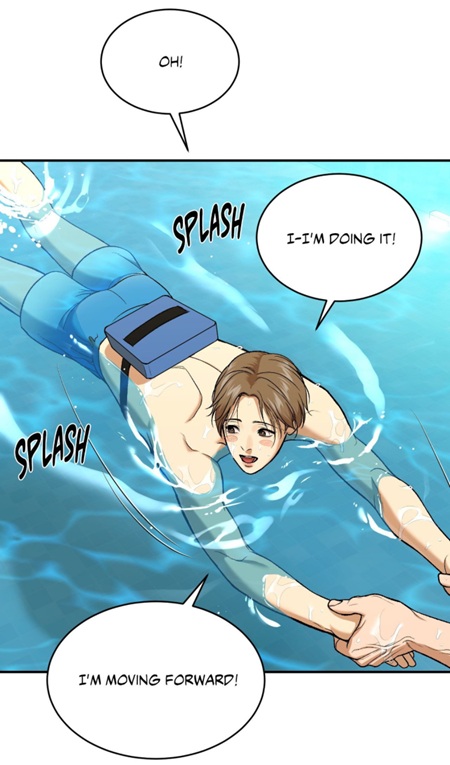 (chapter 80) —his joy is spontaneous, detached from duty, born from play rather than service. It is his first genuine smile since the sparring match in chapter 26, but this time it arises not from competition, only from freedom. In the same chapter, Joo Jaekyung’s grin
  (chapter 80) at the board game table mirrors that moment: his smile is light, childlike, uncontaminated by dominance. Yet, tellingly, they do not smile together. Each glows in isolation, unaware of the other’s joy. Doc Dan has not realized it yet: he is the wolf’s source of happiness, he is the only one who can make him laugh and smile.
 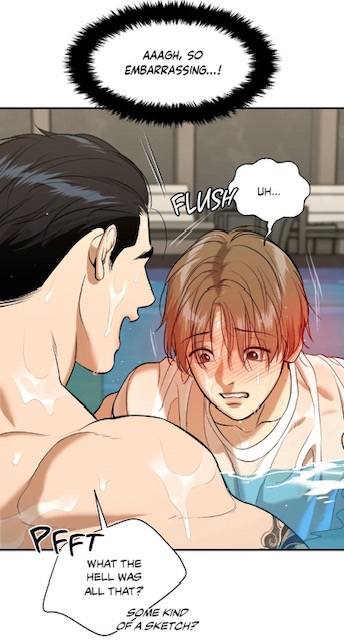 (chapter 27) Thus I came to the following deduction. This is the emotional geometry of the arc 80–89: two smiles moving toward synchrony, two currents approaching convergence. Both need to experience that they make each other happy. Kim Dan on Thin Ice thus begins where the infinite loop of 8 converges—between warmth and coldness, joy and fatigue, play and labor. It is here, in this fragile equilibrium—where ice and water finally coexist—that both men begin, at last, to thaw. And the latter implies emancipation
 (chapter 80), I have to admit that my favorite part was this one
  (chapter 80), as it exposes the real metamorphosis from the “wolf”. The night Joo Jaekyung watches Kim Dan sleep is not erotic; it is revolutionary. For once, his desire gives way to perception and attentiveness. The fighter who has conquered bodies now studies one that is quietly losing its battle. The body before him is not the sculpted strength he knows, but a map of deprivation: protruding collarbones
 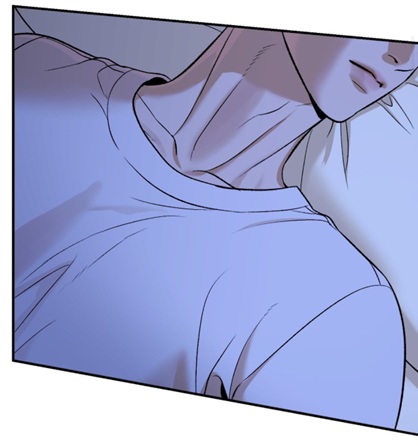 (chapter 80), visible neck tendons, the knobby finger joints and his stiff fingers resting on the blanket as if holding the body together.
  (chapter 80) The pale, bluish hue of the skin—half light, half illness—tells him what no words ever have.
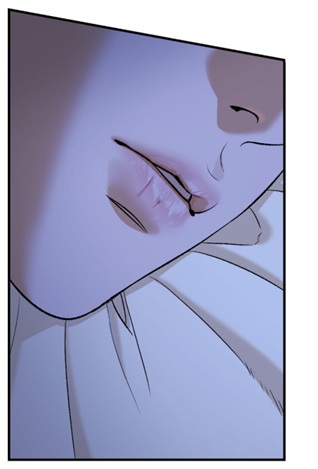 (chapter 80), the faint opacity of the nails
 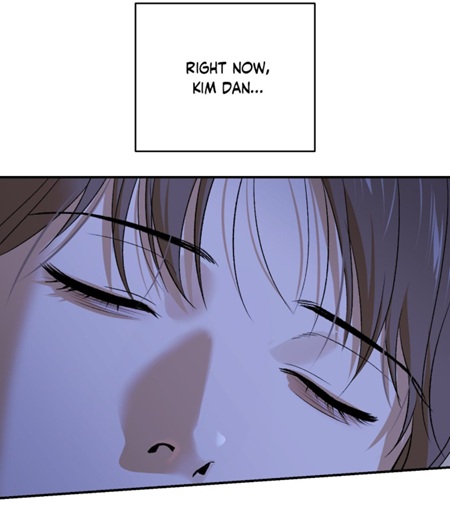 (chapter 80) In the faint parting of the mouth he sees not seduction, but exhaustion—a man so depleted that even rest demands effort.
 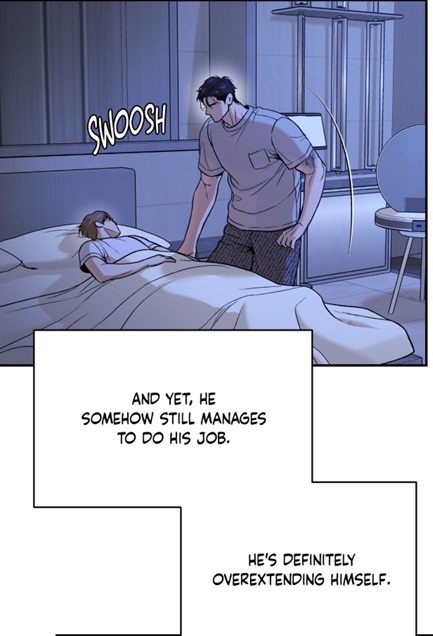 (chapter 80) he begins to treat rest not as weakness, but as reverence.
 (chapter 13) The fighter who once mocked stillness as laziness now finds meaning in it.
 (chapter 80) — not from exhaustion, but from understanding. The rhythm of his life starts to synchronize with the doctor’s vulnerability. Time, once his most tightly guarded possession, now bends around another person’s needs. Without noticing, he has allowed Kim Dan to become the owner of his hours — a quiet dethronement that signals love in its earliest, purest form. Moreover, Jinx-philes should realize that the moment the star made this decision,
 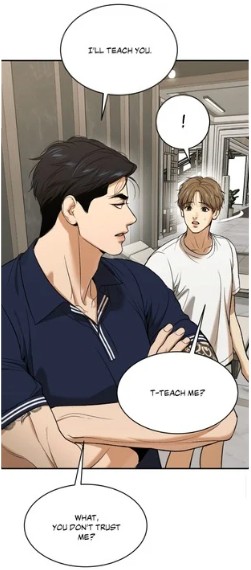 (chapter 80), it signifies that he will have to dedicate his time to the physical therapist! Hence his routine and training could get affected, just like their weekends.
 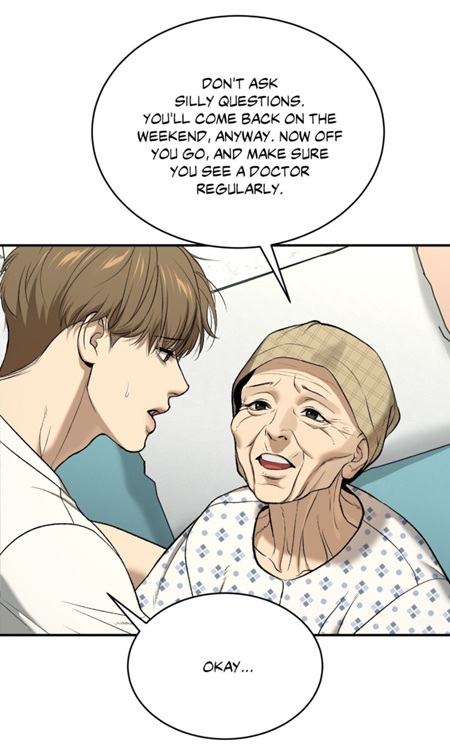 (chapter 78)
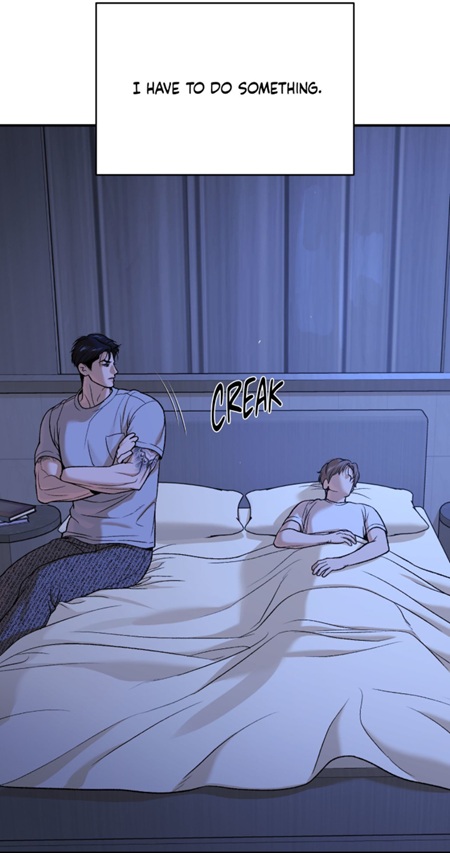 (chapter 80) —the doctor
 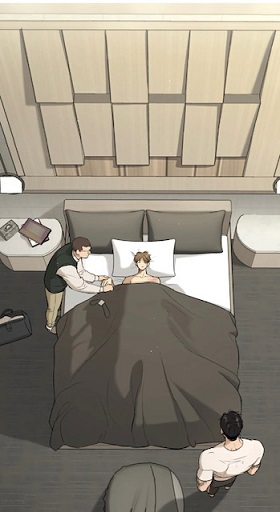 (chapter 13), the family member
 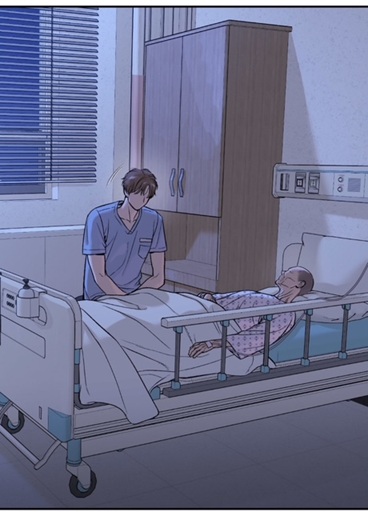 (chapter 56), the one who stays close enough to touch if needed.
  (chapter 80) Without realizing it,the athlete has inherited that role. His nearness is no longer intrusive but protective. He has crossed the invisible threshold that separates obligation from affection. The fighter who once stood as an outsider in the doctor’s life now finds himself within its most intimate circle.
 (chapter 80) Compare his facial expression to the hamster’s before their first day off together.
 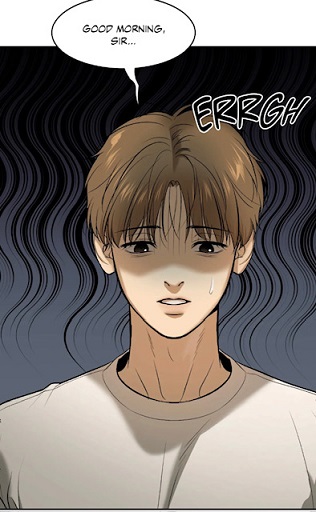 (chapter 27) That way, Mingwa can outline the champion’s confidence and that the one who needed the rest is the physical therapist and not the champion.
 (chapter 69) Every flicker of light falls through The Emperor’s gaze and lands on Kim Dan’s form, transforming weariness into something sacred.
  (chapter 68) in the bathtub
 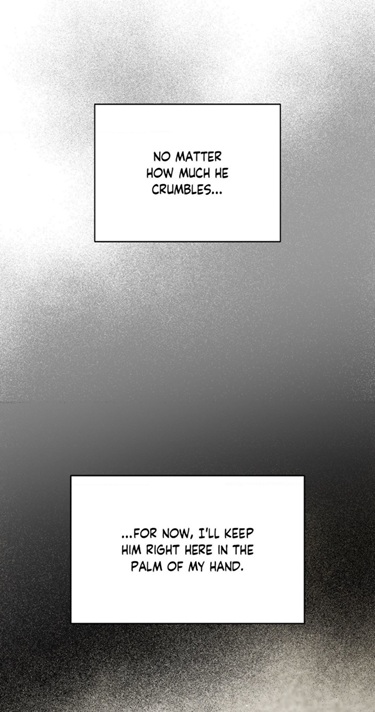 (chapter 68) —“I’ll keep him right here in the palm of my hand”—echo now with quiet irony. To hold someone in one’s hand is, paradoxically, to immobilize them; it grants possession but denies agency. The same gesture that promises safety also enacts paralysis. His possessiveness, once mistaken for protection, now appears as helplessness.
 (chapter 80) Thus he teaches him swimming. This gesture is not trivial: it marks the moment when care turns into collaboration and liberation, when watching becomes doing.
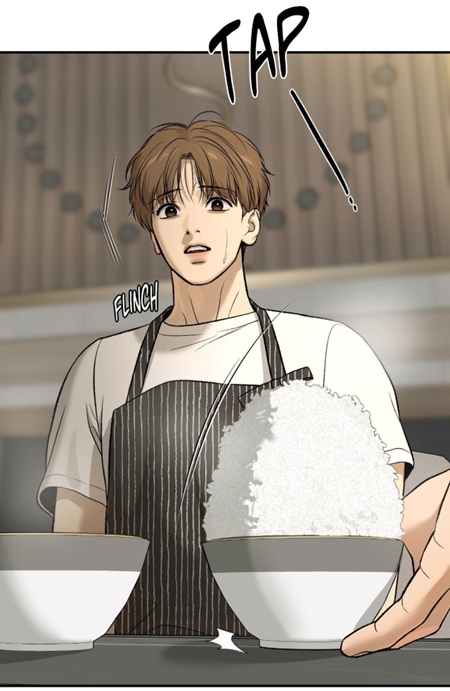 (chapter 79),
  (chapter 80) shrinking back when confronted. The body remembers the threat long after the mind tries to forget.
 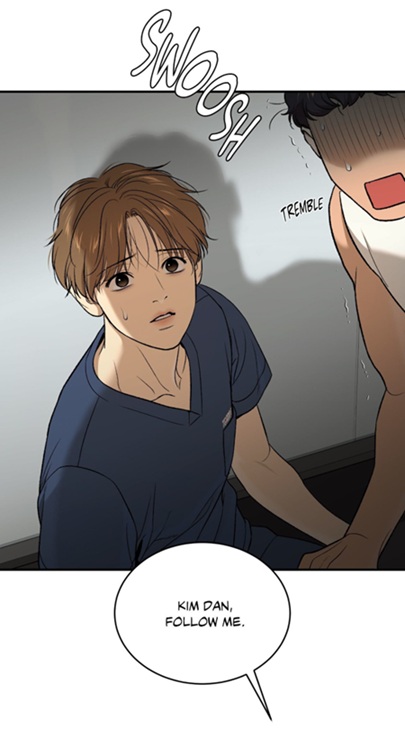 (chapter 79) He lives suspended between two survival reflexes: freezing or fleeing. Since the contract binds him to stay, he cannot physically run away; therefore, his body freezes instead. It is his way of obeying while still protecting himself. Exhaustion becomes his armor. And now, you comprehend why the celebrity could detect the coldness in the “hamster” in front of the hospice.
 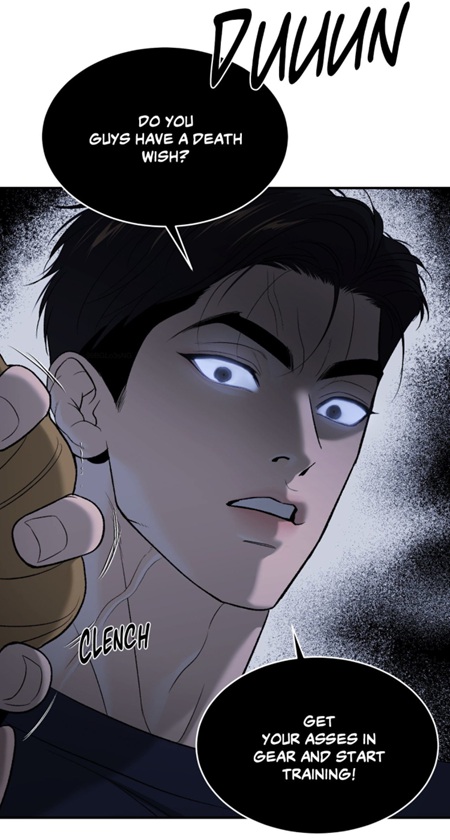 (chapter 79) — now turned outward and wounded the one he wished to protect.
  (chapter 79) That icy look became a mirror: it froze Kim Dan’s small confidence, reinforcing his belief that he would always displease or fail others. Since his return to the gym, the doctor feared the emperor’s next outburst, walking on eggshells and suppressing every impulse to speak or move freely.
 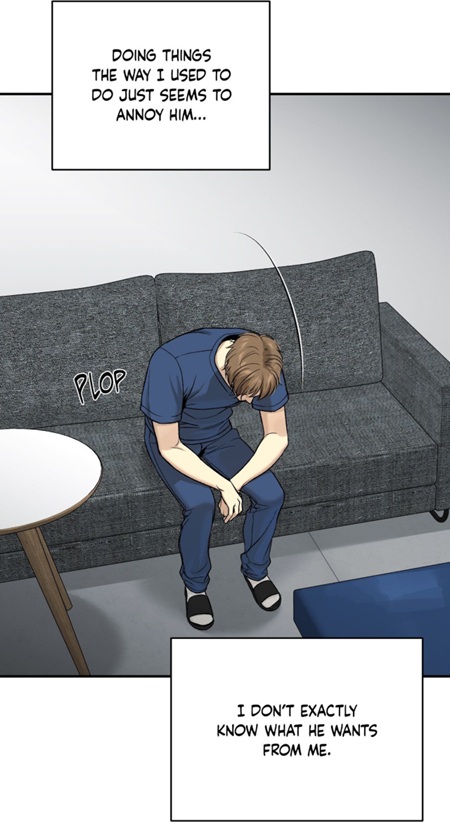 (chapter 79) Thus he clinched onto routine to maintain a normal relationship. But once the champion voiced his dissatisfaction (masking his jealousy), the light in the doctor’s gaze vanished.
  (chapter 79)
 (chapter 79) His unconscious was telling him to flee, as he feared the athlete. To conclude, he was always one step away from collapse. In symbolic terms, he had become ice itself — air and water solidified, transparent yet untouchable. Keep in mind that according to me, the clouds embody the physical therapist.
  (chapter 38) Born on December 26th, his very birthday ties him to winter, to the paradox of beauty that burns when touched.
  That’s why I can’t help myself thinking that the physical therapist is actually embodied by the snow. Ice and snow preserve, but they also isolate.
 (chapter 72), snow was falling — a silent mirror of his loneliness, the frozen residue of a home that no longer existed. Later, in chapter 77, the motif returned as ice cream
 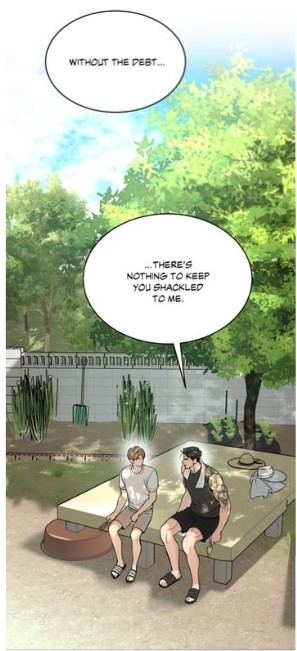 (chapter 77): a sweet that melts too quickly to be shared. Neither man truly appreciated it; both were too absorbed in their own thoughts to enjoy the fleeting pleasure. These missed opportunities — to taste, to feel, to be present — form the emotional prelude to the “thin ice” arc.
 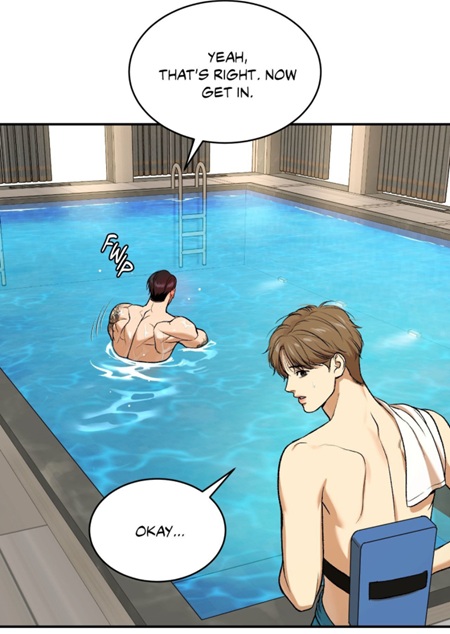 (chapter 80) His smile is still too attached to victory.
  (chapter 63), desperate to restore closeness, mistook passion and pleasure
  (chapter 63) for repair. Believing that physical heat could melt emotional frost
  (chapter 64), he tried to burn away the distance through souvenirs (evoking the night in the States) and desire. Yet the more he tried to ignite fire, the more he fed the cold.
  (chapter 64) The physical act, rather than fusing them, exposed the truth he had refused to see — that his partner was already freezing from within. On the other hand, during this night, the athlete used “self-control” for the first time, his roughness in bed started vanishing.
  (chapter 64) The wolf’s attempt to “burn the bridge” between them became the very thing that broke it. His flame met ice
  (chapter 64), and the result was not warmth but steam — a brief illusion of intimacy that vanished as soon as Kim Dan pulled away. His rejection wasn’t cruelty but a cry of despair, disillusion and exhaustion
 (chapter 64): a body too cold to burn, a heart too tired to love and fight.
 (chapter 80), but about melting together, letting warmth and cold coexist without annihilating each other. To melt together does not mean to dissolve into sameness, but to trust that proximity will not destroy one’s shape. True intimacy begins when both accept that they can share warmth without losing form — when fire believes it can touch ice without turning it to steam, and ice trusts it can meet fire without vanishing.
  (chapter 61) Touch it bare-handed, and you feel both heat and pain. The same holds true for Kim Dan’s presence: those who reach for him too quickly end up wounding both him and themselves. The sportsman’s early attempts at care followed that pattern — too forceful, too immediate, leaving frostbite where he intended warmth.
 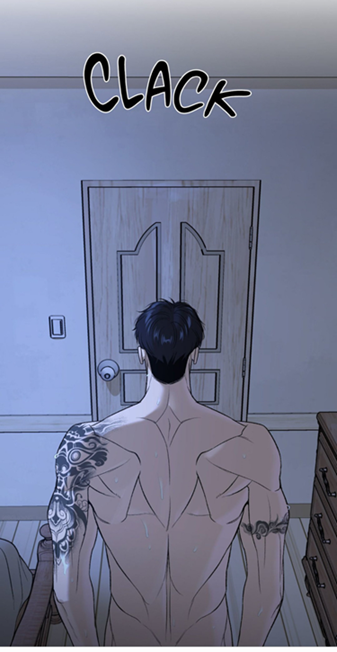 (chapter 64)
 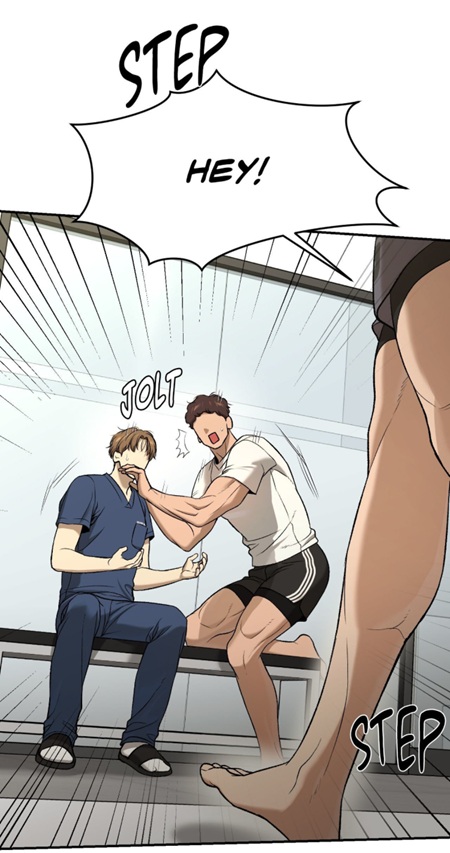 (chapter 79) but anxiety — fear of losing control, of not being seen
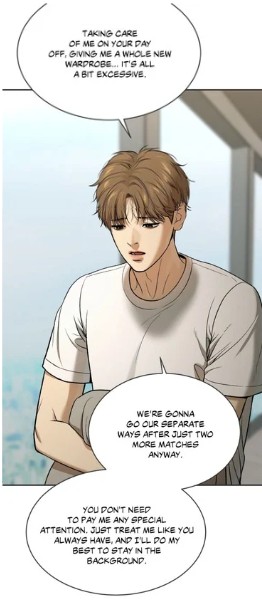 (chapter 80) but terror — the instinct to flee before being hurt again. Both used frost as armor, and both mistook it for strength and protection.
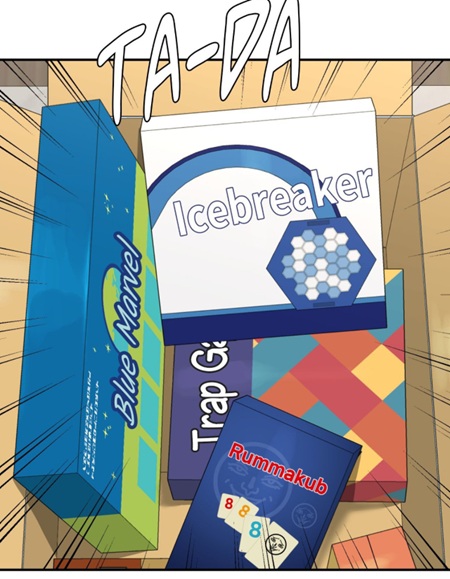 (chapter 80) They never played it — and that is no accident. The title encapsulates the temptation Jaekyung must resist: to treat intimacy as a contest, to imagine that trust can be won through tactics or timing. But hearts do not yield to strategies. The only way to melt the ice is not by “breaking” it, but by warming it, patiently, sincerely.
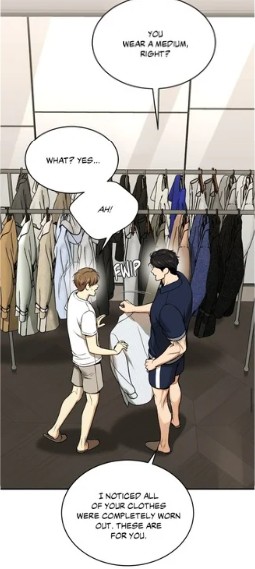 (chapter 80) marks its opposite — a spontaneous act free of calculation. I am not here talking about the purchase of the clothes. When Jaekyung brings new clothes for Kim Dan and places them in his own wardrobe, he is doing something that escapes his usual logic of control. For once, he doesn’t command or anticipate; he simply gives.
 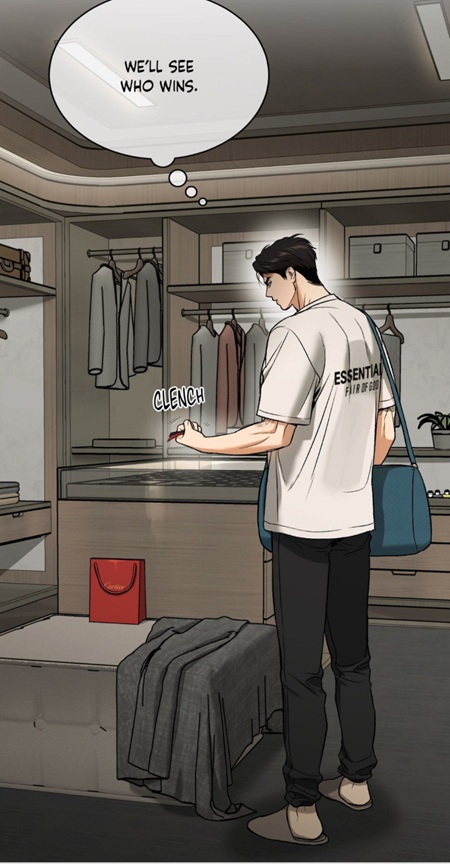 (chapter 66) And this is something the physical therapist could notice, if he enters the room again and pays more attention to his surroundings. This is not about ownership but about inclusion: an unspoken invitation to share a part of himself.
  (chapter 30). Even in that comic panel, the imbalance between physical familiarity and emotional distance was evident. Kim Dan’s embarrassment stood for boundaries not yet earned, and Jaekyung’s casual tone for a love not yet understood.
 (chapter 80) the room becomes more than a storage space — it becomes a threshold. Without realizing it, the wolf allows Kim Dan to enter his personal orbit, to dress and undress within the same walls, to coexist without performance. This is the opposite of strategy; it’s the vulnerability of someone who, for the first time, lowers his guard without noticing.
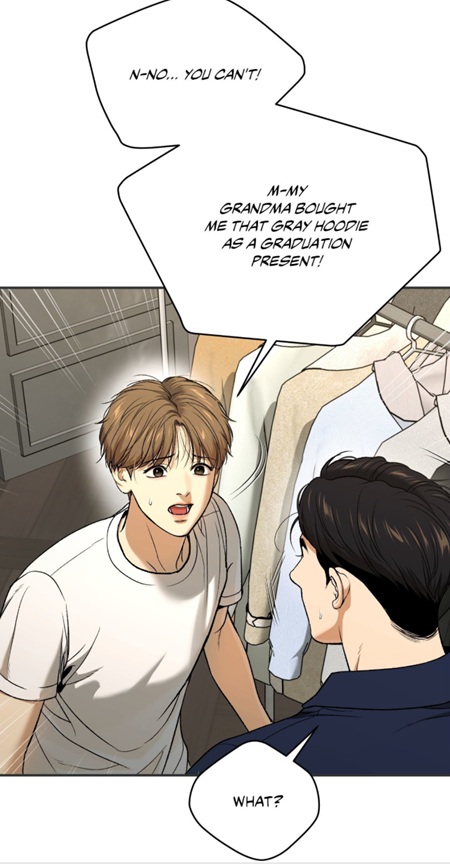 (chapter 80) His closed eyes are telling: he acts without seeing. The intention is love; the effect is violation. By trying to cleanse Kim Dan’s life of its remnants, he unconsciously repeats the violence of erasure that the doctor has always endured. Keep in mind that the doctor’s teddy bear vanished.
  (chapter 47) One might say that he no longer needed it, yet this point could be refuted, if it was a present from the parents. Throwing it away is like erasing their existence and affection.
 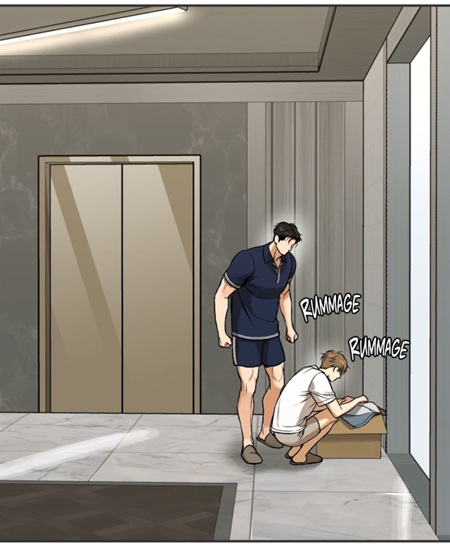 (chapter 80) The scene is small but seismic. The camera places Jaekyung slightly behind, his fists curled and his shoulders tense — an instinctive gesture of self-restraint rather than dominance. He is no longer the one towering above, demanding or explaining; he is waiting, watching, enduring the discomfort of having gone too far. His silence here is not indifference but humility — the silence of someone learning, painfully, what boundaries mean.
 (chapter 70) The athlete’s posture
 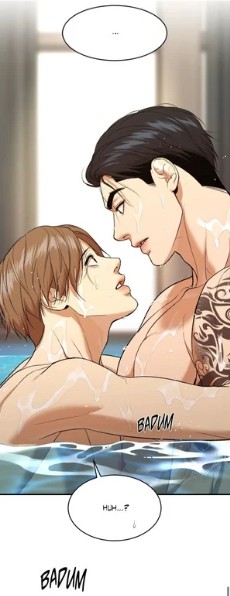 (chapter 80)
  (chapter 80) — were gestures of power. Now, through trial and correction, they evolve into gestures of reciprocity. Besides, to err is human. In learning how to respect and help, he learns how to love.
 (chapter 80) By tending to another’s exhaustion, he faces his own. Each regret
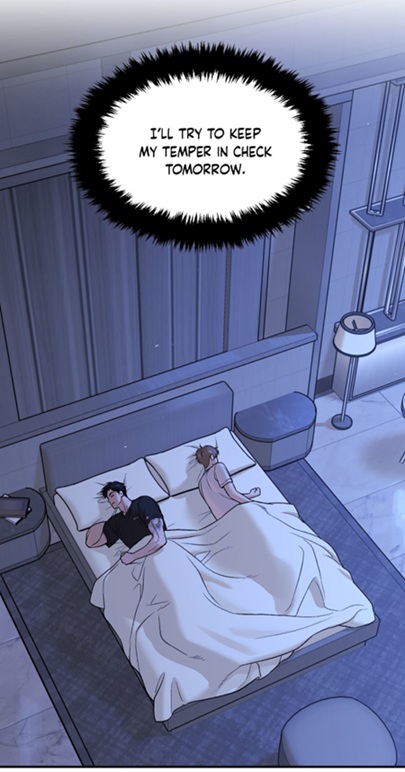 (chapter 79), each small act of patience, rewires the fighter’s inner world. If he controls his temper, then he might get closer to his fated companion. He begins to experience calm where there once was only anger or reaction. The man who lived on adrenaline now practices gentleness as a new form of endurance.
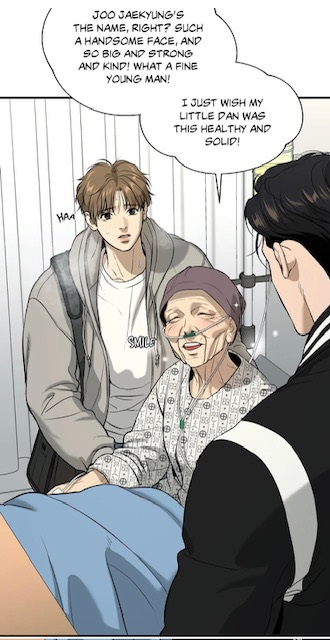 (chapter 21) Behind the warmth of her words lies a quiet wound: she loves her grandson, but she wishes him to be different — stronger, healthier, easier to care for. In his eyes, it’s an unreliable, burdensome shell — a vessel of weakness and sickness. Every protruding collarbone, every cracked lip or dark circle testifies to a deeper wound: the conviction that he is unworthy of care.
 (chapter 65) These vices, which she lists as disappointments
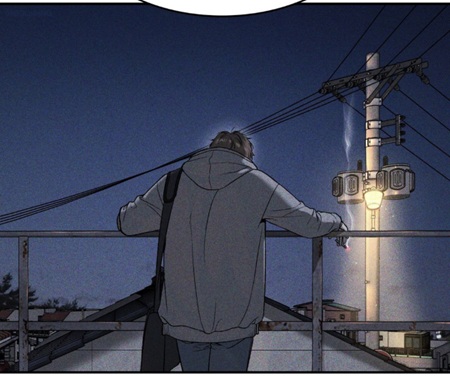 (chapter 65) are in fact the boy’s first attempts at self-assertion. In a life where every decision has been dictated by duty, poverty, and responsibility, destroying his own body becomes the only act that truly belongs to him. Each cigarette, each drink, is a tiny rebellion — a momentary claim over flesh that has always served others.
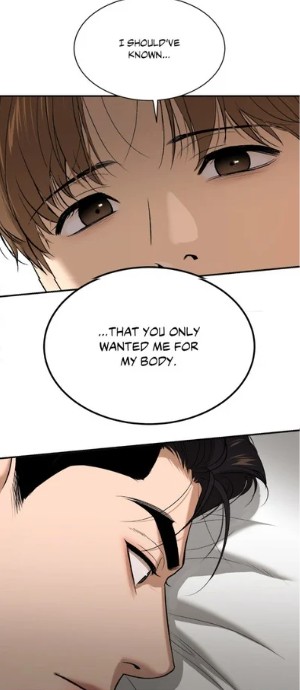 (chapter 62) the weight of that sentence stretches far beyond the bedroom. It carries the residue of every moral, familial, and physical contract that has reduced him to flesh. What the champion hears as accusation is, at its core, a confession of alienation — the echo of a man who has never learned to live inside himself. It’s not only a reproach but a confession. He hates his body because it has become the medium through which he is used, never loved.
 (chapter 27)
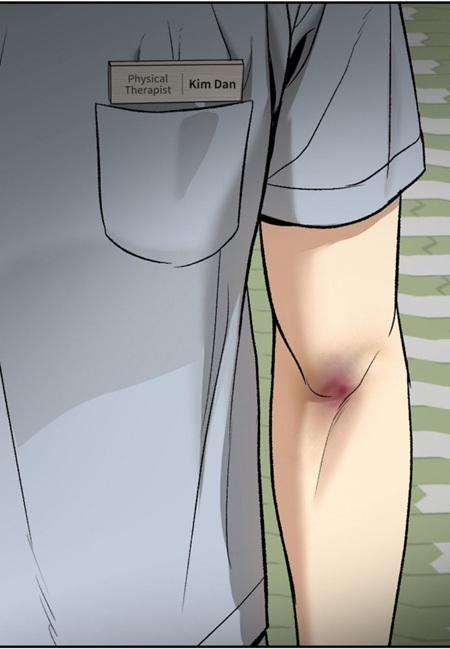 (chapter 61), the other where no one looks. Yet, the attitude of people is the same: no one pays attention to them. Both inhabit bodies that have forgotten the difference between endurance and pain. Both mistake self-destruction for strength.
  (chapter 18) when Kim Dan, bruised, had seized his hand and expressed his concerns. Back then, the gesture had confused the wolf. His hands were made to strike, to defend, to dominate — not to be pitied or protected. He had pulled away instinctively, unsettled by the tenderness and the huge sense of responsibility behind the question. He felt criticized, as if his power was questioned.
  (chapter 80) What began as misunderstanding in episode 1,
 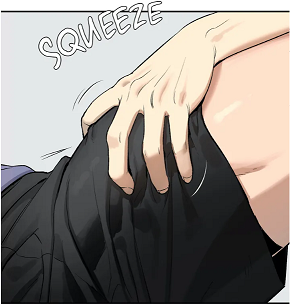 (chapter 1) and was maintained through the awkward hospital encounter in episode 18, now evolves into dialogue and genuine comprehension. In the beginning, Kim Dan’s touch had been accidental and defensive—a misreading of bodily proximity. When he grabbed the fighter in episode 1, he believed he had crossed a forbidden line, that his action would be seen as insolence or violation. The fear and shame that followed transformed touch into a territory of silence and self-censorship.
 (chapter 56), he had interpreted that touch not as mistake or violation, but as a spark of invitation—proof that the “hamster” might want him after all. His own longing twisted the scene into a fantasy of desire, into a private “game” he wanted to continue in the bedroom. One misunderstanding gave birth to another. By episode 18, the same reflex persisted: he reached out again, asking if Jaekyung was hurt, his hand trembling with the same mixture of care and fear. Once more, touch was misread—offered as comfort, received as intrusion. Thus their relationship began under crossed signals: one moved out of survival, the other out of projection or the reverse. It is no coincidence that their relationship in season 1 was doomed to fail. They never communicated properly, as their perception was influenced by their past and surroundings.
 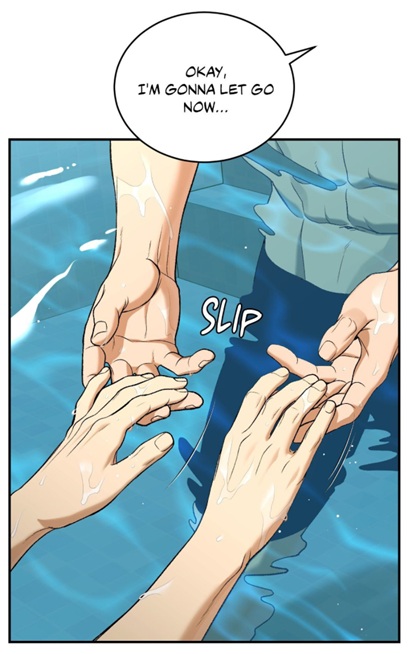 (chapter 80), Kim Dan panics, convinced that release equals abandonment.
 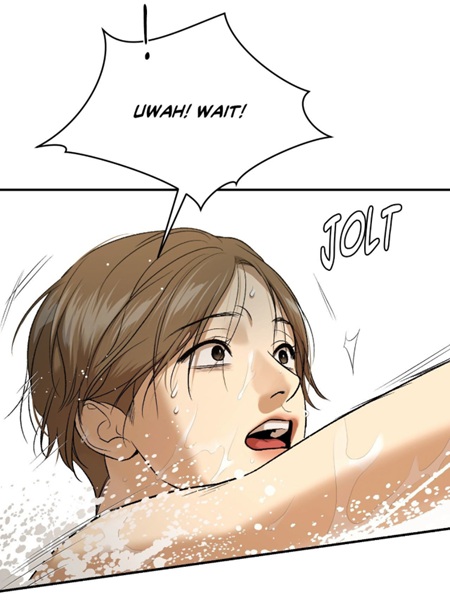 (chapter 80) He freezes once again. Yet the water holds him; he reaches onto the champion again — and this time, the embrace stays. What makes this moment remarkable is that the pool is shallow.
  (chapter 80) Kim Dan could easily stand on his own, but fear has eclipsed reason. His instinct is not to trust his feet, not to fight the water, but to cling to the man before him.
 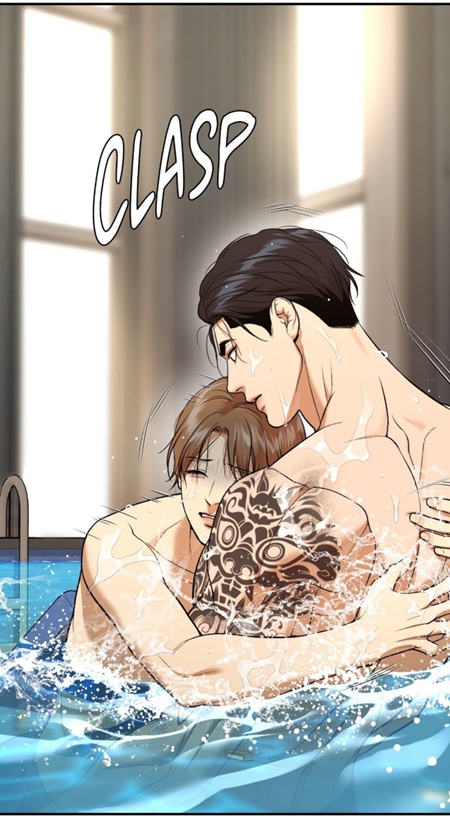 (chapter 80) And this has nothing to do with his money and the gifts. This gesture exposes that the hamster does trust the athlete. For me, his passivity is strongly linked to his longing.
 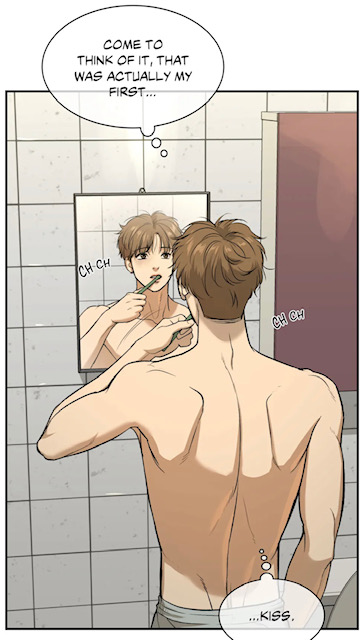 (chapter 16) —that deceptively simple French word—finds its power. It means “ice,” but also “mirror” and “window.” When the champion looks through Kim Dan’s glace
 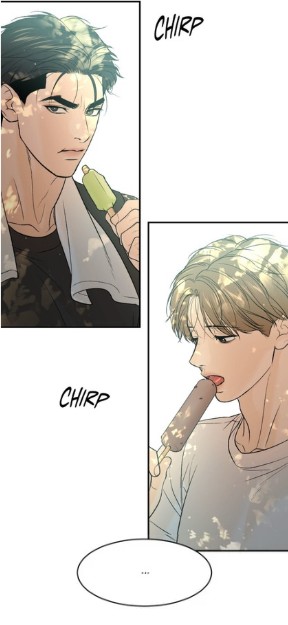 (chapter 77), unlike the touch of ice. It softens, sweetens, dissolves slowly on the tongue. Likewise, the heat between them no longer needs to scorch; it can melt. And yet, the kiss — once their most volatile exchange — has fallen silent.
  (chapter 64) Kim Dan had to bite his own lips to make Jaekyung stop, and neither has ever truly spoken of it. Yet, during the night, the athlete could see the remains of that cold war.
 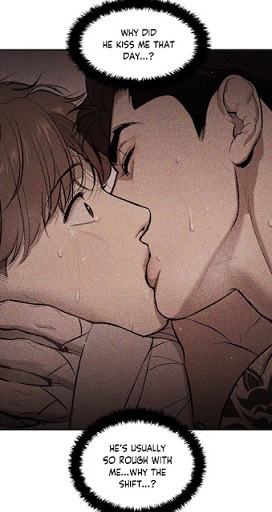 (chapter 16), just as the champion has never confessed that it was his first kiss. Moreover, during their first day off together, Joo Jaekyung had also initiated a kiss and back then, the doctor never wondered why.
  (chapter 27) Both men have been staring into the same mirror without realizing that the reflection was shared. They love each other. Joo Jaekyung needs to ponder on the signification of a kiss
  (chapter 13) and why doc Dan made such a request.
  (chapter 15) The kiss is more than just fun and pleasure. It is the expression of “love”. And now, you comprehend why I am expecting a huge change in the next episode.
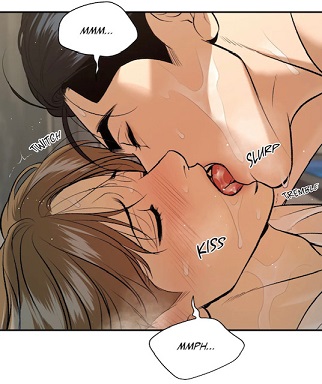 (chapter 28) and urge Kim Dan to ask, at last, the question that remained frozen between them. In doing so, he would not only reopen the conversation but also reclaim the meaning of touch itself: not as misunderstanding or survival, but as curiosity and love.
 (chapter 80) And it comes with a small but crucial instruction. In that single phrase, the MMA fighter encourages Kim Dan to discover his own power and strength without overexercising. His feet, which were once symbolically trapped in the nightly ice, now press against the water with intent during the day. For the first time, his body obeys him, not fear. His movements are neither frantic nor helpless but self-regulated, gentle and alive. That’s why the main lead becomes happy for a moment.
  (chapter 21) comes from the early loss of his mother.
  (chapter 79), if he knew that the doctor has already loved him for a long time.
 (chapter 80), yet without panic. It is the opposite of his lifelong reflex to cling.
 Kim Dan on Thin Ice was never just about danger or fragility — it was about transformation. The ice that once confined him to stillness has melted into water, and the fear that once froze his body has become motion. Where there was trembling, there is now flow; where there was isolation, there is connection.
 (chapter 47) and denial for strength
  (chapter 55). Joo Jaekyung, Kim Dan
  (chapter 61), Park Namwook
  (chapter 69), and Shin Okja
  (chapter 53) all operate within survival mechanisms shaped by trauma, guilt, and fear. They choose the illusion of control or calm over genuine healing. But as the story unfolds, these strategies begin to unravel. Each character must confront the truth behind their emotional habits, learning that happiness isn’t the absence of pain—it’s the result of confronting it with clarity and purpose.
  (chapter 54), Joo Jaekyung is cornered by a faceless, overpowering ghost. He is unable to fight or flee; only obedience and silence remain.
  (chapter 54) He could only express his pain and resent through the hand. This moment encapsulates the core of his trauma: as a child, he learned to survive through silence and compliance, not resistance. Yet deep down, the resentment festered—toward himself, and toward the abuser. That psychological pain was redirected into becoming a fighter, as if to prove the abuser wrong.
  (chapter 26)
  (chapter 14) But ironically, he became exactly what the abuser desired: a powerful, obedient puppet. His fame, discipline, and aggression were not signs of freedom, but evidences of emotional and mental captivity. That’s why the past from the champion is surrounded by darkness and mystery.
 (chapter 36) His language was dominance, not dialogue. He didn’t process his emotions through words—he suppressed them, until they erupted in violence or withdrawal.
  (chapter 34)
  (chapter 1) And crucially, he didn’t leave right away either despite his embarrassment and fears.
  (chapter 1) Thus for the first time, Jaekyung had to develop a new strategy in order to meet him again: one that doesn’t rely on intimidation, but on communication. The problem is that since he saw the physical therapist running away after their first session
  (chapter 1), he knew that he needed to lure him with something: money
  (chapter 1). Under this new light, my avid readers can grasp why the athlete played a trick on the phone, though we have to envision that here the celebrity’s thoughts were strongly influenced by his bias and prejudices. He imagined that Doc Dan had made a move on him.
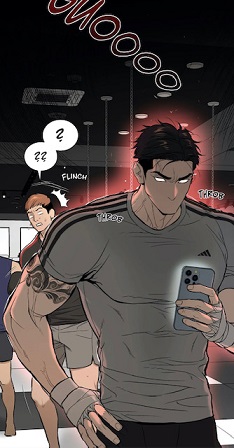 (chapter 5) That retreat doesn’t mean failure—it can be an act of self-preservation. However, the champion experienced that he needed to speak with doc Dan in order to keep him by his side. This lesson became a turning point. Jaekyung started to speak more.
  (chapter 18) Therefore it is no coincidence that in episode 18, right after the celebrity spoke, Kim Dan’s reply was strongly intertwined with flight:
  (chapter 18) The denial of kindness from the champion made the doctor uncomfortable, the latter felt the need to leave the penthouse as soon as possible. The lesson for the star was to realize that words are powerful and can affect people. But Joo Jaekyung didn’t grasp it, as he chose to use sex to „submit“ his fated partner.
 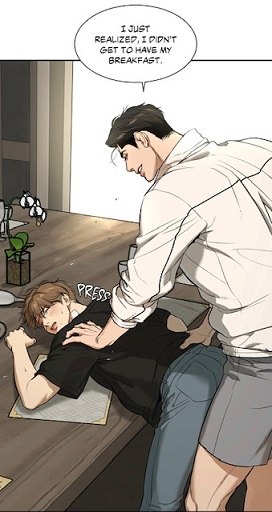 (Chapter 18) Nevertheless, as time passes on, the wolf asks more and more questions. He reacts to emotional discomfort not only with physicality but with hesitation, introspection. He is no longer reacting as the ghost once taught him; he is arguing and as such adapting, growing. Thus we could say, he is less passive.
 (chapter 3) or table, in showers
 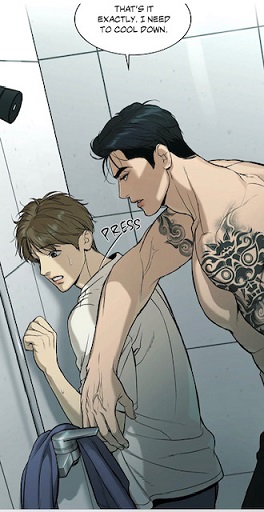 (chapter 7), against doors, or walls
  (chapter 34). On the surface, it may seem like a gesture of dominance or desire, but symbolically, it reflects silencing.
 (chapter 51) They stand in the middle of the room—an open space—symbolizing emotional emancipation. When Dan questions the celebrity
  (chapter 51), the words from doc Dan pierce the champion’s emotional defenses. Thus Joo Jaekyung is destabilized.
 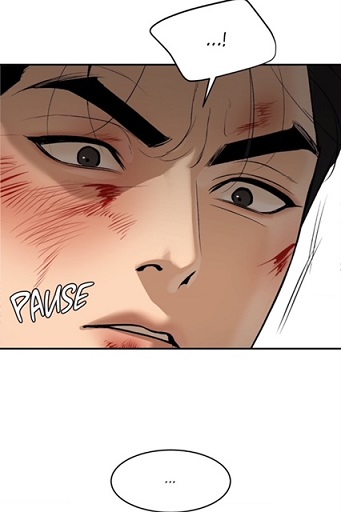 (chapter 51). The latter tries to reassert control
 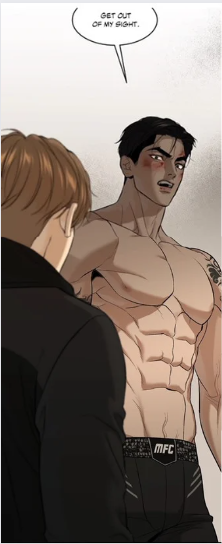 (chapter 51), but this time, when he lashes out, he is the one who leaves. This is cognitive dissonance at work: the fighter cannot reconcile his fear of vulnerability with his emerging need for connection and his perfectionism. So he defaults to a performance of control, even as he runs from it. And while one might mistake this for weakness or regression, it actually displays a progression. First, Jaekyung had finally revealed his thoughts and fears to Dan.
  (chapter 51) Secondly, he left the place which was a new MO for the fighter. His act of fleeing is no longer an escape from confrontation —it follows a moment of emotional vulnerability. It shows that he had finally dared to speak, even if he wasn’t yet ready to stay and endure the emotional aftermath.
 (chapter 69) That silence could easily be mistaken for submission, for the same old performance of the compliant athlete.
  (chapter 69) But that would be a misreading. His silence is no longer a symptom of fear or control. It is a deliberate withholding—a sign that he no longer plays by their emotional rules. He is starting distancing himself from MFC, Park Namwook and the fight-centered identity they crafted for him.
 (chapter 69) After all, to those still invested in dominance hierarchies, leaving the capital after a public defeat seems like the behavior of someone who’s been defeated mentally as well. But the truth is the opposite. This “retreat” is actually an act of autonomy. For the first time, Jaekyung is giving himself space—not to run, but to reflect.
 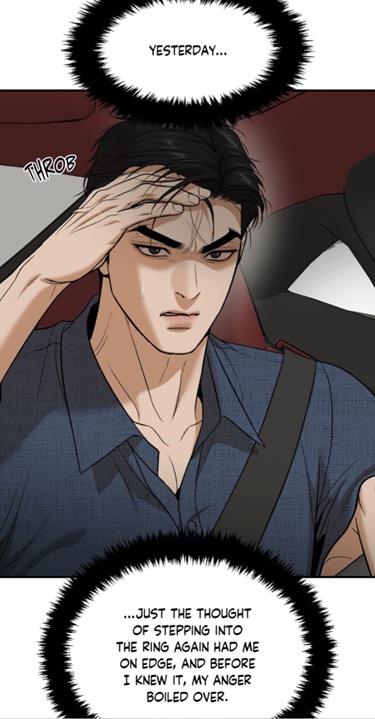 (chapter 69) He is no longer blindly performing the role of the fighter, nor desperately trying to maintain control over the narrative.
  (chapter 69) He is beginning to think critically about his past behavior, his future, and the systems that have defined his identity and life.
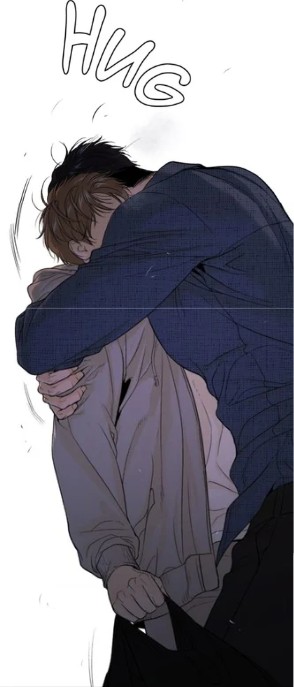 (chapter 69) with “no audience” (he ignores people), no pressure, no script. And in that openness, he lets go—not just physically, but psychologically.
  (chapter 69) The hug marks the collapse of his old beliefs: that emotions are weaknesses, that silence is protection, that strength means standing alone. He is no longer trying to dominate Dan or prove anything. He’s not cornering or fleeing. He’s simply staying—with someone, and with himself.
 (chapter 7) and flight
  (chapter 52), often using blame as a shield. When crisis strikes, he blames the champion’s temper, relies on Doc Dan
  (chapter 36), or MFC’s decisions.
  (chapter 69) He surrounds himself with “assistants” like coach Yosep, Kim Dan or Joo Jaekyung
  (chapter 25: here the protagonist was replacing Yosep and Park Namwook), hires professionals to manage damage
  (chapter 47), and hides behind administrative actions.
  (chapter 66) But he never takes full responsibility. This blame-displacement strategy works—until the champion flees to the West Coast.
 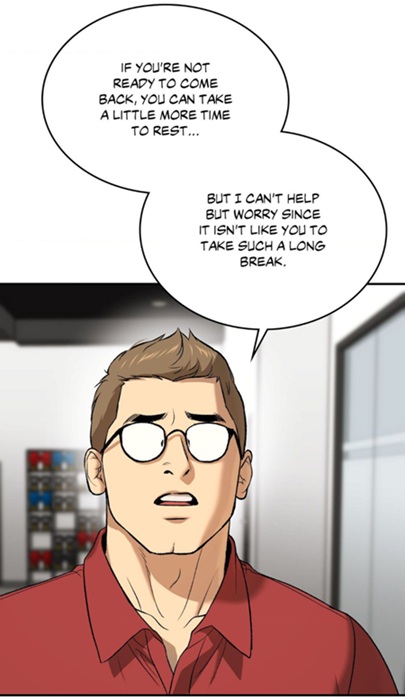 (chapter 66) that cornered the manager.
  (chapter 66) As long as the champion was nearby, Park Namwook could project blame onto him, framing him as unstable, disobedient, or temperamental. But once „his boy“ vanished from Seoul, the hyung was left exposed. Striking is that he is not seen watching over the training of the remaining members.
  (chapter 60)
 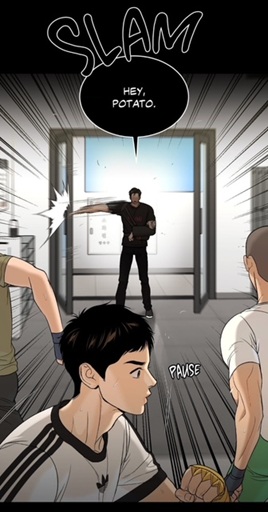 (chapter 60), a sign that he is neglecting the other members. The absence of his star fighter removed his most convenient scapegoat, forcing him to face the consequences of his own mismanagement—though he is not yet ready to truly question it and change his mindset, denial, and dependency. This was not just a geographical disappearance—it was a strategic psychological rupture, meant to destabilize Park’s illusion of authority.
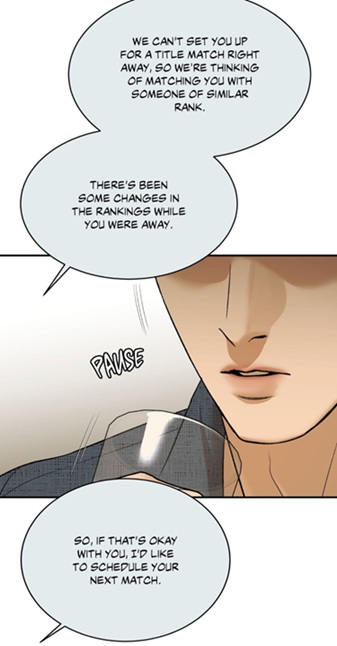 (chapter 69) He continues to speak as though the champion’s future is intact, as if the title is still within reach. But the organization’s actions speak louder: Jaekyung is no longer a contender — he is being gradually abandoned, not promoted. Secondly, Park Namwook assumes that Jaekyung will win the next fight, as if victory is still within his grasp. But this trust is misplaced — not only because the fighter is recovering from surgery, but because the schemers may have already designed this match as a final blow. Another fight right after a surgery, a staged defeat, or a quiet elimination would neatly push Jaekyung out without public controversy. By assigning him a marginal, delayed match, they are not offering redemption — they are orchestrating his exit.
 (chapter 17) They don’t see him as someone with legal or institutional power. But that’s their fatal blind spot. Since Jaekyung co-owns or outright owns Team Black, this makes him: A partner (or even rival) in MFC’s talent pipeline; an employer and a stakeholder in fighter safety. He has the same position than Choi Gilseok. Therefore as the owner of Team Black, he can sue the gym King of MMA and Choi Gilseok. He can take action against the CEO for negligence, corruption or abuse of authority.
 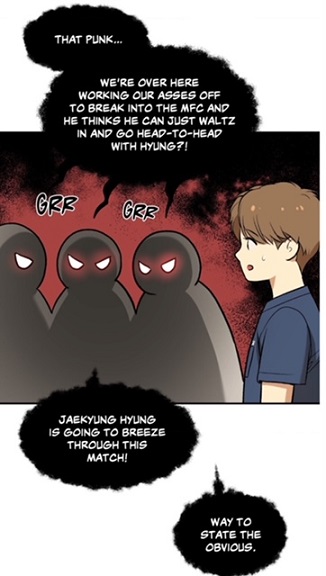 (chapter 47) Finally, he can testify not only as a fighter, but as a representative of the institution they tried to exploit. That elevates his voice: from a disposable athlete to a legal opponent with organizational standing.
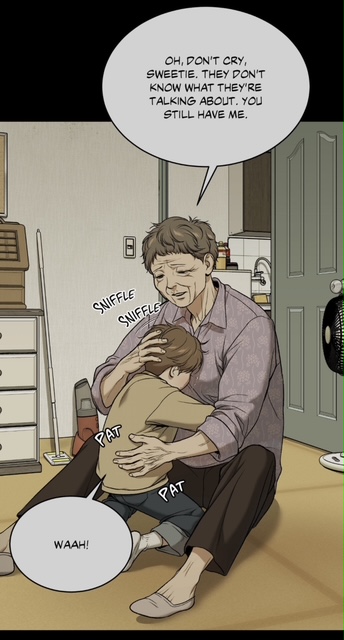 (chapter 57) Secondly, the vanishing of his parents were also swept under the carpet. That’s how he internalized powerlessness. Fleeing
 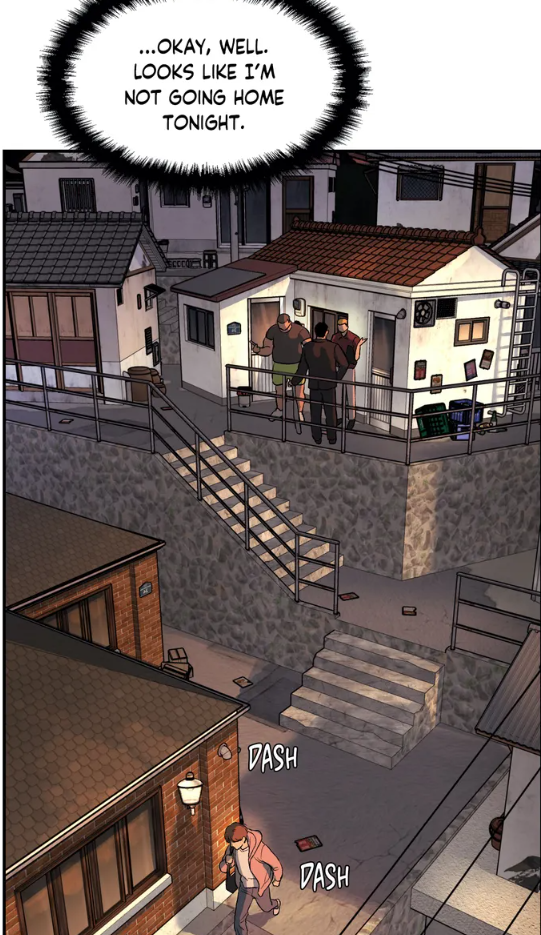 (chapter 1), deflecting, and disappearing became natural. With the grandmother, with doctors
 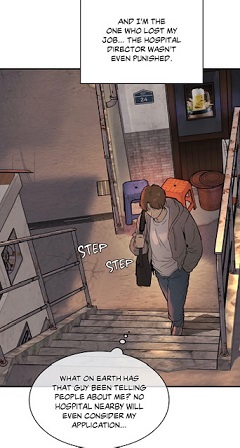 (chapter 1), with institutions—he obeyed. He accepted his fate as a fatality. But with Jaekyung, a new pattern emerged. Slowly, he began to resist: he set boundaries, raised his voice, argued with his boss, even used physical gestures to assert himself.
 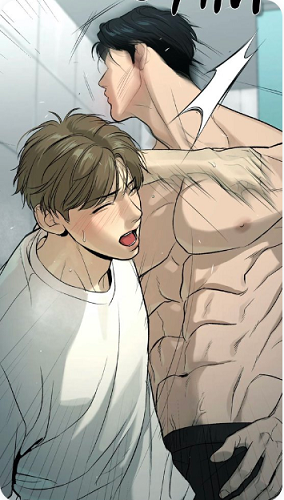 (chapter 7) For a moment, he was fighting.
 (chapter 67) Moreover, in contrast to Season 1, Kim Dan is no longer the invisible caregiver or obedient grandson. Thanks to Joo Jaekyung’s presence—disruptive and painful as it was—he began to form an independent identity
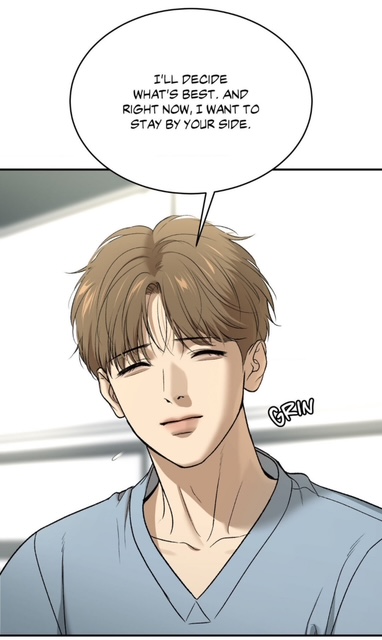 (chapter 57), one no longer shaped entirely by duty or guilt. The grandmother, however, is blind to this change. She continues to speak to him as if he’s the same self-sacrificing boy
  (chapter 65) who followed orders quietly and centered his life around pleasing others. Her suggestion that he “returns to Seoul” assumes he still views that as his place. But Dan refuses.
 (chapter 57) —it is a rejection of the belief that he exists only to serve. In Season 2, Dan says “no” repeatedly:
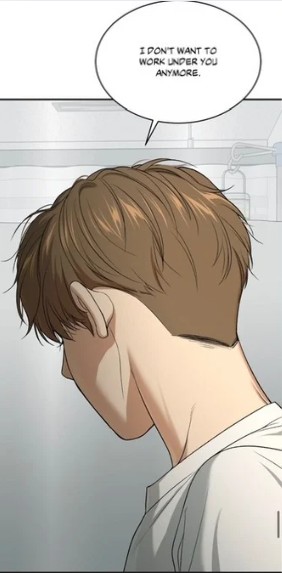 (chapter 60)
  (chapter 67)
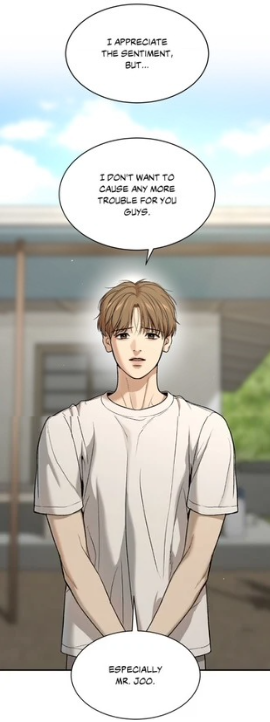 (chapter 58)
  (chapter 57)
 (chapter 65) She uses his past flaws to outline his immaturity and need of guidance. However, she is not taking into consideration the transformation in the doctor due to the recent incidents (switched spray). He is no longer the same than he was 6 months ago or 2 years old. He changed thanks to the athlete and because of unfortunate events (sexual harassment from the hospital director, switched spray). But the halmoni has no idea about such incidents.
  (chapter 53) Unlike Park Namwook who uses blame and delegation in professional settings, she applies emotional avoidance in private and familial spaces. Much like the manager, she outsources responsibility, asking others to step in
 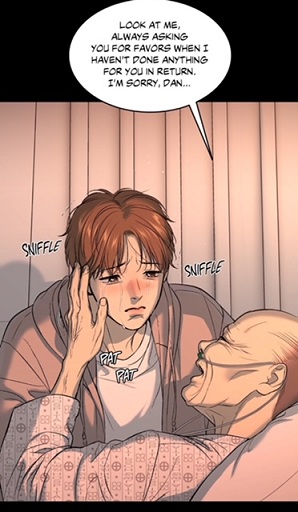 (chapter 53)
  (chapter 65) rather than engaging directly. She avoids difficult conversations, never once asking doc Dan about the nature of his work or why he followed her to the West Coast.
  (chapter 65) Her silence is not protective—it is evasive.
 (chapter 5) Her illness becomes a metaphor for her mindset. She relies on external systems: her grandson
  (chapter 7), medication, comfort
  (chapter 21), and other people (nurse, Joo Jaekyung) —to maintain her emotional balance. But as doc Dan himself once observed, she is ultimately on her own in her battle. No system can fight it for her.
 (chapter 7) His grandmother was not truly abandoned; she simply equated his physical absence with neglect, ignoring the emotional and financial burden he already carried. Like Park Namwook, she prefers others to carry the discomfort while maintaining a façade of suffering and sacrifice.
  (chapter 65)
 (chapter 5) Hence he made sure to shield her from any pain.
  (chapter 65), protected, comforted. Surrounded by nurses, medication, and routine, she finds temporary peace in an environment that simulates safety. The hospice does not cure her illness, but it cushions it. This illusion allows her to smile again, to relax—but only up to a point. Kim Dan’s gradual deterioration
  (chapter 57) —his visible exhaustion, disconnection, and quiet suffering—becomes a thorn in her eye, a reminder that her peace is not whole. As long as he suffers, she cannot entirely escape the shadow of her own regrets. Sending him away to Seoul represents a new of flight. Out of sight means out of mind. That way the grandmother wouldn‘t have to worry about doc Dan, as he has been entrusted to the athlete.
 (chapter 163) and supported by the article on confirmation bias, human survival was deeply dependent on mental shortcuts. Biases were not flaws, but adaptive tools — heuristics that helped our ancestors make quick decisions under threat. Faced with a potential predator, they could not afford the luxury of curiosity or debate. Run first, think later.
 (chapter 163) In this sense, biases were effective precisely because they increased the chance of survival.
 (chapter 9) But once Joo Jaekyung became the target of criticism and scandals, his fear response activated.
  (chapter 41) he recommends the opposite at the restaurant because the idea comes from the CEO!
  (chapter 65) It was her decision to settle down at the hospice.
  (chapter 67) His survival bias told him: “Don’t trust a man who once treated you violently.” or “Doctors are ignorant, they don’t know me“. It was easier to discredit the source than to weigh the merit of the message. Likewise, in Season 1, the champion dismissed doc Dan’s medical opinions
  (chapter 41), trusting instead in MFC and his agency — despite the fact that those institutions are overtly motivated by money. His bias protected his ego, but at the cost of his health and relationships.
 (chapter 40) who needs to fight to prove himself, yet likely doesn’t treat his own family this way.
  (chapter 45) His double standard is not conscious hypocrisy — it’s a form of selective laziness. He does not challenge his beliefs because doing so would unravel the identity he’s built as a competent, authoritative manager.
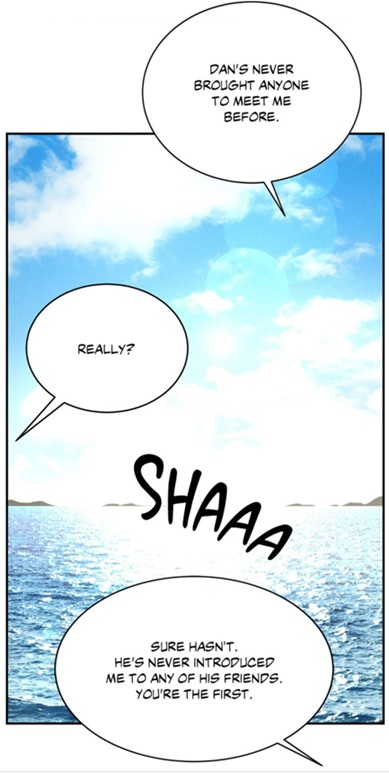 (chapter 65) or a support network. It is not her fault, if she never met doc Dan’s friends in the past while hiding the fact that he had been bullied by his peers. Her request for him to return to Seoul, a place he has no roots, only furthers his habit of isolation. Similarly, when she asked Jaekyung to bring him to Seoul and have him diagnosed, she implicitly discouraged any shared decision-making. Like Park Namwook, she bypassed dialogue in favor of directive control, reinforcing the habit of emotional withdrawal.
 (chapter 67) That shift marks a turning point from survival to conscious thought. The mind cannot reflect when it believes it is under attack. The tragedy is not that these characters are irrational — it’s that they were taught fear before they were taught trust. Thus I come to the following conclusion. As soon as both are curious about each other
 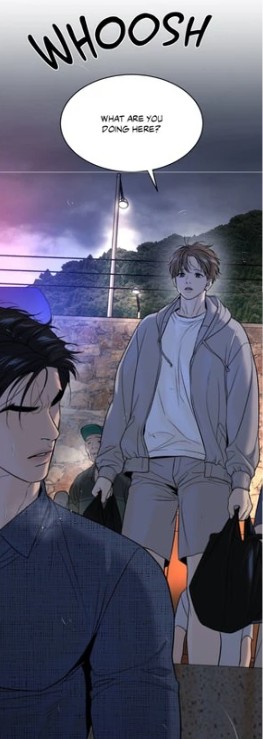 (chapter 69), they are now free from their bias and prejudices.
  (chapter 69) They will be able to communicate which will help them to discover the truth about MFC. Yes, their ability to ponder will lead them to unmask the villains and defeat their opponents. By fighting for justice, both will discover true peace of mind. This hardship at the end of season 1 was necessary to reset their heart and mind: what is the true meaning of life? Money? Work? Duty? Sacrifice?… The answer is happiness which is strongly intertwined with love and selflessness.


 (chapter 36), his tendency to retreat rather than challenge his own doubts
 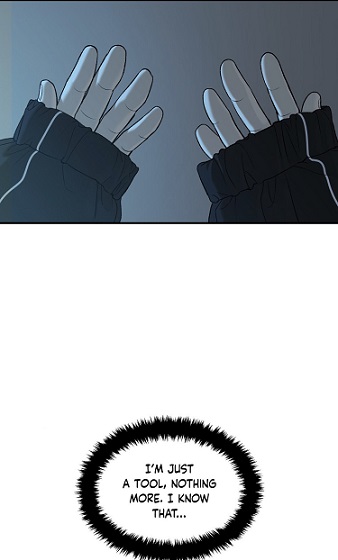 (chapter 36), and his overwhelming fear of disappointing others
  (chapter 62), Joo Jaekyung does not. The evidence for this interpretation is the champion’s nightmare:
 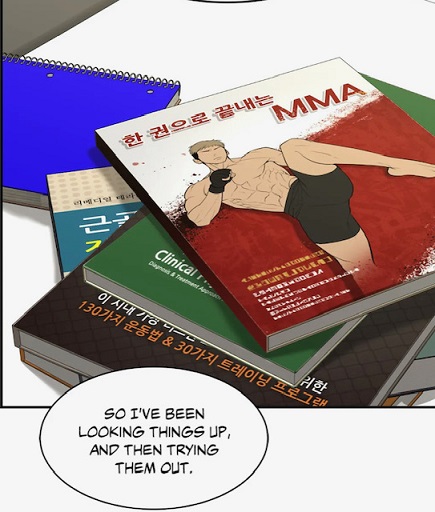 (chapter 25) Therefore the physical therapist bought books. Moreover, we should consider this argument
  (chapter 45) as a revocation of the star’s statement in episode 18. Kim Dan was no longer perceived as a tool, but as a real physical therapist. On the one hand, this request boosted the “angel’s ego”, on the other hand, he was put under immense pressure, for he was compared to his colleagues.
 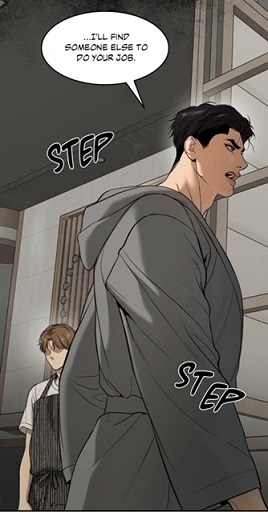 (chapter 45) Since in Seoul, Kim Dan has only been hired because of sex (Joo Jaekyung, the perverted hospital director)
 (chapter 6), he came to accept that he was not truly talented. The champion had no trust in him and later, the word jinx triggered a repressed bad memory.
  (chapter 62) Due to his bad past experiences, he concluded deep down that his CV was not reflecting the truth.
 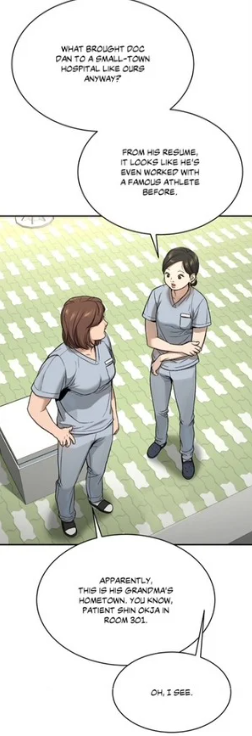 (chapter 56) That’s the reason why he was devaluing himself and as such not looking for a high position.
 (chapter 48) exemplifies this pattern:
  (chapter 48) It was not the right time. He assumed his voice held no weight, reflecting years of learned helplessness. It shows how Kim Dan internalizes responsibility for things beyond his control. He thinks that withholding information is an act of protection rather than avoidance. Yet in doing so, he denies himself agency in his own life.
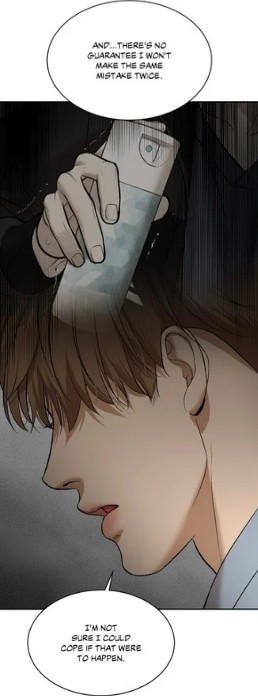 (chapter 62) completely devastated Kim Dan’s already fragile self-esteem.
 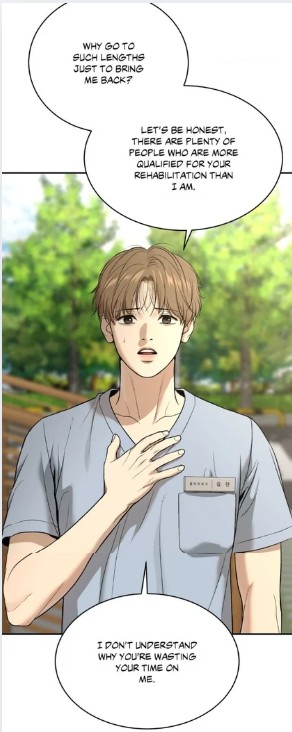 (chapter 62) First, he considers himself as waste. While in the past, he was at least a tool, he is now garbage. Hence his feelings are “trash”.
  (chapter 62) This means that in episode 62, he felt worse than in episode 18! The idioms “trash” and “waste” revealed the doctor’s own self-perception in episode 62: he saw himself as totally useless. He belonged to the “wastebasket”, just like the golden key chain.
  (chapter 46) Thus I deduce that the fate of this item echoes the doctor’s.
 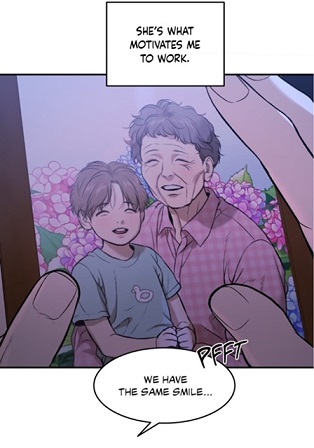 (chapter 47) He had selected this profession because of her. This shows that until now, he has never developed any ambition on his own. The loss of faith from someone he relied on for motivation made him feel completely worthless. This reinforces that his confidence and sense of direction were never self-sustained: they depended on others’ recognition. This pattern suggests that Kim Dan has never truly asked himself what he wants. His entire existence has revolved around meeting expectations, whether from his grandmother, Joo Jaekyung, or even his profession. His current crisis—feeling like waste—stems from the realization that without someone to validate his worth, he sees himself as nothing.
 (chapter 59) However, observe that he is using the expressions “do” and “now”. This has nothing to do with the future and dreams. It is not a reflection on his own desires but rather an immediate reaction to his circumstances. His mindset is still trapped in survival mode, seeking a course of action rather than contemplating what he truly wants. His words reflect an urgency to act rather than an opportunity to dream. This highlights that he has spent his entire life making decisions based on necessity rather than personal fulfillment. Even when faced with uncertainty, he does not ask himself what he wants—only what he must do next. His transformation will only be complete when he begins to question not just how to survive, but how to live on his own terms. That’s how I realized why Mingwa put this question in front of the window covered with Venetian blinds [which made me think of this scene
  (chapter 39 – Venice, a travel to Italy]. The window with the Venetian blinds represents a metaphor for the doctor’s trapped dreams. This interpretation made me recognize another aspect. Kim Dan is pushed to meditate, when he is front of a window or better said close to the sky! Hence the hamster started thinking about his own future in the penthouse
 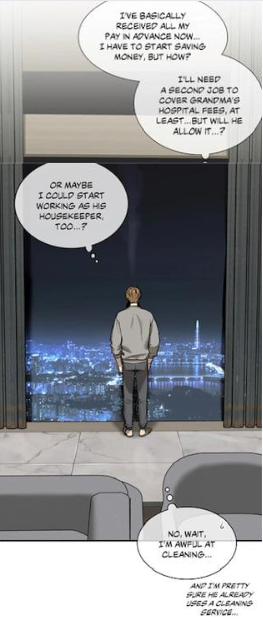 (chapter 19) or when he looked at the sun and sky:
 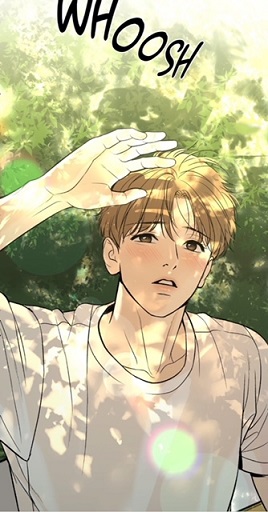 (chapter 41)
  (chapter 41) And the best evidence for this interpretation and expectation is doc Dan’s cellphone screen display.
 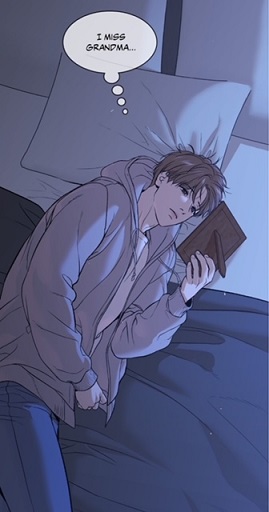 (chapter 47) The picture from his childhood: himself with his grandmother.
  (chapter 66) But the latter was not related to work, but to fun and nature. Striking is that Joo Jaekyung has an empty phone screen display indicating that he has no real dream on his own either:
  (chapter 38) No wonder why he questioned the meaning of his champion title:
  (chapter 54). He saw the belt as something rather “meaningless”.
  (chapter 43) This would boost the doctor’s self-esteem. He is not trash, but an acknowledged fan and friend. The picture would encourage the physical therapist to develop his own ambitions. As soon as I made this discovery, another detail caught my notice:
  (chapter 66) The celebrity has no picture of Park Namwook in his contacts divulging the superficiality of their relationship.
  (chapter 42) The problem is that the athlete took this recommendation personally. He felt as if his job as fighter was questioned.
 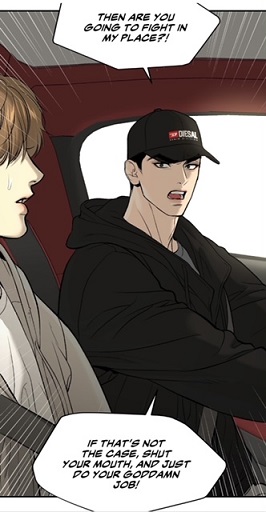 (chapter 42) As you can see, the doctor’s hesitations were exposing his mental obstacles, which was reflected in the champion’s attitude. No wonder why doc Dan chose to become a courier as a second job instead of finding a new VIP client. While the interaction between the athlete and Kim Dan in front of the hospice display the return of doc Dan’s past mental hurdles:
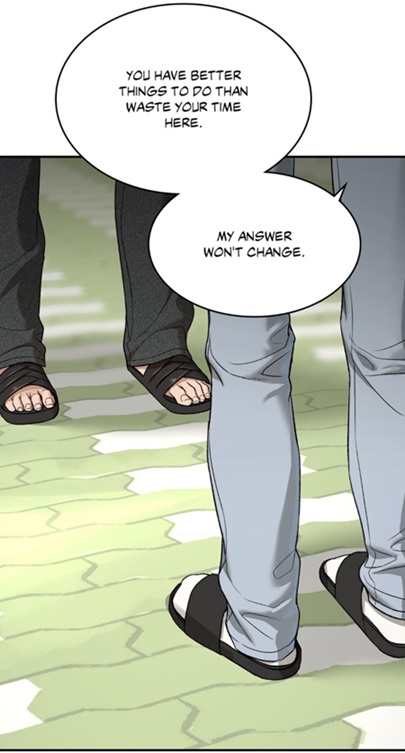 (chapter 62) According to the main lead, the champion is “wasting his time here”.
 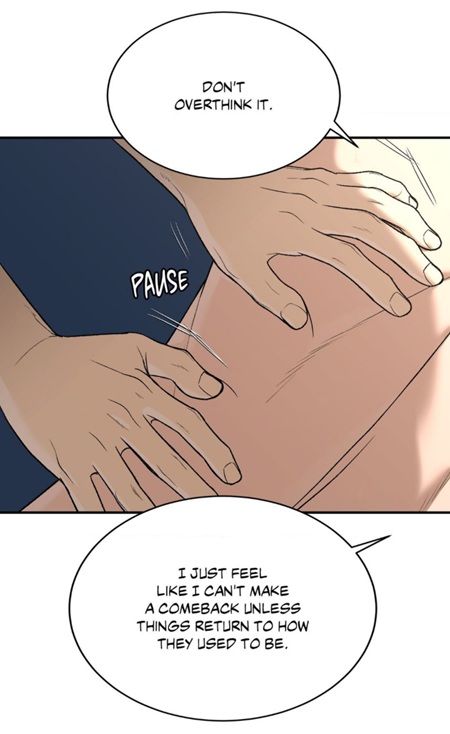 (chapter 62)
 (chapter 57) Hence it is clear that in the future, the physical therapist would refuse to use any kind of spray. On the other hand, it is important to recall that back then, Joo Jaekyung had made the request himself:
  (chapter 49) So in the doctor’s mind, if he agreed to the champion’s request, he would be treated like in the past. He would have to simply to follow the athlete’s lead. That’s why he is imagining that he might be put in a similar situation than in the past. But there exists another reason why he refused the champion’s offer right from the start. It is because he has always perceived himself as “hands” which stand for selflessness and generosity. The latter defined doc Dan. Hence he looked at them, when he declared himself as a tool:
 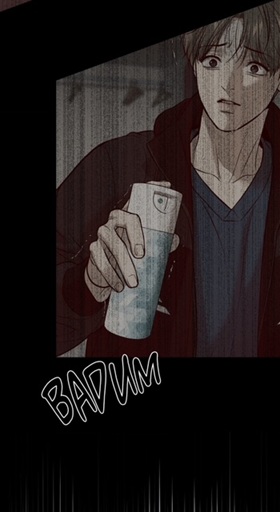 (chapter 57)
  (chapter 1) with a previous PT like the spray? No wonder why he called himself “trash” in the end.
  , people might wonder why I selected dandelions as a frame for the selected.. It’s clear that the dandelions aren’t just there for aesthetic balance. Their symbolism is profound. Dandelions are often associated with childhood innocence, wishes, and fleeting moments of beauty, yet they also wither quickly, easily scattered by the wind. In the context of Jinx, they represent a transitory force—something that struggles to take root, much like the intangible and fleeting elements in Kim Dan’s life. But there’s more to it. Before delving into deeper analysis, consider this: what is the common denominator in all these scenes?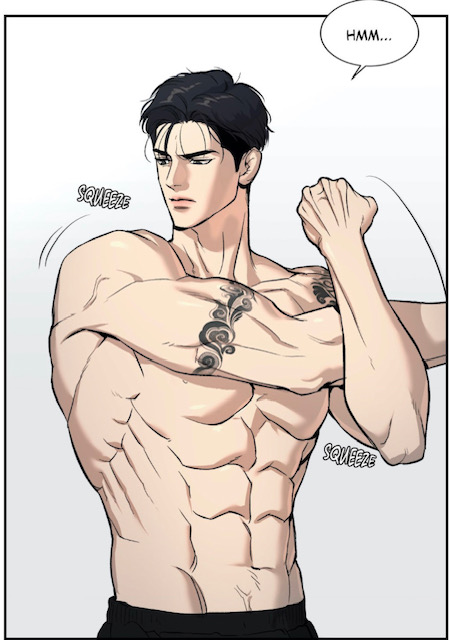


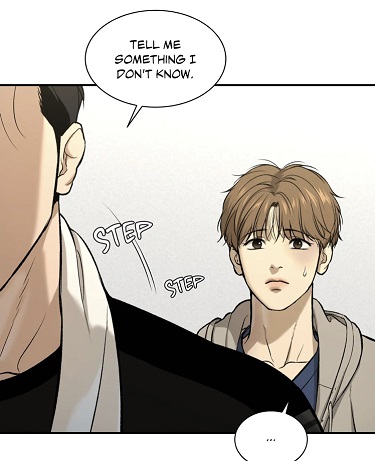
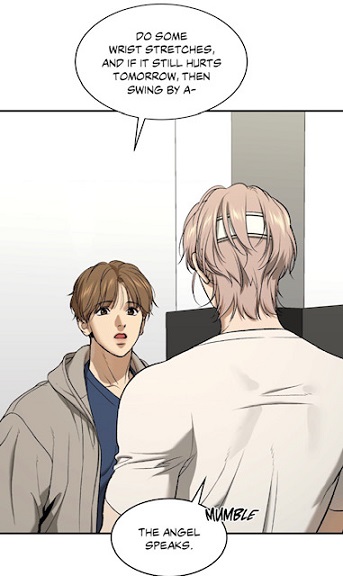

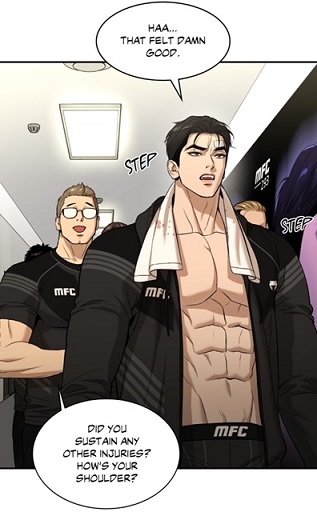
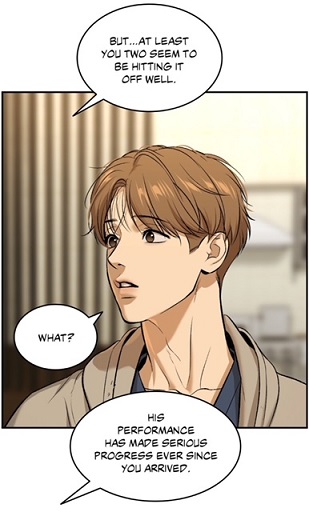
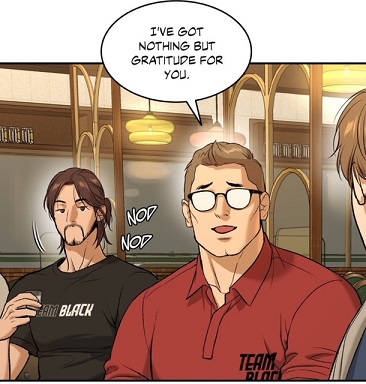

 (chapter 37) Therefore it is not surprising that the main lead couldn’t view the members as friends in the end.
  (chapter 41) And now, you comprehend why Joo Jaekyung has always disliked his birthday and the “congratulations” from people in general. The gifts and words were like poisoned praises to his soul. They were pushing him to live like a “god”.
  (chapter 59) While this photography was not a personal and intimate picture, it also symbolizes his first root in the little community: Light of Hope Hospice. He is part of the staff and as such of the little town. On the other side, we could say, he is gradually entering the scene as a PT. Note the contrast to the food truck:
 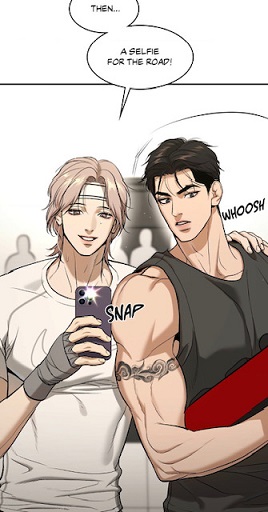 (chapter 30) In other words, it exposes the actor’s hypocrisy and wrongdoings. And now, you understand why I wrote genuine in parentheses above [proof of (genuine) human connection]. Photography in Jinx also represents the evidence of wrongdoing
 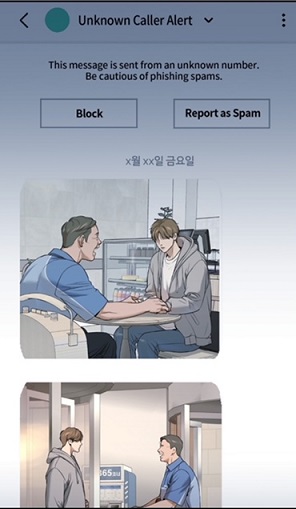 (chapter 48) and deception:
 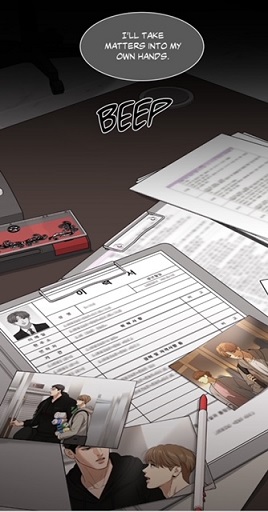 (chapter 46) The exact opposite of the dandelions.
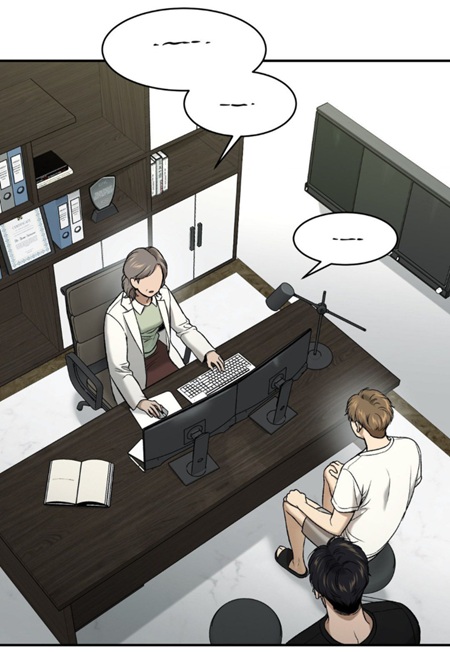 (chapter 66) It is a direct contradiction to the hollow praise doc Dan has received all his life.
 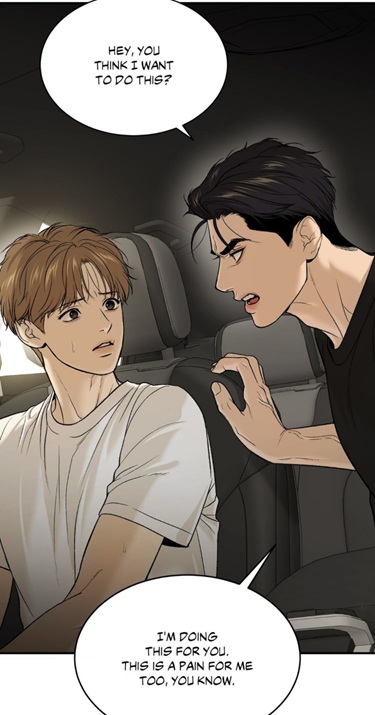 (chapter 66) he contradicts not only Kim Dan’s self-perception, but also his past accusations:
  (chapter 66) that he was merely a tool for Joo Jaekyung’s success. By taking him to the sleep specialist, the champion proves something that Kim Dan had refused to see: he matters beyond his utility. This moment mirrors Joo Jaekyung’s past words—
 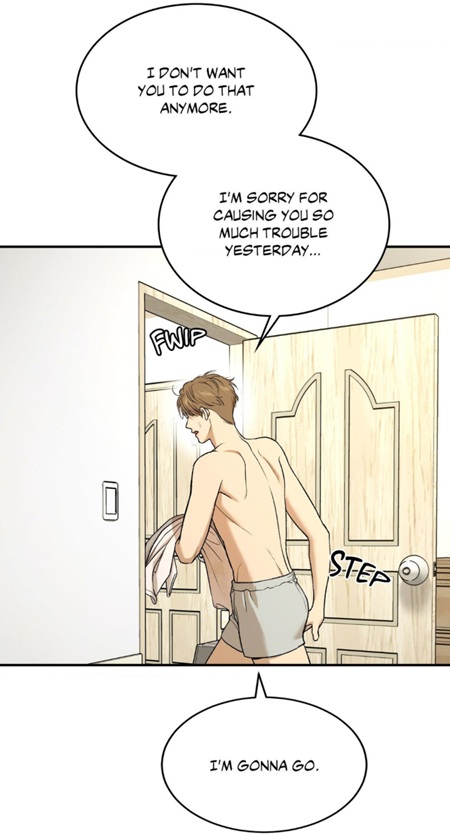 (chapter 66)
 (chapter 66) reveals Kim Dan’s elevation in the champion’s life. The dressing room symbolizes privacy and closeness. No longer seen as a mere tool, Kim Dan has become an integral part of Joo Jaekyung’s world, not because of what he can do but because of who he is.
 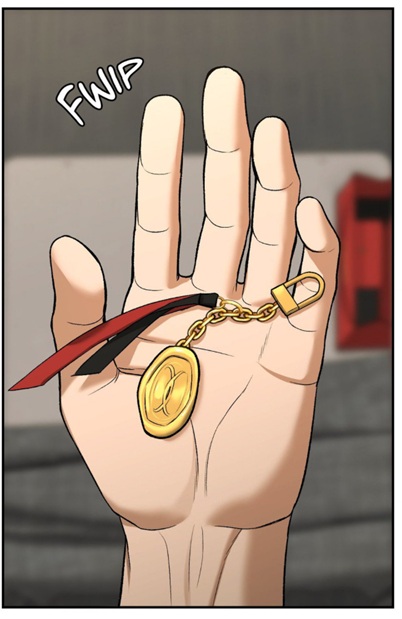 (chapter 66) Therefore the champion is holding the expensive gift with his whole hand contrary to the past:
  (chapter 55) As a conclusion, by bringing him to the sleep specialist, the star proved doc Dan’s words wrong! He told him something that doc Dan didn’t know: he is precious. He needs to pay attention to his health and body.
 (chapter 32) And now, you comprehend why the athlete didn’t fall for Park Namwook’s manipulations afterwards.
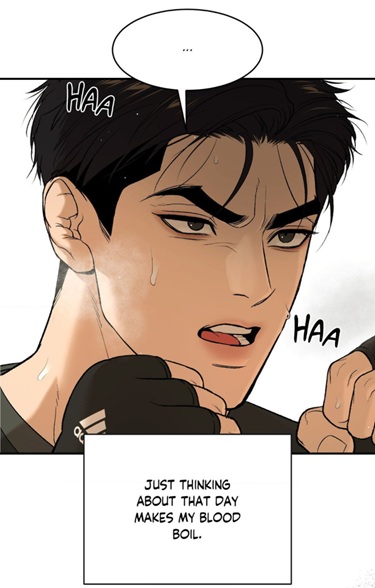 (chapter 65) At the same time, such a disapproval
 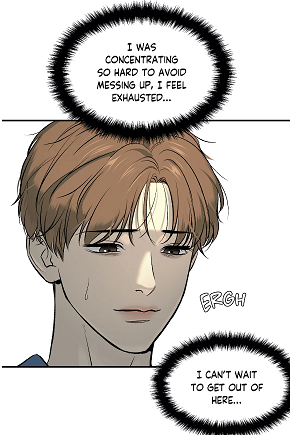 (chapter 1), hence his true desire was to run away from that place. For praise to be effective, the recipient must be open to receiving it, either by looking forward to feedback or having expectations of validation. Since Kim Dan was in a state of distress, he was unable to internalize the champion’s words, reinforcing his long-standing belief that he was invisible or unworthy of acknowledgment. That’s how the champion’s praise became a dandelion seed in the end.
 (chapter 36), or to meet expectations. None of these affirmations recognize him as a person, only as a professional fulfilling a role.
 (chapter 18)
  (chapter 45)
  (chapter 64)
  (chapter 66) Is this a joke?
 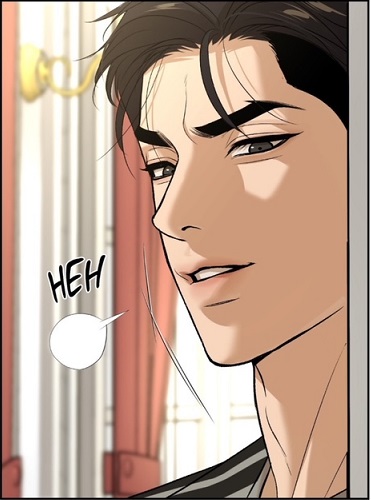 (chapter 40) However, Kim Dan has never realized it. Either he was sleeping or totally out of it (fear of sex)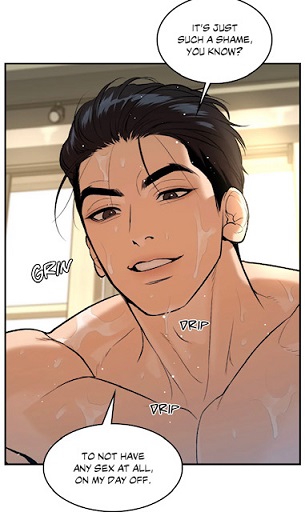
 (chapter 27) It is important to recall the importance of the receiver’s mind-set. The latter has to perceive the sincerity from the speaker. Hence I come to the following deduction: The moment Kim Dan notices Joo Jaekyung’s smile and laugh, then he should come to the conclusion that he matters to the protagonist. I would even say, the two protagonists are destined to make each other laugh and smile:
  (chapter 44) This would be the best “compliment” for both of them. With Kim Dan by his side, Joo Jaekyung desires to make “jokes”.

 (chapter 23) Potato initially admires the champion, aspiring to be like him
 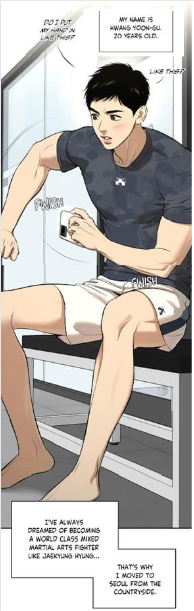 (chapter 23) and dreaming of recognition as his sparring partner.
 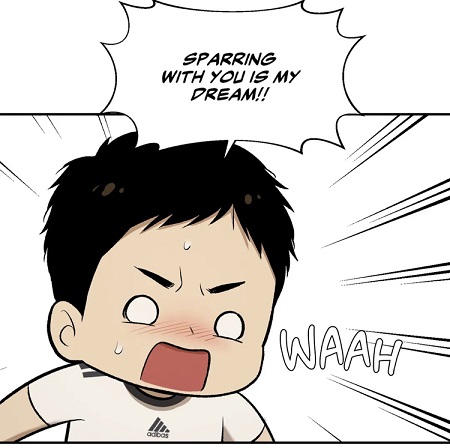 (chapter 23) Joo Jaekyung, much like the prince in Andersen’s story, projects an image that masks the reality of his life. His success, while celebrated, represents years of hard work and immense personal sacrifices. At the gym, Park Namwook undermines these efforts by slapping the athlete
 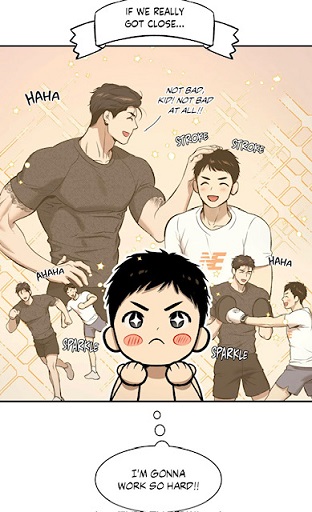 (chapter 23) without understanding the profound struggles beneath his image, failing to perceive Joo Jaekyung’s unhappiness, struggles, and loneliness. Like the image is exposing it, Potato views the athlete as a companion as well whose efforts should serve to keep him company. This dynamic mirrors the little mermaid’s conditional love for the prince, as Potato’s idealization is rooted in his own aspirations rather than genuine understanding. Just as the prince remains oblivious to the mermaid’s sacrifices, Potato overlooks the reality of Joo Jaekyung’s burdens, emphasizing a dependency that hinders true recognition and connection. Once his reputation as a champion is tarnished
 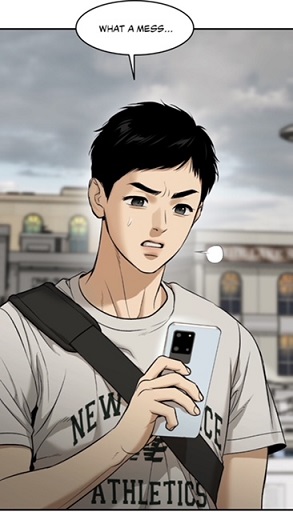 (chapter 52), the amateur starts distancing himself from his former idol. This exposes the fragility of Potato’s dream. Therefore it is not surprising that he starts taking a different path: acting, though I still think, it is temporary. However, behind the glamorous facade of the show business, there exists a dark side as well.
  (chapter 59) Heesung’s fate is similar to the champion’s. Despite his popularity, the actor is deeply unhappy. He feels lonely, for people only know the actor and not the man behind the mask. That’s the reason why he is looking for his soulmate.
  (chapter 23). In reality, he wanted to use the athlete as his servant. The closeness
  (chapter 23) he was seeking was self-serving. While the amateur and the actor are searching for the “perfect companion”, the other couple has no expectation from others. They both have no longer any dream or hope. That’s the reason why Kim Dan was putting this vision of Joo Jaekyung behind a veil:
  (chapter 58) He was giving up on his dream expressed in the birthday card,
 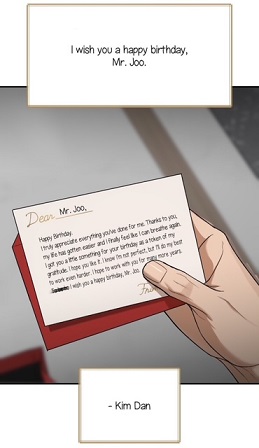 (chapter 55) though I believed that he had another bigger wish, but due to his low self-esteem, he didn’t dare to express it:
  (chapter 55) My newest theory is that he wanted Joo Jaekyung to teach him fighting, but not for himself, but in order to help the fighters and in particular to protect the champion’s body:
 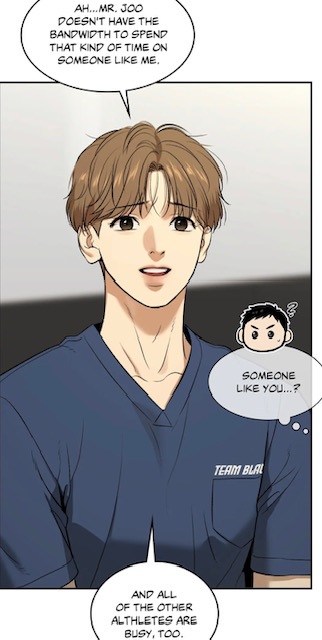 (chapter 25) To develop a training where injuries are minimized. In season 2, it is clear that Joo Jaekyung and Kim Dan have reached the bottom. Both feel empty and exhausted. They were crushed by harsh reality, and they had no one by their side to listen to their pain. Therefore it is not astonishing why the doctor could not confide to the actor and the amateur fighter. They arrived too late.
 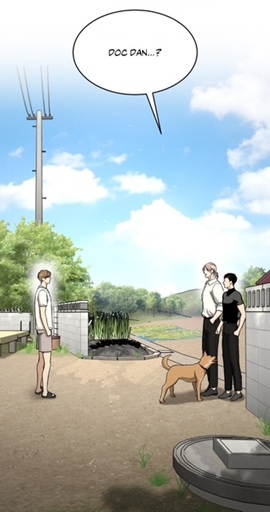 (chapter 58) Their presence definitely diverted the doctor’s attention, lessening his pain.
  (chapter 25) he learns the true nature of the relationship between Kim Dan and Joo Jaekyung. This revelation forces him to confront his own repressed feelings, as he unconsciously realizes his attraction to the fighter.
 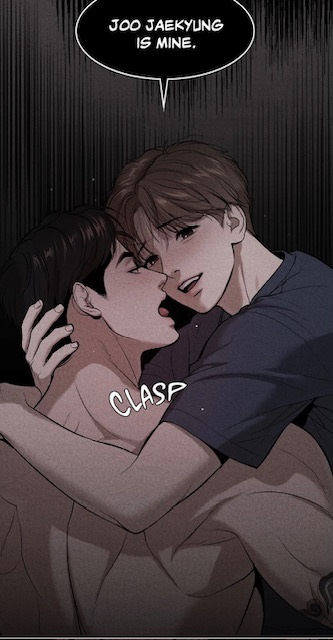 (Chapter 25) Heesung’s involvement further complicates matters, as Potato confesses his love for Joo Jaekyung
  (chapter 35) while simultaneously vowing to sacrifice his feelings for the sake of the couple’s happiness. This act demonstrates Potato’s pure and selfless definition of love,
  (chapter 35) contrasting with the conditional love depicted in Andersen’s tale.
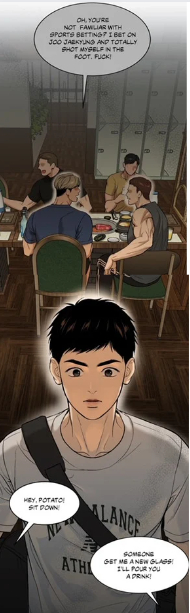 (chapter 52) and the switched spray the
 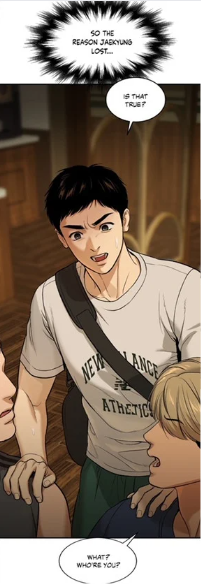 (chapter 52) which is strongly intertwined with the departure of disloyal members from Team Black marks another step in his journey toward disillusionment. While Potato initially views this as an isolated incident, it exposes the broader corruption within the MMA world, including the betrayal, greed, and lack of loyalty that undermine its integrity. While he views himself as loyal to doc Dan and Team Black, for he remained at the gym, his heart was not. He is becoming like his hyungs, Park Namwook and Heesung. In Andersen’s tale, the mermaid’s journey to the sea witch represents a pivotal moment of transformation. By sacrificing her voice and enduring physical pain, she gains entry into the human world, but at the cost of her identity. Similarly, Potato’s journey is marked by painful discoveries that force him to confront uncomfortable truths. Through Kim Dan, he will begin to see his own flaws before he is able to recognize them in those he once trusted.
  (chapter 23)
  (chapter 25)
 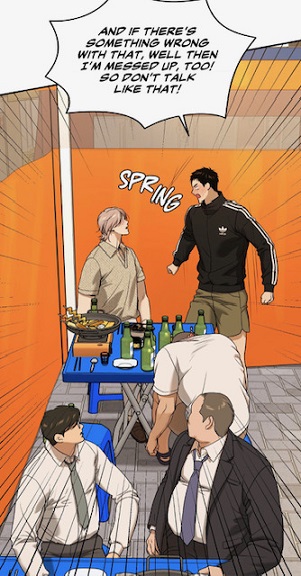 (chapter 35) The latter doesn’t mind breaking social norms by yelling or causing a fight at a restaurant. But let’s return to the actor’s confession at a bar. It’s not surprising that Heesung appears indifferent to the affection of those who cared for him. The last partner was described as too clingy. This means that Heesung places himself as the judge. In addition, it was, as if he was a god destined to live forever. He is forgetting his human condition, just like his partner’s. And that’s exactly how the prince in The Little Mermaid views life.
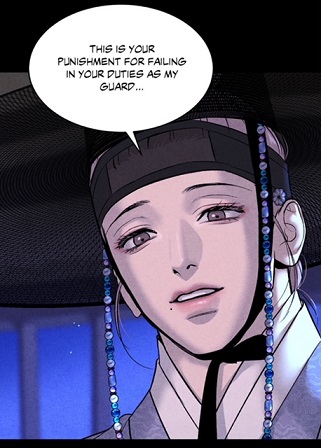 (special episode 2) Hwang Yoon-Gu didn’t realize that by taking responsibility for the actor, he lost his freedom and as such his voice. Is it a coincidence that Mingwa portrayed the young maknae as someone who would raise his voice due to his emotions in the past?
 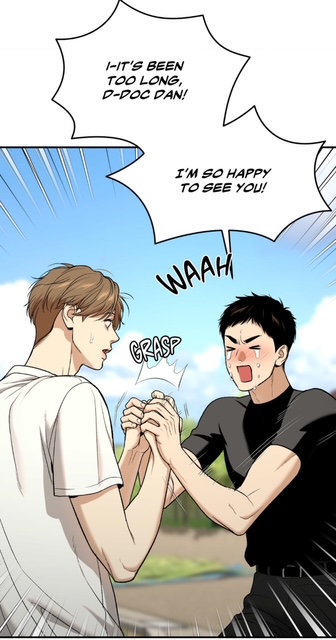 (chapter 58) his behavior is totally different than with the actor:
  (chapter 58) Tears, touch, raising his voice with Kim Dan, but not with the comedian. With the actor, he looks more calm, distant and mature. Heesung’s selfishness is evident in his treatment of Potato, whom he manipulates into becoming an extension of his own image. Hence he is no longer wearing shorts and tee-shirts.
  (chapter 59) One might say that he is gradually elevating Potato’s status through his suggestions.
 (chapter 23) Why? It was due to his low self-esteem.
  (chapter 23) He was not confident enough, for he was the only one with such a weight-category.
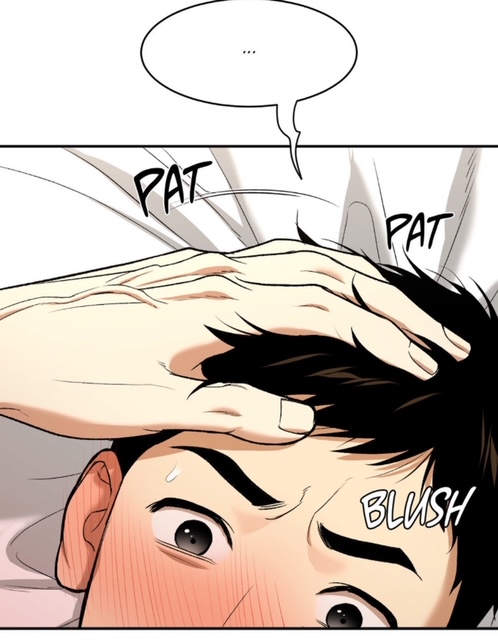 (special episode 2) played a huge influence in Potato’s decision to take the offer as an extra. It was, as if one of his dreams had come true. But is this what he truly wanted?
  (chapter 58) underscores his indifference, symbolizing the unbalanced dynamic in their relationship. Like the prince, Heesung offers no genuine commitment, leaving Potato to grapple with the consequences of his dependency. Thus I perceive Potato’s tears
  (chapter 59) as a signal that he is not truly happy.
  (chapter 58) However, this is about to change. Heesung who likes novelty and change is not realizing that his wish is becoming true. The picture with his last work announces the end of his “friendship” with Potato. How so?
 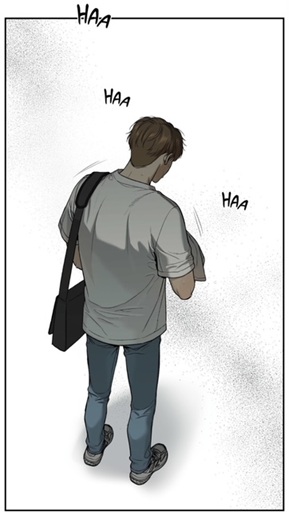 (chapter 59) Kim Dan once referred to Potato as a puppy
  (chapter 29), drawing a connection between the character’s innocence and loyalty.
  (chapter 35) This shows that Heesung has long internalized this pattern: assistance will be only given, if he is called. That’s why he has no true friend in the end. He shows no interest in others. But by doing so, he is putting the whole responsibility on his counterpart. Through the actor and the manager’s behavior, the former errand boy has long adopted this pattern. Hence he didn’t call Kim Dan in the end. He waited for a signal from his part. This behavior mirrors the little mermaid’s sisters, who only realize her absence when it is almost too late to act. Similarly, Potato’s casual farewell highlights a betrayal of Kim Dan’s friendship, further emphasizing Potato’s struggle with emotional awareness. That’s why I mentioned above that Potato is about to discover his true nature: he is also a sinner. This growth parallels the biblical narrative of Adam and Eve, where the acquisition of knowledge leads to the loss of innocence. Heesung, like Eve, introduces Potato to a new world of experiences, including his sexual orientation. However, this newfound knowledge comes with its own burdens, as Potato must reconcile his identity with the harsh realities of the world around him.
 (chapter 5) Heesung could no longer express his needs and desires.
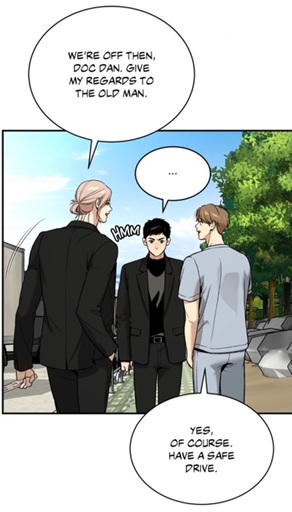 (chapter 59) This event underscores the contrasting paths of Joo Jaekyung and Potato. While Joo Jaekyung is forced to give up his principle of “self-reliance,”
 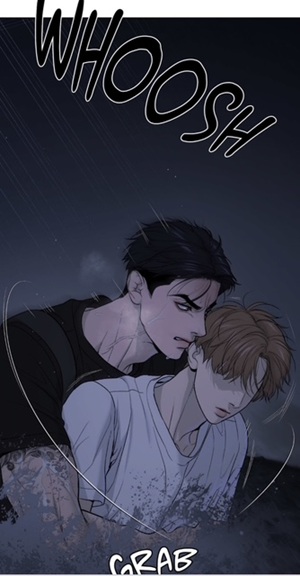 (chapter 59) Potato’s journey is to discover and embrace the principle of “self-reliance” and autonomy. Only when Potato becomes independent in his thoughts and decisions, can he truly help the main couple.
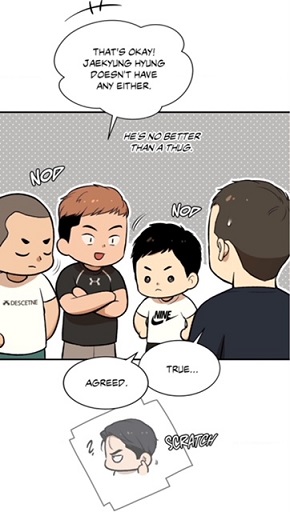 (chapter 47) and 52. Initially, he believed in his hyungs’ description of Joo Jaekyung as a thug, but later he criticized the same fighters for abandoning the athlete
 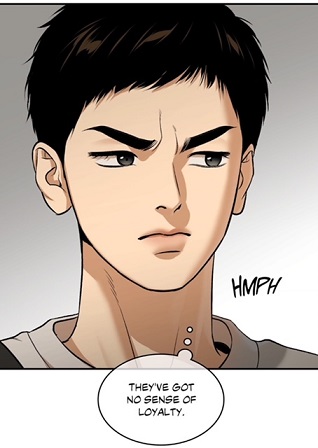 (chapter 52), accusing them of lacking loyalty and dismissing their claim that they had nothing to learn from him. Yet, in episode 52, Potato does not reproach Park Namwook or Yosep for their passivity and naivety,
 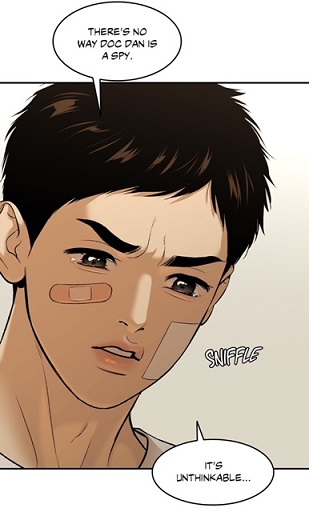 (chapter 52) instead solely blaming Joo Jaekyung for not trusting Kim Dan and causing his departure. This selective criticism reveals that Potato still views the older men as inherently good and fails to recognize his own shortcomings. In this way, he mirrors Park Namwook’s superficial loyalty, further emphasizing his dependence on external validation.
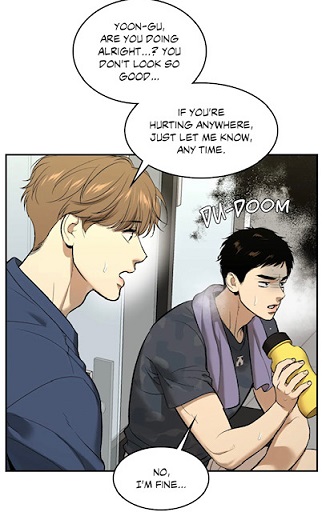 (chapter 23) —taking over his tasks and noticing his unhappiness
 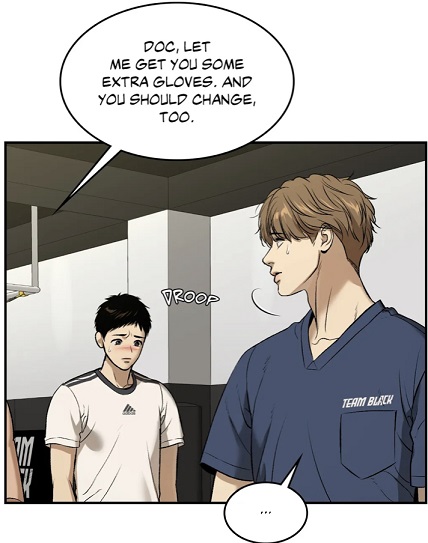 (chapter 25) —demonstrates his capacity for genuine care. This contrasts sharply with Heesung’s selfishness and serves as a reminder of the value of mutual support in relationships. Potato’s potential return to the place where he met Kim Dan could symbolize a rediscovery of authentic connections, marking the beginning of his path toward independence and self-realization.
 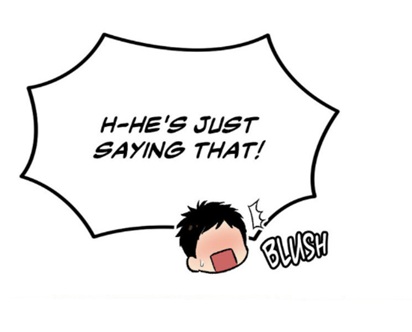 (chapter 58) And like mentioned above, this could become a serious problem for Yoon-Gu. He could be perceived as someone selling himself for a gig. And Heesung is not even realizing the consequences of his intervention and meddling. That’s why it is important for Yoon-Gu to become independent. This lesson resonates with Potato’s journey in Jinx. By recognizing Heesung’s selfishness and breaking free from his influence, Potato has the potential to rediscover his own dreams and individuality. Like Erich Fromm mentioned it, true love is respect, care, knowledge and responsibility. However, Heesung has no idea about the importance of these notions, as everything is evolving around his own needs and dreams.
  (chapter 58) That’s how it dawned on me that little by little Yoon-Gu had been losing his senses:
  (chapter 31), his smell, then his ears
 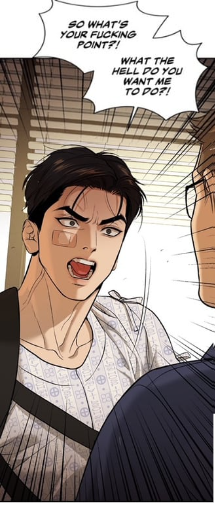 (chapter 52) and finally his eyes:
 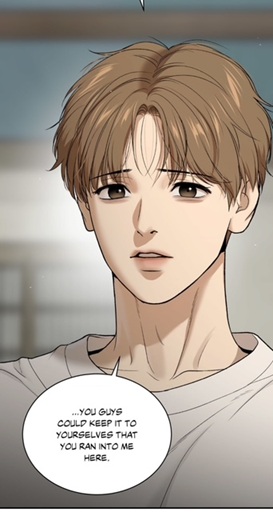 (chapter 58) He forgot the danger coming from Heesung’s words, he could not hear the suffering from the champion due to his bias, and finally he couldn’t see Kim Dan’s distress due to his own feelings and prejudices. We could say that because of the influence from others, he was no longer able to see reality. However, like mentioned before, I sense the return of Potato’s senses in the following panel:
 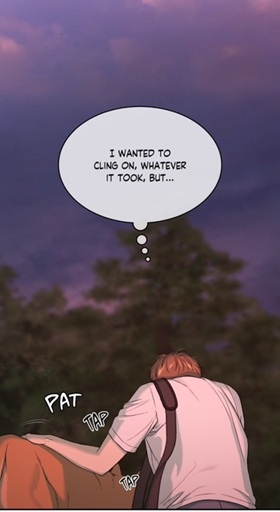 (chapter 59), coinciding with Potato’s departure, underscores this theme of overlooked emotions and unreciprocated care. As Joo Jaekyung reflects on Kim Dan’s comparison of Potato to a puppy, it may catalyze a pivotal shift, prompting him

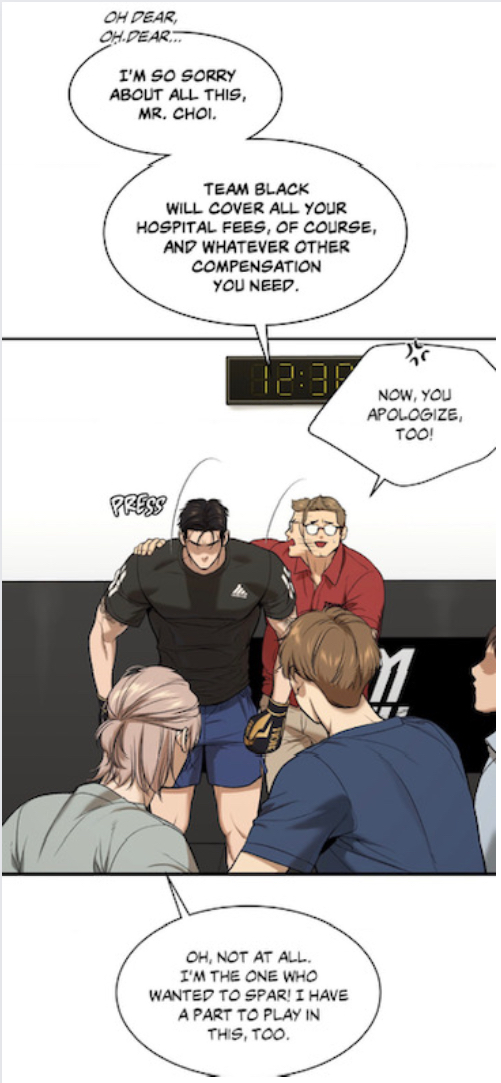 (chapter 31)
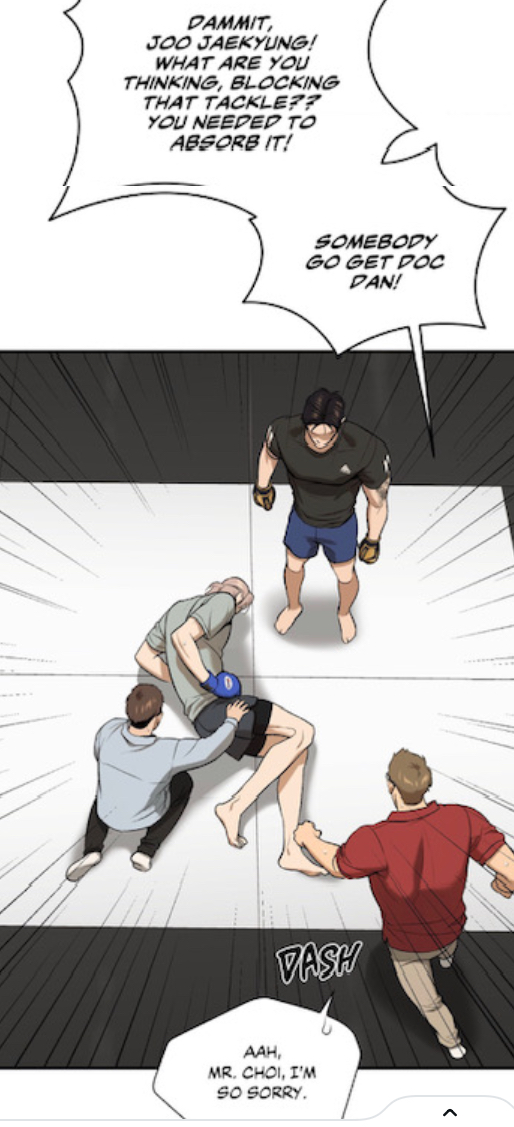 (chapter 31) As you can see, as soon as the actor was lying on the floor, the manager was already blaming his “boy”. This exposes that the man was not interested in the truth in the end. He had already given the judgement. But notice that Park Namwook chastised the protagonist for blocking the tackle. He reproached his star that he should have absorbed the comedian’s tackle.
  (chapter 31) He used his whole weight and strength to take down his counterpart. This corresponds to a low-speed car accident and Mingwa let us see the effect of this terrible impact:
  (chapter 31) His facial expression was betraying him: he was in pain. This means that in verity the one who had caused an injury was not the champion, but Heesung. But there is more to it.
  (chapter 46) If the manager had been that worried, why didn’t he confront the fighters from Team Black directly? Instead, he sent Yosep on an errand. In other words, he did nothing.
 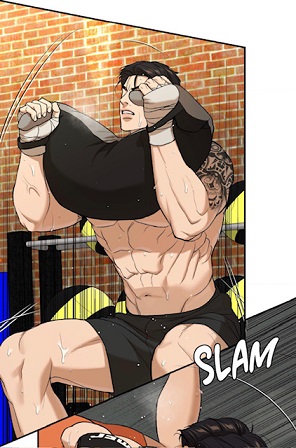 (chapter 37) Look at this:

 In the second case, the athlete had to change his strategy, for he was already wounded. In other words, Kim Dan’s mistake was to teach Joo Jaekyung to trust his instincts and as such himself. He needs to stop using his body as a shield, but as a weapon, like he did in the doctor’s home: become proactive and anticipate his opponent’s moves.
  (chapter 25) in order to understand the involvement of the muscles and the possible consequences on the body. This scene displays the lack of expertise from Park Namwook. How did he become a manager and even a coach? Perhaps a crash course organized by MFC
  (chapter 22), but the latter is definitely influenced by the criminal underworld. This new observation reinforces my previous theory that Kim Dan will come to replace the manager and coach’s position. What distinguishes them from each other is their attitude to knowledge. Kim Dan keeps learning, reading and watching, whereas the other has the impression, he already knows everything. I guess, he has never heard from the concept “lifelong learning”.The latter promotes the idea of continuously acquiring knowledge and skills throughout a person’s life. This approach values education beyond formal schooling, emphasizing that learning can happen in various settings
  (chapter 42), including personal, professional, and community experiences. The goal is to adapt to changes, meet evolving job requirements, and stay mentally engaged. In Germany and other countries, lifelong learning is promoted to foster personal growth, social inclusion, and employability, especially as technology and society rapidly evolve. I am myself a follower from this concept. Hence I am still looking for new things (learning new cultures, new languages, reading about psychology, …).
  (chapter 27) Yet, he was chastised. I had always stated the coach’s responsibility before, but I had only found indirect evidences for this interpretation. Since he should have absorbed the impact, it implies that the latter should accept the pain as a normality. However by blocking Heesung’s assault, the athlete had tried to protect his own body. Thanks to Kim Dan, the fighter was learning how to treasure his own body. Moreover, it displays another flaw from Park Namwook: his risky attitude by making a bad recommendation. I would even add that his slap on the fighter’s neck is revealing his recklessness and thoughtlessness.
 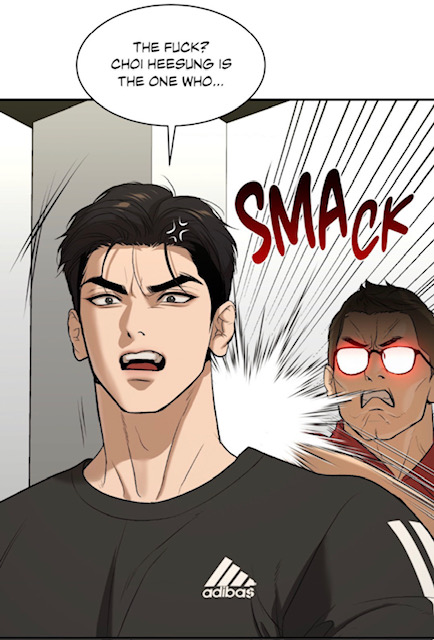 (chapter 31)
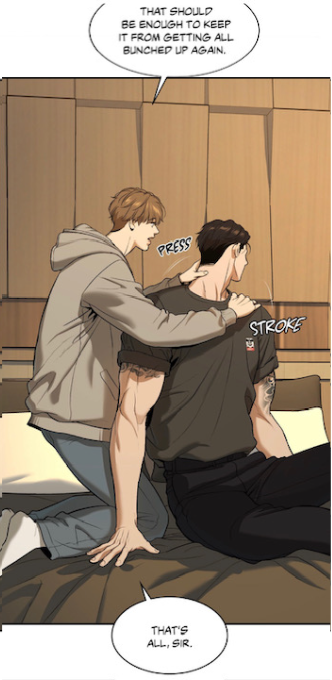 (chapter 32) Joo Jaekyung was finally receiving his treatment for his injury, the consequence of Heesung’s tackle. No one checked on his body, just because the other was faking his injury. While writing this, I can’t stop my blood from boiling out of anger. To conclude, I am confirming once again that Park Namwook is a bad coach and manager. He shouldn’t be allowed to become one for the other fighters. He would treat them like toys or even “punching bags”. Imagine that he would also recommend such a strategy to Potato as fighter. That would be very dangerous. In addition, why was he treating his star so badly and privileging the actor? It is because the latter brings money forgetting that the champion is the source of his own income! And this brings me back to the initial picture:
 (chapter 43) Interesting is the idiom is a synonym for deceitfulness. And this brings me to my next observation. Why did he add “whatever other compensation you need”? The moment I asked myself this question, I couldn’t restrain myself from thinking that the manager might have known about the true intention from Choi Heesung. Is it a coincidence that Kim Dan was used as compensation for the athlete’s mistake? Moreover, the latter was supposed to meet the actor on a Saturday, his own day-off.
 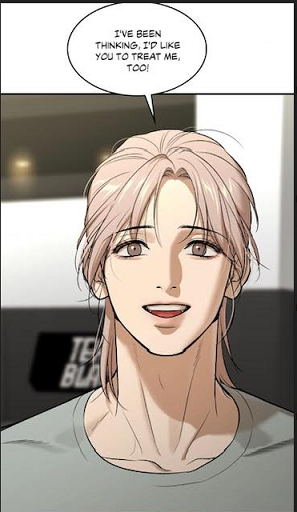 (chapter 31) in the hallway, next to the meeting room and office. So technically, Park Namwook could have heard them talking behind the door, a new version of this scene:
 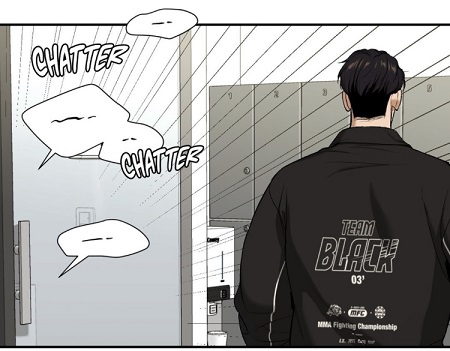 (chapter 36) Was he truly ignorant about the actor’s intentions with all this wooing and sponsoring?
  (chapter 30) Just because we didn’t see this, it doesn’t mean that it didn’t happen. And maybe that’s the other reason why he was more than willing to use Kim Dan. The latter was bringing a huge client to the gym.
  (chapter 31) He would come on a regular basis. Naturally, I have no more proof for this theory than the remark “whatever other compensation you need” and its timing. Nevertheless, one thing is sure. Kim Dan was treated the exact same way than Joo Jaekyung, a doll and servant at his disposal.
  (chapter 37) It is because Park Namwook had become his voice. And we can observe this with the apology at the gym:
 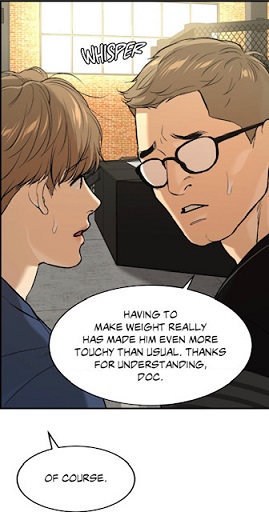 (chapter 37) are just lip-services because at the end, he has no problem to replace Kim Dan.
 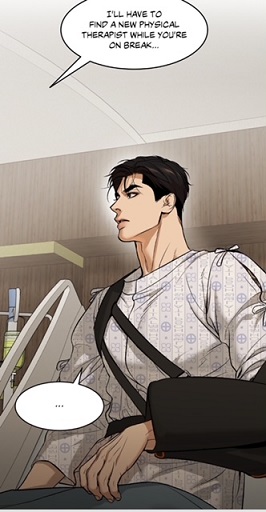 (chapter 53) That’s the reason why I have been wondering if the last incident was not the trigger for the coach to drop his “boy” and find a new “star and champion”. Since he is so obsessed with money and fame, I can’t help myself wondering if he will take a new pupil and torment him so that the latter only becomes a shadow of himself. Let me know what you think about this.

 (chapter 53) for not realizing her biggest wish: to return to the West Coast. With her words, she implies that she never had any choice. Hence she is not responsible for her “misery”. However, after reading Erich Fromm’s philosophy, it becomes clear that she must have always followed social norms and listened to authority figures (parents, husband, doctors, …). That’s how she gave up on her own freedom. One might argue that her scoop of maneuver was limited due to her poverty. However, the Mother Of Pearl Wedding Cabinet is definitely expensive and no junk
 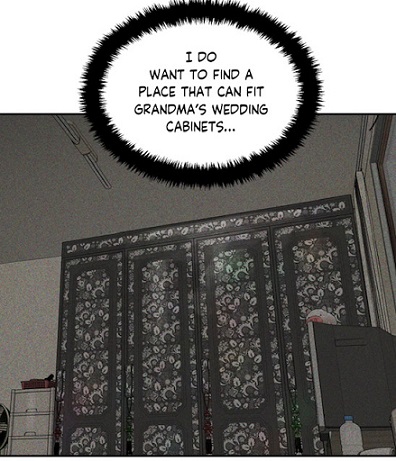 (chapter 16), especially since the latter is rather old. The grandmother could have sold it, but she never did, for the latter has a sentimental value. Consequently, I would say that she had missed her chance, and naturally her misery is the result of her own wrong choices. Under this new light, it becomes comprehensible why the grandmother portrays herself as poor who has nothing to give to her grandchild.
  (chapter 53) (filial duty), a sign that he is not able to break free from social norms. At the same time, it displays that his feelings for Joo Jaekyung are much stronger than the ones for Shin Okja. His short time spent in the penthouse left a deep impression on him.
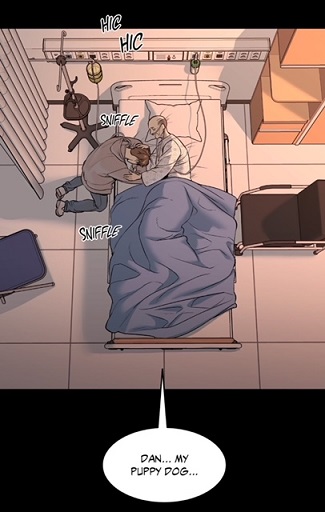 (chapter 53) Her vocabulary exposes that she became a master and in her mind, the puppy dog has to follow her owner. Therefore it is no coincidence that Mingwa created such an image:
  (chapter 53) Deep down, he would like to be recognized as a competent physical therapist. Moreover, my avid readers should recall that the champion had already noticed the change of heart in the doctor before the scheme took place.
 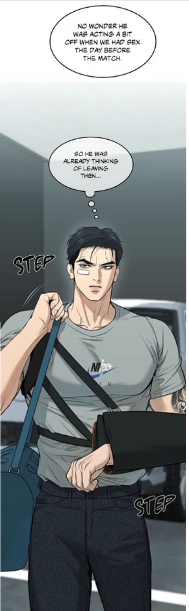 (chapter 53) So the athlete could come to the realization that his departure was related to the grandmother’s sickness and dying wish, a new version of episode 20 and 21. However, even if the fighter helps the grandmother, he can not entirely free the physical therapist. How so? It is because the doctor has to free himself, breaking free from conformity and his own psychological constraints (lack of confidence and as such courage). And the best evidence for his servitude mentality is the absence of his love confession to the athlete. He disguised it behind gratitude.
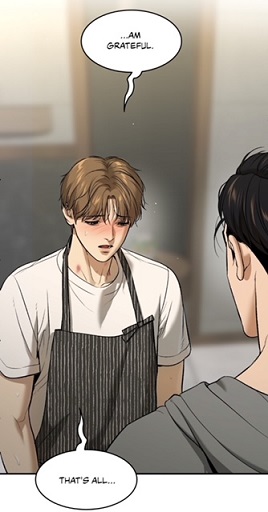 (Chapter 45) But how can he change his condition? I will give the answer below.
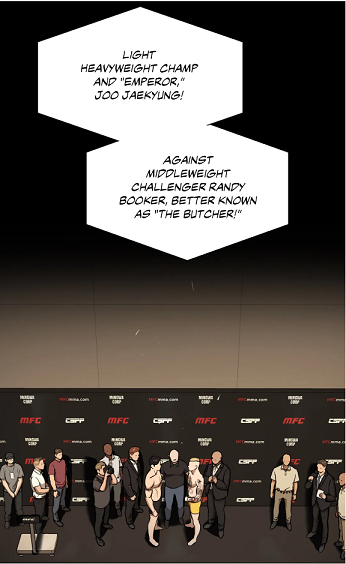 (chapter 14) Yet, the reality is that despite his wealth, he is not free at all. Actually, he reminded me of a Roman gladiator. Gladiators in ancient Rome lived under challenging and contradictory conditions. Although they were often slaves or prisoners of war, some achieved fame, wealth, and admiration comparable to modern-day sports stars. Successful gladiators could earn prizes, attract fan followings, and even enjoy certain luxuries within their restrictive lives. However, they remained under the control of their lanista (manager) or the state, with little freedom to make personal choices. They could not select their opponents or refuse combat, and each fight carried the risk of injury or death, underscoring their vulnerability and lack of autonomy despite their celebrated status.
 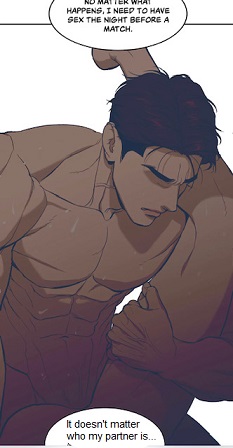 (chapter 2) Therefore sex is linked to prostitution and work. Back then, this had nothing to do with pleasure, sensuality and entertaining. It was revolving around power and domination. That way, he wouldn’t appear as weak, he is not controlled by his sexual desires and emotions. That’s how it dawned on me why the champion has been denying the existence of feelings in his past relationships. Naturally, it is possible that he got his heart broken before, but it is also possible that he could never live out his own true homosexuality. Note that his father figure, Park Namwook, has no idea about his sexual life. The athlete could fear to disappoint him. This raises the question how the manager will react, when the athlete’s secret is exposed. Should he request from his boy to organize a conference and deny the allegation there, he would divulge not only his lack of loyalty, but also his hypocrisy. Why? It is because this is something he should have organized after the last match. A conference to expose the existence of schemes. But everything got swayed under the rug. On the other hand, I deduce that if the topic of sodomy is brought up in season 2, there is no ambiguity that both main leads won’t give in to conformity and external pressure (even in the form of threats). Why? It is because during season 2, both characters will come to be true to themselves. That‘s how they can become master of their own life.
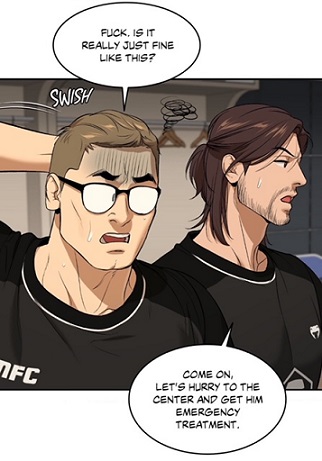 (chapter 50) Hence the last match was not cancelled in the last minute. The athlete is not fighting out of fun and passion, but out of obligation and survival. He is trapped in a world where money is everything. Thus he was always pushed to accept any challenger despite his injuries. That’s how I realized why the athlete always suspected Kim Dan of being greedy. It is because he projected his own thoughts onto his partner. However, this negative perception was definitely influenced by his “hyung”, we have the best example in episode 46. Due to Park Namwook, Joo Jaekyung was the one who was constantly thinking and talking about money in front of Kim Dan.
  (chapter 26) No wonder why he got so surprised by Kim Dan’s reaction in the locker room:
  (chapter 43), yet he added shortly this comment: :
 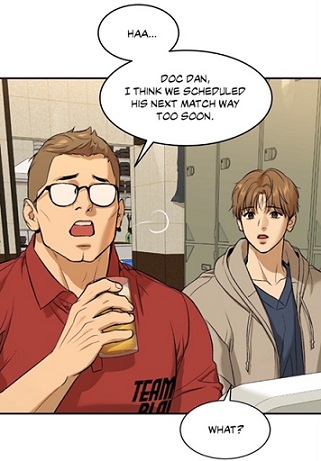 (chapter 43) The hypocrite coach utilized the personal pronoun “WE” indicating that he and his peers had played a role in the athlete’s decision. Funny is that though he complained about the schedule, he still accepted the switch of the fighter later. But he could have voiced his fears and objections. Nevertheless, he did nothing. Since I connected the halmeoni to past, I suddenly realized that the “lanista” embodies the opposite notion. He is trapped in the future, thus he is always anxious. Imagine that in that scene, they were celebrating Joo Jaekyung’s birthday, it should have been a good time. Yet, the manager kept talking about work and the future.
 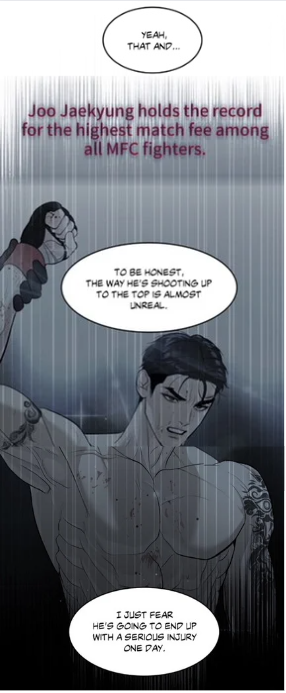 (chapter 43)
  (chapter 43) This is a sign that he was not “enjoying the present”. In my eyes, with his comments, he was actually ruining the party. Fortunately, no one paid attention to his words except the physical therapist and Yosep. By talking like that, he gives the impression that he is caring and paying attention to the fighter. Yet this is just an illusion, for he is not focused on the present. He neglected his duties, therefore the schemers were able to bring drugs to the champion’s rooms.
 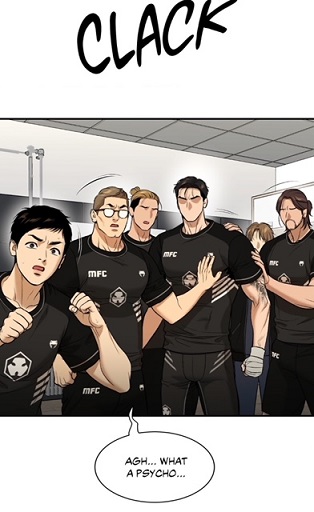 (chapter 49) Notice that he was afraid of an outburst from Joo Jaekyung in the locker room, therefore they were restraining him. This was no real protection. I am suspecting that the manager is trusting MFC and its organization. In addition, his obsession with the future explains why the athlete’s mental health has been neglected by the coach and manager. As a conclusion, Park Namwook is himself trapped in his own world: money, fear of the future and the champion‘s retirement which means the end of his own career as manager and coach. Therefore he is pushing his fighter to race against time. It is only a matter until his boy gets injured!!
 (chapter 36) money, social media, the agency, the lawyer, Park Namwook and Jeong Yosep. For the first time, Joo Jaekyung can think of something else other than work. Nevertheless, the athlete had not realized it yet. Striking is that the longer the fighter thought about the PT’s resignation, the longer he came to object to it.
 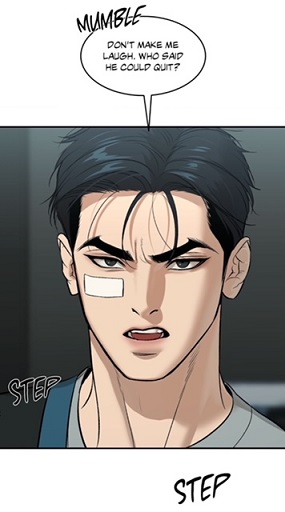 (chapter 53) This means that the fighter was acknowledging the “uke” as an important member of Team Black. In addition, he was recognizing Kim Dan’s effort and talent as PT. Moreover, it exposes the absence of change in Joo Jaekyung’s mentality. He was still “thinking” of work and fighting. It displays that the protagonist had not realized the true signification of his suspension yet. Hence the doctor’s departure was necessary. Joo Jaekyung is forced to think about his fated partner, making him forget his work and his career. His “obsession” with Kim Dan will push him to stop being a workaholic. But there is more to it.
 (chapter 21) to this
 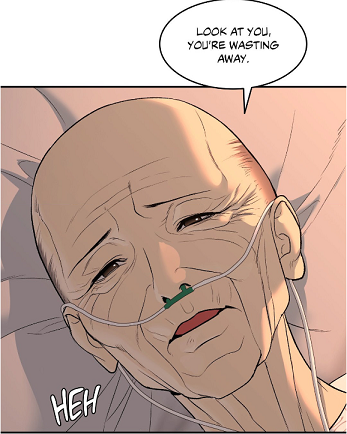 (chapter 47) Money is powerless in front of death and terrible injuries. Therefore he is lucky that his shoulder is not ruined forever. Moreover a trip represents a good metaphor for an escape, a travel is a synonym for freedom and the end of “routine”.
 (chapter 35). However, since he didn’t spend much time in his own home, he never took the time to take care of his soulmate. By leaving the city and Team Black behind, he would become truly alone (as opposition to his trips to Busan, the States) which would give him an opportunity to become more honest to himself and to Kim Dan.
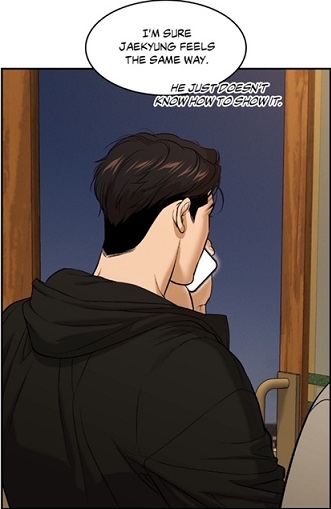 (chapter 43) In episode 1, he gave a positive feedback
 (chapter 53) This explicates why the young man kept questioning the actor’s intentions behind his gifts. He could see that the man didn’t need him. This thought displays his desire to give a meaning to his own existence as well. If he is needed, he has a reason to exist. This desire of being needed can be expressed by words, but also with the hands:
  or like this:
  And what does the hand symbolize? The latter symbolizes gratitude and love! Hence the grandmother took the MMA fighter’s hand in order to thank him.
  (chapter 22)
 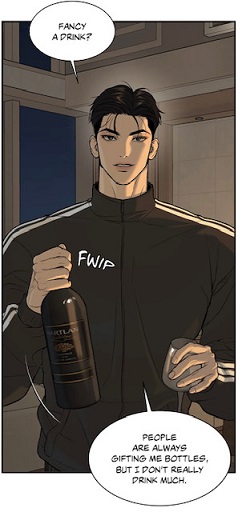 (chapter 12), though he is no drinker or he doesn’t eat cakes.
  (chapter 41) The fact that the athlete organized a charity event for his birthday exposes not only his huge heart, but also that he had long recognized the power of generosity. Under this new light, it becomes comprehensible why the champion was willing to pay off the doctor’s debts.
  (chapter 18) Here, he hoped to see gratitude on his fated partner’s face, but it didn’t happen like he imagined. Yet, notice that despite their argument, Joo Jaekyung proposed to the main lead to live with him in the penthouse:
 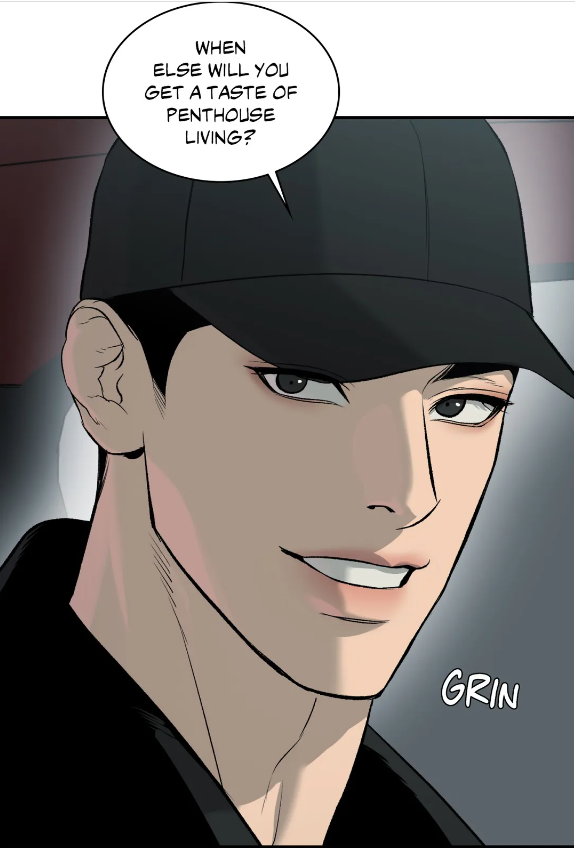 (chapter 18) His facial expression is exposing his true thoughts. He was definitely happy to help the doctor. The reason is simple. He is in control of his heart and life. This shows that deep down, the man has always had a soft heart and could find fulfillment in giving. However, the problem is that the champion had also internalized that there is nothing free in this world. Due to his past experiences, he realized that receivers would exploite his goodness. The green-haired guy was the perfect example.
  (chapter 2) Therefore it is not surprising that he kept denying his kindness to the doctor: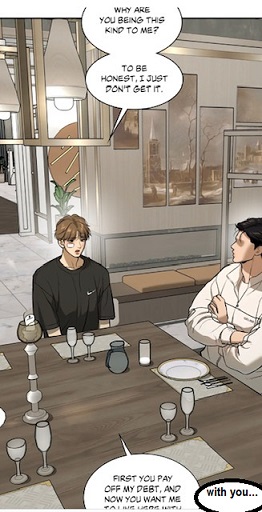
 (chapter 30) They both desire to be acknowledged and appreciated.
  (chapter 45) With this image, it was, as if Kim Dan wanted to be distinguished from all the stans. Yes, I do think that this has something to do their own negative feelings. However, there is a difference between Choi Heesung and Kim Dan. Note that the gifts are related to his sponsors and the agency. They were related to his work. Moreover, the gumiho rarely gave the meals or the presents personally.
  (chapter 31)
 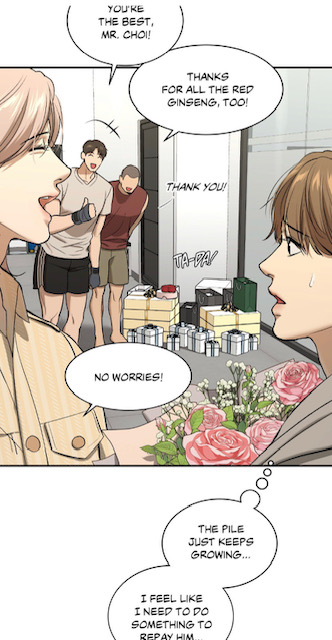 (chapter 31) Furthermore, the actor gave these things for one reason: it was to obtain the doctor’s heart or to maintain his good image as a celebrity. In other words, these gestures were not selfless at all. This explains why the athlete was so weary of such “gifts”: a return of favor or a service. But the comedian is not the only one donating things. Naturally, it is the manager Park Namwook.
  (Chapter 26)
  (chapter 36) However, my avid readers should ponder on the following aspect: how did he buy the jackets and the junk food?
 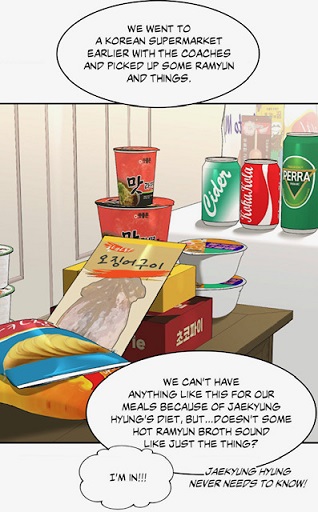 (Chapter 37) This last scene is terrible, for this purchase happened behind the boss’ back. Naturally, everything was bought with the company card!! In other words, Park Namwook’s generosity is fake, for he is not spending his own money. After this new realization, I started wondering if the athlete’s negative attitude towards Kim Dan is not the consequence of Park Namwook’s behavior as well who takes it for granted to spend money on the athlete’s account. Why did the champion anticipate an expectation from Kim Dan, when he received the keychain?
  (chapter 41) This frenzy was portrayed as something positive. Jinxworms can observe that the manager is mentioning the existence of „favors“. For me, it is no coincidence that in episode 45, the arrival from presents coming from his hyung coincides with the present with Kim Dan. It shows the underlying conflict between the celebrity and the former wrestler. Nevertheless, the fighter has not grasped it yet. So far, Joo Jaekyung has not tried to defy Park Namwook openly, to claim his place as the true owner of Team Black. We should see his words here as a first attempt to act as the boss
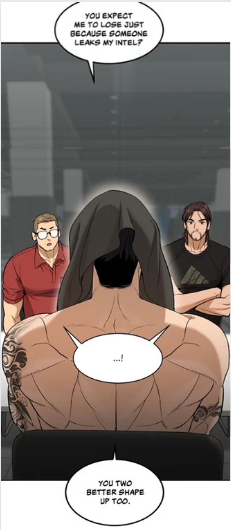 (Chapter 46) The tension reached its peak in that scene:
 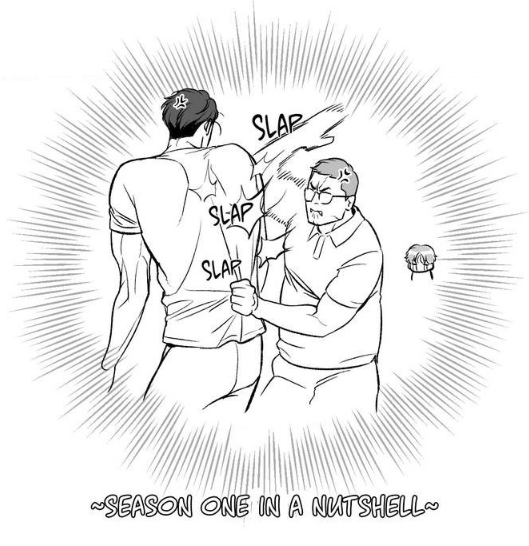 That’s where the generosity from Park Namwook comes from: he gives his punches to Joo Jaekyung and takes Joo Jaekyung‘s company for granted. And now, you comprehend why I selected such a title for this essay.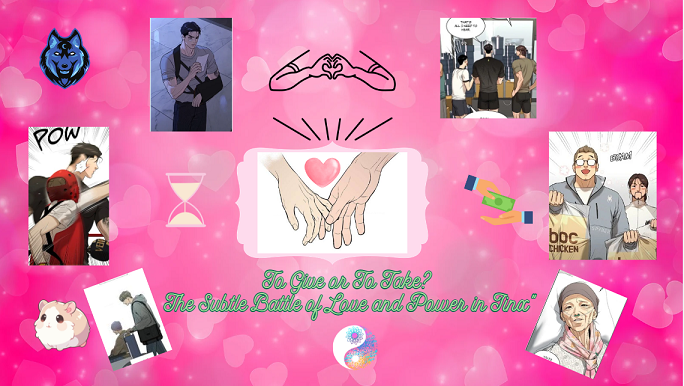
 (Chapter 26) The sparring in episode 26 represents the positive version of giving a punch and taking it. The fighter was not upset about his defeat, moreover he was acting like a real teacher asking the physical therapist to overcome his own fears. On the hand, the slap at the hospital embodies the opposite notions: resent, no real teaching, no reflection, no listening, the one slapping is not overcoming his own fears and vents his anger. The give and take in episode 26 was happiness, true generosity, self-awareness, while this slap displays misery, anger, ignorance:
  (Chapter 26) The contrast not only exposes Park Namwook’s fake generosity, but also his greed and selfishness. For me, he missed the opportunity, as at the gym, Kim Dan took the chance, when the athlete was distracted. Hence in my opinion, chapter 52 was the turning point in their toxic relationship. Moreover, it signifies that the manager lost his special position as hyung. Far away from the gym, Joo Jaekyung will see Kim Dan under a different light, maybe even as a true role model, for he is wearing his heart in his hand.
 (chapter 7)
 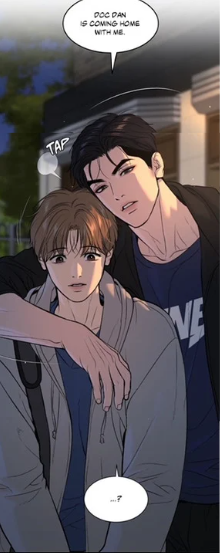 (chapter 43) He needed to seclude him from the others. But where does this possessiveness come from? In my opinion, it is not just the result of his own insecurities, but also the influence of the bad role model he had: Park Namwook. First, only in chapter 45, the manager sent congratulations from his family:
  (chapter 22) This scene at the hospital displays that the fighter had been mirroring the behavior of his counterpart: Shin Okja is sweet and kind. And who is moody, yelling, brutal ? Park Namwook:
 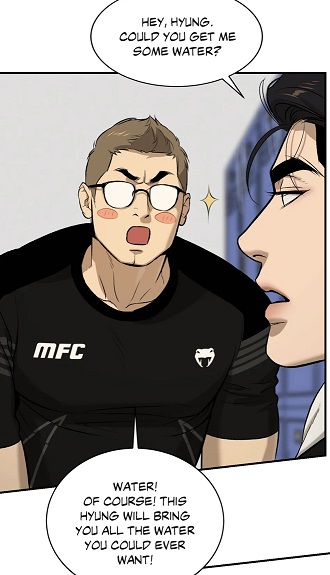 (chapter 15), but as soon as his idol lost his title and got even suspended, he yelled and slapped his fighter:
  (chapter 22) Since his relationship with the main lead is so secure, he could claim the gym as his own. Notice how he treats the members here: he’s putting them under pressure, threatening them. Everything is revolving around competition, seriousness and greed. Why doesn’t Joo Jaekyung mess with his weight and nutrition? It is because his hyung made sure that the latter would fulfil all his expectations. He needs to be ready for the next fight. Why was the manager not present here?
 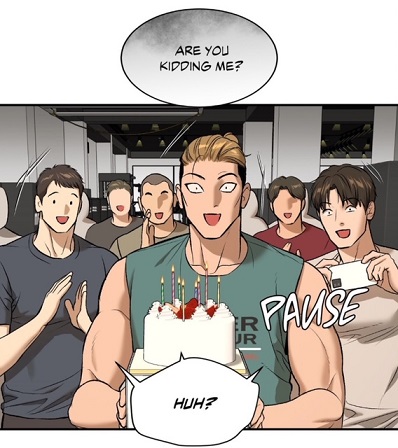 (chapter 43) This exposes his lack of engagement and indifference in the end, but this becomes even more obvious during the night:
  (chapter 43) Where was he, when his star was drunk? It was, as though he had vanished.
 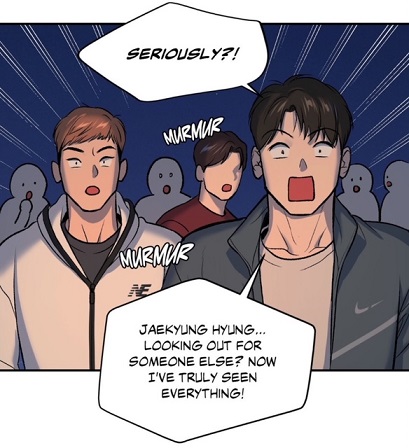 (chapter 43) But the best evidence for this interpretation is this image:
  (chapter 52) The manager is upset, because his boy lost his title and his reputation is ruined. Moreover, many members left the gym which means that the company lost a lot of money.
 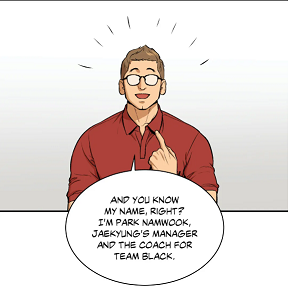 (chapter 9) However, he never presented himself as a father or a husband. It was, as if his children or wife were not a source of his happiness. Why? It is because they don’t bring money, but rather cost money. Thanks to Joo Jaekyung’s popularity, the manager could stand in the spotlight
  (chapter 40), yet notice that no fans or fighter know his name as a successful coach or manager. He is not a famous manager in the end. His income depends on the athlete’s career and victories. No wonder why he put so much pressure on his celebrity. Thus I had the following revelation: he was actually exposing his true self in front of the doctor at the restaurant.
 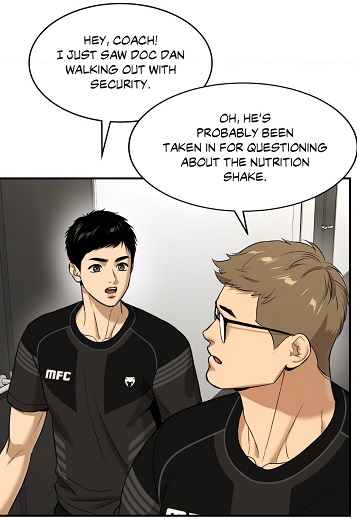 (chapter 40) in the States and even at the gym?
  (Chapter 43) It is because he doesn’t view the uke as a possession contrary to his „boy“. Why? It is because the young man doesn’t bring money or contribute to boast the manager’s self-esteem. In fact, Kim Dan is an expensive PT and the manager is aware of his high salary. Moreover, contrary to the hamster, Park Namwook was never seen in the penthouse, and the celebrity refused to invite the members. This is a clue that the champion could have refused to invite his coach there. The doctor’s stay at the penthouse is something Park Namwook discovered by accident.
 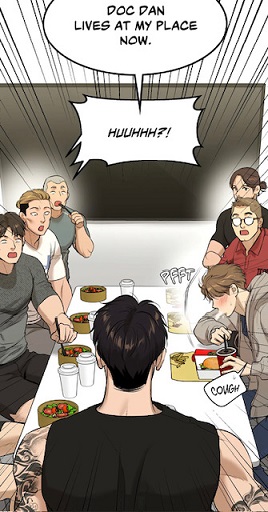 (Chapter 22) And now, it is important to recall that in the mode of Having, rivalry and competition are predominant. Therefore I deduce that deep down, the coach and manager sensed the physical therapist as a source of threat and rival. Therefore Jinx-philes shouldn’t be surprised that the coach did nothing to keep Kim Dan.
 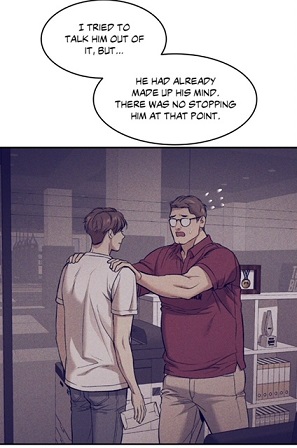 (Chapter 53) Here his gestures and words should be judged as lip-services. He can even rationalize his departure: bad luck, they save a lot of money, for the next PT will have a lower salary. In addition, Kim Dan was treated as the celebrity’s possession, therefore he used him as a tool in order to compensate the actor. The manager is definitely imagining that once the break ends, things will work like before.
  (chapter 41) In his eyes, possessions and money determine someone’s values. Hence he bought an expensive keychain for his fated partner. Furthermore, I have been wondering if this spending is not related to Shin Okja, the latter could have been a spendthrift. In the essay „
 (Chapter 19). Another possibility is that she made sure that her grandchild would spend money on her:
 (chapter 22) after the departure of Joo Jaekyung, but notice how the halmeoni thanked the benefactor:
 (chapter 21) One might argue that the poor woman couldn’t do much to express her gratitude. However, this is just a deception. Shin Okja could have written a letter to express her gratitude to Joo Jaekyung. Why do you think Mingwa created two scenes with a letter or card?
  (chapter 53) The comparison lets transpire the importance of words. The champion might have judged the keychain differently, if he had read the card. But he didn’t. Another parallel between these two scenes is the rejection of a gift! However, in the final episode, Kim Dan voiced genuine gratitude towards his benefactor. The latter had allowed him to work as his PT. With the letter, he could voice his thoughts and emotions much better. And now, you realize that Shin Okja could have acted the same way. This made me realize that deep down, she resents being poor. She likes Dan spending money on her.
 (chapter 41). He should treat the sportsman nicely (“do good”). Kim Dan is the one who should be indebted to Joo Jaekyung. However, observe what she said in front of her grandchild before: she was the one who was grateful to the main lead, and not Kim Dan!!
  (chapter 41) She should have been the one who expressed her gratitude to Joo Jaekyung, but not Kim Dan for the trip (it was work related anyway). One might argue that the poor woman is trapped in the hospital, she can not do much. But you are wrong. She could have written a letter to her benefactor which means that she would have sacrificed some of her time for the athlete. Imagine that she had sent a message to the athlete, the latter might have decided to pay a visit to her. He is not truly heartless. With this silence, she created the impression that his assistance had changed her situation.
 (chapter 1) In other words, he was not passionate about his profession. This means that he didn’t define himself as PT due to his lack of engagement and low self-esteem. Besides, let’s not forget that he judges people based on their social status and seniority. I would even add, the main lead had not recognized the existence of his own skills (knowledge, genuineness and dedication). But by working for Joo Jaekyung, he came to enjoy his job. This explicates why he kept buying books.
  (chapter 53) He likes not only his job now, but also learning as such. This is no coincidence that education in the mode of “being” means that the focus is on learning and developing skills. Hence I still see a change in the hamster at the end of season 1:
  (chapter 52) In this panel, the author let us see glimpses of their motivation and thoughts. For them, the champion has nothing to teach them, since he lost his title and is injured. This shows that they are only interested in the outcome, success and as such fame, but not in the process, how to become skilled! In other words, they see “success” as a possession. He has no title, then he has nothing to offer. They are all living in the mode of having, which can only lead to misery and even self-destruction. No wonder why they were not too upset or shocked, when they heard that the game had been rigged. But what led them to make such a decision?
 (chapter 23) Then he only focused on the “outcome” and not on the process. Hence he neglected them, delegated his task on the pressured athlete. The latter had to train them:
 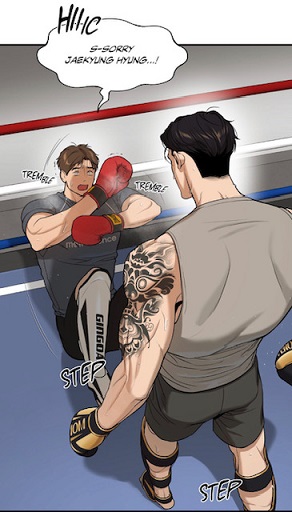 (chapter 36) In my eyes, he didn’t want to play the bad guy. The meeting or his worries were more important
 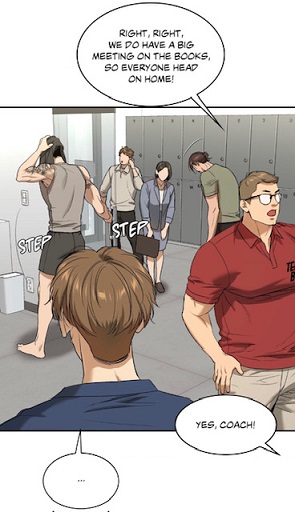 (chapter 36) than their training and career. Moreover, he kept bribing them with junk food
 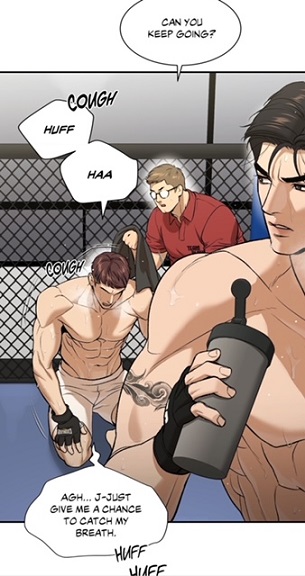 (chapter 46) The latter was a new source of income and fame. Everything was revolving around money. That’s how it dawned on me why the manager got angry for the bet in episode 26:
  (chapter 26) We shouldn’t judge his words as a verity, he was just using the doctor as a false excuse. The reality is that the sparring had brought no money at all! This fight was strongly intertwined with fun. The notion of „entertaining“ stands in opposition to money. Fun means feeling emotions and being to true one’s self. In other words, Kim Dan stands for a different notion of MMA fighting: the sportsmen shouldn’t work for money, but for fun. They are artists too. This signifies that as time passed on, the members of Team Black lost their passion for fighting
 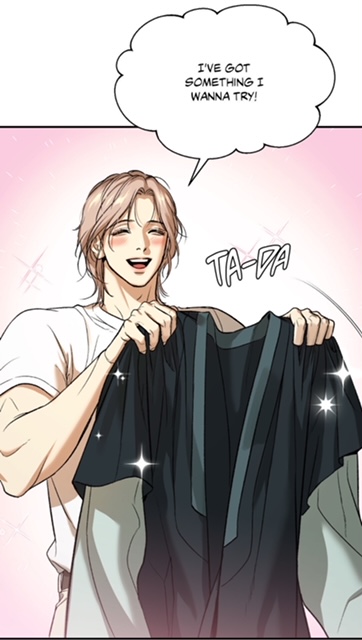 (special episode2 ), but also Cheolmin
 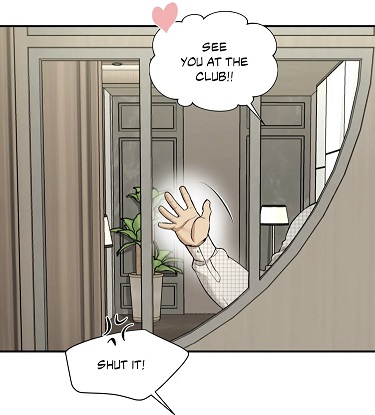 (chapter 13)
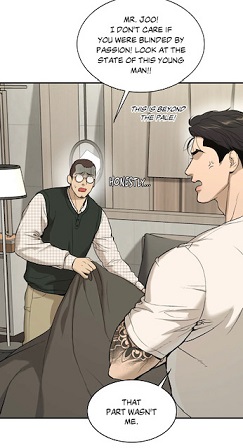 (Chapter 13) when the latter denied his responsibility. This shows that the man doesn’t mistrust people. He has faith in humans. And in this short scene, the doctor shows alle positive notions mentioned above: love, empathy, joy and creativity. Therefore I come to the following interpretation: he embodies the being mode. No wonder why he was not present in season 1. The main lead was definitely obsessed with work. Hence the moment Cheolmin’s path crosses Kim Dan’s, the funny doctor should become the hamster’s new role model.
 (chapter 48) are full of greedy people who have no problems to commit crimes in order to achieve their goals (more fame, more wealth, revenge, more connections). Baek Junmin became a champion by cheating.
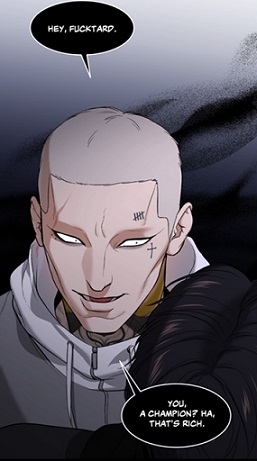 (Chapter 49) Thus he thought, the athlete had earned his title the same way. His fights were rigged, yet the verity is that the idol worked hard to achieve this level. The irony is that The Gunshot experienced much too late that his assumption was wrong.
 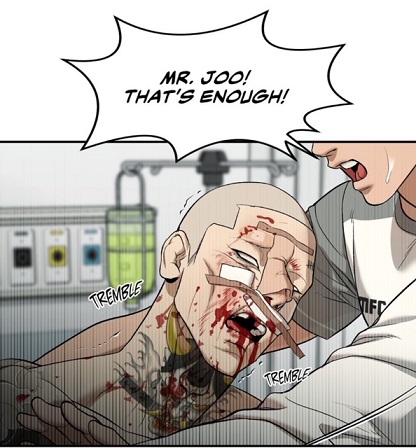 (Chapter 52) His shaking is exposing his fears. Like mentioned in the past, I am anticipating that The Shotgun will avoid a new fight with the celebrity.
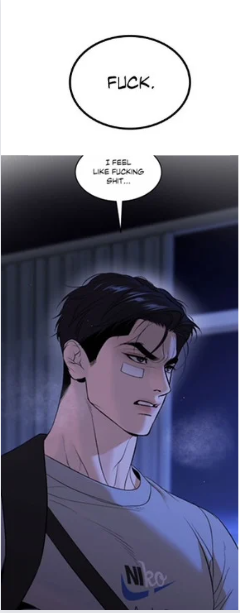 (chapter 53) He is standing at a crossroad. What does he truly want in life? Fame? More money? Or happiness and as such love and fun?

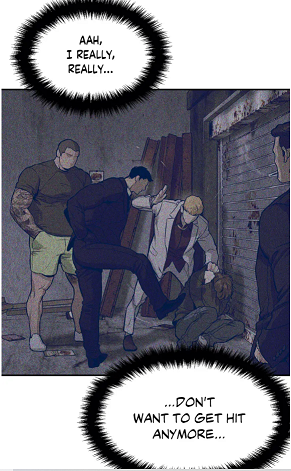 (chapter 1) The problem is that Kim Dan blamed himself for his suffering, as he must have often not paid the interests on time. That’s the reason why he got surprised, when he saw his enemy in front of his humble home.
  (chapter 1) Due to the lack of rest and time, he didn’t have the opportunity to ponder on his life and even have dreams on his own. Therefore he had no ambition. At the same time, he couldn’t become energetic and proactive due to his low self-esteem and his abandonment issues.
 (chapter 29) The vision about his opponents is mirroring his own reflection. That’s how he views himself. He is surrounded by enemies who will attack him, as soon as he exposes any weakness. Thus it is normal that he is always on the alert. Episode 29 divulged that he was on survival modus. Consequently, it is not surprising that he could trust no one. Should one get too close to him, the former could become a traitor in the last moment. Moreover, this interpretation explicates why he has been so rough on his own body. First, he considered pain as a normality, the side effect of his profession and as such his corruption. In addition, he didn’t have the time to take care of his wounds, for he could get “killed” at any moment. Surrounded by this wave of “rotten bodies”, he imagined that once defeated, he would be swallowed by darkness and literally vanished. This vision displays another important aspect of the athlete’s philosophy. His job is not connected to fun and dream, but to work and nightmare. And now, you comprehend why I selected this panel in the middle of the illustration.
 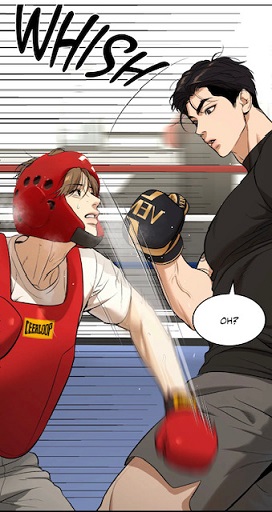 (chapter 26) This represents the highlight for the first season. For the first time, both characters had fun together. That’s how they got one step closer to each other. The fighter was enjoying this moment, as he was teaching Kim Dan to become more proactive and fight for himself. The sparring represents the opposite version of the athlete’s vision (chapter 29). He felt safe next to Kim Dan. In fact, his presence boosted his confidence.
 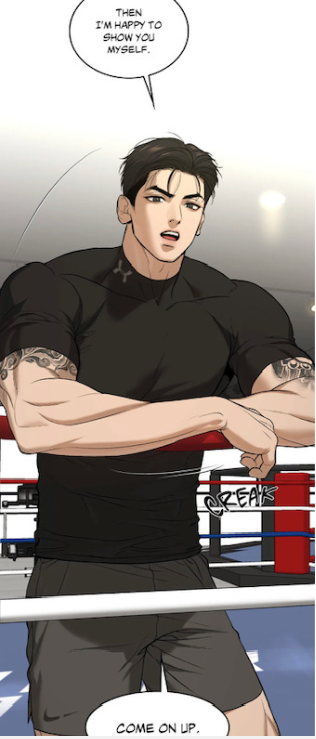 (chapter 25) It is no coincidence that he employed that expression in front of his fated partner. To conclude, chapter 26 stands for life and happiness, proving that their life is not cursed per se. Consequently, red was the dominant color of this chapter. This pigment stands for love and life. Both felt alive during that day. Moreover, we could see glimpses of the sportsman’s true psyche as well, when he proposed to spar with the main lead. He desired to help the doctor himself. Hence he acted as his mentor and teacher in the ring. There, we could see his generosity, interest and open-mindedness. He wasn’t looking down on the doctor, he saw him as a true member from Team Black.
 (chapter 29) He has no one by his side. And this observation leads me to my next interpretation. The existence of Joo Jaekyung’s belief is exposing Park Namwook’s neglect and bad management and coaching. We could say that he is partially responsible for the champion’s misery and bad luck. Therefore it is no coincidence that the sparring took place during his absence.
 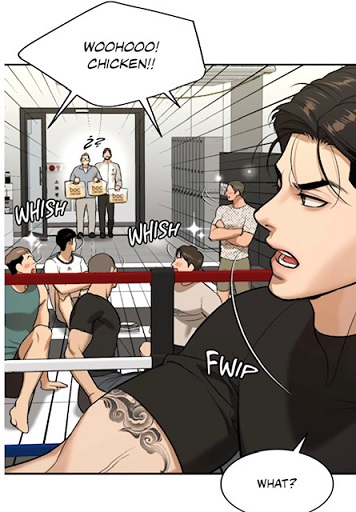 (chapter 26)
 (chapter 49) But why hasn’t the athlete confided to his manager yet? First, homosexuality is definitely a taboo among boxers and MMA fighters. Their masculinity and strength are questioned. Secondly, his coach views him as a spoiled brat.
  (chapter 27) But by portraying him like that, the coach gave us a justification why he wouldn’t converse with the gym owner. Why should he talk or listen to Joo Jaekyung, if the latter is stubborn and obsessed with his work? It is pointless. And such an attitude could only get reinforced in this scene:
  (chapter 46) Yet, according to my interpretation, the main character’s departure was not the sign of stubbornness, but rather of fear and avoidance. Since the manager doesn’t know his star that well, he judges him based on appearances. Moreover, I believe that he has the tendency to generalize, just like certain readers. Since the athlete beat a doctor and was quite brutal with a fighter, he is stigmatized as “thug” or a “spoiled kid”. I am suspecting that the way the hyung met the celebrity affected his perception about the young fighter.
 (chapter 26) could have become a criminal. Nonetheless, it is an illusion, for MFC is connected to the underworld.
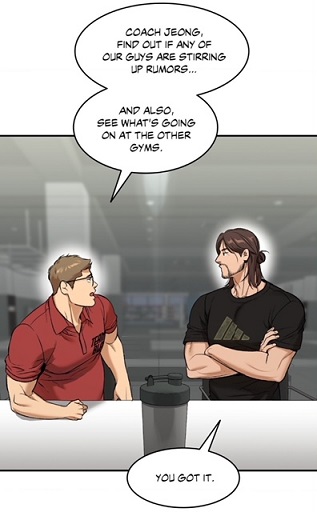 (chapter 46) Despite his attitude, Joo Jaekyung still listened to his hyung’s warning, for from that moment on, he kept his distance from everyone, including the physical therapist. But there’s more to it. Park Namwook keeps associating his star with “good luck”.
  (chapter 1)
  (chapter 27) This represents the exact opposite of the star’s jinx. It shows that he is not trying to understand his celebrity. With such a mind-set, it is normal that the champion wouldn’t trust his manager. And the absence of the manager in this panel
  (chapter 33) The latter truly worries for his star, although he is well aware of his shortcomings.
 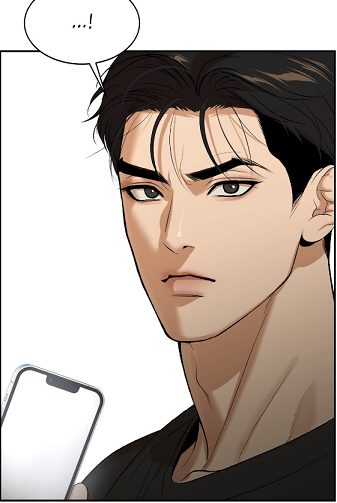 (chapter 33), he didn’t report it to his hyung. He also kept it a secret. That way, he was not only protecting Kim Dan’s misdiagnosis, but also Park Namwook’s misjudgment. On the other hand, he acted as a real boss, for the comedian is an important client.
 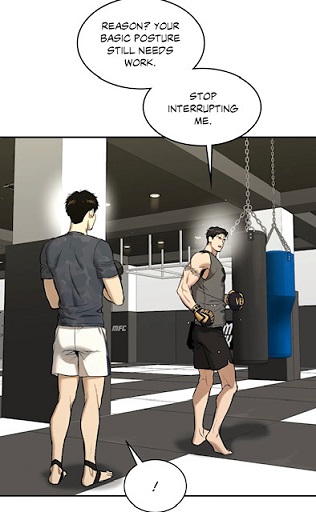 (chapter 23) He never confronted the members with the truth. They lack skills
  (chapter 46). It was, as if they didn’t have the goal to create a new champion. How come? It is because the gym was initially created for Joo Jaekyung’s needs. And now, Jinx-lovers comprehend the dilemna. Team Black needs to redefine itself and its purpose. Moreover, Park Namwook’s true wish is to open the gym for “kids”. And that’s how he treated the staff from Team Black, like little kids. No wonder why many left the gym in the end. They didn’t feel truly supported by the manager and coach. Jeong Yosep and Park Namwook didn’t put any real effort to turn the members into professional fighters. That’s the reason why none of them had a MMA manager, only a coach and nothing more.
  (chapter 49) He claimed to trust the champion, but the reality is the opposite.
 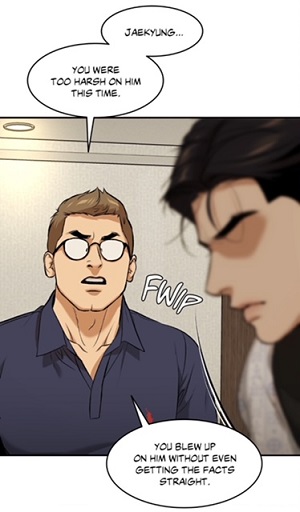 (chapter 52) He blamed Joo Jaekyung for everything: the tie, the doctor’s departure, the suspension and as such the loss of his good reputation. However, even if the champion had vented his anger onto the physical therapist wrongly, he had reasons to doubt Kim Dan. He had not only received the pictures, but he had been warned by the coach himself to doubt the members’ loyalty. There was a spy and a traitor among Team Black. One detail in the last panel caught my attention is the idiom “facts”. It is in plural and not in singular. Fact could be seen as a reference to his own warning, he had not checked the fact either (rumor, suspected disloyalty), yet this is not what he meant. Potato had exposed only one fact to the group: the switch of the spray organized by Choi Gilseok.
 (chapter 52) So what other fact was Park Namwook referring to? The fighter Baek Junmin and director of King Of MMA had paid Kim Dan. This shows that he had heard the conversation between the two protagonists.
 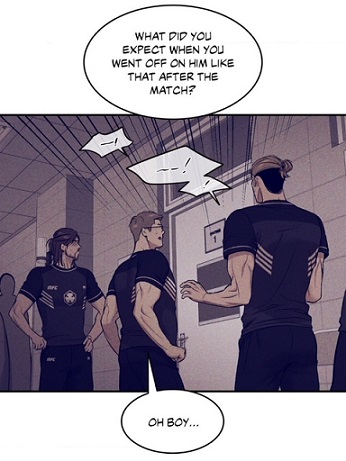 (chapter 52) And what did the manager do, after the champion had left the room? He abandoned Kim Dan, followed by the other men. At no moment, he asked Oh Daehyun or Yoon-Gu to take care of the physical therapist. But by following the celebrity or remaining passive, they had implicitly supported Joo Jaekyung’s decision. They had taken his side. And now, you comprehend why all these men chose to put the whole blame on the celebrity.
  (chapter 52) It is because they didn’t want to feel responsible for doc Dan’s departure. Their admiration and trust in the celebrity is superficial. In other words, they are following the hyung’s lead. Hence there is no regret, only reproaches.
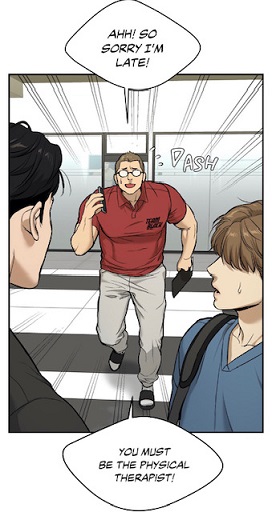 (chapter 1)
  (chapter 49) He should be responsible for his contracts, yet the reality is that the Entertainment agency is the one managing the champion’s career.
 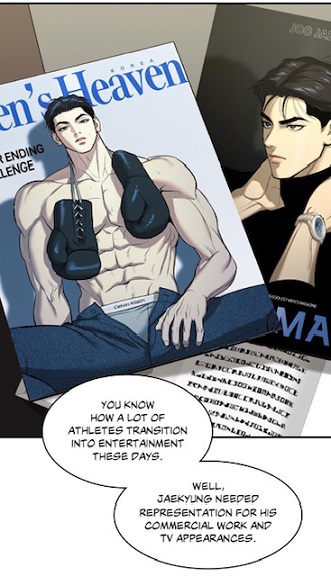 (chapter 30) This shows that Park Namwook doesn’t have a lot of connections. He should be the one organizing the fights, but no… others are making the propositions (MFC matchmaker and agency). Consequently, the ex-wrestler often voices doubts about the matches.
  (chapter 52)
  (chapter 52) The article is indicating that the champion was quickly judged and this within a few days. The article implies the non-intervention of a lawyer or his manager. No one sided with the celebrity. They are not even contacting the media.
 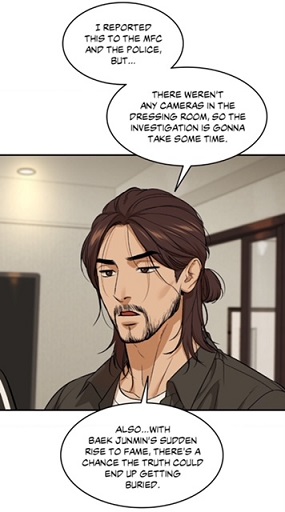 (chapter 52) Park Namwook never tried to correct this negative reflection, for this is how the manager perceives the man himself. He is an ill-mannered child. This explicates why Park Namwook could slap the patient in his bed. So we should judge the argument between the fighter and his manager
  (chapter 52) as the negative reflection from that blue night.
 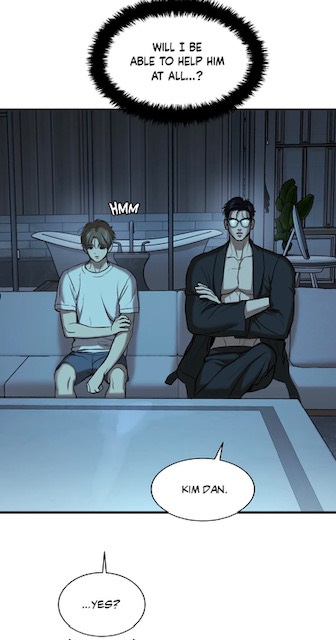 (chapter 29) He is not standing next to the main lead, but he is facing him. He is like an opponent. Another divergence is that Kim Dan was alone, whereas Park Namwook utilizes Potato and the others from Team Black to corner Joo Jaekyung. The doctor was willing to listen to him, whereas the other gets upset, when the other admits his suffering. Since the gym is facing a crisis, the patient should find a solution to the problem.
  (chapter 52) that he regretted his decision and outburst. By admitting his mistake, he would have become responsible for the whole mess. Funny is that he asked compassion from Joo Jaekyung, whereas he showed none to the patient. And what was Kim Dan thinking during that night?
  (chapter 52) resembles a lot to the image with the opponents.
  (chapter 52) For the first time, the champion is no longer looking at his cellphone. He shared his thoughts to others and exposed his powerlessness
  (chapter 40) These two situations have many similarities. Both were confronted with an accusation, they were surrounded by people, who were acting as righteous and honest workers. Both were coerced to admit a wrongdoing. In addition, they are actually abandoned by Team Black members, especially the manager. No one is looking for them out of concern. The reality was that they were not their “true colleagues and even less friends. However, like mentioned in a previous essay, the men in black were actually covering up a crime in order to hide the corruption from the organization. This makes me truly wonder if Park Namwook is truly ignorant about MFC’s corruption. He could simply know about the crimes, but he chose to close an eye to the whole situation.
  (Chapter 46) He is already aware of the existence of illegal betting. Besides, since Joo Jaekyung is paying his taxes properly, Park Namwook could have the impression, he is doing nothing wrong. However, if he knows something and is remaining silent, he “becomes an accomplice” de facto. And what is the other common point with the interrogation from MFC security guards and the hospital visit? No lawyer and the incident was swayed under the rug.
  (chapter 40) He had rescued him. So by slapping the champion
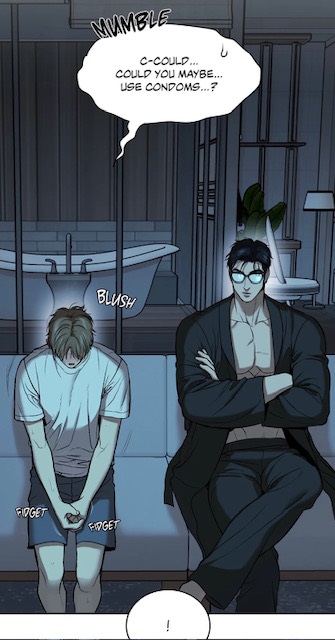 , (chapter 29), I deduce that the slap had the opposite effect than this wonderful night. The gap between the hyung and the athlete got bigger. This represents the moment where Joo Jaekyung is emancipating himself from the hyung’s influence. By refusing the letter of resignation, he clearly indicates that he is rejecting Park Namwook’s suggestion.
 (chapter 30), but failed due to his roughness and cowardice. Hence I assume that the slap was the trigger for the champion to switch Park Namwook’s position with Kim Dan’s. The latter is finally recognized as a friend and even as a competent physical therapist. He is on the verge of becoming Joo Jaekyung’s “hyung”. So far, the athlete has been calling the physical therapist “Kim Dan”. And exactly like that wonderful night, Joo Jaekyung will attempt to seek the doctor’s closeness, resolve the misunderstandings and close the gap between them. He will follow his footsteps, but have a different attitude. Why? It is because the grandmother will be next to them.
 (chapter 37) They imagine that Joo Jaekyung’s recent demise will reinforce his former belief. The prematch-sex session with his regular partner didn’t prevent the misfortune, therefore he needs a replacement. That’s the reason why they made sure to isolate the celebrity. However, they couldn’t be more wrong, for the champion experienced the doctor’s departure as something worse than the whole scandal.
 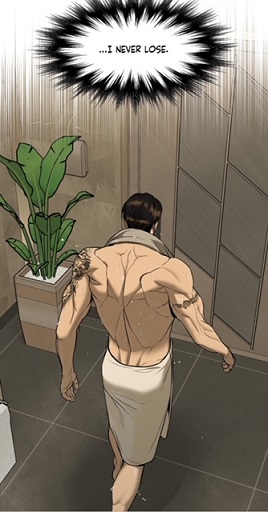 (chapter 49) He was no longer relying on the ritual.
 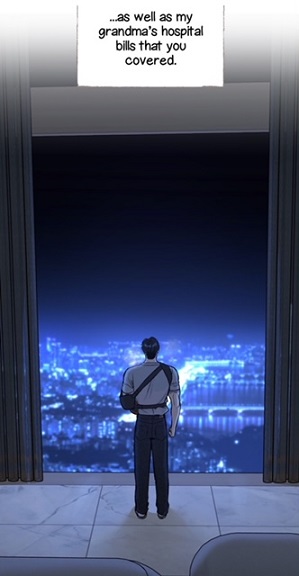 (chapter 53) He is now missing him, but he is not capable to express it properly. For the first time, he is confronted with reality. His penthouse feels cold, lifeless and empty.
  (chapter 19) Yes, we should see episode 53 as the negative reflection from chapter 19, the doctor’s arrival at the penthouse.
  (chapter 19)
  (chapter 53) Here, what Kim Dan saw was not the real sunset, but the lights from the cameras. Far away from the lights from the journalists, the champion will witness the beauty of a sunset, which can not be bought with money.
 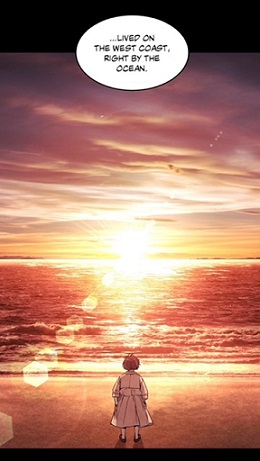 (chapter 53) Humans can only appear as small and powerless. That’s how he could reconcile with the god of time. He will no longer fight against time. I connected nature to temporality of human life because of the grandmother. For me, his break represents a blessing in disguise. He will be able to breathe, to find joy in little things and more importantly he found a true friend and support: Kim Dan. The Webtoonist announced that season 2 would be focused more on feelings which is totally understandable. It coincides with introspection and meditation. Joo Jaekyung will have to prove that he trusts the main lead and he can only achieve this goal by entrusting him his recovery. Moreover, by doing so, he would boost the physical therapist’s confidence. While there was no real seduction in season 1 (money, jinx, treatment, bet during the confession night, drug), we have to envision that their intimacy won’t be so abrupt. It will be more subtle and gradual. The star will have to woo the doctor in order to express his love and affection. Through love, Joo Jaekyung will discover not only happiness, but also strength which will help him to defeat their “enemies” and unmask the criminals. In other words, he should realize thanks to this new journey that he is not cursed, but blessed, for he can help Kim Dan mentally, emotionally and professionally. So far, when the champion travelled, he never visited the cities
  (chapter 37) or sightseeing attractions. Here, I feel the need to add this French song from Daniel Balavoine (1985): “Aimer est plus fort que d’être aimé” (Loving is stronger than being loved”).
 (chapter 21). By interacting with Kim Dan, he will be able to reconnect with his true self which will change him forever. Notice that after the night in the States, at no moment, the champion mentioned his jinx, but spoke about his physical health. In reality, he was including his mental health. This shows that he was already moving on from his jinx. Moreover, after the tie and the suspension, he is not mentioning or thinking about his former belief. The reason is simple. Because of the doctor, the champion was allowed to perceive glimpses of the truth: corruption and the existence of tricks. This image
  (Chapter 44) So he was able to create good memories. Besides, he came to fall in love with Joo Jaekyung. Thanks to the latter, doc Dan could overcome his fear
  (chapter 26) and make others happy too.
 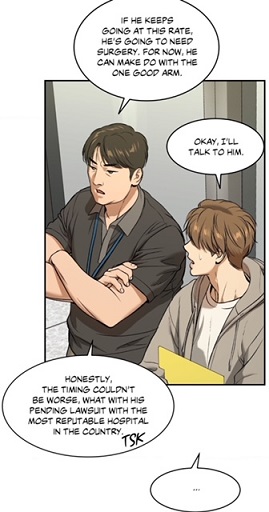 (chapter 42) This shows that his self-loathing is gradually vanishing as well. The fact that he is employing the personal pronoun “I” indicates that he is able now to distinguish himself from his grandmother.
 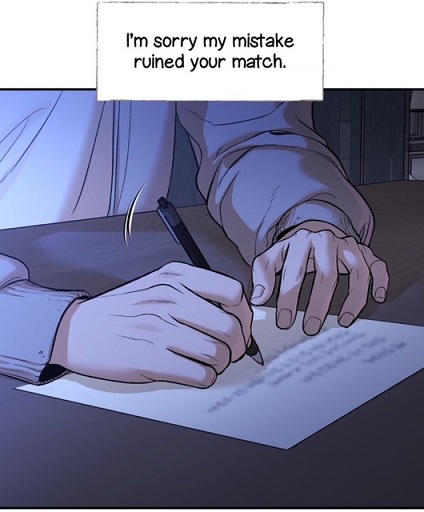 (Chapter 53) Here, I feel the need to remind my avid readers that though the doctor was victim of a trick, he was not entirely innocent either. He should have come clean with the champion concerning his meeting with the director from the rival gym. His lie still played a huge role in the champion’s mistrust. But why did he not tell him later? It is because he was under the influence of the manager.
  (chapter 44) The intimacy is rather superficial, for it is limited to pleasure and sensuality. This has nothing to do with the partner’s personality. Secondly, during that night, the champion was drunk. In season 1, both protagonists only discovered physical closeness without sharing their thoughts and emotions
  (chapter 44) .
  (chapter 44) He never told the athlete that he was so cute or handsome. He kept his thoughts and happiness to himself. The only moment they shared real intimacy was this night:
  (chapter 29) Moreover, during that sex session, the athlete employed dirty talk.
  (chapter 29) It was not to express affection.
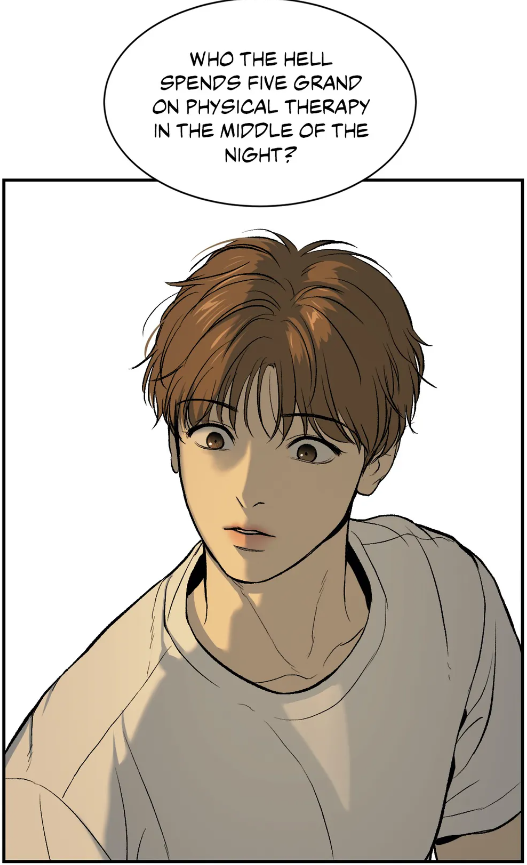 (chapter 2) prostitution and rough sex. He never experienced true romance and the birth of “first love”. The courting and seduction were totally absent. His first kiss is connected to fighting, pain, survival and protection.
  (chapter 14) It had nothing to do with innocent and pure love. For me, Kim Dan didn’t have the time to fall in love with the champion properly. He could even say that his affection is related to his job and he could reduce it to mutual physical chemistry. Thus I deduce that he became a ghost again for one reason. Both need to experience the innocent first love. In other words, we should expect a new version of this magical night:
  (chapter 20) Till that moment, he lived like a ghost. He had been trying to deny the existence of his own body. And how did the athlete describe his lover in the bathroom? First, he compared him to a whore
 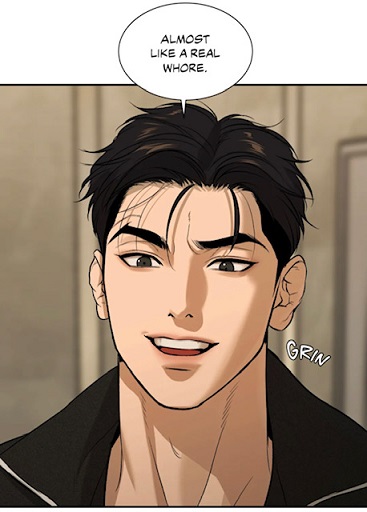 (chapter 19) before describing him as a baby.
  (chapter 20) However, we should expect a more pure version, where both act as innocent and inexperienced teenagers, similar gestures:
  (chapter 44) There should be no drug or no time pressure!! However, there exists another reason why I have such an expectation. First, the grandmother should be close to them. Her presence should represent a hindrance, as the latter is falling back into childhood. Secondly, right from the start, Joo Jaekyung was under the spell from Kim Dan.
 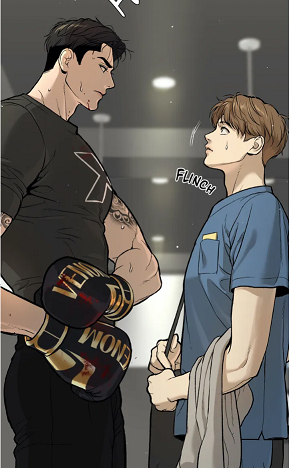 (chapter 1) He was so attracted to him physically, hence he didn’t pay attention to his partner’s personality. In fact, he had a negative perception of his nature:
  (chapter 1) By becoming a ghost, the champion is forced to perceive the main lead as a person and as such to pay attention to his personality (dislikes, likes, qualities, career). That’s the reason why I believe that in season 2, he won’t make the same mistake again. He will study the doctor and get to know him better. That’s how he will be able to identify his feelings for the protagonist. He doesn’t love him because of his cute face and body, but because of his big heart and warmth. He is so responsible, generous and dedicated that there’s no one else like him. He embodies true kindness and loyalty. His care and worries are genuine. That’s why the champion will voice his affection differently from the past: “Secret and innocent love behind work”. Under this new light, it becomes comprehensible why both characters had to go to the seascape. Nature is the perfect place to nurture innocent and pure love. Consequently, I don’t think, the author will rush to create a new chapter full of sex… rather full of tenderness and caresses! Thus Mingwa created such panels:
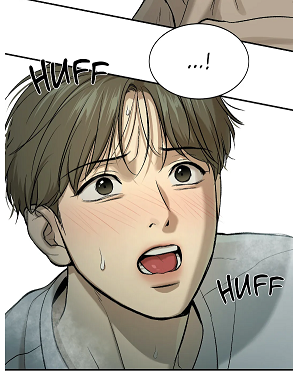 (chapter 7) Kim Dan had just punched his boss. How would he react to this wrongdoing? In fact, I realized that all the episodes with the number 7 are strongly connected to an intrigue and riddle. Why? The answer lies in the number. 😉 So what does 7 symbolize in the end?
 (chapter 18) He believed to see someone selling his body to a loan shark, while in reality the main lead was about to get raped. Hence we have -7! This represents the absence of reflection and even the refusal of meditation.
  (chapter 47) He didn’t get included in the conversation. This explicates why when Kwak Junbeom witnessed the encounter between Choi Gilseok and Kim Dan, the sportsman didn’t approach the PT in order to protect him or his champion’s interest.
  (chapter 48) The connection between 7 and anguish in Jinx seems to contradict the notion of “lucky 7”. Yet we shouldn’t forget that through pain, the characters are incited to learn life lessons and become wiser. Torment led them to face their fears and reflect. Consequently, what appears as a jinx will turn into luck and blessing in reality. Like mentioned in the previous analysis, the 90 day suspension represents a liberation for the athlete, for he is no longer under pressure to fight constantly. He is pushed to meditate and view life differently, thus he is looking out of the window.
 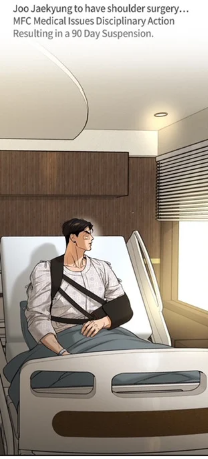 (Chapter 52) He will realize that he needs to select his opponent more properly.
  (chapter 5) He remained passive, because he had already an answer to his silence. He was refusing the job. He implied that his lack of reaction had been caused by the champion’s action. In addition, he reproached his boss that he was getting worked up for nothing. His behavior displays that he saw no value in Kim Dan. Moreover, Mingwa left a clue why the man has always been passive all this time. It is not just a question of fear. The other reason is that he used prejudices and superficial thoughts to explain people’s attitude. Hence he never investigated the matter why the doctor didn’t contact them. His attitude in episode 52 hasn’t changed at all.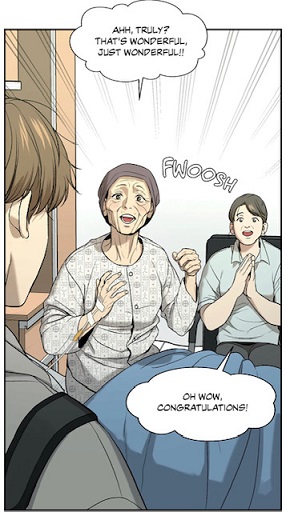


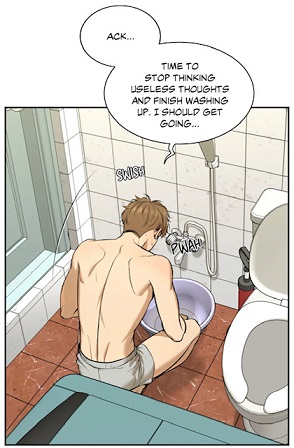


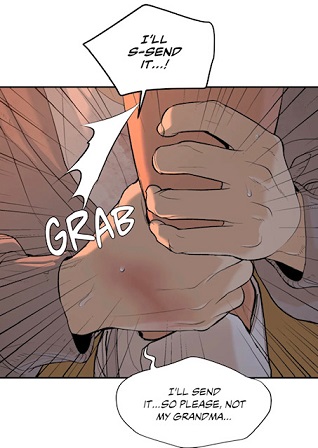


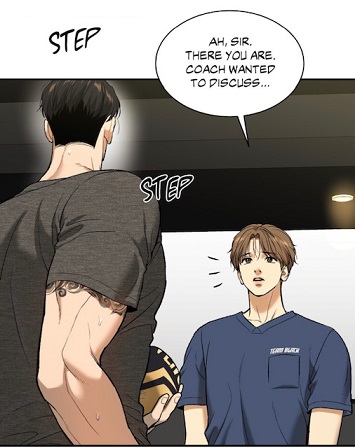
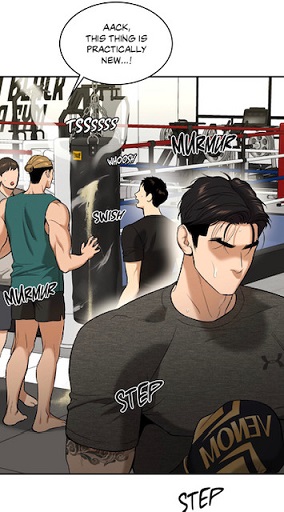


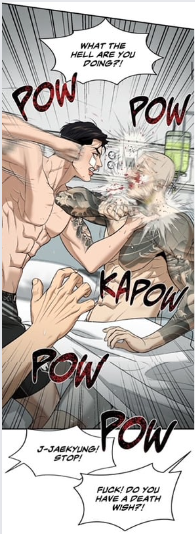


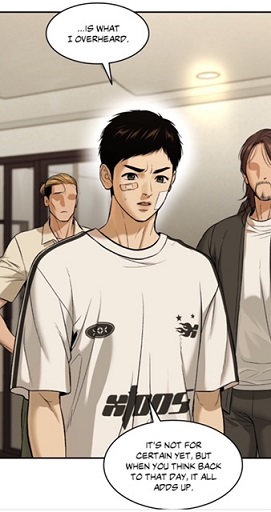
 (chapter 52). By mocking him, he was provoking Joo Jaekyung and he knew it. Yet, he never expected that he would be punched so violently that he would be KO. In episode 7, the champion “invited” the doctor to enter the shower room,
  (chapter 7) reminding us of the kidnapping in episode 16. Here, on the other hand, Heo Manwook must have judged his presence at doc Dan’s house as an “invitation”
  . (Chapter 16) and not trespassing. Each challenge or invitation is strongly connected to moving. Heesung had to drive through town in order to discover the secret between the two protagonists. Moreover, I distinguished another similarity: abduction and sequestration. Kim Dan was forced to stay in the shower room or his home or in the penthouse (34,43). Chapter 25 represents the exception, for it was the only case, where Kim Dan was given a real choice.
  (chapter 44) Kim Dan agreed to have sex with the fighter, because he wanted to know him better. Thus I deduce that the athlete discovered new aspects about Kim Dan’s life.
 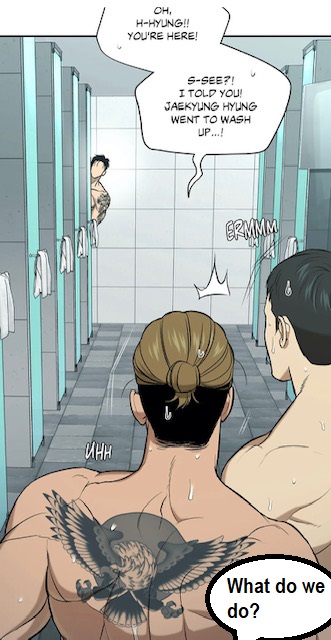 (chapter 8) In 25 and 34, we never saw Park Namwook. He was either outside the gym or in his office. Then in episode 43, Potato was missing, but no one mentioned his absence. But I would even go further, all these chapters are strongly linked to the doctor’s vanishing. Notice that in episode 7, he got dragged to the shower room, but no one caught his disappearance, not even Park Namwook.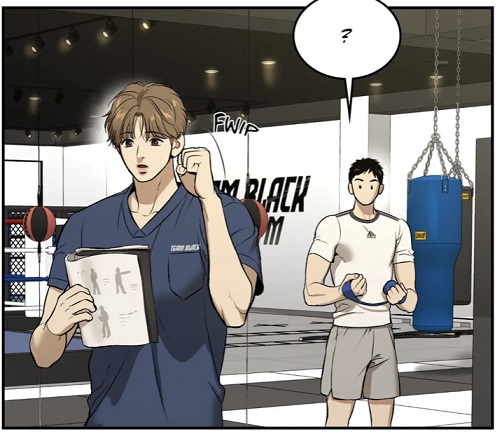
 (chapter 25) He received only attention, when he got strangled due to the maknae’s mistake and notice that the protagonist was too focused on training the others that he neglected his soulmate. Then in episode 34, Kim Dan was supposed to meet Choi Heesung, but he missed the appointment due to the athlete’s trick.
  (chapter 34) Since the latter had not replied, Choi Heesung assumed that Kim Dan was not free. And now, you know why the actor never contacted the angel and asked about his whereabouts. The main lead never replied and confirmed the meeting. Then in episode 43, no one missed Kim Dan at the table, when they ate their dinner.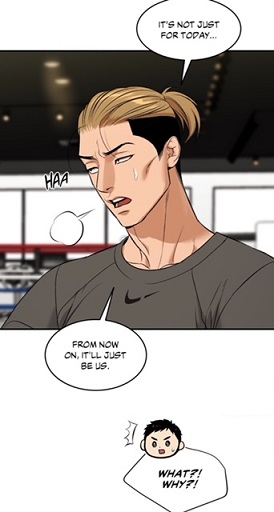
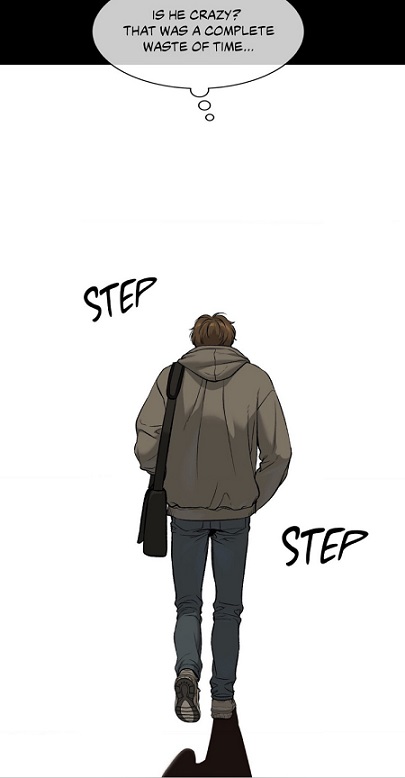 (chapter 48) This should have caught the coach’s attention. In addition, it dawned on me that the fighter could have reported this meeting to the coach, saying that he would come late due to the other director, a new version of this scene:
  (chapter 11) So Park Namwook might have already been aware of this, which would explain why he felt uncomfortable, when he met Choi Gilseok..
 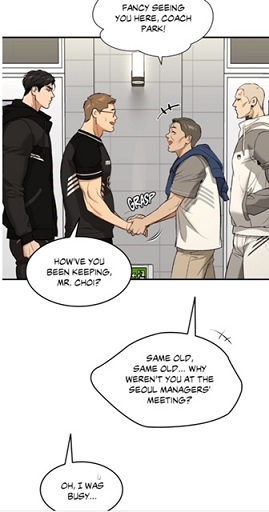 (chapter 49) Remember that he had avoided him on purpose. And episode 49 is related to number 7. Hence we have this contrast:
 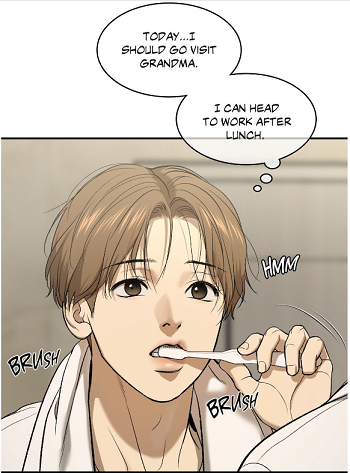 (chapter 30) In this scene, we see that the doctor made a decision on his own, as he knew that he was not needed. Park Namwook should have asked why Kim Dan would join the gym later, if he had not been informed. As you can see, through the comparison, I realized Park Namwook’s huge wrongdoing. He didn’t miss doc Dan during that time, I would even say, he didn’t look for him. But he knows where he lives and he has his cellphone number. Like mentioned in a previous analysis, the vanishing of the coach and manager at the gym was exposing a professional mistake.
  (chapter 52) And funny is that as soon as I contrasted these episodes, I had another revelation. How did Joo Jaekyung know that Kim Dan was supposed to meet the actor?
  (chapter 32) The sly fox was aware that the celebrity would never dare to contradict his hyung.
  (chapter 34) Kim Dan could refuse to go to that meeting. He was not obligated, for there was no contract between the artist and the “hamster”. They had never asked for his consent. Choi Heesung used work to meet the doctor, but the manager had also heard from the actor’s manager about the comedian’s love life
  (chapter 43) Yet, Park Namwook joined them for the dinner at the restaurant. Only through the comparison, I detected the absence of the manager which I consider as a sign of his neglect. Yosep’s gesture
 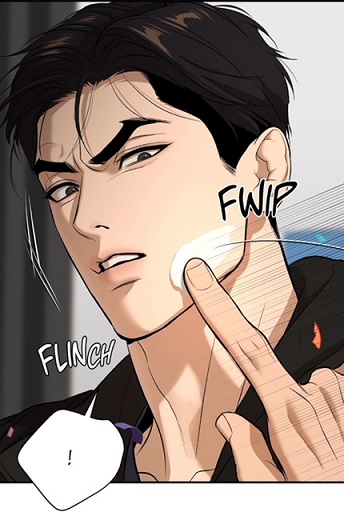 (chapter 43) represents the positive gesture from Namwook’s slap.
 (chapter 7), 16
  (chapter 16)
  (chapter 16), 25
 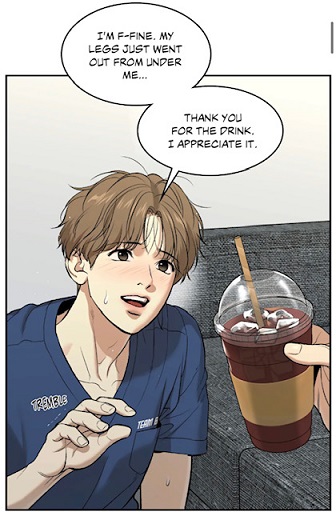 (chapter 25)
  (episode 25) and
 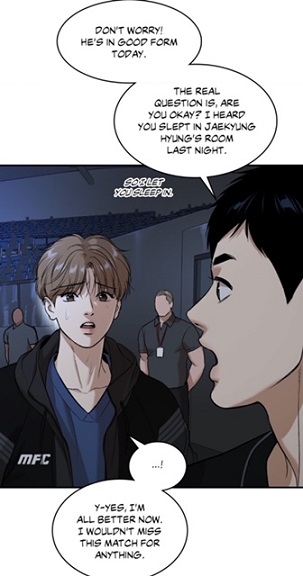 (chapter 40), but also paid attention to his actions and work.
  (chapter 41) However, notice that her desire to watch the match was related to her grandson, the source of her pride and joy. As soon as I made this connection, I had another revelation. Gradually, the chow-chow’s admiration is shifting towards the doctor.
 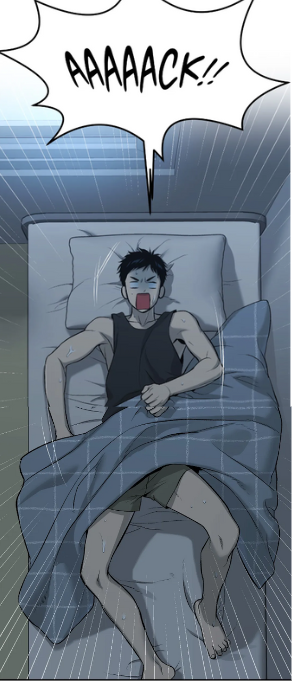 (Chapter 25) and showed no fear to fight with stronger men.
  (Chapter 52) Yet, he didn’t complain to the staff or to director Choi Gilseok. He remained passive contrary to the young member from Team Black. Moreover, because Kim Dan has always felt a certain closeness to Yoon-Gu, I believe that the latter will be the reason why the champion and Kim Dan can rekindle. Thanks to him, he can approach the poor doctor and convince him that Team Black is his home.
 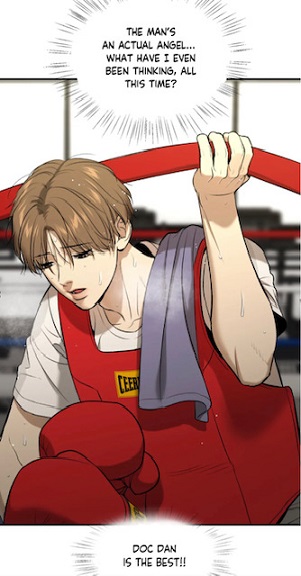 (chapter 26), his tolerance, patience, understanding
  (chapter 37), his humbleness
  (chapter 49) Yoon-Gu could only perceive Kim Dan as the symbol of loyalty. Hence I come to the deduction that after meeting doc Dan, he must have realized that only one could change the situation, it was Joo Jaekyung and no one else.
 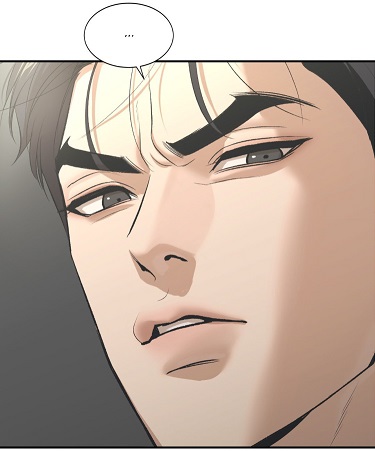 (chapter 43), but also Park Namwook’s neglect. How so? First, look how Kim Dan came to offer his services to the members from Team Black. Kim Changmin had an old shoulder injury which had been neglected:
  (chapter 7) But the coach should have noticed it and advised him to go to a doctor. He was responsible for them. But no… and we have two other evidences in episode 52. First, the manager didn’t ask about Potato’s injury. Secondly, he slapped a patient, because he felt “provoked” by the outburst from Joo Jaekyung.
  (chapter 52) Why? One might say that he was worried for his star. But for me, the drop of sweat is showing a certain discomfort. How so? A surgery means that the athlete can no longer fight for a while. Without him, the coach is put under pressure, for he needs to ensure that other fighters can enter MFC.
  (chapter 13) Furthermore, he heard from the grandmother that he had a weak constitution.
  (chapter 41) That’s how it dawned on me that the news about Kim Dan could be referring to his health too. But does it mean that doctor Dan is now ill, especially when you look at Potato’s facial expression here?
  (chapter 52) Either he is sick, or it could be a reference to the doctor’s mental health as well. This would mirror the champion’s unwell-being.
  (chapter 10) Let’s not forget that after his first night, the doctor numbed his physical pain with soju, while he was not eating properly.
 (chapter 5) He would spend money for soju, but not for healthy food. Not even his grandmother was aware of this habit. But by living with the champion, he could no longer live like in the past. He had stopped drinking any alcohol, but notice that it changed after the drug incident. He was encouraged to drink again:
 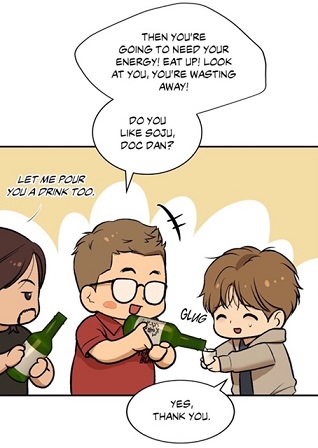 (chapter 43) The champion represented the doctor’s motivation and as such “sweet drug”. That’s the reason why he could always overcome the pain afflicted by his soulmate:
  (chapter 47)
  (chapter 51) And this brings me to my next observation. All the episodes are showing the champion’s weak mental condition which got even worse over time. From this
 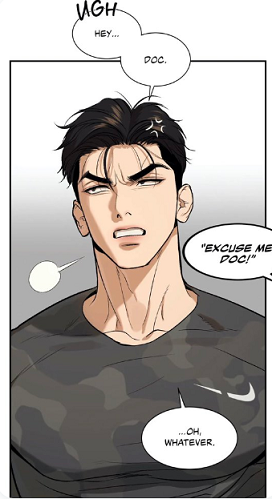 (chapter 7) to this
 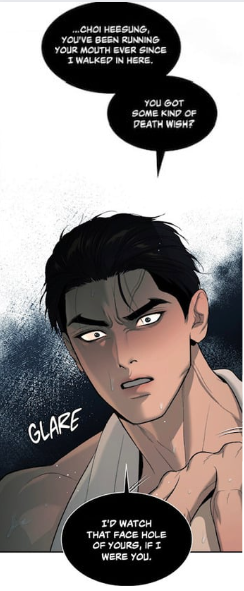 (chapter 34) and to this:
  (chapter 34) Though the celebrity was getting easily irritated, the manager never took the matter seriously. He saw it as the result of bad education, hence he never tried to change it either.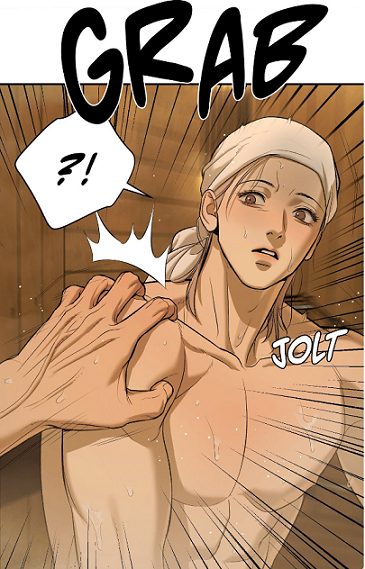
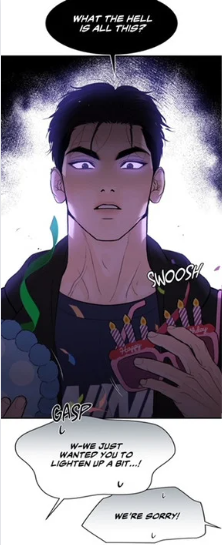 (chapter 43)
  (chapter 43) Yet, his words were just empty threats. And what have episode 25 and 43 in common? Fun and learning.
 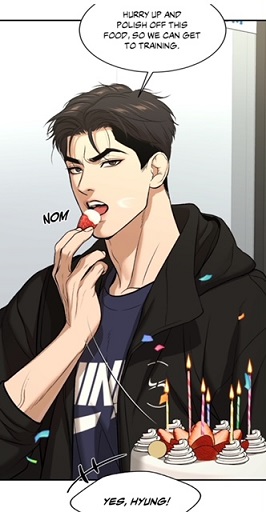 (chapter 43) To say that the athlete always has a bad temper
 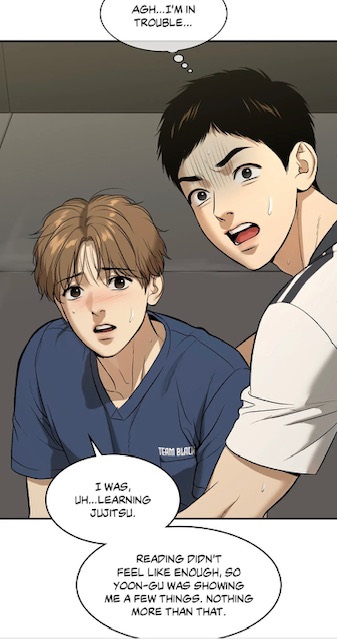 (chapter 25) Why? It is because the doctor protected him by explaining the circumstances: he was learning jujitsu. He diverted the champion’s attention from Yoon-Gu. He had not been “caught”. However, when Kim Dan was offered to become the celebrity’s sparring partner, Potato got angry and voiced his anger and wish:

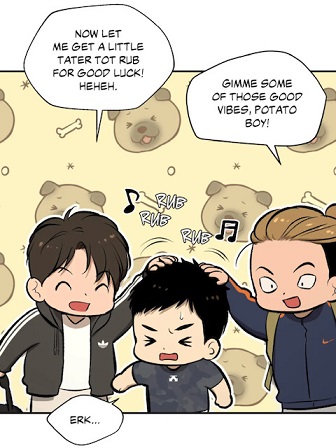 (chapter 23) On the other hand, the physical therapist has always been associated with a hamster, like in this image.
  So how did I come to connect the main lead to a puppy dog?
  (chapter 47) It is because Shin Okja called her grandson “her puppy dog”.
 (chapter 5), but a young dog. This signifies that in the bathroom, the main lead’s true nature came to the surface due to the bad news concerning his grandmother.
 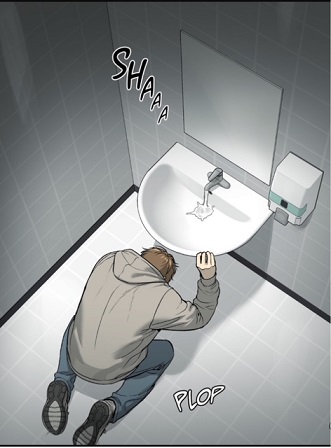 (chapter 47) Yet, a puppy embodies innocence and inexperience. Thus it needs the guidance of a mother. On the other hand, in my essays about the doctor, I kept describing him as a person who would constantly grow and mature. So “a puppy dog” would appear as a contradiction to my previous interpretation. Nonetheless, we shouldn’t forget that this was representing the grandmother’s desire. By turning him into a puppy dog, she expects from him obedience and loyalty. She is denying his right to determine his own life. He needs to follow its master. Hence this scene announces a certain regression for Kim Dan. On the other hand, I believe that this is just temporary. What the elderly woman didn’t know is that by linking him to a dog, she was freeing Kim Dan from society as well. He is now an animal. He belongs to Nature from that moment on. This animal symbolizes freedom and independency. So when the grandmother described him as a puppy dog
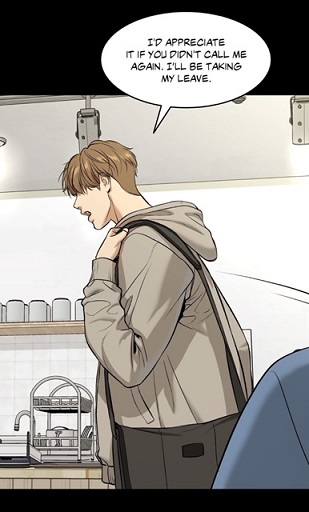 (chapter 48) Furthermore, Jinx-philes could observe how the doctor had followed his instincts during the conversation with Choi Gilseok in different panels, like for example in this image.
 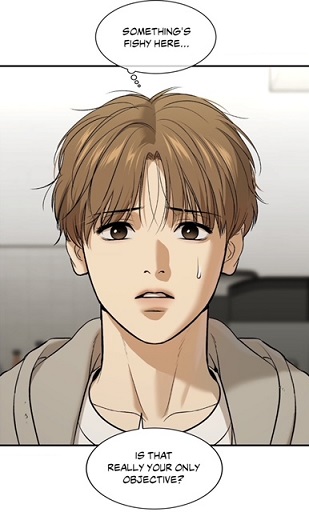 (chapter 48) The idiom “fishy” is a reference to smell, indicating that he was relying on his own senses. But we have another evidence that the puppy dog was using all his senses to judge his counterpart:
 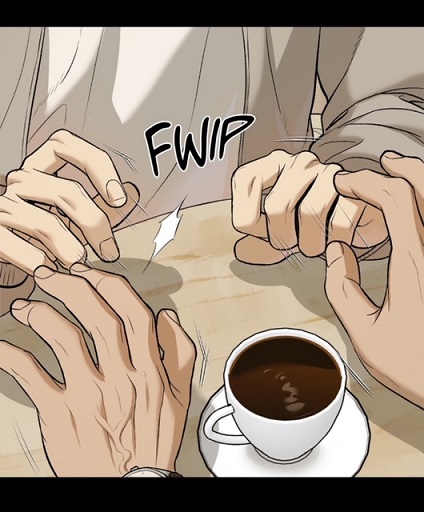 (chapter 48) He rejected the touch from Choi Gilseok. That’s how he could detect the director’s hypocrisy. He refused to drink the coffee from the senior, although it had been recommended. As you can imagine, all his 5 senses were on alert, and the latter are strongly intertwined with instincts. In addition, when he asked his counterpart to go to the point and speak frankly
 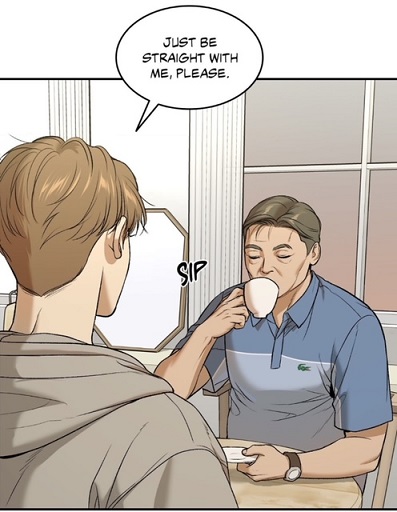 (chapter 48), he was urging Choi Gilseok to drop all manners. Yet, Manhwalovers should keep in mind that the synonyms for manners are etiquette and ceremony. This proves that manners stand for civilization. But what are good manners?
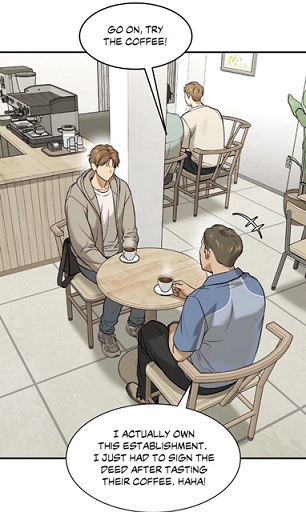 (Chapter 48) This means, he was disrespecting the elder. However, his disrespect didn’t start at the café, but in front of the gym.
  (chapter 48) He refused to take the card from the director. However, the moment his grandmother was brought up, he became obedient and accepted the invitation.
  (chapter 48) He acted out of loyalty and love for her. Nevertheless, the director’s offer for his halmoni served him to see the truth. His behavior during the conversation exposes the awakening of his wild and rebellious side. Thus we could say, Doc Dan showed more and more his rudeness. He left without asking permission and saying goodbye.
 (Chapter 48) To conclude, the conversation displayed that Kim Dan was already following his halmoni’s advice, he was living as a dog. This made me smirk, because I could detect how Joo Jaekyung had rubbed off on Kim Dan!! 😂
  These two characters symbolize true friendship. Thus I come to the following deduction: Kim Dan is about to get truly adopted by Team Black, while it looked the opposite at the end of the season. He might have been wearing a uniform and a jacket Team Black, yet there were signs that he wasn’t truly part of the team.
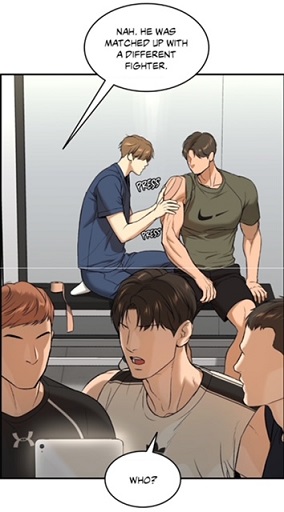 (chapter 47) But for the adoption to happen, he needs to prove his loyalty. How will he do it? Once again… wait for the part with the predictions. Yes, I am taunting my attentive readers.
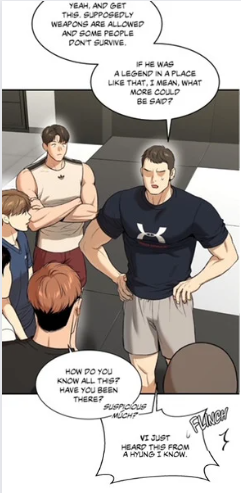 (Chapter 47) That’s the reason why they were not expecting that their idol would get so hurt or lose the fight. Kim Dan didn’t dare to contradict them, especially when Potato asked for his opinion.
 (chapter 47) In my eyes, Doc Dan didn’t dare to ruin the maknae’s illusion about his idol, though he thought otherwise. His broken sentences and his drop of sweat are revealing his discomfort and skepticism. He was not sure about the success of his VIP client. But Kim Dan as his PT knew about the champion’s true conditions: he is not truly healthy. But why are the fighters so innocent?
 (chapter 46) It is because the success of the gym relies only on the champion’s glory and the number of members. Till the end of season 1, he has not changed his behavior yet.
  (chapter 31) It looks like I am diverting from the topic, as I am now talking about the fighters and the gym. No wonder why most of the members switched the gym, as soon as the champion lost and his reputation got tarnished. Nonetheless, keep in mind that his game with Baek Junmin ended up with a TIE. So it is not a complete defeat. In my opinion, the schemers desired to tame the Emperor, not to ruin him, as they definitely need him to make money.
  (chapter 23) Kim Dan and Yoon-Gu had no task at all. The latter were treated like playmates and nothing more. Hence the manager asked patience from the doctor.
 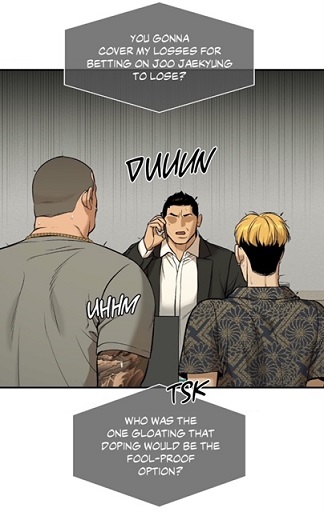 (chapter 46), but also by his greed. He had lost so much money. He needed to refill his pockets. Thus his wish was to “kill” the emperor and as such to ruin Team Black. In other words, he had planned the destruction of the rival gym. With the victory, Baek Junmin could replace the champion, and Choi’s gym King Of MMA would attract members. And my prediction came true. With the tie, many members from Team Black went to King Of MMA hoping that they would come to get rich and famous very quickly.
  (chapter 52) And since the other fighters from Team Black had never been able to break through MFC, it is not entirely surprising why they made such a decision. With their desertion and the champion’s ruined image, the future of the gym Team Black seems to be sealed: failure. Under this new light, my avid readers can grasp the true signification of this gesture:
  (chapter 49) It was not just about Kim Dan’s fate, but also Team Black’s. Hence he can not quit or run away. This new interpretation made me perceive the entrance of Kim Dan in the arena in a new light.
 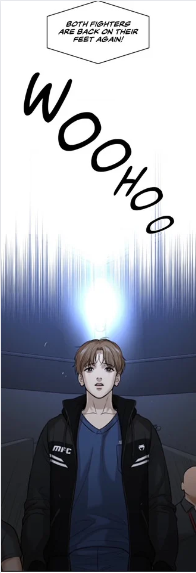 (chapter 50) Remember how I said that the locker room had become a temple. Thus I come to the conclusion that he got baptized there. He discovered the power of his hands, similar to this scene.
 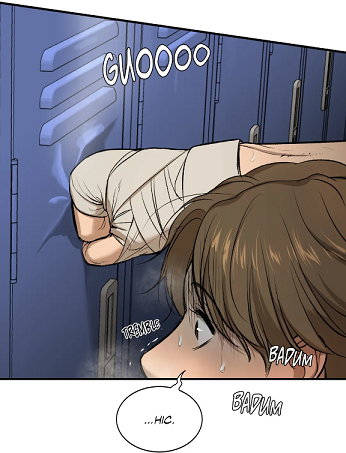 (Chapter 14) So when he comes to the arena, he is still following his instincts, unaware of his own metamorphosis. He is no longer a puppy, but a dog. Deep down, he feels that he has to be there despite his agony. He needs to be there in order to protect his home. To conclude, in the locker room, the doctor reached adulthood. Interesting is the chosen perspective from Mingwa. It was, as though he was flying high in the sky, like a yeouiju.
 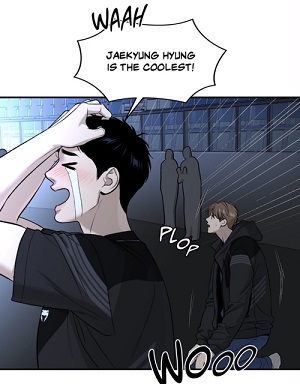 (chapter 40) In this image, he has to look up, whereas in the other panel, the beholder has the impression that doc Dan is rather standing on the same level than his soulmate, the alpha Jaekyung. However, since the athlete blamed him for the incident and rejected his hand, for Kim Dan, it sounded that he was no longer needed.
 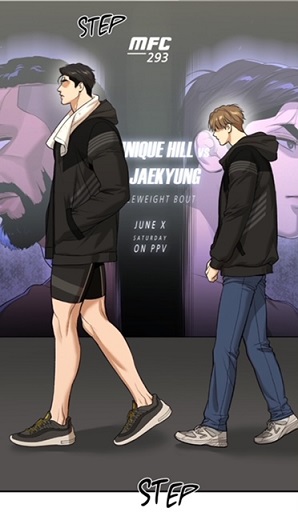 (chapter 40) And that’s how the champion will come to realize that he can not live like before, as Kim Dan can not keep up to him. He is physically weaker. He desires his loved one to always look at him, to never leave his side, to stop living like a stray dog.
  (chapter 4)
  (chapter 53) Observe that the doctor’s shadow is getting bigger. I interpret it as a sign of his growth, and it implies that Kim Dan is leaving traces behind inviting Joo Jaekyung to follow him. In the nature, far away from the city, the wolf should be able to reconnect with his true nature: freedom, but also loyalty and family. Home is no longer a place, but a person:
  (chapter 53) As you can see, with this new interpretation, I recognized that at the end, Joo Jaekyung stopped being under the influence of PArk Namwook. The latter hasn’t recognized the true role of a PT for an athlete yet. Hence he has no problem to hire a new one.
  (chapter 9) The image divulges us the origin of this nickname: coach Jeong Yosep. Yet, this shows us the naivety from the hyung. And what did the other fighters do? They simply followed the suggestion from their elder:
 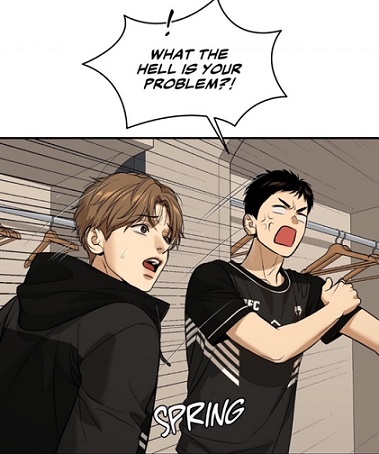 (Chapter 49) Not only he yelled, but also he protected his star by standing in the front line.
 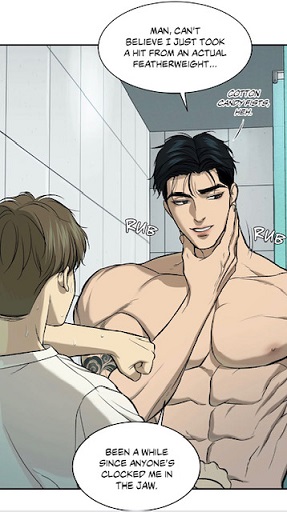 (Chapter 8) I noticed that the champion initially only listened to violence. It was, as if he had internalized this Nature’s law: the strongest prevails. No wonder why the champion didn’t react to Potato’s admiration so positively.
  (Chapter 23)
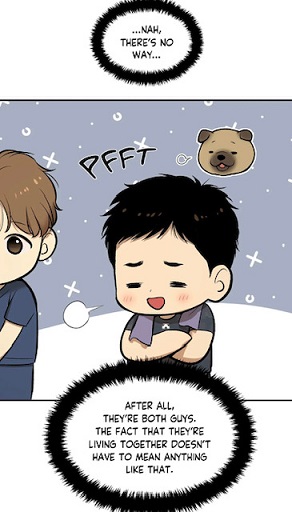 (chapter 23) Interesting is that she cut the chibi Kim Dan in half. Why? In my opinion, the main lead had not found his true self yet. She didn’t place any puppy above his head as well, because she wanted to keep her readers in the dark. However, let’s not forget that a puppy will recognize another puppy much more easily. Therefore Potato felt jealous and resentful first.
  (chapter 25) It is relevant, because the maknae was acting like a sunbae and not like a junior. He was given responsibility. His task was quite important compared to the coffee incident. With such a task, the cute puppy got to learn the importance of PT. This explicates why Potato always paid attention to the protagonist and his duties afterwards. Though Kim Dan had been constantly diminishing himself as physical therapist, in front of Potato he acted differently: meticulous, dedicated and caring. As you can see, this training session had huge repercussions for the chow chow.
 (chapter 26) He was following his heart and as such his instincts. That’s the reason why money was out of question.
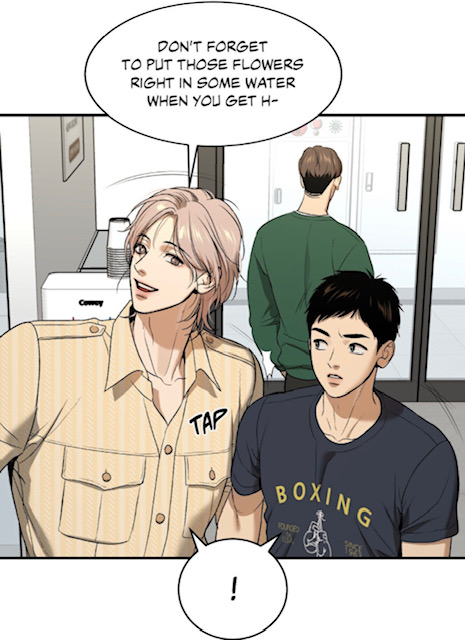 (chapter 31) Secondly, since Yoon-Gu is a dog, this signifies that he can not be bought with money or presents either. Hence he could only mistrust the artist’s generosity. It is important to recall that before meeting the “angel”, Heesung would simply offer meals
  (chapter 30) and not expensive stuff like designer clothes or electronics. So Potato was not wrong either to mistrust the actor first, for the latter was indeed expecting affection in return despite his claim. He did want to date the doctor, but the puppy knew that the protagonists were together. He represented a threat to his new found home.
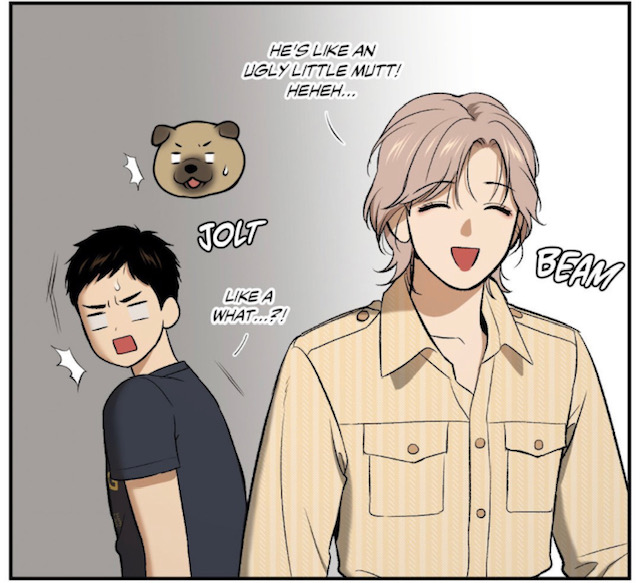 (chapter 31) Heesung described him as ugly, which is actually an insult. Note the contrast. Heesung is smiling despite his words. It is because he was voicing his annoyance at Potato. The latter represented a hindrance to his courting.
 (chapter 40), the former came to appreciate the doctor much more than before.
  (chapter 37) Besides, Yoon-Gu witnessed the effects of the drug
 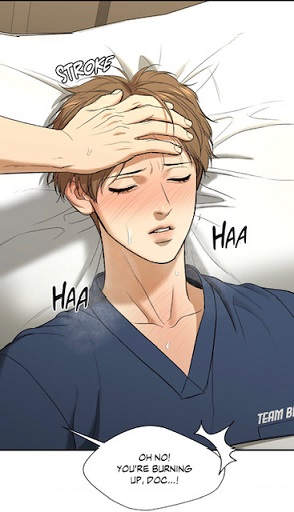 (chapter 38). Contrary to the other fighter, he touched his head. This gesture reminded me of a mother’s. And now, I know why Kim Dan saw Potato as a puppy.
 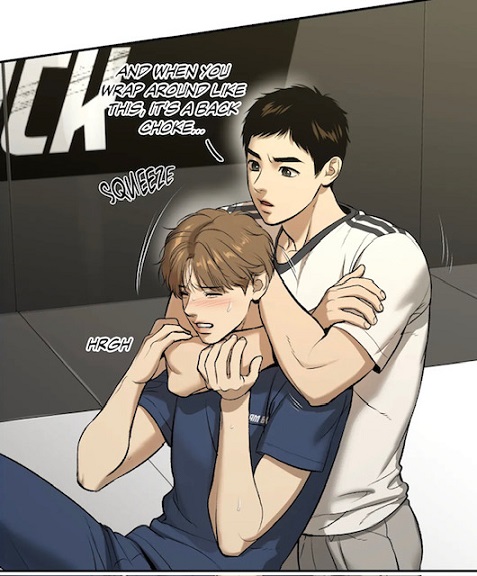 (chapter 25) On the other hand, Yoon-Gu lacks experiences, for he has never been exposed to the cruelty of this world, unlike Kim Dan or Joo Jaekyung. His fighting spirit is not developed yet.
 (Chapter 40) Therefore it is not surprising why after mentioning the incident with the MFC security guys to Park Namwook.
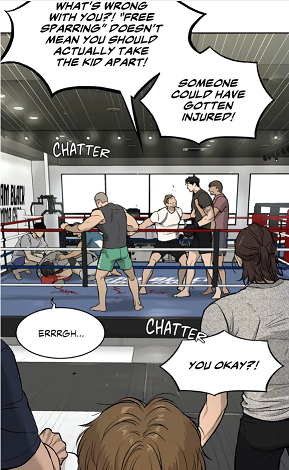 (chapter 1) and rudeness, for he didn’t criticize the athlete in the first episode or episode 7. In my eyes, the maknae lacks critical thinking. Nevertheless, we shouldn’t overlook that he followed the members’ behavior. No one from Team Black called Kim Dan and looked out for him. They all abandoned him after the match.
  (Chapter 49) and helped him. I have to admit that the way the main lead was holding his hand reminded me a little dog.
  (chapter 50) He was cheering him up! On the other hand, he still remained passive, and didn’t question the sunbaes like Park Namwook or Yosep. One thing is sure. After the last incident, he should have realized cheering someone is not truly loving someone. And this brings me to the other reason why Kim Dan was alone between 41 and 47. Yoon-Gu didn’t know doc Dan that well. He has no idea about his past and his actual situation. He can not expect the champion to act like in the States, as now the situation is different. He is already injured. Consequently, I am quite certain that it is also time for the semi-professional to reveal his true nature: he is a chow chow in verity! He sometimes acts more like a mother towards Kim Dan, though the latter is his hyung. Take the last panel as an example. Yoon-Gu is strong, extremely loyal and intelligent! His nickname Potato might be cute, but it doesn’t reflect his personality.
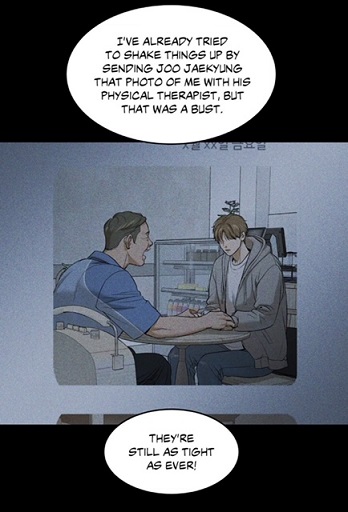 (Chapter 50) However, the doctor
 (chapter 47) was hiding his sadness and pain behind his job. How could Potato notice his suffering? Kim Dan never let his wounds transpire. Finally, we shouldn’t overlook the fact that Kim Dan never confided to the puppy dog as well. The protagonist has always been a loner, like we could see it in his memories.
 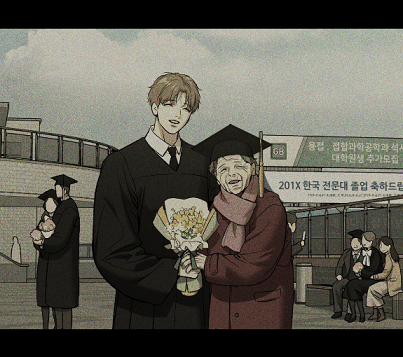 (Chapter 47) He never had a friend before, and Joo Jaekyung was more than a friend.
  (Chapter 21) He was first of all his boss and his landlord. Yoon-Gu is not connected to the main lead because of money. The foundation of their relationship is based on trust, care and respect. Thus I deduce that Potato is on his way to become not only his first true friend, but also his second stan. He might have noticed his angelic nature in the past
 (Chapter 33) Yes, through them, the dragon and the gumiho can become real friends. So far, they had been more frenemies. They know each other’s secret
  (Chapter 33) Thanks to him, the actor can drop all good manners and expose his true self. In the essay
  (chapter 44). He was telling him that he was doing a good job! One might say that he treated him like a little child. The second interpretation is that he was treating him like a pet. The dog was complimenting his lover, the wolf!
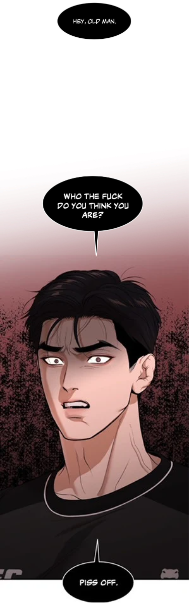 (chapter 49) Respecting the elders! For me, Kim Dan will see red, when he hears the truth about the incident. From that moment on, he will start questioning not only seniors (manager Park Namwook), but also authorities (doctors).
  (chapter 1) Yes, he never exposed the truth. He didn’t even try to sue the man.
 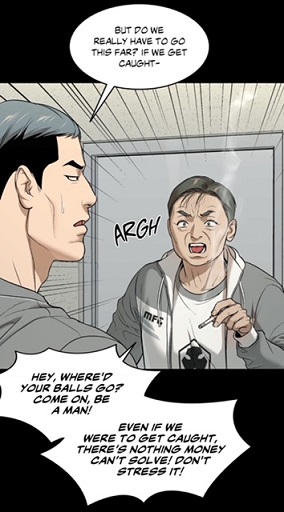 (chapter 50) Therefore he is safe. And how did the main lead describe the antagonist? As a crazy person!
  (chapter 42)
 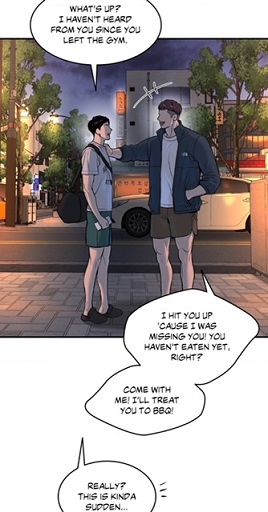 (chapter 52), at the end he chose to leave the restaurant on his own accord. Yes, he stopped being a follower of “herd mentality”.



 (chapter 22) Compare his reaction, when Oh Daehyun was talking about his penthouse
 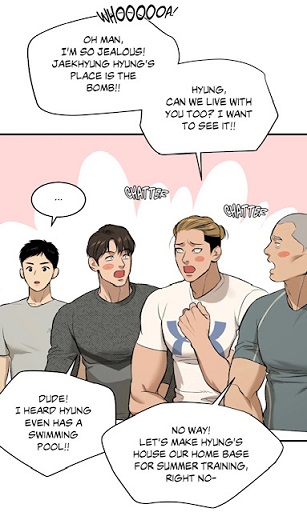 (chapter 22). The latter was silenced with a threat.
  (chapter 22) Then when Potato got rejected by his idol, Kim Dan felt the need to ask the young fighter why he was so upset. Therefore he left the office.
  (chapter 23)
  (chapter 23) A sign that he stands for connection and advice. Interesting is that right after, Joo Jaekyung listened to his sex partner in the treatment room.
  (chapter 24) Thus he gave a task to the maknae.
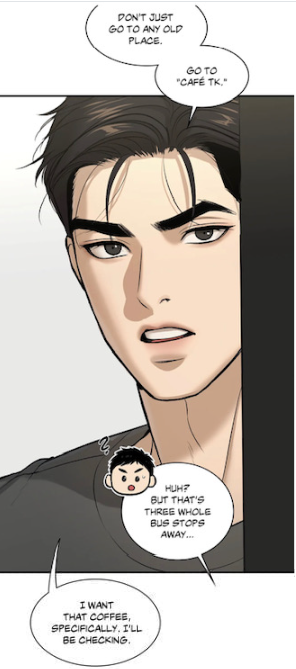 (chapter 24) And Jinx-philes will certainly recall what the pure fighter did during his task: he called Joo Jaekyung!
  (chapter 23) Another symbol for communication. He should voice about his desires. As you can see, his presence helped to improve the relationship between Kim Dan and his boss. Then the next morning, Potato also showed curiosity towards the physical therapist:
  (chapter 25) Once he heard Kim Dan’s intentions, he offered his help and while practicing, both men came to exchange their thoughts and emotions.
 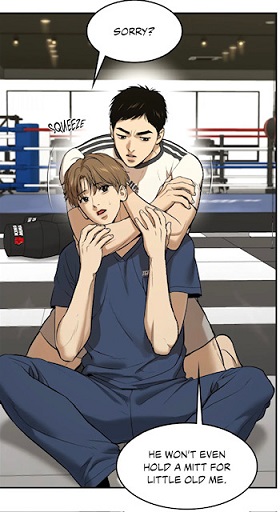 (chapter 25) This explicates why Joo Jaekyung came to propose the sparring to Kim Dan. We could say that Yoon-Gu’s presence gave the doctor’s courage to accept the challenge.
  (chapter 29) And now, you comprehend why the relationship between the main couple improved so much between 22 and 29, it is because of the lucky charm, the “Sardonyx chow-chow”! Thanks to his presence, he encouraged the main couple to communicate and to be more curious about each other. He stands for respect, responsibility and connection. Only through conversation, it is possible to get know someone. No wonder why he is so treasured by Team Black.
 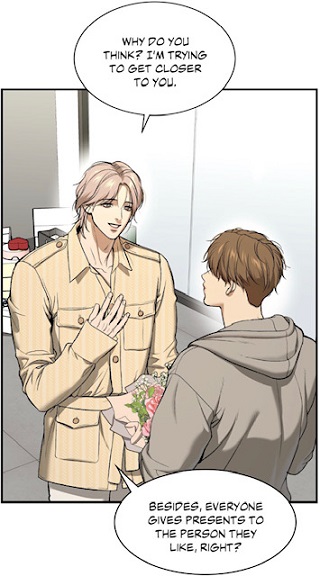 (chapter 31) He said that he didn’t expect anything from the doctor, but the reality is that he wanted to date him. So he had expectations. He was not direct with the physical therapist, as he initially didn’t know what he truly desired. He was just put under the charm of the angel. So what did he like in the physical therapist? His talent or his personality or his face?
 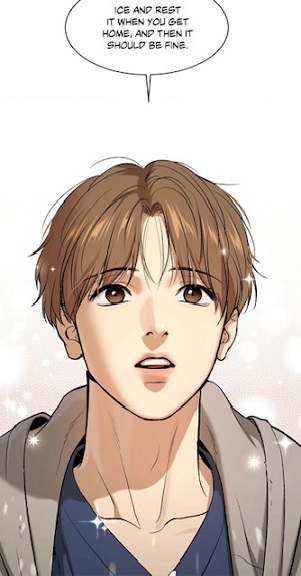 (chapter 30) Hence Kim Dan had problems to accept his appreciation as a fact. I don’t think, the artist was aware of the consequences of his behavior. Interesting is that after bumping into Potato
 (chapter 31) He was interested in the main lead romantically and sexually. We could say that the maknae pushed the comedian to meditate and to be more honest to himself. I would even say that he has a similar effect on the physical therapist, for the latter started pondering on the champion and himself.
  (chapter 36) The fact that he took over the youngest member’s task during that evening indicates his influence. The problem is that the Sardonyx was not present, therefore his dark thoughts couldn’t be pushed away. This scene reveals the hidden power of the gemstone. But there’s more to it. Mingwa created the positive reflection from that night in the States:
  (chapter 40) Once again, Potato helped the main lead to perceive the champion in a positive light. Soon after, he came to accept his feelings for the star. Under this new approach, it becomes comprehensible why after chapter 41, neither Kim Dan nor Joo Jaekyung talked to each other properly.
  (chapter 41)
 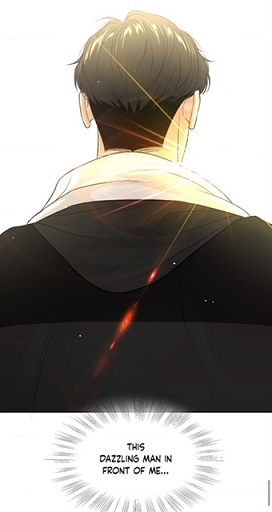 (chapter 40) Under this new light, it becomes comprehensible why the hamster accepted the harsh criticism from his employer in the penthouse.
  (chapter 47) thanks to him, one fighter spoke up and revealed his knowledge about Baek Junmin and the underground fighting ring.
 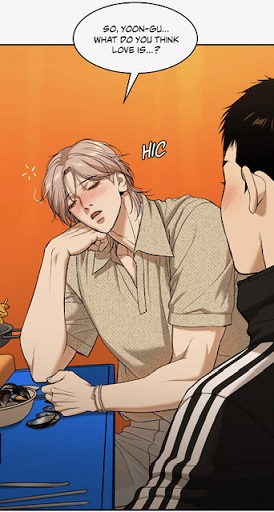 (chapter 35) His presence encouraged the comedian to question himself and his expectations. We could say that thanks to him, Heesung was incited to meditate and not to fall back into his old bad habits. Note that Heesung was actively listening to Potato’s words.
  (chapter 35) The shades corresponds to the gemstones onyx (black/white jacket), sard and sardonyx (brown-dark orange), then we have the Peridot (the green bottles of soju) and finally blue (Sapphire)! Under this new approach, my avid readers can sense why these characters were fated to fall for each other during that night. This was the power of the magical hidden gemstones.
  confronted him with the truth. He should admit to himself that he was sexually attracted to the celebrity.
  (chapter 38) He was the one making the connection between the doctor’s sudden illness and the nutrition booster.
  (chapter 26) The red protection gear incited the athlete to see this sparring as a game, it helped him to rejuvenate and rediscover fun. Thus he was smiling.
 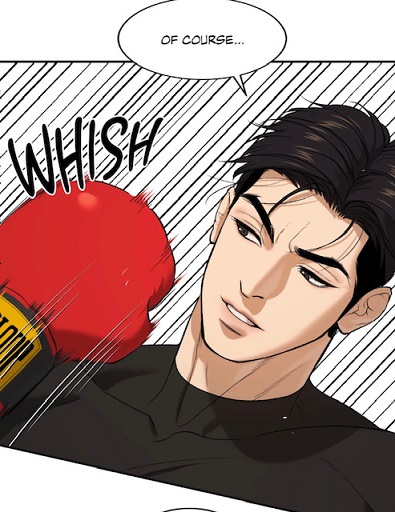 (chapter 26) But it had the same effect on Kim Dan. The latter was forced to overcome his trauma, the physical abuse from that terrible night with the loan shark.
  (chapter 25)
  (chapter 35) He could smile again and move on from his past failure. It encourages its wearer to embrace life’s challenges with courage and determination, knowing that they possess the inner strength to overcome any obstacle and emerge victorious in the end. My avid readers can grasp why red spinel shares some similarities with Sardonyx: courage and strength.
  (chapter 45) This is a sign that the champion had liked that night, but exactly like doc Dan in the past, he chose to lie to himself out of fear. How is this related to Potato? Don’t forget that he was not present at the birthday party, but more importantly he was no longer acting as a supportive friend and confident. Because Yoon-Gu’s philosophy is not to intervene and to admire from afar, he is not realizing that he is actually abandoning Kim Dan and even Joo Jaekyung.
  (chapter 25) The latter had been repressing his homosexuality. I see some parallels between the two characters. Joo Jaekyung ‘s sexual orientation was strongly connected to his career. He could have sex with men, as it was his way to chase away bad luck. Thus I come to the following conclusion: the relationship between doc Dan and Joo Jaekyung can only improve, when Potato interacts with them. It will push him to accept his feelings for doc Dan. While the champion was jealous of him in the past
 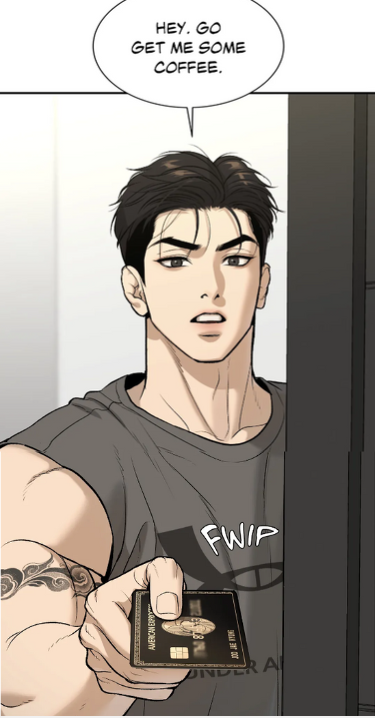 (chapter 24). Then he accepted the request from Doc Dan and announced to Potato that they would be sparring together from now on.
  (chapter 26). Finally, he was able to go to the States.
  (chapter 36) It was, as if the doctor’s presence had activated Yoon-Gu’s qualities from the Sardonyx and Red Spinel: lucky charm and communication. Note that in the States, Potato and Oh Daehyun made sure to deliver the incident with the drugged beverage to the coach and manager.
  (chapter 40) And now it’s time to examine Heesung’s gemstones: Diamond and Sapphire.
 (chapter 31), then the hospital and halmoni:
  (chapter 30) Because Choi Gilseok is connected to F Pharmaceuticals
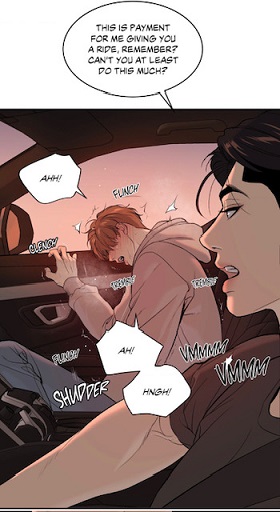 (chapter 33), aggressive
 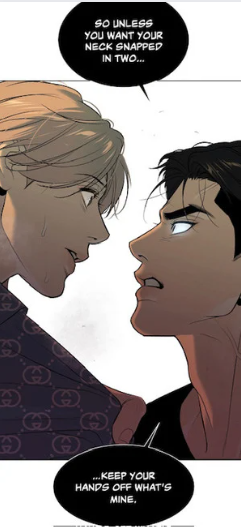 (chapter 34) Deep down, the champion could sense the negative effect the King gem had on him. No wonder why he desired to keep his distance from the actor.
 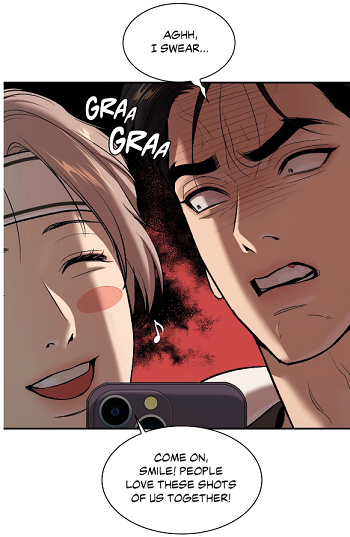 (chapter 30) At the same time, we shouldn’t forget that the pearl is described as the Queen gem next to King gem. So these titles imply a certain rivalry.
 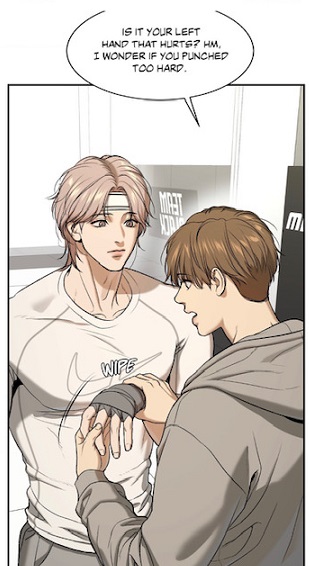 (chapter 30) the latter treated him like a human. He could sense that his offer was not motivated by greed or admiration, for he didn’t know him that well. He was just an uncut diamond. And how is the god Saturn alias Kin Dan connected to the diamond Heesung?
  (chapter 48) Thus I deduce that the moment Kim Dan gets the support and protection from Heesung, the former could indeed become the infamous “lord of karma”. So far, Kim Dan has not been even thinking that he could press charges against Kim Miseon.
  (chapter 48) The reason is that he views himself as powerless. But like I had already announced, Heesung is a trickster himself, therefore he can perceive the deceptive nature of humans. This corrupt doctor could get into trouble because of the actor.
  (chapter 48) Kim Dan as Shani Dev was pushing away evil spirits, but at his own expense. Moreover, this signify that the alliance between Heesung and Kim Dan will bring bad luck to the schemers… as Heesung is the sapphire giving power to Kim Dan. Furthermore, the myth of Shani Dev made me realize why there is no “family” and love in the penthouse. Kim Dan needs to receive the support from Potato and Heesung, because their assistance would boost his self-confidence. Since the maknae represents courage and strength, I believe that his influence will rub off on the comedian too. But because Shani Dev symbolizes karmic justice, people came to view him as a god of misfortune.
 (chapter 31) It was not his right to intervene in the doctor’s business. The protagonist is actually a free-lancer. Hence he should be the one to select his clients. This shows that as long as the athlete doesn’t consider the comedian as a friend and supporter, he will never achieve his goal. He needs to value human relationships and see people as precious gems and not everyone as a rival and source of danger. On the other hand, I would like my avid readers to keep in mind that Joo JAekyung still remained silent, when he discovered that the comedian had tricked him.
  (chapter 35) In ancient times, travelers would often wear sapphire as a talisman for protection against illness and misfortune, seeking its benevolent energies to guide them on their journeys. The problem is that he was not present in the States, hence there is no ambiguity that if he came to hear about this incident, he would resent the athlete.
  (chapter 37) On the other hand, this description about Sapphire displays another similarity between the second leads. Both Heesung and Potato are associated with lucky charms and protection.
 (chapter 48) That’s the reason why I am more than ever convinced that the cheap trick played by Choi Gilseok will backfire on them. How so? The champion is not paying attention to Kim Dan, but to the other director. Moreover, keep in mind that Saturn, Shani Dev, is the lord of karma. Finally, we have a blue night… similar to the color of Sapphire

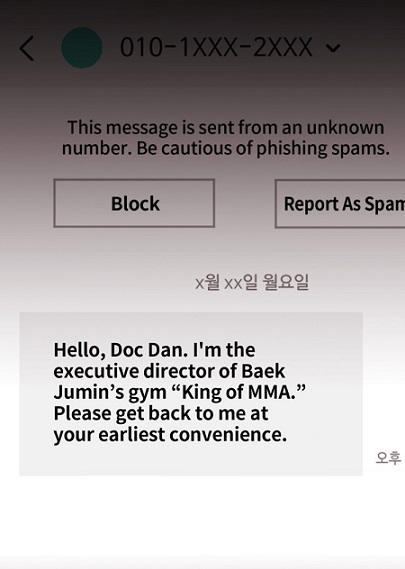 (chapter 47) Now, you are wondering why I decided to dedicate an essay about this scene. It is because the phone call and message raise a lot of questions. Why did the mysterious man call Kim Dan at such an early hour? Notice that it is in the morning, at 5. 15 am.
  (chapter 47)
  (chapter 47) The Spanish translator thought, the person calling Kim Dan was contacting him, after the doctor had met the oncologist. She imagined that not much time had passed. Yet, I believe, it is in the morning. First, it is important to place the day in the year. Since Joo Jaekyung’s birthday is on June 21st, and the next match is shortly after
 (chapter 47), I deduce that we are in July. However, the
 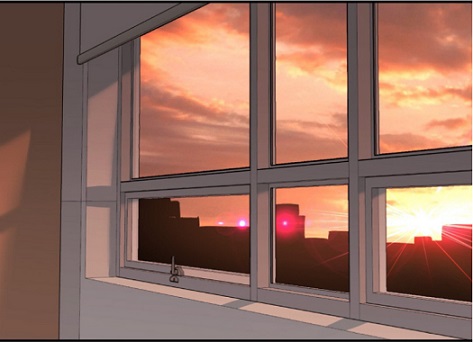 (chapter 47) It is in the morning. Moreover, the Webtoonist tipped off her avid readers with this panel:
  (chapter 47) In Korean, it is written MONDAY!! I had already detected a certain pattern. The protagonist would visit his grandmother on Sundays,
  (chapter 47), it was Saturday evening. Then the next day, he went to the hospital in order to get the results. After hearing the terrible news, he lost track of time. Hence he didn’t look at his cellphone contrary to episode 5.
 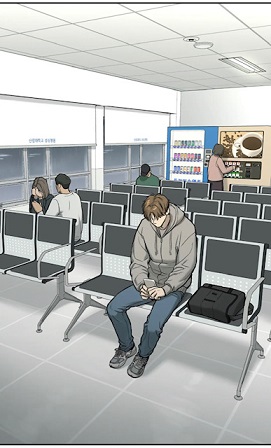 (chapter 5) On the other hand, I don’t think, he visited Shin Okja right after meeting Kim Miseon, for his grandma would have known that he had remained by her side the entire night. Nonetheless, her worries were about eating and not about lack of sleep.
 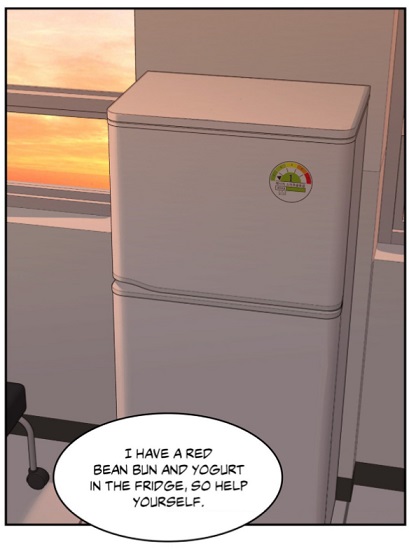 (chapter 47) Thus I come to the conclusion that he spent the whole night at the hospital like in episode 21:
 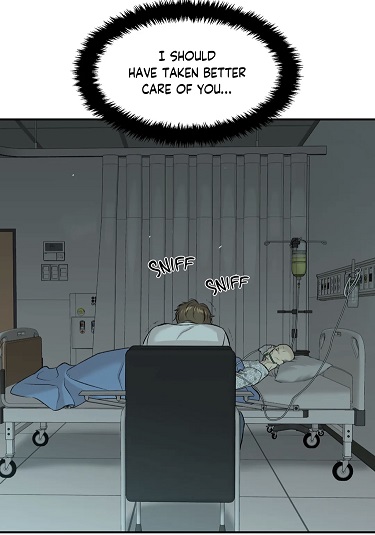 (chapter 21) This explains why the grandmother was not wearing her headgear. She was sleeping. But back then, Kim Dan returned to the penthouse at dawn.
 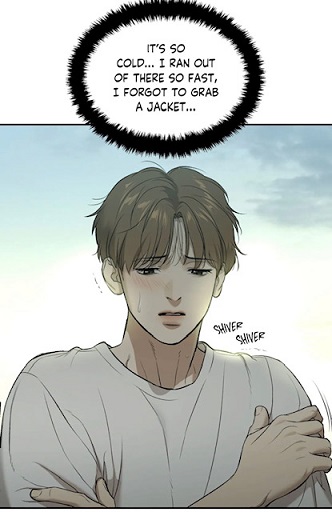 (chapter 21) Therefore the grandma didn’t notice that he had stayed by her side for quite some time, for she was asleep. Hence she requested his presence the next morning. Nonetheless, there exists another difference between chapter 47 and 21. In my eyes, Kim Dan entered her room during the night and spent some time in the bathroom.
  (chapter 47) He didn’t approach the bed the same way:
 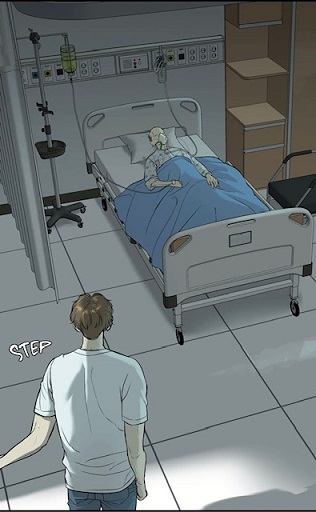 (chapter 21) However, I doubt that he spent just one hour in the restroom covering his tears by running the tap water.
 (chapter 3) Here, he was also sitting on the floor pondering if he should still accept the deal. And what had happened back then? The protagonist was lost in the moment, he had no notion of time because of his fears and social norms. As a first conclusion, Kim Dan spent a lot of time in the bathroom reliving the moment when he was receiving the bad news. This interpretation displays how much his grandmother’s imminent death devastated him. He had spent the entire night crying:
  (chapter 47) Therefore he had red eyes. Furthermore, the halmoni’s name is Shin Okja, and Shin can signify “morning, dawn and daybreak”. For me, it is no coincidence. First, it was her moment to shine due to her compassion.
 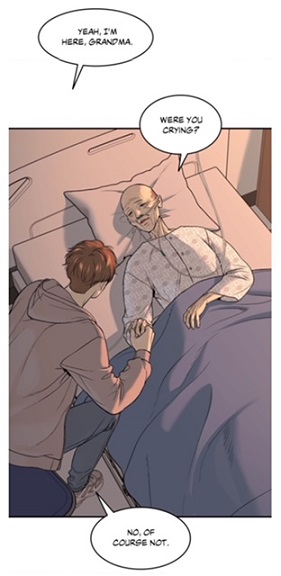 (chapter 47) In my eyes, this scene represents the positive reflection from that nightmare:
 (chapter 21) As a little boy, he had asked his grandmother to never leave his side, unaware that this meant that he should do the same. He should remain by her side too. Yet, he didn’t do it.
  (chapter 47) This observation made me realize another aspect. When he heard the diagnosis from Kim Miseon for the first time, he admitted his powerlessness.
  (chapter 47) He was in the bathroom crying and kept recalling the terrible monologue from the oncologist. He felt lost and trapped in the same moment. It felt like an eternity for him. But when he listened to his grandmother, bathed in the sunlight, it triggered his memory about his childhood with her.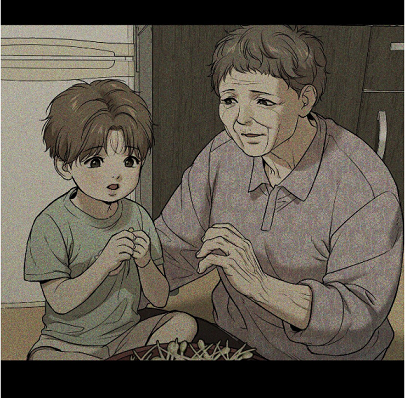
 (Chapter 47) Not only she had kept her promise, but also through this recollection, he got a notion of time again. We could say, he could feel time again. He sensed her true nature: her mortality. It is important, because of this new realization, he can move on and focus on the future in a long term. That’s the reason why I see this scene as a new leaf for both characters:
  (chapter 47) Shin Okja is no longer a goddess, a star during the night… but a human facing her mortality. Besides, the doctor focused too much on money, not realizing that goods are irrelevant in front of death.
  Yet, I can refute this point. How so? Note that the caller only let the phone ring 3 times:
  (chapter 47) Then he left a message. This stands in opposition to Joo Jaekyung’s action in episode 5:
  (chapter 5) The latter even spent about 23 minutes to reach the protagonist. He started calling at 10: 12 am and the next person he called was the MFC manager at 10:30 am. 12 + 23 times = 25 minutes. It means that for each call, he waited more than one minute before calling again. Another difference is that the athlete phoned him each hour: around 10 am, before around 9.00 am., hence I am assuming that he must have called around 8:00 am. This exposes the champion’s despair and huge desire!! However, he never tried to reach him at 5: 15 am. The director’s action appears as tactless and selfish. Since it was not an emergency, then why would he call the doctor so early? What was the point to act that way, when he left a message right immediately?
  (chapter 35) So what does the divergence display? I would say, the lack of seriousness and integrity from the executive director. Shim Yoon-Seok wished to appear as a serious reporter, though he was intruding in the champion’s private life. Don’t forget that the latter messaged Joo Jaekyung during the night, but he didn’t call him:
  (chapter 35) He desired to give the impression that he was a hard-working journalist. On the other hand, because he just sent a message, it indicates that the reporter wished to hide, to remain anonymous. In other words, he was hiding his identity behind a name. How so? It is because the champion could not hear his voice at all. Joo Jaekyung can not recognize the journalist contrary to this scene:
 (chapter 36) This divergence reveals that the executive director has a different approach than the reporter. The former seeks to „get close to Kim Dan“, while the journalist desired to avoid the famous fighter’s wrath. Shim Yoon-Seok anticipated his reaction. Therefore I have the feeling that the mysterious man contacted the physical therapist so early to create the illusion that it was urgent. They needed him. Interesting is that when the champion received the message from Shim Yoon-Seok, he never questioned how the reporter got his contact.
  (Chapter 35) Besides, I noticed that the text from the journalist was ambiguous, especially for the readers.
  (Chapter 35) The latter doesn’t claim to be the author of the article. He doesn’t employ the possessive pronoun „my“, then the column doesn’t expose the name of the author. And we have a similar situation with the message.
  (chapter 40) A fighter, a prostitute, a lover or a physical therapist? Another difference between the two texts (35 and 47) is that
 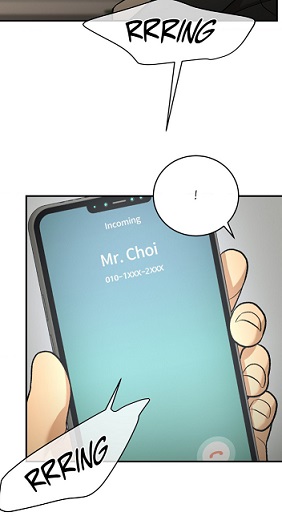 (chapter 46) And now, imagine the consequences, when Kim Dan or Joo Jaekyung reports the text as spam. Not only he doesn’t prevent the scammer from sending more texts to him, but it does let the authorities know as well that there’s a problem. Carriers might block the sender’s messages. Government bureaus might take action to prevent the scammer from messaging other cellphone users.
  (Chapter 46) And remember that Mr. Choi used this cellphone to contact his underling, a sign that their relationship was not official and should remain a secret. Hence if the line got cut, then Heo Manwook and Mr. Choi would be forced to meet. As you can imagine, the moment I discovered the connection between „carrier“ and „spam“, I couldn‘t help myself thinking that Mr. Choi might have received the CV from the courier company!!
 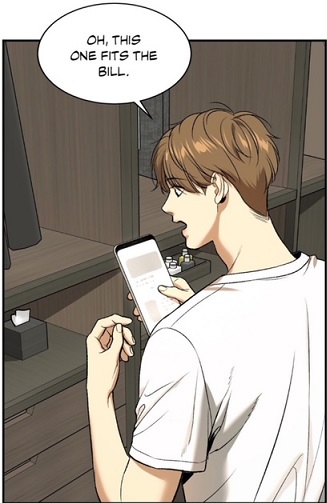 (Chapter 42) Yes, we have here a text on a cellphone too. Therefore I couldn‘t help myself laughing!! Why? It is because I believe that the schemers are thinking that Kim Dan is a member of Team Black, a fighter, and he is Joo Jaekyung‘s protégé. My reasoning is the following: since my hypothesis is that he got the doctor‘s curriculum vitae through the courier enterprise
  (chapter 42) Remember my previous interpretation: the anonymous person had discovered a secret, but back then it was difficult to determine the secret.
 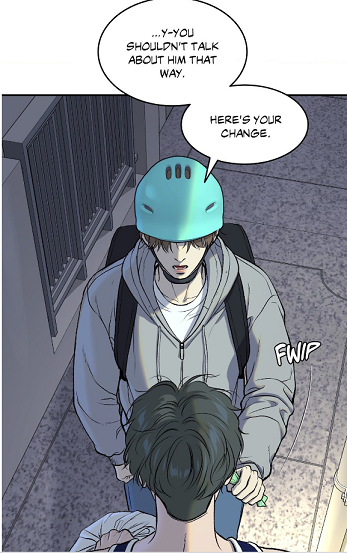 (Chapter 42) First, I thought that they knew that Kim Dan was probably his „sex partner“ as a fan, as he didn‘t object to this statement
  (chapter 42) But note that Kim Dan had protected the champion’s name and reputation first. Hence my idea is that in the mind of the anonymous observer, Kim Dan might have been left speechless for a different reason. He was described as a parasite, for he was using Joo Jaekyung‘s care and talent to become himself a professional MMA fighter!! In other words, they are mistaking him for Potato. And now, you comprehend why I added the green fox in the illustration:
  They are trying to snatch away the favorite athlete from Team Black in order to destabilize Joo Jaekyung mentally
  He is addressed as Kim Dan, and @joojaedan told me that he got addressed the same way than the fighter and Joo Jaekyung would call him. I have to admit that I let the app Deepl translate the Korean version. This is what I got:
 (Chapter 36) Moreover, this signifies that Baek Junmin is presented as the owner of the gym
  (chapter 47), as he is the face of that gym. In reality, he is just the cover, whereas the true owner is the mysterious sender of the text.
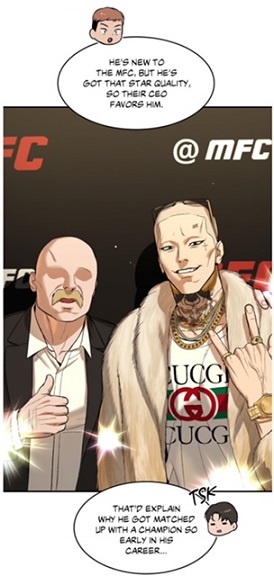 (Chapter 47) This signifies that he is acting like Park Manwook
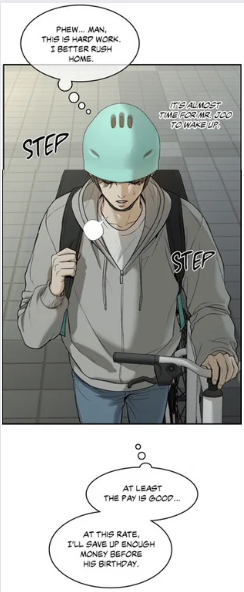 (chapter 42) He let it ring three times before texting him in order to catch the doctor’s attention, to distinguish himself from the previous calls (for his job). If so, then Mr. Choi must believe that Kim Dan is being “exploited” by the athlete. Hence the doctor would look so unhappy, when he is alone. In other words, the pictures taken in secrecy would expose the hypocrisy of the celebrity towards the main lead.
 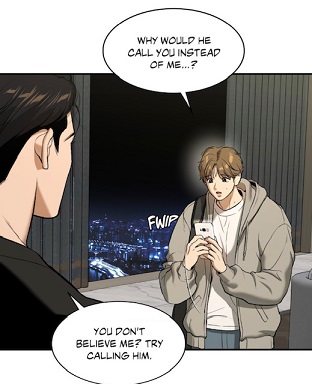 (Chapter 34) He should CALL him… a sign that the champion had not called anyone. Since Mingwa is writing like Byeonduck, I have the feeling that the message from Mr. Choi will be discovered by Joo Jaekyung. Remember how his hyungs had warned him
 Kim Dan saw the calls, but he ignored them.
  It was another emergency call, for he needed to leave the place within a week. Interesting is that the person didn’t present himself. No name… As you already know, I am suspecting that the doctor got fooled, for I doubt he ever received any compensation for his move. He should have received money. Emergency, rejection, manipulation, interruption and spying (Heo Manwook interrogated the doctor right after)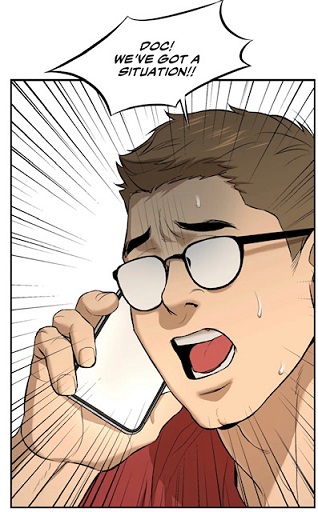


 Sex, interruption, „emergency“, as the champion didn‘t take off his shoes and put down his bag. Then during the intercourse, the doctor was called by the hospital
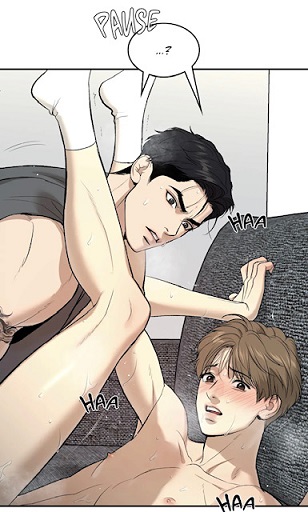 Sex, interruption (food), secrecy, manipulation, ignorance and spying. Potato had tried to listen to their conversation.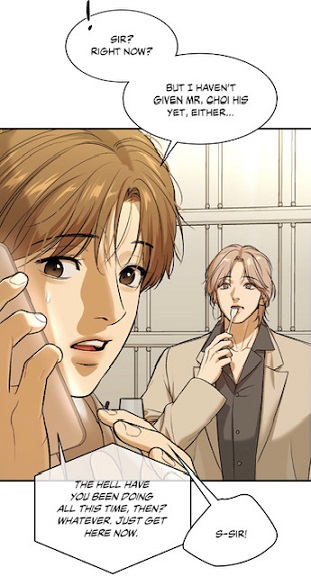
 (Chapter 40) He has no idea that Kim Dan became the victim and got framed later.
  (Chapter 46) Furthermore, since Heo Manwook was the one who hired this man
  (Chapter 47) The MMA fighter could have been asked to fake an injury, similar to Heesung‘s plot. As for Kim Dan, his task would be to „target his shoulder, his weak point“. Another possibility is to expose his vulnerabilities. One thing is sure: their approach will fail, hence they will propose the deal to Seonho.
  (Chapter 47) And the latter has a reason to get revenge on the celebrity because the suffered humiliation and beating.
  (Chapter 46) What caught my attention is that this athlete definitely boosted his situation by advertising that he was the champion’s sparring partner. I doubt that the main lead‘s criticism was unfounded.
 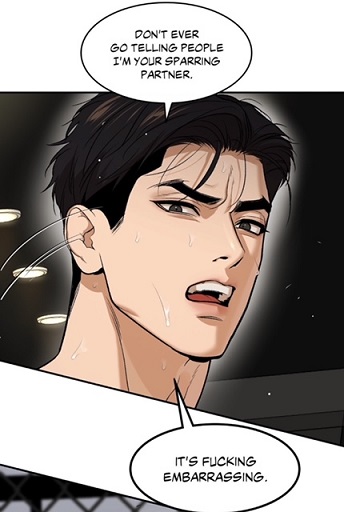 (Chapter 46), for he had been bragging about his merits.
 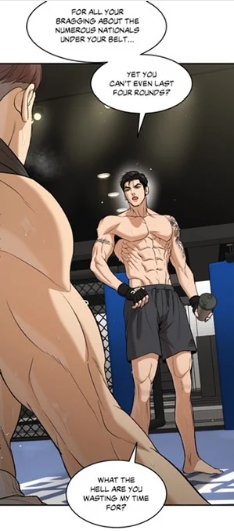 (Chapter 46) By the way, I believe, Seonho was a recent recruit. Therefore he doesn‘t know the champion that well and he is not close to the other fighters. Hence they didn‘t protect him
 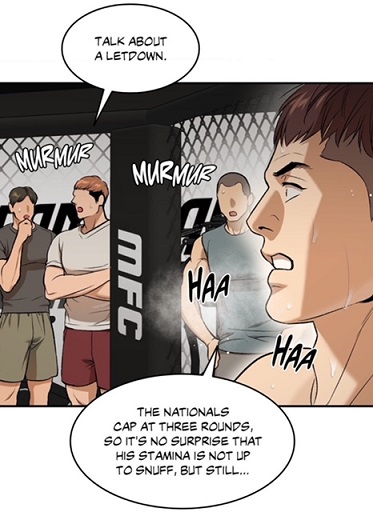 (Chapter 46) like in episode 1
  (Chapter 46)
  (chapter 42) On the other hand, since I am predicting a failure of their scheme, they could decide to take revenge on Seonho by sending him to an illegal fighting game, where he could get badly injured. Moreover, the moment they discover how weak the red-haired man is, they could jump to the impression that Seonho deceived them!!
 (chapter 46) I had even truly perceived his motivations:
  (chapter 46) He desired to get revenge on the celebrity. But from my point of view, there exist other reasons for his trick. He was seeking validation for his statement:
  (chapter 17) Such fights are fake. The irony was that his perception got discredited once again. And now, we know why he thought like this. He is involved with the underground sports gamblers.
  (Chapter 46) His computer screen is indicating that Heo Manwook is gambling himself.
  (Chapter 46)
 (chapter 16) And this raises the following question again.
  (chapter 17) To which account did the champion send the money? Heo Manwook’s or a different one? If this is the second case, this signifies that Heo Manwook has been embezzling money from Mr. Choi through the poor physical therapist. The latter was sending the money to his personal account.
  (chapter 16) This would explain why Heo Manwook would harass the main lead, though he had paid the interests on time.
  (chapter 11) It is because the doctor had paid a huge amount making it impossible for the loan shark to filch it. And now take a closer look at the infuriated thug: he employed the expression “laundering money”! He was projecting his own fears onto Kim Dan. For me, this scene exposes the true nature between Mr. Choi and Heo Manwook. He is laundering money for Mr. Choi. This explicates why their work relations is not official, as they are engaged in illegal activities. Thus their labor relations can not be known to others. On the other hand, if the champion paid the loan to the same account
  (chapter 45) Yes, the negative reflection from the physical therapist’s. So should the broker indeed have embezzled money, that would be the end between him and Mr Choi. He would be abandoned. However, since my assumption is that the moneylender is laundering money for Mr. Choi, it signifies that the latter is dependent on him as well. However, he could choose to replace him. We could detect through the years that the thugs were switched.
  (Chapter 5)
 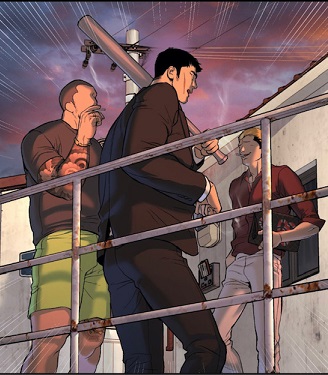 (chapter 1) Thus I come to the following conclusion: We are assisting to the gradual disintegration of their secret relationship. I am already envisaging that Heo Manwook could end up not only losing Mr. Choi’s favor, but also getting switched by this man.
  (Chapter 46) The sum reflects the faith he had in Heo Manwook. Yet, the conversation displays the increasing mistrust between them. Note that the usurer is not taking responsibility for the failure of his scheme: „on their end“.
 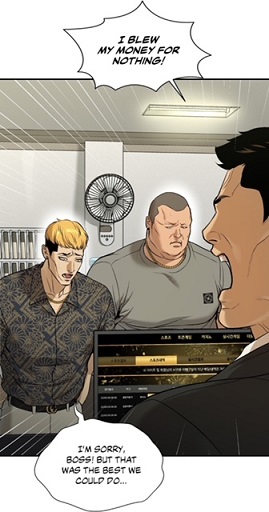 (chapter 46). Secondly, since Mr. Choi is now taking the matter into his own hands, this signifies that the criminal won’t be involved in the next scheme, so he won‘t gain anything.
 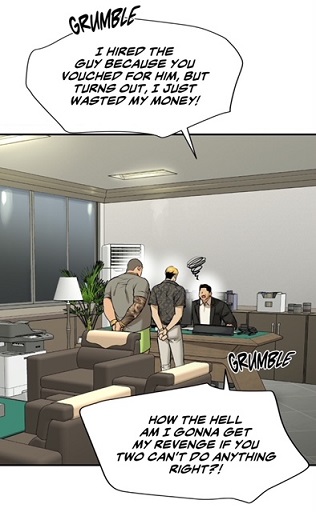 (chapter 46) That’s the reason why the thug had hired the man himself. This confirms that this man
 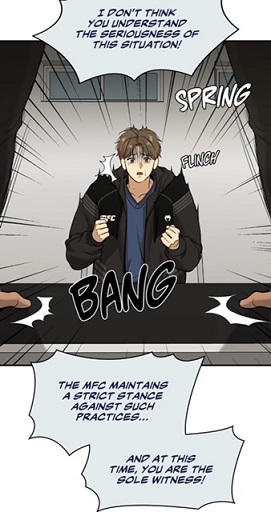 (chapter 40). How so? It is because Heo Manwook doesn’t explain how the plot failed!!
 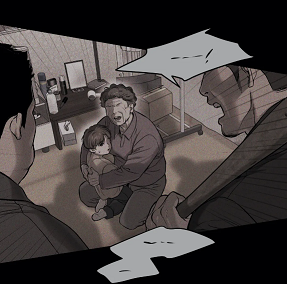 (chapter 5), thus I doubt that Mr. Choi is aware of the connection between the physical therapist and Heo Manwook. The curriculum vitae sent to him certainly doesn’t contain any information about Kim Dan’s past financial situation.
 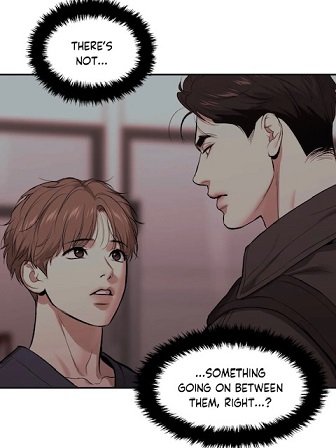 (chapter 23) Back then, he initially denied the existence of intimacy between them, until he was confronted with reality.
 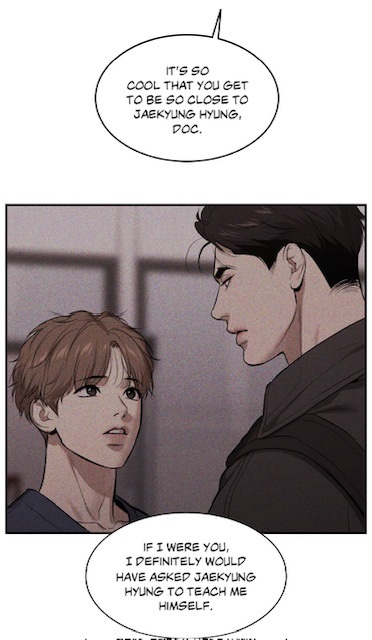 (chapter 25) Thus from my point of view, Mr. Choi must have come to a different perception than the maknae:
  (chapter 37) However, the man with the cap couldn’t determine Kim Dan’s true identity based on his uniform. Who was he exactly? A fighter? Or a coach? He could jump to the false conclusion that it is an uniform for the members of Team Black and not for the physical therapist. The unknown man could only recognize him by his face and hair. That’s how he got denunciated to the MFC security guys
  (chapter 40) Therefore you comprehend why the “fake” agents for order tried to determine his identity.
  (chapter 16) Thus there’s a high chance that they will try to ruin the champion by tarnishing his company. It is a hidden brothel. Imagine Park Manwook’s reaction, when he gets to hear that his gym is a whorehouse.
 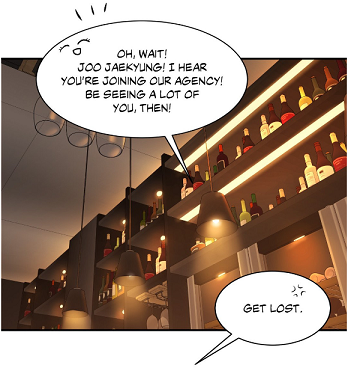 (chapter 33) He employed the personal pronoun “our” (even in the Korean version), a sign that he was identifying himself with the owner. From my point of view, Mr Choi and Choi Heesung are related, I would even say father and son. I know, when I presented my theory on X, people argued about this, for in South Korea, Choi is a common surname, just like Kim Miseon is not related to Kim Dan.
  (Chapter 5) Yet, I can refute their objections with the following points. Jinx is about emancipation and maturity, the leads are encouraged to become responsible and mature men. This signifies that they need to cut off ties with their parents and become strong mentally and emotionally.
 (chapter 29) Note that the comedian is promoting himself with Heesung and not his surname.
  (chapter 30) It was, as if he didn’t want to be connected to this Mr. Choi. Moreover, contrary to the mysterious director, readers could see his face and identify his “job”: an actor!
  (chapter 29) Yes, the Webtoonist introduced the actor the opposite way. However, in this scene, Jinx-Philes were intrigued by him, as they had no way to determine his role in the story: antagonist or second lead? His personality was quite mysterious which stands in opposition to Mr. Choi. Readers can already judge him as a bad guy. The latter oozes ruthlessness, greed and dishonesty. His words are represented by the color “dark grey”.
  (chapter 31) The latter hates conventions, discipline and even control.
  (chapter 29)
  (Chapter 31) As you can see, I sense that Heesung had an ambivalent relationship with his „father“. On the one hand, he rejects him due to his cold-heartedness and high expectations, on the other hand, he was still relying on him and his connections through the agency. In my eyes, he will be forced to choose between love or money in the end.
  (chapter 33) This was the “stalker” working on Mr. Choi’s account. So it dawned on me that Heesung might have been living with his father in the huge building
 (chapter 32), until he chose to move out and live on his own. And now, we have the perfect explanation why his house is so clean and impersonal:
  (chapter 33) It is because his father probably meddled in his life constantly. I have the impression that he must know about his father’s past and the true origin of their wealth. The fact that he introduces himself as “Heesung” is a sign that he wants to deny his origins, Choi.
 The house stands for power and propriety. But Choi has another signification.
 (chapter 43) The package arrived right on time.
 , (chapter 36), he must have wagered too and lost money. This would explain why he asked the doctor from MFC to give it a go right after. He needed to create a new game in order to cover up the last losses. The problem is that since Mr. Choi wasn’t informed about the incident with the security guys from MFC, I don’t think, he is truly aware of the celebrity’s physical conditions. If he knew about the real diagnosis, he wouldn’t need to investigate Kim Dan. He would rely on time… within such a short time, Joo Jaekyung wouldn’t be able to recover. In fact, he would even bet on the athlete’s defeat once again. Since he saw these pictures, I am quite certain that he is misjudging the relationship between the two protagonists. They are close, hence he needs to sow discord and even plant a seed of doubts on the athlete’s mind.
 (chapter 36) Hence I am suspecting that one of Mr. Choi’s intentions is to portray Kim Dan as a fraud, as a bad and immoral PT. They could even question his skills and competences, for MFC authorized the fight and the champion is now no longer treated by the famous hospital. They could imply that the main lead isolated the athlete on purpose and even aggravated his injury. But like mentioned above, Mr. Choi only knows half of the story. He has no idea about the connection between Cheolmin and the athlete and the former assisted him. Besides, he judges the poor uke based on his prejudices and past experiences. Exactly like the loan shark, Mr. Choi is also projecting his own thoughts onto the doctor. If the latter sent his CV, it signifies that the CEO imagines that Kim Dan is ready to “betray” the champion. Yet, the doctor doesn’t resent the main lead. In addition, from my point of view, the mysterious “general” received the résumé through connections.

 (chapter 30) This woman, named Sihyun, is suffering from Dependent Personality Disorder. And the author of the Webtoon Doctor Frost called her story: “The tears of Princess Pyeonggang”. Due to her personality, she was linked to the famous “princess”. She would do everything for her companions, yet she kept getting dumped. What caught my attention is that both women defined themselves through their partner. Their ultimate goal in life is to assist them, to make the other happy or recognized. But how is it a problem?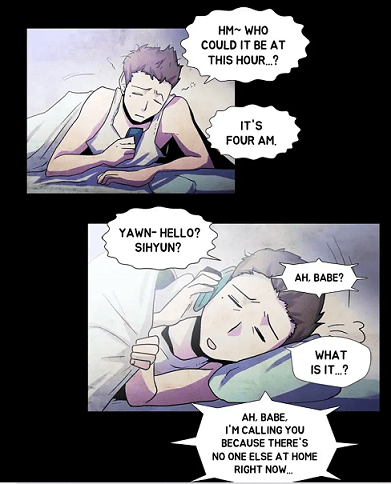
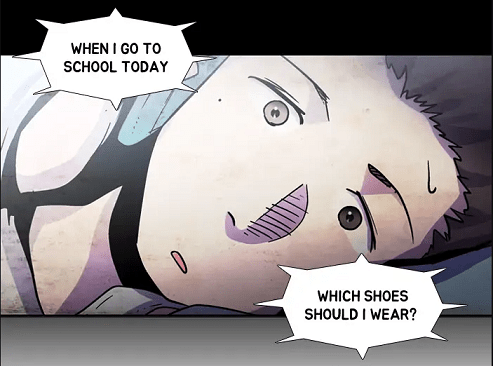
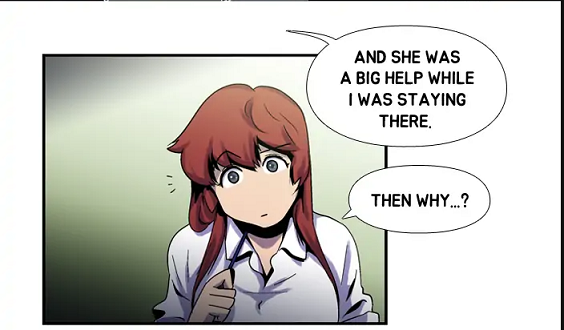
 (chapter 33) What appeared as caring turned out to be a load, for the partners were all forced to be responsible for her and in every aspect of her life. They definitely felt asphyxiated, hence they could only get sick of her. Interesting is that this person would find shortly after the separation a new boyfriend, a sign that she could not live on her own.
 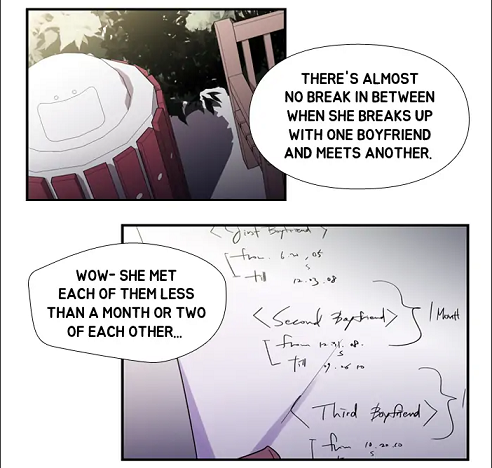 (chapter 33) And now, you are wondering how Sihyun is similar to Kim Dan, who only had one person in his life before he met the champion. It is related to traumas in their childhood.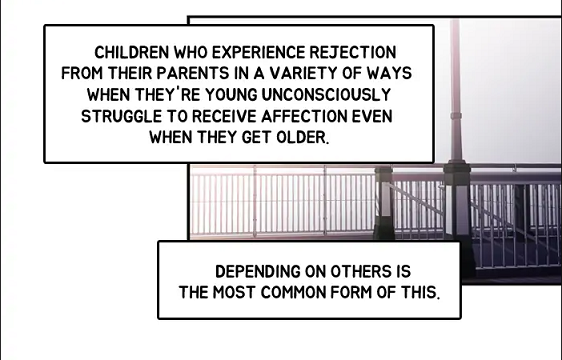

 (Doctor Frost, chapter 39) After reading this, Jinx-philes can realize that Kim Dan is also suffering from Dependent Personality Disorder, though it is less obvious. He got abandoned by his parents making him feel insecure.
 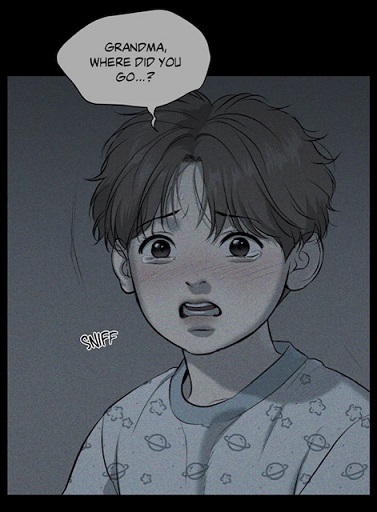 (chapter 21) We could detect his low self-esteem
  (chapter 46) and his overprotectiveness
  (chapter 42) on many occasions. He was risking his livelihood and health for the sake of others (his halmoni, Potato and Joo Jaekyung). His selflessness is actually the sign of his DPD. He had no purpose or ambition in his life… That’s why he is not able to project himself in the future. Until chapter 45, his life and future was determined by the celebrity,
  (chapter 42) and before it was by his halmoni’s fate.
  (chapter 19) However, here please don’t get me wrong. For me, the athlete is the physical therapist’s emancipator. This huge argument in the dining room pushed him to differentiate himself from the champion. In my eyes, Kim Dan would have returned to his old bad habits… relying on someone else, sacrificing himself for someone’s else sake. He would have neglected his career in the end.
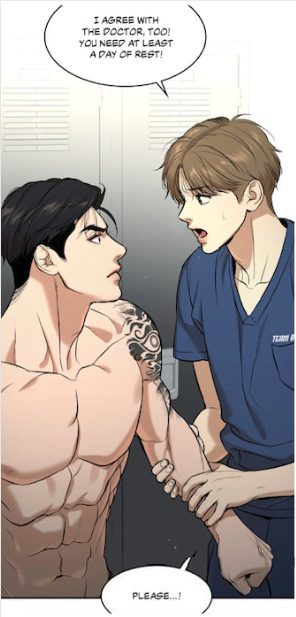 (chapter 27)
  (chapter 31) Here, we get an explanation why he couldn’t detect the trick from Choi Heesung. He feared to make a diagnosis on his own, as he didn’t desire to question the words from the comedian. The hospital seems to be the sacred place in the doctor’s eyes.
 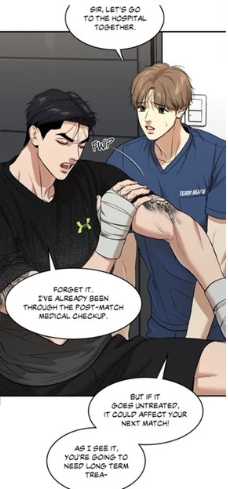 (chapter 41) There, nothing can go wrong. But by entrusting his patients to hospitals, he didn’t realize that he was appearing as untrustworthy or even “incompetent”. His lack of confidence and hesitation explicate why the athlete replied to his suggestion like this:
  (chapter 27) That’s how it dawned on me why the doctor reverted to his old habits (not participating to the meeting, taking odd jobs, not voicing his own judgment, relying on others) after the night, when he was treated as sex toy. However, in my eyes, the trigger for this switch was the release of the tabloid article.
  (chapter 27) It is because his self-esteem had been boosted by Dr. Lee. The latter had complimented him which didn’t fall on deaf ears. However, the relationship between the respectable hospital and the athlete went sour due to his article.
 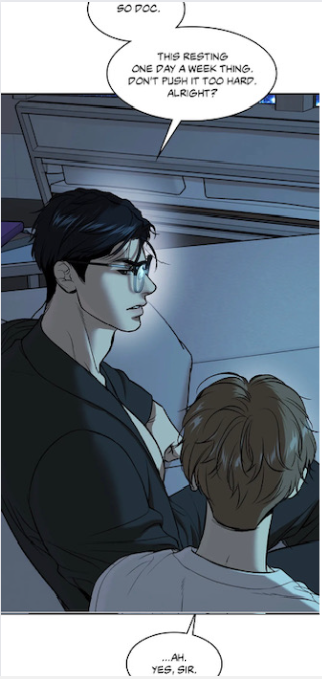 (chapter 29) Hence he jumped to the conclusion that his patient would not listen to him anyway.
  (chapter 46) It is full of symbolism. For the first time, he is standing on his own feet. His walk in direction to the trash bin illustrates his choice.
 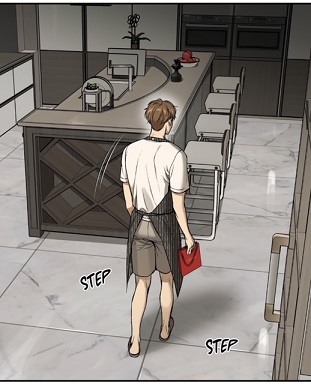 (chapter 46) Besides, he is using the personal pronoun “I”.
  (chapter 46) He was just a physical therapist and nothing more. This shows his lack of criticism. He is still not mentally strong enough to question the champion’s words and argue back. In the past, he could do it, for he was identifying himself with his grandmother and her values.
  (chapter 18) This signifies that he needs to develop his own philosophy and values. What does he treasure in his life?
 (chapter 42) The latter was also dependent on the champion, but his “addiction” was money and not love or recognition. Therefore he picked up the money before leaving the flat
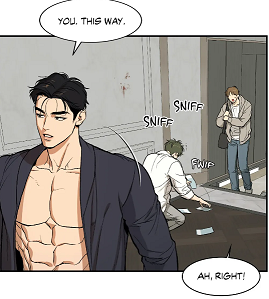 (chapter 2), while the other threw away the expensive keychain
  (chapter 46). This scene exposes the return of Kim Dan’s dignity. This comparison reinforces my interpretation that the champion misjudged the doctor’s present and actions. He imagined that Kim Dan had been acting like his “previous sex-partners” or stans. They would offer him some gifts in exchange of favors. Another contrast with the goblin is the absence of a fight and discussion.
 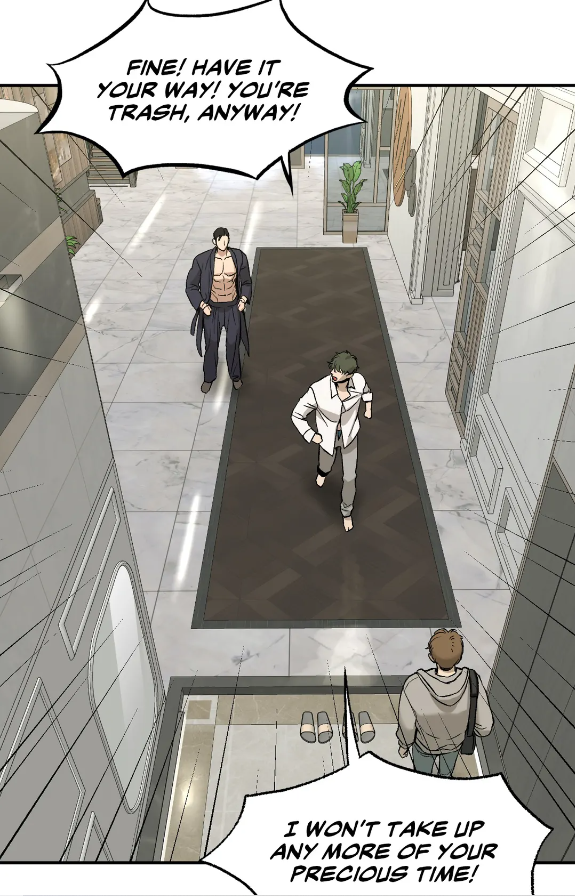 (chapter 2) I would even add that contrary to the green-haired guy, the doctor is not judging his patient’s personality, he is blaming himself.
  (Doctor Frost, chapter 32) Interesting is that doctor Frost revealed to her later that her condition made her an easy target, as she kept relying on others.
  (Doctor Frost, chapter 39) And this observation brings me to my next conclusion: he will be approached by really bad guys, the mysterious Mr. Choi!
  (chapter 45) is random, for it stands for “attachment”.
 (chapter 44) He found fulfilment in sex, which stands in opposition to the recommendation of zackbeach. Moreover, I would like to underline that the doctor reduced knowledge to sex:
 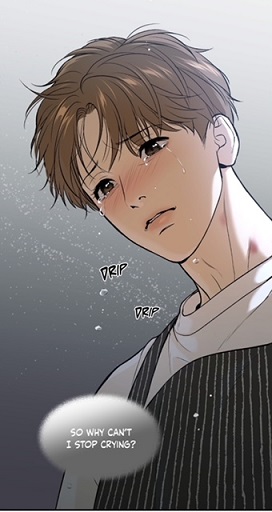 (chapter 46) He allows himself to cry, to grieve and to admit his pain and loneliness.
 (chapter 46) It helps him to face reality. He is on his own, he needs to stop relying on others. I would even say, he is encouraged to make decisions and as such to become responsible for his own life. It is important, because this means that he will have to fight back, if he wants to survive. He can not make any desperate and hasty decisions, like this one:
  (chapter 1) However, since he listened to the champion’s reproach and became submissive again, their relationship seems to have returned to normality. They even appear as close.
  (chapter 41) reminded me of the ending of a fairy tale: they lived happily ever after. But the doctor was forgetting that life doesn’t end after the match in the States. Life ends with death. In verity, the champion is destined to be challenged, until he retires. What the doctor saw was not the end. This exposes his naivety. How could he have such a view? It is influenced by his grandmother.
  (chapter 10) At no moment he pondered about himself. Happiness was never his goal, exactly like in fairy tales. Sleeping Beauty is rather passive. She sleeps, until the prince charming appears and kisses her. After that, they have kids. Interesting is that they don’t get married right away, so that the princess initially has the status of a mistress or concubine. Once the prince can secure his position, he marries her. Then the moment her husband leaves her side for war, she is tormented by her mother-in-law, the ogress. She can only escape death thanks to the intervention of her husband. We could say that happiness fell on her lap. Sleeping Beauty stands for passivity, dependence on her parents and husband and lack of critical thinking. Why? It is because the princess in fairy tales, in particular Sleeping Beauty, embodies toxic positivity.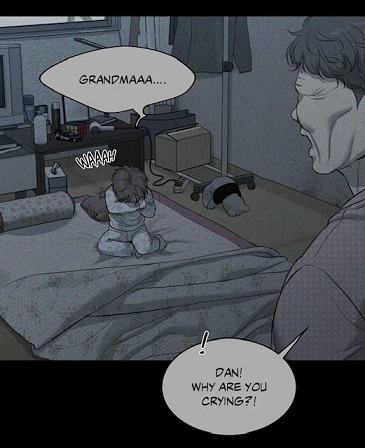

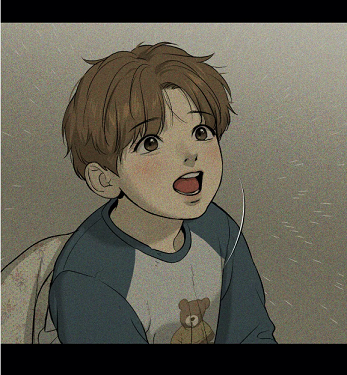
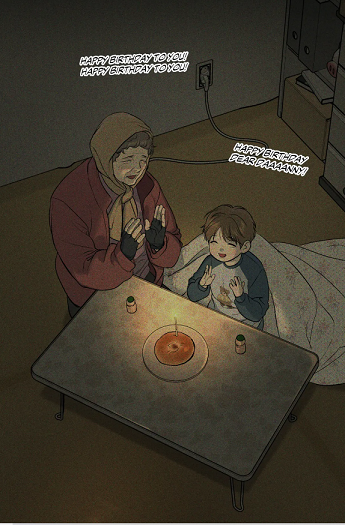 (chapter 11) Imagine that the grandmother had left the house without her grandchild. He was left behind in the house. Though she meant it well, for the child, this must have been a real torment, as he constantly feared to be abandoned. However, he knew that he was not allowed to cry or to complain. Hence when he saw her returning, he put a huge smile on his face. Moreover, this is what they had for dinner: a sweet bread and two yoghurts. The grandmother must have been hungry. Both acted, as if nothing was wrong.
  (chapter 45) With this contrast, the fear from the champion becomes more palpable. Joo Jaekyung got angry, for he had been put in the same situation. But the latter was never influenced by Toxic Positivity. Besides, he was fighting against his own inner demons. Nevertheless, this new interpretation of the birthday made me recognize why the author chose this chronology concerning Kim Dan’s past:
 (chapter 11), as he imagined that he could pay off the debts, he recalled his birthday. He had a nice “souvenir”… convincing himself that everything was fine. He would be able to do it, like his grandmother had told him.
 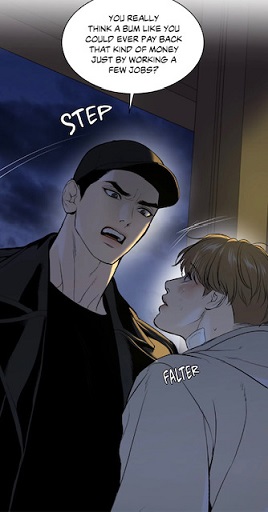 (chapter 18) Nevertheless, the moment he was forced to move out, he couldn’t help himself to recall how he got abandoned by his parents. And the moment he saw his halmoni fighting for her life, his abandonment issues resurfaced. Hence this terrible memory came through a nightmare. The betrayal from the parents is what had been deeply buried by the grandmother’s philosophy. The fact that the halmoni never allowed Kim Dan to talk about his parents and the circumstances of his arrival to the humble mansion, is the evidence of Toxic Positivity. In my eyes, the relative was already struggling herself, for she had also been left behind. But here it is important not to mix Toxic Positivity with Gaslighting.
 (chapter 12) Therefore I understand why the doctor didn’t fight back against Heo Manwook and his minions.
  (chapter 11) But the moneylender and his minions are no honest bankers, but criminals. They enjoy using their strength, that makes them feel powerful. It boosts their ego.


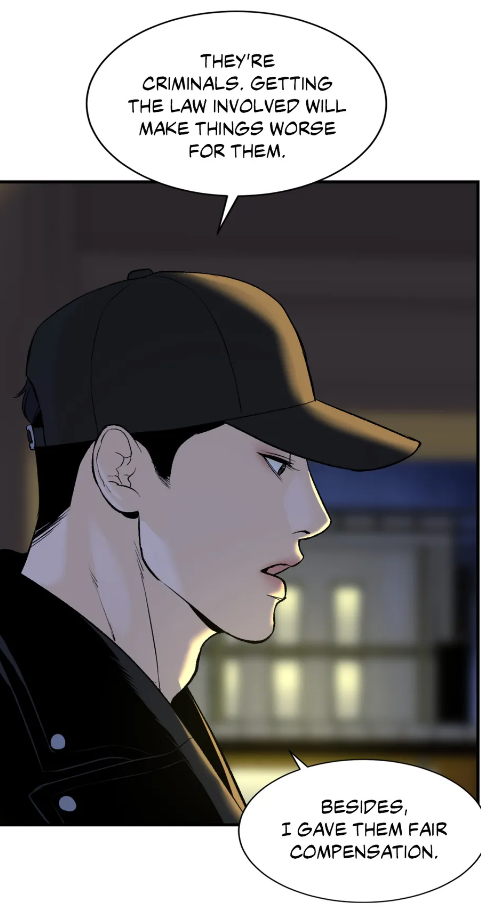 (chapter 18) The doctor is unaware of this, but one of his purposes in the champion’s life is to clean the scene, MFC and its corruption. On the other hand, the illustration contains many pictures of the two main leads having sex.
  Why? It is because the characters are acting like fighters. At bottom left, the doctor’s embrace resembles a lot to the one he used during the sparring (see the image in the middle). Their gestures are sudden and quite abrupt, which contrasts to the image on the right bottom. The kiss from the doctor holding Joo Jaekyung’s face represents the exception from all the selected panels. This shows that this Summer Night’s Dream indicates a huge transition in the sex sessions. But let’s return our attention to the images illustrating roughness. Right from the start I detected a strong connection between fighting and sex. [For more read
 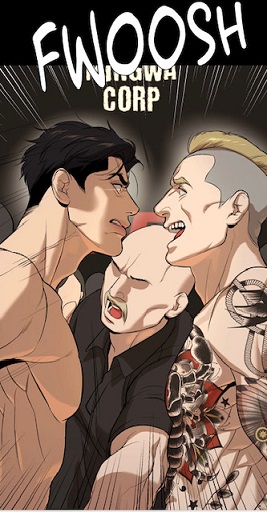 (chapter 14)
  (chapter 36)
 (chapter 29)
 (chapter 15) This means that if the fighter is on his own. He can not rely on others. If he is not able to return without the assistance of spectators or his seconds, he is declared as defeated. So we could say that any interruption is condemned, as it is ruining the flow of the fight.
 (chapter 15) Funny is that conversation is permitted, yet mouth gear hinders the fighters to talk. Should they remove it constantly, the referee can judge it as a violation (“Timidity”), for the fighters can not fight, as long as they don’t wear the mouthpiece. This signifies that the sportsmen are encouraged to express their thoughts through the hands.
  (chapter 15)
  (chapter 41) To conclude, while MMA fighting is a work, it is strongly intertwined with pleasure and entertainment. Their fight is witnessed by spectators in the arena or on TV.
  (chapter 12). The absence of kisses and caresses can be explained with the presence of mouthpiece and hand wraps in the ring. Moreover, in the arena, there is no warning up, therefore we have the explanation why the champion never included foreplay. On the other hand, the fellatio was used as the symbol for submission. The rival was always brought to his knees.
 (Chapter 6)
  (chapter 39) At the same time, it explains why the champion didn’t take the partner’s pleasure into consideration. It was a battle in bed, which was led by the protagonist. The latter was not only acting as MMA, but also as arbiter and MFC matchmaker. With his money, he could determine the time, the location and the duration.
 (chapter 5) Their gestures were seductive, a sign that they were not fearing the champion. The challenge was here the difference of weight. On the other hand, by approaching Joo Jaekyung, they looked confident about their skills. That’s the reason why he would have sex with them, until they passed out.
  (chapter 1)
  (chapter 4)
  (chapter 8)
  (chapter 12)
  (chapter 34)
  (chapter 36)
  (chapter 39). As Jinx-philes could observe, till the night in the States, the champion privileged to have sex from behind. How do we explain the difference and when did this change occur?
  (chapter 2) The champion’s ecstasy served as a measurement to view himself as victorious. This statement implies that he was not only the fighter, but also the arbiter. This corroborates my previous statement. During sex, he was the fighter and the referee. He acted as the MFC matchmaker.
 (chapter 43) In my opinion, during that night
  (chapter 2) The goblin might have not voiced his thoughts to the celebrity before, but Joo Jaekyung could perceive his soul through the gaze and facial expressions. Hence the star’s domination was quite superficial. In fact, as time passed on, the athlete could only get bored of the goblin.
  (chapter 42) It is because there was no challenge. The guy was accustomed to the champion’s roughness. Hence he never feared the star. He could only judge him as weak. Because Joo Jaekyung was missing the thrill, he came to look for the “wimp”! On the one hand, the latter would treat him with respect
 (chapter 1), on the other hand, he would cry and tremble in his presence. Then right after the session, he left the room in a hurry.
  (chapter 21) Then after facing Heesung, he stopped the intercourse too,
  (chapter 35) indicating that little by little, the champion’s mind-set was changing. At the same time, it exposes his hypocrisy. But why is he forced to accept the change of flow? It is because life is trying to teach the champion that he is not god, he is not the owner of time. This explicates why the star couldn’t determine the start of their “Wedding Night”, the doctor’s suggestion represented a new challenge.
  (chapter 3) He was defying the champion’s authority.
  (chapter 4) That’s the reason why the two main leads were sleeping under the cover. This explicates why he selected the doctor as his definitive partner. I also discovered another infringement during the “Wedding Night”: the champion refused to wear any protection during sex.
 (chapter 2) Let’s not forget that during a match, they are supposed wear a sex gear. Interesting is that he grabbed the doctor by the hair
  (chapter 4). It is important, as it represents a real transgression of MMA rules indicating how powerful the doctor was. The champion needed to break rules in order to get him. Funny is that he thought that after such a long night, he had been able to submit the cute hamster, but he was totally wrong. The latter chose to ignore him.
  (chapter 6) Under this new light, it becomes comprehensible why the athlete offered this deal to the physical therapist:
  (chapter 6) He was trying to regain the upper hand in their relationship. He wished to keep his position as the owner of time. But the problem is that despite this contract, he wasn’t able to control Kim Dan. The latter chose to approach Kim Changmin
  (chapter 7), while he kept his distance from the champion. This scene made him realize that he was still powerless.
  (Chapter 39) Hence I come to the conclusion that Kim Dan’s role in the champion’s life is to teach the champion that he doesn’t own time. The reason behind this lesson is simple. It is to show him how pointless it is to race against time.
  (chapter 12) or having sex in front of a mirror
  (chapter 32) I could mention other defies linked to sexuality, having sex without getting noticed, either in the shower room
  (chapter 8) or during a phone call
  (chapter 24). Then we have this bet concerning the doctor’s sensitivity.
  (chapter 29), thus the champion tried an experiment:
  (chapter 12) On the other hand, the athlete always met some resistance
 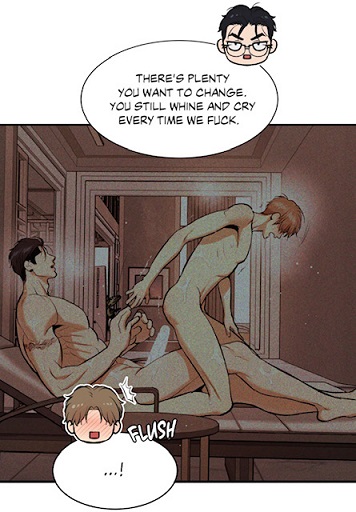 (chapter 27) Kim Dan would never agree to the champion’s requests immediately. They would fight about the time, location and position. Furthermore, note that Kim Dan went so far to punch the protagonist:
 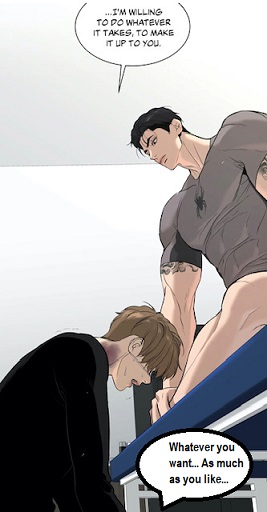 (chapter 11), yet the reality taught him a tough lesson. He got to hear something terrible:
  (chapter 12) With his words, he was telling the sportsman that he was a terrible lover. He denied any admiration for him. And since sex is a synonym for wrestling in Joo Jaekyung’s eyes, doc Dan’s declaration signified that his title as champion was questioned. Though the champion came to enjoy their intercourse
  (chapter 12), it was short-lived, as the doctor fainted after one round.
  (chapter 44) Why? It is because this sex session will have an impact in their work, MMA. During that night, they became real fuck buddies. Sex was not related to work and fighting. But why did the notion come to the surface for the sparring? It is because MMA fight consists of challenges, which implies consent. Striking is that so far the champion never rejected a challenge. Yes, Joo Jaekyung was put in the same situation than Kim Dan in the end, but the one putting under pressure was the MFC Matchmaker and naturally the agent from Entertainment agency. Don’t forget that both are earning money thanks to events. And how did the champion got convinced by them? “You think, you can do it?” With their words, they doubted his talents
  (chapter 36) or questioned his title:
  (chapter 12) And because the doctor never reacted the way the champion expected it, the latter was forced to infringe more and more MMA rules, like this one
  (grabbing the groins is forbidden). To conclude, the doctor is there to teach the champion to distinguish between love and fighting. This explicates why the physical therapist embodies violation of MMA rules. We have the perfect example in this scene:
 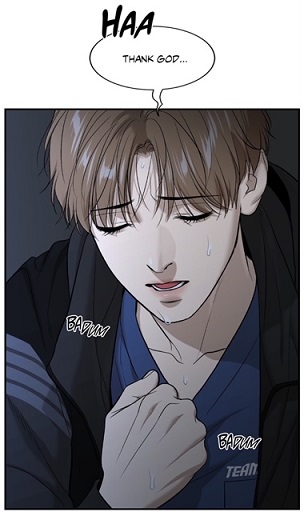 (chapter 40) This explicates why he was willing to risk his life for his sick grandmother.
 (chapter 36)
 (chapter 44) His gestures represent a transgression of MMA rules, as he had stretched his fingers towards the main lead’s face.
  (chapter 44) By taking the initiative, the physical therapist is teaching his “mentor” how to express love. Interesting is that during that scene, the athlete remained passive. It displays his consent and trust towards the doctor. He knows that the latter won’t hurt him. That’s how I realized that the kisses are strongly connected to consent. Let’s not forget that when Joo Jaekyung smooched the hamster for the first time, he took him by surprise. Because the latter felt uncomfortable, he made the following request:
 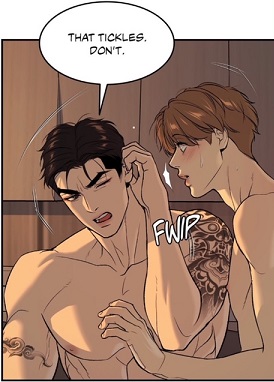 (chapter 44) Hence the physical therapist stopped. Consequently, I come to the deduction that the more they will kiss, the closer and the more respectful the protagonists will become, for the kiss symbolizes consent.
 (chapter 14) Then it was out of desire
  (chapter 24) and out of excitement and attraction.
  (chapter 15) In chapter 24, first it was from behind, but then it changed, as the star desired to see the hamster‘s erected phallus.
  (chapter 24) He wanted to make sure that the doctor would enjoy this break. Yet, what caught my attention is that in chapter 39, Kim Dan initiated the kisses and embraces, because this is what he likes.
  (chapter 39) Here, the athlete was caught by surprise, and protested, but he got silenced very quickly.
  (chapter 39) Finally, so far, it was not a ritual, hence we only had smooches in chapter 14, 24, 28 and 39. This signifies that Kim Dan is the one who will introduce kisses and embraces as rituals. Moreover, if someone were to kiss one of the protagonists, the other would view this gesture as a crime against his partner.
 (chapter 39) Therefore it becomes comprehensible why in the penthouse, he allowed his lover to approach his fingers towards his face.
  (chapter 44) He felt safe. This explicates why he could fall asleep so easily.
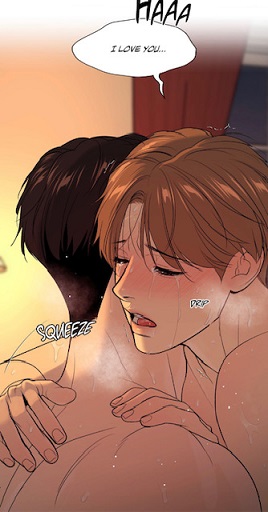 (chapter 39). On the other hand, since the doctor was under the influence of the drug, the champion couldn’t take the confession seriously. It is important that the champion doesn’t recognize the doctor’s feelings right away, for he needs to feel insecure. That way, he is pushed to change his behavior, to become more proactive and protective of Kim Dan. Hence I consider this Summer Night
  (chapter 44) contrasts so much to this one:
  (chapter 44), though the doctor had not sex in mind at all. He brought him there to rest. However, the presence of fighting has not vanished totally in episode 44:
  (chapter 44). Joo Jaekyung still provoked his lover
  (chapter 44), but the latter was able to reject his defy by asking a question. One might think that he did that out of habit. On the other hand, I believe that Joo Jaekyung doesn’t know his partner that well, hence he is bothered. He can never predict his actions and decisions. He was definitely worried about his recent change of behavior too. Moreover, note that Kim Dan was the one leading the intercourse, for he determined the time flow:
  (Chapter 44)
  (chapter 44) It shows that the power is shifting, Kim Dan is slwoly getting the upper hand in their relationship. He can control time and place.
  (chapter 27) But he got rejected by Kim Dan back then, because the physical therapist considered sexuality as shameful. As you can see, the doctor’s actions are changing the champion’s perception of sex. It is no longer fighting, but resting. On the other hand, the doctor can seize the occasion to express his love through his caresses and kisses. At the same time, he could use it as a treatment for his insomnia.
 (chapter 4)
  (chapter 10)
 (chapter 42)
 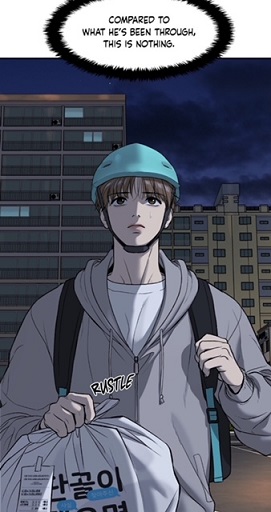 (chapter 42) Interesting is that the champion was also thinking a lot about the main lead, as the latter was worried by his exhaustion and his lack of appetite.
 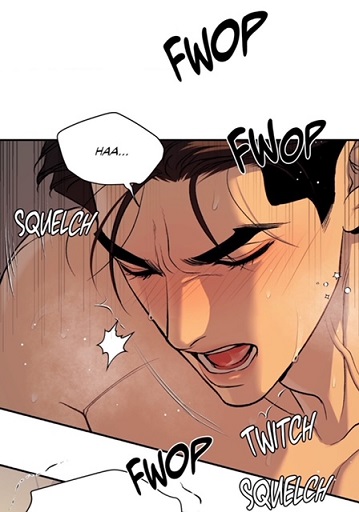 (chapter 44) See the contrast to the night on the couch:
  (chapter 29) Contrary to the past
  (chapter 4) Joo Jaekyung is not hiding his pleasure. He is moaning loudly, as he has his mouth wide open. It exposes once again the increasing trust in Kim Dan. He no longer mistrusts him, in his eyes, he is no longer a prostitute. That’s how the doctor won the champion’ s heart. Now, his heart is truly beating for the doctor. Little by little, the hamster is taming the wolf. The latter needs to recognize that by loving the doctor, he will become powerful.
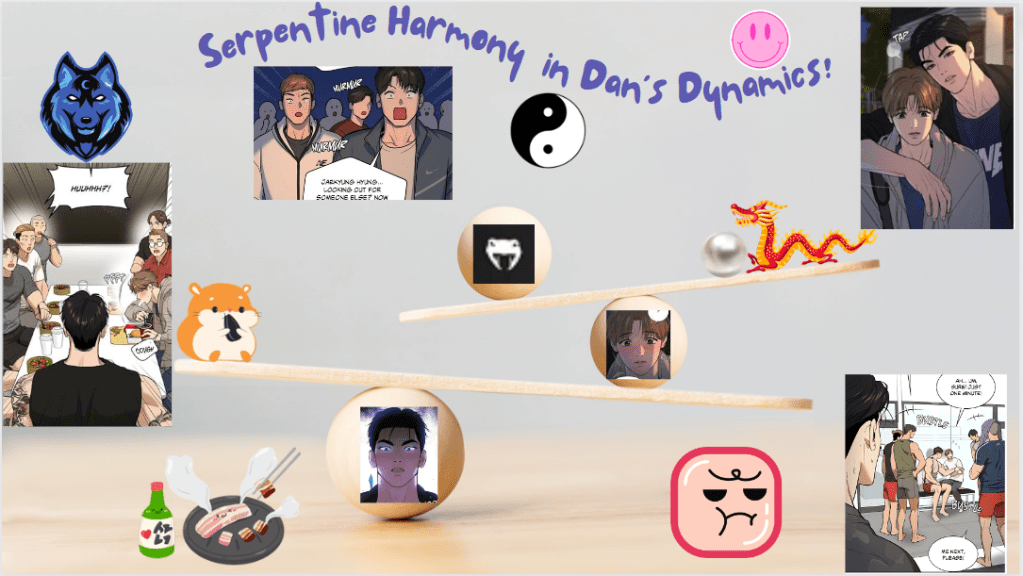
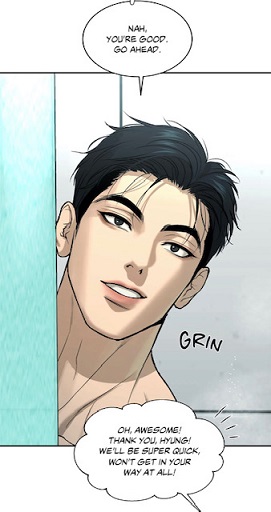 (chapter 8) Secondly, in the analysis “
 (chapter 43) As a conclusion, the physical therapist embodies “sharing” which is strongly connected to eating. Furthermore, the symbol for giving is the hand which fits Heesung’s description about Kim Dan: “Magic Touch”.
  (chapter 31). It is important to recall that the artist came to discover the angel, for the latter offered his assistance unrequested.
 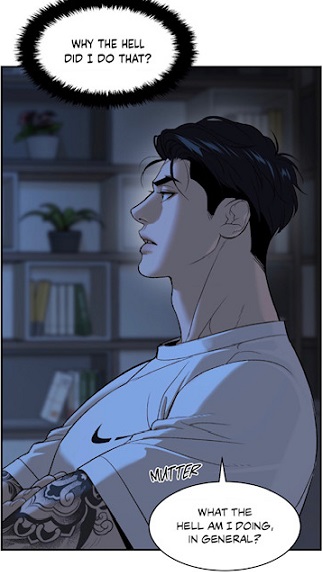 (chapter 35) This scene represents the first step of the athlete’s meditation. Interesting is that this self-reflection got interrupted by the text from the journalist. Consequently, the athlete’s old habits resurfaced. Thus the athlete began neglecting the doctor again. Additionally, identifying jealousy and its cause means that emotional intelligence is necessary. However, Joo Jaekyung possesses a low EI… yes, he really has the mind-set of a baby.
 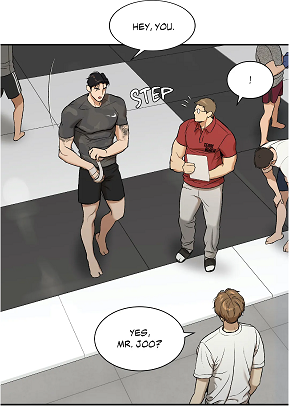 (chapter 7) He didn’t know Kim Dan at all. Thus he utilized the contract as reminder
  (chapter 8), as he felt that he had no other tool to keep his partner by his side. In addition, in order to control his jealousy, he always employed the same method: SEX!!
  (chapter 34) Consequently, as long as Joo Jaekyung could not control his possessiveness and jealousy, he was shooting himself in the foot. Which corresponds to the metaphor with too much salt in the food. Mingwa gave us many examples for this situation. When the champion became jealous in episode 7, he forced the physical therapist to have sex with him. Thus his karma was to be perceived as a man obsessed with sex. Then, in episode 9, he provoked Kim Dan with the drink.
  (chapter 9) It was, as if he wanted to steal the show from the physical therapist. His punishment was to take care of the physical therapist, but the latter never witnessed his caring side due to his high intoxication. When he challenged the comedian
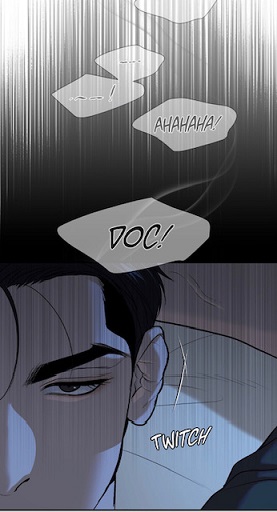 (chapter 37) He was envious that they were the source of Kim Dan’s happiness, whereas he was not. Finally, when the athlete confronted them, the doctor sided with them.
 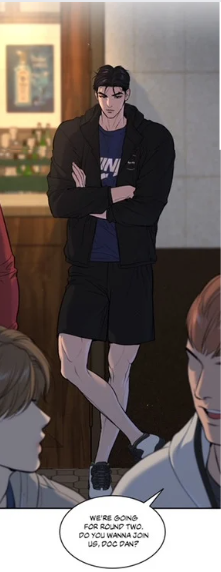 (chapter 43) His gaze was betraying him. Though he was the star of the evening, the fighters didn’t invite him to the second round. Yet, he didn’t mind, until he heard them asking the physical therapist. But contrary to the past, episode 7 and 37, Joo Jaekyung acted more gently.
 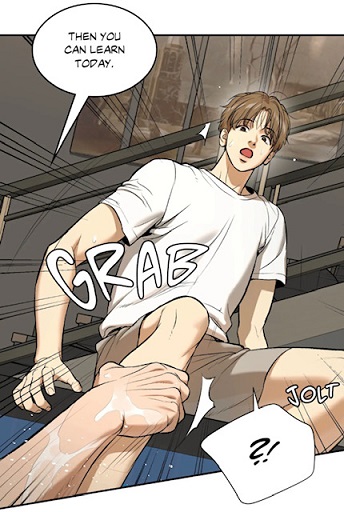 (chapter 27) and smiles are an evidence that the protagonist is feeling more and more comfortable around Kim Dan.
 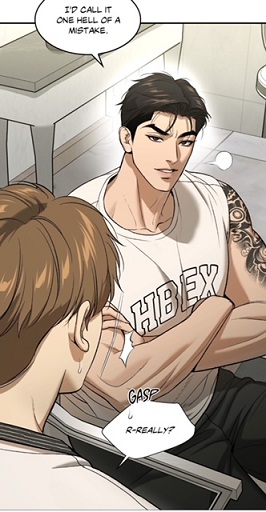 (chapter 41) Yet, he was still crossing his arms while talking to the physical therapist. This shows that he has not completely lowered his guard yet. Finally, Manhwaworms shouldn’t overlook the doctor’s drunken confession accompanied with kisses and embraces.
  (chapter 43) However, I would like to outline that in this scene, he didn’t feel jealous, as Kim Dan was excluded. Hence he had no reason to claim the doctor as his. As you can see, the star’s jealousy was the trigger to change his behavior in front of the members. Thus I come to the deduction that we were witnessing the positive aspect of “jealousy”. He was not questioning the doctor’s integrity and trust. Therefore it is no coincidence that contrary to episode 7, 9, 22 and 37, he didn’t look grumpy, when he stated that Doc Dan is coming with him.
  (chapter 37) I could also include the scene with the new jacket.
  (chapter 36) At no moment, Oh Daehyun and the others could detect the main lead’s jealousy. That’s how it dawned on me why Kim Dan was not informed about the surprise birthday party.
  (chapter 43) He was as astonished as Joo Jaekyung. I deduce that they desired to protect him, in case the celebrity would react so negatively.
  11, 36, 37), they imagined that Joo Jaekyung was treating him the same way than them: if he was not rough, then he was indifferent.
  (chapter 43) So he never took the doctor’s choice into consideration. Although Joo Jaekyung is no longer dragging the doctor like in the beginning of the story, he is not truly respecting Kim Dan’s decisions. But how did this rivalry between Joo Jaekyung and his team start?
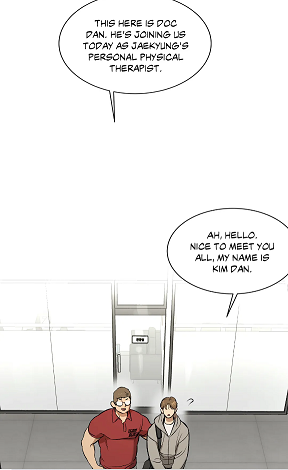 (chapter 7) He occupies a special position, for he is only working for the alpha as doctor. But note that doc Dan crossed the line, the moment he started taking care of Kim Changmin’s problematic shoulder.
  (chapter 7) Thus I deduce that Kim Dan still needs to find his own place at the gym. This can only generate tension. Moreover, it dawned on me, neither the champion nor coach Jeon Yosep nor Park Namwook recognized the consequences of his arrival at the gym.
 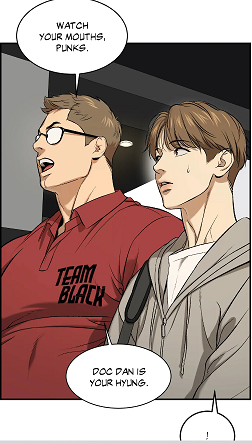 (chapter 7) First, they made the mistake not to bring Kim Dan to Busan.
  (chapter 23) On the one hand, he was reminding his companion that he was only working for him, on the other hand, the uniform and the treatment from the members were giving the impression that he was also part of Team Black.
  (chapter 23) That’s how he discovered the ritual with high five!! This is something he could share with his lover! By using this gesture, they would not only become closer, but the gap between the fighters and Joo Jaekyung would be reduced. On the other hand, by hindering Kim Dan to follow the group, Joo Jaekyung was hindering the main lead to do his job. This shows as well that they are slowly developing a new routine, but it is not fully deployed. The doctor is bringing the real changes due to his special but unclear position.
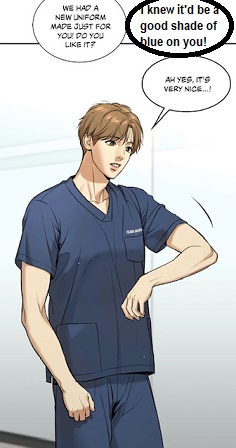 (chapter 9) and the welcome elixir.
  (chapter 9). But like pointed out above, he is actually just his private physical therapist. For Kim Dan, the famous athlete is just a VIP client.
  (chapter 25) It is relevant, because the doctor is not technically involved with the other members. He is attached to them, because they are very nice to him.
 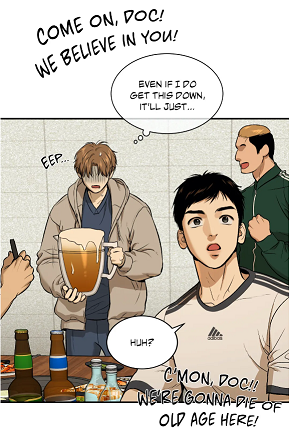 (chapter 9) There exists no contract between them either. Their relationship is simply based on the goodness from the characters. And now, you comprehend why the champion had to come to this welcome party. It is because he feared that the doctor would feel closer to them than to him. His money was already competing with the heart from the fighters. Is it a coincidence that the champion felt the need to remind them that he was the one paying for the party?
  (chapter 9) Funny is that for his birthday party, money was no longer rivaling with the fighters. Furthermore, he was joining the table for real.
 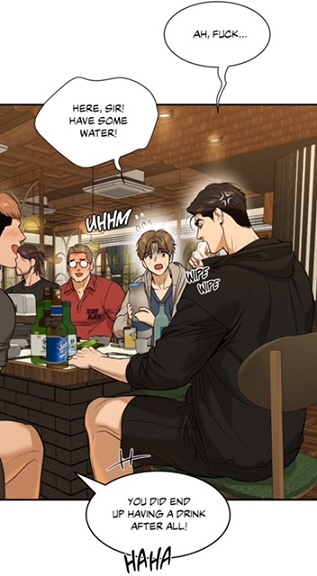 (chapter 43) To conclude, the causes for the tension between the alpha and his members are the undefine position and duties of Kim Dan.
 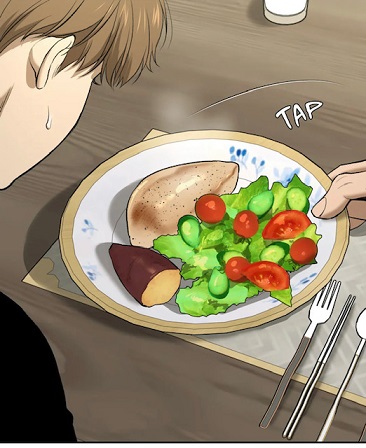 (chapter 13), Park Namwook and Oh Daehyun are representing the other extreme: junk food (too salty, greasy, too much sugar)
  (chapter 22)
  (chapter 26) The members didn’t recognize how gentle the celebrity was towards his partner, therefore Park Namwook imagined that Kim Dan had been coerced to spare and the punch was the expression from anger and frustration against the alpha. Thus he came to misjudge the situation. That’s how Kim Dan got excluded from the ring. And this observation brings me to the following conclusion. Till episode 43, none of the fighters realized that Kim Dan was receiving a special treatment from Joo Jaekyung. They were totally oblivious of the truth, even during this incident!
  (chapter 22), because the latter was somehow neglected by the champion. They were compensating for the lack of interest from the captain. Interesting is that no one was missing Potato during that day and party except the readers. Why? It is because little by little, his adoration for the champion is vanishing. He is starting to have a life on his own. It is important, because Kim Dan could receive now more attention from the members than before, especially because he is receiving the good grace from his boss. Don’t forget that Park Namwook never protected them from his bad mood.
  (chapter 36) He could become their speaker, their lawyer… a new version from this scene:
 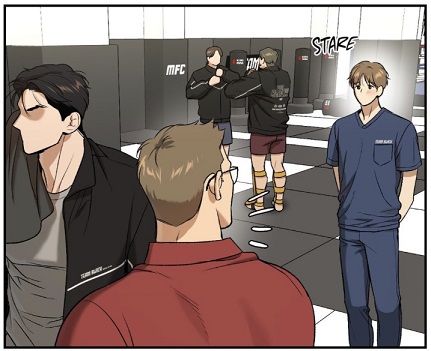 (chapter 36) or he was sitting in the office. It is not surprising that he kept his distance at the hotel, when the champion was taking his meal.
 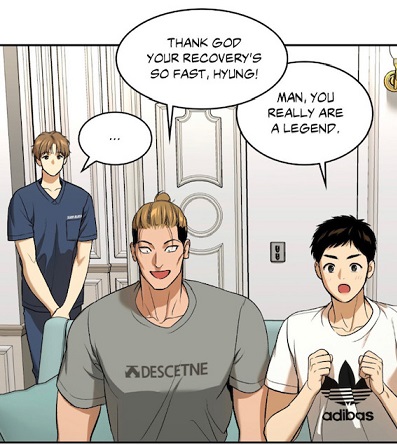 (chapter 37) But it started changing, after the athlete declared him as a part of his team.
  (chapter 43) before his intervention with the MFC security guys. Hence I believe that this statement and embrace
  (chapter 11), he chose to close an eye to this. Thus he remained passive.
  (chapter 43) Though the doctor’s hands had been bleeding, Kim Dan chose to treat his patient first before taking care of his own wounds. His selflessness could only catch Joo Jaekyung’s notice. Doc Dan’s benevolence can only make him realize that fame can never be a source of joy and adoration is totally different from true love and warmth.

 (chapter 35) Nevertheless, the witness didn’t notice the seduction from the artist, for he was sleeping due to the influence of the soju!! Thus Potato’s first sexual experience remained a secret. Yes, in this scene, Jinx-Philes can detect the similarities between 35 and 42. It is about sex, “attachment”, wrongdoing and secret. Potato employed the expression “There’s nothing wrong to…”. In addition, Yoon-Gu is still treated as a child by the fighters and Kim Dan, so such a suggestion could appear as scandalous. Interesting, is that no one noticed the sudden offer from Heesung, though they were in a public place. The owner of the food truck was not paying attention to them, as she was busy. Oh Daehyun had vanished, as he was not feeling well.
  (chapter 35) That’s why this remained a secret. But more importantly, there was a discussion between the maknae and the actor about love.
  (chapter 35), he yelled. Though he looked angry, he was not.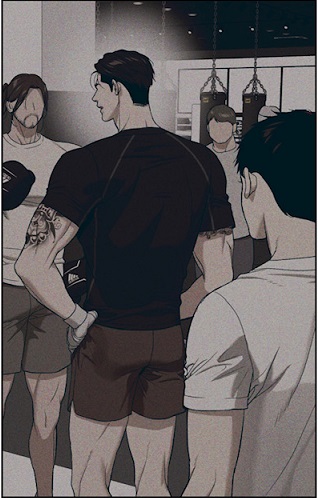
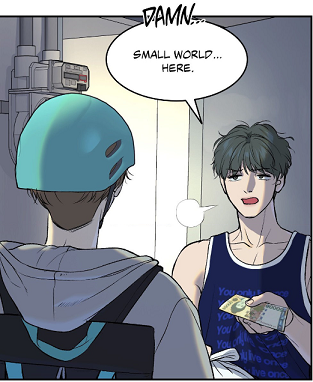 (chapter 35) Furthermore, the room seems to have similar shades. Because the green-haired man is wearing a blue shirt and the author portrayed him in black and green
 (chapter 41) civilization, anger, night versus nature, calmness and day. In order to create money, trees need to be sawn. The grape and insects on the bill are fake. Hence I come to the following deduction that this mysterious person is only interested in money too. For this faceless person, money is the symbol of power and life. And now, you comprehend why this person didn’t offer to pay the dinner on his own
 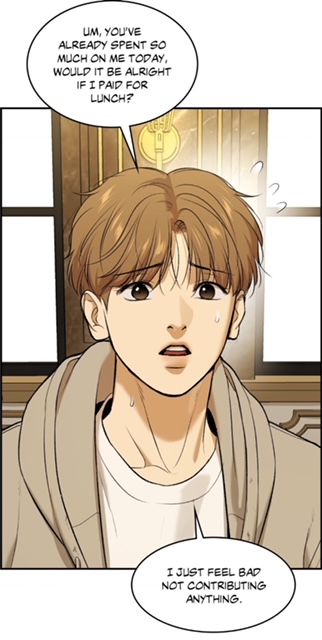 (chapter 32). The third man embodies avidity, selfishness, but also calculations and frugality. The goblin and his companion didn’t order an expensive dish, as it only cost 40.000 KRW. 😉 50.000 KRW – 10.000 KRW
  (chapter 32) Simultaneously, it exposes Kim Dan’s selflessness and thoughtlessness. He is bad at calculating and saving money.
  (chapter 42) Under this new light, it becomes comprehensible why I perceive this third man as the opposite of Kim Dan, notwithstanding sharing the same color. This signifies that the shadow is exactly like the green-haired uke: envious, greedy and stingy. Both appear as cheap. Because the goblin insulted him (“ass”, in Korean “Bastard/Asshole” and in Spanish “son of a bitch”), it becomes clear that these two are close, in the sense that they belong to the same social class. One might say that they are equal, but because the goblin badmouthed the other, their equity is just superficial. The green-haired uke looks down on the other. Since the goblin didn’t hide his bad mood in front of the other, I assume that they are both roommates. On the other hand, it is palpable that they are not affectionate towards each other. The goblin has no problem to voice his irritability in front of his “companion”. That’s how I deduce that both are united by the same desire: earn money on a quick and easy way. They are both using each other. I view them as “parasites” in the end. Since the goblin had no problem to expose his true thoughts at the door step
 (chapter 42) The latter are getting closer to each other, taking care of each other. The breakfasts have become an important moment for them, where they share their thoughts and can make jokes. Hence the late snack in the small flat embodies the opposite: frustration and disregard. Thus in my eyes, the goblin and his “partner” are not interested in each other, because both are in a similar situation. They are not rich. Thus my idea is that the green-haired man hadn’t exposed to his roommate that he had been the champion’s lover in the past and the latter had beaten him. In my eyes, this revelation was new to the third man. How so?



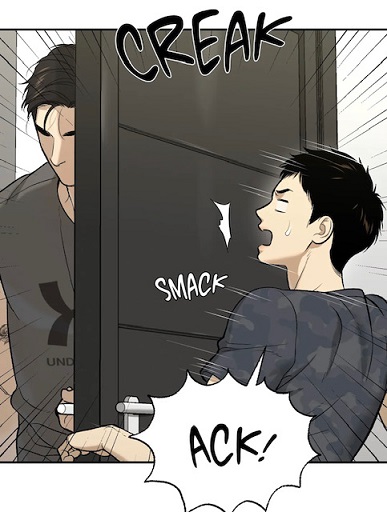


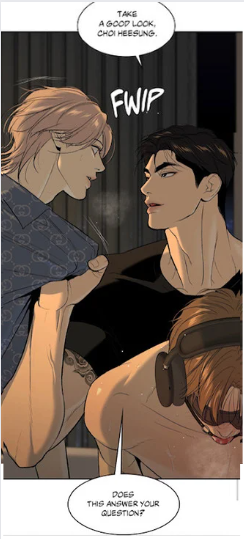


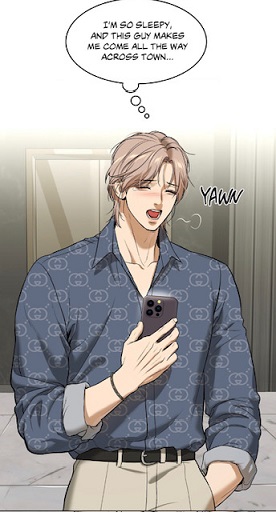 The item was used for a nightly invitation, more precisely for a confrontation.
 (chapter 37)
 (chapter 40) The former is a hunter looking for blood, a huge scoop to destroy a champion. He is throwing over board social norms and morality. Since the bill of 50.000 KWR is embodying him, it reinforces my theory that the third man is a scholar, but a „fake“ one. And the moment you accept this idea, you will understand why I said that the green-haired man would receive his retribution. I have the feeling that he could get beaten. Imagine that the third man has the champion’s cellphone number. He could call Joo Jaekyung and inform him about the conversation in the hallway. He was insulted by his ex- sex partner. He could also try to blackmail the celebrity. If he doesn’t pay, then he will expose the “truth”. Naturally, he could hide behind the green-haired man. It is also possible that the goblin gets manipulated by the faceless man in the shadow. I am quite certain that the goblin will be caught in a scandal, and he will have to take the fall, betrayed by his roommate.
 (chapter 33)
  (chapter 35) But why? Here, I can only speculate. It is related to Heesung and the Entertainment agency. Don’t forget that Heesung had asked his manager to keep his trick a secret
  (chapter 34) In other words, I am suspecting the involvement of the champion’s agent. The latter could have let transpire to the tabloid journalist that there was some tension between these two. However, nothing happened between Heesung and Joo Jaekyung after the ride.
  (chapter 33) Is it a coincidence that the author employed green in this scene? I have already demonstrated that the agent from the Entertainment company was involved in the conspiracy. Under this new light, you comprehend why I am suspecting a scandal during the birthday charity event. Many people will be present and all the lights will be directed at the star. By causing a scandal, the journalist would get noticed and even “glorified” as the hero denunciating “corruption and perversion”, whereas in reality it is the opposite. Like mentioned above, I can not totally predict his moves.
 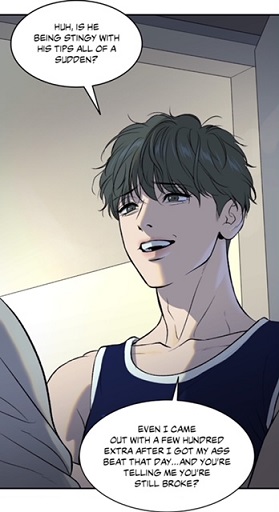 (chapter 42) and the physical therapist as victims. The man could even go so far to recreate the incident from episode 2. Let’s not forget that Park Namwook has the tendency to condemn Joo Jaekyung for any “wrongdoing” and he saw the main lead with bruises.
  (chapter 13) So technically, he could have treated the green-haired man after that altercation. Finally, when Kim Dan went to the hospital in chapter 18
 (chapter 18) , Joo Jaekyung had an appointment there. So this treatment could be brought up. Moreover, I would like to point out that in chapter 13, Kim Dan never detected the presence and intervention of a doctor. It was the same in chapter 34/35, Kim Dan never caught and identified the presence of the third person.
 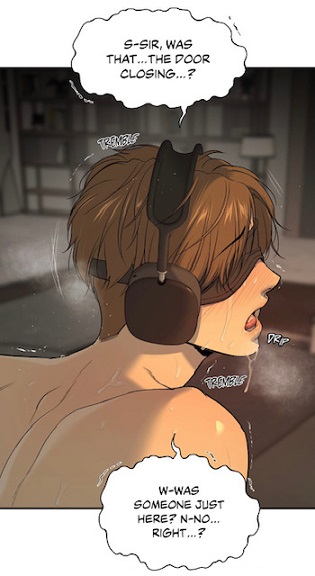 (chapter 35) That’s how I recognized that none of the spies were “caught” or identified. Chapter 42 represents no exception, hence the third man feels safe.
 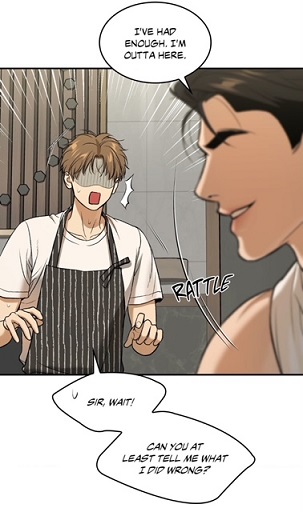 (chapter 41) Hence I conclude that the green-haired guy and his roommate don’t care for each other. So while the readers are about to witness the rising of the physical therapist, I am expecting the opposite for this dangerous couple. They could destroy each other.
  (Chapter 42) Since the athlete‘s shoulder was already in bad shape, the former physical therapist might have proposed pain killers, but the star refused. Because the doctor considered himself as superior, he came to look down on Joo Jaekyung and chose to ruin his reputation so that the latter ended up having a novice, someone with no experience!
  Bebebisous33s' analyses in K-Dramaland and Manhwas