
Please support the authors by reading Manhwas on the official websites. This is where you can read the Manhwa: Jinx But be aware that the Manhwa is a mature Yaoi, which means, it is about homosexuality with explicit scenes. Here is the link of the table of contents about Jinx. Here is the link where you can find the table of contents of analyzed Manhwas. Here are the links, if you are interested in the first work from Mingwa, BJ Alex, and the 2 previous essays about Jinx The Silent Friend in the Blue Light and The Hidden Predators (part 1)
It would be great if you could make some donations/sponsoring: Ko-fi.com/bebebisous33 That way, you can support me with “coffee” so that I have the energy to keep examining Manhwas. Besides, I need to cover up the expenses for this blog.
Why Two Wolves?
In the first part, I mentioned both Perrault and Grimm not because the stories differ superficially, but because their shared surface—the famous bed scene—hides radically different logics of danger. If one remembers only the dialogue (“What big eyes you have!”), the two versions appear nearly identical. A wolf deceives a girl; she is eaten. Yet the decisive differences lie not in the dialogue but in the structure surrounding it.
In Grimm’s version, the moral is embedded in the ending. The girl disobeys her mother by leaving the path.
One morning, her mother said, “Come, Little Red Riding Hood, here’s a piece of cake and a bottle of wine. Take them to your grandmother—she’s sick and weak, and this will do her good. Go before it gets too hot, and remember to walk carefully. Don’t stray from the path, or you might fall and break the bottle. And when you arrive, don’t forget to say good morning before you peek around her room.” Quoted from https://americanliterature.com/childrens-stories/little-red-riding-hood
Because of her disobedience, she is swallowed, but she is rescued. The huntsman cuts open the wolf’s belly; order is restored; the wolf is killed through a trick. The lesson is corrective and communal: authority intervenes, discipline saves, error can be redeemed. Red Riding Hood learns. She does not stray again. The world remains morally structured.
Perrault’s ending, by contrast, is final. There is no huntsman, no rescue, no second chance. The girl is eaten and remains eaten. One might wonder why. The answer lies not only in the conclusion but in the construction of the encounter itself. In Perrault’s original French text, the wolf is introduced as “Compère le loup”. The word compère does not designate a stranger. It implies familiarity — a companion, an acquaintance, even a friendly associate. From the beginning, the wolf is socially positioned, not alien. Hence the forest in this version is not associated with danger or wildness. The woods are seen as a prolongation of the civilization and society. The predator belongs to the same communicative world as the girl. The danger is therefore not external intrusion but internal misrecognition.
This familiarity is reinforced in the bed scene. When the girl arrives, the wolf does not immediately attack. He instructs her to place the cake and butter aside and then tells her to come into bed with him. Perrault explicitly writes that she removes her clothes before getting in. The intimacy is staged. Closeness precedes violence. The scene imitates adult seduction before revealing predation. The girl is not seized; she participates in the proximity. That participation is precisely what makes the ending irreversible in Perrault’s social universe. Thus the old French expression “avoir vu le loup” (to have met the wolf) means to have lost virginity or have gained sexual experience. Under this light, one might understand why the wolf as Joo Jaekyung’s personality fits so well. 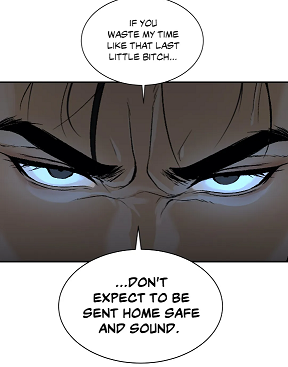 (chapter 3) The latter became responsible for the hamster’s sexual education.
In Grimm’s version, this dimension disappears. The wolf does not construct a prolonged intimacy. After the dialogue, he simply springs from the bed and devours her. There is no undressing, no extended staging of physical closeness. Violence interrupts; it does not grow from apparent consent. Grimm transforms the libertine into a beast. The danger becomes physical appetite rather than social seduction.
Striking is that at the end of the story, Perrault articulates the moral explicitly:
“Children, especially attractive, well-bred young ladies, should never talk to strangers, for if they should do so, they may well provide dinner for a wolf. I say ‘wolf,’ but there are various kinds of wolves. There are also those who are charming, quiet, polite, unassuming, complacent, and sweet, who pursue young women at home and in the streets. And unfortunately, it is these gentle wolves who are the most dangerous ones of all.” Quoted from https://sites.pitt.edu/~dash/perrault02.html
The ending is the moral. There is no reversal because social damage, in Perrault’s world, is irreversible. The wolf represents not wild nature but libertine society. He does not attack in the forest because woodcutters—witnesses—are nearby. He waits until he can move the girl into a private domestic space. He speaks politely. He proposes a race so that he can reach the grandmother’s house sooner. He performs civility. Once in the house, the girl observes inconsistencies, but she accepts the animal’s explanations. Her failure is not merely disobedience; it is misjudgment.
That distinction is why both versions were necessary. Grimm teaches obedience within a moral universe that restores balance. Perrault teaches discernment within a social universe that does not. He is promoting critical thinking.
And Jinx unfolds more in the latter.
The Director: An Anaconda or a Wolf?
At first glance, the hospital director resembles Perrault’s wolf. 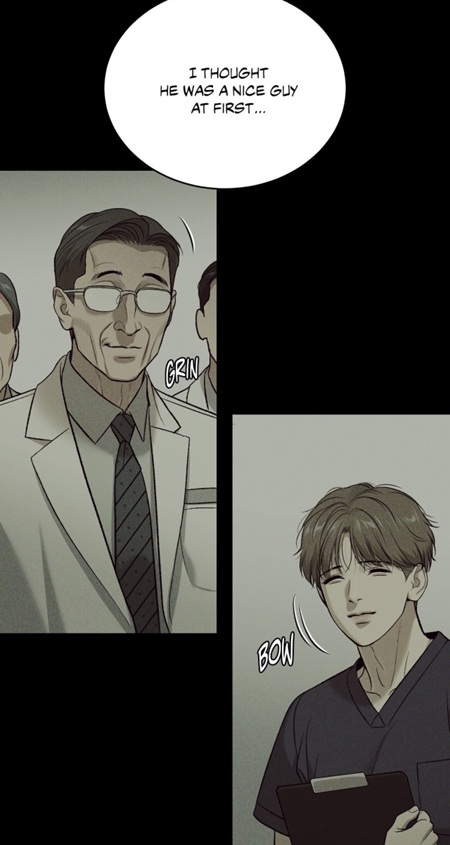 (chapter 90) He is not impulsive. He is not openly violent. He operates within institutions, within offices, within controlled environments. He isolates rather than attacks. He frames rather than forces. Like Compère le loup, he is not a stranger; he is part of the social order. He belongs to the system. That belonging is precisely what grants him access.
His resentment 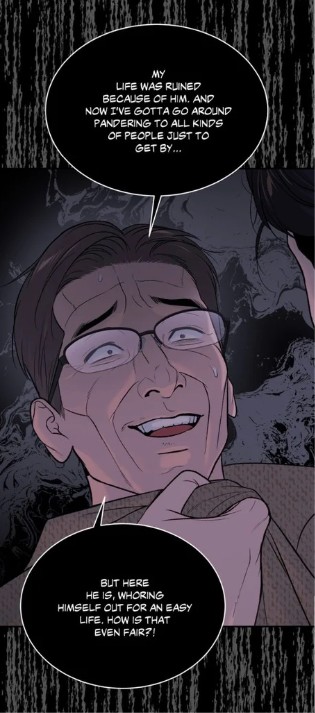 (chapter 90) reveals that his true wound is territorial. He can no longer find his targets within the hospital. He lost control. He lost narrative dominance. This explicates why the predator retaliated against Kim Dan by badmouthing him.
 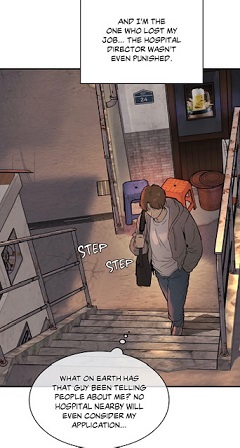 (chapter 1) He made sure that the protagonist was economically and socially “ruined”. However, at the restaurant, what did he discover? A happy man with a companion! Despite his “revenge” for the loss of his territory, the physical therapist’s life had not been ruined. Thus he tried to slander the physical therapist, he was just a slut.
 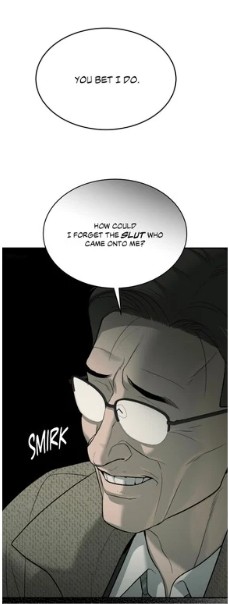 (chapter 90) The problem is that the champion did not react like expected. He got angry at the “client” and not at the “prostitute”. He never thought that the main lead would side with such a person. Thus the hospital director voiced a menace:
 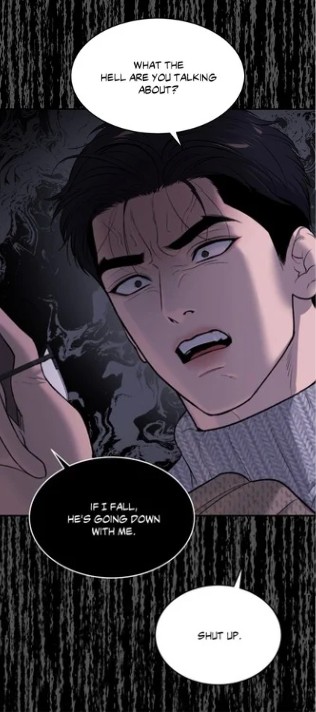 (chapter 90) His threat is not confession; it is defensive strategy. It reveals what he fears most: exposure. Not moral reckoning, but visibility. The predator who once operated in sealed rooms now imagines himself dragged into the open. And that possibility terrifies him.
In Perrault’s logic, harm succeeds because it occurs without witnesses. The wolf avoids the woodcutters. Thus he relocates the act into a private domestic space. But one might wonder about the identity of the woodcutters in the Korean Manhwa. In the architecture of a scandal, the “Woodcutter” represents the Bystander Effect woven into the fabric of an organization. In the fairy tale, the woodcutters are physically present but functionally absent; their focus on their “job” creates a peripheral noise that masks the wolf’s approach.
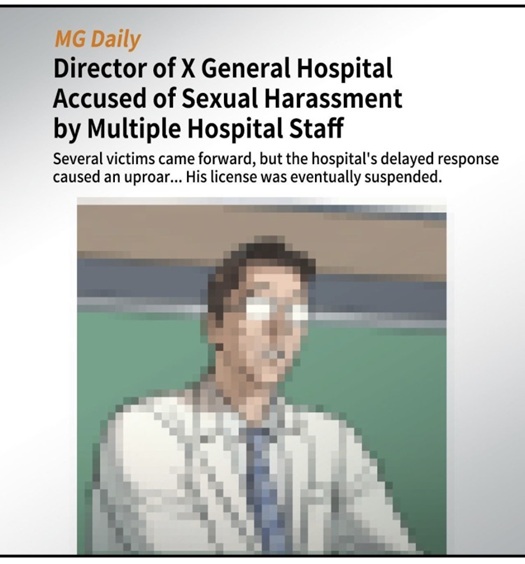 (chapter 91)
When an institution like Saero-An Hospital 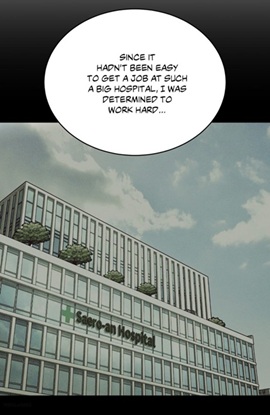 (chapter 90) prioritizes its “output” (reputation, profit, or clinical operations) over the safety of its staff, it adopts the woodcutter’s axe. By focusing only on the work at hand, the institution effectively grants the predator a “sealed room.” The wolf doesn’t need to hide from the woodcutters; he only needs them to keep their heads down. What makes him powerful is not brute force but the absence of eyes. The director functioned the same way. His authority depended on institutional insulation — doors closed, hierarchy unquestioned, narratives controlled. As long as no one looked too closely, he remained Compère — familiar, respectable, legitimate.
However, visibility destroys that structure. It is no coincidence that the name of the institution is not revealed. It is strategic, it is about containment and damage control. (chapter 91) “Director of X General Hospital.” The letter X replaces identity. The institution remains faceless, protected, intact. Only the individual is exposed. He becomes the “black sheep,” the aberration, the singular deviant whose removal restores the illusion of purity. This means the system has not truly fractured. It has absorbed the shock. The management is shielded. The hospital’s reputation survives. The corruption is reframed as personal misconduct rather than structural tolerance. And that explains why the director initially felt safe. It is because he knew the “Mother” (the institution) and the “Woodcutters” (the staff/administration) were more invested in the “Big Hospital” image than in the safety of the “daughters” (the employees). And this is precisely where Perrault’s logic returns — not only through the wolf, but through the adults. In Perrault’s version, one might ask: where are the parents? The mother sends the girl into the forest without any warning. The grandmother only thinks how lovely her grandchild is, hence she is not talking about the dangers. None of them prepare her to recognize manipulation. Neither the mother nor the grandmother teaches her to question charm. She is well-bred, polite, obedient — but not trained to distrust sweetness.
Perrault’s moral seems directed at the girl, but indirectly it exposes society. A culture that values politeness over discernment produces vulnerability. The wolf thrives not only because he is cunning, but because the girl was raised to comply. The blame, therefore, is not purely individual.
The same mechanism appears in the hospital scandal. By omitting the hospital’s name, the article preserves the illusion that corruption was singular. But the panel in which Kim Dan reflects (chapter 1) disrupts the illusion that this was ever an isolated deviation. It reveals that shielding authority at the expense of subordinates was already the hospital’s modus operandi. The management’s instinct was not investigation, but preservation. Not accountability, but hierarchy.
This is crucial. Before the scandal became public, the hospital had already demonstrated where its loyalties lay. The director was protected. The subordinate was expendable. Dan lost his position; the director remained secure. That earlier incident establishes a pattern: institutional cohesion prioritized over justice. Now compare this to the anonymous article. (chapter 91) The article does not expose the forest. It exposes one wolf. Hence the hospital name remains concealed, while the man’s face is “revealed”. The director’s license is suspended. Publicly, the system appears decisive. But structurally, the logic remains the same: protect the institution, isolate the individual. The difference is only in scale. Previously, Dan was sacrificed to shield the director. Now the director is sacrificed to shield the hospital.
The mechanism is identical. This is where Perrault’s tale deepens the analogy. In the fairy tale, the mother sends the girl into danger unprepared. The adults create conditions in which charm is not interrogated. When the wolf succeeds, the girl bears the consequence. Society remains unexamined. Hence in Perrault’s tale, there is no huntsman because society itself is implicated. The wolf is not defeated because the environment that produced him remains untouched.
Likewise, the hospital’s earlier response shows that vulnerability was institutionalized. Victims were isolated. Complaints were contained. Authority was insulated. The forest was never safe; it was simply unacknowledged. The article does not expose the forest. It exposes one wolf.
And that is the most disturbing parallel: predators thrive where institutions prefer appearance over introspection. And now, let me ask you this question: what about MFC as institution then?
Perrault’s warning is therefore double-edged. It cautions young women about gentle wolves, but it also exposes a society that raises daughters to be agreeable rather than analytical. In both cases, the danger is not only the wolf. It is the world that allows him to pass as familiar.
That is why his language is not remorseful but retaliatory. (chapter 90) “If I fall, he’s going down with me” translates into: If I am exposed, I will contaminate the narrative. I will ensure that no one stands clean beside me. The threat is not about truth; it is about mutual ruin. This is Perrault’s mechanism inverted: when privacy collapses, the wolf attempts to drag the girl into public disgrace so that exposure harms both equally. If he cannot remain hidden, he will ensure that the victim appears complicit. What the director fears most is not prison, nor even moral judgment. It is losing control of the story.
And this leads me to the following observation: (chapter 90) The director claimed that doc Dan ruined his life, though the article makes it clear that it happened because of the collaboration of different victims. (chapter 90) The moment he got caught by the nurse in the office, gossips started circulating, and previous victims recognized that they were not the only ones. The man could no longer escape the gaze from the staff. Hence he had to seek his “targets” elsewhere. The restaurant scene clarifies his new method. He is sitting with a man in a curated adult space—low light, alcohol, controlled proximity. 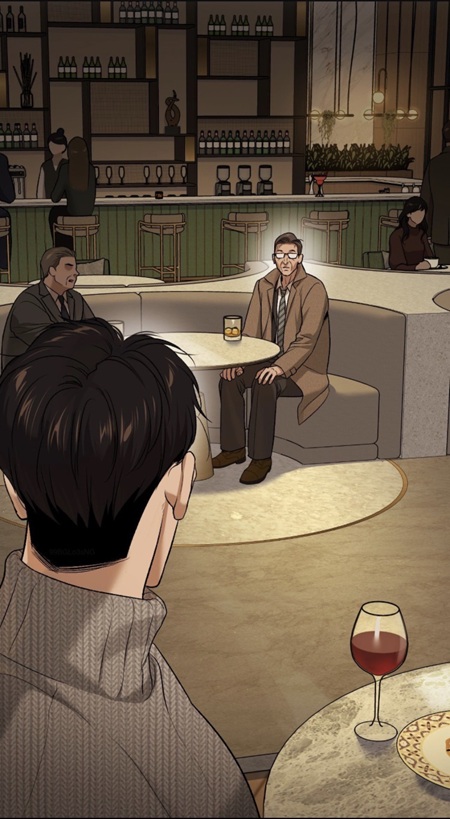 (chapter 90) It resembles the wolf’s preferred setting: intimacy that appears voluntary. What caught my attention is that he complained about his partners. (chapter 90) That line exposes the structural wound. “Pandering” implies performance. It implies negotiation. It implies mutuality. It implies that he must now ask rather than take. In the hospital, he did not have to pander. Authority substituted for charm. Hierarchy substituted for consent. Privacy substituted for persuasion.
Outside that territory, he is reduced to the marketplace of mutual agreement, — dating apps, casual meetings, drinks that require conversation rather than compliance. And he resents it. I came to think about dating apps, because the perverted hospital director did not meet the man at the XY club 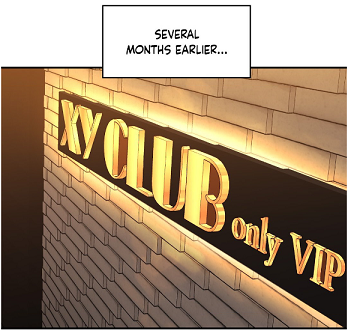 (chapter 33), but at the restaurant. If he had known such a club, he could have met the green haired-guy or the “uke” from episode 55. Thus I deduce that the sexual predator is actually hiding his “homosexuality”, he had been living a double life in the end, like the wolf in Perrault. That’s why he targets “virgins”. Since he used the expression “pandering… get by”, Mingwa implies that this man must have told the men (“all kinds of people”) he met, he was looking for a boyfriend to justify his action.
 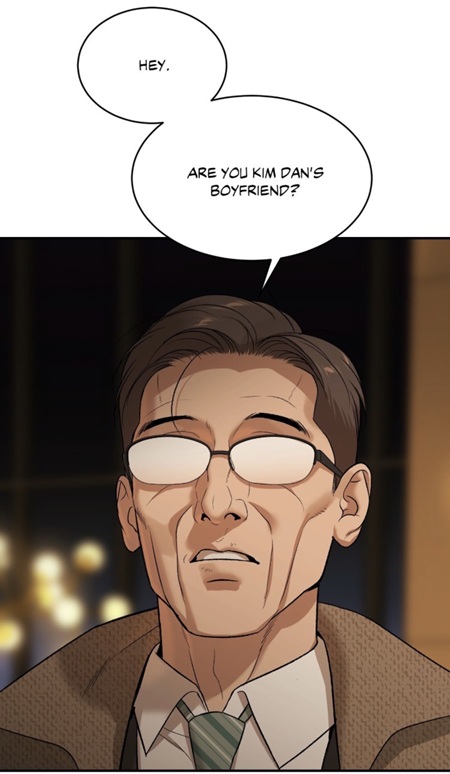 (chapter 90) However, this lie was quickly caught by the unknown companion, as the perverted director paid no attention to him. (chapter 89) This exposes that the sexual predator hadn’t dropped his old mind-set, selfishness and entitlement. When the man abruptly stands and leaves, the director is surprised.
 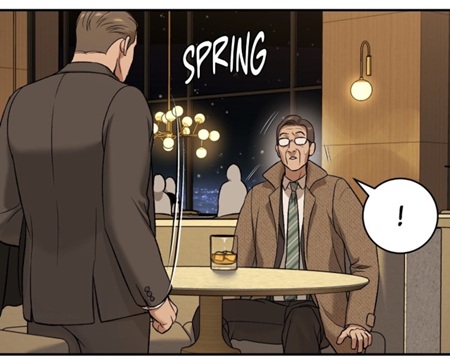 (chapter 90) That surprise matters. It suggests expectation of compliance, of silent agreement, of recognition of coded signals. The man likely does not belong to the director’s ecosystem; he does not recognize the invitation as opportunity but as lack of respect. Thus he exits.
 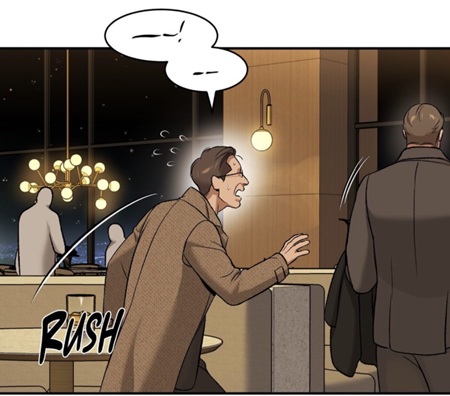 (chapter 90) The fact that the wolf tried to talk him out of it indicates that their relationship was not only superficial, but also more equal. Humiliation is crucial. Predators who rely on social camouflage depend on territory. When territory collapses, strategy must change.
This is where the transformation begins. Until he meets Doc Dan, the director functions like an anaconda: silent constriction, gradual suffocation, no visible struggle. The anaconda does not bite first; it coils. It removes oxygen slowly. The hospital setting enabled precisely that kind of predation—isolated rooms, professional hierarchy, reputational shields. After the loss of his territory, we could say that he becomes acting like a “wolf” from Perrault’s version. He has many relationships (all kinds of people to get by). Perrault’s wolf survives because he is charming and unmarked. He passes as “Compère.” Yet, the moment the champion crosses his path, the director transforms one more time: 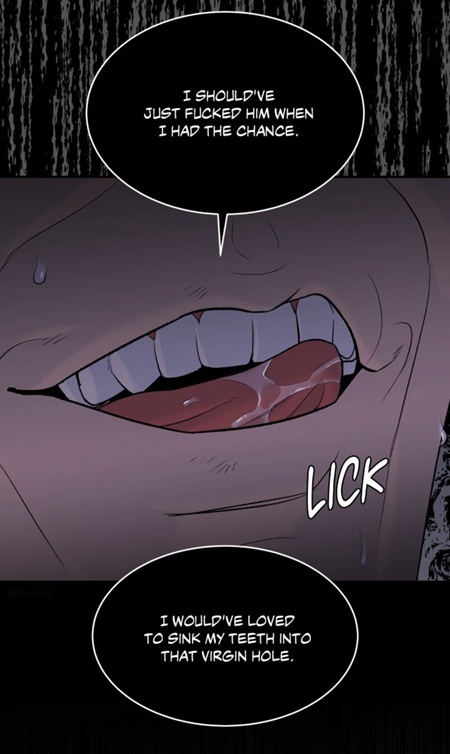 (chapter 90) This is where Grimm enters. His true nature got exposed, he is socially identified as predator.
Thus I initially deduced that the perverted hospital director would retaliate against the famous champion. (chapter 90) Jaekyung represents exposure. He is public, visible, media-facing. He has sponsors, contracts, a name that circulates. Reputation is capital in MMA. A scandal can destabilize a career faster than defeat in the ring.
But the new development alters this trajectory. (chapter 91) The director has already been exposed. His license is suspended. His name circulates in headlines. Even if the hospital remains anonymous, he does not. His face may be blurred, but within professional and social circles, recognition is inevitable.
This changes the mechanics of revenge. Previously, he could have weaponized narrative. Now, narrative cannot be weaponized — because he lacks credibility. Any accusation coming from him would be read as retaliation. He is already stigmatized as the wolf.
And stigma has consequences beyond reputation. He complains that he must “pander to all kinds of people just to get by.” (chapter 90) That line once indicated resentment toward consent. Now it reveals something deeper: he may no longer even succeed in pandering. Who would willingly meet a man publicly accused of harassment? (chapter 91) Even if strangers do not immediately recognize him, someone eventually will. His social ecosystem contracts.
He becomes even more isolated than before. This is where the transformation accelerates. And when charm is no longer viable and narrative manipulation is no longer credible, only one option remains: force without pretense.
This is where Grimm’s wolf enters fully. In Grimm’s version, the wolf does not maintain prolonged civility. He springs. 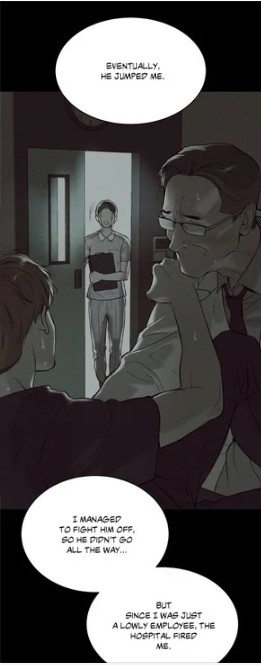 (chapter 90) He devours.
 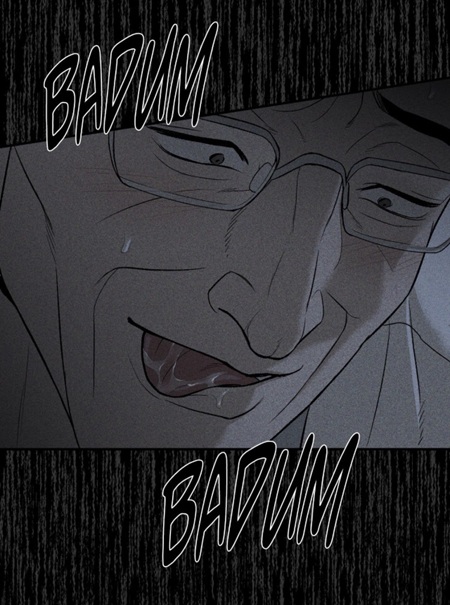 (chapter 90) There is no sustained camouflage. Violence becomes explicit.
The director’s inner monologue already reveals this potential pivot: (chapter 90) That sentence reframes restraint as error. It converts missed coercion into regret.
Now add stigmatization. If he cannot find partners, if he cannot reclaim status, if he cannot control narrative, if he has nothing left to lose, then the probability of retaliation and desperate reassertion increases. Not because he desires intimacy. But because he desires dominance. And dominance without insulation becomes assault.
The restaurant rejection already wounded his ego. Besides, his behavior at the restaurant could be seen as intrusion. 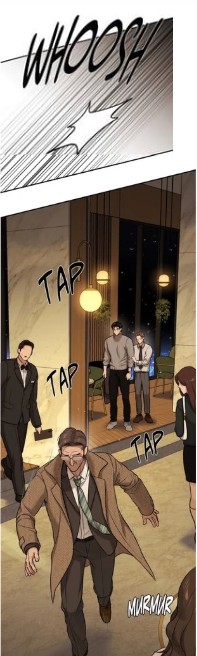 (chapter 90) Hence he ran away. The exposure destroyed his credibility. The public article marked him. His ecosystem collapses. He is no longer hidden wolf. He is identified predator.
Predators who lose camouflage often escalate rather than retreat. Thus the revenge element shifts from narrative contamination to bodily assertion. Not scandal against Jaekyung. Not media manipulation. But an attempt to reclaim asymmetry through direct coercion. This does not guarantee success.
But it increases probability. The fairy-tale logic therefore completes itself:
Perrault shows the wolf who hides behind civility. Grimm shows the wolf who leaps when civility fails.
In Jinx, we may be witnessing the precise moment where camouflage is no longer possible — and where the predator, stripped of territory and credibility, risks becoming the brute he once avoided being. The resentment we see in his thoughts suggests precisely that possibility. When he sees Kim Dan thriving elsewhere, when he frames him as “whoring himself out,” he begins to rewrite the narrative: if Dan is already a “whore,” then coercion becomes transaction. In that logic, force becomes justified. And remember how Heo Manwook reacted, when he imagined that doc Dan was selling himself: 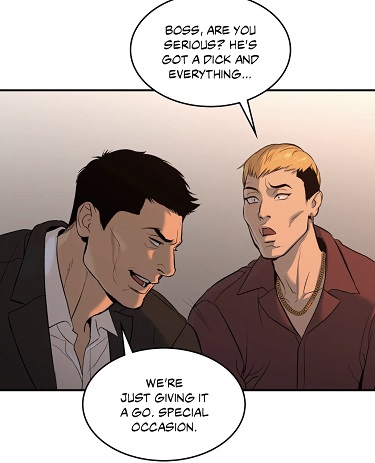 (chapter 16)
This is the most dangerous pivot. Perrault’s wolf survives through civility. Grimm’s wolf initially survives through brutality, until he is caught (the huntsman = police). The director initially belonged to the first category. After losing territory, he risks evolving into the second. To conclude, the shift from anaconda to wolf is not a metaphorical flourish; it is psychological escalation. Camouflaged predators who lose control often intensify behavior rather than retreat.
And now, you are probably wondering why I included the actor Choi Heesung in the illustration of “predators”, though he is a second lead.
The False Mirror: Choi Heesung and The Gentle Wolf
At first glance, Choi Heesung stands disturbingly close to Perrault’s wolf. Not only he appears as polite and gentle 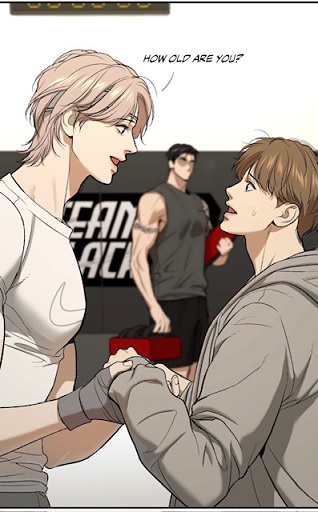 (chapter 30), but also as selfless.
 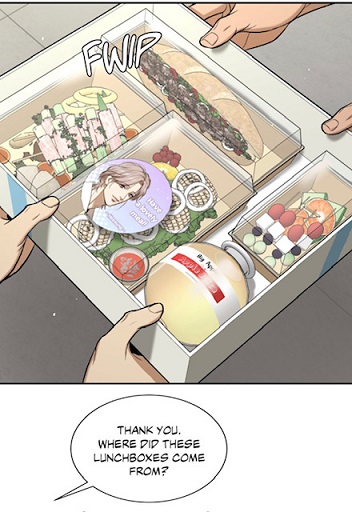 (chapter 30) Yet, he is a libertine, though he claims to be pure by stating that he is looking for his soulmate.
  (chapter 33) Hence no one is suspecting the darkness in his heart. Even the champion believed in his words, when he claimed that he had some feelings for doc Dan.
  (chapter 58) The resemblance is deliberate. He is discreet. He avoids public scrutiny. He hides his intimacy with Potato.
  (chapter 43) Therefore the latter was not present at the champion’s birthday party. The actor operates in private spaces
 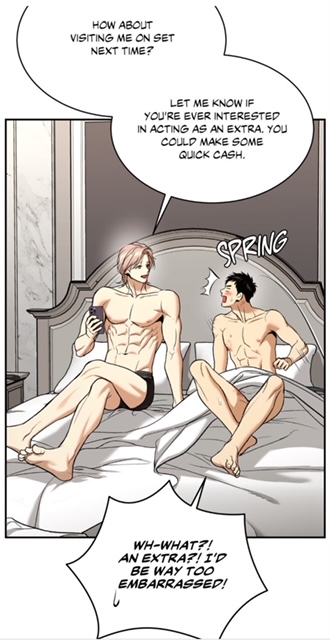 (special episode 2) and prefers silence over visibility. Like Perrault’s Compère le loup, he does not appear monstrous. He appears socially legible — even charming. He navigates controlled environments. He is careful about who sees what.
On the surface, the symmetry is unsettling. Perrault’s wolf does not attack in the forest. He speaks politely and seduces next to the Woodcutters.  (chapter 35) He proposes a “race”to the little girl, in Jinx it’s a meal (ramen in Korean, an allusion to sex)
 (chapter 35) He softens his voice. He invites the girl into bed.
  (special episode 1) He constructs intimacy before violence. He depends on civility as camouflage.
But what distinguishes a “libertine” is the absence of responsibility in their actions and words. Once the “Little Red Riding Hood” loses their virginity, the culprit is not blamed, but the victim. That’s why Perrault warns young women. The latter have to take the responsibility for the wolf’s behavior. Therefore it is not astonishing that the actor agrees that the chow chow becomes “responsible” for him. 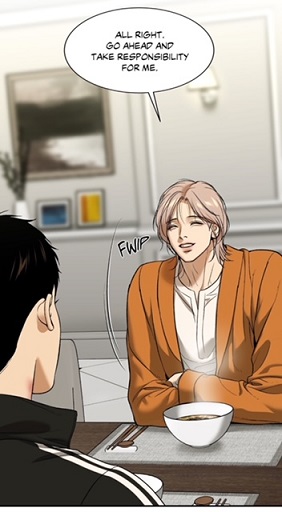 (special episode 1)
Because Heesung, too, prefers the private over the public, he exists in the gray zone where discretion and desire intersect.
But resemblance is not structure.
The decisive difference lies in how secrecy is used. Perrault’s wolf hides in order to extract. Civility functions as access. Privacy ensures there are no woodcutters. Sweetness precedes consumption. The wolf’s politeness is not restraint — it is strategy. Heesung’s secrecy functions differently. It is not just defensive, he still wants his partner to have fun. 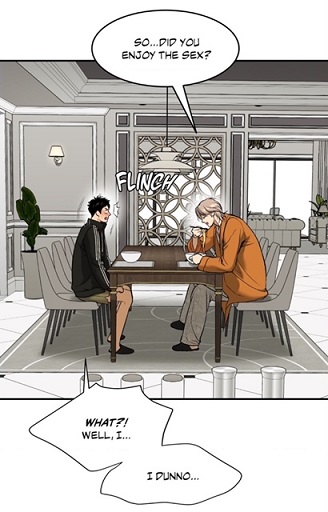 (special episode 1) It is not about power display, but fun. He hides not to isolate his partner, but to shield himself from exposure. His discretion protects his own public image, not his access to another’s body. The imbalance exists — it cannot be denied — but it is not systematically mobilized to erode consent. The latter comes from their initial contract: Potato is at his beck and call.
The wolf uses secrecy to manufacture vulnerability. Heesung uses secrecy to simply avoid visibility and responsibility. This distinction becomes clearer in their relation to inexperience.
For Perrault’s wolf, virginity is not intimacy. It is resistance waiting to be broken. (chapter 90) The girl’s naivety is eroticized precisely because it promises asymmetry. The invitation into bed is staged. Her undressing is narrated. Closeness is prolonged. The violence emerges from intimacy.
Control is primary. Desire is secondary. Heesung’s response to inexperience produces discomfort rather than appetite.  (special episode 1) He has been avoiding “virgins” for one reason. He knows how a “virgin” would react to his dream ” to find his soulmate”. They would take his “words” seriously and imagine him as someone serious and reliable. But by selecting partners with sexual experience, he can claim that he made a mistake, they were no soulmate.
  (special episode 1) But this panel exposes even better why the actor is so different from Perrault’s wolf. Youth symbolizes “vulnerability and innocence” and that’s something he has been avoiding. The reason is simple. That way, he can avoid accountability. That’s why he panics, when he hears the age. He realizes his mistake! This reveals that though Heesung is a libertine, he is different from the hospital warden. He is not seeking pleasure in asymmetry, fear, shame and power. He is not targeting “virgins” to exploit their vulnerability. He has been avoiding “virgins”, as he knew that he would have to take responsibility. In reality, he has always feared attachment. Where the wolf eroticizes vulnerability, Heesung is destabilized by it.
What complicates the contrast with Choi Heesung is not that with his smiles, he resembles 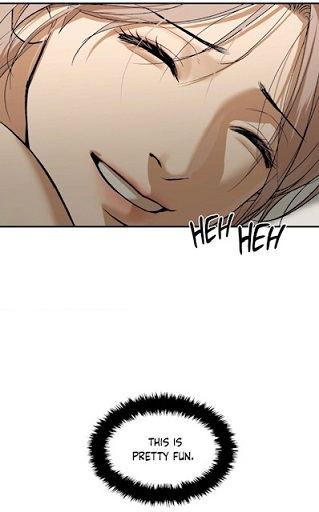 (chapter 34) the predator by accident (chapter 90), but that he resembles him convincingly enough to be confused with him.
In the first part, we wrote: “Something walks close, warm and familiar — speaking softly, until trust opens the way.” That description applied to the wolf. But it also applies to the fox. Heesung’s true animal is not the wolf. It is the fox 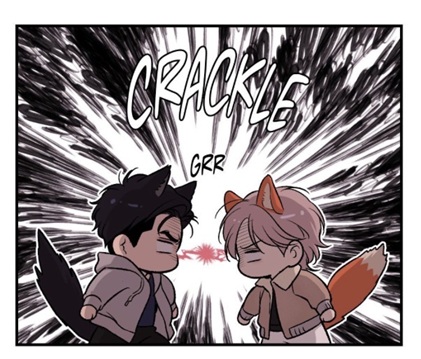 (chapter 89) — clever, adaptable, socially fluid. The fox does not devour. It maneuvers and as such plays tricks.
And yet the fox can be mistaken for a wolf. Heesung repeatedly uses proximity through work to create intimacy.  (chapter 32) He first approaches Kim Dan through professional contact. Later, he suggests a gig to Potato (special episode 1) or uses training space to remain near Potato.
 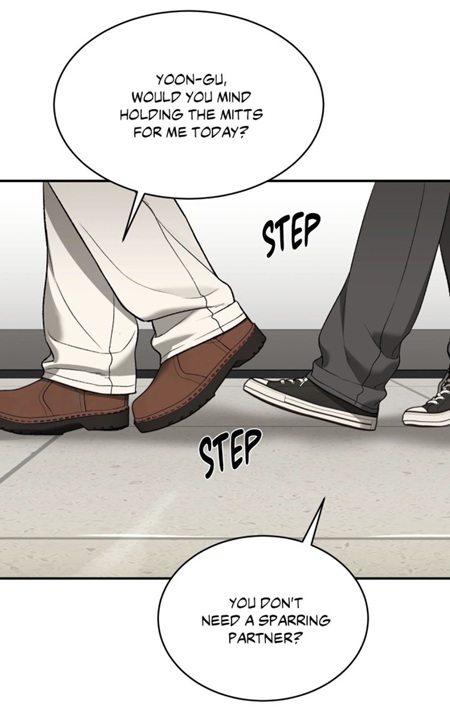 (chapter 88) Even in the gym, he casually asks Yoo-Gu to hold mitts — reorganizing the work structure in ways that subtly serve his private interest. Work becomes the bridge. The boundary blurs.
And here lies the dangerous resemblance. He reproaches Joo Jaekyung: 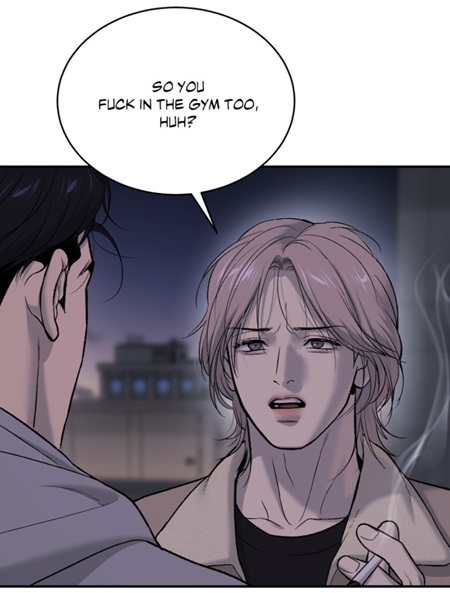 (chapter 89) The accusation implies that Jaekyung contaminates professional space with sex. Yet Heesung himself collapses that boundary. He initiates intimacy with Potato after drinking. He knows the other is intoxicated. He proceeds anyway.
This is not predatory orchestration. But it is negligence toward asymmetry. This is where the question becomes unavoidable: when is it consent, and when is it coercion?
Is consent present simply because no explicit “no” was spoken? Is coercion present only when force is visible?
Or does the line lie elsewhere — in power, in context, in intention? Mingwa gave us the answer: 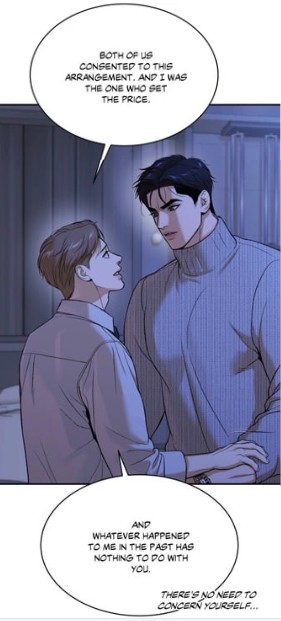 (chapter 90) It is when one makes a clear decision and accepts the consequences. Yet, Heesung violated this rule, for he knew Potato was drunk. He did not stop. He did not insist on postponement. He allowed desire to override clarity. That choice introduces asymmetry. Alcohol clouds agency. Youth complicates balance. Professional proximity blurs roles. Secondly, he is rejecting accountability. Finally, he never tried to correct Potato’s error and false belief. He took advantage of his ignorance. So his behavior could be perceived as manipulative and coercive.
From the outside, the structure resembles the predator’s method: work proximity, private space, imbalance, intoxication. But coercion is not defined by imbalance alone. It is defined by how imbalance is used. The hospital director manufactures dependence. (chapter 90) He isolates. He rewrites refusal. He eroticizes resistance. He regrets restraint. His desire intensifies when asymmetry is greatest. Heesung does not erode consent systematically. He does not isolate Potato over time. He does not rewrite refusal as invitation. But he does blur boundaries. He does allow alcohol to intervene. He does prioritize desire over clarity.
From the outside, that distinction may not be visible. And that is where misrecognition becomes dangerous.
Heesung does not publicly acknowledge the relationship. 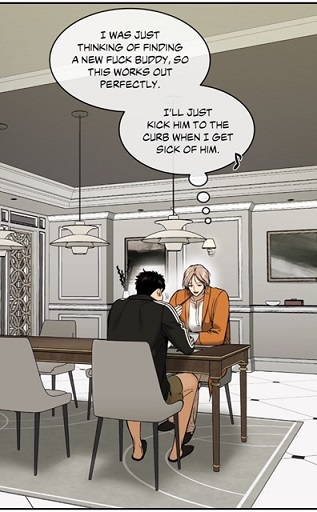 (special episode 1) He hides it, though he tried to reveal it to doc Dan
  (chapter 58). If the truth were exposed — an actor secretly sleeping with a younger, inexperienced partner whom he approached through work — the narrative could easily frame him as exploitative. He could be accused of sexual harassment.
He would appear as a predator. Not because he functions like the hospital director — but because the structure resembles it. Fox mistaken for wolf.
The key distinction lies in aftermath. When Jaekyung reflects 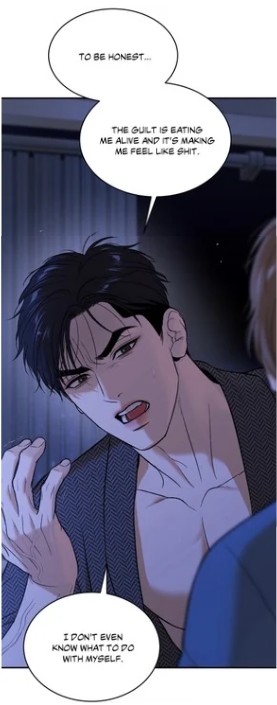 (chapter 91) the emotion is internalized. He experiences remorse not because he was exposed, but because he crossed a boundary. He separates work from intimacy afterward. He becomes rigid about consent, alcohol, and clarity. Therefore imagine his reaction, when he discovers the true nature of the relationship between Choi Heesung and Potato. He can only be shocked and angry.
This is why Jinx constructs the resemblance so carefully. Surface similarity forces the reader to confront how easily desire, secrecy, and proximity can resemble coercion. The difference lies not in discretion, nor in imbalance, nor even in sexual contact under imperfect conditions. It lies in how power is processed before and afterward. At the same time, it gives an answer how to read the first night between the main couple. It was no sexual harassment.
The wolf converts vulnerability into entitlement. The fox risks vulnerability through miscalculation.
And yet — in a world quick to judge by appearances — the fox may be labeled as a wolf. That is the uncomfortable tension Mingwa builds. Because the story is not only about identifying predators. It is about learning to distinguish between domination and error, between strategy and immaturity, between systematic coercion and boundary failure.
If Choi Heesung’s relationship with Potato were to become public, how would it be read? Would he be framed as a predator — the older actor who used work proximity and intoxication to seduce an inexperienced partner? Would he become the new “black sheep,” sacrificed to protect the image of the entertainment agency?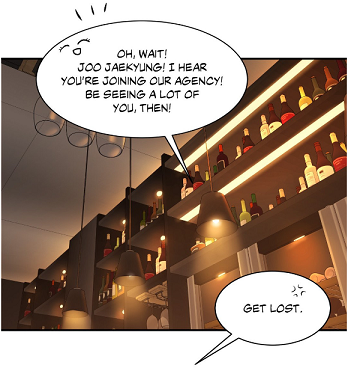 (chapter 33) Or would attention shift to the structure that allowed blurred boundaries to exist in the first place?
This question is not hypothetical. It repeats a pattern already established. Observe how Joo Jaekyung sued a hospital for leaking information, though the lawyer and the institution put the blame an individual.  (chapter 36) When the hospital scandal broke, the institution remained unnamed. (chapter 91) The director was isolated as the deviant. The system survived. Corruption was reframed as personal misconduct. Structural tolerance became invisible.
If Heesung were exposed, would the narrative follow the same logic? Would he be condemned as an individual aberration? Or would the agency be questioned for cultivating environments where professional and private hierarchies overlap, where young trainees depend on seniors, where silence protects image?
The fox can easily be mistaken for the wolf. But the forest still matters. And this brings us to a larger structural mirror: MFC.
When schemes unfolded inside the fighting world — manipulated matches, concealed injuries, silent complicity — who bears responsibility? The CEO? The manager? The doctors who testified selectively?  (chapter 41) The security guards who enforced silence?
  (chapter 40) The sports reporters who repeated the official version? The referees? The moderators? The corrupted director of the gym Choi Gilseok? Or the institution itself?
If one fighter becomes the scapegoat  (chapter 52), does the structure remain untouched?
If one CEO falls, does the culture disappear? 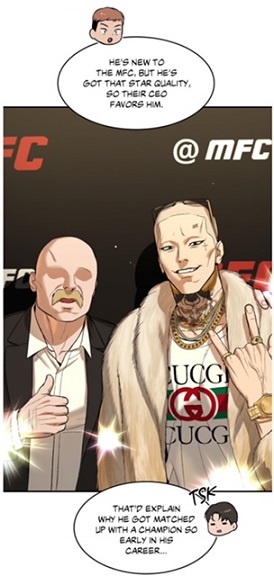 (chapter 47)
If one predator is exposed, does the ecosystem dissolve?  (chapter 48) As you can see, I have the feeling that the pharmaceutical company might become the topic of the next scandal.
Perrault’s tale quietly asks the same question. The wolf is blamed. But who raised the girl to trust sweetness without discernment? Who allowed her to walk alone? Who normalized obedience over critical thought? The fairy tale ends with the wolf devouring the girl — and society intact. Grimm adds a huntsman, but the forest remains.
So when the next scandal erupts — whether in the hospital, in the agency, or in MFC — the real question will not be merely who acted wrongly.
It will be: who benefited?
Who remained silent?
Who enforced the hierarchy?
Who preferred reputation over accountability?
And perhaps the most uncomfortable question of all: Will another wolf be sacrificed — while the forest survives once again?
Feel free to comment. If you have any suggestion for topics or Manhwa, feel free to ask. If you enjoyed reading it, retweet it or push the button like. My Reddit-Instagram-Twitter-Tumblr account is: @bebebisous33. Thanks for reading and for the support, particularly, I would like to thank all the new followers and people recommending my blog.
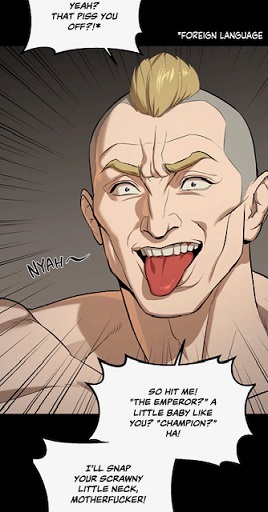 (chapter 14) Others hide behind systems.
 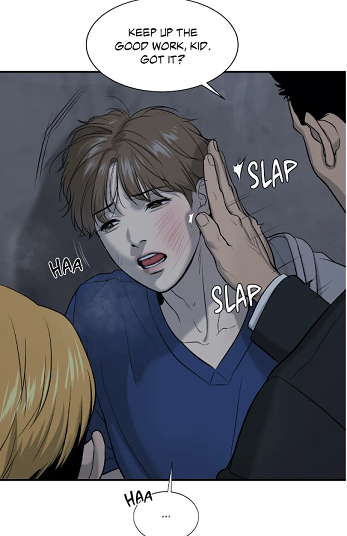 (chapter 11) Others exploit labor, fear, loyalty, or belief. The forest contains them all.
  (chapter 42). When he speaks of Joo Jaekyung, his language is explicit: the champion was a source of milk, a body that could be “milked” for money, favors, and reflected status. In biological terms, this is parasitism rather than hunting — survival not through direct attack, but through prolonged attachment to a stronger host. As long as the host remains productive, the parasite thrives. When the bloodsucker is removed, flow stops, hunger turns first into regret
 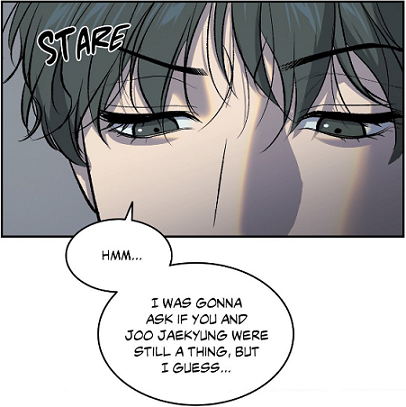 (chapter 42) before resentment.
 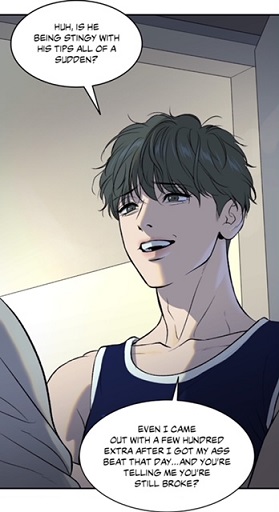 (chapter 42)
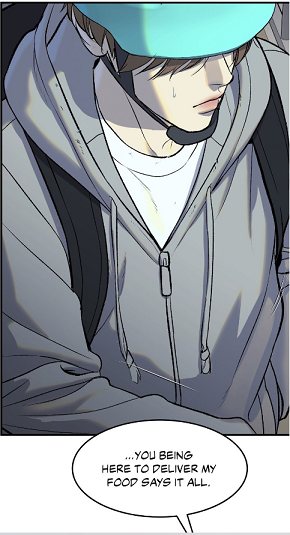 (chapter 42), but why he does so at the precise moment he does.
  (chapter 42) His hostility does not emerge from poverty alone, nor from moral outrage. It is triggered by a rupture in his expectations.
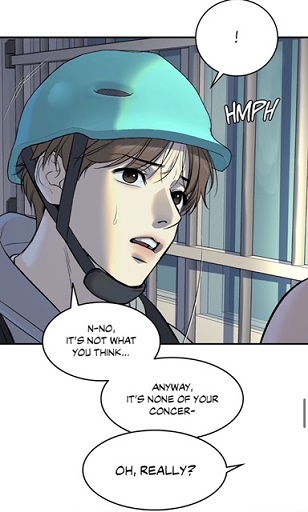 (chapter 42) In that moment, the green-haired man realizes that closeness still exists without visible profit. This is intolerable to him. It contradicts the logic through which he has justified his own past behavior: the belief that proximity to power must be monetized, that relationships exist to be exploited, that affection without gain is either naive or dishonest.
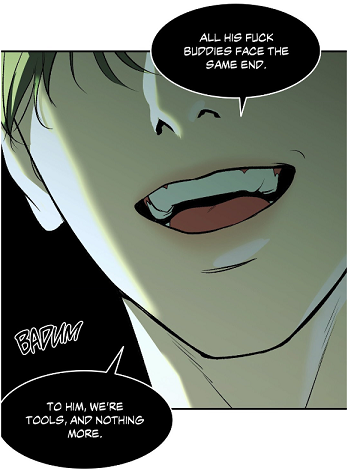 (chapter 42) Something used and discarded. In other words, he reframes Kim Dan’s loyalty as delusion and reasserts predation as the only intelligible model of intimacy.
 (chapter 02) and that the exchange of attention and money implied mutuality. Joo Jaekyung’s refusal shattered that illusion. What Kim Dan represents now is not competition, but refutation: proof that closeness does not require extraction, and that survival does not have to pass through exploitation.
 (chapter 42) The green-haired man refuses to pay for food this, while implying that his roommate is taking advantage of him, as if he would barely contributes. On the surface, the image suggests exploitation: one man living off another’s labor. Yet the scene refuses to clarify who truly benefits. The roommate remains largely invisible, economically opaque, almost spectral. Is he a dependent quietly feeding off the green-haired man’s remaining resources? Or is the green-haired man himself the parasite, overstaying, consuming, and justifying his presence through grievance? The narrative does not resolve this tension — deliberately so. Predation here is not readable at a glance. It hides in everyday arrangements, in domestic negotiations, in the language of fairness and contribution.
 (Chapter 31), the contract is made visible: the manager’s income depends entirely on the star’s uninterrupted productivity. When work stops, pay stops. Yet neither the star nor the agency appears exposed. Heesung himself, who proposed the risky sparring, shows no empathy for his caring manager. He doesn’t feel concerned for this arrangement and makes no attempt to renegotiate it for his manager’s sake. Financial risk is displaced downward, onto the least protected figure. The manager is not the predator here, but a human buffer, absorbing the instability produced by a structure that benefits the star and the Entertainment agency while refusing to insure those who sustain them.
 (chapter 34) or on Saturdays
 (chapter 32), treating the physical therapist’s work and time as indefinitely available. This is not an isolated lapse but a recurring pattern, later reproduced with Potato as well.
 (chapter 54) Its hallmark is externalization: the institution benefits while the vulnerable party carries the damage. A hospital extracts unpaid endurance and calls it devotion. A league extracts bodily risk and calls it career ambition. An agency extracts loyalty and calls it partnership. Even when no one screams, the asymmetry remains: those above set the terms; those below absorb the consequences.
 (chapter 70) but “Take better care of yourself.” Not “We failed to protect you,” but “You caused inconvenience.” This is the core of economic predation: the harm is real, but the blame is displaced downward so the system remains clean.
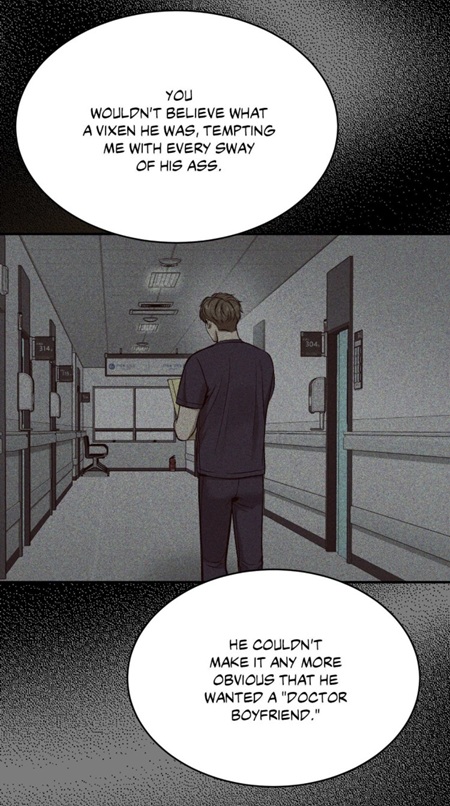 (Chapter 90) A sexual predator targets someone whose circumstances make refusal impossible or costly — socially, economically, professionally, physically, psychologically. The predator does not need to use overt violence to be dangerous; often the strategy is precisely to stay close to the border where the victim can later be blamed: You wanted it. You tempted me. You misled me. You didn’t say no clearly enough. This is why victim-blaming belongs structurally to sexual predation: it is a technique of retroactive absolution. This logic does not remain abstract in Jinx. It finds a concrete site where authority, legitimacy, and bodily access converge.
 (chapter 29) Rival fighters do not need to engineer the champion’s collapse; they only need to anticipate it. What defines them is not ambition alone, but timing.
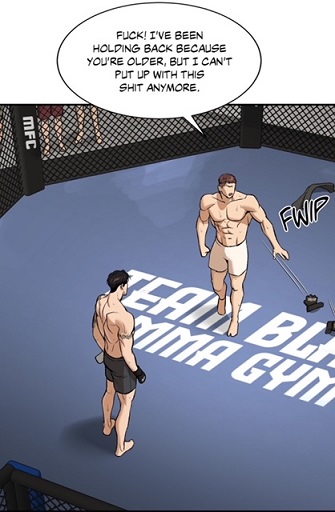 (chapter 46) His words are exposing not restraint, but accusation. The implication is clear: the champion’s body is already failing; respect has become optional. Seonho is not trying to overthrow Jaekyung through skill alone. He is announcing that the moment of vulnerability has arrived, and that patience is no longer required.
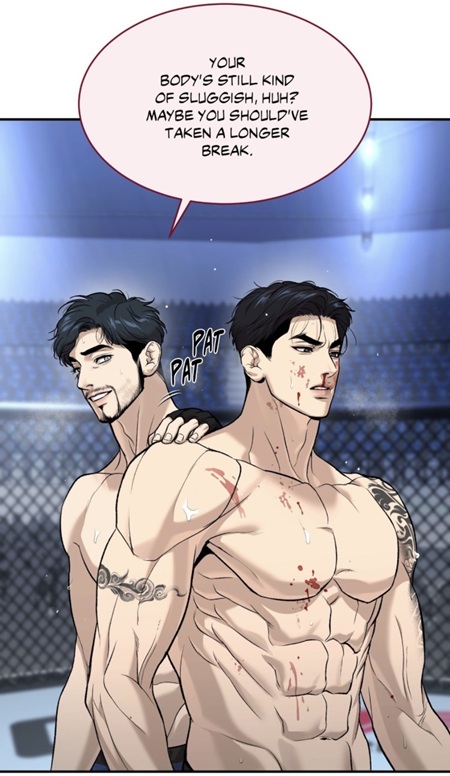 (chapter 87) He thought, he had found his perfect “meal”. To conclude, Arnaud Gabriel articulates the same logic even more coldly.
  (chapter 87) There is no personal animosity here, only inevitability. The statement is not a threat; it is a forecast. Power, in this worldview, is temporary by nature, and the role of rivals is not to prevent collapse, but to be present when it happens. Like hyenas, they do not waste energy on the kill. They wait for age, injury, scandal, or exhaustion to do the work.
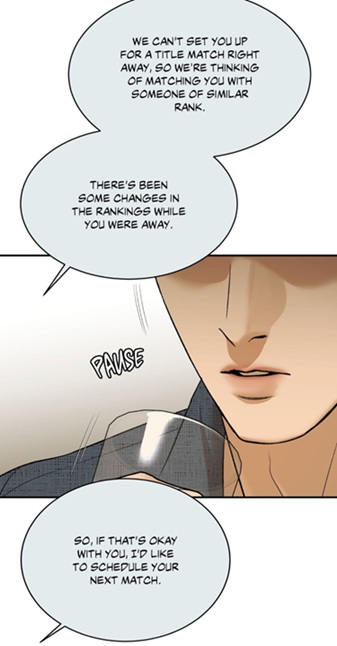 (chapter 69) A new match is organized. An invitation is extended. Noise is generated. Attention is redirected. The spectacle resumes.
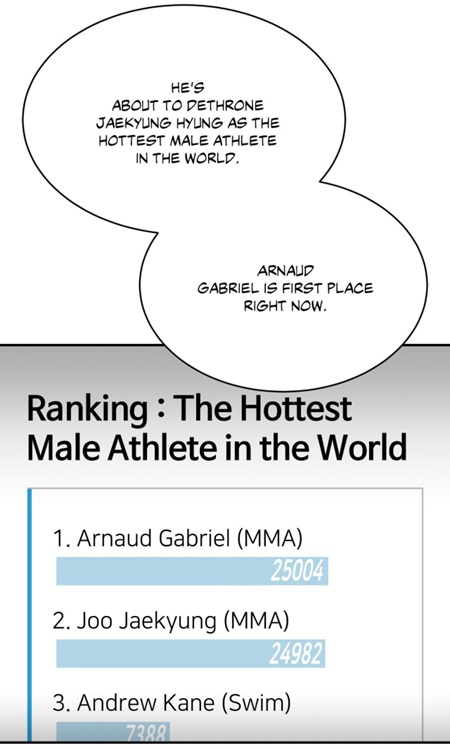 (chapter 81) The distinction matters. An athlete is managed for performance and longevity; a celebrity is managed for visibility. Injury is a problem in the first case. Scandal is profitable in the second.
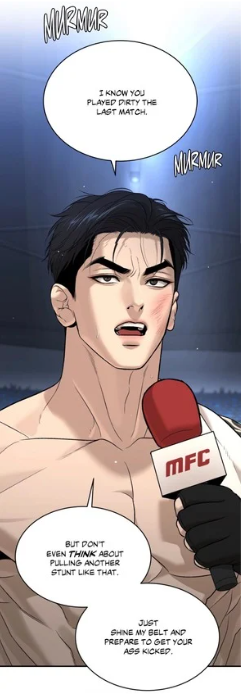 (chapter 87) By naming the manipulation in front of an audience, he breaks the tacit agreement of silence that protects institutions. What should have remained backstage is brought into public discourse. From that moment on, the system has an incentive not to clarify the truth, but to reframe the speaker.
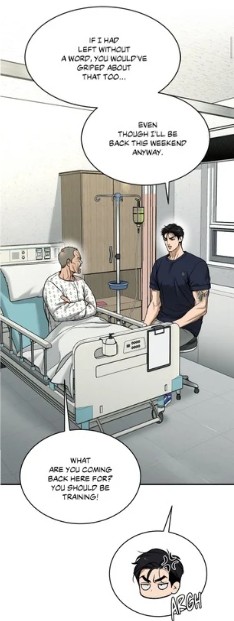 (chapter 78) The latter has always blamed the “boxer Joo Jaewoong”, but not the boxing world, the institution.
  (chapter 74) He never saw the ties between boxing and mafia. And this raises the following question: how can the Little Red Riding Hood discover the predator in MFC before getting eaten?
  (chapter 61) Joo Jaekyung accepts matches while injured
 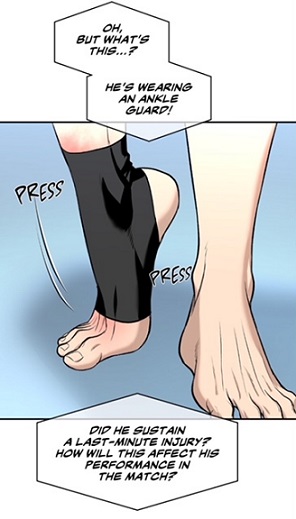 (chapter 50) later participate in his suspension. In both cases, the logic is identical: the body is usable until it is not. MFC remains intact; the cost is borne by the fighter.
 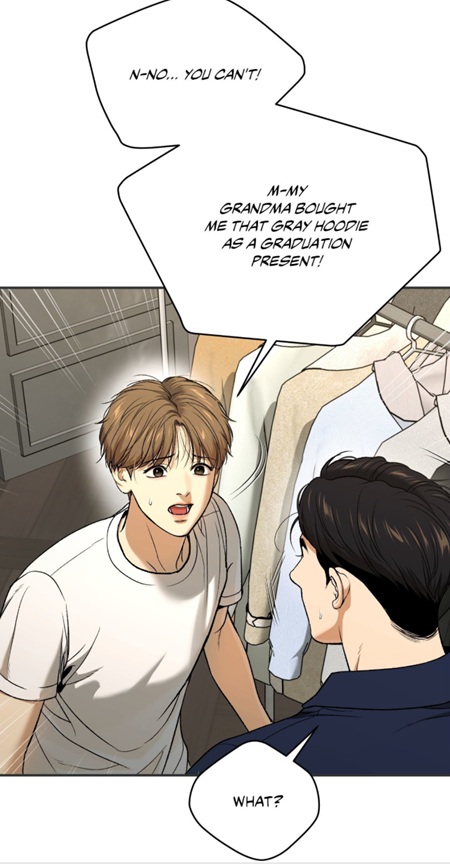 (chapter 80) In this environment, appearance is not superficial. It is a language of rank. To arrive without fluency in that language is already to be classified as provisional.
  (chapter 54)
  (chapter 1) The expression matters. It implies opportunity rather than integration: freelance labor, paid by hours or shifts, without institutional protection. In such conditions, negotiation is not expected. The contract is accepted, not discussed.
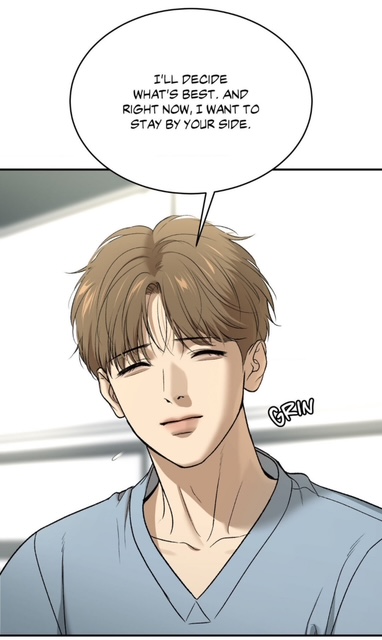 (chapter 57)
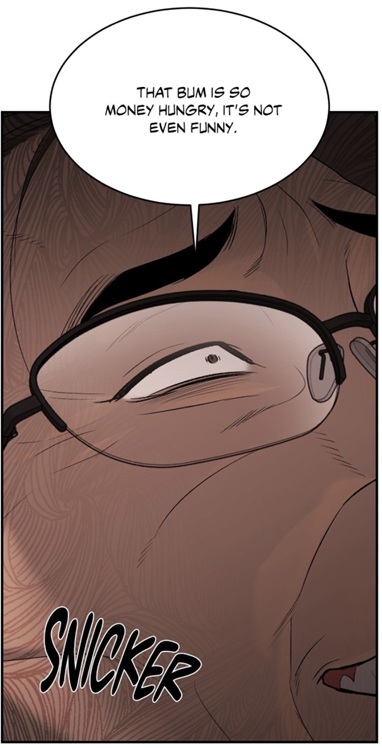 (chapter 90) Constant availability is misrecognized as appetite. Endurance becomes ambition. Constraint is translated into desire. Vulnerability is reclassified as greed. This misreading is not accidental; it is functional. If Kim Dan is greedy, then the director is not coercive. If Kim Dan “wants more,” then nothing is being taken from him.
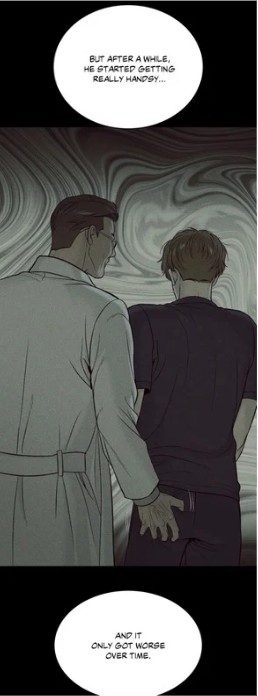 (chapter 90) The contact is quiet, progressive, and deniable. It blends into routine movement, into institutional normalcy. “After a while, he started getting really handsy… and it only got worse over time.” Each tolerated touch becomes precedent. Boundary erosion is not sudden; it is cumulative.
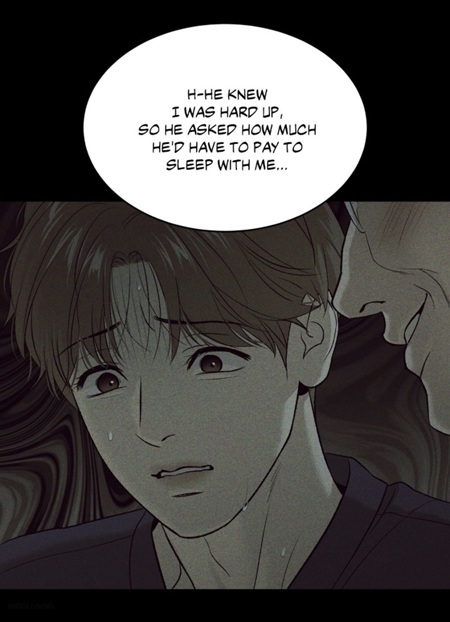 (chapter 90) In the doctor’s eyes, the predator knew about Kim Dan’s difficult financial situation, then he asked how much he would have to pay to sleep with him. The timing is crucial. The offer does not initiate desire; it tests whether vulnerability can be converted into consent. Payment reframes coercion as transaction, need as availability, and silence as something that can be bought in advance.
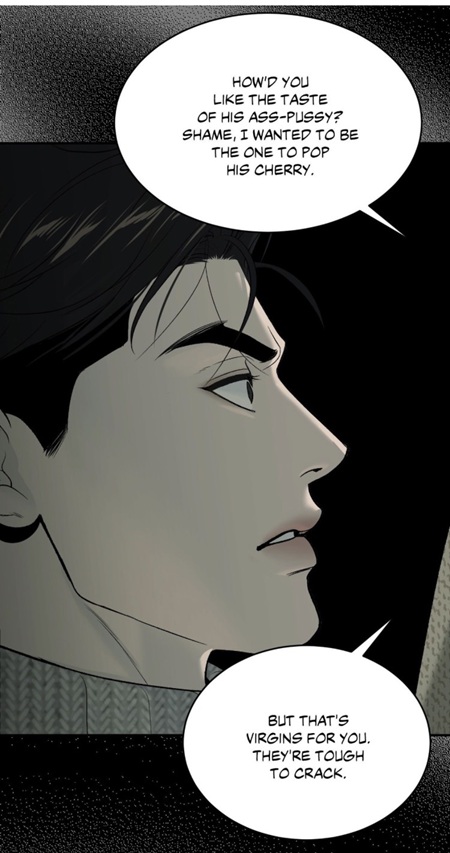 (chapter 90) as bodies that are “tough to crack,” with the confidence of repetition. The metaphor is consumptive: a shell broken to reach what is inside, then discarded. Once resistance is broken, interest disappears. This is practiced predation. The hospital is not merely the setting of abuse; it is his hunting territory — a space where authority guarantees access, exhaustion weakens refusal, and legitimacy ensures silence.
 (chapter 21) The juxtaposition of two buildings, the rooftop park, the sterile façade, and above all the near-identical hallways collapse
 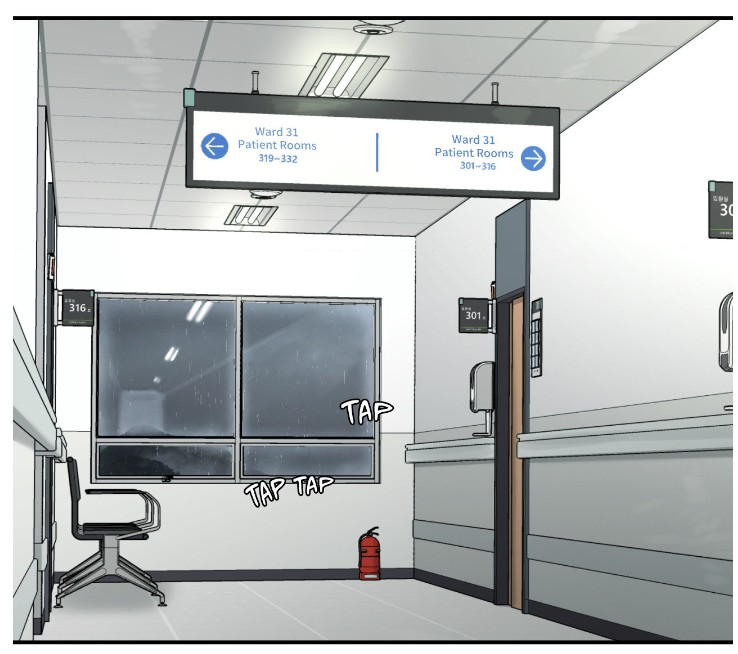 (chapter 5) Professional and personal life are folded into the same architectural body. This is not decorative repetition; it signals circulation — of staff, of protocols, of information.
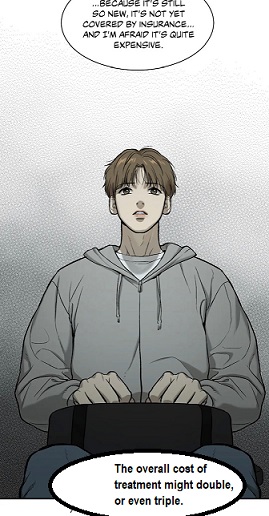 (chapter 5) — professional legitimacy, research success, advancement within a system that rewards results over outcomes. Progress functions as an absolute good, one that authorizes human cost without requiring personal cruelty. Harm is acceptable so long as it produces data.
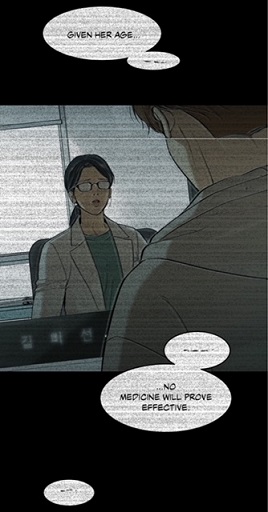
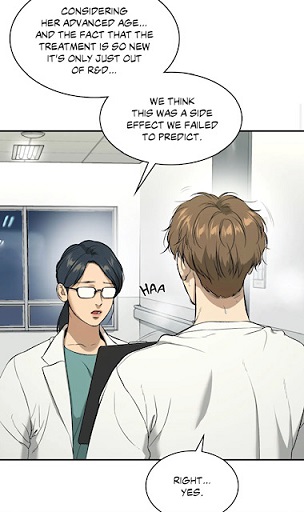 (chapter 21), age and vulnerability become a risk factor, endurance becomes a resource. When the new drug fails and the grandmother deteriorates, the explanation is procedural: side effects, unpredictability, regulatory timelines. Failure is framed as scientific, not ethical.
  (chapter 47)
 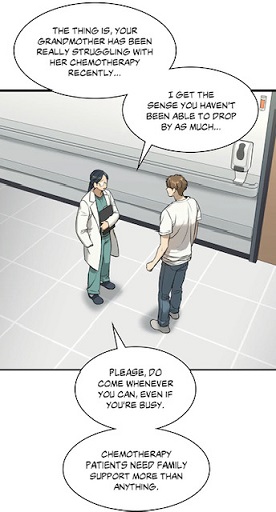 (chapter 21) Treatment patients “need family support,” she says — a statement that sounds compassionate, but functions as deflection. Psychological care is outsourced; responsibility for deterioration quietly migrates away from the institution (“we”). The setting of her disclosures reinforces this posture. She does not speak in a protected office, but in the hallway — a transitional, impersonal space governed by efficiency rather than care, as if she had nothing to hide. However, by behaving like that, she violated the confidentiality rights. Unlike the Saero-An director, who relies on enclosure and isolation, Kim Miseon operates through openness and institutional flow.
  (chapter 48) It is no coincidence.
  (chapter 56)
 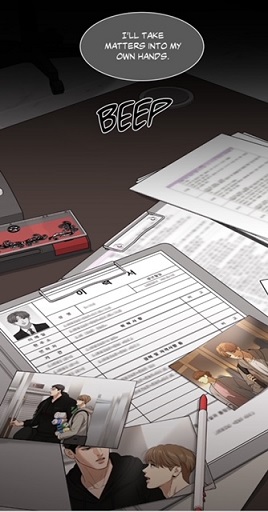 (chapter 46) This is not a coincidence. It is evidence. Personal and professional data move through institutional networks without consent. The same is true of medical information. Choi Gilseok knows about the grandmother’s illness despite having no clinical mandate.
 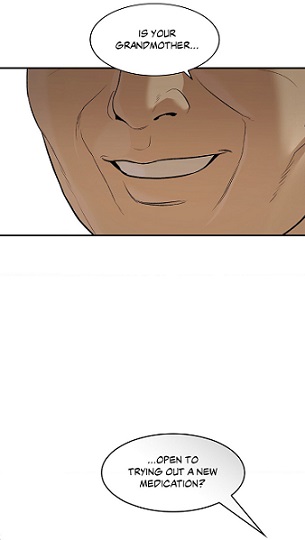 (chapter 48) That knowledge could only have reached him through leakage — informal, normalized, unremarked. Bodies are not the only things consumed here; information is too.
 (chapter 41)
  (chapter 49) In both cases, harm is delivered chemically, not physically — quietly, indirectly, and in ways that can later be reframed as accident, misuse, or personal failure. This symmetry matters. The same mechanism governs the grandmother’s fate.
  (chapter 56) Unlike Saero-An or Sallim, this space does not extract profit or prestige; it operates under scarcity. Kim Dan works there as a freelancer, not as protected staff. When he collapses, he is advised to take a day off, not sick leave — a telling detail.
  (chapter 70) It confirms that, even here, labor is contingent, negotiability absent, protection minimal. The vocabulary of care masks the reality of precarity.
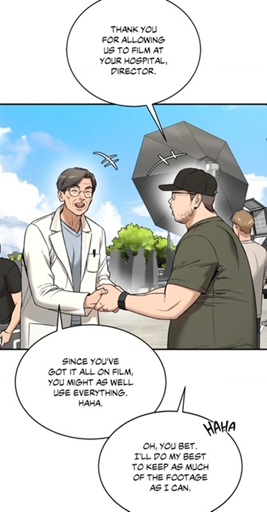 (chapter 59) Thus he is happy to let a film crew use his building for a movie. This is why he sometimes works night shifts himself.
 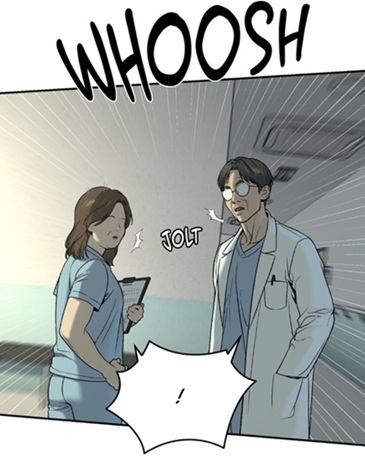 (chapter 60) His authority does not shield him from exhaustion; it exposes him to it. He enforces discipline because collapse anywhere threatens survival everywhere.
 (chapter 59) And yet, harm still occurs. Responsibility is displaced not upward, but sideways — onto the most vulnerable worker present. Kim Dan becomes the buffer once again, not because the director is powerful, but because he is trapped. Predation here is no longer driven by appetite, but by attrition.
 (chapter 61), preserving the impression of treatment rather than end-of-life care. This semantic slippage matters. For Joo Jaekyung, who has been treated there himself, the space remains associated with improvement.
 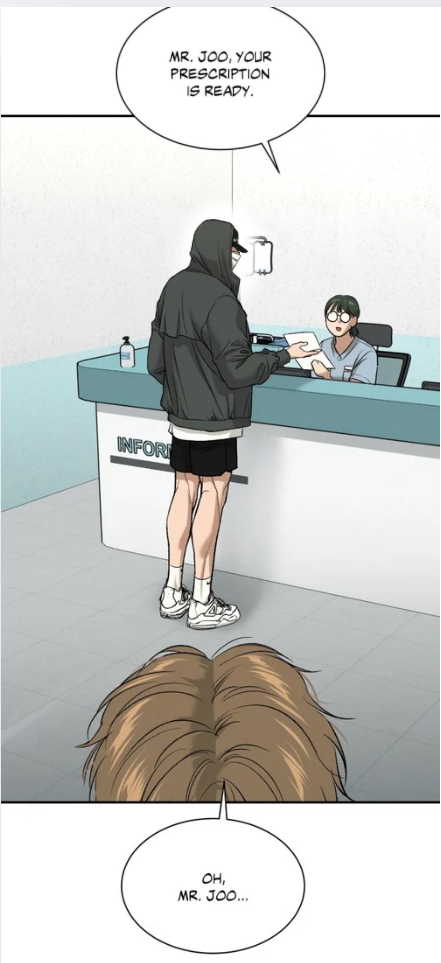 (chapter 70) He thinks, Hwang Byungchul is treated properly, as he still looks lively and strong.
 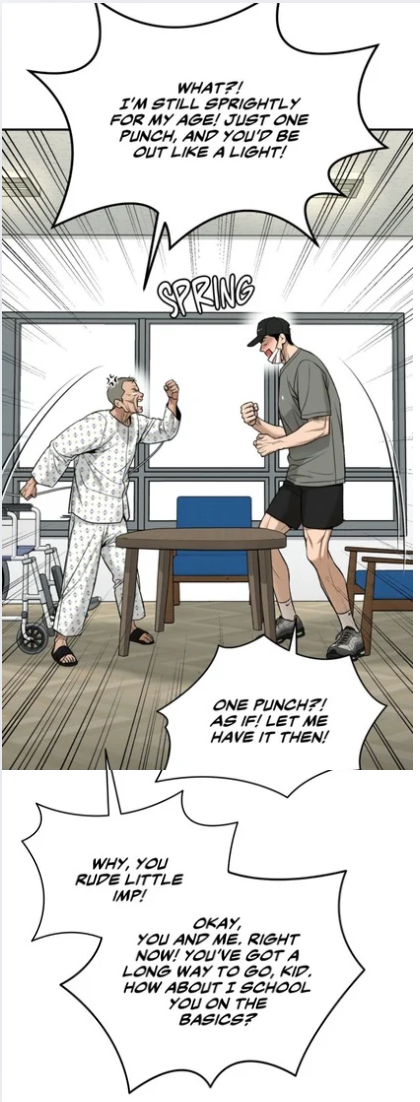 (chapter 71) The champion does not fully register that it is a place at the threshold of death. Care and closure blur. This confusion is not accidental; it mirrors the broader system’s refusal to name limits. By calling a hospice a hospital, death is softened into treatment. By calling resignation progress, responsibility is deferred.
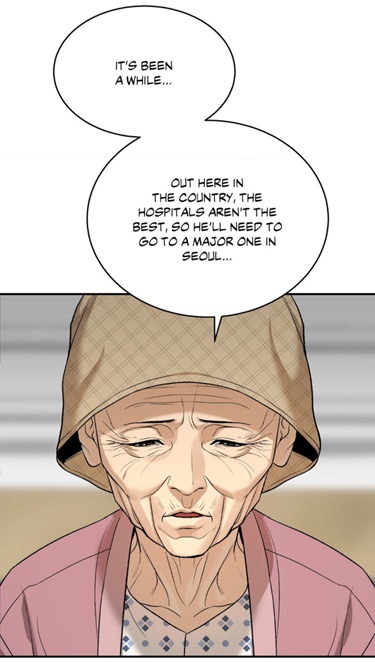 (chapter 65) For her, medicine is sacred and progress meaningful.
 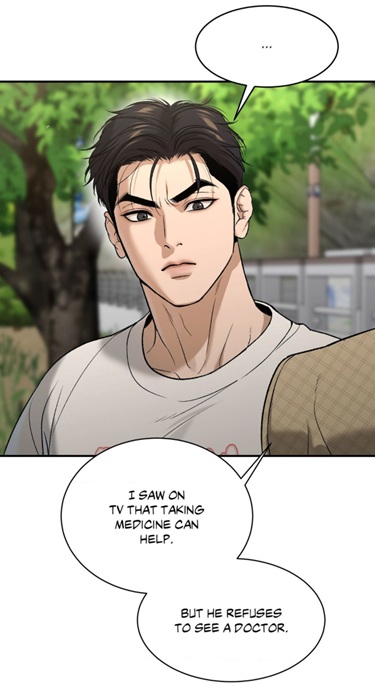 (chapter 65) This belief is not naïve in the childish sense; it is aspirational. It is tied to the idea of success, of legitimacy, of having “made it.” And in her mind, that idea has a name: Seoul.
 (chapter 65) It is where competent doctors work, where advanced hospitals stand, where progress happens, where you can earn a lot of money. This belief structures her entire horizon. Corruption, abuse, and institutional predation do not register there, because acknowledging them would mean admitting that the space she has invested with hope is also capable of harm. Within Seoul, institutions are not suspect; they are self-justifying.
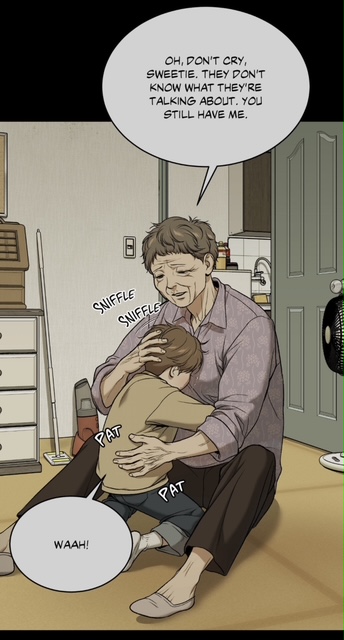 (chapter 57), she did not confront teachers. Her answer was always the same: he still had her. The implication was clear — institutions were there to protect him. To intervene would have meant questioning the very structures she depended on to make sense of the world.
 (chapter 65) as if it was recent, temporary, and situational. The wording matters. What has been chronic is compressed into the present. Duration disappears. Suffering becomes recent, temporary, and therefore manageable. This is temporal minimization — not denial of harm, but deferral of its cause.
  (chapter 57) Only then does his condition become visible. Not because it is new, but because it now implicates her. Before that moment, his endurance could remain unnamed. After it, it must be explained. This is not cruelty; it is belief colliding with responsibility.
 (chapter 7) This exposes her lack of trust in him, as she views him as too naive and trusting. This is where the irony crystallizes. Financial precarity is erased from discourse because acknowledging it would expose her responsibility. Money resurfaces, when Kim Dan presents an expensive gift. But she doesn’t mind, she is even aware of his lie:
  (chapter 41) He spends so much for her that he doesn’t have anything left for himself.
 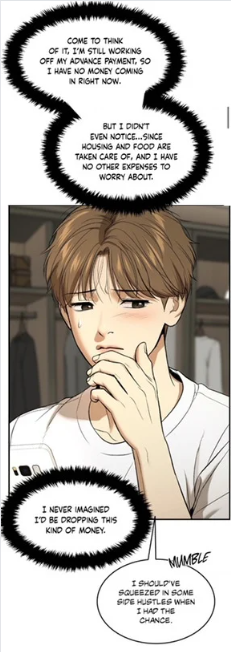 (chapter 42)
  (chapter 51). Different figures arrive at the same conclusion because they are operating within the same interpretive framework — one shaped first and foremost by Shin Okja’s mindset.
 (chapter 22)
 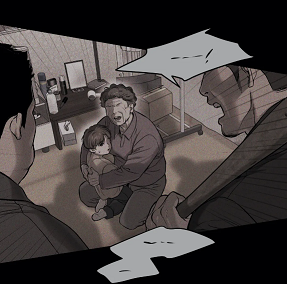 (chapter 5), not systems. And so, she imagines that as long as Kim Dan is working, earning, and paying back what he owes, nothing truly irreversible can happen to either of them. To conclude, what governs Shin Okja’s thinking is a simple equation: payment equals safety. In her mind, debt is a temporary problem with a finite solution. Once money is paid back, danger ends. Order is restored. Life resumes. This belief explains her silence around the loan. To name it would be to admit uncertainty; to erase it is to preserve control.
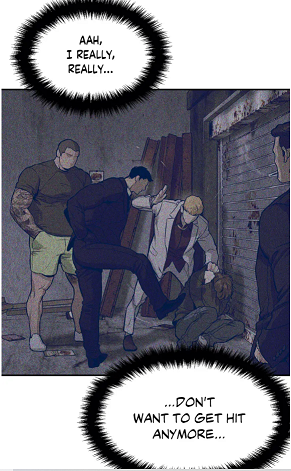 (chapter 1) Kim Dan is beaten not because he refuses to pay, but because payment structures domination. He accepts the abuse precisely because he believes it is temporary — a punishment that will end once the balance is cleared. Violence is normalized as consequence, not crime. This logic mirrors hers exactly. The more the main lead paid back, the more he was exposed to violence.
  (chapter 11) Here, he talked back to Heo Manwook, a sign that he was no longer tolerating the loan shark’s intrusion. The result was that he ended up being beaten more violently than before.
  (chapter 13) This reached its peak, when after sending his whole salary
 (chapter 16), Heo Manwook intended to rape him. As you can see, the more they got money, the more abusive they became… and all this time, the grandmother has no idea. But the best evidence is when Joo Jaekyung pays the loan in full, the pattern repeats at a higher level.
  (chapter 17) The debt is erased — and the danger escalates. Kim Dan might become free, but now the target is the champion. He becomes visible. Settling the debt marks him as someone worth targeting, someone who can be extracted from again.
  (chapter 46) What Shin Okja imagines as closure functions, in reality, as a signal.
 (chapter 46) Each appearance sustains sponsors, broadcast value, betting volume, and gym economies. This is why he becomes the “biggest target”: not because he is weak, but because he represents the highest return.
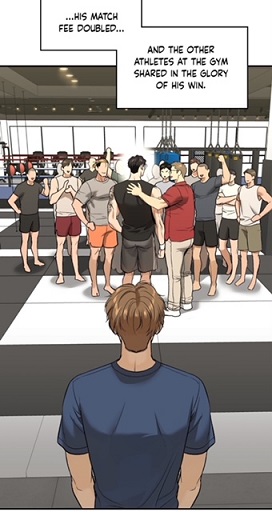 (chapter 41) A champion who keeps winning cleanly, visibly, and on his own terms becomes difficult to manage. His victories increase his market value, distribute prestige and income to others, and create expectations of legitimacy. At that point, success stops being profitable in a controllable way. It begins to threaten both institutional authority and informal economies that rely on predictability, influence, and narrative control.
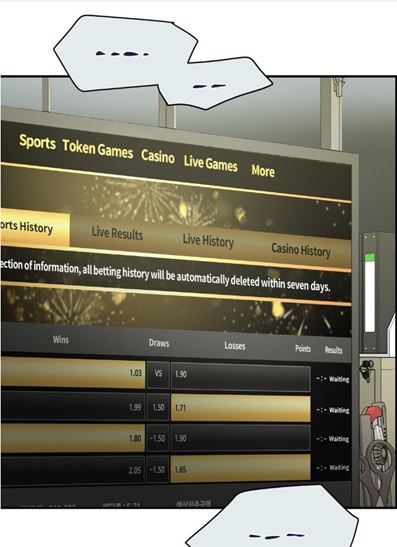 (chapter 46) A dominant, credible champion reduces volatility, resists manipulation, and makes engineered outcomes harder to disguise. In such a configuration, continued victory is destabilizing. The problem is no longer his body failing — it is his body refusing to fail on schedule.
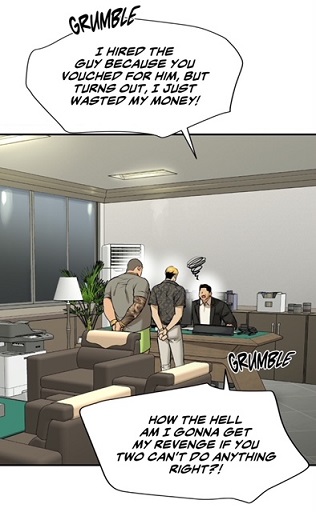 (chapter 46) is violent. The question is: what kind of predator is he?

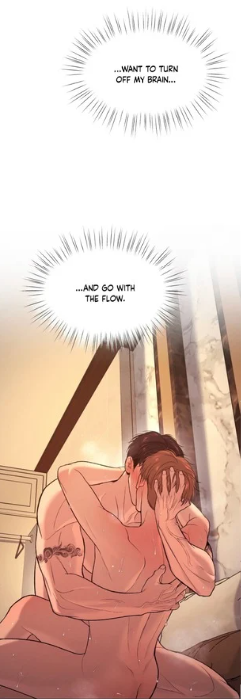 (chapter 86), it does not close the night through narrative resolution. There is no statement, no promise, no verbal seal. And yet, for many Jinx-philes, the final panel refuses to let the scene dissolve. What remains is not heat, not tension, not even tenderness — but circulation.
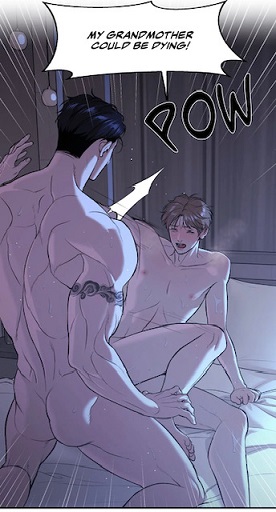 (chapter 21), overload
  (chapter 33), short circuit
 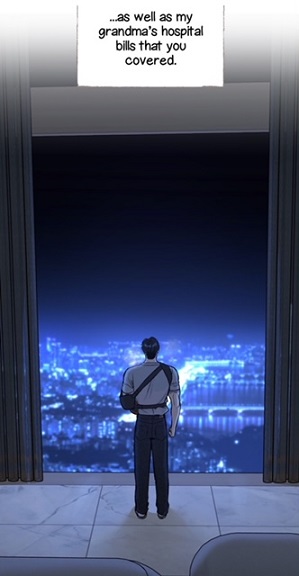 (chapter 53) reset. And once that lens is adopted, it becomes impossible to limit the consequences of episode 86 to the couple alone. Because a closed circuit does not only affect those directly connected to it. It alters the surrounding system.
 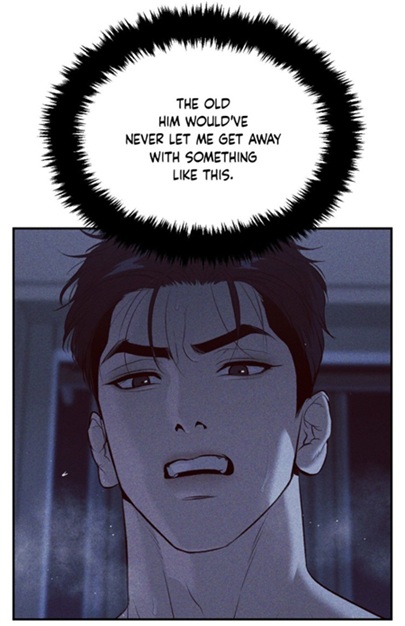 (chapter 86). This section will explore how acknowledging change without denying past harm opens a new ethical position — one that prevents memory from being weaponized, while still preserving responsibility. Third, the analysis will turn to conversion, revisiting earlier nights marked by failure, asymmetry, and isolation. Rather than cancelling them, episode 86 absorbs and transforms them. This is where forgiveness, reflection, and the first true encounter with consequence quietly enter the narrative. Finally, a new section will widen the lens further by examining shared experience and memory
  (chapter 53), particularly through Kim Dan’s relationship with his grandmother. Here, the focus will not be accusation, but contrast: between memories carried alone and memories held together; between cycles of repetition and moments of presence; between a worldview structured around endurance and one shaped by circulation. The Paris night does not only affect how Kim Dan sees Joo Jaekyung
 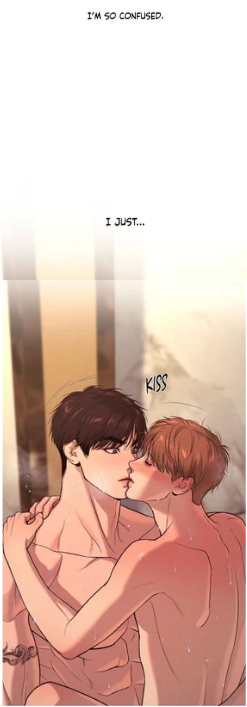 (chapter 86) carries such weight, we must return to the origin of kissing itself in Jinx. Because surprise, in this story, is not an abstract theme. It has a history. And that history begins with a body being caught off guard.
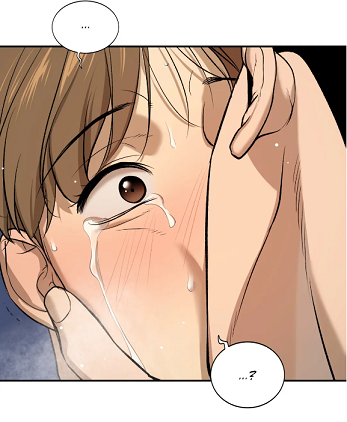 (chapter 14) There is no warning, no verbal cue, no time to prepare. The kiss arrives as interruption. It is not negotiated; it is imposed. Hence the author focused on the champion’s hand just before the smooch.
 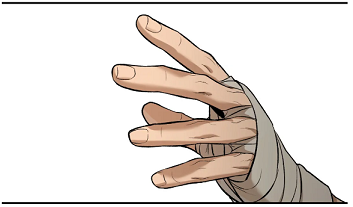 This moment matters far more than it initially appears, because it establishes the template through which Kim Dan first encounters intimacy.
 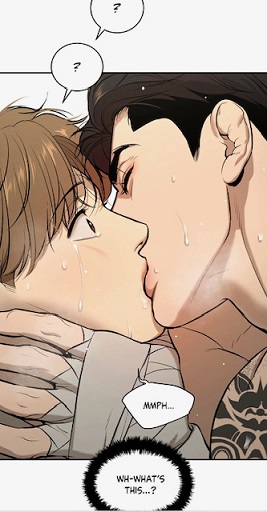 (chapter 15) Affection does not emerge gradually. It breaks in.
 (chapter 15) He needs preparation. He needs time to brace himself emotionally. This request reveals two aspects. First, he connects a kiss with love. On the other hand, the request is not really about romance; it is rather about survival. Surprise, for Kim Dan, has already been coded as something that overwhelms the body before the mind can intervene.
 (chapter 39), he violates his own request.
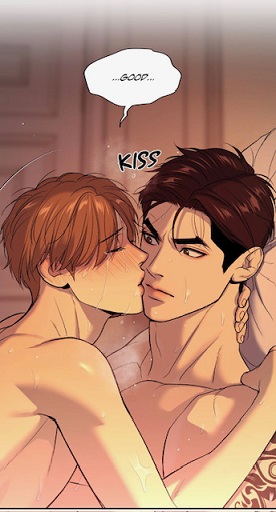 (chapter 39) They are unannounced, often landing on unusual places (cheek or ear)
  (chapter 44). They often take place under asymmetrical conditions — when one of them is intoxicated, confused, or emotionally exposed. Sometimes they occur without full consent, sometimes without clarity. In chapters 39 and 44, kisses surface precisely when language fails or consciousness fractures. It is as if Kim Dan has internalized a rule he never chose: a kiss must be sudden. Observe how the champion replies to the doctor’s smile and laugh: he kissed him, as if he was jealous of his happiness.
 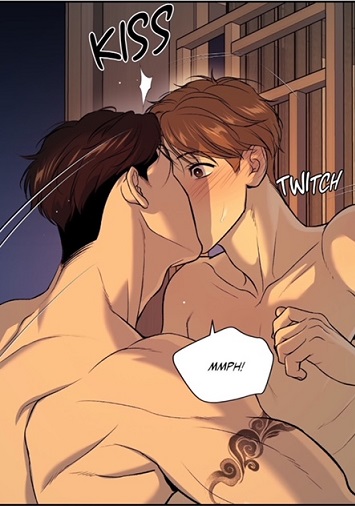 (chapter 44) That’s how I came to realize that the kiss in the Manhwa is strongly intertwined with “surprise”. This is the missing link.
 (chapter 2), he comes to reproduce interruption as intimacy. He knows that surprise destabilizes him — that is why he asked for warning — but he has no other model. What overwhelms him also becomes what he reaches for. Surprise is both threat and language.
 (chapter 3): the sudden call from the athlete,
  (chapter 1), the offer of sex in exchange for money
 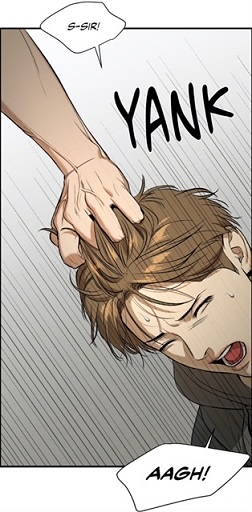 (chapter 6), the switched spray
  (chapter 49), the sudden changes in rules. These moments strip Kim Dan of anticipation and agency. His body reacts before his will can engage. Surprise equals exposure.
 (chapter 1) His life is governed by “always”: always working, always returning, always responsible. He lives for his grandmother. Nothing unexpected is allowed to happen, because nothing unexpected can be afforded. This is safety through stasis. Presence without experience.
 (chapter 5)
  (chapter 1) They shattered routine rather than enriching it. Surprise, in that context, did not open possibility; it threatened survival. It meant debt, coercion, fear. And precisely because of that, it could not be integrated into memory as experience — only repressed as trauma.
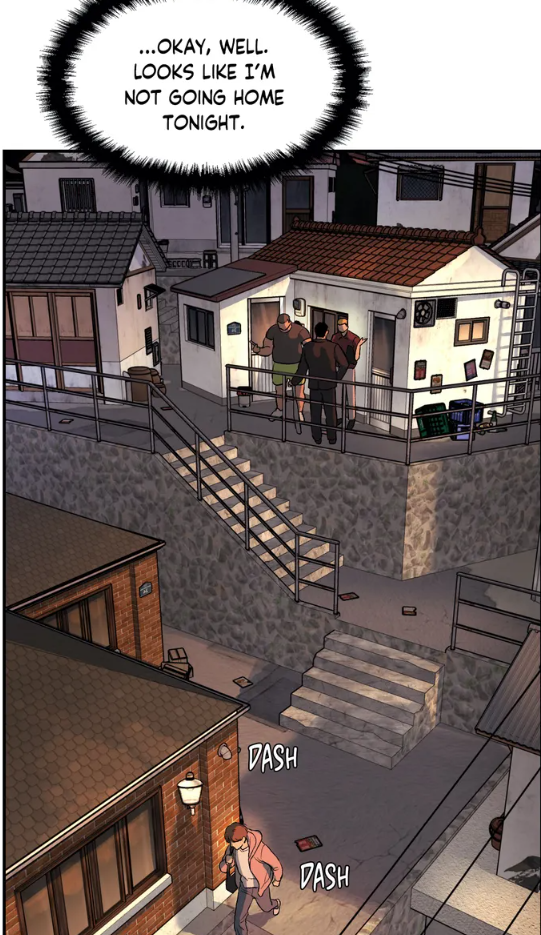 (chapter 1), if he doesn’t return home. Surprise, in its earlier form, is excised from the household. What remains is a world of repetition and endurance — safer, but lifeless.
 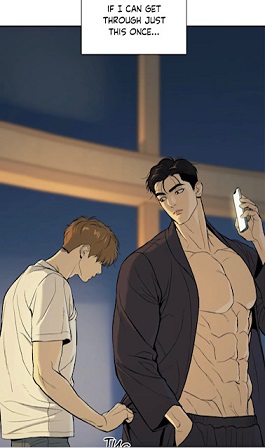 (chapter 2) but in a fundamentally different form.
 (chapter 11) His appearances are sudden, his demands non-discussable, his violence immediate. He does not ask; he enforces. Surprise, under his rule, eliminates speech. It leaves no space for argument, no room for clarification, no possibility of consent. One endures, or one is punished.
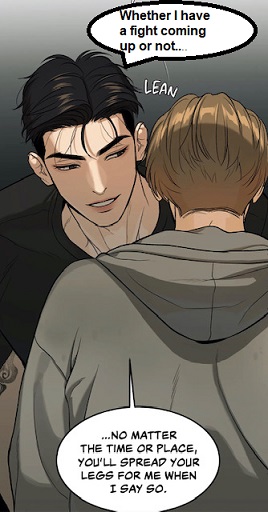 (chapter 6) Even when power is asymmetrical, even when the terms are coercive, speech is required. Conditions are stated. Rules are articulated. Kim Dan is forced to listen, to answer, to argue, to object. He must speak.
 (chapter 17) The two figures cannot coexist because they represent mutually exclusive regimes of surprise: one that annihilates speech, and one that forces it into being. In other words, only one allows experience to be lived rather than survived.
 (chapter 51) — yet they are unmistakably his. They mark the moment when something begins to circulate.
  (chapter 27) Experiences accumulate instead of disappearing. They demand response, speech, negotiation. Life no longer consists in enduring impact, but in processing it.
 (chapter 65) and as such neutralization: suffering must be absorbed, pain must be justified, disruption must be folded back into endurance. There is no place for charge there — only for dissipation. What Kim Dan lives through with Joo Jaekyung follows a different logic altogether: not sacrifice, but circulation; not repetition, but conversion.
 (chapter 41) not despite surprise, but through it. Not because dominance is romanticized, but because surprise is the first force that treats him as someone to whom things can happen. And don’t forget that for him, a kiss symbolizes affection. Even negative experiences generate subjectivity. They prove that he exists beyond function.
 (chapter 85) Kim Dan either endures it or reproduces it under unstable conditions. Agency is partial. Meaning collapses afterward.
 (chapter 39), irony
 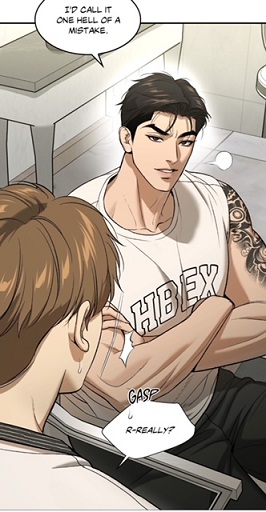 (chapter 41) or rejection
 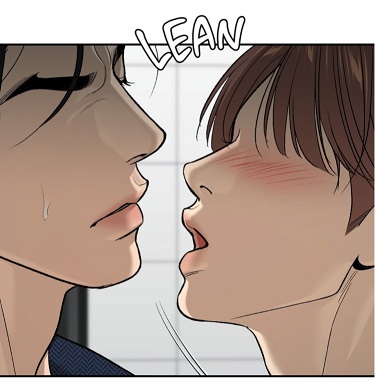 (chapter 55). He does not retreat into his habitual “it’s nothing” or “never mind.” He does not reinterpret the gesture as convenience or reflex.
  (chapter 86) He kisses back while looking tenderly at his partner. He holds Kim Dan’s head gently. He can only see such a gesture as a positive answer to his request: acceptance and even desire. Surprise is not punished. It is received.
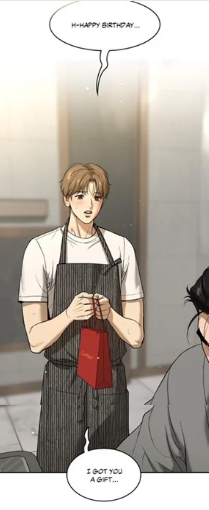 (Chapter 45) This time, the athlete not only accepts the present (the kiss), but but also expresses “gratitude” by kissing back actively.
  (chapter 65) In her eyes, she has never changed, just like her grandson.
  (chapter 52), justify behavior
  (chapter 57), and foreclose change. The champion’s violence is explained through reputation.
  (chapter 1) Kim Dan’s endurance is explained through obedience and debt. The grandmother’s authority is explained through sacrifice. In every case, the same logic applies: this is how it has always been; therefore this is how it must remain.
 (chapter 65) If the past is absolute, it can be endlessly invoked to invalidate the present. We have a perfect example on the beach.
  (chapter 65)
 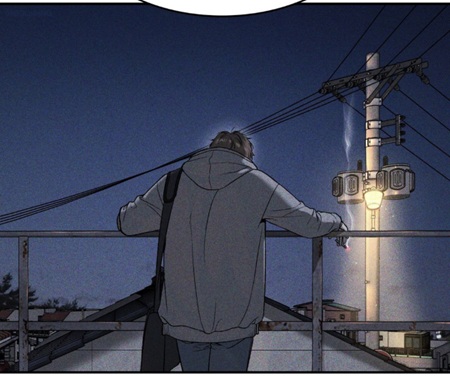 (chapter 65) They are evaluated exclusively through a moral lens. Smoking and drinking are not responses; they are flaws. And because they are framed as flaws, they retroactively define his character rather than his situation. This is where agency collapses.
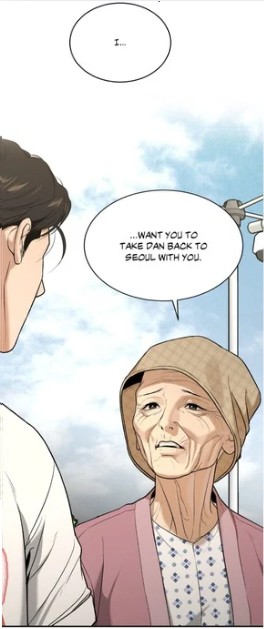 (chapter 65) Her behavior does not contradict her claim that she wants Kim Dan to “live his own life.”
 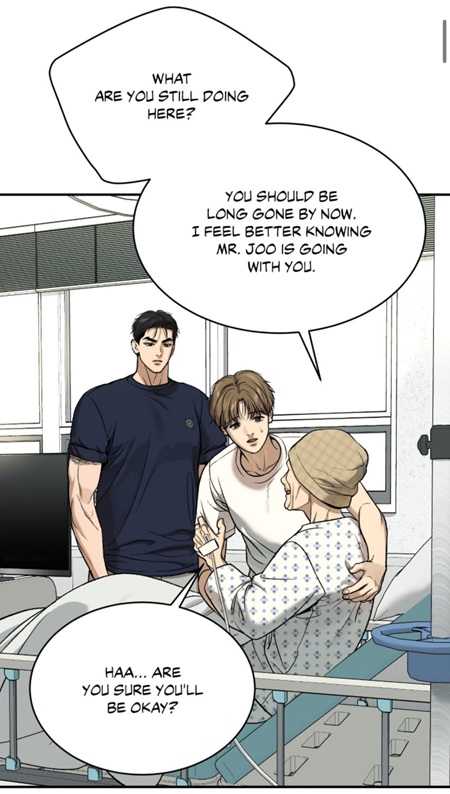 (chapter 78)
 (chapter 86) Once again, the “hamster” is given the opportunity not only to decide, but also to follow his heart. Where the Paris night allows difference to coexist with memory, Shin Okja’s framework collapses difference back into judgment. Where electricity requires polarity, her logic insists on sameness. Under this new light, it becomes comprehensible how doc Dan came to neglect himself. Self-care is inseparable from choice — from the belief that one’s decisions can meaningfully alter the present. If change is denied, care loses its purpose. Attending to oneself becomes optional, even suspect, because it implies a future different from the one already prescribed.
  (chapter 44) The one who remembers bears the – alone, while the other continues forward unmarked. That imbalance is corrosive. It distorts perception. It turns even good memories sour.
 (chapter 65), but she remembers it in a way that flattens time. Pain becomes proof of virtue. Sacrifice becomes identity.
  (chapter 65) Change is allowed only insofar as it returns to the same point. Electrically speaking, her system is grounded — all charge dissipates into endurance. There is no polarity, only repetition.
 (chapter 65) Even though the word jinx is never spoken during the Paris night, its logic quietly collapses there.
 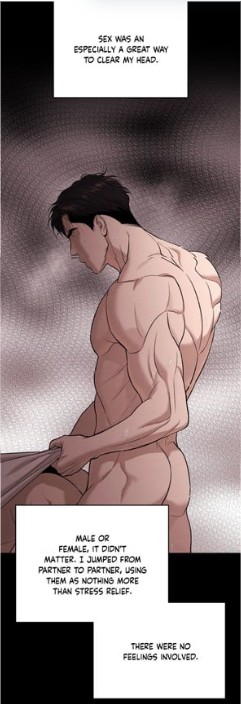 (chapter 75) In chapter 75, it is explicitly framed as a way to “clear the head”: an act designed to release pressure and return the system to zero. Partners were interchangeable. Feelings were excluded. Electricity existed only as a spark — brief, violent, and self-extinguishing. Energy was expelled, not circulated. That is the true mechanics of the jinx: power without continuity, intensity without consequence.
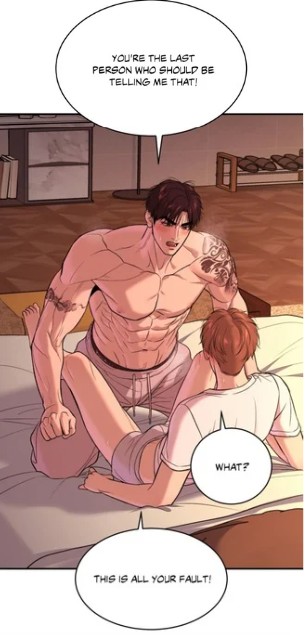 (chapter 85) Desires matter, not the match the next morning. Besides, the identity of the partner matters — not just romantically, but also structurally. Current requires two poles. It requires response. It cannot flow through an object, only between 2 subjects.
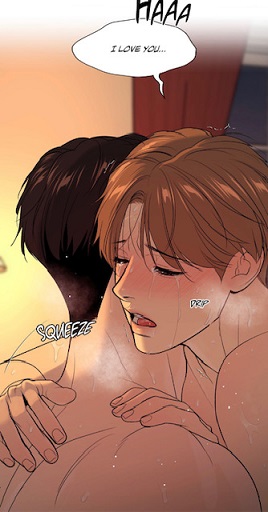 (chapter 39) and chapter 44
 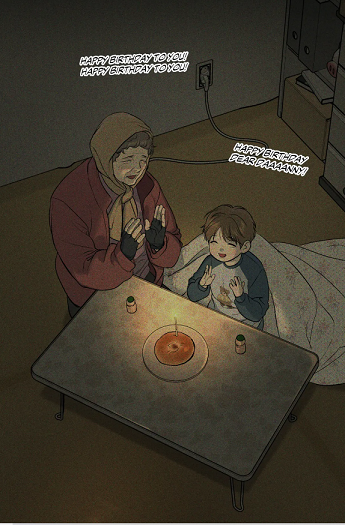 (chapter 11), the care – even if he had hurt himself –
 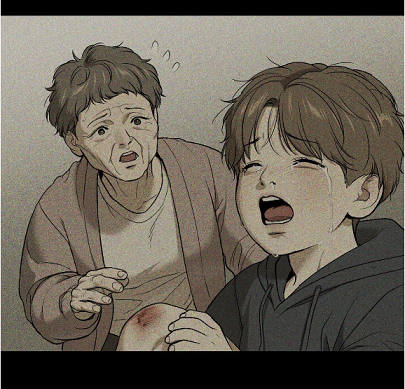 (chapter 47), the shared smiles
 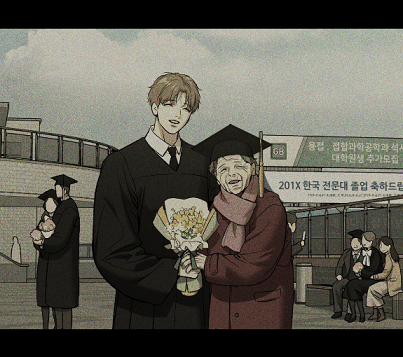 (chapter 47). Thus this photograph
  (chapter 65) becomes a talisman — not a record of reality, but a distilled image of safety. Painful dimensions are filtered out. Conflict, coercion, and silent pressure recede into the background. Memory protects him by idealizing. Because of this picture, he projected himself in the future, making unrealistic plans.
 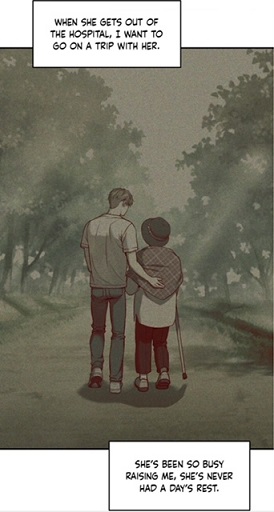 (chapter 47) It was, as if he only had good times with his grandmother.
 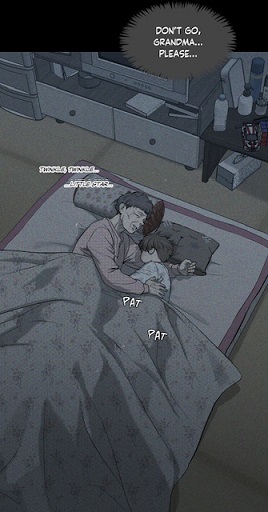 (chapter 21)
  (chapter 47) and memories.
 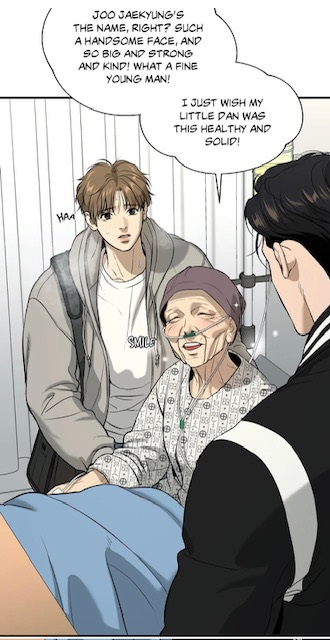 (chapter 21)
 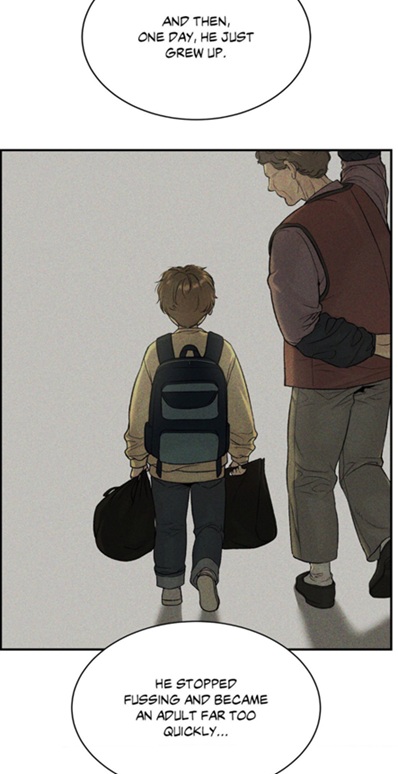 (chapter 65). While sleeping, memories come to the surface.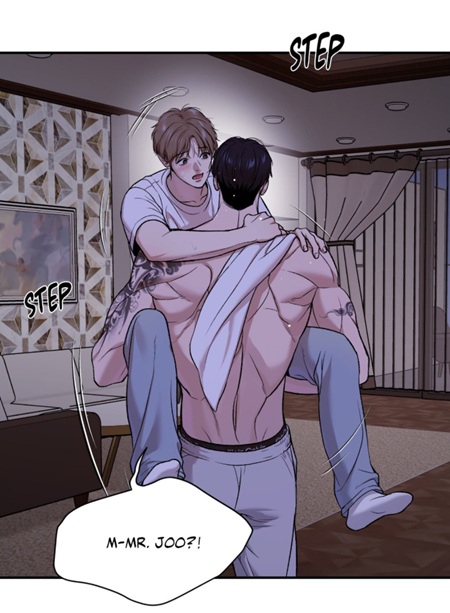
 (chapter 85) I believe that its appearance does not function as decoration. Its imagery — figures suspended among clouds, bodies neither falling nor grounded — introduces a different register of time. Not urgency. Not performance. Not spectacle. Stillness. Interval. A space where movement pauses without collapsing. Under this new light, the reference is Morpheus.
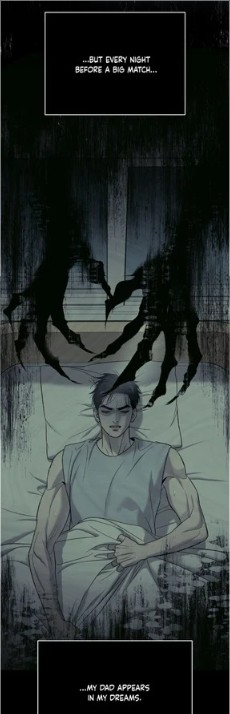 (chapter 75) Until now, rest had been replaced by discharge: sex as erasure, violence as exhaustion, ritual as compulsion. The Paris night does not abolish wakefulness through collapse; it introduces the conditions under which sleep might finally be possible.
 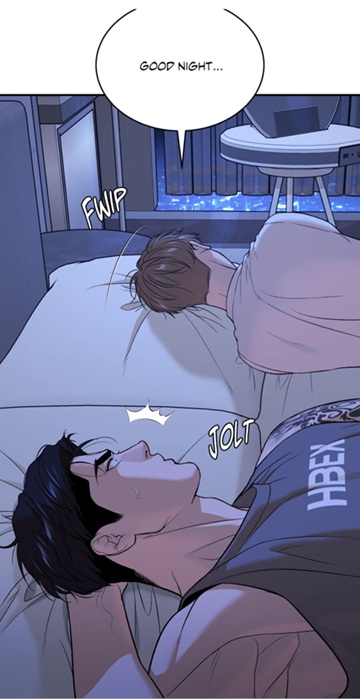 (Chapter 78) Here, he reduced it to the absence of sex, but I am sure that deep down, he would have been satisfied, if the “hamster” had given him a good night kiss.
 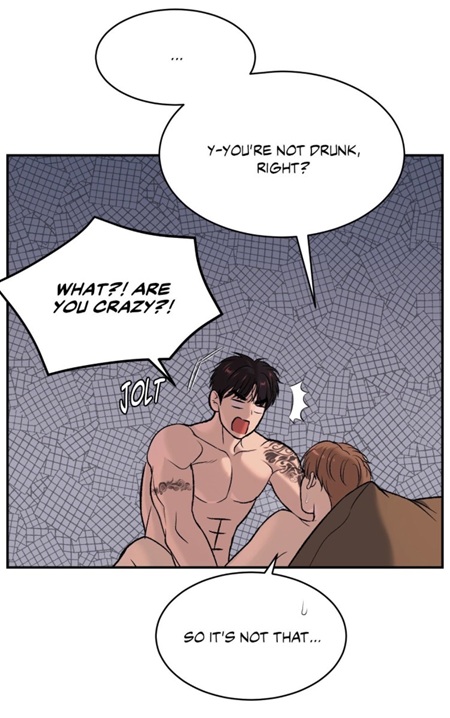 (chapter 86) The charge redistributes. Memory ceases to isolate and begins to circulate. Hence it creates a new memory.
  (chapter 86) was a reflection of the picture.
  (chapter 86) No one is erased or reduced to an object. Nothing is overlooked or forgotten. But repetition loses its hold. And from here, the story can no longer proceed as before.

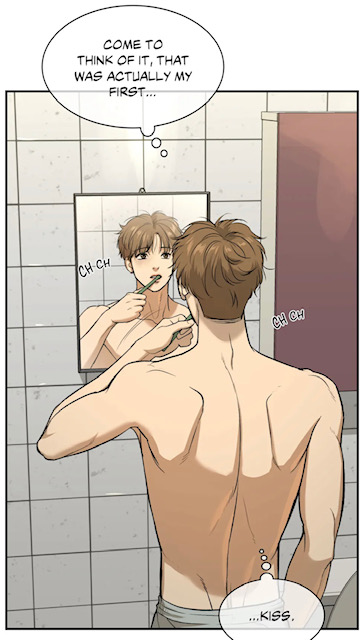 (chapter 16) —haltingly and with a trace of disbelief visible thanks to the points of suspension —as his first kiss ever. His stunned reaction and eventual admission offer a compelling lens through which to explore the symbolism of kissing in Jinx, but also the emotional landscape the two men must navigate.
  (chapter 55) Still, some readers have theorized the existence of a “special lover” in his past
 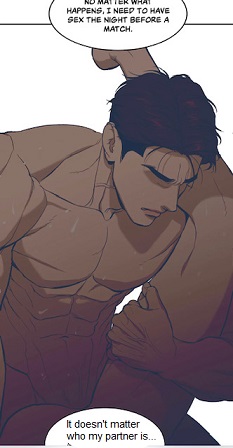 (chapter 2), someone who might have earned a different kind of intimacy. One cause for this hypothesis is that in the champion’s first memory, he was facing his partner, which contrasts so much to the way he had sex with his partners (from behind). This possibility casts the locker room kiss in a new light.
  (chapter 14) If it was his first, the gesture carries a far deeper meaning than either man realizes in the moment. And if it wasn’t, then why does this kiss—with Kim Dan—resonate so differently?
 (chapter 30) Recognizing his face, Dan mentions that his grandmother used to watch the drama A Fine Line, and that he had seen it with her.
 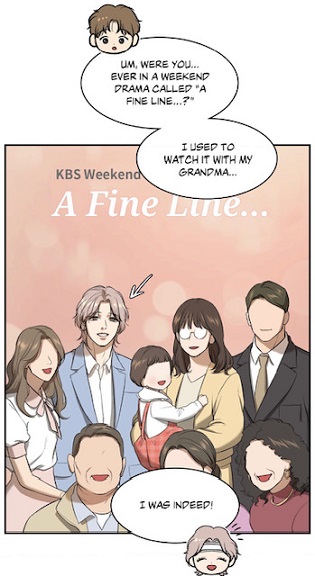 (chapter 30) The author even includes a framed shot from the fictional show, depicting Heesung as the smiling son-in-law in a multigenerational family. This visual insert is subtle, but telling: it wasn’t the story that stayed with Dan, but the faces—the aesthetics of family structure and polite emotional decorum.
 (chapter 16) it frightened him. The kiss broke an invisible boundary—one his upbringing had silently enforced. That’s the reason why he wasn’t sure if he could do it again.
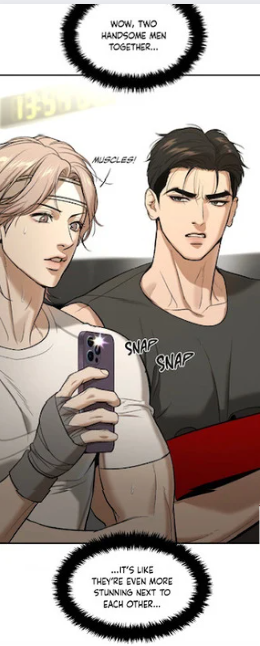 (chapter 30) He blushes and wonders why.
  (chapter 30) It’s a telling moment: Dan isn’t used to feeling attraction and desire, let alone recognizing it. He never bought posters of celebrities, never fantasized. That world—the glamorous world of affection, attention, and beauty—was never his.
 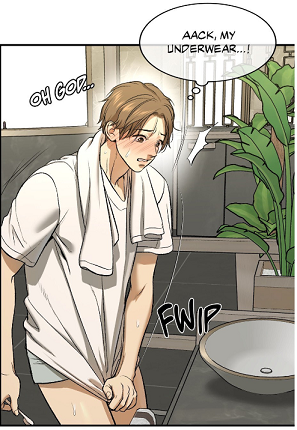 (chapter 30) —despite already having been seen naked by Jaekyung
  (chapter 30) —suggests something deeper than modesty. When he rushes to hide his underwear and blushes merely at brushing his teeth next to someone
 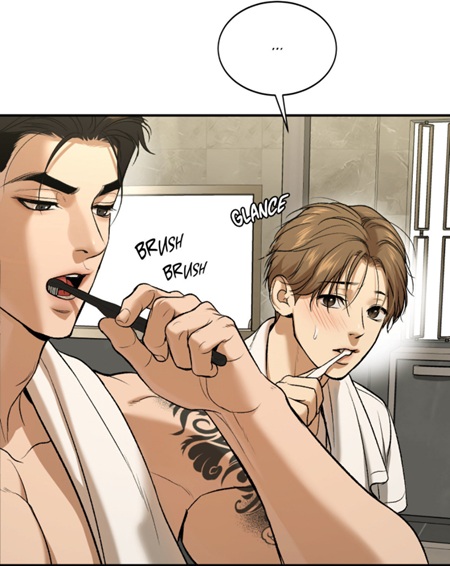 (chapter 30), it becomes evident: Dan is not accustomed to physical closeness or shared domestic spaces. These are not reactions of a man with just sexual trauma—they point to someone raised without the warmth of daily intimacy.
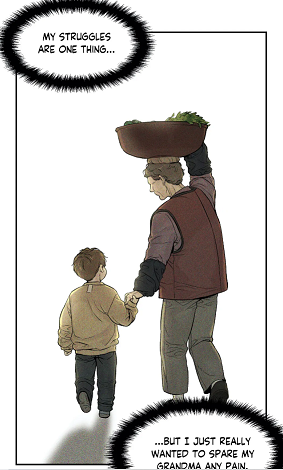 (chapter 5) He had to take care of himself, dressed on his own. He had to act like an adult, as his role was to assist his grandmother:
  (chapter 44) and ear
  (chapter 44) and toward something far more intimate and protective. These are not the kisses of seduction, but of affection—almost maternal in their tone. Hence the MMA fighter got patted later:
  (chapter 44) They suggest care, comfort, and emotional presence. This is crucial, because it reveals that for Dan, a kiss is not about arousal or conquest. It is a language of love. They carry the flavor of instinct. These are the kinds of kisses a child might have once received, or given, in moments of safety and connection.
 (chapter 44) is a behavior shared by felines and wolves alike: a subtle act of comfort, trust, and bonding. Wolves nuzzle to soothe and reassure. Leopards nudge to display affection without threatening dominance. Dan’s pecks
  (chapter 57) (chapter 57)—licking them not out of instinct alone, but to reassure and bond.
 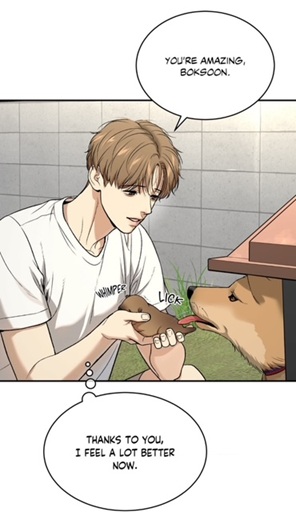 (chapter 57) During that summer night’s dream, Dan’s body mirrored this wordless care. That’s why he could laugh so genuinely like a child after witnessing his “pet’s reaction”.
  (chapter 44)
  (chapter 14) Therefore the physical therapist astonishment, “What’s this?” was not naïve; it was disoriented. Somewhere deep within, Dan had internalized a different model of kissing: one that reflected comfort, not conquest; affection, not arousal. The kiss he received was too strange, too fierce—it violated a definition he didn’t even know he had. His body knew how to kiss, but it remembered a different type of kiss altogether. The latter stands for love and as such emotions. Under this new light, my avid readers can comprehend why the physical therapist made the following request from his fated partner:
 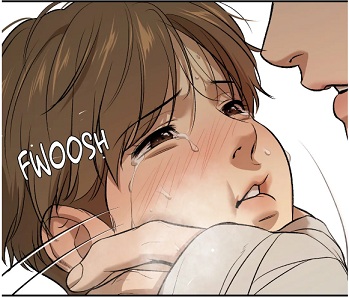 (chapter 14) Jaekyung repeated such a gesture, as seen in chapters 24
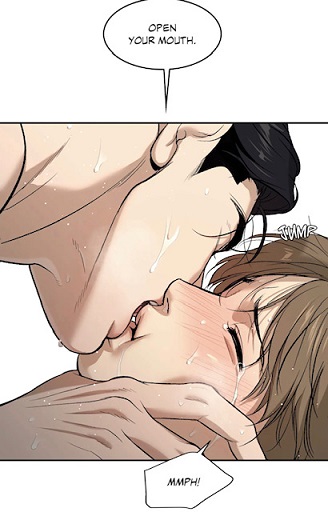 (chapter 24), and again in 64
  (chapter 64). These gestures were not expressions of tenderness, but acts of dominance, mirroring how the celebrity was taught to treat intimacy: not as an exchange, but as an imposition. His behavior echoes Cheolmin’s earlier suggestion
  (chapter 13) where a little touch was functional. On the other hand, the suggestion framed “affection” as a form of fun and entertainment, meant to soften the experience and shift the focus toward the partner. While Cheolmin’s comment was not malicious—in fact, it encouraged Jaekyung to become gentler and more attentive—it still fell short of true emotional connection. Why? It was a medical suggestion, meant to protect Dan’s fragile state. The kisses in episodes 14 were to protect the physical therapist. They were initially functional, a mean to achieve a goal before becoming a habit.
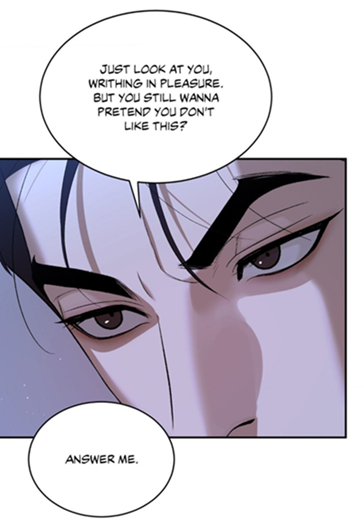 (chapter 63) Fun is not the same as love, and this distinction matters deeply for someone like Kim Dan, who associates kissing with emotional safety and love, not performance or play. This explicates why he refused to be kissed in episode 63:
 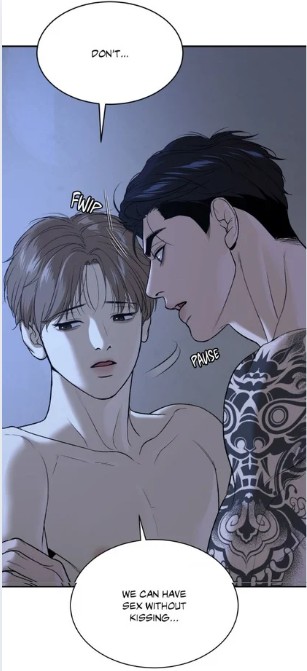 (chapter 63)
 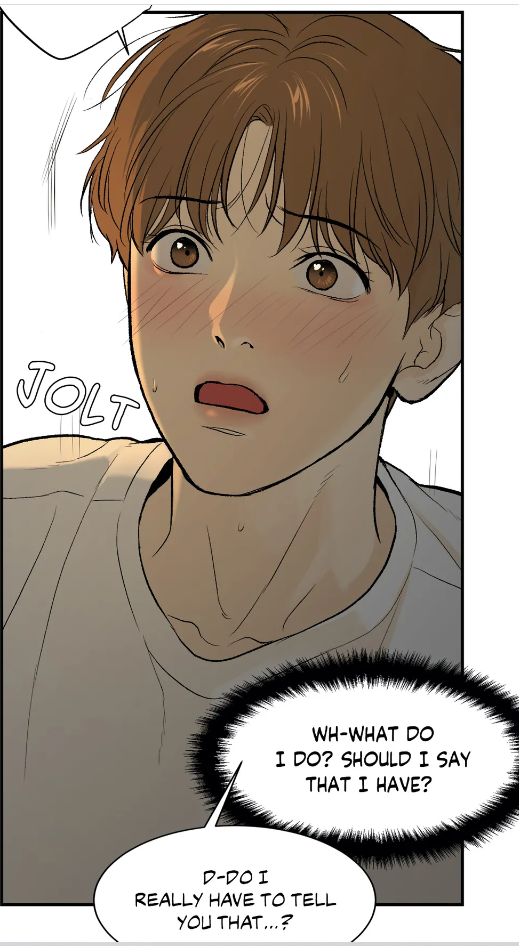 (chapter 3) —it forces the wolf to ponder on the meaning of a kiss and his relationship with the physical therapist.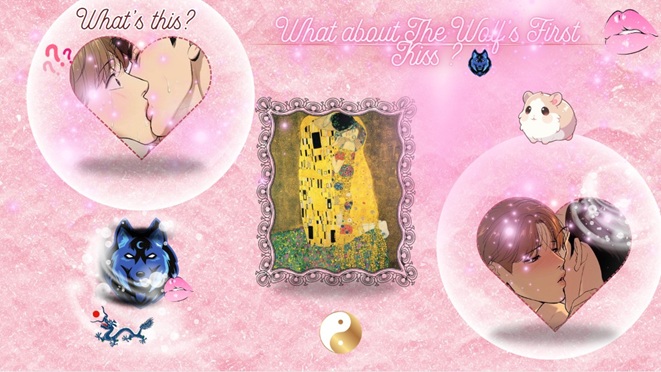
 In that iconic artwork, the man does not kiss the woman on the mouth, the traditional locus of erotic desire. Instead, his lips are placed upon her cheek—a gesture that suggests reverence, not possession; vulnerability, not domination.
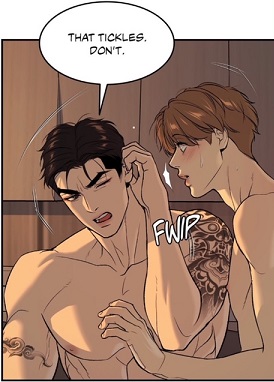 (chapter 44)
  (chapter 45)
 (chapter 54) When he was young, he had to face an abuser. Notice that the man’s face was very close to the champion’s
  (chapter 54). Thus I interpret that for the champion, the face represents not only his vulnerability, but also a source of danger. That’s the reason why he couldn’t hide his displeasure and frustration, when he faced this “lover”.
  (chapter 44) He couldn’t hide his joy by the champion’s funny reaction and laughed. And how did the protagonist react to this? Not only his face expressed his dissatisfaction, but also he silenced his partner with a kiss right away:
  (chapter 44) Joo Jaekyung is leading the kiss, he is regaining control over their relationship. It reinforces the idea that the wolf’s kiss was not merely about passion, but about reclaiming dominance and halting a shift in power. Just moments earlier, Kim Dan’s laughter had opened a space of emotional intimacy and lightness, which the champion was not prepared to face. The kiss, now prolonged and intensified, becomes the sportsman’s way of reasserting control over a situation that was slipping into unfamiliar emotional territory.
 (chapter 45) The marks on the doctor’s body were evidence that he was no longer in control. They weren’t just signs of a physical encounter—they were witnesses to something far more threatening: vulnerability, softness, and reciprocity. In the night, swept up by instinct and unspoken longing, the wolf had allowed himself to be touched—not just physically, but emotionally. But by morning, the spell was broken. His gaze didn’t linger on Kim Dan with affection—it darted instead to the bruises and scratches as though they were accusations.
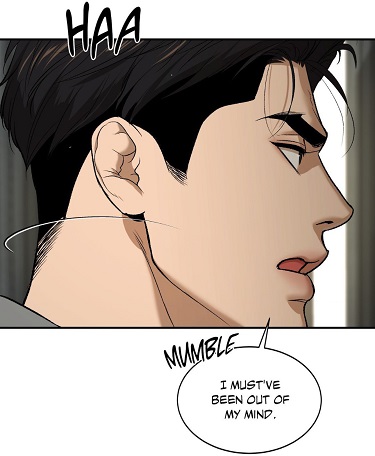 (chapter 45) wasn’t just the pain he might have inflicted—it was the realization that the balance of power had subtly shifted. The man who had always dictated the terms of their relationship had surrendered to something unfamiliar: tenderness, emotional closeness, and shared desire. The fact that Kim Dan initiated affection, even kissed him voluntarily, shattered Jaekyung’s script. For someone who conflated feelings with threat, and dominance with safety, this reversal was unbearable.
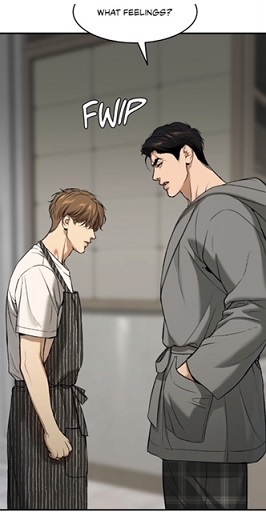 (chapter 45) —and that he, in turn, had wanted Dan back. This terrified him more than any bruise ever could.
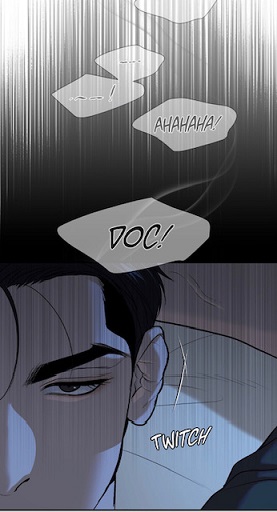 (chapter 37), and kissing becomes his emotional brake pedal. It’s not simply an act of love, but a means to regulate, or even drown out, what he cannot yet name or accept: that he is being loved. It is not random that I included the scene from episode 37: he heard laughs from the other room. For him, such a noise must have sounded like a disrespect and mockery, triggering his past trauma. And he was not entirely wrong in the sense that they were eating behind his back
  (chapter 37) It was, as if they were mocking him because of his forced “diet”. No wonder why the champion is barely seen laughing and prefers seriousness. At the same time, I can grasp why the athlete feels close to Park Namwook, as the latter stands for these exact notions: work, money and seriousness. Fun is not part of his world and vocabulary, therefore he punished Joo Jaekyung for sparring with doc Dan.
 (chapter 2) Though his face was close to the star’s, he didn’t attempt to kiss him. In fact, he proposed him a fellatio, a sign that the champion had never allowed anyone to get close to his “face”. Finally, observe how he reacted, when the uke in episode 55 attempted to kiss him:
 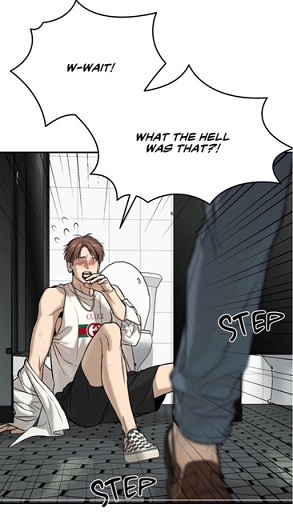 (chapter 55) The celebrity even ran away: a sign that the allowing someone approaching his face is perceived as something uncomfortable and threatening. At the same time, that moment exposes the kiss as something sacred—one that cannot be duplicated without emotional violation. This shows that for the champion, the meaning of a smooch has evolved. It is no longer perceived as a source of fun and a mean to gain something.
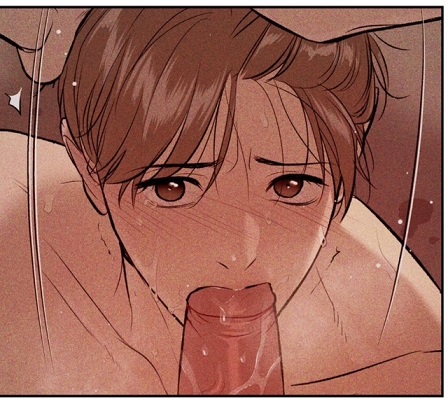 (chapter 55) He couldn’t forget doc Dan’s face, the latter excited him, a sign that for the champion, the face in general has been a source of pain, yet thanks to doc Dan, the latter has become a source of “comfort and joy”.
  (chapter 66) When he saw his face for the first time, he didn’t realize that he was already under the hamster’s spell. Striking is that he even focused on his chin and lips, a sign that he desired to kiss them. One thing is sure. The champion treasured the doctor’s face. After their separation, it is not surprising that the wolf felt the need to see his face.
 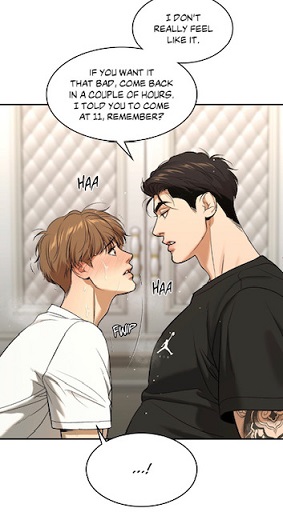 (chapter 39) before requesting a fellatio:
  (chapter 39) The main lead’s head was very close to the champion’s face, thus he must have felt uncomfortable. Secondly by acting this way, the doctor was gradually gaining power over their relationship. For the wolf, dominance is everything, an indication that in his past he felt defenseless and weak. His “opponent”, the mysterious ghost, had the upper hand. Moreover, the fellatio created a distance between them, where the fighter could expose his superiority. And note how doc Dan behaved under the influence of the drug:
  (chapter 39) For the first time, he accepted Dan’s initiative—both physically and emotionally. Compare it to his attitude before:
 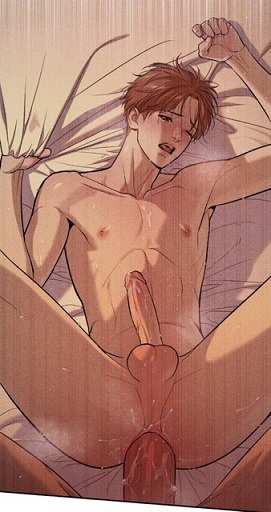 (chapter 55) These memories represent the moment where the athlete felt strong and had the upper hand in their relationship. These images reveal that Joo Jaekyung hasn’t realized the signification of the kiss yet. For him, they don’t seem important. This exposes that the athlete has not associated kiss with love and affection yet. At the same time, we have to envision that a smooch is strongly intertwined with equity and trust.
  (chapter 28) And in episode 14, it was clear that the star still felt superior to his companion, therefore the kiss had no special meaning. As you can see, everything is pointing out that Joo Jaekyung had never been kissed before. And what does a kiss symbolize? Not only attachment, but also purity and innocence.
  (chapter 15)
 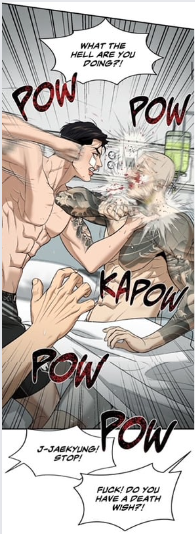 (chapter 52) In that context, a kiss could never be affection, but vulnerability. A risk.
 (chapter 3), based on Dan’s vague claim of prior partners. Yet Dan has never kissed anyone before. The kiss becomes his true moment of loss, a quiet confession through action. Conversely, Jaekyung’s own discomfort shows that he, too, is untouched in this particular way. When Dan tries to kiss Jaekyung again, and he instinctively rejects it, it reveals just how unprepared he is for affection. They are both unaware that the other is emotionally “pure” in this regard, and that makes the kiss a shared revelation.
 (chapter 67), Jaekyung must reinvent his approach. He cannot rely on dominance, strength, or sexual performance to win Dan’s heart. If he wants true connection, he must learn a new language—one built on gestures of affection, softness, and presence. This process also involves separating his public persona from his private longing. Joo Jaekyung, the champion, cannot seduce with spectacle. But Jaegeng, the man, might learn to express love through a simple touch, or a well-timed kiss. The redefinition of seduction is not just about Dan’s healing; it is about the wolf’s reclaiming his own right to feel and give love. And in my opinion, that process has already started:
  (chapter 69) That moment was devoid of lust, stripped of performance, and free from power dynamics. Jaekyung didn’t lean in for a kiss; he didn’t touch Dan’s lips or body with any sexual intent. Instead, he wrapped his arms around the physical therapist in silent reassurance, tucking his face against Dan’s shoulder as though hiding from the world. This was not a champion claiming a prize—it was a man expressing affection. The embrace exposes that doc Dan belongs to his “world” and he trusts him. In this light, the embrace becomes a prelude to a kiss—not a literal one, but an emotional kiss: a meeting place of vulnerability and longing.
 (chapter 65) nor his past partners provided him with genuine and affectionate touch, Jaekyung must look elsewhere.
 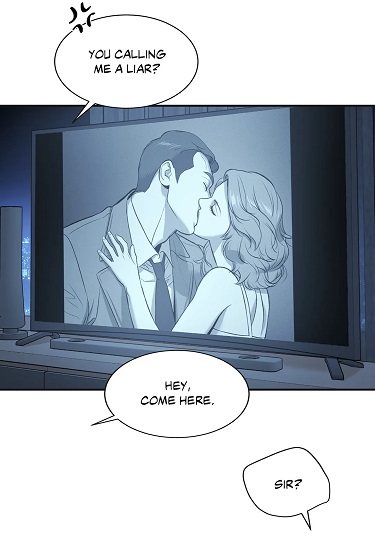 (chapter 29: note that he did not select this scene to rekindle with the doctor, but the other scene) He will learn it from life, from watching how the innocent express care without shame or purpose.
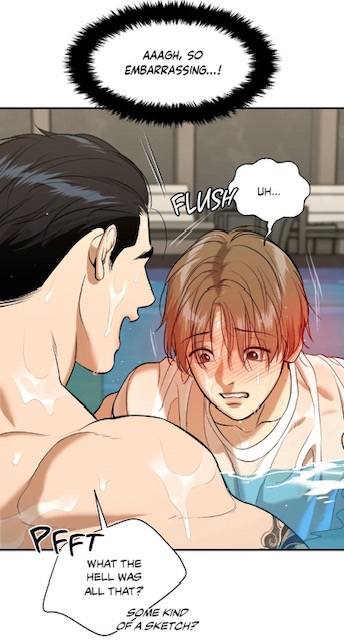 (chapter 27) In Jaekyung’s past, laughter had been a weapon—an expression of ridicule and cruelty from an abuser.
  (chapter 62) If someone had laughed in front of him and made fun of him, this would have reopened his old wounds.
 (chapter 47) and denial for strength
  (chapter 61), Park Namwook
  (chapter 69), and Shin Okja
  (chapter 53) all operate within survival mechanisms shaped by trauma, guilt, and fear. They choose the illusion of control or calm over genuine healing. But as the story unfolds, these strategies begin to unravel. Each character must confront the truth behind their emotional habits, learning that happiness isn’t the absence of pain—it’s the result of confronting it with clarity and purpose.
 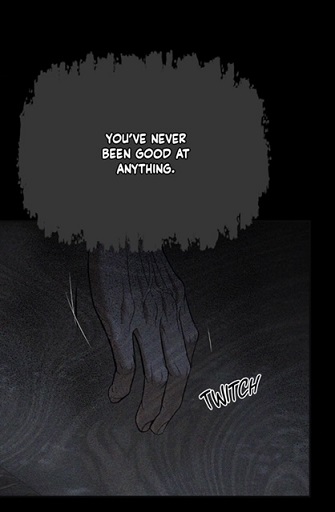 (chapter 54) He could only express his pain and resent through the hand. This moment encapsulates the core of his trauma: as a child, he learned to survive through silence and compliance, not resistance. Yet deep down, the resentment festered—toward himself, and toward the abuser. That psychological pain was redirected into becoming a fighter, as if to prove the abuser wrong.
  (chapter 26)
 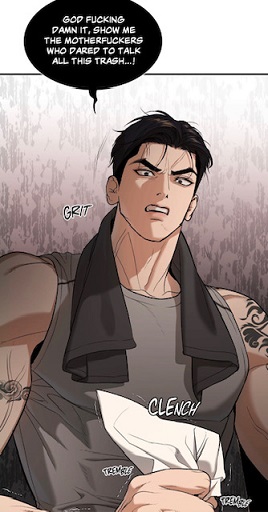 (chapter 36) His language was dominance, not dialogue. He didn’t process his emotions through words—he suppressed them, until they erupted in violence or withdrawal.
  (chapter 34)
  (chapter 1) And crucially, he didn’t leave right away either despite his embarrassment and fears.
 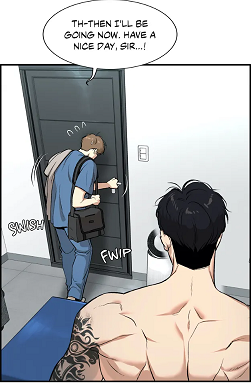 (chapter 1) Thus for the first time, Jaekyung had to develop a new strategy in order to meet him again: one that doesn’t rely on intimidation, but on communication. The problem is that since he saw the physical therapist running away after their first session
  (chapter 1), he knew that he needed to lure him with something: money
  (chapter 1). Under this new light, my avid readers can grasp why the athlete played a trick on the phone, though we have to envision that here the celebrity’s thoughts were strongly influenced by his bias and prejudices. He imagined that Doc Dan had made a move on him.
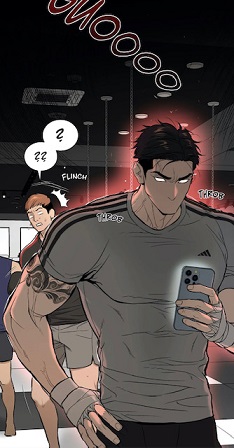 (chapter 5) That retreat doesn’t mean failure—it can be an act of self-preservation. However, the champion experienced that he needed to speak with doc Dan in order to keep him by his side. This lesson became a turning point. Jaekyung started to speak more.
  (chapter 18) Therefore it is no coincidence that in episode 18, right after the celebrity spoke, Kim Dan’s reply was strongly intertwined with flight:
  (chapter 18) The denial of kindness from the champion made the doctor uncomfortable, the latter felt the need to leave the penthouse as soon as possible. The lesson for the star was to realize that words are powerful and can affect people. But Joo Jaekyung didn’t grasp it, as he chose to use sex to „submit“ his fated partner.
 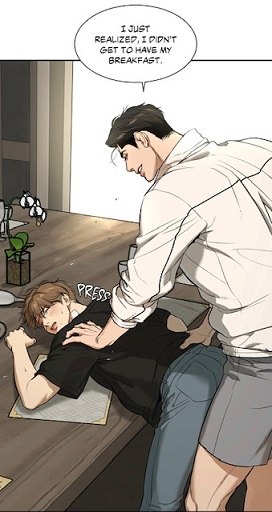 (Chapter 18) Nevertheless, as time passes on, the wolf asks more and more questions. He reacts to emotional discomfort not only with physicality but with hesitation, introspection. He is no longer reacting as the ghost once taught him; he is arguing and as such adapting, growing. Thus we could say, he is less passive.
 (chapter 3) or table, in showers
 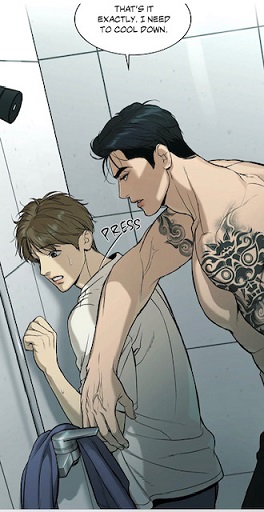 (chapter 7), against doors, or walls
  (chapter 34). On the surface, it may seem like a gesture of dominance or desire, but symbolically, it reflects silencing.
 (chapter 51) They stand in the middle of the room—an open space—symbolizing emotional emancipation. When Dan questions the celebrity
 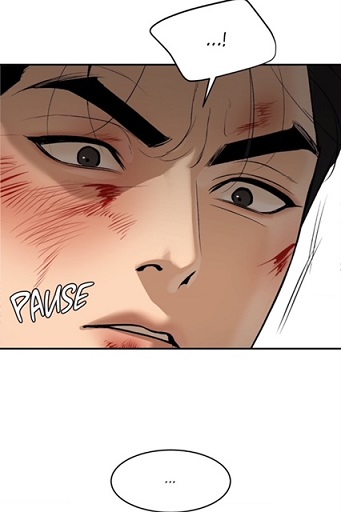 (chapter 51). The latter tries to reassert control
 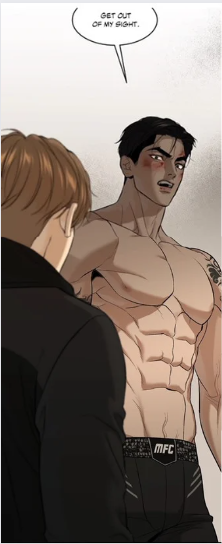 (chapter 51), but this time, when he lashes out, he is the one who leaves. This is cognitive dissonance at work: the fighter cannot reconcile his fear of vulnerability with his emerging need for connection and his perfectionism. So he defaults to a performance of control, even as he runs from it. And while one might mistake this for weakness or regression, it actually displays a progression. First, Jaekyung had finally revealed his thoughts and fears to Dan.
  (chapter 69) That silence could easily be mistaken for submission, for the same old performance of the compliant athlete.
  (chapter 69) But that would be a misreading. His silence is no longer a symptom of fear or control. It is a deliberate withholding—a sign that he no longer plays by their emotional rules. He is starting distancing himself from MFC, Park Namwook and the fight-centered identity they crafted for him.
 (chapter 69) After all, to those still invested in dominance hierarchies, leaving the capital after a public defeat seems like the behavior of someone who’s been defeated mentally as well. But the truth is the opposite. This “retreat” is actually an act of autonomy. For the first time, Jaekyung is giving himself space—not to run, but to reflect.
 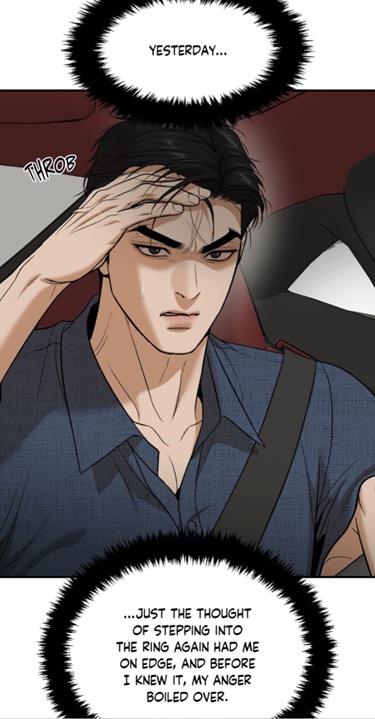 (chapter 69) He is no longer blindly performing the role of the fighter, nor desperately trying to maintain control over the narrative.
  (chapter 69) He is beginning to think critically about his past behavior, his future, and the systems that have defined his identity and life.
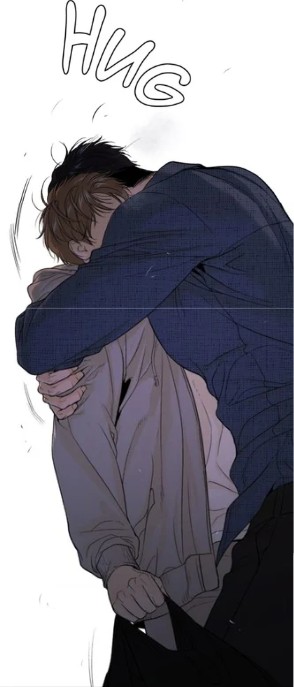 (chapter 69) with “no audience” (he ignores people), no pressure, no script. And in that openness, he lets go—not just physically, but psychologically.
  (chapter 7) and flight
  (chapter 36), or MFC’s decisions.
  (chapter 69) He surrounds himself with “assistants” like coach Yosep, Kim Dan or Joo Jaekyung
  (chapter 25: here the protagonist was replacing Yosep and Park Namwook), hires professionals to manage damage
  (chapter 47), and hides behind administrative actions.
  (chapter 66) But he never takes full responsibility. This blame-displacement strategy works—until the champion flees to the West Coast.
 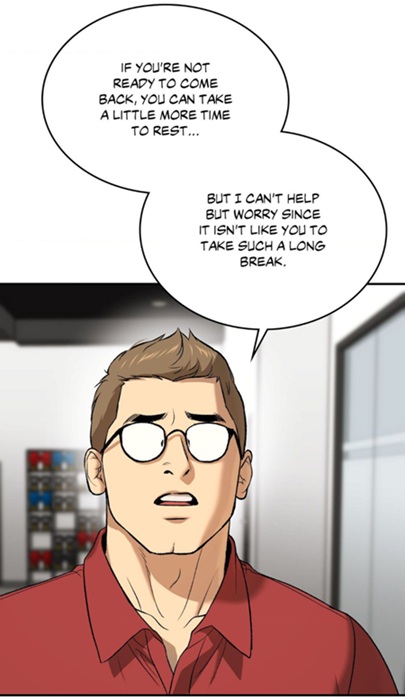 (chapter 66) that cornered the manager.
  (chapter 66) As long as the champion was nearby, Park Namwook could project blame onto him, framing him as unstable, disobedient, or temperamental. But once „his boy“ vanished from Seoul, the hyung was left exposed. Striking is that he is not seen watching over the training of the remaining members.
  (chapter 60)
 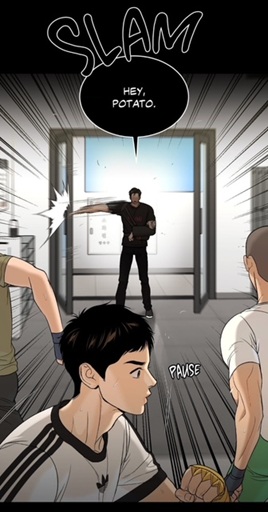 (chapter 60), a sign that he is neglecting the other members. The absence of his star fighter removed his most convenient scapegoat, forcing him to face the consequences of his own mismanagement—though he is not yet ready to truly question it and change his mindset, denial, and dependency. This was not just a geographical disappearance—it was a strategic psychological rupture, meant to destabilize Park’s illusion of authority.
 (chapter 17) They don’t see him as someone with legal or institutional power. But that’s their fatal blind spot. Since Jaekyung co-owns or outright owns Team Black, this makes him: A partner (or even rival) in MFC’s talent pipeline; an employer and a stakeholder in fighter safety. He has the same position than Choi Gilseok. Therefore as the owner of Team Black, he can sue the gym King of MMA and Choi Gilseok. He can take action against the CEO for negligence, corruption or abuse of authority.
  (chapter 47) Finally, he can testify not only as a fighter, but as a representative of the institution they tried to exploit. That elevates his voice: from a disposable athlete to a legal opponent with organizational standing.
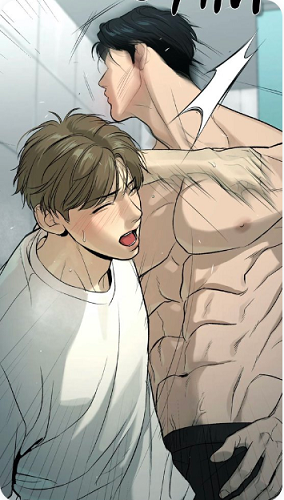 (chapter 7) For a moment, he was fighting.
 (chapter 67) Moreover, in contrast to Season 1, Kim Dan is no longer the invisible caregiver or obedient grandson. Thanks to Joo Jaekyung’s presence—disruptive and painful as it was—he began to form an independent identity
 (chapter 57) —it is a rejection of the belief that he exists only to serve. In Season 2, Dan says “no” repeatedly:
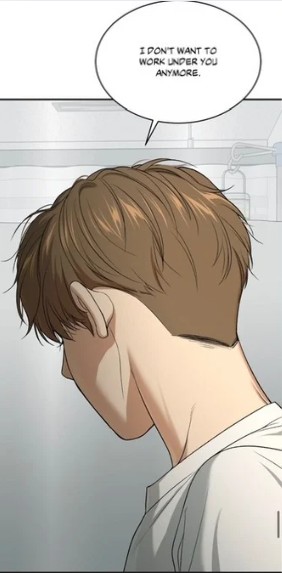 (chapter 60)
  (chapter 67)
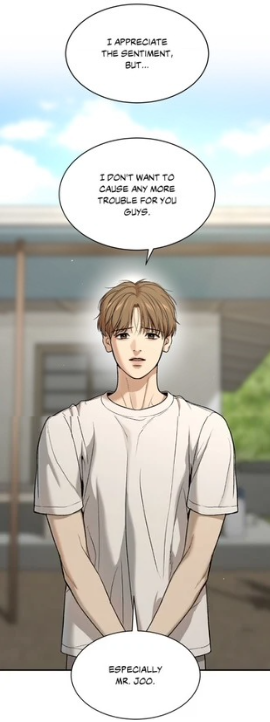 (chapter 58)
  (chapter 57)
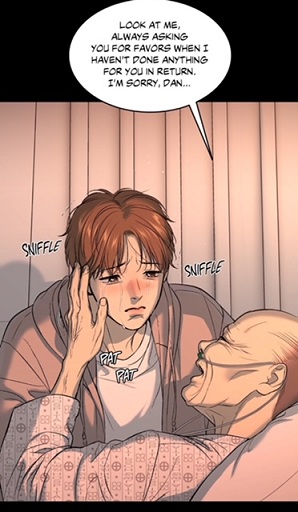 (chapter 53)
  (chapter 65) Her silence is not protective—it is evasive.
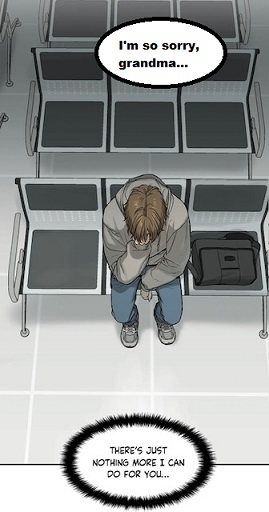 (chapter 5) Her illness becomes a metaphor for her mindset. She relies on external systems: her grandson
 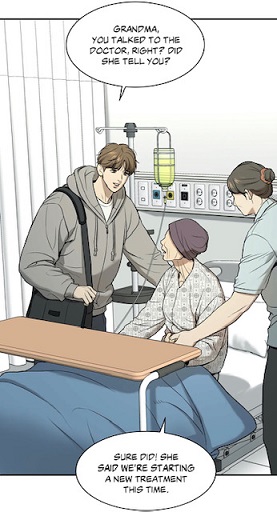 (chapter 7), medication, comfort
  (chapter 7) His grandmother was not truly abandoned; she simply equated his physical absence with neglect, ignoring the emotional and financial burden he already carried. Like Park Namwook, she prefers others to carry the discomfort while maintaining a façade of suffering and sacrifice.
  (chapter 65), protected, comforted. Surrounded by nurses, medication, and routine, she finds temporary peace in an environment that simulates safety. The hospice does not cure her illness, but it cushions it. This illusion allows her to smile again, to relax—but only up to a point. Kim Dan’s gradual deterioration
  (chapter 57) —his visible exhaustion, disconnection, and quiet suffering—becomes a thorn in her eye, a reminder that her peace is not whole. As long as he suffers, she cannot entirely escape the shadow of her own regrets. Sending him away to Seoul represents a new of flight. Out of sight means out of mind. That way the grandmother wouldn‘t have to worry about doc Dan, as he has been entrusted to the athlete.
 (chapter 163) and supported by the article on confirmation bias, human survival was deeply dependent on mental shortcuts. Biases were not flaws, but adaptive tools — heuristics that helped our ancestors make quick decisions under threat. Faced with a potential predator, they could not afford the luxury of curiosity or debate. Run first, think later.
 (chapter 163) In this sense, biases were effective precisely because they increased the chance of survival.
 (chapter 9) But once Joo Jaekyung became the target of criticism and scandals, his fear response activated.
  (chapter 41) he recommends the opposite at the restaurant because the idea comes from the CEO!
  (chapter 67) His survival bias told him: “Don’t trust a man who once treated you violently.” or “Doctors are ignorant, they don’t know me“. It was easier to discredit the source than to weigh the merit of the message. Likewise, in Season 1, the champion dismissed doc Dan’s medical opinions
 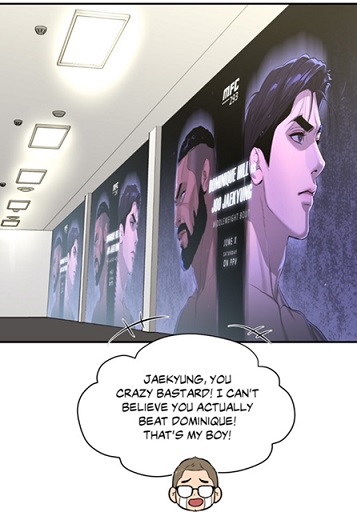 (chapter 40) who needs to fight to prove himself, yet likely doesn’t treat his own family this way.
  (chapter 45) His double standard is not conscious hypocrisy — it’s a form of selective laziness. He does not challenge his beliefs because doing so would unravel the identity he’s built as a competent, authoritative manager.
 (chapter 65) or a support network. It is not her fault, if she never met doc Dan’s friends in the past while hiding the fact that he had been bullied by his peers. Her request for him to return to Seoul, a place he has no roots, only furthers his habit of isolation. Similarly, when she asked Jaekyung to bring him to Seoul and have him diagnosed, she implicitly discouraged any shared decision-making. Like Park Namwook, she bypassed dialogue in favor of directive control, reinforcing the habit of emotional withdrawal.
 (chapter 67) That shift marks a turning point from survival to conscious thought. The mind cannot reflect when it believes it is under attack. The tragedy is not that these characters are irrational — it’s that they were taught fear before they were taught trust. Thus I come to the following conclusion. As soon as both are curious about each other
 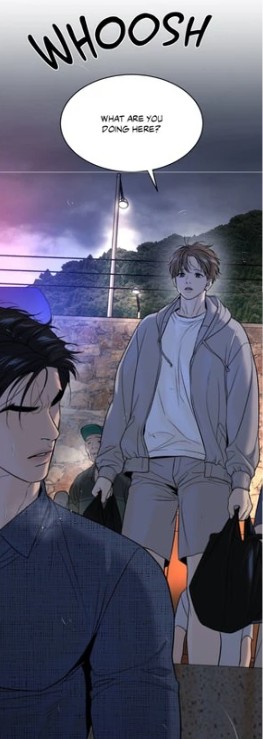 (chapter 69), they are now free from their bias and prejudices.
  (chapter 69) They will be able to communicate which will help them to discover the truth about MFC. Yes, their ability to ponder will lead them to unmask the villains and defeat their opponents. By fighting for justice, both will discover true peace of mind. This hardship at the end of season 1 was necessary to reset their heart and mind: what is the true meaning of life? Money? Work? Duty? Sacrifice?… The answer is happiness which is strongly intertwined with love and selflessness.

 (Chapter 63) The presence—or absence—of clothing during their encounters symbolized the gradual dismantling of their emotional walls. Now, shifting the perspective to the champion, another layer of complexity emerges. Joo Jaekyung’s evolving approach to intimacy is not just a reflection of his growing feelings but also a silent, deeply ingrained struggle with dependence and control.
 (chapter 63) Why does he hesitate to strip entirely, even as he succumbs to desire? Notice that he released his erected phallus before removing his cloth.
  (chapter 63) To answer this, a comparative analysis of earlier sex scenes is necessary, unraveling the hidden dialogue between physical exposure and emotional vulnerability.
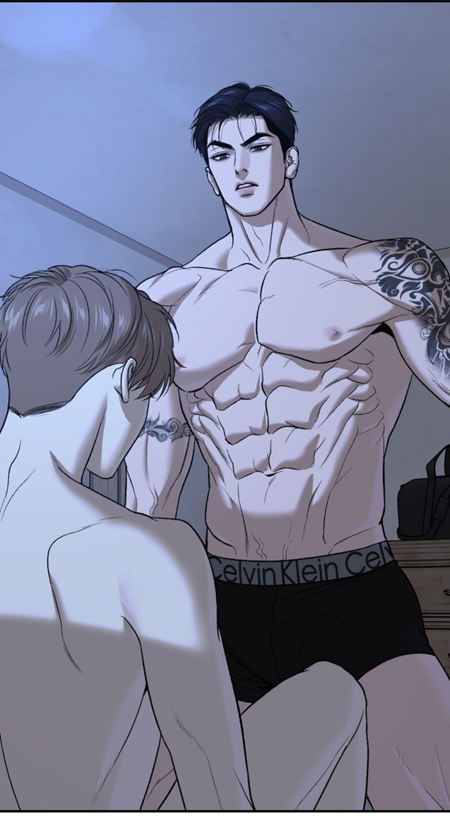 (chapter 63) The champion, despite holding the dominant role, is now the one retaining a piece of clothing. This suggests an unconscious act of concealment—not of shame in the traditional sense, but of a growing dependency on Kim Dan.
 (chapter 62) with a zoom-in shot on his erection still hidden by gray sweatpants. Striking is that on the one hand he let the doctor feel his reaction to his naked body, when he embraced the doctor:
  (chapter 62) The “hamster” could sense with his leg the excitement. On the other hand, these pants were only removed once he entered the bedroom and was on the bed
  (chapter 63), reinforcing the idea that vulnerability, for him, is confined to this private space. Moreover, the choice of attire in Episode 62
  (chapter 63) Thus I deduce that exactly like the presence of the black underwear, the athlete’s low self-esteem hasn’t been removed completely. He still expects fear and rejection.
 (chapter 63), dominates without seeking connection
  (chapter 55), and ensures that every encounter follows his carefully constructed narrative. However, in Episode 63, a subtle but undeniable shift occurs. For the first time, Jaekyung’s actions reflect something deeper than mere desire or dominance. They reveal his growing emotional investment in Kim Dan, exposing a side of him that even he does not fully comprehend.
  (chapter 63)
 (chapter 12) In the earlier encounter, Jaekyung presented himself as a generous partner, offering Kim Dan a so-called privilege—an opportunity to enter a whole new world, thanks to him. However, his so-called generosity was nothing more than a facade, a way to conceal his inexperience in genuine intimacy. The tool he used was not just an object of pleasure but a mask for his own shortcomings as a lover. He did not know how to pleasure Kim Dan, nor did he care to learn. His focus was not on Kim Dan’s enjoyment but on reinforcing his own power and dominance.
 (chapter 63) Here, he no longer portrays himself as the benevolent provider of an experience.
  (chapter 12) – seeking both to display dominance and to elicit validation
  (chapter 12) —this time, in Episode 63, he prioritizes Kim Dan’s pleasure without explicitly expecting anything in return.
  (chapter 63) Up until this point, Jaekyung has never truly faced rejection.
  (chapter 63) This moment forces him to confront an uncomfortable truth: power and status cannot buy emotional intimacy.
 (chapter 63) While he does voice his frustration, he does so without force, showing an unprecedented level of emotional regulation. Instead of demanding compliance, he chooses a different approach—he focuses on Kim Dan’s pleasure, attempting to bridge the emotional gap through physical intimacy
  (chapter 63) rather than control. This decision is not merely about sex; it is an unconscious attempt to regain Kim Dan’s attention, to re-establish a connection that he does not yet fully understand but deeply craves.
 (chapter 29) This remark exemplified his detachment, his refusal to acknowledge Kim Dan as a person rather than just a body. Once again, the intercourse was linked to achievement and work. However, in Episode 63, he actively seeks Kim Dan’s gaze, subtly pleading for recognition.
  (chapter 63) This reversal is crucial because it indicates that he no longer sees Kim Dan as just a means to an end. However, his desire for recognition still lingers beneath the surface—just as he once sought validation through dominance, he now seeks it through Kim Dan’s acknowledgment. He wants something more, though he cannot yet articulate what that is, and his actions reflect a subconscious craving for emotional reassurance.
  (chapter 13)
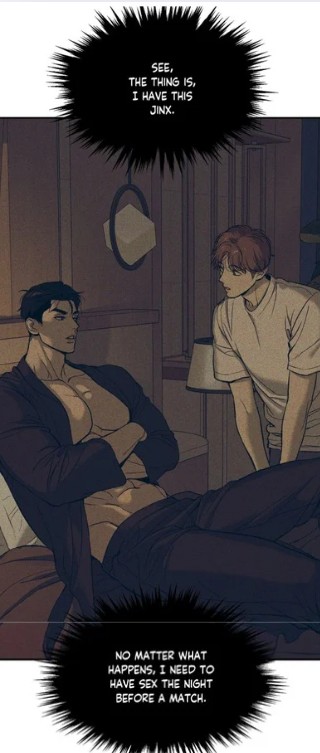 (chapter 62) the sportsman welcomes the physical therapist in blue pajamas and a robe—an overt attempt to maintain distance and control. Even as the encounter begins, he leaves his pajamas on
  (chapter 3), removing them only
  (chapter 3) – this image marks the change) when the doctor’s back is turned. Then in Episode 8, during the shower, he continues wearing shorts and underwear
  (chapter 8), and his choice of the doggy style further reinforces his desire to avoid direct, face-to-face vulnerability.
  (chapter 12) before removing it and adding the pink sex toy.
  (chapter 12) Their bodies might have been close, but their minds remained divided. That’s why he couldn’t detect the huge bruises on his companion’s body.
  (chapter 12) This guarded approach is further underlined in Episode 20
  (chapter 20), where even in the midst of nakedness, the athlete deliberately positions the doctor in the dog stance. At the same time, he uses another MO: the darkness of the room to hide himself. This calculated arrangement maintains an emotional buffer, allowing him to remain physically exposed yet emotionally detached—a recurring theme in his behavior.
 (chapter 29) while still cloaked in his familiar blue robe and pajamas. Interesting is that the room is not totally dark like in episode 20, the bedroom is illuminated by the huge TV screen. Importantly, this episode marks the first time they face each other in the bedroom, signaling a significant shift in their dynamic and announcing a switch in position. This newfound mutual visibility lays the groundwork for later developments.
 (chapter 33) —a deliberate act imbued with symbolism. Unlike earlier encounters, the champion remains fully clothed throughout this episode,
  (chapter 33) contrasting sharply with previous moments of exposure. The car scene, where they are now facing each other, reinforces the announced switch in intimacy; the light not only illuminates the scene but also serves as a metaphorical spotlight on his desire to see the doctor’s face and body
  (chapter 33) —a silent assertion that only he can truly satisfy the physical therapist. Let’s not forget that before having sex together, the fighter resorted to a dildo
  (chapter 33) rather direct physical intimacy, because he felt insecure after witnessing the actor’s advances toward Kim Dan. His goal? To reaffirm his dominance and make Kim Dan admit that he needed him for pleasure. It is important because it exposes that deep down, the champion views himself as a bad lover. There is no doubt that Heesung‘s criticism resonated with him.
 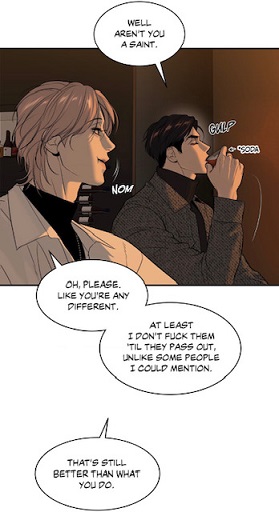 (chapter 33)
 (chapter 39) While receiving fellatio, the champion keeps his t-shirt on, only removing it later when he invites the doctor into bed.
  (chapter 39) Maintaining the doggy style during this phase, he uses such intimate acts to mask his true longing and attraction—an effort to control the encounter while keeping his emotions under wraps. Then I noticed that they switched positions, when doc Dan asked for a break.
  (chapter 39) The wolf chose to lie down on the bed:
  (chapter 39) As you can see, through the different intercourses, we can see the different methods the star used to conceal himself, to hide his “weakness”, his growing feelings for the doctor.
 (chapter 61) The physical therapist remembers an encounter bathed in bright light, where they stood before a couch: the doctor had removed his pants while the champion remained fully clothed, positioned behind him.
  (chapter 61) After both reached climax, the sportsman swiftly departed—a stark demonstration of his habitual retreat into distance and fear, even as he ensures the doctor’s pleasure.
  (chapter 61) This calculated “running away” underscores the return of old insecurities and the persistent need to assert control. Since the doctor was still living in the penthouse and as such was still working as the star’s physical therapist, it becomes comprehensible why the athlete could only resort to strength to keep his fated companion by his side. He had rejected his “gratitude” and “emotions” before.
  (chapter 63) Now lying on the bed facing each other, the pair’s physical closeness appears more genuine. Yet, even in this seemingly intimate configuration, they avoid locking eyes during penetration.
 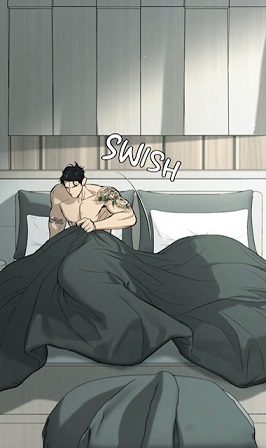 (chapter 4), we do not see whether he is wearing anything the morning after. After their “magic night” in the United States (Episode 39), the next morning, he is only shown taking a shower
  (chapter 40) —meaning the audience never sees him leaving the bed. However, in Episode 45, the author deliberately includes a shot of Jaekyung leaving the bed while still wearing his black boxer briefs.
 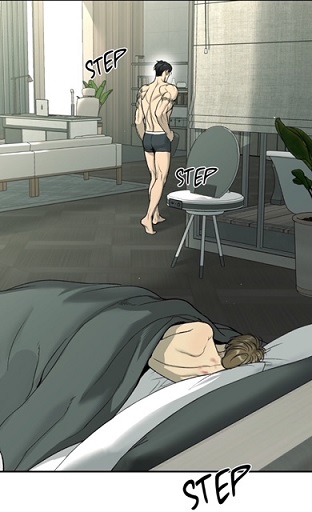 (chapter 45)
 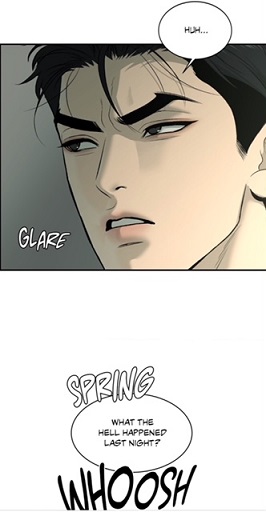 (chapter 45). This is just a rhetorical question, as he clearly remembers the night.
  (chapter 45) In reality, he was wondering why he had acted this way. This contradiction—pretending to forget while consciously recalling their time together—reflects his internal denial. His next thought,
  (chapter 45) is a transparent excuse to avoid confronting his emotions. The presence of the black underwear in this scene confirms that he had not fully lowered his guard; he still maintained a psychological barrier between himself and Kim Dan.
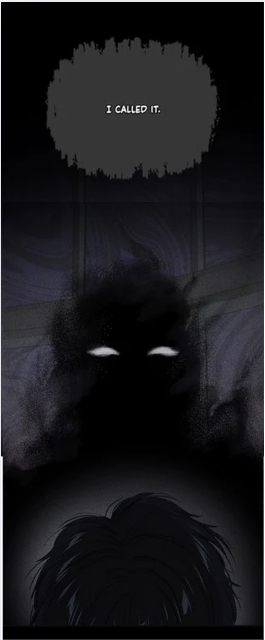 (chapter 54) The specter that haunts him—an unnamed figure whose words still echo in his nightmares—was the architect of his relentless pursuit of strength. Striking is that in his nightmare, he is facing the mysterious ghost, a sign that he saw hatred and rejection in his counterpart’s eyes. While Kim Dan’s halmoni took his hand and provided warmth
  (chapter 22), Jaekyung’s guardian likely did the opposite.
  (chapter 63) In the beginning, the champion grabbed doc Dan’s wrist. This shows that the athlete was not used to touch Kim Dan’s hand. And notice how the “hamster” reacted
  (chapter 63) He pushed it away. This means that taking the doctor’s hand represents the biggest challenge for Joo Jaekyung right now. In addition, the last panel indicates the champion’s transformation, he is now willing to seek the doctor’s closeness. It also implies the vanishing influence from his past guardian.
 (chapter 27) Under this new light, it could explain why the fighter forgot his passion. They made sure that he would train restlessly. In this environment, vulnerability was a defect to be eradicated, not a human trait to be acknowledged. This description reminded me think of Park Namwook and his family. The manager is a former national wrestler who is married to an athlete too.
  (chapter 5) At the same time, it would highlight the potential danger of Park Namwook’s vision for the gym: an institution that might perpetuate the same cycle of control, shame, and expectation rather than fostering true passion and individuality in young athletes. That’s how I realized why the manager slapped his “boy” after the funny sparring:
  (chapter 26) He explained that the main lead was just a doctor. However, I am quite certain, underneath, the manager thought that doc Dan was not fit to spare: so small and weak. He doesn’t fit the criteria to become a sparring partner. Look at his reaction, when Seonho faced the champion:
 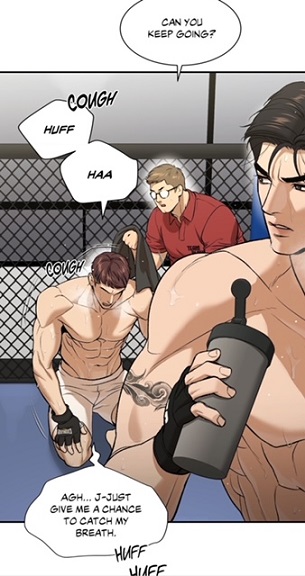 (chapter 46) Under this new light, it becomes comprehensible why Potato was also neglected by the manager. The young maknae belongs to a different weight category. There is this invisible rule that only strong people can become member from the gym. However, the purpose of such an institution shouldn’t be reduced to titles, strong and muscular men or boys. The gym should be opened to anyone who desires to have fun and improve their health.
 (chapter 1), until he received the doctor’s massage in chapter 1. His attitude toward sex mirrors his training in the gym—focused on endurance, performance, and control. His body is a tool, a machine honed for efficiency.
  (chapter 63) Pleasure is secondary; the real goal is lasting, enduring, proving his stamina. Even in his most intimate moments, he is competing against an invisible opponent—his own ingrained fear of inadequacy.
 (chapter 63), why he keeps barriers between himself and Kim Dan, even when his body betrays his true desires.
 (chapter 62)
 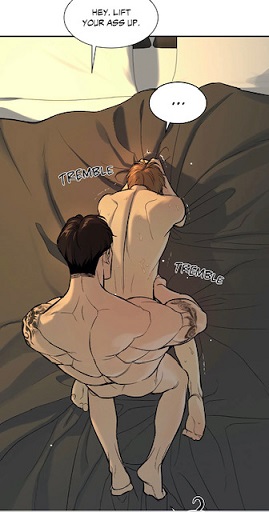 (chapter 4) nudity was a tool of dominance, a means of asserting control. Now, it has become a sign of submission—not in the physical sense, but in the way he is slowly relinquishing the emotional armor he has always relied upon.
  (chapter 63), but of his silent battle against the vulnerability he is beginning to feel.

 (chapter 62), the doctor’s memory got triggered. Because of his past experiences, he has long associated the jinx exclusively with sex. This contrast in understanding highlights both Jaekyung’s lack of self-awareness and Kim Dan’s tendency to filter reality through his own expectations and trauma. However, the deeper significance lies in Jaekyung’s evolving perception of dependency. His jinx is no longer just a superstition tied to his performance in bed. It now subtly acknowledges that his success has been intertwined with Kim Dan’s intervention.
 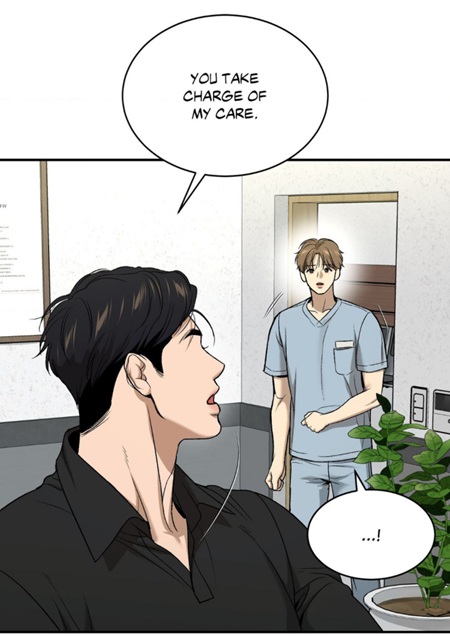 (chapter 61) By entrusting his care to Kim Dan, he was insinuating that the main lead was trustworthy and competent, yet his inability to verbally express appreciation keeps the doctor unaware of his true feelings. This struggle resurfaced in front of the hospice, where Jaekyung could only bring himself to admit that Kim Dan was not responsible for the incident with the switched spray.
 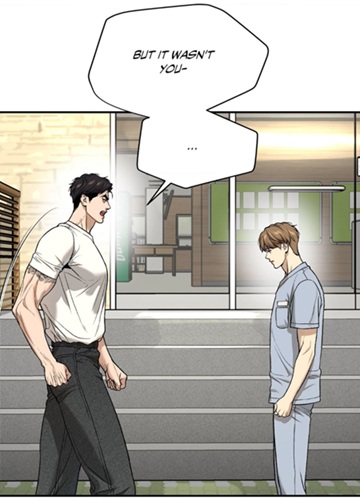 (chapter 62) His reluctance to openly acknowledge his gratitude suggests a deeper internal conflict—one that hints at a growing but unspoken emotional reliance on Kim Dan.
  (chapter 62) It was, as if he was warding off bad luck by repeating the last match. For him, past choices are justified by their results—he has built a successful career through sheer discipline and sees no reason to question his trajectory. His mentality reflects the belief that one’s past is a stable structure upon which the present and future rest. This perception explains his resistance to self-reflection and emotional vulnerability; admitting a mistake would mean disrupting the stability he relies upon.
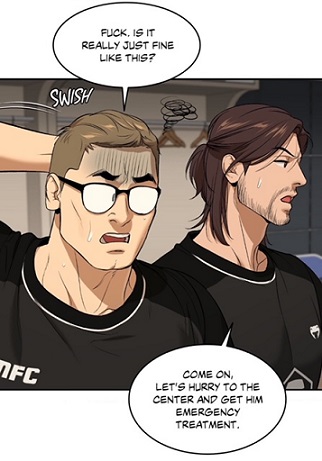 (chapter 50)
 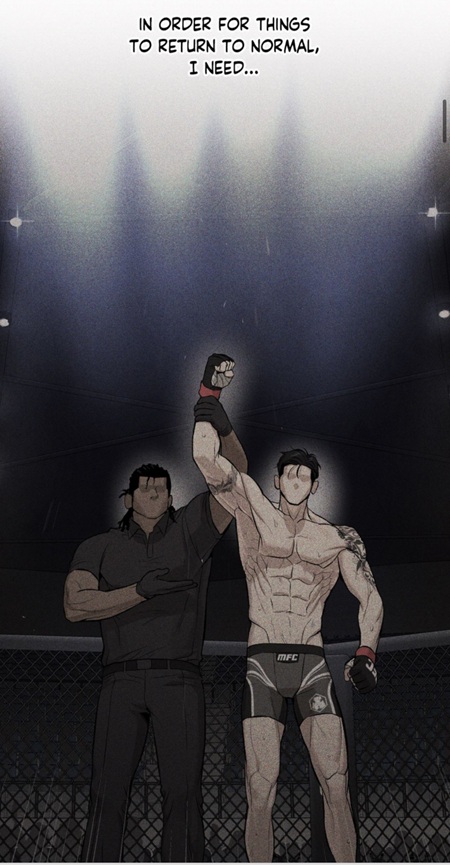 (chapter 61) This rigid perception prevents him from questioning his past choices or embracing change, reinforcing the illusion that repeating past patterns will restore stability. However, as his reliance on Kim Dan grows, the boundaries between his personal and professional life blur, challenging his belief that he can control his future by clinging to his past.
 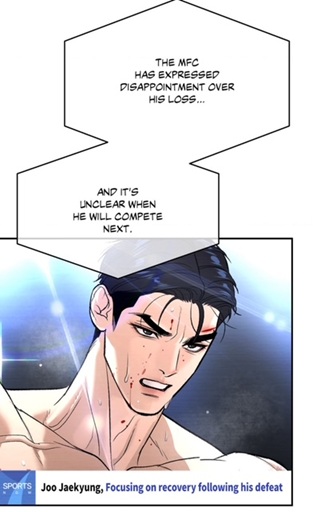 (chapter 57) and Park Namwook
  (chapter 54), who claim that Jaekyung ‘lost’ the fight, when in reality, it was a tie. The very way people around him are framing the event warps his perception, creating a false narrative where his struggles seem to stem solely from this supposed ‘loss.’ His belief in a stable past provides him with a sense of security, but that illusion is fragile. In addition, if his struggles predated his championship loss
 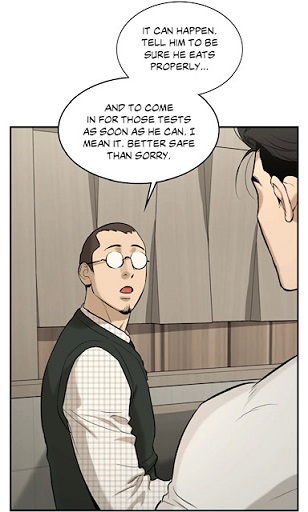 (chapter 13) because they affected the doctor’s life?
  (chapter 61), he expresses the belief that reclaiming his championship title will rid him of his headaches, nightmares, and sleepless nights. However, the reality is different—he was already suffering from insomnia long before he lost his title.
 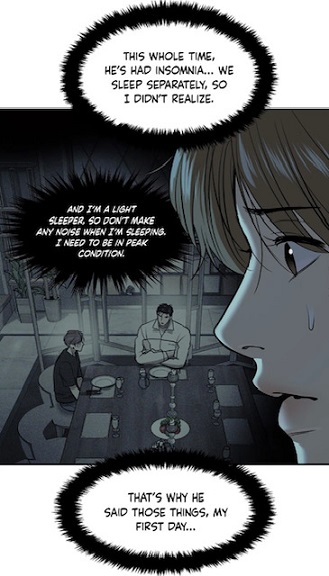 (chapter 29) The origins of his struggles existed before his recent failures, suggesting that his belief in a simple solution—reclaiming his title—is an illusion. This disconnect reveals how deeply his professional and personal life are entangled; his need for control in the ring has masked his deeper emotional vulnerabilities. He isn’t merely striving for victory—he is chasing the illusion of stability, believing that his success is the sole factor that determines his well-being.
 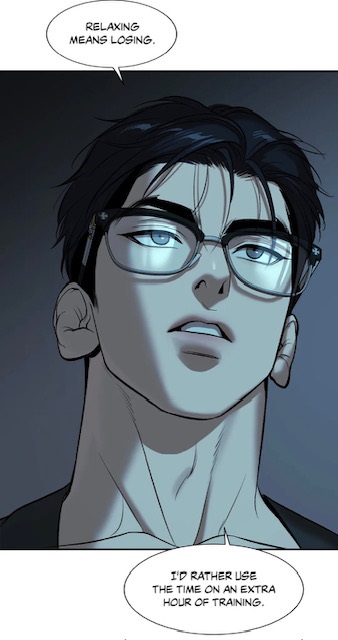 (chapter 29), you will realize that alone in his penthouse, Joo Jaekyung was actually admitting the importance of sleep and rest. His earlier belief in relentless training as the key to success now clashes with his realization that exhaustion is affecting him. This shift signifies an unconscious admission that his well-being is not just tied to physical endurance but also to recovery and relaxation—something he previously dismissed. This realization subtly parallels his growing dependence on Kim Dan, reinforcing the theme of blurring lines between his professional and personal life. And what had occurred after this magical blue night in the penthouse?
  (chapter 30) The athlete woke up later than usual. In fact, he was rather late, for he was still wearing his pajamas, while the doctor had already taken his shower. But back then, observe how he opened the door! Like a clumsy beast, grump leopard! Why? In the past, I explained that he was seeking the champion’s closeness, but didn’t know how to approach his partner. I am now adding another aspect. He was actually annoyed, because he had not been following his daily routine!! Under this new light, it becomes comprehensible why the champion had such a “angry” facial expression, while deep down he was happy. The older version of this scene:
  (chapter 44) However, this means that in episode 30, he never acknowledged his dependency on the physical therapist for his rest loudly. On the other hand, it explains why the champion felt threatened, when the actor approached his “lavender-tinted pillow” or “sleeping pill”.
  (chapter 31) In fact, he used guilt to create a link between him and his roommate. That’s the reason why I am more than ever convinced that the champion will sleep better after this lavender-tinted night.
  (chapter 62) won’t come true at all. 😉 He will stay longer and ask for Kim Dan’s presence during the night.
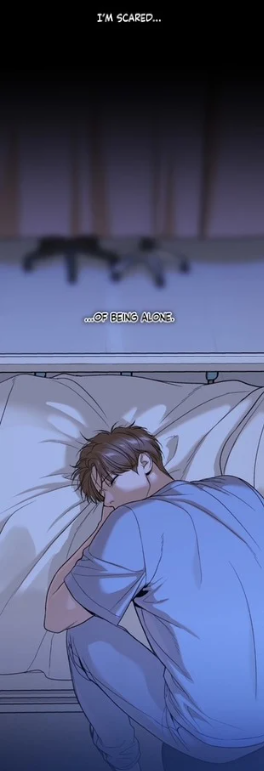 (chapter 56) His childhood and early adult experiences, marked by financial hardship, emotional neglect, abandonment, betrayal and powerlessness, have conditioned him to associate attachment with suffering. Because of this, he withdraws from relationships
 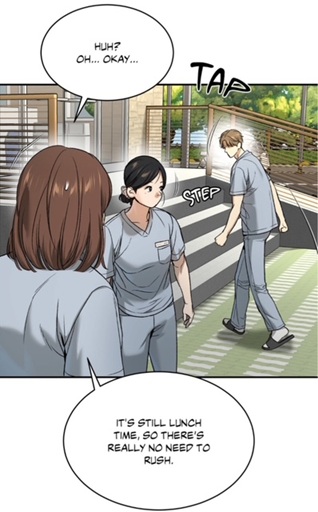 (chapter 56) and opportunities that could offer him security, convincing himself that he is protecting his independence when, in truth, he is reacting to past trauma rather than making an intentional choice.
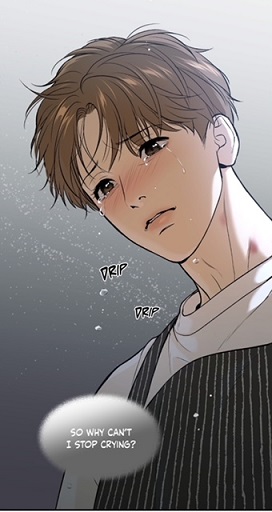 (chapter 46)
 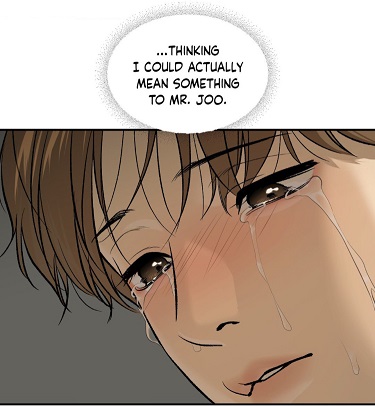 (chapter 46)
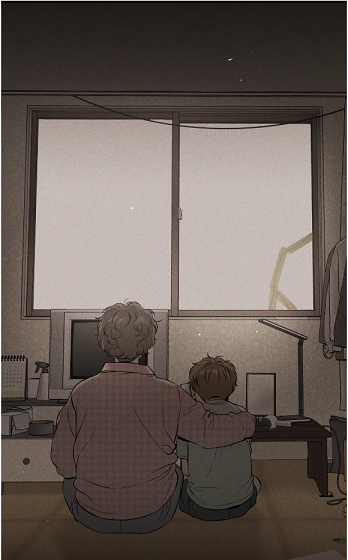 (chapter 19) She became terribly sick, while the other had to get surged and risked his career. There is no doubt that the halmoni is hiding her pain as well. Kim Dan’s declining physical and emotional state further reflects the consequences of living in avoidance.
 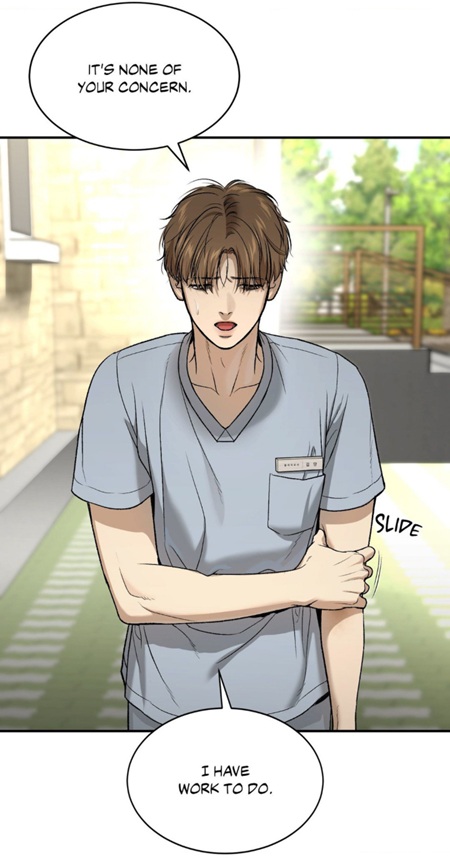 (chapter 61) He is endangering his life. Instead of taking action to improve his well-being, he isolates himself, refusing help even when it is necessary. His reluctance to accept care—be it medical, emotional, or relational—mirrors the very trap Delgado describes: mistaking survival for true agency.
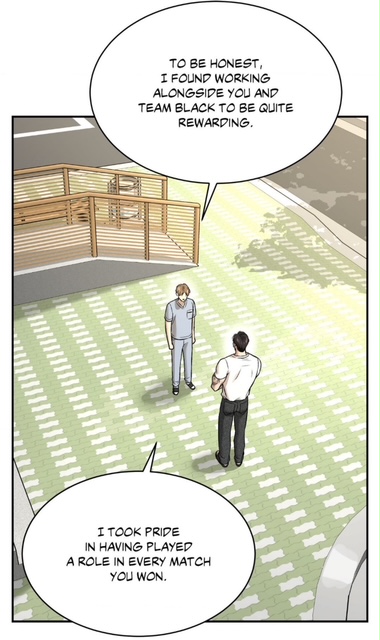 (chapter 62) If he continues making decisions based on past fears, he will remain trapped in the same cycle, unable to experience true growth or emotional fulfillment.
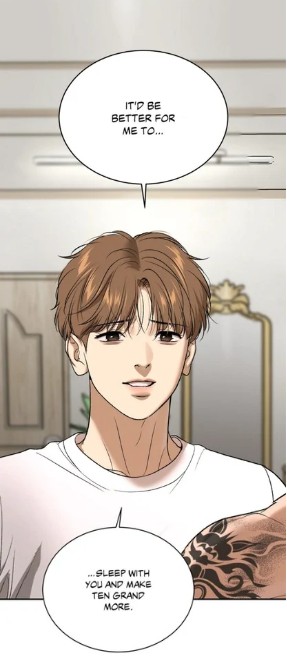 (chapter 62) Here, he is actually facing his past which he has strongly connected to regret and remorse. Don’t forget that after this night, he is expecting Joo Jaekyung’s departure.
 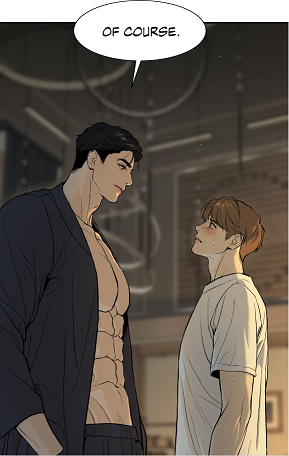 (chapter 3), which has been the setting of power imbalances, physical dominance, and silence, the living room represents a shared space—a place where dialogue and openness can exist. But why is the bedroom linked to silence? It is because of the TV, the third invisible companion!
  (chapter 48) Hence during that night, none of the protagonists talked sincerely to each other. And now pay attention to the living room at the hostel:
  (chapter 54) He needed to get rid of this poor habit: watching TV or cellphone. He had to realize that the TV or cellphones were never real companions and never brought him peace of mind! This was the invisible “love” triangle. Back then, the athlete deceived himself by thinking that he was truly self-reliant, while in verity he was dependent on his cellphone and the TV.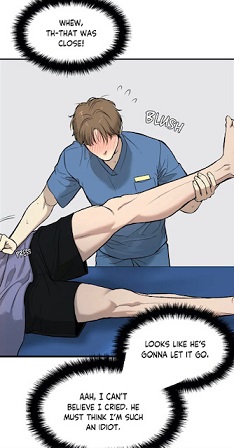


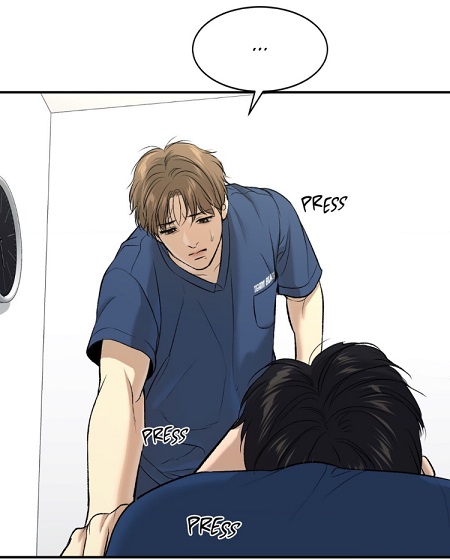

 (chapter 37) And all this started because Kim Dan had taken the initiative.
  (chapter 7) But now, it is no longer fulfilling for him, because his relationship with them didn’t go beyond their work.
  (chapter 59) Striking is that here the doctor didn’t apologize to the elderly man, but only to the family.
  (chapter 59)
 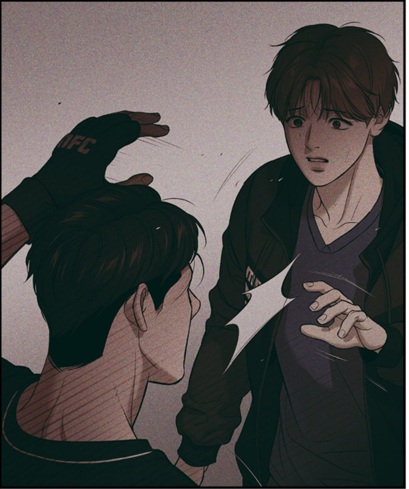 (chapter 62) – which is quite understandable in my eyes. The ones who failed the couple were the two other hyungs from my perspective. The past affected the doctor so much that he views himself and his feelings as “trash” now, yet it is clear that neither Park Namwook nor the coach are suffering from guilt or remorse. The star’s follow-up statement,
 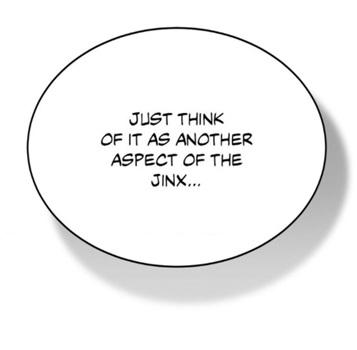 (chapter 62) further reinforces that Kim Dan has become an integral part of his preparation. Although Jaekyung does not yet frame this as emotional reliance, his words betray an unconscious attachment—one that Kim Dan himself does not recognize. Moreover, by including him in his jinx, the champion is only one step closer to include him in his “success”. Should the doctor be the target of malicious comments, the star will consider it as a personal assault or as his responsibility.
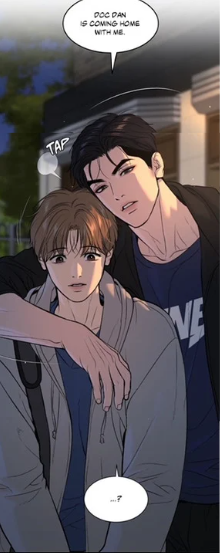 (chapter 43) Someone needs to remind the athlete of his own “statement”. Simultaneously, since the doctor never got curious about the fighter’s past and family, his presence could only be seen as a bandage covering a rotten body. In order to heal completely, he needs to expose his traumatic past and vulnerabilities.
 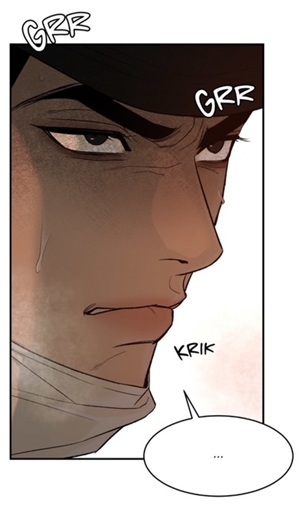 (chapter 56), but about something deeper. Here he felt the need to see his beloved “companion” again.
  (chapter 27) At the same time, this confession displays that his past was far from being perfect, the evidence of a distorted memory. After working so hard for the community, he came to receive a treatment from Kim Dan:
  (chapter 62) This means that he is now treasuring his own body. No wonder why he smiled.
 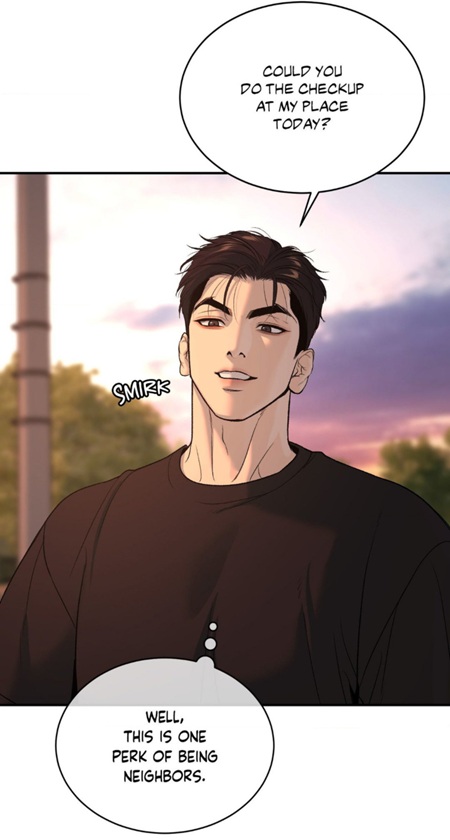 (chapter 62) That’s why I come to the following conclusion: The athlete must have felt happy in the living room, for he felt comfortable and safe.
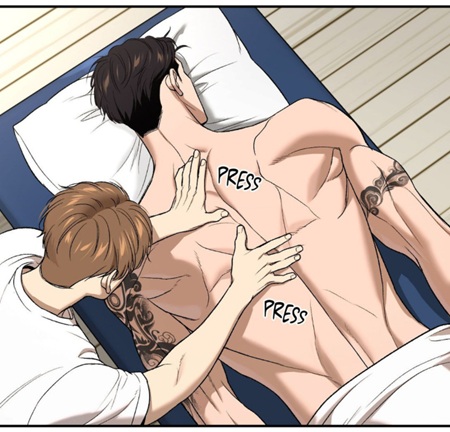 (chapter 62) But why did he show his back? One might say that he desired to hide his “satisfaction” and his “reliance” on his fated partner. Or he didn’t feel the need to watch the doctor’s facial reaction, when he would confide his new intentions and the transformation of his jinx. He didn’t expect the physical therapist to mock him for his absurd belief contrary to episode 2:
  (chapter 2) He trusted the doctor. Yet, in my opinion, there exists a bigger reason behind this change. It is related to his manager:
  The doctor is treating the star
  (chapter 22) when he is not, using his seniority and past influence to assert dominance. His attitude is related to his past decision: from his perspective, he saved the athlete from turning into a criminal.
  (chapter 26) His dependence on Jaekyung’s achievements makes him resistant to any shift in the fighter’s trajectory
 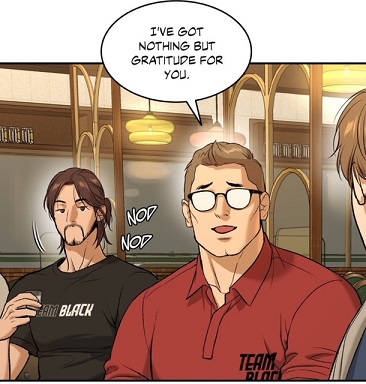 (chapter 43), but when confronted with a serious incident, he failed to take responsibility or make a decisive choice
 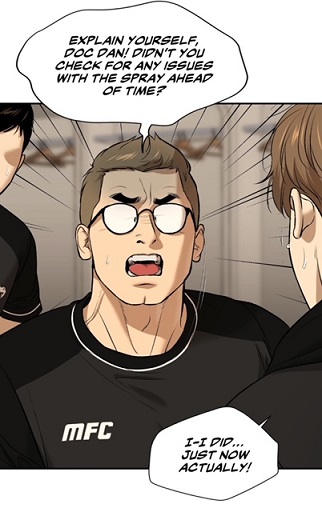 (chapter 50), allowing others to step in instead. Later, rather than addressing his inaction,
 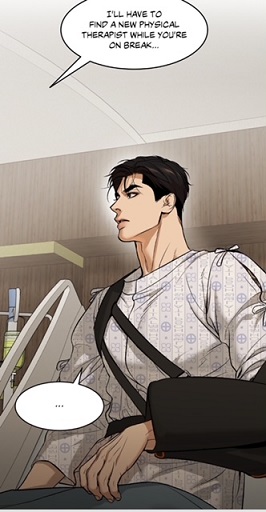 (chapter 53), as if the past never happened. By doing so, he reinforces Jaekyung’s belief in his so-called ‘jinx,’ manipulating the fighter’s perception of events and contributing to a distorted memory of reality. Meanwhile, the manager must face the reality that change is inevitable and that Jaekyung’s evolution does not mean his own irrelevance. However, his position must change.
 (chapter 59)
 (chapter 5) He felt so empowered that he won very quickly.
 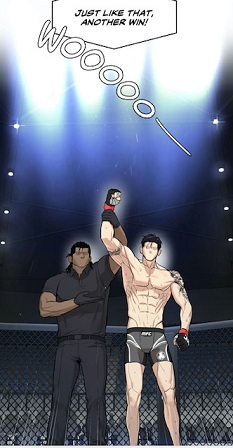 (chapter 5) But this good vibe was attributed to the sex with Kim Dan and unfortunately linked to his match. The reality was that he had slept better and longer. So by recreating the past, Kim Dan places the athlete in front of a choice. What matters in his life? His title or his peace of mind? He is correcting the champion’s distorted memory. Kim Dan is the reason why he can rest properly and not the title. Don’t forget that he was suggesting to go separate ways during the massage. But if he sleeps better before gaining his title, he won’t feel the urge to return quickly to the ring. In the living room, he was still acting as the celebrity, but in the bed chamber he is now gradually pushed to leave his title out of the bedroom. Now, in the bedroom he becomes a man and can almost make a mistake as a lover.
 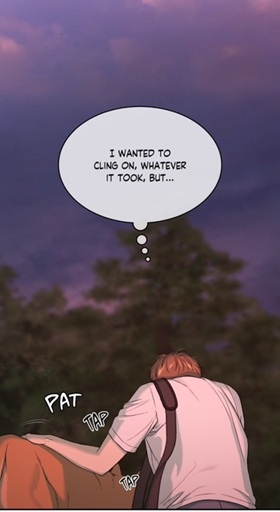 (chapter 59) However, he needs to realize that his physical and mental recovery can only happen, if he truly wishes it. From my perspective, the doctor has to sense that he is not on his own, he has someone by his side who supports him emotionally and mentally.


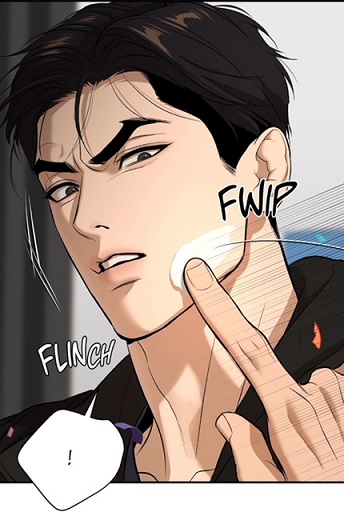 (chapter 43) Note that he put some cream on his face in order to obtain his consent. He showed him that the athlete had nothing to fear from this surprise party and the cake.
  (chapter 43) That’s how the 29 years old man learned that the face symbolizes vulnerability, care and respect. Another explanation is that the protagonist was following his own heart, because he had given his consent to his partner.
  (chapter 44) In other words, this quick but tender kiss was the expression from the “hamster’s heart”. One might see this interpretation as a validation, when the young doctor came to this realization:
  (chapter 44) On the other hand, his words expose his previous dishonesty towards himself concerning sex. He knew deep down that sex could be the expression of love and not immorality and corruption. Sex is dirty.
 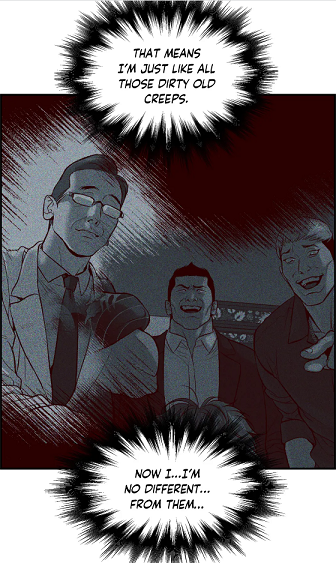 (chapter 20) His thoughts were definitely influenced by his grandmother. Secondly, observe that he is implying that this intercourse just looks like making love. On the one hand, this observation indicates the doctor’s low self-esteem. He can not imagine that the champion would make love to him. On the other hand, his words imply that Kim Dan was aware of the athlete’s drunkenness. Deep down, he knew that his soulmate was not true to himself. He was acting under the influence of the alcohol, though the readers should keep in their mind that in wine, there‘s truth. Nevertheless, the divulging of his vulnerability was not the star‘s choice.
  (chapter 3)
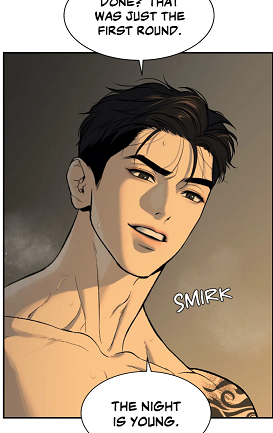 (chapter 4)

 (Chapter 1) Imagine that he was in the middle of an intercourse. Yet he felt the need to have someone else by his side. It was, as if the grass on the other side was looking greener. 😉 Yes, in this scene, I detect parallels between Choi Heesung and Joo Jaekyung.
 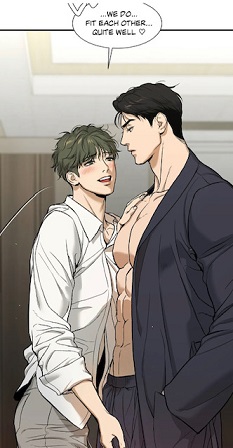 (chapter 2) He had never done it before. As for the champion, Manhwa-lovers can grasp that since their relationship was purely physical (not even accompanied with romanticism due to the athlete’s jinx), the lust from the champion’s side could only weaken overtime. When the athlete met the actor, he had not met the green-haired man before. Hence the sportsman was sitting at the bar looking more or less for a new partner.
  (chapter 33) So the relationship between the “prostitute” and the fighter must have lasted around 3 months, the same amount of time than with the physical therapist. The uke had put no effort, for in verity he was relying on the athlete’s jinx. The latter just needed him, and no one was willing to experience such a rough sex session. The reason why I gave the green-haired uke the nickname “mint goblin” is the following. He brought some fresh breathe in the athlete’s life, for contrary to his past lovers, this one didn’t run away. However, as time passes on, the mint taste couldn’t mask his corrupted mind and heart. He was passive and rotten deep inside. But there’s more to it. Thanks to the mint goblin, the athlete learned an important lesson. It was possible that someone could match his strength in bed. Yes, the latter wasn’t passing out like the others. Deep down, the star could sense that he was no monster, a criticism he had received from the actor.
 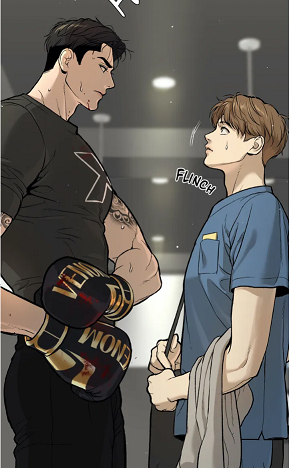 (chapter 1), he got attracted to this pretty and cute new face. However, contrary to the comedian, he didn’t realize this, for the athlete is not someone who thinks deeply. He acts rather on his emotions, exactly like his mentor Park Namwook. Since lust is the first stage of love, the recipient of his “attraction” needed to give him a signal that he was interested in him. I doubt that the celebrity would have made a move on him, if the doctor had not made this mistake
 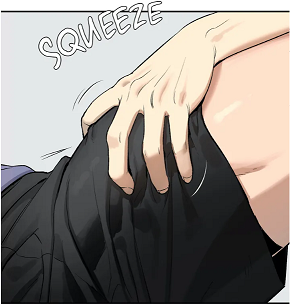 (chapter 1). Naturally, grabbing his phallus was the expression of the doctor’s masked sexual desires. This signifies that when the couple met for the first time, the grass appeared greener on the other side (medical world) for the first time. Since we have the first step of love in their relationship, we could say that the athlete was already in love with Kim Dan. While “lust” only represents the first stage in a love relationship, I decided to examine their relationship on this aspect.
 (chapter 33) We have the novelty aspect (bringing thrill into their relationship) and the champion’s selfishness. The sex toy was utilized as a “punishment”, for the athlete was upset due to his jealousy. However, this perception is still too short-sighted. You will laugh, as soon as you read my new interpretation.
 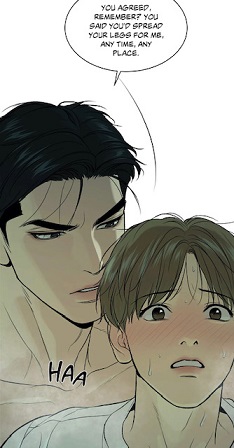 (chapter 8)
  (chapter 27) Consequently, the man had to bring up the deal constantly. Besides, their relationship started because of money. Finally, I would like Jinx-lovers to keep in mind the doctor’s lie: he had previous relationships with men.
  (chapter 33) However, this desire was accompanied with rejection and denial too. This explicates why the champion didn’t know how to interpret Kim Dan’s thoughts and emotions.
  (chapter 33) Was Kim Dan feeling the same way than him or not? Did Kim Dan desire him or not? And this leads me to the next sex session:
  (chapter 34) For the first time, the athlete was divulging his physical attraction and desire towards the doctor. He seduced him with his own body. Yet, in order to keep the upper hand in their relationship, he was the one who was determining how they would have sex:
  (chapter 34) As you can see, during season 1, it took a long time for the athlete to admit “lust and physical attraction” towards the doctor. One might reply that the celebrity had already admitted this to the physical therapist:
  (chapter 34) I would even add that he gave more freedom to Kim Dan to decide if he would accept his offer or not. As you can see, Joo Jaekyung was learning to internalize the notion “consent and respect”. Here, the doctor could have refused… the evidence is his reaction at the gym, the slap on the athlete’s hand. That’s how I realized the strong connection between the athlete’s ignorance about his soulmate’s taste (partner type) and his consent. Respecting the doctor’s boundary meant to trust that the doctor was attracted to him and accepted him as a partner.
 (chapter 41) He didn’t expect a love confession He wanted to know if Kim Dan was finally accepting him as his partner, if he desired him too. Yes, gradually the possibility of dating was slowly emerging. Like mentioned in the introduction, lust is just the beginning of love. So should Kim Dan have remembered this night in the hotel room, he would have come not only to deny his feelings for the athlete, but also he would have reduced this “I love you” to lust, just a physical reaction due to the drug. A new version of the blue night, the only difference is that that night he kept his thoughts to himself.
  (chapter 45) What did the athlete imagine here? A fake love confession from Kim Dan, a stan trying to live out a fantasy. He was expecting “dating”, a notion he couldn’t accept, for he was confusing “lust” with “love”. That’s the reason why he couldn’t accept Doc Dan’s present and “gratitude”. They sounded like fake, especially since he was showing respect to the celebrity and not to the man himself! Yes, even in that scene, the PT was still hiding his own true emotions and attraction towards the handsome man. Joo JAekyung has no idea that Kim Dan views him as “perfect”
  (chapter 53) than with this one:
  (chapter 53) He let him go, for he anticipated that the latter would remain by his side. In addition, he didn’t feel the need to have sex the whole night, as his affection had already moved to the next stage. There was more than physical attraction and desire.


 (chapter 140)
  (chapter 149) Both were suffering from survivor guilt. To conclude, Joo Jaekyung and Kim Dan represent the bitter medicine for their scars. I mentioned “bitter”, because through their loved one, they are forced to face painful moments. That’s how they can overcome their past and discover happiness. However, while looking for a new title, I rediscovered the first illustration
  , and it suddenly made click in my head. To conclude, I had another revelation concerning episode 50.
 . (chapter 50) At first glance, the champion is blaming Kim Dan for the wound. He betrayed him. However, his words could have a different signification. Don’t forget that a message always has 4 sides according to Schulz von Thun.
  Consequently, while many saw this question as a “factual information” and as such as an accusation, the reality is that it gave us an insight about the sender too. The sportsman was not using the personal pronoun “I” or “me” in his inquiry. As you can see, the absence of the personal pronoun is indicating that Joo Jaekyung was in reality not referring to him and his wounds. He is not prioritizing himself, rather the doctor and his action. So this question could be prompted by curiosity or a desire to understand the person’s recent activities. Thus I deduce that the champion was asking his lover to tell him the truth. He should come clean. He desired a honest explanation. His attitude reminded me of an adult confronting his child.
 (chapter 51) But note that he never accused Kim Dan of assault, but of leaking information. That’s the reason why I don’t think that this inquiry “What have you done” was about seeking accountability. In that case, he wouldn’t have rejected the doctor’s offer. By letting him treat his wound, Kim Dan would have become responsible for the injury.
  (Chapter 50) It becomes comprehensible why the Emperor refused the offer. The rejection was the symbol of his “trust” in Kim Dan unconsciously. Astonishing, right, though people and Kim Dan had the opposite impression. Yet, because of the “tie”, Kim Dan felt responsible for the incident, therefore he apologized.
  (chapter 51) This means, the main lead recognized his responsibility. He should have checked the spray more carefully. The champion could perceive this excuse as a confession of his complicity. Hence he asked his lover if he was the spy.
 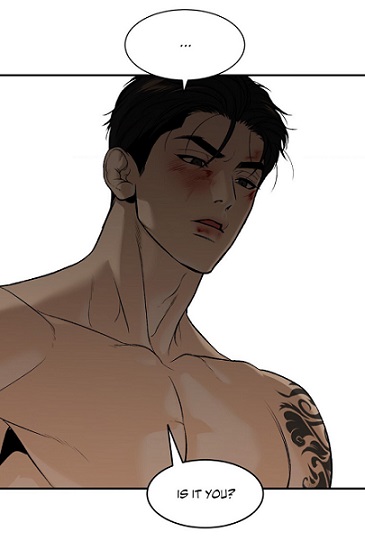 (chapter 51) This signifies that in episode 51, he dared to question his physical therapist’s loyalty. Yes, we have another “Truth or Dare” in episode 51.
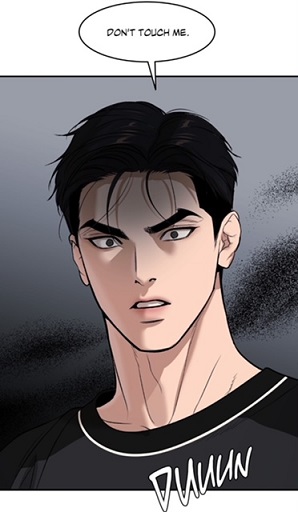 (chapter 50) This is the face of a scarred man. Yet, contrary to the past, he is not expressing his fear through rage. That’s the reason why his emotions were controlled. Under this new light, Manhwaworms grasp why the athlete asked such a question from his soulmate:
  (chapter 51) Interesting is that he was more pained by the idea of a betrayal from Kim Dan than the tie, if you compare these two panels: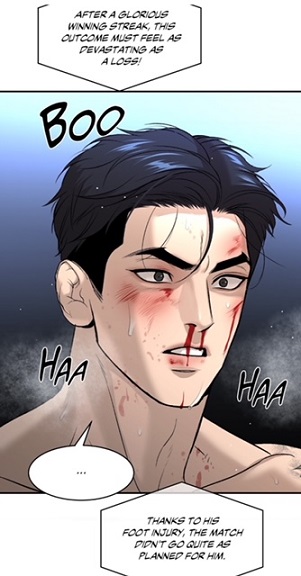
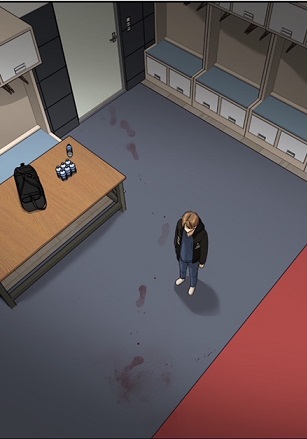 (chapter 51) Thus Kim Dan could overcome this shocking but terrible discovery: he hadn’t earned the full trust from Joo Jaekyung yet.
  (chapter 51) As my avid readers can see, my perception about chapter 50 was confirmed with episode 51. The arguments in the locker room were reflecting the quarrel in the penthouse with Choi Heesung. What is the common denominator between these two scenes? The lack of trust from Joo Jaekyung, but his private PT failed to realize it in the penthouse. Why? It’s because he chose to trust his destined partner.
 I believe you = I trust you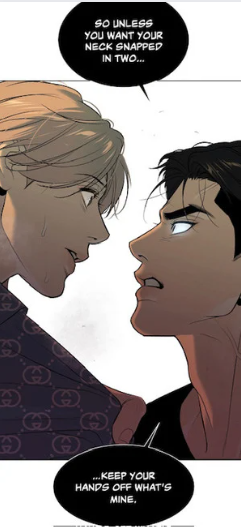


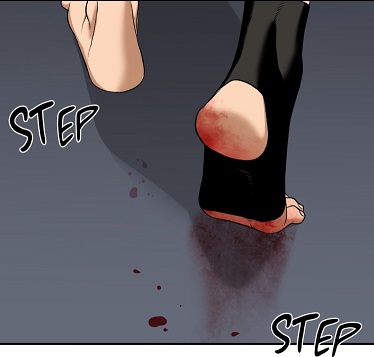
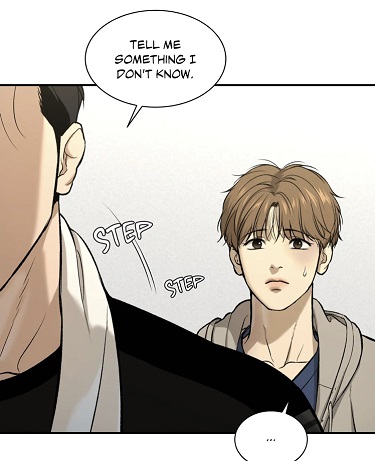 (chapter 15) He told him something that he didn’t know. Note that after the terrible meeting with the actor, Joo Jaekyung couldn’t even find the answer himself:
 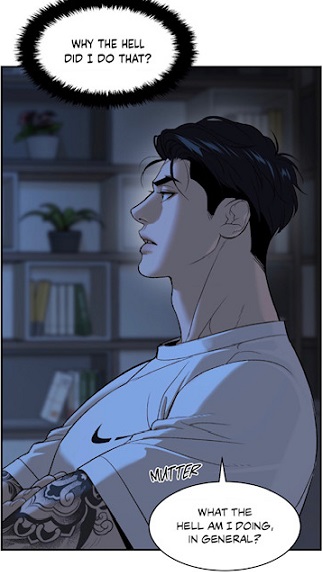 (chapter 35) He was still clueless about the trigger for his behavior. With this inquiry “You don’t trust me”, the hamster pushed his destined partner to face his biggest fear: trust someone and in particular him. This conversation can only incite him to meditate about their relationship. So while in episode 15, he behaved like a pouting child
  (chapter 15), in the latest episode, Jinx-philes can perceive his growth and maturity.
 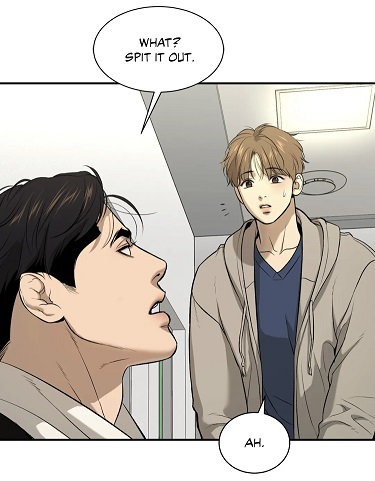 (chapter 15) This painful incident was a wake-up call Thus I come to the following deduction. Kim Dan will try to earn the champion’s trust, whereas the champion will be forced to take a leap of faith towards Kim Dan. Contrary to episode 34, the champion could see the truth directly through the doctor’s gaze and voice:
  (chapter 34) These questions were all rhetorical:
  (chapter 34) This signifies that in the sauna, truth was not standing in opposition to daring. The sauna reminded me of the cavern where an imugi hides, until the latter leaves its hidden place and find his star, his yeouiju. Only then, he can turn into a dragon. To conclude, because of Heesung’s pressure, the imugi had to select between daring or lie. In other words, telling the truth became the challenge itself. Heesung knew that Joo Jaekyung would never confess.
  (Chapter 34) What Heesung wanted was actually a lie by omission or commission which would have been presented as the truth. Through this game, the actor thought that he could impose his will onto the celebrity. He anticipated the athlete’s silence. This signifies that he knew about the star’s denial and turned it against him. Besides, that way Heesung could maintain his good image: he had not stolen his partner and as such there was no cheating. No one was betraying him.
 (chapter 34), but also his hand.
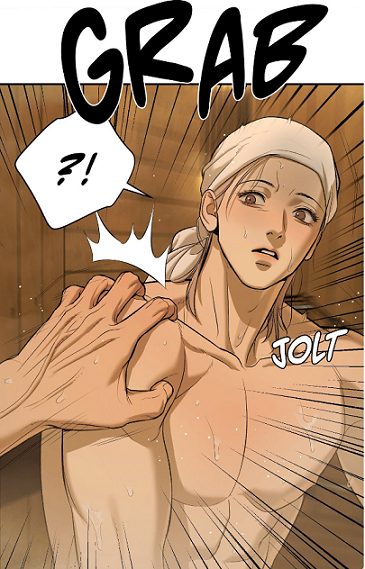 (chapter 34) He caught the actor by surprise, the latter never thought that the celebrity would become violent. The redness on his face was displaying that he was barely controlling his annoyance and impatience.
 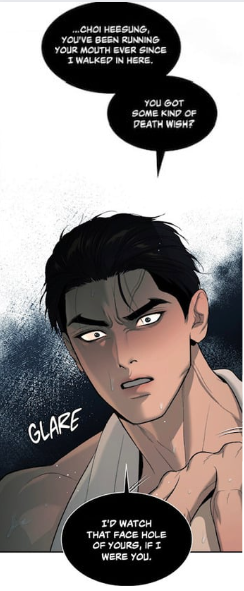 (chapter 34) However, they were in a public place, the hotel’s sauna, and the actor is a celebrity. Hence he is protected by his fame and social status. That’s the reason why the champion didn’t hit his frenemy, he had learned his lesson at the gym.
  (chapter 34) Despite his words, the gumiho still got scared. The racing of his heart is an indication of his fright. Therefore he ran away more or less after ordering his trainer not to meddle in his love life.
 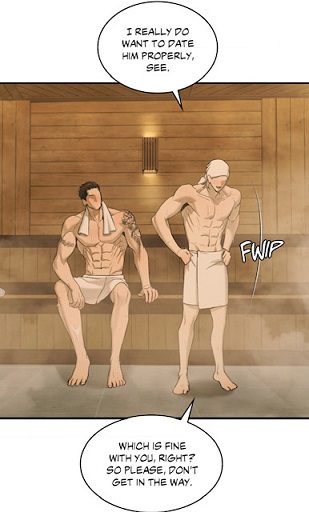 (chapter 34) Note that when he did this, he avoided his counterpart’s gaze. Deep down, he knew that he shouldn’t provoke his frenemy too much. Only when he was at the door, he turned around and LIED!
 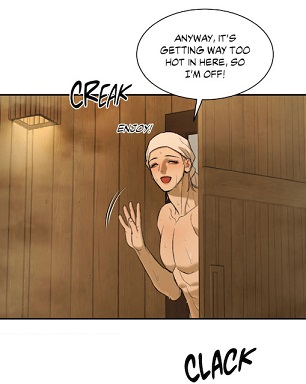 (chapter 34) Yes, after that incident, he chose to give him a fake excuse for his departure. As you can see, this conversation was strongly intertwined with the notion “truth or dare”, but both ended up lying. Whereas the champion didn’t admit any feelings, the other acted, as if there was nothing wrong and he was not scared. The gumiho thought that if he were to remove the champion from the doctor’s side, the latter would be able to open up to the actor.
  (chapter 34) What does it reveal? The actor had been projecting his own thoughts onto the future dragon too. He was the one who didn’t dare to become more honest with the physical therapist. He used work to spend time with Kim Dan. One might say that Heesung failed terribly. Yet, this is just an illusion, because his “failure” pushed him to become more honest with Kim Dan. Thereby he asked to meet the doctor again.
  (chapter 34) The champion dared to challenge his rival.
  (chapter 35) Yes, by challenging the athlete because of Kim Dan, the comedian ended up telling the truth.
  (chapter 34), yet he was in total denial about the reality: it was dangerous. Deep down, the champion knew that it was impossible for him to control his lover’s time, but also his body. Besides, the other problem is that the athlete is rejecting the notion of love. By denying the existence of his own feelings, he can not claim the doctor’s heart. That’s the reason why the champion got so mad and frustrated.
  (chapter 34) He was not telling the truth, when he stated that Kim Dan was his “possession”. This explicates why he couldn’t stay by the doctor’s side
  (chapter 34) in the end. He manipulated the main lead by letting him think that he had no other choice. Yet the last panel displays his trick. It was up to the doctor to decide how he should spend his free time. Nevertheless, while people were mad at the champion for his deception, many failed to realize that the champion was actually deceiving himself. So all the tricks (episode 33 and 34) were manifestations of avoidance, the fear to face the truth: his affection for Kim Dan and this due to a past betrayal. Hence these chapters stand under the sign of silence hidden by “pranks”.
  (chapter 35) On the other hand, the artist could only tell one part of the truth: the presence of feelings. However, the deceptions in the penthouse exposed something else:
 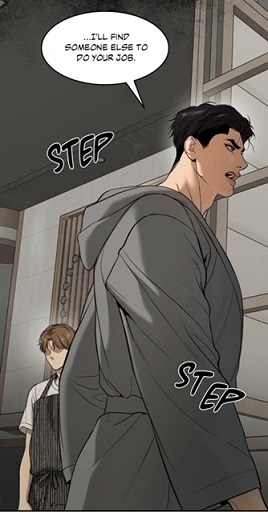 (chapter 45) or left the doctor in the locker room in episode 51.
  (chapter 45) It is because by denying his affection, he needs to justify his presence next to him. He is his PT… forcing his enemies to portray the doctor as a traitor or a bad PT. However, they failed, as the champion is not doubting the doctor’s innocence concerning his wound on the foot. Nevertheless, the incident is not closed, as the culprit has not been brought to justice.
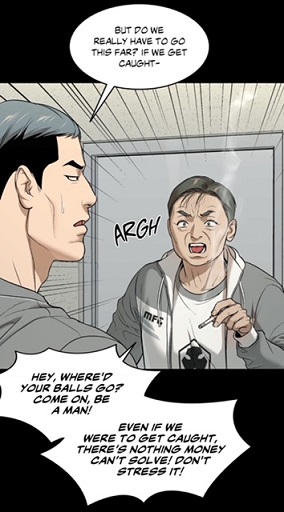 (chapter 50) First, the schemers’ MO corresponds to the game Truth or Dare. Choi Gilseok asked his minion to cross the line. This explicates why they are trying to use tricks and manipulations. Daring means no truth, thus someone will be framed: Kim Dan. Yet, the plotters are not aware that thanks to the cute hamster, the alpha is turned into a mirror of truth. Hence he couldn’t get deceived by the MFC security guys:
 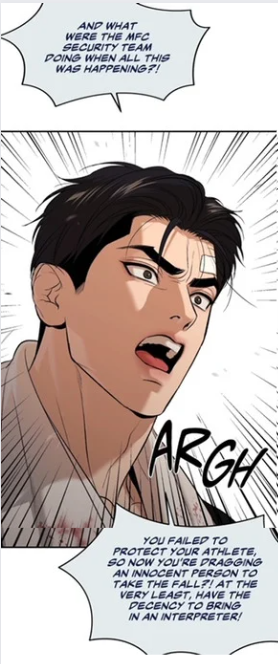 (chapter 40)
  (chapter 36) The lawyer, the journalist and the manager pushed him to choose “dare” and not truth! That’s why there was no interview and the leak was not investigated. He had to prove his strength.
 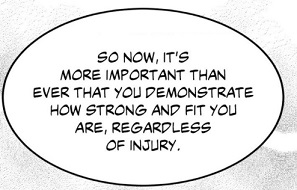 (chapter 36) And exactly like at the sauna, daring became a synonym for verity. No wonder why the fighter is never rejecting the challenge. It corresponds to his past attitude: he has been burying the truth and as such the past. But let’s return our attention to the plotters.
 (chapter 37) This mysterious man dared to act as a MFC manager, though my intuition is telling me that he works for MFC. The irony is that by challenging constantly the champion, the plotters are not realizing that through their game, the truth is slowly coming to the surface. How so? In the last panel, the doctor noticed his origins: He is Korean indicating that the conspiracy started in South Korea. As you can see, Kim Dan was able to perceive a glimpse of the truth. Then at the café, Choi Gilseok confessed many things to the doctor: he owns the café, he has connections to the company F Pharmaceutical. Moreover, through this game, the champion is confronted with his fears and past. That’s how he can overcome his traumas. The doctor is the mirror revealing the monsters. Hence I come to the following deduction: the succession of new characters mirrors the champion’s past and traumas. The following characters are involved in the champion’s suffering, though the order of the appearance is exposing the gravity of the involvement: Heesung,
 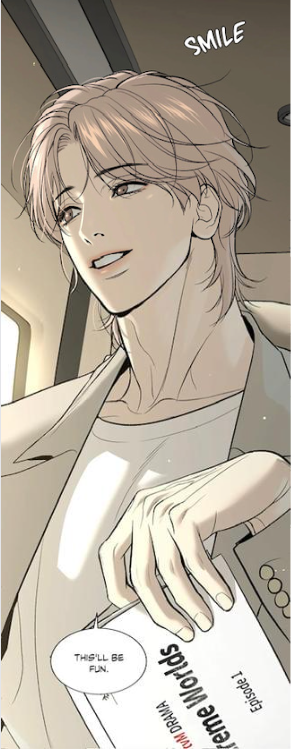 (chapter 29), the journalist without a face
  (chapter 35), the “fake” MFC agent
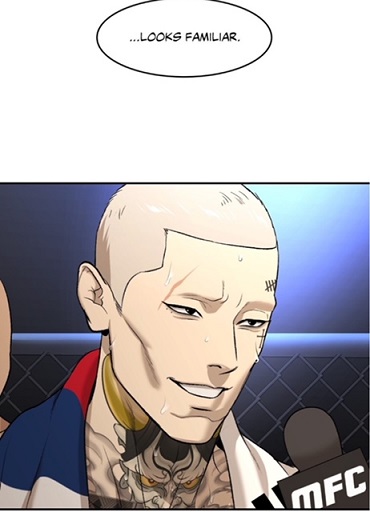 (chapter 47), then he recognized the director without naming him,
 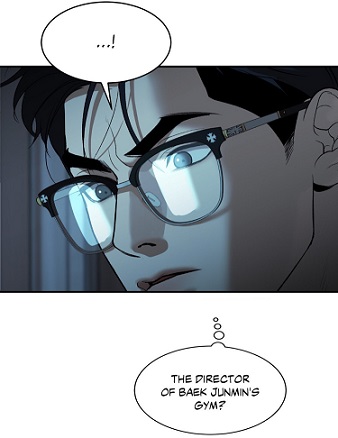 (chapter 48) and finally the ghost from the past
  (chapter 50) This scene exposed that the champion repressed a certain incident which is rather common among victims of a trauma, especially people suffering from PTSD. This shows that some traumatic event took place for quite some time, but the champion acted, as if nothing had happened.
  (Doctor Frost, chapter 140 ) That’s how the champion became a zombie, he couldn’t live properly due to his untreated scars.
 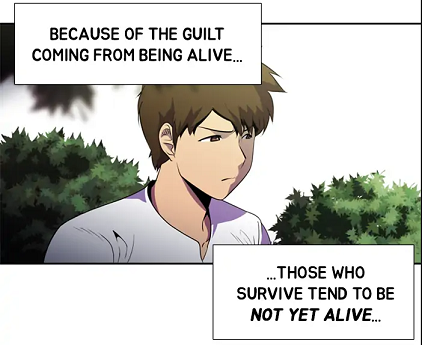 (doctor Frost, chapter 139) But thanks to his fated partner, the traumatic past is slowly coming to the surface.
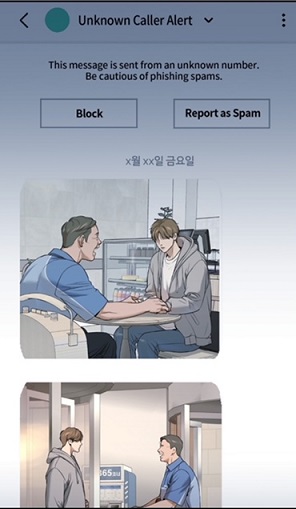 (chapter 48) The director created a stage for the betrayal. That should represent the truth, while in reality it was a lie! Nevertheless, Joo Jaekyung could perceive the truth: Kim Dan had met the director from the rival gym.
  (chapter 48) Yes, he didn’t dare to tell him what had happened. No truth… no daring which reflects the games in the sauna and the living room of the penthouse. Kim Dan could have come clean the next morning, but no. This panel explains his silence. He also mistrusted his VIP patient. He had a negative perception of his lover’s mental state. On the other hand, the champion’s attitude reminded me of a parent who has not the time to listen to his child’s problem due to work.
 (chapter 48) Should the athlete remember this night, he will realize that he was the one dismissing his physical therapist, although the doctor could have come clean later. At the same time, Joo Jaekyung’s attitude could be mirroring the parent or guardian’s in the past. They didn’t have the time or the inclination to listen to their son, hence the traumatic incident got buried.
 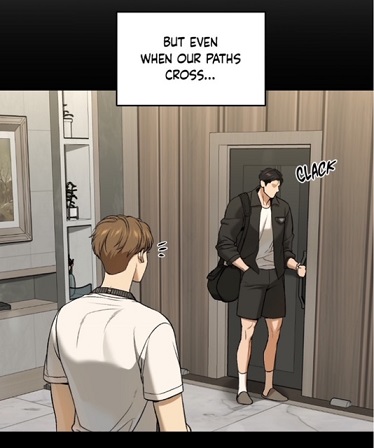 (chapter 47) and voice his true thoughts and emotions:
 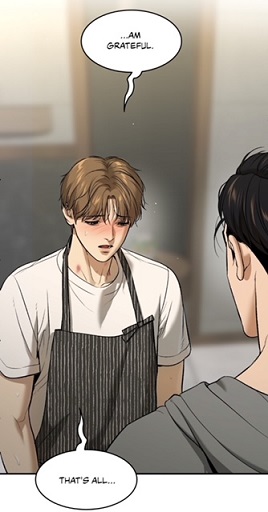 (chapter 45) He lied, when he portrayed himself as grateful. He was avoiding his gaze either. No wonder why the fighter got even more mad and threatened to fire him. Such an attitude could only increase the celebrity’s mistrust, as the latter could discern a certain dishonesty.
  (chapter 49) The latter didn’t even greet the director or acted, as if they didn’t know each other. He exposed the existence of a secret, an uncomfortable secret. Consequently, I believe that the champion could only jump to the conclusion that Kim Dan had been indeed acting behind his back, even coerced to do something.
  (chapter 51) Note that the star never came clean with the truth either.
 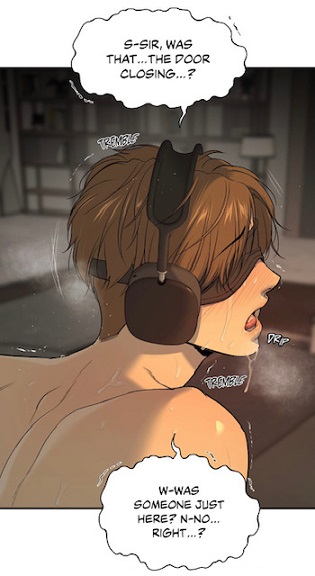 (Chapter 35) Through the doctor, the champion is encouraged to become honest to himself.
 (chapter 33) Simultaneously, it exposes that the champion has a secret, which is strongly intertwined with betrayal, love, money and deceptions. I couldn’t help myself thinking of “blackmail”. Kim Dan had been coerced to do something, as the director was holding something against him. Hence we have the question: “what have you done?”. Remember how the actor chose to approach the angel.
 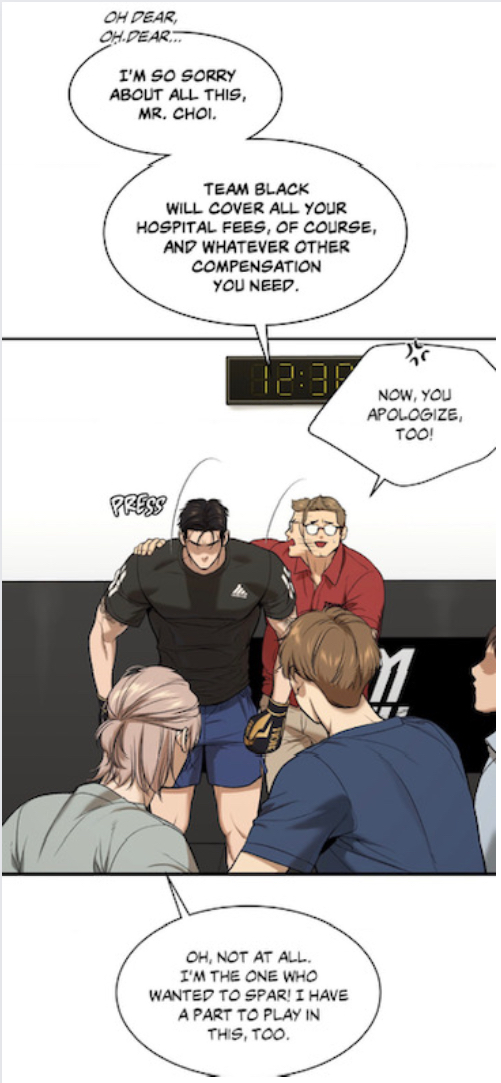 (chapter 31) He tricked his boss by faking an injury. He put the gym under pressure, as this incident could be leaked to the outside. The whole situation reminded me of blackmail. If he did not follow his request, there could be a scandal. That’s the reason why I believe that the champion’s past is linked to blackmail as well. How is it possible? It is because of the game “truth or dare”! The latter is strongly intertwined with divulging information and crossing the line!! To sum up, this game embodies trauma, secret, leaking information, trust and overstepping a boundary or rule. This observation brings me to my next point.
 (chapter 9) And what did happen after they left the restaurant? The champion discovered the truth:
  (chapter 10)
 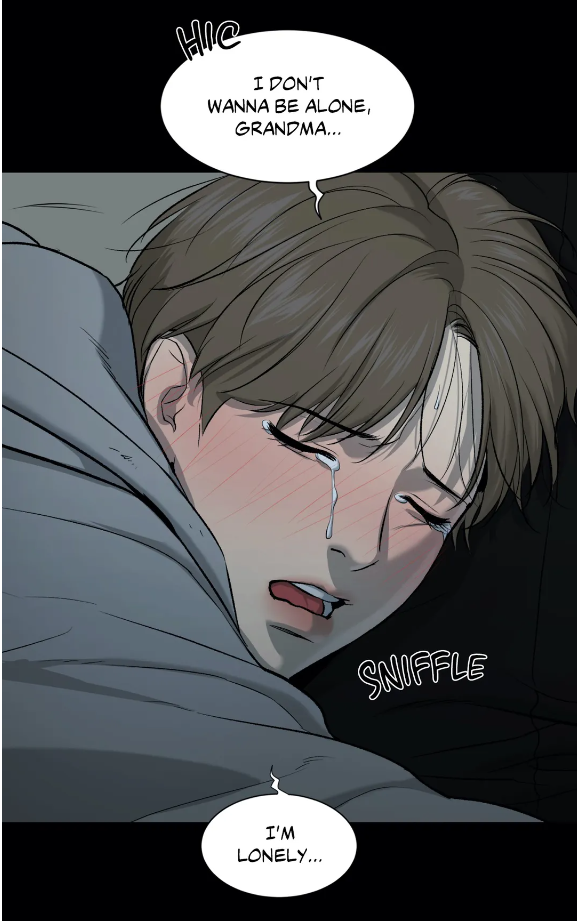 (chapter 10) Kim Dan was terribly poor, but he was also on his own, missing his grandmother.
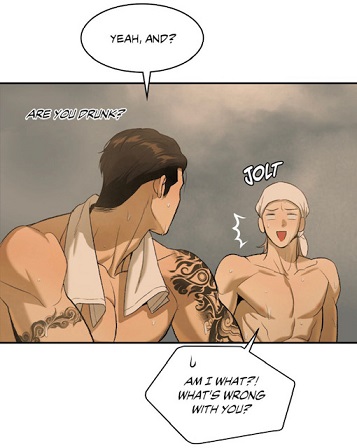 (chapter 34) “Are you drunk?” With this question, the protagonist revealed something about himself. He associates dating and love confession with drunkenness. He implies the existence of a lie. But a confession is strongly associated with verity and sincerity. On the other hand, for the sportsman, no one in his right mind would admit to be in love and in our case to love another man. For me, one part of the problem is that the champion is afraid of admitting his homosexuality. The latter is still a stigma in South Korean society. But there’s more to the game Truth or Dare. If you paid attention to the origin of the last quote, you will realize that this fun is linked to bullying and even hazing.
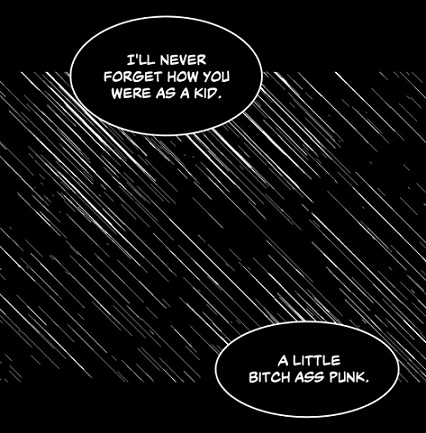 (chapter 49) Furthermore, bullying is never done alone, but in groups.
 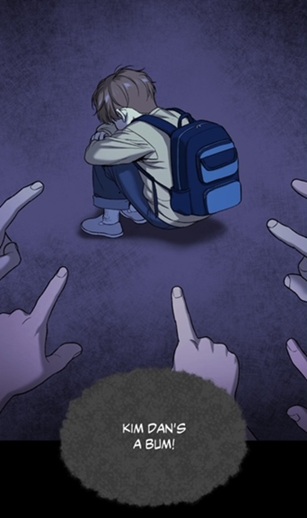 (chapter 57) There is one leader and the others are following the flow, the latter even become more proactive by making new bets and suggestions in order to ensure their own safety. As long as no one divulges the truth, the bullies are safe. But there’s more to it. Striking is that the way they coerced the champion to fight resembles to bullying too. He was manipulated with the articles, then with the advises from the lawyer and manager. Once in the States, they tried to drug him, which corresponds to a physical assault.
  (chapter 37) Finally, note that the schemers are working in teams exactly like the bullying students. Therefore I judge Park Namwook’s attitude as the teacher’s who is closing the eye to the truth. He is rather passive and puts the whole responsibility on his “boy”.
  (chapter 37) Interesting is the athlete described this night as a party which made me think of a students’ party. Therefore I couldn’t help myself wondering if the champion didn’t go to college, but due to an incident, he was forced to drop out. And the latter could be related to a party organized by students. The latter chose to cover up the incident by remaining silent. I would like to outline that the doctor got fired, though he was actually sexually harassed by his superior. The nurse never testified in his favor, she chose to close an eye to the crime.
  (chapter 1) The main lead never considered her behavior as betrayal and abandonment. In fact, he never considered the crime as a betrayal from an institution.
  (chapter 47)
  (chapter 1) It is important, because it implies that Kim Dan avoided to socialize and participate in gatherings. Interesting is that in season 2, Jinx-philes discover that Kim Dan had been bullied in the past.


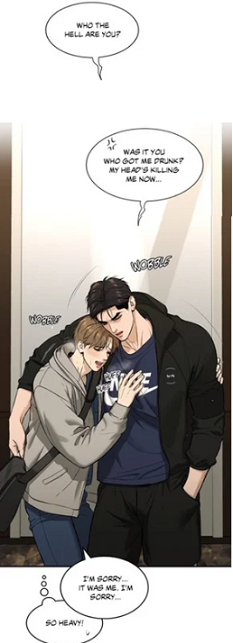
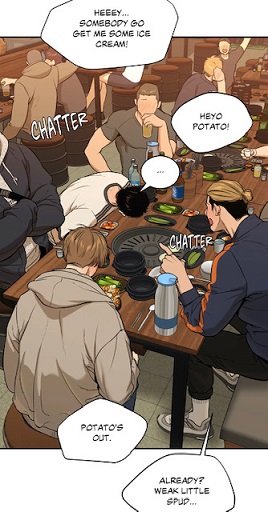 (chapter 9), yet Park Namwook made sure that the physical therapist wouldn’t be abandoned drunk. Thus he tasked his boss to bring him home. And as for Potato, it is clear that Oh Daehyun would take care of him, as he was sleeping in the dormitory next to him. In other words, no one was left behind drunk. But this scene contrasts so much to episode 43. First, no one was missing Potato. No one asked about his absence. Secondly, pay attention that the fighters invited Kim Dan to join them for another round, while they were neglecting their boss, though it was his birthday party.
 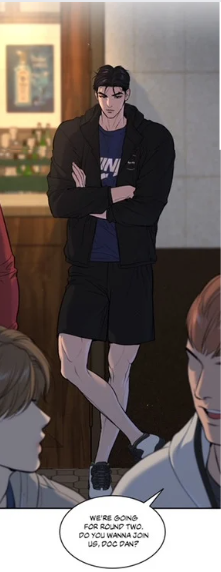 (chapter 43) Moreover, they never wondered about his physical condition. Was he drunk or not? Funny is that the intoxicated character was the one who forced Kim Dan to go home.
 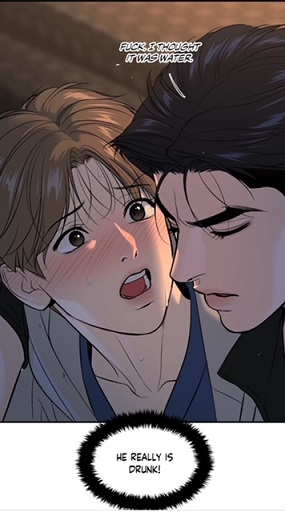 (chapter 43) That’s what a friend is supposed to do.
 (chapter 35) So the auntie could keep an eye on the judo fighter, and it was only a matter of time, until his friend would return. Nevertheless, this scene is implying a certain problem: a drunken person shouldn’t be left unguarded. Thus imagine that during a party, an unconscious person is brought to a room and left there unguarded, as the friend desires to keep partying, similar to this scene:
  (chapter 37) The person could get sexually assaulted, and no one would notice it. Secondly, I would like to outline that the hazing party from the article reminded me a lot to bullying. These freshmen were humiliated, and the perpetrator excused her behavior behind traditions and social norms. So the champion could have been betrayed by a friend, as the latter would have justified his action similarly. So instead of admitting his mistake, he could have justified the incident like this: the victim was responsible for his misery, because he was at the wrong place at the wrong time. It was just his misfortune or better said his jinx. Yes, for me, the jinx is indicating that people responsible for the champion’s traumas were denying their wrongdoings.
 (chapter 8) From my point of view, this place is not just symbolizing purification and reflection, but also indicating the presence of a wound. As soon as I connected the bathroom and as such water to pain, all the champion’s past behavior appeared in a different light. In episode 3, when he went there, he was wearing his pajamas.
  (chapter 3) Neither Kim Dan nor the protagonist were seen both naked in the shower room.
  (chapter 8)
  (chapter 20)
  (chapter 34) He feels uncomfortable naked around people… As soon as you connect this place to a wound, my avid readers can finally better interpret the champion’s irritation in episode 36:
  (chapter 36) Kim Dan’s entrance could be perceived as a violation, for the champion was naked. This intrusion caught him off-guard. But since his gaze was covered, his anxiety masked behind his anger was diminished. On the other hand, this led him to leave the bathtub undressed and have sex in the kitchen.
  (chapter 36) For me, everything is pointing out that one of the champion’s fears is intimacy with water. He has long internalized this association. Don’t forget that the sexual encounter in the swimming pool started with clothes, before they got completely removed.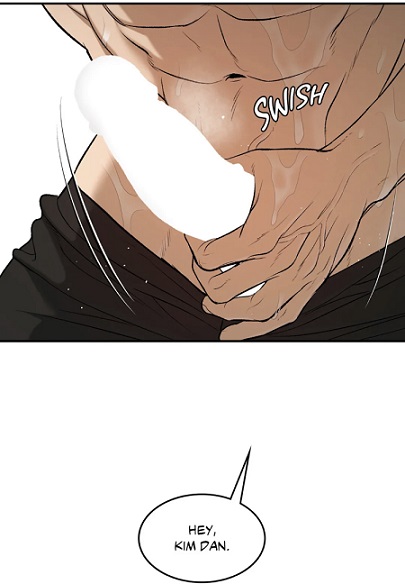
 (chapter 27) Under this new perspective, I don’t think that it is a coincidence that the champion felt the need to take a shower after meeting Baek Junmin and recalling the past.
  (chapter 49) This helped him to overcome his trauma and past wound.
 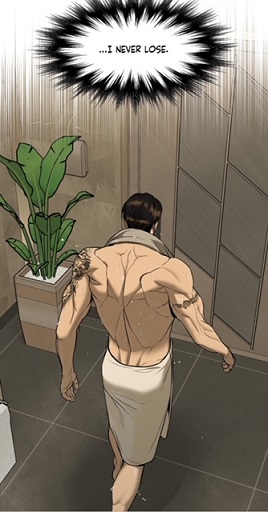 (chapter 49) Yet, keep in mind that the athlete’s wounded soul is not the result of one traumatic incident, but of many anguishes.
 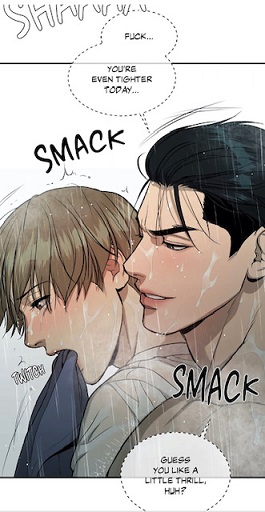 (chapter 8) they dared to have sex next to Oh Daehyun and the other fighter. However, note that in all these scenes, neither the doctor nor the champion were honest. They were both lying… not only to their counter-part, but also to themselves.
 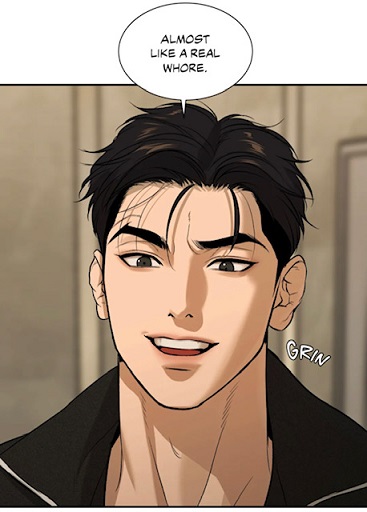 (chapter 19) That’s the reason why the argument in the locker room
  (chapter 51) doesn’t represent the final moment where both main leads opened up their heart and mind to each other. They were not truly honest to themselves and to each other. There was no water… and according to me, the spray was a pepper spray, so the champion’s ankle should have been cleaned and not simply covered. For me, both characters need to prove their trust and loyalty to each other. But they are moving in the right direction, for Joo Jaekyung divulged a huge information to Kim Dan.
  (chapter 7)
 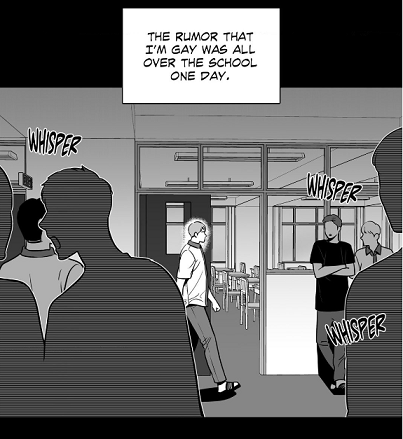 (chapter 70) His sexual orientation was exposed in high school, his friends were behind the rumor
  (chapter 70), although we have to envision that his crush played a huge part in it. Why? It is because he didn’t want to be associated with homosexuality.
  (chapter 70) Not only he cut off ties with him, but also he made sure to isolate the main lead from other students. The worst is that this person acted, as if this ostracizing had never occurred.
  (chapter 69), as if he had done nothing wrong. For me, it shows that the traitor never grasped the significance of his actions. Hence Park Sung-Woong could forget Dong-Gyun, while the latter could never forget him at all. The result from this huge betrayal was that the cute uke decided to keep his distance from people.
  (chapter 70) He could no longer trust people, he avoided meetings. In order to outline how severe betrayal trauma can be, the Webtoonist showed us the immediate effects of betrayal trauma: physical and emotional reactions
  (chapter 70)
 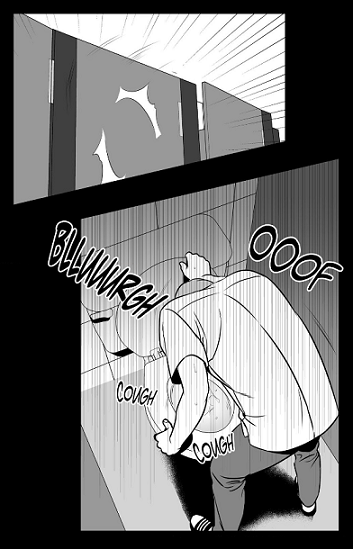 (chapter 70) and the long term effects:
 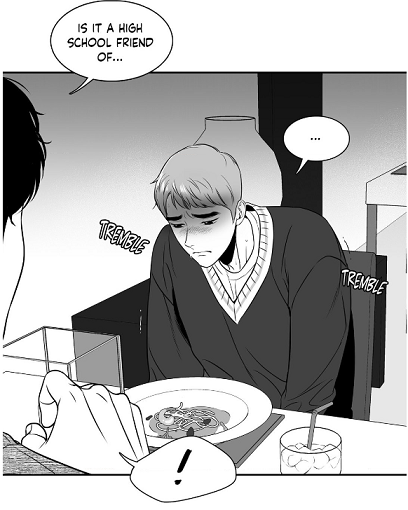 (chapter 69) he is trembling so much, he can not look at his former friend. Readers shouldn’t underestimate the issue. Betrayal trauma is so severe that it is comparable to being hit by a white truck. The pain is so great that it affects the brain functioning and as such personality.
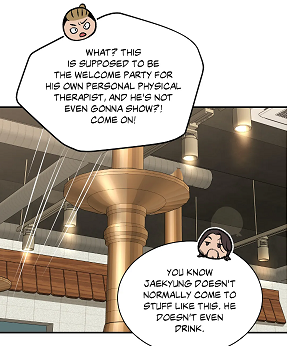 (chapter 9), trust issues
 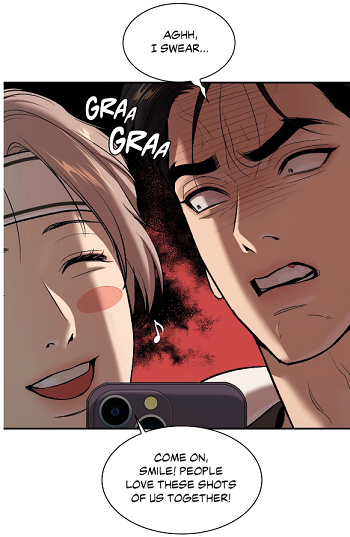 (chapter 30), negative intrusive thoughts
  (chapter 32), it was clear that the doctor’s actions were constantly on his mind. He was so bothered that he had to bring him to Heesung. He made sure that Kim Dan would forget Choi Heesung in the car.
 (chapter 49), the latter was not loved, as he didn’t reach the first place like his older brother. Then we have Interpersonal with Nam Dong-Gyun and his high school friend. However, since the rumor circulated at school, and no adults intervened, we could see it as a reference to Institutional betrayal. Finally, Mingwa presented the last type (partner) with Hweemin.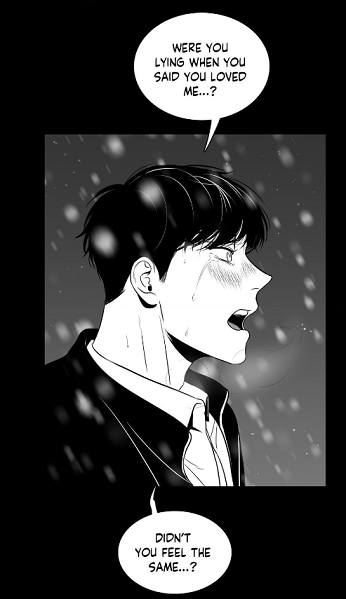
 (chapter 51) But why is betrayal trauma so severe? It is because everything appears as a lie, as an illusion. All the memories become tainted. The victim can only question his own senses and judgment. How could he not detect the lies? Since PTSD and betrayal trauma share some common points, it is not surprising that such persons come to blame themselves and develop huge self-loathing.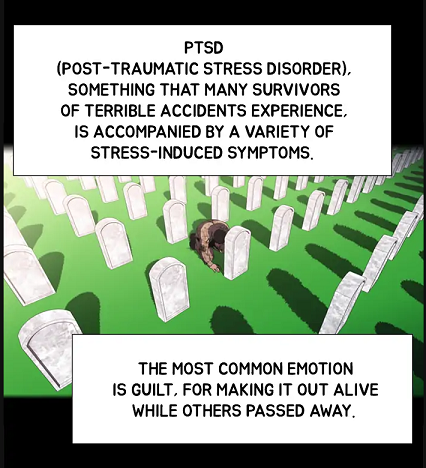
 (doctor Frost, chapter 139). And now, it is time to expose my latest observation:
 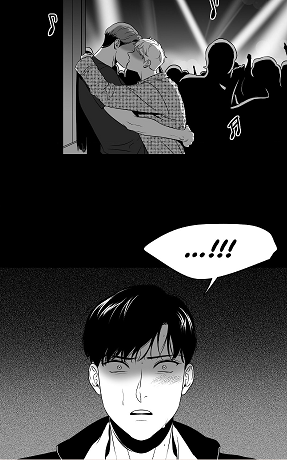 (BJ Alex, chapter 51) Ahn Jiwon caught his first lover cheating on him at a club. Interesting is that the new lover resembles a lot to Joo Jaekyung! Mingwa said that characters from BJ Alex will only appear, but Jinx is not connected to her previous work. Note that they were kissing in a public place. Moreover, the club is a location where students not only meet, but also drink alcohol together. However, once Jiwon saw Hweemin, he dragged him outside so that they could talk. In other words, the “new lover” was left behind. Thus I come to the following conclusion. Joo Jaekyung has been suffering from betrayal trauma exactly like Ahn Jiwon. He was betrayed by his guardian
 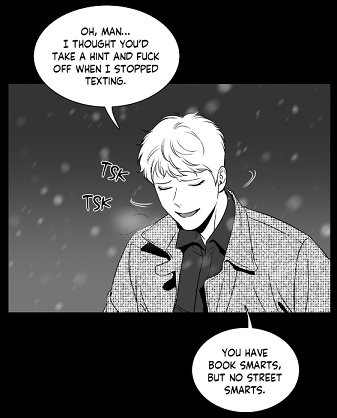 (BJ Alex, chapter 51). If this theory is true, then Mingwa would finally outline the devastating effects of Betrayal trauma on people, something she barely touched in her previous work.
 (chapter 51)
 (chapter 48) Why did the Webtoonist gave us the time, when the next episode starts another day? On the one hand, it exposes that the schemers knew about the champion’s nightly activities. He wouldn’t sleep much and he would keep his cellphone next to him.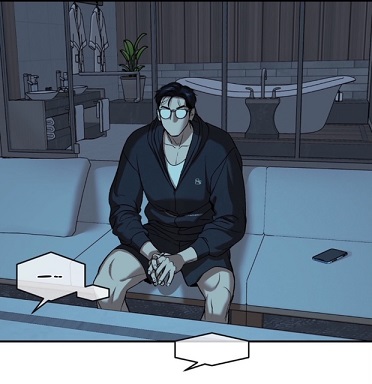
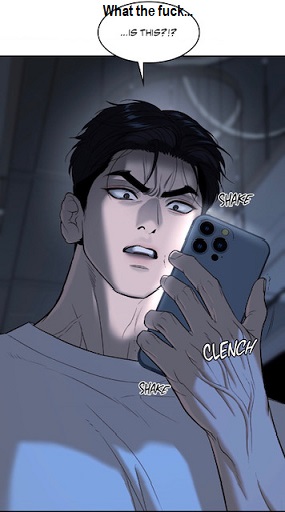 (chapter 35) This made me think of Painter of The Night and No-Name’s advice:
  (chapter 76) “A deed once foiled has no chance of success the second time around”.The criminal was referring to learning through experience. After going through such an event once, the athlete is no longer caught by surprise. We could say that he learned not to jump to conclusions and control his emotions. That’s the reason why in episode 48 he remained level-headed. Because the champion didn’t get angry, he could be more attentive.
 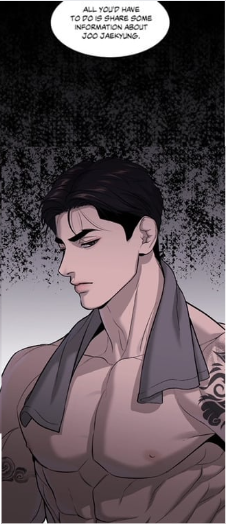 (Chapter 48) The irony is that the doctor had been able to treat the star’s injury. For me, the Summer Night’s Dream played a huge role, as during that night, Joo Jaekyung felt treasured and loved. Therefore the pictures could only expose the duplicity of the director of King of MMA. Under this new light, it becomes understandable why the celebrity didn’t fall into their trap and why they had to turn doc Dan into a traitor by giving him a weapon without his knowledge. Finally, I believe that Joo Jaekyung had another reason not to confront the physical therapist. How so? It is because he had sent away his soulmate, while the latter had approached him.
 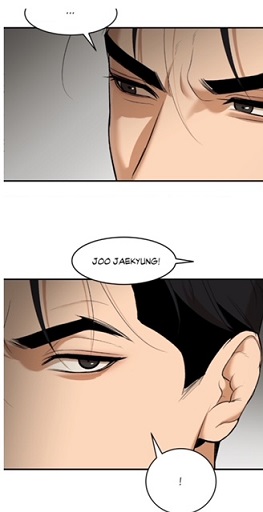 (chapter 49) The gaze displays not only worry and anxiety, but also regret. It was too late to ask the doctor. For me, he chose silence, for he was regretting his reactions in the penthouse. He feared to ask Kim Dan, because if he brought up the meeting with Choi Gilseok, this could push the hamster to quit his job. However, thanks to Kim Dan, the star’s condition improved greatly. That’s how it dawned on me why the champion became a beast and why he is hiding his past:
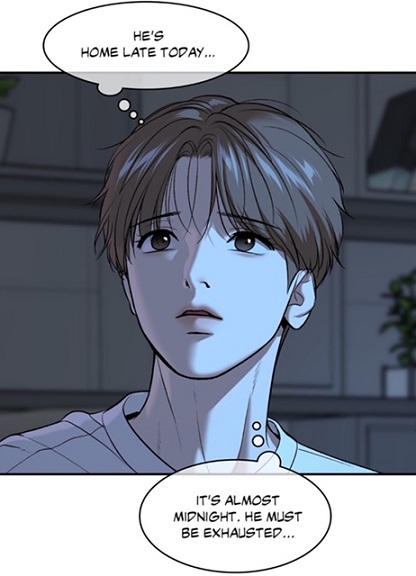 (chapter 48) But why is midnight so important? It is because the number 12 carries religious, mythological and magical symbolism, generally representing perfection, entirety, or cosmic order.
 (chapter 48), when he noticed doc Dan’s presence too late. But nothing happened to him, that’s how he got incited to trust Kim Dan. The latter wouldn’t backstab him. Under the blue light, the champion got transformed.
 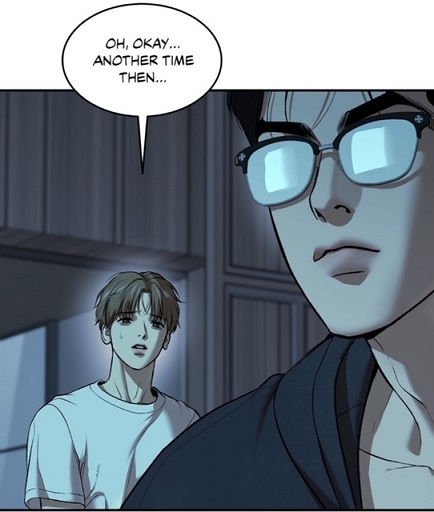 (chapter 48) On the other side, the fact that the champion is always targeted during the night is a sign that the villains desired to approach him, when he was isolated. So they know not only about his insomnia, but also about his solitude. I would even add that the plotters are aware of his association between the night and danger. Remember how he described relaxation: he would give an opportunity to his enemies to attack him


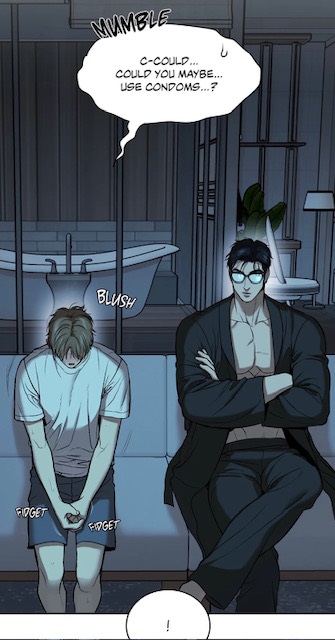


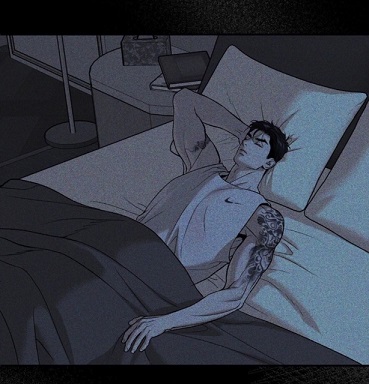
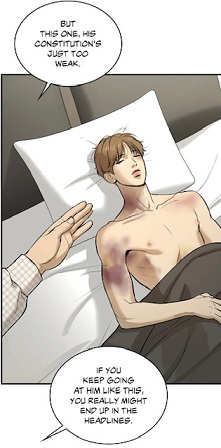 (chapter 13) It is important, because through this terrible experience, Joo Jaekyung came to internalize the connection between sex and danger. This would explain why he has been so rough in bed before. He came to see it as a normality, a sign that his perception of sex had been negatively influenced. And this can only come from bad experiences. It had nothing to do with “enjoying the moment”, until the protagonist met the shy hamster. We can see his gradual transformation. In episode 12, he definitely saw the night as “carpe diem”
 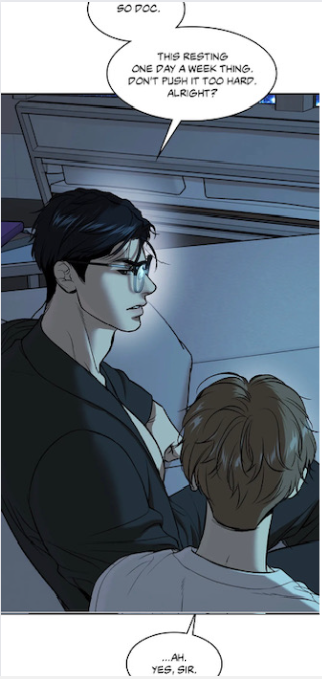 and 48:
  , for he had been recollecting the diagnosis from Kim Miseon and kept thinking of his grandmother. After this painful meditation, he came to recognize his selfishness and his relative’s love and generosity
 (chapter 47). And what was the main lead feeling after that terrible night? Regret, for he had not been able to notice his relative’s suffering and sacrifice!
  (chapter 19) or a new request like swallowing the sperm
 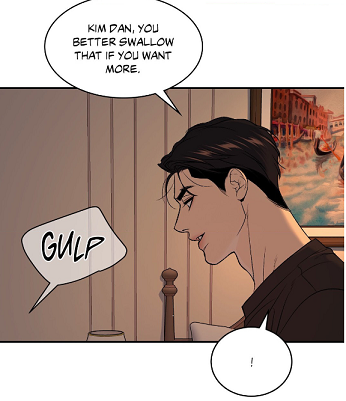 (chapter 39) or kissing the champion’s ruined ears
 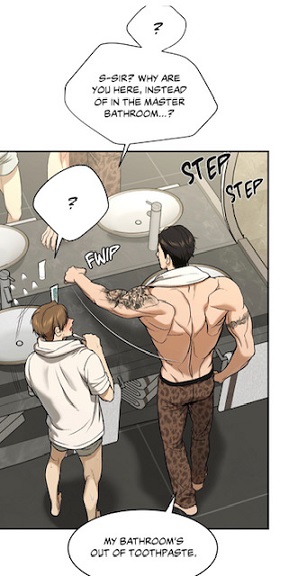 (chapter 30) He was rough and used the toothpaste as an excuse.
 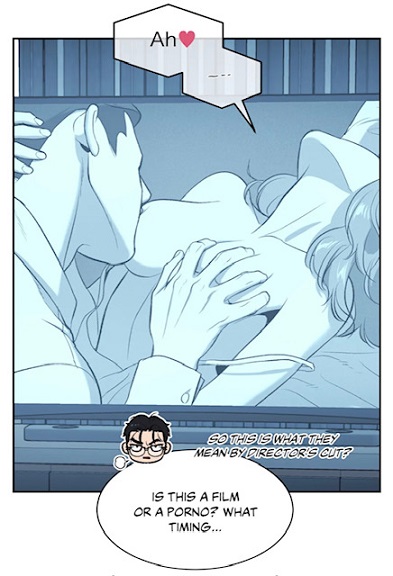 (Chapter 29)
 (Chapter 40) That’s the moment he stopped considering the hamster as a prostitute, while from chapter 2 to 18, he viewed Kim Dan as a tool, as a talisman against his jinx. However, I detected a transition after he kissed the physical therapist. From that moment on, the doctor was connected to food and sweetness.
  (Chapter 18) And now, observe that during the night in the bathroom, doc Dan was associated with a baby receiving food:
 (chapter 20) As you can see, here the champion started viewing him as a human being. It exposes that little by little, his perception of the physical therapist improved. So from chapter 30 to 39, Joo Jaekyung was forced to question the nature of his relationship with Kim Dan: a PT or a prostitute or a pet?
 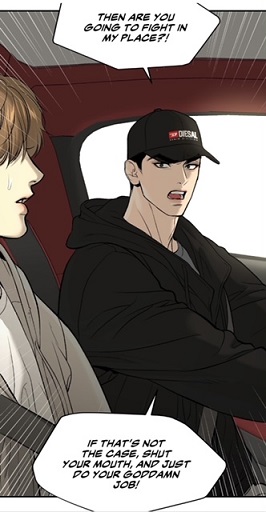 (Chapter 42) He rejected his advice, a sign that he was doubting doc Dan’s skills and competences. That’s the reason why I come to the conclusion that with the pictures, the champion was pushed to admit that Kim Dan is his physical therapist
  (Chapter 49)
 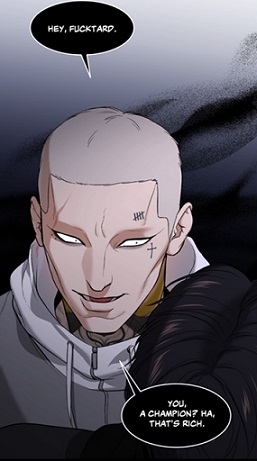 (chapter 49). These meetings are not random at all, a sign that someone knows about the athlete’s hidden suffering very well. Observe that both characters challenged the celebrity by giving him an order:
  (chapter 49) The sportsman is viewed as a hindrance to their dreams, he should clear the way for them. I deduce that in his youth, people must have treated him the same way. He represented an obstacle, therefore these two figures must have challenged him in the past too. Their confidence comes from their past experiences with the athlete. Both must have defeated Joo Jaekyung, but naturally they must have tricked him.
  (chapter 33)
  (chapter 49) Then I noticed another parallel between the two plots: the presence of a scapegoat, and the involvement of a third person. Heesung faked his injury by putting the blame on the athlete, while he asked Kim Dan as compensation. In the second plot, the roles are switched. Kim Dan is now the perpetrator, while the athlete is the victim! Baek Junmin is the beneficiary of this scheme. And what do these plots have in common? Joo Jaekyung is the victim of a trick, though Heesung’s manipulation was rather benign. First, he acted on his own.
  (Chapter 31) Moreover, he utilized the genuine concern and innocence of his surroundings. In other words, he used his image as a good and honest man to his advantage. Thus I come to the conclusion that the artist’s sin in their youth was rather minor, as the artist tends to violate social norms. So though it was no illegal, the actor’s wrongdoing definitely left scars on the protagonist’s heart.
  (Chapter 30) Another common denominator between The Shotgun and Heesung is their envy and greed.
  (chapter 5) Joo Jaekyung destroyed the sandbag, when he imagined that doc Dan had blocked him! This signifies that the former could no longer contact the shy hamster. Joo Jaekyung saw it as an affront, a challenge!
  (chapter 46) could be seen as a reflection from the arcade and the star’s past. And since Kim Dan wounded Joo Jaekyung in the locker room
  (chapter 49), I deduce that such an action must have happened in the champion’s youth. He got not only hurt by people, but also betrayed by a friend. There exists many reasons for this hypothesis.
 (Chapter 04) and be rude towards others.
 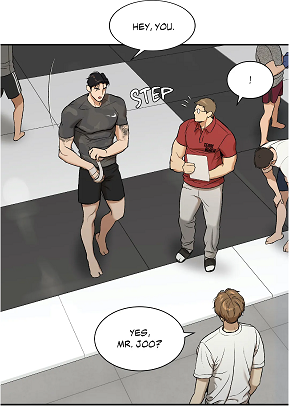 (Chapter 7)
  (chapter 37) But Mingwa left many clues that the celebrity’s personality shouldn’t be judged by impressions. During their first night together, Manhwa-lovers could see books next to the bed.
 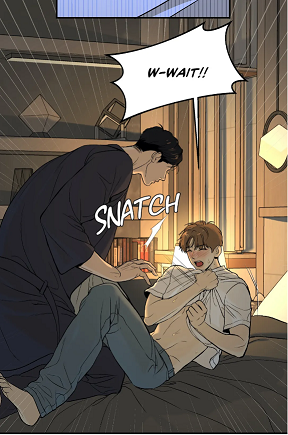 (Chapter 3) Some of them are not written in Korean or English. Moreover, the Webtoonist revealed that one of his hobbies is reading. This explains why he can talk prettily.
 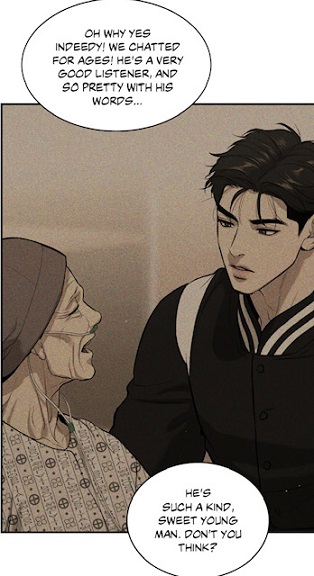 (chapter 22) This shows that his behavior mirrors the counterpart’s. Consequently, it is not surprising that the champion is rough with his own body, as Park Namwook is not treating him like a delicate child.
 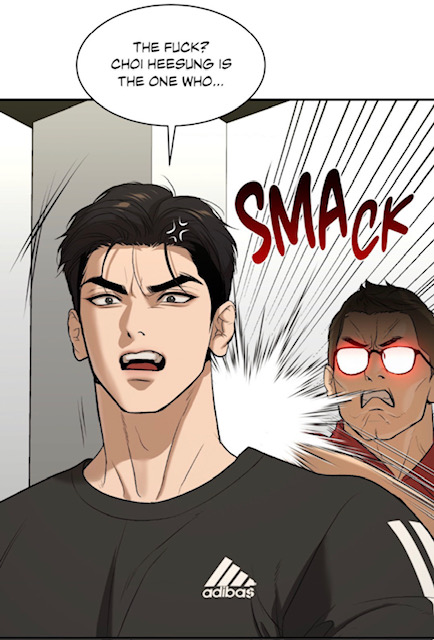 (chapter 31) But there exists another proof for his intelligence. The celebrity is capable to lead an interview in English on his own.
  (Chapter 37) Even stressed and filled with anger, he could understand and speak fluently in English.
 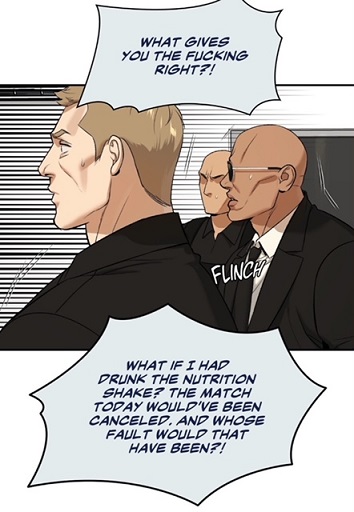 (Chapter 40) Compare Kim Dan’s English skills in the same scene:
  (chapter 40) Besides, Jinx-philes should question why Mingwa is not divulging his scores as a student contrary to Kim Dan or Jinwon from BJ Alex. It is because she wants to create a certain image about the champion: he is a bad boy. In my eyes, she is playing with prejudices about MMA fighters. People often imagine, they lack social manners and education. They chose this path, for they could do nothing else. And this brings me to my next remark. We know that Kim Dan selected PT because of his halmoni.
 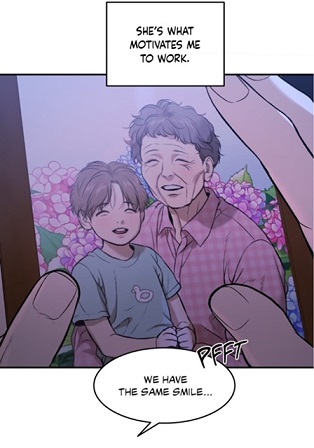 (chapter 47) So what was the protagonist’s motivation to become a MMA fighter? In my eyes, this question represents the core of the mystery. My idea is that the suffering in his youth led him to become a boxer. It is definitely related to his experienced powerlessness and loneliness. So when he suggested the sparring to Kim Dan, we should see it as a reflection from the past:
  (chapter 26) Joo Jaekyung was also an amateur in the past, but his motivations were his rage and resent. On the other hand, contrary to his soulmate, the athlete likes sports as well. His other hobbies are jogging and swimming. Thus I am suspecting that Joo Jaekyung might have been part of a swimming club in the past. Striking is that he forgot his passion due to his career as a MMA champion.
 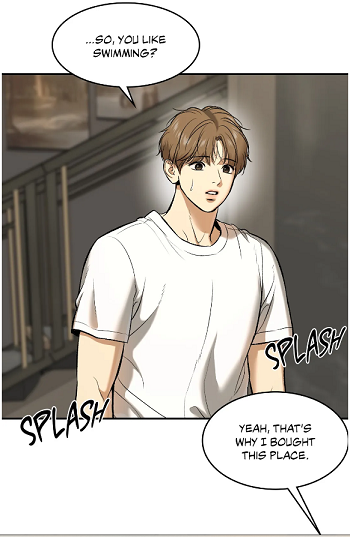 (chapter 27) I see a contrast between these two sports: swimming which is related to relaxation, pleasure and fun and MMA fighting which stands for challenge, pain and seriousness. This contrast is even more present in the following panel:
  (chapter 49) He is a hyena, hence his color is brown.
  (Chapter 48) And The Shotgun has a similar attitude:
  (chapter 49) Interesting is that his description of the challengers fits the situation in the new plot perfectly. The Shotgun imagines that he will fight against a diminished champion. His shoulder is injured and they have planned to add a new injury. The hyena stands for balance and cleansing as their task is to remove the weak ones.
 (chapter 49) As an old man, Choi Heesung is revealing vulnerability and senility. Due to his old age, he could be replaced by another hyena, a younger hyena!
 (chapter 5), as he is the only person who has not appeared yet, though the champion has his cellphone number. And this remark brings me back to the present and the night messages and the hyenas.
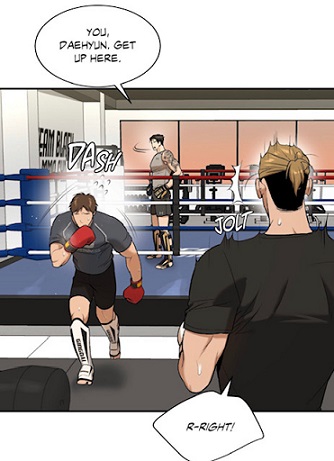 (chapter 36) which could only affect the members from Team Black. Their loyalty could waver. Then he got to hear bad comments from the Internet
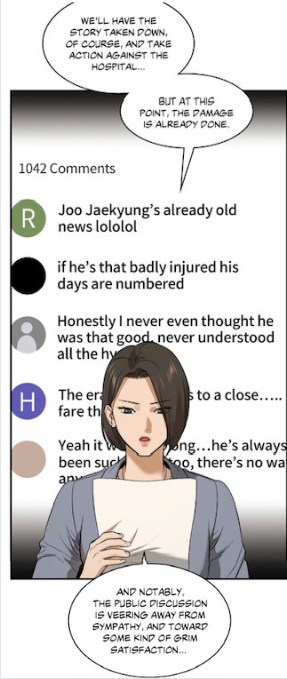 (chapter 36), creating the illusion that he was losing popularity. That’s how the lawyer could convince the champion to accept a new match in such a short-time. Finally he got reprimanded for his outburst.
 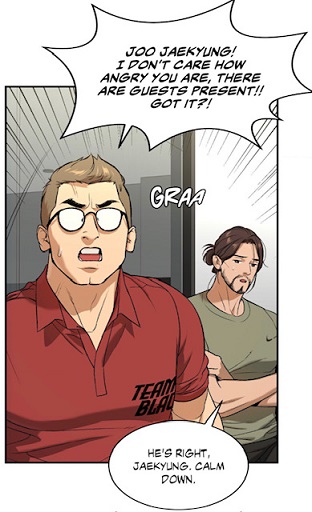 (chapter 36) Under this new perception, Manhwaphiles can grasp why the MFC manager offered him a new defy right away. They needed to exploit his injury!
  (chapter 13) This could have ended badly. Another wrongdoing could be the rejection of his birthday present and his harsh reaction.
  (chapter 47) At no moment, the physical therapist brought up his misdeeds and asked for an apology. His silence became the symbol for his tolerance and even forgiveness. In addition, the doctor and his halmoni embody both vulnerability and poor health, which is strangely connected to crime and scandal.
 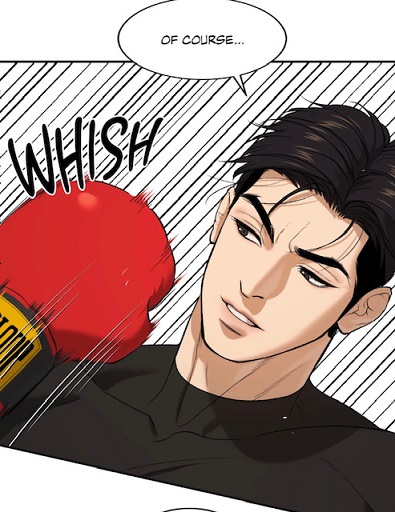 (chapter 26) For the first time, he had fun sparring. Hence he kept smiling. It is no coincidence that soon after he chose to accept to take a day-off, when Kim Dan made the suggestion.
 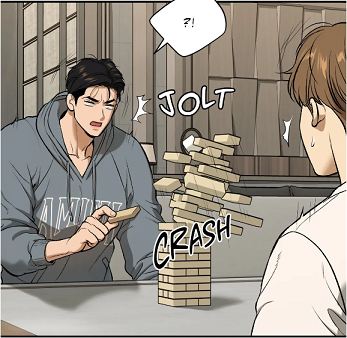 (chapter 27) That’s how he remembered that he liked swimming and he could play a prank on his lover.
  (chapter 27) Here, he could smile, because it was fun and there was no real expectation. It was not truly connected to money.
  (chapter 35) and not in episode 48. It is because Kim Dan had paid him a visit during that night, a sign that he was thinking of him as his patient and VIP client.
 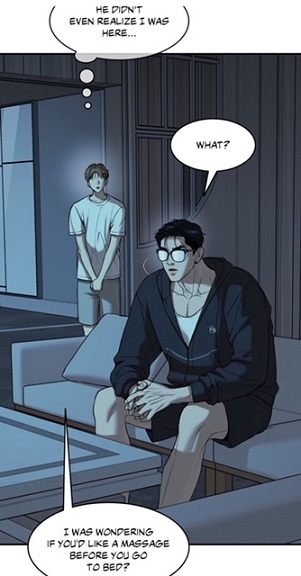 (Chapter 48) On the other hand, I am inclined to think that when a terrible incident in his youth occurred, he couldn’t contact his family or guardian. Hence he keeps his cellphone by his side constantly. Yes, I was thinking of the doctor’s assault in the street and his failed rape:
  (Chapter 16) Heo Namwook’s minions had confiscated his cellphone. Hence it was impossible for him to call for help. And now take a closer look at this scene:
 (Chapter 16) Though he had been on the phone and it was daylight, no one stopped the thugs from kidnapping the main lead or reported the incident to the police. Hence I am also suspecting that Joo Jaekyung must have faced a similar situation: he was surrounded by malicious people and no one had assisted him. So he could have been targeting at school due to his grads or his social status. And his isolation at home could push to seek company outside, to look for friends at school.
  (chapter 37)
  (chapter 49) And the anonymous person on the other side of the phone was definitely calling in order to be updated about Joo Jaekyung, for his coach asked him about his physical conditions.
 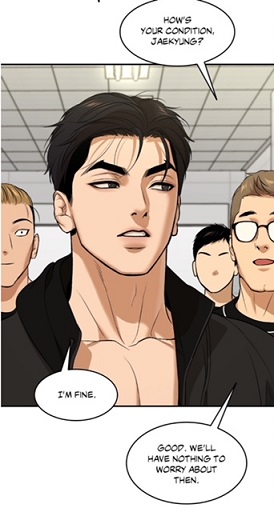 (chapter 49) That could be the hidden guardian who has not showed up yet, I am thinking of Seo Gichan. And now it is time to close this long essay.

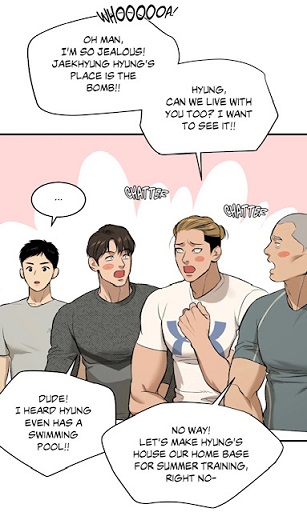 (chapter 22) It shows that ring does not necessarily possess a negative connotation. To conclude, ring is a reference to marriage (Kim Dan will become the champion’s official partner), to the MMA arena, to Team Black, but also to Mafia. We had an allusion to criminality during the sparring
 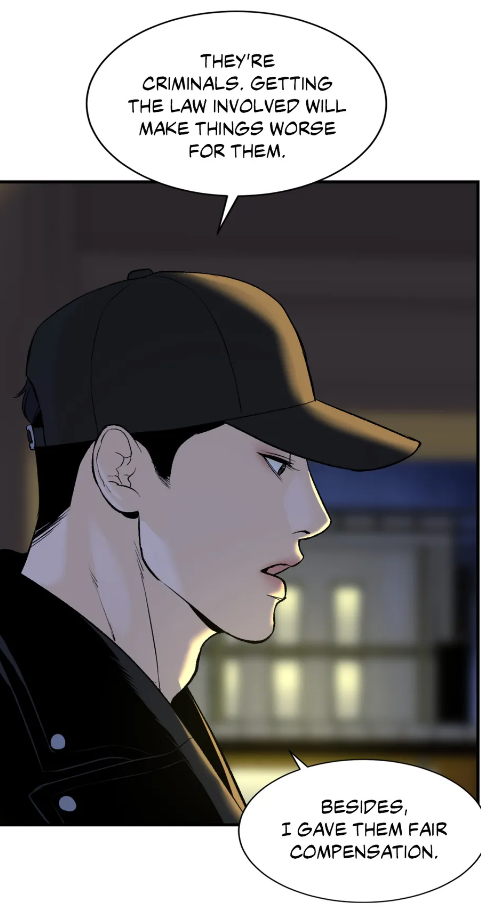 (chapter 18) The doctor is unaware of this, but one of his purposes in the champion’s life is to clean the scene, MFC and its corruption. On the other hand, the illustration contains many pictures of the two main leads having sex.
  Why? It is because the characters are acting like fighters. At bottom left, the doctor’s embrace resembles a lot to the one he used during the sparring (see the image in the middle). Their gestures are sudden and quite abrupt, which contrasts to the image on the right bottom. The kiss from the doctor holding Joo Jaekyung’s face represents the exception from all the selected panels. This shows that this Summer Night’s Dream indicates a huge transition in the sex sessions. But let’s return our attention to the images illustrating roughness. Right from the start I detected a strong connection between fighting and sex. [For more read
 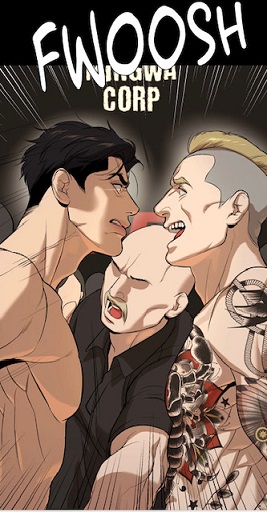 (chapter 14)
  (chapter 36)
 (chapter 29)
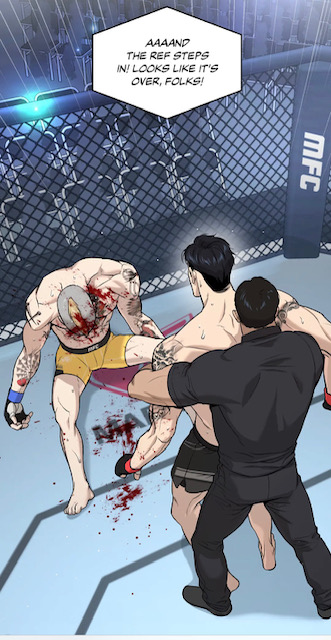 (chapter 15) This means that if the fighter is on his own. He can not rely on others. If he is not able to return without the assistance of spectators or his seconds, he is declared as defeated. So we could say that any interruption is condemned, as it is ruining the flow of the fight.
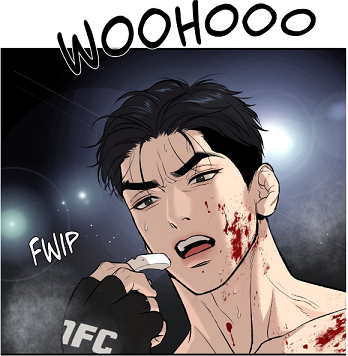 (chapter 15) Funny is that conversation is permitted, yet mouth gear hinders the fighters to talk. Should they remove it constantly, the referee can judge it as a violation (“Timidity”), for the fighters can not fight, as long as they don’t wear the mouthpiece. This signifies that the sportsmen are encouraged to express their thoughts through the hands.
 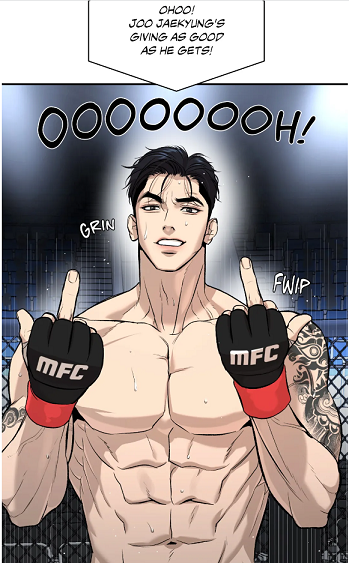 (chapter 15)
  (chapter 41) That’s the reason why Mixed Martial fighters are called artists, a synonym for actor.
  (Chapter 6)
  (chapter 5) Their gestures were seductive, a sign that they were not fearing the champion. The challenge was here the difference of weight. On the other hand, by approaching Joo Jaekyung, they looked confident about their skills. That’s the reason why he would have sex with them, until they passed out.
  (chapter 4)
  (chapter 8)
  (chapter 2) The champion’s ecstasy served as a measurement to view himself as victorious. This statement implies that he was not only the fighter, but also the arbiter. This corroborates my previous statement. During sex, he was the fighter and the referee. He acted as the MFC matchmaker.
 (chapter 43) In my opinion, during that night
  (chapter 2) The goblin might have not voiced his thoughts to the celebrity before, but Joo Jaekyung could perceive his soul through the gaze and facial expressions. Hence the star’s domination was quite superficial. In fact, as time passed on, the athlete could only get bored of the goblin.
 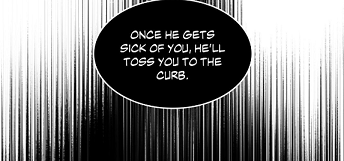 (chapter 42) It is because there was no challenge. The guy was accustomed to the champion’s roughness. Hence he never feared the star. He could only judge him as weak. Because Joo Jaekyung was missing the thrill, he came to look for the “wimp”! On the one hand, the latter would treat him with respect
 (chapter 1), on the other hand, he would cry and tremble in his presence. Then right after the session, he left the room in a hurry.
  (chapter 21) Then after facing Heesung, he stopped the intercourse too,
  (chapter 3) He was defying the champion’s authority.
  (chapter 3) Despite his fear, the hamster wouldn’t become submissive like the others. While the green-haired uke faked submission and the others got defeated by KO, Kim Dan remained true to himself. He embodies honesty and modesty, the opposite values of the “goblin”.
 (chapter 2) Let’s not forget that during a match, they are supposed wear a sex gear. Interesting is that he grabbed the doctor by the hair
  (chapter 4). It is important, as it represents a real transgression of MMA rules indicating how powerful the doctor was. The champion needed to break rules in order to get him. Funny is that he thought that after such a long night, he had been able to submit the cute hamster, but he was totally wrong. The latter chose to ignore him.
 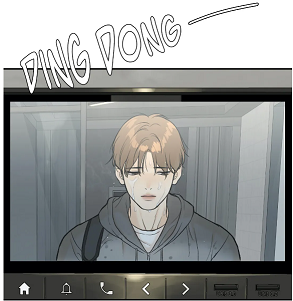 (chapter 6) Under this new light, it becomes comprehensible why the athlete offered this deal to the physical therapist:
  (chapter 7) Under this new light, it becomes comprehensible why in the States, the goddess Mingwa chose to send the doctor to his room much earlier. Both protagonists were fighting against each other concerning time.
  (chapter 12) or having sex in front of a mirror
  (chapter 20) or anal masturbation in a car
  (chapter 32) I could mention other defies linked to sexuality, having sex without getting noticed, either in the shower room
  (chapter 8) or during a phone call
 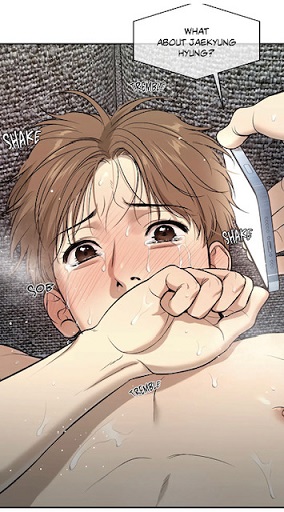 (chapter 24). Then we have this bet concerning the doctor’s sensitivity.
 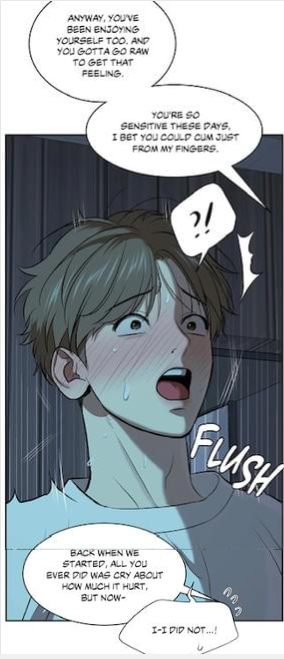 (chapter 29), thus the champion tried an experiment:
 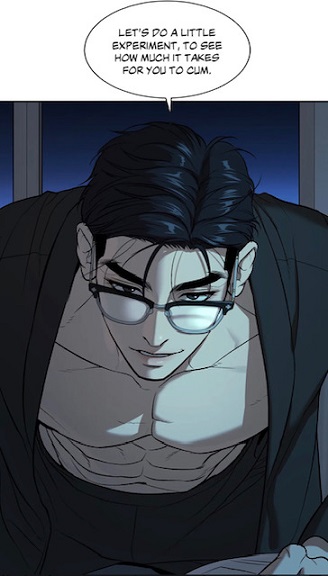 (chapter 29) Furthermore, notice that each time they had sex, the doctor was pressured to have sex with the champion. Kim Dan felt that he could never refuse.
  (chapter 12) On the other hand, the athlete always met some resistance
 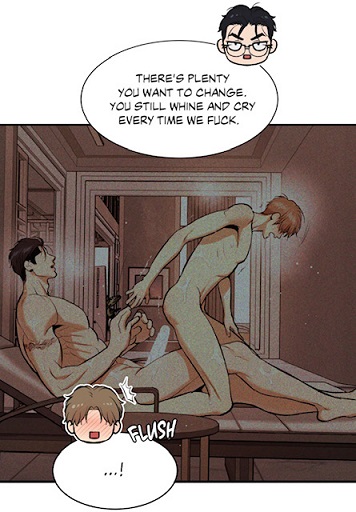 (chapter 27) Kim Dan would never agree to the champion’s requests immediately. They would fight about the time, location and position. Furthermore, note that Kim Dan went so far to punch the protagonist:
 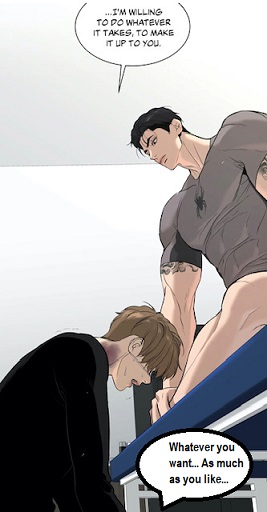 (chapter 11), yet the reality taught him a tough lesson. He got to hear something terrible:
  (chapter 12) With his words, he was telling the sportsman that he was a terrible lover. He denied any admiration for him. And since sex is a synonym for wrestling in Joo Jaekyung’s eyes, doc Dan’s declaration signified that his title as champion was questioned. Though the champion came to enjoy their intercourse
  (chapter 12), it was short-lived, as the doctor fainted after one round.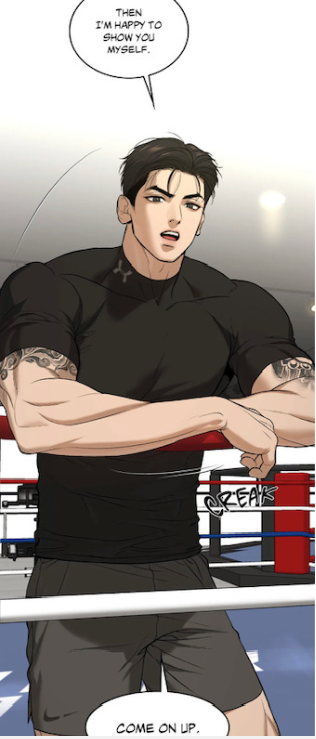
 (chapter 26) Observe how the doctor reacted after the sparring took place. .
  (chapter 44) Why? It is because this sex session will have an impact in their work, MMA. During that night, they became real fuck buddies. Sex was not related to work and fighting. But why did the notion come to the surface for the sparring? It is because MMA fight consists of challenges, which implies consent. Striking is that so far the champion never rejected a challenge. Yes, Joo Jaekyung was put in the same situation than Kim Dan in the end, but the one putting under pressure was the MFC Matchmaker and naturally the agent from Entertainment agency. Don’t forget that both are earning money thanks to events. And how did the champion got convinced by them? “You think, you can do it?” With their words, they doubted his talents
  (chapter 12) And because the doctor never reacted the way the champion expected it, the latter was forced to infringe more and more MMA rules, like this one
  (grabbing the groins is forbidden). To conclude, the doctor is there to teach the champion to distinguish between love and fighting. This explicates why the physical therapist embodies violation of MMA rules. We have the perfect example in this scene:
  (chapter 25) Potato made a mistake which could have made the doctor unconscious. That way, he can expose the corruption within MFC and its implication with the mob. That’s the reason why I am more than ever convinced that Kim Dan is destined to become a MMA fighter in the end. Why? It is because he is the champion’s reflection. The moment Joo Jaekyung is no longer the fighter in the ring, but the spectator or assistant, he is forced to witness how his loved one is risking his life. So far, he never showed any interest in the fights of other members. He needs to understand why Doc Dan would advise him not to fight. And this brings me to the next remark: Kim Dan is a strong believer, like we could observe it in this scene.
 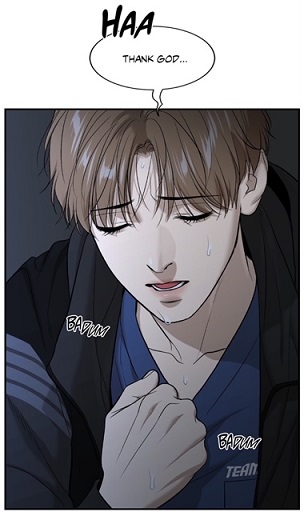 (chapter 40) This explicates why he was willing to risk his life for his sick grandmother.
 (chapter 36)
 (chapter 44) By taking the initiative, the physical therapist is teaching his “mentor” how to express love. Interesting is that during that scene, the athlete remained passive. It displays his consent and trust towards the doctor. He knows that the latter won’t hurt him. That’s how I realized that the kisses are strongly connected to consent. Let’s not forget that when Joo Jaekyung smooched the hamster for the first time, he took him by surprise. Because the latter felt uncomfortable, he made the following request:
 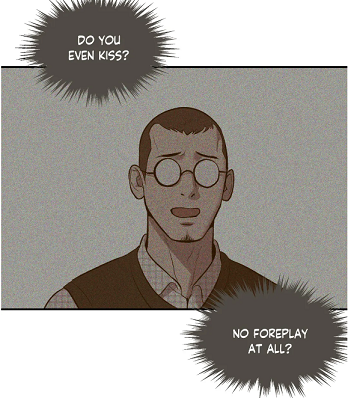 (chapter 14) Then it was out of desire
  (chapter 24) and out of excitement and attraction.
  (chapter 15) In chapter 24, first it was from behind, but then it changed, as the star desired to see the hamster‘s erected phallus.
  (chapter 24) He wanted to make sure that the doctor would enjoy this break. Yet, what caught my attention is that in chapter 39, Kim Dan initiated the kisses and embraces, because this is what he likes.
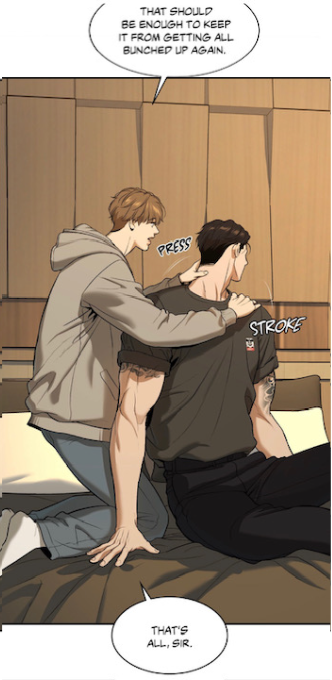 (chapter 32) Joo Jaekyung entrusted his neck to the doctor. The latter stroke it for a long time. And now, you comprehend the initial hesitation from Joo Jaekyung in the hotel room:
  (chapter 44) He felt safe. This explicates why he could fall asleep so easily.
 (chapter 44) contrasts so much to this one:
 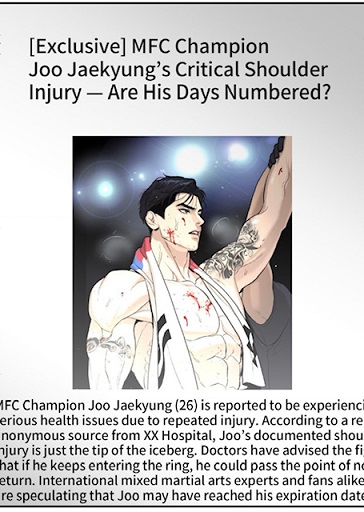 (chapter 35) The gods were punishing him for not respecting the physical therapist.
 (chapter 44), though the doctor had not sex in mind at all. He brought him there to rest. However, the presence of fighting has not vanished totally in episode 44:
 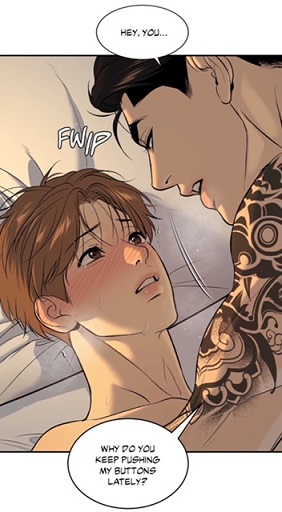 (chapter 44), but the latter was able to reject his defy by asking a question. One might think that he did that out of habit. On the other hand, I believe that Joo Jaekyung doesn’t know his partner that well, hence he is bothered. He can never predict his actions and decisions. He was definitely worried about his recent change of behavior too. Moreover, note that Kim Dan was the one leading the intercourse, for he determined the time flow:
  (Chapter 44)
  (chapter 44) It shows that the power is shifting, Kim Dan is slwoly getting the upper hand in their relationship. He can control time and place.
  (chapter 29) The celebrity refused to have sex every day, for he considered it as work. Why? It is because he is associating it with fighting. This is what he had in his mind:
  (chapter 27) But he got rejected by Kim Dan back then, because the physical therapist considered sexuality as shameful. As you can see, the doctor’s actions are changing the champion’s perception of sex. It is no longer fighting, but resting. On the other hand, the doctor can seize the occasion to express his love through his caresses and kisses. At the same time, he could use it as a treatment for his insomnia.
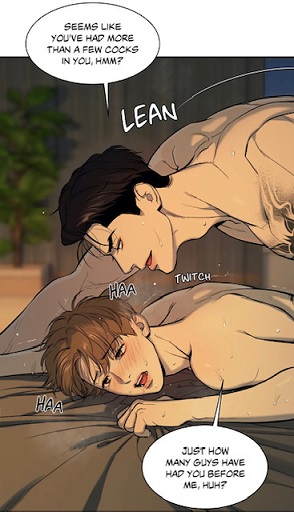 (chapter 4)
  (chapter 10)
 (chapter 42)
 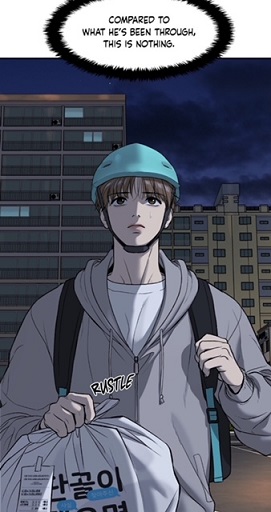 (chapter 42) Interesting is that the champion was also thinking a lot about the main lead, as the latter was worried by his exhaustion and his lack of appetite.
  (chapter 44) By occupying his mind, Kim Dan is winning his heart. He is reminding him of the fragility of life, but also of true courage due to his humbleness and selflessness. Hence it becomes comprehensible why I stated that the doctor would risk his life or reputation for Joo Jaekyung. He will appear as a true hero receiving the admiration from his loved one and members from Team Black. In my eyes, he will become the heart and soul of Team Black, while the champion is the face of the gym. Though the members are behaving like a family, I detected a lack of cohesion and a certain indifference. No one was missing Potato during the day of the birthday party
 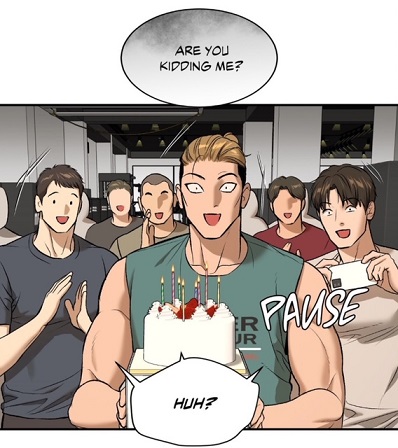 (chapter 43), just like none of the coaches were wondering about the whereabouts of Kim Dan in the States.
 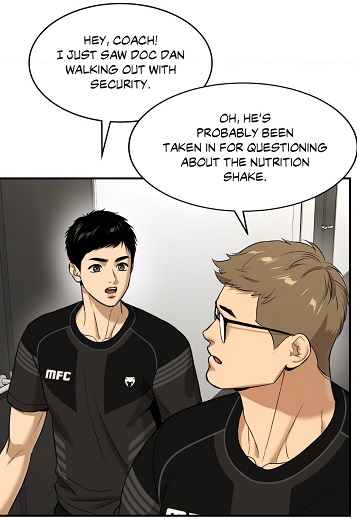 (chapter 40) It is important that he brings the members closer together, as there is an enemy in the shadow: the Mafia.
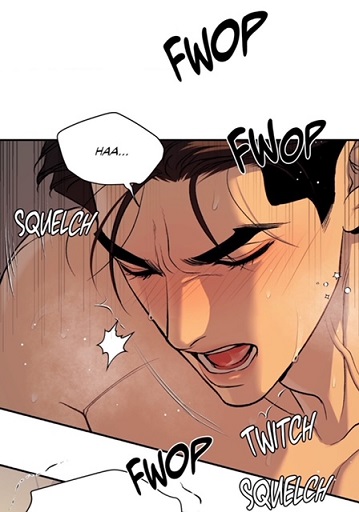 (chapter 44) See the contrast to the night on the couch:
  (chapter 29) Contrary to the past
  (chapter 4) Joo Jaekyung is not hiding his pleasure. He is moaning loudly, as he has his mouth wide open. It exposes once again the increasing trust in Kim Dan. He no longer mistrusts him, in his eyes, he is no longer a prostitute. That’s how the doctor won the champion’ s heart. Now, his heart is truly beating for the doctor. Little by little, the hamster is taming the wolf. The latter needs to recognize that by loving the doctor, he will become powerful.


 Bebebisous33s' analyses in K-Dramaland and Manhwas