

Please support the authors by reading Manhwas on the official websites. This is where you can read the Manhwa: Jinx But be aware that the Manhwa is a mature Yaoi, which means, it is about homosexuality with explicit scenes. Here is the link of the table of contents about Jinx. Here is the link where you can find the table of contents of analyzed Manhwas. Here are the links, if you are interested in the first work from Mingwa, BJ Alex, and the 2 previous essays about Jinx The Sweetest Downfall Ever and Hot 🔥Sparks ⚡, Feverish 🌡️Reality (part 1)
It would be great if you could make some donations/sponsoring: Ko-fi.com/bebebisous33 That way, you can support me with “coffee” so that I have the energy to keep examining Manhwas. Besides, I need to cover up the expenses for this blog.
After the Spark: What Changes Once the Circuit Is Closed?
When episode 86 ends 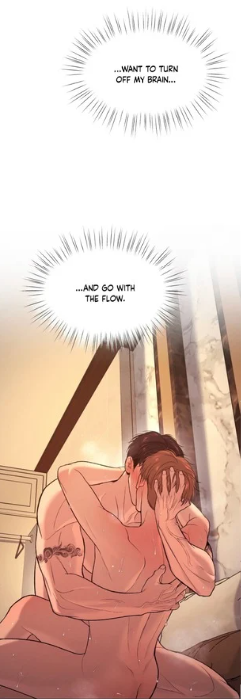 (chapter 86), it does not close the night through narrative resolution. There is no statement, no promise, no verbal seal. And yet, for many Jinx-philes, the final panel refuses to let the scene dissolve. What remains is not heat, not tension, not even tenderness — but circulation.
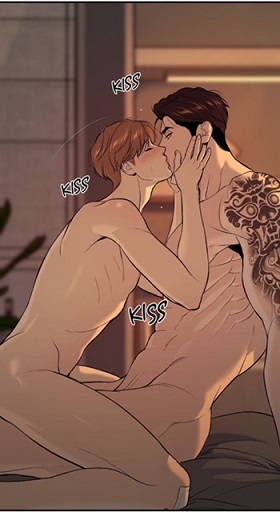
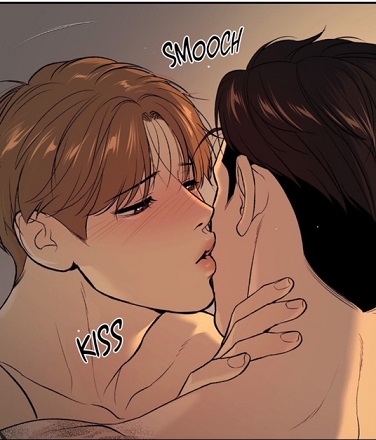
What caught my attention, on rereading the episode with some distance, is precisely this ending. In the final embrace and kiss, bodies are not merely touching; they are aligned. Kim Dan is neither collapsed nor clinging. Joo Jaekyung is neither looming nor enclosing. Their torsos meet without compression, their heads incline toward each other, and the kiss does not interrupt movement — it completes it. The image does not suggest release, but continuity. Not dispersal, but return. In other words, the final embrace functions as a closed electric circuit, while the kiss operates as the activating spark — not a release, but the moment the current begins to flow.
This detail matters because it reframes the entire night. Earlier nights in Jinx burned intensely and then vanished. This one does not. Heat exhausts itself. Electricity does not. It remains as potential — stored, latent, waiting to be activated. When readers feel that “something has shifted,” they are not sensing emotional climax, but a closed circuit. The night ends, yet nothing needs to be said, because something has already been set.
Under this new light, my perception of relationships in Jinx changed. What had long been read through the language of excess — desire, domination, sacrifice, endurance — began to appear instead through the logic of current: circulation, interruption 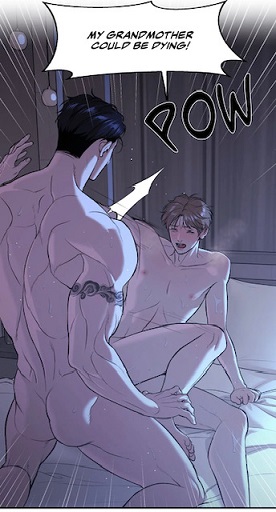 (chapter 21), overload
  (chapter 33), short circuit
  (chapter 51),
 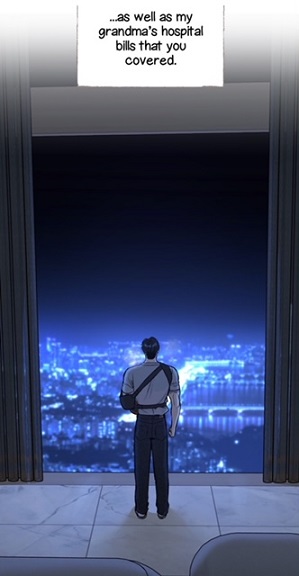 (chapter 53) reset. And once that lens is adopted, it becomes impossible to limit the consequences of episode 86 to the couple alone. Because a closed circuit does not only affect those directly connected to it. It alters the surrounding system.
In the first part of Hot Sparks, Feverish Reality, the focus lay on how this night functions in itself: how electricity replaces fire, how illusion gives way to continuity, how silence becomes embodied communication. That analysis allowed us to rethink the nature of the moment. But once the circuit is closed, another question inevitably arises — quieter, but far more consequential: What changes once the night is over?
If the Paris night is not a dream, not a relapse, and not a miracle, then it must be understood as a reconfiguration of conditions. Memory begins to behave differently. Surprise no longer carries the same meaning. The past can no longer be invoked automatically as justification. And responsibility — long deferred — becomes unavoidable.
This second part of the essay therefore turns toward repercussions. To approach them, the analysis will move through four interlinked angles. First, it will examine surprise, returning to the sudden kiss in episode 86. By placing this gesture alongside earlier moments where surprise meant threat or emotional risk, the essay will show how the same structure acquires a different meaning once agency is restored — and why this matters. Second, it will address recognition without erasure, focusing on the line 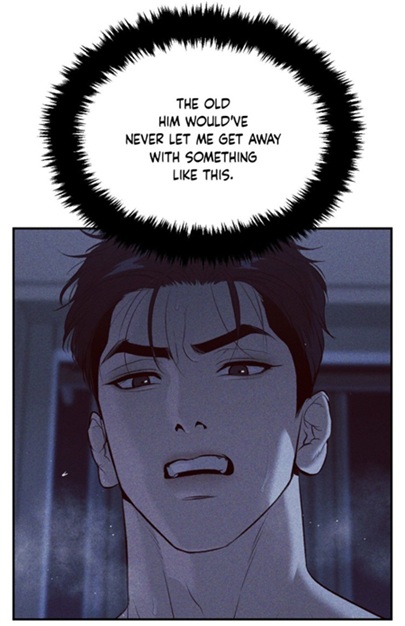 (chapter 86). This section will explore how acknowledging change without denying past harm opens a new ethical position — one that prevents memory from being weaponized, while still preserving responsibility. Third, the analysis will turn to conversion, revisiting earlier nights marked by failure, asymmetry, and isolation. Rather than cancelling them, episode 86 absorbs and transforms them. This is where forgiveness, reflection, and the first true encounter with consequence quietly enter the narrative. Finally, a new section will widen the lens further by examining shared experience and memory
  (chapter 53), particularly through Kim Dan’s relationship with his grandmother. Here, the focus will not be accusation, but contrast: between memories carried alone and memories held together; between cycles of repetition and moments of presence; between a worldview structured around endurance and one shaped by circulation. The Paris night does not only affect how Kim Dan sees Joo Jaekyung (chapter 86) — it changes how he may begin to situate himself within inherited bonds and unspoken expectations.
The Paris night did not resolve the story. It changed the system in which the story must now continue. And like electricity itself, its importance will only become fully visible when something — or someone — can no longer function as before.
Surprise Reversed: From Threat to Agency
To understand why the kiss in episode 86 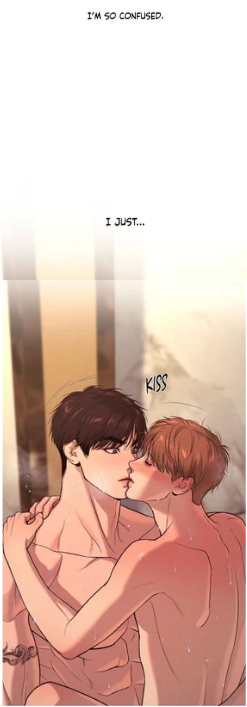 (chapter 86) carries such weight, we must return to the origin of kissing itself in Jinx. Because surprise, in this story, is not an abstract theme. It has a history. And that history begins with a body being caught off guard.
The first time Kim Dan is kissed by Joo Jaekyung, it is sudden. 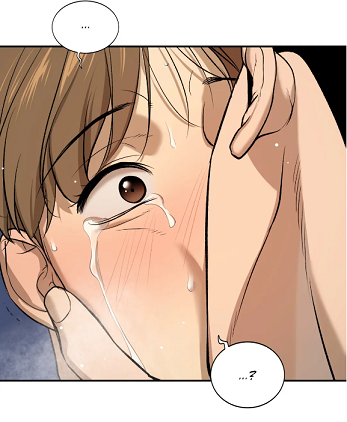 (chapter 14) There is no warning, no verbal cue, no time to prepare. The kiss arrives as interruption. It is not negotiated; it is imposed. Hence the author focused on the champion’s hand just before the smooch.
 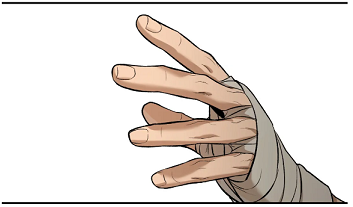 This moment matters far more than it initially appears, because it establishes the template through which Kim Dan first encounters intimacy.
 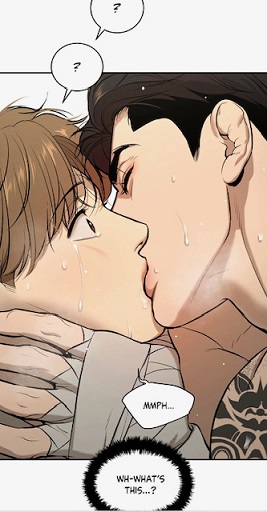 (chapter 15) Affection does not emerge gradually. It breaks in.
Kim Dan reacts accordingly. Shortly afterward, he articulates a need that is easy to overlook but fundamentally revealing: he asks Joo Jaekyung to tell him before kissing him.  (chapter 15) He needs preparation. He needs time to brace himself emotionally. This request reveals two aspects. First, he connects a kiss with love. On the other hand, the request is not really about romance; it is rather about survival. Surprise, for Kim Dan, has already been coded as something that overwhelms the body before the mind can intervene.
And yet, what follows is one of the most striking contradictions in the narrative. Every time Kim Dan initiates a kiss himself  (chapter 39), he violates his own request.
His kisses arrive suddenly. 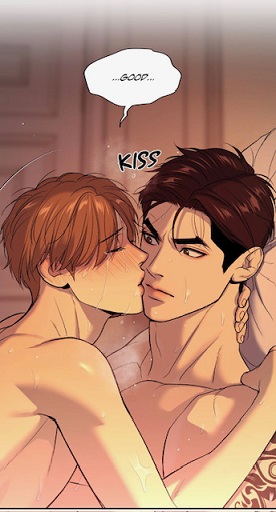 (chapter 39) They are unannounced, often landing on unusual places (cheek or ear) (chapter 39)
  (chapter 44). They often take place under asymmetrical conditions — when one of them is intoxicated, confused, or emotionally exposed. Sometimes they occur without full consent, sometimes without clarity. In chapters 39 and 44, kisses surface precisely when language fails or consciousness fractures. It is as if Kim Dan has internalized a rule he never chose: a kiss must be sudden. Observe how the champion replies to the doctor’s smile and laugh: he kissed him, as if he was jealous of his happiness.
 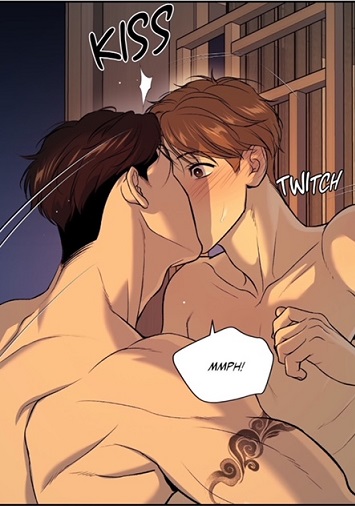 (chapter 44) That’s how I came to realize that the kiss in the Manhwa is strongly intertwined with “surprise”. This is the missing link.
Kim Dan does not merely endure surprise; he learns it. Because intimacy entered his life through interruption  (chapter 2), he comes to reproduce interruption as intimacy. He knows that surprise destabilizes him — that is why he asked for warning — but he has no other model. What overwhelms him also becomes what he reaches for. Surprise is both threat and language.
This paradox explains much of Season 1. Surprise is repeatedly associated with danger  (chapter 3): the sudden call from the athlete,
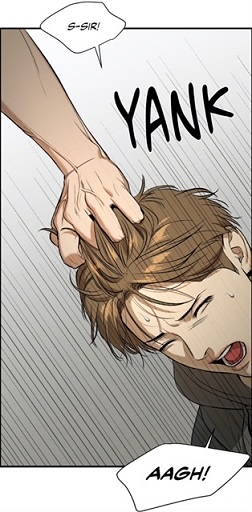
  (chapter 1), the offer of sex in exchange for money (chapter 3), the contract that turns availability into obligation
  (chapter 6), the switched spray
  (chapter 49), the sudden changes in rules. These moments strip Kim Dan of anticipation and agency. His body reacts before his will can engage. Surprise equals exposure.
And yet — this is where the narrative becomes uncomfortable — these same surprises also pull him out of ghosthood.
Before Joo Jaekyung, Kim Dan lives in a state defined by repetition and duty.  (chapter 1) His life is governed by “always”: always working, always returning, always responsible. He lives for his grandmother. Nothing unexpected is allowed to happen, because nothing unexpected can be afforded. This is safety through stasis. Presence without experience.
But this does not mean that surprise was absent from his past. On the contrary, when unpredictability did enter Kim Dan’s life earlier, it came in its most destructive form: through the loan shark, Heo Manwook and his minions. His appearances were sudden, intrusive, violent.  (chapter 5)
  (chapter 1) They shattered routine rather than enriching it. Surprise, in that context, did not open possibility; it threatened survival. It meant debt, coercion, fear. And precisely because of that, it could not be integrated into memory as experience — only repressed as trauma.
This distinction matters. When Kim Dan’s grandmother is hospitalized and removed from the house, the loan shark also disappears from daily life. His violence becomes something that can be pushed aside, denied, or avoided 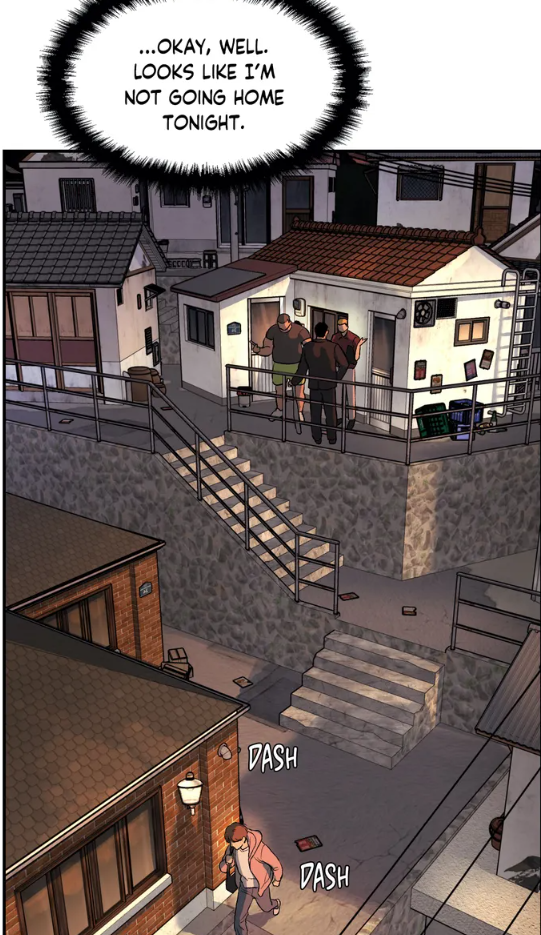 (chapter 1), if he doesn’t return home. Surprise, in its earlier form, is excised from the household. What remains is a world of repetition and endurance — safer, but lifeless.
Seen from this angle, Joo Jaekyung does not introduce unpredictability into Kim Dan’s life from nothing. He replaces it. 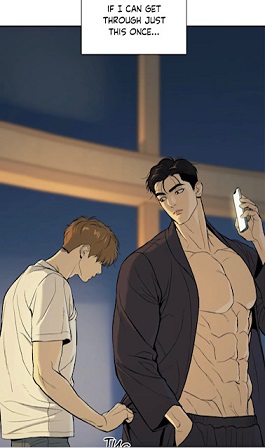 (chapter 2) but in a fundamentally different form.
The loan shark embodies surprise without negotiation.  (chapter 11)
 (chapter 11) His appearances are sudden, his demands non-discussable, his violence immediate. He does not ask; he enforces. Surprise, under his rule, eliminates speech. It leaves no space for argument, no room for clarification, no possibility of consent. One endures, or one is punished.
Joo Jaekyung, by contrast, introduces unpredictability through contracts and negotiation. 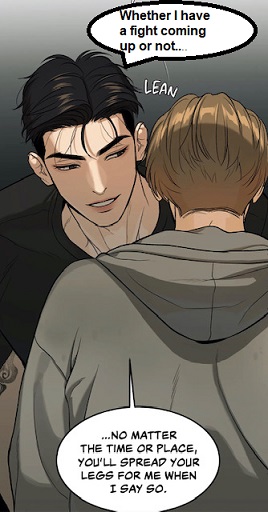 (chapter 6) Even when power is asymmetrical, even when the terms are coercive, speech is required. Conditions are stated. Rules are articulated. Kim Dan is forced to listen, to answer, to argue, to object. He must speak.
This difference is decisive. Surprise no longer arrives solely as terror; it arrives as confrontation. Kim Dan is not merely acted upon — he is compelled into dialogue. The body is still exposed, but language re-enters the scene. Where the loan shark silenced, the athlete imposes discussion.
This is why Joo Jaekyung can occupy the same structural position as the loan shark — and yet not replicate him. Both disrupt repetition. Both break the closed circuit of endurance. But only one does so in a way that keeps Kim Dan within the realm of human interaction. Even coercive negotiation presupposes a subject who can respond.
This also explains the later confrontation in the house.  (chapter 17) The two figures cannot coexist because they represent mutually exclusive regimes of surprise: one that annihilates speech, and one that forces it into being. In other words, only one allows experience to be lived rather than survived.
Surprise enters Kim Dan’s life violently, but it does not remain mere rupture. (chapter 2) It functions as negative charge — an abrupt influx of energy into a system that had been closed for too long. Fear, anger, desire, attachment appear not as orderly developments, but as shocks. These experiences are unstable, often painful, sometimes destructive  (chapter 51) — yet they are unmistakably his. They mark the moment when something begins to circulate. (chapter 51)
This distinction is crucial. Before Joo Jaekyung, Kim Dan’s life operated in a static loop, governed by repetition, sacrifice, and gratitude. Energy was expended, but never transformed. Surprise, in its first incarnation, is therefore pure threat: uncontained, overwhelming, incapable of integration. It breaks the system without yet allowing current to flow.
What changes with Joo Jaekyung is not the presence of danger, but its conductivity. Surprise becomes ambivalent — still risky, still destabilizing — but now capable of generating movement and as such meditation. Negative charge no longer annihilates the circuit; it begins to activate it.  (chapter 27) Experiences accumulate instead of disappearing. They demand response, speech, negotiation. Life no longer consists in enduring impact, but in processing it.
This is why these experiences cannot be shared with Kim Dan’s grandmother. Her moral economy is built on infantilization  (chapter 65) and as such neutralization: suffering must be absorbed, pain must be justified, disruption must be folded back into endurance. There is no place for charge there — only for dissipation. What Kim Dan lives through with Joo Jaekyung follows a different logic altogether: not sacrifice, but circulation; not repetition, but conversion.
Surprise thus becomes the hinge not between danger and safety, but between static survival (–) and relational movement (+). And once that conversion begins, the past can no longer be returned unchanged — nor can it be shared without transformation.
This is why Kim Dan falls in love  (chapter 41) not despite surprise, but through it. Not because dominance is romanticized, but because surprise is the first force that treats him as someone to whom things can happen. And don’t forget that for him, a kiss symbolizes affection. Even negative experiences generate subjectivity. They prove that he exists beyond function.
Seen through this lens, Kim Dan’s habit of surprising Joo Jaekyung with kisses (chapter 39) — on the ear or the cheek — is no longer random or contradictory. It is learned behavior. He has absorbed surprise as a mode of relation. What was once done to him becomes something he does, imperfectly and often prematurely. These kisses are not about dominance. They do not corner or silence. They test connection. They ask, without words: Are you still here?
But until episode 86, this structure remains unresolved. Surprise exists, but it is never fully safe.  (chapter 85) Kim Dan either endures it or reproduces it under unstable conditions. Agency is partial. Meaning collapses afterward.
This is what makes the doctor’s kiss in Paris categorically different. (chapter 86)
Formally, it is still sudden. Kim Dan does not announce it. He does not negotiate it verbally. But structurally, everything has changed. For the first time, surprise is not imposed on him — and it is not enacted from confusion or imbalance. It is chosen. Kim Dan is clear-minded enough to recognize both his desire and his uncertainty. He is not dissociating. He is not reacting. He is deciding to remain present despite risk. And the response confirms the shift.
Joo Jaekyung does not neutralize the kiss with passivity  (chapter 39), irony
 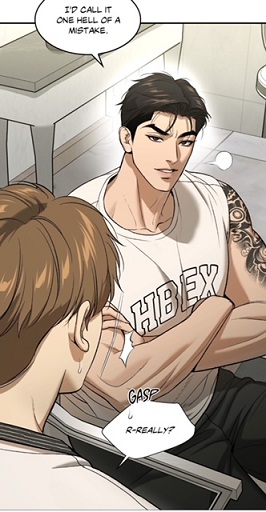 (chapter 41) or rejection
 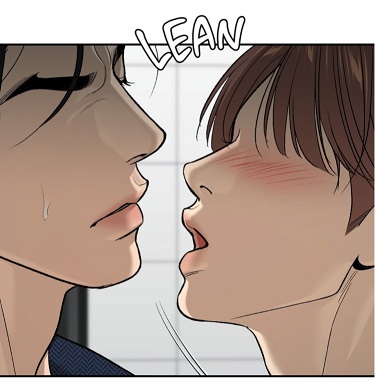 (chapter 55). He does not retreat into his habitual “it’s nothing” or “never mind.” He does not reinterpret the gesture as convenience or reflex.
  (chapter 86) He kisses back while looking tenderly at his partner. He holds Kim Dan’s head gently. He can only see such a gesture as a positive answer to his request: acceptance and even desire. Surprise is not punished. It is received.
This is the moment where the meaning of surprise reverses. Surprise no longer equals threat. Surprise becomes agency. And that’s how I could discover a link between the kiss and the doctor’s birthday present, the key chain.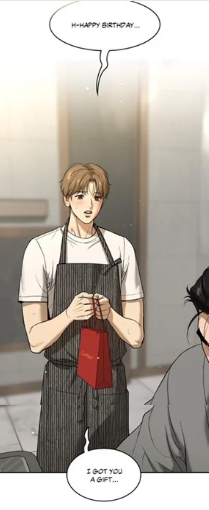 (Chapter 45) This time, the athlete not only accepts the present (the kiss), but but also expresses “gratitude” by kissing back actively. (Chapter 86) This means that the athlete is recognizing the existence of feelings.
The kiss does not erase the past. (Chapter 86) It does not retroactively justify earlier violations. But it establishes a new condition: surprise can now occur without annihilation. Intimacy can arrive without silencing reflection. Experience no longer collapses into shame or disappearance. IT symbolizes a positive and enjoyable moment.
This is why the kiss matters more than any spoken line in the episode. It is not simply romantic. It is structural evidence that the logic governing their interactions has changed. Surprise now operates within a closed circuit of consent and presence.
Kim Dan is no longer a ghost enduring interruptions. He is a subject capable of initiating them. He has learned surprise — and now, for the first time, he reclaims it. Under this new condition, the question is no longer whether surprise will hurt. It is whether life can proceed without it. And once that question is raised, the story cannot return to repetition or silence.
Recognition Without Erasure: When Memory Changes Function
What struck me next was how subtly episode 86 reorganizes the role of the past. Once surprise ceases to function purely as threat and begins to circulate, memory itself starts behaving differently. Electricity does not only move bodies; it redistributes charge. And it is precisely at this level — the level of memory and recognition — that something decisive occurs.
The line is brief, almost casual: (chapter 86) And yet it performs an extraordinary operation. Kim Dan does not deny the past. He does not soften it. He does not excuse it. Instead, he repositions it. For the first time, the past is no longer invoked as an absolute reference point, but as a differentiated state — one phase among others. Such a confession contradicts the grandmother’s philosophy: ALWAYS (chapter 65) In her eyes, she has never changed, just like her grandson. (chapter 65) If there were changes, they were associated with trouble and worries.
This distinction is crucial, because in Jinx, the past has long functioned like a blunt instrument. It has been used to fix identities  (chapter 52), justify behavior
  (chapter 57), and foreclose change. The champion’s violence is explained through reputation.
  (chapter 1) Kim Dan’s endurance is explained through obedience and debt. The grandmother’s authority is explained through sacrifice. In every case, the same logic applies: this is how it has always been; therefore this is how it must remain.
That logic is static. Electrically speaking, it is a circuit without polarity — no – and +, no tension, no movement. The past becomes a dead weight, not a source of information. It does not inform the present; it dominates it.
What episode 86 introduces is not forgiveness in the sentimental sense, but recognition without erasure. (chapter 86) Recognition means the charge of the past remains. Erasure would mean grounding it, neutralizing it, pretending it never existed. Kim Dan does neither. He keeps the – while allowing the + to emerge.
A World Without Polarity: When the Past Becomes a Weapon
This is where the electrical metaphor becomes indispensable. In a functioning circuit, negative and positive do not cancel each other out. They coexist. They create potential difference. And it is that difference — not harmony — that allows current to flow. (chapter 86) In the final panels, Kim Dan does not embrace an idealized version of the champion, nor a redeemed figure cleansed of history. He embraces Joo Jaekyung as he is now, with the knowledge of who he was before. This distinction matters. Acceptance here is not absolution. It is contact without denial.
Electric current does not pass between identical charges. It requires tension. Polarity. Resistance. The − and the + must remain distinct, or nothing moves. In this sense, Kim Dan’s embrace is not a gesture of harmony but of recognition. He acknowledges the champion’s flaws and mistakes — not to excuse them, but to stop pretending they never existed or to stop pretending to be better. What he accepts is not the past itself, but the reality that the past does not exhaust the present. That’s why he is able to stop ruminating and to follow his heart.
Furthermore when Kim Dan recognizes that “the old him” (chapter 86) existed, he does not collapse the timeline. He does not say: he was never that person. Nor does he say: he is forever that person. Instead, he introduces temporal polarity. Then and now. Before and after. – and +.
This move has immediate consequences. First, it disarms the past as a weapon.  (chapter 65) If the past is absolute, it can be endlessly invoked to invalidate the present. We have a perfect example on the beach. (chapter 65) Kim Dan is here compared to the past. (chapter 65) When Shin Okja speaks of Kim Dan as a heavy smoker, she is not recounting a neutral habit. She is anchoring him to a past version of himself — one defined through worry, decline, and deviation from the “good boy” image.
What follows is telling. She does not ask why he smoked. She does not ask what changed. She does not ask how he lived. The only question that matters to her is: “Does he still smoke?” (chapter 65)
The present is interrogated exclusively through the past. In this logic, the past functions as a fixed reference point. If the habit persists, the present confirms her narrative. If it does not, the absence is not read as growth but as an anomaly — something provisional, something that could always return. This is not concern. It is classification.
Shin Okja does not relate to Kim Dan as someone moving through phases, but as someone who must remain legible within a stable moral category. Change is not interpreted as development, but as risk. When Shin Okja repeatedly frames Kim Dan’s smoking and drinking as failures (chapter 65), she is not simply expressing concern about health. She is doing something more consequential: she is disqualifying the legitimacy of his decisions. In her discourse, Kim Dan’s actions are never treated as choices made under pressure, pain, or circumstance. 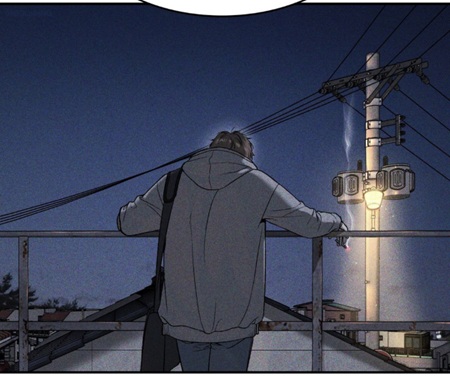 (chapter 65) They are evaluated exclusively through a moral lens. Smoking and drinking are not responses; they are flaws. And because they are framed as flaws, they retroactively define his character rather than his situation. This is where agency collapses.
Care and Choice
If every decision Kim Dan makes is already interpreted as “bad,” then decision-making itself becomes suspect. Choice is no longer a neutral capacity; it is something he is assumed to misuse. In other words, he is not someone who chooses poorly — he is someone who should not be choosing at all. Under this new light, my avid readers can grasp why the grandmother approached the champion and asked for this favor: 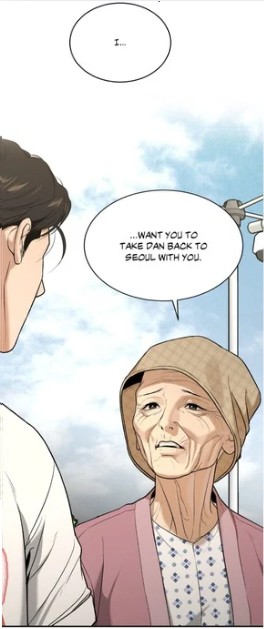 (chapter 65) Her behavior does not contradict her claim that she wants Kim Dan to “live his own life.”
  (chapter 65) It reveals how she understands such a life should be arranged. She sees herself as superior, as if she had never done any mistake, as if she had lived as a saint.
If she had truly accepted Kim Dan as a subject capable of self-direction, she would have spoken to him directly. Conversation presupposes agency; it allows disagreement, hesitation, and refusal. Instead, she chose a different route: influencing his fate behind his back. This move preserves her moral position while bypassing the risk of confrontation. It allows her to believe she is acting in his interest without ever having to acknowledge his will. That’s why she is entrusting her grandson to the athlete. 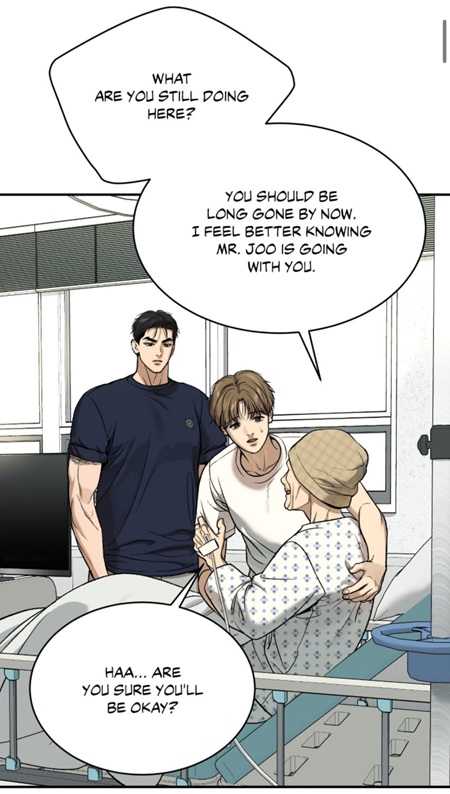 (chapter 78)
In other words, she does not imagine Kim Dan living freely through his own choices, but being placed into a better configuration by others — preferably by someone stronger, more decisive, and more visible than himself. The request to the champion thus follows the same logic that governs her judgment of Kim Dan’s habits: she does not trust him to choose, only to comply.
And this is precisely why her worldview stands in quiet opposition to what unfolds in episode 86. The physical therapist’s desires are not only acknowledged, but also respected.  (chapter 86) Once again, the “hamster” is given the opportunity not only to decide, but also to follow his heart. Where the Paris night allows difference to coexist with memory, Shin Okja’s framework collapses difference back into judgment. Where electricity requires polarity, her logic insists on sameness. Under this new light, it becomes comprehensible how doc Dan came to neglect himself. Self-care is inseparable from choice — from the belief that one’s decisions can meaningfully alter the present. If change is denied, care loses its purpose. Attending to oneself becomes optional, even suspect, because it implies a future different from the one already prescribed.
Recognition without erasure breaks that pattern. It allows Kim Dan to say, implicitly: what happened matters — but it does not get to decide everything.
Second, this recognition introduces responsibility where there was previously only fatalism. If change is possible, then it can be acknowledged. And if it can be acknowledged, it can be responded to. The past no longer excuses inaction. It no longer absolves neglect. It becomes a reference, not a refuge.
Two Versions, One Person: Temporal Polarity and Ethical Clarity
By acknowledging that there is an “old him” (chapter 86) and a present one, Kim Dan implicitly accepts that change has causes. And this is where his position shifts in a way that is easy to miss. If Joo Jaekyung has changed, then Kim Dan is not obligated to assume that he is the reason. He does not interpret the change as something he must earn or preserve through obedience.
Instead, a question becomes possible: what happened in between? And this question matters, because Kim Dan does not know. He does not know about the incident at the health center. He does not know about the slap at the hospital (chapter 52). He does not know that no one stood by the champion afterward — not even Potato.
By recognizing two versions of Joo Jaekyung, Kim Dan opens a space for inquiry rather than self-accusation. The change no longer needs to be attributed to his own sacrifice. It can be understood as something that also happened to the champion. This is not naivety. It is ethical clarity. Consequently, I perceive the night in Paris as the end of doc Dan’s low self-esteem and shame.
It also means that if anyone were to invoke the champion’s past against him — a manager, a coach (chapter 57), the system — Kim Dan can now side with him without denying what came before. The past stops being a weapon. It becomes context. This move has immediate consequences.
This shift is subtle, but it radiates outward.
Until now, Kim Dan has often carried memory alone. He remembers nights that others forget. He remembers moments that were dismissed. This asymmetry has turned memory into burden.  (chapter 44) The one who remembers bears the – alone, while the other continues forward unmarked. That imbalance is corrosive. It distorts perception. It turns even good memories sour.
Episode 86 begins to redistribute that charge. Not by forcing confession, but by establishing shared presence. Once current circulates between two points, no single node carries the full load. Recognition does not mean recounting every wound; it means no longer isolating the wound in silence.
This is why the line about “the old him” matters more than it appears. It is not merely observational. It is infrastructural. It signals that memory is no longer trapped in a single body.
And this logic does not stop with the champion. It extends, inevitably, to Kim Dan’s relationship with his grandmother, like mentioned above.
Her worldview has long been organized around moral continuity. She remembers suffering  (chapter 65), but she remembers it in a way that flattens time. Pain becomes proof of virtue. Sacrifice becomes identity.
  (chapter 65) Change is allowed only insofar as it returns to the same point. Electrically speaking, her system is grounded — all charge dissipates into endurance. There is no polarity, only repetition.
This is why the past, in her discourse, often appears as reproach. Not necessarily spoken harshly, but structurally unavoidable. You used to drink. You used to smoke. You used to be helpless. The past is not cited to understand, but to fix position. It anchors Kim Dan to a role: the one who must be protected, managed, or sent away “for his own good.”
Recognition without erasure offers Kim Dan a way out of this bind. If the past is no longer absolute, then it can be questioned. Not denied — questioned. The statement “you don’t know me and my life” becomes thinkable. Not as rebellion, but as differentiation. Kim Dan can hold the memory of his past while refusing to let it define his present. He can acknowledge the grandmother’s suffering without allowing it to dictate his future.
This is where forgiveness enters the narrative — quietly, without ceremony. (chapter 86) Forgiveness here is not reconciliation. It is not forgetting. It is not moral absolution. It is the decision not to collapse polarity. To allow – and + to coexist without forcing resolution. Forgiveness becomes a form of electrical insulation: it prevents overload, not by cutting the circuit, but by stabilizing it.
Seen this way, forgiveness is not weakness. It is structural maturity. And it has consequences. For Kim Dan, it means the past no longer monopolizes his self-understanding. He is not bound to prove gratitude through self-erasure. He can recognize care without submitting to control. He can accept gifts and help without dissolving into debt.
From Spark to Current: Why the Jinx Loses Its Power
For Joo Jaekyung, it means the jinx can no longer function as fatal explanation.  (chapter 65) Even though the word jinx is never spoken during the Paris night, its logic quietly collapses there. (chapter 86)
Until now, sex operated as discharge. 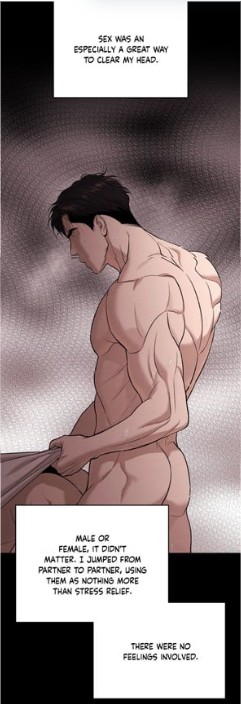 (chapter 75) In chapter 75, it is explicitly framed as a way to “clear the head”: an act designed to release pressure and return the system to zero. Partners were interchangeable. Feelings were excluded. Electricity existed only as a spark — brief, violent, and self-extinguishing. Energy was expelled, not circulated. That is the true mechanics of the jinx: power without continuity, intensity without consequence.
Paris introduces a different configuration. Sex is no longer oriented toward erasure or reset. It is no longer about escaping thought or silencing memory. Instead, it becomes a mode of presence.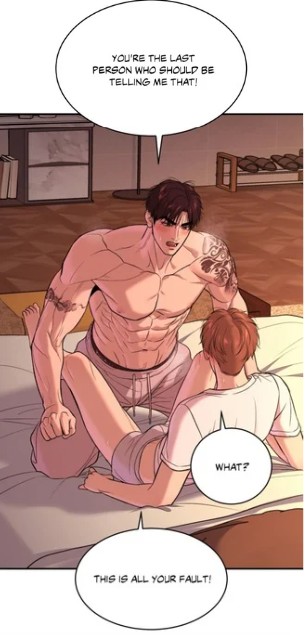 (chapter 85) Desires matter, not the match the next morning. Besides, the identity of the partner matters — not just romantically, but also structurally. Current requires two poles. It requires response. It cannot flow through an object, only between 2 subjects.
This is why the jinx does not need to be confronted explicitly to be undone. A system built on discharge cannot survive circulation. Once energy is no longer expelled but sustained, once tension is held rather than neutralized, fatalism loses its grip. The spark does not burn out; it becomes current.
And with current comes consequence. Sex no longer clears the mind; it sharpens awareness. It no longer abolishes the future; it implies one. What happens in Paris does not redeem the past — it renders repetition impossible. Reflection becomes unavoidable, not because someone demands it, but because the system no longer resets cleanly.
The jinx dissolves not through force, but through continuity. Recognition without erasure thus prepares the ground for the final transformation: conversion. Thus the story can move forward.
– and – = + : Conversion and the End of Ghosthood
Two nights once marked by failure — chapter 39 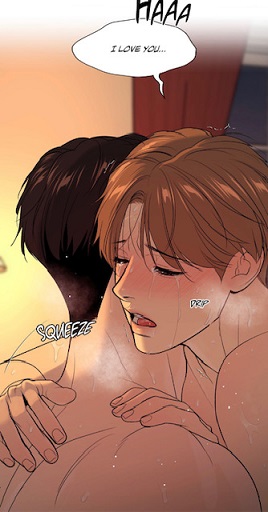 (chapter 39) and chapter 44 (chapter 44) — converge in episode 86. This convergence is not coincidental, nor is it nostalgic. It is a conversion.
Both earlier nights shared the same fatal structure: only one person remembered. In chapter 39, Kim Dan’s confession existed without continuity; his body spoke, but his memory did not follow. In chapter 44, the reverse occurred: Kim Dan remembered everything, while Joo Jaekyung attempted to forget. In both cases, memory became asymmetrical. One carried meaning; the other escaped it. And meaning, when carried alone, curdles. What might have been tenderness transformed into obsession, shame, or bitterness. Memory became burden.
Episode 86 breaks this curse through a gesture that is deceptively simple: both remember. (chapter 86) Both made surprising experiences: dry orgasm and a gentle and caring sex partner.
This is why simultaneity matters so profoundly. Sparks appear on both bodies. Confusion is mutual. Questions circulate rather than collapse inward. Neither consciousness outruns the other. Time, which had previously fractured under intoxication, coercion, or denial, resumes its flow. Not because the past is resolved, but because it is finally shared. Shared experience.
Here, memory begins to function differently — no longer as fixation or haunting, but as integration.
This shift allows us to recognize a much older pattern in Kim Dan’s inner life. His relationship to memory has always been selective, but not arbitrarily so. When it comes to his grandmother, Kim Dan remembers each interaction with his grandmother in a positive light: the warmth 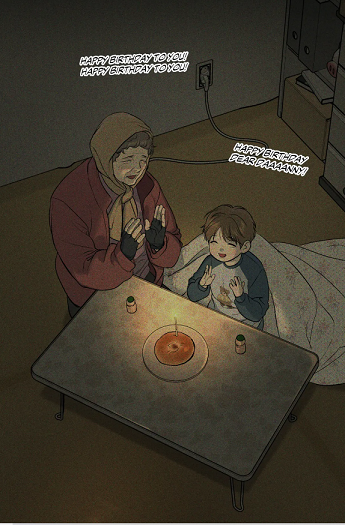 (chapter 11), the care – even if he had hurt himself –
 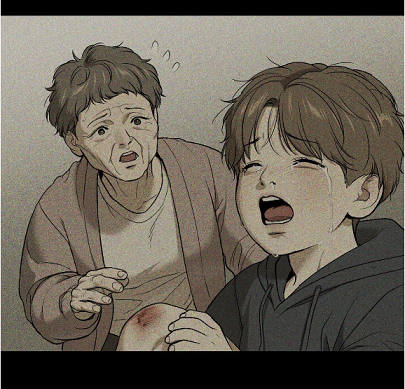 (chapter 47), the shared smiles
 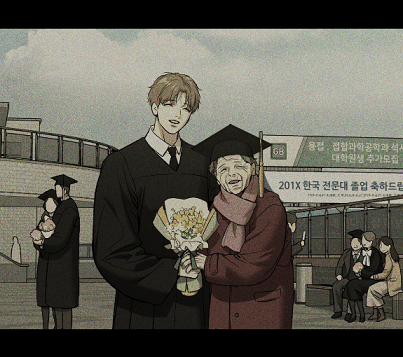 (chapter 47). Thus this photograph
  (chapter 65) becomes a talisman — not a record of reality, but a distilled image of safety. Painful dimensions are filtered out. Conflict, coercion, and silent pressure recede into the background. Memory protects him by idealizing. Because of this picture, he projected himself in the future, making unrealistic plans.
 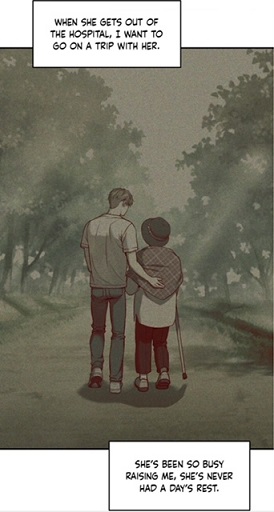 (chapter 47) It was, as if he only had good times with his grandmother.
Shin Okja, by contrast, remembers the same past through a radically different lens. (chapter 65) Her recollection is saturated with pity, loss, fear (chapter 65), and blame (chapter 65). The vanishing of the parents becomes the gravitational center around which all other memories orbit. Where Kim Dan remembers warmth, she remembers danger. Where he remembers protection, she remembers failure. One memory soothes; the other hardens. One preserves life; the other polices it. Kim Dan must remain the “good boy,” unchanged, because acknowledging his growth would mean acknowledging that the past did not remain intact.
The graduation photos make this painfully clear. They immortalize achievements, (chapter 47) not shared experiences. They resemble press photos of the champion more than lived moments. The work, the strain, the cost are absent. And tellingly, Kim Dan does not keep these pictures. They do not anchor memory; they flatten it. They freeze time rather than allowing it to move.
This asymmetry is crucial. It reveals that the relationship between Kim Dan and his grandmother has always mirrored the structure of those failed nights: one person remembers in a way that helps to keep working, the other remembers in a way that poisons (infantilizing doc Dan). One idealizes; the other condemns. And because the tragedy at the center of their past was never fully spoken, memory could not be synchronized. Kim Dan was pushed — silently, indirectly — to carry an idealized version of their shared life, while Shin Okja carried the unresolved catastrophe alone. (chapter 65) Toxic positivity emerges precisely here: not as cheerfulness, but as enforced idealization that denies the legitimacy of pain, anger, or differentiation.
And it is precisely here that the connection with the grandmother crystallizes. The latter is often connected to sleep 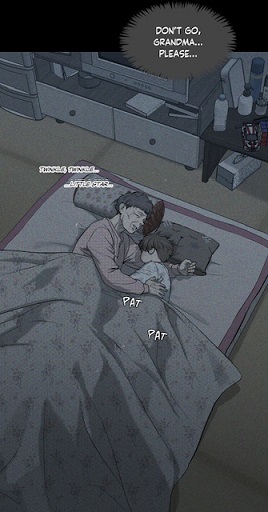 (chapter 21)
  (chapter 47) and memories.
 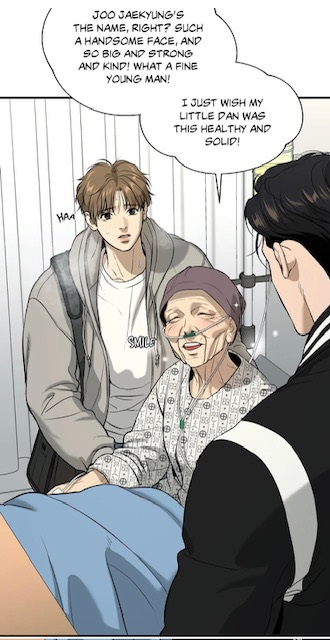 (chapter 21)
 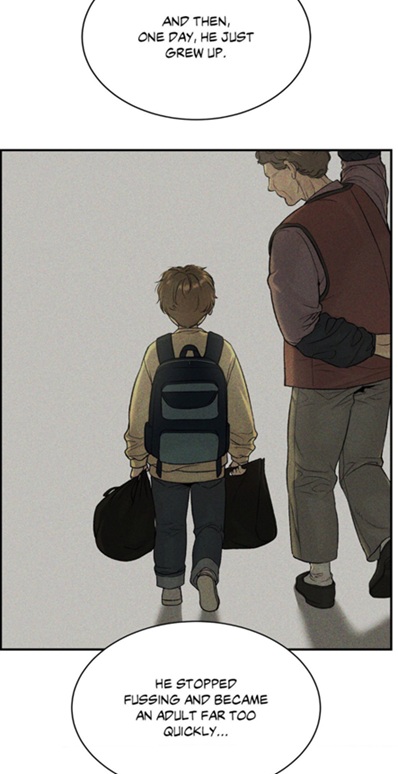 (chapter 65). While sleeping, memories come to the surface.
Only at this point did something else catch my attention — something that, retrospectively, had been present all along. The painting in the living room: 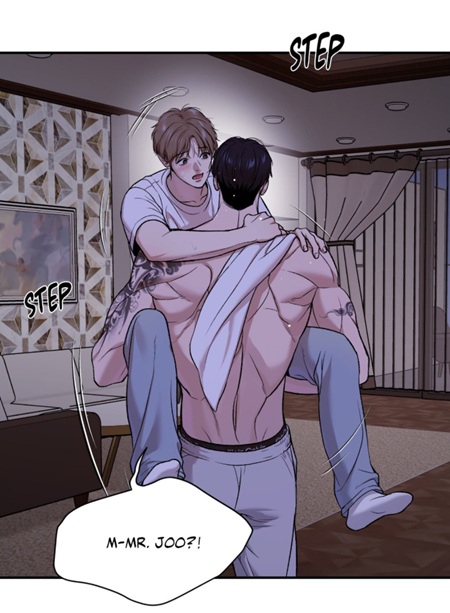
 (chapter 85) I believe that its appearance does not function as decoration. Its imagery — figures suspended among clouds, bodies neither falling nor grounded — introduces a different register of time. Not urgency. Not performance. Not spectacle. Stillness. Interval. A space where movement pauses without collapsing. Under this new light, the reference is Morpheus.
Morpheus is not the god of illusion. He is the one who allows rest, who brings form to dreams so the body can sleep. His presence signals not escape from reality, but the possibility of restorative sleep. This matters, because insomnia has haunted Joo Jaekyung from the beginning. 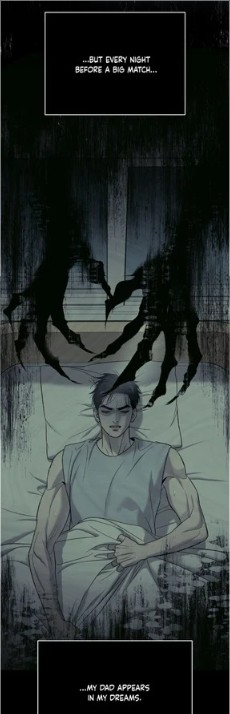 (chapter 75) Until now, rest had been replaced by discharge: sex as erasure, violence as exhaustion, ritual as compulsion. The Paris night does not abolish wakefulness through collapse; it introduces the conditions under which sleep might finally be possible.
Episode 86 introduces a third possibility: the kiss of Morpheus or the famous goodnight kiss. (Chapter 86) What caught my attention is that the athlete was irritated, when the doctor simply wished him a good night. 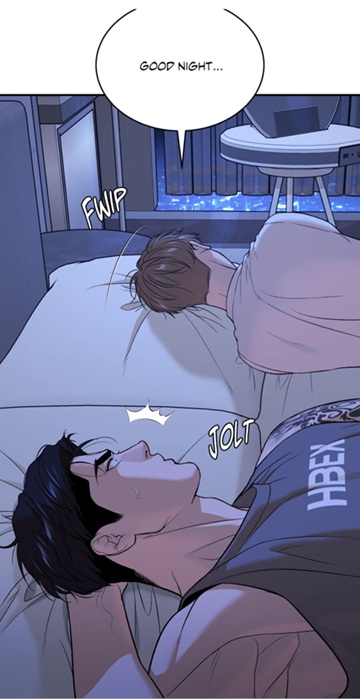 (Chapter 78) Here, he reduced it to the absence of sex, but I am sure that deep down, he would have been satisfied, if the “hamster” had given him a good night kiss.
The Paris night does not ask either character to idealize or to condemn. (chapter 86) It does not demand that the past be redeemed, nor that it be endlessly rehearsed. (chapter 86) Instead, it contextualizes. Memory is no longer absolute; it becomes temporal. Then and now. (chapter 86) Before and after. – and +.
This is why the electrical metaphor reaches its full force here. Two negatives do not annihilate each other. They convert. The shared remembering of two previously failed nights produces not cancellation, but potential. 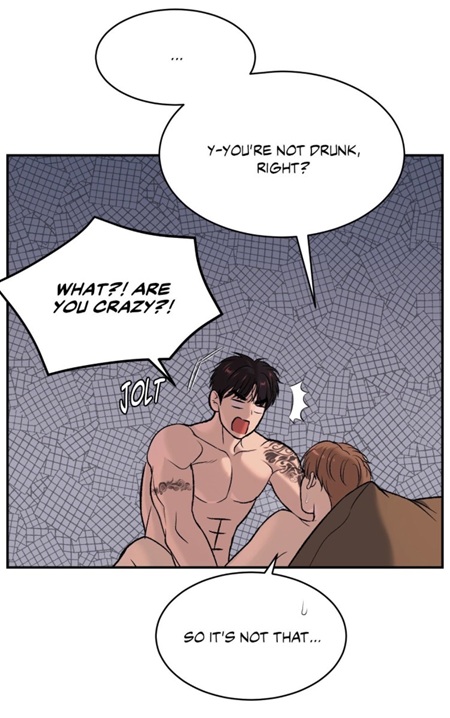 (chapter 86) The charge redistributes. Memory ceases to isolate and begins to circulate. Hence it creates a new memory.
It is at this point that Prometheus quietly enters the scene — not as explicit mythological references, but as symbolic functions. Electricity, like fire stolen from the gods, marks a return to humanity. It is the end of purely divine punishment and purely mechanical survival. At the same time, illusion dissolves. Sleep, dream, and dissociation lose their grip. The characters are no longer ghosts moving through each other’s lives, nor zombies repeating ritualized behaviors. They become human again — vulnerable, reflective, embodied. And once human, reflection becomes inevitable.
The night itself remains carpe diem. It is presence without calculation, sensation without projection, intimacy without bargaining. For those hours, the future does not intrude. But this does not mean consequence is erased. On the contrary: because the night is no longer an illusion, its aftermath must be faced. The jinx has not disappeared because its existence was not mentioned or danger is gone. Corruption, rigged matches, replacement, and blacklisting still await. What has changed is not the external threat, but the internal configuration.
The Paris night did not save the protagonists. It returned them to themselves. And this return has consequences beyond the couple. It destabilizes the grandmother’s moral economy. This new observation reinforces my previous interpretation: this position  (chapter 86) was a reflection of the picture. (chapter 65) Shin Okja is no longer doc Dan’s center of gravitation. That’s the real revolution. There is no longer interruption or triangulation. I am even inclined to think, that’s the night where the main leads became a true team.
Moreover, if memory can be shared without collapsing into blame, then her version of the past can no longer function as unquestionable authority. (chapter 65) If Kim Dan no longer needs to idealize in order to survive, then he can finally see the cost of that idealization — for himself and for her. The tragedy she alone has been carrying can surface, but without demanding that he sacrifices his present to it. The past stops being a sealed vault and becomes a shared, albeit painful, terrain.
This is the true end of ghosthood. That’s why doc Dan is feeling feverish during that night.  (chapter 86) No one is erased or reduced to an object. Nothing is overlooked or forgotten. But repetition loses its hold. And from here, the story can no longer proceed as before.
Feel free to comment. If you have any suggestion for topics or Manhwa, feel free to ask. If you enjoyed reading it, retweet it or push the button like. My Reddit-Instagram-Twitter-Tumblr account is: @bebebisous33. Thanks for reading and for the support, particularly, I would like to thank all the new followers and people recommending my blog.
 (chapter 86), gentle, attentive
 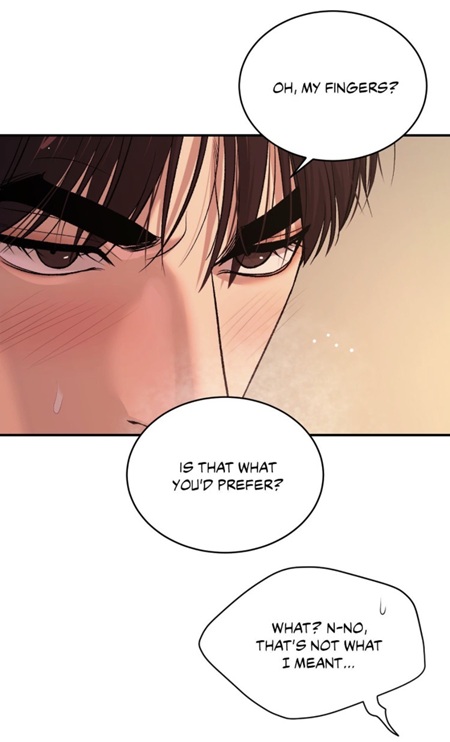 (chapter 86) — asking questions instead of imposing answers
 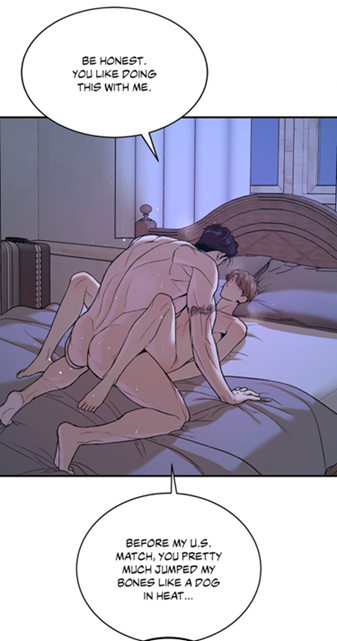 (chapter 64). For Joo Jaekyung’s unconditional stans (and I count myself among them), such an attitude
 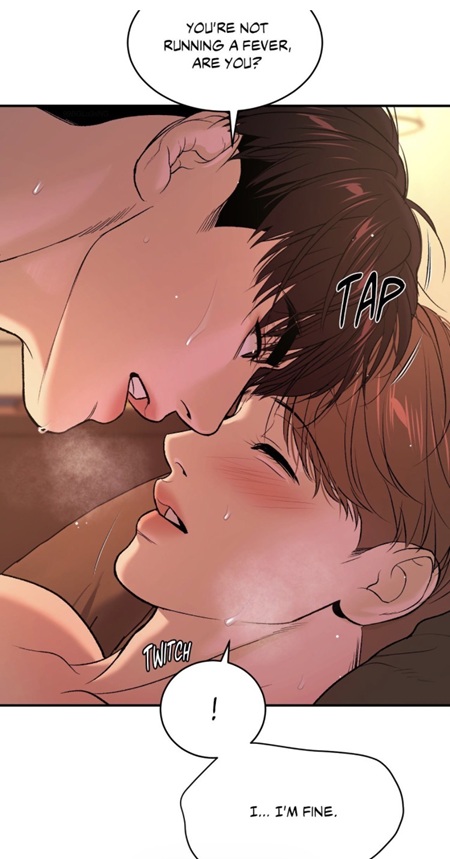 (chapter 86) can easily be read as proof that the protagonist’s good heart has always been existent, but it was barely visible. Compared to earlier chapters, the contrast is now undeniable. And yet, I would like to pause you right there.
 (chapter 61), sometimes awkwardly
 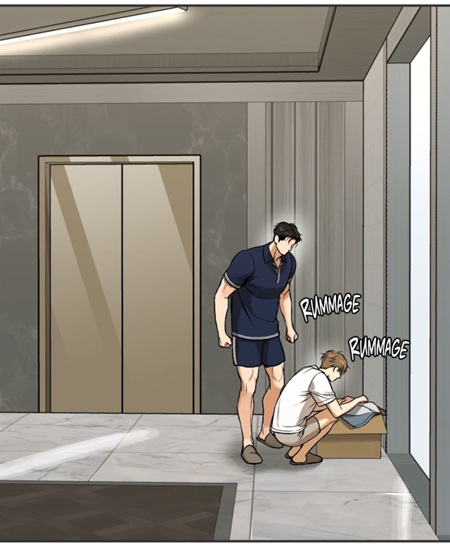 (chapter 80), sometimes inconsistently
  (chapter 79), but unmistakably
 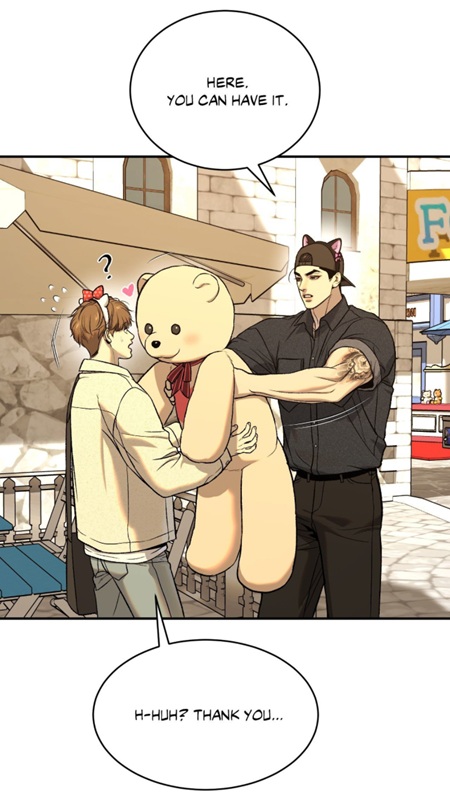 . (chapter 83) Tenderness, concern, even a certain form of devotion had appeared earlier
  (chapter 40), albeit in ways that were often overlooked,
  (chapter 18) misunderstood or poorly timed. This night
 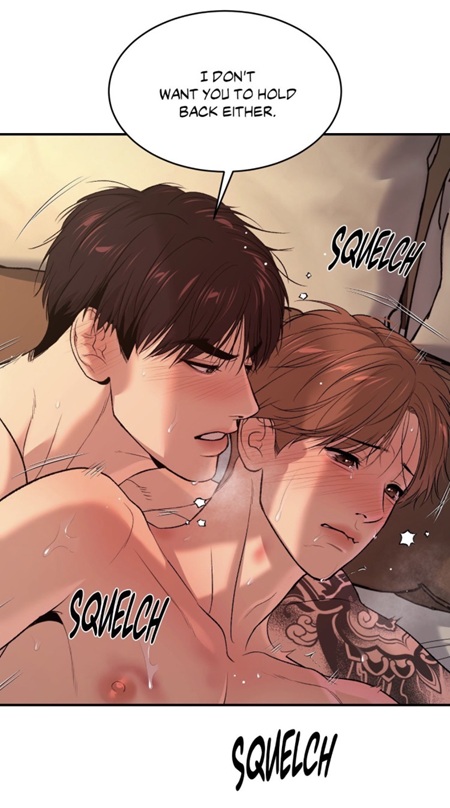 (chapter 86) does not initiate his metamorphosis.
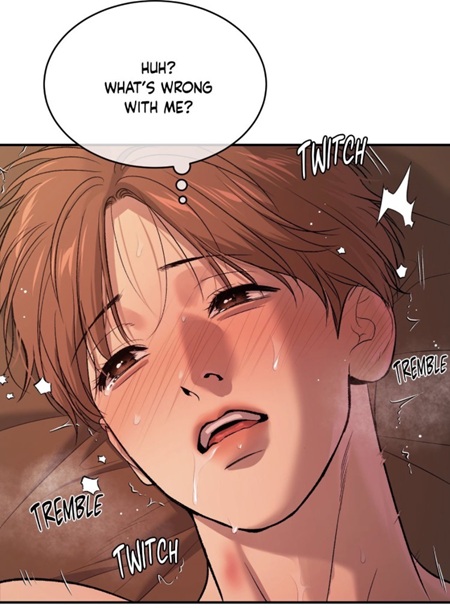 (chapter 86), sparks
 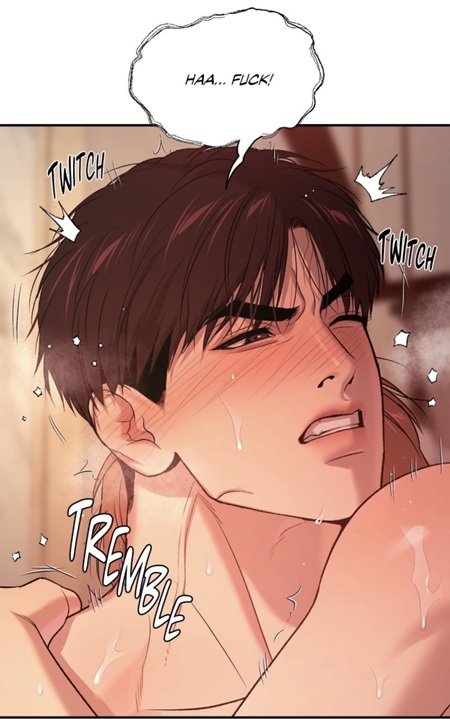 (chapter 86), and softness, many Jinx-philes might instinctively describe it as magical. The imagery invites such a reading. After all, we have seen similar nights before. The night in the States shimmered with illusion
  (chapter 41) The penthouse night echoed A Midsummer Night’s Dream
 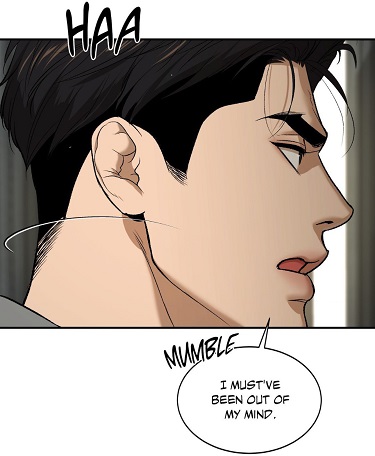 (chapter 45). This raises an essential question. Is episode 86
  (chapter 4), in the return of light
  (chapter 66), in what remains once the sparks fade. A dream dissolves with daylight. Reality does not.
 (chapter 86), sparks, that strange shimmer that seems to hang in the air
 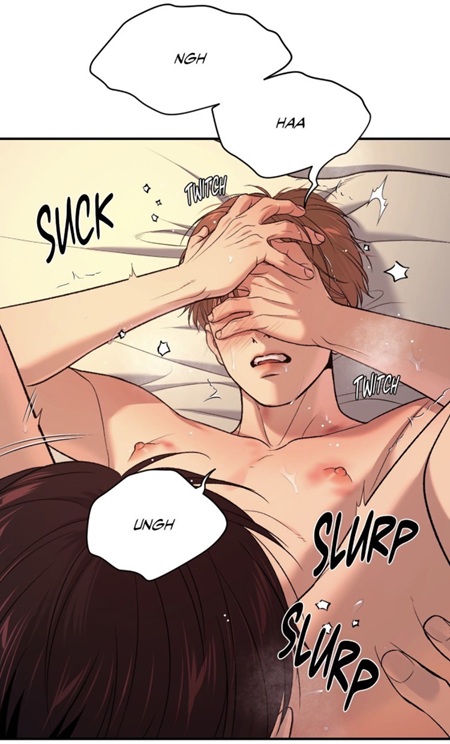 (chapter 86). Why? It was, as if their dream had come true. However, is it correct? Is it not wishful thinking? What if this night is not magical at all? What if its true signature is not enchantment, but electricity—a current that interrupts, tests, and resets? 😮
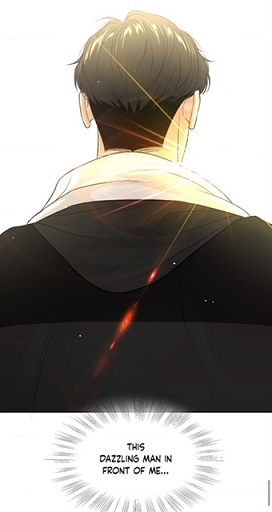 (chapter 40) in Kim Dan’s perception: overwhelming, radiant, dominant, a heat-source that does not negotiate.
 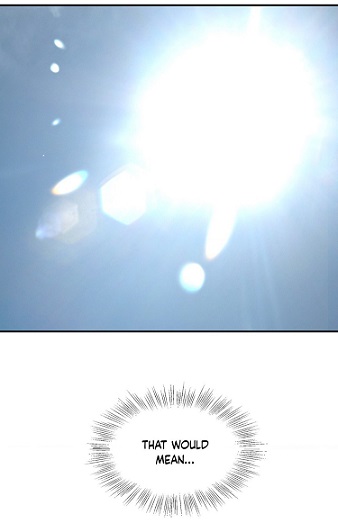 (chapter 41) The sun can be admired, feared, and endured—but it cannot be questioned.
  (chapter 58) It simply shines, and the one who stands in its light adapts. This explicates why the physical therapist would choose silence and submission over communication.
  (chapter 48)
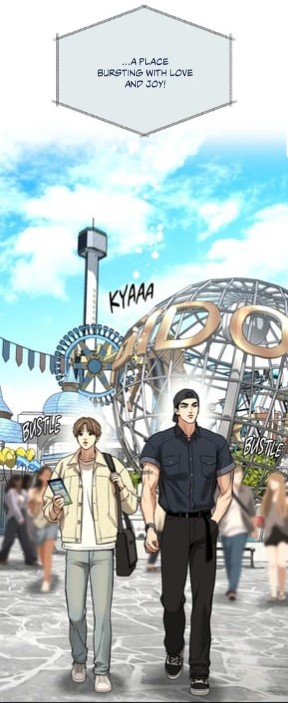 (chapter 83)
 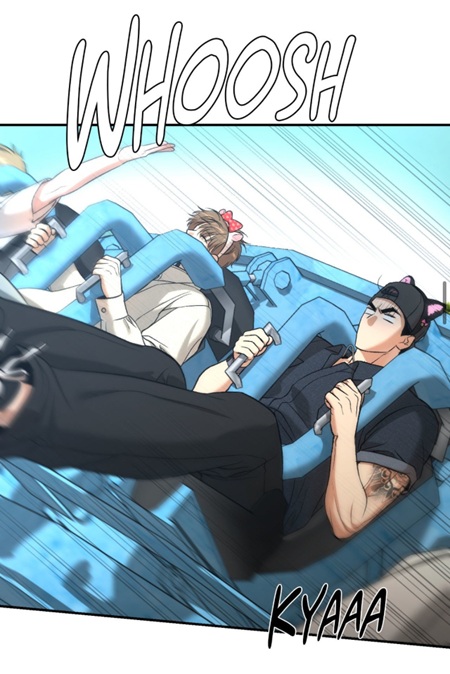 (chapter 83) Every ride, every light, every scream suspended in midair depends on current: motors accelerating and braking, circuits opening and closing, energy stored, released, and cut off.
  (chapter 83) Roller coasters do not move by heat, charisma, or sheer physical force; they move because electricity flows through them. The Viking ship swings
 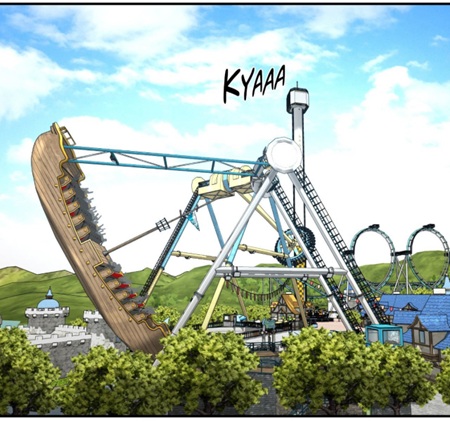 (chapter 83) because current allows it to swing. The Ferris wheel ascends
 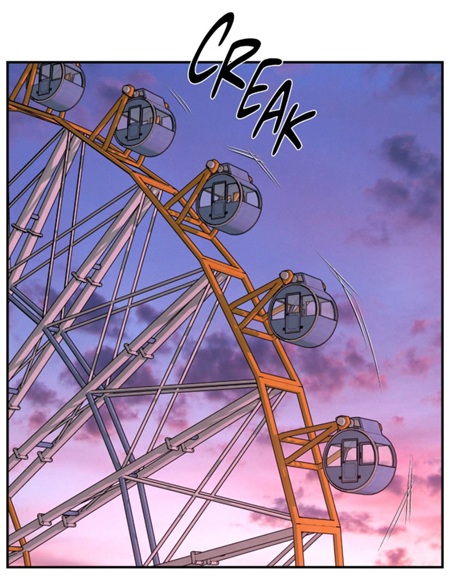 (chapter 83) because circuits hold — and descends because they release.
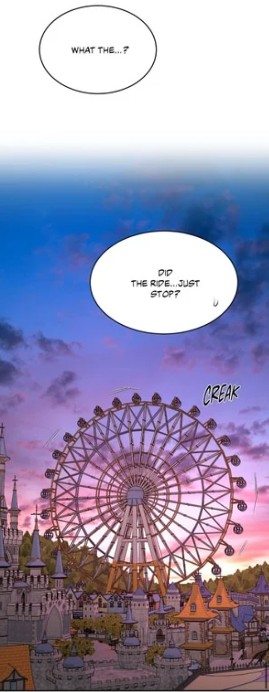 (chapter 84)
 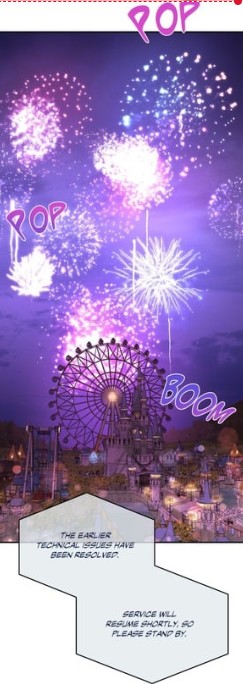 (chapter 84) explicitly names what had previously gone unspoken: the rides function only because current flows. When it disappears, the illusion of effortless motion collapses.
 (chapter 84) The Ferris wheel has stopped. The current is gone. The carefully regulated system that lifted, rotated, and sustained them is no longer in control. Yet movement does not disappear entirely. It mutates. When the champion shifts his weight, grips the structure, reacts instinctively, the cabin begins to shake. Panels emphasize instability: creak, swish, ack. The motion is no longer generated by electricity but by the body itself.
 (chapter 84) Stranded above ground, stripped of the park’s mechanical rhythm, he apologizes.
 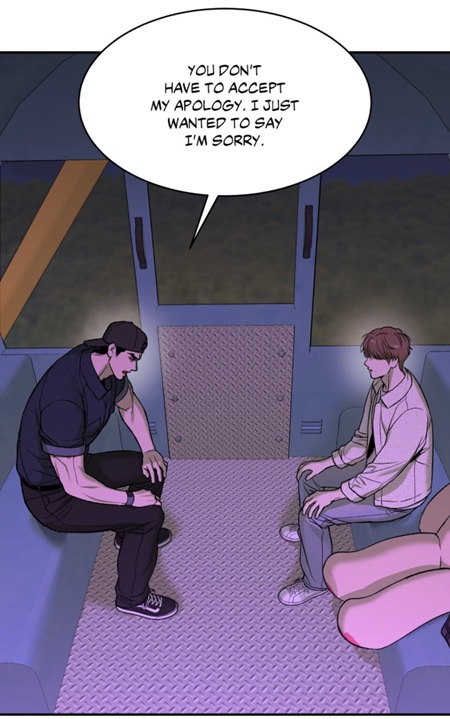 (chapter 84) Not theatrically, not performatively, but awkwardly, haltingly. His body exposes his discomfort
  (chapter 84) and fears. He avoids the doctor’s gaze, crosses his arms
 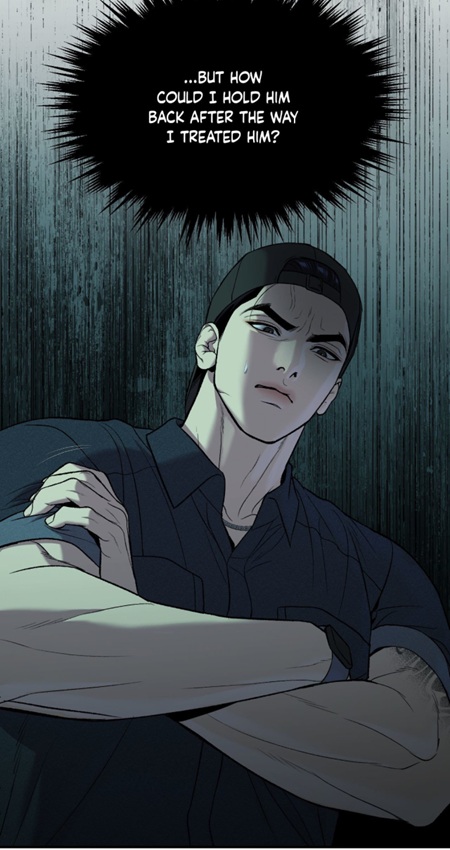 (chapter 84) or squeezes his arm
 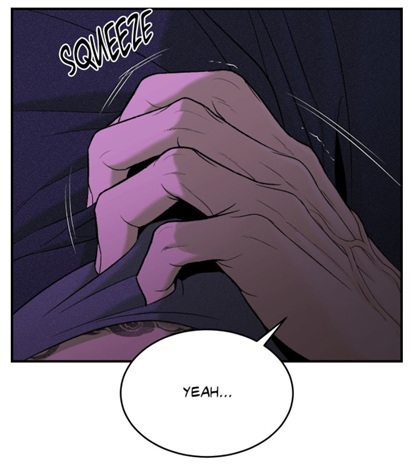 (chapter 84). The cessation of electrical motion coincides with a shift in his own mode of action. Where the park depended on current to keep things moving, he now moves without it. The absence of electricity forces something else to surface: responsibility, attention, presence. Additionally, this sequence anticipates what will later unfold more fully. Proactivity is no longer expressed through force or motion, but through articulation. Words stand for action and have weight. The champion’s future action is announced here, quietly: he will no longer push forward by shaking the structure. He will move by sharing thought, by naming feeling, by allowing himself to be affected.
  (chapter 86),
 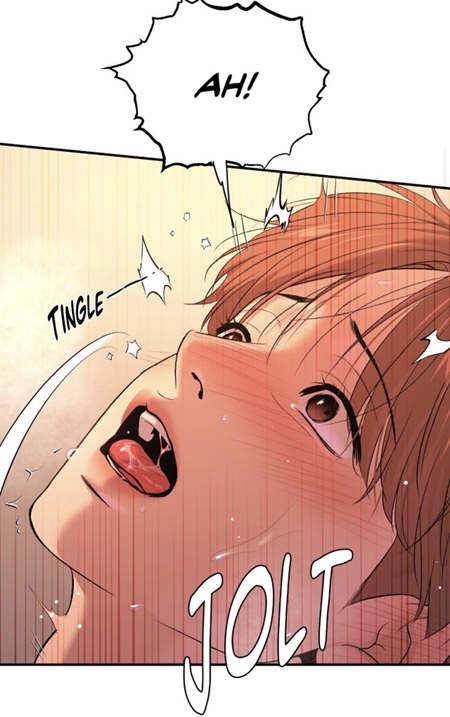 (chapter 86) jolts, sudden contractions of the body
 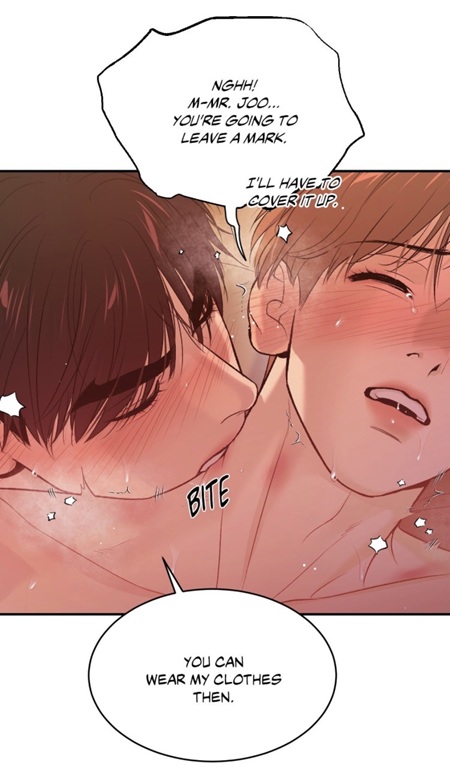 (chapter 86). Kim Dan is repeatedly shown convulsing, gasping, losing linear thought, and it is the same for the MMA fighter. Panels insist on interruption: jolt, tingle, broken breath, aborted sentences. The doctor’s body behaves as if struck, especially in this image.
 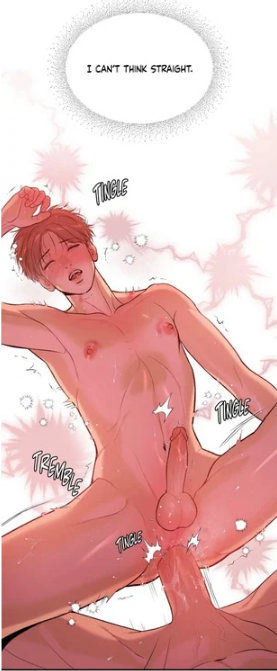 (chapter 86) It is at this point that a phrase surfaced in my mind — instinctively, almost involuntarily. A phrase we use in French when something intangible yet decisive occurs between two people: Le courant passe. Literally, the current passes. Idiomatic meaning: they are on the same wavelength, something connects, communication flows. However, here, the current is not the product of civilization, but of nature. Two people interacting with each other. And it is precisely because of the unusually high frequency of sparks and jolts in the illustrations that a belated realization imposes itself: nature, too, produces electricity — through storms, through thunder.
 (chapter 69) A storm was announced back then. And yet, upon closer inspection, no thunder was ever shown there. There was tension, there was excess, there were dark clouds
  (chapter 69) — but there was no strike, no discharge, no interruption. The imagery remained continuous, fluid, enclosed within the logic of escalation rather than rupture.
 (chapter 83). In Roman terms, Thursday corresponds to dies Iovis — Jupiter’s day — the god of thunder. Both gods are strongly connected to thunder and as such current.
 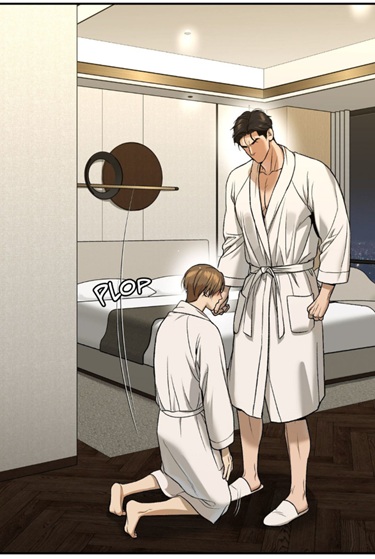 -chapter 67-; for more read my analysis
 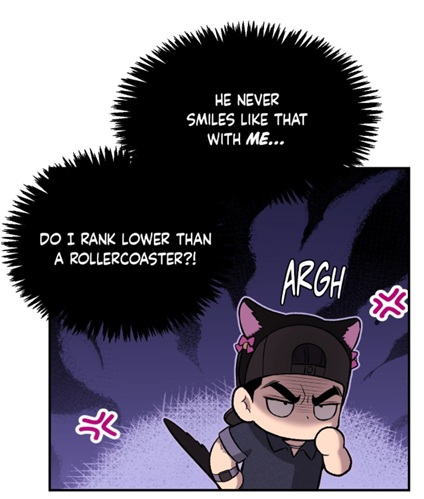 (chapter 83). Before striking anything, he is already unwell: angry overstimulated and complaining, visually reduced to a childlike register. This matters. The hammer does not create excess — it receives it.
  (chapter 34), the hammer gesture is not confrontational, for the machine is immobile. There is no opponent.
 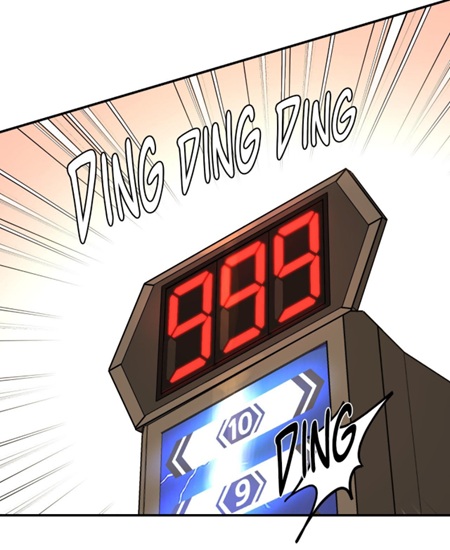 (chapter 83) Too much energy released at once. The system registers it, but cannot contain it. This means, the record won’t be registered and as such “remembered”. In fact what mattered here was the prize, the teddy bear, and restored self-esteem of the athlete. He could offer a present to doc Dan which the latter accepted without any resistance.
  (chapter 86) Therefore it is not surprising that doc Dan starts looking at his fated lover. Imagine what it means for the athlete, when the “hamster” is staring at him, though he is a little embarrassed. Finally, he is truly looking at him. The champion loves his gaze. And now, you comprehend why the “wolf” listened to the “cute hamster” and stopped leaving marks.
 (chapter 85), but this time, its nature has changed. It is no longer jealousy or anger, but love and desire. Hence the current is not colored in red, but white and pink.
  , but a thunder and as such it is still restrained and regulated.
 (chapter 44) as emotionally charged, intense, even pivotal. Confessions were made. Bodies responded. Vulnerability appeared to surface. And yet, both nights collapsed almost immediately afterward. What was felt
 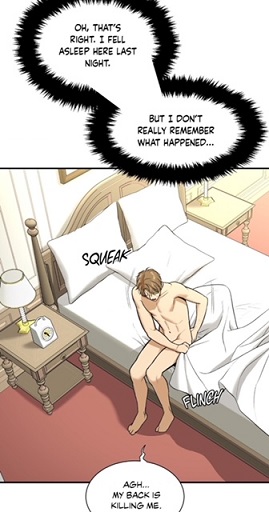 (chapter 40)
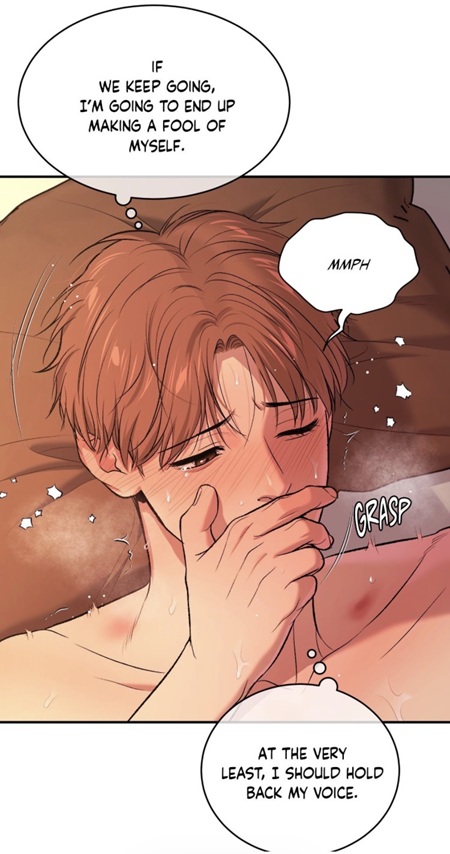 (chapter 86) In this panel, we should glimpse a reference to the night in the States as well, and not just to the night in the penthouse.
  (chapter 44) The setting is elevated, luxurious, almost theatrical. The doctor is brought into a space of power that is not his own.
 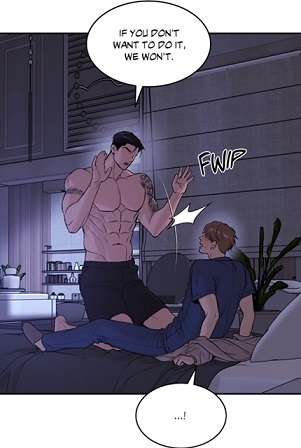 (chapter 44) By acting that way, the athlete created a false impression of himself, as if he was still rational and clear-minded. Again, desire unfolds.
  (chapter 44)
  (chapter 44) Again, closeness occurs. And again, the aftermath reveals the same fracture.
 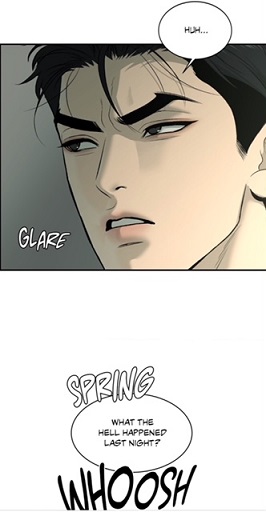 (chapter 45) and later wants to even forget it.
  (chapter 45) and he can not deny his own involvement and actions. Hence the doctor is left alone. Only he can recall this “dream”.
  (chapter 44) But memory alone is not power. Remembering without the other’s participation transforms recollection into isolation. Kim Dan cannot confront, confirm, or renegotiate what happened, exactly like the champion did in the past. Meaning freezes instead of evolving. Striking is that he came to associate feelings with addiction.
  (chapter 46) No wonder why later doc Dan had no problem to reject the athlete. And for him, the next morning became a cruel reality, even a nightmare. It wounded doc Dan’s heart and soul so much that he learned the following lesson: to not get deceived by impressions. Hence in Paris, Doc Dan tries to explain the change of the champion’s attitude with drunkenness.
 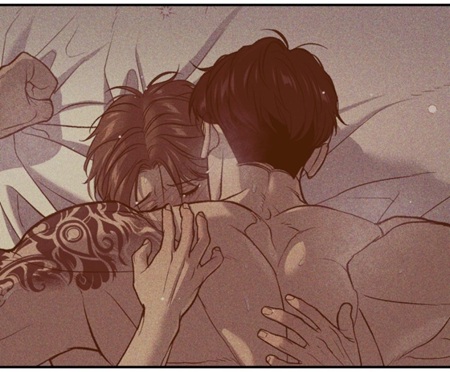 (chapter 44) One participant is altered. The other must carry the weight of meaning alone. The night does not end in shared reflection, but in silence and absence.
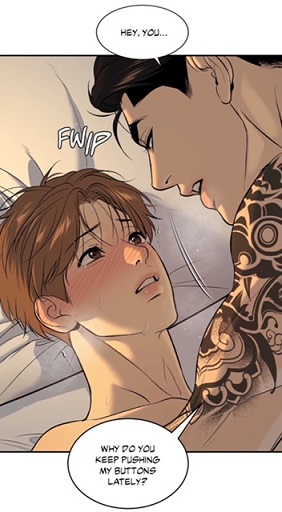 (chapter 44) Words blur, vanish, or are forgotten. Even gestures go unnoticed: a kiss, an embrace or a patting. Memory fractures. The morning after is defined not by continuity but by confusion. The body has moved forward, but the narrative has not.
  (chapter 84)
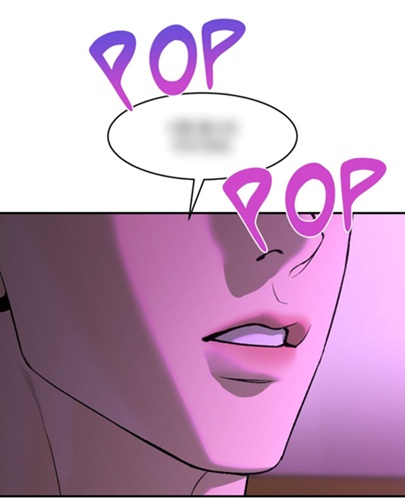 (chapter 84) Speech bubbles lose clarity. Confessions are obscured. The reader is denied access to meaning. Fireworks, like drugs, produce intensity without duration.
 (chapter 39)
  (chapter 44) It was as if these nights could only exist under altered states — as if clarity on either side would have made them impossible.
 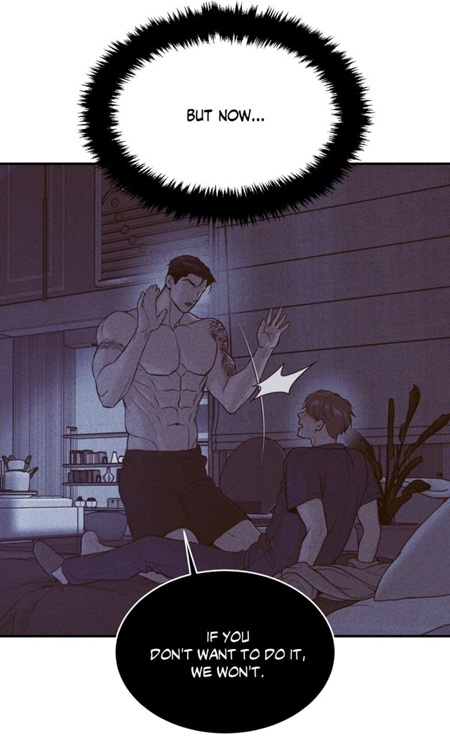 (chapter 86) This is why, when electricity returns in episode 86, it does not revive heat. It interrupts it.
  (chapter 86) That’s the reason why the athlete stops for a moment and asks doc Dan, if he needs a break.
  (chapter 86) This question is important because doc Dan admits his confusion and ignorance. He confesses to himself that he “knows nothing” not only about himself, but also about his fated lover.
  (chapter 86) They function as temporal markers. A spark exists only now. It has no duration. It cannot be stored, recalled, or anticipated. It appears — and vanishes. In this sense, electricity becomes the perfect visual language for the present moment itself.
 (chapter 10), statements blurred by drugs
 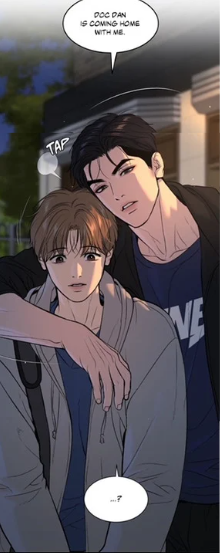 (chapter 43), sentences remembered by only one side.
  (chapter 44) and even laugh…. if only he could remember that night…
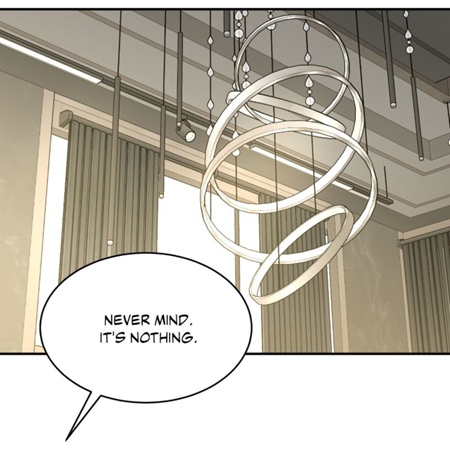 (chapter 79), the “never mind”,
  (chapter 84) or it is a mistake, the easy erasure that once dissolved meaning after the fact. The kiss interrupts that mechanism. It produces a pause that cannot be talked over. It forces reflection.
 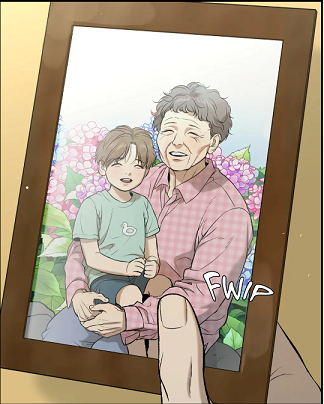 (chapter 19) The grandmother’s lap structured Kim Dan’s understanding of safety, endurance, and knowledge. Sitting there meant being held — but also being taught how to survive through sacrifice, silence, and self-effacement. That worldview sustained him, but it also confined him.
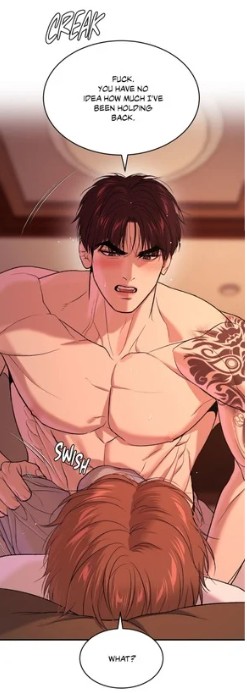 (chapter 85) represents the positive reflection of this night
  (chapter 58)
  (chapter 58), when the physical therapist chose to give up on the athlete and stop listening to his heart. Here, I am not only referring to the numerical symmetry but also to the doctor’s shifting vision of Joo Jaekyung.
 (chapter 85), Jaekyung appears with a towel around his neck. This simple object evokes water and sweat, but in Jinx, these elements are never neutral. They are tied to one of the champion’s earliest traumas: the humiliation of being called “dirty”
  (chapter 75) and “smelly” as a child. This is why Jaekyung learned to perfuse his body with cologne after every shower
 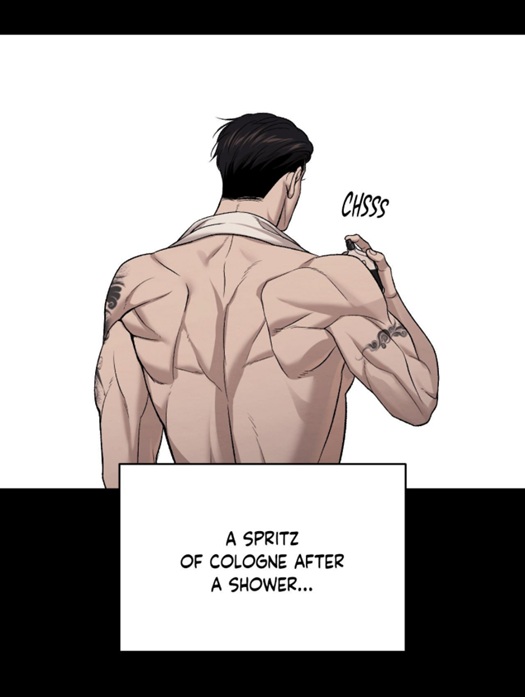 (chapter 75) and why physical proximity has always carried the risk of shame. Hence he kept people at arms length. In chapter 40, when he rescued Kim Dan from the security guards, he kept his distance
 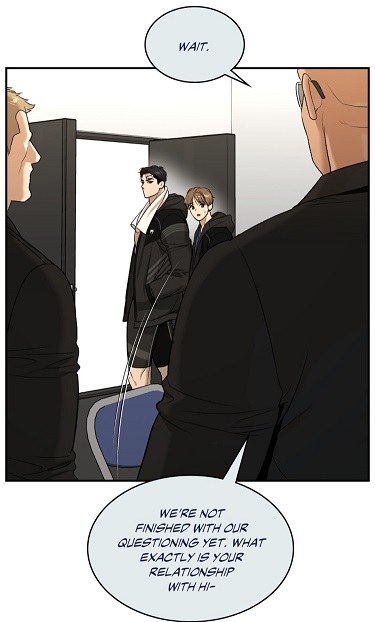 (chapter 40) — he had not yet showered, for the towel on his shoulders was stained with blood. Mingwa was indirectly referring to the champion’s psychological wounds.
  (chapter 40) It was, as if the fear of smelling “wrong,” of being perceived as contaminated, was still dictating his movements. Hence he could only claim doc Dan as one of his own, but not as his “physical therapist” or even “family”. And interesting is that doc Dan copied his attitude. In the hallway, he maintained a certain distance from the athlete.
 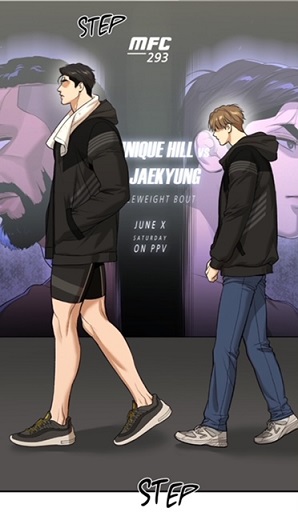 (chapter 40)
 (chapter 40) the moment he dried off
 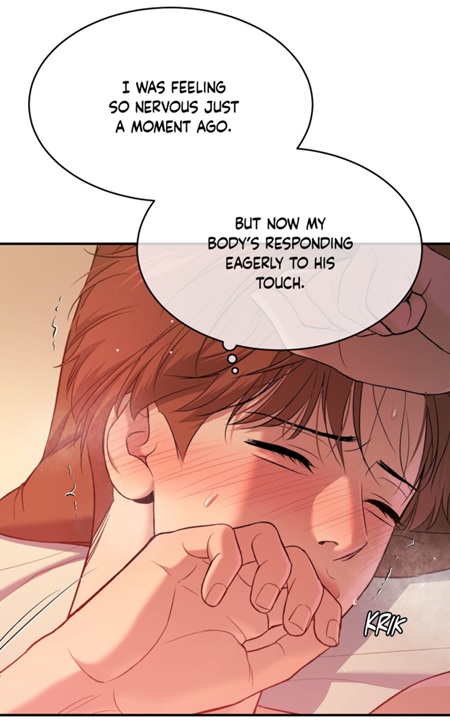 (chapter 85) and trust — and perhaps even the moment when Dan chooses, for the first time, to be honest with his own body and heart.
 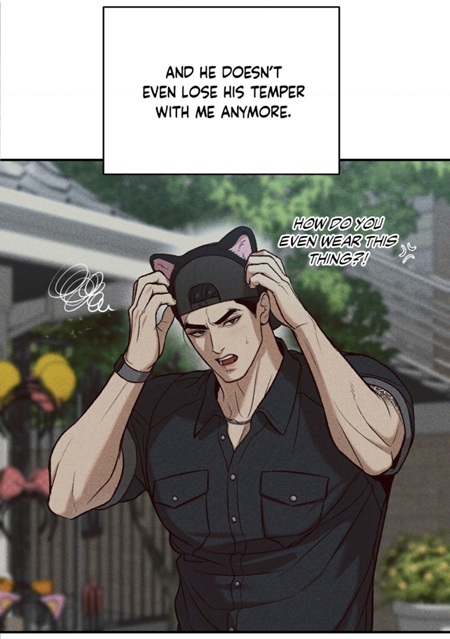 (chapter 85)
  (chapter 61) [I will elaborate it further later]. And perhaps this is why the moment feels so disarming: because the downfall is not tragic but tender, not humiliating but intimate. Sweet, even.
 (chapter 85), when a single careless comment shattered the champion’s composure and revealed just how fragile his newfound hope really was.
 (chapter 85) In contrast, both Park Namwook and coach Jeong Yosep wear generic MFC T-shirts.
  (chapter 85) Dan is lost in his thoughts — anticipating the night ahead with the champion — and has barely touched his food. Park Namwook notices this. One might think, such a remark displays the manager’s concern for the main lead’s well-being. However, the manager adds that the other members of the team are all almost finished. With such a remark, it becomes clear that the manager is urging the protagonist to finish his plate. Although Park Namwook addresses Dan as if showing concern, the content of his remark betrays his true priority: not Dan’s well-being, but the team’s schedule. By pointing out that ‘the rest of us are almost finished,’ he urges Dan to keep pace, treating him as staff who had to follow the group rather than someone with personal needs. As you can sense, schedule is essential for the manager. However, because doc Dan couldn’t reveal the true reason behind his behavior, he gives an excuse for his lack of appetite.
 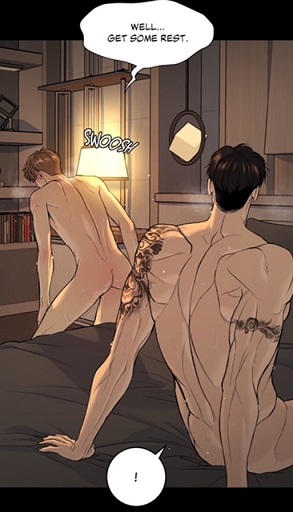 (chapter 53) The manager’s words bring Joo Jaekyung back to reality and its uncomfortable truth that Dan’s presence now is still bound to a contract — temporary, contingent, never fully his. In other words, with his remarks, Park Namwook is reopening old wounds which shows his total blindness and lack of finesse and of empathy. He treats the last match, as if nothing bad had happened. The incident with the switched spray is simply erased.
 (chapter 53) leaving without thinking; now, after Dan vanished from his life entirely, that earlier departure feels like a sign he failed to read. Park’s question brushes against this bruise, and Jaekyung’s lips reflect the discomfort.
 (chapter 85) The younger fighter suddenly bursts into panic, declaring how nervous he would be in Jaekyung’s place, how his heart would be pounding out of his chest. His outburst is sincere, naïve, and completely focused on the champion — he never once considers Dan’s feelings. Yet these words strike deeper than he intends. At the mention of a pounding heart, Jaekyung’s eyes lift upward in a brief, involuntary movement. It is the smallest gesture, but it exposes everything he wishes to hide. Because his heart is pounding — but not for the match. It is because of doc Dan!
  (chapter 85) “Come to my room at 11.”
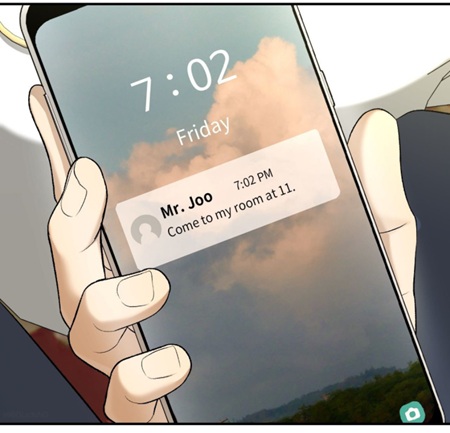 (chapter 85) the need for reassurance, the wish to rewrite the pattern of the past, the quiet hope that Dan will not leave him again — not tonight and not afterwards.
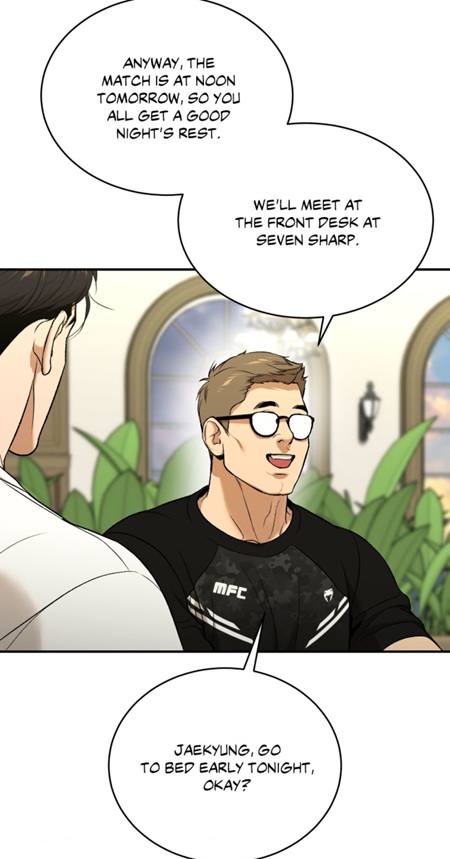 (chapter 85) Schedules are his armor, punctuality his hiding place. Whenever something threatens to slip beyond control, he retreats behind procedure.
  (chapter 85), as soon as the athlete stands up right after his recommendation and announces he is now returning to his room.
  (chapter 54)
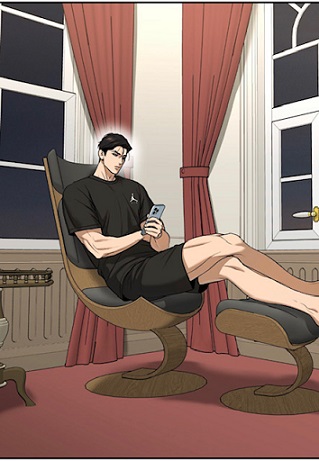
  (chapter 85) In theory, this is the perfect window to do what he used to do in the States
  (chapter 38) and Korea
  (chapter 48) before a big fight: watch his opponent’s videos, study their habits, rehearse counters. If we only looked at the clock, we might assume he spent the evening thinking about Arnaud Gabriel.
 (chapter 85) He opens the door and immediately grabs him inside
 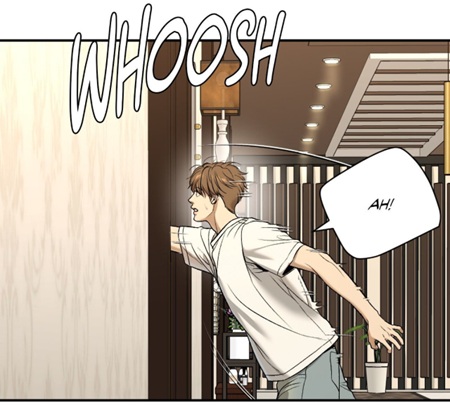 (chapter 85), cutting off any possibility of hesitation. The way he drags him over the threshold, presses him against the wall
  (chapter 85) This is not the controlled, casual emperor of old; it is someone who has been holding back for hours and refuses to risk even a second in which Dan might change his mind.
  (chapter 65) and the comment of the champion in front of this movie:
 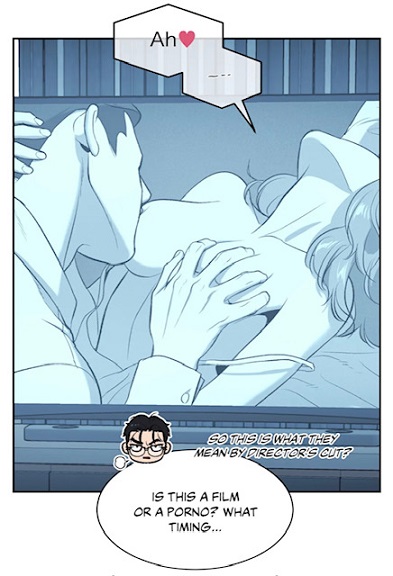 (chapter 29) Moreover, I consider this scene
 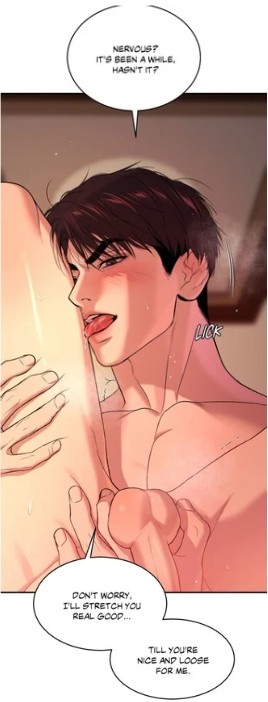 (chapter 85) as a new version of Choi Heesung’s advice: Doc Dan just needs to sit back and enjoy!!
 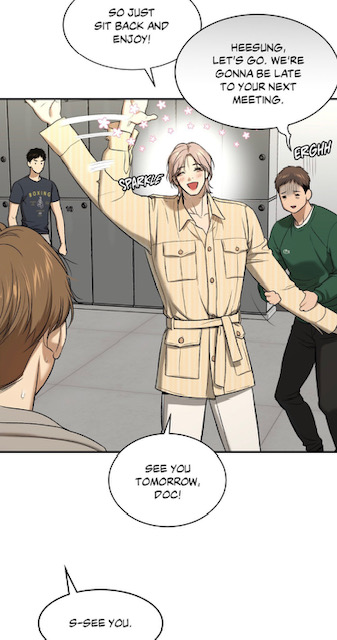 (chapter 31) Joo Jaekyung is now doing everything, as deep down he wants to become the perfect lover! And how had I described the night in the States?
  Back then, the hamster Dan had become the champion’s perfect lover, especially because he had kissed his face, hugged him and confessed to him.
  (chapter 38) One might reply that the athlete desired to maintain appearances and as such to hide his suffering and anxiety. In other words, he was hiding his emotions behind routine, Jinx-sex would always start at 11 pm. However, this idea is not entirely satisfying because once doc Dan was in his room, the fighter was no longer hiding his emotions and desires.
  (chapter 72), when the latter would return late from his “work” and the death of his father
 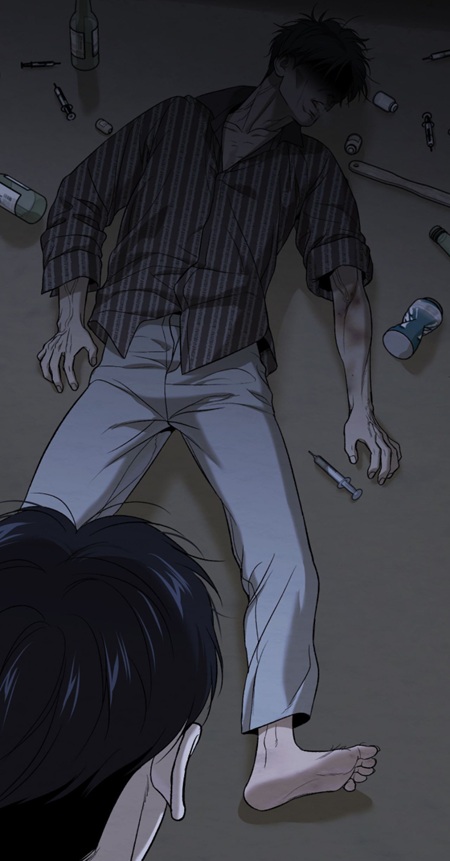 (chapter 73).
 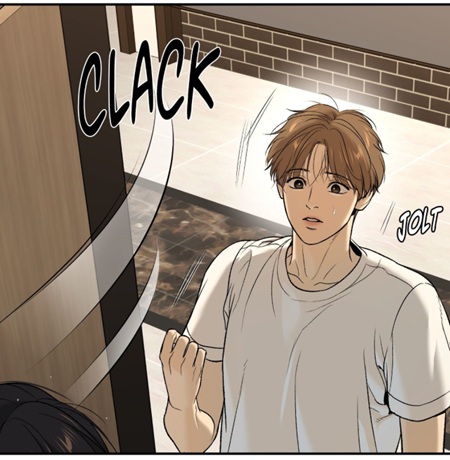 (chapter 85) Because doc Dan could have refused. He could have used his queasiness as an excuse, could have stayed in his room, could have claimed exhaustion. Instead, he obeyed the request — a request sent by someone who had hurt him deeply in the past. Doc Dan’s arrival is proof that he is not rejecting him. Proof that the night is real. Proof that the attempt to do better might actually matter. At the same time, doc Dan couldn’t miss the true meaning behind this text sent in front of others: the athlete’s anxiety and suffering.
 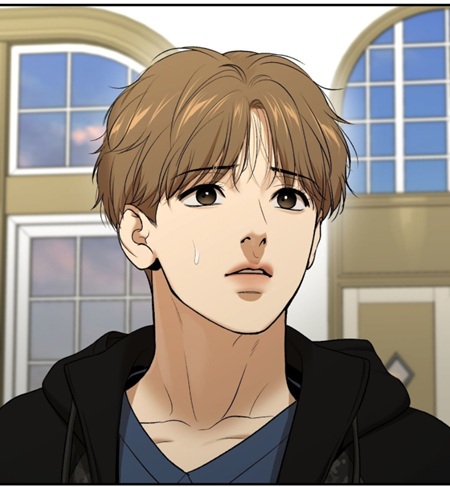 (chapter 85) This explains why his worried gaze followed his fated partner.
  (chapter 85) In other words, the text had a different meaning. It was not an order, but rather a wish…and it had nothing to do with his match against Arnaud Gabriel. During that night, Joo Jaekyung is not seeing a surrogate fighter in front of him or a sex toy, but his real partner, his future boyfriend. This means, this night stands in opposition to the one in the penthouse:
 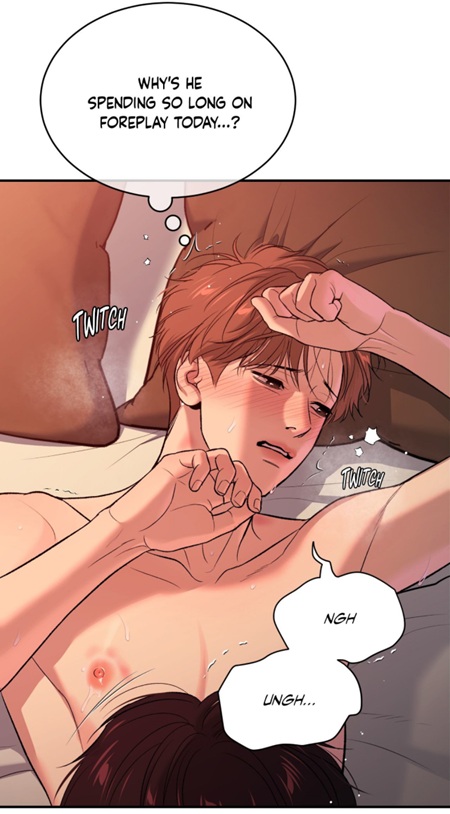 (chapter 85) This is why he touches Dan’s face instead of flipping him over.
 (chapter 85) — something he has never done before. This does not come from instinct. It comes from intention. It comes from effort. It comes from learning. He is indeed showering doc Dan with love and tenderness, therefore it is not surprising that the “hamster” is moved sensually and emotionally. Exactly like during the Summer Night’s Dream, he is reaching nirvana, hence Jinx-philes are constantly seeing stars,.
  (chapter 85)
  (chapter 85) — or the emotional slip that comes with resurfacing feelings: the therapist losing distance, falling back into intimacy. All of these readings sound plausible at first glance.
 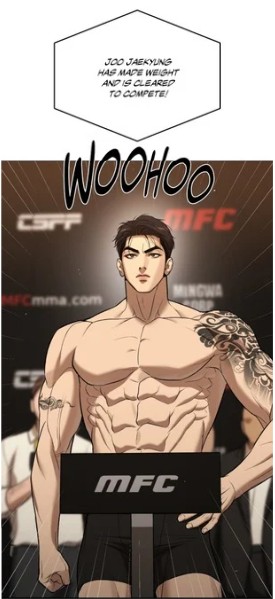 (chapter 85) Styled up, hardened with gel
 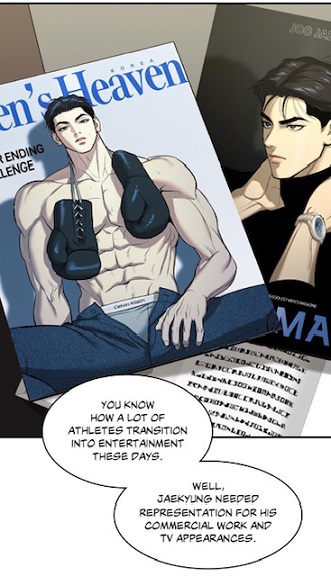 (chapter 30) , perfectly arranged — it is the crown of the Emperor, the symbol of his control, his discipline, and the myth that MFC sells:
 (chapter 82) When the hair stands, the image stands.
 (chapter 85) — but not the way adults or professionals usually do.
 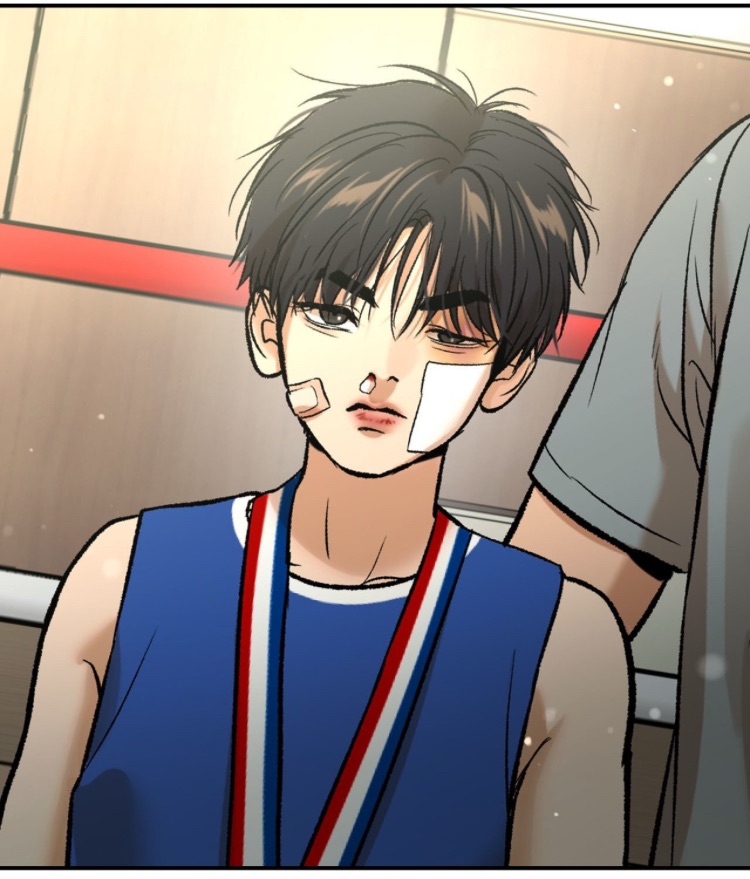 (chapter 71) So doc Dan could recognize the little boy in the athlete, the more he sees the protagonist with his hair down. Furthermore, I noticed that contrary to season 1, Doc Dan has now more memories of the “wolf” facing him.
  (chapter 85) In the past, he would more look at him from behind:
  (chapter 35)
  (chapter 35) Seeing his face reflects not only the increasing care for each other, but also the improving communication between them.
  (chapter 85) more mature, more “masculine” in the traditional sense. This explicates why the stylists had to dress him up.
  (chapter 82) Yet such an intervention did more than prepare him for the cameras — it tightened the restrictions around his own image, reducing the fighter’s rights over how he appears to the world. With the suit, he appeared older and more powerful. The French fighter leans into age, while the Korean champion leans into youth — a symbolic inversion that reinforces the central tension in the Paris arc: Gabriel performs adulthood; Jaekyung rediscovers the adolescence he never lived.
  (chapter 85) But just as Jaekyung begins to slip into these youthful, softer identities, MFC reasserts control.
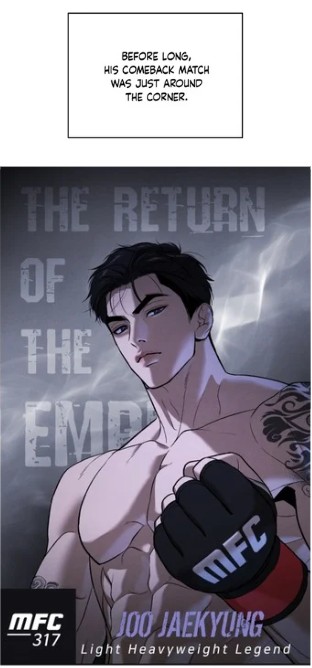
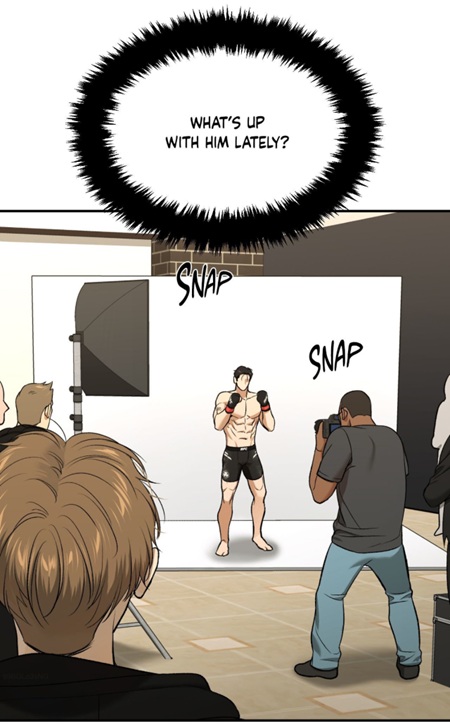 (chapter 85) hair up, face polished, a look engineered for posters and rankings. He becomes once again the Emperor — the man who must appear older, sharper, more intimidating, more manufactured.
 (chapter 79) This is the boy from the childhood photograph.
 In the rain, with his hair heavy and unstyled, his gaze dark and sensual, Jaekyung appears nothing like the commanding emperor. He looks free — freed by weather, freed by desire, freed from roles. It was foreshadowing, not just fanservice. It announces the end of the « jinx » in reality.
 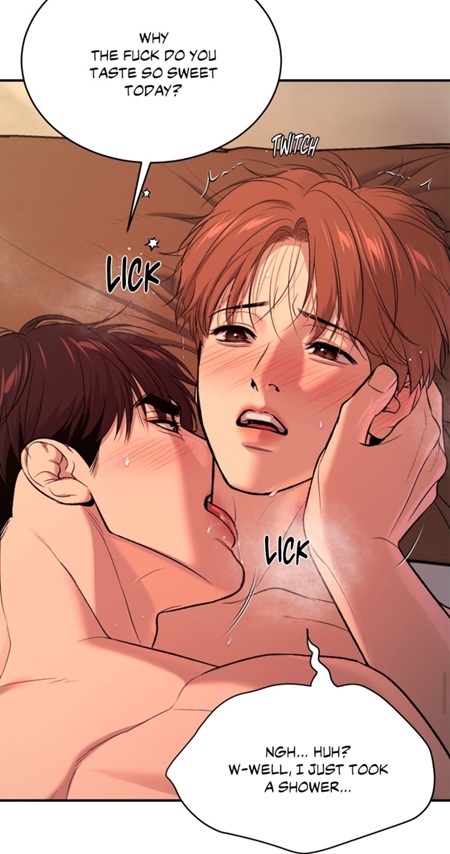 (chapter 85) He is describing himself. His sweetness is the taste of freedom — freedom from performance, freedom from control, freedom from MFC, freedom from fear. He is enjoying this moment. Dan tastes sweet because Jaekyung is finally tasting the life he never allowed himself to want.
 (chapter 21) The image of winged rescue and divine protection hangs over the very piece of furniture that, throughout the series, has functioned as Dan’s private sanctuary. This is not incidental. In Jinx, the couch is tied to his deepest memories of care and abandonment, and Mingwa activates this symbolism each time Dan gravitates to it.
 (chapter 21) Why does he consistently feel safer on the couch than in a bed?
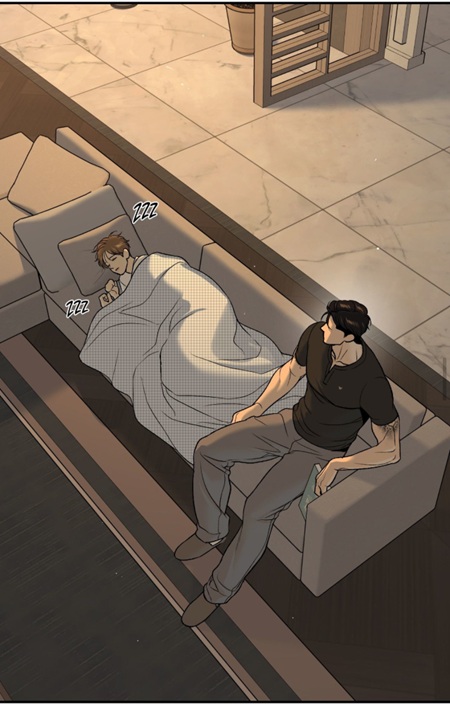
  (chapter 29) Why, after the second swimming lesson, did he refuse to return to the bed
  (chapter 81), even though he was exhausted? Why does he place the teddy bear
  (chapter 84) —his last substitute for lost parental affection—on the couch and not on the bed? And finally, why has he always harbored the secret wish to be carried to bed, as confessed through his memory in chapter 61?
  (chapter 10) Secondly, at no moment, we ever witness the grandmother carrying the little boy to bed. Either she is rocking him to sleep outside the house
  (chapter 44),
  (chapter 44) traces from parents. And now, you comprehend why the hamster could never truly rest in the bed. The couch is therefore not an adult preference; it is a trauma imprint. Resting there feels safe because beds—large, empty, abandoned spaces—became reminders of whoever no longer carried him. Hence it is no longer surprising that he woke up, when he sensed the vanishing of warmth.
 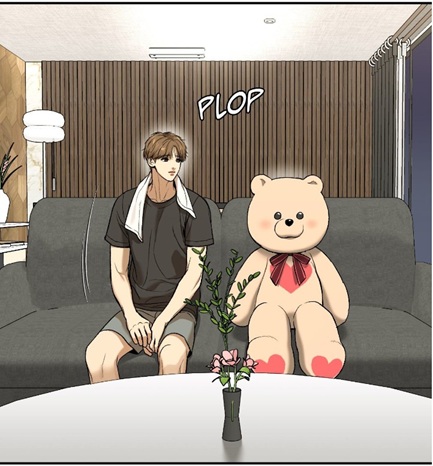 (chapter 84): the bear stands in for a lost comforting presence. It also represents the main lead, Joo Jaekyung. The latter is gradually reentering in the physical therapist’s heart and life. Therefore it is not surprising that there, he squeezes the hand of the toy. It is also why Doc Dan curls around it like a child who deep down hopes to be chosen, lifted, and held. And it is why, even as an adult, his body still whispers the same yearning: someone, please carry me to bed again.
 chapter 40, chapter 65, chapter 68, chapter 79)
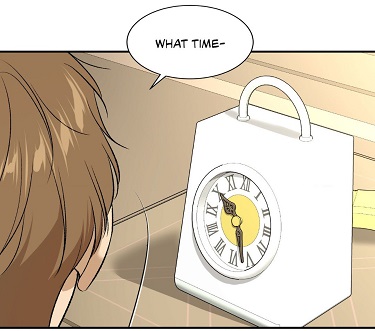 (chapter 85) and he was still able to arrive on time in the arena.
 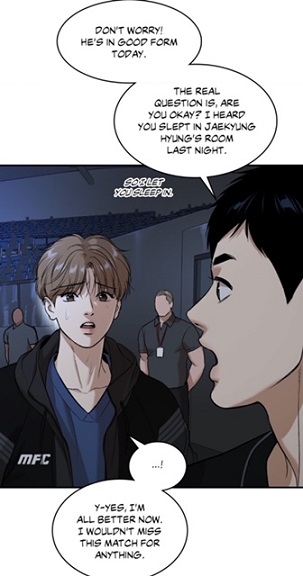 (chapter 40) For me, it is a clue that the manager would always request to meet around 7.00 am, when the match was at noon. But what should do the athlete do during all this time? He can only get nervous and feel pressured.
 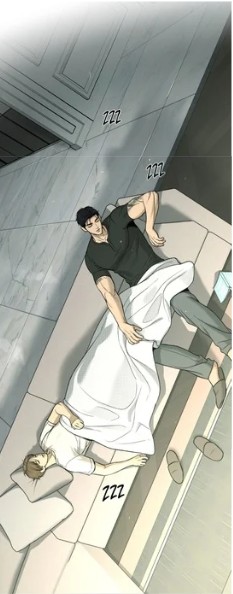 (chapter 81) I noticed that in different scenes from season 2, the athlete started waking up later and even after doc Dan.
  (chapter 66) But the manager’s rigid schedule threatens even that. An early morning summons drains the fighter’s cortisol reserves before the match has even begun, creating a long, empty corridor of waiting — a period where tension, anxiety, fatigue, and irritation ferment in the body. Instead of resting, centering, and preparing, the champion would spend hours fighting against the clock imposed on him.
 (chapter 54) , he might even jump to the wrong conclusion: that Jaekyung drank again — this time behind his back.
  (chapter 82) The irony is striking. Two days before the match, it was Park Namwook who overindulged with the others, yet he may now project that same carelessness onto the athlete. In his mind, the DND sign does not simply mean “rest”; it becomes a warning signal, a possible confirmation of the irresponsibility he fears but has never actually witnessed. Thus I can already imagine him panicking.
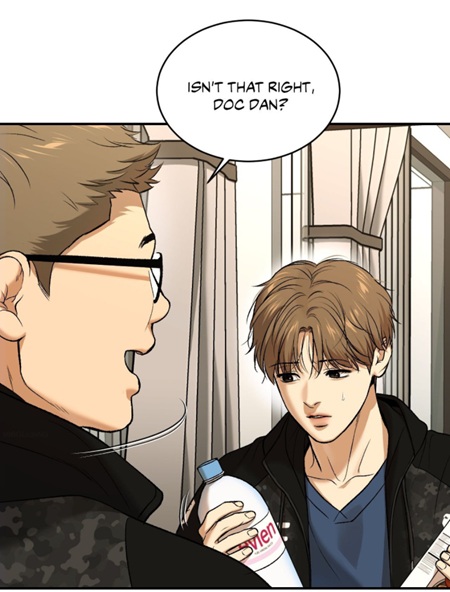 (chapter 82), his look
 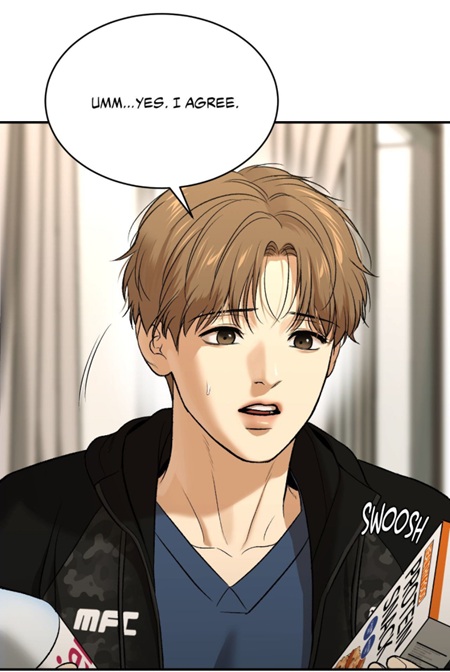 (chapter 82), his free time and took care of the champion’s emotional needs. In Paris, the « hamster » became the champion’s manager de facto, the unofficial right-hand. That’s why if they are late and they need a scapegoat, the manager can blame the physical therapist for the « delay », he would always come late to appointments (chapter 17: meeting the doctor) and to the fights (Busan, in the States).

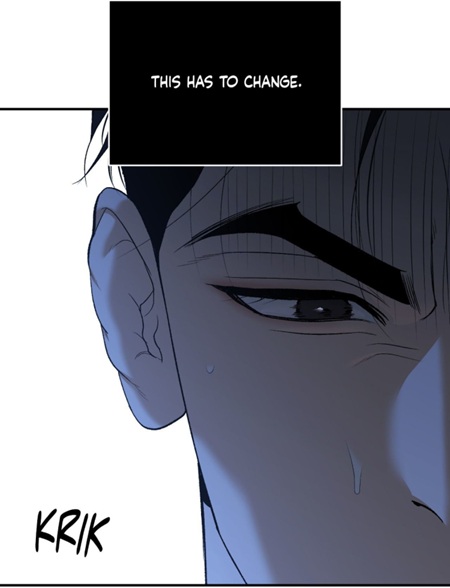 (chapter 79) However, let me ask you this. What kind of circle ends in episode 79? Moreover, how is this ending different from the past? Interesting is that episode 79 of Jinx doesn’t end with conflict, but with an awakening. For the first time, Joo Jaekyung does not rise to fight, command, or perform — he wakes up to a realization: “This can’t go on.” In the Korean version, his words carry an unusual clarity. It is not fate that changes, but choice. The champion, who once lived as if enslaved by habit and haunted by ghosts, now chooses transformation. The circle that has defined his life — power, silence, guilt, and repression — finally begins to close.
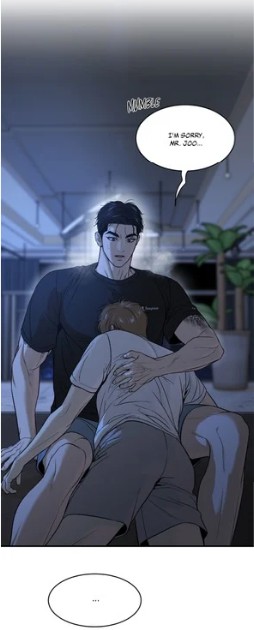 (chapter 79) Until now, Jaekyung has moved through life as if carrying a curse — the belief that he is unworthy of care and love.
 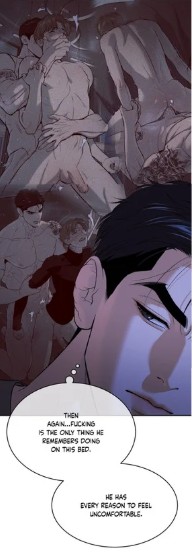 (chapter 78) Every match, every order, every touch was an act of penance. Yet, in this episode, that belief dissolves. What vanishes in chapter 79 is not his strength, but the compulsion to suffer for it. Through the unconscious confession from Doc Dan, the wolf discovers that despite his wrongdoings, he is not hated by the “hamster”.
 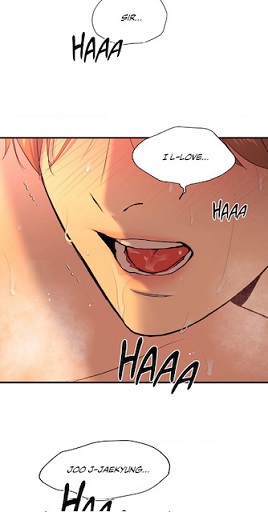 (chapter 39) from the magical night in the States. Both moments unfold in half-darkness, both break through inhibition, and both blur the line between consciousness and surrender. The verbal difference hides a deeper sameness:
  (chapter 79) is not remorse alone — it is an act of love, an instinctive reaching-out toward the other’s pain.
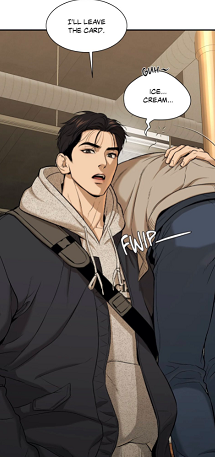 (chapter 9), 29’s confession on the couch
  (chapter 29), 69’s first expression of feelings in the dark
  (chapter 69). In chapter 79, the circle closes once more. The night’s palette tells the story — deep blue softens into violet
 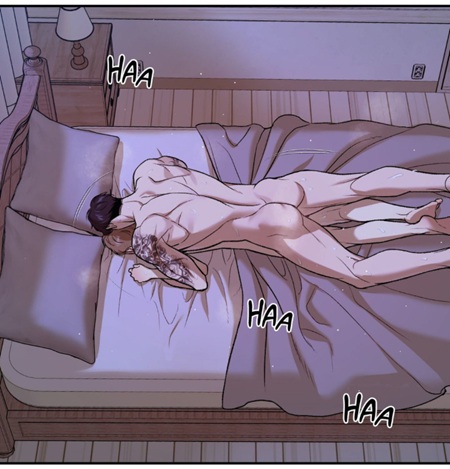 (chapter 64)
  (chapter 79), the color born from the fusion of blue (Dan’s sorrow) and red (Jaekyung’s intensity). For the first time, in the penthouse the color of their relationship is not pain but balance. And now, you comprehend why in the hallway, the purple had almost vanished:
 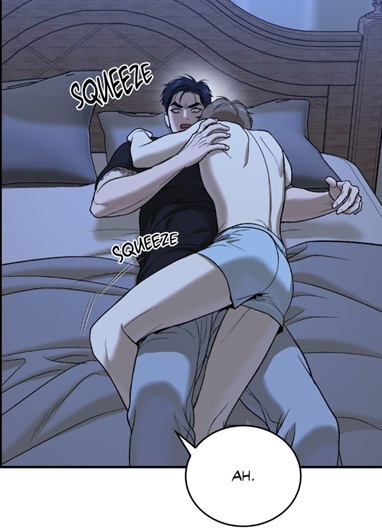 (chapter 66)
  (chapter 79)
 (chapter 79) To restore it, he will have to speak, to act, and ultimately, to smile again.
 (chapter 79), it is a confession disguised as complaint. For the first time, he voiced his dependency and vulnerability more clearly, as his body language is no longer expressing hesitation and shyness. Imagine that so far, he had lived following the principle of “self-reliance”. Yet when Dan asks, “What?” the champion retreats:
  (chapter 79) and fall
  (chapter 54) still equates vulnerability with humiliation.
 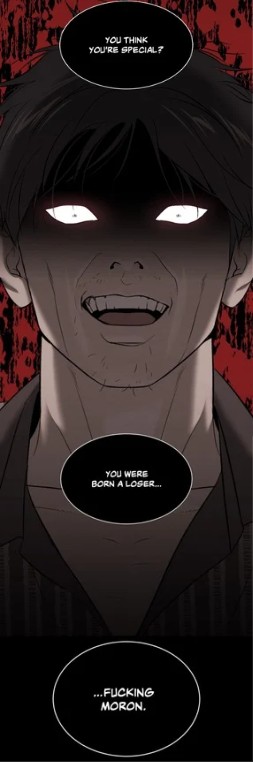 (chapter 73) In the past, every sign of weakness was punished or laughed at; even longing arrived through ridicule. Hence the “grinning” Dan of his nightmare
 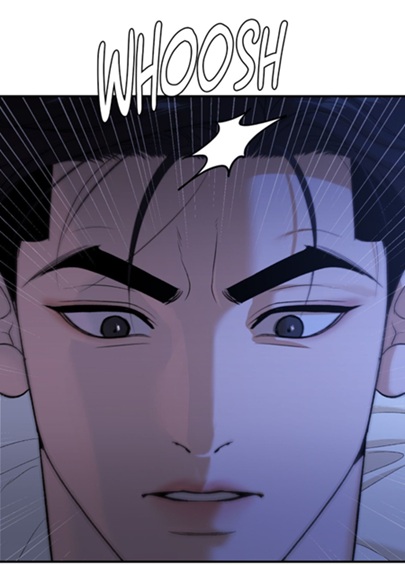 (chapter 79) The vision forces him to confront the origin of his shame. He realizes, instinctively, that the real Kim Dan would never smile at his pain — and through that recognition, he begins to separate present from past. He has already experienced a silent, but warm gaze
 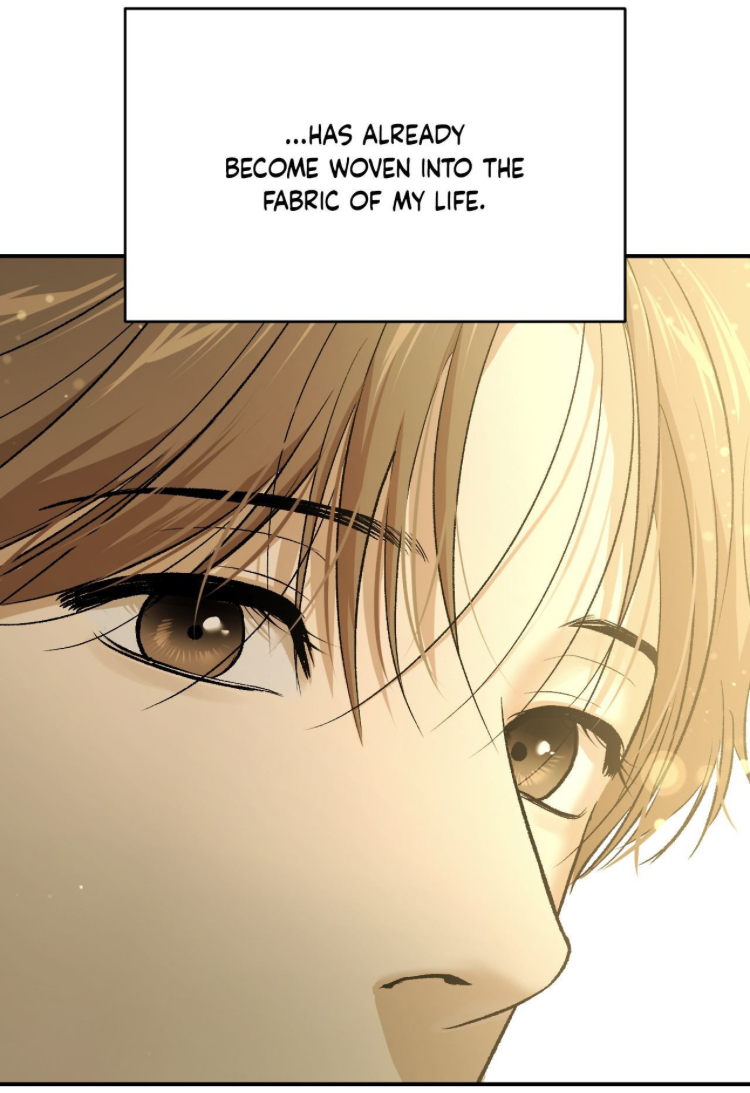 (chapter 77) from his fated partner after admitting his defeat:
 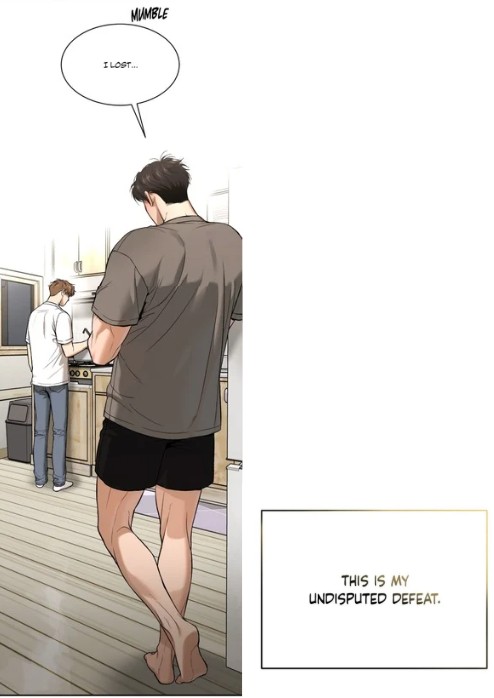 (chapter 76)
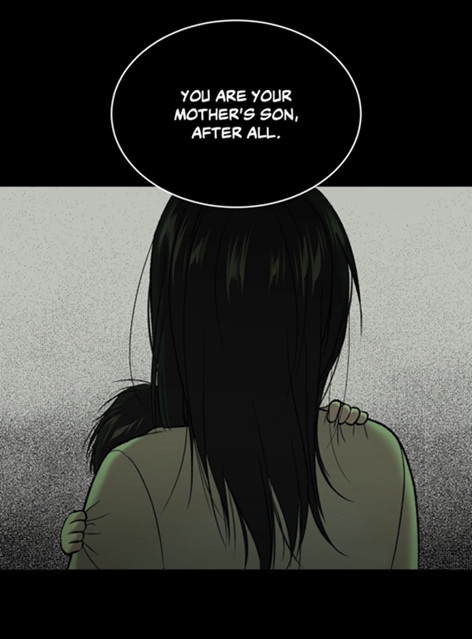 (chapter 73) but by a new, fragile dread: the possibility of losing the one person who would never say it. What vanishes in episode 79 is not his strength, but the belief that to need someone is to be weak.
 (chapter 78) He has long recognized his wrongdoings — the pressure, the harshness, the selfishness
  (chapter 76) — but guilt without self-forgiveness remains sterile. What is the point of apologizing to someone when you cannot forgive yourself? His silence, then, is not arrogance but self-condemnation. Beneath his strength lies a man who believes that no apology can redeem him, because no one ever offered him one first. His father’s mockery, his coach’s reproaches
  (chapter 74) and expectations, his mother’s betrayal
  (chapter 74), his manager’s slap at the hospital
 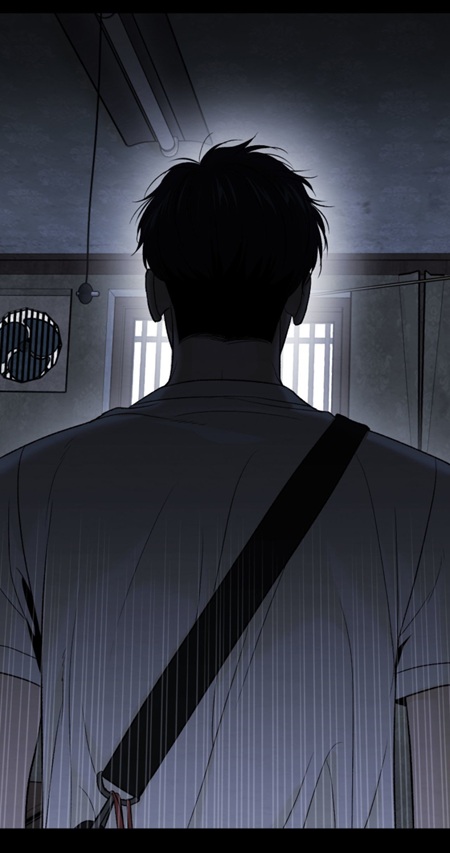 (chapter 73) Every punch was an act of self-erasure, every victory a brief anesthesia against the echo of his own self-loathing and regrets. He mistook exhaustion for atonement. But when Kim Dan whispers
  (chapter 79) His vision of Kim Dan’s false grin is not a taunt from the other
 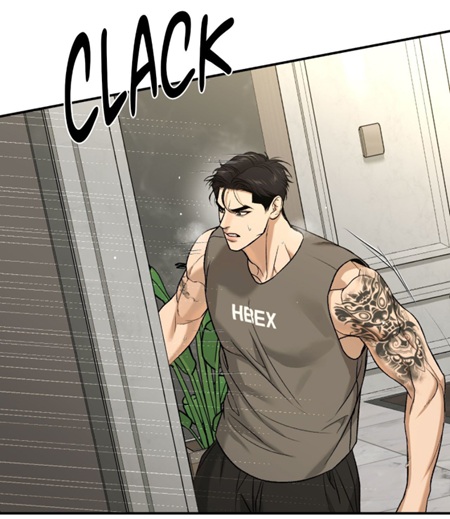 (chapter 79)— the breakfast scene
 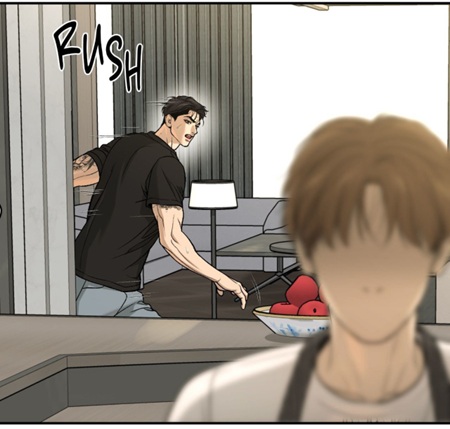 (chapter 79) , the casual
  (chapter 79), it is as if he is saving not only his partner but the part of himself that used to give up. He was living like a ghost denying his own emotions.
  (chapter 78) That word revealed his blindness — the refusal to acknowledge pain that does not announce itself through wounds. The new incident at the railing shatters that illusion. It was never an accident, but the expression of mental illness
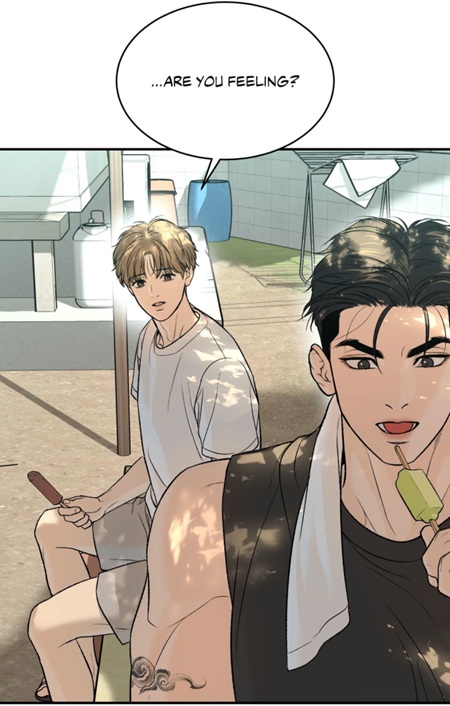 (chapter 77)
 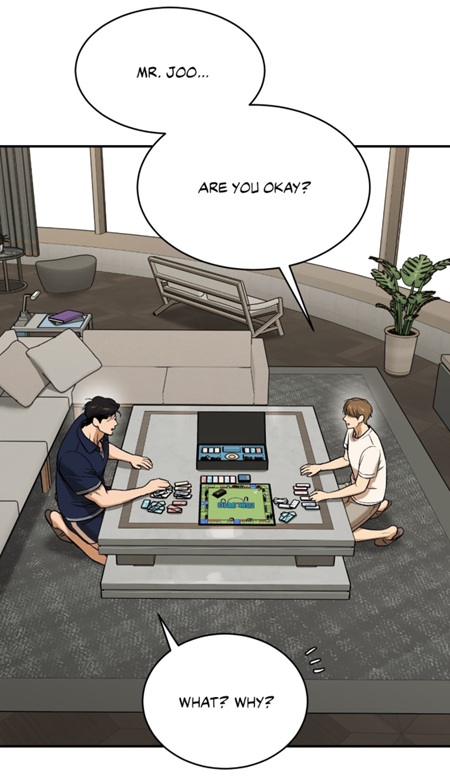 (chapter 80) Each time, the physical therapist shows concerns for the athlete’s well-being. He perceives this change of behavior as the expression of unwell-being.
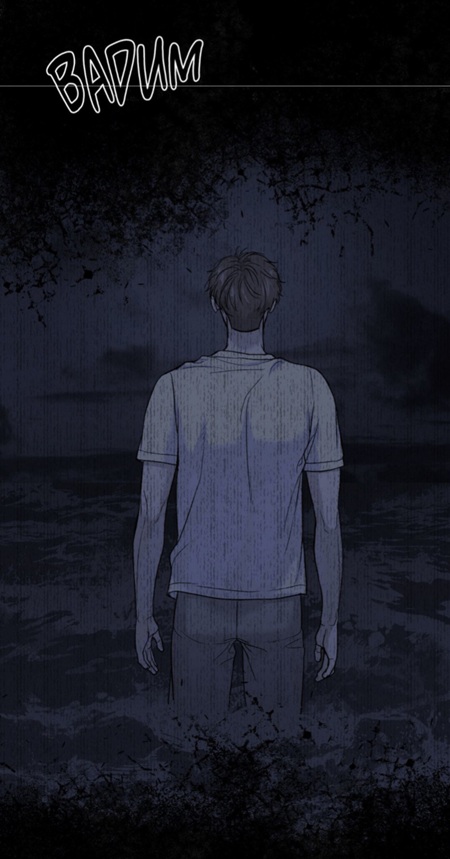 (chapter 69), and the balcony
  (chapter 37) Behind the champion, the Golden Gate Bridge stands as a silent witness — a place where many have ended their lives by leaping into the void between air and water. The bridge fuses both symbols: it is where drowning and falling meet. Moreover, the bridge embodies the connection of two worlds. This backdrop, unnoticed by the protagonists themselves, prefigures the later arcs. Joo Jaekyung is the one standing between the bridge and the physical therapist. It was, as if the author was already announcing the huge depression doc Dan would face in the future. At the same time, I came to wonder if the unconscious suicidal attempts from Doc Dan were actually revealing the biggest secret in his life: the suicide of his parents and their death could be linked to a bridge. Striking is that while the members of Team Black were partying
 (chapter 73) before he discovered Joo Jaewoong’s corpse. The bridge thus becomes a metaphor for invisible grief: joy and pain occurring simultaneously, one masking the other. And keep in mind that according to my theory, the picture of Dan with his grandmother is hiding a tragedy. This would explain why doc Dan is so obsessed with this picture:
 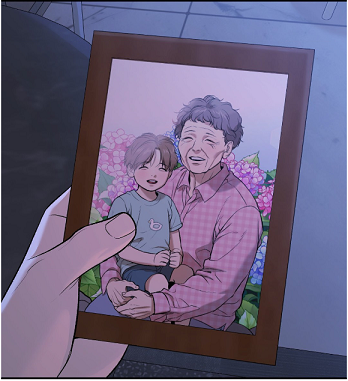 (chapter 47) The smiles here are hiding the past reality.
  (chapter 79) — so unlike his real, exhausted self — is a vision of peace, of love unburdened by fear, while this grin exposes the truth. The dream, the realm of clouds, becomes a stage where the wolf shows and learns tenderness. The dream’s fear and indirect self-reproach
  (chapter 41) In other words, the dream is giving him clues as well how to behave: not only greeting, but also talking. What caught my attention is that during their two last breakfasts together
 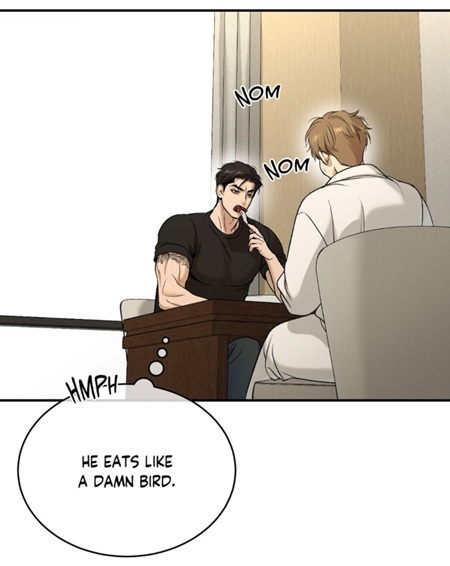 (chapter 68), they didn’t talk at all
 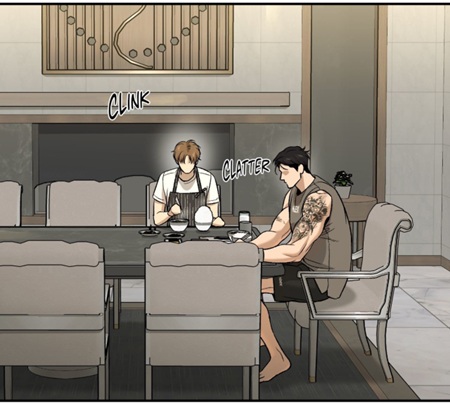 (chapter 79) which contrasts to the star’s vision.
  (chapter 79) He does not kneel; he sits, his body settling softly against the floor as he catches Dan in his arms. The man once associated with dominance becomes a cushion, a pillow, a living anchor. His strength, once used to impose weight, now exists to absorb it. The fall is not toward repentance through pain, but toward tenderness through stillness.
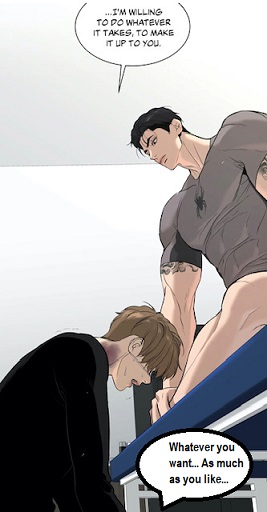 (chapter 11) now becomes the one who receives the collapse.
 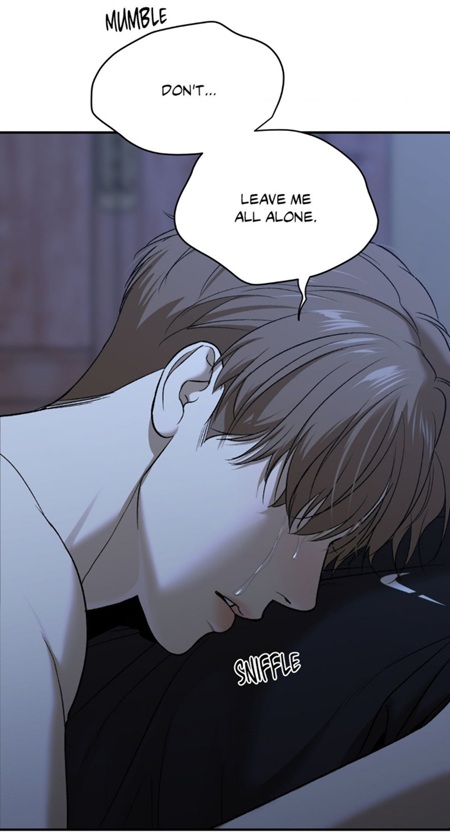 (chapter 66)
  (chapter 66) trembles out against Jaekyung’s chest; his
 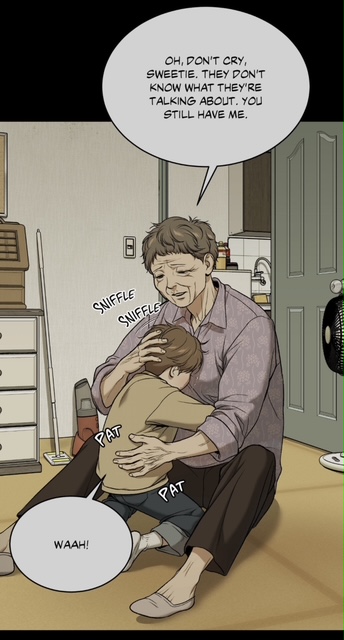 (chapter 57), he could only confide while being physically comforted. The grandmother’s embrace in chapter 57 becomes the prototype of this pattern — the last instance of safety tied to voice. Yet, crucially, that embrace was conditional and silencing. She soothed him but redirected his pain:
  (chapter 80) The moment the star was holding doc Dan’s hands, the latter started voicing more his emotions (fears, displeasure).
  (chapter 80) When Jaekyung takes his hands in the swimming pool, the gesture revives this primal language of reassurance. For the first time, the touch is neither coercive nor desperate; it’s sustaining. The handhold reverses the earlier dynamic — instead of silencing him, it gives him permission to speak. Furthermore, the champion is pointing out that he can rely on two things, the champion’s hands and the kickboard belt. This stands in opposition to the fake promise of Shin Okja.
  (chapter 57) In other words, he is inciting the doctor to trust himself more and become independent.
  (chapter 80)
 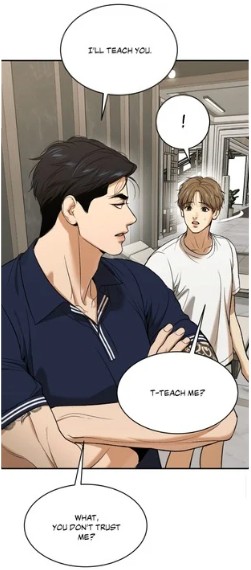 (chapter 80) His comfort does not deny danger — he acknowledges the possibility of falling into the water — but he links survival to skill, not assistance and dependency. His statement affirms Dan’s agency: he can save himself. Once he can swim, he is strong enough. Where the grandmother sought to replace the absent parents
 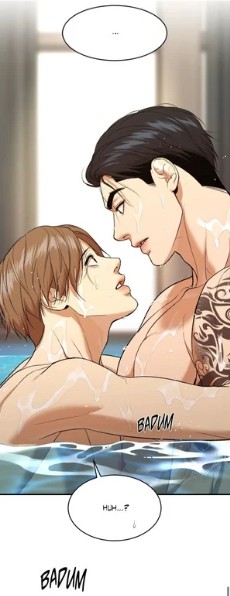 (chapter 80) in the swimming pool carries transformative potential. It is not merely a gesture of survival, but an initiation into honesty. Surrounded by water, both men are stripped of pretense. And observe that Joo Jaekyung is not rejecting the physical embrace
  (chapter 80) contrary to the past.
  (chapter 28)
  (chapter 69) The wolf, who once relied on dominance and silence, is now allowing his fated partner to hug him.
  (chapter 21) From childhood onward, being held becomes the only assurance that the world still contains care. When he woke crying and was taken into his grandmother’s arms (chapter 21), the patting gesture did not merely quiet his fear; it taught him that consolation requires contact. Yet this early lesson carried a hidden cost: it trained him to associate peace with submission and silence, and affection with dependency. Therefore the swimming lesson contains another important life lesson: it is about choice! Joo Jaekyung wants to be “chosen” by the physical therapist, hence he wants to conquer his heart.
  (chapter 80) That’s the reason why he can not change doc Dan’s heart and mind with the new clothes. For that, he needs to reveal his “weakness” to the physical therapist.
 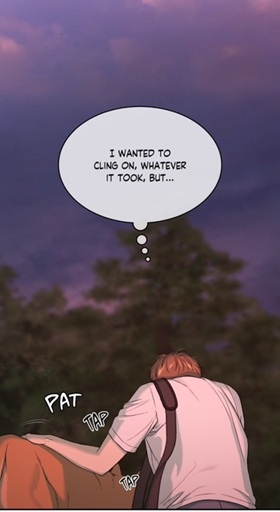 (chapter 59) His hand resting on Boksoon’s fur repeats the same motion — the pat once given to him, now returned to another being in pain. What he offers the animal is precisely what he has always longed for: warmth without judgment, touch without condition.
 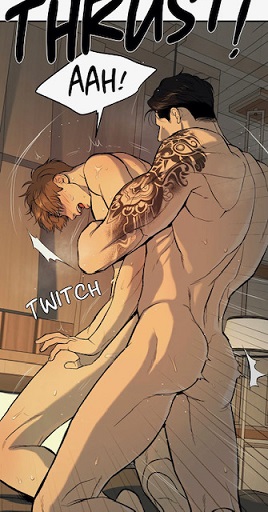 (chapter 4), not intention: a reflex of possession, not communication. As time passed on, it changed, yet in the bathtub (chapter 68), Dan fell asleep against him so that he could never experience the athlete’s care
  (chapter 68); in the morning, Jaekyung acted as though nothing had happened. Then on the dock, Joo Jaekyung expressed his relief
 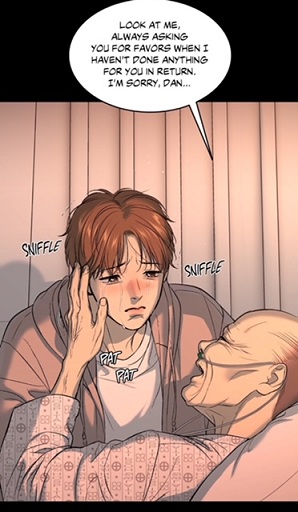 (chapter 53), she frames her guilt in terms of debt, not grief. What she cannot say is: “I’m sorry your parents are gone, and I buried the truth.” Her compassion never touches the core wound. Instead, she redirects her remorse into pity
 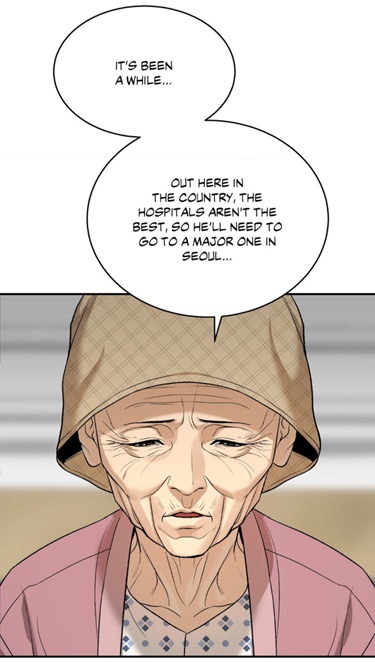 (chapter 65)
  (chapter 57). Everything evolved around his lack of sleep and his dependency on her.
 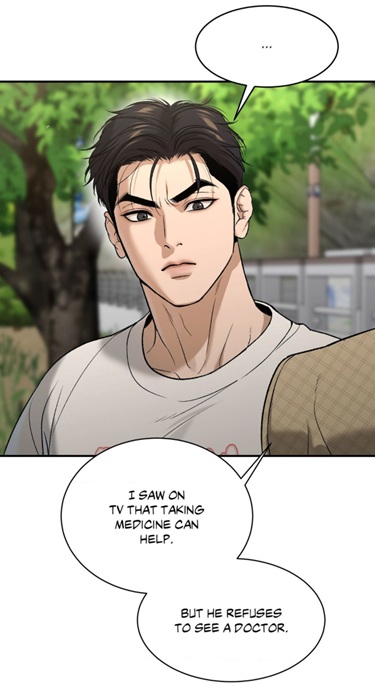 (chapter 65) However, in episode 79, for the first time, the champion notices it.
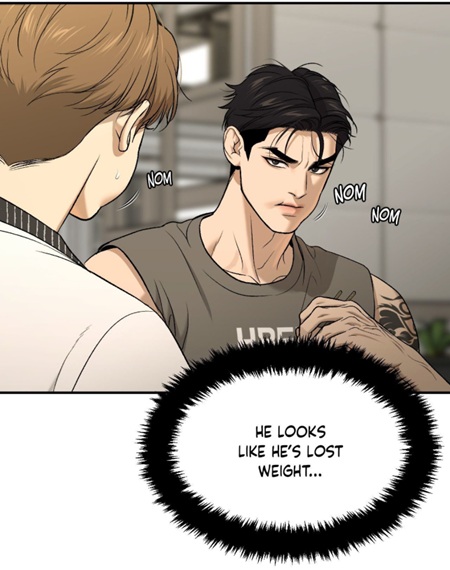 (chapter 79) It is important because very early on, the doctor Cheolmin had already detected his malnutrition:
  (chapter 13) In other words, the physical therapist’s depression and eating disorder were already existent before meeting the “wolf”. And what did the mysterious friend tell to the “wolf”? He shouldn’t wait out of fear that he might regret it later!
 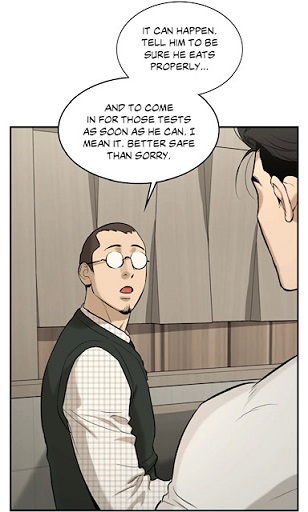 (chapter 13) As you can see, “sorry” is the link between the two doctors and the celebrity.
  His metamorphosis will be complete with the birth of the kind and sweet Joo Jaekyung!
  (chapter 21) Imagine that I had written this part before the release of episode 80!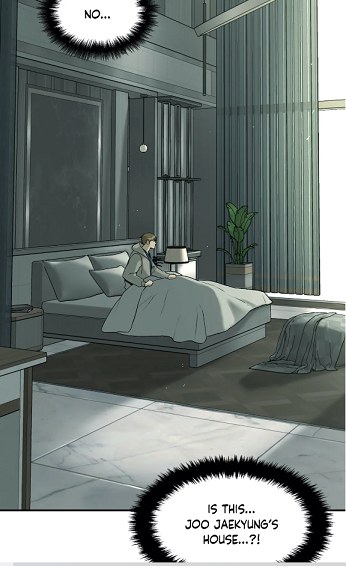
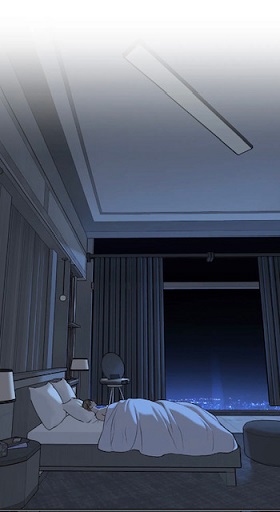 (chapter 29)
  (chapter 79) Because the champion had come to the conclusion that his own bedchamber was linked to sex
 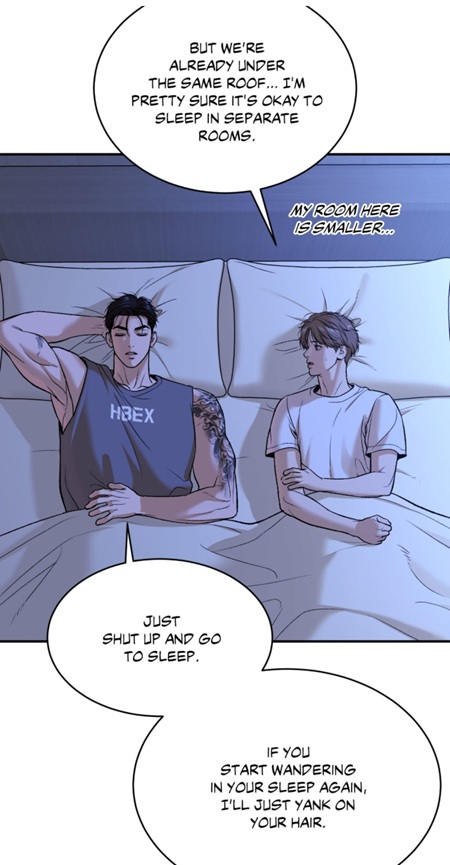 (chapter 78) And though he had another “accident”, the former is never bringing it up to doc Dan. There’s no blame or accusation. The athlete is keeping these accidents as secrets. However, pay attention that he is making sure that doc Dan is resting.
  (chapter 80) Notice that he joined him later, acting as if they had not shared the same bed. Gradually, the champion is giving back doc Dan’s freedom and privacy. He is guiding him to take care better of himself by using his own words.
 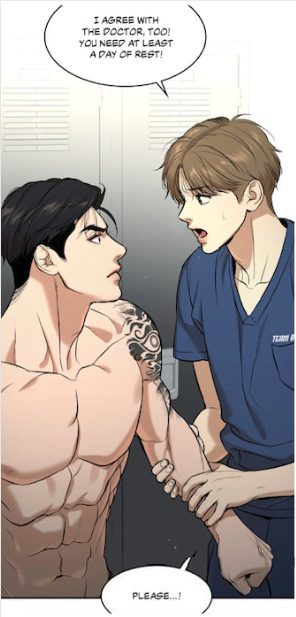 (chapter 27) Striking is that the champion always chose the left side of the bed
  (chapter 80) The star was sitting on the right side of the bed while watching his sleeping partner. Why? It is because he can see his face. But by lying on the left side, doc Dan came to turn his back to him.
  (chapter 79) Because of the champion’s cold gaze, doc Dan felt rejected and even hated.
  (chapter 79) He had the impression that he wouldn’t meet his “expectations”. Observe the parallels between the champion’s dream
 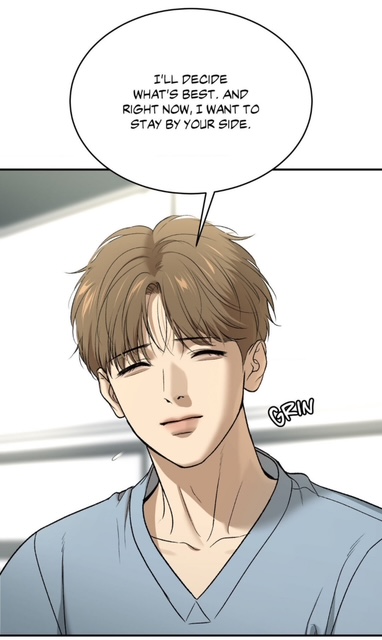 (chapter 57) We have the doctor’s fake smile which is strongly linked to rejection
  (chapter 57) and expectations. And what is the other common denominator? His self-loathing and immense guilt. He has the feeling that he is not lovable. In my opinion, doc Dan is suffering because no one is listening to him at all. So far, they all projected their own thoughts onto him. The reality is that doc Dan already had a hard time before moving to the seaside town,
  (chapter 11) yet she failed to notice it or refused to face his struggles, as they were related to their poverty.
  (chapter 5), he lost his voice and became a ghost. It is no coincidence that in this scene, doc Dan was silent despite the caress. He was avoiding any topic that could trouble his grandmother. He accepted to remain a little boy in her eyes. But thanks to the wolf, doc Dan is learning to become strong and independent so that he can decide about his life. The swimming lesson is pushing him to overcome his abandonment issues.
 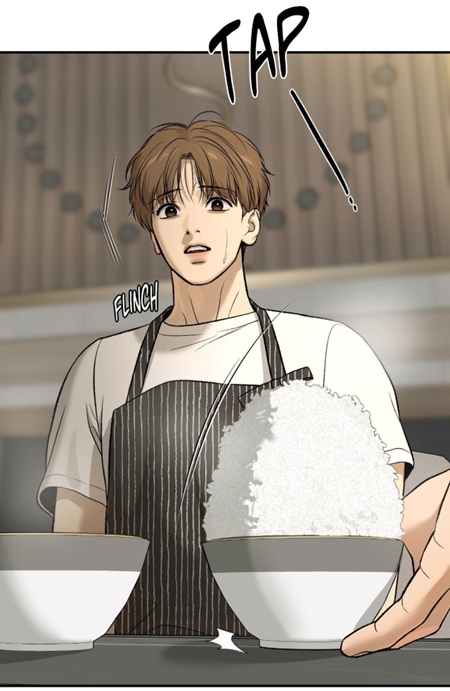 (chapter 79), not communion; his affection, an extension of performance
  (chapter 79). Yet as the doctor grows thinner and more exhausted, the wolf begins to understand what “starvation” truly means.
  (chapter 79)
 (chapter 75) – similar to doc Dan’s reaction in the States:
  (chapter 53)
  (chapter 75) His eyes open after the dream, and they open to the same light. It’s the opposite of every earlier awakening
  (chapter 54) —no gasp for air, no clutching his throat
  (chapter 75), no father’s voice strangling him. This sudden awakening embodies enlightenment.
  (chapter 75)
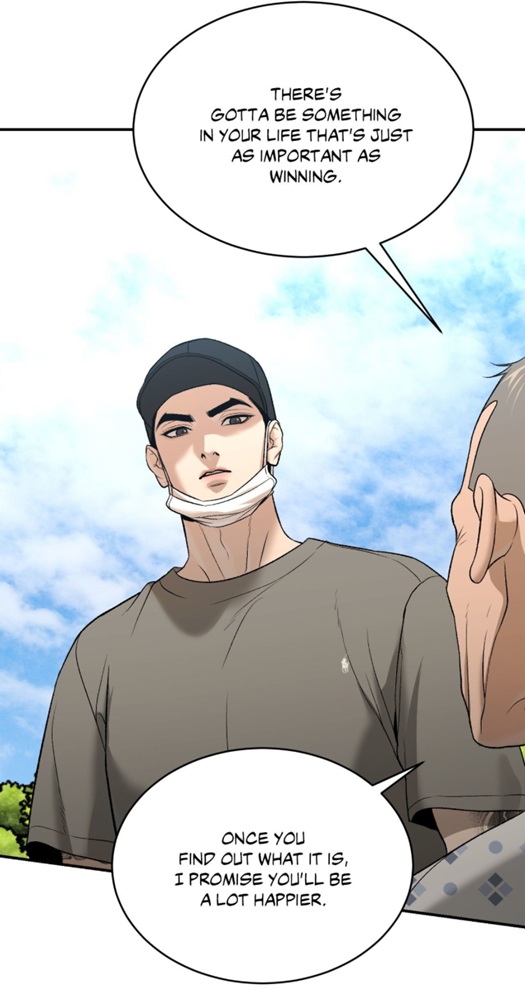 (chapter 75) On the surface, it sounds like a call for balance. In truth, it is a suggestion to find another meaning for his life. And look at the director’s facial expression, when he is talking to his former student: “
 (chapter 75) He is smiling, a sign that the director is enjoying this moment with the “wolf”. He becomes the first person to speak to Jaekyung not about titles, not about survival, but about happiness.
 (chapter 70) He knows the athlete from the past. The latter was attached to people and not to places. Why does he speak of “something” rather than “someone”, if he knows? The lesson is not about fixing a new goal or object to chase, but about discovering how to live differently — how to live happily.
 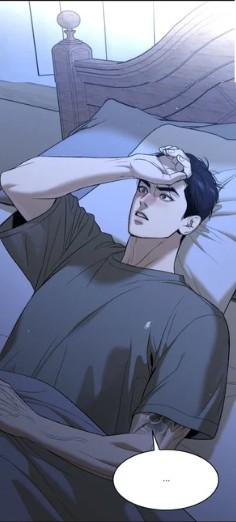 (chapter 75). Even before, he could only mutter to himself this:
 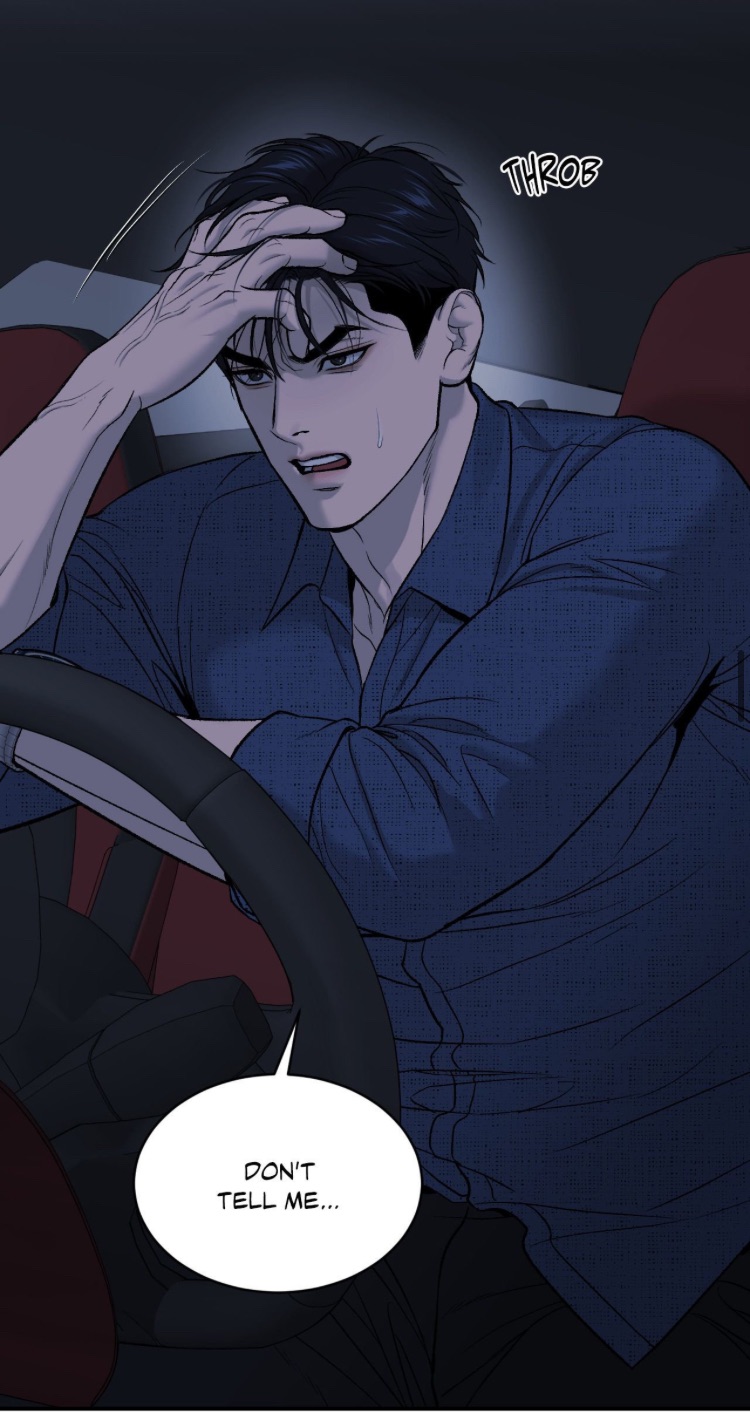 (chapter 70) The negation indicates denial, but observe that he couldn’t even use a noun. He cannot yet translate this vision into words, because he has never heard “I love you” himself
  (chapter 74) No one ever taught him how to say I love you. And so, when Dan appears in his dream, it is not the words that free him but the gaze.
  (chapter 75) or the mother’s withdrawal.
  (chapter 75) The openness is what makes it love — it is respect.
 (chapter 75) His love is expressed through humility — through not knowing. At the same time, his words and facial expression ooze trust and confidence.
 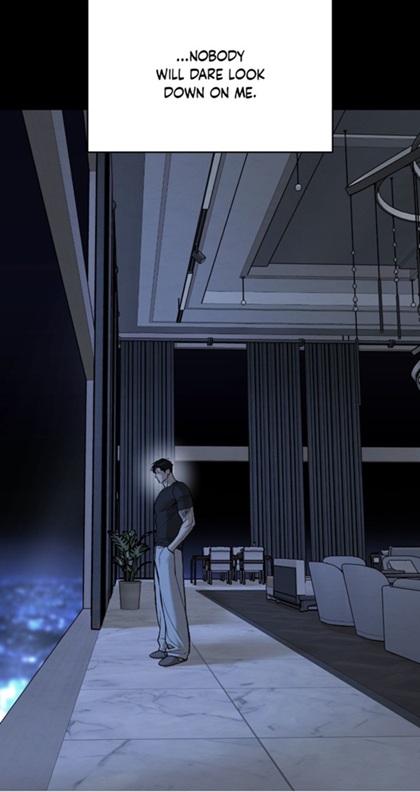 (chapter 75) Each title, each belt, each triumph was a rebuttal to his father’s words. He was not worthless, not doomed. Yet the irony is cruel: in fighting to silence those curses
  (chapter 75), he bound himself ever more tightly to them. Winning never brought peace; it only bought him momentary quiet from the voices in his head. This confession from the main lead confirmed my previous interpretations. First, the main lead had been constantly hearing voices in his head. Secondly, the hamster embodies “sound”, but a different kind: true communication linked to honesty and affection. This explicates why after the couch confession
 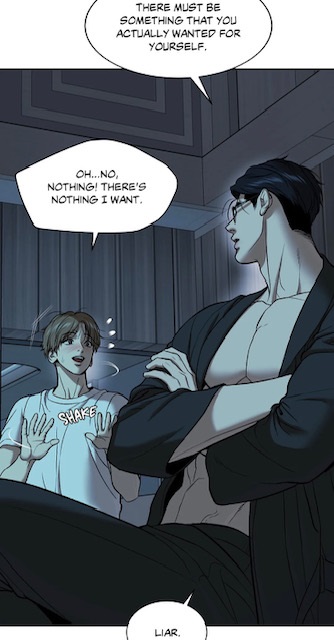 (chapter 29), Joo Jaekyung opened up a little to doc Dan! Thus the next morning, he visited the bathroom where doc Dan was!
 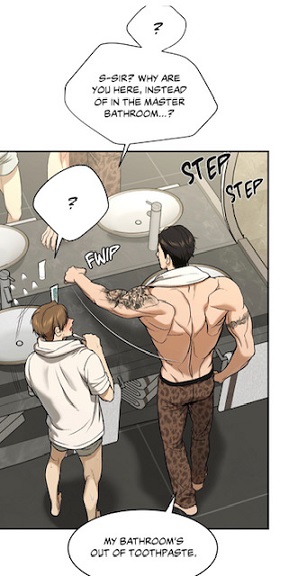 (chapter 30) It was just an excuse to spend more time with his fated partner.
  (chapter 74), no “dear,” no “I love you.” In the father’s memory, she used the child as an excuse to distance herself from her spouse. In that moment, Jaekyung is not a son to be cherished but a barrier in an adult quarrel.
 (chapter 75) carry the same cold logic. On the surface, they sound like recognition, even encouragement. But their true meaning is dismissal: you no longer need me. For her, love equaled dependency. Once her role as provider was no longer necessary, she withdrew.
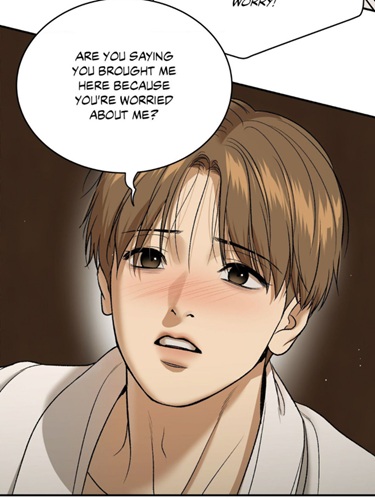 (chapter 67) His question is really an appeal for recognition. If Jaekyung answered yes, Dan could interpret it as proof of love, because in his own distorted framework being worried about equals being cared for. But Jaekyung answered with silence.
 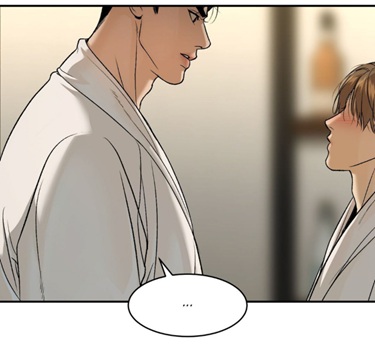 (chapter 67) Not because he felt nothing, but because he lacked the language to connect worry with love. In his conscious mind, conception of care was still bound to usefulness — Dan mattered because he was needed for training, not because he was loved as himself, while deep down, he had already moved beyond this aspect. He was just in denial in this scene,
 (chapter 74) On one level, she does not recognize his voice. But on a deeper level, her words ring as truth: she does not know her son. She has no idea who he has become, what defines him, what characterizes him beyond money and survival.
 (chapter 74), promising to provide for her if she returns home. He unconsciously appeals to the only logic he has ever known: that love equals provision, that affection is secured by usefulness.
  (chapter 73) From him, Jaekyung absorbed the conviction that a man must be the provider, the protector, the one who works and sacrifices while the partner silently follows. This explains why, in his relationship with his mother
  (chapter 72) and Kim Dan, he instinctively assumed he had to “do it all”: earn, fight, shield, control.
  (chapter 42) His father’s voice was violent and scornful, but its framework remained lodged in him.
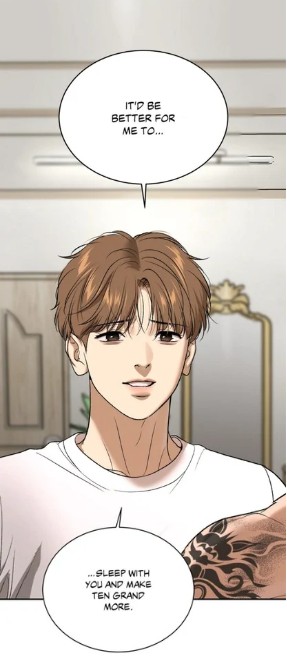 (chapter 62) That way, he can still be “free”.
  (chapter 72) becomes the perfect metaphor for her treatment of him. Once she no longer needed him, he was discarded like refuse. Just as trash cannot be reclaimed by sentimental value, she will not be able to reclaim him later through appeals to blood ties or belated need. It is impossible because he has learned — painfully — that true love is not about what you have, but about who you are.
 (chapter 74) He understood that the words he longed for as a child were never simply withheld — they never existed. Since we saw her back and heard her voice, I don’t think, she truly cut off ties with Joo Jaekyung. Why? It is because she had no intention to change her phone number again.
  (chapter 74) She expected him to follow her request. I can definitely imagine her trying to reconnect with Joo Jaekyung, the moment he became a celebrity.
  (chapter 75) Keep in mind that we have these mysterious phone calls:
  (chapter 37)
 (chapter 43)
  (chapter 49)
 (chapter 75)
  (chapter 75) On the surface, these sound like support. He smiles, his tone is warm, his words echo the vocabulary of friendship. Yet this false promise had lasting consequences: it reinforced a pattern already planted by the champion’s mother. Since childhood, Jaekyung had equated helping with caring
  (chapter 72), because silence at home had taught him that the only way to hold on to love was to provide, protect, and prove his usefulness. Under Namwook, this belief hardened into a rule: in his world, attachment became synonymous with utility.
 (chapter 34), Jaekyung assumed later that the actor would have helped doc Dan to hide.
  (chapter 58) His violent intrusion into the actor’s home was the natural outgrowth of Namwook’s teaching: if love is real, it must show itself as service.
 (chapter 45), Jaekyung struggled to even recognize it. Giving him a gift and expressing gratitude was not “helping the fighter”.
  “ (chapter 75) There’s a life outside the ring and the spotlight.
  (chapter 72) was quite futile, for at the end, he ended up alone and felt lonely.
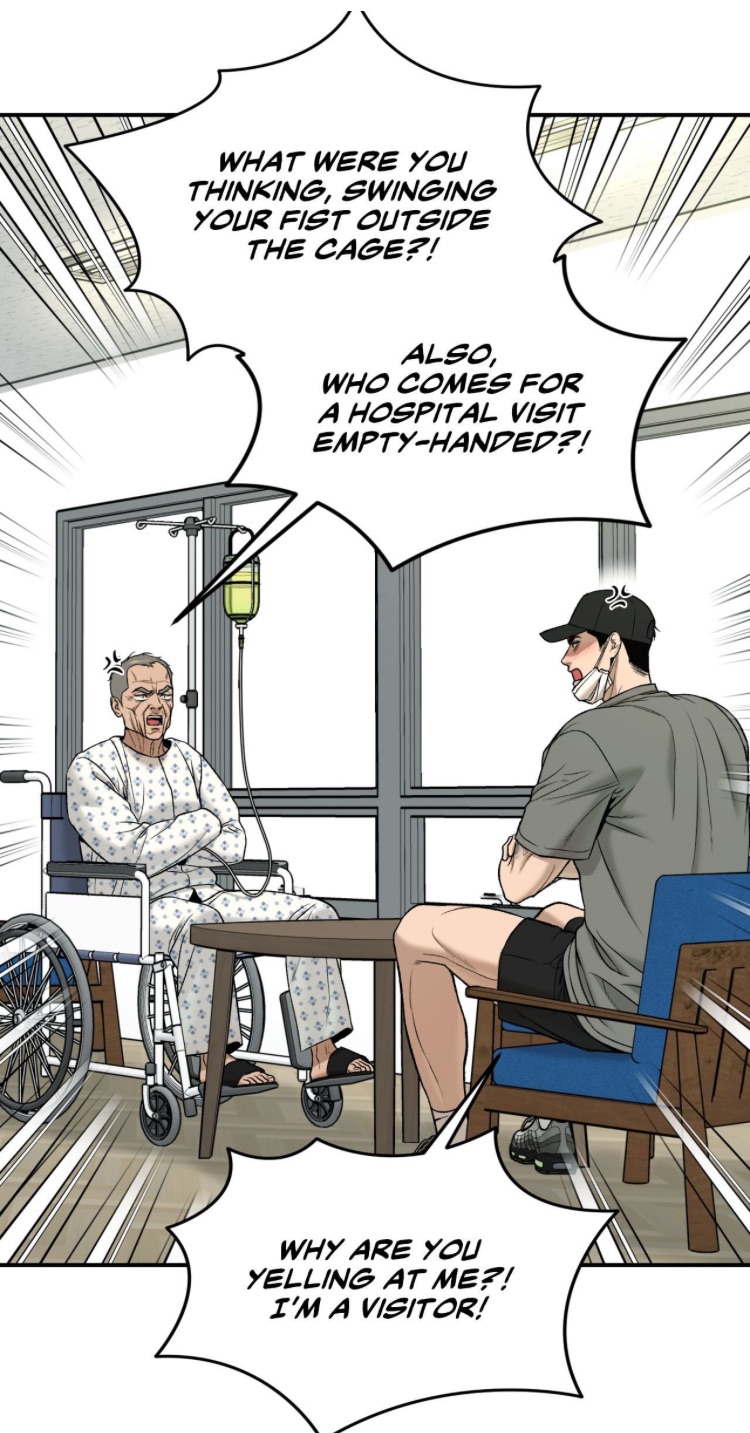 (chapter 71) Yet, deep down, he was happy that Joo Jaekyung had visited him and even spent the whole day with him. Secondly, for him, too, love has always been expressed through responsibility, advice, and correction rather than direct declaration. When he tells Jaekyung to “look around” and “think hard,” or warns Dan to “
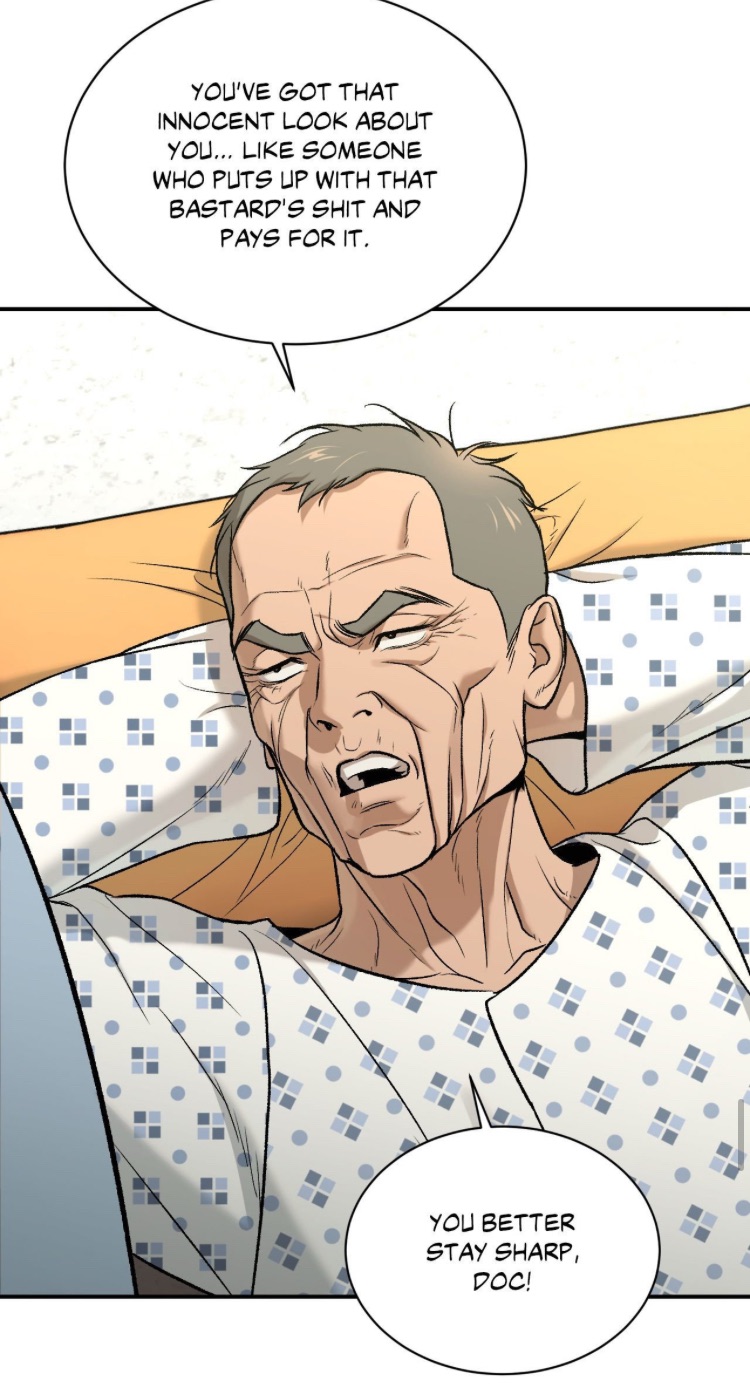 (chapter 70) “stay sharp,” he is not being cold — he is speaking from the only framework of love he knows: respect, knowledge, care, and responsibility, the very dimensions Erich Fromm outlines. He realized too late that he missed Joo Jaekyung very much. His love is embedded in actions and words of guidance, not in sentimental speech. To suddenly say “I love you” would, in his own register, feel shallow and false. He actually embodies the “real parent” IMO, because contrary to all the others adults, he learned from his mistakes. No parent is perfect, but they need to reflect on their words and actions. Learning through experiences is lifelong learning. It stops with death. The director did his best according to the circumstances and tried to correct his wrongdoings. And we can see his influence in the champion’s life. When it comes to doc Dan, he also makes mistakes:
 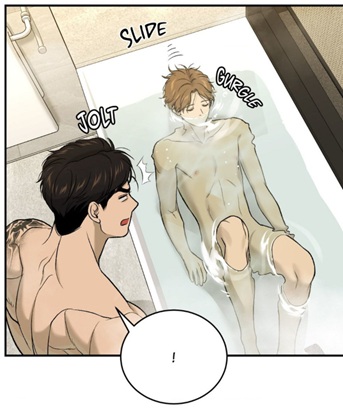 (chapter 68)
 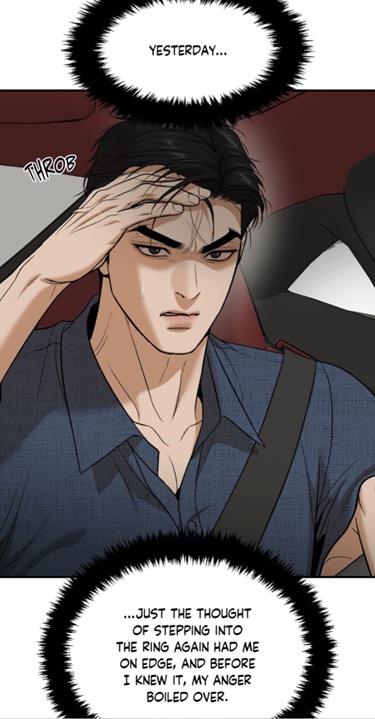 (chapter 69)
  (chapter 69) And that’s what makes him so human.
 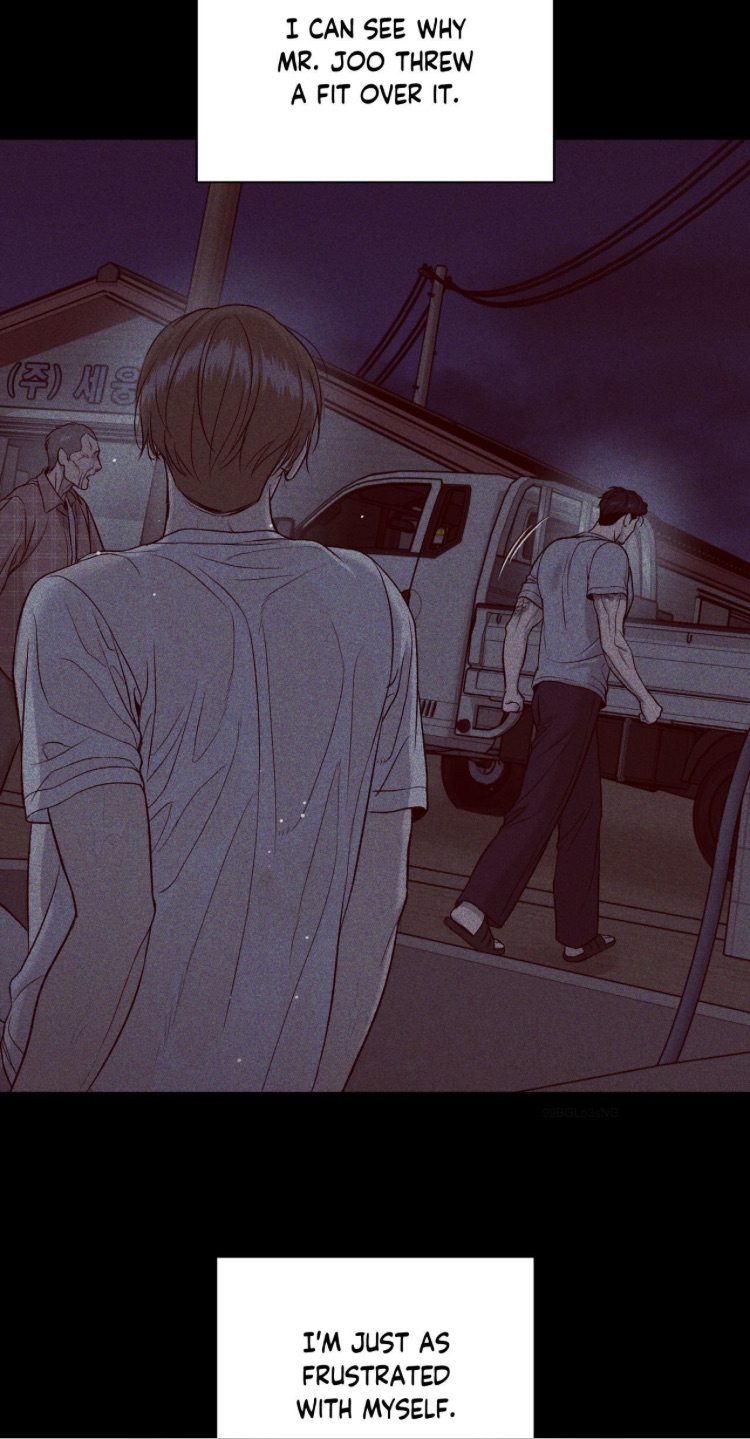 (chapter 71) Hence doc Dan didn’t resent the champion for his harsh treatment. But unlike the mother, who equated love with possession, Hwang Byungchul has begun to correct himself. He respects Jaekyung’s privacy, he encourages instead of dictating, he models a love that is belated but still real. This opens the possibility that Jaekyung, too, may learn to fill his silences differently — not with dominance or provision, but with genuine presence. He truly embodies the philosophy from Erich Fromm: it is never too late to become happy! Hence he smiled on the rooftop!
 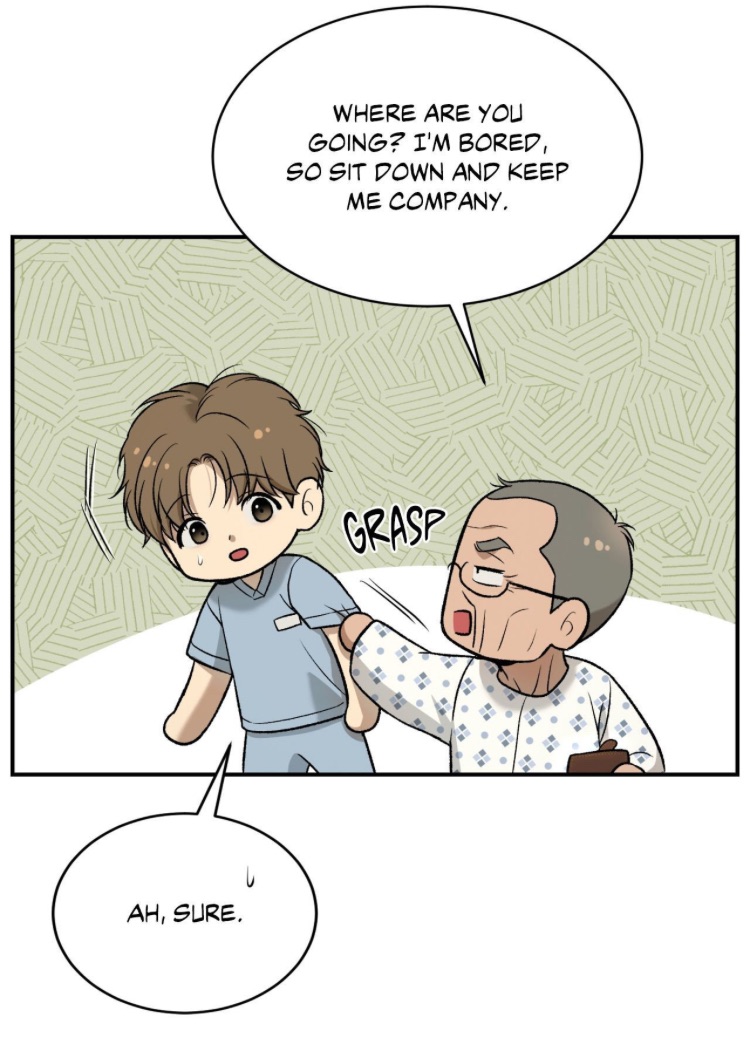 (chapter 71) This means that he lives now in the present. It looks like the “old coot” has been tamed by the “gentle hamster or duck”.
  (chapter 19), and has been unable to say it since.
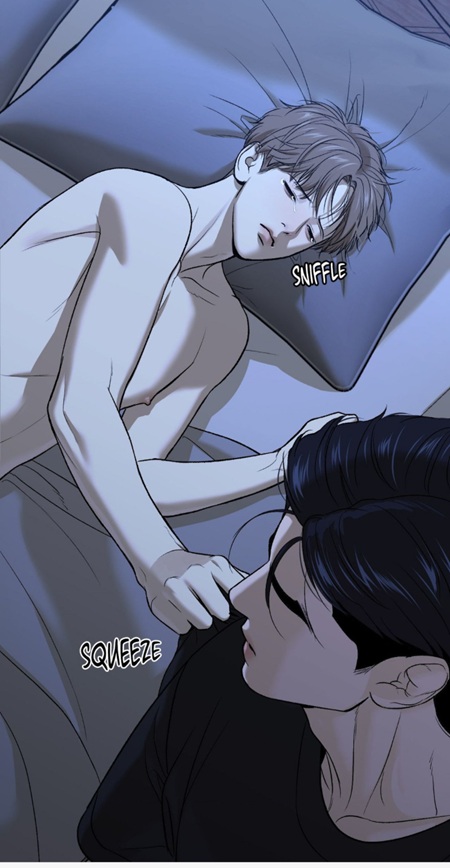 (chapter 66), whispers through tears
 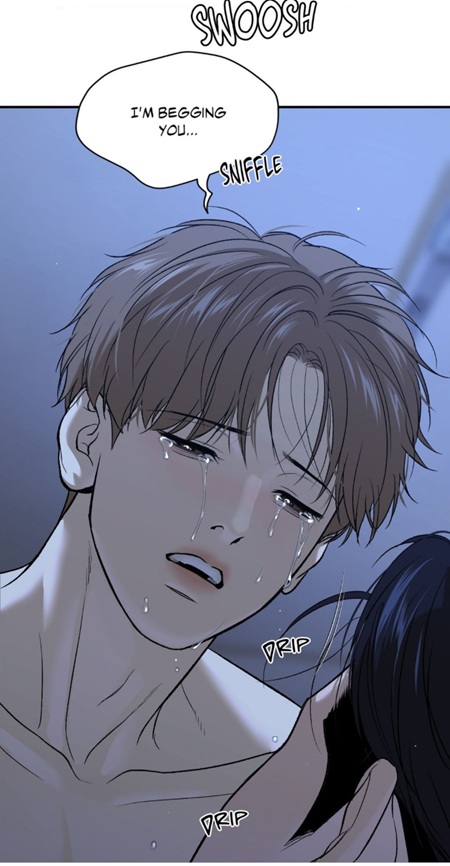 (chapter 66) These are not declarations of love, but desperate substitutes — fragments of the words he could never utter in childhood. They expose the precise gap: he never managed to say back what had once been said to him. He had lost his parents too soon. Instead of “I love you too,” what emerges is fear of abandonment. Instead of reciprocity, there is only pleading. His grip on Jaekyung’s shirt is the physical translation of what he could not verbalize: the child’s attempt to hold onto someone who is already vanishing.
  (chapter 31)— which he associates with unbearable debt. His mother’s final “gift” of love was one he could never repay. Any present risks reopening that wound: “What if I can’t repay this? What if I lose them too?”
 (chapter 74) — the quiet sign that the sun is about to rise. Dawn is not just a natural detail in Jinx; it is a symbolic hinge. It is the moment when night meets day, when moon and sun overlap, when endings bleed into beginnings. In myth and fairy tale, dawn often marks metamorphosis: the Little Mermaid turns to foam, the enchanted sleepers awaken, the beast becomes a prince. For Jaekyung, too, dawn is the threshold. His father cursed him at dawn
  (chapter 73), stripping him of worth, tying the rising sun to shame. But in this new dawn, another voice will have to intervene. Only Dan can replace the curse with a blessing. Only “I love you” can undo “you are not special.” And if it is not “I love You”, then it could be a kiss, the symbol of “affection”.
  (chapter 69) when Park Namwook leaned across the table and whispered to the champion about his slipping rank, his lost title, his third place. The setting is dim, the words hushed, the tone heavy with shadow. That whisper was not meant to soothe — it was meant to undermine. Namwook’s closeness is false intimacy: a confidentiality designed to manipulate, to remind Jaekyung of his dependence, to keep him chained to the cycle of fighting. The whisper here is the voice of fear, lack, and scarcity.
 (chapter 75) He was always there — arranging his matches, covering his problems, whispering about his “future.” Yet the quality of his presence was hollow. He never once guided Jaekyung beyond his father’s curse, never helped him imagine a life beyond titles. Thus he never discovered that the “monster” was suffering from insomnia.
  (chapter 75) His companionship was measured in duration, not depth.
 (chapter 41), an invitation to walk together. Namwook’s long presence embodies the trap of quantity without substance. Dan’s brief but luminous presence reveals the power of quality: the kind of attention that transforms.
 (chapter 29) Under the curse, his whole life has been a frantic race: prove himself, fight again, silence the noise in his head.
  (chapter 75) Namwook’s whispers, too, keep him chained to that rhythm of urgency — rankings, titles, deadlines. But once Dan’s whisper replaces Namwook’s, time itself shifts. The future is no longer a debt to repay but a horizon to approach slowly, hand in hand.
 (chapter 27), joked
  (chapter 27), even rediscovered his love for swimming. Water, his true element, was reclaimed as play rather than punishment.
  (chapter 27) That single day was a seed — a foreshadowing of what life might look like once the curse is broken for good.

 (chapter 16) —haltingly and with a trace of disbelief visible thanks to the points of suspension —as his first kiss ever. His stunned reaction and eventual admission offer a compelling lens through which to explore the symbolism of kissing in Jinx, but also the emotional landscape the two men must navigate.
  (chapter 55) Still, some readers have theorized the existence of a “special lover” in his past
  (chapter 2), someone who might have earned a different kind of intimacy. One cause for this hypothesis is that in the champion’s first memory, he was facing his partner, which contrasts so much to the way he had sex with his partners (from behind). This possibility casts the locker room kiss in a new light.
  (chapter 14) If it was his first, the gesture carries a far deeper meaning than either man realizes in the moment. And if it wasn’t, then why does this kiss—with Kim Dan—resonate so differently?
 (chapter 30) Recognizing his face, Dan mentions that his grandmother used to watch the drama A Fine Line, and that he had seen it with her.
  (chapter 30) The author even includes a framed shot from the fictional show, depicting Heesung as the smiling son-in-law in a multigenerational family. This visual insert is subtle, but telling: it wasn’t the story that stayed with Dan, but the faces—the aesthetics of family structure and polite emotional decorum.
 (chapter 16) it frightened him. The kiss broke an invisible boundary—one his upbringing had silently enforced. That’s the reason why he wasn’t sure if he could do it again.
 (chapter 30) He blushes and wonders why.
  (chapter 30) It’s a telling moment: Dan isn’t used to feeling attraction and desire, let alone recognizing it. He never bought posters of celebrities, never fantasized. That world—the glamorous world of affection, attention, and beauty—was never his.
  (chapter 30) —despite already having been seen naked by Jaekyung
  (chapter 30) —suggests something deeper than modesty. When he rushes to hide his underwear and blushes merely at brushing his teeth next to someone
 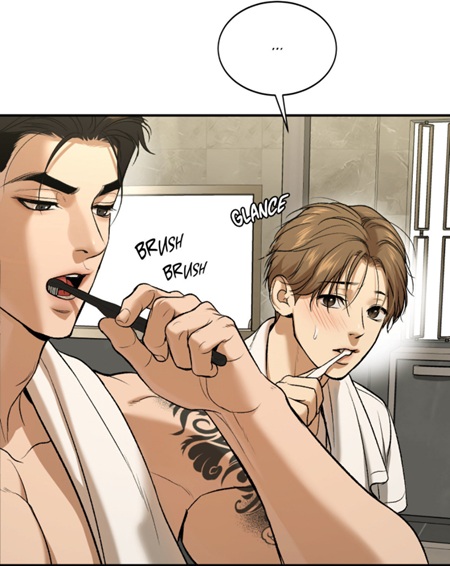 (chapter 30), it becomes evident: Dan is not accustomed to physical closeness or shared domestic spaces. These are not reactions of a man with just sexual trauma—they point to someone raised without the warmth of daily intimacy.
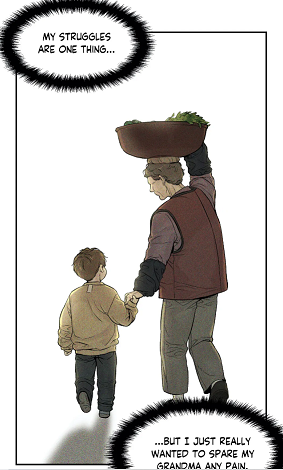 (chapter 5) He had to take care of himself, dressed on his own. He had to act like an adult, as his role was to assist his grandmother:
  (chapter 44) is a behavior shared by felines and wolves alike: a subtle act of comfort, trust, and bonding. Wolves nuzzle to soothe and reassure. Leopards nudge to display affection without threatening dominance. Dan’s pecks
  (chapter 57) (chapter 57)—licking them not out of instinct alone, but to reassure and bond.
 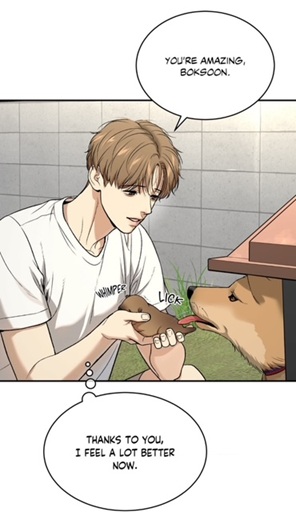 (chapter 57) During that summer night’s dream, Dan’s body mirrored this wordless care. That’s why he could laugh so genuinely like a child after witnessing his “pet’s reaction”.
  (chapter 14) Therefore the physical therapist astonishment, “What’s this?” was not naïve; it was disoriented. Somewhere deep within, Dan had internalized a different model of kissing: one that reflected comfort, not conquest; affection, not arousal. The kiss he received was too strange, too fierce—it violated a definition he didn’t even know he had. His body knew how to kiss, but it remembered a different type of kiss altogether. The latter stands for love and as such emotions. Under this new light, my avid readers can comprehend why the physical therapist made the following request from his fated partner:
 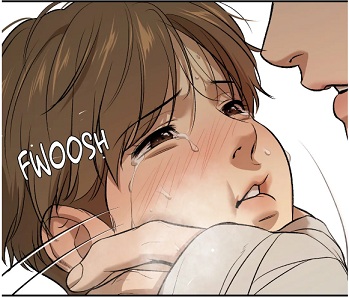 (chapter 14) Jaekyung repeated such a gesture, as seen in chapters 24
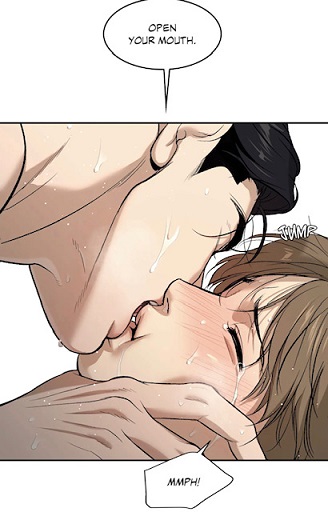 (chapter 24), and again in 64
  (chapter 64). These gestures were not expressions of tenderness, but acts of dominance, mirroring how the celebrity was taught to treat intimacy: not as an exchange, but as an imposition. His behavior echoes Cheolmin’s earlier suggestion
  (chapter 13) where a little touch was functional. On the other hand, the suggestion framed “affection” as a form of fun and entertainment, meant to soften the experience and shift the focus toward the partner. While Cheolmin’s comment was not malicious—in fact, it encouraged Jaekyung to become gentler and more attentive—it still fell short of true emotional connection. Why? It was a medical suggestion, meant to protect Dan’s fragile state. The kisses in episodes 14 were to protect the physical therapist. They were initially functional, a mean to achieve a goal before becoming a habit.
 (chapter 63) Fun is not the same as love, and this distinction matters deeply for someone like Kim Dan, who associates kissing with emotional safety and love, not performance or play. This explicates why he refused to be kissed in episode 63:
  (chapter 63)
  (chapter 3) —it forces the wolf to ponder on the meaning of a kiss and his relationship with the physical therapist.
 In that iconic artwork, the man does not kiss the woman on the mouth, the traditional locus of erotic desire. Instead, his lips are placed upon her cheek—a gesture that suggests reverence, not possession; vulnerability, not domination.
 (chapter 44)
  (chapter 45)
 (chapter 54) When he was young, he had to face an abuser. Notice that the man’s face was very close to the champion’s
  (chapter 44) He couldn’t hide his joy by the champion’s funny reaction and laughed. And how did the protagonist react to this? Not only his face expressed his dissatisfaction, but also he silenced his partner with a kiss right away:
  (chapter 44) Joo Jaekyung is leading the kiss, he is regaining control over their relationship. It reinforces the idea that the wolf’s kiss was not merely about passion, but about reclaiming dominance and halting a shift in power. Just moments earlier, Kim Dan’s laughter had opened a space of emotional intimacy and lightness, which the champion was not prepared to face. The kiss, now prolonged and intensified, becomes the sportsman’s way of reasserting control over a situation that was slipping into unfamiliar emotional territory.
 (chapter 45) —and that he, in turn, had wanted Dan back. This terrified him more than any bruise ever could.
 (chapter 37), and kissing becomes his emotional brake pedal. It’s not simply an act of love, but a means to regulate, or even drown out, what he cannot yet name or accept: that he is being loved. It is not random that I included the scene from episode 37: he heard laughs from the other room. For him, such a noise must have sounded like a disrespect and mockery, triggering his past trauma. And he was not entirely wrong in the sense that they were eating behind his back
  (chapter 37) It was, as if they were mocking him because of his forced “diet”. No wonder why the champion is barely seen laughing and prefers seriousness. At the same time, I can grasp why the athlete feels close to Park Namwook, as the latter stands for these exact notions: work, money and seriousness. Fun is not part of his world and vocabulary, therefore he punished Joo Jaekyung for sparring with doc Dan.
 (chapter 2) Though his face was close to the star’s, he didn’t attempt to kiss him. In fact, he proposed him a fellatio, a sign that the champion had never allowed anyone to get close to his “face”. Finally, observe how he reacted, when the uke in episode 55 attempted to kiss him:
  (chapter 55) The celebrity even ran away: a sign that the allowing someone approaching his face is perceived as something uncomfortable and threatening. At the same time, that moment exposes the kiss as something sacred—one that cannot be duplicated without emotional violation. This shows that for the champion, the meaning of a smooch has evolved. It is no longer perceived as a source of fun and a mean to gain something.
 (chapter 55) He couldn’t forget doc Dan’s face, the latter excited him, a sign that for the champion, the face in general has been a source of pain, yet thanks to doc Dan, the latter has become a source of “comfort and joy”.
  (chapter 66) When he saw his face for the first time, he didn’t realize that he was already under the hamster’s spell. Striking is that he even focused on his chin and lips, a sign that he desired to kiss them. One thing is sure. The champion treasured the doctor’s face. After their separation, it is not surprising that the wolf felt the need to see his face.
 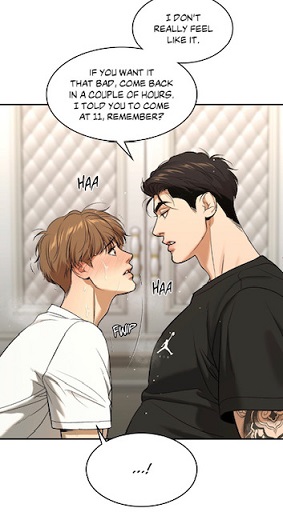 (chapter 39) before requesting a fellatio:
  (chapter 39) The main lead’s head was very close to the champion’s face, thus he must have felt uncomfortable. Secondly by acting this way, the doctor was gradually gaining power over their relationship. For the wolf, dominance is everything, an indication that in his past he felt defenseless and weak. His “opponent”, the mysterious ghost, had the upper hand. Moreover, the fellatio created a distance between them, where the fighter could expose his superiority. And note how doc Dan behaved under the influence of the drug:
  (chapter 39) For the first time, he accepted Dan’s initiative—both physically and emotionally. Compare it to his attitude before:
  (chapter 55) These memories represent the moment where the athlete felt strong and had the upper hand in their relationship. These images reveal that Joo Jaekyung hasn’t realized the signification of the kiss yet. For him, they don’t seem important. This exposes that the athlete has not associated kiss with love and affection yet. At the same time, we have to envision that a smooch is strongly intertwined with equity and trust.
  (chapter 28) And in episode 14, it was clear that the star still felt superior to his companion, therefore the kiss had no special meaning. As you can see, everything is pointing out that Joo Jaekyung had never been kissed before. And what does a kiss symbolize? Not only attachment, but also purity and innocence.
  (chapter 42) According to him, doc Dan was not different from him. However, he was wrong. It is because the champion had kissed him!! Moreover, the celebrity had allowed doc Dan to kiss him as well. Besides, how did the champion name his past lovers? They were toys… normally people don’t kiss playthings. And now, imagine that doc Dan were to discover that Joo Jaekyung had his first kiss with him. This revelation would not only make him realize that Joo Jaekyung loves him, but also he could be wondering why the athlete had never done such a thing before, though he had past lovers. YES, the “first kiss” could be the trigger for both characters to question their respective past and perceive their fated partner correctly.
  (chapter 15)
  (chapter 52) In that context, a kiss could never be affection, but vulnerability. A risk.
 (chapter 3), based on Dan’s vague claim of prior partners. Yet Dan has never kissed anyone before. The kiss becomes his true moment of loss, a quiet confession through action. Conversely, Jaekyung’s own discomfort shows that he, too, is untouched in this particular way. When Dan tries to kiss Jaekyung again, and he instinctively rejects it, it reveals just how unprepared he is for affection. They are both unaware that the other is emotionally “pure” in this regard, and that makes the kiss a shared revelation.
 (chapter 67), Jaekyung must reinvent his approach. He cannot rely on dominance, strength, or sexual performance to win Dan’s heart. If he wants true connection, he must learn a new language—one built on gestures of affection, softness, and presence. This process also involves separating his public persona from his private longing. Joo Jaekyung, the champion, cannot seduce with spectacle. But Jaegeng, the man, might learn to express love through a simple touch, or a well-timed kiss. The redefinition of seduction is not just about Dan’s healing; it is about the wolf’s reclaiming his own right to feel and give love. And in my opinion, that process has already started:
  (chapter 65) nor his past partners provided him with genuine and affectionate touch, Jaekyung must look elsewhere.
 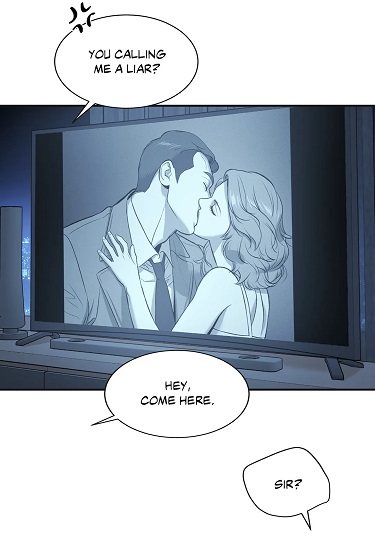 (chapter 29: note that he did not select this scene to rekindle with the doctor, but the other scene) He will learn it from life, from watching how the innocent express care without shame or purpose.
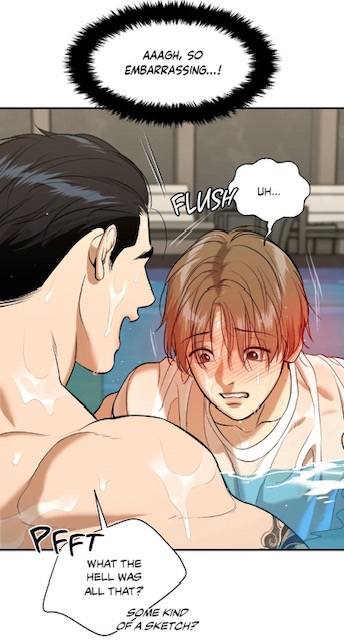 (chapter 27) In Jaekyung’s past, laughter had been a weapon—an expression of ridicule and cruelty from an abuser.
  (chapter 62) If someone had laughed in front of him and made fun of him, this would have reopened his old wounds.

 (chapter 5) his reliance on routine. Yet there is another jinx in this story, one far less visible and perhaps even more tragic: Kim Dan’s.
 (chapter 1) was seen as the core expression of a man who believed he was doomed.
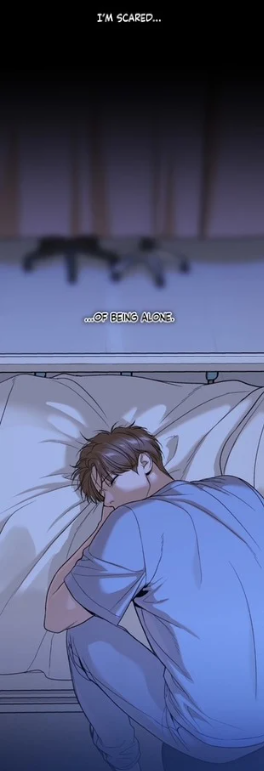 (chapter 56) In Chapter 56, Kim Dan is seen curled up next to a bed, whispering: “I’m scared… of being alone.” What makes this moment especially revealing is that he is not physically alone, for he is resting next to his grandmother. The presence of the very person who raised him should, in theory, offer comfort. And yet, the fear persists.
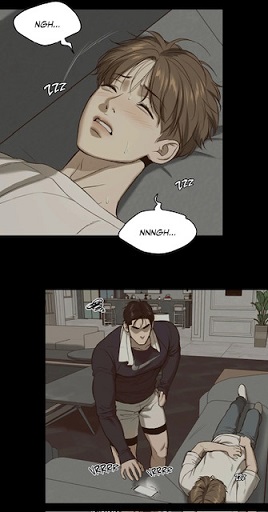 (chapter 21) It weaves together absence, silence, and the specter of loss. What’s striking is that the nightmare surfaces, not when he’s alone in the present, but after he has just returned from watching over his hospitalized grandmother.
 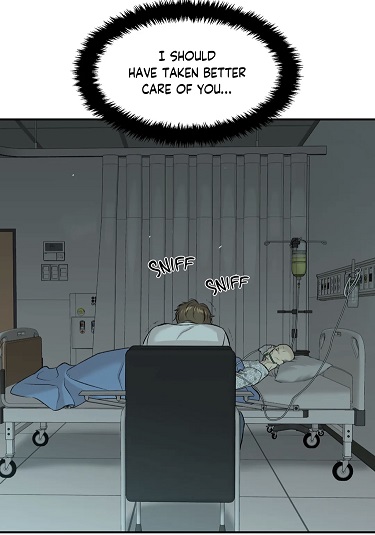 (chapter 21) He lies on the couch and dreams of a night when she vanished from their shared bed.
 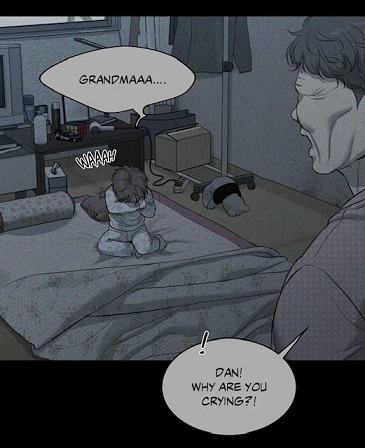 (chapter 21) This reveals how, in Kim Dan’s subconscious, the night and an empty bed have become synonymous with death. The trauma is deeply embedded, where even temporary absence is tied to the irreversibility of loss. For Kim Dan, solitude at night
  (chapter 67) is not mere loneliness—it is abandonment, it is death, it is the erasure of home. It is repressed, hidden beneath his quiet demeanor and years of survival-based behavior. Rather than a rational belief, it is a subconscious wound that only surfaces in moments of extreme vulnerability—especially at night.
  (chapter 2), the doctor’s is secret and involuntary. His actions—his fearful expressions
  (chapter 57), his pattern of emotional detachment
  (chapter 67), and his obsessive loyalty to his grandmother
 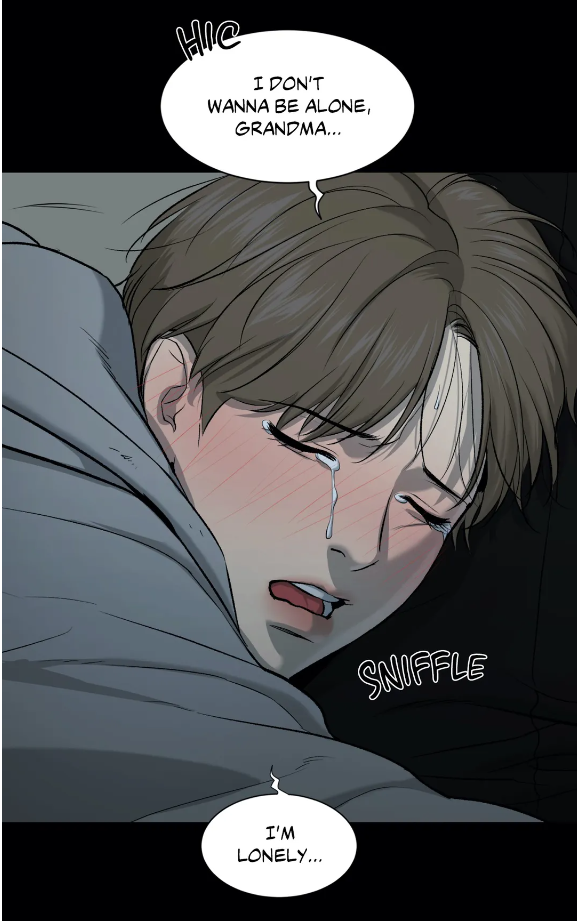 (chapter 10) signal a suppressed conviction: that he is destined to be left behind. What seemed like devotion now appears as coping; what appeared stoic was survival. And with the impending death of his grandmother, the anchor holding this hidden jinx in place is slipping away.
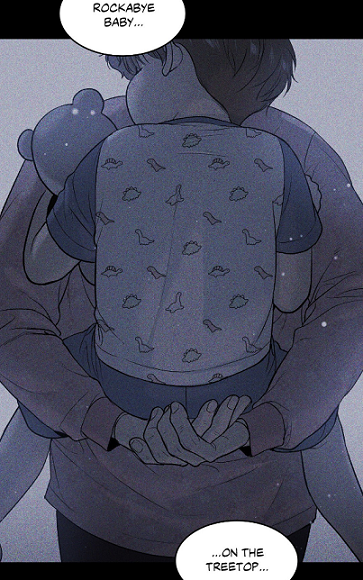 (chapter 47) the one person whose presence could keep the jinx at bay. As long as she was there, he could suppress the trauma, function, survive. She was his talisman. But she was never a healer, for she never spoke about his parents. She never addressed the core of his abandonment, like we could witness in the doctor’s nightmare:
 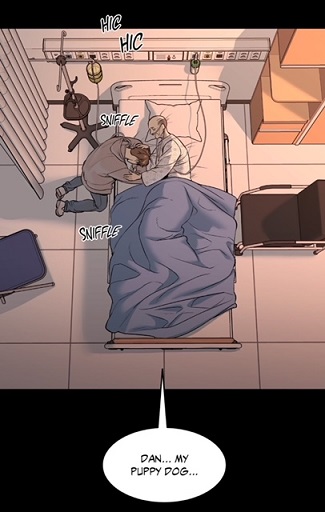 (chapter 53)
 (Chapter 56) he tucks her in. Their roles are reversed. He behaves like a parent, whereas in truth, he is reverting emotionally to a child terrified of being alone. This reversal highlights the internal dissonance between his outward behavior and emotional reality. Though he was forced to grow up quickly
  (chapter 67) This reinforces my hypothesis that his bad drinking habits are related to the absence of a loved one next to him.
  (chapter 56) Imagine what it means for her: her grandson is already 29 years old and he can not sleep alone. Under this perspective, Jinx-philes can grasp the relative’s reasoning. The problem is that her knowledge is actually wrong! How so? It is because the protagonist was able to sleep so well alone in the penthouse, to the point that the athlete was envious of him.
  (chapter 19) The latter is obsessed with work, while he is suffering from insomnia.
  (chapter 65) And the best evidence for her selfishness and neglect is her ignorance about her grandson’s plan for his future. She is not discussing with him about what he likes or dislikes. She is directing his life, like she did it in the past in the end. And while she may think she’s doing what’s best, her silence about his fears, her ignorance about his true conditions (no home, blacklisted in Seoul) and her refusal to discuss his emotional future reveal a lingering discomfort with the very idea of dependence — perhaps because it reminds her of her own failures or helplessness as a parent figure.
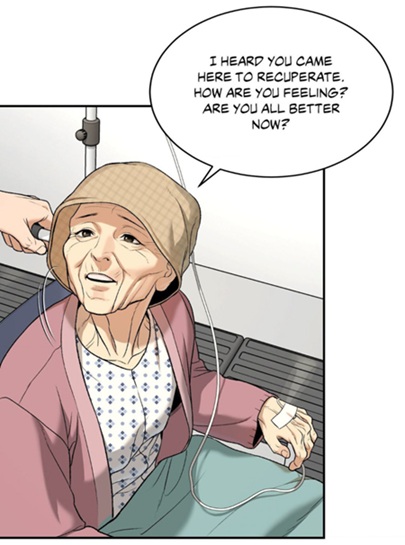 (chapter 65)
 (chapter 65) And when we remember that Kim Dan tried to call her, she
 He is carrying the sins of “adults”. By likening him to an angel, Mingwa frames his pain not as weakness, but as unjust burden. He embodies purity, sacrifice, and resilience, not because he was allowed to thrive, but because he endured. The angel metaphor becomes even more striking when you think about traditional symbolism: angels don’t belong to Earth, yet they walk among the living, often suffering in silence and helping others. That’s exactly Kim Dan — out of place, bearing the consequences of others’ choices, carrying guilt, debt, and unspoken grief that were never his to begin with.
 (Chapter 67) Observe how Joo Jaekyung called the penthouse: not home, but his place. Due to the last altercation, the emotional safety collapsed. This experience reactivated his fear of abandonment and solidified the belief that he has no home.
  (chapter 65) Even the family photo (where and by whom it was taken is unclear) emphasizes the fragility and incompleteness of his sense of belonging.
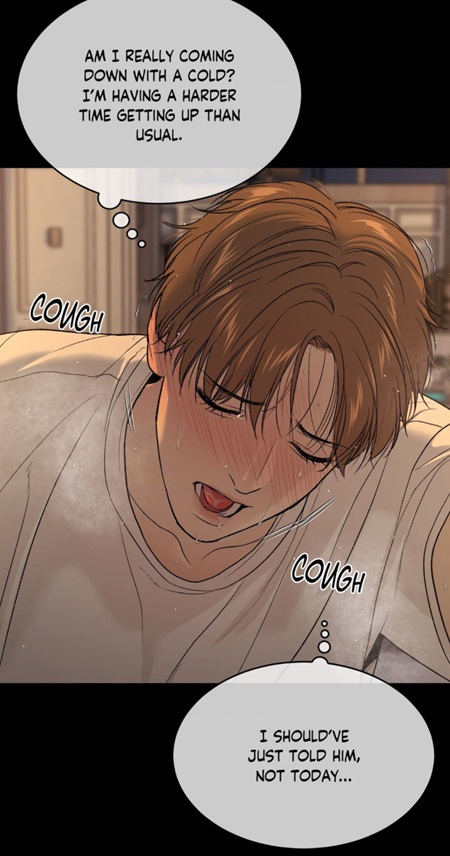 (chapter 61) that he must sacrifice his “needs” and identity to be accepted.
 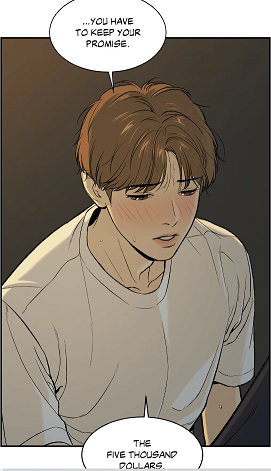 (chapter 2) He wanted the champion to keep his promise. From my point of view, the parent’s vanishing is strongly intertwined with a broken promise… And that’s exactly what the grandmother did to her own grandson: she didn’t keep her words either.
  (chapter 11)
 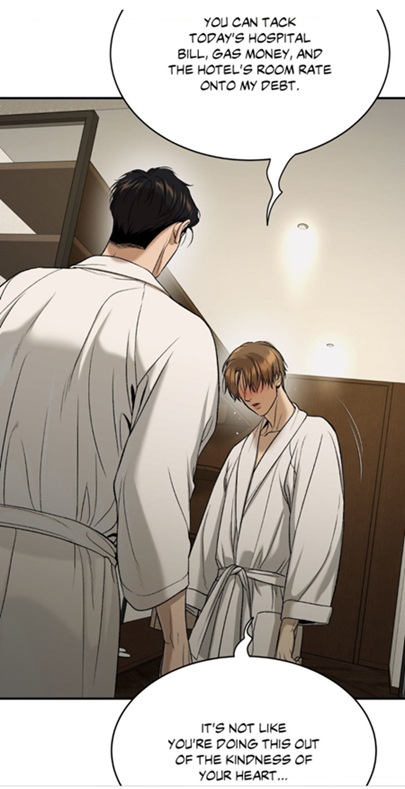 (chapter 67), but this time, with eerie detachment. He kneels before Joo Jaekyung like a servant,
 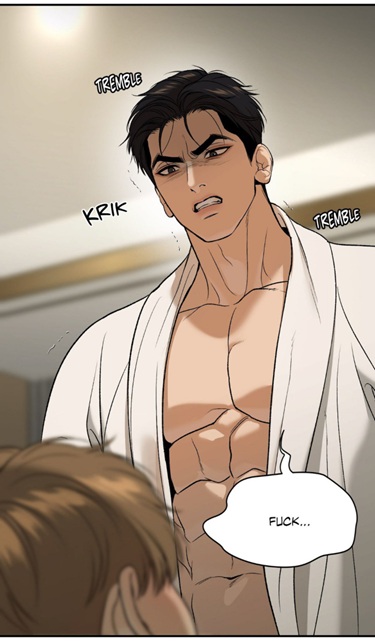 (chapter 67) his arousal betrays a loss of emotional control. Though he is on his knees, it is Joo Jaekyung who is emotionally yielding. His body betrays his composure, responding to Kim Dan’s touch and gaze. Kim Dan, watching the tremble in the fighter’s expression and the rising heat in his body, feels the shift. His soft blush is not simply one of affection or embarrassment—it’s a flicker of recognition.
 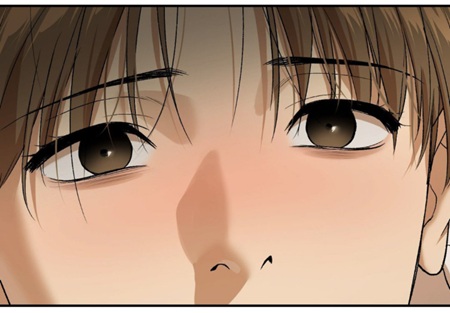 (chapter 67) He senses that the one usually in control is now unraveling. Appearances deceive: beneath this scene lies a quiet reversal of power. The blush on his cheeks is a trace of a brief moment of clarity: he sees that the person who once held all the control is now faltering.
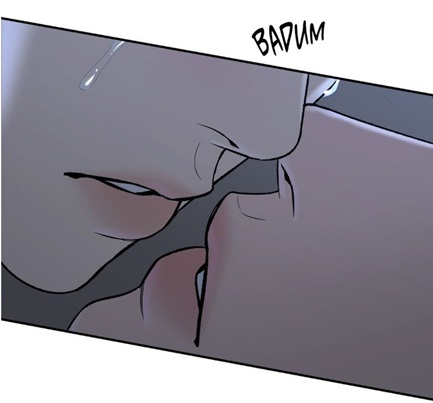 (chapter 66), his body is still a vessel for mourning. Hence there is no kiss during that blue night. Each night carries the residue of that first trauma: the night he was left alone. Whether his mother disappeared or passed away in the night, the result is the same—nighttime became synonymous with loss.
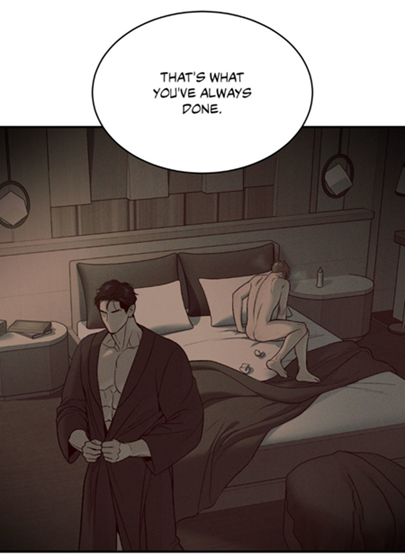 (chapter 63) His so-called jinx is not some irrational superstition. It’s a scar. It’s the quiet belief that the people he loves will vanish the moment he lets his guard down.
 (chapter 67), it’s resignation. Hence he is not expecting to be cured with the pills.
  (chapter 67) while he drank alcohol with the medicine.
 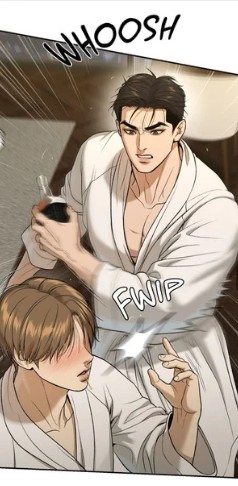 (Chapter 67) Until now, the champion has a blind faith in drugs, just like the grandmother.
 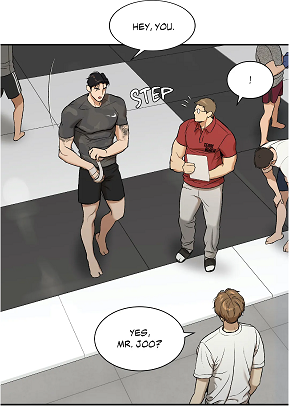 (chapter 7), while Kim Dan becomes a child during the night.
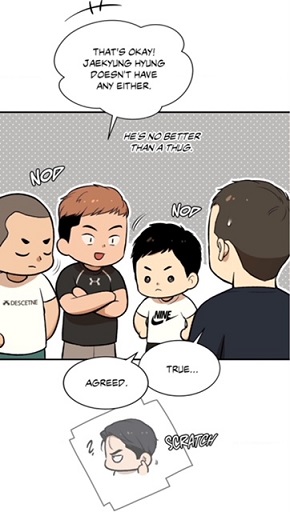 (chapter 47), when the “wolf” was portrayed as a thug, though the latter had assisted him on multiple occasions.

 (chapter 36), his tendency to retreat rather than challenge his own doubts
  (chapter 36), and his overwhelming fear of disappointing others
  (chapter 62), Joo Jaekyung does not. The evidence for this interpretation is the champion’s nightmare:
  (chapter 18) the doctor
  (chapter 25) Therefore the physical therapist bought books. Moreover, we should consider this argument
  (chapter 45) as a revocation of the star’s statement in episode 18. Kim Dan was no longer perceived as a tool, but as a real physical therapist. On the one hand, this request boosted the “angel’s ego”, on the other hand, he was put under immense pressure, for he was compared to his colleagues.
  (chapter 45) Since in Seoul, Kim Dan has only been hired because of sex (Joo Jaekyung, the perverted hospital director)
 (chapter 6), he came to accept that he was not truly talented. The champion had no trust in him and later, the word jinx triggered a repressed bad memory.
  (chapter 62) Due to his bad past experiences, he concluded deep down that his CV was not reflecting the truth.
  (chapter 56) That’s the reason why he was devaluing himself and as such not looking for a high position.
 (chapter 48) exemplifies this pattern:
 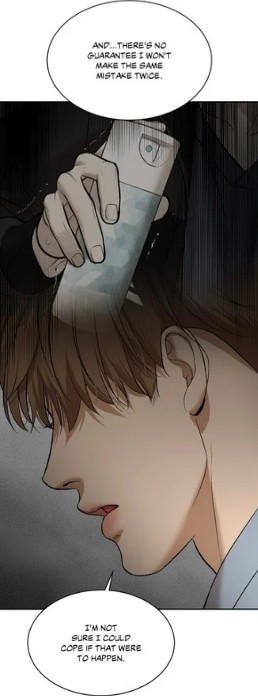 (chapter 62) completely devastated Kim Dan’s already fragile self-esteem.
 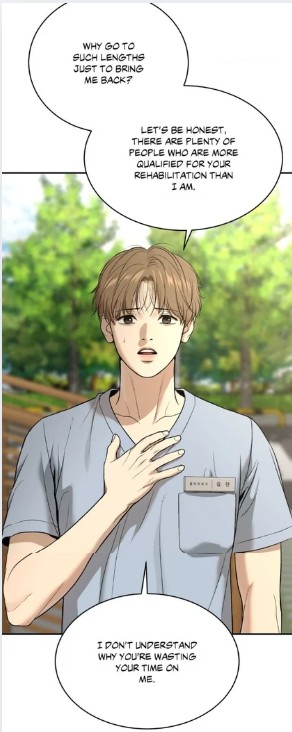 (chapter 62) First, he considers himself as waste. While in the past, he was at least a tool, he is now garbage. Hence his feelings are “trash”.
  (chapter 62) This means that in episode 62, he felt worse than in episode 18! The idioms “trash” and “waste” revealed the doctor’s own self-perception in episode 62: he saw himself as totally useless. He belonged to the “wastebasket”, just like the golden key chain.
  (chapter 46) Thus I deduce that the fate of this item echoes the doctor’s.
 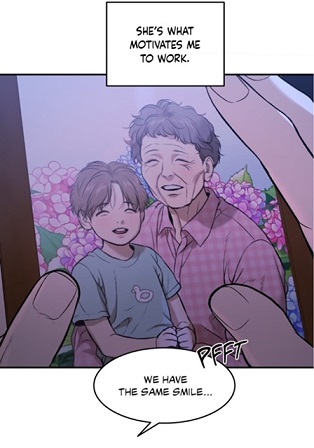 (chapter 47) He had selected this profession because of her. This shows that until now, he has never developed any ambition on his own. The loss of faith from someone he relied on for motivation made him feel completely worthless. This reinforces that his confidence and sense of direction were never self-sustained: they depended on others’ recognition. This pattern suggests that Kim Dan has never truly asked himself what he wants. His entire existence has revolved around meeting expectations, whether from his grandmother, Joo Jaekyung, or even his profession. His current crisis—feeling like waste—stems from the realization that without someone to validate his worth, he sees himself as nothing.
 (chapter 59) However, observe that he is using the expressions “do” and “now”. This has nothing to do with the future and dreams. It is not a reflection on his own desires but rather an immediate reaction to his circumstances. His mindset is still trapped in survival mode, seeking a course of action rather than contemplating what he truly wants. His words reflect an urgency to act rather than an opportunity to dream. This highlights that he has spent his entire life making decisions based on necessity rather than personal fulfillment. Even when faced with uncertainty, he does not ask himself what he wants—only what he must do next. His transformation will only be complete when he begins to question not just how to survive, but how to live on his own terms. That’s how I realized why Mingwa put this question in front of the window covered with Venetian blinds [which made me think of this scene
  (chapter 39 – Venice, a travel to Italy]. The window with the Venetian blinds represents a metaphor for the doctor’s trapped dreams. This interpretation made me recognize another aspect. Kim Dan is pushed to meditate, when he is front of a window or better said close to the sky! Hence the hamster started thinking about his own future in the penthouse
 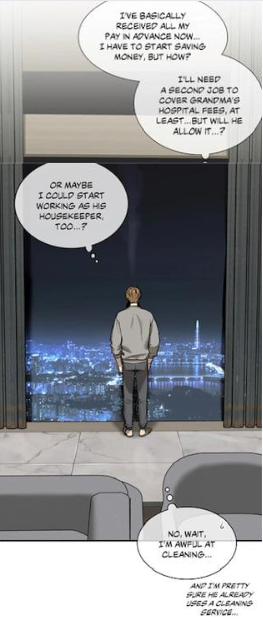 (chapter 19) or when he looked at the sun and sky:
  (chapter 41)
 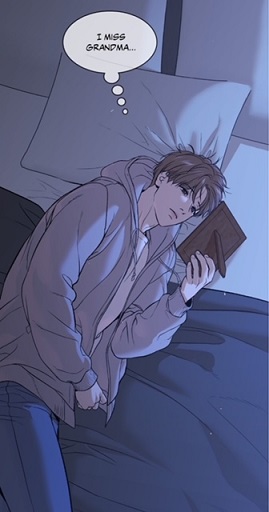 (chapter 47) The picture from his childhood: himself with his grandmother.
  (chapter 38) No wonder why he questioned the meaning of his champion title:
  (chapter 54). He saw the belt as something rather “meaningless”.
  (chapter 43) This would boost the doctor’s self-esteem. He is not trash, but an acknowledged fan and friend. The picture would encourage the physical therapist to develop his own ambitions. As soon as I made this discovery, another detail caught my notice:
  (chapter 66) The celebrity has no picture of Park Namwook in his contacts divulging the superficiality of their relationship.
  (chapter 42) The problem is that the athlete took this recommendation personally. He felt as if his job as fighter was questioned.
  (chapter 62) According to the main lead, the champion is “wasting his time here”.
  (chapter 62)
 (chapter 57) Hence it is clear that in the future, the physical therapist would refuse to use any kind of spray. On the other hand, it is important to recall that back then, Joo Jaekyung had made the request himself:
  (chapter 49) So in the doctor’s mind, if he agreed to the champion’s request, he would be treated like in the past. He would have to simply to follow the athlete’s lead. That’s why he is imagining that he might be put in a similar situation than in the past. But there exists another reason why he refused the champion’s offer right from the start. It is because he has always perceived himself as “hands” which stand for selflessness and generosity. The latter defined doc Dan. Hence he looked at them, when he declared himself as a tool:
 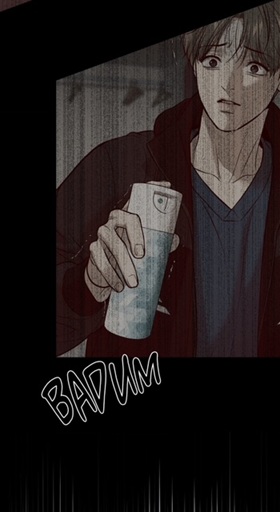 (chapter 57)
  (chapter 1) with a previous PT like the spray? No wonder why he called himself “trash” in the end.
  , people might wonder why I selected dandelions as a frame for the selected.. It’s clear that the dandelions aren’t just there for aesthetic balance. Their symbolism is profound. Dandelions are often associated with childhood innocence, wishes, and fleeting moments of beauty, yet they also wither quickly, easily scattered by the wind. In the context of Jinx, they represent a transitory force—something that struggles to take root, much like the intangible and fleeting elements in Kim Dan’s life. But there’s more to it. Before delving into deeper analysis, consider this: what is the common denominator in all these scenes?


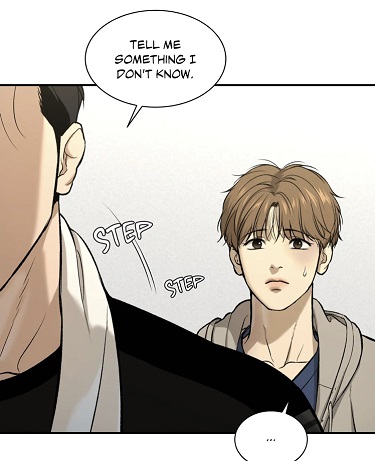
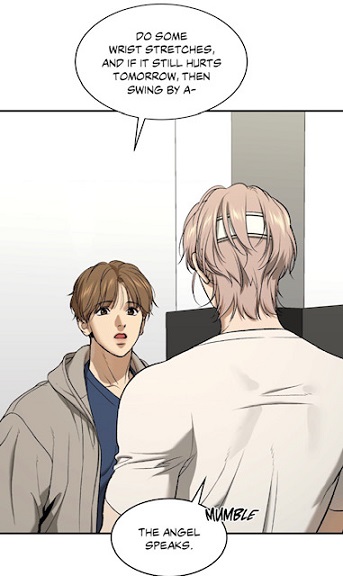

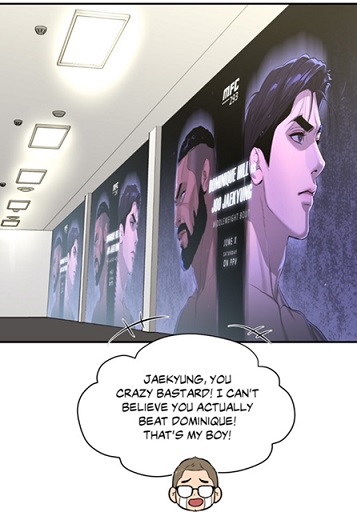
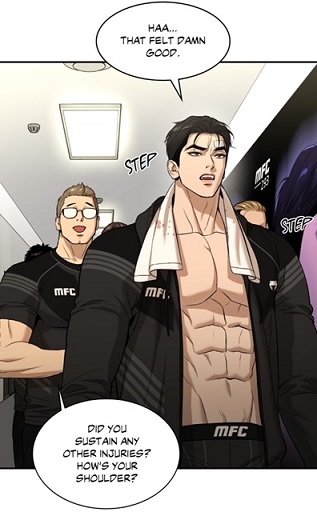
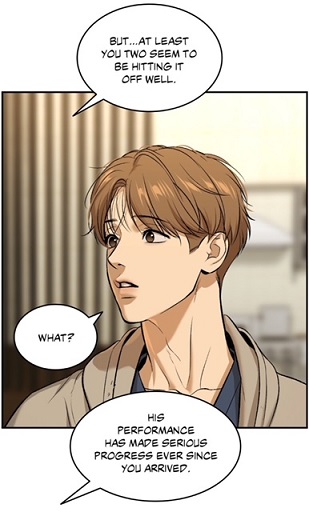
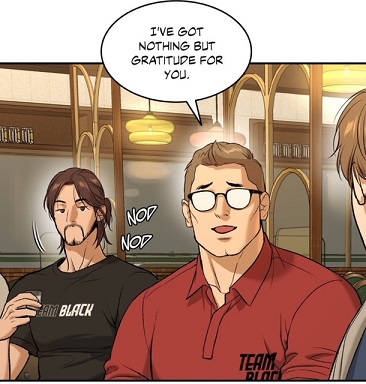
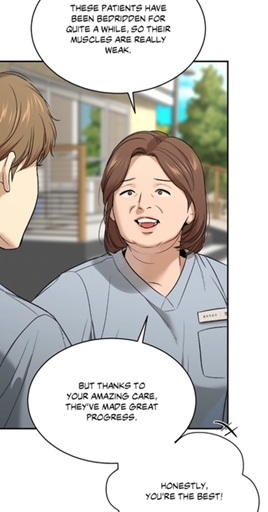


 (chapter 37) Therefore it is not surprising that the main lead couldn’t view the members as friends in the end.
  (chapter 41) And now, you comprehend why Joo Jaekyung has always disliked his birthday and the “congratulations” from people in general. The gifts and words were like poisoned praises to his soul. They were pushing him to live like a “god”.
 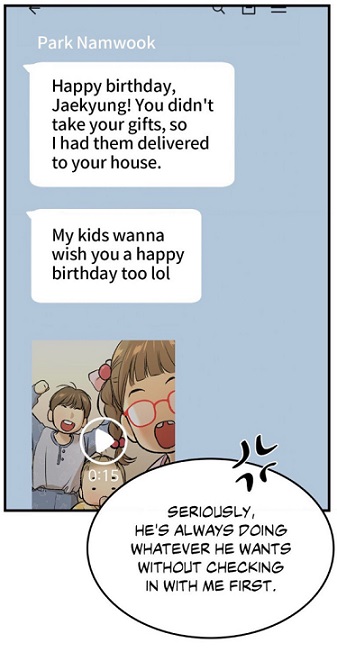 (chapter 45) Kim Dan’s only adult photograph, taken with Choi Heesung and Potato, ties into his professional world, reinforcing how his identity has always been defined by what he does rather than who he is.
  (chapter 59) While this photography was not a personal and intimate picture, it also symbolizes his first root in the little community: Light of Hope Hospice. He is part of the staff and as such of the little town. On the other side, we could say, he is gradually entering the scene as a PT. Note the contrast to the food truck:
 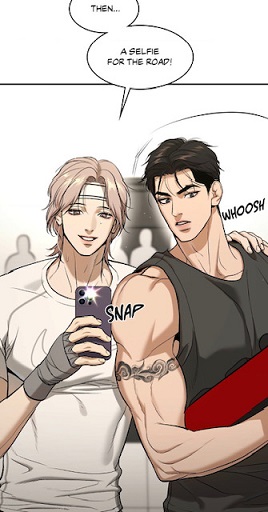 (chapter 30) In other words, it exposes the actor’s hypocrisy and wrongdoings. And now, you understand why I wrote genuine in parentheses above [proof of (genuine) human connection]. Photography in Jinx also represents the evidence of wrongdoing
 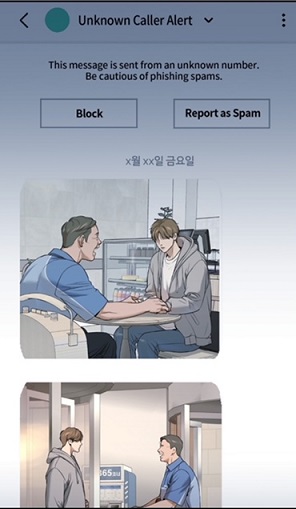 (chapter 48) and deception:
 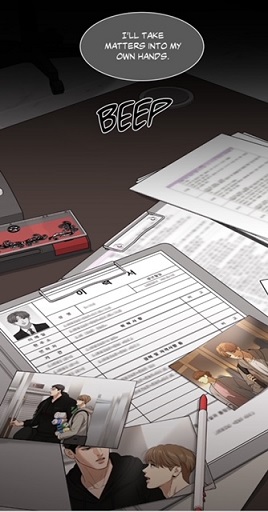 (chapter 46) The exact opposite of the dandelions.
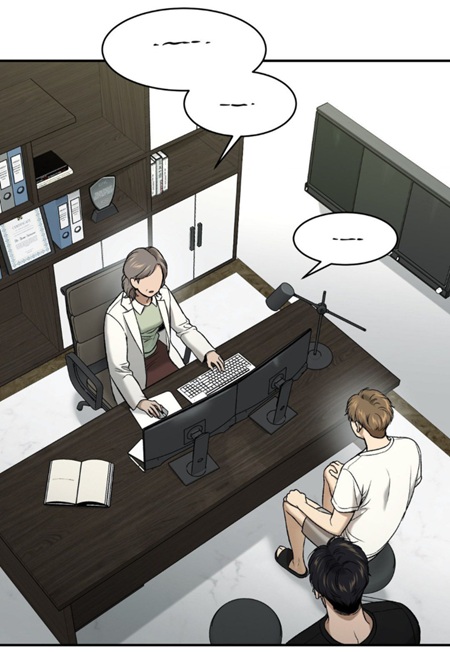 (chapter 66) It is a direct contradiction to the hollow praise doc Dan has received all his life.
 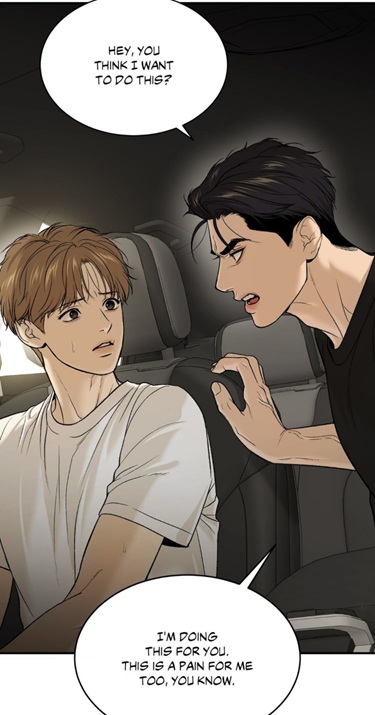 (chapter 66) he contradicts not only Kim Dan’s self-perception, but also his past accusations:
  (chapter 66) that he was merely a tool for Joo Jaekyung’s success. By taking him to the sleep specialist, the champion proves something that Kim Dan had refused to see: he matters beyond his utility. This moment mirrors Joo Jaekyung’s past words—
  (chapter 62) This shows that deep down, he desires to obtain doc Dan’s gratitude. No wonder why he got so upset after hearing the displeased comment from Kim Dan.
 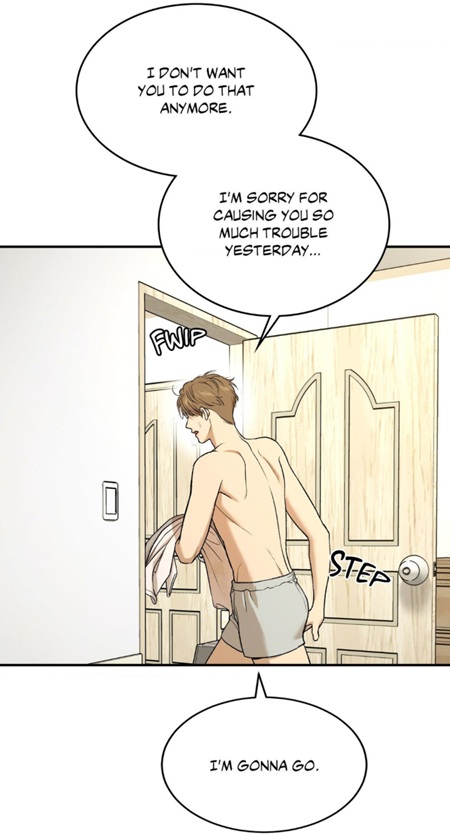 (chapter 66)
 (chapter 66) reveals Kim Dan’s elevation in the champion’s life. The dressing room symbolizes privacy and closeness. No longer seen as a mere tool, Kim Dan has become an integral part of Joo Jaekyung’s world, not because of what he can do but because of who he is.
 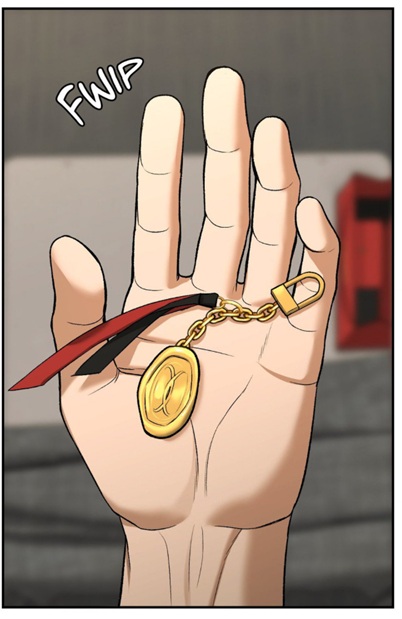 (chapter 66) Therefore the champion is holding the expensive gift with his whole hand contrary to the past:
  (chapter 55) As a conclusion, by bringing him to the sleep specialist, the star proved doc Dan’s words wrong! He told him something that doc Dan didn’t know: he is precious. He needs to pay attention to his health and body.
 (chapter 32) And now, you comprehend why the athlete didn’t fall for Park Namwook’s manipulations afterwards.
 (chapter 66) “I don’t know what you’ve been up to lately…”, it carries an accusatory undertone, subtly suggesting that the champion has been avoiding him. By framing it this way, Park Namwook is not just asking about Joo Jaekyung’s well-being—he is asserting his discontent over losing control. His follow-up suggestion, “Instead of being alone all the time, why not come to the gym?”, reinforces the idea that he sees the gym as a tether, a way to keep Joo Jaekyung within his domain of influence. In addition, he is suggesting that the athlete has been using his injury as an excuse to avoid training. There’s an undertone of doubt and accusation, as if he does not fully believe the champion’s recovery process is valid or necessary. Instead of expressing genuine concern, Park Namwook is subtly framing Joo Jaekyung’s absence as a sign of laziness or avoidance. The small compliment from the manager (“good work”) represents a turning point in the athlete’s life. Park Namwook can no longer treat the athlete like in the past.
 (chapter 7)
 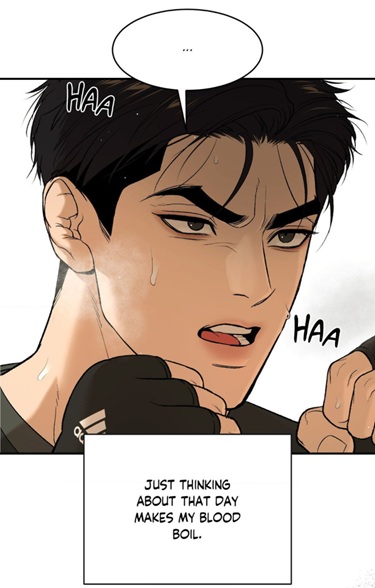 (chapter 65) At the same time, such a disapproval
 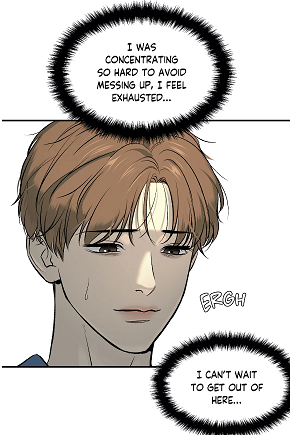 (chapter 1), hence his true desire was to run away from that place. For praise to be effective, the recipient must be open to receiving it, either by looking forward to feedback or having expectations of validation. Since Kim Dan was in a state of distress, he was unable to internalize the champion’s words, reinforcing his long-standing belief that he was invisible or unworthy of acknowledgment. That’s how the champion’s praise became a dandelion seed in the end.
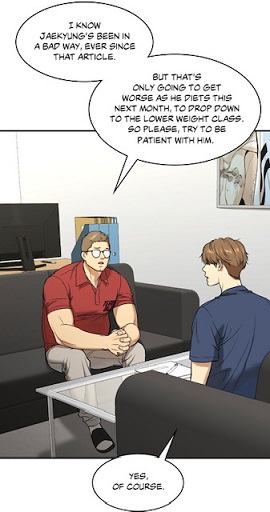 (chapter 36), or to meet expectations. None of these affirmations recognize him as a person, only as a professional fulfilling a role.
 (chapter 18)
  (chapter 45)
 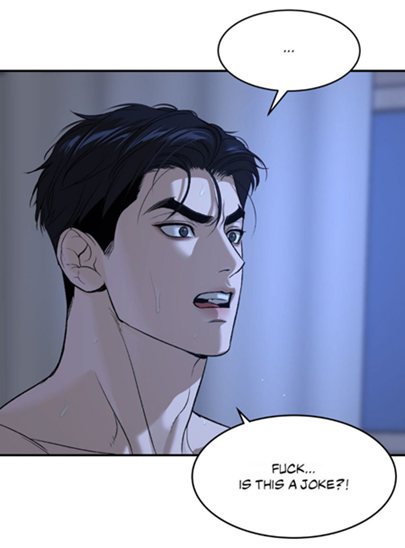 (chapter 64)
 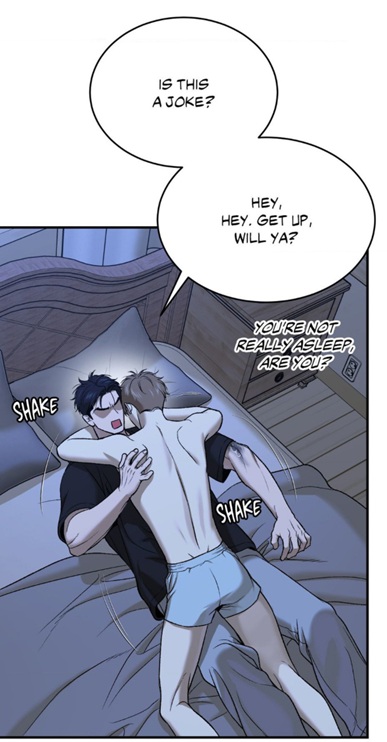 (chapter 66) Is this a joke?
 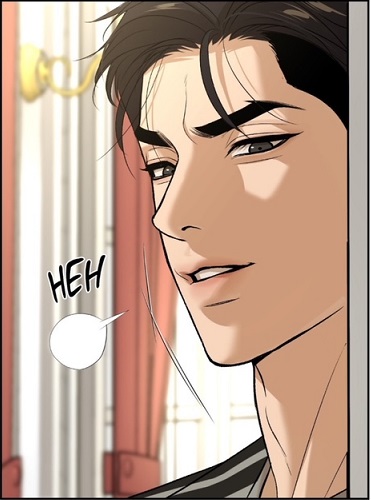 (chapter 40) However, Kim Dan has never realized it. Either he was sleeping or totally out of it (fear of sex)
  (chapter 27) It is important to recall the importance of the receiver’s mind-set. The latter has to perceive the sincerity from the speaker. Hence I come to the following deduction: The moment Kim Dan notices Joo Jaekyung’s smile and laugh, then he should come to the conclusion that he matters to the protagonist. I would even say, the two protagonists are destined to make each other laugh and smile:

 (chapter 55) One might think that the causes for his throbbing head are his depression and insomnia. On the other hand, I am quite certain that many readers had a different explanation for his migraine. He is missing his lover, Kim Dan, as the color red symbolizes the headache and the physical therapist’s name is strongly intertwined with this pigment which was once again confirmed in episoe 56.

 Thus I consider this image, where the champion is seen
 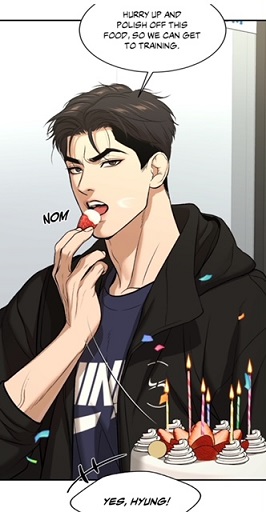 (chapter 43) eating a strawberry with cream as the announcement of the magical night between Kim Dan and his fated partner. The fruit with the cream represented a violation to his strict diet.
  (chapter 55) or the medicine against migraine.
 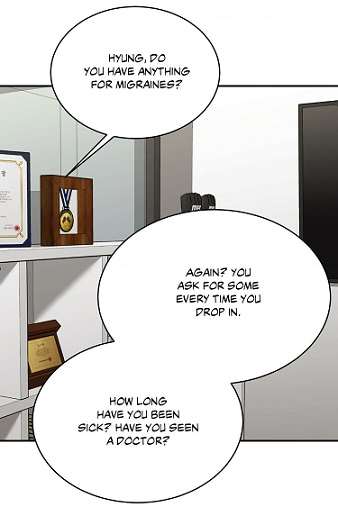 (chapter 54) However, in episode 55, we can observe a huge change in the champion.
  (chapter 55) The latter is finally admitting the inefficiency of the medicine. In other words, in this scene, he was giving up on them. This represents an important step on his way to enlightenment. For me, it signifies that he is stopping relying on pharmaceutical products. Let’s not forget that in the past, he rejected the PT and even neglected them. Why? It is because he trusted more sprays and other medicines than people.
  (chapter 49) Therefore the switch of the spray had to occur. He needed to question his prejudices and attitude. But let’s return our attention to the champion and his throbbing head. One detail in this panel caught my notice.
  (chapter 55). This means that she had not seen the mess in the master room before:
  (chapter 55) And now, pay attention to the number of the bottles in his room:
 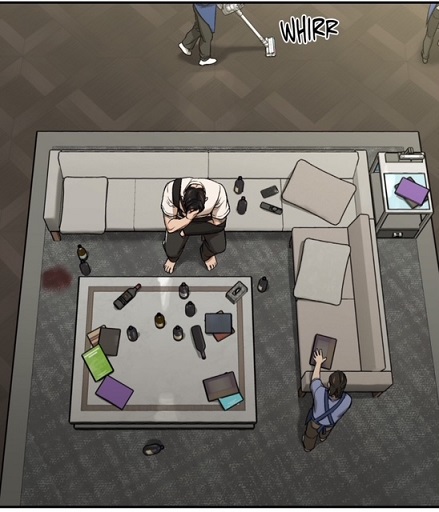 (chapter 55) I count 12 bottles of wine exactly like in the last image from chapter 54. Thus I came to the following deductions:
 (chapter 54) and the appearance of the staff in chapter 55. It indicates that Jinx-philes can witness time deceleration in season 2. From one month in one chapter, then a week in the next episode, finally we have a reference to a day: Monday. Thus I deduce that in episode 56, only 2 or 3 days elapsed. I have already announced that the couple should meet each other around 25th:
  (chapter 56), for the day Kim Dan wired his money to his “loved one” took place after 10th of the month: XX = two digits.
  (chapter 55)
 (chapter 55) Consequently, I judge the cleaning lady as the positive version of Park Namwook. Though she uses social norms, she doesn’t use them against her employee. She didn’t condemn him, it is a mixture of teasing and reminder. At the same time, her intervention implies that she must have noticed changes in her boss after the arrival of Kim Dan in the flat and his departure. That’s the reason why I have the impression that this image is announcing another turning point in the champion’s life either:
  (chapter 55) He won’t drink like before. However, I don’t think that he will behave like in the past: reject any alcohol entirely.
 (chapter 55), his migraine vanished. Though he is holding his head the next morning and hiding his gaze
  (chapter 55), the Webtoonist didn’t add any red or “throb” as an indication for a migraine. As you can see, his headache is strongly intertwined with repressing the physical therapist and as such locking away memories. However, there exists another cause. What had the doctor done in the past?
  (chapter 23) That’s how little kids are admired and loved. This stands in opposition to the abuser’s behavior:
 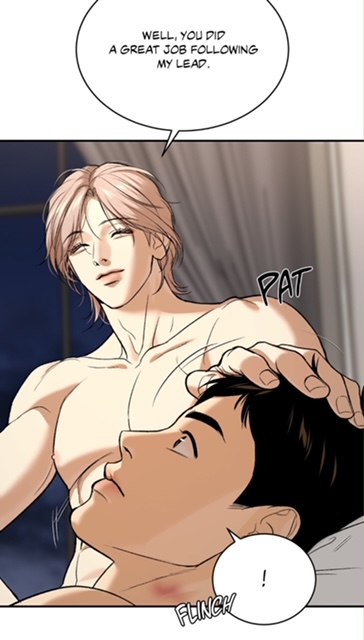 (chapter special 2) The same way than Kim Dan with the patting! In other words, the champion is deep down longing for such a gesture, but he has not realized it yet. Nevertheless, I believe that he just needs a trigger.
 (chapter 55) With his left opened eye!! The exact opposite from this picture:
  (chapter 55) This observation got confirmed in episode 56, though I couldn’t expose it before the release of the new chapter.
  (chapter 56) As long as the fighter thinks of his fated partner, he is not plagued with a throbbing head. This shows that it has something to do with repressing memories. However, his physical condition is still not improving:
 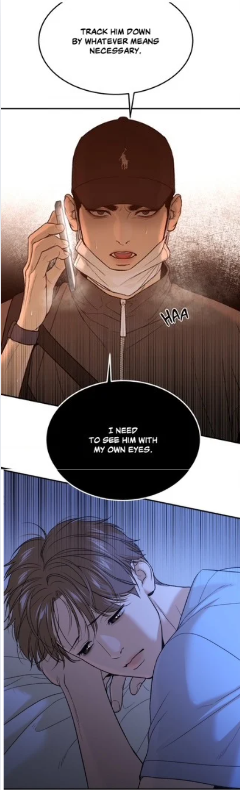 (chapter 56) He even looks worse than before: exhausted and malnourished. There is no one by his side taking care of him: his only interaction with his manager is through the phone. At no moment, the guy felt the need to pay a visit to his boss and champion.
  (chapter 56) Because I discovered the connection between memories and the physical therapist, it is important to examine the interaction between the main lead and the new uke.
 (chapter 55) This signifies that in reality, the uke is the one benefiting more from this relationship, while the “Gucgi guy” is a placebo for Joo Jaekyung. He can not replace the true medicine: Dan’s love. But Joo Jaekyung chose to close an eye to the truth forgetting his “insight” from chapter 2:
  (chapter 2) However, back then, he had just stated it in order to get rid of the mint-goblin. He needed a justification for switching his partner. In other words, this was reflecting more the protagonist’s corrupted mind and heart. Therefore he is designed eyeless, the symbol for ignorance, lies and blindness.
  (chapter 55) And where did he have his migraine exactly?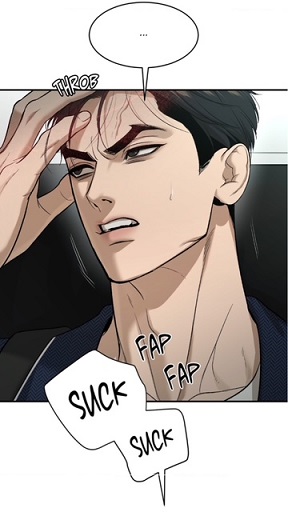
 (chapter 55) It was on the right side and eye! It truly exposes that Joo Jaekyung was getting punished for his attitude. He is not allowed to bury and forget Kim Dan. The star’s open eyes in this episode symbolize denial, lack of self-awareness and as such the absence of insight. He is also punished for his lies in episode 2. His words might have reflected the truth, but his words didn’t expose a change of heart. He was taking advantage of this situation as well. So when the pain intensified pushing him to close his right eye, we should consider this image as a short moment of reflection and realization. In the restroom, he was forced to admit that only Kim Dan could kiss him. Is it a coincidence that just before Mingwa presented this image
  (chapter 55) He was just standing there and avoiding his gaze.
 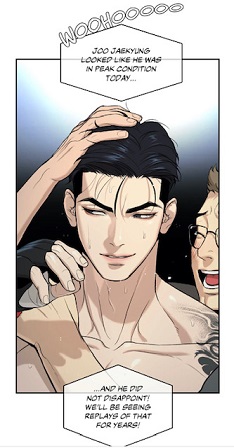 (chapter 5) Therefore he was in a happy mood after that match. A simple gesture with a lot of power! He has been missing this hand or better said this gesture. This action was the main lead’s true motivation.
  (chapter 40) No wonder why he felt so lost and empty after the last fight.
 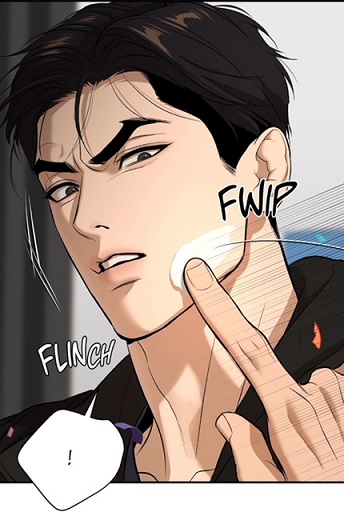 (chapter 43) this was the coach’s hand. In other words, the athlete felt more close to the coach than to the manager. This would explain why he would listen to the coach and even entrust him with huge tasks like the charity event. Strangely, in season 1, we can observe how more or more he is distancing himself from the fighter. Probably related to his secret relationship with Kim Dan. According to my theory, the coach is aware of their relationship. They are more than just boss and employee. As you can see, I don’t think that the champion is right now just missing the doctor’s sweet lips. Deep down, he would like to be patted by his loved one, exactly like Potato.
 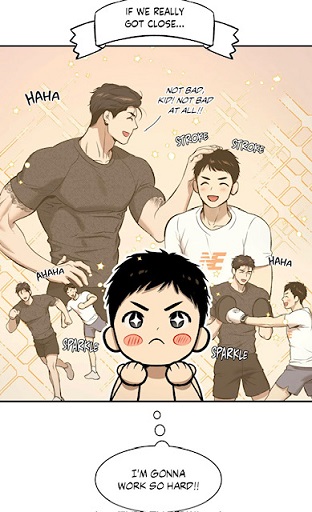 (chapter 23)
 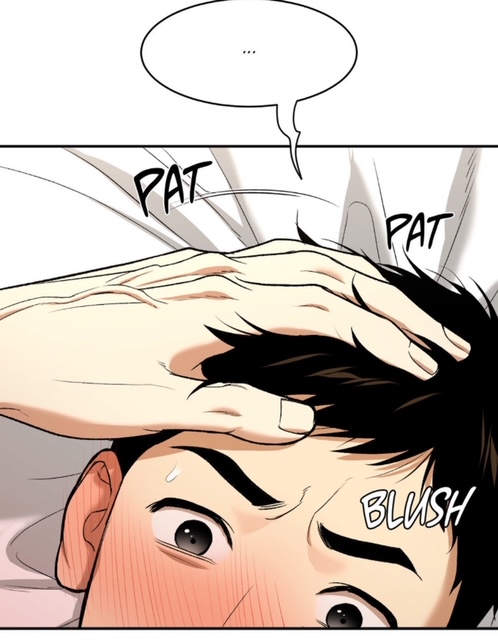 (special episode 2) But this is what he received after the last match:
  (chapter 2) The champion’s reaction is quite telling. He is not easily swayed. But we have another bigger evidence that his intercourses were replacement for “fights”. In The States, the fighter asked Kim Dan to join him at 11:00.
  (chapter 38) Therefore it is not surprising that he rejected Kim Dan’s request first.
 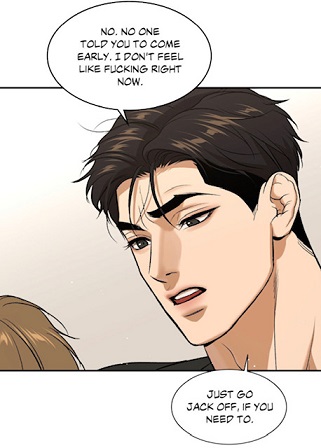 (chapter 39) He didn’t feel like it, because he was not aroused at all. Imagine that he needed two hours for that erection, a sign that during that night, Kim Dan was in reality a replacement for the American fighter.
 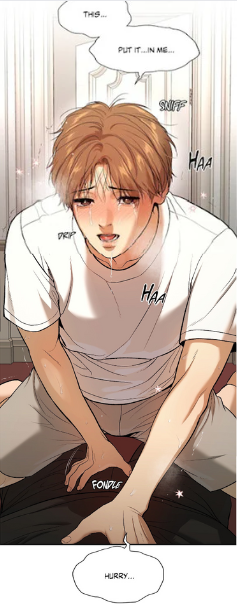 (chapter 38) In fact, he needed a fellatio to get an erection, and he only started getting excited, when he saw the doctor’s gaze. That’s the reason why he remembered this image under the shower:
 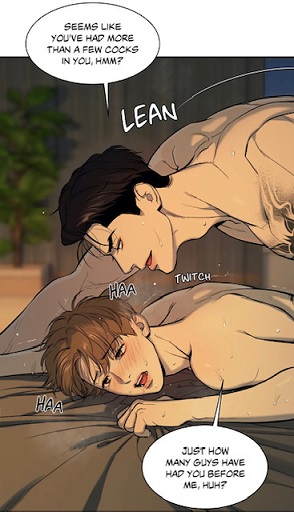 (chapter 4)
  (chapter 53) Pay attention to the behavior from the fighter during their last night together. He is looking away, he is not paying attention to his fated companion. His mind was elsewhere, focused on Baek Junmin! In my opinion, during that night, the champion had been able to differentiate between the physical therapist and his opponent. Fighting was more important than sex and as such his sex partner. To conclude, the physical therapist had been able to win Joo Jaekyung’s belief and heart. He was no longer a replacement at all. He had become a person close the fighter.
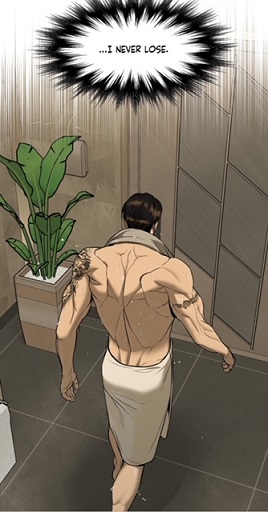 (chapter 49) he wanted to screw Baek Junmin for real. In this image, the athlete oozes confidence and strength. This means that he was no longer dependent on the good fuck before the match.
 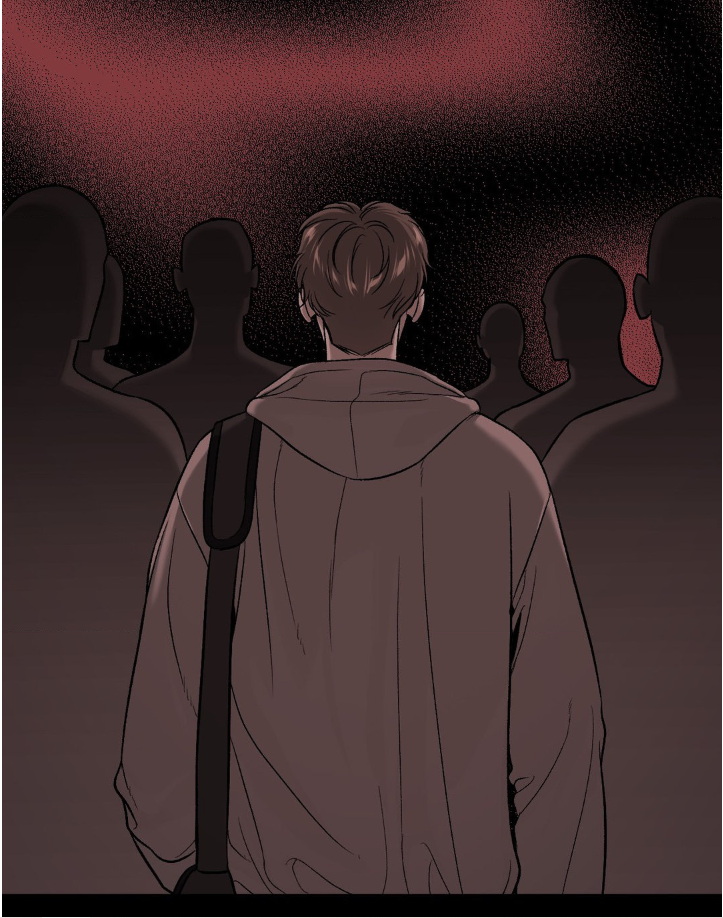 (chapter 55), but here the sex was longer connected to a match, rather to fun. Finally, observe how the champion is now blaming his PT for his ruined match:
  (chapter 56). I don’t think, he was referring to the spray incident, rather to their night before the match. The doctor had not behaved like a real opponent, he had admitted his “defeat” quite easily. He had left the ring before procuring him a good fuck. He was blaming his partner for violating his rule:
  (chapter 44) Sex is a synonym for love and as such it is about giving pleasure and affection to his partner. It is a two-way street. And this is something that the champion has to admit and accept. Thus I deduce that the fighter still has a long way to go before dropping all his fake principles. Like mentioned before, he needs to ponder on the following question: what matters to him the most? His championship or his happiness? Or what is sex to him? Why does he think that he is jinxed? He needs to face his own painful past and remember the face of his tormentor.
 (chapter 49) Baek Junmin and the abusive parent.
  (chapter 54) But the masturbation had taken place before. So who did he have in mind, when he was jerking off? I might shock my avid readers, but I would say: Baek Junmin.
 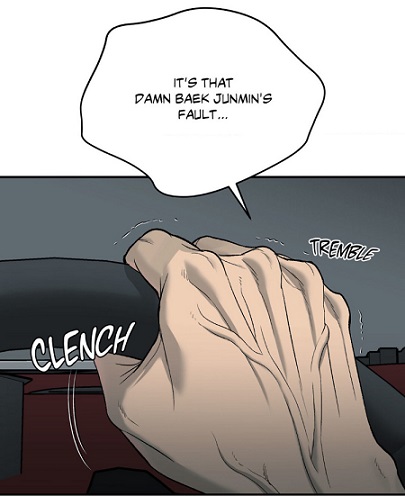 (chapter 54) However, this gesture had the opposite signification: rage, resent… but also sweet revenge! He must have recalled the Shotgun’s face.
 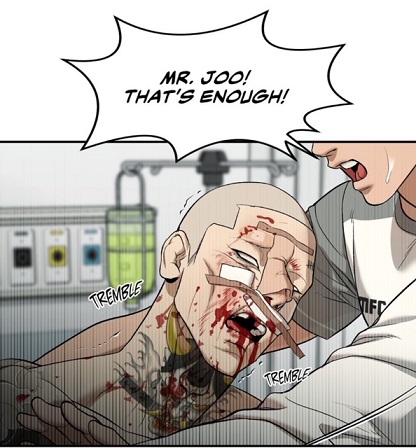 (chapter 52) There’s no doubt that thanks to the doctor, the champion will learn that he can get “justice” and satisfaction through other means. He can defeat the ghosts from the past, not just thanks to his fists and hard work, but also thanks to his surroundings and knowledge. Lawsuit and media!
 (chapter 1) The physical therapist is not only his reward and price, but also his “second shoulder” and as such his pillar. The new PT won’t be able to replace him. Joo Jaekyung is not just a champion, but also a team: Kim Dan as his PT and his lover. As for Kim Dan, the celebrity is his “energy drink”, his source of comfort and joy. He is also his home, for he is the first one who invited him to stay with him! Yes, the grandmother didn’t invite her grandson to live with her, he was just dumped at her place. And because the celebrity is like a home and family, it explicates why the doctor is once again “living like a ghost”.
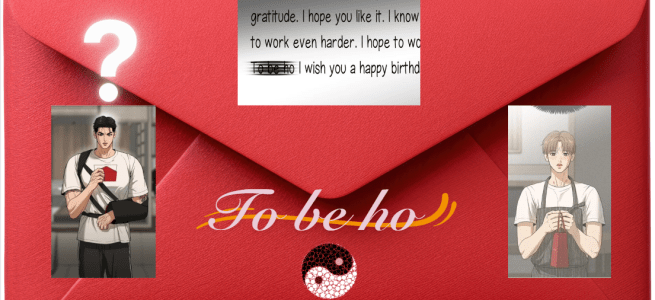




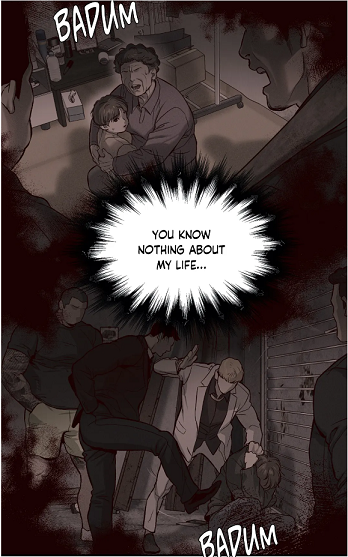


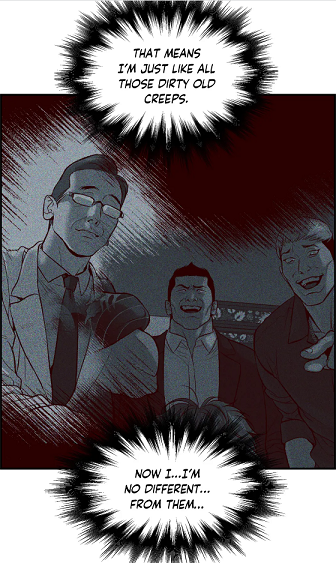



 (chapter 49) These 3 men and The Shotgun have to be seen as a team. Moreover, 4 is a synonym for death. Then, observe that the image from episode 20 contains two villains, the loan shark and the perverted hospital director. 1 +1 = 2. So when we see the number 10, 11, 16, 17 and 18, we could perceive it as an allusion to Heo Namwook, the villain.
 (chapter 11) and indirectly the persons involved in the redevelopment. However, I have to admit that I have a different explanation.
 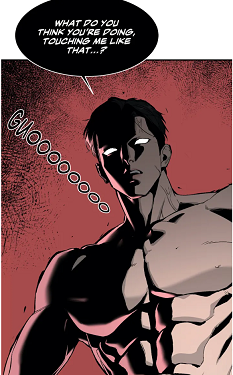 (chapter 1) The main lead appears as a beast, triggering the doctor’s fears. He seems to be like an antagonist. However, I believe that it is just a deception. First, Mingwa has clearly stated that the champion is the protagonist of Jinx. As such, he can be neither a villain nor an antagonist. Secondly, though he seems to serve as a barrier, the reality is that Kim Dan is incited to mature and overcome his own fears. In fact, the celebrity represents the opposite notions of “conformity” and “immobility”. He embodies verity, maturity, transformation and progression. The evidence of this perception is the gradual transformation of Kim Dan as an inexperienced PT to a very professional and performant physical therapist. According to my interpretation, the Emperor works as the mirror of truth. He confronts the delusional physical therapist with his mental and emotional issues, like here:
 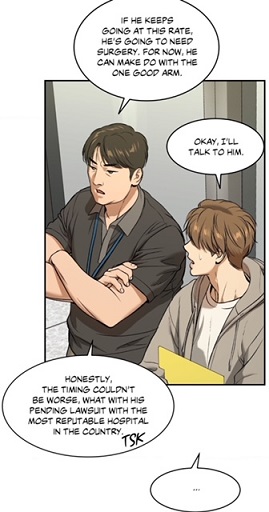 (chapter 42) He only relied on his hands. He was forced to become a serious and confident PT!!
 (chapter 1) The star was just waiting, and not threatening the doctor. As you can see, Joo Jaekyung doesn’t appear like a threat or a monster. But this doesn’t end here. One detail caught my interest. The champion is associated with blue. It is his true color, whereas Kim Dan is “red”, like a sweet strawberry. So why does this young man ooze a red aura, when his true shade is blue like water
 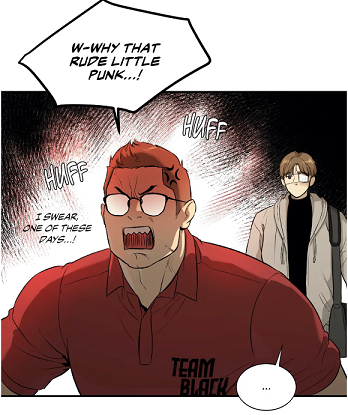 (chapter 11) The coach is yelling for Joo Jaekyung’s comment, yet the reality is that the manager didn’t treat Kim Dan at all. In fact, he feigned ignorance. Moreover, look at the champion’s t-shirt:
  (chapter 26) In this composition, I compared the MMA star with a leopard and Park Namwook to a spider:
  (chapter 17) or in episode 46
  (chapter 46) He represents regression or the hurdle to overcome.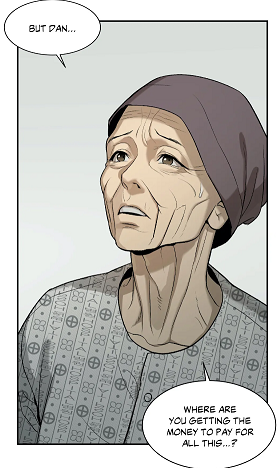

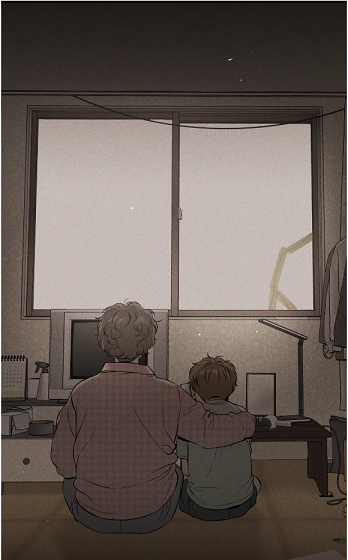


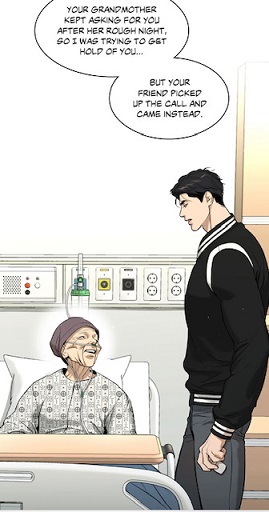

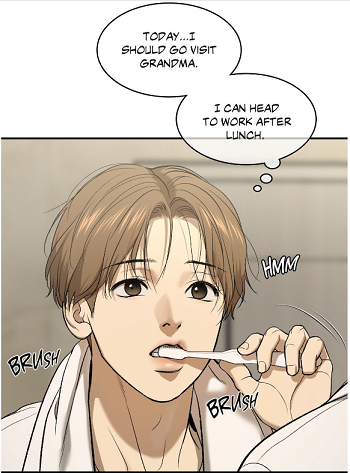
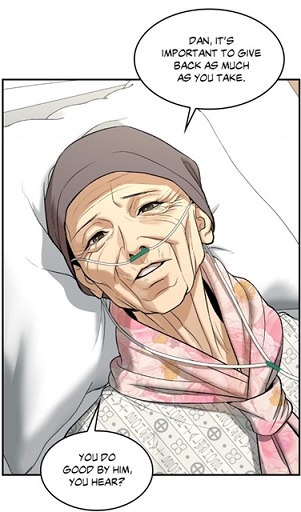
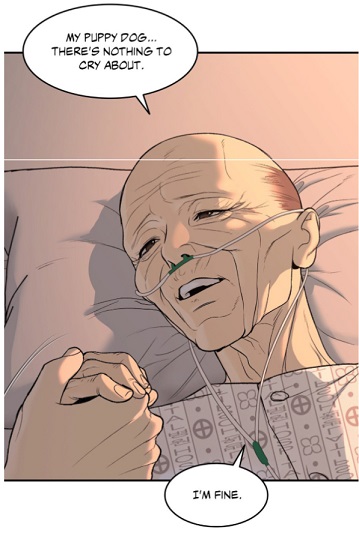


 (chapter 9) or other events like this one:
  (chapter 37) Buying in secret junk food.
 (chapter 1)
 (chapter 1) But it is the same for the champion who got his “gym” stolen from his hyung:
  (chapter 22) He is acting here like a tyrant.
  I came to this revelation thanks to this article:
 . (chapter 46) This would explain the champion’s emptiness and darkness:
  (chapter 21) and Kim Miseon’s reproach to Kim Dan could be seen as an indirect allusion. And if my interpretation about her number is correct, then we would have a good explanation why Kim Dan was unable to perceive her true nature, but also why she is so selfish.
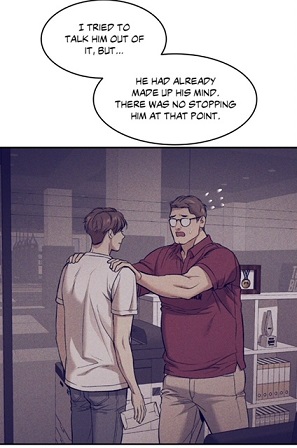 (chapter 53) Only the logo is red.
 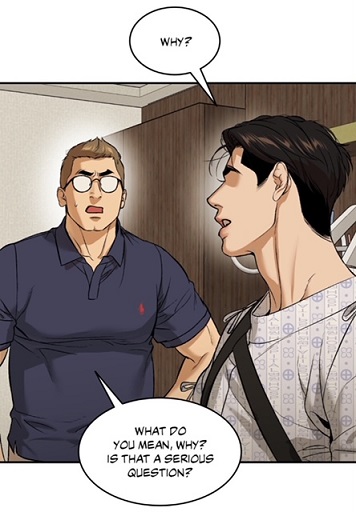 (chapter 53) It is important, because it announces the manager’s resignation. He doesn’t want to become responsible for the mess. Unconsciously, he is no longer claiming to be the owner of the gym. Furthermore, notice that the grandmother desires to return to the West Coast in order to see an ocean of “fire”.
 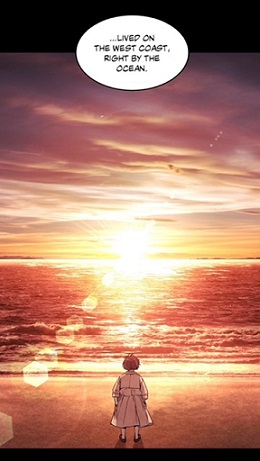 (chapter 53) This shows that she is longing for warmth and red colors. Yet, the color of the sea is rather green or blue. As you can see, everything is pointing out that the couple had to overcome the antagonists from season 1, the emotional vampires, who were so close to them than none of them realized that they were the origins of their suffering. And now, if you look at my table again:
 (chapter 35) In episode 16 and 17, the presence of the sun is a reference to the MMA fighter, it is announcing his arrival. This corresponds to the color I had detected with the first scheme:
 MFC with the blue “ring” embodies this pigment, just like the ocean. In other words, blue should be the dominant color in season 2, and in Taoism blue stands for YIN! On the other hand, Kim Dan also represents red with his name. Moreover, if you look at the numbers of the quoted episodes again, you will realize that the villains are strongly connected to the number 10 and as such one and zero. Thus Director Choi Gilseokf’s phone number is 010-1….
  (chapter 46)
  (chapter 37) He never complimented him for his hard work at all.
  (chapter 46) With these words, the manager creates a negative atmosphere, therefore there is no longer any trust and loyalty among the members.
  (chapter 46), however Park Namwook refused to accept such a behavior from his boss. Therefore he put his pupil under pressure.
 (chapter 46) He avoided a confrontation. This number symbolizes how the lead feels burdened by obligations imposed by his oppressor, who positions himself as provider of “stability” while actually fostering dependence and draining his victim. And naturally, in the same chapter, we have a similar interaction between Heo Manwook, the minion and his hyung, the real boss:
  (chapter 46) Here, the director was reminding him of his mistakes and obligations. However, this time the boss chose to become proactive and responsible.
  (chapter 1)
  (chapter 13) They are strongly intertwined with the color green and as such blue. In literature, art, and psychology, the color blue often represents calmness, loyalty, and introspection.This fits to the description made by the author concerning season 2. The latter would focus more on emotions and thoughts than on the plot. And now, it is time to reveal why in the illustration I added the number 9.
 (chapter 9) The leopard agreed and that’s how they came to argue about his home the next morning:
  (chapter 10)- So from 9 to 18, the story is focusing on the doctor’s home. In episode 18, Joo Jaekyung invites the poor physical therapist to his home.
  (chapter 18) In this episode, both main leads refuse the assistance from the other. Kim Dan is bothered that Joo Jaekyung paid off the debts, while the other dismissed the worries from the PT:
  (chapter 18) Then in episode 19, Joo JAekyung is not asking for his “help”, until he calls him. But even here, he is refusing to prepare his partner:
  (chapter 19) As for Kim Dan, the latter doesn’t feel truly needed as PT, hence he is already thinking about taking another job:
  (chapter 27) He encourages his VIP client to take a break by remaining by his side. However, this attempt fails, as in episode 29
  , (chapter 29) the champion rejects the idea of resting for a day. Then after the incident with the article, at no moment Kim Dan offers his assistance to help the champion. He remains totally passive,
  (chapter 39) The problem is that it is related to a drug and sex. This has nothing to do with his job or career. Interesting is that in episode 45, for the first time, Joo Jaekyung voiced his needs to have him as a PT:
  The end of Joo Jaekyung’s torment. He doesn’t need to chase after him.





 (Chapter 1) Imagine that he was in the middle of an intercourse. Yet he felt the need to have someone else by his side. It was, as if the grass on the other side was looking greener. 😉 Yes, in this scene, I detect parallels between Choi Heesung and Joo Jaekyung.
  (Chapter 33) On the one hand, the celebrity felt attracted to Kim Dan, on the other hand he had already sensed that the green-haired uke was greedy and even too passive. He was letting the celebrity fuck him. Yet there was neither real interaction nor sensuality between them. Hence the athlete could call Kim Dan during their sex. Funny is that the other didn’t mind at all, or in the worst case he didn’t even notice it. This shows not only the deafness and blindness of the mint goblin, but also the absence of communication and understanding in their “couple”. It was, as though the green-haired uke had submitted himself of becoming a sex toy. So by recalling the doctor, there is no doubt that the athlete couldn’t have voiced this change verbally. Why was he thinking of someone else during the intercourse? He was just simply not feeling it, the “great fuck”. In other words, Joo Jaekyung was attracted to Kim Dan by lust! In my previous analysis entitled
  (chapter 42), it becomes clear why the athlete’s lust for the mint goblin couldn’t last. The latter was only interested in his money and not even in his body. Thus he didn’t try to bring thrill into their relationship or even seduce him. And now, you comprehend why Mingwa let us see such a scene in the beginning of the story.
  (chapter 2) He had never done it before. As for the champion, Manhwa-lovers can grasp that since their relationship was purely physical (not even accompanied with romanticism due to the athlete’s jinx), the lust from the champion’s side could only weaken overtime. When the athlete met the actor, he had not met the green-haired man before. Hence the sportsman was sitting at the bar looking more or less for a new partner.
  (chapter 33) So the relationship between the “prostitute” and the fighter must have lasted around 3 months, the same amount of time than with the physical therapist. The uke had put no effort, for in verity he was relying on the athlete’s jinx. The latter just needed him, and no one was willing to experience such a rough sex session. The reason why I gave the green-haired uke the nickname “mint goblin” is the following. He brought some fresh breathe in the athlete’s life, for contrary to his past lovers, this one didn’t run away. However, as time passes on, the mint taste couldn’t mask his corrupted mind and heart. He was passive and rotten deep inside. But there’s more to it. Thanks to the mint goblin, the athlete learned an important lesson. It was possible that someone could match his strength in bed. Yes, the latter wasn’t passing out like the others. Deep down, the star could sense that he was no monster, a criticism he had received from the actor.
  (chapter 33). The irony is that as soon as he saw Kim Dan
  (chapter 1), he got attracted to this pretty and cute new face. However, contrary to the comedian, he didn’t realize this, for the athlete is not someone who thinks deeply. He acts rather on his emotions, exactly like his mentor Park Namwook. Since lust is the first stage of love, the recipient of his “attraction” needed to give him a signal that he was interested in him. I doubt that the celebrity would have made a move on him, if the doctor had not made this mistake
  (chapter 1). Naturally, grabbing his phallus was the expression of the doctor’s masked sexual desires. This signifies that when the couple met for the first time, the grass appeared greener on the other side (medical world) for the first time. Since we have the first step of love in their relationship, we could say that the athlete was already in love with Kim Dan. While “lust” only represents the first stage in a love relationship, I decided to examine their relationship on this aspect.
 (chapter 33) We have the novelty aspect (bringing thrill into their relationship) and the champion’s selfishness. The sex toy was utilized as a “punishment”, for the athlete was upset due to his jealousy. However, this perception is still too short-sighted. You will laugh, as soon as you read my new interpretation.
  (chapter 8)
  (chapter 27) Consequently, the man had to bring up the deal constantly. Besides, their relationship started because of money. Finally, I would like Jinx-lovers to keep in mind the doctor’s lie: he had previous relationships with men.
  (chapter 33), Joo Jaekyung had the impression that he was needed. Finally, don’t forget how this scene ended. Kim Dan was finally admitting that he was really sensitive to him:
  (chapter 33) However, this desire was accompanied with rejection and denial too. This explicates why the champion didn’t know how to interpret Kim Dan’s thoughts and emotions.
 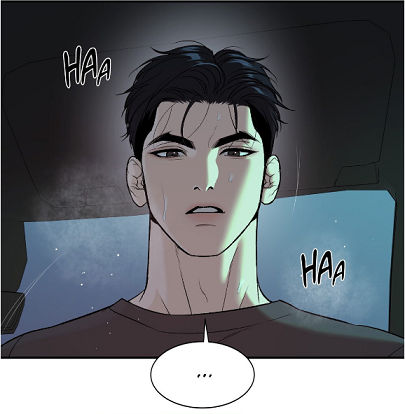 (chapter 33) Was Kim Dan feeling the same way than him or not? Did Kim Dan desire him or not? And this leads me to the next sex session:
  (chapter 34) For the first time, the athlete was divulging his physical attraction and desire towards the doctor. He seduced him with his own body. Yet, in order to keep the upper hand in their relationship, he was the one who was determining how they would have sex:
 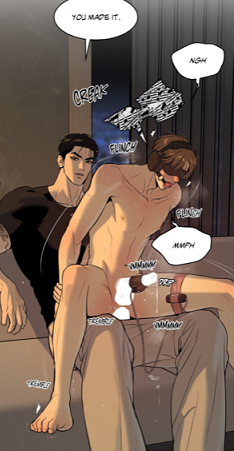 (chapter 34) As you can see, during season 1, it took a long time for the athlete to admit “lust and physical attraction” towards the doctor. One might reply that the celebrity had already admitted this to the physical therapist:
  (chapter 29) However, this confession is connected to the anus, and not to the doctor’s face and as such identity. Thus I don’t consider it as an admission that Kim Dan was his type. One might object too that he had already wooed the doctor before next to the swimming pool.
  (chapter 34) I would even add that he gave more freedom to Kim Dan to decide if he would accept his offer or not. As you can see, Joo Jaekyung was learning to internalize the notion “consent and respect”. Here, the doctor could have refused… the evidence is his reaction at the gym, the slap on the athlete’s hand. That’s how I realized the strong connection between the athlete’s ignorance about his soulmate’s taste (partner type) and his consent. Respecting the doctor’s boundary meant to trust that the doctor was attracted to him and accepted him as a partner.
 (chapter 1) despite his injured shoulder: the muscles, the skin, the handsome face. He has never voiced such thoughts in front of his VIP client.He always kept them to himself.
 (chapter 53) than with this one:

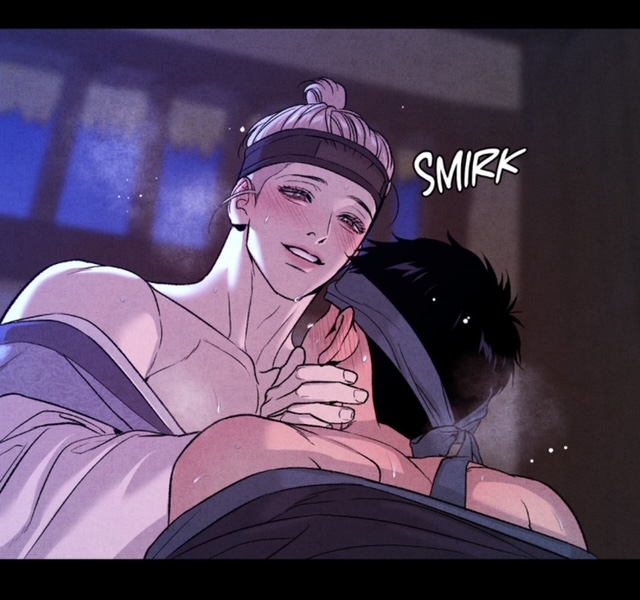 (special episode 2). This pigment is a combination of blue and red/pink. And now pay attention to the last panel. Potato is blushing while wearing dark-green clothes, his lover is standing in front of the blue sky and his skin is rather pale. His hanbok has purple and white shades. As you can see, this wonderful night represents their union: white meets black, blue meets red and yellow (hence purple and green). The light from outside contrasts to the darkness of the shelter. That’s how purple came to shine. On the other hand, since Heesung is acting as the master, and the maknae is relegated to the role of a male servant, the actor is exposing his inner darkness. He is longing for dominance and possession.
 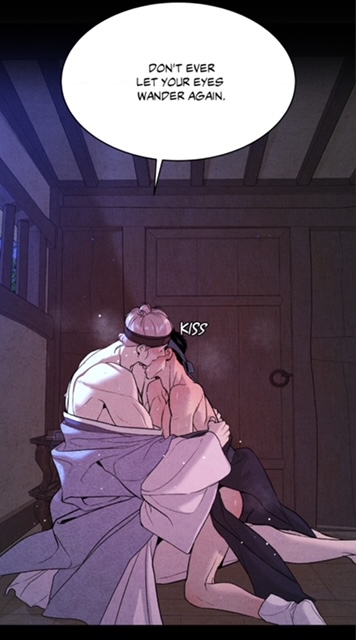 (special episode 2) To conclude, Heesung is gradually showing his true colors: the hidden black spot behind his perfect white skin. However, dark shouldn’t be reduced to evil, for in Taoism, black has another signification. It represents yin, the feminine energy. This means that thanks to that night, Heesung could display his motherly and caring side. Therefore he kissed, hugged Yoon-Gu and stroke his cheek. But this doesn’t end here. After the intercourse, he caressed his lover’s head.
  (chapter 31) The latter reflected his superficiality and detachment. How so? It is because he had bought them. Moreover, his manager was tasked to carry the presents.
  (chapter 31) It was, as if the manager was cursing him and his gifts. As you can see, there was no direct contact between him and the beneficiaries of his generosity. Money was between them in the end: Heesung, the manager and the members from Team Black. This could only corrupt their relationship. However, the pat on the head between the two second leads symbolizes genuineness and real gratitude.
  (special episode 2) The young fighter and his lover are slowly discovering the existence of a double life (public/professional versus private life). This signifies that Potato is learning to distinguish between image (hero) and reality. In fact, he only knows the MMA fighter Joo Jaekyung and not the private man with his troubled past. As for the actor, with his blog
  (chapter 30), pictures and sponsoring
  (chapter 32) The gumiho never felt the need to hide his sexual orientation, it was never a taboo. It indicates that he felt safe among his colleagues and agency. Therefore the manager could talk so freely about his love life in front of others.
  (chapter 30) There was no secrecy and privacy. Manhwaphiles should keep in their mind that homosexuality in MMA world and boxing is a huge taboo. So if Potato’s homosexuality were to be exposed to the netizens, this could ruin his career. This is also valid for Joo Jaekyung. Other fighters could question their manhood. And this brings me back to that night. Purple is strongly connected to yin and as such to the moon, like you can detect in the illustrations below.

 (chapter 20) the main pigments were yellow, rosa, red and orange, whereas on the bed, the roles and topics were switched. Kim Dan’s feminine side was the dominant one. His motherly and caring instincts were so strong that he had no problem to challenge his sex partner.
  (chapter 21) And the next morning, the emperor chose to show his motherly and caring side to Kim Dan and the halmeoni.
  (chapter 21)
 (special episode 2) Potato is literally glowing, while the other is just wearing a purple hanbok (disguise). One might wonder why. The answer is simple. Potato stands for innocence, reflection and ignorance. Contrary to his new role model (Kim Dan), he has no real prejudices against sex. He doesn’t view it as dirty. This explicates why Potato is always surprised by his own pleasure and always claims his ignorance.
  (special episode 1)
  (special episode 2) He doesn’t make quick conclusions. The irony is that by expressing his ignorance and as such denying the existence of his own pleasure, he is actually challenging his gumiho. The latter is not recognized as a good lover! 😂 Moreover, it was, as though the young man had not been thrilled and excited contrary to his partner. This means that the maknae is pushing his companion to become more creative in sex. He is hoping that Potato would come to confess his joy and excitement as well. This means that Heesung has to find new ways to impress and woo his companion. Innocence and ignorance are the best weapons to tame the mythological creature. Simultaneously, it implies the actor’s underlining desire: he wishes to share his happiness with others!! As you can see, though Heesung is indeed a red flag [Further explanations are below], he shouldn’t be simply reduced to the stigma “jerk”. Exactly like the terrible emperor, he also has redeeming qualities. Moreover, this made me realize that his words are turning into a reality:
 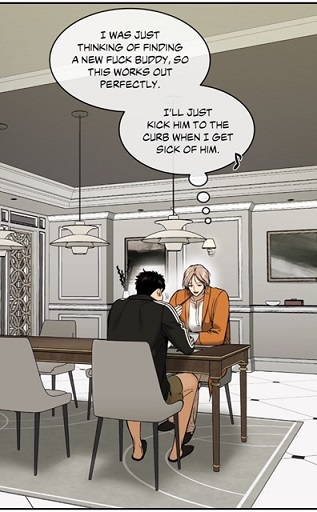 (special chapter 1) Potato has become his “fuck buddy”. By developing friendship through sex, he is not realizing that he is falling for the young fighter. Thus I am suspecting that in the past, he paid too much attention to emotions and less to sex… he was not trying to give pleasure to his sex partners in the first place. Now, he is doomed to find ways to give pleasure to his “fuck buddy”. And that’s how he is learning to become a responsible person.
 (special episode 2) That’s why the actor was glowing like a star after their passionate role-play. The presence of “stars” indicates his excitement and joy. His heart is racing, hence he is full of joy and feels rejuvenated. Moreover, the Webtoonist already implied the link between Potato and purple in the following scenes:
  (special episode 1) The young sportsman’s innocent statement brought Heesung to another galaxy. It was, as if he had entered a new world. Then we see Potato carrying a purple towel, when he is alone with Kim Dan and Joo Jaekyung.
  (chapter 23) Don’t forget that his family name is Hwang which means yellow in Chinese. That’s the reason why I don’t think, the purple towel is random. One might argue that the towel belongs to the gym, and they got changed later:
  (chapter 36) Park Namwook selected black towels, a sign that he was taking over the gym. But the purple towel announces the moment, where the doctor and Potato gets closer to each other.
  (chapter 23) For the first time, the young fighter showed a certain curiosity towards the physical therapist: the beginning of “Enlightenment” and friendship. Under this new light, Manhwaworms can grasp why Heesung was under Potato’s spell during this intercourse.
  (special episode 2) But we have another evidence that Heesung has always been looking for a “purple” person. It is because he picked up a purple suit for Kim Dan.
 (chapter 32) This means that this night stands under the sign of Yoon-Gu! The latter came to shine to the point that he affected his lover… that’s how the actor blushed more and more.
  (special episode 2) This observation brings me to my next interpretation.
 Dark red… full of passion. The actor could expose his possessiveness and jealousy, though he masked it behind a role-play.
  (special episode 2)
 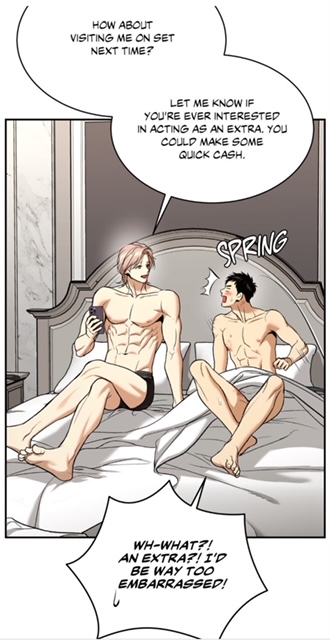 (special episode 2) This exposes his desire for companionship and his loneliness. Additionally, it shows that he desires to get closer to his sex partner, to include him in his life. Once again, Manhwaphiles can detect the absence of boundaries between private and professional life. However, by making such a suggestion, he is not realizing that he is ignoring the MMA fighter’s career. But wait …notice that they had sex in a shed. But this was just an illusion, for they were having sex in the actor’s white bedroom.
  (special episode 2) With that, I am implying that the actor imagined a scene from a historical drama (Joseon, hierarchical society and the shed). It was interesting, because for the first time, the author allowed us to penetrate Heesung’s mysterious inner world. It shows his “creativity”, inspired by his last shooting
  (special episode 2) and his own desires. As you can see, the sex session is a mixture of dream and reality which is reflected in the color purple.
 (special episode 2) He is blushing, he is enjoying this moment with his partner. He has the impression that his dream has come true. In his mind, he was breaking rules. A prince has sex not only with a man, but with a guard, a commoner. Secondly, they were having sex in the shed, hence they could get caught. He felt like he was playing with fire. This shows that the man enjoys thrilling situations. This explains his blushing in this scene:
  (chapter 34) He was not shocked or disgusted, when he saw Kim Dan having sex with the champion
  (chapter 33) Under this new light, his visit in the sauna appears like an intrusion.
  (chapter 34) He knew about the emperor’s schedule, a sign that he was somehow “monitoring” the main lead’s moves. Here, I feel the need to include this video exposing Heesung’s dark side.
 (chapter 35)
  (special episode 1) With this statement, he is actually taking over Potato’s schedule and life
  (special episode 1). Then he still chose to have sex with Potato, though he knew that the young sportsman was drunk.
  (special episode 1) The irony is that though Potato had said, he was a virgin, the actor chose to ignore it. Hence he got shocked later, when he realized Potato’s age..
 (special episode 1) There’s a huge gap, he appears as a “seductive” wolf like in the fairy tale “The Little Red Riding Hood” That’s how it dawned on me why Heesung will have problems in his relationship with Potato. It is related to his dishonesty and mistrust which he projects onto others. This explicates why he doubted about Yoon-Gu’s virginity.
  (special episode 1) And what is the synonym for “truth”? Reality and Real World!! And now, you understand why Heesung created a historical drama in his mind for the sex session. It was his way to avoid truth and honesty. He used the role play to expose his jealousy
  (chapter 45) We also have a refusal in the special episode. Potato initially rejected the offer from his sex partner:
  (special episode 2) Moreover, his words were definitely spoken more softly with a lot of hesitations. Hence I am doubting that Heesung saw his offer (visit to the set) as an acceptance. From my point of view, we should envision that the comedian saw it as a rejection. Potato was actually refusing to become an actor like him, then he employed the word “embarrassment”. It was, as if he was ashamed to be seen close to the actor Heesung. Finally, we should compare the last panel with this one:
  (chapter 34) He was also running away after getting threatened and rejected. In other words, Potato didn’t realize that with his behavior, he had triggered Heesung’s jealousy, insecurity and anger. That’s why he has this cold gaze.
  (special episode 2) It is the same glaring than Joo Jaekyung’s
  (chapter 7) who was full of jealousy here! Thus I conclude that this special night ended on a bad note, though Potato had no idea. The fox is no longer amused. Because Heesung is not happy deep down, he is planning something!!
  (special episode 2) Moreover, Manhwaphiles should keep in mind that he is talking in the past: “I had a ball”.His joy was just short-lived.
 (chapter 33) Observe the parallels:
  (chapter 33)
  (special episode 2) Yes, we need to question ourselves what triggered Heesung’s fantasy for the role-play.
  (special episode 2) IT is not just because of the costumes. My hypothesis is that the guards are working as an item, you can observe this in the following two panels:
  (special episode 2) This scene triggered his envy and jealousy. He wanted to have someone by his side whom he could talk to. ,
  8special episode 2), Here, he thanked everyone, yet he was standing in the middle of the scene, far away from everyone. In reality, his “gratitude” was superficial, for his thank was addressed to no one in particular. Just empty words. Under this new light, Manhwalovers can understand why he made such a suggestion after the intercourse:
  (special episode 2) Each pigment of green has a different signification: dark green can symbolize balance, drive, money, greed and fertility, while pale green symbolizes peace.
 The green color corresponds to sunset or sunrise which makes me think of a moment of transition. This corresponds to the notion of change and as such growth. Moreover, it stands for balance between yin and yang, like quoted above. The shade implies an equity between female and male energy. And now, you comprehend why Mingwa used green light in the car scene:
  (chapter 33) On the one hand, it was an allusion to the emperor’s hidden jealousy. The latter had masked it as a challenge and game:
  But the shade is implying that the fighter was slowly calming down. He accepts the doctor’s embrace, he even grabs his phallus in order to give pleasure to his partner.
 (chapter 33) In the end, he did show a caring side to the doctor.
  (special episode 2), the jealousy, the possessiveness… making sure that the companion is not looking elsewhere… but more importantly, both seme are and were unaware of their growing affection towards their “fuck buddy”. Yet, there exists a huge difference between these two sex sessions: THE KISS!
  (chapter 33) The emperor has now regained control of his emotions, but he couldn’t interpret his emotions correctly (jealousy, longing for love, insecurities). Moreover, we shouldn’t forget that he has not associated the kiss to love yet. In the locker room, he kissed the “hamster” in order to protect him. He had been simply following his friend’s advice. Then in the swimming pool, he felt attracted towards him.
  (chapter 34) As a conclusion, he came to “deny” this reality. He rejected his own emotions, until he was challenged once again in the sauna.
 (special episode 2) In addition, I noticed that the fighter’s buttocks are red

 (special episode 2) This means that this sex session took place during the new moon. Hence we have the color purple… This corresponds to the actor’s transformation. He is revived… he has finally found his soulmate, but he is not aware of it yet. And now, pay attention to this scene: We have the color blue,
  (chapter 53) There is no moon, only the artificial lights from the city. Hence I deduce that the couple is now entering in a new phases, there is a new moon soon. The absence of the moon corresponds to the doctor’s departure. Don’t forget that these panels took place on two different days. One thing is sure. The dominance of the blue symbolizes the dominance of Kim Dan in Joo Jaekyung’s life, but also the loss for the two characters. There is no warmth… yet calmness and softness. Joo Jaekyung is not throwing a tantrum. He is not breaking any sandbag or throwing away the letter. It shows the calming influence of Kim Dan over the champion. With his departure, he is pushing the athlete to face his own emotions and to analyze them. And now pay attention to the last panel from season 1: there are glimpses of purple:
  (chapter 53) It announces the start of Joo Jaekyung’s Enlightenment. He is on his way to recognize the source of his joy and happiness: Kim Dan as his companion. This signifies that Potato’s vision should come true in the end:
  (chapter 39)


 you will notice a third shade: orange which is represented by the Chow-chow and the comedian’s robe. Since the latter plays a minor role in the last chapter, it is normal to examine this pigment first. Moreover, its explanation is even necessary to grasp the significance of the other colors: pink and black.
 (Special episode) Then he cooked a spicy ramen for the young fighter.
  (Special episode) This color contrasts so much to the pigments from the artist’s flat: black and white.

 (chapter 35), but it is just a deception. In fact, there were traces of this pigment, when Choi Heesung was introduced for the first time.
  (chapter 29) Yes, we should perceive beige as a washed-out orange. So what does it mean? First, the cursed Romeo was not true to himself. Let’s not forget that in my eyes, Choi Heesung is a fox, and the fur of this animal is orange which is similar to the chow chow’s pigment. This means that both second leads would have a color in common: orange. Moreover, from my perspective, the comedian is a nine-tailed fox, a gumiho. In case, you didn’t read the analysis “
 (chapter 31) This observation helped me to recognize that the more Heesung appeared, the more colorful his clothes became. So this discovery exposes that
  (chapter 35) To conclude, the darker beige is and as such the closer it is to orange, the more sincere Heesung is.
 (chapter 31) and finally camel
  (chapter 35) Here, I added a screenshot of 57 different types of beige.
 (chapter 29) From my point of view, he doesn’t desire to stand out, to make a statement. Therefore it is not astonishing why he hides behind sunglasses, a hat and a mask.
  (chapter 35) He didn’t want to be recognized. One might argue about this perception (not standing out), for he is writing a vlog
  (chapter 30) and giving lunches to the fighters. Besides, he is a celebrity. But notice that he is not delivering the meals to the members of Team Black himself, just like he is not interacting with fans directly too.
  (chapter 30) The social medias serve as a way to control his image and keep people at arms’ length, exactly like his frenemy Joo Jaekyung.
  (special chapter) Therefore he is sleeping while hugging a beige and pastel pink pillow. This exposes his need for warmth and support. On the other hand, he is not realizing that he is his own enemy, for the pillow represents a hindrance. He is not allowing people to get closer to him. It looks like he fears embraces in the end.
  (chapter 31)
  (chapter 31) Interesting is that his hair shade reflects my previous remarks perfectly. He chose pink which indicates his desire to break social norms, on the other hand, his pink is so faded that it almost looks like beige. He wishes to be “neutral” and somehow “conformist”. Yes, his pink hair mirrors his inner conflict: trying to break free from social norms, yet not standing out too much. The antonym for neutrality is “commitment”, an indication why he was not capable of being committed in a relationship in the end.
  (chapter 30). However, if you compare the pink from
  (chapter 30) episode 30 and 31
 (chapter 31)
  (chapter 31) to the ones from the special episode
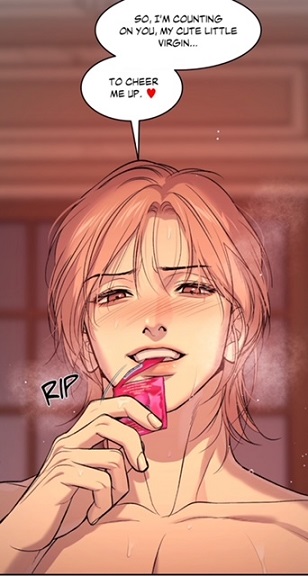
 (chapter 35) This shows how important it was for him to have a lover. He fears of being abandoned and being alone. Therefore he asked this from his new lover:
  (chapter 32) Not only he didn’t want to be confronted with the champion’s anger, but also he didn’t care if the doctor had to suffer because of him! To conclude, Heesung prefers watching from the side line with the excuse: he is seeking his soulmate.
 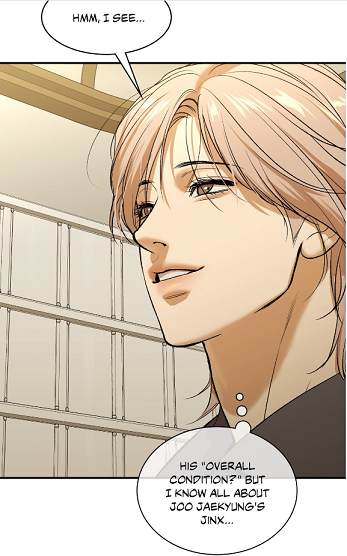 (chapter 32) It is not his “problem”. Hence he was totally absent, when the scandal with Joo Jaekyung broke out. His AWOL corresponds to his passivity and even indifference. However, there is no doubt that this incident will affect his relationship with Potato greatly.
  (chapter 52) The latter looks not only sad, but also frustrated. Let’s not forget that Potato fought against MMA artists from a different gym.
 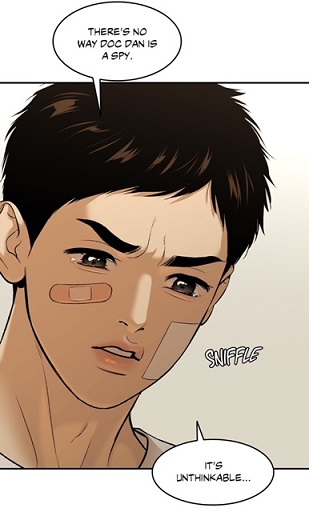 (chapter 52) Besides, Yoon-Gu embodies the opposite notions: loyalty and meddling. He doesn’t fear argument and criticism!
 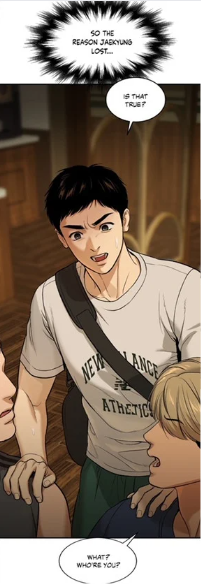 (chapter 52) Heesung’s indifference and selfishness contrast so much to his new lover’s interest and selflessness. This shows that the young maknae is superior to the actor despite his lack of experience and ignorance. How do we explicate this divergence? It is because Potato had been showered with support and love at the gym. Kim Dan was even willing to risk his safety for him, a sign that he was lovable and worthy. Hence he is a confident man which is not the actor’s case. That’s the reason why the young man stated that he would become responsible for Heesung.
  (special episode) Thus I sense that Potato will force the actor to drop all his past believes: passivity, indifference, irresponsibility and as such betrayal. We could witness this in the special episode partially.
  (chapter 5) This is just another trick from goddess Mingwa to push him to become more responsible for his new relationship. My idea is that in order to discover that Potato is his soulmate, Heesung needs to help Potato and as such the main couple to be together. Only when the doctor and the champion are an item, he will have his partner.
 (special episode) with the one from episode 39
 (chapter 39), as the shades are very similar. Heesung was as rough and selfish as the fighter. Notice that this whole sex session was focused on the actor’s needs and desires,
  (special episode) exactly like with the champion. He needed “comfort”, as he was in a depressed mood.
  (special episode) The champion has a similar habit:
  (chapter 36) Besides, note that Yoon-Gu’s buttocks are red, a sign that the comedian focused on them!! The irony is that Potato felt pleasure right away, hence he had more climaxes than Heesung.
  (special episode) This panel is interesting, because it shows that Potato was not focusing on Heesung at all. It was all about himself and his own pleasure. He was not recognizing that he was actually mirroring the actor’s thoughts and desires. Yes, from my perspective, the young man was in truth treating the actor as his sex toy or fuck buddy. There was no string attached, this explains why Heesung had to ask this to Yoon-Gu:
  (chapter 33). He can also hear rumors there. Moreover, for me, the actor stands for power, control and as such knowledge… hence he was able to pull tricks on the star on multiple occasions. He is able to make the athlete angry, he can arrange a meeting without Joo Jaekyung’s consent
 (chapter 32.). Interesting is that these values (influence, dominion, competence and insight) are associated with the shade black!
 (chapter 35) was not a punishment against Joo Jaekyung for the actor’s injury which happened with the support of MFC.
  (chapter 31) Officially, he had wounded the actor, therefore his physical therapist had to take care of his treatment. Besides, I believe that MFC desired to corner the champion in order to force him to give up on his new lover. He was no longer hiring a prostitute. As you can see, black is an ambiguous color: it can symbolize knowledge as well ignorance. Thus this shade represents mystery. Thus it is no coincidence that the past and family of Joo Jaekyung, who is also associated with black, remain a riddle
 (chapter 31) While Joo Jaekyung condemned him for his deception and constant switching of partners
 (chapter 33), his manager accepts him despite his messy love life and flaws.
  (special chapter) Potato is a sex toy, just like the doctor was a tool against the champion’s jinx. Secondly, the artist discovered a whole new world thanks to Potato’s purity and ignorance
  , we have to envision that his role during the night was to absorb the actor’s negative energy.
 (chapter 35) reminded me of Kim Dan who used to drink in order to numb his pain. By meeting the black and yellow Chow-Chow, the fox was able to see light in his sorrow. Potato could absorb his negative thoughts and even enlighten his night. Therefore it is not surprising that Heesung made such a statement:
  (chapter 33) First, the VIP club is painted with dark colors. Secondly, the athlete was wearing a dark brown jacket with a black pullover. For me, Choi Heesung’s true personality comes to light in the dark!! We could say that he shines in a black room. Surrounded by darkness, he feels more protected. Thus at the club, he revealed his immorality and hypocrisy… He didn’t stand out. The more white the room is, the less the actor is honest! His preference for neutral colors expresses his need for “conformity and passivity”. They are an evidence for his hypocrisy and acting. Under this perspective, Manhwaworms can grasp why the mysterious man has a hidden dark room!
  [I am assuming that Mingwa didn’t change the flat] Only there, he exposes his true nature: BDSM. In my eyes, there he can voice all his desires and thoughts. His true self can come to the surface. I saw another evidence for this hypothesis (BDSM) in this expression: “kick him to the curb”
  (special episode): DEATH! This notion contrasts to the actor’s belief: soulmate! What is Potato’s goal in life? So far, it was to follow Joo Jaekyung’s foot steps! He wants to be a MMA fighter. He is destined to fight and as such to be exposed to danger. In the ring, he can die. He already fought for the physical therapist’s sake.
  (chapter 52) This means, he is already one step closer to the MMA arena. With the last incident, the young fighter must have caught the attention of opponents. He created himself “enemies”. Therefore he could become the next target for a plot as a revenge. In other words, with such a companion, Heesung is confronted with reality. His destined partner can be wounded and even die. Thus he has to ensure his safety. He can no longer be indifferent and passive. As you can see, Heesung will be put in a similar position than the physical therapist:
 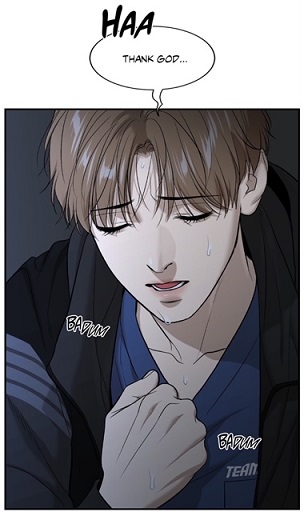 (chapter 40) And this observation leads me to my second part, the explanation for the title: La Vie En Rose.
 (chapter 36) That’s what the athlete experienced at the end of season 1. I could describe the fans’ devotion and appreciation as idolization and veneration which can have terrible consequences.
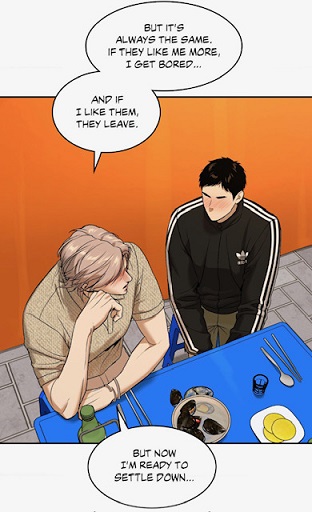 (chapter 35) Either he would break up, as he felt no excitement for his boyfriend, or when he would finally reveal his true side, the latter would leave him. Why? Both were disappointed, neither of them would fit the portrait they had from each other. The smiling and generous actor is in fact selfish, childish and probably apathetic. I am even suspecting that he has been suffering from depression too. Not only the choice of his colors indicates blandness, boringness and lifelessness, but also his body language. He is often seen resting his head on his hand.
 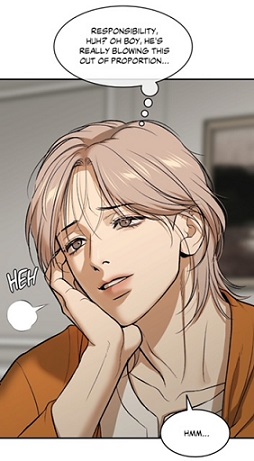 (special episode)
  (chapter 33) or sighing, the symbols for boredom. Thus I have the feeling that his job as actor is not procuring him any joy. That’s how I realized why Heesung is the champion’s frenemy. While the latter stands for training and routine (he hates surprises and novelties), the other embodies the exact opposite notions: he loves adventure, spontaneity and variations.
  (chapter 48) As you can see, the main lead announced a turning point in the gumiho’s life. Exactly like his frenemy, he was taught that money and fame can not buy affection. Moreover, for the first time, the young man learned the existence of boundary and respect.
 (special episode)
  (chapter 35)
  (special chapter) He is constantly caught by surprise!
  (special chapter) He sees Yoon-Gu as fun! Simply because he is allowing himself to express his emotions. He is never hiding his thoughts and emotions, the exact opposite of Heesung. He is so transparent, on the other hand, totally unpredictable. Yes, in the end, Yoon-Gu represents a huge riddle for Heesung. What caught my attention is how Yoon-Gu didn’t mind to yell his affection and admiration in front of people. He doesn’t mind people’s judgement and gaze. He is strong enough to bear this kind of attention… the exact opposite of the actor. He is not afraid of committing, making a different statement, he can diverge from majority. Hence he left the restaurant in front of others.
  (chapter 52) He can make his own judgement and choice. To conclude, though Yoon-Gu is the younger one, he has so much to teach his fated partner who chose conformity and ended up bored and half-dead!
 (chapter 31) We could say, their meeting was like a big bang, an explosion! Caught by surprise and annoyed by such an incident, the actor couldn’t help himself voicing his thoughts about Potato:
  (chapter 31) For a short moment, he dropped his mask and expose his true personality. And for the first time, he received such a gaze:
  (special episode) That’s how both ended up creating unforgettable moments. Under this perspective, my attentive and patient readers can grasp why I created such an illustration for this essay:
  (chapter 53), for the grandmother’s death is imminent.



 (chapter 22) Back then, I came to realize that both ukes were associated with the number 2. Shortly after, while making a first portrait of Cheolmin, I noticed that this cute doctor was linked to numbers 1, 3, 4.
  At the same time, I connected him to the sky, an angel. As you can observe it, my observations led me little by little to planets and numerology. But the major turning point was, when I perceived Kim Dan as a representative of Saturn
  . From that moment on, I came to associate Jinx-characters with gods and as such planets. Hence in the essay
  , I made the following connections. Potato was Venus, and his soulmate Choi Heesung is Mercury. Then Joo Jaekyung is Jupiter and the Sun, whereas Kim Dan was Saturn and the Moon.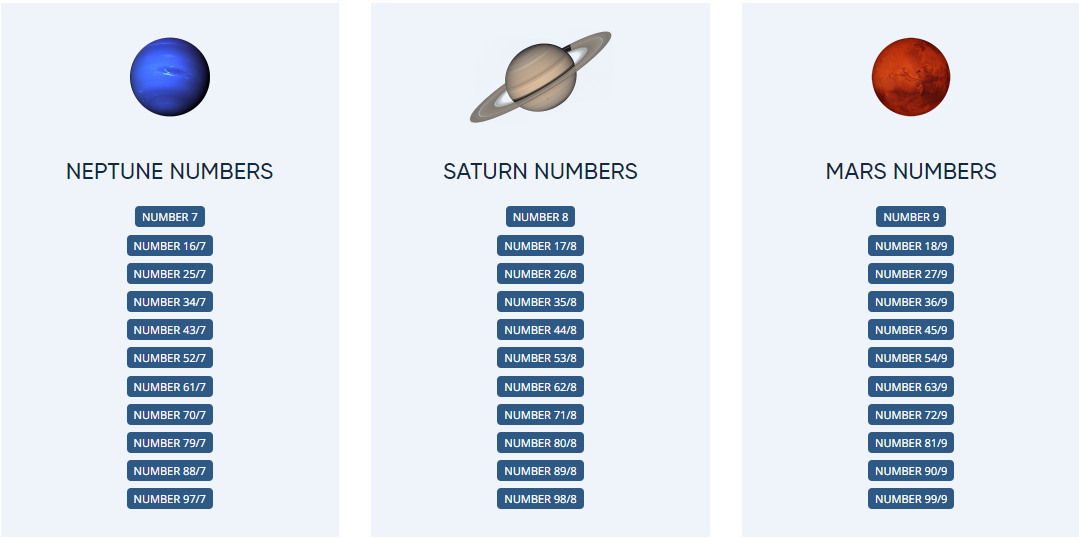

 That’s how I discovered that Kim Dan was associated with the number 8. Thus in the composition
  HEALING! That’s the night Kim Dan got healed.
  (chapter 47) and digest the terrible news.
 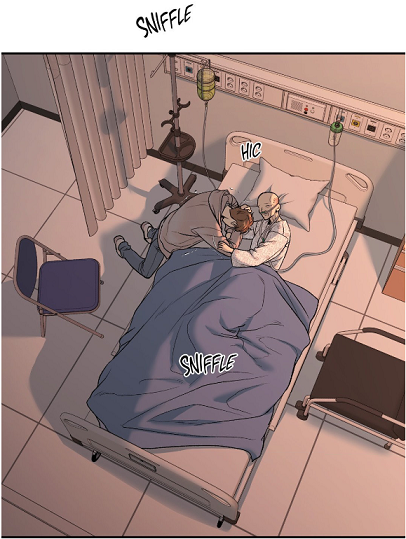 (chapter 47) Thanks to the champion, Kim Dan discovered that he could receive warmth and love from someone else. And now, you can grasp why he was strong enough to give the present to Joo Jaekyung despite his fear, why he could confront his boss in the locker room in episode 51. Thanks to this magical night, he learned that he could stand on his own. He is an adult now. But wait… people might question this interpretation, for there was no teamwork in episode 11.
  (chapter 11) When Park Namwook and Kwak Junbeom saw that he was wounded, the manager could detect the doctor’s lie. But what did they do? Nothing, they acted, as if they had not detected his lie. However, don’t forget the champion’s reaction.
  (chapter 11) He treated him as an important member of his team, he needed his assistance. Secondly, who helped Kim Dan with his struggles? Joo Jaekyung.
  (chapter 11) He might have taken advantage of the situation, yet contrary to the others, he did something despite his ignorance.
 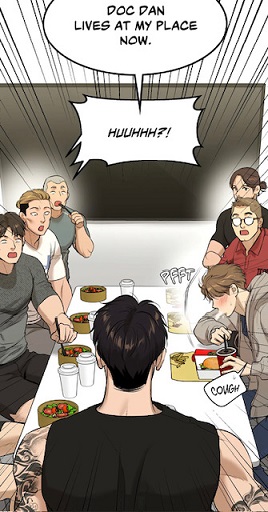 (chapter 22) Secondly, notice that he showed his true power in the break room. He is the true owner of the gym
  (chapter 22) It is important, because it indicates that little by little, Joo Jaekyung is taking over the gym. From that chapter on, he was building his world from the ground”.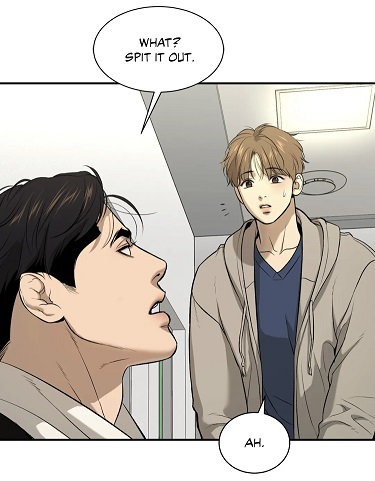


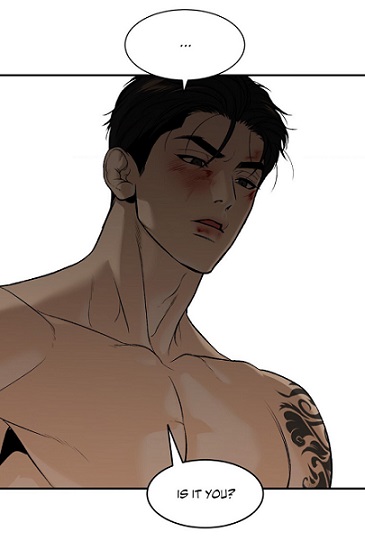
 They are no longer avoiding discomfort, a sign that they are getting closer to each other.
 I selected pictures from episode 6, 33 and 51! They are all connected to the same number. This signifies that we should examine the following chapters 6, 15, 24, 33, 42, and 51 as a continuation or better said as reflections. Hence they stand for love, but don’t forget that Venus also embodies fertility, prosperity and victory. How so? She was the ancestor of the Roman people through her son, Aeneas, who survived the fall of Troy and fled to Italy. That’s why she came to symbolize Rome’s imperial power. Yes, these chapters are mirroring a battle, who has the upper hand in the couple.

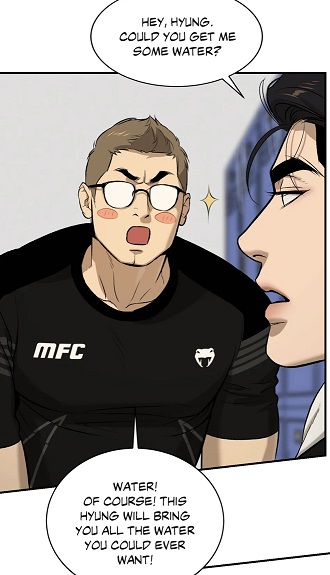




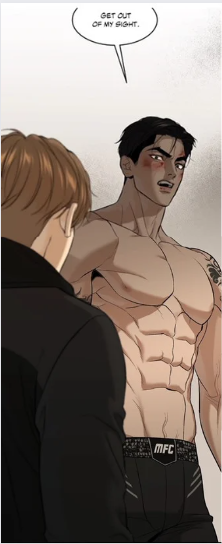
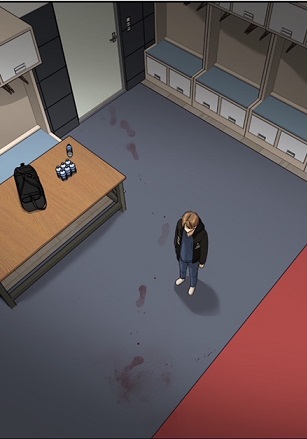
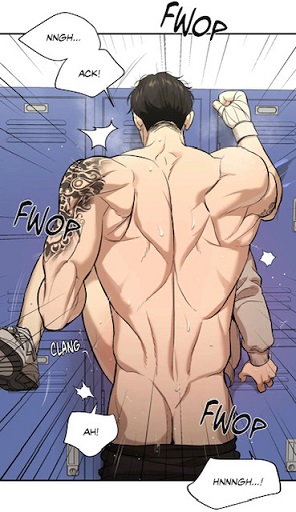 (chapter 15) But there’s more to it. It was also a first for the champion. He invited Kim Dan to watch the show. Imagine that he had never invited any sex partner before. Then in episode 24, he listened to the doctor’s request without any complain. Then in episode 33, for the first time, Joo Jaekyung focused on giving Kim Dan’s anal pleasure. It was, as if the star wanted to trigger desires in Kim Dan. Then in episode 42, Joo Jaekyung witnessed that Kim Dan was doing the breakfasts out of “routine” and not out of pleasure. Thus he always fell asleep. On the other hand, the physical therapist got confronted with a rival for the first time. Finally, in episode 51, Joo Jaekyung is now acknowledging Kim Dan as his final doctor. He is voicing his expectation: meticulousity.
  (chapter 51) By bringing the topic money
  (chapter 51), the champion could finally voice his biggest fear. Deep down, he knew that their relationship was based on money. But with one sentence, the doctor could remove his doubts and insecurities.
 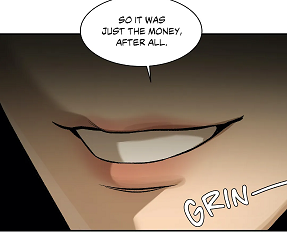 (chapter 6)
 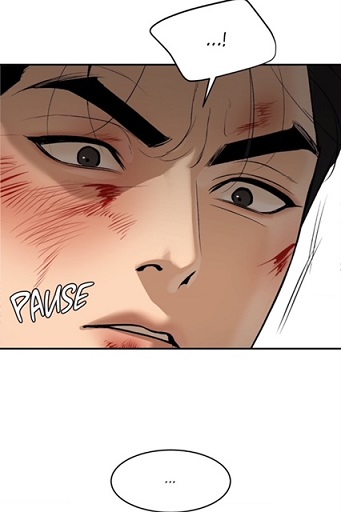 (chapter 51) He was more than caught by surprise, in my opinion, it must have dawned on him that he might have been wrong about the doctor. Hence he got upset. Seeing the physical therapist’s face was like a reminder that he had made a mistake, he had not trusted Kim Dan, while the latter had not.
  (chapter 47). Remember that for me, Cheolmin is connected to Neptune, hence we have the number 1, 3 and 4. Thus it would validate my hypothesis that at the restaurant, Joo Jaekyung was talking to the cute doctor.
  , (chapter 39) In chapter 53, we discover that it was the halmoni’s dream to see the ocean, like we could observe it in his old house.
 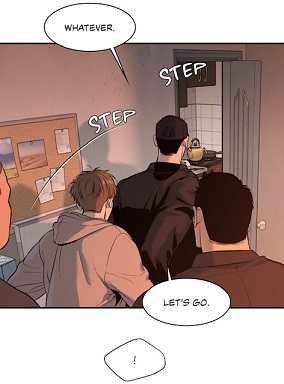 (chapter 17) However, in the last panel, Joo Jaekyung was leading his loved one, symbolizing that he would bring him to different places. Thus the doctor had to follow him to Busan (city next to the sea) and to the USA. At the end of season 1, it becomes clear that the champion will follow the doctor’s footsteps. He will got to the West Coast. Yet, in reality, the fighter is actually following the grandmother’s trail. Moreover, note that the doctor’s dream was to travel too. However, this desire is strongly connected to his relative.
  (chapter 27) Yet according to my previous interpretation, the PT’s totem is the duck:
  (chapter 7)
 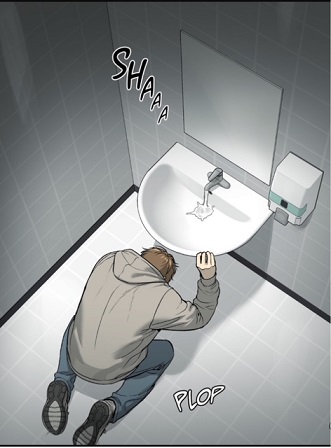 (chapter 47) The bridge from San Francisco is a place where people often commit suicide. My idea is that after they vanished, the halmoni never discussed their death with him. Since the grandmother was harassed by the loan shark, I can only assume that they killed themselves due to the debts, and suicide is a huge taboo in South Korea. Notice that his first trip led him to Busan which is a town next to the sea. However, back then, he had not the time to go to the beach. But when he went to the States, it was far from the coast, as UFC/MFC is located in Las Vegas. Hence he came to enjoy his trip. In fact, it inspired him to travel.
 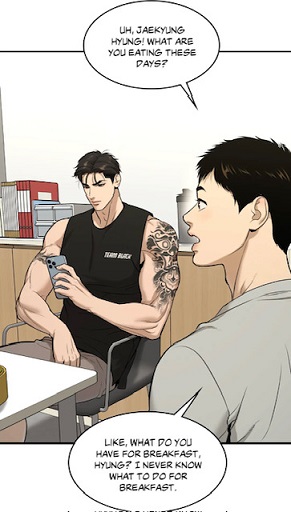 (chapter 22), why he protected the doctor from Heesung in episode 31
 (chapter 31), why he asked for Kim Dan in episode 40
  and why he reappeared in episode 47.
  (chapter 47) and helped him in the locker room.
 Bebebisous33s' analyses in K-Dramaland and Manhwas