
Please support the authors by reading Manhwas on the official websites. This is where you can read the Manhwa: Jinx But be aware that the Manhwa is a mature Yaoi, which means, it is about homosexuality with explicit scenes. Here is the link of the table of contents about Jinx. Here is the link where you can find the table of contents of analyzed Manhwas. Here are the links, if you are interested in the first work from Mingwa, BJ Alex, and the 2 previous essays about Jinx The Man Who Knew Too Much – part 2 and The Piercing Amber Shore
It would be great if you could make some donations/sponsoring: Ko-fi.com/bebebisous33 That way, you can support me with “coffee” so that I have the energy to keep examining Manhwas. Besides, I need to cover up the expenses for this blog.
In my previous essay, I ended with the observation that the photograph with the dogs 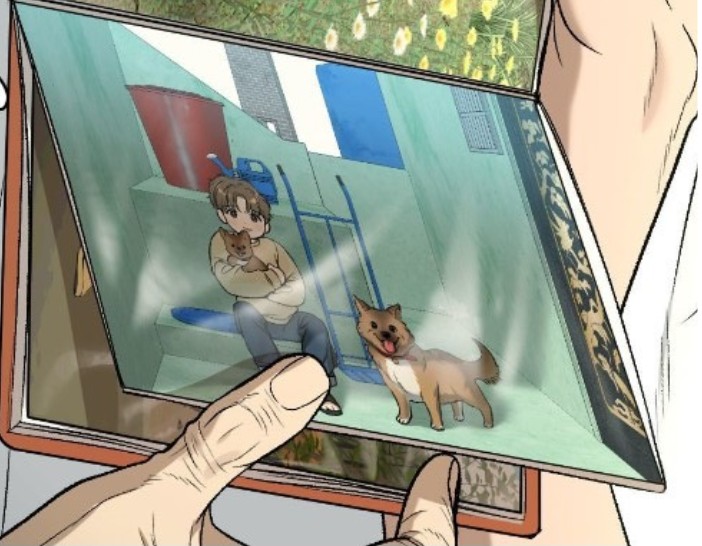 (chapter 94) was not simply a charming childhood image. It already contained the traces of loss, even if Joo Jaekyung did not recognize it as such. What appeared to him as innocence and warmth concealed a reality that remained invisible to him. This is where I want to begin.
If we look more closely at these images, we realize that they do not merely show fragments of Kim Dan’s childhood. 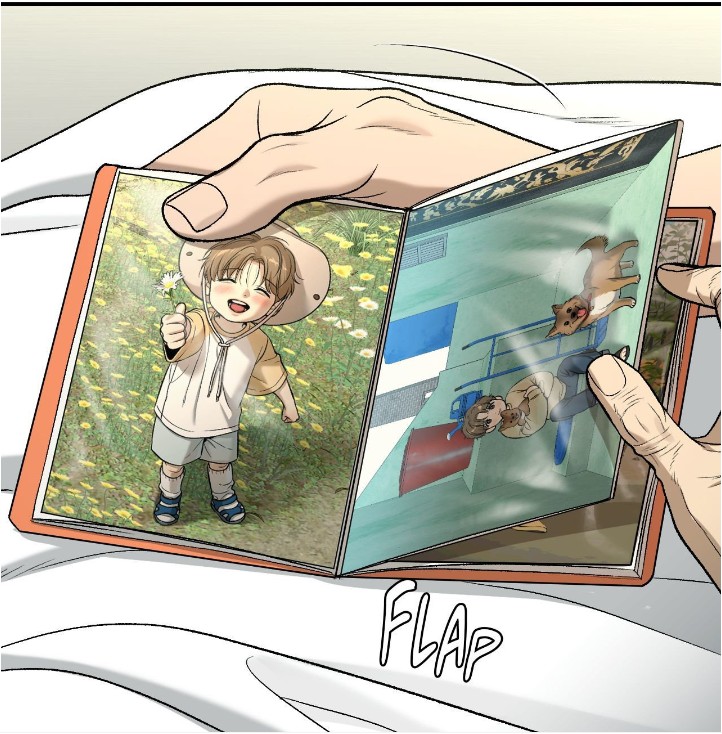 (chapter 94) They are traces of a life already shaped by forces that remain unseen. What appears as warmth and innocence is, in fact, embedded in a process of dispossession that has already begun.
In Jinx, there is one game that immediately comes to mind: Monopoly.  (chapter 27) Each time it is played, it reveals a rigid structure. One player accumulates, the other is gradually dispossessed. There is no space for coexistence or shared success. Loss is not accidental. It is built into the rules.
And what makes this dynamic even more revealing is the way each of them reacted to that loss. What makes this dynamic even more revealing is the way each of them reacts to it. One responds with anger, denouncing “highway robbery,” refusing to accept defeat. The other remains seated and resigned: 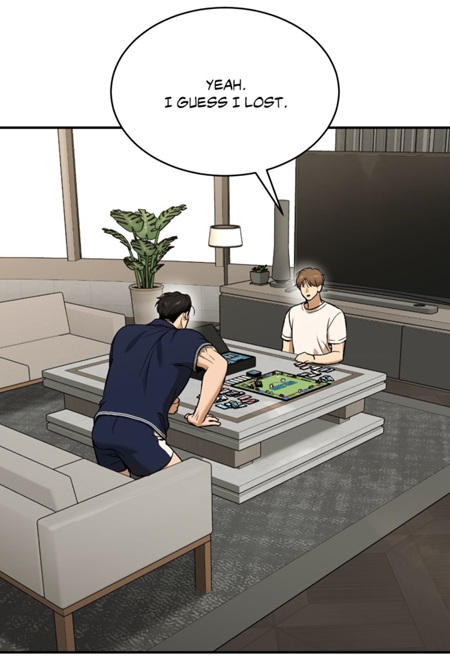 (chapter 80) These reactions were not incidental. They already suggest two fundamentally different ways of inhabiting the game. They already suggest two fundamentally different ways of inhabiting the same system. One resists and attempts to escape. The other endures and adapts.
This distinction becomes crucial in episode 94.
If we keep this in mind, we can sense the same logic in episode 94 again. It is already suggested by the way Kim Dan compliments the champion and views himself. When he admits, 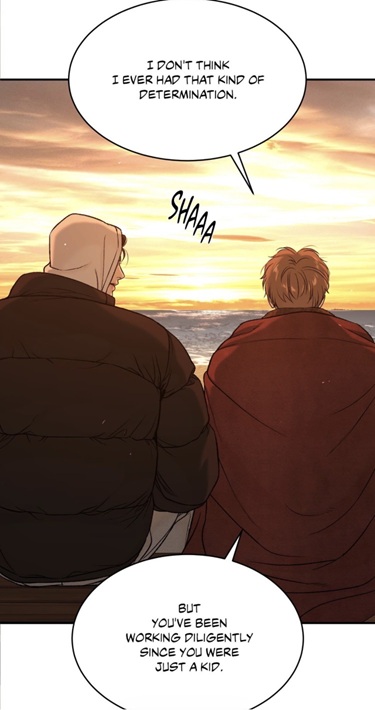 (chapter 94), he positions himself outside the logic of confrontation. He recognizes his lack of determination in the conventional sense. And yet, this does not place him outside the game. On the contrary, it reveals another mode of participation. His strength lies not in resistance, but in endurance, patience, and continuity.
This is where the structure becomes more complex. Because the same logic persists — only in a different form. This time, the game no longer takes place on a board. Instead of properties and rent, we are given photographs of a childhood (chapter 94). At first glance, they seem harmless. There is no visible competition, no immediate conflict, no explicit rules. What we see are moments of play: a child with a dog, a child offering a daisy, a child moving freely within his environment. These gestures suggest connection, spontaneity, and joy. They belong to a childhood experienced as something open and shared.
And yet, this is precisely what makes the scene deceptive. (chapter 94) Because if Monopoly makes loss visible, these images conceal it. What appears as play is already embedded in time, transformation, and conditions that remain outside the frame. The child is not competing, but he is not outside the system either. The game has not disappeared. It has become less visible.
This is why the photographs cannot be read as simple memories. 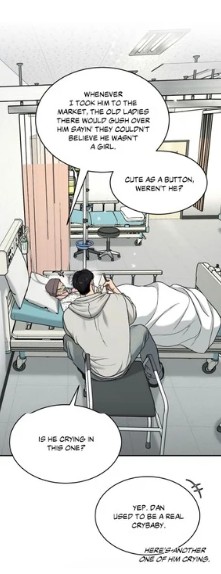 (chapter 94) They do not present a complete story. They offer fragments. Some are clear, others overlap, and one remains partially hidden. This fragmentation is not accidental. It requires reconstruction. We have to put them together, like pieces of a puzzle. And this raises a simple question.
And this immediately raises a question. How many pictures are actually shown in this scene? Most readers would answer: four. 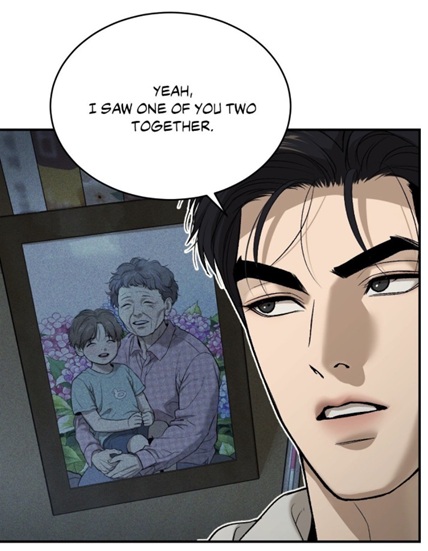 (chapter 94) And yet, this answer is incomplete. One image remains partially concealed, almost erased by another.
 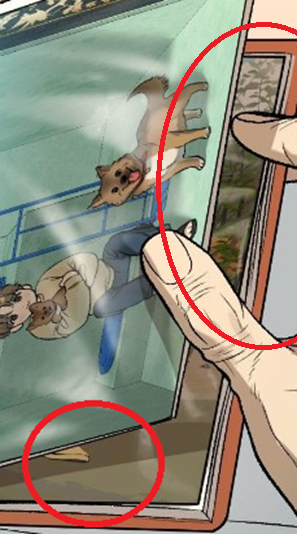 (chapter 94) It is easy to overlook, and that is precisely why it matters. Because once we begin to count more carefully, we also begin to see more carefully.
The images are not arranged randomly. They suggest a sequence. If we pay attention to clothing, landscape, and atmosphere, a pattern begins to emerge: spring, summer, autumn, winter. Childhood is not presented as a fixed and single moment, but as a cycle unfolding over time. This is where The Unseen Game of Life becomes visible.
The game is no longer limited to possession or victory. It unfolds through time, through what is shown and what is hidden, through what is remembered and what is ignored. It shapes not only outcomes, but experiences. It determines what kind of childhood is lived — and what remains invisible, even when it is right in front of us.
And this is where Joo Jaekyung’s position becomes revealing. He understands perfectly how to play Monopoly — not only within the game  (chapter 80), but also in reality, as he owns several properties. But he does not immediately understand what these photographs represent. What he sees are pleasant memories.
 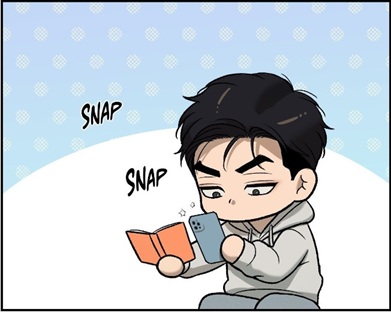 (chapter 94) And when he takes pictures of these pictures, his gesture exposes the limit of his perception. He preserves what is visible, not what it signifies. The stylistic shift reinforces this moment. Rendered as a chibi, the “Emperor” is momentarily stripped of his predatory gaze. His perspective is simplified, almost purified. He no longer sees Kim Dan as a function or a role, but as a cute and sensitive child. And yet, this remains incomplete. He captures the image, but not the structure behind it. He perceives the warmth, but not the cost that made it possible. He sees the surface of a life, but not the forces that shaped it.
This is why the game remains unseen.
Reconstructing a Childhood
If the photographs in episode 94 function like pieces of a puzzle, then the first step is not to interpret them immediately, but to examine them carefully. What do they show, and in what order should they be read? A closer look reveals that these are not static portraits, but carefully selected glimpses of Kim Dan’s childhood, each marked by a distinct posture, season, and emotional tone.
A closer look reveals that these are not static portraits, but carefully selected glimpses of Kim Dan’s childhood, each marked by a distinct posture, season, and emotional tone. (chapter 94) At first glance, these images appear simple. They are structured around play, companionship, and small gestures of joy: a child holding a puppy, offering a daisy, moving freely through his environment. In this sense, they seem to confirm what we might expect from childhood. Life appears light, open, and shared.
It is precisely this impression that makes Kim Dan’s confession on the beach so revealing. When he tells Joo Jaekyung that he has been working diligently since childhood (chapter 94), he constructs a clear contrast between them. The champion appears as someone shaped by effort from an early age, while he implicitly presents himself as someone who did not follow the same path. The statement suggests that determination belongs to one, and not to the other. This formulation echoes the logic we have already seen in Monopoly (chapter 80) In that game, positions are unequal from the very beginning. One player accumulates, the other is gradually dispossessed. What matters is not only the outcome, but the way each player responds to it. One resists, protests, and refuses defeat. The other accepts the loss and remains seated. Over time, this difference becomes internalized. The rules of the game are no longer questioned. They are absorbed.
This is precisely what happens in Kim Dan’s confession. He does not simply describe a difference. He accepts it as natural. He interprets Joo Jaekyung’s strength as something inherent, while reducing his own past to a lack. In doing so, he unknowingly adopts the logic of the game itself: one rises, the other yields.
And yet, this is where the photographs introduce a rupture. Because the child they show is not yet playing by these rules. One detail emerges with striking consistency: Kim Dan is always at the center of the image. (chapter 94) The photographs are not landscapes, nor are they focused on objects or environments. They are structured around him. He is the one being held, the one running, the one interacting, the one offering the flower. The gaze that frames these images is directed toward him. This has concrete implications. The child we see is not neglected. He is well dressed. His clothes are clean, varied, and appropriate to the seasons. He is also well fed. As his grandmother later remarks, he had a “hearty appetite as a kid” 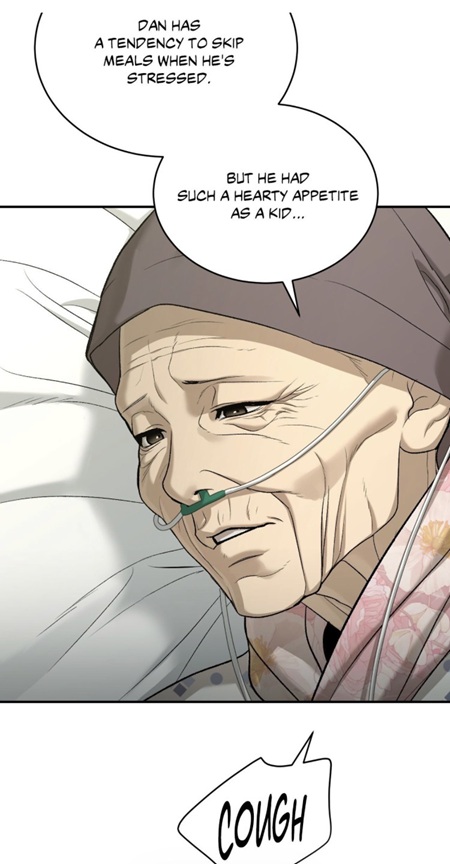 (chapter 94). These are not insignificant details. They indicate that, at this stage, his basic needs were met. He was cared for.
This stands in sharp contrast to his present situation. When Joo Jaekyung observes Kim Dan’s living conditions, he notices the absence of clothing 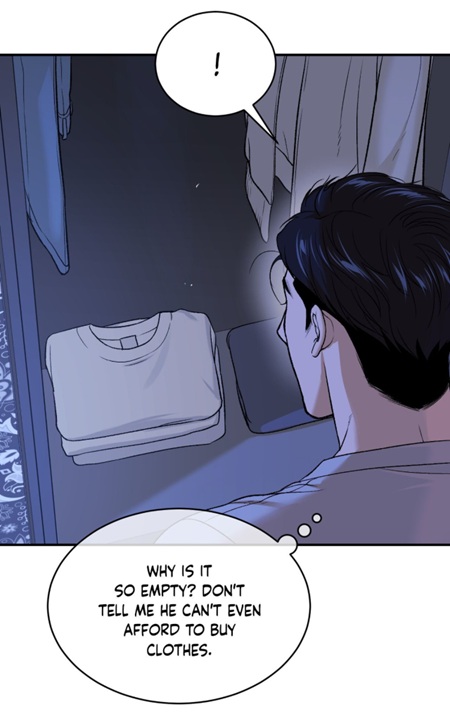 (chapter 80). The wardrobe is nearly empty. The implication is immediate: Kim Dan does not spend money on himself. This observation is confirmed by his own behavior. He uses his savings for others. He pays for his grandmother’s needs
  (chapter 41) and later spends a significant amount on a gift for Joo Jaekyung.
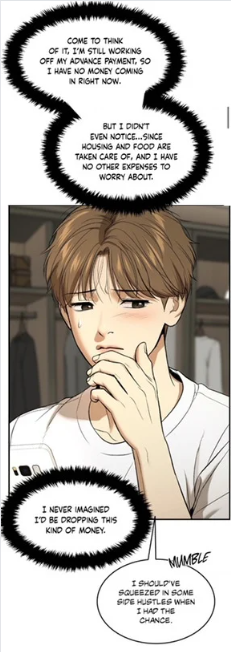 (chapter 42). This repetition is not incidental. It reveals a pattern: Kim Dan directs resources outward, not inward. He prioritizes others over himself. Even his relationship to food reflects this shift. As an adult, he skips meals when he is stressed, despite having once eaten well.
The contrast is therefore unmistakable. In the photographs, Kim Dan is the center of care. In the present, he has become the one who provides it. This inversion is crucial for understanding the structure of his life. The child who was once supported, fed, and dressed by others now assumes that role himself. Care has not disappeared. It has been reversed. This is what Kim Dan’s confession fails to recognize. (chapter 94) His statement on the beach creates the illusion that Joo Jaekyung alone was shaped by discipline and hardship, while he himself remained outside that logic. But the photographs reveal a different truth. They do not show a child who lacked strength. They show a child who had not yet been forced to transform strength into sacrifice. He was not yet responsible. He was not yet the one who gave. He was the one who received.
That is why these images matter so much. They do not simply preserve moments of happiness. They document a time before the rules of the game fully took hold of him. They reveal that Kim Dan’s later endurance did not emerge from a lack of determination, but from the reversal of a position he once occupied. What he now mistakes for weakness is, in fact, the trace of a childhood that was interrupted.
And yet, this is only one part of the story. If we read these images more carefully, a different structure begins to emerge.
The bodily positions already tell us something important. In one image, Kim Dan is held in his grandmother’s arms. 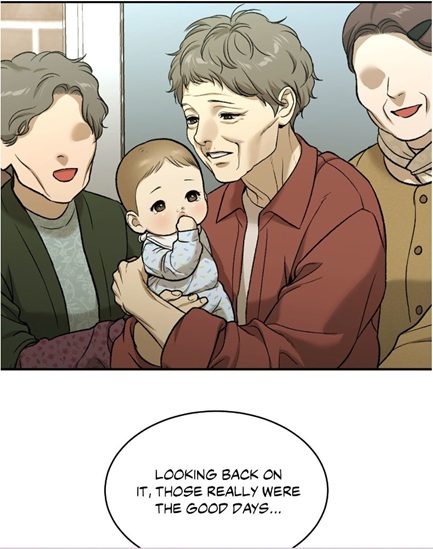 (chapter 94) His body is supported, carried, entirely dependent. In another, he is sitting on a step while holding a puppy close to his chest. (chapter 94) In the field, he stands on his own two feet and extends a daisy toward the person behind the camera.
 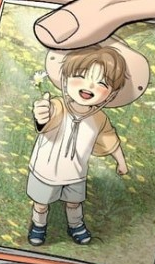 (chapter 94) In the almost hidden image, only one foot is visible, lifted off the ground: this is enough to conclude that he is running. (chapter 94) And in the photograph mentioned by Joo Jaekyung, he is seated on his grandmother’s lap among hydrangeas. (chapter 94) These positions are not accidental. They show a child who is allowed to inhabit many different states: dependence, stillness, affection, upright autonomy, movement. He is not fixed in one role. He is carried, he holds, he stands, he runs, he rests. Before we even interpret the backgrounds, the body already suggests a childhood marked by freedom.
This impression is reinforced by the objects that accompany him. In the image with the daisy, the flower is not simply part of the setting. It is held out toward the photographer. (chapter 94) The daisy, a simple wildflower, is traditionally associated with innocence, sincerity, and unfiltered joy. Unlike cultivated flowers, it grows freely, without constraint. By offering it, Kim Dan does not only interact with the person behind the camera, he shares something that belongs to his world. The gesture suggests trust, openness, and a spontaneous desire to connect.
A similar dynamic can be observed in the photograph with the puppy and the dog. (chapter 94) Animals, especially young ones, are often used to symbolize vulnerability, affection, and instinctive attachment. The puppy in his arms mirrors the child himself: small, fragile, and in need of care. At the same time, the presence of the adult dog introduces a second layer, that of protection and loyalty. Kim Dan is not alone in this image. He is part of a small relational world built on closeness and mutual dependence.
These elements are not incidental. They reinforce the impression that this is a childhood shaped not only by movement and freedom, but also by affection. The daisy, the puppy, and even the way these moments are framed suggest that the child is seen through a gentle and attentive gaze. They let transpire that he was loved. In other words, they actually prove my theory about his parents: he was raised by loving and caring parents. Hence he is placed in the center of the photography. But there exists another evidence for this interpretation: Joo Jaekyung’s lack of photos suggests he was never “beheld” with that same gentle gaze. If Dan was raised in a “natural cycle” (seasons, animals), Jaekyung was raised in an “industrial cycle” (results, training, utility). 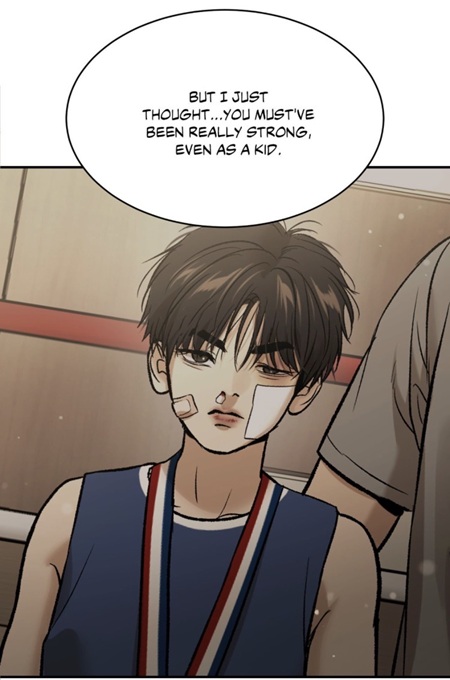 (chapter 94) Hence his only picture in his childhood is linked to a tournament and boxing.
This freedom becomes even clearer once the photographs are arranged in seasonal order. (chapter 94) The baby picture most likely belongs to early spring. The adults around him wear light jackets and scarves, which suggests cold but transitional weather rather than deep winter. Since Kim Dan was born on December 26th, this scene can plausibly be placed only a few months later. The woman on the far left wears a floral sleeve beneath a dark cardigan, a detail that subtly reinforces the idea of seasonal transition. Spring, then, is not only the season of beginnings. It is also the season in which Kim Dan first appears within a circle of adults, still dependent, still held, and still emotionally tied to others.
The image with the daisy comes later. (chapter 94) Here Kim Dan is dressed lightly, standing in an open field and offering the flower toward the photographer. The flower itself matters. Daisies belong to late spring or early summer, but they also symbolize simplicity, innocence, and spontaneous joy. Unlike a cultivated bouquet, a daisy is modest and wild. Kim Dan does not merely hold it for himself. He presents it. This gesture suggests trust, openness, and delight in shared attention. It is an image of a child for whom the world is still something to be explored and offered, not defended against.
The hydrangea photograph mentioned by Joo Jaekyung provides the clearest seasonal anchor. Kim Dan is wearing shorts and a short-sleeved T-shirt, and the hydrangeas behind him are in full bloom. (chapter 94) This places the image firmly in summer. Yet what matters here is not only the season, but the atmosphere. In contrast to the daisy picture, where he stands independently and reaches outward, he is now seated on his grandmother’s lap. Summer here does not simply symbolize expansion, but also fullness and protection. It is a moment of warmth, abundance, and secure intimacy. If spring marks origin and the daisy image marks early openness, the hydrangea scene represents the height of childhood ease but also its imminent ending.
The dog picture introduces a different mood. (chapter 94) Kim Dan is no longer in an open field, but in a structured outdoor hallway. Around him we can identify a trolley, a watering can, large containers, and in the background a large chimney. There is also a patterned door with birds and flowers, which echoes the decorative logic of the later cabinet without being the same object. These details suggest a hybrid environment where living and working coexist. His clothes are warmer than in the summer pictures, which indicates a drop in temperature. This does not allow us to assign the season with total certainty, but the heavier clothing, the functional setting, and the disappearance of open flowering landscapes point more convincingly toward late summer or early autumn. Symbolically, this matters. Autumn is the season of transition, upkeep, and preparation. The carefree openness of earlier pictures begins to recede. At the same time, this image introduces class more clearly than the others. The child still appears affectionate and gentle, but the world around him is already marked by labor, maintenance, and material necessity.
Finally, the hidden image completes the cycle. (chapter 94) Only fragments are visible: one foot in motion, a fence, a pale surface that resembles snow, and what looks like a hill in the background. Since only one foot is shown, the child must be running. This is not a posed portrait but a captured instant. The suggestion of snow or frost, together with the more closed landscape, points toward winter or perhaps late fall. The symbolism here is different from the others. Winter is not simply the season of hardship. In this sequence, it is the season of movement, exposure, and unfolding time. The child is no longer merely being shown. He is already in motion. This is not without significance. Kim Dan was born on December 26th, at the very beginning of winter. In this context, winter does not represent an end, but a point of origin. It marks a beginning that unfolds under conditions of cold and vulnerability, but also one that requires inner warmth and resilience. Rather than opposing warmth, winter redefines it. Since winter is his birth season and his “running” season, it suggests that Dan’s natural state is one of internal resilience. He is a “winter child”—he doesn’t need the sun to thrive; he generates his own warmth. This explains why he could survive next to Jaekyung’s distance. It is no longer given by the environment, but must be created and preserved. In this sense, winter becomes the season in which growth takes place in a less visible, more internal way.
Taken together, these images form a full cycle: spring with the baby in arms, late spring or early summer with the daisy, summer with the hydrangeas, late summer or early autumn with the puppy, and winter with the running child. The author does not show only growth, but a childhood unfolding through the seasons. This is not insignificant. Seasons imply rhythm, continuity, and immersion in a living world. Kim Dan’s childhood is therefore associated not with institutional milestones, but with natural time. That already tells us something about the kind of child he was and the kind of life he came from.
The symbolism of the clothes strengthens this reading. As a baby, he wears clothes patterned with little sweets (chapter 94), an image of softness and indulgence, as if childhood were still associated with comfort and delight. Later, he appears in a shirt with a duck, another gentle and playful motif. (chapter 94) These patterns are not random. They connect him to a childlike world of animals, tenderness, and whimsy. They suggest that he was once seen and dressed as a child who could be cute, soft, and playful. This matters all the more because, later in life, that softness will be reinterpreted as weakness.
Another recurring feature deserves attention. What matters is not whether Kim Dan’s eyes are open or closed, but how he relates to the presence behind the camera (chapter 94). In several photographs, he appears visibly aware of that presence. (chapter 94) In the image with the daisy, for instance, his eyes are closed, yet his gesture and expression clearly indicate engagement. He is blushing, smiling, and extending the flower outward. This is not withdrawal, but a form of shy openness. The gesture only makes sense if someone is there to receive it. The photograph captures an interaction. The child responds to the observer, and the observer is implicitly included in the scene.
A similar attentiveness can be sensed in other images, where his gaze is directed outward, alert and receptive. In these moments, Kim Dan appears fully present to the world and to the person who is looking at him. The photographs do not merely record him. They suggest a relationship with the photographer.
By contrast, the hydrangea photograph introduces a shift. (chapter 94) Here, Kim Dan is seated on his grandmother’s lap, and the composition is entirely centered on the two figures. There is no outward gesture, no attempt to reach beyond the frame. The scene is closed. The person behind the camera is no longer included in the same way, but remains outside, observing. The child is no longer interacting with that presence, but contained within a relationship that is already defined.
This does not diminish the warmth of the image, but it alters its structure. What was previously a shared moment becomes a framed intimacy. The child is no longer primarily engaged with the world around him, but situated within it. The difference is subtle, yet decisive. The closing of the frame mirrors the closing of his world; the open fields of the daisy photo (chapter 94) are replaced by the protective, yet narrow, lap of his grandmother. This picture announces Kim Dan’s imminent loss of innocence due to his parents’ vanishing.
This is what the photographs finally show about Kim Dan. He is presented as a child of openness rather than control, of movement rather than discipline, of relation rather than domination. He belongs to fields, flowers, animals, changing seasons, and spaces where work and life overlap. In other words, he embodies nature. He can be held, he can hold, he can stand, he can run. He is not yet trapped in one function. At the same time, the backgrounds complicate the apparent innocence of these scenes. The dog picture in particular reveals that this freedom existed within a modest environment already touched by labor and transformation. Kim Dan’s childhood, then, cannot be reduced either to pure happiness or to pure suffering. It appears instead as a life suspended between warmth and fragility, between natural abundance and quiet precarity.
This is precisely why these images matter so much. They do not simply preserve a past. They reveal a child who was still able to inhabit the world freely, even though the conditions of that freedom were already beginning to change. And that is where the unseen game starts to take shape.
A Changing Landscape
If the photographs (chapter 94) are read not only as personal memories, but as traces of a lived environment, they begin to reveal something more than childhood itself. They point toward the world in which that childhood was embedded.
The image with the dog and the puppy is particularly revealing (chapter 94). The setting is neither purely domestic nor entirely natural. It is a transitional space. The presence of a trolley, a watering can, and large containers suggests a place where living and working coexist. This is not a leisure environment. It is a space of small-scale labor.
At the same time, the child is not working. He is sitting, holding the puppy, fully absorbed in play. This contrast is decisive. It shows that his childhood unfolds within a world already shaped by work, but in which he himself is not yet subjected to it. This allows us to situate the family within a specific social context.
The environment suggests a modest, possibly semi-rural or peri-urban setting, where economic activity is directly tied to nature. The recurring presence of flowers, plants, and open spaces supports the idea that the family may have been involved in a form of small-scale production, such as flower cultivation or local trade. (chapter 94) The fact that Shin Okja later mentions taking him to the market reinforces this connection. The child is not isolated. He is part of a network of everyday economic life. This also explains why he is entrusted to her.
If the parents were working, possibly outside the immediate household or within demanding conditions, the grandmother’s role as caretaker becomes necessary.  (chapter 47) Her presence does not replace the parents. It supplements a structure already under pressure.
This pressure becomes more visible when we contrast these images with the later urban landscape.  (chapter 48) In the city view, nature has not disappeared entirely, but it has been pushed to the margins. Hills and trees remain in the distance, while the foreground is dominated by dense construction, commercial buildings, and rooftops. The naming of places such as “The Lake Shops” is particularly revealing. The reference to the lake suggests a natural environment that is no longer accessible. What remains is its name, preserved as a surface within a commercial structure. This transformation is not incidental. Striking is that this image mirrors the painting in the champion’s penthouse:
 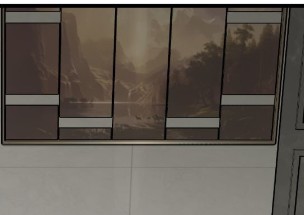 (chapter 93) But the lake has been replaced by a building. It corresponds to a broader process of urban redevelopment, in which natural or semi-rural areas are progressively absorbed into economic systems based on property, rent, and commercial use. In this context, land is no longer lived on. It is monetized.
To understand the “Unseen Game,” we must look beyond the frame of the photographs and into the historical shadow of the 1997 South Korean financial crisis. This was the moment the “Monopoly board” of the nation was violently reset. Triggered by a toxic cocktail of corporate debt, speculative volatility, and the sudden flight of foreign capital, the crisis forced the country into a brutal era of IMF-supervised restructuring.
For families like Kim Dan’s, this wasn’t just a headline—it was an earthquake. Property values didn’t just “fluctuate”; they collapsed. Debts became predatory. The “small-scale livelihoods” we see in the photographs—the gardening tools, the modest outdoor hallway, the flowers—were the exact type of “informal” or “traditional” economies that were liquidated to satisfy the demands of global capital. (chapter 94)
This is where the connection to Monopoly becomes more than metaphorical. The logic of the game — acquisition, accumulation, rising costs, and eventual dispossession — reflects the mechanisms at work in such transformations. Small-scale environments are gradually replaced by larger structures. (chapter 27) Those who cannot keep up with increasing economic pressure are displaced. Seen from this perspective, Kim Dan’s childhood does not only precede a personal rupture. It is situated within a world that is already undergoing structural change.
This also sheds light on his later relationship to money. And what did the physical therapist suggest back then, when the star was on the verge of bankruptcy? He could take a loan… that’s how the parents’ misery started. But there’s more to it. (chapter 42) As an adult, Kim Dan does not accumulate. He spends what he has on others. He supports his grandmother, pays for her needs, and later repeats this pattern with Joo Jaekyung. He does not invest in himself. He does not secure his own position. This behavior is not simply a matter of personality. It reflects a life shaped by instability, where resources are used for survival rather than growth. In this sense, his position within the “game” is already determined before he becomes aware of it. He does not enter it as an equal player. He enters it from a position marked by loss, adaptation, and necessity.
And this is what the photographs ultimately reveal.
They do not show a world that was stable and later broken. They show a world that was already fragile, already exposed to forces that would eventually transform it. What appears as a peaceful childhood is, in reality, a moment suspended between continuity and disappearance.
This context also allows us to comprehend the gap between the two main leads.
Kim Dan, who is three years older and approaching thirty, experienced the immediate impact of the 1997 financial crisis during his early childhood. He lived through a period of instability, displacement, and economic pressure without fully understanding its causes. The transformation of his environment, the loss of his family structure, and the increasing precarity of everyday life formed the background of his development.
Joo Jaekyung, by contrast, belongs to a slightly later moment. When he was a child, the crisis had already reshaped the social landscape. Its consequences were no longer unfolding, but had become part of a normalized reality. This is reflected in Hwang Byungchul’s description of his neighborhood
Joo Jaekyung grows up in its aftermath.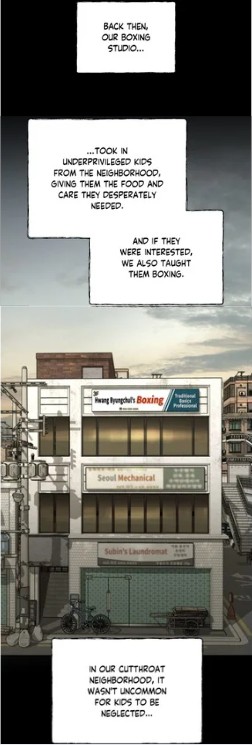 (chapter 72): a “cutthroat” environment in which neglect was common and institutions such as the boxing gym functioned as substitutes for basic care. The difference is subtle, but decisive. Kim Dan grows up at the moment of rupture. This is why the unseen game does not begin with loss. It begins much earlier, in the conditions that make that loss possible.
The Same Image, a Different Truth — Memory, Loss, and Reinterpretation
If the first set of photographs suggests a childhood shaped by freedom and affection, the images (chapter 94) involving the grandmother (chapter 94) introduce a more complex and unsettling dimension. At first glance, they appear similar. In both cases, Kim Dan is held close, framed within a moment of intimacy. The composition seems almost identical. And yet, a closer reading reveals a fundamental divergence.
In the image of Kim Dan as a baby, one detail cannot be ignored: his expression. (chapter 94) His eyes are wide, his gaze tense with tears, his mouth covered with his hand. He is not calm. He is not smiling. He has been crying. This raises an unavoidable question. Why?
If we take the image seriously, the tears cannot be dismissed as a trivial detail. They contradict the idea of a peaceful, happy moment. Instead, they suggest distress, discomfort, or even rupture. Such a reaction is not unusual. Infants often display what developmental psychology describes as stranger anxiety, a phase in which unfamiliar environments or faces provoke fear or distress. But in this context, the reaction points toward something more specific. Because this form of distress is not neutral. It implies the absence of a familiar figure. The child does not simply react to strangers; he reacts because the person to whom he is attached is no longer present.
In this sense, the image does not only show fear. It outlines a strong connection to the mother — a bond that is being disrupted at the very moment the photograph is taken. The child is no longer with his mother. He has been handed over, entrusted to Shin Okja. The presence of other women reinforces this reading. This is not an intimate, private scene. It is social, almost public. In this sense, the photograph does not simply show affection. It records a transition.
This reading becomes even more significant when we consider that Shin Okja refers to the “good old days” while looking at this very image. 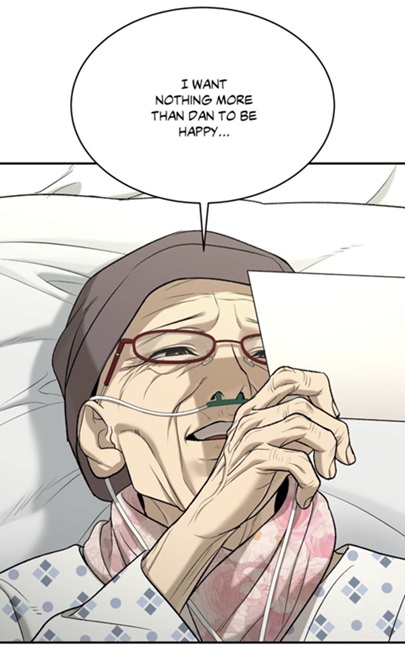 (chapter 94) She even associates this scene with Kim Dan’s happiness, while the photography contradicts this notion. The child is not at peace. He had just been crying. The moment is not one of stability, but of rupture. And yet, it is precisely this image that becomes the anchor of nostalgia. This creates a displacement.
This is where the contrast with the later hydrangea image 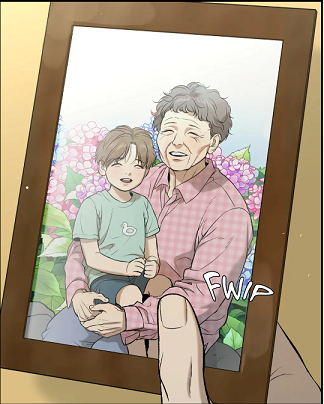 (chapter 19) becomes particularly revealing. In the first photograph, the women from the market are visibly present. (chapter 94) The moment is shared, exposed, embedded in a social environment. By contrast, in the hydrangea image, these figures have disappeared. They are replaced by flowers. What was once a public scene becomes a private one. At first glance, this shift may appear to enhance intimacy. The child is now alone with his grandmother, surrounded by blooming hydrangeas. The composition is softer, more harmonious, more contained. And yet, this transformation raises a question. What has been removed, and why?
What disappears is not only the social environment, but the structure that defined the earlier image. In the first photograph, the presence of the women from the market situates the scene within a moment of transition that is witnessed and shared. (chapter 94) The child’s tears unfold within this exposed space, and his reaction is oriented toward a presence beyond the frame.
In the hydrangea image, this structure has changed entirely. The scene is no longer oriented outward. The composition is closed, centered, and self-contained. The gaze that once participated in the moment is no longer included. This is not a simple shift toward intimacy. It is the consequence of a rupture. (chapter 94)
The hydrangeas do not merely decorate the scene. They occupy the space left by what has disappeared. Traditionally associated with apology, regret, and a desire for forgiveness, they introduce the idea that something unresolved persists beneath the surface. But they also carry another implication. Blooming fully, they mark a moment of completion — and, at the same time, of transition. They announce departure. Within this context, the image no longer represents a stable present. It captures a threshold. The child remains, but the relational structure that once connected him to the outside — and to the one behind the camera — has already begun to dissolve. (chapter 94)
Striking is that the image that most closely corresponds to a moment of calm, rest, and emotional balance is not part of the album at all. It is the photograph with the hydrangeas — the one Kim Dan himself has kept and framed. (chapter 94) In that image, he is older, composed, and seated on his grandmother’s lap, surrounded by blooming flowers. The scene is quiet, contained, and visually harmonious. According to my past interpretation, the last photography most likely represents the last moment before he lost his parents, a moment in which his world had not yet fully collapsed. And yet, this is not the image preserved in the album.
This difference is crucial. It reveals that the album does not simply gather memories. It reflects a specific point of view. 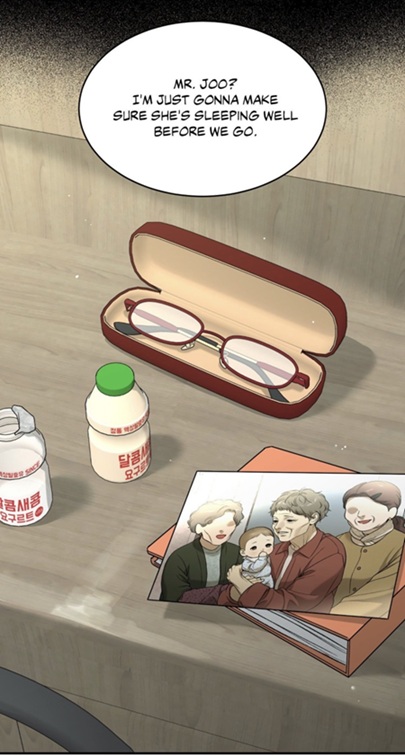 (chapter 94) The photographs it contains are not neutral. They are selected, arranged, and interpreted according to Shin Okja’s perspective. The image of separation becomes the “good old days,” while the image of relative stability is excluded from that narrative.
By contrast, the framed photograph belongs to Kim Dan. It is the only image he has chosen to keep. Unlike the album, which organizes memory collectively and retrospectively, the frame isolates a single moment. It suggests a different attachment, a different understanding of what should be preserved.
This divergence exposes two distinct relationships to the past. For Shin Okja, memory moves backward, reconstructing earlier moments and integrating them into a narrative of care and responsibility. For Kim Dan, memory condenses into a single image, one that he does not reinterpret verbally, but silently preserves.
The absence of the hydrangea photograph from the album, and its presence in his possession, therefore marks more than a simple difference in taste. It reveals a gap between two memories that do not fully coincide. Because if we follow the internal logic of the photographs, the moment that could most plausibly correspond to the “good old days” is not this one, but the later image with the hydrangeas. (chapter 94) In that scene, Kim Dan is older, calm, and seated on his grandmother’s lap, surrounded by blooming flowers. His clothing and the vegetation clearly situate the image in summer, a season associated with fullness and continuity. If your interpretation is correct, this photograph would mark the last period before he lost his parents — a moment when his family was still intact.
This creates a striking contradiction. (chapter 94) What we see is a child in distress. What is remembered and narrated is happiness.The gap between these two levels is crucial. It reveals that the photographs are not interpreted neutrally. They are reinterpreted through memory, filtered by emotion, and reshaped by nostalgia. Shin Okja does not lie consciously. Rather, she projects her own feelings onto the images. For her, these moments represent closeness, responsibility, and perhaps even purpose. The child’s tears disappear behind her own perception of care.
This becomes even clearer when we consider how she moves through the album. (chapter 94) Her gaze is not oriented toward the future, but toward the past. She flips through the pages in reverse, moving from the most recent images back to the earliest ones. This movement is not chronological. It is selective and directional. It functions as a form of regression.
In this sense, her gesture stands in direct contrast to the logic of a competitive game. A game such as Monopoly advances relentlessly toward an outcome, 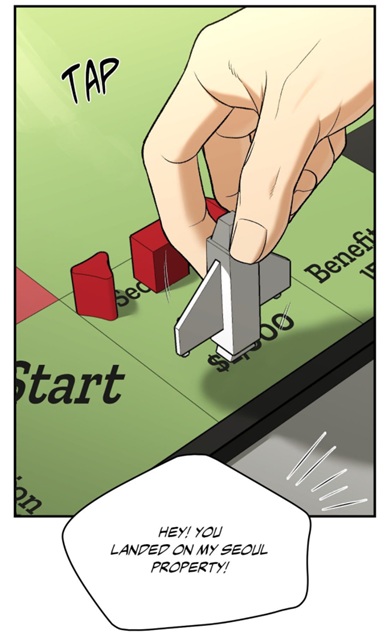 (chapter 80) structuring time as progression, accumulation, and eventual resolution. Her movement does the opposite. It moves backward, not toward victory, but toward a point of refuge. The album becomes a space in which time is reversed and the pressures of the present are temporarily suspended.
This reversal is not abstract. It is material and visible. (chapter 80) Each turn of the page, marked by the tactile flap of the paper, reduces Kim Dan. The sequence narrows. The independent boy who runs, stands, and interacts gradually disappears, replaced by a smaller, more contained figure. The movement through the album functions like a visual funnel: from autonomy to dependence, from mobility to stillness, from openness to enclosure. (chapter 94) At its endpoint stands the image of the infant.
Here, the contradiction becomes explicit. The baby had been crying, yet the grandmother is smiling in front of the photography. The scene contains two opposing emotional registers that are not experienced as such. The child’s distress is immediate, visible, and unresolved within the frame. And yet, for her, it does not signify rupture. It signifies need. This distinction is crucial. (chapter 94) Because a crying infant represents a form of suffering that can still be answered. It is simple, direct, and, above all, solvable. In that moment, she is able to position herself as the source of relief. The child depends on her, and that dependence gives structure and meaning to her role. This is why the contradiction does not appear as one. What we read as distress, she experiences as confirmation. She still views herself as his “source of happiness”.
By moving backward through the album, she does not merely revisit the past. She reconstructs a position in which her role is absolute and uncontested. The adult Kim Dan — the one who provides, who suffers, who exists outside her control — disappears from view. This psychological orientation explains why she continues to treat the professional physical therapist as a helpless infant 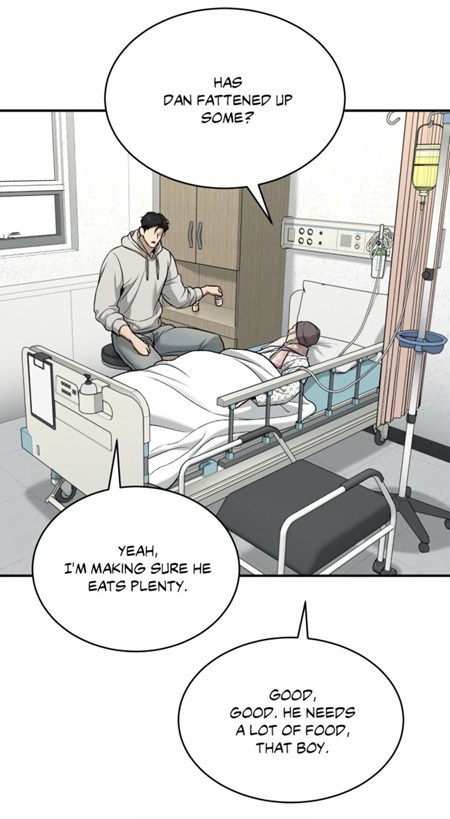 (chapter 94) Her persistent desire to see him “fattened up” is quite telling; it is not truly about the pleasure of eating, but about returning him to a state of physical dependence. To “fatten” a child is to exert a primary form of care that requires no complex dialogue or adult understanding—it is the most basic “rule” of her version of the game.
The photographs, then, are no longer treated as evidence of Dan’s life, but as emotional anchors for her own identity. This explains why the contradiction between his tears and her “good times” remains unaddressed. For her, the “good times” were a period of perfect dependence. In the space of the album, the 1997 crisis hasn’t arrived, the parents haven’t vanished, and the child’s only problem is a discomfort that a grandmother’s arms—and her “fattening” meals—can still resolve.
(chapter 94) What remains is a simplified structure in which the child’s distress is immediate and her response is sufficient. Not a time without suffering, but a time in which suffering was still manageable.This is what she calls the “good old days.”
Where the childhood images can be transformed into “good old days,” (chapter 94) the later photographs 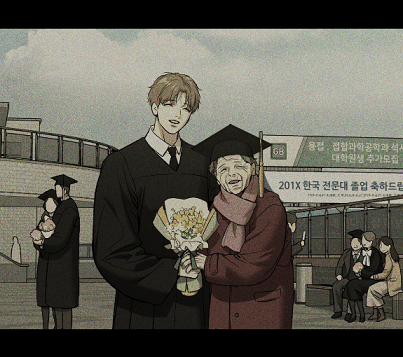 (chapter 47) remain tied to necessity. They reveal that, over time, the relationship between Kim Dan and his grandmother was no longer defined solely by care, but also by dependence.
The Mirror of Erasure: Doc Dan’s Compliance
The discrepancy between the photographs and Shin Okja’s verbal narrative reveals a profound structural shift in Kim Dan’s identity. On the beach, she insists that she  (Chapter 65), a statement that appears humble but subtly centers her own effort as the only relevant force in his life. When she speaks of her struggle, she envisions a calm baby. This makes her “failure” purely internal. By remembering him as calm while she felt “not enough,” she frames herself as the tragic martyr who was suffering even when things looked peaceful. It centers the entire era on her emotional state, not the child’s. But the picture from episode 94 displays a certain MO. She is simply ignoring reality. (chapter 94) In the physical photograph, the baby is clearly in distress (crying), but she is smiling. She is literally overlooking the child’s present reality in the photo to preserve her own feeling of “good times.” The child’s actual pain is invisible to her because, in that moment, she was the one holding him—and for her, being the “holder” is the only thing that matters. She frames his childhood through the definitive claim that he
  (chapter 65). This is not merely a description of loss; it is a transformation. By labeling him an absolute orphan, she erases the specific love and sacrifice documented in the early photographs, stripping him of his right to a specific grief. If he “never knew” them, he never lost them. In her version of the “game,” Dan is a blank slate upon which she has written her own narrative of care. At the same time, she
Strikingly, Kim Dan corroborates this void 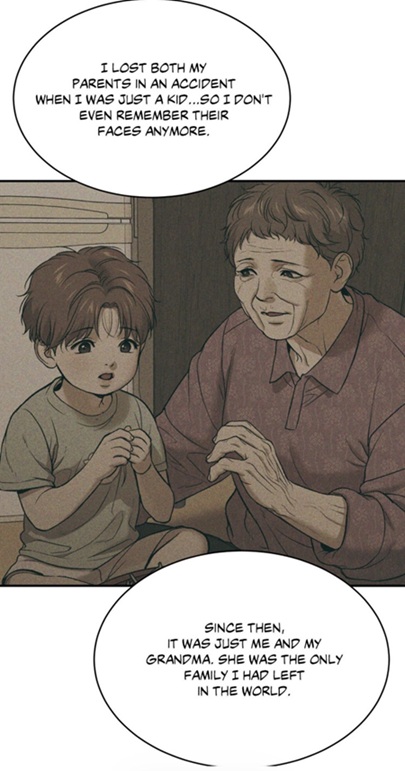 (Chapter 94). He speaks as if he were a baby when they vanished, yet the memory indicates the opposite. Moreover, the photos of him offering daisies and running prove he was old enough to know them. To survive under his grandmother’s care, Dan had to adopt her memory as his own, internalizing the image of a man who started from “nothing.” By erasing the parents, Shin Okja effectively erased the “Dan” who was once the center of a loving world, leaving behind only the “Doc Dan” who exists to serve the needs of others.
From Play to Performance: The Trophy Child
This shift becomes visible when comparing the childhood album shown to Jaekyung (Chapter 94) with the graduation photos Dan recalled at the hospital. (Chapter 47). The early images are structured around spontaneity—movement, animals, and open fields. However, as the timeline progresses toward his youth, the “Natural Cycle” is replaced by a trajectory of performance.
In these later institutional spaces—classrooms and stages—Dan no longer moves freely; he poses. 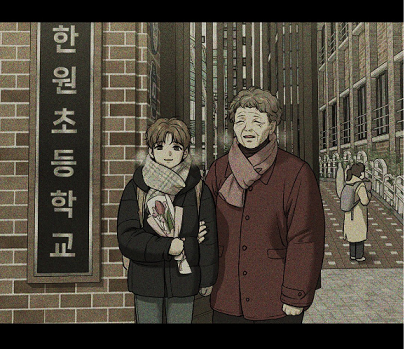 (chapter 47) He stands still, holding bouquets, looking at the camera to comply rather than engage. He is no longer a child “being,” but a trophy of successful care. His growth is recontextualized as the “interest” on his grandmother’s sacrifice, transforming his development into something useful and legible. This logic of appropriation is the “unseen rule” Dan eventually internalizes: his value is no longer grounded in his existence, but in his functional utility.
This is where the emotional register shifts again. The earlier photographs suggested a gaze directed toward the child — attentive, affectionate, and open. Here, the direction of that gaze becomes more complex. The child is still visible, but he is also being positioned within a narrative that exceeds him. His life is no longer only his own. It becomes intertwined with her need for meaning, recognition, and continuity. This is why these images feel different. They are not only more structured. They are more purposeful. The camera no longer captures a moment. It records a result.
The Crybaby
She looks fondly at this picture (chapter 94), she is able to position herself as the source of relief. The child depends on her, and that dependence gives structure and meaning to her role. This is why the contradiction does not appear as one. What we read as distress, she experiences as confirmation. And yet, her own words introduce a subtle tension within this dynamic.
When she refers to him as a “crybaby” (chapter 94), she does more than describe a child’s behavior. The term carries a judgment. It implies excess, weakness, a deviation from what is expected. Crying is no longer simply a response to pain or separation. It becomes something that must be corrected. This is where another layer emerges.
Because the child she describes is, in fact, behaving in a completely normal way. (chapter 94) He is a baby, or a very young child. If he cries in another one, it could be because he hurt himself, or he is frightened, or overwhelmed. The image of him crying after falling and injuring his knee 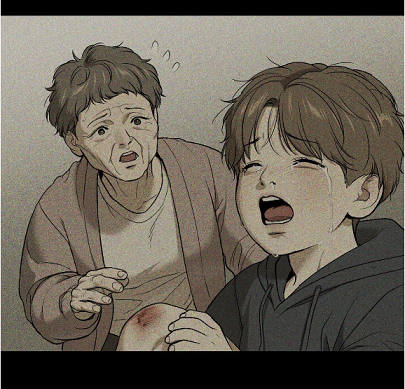 (chapter 47) confirms this. The tears are not excessive. They are appropriate. Thus he could have cried, because he lost the dogs for example. (chapter 94)
The label, then, does not describe the child. It reflects her perception. It reveals a discomfort with vulnerability, and more specifically, with the persistence of that vulnerability over time. The “crybaby” is not only the infant in distress. It is also the figure she does not want him to remain. This is reinforced by her later remark to Joo Jaekyung, where she praises his strength, his physique, and his masculinity 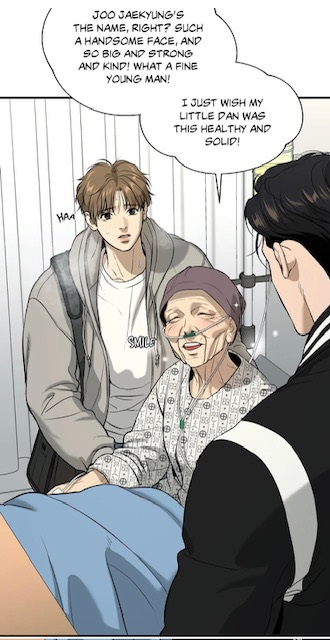 (chapter 21) The contrast is implicit but clear. The ideal is no longer the dependent child who cries, but the strong young man who does not. And now, you comprehend why he went to the restroom in order to cry. He is not allowed to express his sadness.
 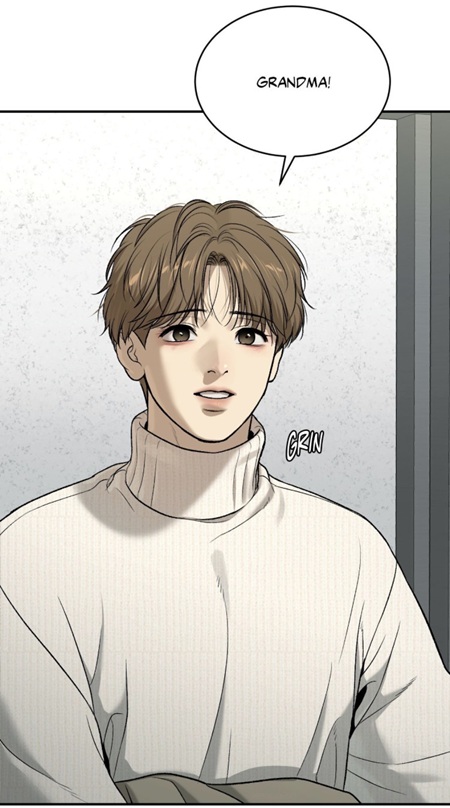 (chapter 94) In this sense, her perspective is structured by a normative expectation. A boy should be strong. He should endure. He should not cry. This creates a paradox.
On the one hand, she returns to the image of the infant because it secures her role as caretaker. On the other, she implicitly rejects the qualities associated with that same state. The crying child is both the foundation of her identity and something that must be overcome. This tension is crucial.
Because it helps explain the transformation we observe later. The child who once cried freely gradually becomes someone who suppresses his needs, who endures silently, and who defines himself through resilience rather than expression. In other words, the “crybaby” disappears. But what replaces him is not strength in the sense she admires. It is a form of self-erasure.
Because this transformation does not occur in isolation. It is mediated through her gaze. 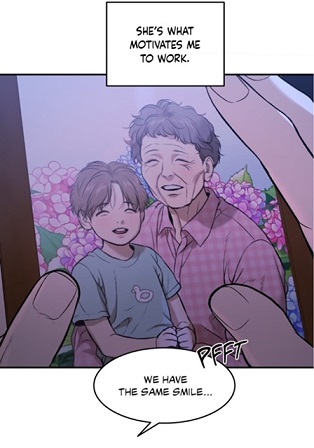 (chapter 47) Over time, Kim Dan learns to see himself as she sees him. The qualities that once defined his childhood — openness, sensitivity, emotional responsiveness — are no longer recognized as strengths. (chapter 94) They are recoded as weakness, something to outgrow, something to suppress.
This is why he cannot recognize his own strength. (chapter 94) What he has developed is not the visible, dominant form of strength embodied by Joo Jaekyung, but something quieter: endurance, patience, and an exceptional capacity for care. His strength lies in his ability to persist, to adapt, and to remain attentive to others even under pressure.
In other words, he stands for genuine empathy. And yet, because he perceives himself through the lenses of his grandmother, this form of strength remains invisible to him. What he sees instead is lack — a failure to meet an ideal that was never his to begin with.
The Production of Worthlessness
The consequences of this transformation are absolute. As Dan becomes the support structure of the relationship, he develops a pathological selflessness. His refusal to invest in himself—his empty wardrobe and skipped meals—is the continuation of a role where his only valid function is to provide. His lack of self-worth is not innate; it is a manufactured condition. (chapter 94) The original “Dan,” who offered daisies without expectation, has been overwritten by a provider who must justify his presence through constant sacrifice.
These later photographs (chapter 47) are excluded from the “happy” album because they resist reinterpretation. They cannot be turned into “good old days” because they document the exact moment care turned into dependence. They reveal a rupture that didn’t just remove his parents, but dismantled his entire environment—home, neighborhood, and unconditional joy. They expose her reliance on him and the doctor’s suffering and growth. By focusing on her role as the sole caretaker, Shin Okja reorganized the past, making the parents’ absence more visible than their existence ever was. Ultimately, Dan adopted this simplified history, losing the memory of the world that was taken from him.
The Glasses: Seeing the Past, Losing the Present
This dynamic becomes even more visible through a small but significant detail: the grandmother’s glasses (chapter 94) When she looks at the photograph, she is wearing them. This is not incidental. The glasses mediate her vision. They frame the way she perceives the image. She does not look at the past directly. She sees it through a lens. And that lens is not neutral.
It allows her to focus on what she wants to preserve: closeness, affection, meaning. At the same time, it filters out what cannot be integrated into that narrative: rupture, loss, contradiction. This is why the photograph can be reinterpreted.
The tears disappear behind the idea of “good old days.” (chapter 94) The moment of separation becomes a moment of connection. What is seen is not what is shown, but what can be emotionally sustained.
But this also implies a form of blindness. Her gaze is turned entirely toward the past. The present, by contrast, is only partially perceived. 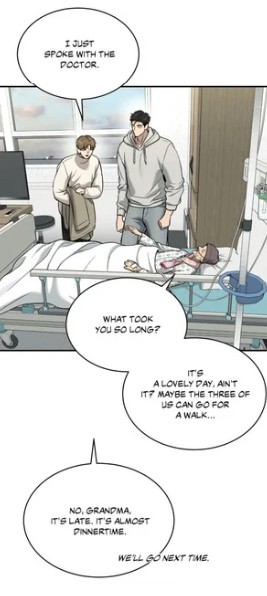 (chapter 94) She noticed his absence, but she failed to see his red eyes, his suffering. She does not fully register the adult standing in front of her. She continues to relate to him through the image she has preserved. This is where the gesture of removing the glasses becomes significant.
When she takes them off, the mediation disappears. The lens through which she has been interpreting the world is no longer in place. (chapter 94) This moment signals a possible rupture in her perception. The constructed coherence of her memory is about to be confronted by a reality that cannot be filtered in the same way. Her vision, quite literally, is about to collapse.
The Birthday: Time, Erasure, and the Illusion of Permanence
This tension between past and present becomes even more striking when we consider the question of the birthday.  (chapter 41) Birthdays are not trivial details. They function as markers of time, inscribing the individual within a social and temporal order. They acknowledge growth, change, and the passage from one stage of life to another.
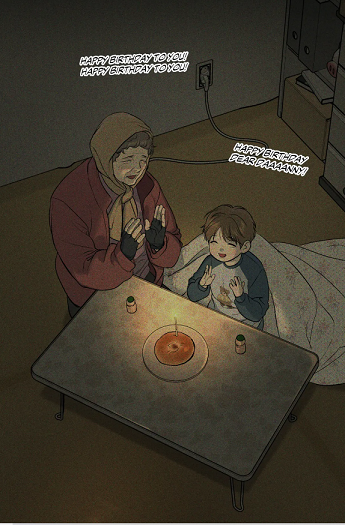 (chapter 11)
And yet, in this scene, the birthday is absent. This absence is revealing.
Jinx-philes already know that Kim Dan’s birthday follows immediately after Joo Jaekyung’s scheduled match on December 25th 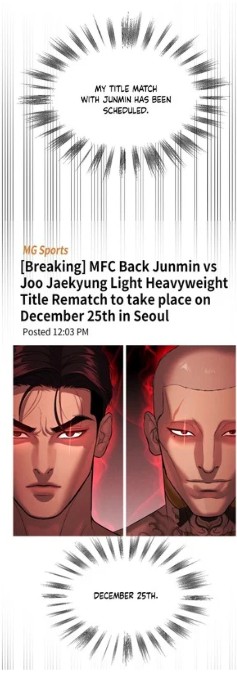 (chapter 88). The temporal proximity is clear. If the grandmother is aware of his matches — if, as she claims, they “give her strength”
 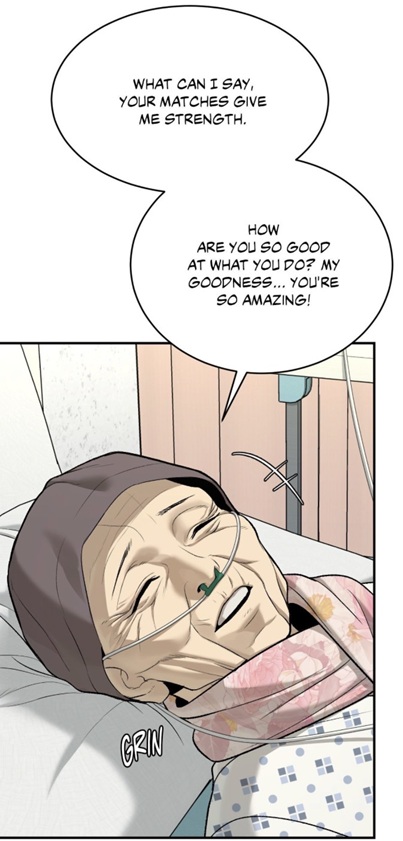 (chapter 94) — then she should also be aware of this date. But she does not mention it.
Instead, her attention is directed elsewhere. She complains that he does not spend enough time with her and asks him to come earlier next time. (chapter 94) She asks him to come earlier next time. 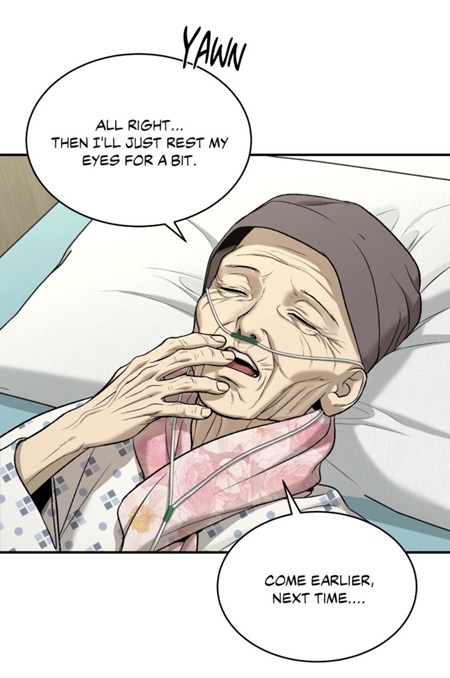 (chapter 94) Her concern is not oriented toward his life as it unfolds, but toward maintaining a certain relational dynamic.
This is where the contradiction emerges. She speaks as if she is connected to the present, yet her perception is anchored in the past. The fact that she only “heard” about his victory suggests distance rather than genuine involvement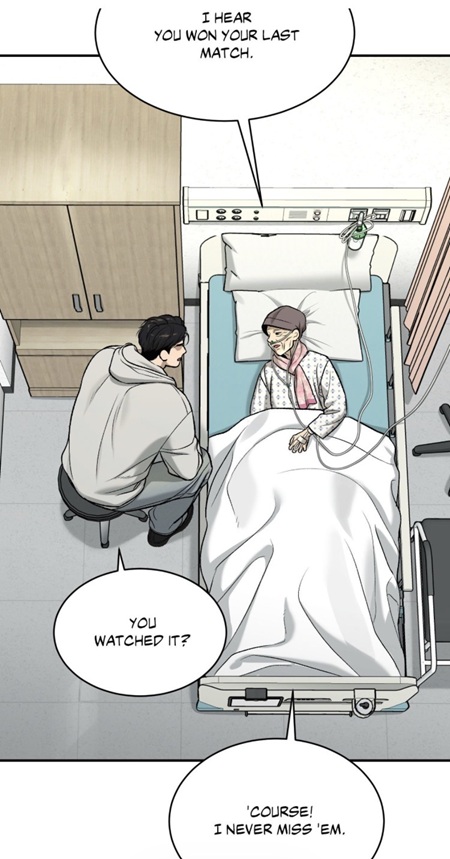 (chapter 94) Her knowledge is indirect, fragmented, and yet presented as intimacy. This gap is not incidental. It has structural consequences.
By not acknowledging his birthday, she does not acknowledge the passage of time. She does not recognize him as someone who is approaching thirty , as someone whose life extends beyond the role she has assigned to him. In this sense, the absence of the birthday is not a simple omission. It functions as a form of erasure.
Without temporal markers, the individual becomes fixed. He no longer moves forward. He remains suspended in a past that can be revisited, reshaped, and controlled. This is why he appears, in a certain sense, frozen in the end. (chapter 94) This also explains why she continues to treat him as a child. If time is not acknowledged, growth is not recognized. If growth is not recognized, the child never fully becomes an adult. He remains within a structure in which his role is defined by dependency, proximity, and care. This is where the notion of the “Unseen Game” reaches another level.
It is not only about economic structures or social conditions. It also operates through time itself. Through what is remembered, what is omitted, and what is allowed to change. And in this case, what disappears is not only the parents. It is Kim Dan as an individual. (chapter 11) When Jinx-philes encounter the birthday scene, they may assume that this celebration was a recurring ritual. But is that necessarily the case? The narrative does not confirm repetition. On the contrary, the absence of any reference to his birthday in the present suggests discontinuity rather than tradition.
This absence becomes even more striking when we consider the logic of the photographs. If, as suggested, one of the images corresponds to winter (chapter 94) then this season should have triggered her memory. And yet, it does not. The seasonal cycle that structures the photographs no longer structures her perception.
This indicates a deeper divide. She no longer inhabits the same temporal reality as her grandson. While his life continues to move forward, her perception remains anchored in a reconstructed past that she revisits selectively.
What disappears, then, is not only the parents. It is Kim Dan as an individual. He becomes, in a very precise sense, a ghost within his own life: present, functioning, necessary—but not fully recognized as someone who exists independently of the role he has been assigned.
And yet, this structure is not immutable.
Because the absence of the birthday does not mean that time has stopped. It only means that it has not been acknowledged. This is precisely where Joo Jaekyung’s role becomes decisive. By celebrating Kim Dan’s birthday, he does something that has been missing until now: he reintroduces time. He marks a transition. He recognizes not the child of the past, but the adult of the present. This gesture is not symbolic in a superficial sense. It has structural consequences. 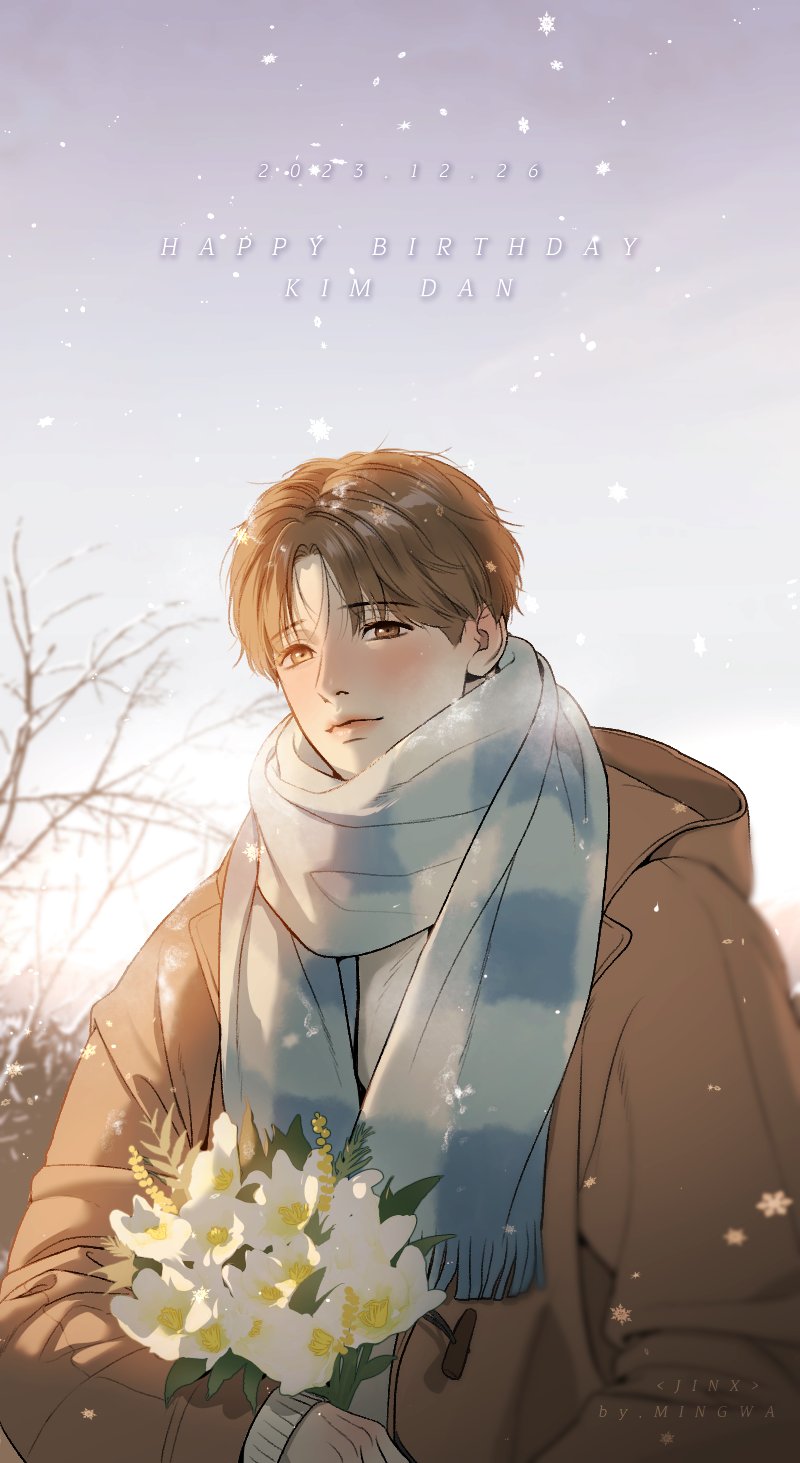 For the first time, Kim Dan is acknowledged as someone who has grown, who has endured, and who has reached a stage that cannot be reduced to dependency. The celebration does not create his maturity. It makes it visible. So this image could be seen as a picture taken by the main lead on Kim Dan’s birthday. And observe that this image lets transpire the presence of the photographer and the strong connection between the main lead and the photographer.
In this sense, Joo Jaekyung does not simply “care” for him. He restores a dimension that had been erased. He gives him back a temporal position. And with it, an identity.
The Function of the Photographs
This allows us to understand the true function of the photographs. (chapter 94) They are not simply memories. They are instruments of perception.
At first, Joo Jaekyung looks at them and sees only what is immediately visible: a child, innocence, warmth. (chapter 94) He recognizes the purity of that image, but not the conditions that surround it. The past appears self-contained, detached from the structures that shaped it. This limitation has consequences.
When he later recalls the encounter between Kim Dan and Choi Gilseok, his interpretation follows the same logic. 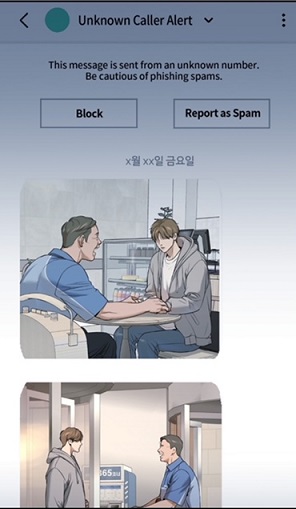 (chapter 48) He suspects manipulation, imagines betrayal, and attributes agency to the most visible figure, because he knows about the loan and debts. And don’t forget that in his mind, they are the result of gambling and not of an economical crisis. In this framework, Kim Dan appears as someone who could be bought
  (chapter 51), influenced, or used. Baek Junmin becomes the primary culprit, the one who acts openly, who attacks his wounds, who embodies threat. One might say that he looked at the pictures through the gaze of the photographer. But something remains unexamined.
Choi Gilseok. (chapter 48) He did not notice that these pictures were staged.
Because, unlike Baek Junmin, Choi Gilseok does not hide his position. On the contrary, he reveals it. In the café he owns, he lays out his resources with striking clarity.  (chapter 48) He speaks of his parent company, of pharmaceutical connections, of international treatment. He offers to cover medical expenses, to provide accommodation, to double Kim Dan’s salary, even to place a car at his disposal. This is not a conversation. It is a display.
What he presents is not simply help, but a system of possession. If we read this scene through the lens of Monopoly, the structure becomes unmistakable. Choi Gilseok is not a player struggling within the game. He is someone who already owns the board. The café, the company, the network, the capital—these are not isolated elements. They form a coherent system in which value is accumulated, controlled, and redistributed according to strategic interest.
Kim Dan, by contrast, is placed in the position of someone who has landed on another’s property. The offer appears generous. But like in Monopoly, generosity is never neutral. It is tied to incorporation. To accept means to enter the system, to become part of a structure in which the terms are already defined. This is where the illusion operates. Because what is presented as opportunity is, in fact, a form of capture. 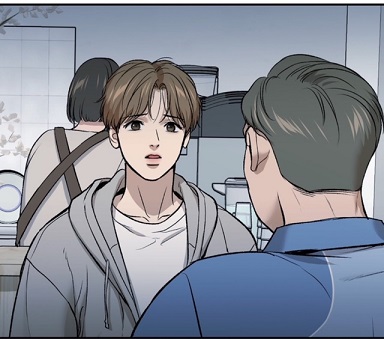 (chapter 48) And the switched spray was the price to pay for the “visit” at the café.
 (chapter 49) The meeting with Choi Gilseok is no longer a simple interaction between individuals. It becomes part of a larger configuration — one in which visible actions and invisible structures intersect. Responsibility is no longer attributed only to the one who strikes, but also to the one who orchestrates.
As you can see, the pictures can help Joo Jaekyung to see not only the director, but also his position within the game. This shift is crucial. (chapter 94) Because it allows him to recognize that Kim Dan is not defined by greed, weakness, nor by passivity, but by a history that required endurance, adaptation, and silent resistance. The child he saw in the photographs is not separate from the man he stands beside. It is the foundation of that man.
To conclude, this is where the photographs about Kim Dan’s childhood begin to transform Jaekyung’s perception. Indirectly, he has sensed the care and loving gaze of the parents. Because once he has learned to look beyond the surface — once he understands that what appears as innocence may contain loss, that what appears as simplicity may conceal structure — his way of seeing changes. He no longer looks only at what is shown. He begins to question what is hidden. And it is the same for Kim Dan (chapter 94) who could be forced to remember painful moments  (chapter 19)
 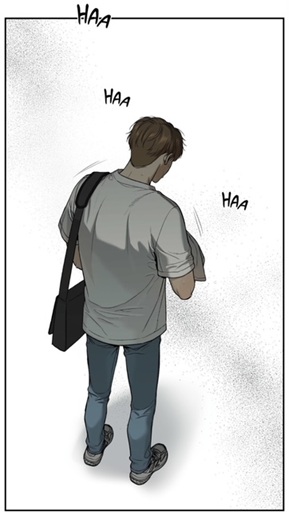 (chapter 59) by rediscovering the photos from his childhood, like the vanishing of the “puppy”. (chapter 94) I don’t think, it is a coincidence that Potato has pictures of the puppies as well.
  (chapter 60)
Feel free to comment. If you have any suggestion for topics or Manhwa, feel free to ask. If you enjoyed reading it, retweet it or push the button like. My Reddit-Instagram-Twitter-Tumblr account is: @bebebisous33. Thanks for reading and for the support, particularly, I would like to thank all the new followers and people recommending my blog.

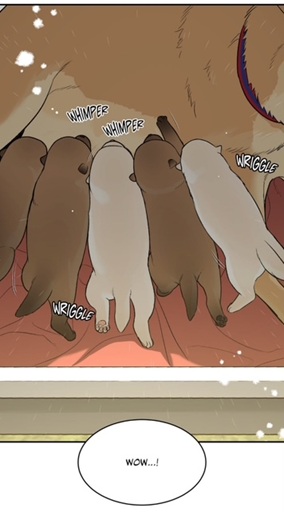 (chapter 57) and its future adoption which got reinforced with the reappearance of an old picture showing Kim Dan holding a puppy.
 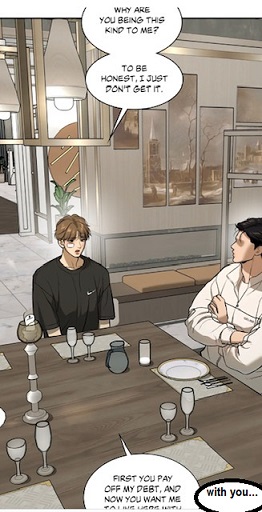 (chapter 18) Kim Dan and Joo Jaekyung are sitting together, but there is still a distance between them. And between them, almost quietly, hangs a painting: a winter landscape. Bare trees, cold tones, a distant city. Everything feels still… almost frozen.
  (chapter 18) This image reflects their state at that moment, that’s why it is placed between them, even behind them. They are close in space, yet emotionally far apart — trapped in silence, routine, and roles. Alive, but not truly living. At the same time, this shows how they treat their past and themselves. Additionally, they seem to draw a line between themselves and others, as if hiding behind invisible walls. Present, yet unreachable.
 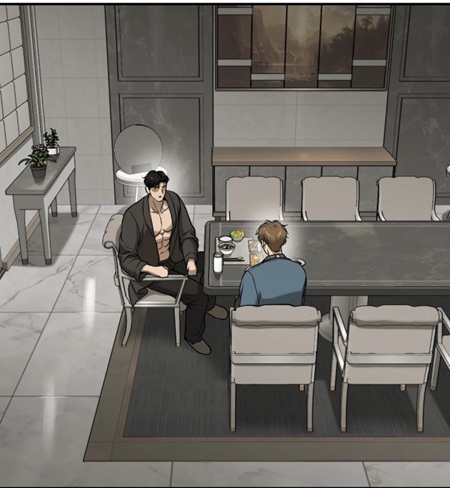 (chapter 93) The setting remains, but the painting has changed. Winter has given way to a living landscape: trees with leaves, a mountain rising in the background, and beneath it a stretch of water reflecting the light.
 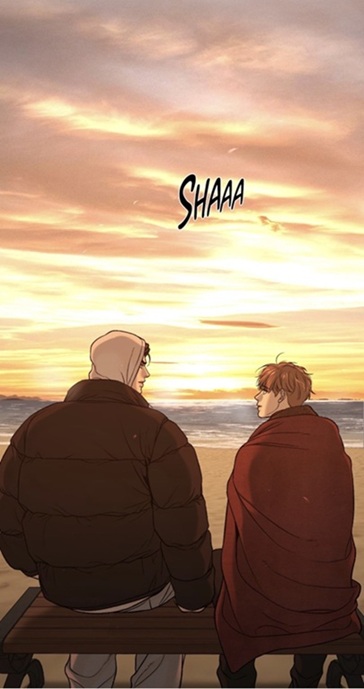 (chapter 94) A simple change in atmosphere? A moment of intimacy? Or the beginning of a deeper transformation in the way Kim Dan and Joo Jaekyung perceive themselves and, above all, each other?
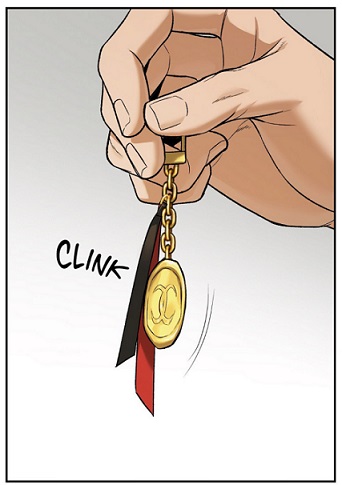 (chapter 55) —something polished, valuable, appropriate. Alongside it, he wrote a message that sounded careful, respectful, almost rehearsed:
 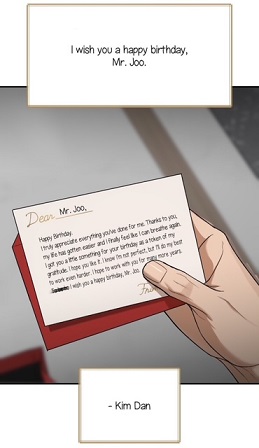 (chapter 55) “I truly appreciate everything you’ve done for me.” “I’ll work even harder.” “I hope to work with you for many years.” At first glance, nothing seemed wrong. The gesture was thoughtful, the words polite. And yet, something felt restrained.
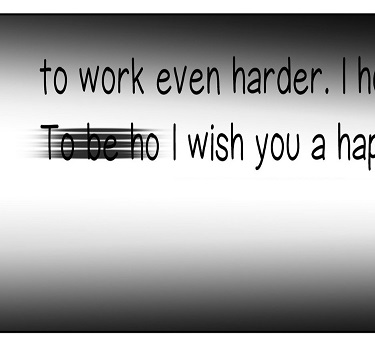 (chapter 55) The letters were erased before the sentence could even exist. This is not a correction. It is a hesitation made visible. The thought emerged—but it was interrupted. Before honesty could take shape, it was already suppressed.
 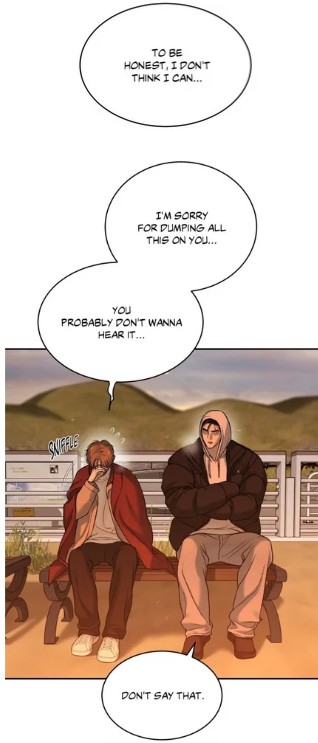 (chapter 94) There, when he finally spoke without the protection of formality, his words shifted. He admitted what had remained hidden at the time of the gift: To be honest, he did not think he could do it. He did not feel confident enough to stay by Joo Jaekyung’s side.
 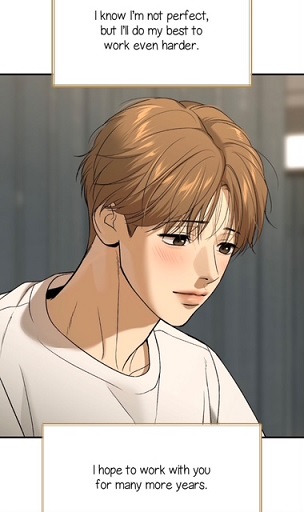 (chapter 55) Though his words seemed clear, this “hope” was not entirely his. It was shaped by something that had not yet been severed. At that point, Kim Dan had not truly separated himself from his grandmother.
 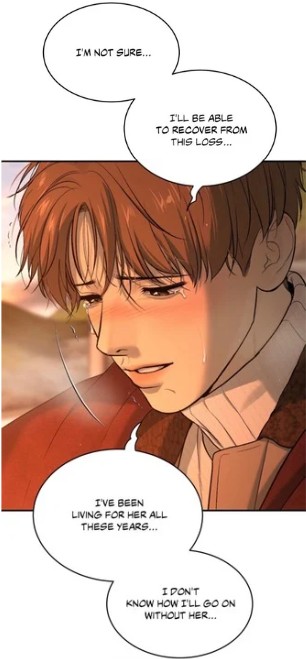 (chapter 94) His sense of self was still tied to her—emotionally, morally, almost structurally. He was not yet standing on his own, but continuing a role he had long internalized: enduring, adapting, staying where he was needed.
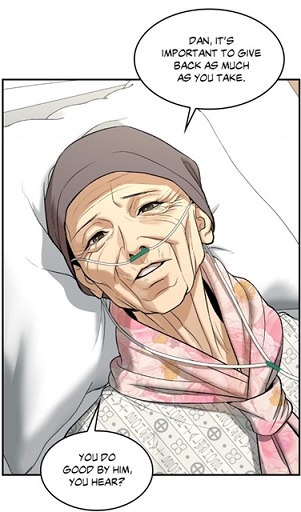 (chapter 41) A continuation of a life he had learned to accept, rather than one he had chosen. This is why the card feels so careful, so measured. Not because he lacked sincerity – but because he lacked strength in his eyes.
  (chapter 51) And because of that, he clung to Joo Jaekyung—not simply as an employer, but as a figure through whom he could stabilize his own sense of worth. Remaining by his side, working harder, staying useful… all of this allowed him to compensate for what he felt he lacked.
 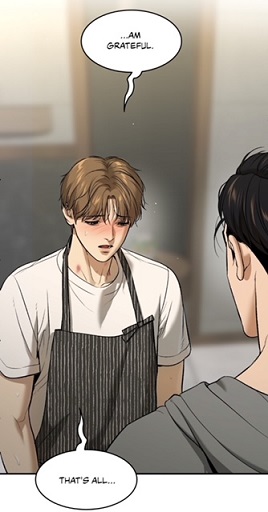 (chapter 45) Because gold, in that moment, could only represent value imposed from the outside—status, reward, recognition.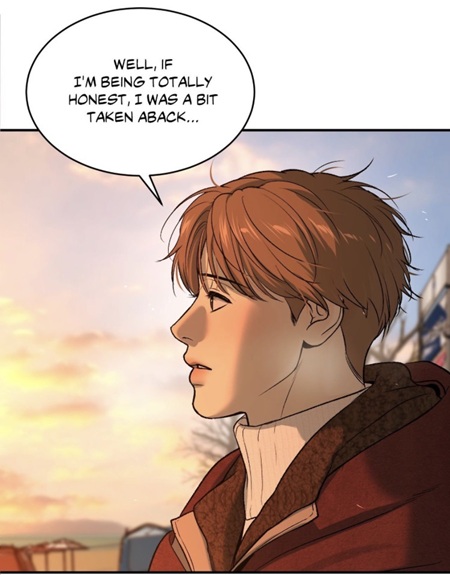
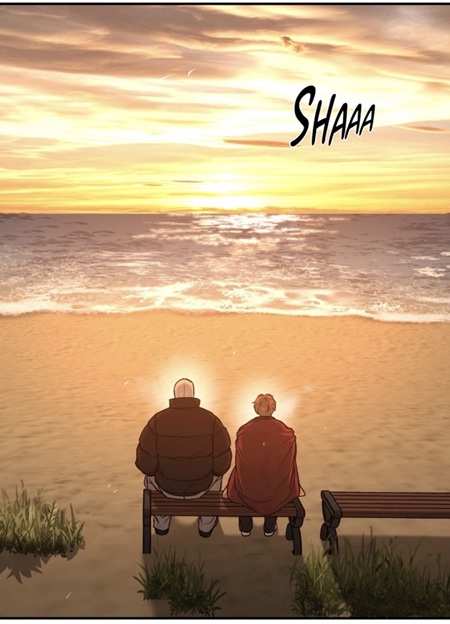 (chapter 94) The beach is not a random setting.
 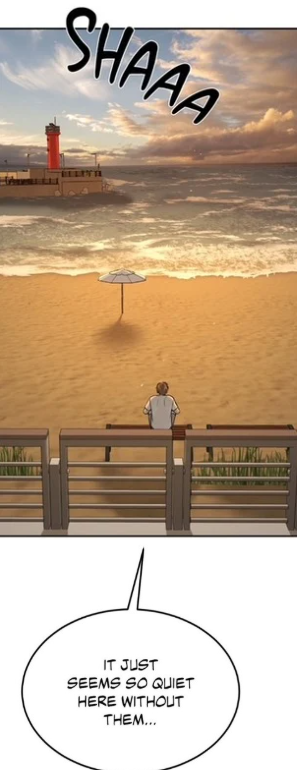 (chapter 59) He goes there when he is struggling—when something within him can no longer be contained.
 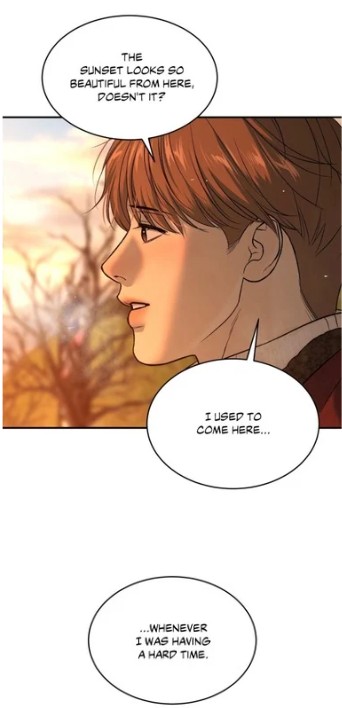 (chapter 94) In those moments, the usual mechanisms—enduring, adapting, maintaining balance—begin to loosen. The roles he has learned to perform no longer fully hold. And this is what links the beach to something more fundamental.
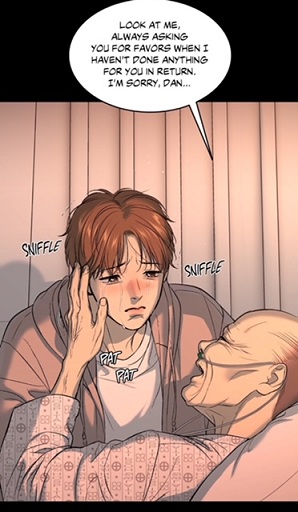 (chapter 53) At the hospital, she spoke openly. She expressed regret, desire, and a final wish without filtering it, without protecting him from the weight of it.
  (chapter 53) It was a moment of sincerity that did not try to reduce itself.
 (chapter 60) When he reaches his breaking point, it is here that the boundary between control and collapse begins to dissolve. The beach is no longer just a refuge—it becomes a space where everything that has been contained threatens to surface at once.
 (chapter 80) For him, the place becomes associated with something dangerous: loss, disappearance, the possibility of not returning. Hence he taught him later how to swim.
 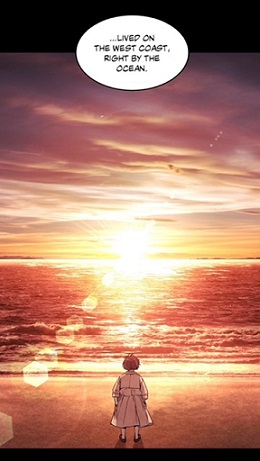 (chapter 53) Through his grandmother , the ocean had been described as something beautiful, something capable of giving strength and comfort
  (chapter 53) — even when experienced alone. It did not require company to feel complete. Kim Dan held onto that idea.
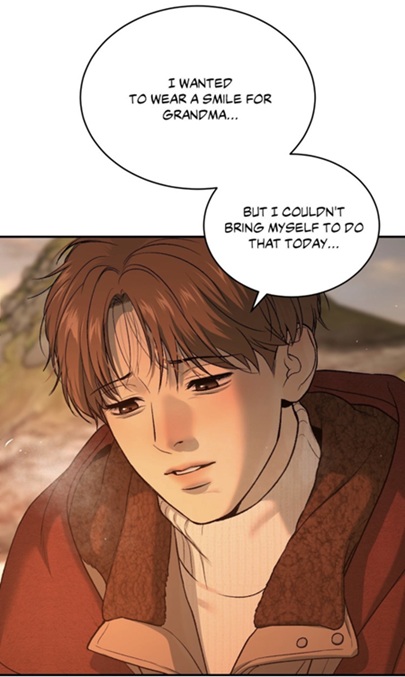 (chapter 94) For the first time, what had always structured him—enduring, adapting, protecting others—no longer works.
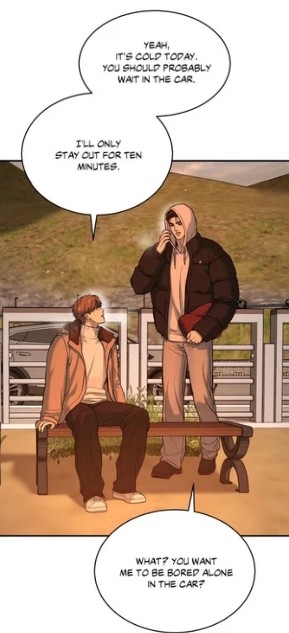 (chapter 94) He was even told to. But he didn’t. He chose to remain beside him.
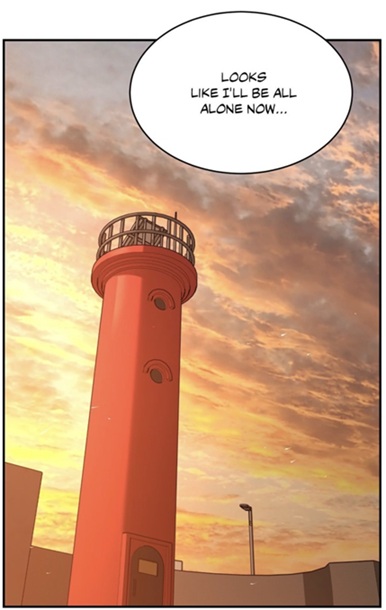 (chapter 94) And the presence of Joo Jaekyung created something new: A space where silence was no longer the only option. The sentence that once stopped at “To be ho” now reaches its end.
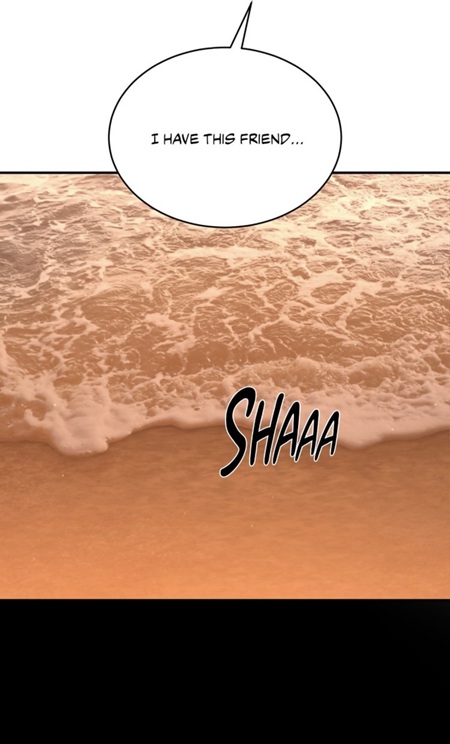 (chapter 94) The beach is not just a backdrop. It is a boundary.
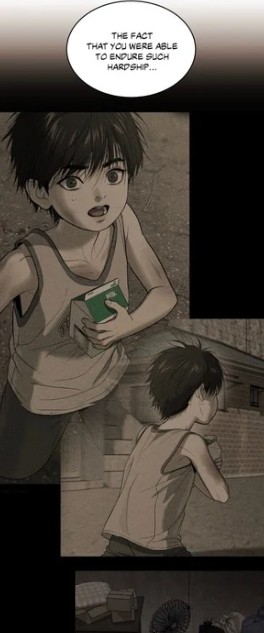 (chapter 94)
 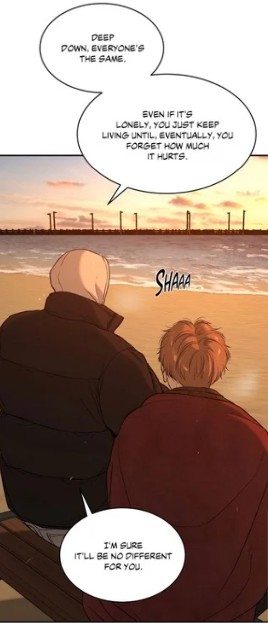 (chapter 94)
  (chapter 65) Even though they have lived together for years, she positions herself outside his inner world. She observes him—but does not truly reach him. And the image reflects this separation. The water and the sand remain clearly divided. The boundary holds.
 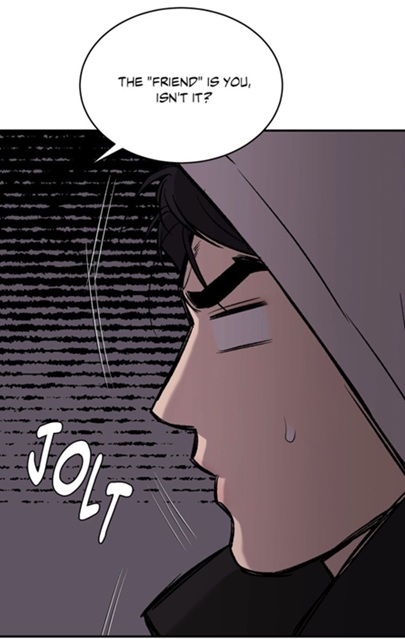 (chapter 94) Because he does not interrupt. He listens.
  (chapter 94) He allows the confession to unfold—even in its distorted form. And once it has been spoken, he does something no one else has done before. He recognizes it.
 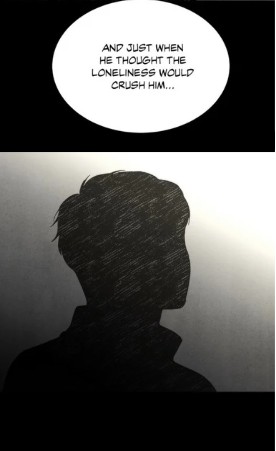 (chapter 94) Not simply because of the place. But because of who is beside him.
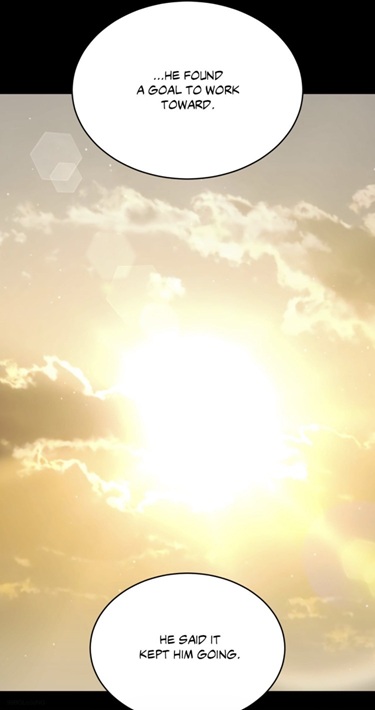 (chapter 94), the lighthouse
 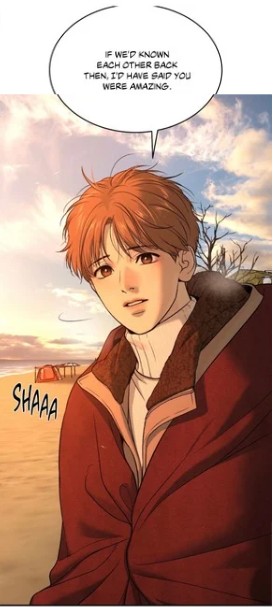 (chapter 94). None of them is accidental. But their meaning is not only symbolic. They reveal something that neither of them have not yet fully realized. That they were never entirely alone.
 (chapter 59) In other words, it connects movement to orientation.
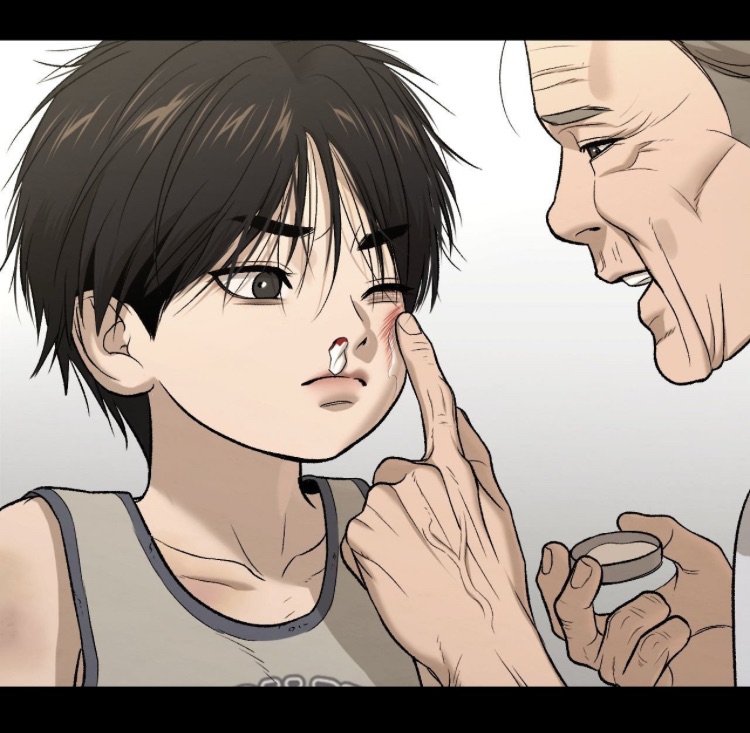 (chapter 72) or his mother. He resists any narrative of dependence because to acknowledge others is to acknowledge vulnerability. He looks at the horizon and overlooks the pier at his side, even though he has been standing on it all along. It is because he was constantly staring at the “sun”. Therefore his reaction is not surprising.
 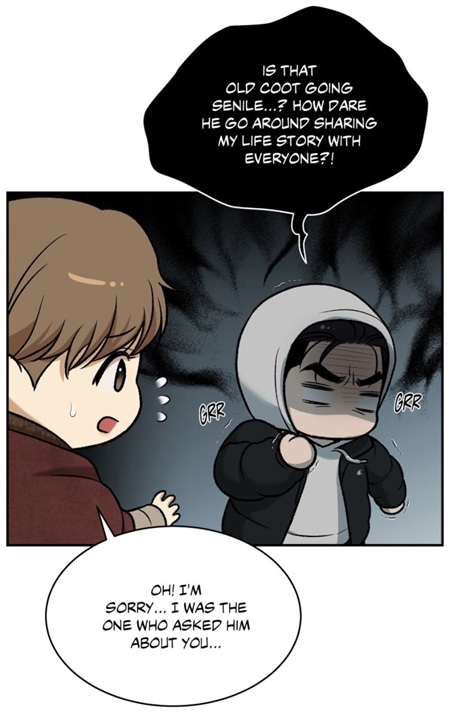 (chapter 94) To acknowledge others would mean acknowledging vulnerability—not just as a condition, but as something shared. So instead, he generalizes. He replaces relationship with sameness. And in doing so, he protects himself from the risk of trust.
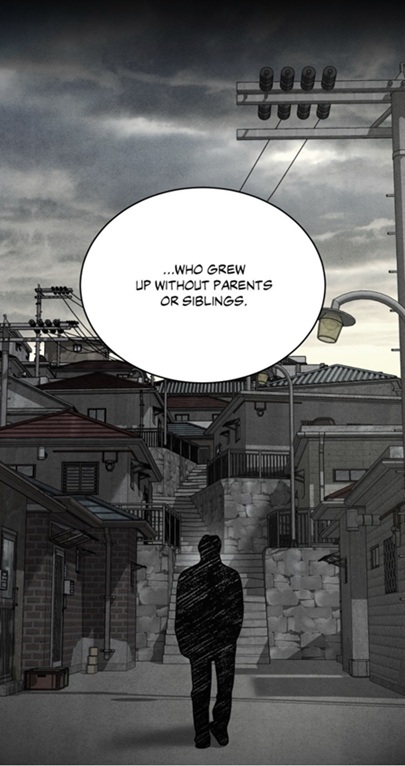
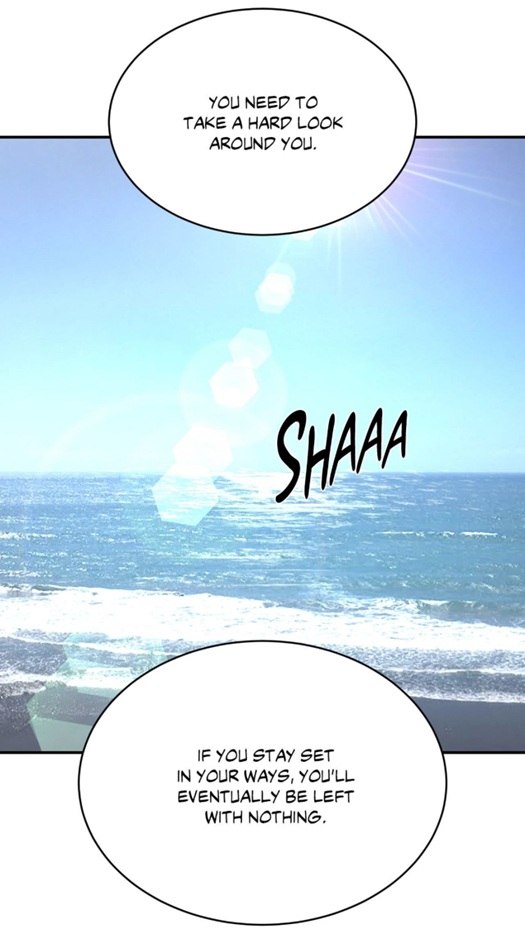
  (chapter 94) Someone who grew up without parents, without siblings, without any form of support. The statement is absolute. It leaves no room for exception. And this is where the logic of the confession reveals itself.
 (chapter 74), she does not simply reject his suffering. She erases the condition that produced it. Which leaves him with no framework to understand what is missing.
 (chapter 94)
  (chapter 75) This was never only about people. It was about environment. About perception. About everything that exists beyond the narrow structure in which Jaekyung learned to survive: shared experience.
 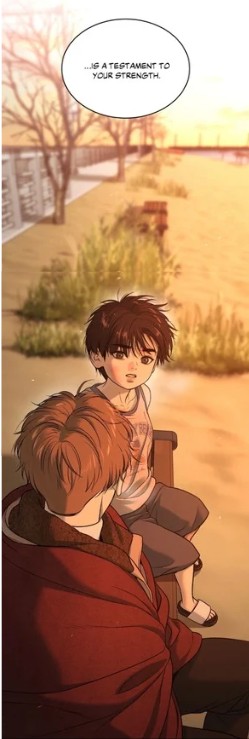 (chapter 94) He represents something else: a path. Not upward, like the sun. But outward. Toward a world that was always there— but never truly lived.
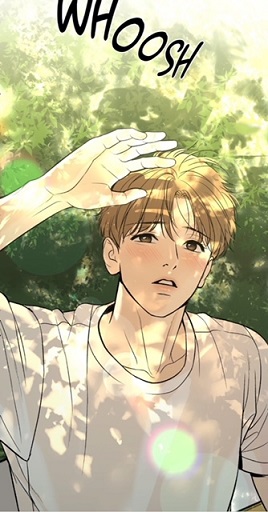 (chapter 41) from a place of growth, exposure, and vulnerability. This interpretation gets once again validated on the beach.
 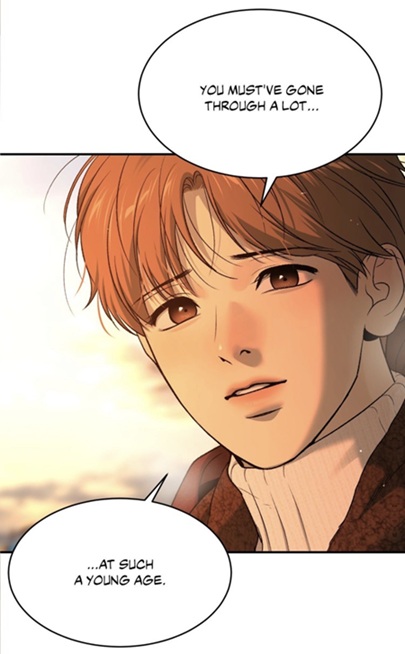 (chapter 94) When Kim Dan looks at Joo Jaekyung, he does not stop at the surface—the fame, the strength, the constructed identity. He perceives what lies beneath it, but he does not expose it in order to dismantle it. He preserves it differently.
 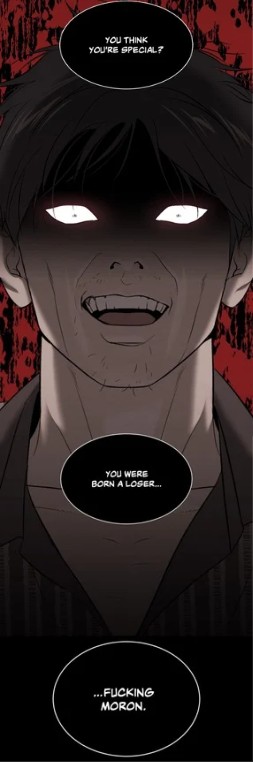 (chapter 73) A statement that reduced his existence to failure from the very beginning, leaving him with only one option—to prove, endlessly, that this judgment was wrong.
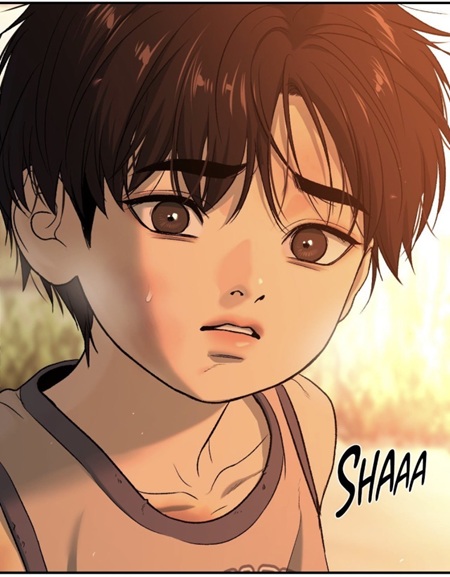 (chapter 94) The child, who had long been denied acknowledgment, is finally being seen—and more importantly, affirmed.
 (chapter 57)
 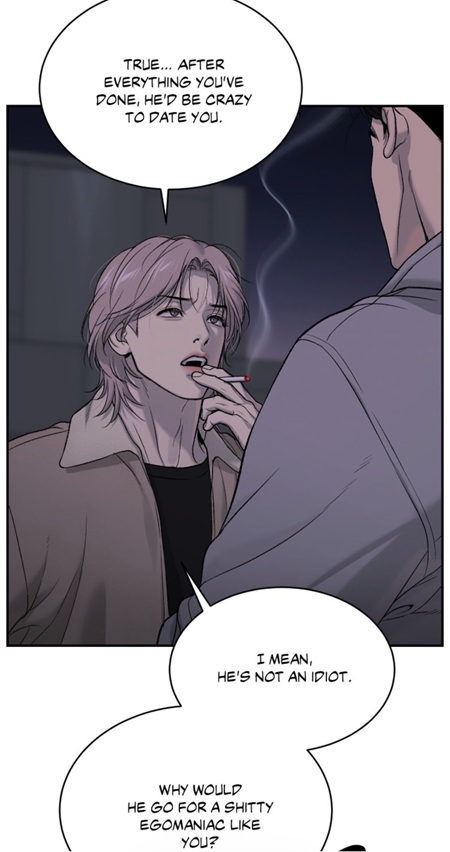 (chapter 89) Not expectation.
 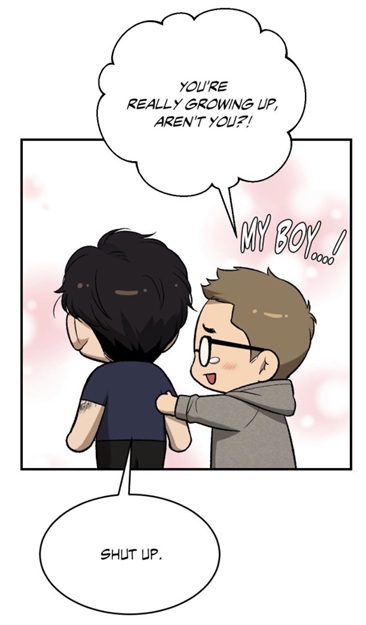 (chapter 88) But a form of recognition that restores his position in relation to others. For the first time, he is no longer defined by what was done to him. He is no longer confined to enduring in silence. Instead, he gains something he had been denied: the ability to respond.
 (chapter 9) The tension that once structured their encounters has disappeared.No imbalance of power. No role to perform. For the first time, their positions align.
 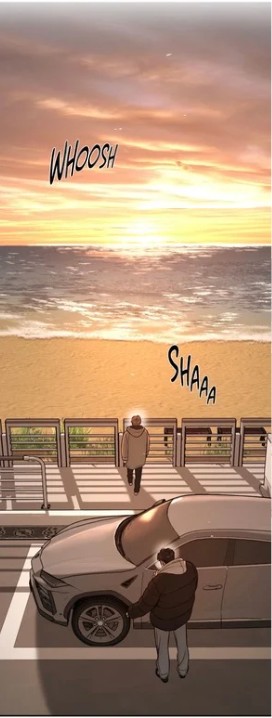 (chapter 94)
 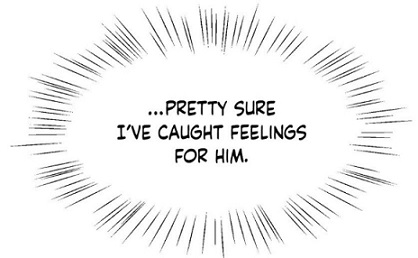 (chapter 41)
 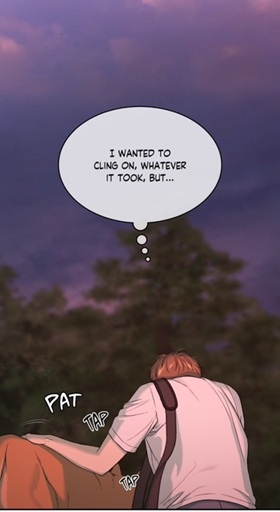 (chapter 59) The image of warmth we associate with it is, in reality, the trace of a loss. So he did not just lose his parents, but also pets.
 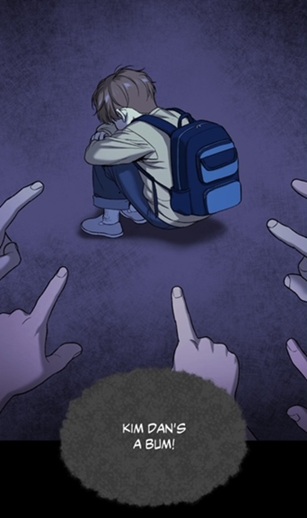 (chapter 57), nor reduce others to something distant or manageable. Instead, he remained capable of attachment. Of care.
  (chapter 7) Of returning, again and again, to places that carried pain—because they also carried meaning.
 (chapter 93) “ The answer is not given to him directly. It appears in front of him on the beach.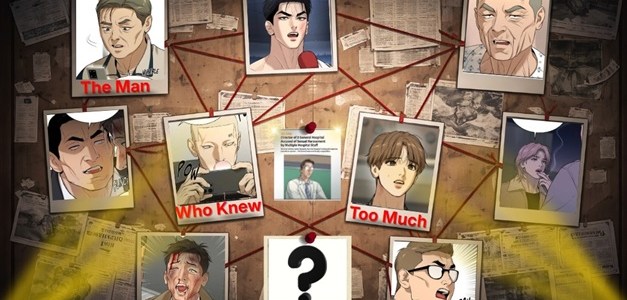
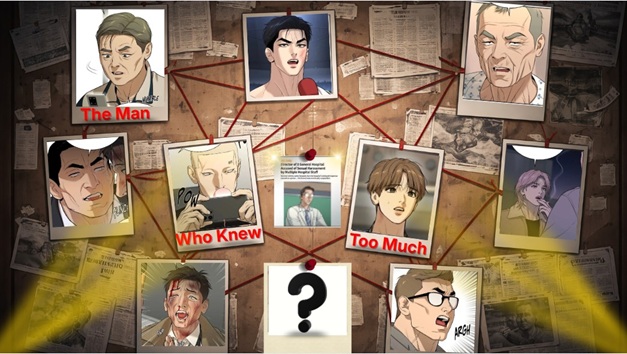
 (chapter 40) What appears to be coincidence is often carefully engineered.
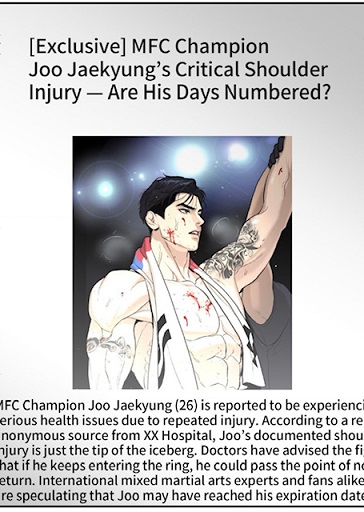 (chapter 36) At the same time, social medias were manipulated in order to stir public pressure and push the champion toward accepting the match in the States.
 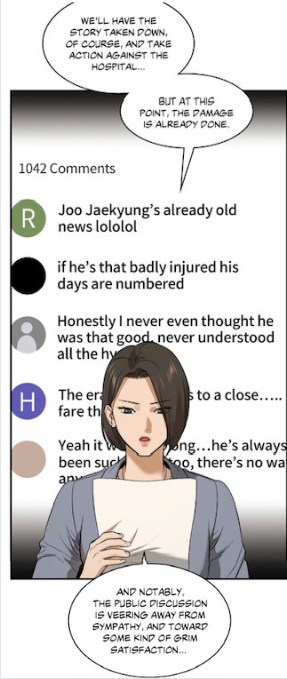 (chapter 36) But we only discover this MO thanks to the match with Arnaud Gabriel and the Entertainment agency’s involvement.
  (chapter 81)
 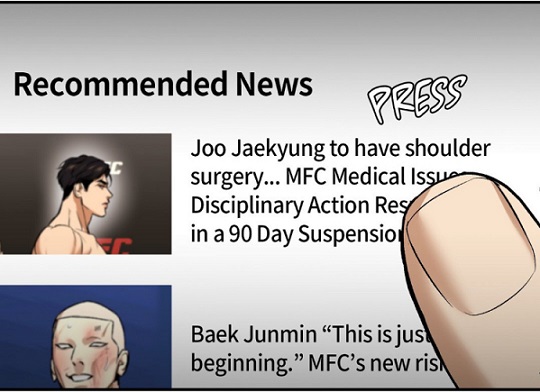 (chapter 52) Officially, the story suggested that his own behavior had caused the problem. In reality, however, this removal also had another function: it cleared space for Baek Junmin’s rise. That’s the reason why the article with The Shotgun was placed directly below the star’s and why the director Hwang Byungchul accepted easily the disqualification of his former pupil.
  (chapter 71)
 (chapter 54) He was increasingly portrayed as reckless and irresponsible for continuing to fight despite his condition.
  (chapter 54) In this new narrative, the original leak of confidential medical information was no longer treated as the real wrongdoing. The focus shifted entirely onto the athlete himself.
 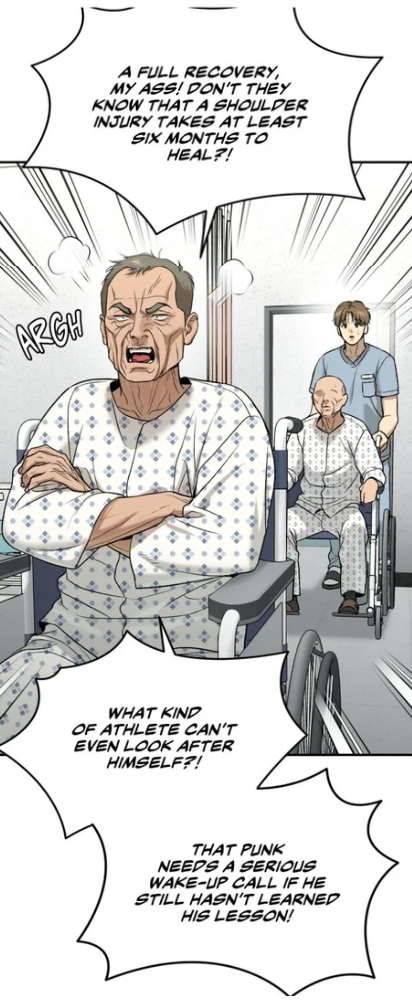 (chapter 70) Once such stories enter public discourse—injury, temper, arrogance—every later incident can be read as confirmation. The narrative becomes self-reinforcing. The media no longer merely reports events; it prepares the framework through which future events will be judged.
 (chapter 37) and the suspicious spray
  (chapter 49) used during the manipulated match both belong to this category. These substances create uncertainty about the athlete’s physical condition and about the legitimacy of his treatment. But this implies the involvement of the pharmaceutical industry.
  (chapter 41)
 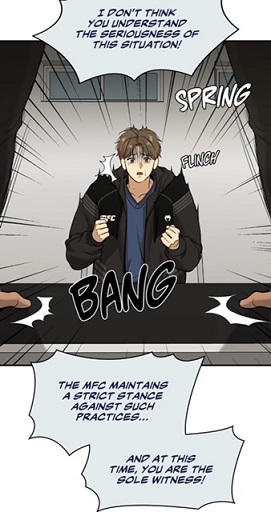 (chapter 40) The scene resembled a police investigation, yet these men were not representatives of the state. Hence there was no translator and lawyer. They were dressed-up employees of a private organization whose primary objective is to protect the company from scandal and as such from losing money
 (chapter 40) At first glance, this strategy appears effective. By redirecting attention toward the therapist, the organization can distance itself from the real problem: the suspicious beverage that had been introduced into the environment of the fight.
 (chapter 40) A doctor took a blood sample from Kim Dan, and the laboratory later produced a component analysis report.
  (chapter 41)
  (chapter 41) This coincidence exposes another layer of the mechanism. While the laboratory analysis confirms that an illicit substance had been present, the medical authorities simultaneously authorize the champion to continue fighting. The two decisions cannot easily be separated. Together, they suggest that the involvement of the doctors helps stabilize the narrative: the suspicious beverage becomes a secondary issue, while the focus shifts toward the champion’s physical condition and his decision to fight despite his shoulder injury.
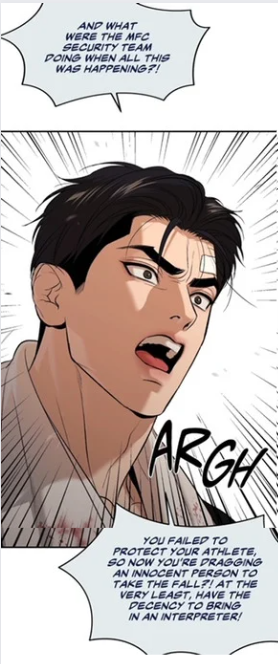 (chapter 40) That’s why they needed a scapegoat. First Kim Dan, later antis and finally the athlete himself. And who fears a scandal in Jinx? One might say Park Namwook
  (chapter 31) who always hides behind authorities and shows distrust toward fighters. But he is just reflecting the attitude of the other MFC accomplices.
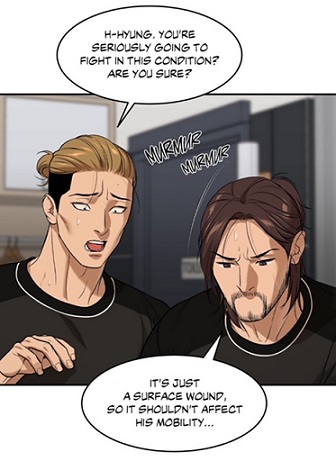 (chapter 50) Observe that in the locker room, the coach declares the athlete as fit despite the injury before going to the health center. The chronology is important, as the MFC doctors have the final saying. So when the champion is taken to the health center before the fight. the responsibility is shifted.
 (chapter 54) Hence Park Namwook remained passive.
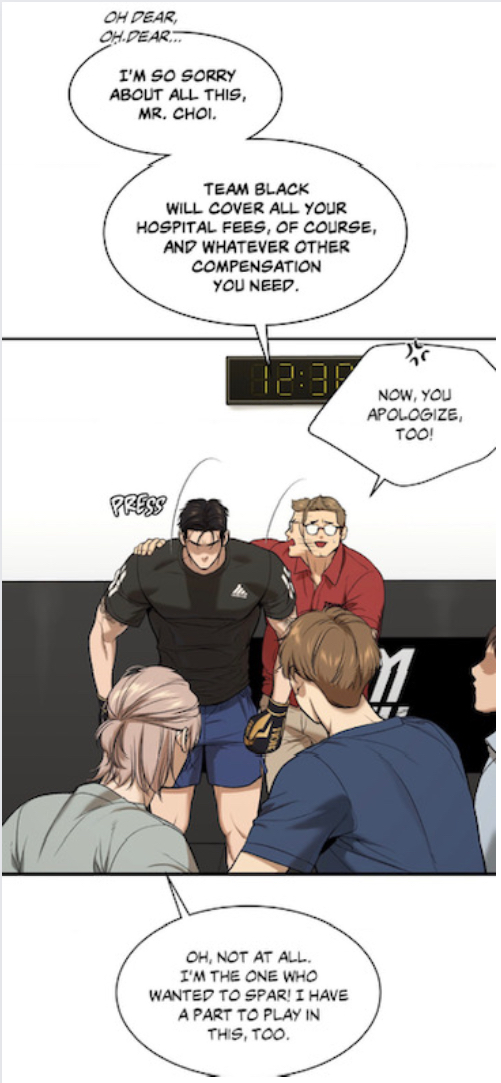
  (chapter 69) apologized for the behavior of the security staff toward one of Joo Jaekyung’s team members.
 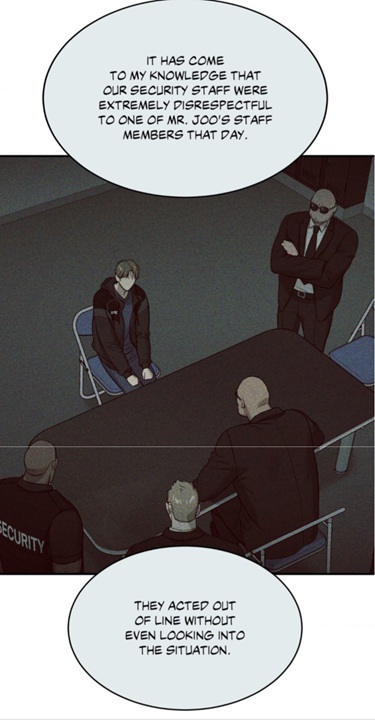 (chapter 69) Significantly, this apology took place behind closed doors, not in front of the media, and doc Dan is still left in the dark about it. The goal was therefore not transparency but damage control. They were in reality attempting to bury everything, to buy some time, until the athlete would lose his next match.
  (chapter 69) The problem was reduced to a matter of manners rather than a potential security failure or institutional complicity. In this way, the apology functioned less as an admission of guilt than as a mechanism to close the case quietly before it reached the public sphere.
 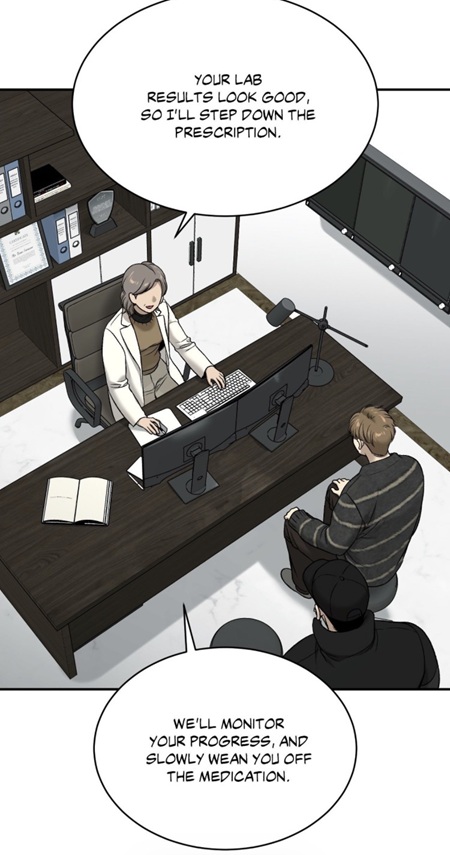 (chapter 91), drinks , smoking,
  (chapter 65), or other forms of contamination, each incident would undermine Kim Dan’s credibility as a medical professional. If the therapist can be portrayed as irresponsible, incompetent, or compromised by substances, the institutional narrative could once again shift responsibility onto him.
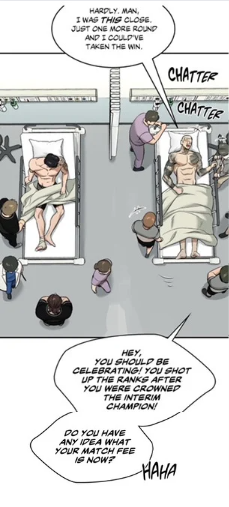 (chapter 52), Kim Dan is no longer present. After confronting him and suspecting a betrayal
 (chapter 50)
 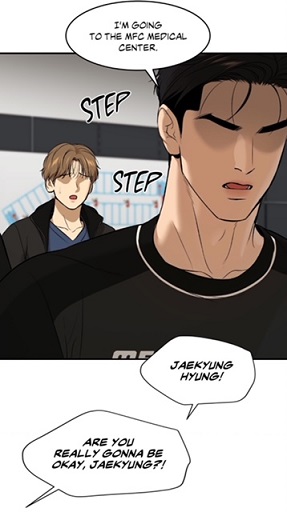 (chapter 50) He therefore has no knowledge of what happens there: the medical examination, the decisions taken by the doctors, and the institutional narrative that later emerges from this encounter.
 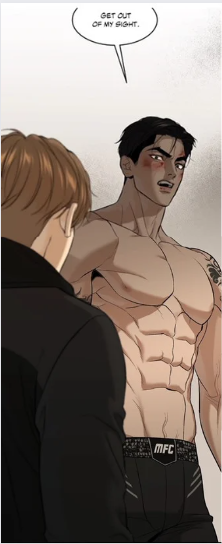 (chapter 51) But this time, the pattern is disrupted. Kim Dan is not there when the institutions intervene.
  (chapter 52)
 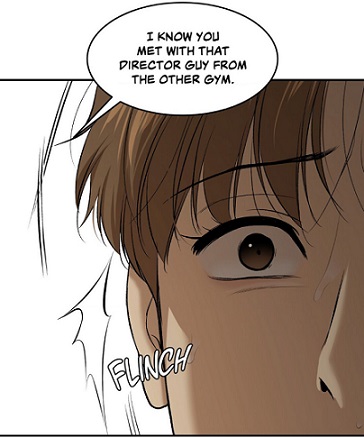 (chapter 51) Confronted with these images and the growing confusion surrounding the match, the champion reaches a painful conclusion: that his roommate may have betrayed him.
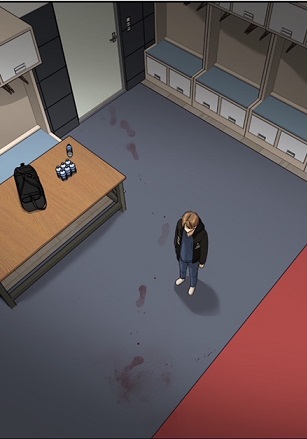 (chapter 51)
 (chapter 52) By that point, the circumstances have already changed. The use of the switched spray introduces a new dimension to the case, and with it the possibility that another authority must intervene.
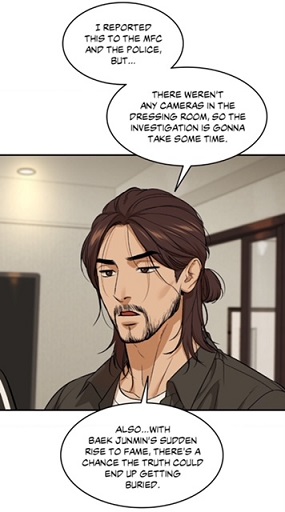 (chapter 52) The situation now risks attracting the attention of the police. As you can see, by remaining passive, Joo Jaekyung in his own way protected the physical therapist from real trouble. If he had truly blamed him, he could have “called” the police, but he did not.
 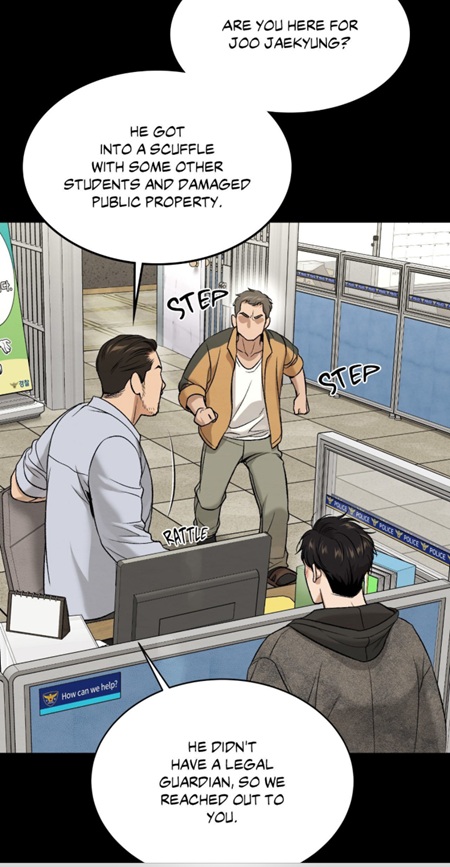 (chapter 74) The coincidence between these two moments—chapter 52 and chapter 74—suggests more than a simple narrative repetition. Both situations involve the same institutional actor: the police.
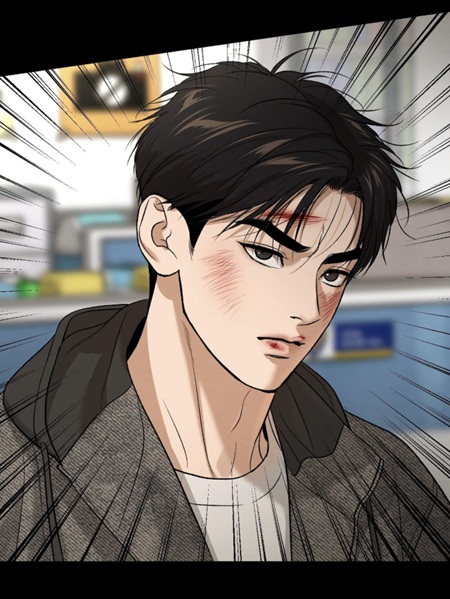 (chapter 74) has a similar wound on the forehead than The Shotgun.
 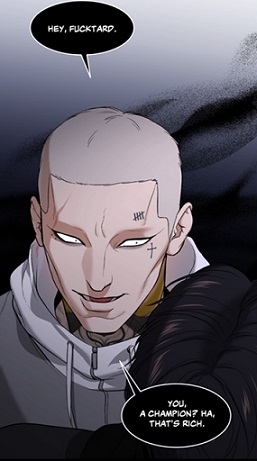 (chapter 74) If Baek Junmin had orchestrated that earlier event, the strategy would have been simple but effective. Instead of attacking his rival directly, he could create circumstances that forced the authorities themselves to intervene. But why would he involve the police, when he is involved in the criminal world? Such a tactic would allow him to remove or weaken Joo Jaekyung without openly violating the protection imposed by his hyung
 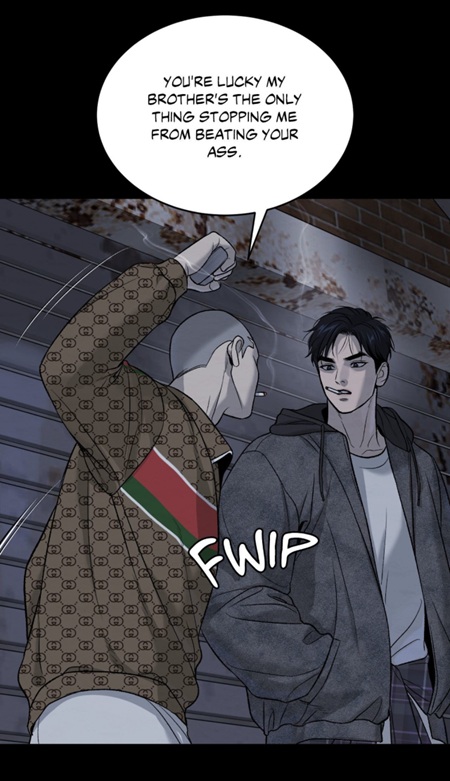 (chapter 74), who had explicitly forbidden him from harming the champion.
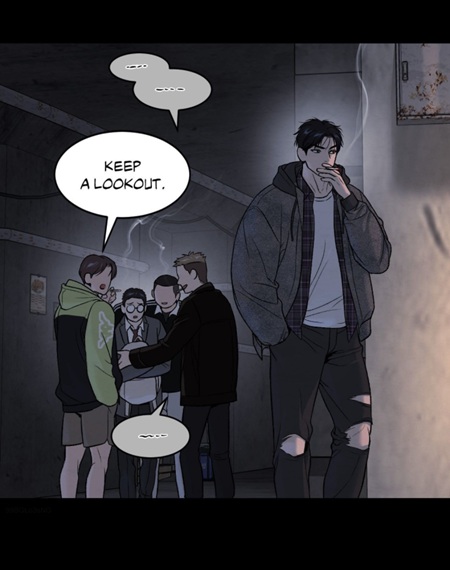 (chapter 74) —Junmin could ensure that the story presented to the authorities pointed toward Joo Jaekyung. For the students involved, the arrangement would offer a practical advantage: financial compensation and a chance to escape their own precarious situation. But for that stunt, The Shotgun got to pay a heavy price: not only the scar on his forehead
 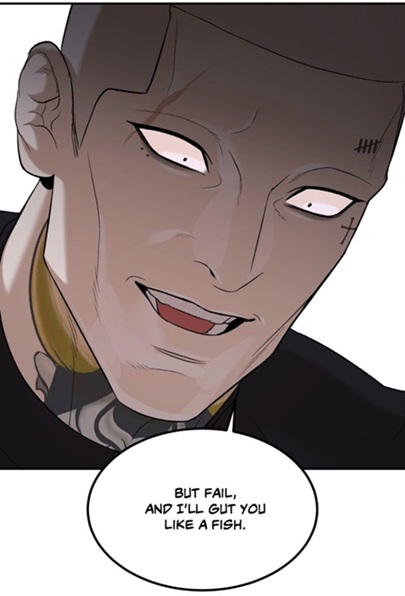 (chapter 93), but also a life in the shadow forever. It is clear that he could never get rich and famous through his illegal fights. Hence he resents the main lead so deeply.
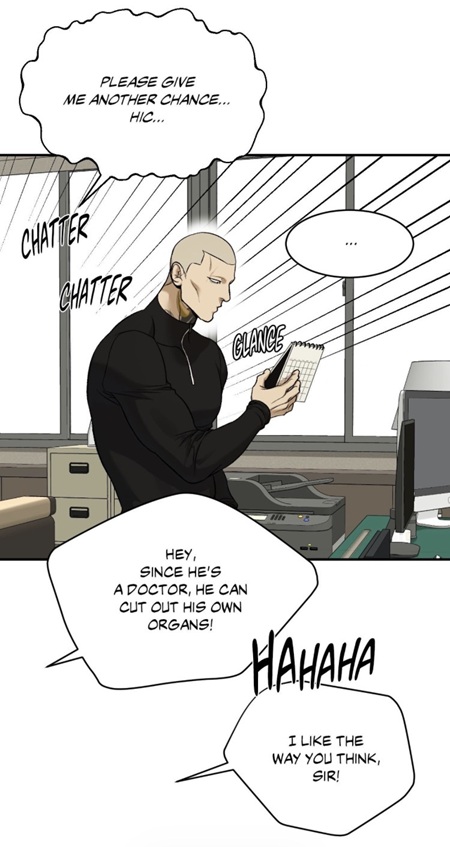 (chapter 93) The authorities perform the task that Junmin himself is forbidden to carry out.
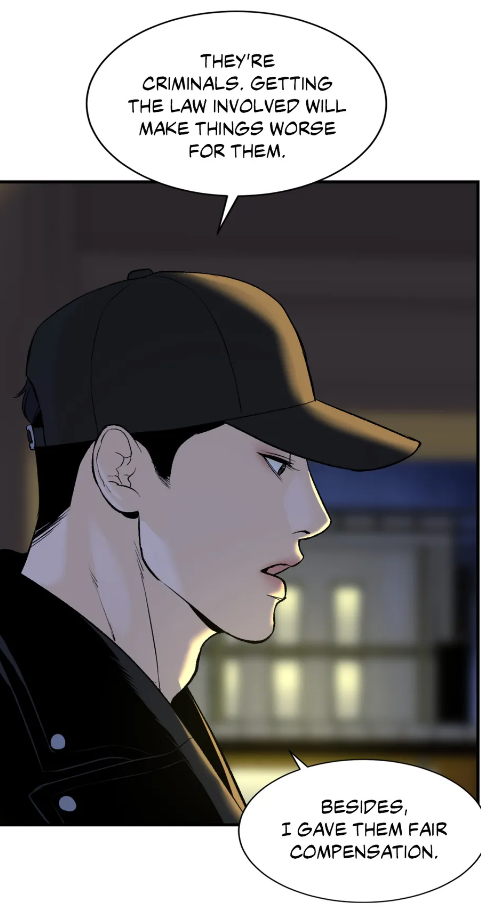 (chapter 18) He knows how the criminal world functions.
 (chapter 91) The article reports that the director of X General Hospital was accused of sexual harassment by several members of the hospital staff. The scandal eventually forced the institution to suspend his medical license. Yet the wording of the report also exposes an important detail: the hospital reacted slowly, and the affair was handled primarily as an internal disciplinary matter.
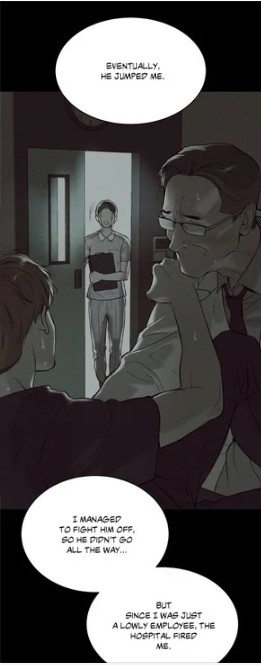 (chapter 90)
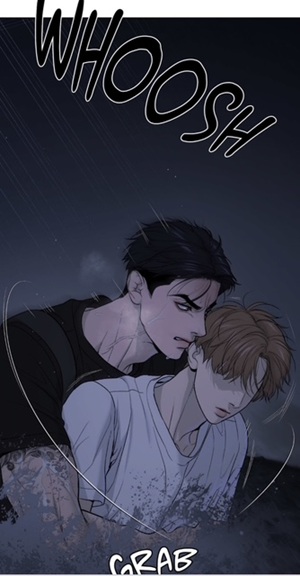 (chapter 59)
  (chapter 79)
 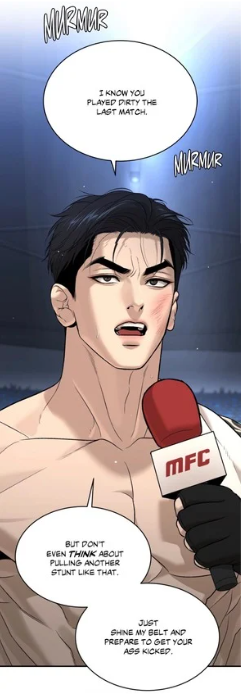 (chapter 87) By issuing the challenge in front of the cameras, the champion forces the MFC to respond. Even though the season had effectively ended, the public nature of the declaration creates pressure that the organization and the media cannot easily ignore.
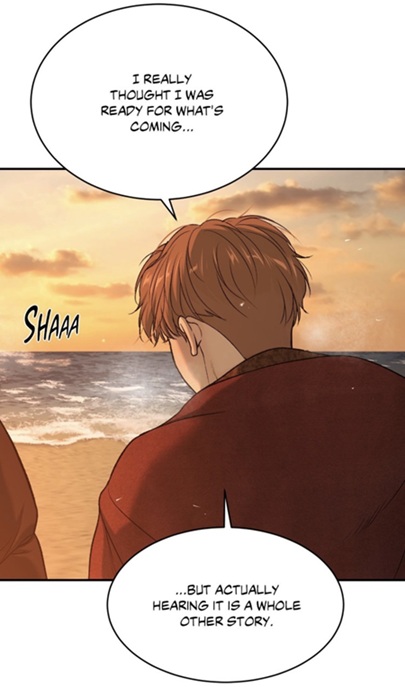 (chapter 94), the situation could disrupt the plans surrounding the anticipated fight with Baek Junmin.
 (chapter 47)
 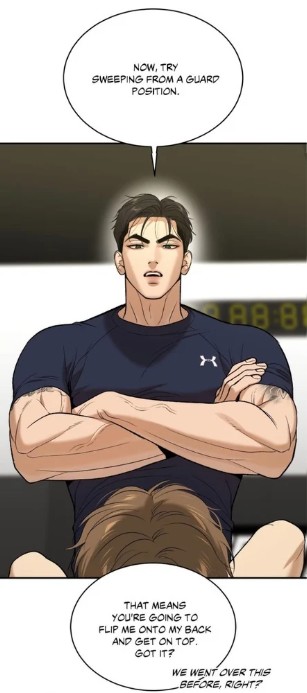 (chapter 88)
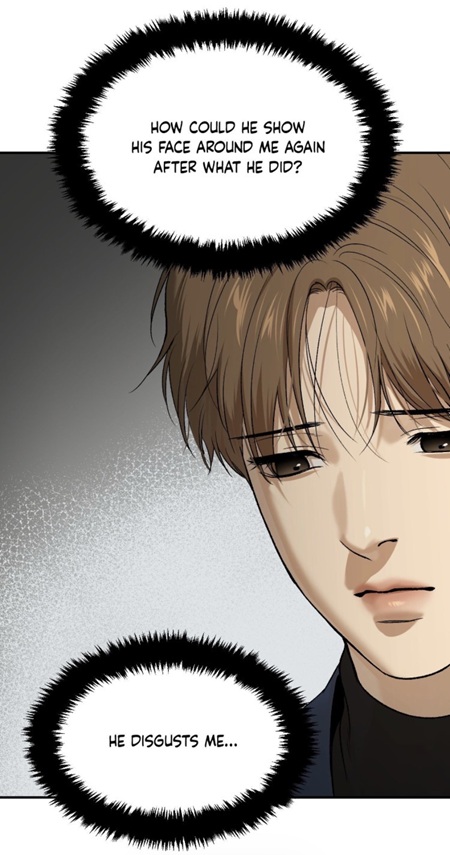 (chapter 91) The athlete exposed him to situations that forced him to grow stronger and more independent. He shared his thoughts and philosophy to his “pupil” as well
 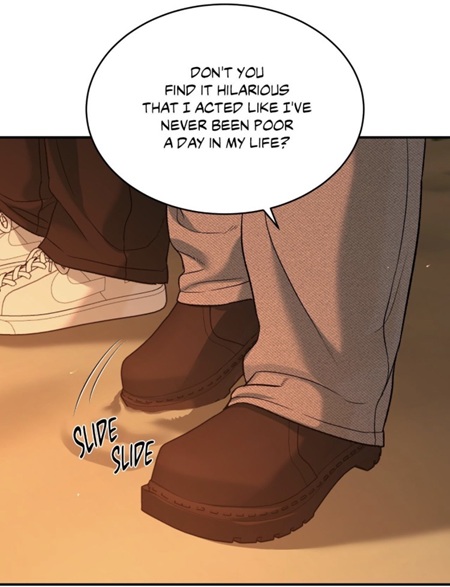 (chapter 94) The champion carried the weight of his past—his violent environment, the humiliation he endured, and the circumstances that shaped his rise. Speaking about these events would have meant revealing parts of his life he preferred to bury.
 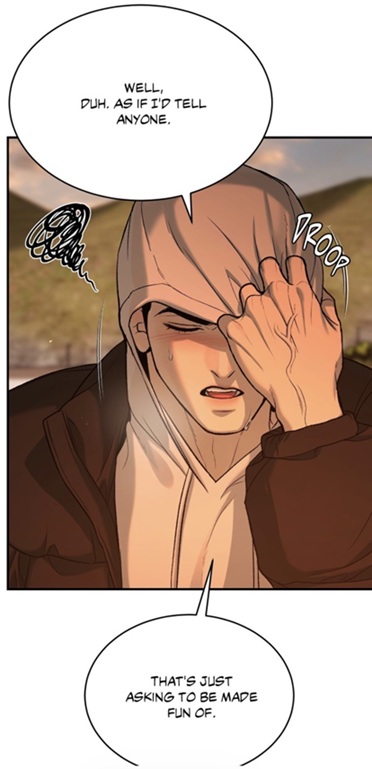 (chapter 94) The conversation on the beach changes this dynamic. By confessing his past to Kim Dan, Joo Jaekyung frees himself from the silence that had protected his enemies. The shame that once prevented him from speaking begins to lose its power.
 (chapter 93) Beneath the apparent calm of the chapter lies a growing tension: secrets circulate quietly, alliances remain uncertain, and certain characters may already know more than they should.
  (chapter 93)
 (chapter 93) linked to their previous night together. During the night they shared, the invisible wall that once separated them seemed to disappear completely. Their intimacy was no longer defined by domination or obligation. Instead, the encounter suggested equality (position of 69)
 (chapter 92) and reciprocity—an exchange, as Joo Jaekyung himself described it, of “give and take.”
  (chapter 92) In a striking reversal, Kim Dan took the initiative
  (chapter 92), after being asked about his own desires.
  (chapter 92) He was no longer driven by shame, debt or obligation.
  (chapter 92) For the champion, the moment carried the weight of something deeper than physical pleasure
  (chapter 92), for he was able to give pleasure to his partner. Thus his self-esteem could only be boosted. For Kim Dan, however, it remained simply sex.
  (chapter 92) The imbalance between their interpretations already foreshadowed the tension that would emerge the following morning.
 (chapter 93) For the first time, he establishes a clear boundary. The gesture signals a new stage in his personal development: for the first time, Doc Dan speaks as a professional, as a physical therapist
  (chapter 93) who knows his role and his responsibilities. He refuses the help with the meals not out of pride, but because he clearly frames it as part of his job. In the past, he would have simply listened, letting others decide or speak in their name
  (chapter 42); now he asserts his own authority and expertise. But just as this moment seems to mark a quiet step forward in their dynamic
  (chapter 93), the narrative abruptly widens its focus, drawing the reader away from this personal shift toward a far more ominous development unfolding elsewhere.
  (chapter 93)
 (chapter 93) separating him from Choi Gilseok and Heo Manwook. The atmosphere of that scene is strangely detached. Junmin seems unconcerned with the financial urgency discussed around him; his attention is fixed instead on the cellphone. Yet the readers cannot see what he is watching
  (chapter 93), while he casually blows a bubble of gum, creating a small moment of distraction that contrasts with the tension of the conversation around him. Only when he eventually reaches for the calendar on the desk,
  (chapter 46) Yet even before examining the room itself, the exterior sign already introduces an intriguing ambiguity. The building is labeled
  (chapter 93) The furniture thus reinforces the same strategy as the office name itself: it maintains the appearance of a respectable business while the violence of the operation is carefully kept out of sight.
 (chapter 93), who confronts victims and manages the loan shark operation. Yet the scene gradually reveals that he is less a true mastermind than a frontman—a visible intermediary who handles the dirty work.
  (chapter 46) Hence he calls Choi Gilseok “boss” and asks about the current situation.
  (chapter 42), delivering food or packages across the city during the night. His work is built on the same basic principle: completing tasks and transporting items for others which exposed him to dangers and shame.
  (chapter 42) The parallel is subtle but revealing. While Kim Dan runs legitimate errands for the athlete’s sake, the criminals in the Errand Center perform their own “services” within the shadow economy. Both operate within a system of delivery and obligation—yet one side does so out of feelings, while the other exploits the structure for predatory purposes. Gratitude versus Greed.
 (chapter 46). The operation looked methodical, almost professional, as if a genuine investigative agency had been hired to monitor the champion’s environment.
 (chapter 11) At that moment, the loan shark explicitly raised the possibility of money laundering. This detail suddenly casts the entire network in a different light. The illegal gambling operations visible on Heo Manwook’s computer are therefore not merely a source of profit; they may also serve as a mechanism through which larger sums of money circulate and are quietly reintegrated into the legal economy.
  (chapter 46) In this structure, Choi Gilseok himself appears less like the true mastermind than another intermediary in a much larger financial chain.
 (chapter 46) In chapter 46, he was already acting behind the back of that parent company, manipulating events to influence the outcome of the fight. Later developments—such as the conversation at the café with Kim Dan and the suspicious use of the spray—suggest that he may eventually have received support from that higher structure.
  (chapter 52) and manipulating the situation through the switched spray, he appears to have pursued his own strategy within the system.
 (chapter 46) In other words, the champion was originally the system’s most valuable asset. His visibility and reputation attracted attention, betting activity, and therefore profit. However, once he disrupted the carefully orchestrated mechanisms behind the fights, that same visibility became dangerous. The athlete who once generated the most revenue suddenly turned into the network’s greatest liability. From that moment onward, the logic of profit shifted into the logic of elimination.
 (chapter 69). They know, for instance, that Heo Manwook once misunderstood the name “Team Black,” interpreting it as a brothel rather than a gym
  (chapter 16). Jinx-Lovers have seen fragments of the schemes unfolding behind the scenes and can therefore begin to assemble the existence of several overlapping plots.
 (chapter 33)
  (chapter 93) He speaks himself. Addressing the disgraced hospital director, he offers to erase the man’s debt—on the condition that he carries out a task for him.
 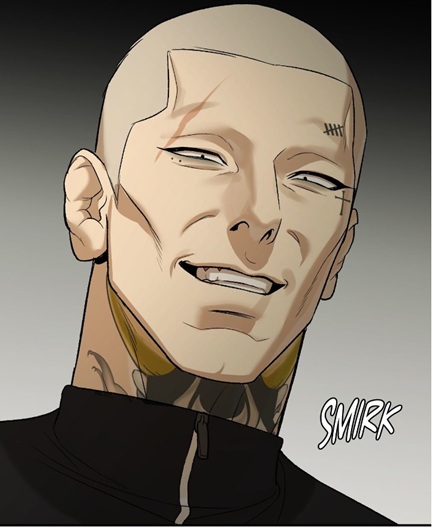 (chapter 93) That’s why he is smirking. The wrongdoing will be carried out by someone else, allowing him to stay in the shadows as he always has. Yet Junmin underestimates the weight of his own words.
 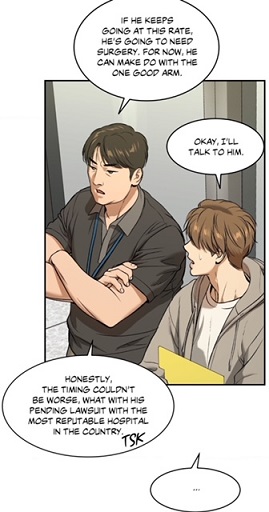 (chapter 42)
 (chapter 93) Hence the director asks him this question. He is now taking the lead. Knowledge and liability become inseparable. Once the doctor accepts the offer, Junmin’s words effectively pull the trigger: the moment the deal is spoken aloud, the hidden system that sustained the illegal fights begins to lose its stability. By drawing the corrupted medical world directly into the operation, the fighter who once thrived in the shadows may in fact become the spark that accelerates the collapse of the entire machine. I would even add, with this new stunt, he is not realizing that he could be blamed for the past crimes (drugged beverage, switched spray etc.).
 (chapter 16) Doc Dan’s hand got crushed and the former hospital warden is warned that he might lose his fingers; thus he might no longer be able to work.
  (chapter 46), collect debts
  (chapter 11), intimidate victims, and ensure that money continues to circulate through the laundering mechanism. In this sense, the repeated focus on hands and fingers becomes meaningful.
 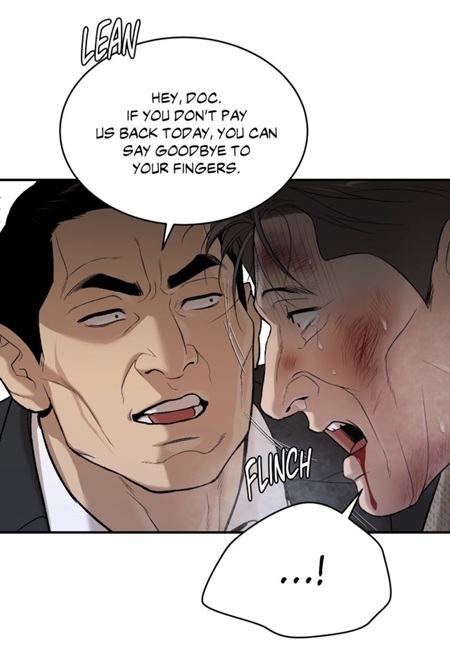 (chapter 93) —the part of the body that allows people to work and generate the very income he seeks to extract. By threatening to destroy his victims’ hands, however, Heo Manwook undermines that capacity himself. The gesture exposes a certain narrow-mindedness: his violence contradicts the economic logic he is supposed to enforce, revealing not only his cruelty but also him as an enforcer who acts impulsively rather than strategically.
 (chapter 16) rather than locating him through documentation or surveillance. This observation corroborates my previous deduction: he is not the one following the physical therapist in secret and taking pictures of him. Secondly, observe his reaction, when he reads the money transfer:
  (chapter 16) The loan shark reads the name quickly or without interest, so that he can only remember the most striking word. In this case, “Black” stands out, while “Team”—a generic word—disappears from his memory. So his phrasing suggests he did not pay attention to the full name. This displays his lack of professionalism. He doesn’t investigate carefully.
 (chapter 16) Instead of verifying the information, he projects his own criminal assumptions onto the situation.
  (chapter 17) Instead of investigating carefully, he interprets every new piece of information through the lens of his past encounters and knowledge. His boss is rigging fights, so the others must do the same. When confronted with the name “Team Black,” he immediately assumes it must refer to a bar or brothel. What appears to be practical experience therefore becomes a liability. The man who believes he knows reality best may in fact be the one most vulnerable to misreading it.
  (chapter 16) demonstrate that Heo Manwook was already operating within that gray zone where medicine, crime, and financial exploitation overlap. It is therefore not surprising that the disgraced hospital director later appears within this environment. The medical world has long been entangled with the loan shark’s activities and this through Choi Gilseok who has a connection to a pharmaceutical company.
  (chapter 46) The “hand” of the organization may execute violence, but it does not decide the strategy.
 (chapter 16), emphasizing the asymmetry between predator and prey. Yet when he threatens the disgraced hospital director, the composition changes subtly.
 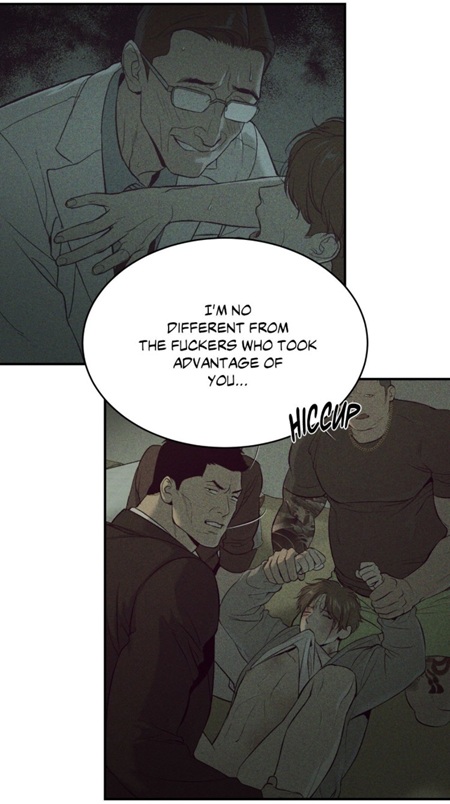 (chapter 91) Reflecting on the men who had abused Kim Dan, the champion bitterly admits that he is “no different from the fuckers who took advantage of you.” Although Jaekyung is still unaware that Heo Manwook actually attempted to rape Kim Dan earlier in the story, the scene nevertheless establishes an unsettling parallel between different forms of abuse of power. The disgraced hospital director exploited his authority as a physician, while the loan shark uses violence and intimidation to dominate his victim. Both belong to the same shadow world where institutional positions become instruments of exploitation.
 (chapter 17) he possesses extensive knowledge about the hidden mechanisms of the criminal network — rigging fights, illegal betting, debt collection, organ trafficking, and even the exploitation of vulnerable individuals. Yet this knowledge does not grant him control; instead, it entangles him more deeply in the system’s corruption. The more he knows about its secrets, the less clearly he perceives reality. Years of operating within the criminal network have isolated him from the logic of the legal world. Surrounded by corruption, intimidation, and bribery, he gradually begins to believe that these mechanisms can shield him from any real consequences. The knowledge that once gave him power therefore becomes a distortion: it convinces him that he can act with impunity, imagining that the system protecting him will always remain intact. What once appeared to be power gradually reveals itself as liability. I would even add. This protection could only function as long as the system itself continued to run smoothly. It depended on the uninterrupted flow of money circulating through the laundering network. The moment that flow is endangered—when bets collapse, scandals emerge, and funds begin to disappear—the shield of protection weakens. Figures such as the director of the gym and the loan shark suddenly become far more exposed than before.
  (chapter 17) The weapon signals impulsive violence rather than calculated strategy.
  (chapter 17) The knife belongs to the realm of direct physical force—the crude instrument of someone who acts rather than plans. At the same time, this weapon reveals why Heo Manwook believes that his power and strength are real. The latter stands for ultimate violence, someone can die with such a weapon. However, like exposed in a previous essay, MMA fighters can still die with bare hands. A wrong move or a mistake …
  (chapter 25)
  (chapter 47) The underground arena operates according to entirely different rules, where knives are not anomalies but part of the environment. In this sense, Junmin’s threat does more than intimidate the former hospital director—it exposes the violent logic of the system that produced him.
 (chapter 11) the loan shark refuses to rely on the transaction itself. Instead of trusting the digital record, he personally visits Kim Dan and continues the physical abuse. In his worldview, confirmation must come through intimidation rather than documentation.
 (chapter 17) When Joo Jaekyung later transfers the money directly to him using his own phone
  (chapter 17), the transaction itself becomes a form of evidence. What Heo Manwook perceives merely as a convenient payment leaves behind a record — one that cannot be erased by violence. The phone quietly transforms the power dynamic: intimidation may silence witnesses, but it cannot erase a transaction history.
 (chapter 91) The champion carefully reads the news article exposing the former hospital director’s crimes.
  (chapter 46) The computer visible on Heo Manwook’s desk quietly contains a record of the entire operation. The illegal betting site displayed on the screen is not merely a tool for profit; it is also a potential archive of evidence—transactions, accounts, and financial flows that could expose the laundering system. In other words, the machine that allows the network to generate money simultaneously preserves the traces of its crimes.
  (chapter 87) Joo Jaekyung’s public exposure of the stunt did not merely create financial problems for the organization. It inflicted a fresh narcissistic wound on Junmin himself. The humiliation was public, visible, and impossible to ignore. In that sense, the upcoming match is not only a sporting deadline but also a symbolic countdown: a chance to reverse the humiliation, reclaim his standing, and restore a damaged image. Time, for Junmin, does not move forward in a stable or mature way. It circles obsessively around injury, revenge and shame; he stores it.
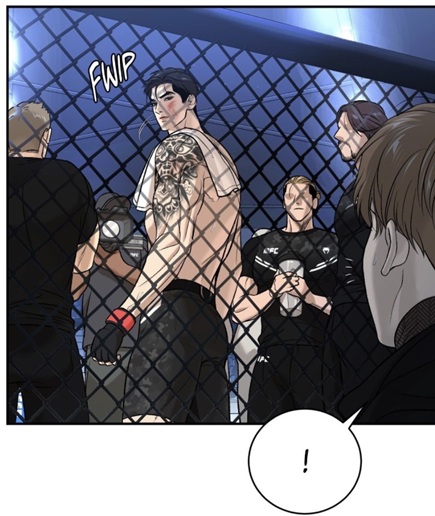 (chapter 87) The moment appears insignificant to most spectators. Yet for someone who already knew the identity of the person standing there, the gesture could reveal something important.
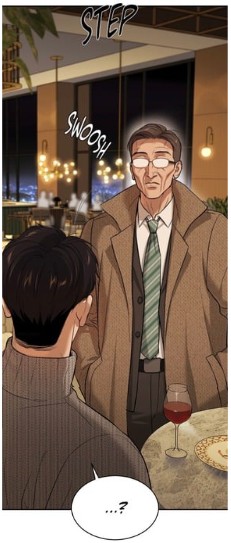 (chapter 90) The only difference is the loss of his spectacles. They are not only broken, but also lying next to him. The loss of his glasses mirrors his situation: he is forced to face reality and as such he is discovering the true reasons behind doc Dan’s greed: despair and fear in front of the loan shark.
 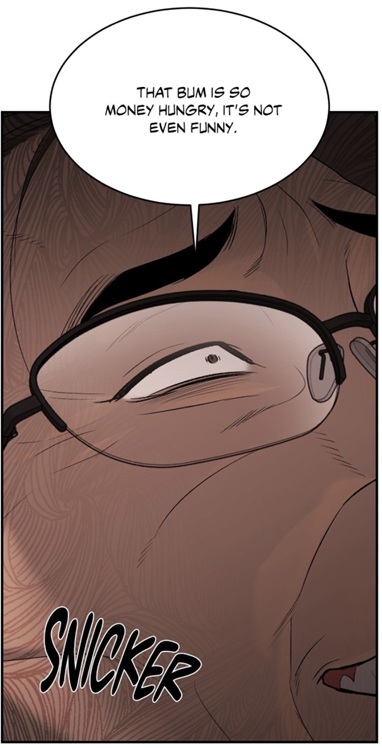 (chapter 90) One could say, he is now receiving his karma. Like mentioned above, the behavior and words of the men
 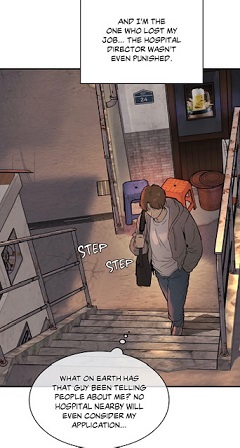 (chapter 1) So what did he hear at the office the whole time?
 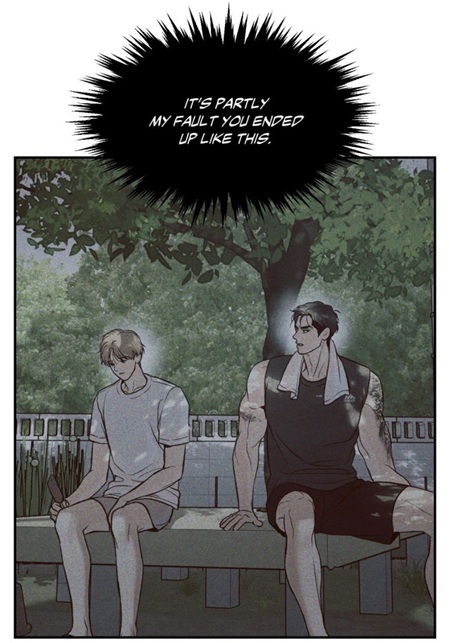 (chapter 91) Thus I deduce that the physical therapist has become the real target of the next plot.
 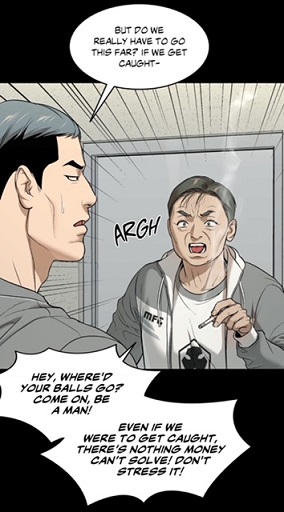 (chapter 50)
 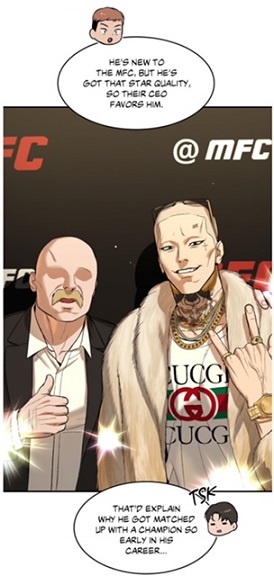 (chapter 47) Junmin’s “star quality” and supports his rapid rise within the organization. Such endorsement provides him with a form of institutional legitimacy that shields him from direct scrutiny. His authority does not come from discipline or merit alone but from the structures that elevate and protect him. And observe how the lady in red protected the “champion’s reputation”.
 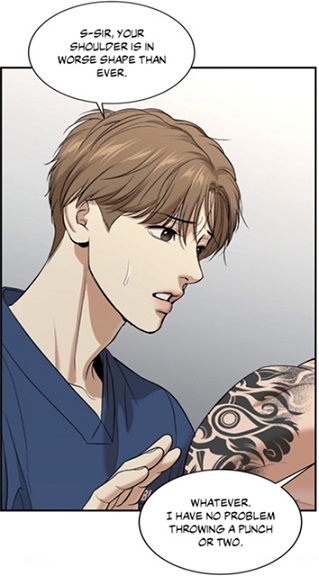 (chapter 41) The official report contradicts the observations of the physical therapist. Moreover, they had allowed the fight, though the athlete’s foot had been injured.
  (chapter 50) Later, after the match, the examination of the fighters at the health center takes place in conditions that clearly lack privacy
  (chapter 59) Finally, because of the perverted hospital warden’s assault, the main lead ended up blacklisted. He could never get hired at another hospital. If the narrative surrounding the injury were manipulated, the responsibility for Joo Jaekyung’s worsening condition and the schedules could easily be redirected toward him.
  (chapter 46) Throughout the story, the coach frequently appears wearing glasses—a visual symbol traditionally associated with knowledge and clarity. Yet despite this apparent vision, he repeatedly fails to recognize the dangers surrounding Joo Jaekyung. As the champion’s manager, Park Namwook is responsible for organizing his schedule and protecting his long-term career. In principle, this role should place him in the position of a guardian. But he does not intervene
  (chapter 41), he just stands by his side.
  (chapter 17) Instead of acting as a protective barrier between the athlete and the pressures of the industry, Park Namwook frequently defers to the logic of the organization. When the CEO of MFC later invites the champion to an important meeting, the coach encourages him to attend, once again placing institutional expectations above caution.
  (chapter 69) In this sense, Park Namwook’s authority begins to resemble the same pattern visible in Baek Junmin’s behavior: responsibility is repeatedly shifted upward toward the organization MFC or Joo Jaekyung as the owner of Team Black
  (chapter 88)
 (chapter 61). Each layer appears authoritative, yet together they create a system in which accountability becomes blurred.
 (chapter 49) A shotgun is not a weapon designed for precision. When fired, it releases multiple pellets that spread across a wide area, striking several targets at once. Junmin’s strategy follows a similar logic. Rather than confronting Joo Jaekyung directly, he destabilizes the structures surrounding him: the media narrative, the medical establishment, the leadership of MFC, and potentially even the champion’s personal relationships. Each move strikes a different layer of the system protecting the fighter. The goal is not a single decisive blow but a gradual weakening of the entire structure around the champion.
  (chapter 93) Unlike the other men in the room, this individual already stands at the intersection of several narrative threads. He knows Kim Dan.
 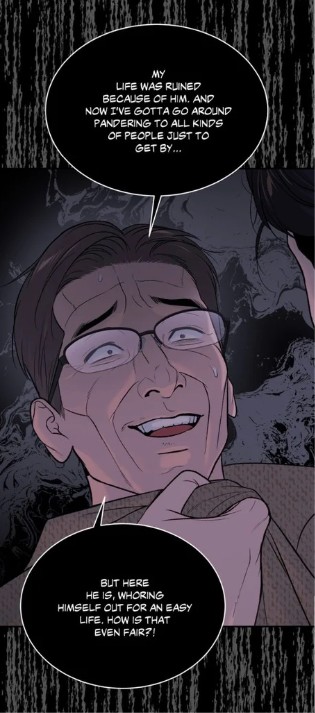 (chapter 90) He has encountered Joo Jaekyung. And he has personally witnessed the dynamics between them.
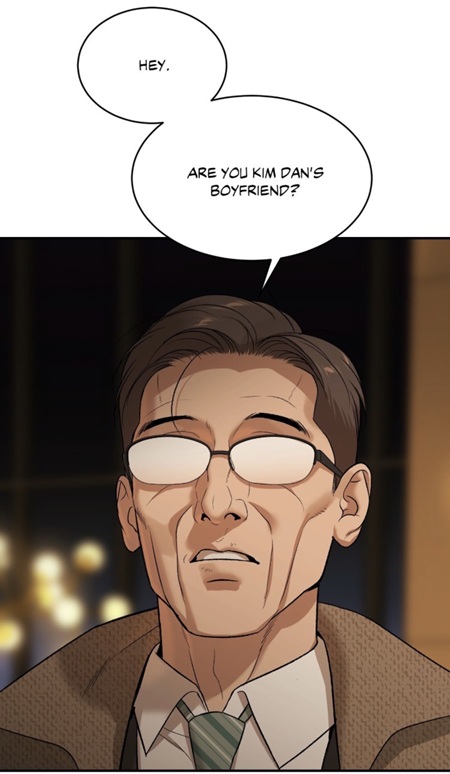 (chapter 90) Secondly, he was doing it for the money, hence he called him a slut.
 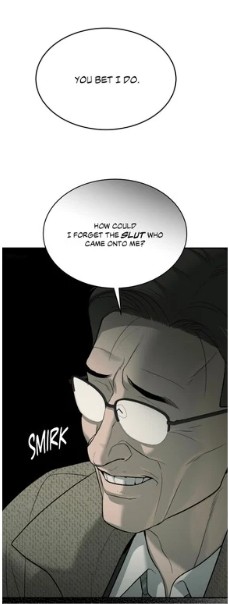 (chapter 90) This misunderstanding fundamentally shapes how he interprets the situation. In this sense, the disgraced director resembles Heo Manwook. Both men rely heavily on their past experiences when judging others. The loan shark assumes that Kim Dan must have obtained the money through prostitution or some other illicit activity, while the former hospital director interprets the closeness between the athlete and the therapist as evidence of a romantic relationship. In both cases, what appears to be practical knowledge becomes a source of blindness. Their experience allows them to recognize familiar patterns, but it also prevents them from seeing the complexity of the reality before them. The relationship between Joo Jaekyung and Kim Dan does not fit into a simple category such as business, manipulation, or romance. Their bond evolves gradually and reflects a far more complex emotional dynamic.
  (chapter 56), hospitals repeatedly responded that they had never heard of anyone by that name.
  (chapter 56) This reaction suggests that the young therapist had already been erased from the professional network in Seoul. Far from protecting him, this invisibility places him in an extremely fragile position: without institutional recognition, he has no professional community capable of defending him.
 (chapter 5) The athlete might realize that the narrative emerging around Kim Dan does not match the reality he previously encountered while searching for him. What appears at first as professional criticism could therefore reveal the existence of a coordinated attempt to manipulate the story.
  (chapter 91)
  (chapter 36)
  (chapter 5) or attacked in the street
  . (chapter 1) His office functioned as a hidden lair, carefully separated from the violence carried out by his subordinates. The presence of the disgraced director inside that office therefore represents a significant rupture in Heo Manwook’s usual methods.
 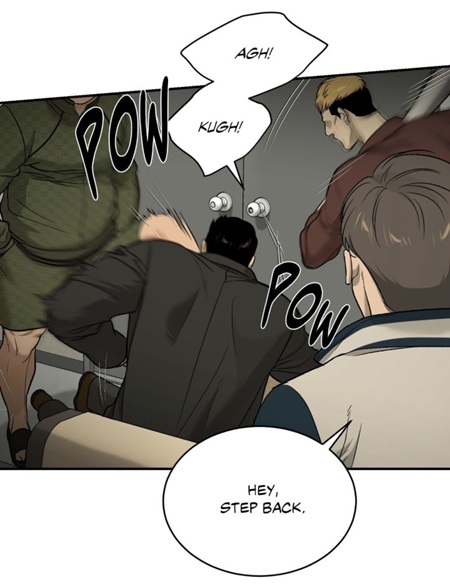 (chapter 93) Moreover, this time he is the one beating the victim, while one of his minions is standing.
 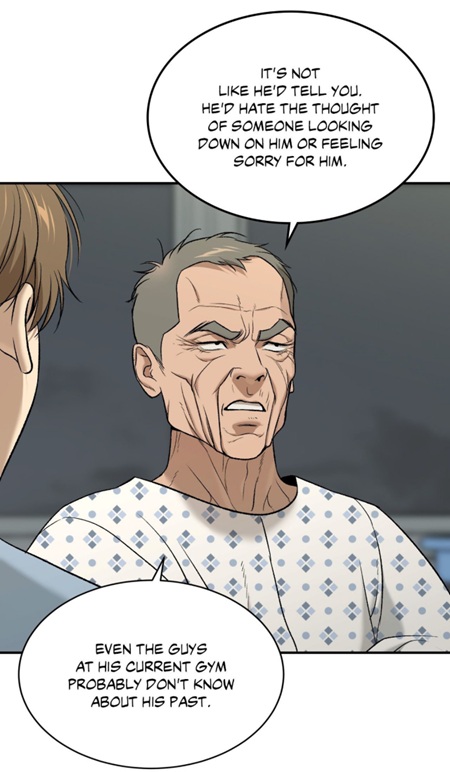 (chapter 74) Joo Jaekyung represents yet another form of knowledge: the knowledge of experiences. Through hardship, defeat, and survival, he has learned to recognize the realities of the world step by step. By living next to doc Dan, he learned to listen and observe so that he is now more aware of the world surrounding him. The true tension of this arc therefore lies not simply between ignorance and knowledge, but between three different ways of understanding reality. One man believes he understands everything, another quietly carries knowledge that could expose it all without realizing it, while the third slowly learns the truth through experience.That is precisely why, in the illustration, they now stand facing each other.
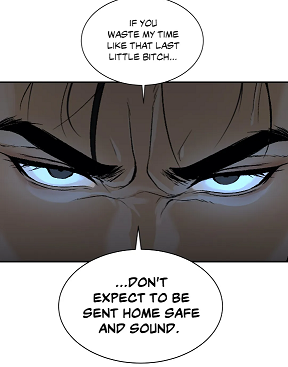 (chapter 3) The latter became responsible for the hamster’s sexual education.
 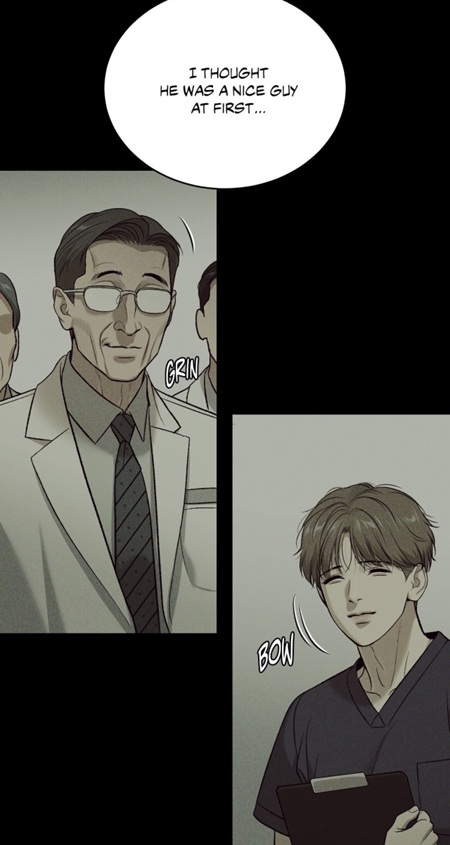 (chapter 90) He is not impulsive. He is not openly violent. He operates within institutions, within offices, within controlled environments. He isolates rather than attacks. He frames rather than forces. Like Compère le loup, he is not a stranger; he is part of the social order. He belongs to the system. That belonging is precisely what grants him access.
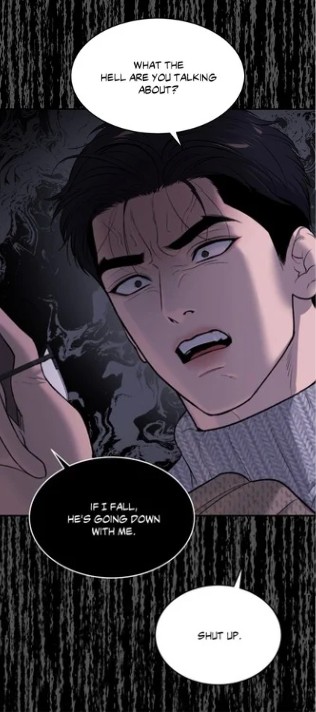 (chapter 90) His threat is not confession; it is defensive strategy. It reveals what he fears most: exposure. Not moral reckoning, but visibility. The predator who once operated in sealed rooms now imagines himself dragged into the open. And that possibility terrifies him.
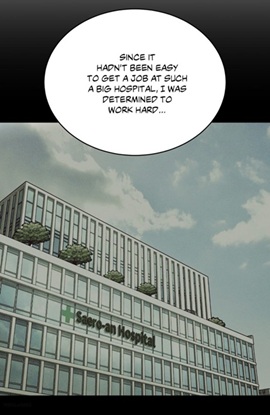 (chapter 90) prioritizes its “output” (reputation, profit, or clinical operations) over the safety of its staff, it adopts the woodcutter’s axe. By focusing only on the work at hand, the institution effectively grants the predator a “sealed room.” The wolf doesn’t need to hide from the woodcutters; he only needs them to keep their heads down. What makes him powerful is not brute force but the absence of eyes. The director functioned the same way. His authority depended on institutional insulation — doors closed, hierarchy unquestioned, narratives controlled. As long as no one looked too closely, he remained Compère — familiar, respectable, legitimate.
 (chapter 90) It resembles the wolf’s preferred setting: intimacy that appears voluntary. What caught my attention is that he complained about his partners.
  (chapter 33), but at the restaurant. If he had known such a club, he could have met the green haired-guy or the “uke” from episode 55. Thus I deduce that the sexual predator is actually hiding his “homosexuality”, he had been living a double life in the end, like the wolf in Perrault. That’s why he targets “virgins”. Since he used the expression “pandering… get by”, Mingwa implies that this man must have told the men (“all kinds of people”) he met, he was looking for a boyfriend to justify his action.
  (chapter 90) That surprise matters. It suggests expectation of compliance, of silent agreement, of recognition of coded signals. The man likely does not belong to the director’s ecosystem; he does not recognize the invitation as opportunity but as lack of respect. Thus he exits.
  (chapter 90) The fact that the wolf tried to talk him out of it indicates that their relationship was not only superficial, but also more equal. Humiliation is crucial. Predators who rely on social camouflage depend on territory. When territory collapses, strategy must change.
  (chapter 90) This is where Grimm enters. His true nature got exposed, he is socially identified as predator.
  (chapter 90) There is no sustained camouflage. Violence becomes explicit.
  (chapter 90) Hence he ran away. The exposure destroyed his credibility. The public article marked him. His ecosystem collapses. He is no longer hidden wolf. He is identified predator.
 (chapter 16)
 (chapter 30), but also as selfless.
  (chapter 30) Yet, he is a libertine, though he claims to be pure by stating that he is looking for his soulmate.
  (chapter 33) Hence no one is suspecting the darkness in his heart. Even the champion believed in his words, when he claimed that he had some feelings for doc Dan.
  (chapter 58) The resemblance is deliberate. He is discreet. He avoids public scrutiny. He hides his intimacy with Potato.
  (chapter 43) Therefore the latter was not present at the champion’s birthday party. The actor operates in private spaces
  (special episode 2) and prefers silence over visibility. Like Perrault’s Compère le loup, he does not appear monstrous. He appears socially legible — even charming. He navigates controlled environments. He is careful about who sees what.
 (chapter 35) He proposes a “race”to the little girl, in Jinx it’s a meal (ramen in Korean, an allusion to sex)
 (chapter 35) He softens his voice. He invites the girl into bed.
  (special episode 1) He constructs intimacy before violence. He depends on civility as camouflage.
  (special episode 1)
  (special episode 1) It is not about power display, but fun. He hides not to isolate his partner, but to shield himself from exposure. His discretion protects his own public image, not his access to another’s body. The imbalance exists — it cannot be denied — but it is not systematically mobilized to erode consent. The latter comes from their initial contract: Potato is at his beck and call.
  (special episode 1) He has been avoiding “virgins” for one reason. He knows how a “virgin” would react to his dream ” to find his soulmate”. They would take his “words” seriously and imagine him as someone serious and reliable. But by selecting partners with sexual experience, he can claim that he made a mistake, they were no soulmate.
  (special episode 1) But this panel exposes even better why the actor is so different from Perrault’s wolf. Youth symbolizes “vulnerability and innocence” and that’s something he has been avoiding. The reason is simple. That way, he can avoid accountability. That’s why he panics, when he hears the age. He realizes his mistake! This reveals that though Heesung is a libertine, he is different from the hospital warden. He is not seeking pleasure in asymmetry, fear, shame and power. He is not targeting “virgins” to exploit their vulnerability. He has been avoiding “virgins”, as he knew that he would have to take responsibility. In reality, he has always feared attachment. Where the wolf eroticizes vulnerability, Heesung is destabilized by it.
 (chapter 34) the predator by accident
  (chapter 89) — clever, adaptable, socially fluid. The fox does not devour. It maneuvers and as such plays tricks.
  (chapter 32) He first approaches Kim Dan through professional contact. Later, he suggests a gig to Potato
  (chapter 88) Even in the gym, he casually asks Yoo-Gu to hold mitts — reorganizing the work structure in ways that subtly serve his private interest. Work becomes the bridge. The boundary blurs.
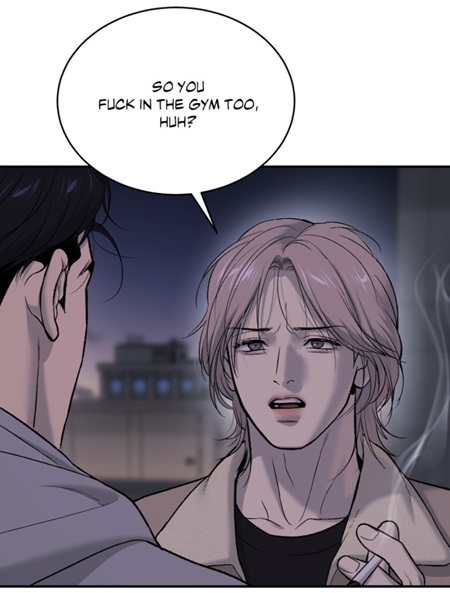 (chapter 89) The accusation implies that Jaekyung contaminates professional space with sex. Yet Heesung himself collapses that boundary. He initiates intimacy with Potato after drinking.
 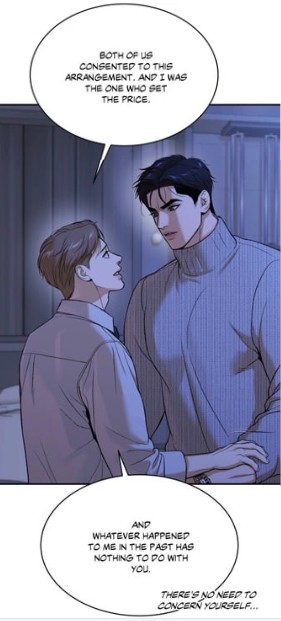 (chapter 90) It is when one makes a clear decision and accepts the consequences. Yet, Heesung violated this rule, for he knew Potato was drunk. He did not stop. He did not insist on postponement. He allowed desire to override clarity. That choice introduces asymmetry. Alcohol clouds agency. Youth complicates balance. Professional proximity blurs roles. Secondly, he is rejecting accountability. Finally, he never tried to correct Potato’s error and false belief. He took advantage of his ignorance. So his behavior could be perceived as manipulative and coercive.
 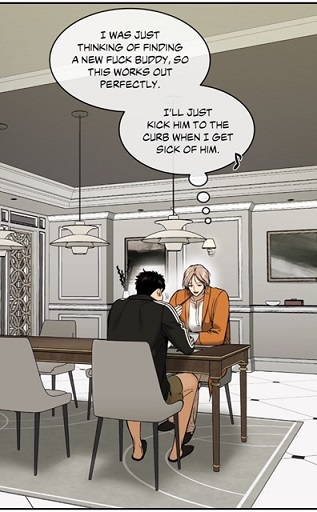 (special episode 1) He hides it, though he tried to reveal it to doc Dan
  (chapter 58). If the truth were exposed — an actor secretly sleeping with a younger, inexperienced partner whom he approached through work — the narrative could easily frame him as exploitative. He could be accused of sexual harassment.
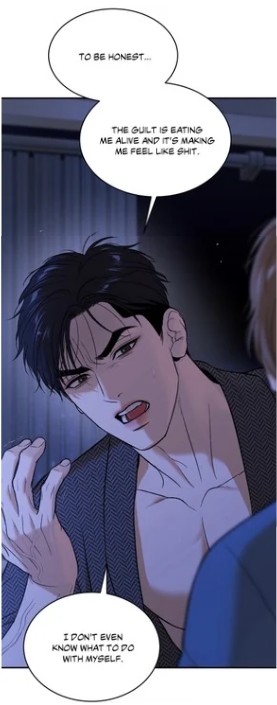 (chapter 91) the emotion is internalized. He experiences remorse not because he was exposed, but because he crossed a boundary. He separates work from intimacy afterward. He becomes rigid about consent, alcohol, and clarity. Therefore imagine his reaction, when he discovers the true nature of the relationship between Choi Heesung and Potato. He can only be shocked and angry.
  (chapter 33) Or would attention shift to the structure that allowed blurred boundaries to exist in the first place?
 (chapter 52), does the structure remain untouched?
 (chapter 14) Others hide behind systems.
  (chapter 11) Others exploit labor, fear, loyalty, or belief. The forest contains them all.
  (chapter 42). When he speaks of Joo Jaekyung, his language is explicit: the champion was a source of milk, a body that could be “milked” for money, favors, and reflected status. In biological terms, this is parasitism rather than hunting — survival not through direct attack, but through prolonged attachment to a stronger host. As long as the host remains productive, the parasite thrives. When the bloodsucker is removed, flow stops, hunger turns first into regret
  (chapter 42) before resentment.
  (chapter 42)
 (chapter 42), but why he does so at the precise moment he does.
  (chapter 42) His hostility does not emerge from poverty alone, nor from moral outrage. It is triggered by a rupture in his expectations.
 (chapter 42) In that moment, the green-haired man realizes that closeness still exists without visible profit. This is intolerable to him. It contradicts the logic through which he has justified his own past behavior: the belief that proximity to power must be monetized, that relationships exist to be exploited, that affection without gain is either naive or dishonest.
 (chapter 42) Something used and discarded. In other words, he reframes Kim Dan’s loyalty as delusion and reasserts predation as the only intelligible model of intimacy.
 (chapter 02) and that the exchange of attention and money implied mutuality. Joo Jaekyung’s refusal shattered that illusion. What Kim Dan represents now is not competition, but refutation: proof that closeness does not require extraction, and that survival does not have to pass through exploitation.
 (chapter 42) The green-haired man refuses to pay for food this, while implying that his roommate is taking advantage of him, as if he would barely contributes. On the surface, the image suggests exploitation: one man living off another’s labor. Yet the scene refuses to clarify who truly benefits. The roommate remains largely invisible, economically opaque, almost spectral. Is he a dependent quietly feeding off the green-haired man’s remaining resources? Or is the green-haired man himself the parasite, overstaying, consuming, and justifying his presence through grievance? The narrative does not resolve this tension — deliberately so. Predation here is not readable at a glance. It hides in everyday arrangements, in domestic negotiations, in the language of fairness and contribution.
 (Chapter 31), the contract is made visible: the manager’s income depends entirely on the star’s uninterrupted productivity. When work stops, pay stops. Yet neither the star nor the agency appears exposed. Heesung himself, who proposed the risky sparring, shows no empathy for his caring manager. He doesn’t feel concerned for this arrangement and makes no attempt to renegotiate it for his manager’s sake. Financial risk is displaced downward, onto the least protected figure. The manager is not the predator here, but a human buffer, absorbing the instability produced by a structure that benefits the star and the Entertainment agency while refusing to insure those who sustain them.
 (chapter 34) or on Saturdays
 (chapter 32), treating the physical therapist’s work and time as indefinitely available. This is not an isolated lapse but a recurring pattern, later reproduced with Potato as well.
 (chapter 70) but “Take better care of yourself.” Not “We failed to protect you,” but “You caused inconvenience.” This is the core of economic predation: the harm is real, but the blame is displaced downward so the system remains clean.
 (Chapter 90) A sexual predator targets someone whose circumstances make refusal impossible or costly — socially, economically, professionally, physically, psychologically. The predator does not need to use overt violence to be dangerous; often the strategy is precisely to stay close to the border where the victim can later be blamed: You wanted it. You tempted me. You misled me. You didn’t say no clearly enough. This is why victim-blaming belongs structurally to sexual predation: it is a technique of retroactive absolution. This logic does not remain abstract in Jinx. It finds a concrete site where authority, legitimacy, and bodily access converge.
 (chapter 29) Rival fighters do not need to engineer the champion’s collapse; they only need to anticipate it. What defines them is not ambition alone, but timing.
 (chapter 46) His words are exposing not restraint, but accusation. The implication is clear: the champion’s body is already failing; respect has become optional. Seonho is not trying to overthrow Jaekyung through skill alone. He is announcing that the moment of vulnerability has arrived, and that patience is no longer required.
 (chapter 87) He thought, he had found his perfect “meal”. To conclude, Arnaud Gabriel articulates the same logic even more coldly.
  (chapter 87) There is no personal animosity here, only inevitability. The statement is not a threat; it is a forecast. Power, in this worldview, is temporary by nature, and the role of rivals is not to prevent collapse, but to be present when it happens. Like hyenas, they do not waste energy on the kill. They wait for age, injury, scandal, or exhaustion to do the work.
 (chapter 69) A new match is organized. An invitation is extended. Noise is generated. Attention is redirected. The spectacle resumes.
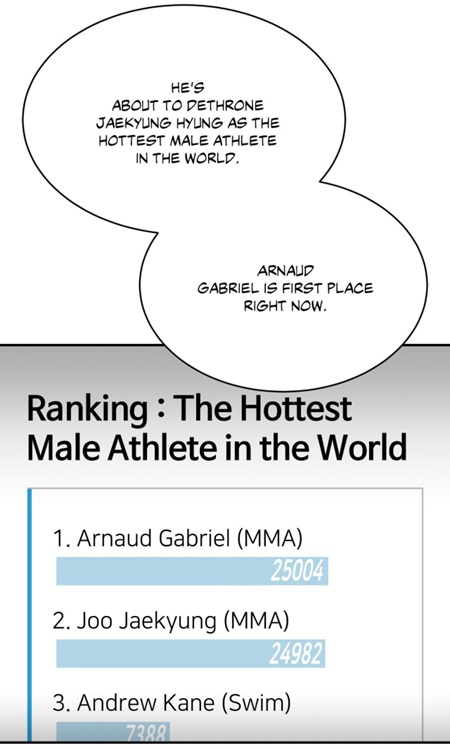 (chapter 81) The distinction matters. An athlete is managed for performance and longevity; a celebrity is managed for visibility. Injury is a problem in the first case. Scandal is profitable in the second.
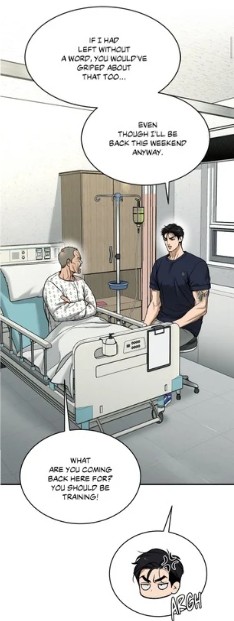 (chapter 78) The latter has always blamed the “boxer Joo Jaewoong”, but not the boxing world, the institution.
  (chapter 74) He never saw the ties between boxing and mafia. And this raises the following question: how can the Little Red Riding Hood discover the predator in MFC before getting eaten?
 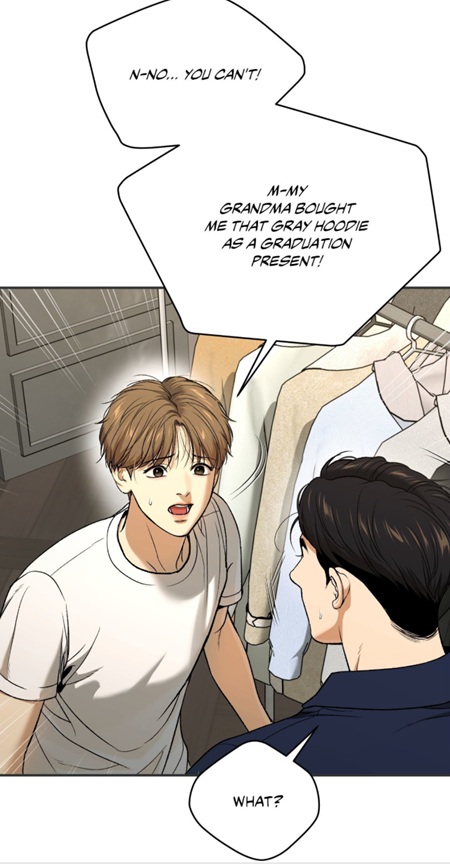 (chapter 80) In this environment, appearance is not superficial. It is a language of rank. To arrive without fluency in that language is already to be classified as provisional.
  (chapter 54)
  (chapter 1) The expression matters. It implies opportunity rather than integration: freelance labor, paid by hours or shifts, without institutional protection. In such conditions, negotiation is not expected. The contract is accepted, not discussed.
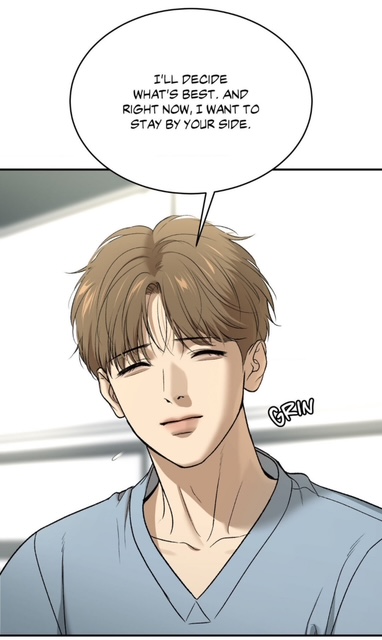 (chapter 57)
 (chapter 90) The contact is quiet, progressive, and deniable. It blends into routine movement, into institutional normalcy. “After a while, he started getting really handsy… and it only got worse over time.” Each tolerated touch becomes precedent. Boundary erosion is not sudden; it is cumulative.
 (chapter 90) In the doctor’s eyes, the predator knew about Kim Dan’s difficult financial situation, then he asked how much he would have to pay to sleep with him. The timing is crucial. The offer does not initiate desire; it tests whether vulnerability can be converted into consent. Payment reframes coercion as transaction, need as availability, and silence as something that can be bought in advance.
 (chapter 90) as bodies that are “tough to crack,” with the confidence of repetition. The metaphor is consumptive: a shell broken to reach what is inside, then discarded. Once resistance is broken, interest disappears. This is practiced predation. The hospital is not merely the setting of abuse; it is his hunting territory — a space where authority guarantees access, exhaustion weakens refusal, and legitimacy ensures silence.
 (chapter 21) The juxtaposition of two buildings, the rooftop park, the sterile façade, and above all the near-identical hallways collapse
  (chapter 5) Professional and personal life are folded into the same architectural body. This is not decorative repetition; it signals circulation — of staff, of protocols, of information.
 (chapter 5) — professional legitimacy, research success, advancement within a system that rewards results over outcomes. Progress functions as an absolute good, one that authorizes human cost without requiring personal cruelty. Harm is acceptable so long as it produces data.
 (chapter 21), age and vulnerability become a risk factor, endurance becomes a resource. When the new drug fails and the grandmother deteriorates, the explanation is procedural: side effects, unpredictability, regulatory timelines. Failure is framed as scientific, not ethical.
  (chapter 47)
  (chapter 21) Treatment patients “need family support,” she says — a statement that sounds compassionate, but functions as deflection. Psychological care is outsourced; responsibility for deterioration quietly migrates away from the institution (“we”). The setting of her disclosures reinforces this posture. She does not speak in a protected office, but in the hallway — a transitional, impersonal space governed by efficiency rather than care, as if she had nothing to hide. However, by behaving like that, she violated the confidentiality rights. Unlike the Saero-An director, who relies on enclosure and isolation, Kim Miseon operates through openness and institutional flow.
  (chapter 48) It is no coincidence.
  (chapter 56)
  (chapter 48) That knowledge could only have reached him through leakage — informal, normalized, unremarked. Bodies are not the only things consumed here; information is too.
 (chapter 56) Unlike Saero-An or Sallim, this space does not extract profit or prestige; it operates under scarcity. Kim Dan works there as a freelancer, not as protected staff. When he collapses, he is advised to take a day off, not sick leave — a telling detail.
  (chapter 70) It confirms that, even here, labor is contingent, negotiability absent, protection minimal. The vocabulary of care masks the reality of precarity.
 (chapter 59) Thus he is happy to let a film crew use his building for a movie. This is why he sometimes works night shifts himself.
  (chapter 60) His authority does not shield him from exhaustion; it exposes him to it. He enforces discipline because collapse anywhere threatens survival everywhere.
 (chapter 59) And yet, harm still occurs. Responsibility is displaced not upward, but sideways — onto the most vulnerable worker present. Kim Dan becomes the buffer once again, not because the director is powerful, but because he is trapped. Predation here is no longer driven by appetite, but by attrition.
 (chapter 61), preserving the impression of treatment rather than end-of-life care. This semantic slippage matters. For Joo Jaekyung, who has been treated there himself, the space remains associated with improvement.
  (chapter 70) He thinks, Hwang Byungchul is treated properly, as he still looks lively and strong.
  (chapter 71) The champion does not fully register that it is a place at the threshold of death. Care and closure blur. This confusion is not accidental; it mirrors the broader system’s refusal to name limits. By calling a hospice a hospital, death is softened into treatment. By calling resignation progress, responsibility is deferred.
 (chapter 65) For her, medicine is sacred and progress meaningful.
  (chapter 65) This belief is not naïve in the childish sense; it is aspirational. It is tied to the idea of success, of legitimacy, of having “made it.” And in her mind, that idea has a name: Seoul.
 (chapter 65) It is where competent doctors work, where advanced hospitals stand, where progress happens, where you can earn a lot of money. This belief structures her entire horizon. Corruption, abuse, and institutional predation do not register there, because acknowledging them would mean admitting that the space she has invested with hope is also capable of harm. Within Seoul, institutions are not suspect; they are self-justifying.
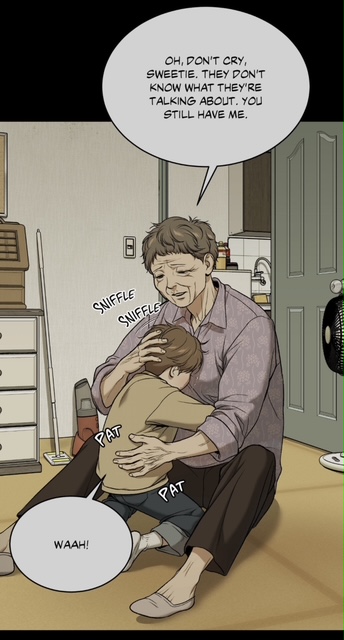 (chapter 57), she did not confront teachers. Her answer was always the same: he still had her. The implication was clear — institutions were there to protect him. To intervene would have meant questioning the very structures she depended on to make sense of the world.
 (chapter 65) as if it was recent, temporary, and situational. The wording matters. What has been chronic is compressed into the present. Duration disappears. Suffering becomes recent, temporary, and therefore manageable. This is temporal minimization — not denial of harm, but deferral of its cause.
  (chapter 57) Only then does his condition become visible. Not because it is new, but because it now implicates her. Before that moment, his endurance could remain unnamed. After it, it must be explained. This is not cruelty; it is belief colliding with responsibility.
 (chapter 7) This exposes her lack of trust in him, as she views him as too naive and trusting. This is where the irony crystallizes. Financial precarity is erased from discourse because acknowledging it would expose her responsibility. Money resurfaces, when Kim Dan presents an expensive gift. But she doesn’t mind, she is even aware of his lie:
  (chapter 22)
  (chapter 13) This reached its peak, when after sending his whole salary
 (chapter 16), Heo Manwook intended to rape him. As you can see, the more they got money, the more abusive they became… and all this time, the grandmother has no idea. But the best evidence is when Joo Jaekyung pays the loan in full, the pattern repeats at a higher level.
  (chapter 17) The debt is erased — and the danger escalates. Kim Dan might become free, but now the target is the champion. He becomes visible. Settling the debt marks him as someone worth targeting, someone who can be extracted from again.
  (chapter 46) What Shin Okja imagines as closure functions, in reality, as a signal.
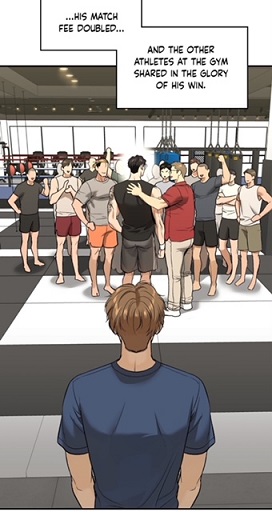 (chapter 41) A champion who keeps winning cleanly, visibly, and on his own terms becomes difficult to manage. His victories increase his market value, distribute prestige and income to others, and create expectations of legitimacy. At that point, success stops being profitable in a controllable way. It begins to threaten both institutional authority and informal economies that rely on predictability, influence, and narrative control.

 (chapter 87), and the destruction of black glass under Baek Junmin’s foot.
 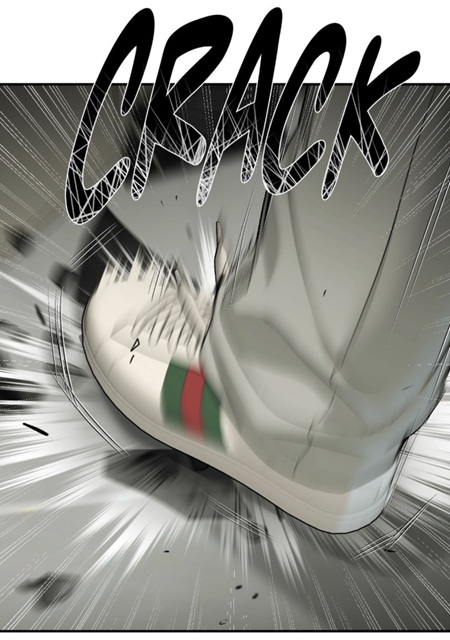 (chapter 87) Both moments operate under pressure, yet they belong to radically different economies. One gathers force inward to protect, contain, and care. The other expels force outward to fracture, dominate, and erase. The biggest difference is not intensity, but direction—and whether the other is held, or destroyed.
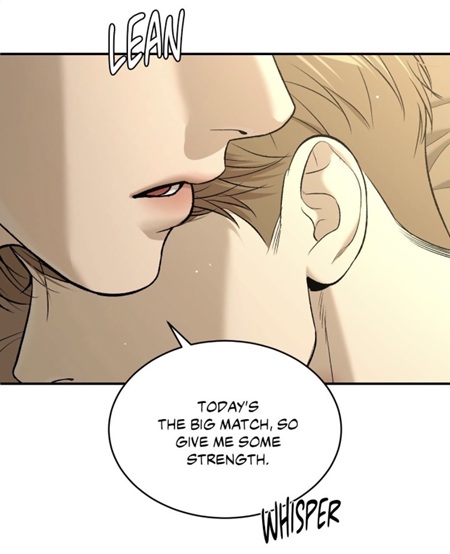 (chapter 87) He asks for strength and luck
  (chapter 87). Kim Dan answers with a gesture, the offered hand accompanied with a wish:
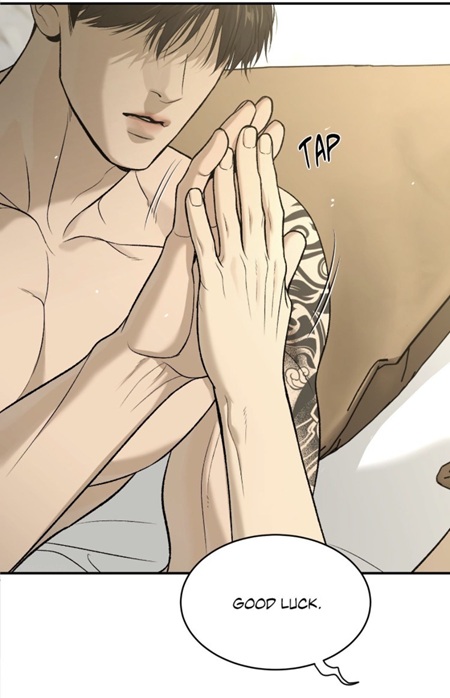 (chapter 87). Only then does the squeeze occur. Words initiate connection; the body confirms it. Speech and gesture align. Pressure becomes care.
 (chapter 87) —but they are refused. Baek Junmin is denied any possibility of reply—no space to answer, to justify himself, or even to speak back.
  (chapter 87) The screen interposed between them
 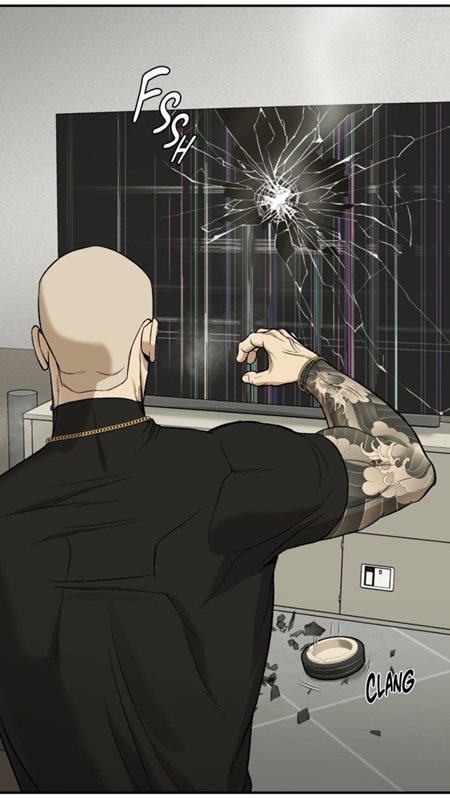 (chapter 87) functions as both a physical and symbolic barrier: it delivers judgment without permitting response. Deprived of dialogue, Junmin is pushed out of language altogether. What remains available to him is not speech, but the body. His answer therefore does not come in words, but through the hand
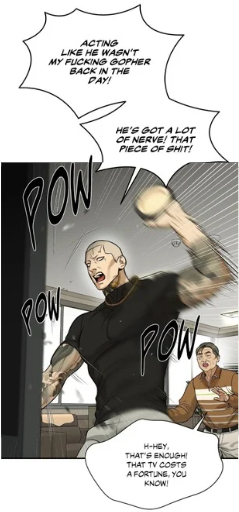 (chapter 87) and then through the foot.
  (chapter 87) The violence is not misdirected; it is precisely directed at the medium that silences him. The screen is the site of exclusion,
  (chapter 87), before the challenge
  (chapter 87) Here again, language and body are aligned.
  (chapter 87) Kim Dan answers—first with a nod, then with words. The response is clear, immediate, and embodied. And what follows is decisive: the champion raises his arm.
  (chapter 87)
  (chapter 15)
  (chapter 40)
  (chapter 51), its meaning sharpens. For the first time, Kim Dan no longer occupies the position of fan or witness. He functions as judge and jury. 😮 And the champion acts accordingly. He declares himself the winner.
 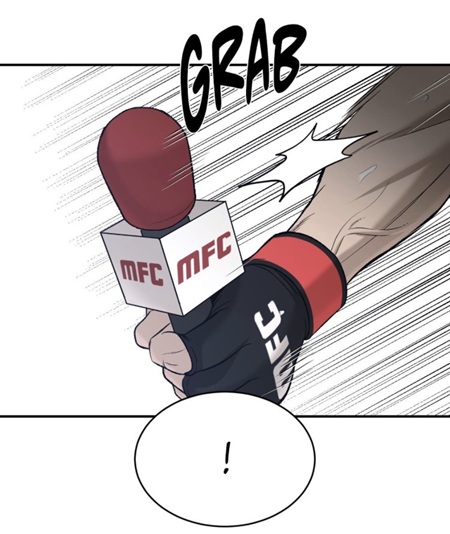 (chapter 87) Joo Jaekyung is no longer a puppet or zombie, but a man with a heart and voice.
 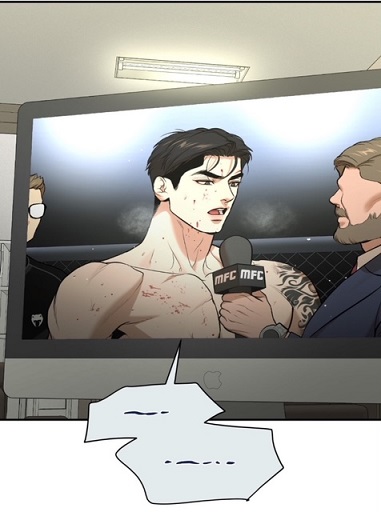 (chapter 46) It regulates turn-taking, determines who may speak, in what order, and under which framing. As long as it remains in the moderator’s hand, speech is mediated, filtered, and contextualized. Questions lead; answers follow. Meaning circulates vertically.
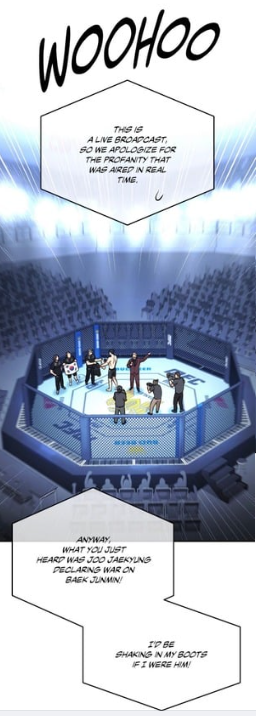 (chapter 87) He no longer moderates; he reacts. He cannot redirect the statement, soften it, or translate it into spectacle. He can only acknowledge that something has escaped containment. The apology is not moral—it is procedural. It marks the moment the institution loses authorship.
 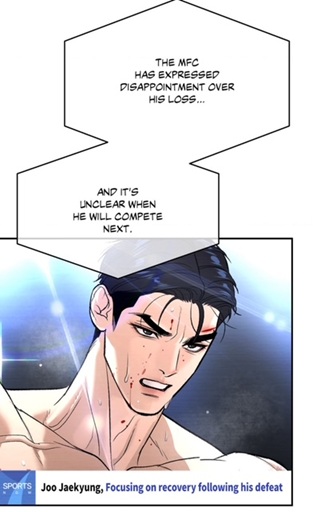 (chapter 57); he is narrating. He does not answer a question
 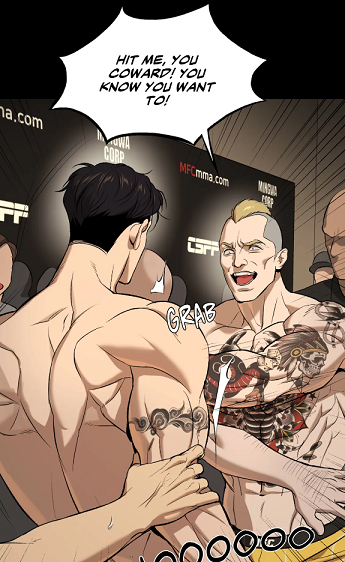 (chapter 14) Yet, CSPP
  appears more and more insistently
  (chapter 87), even in the cage
 (chapter 87), contrary to before.
  (chapter 15) Either you only see the C or the name is placed out of the frame.
  (chapter 40) Yet it remains unexplained. What does it stand for in the world of Jinx? A sponsor? A broadcaster? The story never defines it explicitly—and that absence matters. What goes unnamed is often what exercises the most power. I will elaborate about it further.
 (chapter 36) —depends on mediation. Delay. Scoring. Interpretation. The quiet redistribution of meaning after the fact. As long as nothing is said outright
  (chapter 87), people in the seaside town, a public that exists before commentary can shape it.
 (chapter 87) And the fight already answers the questions the system hopes to postpone. What we see in the cage is not merely a contest of strength, but a clash of communicative regimes. How one fights here is inseparable from how one speaks, evades, provokes, or withholds.
 (chapter 87) His movement privileges distance, tempo
  (chapter 87) and visibility. That way he gives the impression that he is superior to the former champion. The middle kick appears not as a finishing tool
  (chapter 87), but as an instrument of disruption—enough to score, enough to interrupt rhythm, never enough to end the exchange. The rest of his offense follows the same logic: repeated punches to the face
  (chapter 87), the hands, the shoulder. Targets chosen not for collapse, but for points. Not to silence the opponent, but to keep him talking through damage. The choice of targets is not arbitrary. The hands and the shoulder are not neutral zones. They are sites of vulnerability that presuppose knowledge. Arnaud Gabriel does not fight, as if he were discovering his opponent in real time; he fights as if he were acting on prior information.
  (chapter 82) He anticipated a diminished MMA fighter at the end of his career who would train at the hotel gym. His punches repeatedly return to the same areas—not to finish, but to aggravate. Not to silence, but to extract fatigue.
 (chapter 82)—noticed earlier during training—signals something even more fragile: limits that are physiological, not tactical.
 (chapter 47) Already discussed. Already framed. Gabriel’s reliance on point accumulation is inseparable from this logic.
  (chapter 87) He does not need to dominate the body; he needs to activate its known limits and let the scoring apparatus do the rest.
 (chapter 87) —his decision to close distance, to counter decisively, to end the exchange rather than prolong it—appears less like impatience than resistance. He does not correct the narrative. He interrupts it.
 (chapter 51) The fight is no longer about what happens between bodies, but about who controls evaluation. And that’s how they could rig the match between Baek Junmin and Joo Jaekyung.
  (chapter 70) acquires a different meaning. What he condemns as arrogance is not a moral failure, but a structural adaptation. These fighters have learned that they do not need to finish fights with a knockout. They only need to prolong them—to survive them—because the system will finish the sentence for them. Therefore, the moderator’s commentary during the match introducing the new Korean fighter takes on a clearer function.
  (chapter 71) He frames the rookie as someone “waiting for the right timing,” subtly suggesting a coming knockout rather than prolonged survival. The language is important: it reassures the audience that decisiveness still exists within the system, that power is merely deferred—not absent.
 (chapter 71) The director is not persuaded. Hwang Byungchul reads the situation differently. He recognizes stiffness, fear, and overreliance on structure—not composure, not strategy. Where the moderator sees patience, the director sees hesitation. Where commentary insists on strategy, experience detects rigidity and lack of instincts.
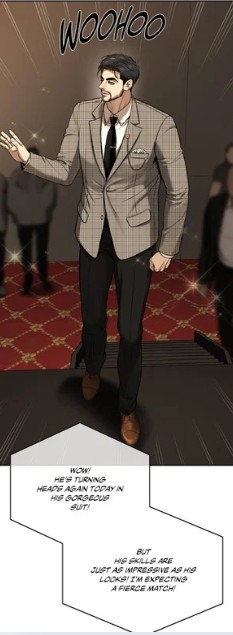 (chapter 82) and inside the cage.
 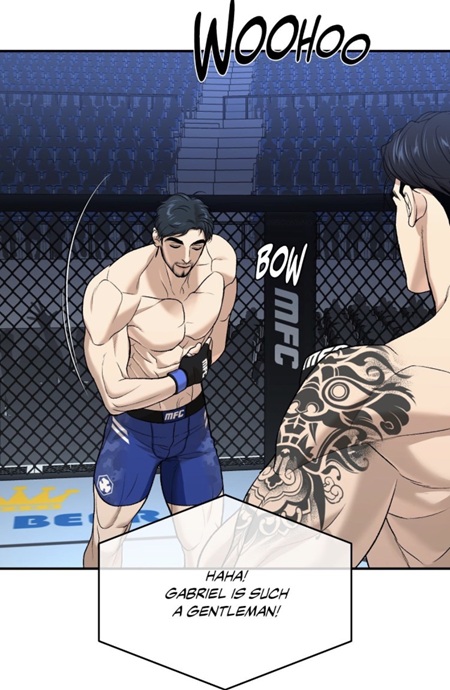 (chapter 87) Publicly, he is courteous. Measured. Even complimentary.
 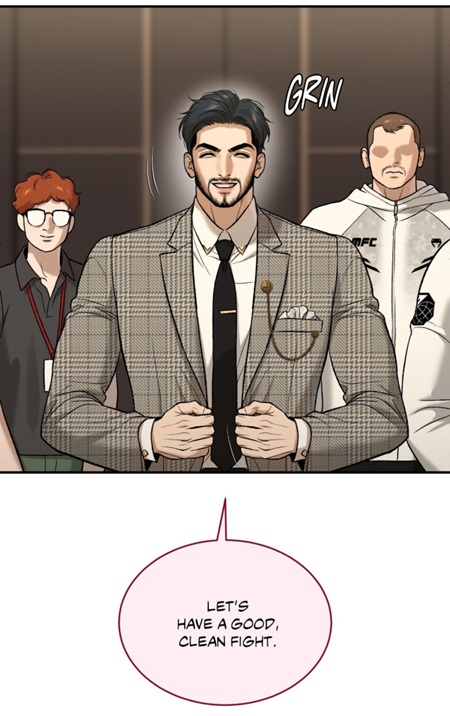 (chapter 82), gentle and polite gestures, and tactical distance— away from the spotlight, away from overt confrontation. His restraint is not humility, but alignment. He performs civility so that judgment, narration, and authority can be outsourced to the institution. That’s why for him, fighting is strongly intertwined with fun and he sees himself more as a star than as an athlete. He is definitely influenced by MFC. Hence we can say that his suit mirrors his mind-set. Gabriel’s suit does not soften his presence; it disciplines it. The patterned fabric signals rigidity rather than elegance—structure over fluidity. It mirrors his fighting style: calibrated, rule-bound, resistant to improvisation. Nothing about his appearance invites rupture. Everything is designed to hold form.
 (chapter 49) It is to smirk, to whisper, to apply pressure obliquely. In both cases, the logic is identical: control is preserved by never being fully present.
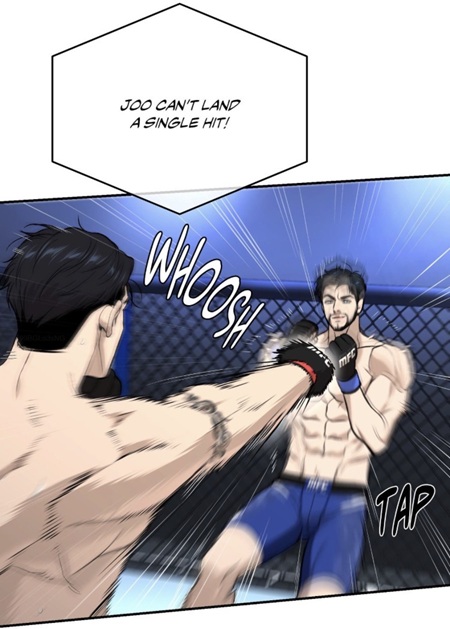 (chapter 87) It is more observation. He allows the opponent to speak first—to reveal the structure of the exchange.
  (chapter 87) When it lands, it collapses distance. It forces the opponent inward. And crucially, it targets the center of the body—not the face that earns applause, but the core that sustains movement.
 (chapter 87) and delivers an uppercut.
  (chapter 87) This is not escalation; it is completion. Where Gabriel sought to keep the fight open, Joo Jaekyung compresses it. He refuses the long exchange. He refuses circulation. He refuses to wait for judgment. His strategy is not to be evaluated later, but to be undeniable now.
  (chapter 87) This is not silence imposed from outside, but silence produced by gravity. Once the body crashes, breath cannot return, and speech has nowhere to perch.
  (chapter 87)
 (chapter 87)
  (chapter 2) While the jinx held, action could still occur, but speech could not carry consequence. Words dissipated, were deferred, or were absorbed by systems designed to neutralize them. Powerlessness expressed itself as speechlessness.
 (chapter 87) His actions arrive before meaning can be reassigned. His words arrive where no answer is prepared. In this sense, episode 87 marks the moment Joo Jaekyung becomes fluent in his own discipline. Not merely competent, not merely dominant, but articulate. His movements surprise
  (chapter 5) which had surprised his manager Park Namwook.
 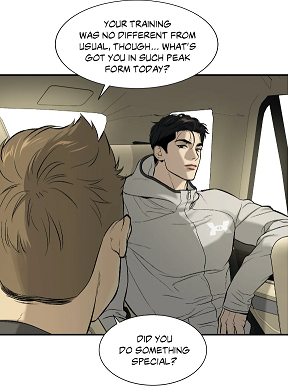 (chapter 5)
 (chapter 62) They are not close enough to trust the system blindly.
 (chapter 69), by allowing attention to cluster around foreign misconduct
 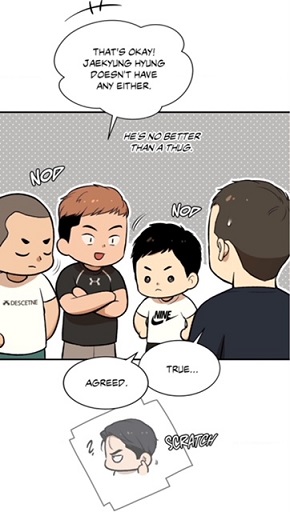 (chapter 47) Nothing new needs to be invented. Only reassembled. They know about the dragon’s past, because they brought Baek Junmin, someone who resented the celebrity for his wealth and fame.
 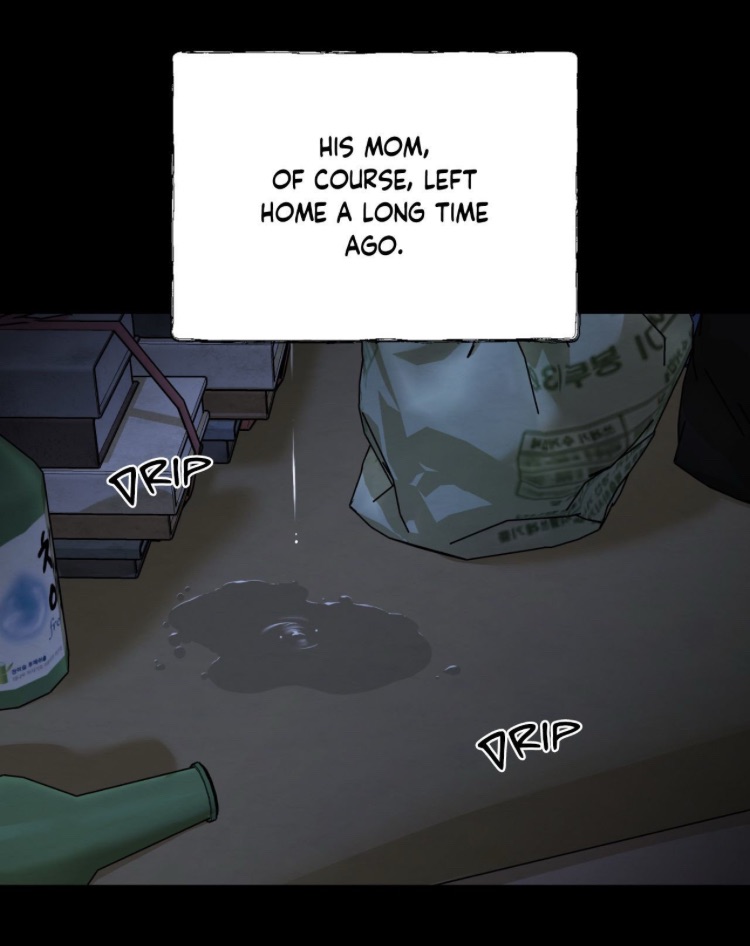 (chapter 72) It only needs to repeat an already accepted story: abandonment as necessity, violence as justification, disappearance as victimhood. A story the system knows how to circulate. And Hwang Byungchul never questioned her decision so far.
  (chapter 78) Secondly, Kim Dan is now able to distinguish the past from the present. Finally, thanks to doc Dan
 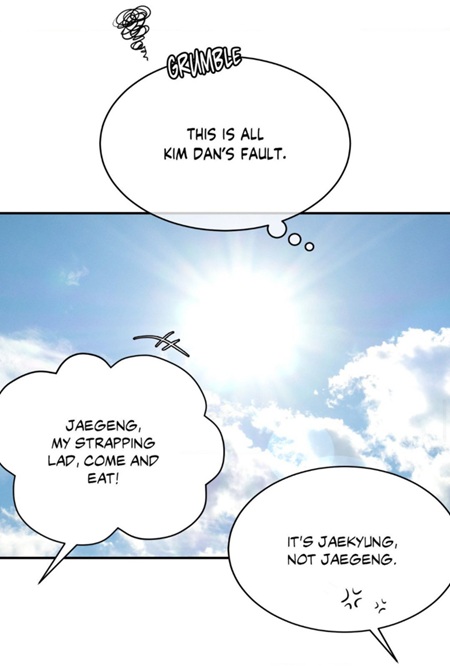 (chapter 62), he did so many good deeds in the seaside town that the inhabitants and the patients from the hospice won’t accept such accusations. I believe that such people won’t see “motherfucker” as a problem at all, they will rather see it as a part of his role after the match. What will remain in their mind is rather the accusation and riddle he voiced: the stunt Baek Junmin played.
  (chapter 87), which already tells us that CSPP does not function as a simple broadcaster. My idea is that CSPP operates as an intermediary apparatus: a company that packages events, sells broadcasting rights, coordinates visibility, and transforms violence into consumable spectacle. In other words, CSPP does not show fights; it produces events. This explicates why CSPP was present right from the start
  (chapter 14), but barely visible. But the moment it caught my attention in Paris, I realized that its increasing visibility displays the success of MFC as company. Observe that when the champion faced Randy Booker, the weight-in took place on the same day than the fight and in the arena, not at a prestigious hotel like in Paris. Here, the champion held a conference many days before the weight-in, and the latter took place the night before the match with Arnaud Gabriel. Secondly, you can observe the success of MFC through the banners. In Busan, the website of MFC was posed in the background next to CSPP.
  (chapter 50), only MFC and CSPP. But in Paris, it is now totally different.
  (chapter 35), his suspension
 (chapter 57)
  (chapter 70) His matches are scheduled at hours accessible even to a Korean hospital
  (chapter 41) or hospice patients.
  (chapter 71) becomes intelligible. It is not a mark of anticipation, but of expendability. The match is placed where attention is thinnest, where failure or success carries minimal consequence. By contrast, Joo Jaekyung’s fights are positioned to be seen. The asymmetry exposes how dependent MFC’s visibility economy is on him—not as a competitor, but as the primary organizer of audience attention.
 (chapter 47) His presence circulates through curated highlights and controlled conference footage rather than open broadcast.
  (chapter 47) His rise is engineered through selective visibility.
  (chapter 47) Weak opponents are chosen.
  (chapter 47) His image is inflated before he ever faces Joo Jaekyung. CSPP does not need to expose him fully; it needs only to prepare recognition. However, CSPP is an official company, they can not control rumors among fighters.
  (chapter 47) Thus the manager suggested this to his boss just before:
  (chapter 46) By mentioning the existence of spies, he incited the main lead to keep his distance from the doctor and the members so that the rumors about the underground fighting wouldn’t reach his ears.
 (chapter 14), the United States, Paris—the fights are placed in high-visibility slots. Loss must be witnessed. Decline must be shared. By contrast, the fight between Baek Junmin and Joo Jaekyung takes place in the morning
  (chapter 49), a time of dispersed attention, private viewing, and reduced collective response. Visibility is not maximized; it is managed.
  (chapter 49) CSPP’s role, then, is not neutral mediation. It is temporal governance. It decides when exposure becomes dangerous and when it becomes profitable. It does not silence events; it times them.
 (chapter 77) Once Joo Jaekyung does not contest the loss of his title—once he does not sue, demand more investigation, or interrupt the administrative process— MFC and CSPP no longer need to justify anything. Delay becomes normalization. Silence becomes confirmation.
 (chapter 49) Under normal medical protocol, this should have stopped the fight immediately.
 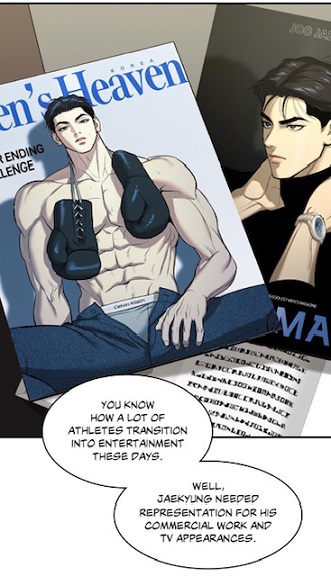 (chapter 30) This implies that he won’t remain passive and silent like in the past, relying on structure and institutions (Entertainment agency…) and accepting to become a scapegoat.

 (chapter 86), it does not close the night through narrative resolution. There is no statement, no promise, no verbal seal. And yet, for many Jinx-philes, the final panel refuses to let the scene dissolve. What remains is not heat, not tension, not even tenderness — but circulation.
 (chapter 21), overload
  (chapter 33), short circuit
 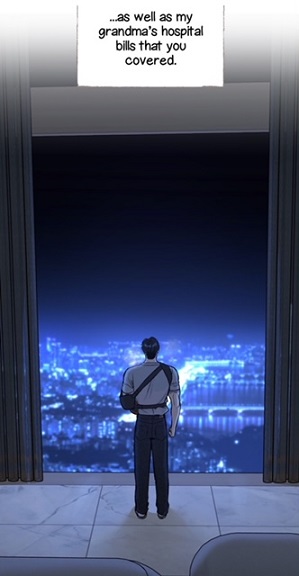 (chapter 53) reset. And once that lens is adopted, it becomes impossible to limit the consequences of episode 86 to the couple alone. Because a closed circuit does not only affect those directly connected to it. It alters the surrounding system.
 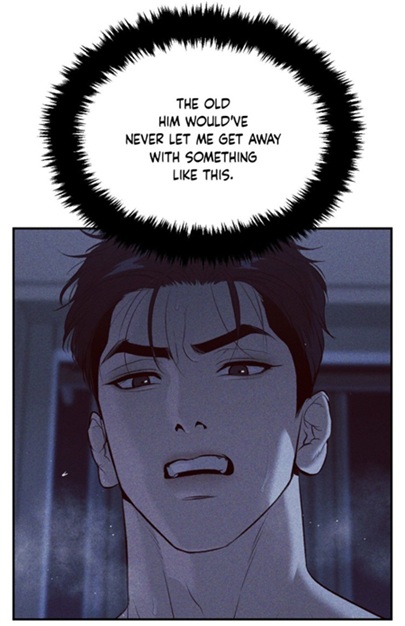 (chapter 86). This section will explore how acknowledging change without denying past harm opens a new ethical position — one that prevents memory from being weaponized, while still preserving responsibility. Third, the analysis will turn to conversion, revisiting earlier nights marked by failure, asymmetry, and isolation. Rather than cancelling them, episode 86 absorbs and transforms them. This is where forgiveness, reflection, and the first true encounter with consequence quietly enter the narrative. Finally, a new section will widen the lens further by examining shared experience and memory
 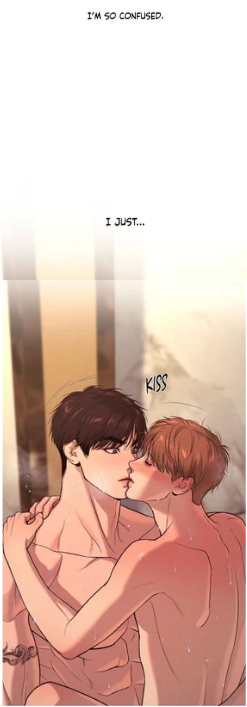 (chapter 86) carries such weight, we must return to the origin of kissing itself in Jinx. Because surprise, in this story, is not an abstract theme. It has a history. And that history begins with a body being caught off guard.
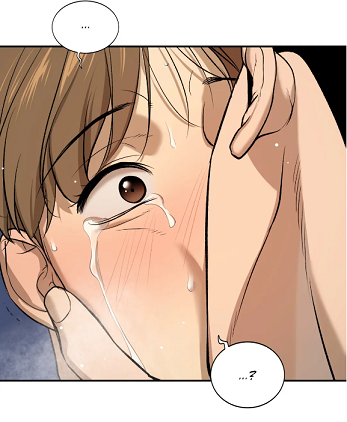 (chapter 14) There is no warning, no verbal cue, no time to prepare. The kiss arrives as interruption. It is not negotiated; it is imposed. Hence the author focused on the champion’s hand just before the smooch.
  This moment matters far more than it initially appears, because it establishes the template through which Kim Dan first encounters intimacy.
  (chapter 15) Affection does not emerge gradually. It breaks in.
 (chapter 15) He needs preparation. He needs time to brace himself emotionally. This request reveals two aspects. First, he connects a kiss with love. On the other hand, the request is not really about romance; it is rather about survival. Surprise, for Kim Dan, has already been coded as something that overwhelms the body before the mind can intervene.
 (chapter 39), he violates his own request.
 (chapter 39) They are unannounced, often landing on unusual places (cheek or ear)
  (chapter 44). They often take place under asymmetrical conditions — when one of them is intoxicated, confused, or emotionally exposed. Sometimes they occur without full consent, sometimes without clarity. In chapters 39 and 44, kisses surface precisely when language fails or consciousness fractures. It is as if Kim Dan has internalized a rule he never chose: a kiss must be sudden. Observe how the champion replies to the doctor’s smile and laugh: he kissed him, as if he was jealous of his happiness.
  (chapter 44) That’s how I came to realize that the kiss in the Manhwa is strongly intertwined with “surprise”. This is the missing link.
 (chapter 2), he comes to reproduce interruption as intimacy. He knows that surprise destabilizes him — that is why he asked for warning — but he has no other model. What overwhelms him also becomes what he reaches for. Surprise is both threat and language.
 (chapter 3): the sudden call from the athlete,
  (chapter 1), the offer of sex in exchange for money
  (chapter 6), the switched spray
  (chapter 49), the sudden changes in rules. These moments strip Kim Dan of anticipation and agency. His body reacts before his will can engage. Surprise equals exposure.
 (chapter 1) His life is governed by “always”: always working, always returning, always responsible. He lives for his grandmother. Nothing unexpected is allowed to happen, because nothing unexpected can be afforded. This is safety through stasis. Presence without experience.
 (chapter 5)
  (chapter 1) They shattered routine rather than enriching it. Surprise, in that context, did not open possibility; it threatened survival. It meant debt, coercion, fear. And precisely because of that, it could not be integrated into memory as experience — only repressed as trauma.
 (chapter 1), if he doesn’t return home. Surprise, in its earlier form, is excised from the household. What remains is a world of repetition and endurance — safer, but lifeless.
  (chapter 2) but in a fundamentally different form.
 (chapter 11) His appearances are sudden, his demands non-discussable, his violence immediate. He does not ask; he enforces. Surprise, under his rule, eliminates speech. It leaves no space for argument, no room for clarification, no possibility of consent. One endures, or one is punished.
 (chapter 6) Even when power is asymmetrical, even when the terms are coercive, speech is required. Conditions are stated. Rules are articulated. Kim Dan is forced to listen, to answer, to argue, to object. He must speak.
 (chapter 17) The two figures cannot coexist because they represent mutually exclusive regimes of surprise: one that annihilates speech, and one that forces it into being. In other words, only one allows experience to be lived rather than survived.
 (chapter 27) Experiences accumulate instead of disappearing. They demand response, speech, negotiation. Life no longer consists in enduring impact, but in processing it.
 (chapter 65) and as such neutralization: suffering must be absorbed, pain must be justified, disruption must be folded back into endurance. There is no place for charge there — only for dissipation. What Kim Dan lives through with Joo Jaekyung follows a different logic altogether: not sacrifice, but circulation; not repetition, but conversion.
 (chapter 41) not despite surprise, but through it. Not because dominance is romanticized, but because surprise is the first force that treats him as someone to whom things can happen. And don’t forget that for him, a kiss symbolizes affection. Even negative experiences generate subjectivity. They prove that he exists beyond function.
 (chapter 85) Kim Dan either endures it or reproduces it under unstable conditions. Agency is partial. Meaning collapses afterward.
 (chapter 39), irony
  (chapter 41) or rejection
 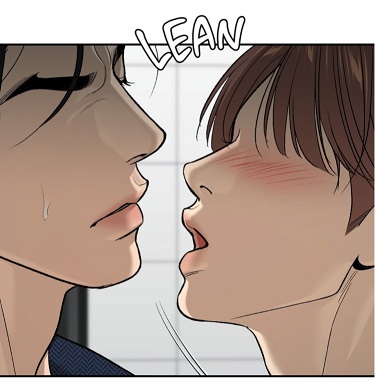 (chapter 55). He does not retreat into his habitual “it’s nothing” or “never mind.” He does not reinterpret the gesture as convenience or reflex.
  (chapter 86) He kisses back while looking tenderly at his partner. He holds Kim Dan’s head gently. He can only see such a gesture as a positive answer to his request: acceptance and even desire. Surprise is not punished. It is received.
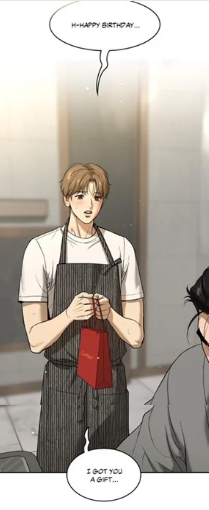 (Chapter 45) This time, the athlete not only accepts the present (the kiss), but but also expresses “gratitude” by kissing back actively.
  (chapter 65) In her eyes, she has never changed, just like her grandson.
  (chapter 1) Kim Dan’s endurance is explained through obedience and debt. The grandmother’s authority is explained through sacrifice. In every case, the same logic applies: this is how it has always been; therefore this is how it must remain.
 (chapter 65)
  (chapter 65) They are evaluated exclusively through a moral lens. Smoking and drinking are not responses; they are flaws. And because they are framed as flaws, they retroactively define his character rather than his situation. This is where agency collapses.
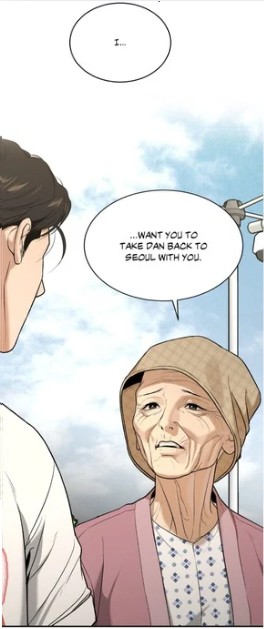 (chapter 65) Her behavior does not contradict her claim that she wants Kim Dan to “live his own life.”
 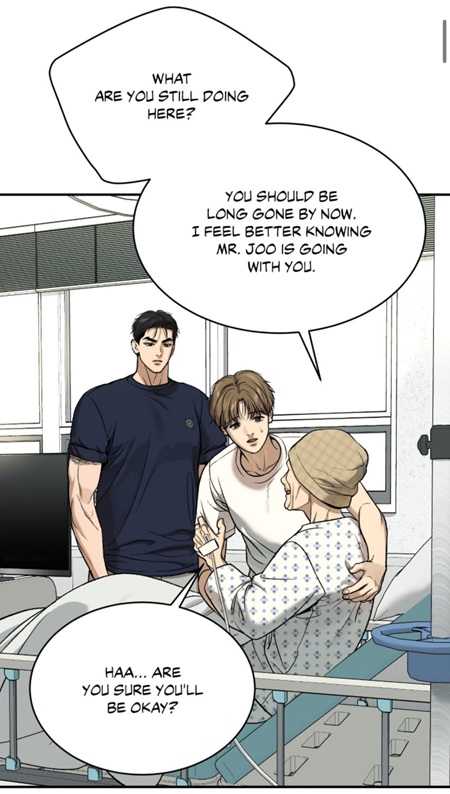 (chapter 78)
 (chapter 86) Once again, the “hamster” is given the opportunity not only to decide, but also to follow his heart. Where the Paris night allows difference to coexist with memory, Shin Okja’s framework collapses difference back into judgment. Where electricity requires polarity, her logic insists on sameness. Under this new light, it becomes comprehensible how doc Dan came to neglect himself. Self-care is inseparable from choice — from the belief that one’s decisions can meaningfully alter the present. If change is denied, care loses its purpose. Attending to oneself becomes optional, even suspect, because it implies a future different from the one already prescribed.
  (chapter 44) The one who remembers bears the – alone, while the other continues forward unmarked. That imbalance is corrosive. It distorts perception. It turns even good memories sour.
 (chapter 65) Even though the word jinx is never spoken during the Paris night, its logic quietly collapses there.
  (chapter 75) In chapter 75, it is explicitly framed as a way to “clear the head”: an act designed to release pressure and return the system to zero. Partners were interchangeable. Feelings were excluded. Electricity existed only as a spark — brief, violent, and self-extinguishing. Energy was expelled, not circulated. That is the true mechanics of the jinx: power without continuity, intensity without consequence.
 (chapter 85) Desires matter, not the match the next morning. Besides, the identity of the partner matters — not just romantically, but also structurally. Current requires two poles. It requires response. It cannot flow through an object, only between 2 subjects.
 (chapter 39) and chapter 44
  (chapter 65) becomes a talisman — not a record of reality, but a distilled image of safety. Painful dimensions are filtered out. Conflict, coercion, and silent pressure recede into the background. Memory protects him by idealizing. Because of this picture, he projected himself in the future, making unrealistic plans.
 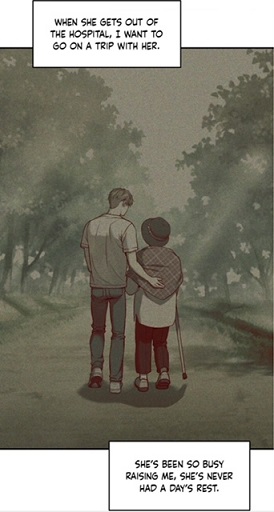 (chapter 47) It was, as if he only had good times with his grandmother.
 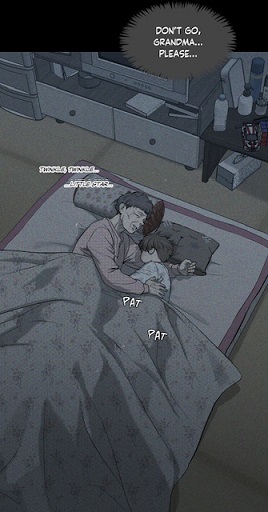 (chapter 21)
  (chapter 47) and memories.
 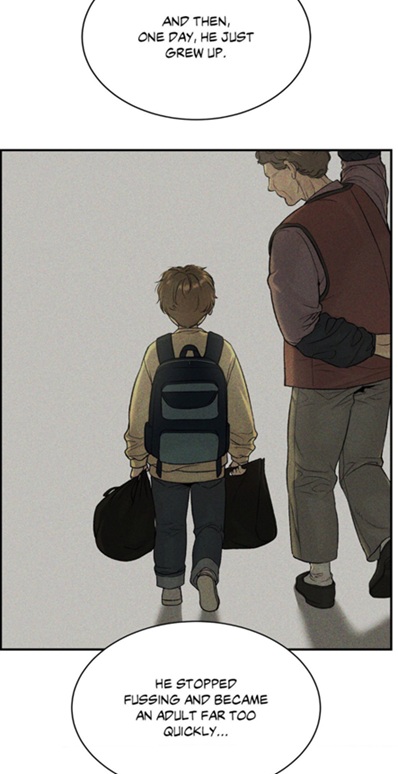 (chapter 65). While sleeping, memories come to the surface.
 (chapter 85) I believe that its appearance does not function as decoration. Its imagery — figures suspended among clouds, bodies neither falling nor grounded — introduces a different register of time. Not urgency. Not performance. Not spectacle. Stillness. Interval. A space where movement pauses without collapsing. Under this new light, the reference is Morpheus.
 (chapter 75) Until now, rest had been replaced by discharge: sex as erasure, violence as exhaustion, ritual as compulsion. The Paris night does not abolish wakefulness through collapse; it introduces the conditions under which sleep might finally be possible.
  (Chapter 78) Here, he reduced it to the absence of sex, but I am sure that deep down, he would have been satisfied, if the “hamster” had given him a good night kiss.
  (chapter 86) The charge redistributes. Memory ceases to isolate and begins to circulate. Hence it creates a new memory.
  (chapter 86) was a reflection of the picture.
  (chapter 86) No one is erased or reduced to an object. Nothing is overlooked or forgotten. But repetition loses its hold. And from here, the story can no longer proceed as before.
 (chapter 86), gentle, attentive
  (chapter 86) — asking questions instead of imposing answers
  (chapter 64). For Joo Jaekyung’s unconditional stans (and I count myself among them), such an attitude
  (chapter 86) can easily be read as proof that the protagonist’s good heart has always been existent, but it was barely visible. Compared to earlier chapters, the contrast is now undeniable. And yet, I would like to pause you right there.
 (chapter 61), sometimes awkwardly
  (chapter 80), sometimes inconsistently
  (chapter 79), but unmistakably
  . (chapter 83) Tenderness, concern, even a certain form of devotion had appeared earlier
  (chapter 40), albeit in ways that were often overlooked,
  (chapter 18) misunderstood or poorly timed. This night
  (chapter 86) does not initiate his metamorphosis.
 (chapter 86), sparks
  (chapter 86), and softness, many Jinx-philes might instinctively describe it as magical. The imagery invites such a reading. After all, we have seen similar nights before. The night in the States shimmered with illusion
  (chapter 41) The penthouse night echoed A Midsummer Night’s Dream
  (chapter 45). This raises an essential question. Is episode 86
  (chapter 4), in the return of light
  (chapter 66), in what remains once the sparks fade. A dream dissolves with daylight. Reality does not.
 (chapter 86), sparks, that strange shimmer that seems to hang in the air
  (chapter 86). Why? It was, as if their dream had come true. However, is it correct? Is it not wishful thinking? What if this night is not magical at all? What if its true signature is not enchantment, but electricity—a current that interrupts, tests, and resets? 😮
 (chapter 40) in Kim Dan’s perception: overwhelming, radiant, dominant, a heat-source that does not negotiate.
  (chapter 41) The sun can be admired, feared, and endured—but it cannot be questioned.
  (chapter 58) It simply shines, and the one who stands in its light adapts. This explicates why the physical therapist would choose silence and submission over communication.
  (chapter 48)
 (chapter 83)
  (chapter 83) Every ride, every light, every scream suspended in midair depends on current: motors accelerating and braking, circuits opening and closing, energy stored, released, and cut off.
  (chapter 83) Roller coasters do not move by heat, charisma, or sheer physical force; they move because electricity flows through them. The Viking ship swings
  (chapter 83) because current allows it to swing. The Ferris wheel ascends
  (chapter 83) because circuits hold — and descends because they release.
 (chapter 84)
  (chapter 84) explicitly names what had previously gone unspoken: the rides function only because current flows. When it disappears, the illusion of effortless motion collapses.
 (chapter 84) The Ferris wheel has stopped. The current is gone. The carefully regulated system that lifted, rotated, and sustained them is no longer in control. Yet movement does not disappear entirely. It mutates. When the champion shifts his weight, grips the structure, reacts instinctively, the cabin begins to shake. Panels emphasize instability: creak, swish, ack. The motion is no longer generated by electricity but by the body itself.
 (chapter 84) Stranded above ground, stripped of the park’s mechanical rhythm, he apologizes.
 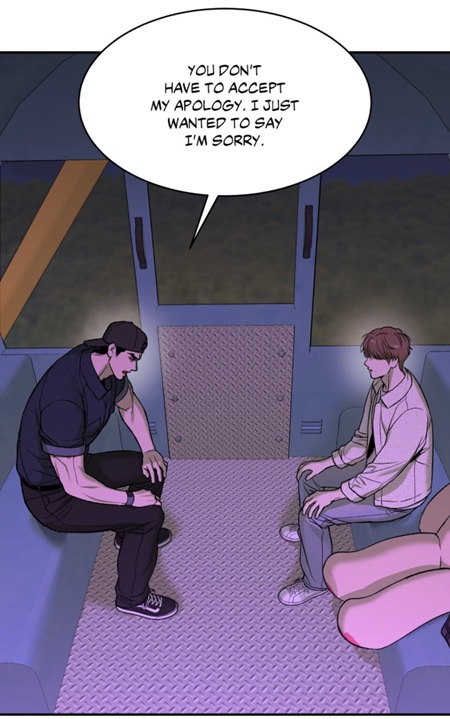 (chapter 84) Not theatrically, not performatively, but awkwardly, haltingly. His body exposes his discomfort
  (chapter 84) and fears. He avoids the doctor’s gaze, crosses his arms
  (chapter 84) or squeezes his arm
  (chapter 84). The cessation of electrical motion coincides with a shift in his own mode of action. Where the park depended on current to keep things moving, he now moves without it. The absence of electricity forces something else to surface: responsibility, attention, presence. Additionally, this sequence anticipates what will later unfold more fully. Proactivity is no longer expressed through force or motion, but through articulation. Words stand for action and have weight. The champion’s future action is announced here, quietly: he will no longer push forward by shaking the structure. He will move by sharing thought, by naming feeling, by allowing himself to be affected.
  (chapter 86),
  (chapter 86) jolts, sudden contractions of the body
  (chapter 86). Kim Dan is repeatedly shown convulsing, gasping, losing linear thought, and it is the same for the MMA fighter. Panels insist on interruption: jolt, tingle, broken breath, aborted sentences. The doctor’s body behaves as if struck, especially in this image.
  (chapter 86) It is at this point that a phrase surfaced in my mind — instinctively, almost involuntarily. A phrase we use in French when something intangible yet decisive occurs between two people: Le courant passe. Literally, the current passes. Idiomatic meaning: they are on the same wavelength, something connects, communication flows. However, here, the current is not the product of civilization, but of nature. Two people interacting with each other. And it is precisely because of the unusually high frequency of sparks and jolts in the illustrations that a belated realization imposes itself: nature, too, produces electricity — through storms, through thunder.
 (chapter 69) A storm was announced back then. And yet, upon closer inspection, no thunder was ever shown there. There was tension, there was excess, there were dark clouds
  (chapter 69) — but there was no strike, no discharge, no interruption. The imagery remained continuous, fluid, enclosed within the logic of escalation rather than rupture.
 (chapter 83). In Roman terms, Thursday corresponds to dies Iovis — Jupiter’s day — the god of thunder. Both gods are strongly connected to thunder and as such current.
  -chapter 67-; for more read my analysis
  (chapter 83). Before striking anything, he is already unwell: angry overstimulated and complaining, visually reduced to a childlike register. This matters. The hammer does not create excess — it receives it.
  (chapter 34), the hammer gesture is not confrontational, for the machine is immobile. There is no opponent.
  (chapter 83) Too much energy released at once. The system registers it, but cannot contain it. This means, the record won’t be registered and as such “remembered”. In fact what mattered here was the prize, the teddy bear, and restored self-esteem of the athlete. He could offer a present to doc Dan which the latter accepted without any resistance.
  (chapter 86) Therefore it is not surprising that doc Dan starts looking at his fated lover. Imagine what it means for the athlete, when the “hamster” is staring at him, though he is a little embarrassed. Finally, he is truly looking at him. The champion loves his gaze. And now, you comprehend why the “wolf” listened to the “cute hamster” and stopped leaving marks.
 (chapter 85), but this time, its nature has changed. It is no longer jealousy or anger, but love and desire. Hence the current is not colored in red, but white and pink.
  , but a thunder and as such it is still restrained and regulated.
 (chapter 44) as emotionally charged, intense, even pivotal. Confessions were made. Bodies responded. Vulnerability appeared to surface. And yet, both nights collapsed almost immediately afterward. What was felt
 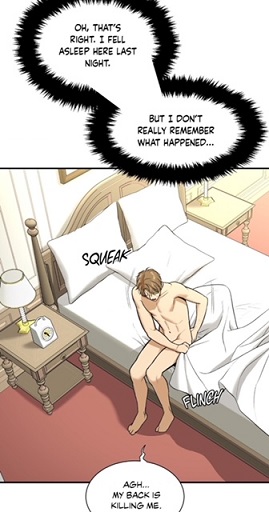 (chapter 40)
 (chapter 86) In this panel, we should glimpse a reference to the night in the States as well, and not just to the night in the penthouse.
  (chapter 44) The setting is elevated, luxurious, almost theatrical. The doctor is brought into a space of power that is not his own.
  (chapter 44) By acting that way, the athlete created a false impression of himself, as if he was still rational and clear-minded. Again, desire unfolds.
  (chapter 44)
  (chapter 44) Again, closeness occurs. And again, the aftermath reveals the same fracture.
  (chapter 45) and later wants to even forget it.
  (chapter 45) and he can not deny his own involvement and actions. Hence the doctor is left alone. Only he can recall this “dream”.
  (chapter 44) But memory alone is not power. Remembering without the other’s participation transforms recollection into isolation. Kim Dan cannot confront, confirm, or renegotiate what happened, exactly like the champion did in the past. Meaning freezes instead of evolving. Striking is that he came to associate feelings with addiction.
  (chapter 46) No wonder why later doc Dan had no problem to reject the athlete. And for him, the next morning became a cruel reality, even a nightmare. It wounded doc Dan’s heart and soul so much that he learned the following lesson: to not get deceived by impressions. Hence in Paris, Doc Dan tries to explain the change of the champion’s attitude with drunkenness.
  (chapter 44) One participant is altered. The other must carry the weight of meaning alone. The night does not end in shared reflection, but in silence and absence.
 (chapter 44) Words blur, vanish, or are forgotten. Even gestures go unnoticed: a kiss, an embrace or a patting. Memory fractures. The morning after is defined not by continuity but by confusion. The body has moved forward, but the narrative has not.
  (chapter 84)
 (chapter 84) Speech bubbles lose clarity. Confessions are obscured. The reader is denied access to meaning. Fireworks, like drugs, produce intensity without duration.
 (chapter 39)
  (chapter 44) It was as if these nights could only exist under altered states — as if clarity on either side would have made them impossible.
  (chapter 86) This is why, when electricity returns in episode 86, it does not revive heat. It interrupts it.
  (chapter 86) That’s the reason why the athlete stops for a moment and asks doc Dan, if he needs a break.
  (chapter 86) This question is important because doc Dan admits his confusion and ignorance. He confesses to himself that he “knows nothing” not only about himself, but also about his fated lover.
  (chapter 86) They function as temporal markers. A spark exists only now. It has no duration. It cannot be stored, recalled, or anticipated. It appears — and vanishes. In this sense, electricity becomes the perfect visual language for the present moment itself.
 (chapter 10), statements blurred by drugs
 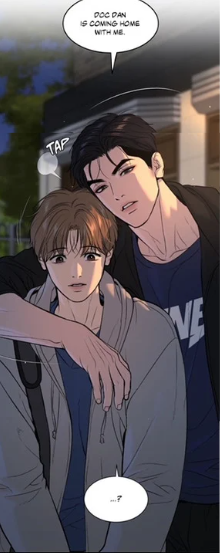 (chapter 43), sentences remembered by only one side.
  (chapter 44) and even laugh…. if only he could remember that night…
 (chapter 79), the “never mind”,
  (chapter 84) or it is a mistake, the easy erasure that once dissolved meaning after the fact. The kiss interrupts that mechanism. It produces a pause that cannot be talked over. It forces reflection.
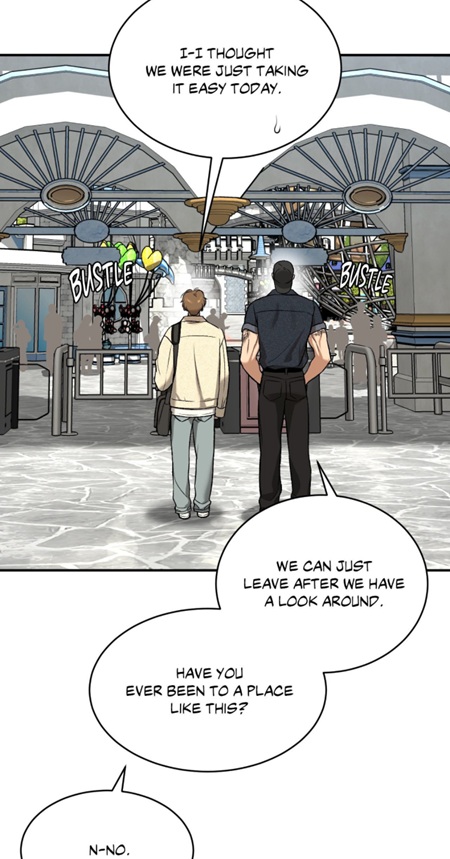 (chapter 82) Jinx-Lovers consider it as their first real date, a long-awaited moment of levity after so much pain. But perhaps we should pause and ask: why this place?
  (chapter 82) scattered on the table, one displays the Eiffel Tower — the obvious choice, symbol of mastery and control. Built for the Exposition Universelle of 1889, it was meant to celebrate France’s industrial power and the centenary of the Revolution — proof that bourgeoisie and steel, not kings and nobility, now ruled the sky and ground. It was even supposed to be dismantled after twenty years, yet it remained, and has since become the symbol of Paris and of France. A monument to progress, modernity, freedom, national pride and endurance.
  (chapter 38) Hence in the States he is here turning his back to the window and his only connection to others was through the cellphone. The cities he visited were backdrops, not experiences. He was always alone. And yet, here, something changes in Paris.
  (chapter 82) His hotel room opens onto a broad window and a balcony — an invitation to look out. Secondly, observe that he only proposed this activity after the other members had fallen sick. When doc Dan barged in his room, the champion was doing a one-handed handstand, holding his entire weight as if defying gravity itself
  (chapter 82) and proving his recovery. The posture seemed like control, yet it was closer to self-punishment — an immobility that devoured strength. Blood rushed to his heart and head, but his lungs stayed empty. It was, unconsciously, his way of treating his breathlessness. This also shows that he had no real expectation about the “rest” his manager had suggested
  (chapter 82) — the drinking, the empty and aimless trip (“check out the area”). For the wolf, such a downtime could only mean endurance, not release and excitement. By the way, such a suggestion from Park Namwook borders on stupidity and blindness. How could he propose drinking, when he had seen his “boy” indulged in alcohol before?
 (chapter 54) I guess, he must have taken the celebrity’s words at face-value. But let’s return our attention to the panel with the brochures selected by the champion. If you look carefully, you will detect the presence of 4 stars.
  (chapter 82) How do I come to this interpretation? We have seen these stars before, during Kim Dan’s Summer Night’s Dream: the same glittering symbols of softness and excitement.
 (chapter 82) His choice of the amusement park is not really about himself and his desires— it is an act of care, a wish to give happiness to someone else.
 , Sleeping Beauty
  and Beauty and the Beast
  ).Hence there is the castle on the brochure.
  (chapter 82) For both, it was financially and emotionally out of question. It grounds the symbolism of the amusement park in social reality, reminding readers that “fun” is also a form of privilege. This means that the champion is actually on his way to replace this picture:
  (chapter 65) So yes, this may look like a simple date. Yet beneath its playful surface lies the quietest revolution of all: the man who once ignored every view now opens the window, looks outward, and chooses wonder and fun over war.
 (chapter 81), but not about the geography and air. I had truly detected the importance of this image and its symbolism. The plane that opened this arc spoke not of luxury, but of altitude — of a life lived too high, where oxygen is rationed by pride. Below the aircraft stretch the Alps, which I had correctly identified. From there flows the athlete’s own water – Evian
  (chapter 82) (written Evien in the manhwa) — drawn from the mountain that sustains him and starves him at once.
 (chapter 81): the rising smoke, the suggestion of a light already suffocated. The higher they bring him, the closer he moves to extinction. Besides, the higher he climbs, the harder the fall. In other words, they are trying to break him — to make him fall — something the athlete has already sensed.
  (chapter 82)
 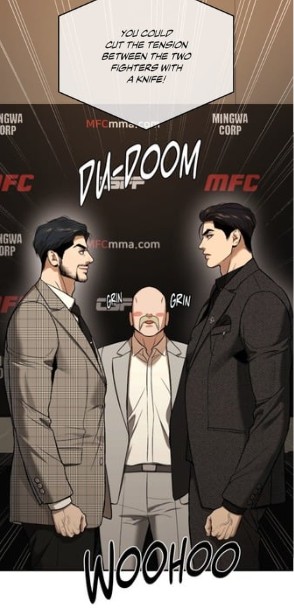 (chapter 82) — a creature of heights and thin air, born to dominate the skies where others can barely breathe. The metaphor could not be clearer: altitude is his arena, but also his undoing.
  (chapter 81) The air remains clear and generous, the sky washed in blue as if nothing could go wrong. Yet the trees, touched by the first copper tones, announce the slow turn of the year. It is a calm, lucid atmosphere, the kind of weather that hides transition inside serenity. The unseen Seine glides through the city like a long breath, steady and effortless.
 (chapter 82), to build joy outside the ring
  (chapter 81) A single breath — huu — escapes, white against the air. It looks like calm, but it isn’t. It’s the sound of a man forcing his body to obey. The clenched fist that follows betrays him: anxiety condensed into muscle.
  (chapter 81) The champion has descended, yet the altitude still lives inside him.
 (chapter 14), but his lungs and heart. Yet at the airport, the sportsman doesn’t realize it
  and makes the following resolution:
 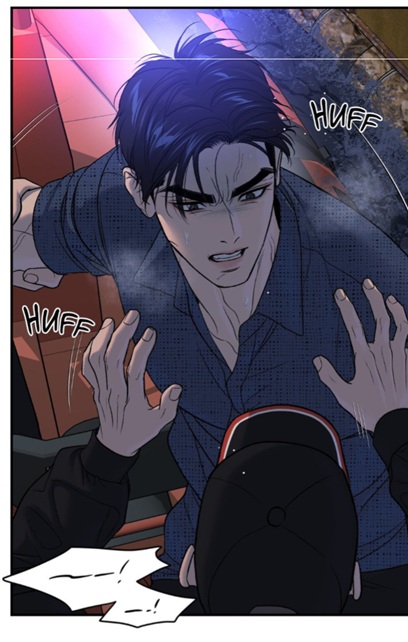 (chapter 69) Back then, he feared for doc Dan’s life and ran as if his own heart depended on it. His breathlessness wasn’t exhaustion but panic: the instinctive terror of losing the person who keeps him alive. Thus when he saw him alive on the dock, he could start breathing properly:
  (chapter 69) From HUFF to HAA… exhale versus inhale.
 (chapter 82) His brain and heart remember that night at the dock; every harsh inhale during practice echoes that same dread of separation.
 (chapter 82) And how did the champion respond to that provocation? Like a cornered animal.
 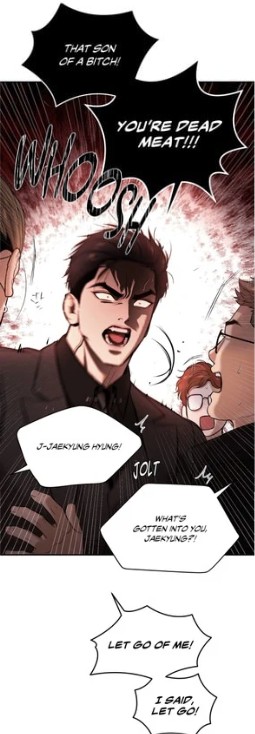 (chapter 82) He became the wolf again, not out of jealousy, but out of survival reflex—his body screaming its panic in place of words. In that instant, he was reminded that he could lose doc Dan as a partner, that the bond he relies on might not belong to him forever.. The roar emptied his chest; his lungs gave out before his pride did. There was no air left in his body… thus the heart and lung couldn’t work properly.
  (chapter 75) The fearsome beast who once fought for dominance is gone. What remains is a tamed wolf, following his master’s voice (doc Dan) — not out of submission, but because he finally trusts where it leads.
 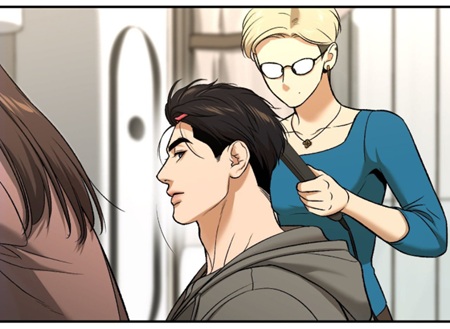 (chapter 82) He is now a tamed wolf following his master’s suggestions!
  (chapter 82) Thus the coach is now facing the couple. And now, my avid readers can understand why the champion seems almost radiant when he finds himself alone with doc Dan at the amusement park. It is not mere joy or freedom; it is the relief of finally acting from desire instead of duty
 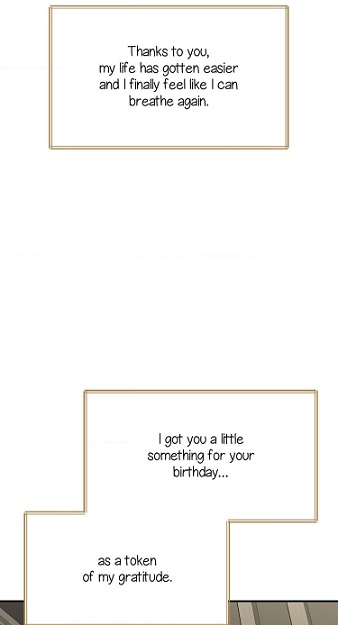 (chapter 55)
 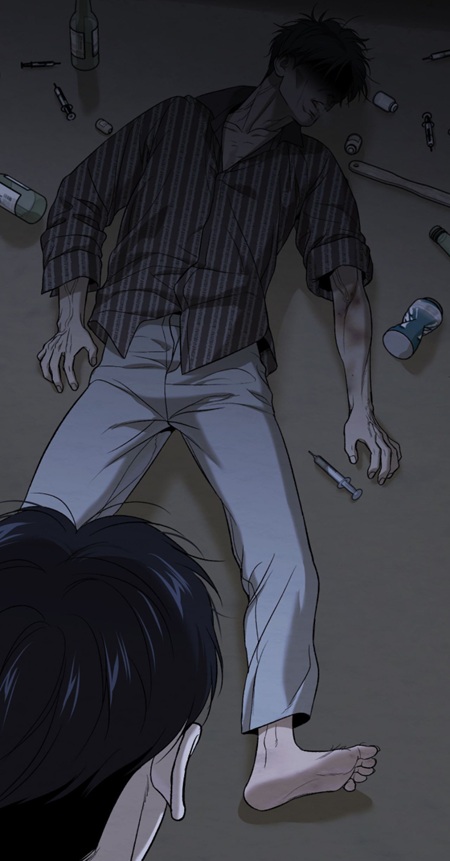 (chapter 73) – surrounded by bottles and syringes (chapter 73). Addiction, gambling, and intoxication: all ways of trying to rise above reality, to feel high, if only for a moment. Joo Jaewoong quite literally died from altitude, from chasing a false form of air. His father had tried to climb the social ladder through sport, to escape the poverty that trapped them, but he had failed. Those words
  (chapter 73), thrown like stones by the father at his son, buried themselves in the boy like shards.. They echoed like a curse — a prophecy Joo Jaekyung would spend his whole life disproving.
 (chapter 72)
 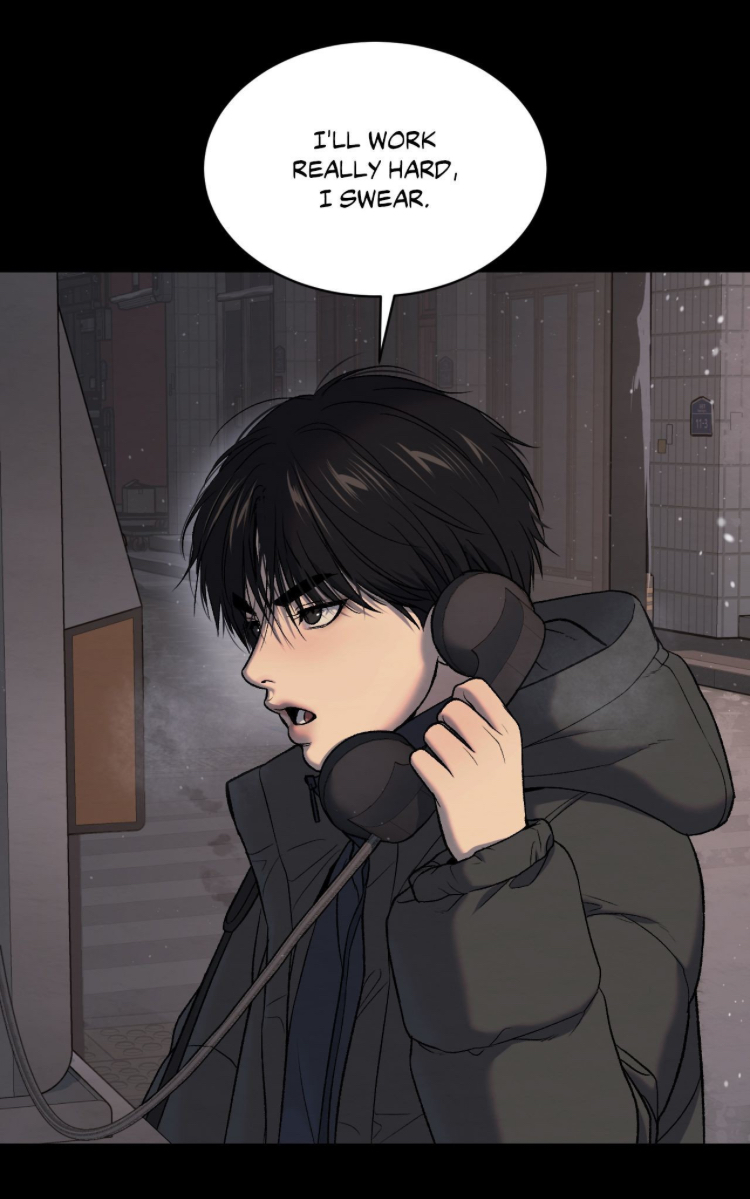 (chapter 72), yet she made no attempt to build an independent life. Her survival had always depended on his success — and when his career crumbled, she vanished with it. That’s the reason why the trash remained uncollected — a visual proof of abandonment
  (chapter 72) But the little boy failed to notice it, because he was suffering from the father’s abuse. Before leaving, she gave her son a phone number, as if absence were only temporary, as if love could be reached through a dial tone. That small gesture sustained an illusion: that she would come back if he became strong enough, rich enough, worthy enough. That illusion became the foundation of his life.
 (chapter 72) His first fight was not about trophies — it was an act of filial negotiation: a promise to buy her return. But of course, 300 dollars could not rebuild a family. His first fall became the confirmation of her silence. This explicates why he recalls his first tournament and considers it as “fall”. He had not been able to win, thus the mother could not return. He doesn’t fight for glory or passion; he fights to avoid being discarded again. So, when he says “I won’t fall again,” what he really means is “I won’t let myself be unloved again.”
  (chapter 72) But the problem is that when he was finally able to reach his mother, the latter answered that Joo Jaekyung was too late. The mother’s words sealed the curse. He was “already grown up now”
  (chapter 74), while in reality, she had long abandoned him. Her departure turned growth into punishment, and independence into exile. This explicates why as an adult, he used money to buy people and turn them into toys. This could only make appear as a spoiled brat.
  (chapter 79) Even Park Namwook himself, only days earlier, had described the French match as
  (chapter 81) “a breeze” — a fight so effortless that it would bring some fresh air into the champion’s career. But that metaphor betrays its irony: what was supposed to refresh him is now suffocating him. The “breeze” promised by his manager has turned into lack of air.
 (chapter 70) — a detail no one around him ever learned. This simple fact overturns their interpretation.
 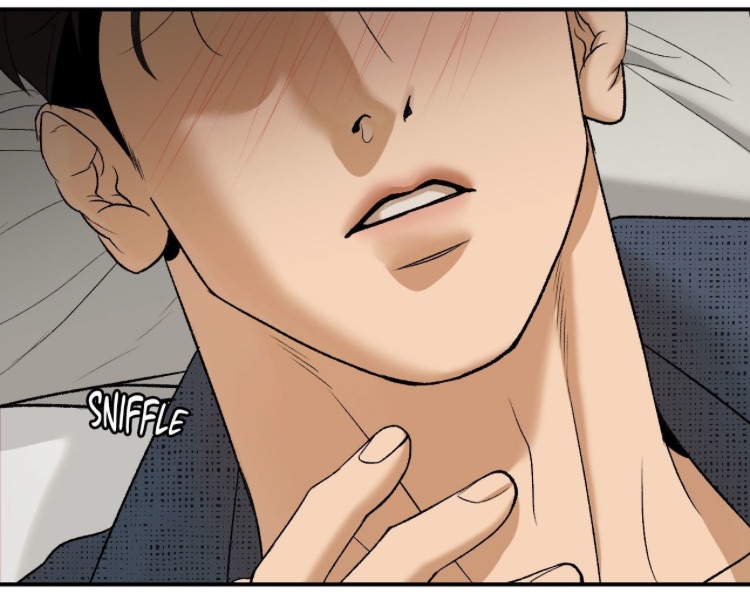 (chapter 70) The breathlessness they see now is not a decline in performance, but the residue of transformation. His body, once trained to suppress every weakness, had finally surrendered to nature.
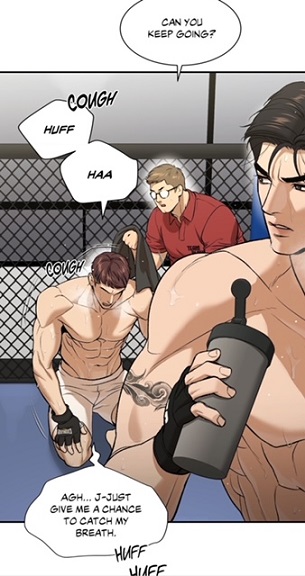 (chapter 46), whose clash with the champion exposes two different forms of frustration.
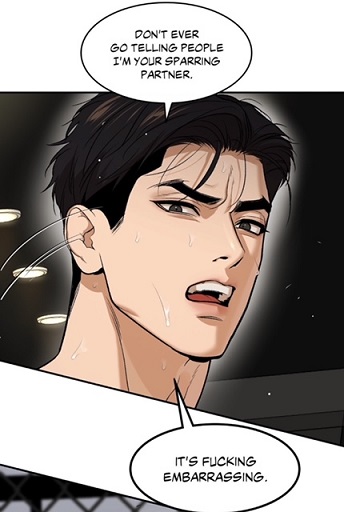 (chapter 46) He reproaches Seonho for using his title and image to promote himself, for bragging about their sparring sessions to boost his career. From his perspective, Seonho lacks both endurance and authenticity — he performs strength rather than living it.
 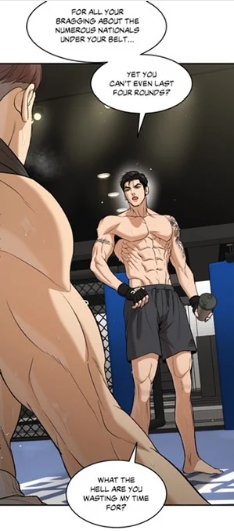 (chapter 46) For Jaekyung, such behavior is intolerable because it cheapens everything he has sacrificed to achieve.
 (chapter 46) He turns on Jaekyung and accuses him of arrogance — of using his champion title to look down on others. What Seonho perceives as disdain is, in truth, the athlete’s defense mechanism. The star’s detachment is not born from pride but from obligation and trauma (abandonment issues).
  (chapter 46) His perfection is not freedom; it is captivity.
 (chapter 52) tried to recruit Potato, the youngest member from Team Black. He wanted to become the new idol of Hwang Yoon-Gu. He imagined that he could replace the main lead and Potato would be happy to become the new sparring partner of Seonho.
  (chapter 82) and press coverage — to lift his name higher. That’s why Mingwa made sure to show him at the press conference.
  (chapter 82) Every post, every camera flash, every headline serves as borrowed oxygen.
  (chapter 82) The grin that follows is one of self-satisfaction and superficiality, not connection. It’s the smile of a man admiring his own reflection in another’s confusion — proof that he controls both the scene and the gaze. This shows that he had no intention to make the protagonist jealous. And it is clear that he never saw the wolf’s rage afterwards.
  (chapter 82) That way, his “vulnerability” would be masked. No one would question the champion’s health. And this brings me to my next observation.
  (chapter 82) He is now seen signing autographs
  (chapter 82), whereas in the past, he was only seen in company of reporters in a secluded area.
  (chapter 40)
  (chapter 69) The victory would be branded as hollow, a publicity stunt rather than an athletic achievement.
  (chapter 82) first unveiled at the World’s Columbian Exposition in 1893, was created to transform height into play. Conceived by engineer George Washington Ferris as America’s answer to the Parisian tower, it sought to outshine France not through steel alone, but through motion — a structure that would rise and fall, carrying ordinary people with it. Unlike the fixed tower, the wheel invited participation: passengers would move together, share the air, rise and descend without fear. It was both monument and moment — a way to democratize the sky.
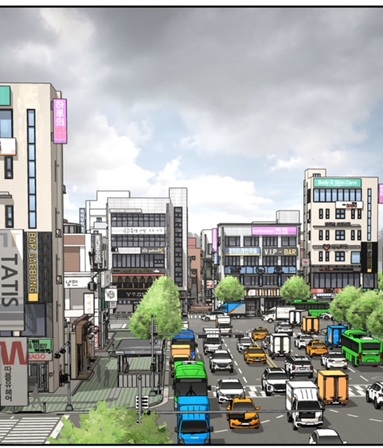 Here the athlete has only one goal: talk to doc Dan and clean the air. He has no intention to truly rekindle with him
  Thus he is still stuck in a traffic jam.
  Here, there is a progression, because he can switch the lane. However, he is still driving in one direction, not looking out of the window. He is not taking his time either. These scenes illustrate the champion’s psychological confinement and mirror doc Dan’s mindset as well.
 (chapter 27)
  (chapter 74) Joo Jaekyung would have achieved his goal: even vulnerable or childish, he is still lovable.
  (chapter 41) They were destined to be together and lived happily.
  (chapter 55)

 (chapter 74) What does it mean that a man who once reached for his mother’s voice is now suspended between clouds, unreachable himself?
  (chapter 74) Why does the same stillness that once followed a farewell now fill the air around his flight?
 (chapter 65) Let’s not forget that the last poster of chapter 81
  (chapter 74) In that earlier scene, the smoke rises from burning incense sticks which is linked to scent — the invisible bridge between the living and the dead. Here, it reappears as the airplane’s exhaust
  (chapter 75), perfume
  (chapter 75), sweat and sex
  (chapter 75) became instruments of anesthesia, each meant to silence the body that once betrayed him.That betrayal did not come from the body itself but from what it carried — his father’s shadow.
  (chapter 75) The fighter calls it a “dream,” not a nightmare, because fighting was once his father’s dream — a dream of escape, of being seen, of proving that poverty was not fate. But for the son, that same dream turned into a curse. To fight was to repeat what had already destroyed the family.
 (chapter 75), the forbidden comfort that ended in scolding.
  (chapter 72) When he finally received it, it was not from a mother but from the director — a man whose gift could fill the stomach but not the heart. From that day, nourishment and submission became one.
 (chapter 72) And yet every attempt at purification only buried the rot more deeply. The more he washed, the more the stain spread inward — invisible, odorless, yet consuming.
 (chapter 81) — the same spot where he once sprayed his perfume
  (chapter 40) — it is more than desire: it is instinct, possession, and search. The gesture blurs the line between hunger and recognition, as if he were trying to inhale and keep what had always eluded him. The scent he once sought in bottles and rituals now breathes through another body, one that refuses to be contained. So when Jaekyung breathes against Dan’s skin, he is no longer trying to mask the stench of loss but to find the source of something living. The doctor’s scent does not erase hunger; it answers it. For the first time, the wolf eats without devouring.
  (chapter 44) — nuzzling the one destined to become his anchor. Jinx-philes can observe not only the presence of steam (which is similar to smoke), but also the effect of the scent. Back then, the champion had calmed down thanks to the hamster’s scent.
  (chapter 36) When the champion left South Korea for the United States in episode 36, the plane glided through a void of light. There was no sky, no earth, no horizon — only a white expanse pierced by the sun’s glare. Even the boundaries of air and space seemed dissolved. The image radiated purity but felt sterile, stripped of texture. The machine was rising, not toward a destination but away from attachment itself.
 (chapter 37), the heart disinfected of need. Hence the bed became an instrument of “torture”. The upward flight marked a beginning, yet it already smelled of exhaustion and futility. A life built on departure cannot land anywhere.
 (chapter 36) instead of naming Joo Jaekyung himself. He might have stood beside the MMA fighter the entire time, yet he preferred to disappear behind collective language, as if the plural could shield him from personal involvement. It was a professional gesture, an attempt to efface the self, to stand beside the fighter without belonging to him. His role was service, not solidarity; his language confirmed distance. Thus his karma was that he got abandoned by the team after the match, while rescued by the celebrity himself!!
  (chapter 81) translates that awareness into sensation. It’s no longer the passivity of a bystander but the heartbeat of someone invested. The count of days becomes a shared horizon between doctor and fighter, a bridge of feeling.
  (chapter 37) The others indulge in small pleasures — snacks, shopping, light rebellion — but the champion and his doctor remain trapped in routine, orbiting one another inside sterile rooms. I am suspecting that doc Dan must have bought the scarf at the airport, a small act of thoughtfulness before departure.
  (chapter 41) Yet the gesture, though sincere, carries a quiet irony. The scarf is printed with flowers, mostly roses, but as a piece of fabric it has neither scent nor warmth. It imitates life without containing it. What he gives her, in truth, is a copy of affection, not its essence — a bouquet that cannot breathe.
 (chapter 37) The answer lies in the contrast between the smell of life and the smell of emptiness. While others seek flavor in hot ramen or the sweetness of snacks, the champion’s room remains odorless, air-conditioned, antiseptic. Then, in the quiet of night, a faint aroma drifts toward him, the flavor of hot ramen. And now observe the progression of scents through Jinx.


 (chapter 72) — the garbage, the spoiled food, the stale air of neglect. What he truly covers is not his nose, but his fear of returning there. Later, in episode 22, when Dan cooks for him, the champion instinctively associates food with corruption:
  (chapter 22) Interesting is that here fish has a negative connotation: intrusion and thoughtlessness. This shows how detached the champion was from his true self: water and the ocean. Moreover, cooking, warmth, nourishment—all evoked garbage, the chaos of his first home.
 (chapter 54) couldn’t nourish him. Hence he replaced it with wine for a while.
 (chapter 74) Their fragrance became the perfume of loss. To his senses, flowers never meant beauty or love or nice smell; they mean burial and as such pain. Every petal recalls the suffocating smell of the funeral room, the smoke, the artificial but painful peace of goodbye.
 (chapter 32) The blue tie contains 3 striped colors: red, white and blue, which are quite similar to French flag, though the order has been switched. Secondly, Choi Heesung purchased
  (chapter 32) Hermès’ item, a French company famous its bags, scarfs and perfumes. So I am quite certain that once Jinx-philes discovered the identity of the next fighter
  (chapter 81) and saw the plane, they must have jumped to the conclusion that the next fight will take place in Paris! But France is more just than the capital. This country is called the Hexagon due to its form, and this name stands in opposition to the MMA ring, which is an octagon!
  (chapter 81) So we could say that despite the disadvantage being in a foreign country, they are “equal”, 6 colors against the team from the Hexagon, the blue light from the MMA ring. But let’s return our attention to Paris. The latter is widely recognized as the symbol of love, the global center for fashion, art, and stardom. The city has a deep historical connection to these fields, being the birthplace of haute couture and home to many of the world’s leading fashion houses and luxury conglomerates. Its cultural scene is equally rich, with a long history as a hub for artists and a more recent reputation for being a center for music and film stars. However, the image with the landing plane is actually revealing the truth.
 (chapter 14) Here, exactly like in the States, his trip to Busan never gave him the opportunity to visit the city and the beach, exactly like the athlete. The next airport to Cannes is Nice- Côte d’Azur and it looks more like the one in the Manhwa. Furthermore, the South of France has a milder climate in the fall, hence it is still possible to swim in September. Besides, in my last essay, I had connected the champion to Bruce Lee and water:
  Finally, Naturally, here I could be wrong with Cannes. Nevertheless, Cannes, with its glittering shorelines and film festival glamour, symbolizes the marriage of money (millionaires, yachts) and illusion — the theater of appearances. It is where contracts are made, where bodies are displayed, traded, and consumed through the gaze, the very economy that has always governed the champion’s existence. The wolf, once born among garbage and hunger, now finds himself surrounded by luxury, in a world perfumed with artificial success. Yet beneath the surface of that “breeze” and “splash” lingers the scent of corruption. The coastal light hides what the smoke once revealed: exploitation, manipulation, and the unspoken violence of commerce.
 (chapter 77) or danger. Then, when they returned to that place, their time was limited to visit the grandmother and the landlord.
  (chapter 81) They had no time to walk through the woods or visit the hills. They had no time for themselves. Consequently, I believe that in The French Riviera, the two of them will discover “savoir vivre”. Everything breathes, glows, and stirs. It is a land overflowing with color, aroma, and taste — precisely the senses that the wolf had long sought to erase through ritual. Doc Dan had led a similar life too, dedicated to his grandmother and work. If they are close to the sea, they might decide to walk on the beach together.
 (chapter 69), where Baek Junmin once fought for the championship belt. Thailand in Jinx is not a paradise but a mirror of corruption — the place where victory turns into prostitution, where the body becomes currency. There, the Shotgun won a crown but not respect; his triumph was drenched in manipulation, spectacle, and moral decay. He was admired by no one, celebrated by ghosts.
 (chapter 36), the transition from flight to arrival unfolds with seamless precision: no airport, no customs, no luggage — only the honk of city traffic and the flags fluttering over a hotel entrance. Everything about that journey screams logistics. It was a corporate trip, arranged, timed, and contained. The athletes passed through invisible gates, their movement stripped of individuality. The champion, like cargo, was transported rather than welcomed. His arrival, though triumphant
  (chapter 81)
 (chapter 81) The suitcase becomes the true protagonist of this threshold. In that small vibration lies all the instability the white air once denied. It is his portable home, his compressed past, the fragile proof that he finally has something to lose. In the earlier arc, he could have vanished mid-flight and no one would have noticed; now, if the suitcase disappears, another heart will break. That difference measures his evolution. Yet it also marks new vulnerability: any hand can touch what he carries.
 (chapter 41) and the wedding cabinet
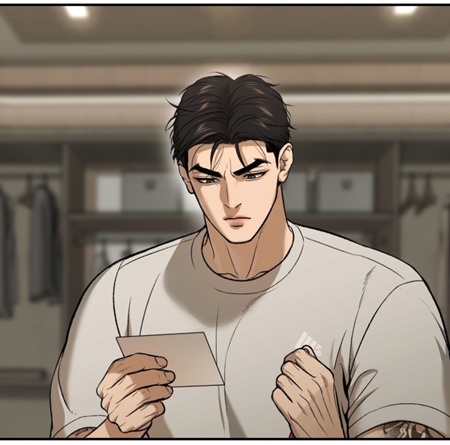 (chapter 81)
  (chapter 81) and Kim Dan has still no idea that the athlete has kept them like cherished relics. He might have placed the notebook from Hwang Byungchul as well. However, the person carrying the suitcase is the manager:
 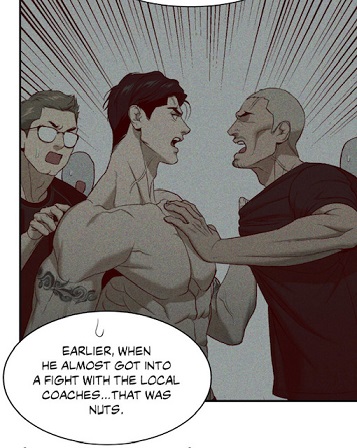 (chapter 37). So when the manager says this,
 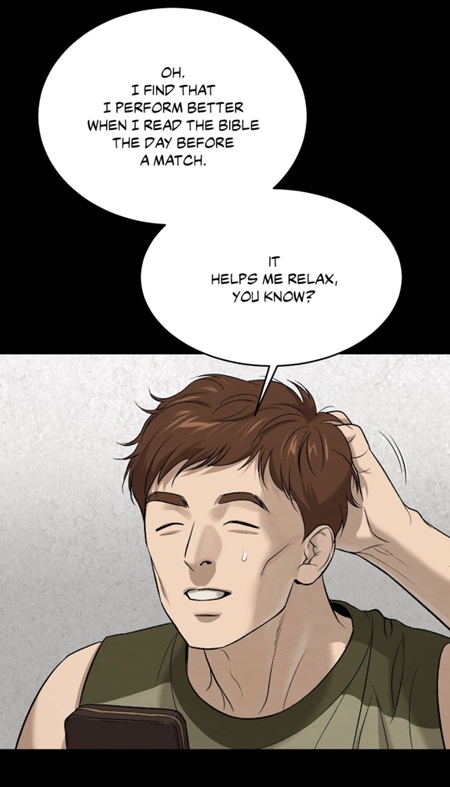 (chapter 75) While he was sick, he could recall this scene.
 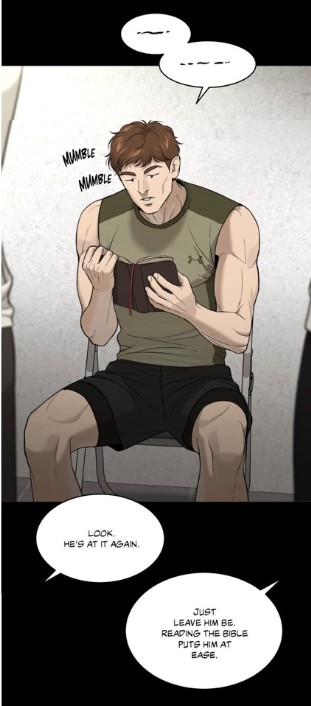 (chapter 75) where the fighter could stay focused, though he was surrounded by noise and people. The advice had seemed trivial, when first given. Now it re-emerges as revelation. The emperor, once incapable of rest, now reads
  (chapter 81) beside someone who represents safety. The book becomes a bridge between wakefulness and sleep, a ritual that does not erase consciousness but calms it. Where his earlier practices sought to block sensation, this one restores it.
 (chapter 73), which should have offered nourishment, attention and peace, had been replaced by absence and deceit. Her warmth was an illusion, a posture mimicked but never felt.
 (chapter 80) And here, I had imagined that the mother had offered this t-shirt as a birthday present.
  (chapter 29) which reminds us of breastfeeding. And now, look at the embrace in the swimming pool:
  (chapter 80). The hamster was imitating the behavior of the little Jaekyung in the past, clinching onto the “parent” like his life depended on him. But how did the athlete react to this embrace? He looked at his fated partner
  (chapter 80) and got all warm and fuzzy by looking at him:
  (chapter 81) A sign that the mother had never reacted the way her son is doing now, the feel to kiss the loved one! The problem is that in the swimming pool, the doctor’s scent and taste are covered by chlorine.
  (chapter 81) The wolf falls asleep next to someone, not on top of or apart from them. That small preposition — next to — carries the weight of redemption. The couch, once a site of violation
  (chapter 61) or solitude, becomes again what it was meant to be: a place of rest and tenderness. Thus he touches his fated partner’s legs over the cover, showing his care and respect.
 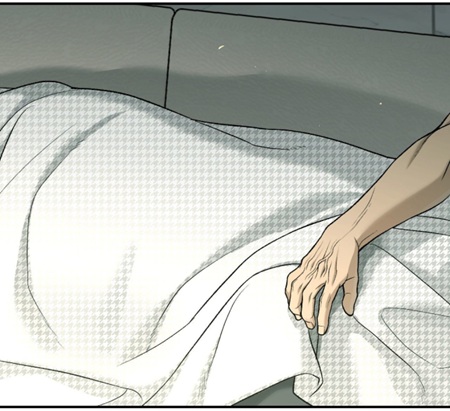 (chapter 81)
 (chapter 81), he can recognize the false nature of his mother’s affection. What she offered was conditional, deceptive and self-centered; what the doctor gives is ordinary and consistent. No grand gestures, no promises — only presence. The doctor does not rehearse concern; he lives it through routine. And this ordinariness, paradoxically, becomes sacred. It was, as if the athlete was treating his own inner child through the physical therapist.
  (chapter 37)
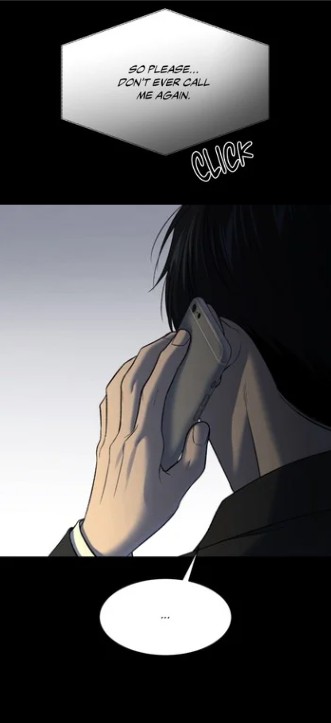 (chapter 74) At this moment, the page itself turns black, veined with smoky whorls of gray — as though her words had burned into the air rather than spoken. “I can’t live with you… please understand… let’s just go our separate ways.” The sentences rise like vapors, leaving behind the faint residue of a scent that refuses to vanish. This visual texture — half smoke, half ink — captures her true condition: she dissolves herself with every attempt at escape.
 France itself mirrors her — beautiful, perfumed, wrapped in silk and secrecy. She definitely climbed the social ladders through her second marriage, hence she could offer toys to her second son. The nation of couture and fragrance becomes the stage for the mother’s unmasking. Once the name of Joo Jaewoong rises again, questions about her will inevitably follow. And here, she can no longer hide behind silence or excuses. The myth of refinement — both hers and France’s — collapses under the weight of exposure.


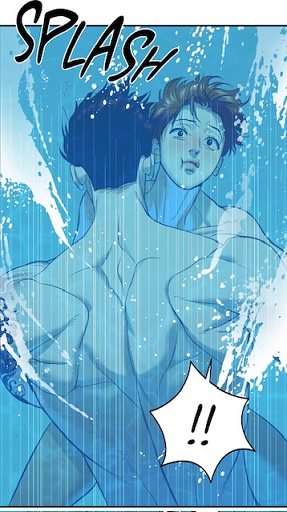 (chapter 28) and learn that not everything can be postponed or entrusted to someone else. Water, in this sense, rejects fatalism. It calls for motion, for risk, for personal responsibility.
 (chapter 80) And that intuition resurfaced and was confirmed in episode 80, when another day off brings the couple back to the pool. This time, the doctor steps into the water willingly.
 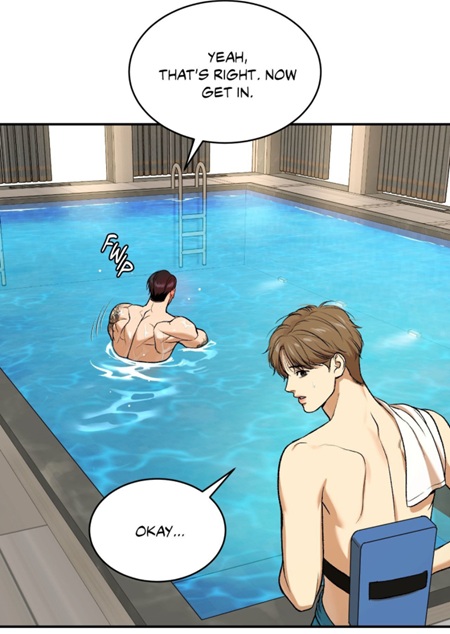 (chapter 80) He is no longer the man waiting to be rescued; he is the man learning how to swim. The champion’s words
  (chapter 80) distill the new doctrine: don’t wait for salvation
 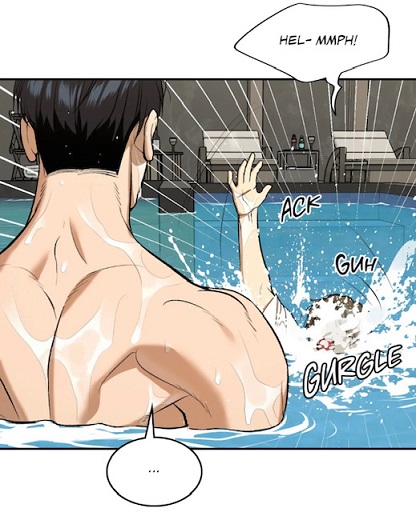 (chapter 27) and this second lies the true point of no return—where superficial judgment turns into reflection, dependency into self-trust
 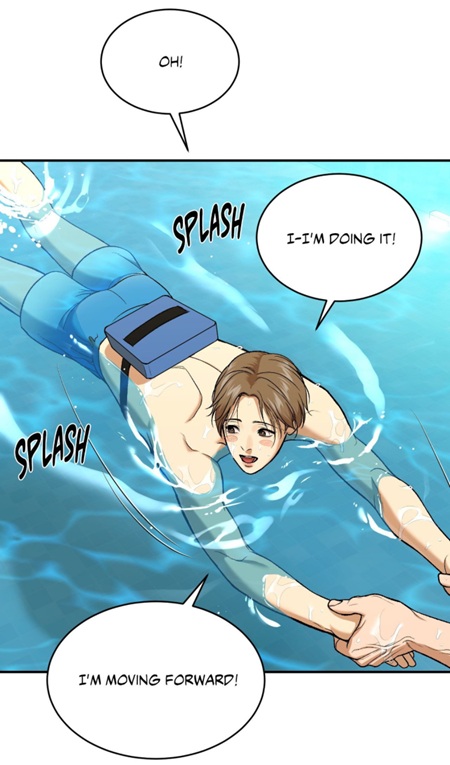 (chapter 80) and the rejection of powerlessness,
  (chapter 28) into the first stirrings of love
  (chapter 53) Safety lay in patience and dependence. Even when she later spoke with the champion by the sea, she avoided mentioning the ocean —as if to deny that any movement beyond her control could exist.
 (chapter 65)
  (chapter 65) When she sees them together, her first reaction is not pride or relief but mild reproach— doc Dan should have left already.
 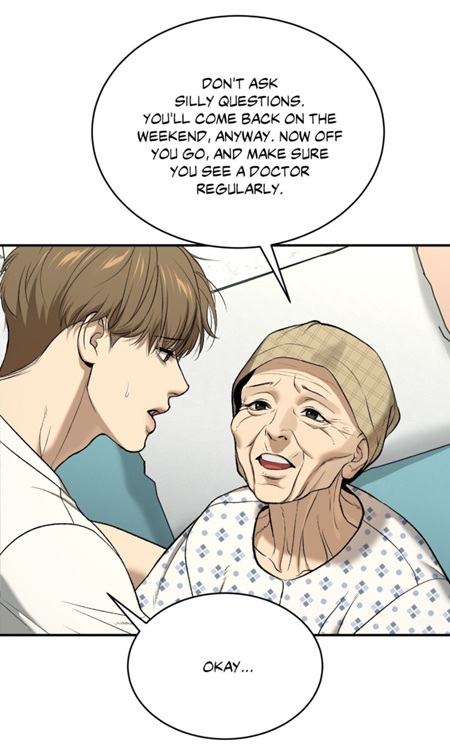 (chapter 78) sounds like ordinary concern, yet it hides her familiar logic of blame. It is as if she were implying that Joo Jaekyung has failed to fulfill her favor because Kim Dan has resisted care. In her eyes, the grandson is still the one responsible for trouble; the athlete’s role remains that of the dependable proxy who must “fix” him. What makes this moment striking is her tone of urgency, so unlike her habitual fatalism. The woman who once repeated “I’m the same as always”
 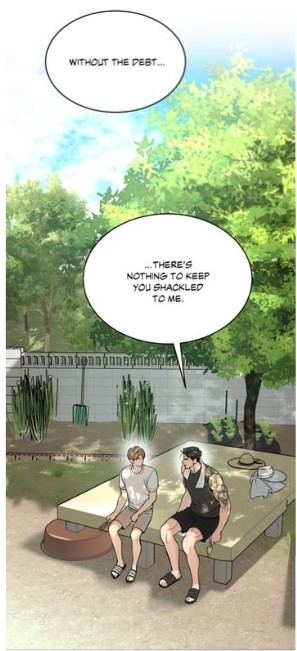 (chapter 77), respect and care. What she calls delay is, in truth, meditation and transformation.
 (chapter 80) It was her graduation gift, yet it had nothing to do with his new profession or status. In contrast, the first episode already shows Kim Dan in a blue therapist’s uniform, name tag neatly pinned — a garment he must have purchased himself.
  (chapter 1) Traditionally, a graduation present helps the recipient embark on a career — like for example, a watch, a suit, or even a briefcase — symbols of adult entry into the job market. By offering him a hoodie instead, she unconsciously devalued her grandson’s professional worth. The garment belongs to the domestic sphere, not the workplace; it wraps him in comfort rather than readiness. In a moment meant to celebrate his arrival into public life, she reinscribes him into the private one — the house, the caretaker role, the obedient child. He doesn’t look like someone who went to university.
  (chapter 65)
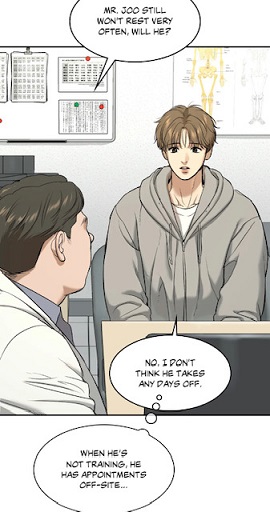 (chapter 27) nor the champion employs the expression “vacation” or “break”.
  (chapter 80) Why? It is because they never experienced a break. We have to envision that the “hamster” must have followed his grandmother, when he was not busy studying or working. Both main leads never experienced a real vacation. They say a day off, as if the day itself didn’t really exist, as if it were a temporary pause between “real” time. In their inherited logic, only work gives time its value; everything else evaporates. The grandmother’s way of loving has turned rest into an absence, something unworthy of being named. However, observe that there’s a gradual change in doc Dan’s vocabulary:
  (chapter 80) The problem is that for the hamster, only the athlete is worthy of getting his rest. It still doesn’t belong to his world.
 (chapter 5) the focus remains mechanical. Eating is fuel; sleep is maintenance. But rest, in the sense of surrender, stillness, or joy, is foreign to her lexicon.
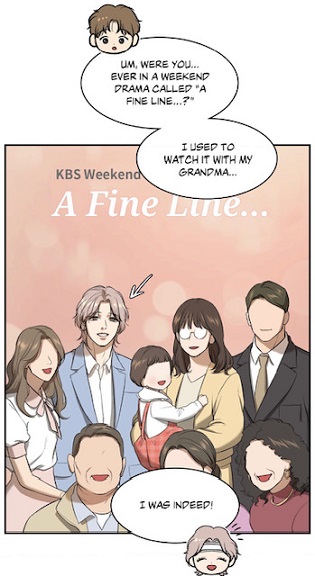 (chapter 30) — she watched The Fine Line, the very drama that made Choi Heesung famous. The detail seems trivial, yet it exposes everything: she had leisure
  (chapter 30), she simply refused to call it that. Watching television was permitted because it was passive, solitary, and could be rationalized as recuperation, not pleasure. In contrast, genuine rest — time shared, chosen, or joyful — never existed in her vocabulary. What she denied was not the existence of rest but the act of resting with him. She kept her downtime to herself, as if peace were a private possession. For her, love meant providing, not accompanying. Yet true care requires presence — sharing is caring, as the saying goes. [For more read this essay:
  (chapter 11), scarf tied under her chin, carrying a single sweet bun. She doesn’t need to say she “went out of her way”—her action already proclaims it. The effort is the gift.
  (chapter 11) That simple walk to the store becomes a moral event, proof of affection through fatigue.
 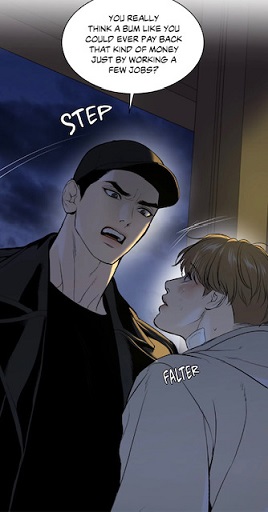 (chapter 80) In her eyes, generosity always justified expectation. The flowers were for display; the hoodie was the contract.
 (chapter 56) shortly after her arrival at the hospice, never again. When she greets Joo Jaekyung, the scarf is gone
  (chapter 61). Why? One might reply that the scarf lost its value, especially since she is living next to the director’s room. I doubt that such men would pay attention to such an object. Another possibility is that she fears its brightness might betray her neglect, for the champion has lived with her grandson for a while. How could she display silk while her grandson owns almost nothing?
  (chapter 80) The gesture that once symbolized love now feels like pain and loss. The signification of the gift has changed. What once wrapped him in safety now weighs like absence — the fabric retains the shape of someone who is about to vanish. His silence is not understanding but hurt, a wordless awareness that affection can curdle into memory. The audience, not the character, perceives that with the grandmother’s approaching death, her ledger is about to close. The gray fabric, once proof of her sacrifice, will lose its moral weight; her “gesture” will expire with her. Yet Kim Dan may not yet realize that this very ending could one day free him. The book-keeping dies with the bookkeeper.
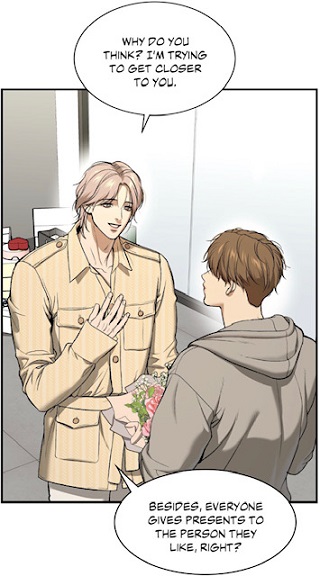 (chapter 31) When Heesung offers flowers “to get closer,” Kim Dan’s face mirrors the same unease: affection presented as transaction, intimacy disguised as generosity. What the actor calls closeness, the doctor feels as imbalance — the same emotional distance that Shin Okja’s presents once produced. Her gifts, meant to bind, isolated him instead; they built a hierarchy where gratitude replaced equality. Each present widened the gap between giver and receiver. To be cared for was to be indebted.
 (chapter 31) and tries to refuse it.
  (chapter 31)
 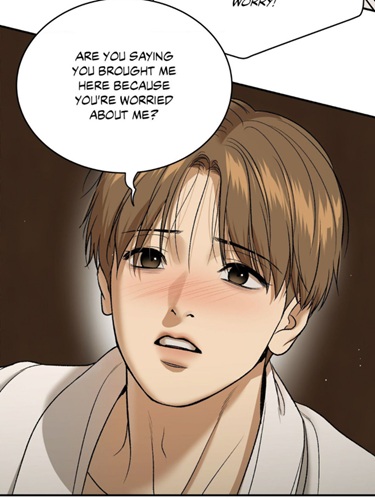 (chapter 67), loses sleep, or pays a price. He interprets Joo Jaekyung’s concern as “trouble,” Heesung’s gifts as “too much.” In his mind, affection is inseparable from cost:
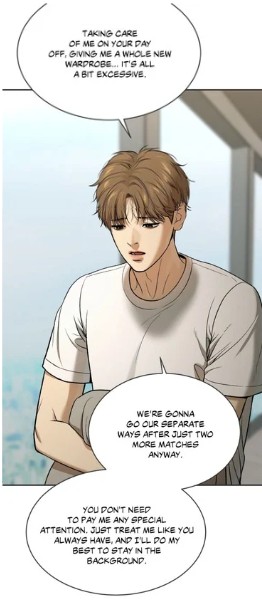 (chapter 80) “I’ll stay in the background.” His self-worth depends on not burdening others. His words let transpire that he has never been Shin Okja’s first priority in the end. The hoodie reinforces that psychology—it is not a professional outfit like a suit or briefcase would have been, but a teenager’s garment, meant for the domestic space rather than the adult world. It literally arrests his growth, keeping him in the house and under her logic. Thus it is not surprising that after receiving his diploma, he still took part-time jobs.
 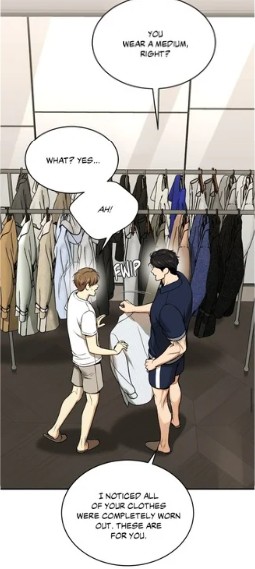 (chapter 80) is the site of its quiet destruction. His act of giving reverses every law the grandmother ever taught. First, he does not “go out of his way.” The clothes are delivered effortlessly, without fanfare or moral accounting.
  (chapter 80) There is no speech about sacrifice, no self-congratulation.
  (chapter 80) By erasing the gesture of “effort,” he removes the emotional price tag that once accompanied every gift.
 (chapter 80) If the grandmother’s motto was “I went through so much for you,” the champion’s is “It’s no big deal.” Generosity becomes invisible, unburdened, and therefore trustworthy.
 (chapter 80) The row of garments invites choice — a concept absent from Shin Okja’s universe, where love came in single doses and with strings attached. Here, the doctor is asked to select what he likes, to exercise taste, to inhabit preference. The abundance of options grants him agency, dignity, and the right to refuse.
 (chapter 22)
  (chapter 30) becomes unexpectedly true here. The wardrobe bridges the distance that the grandmother’s gifts had always created.
 (chapter 80) This is why his hesitant and embarrassed gratitude, framed against a background of dissolving gray waves, feels so transformative. The air behind him ripples as if washing away the residue of his old faith.
 (chapter 80); they mark the passing of days, the return of seasons, the rediscovery that not every morning has to look the same. Variety itself becomes a form of freedom. When the wolf once complained that all his shirts looked identical, he was unknowingly naming what both of them lacked: differentiation, spontaneity, change. Through this act, he restores color not only to the doctor’s wardrobe but to his emotional world — a quiet resurrection through fabric.
 (chapter 80) The “hamster” had instinctively turned to the only person who had ever offered him help without cost.
 — the luminous, wish-granting jewel said to contain both wisdom and life energy. The dragon’s power is not innate; it is completed and elevated by the jewel. Without the yeouiju, it cannot ascend to the heavens — strength without meaning, force without direction.
 (chapter 75), the imagined smell, or cleanse his skin of battle; he is held and, therefore, purified. Through Dan’s arms, he rediscovers his value and humanity—the dragon touched and not destroyed. He is worth of being embraced, even if he is already so old!
  (chapter 79) This is one part of the new circle. Jealousy is the residue of imbalance — the echo of the 7 within the 8. In the numerology of Jinx, the 7-chapters, like for example episode 7
  (chapter 18),episode 34 with Choi Heesung
  (chapter 34) or episode 52, where the former members of Team Black and expressed their disdain and jealousy toward the main lead
  (chapter 52)
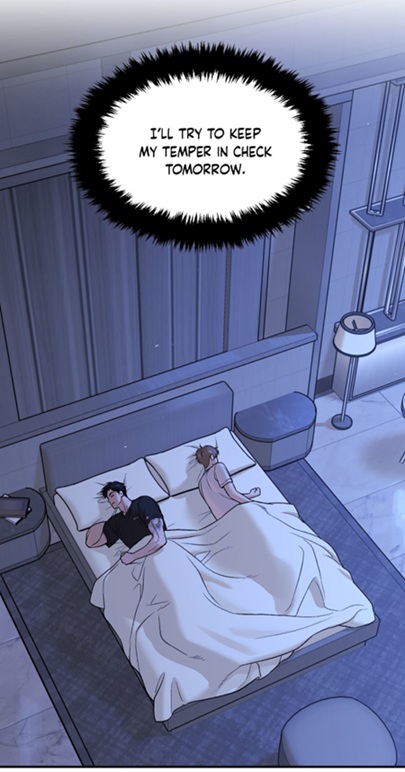 (chapter 79), the final test before the circle closes for good.
 (chapter 61) and Heesung’s residual rivalry and resent. Each acts as a different face of control: the woman binds through guilt, the manager through hierarchy acting as the owner of the athlete’s time, the actor through charm and deceptions. Together they form the triad that tries to reopen the circle closed in the pool. Let’s not forget that the athlete chose to take a day off on his own accord
  (chapter 80), but he had just returned to the gym. It is no longer the same training and routine.

 (chapter 79) However, let me ask you this. What kind of circle ends in episode 79? Moreover, how is this ending different from the past? Interesting is that episode 79 of Jinx doesn’t end with conflict, but with an awakening. For the first time, Joo Jaekyung does not rise to fight, command, or perform — he wakes up to a realization: “This can’t go on.” In the Korean version, his words carry an unusual clarity. It is not fate that changes, but choice. The champion, who once lived as if enslaved by habit and haunted by ghosts, now chooses transformation. The circle that has defined his life — power, silence, guilt, and repression — finally begins to close.
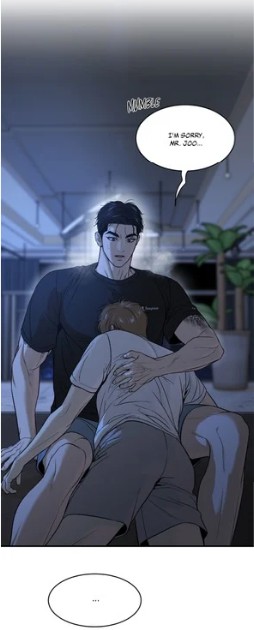 (chapter 79) Until now, Jaekyung has moved through life as if carrying a curse — the belief that he is unworthy of care and love.
  (chapter 78) Every match, every order, every touch was an act of penance. Yet, in this episode, that belief dissolves. What vanishes in chapter 79 is not his strength, but the compulsion to suffer for it. Through the unconscious confession from Doc Dan, the wolf discovers that despite his wrongdoings, he is not hated by the “hamster”.
  (chapter 39) from the magical night in the States. Both moments unfold in half-darkness, both break through inhibition, and both blur the line between consciousness and surrender. The verbal difference hides a deeper sameness:
  (chapter 79) is not remorse alone — it is an act of love, an instinctive reaching-out toward the other’s pain.
 (chapter 9), 29’s confession on the couch
  (chapter 29), 69’s first expression of feelings in the dark
  (chapter 69). In chapter 79, the circle closes once more. The night’s palette tells the story — deep blue softens into violet
  (chapter 64)
  (chapter 79), the color born from the fusion of blue (Dan’s sorrow) and red (Jaekyung’s intensity). For the first time, in the penthouse the color of their relationship is not pain but balance. And now, you comprehend why in the hallway, the purple had almost vanished:
  (chapter 66)
  (chapter 79) To restore it, he will have to speak, to act, and ultimately, to smile again.
 (chapter 79), it is a confession disguised as complaint. For the first time, he voiced his dependency and vulnerability more clearly, as his body language is no longer expressing hesitation and shyness. Imagine that so far, he had lived following the principle of “self-reliance”. Yet when Dan asks, “What?” the champion retreats:
  (chapter 79) and fall
  (chapter 54) still equates vulnerability with humiliation.
  (chapter 79) The vision forces him to confront the origin of his shame. He realizes, instinctively, that the real Kim Dan would never smile at his pain — and through that recognition, he begins to separate present from past. He has already experienced a silent, but warm gaze
  (chapter 77) from his fated partner after admitting his defeat:
  (chapter 76)
 (chapter 78) He has long recognized his wrongdoings — the pressure, the harshness, the selfishness
  (chapter 76) — but guilt without self-forgiveness remains sterile. What is the point of apologizing to someone when you cannot forgive yourself? His silence, then, is not arrogance but self-condemnation. Beneath his strength lies a man who believes that no apology can redeem him, because no one ever offered him one first. His father’s mockery, his coach’s reproaches
  (chapter 74) and expectations, his mother’s betrayal
  (chapter 73) Every punch was an act of self-erasure, every victory a brief anesthesia against the echo of his own self-loathing and regrets. He mistook exhaustion for atonement. But when Kim Dan whispers
  (chapter 79) His vision of Kim Dan’s false grin is not a taunt from the other
  (chapter 79)— the breakfast scene
  (chapter 79) , the casual
  (chapter 79), it is as if he is saving not only his partner but the part of himself that used to give up. He was living like a ghost denying his own emotions.
  (chapter 78) That word revealed his blindness — the refusal to acknowledge pain that does not announce itself through wounds. The new incident at the railing shatters that illusion. It was never an accident, but the expression of mental illness
 (chapter 77)
 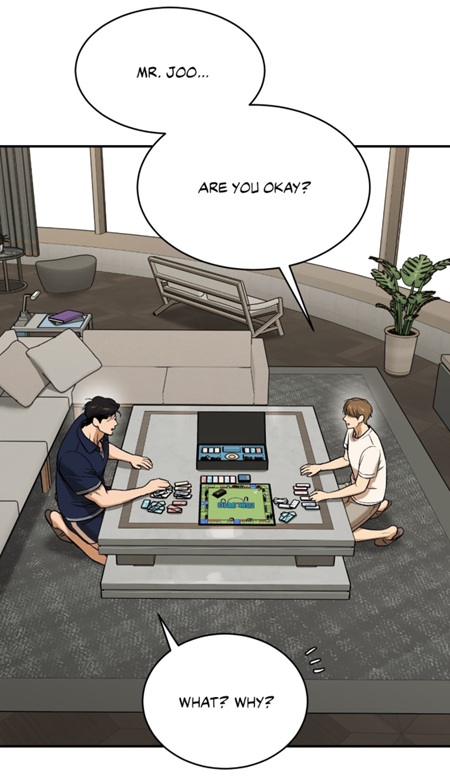 (chapter 80) Each time, the physical therapist shows concerns for the athlete’s well-being. He perceives this change of behavior as the expression of unwell-being.
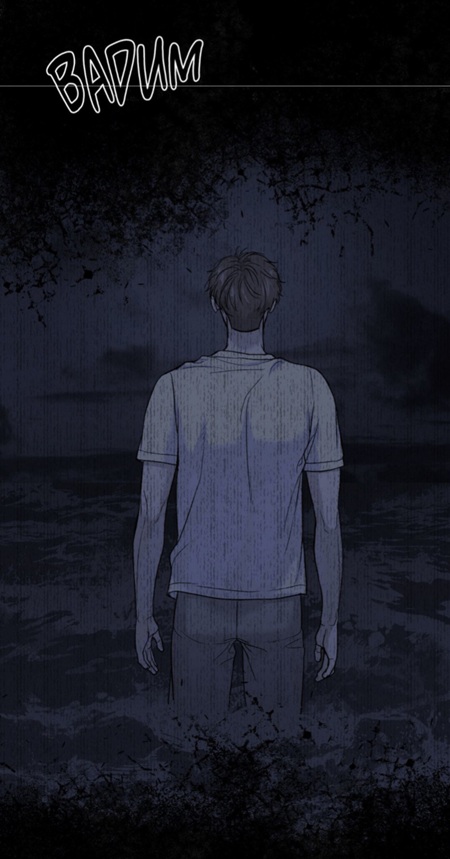 (chapter 69), and the balcony
  (chapter 38) — the very image that defines Kim Dan’s being. The clouds on his phone screen are not incidental; they reflect his essence. A cloud has no home, no fixed form, forever moving, dissolving, reforming — just like the doctor’s life, endlessly displaced and redefined by others’ expectations. Clouds embody both dream and danger: they promise transcendence but conceal the storm. Besides, a cloud can fall as rain, return to the ocean, or vanish into the sky — an image of the soul that oscillates between grounding and escape.
 (chapter 37) Behind the champion, the Golden Gate Bridge stands as a silent witness — a place where many have ended their lives by leaping into the void between air and water. The bridge fuses both symbols: it is where drowning and falling meet. Moreover, the bridge embodies the connection of two worlds. This backdrop, unnoticed by the protagonists themselves, prefigures the later arcs. Joo Jaekyung is the one standing between the bridge and the physical therapist. It was, as if the author was already announcing the huge depression doc Dan would face in the future. At the same time, I came to wonder if the unconscious suicidal attempts from Doc Dan were actually revealing the biggest secret in his life: the suicide of his parents and their death could be linked to a bridge. Striking is that while the members of Team Black were partying
 (chapter 73) before he discovered Joo Jaewoong’s corpse. The bridge thus becomes a metaphor for invisible grief: joy and pain occurring simultaneously, one masking the other. And keep in mind that according to my theory, the picture of Dan with his grandmother is hiding a tragedy. This would explain why doc Dan is so obsessed with this picture:
 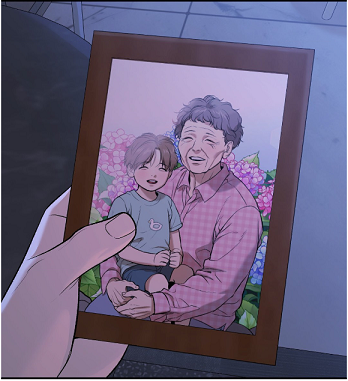 (chapter 47) The smiles here are hiding the past reality.
  (chapter 79) — so unlike his real, exhausted self — is a vision of peace, of love unburdened by fear, while this grin exposes the truth. The dream, the realm of clouds, becomes a stage where the wolf shows and learns tenderness. The dream’s fear and indirect self-reproach
  (chapter 41) In other words, the dream is giving him clues as well how to behave: not only greeting, but also talking. What caught my attention is that during their two last breakfasts together
 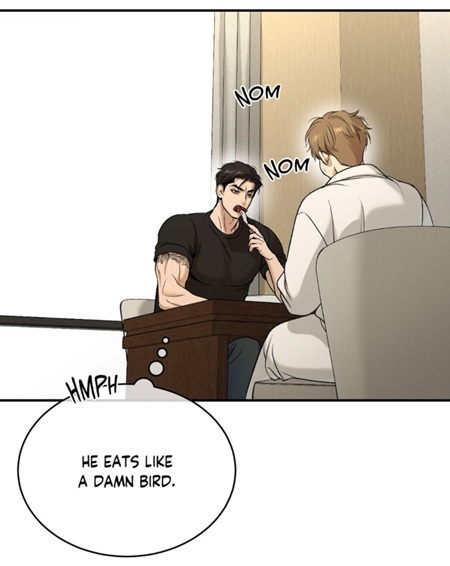 (chapter 68), they didn’t talk at all
 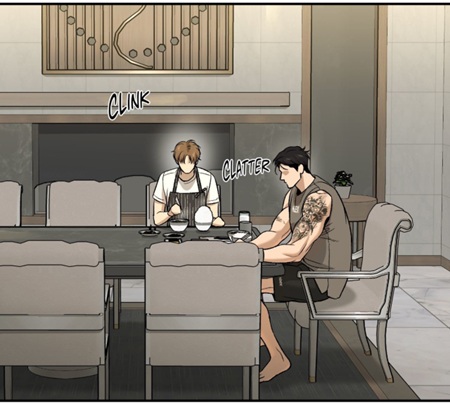 (chapter 79) which contrasts to the star’s vision.
  (chapter 79) He does not kneel; he sits, his body settling softly against the floor as he catches Dan in his arms. The man once associated with dominance becomes a cushion, a pillow, a living anchor. His strength, once used to impose weight, now exists to absorb it. The fall is not toward repentance through pain, but toward tenderness through stillness.
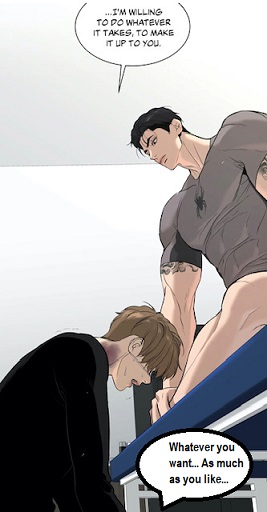 (chapter 11) now becomes the one who receives the collapse.
 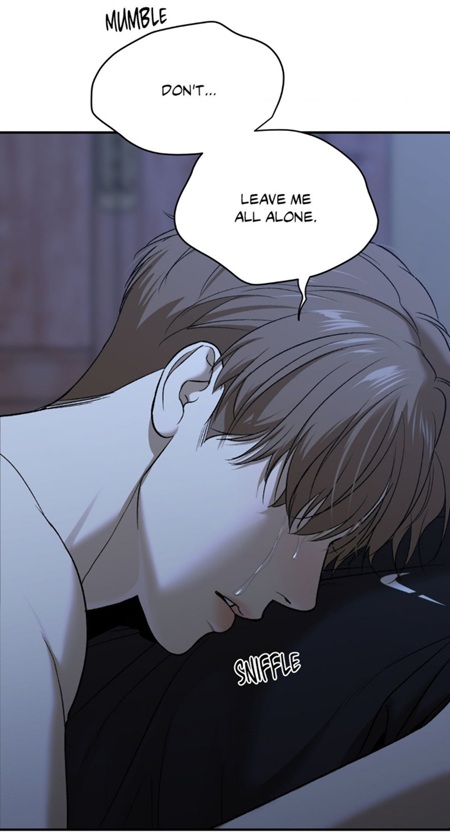 (chapter 66)
  (chapter 66) trembles out against Jaekyung’s chest; his
  (chapter 80) The moment the star was holding doc Dan’s hands, the latter started voicing more his emotions (fears, displeasure).
  (chapter 80) When Jaekyung takes his hands in the swimming pool, the gesture revives this primal language of reassurance. For the first time, the touch is neither coercive nor desperate; it’s sustaining. The handhold reverses the earlier dynamic — instead of silencing him, it gives him permission to speak. Furthermore, the champion is pointing out that he can rely on two things, the champion’s hands and the kickboard belt. This stands in opposition to the fake promise of Shin Okja.
  (chapter 57) In other words, he is inciting the doctor to trust himself more and become independent.
 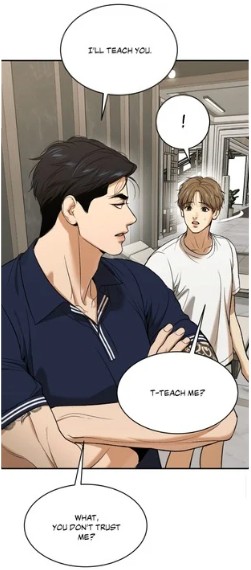 (chapter 80) His comfort does not deny danger — he acknowledges the possibility of falling into the water — but he links survival to skill, not assistance and dependency. His statement affirms Dan’s agency: he can save himself. Once he can swim, he is strong enough. Where the grandmother sought to replace the absent parents
  (chapter 28)
  (chapter 69) The wolf, who once relied on dominance and silence, is now allowing his fated partner to hug him.
  (chapter 21) From childhood onward, being held becomes the only assurance that the world still contains care. When he woke crying and was taken into his grandmother’s arms (chapter 21), the patting gesture did not merely quiet his fear; it taught him that consolation requires contact. Yet this early lesson carried a hidden cost: it trained him to associate peace with submission and silence, and affection with dependency. Therefore the swimming lesson contains another important life lesson: it is about choice! Joo Jaekyung wants to be “chosen” by the physical therapist, hence he wants to conquer his heart.
  (chapter 80) That’s the reason why he can not change doc Dan’s heart and mind with the new clothes. For that, he needs to reveal his “weakness” to the physical therapist.
  (chapter 4), not intention: a reflex of possession, not communication. As time passed on, it changed, yet in the bathtub (chapter 68), Dan fell asleep against him so that he could never experience the athlete’s care
  (chapter 68); in the morning, Jaekyung acted as though nothing had happened. Then on the dock, Joo Jaekyung expressed his relief
  (chapter 57). Everything evolved around his lack of sleep and his dependency on her.
  (chapter 79) It is important because very early on, the doctor Cheolmin had already detected his malnutrition:
  (chapter 13) In other words, the physical therapist’s depression and eating disorder were already existent before meeting the “wolf”. And what did the mysterious friend tell to the “wolf”? He shouldn’t wait out of fear that he might regret it later!
  (chapter 13) As you can see, “sorry” is the link between the two doctors and the celebrity.
  His metamorphosis will be complete with the birth of the kind and sweet Joo Jaekyung!
 (chapter 29)
  (chapter 61) Hence it is no coincidence that while sleeping in his own bedroom, the physical therapist had a relapse.
  (chapter 79) Because the champion had come to the conclusion that his own bedchamber was linked to sex
  (chapter 78) And though he had another “accident”, the former is never bringing it up to doc Dan. There’s no blame or accusation. The athlete is keeping these accidents as secrets. However, pay attention that he is making sure that doc Dan is resting.
  (chapter 27) Striking is that the champion always chose the left side of the bed
  (chapter 66) Thus I deduce that doc Dan is destined to take over his grandmother’s position in the bed:
  (chapter 80) The star was sitting on the right side of the bed while watching his sleeping partner. Why? It is because he can see his face. But by lying on the left side, doc Dan came to turn his back to him.
  (chapter 79) Because of the champion’s cold gaze, doc Dan felt rejected and even hated.
  (chapter 79) He had the impression that he wouldn’t meet his “expectations”. Observe the parallels between the champion’s dream
  (chapter 11) yet she failed to notice it or refused to face his struggles, as they were related to their poverty.
  (chapter 5), he lost his voice and became a ghost. It is no coincidence that in this scene, doc Dan was silent despite the caress. He was avoiding any topic that could trouble his grandmother. He accepted to remain a little boy in her eyes. But thanks to the wolf, doc Dan is learning to become strong and independent so that he can decide about his life. The swimming lesson is pushing him to overcome his abandonment issues.
  (chapter 79), not communion; his affection, an extension of performance
  (chapter 79). Yet as the doctor grows thinner and more exhausted, the wolf begins to understand what “starvation” truly means.
  (chapter 79)
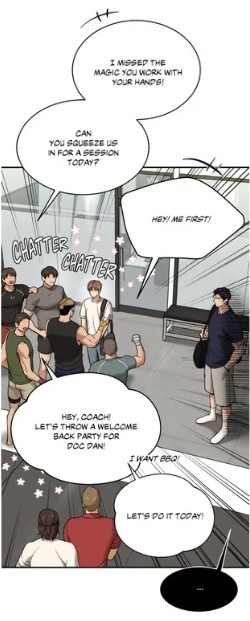 (chapter 78) Their noisy excitement — hugs, wishes, smiles, jokes, even talk of meat — gave the impression of a long-awaited reunion. Yet the suggestion was cut short by Jaekyung, who rejected it like this:
  (chapter 78) In other words, a party was “missed.” At first glance, this might appear to be an exception, a rare moment of denial in a story otherwise filled with shared rituals. Readers might recall the welcome party
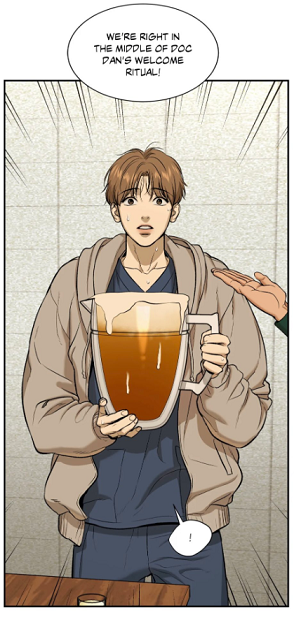 (chapter 9) in episode 9, the champion’s birthday dinner
  (chapter 43) in episode 43, the talk of hospital get-togethers
  (chapter 61), or the festive tone of fighters after director Choi Gilseok’s victory
 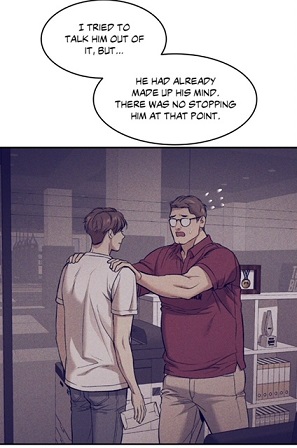 (chapter 53) rather than farewell.
 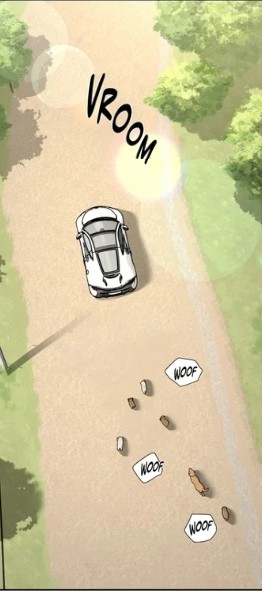 (chapter 78) always miss their mark, either hollow in substance or unseen by the very people who should be honored.
 . (Chapter 43) Even the “dragon’s” birthday, supposedly a day of personal celebration, is reduced to an awkward dinner at his expense, with a cake arriving a day too early
 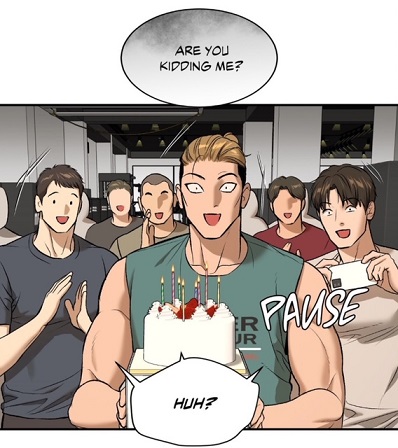 (chapter 43) or gifts from sponsors and fans he never wanted.
  (Chapter 41) In Germany, it is considered as a bad omen to celebrate a birthday too soon. Rituals that should affirm intimacy instead expose distance and lack of respect.
 (Chapter 52)
  (chapter 56) However, this is just an illusion. What caught my attention is that the nurses wondered themselves why such a skilled therapist would come to a small-town hospital.
 (chapter 56) They speak about him, as though he had no reason to stay there, as if he were a stranger passing through. Right from the beginning, he was treated unconsciously as temporary, someone whose presence required explanation rather than welcome. Finally, no party was held for him, no ritual of inclusion was offered. His distance and their detachment mirrored each other, producing the silence that would later define his departure.
  (chapter 78)
 (chapter 15) The high peak of his celebrated victories takes place at the gym where Park Namwook gather the fighters in front of the Emperor congratulating himself for his “good work” and the spectators for belonging to a winning team.
 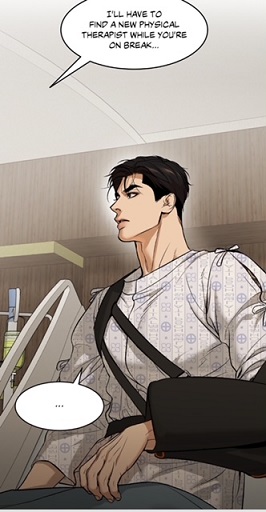 (chapter 53) For him, the physical therapists were just tools and as such replaceable.
 (chapter 45) By keeping Dan in the dark about the “surprise,” the fighters created another problem. Their silence pushed him to offer his own present on the same day as the gifts from sponsors and fans — exactly the kind of attention Jaekyung resented. He had already said he did not want those presents, and now Dan’s sincere gesture was placed in the same category, indistinguishable from the flood of unwanted offerings. What could have been a private, meaningful moment was absorbed into the hollow ritual of the group. Hence the champion never got to read his card!
  (Chapter 1) His stay had been so brief as well. Besides, his absence was engineered to be total, as though he had never existed. The very ritual that should have affirmed his contributions instead became a ritual of erasure.
 (Chapter 50) Then later the athlete questioned the physical therapist’s actions and told him this
 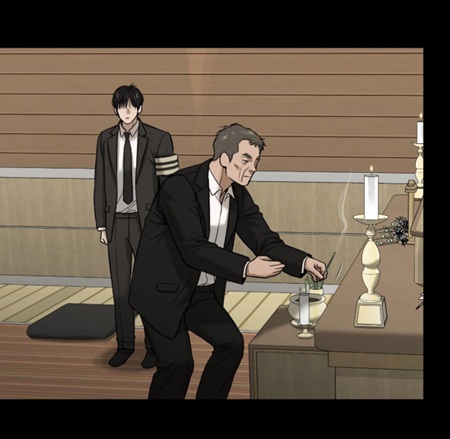 (chapter 74) The silence of his grandmother on this point suggests that even the most basic ritual of mourning was denied him.
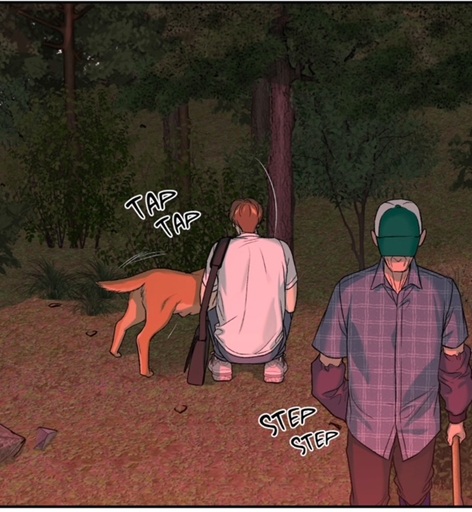 (Chapter 59) Only Dan and the landlord marked the event with a quiet burial. Since no one knew about it, it left the ritual incomplete. For Dan, the small act was meaningful, but its invisibility to the larger community echoed his own life: recognition always hidden, always partial, never public.
 (Chapter 78) To them, departure is not tragedy but play, a noisy farewell parade. Their barking and chasing become a spontaneous party, a joyous ritual of attachment.
 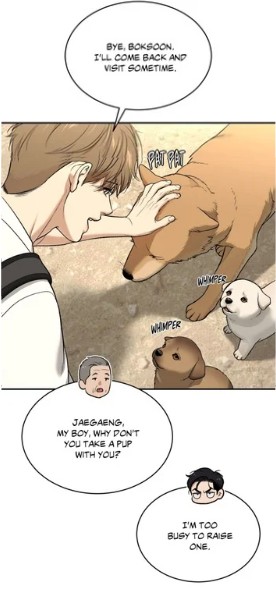 (Chapter 78) Striking is that here, doc Dan is making a promise to Boksoon and her puppies, but the latter have no idea. Therefore imagine this. On the weekend, the moment the car approaches the landlord’s house, the puppies will recognize them and celebrate their return! And this time, both characters will witness this welcome party:
 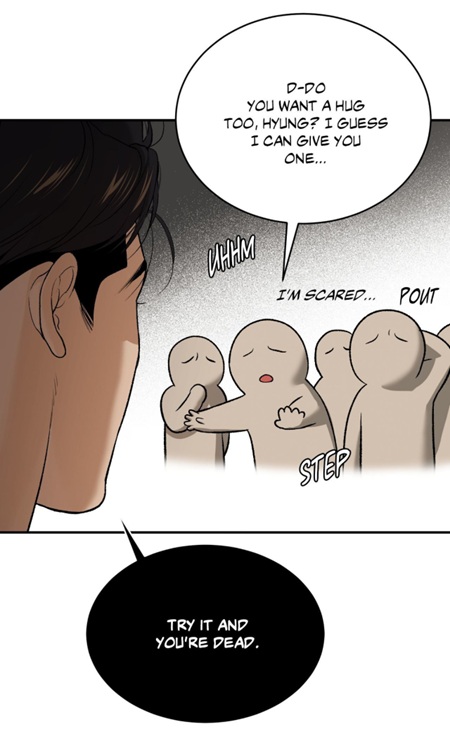 (chapter 78)
 (Chapter 78) But this “reset” is an illusion. Dan is only contracted for two matches. Interesting is that no one is capable of perceiving the truth, as the main lead’s explanation is ambiguous.
 (Chapter 78) He doesn’t limit the number of matches, only that he will focus on the “wolf”. So for them, his return is not limited in time. Nevertheless, his paleness and dark circles speak louder than their words: he is exhausted, fragile, still haunted.
 (Chapter 78) They are more worried about another possible departure than about his condition, as though his leaving again would be a greater tragedy than his ongoing suffering. This exposes that the members are not totally oblivious and their reunion is not a repetition of the past. On the other hand, warm words and a noisy welcome are enough for them. They take his generosity for granted, just as they always have. Therefore they ask for his magic hands.
 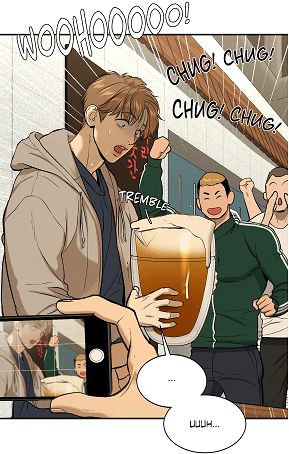 (chapter 9), and abstaining from drink often means being excluded from group belonging. Yet Dan, on medication, cannot drink. His doctor’s recommendation makes it impossible for him to participate in such “public” rituals. Even the customary sharing of a huge bowl — a symbol of intimacy and unity — must be avoided. For Jaekyung, who once used alcohol to dull his own struggles,
 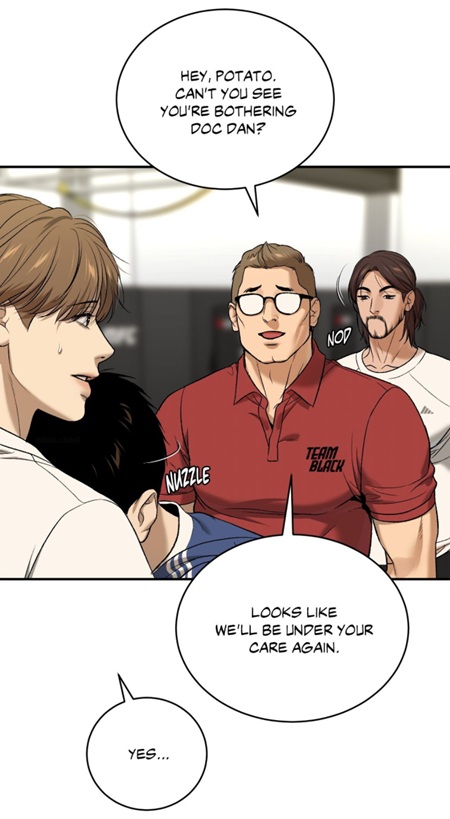 (Chapter 78) Hence the latter has no interest to organize a welcome party and even maintain the ritual with the bowl!! What might appear to others as grumpiness or stinginess is in fact a form of protection.
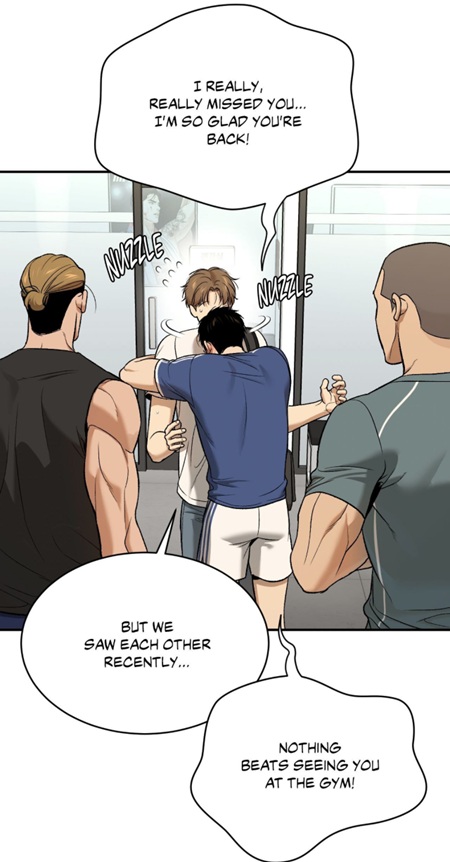 (Chapter 78) Having missed Dan most deeply during his absence, he now wishes to spend as much time as possible with his hyung. His longing shows that no party with Heesung and the landlord — no noisy drinking night —
  (chapter 58) could fill the hole left by Dan’s departure. But his form of attachment is still caught in the ritual of surface-level affection. What Potato craves is real closeness, hence he keeps hugging the physical therapist,
  (chapter 9)
  (chapter 26), or allowed whether welcome parties or surprise celebrations or pre-match meals
  (chapter 22). These events were never about genuine recognition but about maintaining power and appearances, boosting morale, or reminding the fighters of their dependence on the team structure he managed. The “surprise” birthday party in chapter 43 bore his fingerprints,
 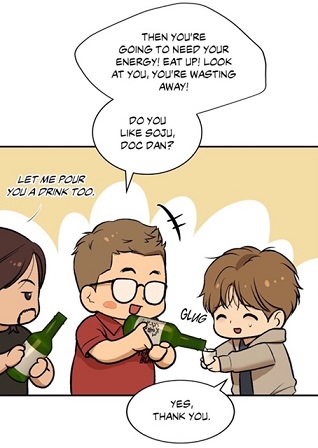 (chapter 43) This absence is revealing: Namwook preferred to avoid direct conflict with Jaekyung’s visible displeasure, leaving the awkward burden of paying and performing to the champion himself to Yosep. In other words, his parties were tools of control, not gifts of belonging. By chapter 78, however, the balance has shifted.
  (chapter 78) Standing in the back, Namwook watches as Dan returns and is embraced by the fighters. He notices a “different vibe” between the two leads, but fails to grasp what it means. Doc Dan is actually free and has the upper hand in their relationship. Hence he can no longer ask this from doc Dan:
 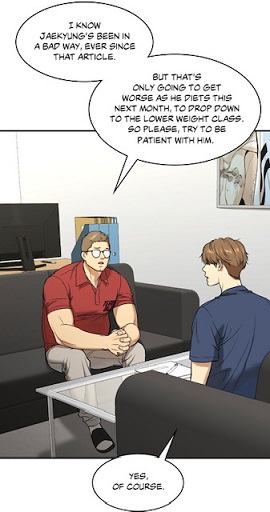 (chapter 36) Doc Dan should put up with everything. What he cannot admit is that Dan is no longer replaceable.
  (chapter 78) This delay suggests a split loyalty: while the team is already celebrating, Potato is likely still tied to Heesung, perhaps even speaking to him on the phone. His tardiness betrays how his heart is pulled in two directions — caught between the actor’s orbit and the gym’s renewed center around Dan. Yet the embrace of the fighter, and his tearful reaction at seeing Dan again, show that his real place lies with Team Black.
 (chapter 59) Potato had made a promise to treat Dan to a meal if he ever returned, squeezing his hand with the sincerity of a puppy. That promise, innocent as it seemed, carried a hidden trap: in Korea, such “treats” almost always involve alcohol. And he could try to recreate the party on the coast. Potato, unaware of Dan’s medical restrictions, may offer him exactly what he must refuse. Only Jaekyung knows the truth of Dan’s fragile health; only he can act as his shield against such misplaced affection. Secondly, Potato possesses pictures of the puppies
  (chapter 58), and his presence ties alcohol directly to the champion’s vulnerability. At the same time, Potato’s loyalty is beginning to shift. He once orbited Heesung like a hidden lover, but Dan’s return rekindles his attachment to the gym and as such will affect his relationship with the gumiho.
  (chapter 22)
  (chapter 13) a breakfast in silence
  (chapter 78) Even Jaekyung is troubled by the reminder that Dan’s stay is temporary, as if the very walls of the penthouse resist turning into a home.
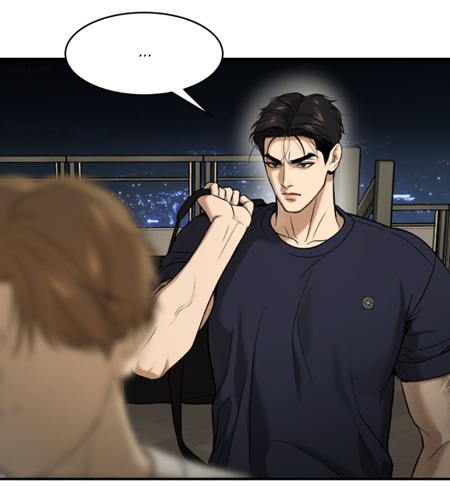 (chapter 78) In other words, the wolf’s task is no longer to win battles in the ring but to protect these fragile celebrations — to make Dan feel at home, to turn missed hugs into embraces, missed parties into warm meals, missed gestures into habits of care. Only then can the cycle of exclusion be broken. Only then can “The Missed Party” become, at last, a real one.
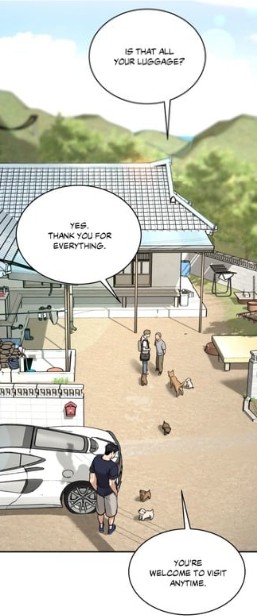 (chapter 78). For me, it is no coincidence that the senior followed them to the street and waved at them!
 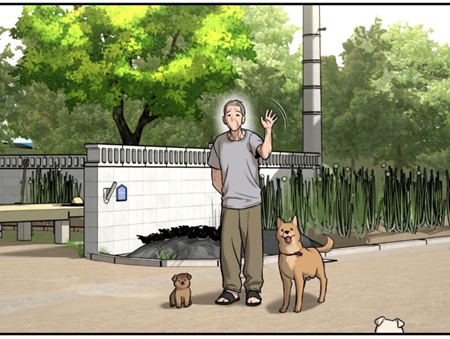 (chapter 78) He expressed not only his genuine feelings, but also his longing: he hoped to see them soon. He had come to appreciate their presence which is not related to their work. The Missed Party becomes not a single absence, but the haunting rhythm of the entire narrative: recognition always arriving too late, always seen by the wrong eyes. And perhaps the story’s promise lies here — that one day, the real party will finally be held, not in karaoke bars or gym halls, but in the unbreakable bond of two men who learn what true friendship and belonging mean. This means, the more the champion and his fated partner develop new routines, the more it will affect the gym and as such Park Namwook, which can only feel more and more excluded.

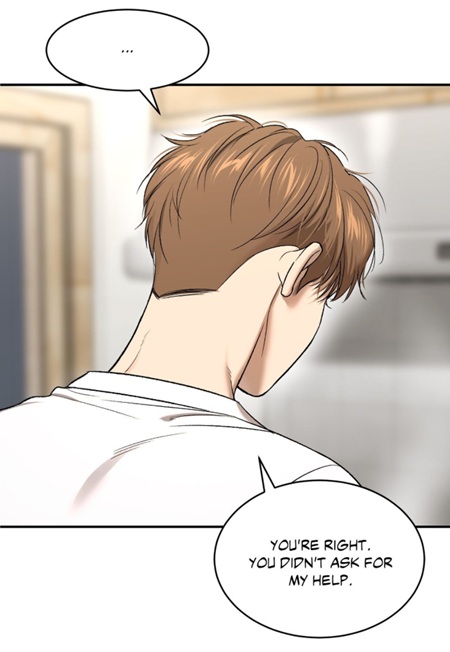 (chapter 76) For the first time, he uses the expression you’re right in front of his fated partner. He seems to concede with this idiom. Yet this apparent submission hides a deeper reversal. By admitting Jaekyung never asked for his help, he redirects the exchange toward his own truth: the loneliness of having no one to care for you.
 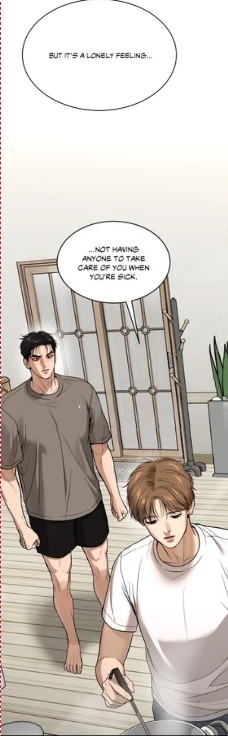 (chapter 76) What unfolds in the kitchen is not a quarrel about porridge but a fragile recognition. Dan’s “You’re right” acknowledges Jaekyung’s perspective without bitterness, while Jaekyung’s “I lost”
 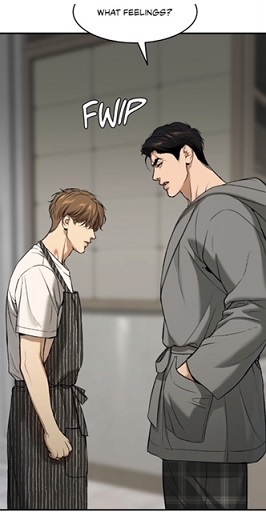 (chapter 45)
  (chapter 76) The kitchen scene closes one cycle and announces another.
  (Chapter 76) In this view, his fixation would be the product of ambition, pride, or ego: the expected cost of survival in a cage where only victory pays.
  (chapter 76), because the adults in his life cut them off before they could exist. Winning became his only mode of survival because every formative argument in his youth ended in defeat, and not the kind decided by a referee. With his father, mother, coach, and manager, words never led to recognition — only to insult, silence, utility, or obedience. He learned early that dialogue could not protect him; only victory could. His victories were not chosen freely, but forced into being by guardians who made him feel like a burden, until relationships themselves became burdens.
 “(chapter 73). It was not just defiance; it was a vow that victory would silence abuse once and for all. When he returned with the trophy, he shouted triumphantly,
 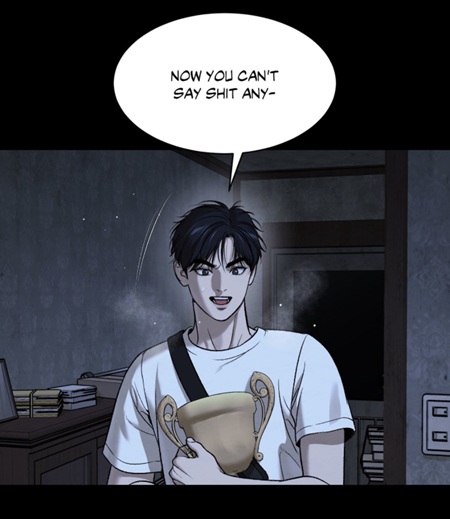 (chapter 73) ready at last to claim, “I was right.” Yet reality betrayed him. His father’s death denied him the only acknowledgment he had sought.
  (chapter 74) At the funeral he remained dry-eyed, his face locked in shame (ch. 74). No one saw his guilt, but it consumed him: the one man he needed to hear “I was right” from could no longer answer. At the same time, his smile and laugh were also linked to misery. For Jaekyung, laughter was never the sound of joy, but the echo of mockery and rejection due to the father. Just as tears became tied to betrayal and abandonment through his mother, so too did his father twist laughter into a weapon
  (chapter 74) But when the calls went unanswered, her silence became the sharpest weapon of all. Her eventual reply
  (chapter 74), his tears expressed not just grief but the recognition of betrayal. From then on, tears themselves became equated with loss, weakness, and abandonment. This is why, in the wolf’s nightmare, Dan’s crying form
  (chapter 76) appears: the sight of tears recalls the moment he unconsciously realized that even his mother’s “you’re right” was a lie. At the same time, those tears function as a mirror. The champion projects onto Dan the very weakness he has always forbidden himself to show.
  (chapter 76), the boy he once was who longed to weep but had to swallow it down. At the same time, Jaekyung himself occupies the place of the “adult” —
  (chapter 74)
 (chapter 76) His trembling hand upon waking
  (chapter 76) shows the yearning to be held, comforted, reassured — something he never received from either parent. He is not entirely responsible for the physical therapist’s suffering. And here lies the difference: Dan’s tears are not manipulative or hypocritical , like the ones Jaekyung suspects from his mother, but unfiltered honesty. He expressed his emotions, not just through tears, but also through body language!
  (chapter 74), whose quiet devotion and silence kept the gym alive, nor Jaekyung’s, whose absence he accepted without challenge.
  (chapter 74) Unlike Jaewoon’s domination or the mother’s evasive silence, Hwang cloaked his authority in the language of advice — yet beneath it lay a black-and-white dualism: winners and losers, villains and victims. Thus Joo Jaewoon was blamed for becoming a thug
  (chapter 74)And observe how he provoked the main lead.
  (chapter 74) When Hwang sneers, “What, am I wrong? Come on, answer me!” he is not inviting dialogue — he is staging a trap. The question is rhetorical, a demand for submission. Let’s not forget that he had witnessed the phone call in front of the funeral hall, but back then he had done nothing. And when the boy hesitates
  (chapter 74), unable to answer, Hwang strikes him in the chest.
  (chapter 74)and justifies his action behind social norms.
  (chapter 74) In that instant, he takes the role of judge, referee, and executioner, collapsing “argument” into violence. The very words “Am I wrong?” contain the irony: the coach is less interested in truth than in reasserting his own authority. Silence is treated as guilt, hesitation as defeat.
 (chapter 74), he effectively admitted “you’re right” to the coach. Yet this wasn’t simply genuine agreement — it was submission, respect mixed with survival. The director misread it as validation of his worldview. This only reinforced his certainty, encouraging him never to reconsider his role.
  (chapter 74) When the protagonist finally left, the director could declare with satisfaction:
  t(chapter 74).
  (chapter 70) Once again, Jaekyung is reduced to “that bastard” — a label, not a person — while Dan is framed as the pitiable victim. The old coot remains the righteous observer, untouched by guilt, protected by a rhetoric that always shifts responsibility elsewhere.
 (chapter 75) He was happy again, though he initially tried to hide it. We have to envision that before the wolf’s visit, the elder had to face what his own life outside the gym looked like: sickness, solitude, the collapse of the studio that had sustained him and came to resent the main lead. Yet, Joo Jaekyung’s behavior changed everything:
  (chapter 71)
 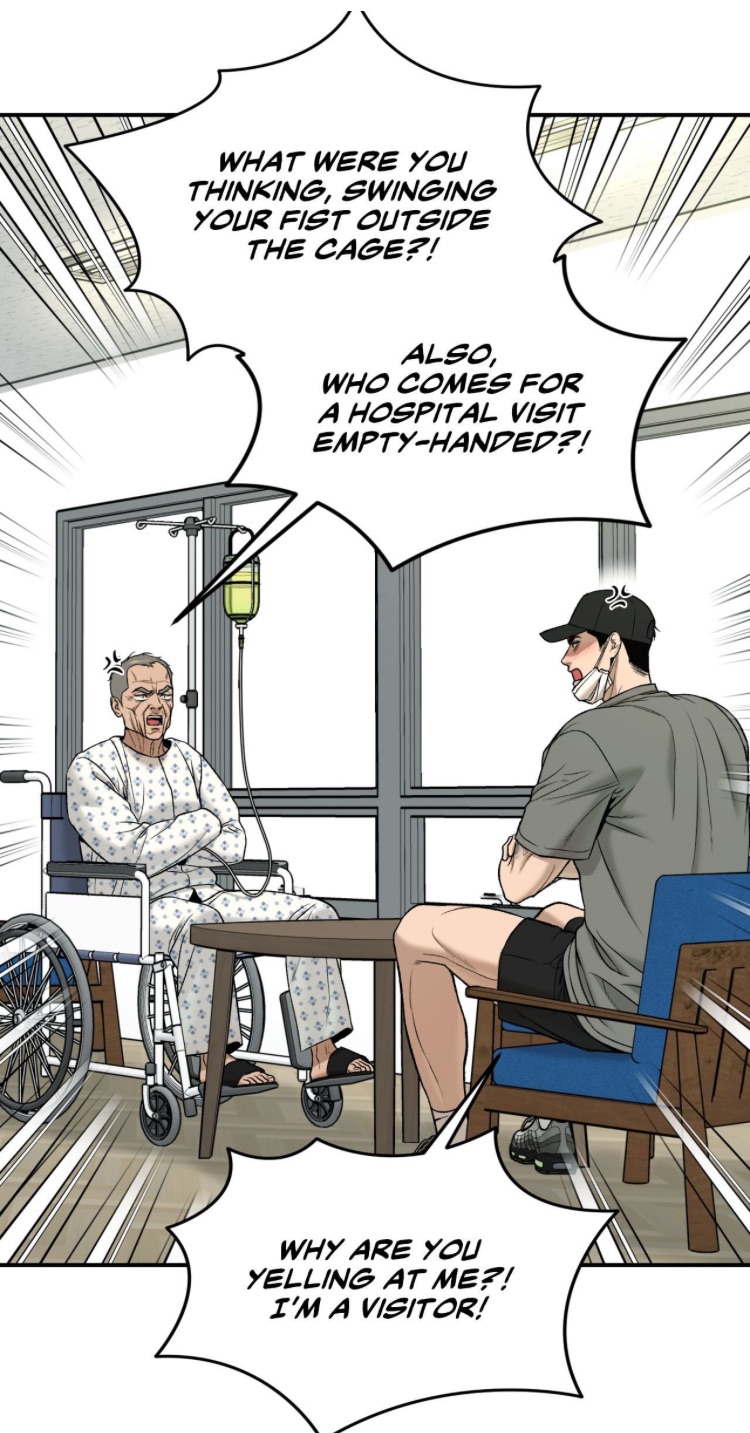 (chapter 71) Only during the champion’s visit, did his words alter.On the rooftop of the hospice, he finally tells Jaekyung:
 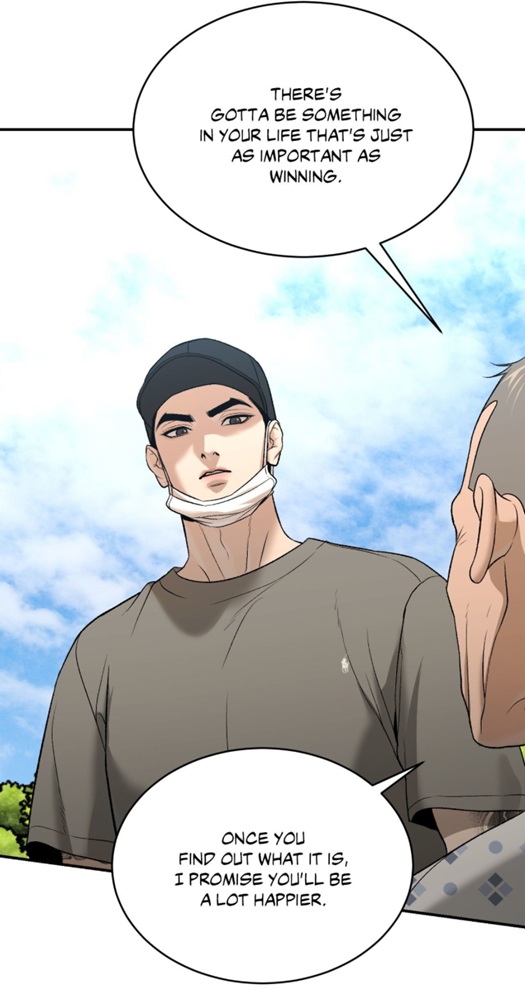 (chapter 75) This shift did not come from wisdom gained in the ring but from loss — the loss of health, the loss of the gym, the loss of illusions — and from Jaekyung’s loyalty, which pierced through his blindness. Interesting is that this time, he doesn’t give the answer to the athlete. He stops thinking “I’m right, you’re wrong”. He treats him as an adult, as a mature and thoughtful person. Through that fidelity, Hwang glimpsed at last what he had denied both himself and Jaekyung for decades: that victory alone cannot sustain a life.
 (chapter 76) It is not too late. The question “Am I too late?” is the consequence of Hwang byungchul’s words and it gradually indicates the switch in the champion’s mentality. It is no longer about being right or wrong. However, the nightmare reveals another aspect: the world is not black and white, but grey.
 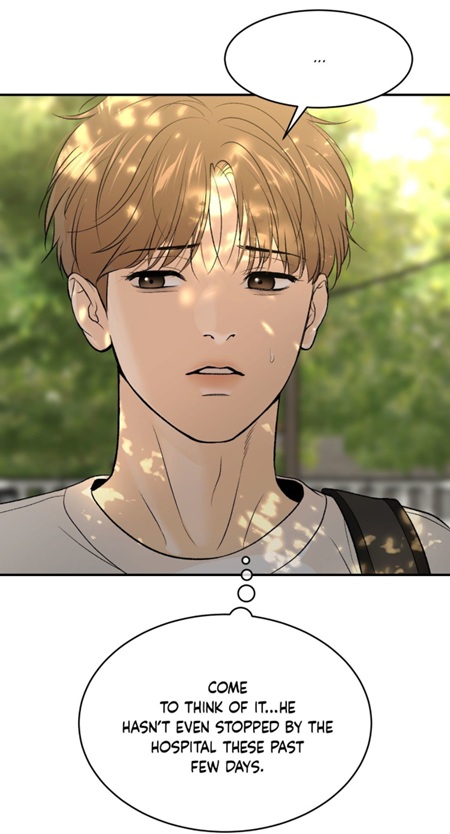 (chapter 76) Hence he remained silent and avoided his gaze. But like the director showed it, it is never too late:
  (chapter 76)
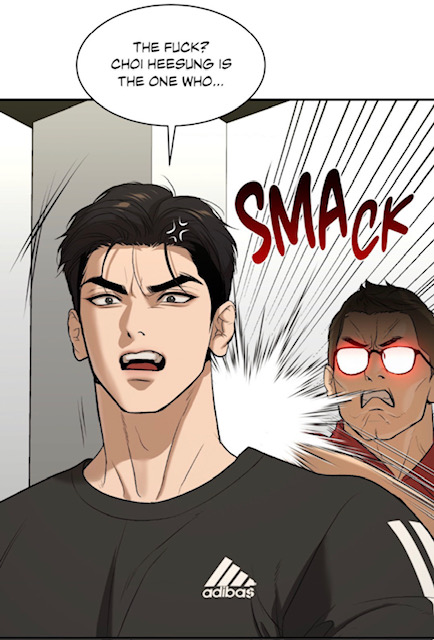 (chapter 31) in good
 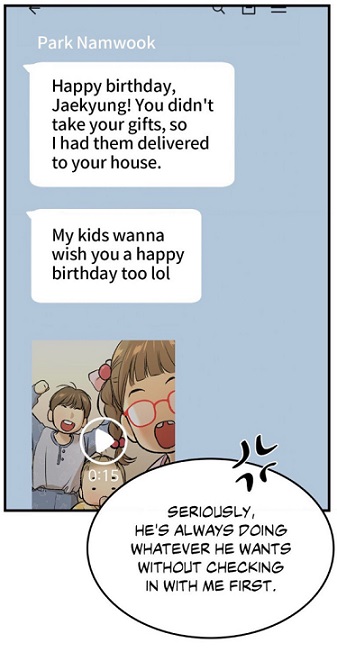 (chapter 45) or in bad times. It goes so far, he does not take his silences seriously, and does not register his pain. This explicates why the manager saw in the champion’s silence at the restaurant as an agreement for a new fight!
  (chapter 69) His role is not to guide or protect, but to extract: money, victories, publicity.
 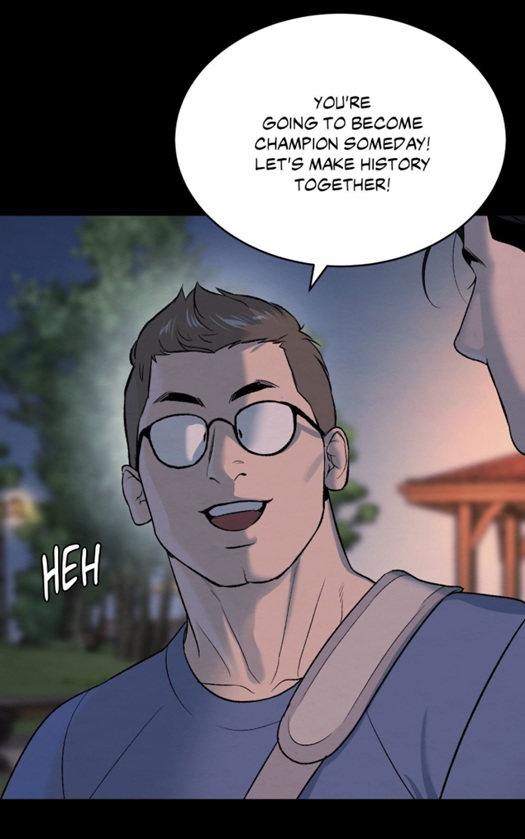 (chapter 75) In my opinion, he is fighting against oblivion through the star. This hidden disability explains why the coach can never truly connect with the champion. He listens instead to other voices – the CEO of MFC
  (chapter 46), the media
  (chapter 41), the spectators or “authorities”
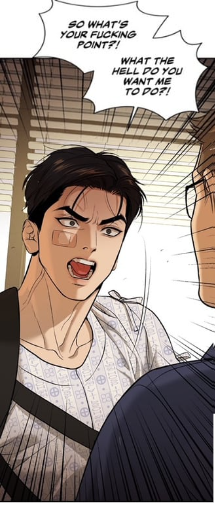 (chapter 52) His question is not mere anger. It is a confession of position — an inadvertent acknowledgment that he knows he is the true backbone of the gym. He is the one responsible, the one carrying the burden that Namwook refuses to admit. These words crack the illusion: the fighter is not subordinate, but owner. The gym lives because of him.
 (chapter 52) He acted as a child, faked “tears” in order to use empathy to his advantage.
  (chapter 66) Despite the incident, the manager hasn’t changed yet. He clinched onto the past, thinking that everything will be like before, as soon as the athlete enters the ring. He images a return to normality with the next match.
 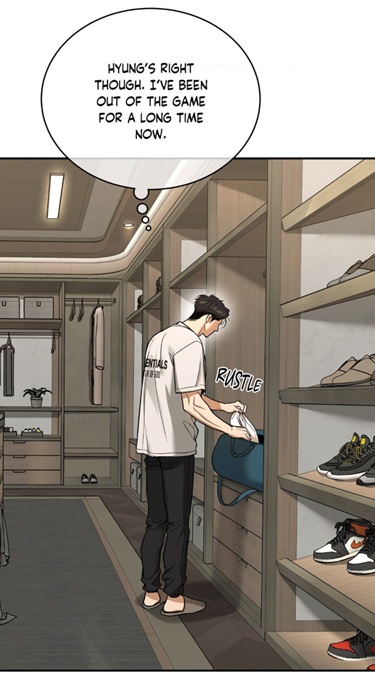 (chapter 66) For years, he had accepted his manager’s judgments out of habit, mistaking silence for consent. But here, for the first time, the repetition feels deliberate — not resignation, but reflection (“though”). The phrase becomes a question more than an agreement: is he truly right? He is admitting this out of habit.
  (chapter 69) His silence has shifted from obedience to suffocation. The weight of Namwook’s deaf authority is no longer bearable. And yet, even here, his confession is muted, confined to the private space of his car. He is not yet ready to speak the words aloud — not until someone appears who will listen.
  (chapter 48) This scene was observed by Kwak Junbeom, so the latter could have reported it to the coach. If it truly happened, this would expose the coach’s deafness and cowardice. He chose passivity instead of confronting the doctor or the champion. That way, he avoided responsibility. And this brings me to my final conclusion concerning the deaf manager. His main way to contact the celebrity is the cellphone:
  (chapter 66) It is both his mask and his crutch — a tool for barking orders, never for dialogue. The moment the line goes dead, his authority collapses, for he has no other means of contact. His power depends on Jaekyung’s reception, not his own strength. In truth, the manager’s disability is exposed here: deaf to Jaekyung’s voice, he has trained himself to hear only the ring of a phone. A fragile authority built on silence, ready to crumble the instant Jaekyung decides to switch it off.
 (chapter 76) must be read not as pride, but as a desperate shield against annihilation. In other words, in episode 76, the athlete is too harsh on himself, though I am not saying that he is innocent either. He only thought of himself because he had taught to behave that way. He was just mirroring the adults surrounding him who hid their weaknesses and wrongdoings behind “lies, social norms and hierarchy”.
  (chapter 6), both were forced to discuss with each other about the “content of the agreement”. That’s where the champion was trained to communciate with the physical therapist. Thanks to the champion, because of this victory/loss mentality, the doctor learned gradually to argue and “reply” with his “boss. However, due to his childhood, he couldn’t totally drop his old principles like for example “saying no”.
 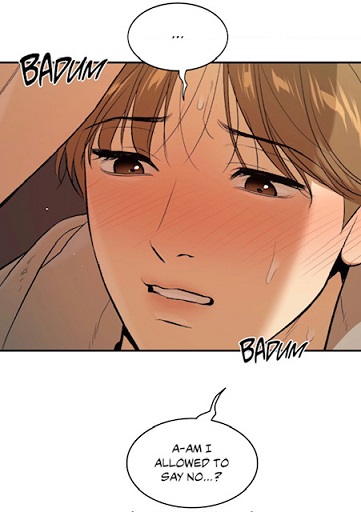 (chapter 34) To conclude, before their fateful meeting, neither man had learned how to argue as equals. But in the kitchen in front of the stove, this changed: both are right and wrong!
 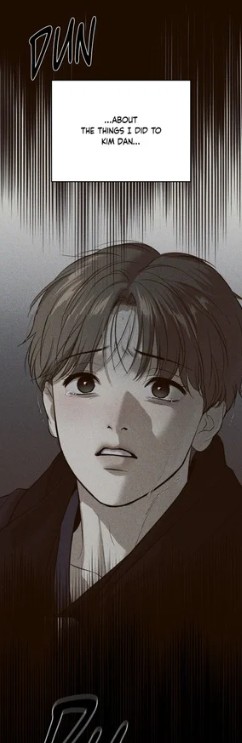 (chapter 76) He speaks like someone expecting rejection. Hence he keeps his distance. Yet the very fact that he says it at all signals change. Where once he would have doubled down — by barking an order, by firing Dan, by retreating into silence — he now admits defeat. The vocabulary of winning and losing, inherited from his father and reinforced by every adult in his life, collapses in the presence of Dan’s quiet honesty.
 (chapter 76) — an acknowledgment that he can no longer keep his walls intact. He is now willing to rely on doc Dan exclusively.
 (chapter 76). His confession reveals not strength but guilt. Kim Dan’s suffering was the price of his victories, and he knows it. “On the other hand, his mea culpa should be relativized, for both were the targets of a plot!
 (chapter 76) These words expose both responsibility and shame: he had prioritized survival over connection, career over compassion. What boils under his skin is not pride but remorse.
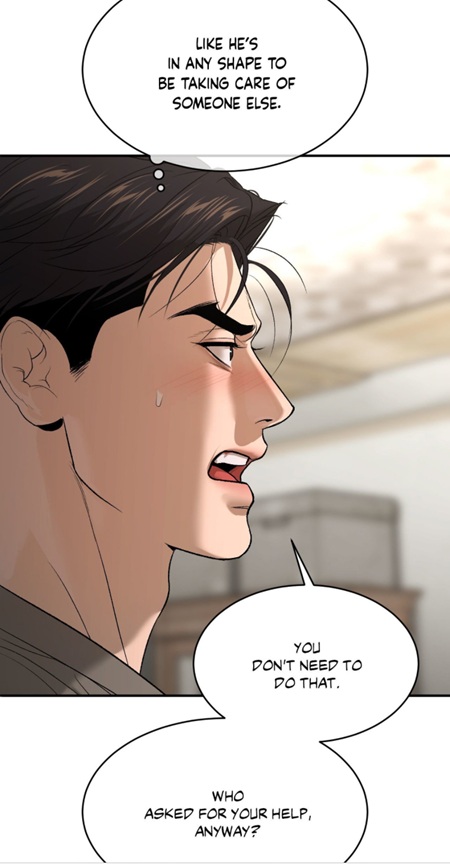 (chapter 76) The star’s thoughts in the kitchen are actually mirroring the ones in the bathroom:
  (chapter 68) In the bathtub, he still saw himself as the one in control, with the upper hand… but this is no longer the case in the kitchen. Through the physical therapist, the wolf is learning that even being in a vulnerable state doesn’t mean that this person is powerless. It is just that his “strength” lies elsewhere. In other words, someone struggling can also give comfort to another person in pain.
  (chapter 72) a place of solitary consumption rather than shared meals, the bed was the place where the little boy would drink his milk.
  (chapter 76) But the wolf didn’t understand the hamster’s intention and followed his “hyung” to the kitchen. That’s how a misunderstanding was born which is also reflected in this interaction:
 (chapter 76) However, doc Dan agreed to this, he remained calm.
  (chapter 46) It was a place where others dictated terms, while Jaekyung’s silence was mistaken for consent. And now, you comprehend why the two main leads could get closer in front of the stove in the kitchen. This place stands for warmth, care and family.
  (chapter 13) a meal after his collapse. He refused to bring a meal to the bed, he asked him to join in the dining room and sit at the table. And what did they do there? The champion talked about his career, his fight etc…
  (chapter 13) the champion has long associated the table to business and not “care”. That’s why it is important for him to remember the significance of the bed in his childhood. It was the place where he could feel comfortable and safe, where he would eat!

 (chapter 75), the perfume
  chapter 75) that suddenly appeared on his body
  (chapter 75), for example, were left unmentioned — proof that silence still surrounds him.
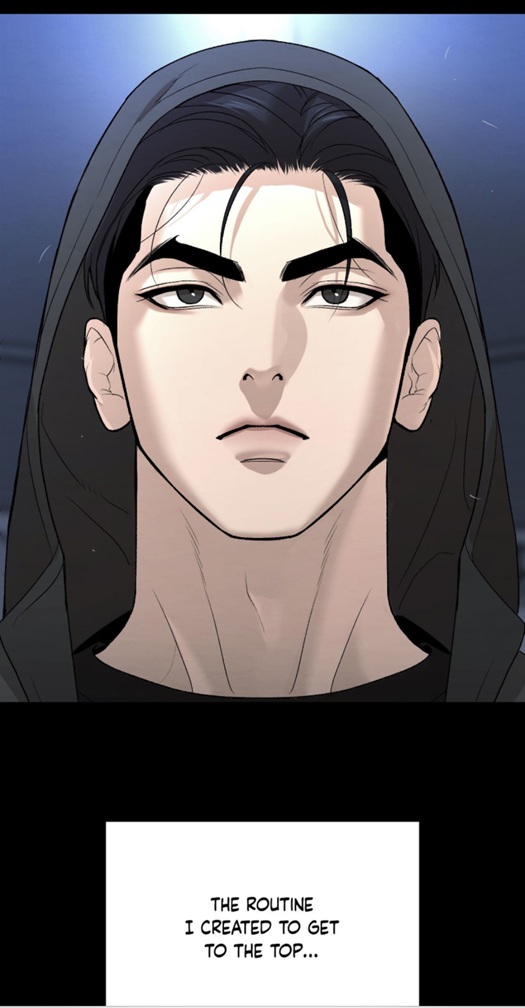 (chapter 75) Why fight as though every match were a matter of life and death? Why keep repeating the same acts, long after survival was secured?
  .(chapter 75) They are the product of a long chain of humiliations, betrayals, and systemic exploitation, each layering onto the next until a young man’s raw talent was encased in a carapace of compulsions. To understand the jinx is to understand how the protagonist’s life collapsed around the word loser, and how the fighting industry transformed his private shame into public myth.
 (chapter 72) Even before stepping into a professional cage, his life had been a series of trials to prove he was not worthless.
  (chapter 74) Hunger, poverty, bullying, insults— each branded his body with a language of violence. Among them came his father’s words, spat like a curse: loser.
  (chapter 75)
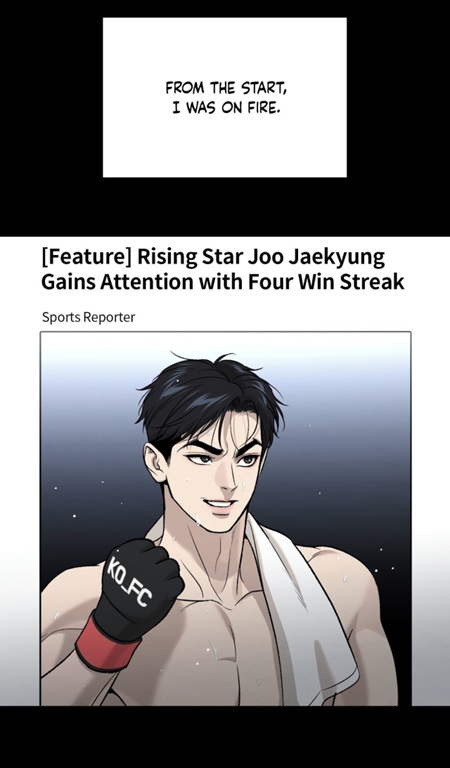 (chapter 75) — a boy who fought with the desperation of someone who had nothing else. Victory after victory gave him the illusion that he had escaped his father’s shadow. As long as he was winning, he could suppress the pain, bury the insult loser, and silence the memory of that cursed night when his father died and his mother abandoned him. Triumph became his shield, proof that he was not what he had said he was.
 (chapter 75)
  (chapter 75) To them, a fighter’s struggles had only one explanation: weakness. Park Namwook and the other coach dismissed his losses as nerves
  (chapter 75), as if the only measure of worth were what happened under the spotlight. They never thought to ask what kind of weight he was carrying, what kind of nights he was surviving before he entered the cage. While the other fighters were well aware of the champion’s insomnia
  (chapter 75), Park Namwook still has no idea of the champion’s struggles. This shows how disconnected he is from his “boy”.
 (chapter 74) bodies to be tested, pushed, and discarded if they broke. Where Jaekyung’s defeat cracked open childhood trauma, they saw only performance failure. What he lived as suffocation and despair
  (chapter 75) Even before his first loss, Jaekyung fought like a cornered animal, pouring every ounce of strength into proving he could not be beaten. That’s why he rose so fast. But why? The reason is that all his opponents were reflections of his “father”.
  (chapter 75) Consequently, his matches always looked like life-and-death struggles. He wasn’t strategizing against a specific fighter; he was exorcising a ghost. That’s why he never refused a challenge. His opponent never mattered. Besides, as long as he could win, it didn’t matter.
  (chapter 75), the more the cracks showed — and the ghosts of his father and mother made every fight feel like a replay of abandonment and accusation. The five losses
  (chapter 75) were not just setbacks in his career; they were the repeated reopening of a wound that would never heal. Each one confirmed his father’s curse. Each one reinforced the sense that he was marked, that no matter how high he climbed, he would always be dragged down again.
 (chapter 73) To the boy, it was a cry for pain and survival — an instinctive urge to escape despair and criticism. To the father, it was betrayal. Already emasculated by failure and drink, he was reminded of his wife’s discontent, the specter of another abandonment. He lashed out the only way he knew:
  (chapter 65), his dissociative pleas
 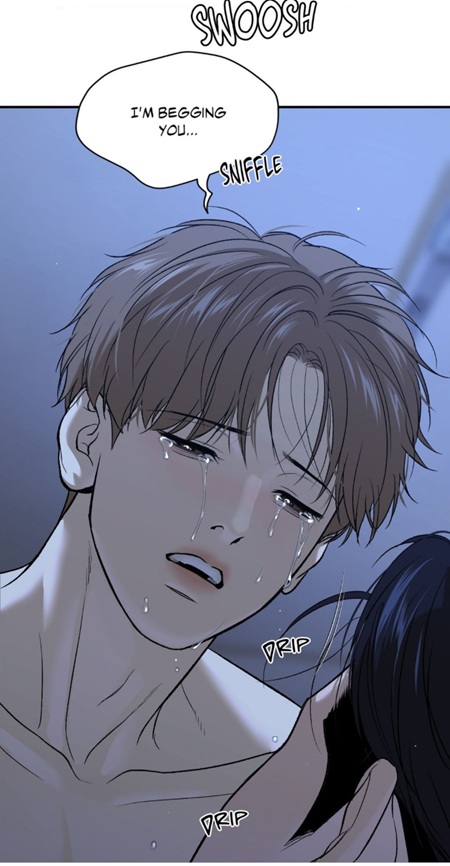 (chapter 66) give Jaekyung the words his father could not say. Where the father’s unconscious leaked out in aggression, Dan’s unconscious offers gentleness and honesty. Both men speak from a place deeper than reason; one chained Jaekyung to guilt, the other opens the possibility of release. In Dan’s trembling body, Jaekyung sees the tender reflection of his father’s hidden plea
  (chapter 72) His violence expressed his powerlessness. And when his son shouted his desire to leave the “dump of a house,”
  (chapter 57) Violence and insult became his only idiom. “Loser” was not simply an accusation, but the displaced confession of his own defeat: I was abandoned. I failed. I have nothing.
 (chapter 73) The boy’s boxing talent was a source of pride — proof of strength — but also a threat. Strength meant escape. Escape meant abandonment. The father, who had already lost his wife and his dignity, projected onto his son the terror of losing everything once again. His resentment was not born of disappointment alone but of recognition (unconsciously): you are me, and you will leave me too.
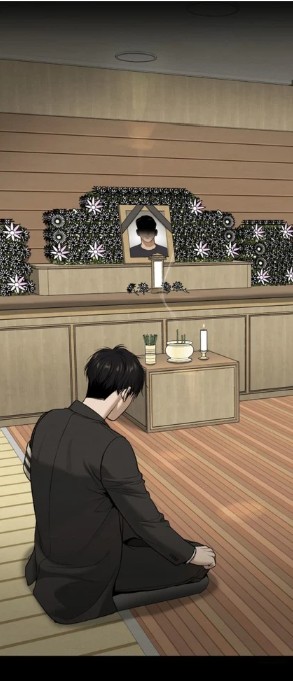 (chapter 74) His father may have been an orphan, just like his mother too. Therefore the latter was emotionally unavailable, and so he inherited not only trauma but also silence. By contrast, Dan has at least one surviving figure — flawed as she is — who keeps the family thread intact. That contrast makes Jaekyung’s bond with Dan all the more significant: it is not just romance, but an attempt to build a family line that never existed before him.
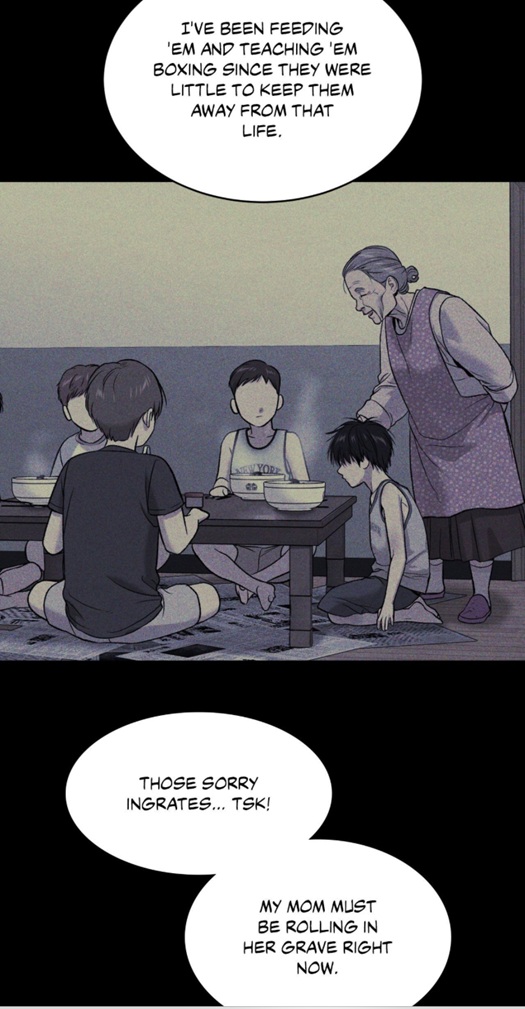 (chapter 73), while keeping Jaewoong’s own origins shrouded. Hwang had someone by his side — gentle, quiet, but present — while Jaewoong had no one, as according to me, the mother was counting on her “husband”‘s success and dream. The director’s stability, however fragile, was rooted in that maternal figure. Jaewoong had no such guide, and without it, he simply made the wrong choice.
 (chapter 73). To win was to prove his father wrong, but to stand alone in victory was to prove his mother right. Success and emptiness became inseparable.
 (chapter 56), seemingly fragile and dependent. But unlike her, he stays. Where the mother left, Dan endures. He only left because of the champion’s final words:
  (chapter 73) mirrors what the director later whispers to Jaekyung:
  (chapter 75) This is the wolf’s ritual in front of the tender mirror: the fighter who lived by curses and silence finally meeting their reflection transformed into gentleness and endurance.
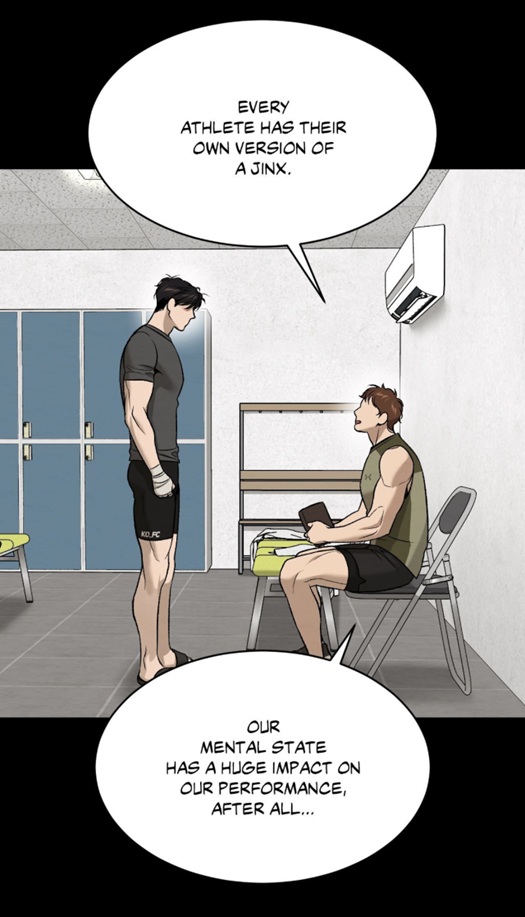 (chapter 75) If ritual could bend fate, he would build his own. But where the Bible fighter had a single, unifying story — scripture, God, fellowship — Jaekyung had nothing to draw on. No faith to lean on, no parental blessing to inherit, no safe home to return to. Instead, he began to stitch together a mosaic of rituals, each one disguising a different childhood wound. To outsiders it looked obsessive, neurotic, almost superstitious. To him, it was survival. Each gesture was both repression and remembrance, a scar disguised as armor. And this is the paradox: the rituals made him strong enough to survive, but too broken to live.
  (chapter 27) , self-punishment, the willingness to suffer endlessly for the cage. He didn’t fear pain. Their sudden appearance
  (chapter 75), a reminder that he had entered a machine in motion, a system that swallowed fighters whole and spat out statistics. From that point, the acceleration was merciless: by April, he was in the 272nd bout against Randy Booker
  (chapter 14); by June, the 293rd against Dominic Hill
  (chapter 75), he had not merely “built” a career, he had been consumed by one. There was no time to recover from injuries, no space to process victory, no room to integrate defeat. No wonder why his shoulders were in bad shape.
  (chapter 75) Every fight blurred into the next, every opponent older, stronger, more experienced. And yet Jaekyung fought them all with the same desperate, survival-driven ferocity.
 (chapter 27) still called him an athlete — someone whose body required balance, protection, recovery. But MFC and KO-FC never did. For them, the main lead or his colleagues were addressed as
  (chapter 14) “The Emperor”, “a crazy bastard”
 (chapter 40), “my boy”,
  (chapter 47). Thus only doctors are allowed to do them officially. But Jaekyung’s rise shifted that meaning. As “The Emperor,” he normalized tattoos for the new generation of fighters, transforming what once marked marginality into a badge of visibility. This is why even Oh Daehyun, one of his admirers and members of Team Black, now carries one:
  (chapter 8) The celebrity’s suffering literally redefined the aesthetic of the sport. His body, turned billboard, became part of the league’s branding.
 (chapter 5) the name Seo Gichan appeared here for the first time… a faceless name!
 (chapter 47), questioning the selection of Baek Junmin, is so crucial. It shows that the manipulation of opponents was no accident — it was systemic. Matches were not about fair combat but about narrative management: making sure the emperor’s story served the company’s balance sheet.
 (chapter 75) Here, it looks like a mirror, but naturally it is a fake one. It was not earned with fists alone; it could be stripped, reassigned, reshaped at will. One tie, one whisper, one adjustment in the rankings, and the Night Emperor was dethroned without ceremony.
 (chapter 75), not for intimacy but to clear his head and stave off loneliness, emptiness and his abandonment issues.
 (chapter 75) must be read in this light. It is not a relapse into the system’s treadmill, nor a blind return to the pitfall laid before him. Notice that he does not say he will fight in the fall, nor does he mention the upcoming match that everyone else is waiting for.
  (chapter 71) Instead, he frames his goal with a word that changes everything: reclaim.
 (chapter 51) The mirror is clear: the cycle can be broken, but only if he dares to answer the question that was never asked of him before. Therefore it is not surprising that the physical therapist’s question appeared in the champion’s vision:
  (chapter 54) His unconscious was telling him to have faith in his “doctor”. Thus later, the champion told the director of the hospital this:
 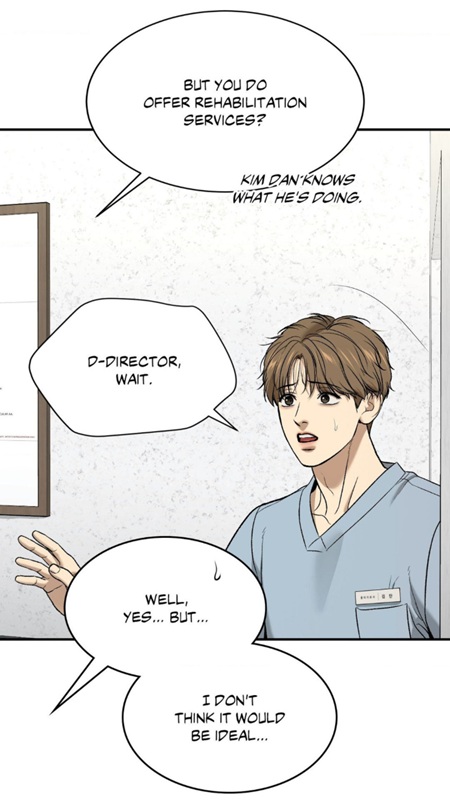 (chapter 61) He was acknowledging the main lead as a real physical therapist.
 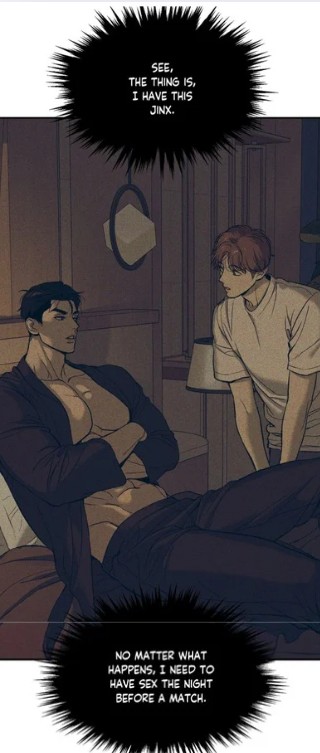 (chapter 62)— and even to those closest to his body — it looks like nothing more than sex. That was all the uke from chapter 2 saw, and it was enough for him to sneer:
 (chapter 2) The insult landed with devastating familiarity, not as a new wound but as an echo of his father’s curse: “loser.” Both words reduced Jaekyung to nothing — not a man, not an athlete, just a fraud kept alive by crutches.
 (chapter 2) In slamming his former partner against the wall, he was not merely silencing a lover’s cruelty. He was fighting the ghost of his father, the voice that had branded him weak, cursed, unworthy. The jinx that kept him alive was being twisted into proof of his failure, and he could not bear it.
  (chapter 2)
 (chapter 62), Dan recoiled.
 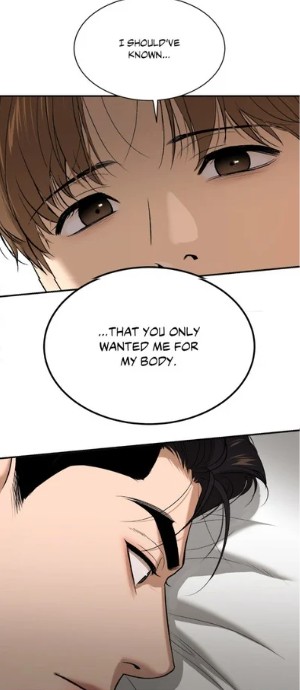 (chapter 62) To him, “jinx” meant objectification, a reduction of their bond to sex.
  (chapter 62) but as a therapist he trusted. His words about wanting to return to the “usual pre-match routine”
  (chapter 62) were, in his mind, a way of saying: I need you to bring back wholeness, to help me steady myself again. But because Dan only knew fragments of the jinx, the message landed with devastating distortion.
  (chapter 62) For Jaekyung, the plea was about coherence; for Dan, it sounded like reduction.
 (chapter 22) He cooks breakfast for Jaekyung, offering something warm, homemade, human — a substitute for the cold, industrial glass of milk.
  (chapter 54) throws the plate away
  (chapter 54) But when Dan cooks, Jaekyung is surprised, even touched. For once, nourishment is not consumption but connection. The milk was always a disguised memory of deprivation; Dan’s meal becomes the antidote — food as presence. So for him, the prematch-routine was also referring to the meals prepared by his fated partner. And I feel the need to bring another aspect. Since there was no “family” in the athlete’s life, he never got the chance to discover the joy of the table.
  (chapter 22) Hence it is not surprising that he looked at his phone, while the others were eating and discussing. He never had a real conversation with a family member around the table.
  (chapter 45), whispering that he misses Jaekyung’s warmth, reveals that the champion’s natural scent is already enough. He never gets to see this — Jaekyung doesn’t know how deeply Dan treasures his smell.
 (chapter 2), and not the other rituals? Because to admit the rest would be to expose the origin of the jinx: the father’s insult, the mother’s abandonment, the hunger, the bullying. Sex was the only ritual that could be spoken without directly dragging the past into the room. It was the “safe” shorthand — though tragically, it became the most dangerous. Homosexuality is definitely a stigma among boxers and MMA fighters.
 (chapter 68) In his own way, he was showing him that he did care! He was more than just a body… or even a physical therapist!!
 (chapter 35) It is the steady mirror of Kim Dan.
 (chapter 13) — helpless, cornered, often pleading. Thus the champion taught the doctor to overcome his fear and fight back:
  (chapter 26) This imbalance was no accident. It replayed Jaekyung’s own childhood roles: he became what his father had been to him (the better version naturally, for he is the mirror of truth), and forced Dan into the position he had once held himself. Through Dan, Jaekyung unconsciously re-enacted his trauma, reversing their positions as if to master what had once mastered him. That way, he was pushed to mature emotionally! That’s why he could connect with the main lead unconsciously. His trembling words in Chapter 51
  (chapter 71) He believes to know the truth, while he is ignorant. He is insecure, extreme in his behavior (drinking)
 (chapter 71), but also selfish and questioning, still fragile yet capable of protest. He is struggling with his own emotions and thoughts.
 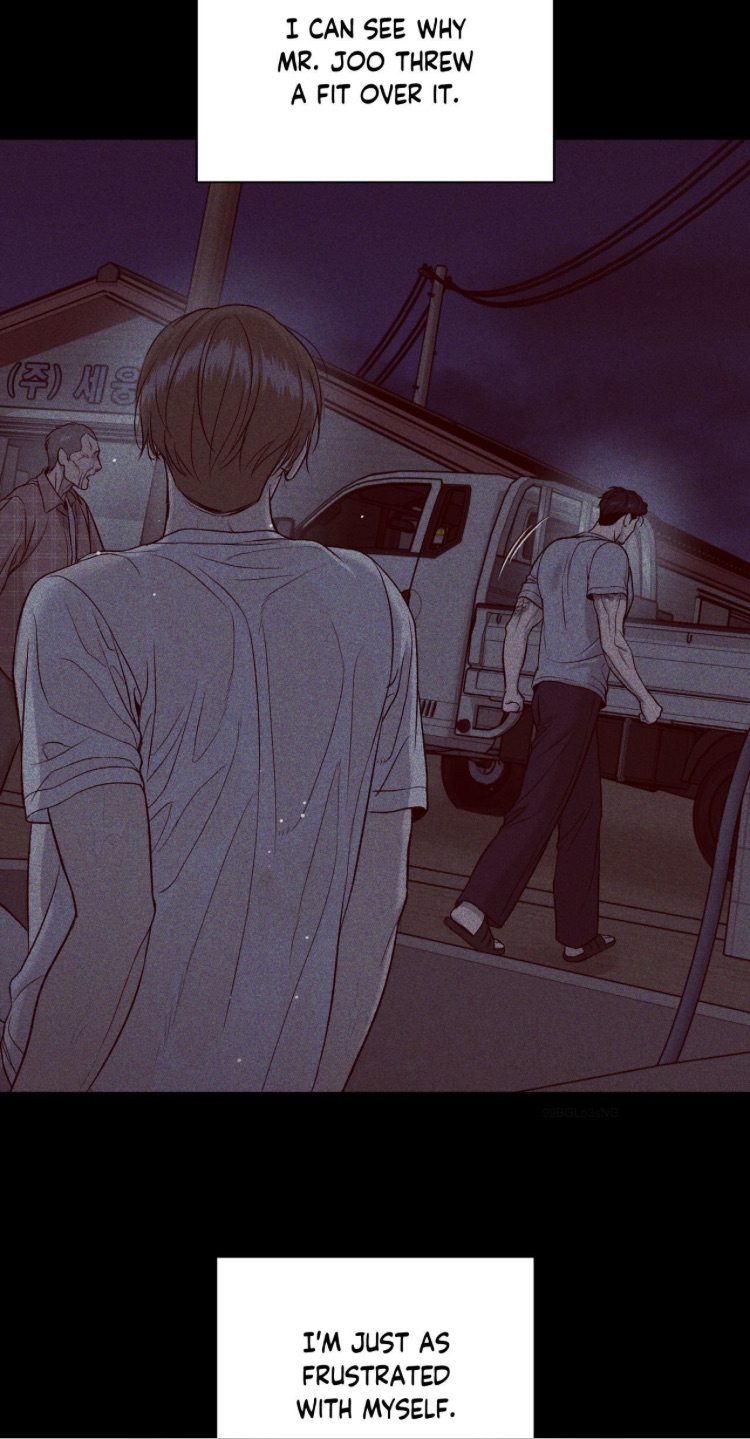 (chapter 71) How can he trust the athlete, when he doubts himself so much? From my point of view, he is on the verge of become “mature mentally” and as such “responsible”. At the same time, Jaekyung is revealed as the adult in crisis. His exhaustion
  (chapter 70)
 (chapter 74) It is because thanks to the director’s confession, the “hamster” is able to see the champion as a “a kindred spirit“, an orphan and as such as the younger “boy”.
  (chapter 7)
  (chapter 26), because it is play, because it is chosen.
 (chapter 36) He can retaliate differently. With his money and power, he can prove to them, he is no loser!
 (chapter 53)
  (chapter 75) His eyes open after the dream, and they open to the same light. It’s the opposite of every earlier awakening
  (chapter 54) —no gasp for air, no clutching his throat
  (chapter 75), no father’s voice strangling him. This sudden awakening embodies enlightenment.
  (chapter 75)
 (chapter 70) He knows the athlete from the past. The latter was attached to people and not to places. Why does he speak of “something” rather than “someone”, if he knows? The lesson is not about fixing a new goal or object to chase, but about discovering how to live differently — how to live happily.
  (chapter 65)
 (chapter 75). Even before, he could only mutter to himself this:
  (chapter 70) The negation indicates denial, but observe that he couldn’t even use a noun. He cannot yet translate this vision into words, because he has never heard “I love you” himself
  (chapter 75) His love is expressed through humility — through not knowing. At the same time, his words and facial expression ooze trust and confidence.
  (chapter 29), Joo Jaekyung opened up a little to doc Dan! Thus the next morning, he visited the bathroom where doc Dan was!
  (chapter 30) It was just an excuse to spend more time with his fated partner.
  (chapter 74), no “dear,” no “I love you.” In the father’s memory, she used the child as an excuse to distance herself from her spouse. In that moment, Jaekyung is not a son to be cherished but a barrier in an adult quarrel.
 (chapter 67) Not because he felt nothing, but because he lacked the language to connect worry with love. In his conscious mind, conception of care was still bound to usefulness — Dan mattered because he was needed for training, not because he was loved as himself, while deep down, he had already moved beyond this aspect. He was just in denial in this scene,
 (chapter 74) On one level, she does not recognize his voice. But on a deeper level, her words ring as truth: she does not know her son. She has no idea who he has become, what defines him, what characterizes him beyond money and survival.
 (chapter 74), promising to provide for her if she returns home. He unconsciously appeals to the only logic he has ever known: that love equals provision, that affection is secured by usefulness.
 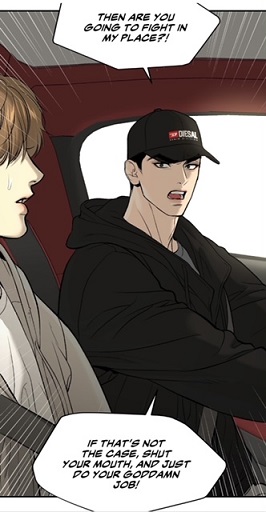 (chapter 42) His father’s voice was violent and scornful, but its framework remained lodged in him.
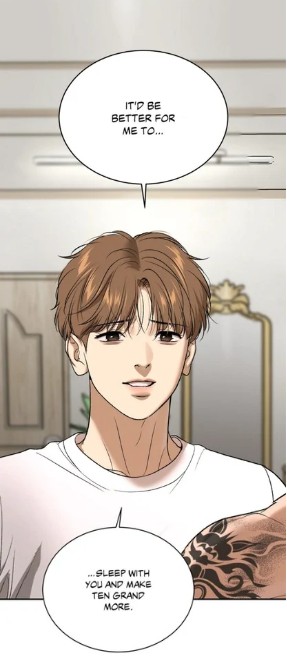 (chapter 62) That way, he can still be “free”.
 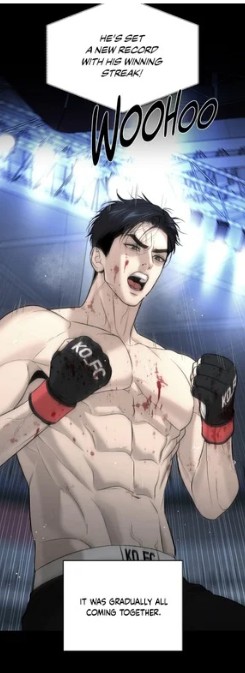 (chapter 75) Keep in mind that we have these mysterious phone calls:
 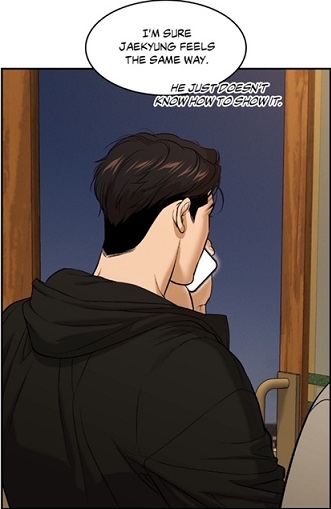 (chapter 43)
  (chapter 49)
 (chapter 75)
  (chapter 34), Jaekyung assumed later that the actor would have helped doc Dan to hide.
  “ (chapter 75) There’s a life outside the ring and the spotlight.
 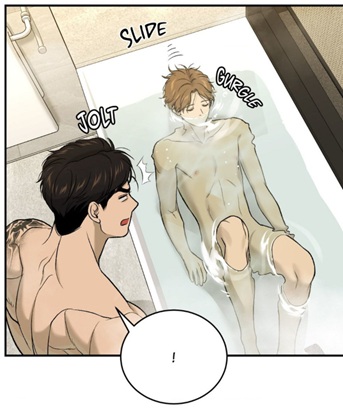 (chapter 68)
  (chapter 69)
  (chapter 69) And that’s what makes him so human.
 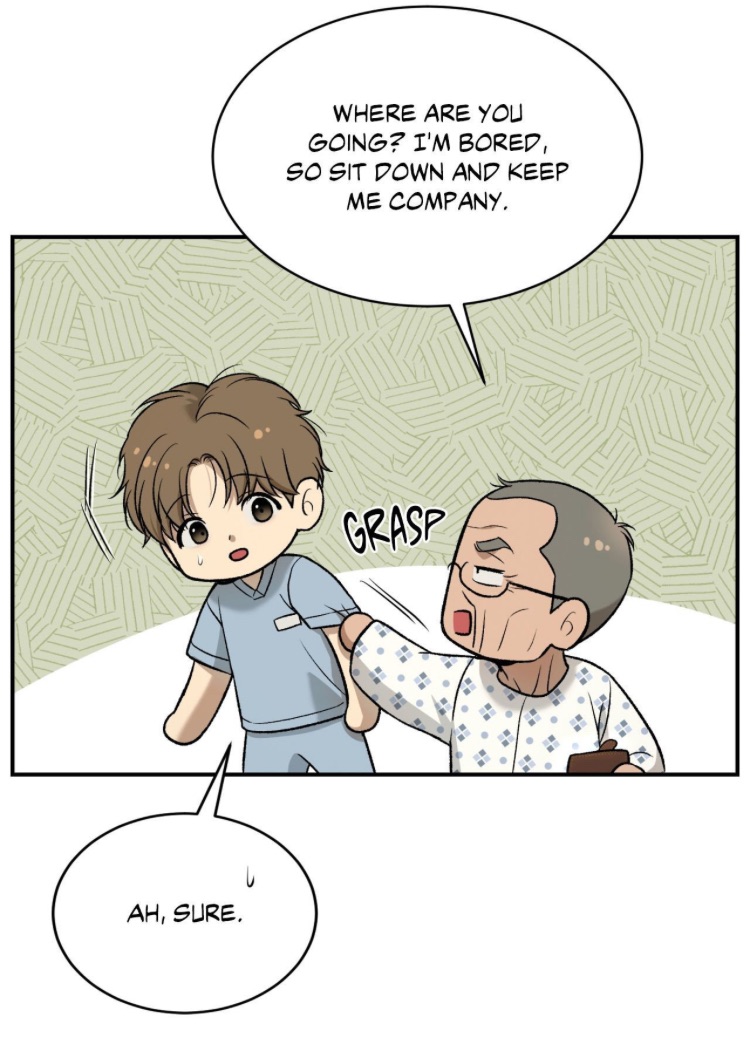 (chapter 71) This means that he lives now in the present. It looks like the “old coot” has been tamed by the “gentle hamster or duck”.
  (chapter 21) , little signs of comfort that suggest he grew up in relative security, even if his parents were often absent for work. For me, his childhood was not defined only by poverty but by rupture: love was present, then violently cut short. To a child, such a disappearance feels like betrayal, even if it was no one’s fault. Dan would have been left with a terrible contradiction — that “I love you” was true, and yet those who said it abandoned him forever.
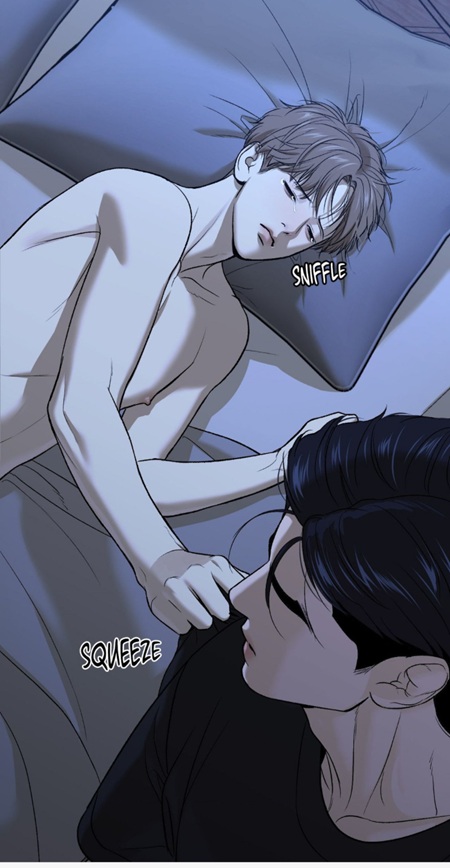 (chapter 66), whispers through tears
  (chapter 44) Dan once received love of a different kind — playful and tender. A kiss cannot have come from the grandmother, who expressed affection only in gestures of care, never of intimacy. That kiss belongs to his mother.
 (chapter 31)— which he associates with unbearable debt. His mother’s final “gift” of love was one he could never repay. Any present risks reopening that wound: “What if I can’t repay this? What if I lose them too?”
 (chapter 74) — the quiet sign that the sun is about to rise. Dawn is not just a natural detail in Jinx; it is a symbolic hinge. It is the moment when night meets day, when moon and sun overlap, when endings bleed into beginnings. In myth and fairy tale, dawn often marks metamorphosis: the Little Mermaid turns to foam, the enchanted sleepers awaken, the beast becomes a prince. For Jaekyung, too, dawn is the threshold. His father cursed him at dawn
  (chapter 73), stripping him of worth, tying the rising sun to shame. But in this new dawn, another voice will have to intervene. Only Dan can replace the curse with a blessing. Only “I love you” can undo “you are not special.” And if it is not “I love You”, then it could be a kiss, the symbol of “affection”.
  (chapter 41), an invitation to walk together. Namwook’s long presence embodies the trap of quantity without substance. Dan’s brief but luminous presence reveals the power of quality: the kind of attention that transforms.
 (chapter 75) Namwook’s whispers, too, keep him chained to that rhythm of urgency — rankings, titles, deadlines. But once Dan’s whisper replaces Namwook’s, time itself shifts. The future is no longer a debt to repay but a horizon to approach slowly, hand in hand.
 (chapter 27), even rediscovered his love for swimming. Water, his true element, was reclaimed as play rather than punishment.
  (chapter 27) That single day was a seed — a foreshadowing of what life might look like once the curse is broken for good.

 (chapter 26) They have watched his fights
  (chapter 23), memorized his moves and titles, and repeated the anecdotes told in gyms and on TV. They’ve heard how he was “saved” by sports from a darker path, and cheered for him as the “Emperor” — the handsomest fighter, the man who broke the arcade’s punching machine
  (chapter 26), the champion who stands above the rest. But if the champion’s life is already an open book, why did Mingwa wait so long to reveal his childhood and family? The answer is simple. It is because Joo Jaekyung has been called the Emperor till his fight against Baek Junmin! These public portraits — the friendly banter in the gym, the theatrical ring intros — show us the merchandise, not the man. They are the carefully polished surface presented to fans and fellow fighters alike, repeated so often that even those closest to him believe them. Yet behind this image
  (chapter 70), Hwang Byungchul’s anger fell squarely on the champion.
  (chapter 69) It was as if the main lead, backed by his team, had personally approached MFC to request the match — an illusion strengthened by the opening line, “MFC’s former champion Joo Jaekyung will be returning to the ring this fall after serving his suspension.” This way, if the decision draws criticism, the CEO can retreat behind the fighter and his team, like they did in the past.
  (chapter 67) That’s the reason why this suggestion from the CEO appeared the very next day.
  (chapter 61), it was paired with a recommendation for rehabilitation — not an immediate return to competition. This was actually a condition for his total recovery. On the other hand, the doctor imagined or suggested that his patient wished to return to the ring so soon. No medical professional ever signed off on an autumn fight. Yet the date is already set, and the headlines frames it as a confident comeback without any medical backup. The Emperor’s name is splashed everywhere, but none of the words belong to him.
 (chapter 41), while the image released with the fall match announcement was the one from when he first won his champion title.
 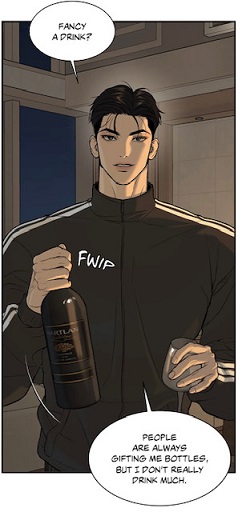 (chapter 12), never mind that he hardly drinks. The gesture fits the fantasy they’ve built around him, not the reality of a man who rejects alcohol due to his addicted father, a reminder that even the tokens of admiration are shaped by the image, not the truth. So who is this so-called close associate or “Joo Jaekyung’s team” exactly that decides for him, speaks for him, and hides behind his title? Besides, why did the journalist change from “one of his close associates” to “Joo Jaekyung’s team”?
 (chapter 57) The nickname, played for entertainment value, was another way of turning the champion into a caricature — a marketable, amusing persona instead of a man with a past and agency. It is quite telling that Park Namwook’s interview aired immediately after the anchor referred to Jaekyung as “Mama Joo Jaekyung Fighter.” This was not the lofty “Emperor” title repeated in gyms and ring intros — it was more a mocking nickname, a deliberate jab meant to provoke. In that moment, the Emperor was verbally pulled down from his pedestal, yet the images shown alongside the segment told a different story: carefully chosen shots of him as a champion, a visual echo of his marketable persona. The dissonance was striking.
 (Chapter 52) This framing lets him claim the prestige of leadership while leaving himself room to withdraw if things go wrong. Yosep was the one notifying MFC and reporting the incident to the police, Potato explaining his discovery to Joo Jaekyung and blaming the star.
 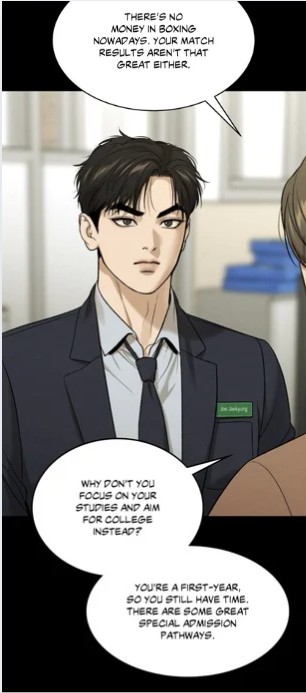 (chapter 73), by becoming a boxer, the champion wouldn’t make a lot of money. With this comment, he implied that boxing in South Korea had been losing popularity 10 years ago. This explicates why gradually, the members from Hwang Byungchul left the studio. And it was likely the same in the illegal fighting circuit.
  (chapter 73) The popularity of MMA in the States gave them the opportunity to revive fighting sports, a figure who could draw crowds and sponsors, making such events fashionable again.
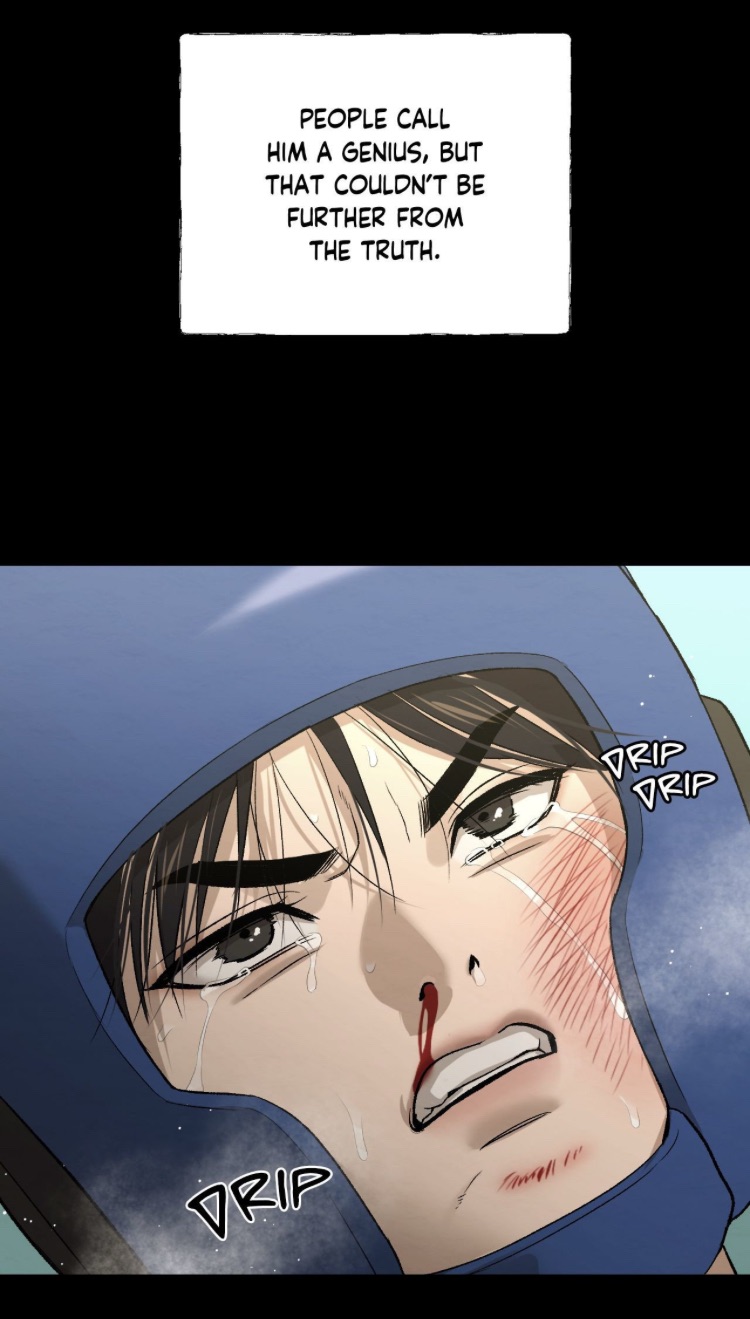 (chapter 72) instead of “hard-working,” a man who “chose sports over a dark path.” Yet if you look closely, this celebrated “ascension”
  (chapter 72), the scars of his family history, and the years of survival before the cage. This is history rewritten, his boxing past and family erased. Why? His origins could expose the ugly verity: the link between criminality and boxing (as such fighting sports). Secondly, because his real story, though moving, lacked the glamorous allure needed to market him. His real story would have revealed that to rise to the top, you need relentless work, not a miraculous moment. That version was never going to sell as well as the “genius” myth.
 (chapter 46) And, like any product, once it was seen as damaged, its value plummeted. The moment he “lost” his title and suffered injury (chapter 52), the dream began to unravel.
  (chapter 52) To this outburst, Park Namwook slapped Jaekyung in front of others (chapter 52).
 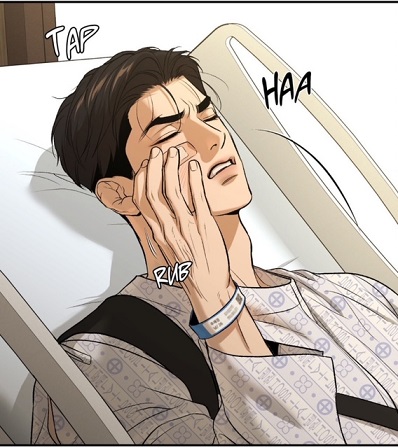 (chapter 52) He chose silence, and later avoidance, staying away from the gym. That silence was not weakness, but choice: he would listen less and less to his hyung.
  (chapter 36)
 (chapter 72) We don’t know how many times he called, but each time we see him do it, his face is injured.
  (chapter 72) The phone calls are therefore intertwined with the boxing studio, as though pain itself pushed him toward her. At ten, he picked up the receiver and let it ring only a few times before hanging up. The next time, in the dead of winter, he finally spoke, promising that if she returned, he would protect her from his father and make enough money to keep her safe.
  (chapter 55)
  (chapter 27), spent time with him, asks questions, confronts, and refuses to be reduced to a body in the room. He breaks the rule of silence. With him, Jaekyung can no longer hide behind the physical alone; he is forced to speak, to explain, to voice desires and fears. He pushes Jaekyung to engage in ways he’s spent years avoiding. In this way, Kim Dan becomes the first real threat to the system the champion built after those two curses — and possibly the first person who could prove that words can be safe again. And now, you comprehend why Joo Jaekyung was moved by the birthday card
 (chapter 62) To most, it might look like a simple gesture, but for him, it was a rare and precious thing — a voice that had taken the time to shape itself into words just for him.
  (chapter 55) The “spell” to break it is not some grand external event, but the simple, sustained act of honest communication — something that has been denied to him since childhood.
 (chapter 71) He saw affection in the hug, but he still doubted the champion’s action.
  Until now, the design’s images have played a secondary role, yet the answer lies in a single scene from chapter 41.
  (chapter 41) Under the bright sunlight, Kim Dan reached out toward the leaves, his hand open and unguarded, as he silently thought of the man he loved. This gesture, so simple yet so revealing, became the unspoken confession that marked the start of a different kind of freedom—the freedom to feel.
  (chapter 55)
  (chapter 71)
 (chapter 70) the night can also be alive, communicative, protective. In that moment, the moon becomes more than a distant light in the sky: it is a patient witness, a calm listener in the stillness, reflecting the truth he has yet to voice.
  (chapter 70) Its soft glow contrasts with the blinding glare of the cage lights, suggesting that under the moon, there is space for gentleness, for hearing one’s own heartbeat and another’s words. Just as the moon guides travelers through darkness, it can guide him toward a night that does not suffocate him with loss, but offers orientation and connection.
 (chapter 60) they were his own form of therapy. In saving someone else in the night,
 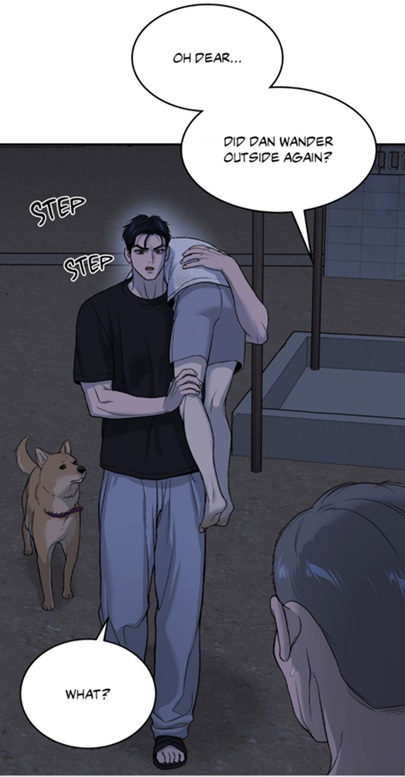 (chapter 65) he could prove to himself he was not powerless, he was valuable, capable of protecting what mattered.
  , (chapter 9) as if the champion’s volatility were a quirk (the actions of a spoiled child) to be managed rather than a wound to be healed. It is because he never talked to the champion or investigated his past. It was only about money and glory. The manufactured image of the erratic, temperamental fighter served Namwook well; it excused rough handling, justified bad press, and kept Joo Jaekyung dependent. Once the Emperor can name the truth of that night, the fiction collapses — and with it, Namwook’s control. He can only be judged as a liar and even a traitor, but we know that Joo Jaekyung has a big heart. He could love his father despite the abuse. Now, the missing link is Cheolmin!
  (chapter 13) Observe that this name is a combination between Hwang Byungchul and Baek Junmin! Under this light, my avid readers can grasp why the athlete kept his existence in the dark for so long! It is because the latter belongs to his past and knows the truth behind the Emperor! He was aware of his suffering. For him, he is not just a fighter, but someone who needed FUN in his life!
 (chapter 47) and denial for strength
  (chapter 61), Park Namwook
  (chapter 53) all operate within survival mechanisms shaped by trauma, guilt, and fear. They choose the illusion of control or calm over genuine healing. But as the story unfolds, these strategies begin to unravel. Each character must confront the truth behind their emotional habits, learning that happiness isn’t the absence of pain—it’s the result of confronting it with clarity and purpose.
  (chapter 54), Joo Jaekyung is cornered by a faceless, overpowering ghost. He is unable to fight or flee; only obedience and silence remain.
 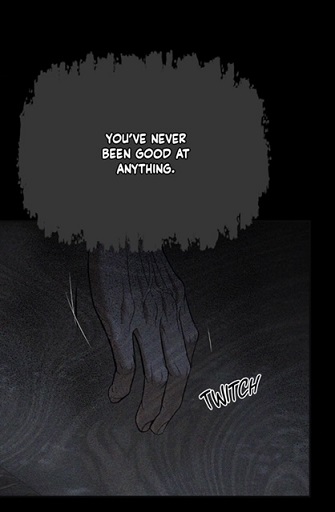 (chapter 54) He could only express his pain and resent through the hand. This moment encapsulates the core of his trauma: as a child, he learned to survive through silence and compliance, not resistance. Yet deep down, the resentment festered—toward himself, and toward the abuser. That psychological pain was redirected into becoming a fighter, as if to prove the abuser wrong.
  (chapter 14) But ironically, he became exactly what the abuser desired: a powerful, obedient puppet. His fame, discipline, and aggression were not signs of freedom, but evidences of emotional and mental captivity. That’s why the past from the champion is surrounded by darkness and mystery.
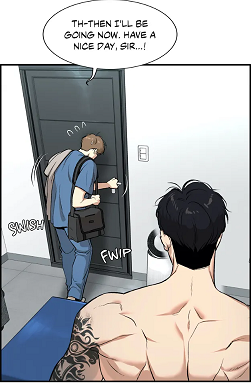 (chapter 1) Thus for the first time, Jaekyung had to develop a new strategy in order to meet him again: one that doesn’t rely on intimidation, but on communication. The problem is that since he saw the physical therapist running away after their first session
  (chapter 1), he knew that he needed to lure him with something: money
  (chapter 1). Under this new light, my avid readers can grasp why the athlete played a trick on the phone, though we have to envision that here the celebrity’s thoughts were strongly influenced by his bias and prejudices. He imagined that Doc Dan had made a move on him.
 (chapter 5) That retreat doesn’t mean failure—it can be an act of self-preservation. However, the champion experienced that he needed to speak with doc Dan in order to keep him by his side. This lesson became a turning point. Jaekyung started to speak more.
  (chapter 18) Therefore it is no coincidence that in episode 18, right after the celebrity spoke, Kim Dan’s reply was strongly intertwined with flight:
  (Chapter 18) Nevertheless, as time passes on, the wolf asks more and more questions. He reacts to emotional discomfort not only with physicality but with hesitation, introspection. He is no longer reacting as the ghost once taught him; he is arguing and as such adapting, growing. Thus we could say, he is less passive.
 (chapter 3) or table, in showers
  (chapter 7), against doors, or walls
  (chapter 34). On the surface, it may seem like a gesture of dominance or desire, but symbolically, it reflects silencing.
 (chapter 51) They stand in the middle of the room—an open space—symbolizing emotional emancipation. When Dan questions the celebrity
  (chapter 69) That silence could easily be mistaken for submission, for the same old performance of the compliant athlete.
  (chapter 69) with “no audience” (he ignores people), no pressure, no script. And in that openness, he lets go—not just physically, but psychologically.
  (chapter 7) and flight
  (chapter 36), or MFC’s decisions.
  (chapter 25: here the protagonist was replacing Yosep and Park Namwook), hires professionals to manage damage
  (chapter 66) But he never takes full responsibility. This blame-displacement strategy works—until the champion flees to the West Coast.
  (chapter 66) that cornered the manager.
  (chapter 60)
  (chapter 60), a sign that he is neglecting the other members. The absence of his star fighter removed his most convenient scapegoat, forcing him to face the consequences of his own mismanagement—though he is not yet ready to truly question it and change his mindset, denial, and dependency. This was not just a geographical disappearance—it was a strategic psychological rupture, meant to destabilize Park’s illusion of authority.
 (chapter 47) Finally, he can testify not only as a fighter, but as a representative of the institution they tried to exploit. That elevates his voice: from a disposable athlete to a legal opponent with organizational standing.
 (chapter 7) For a moment, he was fighting.
 (chapter 67) Moreover, in contrast to Season 1, Kim Dan is no longer the invisible caregiver or obedient grandson. Thanks to Joo Jaekyung’s presence—disruptive and painful as it was—he began to form an independent identity
 (chapter 57) —it is a rejection of the belief that he exists only to serve. In Season 2, Dan says “no” repeatedly:
 (chapter 60)
  (chapter 67)
 (chapter 58)
  (chapter 57)
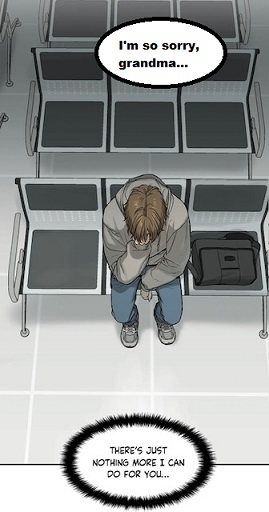 (chapter 5) Her illness becomes a metaphor for her mindset. She relies on external systems: her grandson
 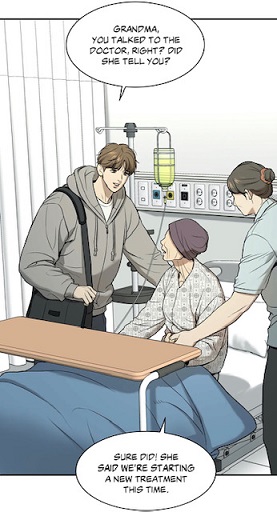 (chapter 7), medication, comfort
 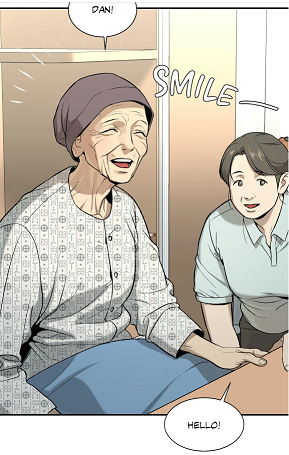 (chapter 7) His grandmother was not truly abandoned; she simply equated his physical absence with neglect, ignoring the emotional and financial burden he already carried. Like Park Namwook, she prefers others to carry the discomfort while maintaining a façade of suffering and sacrifice.
 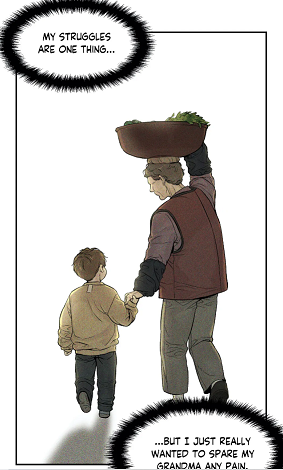 (chapter 5) Hence he made sure to shield her from any pain.
  (chapter 65), protected, comforted. Surrounded by nurses, medication, and routine, she finds temporary peace in an environment that simulates safety. The hospice does not cure her illness, but it cushions it. This illusion allows her to smile again, to relax—but only up to a point. Kim Dan’s gradual deterioration
 (chapter 163) and supported by the article on confirmation bias, human survival was deeply dependent on mental shortcuts. Biases were not flaws, but adaptive tools — heuristics that helped our ancestors make quick decisions under threat. Faced with a potential predator, they could not afford the luxury of curiosity or debate. Run first, think later.
 (chapter 163) In this sense, biases were effective precisely because they increased the chance of survival.
 (chapter 67) His survival bias told him: “Don’t trust a man who once treated you violently.” or “Doctors are ignorant, they don’t know me“. It was easier to discredit the source than to weigh the merit of the message. Likewise, in Season 1, the champion dismissed doc Dan’s medical opinions
 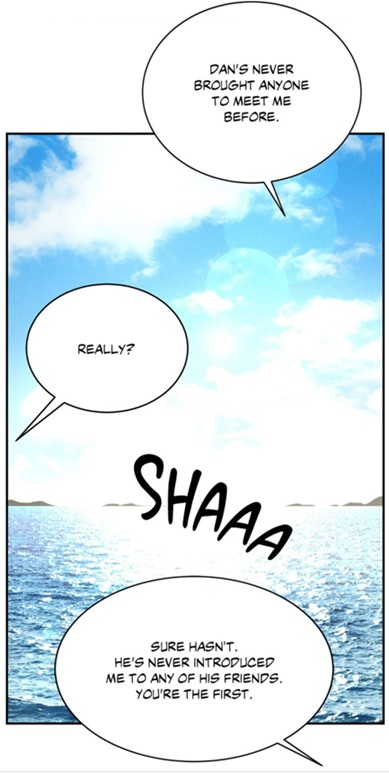 (chapter 65) or a support network. It is not her fault, if she never met doc Dan’s friends in the past while hiding the fact that he had been bullied by his peers. Her request for him to return to Seoul, a place he has no roots, only furthers his habit of isolation. Similarly, when she asked Jaekyung to bring him to Seoul and have him diagnosed, she implicitly discouraged any shared decision-making. Like Park Namwook, she bypassed dialogue in favor of directive control, reinforcing the habit of emotional withdrawal.
 (chapter 67) That shift marks a turning point from survival to conscious thought. The mind cannot reflect when it believes it is under attack. The tragedy is not that these characters are irrational — it’s that they were taught fear before they were taught trust. Thus I come to the following conclusion. As soon as both are curious about each other
 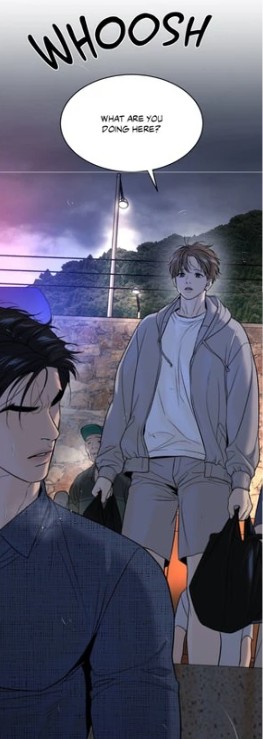 (chapter 69), they are now free from their bias and prejudices.
 Bebebisous33s' analyses in K-Dramaland and Manhwas