Protected: Jinx: Dawn’s Enigmatic Message – third version📱
Bebebisous33s' analyses in K-Dramaland and Manhwas
Analyses of K-dramas and Manhwas (for the most part Yaoi)

Please support the authors by reading the manhwas on the official websites. This is where you can read the manhwa: Jinx. But be aware that the Manhwa is a mature Yaoi, which means, it is about homosexuality with explicit scenes. Here is the link of the table of contents about Jinx. Here is the link where you can find the table of contents of analyzed manhwas. Here are the links, if you are interested in the first work from Mingwa, BJ Alex, and the previous essay about Jinx “Harmony’s Clash⚡: Prince S 👸 and Emperor 🤴- part 2”
It would be great if you could make some donations/sponsoring: Ko-fi.com/bebebisous33 That way, you can support me with “coffee” so that I have the energy to keep examining manhwas. Besides, I need to cover up the expenses for this blog.

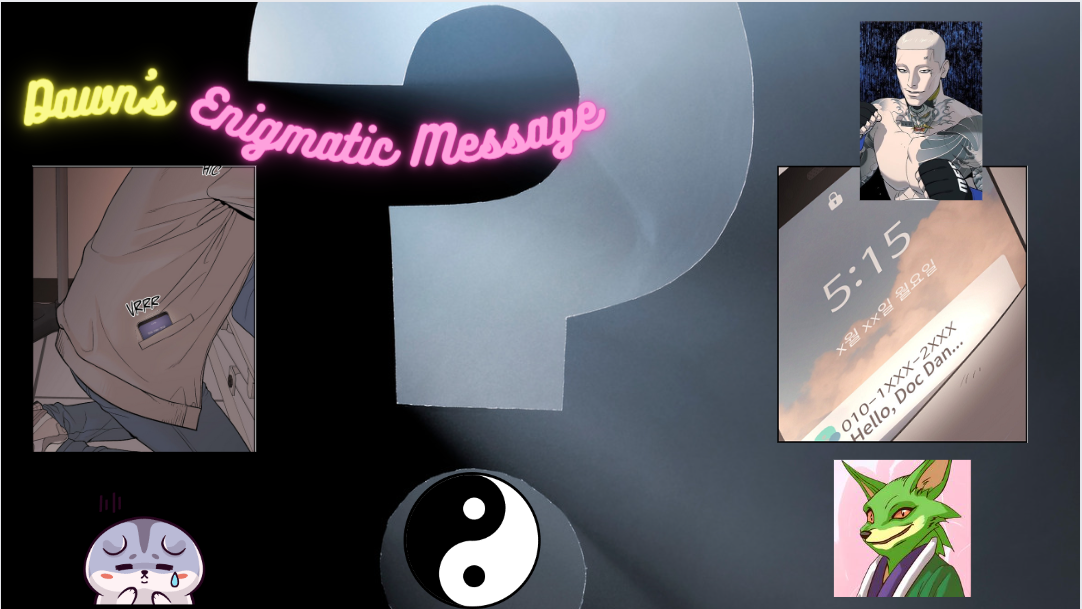
Like the illustration is displaying it, my main focus will be on the last part of chapter 47, the phone call and message from the “executive director” of King of MMA. 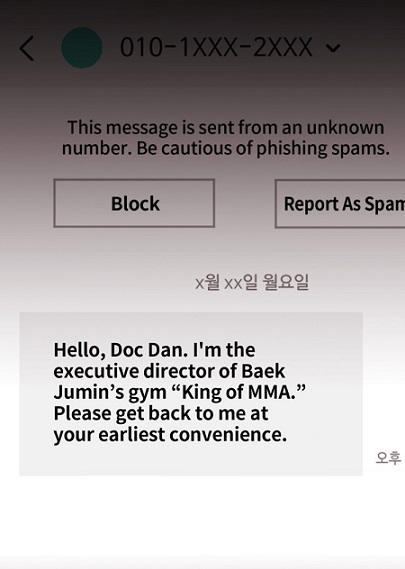 (chapter 47) Now, you are wondering why I decided to dedicate an essay about this scene. It is because the phone call and message raise a lot of questions. Why did the mysterious man call Kim Dan at such an early hour? Notice that it is in the morning, at 5. 15 am.
  (chapter 47)
How can I be so sure that it is in the morning, and not in the evening? Notice that in the Spanish version, the translator wrote “Buenas tardes” for hello giving the impression that it was in the afternoon. The person came to this conclusion because during the night before, Kim Dan looked at his cellphone. The doctor’s meeting with Kim Miseon was in the afternoon.  (chapter 47) The Spanish translator thought, the person calling Kim Dan was contacting him, after the doctor had met the oncologist. She imagined that not much time had passed. Yet, I believe, it is in the morning. First, it is important to place the day in the year. Since Joo Jaekyung’s birthday is on June 21st, and the next match is shortly after
 (chapter 47), I deduce that we are in July. However, the sunset in Seoul during that month is between 8:29 and 8:12 pm, whereas dawn in the same period and place is between 4:44 am and 5:07 am and sunrise between 5:15 and 5:36 am. Jinx-philes can now determine the time thanks to the position of the sun:
 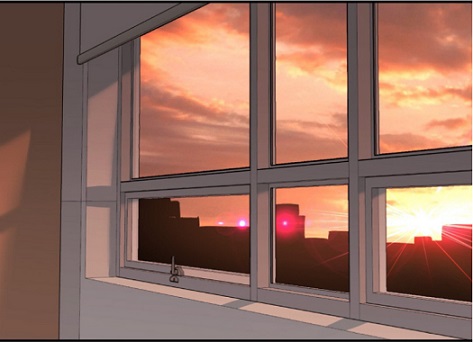 (chapter 47) It is in the morning. Moreover, the Webtoonist tipped off her avid readers with this panel:
  (chapter 47) In Korean, it is written MONDAY!! I had already detected a certain pattern. The protagonist would visit his grandmother on Sundays,
 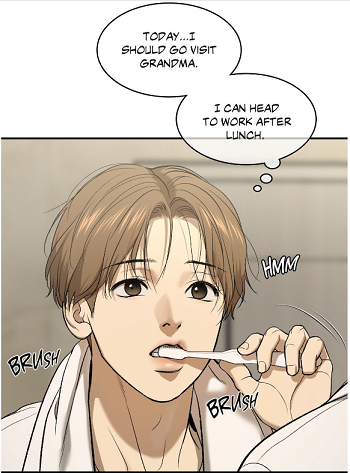 (chapter 30) as Saturdays are Kim Dan’s days. The morning in chapter 30 took place after the couple had spent their day-off together.
Thus I deduce that when the doctor returned home  (chapter 47), it was Saturday evening. Then the next day, he went to the hospital in order to get the results. After hearing the terrible news, he lost track of time. Hence he didn’t look at his cellphone contrary to episode 5.
 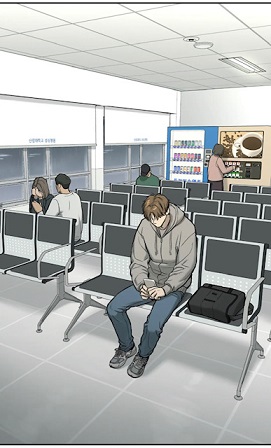 (chapter 5) On the other hand, I don’t think, he visited Shin Okja right after meeting Kim Miseon, for his grandma would have known that he had remained by her side the entire night. Nonetheless, her worries were about eating and not about lack of sleep.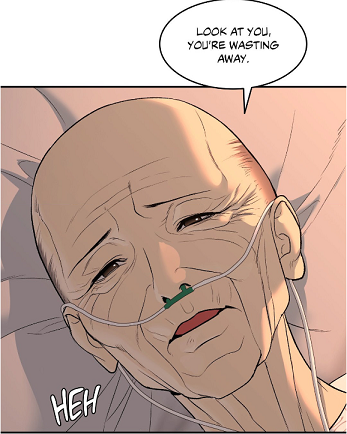
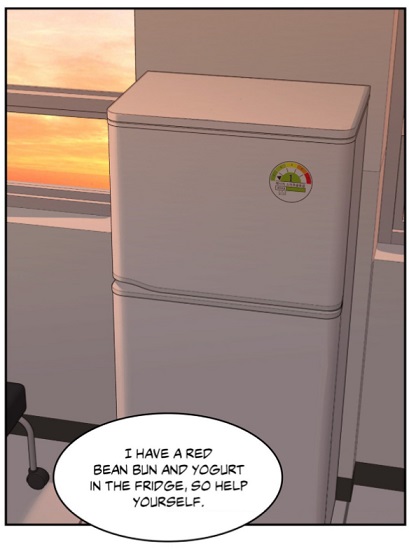 (chapter 47) Thus I come to the conclusion that he spent the whole night at the hospital like in episode 21:
 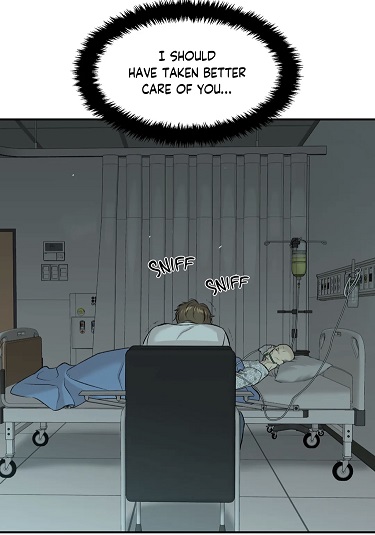 (chapter 21) This explains why the grandmother was not wearing her headgear. She was sleeping. But back then, Kim Dan returned to the penthouse at dawn.
 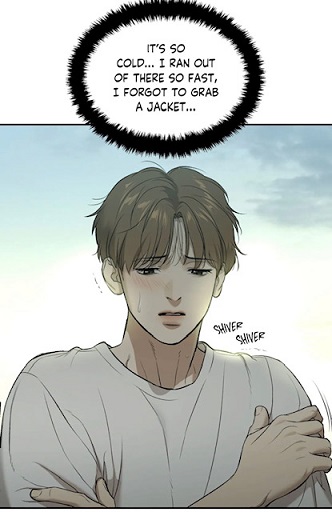 (chapter 21) Therefore the grandma didn’t notice that he had stayed by her side for quite some time, for she was asleep. Hence she requested his presence the next morning. Nonetheless, there exists another difference between chapter 47 and 21. In my eyes, Kim Dan entered her room during the night and spent some time in the bathroom.
  (chapter 47) He didn’t approach the bed the same way:
 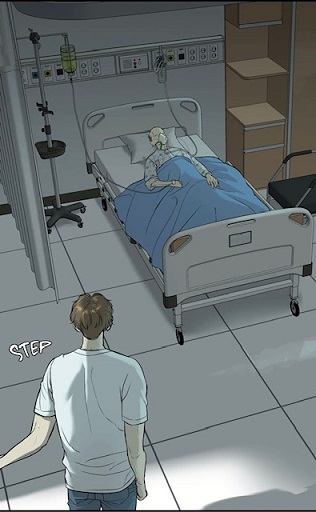 (chapter 21) However, I doubt that he spent just one hour in the restroom covering his tears by running the tap water.
 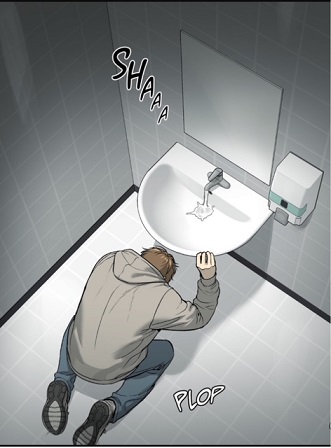 (chapter 47) I have the feeling that this scene is a reflection from their first night.
 (chapter 3) Here, he was also sitting on the floor pondering if he should still accept the deal. And what had happened back then? The protagonist was lost in the moment, he had no notion of time because of his fears and social norms. As a first conclusion, Kim Dan spent a lot of time in the bathroom reliving the moment when he was receiving the bad news. This interpretation displays how much his grandmother’s imminent death devastated him. He had spent the entire night crying:
  (chapter 47) Therefore he had red eyes. Furthermore, the halmoni’s name is Shin Okja, and Shin can signify “morning, dawn and daybreak”. For me, it is no coincidence. First, it was her moment to shine due to her compassion. (chapter 47). She symbolizes humanity in both senses of the word: empathy and humankind (mortality). Though she is weak physically, she is strong mentally. At the same time, Okja can only treasure this moment, for Kim Dan was by her side, when she woke up.
 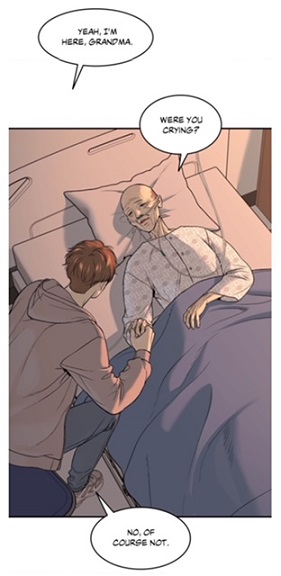 (chapter 47) In my eyes, this scene represents the positive reflection from that nightmare:
 (chapter 21) As a little boy, he had asked his grandmother to never leave his side, unaware that this meant that he should do the same. He should remain by her side too. Yet, he didn’t do it.
 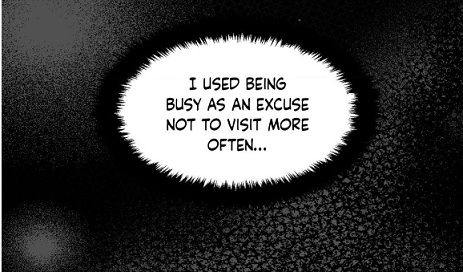 (chapter 47) This observation made me realize another aspect. When he heard the diagnosis from Kim Miseon for the first time, he admitted his powerlessness.
 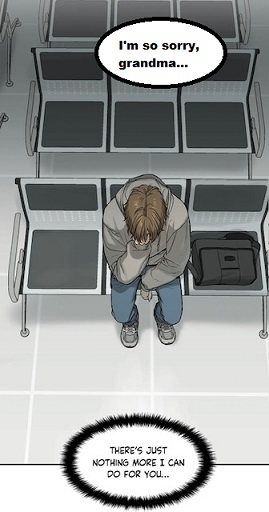 (chapter 5) In his eyes, he could do nothing for his grandma. But he was wrong, as he could support her by spending time with her. From my point of view, when the halmoni left home for the hospital, deep down, he must have felt abandoned. On the other hand, we shouldn’t forget that he also had other worries and problems to solve: the loan, the hospital bills and finding a job as a PT. Hence I deduce that through his grandmother, he learned the following lesson: he should spend more time with his loved ones, as they can vanish at any moment. He learned how precious time is. This remark made me realize the huge contrast between these two scenes:
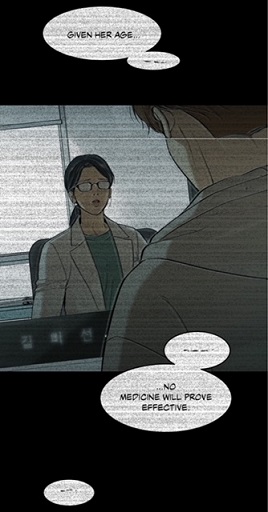 (chapter 47) He was in the bathroom crying and kept recalling the terrible monologue from the oncologist. He felt lost and trapped in the same moment. It felt like an eternity for him. But when he listened to his grandmother, bathed in the sunlight, it triggered his memory about his childhood with her.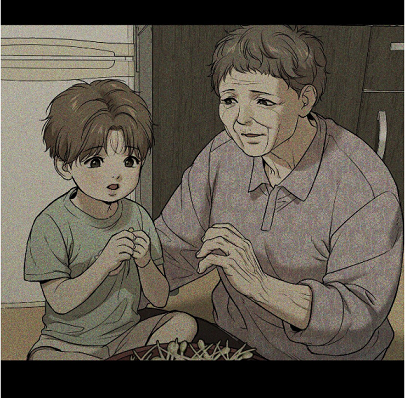
 (Chapter 47) Not only she had kept her promise, but also through this recollection, he got a notion of time again. We could say, he could feel time again. He sensed her true nature: her mortality. It is important, because of this new realization, he can move on and focus on the future in a long term. That’s the reason why I see this scene as a new leaf for both characters:
  (chapter 47) Shin Okja is no longer a goddess, a star during the night… but a human facing her mortality. Besides, the doctor focused too much on money, not realizing that goods are irrelevant in front of death.
  (chapter 41) This explicates why the champion is not attached to clothes and presents.
And now, it is time to return our attention to the phone call in the morning. Why would he call the physical therapist at such an early hour? One might reply that it was an emergency, for the next match is around the corner.  Yet, I can refute this point. How so? Note that the caller only let the phone ring 3 times:
  (chapter 47) Then he left a message. This stands in opposition to Joo Jaekyung’s action in episode 5:
  (chapter 5) The latter even spent about 23 minutes to reach the protagonist. He started calling at 10: 12 am and the next person he called was the MFC manager at 10:30 am. 12 + 23 times = 25 minutes. It means that for each call, he waited more than one minute before calling again. Another difference is that the athlete phoned him each hour: around 10 am, before around 9.00 am., hence I am assuming that he must have called around 8:00 am. This exposes the champion’s despair and huge desire!! However, he never tried to reach him at 5: 15 am. The director’s action appears as tactless and selfish. Since it was not an emergency, then why would he call the doctor so early? What was the point to act that way, when he left a message right immediately? (chapter 47) One might say that he feared that the doctor would reject his phone call, as he couldn’t recognize the number. On the other hand, I would like to outline that the man didn’t introduce himself properly. He didn’t mention his name at all. He just described his work and position. Compare his message to the one from the journalist:
  (chapter 35) So what does the divergence display? I would say, the lack of seriousness and integrity from the executive director. Shim Yoon-Seok wished to appear as a serious reporter, though he was intruding in the champion’s private life. Don’t forget that the latter messaged Joo Jaekyung during the night, but he didn’t call him:
  (chapter 35) He desired to give the impression that he was a hard-working journalist. On the other hand, because he just sent a message, it indicates that the reporter wished to hide, to remain anonymous. In other words, he was hiding his identity behind a name. How so? It is because the champion could not hear his voice at all. Joo Jaekyung can not recognize the journalist contrary to this scene:
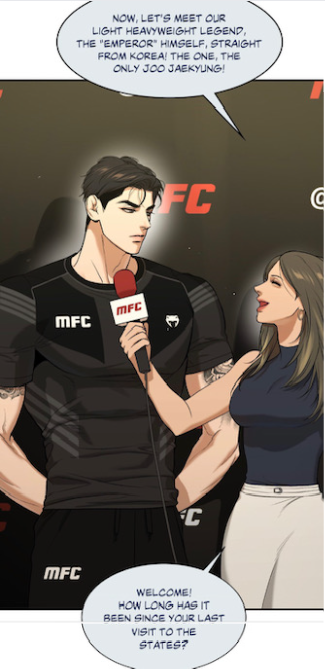 (chapter 36) This divergence reveals that the executive director has a different approach than the reporter. The former seeks to „get close to Kim Dan“, while the journalist desired to avoid the famous fighter’s wrath. Shim Yoon-Seok anticipated his reaction. Therefore I have the feeling that the mysterious man contacted the physical therapist so early to create the illusion that it was urgent. They needed him. Interesting is that when the champion received the message from Shim Yoon-Seok, he never questioned how the reporter got his contact.
 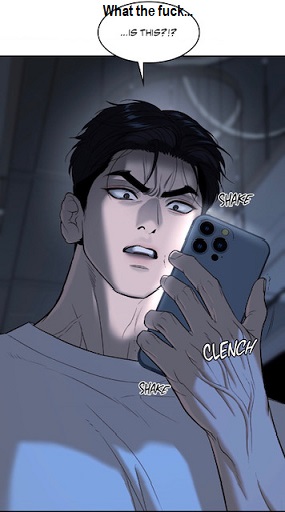 (Chapter 35) Besides, I noticed that the text from the journalist was ambiguous, especially for the readers.
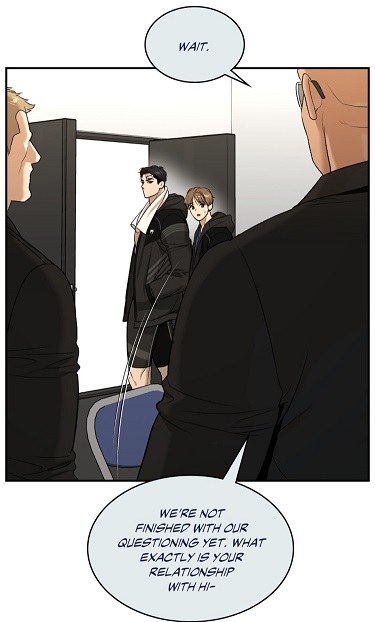
 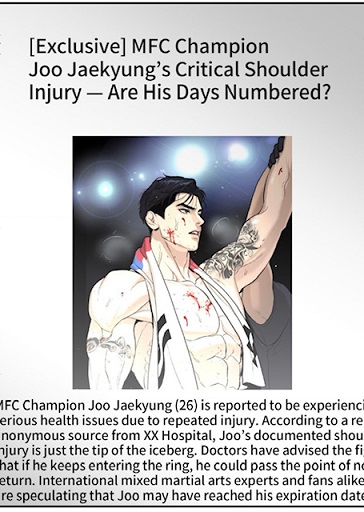 (Chapter 35) The latter doesn’t claim to be the author of the article. He doesn’t employ the possessive pronoun „my“, then the column doesn’t expose the name of the author. And we have a similar situation with the message. (Chapter 47) No name and as such no identity… Kim Dan could not recognize the man in the street, if he were to meet him. Furthermore, the message could be from someone else, impersonating him… the latter could deny that he ever sent such a message, as it is not his „phone number“. As you can see, I detected a pattern. The schemers are playing with ambiguity which mirrors the doctor’s situation. The MFC security guys had no idea about Kim Dan’s identity:
  (chapter 40) A fighter, a prostitute, a lover or a physical therapist? Another difference between the two texts (35 and 47) is that (chapter 47) above the anonymous message, Manhwalovers can read the warning about phishing and spasms, while the champion’s cell phone doesn’t show such a message. It could be an indication that the debts from Kim Dan are related to phishing scams.
Fraudulent phone calls and text messages, also known as phishing, in South Korea have caused nearly 1.7 trillion won ($1.3 billion) in damage over the past five years, data showed Tuesday.
According to data received by Rep. Kang Min-kuk of the People Power Party from the Financial Supervisory Service, a total of 227,126 scams were reported from 2018 to 2022, and the expense of reported loss from these scams was some 1.66 trillion won, with the number of such crimes seeing an uptake since 2020. […] More than 60 percent were victimized by scammers claiming they would help them with loans, which accounted for nearly 1 trillion won of the phishing damage. Some 22.8 percent of phone call fraudsters preyed on people by impersonating public institutions, while 17.1 percent of the crimes were carried out over mobile text messages by impersonating the victims’ acquaintances. Quoted from https://www.koreaherald.com/view.php?ud=20230221000590
After this quote, Manhwaworms can grasp that phishing represents a huge problem in South Korea. Therefore I have the feeling that this number could get blocked or even reported as spam. Let’s not forget my previous conclusion. The fact that the mysterious sender didn’t mention his name is exposing his mind-set. He doesn’t want his true identity to be discovered in verity. This would corroborate my theory that the man behind the message is Mr. Choi. In the analysis “Angel(s) Of Death: Shadows versus Serenity”, I had already outlined the similarities between the mysterious phone number (chapter 47) and Mr Choi’s: 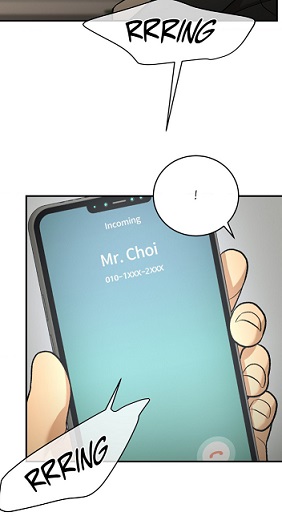 (chapter 46) And now, imagine the consequences, when Kim Dan or Joo Jaekyung reports the text as spam. Not only he doesn’t prevent the scammer from sending more texts to him, but it does let the authorities know as well that there’s a problem. Carriers might block the sender’s messages. Government bureaus might take action to prevent the scammer from messaging other cellphone users.
  (Chapter 46) And remember that Mr. Choi used this cellphone to contact his underling, a sign that their relationship was not official and should remain a secret. Hence if the line got cut, then Heo Manwook and Mr. Choi would be forced to meet. As you can imagine, the moment I discovered the connection between „carrier“ and „spam“, I couldn‘t help myself thinking that Mr. Choi might have received the CV from the courier company!!
 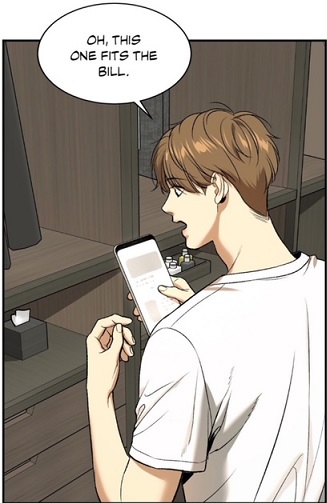 (Chapter 42) Yes, we have here a text on a cellphone too. Therefore I couldn‘t help myself laughing!! Why? It is because I believe that the schemers are thinking that Kim Dan is a member of Team Black, a fighter, and he is Joo Jaekyung‘s protégé. My reasoning is the following: since my hypothesis is that he got the doctor‘s curriculum vitae through the courier enterprise
 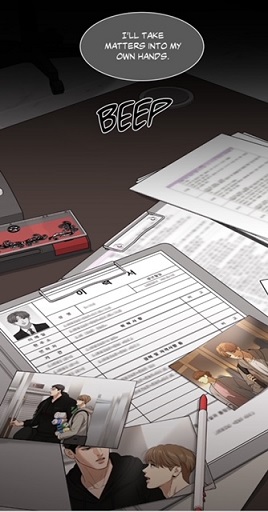 (Chapter 46), I doubt that Kim Dan mentioned that he was working as PT for Joo Jaekyung. This would have raised an eye-brow!! His side gig was supposed to be a secret implying that his official work was to be kept hidden as well. Furthermore, I am assuming that Mr. Choi must have tried to figure out Kim Dan based on his CV. He worked for a short time at the hospital and after he chose to take odd jobs. So he could have had a change of heart, he desired to pursue a different career, like for example becoming a professional MMA fighter. I don‘t think, people would mention such a hobby, as it could give a bad impression. Finally, if my theory is correct, then it signifies that Mr. Choi got tipped off by the hidden person from chapter 42.
  (chapter 42) Remember my previous interpretation: the anonymous person had discovered a secret, but back then it was difficult to determine the secret.
 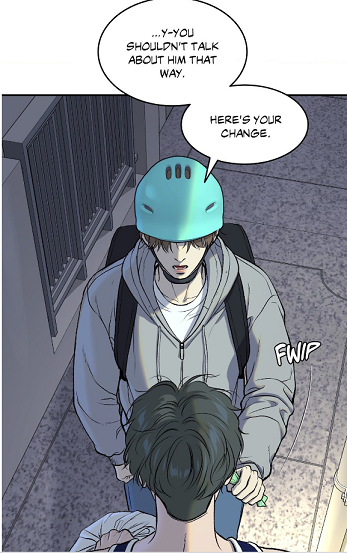 (Chapter 42) First, I thought that they knew that Kim Dan was probably his „sex partner“ as a fan, as he didn‘t object to this statement
  (chapter 42) But note that Kim Dan had protected the champion’s name and reputation first. Hence my idea is that in the mind of the anonymous observer, Kim Dan might have been left speechless for a different reason. He was described as a parasite, for he was using Joo Jaekyung‘s care and talent to become himself a professional MMA fighter!! In other words, they are mistaking him for Potato. And now, you comprehend why I added the green fox in the illustration:
  They are trying to snatch away the favorite athlete from Team Black in order to destabilize Joo Jaekyung mentally (chapter 46), as the champion was seen quite caring towards Kim Dan. We could see that fighters at Team Black believes in luck
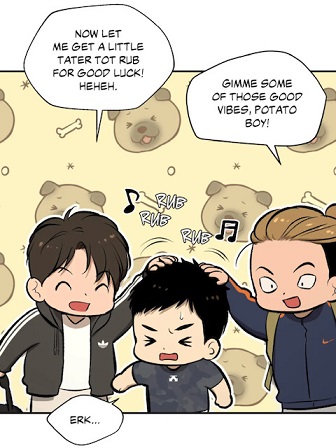 (chapter 23) So they could think, Kim Dan is not questioning the belief too, as he is a fighter. However, in the picture, Kim Dan looked depressed alone. So the picture was exposing his disillusion and Mr. Choi could misinterpret the origins of his disappointment: he was not able to achieve his dream. (Chapter 47) Because he is a member from Team Black, he is not paid well. He is not sponsored by Joo Jaekyung, in fact he needs to pay fee memberships. One might argue about this theory (Kim Dan is confused as a fighter) for the sender addressed the protagonist as Doc Dan. This is the indication of a spy, only members from Team Black know his nickname. Nonetheless, the Spanish version diverges, as he is addressed as Mr. Kim. Hence that could be an error made by the English translator, similar to „Buenas tardes“. On the other hand, let‘s not forget that during the sparring, the main lead’s nickname got a different meaning.
  (Chapter 26) They could have jumped to the conclusion that Doc Dan was his stage name as a reference to his education and past, unaware that in reality it was indicating his true job. Thanks to @joojaedan, I got access to the original version.
  He is addressed as Kim Dan, and @joojaedan told me that he got addressed the same way than the fighter and Joo Jaekyung would call him. I have to admit that I let the app Deepl translate the Korean version. This is what I got:
Hello Mr. Kim Dan, I’m the representative of Baek Junmin’s gym “King of MMA”. Please contact me, when you are available.
The official English version is definitely the better translation for two reasons. First, what caught my attention is the title “executive director”. According to my research, executive director is not the same than CEO or “jefe del gimnasio…”. In Spanish, the author of the message is presented as the owner of the gym, but now take a look at this source:
An executive director is the senior operating officer or manager of an organization or corporation, usually at a nonprofit. Their duties are similar to those of a chief executive officer (CEO) of a for-profit company. The executive director is responsible for strategic planning, working with the board of directors (B of D), and operating within a budget. Quoted from https://www.investopedia.com/terms/e/executive-director.asp
This shows that the author of the message is presenting himself as the right-hand of the fighter. He is not the owner of the gym officially, for he acts as a representative and takes care of the finances and PR!! I would even say, he must be working with a law firm as well. As you can see, thanks to the original and English translation, I discovered a new aspect, the connection between the Entertainment agency and the law firm, which corroborates my previous interpretation: the lawyer and the manager from the agency were working together, covering up for each other. (Chapter 36) Moreover, this signifies that Baek Junmin is presented as the owner of the gym
  (chapter 47), as he is the face of that gym. In reality, he is just the cover, whereas the true owner is the mysterious sender of the text.
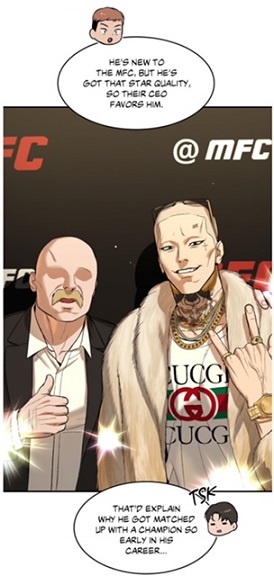 (Chapter 47) This signifies that he is acting like Park Manwook
 (chapter 22). Yet, he is his negative reflection, as Mr. Choi is the real owner, but he hides behind the thug Baek Junmin. On the other hand, Park Manwook views himself as the owner of the gym, for he takes care of contracts and finances, but the one with the final saying is in truth Joo Jaekyung. To conclude, we have a similar situation between the two gyms: the owners are keeping a low profile, they stand in the shadow. However, there exists a difference between them. Joo Jaekyung is allowing his hyung to call himself the owner of the gym out of respect, whereas the other is doing in order to hide his criminal activities. I would even say, he is making sure that Baek Junmin would take the fall in case he would get into trouble.
Moreover, since he asked Kim Dan to call him back, it implies that he wished to be in touch with Kim Dan through his cellphone. In other words, he doesn’t desire to meet Kim Dan personally. I would even add that he wished to be connected to Kim Dan like to Heo Manwook, not through the official line, but a private and secret phone. (chapter 46) As you can see, through this comparison, we can discern the personality and the intentions of the anonymous caller much better. It stands for secrecy and intrusion. At the same time, it exposes that the schemers are not exchanging information between each other which can only need to a failure. Heo Manwook knows that Kim Dan is well paid, whereas Mr. Choi thinks, he is still struggling financially. But why did he call him at 5:15 am then?
One might reply that he needed to call him before the doctor would go to the gym with Joo Jaekyung. (chapter 46) He wanted to ensure that the athlete wouldn’t notice his phone call. He couldn’t reach him around 9:00 or 10:00 am, this would have been noticed by Team Black’s members. On the other hand, he could have called him during the weekend, especially on Saturday evening or on Sunday. The last picture with Kim Dan is portraying him leaving a place alone, in my opinion, it is the hospital. Thus my hypothesis is that Mr. Choi must have known that the main lead would visit his relative on Sunday. On the other hand, since my theory is that he got the CV through the carrier enterprise, it is also possible that Mr. Choi imagines that Kim Dan is still working as a courier, especially if he is assuming that the doctor is planning to become a professional MMA fighter. He has no idea about the truth: it was to offer a present to the star.
Don’t forget that the two protagonists reflect each other. While Joo Jaekyung was misled to think that the hospital leaked information to the journalist (chapter 36) which was definitely not true, I deduce that this must have happened to Kim Dan in reality. A company leaked his information, yet the doctor is unaware of it.
Therefore I assume that Mr Choi called him briefly at 5:15 am, as he knew that his night shift as courier would end around dawn. 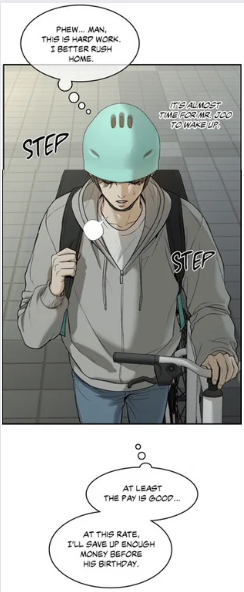 (chapter 42) He let it ring three times before texting him in order to catch the doctor’s attention, to distinguish himself from the previous calls (for his job). If so, then Mr. Choi must believe that Kim Dan is being “exploited” by the athlete. Hence the doctor would look so unhappy, when he is alone. In other words, the pictures taken in secrecy would expose the hypocrisy of the celebrity towards the main lead. (chapter 46) That’s how Mr. Choi interpreted the images. Nevertheless, it would signify that the executive director is projecting his own thoughts onto the fighter. According to me, Baek Junmin is his “slave”. He needs to bring him the result Mr. Choi desires. (chapter 47)
That’s how I came to the following deduction. In order to perceive the caller’s intention, we need to compare his text to the previous ones. And we have two other messages in Jinx:
In chapter 34, Heesung, Kim Dan and Joo Jaekyung communicated to each other through messages.  (Chapter 35) Here, the actor had planned to confess to him, while the other wanted to divulge the true nature of their relationship:
  (chapter 34) It was pure sex, yet the comedian didn‘t get fooled. Joo Jaekyung had feelings for him. Striking is that during that night, the doctor got fooled and this twice!!:
  (chapter 34) First, the star knew about the invitation from Choi Heesung. This even caught Kim Dan by surprise. This image exposes that the champion had violated the doctor’s privacy. So how did he know it? We have different possibilities, yet my idea is that he had seen the message!! Thus he replied with a text to Heesung. Besides, observe how he dissuaded the doctor from visiting the actor.
 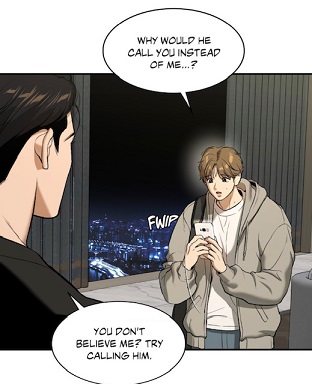 (Chapter 34) He should CALL him… a sign that the champion had not called anyone. Since Mingwa is writing like Byeonduck, I have the feeling that the message from Mr. Choi will be discovered by Joo Jaekyung. Remember how his hyungs had warned him
 (chapter 46), but he had refused to listen to them.
  (Chapter 46) But the moment the champion is confronted with such a message directly, this would be a wake-up call for Joo Jaekyung, he should treat his members much better, as the existence of his company is in jeopardy. Moreover, I am hoping that such a discovery will push Joo Jaekyung to play a trick on his enemy too, like for example he gives a task to Potato, act as a spy!!
But it is relevant to recall that the executive director initially called Kim Dan before leaving a message on his cellphone. Hence I believe that we should also compare it to the previous phone calls the main leads received in the past. This led me to notice the recurrence of certain notions: sex, emergency, treatment, interruption, spying, secrecy, manipulations, rejection, and finally ignorance.
| Chapter 1 | Chapter 5 | Chapter 11 | Chapter 13 | Chapter 16/17 | Chapter 19/20 |
|---|---|---|---|---|---|
  Emergency, treatment, manipulation, sex and interruption |  Kim Dan saw the calls, but he ignored them. Kim Dan saw the calls, but he ignored them. 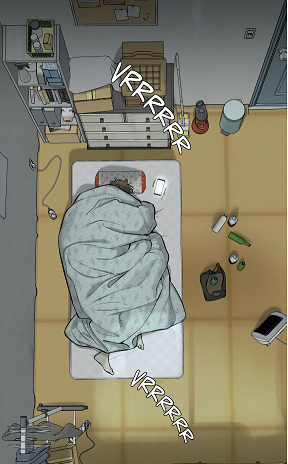 Here, Joo Jaekyung heard that the doctor could have blocked him. Emergency, treatment, secrecy (the reason behind the contract) and rejection |  It was another emergency call, for he needed to leave the place within a week. Interesting is that the person didn’t present himself. No name… As you already know, I am suspecting that the doctor got fooled, for I doubt he ever received any compensation for his move. He should have received money. Emergency, rejection, manipulation, interruption and spying (Heo Manwook interrogated the doctor right after) It was another emergency call, for he needed to leave the place within a week. Interesting is that the person didn’t present himself. No name… As you already know, I am suspecting that the doctor got fooled, for I doubt he ever received any compensation for his move. He should have received money. Emergency, rejection, manipulation, interruption and spying (Heo Manwook interrogated the doctor right after) | 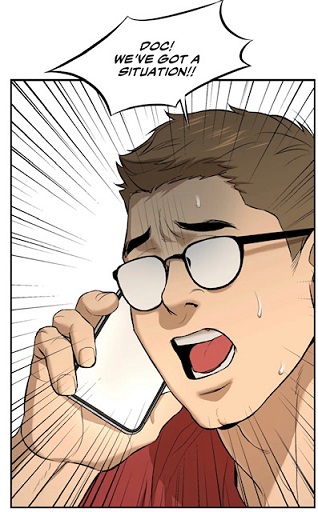 In this chapter, we have in fact two calls related to a danger.  Emergency, treatment, sex, interruption, manipulation and secrecy |  Treatment, interruption, sex, secrecy, rejection and manipulation  | 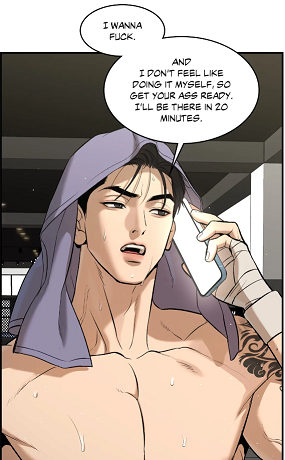  Sex, interruption, „emergency“, as the champion didn‘t take off his shoes and put down his bag. Then during the intercourse, the doctor was called by the hospital Sex, interruption, „emergency“, as the champion didn‘t take off his shoes and put down his bag. Then during the intercourse, the doctor was called by the hospital 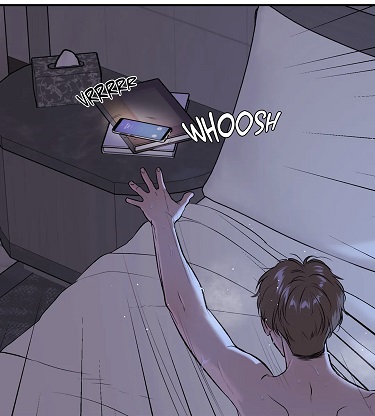 Sex, treatment, interruption, secrecy (hidden in the bathroom) Here, the doctor could not refuse the champion‘s suggestion. |
| ChaPter 21 | Chapter 24 | Chapter 32 | Chapter 38 | Chapter 45 |
|---|---|---|---|---|
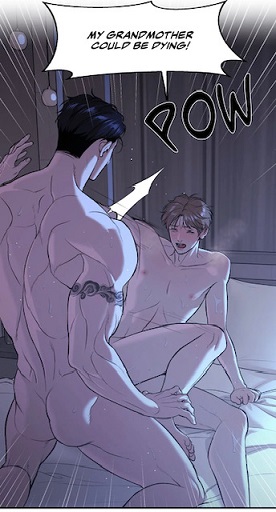 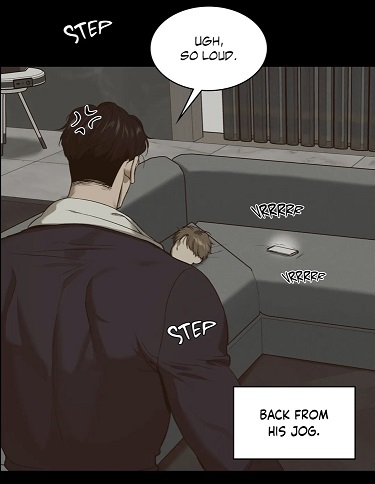 Here, we have sex, interruption, secrecy (grandma‘s existence and illness), rejection and ignorance. Kim Dan didn‘t answer the phone calls right away, as he was sick. | 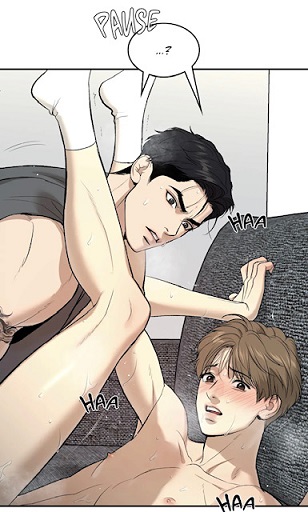 Sex, interruption (food), secrecy, manipulation, ignorance and spying. Potato had tried to listen to their conversation. Sex, interruption (food), secrecy, manipulation, ignorance and spying. Potato had tried to listen to their conversation. | 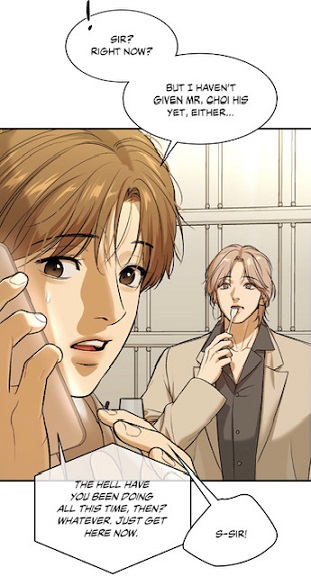 Treatment, emergency, interruption (food), ignorance, manipulation and „spying“. Heesung tried to discern the nature of their relationship. | 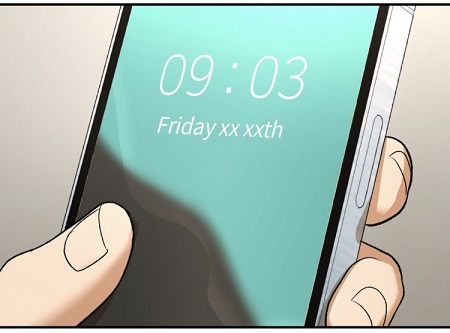 Interesting is that here, there was no emergency from the champion‘s part. This time, Kim Dan was the one longing for the athlete. Interesting is that here, there was no emergency from the champion‘s part. This time, Kim Dan was the one longing for the athlete. Sex, emergency, ignorance, manipulation, though here the victims of the trick were the two main leads. Sex, emergency, ignorance, manipulation, though here the victims of the trick were the two main leads. | This message stands in opposition to all the other messages: honesty, family.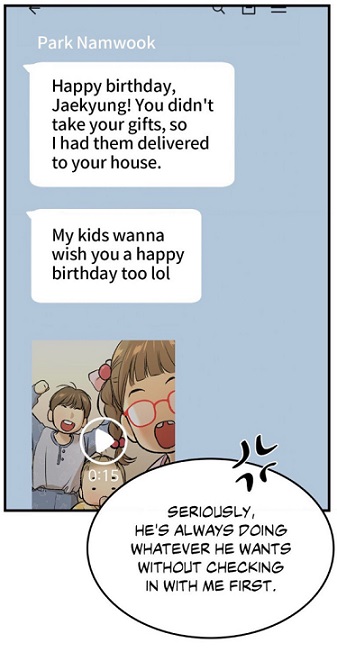 But it shares a common point from the text in chapter 34: love confession. Park Namwook and his family view him as a family member. Yet, the star saw it as an intrusion, it happened right after the sex-love session |
And now, which notions do we find in the phone call from Mr. Choi? Manipulation, because he is not introducing himself properly. He doesn’t explain how he got his contact. Then we have secrecy, because he is calling so early. Interesting is that the caller gave the impression that it was an emergency by calling at dawn, (Chapter 47) yet his words contradict the notion of crisis and danger. Kim Dan can determine the time. Then we have ignorance, for Kim Dan didn’t notice the ringing and the texting. (Chapter 47) That’s why we have NO interruption. Furthermore, it displays spying, as the contact raises the question how the executive director got his phone number. Funny is that the notion of rejection is present through the notice above the text: (chapter 47) As for treatment, it is related to the grandmother, a sign that the sender is not interested in any treatment. Hence I come to the following deduction: the mysterious sender has the intention of deceiving Kim Dan. In exchange for betraying the champion, the executive director will promise him a career at the gym „Kim of MMA“!! Yet, I don’t think, he has the intention to keep his promise, because Baek Junmin has been used as his tool to get rich. The fame in the underground fighting ring is not only fake, but also dangerous. 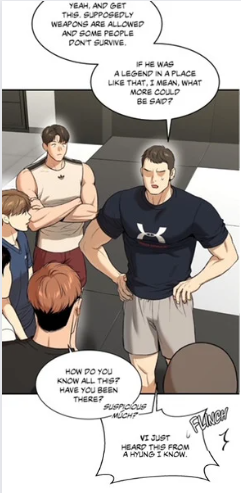 (Chapter 47) And how should he betray the athlete?
We have different possibilities. Since I linked this scene to the altercation with the goblin and his mysterious room mate, they could ask him not to be his sex partner before the match. Or they could ask him to drug the champion like in the past. According to my previous observations, MR. Choi was left in the dark concerning the failure of the last trick.  (Chapter 40) He has no idea that Kim Dan became the victim and got framed later.
  (Chapter 46) Furthermore, since Heo Manwook was the one who hired this man
  (chapter 37) indicating that he used another channel than Mr. Choi‘s. Hence I am suspecting that Mr. Choi wasn‘t informed about the corruption of the MFC’s doctors.
  (Chapter 47) So my idea is that they could ask Kim Dan to injure the athlete during a sparring. First, Mr Choi judged the champion based on his performance. He still won the fight against Dominic Hill, though he was supposed to be injured. So in his eyes, the shoulder injury was exaggerated. Besides, he received a go from the MFC doctors and his match is very soon. Everything is pointing out that the athlete is healthy. Moreover, Alfredo was replaced in the last minute due to an injury.
  (Chapter 47) The MMA fighter could have been asked to fake an injury, similar to Heesung‘s plot. As for Kim Dan, his task would be to „target his shoulder, his weak point“. Another possibility is to expose his vulnerabilities. One thing is sure: their approach will fail, hence they will propose the deal to Seonho.
  (Chapter 47) And the latter has a reason to get revenge on the celebrity because the suffered humiliation and beating.
  (Chapter 46) What caught my attention is that this athlete definitely boosted his situation by advertising that he was the champion’s sparring partner. I doubt that the main lead‘s criticism was unfounded.
 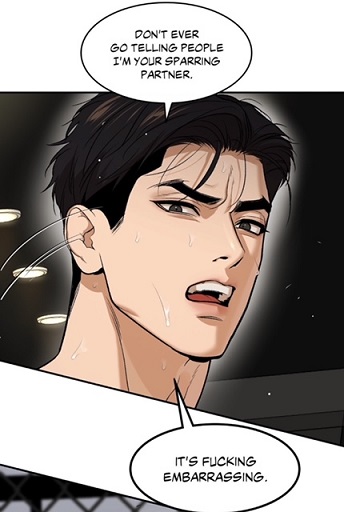 (Chapter 46), for he had been bragging about his merits.
 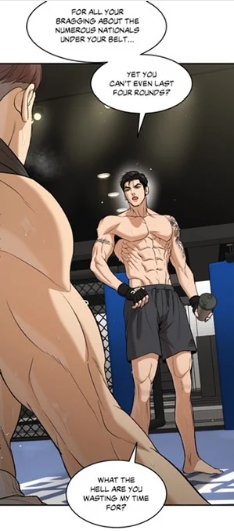 (Chapter 46) By the way, I believe, Seonho was a recent recruit. Therefore he doesn‘t know the champion that well and he is not close to the other fighters. Hence they didn‘t protect him
 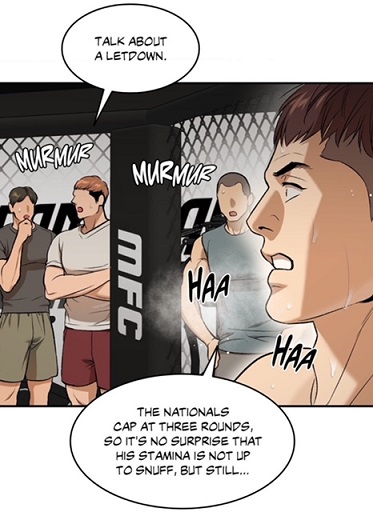 (Chapter 46) like in episode 1
 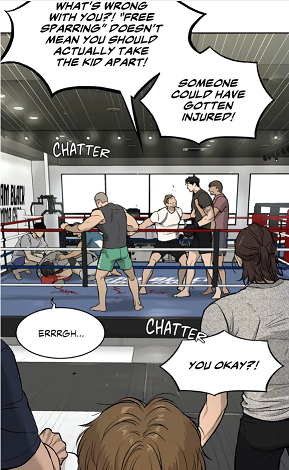 (chapter 1) He had no idea about the roughness during the sparring, though this scene exposes that the champion had toned down the brutality during the sparring.
 (Chapter 46)
  (Chapter 25) So Seonho could expose the true identity of the main lead, he is a physical therapist… Hence the schemers would understand why he got blocked or reported as spam. Their retaliation would be to tarnish his reputation as physical therapist.
Besides, I am envisaging that Seonho could be encouraged to trespass and steal the files  (chapter 42) On the other hand, since I am predicting a failure of their scheme, they could decide to take revenge on Seonho by sending him to an illegal fighting game, where he could get badly injured. Moreover, the moment they discover how weak the red-haired man is, they could jump to the impression that Seonho deceived them!!
 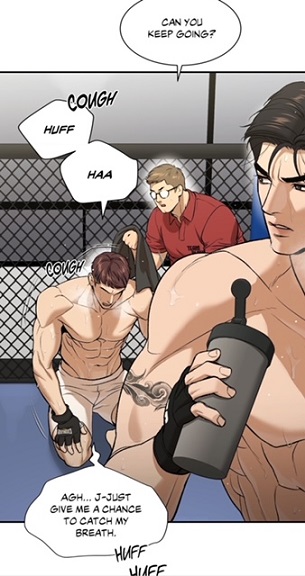 (Chapter 46) Don’t forget that the champion is the mirror of truth, while the doctor‘s role is to expose the hideous side from people: the goblin and the green fox! It divulges their true nature: greed, ambition, selfishness, ruthlessness, immorality… That‘s the reason why Mr. Choi made his entrance.
Moreover, because of the files, they could frame the physical therapist as the leak for the article, unaware that the doctor is living with the athlete. And that would force Shim Yoon-Seok to come out of the shadow. At the same time, the doctor‘s past suffering would come to the surface. So far, Joo Jaekyung only met trustworthy doctors, Dr. Lee and Cheolmin. Hence he had no reason to doubt the integrity of doctors. Notice that after the release of the article, they framed the hospital, but not the doctor himself. (Chapter 36) And this is what Kim Dan and the champion will have to learn: the corruption of organizations like the Entertainment company, MFC and hospitals, if their directors are themself dishonest and greedy.
Since my idea is that the champion discovers the message, I am hoping that he can hear and recognize the voice of Mr. Choi so that he can realize that he got betrayed by the Entertainment agency. Interesting is that coach Jeon Yosep was tasked to investigate the matters about the underground fighting ring.  (Chapter 46) But he was sitting with the others later. Consequently, I come to the deduction that he failed to discover any lead, or better said, any connection between the bets and Mr. Choi. Why? It is because he is a former champion, and professionals among MMA world must know that he works for the star.
 (Chapter 47) Joo Jaekyung needs to realize that he can not just rely on his hyungs alone, he needs the assistance from the whole staff: Kim Dan and the other fighters, as they are not known in the MMA world.
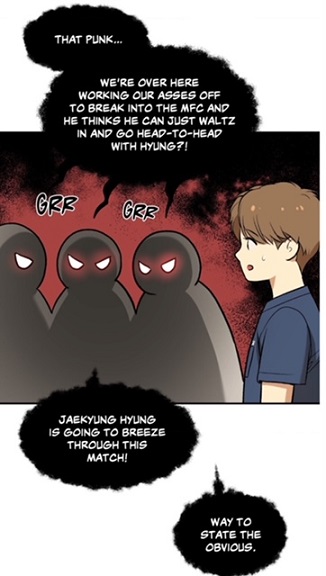 (Chapter 47) They couldn‘t break into MFC, on the other hand, their position helps them to get insight, to approach the illegal fighting ring. (Chapter 47) To conclude, I am sensing a new undercover mission and a trick from Team Black.
Feel free to comment. If you have any suggestion for topics or manhwas, feel free to ask. If you enjoyed reading it, retweet it or push the button like. My Reddit-Instagram-Twitter-Tumblr account is: @bebebisous33. Thanks for reading and for the support, particularly, I would like to thank all the new followers and people recommending my blog.

Please support the authors by reading the manhwas on the official websites. I am also using doctor Frost as reference again. This is where you can read the manhwas: Jinx and Doctor Frost. But be aware that the first Manhwa is a mature Yaoi, which means, it is about homosexuality with explicit scenes. Here is the link of the table of contents about Jinx. Here is the link where you can find the table of contents of analyzed manhwas. Here are the links, if you are interested in the first work from Mingwa, BJ Alex, and the previous essay about Jinx “Angels of Death: Shadows versus Serenity (second version)“
It would be great if you could make some donations/sponsoring: Ko-fi.com/bebebisous33 That way, you can support me with “coffee” so that I have the energy to keep examining manhwas. Besides, I need to cover up the expenses for this blog.

In the first part, I examined Kim Dan’s mentality more closely. There, I portrayed the physical therapist as someone suffering from Dependent Personality Disorder. Moreover, I underlined that so far, Kim Dan had been raised under the influence of toxic positivity. Therefore he was constantly denying his own pain and struggles. Because of these two characteristics, I came to the following interpretation: the physical therapist was raised like a princess, and by meeting Joo Jaekyung, he got confronted with reality. Hence the argument with his fated partner incited him to change his mind-set. First, he was pushed to acknowledge the existence of his broken heart. Then from that moment on, he would no longer rely on the champion. 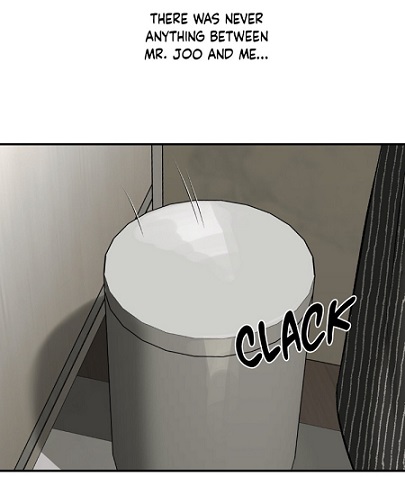 (chapter 46) On the other hand, chapter 47 exposes that the doctor didn’t lose his interest and attention towards his boss.
  (chapter 47) This exposes that Kim Dan didn’t choose resent or indifference towards Joo Jaekyung despite the inflicted pain. On the other hand, why did I write that the celebrity is Kim Dan’s reflection? Why is the athlete the doctor’s mirror of truth? It is because Joo Jaekyung embodies his negative reflection: independency and toxic negativity. But what is the latter exactly?
Interesting is that I connected the physical therapist to Dependent Personality Disorder thanks to the case of “Tears of Princess Pyeonggang” from the Manhwa Doctor Frost. When the patient Sihyun met Doctor Frost, the latter explained to her why her last relationship was doomed to failure. How so?  (chapter 31) It is because when the psychologist met the patient with her boyfriend for the first time, he paid attention to his micro-expressions, and more particularly to his mouth. He saw his smirk. Here, I feel the need to give an explanation how these micro-expressions were discovered.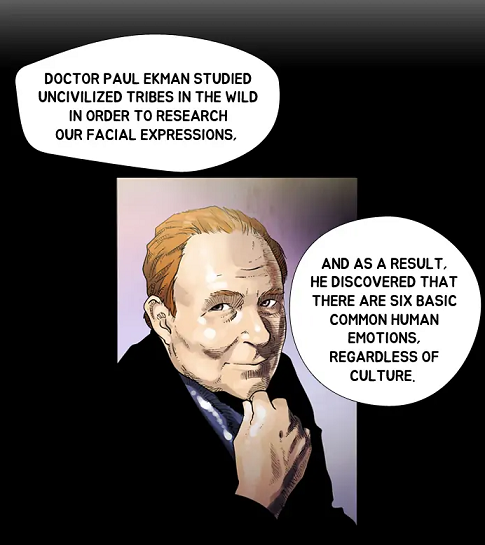
 (chapter 30) As my avid readers can detect, the expression from the boyfriend’s mouth displeased the white-haired psychologist. He could recognize his emotion, though such facial expressions are very short-lived
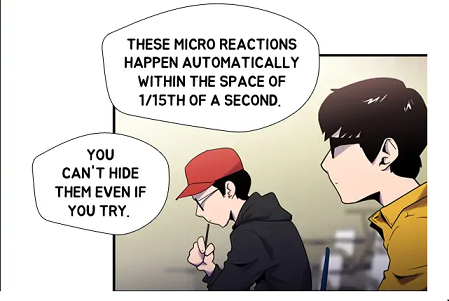 .(chapter 30) So what was the “jerk” feeling, when he was conversing with Sihyun? Cynicism.
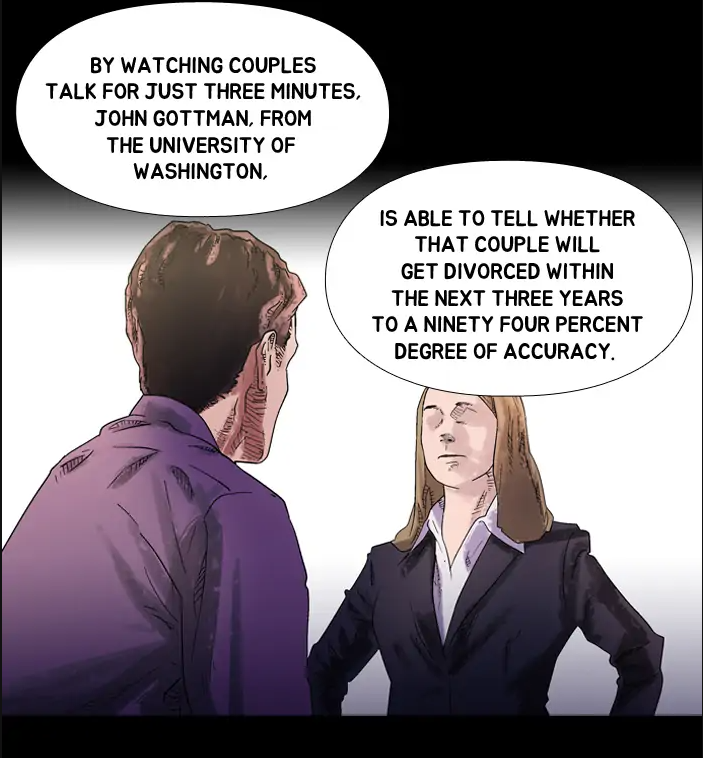
 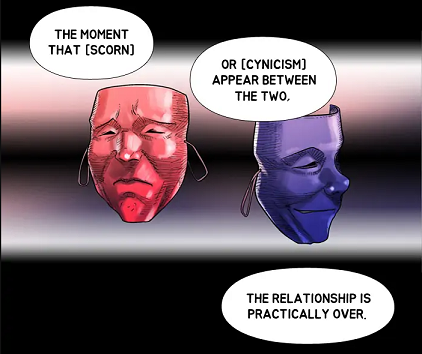 (chapter 31) And the reason why he stated that as soon as cynicism or scorn was present in a relationship, the couple would end up breaking up is because of John Gottham’s observations and conclusions.
  (chapter 31) And now, you are wondering how this is related to Joo Jaekyung. It is because the famous sportsman is full of cynicism
  (chapter 45) We could sense it in different scenes, though I would say that his cynicism was slowly vanishing:
  (chapter 3)
 (chapter 40) This is the so-called toxic negativity. Therefore it was to expect that the champion would reject the doctor’s present. He could only doubt the sincerity behind his gesture. How so? Remember how the team desired to celebrate his birthday: a surprise party. They bought a cake…
  (chapter 43) but what happened afterwards? Yosep spoke in the name of the gym’s owner: the latter would pay for the dinner (beef restaurant)
  (chapter 43) So technically, they offered a cheap cake and got in exchange a super expensive dinner. One might say that this was just a joke. But cynical people are taking things very seriously. This is what the champion learned from this experience, the cake in exchange for a super expensive meal … and now imagine that the next morning, he received an „expensive“ present from Kim Dan which was similar to the gifts from fans (exchange of favors). It is normal that he doubted the genuineness from his doctor, not only because of his past experiences, but also because of the parties before. But there exists another reason why he had to refuse the gift: Cynicism… the end of relationship. Thus dating for the athlete was impossible.
  (chapter 45) He is not ready yet. But was it Cynicism exactly and how does it represent a hindrance for a healthy relationship?
First, I would like to present the philosophy of Cynicism in order to outline certain positive aspects of such a mind-set. The latter, originating in ancient Greece, is often associated with the notion of living a life of simplicity, virtue, and independence. The term “Cynic” comes from the Greek words “kynikos,” meaning “dog-like,” and “kyôn,” meaning “dog.” While the origins of this name are not entirely clear, there are two popular beliefs regarding its origin:
Firstly, it is believed that the Cynics were called dogs because the first Cynic, Antisthenes, began teaching in the Cynosarges gymnasium in Athens. “Cynosarges” translates to “the place of the white dog,” hence the association with canines. Another possible origin for the term “dog” in Cynicism is attributed to Diogenes of Sinope, one of the most famous Cynic philosophers. Diogenes famously lived in a large ceramic jar (known as a “pithos”) and embraced a lifestyle of extreme simplicity and disregard for social conventions. He would reportedly wander the streets of Athens with a lantern in broad daylight, searching for an honest man.
Cynic ethics revolve around the principles of freedom, parrhesia (frank speech or fearless expression), living according to nature, and rejection of societal norms and conventions. Cynics believed that true happiness and virtue could only be attained by living in accordance with nature and rejecting the desires and comforts of society. They often practiced asceticism, eschewing material possessions and living a life of self-sufficiency.
The Cynics emphasized the importance of living in accordance with one’s true nature, rather than conforming to societal expectations or pursuing external desires. They criticized authorities and traditions, they valued self-reliance, resilience, and inner strength, believing that true freedom could only be achieved by freeing oneself from the constraints of society and material wealth. In addition to their rejection of societal norms and conventions, Cynics also challenged the traditional notion of family and social hierarchies. They believed that attachments to family and social status were sources of unnecessary suffering and constraint on individual freedom.
Cynics advocated for a radical form of individualism, promoting self-sufficiency and independence from familial ties and obligations. They viewed the traditional family structure as a hindrance to living a virtuous and authentic life, arguing that it often led to conflicts of interest, attachment to material possessions, and moral compromise. Instead of relying on familial relationships for support and identity, Cynics encouraged individuals to cultivate relationships based on mutual respect and philosophical kinship. They believed that true friendship and community could only be found among those who shared their commitment to living a life of simplicity, virtue, and freedom from societal constraints.
By rejecting the traditional notion of family, Cynics sought to liberate themselves from the expectations and obligations imposed by social norms and hierarchies. They embraced a lifestyle of radical individualism and self-sufficiency, prioritizing personal autonomy and philosophical integrity above all else.
Central to Cynic philosophy was the concept of parrhesia, or fearless expression of truth. Cynics advocated for speaking openly and honestly, even if it meant challenging social norms or offending others. They believed that by speaking truth to power and living authentically, individuals could cultivate inner freedom and achieve true happiness.
In summary, Cynicism is a philosophical school that advocates for living a simple, virtuous life in accordance with nature, free from societal constraints and material desires. It emphasizes the importance of parrhesia, self-sufficiency, and fearless expression of truth as essential elements of living a truly fulfilling and authentic life.
After reading this short presentation, Jinx-philes can sense some similarities between the athlete and this philosophical movement. First, he rejects norms and conventions. He is behaving like an animal, compared to a wolf.  (chapter 7) This approach also gives us an explanation how Joo Jaekyung came to develop such an exhibitionistic sexual behavior: sex in the shower room
 (chapter 8), in the office, in the car, in front of a mirror, in front of Heesung in the living room… Don’t forget that Diogenes would even masturbate in public.
Additionally, he doesn’t see Team Black as “family”, but as a place to learn toughness and endurance. That’s where he could experience “freedom”. Thus his honesty is brutal. (chapter 46) (chapter 46) Consequently, he never tried to get close to his members either. In fact, he is expecting from the staff to follow his lead. Potato could only get rejected with such a request.  (chapter 23) The latter had to act like a true disciple and follow the champion’s recommendation.
 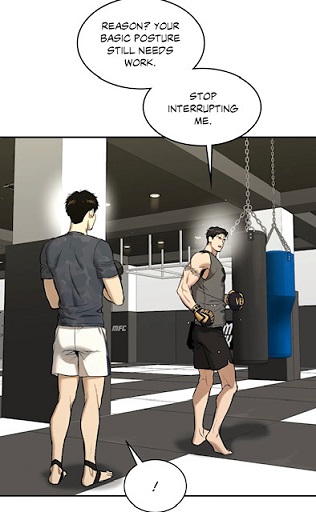 (chapter 23) The gym is like his sacred temple. Yet, the gym is just a simulacre of “nature”, as it is in the middle of Seoul. Therefore I realized why after their argument, Joo Jaekyung avoided the penthouse and Kim Dan in the end.
 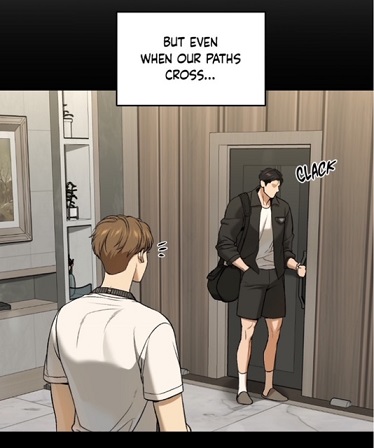 (chapter 47) It is because deep down, the champion sensed that his flat had become a home. He wanted to ensure that the penthouse was still a workplace or a hotel room. Thus he refused to eat the breakfasts prepared from his PT. In his eyes, these meals must have appeared as a violation of his self-imposed discipline. It was more than self-sufficiency. Under this new light, Jinx-philes can grasp why he rejects presents and prefers donating money.
 (chapter 41) He is looking for freedom and self-sufficiency, detached from any material need. This explains why the golden keychain from Kim Dan could only offend him.
  (chapter 45) It symbolized everything he hates: a reminder of wealth, superficiality, attachment, secrecy and silence. It also exposed the huge difference in their mind-set. Kim Dan is not his disciple! He imagined that he had found a kindred spirit, especially after that night:
  (chapter 39) The reason is simple. The champion had finally found someone who accepted his roughness in bed and could match his stamina.
As you can imagine, Joo Jaekyung is naturally a fake Cynic, for he is not giving up on his comfort.  (chapter 10) He is not resigning on designer clothes.
  (chapter 42) His dress room is the evidence of his hypocrisy. He might have encouraged Kim Dan to have sex in “public places”, yet he is still hiding his sexual orientation. Furthermore, his jinx is the evidence of his dishonesty.
 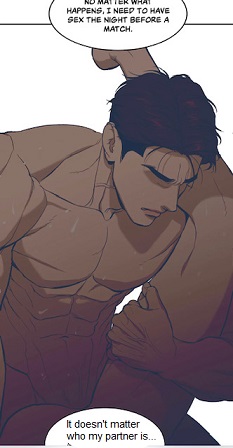 (chapter 2) He needs someone to have sex. This stands in opposition to Diogenes’ masturbation. Besides, he had to pay the goblin and Kim Dan in order to have a sex partner. Hence he needs to be confronted with truth as well. Manhwaworms can grasp the rage from the athlete, when he heard the doctor’s justification:
  (chapter 45) He might advocate autonomy and self-sufficiency, the reality is that he likes luxury. Hence he is unable to live in harmony with nature. This shows that the fighter is in denial and is living in an illusion. Thus he can not find true happiness, for his freedom is not real. He is attached to the gym which is also strongly connected to his career as the Emperor.
  (chapter 46) With his brutal attitude, he is doing himself a disservice. Exactly like Kim Dan, he is even ruining his career and own reputation. Not only he lost 4 athletes (I am including Seonho), but also his loyal admirers are calling him a thug now:
 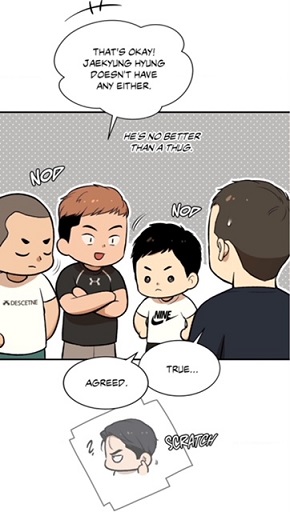 (chapter 47) Even Potato announcing the gradual Coming-Of-Age from his admirer. However, like Dr. Frost mentioned it, humans are social beings.
 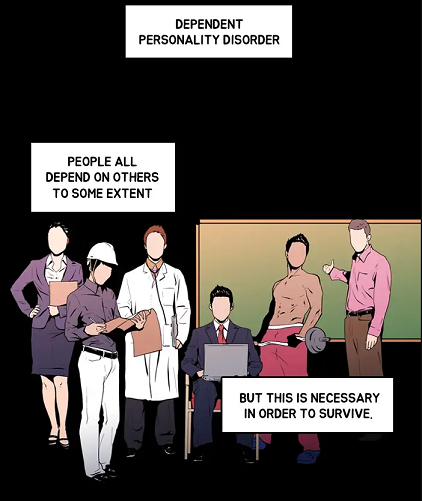 No one can survive on his own. This explicates why Cynics had disciples in the end. And now, you comprehend the role of Kim Dan in Joo Jaekyung’s life. It is to remind him of his true nature. He is a human and not a dog-wolf. Thus the champion recommended his PT to live elsewhere, a sign that he was indeed a human.
  (chapter 10)
Yet, pure cynicism is not the way to find happiness. We have the perfect example with Diogenes:
He was so devoted to living a Cynic way of life that, upon seeing a child drinking water with his hands, he threw away his cup, stating that a child had beaten him to living a simple life. Quoted from https://www.orionphilosophy.com/stoic-blog/the-philosophy-of-cynicism
He had the impression that it was never enough, and the pure action from the child caught him by surprise. He seems to have been obsessed with his theory.
However, in the first part, I mentioned Cynicism from a psychological perspective. So now, it is time to examine what Cynicism means for psychologists.
Cynicism is a philosophical and psychological attitude characterized by skepticism and a general distrust of the motives and sincerity of others. Cynics tend to view human behavior as selfish and driven by self-interest, often dismissing conventional social norms and values as hypocritical or insincere.
This worldview is rooted in the belief that people act primarily to fulfill their own desires, without genuine concern for others or higher principles. Cynics may adopt a critical and sarcastic demeanor as a defense mechanism against perceived deception and disingenuousness in the world. Read more here: https://mind.help/topic/cynicism/

In other words, they have no trust in human beings. Hence Cynicism is undermining relationships. They judge people as selfish hypocrites. Therefore they use Cynicism as a way to keep people at a certain distance.  (chapter 2) This explicates why the champion was crossing his arms while confronting the goblin. He was on the defensive. That’s how it dawned on me why the celebrity fell in love with Kim Dan at first sight, and why he enjoyed their first night together. The “hamster’s fear” was genuine. His desertion displayed respect towards the celebrity. He was recognizing his strength and power.
 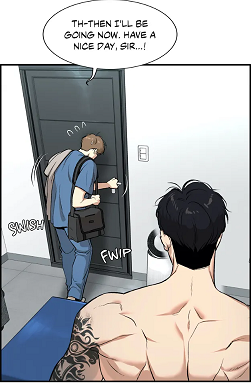 (chapter 1) Then the micro-expressions from Kim Dan exposed his lie
 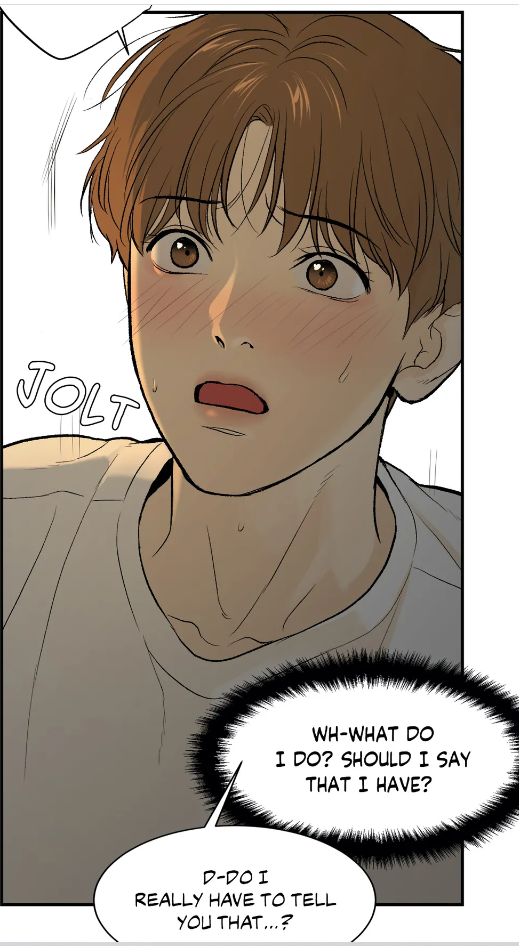 (chapter 3) On the one hand, the champion’s worldview about humans got reinforced, on the other hand the doctor’s deception symbolized his purity. He was a virgin, which was contradicting his “theory” too.
But wait… the title of this essay is Prince S and Emperor and not wolf or dog. Interesting is that the notion of an emperor or ruler could indeed symbolize cynicism, especially in the context of power and authority. Here’s why:
Skepticism and Distrust: Cynicism often involves skepticism and a general distrust of motives and intentions. An emperor or ruler, representing authority, may be associated with a cynical outlook on the motives of others, assuming that actions are driven by self-interest. This explicates why the champion assumed another intention behind the doctor’s present. (chapter 45) He imagined that the doctor had ulterior motives. This explicates why he felt no empathy, when Kim Dan asked for an advance.  (chapter 11) He even looked like a ruler abusing his authority.
 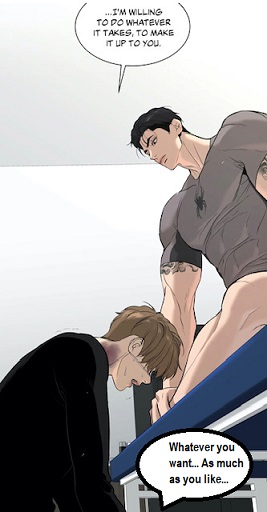 (chapter 11)
Negative Interpretation of Intentions: Cynicism often leads to a negative interpretation of others’ actions. An emperor or ruler, when used symbolically, can represent someone who interprets the actions of others with suspicion, assuming that individuals are motivated primarily by personal gain.
Lack of Idealism: It tends to reject idealism and a positive view of human nature.  (chapter 11) Here, the champion thought that Kim Dan had been gambling. An emperor or ruler, especially one characterized by a lack of idealism, may embody the cynical belief that individuals are primarily driven by self-interest and that altruistic motives are rare. Therefore the celebrity rejects the notion of soulmate
  (chapter 33) or even the idea of friendship
 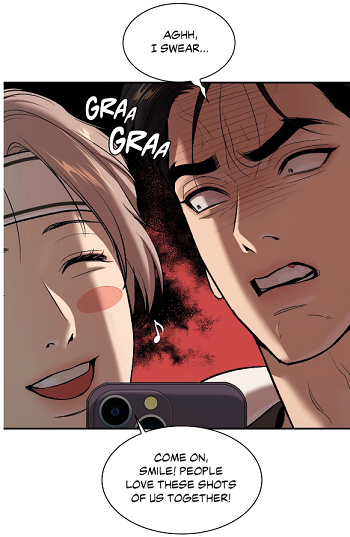 (chapter 30) Heesung was not just taking advantage of his reputation, he was also teasing the sportsman. Joo Jaekyung has such a negative perception of humans.
 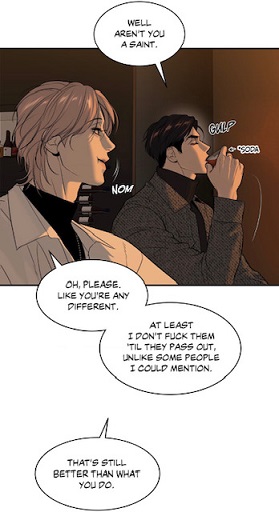 (chapter 33) Hence he looks down on poor people.
  (chapter 10): Gamblers, laziness, no sense of hygiene etc. Consequently, he is not capable to understand the worries from Kim Dan
 (chapter 42), Park Namwook (chapter 46) and Jeon Yosep. He feels like they are questioning his success. It was, as if they had other motives. He only relies on himself, he is not “truly” listening to others… though it is not correct. He is getting manipulated by his “counselors”.
  (chapter 36)
Use of Power: An emperor or ruler traditionally holds significant power, and cynicism may be associated with the idea that those in power are inherently self-serving. This aligns with the cynical perspective that individuals act in their own interest, particularly when they hold positions of authority. Thus the protagonist is selfish and abused his position during their first night together: 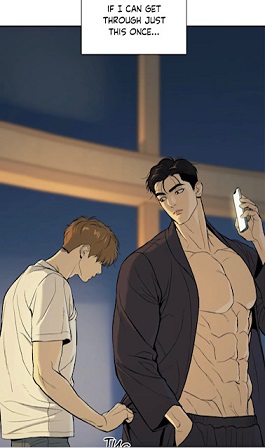 (chapter 2)
On a personal level, cynicism can have several impacts. While it may provide a form of self-protection against exploitation or disappointment, chronic cynicism can also contribute to stress, alienation, chronic pessimism, hopelessness, depression and anxiety. It may inhibit personal relationships and lead to a reduced sense of life satisfaction or happiness. Though the champion is rich and even famous, he is far from being happy, as his negative perception of humans represents a hindrance to his inner freedom and peace of mind. He rejects society, yet he needs people to fight and spare with. And now, you comprehend the origins of his inner passivity and emptiness.  (chapter 26) He is standing in front of a dilemma. Fighting is the expression of nature and self-reliance, yet his fights serve as entertainment for MMA lovers. MMA is strongly intertwined with business and money.
That’s the reason why he was condemned to loneliness, until he met the physical therapist. As time passed on, he had the impression that he had found a kindred spirit, his real new disciple. But the present which was bought in secret ruined everything. What Joo Jaekyung failed to realize is that the golden keychain  (chapter 45) was showing the doctor’s golden heart. He was just judging his lover based on his past experiences and his negative worldview. And this brings me to list the cause for Cynicism:
Experts researching into what causes cynicism point to the following developmental factors:
Negative past experiences or betrayals
Observing dishonesty or hypocrisy in others
Feeling disconnected or disillusioned with society
Perceiving pervasive corruption or unethical behavior
Exposure to cynicism from influential figures or media
Psychological defense mechanism against vulnerability
Lack of trust-building experiences or positive relationships
Personal feelings of powerlessness or lack of control
Cultivation of critical thinking without balance in perspective Read more here: https://mind.help/topic/cynicism/
Manhwaworms can grasp why the athlete is a control-freak, why he hates to expose his vulnerability 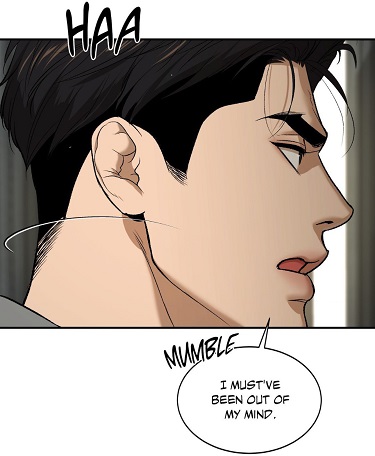 (chapter 45) He fears to be taken advantage. There is no ambiguity that his negative mind-set is definitely influenced by his childhood and family. I would even say that he must have been exposed to emotional blackmail. I came to this hypothesis, because I detected that the champion had been using “blackmail” as MO in order to control Kim Dan.
 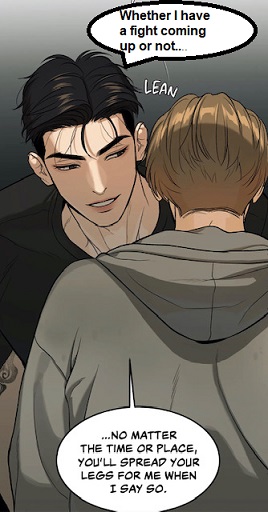 (chapter 6)
Emotional blackmail within parent-child relationships can have particularly damaging effects on the child’s emotional development and well-being. Here’s how emotional blackmail may manifest in the context of a parent raising a child:
This would explain why Joo Jaekyung fears and even rejects any affection and relationships. This is the lesson he learned through his bad experiences. No attachment and no love is freedom, as love is synonym for vulnerability, That’s why he chose independency, rejection of norms and brutal honesty. He sees relationships as a source of danger and vulnerability. I am quite certain that no one would suspect the emotional abuse from his family. Hence he came to view people as selfish hypocrites. The absence of his “family” for his birthday is the proof of their bad education and “abuse”.
That’s how I realized why Joo Jaekyung chose MMA fighting as career too. It was not just a mere coincidence.  (chapter 26)
Cynical depression may be the most common form of the many-faceted disorder.
It’s usually masked by energizing or sedating coping habits.
Sufferers don’t feel depressed; they use adrenaline to raise their mood or illusions to numb it.
The adrenaline mask takes the form of risky behavior, chronic resentment, anger, chronic envy, dogmatic zealotry, or abuse of loved ones. Sufferers don’t look or feel depressed; the adrenaline militates out of depressed mood. It gives a surge of temporary energy and confidence, manifested in facial expressions and body language. https://www.psychologytoday.com/intl/blog/anger-in-the-age-entitlement/202205/your-partner-may-be-suffering-cynical-depression
The adrenaline from the training and fighting is diverting his attention from his misery. He can mask his depression behind his anger and his fighting. It was to numb his negative thoughts and emotions. Hence he can not “meditate”. But he knows that Kim Dan is fragile, he can not treat him like the others.  (chapter 2) He learned through Cheolmin that he could kill him. This shows his good nature in verity. Hence he resorted to such gestures, when his cynical depression resurfaced:
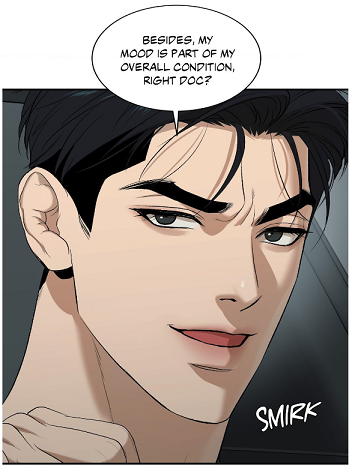 (chapter 32)
  (chapter 36)
  (chapter 37)
  (chapter 45) As you can see, little by little, the champion is learning to control his rage and “cynicism”. During the last argument, he didn’t touch the physical therapist at all. He still allows him to stay at his place and he is shown as caring later. (chapter 46) The irony is that Joo Jaekyung is not recognizing his own transformation. The most obvious evidence for his metamorphosis is the absence of his jealousy towards the doctor.
 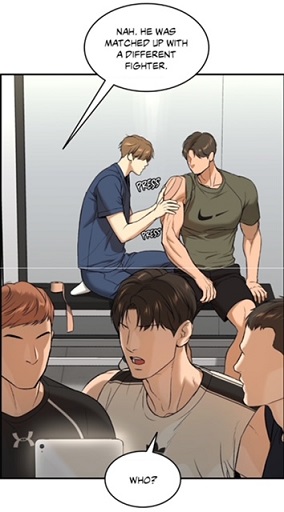 (chapter 47) It shows a certain trust. One might argue about this interpretation. This could be seen as indifference. However, I believe that his altercation with Seonho must have been quite an eye-opening for the champion.
 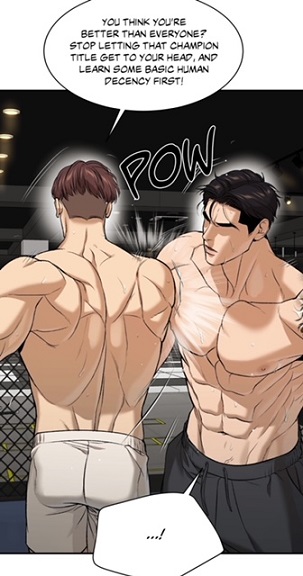 (chapter 46) It is because Kim Dan had not talked back to Joo Jaekyung during their argument. He had accepted his criticism silently contrary to Seonho. Right now, he has the impression that he still has the upper hand, but he couldn’t be more wrong.
Since the champion has such a long mistrust in people, Jinx-philes can grasp why the champion believes in the power of money.  (chapter 26) He has the impression that he can control people, since he is wealthy. Yet, he is not realizing that he can get stabbed because of money as well. We have two perfect examples. Because of the drug incident, the MFC security guys betrayed him, as they protected the organization
 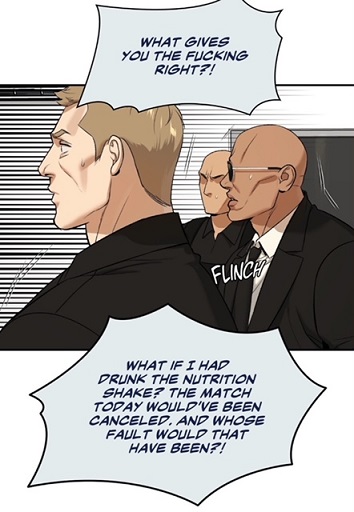 (chapter 40) Then in episode 47, the emperor got manipulated by his so-called loyal advisors.
 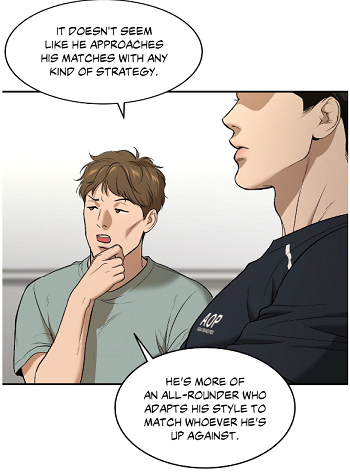 (chapter 47) First, I would like to outline that neither the manager from the Entertainment agency nor his acolyte brought up the underground fighting ring and Baek Junmin’s dubious success.
 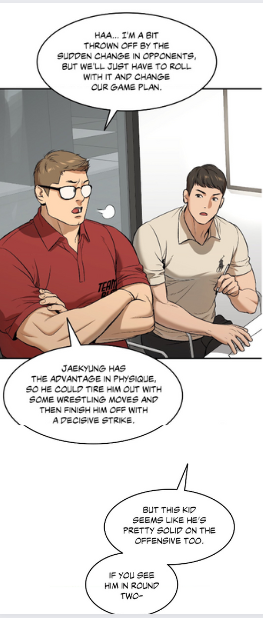 (chapter 47) With their video, they presented him as an average and reliable fighter. (chapter 47) Observe the divergence between the advisors’ words and the members’ from Team Black.
 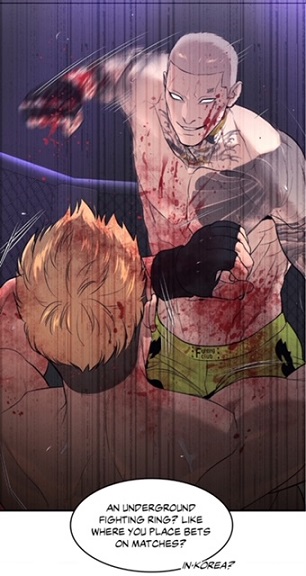 (chapter 47) The latter portrayed Baek Junmin as dangerous, for he would use any mean to win the fight. He doesn’t stand for fairness and responsibility. The champion didn’t get to hear anything about these rumors.
And how can the champion change his cynical view of life? Naturally, through pain… as he needs to be confronted by his fears. Nonetheless, I believe that the halmoni next to Kim Dan has a huge role in his healing as well. Since the latter is so weak and gentle, he doesn’t fear danger from her. 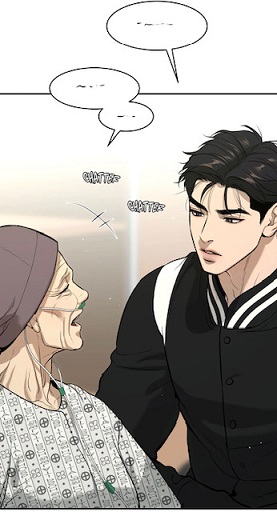 (chapter 21) Moreover, the grandmother’s mortality could serve as a reminder for the champion that he is also a human… just like the others he condemns. Besides, she embodies true selflessness and gratitude. Hence she took the champion’s hand to thank him
 (chapter 22) This is what psychologists recommend to overcome Cynicism:
Practice self-awareness and recognize cynical thoughts and attitudes.
Challenge negative assumptions and beliefs about others’ motives.
Seek support from friends, family, or a therapist to discuss and process emotions.
Engage in activities that foster positive emotions and a sense of well-being.
Cultivate empathy and understanding by considering others’ perspectives.
Focus on building positive and genuine relationships with trustworthy individuals.
Limit exposure to excessively negative media or influences.
Practice gratitude and focus on the positive aspects of life.
Adopt a more balanced and realistic perspective on human behavior.
Set realistic expectations for others while acknowledging imperfections. Read more here: https://mind.help/topic/cynicism/
As you can see, COMPASSION, GRATITUDE, MEDITATION and CONVERSATION play a huge role in changing the mind-set. So far, the couple never shared their fears and own thoughts. They still kept secrets from each other and they didn’t converse a lot. Moreover, the problem was that Kim Dan had acted in secrecy for the gift, which could only reinforce the fighter’s negative disposition. That’s the reason why I believe that Joo Jaekyung needs to learn through a positive experience that not all people are selfish and have ill intentions. He has to discover his own bias through the doctor’s reflection. He needs to receive unconditional love and respect: 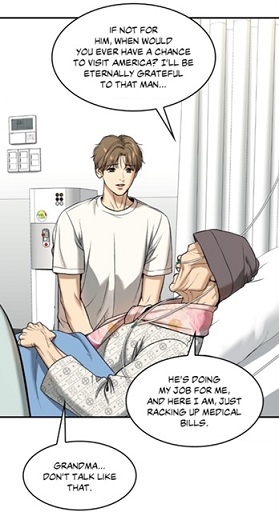 (chapter 41) He never heard her recognition. In addition, until now, Kim Dan spoke in the name of others or didn’t defend his own point. Team Black’s loyalty would be the evidence that it is dangerous to judge people based on prejudices and past experiences. He needs to reflect on his own actions as well. If the Emperor heard “his members”, he would realize that MFC as an organization is corrupted and is even involved with criminality. He is already sensing something, but he can not identify the problem.
 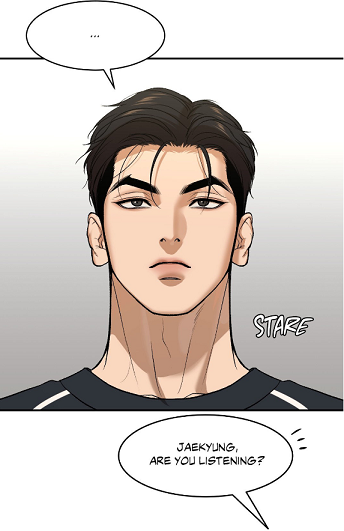 (chapter 47) Should Kim Dan divulge Baek Junmin’s connections to the underground fighting ring or simply show him the message, (chapter 47), he would prove his faithfulness and sincerity to the fighter. And the vicious circle would be broken. Though he is broke, he would give up on an opportunity to earn some money easily. To conclude, as long as the champion is still a cynical character, he can not enter a relationship with Kim Dan. For that, he needs to open up his heart and third eye so that he can recognize his partner’s selflessness and honesty. Finally, he will realize that he needs the assistance of others in order to be able to keep his reputation intact (witnesses, supporters). There is no doubt that the Emperor will be badmouthed again.
Feel free to comment. If you have any suggestion for topics or manhwas, feel free to ask. If you enjoyed reading it, retweet it or push the button like. My Reddit-Instagram-Twitter-Tumblr account is: @bebebisous33. Thanks for reading and for the support, particularly, I would like to thank all the new followers and people recommending my blog.
Please support the authors by reading the manhwas on the official websites. This is where you can read the manhwa: Jinx. But be aware that this Manhwa is a mature Yaoi, which means, it is about homosexuality with explicit scenes. Here is the link of the table of contents about Jinx. Here is the link where you can find the table of contents of analyzed manhwas. Here are the links, if you are interested in the first work from Mingwa, BJ Alex, and the previous essay about Jinx “Harmony‘s Clash: Prince S and Emperor – part 1
It would be great if you could make some donations/sponsoring: Ko-fi.com/bebebisous33 That way, you can support me with “coffee” so that I have the energy to keep examining manhwas. Besides, I need to cover up the expenses for this blog.
If you read my essays “Agent Blue – part 1 (Second version) and Agent Blue – part 2“, you already know about my theory that Heo Manwook was involved in the drug incident. And this hypothesis got proven correct:  (chapter 46) I had even truly perceived his motivations:
  (chapter 46) He desired to get revenge on the celebrity. But from my point of view, there exist other reasons for his trick. He was seeking validation for his statement:
 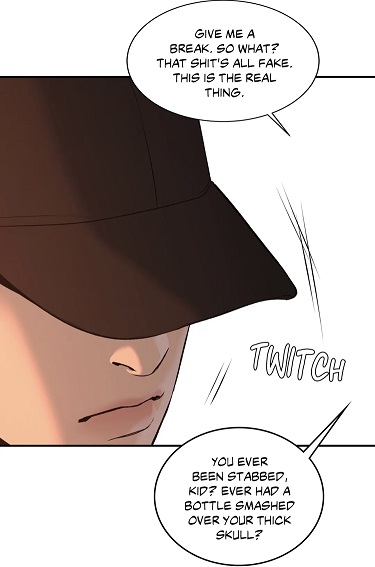 (chapter 17) Such fights are fake. The irony was that his perception got discredited once again. And now, we know why he thought like this. He is involved with the underground sports gamblers.
  (Chapter 46) His computer screen is indicating that Heo Manwook is gambling himself.
  (Chapter 46)
However, the loan shark was just the peak of the iceberg, for he is working for someone else: Mr Choi! (chapter 46)
Before examining this new character more closely, I prefer determining their relationship, as my focus is first on the moneylender. The way Heo Manwook saved the contact under Mr Choi indicates a certain respect and distance. He doesn’t call him by his first name. Additionally, though the moneylender calls Mr Choi “Boss” (chapter 46), their work relations are not official. Yes, they are bound to each other by an oral contract and as such by loyalty. And how do I know this? Mingwa left two important clues: Mr Choi is using his wireless telephone, though there is a normal telephone on his desk. (chapter 46) This shows that this call is private and even secret. No one should know about his connection to the thug. From my point of view, Mr. Choi doesn’t want to interact with Heo Manwook too often, as this could expose the true origins of his wealth and fame. He is not a real self-made man, rather a criminal who could climb the social ladders thanks to his cunningness and connections.
Secondly, Jinx-philes should recall how Kim Dan had wired the 14.000 $ to Heo Manwook’s personal account.  (chapter 16) And this raises the following question again.
 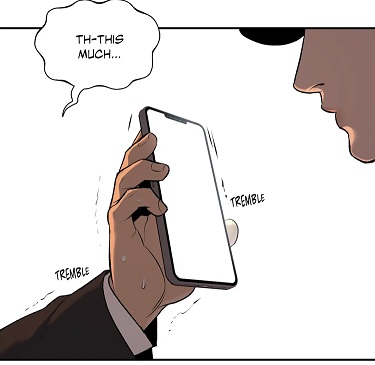 (chapter 17) To which account did the champion send the money? Heo Manwook’s or a different one? If this is the second case, this signifies that Heo Manwook has been embezzling money from Mr. Choi through the poor physical therapist. The latter was sending the money to his personal account.
  (chapter 16) This would explain why Heo Manwook would harass the main lead, though he had paid the interests on time.
  (chapter 1) Under this new light, it dawned on me why the moneylender interrogated Kim Dan later.
 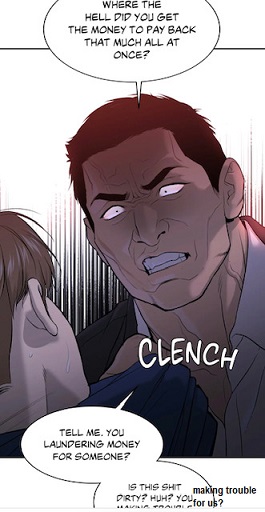 (chapter 11) It is because the doctor had paid a huge amount making it impossible for the loan shark to filch it. And now take a closer look at the infuriated thug: he employed the expression “laundering money”! He was projecting his own fears onto Kim Dan. For me, this scene exposes the true nature between Mr. Choi and Heo Manwook. He is laundering money for Mr. Choi. This explicates why their work relations is not official, as they are engaged in illegal activities. Thus their labor relations can not be known to others. On the other hand, if the champion paid the loan to the same account (chapter 16), then Joo Jaekyung has a way to track down the moneylender. 😮 Moreover, remember how I had underlined the importance of business account and personal account. If the loan shark were to get sued, he would be held responsible personally for any damage. He could go himself into debts.😉 And Mr. Choi could act, as if he has nothing to do with him. Since I detected the presence of “respect and distance” with the contact registration, it seems doubtful that the criminal would steal from his “boss”. Yet, we shouldn’t overlook the fact that the moneylender used his “boss” to achieve his own goal: getting revenge on the champion.
 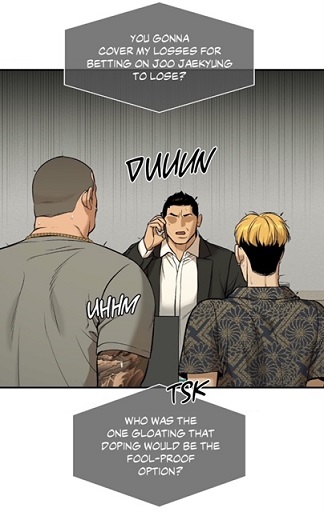 (chapter 46) He had to convince him to bet on Joo Jaekyung’s defeat. The thug could use the interference of the champion on his side business, as this secret “laundering money” could come to the surface. His actions prove us that his “respect” towards his boss is just superficial. He is prioritizing his own interests. Hence he could have definitely taken advantage of his own position to earn more money through side “hustles”.
  (chapter 45) Yes, the negative reflection from the physical therapist’s. So should the broker indeed have embezzled money, that would be the end between him and Mr Choi. He would be abandoned. However, since my assumption is that the moneylender is laundering money for Mr. Choi, it signifies that the latter is dependent on him as well. However, he could choose to replace him. We could detect through the years that the thugs were switched.
  (Chapter 5)
 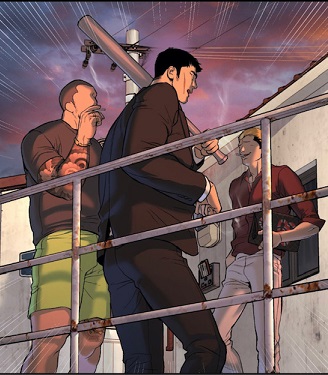 (chapter 1) Thus I come to the following conclusion: We are assisting to the gradual disintegration of their secret relationship. I am already envisaging that Heo Manwook could end up not only losing Mr. Choi’s favor, but also getting switched by this man. (Chapter 37) And the starting point of their estrangement is the suggestion made by Heo Manwook which led to the loss of the bet. Mr. Choi trusted his „underground assistant“, hence he wagers a huge amount of money.
  (Chapter 46) The sum reflects the faith he had in Heo Manwook. Yet, the conversation displays the increasing mistrust between them. Note that the usurer is not taking responsibility for the failure of his scheme: „on their end“. (Chapter 46) It was because of the others. Moreover, observe that the moneylender was looking at his screen, a sign that he is slowly getting addicted to underground sports gambling. (Chapter 46) There’s no doubt that the moneylender will act on his own. (chapter 46) He won’t listen to his boss’ request. Why? First, the thug never got his revenge, but it was his main motivation for his last trick. We could say that it is a matter of pride and money
 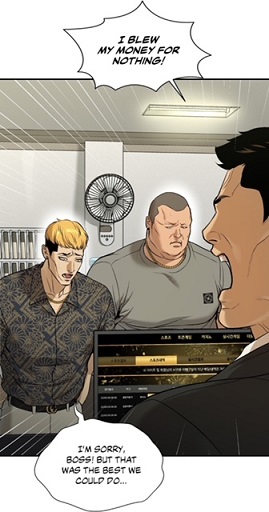 (chapter 46). Secondly, since Mr. Choi is now taking the matter into his own hands, this signifies that the criminal won’t be involved in the next scheme, so he won‘t gain anything. (chapter 46) Consequently, it implies that Mr. Choi won’t inform him… Yet, keep in mind that Heo Manwook is looking at illegal sport bets, and the champion’s next fight is scheduled in two weeks, which the moneylender must definitely know. Therefore I am envisaging a new bet on the athlete from his part. And this brings me to my second piece of the “collage”.
For that, it is time to return our attention to the last scheme. Mr. Choi had not organized himself the drug incident, he had just been informed about the plot. (chapter 46) That’s the reason why the thug had hired the man himself. This confirms that this man (chapter 37) met the moneylender, but he was not in touch with Mr Choi. Hence the man in black could not reveal the incident in the States to Mr Choi. The latter has no idea what truly happened there: they missed their target and afterwards they involved MFC security guys to cover up the incident by framing the physical therapist.. What only mattered to Mr. Choi was that the champion had not drunk the drugged beverage. And we know for sure that Mr Choi is left in the dark concerning this
  (chapter 40). How so? It is because Heo Manwook doesn’t explain how the plot failed!! (chapter 46) At no moment, he elaborates that someone else drank the poisoned nutrition shake. Besides, Heo Manwook has no idea about the identity of the drinker. From my point of view, Mr Choi is unaware of the involvement of MFC security guys. Yes… though this chapter was painful for Jinx-philes, it still gave me hope, for the author is showing that the villains are not communicating to each other. They keep information from each other which represents the exact opposite to the argument in the penthouse.
  (chapter 45) Their reason for not sharing their secrets is simple: they don’t want to expose their vulnerabilities, mistakes and problems. That’s the reason why their plots can only fail in the end. They didn’t possess all the information. Simultaneously, it displays their cowardice, for they are acting in the shadow, behind people’s back.
We have the best evidence of miscommunication with Kim Dan. The latter never interacted with Mr. Choi directly, but he was connected to him through the debts. Moreover, he was not the borrower of the loan  (chapter 5), thus I doubt that Mr. Choi is aware of the connection between the physical therapist and Heo Manwook. The curriculum vitae sent to him certainly doesn’t contain any information about Kim Dan’s past financial situation. (chapter 46) Moreover, the CV can be seen as a source of information, just like the photos. As you can see, Mr. Choi gathered insight through others, I would even add through indirect channels. Another common denominator is that this intel is on paper. He is not interacting with the celebrity or the doctor. It is important, because he is judging the situation from the distance. He is put in the same situation than Potato:
  (chapter 23) Back then, he initially denied the existence of intimacy between them, until he was confronted with reality.
  (chapter 25) Hence he envied the doctor for his closeness with the celebrity.
 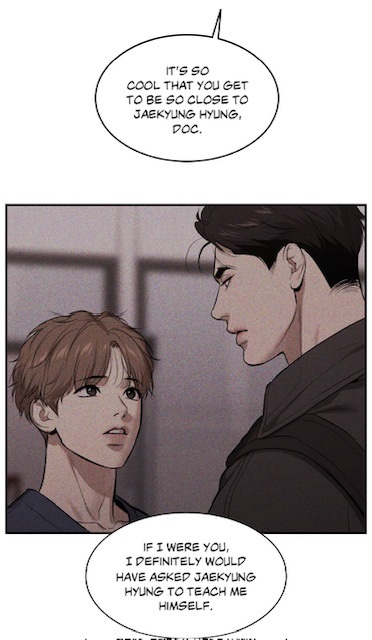 (chapter 25) Thus from my point of view, Mr. Choi must have come to a different perception than the maknae: (chapter 46) The champion not only must trust the doctor, but also exposes his attachment towards the physical therapist by opening the door and sharing the burden with his fated partner. The fighter is seen gentle and caring. Hence it becomes clear that Mr. Choi is now targeting Kim Dan. His goal will be to separate the couple. I didn’t come to this conclusion just through deductions, but Mingwa also left a clue: the “stalker” took a picture of Kim Dan alone, a sign that the photograph was now following the physical therapist. But if Mr. Choi had showed the picture to Heo Manwook, the latter would have revealed that Kim Dan was “selling his body” for “Team Black”. The documents are the proof of miscommunication, though they are conversing over the phone. This stands in opposition to these short messages from Park Manwook: (chapter 45): sincere congratulations from a family, as he showed his kids to the celebrity. Finally, observe that during the phone conversation, Mr. Choi refused to listen to his minion. (chapter 46)
Furthermore, I would like to outline that when the fake MFC guy brought the poison, he saw Kim Dan wearing an uniform with the tag Team Black.  (chapter 37) However, the man with the cap couldn’t determine Kim Dan’s true identity based on his uniform. Who was he exactly? A fighter? Or a coach? He could jump to the false conclusion that it is an uniform for the members of Team Black and not for the physical therapist. The unknown man could only recognize him by his face and hair. That’s how he got denunciated to the MFC security guys
  (chapter 40) Therefore you comprehend why the “fake” agents for order tried to determine his identity. (chapter 40) But the champion’s response couldn’t give them any satisfaction:
  (chapter 40) He only declared that he was part of his team. They had no idea who the person actually was. However, Joo Jaekyung didn’t realize that through his action, he was bringing attention to the company “TEAM BLACK”. That’s what the criminal saw on the uniform and the jacket! Thus I come to the following deduction: the hired man will report to Heo Manwook the existence of Team Black and its connection with Joo Jaekyung. (chapter 16)
  (chapter 16) Thus there’s a high chance that they will try to ruin the champion by tarnishing his company. It is a hidden brothel. Imagine Park Manwook’s reaction, when he gets to hear that his gym is a whorehouse. (Chapter 45) Another possibility is that they decide to target the members from Team Black, especially Potato, and rig his games. (chapter 46) But here is the thing: (chapter 30) Choi Heesung has been promoting the athlete and his company.
  (chapter 31) That’s how the actor’s reputation would get affected. As you can see, the actor and Mr. Choi share the same family name. So are they related or not?
Before answering this question, I would like to portray him first, based on the clues Mingwa left in the chapter. Who is this man?
He is definitely a new villain, as he wagered on the champion‘s loss. Interesting is that Mingwa didn’t reveal everything about this character. First, she never showed his eyes! (chapter 46) Don’t forget that eyes are the mirror of the soul. Secondly, the readers can only see his chin and nose, while the top of his head remains in the shadow. For me, the Webtoonist didn’t truly expose Mr Choi’s face. Why? The purpose is to keep his identity a mystery. Some people came to think that this person was the fan at the restaurant, for he was wearing similar clothes (green shirt).  (chapter 43) Besides, on his desk, there were photos of the protagonists. But in my eyes, these two persons are totally different. How so? (chapter 46) The form of the hair on the neck diverges: round versus square. Moreover, both men are wearing the cell phone with a different hand: left versus right. But why did the author create such a confusion? It is because she is working with positive and negative reflections. This means that the admiration of the fan at the restaurant was genuine, whereas Mr Choi is just a hypocrite. He had been spying on Joo Jaekyung and Kim Dan. (chapter 46) I also don’t think that it’s a coincidence that Mr Choi is left-handed. The association between being left-handed and being considered a jinx or unlucky is rooted in historical superstitions and cultural beliefs. Throughout history, left-handedness has been viewed with suspicion or negativity in various cultures.
He owns a huge company, for his desk is covered with files. Besides, the small red box looks very expensive. First, I thought that it was a cigarette etui, until my friend @m1n_m1n_07 suggested a box for a stamp seal. The latter is the symbol for identity and ownership. Thus I deduced that Mr. Choi is running a business. In my opinion, he is the CEO of the Entertainment agency. Yes, this would fit the description about the „fake admiration“ for Joo Jaekyung. Then this would signify that the entertainment agency would launder money by receiving payments from the moneylender Heo Manwook that are proceeds from illegal activities, such as loan sharking or extortion. The agency might then use its legitimate business activities, such as concert promotions or talent management, to disguise the illicit origins of the funds. That‘s why they needed the athlete as their client! Behind his games, they could mask the illegal activities, thus the lucky streak!!
And remember what the actor said at the club: 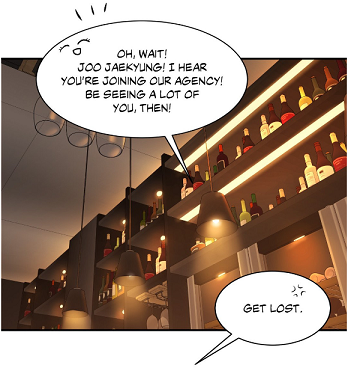 (chapter 33) He employed the personal pronoun “our” (even in the Korean version), a sign that he was identifying himself with the owner. From my point of view, Mr Choi and Choi Heesung are related, I would even say father and son. I know, when I presented my theory on X, people argued about this, for in South Korea, Choi is a common surname, just like Kim Miseon is not related to Kim Dan.
  (Chapter 5) Yet, I can refute their objections with the following points. Jinx is about emancipation and maturity, the leads are encouraged to become responsible and mature men. This signifies that they need to cut off ties with their parents and become strong mentally and emotionally.
Moreover, the moment you compare the introduction of the two Chois, you can detect huge contrasts. It indicates that the author is once again working with positive and negative reflections. First, the actor was not introduced as Choi Heesung, but as Heesung.  (chapter 29) Note that the comedian is promoting himself with Heesung and not his surname.
  (chapter 30) It was, as if he didn’t want to be connected to this Mr. Choi. Moreover, contrary to the mysterious director, readers could see his face and identify his “job”: an actor!
  (chapter 29) Yes, the Webtoonist introduced the actor the opposite way. However, in this scene, Jinx-Philes were intrigued by him, as they had no way to determine his role in the story: antagonist or second lead? His personality was quite mysterious which stands in opposition to Mr. Choi. Readers can already judge him as a bad guy. The latter oozes ruthlessness, greed and dishonesty. His words are represented by the color “dark grey”. (chapter 46)
Dark gray is conventional and constrained. It is serious and solemn, inflexible and strict. It relates to self-denial and self-discipline. Quoted from https://www.empower-yourself-with-color-psychology.com/color-gray.html
These notions stand in opposition to the actor.  (chapter 31) The latter hates conventions, discipline and even control.
  (chapter 33) In addition, Grey embodies boredom, neutrality and compromise, while the actor is always trying to “take a side”, to earn people’s admiration. As you can see, through this contrast, it becomes obvious that these two characters are related. The darkness from the relative rubbed off on the actor, for he is able to scheme. Moreover, Mingwa still created some similarities: both faces were first covered.
  (chapter 29) (chapter 46) And finally, the actor was seen wearing a similar shade on the rooftop:
  (chapter 33) Green, whose negative features are greed, jealousy and envy. And what had Heesung done during that day? A prank at the champion’s expense. He wanted to have the doctor for himself. Furthermore, we can grasp why Heesung’s manager complained about this:
  (chapter 31) His words expose the greed and selfishness of the CEO from the agency. They are accountable for Heesung’s actions. In my eyes, this condition was made in order to control Heesung, so that the latter would feel responsible for his manager and other employees. It was to push him to „work“. Under this new approach, it dawned on me why Heesung would sponsor lunches to the members from Team Black,
  (chapter 30). It was his way to get acceptance and recognition. From my point of view, he occupies a special position at the agency, as if his moves are supervised there. Hence he asked from his manager that the latter would keep the fake injury a secret. (Chapter 33) His laziness was already implied by the champion.
  (Chapter 31) As you can see, I sense that Heesung had an ambivalent relationship with his „father“. On the one hand, he rejects him due to his cold-heartedness and high expectations, on the other hand, he was still relying on him and his connections through the agency. In my eyes, he will be forced to choose between love or money in the end.
From my point of view, Heesung and his relative are not close, they have an estranged relationship. Finally, I would like my inquisitive readers to recall the way the actor appeared at the club: he was wearing slippers.  (chapter 33) My initial theory was that he had been stalked. But he could have left the family house after a huge quarrel. And Mr. Choi is indeed acting like a stalker, though he did not do it himself: the pictures! (chapter 46) On the other hand, these pictures corroborate my previous observation: Joo Jaekyung had been followed during that evening.
  (chapter 33) This was the “stalker” working on Mr. Choi’s account. So it dawned on me that Heesung might have been living with his father in the huge building
 (chapter 32), until he chose to move out and live on his own. And now, we have the perfect explanation why his house is so clean and impersonal:
  (chapter 33) It is because his father probably meddled in his life constantly. I have the impression that he must know about his father’s past and the true origin of their wealth. The fact that he introduces himself as “Heesung” is a sign that he wants to deny his origins, Choi.
Since people questioned my theory about their parentage, I chose to look into the signification of Choi. This is what I found:
It is fabled that the origins of this name were derived from the intermixing of Koreans and Chinese eons ago. Choi also means high, superior, lofty or towering, which might explain why this surname is mostly used as surnames of antagonists in Korean soap operas. https://www.babycentre.co.uk/babyname/1023279/choi
This quote explains why this mysterious man was introduced as Mr. Choi!! He is an antagonist and even villain of our beloved couples, while the actor had to be introduced as Heesung, for his role in Jinx is different. Moreover, since Mr. Choi is portrayed as a man obsessed with money and with no integrity, Manhwalovers can grasp why Heesung was obsessed with his search for a „soulmate“. (Chapter 33) He had been missing love and warmth too because of his family, exactly like the champion. Both came to a similar conclusion: fame served as a replacement. It was to get recognition and „affection“. The problem is that this type of attachment is rather superficial and temporary, as none of their „admirers“ or „fans“ has to become responsible for them. Moreover, their fortune played a huge role to undermine their relationship.
Then I found on a different website this information:
The name Choi is primarily a gender-neutral name of Korean origin that means Overseer Of The Mountain.Korean surname meaning “one who oversees the land and the mountain.” Quoted from https://babynames.com/name/choi#:~:text=What%20is%20the%20meaning%20of,the%20land%20and%20the%20mountain.”
This indicates Mr. Choi’s role in Jinx. He acts like a general or governor, and gives orders to his minions. He has the impression that he owns the world. Hence he can bet on the champion‘s defeat. He is treating people like „pawns”. That‘s the reason why I included a building below Mr Choi in the illustration.  The house stands for power and propriety. But Choi has another signification.
The last name Choi is a traditional Korean surname. It stands for the powerful idea of “clear space,” emphasizing its bearer’s open-mindedness and wide scope of understanding. According to Korean legends, the surname originated from the five stars in the East of the sky that the ancient Korean nobility worshipped in order to ward off evil spirits. The popularity of the surname Choi has been steadily increasing since the 1960s as many Koreans have emigrated around the world in search of better opportunities. […] By and large, Choi is a powerful and meaningful surname. It is a reminder to its bearer to stay open-minded, aware, and ever-educating oneself in order to stay sharp and perceptive. Choi stands for optimism, understanding, and clarity; traits which, if embraced, can take any person very far. Quoted from https://www.igenea.com/en/surnames/c/choi
As you can see, this surname is associated with stars and lucky charms. It is important, because it implies the involvement of Mr. Choi with the champion‘s jinx. Is it a coincidence that the actor knows about the athlete‘s jinx? 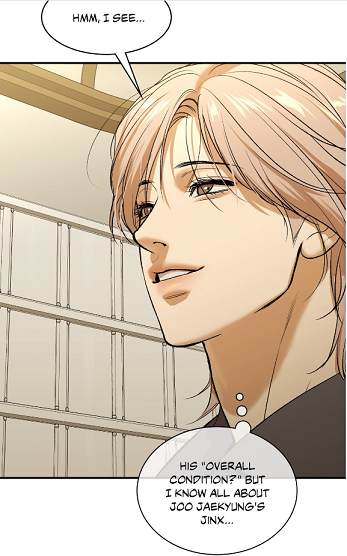 (Chapter 32) Note that when he was conversing with the celebrity at the bar, he never brought up his jinx. (Chapter 33) He only criticized Joo Jaekyung for his poor sexual behavior. So where did he hear it? Interesting is that 6 months ago, the champion signed a contract with the Entertainment agency, and this is what Park Namwook confessed to the physical therapist:
 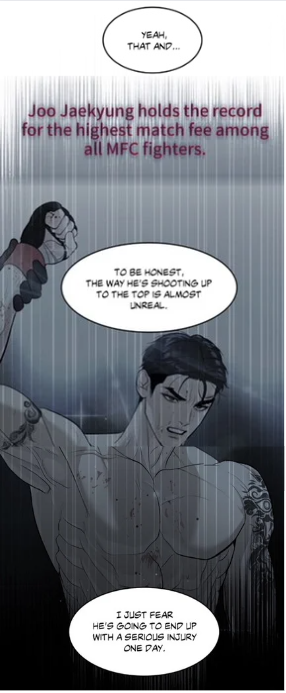 (Chapter 43) His success felt almost unreal, as it was too beautiful to be true. And this would coincide with the signature of the contract between the athlete and the Entertainment agency. The lucky streak is to cover up the illegal activities. He is already envisaging an injury, because he was convinced that this is the fate of such celebrities.
  (Chapter 43) However, if he pondered a little more, he would realize that it is a lie. How so? Coach Jeon Yosep is the evidence that not all athletes are destined to end their career because of an injury. Yosep is still a fighter.
And the connection between Choi and the 5 stars reinforces my previous interpretation about the characters in Jinx. They are all associated with stars and as such planets: Saturn, Moon, Sun, Mars, Venus, Jupiter, Neptun and Mercury. Interesting is that number 46 corresponds to the sun. So we could say that Mr-Choi and Joo Jaekyung are represented by the huge star, and Mingwa placed Mr Choi next to the main lead as an indication of a future collision between the 2 suns. There will be a conflict of interests.
The 46 unbalanced is
A glossy image with no real substance or soul
Only concerned with looks, brand and image
Family values are only used as a political show
Submerged in chaos and scandals, desperately trying to keep it together
Inner ideals and mental images blur reality Quoted from https://www.numerologistpro.com/numerology-numbers/numerology-number-46-meaning/
Interesting is that this number is linked to scandal and family. Then the latter is used to achieve a goal displaying selfishness and heartlessness. As you can see, I am quite certain that very soon, we will have a new uproar. Moreover, I would like to outline that the mysterious man is wearing a watch! (chapter 46) It was, as if he was owning time. And we have the evidence that he is the one behind the timing, as he called Heo Manwook first, and this for one reason. he wanted to announce him that he should stop seeking “revenge” on the celebrity on his own. But he only did it after receiving the CV from Kim Dan and the pictures. (chapter 46) The desk is also referring to time, like we could observe it in this situation: 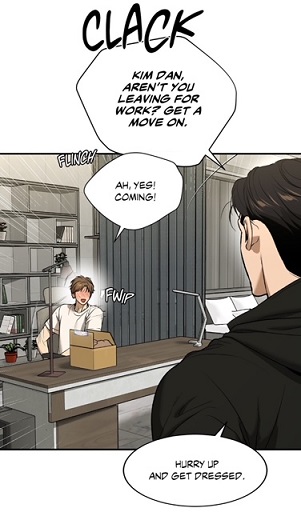 (chapter 43) The package arrived right on time.
And naturally, this panel (chapter 46) raises the following questions. Who took the pictures without being noticed? I mean, they were in front of the gym, so they could have sensed the presence of a third person, unless the latter acted as a deliveryman. Then, how did Mr. Choi get the résumé from the main lead? Did the latter send it to find a new job? Or was the curriculum vitae delivered to Mr. Choi by someone else? Like for example… a hospital! Let’s not forget that the physical therapist has been blacklisted by all the hospitals. 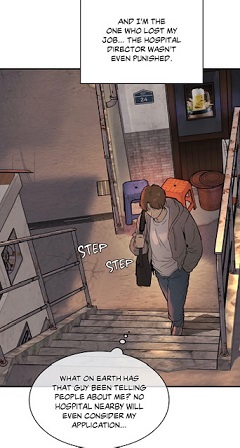 (chapter 1) I doubt that the incident with the perverted hospital director was leaked to the outside world, so the main lead must have been badmouthed. So if this rumor about Kim Dan reached Mr- Choi’s ears, then he will definitely see in him the perfect scapegoat for covering up his own involvement. He would even appear as a righteous person. According to me, he is the CEO from the Entertainment agency and the latter had pushed the champion to press charges against the hospital. (chapter 36) In fact, he could decide to leak the information about the physical therapist to the hospital so that the latter can put the blame on the free-lancer!
 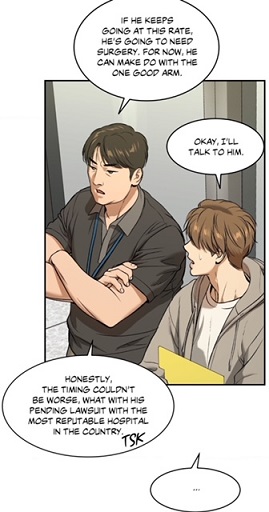 (chapter 42) That way, the agency would divert attention from its own responsibility and even receive support from the clinic. Then we have this rumor circulating that people are sending spies to gyms.
  (chapter 46) Is it a coincidence that this terrible gossip reached the blind manager Park Manwook at this moment? No, nothing is random in this story. They could frame the physical therapist as someone who tried to “leak” information in order to rig a game. He could be portrayed as a gambler. Yet, Mr Choi is not aware that Kim Dan offered a golden keychain to the champion and even risked his health to buy the expensive present.
However, we shouldn’t overlook that because the MFC matchmaker was involved in the plot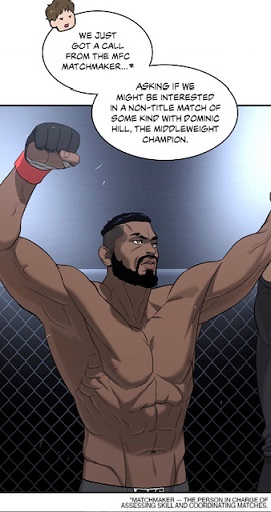 , (chapter 36), he must have wagered too and lost money. This would explain why he asked the doctor from MFC to give it a go right after. He needed to create a new game in order to cover up the last losses. The problem is that since Mr. Choi wasn’t informed about the incident with the security guys from MFC, I don’t think, he is truly aware of the celebrity’s physical conditions. If he knew about the real diagnosis, he wouldn’t need to investigate Kim Dan. He would rely on time… within such a short time, Joo Jaekyung wouldn’t be able to recover. In fact, he would even bet on the athlete’s defeat once again. Since he saw these pictures, I am quite certain that he is misjudging the relationship between the two protagonists. They are close, hence he needs to sow discord and even plant a seed of doubts on the athlete’s mind.
Finally, I would like to outline that the first plot started with the publication of Shim Yoon-Seok’s article: (chapter 35) The athlete was pushed to prove the “wrongfulness” of this article by accepting a fight.  (chapter 36) Hence I am suspecting that one of Mr. Choi’s intentions is to portray Kim Dan as a fraud, as a bad and immoral PT. They could even question his skills and competences, for MFC authorized the fight and the champion is now no longer treated by the famous hospital. They could imply that the main lead isolated the athlete on purpose and even aggravated his injury. But like mentioned above, Mr. Choi only knows half of the story. He has no idea about the connection between Cheolmin and the athlete and the former assisted him. Besides, he judges the poor uke based on his prejudices and past experiences. Exactly like the loan shark, Mr. Choi is also projecting his own thoughts onto the doctor. If the latter sent his CV, it signifies that the CEO imagines that Kim Dan is ready to “betray” the champion. Yet, the doctor doesn’t resent the main lead. In addition, from my point of view, the mysterious “general” received the résumé through connections.
Finally, once the characters make a connection between the drug incident and the agency, there is no ambiguity that the agent will have to take the fall, though he definitely followed the directives: (chapter 36) He acted on his own. The MFC matchmaker can even deny his involvement, for he didn’t contact the champion himself. (Chapter 36) Don’t forget that the man has his phone number. (Chapter 5) Imagine the consequences for the manager. The latter would not only lose his job, but also face a lawsuit for breaching the contract. There’s no ambiguity that Mr. Choi would feign ignorance. Finally, since Mingwa is using karma as punishment, the readers should expect that Mr. Choi’s papers will get leaked too. Heo Manwook plotted out of revenge and greed, the result was that he lost a lot: his boss‘ trust, his money and his „sanity“. Since Mr. Choi is now taking matters into his own hands, we have to envision that his actions will affect his company… and as such Heesung. The latter could become suspected as „spy“ or in the worse case as theft, he is „stealing talents“. All his past actions would appear in a different light: his generosity was fake. 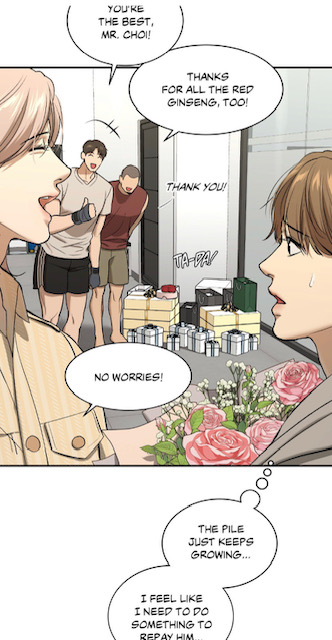 (Chapter 31) Yes, appearances would now play in Heesung‘s disfavor. Finally, an incident with the agency would push Heesung to fight against his relative… and to regain control over his life.
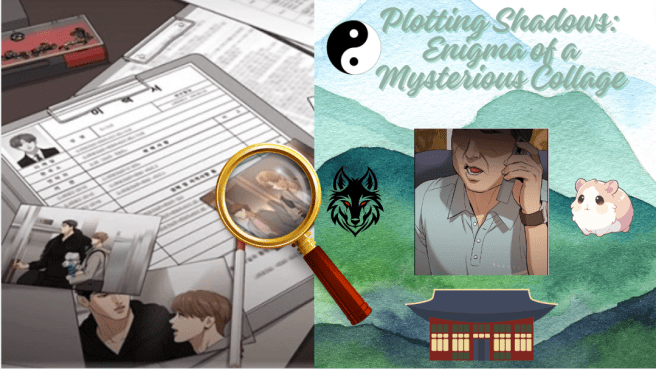
Feel free to comment. If you have any suggestion for topics or manhwas, feel free to ask. If you enjoyed reading it, retweet it or push the button like. My Reddit-Instagram-Twitter-Tumblr account is: @bebebisous33. Thanks for reading and for the support, particularly, I would like to thank all the new followers and people recommending my blog.
Please support the authors by reading the manhwas on the official websites. I am also using doctor Frost as reference again. This is where you can read the manhwas: Jinx and Doctor Frost. But be aware that the first Manhwa is a mature Yaoi, which means, it is about homosexuality with explicit scenes. Here is the link of the table of contents about Jinx. Here is the link where you can find the table of contents of analyzed manhwas. Here are the links, if you are interested in the first work from Mingwa, BJ Alex, and the previous essay about Jinx “(Un)Wanted Love“.
It would be great if you could make some donations/sponsoring: Ko-fi.com/bebebisous33 That way, you can support me with “coffee” so that I have the energy to keep examining manhwas. Besides, I need to cover up the expenses for this blog.
Anyone can imagine that with the name “emperor”, I am referring to the fighter Joo Jaekyung. That’s his nickname in the MMA world. 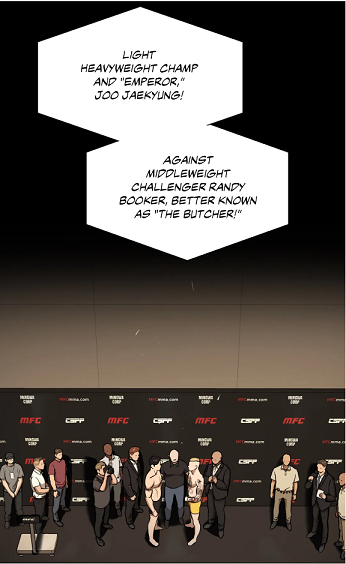 (chapter 14) On the other hand, some readers might wonder why I am connecting Kim Dan to princess (Prince S). I have many reasons for this association.
Have you ever heard about the Korean folktale of Princess Pyeonggang and her “idiot” husband Ondal? It is the story of a “stubborn” princess who helped her timid and poor husband Ondal to become a famous general during the 3 kingdoms era.
The Odd Couple
When she entered Ondal’s humble home, Princess Pyeonggang immediately explained to his weak mother that she wanted to marry her son, who was out fetching tree bark for food. His mother identified the princess as a person of noble upbringing by her perfume and soft skin. The mother explained that she and her son were very poor and that a woman of high birth had no place there.The princess, however, showed no change in her determination. When Ondal arrived, the princess once again explained her reason for visiting. Ondal was instantly suspicious, however, and angrily sent her away. After the princess spent the night outside his house and offered to buy him a new house, food, land and a horse with the money she earned by selling her gold ring, Ondal was soon won over by her sincerity. The princess not only brought Ondal and his mother out of poverty, but also paid for his education and gave him professional training in the martial arts. https://www.korea.net/NewsFocus/Culture/view?articleId=122048
Moreover, their marriage transcends social classes, which reminds us a lot of Jinx. On the other hand, if we compare the Manhwa with the legend, the champion resembles more to the princess due to his status, actions and personality. He is the one helping the doctor, and Kim Dan appears more like the fool “husband” with his weak and poor relative. However, I came to make the association between the famous Korean princess and the physical therapist, when I was rereading Doctor Frost. How so?  (chapter 30) This woman, named Sihyun, is suffering from Dependent Personality Disorder. And the author of the Webtoon Doctor Frost called her story: “The tears of Princess Pyeonggang”. Due to her personality, she was linked to the famous “princess”. She would do everything for her companions, yet she kept getting dumped. What caught my attention is that both women defined themselves through their partner. Their ultimate goal in life is to assist them, to make the other happy or recognized. But how is it a problem?
Let me give you an example with Sihyun and her first boyfriend.
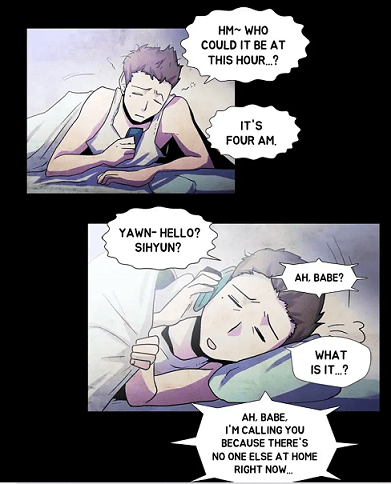
Yes, she asks her first boyfriend to make choices and as such decisions. She is unable to voice her own opinion, to make a statement. She needs the support and advices from her boyfriends. By asking for her partner’s judgment, she imagines that she is respecting him. Nonetheless, the call at such a hour looks more like intrusion and disregard. By acting this way, she burdened all her boyfriends so that at the end, they all felt the need to break up with her. 
 (chapter 33) What appeared as caring turned out to be a load, for the partners were all forced to be responsible for her and in every aspect of her life. They definitely felt asphyxiated, hence they could only get sick of her. Interesting is that this person would find shortly after the separation a new boyfriend, a sign that she could not live on her own.
  (chapter 33) And now, you are wondering how Sihyun is similar to Kim Dan, who only had one person in his life before he met the champion. It is related to traumas in their childhood.

 (Doctor Frost, chapter 39) After reading this, Jinx-philes can realize that Kim Dan is also suffering from Dependent Personality Disorder, though it is less obvious. He got abandoned by his parents making him feel insecure.
 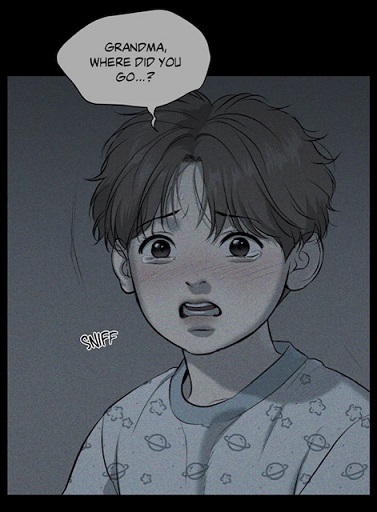 (chapter 21) We could detect his low self-esteem
 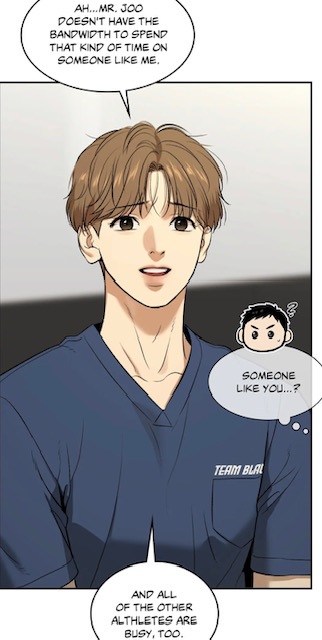 (chapter 25)
  (chapter 46) and his overprotectiveness
 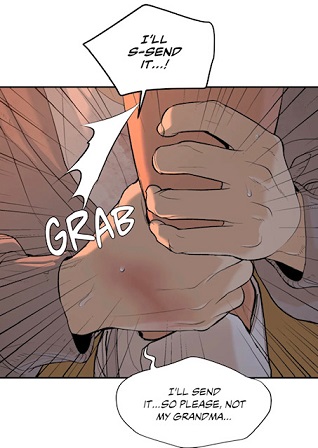 (chapter 16)
  (chapter 26)
  (chapter 42) on many occasions. He was risking his livelihood and health for the sake of others (his halmoni, Potato and Joo Jaekyung). His selflessness is actually the sign of his DPD. He had no purpose or ambition in his life… That’s why he is not able to project himself in the future. Until chapter 45, his life and future was determined by the celebrity,
  (chapter 42) and before it was by his halmoni’s fate.
  (chapter 19) However, here please don’t get me wrong. For me, the athlete is the physical therapist’s emancipator. This huge argument in the dining room pushed him to differentiate himself from the champion. In my eyes, Kim Dan would have returned to his old bad habits… relying on someone else, sacrificing himself for someone’s else sake. He would have neglected his career in the end.
As you can see, the problem is that his personality is affecting his career. At no moment, he voiced his own opinion concerning the champion’s health. He always used other doctors as references 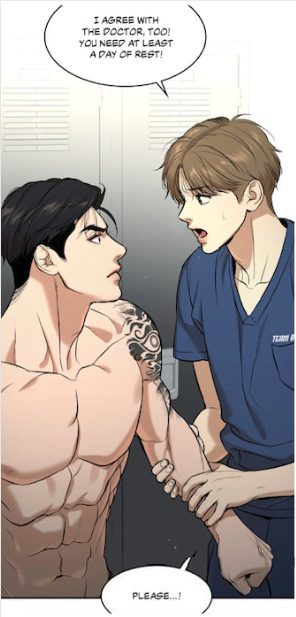 (chapter 27) (chapter 42) or he delegated the examination to a hospital.
  (chapter 31) Here, we get an explanation why he couldn’t detect the trick from Choi Heesung. He feared to make a diagnosis on his own, as he didn’t desire to question the words from the comedian. The hospital seems to be the sacred place in the doctor’s eyes.
 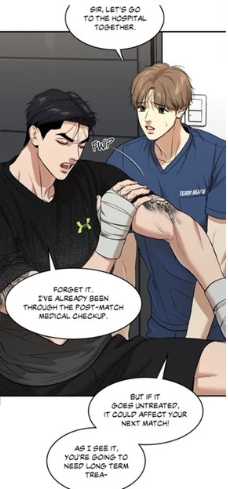 (chapter 41) There, nothing can go wrong. But by entrusting his patients to hospitals, he didn’t realize that he was appearing as untrustworthy or even “incompetent”. His lack of confidence and hesitation explicate why the athlete replied to his suggestion like this: (chapter 41) How could he question the doctor from MFC, when he kept hiding behind a hospital or the words from other physicians? That’s how the physical therapist got silenced. He couldn’t confront the athlete with his diagnosis. Interesting is that he never gave him the file later! (chapter 42) Consequently, it is not surprising why the champion complained about the doctor’s negligence. The latter was avoiding any responsibility in the end. On the other hand, the report is the symbol of his hard work, but also of his knowledge. That’s the reason why I am still considering the dispute in chapter 45 as a good omen for the physical therapist. He needs to develop his own identity. They are two different people. He needs to live for himself, to give a meaning to his life and not: (Doctor Frost, chapter 30)
Nevertheless, one detail caught my attention in this panel: (chapter 27) The presence of the personal pronoun “I”. Contrary to the conversation in the car (chapter 42), where there is no personal pronoun “I”, the doctor made a mini-statement. Jinx-philes can now grasp why the champion asked him to become responsible for his day-off.  (chapter 27) That’s how it dawned on me why the doctor reverted to his old habits (not participating to the meeting, taking odd jobs, not voicing his own judgment, relying on others) after the night, when he was treated as sex toy. However, in my eyes, the trigger for this switch was the release of the tabloid article. (chapter 35). Why did the doctor appear so confident in front of his client to the point that he could reject his hand after going to the hospital?
  (chapter 27) It is because his self-esteem had been boosted by Dr. Lee. The latter had complimented him which didn’t fall on deaf ears. However, the relationship between the respectable hospital and the athlete went sour due to his article. (chapter 35) Imagine what it meant for Kim Dan. He could only remain passive, as he is called “doctor”. He views himself as a member from the medical field. Furthermore, observe what the sports therapist told him during the treatment session: (chapter 42) He mentioned the lawsuit against the most reputable hospital. The dispute could only diminish his self-esteem. As time passed on, there is no ambiguity that this lawsuit must have burdened more and more the physical therapist. Besides, there is no doubt that he felt some loyalty towards doctor Lee who had been complimenting him. Secondly, let’s not forget that despite his “efforts”, he had not been able to convince his patient to stop training for one day.
 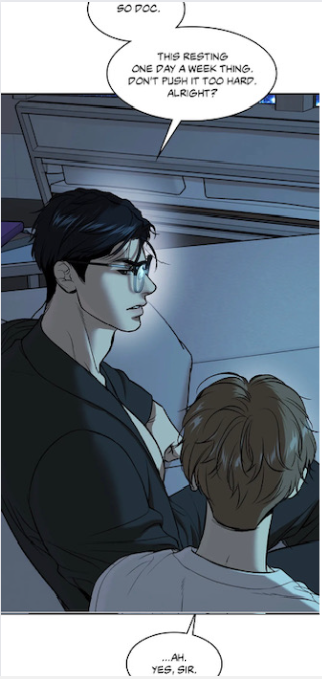 (chapter 29) Hence he jumped to the conclusion that his patient would not listen to him anyway. (chapter 42)
After being confronted with harsh reality, he is forced to reflect on his own situation, to worry about himself. That’s the reason why I judge this scene as a positive moment in the doctor’s life. He is no longer seeking love and reliance on others in order to value himself.  (chapter 46) This is not surprising that Mingwa zoomed on his feet.
  (chapter 46) It is full of symbolism. For the first time, he is standing on his own feet. His walk in direction to the trash bin illustrates his choice.
 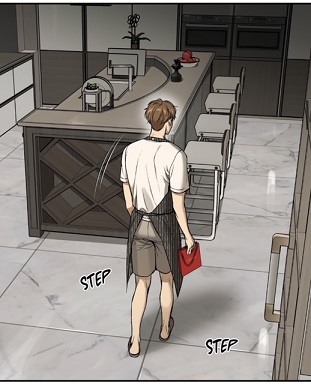 (chapter 46) Besides, he is using the personal pronoun “I”.
  (chapter 46) It is his Coming-Of-Age. He is on the verge to become independent. On the other hand, he didn’t fight back verbally against his boss. He accepted his reproach.
  (chapter 46) He was just a physical therapist and nothing more. This shows his lack of criticism. He is still not mentally strong enough to question the champion’s words and argue back. In the past, he could do it, for he was identifying himself with his grandmother and her values.
  (chapter 18) This signifies that he needs to develop his own philosophy and values. What does he treasure in his life?
And here I feel the need to bring up the green-haired guy.  (chapter 42) The latter was also dependent on the champion, but his “addiction” was money and not love or recognition. Therefore he picked up the money before leaving the flat
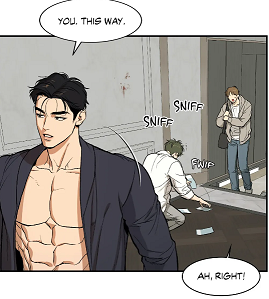 (chapter 2), while the other threw away the expensive keychain
  (chapter 46). This scene exposes the return of Kim Dan’s dignity. This comparison reinforces my interpretation that the champion misjudged the doctor’s present and actions. He imagined that Kim Dan had been acting like his “previous sex-partners” or stans. They would offer him some gifts in exchange of favors. Another contrast with the goblin is the absence of a fight and discussion.
 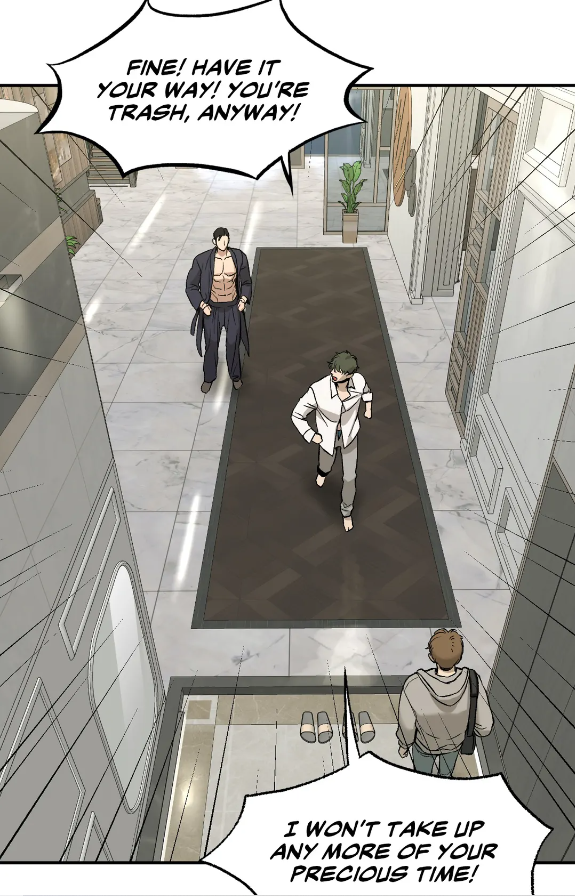 (chapter 2) I would even add that contrary to the green-haired guy, the doctor is not judging his patient’s personality, he is blaming himself. (chapter 46) Hence we should see it in a positive light: Kim Dan is not rejecting the athlete per se, but he is putting a distance between himself and his boss. Moreover, the presence of guilt is important, because in order to overcome DPD, the patient needs to recognize his own issues in order to change. By admitting his own flaws, he is able to move on. Our “Princess “Sihyun always put the whole responsibility on her boyfriends who dumped her. They were the bad guys, only interested in her money or body.
  (Doctor Frost, chapter 32) Interesting is that doctor Frost revealed to her later that her condition made her an easy target, as she kept relying on others.
  (Doctor Frost, chapter 39) And this observation brings me to my next conclusion: he will be approached by really bad guys, the mysterious Mr. Choi! (chapter 46) Thus I assume that his next lesson is to judge people correctly, to question their true motivation. So far, he fell into the same trap twice:
  (chapter 1) (chapter 1) He even needs to learn the difference between good guy and nice guy, but this remark applies to the grandmother.
When the dating coach Ruby Le came on the show, she explained the fundamental difference between good guys, who are genuinely nice people, and so-called “nice guys,” who are men who carry a lot of toxic traits. Good guys do kind and generous things because they are kind and generous. Nice guys, on the other hand, only say nice things because they think they are entitled to a women’s body, time, and attention, quickly changing their attitudes when they don’t get it. For example, nice guys think that, if they pay for dinner and drive a woman home, they are entitled to sex. But good guys give without any expectation of anything in return. They are able to love without attachment. Quoted from https://www.zachbeach.com/how-to-love-without-attachment/
Here, I was thinking of Heesung and Joo Jaekyung. Both acted as generous and gentle guys (chapter 21), yet their actions were not truly selfless.
Finally, I don’t think that the doctor’s choice for the present (chapter 45) is random, for it stands for “attachment”.
Attachment, or the attachment bond, is the emotional connection you formed as an infant with your primary caregiver—probably your mother. According to attachment theory, pioneered by British psychiatrist John Bowlby and American psychologist Mary Ainsworth, the quality of the bonding you experienced during this first relationship often determines how well you relate to other people and respond to intimacy throughout life.
If your primary caretaker made you feel safe and understood as an infant, if they were able to respond to your cries and accurately interpret your changing physical and emotional needs, then you likely developed a successful, secure attachment. As an adult, that usually translates to being self-confident, trusting, and hopeful, with an ability to healthily manage conflict, respond to intimacy, and navigate the ups and downs of romantic relationships.
Beyond categorizing attachment as secure or insecure, there are three subsets of insecure attachment which give us the four main attachment styles:
Secure attachment
Ambivalent (or anxious-preoccupied) attachment
Avoidant-dismissive attachment
Disorganized attachment
Quoted from https://www.helpguide.org/articles/relationships-communication/attachment-and-adult-relationships.htm
Because of his abandonment issues, there is no ambiguity that the doctor belongs more to the second type, whereas the champion is more connected to the third type. Since Joo Jaekyung is suffering from philophobia, the keychain could only be rejected, as it symbolized “restrain” and “attachment”.
In my opinion, the princess must learn how to love without “attachment” and as such without expectations. Yes, Kim Dan has to discover the existence of “love without conditions”.
Conditional love conveys to children the idea that they are only worthy and deserving of affection and attention when they behave as others want. It teaches them that something is wrong with their true self. Therefore, they learn that they cannot be themselves, which ends up affecting their self-esteem and their ability to create and maintain healthy social relationships. It is no coincidence that a study carried out at the University of Bielefeld with more than 500 adolescents revealed that those whose parents conditioned their love had a very vulnerable self-esteem, were not capable of treating each other with kindness, were too self-critical, were very insecure and had a lower satisfaction with life. Quoted from https://psychology-spot.com/conditional-love-parents-consecuences-children/
On my search about attachment and conditional love, I found this blog where the author’s statement opened my eyes to the princess’ destiny.
“For most people, the idea of non-attachment calls to mind images of separation, of not caring, not being involved at all. It brings to mind spiritual bypassing: people who simply preach spiritual clichés like “everything happens for a reason” or “this, too, shall pass,” and are totally uninvolved with the emotional reality of the situation.
However, non-attachment is not the opposite of attachment. Detachment is the opposite of attachment, and non-attachment resides between these opposite polarities, between getting too caught up in our experience and being completely cut off from them. This is an incredibly important distinction. Attachment is too much involvement, detachment is not enough, and non-attachment is that very special middle path that allows you to be fully present in what is happening without complicating it. […]
In Yogic philosophy, the word is vairāgya, and is sometimes translated as “dispassion.” Both ideas focus on the importance of noticing our mental, emotional, and physical experiences without getting so caught up in them.
They also point to the fundamental truth behind non-attachment: it is a state free from desire, not trying to get anything from anybody. It arises naturally when internal peace is cultivated and when we aren’t so dependent on the external world for pleasure or validation. It comes from an incredibly wise understanding that happiness is not to be found through the fulfillment of our sensory pleasures, but rather from being free from craving anything at all and enjoying this moment from a place of peace. Quoted from https://www.zachbeach.com/how-to-love-without-attachment/
Kim Dan is better than other characters in Jinx, as he is not greedy by nature. He is not motivated by money and fame. Nevertheless, what did the physical therapist think during the Summer Night’s Dream?  (chapter 44) He found fulfilment in sex, which stands in opposition to the recommendation of zackbeach. Moreover, I would like to underline that the doctor reduced knowledge to sex:
  (chapter 44) How could he get to know the champion better, when the latter was supposed to be drunk and they would have sex? Getting closer to someone means communication and not really sensuality. Hence his happiness could only be short-lived and illusory. He didn’t take the reality into consideration. Thus I see the physical therapist’s tears as a therapy session:
 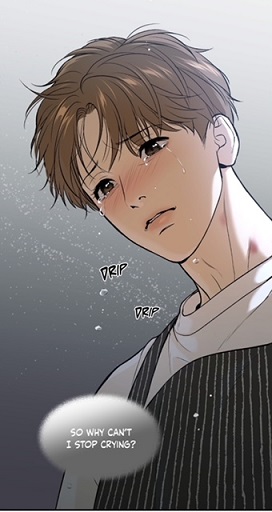 (chapter 46) He allows himself to cry, to grieve and to admit his pain and loneliness.
 (chapter 46) It helps him to face reality. He is on his own, he needs to stop relying on others. I would even say, he is encouraged to make decisions and as such to become responsible for his own life. It is important, because this means that he will have to fight back, if he wants to survive. He can not make any desperate and hasty decisions, like this one:
  (chapter 1) However, since he listened to the champion’s reproach and became submissive again, their relationship seems to have returned to normality. They even appear as close. (chapter 46) But this is not real communication. It shows that Kim Dan is now waiting for the right time and opportunity to leave Joo Jaekyung. He doesn’t need to rush anything.
But Kim Dan is not just connected to Princess Pyeonggang, but also to Sleeping Beauty. My avid readers will certainly remember my comparison between Kim Dan and Sleeping Beauty. [For more read Painful awakening of Sleeping Beauty] I have to admit that his mind-set  (chapter 41) reminded me of the ending of a fairy tale: they lived happily ever after. But the doctor was forgetting that life doesn’t end after the match in the States. Life ends with death. In verity, the champion is destined to be challenged, until he retires. What the doctor saw was not the end. This exposes his naivety. How could he have such a view? It is influenced by his grandmother. (chapter 19) His goal in life was determined by his familial and financial situation:
  (chapter 10) At no moment he pondered about himself. Happiness was never his goal, exactly like in fairy tales. Sleeping Beauty is rather passive. She sleeps, until the prince charming appears and kisses her. After that, they have kids. Interesting is that they don’t get married right away, so that the princess initially has the status of a mistress or concubine. Once the prince can secure his position, he marries her. Then the moment her husband leaves her side for war, she is tormented by her mother-in-law, the ogress. She can only escape death thanks to the intervention of her husband. We could say that happiness fell on her lap. Sleeping Beauty stands for passivity, dependence on her parents and husband and lack of critical thinking. Why? It is because the princess in fairy tales, in particular Sleeping Beauty, embodies toxic positivity.
But what is toxic passivity?
Toxic positivity is the belief that no matter how dire or difficult a situation is, people should maintain a positive mindset. While there are benefits to being optimistic and engaging in positive thinking, toxic positivity rejects all difficult emotions in favor of a cheerful and often falsely-positive façade. Quoted from https://www.verywellmind.com/what-is-toxic-positivity-5093958#toc-coping-with-toxic-positivity
This means that such a person is denying reality, for they refuse to face negative emotions. Thus they are unable to express their true human emotions and don’t receive unwavering support. And now, you are wondering where in Jinx, the author left traces of Toxic Positivity. The first example which could come to your mind would be this: 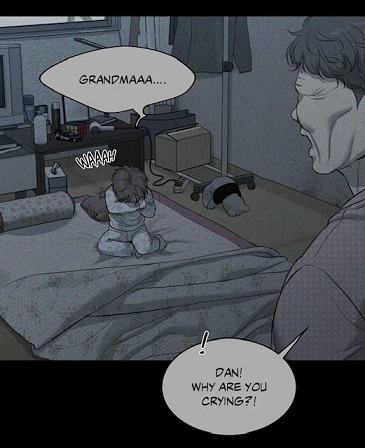
 (chapter 21) She rejected her grandson’s fear and tears. She didn’t allow him to express his abandonment issues. She diminished his anxiety by questioning his behavior: “It’s okay, grandma was just in the kitchen getting a glass of water.” Then in the present, we could use his visit at the hospital: (chapter 41) While the halmoni didn’t mention her suffering, the doctor gave expensive gifts to the nurse and his grandmother. He acted, as if money was no longer a problem… as if everything was fine, as if she would recover soon. Yet, he never mentioned his problems with the champion during his stay in the States (no drug incident, the humiliation, the harsh words). He is never voicing his problems to his grandmother. Both are putting smiles on their face. And the moment, I connected Kim Dan to Toxic positivity, I had another revelation. The best example for this negative attitude is actually his own birthday. 😱
 (chapter 11) Imagine that the grandmother had left the house without her grandchild. He was left behind in the house. Though she meant it well, for the child, this must have been a real torment, as he constantly feared to be abandoned. However, he knew that he was not allowed to cry or to complain. Hence when he saw her returning, he put a huge smile on his face. Moreover, this is what they had for dinner: a sweet bread and two yoghurts. The grandmother must have been hungry. Both acted, as if nothing was wrong.
  (chapter 45) With this contrast, the fear from the champion becomes more palpable. Joo Jaekyung got angry, for he had been put in the same situation. But the latter was never influenced by Toxic Positivity. Besides, he was fighting against his own inner demons. Nevertheless, this new interpretation of the birthday made me recognize why the author chose this chronology concerning Kim Dan’s past:
| Chapter 5 | Chapter 11 | Chapter 19 | Chapter 21 |
|---|---|---|---|
 | |  | |
The longer Kim Dan lived on his own, the more he got confronted with reality.  (chapter 1) However, he could never confide to his grandmother about the physical abuse from the loan shark. However, the moment his hope got up
  (chapter 11), as he imagined that he could pay off the debts, he recalled his birthday. He had a nice “souvenir”… convincing himself that everything was fine. He would be able to do it, like his grandmother had told him.
  (chapter 18) Nevertheless, the moment he was forced to move out, he couldn’t help himself to recall how he got abandoned by his parents. And the moment he saw his halmoni fighting for her life, his abandonment issues resurfaced. Hence this terrible memory came through a nightmare. The betrayal from the parents is what had been deeply buried by the grandmother’s philosophy. The fact that the halmoni never allowed Kim Dan to talk about his parents and the circumstances of his arrival to the humble mansion, is the evidence of Toxic Positivity. In my eyes, the relative was already struggling herself, for she had also been left behind. But here it is important not to mix Toxic Positivity with Gaslighting.
But what are the consequences of Toxic Positivity? A low self-esteem, stagnation, constant anxiety and guilt. But there’s more to it.
It’s shaming: Receiving toxic positivity can lead to feelings of shame.3 It tells people that the emotions they are feeling are unacceptable. When someone is suffering, they need to know that their emotions are valid and that they can find relief and love in their friends and family.
It causes guilt: Being toxically positive can also cause feelings of guilt.3 It sends a message that if you aren’t finding a way to feel positive—even in the face of tragedy—you are doing something wrong.
It avoids authentic human emotion: Toxic positivity functions as an avoidance mechanism. When people engage in this type of behavior, it allows them to sidestep emotional situations that make them feel uncomfortable. Sometimes we turn these same ideas on ourselves, internalizing them. When we feel difficult emotions, we then discount, dismiss, and deny them.
It prevents growth: Toxic positivity allows us to avoid feeling things that might be painful. But this denies us the ability to face challenging feelings that can ultimately lead to growth and deeper insight.” Quoted from https://www.verywellmind.com/what-is-toxic-positivity-5093958#toc-coping-with-toxic-positivity
This explicates why Kim Dan kept his “innocence”, why he came to deny the existence of his own body and became a ghost. By denying all emotions, he got disconnected to his own body.  (chapter 12) Therefore I understand why the doctor didn’t fight back against Heo Manwook and his minions. (chapter 1) It was his way to deny reality, hence he was covering his face. Because he trusted his grandmother, he imagined that as long as he was paying the interest on time, nothing would happen to him. (chapter 1)
  (chapter 11) But the moneylender and his minions are no honest bankers, but criminals. They enjoy using their strength, that makes them feel powerful. It boosts their ego.
Yet, until now, I didn’t explain how a princess from fairy tales embodies toxic positivity.
To conclude, Kim Dan embodies two negative traits, Dependent Personality Disorder and Toxic Positivity, due to his raising and traumas in his childhood. The elephant in the room was never brought up, the “rejection from the parents”. Therefore this secret could only poison the air in the little house.
Keeping secrets is bad. Not only does it represent an added mental and emotional weight, but it even becomes a burden on the physical level since it has been shown that secrets exhaust us physically. However, he who has never kept a secret should cast the first stone. Sometimes we may even feel that we are “forced” to keep quiet about certain things. Quoted from https://psychology-spot.com/the-reason-we-keep-a-secret/
The heavy silence had terrible consequences, he turned Kim Dan into a puppet, even a ghost. This explicates his passivity. For the grandmother, it looked like everything was fine, because her grandson did everything for her. There was never an argument between them. That’s the reason why I see this crying as a liberation. He allows himself to accept his wounds and tears. (chapter 46) (chapter 46) He allows himself to voice his thoughts. He admits to have denied reality. Mind and body are now united and synchronous. Consequently, I deduce that he is determined not to get fooled in the future.
And this brings me back to the story of Pyeonggang and Ondal!! Thanks to the selfish and stubborn “Prince S”, the fool Kim Dan received money and got trained. He became a true man, because he is now making decisions on his own. This means that from that moment on, the champion will have to become proactive in order to keep his “partner” by his side. Thanks to Joo Jaekyung’s attention, the doctor is now getting noticed by people. (chapter 46) This is the rising of the prince S. But this harbors a problem: he is also about to become the target of real bad guys. Yes, like in any historical k-dramas, we are about to assist to a battle of power, and this outside the ring.
The essay is already so long that I chose to introduce the Emperor in the second part. Naturally, I will include the scenes from chapter 46.
Feel free to comment. If you have any suggestion for topics or manhwas, feel free to ask. If you enjoyed reading it, retweet it or push the button like. My Reddit-Instagram-Twitter-Tumblr account is: @bebebisous33. Thanks for reading and for the support, particularly, I would like to thank all the new followers and people recommending my blog.
Please support the authors by reading the manhwas on the official websites. This is where you can read the manhwa: POTN But be aware that this Manhwa is a mature Yaoi, which means, it is about homosexuality with explicit scenes. If you want to read more essays about Painter Of The Night, here is the link to the table of contents.
It would be great if you could make some donations/sponsoring: Ko-fi.com/bebebisous33 That way, you can support me with “coffee” so that I have the energy to keep examining manhwas. Besides, I need to cover up the expenses for this blog.
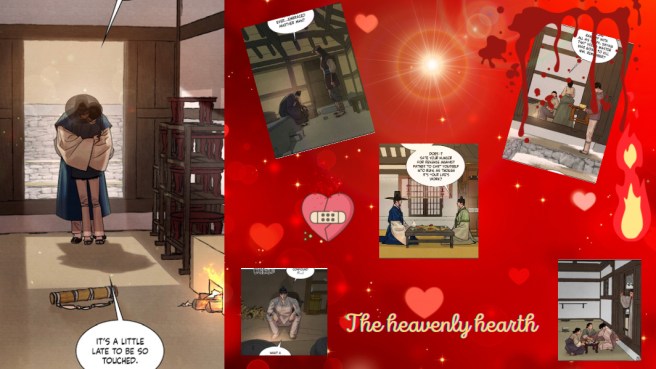
When many readers heard Yoon Seungho‘s statement  (chapter 119), they got worried and nervous, as they considered the expression „as long as I live“ as a clue for a sad ending. Why? It is because the lord was referring to his own death. Under this light, it becomes comprehensible why I selected „heavenly“ in the title. I was naturally alluding to the afterlife. However, I perceived his words in a positive light. He expressed his desire to live. He is no longer suicidal, he wishes to live a long life next to the painter and treasure his moments with him. That’s the reason why the author included the refraction in the scene. A dream had come true, the lord was finally able to escape the darkness.
  (Chapter 119) He is now truly alive. This explicates either why he smiled and laughed at the end. But why was he so happy? It is because Baek Na-Kyum had just confessed that he loved him not for his wealth or power, but for himself.
  (Chapter 119) He even described him as a treasure. Yoon Seungho had finally achieved his goal: to win the painter’s heart. His presence and love bring happiness to Baek Na-Kyum which stands in opposition to his reputation as bird of misfortune. Moreover, this description contrasts so much to Jung In-Hun
  (Chapter 119) and Yoon Seungwon’s.
  (Chapter 118) where both portrayed the main lead as a man consumed by lust and revenge. In other words, he was presented as a huge sinner. This implies that he stands so far away from heaven. But all these words were erased the moment the painter confessed his love for Yoon Seungho once again. What Baek Na-Kyum didn’t realize is that his love confession is pushing the protagonist to fight for the painter. (Chapter 119) If something were to happen to him, the low-born would be heartbroken and miserable. Baek Na-Kyum is his reason to live. Thus I consider this scene as the positive reflection from that terrible night:
  (chapter 102) In episode 102, he was renouncing on everything (life, mansion, wealth and connection), because he imagined that the artist had died. Consequently, I deduce that in episode 119, the painter’s life is attached to the lord’s for good. If the artist got into trouble, Yoon Seungho would side with him and the reverse. Thereby, I come to the conclusion that this moment in the kitchen represents their union, as they are no longer tied to the mansion. They are now a family no matter where they are. Let’s not forget that the painter expressed his wish to run away with his lover.
  (Chapter 119) It is important, because such a departure symbolizes that the bird “Yoon Seungho” is leaving the nest. He is now starting a family on his own.
Striking is that heavenly can be employed in a different context food. Let’s not forget that food is often served as offering to gods and spirits. Interesting is that in Asian societies, it is a tradition to offer the favorite dishes on the anniversary of the relatives’ death. As you can imagine, this custom was already practiced in Joseon. And now, take a closer look at this scene.

Yoon Chang-Hyeon was honoring his ancestors by bowing in front of the shrine. But what caught my attention is that in such an occasion, he should have brought food and his sons to such a ceremony. However, he just had lit incense  (chapter 85) and put a glass and that was it. This exposes the father’s hypocrisy, ignorance and greed. By acting on his own, he was exposing his true mindset. He views himself as the family. The sons are just the extension of himself, for they are his reflections.
Narcissists need a scapegoat to preserve their self-image, avoid taking responsibility for their actions, and to feel emotionally stable. Quoted from https://unfilteredd.net/why-do-narcissists-need-a-scapegoat/
As a narcissist, the father projects all his flaws onto Yoon Seungho, hence he is his scapegoat.  (Chapter 45) On the other hand, Yoon Seungwon is his golden child, for he represents his positive reflection.
A “golden child” is one who is considered “special” by their family and chosen as a proxy for a parent’s own achievements and magnificence. Unfortunately, the child must live up to perhaps unattainable levels of accomplishment and perfection. Being the golden child does not necessarily represent a positive familial position, and narcissistic parents frequently place this identity on one of their children. Quoted from https://www.choosingtherapy.com/golden-child-syndrome/
This explicates why in the bedchamber, the patriarch called his son a monster (chapter 86), whereas he put the other on a pedestal
 (chapter 86). Thus I created this illustration.
 Under this new light, it becomes comprehensible why the father could only reject the offer from lord Song in the gibang. Doubting Yoon Seungwon’s sexuality meant to question about the father’s sexual orientation. At the same time, it is not surprising why the elder master would blame Yoon Seungho for everything, for he couldn’t admit his responsibility for the purge. Consequently, the Manhwaphiles can grasp why Yoon Chang-Hyeon came alone to the shrine. If he had brought Yoon Seungwon, the father would have been reminded of the elder son, as both can not be separated. This explicates why the younger master asked his elder brother to submit to his father.
 (Chapter 119) I couldn’t help myself smirking when the brother attempted to make him believe that.
 (Chapter 119) the protagonist could ever gain the father’s favor. Yoon Seungwon was definitely playing with his brother’s feelings, as if he could hope that their father would change.
At the same time, his position as golden child explicates why the younger brother resents the father and betrayed him:  (Chapter 118) It is because as a golden child, he is also suffering, but it is naturally nothing compared to Yoon Seungho’s position who could have died.
  (Chapter 77)
Parents with NPD often shape one of their children into the golden child role. The golden child becomes an extension of that parent, and the child’s role is to please that parent. Narcissistic parents are unable to appreciate the golden child’s unique identity, and attempt to control their child’s interests and activities in ways that would reflect positively on them. They live vicariously through their golden child and they feed on their child’s successes, which serve as the parents’ narcissistic supply. Quoted from https://www.choosingtherapy.com/golden-child-syndrome/
Interesting is that psychologists said that it was easier for a scapegoat child to escape from this nightmare, as they can cut off ties more easily than the golden child who got used to special treatment. Moreover, the flaws from the patriarch rubbed off on Yoon Seungwon which often happens in such a toxic family. This signifies that for Yoon Seungwon, it is difficult to maintain good and healthy relationships in the end too. And now, you comprehend why the younger master made such a request to his brother. He needs him for two reasons.  (Chapter 119) First, by returning the petition to the father, Yoon Seungho would become the culprit. He was not only a traitor, but also a blackmailer of the Yoons and lord Song.
 (Chapter 107), for he had stolen the petition. Yoon Seungwon would hide his wrongdoing, he betrayed their father.
  (Chapter 118) There is no doubt that Kim played a role in this as well. In other words, the brother and the valet would bury the truth by diverting the attention of the patriarch towards the main lead, if Yoon Seungho followed this suggestion.
  (Chapter 116) The elder master would no longer seek the truth, similar to the kidnapping in season 2 which was turned into a desertion and later Lee Jihwa’s abduction occulting the instigator and the helping hands. Simultaneously, Yoon Seungwon needs his brother as scapegoat, because the pressure coming from the patriarch and lord Song must have definitely increased. (Chapter 119) How ironic that Yoon Seungwon employed the expression “care to live”. Back then, the protagonist was just surviving, he had already developed suicidal tendencies, when this incident took place.
  (Chapter 83) This shows that the young master wants to sacrifice his brother once again. Out of selfishness and cowardice, he is trying to convince Yoon Seungho that this is the right thing to do! (Chapter 119) This is a new version of this scene!
  (Chapter 37) He is even implying that he needs to sacrifice himself in order to protect Baek Na-Kyum!! Moreover, he is distorting the reality, because he implies that his father is still powerful. (Chapter 119) However, the purge took definitely place,
  (chapter 37) like the memories from episode 37 are exposing it. It becomes clear that if Yoon Seungho returned the petition, he would die.
  (Chapter 116) Thus I come to the conclusion that the meeting between the brothers in the gibang represents an offering. For the Yoons’ sake, Yoon Seungho should admit his wrongdoings (Chapter 119) and beg for forgiveness. Thus I interpret the scene in the kitchen hearth as true hope (chapter 119) while the table with many dishes in the gibang stands for fake hope and offering. (Chapter 118) It was, as though Yoon Seungwon was giving his brother his last meal before his sacrifice. This situation exposes that in the past, the main lead had been put in a similar situation, covering up for the brother’s mistake.
  (Chapter 55) People had played with his hopes and longing for acceptance and recognition. Interesting is that offerings is a synonym for atonement and sacrifice. But why is Yoon Seungwon so sure that he can repeat the same action from the past? It is because Kim and Yoon Seungwon have known for a long time that Yoon Seungho was longing for acceptance and love from his family, just like the scholar knew about the painter’s love for him.
  (Chapter 119) But everything changed, when the painter met the lord. So who is worse here? Jung In-Hun who tried to rape the painter or Yoon Seungwon who is sentencing his elder brother to death? Let’s say that the valet convinced the younger master to suggest this solution, this doesn’t diminish Seungwon’s responsibility at all. He knows that his father abused his elder brother. In my opinion, he is copying his father, like the former tried to diminish the responsibility of the patriarch.
  (Chapter 119) Yoon Seungho got hurt because of lord Song and not because of Yoon Chang-Hyeon. This means that the younger master was denying the existence of the patriarch’s choice and the helping hands. And if the brother listened to his advise and the father hurt or killed the main lead afterwards, the younger master could put the blame on the elder master, for the decision and responsibility belonged to the patriarch. Moreover, he heard from lord Song that killing Yoon Seungho was just a matter of time. (Chapter 116) Fact is that the younger master is betraying his brother once again.
Yet, the former is making two huge mistakes. He is considering the painter as a servant (chapter 119), therefore he believes that the artist is tied to the mansion. Secondly, I am quite certain that his perception about the artist is influenced by Kim. This signifies that the latter is also projecting his own thoughts onto the painter, for he is himself a narcissist. The latter is interested in wealth and comfort. If he came to lose everything, he would abandon Yoon Seungho, that’s what Kim is envisaging. Thus if Yoon Seungho were to submit himself to the father, Baek Na-Kyum would lose everything. Besides, I am even thinking that Jung In-Hun’s approach in the gibang is also related to the brother and the butler. All of them had an interest to separate the couple! And note that when the lord went to the noonas’ room, it looked like the painter had deserted him.  (Chapter 119) So technically, this situation could have triggered the protagonist’s insecurities like in season 1
  (chapter 28), 2
 (chapter 60) and 3
  (chapter 98). However, through these constant exposures, Yoon Seungho came to learn not to jump to conclusions and to have faith in Baek Na-Kyum. He knew that he would return to the mansion. Hence he ran to the bedchamber first.
  (Chapter 119) Another important detail is that we don’t see any staff in the courtyard or in the kitchen. It was, as if the propriety had been deserted.
  (Chapter 119) This implies that at no moment, he relied on the domestics’ testimonies which contrasts to the following scenes: (chapter 98)
  (chapter 104)
  (chapter 107) and
  (chapter 116) However, observe that in episode 116, Yoon Seungho had witnessed how his lover had taken care of him, while he was unconscious. Furthermore, the petition had been handed over to the painter and not Kim, a sign that the artist had become the protagonist‘s confident. As you can see, as time passed on, the main protagonist learned the following lessons: he should stop relying on servants, he should only trust his partner. I would even add that he was taught the following principle: “If you want something done right, you have to do it yourself”. In my eyes, (chapter 119) the scene in the kitchen is exposing the betrayal from the staff, that’s the reason why we see no one! They were either expecting their lord’s return and imagined that he would be upset or even violent! At the same time, by not meeting the artist, the servants could feign ignorance about the lover’s whereabouts and claim their innocence. The proof is that this scene (chapter 119) is the positive reflection from that night:
  (Chapter 103) Here, they never expected the return of Yoon Seungho and the painter. The staff ‘s absence in episode 119 is the evidence of their desertion! Moreover, I consider Yoon Seungho’s search for his lover as a new version from episode 28/29/30:
  (chapter 28) Back then, they feigned ignorance, but they never anticipated a punishment from Yoon Seungho.
And this leads me to the following observation: Baek Na-Kyum’s action in the kitchen reminded me of an offering! (Chapter 119) Why? It is because he burned a paper. The evidence for this is the presence of the painter’s belongings. This is the place where he used to hide the scholar’s poem (chapter 4). Moreover, the painter is standing in front of the hearth which certainly triggered the manhwaphiles’s memory. Jung In-Hun was seen in front of the hearth burning the letter from Min in order to hide his involvement in the painter’s sexual abuse. 
 (chapter 115) And now you are wondering how the painter’s gesture can be considered as an offering. It is because the kitchen hearth is considered as sacred due to the fire. First, in shamanism, there exists the god of fire named Jowangshin.
The origin of Jowangshin is the fire of the home. But their realm also extends to the area that uses fire and water harmoniously. It is good etiquette to brig a set of matches when you move to a new house. One can enshrine the house god with an onggi of water placed on/above the stove or utilizing sacred mulberry paper put up on the wall in the kitchen. (…) Jowangshin is the emissary of heaven and will ascend to report the wrongdoings of the home’s inhabitants to Hwanin, God of Heaven. https://www.firelightlotus.com/post/jowangshin-god-of-the-kitchen
In China, people had a similar belief.
Zao Shen, Wade-Giles romanization Tsao Shen, in Chinese religion, the Kitchen God (literally, “god of the hearth”), who is believed to report to the celestial gods on family conduct and to have it within his power to bestow poverty or riches on individual families. Because he is also a protector of the home from evil spirits, his periodic absences are thought to make the house especially vulnerable to becoming haunted at such times. Zao Shen’s identity in life and in the history of his cult are uncertain. The god of the kitchen has also been confused with Huo Shen (god of fire) and with Zao Jun (“Furnace Prince”). Quoted from https://www.britannica.com/topic/Zao-Shen
As you can see, the kitchen is a sacred place. This explicates why next to the hearth, people had to follow the following rules:
- Do not curse while in the hearth.
(Chapter 115)
2. Do not sit on the hearth.
(Chapter 59)
3. Do not place your feet on the hearth.
(Chapter 98)
(Chapter 115)
4. Maintain the cleanliness of the kitchen.
(Chapter 47)
5. You may worship other deities in the kitchen. Quoted from https://en.wikipedia.org/wiki/Jowangsin
That’s how I realized why Byeonduck mentioned that lord Min would help Yoon Seungho. Note that Jung In-Hun cursed lord Min (chapter 115), when he burned the letter! Moreover, let’s not forget Black Heart’s claim during that night: Lee Jihwa  (chapter 102) who was a traitor, for he had tattled on Black Heart and his friends to Yoon Seungho. And now, you comprehend why I connected the shrine to the kitchen hearth. Both places are considered as sacred, for they are connected to gods and spirits.
And now it is time to return our attention to Yoon Chang-Hyeon.  (Chapter 85) The absence of his sons and of food as offerings reveals that he was not showing true respect to his ancestors. He used religion and social norms to hide his true intentions. He wanted to take over the mansion. Hence the black guards were standing at the entrance of the sacred house. Their presence symbolizes violence. Therefore it is not surprising that the gods chose to punish the elder master through Yoon Seungho. The former was not received properly
  (chapter 86): no bow, no food and no seat.
  (Chapter 86) Let’s not forget that the elder master had entered the lord’s chambers without the permission of his owner. No wonder why he was left speechless. And now, you are wondering if I am not drifting away from the topic, as these chapters from season 3 don’t seem to be connected to episode 119. However, it is important to realize that these chapters have many common denominators
| Chapter 85-86-87 | Chapter 119 | |
| Death |   Here, we could detect the suicidal tendencies of the protagonist. He wouldn’t fight back. Here, we could detect the suicidal tendencies of the protagonist. He wouldn’t fight back. | Here, he wants to live and as such to fight back in order to protect his lover. |
| Coup d’Etat |  The seat looks like a throne. The seat looks like a throne. | Yoon Seungwon advises his brother to admit submission. It is like a surrendering. |
| The fire |  | Note the contrast. In the furnace, the fire was not properly lit. This explicates why the bedchamber didn’t get destroyed by the fire during that night. |
| The absence of the staff |  The courtyard is empty! No one is defending their master. The courtyard is empty! No one is defending their master. | No one is working in the kitchen. |
| A quarrel with a slap |  |  |
| Someone is out of breath |  | |
| Treason |  |  |
| Threat |  | |
| Sexual assault in the gibang |  |  |
| A sudden kiss |  |  |
| the importance of family | | |
| The indirect reference to religion (curse, heaven versus hell, faith/trust) |   | |
| Wishes (ambition, dream) | |  |
| Yoon Seungho portrayed as a depraved monster |  |  |
| An important paper/ document |  | |
| Jung In-Hun |  | Baek Na-Kyum not only wounded the learned sir, but also humiliated a person who passed the civil service examination. He is now a military official. |
| The painter’s escape | He was supposed to remain in the study. Kim allowed him to leave the room. |  Baek Na-Kyum freed himself. Baek Na-Kyum freed himself. |
As you can see, the night from episode 85 to 87 corresponds to the day in chapter 119. And now, it is time to examine the meaning behind this connection. First, the contrast between these two scenes reinforces my interpretation about the butler. At the beginning of the noble‘s suffering, the valet was ignorant, just like the painter is still unaware of the nobles’ death. But it is no longer the case. In episode 85, (chapter 85) he had faked his breathlessness. First, he didn’t need to run from the kisaeng house like Yoon Seungho. The kitchen, the gate or the servants’ quarters are not far from the study. Besides, why did Kim run in the end, when he joined the study? Contrary to his master in episode 119, he knew about his master’s whereabouts, for they had taken their lunch there.  (Chapter 85) The study is even close to the gate.
  (Chapter 51) He could have reached the study before the father entered the shrine. Finally, observe that the patriarch even arrived to the bedchamber before Yoon Seungho, (chapter 86) though the study is close to the host’s chamber. As you can see, paying attention to the location of the different rooms exposes the betrayal from the staff and especially from the butler. He had been listening to their conversation, hence he knew about their quarrel. Interesting is that in the kitchen, the lord’s wish got fulfilled.
  (Chapter 117) The painter wants to leave everything behind too.
  (Chapter 119) Thus I am deducing that the authorities will be involved very soon. (Chapter 86) Why? It is because someone desires to take over the mansion.
  (chapter 119) They are not expecting the lord‘s resistance, for he remained passive all this time (season 2 and 3). The scholar has now the means to do so, and the necessary motivation. Imagine that he got wounded and humiliated by the couple! Besides, we have this broken promise due to Yoon Seungwon
  (Chapter 115) exposing the younger master’s lies and Yoon Chang-Hyeon’s delusions. Without the protagonist’s help, the younger brother would not be „successful“. Furthermore, the absence of food and fire in episode 86 indicates that this house was neglected and even not protected. (Chapter 86) It explains why the argument between father and son oozed hatred, coldness and looked like war! The hearth symbolizes home, family, warmth, love and protection.
Under this light, it is no coincidence that this new confession took place in the kitchen. At the same time, the kitchen hearth symbolizes humbleness and honesty, which stands in opposition to the love confession in the kisaeng house.  (Chapter 94) The gibang is connected to money, power, pleasure, artificiality, sensuality and lack of privacy.
  (Chapter 96) I am sure that you can detect all the contrasts (night, door close, spies, confession outside and inside, no fire, only light). Thus I am deducing that the painter’s words in the kitchen were not heard by others. As you can see, this scene in the kitchen is full of symbolism. In my previous essay “The true face of family”, I had already pointed out that sharing meals represented a criteria to define a real family. Therefore I had demonstrated that Yoon Seungho and Baek Na-Kyum were excluded from the mansion, for they wouldn’t eat their meals in the kitchen like the staff.
  (Chapter 17) Moreover, the hearth doesn’t just provide warmth, but also light! The latter embodies knowledge and as such Enlightenment.
  (Chapter 119) Hence they were clueless about the wrongdoings from the staff. Only in the kitchen, the lord could finally grasp the depth of Baek Na-Kyum’s love for him. It is an unconditional love contrary to Yoon Seungwon’s. The latter would only recognize him, if he listened to him. And he only seeks his assistance, when he needs him. It shows that Yoon Seungho is only approached, when he has power.
  (Chapter 118) (chapter 119) Moreover, because they are embracing each other in clothes, it exposes that their love is pure and not driven by lust. This scene contrasts so much to his meeting with his brother, for the latter never hugged him. He kept his distance from his brother.
 (Chapter 119) I would like to outline that during their conversation, Yoon Seungwon remained calm and indifferent, when he talked about the assassination attempt from Yoon Chang-Hyeon.
 (Chapter 116) But the biggest difference is the absence of fire in the kisaeng house. (Chapter 118) This reflects the lack of empathy from Yoon Seungwon.
Striking is that the couple stood at the entrance of the kitchen, when the painter declared his unconditional love to the noble. (chapter 119) It was, as if two worlds were meeting. Simultaneously, the door step symbolizes the gateway to new opportunities. In other words, it announces changes. Moreover, the embrace and the lord’s words expose that Yoon Seungho is focusing on the present moment and the future. This means that he is now moving on and as such cutting ties with the past! How ironic that Yoon Seungwon’s recommendations came true! (Chapter 118) Nonetheless, I doubt that he is including his brother and father in his future plans. For me, the noble’s words spoken in the bedchamber will become a reality:  (chapter 78) Furthermore, he tried to leave before
  (Chapter 104)
  (chapter 105) Finally, we saw him in the courtyard standing next to a horse and a servant indicating that he had given him a task, and the latter needed to leave.
  (Chapter 108) Hence you comprehend why I am full of optimism in the end. Yoon Seungho has already made some preparations in my opinion. On the other hand, I am quite certain that their love will be tested. Can they face together trouble? Yes, because through their pain, they learned their lessons and changed.
But why didn’t Yoon Seungho expect that he would be blessed next to the kitchen hearth?  (Chapter 119) It is because in the past, he was never allowed to join the kitchen hearth. This place was either beneath him or he was not worthy of entering the place. Thus he employed the expression scullery boy to Yoon Seungho.
  (Chapter 47) Here, I would like to outline that when the protagonist was held in the shed, someone brought him food .
  (Chapter 83) That‘s how I realized that the shed is connected to the kitchen!
 The maid had just brought water to the couple.
 During that night, Baek Na-Kyum had been held captive in a shed.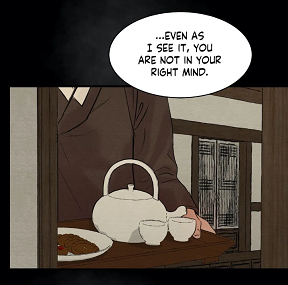

And what is the common denominator between these scenes? Kim was responsible for the kitchen and the shed. This observation brings me to the following conclusion. Then, you know why Yoon Seungho could never imagine that in the kitchen hearth, he would experience unconditional love. It is because the valet never allowed Yoon Seungho to enter the kitchen! And now take a closer look at this scene:  (chapter 38) Yoon Seungho remained outside on the door step. Consequently, I started comparing scenes where the kitchen hearth appeared and that’s how I discovered a pattern:
 (Chapter 46)
  (chapter 47) (Chapter 98)
  (Chapter 110)
 (Chapter 77)
  (chapter 38)
 (chapter 59)
  (chapter 119)
 (chapter 38)
  (chapter 47)
 (chapter 77)
  ( Chapter 110)
  (chapter 119)
  (chapter 47) (chapter 38) (chapter 110)
 To sum up, the kitchen is connected to a wrongdoing, an apology, a confession, a fire and a quarrel. Where was Baek Na-Kyum during the abduction? In a shed, while Lee Jihwa was arguing with No-Name!! That’s how I realized that the gods wanted to teach Kim a lesson. In the past, the butler should have invited Yoon Seungho to the kitchen hearth so that he would have found a family among the staff. Remember how the servant scolded the valet, it is because Kim must have taken pride to be the elder master’s servant.  (Chapter 77) For me, Kim must have looked down on the other domestics. I consider this scene as the best example what Kim should have done in the past. (Chapter 119) He should have brought him to the hearth and hugged him. That’s why Lee Jihwa got embraced during that night. Kim should have comforted him and made him smile! The father wouldn’t have noticed it, for there is a second entrance. The evidence is here:
 (Chapter 119)
  (Chapter 98) One door leads to the backyard and the other to the smaller courtyard. And this scene confirms my previous assumption
The kitchen is detectable thanks to the big wooden door in the smaller courtyard. However, I am quite certain that there’s a second access to the kitchen. They need to have an easy access to the jars situated in the backyard close to the walls. (…) This means that from the kitchen, if you follow the wall, you can pass by the lord’s bedchamber. And if you follow this path, you will discover the pond with the pavilion. Quoted from https://bebebisous33analyses.com/2022/03/31/painter-of-the-night-a-guided-tour-of-yoon-seunghos-domain🏡/
This means that Kim could have done something in the past.  (Chapter 87) Baek Na-Kyum is there to prove him wrong. He had other opportunities, like giving him a good meal.
  (Chapter 63) He should have sided with his master and even remained by his side. This signifies that this scene (chapter 83) exposes the butler’s betrayal and wrongdoing. Thus I conclude that the painter will show to the valet his cowardice and his treacherous nature.
(Chapter 119) So by burning the poem  (chapter 7) the artist is not only cleansing the kitchen, but also cutting off ties with the scholar. The latter is no longer protected. The spirits will intervene through chance. As a conclusion, the hearth has a spiritual and healing power, for it is connected to „Heaven“. Yoon Seungho‘s paradise is to have a family.
Feel free to comment. If you have any suggestion for topics or manhwas, feel free to ask. If you enjoyed reading it, retweet it or push the button like. My Reddit-Instagram-Tumblr-Twitter account is: @bebebisous33. Thanks for reading and for the support, particularly, I would like to thank all the new followers and people recommending my blog.
Please support the authors by reading the manhwas on the official websites. This is where you can read the manhwa. https://www.lezhinus.com/en/comic/painter But be aware that this manhwa is a mature Yaoi, which means, it is about homosexuality with explicit scenes. If you want to read more essays, here is the link to the table of contents: https://bebebisous33analyses.wordpress.com/2020/07/04/table-of-contents-painter-of-the-night I am also using doctor Frost as reference again. https://www.webtoons.com/en/mystery/dr-frost/list?title_no=371
It would be great if you could make some donations/sponsoring: Ko-fi.com/bebebisous33 That way, you can support me with “coffee” so that I have the energy to keep examining manhwas. Besides, I need to cover up the expenses for this blog.
I have to admit that I was initially disappointed by Yoon Seungho’s behavior in episode 108. One of the reasons is that he didn’t trust his lover, though he didn’t buy the doctor’s statement right away too. That’s the reason why he went to the maids and asked for their observations and opinion. (chapter 108) But then I changed my mind about the lord, for Yoon Seungho didn’t rely on just one testimony contrary to his father: (chapter 86) Finally, thanks to the argument in the shed, I had another revelation which I will explain more details below.
However, the protagonist’s huge mistake is that he trusted the maids’ words too. While one might judge the apology from the main lead as a sign of humbleness, I view it in a different light: it exposes his low self-esteem.  (chapter 108) He blames himself for everything. For me, these women were lying to their master. Why do I think so? The first proof is that the painter’s fate is to go through the same experiences than his lover. And what did the valet admit in the shed?
  (chapter 108) There was not a soul in this household who was standing by his side back then and now! This signifies that there is not a soul in the mansion truly standing on the painter’s side as well!! Back then (before the massacre) and even now… Moreover, while these maids’ attachment was sincere
  (chapter 51) (chapter 63), this doesn’t signify that it is the same for all the female servants. This would be just another prejudice.
  (chapter 108) Yes, this woman is not the same than the one from chapter 51, for her clothes diverge despite the same pigments. She is wearing a white ribbon around her waist.
  (chapter 108), whereas the other wears the belt more around the hips, hence her skirt has a bump on her butt. (chapter 108) Finally, pay attention to the form of her mouth. It doesn’t ooze warmth or joy, quite displeasure and mistrust. But let’s return to my initial statement, the staff was actually deceiving their own lord.
  (chapter 108) First, when the manhwalovers saw him in the kitchen, he was eating to his heart content and enjoying his breakfast. (chapter 38) Moreover, the painter had long stopped eating with the maids, he would share his meals with the main lead.
  (chapter 46)
  (chapter 74) This explicates why the artist returned the table with the porridge to the kitchen himself. (chapter 98) This means that they couldn’t witness how the artist would eat. To conclude, the statement from the staff was once again a mixture of truth and lies, for they were combining different situations together. Hence their apology was not genuine despite their gesture.
With their words (chapter 108), they admitted that they had been fooled themselves. At the same time, they implied that the painter has been hiding his discomfort all along, as he was only eating properly in front of his lover. Moreover, they insinuated that the painter’s laugh and smiles weren’t sincere at all. In other words, the lord’s eyes had been “deceived”, as the painter had been acting. This explicates why he took the blame and apologized to the staff. (chapter 108) He had not perceived the artist’s discomfort. Indirectly, they were putting the blame on the lord and Baek Na-Kyum. Nevertheless, they never stated that they had seen the painter vomiting. And now, observe that someone else had said the same thing about the artist in the past:  (chapter 62) The painter had been faking his “submission”, hence the “valet” got fooled. He had trusted the artist blindly. Thus the lord got angry, and resented the butler, for he wished the opposite. He didn’t want to admit that the artist had been acting. Yet, the seed of doubt was implanted in his mind. Consequently, in episode 108, we have the exact same situation, yet contrary to the past, the lord didn’t get angry at his lover. He never condemned the painter for his dishonesty, though he was not truly lying either. To conclude, chapter 108 is a reflection from episode 62. Thus it dawned on me that the valet could have attempted to fool his master once again. The artist was a hypocrite, for he was acting in front of the lord hoping that he wouldn‘t cut ties with him. It was for his best interests to send back to the kisaeng house. Yet, nothing like that happened.
Yet, in reality, the artist had been eating properly, as we could see him glowing in this image,  (chapter 104), a sign that he was recovering. But due to the two incidents during that day, Baek Na-Kyum had been feeling unwell and was hiding his discomfort out of fear of getting abandoned. This means that the deceivers were trying to portray the painter’s actual disposition as something unchanging. Since the painter had trouble with eating now, his eating disorder existed in the past. And this perception got reinforced, for the lord could notice afterwards that the maids’ statement had become a reality. What they had described, truly happened afterwards. Due to worries and anxieties, the artist lost his appetite. He would fake his “happiness”. The manhwalovers could witness how the painter had slimmed down
 (chapter 108), just like his “husband”. (chapter 108), a new version of episode 51. This time, the roles had been switched, the painter was sitting in the patio. To sum up, the schemers and the accomplices were creating a prejudice, a so-called universal truth. This is the negative reflection of season 1, where the gossips about Yoon Seungho were turned into a reality. In many of my previous analyses, I had outlined that these rumors about the protagonist had been false.
  (chapter 1) He couldn’t have a proper erection, and it was never his choice to have sex at any time and any place, because he was treated as a male kisaeng. And now, it is the painter’s turn. Gossips about him would become a verity. Yet the other difference to season 1 is that in season 4 the artist is exposed to the same “prejudices” than Yoon Seungho in the past: He is ill!! He needs to be treated and the “gibang” is the right place for that🤮. He would be with his noonas, a new version of the lord’s past. And now, you comprehend why father Yoon said this to the physician in chapter 57:
  (chapter 57) A single incident was turned into a generality, implying that it was the same in the past!! To conclude, the noble is put into the same situation than his own father, the only divergence is that Yoon Seungho has indeed the painter’s best interests in his heart. He is determined to provide him with the best!! Thus he blames himself contrary to the elder master Yoon.
But why did Yoon Seungho choose to trust others instead of his loved one? In my eyes, there exist two reasons. First, let’s not forget that the lord has been hiding the truth from his partner, his action in the shaman’s house. He is worried, but he doesn’t desire to burden his loved one, hence he chose silence and secrecy.  (chapter 104) This statement implies that the painter is responsible for the bloodbath, for he left the propriety. Yet, instead of confronting the painter, he was encouraged not to talk about the past. He was suggested that way, he would protect the artist’s mind and heart. Besides, his choice was influenced by his own anxieties. The lord fears argument, because the last time they had quarreled, the artist had threatened his lover to leave the place.
  (chapter 85) I would like my avid readers to keep in mind that the lord wished to keep the artist by his side, sending the artist back to the kisaeng house was just a temporary measure. (chapter 105), yet the painter had heard something different from his noona.
  (chapter 105) That’s how a misunderstanding was created, provoking the painter’s abandonment issues to resurface. The lord had selected secrecy and silence out of love for the artist. Therefore when the lord sensed Baek Na-Kyum’s agony, he could only jump to the conclusion that the painter was acting the same way than him. He was also hiding something from Yoon Seungho. That’s the reason why the lord didn’t argue with Baek Na-Kyum.
  (chapter 107) He imagined that the artist was doing it out of concern for the noble. He was projecting his own thoughts onto the artist.
Nonetheless, for me, the biggest cause for his mistake are his own believes, and more precisely the “rules” he was indoctrinated with. He might have dropped his suicidal disposition, yet his self-hatred was not solved entirely. Its source is based on the following principle: “bird of misfortune”.  (chapter 68) According to this belief, the lord brings bad luck to others. This rule can only incite the main lead to doubt himself, to judge himself in a negative light, to doubt his own judgement. Moreover, the perfidy is that this principle pushes the protagonist to deny the existence of his own misery. It was, as though the lord had never suffered, only the others. This “faith” represents the biggest lie and hypocrisy. However, the main lead questioned this rule in front of Yoon Chang-Hyeon, (chapter 86), as he started putting the whole responsibility on the elder master and the ignorant servant. But due to the last massacre in the shaman’s house, Kim could use the painter’s suffering as the evidence of this “irrefutable truth”. Yoon Seungho brought misery to the painter. That’s the reason why Kim “suggested” his master to send Baek Na-Kyum away by proposing the opposite. Simultaneously, we have the explanation why the painter has abandonment issues again. Since their magical night in the gibang, Yoon Seungho and his lover are no longer sharing the same bed. (chapter 108) He remains seated by his side, because he is projecting his own reaction onto his loved one. Remember how Yoon Seungho reacted in the past with Lee Jihwa: he pushed his childhood friend away.
  (chapter 59) It was, as if Yoon Seungho feared to taint the painter by sleeping next to him. However, the artist’s biggest wish is to share the same bed than his lover.
  (chapter 97) To conclude, Yoon Seungho’s life is still influenced by a false cult, by propagandism. This faith is is based on Rene Girard’s theories about mimetic desire and scapegoat mechanism.
“Girard’s fundamental concept is ‘mimetic desire’. Ever since Plato, students of human nature have highlighted the great mimetic capacity of human beings; that is, we are the species most apt at imitation. However, according to Girard, most thinking devoted to imitation pays little attention to the fact that we also imitate other people’s desires, and depending on how this happens, it may lead to conflicts and rivalries. If people imitate each other’s desires, they may wind up desiring the very same things; and if they desire the same things, they may easily become rivals, as they reach for the same objects.” Quoted from https://iep.utm.edu/girard/#H3
According to the psychologist and anthropologist, rather than bringing people together, convergence gives rise to hostility. Humans aren’t violent by nature. Our nature is social. The tragedy is that, even without deliberate evil on anyone’s part, our social nature constantly pits us against each other. Thus the French philosopher developed the following revolutionary hypothesis: human culture began with religion, and religion arose from our species’ need to master its own violence.  (chapter 250) Hence the man created the following theory which is inspired by religion.
“Girard calls this process ‘scapegoating’, an allusion to the ancient religious ritual where communal sins were metaphorically imposed upon a he-goat, and this beast was eventually abandoned in the desert, or sacrificed to the gods (in the Hebrew Bible, this is especially prescribed in Leviticus 16).The person that receives the communal violence is a ‘scapegoat’ in this sense: her death or expulsion is useful as a regeneration of communal peace and restoration of relationships.” Quoted from https://iep.utm.edu/girard/#SH3b
This means that the community deceives itself into believing that the victim is the culprit of the communal crisis, and that the elimination of the victim will eventually restore peace.  (Doctor Frost, chapter 250). Under this new light, it becomes comprehensible why the author from Doctor Frost utilized the image of a black sheep as the future scapegoat. IT was selected, because it stood out. And you comprehend why Yoon Seungho became the target in the end. His good reputation attracted envy and jealousy.
 (chapter 57) Why? It is because each noble family aspires to the same: power and wealth! (chapter 86) I had already detected father Lee’s jealousy and greed, just like Kim, Yoon Chang-Hyeon and Yoon Seungwon. The butler and the father might have desired the same (recognition and fame), but this could only end up in resulting in rivalry and jealousy.
“Scapegoating can happen to protect the image of the family or people who are favored in the family, not just the self. It is common for one person to be scapegoated, but it can happen with more than one person. Commonplace in families with unhealthy dynamics, scapegoating tends to start in childhood when children are blamed for all of the problems in dysfunctional households. The term “scapegoat” originates from the Bible. […] In addition, it results in an upbringing in which the scapegoated child’s inherent worth, goodness, and lovableness are ignored. Instead, insults, bullying, neglect, and abuse are deemed appropriate for the child forced into this position. […] Why a parent decides to scapegoat a child tends not to make any sense because this behavior is rooted in dysfunction. For example, a child who is sensitive, inquisitive, attractive, and smart might be perceived as a threat and scapegoated by a parent who lacks these qualities.” Quoted from https://www.verywellmind.com/what-does-it-mean-to-be-the-family-scapegoat-5187038
As you can see, this article corroborates my perception of the elder master Yoon. Because the Yoons were a dysfunctional family, where the main lead was neglected by the mother, and the parents were alienated, Yoon Seungho was isolated, making him vulnerable. There is no doubt that the father just viewed his son as a tool for his own glory, it becomes understandable why the main lead lost very quickly his special status, when an incident occurred. The latter was definitely turned into an immutable truth, and Yoon Seungho had no one by his side to refute the deception. The lord’s good reputation could only be perceived as a threat by others. There is no doubt that it was the same for lord Haseon.  (chapter 107) This explicates why Yoon Seungwon was mentioned by the man with the purple hanbok. He implied that the son might have been well educated, yet he must be lacking elsewhere: his sexual education…. as his other task is to have a heir. This means that by standing out, Yoon Seungwon caught the jealousy and envy from other yangbans, though I have my doubts if he truly passed the civil service exam first. In other words, it is better not to stand out.
But let’s return our attention to Yoon Seungho who became the scapegoat. Nonetheless, he didn’t die, because his mother had sacrificed herself for her son’s sake. To conclude, since the mother killed herself and her son survived, the main lead got blamed for everything. Consequently, I deduce that the same occurred to No-Name who is “lord Song” according to me. With each sacrifice or punishment, peace was restored, however this was just an illusion, for the lord got still abused and the “real lord Song” came to lose everything. Hence there is still resent, jealousy and desire for revenge, because no real justice was delivered. With Rene Girard’s theory “scapegoat mechanism”, we have the perfect explanation why Min would lust after the painter. It is because everyone was looking at the artist either out of jealousy or greed. Finally, this connection confirms my interpretation: religion plays a central role in this story. And the main lead is not questioning this psychological phenomenon. Why? I had already pointed out that Yoon Seungho had been exposed to brainwashing and was suffering from Stockholm Syndrome. But how is it possible?
In order to answer that question, I will use Doctor Frost as a reference again.  (Doctor Frost, chapter 183) Since deprogramming is like brainwashing, it signifies that for the brainwashing, the victim needs to be isolated and even imprisoned too. And in order to be effective, the target of the brainwashing has to be exposed to stress and lack of sleep.
 (chapter 187) Fatigue and exhaustion are necessary in order to lower the target’s defense mechanisms. This explicates why it has to take place during the night, for the night is the time for humans to rest. Therefore the place of brainwashing is called “the fox’s hole” in Doctor Frost.
However, there is more to it.  (Doctor Frost, chapter 187).
 (chapter 187) The Ganzfeld effect happens when you undergo sensory deprivation for some time, and your brain tries to make sense of what is happening. Just 15 minutes of sensory deprivation can induce vivid hallucinations, according to researchers. This process involves muffling the ears and blindfolding, so people are unable to see or hear. And note what had happened to Baek Na-Kyum during the abduction. His head had been covered
  (chapter 66), and according to me, while his head was covered, he got strangled. Hence he had this nightmare.
  (chapter 61) But he lost notion of time and chronology, hence his nightmare is not coherent. One feature of altered states of consciousness during Ganzfeld exposure is an altered sense of time. In general, regardless of the induction method, altered states of consciousness can be characterized by changes in the sense of self and time. But this can only happen, when the brain is deprived of stimulations.
  (chapter 187) I had already outlined that Yoon Seungho had lost not only the notion of time, but also all his senses. And the nightmare is displaying the evidence of the Ganzfeld exposure. Hence the young master viewed himself flying
  (chapter 74), and at the end his eyes and ears got covered by hands and blood.
  (chapter 74) Besides, he was trapped in the dark room which looked like the servants’ quarters. Only thanks to the painter, the lord could recover his own senses, slowly he became the owner of his own body again. In addition, remember what he said to his own father: (chapter 86) The darkness he was referring to is the indication of “Ganzfeld effect”. Because he was trapped in this nightmare, he lost the sense of reality. He had to rely on someone else’s senses and words. That’s how his memories got repressed and even distorted. Consequently, a new past could get recreated. That’s the reason why the lord had no memories for a long time. The valet was the “owner of the truth and as such of the time”. We could say that till the meeting with the painter, he possessed the lord’s memories. Besides, one of the side effects of scapegoating is becoming vulnerable to gaslighting.
“
- Trauma: Being deprived of a family’s love, singled out as the “bad one” in the household, and having one’s positive attributes overlooked can set up a child for a lifetime of emotional and psychological distress, where they struggle believing they are good, worthy, competent, or likable.
- Toxic relationships and environments: It can also result in these individuals entering friendships, romantic relationships, and working environments that are abusive and harmful.
- Normalizing dysfunctional behavior: Dysfunction and abuse often feel “normal” for family scapegoats, making it difficult for them to spot dangerous people and places before harm is done.
- Difficulties with boundaries: The fact that gaslighting is common in dysfunctional families makes it challenging for abused individuals to set boundaries and recognize when other people’s behavior crosses the line. They are more likely to believe that they are exaggerating, are being too sensitive, or can’t trust their judgement.
- Self-sabotage or self-harm: Scapegoats tend to internalize the harmful messages they’ve received about themselves from birth or early childhood onward. This could result in the child engaging in self-sabotage or self-harm, such as doing poorly in school, neglecting self-care, engaging in risky activities or behaviors, and acting out in ways that indicate they deserve the title of the scapegoat (even though no child does).Quoted from https://www.verywellmind.com/what-does-it-mean-to-be-the-family-scapegoat-5187038
The information from Doctor Frost made me realize that the shed is the place where the main lead got brainwashed. This explicates why the main lead put a fire in the storage room, when the artist was brought there after the “fake abduction”.  (chapter 62) Under this new light, it becomes comprehensible why the lord didn’t lose his whole sanity and as such didn’t fall completely into despair. The warmth and light served him as a guidance. Consequently, I deduce that in his childhood, he was trapped there in the dark for hours!! Because he was jailed in that room, he was exposed to the Ganzfeld effect. Therefore he relied on the valet’s words.
 (chapter 77) He trusted the butler, even after getting betrayed and abandoned each time. He developed blind faith in the butler. Why? It is because he was the only one “talking to him”. Though he wounded him so many times, he still remained by the lord’s side. That’s the reason why I come to the conclusion that the shed is not just a room for punishment, but also for “faith”, the place where the scapegoat was placed: “
 (chapter 77) That’s the reason why he got treated like an animal. This is no coincidence that in the storage room, the butler utilized such a religious vocabulary: “I do not believe”
  (chapter 62); “beg”, “trust” a synonym for faith,
  “soul”, ” (chapter 108) “Save”
  (chapter 108) Moreover, I would like to outline that the main lead was seen sitting while looking up (chapter 83) It looks like Yoon Seungho was praying, when Lee Jihwa opened the door. This means that Yoon Seungho has been treating Kim as his idol, his highest priest. Besides, doctor Frost explained why people become victims of brainwashing.
  (doctor Frost, chapter 191). This description fits to the shed, the lord was not only cornered mentally, but also physically.
But since the shed plays such an important role in the story, I wondered why the storage room from the mansion was not shown in season 1 [As a reminder, for me, in chapter 1, the painter was brought to father Lee’s propriety] That’s how I recalled this scene, the butler standing in front of the gate of the barn. (chapter 32) What was he doing there, and why was he looking at the bedchamber? It is because he imagined that after the sex session, Yoon Seungho would send the painter to the shed as a punishment for his desertion. Let’s not forget that during the day, the whole staff had been beaten by their master. Besides, I would like to point out that the staff in season 3 viewed the painter as a spoiled brat, for he was receiving the lord’s favors.  (chapter 98) Consequently, I deduce that when the valet got punished in season 3, he portrayed the painter as a tattler for that reason. He didn’t want to become the scapegoat in the end.
  (Chapter 77) At the same time, receiving treatment from the physician, Kim could say that the lord regretted his decision. These new discoveries reinforce my prediction that the painter is doomed to become the next scapegoat!! Yet, chance is on the couple’s side. On the other hand, this signifies that someone will have to become sacrificed!
Now it is time to focus on the argument between the butler and the surrogate son. While many viewed this discussion as something positive, for the butler cried (chapter 108) and apologized to the noble  (chapter 108) for his wrong choices, I come to the opposite interpretation. Naturally, if the manhwalovers compare the butler’s apology in the shed to the one in the library, (chapter 77) it really looks like Kim is sincere. He is no longer standing, he is now weeping. Finally, he is not blaming someone else (the kisaeng), but himself.
  (chapter 108) Nevertheless, for me, everything is an illusion, and you can only detect the manipulations, the moment you examine closely Kim’s words.
First, it starts with the butler’s statement. (chapter 108) Kim feigned ignorance, and the lord confronted him with his lie, he admits that in reality he knew something.  (chapter 108) He had not told him about the shaman’s house on purpose. He had hidden the truth by omission. He justified his decision by using the “townsfolk” and their liking of creating gossips. However his real task was to protect his lord’s interest and inform him about everything. He made a decision without his lord’s permission, and as such he usurped his authority. He acted, as if he knew what was the best for Yoon Seungho. But this doesn’t end. What infuriated me the most are these two declarations:
: While many judged the confession from Kim about his constant betrayal and abandonment as something positive, I paid more attention to the second sentence: “I’ll regret”. He is employing the future and not the present tense. This stands in opposition to Lee Jihwa’s regret:  (chapter 61) The red-haired master utilized the present perfect tense, which is a combination of the past and present!! This time reveals that the young man was about to move on. On the other hand, the butler is either referring to the past and to the future, but not to the now! This means, he has no regret right now. He is projecting himself in the future. He implies “regret”, but he is not truly admitting it. Finally, when the childhood friend came to regret his choice, he voiced it outside the barn!!
  (chapter 61) This contrast outlines that the storage room is the place of illusion or false faith.
  (chapter 108): Here, my blood was literally boiling, when I read his second “confession”, because here he was now omitting Yoon Seungho. It was, as if the protagonist was not existing. His words were actually reflecting a new betrayal towards the main lead. Here, he was vowing loyalty to Baek Na-Kyum and not to Yoon Seungho!! He insinuated that if he was taking care of the painter, he was protecting Yoon Seungho’s interests. However, the artist and the noble are two different persons. Imagine the following situation: The main lead gets arrested for “murder”, the butler could justify his vanishing, passivity and silence by saying that he needs to take away the painter from the mansion so that the latter avoids getting into trouble as well. As you can see, he would keep his promise, but he would sacrifice Yoon Seungho. With his words, he was insinuating that he only had two choices: the elder master Yoon or the painter. Besides, once the lord were to be removed, Kim could put the whole blame on the painter afterwards. If he had not left the house… That’s the reason why I viewed the last statement as the biggest treason. In reality, he was not vowing loyalty to the main lead. This scene was a reflection from episode 30, where the artist had pledged loyalty to the main lead
  (chapter 30) and this in front of people. This explicates why the butler got grabbed in the storage room
  (chapter 108) like the painter in the courtyard.
  (chapter 30) We could say that it was the butler’s karma for his past manipulation. He had been the one who had encouraged the painter to flee the mansion (chapter 29/30). But this doesn’t end here. When the artist vowed his loyalty to the protagonist in the courtyard, the latter was present, which is not the case here. The artist is left in the dark. (chapter 108) He has no idea about the valet’s oath. Therefore we should consider it as inexistent. This means, if the painter got arrested, the valet could put the blame on the artist and say that he is trying to protect the lord’s interests, to save his skin. That’s the reason why I consider this confession from the butler as a huge sign of his culpability and dishonesty. Moreover, he is not feeling any remorse.
 Besides, note that he never admitted that he truly cared for Baek Na-Kyum, he simply suggests it.  (chapter 108) Where is the personal pronoun “I” here? Nowhere. Only the lord cares for the painter, this was the butler’s declaration in the end. But what about the tears? How could he fake the crying?
First, the author never let us see the valet’s eyes and not even his mouth. The tears were implied with the sound “hic” and the drops of water falling onto the ground: (chapter 108) My avid readers will certainly recall the following rule which the story is based on. Each scene will be reflected in a previous season.  (chapter 81) When the lord had wounded his lover, when he was in a dissociative state, he had perspired so much that his sweat was falling like tears!! As you can see, fear could be the reason why drops of water were falling. Let’s not forget that the main lead had treated Kim very harshly and even threatened to have him killed, something he had never done before.
  (chapter 108) Kim had reasons to get scared and to sweat.
Besides, note how the valet keeps switching Yoon Seungho’s title (either young master  , chapter 108, or my lord ), a sign that he is not truly recognizing him as his real lord. One might refute my interpretation, because Kim voiced regrets in this scene.
  (chapter 108) However, the manhwalover should question this. Why did he regret that day? It is because he had revealed his true thoughts about Yoon Seungho to the painter, and he got reprimanded from the artist. Besides, according to me, he had hoped that the artist would leave the mansion due to the altercation. In addition, when he mentioned this scene, he wanted to appear as honest, because he had no idea if the artist had leaked this conversation to Yoon Seungho. Finally, just because he told the truth here, we shouldn’t judge the butler’s confession as verity. To conclude, for me, the valet was not really remorseful, he was more acting.
One might argue that my interpretation about Yoon Seungho was wrong. It was his choice to live in debauchery, as it admitted it in the shed.  (chapter 108) However, this is another illusion which can be easily refuted.
  (chapter 108) This memory is the same than the painter’s (chapter 1). However, this is not possible, for the painter had never gone to the main lead’s mansion before. He had this memory, when he met him at the inn for the first time. This vision was a reference to the gibang. But note that in the lord’s statement, he never mentioned the kisaeng house. He only invited the nobles to his “bedchamber”. The words don’t match the picture. This admission was actually exposing the manipulation, a fake memory… the “traces of brainwashing”. Besides, the manipulator had employed the same MO like mentioned above. Since it happened once (chapter 8), then it was the same in the past. Because we saw guests in the lord’s mansion, we could be tempted to assume that this represents Yoon Seungho’s true past. Concerning the painting, Kim just needed to explain why lord Yoon had barged in his mansion. He had sent the painting to his father to provoke him.
  (chapter 108) In other words, the butler had acted on his own, and informed his master afterwards, when this information was necessary in order to protect himself. As you already know, for me, the butler had definitely acted on his own. But why does Kim need to deform reality so much? It is because he was present, when the young boy was abused sexually and he did nothing. He needs to erase the “traces” of the rape so that his culpability will not come to the surface. Just like the painter, Yoon Seungho has totally forgotten the sexual abuse. Besides, he never mentioned the incidents about the shed to the painter, only the bedchamber.
  (Chapter 87) Here, he was already hiding his guilt by turning Yoon Chang-HYeon into the main culprit. He is responsible for the lord’s suffering.
But the problem is that Yoon Seungho is escaping more and more from his claws, and his manipulations are now turned more and more against him!! The reason why I was first disappointed is that the young master was not able to detect the contradiction. He had accepted the butler’s version as a truth from his past (chapter 68), but he had heard a different story from the painter.
  (chapter 93) However, now I understand why Yoon Seungho was not able to discern the hypocrisy from the assistant.
  (chapter 188) It is related to the long brainwashing he was exposed for so many years and the lord’s low self-esteem. Thus I perceive this argument in the storage room as a new version of episode 40, a confrontation between the painter and the scholar. But who had been defeated in the shed? Yoon Seungho was still the loser, for he kept his distance from his lover afterwards.
  (chapter 108) He was making sure that no one would know that the painter was his weakness.
  (chapter 108) The new version of episode 50-51!! However, this was totally pointless, for the painter was living his bedchamber. His position was the proof that the painter was still favored, though the artist feared to be abandoned by the painter.
I am now full of optimism. Why? It is because Yoon Seungho’s role is to remove all the painter’s wounds from his heart and mind! Don’t forget that in season 1, the main lead was the painter’s emancipator. And as a reward for his good deed, the lord’s last rule will be removed. How can this happen`?
 (doctor Frost, chapter 187) This means that the couple has to communicate and the painter will interrogate his lover.
  (chapter 187) But this deprogramming is not pleasant, for the destruction of believes leads the victim to question everything afterwards. What caught my attention is that the painter went to the library, the symbol for “knowledge and education” which stands in opposition to the shed. This is no coincidence. Brainwashing is the antonym for insight.
  (chapter 108) In addition, the lord was dressed like in episode 36, he had the green hanbok.
  (chapter 36) Back then, the painter didn’t talk to the owner of the mansion. Finally, this episode is connected to the lord’s memories:
  (chapter 36) That’s how I had this revelation. The lord’s suffering is also linked to the library. From my perspective, the young master was dragged from the library to the shed at some point.
  (chapter 77) I had already pointed out that in episode 77, the main lead had been dragged on multiple occasions, for he was dressed differently, and the servants would be different. Because I had described that the lord’s mind had been manipulated by indoctrination and the butler had confessed, I deduce that the next episode will contain elements from episode 48/49.
  (chapter 49) That’s the moment the painter dropped the last principle from the scholar and kisaeng. For me, something similar will take place, but such a deprogramming is painful. From my point of view, Jung In-Hun will be mentioned, as in the same place, the scholar had mentioned the painter’s past and future.
  (chapter 40)
  (chapter 40) Since the shed embodies the valet’s betrayal, the lord voiced his abandonment issues there. On the other hand, the library symbolizes the teacher’s abandonment. This is not random. Baek Na-Kyum can not read, the symbol of the learned sir’s negligence. Hence I am expecting a new confession from the artist, like this scene:
  (Tweet) So far, the artist has never spoken ill of the teacher. To conclude, the library is the place where both protagonists will experience a new liberation! For me, episode 108 and 109 are focused on education, responsibility, memories and truth. That’s the reason why I am suspecting that the painter’s words will trigger the lord’s memories so that the verity about his own past will come to the surface.
Before closing this essay, I would like to point out two other thoughts. The storage room has another symbolism. It is connected to wealth and gathering. This would explain why Kim likes the storage room, indicating his materialistic side, and Yoon Seungho was his bird of fortune, for the former came to enjoy a good life. As you already know, he became the true owner of the mansion, the “ghost lord”. Finally, I would like to outline a detail which caught my attention: the jar in the shed with a new lit. (chapter 108) What is this jar doing there? It was not present, when the painter was kept captive there.  (chapter 62) My avid readers will certainly recall my theory that a corpse was hidden in jar!! In other words, I am more than ever convinced that there’s still a corpse hidden in the mansion. This is important, because this represents the condition for the appearance of the scapegoat mechanism. Someone has to take the fall for the schemers and accomplices.
Feel free to comment. If you have any suggestion for topics or manhwas, feel free to ask. If you enjoyed reading it, retweet it or push the button like. My Reddit-Instagram-Tumblr-Twitter account is: @bebebisous33. Thanks for reading and for the support, particularly, I would like to thank all the new followers and people recommending my blog.

Please support the authors by reading the manhwas on the official websites. This is where you can read the manhwa. https://www.lezhinus.com/en/comic/painter But be aware that this manhwa is a mature Yaoi, which means, it is about homosexuality with explicit scenes. If you want to read more essays, here is the link to the table of contents: https://bebebisous33analyses.wordpress.com/2020/07/04/table-of-contents-painter-of-the-night
It would be great if you could make some donations/sponsoring: Ko-fi.com/bebebisous33 That way, you can support me with “coffee” so that I have the energy to keep examining manhwas. Besides, I need to cover up the expenses for this blog.
The title of this essay comes from the following picture:  (chapter 105) „Thank god, he didn’t see nor hear a thing about that awful matter“. This is what Heena said in the original version. [Here I would like to thank my follower @katamins again for her help]
What caught my attention is that in the Korean version, the kisaeng employed the expression „Thank god“, displaying not only her relief but also her religiousness. In my eyes, Byeonduck‘s intention was to expose Heena‘s religion one more time, she is a Christian. Another important aspect is that her statement implies that Baek Na-Kyum can not testify about „that awful matter“, for he saw and heard nothing. The problem is the idiom „that awful matter“ is really ambiguous. Which incident is she referring to? Yoon Seungho‘s crime in the shaman’s house or her „murder“? While many readers only thought about Black heart’s execution, I believe that the noona was referring to her own “execution” as well. Why? It is because the lord refused Baek Na-Kyum to see his own sister.  (chapter 105) He desired to spare his heart. To conclude, “that awful matter” is referring to the whole prank and its consequences.
On the other hand, in the English version the kisaeng‘s declaration is more precise. Because of the expression „that terrible day“, it becomes obvious that Heena is referring to her lies and manipulations in the gibang.  (Chapter 97) At the same time, the idiom includes the staff‘s tricks as well: the corpse in front of the gate and the maids‘ badmouthing
  (Chapter 97) (chapter 98), because it happened during the day and at downfall. Due to this expression, the readers can detect the presence of Yoon Seungho’s white lie. The painter had clearly mentioned what he had heard before.
 (Chapter 104) However, he had been silenced by his lover, when the latter suggested to him to view everything as a nightmare. The lord made the mistake not to listen to the victim and witness.
On the other hand, if we take the noona‘s original testimony into consideration, we get the impression that the artist can not testify about the night of his „abduction“ and the murders . It is because he didn‘t see or hear anything. Since the painter was unconscious, when the lord arrived, the latter truly believes that his companion saw and heard nothing. Thus Baek Na-Kyum has no memory. He knows nothing, hence he can not remember a thing:  (chapter 105) With such a contrast, the manhwalovers can detect the link between ignorance and absence of memories. To conclude, in both versions, the main lead is “lying” out of ignorance. This is the positive version of “ignorance is a blessing”. Hence the noona thinks herself safe.
But like I have already pointed out in the previous analysis, the painter was present, when she revealed her complicity.  (Chapter 99) It was clear that her brother would meet the noble, as their meeting didn’t surprise her. She was more upset that Baek Na-Kyum was unconscious.
  (chapter 99) However, her question „What’s wrong with Na-Kyum?“ divulges her hypocrisy and acting. How could she not realize that her sibling had been beaten?
  (Chapter 99) His head was bleeding, and the black guards were carrying sticks. It was clear that his state was not caused by an illness. To conclude, the calling “lord Jihwa” is the proof of her complicity, though in front of Yoon Seungho it serves as an excuse to portray herself as a victim.
  (chapter 105) Thus I deduce that Heena thinks, the painter could not witness her acting in front of the scholar’s house, for his head was turned around and he was not moving. She feels secure concerning that night, while I am expecting the opposite. Nonetheless, her past behavior in the kisaeng house represents a source of danger for her. That’s the reason why she has to hide the “attempted murder” from her brother. The moment Heena mentions that she has been hurt, the painter won’t believe her. Why? It is because in the kisaeng house, he has not forgotten her words:
  (chapter 97) Even if she was “fooled”, the artist can only reproach her stupidity. Remember her harsh words, she had called him stupid:
  (chapter 97) She had helped Min, and she can not claim ignorance. As you can see, Yoon Seungho was encouraged to hide the “attempted murder” from Baek Na-Kyum for selfish reasons. Therefore it is no coincidence that when the lord visited Heena, he made sure that his lover wouldn‘t see Heena in bed. (Chapter 105) The painter was kept in the dark about her “failed assassination”. It was, as if this had never happened. Yoon Seungho was convinced that if Baek Na-Kyum heard about this, he would feel guilty. Indirectly, he was blamed for her injuries. On the other hand, this decision has huge repercussions. It was, as if Yoon Seungho was erasing the traces of the attempted murder against Heena. It was, as if it had never taken place, which is correct, for it had been a subterfuge. Hence later she can not claim that she has been a victim of the nobles’ brutality.
Finally, I would like to point out that the head-kisaeng was acting as a poor victim in front of Yoon Seungho. Imagine that a month has already passed, but she is still in bed, (chapter 105) though she was not beaten, slapped and punched like her brother. Don’t you find it weird that she remains in bed, though she can still walk?  (chapter 105) She has now the perfect excuse to avoid nobles. She has been hurt, hence she can not work. The lord never questioned her attitude, for he wished himself that the painter would take a rest and remain in bed.
  (Chapter 104) This explicates why later the lord was hugging his lover under the cover.
  (Chapter 104) Hence I conclude that Heena must have thought the same way about Yoon Seungho. „Thank god, he didn’t see or hear a thing about that awful matter“. He has no idea about her altercations with her brother in the kisaeng house. It is important, because our beloved seme has the impression that the noona has her brother’s best interests at heart, but actually he is wrong. In my opinion, the relationship between Heena and his lover serves as a mirror to his relationship with Yoon Seungwon. So far, the young noble doesn’t suspect his brother to have betrayed him. Note that he blames his father more than his younger sibling.
While reading episode 105, we discovered how Heena was saved.  (chapter 105) Yet, this incident was presented as Yoon Seungho’s memory. This panel could be used as an evidence that my theory, Heena was present next to the shaman’s shrine during the bloodbath, was wrong. Nonetheless, this image didn’t make me change my mind. Why? I paid attention to details and judged this rescue as “fake” again. The servants had a drop of sweat on their face, the symbol for deception. Secondly, the kisaeng was wet, while the staff’s clothes weren’t damp. How did they save her then? Besides, where are the foot prints? Moreover, where was the head cover?
  (chapter 99) Finally, her hands and feet were not tied. So where did the items go? Since we saw her “execution”, we are the witnesses, and as such we know the truth about that “awful matter”, but it is not the case for the lord. This image contains so many errors, hence it can not reflect reality.
This observation led me to the following question: when did the rescue happen exactly? Besides, how could the lord have seen her, when he could barely leave the painter’s side? He spent the whole night with the painter.  (chapter 103) Hence he could have never been outside the mansion. That’s how I realized that the author was presenting us a false memory. This means that the manhwalovers are facing an implanted memory. But how could this happen? First, false memory is quite normal and is often of no consequence. But a false memory relayed during criminal testimony might lead to the conviction of an innocent person. As the manhwalovers can detect, it represents a serious problem.
In fact, everyone is prone to false memory distortions, but people with mental illness are more susceptible to “memory illusion”. It is the same for persons who have issues to differentiate between reality and fiction. Since Yoon Seungho is suffering from PTSD and often questions his sense of reality,  (chapter 58), it makes him particularly vulnerable to false memories.
But how is it possible to implant fake memories? Let’s not forget that memory is working with associations, as the former is a network of cells. Thus the connections between these cells can been severed. And the moment the cells are reconnected, the brain is trying to fill the blanks. And that’s how false memories can arise. But there exist more factors.
First, it is related to inaccurate perception.
“Sometimes we see things that aren’t there and miss obvious things that are right in front of us.” Quoted from https://www.verywellmind.com/how-do-false-memories-form-2795349
We have the perfect example in episode 105. Because of the butler’s following testimony  (chapter 104), the lord and even the readers imagined to see medicine in the white bowl!
  (chapter 105) Besides, the author had always connected the drug with the tray.
  (chapter 23) As you can see, the readers interpreted this scene due to associations. Nonetheless, like mentioned in the previous analysis, the different color and the traces on the edge were the evidences that it was ink.
  (chapter 36) Besides, Heena was in bed indicating that she was still weak. The circumstances led people to have a different perception of “verity”!! Only through the mind’s eye, the manhwalovers can detect that this scene was staged.
Then the other cause is interference. This signifies that as soon as new information appears, it can affect old memories or the reverse. Experience, prejudice and knowledge have an influence on memories.
“Our minds try to fill in the missing spaces, often using current knowledge as well as beliefs or expectations.” Quoted from https://www.verywellmind.com/how-do-false-memories-form-2795349
And this aspect is visible in the lord’s memory either. (chapter 105) Observe that the servant on the right is acting like Yoon Seungho:  (chapter 103) The protagonist projected his own thoughts and emotions onto one servant: shock! (chapter 105) Secondly, the kisaeng has the same body posture than the painter after the first abduction.
  (chapter 61) This was interference by excellence. Besides, emotions can affect your memories. Since the lord was so under shock after witnessing the painter’s unconsciousness, it is not surprising that he imagined to have witnessed this scene. At the same time, when he left the shrine in trance, he could have overlooked the presence of a third person… similar to Lee Jihwa next to the shed. That’s how he doesn’t recall anything from that night except his crime. He didn’t see and hear the person by his side. Where is the sword? Where did he get the hanbok from?
“Researchers have found that people tend to be more likely to remember events connected to strong emotions, but that the details of such memories are often suspect. Retelling important events can also lead to a false belief in the accuracy of the memory.” Quoted from https://www.verywellmind.com/how-do-false-memories-form-2795349
And now, you have the explanation why the lord is blaming his father the entire time and no one else. Finally, I would like to remind the readers that the main lead had tried to commit suicide during that night. Thus he went to the pound.  (chapter 102) Therefore it is not astonishing that he imagined a similar scenery.
Another cause for false memory is misinformation. And we have the perfect illustration in chapter 1: (chapter 1) Baek Na-Kyum thought to have seen “Yoon Seungho” as huge sodomite, yet he only connected the name to the face after meeting the lord for the first time.  (chapter 1) This shows that the artist had only heard his name without seeing his face before. This explicates why the main lead’s gaze and facial expressions were similar
  (chapter 1)
  (chapter 1)
As you can see, Byeonduck left many clues for this interpretation: the noona’s rescue was fake, for it was a false memory. Finally, since the lord was present, when the servants had “discovered” Baek Na-Kyum, the negative reflection would be that he was not gone himself there. Finally, we have the confession from Yoon Seungho, he never saved her. Indirectly, he was admitting that he had not assisted them. (chapter 105)
As you can see, this image was the result of a combination of different events the lord had experienced himself. Hence I deduce that this memory was implanted through suggestions by the servant standing on the left side of the picture. The staff had never searched for the painter, hence one of the domestics had asked his master:  (chapter 103)
On the other hand, he only narrated the main aspects, and let the lord fill the blanks. That’s how the lord created a false memory which feels so vivid that it seems real. But I have another proof for this theory. In the previous episode, the lord had tried to implant a false memory into the painter:  (chapter 104) My avid readers can certainly recall the rule I had detected: each chapter will be reflected in the next!
But since Yoon Seungho was implanted a false memory, this signifies that it is the same for Baek Na-Kyum too! 😲 One detail caught my attention, the noona’s comment. She had detected that the painter used to feel anxious around Jung In-Hun.  (chapter 105) How is it possible? Especially, when the painter said this:
  (chapter 94) Furthermore, the painter is associating the learned sir to the moon and as such the night.
  (chapter 94) Thus I am now suspecting that this image
  is a false memory. But I have another reason to think that the painter’s idolization was more the result of “brainwashing” and as such “false memories”.
The same noona had observed that she had not seen her donsaeng weep like that, since he was 5 years old!  (chapter 105) How can she date this incident so precisely? The moment I read her testimony, I discovered that in episode 94 the author had never shown us the painter crying!
  (chapter 94)
  (chapter 94)
  (chapter 94) It was, as if the noonas had never been informed about the painter’s suffering and tears. This shows that Heena has been hiding many things from her colleagues. But there is more to it! The manhwaphiles saw the artist’s tears in his childhood.
  (chapter 68) But here he was much older!! Under this new perspective, I realized that the following image could have been a false memory:
  (chapter 68) Heena was misremembering that night, and she was misattributing the painter’s tears. In other words, she was confusing two incidents.
Misattribution: Have you ever mixed up the details of one story with the details of another? For example, while telling a friend about your last vacation you might mistakenly relate an incident that happened on a vacation you took several years ago.” Quoted from https://www.verywellmind.com/how-do-false-memories-form-2795349
And now, take a closer look to the painter’s tears in episode 105:  (chapter 105) It is the same facial expression, though the redness around the eyes is more pronounced. This observation confirms that the noona’s memories in the kisaeng (chapter 68) were not reflecting reality. She idolized the scholar’s attitude, while she was portraying herself as the real victim. Thus I started wondering why the painter must have felt anxious around the learned sir. (chapter 105) One might question the veracity of the kisaeng’s testimony, but so far, I judge her as “innocent”, though she definitely helps Heena to fool the couple. In her mind, it is for her brother’s best interests. But let’s not forget that the teenager Yoon Seungho was exposed to sex in a brutal way (chapter 86), so the painter must have made a similar experience. In my analysis “Baek Na-Kyum’s foot“, I had already doubted the “warmth and happiness” of the scene. For me, the zoom on the painter’s foot was the clue for the painter’s suffering. And this interpretation was confirmed in episode 105.
  (chapter 105) He had run after his lover in socks. While in “Baek Na-Kyum’s foot”, I thought that this memory was true, I come now to a different signification. It was a false memory in order to hide a crime related to Heena. I would like to outline that in the kisaeng’s comment, we have the notion of “shame” and as such “guilt”. First, I thought of rape, but then it could be much simpler. The painter could have witnessed his noona having sex with the learned sir. But because he was too young, he misjudged the situation… as a virgin, she had to bleed. Because he saw blood, he imagined that the learned sir had hurt Heena. This would explain why the artist was afterwards anxious around the teacher. One might think that this is not terrible. But let’s not forget that as a kisaeng, she can not have sex like that.
  (chapter 105)
“After 1650 some kisaeng were assigned to a specific government office; these were called gwan-gi, and though officeholders were strictly forbidden from having sex with them, in practice they were usually expected and often forced to provide sex to these bureaucrats” Quoted from https://maggiemcneill.com/2013/09/12/the-kisaeng/
Besides, I doubt that the learned sir paid her for her services, hence according to regulations, the couple had committed a wrongdoing. Under this new perspective, it becomes comprehensible why Byeonduck let Heena witness their love session.  (chapter 96) A similar situation had happened in the past.But because of her brother’s reaction, his huge tears, she got scared. (chapter 68) Hence my theory is that this image comes from that day, but she repressed it. Due to her guilty conscience and fears, she developed genophobia. Under this new light, it becomes comprehensible why later Heena caused trouble to Yoon Seungho in the kisaeng house. Her loss of virginity could have been detected. Finally, it explains why the kisaeng spoke about “fleeting and trivial emotions”
  (chapter 68) Through suggestions, she had been able to convince her brother that the learned sir was a nice person. This explicates why the caresses and hugs were used to silence the artist. By repeating to her brother, he liked Jung In-Hun, he came to develop such feelings. The kisaeng’s statement implies that the admiration for the teacher was not constant. (chapter 105) Her words represent a contradiction to Heena’s statement.
  (chapter 46) A change of heart versus “eternity”. This shows that the painter’s decision to go to the learned sir’s house was never his choice. He had simply followed Heena’s suggestion. She was definitely distorting his past. Furthermore I detected a strong connection between love and memory.
  (chapter 94) If it is a loved one, then it can only be a good memory. Therefore it is not surprising that by saying constantly saying that the painter likes the scholar, he is repressing the bad memories with the scholar (the beating in episode 34, the betrayal in chapter 29, his words in the library and his reproach about his job). So far, he only mentioned one negative incident.
But why did Byeonduck use false memories in her story? It is to make Yoon Seungho remember his true memories, which were repressed. However, in psychology, repressed memories are controversial. This explains why the author from „Memory illusions“, Julia Shaw, rejects this idea.
“Research showed that the created memories often had the same theme as whatever the clinician was suggesting. So if the clinician suggested sexual abuse, the client would have memories of sexual abuse. If the clinician suggested alien abduction, the client would remember an alien abduction. And if the clinician suggested satanic ritual abuse, then the client would remember satanic ritual abuse. So this was a huge problem. This has led many psychologists and researchers to adamantly oppose any type of therapy that seeks to recover repressed memories, and they also would testify against any recovered memory in court.” Quoted from https://therapyinanutshell.com/repressed-memories-dissociative-amnesia-ptsd-and-the-memory-wars/
Through Baek Na-Kyum’s suffering, the lord is slowly reminded of his own tragedy. This means, his sexual abuse will come to the surface. At the same time, I believe that the painter is the witness of Yoon Seungho’s past suffering, but he has not discovered Yoon Seungho’s connection to the gibang. For me, the painter Baek Na-Kyum embodies true memories, especially since he is no longer under the influence of Heena.
The irony is that though the painter was kept in the dark about the lord’s intentions, he was capable to detect the verity!! How so? He was using his heart and his mind’s eye. First, though the lord’s sudden embrace had caught him by surprise, he had been able to interpret the true meaning: a goodbye  (chapter 105) In the original version, this is what the artist thought:
“Earlier..why did it feel like the LAST…”
The last embrace! He had sensed the lord’s despair and heartache. They would no longer see each other. How do I know that the artist was caught by surprise? It is because he never reciprocated the hug. We have to envision a new version of this scene:  (chapter 76) So while the painter was following his lover, the latter turned around and hugged him. Afterwards, he asked him to go to his noonas, for he needed to talk to Heena. Moreover, contrary to Yoon Seungho, Baek Na-Kyum paid attention to time. He was not lost in thoughts or had lost the sense of time (chapter 105) Despite being busy and talking to the kisaengs, the artist couldn’t forget his lover. All his attention was still focused on his lover. That’s the reason why he could catch the lord’s departure right on time. This means that Heena’s words didn’t become a reality. He could grasp the situation correctly, though he has no idea about the lord’s intentions. This has nothing to do with chance! It is thanks to the artist’s intelligence and sensibility.
But while he rushed to the lord’s side, he tripped and fell on his hand.  (chapter 105) But the latter acted, as if his hand was not wounded.
  (chapter 105) He ignored his physical pain and heartache.
 (chapter 105) This is important, because the stumbling symbolizes the intervention of the gods… We have the perfect example at the end of season 3. The lord fell on his knees in front of the scholar’s house, hence there is a hand print on the snow.
  (chapter 100) That’s how he refused to view Lee Jihwa as the murderer of his lover, Baek Na-Kyum”. YES, the falling is the real manifestation of CHANCE! How so? I would like the manhwaphiles to keep in mind that chance is the antonym of trick and scheme! The latter are connected to plan and organization. Thus I come to the conclusion that the noble will decide to go to the doctor’s office in order to treat his lover’s hand. (chapter 105) Let’s not forget that Yoon Seungho treasures the artist’s hands so much. Besides, they are wearing the same scarfs than in episode 74. But this is something that the schemers are not expecting. After the start of season 4, I got aware that Yoon Seungho never saw the doctor clearly. When the main lead was brought there,
  (chapter 57) he was feverish so that he couldn’t pay attention to the physician. Besides, the man never remained by his side. Finally, in episode 74, the man never left the office!!
  (chapter 74) I conclude that Yoon Seungho never saw the physician for commoners! Besides, I doubt that he remembers him from his childhood. But this is not the same, when Baek Na-Kyum was ill. He met the other doctor twice.
  (chapter 33)
  (chapter 103) On the other hand, the artist assumes that the man in the office is Yoon Seungho’s doctor!! He heard his confession:
  (chapter 57) There exist two physicians in the city at least. That’s how a part of the truth will come to the surface! And who had fetched the doctor?
  (chapter 103) The staff… I would like to outline that in this panel, Kim was no longer seen next to the couple. (chapter 105), though he was still present here.
  (chapter 105) So where did he vanish? Probably to the mansion, for he had to warn the domestics that the artist would be returning! But if he left the couple behind, this means that he can’t witness what Yoon Seungho and Baek Na-Kyum will do next. And if they don’t go to the doctor, there is no ambiguity that the main lead will send for the doctor again. But according to me, the man disappeared.
  (chapter 103) To conclude, I am expecting that Yoon Seungho will make a huge discovery in the next episode… just like the painter did in the gibang.
Feel free to comment. If you have any suggestion for topics or manhwas, feel free to ask. If you enjoyed reading it, retweet it or push the button like. My Reddit-Instagram-Tumblr-Twitter account is: @bebebisous33. Thanks for reading and for the support, particularly, I would like to thank all the new followers and people recommending my blog.
Please support the authors by reading the manhwas on the official websites. This is where you can read the manhwa. https://www.lezhinus.com/en/comic/painter But be aware that this manhwa is a mature Yaoi, which means, it is about homosexuality with explicit scenes. If you want to read more essays, here is the link to the table of contents: https://bebebisous33analyses.wordpress.com/2020/07/04/table-of-contents-painter-of-the-night I am also using doctor Frost as reference again. https://www.webtoons.com/en/mystery/dr-frost/list?title_no=371
It would be great if you could make some donations/sponsoring: Ko-fi.com/bebebisous33 That way, you can support me with “coffee” so that I have the energy to keep examining manhwas. Besides, I need to cover up the expenses for this blog.
Many manhwalovers were heartbroken, when they witness how the painter ran after Yoon Seungho in order to remain by his side.  (chapter 105) Imagine that despite his rush, he was clear-minded enough to take the yellow scarf, a present that the noble had just bought him before. 😢 The item had more value than the mituri (shoes). Thus he was running in socks. His gesture displayed how much the lord means to the painter. He cherishes everything the lord does for him. At the same time, it indicates his heartache. He was so desperate and scared, for he felt that he was about to get abandoned one more time.
  (chapter 105) According to my follower @katamins, in the Korean version, this is what Baek Na-Kyum yells:
“My lord, let’s go together…you left me behind…let’s go toge-..“
One might argue that the meaning is the same, yet in the Korean version, the artist is emphasizing the “we” by employing the expressions “us” (let’s = let us) and “together”. He considers the lord as his family. Moreover, by repeating the same sentence,  (chapter 105) it works like a spell or a prayer. The artist is clinching onto this phrase hoping that the noble is remembering his promise. The irony is that the low-born was smiling like a fool, (chapter 105) (chapter 105) masking his anxieties and huge pain… out of fear that Yoon Seungho would still reject him. He acted, as if nothing had happened: he had not hurt his hand, and the lord had done nothing wrong. The smile became the symbol of his agony which reminds us of Yoon Seungho’s.
  (chapter 83)
As you can sense, this scene was a reflection from episode 85.  (chapter 85) This means that Baek Na-Kyum was put in the same situation than his lover who wished to keep the artist by his side, but feared to open up to him out of self-hatred and guilt. The painter could get burdened or horrified by his revelations. Hence the painter’s reaction at the end mirrors the yangban’s in the study. Both were or are pleading the partner to stay by their side,.
  (chapter 85)
  (chapter 105) Nevertheless, their behavior diverges so much. The aristocrat couldn’t raise his voice or become violent by using his hand, because he could scare the artist and as such break his previous promise. Finally, by destroying the music box, he had already witnessed that he had pushed his lover further away.
  (chapter 85) At the same time, since he had been taught that no noble should lower himself in front of commoners, it is normal that he couldn’t beg Baek Na-Kyum on his knees. To sum up, the noble had to restrain himself extremely, his face and words were the only way to show his emotions and despair. And the artist sensed it, though the lord was not weeping. The proof is that when the father appeared, the artist changed his mind. He was no longer willing to leave, in fact he chose to look for his lover.
  (chapter 87) This shows that through communication, the lord had been able to affect the painter‘s mind and heart. On the other hand, we shouldn’t underestimate the lord’s flashback and Na-Kyum’s conversation with the butler which played a huge part in the artist‘s decision to vow loyalty to Yoon Seungho despite the secret.
And this is the same with the painter. The first visible difference is that the artist leashed out his anger mixed with agony, thus he started punching his partner.  (chapter 105) Then I noticed that contrary to his lover, the artist asked the reasons for his decision.
  (chapter 105) Why did he change his mind? Is he responsible for this? As you can see, the painter came to voice his guilt and the remains of his deeply rooted self-hatred.
  (chapter 105) He must have committed a wrongdoing, he is responsible for the situation. He feels like a burden, for the lord had to take care of him each night. (chapter 104) They are no longer sharing the same bed, the lord is sitting by his side comforting him, when the young man has a nightmare. Under this new light, it becomes comprehensible that the artist was working in the backyard.
  (chapter 104) He wished to help, that way he wouldn’t be seen as a spoiled child. He has to justify his presence in the mansion. Who is he exactly that he is sleeping in the lord’s bed? I am suspecting that there is a rumor circulating within the propriety, a new version of this scene:
  (chapter 38) which I will explain more in details below. Thus the artist is making sure to cause no trouble to Yoon Seungho and the staff, especially the maids. Hence he folds the cover and clean the bedroom.
  (chapter 104) Then he washes clothes. He makes sure that he is no burden to anyone. Yet, my impression is that the staff is taking advantage of the artist’s goodness. That’s how they fuel his guilt and shame.
The irony is that the main lead was keeping the artist in the dark about his crime for this exact reason: GUILT. He didn’t desire him to feel responsible. (chapter 104) This intention was again verbalized in the gibang. (chapter 105) In the Korean version, this is what Heena says:
Heena: “So Nakyum doesn’t know a thing? Thank god he didn’t see nor hear a thing about that awful matter”
The painter is left in the dark about the massacre in the shaman’s shrine. The kisaeng and the noble are both following the principle from Kim: Ignorance is a blessing. They imagine that by choosing secrecy, they are able to protect the artist. But the silence and secrecy are the exact reasons why Baek Na-Kyum feels like a burden! He was not allowed to talk about the circumstances of his misery.  (chapter 104) He was told not to question what he had heard… he should simply consider everything like a nightmare. However, this method is actually wrong.
“Keeping secrets limits responsiveness by preventing people from acting naturally and sharing freely. […] People who have studied the psychology of secrecy explain that secrets create “motivational conflict,” where the goal to avoid the social costs of the information being revealed conflicts with the goal to connect with others and maintain intimacy by sharing the information. Because keeping secrets can undermine social relationships, secrecy can lead to isolation and feelings of loneliness in extreme cases. Holding secrets also takes energy. It’s tiring, and sometimes impossible, to keep a secret. The exercise of will and vigilance in being careful with what one says uses emotional and cognitive resources and can leave a residue of negative feelings, like guilt.” Quoted from https://medium.com/s/story/how-does-keeping-secrets-harm-us-91978aefed77
Under this new perspective, it explains why Kim aged so much within 10 months!!  (chapter 07)
  (chapter 104) Not only he knows about the lord’s traumatic past, but it is the same for the painter. In addition, we have another explanation for Yoon Seungho’s insomnia and dissociative state.
  (chapter 57) Not only the latter was turned into the scapegoat for the downfall of the Yoons, but also he was not allowed to reveal the incident, the so-called treason. Why? It is because if he had spoken, the truth would have come to the surface. He was simply a victim. And now, the schemers and accomplices are repeating the same MO. Who suggested to Yoon Seungho to say this to his lover?
  (chapter 104) Naturally, Kim, because he is now the only one in the mansion who knows his past. Besides, why do you think that the lord’s past is coming to the surface as a nightmare? It is because he was incited to repress everything. But since the painter is going through the same experiences, this is not surprising that the noble’s memory is triggered and the past emerges again.
Thus when I saw this image (chapter 105), I couldn’t restrain myself thinking of the lord and his past martyrdom. Keep in your mind that the artist share the same destiny with his lover. This means that a similar scene must have occurred in his youth:  (chapter 27) Put yourself in the young man’s shoes. You suddenly witness how the whole family is moving houses and leaving you behind! This must have been terrible for Yoon Seungho. One might argue that Kim stayed by his side, so he was not alone. But it is false for 2 reasons. The white bearded servant had been working in the mansion
 (chapter 27), when the other domestics left the propriety. This was his memory. Besides, like the servant confessed to Jung In-Hun, a huge part of the staff got replaced. This means that the lord was suddenly surrounded by people he didn’t know. Because my theory is that the young man was treated as a male kisaeng, this signifies that the new staff could never view the main lead as a noble. Besides, despite the betrayal, the elder master and Yoon Seungwon were his real family. Finally, Yoon Seungho had no saying in this, and I can imagine that the reason for this decision was not explained immediately. This must have been a huge blow for him as well. He must have felt lost and homeless. The result was that from that moment on, he became more dependent on the butler. And we have to question ourselves what the butler did with this huge responsibility, when the elder master moved to the second house.
The lord and Heena assume that the painter has been able to repress this terrible night, and he knows nothing about the lord’s crime. But the moment whispers reach the painter’s ears, he can only feel terrible. (chapter 104) He is treated like a noble, while his lover is acting like a servant. Besides, is it true that the painter knows nothing? Let’s not forget that in the trailer, the manhwalovers discover the existence of a rumor circulating. But who is spreading the rumor and where? Since this phrase appears in connection with the staff (maids and servants) in the courtyard, I come to the conclusion that the authors of this gossip are in the domain. “Fellows” indicate that they are speaking among themselves. But I have two more clues proving that the traitors are the domestics. First, observe how they call the protagonist: Young Master Yoon.
  So far, people in town only calls the protagonist lord Yoon
  (chapter 45)
  (chapter 45) or lord Yoon Seungho
  (chapter 39) or my lord.
  (chapter 76) Only the staff addresses him as “young master”. (chapter 103)
  (chapter 103), and this since season 3. This coincides with the meddling of the Yoons. The servants treat him, as if he was not an adult, no real lord. But they are wrong, because he is wearing the topknot with the gat. Hence he is a lord. Finally, only people close to the couple could know about the painter’s tragedy.
  , because in the village and town, there exists another gossip:
 (chapter 104) Thus I conclude that the gossip from the trailer is spread among the staff on purpose. They wished Baek Na-Kyum to hear it so that he will feel responsible, especially after hearing this.
  He is responsible for the lord’s lunacy. Under this new perspective, it explains why the painter is leaving the bed and working. He wishes to prove the words wrong. On the other hand, I think that Yoon Seungho also heard a grapevine in the domain, but a different one:
  (trailer). “He has many enemies”. How did I come to this idea? It is because he is addressed as Yoon Seungho! By underlining the painter as his weakness, the author of this rumor wishes to separate the couple. If he were to place the painter elsewhere, not only the latter would no longer be targeted, but also the lord would have no longer any weakness. Since there is always a reflection within the same chapter, I conclude that a second grapevine was spread in episode 104. This happened, while the lord was away. Thus the painter smiled like a “fool”, when he saw the lord:
  (chapter 104) As you can imagine, for me the maids were the perpetrators, a new version of episode 79
 (here, the woman implied that the artist was responsible for Yoon Seungho’s insomnia, thus the painter has a drop of sweat on his face, a sign for shame) and chapter 98 . To conclude, I don’t believe that the artist is ignorant. Besides, it is possible that he saw the trace of blood on his lover’s face, then remember what the servants told their master in the courtyard:
  (chapter 103) Finally, the staff has every reason to get rid of the artist, for he is the witness of their wrongdoings. They definitely played a major role in the “prank”. They didn’t learn their lesson.
But let’s return our attention to the comparison between 85 and 105. Both are also a reflection of episode 29, the scholar’s betrayal. The latter brought back the painter for his own selfish interests.  (chapter 29) This time, the one smiling like a fool
  (chapter 29) was Jung In-Hun who acted, as if he knew nothing and had seen nothing.
  (chapter 29) However, I have already pointed out that he was present, when the rape took place, for he knew where Yoon Seungho would meet the artist: the pavilion. And what have all these episodes in common? The first thought would be to say: abandonment and betrayal. The painter in front of the gibang felt “betrayed” and abandoned, but what shocked the lord so much was when the artist started blaming himself: (chapter 105) He never expected this from his lover, as he desired to get the exact opposite. As you can see, the prayer “let’s go home” didn’t work, but the self-blaming had a much stronger effect. On the other hand, what made the lord change his mind was the reminder from the painter: their mutual love confession. (chapter 105) We have to imagine that the painter wanted to say that he regretted to have opened his heart to the protagonist. Thus he said this:
  (chapter 105) “I had known, I would have never confessed” Nonetheless, he never finished his phrase, for in reality, he had no regret!! He was sure that he had made the right decision. It is because he had pondered a long time about this. He had observed his lover. That’s the reason why he mentioned their mutual love confession and as such their promise to stay together. And this brings me to the next observation. All these scenes have another common denominator: BAD DECISIONS!! The lord had made the wrong decision to entrust the painter to the kisaengs. Thus he came to regret this. He had made his lover cry, and even wounded him, though he desired to do the opposite. Therefore it is not surprising that he apologized to his lover.
  (chapter 105) This shows that the painter is showing him what true love and loyalty are. Moreover, he is teaching to make good decisions.
But what is a good decision?
I have to admit that the trigger for this essay was the new chapter from my beloved manhwa “Doctor Frost”. After reading the psychologist’s statement  (chapter 246), I realized why Yoon Seungho suffered so much. Self-made decision implies a conscious choice. It is made deliberately and thoughtfully, considers and includes all relevant factors, is consistent with the individual’s philosophy and values. As you can see, it implies knowledge. This definition exposes that making a choice for the sake of another person without his consent or knowledge can never be a good decision. One might argue about this, because children are too young to make decisions. In Doctor Frost, this man
  (Doctor Frost 246) decided to support a terror attack, and justified this by saying that this was for his daughter’s sake. But like the counterpart pointed out, he questioned his decision. Was it truly his choice, or was he simply following the leader’s suggestion? As you can see, the daughter was used as an excuse, it was never for her sake. This shows that children are the exception, besides they are often raised by two parents. Thus they are making deliberations together. But like the author revealed in Twitter, Yoon Seungho’s mother hated her husband so much that she neglected her eldest son. The patriarch made decisions on his own, but observe that it was always for the Yoons’ sake. This means that the father never took his son’s well-being into consideration, he never asked him about his opinion. He imposed his will, but he listened to others, like we could see in different occasions.
  (chapter 57) He fed his son with the drug prescribed by the physician, though the latter stated that he had no idea about the illness. Then he listened to father Lee’s complains and reproaches. He never questioned the intentions behind his actions and words.
  (chapter 82) Here, the red-haired bearded man was encouraging the elder master Yoon to return to the mansion and claim his rights. Finally, the young master admitted this to the messenger:
  (chapter 80) If someone stroke his ego, he would follow their advice and never doubt their words.
Under this perspective, it becomes comprehensible why Yoon Seungho became the bird of misfortune. He became the scapegoat, for neither Kim nor Yoon Chang-Hyeon accepted to take their responsibility. They had made this decision for Yoon Seungho’s sake!! (chapter 77) Since it backfired, then the protagonist was responsible for everything. And this is what Kim has always been preaching in season 1, 2 and 3: it was the best for Yoon Seungho, or Baek Na-Kyum etc. Nonetheless, since he let others make the decision, he was able to escape “responsibility”, thus the elder master Yoon was blamed for everything. (chapter 86)
The butler’s interventions are based like this: It was for the painter’s sake, or for the lord’s sake, or for the elder master’s sake… One might argue that the valet questioned the lord’s decision to send the painter back to the gibang.  (chapter 104) But he simply employed reverse psychology.
“Reverse psychology is a manipulation technique that involves getting people to do something by prompting them to do the opposite. Reverse psychology can take various forms, such as forbidding the target behavior, questioning the person’s ability to perform the target behavior, and encouraging the opposite of the target behavior.” Quoted from https://effectiviology.com/reverse-psychology/
And this is what father Lee was doing too, when he visited Yoon Chang-Hyeon. Besides, we shouldn’t forget the power of the grapevines in the mansion. To conclude, making decisions for the sake of others can never be a good decision!! Therefore it becomes understandable why the painter’s request in the study was a bad choice in the end.  (Chapter 85) Yoon Seungho was coerced to open up. If he did not, he wouldn’t be forgiven. Naturally, the painter meant it well, yet the main lead was pressured to reveal his „bad action“. The main lead feared his negative judgement and rejection. We could say that the artist had made this request for the lord’s sake, however this was not a conscious and long deliberated decision. And now, you comprehend why the main leads suffered both so much!! Yoon Seungho’s mother neglected her eldest son, but she kept her distance from her husband. They never talked to each other, and as such never made decisions together. And it was the same for the painter. The kisaeng Heena was the one who made the decision without the noonas’ consent and her brother‘s opinion.
Secondly, making decisions because you were manipulated, can not be considered a self-made decision. And what did Heena do? She made decisions for Baek Na-Kyum, but she never asked for her brother’s opinion or her colleagues. She made her decision based on her impressions and belief!  (chapter46) Even in season 4, she has not changed her mind-set entirely.
  (chapter 105) She is still viewing the painter’s decision as a bad choice. But she is simply wrong, for the painter listened to her advice and after deliberations, he chose to open his heart. His confession was not made in the heat of the moment.
  (chapter 62) The lord’s vision
  (chapter 62) became a reality (chapter 105), though he never expected to be like that: a gaze full of pain and anxiety. To conclude, this night in the barn embodies “bad decisions”. Everything the lord did was under the influence of his unconscious. His abandonment issues clouded his judgement. Yet, despite everything, the noble made one good decision during that fateful night: he chose to never let the artist go!!
  (chapter 63) Because the painter has always been betrayed and abandoned himself too, such words could only move the artist. There was someone willing to be by his side and to give him a home. Therefore it is no coincidence that the artist brought up these words from that night. (chapter 105) They left a deep impression on Baek Na-Kyum.
But let’s return our attention to the head-kisaeng. (chapter 105) Note that she employed the expression “believe”. This is no coincidence, for it displays her narrow-mindedness. Finally, note that in episode 97, her conversation with her brother was truly a bad choice. She lied to Baek Na-Kyum, she was extremely stressed, scared and angry. (chapter 97) And why did she act like that? She justified that it was for the painter’s sake, and she knew more than her brother. The reality was that it was for her own sake. She was definitely cornered, for she feared repercussions. Moreover, she pushed her brother to follow her advice. And now look at what the noona said in front of Yoon Seungho:
Heena: “So Nakyum doesn’t know a thing? Thank god he didn’t see nor hear a thing about that awful matter”
She is glad that her brother didn’t witness her conversation with Min (chapter 99) and her “fake death”, but as you already know, I think, he heard her during that night. Note that the painter didn’t meet his noona Heena during that day. Since Heena and the staff played tricks so that Baek Na-Kyum ended up going to the scholar’s house, it is not surprising why the staff is putting the whole blame on the painter. However, who is responsible for this? Naturally, the staff, Kim and Heena. The latter made bad choices blinded by her arrogance and prejudices. Thus I deduce that Yoon Seungho learned a good lesson in front of the gibang. He should never make a decision without consulting his partner. (chapter 105) From my point of view, both need to learn to make decisions TOGETHER!! But in order to do so, the two main leads need to listen to each other and communicate. And this is what truly happened in episode 105. The young noble discovered the painter’s low self-esteem and his guilt. That’s the reason why I believe that Yoon Seungho will decide to talk about the scholar. The lord suspects the learned sir, for he thinks that he is still alive.  (chapter 105) This signifies that the noble will decide not to follow the noona’s advice:
  (chapter 105) But by learning about the learned sir’s past, the protagonist will realize that he only knew a side about Jung In-Hun.
On the other hand, since the head-kisaeng agreed  (chapter 105) with the noona’s statement, the painter looks happy with Yoon Seungho despite the tears, it looks like the noona is slowly coming to terms with her brother’s relationship. But I have to admit that I believe that her “decision” is just short-lived. First, in season 2, the noona had accepted to let her brother stay at the Yoons’
  (chapter 69) But then she had changed her mind after hearing the menace from the servant. However, I have three other reasons to expect a change of heart from the head-kisaeng. First, Heena is the younger reflection of the butler. The manhwaphiles shouldn’t forget that the valet had almost come to terms with the painter’s presence
 (chapter 65), but the ruckus caused by the kisaeng had provoked a change of heart in the valet. Then, the lord had made the following condition to the kisaeng:
  (chapter 105) The lord is keeping his lover by his side, as long as nothing happens to him. So if he gets into trouble… she could achieve her goal, the painter is returned to her. But the most important clue is for me the bowl! (chapter 105) While many jumped to the conclusion that this was the medicine sent by the physician, I had a totally different impression. For me, this bowl was used to write a letter!! First, the color is different from the normal “medicine”. (chapter 23) Most of them look dark brown and not black.
  (chapter 36)
 (chapter 77) Besides, it never leaves traces on the edge. (chapter 36) The points on the border are the traces left by the brush. She wrote a letter. And I have another evidence for this:
  (chapter 36) The painter used white bowls while painting. On the other hand, the lord wrote a letter during that time. As you can see, in episode 36, we have the combination of painting, seduction (touching) and medicine… exactly like in episode 105. The artist tried to paint a lucky charm, a tiger, but he didn’t finish it. He got interrupted… which is very similar than in chapter 36. So the letter should represent another common denominator.
This means that Heena made the decision to write a letter before meeting Yoon Seungho and witnessing their interaction in front of the gibang. Finally, let’s not forget that the kisaeng was always brought up in connection with letters:

Naturally, I can not guarantee 100% this theory… besides, I can not tell the content and the recipient of this message. And if this theory is correct, the head-kisaeng did something which will have repercussions about her „decision“: let the painter live with Yoon Seungho. This means that she will be forced to question her past decision. Was it made deliberately and thoughtfully, did she consider and include all relevant factors, or did she act based on her instincts? In my eyes, Heena has always made such decisions. Every choice was based on hunch, but more precisely influenced by her prejudices and fears. Thus she is projecting her MO (chapter 105) onto Yoon Seungho. Will she come to regret her action or not? One thing is sure, the painter accepted the sincere apology from his lover. How could he not forgive him after calling „Nakyumah“ and embracing him! (Chapter 105) (chapter 105) Both left the gibang together, while the artist was removing his tears. And this leads me to the final observation.
By forcing the painter to remain silent about the last incident, the schemers and accomplices are not realizing that their actions will bring light to Yoon Seungho‘s suffering and its origins. In other words, by burying one truth, they are digging another grave… the secrets from the first past!!  (Chapter 76) By making the same decisions, it is not surprising that the same deed can never succeed. It was not a real self-made decision. They simply followed a pattern.
Feel free to comment. If you have any suggestion for topics or manhwas, feel free to ask. If you enjoyed reading it, retweet it or push the button like. My Reddit-Instagram-Tumblr-Twitter account is: @bebebisous33. Thanks for reading and for the support, particularly, I would like to thank all the new followers and people recommending my blog.
This is where you can read the manhwa. https://www.lezhinus.com/en/comic/painter But be aware that this manhwa is a mature Yaoi, which means, it is about homosexuality with explicit scenes. If you want to read more essays, here is the link to the table of contents: https://bebebisous33analyses.wordpress.com/2020/07/04/table-of-contents-painter-of-the-night/
It would be great if you could make some donations/sponsoring: Ko-fi.com/bebebisous33 That way, you can support me with “coffee” so that I have the energy to keep examining manhwas. Besides, I need to cover up the expenses for this blog.
Recently, Lezhin released a message on Instagram announcing the return of manhwas in hiatus for November. And unfortunately, Painter Of Night was not part of them. 😭 Later, the author announced that due to a surgery, the release of season 4 has been delayed. She apologized, for she couldn’t keep her promise. This means, either it will start at the end of December or in January. Nevertheless, this doesn’t change my resolution to keep analyzing this story, for Yoon Seungho’s suffering and the painter’s past have not been entirely unveiled. Like a detective, I am trying to put the pieces of the puzzle together. In this essay, I would like to elaborate my new discoveries concerning Heena which led me to develop new theories.
During season 2, I had trouble to figure out her true identity. Was she the head-kisaeng who had adopted Baek Na-Kyum?  (chapter1) Or was she simply the noona?
  (chapter 70) At some point, I came to realize that Heena had acted as the surrogate mother, but she had never clearly stated that she was the painter’s mother. In other words, his adoption was never official, which explicates why the main lead only considered her as his older sister. This is important, because her ambiguous status can not only generate problems, but also expose her betrayal towards Baek Na-Kyum. Note that in chapter 97, the noona treated Baek Na-Kyum as her “child” who wouldn’t listen to her
  (Chapter 97), while later she implied that they were both equal, for she employed the personal pronoun “us”. (chapter 97) On the other hand, she used her seniority as status, when she called him a fool (Chapter 97). He lacked experiences, hence he was too naïve, and as such he would trust the protagonist too easily. As you can see, Heena herself had an ambiguous relationship with her brother. Nonetheless, thanks to chapter 93, I got finally a definitive answer about Heena’s true identity. She is indeed the head-kisaeng in the gibang. I realized that the protagonists were invited to stay in Heena’s personal room.
  (Chapter 93) That’s the reason why the seat of the host was empty and why Yoon Seungho didn’t go there. He would have violated social norms, if he had taken her seat.. Moreover, by doing so, he would have revealed that he knew where the woman was. This could have raised questions.
But how did I come up to this revelation? What caught my attention is the type of the door from that room (rectangles). Its pattern diverges from the ones in the hallway.  (Chapter 93) This means that the figures were not sitting in the room shown in the last panel. On the other hand, their voices in the hallway exposed their location. The noonas and Heena were not far away from that door hidden by the veil. That’s how I got aware where Heena’s room was situated. In the last picture, the readers are turning their back from Heena’s study, which is right after the corner. Thus I could recognize the design of the building: ][ In the center, there is this huge hallway with the purple veils, but at its end, on each both sides, there exists a corridor perpendicular to the one with the purple curtains. What the beholder imagined as a door at the end of the hallway,
  (Chapter 68) was in truth a huge window. How do I know this? First, in this scene, the scholar was hiding a huge white vase with red flowers. Hence I deduced that Jung In-Hun couldn’t have walked through that “gate”, it was just a window. Therefore I assumed that he had to walk past the flowers, either turn to the right or the left. Secondly, observe that next to the lantern on the left, there is a small white panel. This means that the view from chapter 93 was more or less taken from the right corner. Moreover, in the next chapter, Heena is not facing this “window”, when she is in the same building.
  (Chapter 69) This time, the white vase with the flowers is standing in front of a wall. That’s how I deduced that Heena had to turn to the left in order to go to the hallway.
  (chapter 69) On the other hand, another element caught my notice. In this picture, (chapter 69) the purple curtain is covering the wall and is very close to the lantern, which is not the case in this picture from chapter 93. (chapter 93) And now, if you pay attention to the curtains in the hallway, you can detect a huge difference. (chapter 69) On the right side, there is no white wall between the purple veils, while it is not the case on the left side. And all these observations (the window in the background, the length and position of the purple veils, the white wall) made me realize that Jung In-Hun and Heena were actually walking in the same direction. At first glance, the beholder has the impression that the learned sir was leaving the building, whereas Heena was supposed to return to her private room. However, as you can see, this is just a deception. Furthermore, what caught my attention is the presence of a tiny window .
  (chapter 93) which is not present in episode 69.
  (chapter 93) Since I came to the conclusion that Heena’s private room was on the right side after the corner, I deduce that the kisaeng was not on her way to her room. Moreover, since the kisaeng was walking in the same direction than the scholar, I can only conclude that Heena was actually approaching the entrance of the building. I believe that she had turned around, but the author didn’t reveal this. One might argue that it is possible that in chapter 68, the learned sir could have gone with the painter to Heena’s bedroom. However, back then the latter was not the head-kisaeng. We know this due to the presence of a kisaeng standing right behind Yoon Chang-Hyeon during the sexual lesson. (chapter 86) She was the superior. Moreover, we saw the teacher walking through the countryside during the night.
  (chapter 70) That’s how I realized that Byeonduck had deceived the readers once again. She was playing with reflections. That’s the reason why I deduced that Heena was not talking loudly by accident in front of Black Heart.
  (chapter 69) It was done on purpose!! She wished that Min would take care of her brother. Under this new light, it becomes comprehensible why the noona has a drop of sweat on her cheek. She is faking ignorance, she is acting, as if she was very protective of her brother. She uses illusion to manipulate people. In reality, she was acting here. One might argue that I am overthinking again. This is not possible, for Heena didn’t know Min at all. Hence she couldn’t manipulate him. The latter had heard of her for the first time in Yoon Seungho’s mansion.
  (chapter 66) But let me ask you this. How could Heena have never met Min, when she was the head-kisaeng? Secondly, just because the servant had never heard of the noona, this doesn’t mean that it was the case for Black Heart. The domestic assumed Black Heart’s ignorance, just like the readers. Moreover, recently I had detected that Heena had been standing in front of a mansion belonging to a noble. (chapter 46) This was not Yoon Seungho and Lee Jihwa’s mansion, for the gate and walls
  (chapter 67) diverge. Moreover, Min has been seen in the kisaeng house in so many chapters
  , (chapter 19)
  (chapter 59). Here, I would like to point out that in episode 59, Lee Jihwa had visited the kisaeng house on different occasions, for his hair was slowly growing.
 (chapter 59) Moreover, note that his visits took place during the day and not during the night. Why? It was for privacy and so far, during the day, the manhwaphiles never saw any kisaeng in the gibang.
  (chapter 1) (chapter 94) Lee Jihwa was not supposed to meet kisaengs. As you can see, Min had strong connections with the gibang, just like Lee Jihwa. Hence Black Heart should have known Heena, for she was the head-kisaeng. But I would like to bring up a more conclusive proof for this interpretation.
  (chapter 19) This image was showing us that Yoon Seungho was visiting the gibang. However, pay attention to the pattern of the doors in the last picture and the next:
  (chapter 19) The motive diverges, it looks like the one from the hallway with the purple veils. This means that the party was not taking place in the room shown in the former picture. What caught my notice is the presence of the white vase with the red flowers in front of the building. It was present in each scene taking place in the gibang. (chapter 68) (chapter 69)
  (chapter 93) For me, the red flowers symbolize Heena noona. This explicates why during the painter’s dream, the flowers were not present.
  (chapter 87), as Heena was not included in his vision. And this image (chapter 19) made me think of Yoon Chang-Hyeon due to the writing on the wooden planks.
  (chapter 44) Due to the similarities, I believe that in chapter 19, Byeonduck was actually exposing the ghost head-kisaeng. Exactly like the father, she was hiding. Why? It is because she is involved in Yoon Seungho’s suffering. And now, imagine her reaction, when she hears that Black Heart has organized a feast for the main lead’s honor. The woman could only avoid the main character. And now, you have the explication why Heena as the head-kisaeng was not present during that festivity. It was deliberate.
  (chapter 19) Striking is that the kisaeng had a similar hair dress than Heena, This is no coincidence. She was acting as the head-kisaeng. The manhwalovers will certainly remember that only two kisaengs had no braided bun or braids: this one
  and Heena. Look at all the others:
  (chapter 51)
  (chapter 93)
  (chapter 93)
  (chapter 95) The extravagant hair dress was exposing the kisaeng’s status. And now, you comprehend why the other noona explained the disappearance of Heena during that night. (chapter 93) She was the head-kisaeng’s right-hand. She had to give an explanation why the noona wouldn’t appear in her bedroom.
But let’s return our attention to chapter 19. What did the kisaeng do during that party? She questioned the main character.  (chapter 19) But how could she sense that the noble was in a good mood? The latter was silent and not even smiling.
  (chapter 19) How could she claim this? In reality she was actually spying on him. Heena had no idea why the lord would come to the gibang, especially after suffering there so much. The kisaeng’s task was to dig up information. This visitation must have bothered the head-kisaeng.
According to my theory, Heena was walking in front of the room where Black Heart was on purpose. She wished to push him to remove the painter from Yoon Seungho’s side. Yet one might reject this thought, because it was impossible for her to know about the man’s presence. The entire time she was looking straight (chapter 69), and Min was sitting on the floor in the corner of the room.  (chapter 69) She was even turning her back to him. But actually, she could have detected his presence, exactly like I had recognized him: through his laugh!! (chapter 69) And this would actually reinforce my interpretation that the noona was familiar with Min, and her encounter with him was not recent. Moreover, I would like to point out another discrepancy. This is what the kisaeng claimed to Yoon Seungho:
  (chapter 99) He was wearing a veiled hat, yet in chapter 69, this was not the case. (chapter 69) They could have seen his face, and as such recognize him as lord Min!! The kisaengs claimed that they had no idea, for they couldn’t see his face. But like pointed out, Black Heart was not wearing a veil in chapter 69! So they could identify him properly. People could have noticed that he was impersonating Lee Jihwa. That’s the reason why the villain had to change the hat!! Moreover, in this scene, he was not alone, he had been followed by his best friend, the noble with the mole. (chapter 69) That’s the reason why the trick with the first impersonation failed. Under this new approach, it becomes understandable why in season 3, Min was no longer followed by his friend and why he was wearing the hat with the black veil. They needed to ensure that no one would recognize his face. That way, the impersonation would be perfect, and Lee Jihwa could be framed easily. But this means that Black Heart must have got aware that the head-kisaeng had tried to trick him with her words in the hallway. This explains why in season 3, the woman got deceived herself with illusions.
 (chapter 88) (chapter 97) This was her karma. She had spoken with ill intentions (to achieve her goal by using a pawn), therefore she couldn’t speak in front of blood. This is no coincidence that her hands were covering her mouth, the opposite of her behavior in the hallway. Moreover, she had acted, as if she was caring for her brother, but the reality is that she cared more for the scholar than Baek Na-Kyum. In other words, the noona and Min were both fooling each other, they were constantly acting in front of each other. Hence when the noona saw the Joker in front of the scholar’s house, she feigned ignorance, while it was the opposite. (chapter 99) Under this new light, Min’s words get a new signification:
  (chapter 99) He was implying that they knew each other for a long time! The irony is that the manhwaphiles had the impression that their relationship was recent, and his cynical tone contributed to it. Secondly, he called her Heena, a sign that they were close to each other. Note that Lee Jihwa never mentioned her name.
  (chapter 99) His words even insinuate that Black Heart had just given the following order. The red-haired master should just fetch a kisaeng and in my opinion, Heena was waiting for Lee Jihwa’s arrival to leave the gibang. According to his words, he had no idea about the kisaeng’s identity. But is it true? I have my doubts now, and this for two reasons. Why would he ask about her identity, when he already knows that she is a kisaeng? The drop of sweat on his face is an indication that he is lying. But the problem is to determine if the deception is only referring to “I heard not a word” and to all the questions. Let’s not forget that he knew about Min’s initial intention. The moment Lee Jihwa arrived in the gibang, she just followed him. That way, they would avoid to attract attention, and with her new hair dress (chapter 99), she could no longer be recognized as the head-kisaeng. And this leads me to the following observation. When Heena was sent to the storage room, she actually lost her position as head-kisaeng. (chapter 93) In other words, when Yoon Seungho jailed her
 (chapter 93), the gibang had lost its “leader”. This explains why this noona as her right-hand had to explain the absence of the owner. (chapter 93). This scene (chapter 93) was actually announcing the downfall of Heena. She was about to desert the kisaeng house. She was giving up on her possessions and her position for “freedom”.
Because of the empty seat, I couldn’t help myself thinking of the elder master Yoon. (chapter 86) The latter had been eyeing the throne in the family mansion, but he failed to take over the mansion. This was the negative reflection of Heena. Whereas the kisaeng had a powerful position in the gibang, it was the opposite for the patriarch. He was no longer recognized as the head of the Yoons. Yet, both have something in common. Both lost their position for good, for Heena and Yoon Chang-Hyeon couldn’t take or keep the seat. We could say that both got defeated by Yoon Seungho. In chapter 93, the main lead acted as a respectful and calm master, whereas in the bedchamber he showed no respect to his own father. He talked back and even made fun of him.  (chapter 87) This picture stands in opposition to this one:
  (chapter 93) To conclude, the surrogate mother and the patriarch made a similar experience in season 3. Both got deceived by manipulations and in both cases, letters played a huge role.
On the other hand, the noona chose to give up on her seat and position in order to avoid trouble with justice. The elder master Yoon decided to act the opposite. He made accusations against his son  (chapter 94), definitely thinking that he was doing the right thing. He thought that he could never get into trouble. But this is just a deception in my opinion. As for the former head-kisaeng, she has to run away, for she did something wrong! In the past and in the present! She definitely plotted, and she is aware that her actions will have terrible repercussions.
This means that Heena chose to renounce on her position and wealth in order to save her own skin! That’s the reason why she faked her death. (chapter 99) No one would be looking for her. The problem is that the witnesses of her curtains all vanished. Lee Jihwa ran away, Black Heart got killed with his friends, and the only survivor, lord Jang, was confronted with real corpses in the shaman’s house.  (chapter 102) That’s why I come to the deduction that her murder will be questioned. Why? There is no blood contrary to the bloodbath in the shaman’s house and there is no corpse!! Since Black Heart used different corpses in order to deceive Heena and the couple, there is no ambiguity that the head-kisaeng’s curtains will be doubted. Striking is that Heena staged her death out of cowardice and selfishness, while Yoon Seungho made the opposite decision. He was resolute to commit suicide in order to follow his lover in his death. During that night, Heena and Yoon Seungho lost their “home”, but at the end, he found his true home: the painters embrace. (chapter 102) He gave up on everything (fortune, house and life), hence he will be rewarded for all his sacrifices. Under this new light, I am more than ever convinced that Heena has not reached the bottom. Her karma is to be punished for her deceptions and acting!
As you can imagine, the moment I questioned the relationship between Heena and Min, everything appeared in a different light. It becomes comprehensible why Min would whisper to the head-kisaeng, why she didn’t push away his hand  (chapter 96)
  (chapter 96), though he is a noble. Besides, I am suspecting her of suffering from genophobia (fear of sex and intimacy) Their behavior exposes closeness and a certain trust. But how is this possible? It is because she knows that Min is a sodomite, and he is not looking for sexual favors. That’s the reason why she trusted Black Heart in my opinion. Moreover, he is smiling like Jung In-Hun. Therefore it is not surprising that she was speaking like the Joker in chapter 97. Here, the man had actually projected his own thoughts onto Yoon Seungho, and due to her own belief, Heena was more than willing to believe Black Heart. . (chapter 97) That’s how I came to realize why in season 2, Jung In-Hun was mentioned in front of Min.
  (chapter 52) It is because Black Heart knew Heena! I even believe that he had already met the scholar. Note that the man with the black hanbok was repeating the rumors about the learned sir. And the other questioned the main lead’s action exposing that he had never heard about this grapevine before. Hence I am deducing that the one spreading this rumor could only be MIN!! That’s the reason why he just said this
 (chapter 52) That means that the noble knew the teacher in the end. Therefore it is no coincidence that Min was aware where the learned sir lived!!
  (chapter 83) And now, if you connect the two scenes from chapter 97 and chapter 52 , you can only come to the conclusion that Min was the learned sir’s previous sponsor, but at the end he changed his mind
  (chapter 52). Why? It is because there was an incident in the gibang!! (chapter 01) And who had covered up the incident? Heena, for she was the head-kisaeng! She had lied to her brother by blaming the biggest victim, Yoon Seungho, who was the man with the braid! This image is a real memory of Baek Na-Kyum from that night, yet from far away, the painter couldn’t see the face of the sodomite! This is another secret Heena has been hiding from her brother!
That’s how I realized that season 3 focused on the “face”, the symbol for identity. The readers could never see the face of all the corpses (chapter 94)
  (chapter 97)
  (chapter 97)
  (chapter 101), and even Kim hid his face under a hanbok.
  (chapter 92) That’s the reason why I believe that in season 4, the visage will play a major role! The couple will recognize people due to the face!! In my eyes, the former head-kisaeng knows the identities of all the persons involved in Yoon Seungho’s suffering.
Hence I am encouraging you to read Painter Of The Night once again under the following theory: Heena and Min knew each other, and Jung In-Hun had already been in contact with Min…. This is no coincidence that Black Heart had to die at the end. Jung In-Hun was killed, after Min had betrayed and abandoned the scholar. If he had kept his words… the murder of Jung In-Hun wouldn’t have taken place. But let’s not forget that according to me, this scene in the gibang (chapter 1) corresponds to Yoon Seungho’s first liberation. This means that the sponsorship was doomed to fail, because the gods would no longer tolerate the abuse. Min’s promise was short-lived, because his dream couldn’t come true. He had no longer any use of the scholar. This truly exposes that Heena told many stories to her brother in the past and in the present, yet only now,  (chapter 97) her brother is detecting her deception.
Feel free to comment. If you have any suggestion for topics or manhwas, feel free to ask. If you enjoyed reading it, retweet it or push the button like. My Reddit-Instagram-Tumblr-Twitter account is: @bebebisous33. Thanks for reading and for the support, particularly, I would like to thank all the new followers and people recommending my blog.
This is where you can read the manhwa. https://www.lezhinus.com/en/comic/painter But be aware that this manhwa is a mature Yaoi, which means, it is about homosexuality with explicit scenes. If you want to read more essays, here is the link to the table of contents: https://bebebisous33analyses.wordpress.com/2020/07/04/table-of-contents-painter-of-the-night/
It would be great if you could make some donations/sponsoring: Ko-fi.com/bebebisous33 That way, you can support me with “coffee” so that I have the energy to keep examining manhwas. Besides, I need to cover up the expenses for this blog.
After the end of season 1, I had been contacted by many followers asking me about the possible ending of Painter Of The Night. Many feared for a depressing ending, as Byeonduck had declared that the protagonists would be happy on their own. In their mind, this meant that the protagonists wouldn’t end up together. My reply was that the couple would become happy without getting too dependent on each other. I meant Yoon Seungho and Baek Na-Kyum would come to give a new sense to their own life, and their love would help them to have a goal and purpose in their life. And that’s how real couples live. Thus while examining season 1 closely, I came to imagine that Yoon Seungho would become the king and Baek Na-Kyum his painter. As you can see, very early on, I connected the noble to royalty. Why? First, we had the lord outlining his powerful position in front of the painter.  (chapter 11) Secondly, I had associated the main lead to the eagle which is the symbol for the kings and emperors in Europe. He was seen here flying
  (chapter 30), and his fingers reminded me of the eagle’s claws.
  (chapter 18) And this perception got even reinforced, when I saw this panel:
  (chapter 52) In this scene, he was sitting like a king surrounded by his “court”. The hanbok had such a design that I couldn’t help myself associating it to Joseon’s monarchy.
However, I have to admit my mistake, for this interpretation was strongly influenced by my own culture and as such European history. Yet, here we are dealing with Korean and as such with Joseon culture. Hence the symbol for Joseon’s dynasty is not the eagle, but the dragon. That’s why when I saw this new image on Twitter  , I had another revelation. On the one hand, it actually confirmed that Yoon Seungho was somehow destined to become a king, yet he is not represented by the eagle or the phoenix, but by the dragon. Hence the moment I saw this image, one idiom came to my mind: Dragon king!
Because of this sudden association, I decided to look more into it. Thus imagine my surprise, when I discovered this:

Yongwang, or Dragon King, is a deity of the river or the sea, overseeing peace in the house, good health and longevity in the family, the harvest, catch and safe sailing. Yongwang is also called Yongsin (Dragon God).
Communities worshipped Yongwang as a water god, holding divine powers to control rainfall. Dragon King worship is closely related to the contemporary practice of staging rituals at village springs or wells that are believed to be dwelling places for Yongwang. Around the country there are also legends regarding dragon springs and dragon wells, created by a dragon that brought rain to repay humans by turning wasteland fertile, which shows that Yongwang is closely related to farming. […] In shamanism, Yongwang oversees not only fishing, but the souls of those who have drowned and died. In the worship of household gods, it is a deity that oversees peace in the household, good health and longevity in the family, the harvest, catch and safe sailing.
Among rituals held for Yongwang in the home by women, the most widely spread is yongwangmeogigi (feeding the dragon king), also referred to as yongsinje (dragon god ritual) and gaetje (fishing ritual). This ritual can take place in three different venues: First is a private well in the backyard; second is the communal well, where, in some cases, a spring ritual (saemje) is held, then water from the well is brought to the home and placed in the kitchen or on the sauce jar terrace for the Dragon King; […] https://folkency.nfm.go.kr/en/topic/detail/2618
The moment I read this article, I couldn’t restrain myself making the parallels between Yoon Seungho and Yongwang. First, the deity in the background reminded me of Yongwang.  (chapter 100), though this deity is always accompanied with a dragon and in this picture, the readers couldn’t see one. However, it is possible that the author didn’t desire to reveal too much.
“his most distinctive traits are that his beard, moustache and eyebrows are (usually) “spiky,” protruding in sharp points, sometimes resembling coral, and his eyes are often bulging out like those of a fish. He most often holds the banya-jinju (般若眞珠, flaming pearl of wisdom, a type of ma-niju 摩尼珠), but sometimes a branch of coral or a sword.” quoted from http://www.san-shin.org/EKB-Yongwang-DragonKing.html
Secondly, we have a strong connection between rain and the main lead’s situation and emotional state. It rained, when the lord had sex with Baek Na-Kyum.  (chapter 21) Why? It is because the lord was happy. These were the tears of happiness, which Yoon Seungho couldn’t express contrary to the painter. And this is no coincidence that in chapter 58, it started snowing, when the couple was making love:
  (chapter 58) And we had the same weather, when Yoon Seungho saved his lover. (chapter 102) The weather was expressing the main lead’s emotions: tears of happiness or sadness. We could say that the lord has the “power” to move the sky.
Furthermore, the well plays a huge role in this story. Many people are found dead in a well (chapter 97), and according to me, the messenger was drown there. (chapter 94) In addition, my theory is that Deok-Jae and/or Jung In-Hun’s body were placed in a jar in order to hide the murders. For me, the jar plays a huge role in Painter Of The Night… thus Byeonduck created such a scene in season 2  (chapter 46) and we have so many jars next to the pond:
  (chapter 94) [For more read the essay “The secret behind the library”]
Furthermore, this story takes place in Jemulpo, a town situated next to the sea, and Yongwang’s realm is supposed to be in the sea.  (chapter 91) This is no coincidence. To conclude, all these elements (rain, jar, well, soul of a deceased), connected to the dragon king, are present in Painter Of The Night. Thus I came to the conclusion that Yoon Seungho is like Dragon king. This reinforces my conviction that the main lead is not only connected to shamanism, but also embodies royalty. So he might not be the king of Joseon, but he is powerful in his own way, though he is not aware of this. And note that the moment he wished to commit suicide by drowning in the pond, he was brought back to life. (chapter 102) Water is his true element.
In different temples, you can discover Yongwang accompanied with a woman. She is also dressed in royal clothes with a small crown. What’s unclear is if she’s another Yongwang or if she’s his wife. And this could be a reference to the painter, who will become Yoon Seungho’s bride, but his true identity will remain hidden. 
What caught my attention is that the rituals concerning Yongwang are held by women, which stands in opposition to the shrine and Confucianism. (chapter 85) This means that in the Yoons’ mansion, people didn’t venerate this god. And since the aristocrat made such a statement to the elder Yoon Chang-Hyeon, (chapter 86), I have the impression that in season 4, we will assist to a real ritual to ward off evil and back luck, leading the tormenting souls to the afterlife peacefully.
And this leads me to the following observation, the dragon in Korea and Joseon is perceived as a good omen! He would bring good fortune.
Since the release, I realized that the decorated tree  (chapter 100) and this altar
  (chapter 100) were exposing the presence of a ritual. However, my problem was that I couldn’t determine exactly the nature of the ritual. But by making the connection between the dragon and good fortune, I had now more clues. I have to admit that I can not be 100% sure for this, but this is what I found:
“Yonggyeong (Kor. 용경, Chin. 龍耕, lit. dragon’s plowing) is a custom observed on Dongji (Kor. 동지, Chin. 冬至, Winter Solstice) in which people tried to predict the outcome of farming for the upcoming year based on the direction and angle of cracks on the surface of a frozen pond. The custom is also known as yonggari (Kor. 용갈이) or yong-ui batgari (Kor. 용의 밭갈이), both meaning ‘plowing by the dragon.’ When ice covers a pond, there is often a crack that divides the ice sheet into two halves, as though a field were divided along a furrow left after plowing. This phenomenon was considered a trail left by a dragon and, therefore, interpreted as having divinatory power concerning farming success in the year ahead. […]
According to another custom referred to as dongbok (Kor. 동복, Chin. 凍卜, lit. ice fortune-telling), on the eve of the year’s first full moon (the fourteenth of the first lunar month), people left two bowls of fresh water out overnight and positioned them north and south of each other. The next morning, they examined the ice sheet that appeared in the bowls and tried to predict the success of farming in the northern and southern regions. quoted from https://folkency.nfm.go.kr/en/topic/detail/4622
The timing fits to our story, and we have the presence of bowls in front of the deity in the yard. In my eyes, the shaman had prepared a ritual for the dragon king, and was praying for the success of the farming. Don’t forget that it takes place just before Spring. Consequently, this is not surprising that the lord got connected to peasants and this very early on.  (chapter 4)
 (chapter 6)
  (chapter 82)
This observation leads me to the following conclusion: Yoon Seungho, as a new version of Dragon King, will bring luck to the commoners and peasants. He will help them to improve their living conditions (education and good farming). As you already know, I consider Yoon Seungho as a representative of Sirhak. [For more information read the essay “The scholars’ fight”] And now, you comprehend why very early on, I expected that Yoon Seungho would become a king. He doesn’t need to become a real “king”, yet there is no ambiguity that his fate is to become famous as a spiritual and fair leader.
That’s the reason why I started looking for more information about the dragon. As the readers could see through the deity, this mythical animal is strongly connected to water!
What caught my attention is that the Korean dragon has no wing, yet it can still fly and he has a small beard (hair around the mouth)!! But more importantly, this creature is a combination of different animals: the body of the snake, the antlers of the deer, the forehead of the camel, the nose of a pig, the ears of the cow, the claws of the hawk, the scales of the carp, the fist of a tiger and the eyes of the rabbit! He contains all the strongest features of these animals:
In other sources, I read that the Korean dragon had also features of the dog, the frog and the sheep. But why does this mythical animal possess so many features from different creatures? It is because this powerful, God-like creature embodies the love and respect Korean people have for the natural world. I would even say that he represents nature, and as such he stands for harmony and justice. By being sharing features of different animals, he can understand their life. This is not surprising that the Joseon kings utilized this animal as their emblem. It symbolizes their power (omnipotence and “immortality”) while substantiating their ability to be fair and just rulers.
Striking is that we have an allusion to these animals in Painter Of The Night. First, the lord was able to kill the boar  (chapter 83) and the deer
  (chapter 22). Then the lord compared Baek Na-Kyum’s eyes to a rabbit.
  (chapter 78) Since both resemble each other, I deduce that the main lead has the same eyes, the rabbit’s. Like mentioned above, he utilized his fingers similar to claws: (chapter 18) He would fly like a bird, though he has no wing (chapter 30). His fists in this scene reminded me of a tiger’s:
  (chapter 54) One might argue that this signification is totally impossible, for the lord doesn’t have the body of a snake. This point can be refuted very easily. What is the major characteristic of a snake is molting. A regularly recurrent event during the activity period of all snakes is the shedding of the skin. This coincides with the lord’s change of clothes. The latter reflected his downfall and rising. Furthermore, this animal is linked to death and rebirth. My avid readers are already aware that I had detected different scenes, where we could witness the lord’s spiritual death and rebirth, like for example in the shed:
  (chapter 62) When he discovered his misjudgment the next morning, he felt like dead. He no longer saw himself as a lord, but came to view the painter as his new lord :
  (chapter 66) As a conclusion, Yoon Seungho shares so many similarities with the dragon that I came to view him as one. This explicates why even after getting married, he will never wear a beard! The change of dresses and hair dresses of Yoon Seungho represents the different social status in Joseon society: young master, painter, male kisaeng, slave, peasant, executioner, servant, lord, concubine, “wife”/husband” etc. Moreover, since I had detected parallels between the protagonist and the legend of Dangun, this could only reinforce my conviction that Byeonduck is referring to old tales and religions (and as such Dragon King) in her story. The author has already stated that she won’t create a story with the couple set in our time, and this becomes understandable, if she is constantly referring to old traditions and myths.
According to different sources, the Korean dragon is not born as such.
“Korean mythology states dragons were born from a mating ritual between a phoenix and a crane. This led the dragon to become a creature that harnessed mythical power and intelligence.” Quoted from https://daebak.co/en-de/blogs/magazine/animal-symbolism-in-south-korea
My avid readers will certainly recall my associations for the characters, Yoon Seungho was the phoenix and Baek Na-Kyum a crane. Thus we could say that their union makes them the dragon bringing justice and peace to victims. In another source, I found that the dragons were once said to be Imoogi in the beginning, a giant lizard that resembles sea serpents. They exist several different versions on how Imoogi become Dragons. One said it would take a thousand years for them to become a dragon, while another says they must catch Yeouiju (star) falling from the sky. Thus in temples and in pictures, the Korean dragon is also always represented with a ball.
“Another theory that exists and sounds the most logical to me, says that Imoogi was born in a place where living and dead intermingled. It was created in cave where thousands of people were stuck due to war in 420AD. As more and more people started to die in the cave, their intense agony and suffering led the foundation for Imoogi’s birth and therefore it symbolizes destruction and sadness. Imoogi controls the power of birth, death and rebirth. Ouroboros, a symbol of wholeness/infinity is also represented by a snake(serpent) eating its tail.” quoted from https://rtaori60.medium.com/imoogi-the-great-lizard-aca02c6c9b1e
Since it takes 1000 years for an imoogi to transform into a dragon, we have 10 years of suffering in Painter Of The Night. For me, this is not random at all. This means that after chapter 102, Yoon Seungho turned into a real dragon! This corresponds to his Coming-Of-Age. That’s the reason why I don’t think that he will be manipulated again like in season 2 and 3! My avid readers are already aware of the presence of ouroboros in this manhwa. For me, Kim symbolizes the imoogi and Ouroboros! He could never turn into a real dragon. But why does the imoogi need to wait for so long ? Some say that this is a curse, other traditions hold the idea that Imoogi are “pupae” or “larvae” of dragons. And they will become full-fledged and full-fledged dragons after being in the ocean for 1000 years. This signifies that time, experience and patience are essential for this transformation. Thus not every imoogi can become a dragon in the end, and that’s Kim’s fate. He was not able to recognize Yoon Seungho as his “yeouiji”. The shaman’s house reminds me of the cavern  (chapter 102), and thanks to the painter, Yoon Seungho’s soul was able to escape this “mental prison”.
And this leads me to the following aspect: Baek Na-Kyum is the lord’s Yeouiji, his fallen star fulfilling all his wishes. That’s the reason why the dragon is never seen without his star. One might say that this is exaggerated. However, my avid readers should remember that I had associated the painter to a star, the sun, in previous essays, even before making the relation between the dragon and Yoon Seungho! This explicates why the lord is carrying his lover like his bride (chapter 45) (chapter 102), similar to the dragon in the picture above. His “star” serves as his guide, support and his source of life. Thus when the main lead confessed to the painter for the first time, the sun entered the bedchamber
  (chapter 55) and as such his heart and mind.
Therefore I come to the conclusion that in season 4, the readers will witness a clash between two dragons, the king and Yoon Seungho! The fight between the fake and the real dragon! Thus when the author released this panel recently, (Twitter), she was actually announcing the arrival of the monarch in Joseon. Hence you comprehend why I selected such a title, the rise of the dragon. “Lord Song” can no longer hide his true identity.
My readers will certainly recall that the starting point of this essay was this expression “dragon king” which came to my mind, when I saw the recent publication. Why? First, the main figure was wearing the gonryongpo (곤룡포), where dragons are sewn on it. This hanbok is the everyday robe for the king which explains why the latter is always wearing the red robe all the time he appears in front of people. Hence I made this association in my mind: dragon king. When Byeonduck published this image, , she was naturally creating a new story, another Alternative Universe. The student Baek Na-Kyum who got bullied by the classmate Deok-Jae was suddenly sent back to Joseon, and appeared in front of the king’s bedchamber, Yoon Seungho.
Striking is that this panel resembles a lot to this picture which the author hasn’t used yet: The painter is sitting inside a room, while Jung In-Hun is standing outside. Nonetheless, the position of the characters are very similar. This indicates that the author’s new alternative story is actually inspired by the main story!! This can only reinforce my perception that Yoon Seungho in the main story is associated to royalty. However, since it is a reflection, I deduce that this image is the positive reflection of this scene: How did the learned sir react here?  He criticized the painter by stating that this was “filthy”.
  In this scene, the characters are caught by surprise, but it becomes obvious that there is no disgust or expulsion. In fact, the fall of man took place before, for Baek Na-Kyum was sent to Joseon. In this encounter, I detect attraction and curiosity. Hence I come to the conclusion that in the original story, when this scene took place, , Yoon Seungho was far from being living like a king. As you already know, according to my interpretation, the protagonist was treated like a male kisaeng. That’s the reason why I believe that this scene played a huge role in Yoon Seungho’s liberation, the physical expulsion from hell in the end. Since in the parallel story, the student experienced time-travel and as such rejection and expulsion, I conclude that in the main story, Yoon Seungho must have made a similar experience! But this doesn’t end here, as the readers should keep in the mind the following rule: The painter’s destiny reflects the lord’s.
On the other hand, the manhwaphiles will complain that so far, Yoon Seungho has never appeared as a dragon. Yet, we shouldn’t overlook that the phoenix is the symbol for the Queen in Joseon.  (chapter 50)
  (chapter 52) This means that the mysterious lord Song was actually claiming the main lead as his wife in the last scene. Min and his friends were sent there in order to entertain the protagonist, but they failed. This explicates why the next day, Black Heart was seen with a hanbok of lower quality.
  (chapter 56) It was, as if Min had been compensated for his bruised face by the mysterious lord Song. However, for the pedophile, Black Heart was just a concubine, and not his main wife! Hence the hanbok had not such a detailed and expensive design. This would explain the villain’s jealousy. And now, if you look back at the hanboks from the main lead, you will recognize his ascent. First, he is wearing green, which is similar to Yoon Chang-Hyeon’s color. At the same time, his hat resembled a lot to Kim’s.
  (chapter 1) Then later, he is mostly wearing blue which is actually the color of the Crown prince.
  (chapter 11) Yet, his robes initially have no design. Slowly, the lord is wearing colors and designs that are actually reserved for a king: blue, red, black and purple. This constant change of hanboks symbolizes the “snake molting” and as such his transformation and rising. This is not astonishing that on the night of the bloodbath, he had such a hanbok:
  (chapter 102) Here, he was no longer acting like a noble, but as a ruler. Don’t forget that according to me, the mysterious lord Song had proclaimed the main lead as his unofficial Queen by giving him hanboks with phoenixes. However, naturally, this was never mentioned to Yoon Seungho directly. Why? It is because Kim usually selects his clothes. However, this rise was not natural, as the lord had no real saying in this matter. The real metamorphosis took place in the shaman’s house, when the lord was sent back to the past and as such the darkness.
  (chapter 102) The moment he left the “cave”, he went to the mountain and surrounded by the wind and water, he changed into a dragon. This expulsion corresponds to the final release, the lord’s mind is finally freed from the darkness, while I believe that this scene is linked to the lord’s physical liberation. .
Above, I had mentioned that the painter was the dragon’s fallen star and the love sessions were strongly connected to the weather. If so, why did it snow, when the learned sir left the mansion?  (chapter 44) It is because the main lead was thinking that the painter would actually run away. Thus the door was left opened, and he was wearing warm clothes. Yoon Seungho never imagined that Baek Na-Kyum would remain by his side. Yet, during the previous night, the lord had consoled his lover by embracing him.
Furtheremore, the manhwalovers could also wonder why the lord had a nightmare in the bedchamber after their second love session? The painter’s presence should have brought relief. Moreover, during that night, there was no rain.  (chapter 71) But this can be refuted easily. First, don’t forget that during this love session, the lord was acting like a servant pleasing his new lord. So this had nothing to do with Yoon Seungho’s feelings like sadness or happiness. He was determined to keep the painter by his side, and ignoring his own feelings. He never expected the artist to reciprocate his feelings. Secondly, Yoon Seungho’s nocturne vision is not just a nightmare, but also a DREAM! Yes, you are reading this correctly. Only recently, I discovered that all the artist’s visions are a combination of 3 elements: memory, nightmare and dream! I will give you three examples as illustration, for I am slowly running out of time.
Chapter 28:  This vision is a combination of these three elements: memory, nightmare and dream. This had happened during the First Wedding Night (memory)
 (chapter 21), then we have a similar situation in chapter 49: ,
  , but the painter was rejecting this future. Hence he considered it as a nightmare.
 ; nightmare
  the lord becomes a ghost and confronts the painter with his biggest fears (admitting his attraction, passion for erotic paintings and homosexuality) and dream
 (The painter’s true desire was that the lord would kiss him, he was deeply longing for his lips, yet he was still in denial in this vision.
  , for the painter was remembering the corpse in the courtyard, a dream, as he wished the return of his loved one
  . He hoped that the lord would take care of him personally. Naturally, the “spirit” is the nightmare
  .
. Since the lord’s fate and personality are similar to the painter’s, I could only come to the conclusion that the lord’s vision in the bedchamber is not just showing the past and the future horror. It also exposes the lord’s dream and hope! 😮
So where were his desires visible? First it was about breaking free from his jail…  (chapter 74) This had already happened, but the lord had not grasped the significance.
  (chapter 53) Besides, he had not opened the door himself. Even when he went to the scholar Lee and opened the door with the his foot, the lord still felt trapped. (chapter 67) Then in season 3, he could break a door, but it was thanks to the painter.
  (chapter 96) This shows that the lord’s wish to get released had not been fulfilled so far. In my eyes, it is connected to the torture Yoon Seungho suffered and as such to the purge organized by the authorities. That’s the reason why I deduce that the lord will break a door in season 4, and this won’t be by accident and it will be witnessed by many people contrary to chapter 53, 67 and 96! The broken door will reflect the lord’s rise and power, and no one will be able to stop this. In my eyes, this wish is connected to the door in the servants’ quarter. That’s how his imprisonment started.
Moreover, the protagonist was voicing his thoughts, the reproach to Kim and his father! They had abandoned him.  (chapter 74) The “dragon” wished to see Kim and his father, and confront them! And this did take place in season 3. Yoon Seungho confronted the butler with his attitude and betrayal
 (chapter 77), but this argument was just short-lived. He still viewed the valet as a hard-working and trustworthy person. He had just made bad decisions. Then in the bedchamber, the lord could blame the father for his suffering: (chapter 86) As you can see, the lord’s wishes were granted, but the nocturne vision was so difficult to grasp that neither the readers nor the main lead could interpret the message correctly immediately. Besides, the nightmare was mostly silent. But this doesn’t end here.
(chapter 74) In this image, he is floating in the air… a sign that his status is changing. At the same time, this shows that he is escaping from the hands. They are trying to drag the main lead down. Thus I come to the conclusion that the vision was announcing the lord’s transformation (into a dragon) and as such his “rise”. Note that in this image, he is still a teenager, but in the following panel the protagonist has already become an adult.  (chapter 74) Simultaneously, the vision also displays the lord’s expulsion from “hell”, the sex orgies (chapter 74). the hands are trying to bring him back. This image displayed that Yoon Seungho would become powerful, and the hands wouldn’t be able to contain him any longer. The pink is a reference to the painter, and not just to the gibang! Thanks to the painter, Yoon Seungho is changing so that he will be able to face the KING, but not only him!! This is what the dream was telling him too. Thus we have this image:
  (chapter 74) Simultaneously, the dream showed that the lord wished to see this painting again, though deep down, he blames this image for his suffering. As you can see, the vision was revealing the tormented disposition of the lord. He was switching from nightmare to dream and the reverse… a mixture of anxieties and desires.
However, pay attention that the painting was standing behind Yoon Seungho, when the hand grabbed him  (chapter 74) This signifies that he was approached by someone from behind, he had not noticed that the “door” had been opened. Thus he never expected his apparition. For me, this perception demonstrates that the painting is not the real cause for Yoon Seungho’s suffering. Since he had turned around, I came to recognize that this scene stands in opposition to the situation in the painter’s nightmare: (chapter 34) The painter had been able to witness the entrance of the ghost contrary to Yoon Seungho. The latter was caught by surprise. This image illustrates the lord’s biggest fear. That’s how I realized that his biggest nightmare is not the pedophile in my opinion, for the main lead in Baek Na-Kyum’s “nightmare” (chapter 34) stands for attraction, honesty and love… thus it should be the opposite in Yoon Seungho’s nightmare: repulsion, betrayal and resent! He fears to admit the truth, the biggest traitor is Kim, but he is still in denial. He has repressed the terrible betrayal from Kim, just like the painter’s, though I think that the biggest traitor in Baek Na-Kyum’s case is not really Jung In-Hun, but Heena. This would explain why Heena noona was not present in the terrible vision in chapter 34. This is not random that we don’t see the face of the owner’s hand. Naturally, the king was involved in this betrayal, for Yoon Seungho is caught between the hand and the painting. He was trapped between two forces.
This means that Baek Na-Kyum will help Yoon Seungho to face the truth: Kim is a traitor and the king is the pedophile. The vision is indicating that the butler will betray him again in the future, backstab him one more time… However, this time he will recognize his action. Why? Because this time, there is light in the room… as Baek Na-Kyum symbolizes the Yeouiju, the fallen star helping the dragon. If the author presents another dream from the main lead, we will definitely get new clues. And this brings me to the following conclusion:
Yoon Seungho had been portrayed as a bird of misfortune on purpose.  (chapter 86) In reality, he was a dragon, who could bring luck and fortune to the person who would cherish him. This is no coincidence that the pedophile sent hanboks with the crane
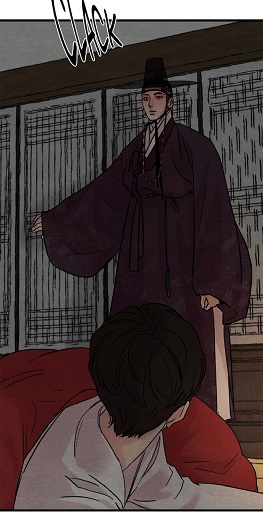 (chapter 34), (chapter 45) In his eyes, the main lead brought him luck, as all his wishes got fulfilled, and he was never caught committing a sacrilege or crimes. However, since the presence of Baek Na-Kyum by Yoon Seungho’s side, it looks like nothing is going like planned. The main lead is not only drifting more and more away from him, he even left everything behind. That’s the reason why I believe that the dragon, the king, will vent his anger on many people in season 4, a new version of this scene.
  (chapter 30), but much more brutal and violent! While this “dragon”, the king, stands for court, and as such civilization and immobility, the Korean dragon embodies nature and hope for commoners who dreamt of ascending the ranks! This is not surprising that Baek Na-Kyum is slowly ascending the ranks, while in the past Kim was acting as the unofficial lord of the Yoons’ mansion.
As a conclusion, in season 4, expect a battle between an “imoogi” and dragons. In addition, it becomes obvious that the winners will be our beloved couple. Since Yoon Seungho was turned into a “dragon”, I am more than ever convinced that he will act like in season 1: confident, perceptive, smart and cheerful! He can not longer be used like a pawn, for the “dragon” can not be tamed! And removing the falling star would signify the dragon’s death!
Feel free to comment. If you have any suggestion for topics or manhwas, feel free to ask. If you enjoyed reading it, retweet it or push the button like. My Reddit-Instagram-Tumblr-Twitter account is: @bebebisous33. Thanks for reading and for the support, particularly, I would like to thank all the new followers and people recommending my blog.

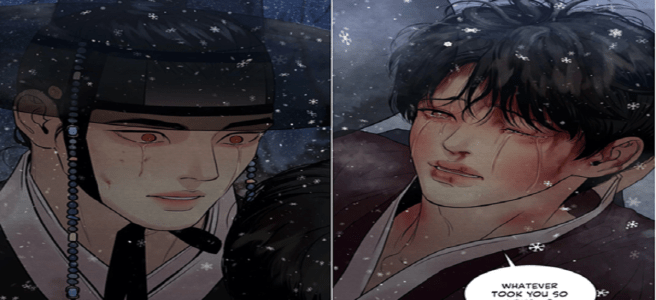
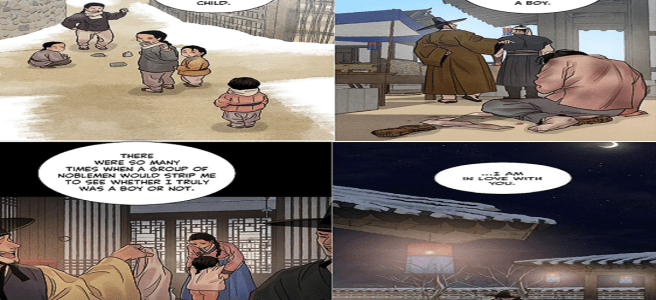


 Bebebisous33s' analyses in K-Dramaland and Manhwas