
This is where you can read the manhwa. https://www.lezhinus.com/en/comic/painter But be aware that this manhwa is a mature Yaoi, which means, it is about homosexuality with explicit scenes. If you want to read more essays, here is the link to the table of contents: https://bebebisous33analyses.wordpress.com/2020/07/04/table-of-contents-painter-of-the-night/
It would be great if you could make some donations/sponsoring: Ko-fi.com/bebebisous33 That way, you can support me with “coffee” so that I have the energy to keep examining manhwas. Besides, I need to cover up the expenses for this blog.
1. Yoon Seungho the king
After the end of season 1, I had been contacted by many followers asking me about the possible ending of Painter Of The Night. Many feared for a depressing ending, as Byeonduck had declared that the protagonists would be happy on their own. In their mind, this meant that the protagonists wouldn’t end up together. My reply was that the couple would become happy without getting too dependent on each other. I meant Yoon Seungho and Baek Na-Kyum would come to give a new sense to their own life, and their love would help them to have a goal and purpose in their life. And that’s how real couples live. Thus while examining season 1 closely, I came to imagine that Yoon Seungho would become the king and Baek Na-Kyum his painter. As you can see, very early on, I connected the noble to royalty. Why? First, we had the lord outlining his powerful position in front of the painter. 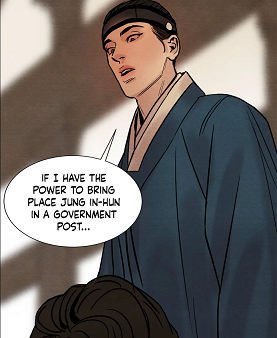 (chapter 11) Secondly, I had associated the main lead to the eagle which is the symbol for the kings and emperors in Europe. He was seen here flying
  (chapter 30), and his fingers reminded me of the eagle’s claws.
 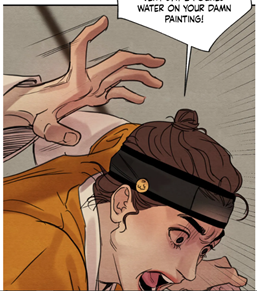 (chapter 18) And this perception got even reinforced, when I saw this panel:
  (chapter 52) In this scene, he was sitting like a king surrounded by his “court”. The hanbok had such a design that I couldn’t help myself associating it to Joseon’s monarchy.
However, I have to admit my mistake, for this interpretation was strongly influenced by my own culture and as such European history. Yet, here we are dealing with Korean and as such with Joseon culture. Hence the symbol for Joseon’s dynasty is not the eagle, but the dragon. That’s why when I saw this new image on Twitter  , I had another revelation. On the one hand, it actually confirmed that Yoon Seungho was somehow destined to become a king, yet he is not represented by the eagle or the phoenix, but by the dragon. Hence the moment I saw this image, one idiom came to my mind: Dragon king!
2. Yongwang
Because of this sudden association, I decided to look more into it. Thus imagine my surprise, when I discovered this:

Yongwang, or Dragon King, is a deity of the river or the sea, overseeing peace in the house, good health and longevity in the family, the harvest, catch and safe sailing. Yongwang is also called Yongsin (Dragon God).
Communities worshipped Yongwang as a water god, holding divine powers to control rainfall. Dragon King worship is closely related to the contemporary practice of staging rituals at village springs or wells that are believed to be dwelling places for Yongwang. Around the country there are also legends regarding dragon springs and dragon wells, created by a dragon that brought rain to repay humans by turning wasteland fertile, which shows that Yongwang is closely related to farming. […] In shamanism, Yongwang oversees not only fishing, but the souls of those who have drowned and died. In the worship of household gods, it is a deity that oversees peace in the household, good health and longevity in the family, the harvest, catch and safe sailing.
Among rituals held for Yongwang in the home by women, the most widely spread is yongwangmeogigi (feeding the dragon king), also referred to as yongsinje (dragon god ritual) and gaetje (fishing ritual). This ritual can take place in three different venues: First is a private well in the backyard; second is the communal well, where, in some cases, a spring ritual (saemje) is held, then water from the well is brought to the home and placed in the kitchen or on the sauce jar terrace for the Dragon King; […] https://folkency.nfm.go.kr/en/topic/detail/2618
The moment I read this article, I couldn’t restrain myself making the parallels between Yoon Seungho and Yongwang. First, the deity in the background reminded me of Yongwang. 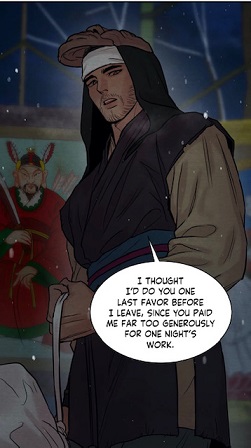 (chapter 100), though this deity is always accompanied with a dragon and in this picture, the readers couldn’t see one. However, it is possible that the author didn’t desire to reveal too much.
“his most distinctive traits are that his beard, moustache and eyebrows are (usually) “spiky,” protruding in sharp points, sometimes resembling coral, and his eyes are often bulging out like those of a fish. He most often holds the banya-jinju (般若眞珠, flaming pearl of wisdom, a type of ma-niju 摩尼珠), but sometimes a branch of coral or a sword.” quoted from http://www.san-shin.org/EKB-Yongwang-DragonKing.html
Secondly, we have a strong connection between rain and the main lead’s situation and emotional state. It rained, when the lord had sex with Baek Na-Kyum. 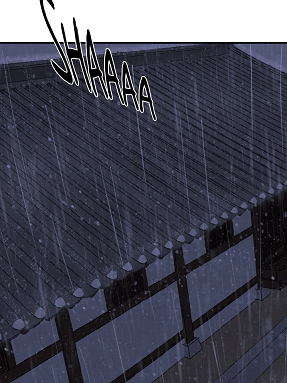 (chapter 21) Why? It is because the lord was happy. These were the tears of happiness, which Yoon Seungho couldn’t express contrary to the painter. And this is no coincidence that in chapter 58, it started snowing, when the couple was making love:
 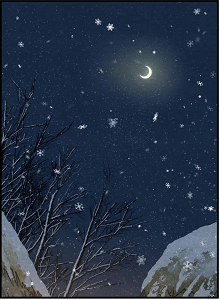 (chapter 58) And we had the same weather, when Yoon Seungho saved his lover.
 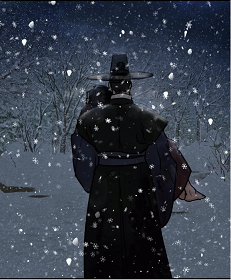 (chapter 102) The weather was expressing the main lead’s emotions: tears of happiness or sadness. We could say that the lord has the “power” to move the sky.
Furthermore, the well plays a huge role in this story. Many people are found dead in a well 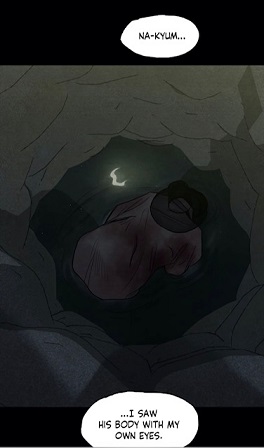 (chapter 97), and according to me, the messenger was drown there.
 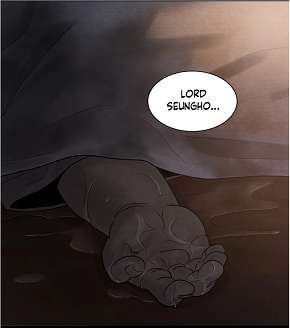 (chapter 94) In addition, my theory is that Deok-Jae and/or Jung In-Hun’s body were placed in a jar in order to hide the murders. For me, the jar plays a huge role in Painter Of The Night… thus Byeonduck created such a scene in season 2
  (chapter 46) and we have so many jars next to the pond:
 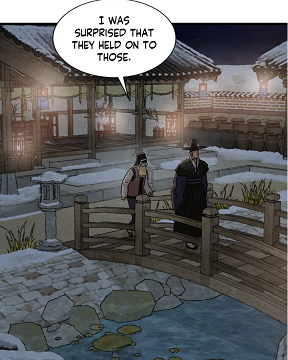 (chapter 94) [For more read the essay “The secret behind the library”]
Furthermore, this story takes place in Jemulpo, a town situated next to the sea, and Yongwang’s realm is supposed to be in the sea.  (chapter 91) This is no coincidence. To conclude, all these elements (rain, jar, well, soul of a deceased), connected to the dragon king, are present in Painter Of The Night. Thus I came to the conclusion that Yoon Seungho is like Dragon king. This reinforces my conviction that the main lead is not only connected to shamanism, but also embodies royalty. So he might not be the king of Joseon, but he is powerful in his own way, though he is not aware of this. And note that the moment he wished to commit suicide by drowning in the pond, he was brought back to life.
  (chapter 102) Water is his true element.
In different temples, you can discover Yongwang accompanied with a woman. She is also dressed in royal clothes with a small crown. What’s unclear is if she’s another Yongwang or if she’s his wife. And this could be a reference to the painter, who will become Yoon Seungho’s bride, but his true identity will remain hidden. 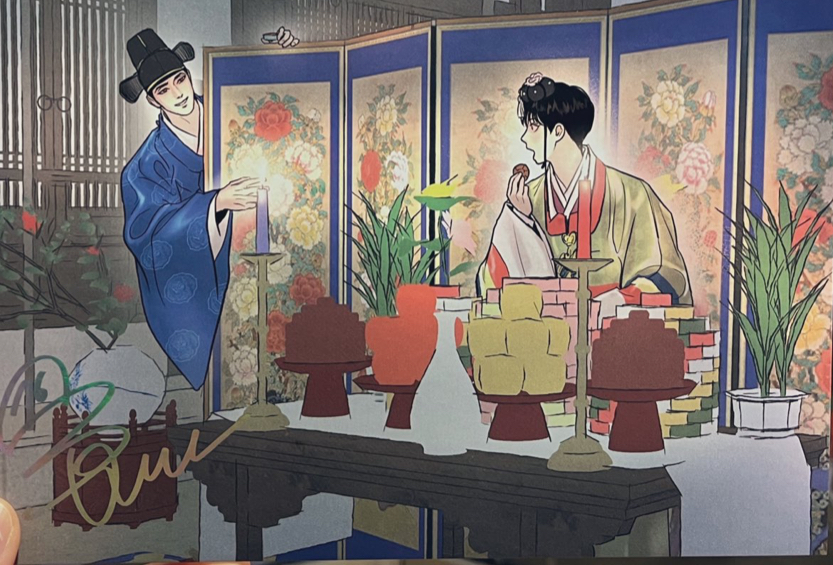
What caught my attention is that the rituals concerning Yongwang are held by women, which stands in opposition to the shrine and Confucianism.  (chapter 85) This means that in the Yoons’ mansion, people didn’t venerate this god. And since the aristocrat made such a statement to the elder Yoon Chang-Hyeon,
 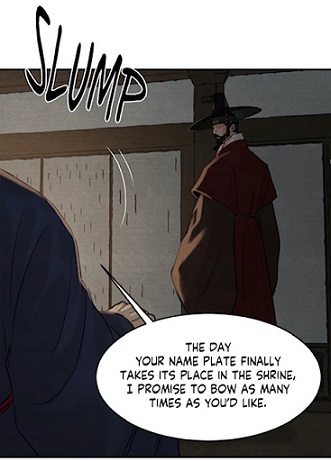 (chapter 86), I have the impression that in season 4, we will assist to a real ritual to ward off evil and back luck, leading the tormenting souls to the afterlife peacefully.
And this leads me to the following observation, the dragon in Korea and Joseon is perceived as a good omen! He would bring good fortune.
Since the release, I realized that the decorated tree  (chapter 100) and this altar
 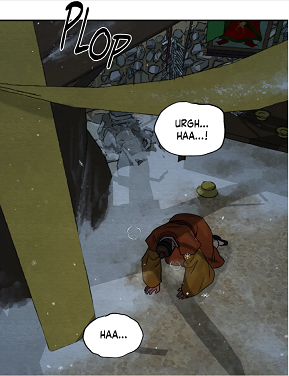 (chapter 100) were exposing the presence of a ritual. However, my problem was that I couldn’t determine exactly the nature of the ritual. But by making the connection between the dragon and good fortune, I had now more clues. I have to admit that I can not be 100% sure for this, but this is what I found:
“Yonggyeong (Kor. 용경, Chin. 龍耕, lit. dragon’s plowing) is a custom observed on Dongji (Kor. 동지, Chin. 冬至, Winter Solstice) in which people tried to predict the outcome of farming for the upcoming year based on the direction and angle of cracks on the surface of a frozen pond. The custom is also known as yonggari (Kor. 용갈이) or yong-ui batgari (Kor. 용의 밭갈이), both meaning ‘plowing by the dragon.’ When ice covers a pond, there is often a crack that divides the ice sheet into two halves, as though a field were divided along a furrow left after plowing. This phenomenon was considered a trail left by a dragon and, therefore, interpreted as having divinatory power concerning farming success in the year ahead. […]
According to another custom referred to as dongbok (Kor. 동복, Chin. 凍卜, lit. ice fortune-telling), on the eve of the year’s first full moon (the fourteenth of the first lunar month), people left two bowls of fresh water out overnight and positioned them north and south of each other. The next morning, they examined the ice sheet that appeared in the bowls and tried to predict the success of farming in the northern and southern regions. quoted from https://folkency.nfm.go.kr/en/topic/detail/4622
The timing fits to our story, and we have the presence of bowls in front of the deity in the yard. In my eyes, the shaman had prepared a ritual for the dragon king, and was praying for the success of the farming. Don’t forget that it takes place just before Spring. Consequently, this is not surprising that the lord got connected to peasants and this very early on.  (chapter 4)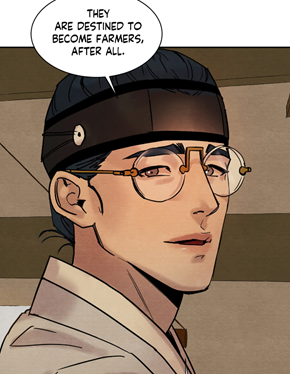
 (chapter 6)
 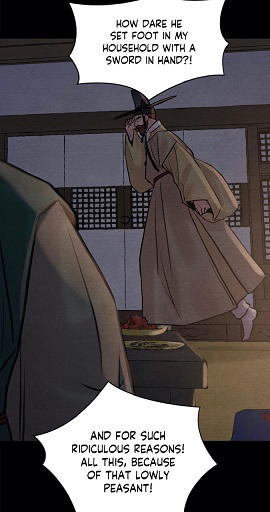 (chapter 82)
This observation leads me to the following conclusion: Yoon Seungho, as a new version of Dragon King, will bring luck to the commoners and peasants. He will help them to improve their living conditions (education and good farming). As you already know, I consider Yoon Seungho as a representative of Sirhak. [For more information read the essay “The scholars’ fight”] And now, you comprehend why very early on, I expected that Yoon Seungho would become a king. He doesn’t need to become a real “king”, yet there is no ambiguity that his fate is to become famous as a spiritual and fair leader.
3. Dragon and imoogi
That’s the reason why I started looking for more information about the dragon. As the readers could see through the deity, this mythical animal is strongly connected to water!
What caught my attention is that the Korean dragon has no wing, yet it can still fly and he has a small beard (hair around the mouth)!! But more importantly, this creature is a combination of different animals: the body of the snake, the antlers of the deer, the forehead of the camel, the nose of a pig, the ears of the cow, the claws of the hawk, the scales of the carp, the fist of a tiger and the eyes of the rabbit! He contains all the strongest features of these animals:
- luck for the pig
- strength for the tiger
- elegance of a deer
- stubbornness and resistance of a camel
- compassionate and giving nature of a cow
- the constant change, the metamorphosis of a snake (cycle of death and rebirth)
- the rapidity of a hawk
- fertility of a carp
- the abundance of the rabbit by sharing its eyes
In other sources, I read that the Korean dragon had also features of the dog, the frog and the sheep. But why does this mythical animal possess so many features from different creatures? It is because this powerful, God-like creature embodies the love and respect Korean people have for the natural world. I would even say that he represents nature, and as such he stands for harmony and justice. By being sharing features of different animals, he can understand their life. This is not surprising that the Joseon kings utilized this animal as their emblem. It symbolizes their power (omnipotence and “immortality”) while substantiating their ability to be fair and just rulers.
Striking is that we have an allusion to these animals in Painter Of The Night. First, the lord was able to kill the boar  (chapter 83) and the deer
  (chapter 22). Then the lord compared Baek Na-Kyum’s eyes to a rabbit.
  (chapter 78) Since both resemble each other, I deduce that the main lead has the same eyes, the rabbit’s. Like mentioned above, he utilized his fingers similar to claws: (chapter 18) He would fly like a bird, though he has no wing (chapter 30). His fists in this scene reminded me of a tiger’s:
  (chapter 54) One might argue that this signification is totally impossible, for the lord doesn’t have the body of a snake. This point can be refuted very easily. What is the major characteristic of a snake is molting. A regularly recurrent event during the activity period of all snakes is the shedding of the skin. This coincides with the lord’s change of clothes. The latter reflected his downfall and rising. Furthermore, this animal is linked to death and rebirth. My avid readers are already aware that I had detected different scenes, where we could witness the lord’s spiritual death and rebirth, like for example in the shed:
  (chapter 62) When he discovered his misjudgment the next morning, he felt like dead. He no longer saw himself as a lord, but came to view the painter as his new lord :
 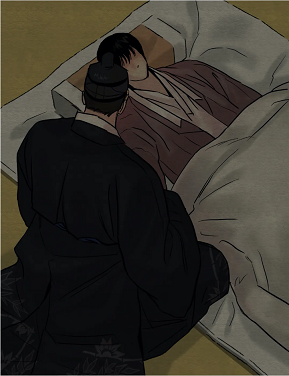 (chapter 66) As a conclusion, Yoon Seungho shares so many similarities with the dragon that I came to view him as one. This explicates why even after getting married, he will never wear a beard! The change of dresses and hair dresses of Yoon Seungho represents the different social status in Joseon society: young master, painter, male kisaeng, slave, peasant, executioner, servant, lord, concubine, “wife”/husband” etc. Moreover, since I had detected parallels between the protagonist and the legend of Dangun, this could only reinforce my conviction that Byeonduck is referring to old tales and religions (and as such Dragon King) in her story. The author has already stated that she won’t create a story with the couple set in our time, and this becomes understandable, if she is constantly referring to old traditions and myths.
According to different sources, the Korean dragon is not born as such.
“Korean mythology states dragons were born from a mating ritual between a phoenix and a crane. This led the dragon to become a creature that harnessed mythical power and intelligence.” Quoted from https://daebak.co/en-de/blogs/magazine/animal-symbolism-in-south-korea
My avid readers will certainly recall my associations for the characters, Yoon Seungho was the phoenix and Baek Na-Kyum a crane. Thus we could say that their union makes them the dragon bringing justice and peace to victims. In another source, I found that the dragons were once said to be Imoogi in the beginning, a giant lizard that resembles sea serpents. They exist several different versions on how Imoogi become Dragons. One said it would take a thousand years for them to become a dragon, while another says they must catch Yeouiju (star) falling from the sky. Thus in temples and in pictures, the Korean dragon is also always represented with a ball.
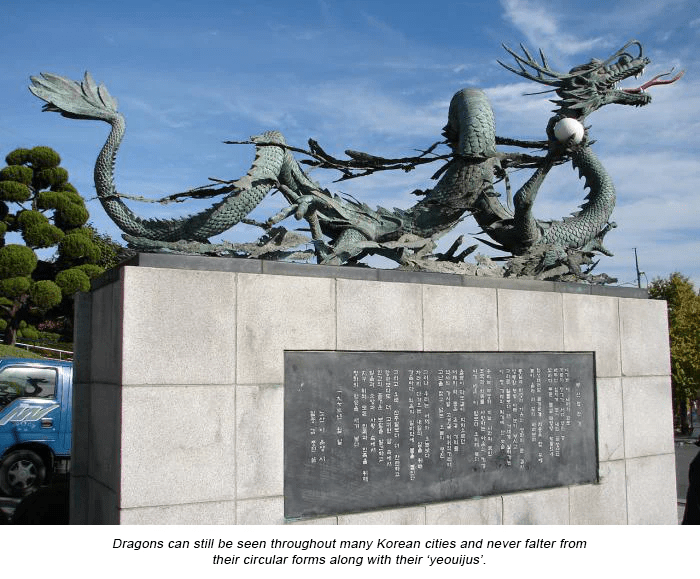
“Another theory that exists and sounds the most logical to me, says that Imoogi was born in a place where living and dead intermingled. It was created in cave where thousands of people were stuck due to war in 420AD. As more and more people started to die in the cave, their intense agony and suffering led the foundation for Imoogi’s birth and therefore it symbolizes destruction and sadness. Imoogi controls the power of birth, death and rebirth. Ouroboros, a symbol of wholeness/infinity is also represented by a snake(serpent) eating its tail.” quoted from https://rtaori60.medium.com/imoogi-the-great-lizard-aca02c6c9b1e
Since it takes 1000 years for an imoogi to transform into a dragon, we have 10 years of suffering in Painter Of The Night. For me, this is not random at all. This means that after chapter 102, Yoon Seungho turned into a real dragon! This corresponds to his Coming-Of-Age. That’s the reason why I don’t think that he will be manipulated again like in season 2 and 3! My avid readers are already aware of the presence of ouroboros in this manhwa. For me, Kim symbolizes the imoogi and Ouroboros! He could never turn into a real dragon. But why does the imoogi need to wait for so long ? Some say that this is a curse, other traditions hold the idea that Imoogi are “pupae” or “larvae” of dragons. And they will become full-fledged and full-fledged dragons after being in the ocean for 1000 years. This signifies that time, experience and patience are essential for this transformation. Thus not every imoogi can become a dragon in the end, and that’s Kim’s fate. He was not able to recognize Yoon Seungho as his “yeouiji”. The shaman’s house reminds me of the cavern 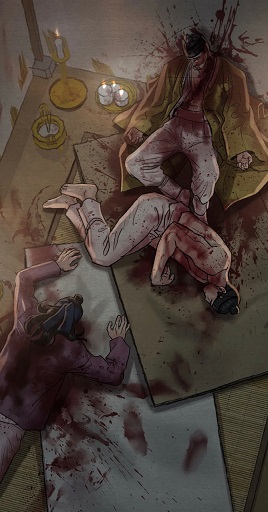 (chapter 102), and thanks to the painter, Yoon Seungho’s soul was able to escape this “mental prison”.
And this leads me to the following aspect: Baek Na-Kyum is the lord’s Yeouiji, his fallen star fulfilling all his wishes. That’s the reason why the dragon is never seen without his star. One might say that this is exaggerated. However, my avid readers should remember that I had associated the painter to a star, the sun, in previous essays, even before making the relation between the dragon and Yoon Seungho! This explicates why the lord is carrying his lover like his bride (chapter 45) (chapter 102), similar to the dragon in the picture above. His “star” serves as his guide, support and his source of life. Thus when the main lead confessed to the painter for the first time, the sun entered the bedchamber
  (chapter 55) and as such his heart and mind.
Therefore I come to the conclusion that in season 4, the readers will witness a clash between two dragons, the king and Yoon Seungho! The fight between the fake and the real dragon! Thus when the author released this panel recently, (Twitter), she was actually announcing the arrival of the monarch in Joseon. Hence you comprehend why I selected such a title, the rise of the dragon. “Lord Song” can no longer hide his true identity.
4. Dragon king and expulsion
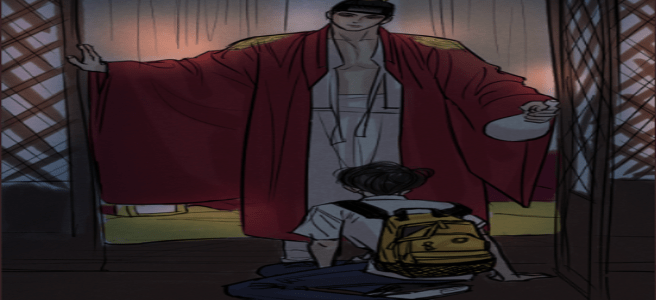
My readers will certainly recall that the starting point of this essay was this expression “dragon king” which came to my mind, when I saw the recent publication. Why? First, the main figure was wearing the gonryongpo (곤룡포), where dragons are sewn on it. This hanbok is the everyday robe for the king which explains why the latter is always wearing the red robe all the time he appears in front of people. Hence I made this association in my mind: dragon king. When Byeonduck published this image, , she was naturally creating a new story, another Alternative Universe. The student Baek Na-Kyum who got bullied by the classmate Deok-Jae was suddenly sent back to Joseon, and appeared in front of the king’s bedchamber, Yoon Seungho.
Striking is that this panel resembles a lot to this picture which the author hasn’t used yet: 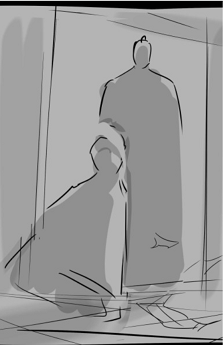 The painter is sitting inside a room, while Jung In-Hun is standing outside. Nonetheless, the position of the characters are very similar. This indicates that the author’s new alternative story is actually inspired by the main story!! This can only reinforce my perception that Yoon Seungho in the main story is associated to royalty. However, since it is a reflection, I deduce that this image is the positive reflection of this scene: How did the learned sir react here?
 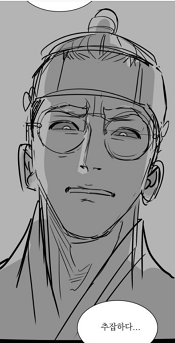 He criticized the painter by stating that this was “filthy”.
  In this scene, the characters are caught by surprise, but it becomes obvious that there is no disgust or expulsion. In fact, the fall of man took place before, for Baek Na-Kyum was sent to Joseon. In this encounter, I detect attraction and curiosity. Hence I come to the conclusion that in the original story, when this scene took place, , Yoon Seungho was far from being living like a king. As you already know, according to my interpretation, the protagonist was treated like a male kisaeng. That’s the reason why I believe that this scene played a huge role in Yoon Seungho’s liberation, the physical expulsion from hell in the end. Since in the parallel story, the student experienced time-travel and as such rejection and expulsion, I conclude that in the main story, Yoon Seungho must have made a similar experience! But this doesn’t end here, as the readers should keep in the mind the following rule: The painter’s destiny reflects the lord’s.
On the other hand, the manhwaphiles will complain that so far, Yoon Seungho has never appeared as a dragon. Yet, we shouldn’t overlook that the phoenix is the symbol for the Queen in Joseon.  (chapter 50)
  (chapter 52) This means that the mysterious lord Song was actually claiming the main lead as his wife in the last scene. Min and his friends were sent there in order to entertain the protagonist, but they failed. This explicates why the next day, Black Heart was seen with a hanbok of lower quality.
  (chapter 56) It was, as if Min had been compensated for his bruised face by the mysterious lord Song. However, for the pedophile, Black Heart was just a concubine, and not his main wife! Hence the hanbok had not such a detailed and expensive design. This would explain the villain’s jealousy. And now, if you look back at the hanboks from the main lead, you will recognize his ascent. First, he is wearing green, which is similar to Yoon Chang-Hyeon’s color. At the same time, his hat resembled a lot to Kim’s.
  (chapter 1) Then later, he is mostly wearing blue which is actually the color of the Crown prince.
  (chapter 11) Yet, his robes initially have no design. Slowly, the lord is wearing colors and designs that are actually reserved for a king: blue, red, black and purple. This constant change of hanboks symbolizes the “snake molting” and as such his transformation and rising. This is not astonishing that on the night of the bloodbath, he had such a hanbok:
  (chapter 102) Here, he was no longer acting like a noble, but as a ruler. Don’t forget that according to me, the mysterious lord Song had proclaimed the main lead as his unofficial Queen by giving him hanboks with phoenixes. However, naturally, this was never mentioned to Yoon Seungho directly. Why? It is because Kim usually selects his clothes. However, this rise was not natural, as the lord had no real saying in this matter. The real metamorphosis took place in the shaman’s house, when the lord was sent back to the past and as such the darkness.
 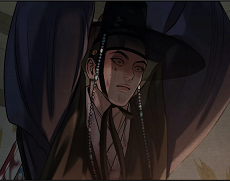 (chapter 102) The moment he left the “cave”, he went to the mountain and surrounded by the wind and water, he changed into a dragon. This expulsion corresponds to the final release, the lord’s mind is finally freed from the darkness, while I believe that this scene is linked to the lord’s physical liberation. .
5. Nightmare and dream
Above, I had mentioned that the painter was the dragon’s fallen star and the love sessions were strongly connected to the weather. If so, why did it snow, when the learned sir left the mansion?  (chapter 44) It is because the main lead was thinking that the painter would actually run away. Thus the door was left opened, and he was wearing warm clothes. Yoon Seungho never imagined that Baek Na-Kyum would remain by his side. Yet, during the previous night, the lord had consoled his lover by embracing him.
Furtheremore, the manhwalovers could also wonder why the lord had a nightmare in the bedchamber after their second love session? The painter’s presence should have brought relief. Moreover, during that night, there was no rain.  (chapter 71) But this can be refuted easily. First, don’t forget that during this love session, the lord was acting like a servant pleasing his new lord. So this had nothing to do with Yoon Seungho’s feelings like sadness or happiness. He was determined to keep the painter by his side, and ignoring his own feelings. He never expected the artist to reciprocate his feelings. Secondly, Yoon Seungho’s nocturne vision is not just a nightmare, but also a DREAM! Yes, you are reading this correctly. Only recently, I discovered that all the artist’s visions are a combination of 3 elements: memory, nightmare and dream! I will give you three examples as illustration, for I am slowly running out of time.
Chapter 28:  This vision is a combination of these three elements: memory, nightmare and dream. This had happened during the First Wedding Night (memory)
 (chapter 21), then we have a similar situation in chapter 49: ,
 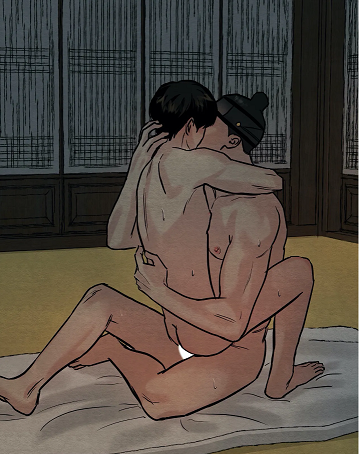 , but the painter was rejecting this future. Hence he considered it as a nightmare.
- Chapter 34 : Memory
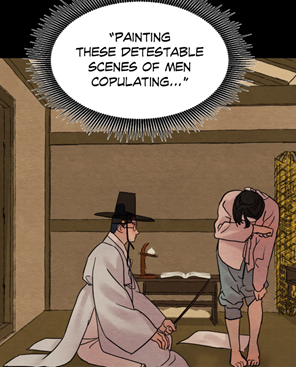 ; nightmare
  the lord becomes a ghost and confronts the painter with his biggest fears (admitting his attraction, passion for erotic paintings and homosexuality) and dream
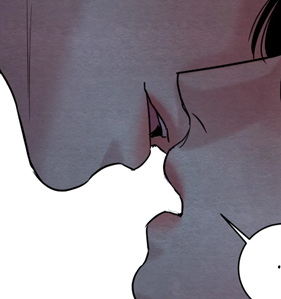 (The painter’s true desire was that the lord would kiss him, he was deeply longing for his lips, yet he was still in denial in this vision.
 - Chapter 98: Memory
 , for the painter was remembering the corpse in the courtyard, a dream, as he wished the return of his loved one
  . He hoped that the lord would take care of him personally. Naturally, the “spirit” is the nightmare
  .
.
Since the lord’s fate and personality are similar to the painter’s, I could only come to the conclusion that the lord’s vision in the bedchamber is not just showing the past and the future horror. It also exposes the lord’s dream and hope! 😮
So where were his desires visible? First it was about breaking free from his jail… 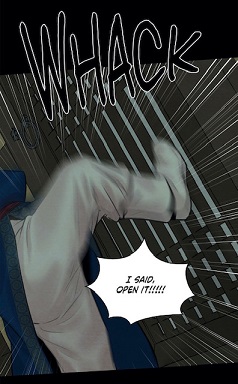 (chapter 74) This had already happened, but the lord had not grasped the significance.
 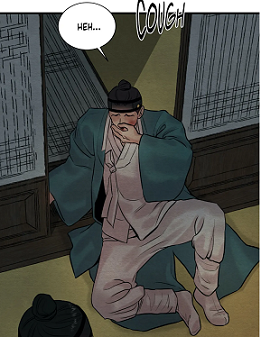 (chapter 53) Besides, he had not opened the door himself. Even when he went to the scholar Lee and opened the door with the his foot, the lord still felt trapped.
 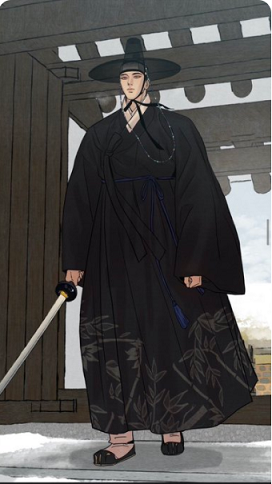 (chapter 67) Then in season 3, he could break a door, but it was thanks to the painter.
 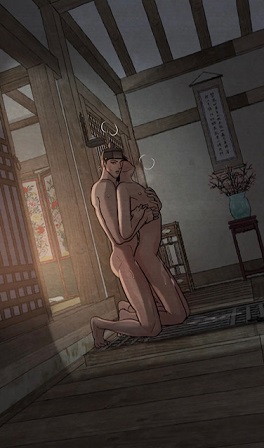 (chapter 96) This shows that the lord’s wish to get released had not been fulfilled so far. In my eyes, it is connected to the torture Yoon Seungho suffered and as such to the purge organized by the authorities. That’s the reason why I deduce that the lord will break a door in season 4, and this won’t be by accident and it will be witnessed by many people contrary to chapter 53, 67 and 96! The broken door will reflect the lord’s rise and power, and no one will be able to stop this. In my eyes, this wish is connected to the door in the servants’ quarter. That’s how his imprisonment started.
Moreover, the protagonist was voicing his thoughts, the reproach to Kim and his father! They had abandoned him.  (chapter 74) The “dragon” wished to see Kim and his father, and confront them! And this did take place in season 3. Yoon Seungho confronted the butler with his attitude and betrayal
 (chapter 77), but this argument was just short-lived. He still viewed the valet as a hard-working and trustworthy person. He had just made bad decisions. Then in the bedchamber, the lord could blame the father for his suffering:
 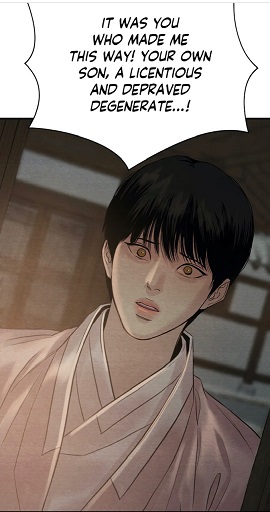 (chapter 86) As you can see, the lord’s wishes were granted, but the nocturne vision was so difficult to grasp that neither the readers nor the main lead could interpret the message correctly immediately. Besides, the nightmare was mostly silent. But this doesn’t end here.
 (chapter 74) In this image, he is floating in the air… a sign that his status is changing. At the same time, this shows that he is escaping from the hands. They are trying to drag the main lead down. Thus I come to the conclusion that the vision was announcing the lord’s transformation (into a dragon) and as such his “rise”. Note that in this image, he is still a teenager, but in the following panel the protagonist has already become an adult.
  (chapter 74) Simultaneously, the vision also displays the lord’s expulsion from “hell”, the sex orgies (chapter 74). the hands are trying to bring him back. This image displayed that Yoon Seungho would become powerful, and the hands wouldn’t be able to contain him any longer. The pink is a reference to the painter, and not just to the gibang! Thanks to the painter, Yoon Seungho is changing so that he will be able to face the KING, but not only him!! This is what the dream was telling him too. Thus we have this image:
 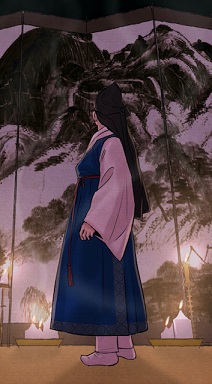 (chapter 74) Simultaneously, the dream showed that the lord wished to see this painting again, though deep down, he blames this image for his suffering. As you can see, the vision was revealing the tormented disposition of the lord. He was switching from nightmare to dream and the reverse… a mixture of anxieties and desires.
However, pay attention that the painting was standing behind Yoon Seungho, when the hand grabbed him  (chapter 74) This signifies that he was approached by someone from behind, he had not noticed that the “door” had been opened. Thus he never expected his apparition. For me, this perception demonstrates that the painting is not the real cause for Yoon Seungho’s suffering. Since he had turned around, I came to recognize that this scene stands in opposition to the situation in the painter’s nightmare: (chapter 34) The painter had been able to witness the entrance of the ghost contrary to Yoon Seungho. The latter was caught by surprise. This image illustrates the lord’s biggest fear. That’s how I realized that his biggest nightmare is not the pedophile in my opinion, for the main lead in Baek Na-Kyum’s “nightmare” (chapter 34) stands for attraction, honesty and love… thus it should be the opposite in Yoon Seungho’s nightmare: repulsion, betrayal and resent! He fears to admit the truth, the biggest traitor is Kim, but he is still in denial. He has repressed the terrible betrayal from Kim, just like the painter’s, though I think that the biggest traitor in Baek Na-Kyum’s case is not really Jung In-Hun, but Heena. This would explain why Heena noona was not present in the terrible vision in chapter 34. This is not random that we don’t see the face of the owner’s hand. Naturally, the king was involved in this betrayal, for Yoon Seungho is caught between the hand and the painting. He was trapped between two forces.
This means that Baek Na-Kyum will help Yoon Seungho to face the truth: Kim is a traitor and the king is the pedophile. The vision is indicating that the butler will betray him again in the future, backstab him one more time… However, this time he will recognize his action. Why? Because this time, there is light in the room… as Baek Na-Kyum symbolizes the Yeouiju, the fallen star helping the dragon. If the author presents another dream from the main lead, we will definitely get new clues. And this brings me to the following conclusion:
Yoon Seungho had been portrayed as a bird of misfortune on purpose. 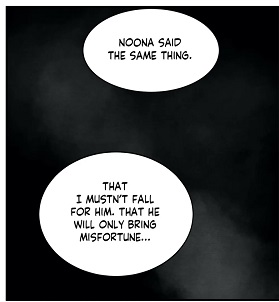 (chapter 86) In reality, he was a dragon, who could bring luck and fortune to the person who would cherish him. This is no coincidence that the pedophile sent hanboks with the crane
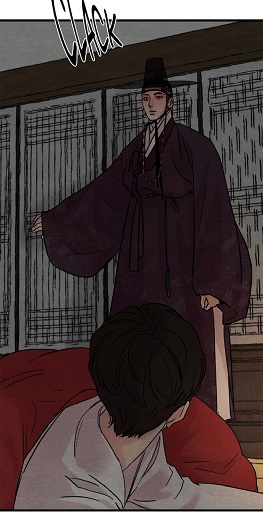 (chapter 34), (chapter 45) In his eyes, the main lead brought him luck, as all his wishes got fulfilled, and he was never caught committing a sacrilege or crimes. However, since the presence of Baek Na-Kyum by Yoon Seungho’s side, it looks like nothing is going like planned. The main lead is not only drifting more and more away from him, he even left everything behind. That’s the reason why I believe that the dragon, the king, will vent his anger on many people in season 4, a new version of this scene.
  (chapter 30), but much more brutal and violent! While this “dragon”, the king, stands for court, and as such civilization and immobility, the Korean dragon embodies nature and hope for commoners who dreamt of ascending the ranks! This is not surprising that Baek Na-Kyum is slowly ascending the ranks, while in the past Kim was acting as the unofficial lord of the Yoons’ mansion.
As a conclusion, in season 4, expect a battle between an “imoogi” and dragons. In addition, it becomes obvious that the winners will be our beloved couple. Since Yoon Seungho was turned into a “dragon”, I am more than ever convinced that he will act like in season 1: confident, perceptive, smart and cheerful! He can not longer be used like a pawn, for the “dragon” can not be tamed! And removing the falling star would signify the dragon’s death!
Feel free to comment. If you have any suggestion for topics or manhwas, feel free to ask. If you enjoyed reading it, retweet it or push the button like. My Reddit-Instagram-Tumblr-Twitter account is: @bebebisous33. Thanks for reading and for the support, particularly, I would like to thank all the new followers and people recommending my blog.
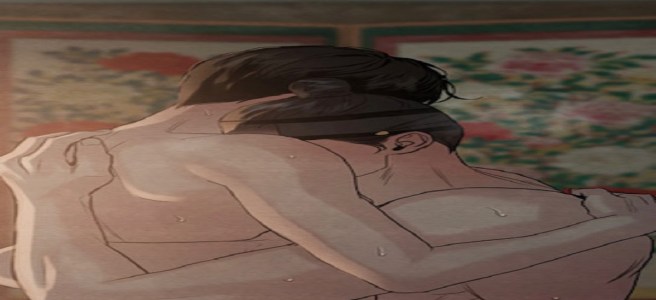

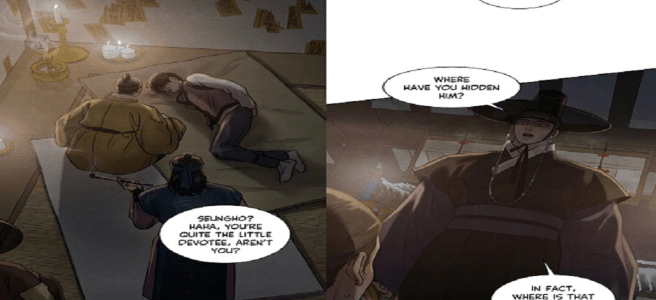


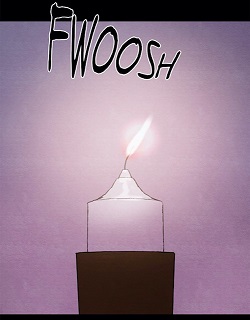 (chapter 74), it is the opposite with the painter.
 (chapter 55) The chapter begins in medias res
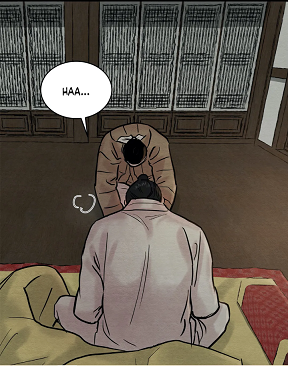 (chapter 56), which means that there’s no introduction, the story starts in the middle of the action. And now, it is important to question ourselves about the intention of the author. Why did she change her MO? I found the answer the instant I realized the importance of the two following aspects. The light… and the sound, in this case: HAA…
  (chapter 56) In the past I used to think that this scene had occurred early in the morning. But now, I am thinking otherwise. In truth, right after receiving the letter, the butler went to the bedchamber directly and woke up his master!! This signifies that this scene took place during the night. But how did he do it? He just needed to remove the light from the bed and lit other candles. That’s the reason why the candles are positioned like during the night of the brother’s visit.
  (chapter 56) Besides, the manhwaphiles should remember the way the room was enlightened, when Baek Na-Kyum was keeping company to his lover.
  (chapter 55) It was quite dark.
 (chapter 55) And strangely, the main lead could sleep comfortably. He was not plagued by a nightmare.
  (chapter 55) He could even sense the artist’s presence unconsciously, therefore he confirmed his affection for the painter. And now, you can imagine what happened. Once the valet received the letter, he went to the bedchamber directly and sent Baek Na-Kyum back to his bedroom under the pretense that he would take care of his master himself. However, the moment Baek Na-Kyum had left his side, the valet lit more candles
  (chapter special episode 3) Note that there’s no candle placed next to the entrance of the lord’s bedchamber for that reason. The noble only feels comfortable, if the light is situated close to his face, because that way he won’t see any shadow. Thus we have such a scene in the first season.
  (chapter 35) The candles are always placed next to his bed. And now you comprehend why the lord moved to the patio during their first night together.
 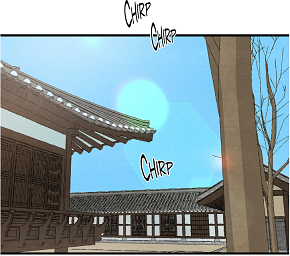 (chapter 38) He didn’t want to disturb the painter in his sleep, for he needs light during the night, but only next to him. This explicates why Yoon Seungho woke up from his nightmare right away, when the bougie had been blown out.
 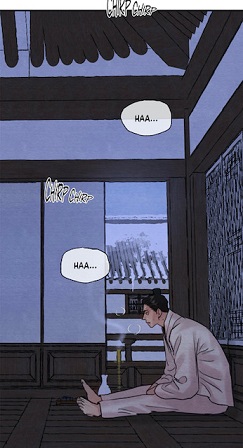 (chapter 74) But how did it happen? Was it the work from the wind or the candle was extinguished by the protagonist’s heavy breath or was Kim behind this? Because I had no answer before, I had not mentioned this observation. Fortunately, my friend Luzyla came to my rescue and gave me the answer which I totally support. Kim must have intervened during that night, because for the first time, the nightmare was becoming more precise. But how did she confirm my suspicion? It is because the butler had this image, when he tried to convince the painter that nothing would change. This panel
 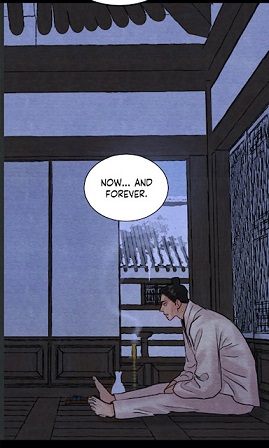 (chapter 87) represented the butler’s memory. This means that the butler must have seen him from the outside. He didn’t want the painter to discover the lord’s suffering. And it worked, for the lord never let this transpire to the painter after that night. And now, you comprehend why the butler had to make sure that the couple would no longer sleep together at the end of the second season. But let’s return our attention to episode 56.
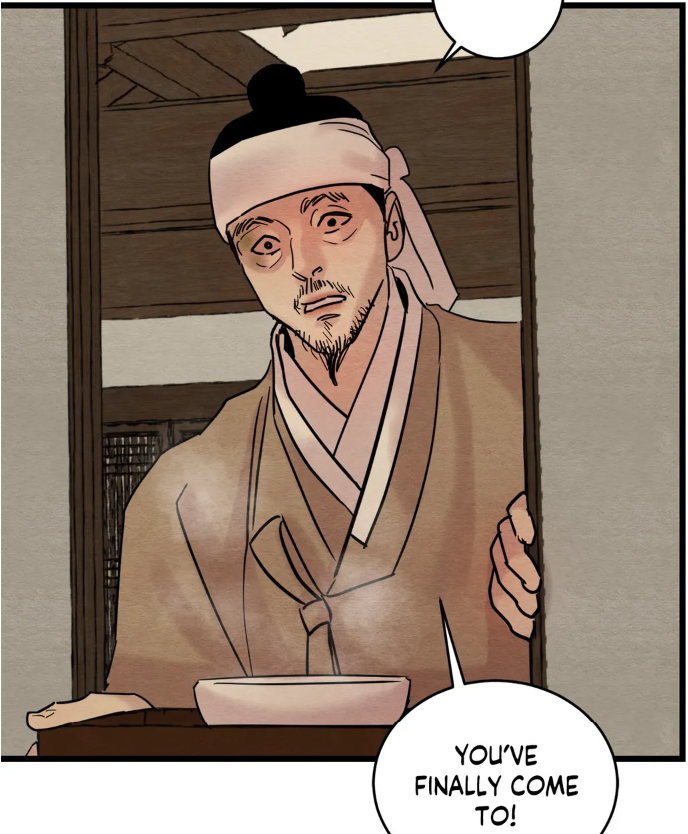 (chapter 34) The entire time he acted, as if Yoon Seungho was fine, for he was conscious. Then he gave the letter to his master and knelt far away from him while looking down.
  (chapter 86) The former has long internalized that he is scary and dirty. Yet the truth is that the butler’s gaze reflects his hatred, for he considers him as responsible for his own misery. Don’t forget that he is tormented in the presence of Yoon Seungho. The latter is a reminder of his own sins. To sum up, for Kim, the reason for his distance and avoidance is simple. He doesn’t want to be confronted with Yoon Seungho’s suffering, for he is refusing to admit his own guilt. The protagonist already knows about this unconsciously. Thus he hid his gaze the entire time.
  (chapter 56) The first “HAA”
  weren’t laughs, but the sign of a panic attack. Yes, for the first time the manhwaphiles discovered the lord’s health issue (flashback), but no one truly grasped, not even me. I had imagined that his heavy breathing was related more to pain and his illness. I only recognized the existence of the panic disorder in episode 66, though I was already aware of his PTSD.
 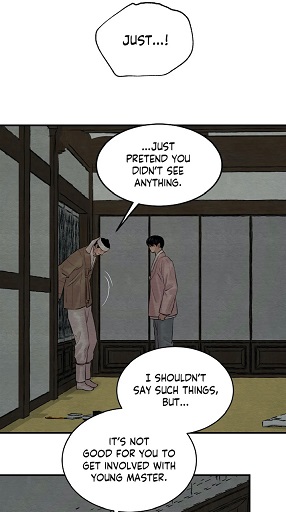 (chapter 86) He pretended he saw and heard nothing. But how can I be so sure that it was the night? Simply because all the windows were all closed. Thus Byeonduck drew such an image:
 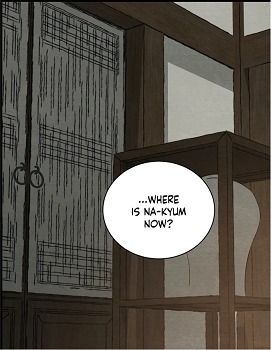 (chapter 56) Besides, observe that there is more light in the bedchamber, when the butler entered the room later:
  (chapter 56)
 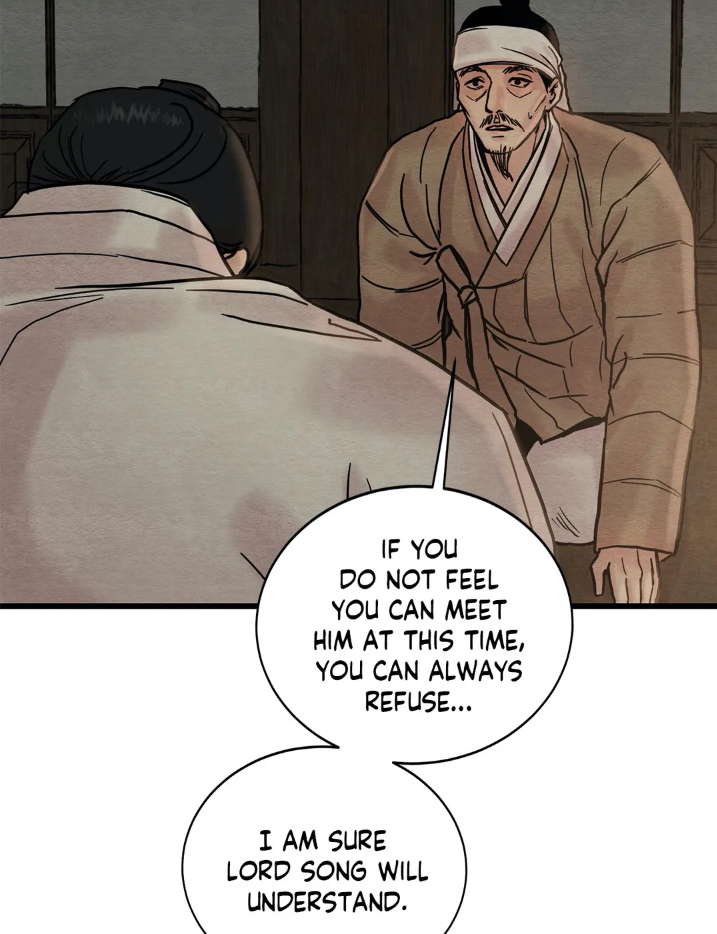 (chapter 56) He wanted to wash off his hands on this. The moment he conveyed the message to the master, it was no longer his responsibility. If lord Song had truly sent the missive, then Kim could say that this had been his master’s decision to refuse to follow the request, if they were confronted for their disobedience. This means that Kim was lying, when he said, “I am sure lord Song will understand”. He was just expressing an expectation, but there was no guarantee that the mysterious man would be very understanding. In addition, one idiom caught my attention: “If” This was a condition and not a real statement. Kim never said that since Yoon Seungho was ill, he could refuse the invitation. This signifies that the valet refused to confirm the noble’s illness. It was Yoon Seungho’s choice to say if he was feeling ill or not. To conclude, he refused to assume any responsibility. And now, you comprehend why Byeonduck added a drop of sweat on the butler’s face. This was showing his discomfort and deceptions. The man didn’t want to be associated to the noble and become responsible for him.
  (chapter 56)
  (chapter 56) he proposed to fetch the boy. Why? It is because the butler didn’t want to be confronted any longer with the lord’s panic attack, though he had been the one to trigger it! But he didn’t care, for his true goal was to save his own skin. Should lord Song get angry, Kim could definitely use the truth to his advantage. He had delivered the letter right away, and the noble had been well enough, since he woke up and read him the content.
  (chapter 56) 🙄 Under this new light, I couldn’t help myself shaking my head, when I read this from the butler.
 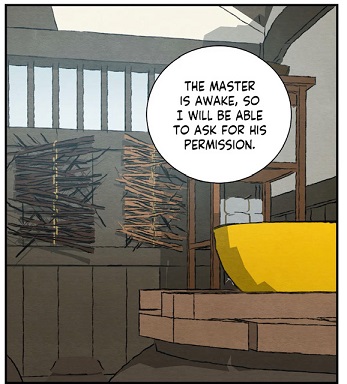 (chapter 56) His words implied that the lord had woken up on his own, whereas in reality the butler was the cause for this. Kim knew that his master would never go back to sleep after their conversation. This explicates why the candlestick was placed again at the head of the bed.
  (chapter 68), his fate was strongly intertwined with the artist’s. But it changed, when the lord heard that Baek Na-Kyum was blamed for his insomnia and he hadn’t been able to meet the artist during broad light
 (chapter 79), he punished Kim. It was, as if the butler had failed to protect the artist. And because the painter‘s visit to his bedchamber had taken place during the day, it revealed his loneliness. That‘s the reason why I believe that this conversation pushed the lord to give the maids to the artist. They should become his ladies-in-waiting so that he had someone he could talk to. However, Yoon Seungho never let the butler know about the true reason for his punishment. He used the father as subterfuge. Finally, we shouldn’t overlook the valet’s pledge: he swore that he would serve the lord.
  (chapter 77) This means that he was now judged as accountable for his actions in front of Yoon Seungho. However, Yoon Seungho made a huge mistake, because the moment he brought up the father, he was acting as if Yoon Chang-Hyeon was the owner of the mansion. He was now Young master and not Lord Yoon. Yet, his duty was to be a loyal domestic to the protagonist. And now, you comprehend why Kim was reminded of the past, it is because he was put in the same situation than in the past. And what did he do? He made the exact same decision. He sided with Yoon Chang-HYeon, but there existed two divergences from the past. The first difference is that the elder master would listen to his words, and the second is that he lied to his master.
  (chapter 85) Strangely is that in that scene, we never heard any STEP, STEP, STEP like here:
 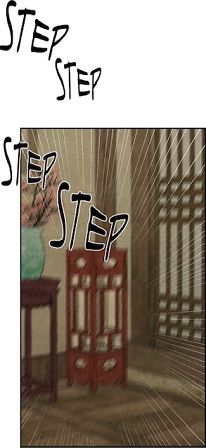 (chapter 97) There was no sound, therefore I deduced that Kim didn’t run to the study. However, observe that the butler is breathing heavily. It was, as if he was out of breath: HUFF HUFF.
 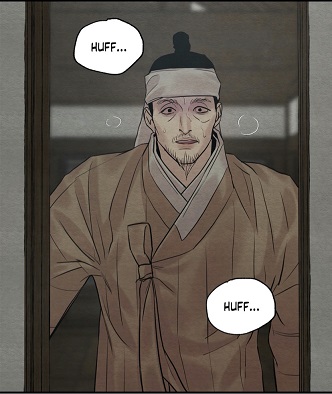 (chapter 85) So why would he fake his breathlessness? I am quite certain that you already have the answer. He was hiding the fact that he had been spying on their conversation, which I had mentioned in one of my previous analyses. However, there’s more to it. The other and major intention is to give the impression that he did everything he could for his master. In other words, he is creating the illusion that he could do nothing against the father!!
  (chapter 87) Yes, that’s his other principle to justify his cowardice, his fear of responsibility. He implied that he had rushed to his master’s side right away to alert him. If asked, he could legitimate his passivity by saying that the father had barged accompanied with 2 guards. But why didn’t he get caught by the protagonists? Simply because he is no longer caring a light contrary to the first season.
  (chapter 20)
 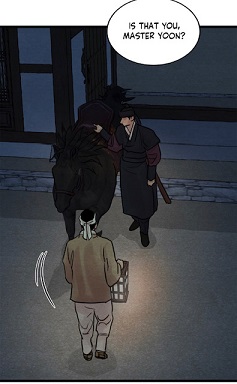 (chapter 25)
 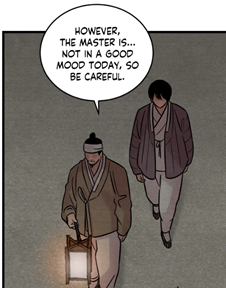 (chapter 36) The night had already fallen, when Yoon Chang Hyeon was present in the mansion. If the butler had carried a chandelier, the painter or the noble would have sensed his presence. Thus I deduce that the butler’s function in the protagonist’s suffering was to lit the room, the moment the pedophile and other sexual abusers approached his prey. That’s the reason why his nightmares are triggered by the sound of a lit bougie and the light accompanied with shadows.
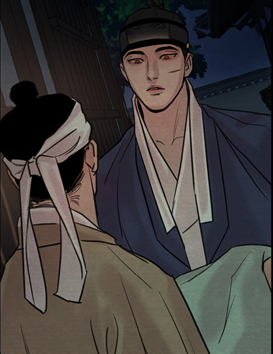 (chapter 26) This scene took place in the courtyard. This is the bathroom for the staff which you can see in the background
  (chapter 30), the grey building with grey bricks. And it happened again in episode 32
 , in episode 55
  And now look what we have in the third season:
  (chapter 77)
  (chapter 82),
  (chapter 94) and
  (chapter 98) He is no longer carrying any light, not even for his master. Why? It is because he can spy without being detected. Thus he approached the messenger only after the main lead had left the study. Don’t you find it weird that he acts as if he knew nothing
 (chapter 82), while he presents himself as the senior domestic in the mansion?
 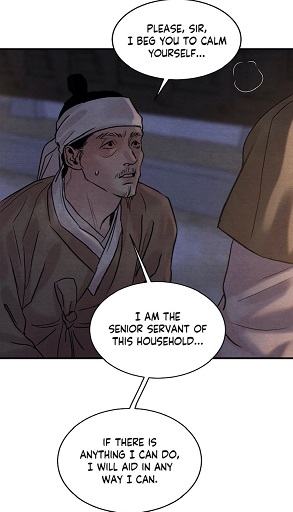 (chapter 82) This represents a contradiction. If so, he should have been informed immediately. Thus I come to the conclusion that this scene reveals his incompetence and betrayal. Did he aid the messenger, when the latter got beaten? No, he only made his appearance, after the incident had occurred. And this is not surprising that the other domestic looked down on the butler.
  (chapter 82) He already knew that he had betrayed his own master through the letters. So I doubt that he viewed Kim as trustworthy. Another important element is that when the butler is seen in connection with the light, he speaks much more, while in the darkness, he remains silent. This is naturally connected to his spying activities. Simultaneously, the words coming from the butler often appear as empty. They remain quite superficial, for the butler is always putting conditions. “If there is anything I can do…”. That’s the reason why the butler doesn’t feel any real concern for the main leads in the end. This is not his business. And now, you are probably wondering why I used “quarrel” in the heading. It is because in episode 85, the butler had heard the argument between the couple. This is relevant, because the butler chose to recreate the same situation in episode 98!! 😲
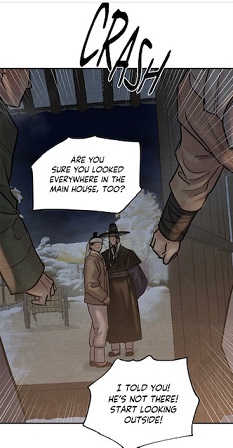 (chapter 98) In this image, Byeonduck portrayed the servants arguing. They are stressed and screaming at each other: “I told you”. They give the impression that they are trying to do anything for their master. Nevertheless pay attention to the previous image:
 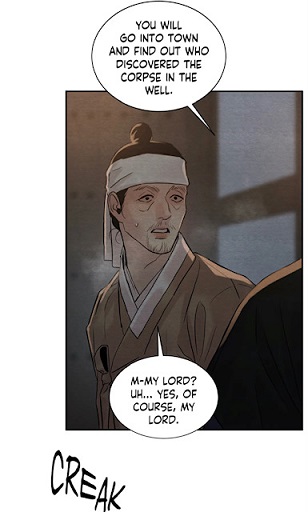 (chapter 98) The light is coming from the butler’s back. How is it possible, since there is no torch next to the gate?
  (chapter 98) By using the idiom “damn brat”, the servant reveals that he looks down on the painter. This can give the impression that the latter has been bullied, which is not wrong either. All the servants, including the maids, pushed the artist to leave the mansion. They also abandoned him in the bedchamber, which is something similar to episode 56!!
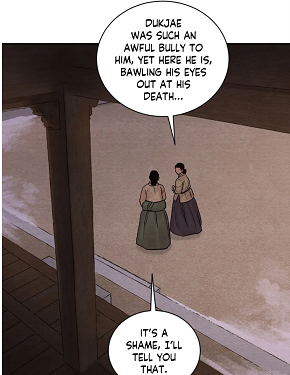 (chapter 98) The women knew that the artist wasn’t feeling well. But they never sent for the doctor and gave him any true comfort. They kept criticizing him. Yes, all the servants bullied the artist. The butler never realized that through his badmouthing, the staff would imitate him. They would chatter idly and fake concern, yet Kim is actually silent in front of his master. He just says the minimum, for the most part, he has to feign ignorance. He acts, as if he was blind and deaf, but in front of the staff he behaves the exact opposite. And this huge gap makes it possible to perceive his conniving personality. However, the main lead didn’t pay attention to the insult („damn brat“), as they had faked their concern. The lord had the impression that they had indeed done their best, hence the main lead felt the need that he had to do the research on his own.
  (Chapter 99) He believed them.
 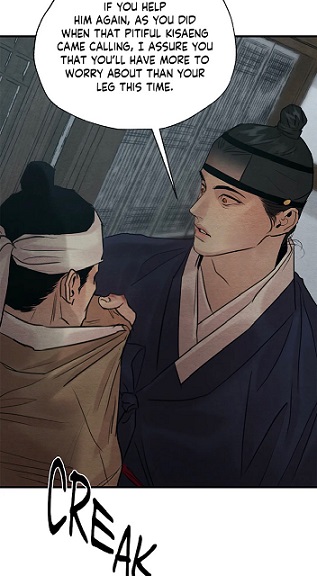 (chapter 86) So the valet had the feeling that nothing had changed. However, like I mentioned it above, he never realized that his fate was now linked to the painter’s and as such he was responsible for his well-being. Thus he got surprised with this new kind of order. For the first time, the valet was tasked to investigate outside the propriety.
 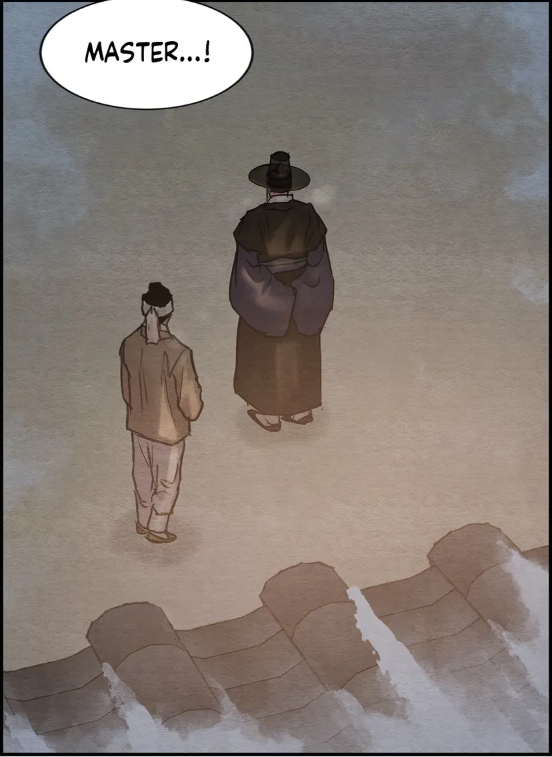 (chapter 98) Many readers, including myself, were quite confused first. However, note that there’s light coming from the building. From my point of view, this is the gate. However, this scene took place before the arrival to the mansion. I believe that this scene represents the moment, when the lord left the office of the investigator. But I can not be 100% sure. However, one thing is sure. Byeonduck wanted us to notice the importance of the light and the silence. The lord was pondering deeply, thus he didn’t pay attention to Kim. But now, the noisy domestics brought the main lead back to reality.
  (chapter 97) The painter didn’t run away immediately. He remained quite some time in the domain, therefore after the last tragedy, the lord will have the time to ponder about the painter’s question.
  (Chapter 102) Yoon Seungho was separated from his lover for so long, because he had been deceived. It is only a matter of time, until he realizes that he had been deceived by his own staff. At some point, he will view the staff accountable for their misdeeds.
  (chapter 38) and he woke up in the middle of the night.
 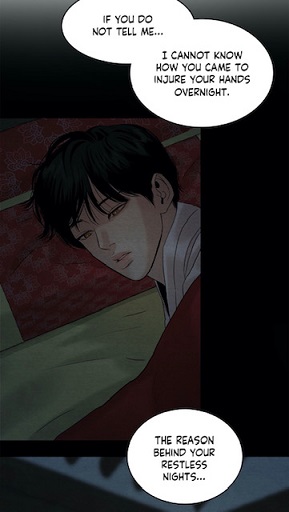 (chapter 84) However, the lord got the opposite impression, for when he entered the study, the painter was sleeping on the floor in the dark.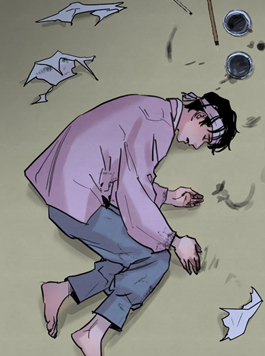
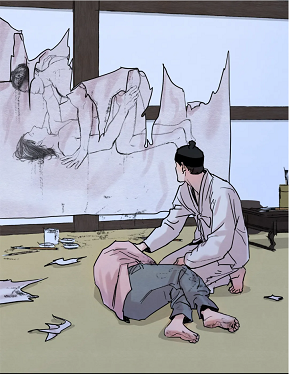 (chapter 02) This explicates why he would always extinguish the candles.
 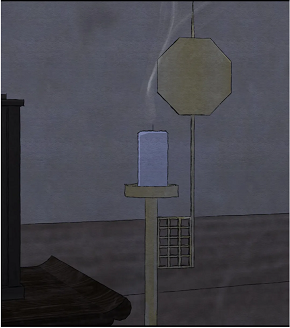 (chapter 97) However, he never realized that the painter could only fall asleep in the dark, because he always sensed his lover’s presence. This means that when he reached the aristocrat’s hand, it also gave him some comfort.
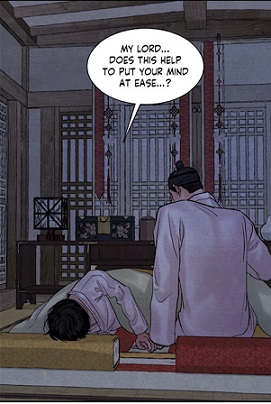 (chapter 97) Because the artist’s fate is similar to the noble’s, I deduced that this fear is connected to the artist’s past. Why does he fear darkness? It is linked to the vanishing of the candle light!
 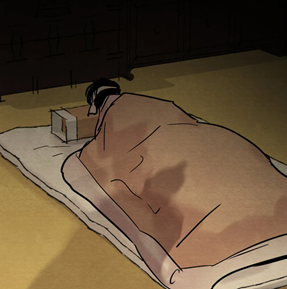 (chapter 6)
  (chapter 87) Thus in episode 56, Baek Na-Kyum had this vision too.
 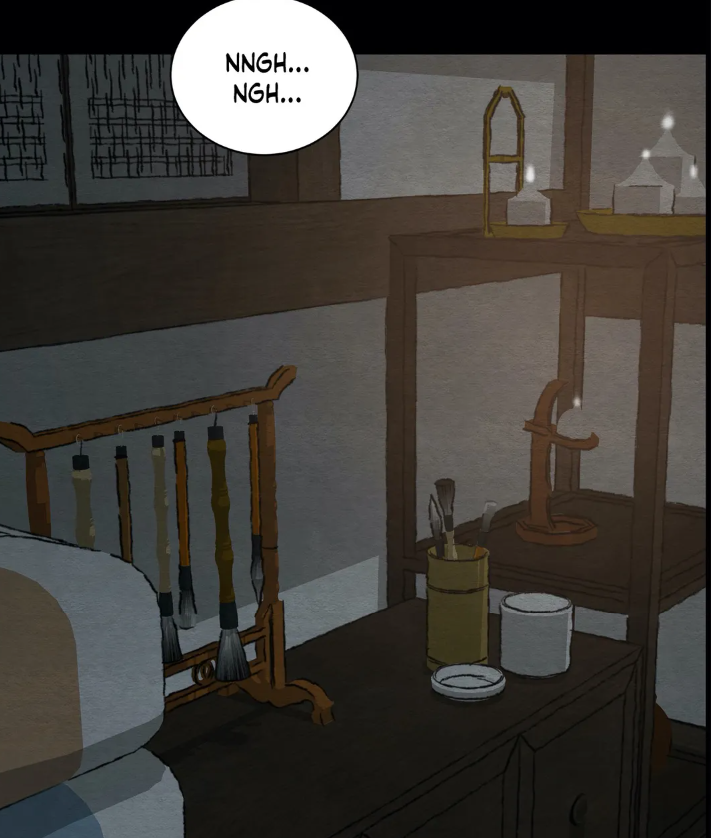 (chapter 56) In the past, the painter used to sleep with the candle night on. For him, the light gave a sense of safety. There’s no ambiguity that he wouldn’t sleep alone, though we have to imagine that the noonas would leave him behind at some point, if they had to work. Thus I came to the deduction that the candlelight was to create the illusion that he was not alone.
  (chapter 34) Finally, since the butler is a reflection from the learned sir, this signifies that he is also connected to light.
 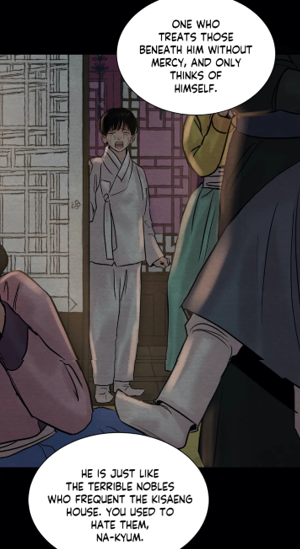 (chapter 68) What made him looking for his noona? What if the bougie was blown out during his sleep and Jung In-Hun was behind this? Byeonduck said that the scholar’s attachment to the boy was genuine, nevertheless there is no doubt that the learned sir was a greedy person. Maybe he woke up, because he detected the absence of warmth, as the noonas had left his side. Hence the painter sensed the abandonment in his sleep, which made him wake up. Consequently, he started searching for his noonas and he opened the door. No one would suspect a young child opening the doors in the kisaeng house. But by opening the door, the artist caused a ruckus, people could hear a protesting child in a room. And during that scene, the artist met Yoon Seungho who was captured by the guard!! This memory represents the night of the sexual lesson. Observe that the color of the hanbok corresponds to the one lying on the floor.
 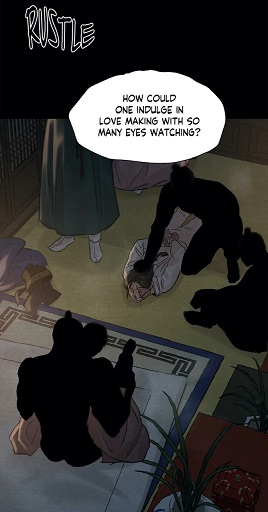 (chapter 86) This means that the one trapping Yoon Seungho was not Yoon Chang-Hyeon, for the latter had a green hanbok. Besides, I started wondering why Jung In-Hun carried away Baek Na-Kyum and left the gibang with him.
  (Chapter 70) Why would he do that? He could have bring him back to his chamber!! Why walk through the countryside and for a long time? It is because he was not allowed to be in the gibang. Remember that he used to sleep in the annex.
  (chapter 87) He entrusted Yoon Seungho to Kim. But in my opinion, during the same night, the young noble was dragged to the annex, where the pedophile was waiting for him with probably other guests. That‘s the reason why Jung had to spend a long time outside the gibang. Maybe that‘s how he received his position as teacher. Remember the commoner’s remark:
  (chapter 29) People believed that he had already passed the exam, while it was not the case. Then I started wondering this. Why does the painter associate the learned sir to the moon? It is because the learned sir would visit him during the night.
  (chapter 94) The light from the moon comforted the artist, it became his companion, for the artist still feared the darkness. However, since the painter described that he would always cry because of his noonas, I am sensing that the scholar must have dragged the artist quite often outside the gibang. And this could coincide to the sexual abuse Yoon Seungho was exposed to. Kim said that the sexual abuse took place in the bedchamber.
  (chapter 87) But is it true? I have my doubts about it. By making such a statement, he is putting the blame on Yoon Chang-Hyeon. Note that the start of the sexual abuse began in the kisaeng house. The more I am analyzing, the more I am sensing that the elder master was just a stupid, selfish and violent father. However, if this had happened in the gibang, then he was as guilty as the kisaeng and the other helping hands.
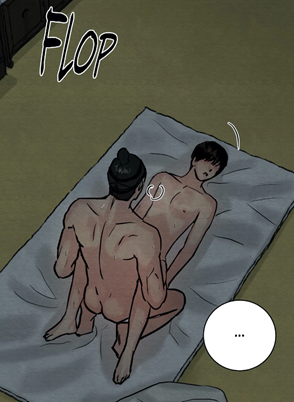 (chapter 50) Both give each other comfort and warmth so that they feel safe. Maybe the FWOP; FWOP sounded like a lullaby to the artist’s ears.
  (chapter 49) 😂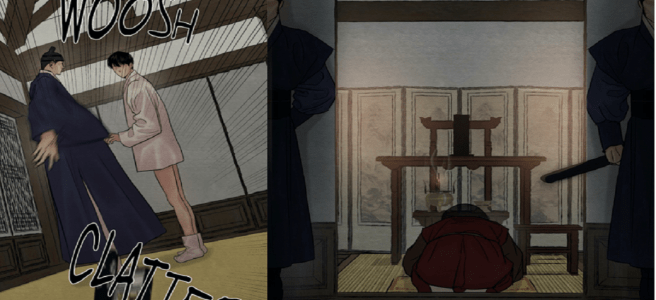
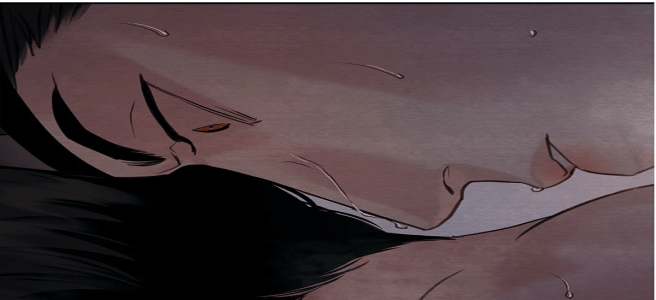

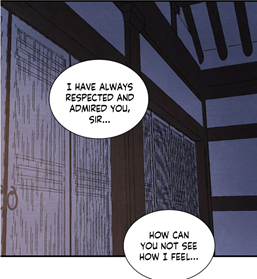 (chapter 19)
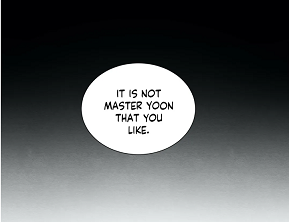 (chapter 68). This signified that in his education, not only sex was prohibited, but also sexual desires were denied. Although love was expressed through hugs
 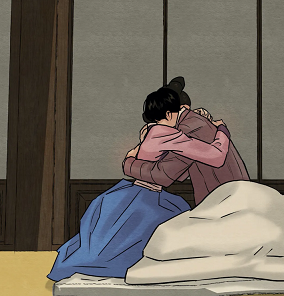 (chapter 66)
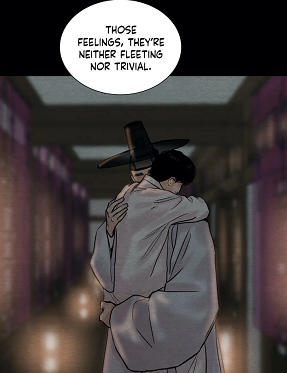 (chapter 68) and caresses
  (chapter 10)
  (chapter 68), they were devoid of sexuality. The painter experienced love, but was not allowed to experience sexuality. He was only authorized to paint it for the scholar’s sake. On the other side, Yoon Seungho was raised the opposite: love was not allowed, as it was a sign of submission and weakness. Sex was permitted, because it was considered as a fight in order to defeat his opponent. These were the butler’s doctrines. That way, he could still have a connection to the main lead. If he came to love someone (the pedophile), the lord could definitely abandon the valet and reveal his betrayals. In other words, he used pity as a way to tame the lord. At the same time, sex also served to gain some benefit, as it was an exchange of favors (giving versus receiving),
  (Chapter 71). I connect this philosophy to the king and indirectly to the butler. With sex, the nobles could exchange some favors. These huge divergences in the mindset explicate why there were so many misunderstandings between Yoon Seungho and Baek Na-Kyum, as their education diverged so much.
 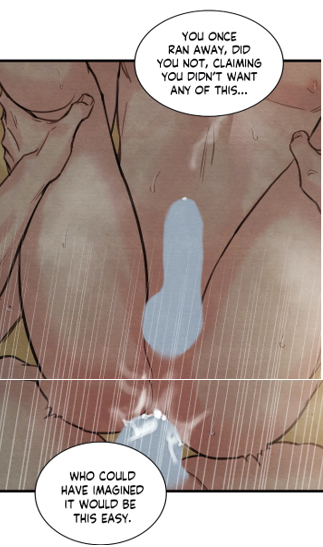 (chapt45), as the painter had accepted him as his sexual partner, he had to realize slowly that he was wrong. He imagined that since the artist had remained by his side and was accepting to have sex with him, he had achieved what he wanted: in his unconscious it was to be loved. Yet, it was just an illusion. The painter saw himself as a whore and the master as a man consumed by lust. As you can see, the noble was forced to judge the nature of the sexual encounters differently. He had associated sex to love due to their Wedding night, therefore he imagined that the moment the painter was accepting him, the problem was solved. He would be able to relive this wonderful moment, but however nothing like that happened. He felt never satisfied, as there were no feelings at all. Hence he even had sex during the day
 (Chapter 45) While the lord became Baek Na-Kyum’s sexual emancipator, the painter became the lord’s teacher for love. This explicates why the low-born forced the lord to question his own identity and feelings.
  than a master- servant relationship, because the commoner was never treated like a domestic. He only had sex with the lord and had some privileges.
  (chapter 48), he changed his behavior. He acted like a real client at the brothel
 (chapter 48), but at the same time he cornered the painter to have multiple climaxes in order to let him experience that he liked having sex with him.
 (chapter 49) As you can observe, the lord linked sensuality to love. If he could provoke ejaculations, then it meant that the artist was definitely feeling something for him. However, the moment the lord liberated the painter from his pejorative perception about himself (he is a prostitute), the painter reacted the exact opposite. Now, he was the one using Yoon Seungho, the latter was his plaything.
 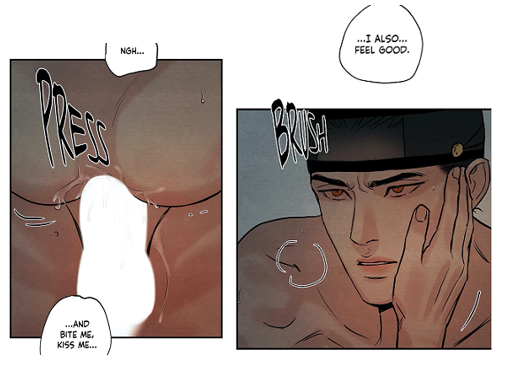 (Chapter 49), his prostitute, for he was the one procuring pleasure to Yoon Seungho. As you can see, the roles had been switched. This means that now the painter had the upper-hand in their relationship. We could even say that the noble was willing to accept his fate.
  (chapter 50). Through this revelation, the lord was indirectly confronted by his own reflection: he was indeed asking from Baek Na-Kyum sexual favors in exchange for his stay at the mansion. That’s the reason why the lord had a “relapse“ and kept his distance from the painter.
  (Chapter 52) His sexuality had already become an expression of his love, although the main lead was still unaware of his own feelings. That’s why I come to the conclusion, chapter 52 was actually revealing Yoon Seungho’s monogamy, although it looked the opposite. And this becomes truly visible, when the gangrape was about to occur. He felt no urge, when he was with the guests, yet the moment he brought the artist to the bedchamber, he couldn’t stop himself from kissing his loved one.
  (chapter 54) He was definitely longing for his warmth. This explicates why the noble got so infuriated, when he was confronted with the consequence of his bad decision:
 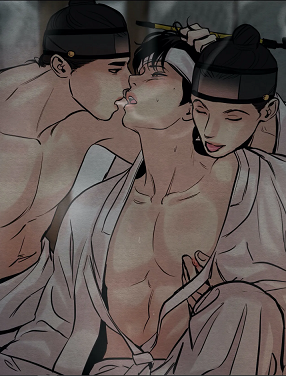 (chapter 54) the artist was on the verge to be no longer monogamous, as he would be tasted by other aristocrats. In this scene, the lord would have indeed become a client and pimp, if he hadn’t chased away his guests. Although the painter was indeed upset afterwards about this incident
 (chapter 55), deep down he sensed that his master had protected him. This night was important for the main lead: he was forced to admit his own feelings for the painter. Therefore, we could say that the issue with the prostitution was solved after chapter 54. Yoon Seungho thought that the moment he confessed, the painter would get scared and run away, but it didn’t happen. Why? Love among men and especially between a brutal noble and a commoner, was a taboo, like Min had underlined. Secondly, if the lord had indeed feelings for him, he had behaved like a beast during that night. He had mistreated Baek Na-Kyum. In his mind, the artist would never accept him.Besides, the painter had clearly denied the affection from the main lead. In his eyes, the painter’s words were indicating a rejection.
 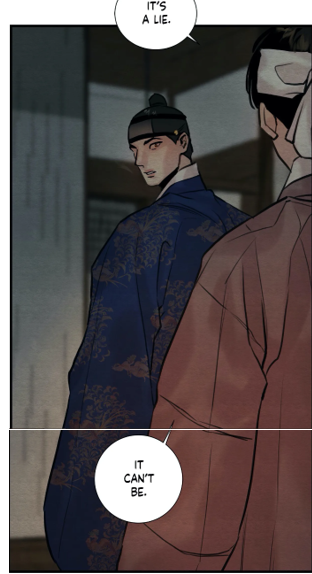 (chapter 54) Thus I conclude that Yoon Seungho and Baek Na-Kyum had come to an implicit agreement: they had a master-servant relationship
 and Kim
 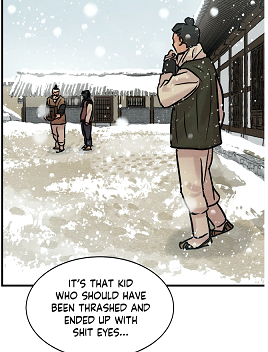 (chapter 51) in order to help them. Therefore the readers could witness the return of the white headband in chapter 52: his task was to paint for his master.
 (Chapter 52)
  (chapter 62) here, he whispered to Baek Na-Kyum that he adored him), he would bind the artist to himself.
  (chapter 63), exactly like he had wished in chapter 49. The only difference is that this time, the painter was here for the lord’s pleasure. The roles had been switched again. As the manhwaphiles can perceive, the noble and painter had a similar reaction: they both tried to deny the existence of love in their relationship. That’s the reason why the noble stopped the artist from confessing:
 (chapter 63) They just had a sexual relationship which could provoke pleasure, but that was it. But in order to ensure that the artist wouldn’t run away again, he used sex to “tame“ Baek Na-Kyum. If the main lead could procure multiple climaxes to the artist, then the latter was forced to admit that only Yoon Seungho could be his “partner“. This explicates why the noble kept pointing out how the artist would react to his lover’s body.
 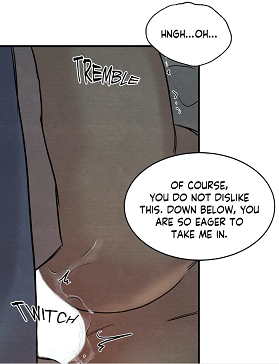 (Chapter 63)
 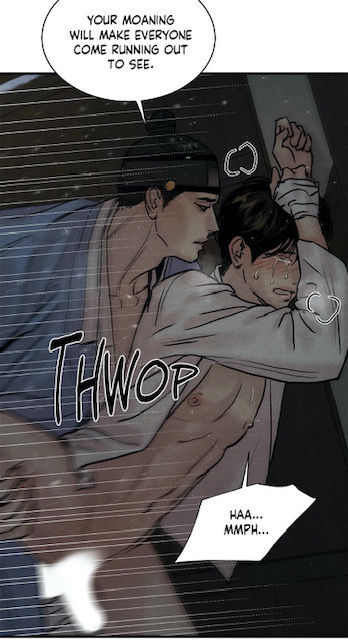 (chapter 64) He was moaning and would ejaculate constantly thanks to the main lead. Yet, during this second marathon, the noble was actually deceiving himself.
  (Chapter 62)
 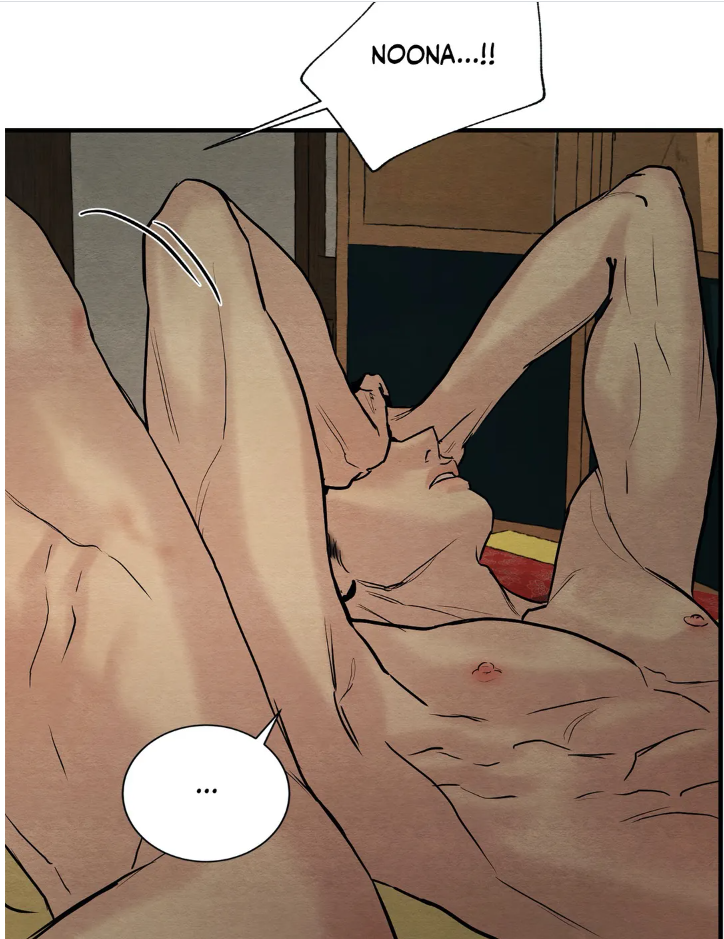 (Chapter 65) This shows that the painter had gained a new position: he was indeed a favored servant. He was allowed to spend the night in his lover’s bed and he could see the lord getting dressed.
  (Chapter 65) The slight change was that now the main lead was aware of this. This truly exposes the lord’s affection for the artist. He might have treated him like a plaything in the shed, in reality he had attempted to show “his skills“ as a lover. He had licked him, bit him and the painter had felt pleasure, though he kept saying no! This is not surprising that Yoon Seungho had denied the kiss in the study.
  (Chapter 64) Because that’s how he had been deceived that night in the study.
 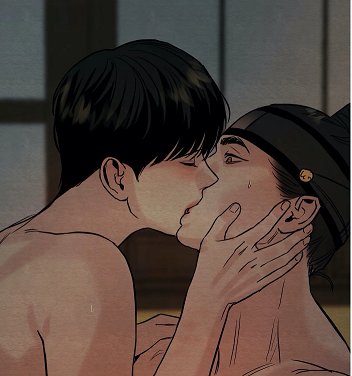 (Chapter 49) Baek Na-Kyum had silenced him with the kiss, as the main lead was about to protest.
  (chapter 65) What caught my attention is that the painter’s disappearance mirrored the lord’s wrongdoing. Lee Jihwa and the main lead had both kidnapped the artist. That’s why I believe that when he heard Heena’s words in the study
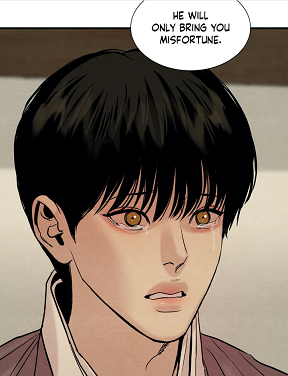 (chapter 68), the noble could only come to the following conclusion: he could only let the painter choose his destiny. But the moment the artist decided to remain by his side, he needed to change Baek Na-Kyum’s position in the mansion. He was no longer a servant, but a noble guest. Hence the lord tied the scarf like aristocrats did.
 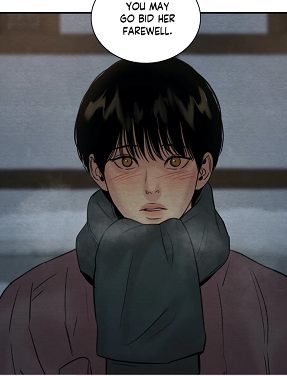 (chapter 69) Consequently, we could say that the painter had a similar status than Jung In-Hun. Yet, there was a huge difference: the owner of the mansion was now acting like the painter’s servant. Hence Deok-Jae’s words came true:
 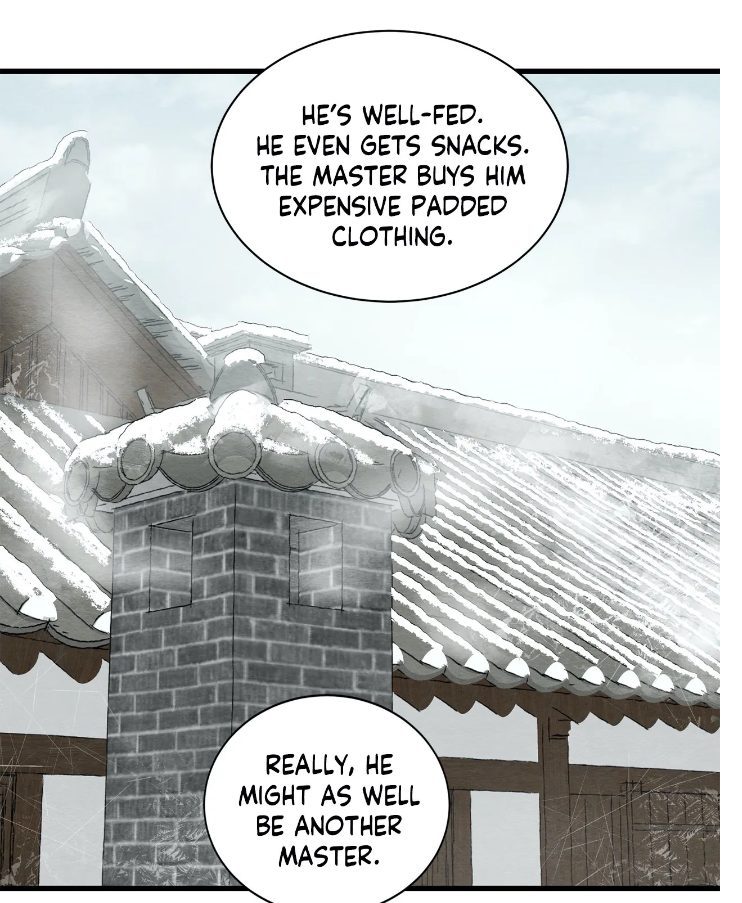 (chapter 46).
  (chapter 71). Why? It is because the lord made the decision that the painter chose him, then this means that he became his wife, though at the end of season 2, he was not thinking about marriage yet. He was not aware of this perception. By becoming his official partner, the spouse obtains the status of his husband: nobility. This explicates why the lord ate with his lover
 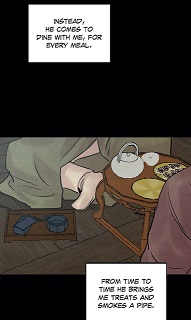 (chapter 74) and allowed him to smoke. Then in season 3, he gave him ladies-in-waiting in order to give him some company.
  (Chapter 78) He even gave him the music box, which was mistaken as a dowry. However, the problem is that the painter was still fighting his own feelings for the protagonist due to Heena noona’s words and past experience with the scholar. He feared that this new situation was too beautiful to be true, hence he thought that the lord’s feelings would fade away. But there was another reason for doubting the lord’s affection: there was no sex.
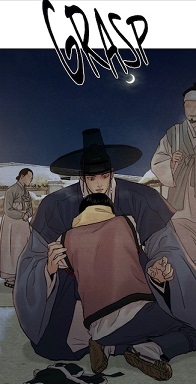
  (chapter 74) The painter had come to associate sex with love too. Yet, the moment he relived his trauma, he only found comfort and safety in the lord’s embrace.
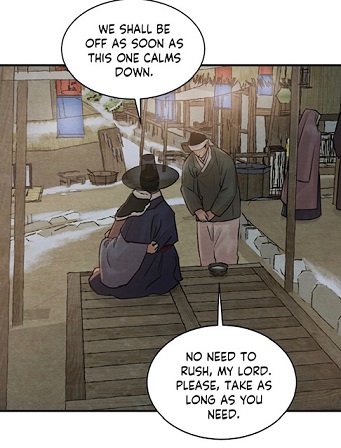
  (Chapter 76) The main lead didn’t reject the painter’s urge for a hug in front of commoners. At no moment, Yoon Seungho felt embarrassment. He treated him like a special treasure. That’s how the painter came to realize that Yoon Seungho‘s love for him was true and genuine. Consequently, he decided to rely on him and to trust him. That’s why in this panel, the painter closed his eyes:
  (chapter 76) We could say that he was reminded of his own past. When he was a child, he sensed love through hugs and caresses. Since the painter could feel the lord’s genuine affection and warmth, he recognized that even when there was no sex, love was present. All his senses made him perceive the lord’s love:
  (chapter 76) His words showed his care and concern, then he bought him an expensive music box.
  (Chapter 76)
 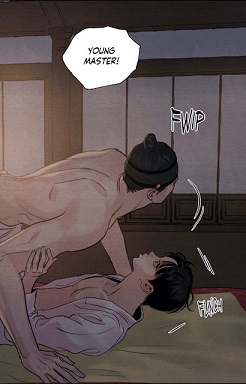 (Chapter 80) And now, you comprehend why the painter didn‘t confess during that night. He got interrupted. The kiss was the symbol for their love. Thus it is no coincidence that just after his confession,.
  (Chapter 94) the painter initiated a long and sensual kiss with his “husband“.
 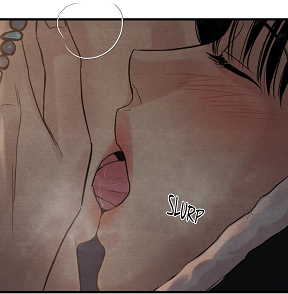 (Chapter 95) Since the painter had received caresses and embraces in his childhood, he came to view the kiss as the symbol for true love. And note that the kisses exchanged in the gibang were full of passion and love. This was the perfect combination of love and sex.
 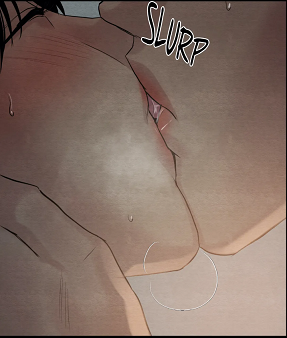 (Chapter 95)

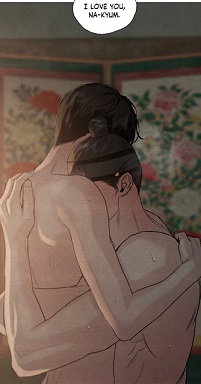 (Chapter 96) This shows that Yoon Seungho has always longed for a pure and spiritual love in the first place. His sexual preferences were already palpable in the last love session (season 2):
 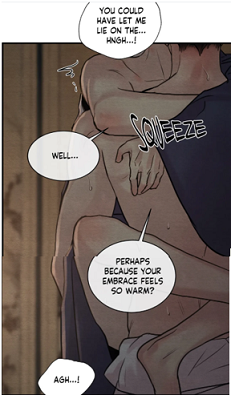 (chapter 72) We could say that he discovered all his sexual preferences thanks to the painter.
  (Chapter 80) But he failed due to the intervention of the butler and other schemers. Besides, the whispering of „Kyumah“ could only make his heart race. Let’s not forget that his painting in the sand
 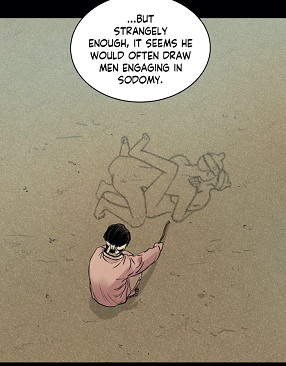 (chapter 1) externalized his own philosophy: love and sex can’t be separated. Note that the couple is is hugging and kissing at the same time! 😍 This picture will represent the peak of their love! Striking is that when the couple confirmed their mutual affection, they did in the kisaeng house, the symbol for prostitution. This truly exposed that Yoon Seungho had been treated like a male night servant in the past. .
 (chapter 72) in the next season, for the painter is still calling his lover “lord Seungho“
  (chapter 99)
  (chapter 102) This means that he is still viewing himself as a low-born. But note that contrary to the past, Baek Na-Kum is now wearing a hanbok and he has no other clothes. Thus I am deducing that the painter’s next lesson is to drop his notion that he is a commoner. He will be taught to view himself as an equal to Yoon Seungho. Only when he has internalized that there is no gap between him and his lover, then he will be able to address him as “Seungho-YA!“ At the same time, both protagonists will come to realize that they can express their love differently. Poetry, painting and more importantly through their desire to protect their loved one. The lord will start protecting Baek Na-Kyum more actively, just like the painter will decide to show more interests in his lover’s skills and past life. Baek Na-Kyum will feel responsible for the bloodshed in the shaman’s house. In my opinion, the lord will confide to him what happened to Min and the other nobles. I am assuming this, for the lord remained silent, when the messenger of his father came to the mansion. He didn’t want to scare his lover because of his brutal outburst.
 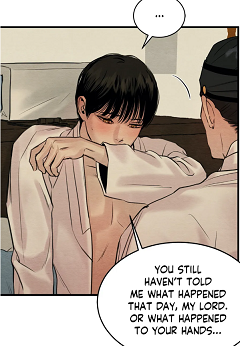 (chapter 84)
 The trigger for the change is the noble’s words. The latter keeps talking to the painter asking for an reply. Hence in my eyes, there are glimpses of love the moment Baek Na-Kyum said this:
  It sounded like a confession, hence the seme became more passionate:
 Here the lord acted like a client. Yet, notice that the lord is speaking again forcing to express himself. And the moment the painter cried and started voicing his own opinion, the sexual encounter was affected.
  (chapter 49) An expression of love and affection, but the painter rejected it, as he mistrusted his own judgement. He couldn’t help thinking of the learned sir’s fake embrace. Striking is that despite the rejection, the painter kissed and hugged back his lover
 . Although the second sex marathon starts like a pure sex session, the moment the painter calls Yoon Seungho differently
 , the lord’s attitude changes. The painter is turned around and faces his lover
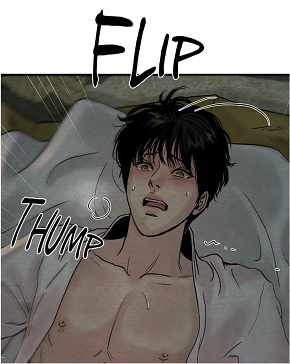 , a sign that they are getting closer. Striking is that again through their conversation, the painter is pressured to think about his own emotions.
  However, due to his own insecurities and fear, the noble still can’t trust the artist’s words, therefore there’s no confession.
  , it is just that both main leads were in denial.
  (Chapter 58) Thus he should become responsible for him. Yoon Seungho was unconsciously trying to push the painter to reciprocate his feelings, an imitation of Lee Jihwa‘s confession. Nevertheless, the painter remained silent, therefore it meant that his love was still denied. That’s why it stands more under the sign of dream and illusion. Consequently, the night in chapter 70, 71, 72 and 73 contrasts so much to the one from chapter 58. This time, it symbolizes the lord’s pure love. As such, the sex is already a real expression of love. That’s why the lord asked to be called intimately: Seungho-Ya
 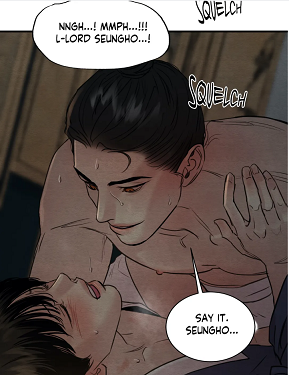 (chapter 72) On the other hand, this love session was strongly intertwined with the notion of forgiveness and punishment as well. This is important, it reveals that Yoon Seungho had internalized that sex was the expression to redeem himself. He had been tasked in the past that if he desired to obtain “forgiveness“, then he should have sex. And by comparing all these sexual encounters, I came to the following conclusion: the lord’s words definitely contributed to change the nature of the sex session, just like the hug.
  In chapter 66, he had a flashback, hence he couldn’t witness his lord’s attention and care.
 But the lord discovered this kind of embrace, when he helped the painter in chapter 53:
  That’s how the noble experienced the embrace as a source of comfort and affection. Therefore you can comprehend, why I wrote above that the painter was teaching the lord how to love properly, but also why the embrace became the symbol for love in the lord‘s eyes. He had never been embraced before by a man. And Lee Jihwa had recognized the true signification of this gesture, when he spied on the couple (chapter 43). That‘s how he knew the friend‘s biggest desire: and was deeply hurt after this discovery
  (Chapter 57) However, this shows that Yoon Seungho is a quick learner, because he knew what to do, when the painter was in pain and destress. At the same time, it explains why he could fake the embrace in chapter 62:
  This hug stands in opposition to the one at the end of season 3:
  (chapter 102) The artist was forgiving his lover! Love represents selflessness, tolerance, forgiveness, warmth, affection and assistance which is transmitted by the embrace. Now, you understand why Yoon Seungho was still not satisfied after the sex session in the study, he was longing for the hug.
  (Chapter 84) In his unconscious, he knew that if the artist hugged him, he would have forgiven him. But he had no idea about it, thus he couldn’t suggest this. So far, he had experienced the embrace from the artist while having sex. Deep down, he had already internalized the embrace to forgiveness. So we could say that the absence of the embrace in this scene was the lord‘s punishment for the fake hug in the shed. And the painter let him discover the true nature of a warm embrace:
  (chapter 88) This is not surprising that this hug was not connected to sex at all. Yet it moved the lord so deeply. As the manhwalovers could sense it, season 3 was focused on love and sensuality. During that season, the couple was able to voice about their sexual desires and their preferences.
  (chapter 91)
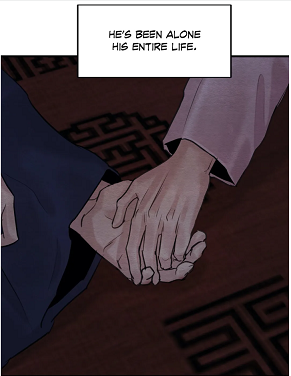
 (Chapter 86) No one close to him had grabbed his hand in order to show their support. This gesture in the picture embodies abandonment. On the other hand, the painter had been the first one to take his hand and to swear “loyalty“.
 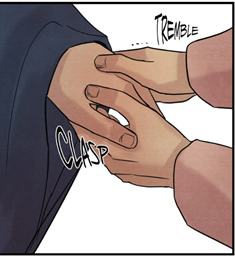 (Chapter 30) The joined hands were repeated in season 3 , the only difference is that this time, Baek Na-Kyum was doing it willingly.
  (Chapter 88) The symbol for support, company and responsibility.
 and his request for help are strong indications that Baek Na-Kyum was now accepting his affection. He was now trusting the noble, hence he revealed an important clue about the abduction.
  (chapter 41) Under this perspective, it becomes understandable why the couple neglected these pictures. They were all devoid of affection, it was more about prostitution and battle! And here is now the question? Where are these drawings?
 (chapter 76)
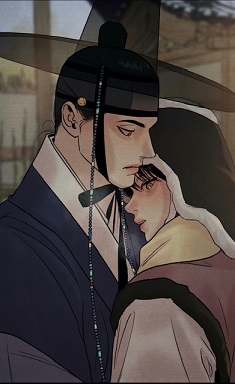 Yet, the peak was reached with the following picture, for Baek Na-Kyum and Yoon Seungho seemed to have merged as one:
  The readers can barely detect the painter’s presence: only his head and hand are visible indicating the depth of their intimacy and closeness. However, the title is mentioning the presence of a ghost. The latter can not be Yoon Seungho, because the panel above announces his official wedding with the commoner due to the presence of the red and blue lanterns called Cheongsachorong. These are used for wedding ceremony in Joseon. Therefore who is the ghost? And why do I perceive the existence of a spirit in this chapter? But before revealing the identity of the ghost, I would like to expose the reason behind such a title. While focusing on the embrace, I came to the following observation.
  ,
,  ,
,  ,
,  (chapter 29), therefore he chose to push away the wealthy aristocrat out of fear that he might get hurt and betrayed again. The commoner judged the embrace and warmth as a deception. This means that the low noble as a “spirit” was the reason why both protagonists couldn’t get closer. The low-born was only acknowledging Yoon Seungho as his sex partner and nothing more. Striking is that in episode 76, we have a reference to the hug from chapter 49, as the position of the painter’s head in this image
 resembles a lot to this one:
 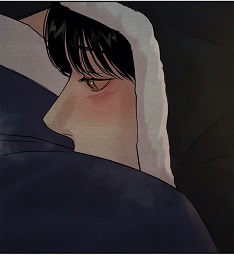 Moreover, the artist’s gaze is truly looking at his lover. We even have the impression that the artist is smelling the lord’s scent in order to reassure himself. Although the manhwaphiles couldn’t enter Baek Na-Kyum’s thoughts this time, they could perceive the change of his attitude. The embrace is no longer judged as fake. This signifies that the ghost Jung In-Hun has vanished for good, which is even reflected in a different panel:
 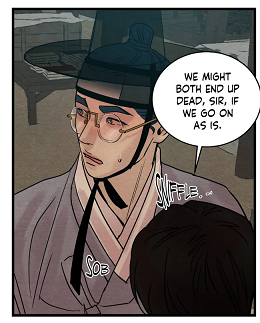 (chapter 29) The low noble feared people’s gaze, his attitude truly showed that he didn’t want to be connected to Baek Na-Kyum. His action was definitely a sign of hypocrisy and cowardice. That’s why in chapter 76, the painter could only come to the conclusion that the lord’s embrace was genuine and the lord’s feelings were not trivial. Moreover, the main character never pushed his lover away
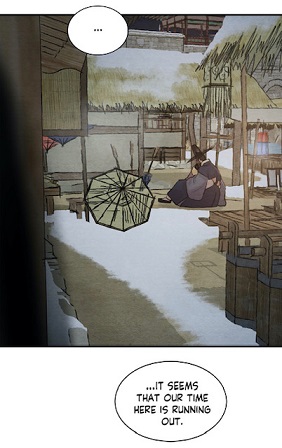 (chapter 76), he even lowered himself and sat down on the ground for a while, so that Baek Na-Kyum could calm down. Imagine, when the powerful lord arrived to the place where the main character had a panic attack, everyone was bowing in front of the noble.
 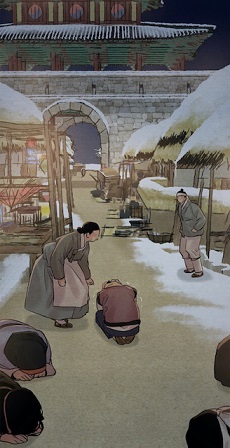 They didn’t even dare to face him, yet when he saw his lover trembling, the master lowered himself and attempted to help his partner. However, his gestures led to be misinterpreted in the beginning, hence a shop owner started interfering.
  However, he was stopped with a frightful gaze:
 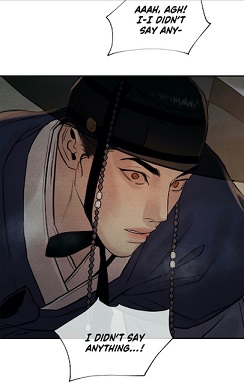 Besides, when the noble kept calling the protagonist in an informal way (Na-Kyum-Ah), people could realize his real intention. He meant no harm. In fact, he was treating the low-born like a precious treasure, who needed help.
 By calling his name Na-Kyum-Ah, the main lead tried to reassure his lover. Hearing his name made the low-born realize that he wasn’t attacked by the jester. This explains why the artist immediately embraced his companion.
  (chapter 29) The former teacher was just caught by surprise, hence “Na-Kyum” was said more or less randomly. On the other hand, Yoon Seungho used this name as a sign of intimacy. He desired to give comfort and warmth to his lover. And now, you understand why Baek Na-Kyum hugged his lover by instinct.
 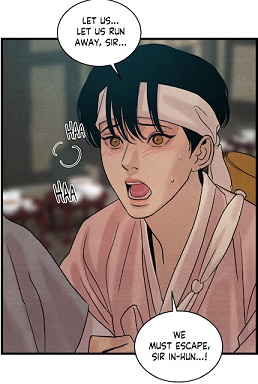 (chapter 29) thus he tried to find him. And now the mansion has become the painter’s home, just like the lord’s embrace. It is a synonym for comfort, warmth and safety. Another huge contrast is that for the first time, the painter asked for Yoon Seungho’s help directly.
 (chapter 65). Surprising is that when he was bullied by Deok-Jae, he never complained and asked for the head-maid’s assistance or his lover’s. His attitude to never rely on others was even more perceptible in his escape in chapter 46. The cause for this behavior is linked to his abandonment issues. Due to his past, he was forced to only rely on himself. Nonetheless, in chapter 76 he changes his attitude. This shows that he is now opening up. That’s why his head rests on the lord’s shoulder completely.
  (chapter 53), hence the gentle boy needed to intervene directly. The lord was definitely deaf to the artist’s words. Striking is that here again, we had the presence of danger, the painter feared for Deok-Jae’s life. Moreover, despite his fear and shaking hands,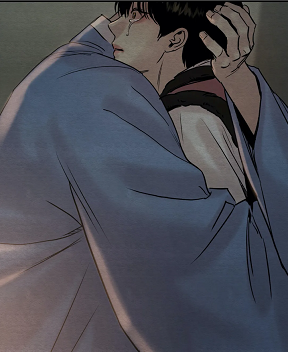
 (chapter 66) This meant that in both episodes, neither the aristocrat nor the commoner could sense the lover’s comfort and warmth.
  (chapter 66) Both of them didn’t feel safe and displayed extreme fear due to betrayal and abandonment.
 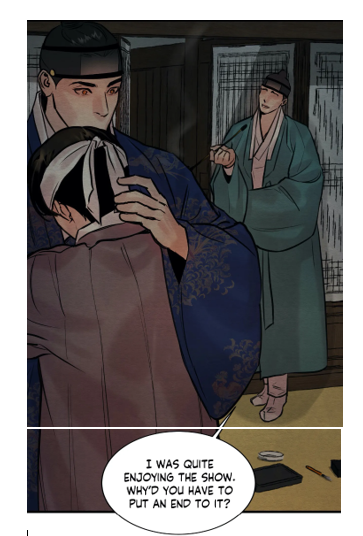 There’s no doubt that the vicious noble felt extremely jealous in both episodes (53-66). The manhwaphiles should envision that despite his rage and his terrible behavior, the artist was willing to embrace such a man, which could only make Min envious. Moreover, the low-born showed courage and even strength. He didn’t reproach anything to his sexual partner. He just attempted to calm him down.
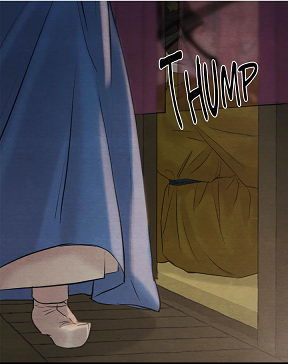 (chapter 69) That’s why he was waiting there. He imagined that the boy would be delivered to him on a silver plate, yet nothing like he had expected happened. In chapter 76, we have a new version of chapter 53. However, when Black Heart witnesses the painter’s second embrace, he can detect the huge difference.
  (chapter 54), in episode 76 Black Heart is truly defeated. And by contrasting these two scenes, it becomes obvious why Yoon Seungho assaulted his guest back then. The noble was in fact punishing The Joker for insulting his lover, as the latter was just reduced to his status: a low-born. He had no name and as such no identity. The powerful aristocrat didn’t do it in order to protect his honor, but the artist’s. At no time, the main lead was afraid of losing his reputation, he is well aware of his bad notoriety. Thus this shows that in chapter 54, the one who feared more social norms was indeed Baek Na-Kyum, which was still visible in chapter 75. That’s why the commoner denied the lord’s affection.
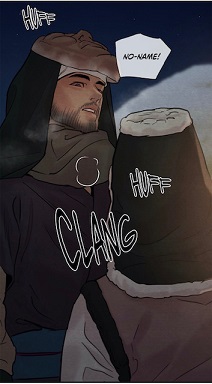 (chapter 76), the ghost from his nightmare
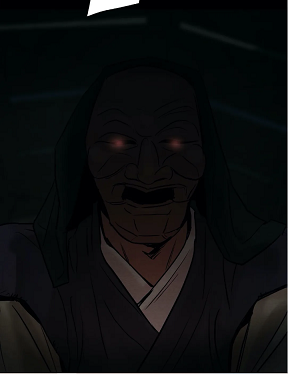 (chapter 61), the painter got so panicked that he got paralyzed. Only the lord’s embrace could calm him. As you can see, the commoner denominator between 53 and 76 is that the presence of a terrible ghost. The latter pushed the artist to embrace his lover. This time, he needed himself protection. However, Nameless was not the only ghost witnessing the protagonists’ embrace. Lord Min has already become a ghost himself in my opinion. First, he is wearing a black hanbok which I am associating to death. Moreover, because he threatens the criminal to kill him
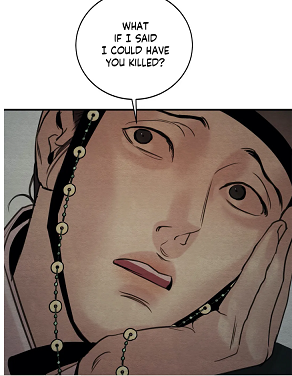 (chapter 76), I view The Joker as a grim reaper. What caught my attention is his reaction, when he saw the heartfelt hug. He had to vomit and this is no coincidence.
  (chapter 76) Observe that the color green is connected to two reactions: “to be green with envy” and “to be green” (sickly). Besides, we have in French “être vert” as a synonym for fuming, furious and disgusted. Hence it’s not surprising that it exist these emojis: 🤮🤢. Both contain green. That’s why I believe that when Min saw the embrace between the protagonists, he got so upset and disgusted that he felt the urge to vomit. It was definitely a mixture of envy and rage. However, he had to lie to the others in order to hide his “weakness”.
  (chapter 76) For me, there’s no ambiguity that The Joker was not honest here. First, he has no dark circle and red eyes like Jihwa who definitely drank again.
 (chapter 76) Besides, has Black Heart ever apologized to others? No. He didn’t even care, when he smoked opium in front of commoners. When he was asked to stop it,
 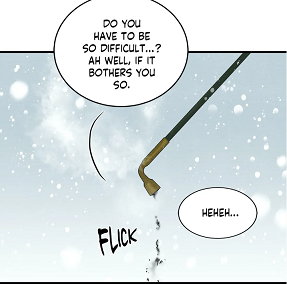 (chapter 52), he never expressed a real apology, he rather criticized the other for ruining the good mood and his fun. Besides, he looks down on low-borns and even Jihwa…
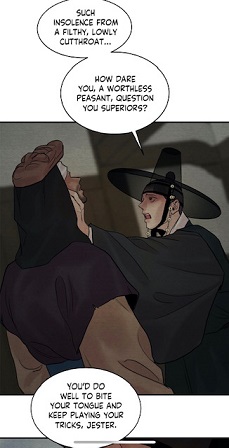 (chapter 76) so why would he apologize? It is, because he is slowly recognizing that his urges for Baek Na-Kyum are not linked to sex!! When he saw the hug
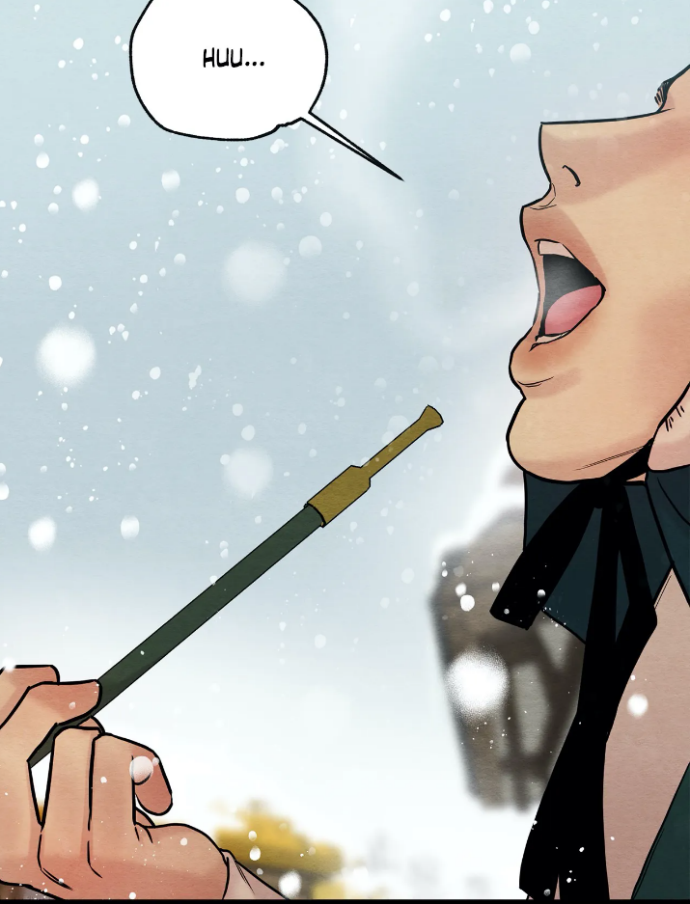 (chapter 52) Secondly, the hanbok was another indication. Finally, I perceive the lord’s nausea in chapter 76 as another evidence for Black Heart’s opium addiction. Vomiting/nausea are listed as side effects of opium. From my point of view, when he saw the happy couple in the street
 (chapter 74), he chose to smoke one pipe in order to relieve his frustration before visiting Jihwa and urging him to contact Nameless. This was a new version of chapter 56. That’s why they came both to meet the criminal.
  (chapter 76) Hence I come to the conclusion that Min is slowly turning into a ghost himself, losing his mind due to his addiction to opium and at the same time due to his greed and obsession for Baek Na-Kyum. The embrace in chapter 53 led to the kiss and indirectly it was the trigger for Min to change his original plan.
 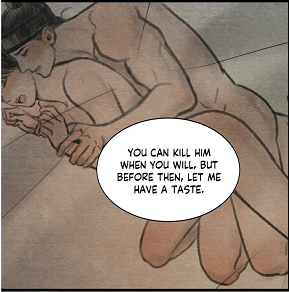 (chapter 56) Therefore I deduce that this second embrace is forcing him to change his plan again. From my point of view, he is no longer interested in tasting the painter once and have him killed afterwards. Black Heart is now determined to take away Baek Na-Kyum from Yoon Seungho. He is definitely longing for the artist’s love. He has every reason to be so jealous. The painter showed such a loyalty and courage. He is no longer fearing people’s gaze unlike in the past. Then, he even forgave his lover for his violence and mistreatment. Slowly, Min is showing his vulnerability in front of Jihwa and as such losing his power over him. He is definitely less laughing. As a conclusion, in chapter 76, the ghost Jung In-Hun vanished for good, while a new one appeared: Black Heart, who is now dressed like a grim reaper. However, there’s a huge difference, because Min has never entered Baek Na-Kyum’s mind and heart. He has no chance at all.
 (chapter 71) My explanation is the following: Baek Na-Kyum wasn’t sure how to judge the lord’s behavior. Imagine that in the morning, his lover had tied him up, while in the evening he was so gentle and calm. That’s why I believe that in this hug, the artist wasn’t certain how he should perceive the lord’s embrace. He knew that it was no longer fake, but like he explained it much later… how long would Yoon Seungho have feelings for him? Therefore I believe that in this scene, Baek Na-Kyum viewed him as an illusion, a spirit who could give him warmth and comfort.
 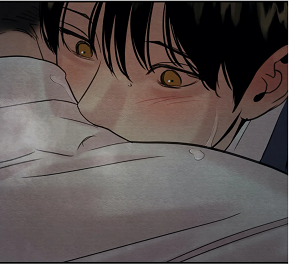 (chapter 71) Note the difference with the following picture:

 (chapter 74), exactly like in the past.
 (Chapter 40) On the surface, it looks like a repetition. Yet, the first contrast are the steps. While in chapter 40, lord walks away and the painter remains immobile first, in chapter 74 the young man is following the lord step by step. This illustrates the progression of their relationship. Yoon Seungho is like his guide and the commoner just follows him, full of trust.
 (chapter 40)
  (chapter 74). However, the trigger for the joke is diverse. In chapter 40, he got jealous, while in chapter 74 he was curios. And this comparison between the two pranks led me to realize that the red dot on the forehead had another signification. In my first interpretation about the chapter 40, I exposed that the red dot on the forehead was the symbol of marriage, the bride would wear such a sign. However, if you recall that Yoon Seungho described the painter as a fool
 (Chapter 40) That’s why after pondering, the artist visited his teacher and expressed his wish for the first time that he would like Jung In-Hun to become responsible for him, like the former had promised. As you can see, the red dot and the questions did cause an Awakening. But it was a brutal waking up, as the painter discovered how the learned sir truly viewed him: a prostitute and nothing more.
  Imagine, the commoner was walking right behind him, yet Baek Na-Kyum was not mentally and emotionally present. His thoughts were directed at the scholar. This is not surprising that Yoon Seungho resented his lover. In the aristocrat’s mind, this signified that the painter was not even enjoying his time with him. He preferred thinking about the learned sir than talking or looking at his lover. In other words, he was standing behind the lord absentminded. And the lord sensed it, hence he looked behind
 . How did he notice it? It is because the artist didn’t keep asking about the date.
 There was a silence after the question. And when he saw the blushing accompanied with a huge genuine smile, Yoon Seungho was hurt that he couldn’t help criticizing his lover.
  Note that with such a comment, the noble is not interested in initiating a conversation, he already knows what the low-born is thinking. And if you contrast this to the scene in episode 74, you’ll detect a huge difference. Although the artist is absentminded as well, he is already meditating about his lover
  and his relationship. The lord’s back
  (chapter 74) is the trigger for him to ponder. And this shows the noble’s increasing influence on Baek Na-Kyum. Meditating is definitely the lord’s favorite occupation so far. In addition, this shows how much the aristocrat means to him. All his thoughts are now directed at Yoon Seungho. Therefore we have to imagine this. While Baek Na-Kyum is walking, the lord notices that he is just walking lost in his thoughts. Hence he throws him the hat as a joke. On the one side, he definitely wants him to be present mentally and emotionally, like in the past. On the other hand, note that unlike in the past, there’s no reproach, in truth he desires to discover what the artist is thinking.
  This is one of the biggest wishes Yoon Seungho has ever had:
  (chapter 49) The lord always felt the need to share what was in their mind. Now, I can truly grasp why it’s a dream for Yoon Seungho. Remember when I described how the lord lived for so many years in the darkness. He only knew that he existed through his mind and thoughts. But during this whole time, he could never communicate his thoughts to anyone, he felt terribly lonely. This explicates why he had such a huge desire to communicate with the painter. He felt closeness in their soul, which he could detect in the art. As you can see, although the noble detected that his lover was lost in his thoughts, he no longer reprimands him. In fact, he voices curiosity. Moreover, he is no longer claiming that Baek Na-Kyum is transparent contrary to chapter 40. There’s a reason for that. The artist has changed so much as well. He is indeed applying his lover’s philosophy: introspection and meditation. And this leads me to the next observation. There is a huge difference between these two scenes: the chronology.
 (Chapter 74) He recalls all his actions, and he notes the lord’s selflessness and humbleness.
  (chapter 74) versus
  . He still had that dream, this explicates why he mentioned Jihwa. He envisioned that the artist would get jealous. But the artist remained silent. Then he confessed twice (“I adore you” and
  ) in order to push the protagonist to reply to his confession. He definitely dreamed that if he confessed, the painter would feel pressured to return the affection. That’s why the painter was trapped under the noble and the latter was grabbing the painter’s hand.
  (Chapter 58) His gestures illustrated the pressure made on the artist. But the master never got a reply. Thus it elucidates why the noble got infuriated after the painter’s disappearance. He might have admitted his defeat, nevertheless he hoped for a confession, as a new form of allegiance. That way, Baek Na-Kyum was obliged by his words. However, in chapter 74, the only desire the noble has is to exchange their thoughts. He has truly given up on his dream. When in chapter 49 the master voiced this wish for the first time, he was lowering his expectations. That’s why I believe that this indicates that Yoon Seungho is no longer hoping for more. He is so in love, and the past Yoon Seungho would call him: a fool!
  (Chapter 74) The repetition of “nothing more” is an evidence for the painter’s longing for more. There’s no doubt that his wish is physical intimacy, because for the artist sex is a synonym for love. Consequently, he stands up during the night in order to look at the lord’s bedchamber from far away or he is awake
 , (chapter 74) when the noble visits his study. All this exposes that he is longing for the lord’s warmth. A simple kiss is enough to make the painter blush, but not enough to satisfy his “thirst” for affection.
  That’s why his eyes are bigger than before, like in this panel.
  (Chapter 74) He is literally glowing. He is enjoying this moment with the noble, hence he stares at him so intensively. And this represents the biggest contrast to the chapter 40. Back then he didn’t truly enjoy the walk with the master. He was either embarrassed or thinking about the scholar. At the end, he was even called “a fool”.
 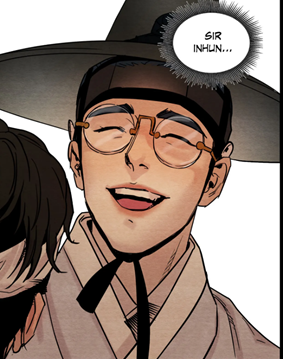 . (Chapter 7) Secondly, as the lord is the mirror of the artist and the former once expressed the wish to see the painter’s smile
 (chapter 10) or silenced him with a caress
 . Heena noona had a similar atttitude, she never asked for his opinion, when she sent him away.
 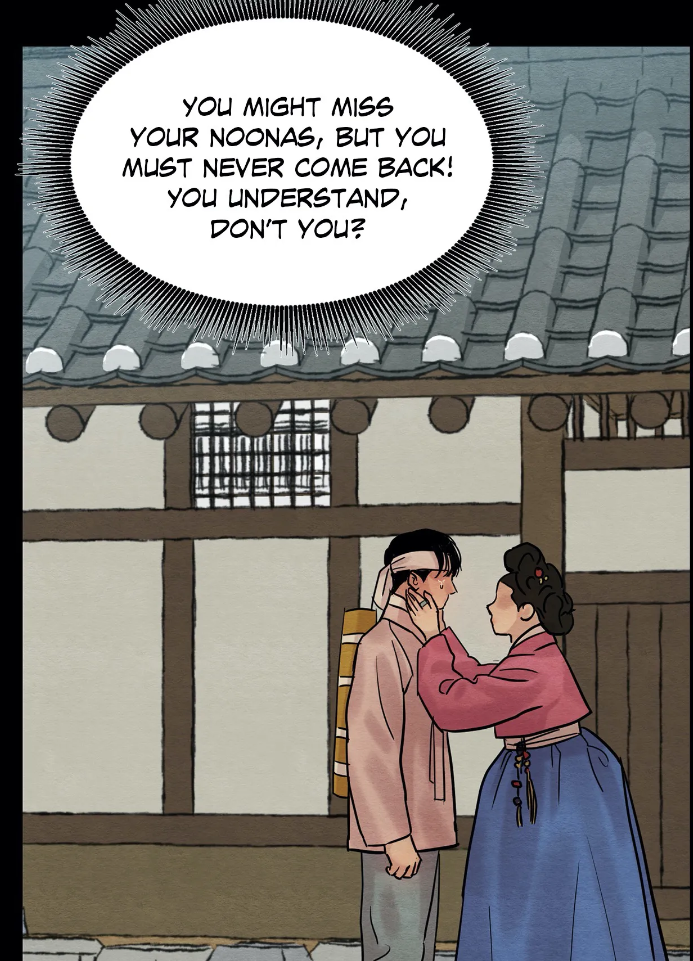 (Chapter 46) The painter is realizing that the only one who is treating with great respect is the noble. First, the lord eats his meals with the artist in his room, giving the impression that Baek Na-Kyum is the host and the lord his guest. Secondly, the lord allows him to speak freely. Thus the painter is so moved to the point that he is about to recognize his affection for Yoon Seungho. But then he remembers Heena’s words:
  (chapter 74) he would be a fool, if he followed his instinct and heart. This leads me to the conclusion that Baek Na-Kyum restrains himself in the last moment and doesn’t reveal his true thoughts. When he recalls his sister’s warning, I interpret that he is refusing to have a leap of faith. However, he is not recognizing that he has already changed. He might deny his attachment to the master, yet the tailor is not blind:
  due to the Joker’s arm and hand.
 (chapter 102) How come that Black Heart had the learned sir’s glasses? He has now to prove his reliability and trustworthiness towards his partner. He should become more proactive, if he wants to protect his loved one better. My final conclusion is that in chapter 74, we don’t have one fool in love, but two!
  If he hadn’t thought too much about Yoon Seungho due to the separation and been surprised by Min, he would have realized that his life was in danger. Both protagonists are so in love that they don’t realize that their special relationship represents a threat to others, especially to people who stand for social norms and traditions. Simultaneously, their scandalous relationship is a source of envy for others, as Baek Na-Kyum and Yoon Seungho were able to break free from the shackles of social customs and hierarchical society. The couple becomes a symbol of liberty and true love … no wonder why The Joker is so envious. Because both were two fools in love, they couldn’t detect the enemies around them and the existence of the plot. On the other hand, the last tragedy brought back the two lovers to reality. They needed to pay more attention to their surroundings.
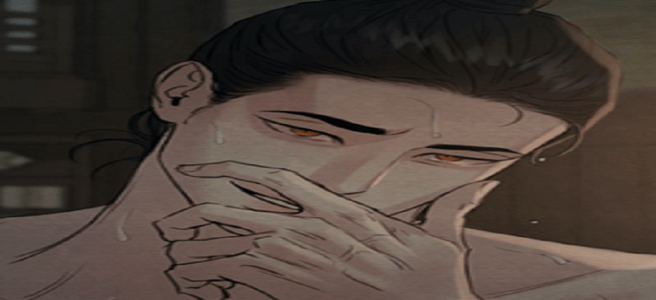
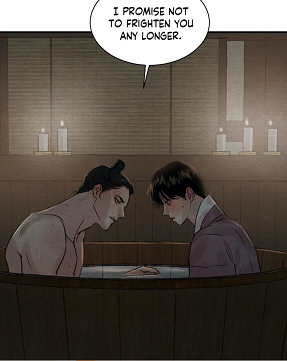 (chapter 70) 3 symbolizes perfection and completion. But I have not entirely explained how the artist could overcome his traumatic past and even find closure. So far, I elaborated that the missing farewells played a huge role in the painter’s trauma, as they triggered his abandonment issues. Thanks to Yoon Seungho’s decision, the artist was allowed for the first time to bid farewell to his noona properly.
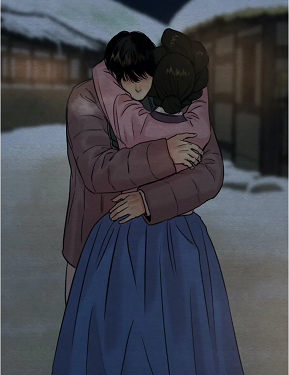 (chapter 69) But there’s more to it. In my opinion, the physical touch, in the form of caress and embrace, played a huge role in the painter’s traumatic past too. However, before starting to explain this element, I need to elaborate how it came to this.
 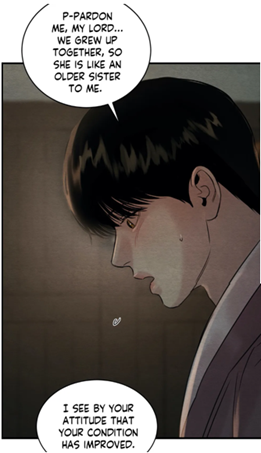 (chapter 70) Then thanks to my readers @_Winnie_L_ and @
 (chapter 67) Thus we have two possibilities. Either the head-kisaeng is someone else and Heena noona took over her role, or Heena noona became the head-kisaeng, but she never claimed Baek Na-Kyum as her son. Thus the painter ended up with a ghost mother. On the one hand, Heena noona acted like a sister in front of him and she requested from him to be called “noona”, on the other hand, she behaved like a mother towards Baek Na-Kyum. Observe that Heena is the only one with a name. The only difference is that the head-kisaeng relied on the kisaengs to raise the low-born, whereas the noble Lee employed his domestics. This explicates why Heena noona started acting like a mother. But this caused her to struggle due to her young age. She was so overwhelmed with this task, that she had to rely on the scholar. And there is a reason why the kisaeng trusted the low noble so much. She was not just blinded by her own feelings
 (chapter 68). Her decision was influenced by her past experiences and fears. The head-kisaeng judged the learned sir as a good and responsible man. And how could he win her trust? Since the story is constructed like a kaleidoscope, this means, we must have a new version of this during the first season. In my opinion, the scene with the worker is the repetition from the past.
 (chapter 29) First, observe that the young girl is sitting on the teacher’s lap and the learned sir is holding a book. So if someone saw this from far away, the beholder would think that the scholar is reading the book to the child. It even gives the impression that he is actually teaching the young girl to read. But note that in this scene, the low noble is in reality talking to the commoner. For the young girl, it means that she is forced to sit and do nothing. That’s why she turns her her head to the learned sir wondering what he is expecting from her.
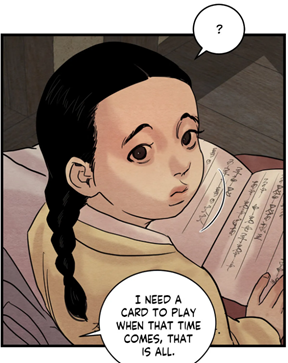 (chapter 29) What is she supposed to do? Observe that he replies to her interrogating expression with a smile, yet he doesn’t give her any instruction. I would say, he treats her like a doll. And now, replace the young girl with Baek Na-Kyum, and the latter has to sit there for a while. You can easily grasp why the painter could only fall asleep.
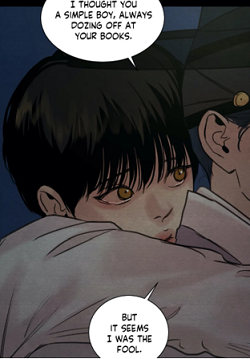 (chapter 70) In front of the kisaengs, the scholar created the illusion that he was teaching, while in truth he just saw it as a diversion. This explicates why he utilized this idiom to Yoon Seungho.
  (chapter 6) Diversion has two meanings:
 (chapter 29) And now the scene at the kisaeng house can only be perceived in a new light.
  (chapter 70) , in the middle of nowhere, surrounded by water and rice fields. While some might view these panels as quite idyllic, I interpret these as the opposite: Baek Na-Kyum had no roots and no roof over his head. He couldn’t even find a refuge, which reminds us of the scene in the first chapter:
  (chapter 1) This picture exposes the painter’s lack of attachment. He has no home, no wall to protect him… there’s only emptiness surrounding him, which contrasts so much to Yoon Seungho’s situation, who lived in a prison. Hence I understand now why Baek Na-Kyum is determined to remain by Yoon Seungho’s side.
  (chapter 68) For the first time, he has a room for himself, and even if he is pushed away, he can express his sadness and seek comfort in his room:
  (chapter 52). Note that each time, he was unhappy, he was requested not to cry
  (chapter 26)
  (chapter 68: he is sent away due to his tears)
 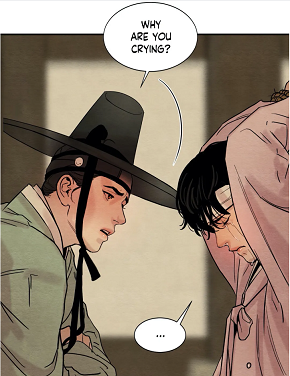 (chapter 1) The difference is even palpable in chapter 26:
 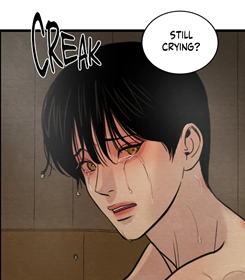 He left him some space and time to cry, hence when he returned, he didn’t say: don’t cry. He just makes this comment
 (chapter 26). And like I underlined it before, the lord is always focused on the reason for the artist’s tears. This led to the confrontation: who is responsible for his heartache?
  (chapter 26) Sure, in the bathroom, Yoon Seungho is still very rude, however he never employs the negation. Nonetheless, the low-born could never perceive this divergence, as the nuance is not so obvious. This explicates why in chapter 41, the artist misjudged the noble’s intervention. When the latter wanted to see his face and as such his tears
 , (chapter 41) the former refused to do so, because he anticipated that the lord would ask the same thing: stop crying. However, the master wanted to know the cause for his agony, which is totally different. This scene is really important, because it shows another issue. Baek Na-Kyum was never allowed to cry. His tears were associated to annoyance and burden. That’s why he desired to be left alone in the end. He feared that if the lord saw his tears, he would be requested to stop crying. And this fear of letting his tears coming up explains why the painter hid his eyes with his arm during the physical abuse.
 (chapter 68) why the lord chose to retreat. Here, the master saw the commoner’s tears with his mind’s eye and realized that he needed to give him some space and time again. But more importantly, he never entered the room, giving him some privacy. He learnt an important lesson here: solitude doesn’t stand in opposition to distance and abandonment. In this scene, Heena noona never requests from the painter to stop crying, she just wipes his tears with her hand and caresses her brother’s cheeks.
 (chapter 68) What the noona didn’t realize is that the main lead’s decision to respect the low-born’s needs (crying and not entering his room) was the reason why Baek Na-Kyum selected him in the end. There’s no doubt that the lord was associated to home for good, because he is the first one who allowed him to cry and to have a room, where he could seek refuge after getting hurt. Under this new light, the readers can better grasp why Baek Na-Kyum is healed now.
 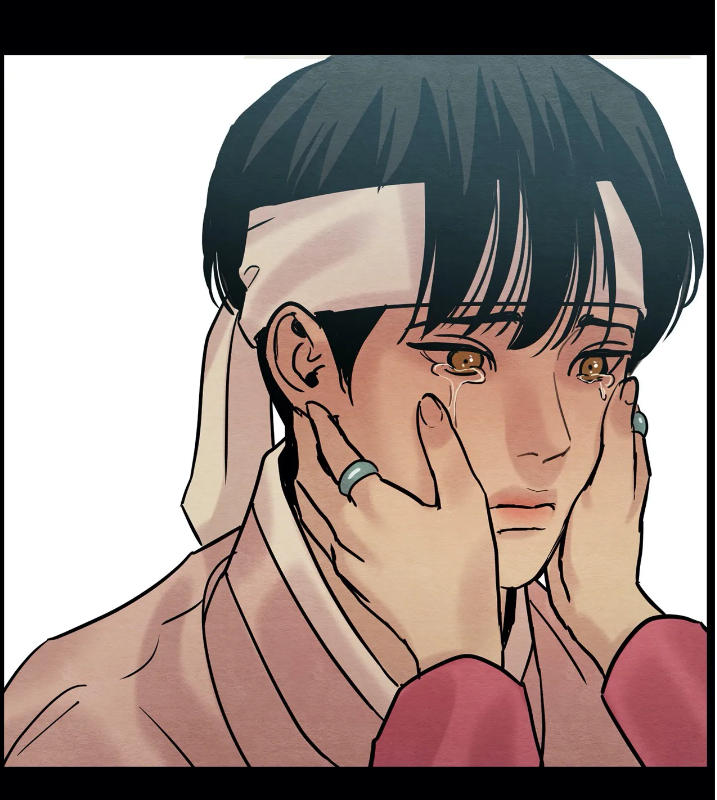 , (chapter 46) when the latter was sent away, But she didn’t hug her brother. Why? It was to stop him from protesting.
 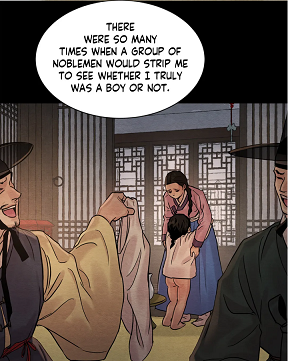 (chapter 94) Here, the infant hugged his noona, but she didn’t return his gesture. Moreover, she hadn’t stopped the laughing nobles as well. Furthermore,
 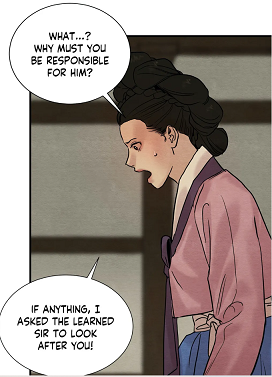 . (chapter 68) Why does she expect this? From my point of view, her words imply, she must have helped the learned sir in the past: one thing is sure. She was not entirely honest with her donsaeng here, as the manhwaphiles can detect the drop of sweat. But more importantly, we have to question ourselves if the gibang was not used in the past to spread rumors about the Yoons again, and Jung In-Hun could heard something. I am even envisioning that she must have reported conversations to him, a new version of chapter 24:
 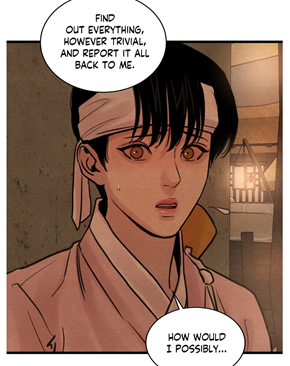 Remember that in that scene the painter doesn’t comprehend the meaning behind this order. If this theory is true, then she never saw the consequences of her action, similar to her brother in chapter 24. If she truly did it, she must have justified this, because the learned sir needed it, she was responsible for him.
 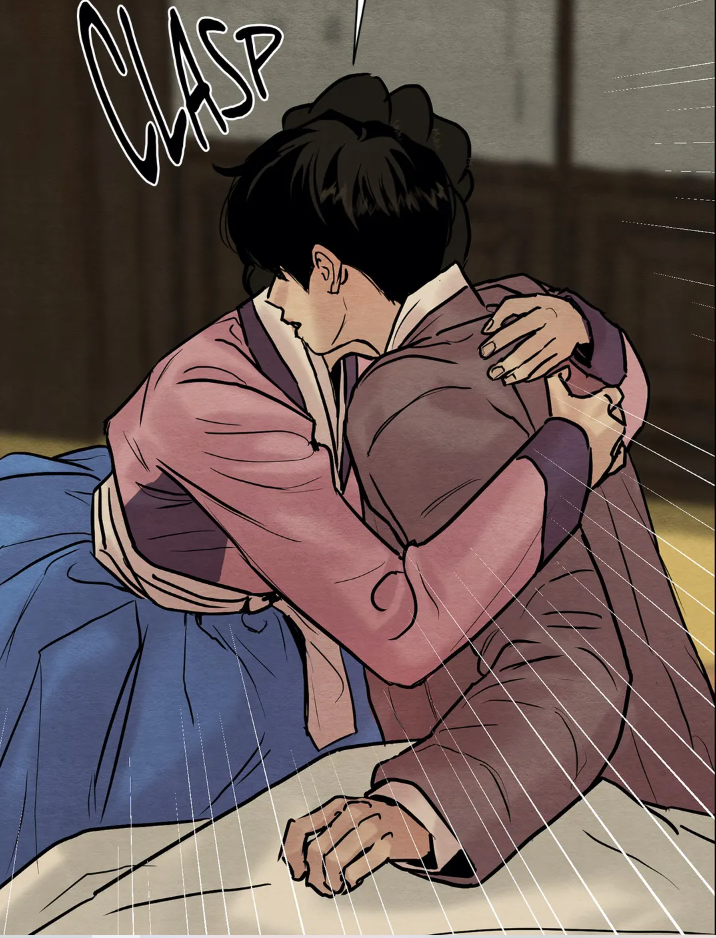 (chapter 68) For me, her real “admiration” was for the learned sir, therefore it becomes understandable why she wasn’t bothered, if Jung In-Hun asked for her help in exchange for taking care of Baek Na-Kyum. According to my theory, the learned sir had brought himself the baby to the gibang, this means that in chapter 46, he could only accept the kisaeng’s request. He had no other choice, for in Heena’s eyes, they were somehow related. From my point of view, Heena noona hoped that Jung In-Hun would even assist her and help her to leave the gibang. But this never happened. In my opinion, there exists another reason why the painter was sent to the learned sir. And it is related to Yoon Seungho, the erotic paintings and the pedophile.
 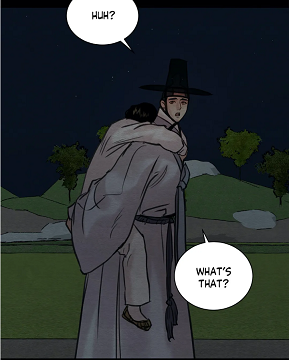 . (chapter 70) And now, we have to question ourselves why the kisaeng chose to send away the painter in the end. From my point of view, it wasn’t really to protect him… since Baek Na-Kyum was now an adult, the role of the scholar was no longer necessary. First, the artist was supposed to be literate. At the same time, the low noble couldn’t take him any longer, when the kisaeng got hurt again. This kind of diversion was no longer possible. The man was old enough to intervene, hence not only he could have defended his sister, but also he could have investigated what was happening in the gibang. That’s why Heena sent him away to the scholar and observe that the noonas were not even informed.
  (chapter 97) In exchange for her services, she had to bring Baek Na-Kyum to Min, the noona would be able to escape the gibang.
  (chapter 44)
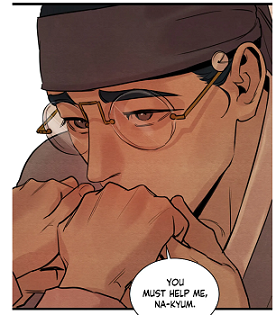 (chapter 24) With my new interpretation, you can comprehend why he did this. He tried to use the same method from the past: he knew that physical touch would make the artist submissive. And the climax was reached in chapter 29 with the fake embrace and the betrayal:
 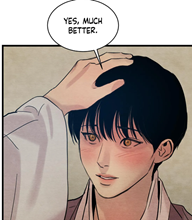 (chapter 35) and strokes
  (chapter 35) and finish with this final touch of the painter’s cheek:
 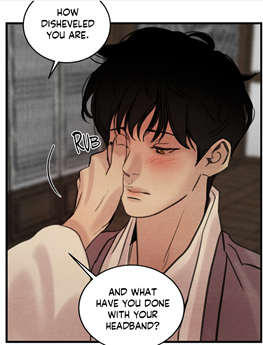 (chapter 38) And the physical interaction reflects the learned sir’s loss of power. Despite his attempts, he was not able to obtain the artist’s submission like in the past. That’s the reason why he could only resent the artist. We have to remember that the low noble really detested this physical intimacy, hence he would tighten his jaw or grind his teeth.
  (chapter 24) Note that in many panels, we never see the scholar’s facial expressions, but there is no ambiguity that he could never truly hide his disdain. But the painter was still blinded by his “admiration” for Jung In-Hun. However, after the argument at the library, the painter lost his sight and hearing again. He was too wounded by the final blow.
  (chapter 46) Then the readers witness the return of the artist’s 5th sense (touching) in chapter 49.
  (chapter 52) And now you comprehend why Heena and Jung In-Hun were defeated. The hug in chapter 66 helped him to satisfy an important need: he was truly embraced while getting comforted.
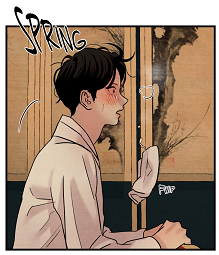 Back then, he recalled the repressed physical abuse. However, his conscious dismissed it again. However, this time it is different. The painter in possession of his whole body is reminded of the scholar due to Heena noona’s farewell. The closure he got by bidding her farewell triggered a long repressed memory too. The learned sir was the one who consoled him in the past. And while he recalls that night, the adult Baek Na-Kyum realizes that the scholar’s care was not fake in the past. He would keep him company and talk to him, he was his companion of the night. However, for me, this scene outlines his superficiality and indifference. He diverts his attention so that he wouldn’t feel sad any longer. But it was, as if he was ignoring his sadness, for he wouldn’t talk about the incident.
  (chapter 70 Then he makes the following reproach: he was lazy.
 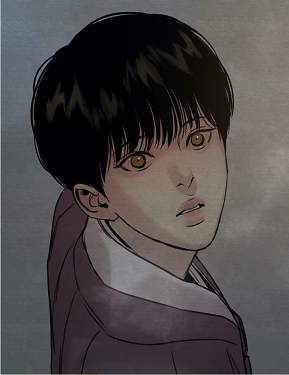 (chapter 70) The learned sir will always be a part of his life, as he belongs to the past. As you can see, in this scene, Baek Na-Kyum was moving on. Therefore I interpret this scene as a real breakthrough. The painter is no longer under the influence of the scholar. The latter can not longer manipulate him like in the past [though now I believe that he is dead], and this revelation was triggered by Heena noona and her embraces. But at the same time, he is not rejecting or resenting the man. And this interpretation becomes even more visible in season 3:
 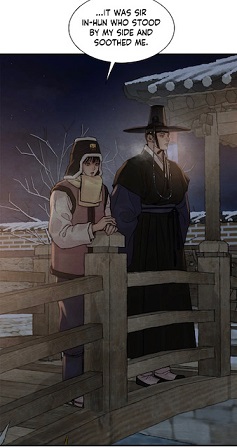 (chapter 94) His heart and mind are now in peace. He is no longer suffering from a guilty conscience. And this truly exposes that the artist’s abandonment issues were created by Heena.
  , then the chin
  before kissing him.
 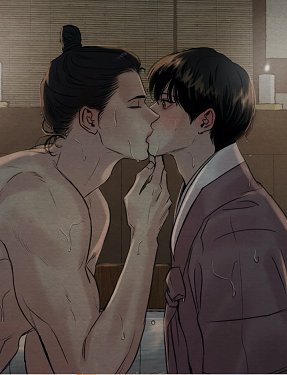 (chapter 70) However, what caught my attention is that his touch is never to shut the artist’s mouth. Observe that he lets the mouth open, while he caresses the hands, the chin and even after kissing the painter.
  (chapter 70) He has the right to speak, while Heena noona and Jung In-Hun used the embrace and caress as a way to render Baek Na-Kyum mute. And since the affection through physical touch was a way to win the painter’s heart, there is no doubt that Yoon Seungho is on his way to win his heart. Now, the painter is finally looking at him and the scholar’s influence has been finally erased. Baek Na-Kyum is now totally over Jung In-Hun, as he has now only view him as a companion and friend, and nothing more. He is no longer his idol. In other words, the low-born has finally found closure. In episode 70, his heart is free.
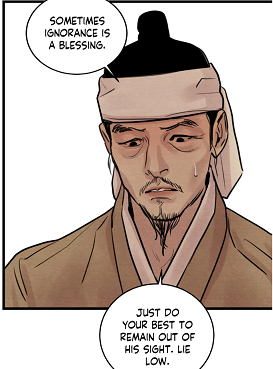 (chapter 23) Ignorance is a blessing for him, because it allows him to let his master to be in the dark. That’s why the master relied on the valet all this time. Kim was his eyes and ears, therefore certain rumors didn’t reach the noble’s ears.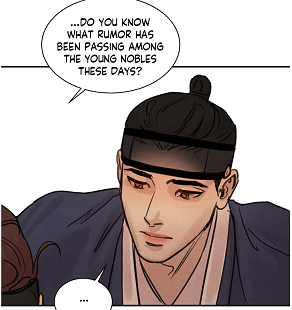

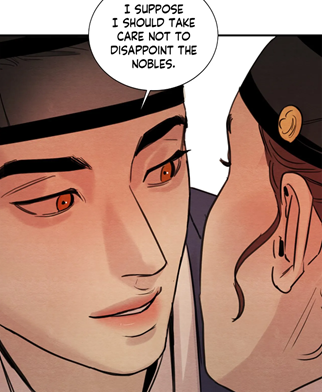 (chapter 18) On the other hand, the butler let him know about this gossip.
  (chapter 22) Since Yoon Seungho perceives himself as cultured, because he reads so much, he could only laugh about this rumor. However, he never realized the origin of these gossips. The valet utilized the rumors in order to deceive everyone, including the main lead. That’s why Kim could only judge “ignorance as a blessing”, because it helped him to manipulate the staff, the town folks and the nobles. He had an interest to create a bad image about Yoon Seungho. This helped him to keep the main character in isolation and in the dark. Moreover, it reinforced the lord’s dependency on his assistant. In order to corroborate my interpretation, I will use a panel reflecting the true nature of their relationship:
 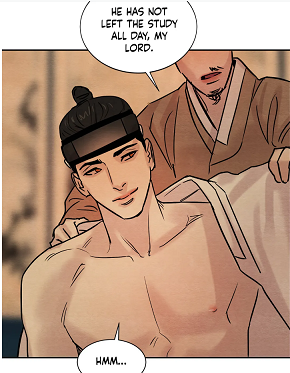 (chapter 11) Observe that the valet is not portrayed with eyes. This is not just an indication of the butler’s lie. The valet’s eyes became the master’s. This signifies that the words and the vision of the valet became the noble’s reality. At the same time, the noble’s mouth is closed and his hands are not present either. Note, he is getting dressed by his own valet. As a conclusion, he is entirely relying on Kim. He has no mouth, no hand, no ear and no eye. Everything belongs to the butler. This single picture exposes the butler’s true powers. The lord was totally deprived of all his senses and his own body, a real puppet. And this interpretation leads me to the following question: Who killed the servant in chapter 1? In my eyes, the noble was just the executioner, while the butler was the judge. Why do I see it like that? First, note that in the scene, the main lead has no eye
  (chapter 1) and he doesn’t want to know about the painter’s reasons for not painting any longer. I know, some readers might reject this idea, but I would like them to remember that we see the butler acting like a judge in front of the doctor, that’s why the commoner begs the valet (“Are you trying to have me killed”).
 (chapter 65) He uses Yoon Seungho’s power, yet the latter is described as a killer. In chapter 1, Yoon Seungho was the epitome of ignorance (narrow-minded, blind and deaf)
  (chapter 1) and the butler didn’t need to be by his side, as he had a real control over the lord’s hands, eyes and ears. Now you understand why Kim really treasures ignorance. Simultaneously, the valet values knowledge, as it procures him power.
  (chapter 50) This idiom doesn’t only imply to ignore your feelings, but also to deny the existence of your heart. If the noble has no emotions, then he can be the perfect puppet. This explicates why Yoon Seungho had a relapse after this conversation. Despite his warning, the master did listen to the butler’s advice.
 (chapter 65) That’s why there is no sincere apology.
  (chapter 65). He prioritizes his own life. He is not interested in people’s passion and well-being. He doesn’t care about people’s motivations. The latter just become relevant, the moment they affect his life. He needs to know about people’s behavior and thoughts for his manipulations in order to protect his quiet life.
 (chapter 65) therefore any incident must be covered up. At the same time, it implies as well that everything must be done in the shadow. That’s why without any spectator, he removes the snowman embodying the painter. The final panel contain all the butler’s doctrines. He will erase everything related to the past, acting as if nothing happened. It doesn’t matter, if someone gets destroyed in the end, because on the surface, it will look like he just cleared a way. He gives the impression that he helped the persons concerned, not taking into consideration how his actions and decisions will affect others. If someone has to pay the price for this, then so be it, as long as it doesn’t disturb his life. From my point of view, this scene is full of symbolism. From my perspective, he is ruthless and even willing to dirty his hand to a certain extent, since he is using a broom. However, this gesture exposes too that he is not directly soiling his hands. This is the reason why he is never directly involved with people’s wrongdoings. He will just push others to commit wrongdoings with remarks. They have to act according to his own thoughts and benefit. This interpretation is not exaggerated, if you compare this scene with Deok-Jae’s misdeed in chapter 46. The vicious servant used his own feet to ruin the artist’s creation
  or he pushed the painter with his own shoulder.
  (chapter 46) At the same time, with this new approach, it helps to understand why the butler’s evilness was never caught. He could always feign ignorance with such a behavior and was never directly involved.
 , 17, 59). He also allowed the vicious servant Deok-Jae to betray Yoon Seungho and plan a murder
 (chapter 51). He hoped that Heena noona would take the painter away
  (chapter 68) and he is now expecting that Min organizes a second abduction while framing others: Nameless, Heena noona and Jihwa.
 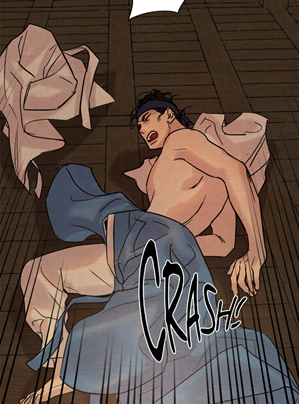 . Then another scandal appeared, when the lord punished the staff for not following his order (chapter 30).
 (chapter 33) Here, he was definitely avoiding any scandal. He was running away, although he tried to deceive the nobles by declaring that the painter would belong to him. And during the second season, the readers can observe a progression, the scandal and uproar is now reaching the town (chapter 64)
  . Thereby the climax was reached in chapter 67, when Yoon Seungho visited the Lees’ mansion. For the first time, he was confronting a noble and didn’t fear to cause a scandal, when he showed up with a sword and didn’t even remove his shoes.
  (chapter 70) And this confession could be used against the lord later, hence after that night, Yoon Seungho kept his distance from his lover. Thus he said this to his lover in chapter 75
 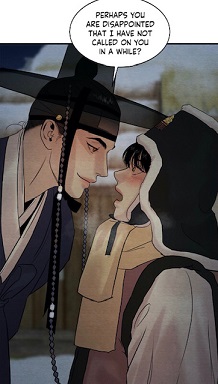 and later asked if the painter was truly resisting. Slowly, he had internalized that consent was central:
  (chapter 79) But this doesn’t signify that this doctrine had completely vanished. For me, it has been gradually weakened, the moment the lord started feeling remorse. The problem is that he still relied on the butler to correct his wrongdoings. That’s why he sent the valet to the artist in chapter 12 or left the artist behind in chapter 33. He ran away from his responsibility
  (chapter 33) and let Kim take the burden. Yet the more time passed on, the more the noble took his responsibility. He protected him from the maids and decided to buy him better clothes. This is no coincidence that in chapter 40, he implied to the painter that the latter could now rely on him. This progression is visible, when he took care of the painter in chapter 55. He covered him
 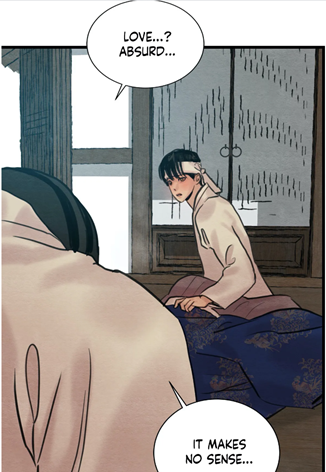 (chapter 55) and watched over him during the night. But this principle will be truly abandoned, the moment the lord apologizes properly, and this expectation was proven correct, as the real apology took place in season 3.
 (chapter 71) The problem is that in the bathroom, he chose the wrong words. Hence the painter could only misunderstand him and pushed his hand away. While the manhwaphiles could witness his huge pangs of conscience, the painter never did. He was either unconscious (chapter 32)
  or asleep
  (chapter 50) or blind or deaf
 (chapter 49). And little by little, the lord learned how to apologize to his lover. In season 3, he admitted his wrongdoing right away.
  (chapter 82) Then later he tried to redeem himself.
 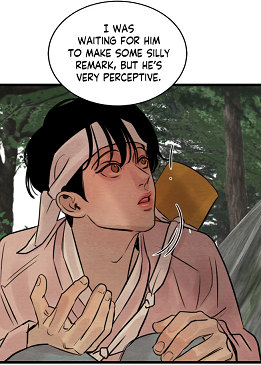 (chapter 23), because he liked keeping people in the dark as well. We had a perfect example with the deal between Jung In-Hun, the painter and the protagonist. First, Yoon Seungho gave the scholar the impression that the former was just an uncultured fool, whereas in truth the low noble was the one deceived, because Yoon Seungho was giving him just an empty promise. At the same time, the rich noble lied to the painter, when he claimed that Jung In-Hun had come to see him.
 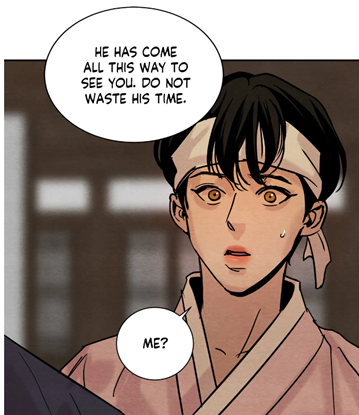 (chapter 7) However, it backfired on Yoon Seungho the moment the latter saw the painter’s reactions. He would run to his former teacher immediately, leaving the main character behind. Then he smiled to Jung In-Hun
  (chapter 7) and blushed in his presence. That’s the moment Yoon Seungho’s heart was moved, justifying the words in chapter 63:
 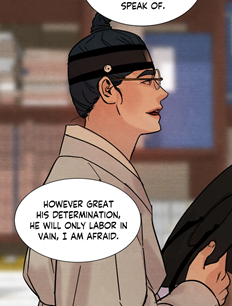 (chapter 7) Note that at the end of the chapter, he treated the painter as a real guest. He invited him to his bedchamber officially.
  (chapter 8) And observe that the noble was here smiling, he was already imitating the artist. This explicated too why not only his moves in this chapter were contradicting each other, but also Kim was introduced here for the first time. And note that from that moment, the lord never tried to trick the painter afterwards. Like I have already pointed out, the incident at the pavilion was definitely organized by the butler. And with this example, the manhwaphiles can see that the lord was applying the 6th rule as well, but dropped it due to the low-born’s reaction. This is not surprising why this manipulation ended up causing more and more pain. Yoon Seungho had brought him upon himself, revealing how the first doctrine “ignorance is not a blessing“. With this new observation, I perceive the episode 7 as a first major turning point. The lord was dropping the 6th rule (to utilize others in order to achieve his goal). However, this doesn’t mean that he abandoned the first doctrine. Quite the opposite… it took him a long time to realize why he couldn’t achieve his goal. In my opinion, the master started changing in chapter 67. Contrary to chapter 33
 , Yoon Seungho couldn’t bear to hear how people would talk behind his back: a sodomizer and a beast who corrupted Lee Jihwa and others.
 (chapter 67). Note that for the first time, the lord decided to defend himself
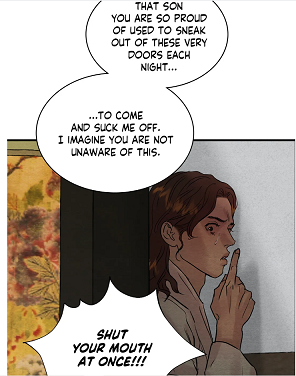 , correct people’s perception about him, which he never did before (chapter 18, 22, 57
 ). This coincides the return of the lord’s hearing and speech abilities. In chapter 67, he is using his own ears and mouth, he is no longer relying on the butler’s help. What the lord imagined to perceive as help was just an illusion. However, I believe that the lord decided to drop the first principle in chapter 68
 (chapter 70). And note that when the painter confessed, he externalized his fear.
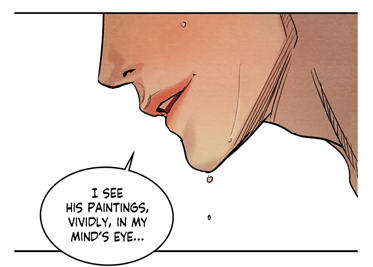 . However, the huge difference is that Yoon Seungho’s mind’s eye is no longer focused on himself, but on the painter. This explicates, why the master decided to retrieve and to give him space. Without seeing his face, he could sense that there was affection, because the painter was crying. The readers should recall that the painter’s tears have always had a huge impact on the noble, because they healed his eyes, hand and heart. The manhwaworms can comprehend why the lord chose to let the painter determine his own fate. The presence of tears and the painter’s voice were able to remove the lord’s veil on his eyes and ears for good. I would like to remind the manhwaphiles that in chapter 68, Kim tried to destroy the lord’s own judgement by recurring to gaslighting and distorting the past. [For more explications, read this essay:
  (chapter 69) although he is sitting in his bedchamber. Imagine, he is no longer relying on the butler’s information contrary to chapter 56:
  . Therefore I deduce that the butler can no longer control the lord’s body, since he is no longer required to be his eyes, ears and hands. However, this doesn’t mean that Kim is truly defeated. He still controls the staff, especially the male domestics. Here, I would like to make a little disgression. In my opinion, the butler played a huge role in the first abduction. How come that the servants were so sure that the painter had run away?
 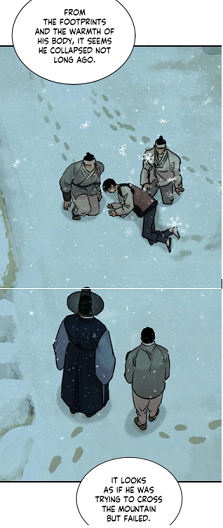 (chapter 61) They were not present, since both protagonists were at the physician’s. From my point of view, Kim must have manipulated the servants… he just needed to imply that Baek Na-Kyum had escaped, while in front of Yoon Seungho, he would say the opposite later due to the commoner’s return:
 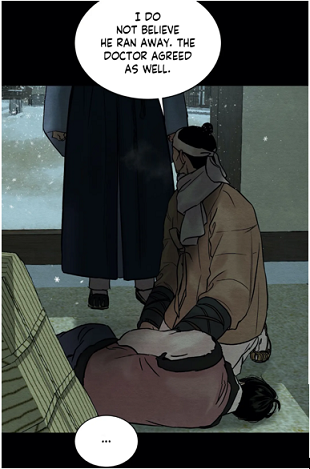 (chapter 62) There’s no doubt that with the painter’s appearance, he could use the incident to obtain more support from the servants. The painter had caused trouble again, he was responsible for their misery. But since he truly exposed his true nature to the main lead (abusing his authority, criticizing and judging his master), he can no longer appear in front of him. Right now, he has to lie low, hence he needs other people to be his eyes and ears. This explains why the servant is portrayed without eyes either
 (chapter 70). The absence of the eyes is an indication that they belong to Kim, just like the lantern indicates that the domestic is acting on the valet’s order. And in season 3, we can observe a similar situation. This time, they faked obedience
 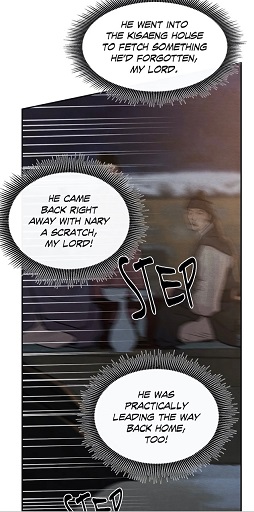 (chapter 99), while they badmouthed their master.
  (chapter 98) Because the lord feared to lose his lover, he didn’t pay attention to the domestic’s insult:
  and gives orders
 . He is truly rude. We could say that he treats the low-born like a servant, as though he wanted him to feel so little. Kim’s strategy was to remind the painter of his position: he is just a servant, a new version of chapter 52. Remember that Kim’s intention from the start of the second season was always to diminish the artist’s status: he is just a temporally favored servant, nothing more. Striking is that the domestic never says that the lord gave him the order to bring the painter. He uses here a passive sentence “you are to attend to him” which is important. That way, the servant can hide the identity of the person who requested this. And since the lord was looking at the intruder in a rather cold way, I believe that he didn’t expect Baek Na-Kyum.
 However, when the door was closed loudly, the lord must have realized that this must have been Kim’s action. The lord didn’t mind, for it looked like the butler was helping him to improve his relationship with the painter. This interpretation was also confirmed in season 3. Yoon Seungho showed no desire to investigate the matter of “Jung In-Hun” or Deok-Jae’s death, for he was too much focusing on his lover. He kept saying that this was not of his concern.
 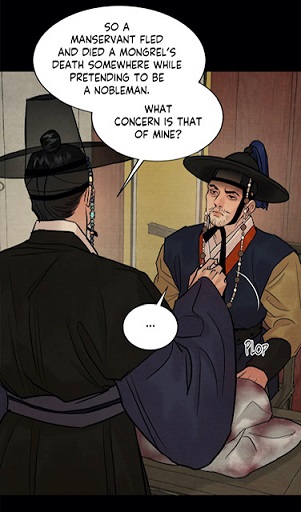 (chapter 98) However, he was totally wrong here. That’s the reason why the abduction could even take place. Because of the last incident, the main lead is forced to recognize that he needs to investigate the matter, as everything or everyone can affect his life. This is important, because that’s the only way for Yoon Seungho to recognize the butler’s wrongdoings. He encouraged him not to pay attention on others so that he wouldn’t detect his wrongdoings. Thanks this rule, Kim could live freely.
 (chapter 70) Under this new light, it becomes understandable why Kim decided to betray his master and rekindle with Yoon Chang-Hyeon. The punishment was the signal for the valet to switch the alliance.
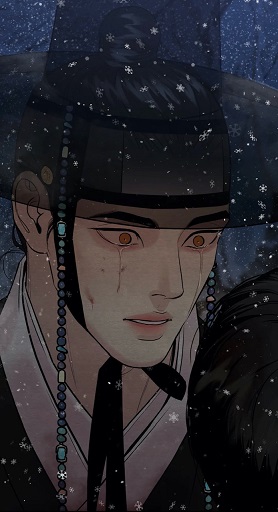 (chapter 102) From that moment on, the light had now reached the mind. He could drop his self-loathing finally which was the foundation of Kim’s principle. It was okay to cry. These were tears of happiness and relief… He had been able to rescue his lover. This means that Yoon Seungho did everything what the butler rejects: the embrace as a way to console and apologize and the tears as a sign of regret and happiness. But why does the valet abhor them? It is because he could never admit his own mistakes and as such he could never beg for forgiveness.
 (doctor Frost, chapter 211)
  (chapter 50) Here, the butler never cried, he just showed pity and sympathy towards Baek Na-Kyum, however he was not speaking from the heart.
  ). Optimism is a choice (chapter 68/69: the lord recognized that he still had some chance, though he was very scared). Kindness is a choice. Giving is a choice. Respect is a choice (chapter 69
 ). Whatever choice you make makes you. Choose wisely.”
 This would announce the butler’s complete loss of power. At the same time, it would signify that the lord is showing that he trusts Baek Na-Kyum and is using his hair to woo the painter. And this could definitely correspond to the master’s attitude: his will to open up. Simultaneously, he could express the following wish: he would like to comb his lover’s hair himself encouraging him to have a topknot.
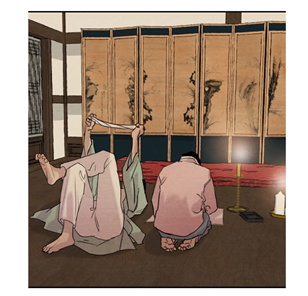 He is not only playful, but also flirtatious. Note how he puts the headband on the main lead giving him a seductive allure.
  At the same time, he acts like an innocent teenager who keeps asking questions: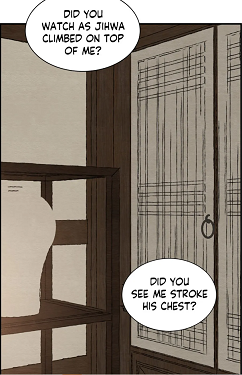
 Yet, the topic is actually about sex, which contrasts so much to purity and innocence. It was, as if Yoon Seungho was behaving like a teenager discovering sexuality for the first time.
 While talking, he can’t even help himself smiling. Striking is that his joke and words are used to woo the painter. He keeps getting closer and closer to Baek Na-Kyum, so that his head approaches the painter’s, before his hand starts touching his leg.
 As you can detect, the scene in episode 16 is a combination of seduction and frivolity. He is so happy to be by the painter’s side, hence he is talkative. He desires to have a real conversation with the painter. On the other hand, since the topic of the conversation is revolving around sexuality, it explains why Yoon Seungho is tempting the painter. And we have a similar situation in chapter 70. Therefore there exist so many similarities between these two episodes, which I will now list:
 (chapter 16) versus
 (chapter 70)
  (chapter 70)
 and
and  (chapter 16) versus
  the removal from his hand and
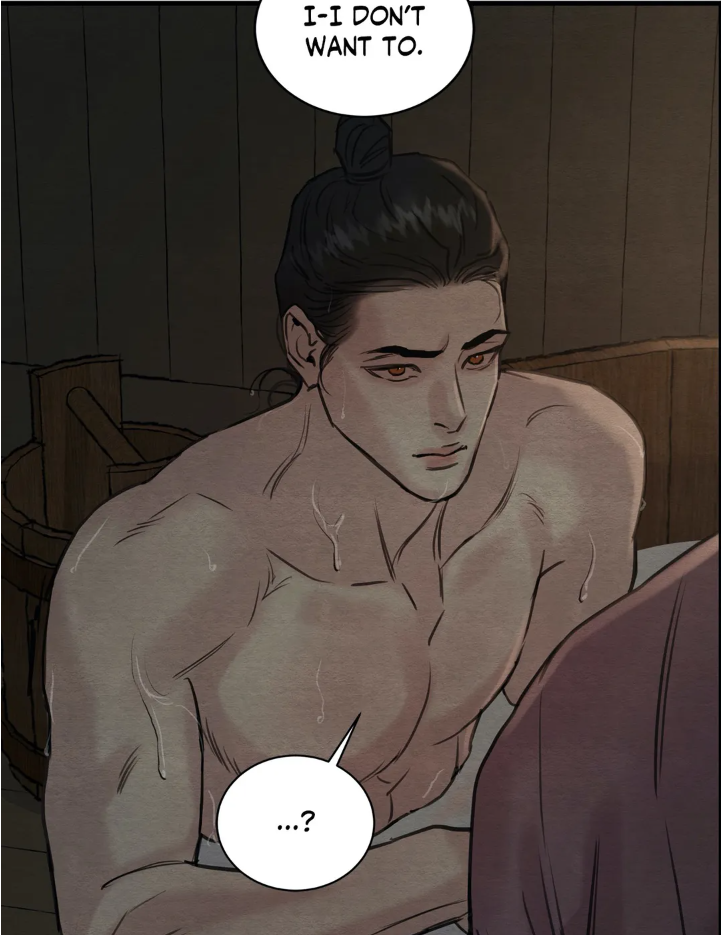 (chapter 70)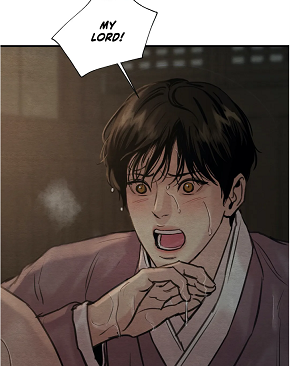
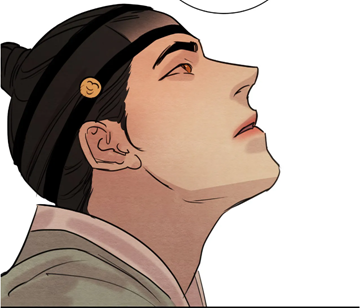 (chapter 16) versus
  (chapter 16)
 (chapter 70)
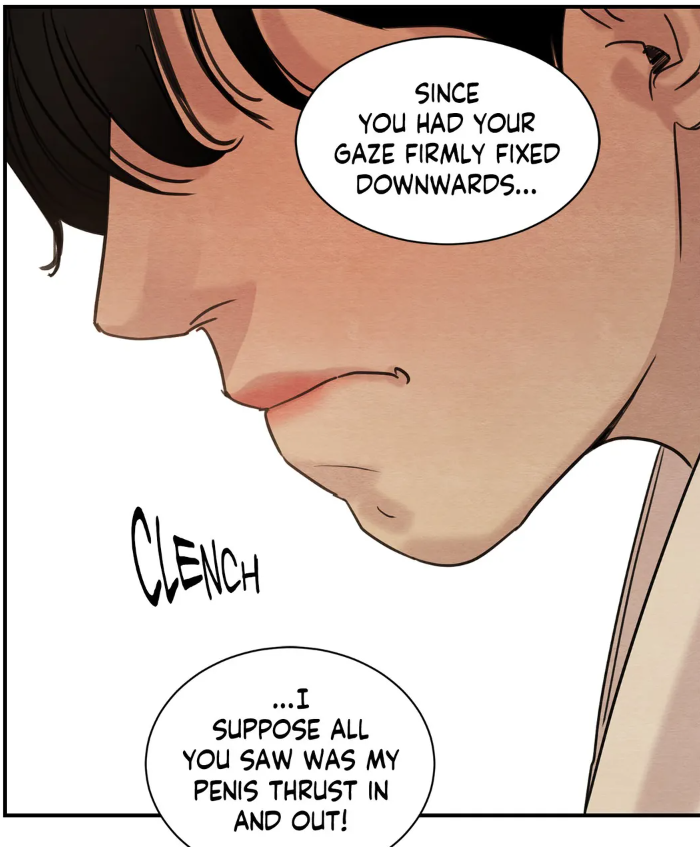 And here, we can detect the first huge difference between these two episodes. Because the artist is no longer denying his homosexuality, and as such he has finally dropped the scholar’s doctrines, he is able to perceive the aristocrat’s true personality. He is indeed moved,
 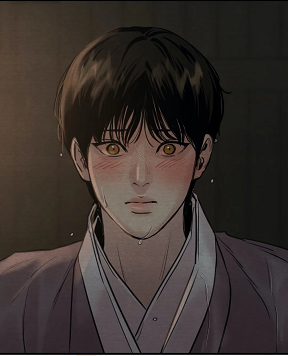 when he sees Yoon Seungho smiling after playing his prank. He blushes so much that he feels the need to hide his face,
 , when he hears the main lead calling his sister a wench. He requests respect from the lord. He is confident in his words and behavior. He even gives further explications.
 (chapter 26). Yet back then both were driven by negative emotions (anger and sadness) due to their wounds. However, this time it is different. They are both calm and very careful. The two are determined to treat each other with respect.
  (Chapter 70) In other words, the bathroom is the place where the main leads can be honest to themselves, hence they are genuine to their counterpart. This is no coincidence that the painter was indeed touched, when he reminisced the lord cleaning him.
 (chapter 59) In this place, there is no rule or social class separating them, they are equal. In the washroom, there’s only purity symbolized by water. I would conclude that they are truly naked physically and mentally. That’s why they can only be honest to themselves and in front of each other.
 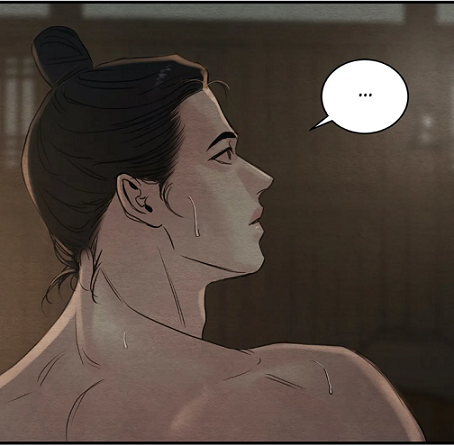 , when the painter retorts that he should mention her differently. His facial expression oozes naivety and shock. He didn’t pay attention to the idiom (“wench”), as all his thoughts were revolving about the painter’s happiness. He just desired to know if he had succeeded:
  (chapter 66). The artist has no idea that Yoon Seungho is referring to the flashback.
  to fakeness and hypocrisy due to the butler, who keeps repeating these words
 (chapter 25)
  (Chapter 70) Both are communicating verbally in all sincerity. In other words, this panel

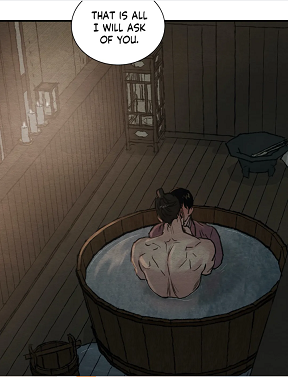 quoted from
  I believe that for the first time, the low-born is able to detect a new side from the aristocrat. Imagine that the artist could not only make the noble laugh, but also smile. That’s why the painter can no longer reject the lord, as his fear is slowly disintegrating. Note that he doesn’t reject the kiss from the aristocrat.
 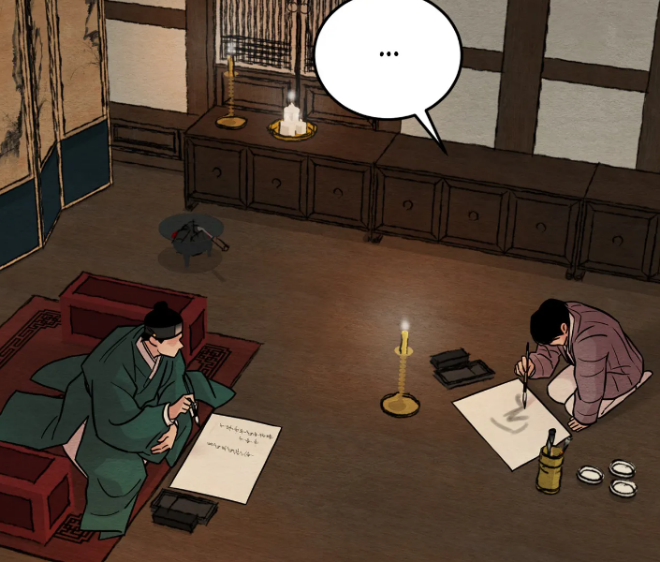 , because the butler had warned the artist not to irritate the main lead. According to him, he was in a bad mood, which was untrue.
  (Chapter 36) With this joke, he wanted to initiate a conversation, but unfortunately he saw the erection. Yet, the valet’s trick didn’t work completely either. Note that during that night, there was no sexual intercourse, just a fellatio. We shouldn’t forget that during that day, the painter was still feverish which the noble had noticed. So envision what would have happened, if the lord had engaged a second sex marathon. Therefore, I believe that in chapter 70, the valet is hoping that the noble will behave like the previous night
 (chapter 50): caresses, embrace and kisses, the symbol of harmony, love and sincerity.
  (chapter 47) by saying that he had just made a prank. But now, you will wonder where there was a prank in chapter 46, 56 and 66.
  (Chapter 56) He knew that this would hurt the noble, yet note that he felt no remorse and blamed his childhood friend. However, like I pointed out, he was impersonating a person. If asked, the childhood friend would have used a similar excuse. That’s why Yoon Seungho answers in a quite similar way: he calls him “lord song”. However, he pushes him.
 (chapter 66) , he implied with his words that Jihwa played just a prank, since the painter returned alive. Yoon Seungho shouldn’t just get angry, because it was just a joke. As you can observe, all the misdeeds are reduced to a joke. It was, as though they had done nothing wrong. However, the intention is definitely different: the perpetrators intended to hurt the protagonists. And this is not surprising that the chapter 36 contains both pranks: Kim drugged the painter against his will, while the joke from the noble was harmless. And in my opinion, the episode 70 contains both pranks as well. Kim was the one who sent the painter to the aristocrat. Why do I believe this? The reason is quite simple: the servant leading the painter to the bathroom is portrayed with no eye
  (chapter 36). And remember that this chapter is a new version of chapter 36. In that episode, the valet was the one who brought the artist to the lord’s chamber. Moreover, the way the door is shut clearly exposes a certain violence.
  (Chapter 70) Besides, the domestic is also urging the painter to join the bathroom. From my point of view, the domestic wants to make sure that the artist arrives, before the lord leaves the bathroom. Moreover, the lord’s expression in beginning is not quite welcoming
 (chapter 33)
  (chapter 34) in order to incite the latter to have sex with the commoner. Imagine, he had just regained consciousness, therefore this trick could have cost the artist’s life. And we shouldn’t forget, the butler witnessed the second sex marathon. He even viewed the flashback from the painter. Therefore in my opinion, the butler is hoping with his “prank” that the lord will act like the previous night. Furthermore, I would like to point out the presence of domestics in chapter 16 and 36. We have Deok-Jae who spied on the couple and manipulated the butler to open the door
 [theory confirmed by the author herself]. Then during that evening (chapter 36-37), Kim tried to stop Yoon Seungwon from entering the room.
 (Chapter 37) Hence this means, he was paying attention to what was happening in the bedchamber. What caught my attention are the following panels:
  (Chapter 69)
 Bebebisous33s' analyses in K-Dramaland and Manhwas