

Please support the authors by reading Manhwas on the official websites. This is where you can read the Manhwa: Jinx But be aware that the Manhwa is a mature Yaoi, which means, it is about homosexuality with explicit scenes. Here is the link of the table of contents about Jinx. Here is the link where you can find the table of contents of analyzed Manhwas. Here are the links, if you are interested in the first work from Mingwa, BJ Alex, and the 2 previous essays about Jinx The Fault in His Powerful Hands and A Clueless One-Way Street to Kim Dan
It would be great if you could make some donations/sponsoring: Ko-fi.com/bebebisous33 That way, you can support me with “coffee” so that I have the energy to keep examining Manhwas. Besides, I need to cover up the expenses for this blog.
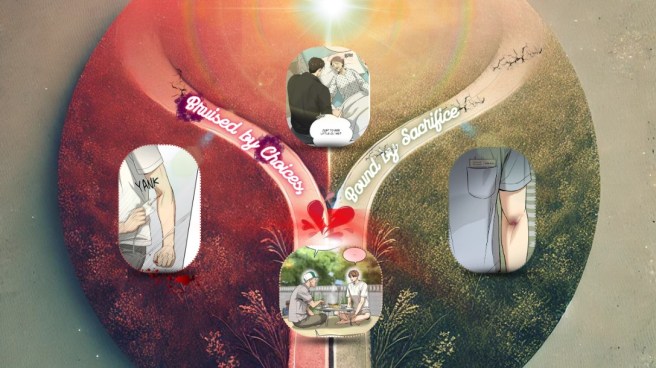
Exploring Kim Dan’s Psyche
In the complex narrative of Jinx, Kim Dan’s psyche is an intricate web woven from his upbringing, life experiences, and conditioned beliefs. Episode 61 serves as a focal point for understanding his internal struggles, particularly through the symbolic appearance of a bruise on his arm. 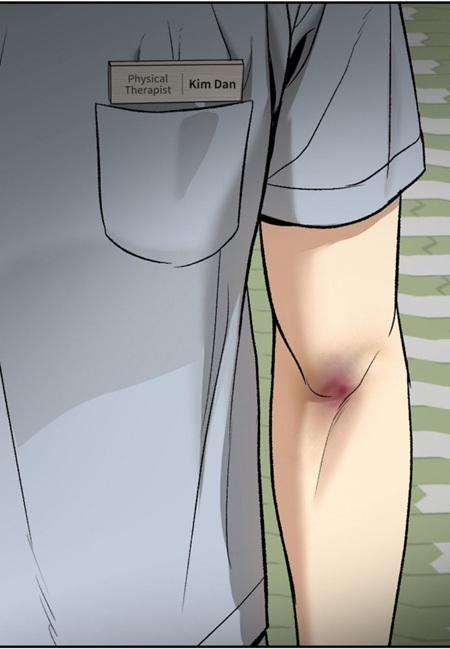 (Chapter 61) However, this moment is not isolated—it reflects patterns in his personality that have appeared throughout the series.
  (Chapter 11)
  (chapter 18) This essay delves into the significance of Kim Dan’s physical and emotional bruises, examining how they symbolize his suffering, internal conflict and transformation. I will examine Kim Dan’s conflicted emotions surrounding gratitude and debt, contrasting his interactions with Joo Jaekyung and his grandmother, Shin Okja. Additionally, I will explore how Kim Dan’s conditioned identity as a caregiver drives his choices, even in his current living situation with the landlord, where he unconsciously replicates past dynamics. Ultimately, I will elaborate how Kim Dan’s newfound awareness could reshape his identity and relationships moving forward.
By comparing Episode 61 to earlier scenes, we can uncover recurring themes of sacrifice and rejection of help, shedding light on how Kim Dan’s mindset continues to perpetuate his suffering. This essay aims to unravel his internal contradictions, demonstrating how his struggles with gratitude, self-perception, and consent are deeply rooted in his past and manifest in his present relationships.
Bruised Flesh, Silent Cries
The bruise on Kim Dan’s arm in episode 61 (chapter 61) serves as a profound symbol of his neglect, overexertion, and silent suffering. More than just a physical injury, it reflects his exhaustion, malnutrition, and inability to recognize his own limits. Despite being a visible mark of his struggles, it goes unnoticed, until the champion, Joo Jaekyung, becomes the first to see it.  (Chapter 61) His unexpected reaction catches Kim Dan off guard, further emphasizing how disconnected the doctor has become from his own well-being. However, contrary to the past
  (chapter 11), Kim Dan is truly responsible for the contusion. He caused the injury by removing the needle from the drip.
  (chapter 60) By taking this action, he absolved Joo Jaekyung of any responsibility for the injury, but this is merely a superficial conclusion.
 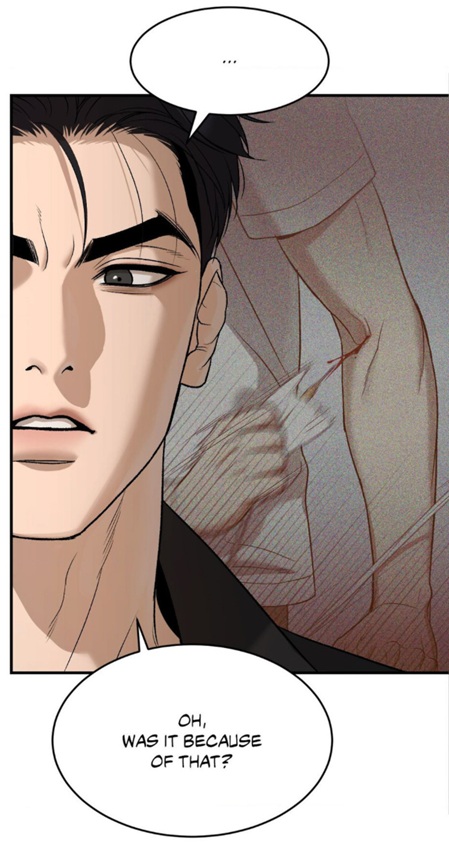 (Chapter 61) On the hand the circumstances surrounding the bruise, where Kim Dan removed the needle on his own, provide insight into his psyche. The deeper cause of the bruise lies in Kim Dan’s declining health, which is intrinsically connected to his malnutrition and the neglect he faces from those around him. It is important to recall that Joo Jaekyung was explicitly informed that Kim Dan needed rest
  (chapter 60). Yet, with his insistence,
 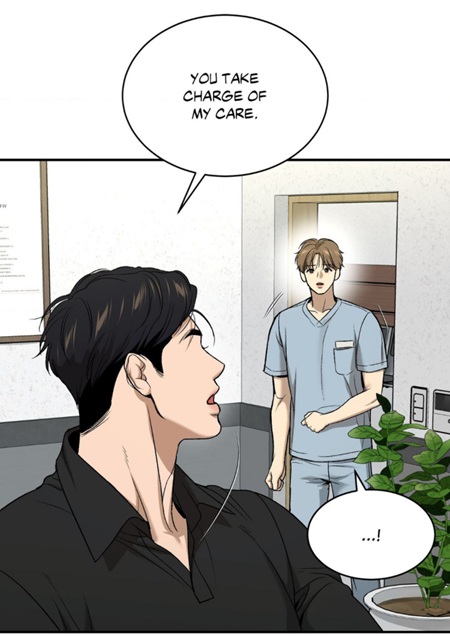 (chapter 61), he forced the physical therapist to keep working, adding even more strain than before. Though the physical therapist attempted to voice his disapproval,
 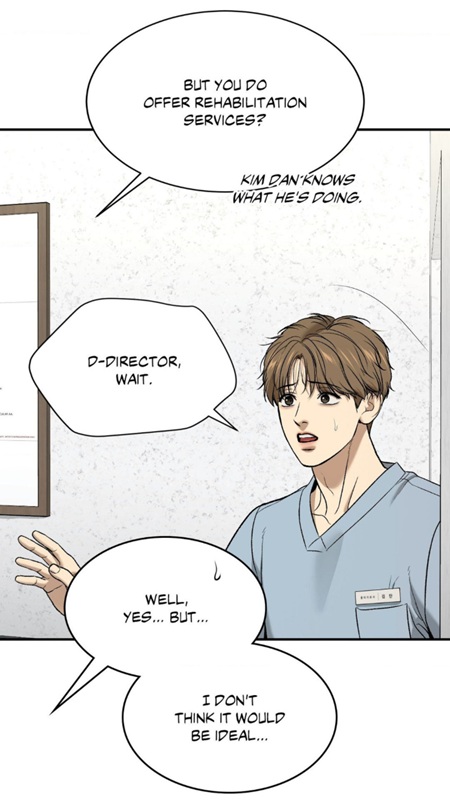 (chapter 61), he ultimately had no choice but to comply, as his order came from the hospice director.
  (Chapter 61) And why did the director override Kim Dan’s need for rest? Money and free PR. Joo Jaekyung’s influence secured the director’s approval, disregarding the doctor’s well-being in favor of business interests. This conversation at the director’s office makes one thing clear: words hold no power against profit. An d that realization led me to another connection—every one of Kim Dan’s bruises is linked to exploitation, whether by authority, obligation, or financial influence.
| Chapter 11 | Chapter 18 | Chapter 43 |
|---|---|---|
 |  |   |
To summarize, all his bruises were linked to money. In episode 11 and 18, it was related to the debts and the loan shark Heo Manwook. Then in episode 43 it was because of the expensive present Kim Dan wanted to offer to his boss and idol. However, notice that just before making the decision to offer a birthday gift, Kim Dan had been encouraged by his grandmother to show his generosity and gratitude towards the athlete. 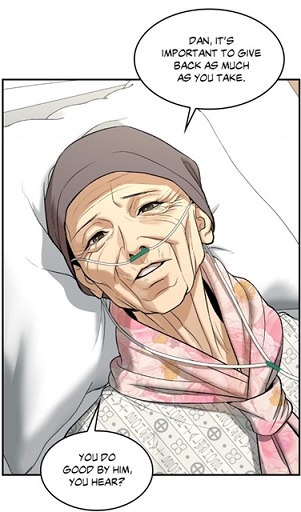 (Chapter 41) It is clear that she was inciting him to work harder than before. This displays that Kim Dan was not allowed to rest. During this encounter, she didn’t ask him about his well-being either. And what is the link between these 3 episodes? The grandmother and her poverty. The latter was responsible for the loan.
And because of money, Kim Dan never went on his own to the hospital in order to get treated. That’s how it dawned on me how the halmoni’s neglect could be exposed. No hospital or doctor has a file about Kim Dan as patient. When Shin Okja was transferred to the hospice, the hospice director and doctor received her patient file, hence he could make the following prognostics: she didn’t have much time to live.  (chapter 56) Kim Dan has only visited the hospital once, and this was solely due to Joo Jaekyung’s intervention. The latter needed medical attention himself
  (chapter 18) and took Kim Dan along, ensuring he was seen as an emergency patient. However, this visit was brief and lacked any comprehensive medical examination—no blood samples were taken, and his underlying health concerns remained undiagnosed. This omission further underscores the neglect Kim Dan has suffered, as even in a medical setting, his long-term health issues were overlooked.
In other words, the moment the main lead’s health condition worsens and he is brought to the hospice, it is likely that the medical staff will seek details regarding his medical history. Given that he has never received proper care, they may turn to his grandmother, Shin Okja, for information about his past treatments and health status. And what did the old woman confess to the gentle and kind celebrity? 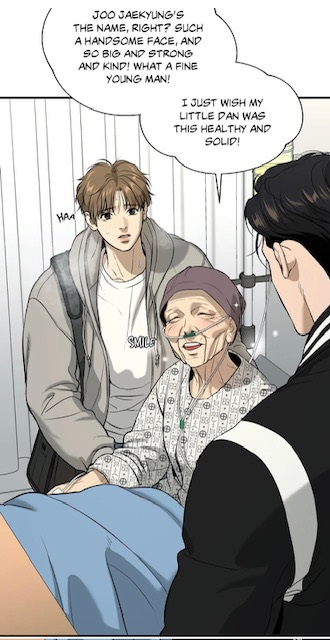 (chapter 21) He had never been healthy and strong. Moreover, when he joined them, at no moment the senior asked if he had gone to the doctor, though he had been sick before.
 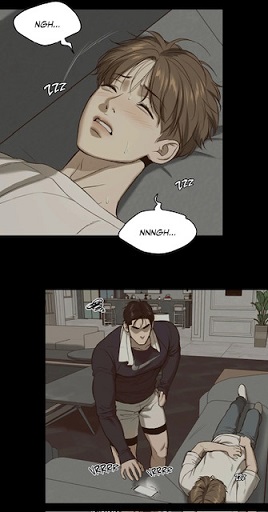 (chapter 21) But back then, the champion didn’t pay too much attention to it. In my opinion, her response will likely reflect her established pattern of emotional detachment and deflection of responsibility. Rather than admitting her lack of concern for his well-being, she may shift blame onto the staff or Kim Dan himself
  (chapter 57). In the last case, she will downplay the severity of his condition, insisting that he has always been stubborn and independent. She could even mention her conversation, when she tried to convince Kim Dan to return to Seoul, but the latter refused to listen to her.
Shin Okja might express surprise or even mild indignation at the idea that Kim Dan has been suffering in silence. She could feign ignorance, claiming that he never shared his struggles with her or that she assumed he was capable of handling his own affairs. Her response may also reveal an attempt to protect her own image, deflecting any potential criticism of her negligence. At the same time, she might subtly imply that Kim Dan’s health issues are the result of his own choices—his insistence on working tirelessly, his rejection of her past attempts to offer him food  (chapter 5), or his general reluctance to ask for help. He rejected the athlete’s help and concern. (chapter 60) In addition, Jinx-philes should recall how the nurse 1 reacted to doc Dan’s dizziness and workaholism
 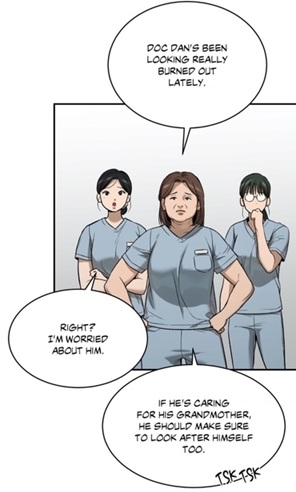 (chapter 57). She blamed the main lead, because she imagined that Shin Okja would worry about him. However, it becomes clear that the halmoni is not worried about her grandson at all. She is acting like a fan in front of the athlete.
  (chapter 61) One might argue that based on this scene, the grandmother didn’t see him with the bruise on his arm.
  (chapter 61) He only remained at the door. However, observe that there was a cut between this image
 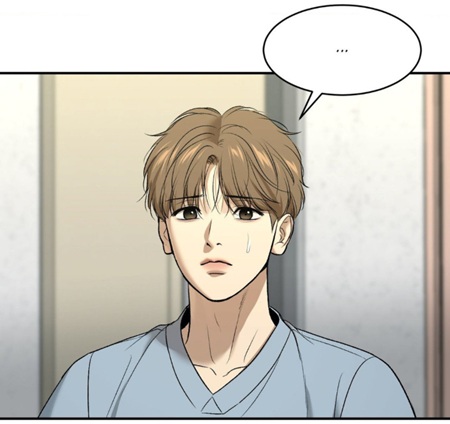 (chapter 61) and the conversation between the main couple in front of the hospice.
 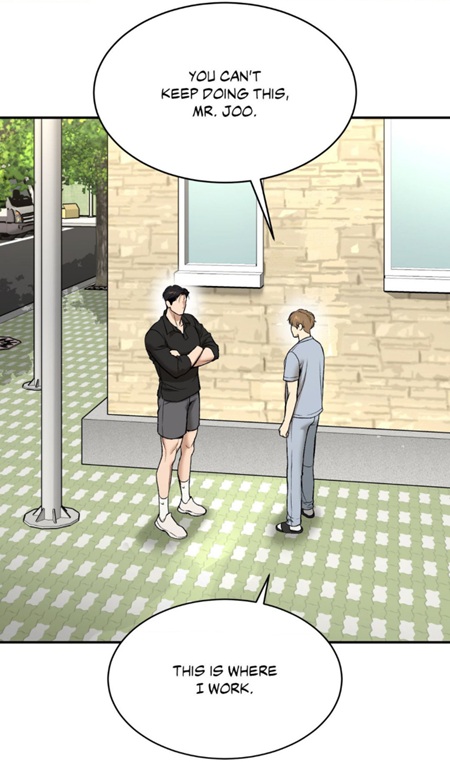 (chapter 61) So he could have made his presence known to his relative before asking Joo Jaekyung to follow him because of his treatment. To conclude, I believe that she had the time and occasion to see her grandchild and his bruise.
This confrontation with the hospice staff may serve as a pivotal moment, not only in exposing the extent of Kim Dan’s suffering but also in highlighting the grandmother’s true nature. If the medical professionals press further, requesting past medical records or details of where he had been treated, it will become evident that there is little to no documented history. She had never been worried about his health, since he was young. This realization could solidify the perception of Kim Dan as someone who has been neglected for years, forcing those around him—especially Joo Jaekyung—to reevaluate their understanding of his struggles.
And now, you know why Cheolmin is so important.  (chapter 13) He is the only doctor who has ever examined the protagonist so closely and even paid attention to his fingernails!
  (chapter 13) At the same time, the chingu from the club was the first one pointing out that his wounds were never treated!! Furthermore, I realized that the doctor’s lies from episode 11 (chapter 11) could appear in a different light: he was not beaten by Heo Manwook, but he truly tripped on the stairs due to his weak constitution, a new version of this scene:
 (chapter 59) He would space out and even fall asleep at any moment.
Secondly, by contrasting these bruises, I noticed a pattern. First, it was the doctor’s left eye, then the right eye. The bruises on the eyes symbolized the doctor’s blindness. The latter had been avoiding reality. At the same time, the purple eyes exposed people’s sightlessness and indifference. Later the physical therapist injures his hands and knee, but no one intervened again. (chapter 43) They imagined that rest was the best solution, something the champion had heard from Cheolmin before. That’s why he listened to his manager’s suggestion. He let him sleep instead of urging him to eat something. He had heard that rest was crucial forgetting that Kim Dan was suffering from malnutrition.  (chapter 13) The latter was the cause for the severe exhaustion. However, like mentioned above, the doctor is not blameless either, because he never questioned why his wounds on the hand were bleeding again.
  (chapter 43) He thought, it was related to the massage, yet the reality was that this incident showed that he had coagulation issues. To conclude, all the bruises could have always been noticed by people due to their locations (eyes, hands, arm)! (chapter 11) While the manager and Kwak Junbeom saw the injury and accepted the “excuse”, the nurses are now no longer paying attention to Kim Dan’s well-being contrary to the past. The bruise on the doctor’s arm reflects the staff’s neglect: they are not helping him. They are now more obsessed with handsome guys
  (chapter 61) and his relationship with Joo Jaekyung.
  (chapter 61) That’s how I recognized why these women’s warm welcome and curiosity about Kim Dan were rather superficial.
  (chapter 56) His arrival stands for novelty and a breath of fresh air at the institution. However, with this change, the female staff is forgetting their original duty: they need to pay attention to their colleagues. They are behaving like the grandmother
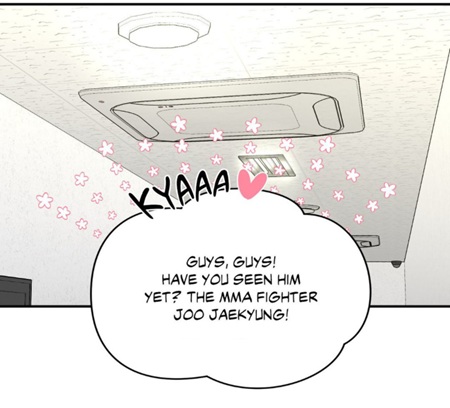 (chapter 61): fangirling over the handsome guys visiting their little town. That’s why Mingwa drew flowers in the last two images. No wonder why no one around Kim Dan is observing the bruise and his deteriorating condition. Moreover, since the physical therapist has a relative at the hospice, the staff is envisioning that Shin Okja is doing “her work”, she is paying attention to Kim Dan’s mental and physical conditions. On the other hand, there is no doubt that the grandmother has already delegated her own responsibility onto others, Kim Dan and the hospice. It is a medical institution, therefore they should pay attention to his working conditions. In other words, since no one feels responsible for the protagonist’s health, no one is worried about Kim Dan at all. At the end of episode 61, he is even so pale and breathless
 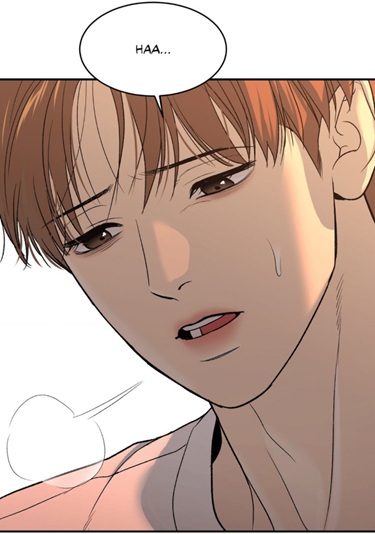 (chapter 61) that I am anticipating a terrible incident leading to a rude awakening for everyone.
Furthermore, the bruise (chapter 61) also reflects Kim Dan’s personality—marked by his selflessness, deep-seated low self-esteem and sacrificing tendencies. His inability to prioritize his own well-being is a recurring theme throughout the story, and it is intrinsically linked to his perception of self-worth. Conditioned by his upbringing, he has internalized the belief that his existence is burdensome, reinforcing his tendency to endure pain in silence. The fact that he was never taken to a doctor only strengthened his negative self-perception—medical care was seen as an expense he was unworthy of, a burden his grandmother should not have to bear.
The doctor’s bruise and Shin Okja’s education
In reality, Shin Okja’s supposed sacrifices were not genuine acts of selflessness but a carefully maintained illusion. While Kim Dan grew up believing she had given up so much for him, the truth was that she consistently prioritized herself, shaping his perception of responsibility and guilt. By neglecting his health, she subtly ingrained in him the notion that he was undeserving of care, further reinforcing his compulsion to sacrifice himself for others. This duality—the physical fragility of his health and the emotional scars of a neglected childhood—underscores the profound symbolic weight of the bruise, marking not just his external injuries but also the wounds inflicted upon his psyche.
Furthermore, in Chapter 61, (chapter 61) Shin Okja offers her yogurt to Joo Jaekyung, expressing concern over his weight loss. This small act of care stands in stark contrast to her treatment of Kim Dan, who has visibly suffered from weight loss and paleness too. In season 2, she no longer asked him if he would eat or if he desired to eat the yogurts.
Her neglect does not merely stem from past interactions, such as when Kim Dan dismissed her offerings, claiming he was no longer a child. It is rooted in a deeper belief that her responsibilities toward him have ended.  (chapter 47) For Shin Okja, raising him to adulthood marked the completion of her duty, and his current struggles are no longer her concern. This perspective becomes evident in her words from Chapter 57, where she tells him, he can’t stay here forever, and it’s not like he’ll stick around after she dies.
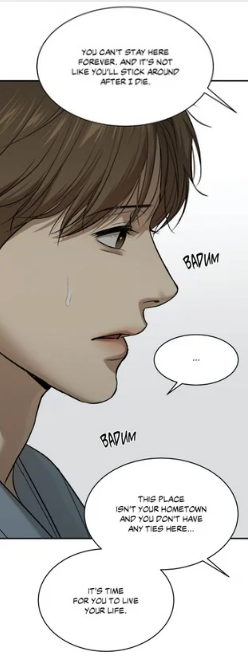 (chapter 57) By declaring that Kim Dan is now responsible for his own life, she emotionally detaches herself, absolving herself of any accountability for his deteriorating condition. However, she is forgetting
  (chapter 56) that she is still relying on him, as he is the one paying her hospice bills. Besides, she still doesn’t know that the loan is no longer existent. It was, as if he had to clean up her mess before her death. At no moment, she asks about the loan or the doctor’s future. She is not thinking about his future at all.
Moreover, Shin Okja’s earlier acknowledgment of Kim Dan’s worsening health condition (chapter 57) —coupled with his refusal to heed her concerns 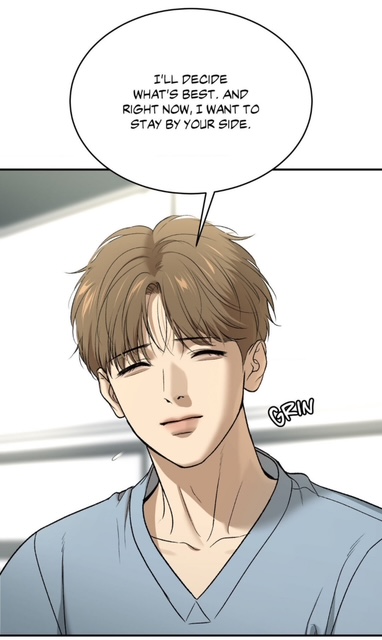 (chapter 57) — reinforces her conviction that she has fulfilled her role. In her mind, his rejection of her advice places the burden of care entirely on him, allowing her to dismiss any further involvement. This emotional withdrawal directly connects to the symbolism of the bruise: (chapter 61) it signifies not only Kim Dan’s physical neglect but also the absence of meaningful support from those who should care for him. The bruise becomes a manifestation of his grandmother’s abdication of responsibility, leaving him to bear the weight of his sacrifices alone, even as his health visibly deteriorates.
The bruise also holds significance in the context of the debts.  (chapter 18) In episode 18, when Joo Jaekyung confronts Kim Dan about the loan, the doctor has a bruise on his left eye, symbolizing his entrapment and helplessness. This earlier injury highlights how Kim Dan has been conditioned to view himself as responsible for burdens that are not his own, perpetuating a cycle of sacrifice and self-neglect. And a new bruise appeared just after the athlete reminded the physical therapist of his past promise:
  (chapter 61) His grandmother’s disregard for his well-being amplifies the injustice of this situation; she allowed him to shoulder the debt despite knowing it was never truly his to bear. The bruise becomes a recurring motif, a visual representation of how others have imposed their responsibilities on Kim Dan, leaving him physically and emotionally scarred.
Shin Okja’s role in Kim Dan’s life is pivotal in understanding his psyche. Her methods of control were often passive-aggressive, characterized by guilt-tripping and emotional manipulation. In flashbacks, we see her imposing adult responsibilities on Kim Dan at a young age, reinforcing the idea that he must grow up quickly to alleviate her burdens. This dynamic is exemplified in Chapter 47, where she remarks, “You still have a lot of growing up to do, don’t you?” (chapter 47) In Chapter 57, Shin Okja’s detachment becomes more evident as she advises Kim Dan to leave the hospice. (chapter 57) These words strip Kim Dan of any sense of belonging or familial connection, further isolating him. Her suggestion that he move on reflects her mental and emotional withdrawal from him, leaving him adrift. This detachment, however, creates an opportunity for Joo Jaekyung to step into her place. As Shin Okja relinquishes her hold over Kim Dan, Joo Jaekyung’s role in his life becomes increasingly significant. The question remains whether Joo Jaekyung will rise to the occasion, offering Kim Dan the emotional support and respect he has long been denied.
The Symbolism of the Setting
The hospice, Light of Hope, serves as a symbolic backdrop for Kim Dan’s journey. It represents both a place of healing and a stark reminder of his sacrifices  (chapter 60). The juxtaposition of the vibrant environment with Kim Dan’s deteriorating health underscores the neglect he faces. The hospice is meant to be a sanctuary, yet it becomes a space where Kim Dan is further burdened by the champion and his grandmother’s expectations (chapter 61) and the weight of his past.
The setting also reflects the champion’s role in Kim Dan’s life. Joo Jaekyung’s presence at the hospice symbolizes a potential turning point (chapter 61), where Kim Dan might finally confront his suppressed emotions and begin to heal. However, the pivotal detail lies in where Joo Jaekyung first notices the bruise on Kim Dan’s arm—not within the hospice but outside, in front of the building. This distinction is significant, as it suggests that Kim Dan’s true healing will not occur within the confines of the hospice itself, but in the broader expanse of nature, away from the constructed sanctuary. It hints at a deeper connection to the natural world as a source of renewal and recovery, a theme subtly woven into Kim Dan’s earlier reflections.
The imagery ties back to Kim Dan’s own words about Joo Jaekyung: 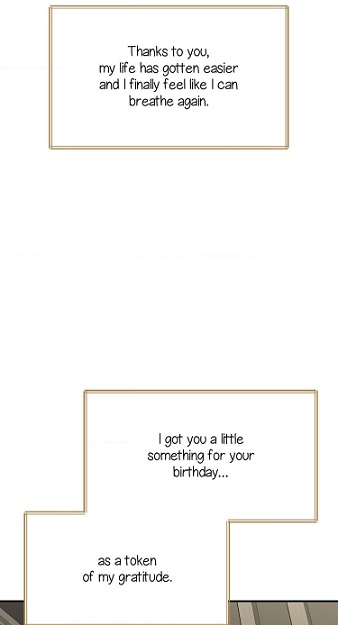 (chapter 55) This line “I finally feel like I can breathe again”, written by Kim Dan, reveals a subconscious acknowledgment that his relationship with the champion represents a breath of fresh air, a chance to escape the suffocating expectations and burdens he has carried for so long. The bruise, a physical manifestation of his struggle, signals the breaking point of his role as a selfless caregiver. It challenges the illusion of invulnerability that Kim Dan has maintained and forces those around him to confront his vulnerability.
Furthermore, this notion of healing outside the hospice aligns with the setting of Kim Dan’s unconscious cry for help—the beach. His suicidal disposition in that scene reflects a desperate need for release, a yearning for an escape that the structured environment of the hospice cannot provide.  (chapter 60) The beach, with its open and untamed expanse, symbolizes freedom and a return to the self. It foreshadows that Kim Dan’s true journey toward healing will require him to step outside the roles and confines imposed upon him, finding solace not in what is expected but in what feels authentic and liberating.
The Burden of Debts and Sacrifice
Kim Dan’s relationship with the debts encapsulates his conditioned belief that he must bear burdens alone. 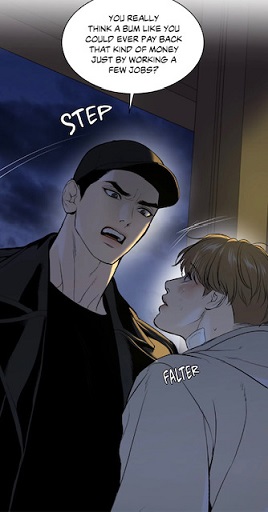 (chapter 18) His grandmother, Shin Okja, played a significant role in this mindset by fostering the illusion that hard work and sacrifice would erase the debts. However, as revealed in episode 18, this was a lie. Shin Okja made the choice to take on the loan and not to seek help
 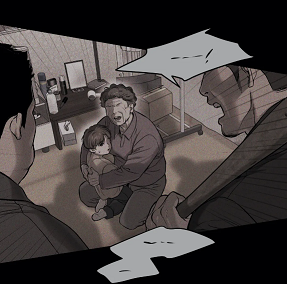 (chapter 5), yet she burdened Kim Dan with it, using his sense of duty and gratitude against him. Her statement in episode 57 (chapter 57) —“This place isn’t your hometown, and you don’t have any ties here”—further reinforces the emotional distance she has always maintained, treating him more as an obligation than family. However, she is forgetting that as a senior, she still has obligations towards her grandson.
Joo Jaekyung’s decision to pay off the loan (chapter 18) in Episode 18 introduces the theme of gratitude  (chapter 18) —or, more accurately, the lack thereof. The champion’s actions were motivated by a desire to help
  (chapter 18), hence the star was waiting for a smile from Kim Dan. Yet the latter perceived it as meddling. His immediate response (chapter 18) —shock, disbelief, and rejection—revealed his inability to accept help. This reaction stems from his upbringing, where he was conditioned to equate self-worth with self-reliance. Even after moving into Joo Jaekyung’s penthouse, Kim Dan insisted on repaying the loan
  (chapter 53), leaving a note when he moved out that promises to settle the debt. However, by Episode 61, Kim Dan is no longer mentioning the debt, signaling a shift in his priorities and a possible breaking point in his adherence to his grandmother’s expectations. (chapter 61)
Kim Dan’s lack of gratitude toward Joo Jaekyung also stems from a deeper existential crisis. When the champion repaid the loan, he unknowingly deprived Kim Dan of what had become his sole purpose in life: assisting his grandmother. 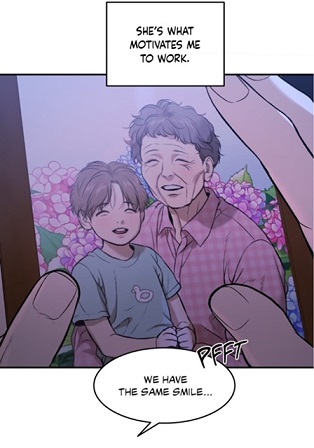 (chapter 47) The physical therapist’s entire existence had revolved around fulfilling her needs, from managing the debt to taking care of her health. With her now approaching death and actively pushing him away, Kim Dan is left grappling with a profound sense of meaninglessness.
 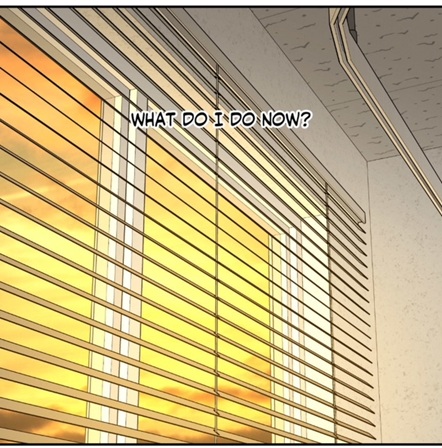 (chapter 60) He had never been given the opportunity to develop dreams or ambitions of his own, as his life was entirely defined by his grandmother’s circumstances. This lack of agency further explains his rejection of Joo Jaekyung’s generosity in Episode 18 and his later promise to reimburse the loan. Clinging to this promise was Kim Dan’s way of creating purpose and meaning in a life that had otherwise been dictated by others. It highlights how deeply entrenched his self-sacrificing tendencies are, as even his attempts to assert independence are rooted in his conditioned need to serve others. That’s why I come to the following prediction. Kim Dan needs to get confronted with illness and death (he could lose his life) so that his will for life comes to the surface. Right now, he imagines that since he is young, he will outlive his relative, but the death of the puppy was a warning to him that youth is no guarantee for a long life.
  (chapter 59) Death can take away anyone and at any moment. In my eyes, if Joo Jaekyung uses his own body to save the doctor again (like for example blood transfusion and CPR), this time Kim Dan would feel truly grateful towards the champion. So far, the doctor has not recognized the star as his savior yet. By removing the needle, he denied the protagonist’s intervention on the beach:
  (chapter 60) Hence his arm got bruised. The contusion was a reminder that something had happened during that night, but Kim Dan chose to ignore the incident. He never questioned why he was on the beach, he acted, as if Joo JAekyung had lied.
  (chapter 60)
The Hypocrisy of Gratitude
Kim Dan’s inability to express gratitude towards Joo Jaekyung is rooted in the hypocrisy of his situation. 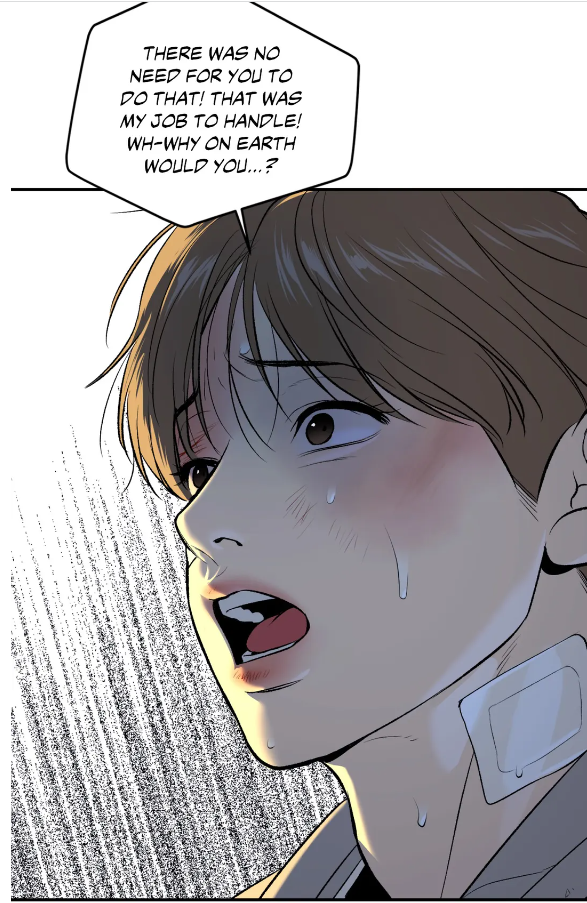 (chapter 18) Deep down, Kim Dan knows that the debt was never truly his responsibility, making it difficult for him to view the champion’s actions as a genuine act of kindness. This inner conflict is compounded by his suicidal disposition, which renders the concept of repaying the debt meaningless.
Additionally, Kim Dan’s relationship with gratitude is further complicated by his grandmother’s influence. Shin Okja used pity 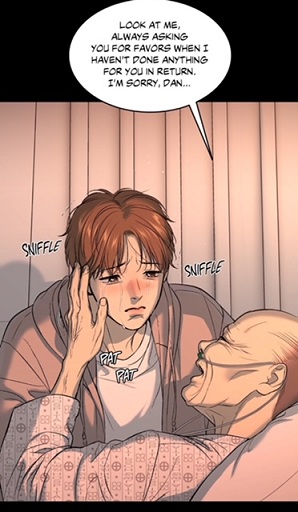 (chapter 53) and guilt to manipulate Kim Dan into fulfilling her wishes, framing his sacrifices as acts of love and duty. Her neglect and disregard for his well-being, even as he deteriorates physically and emotionally, highlight her selfishness. Through his past memories, readers can get a glimpse of his misery.
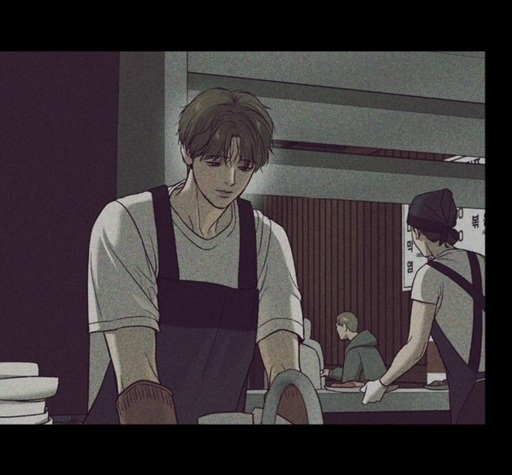 (chapter 59) He worked so hard, was even beaten, but he could never voice his torment.
  (chapter 59) Why? It is because the grandmother was no longer by his side and she never talked to him either. The absence of communication indicates her lack of interest in Kim Dan. And it becomes comprehensible why during that night, he felt the need to go to the ocean and drown himself. It is because he was gradually realizing his loneliness. With his relative’s death, he would only keep living a terrible life determined by work and nothing else.
And because Kim Dan made the promise to the champion to reimburse him, it is clear why the fighter reminded him of the “unpaid debt” after their reunion. 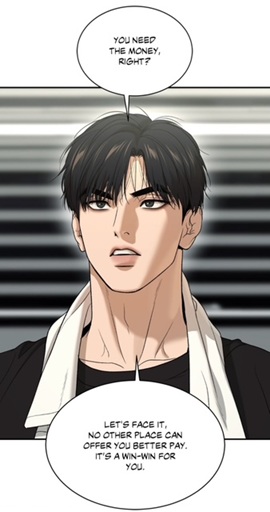 (chapter 60) (chapter 60) Since Kim Dan had not accepted the fighter’s generosity and even reaffirmed the need to pay back the “loan”, Joo Jaekyung imagined that his fated partner was very principled about money. The latter was used to drive an edge between them. However, the MMA fighter made a terrible mistake at the hospice. With his remark (chapter 60), he created the impression that he was impatient, expecting to be paid back, and as such his past generosity was in truth fake. He never desired to assist the doctor with this problem. And note that from that night on, the physical therapist is no longer bringing up the topic of the unpaid debts. (chapter 61) In my opinion, the physical therapist has now internalized that he is not responsible for the unpaid debts. It is only a matter of time, until Kim Dan confronts the fighter with his biased prejudices
  (chapter 11) and even uses his own words against him:
  (chapter 22) The loan was the result of his grandmother’s decision. He never helped him, rather his grandmother.
The dynamic between Kim Dan and Joo Jaekyung also reveals the former’s hypocrisy. Despite feeling trapped and powerless, Kim Dan had choices. He could reveal the truth to the athlete, when he begged for his help:  (chapter 11) However, he never explained his circumstances to the generous athlete. By keeping him in the dark, he reinforced his negative disposition about the doctor. And chapter 61 exposes this reality. His suffering was the result of his own decision.
 (chapter 61) Do you recognize the room? That was the doctor’s
  (chapter 19)
  (chapter 53) His decision to allow Joo Jaekyung into his bedroom in episode 61 demonstrates that he consented to the relationship, even if begrudgingly.
 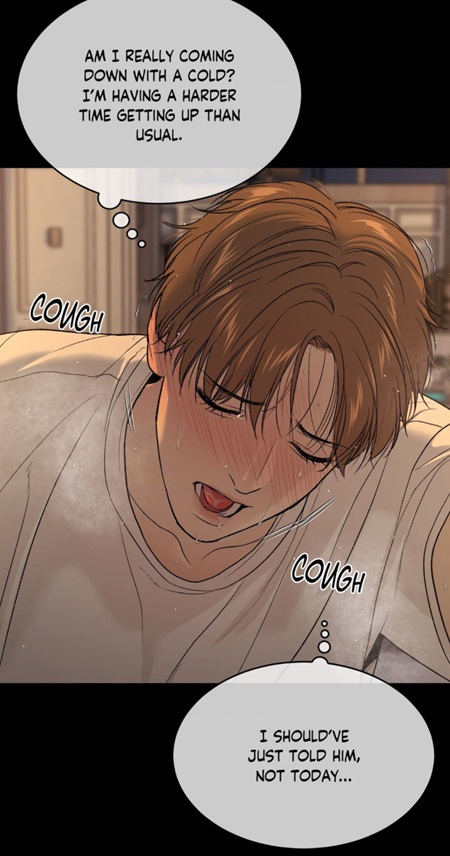 (chapter 61) However, his reaction afterward (regret) suggests that he struggles to take ownership of his choices. The fact that he recalled this sex scene in the restroom divulges a certain resent towards the athlete. The latter abandoned him right after their interaction. Hence I come to the following deduction. In reality, he is projecting his frustrations onto Joo Jaekyung, masking his true feelings about his grandmother, who is the root cause of his conditioned self-sacrifice. And this observation brings to my next remark. People wondered when this intercourse took place. One might think that this took place rather early in the story because of the way Joo Jaekyung acted. He didn’t remove his pants
 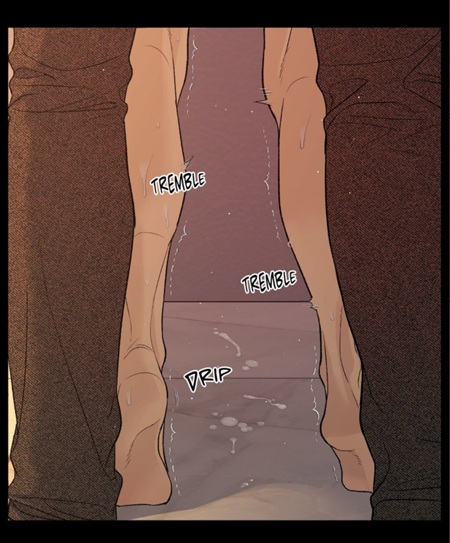 (chapter 61) and acted like in episode 6.
  (chapter 6) or 8
  (chapter 8) where he would abandon the protagonist right after the climax and not care about his partner’s conditions and feelings:
 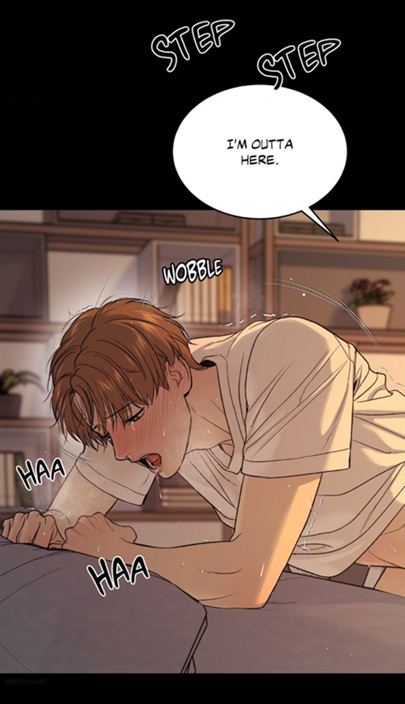 (chapter 61) I might be wrong, but for me, it took place much later in the story, around the time the athlete was about to face Alfredo. Why? First notice that they had sex in the doctor’s bedroom. This means that Kim Dan was already living in the penthouse. The words from the champion implied that he would return to his own bedroom, where the doctor’s thoughts implied that he was standing close to his bed. However, so far, they only had sex in the champion’s bedroom, when it was the evening before the match:
 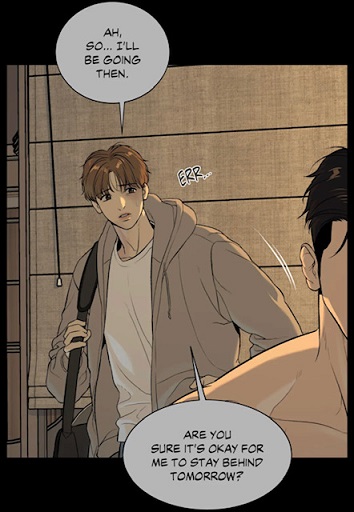 (chapter 13) Since the doctor mentioned that a match was right around the corner
  (chapter 61) It leaves us four possibilities. Randy Booker, Dominic Hill, Alfredo
  (chapter 47) and Baek Junmin. However, for the intercourse took place in the doctor’s bedroom (he wished to be carried to his own bed) (chapter 61), I am already excluding Randy Booker. Secondly, this sex session can not have taken place before his match with Dominic Hill
  (chapter 36), for they had sex every day. However, in episode 53, we discover their night before the match against the Shotgun
 (chapter 53) So this scene can only have taken place in chapter 47, when the match with Angelo got canceled and Kim Dan had been confronted with the terrible news about his terminally ill grandmother.
  (chapter 47) In the previous part of this essay, my avid readers could see the strong parallels between 61 and 47. But there exists another reason why I am inclining to think that the sex scene took place later in the story. It is because during that “magical night” (44), Kim Dan learned the notion of “consent”.
 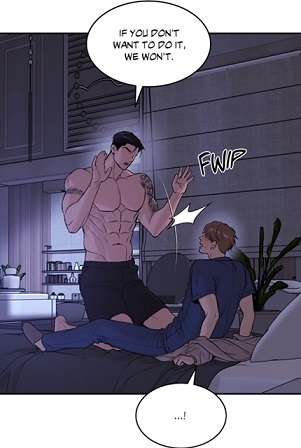 (chapter 44) During that blue hour, Kim Dan discovered that he could say no! And notice that in his memory, he clearly thought that he could have rejected the athlete’s advances. (chapter 61) The other reason for this theory is Park Namwook’s advice at the gym:
  (chapter 46) He should mistrust the members from the gym and keep his distance from people. So during that time, Joo Jaekyung did follow his hyung’s advice
  (chapter 47), yet I can’t imagine that this man could become abstinent like in episode 19. Hence at some point, he must have felt the urge to possess Kim Dan, a mixture of fear and dominance. He imagined that way that he could impose his will onto the doctor and control his “loyalty”. With this submission, he would force the doctor to remain by his side. But naturally, this sex as “power play” could increase the gap between the main leads.
Interesting is that in episode 53  (chapter 53) doc Dan was copying the champion’s behavior from episode 61. Right after the sex, he would leave the bed and return to his bedroom. How did Joo Jaekyung recall this night?
 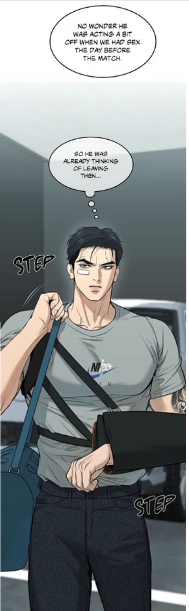 (chapter 53) He saw his attitude as a sign of disloyalty and “abandonment”. And that’s how Kim Dan is feeling in the restroom:
  (chapter 61) The darkness around the eyes is a metaphor for his resent and anger. And the moment you contrast the two memories (53 and 61), you can detect the hypocrisy of the two main leads. They only recall scenes where they were hurt and felt betrayed. However, in reality, they were both victims and perpetrators, because none of them chose to open up and talk to each other. Why? It is because both chose to listen to their “guardian” and their “favor”. Like mentioned before, in a quarrel, no one is right and wrong. The purpose of an argument is to listen to the counterpart and view incidents from their perspective. Finally, the physical therapist’s recollection serves as an important evidence that he had never been powerless and helpless. He could have refused all the time because their deal was never official.He could have used the contract as a shield. But the best evidence of Kim Dan’s power is this rejection:
  (chapter 61) I had already pointed out the increasing resistance and resilience from Kim Dan in episode 60:
 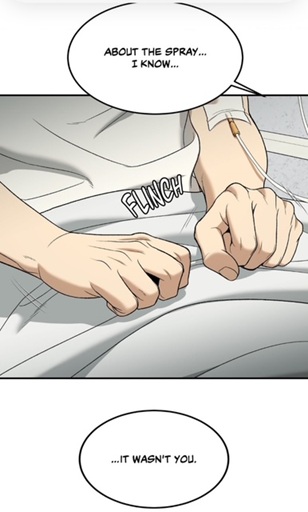 (chapter 61) My prediction came true. In the past, he could have denied the existence of the deal, Joo Jaekyung was free to seek another physical therapist. He never realized that he had some leverage. Yet he still followed the athlete’s requests. He saw himself bound by obligations. However, this was just an illusion. Hence in episode 61, we see him legitimating his consent that there was an imminent fight. (chapter 61) This shows that he always used others to justify his choices. That way, he could portray himself as a dutiful and loving person, while his sacrifices would all go unnoticed.
The doctor’s fate: a reflection of Joo Jaekyung’s life
Kim Dan’s bruises are more than just marks of exhaustion and overexertion; they symbolize the way his body is used for the benefit of others.  (chapter 61) He is expected to work despite his declining health, his suffering dismissed by those around him. (chapter 61) His well-being is secondary to business interests, whether it be the hospice director valuing money and PR over his need for rest or Joo Jaekyung imposing additional strain despite knowing better. Every bruise on Kim Dan’s body is a reflection of a system that prioritizes productivity over humanity.
This, however, mirrors Joo Jaekyung’s own existence.  (chapter 40) He is paid to receive bruises, to push his body past its limits
 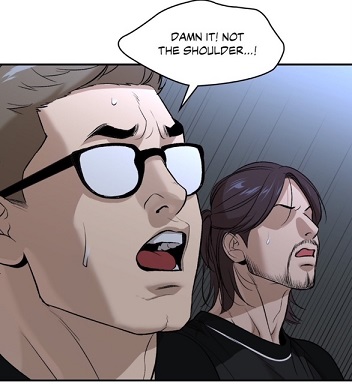 (chapter 50), to endure pain while the public watches and profits are made. His suffering is entertainment, a spectacle that fuels the business of MMA. Though he is a champion, he is still a commodity, expected to perform regardless of his condition.
  (chapter 61) He understands, better than anyone, what it means to be physically used for the sake of others, yet he remains blind to the fact that he has placed Kim Dan in the same position. While one has no file about his health condition, the other has many files, but they are not studied, because this would push the manager to question his decision and even ruin the business:
 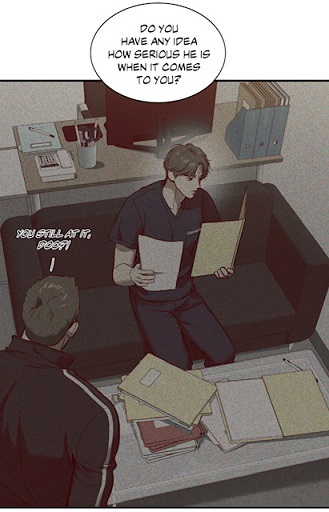 (chapter 17) I doubt that Park Namwook studied them, and notice that the recently hired PT didn’t ask for the champion’s files first:
  (chapter 54) Thus I deduce that the champion’s files are in reality a subterfuge. They give the impression that the doctors and Park Namwook truly care for his well-being, but it is not correct. They are only interested in his body because of wealth and reputation. But let’s return our attention to episode 61 and the champion’s attitude towards Kim Dan.
The hypocrisy is undeniable. (chapter 61) Joo Jaekyung pressures Kim Dan to work through his pain, (chapter 61) despite living a life where he is forced to do the same. He became what he despised—someone who forces another to sacrifice their well-being for business. (chapter 60) The reality is, both of them exist in a world where their worth is determined by what their bodies can endure. Kim Dan’s value is measured by his ability to work, just as Jaekyung’s is determined by his ability to fight. They are both trapped in a system that demands their suffering for profit, used by those in power who see them as tools rather than individuals.
If Joo Jaekyung fails to recognize this parallel, he will only perpetuate the very cycle that has shaped his own pain. But if he does, it could be the key to not only freeing Kim Dan from this exploitation but also breaking himself out of the same cycle. The question remains: will he see the truth before it’s too late?  (chapter 54) It is clear that the manager wants Joo Jaekyung to return to the ring as soon as possible to erase the last “debacle”. In my opinion, the doctor’s illness could serve Joo Jaekyung as an excuse to delay his return to the ring and even not to accept the next challenge.
A Caregiver’s Identity
Kim Dan’s choice to rent from an elderly landlord  (chapter 57) is another manifestation of his conditioned role as a caregiver. By living with an older man, he creates the illusion of a familial bond, mirroring the dynamic he shared with his grandmother. This decision highlights his struggle to break free from the identity imposed on him—one defined by servitude and selflessness. He assumes that he should take care of the landlord, offering to cook and expressing guilt for not fulfilling this perceived duty. Yet, the landlord subtly challenges this narrative. By inviting Kim Dan to eat breakfast
 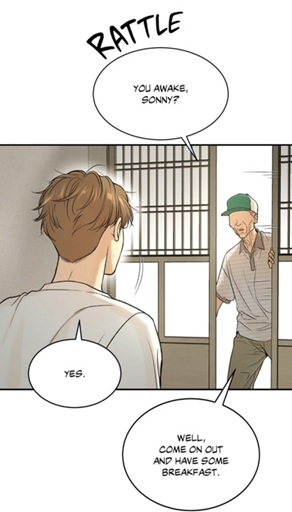 (chapter 57) and dismissing his apologies, the landlord treats him as an equal rather than a caretaker. This dynamic forces Kim Dan to confront his false perception of himself.
The landlord’s care, though understated, contrasts sharply with Kim Dan’s expectations. In Episode 57, the landlord observes Kim Dan’s declining health and attempts to address his drinking habits.  (chapter 57) Despite this, Kim Dan rejects the advice, demonstrating his resistance to being cared for. This moment underscores his internal conflict—he craves independence yet clings to the role of the selfless provider. The landlord’s actions expose the fallacy of Kim Dan’s identity, revealing that his caregiving is not always necessary or effective.
Kim Dan’s Transformation: From Self-Sacrifice to Self-Awareness
Chapter 61 marks a significant shift in Kim Dan’s psyche—he begins to view himself with self-pity. That’s why he recalled the sex in the restroom. (chapter 61) He was not feeling well, yet the champion still demanded to have sex with him. (chapter 61) However, like pointed out above, he could have objected and even explained the situation. But no… he chose silence and submission in the end. This exposes the long internalized belief that Joo Jaekyung is stubborn and won’t listen or even get angry. Moreover, it is related to the grandmother’s education which privileged money, obedience, silence and taboo. However, the recollection  (chapter 61) is indicating the increasing resent and anger towards the star. Joo Jaekyung is no longer seen as a celebrity and idol, but as a inconsiderate man. This transformation is subtle but meaningful, as it reflects his burgeoning awareness of his own worth and the unjust treatment he has endured. For the first time, Kim Dan acknowledges himself as pitiful (chapter 61), a clear departure from his habitual role of unquestioned self-sacrifice. This moment signals the emergence of a new identity, where Kim Dan starts “treasuring” himself, even if only as someone who deserves more respect than he has been given. In his recollection, he has a wish: to have a companion who would take care of him.
Kim Dan’s realization that he was not respected by Joo Jaekyung (chapter 61) parallels the emotional and mental detachment of Shin Okja. While his grandmother had long imposed the role of a caregiver upon him, (chapter 61) her current disregard for his health and well-being forces him to confront the fragility of his own existence. His bruised arm and poor health serve as physical manifestations of this awakening—he is no longer the tireless, invincible caregiver but a vulnerable human being who could fall gravely ill (chapter 61) or even abandon others first. 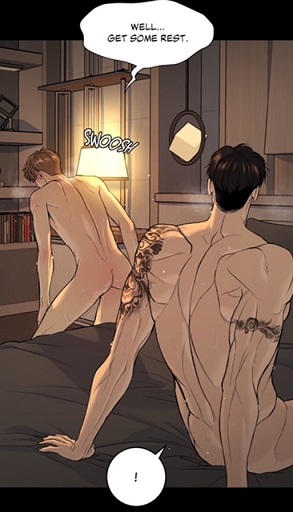 (chapter 53)
The Emotional Transition: Joo Jaekyung’s Role in Kim Dan’s Life
This transformation in Kim Dan reflects a deeper narrative shift in Jinx: the exploration of self-worth and emotional reciprocity. It signals that relationships should not be defined by obligation and sacrifice alone but also by mutual respect and care. As Kim Dan begins to recognize his own worth, the dynamics of his relationships with both Shin Okja and Joo Jaekyung are poised to change dramatically. (chapter 61) This chapter sets the stage for a redefinition of Kim Dan’s identity  (chapter 61), no longer bound by the roles others have imposed on him but shaped by his own choices and growing self-respect.
Shin Okja’s emotional detachment opens a door for Joo Jaekyung to step into her place, but this transition is contingent on Joo Jaekyung admitting his feelings for Kim Dan. (chapter 61) The physical reminder of Kim Dan’s poor health is not only a wake-up call for Joo Jaekyung but also for Kim Dan himself. It emphasizes that caregiving cannot define his identity entirely, and he too needs care and consideration.
This dynamic creates a powerful opportunity for growth in their relationship. If Joo Jaekyung is to fill the void left by Shin Okja, he must evolve from a figure of dominance to one of emotional support and genuine affection. Similarly, Kim Dan must shed the remnants of his belief that his only worth lies in what he can do for others. His growing self-awareness, catalyzed by his deteriorating health, paves the way for this mutual transformation.
The Role of Health as a Narrative Reminder
Kim Dan’s health, deteriorating as it is, serves a dual purpose. For Joo Jaekyung, it is a stark reminder of the consequences of his past neglect 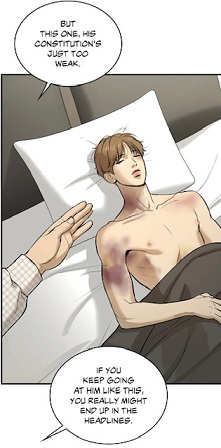 (chapter 13) and the fragility of Kim Dan’s existence. For Kim Dan, it challenges his self-perception as an indestructible caregiver. This realization could lead him to an inevitable conclusion: his own needs and well-being are just as important as those of others.
Ironically, this reversal also suggests a possibility that Kim Dan could be the one to abandon his grandmother first—not out of malice but as a natural consequence of his newfound understanding of his humanity. He wants to live, he doesn’t want to die now. His physical limitations and emotional exhaustion could compel him to prioritize his own survival over the expectations imposed on him, marking a definitive break from his past.
To conclude, Kim Dan’s deteriorating health presents a pivotal moment in his journey, marking a potential shift from mere survival to truly embracing life. His identity, long defined by caregiving and sacrifice, could face a profound challenge if his condition worsens, forcing him into a role of dependency. Joo Jaekyung’s role in this transformation could be equally transformative. Witnessing Kim Dan’s vulnerability might inspire the champion to step into the role of a true caregiver, fostering a deeper emotional connection between them. This shift would starkly contrast Kim Dan’s relationship with his grandmother, where care was one-sided and manipulative. Instead, it could establish a foundation of mutual respect and shared responsibility, breaking the cycle of transactional relationships that have defined Kim Dan’s past.
Ultimately, Kim Dan’s illness could become a catalyst for healing—not just physically but emotionally—for both him and Joo Jaekyung. It sets the stage for a relationship rooted in genuine care and respect, underscoring the broader theme of personal growth and the rediscovery of self-worth.
Conclusion
“Bruised by Choices, Bound by Sacrifice” encapsulates the complexities of Kim Dan’s character and his relationships. The recurring motif of the bruise serves as a powerful symbol of his struggles, reflecting both his physical pain and the emotional scars left by his upbringing. The debts, gratitude, and the hospice setting further illustrate how Kim Dan’s sacrifices have shaped his identity, forcing him to navigate a path filled with contradictions and unspoken resentments.
This examination also underscores the profound link between silence and sacrifice in Kim Dan’s journey. His suffering largely went unnoticed not just due to external neglect but because of his own choice to remain silent. Kim Dan never expressed his thoughts or emotions, choosing instead to endure in silence to avoid burdening his grandmother. Ironically, this silence was unnecessary, as Shin Okja herself was blinded by his youth, assuming that his vitality ensured he would outlive her. This assumption prevented her from recognizing his vulnerabilities, highlighting yet another layer of neglect in their relationship.
Through this lens, Kim Dan’s journey becomes a poignant exploration of the cost of selflessness and the courage it takes to reclaim one’s agency. His silence, once a symbol of sacrifice, now stands as a barrier he must overcome to truly heal and redefine his life on his own terms. By breaking free from the constraints of unspoken expectations and misplaced gratitude, Kim Dan’s transformation holds the promise of a future where his choices are guided by self-respect and a newfound understanding of his worth.
In earlier chapters, such as Chapter 57, Kim Dan’s landlord invited him to share breakfast, showing a degree of care and concern. However, Kim Dan deflected this gesture, maintaining his self-imposed role as a caregiver. In Chapter 58, despite sitting at a table with Heesung, Potato, and the landlord, Kim Dan’s disengagement from the meal—leaving most of the chicken untouched and avoiding the rice wine—highlighted his hidden struggles with both malnutrition and alcoholism. His deliberate avoidance of the rice wine reflects an effort to conceal his drinking habits, adding another layer to his isolation.
Feel free to comment. If you have any suggestion for topics or manhwas, feel free to ask. If you enjoyed reading it, retweet it or push the button like. My Reddit-Instagram-Tumblr-Twitter account is: @bebebisous33. Thanks for reading and for the support, particularly, I would like to thank all the new followers and people recommending my blog.
 (chapter 49) This choice reflects a significant lack of trust. Even with Kim Dan as his physical therapist, someone who had already proven his skills by treating his shoulder in record time
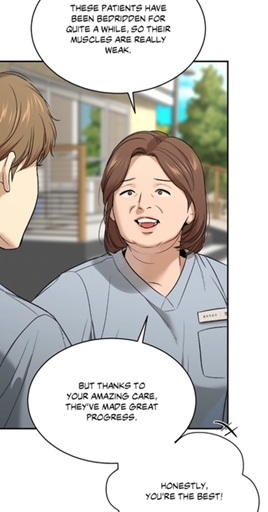
 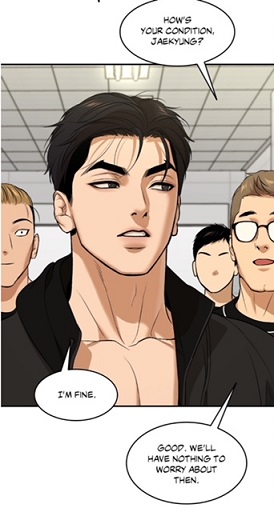 (chapter 49), Joo Jaekyung chose to rely on external medicine rather than the “power of hands” that the nurse in the hospice later praises.
  (chapter 56)
  (chapter 55) But why was he thinking like that? He came to this judgement for two reasons. On the one hand, he was recalling the physical therapist’s nightly desertions. The latter chose to work as a courier instead of focusing on his main job. Moreover, the fact that he hadn’t checked the spray right before using it
  (chapter 51) This explains why the athlete imagined that Kim Dan had resigned due to his mistake.
  (chapter 55) However, this assumption is not only incorrect but unjust, as Kim Dan’s quick and effective treatment of his shoulder clearly demonstrates the contrary.
 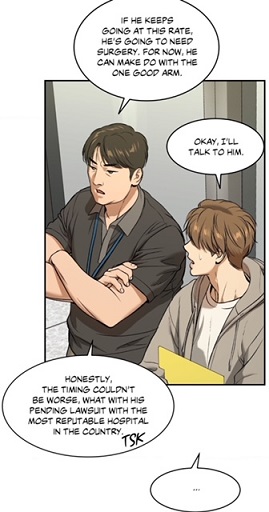 (chapter 42) Finally, note that Baek Junmin was not able to defeat the dragon despite targeting his fragile shoulder.
 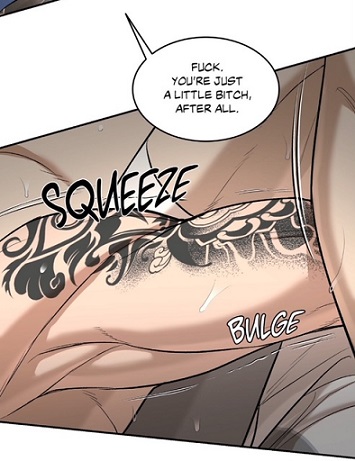 (chapter 50) The match ended up as a tie.
 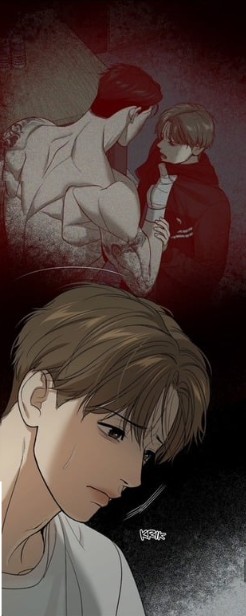 (chapter 60) and his failure to shield Kim Dan from blame. The clenched hands symbolize the internal struggle between an internal conflict between anger, indifference and lingering hurt caused by the lack of trust. What caught my attention is the sound of his jaw, KRIK, which reminded me of the star’s behavior.
 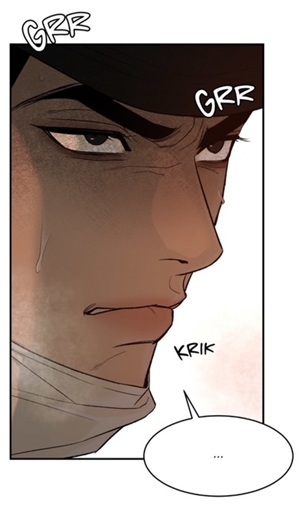 (chapter 56) This jaw’s movement symbolizes the return of instincts and as such to the champion’s true nature: he is a wolf. This means that the doctor is gradually losing his gentle nature and is on the verge of becoming a “wolf”. No wonder why he mimicked like the athlete at the end of episode 60:
 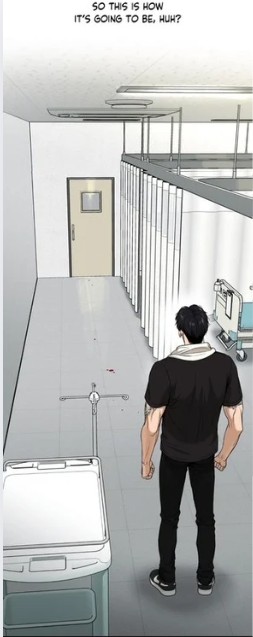 (chapter 60) He is acting like a loner wolf, whereas in reality his true personality is a hamster and duck.
  indicates that this regret is beginning to fester. While he has not yet voiced these thoughts directly to Joo Jaekyung, the flinching hands
  (chapter 52) By failing to provide a full explanation, Joo Jaekyung created the illusion that the matter was resolved. This lack of transparency leaves Kim Dan burdened with guilt and confusion, unable to find closure.
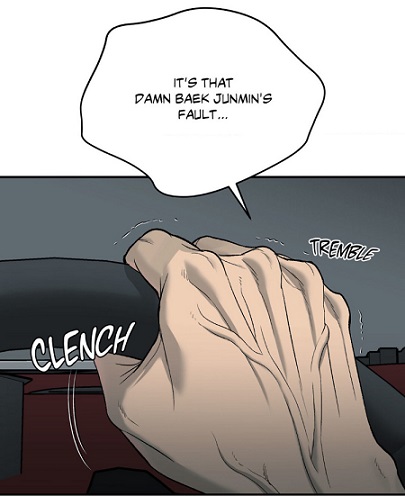 (chapter 54), he is unaware that The Shotgun was merely a pawn used by Choi Gilseok, who had larger, more manipulative intentions.
 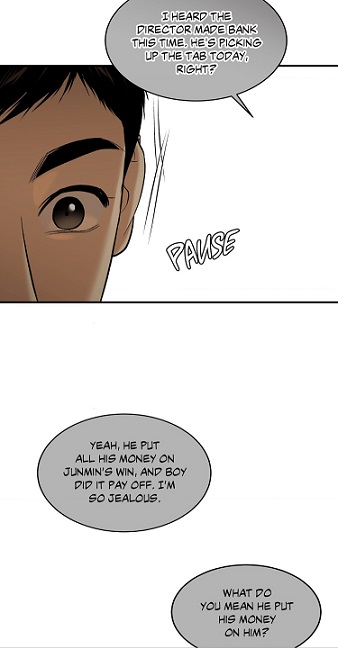 (chapter 52) I doubt that Potato told him about the director’s bet, too upset to discover the switched spray. The fighter’s ignorance mirrors Kim Dan’s in a way, highlighting how both are victims of deceit. This conversation further reflects their lack of communication, as it seems Joo Jaekyung deliberately avoids sharing his thoughts and knowledge with Kim Dan.
 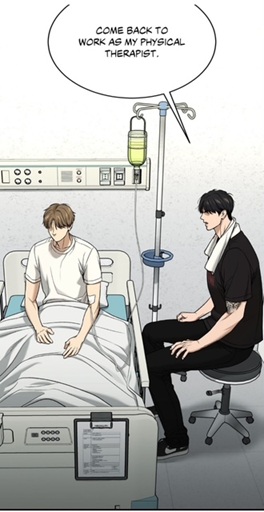 (chapter 60) also mirrors a significant scene from Chapter 52
  (chapter 52), where Joo Jaekyung’s team visits him after the surgery at the hospital. Notably, the team members only address him when they need him to take the blame for the situation. Through this comparison, I noticed another aspect. They were all standing at a certain distance from the star’s bed. This exposes that none of them had the intention to spend time there and to give company to the athlete. At the same time, their position divulges their arrogance, lack of empathy or worries! Yes, no one is assuming that the athlete’s career is in danger. They are all somehow expecting that he will return to the ring. No wonder why their focus is entirely on the job, ignoring his well-being. When Joo Jaekyung finally voices his frustration and unwell-being
  (chapter 52), he is silenced with a slap.
  (chapter 52) This interaction reveals the deeply flawed dynamics of his relationships and the toxic role models that shaped him. His coach’s behavior—reducing everything to money and silencing emotional expression—has profoundly influenced his inability to recognize his own uncaring attitude at the hospice.
 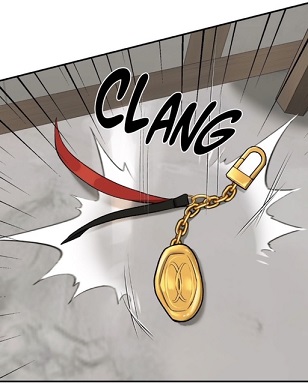 (chapter 45) After being blamed in the past, Kim Dan has reached his limit and chosen to stop engaging with Joo Jaekyung. However, this reaction risks exacerbating Kim Dan’s denial of his own mental illness, as he suppresses his emotions and isolates himself further. Contrary to the keychain, he can not be replaced. If he doesn’t get treated properly, his life could be in danger.
  (chapter 54) reveals a deeper issue: his belief that drugs can compensate for his mistreatment of his own body.
  (chapter 27) By pushing himself beyond his physical limits and refusing to allow his body to rest, he clings to the power of medication as a means to sustain his performance. The hospice setting, where medicines and drugs are not perceived as vital
 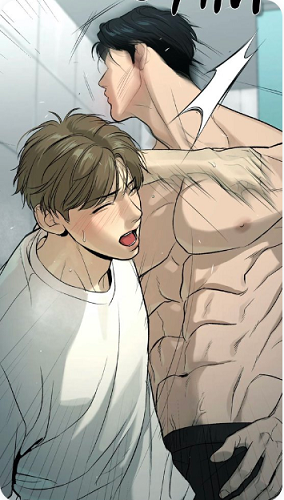 (chapter 7) and the number 62 mirrors the famous fight in episode 62:
  (chapter 26)

 (chapter 60) — challenges this notion. The photographs from episode 60 subtly introduce the fifth puppy’s death as a poignant symbol of Kim Dan’s precarious fate.
  (chapter 60) The puppy’s appearance in only one photo (the second one from left) among many mirrors Kim Dan’s fragile existence,
 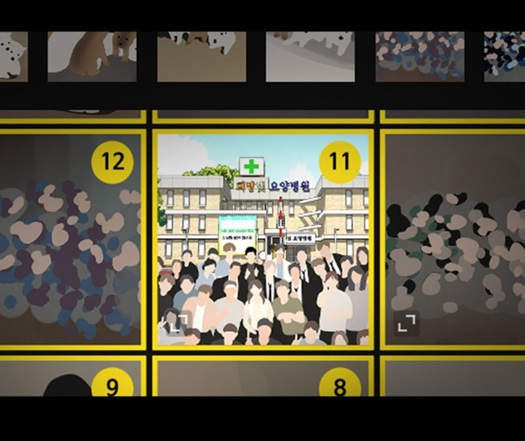 (chapter 60) deepening the parallel between them. This connection becomes even more striking when recalling that the grandmother once likened Kim Dan to a puppy
 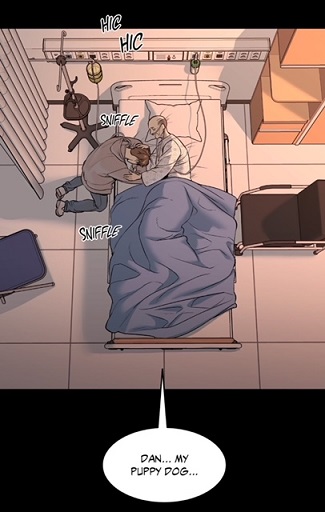 (chapter 53), emphasizing his vulnerability and dependence on others.
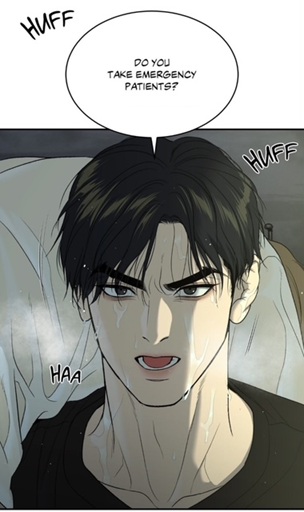 (chapter 60) reflected not only his uncertainty about whether the hospice could offer assistance but also the sheer urgency of his actions. This moment underscores the physical and emotional toll of his determination to save Kim Dan. Jaekyung risked worsening his own physical condition, driven by the hope that help would be available Yet the irony of this moment lies in the true purpose of the hospice: it is not a place for treatment or healing but a program dedicated to end-of-life care.
  (chapter 57)
 (chapter 58), such as two older women
  (chapter 58). Yes, there were two small details, yet full of meaning. Even the landlord
  (chapter 58) nicknamed “old man”
 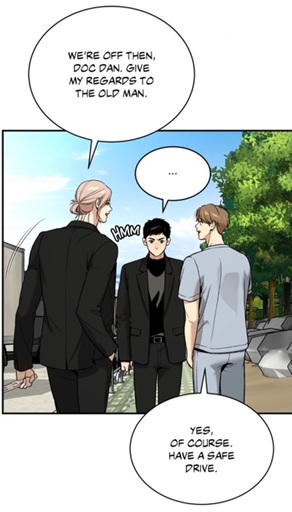 (chapter 59) by Heesung, symbolizes this demographic trend. The hospice’s focus on senior care reflects a broader societal issue in South Korea: a declining birth rate coupled with an increasing elderly population.
 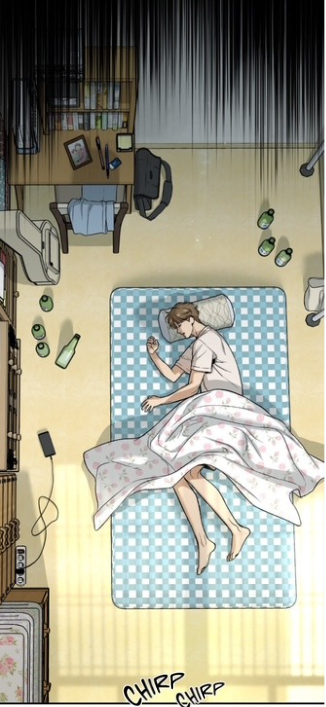 (chapter 57) In addition, the empty bedroom where Kim Dan is staying—with its untouched guitar, furniture, and books—suggests it once belonged to a teenager who left home and never returned. The unchanged state of the room symbolizes the stagnation and loss felt in these regions, further highlighting the broader societal issues at play. This shows that Jinx is not merely a classic love story; it also paints a nuanced portrait of South Korean society and its challenges. By prioritizing elder care without addressing the needs of the youth, the hospice embodies a false promise of hope—one that may ultimately exacerbate the very demographic crisis it seeks to alleviate.
  (chapter 59), indicating their capacity for medical intervention. However, this approach reveals an underlying paradox: while the hospice caters primarily to an aging population, it lacks a sustainable strategy to address the exodus of younger generations, whose departure threatens its long-term viability. This issue is further illustrated by the hospice director’s decision to allow the facility to be used as a location for a movie shoot,
 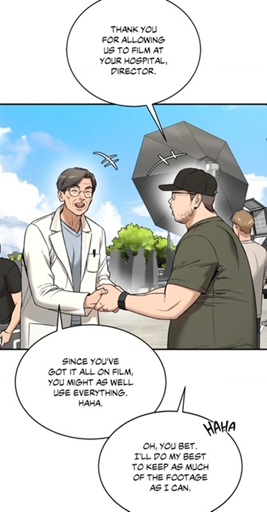 (chapter 59) seemingly as an attempt to garner attention and improve its reputation. However, relying on such strategies means any potential benefits will only materialize months later, when the movie is released. This delay highlights the limitations of the hospice’s current approach to sustaining itself. In this context, Joo Jaekyung’s presence could play a pivotal role. It is possible he may become the driving force in revitalizing not only the hospice but also the town itself, potentially pushing the director to transform the hospice into a full-fledged hospital, addressing both immediate and long-term needs of the community. And this would fit his personality, as I connected him to a dragon. Let’s not forget that in season 1, the MMA fighter was introduced as a benefactor who organized a charity event
  (chapter 41), yet we never got to hear where the money went. This potential transformation underscores the underlying complexities of the hospice’s current operations, as it navigates between providing care for the elderly and responding to broader societal challenges. By situating Jaekyung in this dynamic, the narrative subtly hints at his capacity to influence change, bridging the gap between the hospice’s limitations and the community’s evolving needs.
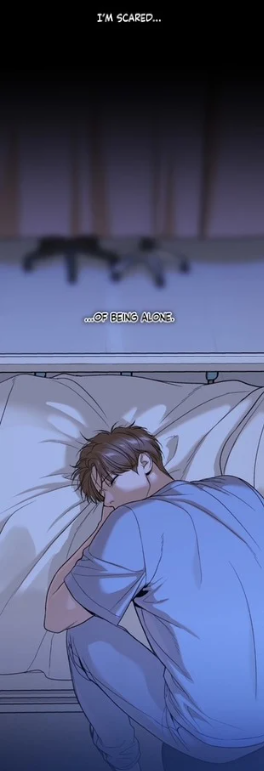 (chapter 56), particularly from his grandmother, who had promised to go to the beach with him.
  (chapter 53) However, this hope was met with disappointment
 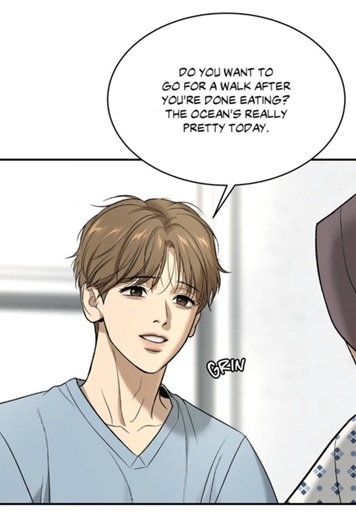 (chapter 57) – which he never expressed -, reflecting the deceptive promise of the hospice itself. Kim Dan’s fate seems to mirror not only the unnoticed death of the fifth puppy
 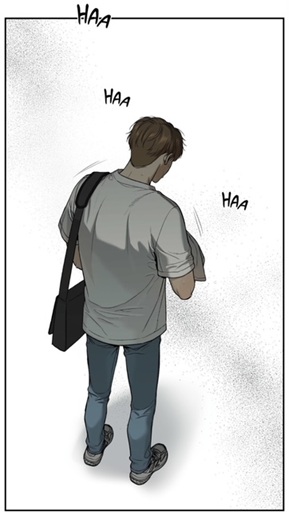 (chapter 59) but also his grandmother’s diminishing expectations of him.
  (chapter 57) However, all this time, she had been his motivation and reason to live. Once likened to a puppy, Kim Dan’s vulnerability and struggle for recognition remain central to his story, highlighting the fragility of his existence. His malnutrition, possibly linked to a deficiency in vitamin K and compounded by his alcohol dependency, exacerbates his fragility, making his situation increasingly perilous. Vitamin K, essential for blood clotting and bone health, is derived primarily from leafy green vegetables and produced by gut bacteria. A deficiency can result in symptoms such as dizziness
  (chapter 57), easy bruising
  (chapter 13), excessive bleeding and slow wound healing—all of which align with Kim Dan’s deteriorating condition and the trail of blood he left after removing his IV needle.
  (Chapter 54) Like mentioned before, this logo could be referring to a pharmaceutical company.
 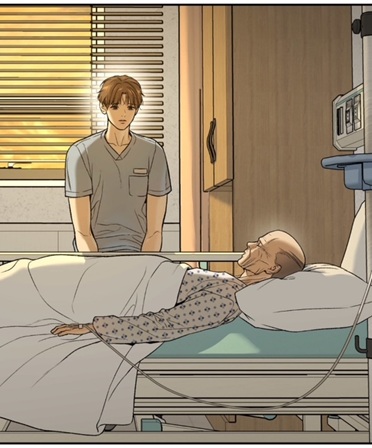 – episode 59), suggesting a temporary space for patients nearing the end of life. Moreover, observe that the colors of the curtains in the patients’ room is orange
  (chapter 56)
 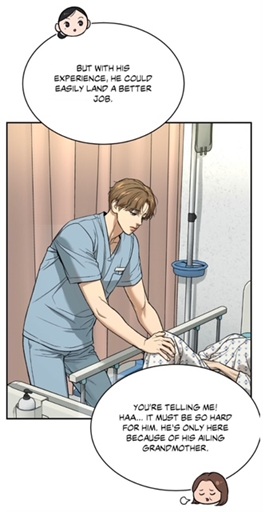 (chapter 56) and not white. This observation aligns with the assumption that this room is reserved for those on the verge of dying, shielding terminally ill patients from witnessing another’s death. 😨
  In the drama, a character searches for his CEO and friend Kang by pulling back closed curtains in an emergency room,
 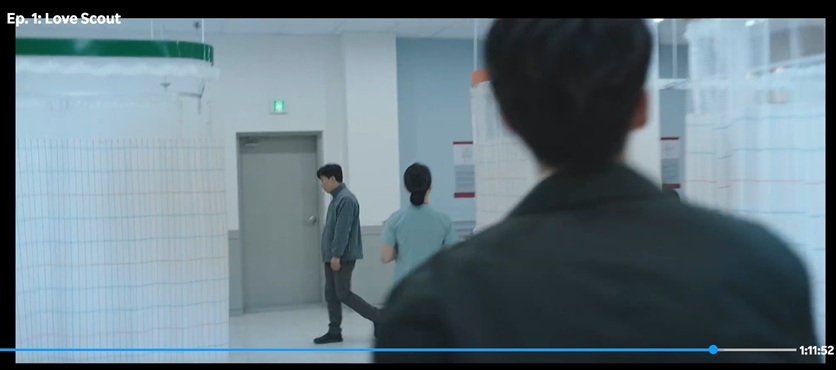 discovering different patients behind each one until finding the right person.
  This reinforces the notion that closed curtains signify the presence of others, even if their identities remain hidden. In addition, when the doctor treated the patient Park Jinchul, the curtains were closed.
 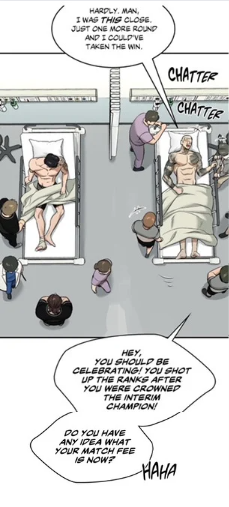 (chapter 52) to signify absence of confidentiality, contrasting with the closed-off nature of this space. This comparison not only exposes the manipulation of the staff at the health center, but also reinforces my interpretation that the emergency room at the hospice stands for danger and challenge. This detail underscores Joo Jaekyung’s assumption that he and Kim Dan are alone, but it also raises the possibility that their conversation could have been overheard by someone lying behind the curtains, such as the patient from Episode 57.
  (chapter 57) or the mysterious Park Jinchul
  (chapter 56)
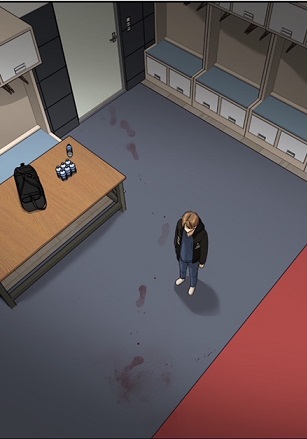 (chapter 51), they should remember that people were listening to their conversation behind the closed door, but they chose not to intervene.
 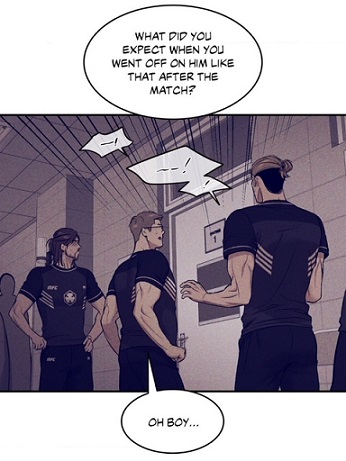 (chapter 53) That’s the reason why I am inclined to think that someone was /is present behind the curtain, but chose to remain silent. However, contrary to Team Black, such a person should intervene, if my theory is correct. And there is another evidence for this hypothesis. Since in episode 60 Joo Jaekyung offers a new contract
  (chapter 6) Nevertheless, back then, the deal was made without any witness. That’s the reason why I come to the conclusion that someone else was present in that room, yet contrary to the past, this person will intervene which stands in opposition to the symbolism of the room: death, secrecy and abandonment. And that can only be a patient who experienced the talent and care from Kim Dan. Joo JAekyung has never met any previous patient from Kim Dan before, but this is what readers got to hear from the nurse:
 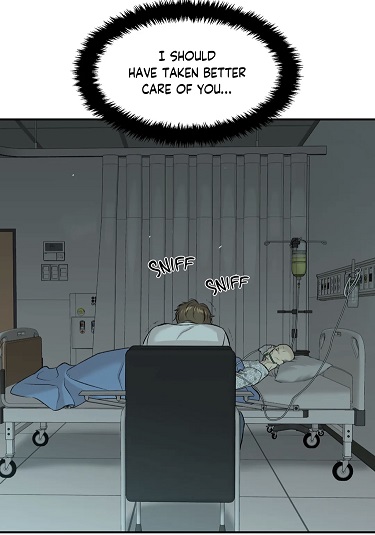 (chapter 21) which would push him to have a change of heart and show his vulnerability. What can he fear from a dying or terminally ill person? Nothing… hence he can only listen to the confidence and advice from such a patient.
 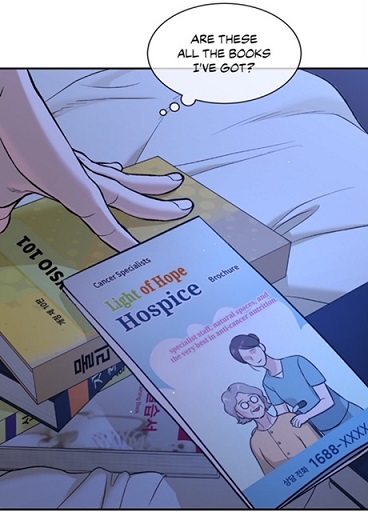 (chapter 53) is indeed an illusion and deception, for the senior on the paper is portrayed as being accompanied by a nurse. The reality is different, for the patients are facing death alone.
 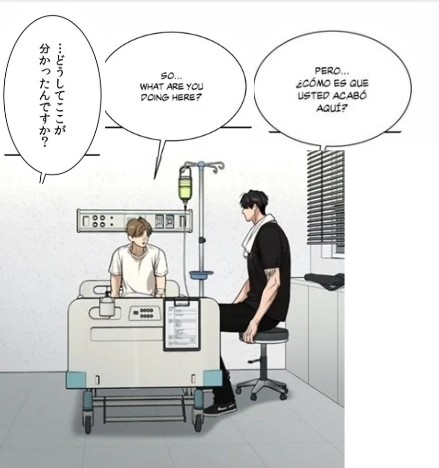 Their conversation begins with Kim Dan’s simple yet loaded question about how Jaekyung discovered his whereabouts. This moment, better captured in the Japanese, and Spanish translations, underscores Kim Dan’s curiosity and underlying desire for clarity. In the Japanese version, Kim Dan asks, “どうしてここがわかったんですか?” (“How did you find out about this place?”), while the Spanish translation reads, “¿Cómo es que usted acabó aquí?” (“How did you end up here?”). Both translations emphasize Kim Dan’s direct inquiry about how Jaekyung discovered his whereabouts, making Jaekyung’s evasive response even more significant. It is clear that he is trying to protect Potato here. However, Jaekyung’s response
  (chapter 60) immediately sets the tone for their interaction. His refusal to answer and his deliberate avoidance of Kim Dan’s gaze reflect a lie by omission. This evasive behavior not only highlights Jaekyung’s reluctance to reveal his vulnerability but also creates a significant divide between them, making it clear that they are not functioning as a unified team.
 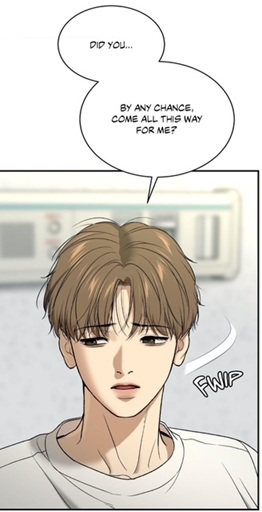 (chapter 60) Initially, he avoids Jaekyung’s gaze, signaling his own fear and insecurity. This avoidance reveals his worry about rejection and his deeper emotional vulnerability. On the one hand, he hopes deep down that the athlete would admit that he came looking for him, yet their last two interactions were arguments and rejections which the doctor didn’t forget.
 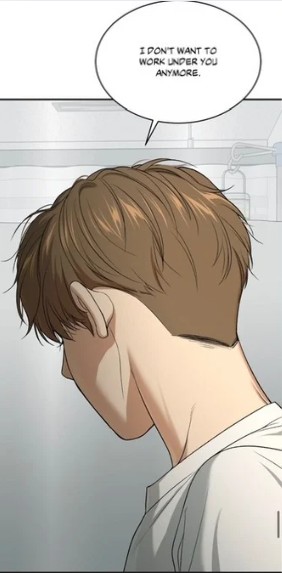 (chapter 60) He is still in love with Joo Jaekyung, but he is no longer hoping for any attachment and feelings from the fighter. On the other hand, his words are reflecting a different opinion: he is no longer trusting the athlete. This means that when the champion admitted his mistake indirectly, it was already too late.
 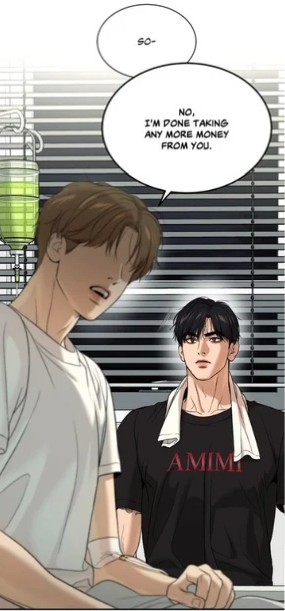 (chapter 60) He doesn’t want this fake generosity, since the athlete is reminding him of his “debts” towards him:
 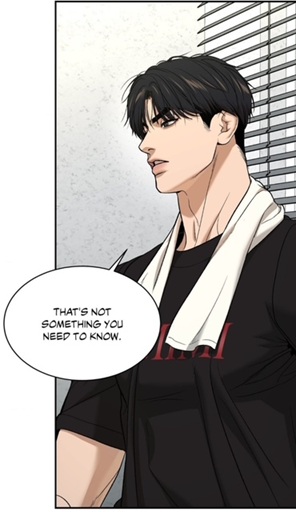 (chapter 60) This evasive remark suggests that Jaekyung believes keeping Kim Dan ignorant of his intentions is for the best. By withholding the truth, he feels he is protecting himself and Kim Dan from unnecessary burdens or complexities, reinforcing his perception that their relationship is better managed with clear boundaries. However, this attempt at concealment only deepens the divide between them, as it denies Kim Dan the clarity and emotional connection he seeks. In fact, he is not realizing that he is even afflicting more pain on his fated partner.
  (chapter 6), with Kim Dan ending up on the floor—a physical manifestation of his subservience. Later, in the locker room, both were shown facing each other
  (chapter 51), symbolizing a superficial moment of equality. In Episode 60, however, both are seated:
  (chapter 60) Kim Dan in bed and Jaekyung on a chair. Yet, this apparent parity hides a reversal of dependency. While Kim Dan is physically and mentally weaker, neglecting his own health to leave the bed,
  (chapter 42) Despite the appearances, such relationships could only deepen his wounds and reinforce his anxieties. Thirdly, let’s not forget that the athlete read the doctor’s birthday card where the latter expressed the hope to work for him for a long time:
 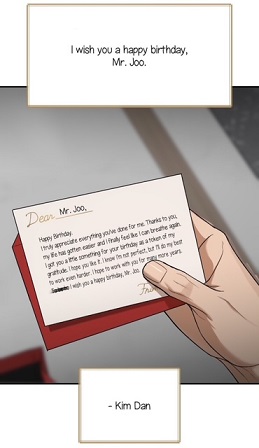 (chapter 55) That’s why he imagined that once he made his offer, the other would agree immediately. However, what he failed to realize is that he read the note too late. Besides, there were these erased words which left the fighter in the ignorance. Finally, he continues to misunderstand Kim Dan’s motivations
 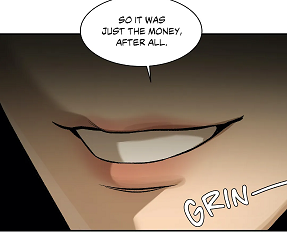 (chapter 6) Back then, Jaekyung assumed money was the sole driving force behind Kim Dan’s actions, and in the current interaction, he still believes this to be true. His internal monologue reveals this misconception:
  (chapter 60) I would even add, he believes to know Kim Dan so well, hence he mentions his grandmother:
 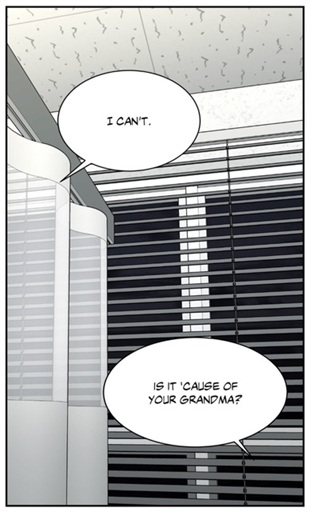 (chapter 60) However, Jaekyung is terribly wrong because he never talked to his lover. His interest and curiosity were quite superficial. Therefore he fails to grasp that Kim Dan’s longing is not for material wealth or familial obligation, but for genuine companionship and a place to call home. Kim Dan’s rejection of a boss-employee dynamic
  (chapter 60). Moreover he got to hear from the doctor that Kim Dan needed rest:
  (chapter 35) for his own “happiness”. Through Potato, the author is criticizing the attitude of fans who are only projecting their own emotions onto their idols. Their wish for happiness is quite rather superficial. This subtle oversight reflects Potato’s growing detachment, as his focus shifted to capturing moments for posterity rather than addressing the realities in front of him. The absence of the fifth puppy becomes a poignant symbol of unnoticed fragility and foreshadows Kim Dan’s own vulnerability. And how did Kim Dan react to the death of the small dog?
 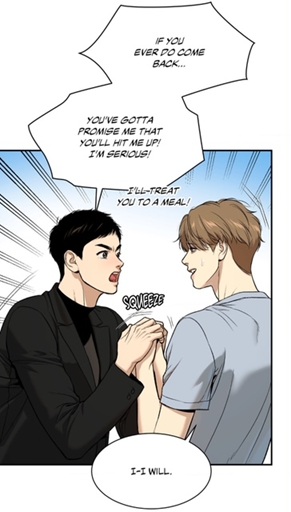 (chapter 59) Deep down, Potato does not expect Kim Dan to come back, reflecting his resignation to their fading relationship. Notably, Potato only asked for a picture of Kim Dan at the very end, never taking photos of him during their time together.
 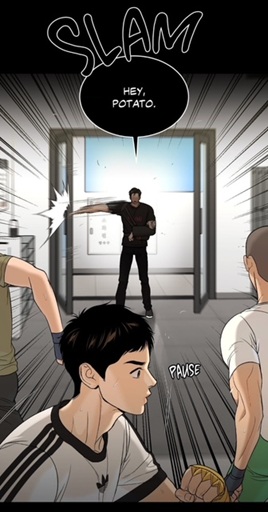 (chapter 60) When he got caught with his silence, Mingwa never showed us Potato’s justification. Yet, it becomes clear that the young fighter decided to give the following explanation: he respected Kim Dan’s wish to remain undiscovered
  (chapter 58) The reason for this interpretation is the champion’s reaction, when he was asked how he knew about his whereabouts
 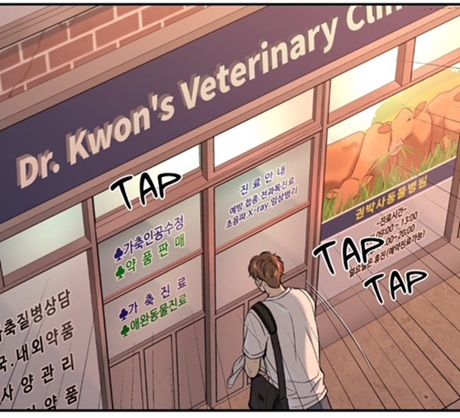 (chapter 59) and Joo Jaekyung’s rescue of Kim Dan.
  (chapter 60) Though he is the one left behind, he is not realizing that by not following him, he is failing to protect Kim Dan.
  (chapter 57) Cheolmin already warned his friend in episode 13:
 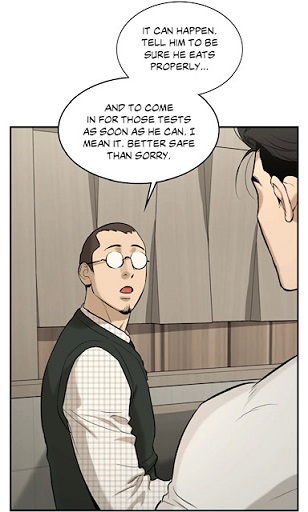 (chapter 13) But the man refused to listen to his advice, and now Kim Dan is leaving a trail of blood on the floor

 (chapter 23) Potato initially admires the champion, aspiring to be like him
 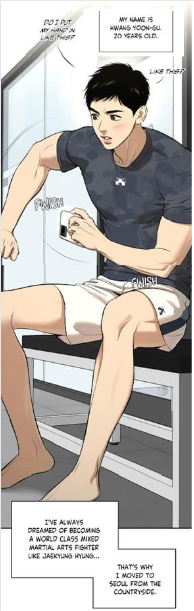 (chapter 23) and dreaming of recognition as his sparring partner.
 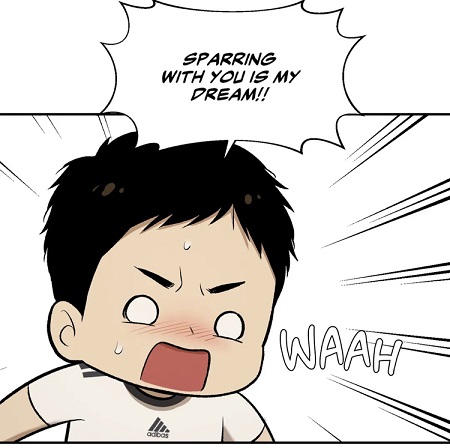 (chapter 23) Joo Jaekyung, much like the prince in Andersen’s story, projects an image that masks the reality of his life. His success, while celebrated, represents years of hard work and immense personal sacrifices. At the gym, Park Namwook undermines these efforts by slapping the athlete
  (chapter 7) and calling him “my boy,”
 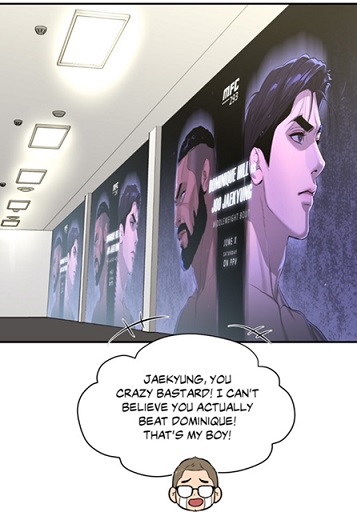 (chapter 40) effectively denying Joo Jaekyung the acknowledgment he deserves for his achievements. Potato is misled by this fabricated image
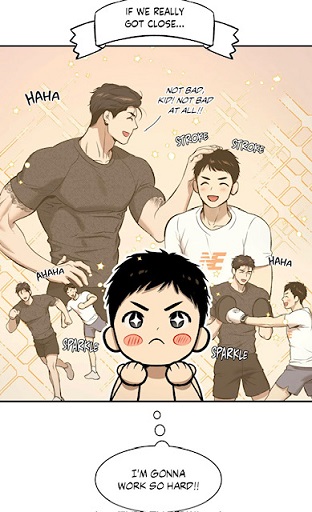 (chapter 23) without understanding the profound struggles beneath his image, failing to perceive Joo Jaekyung’s unhappiness, struggles, and loneliness. Like the image is exposing it, Potato views the athlete as a companion as well whose efforts should serve to keep him company. This dynamic mirrors the little mermaid’s conditional love for the prince, as Potato’s idealization is rooted in his own aspirations rather than genuine understanding. Just as the prince remains oblivious to the mermaid’s sacrifices, Potato overlooks the reality of Joo Jaekyung’s burdens, emphasizing a dependency that hinders true recognition and connection. Once his reputation as a champion is tarnished
 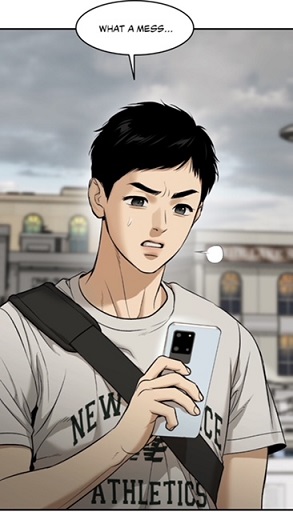 (chapter 52), the amateur starts distancing himself from his former idol. This exposes the fragility of Potato’s dream. Therefore it is not surprising that he starts taking a different path: acting, though I still think, it is temporary. However, behind the glamorous facade of the show business, there exists a dark side as well.
  (chapter 59) Heesung’s fate is similar to the champion’s. Despite his popularity, the actor is deeply unhappy. He feels lonely, for people only know the actor and not the man behind the mask. That’s the reason why he is looking for his soulmate.
  (chapter 33) That’s how I realized why Potato and Heesung are destined to be together. They are both self-centered, dishonest and blind, but more importantly they are chasing after an illusion which is strongly intertwined with immortality. In addition, my avid readers should keep in mind what Potato truly expressed, when Mingwa introduced this “chow chow”.
  (chapter 23). In reality, he wanted to use the athlete as his servant. The closeness
  (chapter 23) he was seeking was self-serving. While the amateur and the actor are searching for the “perfect companion”, the other couple has no expectation from others. They both have no longer any dream or hope. That’s the reason why Kim Dan was putting this vision of Joo Jaekyung behind a veil:
  (chapter 58) He was giving up on his dream expressed in the birthday card,
 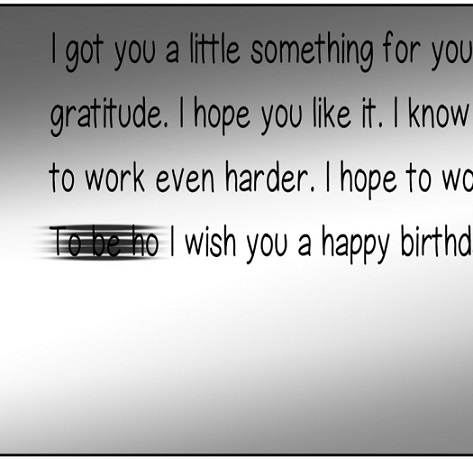 (chapter 55) My newest theory is that he wanted Joo Jaekyung to teach him fighting, but not for himself, but in order to help the fighters and in particular to protect the champion’s body:
 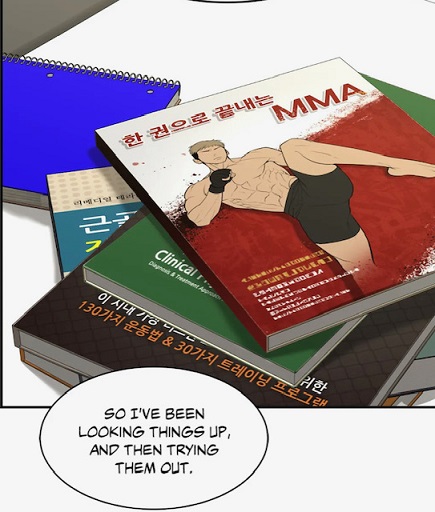 (chapter 25)
 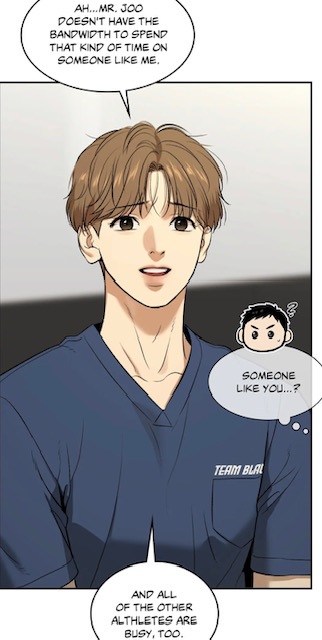 (chapter 25) To develop a training where injuries are minimized. In season 2, it is clear that Joo Jaekyung and Kim Dan have reached the bottom. Both feel empty and exhausted. They were crushed by harsh reality, and they had no one by their side to listen to their pain. Therefore it is not astonishing why the doctor could not confide to the actor and the amateur fighter. They arrived too late.
 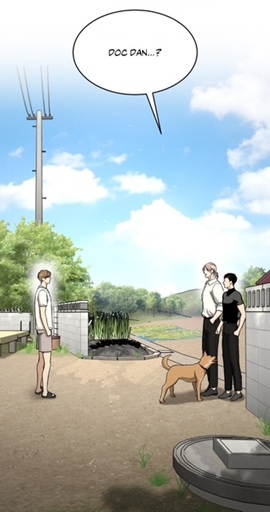 (chapter 58) Their presence definitely diverted the doctor’s attention, lessening his pain.
  (chapter 25) he learns the true nature of the relationship between Kim Dan and Joo Jaekyung. This revelation forces him to confront his own repressed feelings, as he unconsciously realizes his attraction to the fighter.
 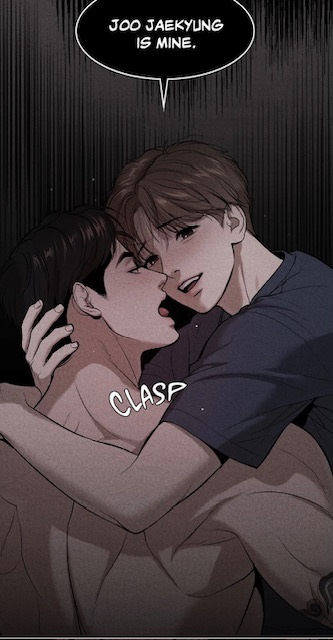 (Chapter 25) Heesung’s involvement further complicates matters, as Potato confesses his love for Joo Jaekyung
  (chapter 35) while simultaneously vowing to sacrifice his feelings for the sake of the couple’s happiness. This act demonstrates Potato’s pure and selfless definition of love,
 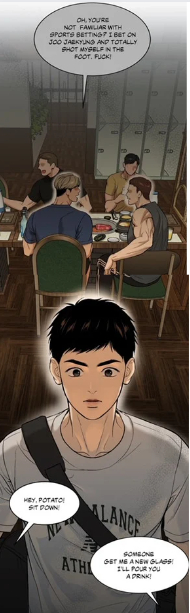 (chapter 52) and the switched spray the
 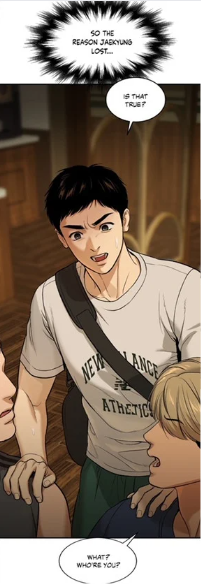 (chapter 52) which is strongly intertwined with the departure of disloyal members from Team Black marks another step in his journey toward disillusionment. While Potato initially views this as an isolated incident, it exposes the broader corruption within the MMA world, including the betrayal, greed, and lack of loyalty that undermine its integrity. While he views himself as loyal to doc Dan and Team Black, for he remained at the gym, his heart was not. He is becoming like his hyungs, Park Namwook and Heesung. In Andersen’s tale, the mermaid’s journey to the sea witch represents a pivotal moment of transformation. By sacrificing her voice and enduring physical pain, she gains entry into the human world, but at the cost of her identity. Similarly, Potato’s journey is marked by painful discoveries that force him to confront uncomfortable truths. Through Kim Dan, he will begin to see his own flaws before he is able to recognize them in those he once trusted.
  (chapter 23)
  (chapter 25)
 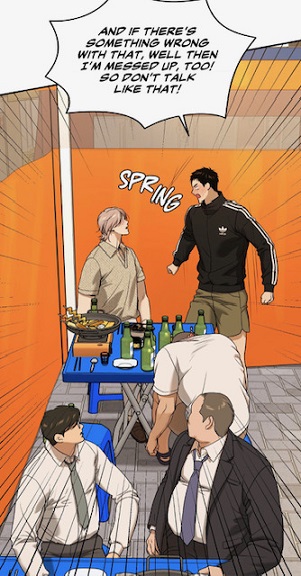 (chapter 35) The latter doesn’t mind breaking social norms by yelling or causing a fight at a restaurant. But let’s return to the actor’s confession at a bar. It’s not surprising that Heesung appears indifferent to the affection of those who cared for him. The last partner was described as too clingy. This means that Heesung places himself as the judge. In addition, it was, as if he was a god destined to live forever. He is forgetting his human condition, just like his partner’s. And that’s exactly how the prince in The Little Mermaid views life.
 (special episode 1) With this request, he implies that he will never become responsible for the amateur fighter. Therefore he can hide his homosexuality behind the young fighter. He used Potato’s mistake to his advantage.
  (special episode 1) By asking Potato to take care of all his needs and desires, Heesung placed himself in a position where he had power and could control Potato. That’s how the young fighter made a dangerous deal with the gumiho. No wonder why his sex role play was a prince interacting with a guard.
 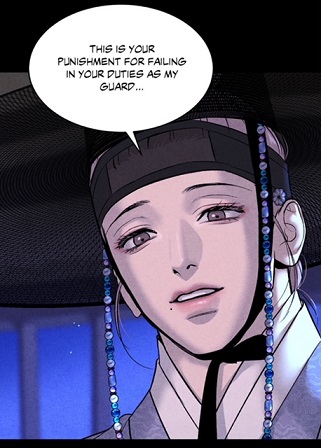 (special episode 2) Hwang Yoon-Gu didn’t realize that by taking responsibility for the actor, he lost his freedom and as such his voice. Is it a coincidence that Mingwa portrayed the young maknae as someone who would raise his voice due to his emotions in the past?
 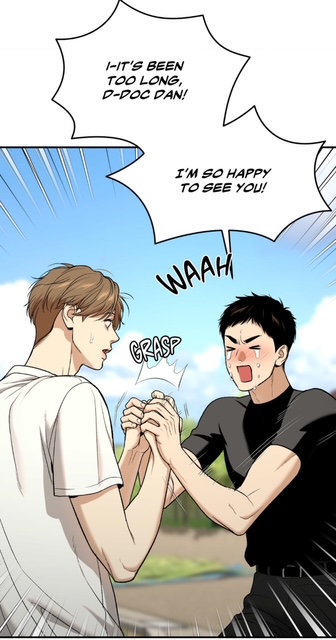 (chapter 58) his behavior is totally different than with the actor:
  (chapter 58) Tears, touch, raising his voice with Kim Dan, but not with the comedian. With the actor, he looks more calm, distant and mature. Heesung’s selfishness is evident in his treatment of Potato, whom he manipulates into becoming an extension of his own image. Hence he is no longer wearing shorts and tee-shirts.
  (chapter 59) One might say that he is gradually elevating Potato’s status through his suggestions.
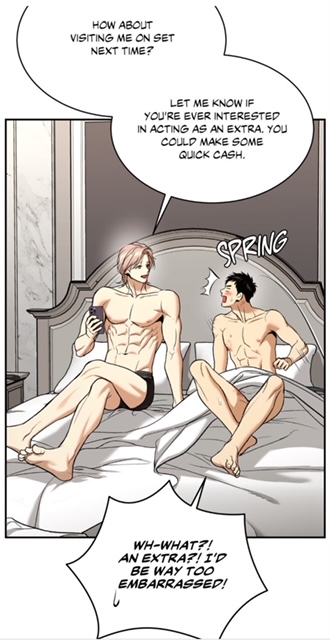 (special episode 2) By encouraging Potato to work as an actor and shaping him into a version of himself, Heesung prioritizes his own desires over Potato’s individuality. He is not asking what Potato’s true dream is. But this was his dream originally:
  (chapter 23) Why? It was due to his low self-esteem.
  (chapter 23) He was not confident enough, for he was the only one with such a weight-category.
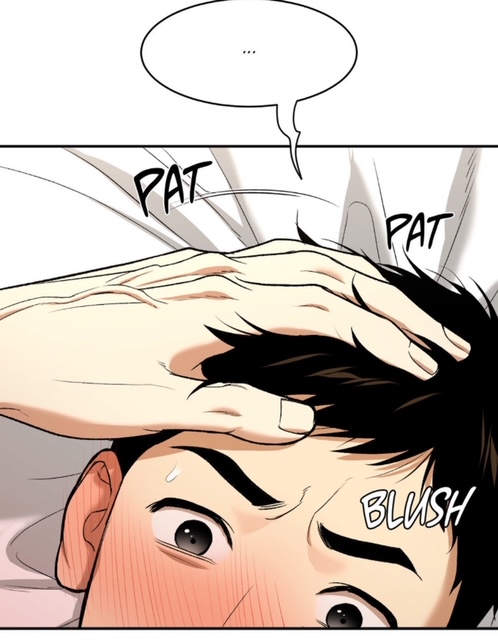 (special episode 2) played a huge influence in Potato’s decision to take the offer as an extra. It was, as if one of his dreams had come true. But is this what he truly wanted?
  (chapter 59) as a signal that he is not truly happy.
  (chapter 58) However, this is about to change. Heesung who likes novelty and change is not realizing that his wish is becoming true. The picture with his last work announces the end of his “friendship” with Potato. How so?
  (chapter 29), drawing a connection between the character’s innocence and loyalty.
  (chapter 35) This shows that Heesung has long internalized this pattern: assistance will be only given, if he is called. That’s why he has no true friend in the end. He shows no interest in others. But by doing so, he is putting the whole responsibility on his counterpart. Through the actor and the manager’s behavior, the former errand boy has long adopted this pattern. Hence he didn’t call Kim Dan in the end. He waited for a signal from his part. This behavior mirrors the little mermaid’s sisters, who only realize her absence when it is almost too late to act. Similarly, Potato’s casual farewell highlights a betrayal of Kim Dan’s friendship, further emphasizing Potato’s struggle with emotional awareness. That’s why I mentioned above that Potato is about to discover his true nature: he is also a sinner. This growth parallels the biblical narrative of Adam and Eve, where the acquisition of knowledge leads to the loss of innocence. Heesung, like Eve, introduces Potato to a new world of experiences, including his sexual orientation. However, this newfound knowledge comes with its own burdens, as Potato must reconcile his identity with the harsh realities of the world around him.
 (chapter 5) Heesung could no longer express his needs and desires.
 (chapter 58) Just because one is happy, this doesn’t mean that the other is. For that to happen, communication and honesty are necessary.
 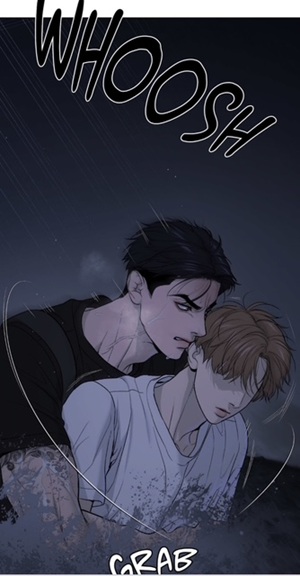 (chapter 59) Potato’s journey is to discover and embrace the principle of “self-reliance” and autonomy. Only when Potato becomes independent in his thoughts and decisions, can he truly help the main couple.
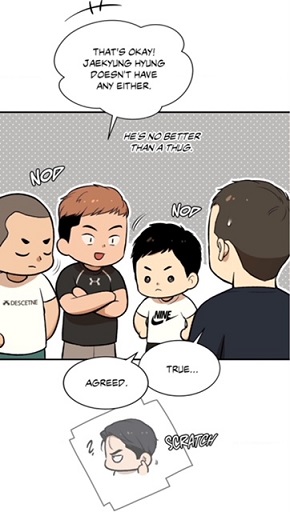 (chapter 47) and 52. Initially, he believed in his hyungs’ description of Joo Jaekyung as a thug, but later he criticized the same fighters for abandoning the athlete
 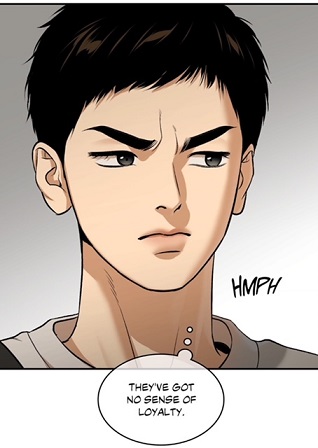 (chapter 52), accusing them of lacking loyalty and dismissing their claim that they had nothing to learn from him. Yet, in episode 52, Potato does not reproach Park Namwook or Yosep for their passivity and naivety,
 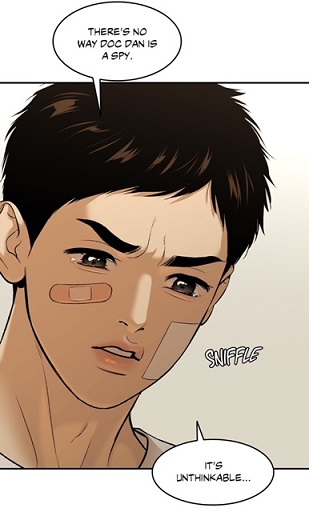 (chapter 52) instead solely blaming Joo Jaekyung for not trusting Kim Dan and causing his departure. This selective criticism reveals that Potato still views the older men as inherently good and fails to recognize his own shortcomings. In this way, he mirrors Park Namwook’s superficial loyalty, further emphasizing his dependence on external validation.
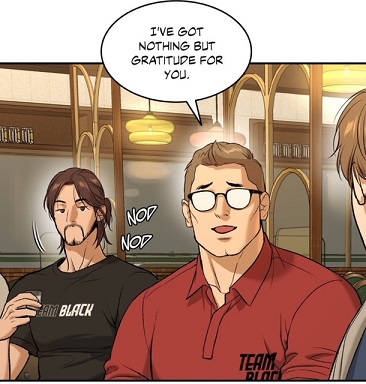 (chapter 43) This absence highlights how Potato has missed key moments of reflection and acknowledgment, which are essential for his growth. It suggests that Potato is destined to detect the flaws in his hyungs—Park Namwook, Yosep and Heesung’s superficiality, passivity, hypocrisy and selfishness—before he can achieve true independence and contribute meaningfully to the lives of Joo Jaekyung and Kim Dan.
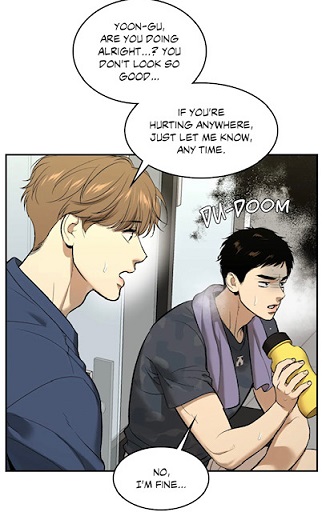 (chapter 23) —taking over his tasks and noticing his unhappiness
 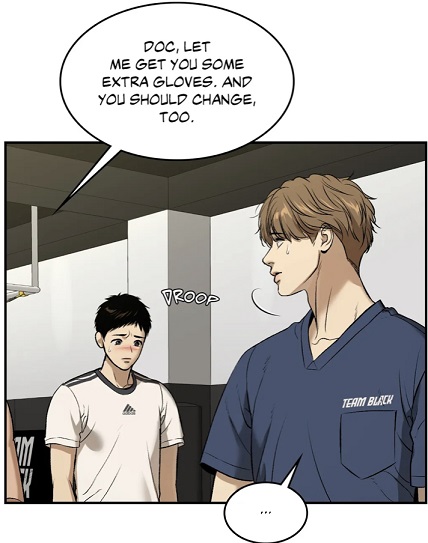 (chapter 25) —demonstrates his capacity for genuine care. This contrasts sharply with Heesung’s selfishness and serves as a reminder of the value of mutual support in relationships. Potato’s potential return to the place where he met Kim Dan could symbolize a rediscovery of authentic connections, marking the beginning of his path toward independence and self-realization.
  (chapter 58) And like mentioned above, this could become a serious problem for Yoon-Gu. He could be perceived as someone selling himself for a gig. And Heesung is not even realizing the consequences of his intervention and meddling. That’s why it is important for Yoon-Gu to become independent. This lesson resonates with Potato’s journey in Jinx. By recognizing Heesung’s selfishness and breaking free from his influence, Potato has the potential to rediscover his own dreams and individuality. Like Erich Fromm mentioned it, true love is respect, care, knowledge and responsibility. However, Heesung has no idea about the importance of these notions, as everything is evolving around his own needs and dreams.
  (chapter 58) That’s how it dawned on me that little by little Yoon-Gu had been losing his senses:
  (chapter 31), his smell, then his ears
 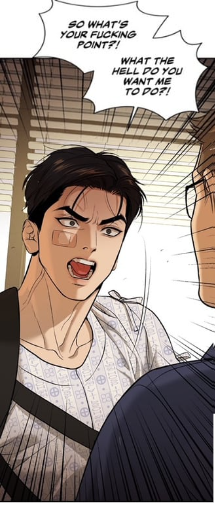 (chapter 52) and finally his eyes:
 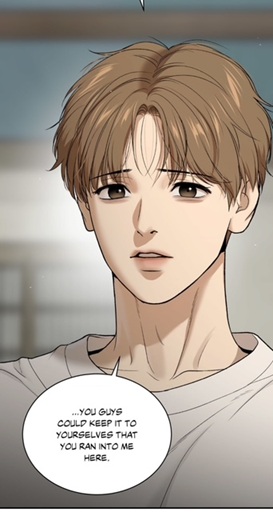 (chapter 58) He forgot the danger coming from Heesung’s words, he could not hear the suffering from the champion due to his bias, and finally he couldn’t see Kim Dan’s distress due to his own feelings and prejudices. We could say that because of the influence from others, he was no longer able to see reality. However, like mentioned before, I sense the return of Potato’s senses in the following panel:
 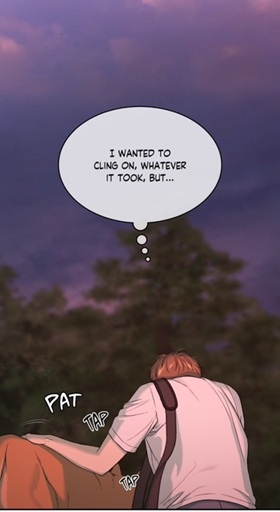 (chapter 59), coinciding with Potato’s departure, underscores this theme of overlooked emotions and unreciprocated care. As Joo Jaekyung reflects on Kim Dan’s comparison of Potato to a puppy, it may catalyze a pivotal shift, prompting him

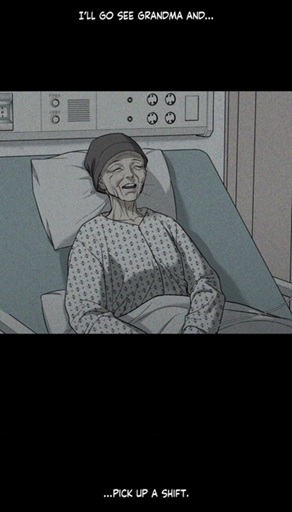 (chapter 59) —a representation of the mermaids’ song—drifts into a state of surrender, much like the prince. This act of salvation becomes a pivotal moment, connecting both characters to the themes of water, transformation, and rediscovery of purpose.
 (chapter 54), performance, and the longing for a deeper connection.
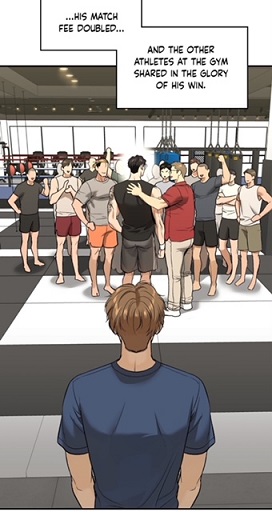 (chapter 41), and the mermaid, as he grapples with voicelessness and the pressures of his world.
 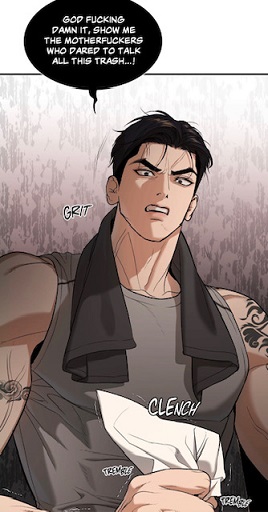 (chapter 36)
 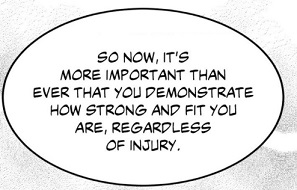 (chapter 36) Choi Heesung, representing another prince with Potato as his bride, benefits from others’ sacrifices
 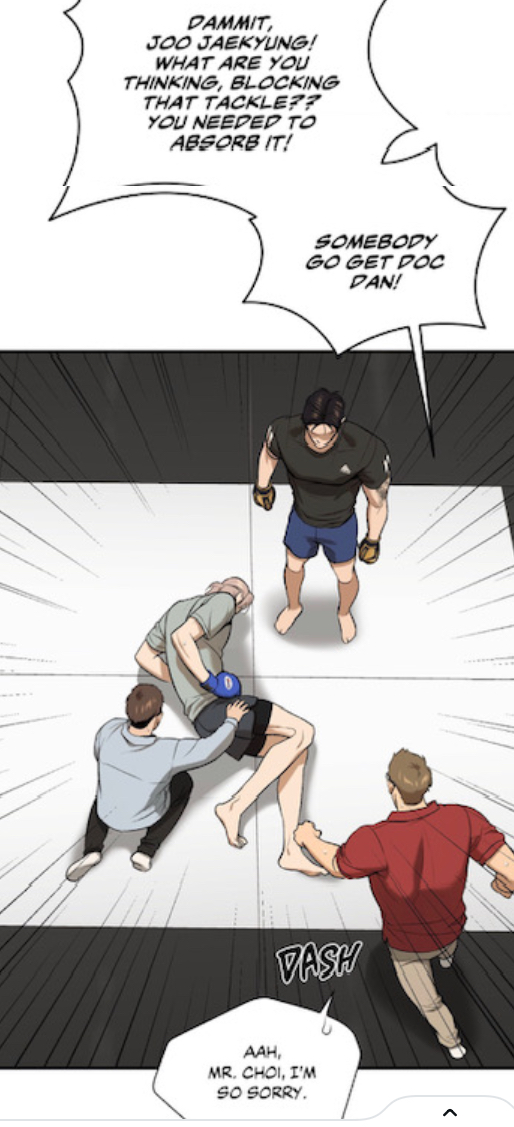 (chapter 31)
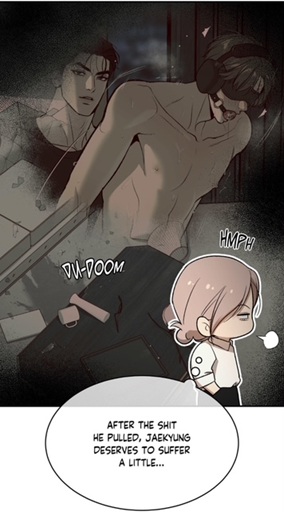 (chapter 58) while remaining oblivious to their struggles. These parallels reveal layers of self-discovery, mutual transformation, and the pursuit of meaning. By analyzing these similarities, we uncover deeper layers of self-discovery and transformation within the narrative.
 (chapter 53) Joo Jaekyung, representing the “new world,” acts as both a source of transformation and a mirror reflecting Kim Dan’s sacrifices.
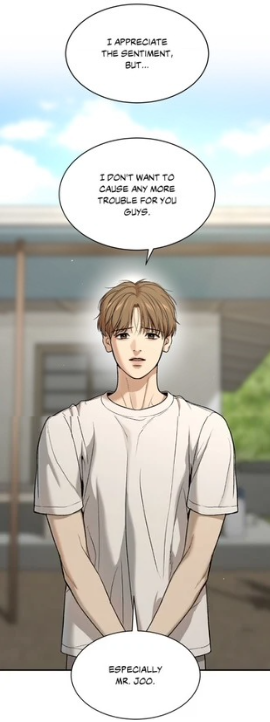 (chapter 58), yet it serves as the catalyst for his growth. Just as the little mermaid’s journey leads her to a higher spiritual purpose as a daughter of the air, Kim Dan’s experiences with Joo Jaekyung force him to confront his own worth, identity, and emotional needs. Just before he went to the ocean, he wondered about his own future and desires, a sign that he was standing at a crossroad:
 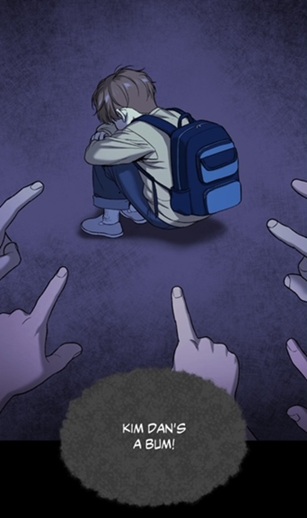 (chapter 57)
  (chapter 59) Like the mermaid, he has always lived disconnected from his own needs, burdened by the expectations of others—his grandmother, Heo Manwook, the doctors
 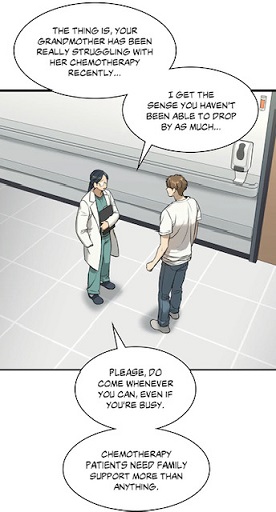 (chapter 21) , and even Joo Jaekyung.
  (chapter 45)
  (chapter 59), he is not capable of crying. It is because he has been living like a ghost for the last two months. Depression, for both the mermaid and Kim Dan, manifests as a silent struggle, making their eventual transformations even more poignant.
 (chapter 1) hiding his true self behind a facade of strength and success. On the other hand, Joo Jaekyung also embodies the mermaid’s longing and sacrifice. Living in the world of MMA, a high-pressure environment where he is constantly pushed to perform, he resembles the mermaid in the underwater kingdom—a place of death and materialism where the mermaids feed on drowned humans. It is no coincidence that the fighters are displayed like mermaids in the water full of blood.
  (chapter 29) This zombie-like existence leaves him voiceless; the entertainment agency and MFC dictate his actions
 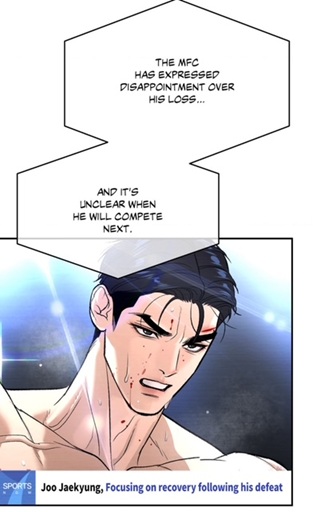 (chapter 57), only allowing him to speak when it benefits them financially.
 (chapter 27) reflects his connection to the mermaid. Water is his natural element, a place where he feels at peace, yet he has been forced to conform to a fiery world of intensity and relentless ambition.
  (chapter 19) Hence he never went to the swimming pool in his own penthouse, until Kim Dan triggered his memory and longing. This interplay of water and fire
  (chapter 52)
  (chapter 41) Joo Jaekyung’s image was exploited to lure these individuals down a darker path, highlighting how his light has been misused by those around him.
 (chapter 19)
 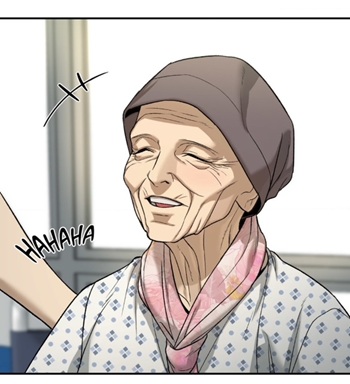 (chapter 56) as long as they were not associated with burden or suffering, while the mermaid’s grandmother celebrates the beauty and decorum of their underwater realm.
  (chapter 52) This dynamic parallels the members of Team Black in Jinx. Although they are treated like Joo Jaekyung’s co-workers
  (chapter 7), in reality, he is their boss and the foundation of their success. Their indifference mirrors the mermaid sisters’ behavior; they only notice his struggles and absence when his winning streak falters, prompting many to leave the gym for the rival King of MMA. However, if we take Andersen’s fairy tale as a source of inspiration, it signifies that at some point, the remaining members of Team Black might come to “sacrifice” themselves for their “little sister,” symbolically representing Kim Dan and Joo Jaekyung. This potential act of loyalty could mirror the mermaid sisters’ gesture, showing that even belated recognition and care can lead to transformative redemption for those involved.
 (chapter 1), attracting others seeking the same level of fame and fortune.
 (chapter 46) However, the gym’s inability to produce another champion reveals its “fake gardening” nature—focused on maintaining an image rather than fostering true growth.
 (chapter 22) and a “neglected child”
  (chapter 58) Feeling lost without Kim Dan, he initially requests his return so that they can be together again. This longing for a companion reflects Potato’s deeper need for guidance and connection, much like the mermaid sisters who briefly visit the surface but ultimately return to their underwater world when the novelty fades. Yet, when they reach maturity and are allowed to visit the surface, the novelty of the human world quickly fades, and they return to their underwater realm indifferent to human suffering. However, notice that on his day of the departure, Potato tells Kim Dan that he won’t call him, the mermaid has to initiate the first step.
 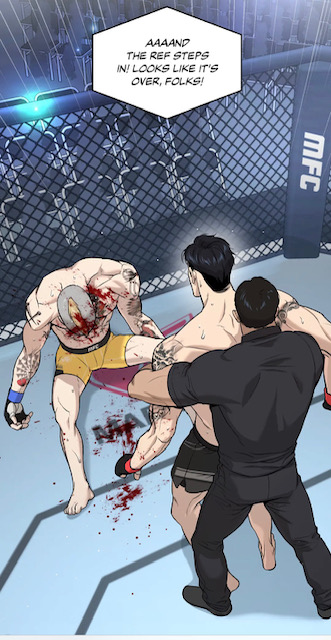 (chapter 15) strongly parallel the detached, high-pressure environment of MMA fighting. Joo Jaekyung, trained relentlessly since youth, embodies this world’s harshness, where vulnerability is a luxury rarely afforded.
 (chapter 59) suggests that Joo Jaekyung might reclaim his authentic self through activities like swimming, reconnecting with nature, and symbolically planting the seeds for a new life. Kim Dan, who cannot swim, learns from Joo Jaekyung, and together, they forge a path toward mutual healing and immortality—not in the literal sense but through finding their “soul” and purpose.
 (chapter 56) The city represents the oppressive expectations and artificial constructs that have shaped Joo Jaekyung and Kim Dan’s lives. By meeting again in the ocean, they reconnect with a more authentic and unburdened version of themselves. This transition echoes the little mermaid’s connection to the natural world as a place of solace and transformation.
 (chapter 59) They imagined that Kim Dan would be better off without Joo Jaekyung
 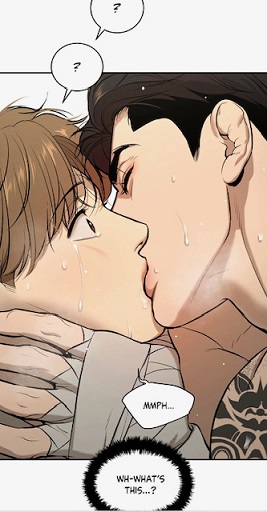 (chapter 15) his kiss with Joo Jaekyung, shared in the locker room, was both an act of protection and a pivotal moment in their dynamic. Like the mermaid’s unforgettable first kiss with the prince (when he was rescued), Joo Jaekyung’s kiss in the locker room was an act of initiation, driven by his “fears” and sense of responsibility, reflecting his growing attachment to Kim Dan. The kiss symbolized his struggle to connect and protect, even as he grappled with his emotional restraint. The locker room, a symbol of physical endurance and vulnerability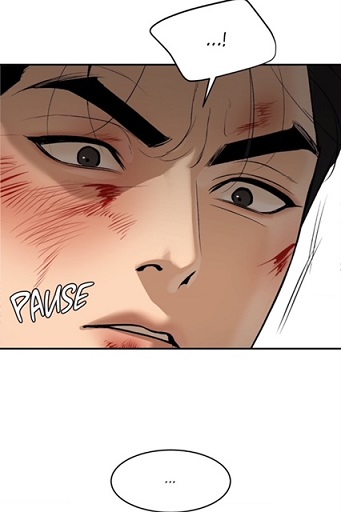
 (chapter 51), mirrors the mermaid’s longing to break free of her limitations and find meaning in her suffering.
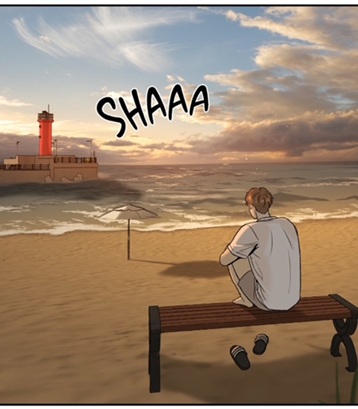 (chapter 59) finding light not in others but within himself. Through his hardships, he gains the strength to pursue his own identity and agency.
 (chapter 49) The maknae’s tears are an indication that he is no mermaid, but a human, I would even say, he still has the soul of an innocent boy.




 (chapter 56) in Jinx serves as a powerful symbol and narrative device, encapsulating the themes of observation, communication, and truth, as reflected in the title “Unspoken Gifts, Unveiled Truths in the Light of Hope.” Its name evokes images of enlightenment and clarity, which stand in stark contrast to the gym Team Black and the grandmother’s internal state of denial and her rejection of responsibility. This tension between the hospice’s symbolic essence and the grandmother’s actions deepens the narrative’s exploration of personal accountability and transformation.
 (chapter 35), where people’s actions and words can go unnoticed, the hospice fosters an environment of close-knit relationships and mutual observation.
 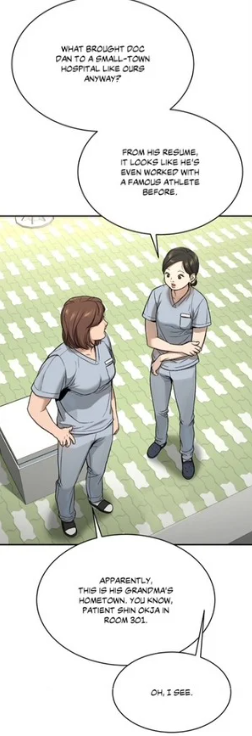 (chapter 56) In this communal setting, actions carry weight, and behaviors are scrutinized. Thus the door to the meeting room is made of translucent glass.
  (chapter 56) While in the previous essay, I pointed out that this door reflected Kim Dan’s emotional entanglement—he is physically present but emotionally excluded from his grandmother’s world, highlighting the imbalance in their relationship -, in verity this transparent door offers an opportunity for the main lead. How so? The glass door stands not only for transparency, but also for “emotional distance”. The glass allows visibility but creates a barrier, symbolizing a balance between openness and detachment. This is essential in a hospice environment, where the focus is on providing care and support without becoming overly attached to the inevitable outcome: death. For the staff, maintaining a degree of detachment is necessary for their well-being, as becoming too attached could make the emotional toll of their work unbearable. Therefore I am suspecting that the two nurses
  (chapter 56) Her hypocrisy, particularly in her treatment of Kim Dan, remains hidden behind the guise of socially acceptable behavior. Within the hospice, residents maintain a positive opinion of her, which enables her to mask her neglect and selfishness effectively. But since the two nurses are sharing their thoughts and working as a team, it signifies that Shin Okja’s wrongdoings could be detected this time. Or better said, they will realize the true suffering from the protagonist. Nurse Heart and nurse Mind will do their best to protect their new mascot and give him what he truly needs:
  (chapter 26) The reality is that he still has no idea why the champion was acting that way. He tried to explain his odd behavior by jumping to conclusions (prejudices: a spoiled child) and by listening to others. He never used his heart and mind, rather his ears and eyes. And this brings me to my next part.
 (chapter 5) And the other laughed. Then the coach seems to have no cellphone. Maybe he believes to have no need for it, for he goes to the gym every day. This signifies that he expects to be informed by his hyung Namwook. However, like mentioned in the previous essay, I believe that the manager has been sweeping under the rug the terrible condition of his “boy” from the coach and the team members. To sum up, Team Black embodies the opposite of the hospice’s values. There is no transparency, because the conversation took place not outside, but behind closed door. The door might be translucent, the reality is that they sent away all the members.
  (chapter 36) The gym, while ostensibly a team environment, is ruled by indifference, anonymity, and a lack of genuine camaraderie. The heart and the mind are not working together. Why? It is because the coach is trusting the manager, as he views him as the heart of the gym. What he fails to see, is that Park Namwook is neither the heart nor the mind, for he is more reflecting his surroundings: money. Secondly, the manager is easily influenced and is using conformity and social norms to avoid responsibility. He fears making decisions and lets others become proactive. Joo Jaekyung, the leader, relies exclusively on Park Namwook, the manager, who undermines team spirit by fostering distrust and misinformation.
  (chapter 46) The member’s loyalty got questioned, but the irony is that they had the real insight.
  (chapter 47) Thus rumors about Baek Junmin being an illegal fighter never reached Jaekyung’s ears. That’s why the author made fun of the main lead here:
  (chapter 52) The man acted, as if he had been the biggest victim. Moreover, Namwook’s actions often reflect a lack of genuine loyalty, as seen in
  (chapter 22) episode 22, when he falsely claims ownership of the gym and again in episode 56 when he reminds the champion of his absence from the gym, behaving as though he were the boss.
  (chapter 56) In reality, the true owner of the gym is the “wolf,” and Namwook’s behavior underscores his disregard for loyalty and responsibility. In fact, his words mirror the nurse’s at the hospice:
  (chapter 56) Hence he is seen talking over the phone and not face to face, unlike the nurse. He knows that his boy is struggling, but he acts, as if he didn’t know. This contrast validates my previous interpretation of the manager. His question “Is everything okay with you?” exposes his lack of genuine concern. He uses work not to praise his “boy”, but to blame him for his “negligence”. He downplays the champion’s struggles while still recovering from surgery. This lack of care creates an atmosphere of apathy, anonymity, and selfish expectation, sharply contrasting with the hospice’s values of dignity and communal care. But how do we explain this huge divergence? First, the main principles of the hospice are dignity and care, and not primarily money. Therefore the institution offers free health check once a month:
 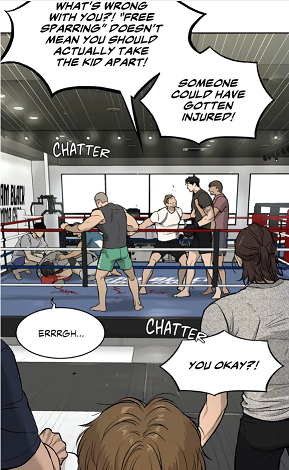 (chapter 1) The fighter with the head injury received treatment from the members (self-medication) and Kim Changming had a shoulder injury which got neglected.
  (chapter 7) These incidents reflect the gym’s underlying indifference and mismanagement. This disparity explains why Jaekyung’s mental health suffered under Namwook’s leadership, as the gym lacked the supportive and transparent environment required to nurture emotional resilience. Jaekyung’s stay at the hospice is likely to open his eyes to this overlooked aspect, prompting him to reconsider his leadership style and the values governing Team Black. But it is the same for Kim Dan, especially if he sees how weak and neglected the fighter looks:
 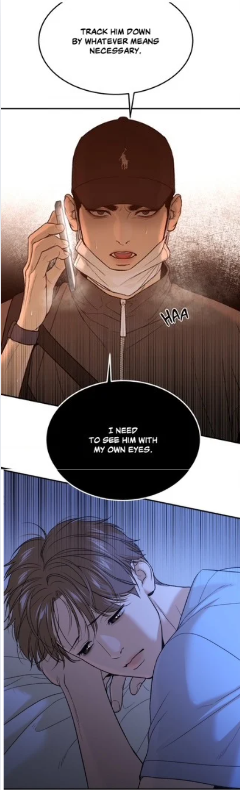 (chapter 56) he has already become a shadow of himself.
 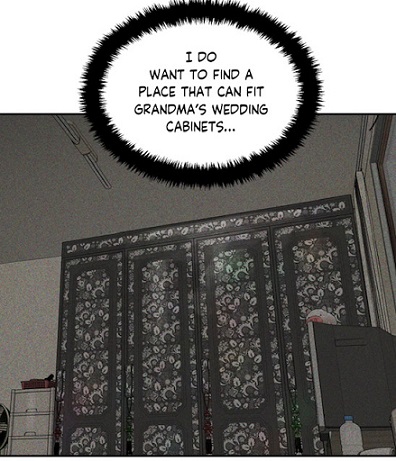 (chapter 16) Despite its substantial value, the grandmother never sold the cabinet to pay off the debts, prioritizing its preservation over the survival of her home and family. On the one hand, this reveals her immaturity and selfishness, as she put up with her grandson’s suffering. On the other hand, her decision created the impression to Kim Dan that this belonging had just a sentimental value and nothing more. So when the champion saw that huge Wedding cabinet, he judged it as „junk“ and that’s how the doctor got this perception validated.
 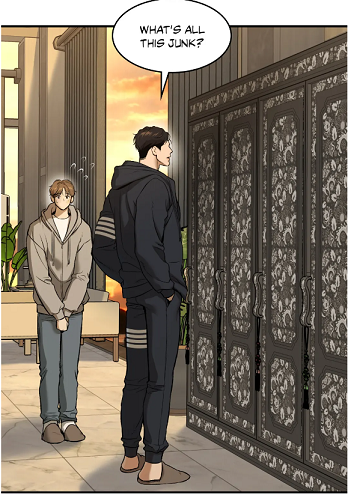 (Chapter 19) Hence it is not surprising that at the end, he chose to abandon this huge cupboard.
  (Chapter 53) Finally during her move to the Light Of Hope, she did not ask about the whereabouts of her belonging which could only reinforce the impression that this item had no real value. It had even lost its sentimental value, as she was no longer thinking of her former home. Her ignorance and forgetfulness are once again outlining her superficiality, self-centeredness and lack of empathy. The sentimental value of her Wedding Cabinet was rather shallow. But the tragedy is that when the furniture was moved the penthouse, the champion noticed this item for the first time and came to associate this cupboard with the doctor.
  (chapter 42) This explicates why the athlete didn’t pay attention to his soulmate’s clothes. And now, observe that the doctor is only wearing his PT uniform.
  (Chapter 41) as she employs the expression „spoil to death“. By wearing the scarf with flowers, she appears wealthy, but also vain! Since I detected that Kim Dan likes pink flowers, my interpretation is that this gift mirrors the doctor’s taste indicating that he was slowly regaining his identity and confidence..
  (chapter 31) And notice that the bouquet of pink roses pushed Kim Dan to talk to Joo Jaekyung about his taste. That’s how I detected a strong connection between presents and communication. Notice that on the champion’s birthday, the manager sent a message while the presents were delivered.
  (chapter 45) This aspect gets even validated with the doctor’s keychain. The latter not only caused an argument between the two room mates
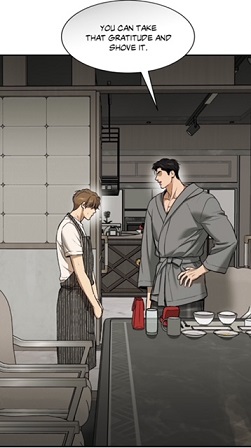 (chapter 45), but also encouraged the doctor to convey his thoughts and expectations in the card. On the other hand, he didn’t expose the whole truth
  (chapter 55) Another interesting aspect lies in the doctor’s shaking hands which the champion noticed, when he offered the present:
  (chapter 55) This scene reminded me of their first encounter:
 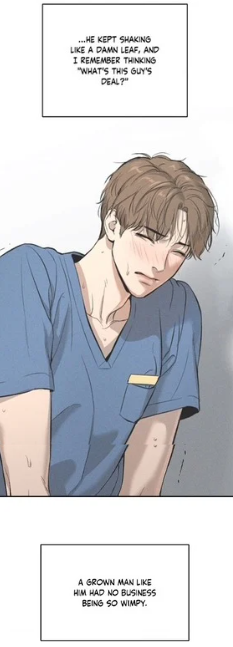 (Chapter 56) So the man must have recognized the doctor‘s fear, which explains why the champion could voice his anger later. But back then, he never wondered why the doctor‘s hands were shaking like leaves. It is because the doctor feared rejection. The present had the following meaning for the physical therapist: recognition and acceptance. The gift was the symbol for „conditional affection“ which he had long internalized due to his grandmother. But this doesn‘t end here. The shaking hands appeared in a different scene:
  (chapter 49) The common denominator between these three scenes is the mistake. Kim Dan feared to have made a mistake with the present, because he was afraid of the champion‘s reaction: will he accept him or not? But let‘s return our attention to the gifts from the doctor.
 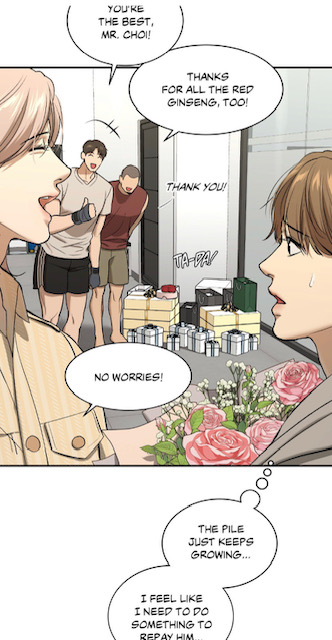 (chapter 31)
 (chapter 55) implies that as soon as the main couple meet each other, they will have to discuss this matter. To sum up, a gift encourages the couple to communicate, yet contrary to season 1, both should be more honest to each other at the Light Of Hope. Every word and action will appear in a different light. Another aspect is that none of them takes things for granted, which stands in opposition to hyung Namwook and the grandmother. This explicates why the latter have no problem to spend money.

 (chapter 56) This dichotomy in season 1 is vividly illustrated in a scene where Kim Dan, under the dappled light of a tree
 (chapter 41), experiences a profound moment of awakening. As his hand seems to reach towards the leaves
 (chapter 41), his senses come alive—he sees the light filtering through, feels the breeze, and hears the faint rustling sound. It is, as if in that moment, he reconnects to his true nature. Like a tree, Kim Dan is deeply rooted, yet capable of growth and resilience.
  (chapter 41) Nature awakens something within him— his heart and as such his third eye —allowing him to realize his affection for Joo Jaekyung. This quiet yet powerful moment emphasizes how nature offers clarity and purity, serving as a contrast to the suffocating, impersonal urban world where Kim Dan often found himself lost. Striking is when Joo Jaekyung met Kim Dan for the first time, he compared him to a “leaf,” shaking and fragile—an unconscious recognition of his true nature.
  (chapter 55) However, note that the main lead isn’t stretching his hand to the sky and sun. He is almost immobile. Just before, he was holding the cellphone in his hand:
  (chapter 55) Another divergence to the scene in episode 41 is that Jinx-philes couldn’t see his face. It indicates that the doctor reverted to his old self, and as such he is not true to himself. Therefore I come to the following conclusion. Mingwa uses nature as a mirror to Kim Dan’s emotional and spiritual state. While moments of connection with nature reflect clarity and self-realization, the juxtaposition in this scene underscores the opposite. Here, Kim Dan sits surrounded by trees and bathed in sunlight, yet his attention is consumed by his cellphone—symbolizing his entanglement with money, duty, and his ongoing struggles. Just moments prior, he wired money to the champion, a decision rooted in his past traumas and present desperation. The irony of the setting cannot be overlooked: though nature surrounds him, its purity and tranquility remain unnoticed, emphasizing how Kim Dan is still trapped in patterns of survival, burdened by his circumstances. He has become a ghost once again. This disconnect reveals how the weight of his past prevents him from embracing the present moment and reconnecting with his true nature, contrasting starkly with earlier scenes where his senses came alive under the trees.
  (chapter 56) The empty beach scene, with its sunlight and tranquil beauty, reflects peace, but also unfulfilled connections. Kim Dan’s absence from this moment underscores his failure to keep a heartfelt promise to his grandmother:
  (chapter 56) Abandoned once again, Kim Dan is consumed by the weight of his trauma, isolating himself emotionally and excluding himself from others.
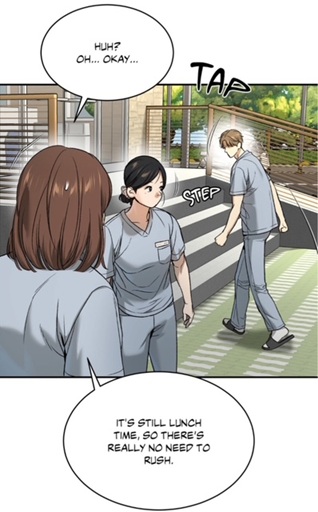 (chapter 56) When approached and complimented, such as when the nurse praises him and encourages him to take a break for lunch, Kim Dan pointedly ignores the praise and instead chooses to return to work. His inability to engage with others reflects the same disconnection that prevents him from connecting to nature. Mingwa subtly reveals a painful truth: Kim Dan’s fixation on his suffering not only blinds him to the solace and clarity offered by nature, but also hinders his ability to nurture relationships.
 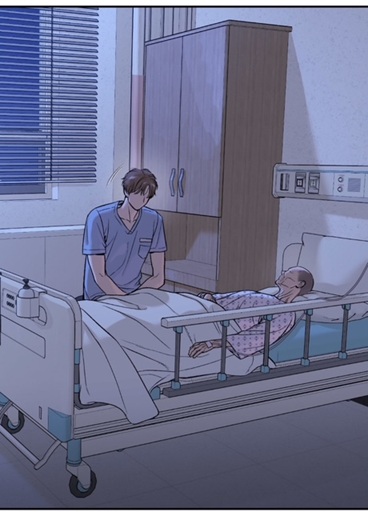 (chapter 56) and, symbolically, to the moon, Kim Dan remains oblivious to what has always been there for him: the enduring forces of love, stability, and healing.
 (chapter 56) the ocean and celestial elements like Saturn (Kim Dan stands for this planet). These forces, outside human control and independent of Kim Dan’s struggles, offer opportunities for renewal and clarity. Yet Kim Dan, consumed by his pain, remains trapped in patterns of survival and alienation. Nature’s constancy mirrors what he needs most—connection, healing, and presence—yet his inability to see it reflects his broader struggle to connect with others and himself.
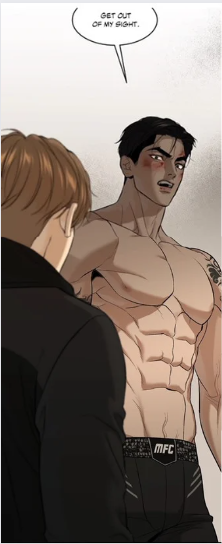 (chapter 51), the doctor learned the following lesson: it is better to keep people at a certain distance, because he got his heart broken. That’s the reason why he is avoiding the nurses and not eating lunches. He is simply avoiding gatherings. He is seeking solitude on purpose. That’s how it dawned on me that he is living like the athlete in season 1!! His whole world is revolving around work and as such taking care of patients.
  (chapter 26) Yes, the day where they sparred out of fun. For the first time, Kim Dan chose to accept a challenge for himself and for Potato. He felt a connection with Yoon-Gu, because he saw in him a puppy:
 (chapter 37) The puppy symbolizes not only nature, but also innocence. Let’s not forget that he was moved by the actor’s flowers in the past:
  (chapter 21) Yes, by offering him a puppy! Is it a coincidence that the author made the champion jog next to a dog owner? I don’t think so. Until now, nothing could move Kim Dan’s heart:
  (chapter 44) In other words, Kim Dan feels a strong connection to animals, but he could never have one due to his poverty and his grandmother. By taking care of a dog, he would be forced to pay attention to nature and in particular to trees. Naturally, I believe that Potato will play a similar role in the future, for Mingwa associated him with a dog.
  (chapter 47), the nursing attendant
  (chapter 21) or the reporters:
  (chapter 37)
  (chapter 40) However, Manhwa-worms will notice a significant distinction: in Season 1, these women were all tied to the world of work. Even Kim Dan’s grandmother, though she represents a familial figure, falls into this category.
 (chapter 56) Moreover, the grandmother’s choice of words, “Why don’t you turn in?”, implies that she sees Kim Dan’s presence as a form of “work” or duty. This phrasing is often associated with someone finishing a day’s tasks or obligations before going to bed, which fits into the broader dynamic between Kim Dan and his responsibilities. In my eyes, it shows that she is seeing her grandson more as a caretaker than as a family member. We shouldn’t forget that she was the reason why the main lead became a PT. It was, as if her dream had come true. Nevertheless, the verity is that his grandmother is receiving treatment from his colleagues.
  (chapter 7) before she got reassured. Then she made this request
  (chapter 55) and later brought the doctor’s present:
 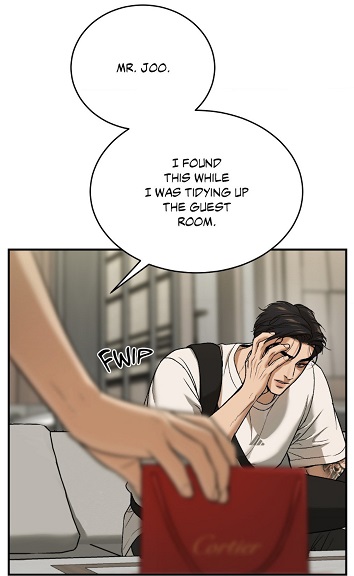 (chapter 55) And what is the common denominator with these two images? The woman’s hand. In the previous essay, I explained that her intervention signalized that the champion would stop drinking and was starting acknowledging Kim Dan. The zoom on the cleaning lady’s hand is a powerful visual cue that encapsulates many of the symbolic meanings associated with a woman’s hand, reinforcing the themes of care, healing, humility, and transformation.
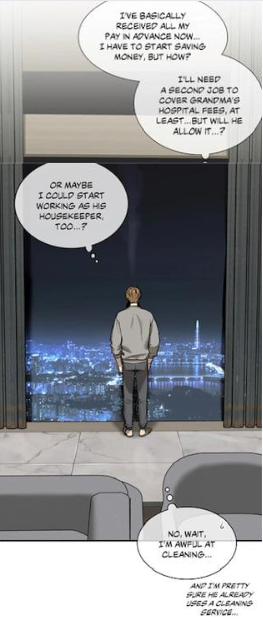 (chapter 19) He is not capable to take care of himself well.
  (chapter 55) Observe how she smiled to him by saying goodbye. This is a sign that her respect and care are genuine. One might think that this nameless cleaning lady was unfortunately portrayed as eyeless:
  (chapter 56) I don’t think, we should see it in a pejorative light, like for an example of blindness or manipulation. In my eyes, the absence of her eyes are mirroring the nature of their relationship between the champion and the cleaning service. So far, he never met these people, as he was always away. In other words, the absence of the eyes is showing that the sportsman doesn’t know her that well. But it could change and this because of Kim Dan.
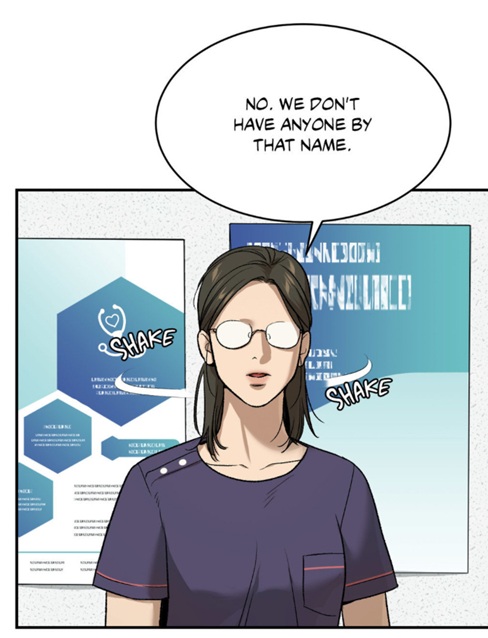 (chapter 56) in the illustration. It is because I realized that the champion first looked for Kim Dan at Sports Therapy Centers
  (chapter 56) before realizing that his fated partner might have switched the focus in PT, geriatrics. And what did the PT say at the Light Of Hope Hospice?
  (chapter 56) Male physical therapists like this one
  (chapter 54) prefer specializing in treating athletes because it brings more money and fame, whereas female PT ends up at hospices due to their nature (nurturing, family). This means that by going to the hospice, the athlete will enter a whole new world. The appearance of the woman with glasses was indicating that the athlete was slowly broadening his horizon. As you can see, little by little, the fighter is opening his mind to new things. So how will he react, when he sees that his beloved “hamster” is withering again? This time, he can not blame the doctor. Since I detected similarities between Kim Dan’s current attitude and the champion’s past behavior, I have the feeling that the fighter will recognize himself in his loved one or someone will give him some advice. He will have the answer to this:
 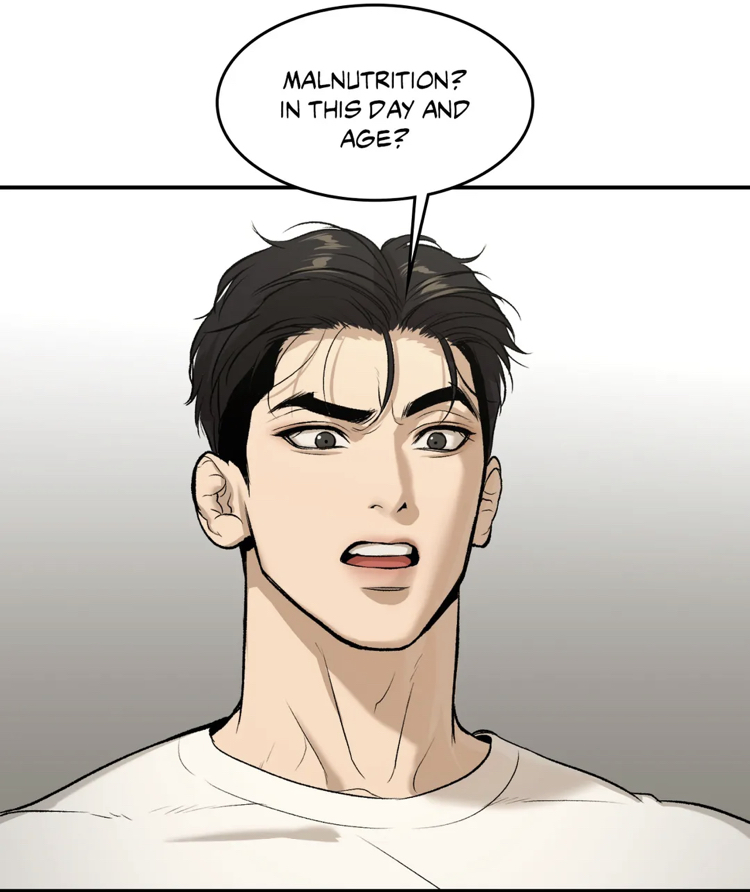 (chapter 13) He is neglecting himself to the point of exhaustion, because he is living as a PT non-stop. While the champion was fighting with his bad shoulder, the other is using his hands for treatment, hence he is not eating.

 (chapter 56) and
 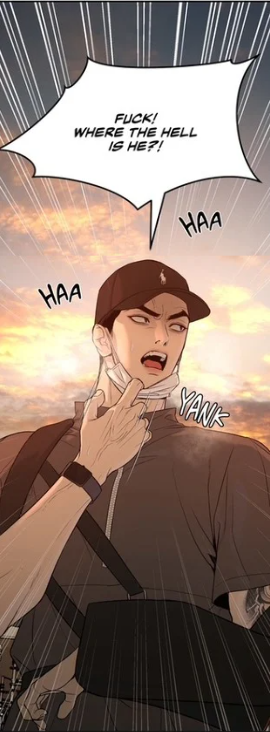 (chapter 56) While in the first picture, Joo Jaekyung is calm, concentrated and silent, in the second one, the fighter is agitated, lost, breathless and yelling. These two mental dispositions are reflected in the location. In the first image, the MMA celebrity appears behind the steering wheel, which is a symbol for power, determination and control, whereas in the second panel the champion is wandering alone in the street. This running is no longer part of his training and routine, but it exposes his powerlessness, loneliness and despair. He has no idea where to go contrary to the first picture. This means that the latter embodies goal and destination, whereas the second image represents the opposite values: beginning, start, ground zero and source. In other words, the end of episode announces the athlete’s rebirth or better said, the start of a new life. I will elaborate further below. But let’s return our attention to the symbolism of the auto.
  (chapter 56)
  (chapter 35), Joo Jaekyung succeeded. He is just a passerby. In other words, the avenue indicates not only his failure to find Kim Dan, but also his loss of power and status. He has just become a nobody. Thus we should consider this as the athlete’s karma for thinking that Kim Dan could be replaced, because he was just a nobody:
  (chapter 55) It is no coincidence as well that the author showed us the star’s back, when the latter called his hyung Park Namwook.
  These two chapters are similar, for they convey the same emotions: anger, anxiety, frustration and despair of the fighter. In the car, the champion attempted to control the doctor’s libido.
  (chapter 33) On the one hand, he appeared calm and concentrated like in 56, yet deep inside, he was burning up. The pink dildo was used as a tool to voice his negative emotions (abandonment issues, insecurities and jealousy). With the release of episode 56, another reason came to my mind why the athlete proposed to drive the physical therapist to Choi Heesung.
 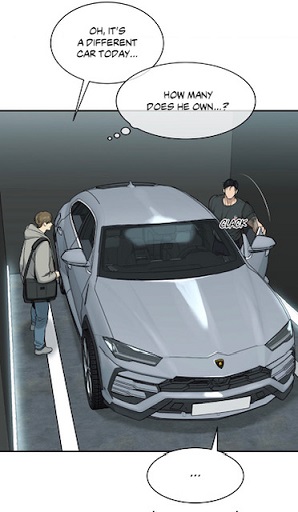 (chapter 32) First, he switched the car in order to demonstrate his wealth and status. It was, as if he wanted to show off to his fated companion, which reminded me of the actor. The latter would bomb doc Dan with “presents”, an indirect demonstration of his fortune. In addition, Jinxphiles will certainly recall that during the same day, the comedian came to fetch the physical therapist with his white Porsche.
  (chapter 32) Consequently, I came to the following deduction. The man selected the gray car in order to distinguish himself from his rival, to impress his companion.
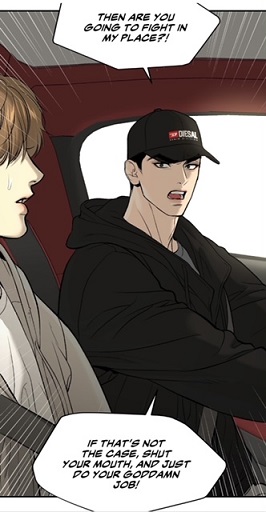 (chapter 42) And what was his attitude there? He would not listen to his passenger. Moreover, he would separate his job from his roommate’s. It looked like they were living in two different worlds, though they were sharing the car. This scene exposes miscommunication, lack of faith, stubbornness and prejudices. The fighter was not willing to accept the physical therapist’s doubts and chose to go through with the training and match.
  (chapter 2)
  (chapter 37) with arrogance and weakness, but this is not true. [For more read this
  (chapter 54)
  (chapter 5) He allows the coach to drive the car and the manager to sit in the front. Thus they represent the higher authorities. However, so far, the doctor had only been his passenger. Thus a new idea popped up: what if the athlete let the physical therapist drive his car? Let’s not forget that the loner wolf shouldn’t be driving on his own, for his shoulder has not healed properly yet. I already pointed out the wrongdoings from the two hyungs.
  (chapter 5) Then in episode 49, the champion kept The Shotgun’s words as a secret, while his coach confessed his trust in his “boy”
 (chapter 49). Yet, he revealed his true thoughts at the hospital:
  (chapter 52) Imagine that he only reported his investigation and actions afterwards. Then on the athlete’s birthday, he didn’t send any private message as well.
 (chapter 37) He was using the landline telephone. This observation is relevant, because it exposes the coach’s dependency on Park Namwook. The latter’s task is to keep in touch with his boss and champion, for he has his cellphone number. Nevertheless, how do we explain the absence of the coach’s cellphone? I have the feeling that this could be related to his divorce.
  (chapter 19) Thus this observation made me think that the coach could have something in common with Kim Dan. And that’s how the champion will demonstrate his strength to his hyung. Contrary to him, he didn’t accept the divorce so “easily”. In fact, he is fighting for the doctor in his own way. The problem is that he is his own worst enemy.
 (chapter 49), Jinxphiles could never view the driver.
  (chapter 13) His question “Is everything okay with you?” is purely mechanical and as such meaningless, for he doesn’t inquire, when he hears a silence from the other side of the line. I would even say that he doesn’t really wait for his boy’s answer as well.
  (chapter 56), he could end up in the same situation than the protagonist. And keep in mind that the coach Yosep is actually relying on the manager. Thus I reckon that the champion’s other source of power is actually his cellphone! Without him, he has no connection
  (chapter 5), no money
 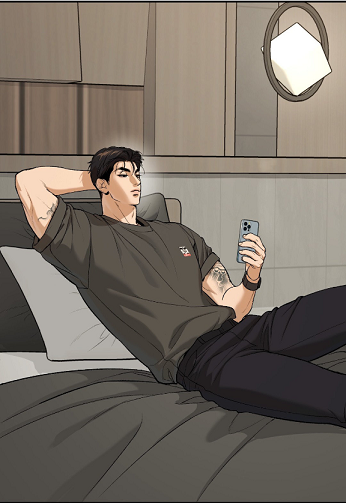 (chapter 32) and no power. His call to the manager during that evening represents his last resort. Thus he is calling the manager “Namwook hyung” contrary to episode 5.
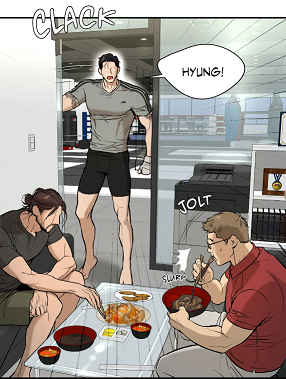 (chapter 5) This title is indicating that the champion is opening up, and willing to show his vulnerability and despair. On the other hand, this change also implies “expectations” from the fighter,
 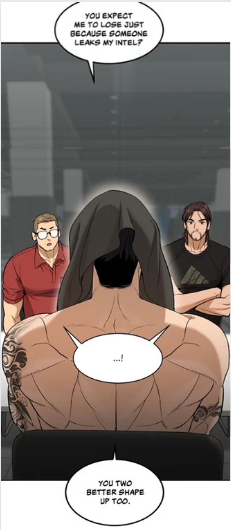 (chapter 46) Keep in mind that at the gym, the athlete denied the relevance of information. Though both hyungs were warned, the reality was that they got off scot-free. They never received any blame for failing to protect him and this twice. And now, he is looking for intel about the doctor. Indirectly, fate is teaching him to recognize his error. In fact, information can procure a good insight about people’s behavior and as such fears. Let me give you an example: if Joo Jaekyung were to hear about Kim Dan’s first employment as PT, he should understand why the PT made mistakes, why he took odd jobs and why he “left” Seoul. If he wanted to work as PT, he needed to go elsewhere.
 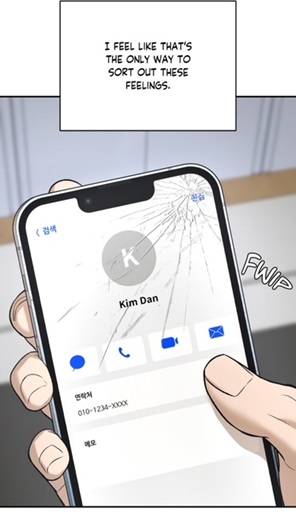 (chapter 56) He somehow expected doc Dan to listen to his words and accept them. That was it. Then at the end, it is just about seeing doc Dan and nothing more. At no moment, he voiced the desire to get to know his partner or to listen to his side of the story. Why? It is because he had strongly internalized that the man was a liar. He never questioned his perception and detected his own prejudices. It is important to recollect how Jinx-philes could sense a positive change in the physical therapist:
  (chapter 22) Yes, it is the view with the star’s back. The author selected such a position on purpose. The face represents the character’s identity and as such his personality. By showing the back, Mingwa is implying that the beholder is full of prejudices and doesn’t know his partner that well. That’s why I judge this image
  (chapter 7)
  (chapter 32)
  (chapter 37)
  (chapter 40)
  (chapter 43)
  (chapter 45)
  (chapter 46)
  (chapter 47) Looking at his face had become his new secret ritual and as such his source of joy. Naturally, his heart and unconscious were the causes for this new habit. This explicates why he hated hearing the doctor leaving the penthouse during the night: he feared that he would no longer be able to see his cute face. That’s also the reason why Joo Jaekyung got angry/upset, when he saw the doctor turning his head away
  (Chapter 54) This nightmare exposed his regret which he tried to deny and bury. At the same time, I have the feeling that his secret desire was to wipe away his tears as well. Nevertheless the problem is that such a love is rather superficial, for people’s body deteriorate over time. What matters in love is a good personality and a good heart. According to Erich Fromm, love is knowledge, respect, care and responsibility. Hence this separation became a necessity for the fighter. Fate had to force him to admit this:
  (chapter 56), when he imagined that she had died. In reality, he helped financially more the grandmother than Kim Dan himself. Kim Dan is the one he should really empathize with. He has always been a victim of circumstances.
 (chapter 17) and
  (chapter 11). In season 1, the athlete stands for golden hour, whereas Heo Namwook embodies blue hour. “Entre chien et loup” is the time of day when the light is such that is becomes difficult to distinguish between a dog and a wolf, between friend and foe, between known and unknown. Hence I am thinking that if the next episode represents a continuation of that nightfall, it signifies that the champion is on his way to meet someone from the past. Moreover, I detected that the pavement is the same than in front of the gym:
 (chapter 48) As you can see, this detail made me realize that the next chapter should contain reflections from episode 35 and 48, the meeting with an old/new acquaintance. I am writing new and old together on purpose, for Director Choi Gilseok had been the halmoni’s loan shark, but the “hamster” had no idea. Choi Gilseok is the boss of Heo Manwook. If this encounter takes place, it signifies that on the one hand, it will cause pain and suffering to the athlete, on the other hand, this incident will become a “blessing in disguise”, for it will push the champion to reflect and mature. That’s how I had the following revelation. Why did the author ensure that the MMA fighter’s shoulder would get badly injured?
 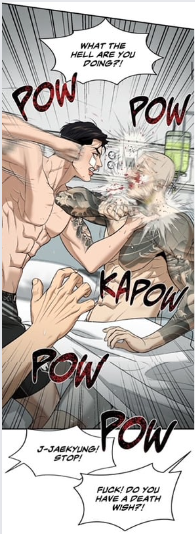 (chapter 52) That’s how he felt right into the trap of the schemers. So by having his splint, Joo Jaekyung is indirectly coerced to meditate on his feelings., as he can no longer use his shoulder and as such his fist. His physical injury represents in reality his “lucky charm”, for it helps him to transform, to overcome his trauma and face the shadows from his traumatic past. Notice that for the first time, the athlete came to accept the existence of feelings for Kim Dan.
 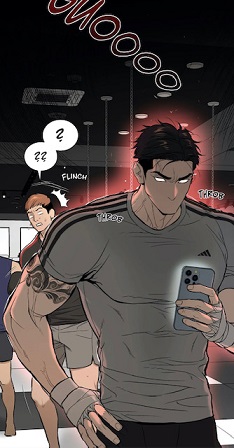 (chapter 5) He is much calmer. He is not oozing red and remaining silent. He is not burning up inside, in fact he is expressing his thoughts and emotions:
  (chapter 5) In both cases, the athlete asked for his manager’s help. However, as Jinx-philes can sense, there exist two huge differences between the past and present. Back then, Park Namwook didn’t care for Kim Dan. He was just a PT like any other doctor. He didn’t even care that Joo Jaekyung would lose his temper and ruin the sandbag.
  (chapter 5) It was not worrisome in his eyes, because his day would consist of training and punching the sandbag. The problem is that the fighter is no longer coming to the gym and he is not even calling him:
  (chapter 56) This shows that the athlete is using more and more his intelligence, he is forced to interact with people. He is gradually developing his social skills which stand for COMMUNICATION. And how did he get deceive in the past?
  (chapter 48) He got manipulated by his eyes! They used a trick to deceive the athlete: delivering the truth in delay. Joo Jaekyung didn’t confront Kim Dan, because he saw the pictures as proofs! He never tried to hear his side from the story. And now, you comprehend why I am expecting that the champion will suffer another “blow” in the next episode. In my opinion, he will hear an important information. The fire in the illustration is there to indicate “Tabula Rasa”, a clean state. Joo Jaekyung has to lose all his principles and his bias about doc Dan. But for that he needs to face his own past and mistakes. Only through this effective anguish, he can become a better man, a new man.

 (chapter 55) One might think that the causes for his throbbing head are his depression and insomnia. On the other hand, I am quite certain that many readers had a different explanation for his migraine. He is missing his lover, Kim Dan, as the color red symbolizes the headache and the physical therapist’s name is strongly intertwined with this pigment which was once again confirmed in episoe 56.
  (chapter 56) So it is true that his migraine are caused by the doctor’s absence. It was, as if the main lead was suffering from withdrawal symptoms. The fighter has a love addiction, but he is not aware of the existence of this “sweet poison”. But there’s more to it.

 Thus I consider this image, where the champion is seen
 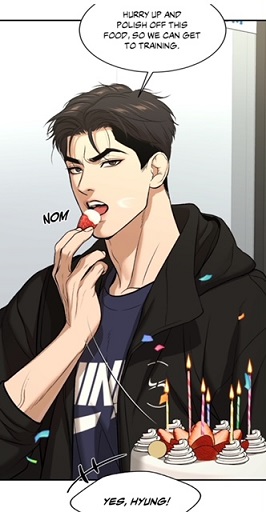 (chapter 43) eating a strawberry with cream as the announcement of the magical night between Kim Dan and his fated partner. The fruit with the cream represented a violation to his strict diet.
  (chapter 55) or the medicine against migraine.
 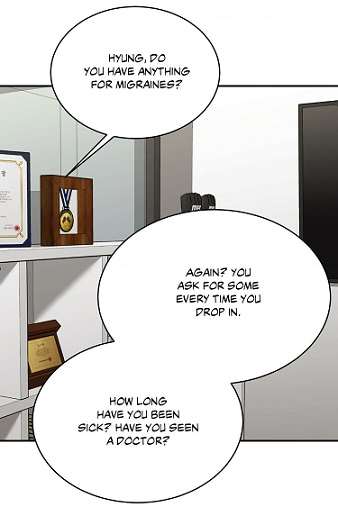 (chapter 54) However, in episode 55, we can observe a huge change in the champion.
  (chapter 55) The latter is finally admitting the inefficiency of the medicine. In other words, in this scene, he was giving up on them. This represents an important step on his way to enlightenment. For me, it signifies that he is stopping relying on pharmaceutical products. Let’s not forget that in the past, he rejected the PT and even neglected them. Why? It is because he trusted more sprays and other medicines than people.
  (chapter 55) And now, pay attention to the number of the bottles in his room:
 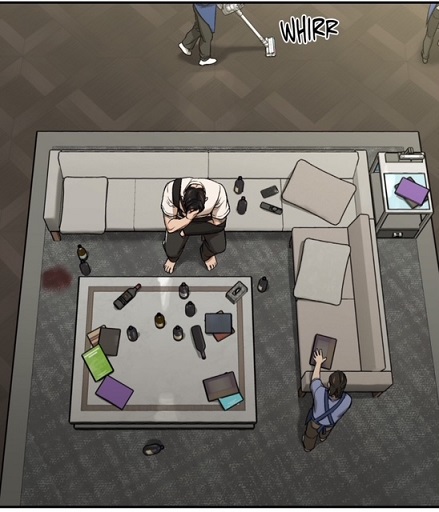 (chapter 55) I count 12 bottles of wine exactly like in the last image from chapter 54. Thus I came to the following deductions:
 (chapter 54) and the appearance of the staff in chapter 55. It indicates that Jinx-philes can witness time deceleration in season 2. From one month in one chapter, then a week in the next episode, finally we have a reference to a day: Monday. Thus I deduce that in episode 56, only 2 or 3 days elapsed. I have already announced that the couple should meet each other around 25th:
  (chapter 55)
 (chapter 55) Consequently, I judge the cleaning lady as the positive version of Park Namwook. Though she uses social norms, she doesn’t use them against her employee. She didn’t condemn him, it is a mixture of teasing and reminder. At the same time, her intervention implies that she must have noticed changes in her boss after the arrival of Kim Dan in the flat and his departure. That’s the reason why I have the impression that this image is announcing another turning point in the champion’s life either:
  (chapter 55) He won’t drink like before. However, I don’t think that he will behave like in the past: reject any alcohol entirely.
 (chapter 55), his migraine vanished. Though he is holding his head the next morning and hiding his gaze
  (chapter 55), the Webtoonist didn’t add any red or “throb” as an indication for a migraine. As you can see, his headache is strongly intertwined with repressing the physical therapist and as such locking away memories. However, there exists another cause. What had the doctor done in the past?
  (chapter 44) Yes, the main lead had patted his lover’s head, while the champion had his eyes close. In my opinion, his unconscious had registered this gesture and loved it. However, the champion had not seen it himself. He was drunk and had his eyes closed. This stroke on the head symbolizes appreciation, affection and recognition.
  (chapter 23) That’s how little kids are admired and loved. This stands in opposition to the abuser’s behavior:
  (chapter 54) parental criticism and absence of contact. And how did Choi Heesung express his “love” to Yoon Gu?
  (chapter special 2) The same way than Kim Dan with the patting! In other words, the champion is deep down longing for such a gesture, but he has not realized it yet. Nevertheless, I believe that he just needs a trigger.
 (chapter 55) With his left opened eye!! The exact opposite from this picture:
  (chapter 56) As long as the fighter thinks of his fated partner, he is not plagued with a throbbing head. This shows that it has something to do with repressing memories. However, his physical condition is still not improving:
  (chapter 55) This signifies that in reality, the uke is the one benefiting more from this relationship, while the “Gucgi guy” is a placebo for Joo Jaekyung. He can not replace the true medicine: Dan’s love. But Joo Jaekyung chose to close an eye to the truth forgetting his “insight” from chapter 2:
  (chapter 2) However, back then, he had just stated it in order to get rid of the mint-goblin. He needed a justification for switching his partner. In other words, this was reflecting more the protagonist’s corrupted mind and heart. Therefore he is designed eyeless, the symbol for ignorance, lies and blindness.
  (chapter 55) And where did he have his migraine exactly?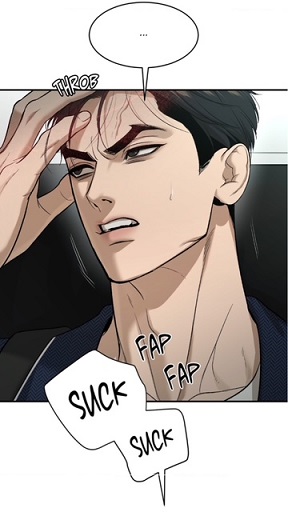
 (chapter 55) It was on the right side and eye! It truly exposes that Joo Jaekyung was getting punished for his attitude. He is not allowed to bury and forget Kim Dan. The star’s open eyes in this episode symbolize denial, lack of self-awareness and as such the absence of insight. He is also punished for his lies in episode 2. His words might have reflected the truth, but his words didn’t expose a change of heart. He was taking advantage of this situation as well. So when the pain intensified pushing him to close his right eye, we should consider this image as a short moment of reflection and realization. In the restroom, he was forced to admit that only Kim Dan could kiss him. Is it a coincidence that just before Mingwa presented this image
 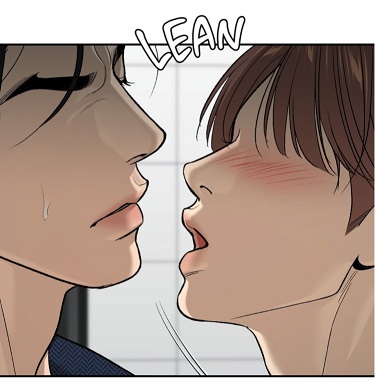 (chapter 55) Naturally no, she was mirroring the attitude of both figures: both were in denial!! Notice that though the star had no reaction in front of the “replacement”, the latter chose not to give up at all. This man was not expecting a rejection, in fact he was in total denial as well. He didn’t notice the star’s passivity and silence.
 (chapter 55) He was just standing there and avoiding his gaze.
 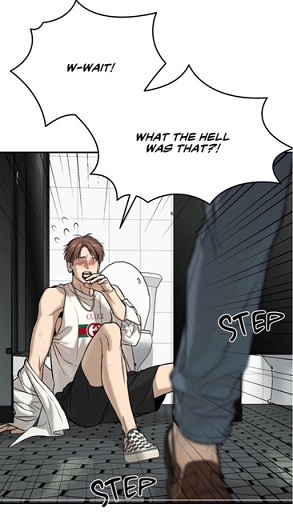 (chapter 55) How can the MMA fighter reject him? This displays his huge confidence or arrogance. There’s no doubt that he will put the blame on Joo Jaekyung. At the same time, I believe that his blindness was also caused by his greed.
  (chapter 5) Therefore he was in a happy mood after that match. A simple gesture with a lot of power! He has been missing this hand or better said this gesture. This action was the main lead’s true motivation.
  (chapter 40) No wonder why he felt so lost and empty after the last fight.
 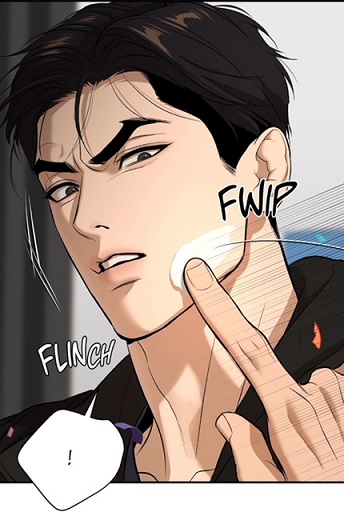 (chapter 43) this was the coach’s hand. In other words, the athlete felt more close to the coach than to the manager. This would explain why he would listen to the coach and even entrust him with huge tasks like the charity event. Strangely, in season 1, we can observe how more or more he is distancing himself from the fighter. Probably related to his secret relationship with Kim Dan. According to my theory, the coach is aware of their relationship. They are more than just boss and employee. As you can see, I don’t think that the champion is right now just missing the doctor’s sweet lips. Deep down, he would like to be patted by his loved one, exactly like Potato.
  (chapter 2) The champion’s reaction is quite telling. He is not easily swayed. But we have another bigger evidence that his intercourses were replacement for “fights”. In The States, the fighter asked Kim Dan to join him at 11:00.
  (chapter 38) He needed to prepare himself mentally, to visualize how he would screw his opponent Dominic Hill. He was just taking the expression “fuck/screw” too literally. The latter idiom has the following synonyms: to cheat, oppress, bleed, coerce, wrest and to tighten. Just before the doctor came to his door, what was the athlete doing? He was watching a video from his challenger:
  (chapter 38) Therefore it is not surprising that he rejected Kim Dan’s request first.
 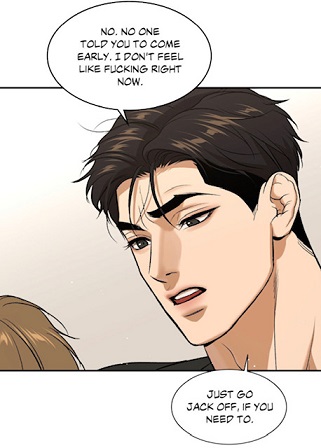 (chapter 39) He didn’t feel like it, because he was not aroused at all. Imagine that he needed two hours for that erection, a sign that during that night, Kim Dan was in reality a replacement for the American fighter.
 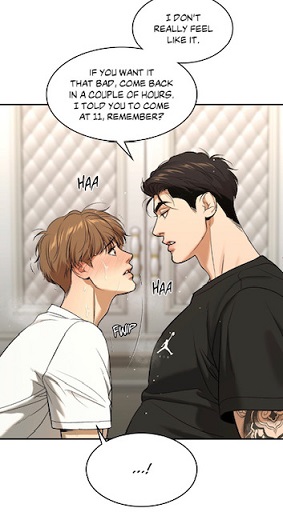 (chapter 39) Even when the doctor rubbed his hand against his sex, he had no reaction.
 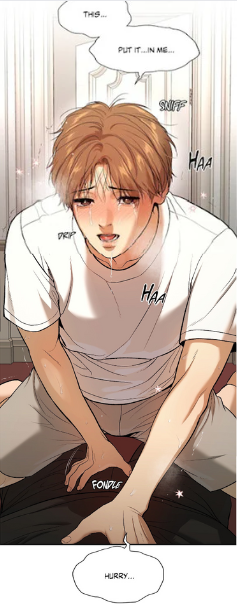 (chapter 38) In fact, he needed a fellatio to get an erection, and he only started getting excited, when he saw the doctor’s gaze. That’s the reason why he remembered this image under the shower:
  (chapter 55) However, the more time the champion spent time with his physical therapist, the more he came to violate his own rules and principles: It started with their first meeting, when he crossed the line by mixing private and professional life together:
  (chapter 6), Sex was no longer linked to matches, but to his own desires. To conclude, for the first time, the fighter connected sex to pleasure and desires and not “work and fighting”. Because of the deal and Joo Jaekyung’s strange behavior (sex shower scene, …) the PT had the impression that his boss was a man obsessed with sex.
 (chapter 4)
  (chapter 53) Pay attention to the behavior from the fighter during their last night together. He is looking away, he is not paying attention to his fated companion. His mind was elsewhere, focused on Baek Junmin! In my opinion, during that night, the champion had been able to differentiate between the physical therapist and his opponent. Fighting was more important than sex and as such his sex partner. To conclude, the physical therapist had been able to win Joo Jaekyung’s belief and heart. He was no longer a replacement at all. He had become a person close the fighter.
 (chapter 49) he wanted to screw Baek Junmin for real. In this image, the athlete oozes confidence and strength. This means that he was no longer dependent on the good fuck before the match.
  (chapter 53) However, the main lead never realized this huge change, he kept his old belief as a tradition out of habit. This explicates why the fighter tried to replace with a new uke
  (chapter 56). I don’t think, he was referring to the spray incident, rather to their night before the match. The doctor had not behaved like a real opponent, he had admitted his “defeat” quite easily. He had left the ring before procuring him a good fuck. He was blaming his partner for violating his rule:
 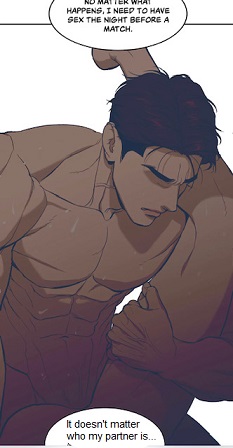 (chapter 2) But here is the thing. Kim Dan had just accepted the deal because of his grandmother. Secondly, he learned an important lesson during that magical night: consent!
  (chapter 44) Sex is a synonym for love and as such it is about giving pleasure and affection to his partner. It is a two-way street. And this is something that the champion has to admit and accept. Thus I deduce that the fighter still has a long way to go before dropping all his fake principles. Like mentioned before, he needs to ponder on the following question: what matters to him the most? His championship or his happiness? Or what is sex to him? Why does he think that he is jinxed? He needs to face his own painful past and remember the face of his tormentor.
 (chapter 49) Baek Junmin and the abusive parent.
 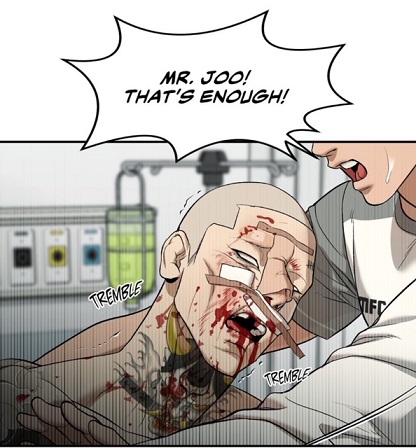 (chapter 52) There’s no doubt that thanks to the doctor, the champion will learn that he can get “justice” and satisfaction through other means. He can defeat the ghosts from the past, not just thanks to his fists and hard work, but also thanks to his surroundings and knowledge. Lawsuit and media!
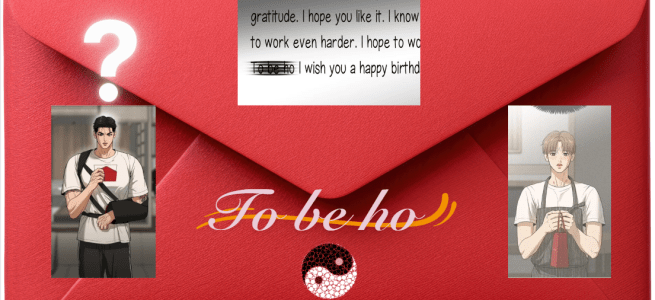
 (chapter 119), they got worried and nervous, as they considered the expression „as long as I live“ as a clue for a sad ending. Why? It is because the lord was referring to his own death. Under this light, it becomes comprehensible why I selected „heavenly“ in the title. I was naturally alluding to the afterlife. However, I perceived his words in a positive light. He expressed his desire to live. He is no longer suicidal, he wishes to live a long life next to the painter and treasure his moments with him. That’s the reason why the author included the refraction in the scene. A dream had come true, the lord was finally able to escape the darkness.
  (Chapter 119) He is now truly alive. This explicates either why he smiled and laughed at the end. But why was he so happy? It is because Baek Na-Kyum had just confessed that he loved him not for his wealth or power, but for himself.
  (Chapter 119) He even described him as a treasure. Yoon Seungho had finally achieved his goal: to win the painter’s heart. His presence and love bring happiness to Baek Na-Kyum which stands in opposition to his reputation as bird of misfortune. Moreover, this description contrasts so much to Jung In-Hun
  (Chapter 119) and Yoon Seungwon’s.
  (Chapter 118) where both portrayed the main lead as a man consumed by lust and revenge. In other words, he was presented as a huge sinner. This implies that he stands so far away from heaven. But all these words were erased the moment the painter confessed his love for Yoon Seungho once again. What Baek Na-Kyum didn’t realize is that his love confession is pushing the protagonist to fight for the painter.
 (chapter 102) In episode 102, he was renouncing on everything (life, mansion, wealth and connection), because he imagined that the artist had died. Consequently, I deduce that in episode 119, the painter’s life is attached to the lord’s for good. If the artist got into trouble, Yoon Seungho would side with him and the reverse. Thereby, I come to the conclusion that this moment in the kitchen represents their union, as they are no longer tied to the mansion. They are now a family no matter where they are. Let’s not forget that the painter expressed his wish to run away with his lover.
  (Chapter 119) It is important, because such a departure symbolizes that the bird “Yoon Seungho” is leaving the nest. He is now starting a family on his own.
 (chapter 85) and put a glass and that was it. This exposes the father’s hypocrisy, ignorance and greed. By acting on his own, he was exposing his true mindset. He views himself as the family. The sons are just the extension of himself, for they are his reflections.
  (Chapter 45) On the other hand, Yoon Seungwon is his golden child, for he represents his positive reflection.
  (chapter 86), whereas he put the other on a pedestal
 (chapter 86). Thus I created this illustration.
 Under this new light, it becomes comprehensible why the father could only reject the offer from lord Song in the gibang. Doubting Yoon Seungwon’s sexuality meant to question about the father’s sexual orientation. At the same time, it is not surprising why the elder master would blame Yoon Seungho for everything, for he couldn’t admit his responsibility for the purge. Consequently, the Manhwaphiles can grasp why Yoon Chang-Hyeon came alone to the shrine. If he had brought Yoon Seungwon, the father would have been reminded of the elder son, as both can not be separated. This explicates why the younger master asked his elder brother to submit to his father.
 (Chapter 119) I couldn’t help myself smirking when the brother attempted to make him believe that.
 (Chapter 119) the protagonist could ever gain the father’s favor. Yoon Seungwon was definitely playing with his brother’s feelings, as if he could hope that their father would change.
  (Chapter 118) It is because as a golden child, he is also suffering, but it is naturally nothing compared to Yoon Seungho’s position who could have died.
  (Chapter 77)
 (Chapter 119) First, by returning the petition to the father, Yoon Seungho would become the culprit. He was not only a traitor, but also a blackmailer of the Yoons and lord Song.
 (Chapter 107), for he had stolen the petition. Yoon Seungwon would hide his wrongdoing, he betrayed their father.
  (Chapter 118) There is no doubt that Kim played a role in this as well. In other words, the brother and the valet would bury the truth by diverting the attention of the patriarch towards the main lead, if Yoon Seungho followed this suggestion.
  (Chapter 116) The elder master would no longer seek the truth, similar to the kidnapping in season 2 which was turned into a desertion and later Lee Jihwa’s abduction occulting the instigator and the helping hands. Simultaneously, Yoon Seungwon needs his brother as scapegoat, because the pressure coming from the patriarch and lord Song must have definitely increased.
  (Chapter 83) This shows that the young master wants to sacrifice his brother once again. Out of selfishness and cowardice, he is trying to convince Yoon Seungho that this is the right thing to do!
  (Chapter 37) He is even implying that he needs to sacrifice himself in order to protect Baek Na-Kyum!! Moreover, he is distorting the reality, because he implies that his father is still powerful.
  (chapter 37) like the memories from episode 37 are exposing it. It becomes clear that if Yoon Seungho returned the petition, he would die.
  (Chapter 116) Thus I come to the conclusion that the meeting between the brothers in the gibang represents an offering. For the Yoons’ sake, Yoon Seungho should admit his wrongdoings
  (Chapter 55) People had played with his hopes and longing for acceptance and recognition. Interesting is that offerings is a synonym for atonement and sacrifice. But why is Yoon Seungwon so sure that he can repeat the same action from the past? It is because Kim and Yoon Seungwon have known for a long time that Yoon Seungho was longing for acceptance and love from his family, just like the scholar knew about the painter’s love for him.
  (Chapter 119) But everything changed, when the painter met the lord. So who is worse here? Jung In-Hun who tried to rape the painter or Yoon Seungwon who is sentencing his elder brother to death? Let’s say that the valet convinced the younger master to suggest this solution, this doesn’t diminish Seungwon’s responsibility at all. He knows that his father abused his elder brother. In my opinion, he is copying his father, like the former tried to diminish the responsibility of the patriarch.
  (Chapter 119) Yoon Seungho got hurt because of lord Song and not because of Yoon Chang-Hyeon. This means that the younger master was denying the existence of the patriarch’s choice and the helping hands. And if the brother listened to his advise and the father hurt or killed the main lead afterwards, the younger master could put the blame on the elder master, for the decision and responsibility belonged to the patriarch. Moreover, he heard from lord Song that killing Yoon Seungho was just a matter of time.
  (Chapter 119) So technically, this situation could have triggered the protagonist’s insecurities like in season 1
  (chapter 28), 2
 (chapter 60) and 3
  (chapter 98). However, through these constant exposures, Yoon Seungho came to learn not to jump to conclusions and to have faith in Baek Na-Kyum. He knew that he would return to the mansion. Hence he ran to the bedchamber first.
  (Chapter 119) Another important detail is that we don’t see any staff in the courtyard or in the kitchen. It was, as if the propriety had been deserted.
  (Chapter 119) This implies that at no moment, he relied on the domestics’ testimonies which contrasts to the following scenes:
  (chapter 104)
  (chapter 107) and
  (chapter 116) However, observe that in episode 116, Yoon Seungho had witnessed how his lover had taken care of him, while he was unconscious. Furthermore, the petition had been handed over to the painter and not Kim, a sign that the artist had become the protagonist‘s confident. As you can see, as time passed on, the main protagonist learned the following lessons: he should stop relying on servants, he should only trust his partner. I would even add that he was taught the following principle: “If you want something done right, you have to do it yourself”. In my eyes,
  (Chapter 103) Here, they never expected the return of Yoon Seungho and the painter. The staff ‘s absence in episode 119 is the evidence of their desertion! Moreover, I consider Yoon Seungho’s search for his lover as a new version from episode 28/29/30:
  (chapter 28) Back then, they feigned ignorance, but they never anticipated a punishment from Yoon Seungho.
 (chapter 115) And now you are wondering how the painter’s gesture can be considered as an offering. It is because the kitchen hearth is considered as sacred due to the fire. First, in shamanism, there exists the god of fire named Jowangshin.
  (Chapter 115)
 (Chapter 59)
 (Chapter 98)
 (Chapter 115)
  (Chapter 47)
 (chapter 102) who was a traitor, for he had tattled on Black Heart and his friends to Yoon Seungho. And now, you comprehend why I connected the shrine to the kitchen hearth. Both places are considered as sacred, for they are connected to gods and spirits.
  (Chapter 85) The absence of his sons and of food as offerings reveals that he was not showing true respect to his ancestors. He used religion and social norms to hide his true intentions. He wanted to take over the mansion. Hence the black guards were standing at the entrance of the sacred house. Their presence symbolizes violence. Therefore it is not surprising that the gods chose to punish the elder master through Yoon Seungho. The former was not received properly
  (chapter 86): no bow, no food and no seat.
  (Chapter 86) Let’s not forget that the elder master had entered the lord’s chambers without the permission of his owner. No wonder why he was left speechless. And now, you are wondering if I am not drifting away from the topic, as these chapters from season 3 don’t seem to be connected to episode 119. However, it is important to realize that these chapters have many common denominators
 Here, we could detect the suicidal tendencies of the protagonist. He wouldn’t fight back.
 The seat looks like a throne.
 The courtyard is empty! No one is defending their master.
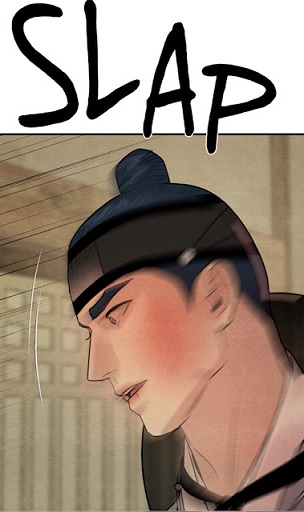
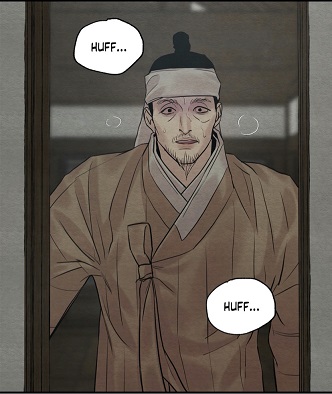

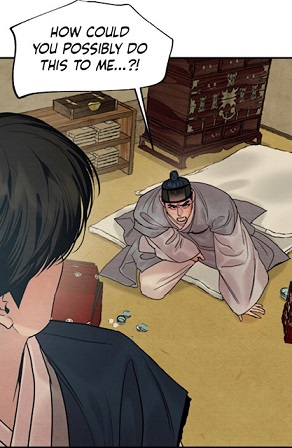

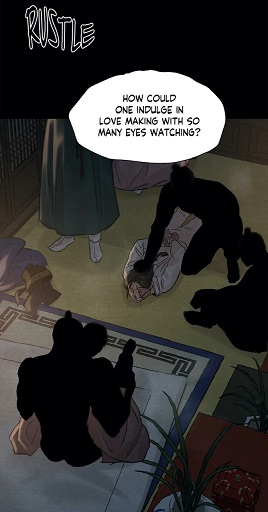




 Baek Na-Kyum freed himself.
  (Chapter 85) The study is even close to the gate.
  (Chapter 51) He could have reached the study before the father entered the shrine. Finally, observe that the patriarch even arrived to the bedchamber before Yoon Seungho,
  (Chapter 117) The painter wants to leave everything behind too.
  (Chapter 119) Thus I am deducing that the authorities will be involved very soon.
  (chapter 119) They are not expecting the lord‘s resistance, for he remained passive all this time (season 2 and 3). The scholar has now the means to do so, and the necessary motivation. Imagine that he got wounded and humiliated by the couple! Besides, we have this broken promise due to Yoon Seungwon
  (Chapter 115) exposing the younger master’s lies and Yoon Chang-Hyeon’s delusions. Without the protagonist’s help, the younger brother would not be „successful“. Furthermore, the absence of food and fire in episode 86 indicates that this house was neglected and even not protected.
  (Chapter 94) The gibang is connected to money, power, pleasure, artificiality, sensuality and lack of privacy.
  (Chapter 96) I am sure that you can detect all the contrasts (night, door close, spies, confession outside and inside, no fire, only light). Thus I am deducing that the painter’s words in the kitchen were not heard by others. As you can see, this scene in the kitchen is full of symbolism. In my previous essay “The true face of family”, I had already pointed out that sharing meals represented a criteria to define a real family. Therefore I had demonstrated that Yoon Seungho and Baek Na-Kyum were excluded from the mansion, for they wouldn’t eat their meals in the kitchen like the staff.
  (Chapter 17) Moreover, the hearth doesn’t just provide warmth, but also light! The latter embodies knowledge and as such Enlightenment.
  (Chapter 119) Hence they were clueless about the wrongdoings from the staff. Only in the kitchen, the lord could finally grasp the depth of Baek Na-Kyum’s love for him. It is an unconditional love contrary to Yoon Seungwon’s. The latter would only recognize him, if he listened to him. And he only seeks his assistance, when he needs him. It shows that Yoon Seungho is only approached, when he has power.
  (Chapter 118)
 (Chapter 119) I would like to outline that during their conversation, Yoon Seungwon remained calm and indifferent, when he talked about the assassination attempt from Yoon Chang-Hyeon.
 (Chapter 116) But the biggest difference is the absence of fire in the kisaeng house.
  (chapter 78) Furthermore, he tried to leave before
  (Chapter 104)
  (chapter 105) Finally, we saw him in the courtyard standing next to a horse and a servant indicating that he had given him a task, and the latter needed to leave.
  (Chapter 108) Hence you comprehend why I am full of optimism in the end. Yoon Seungho has already made some preparations in my opinion. On the other hand, I am quite certain that their love will be tested. Can they face together trouble? Yes, because through their pain, they learned their lessons and changed.
  (Chapter 119) It is because in the past, he was never allowed to join the kitchen hearth. This place was either beneath him or he was not worthy of entering the place. Thus he employed the expression scullery boy to Yoon Seungho.
  (Chapter 47) Here, I would like to outline that when the protagonist was held in the shed, someone brought him food .
  (Chapter 83) That‘s how I realized that the shed is connected to the kitchen!
  The maid had just brought water to the couple.
 During that night, Baek Na-Kyum had been held captive in a shed.

 (chapter 38) Yoon Seungho remained outside on the door step. Consequently, I started comparing scenes where the kitchen hearth appeared and that’s how I discovered a pattern:
 (Chapter 46)
  (chapter 47)
  (Chapter 110)
 (Chapter 77)
  (chapter 38)
 (chapter 59)
  (chapter 119)
 (chapter 38)
  (chapter 47)
 (chapter 77)
  ( Chapter 110)
  (chapter 119)
  (chapter 47)
  (Chapter 77) For me, Kim must have looked down on the other domestics. I consider this scene as the best example what Kim should have done in the past.
  (Chapter 119)
  (Chapter 98) One door leads to the backyard and the other to the smaller courtyard. And this scene confirms my previous assumption
 (Chapter 87) Baek Na-Kyum is there to prove him wrong. He had other opportunities, like giving him a good meal.
  (Chapter 63) He should have sided with his master and even remained by his side. This signifies that this scene
  (chapter 7) the artist is not only cleansing the kitchen, but also cutting off ties with the scholar. The latter is no longer protected. The spirits will intervene through chance. As a conclusion, the hearth has a spiritual and healing power, for it is connected to „Heaven“. Yoon Seungho‘s paradise is to have a family.

 (chapter 109) He discovers that Baek Na-Kyum has already prepared himself, as he is longing for him.
  (chapter 109) He never expected such a reaction. The reason why the evolution of Painter Of The Night is flowing at a snail’s pace is that season 4 is now focusing more on the past. First, Byeonduck needs to divulge the lord’s suffering and its causes. And this can only happen, if memories are brought up. Hence in episode 109, the painter’s memories stood in the center. Why? It is because he is trying to understand why his loved one is now avoiding him. Thus he is remembering what happened just before. The readers are actually put in the same situation than the artist. On the one hand, the focus on recollection is a method to unveil how the young master was turned into a “sodomite and pariah”, for the painter is going through the same experience than his partner. In episode 109, he is isolated from his “lover” and as such from his family, for he has now maids by his side. The latter are supposed to be his new “family”. On the other hand it helps the manhwaphiles to anticipate the future main events,. as the progression is in slow motion. This means, the Webtoonist left all the elements in the previous seasons in order to decode the past, the present and the future. That way, the manhwalovers are capable to unveil the mystery. Besides, the author has to answer all the questions the beholders had while reading the previous seasons, like this one:
  (chapter 27) What book was the scholar looking for? Up to now, we have no clue, though I had developed the following theory: Jung In-Hun was a Christian and had a bible.
  (chapter 109) How did this happen? One might reply that the book fell from the shelf, when the painter kissed his lover.
  (chapter 109) This interpretation can be easily refuted, for the noble stood next to the shelf and not in front of it. Besides, the counter stands on the noble’s left, while the ledger was on his right. However, one detail caught my notice, the beholder can not see Yoon Seungho’s hands!! That’s how I realized that the book came from the protagonist! He had carried it hidden in his right sleeve. This explicates why the book stands on the right side.
  (chapter 109) Besides, contrary to the previous panel, now the lord’s hand is visible! This is no coincidence. But if he was hiding the copy from Baek Na-Kyum, I deduce that it is related to the painter. But there is another person associated to manuscripts in this story, Jung In-Hun!! But what have the low-born and the scholar in common then? The erotic publications!
  (chapter 34) Note that in the background, there’s a book open on the desk, and it has the exact opposite position than in episode 109! And now, you comprehend why Yoon Seungho rejected the painter’s company next to his table. He didn’t want him to see the publication, for he feared that the painter would be reminded of Jung In-Hun. In the lord’s mind, the young artist still treasures his former teacher. He heard his confession on the bridge next to the pavilion.
  (chapter 94) However, Yoon Seungho is suspecting that the learned sir was behind the trick in the shaman’s house due to the glasses Min had in his hand before dying.
  (chapter 102) Hence he doesn’t want to break the main lead’s heart and mind. In other words, the main lead is determined to hide the past from Baek Na-Kyum so that the latter’s memory and agony won’t be triggered. The book could definitely remind the low-born of all the events which led to the massacre in the shaman’s shrine. Besides, I feel that the noble must feel guilty as well. If only he hadn’t admired the erotic publications which led to Baek Na-Kyum’s stay in his mansion. Consequently, I think that the noble is also in agony because of the work.
 However, there exist two reasons why I came to this deduction. I detected similarities with the first encounter between Yoon Seungho and his nemesis in the scholar’s home and the painter’s kisses.
  (chapter 6) Both were standing in front of the cupboard, while the learned sir suddenly took away the copy and closed it to put it back on the cupboard. This made the protagonist smirk. Due to the characters’ reaction,
  (chapter 6), I had assumed that the protagonist was making fun of Jung In-Hun. He had played a prank on the host, especially after asking about his occupation. I have always wondered about the content of the volume. Therefore I had developed the idea that this could be the bible. However, it was clear that the book was not for children which is visible due to the writing.
  (chapter 6) In fact, the learned sir should have the manual Thousand Character Classic (Chinese: 千字文; pinyin: Qiānzì Wén), also known as the Thousand Character Text.
 (chapter 6) In reality, he wasn’t teaching them reading and writing at all. But Yoon Seungho had feigned ignorance with this discovery. With his indifference and praises, the false teacher had the impression that he was supporting his attitude. This scene is relevant, because the learned sir had lied to the protagonist about the painter’s education.
  (chapter 6) This means that the book represents the evidence of learned sir’s betrayal and abandonment. He is responsible for his illiteracy. To conclude, this scene contains the following elements: a prank, a lie, a confession which was triggered by a book that Yoon Seungho had picked up by chance. But wait… it could be the book from the scholar’s home!
  (chapter 06) But this image can be used to refute this theory. How so? It is because this book has a title, hence there is a white rectangle!! However, take a closer look at the copy on the floor.
  (chapter 50) Finally, I would like the readers to keep in mind that they could only see the content of the books
  (chapter 1), but they never got the chance to see the cover.
  (chapter 6) He proposed him to sit and have a cup of tea to divert his attention from the books on the cupboard. Besides, I would like to outline the huge contrast between these two scenes. The scholar needed the assistance of the prestigious family Yoon, while the protagonist replied this to his loved one:
  (chapter 109) Needed versus not necessary!
  (chapter 6) He was here very vague (“bizarre and vulgar”), he spoke of a scolding, but never of rejection and abandonment!! This is important, because Yoon Seungho also experienced something similar in the shed:
  (chapter 77) Back then, the butler’s words must have wounded him terribly, he must have felt dirty either. Under this new perspective, it becomes comprehensible why I came to this conclusion that the book is related to the learned sir and to the erotic publication. But this doesn’t end here. In my eyes, episode 109 clearly outlined the importance of the library in the protagonists’ life. This is the place where both main leads got betrayed and abandoned.
  (chapter 40) When the scholar wounded the artist with his words, he implied that the artist was responsible for his lack of education. With the idiom “I thought, you could be educated”, he gave the impression that he had put some effort, but due to the artist’s disposition, he had failed. We had another scene where the learned sir was blaming Baek Na-Kyum.
  (chapter 70) He would fall asleep instead of studying. And who knows about the learned sir’s hypocrisy? Yoon Seungho!! That’s the reason why the goddess Byeonduck let them meet in the library. It is to heal their wounds. In this room, Yoon Seungho’s suffering started and later, the painter got betrayed by his former teacher, someone whom he viewed as his “family and mentor”.
  When Yoon Seungho got kissed by the painter
  (chapter 109), he got surprised, and he had the same gaze and facial expression than the one during the First wedding night
  , in the gibang
  and in the study
  (chapter 42), though here the artist kissed his companion twice!
  (chapter 49) And what had these scenes in common? Paintings and the artist’s confession. And now, you comprehend how I made the connection between the book and painting.
  (chapter 19) This scene could only break the artist’s heart, because he was reminded of the learned sir’s reaction: his rejection. The latter got angry and jealous that the low-born would be treated as someone special. Furthermore, Jung In-Hun had only got the noble’s sponsorship thanks to Baek Na-Kyum and not thanks to his own talent! In verity, the learned sir had been the tool to submit Baek Na-Kyum. Shortly after the exposition, the protagonist went to the study. There he got confused for Jung In-Hun, hence he received a wonderful confession
  (chapter 19) before getting kissed and embraced!
  (chapter 42) Yet, the artist was unable to explain the situation, for he had internalized Jung In-Hun’s criticism.
  (chapter 42) So we could say that the yangban tried to get a confession from the painter, but he failed. Hence they had just sex. The artist’s heartbreak was the reason why he never got to confess the truth! And what had happened in the study after the painter kissed the main lead? The lord saw the inauguration illustration and got jealous of Jung In-Hun
  (chapter 48), and the painting had exposed the main lead’s uneasiness and pain. The drawing was not refined, barely finished.
  (chapter 47) The behavior from the painter and the new painting had not only wounded the main lead, but also pushed the lord to discover why the artist was behaving this way. After the rough sex session, the artist had made a confession: he was dropping the rules he had been raised.
 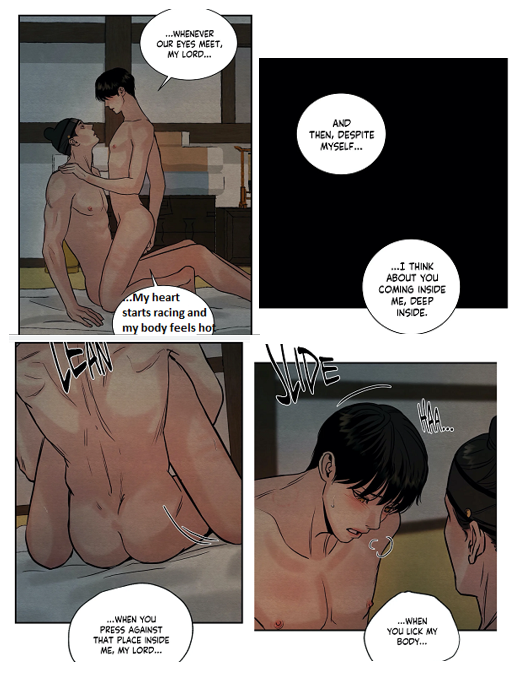 (chapter 49) He was admitting his sexual orientation and his own pleasure, but he still kept his distance from Yoon Seungho. Why? It is because he was reminded of the learned sir’s fake embrace and betrayal.
  (chapter 49)
  (chapter 94) which incited the artist to recall his childhood. That’s how he came to unveil his past and confess his love to the noble!
  (chapter 19), the parties after the separation
  (chapter 51), his visit in the gibang and his tricks
  (chapter 96). In episode 109, the painter confused Yoon Seungho’s shadow with Black Heart’s. In his nightmare, he was brought back to the shaman’s house and the lord’s smile was similar to Min’s.
 (chapter 109)
  (chapter 99) Besides, let’s not forget that during that terrible night, Black Heart never touched the artist himself, as if he didn’t want to touch a trinket sullied by another man”. On Twitter, the author revealed that Min would help Yoon Seungho. Through this comparison, the beholder can confirm this. Thanks to Black Heart, the couple got closer in the end.
 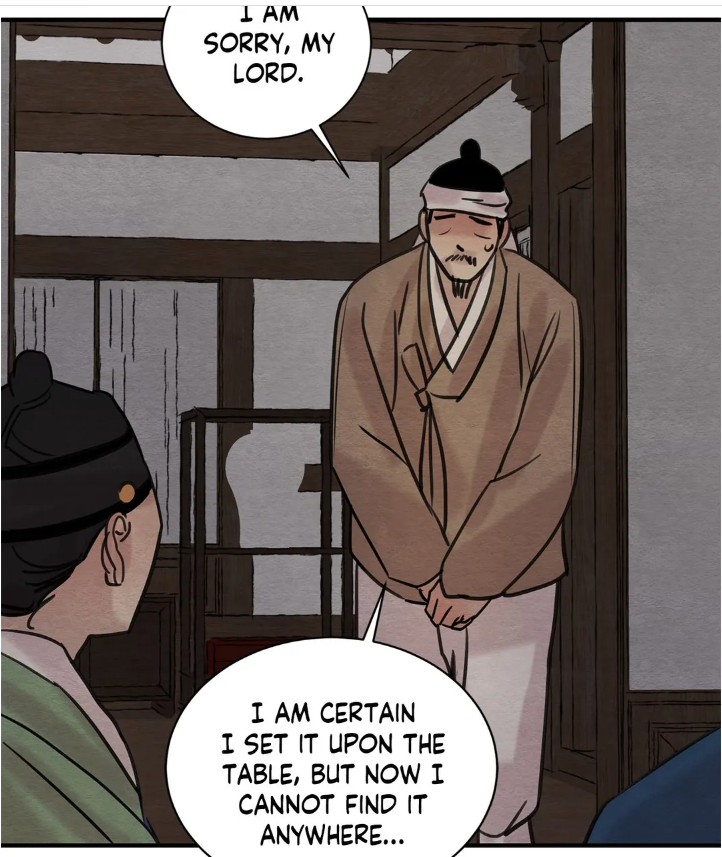 (chapter 19), the spying on the painter – though here it appears like a good thing –
  (chapter 41), the stones in the rice
 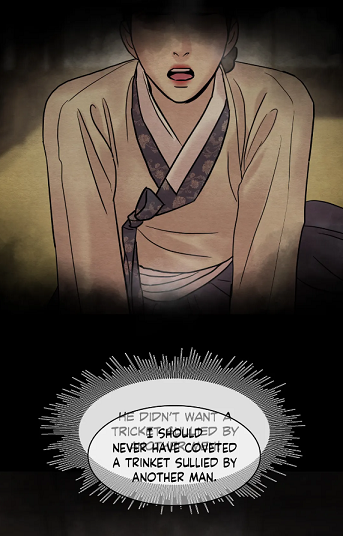 (chapter 109). Here, the maid was triggering the painter’s memory and as such fears. That’s the reason why the readers can see the laugh of someone outside the building
  (chapter 109). She was acting, as if Baek Na-Kyum was not present, but in reality she knew that he could listen to her. How do I know this? The evidence are the sweets on the windowsill.
 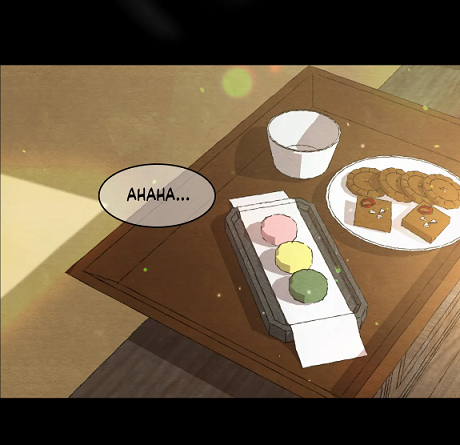 (chapter 109) They never encouraged the tormented boy to eat the sweets!! Besides, this episode confirmed my interpretation about the complicity of the maids. As their role is to comfort Baek Na-Kyum, the readers should question themselves about their absence.
  (chapter 108) Why is the room dark? Where are the maids during that night, as they are supposed to sleep next to the painter?
  (chapter 109) The absence of the light is truly noticeable, an indicator that they are not in the bedchamber. Moreover, I had detected that the brown bed cover symbolizes the meddling of Kim. [For more read the essay
  (chapter 87) Sincerity versus fake concern; own choice versus manipulation, happiness versus sadness. Under this perspective, you comprehend why I view the maids as traitors. But since season 1, the women were never punished. Hence they felt free to badmouth Yoon Seungho or Baek Na-Kyum. So while he was preparing himself, where were the ladies-in-waiting? I doubt, the painter would give them orders. The painter was left alone on purpose. Finally, the manhwalovers should question why there is a bottle of oil in the bedchamber. So far, Yoon Seungho utilized it once
  (chapter 20) and it was during the first Wedding Night. And oil comes from the kitchen, the lord had fetched it from that room!! Naturally, there is an exception, and it is the kiss in the gibang. Yet, here the kisaengs had just replaced the maids. In other words, they had played a role in the confession. And this explains why the noona’s words are superposed with the maids.
 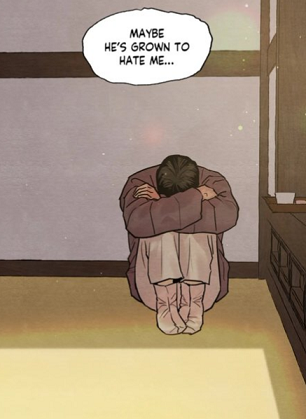 (chapter 109) That’s the reason why I am convinced that the book is strongly connected to the learned sir. In my eyes, it can only be the erotic publication of sodomy!! Why? It is because it represents the painter’s biggest wound. It explains his low self-esteem. Consequently, I am expecting the appearance of this panel:
  (tweet) The teacher told him “It’s dirty”, and wounded him the most with his gaze full of hatred, the symbol of rejection! Note that in episode 109, the painter always focused on the mouth and not the gaze,
  (chapter 109)
  (chapter 109)
  (chapter 25) Moreover, during that night, we have the same elements: a painting, a confession, sex, a book that the scholar was looking for. From my point of view, in chapter 34, Baek Na-Kyum only recalled the beating from Jung In-Hun.
  (chapter 34) But like I wrote above, this place is also where Yoon Seungho got betrayed and in my opinion, the schemers are planning to use this place to ruin the protagonist!!
 (chapter 106)
  (chapter 106) And if Yoon Seungho gets caught having sex with the painter and he has an erotic publication of sodomy, he can be framed for the murder of lord Shin and the other nobles. He will be guilty by association. Thus I deduce that the schemers needed the father to report him to the authorities.
  (chapter 107) That way, he can prove that his son is a depraved lunatic and regain the control of the mansion.
  (Chapter 105) As you can see, the staff had encouraged the lord to keep his distance from his companion on purpose, to create a misunderstanding… they used the painter’s anxieties. Why? That way, the artist would be more inclined to betray his lover, if the latter was in difficulty. He could put the blame on him. In my opinion, the book was planted there on purpose. Remember how the artist denied that he was the author of the erotic publications.
  (Chapter 1) Besides, there is no doubt that the father refuses to take any responsibility in his son’s suffering. And now, you comprehend why this copy was put on the lord’s desk. He was supposed to be the owner of the erotic book and even the author! I am suspecting that he was accused of the „same crime“ in the past. Then this observation raises the following question. Which erotic publication is it? The original
  (chapter 1) or the copy
 (chapter 1) This would stand in opposition to the scholar’s rejection (dirty), as the artist was just the helping hand. Besides, there is no ambiguity that Yoon Seungho blames himself due to the erotic book. If he had not brought the painter to his mansion, none of this would have happened. But the painter’s confession would make him realize that his misery started long before he met Yoon Seungho. And how did the puppetmaster come up with such an idea? From my point of view, this plan was inspired by the learned sir.
  (chapter 27) Notice that he has a drop of sweat on his face, a sign that the book is really important and could be even dangerous. He was diminishing the value. In the past, I had already pointed out that the learned sir had planned to backstab the main lead and denunciate him to the authorities (my first theory was the bible or the the absence of jesa in the mansion). But the erotic publications of sodomy would fit the profile.
 (chapter 37) Back then, he imagined that the man hidden under the green hanbok was the learned sir, but he was mistaken. Both father and son believes to have seen the relative’s sodomy. Besides, the brother mentioned letters and these usually are written on a desk and as such in the library. Yes, this night should trigger the lord’s memory… his brother’s betrayal and abandonment.
  I am still waiting for this picture. Yoon Seungwon had definitely tattled on his brother out of jealousy in the past. Don’t forget this flashbulb.
  (chapter 96) She would tell the truth… yet it wouldn’t serve her, because she reported it too late. She could be perceived as pathological liar. Besides, she was not supposed to be in the kisaeng house. Moreover, note that all the erotic paintings the painter created vanished. There is no evidence that the artist is the author of the erotic publications of sodomy, as his notebook contains images of nature.
  (chapter 84) Finally, the childhood paintings could be used as an evidence. But what about the book in the library? Both could decide to burn it…
 the burned letter
 the shrine
 (chapter 109) Note that there is no rejection from the lord, just surprise and shock. Besides, in the kisaeng house, the artist’s confession had led the main lead to confess as well.
 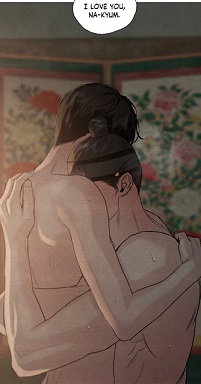 (chapter 96) Striking is that he had hidden his gaze from the artist first. As if love was a sin…Hence I am expecting a confession from Yoon Seungho in that very room too, something he has never done before! Why? It is because he was not the owner of his own past. Kim acted, as if he possessed his memories. Finally, the moment the painter divulges this incident to his companion,
  (tweet), the latter can only come to the conclusion that the scholar would have no problem to hurt Baek Na-Kyum and even get revenge on the artist, for he received the favors from the protagonist. Yoon Seungho would no longer feel obliged to respect Heena’s wish, for her words wouldn’t reflect reality.
  (chapter 105) And it was Yoon Seungho’s luck, when the book fell from his sleeve!
  (chapter 27) The goddess Byeonduck is on their side. But the problem is that the readers have the impression that both are followed by misfortune due to their misery. The reality is that they are both victims of manipulations and tricks. That’s their tragedy. But by repeating that the two figures are “birds of misfortune”, the accomplices are trying to deny their own involvement and as such responsibility. The maids are the perfect example. They blame Baek Na-Kyum for his own illness. He eats like a bird and he would hide his illness.
  (chapter 108) To sum up, he was responsible for his own suffering, for he was in denial and the maids could do nothing to help. But the lord can see the truth, when he touches his lover’s butt.
  (chapter 109) He lost weight in such a short time. And their presence by Baek Na-Kyum’s side was supposed to help him. They were responsible for his well-being, but the women never realized it.

 , as Baek Na-Kyum was still viewed as a boy. Moreover, according to social norms, it was impossible, for his lover is a man. Then in front of Yoon Chang-Hyeon, he made fun of his father.
  (chapter 87) That’s the reason why I consider the love session in chapter 88 more like a relationship between a sponsor and an artist.
 (chapter 57) So in this short essay, I would like to present my new observations and interpretation concerning this intriguing man.
 (chapter 57), as it resembles a lot to the ones from the yangbans.
  (chapter 67)
  . (chapter 86) His beard is so different from the commoners’.
  (chapter 45) This is important, because it reveals that the doctor belongs to a different social class: Chungin, the upper-middle class.
  (chapter 92) The lords and chungin can look down on the commoners, sangmin and cheonmin, as the latter are not considered as educated, since they never had to pass an exam. Striking is that the physician voiced his ignorance in front of the painter which stands in opposition to his social status.
 (chapter 57) Note that solution has two meanings, thus it has for synonyms answer and elixir/extract!! He did give him a solution, the drug!! This truly shows that the physician was lying to the painter. 😮 But this doesn’t end here.
 (chapter 57) He is the only one who portrayed the protagonist in a positive light. Why? In my eyes, it was to gain the painter’s trust. That way, the doctor would appear as impartial and neutral. Thus he said the truth first in order to divert attention from his own actions. He had been the one supplying the drug to the butler.
  (chapter 57) I had already criticized the doctor in the past, for he kept giving the medicine to the valet, and never made the connection to his “hot-headed” temper. He appeared as quite stupid. In my eyes, he already appeared as a passive accomplice, but mainly due to his lack of discernment. He would trust the butler too much. Thus in the composition „the purge“, I had predicted his involvement in a plot which would bring to light his complicity.
  (“he would say strange things”), he was brutal with his son
  (chapter 57). This shows that right from the start, he was already putting the whole blame on the elder master Yoon. That way, the physician was avoiding to become responsible. He had been giving the drug to the butler for a long time, while claiming that he had not been able to diagnose the illness. Besides, we shouldn’t overlook that in this chapter, we only have the physician’s version!! We never heard the testimony from the father. Just because we saw the bruises and the hand on the main character’s neck, this is no real guarantee that the father said this to the doctor.
  (chapter 57) That’s how I realized that the doctor had been deceiving the painter all along. He lied by commission, but also when he talked about the visitation, he was actually delivering the truth in delay, paltering!! He used the same MO than Kim. He feigned ignorance, and mixed a truth with a lie!! This is no coincidence. This leads me to the following question: why did he talk about the past to Baek Na-Kyum?
 (Chapter 57) Yes, it was to protect himself!! He was diverting the painter‘s attention. From that moment on, I could no longer judge him the same way. He was now an active and smart accomplice, who would utilize innocence, truth and knowledge to his advantage.
  (chapter 12) According to my interpretation, here the butler wished the painter to desert the mansion. Thus I conclude that at the physician’s office, the doctor had the opposite task: he should ensure that Baek Na-Kyum doesn’t run away. It was important that the artist was by the lord’s side the moment he gets kidnapped. That way, Yoon Seungho would only blame himself and the painter. Yet, I don’t think that he knew everything about the future abduction. Secondly, why did the doctor bring up Yoon Seungho’s health and his medicine to the painter? He was actually a stranger, even a „servant“.
  (chapter 57) However, the office is actually far away from the mansion. (For more read the essay
  (chapter 55) But like I have always pointed out, Yoon Seungho had no idea about the drugs and medicine. He was totally left in the dark, for the valet would call the drug ” medicinal tea”.
  (chapter 35) He employed an euphemism. This truly shows that the doctor and the valet were partners in crime, both accomplices due to their passivity, knowledge and silence. Nevertheless, I don’t think that the physician was directly involved with the kidnapping and assassination plot. The conversation between the valet and the physician displays the lack of honesty coming from Kim.
  (chapter 57) The latter portrays himself as a victim.
  (chapter 63) He felt bound by secrecy to the bearded man. On the other hand, this incident must have worried him, as it had taken place at his own mansion. Thus he could get into trouble. Kim realized that he needed to reassure the doctor. If the latter started speaking, he could get into trouble, for he had left the propriety during that night. He had no real alibi. Hence the valet visited the doctor during that night, but he never threatened him.
  (chapter 65) The doctor believed that the moment someone talked, someone could take the fall. Observe that in the yard, the butler followed the physician’s advice: he should say nothing.
  (chapter 65) This truly exposes that the doctor is not just a naive man, but an accomplice not only due to his silence and passivity, but also due to his own manipulations. He described himself as a concerned observer who had done nothing wrong. But no, this is not true, as the drug is the evidence of his participation. Who paid for the drug/medicine in the end? Since the elder master Yoon was no longer living in the mansion, the valet was the one responsible for the expenses. I doubt that Yoon Seungho would take a closer look to the accounts. Then when he said that he only saw the protagonist twice
  (chapter 57), this doesn’t mean that he was not involved in the main lead’s suffering. He could have affected Yoon Seungho’s life differently. We have the perfect example in season 3: he treated the butler
  (chapter 77), while he neglected the lord’s hand
  (chapter 84) But like I pointed out, who gave the aphrodisiac to Lee Jihwa? This is a medicine!! To conclude, the physician was involved in the main lead’s suffering, though he only met him twice.
  (chapter 57) But since my theory is that Kim was a shaman, this signifies that he should have recognized Kim as the shaman!! In that case, I deduced that the physician had been lying to the elder master Yoon by omission. Naturally, it is also possible that the father had hired the shaman, but out of fear for his reputation, he acted, as if he had no idea about the butler’s true identity. In other words, all three men acted, as if they knew nothing. This would explain why all the characters had no eye in the last picture. Anyway, because of my latest theory, I reexamined the physician‘s statement and found more incongruences
  (chapter 57) Here he doubted the elder master Yoon’s words, for he stated as a fact that the young master Lee Jihwa was not mentally sick. Keep in mind that according to the doctor, the protagonist was described as someone suffering from a mental illness. And this detail caught my attention: the physician took the Lees’ side. Furthermore, the patriarch Lee was thinking similarly than the doctor: the shaman and the mental illness.
 (chapter 82) Finally, I would like to point out that in that chapter, the physician was mentioned too, and this next to the patriarch Lee.
  (chapter 82) Thus I believe that the physician’s fate is linked to Lee Jihwa and his father.
 (chapter 44) We should never trust the old bearded men, not even the doctor. And ignorance can not serve as an excuse for covering up wrongdoings. As a conclusion, the physician was more acting in chapter 57, he rather expressed a fake concern towards the main lead.
  (Chapter 57) Finally, the manhwaphiles should detect that the doctor never mentioned the presence of the servants in the bedchamber. Both were restraining the wounded lord.
  (Chapter 57) This is also no coincidence that he didn‘t point out the absence of the elder master Yoon during the second visit. He couldn‘t, because his tactic to put the whole blame on the patriarch would have totally failed. And this leads me to the following observation:
 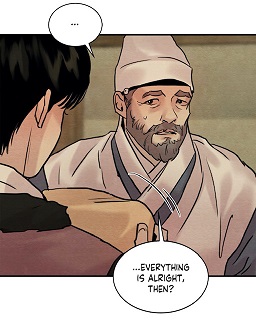 (chapter 74) The doctor was not honest here either. Exactly like in episode 57, he was faking his worries towards Baek NA-Kyum. First, we have the presence of the drop of sweat on his cheek, a sign of dishonesty, but more importantly, his question was just theoretical, he was influencing the painter. The latter just needed to agree. He hoped that the artist would never bring up the incident in his mansion, and as such would wonder about his whereabouts and his responsibility concerning the kidnapping. At the same time, he could have asked this with the hope that the painter would blame the protagonist for his misery. He would use the painter‘s suffering (the unfair judgement leading to his imprisonment) in order to divert attention from his own wrongdoing: his silence, his passivity and his lack of commitment. He never tried to look for Baek Na-Kyum‘s vanishing. He never felt responsible. But he had to give up, because the artist was truly ignorant.
 (chapter 74) He never made any reproach towards the main lead.
  Bebebisous33s' analyses in K-Dramaland and Manhwas