

Please support the authors by reading Manhwas on the official websites. This is where you can read the Manhwa: Jinx But be aware that the Manhwa is a mature Yaoi, which means, it is about homosexuality with explicit scenes. Here is the link of the table of contents about Jinx. Here is the link where you can find the table of contents of analyzed Manhwas. Here are the links, if you are interested in the first work from Mingwa, BJ Alex, and the 2 previous essays about Jinx The Silent Shore and The Red Flags Behind The Flowers . This is where you can read the original version The Little Mermaid from Hans Christian Andersen
It would be great if you could make some donations/sponsoring: Ko-fi.com/bebebisous33 That way, you can support me with “coffee” so that I have the energy to keep examining Manhwas. Besides, I need to cover up the expenses for this blog.

When Joo Jaekyung dives into the water to rescue Kim Dan 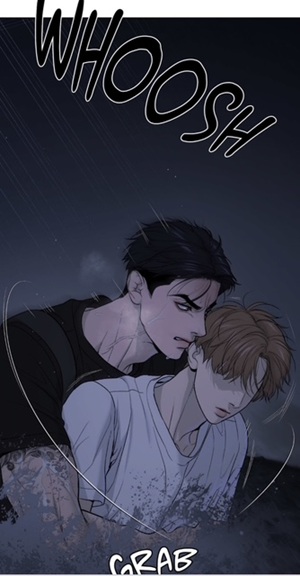 (chapter 59), the scene mirrors the iconic moment in The Little Mermaid where the mermaid saves the prince from drowning. Kim Dan, unconscious and seemingly following the voices of the hospice
 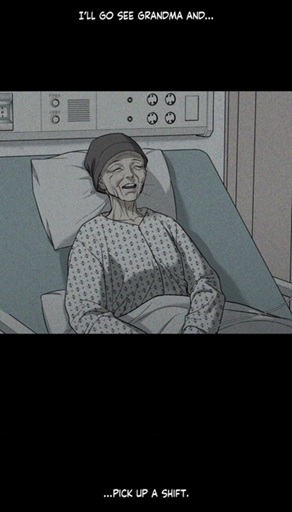 (chapter 59) —a representation of the mermaids’ song—drifts into a state of surrender, much like the prince. This act of salvation becomes a pivotal moment, connecting both characters to the themes of water, transformation, and rediscovery of purpose.
Hans Christian Andersen’s The Little Mermaid is often overshadowed by its popular Disney adaptation, yet the original fairy tale delivers a far more complex and somber narrative. Initially, the underwater world of the mermaids appears idyllic, with its enchanting gardens and harmonious existence.
Far out in the ocean, where the water is as blue as the prettiest cornflower, and as clear as crystal, it is very, very deep; so deep, indeed, that no cable could fathom it: many church steeples, piled one upon another, would not reach from the ground beneath to the surface of the water above. There dwell the Sea King and his subjects. We must not imagine that there is nothing at the bottom of the sea but bare yellow sand. No, indeed; the most singular flowers and plants grow there; the leaves and stems of which are so pliant, that the slightest agitation of the water causes them to stir as if they had life. Fishes, both large and small, glide between the branches, as birds fly among the trees here upon land. In the deepest spot of all, stands the castle of the Sea King. Its walls are built of coral, and the long, gothic windows are of the clearest amber. The roof is formed of shells, that open and close as the water flows over them. Their appearance is very beautiful, for in each lies a glittering pearl, which would be fit for the diadem of a queen. Quoted from http://hca.gilead.org.il/li_merma.html
However, as the story progresses, it becomes evident that the mermaids are seductresses, luring sailors to their deaths with their hauntingly beautiful voices. Their prosperity and gardens stem from the remains of drowned humans, tying their existence to mortality and forgetfulness.
The absence of the Sea King as an active father figure leaves the grandmother to raise the mermaids, instilling traditions, hierarchy and materialism.
his aged mother kept house for him. She was a very wise woman, and exceedingly proud of her high birth; on that account she wore twelve oysters on her tail; while others, also of high rank, were only allowed to wear six. […] ” Quoted from http://hca.gilead.org.il/li_merma.html
Among these traditions is the rule that mermaids may only visit the human world when they reach maturity, an act meant to influence them to appreciate their underwater kingdom and discourage longings for the surface. This restriction mirrors the tension between imposed norms and individual desires, as the mermaids are shaped by a world that limits their experiences until adulthood, by which time many have conformed to the values of their realm. Yet, for the little mermaid, this delayed freedom only deepens her yearning for a world beyond her own, setting her apart from her sisters. The grandmother’s role highlights the mermaids’ lack of individuality and spiritual depth, as their ultimate fate is oblivion—they vanish into sea foam upon death, unremembered and without souls.
“Yes,” replied the old lady, “they (humans) must also die, and their term of life is even shorter than ours. We sometimes live to three hundred years, but when we cease to exist here we only become the foam on the surface of the water, and we have not even a grave down here of those we love. We have not immortal souls, we shall never live again; but, like the green sea-weed, when once it has been cut off, we can never flourish more. Human beings, on the contrary, have a soul which lives forever, lives after the body has been turned to dust. It rises up through the clear, pure air beyond the glittering stars. As we rise out of the water, and behold all the land of the earth, so do they rise to unknown and glorious regions which we shall never see.” Quoted from http://hca.gilead.org.il/li_merma.html
Moreover, the mermaids’ fear of the sun, symbolized by the third sister who dives underwater to escape its burning rays, further reflects their estrangement from light and transcendence. This idyllic yet haunting world mirrors the struggles faced by the characters in Jinx, who similarly navigate environments defined by materialism  (chapter 54), performance, and the longing for a deeper connection.
Drawing from Andersen’s original themes, Jinx presents a modern reinterpretation through its characters and their relationships. Both Kim Dan and Joo Jaekyung embody aspects of the little mermaid’s journey. Kim Dan, like the mermaid, endures silent suffering, yearning for recognition and freedom from his oppressive environment. Joo Jaekyung, meanwhile, encapsulates both the prince, whose light seduces others 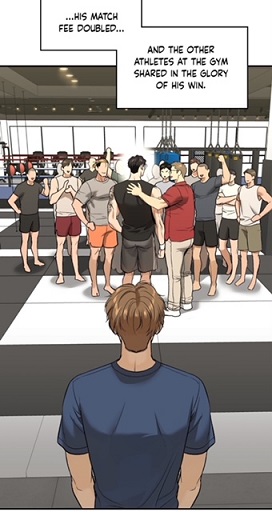 (chapter 41), and the mermaid, as he grapples with voicelessness and the pressures of his world.
 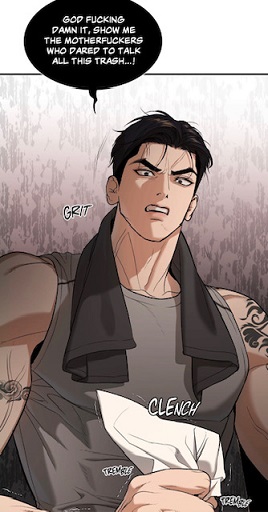 (chapter 36)
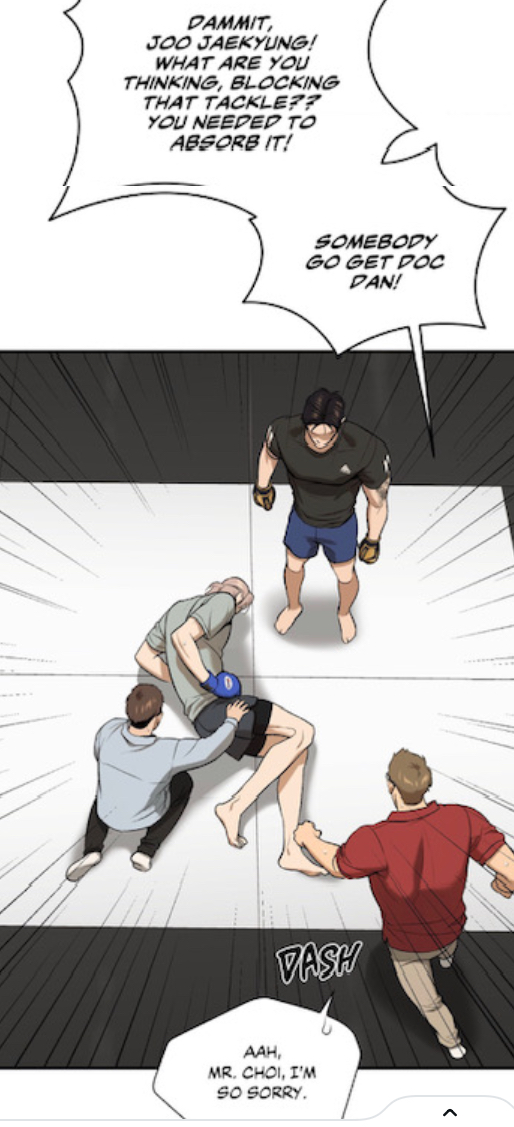
  (chapter 36) Choi Heesung, representing another prince with Potato as his bride, benefits from others’ sacrifices
  (chapter 31)
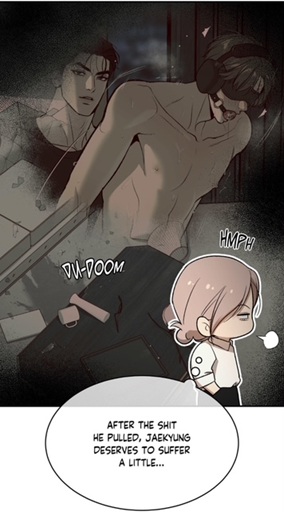 (chapter 58) while remaining oblivious to their struggles. These parallels reveal layers of self-discovery, mutual transformation, and the pursuit of meaning. By analyzing these similarities, we uncover deeper layers of self-discovery and transformation within the narrative.
The Fake Sun and Kim Dan’s Awakening
When the little mermaid first surfaces, she does not see the sun but encounters the prince instead. He becomes her “fake sun,” a symbol of misplaced hope and unfulfilled longing. Similarly, Kim Dan, who became a physical therapist due to his grandmother’s influence, is thrust into Joo Jaekyung’s world—a world he perceives as brighter, almost blinding, like the sun.  (chapter 53) Joo Jaekyung, representing the “new world,” acts as both a source of transformation and a mirror reflecting Kim Dan’s sacrifices.
In Andersen’s story, the little mermaid’s longing for the prince reflects her yearning for connection and transcendence, but it ultimately brings her pain. However, even before meeting the prince, the little mermaid longed to discover the human world. She listened intently to her sisters’ stories of their experiences on the surface, which created a deep yearning within her to explore this new realm.
“When the sisters rose, arm-in-arm, through the water in this way, their youngest sister would stand quite alone, looking after them, ready to cry, only that the mermaids have no tears, and therefore they suffer more. ‘Oh, were I but fifteen years old,’ said she: ‘I know that I shall love the world up there, and all the people who live in it.’” Quoted from http://hca.gilead.org.il/li_merma.html
Her yearning for the prince only exacerbates her desire to leave the confinement of the underwater kingdom, which she sees as restrictive, and pursue the dreams that set her apart from her sisters. Unlike her siblings, the little mermaid does not fear the sun; instead, she longs for its light and warmth. Andersen emphasizes this through her garden, which reflects her inner world and emotions:
“One arranged her flower-bed into the form of a whale; another thought it better to make hers like the figure of a little mermaid; but that of the youngest was round like the sun, and contained flowers as red as his rays at sunset. She was a strange child, quiet and thoughtful; and while her sisters would be delighted with the wonderful things which they obtained from the wrecks of vessels, she cared for nothing but her pretty red flowers, like the sun.” Quoted from http://hca.gilead.org.il/li_merma.html
The garden, overlooked by others, mirrors her unacknowledged feelings and aspirations, emphasizing her quiet longing for a brighter existence beyond the depths. Kim Dan’s relationship with Joo Jaekyung similarly oscillates between hope 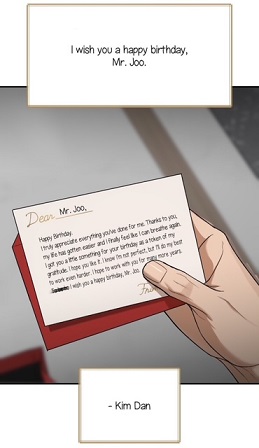 (chapter 55) and hardship
 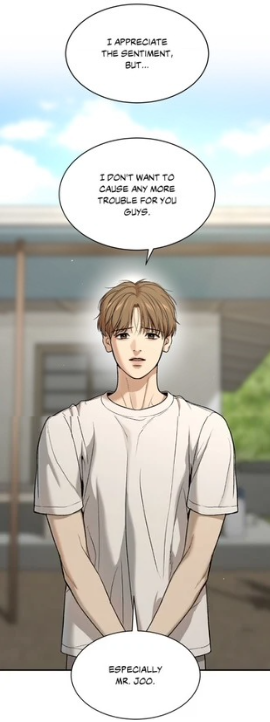 (chapter 58), yet it serves as the catalyst for his growth. Just as the little mermaid’s journey leads her to a higher spiritual purpose as a daughter of the air, Kim Dan’s experiences with Joo Jaekyung force him to confront his own worth, identity, and emotional needs. Just before he went to the ocean, he wondered about his own future and desires, a sign that he was standing at a crossroad:
 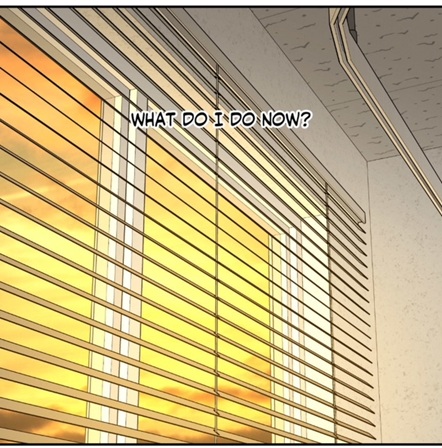 (chapter 59) However, let’s not forget that Kim Dan’s profession had been determined by Shin Okja, as the latter desired to have her grandchild taken care of her. Therefore his own desires and needs were overlooked. Traditions and social norms were used to decide about the protagonist’s life and future. His journey from voiceless suffering to self-realization echoes the mermaid’s transformation.
Depression: Disconnection and Yearning
Both Hans Christian Andersen and the little mermaid offer insights into the experience of depression. Andersen himself struggled with feelings of isolation and unreciprocated affection, which find their echo in the mermaid’s story. Her disconnection from both the underwater world and the human world mirrors the profound alienation that often accompanies depression.
The little mermaid feels different from her sisters, who eagerly conform to their traditions, while she secretly yearns for something beyond their understanding. This sense of being “other” and her inability to express her desires create a deep loneliness. Similarly, Kim Dan’s life has been marked by silent suffering and a lack of recognition for his sacrifices. 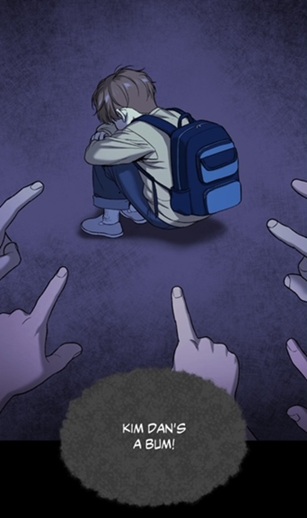 (chapter 57)
  (chapter 59) Like the mermaid, he has always lived disconnected from his own needs, burdened by the expectations of others—his grandmother, Heo Manwook, the doctors
 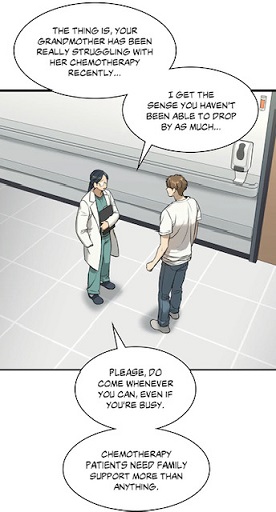 (chapter 21) , and even Joo Jaekyung.
  (chapter 45)
Andersen’s depiction of the mermaid’s inability to cry—”mermaids have no tears, and therefore they suffer more”—reflects the emotional numbness of depression. Kim Dan’s stoic endurance and inability to articulate his pain in season 2 resonate with this portrayal. When he is on the verge of killing himself  (chapter 59), he is not capable of crying. It is because he has been living like a ghost for the last two months. Depression, for both the mermaid and Kim Dan, manifests as a silent struggle, making their eventual transformations even more poignant.
Joo Jaekyung: The “Prince” or The Mermaid?
Joo Jaekyung’s role in Jinx is multifaceted, resembling both the prince and the mermaid from Andersen’s tale. On one hand, he is a “fake prince,” burdened by the high expectations of his surroundings and unresolved traumas. Much like the mermaid’s prince, Joo Jaekyung’s image is carefully curated,  (chapter 1) hiding his true self behind a facade of strength and success. On the other hand, Joo Jaekyung also embodies the mermaid’s longing and sacrifice. Living in the world of MMA, a high-pressure environment where he is constantly pushed to perform, he resembles the mermaid in the underwater kingdom—a place of death and materialism where the mermaids feed on drowned humans. It is no coincidence that the fighters are displayed like mermaids in the water full of blood.
  (chapter 29) This zombie-like existence leaves him voiceless; the entertainment agency and MFC dictate his actions
 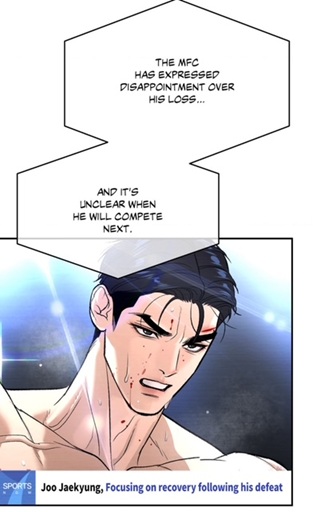 (chapter 57), only allowing him to speak when it benefits them financially.
Interestingly, Joo Jaekyung’s affinity for water  (chapter 27) reflects his connection to the mermaid. Water is his natural element, a place where he feels at peace, yet he has been forced to conform to a fiery world of intensity and relentless ambition.
  (chapter 19) Hence he never went to the swimming pool in his own penthouse, until Kim Dan triggered his memory and longing. This interplay of water and fire (chapter 53) symbolizes Joo Jaekyung’s duality: water represents his reflective and calm nature, while fire reflects the passion, turmoil, and seduction he embodies. His light, much like the mermaids’ song in Andersen’s tale, attracts others, but it often leads them astray. For example, many members of Team Black left the gym to join King of MMA, a rival gym with connections to the underground world and illegal fights.
  (chapter 52)
  (chapter 41) Joo Jaekyung’s image was exploited to lure these individuals down a darker path, highlighting how his light has been misused by those around him.
(chapter 53) The contrasting visuals of the King of MMA building (chapter 52) and Joo Jaekyung himself underscore this dichotomy. The building, with its blue tones and connection to the sky, evokes the image of a ship luring fighters into oblivion, much like the mermaid’s siren call. Interestingly, the light from the building comes from the sun, giving it the impression of naturality and hope. This creates a deceptive allure, as those who follow this path are ultimately consumed and forgotten.
In contrast, the image of Joo Jaekyung turning around is bathed in artificial light from the flash of cameras, (chapter 53) emphasizing his curated, public-facing facade. This artificiality reflects how Kim Dan, much like the public, has not yet perceived the humanity beneath Joo Jaekyung’s exterior. This dichotomy underscores Joo Jaekyung’s struggle to reclaim his identity while also highlighting Kim Dan’s journey to truly see the man behind the image. This juxtaposition highlights how Joo Jaekyung’s journey is not merely about physical survival but about reclaiming his identity and resisting the forces that seek to exploit him.
The Doctor’s Family: A Reflection of the Mermaid’s World
Kim Dan’s family background parallels the little mermaid’s environment in significant ways. The absence of the father in Kim Dan’s life placed all the responsibility on his grandmother, echoing the absence of the Sea King’s active role in his daughters’ lives. The grandmother in Kim Dan’s story shares several traits with the mermaid’s grandmother, but also presents key contrasts. Both grandmothers embody traditions, social norms, and a materialistic worldview. Shin Okja’s wedding cabinet and scarf were a source of joy and pride for her,  (chapter 19)
 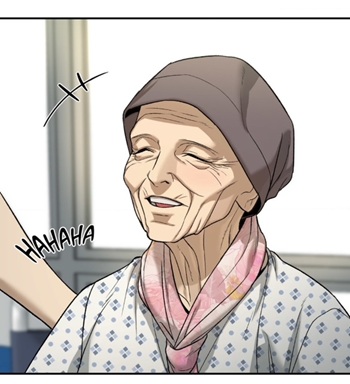 (chapter 56) as long as they were not associated with burden or suffering, while the mermaid’s grandmother celebrates the beauty and decorum of their underwater realm.
At last she reached her fifteenth year. “Well, now, you are grown up,” said the old dowager, her grandmother; “so you must let me adorn you like your other sisters;” and she placed a wreath of white lilies in her hair, and every flower leaf was half a pearl. Then the old lady ordered eight great oysters to attach themselves to the tail of the princess to show her high rank. “But they hurt me so,” said the little mermaid. “Pride must suffer pain,” replied the old lady. Oh, how gladly she would have shaken off all this grandeur, and laid aside the heavy wreath! The red flowers in her own garden would have suited her much better, but she could not help herself […] Quoted from http://hca.gilead.org.il/li_merma.html
Both women disregard the pain and desires of the protagonists—Shin Okja justifies her dependency on Kim Dan with cultural norms and his selflessness 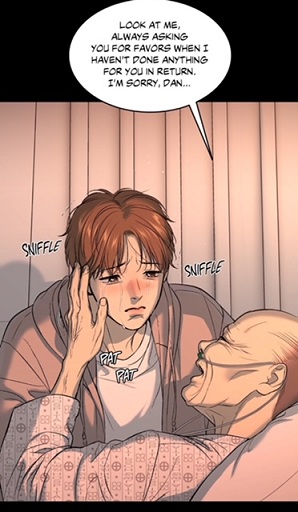 (chapter 53), while the mermaid’s grandmother dresses her granddaughter beautifully for her first visit to the surface, disregarding the physical pain she complains about. In both cases, the protagonist’s suffering is diminished or ignored, highlighting a shared insensitivity to their emotional and physical experiences. Both grandmothers appear as rather distant and cold-hearted.
However, the mermaid’s grandmother exhibits a mental and physical strength that Shin Okja lacks. Confident and authoritative, she enforces the rules and rituals of the mermaid world, including the tradition of visiting the surface only after reaching maturity. This ritual, framed as a way to teach the young mermaids to appreciate their own realm, indirectly influences the little mermaid’s yearning for the human world. Her family could have noticed it, if they had paid attention to the sculpture in her small garden.
One arranged her flower-bed into the form of a whale; another thought it better to make hers like the figure of a little mermaid; but that of the youngest was round like the sun, and contained flowers as red as his rays at sunset. She was a strange child, quiet and thoughtful; and while her sisters would be delighted with the wonderful things which they obtained from the wrecks of vessels, she cared for nothing but her pretty red flowers, like the sun, excepting a beautiful marble statue. It was the representation of a handsome boy, carved out of pure white stone, which had fallen to the bottom of the sea from a wreck. Quoted from http://hca.gilead.org.il/li_merma.html
In contrast, Shin Okja is emotionally and physically dependent on Kim Dan, burdening him with the entirety of their survival. Her insistence on adhering to traditions reflects a passive selfishness, as she benefits from his sacrifices while escaping her own responsibilities.
Interestingly, both grandmothers play a role in inciting their grandchildren to leave their side. The mermaid’s grandmother encourages the little mermaid to explore the human world as part of their ritual, emphasizing its transience and superficiality. 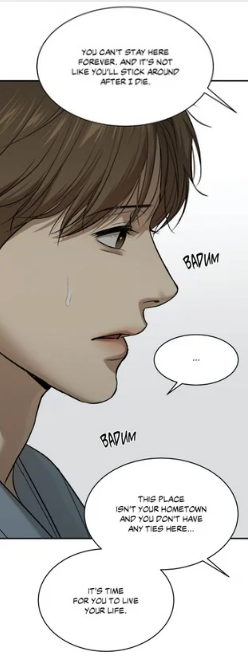 (chapter 57) Shin Okja, noticing Kim Dan’s figurative slow death under the weight of her request, subtly pushes him to seek his own path. However, this act is not entirely selfless. For Shin Okja, it represents an escape from the guilt of causing her grandson’s unhappiness, a way to absolve herself of responsibility.
Yet, the two grandmothers diverge significantly in their personal strength and awareness. The mermaid’s grandmother confidently instills traditions as a way to ground her grandchildren in their underwater identity, while Shin Okja clings to traditions to justify her dependence. Both grandmothers also embody forgetfulness and oblivion. The mermaid’s grandmother focuses on traditions and appearances, disregarding the existential yearning of the little mermaid for an immortal soul. Shin Okja similarly disregards Kim Dan’s emotional suffering, prioritizing her material needs and societal expectations. Notably, she never returned to her hometown, until she was nearing death, underscoring her detachment from legacy and emotional connection. These shared traits highlight how both grandmothers, despite their different contexts, restrict the protagonists’ growth and self-discovery, keeping them tethered to a world of conformity and unfulfilled dreams.
In both stories, the protagonists live like ghosts, overshadowed by the expectations and traditions imposed upon them. Kim Dan has always lived for his grandmother and her “dreams,” never truly pursuing his own aspirations. Similarly, the little mermaid is forced to follow traditions and live through the eyes and expectations of others. Her deepest dream of becoming human and reaching the surface is kept to herself, unknown to anyone around her. This suppression of individuality and desire reflects the stifling nature of their environments. Interestingly, the little mermaid’s garden reflects her inner world and emotions. Unlike her sisters, she does not fear the sun, and her garden is shaped like the sun with flowers as red as his rays. Yet, no one pays attention to her garden, mirroring how Kim Dan’s struggles and unwell-being are overlooked by those around him. 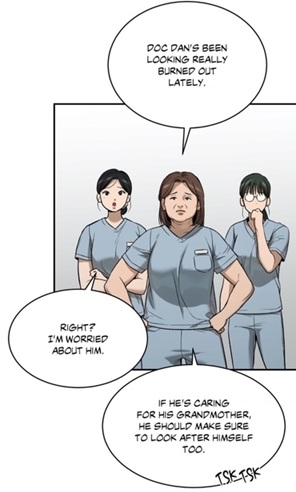 (chapter 57) He even gets blamed for his illness. These elements further emphasize how the suppression of individuality leads to yearning and eventual transformation.
The Sisters of the Mermaid and Team Black
In Andersen’s tale, the mermaid’s sisters are largely indifferent to her plight until they realize she is about to die. Their sudden sacrifice of their hair to obtain a knife from the sea witch demonstrates a delayed recognition of their sister’s suffering. Though their act is born of desperation, it comes too late to save her. The sisters, pale and sorrowful, ultimately sink back beneath the waves, leaving the mermaid to face her fate alone.  (chapter 52) This dynamic parallels the members of Team Black in Jinx. Although they are treated like Joo Jaekyung’s co-workers
  (chapter 7), in reality, he is their boss and the foundation of their success. Their indifference mirrors the mermaid sisters’ behavior; they only notice his struggles and absence when his winning streak falters, prompting many to leave the gym for the rival King of MMA. However, if we take Andersen’s fairy tale as a source of inspiration, it signifies that at some point, the remaining members of Team Black might come to “sacrifice” themselves for their “little sister,” symbolically representing Kim Dan and Joo Jaekyung. This potential act of loyalty could mirror the mermaid sisters’ gesture, showing that even belated recognition and care can lead to transformative redemption for those involved.
Gardening and Immortality
In Andersen’s tale, the mermaids tend gardens in the underwater world, a symbol of their limited existence tied to material beauty. This theme resonates in Jinx, where the gym Team Black acts as a parallel to the underwater kingdom. Like the mermaid gardens, Team Black is centered on appearances and the cultivation of superficial success. Originally created to serve Joo Jaekyung’s needs, the gym drew attention due to his achievements  (chapter 1), attracting others seeking the same level of fame and fortune.
 (chapter 46) However, the gym’s inability to produce another champion reveals its “fake gardening” nature—focused on maintaining an image rather than fostering true growth.
Park Namwook, much like the Sea King’s materialistic focus, behaves as though he owns the gym, taking pride in its reputation  (chapter 52) while merely using Joo Jaekyung’s success to boost his own ego. His plans to set up a kids’ program at the gym further underscore this self-serving nature. While presented as an effort to expand the gym’s reach, Park Namwook’s true motivation lies in financial gain, as he tries to persuade Joo Jaekyung by stating, “Kids are where the money is at.” On the one hand, this reflects his obsession with money and contrasts with the deeper, transformative intentions associated with true gardening. On the other hand, since he has himself kids, it is clear that he would like to send his own children to the kids’ program.
Interestingly, the concept of a kids’ program can be compared to the daughters of the air in Andersen’s tale.
The little mermaid perceived that she had a body like theirs, and that she continued to rise higher and higher out of the foam. “Where am I?” asked she, and her voice sounded ethereal, as the voice of those who were with her; no earthly music could imitate it. Among the daughters of the air,” answered one of them. “A mermaid has not an immortal soul, nor can she obtain one unless she wins the love of a human being. On the power of another hangs her eternal destiny. But the daughters of the air, although they do not possess an immortal soul, can, by their good deeds, procure one for themselves. We fly to warm countries, and cool the sultry air that destroys mankind with the pestilence. We carry the perfume of the flowers to spread health and restoration. After we have striven for three hundred years to all the good in our power, we receive an immortal soul and take part in the happiness of mankind. You, poor little mermaid, have tried with your whole heart to do as we are doing; you have suffered and endured and raised yourself to the spirit-world by your good deeds; and now, by striving for three hundred years in the same way, you may obtain an immortal soul.” Quoted from Quoted from http://hca.gilead.org.il/li_merma.html
The daughters of the air earn their immortal souls through good deeds, particularly by serving as unseen companions to children, influencing their growth and joy. The transformation of the little mermaid into a daughter of the air holds profound significance. Through her death, she transcends her former existence, drawing closer to her aspiration for an immortal soul. Her nature fundamentally changes—she evolves from a being defined by longing and sacrifice to one with purpose and autonomy. Her rise to the air signifies liberation from the pain and constraints of her past life, granting her a new identity. Similarly, Joo Jaekyung and Kim Dan’s struggles, marked by insomnia, loneliness, and emotional turmoil, echo this journey of transformation. (chapter 59) The ocean scene in Jinx represents the beginning of their ascent, a symbolic death of their former selves and the first step toward self-discovery and fulfillment. Like the little mermaid’s yearning for the sun and light, their encounter in the ocean marks a turn toward aspiration and the possibility of a brighter, truer existence.
However, Park Namwook’s approach twists this idea into a shallow form of “gardening” focused on profit rather than nurturing. (chapter 46) His actions reveal the disconnection between genuine care and the commodification of growth, paralleling the gym’s superficial cultivation of champions and success. When Joo Jaekyung’s streak of victories faltered after his tie with Baek Junmin, many members abandoned the gym, (chapter 52) exposing the lack of genuine loyalty and care for the champion. This mirrors the indifference of the mermaids to the plight of drowning humans, a reflection of their inhumanity. Similarly, the world of MMA fighting, like the underwater kingdom, encourages relentless training and suppresses emotional expression—vacations and rest only occur due to injury or external intervention, such as Kim Dan’s request for a day off.
Potato’s characterization as a mixture of a “spoiled child”  (chapter 22) and a “neglected child”
 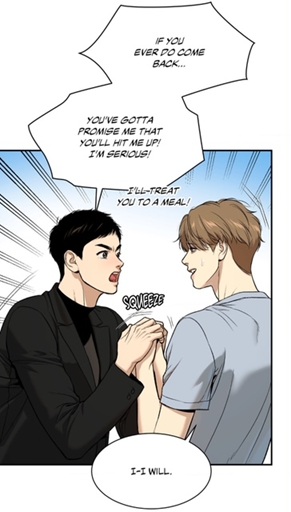 (chapter 59) further emphasizes the immaturity and lack of responsibility prevalent in this environment. In Andersen’s story, the mermaid sisters are given gardens to tend from a young age, instilling responsibility early on. Potato’s journey mirrors the mermaid sisters’ visit to the surface, as his trip to the sea represents a moment of exploration and self-discovery. While working as an actor for the first time, he realizes during his stay with Kim Dan that he has no intention of leaving Team Black.
  (chapter 58) Feeling lost without Kim Dan, he initially requests his return so that they can be together again. This longing for a companion reflects Potato’s deeper need for guidance and connection, much like the mermaid sisters who briefly visit the surface but ultimately return to their underwater world when the novelty fades. Yet, when they reach maturity and are allowed to visit the surface, the novelty of the human world quickly fades, and they return to their underwater realm indifferent to human suffering. However, notice that on his day of the departure, Potato tells Kim Dan that he won’t call him, the mermaid has to initiate the first step. (chapter 58) Just like the prince in the fairy tale, the protagonist from Jinx is treated like a servant or a play companion, but nothing more.
The prince said she should remain with him always, and she received permission to sleep at his door, on a velvet cushion. He had a page’s dress made for her, that she might accompany him on horseback. […] As the days passed, she loved the prince more fondly, and he loved her as he would love a little child, but it never came into his head to make her his wife; yet, unless he married her, she could not receive an immortal soul; and, on the morning after his marriage with another, she would dissolve into the foam of the sea. Quoted from http://hca.gilead.org.il/li_merma.html
This shows that in both stories, the humans take the mermaid’s selflessness and gentleness for granted. They don’t ask if the mermaid is feeling well. They expect them to be around them.
This lack of empathy and the absence of tears 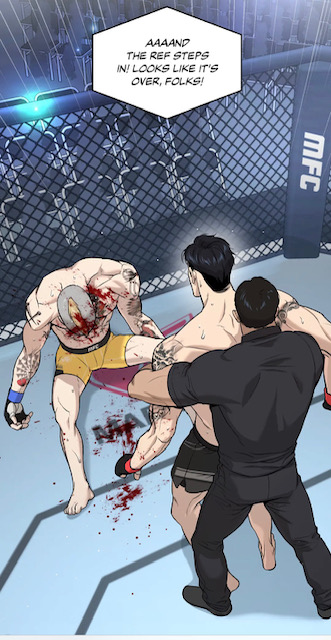 (chapter 15) strongly parallel the detached, high-pressure environment of MMA fighting. Joo Jaekyung, trained relentlessly since youth, embodies this world’s harshness, where vulnerability is a luxury rarely afforded.
By contrasting the gym’s “fake gardening” with Joo Jaekyung’s eventual journey toward authenticity, the narrative underscores the need to move beyond superficiality and reclaim one’s true self. Joo Jaekyung, after being inspired by Kim Dan, begins to metaphorically “garden” by creating his own space of renewal and growth. The ocean setting  (chapter 59) suggests that Joo Jaekyung might reclaim his authentic self through activities like swimming, reconnecting with nature, and symbolically planting the seeds for a new life. Kim Dan, who cannot swim, learns from Joo Jaekyung, and together, they forge a path toward mutual healing and immortality—not in the literal sense but through finding their “soul” and purpose.
The Ocean: Nature as a Setting for Transformation
In Jinx, the shift in the setting from the city (a symbol of civilization and its suffocating pressures) to the ocean (a symbol of nature and renewal) mirrors a pivotal change in the characters’ journeys.  (chapter 56) The city represents the oppressive expectations and artificial constructs that have shaped Joo Jaekyung and Kim Dan’s lives. By meeting again in the ocean, they reconnect with a more authentic and unburdened version of themselves. This transition echoes the little mermaid’s connection to the natural world as a place of solace and transformation.
Responsibility and Guilt: The Couple’s Role
The scene where the prince and his bride gaze at the foam, sorrowfully searching for the mermaid, mirrors Heesung and Potato’s behavior.  (chapter 59) They imagined that Kim Dan would be better off without Joo Jaekyung
  (chapter 58), but this assumption reveals their failure to truly understand Kim Dan’s plight. Their ignorance ties them to the selfishness and guilt that mark the couple in the fairy tale. Despite their faults, however, their actions indirectly contribute to Kim Dan’s transformation.
However, the mermaid’s final kiss on the prince’s bride’s forehead holds deeper symbolic meaning. The goodbye kiss, given unseen, can be interpreted as either a curse or an act of emancipation. It symbolizes her liberation from heartbreak and physical suffering. The kiss is also a farewell to the life she had sacrificed so much for, allowing her to rise as a daughter of the air. Similarly, the picture in front of the hospice could be interpreted as Kim Dan’s goodbye kiss to his friends before his own metamorphosis, marking a farewell to his old life and the start of his transformation: air.
Similarly, Kim Dan’s journey reflects a moment of quiet yet profound transformation: 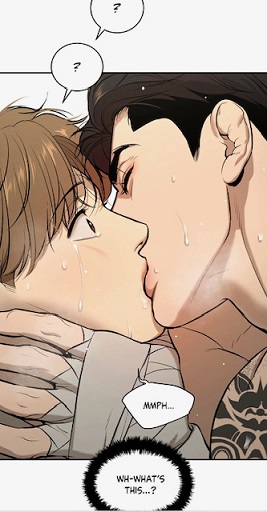 (chapter 15) his kiss with Joo Jaekyung, shared in the locker room, was both an act of protection and a pivotal moment in their dynamic. Like the mermaid’s unforgettable first kiss with the prince (when he was rescued), Joo Jaekyung’s kiss in the locker room was an act of initiation, driven by his “fears” and sense of responsibility, reflecting his growing attachment to Kim Dan. The kiss symbolized his struggle to connect and protect, even as he grappled with his emotional restraint. The locker room, a symbol of physical endurance and vulnerability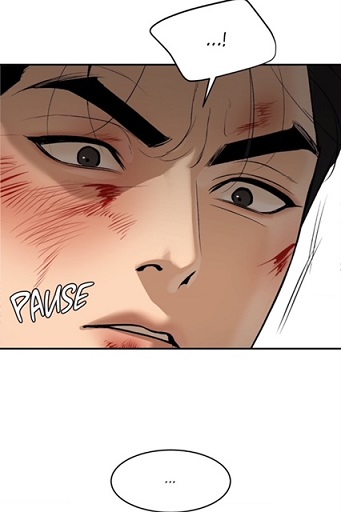
 (chapter 51), mirrors the mermaid’s longing to break free of her limitations and find meaning in her suffering.
The Daughter of the Air: Kim Dan’s Transcendence
In The Little Mermaid, the protagonist’s final transformation into a daughter of the air signifies her spiritual elevation and newfound purpose. No longer tied to the physical or the emotional pain of unrequited love, she discovers companionship and a mission—to earn an immortal soul through good deeds. This mirrors Kim Dan’s journey of finding a new identity and purpose.
The 300 years the mermaid must strive for redemption recalls the three months Kim Dan spent with Joo Jaekyung before vanishing. In this time, Kim Dan undergoes a profound change. Like the daughter of the air, Kim Dan moves closer to his own “sun,” 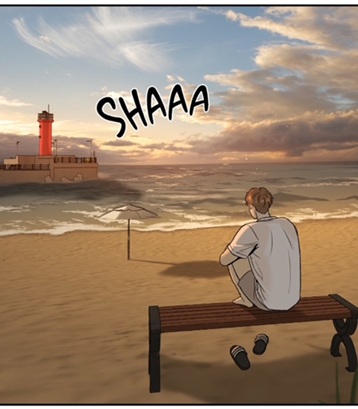 (chapter 59) finding light not in others but within himself. Through his hardships, he gains the strength to pursue his own identity and agency.
The “Princes” and Legacy
The story also underscores the theme of legacy, as the concept of the “prince” takes on multiple layers in Jinx. Joo Jaekyung is the central prince, undergoing his own awakening as he transitions from being an oblivious benefactor to an active participant in Kim Dan’s healing and growth. However, Heesung and even Potato emerge as “princes” in their own right. Heesung’s journey to face his flaws mirrors the prince’s search for his rescuer, while Potato’s evolution hints at a future where he might follow in Joo Jaekyung or Kim Dan’s footsteps, symbolizing a new generation of legacy. I couldn’t help myself noticing that Potato was the first one showing an interest in Kim Dan’s profession:  (chapter 49) The maknae’s tears are an indication that he is no mermaid, but a human, I would even say, he still has the soul of an innocent boy.
 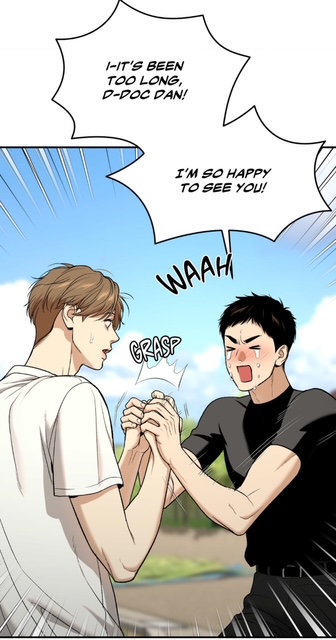 (chapter 58) reminding me of the princess looking for the voiceless mermaid. It is clear that in both stories, the mermaid left traces in the humans’ hearts.
Conclusion: Mutual Transformation
Ultimately, The Painful Mermaid’s Aspiration is a story of mutual transformation. The mermaid’s sacrifice enables the prince’s happiness, but her ultimate transcendence reflects a deeper journey of self-discovery. Similarly, Kim Dan’s suffering becomes the foundation for his growth, pushing both him and Joo Jaekyung to evolve. While the figures around them, like Heesung and Potato, remain entangled in their own struggles with guilt and identity, they contribute to the larger narrative of transformation and redemption.
Kim Dan’s journey, like the little mermaid’s, is not just about sacrifice but about rising above pain to find purpose and light. In the end, both characters achieve a form of liberation, stepping closer to the “sun” and reclaiming their voices and identities in a world that once rendered them invisible.
Feel free to comment. If you have any suggestion for topics or manhwas, feel free to ask. If you enjoyed reading it, retweet it or push the button like. My Reddit-Instagram-Tumblr-Twitter account is: @bebebisous33. Thanks for reading and for the support, particularly, I would like to thank all the new followers and people recommending my blog.
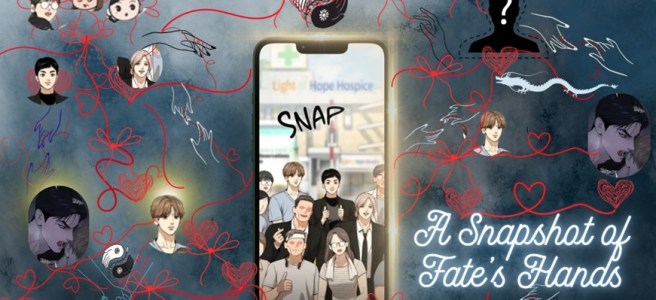

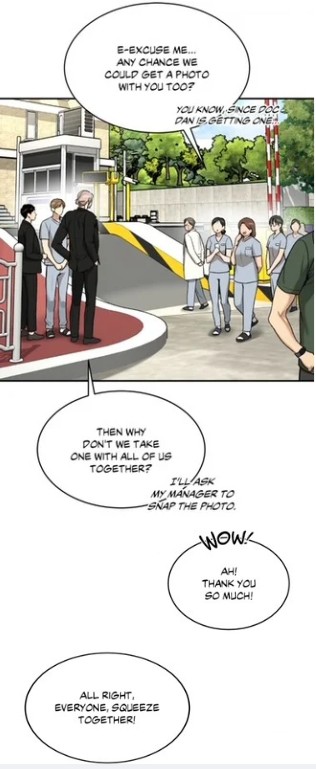 (chapter 59) —which becomes the pivotal clue leading Joo Jaekyung to Kim Dan. Through a careful analysis of the timeline and the use of contrasting events, it becomes clear that Mingwa’s narrative mirrors a kaleidoscope, reflecting positive and negative elements rooted in Taoist principles. While the doctor’s unconscious
 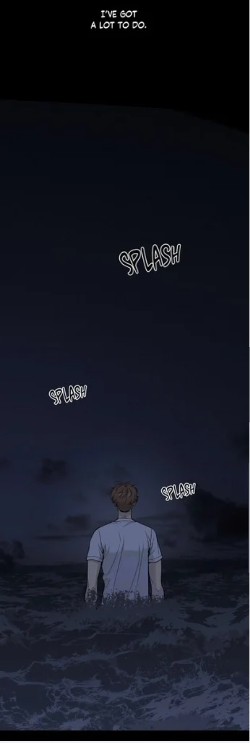 (chapter 59) led him to the shore, driven by despair and suicidal intent, the MMA fighter’s journey stands as its opposite:
 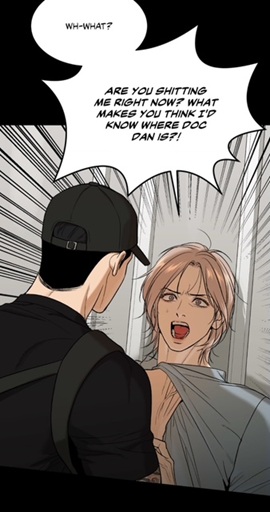 (chapter 59 ) a conscious choice to follow his heart, hence he was full of anger and frustration. Joo Jaekyung was no longer repressing his feelings, even if he had yet to fully recognize his affection.
 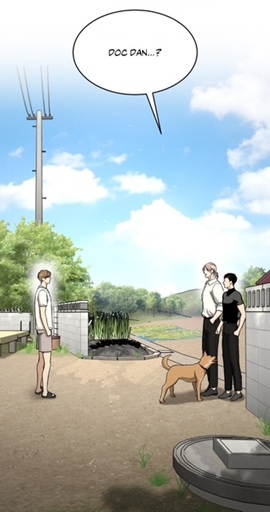 (chapter 59) embodies the negative reflection of Joo Jaekyung’s purposeful arrival. We can detect the divergences: day versus night, work versus break, healthy versus unhealthy etc. Through the juxtaposition of images and situations, Mingwa provides profound insight into the characters’ thoughts, desires, and intentions. The photograph’s role becomes pivotal: while it marks the end of Heesung and Potato’s visit
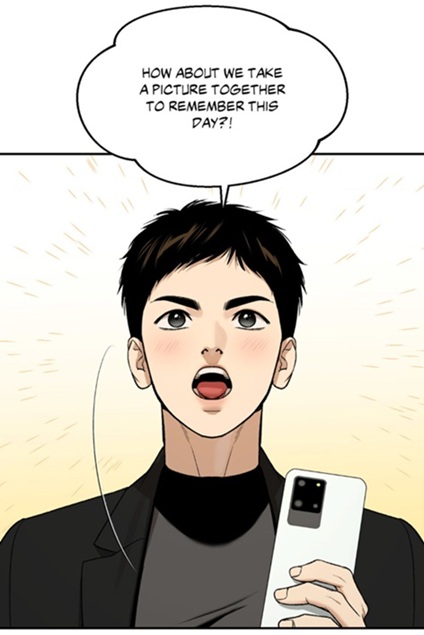 (chapter 59), it simultaneously signifies the first crucial clue in Joo Jaekyung’s search. This marked the turning point where his ongoing efforts were given direction, transforming his pursuit into a decisive journey toward discovery.
 (chapter 59) —each of whom had interacted with Kim Dan
  (chapter 57) during his time at Light of Hope. While these individuals appear as potential candidates for revealing Kim Dan’s location, the true helper remains shrouded in mystery. This ambiguity emphasizes the layered narrative of Jinx, where each small action—no matter how mundane—contributes to the larger theme of fate’s intricate web, offering insight into the power of both intentional and unintentional intervention. If Potato had not suggested the picture
 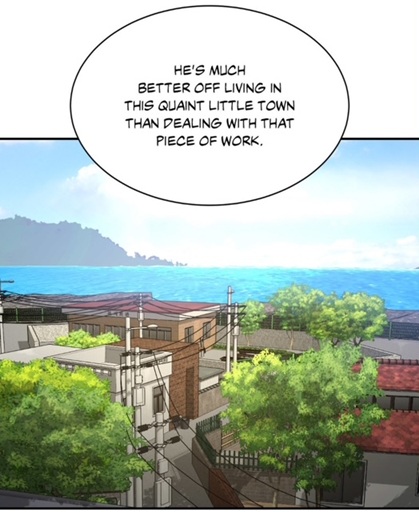 (chapter 58)
 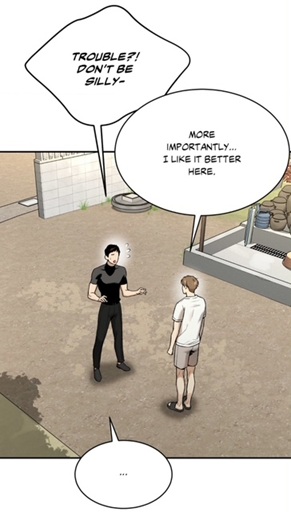 (chapter 58), ignorance and superficiality
  (chapter 58), becomes the shadowed reflection of the proactive search by Joo Jaekyung. This interplay of light and dark is central to unraveling how fate unfolded.
 (chapter 58), came to the same conclusion: they should not reveal Kim Dan’s whereabouts to Joo Jaekyung. Heesung argued that Kim Dan was better off in his secluded life, away from the chaos of Joo Jaekyung. Potato, deeply trusting his lover’s seniority and judgment, chose to follow Heesung’s lead. Their decision reflects not only their loyalty to Kim Dan’s expressed wishes but also their passive adherence to the belief that avoiding intervention was a form of help which reminds us of Potato’s former principle:
  (chapter 35) This shows that despite the last incident, Yoon-Gu didn’t drop this terrible principle. Notice that he is advocating the same philosophy than Shin Okja. Heesung justified his stance by claiming that it was in Kim Dan’s best interests
 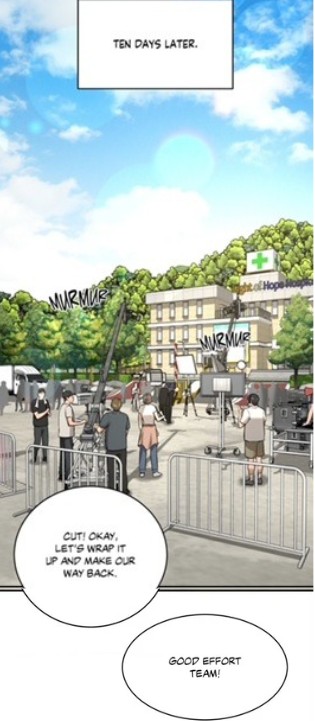 (chapter 59) Importantly, Joo Jaekyung did not arrive during this period, further affirming their resolve. The photograph taken just before their departure was the key turning point. However, the timeline—marked by the sunsets
  (chapter 59)
 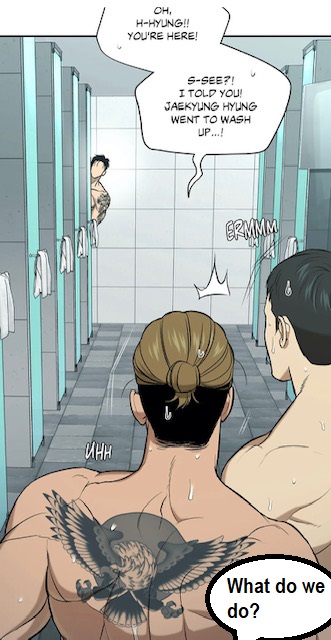 (chapter 8)
 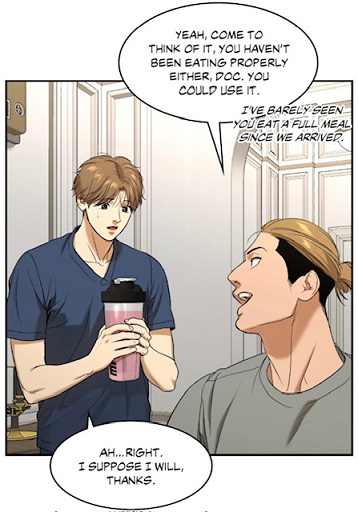 (chapter 37) and Kwak Junbeom was a witness of the encounter between Kim Dan and director Choi Gilseok.
  (Chapter 48) Nonetheless, there exist significant points against this theory. Despite their fondness for the actor
  (chapter 30) and their interactions with Heesung and Potato
  (chapter 35), they are unaware of the actor’s relationship with Potato. The author left many clues for this interpretation. They didn’t notice the maknae’s absence at the champion’s birthday
 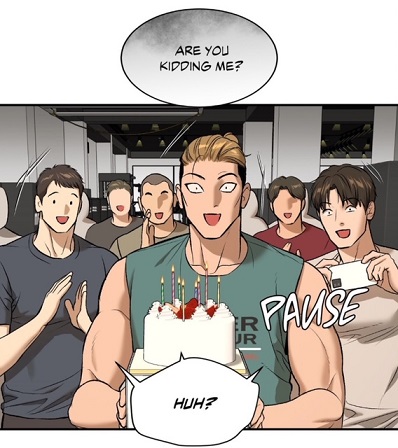 (chapter 43), but more importantly the presence of Yoon-Gu‘s embarrassment in front of his hyung indicates secrecy. .
  (chapter 58) His “redness” indicates that he doesn’t want to expose his special relationship with Heesung. Therefore I believe that he didn’t mention this trip to other members. Consequently, I doubt that the members were looking for Potato in such a photograph. Furthermore, from my perspective, members of Team Black are still left in the dark about Joo Jaekyung’s struggles. They are unaware of his drinking habits
  (chapter 56), or his emotional state. They think, he has not come to the gym due to his recovery. Furthermore, they don’t use his cellphone number to contact him. The hiring of a new physical therapist and
  (chapter 57) the interview suggested that Joo Jaekyung was taking a break to recover from his injury, leaving no indication of his active search for Kim Dan. However, Yoon-Gu got informed through Heesung that Joo Jaekyung was desperately looking for him:
  (chapter 58), but probably saw this as another “negative reaction” (bad temper) of a spoiled child. This makes it unlikely that members of Team Black could have provided the critical information.
  (chapter 50)
 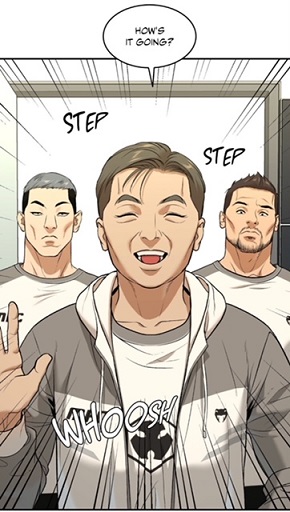 (chapter 49), highlighting the failures of relying solely on fate. The champion’s eventual discovery of Kim Dan underscores the necessity of teamwork and active intervention. Notably, this also reflects the flaws in Team Black, whose inaction and superficiality limited their understanding of both Joo Jaekyung’s struggles and Kim Dan’s situation. While Heesung’s stardom and blog
 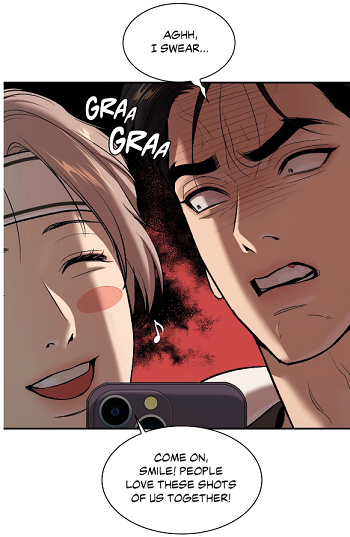 (chapter 30) could have amplified the picture’s reach, it’s unlikely Joo Jaekyung relied on such sources directly. I can not imagine him spying on the actor’s blog. Instead, the role of the helpers — the nurse and her acquaintance— emerge as crucial to piecing together the connection. The inadvertent role of the nurses Mind and Heart, urging Heesung to take the picture, becomes an integral part of the story’s progression.
  (chapter 13) who played pivotal roles in lifting the curse, as Mingwa’s narrative often draws on such reflections. Here, the nurses’ actions, though seemingly minor, echo the same themes of fate and intervention.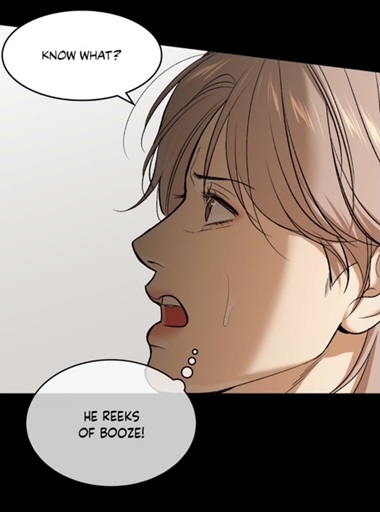
 (chapter 13) The latter knew the PT’s face,
  (chapter 13) but didn’t know his identity. He mistook him for someone who was selling his body for money.
  (chapter 13) In addition, Kim Dan never got to know the intervention of this hyung: he was the invisible helping hand in season 1. And now, if you reread the scene in episode 13, you will notice that this conversation between Joo Jaekyung and his friend contains all the ingredients in episode 59: the use of the phone, fainting, malnutrition, secrecy, neglect, secret suffering, pictures and public knowledge
  (chapter 13), the death of a man and finally urgency. Moreover, remember what his friend told him before: the importance of rest and
 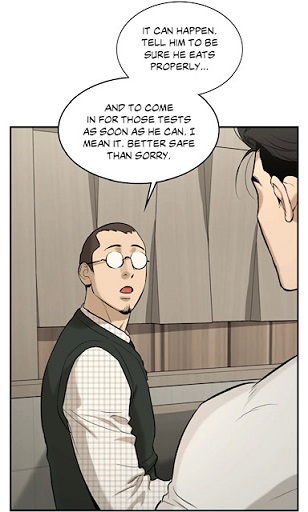 (chapter 13) He should send him to the hospital for tests, but the fighter refused. Why? It is because the latter feared his “chingu”. The doctor seemed rather interested in Kim Dan, therefore he feared that the PT might dump him for a “colleague”. That’s why Heesung was sent later to his gym. Karma was punishing him for not listening to his friend’s advice. Finally, it is important to recall his advice:
 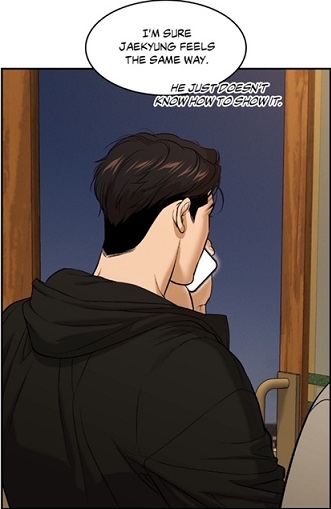 (chapter 43) And during that evening, the champion called his penthouse with the doc “Home” for the first time. Finally, in season 2, Joo Jaekyung started visiting each hospital or Sports Rehabilitation Center in Seoul in order to find Kim Dan.
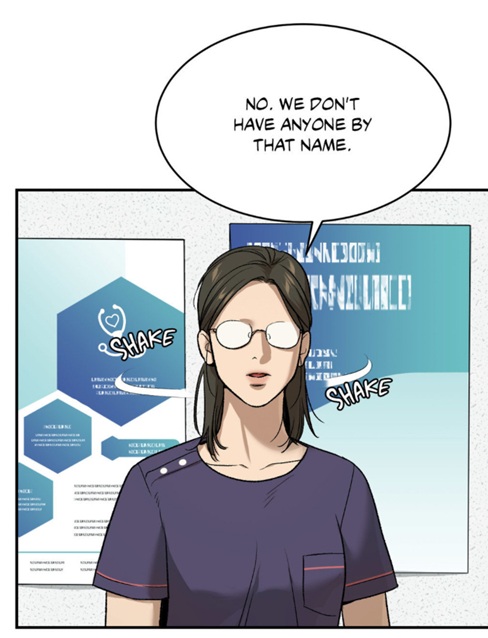 (chapter 56) And there’s no doubt that Joo Jaekyung got recognized by people forcing him to use a mask to hide his identity. So this frenetic search must have reached the mysterious doctor’s ears, but I doubt that he made the connection between the star’s lover and the physical therapist right away. Since he‘s a guest of XY club,
  (Chapter 13), it is also possible that he could have heard about the last incident in the restroom with doc Dan’s replacement. Since Cheolmin found Dan cute, it is very likely that he was also drawn to the surrogate „Dan“. But I don‘t think, this was enough to intervene, as Joo Jaekyung didn‘t ask for his help.
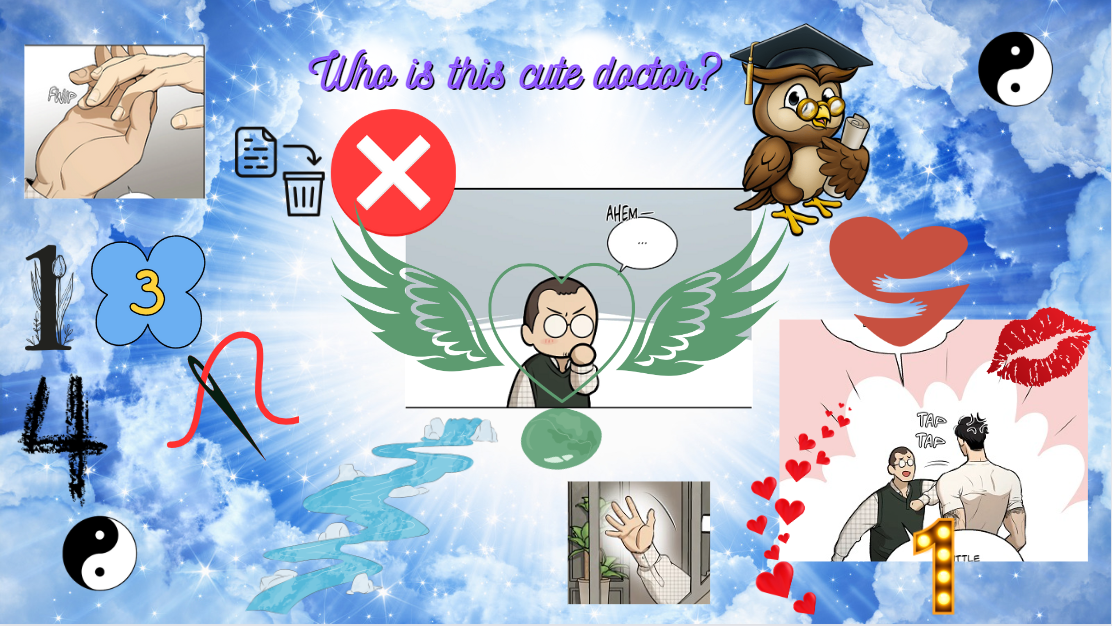 and to Neptune
 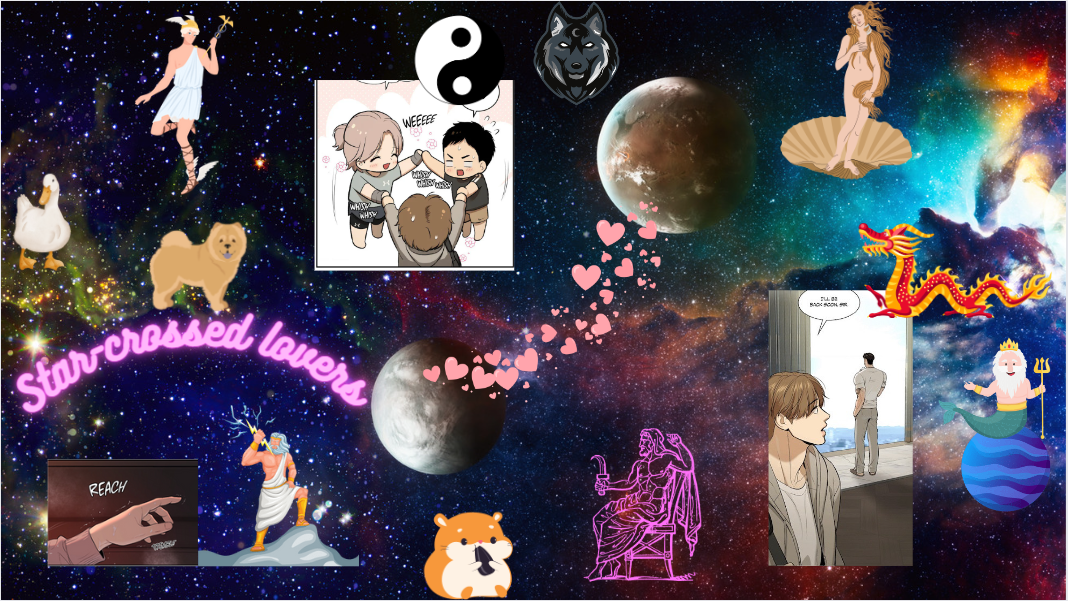 and strangely, the doctor moved to a place next to the coast. So maybe Cheolmin comes from that little town and the green-haired nurse is his relative. I had already outlined their similarities. Finally, look at the numbers, we have 4 in both episodes, 13 and 59 (13: 1+3 = 4 / 59: 5-9= -4) The -4 would coincide with Kim Dan’s vanishing, but also with the intervention of Cheolmin. And if my theory is correct, this means that the champion will come to regret his past decision
 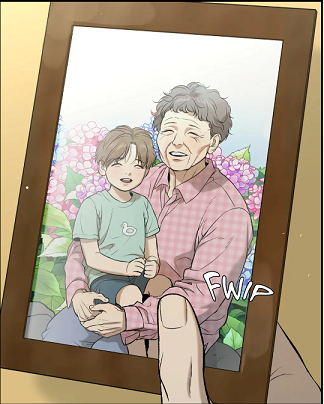 (Chapter 19) and the group photograph at the hospice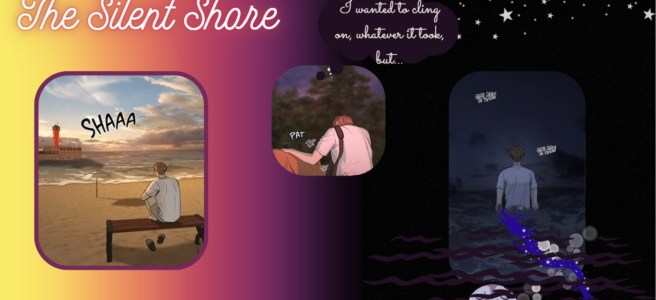


 (chapter 54) and penthouse
 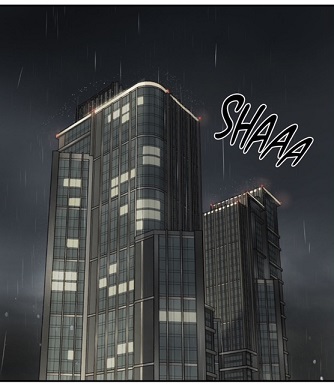 (chapter 54) in Seoul—a city symbolizing anonymity, invisibility, and corruption—to the hospice “Light of Hope”
  (chapter 56) in a small town on the West Coast
  (chapter 56), where people know each other. This essay builds upon my previous interpretations of the series, which led me to develop these predictions for the upcoming season. By comparing the visual depictions of the gym and penthouse in Seoul with the hospice and small town on the West Coast, the divergence in weather becomes a powerful symbol of the changes Joo Jaekyung will undergo. The rainy, overcast settings of the gym and penthouse reflect the fighter’s inner turmoil and sadness, highlighting the oppressive atmosphere of a city rife with anonymity and corruption. In contrast, the sunny and open environment of the hospice and town by the ocean represents a space of hope and renewal, where human connections thrive. This comparison underscores the significant role the hospice and small town will play in fostering Joo Jaekyung’s self-discovery and healing. The gym and penthouse in Seoul symbolize anonymity, invisibility, and corruption. This anonymity stems from the city’s indifference to individual suffering, as seen when Kim Dan was dragged
  (chapter 16)
  (chapter 16) through the streets by loan sharks in broad daylight without anyone intervening. Invisibility is further exemplified by the perverted hospital director,
  (chapter 1) who harassed Kim Dan without facing any consequences, though he was caught, and by Kim Miseon’s unethical actions, such as leaking patient information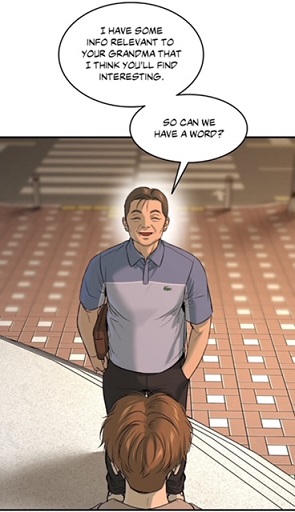
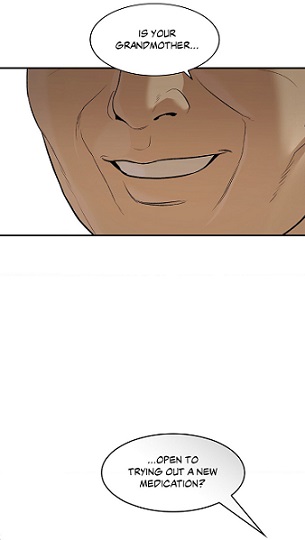 (chapter 48) and using Shin Okja as a guinea pig for trial treatments
 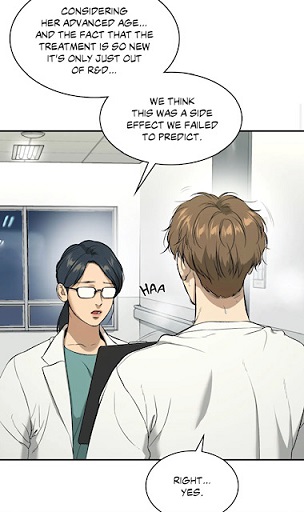 (chapter 21) —none of which led to accountability. In contrast, the hospice represents a counterpoint:
  (chapter 56) a space where respect and dignity take precedence over ambition, fostering genuine human connection and care. This contrast between the city and the hospice highlights the champion’s need to redefine his understanding of life, identity, and success. The contrast between the hospice and MFC becomes pivotal, as these environments symbolize opposing values: while the hospice fosters compassion
 (chapter 52) The best example is the vanishing of the protagonist’s former rival, Baek Junmin,
 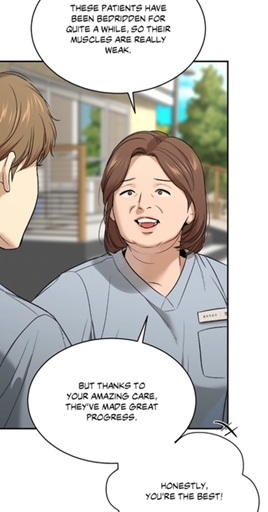 (chapter 56) emphasizing respect and dignity. This stark reality will serve as an eye-opener for Joo Jaekyung, who is burdened by news and media narratives equating
  (chapter 36)
 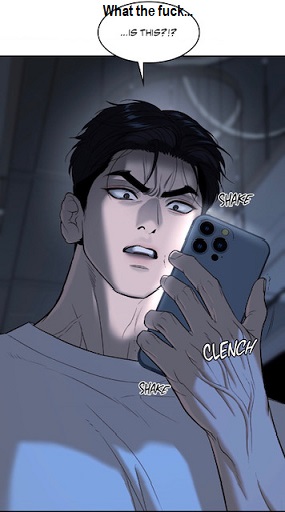 (chapter 35)
  (chapter 57), prompting him to recognize that his so-called career end does not symbolize his real death.
  (chapter 57). This environment challenges him to confront the indifference of figures like Yosep and Park Namwook, whose neglect, blind trust, passivity, naivety, neglect and selfishness have shaped his struggles. Notice that the nurses are often seen together and exchanging thoughts about doc Dan symbolizing unity and harmony
  (special episode 1) In other words, the presence of Kim Dan’s friends (Joo JAekyung, Potato and Heesung) could make her realize her true nature, which would impact her mental health. She led a life full of missed chances and regrets.
  (chapter 26)
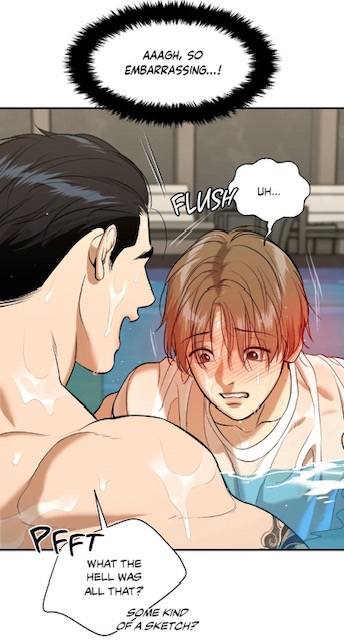 (chapter 27) In Korean culture, the saying “when the heart isn’t in it” reflects a profound truth: actions devoid of sincerity lack real value. Season 2’s new settings allow the champion to reflect on his mechanical, dispassionate life and begin to act with intention and feeling.
 (chapter 54) Though in denial, Joo Jaekyung feels undoubtedly responsible for the doctor’s suffering, as one of his nightmares reveals his guilt for doubting Kim Dan’s honesty and dedication. Once seeing his terrible transformation, the man can only blame himself, especially if he recalls Cheolmin’s advice:
 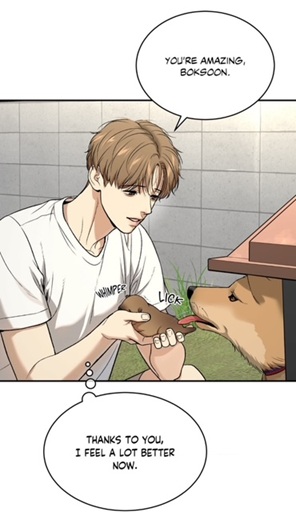 (chapter 57) and her puppies. Kim Dan is tasked with taking care of the dog and her newborns, and Joo Jaekyung should be asked to do the same. This responsibility not only serves as an allegory for taming the wolf within him but also paves the way for the champion’s deeper connection with Kim Dan. By being close to the ocean
  (chapter 56), a place where Joo Jaekyung finds relaxation through swimming, the setting introduces an opportunity for him to teach Kim Dan how to swim, addressing the latter’s fear of water
  (chapter 27). Swimming could become a shared activity that rebuilds their relationship on a foundation of trust, mutual learning, and growth. Engaging in this physical activity would not only strengthen their bond but also boost Kim Dan’s confidence and help him rediscover his own resilience.
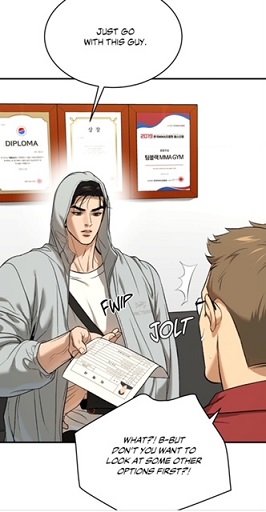 (chapter 54), his connection with Kim Dan is no longer defined by a boss-employee relationship. Their interactions, now free of financial obligations, offer the fighter a clearer view of Kim Dan’s selfless and angelic nature. The physical therapist’s unwavering care, even at the expense of his own well-being, highlights his ungreedy and altruistic character. This realization will deepen Joo Jaekyung’s respect and affection for Kim Dan, further cementing the transformative journey they both embark on.
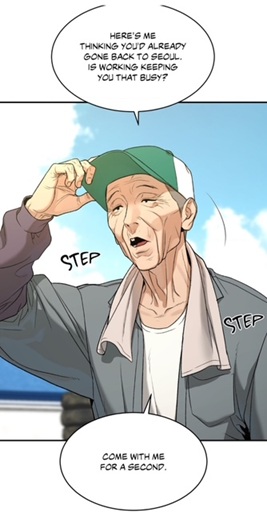 (chapter 57) and the yelling patient
 (chapter 56) “Nurse Mind” and “Nurse Heart,” provide another layer of mentorship. They could act as the champion’s eyes and ears, teaching him to observe and understand Kim Dan’s mental state. Though the nurse 1 started reproaching Kim Dan to neglect himself
 (chapter 13) She already noticed his unusual fatigue, so in my opinion, this third woman could be the one detecting that the main lead is not eating properly. If this assumption is correct, then she stands for food and body, like in the Korean saying: “If your heart is not in it, you can’t see if you look. You can’t even hear if you listen, and you can’t taste even if you eat.” Their guidance should help Joo Jaekyung cultivate a nurturing side, showing him that strength is not solely physical but also emotional and relational. In this way, the nurses become pivotal in his journey from a lone wolf to a leader who values and protects his pack.
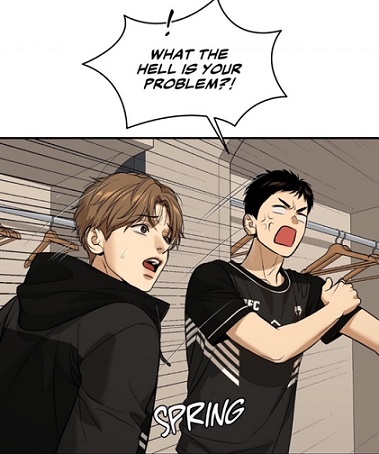 (chapter 49), though their positions are absolutely opposite. The patient’s reaction in Chapter 57 echoes this dynamic, as he accuses Joo Jaekyung of being ill-tempered (this means that he remembers the suspension), a perspective shaped by the media’s manipulations. His criticism reflects the behavior of a sheep, falling prey to misinformation and failing to see the larger truths. On the other hand, it indicates that this man also knows a part of the truth: the suspension which is no longer mentioned, but also escaped Kim Dan’s notice, as he was dealing with his departure. In contrast, Potato’s response in Chapter 49, where he courageously questioned Director Choi despite the latter being an elder, showcases independence and critical thinking. This juxtaposition highlights the patient’s potential to awaken Joo Jaekyung, Kim Dan, and Potato to the damaging impact of media narratives. Over time, the patient himself must confront the wrongfulness and cold-heartedness of his accusations, fostering growth and understanding on all sides. These characters reflect the flaws of Yosep and Namwook, enabling Joo Jaekyung to see the neglect and indifference he has endured and inspiring him to redefine his role in the gym and in Kim Dan’s life.
  The illustration’s inclusion of the hamster—symbolizing Kim Dan’s fun, fragile, and nurturing nature—along with the chow chow and the gumiho, emphasizes the roles of protectors and mediators. The chow chow’s loyalty and the gumiho’s cunning serve as essential forces guarding the hamster and navigating the complexities of this “pure community,” where lies and selfishness can still exist. These characters highlight the intricate dynamics within the hospice, where Joo Jaekyung must balance strength with empathy.


 (chapter 57) She wondered if this nickname “MAMA” was not a spelling mistake, and that the translator might have meant “MMA fighter Joo Jaekyung.” Intrigued by this possibility, I sought clarification, and indeed, in the Japanese version
 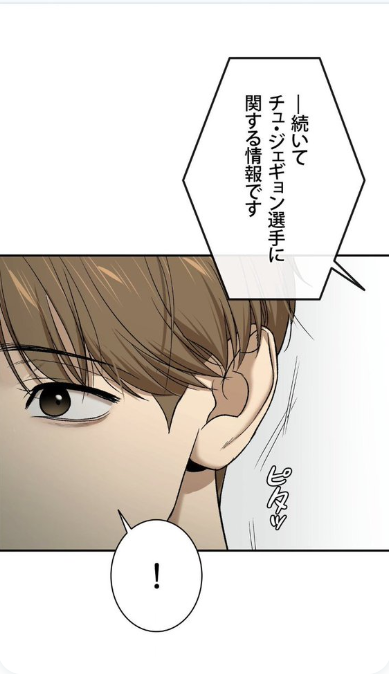 (episode 57) the reporter introduces the main lead differently: “Next, we have news regarding Joo Jaekyung.” This subtle difference is significant for three reasons.
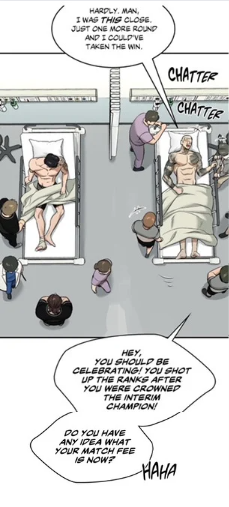 (chapter 52) and the suspension from their narrative highlights a calculated effort to erase inconvenient truths that could tarnish not only MFC’s reputation but also that of the medical professionals complicit in their schemes. Let’s not forget
  (chapter 41) the complicity of the doctors who cleared Joo Jaekyung to fight despite his evident injuries as another example of the corruption within this world. Moreover, by avoiding any mention of the suspension
 (chapter 52)
  (chapter 52), is not only a protective measure for MFC but also shields the medical professionals who facilitated the situation. Doctors at the health center failed to report the ankle injury caused by the sabotage
 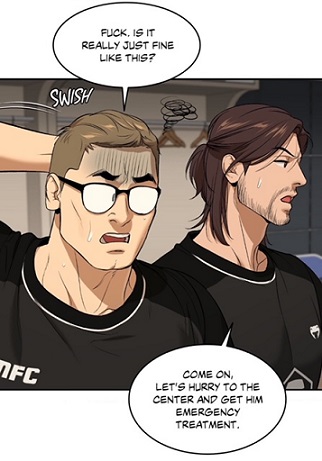 (chapter 50), further implicating them in a network of complicity and greed. Their decision to place the two fighters next to each other without proper privacy measures, such as curtains, reveals a disregard for professional ethics in favor of spectacle and profit. I would even add, the decisions from the health center’s medical staff, played a significant role in escalating the situation. By placing Joo Jaekyung and Baek Junmin next to each other post-fight, without appropriate measures like curtains to ensure separation, the health center created an environment ripe for conflict.
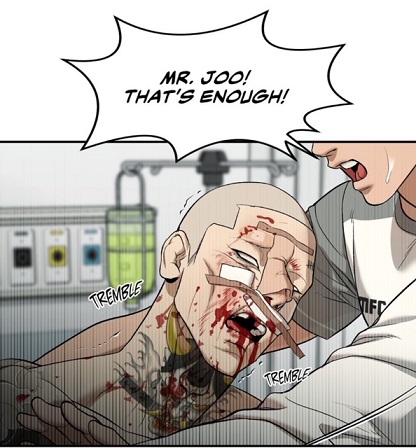 , (chapter 52) as the provoked champion lashed out in an unregulated setting. The decision to ignore these systemic failures and instead to suspend Joo Jaekyung suggests a deeper layer of complicity from the medical world, where doctors and nurses prioritized organizational demands and reputational interests over ethical responsibilities. Their failure to report the provocation and the ankle injury caused by the switched spray further highlights their alignment with MFC’s corrupt practices.
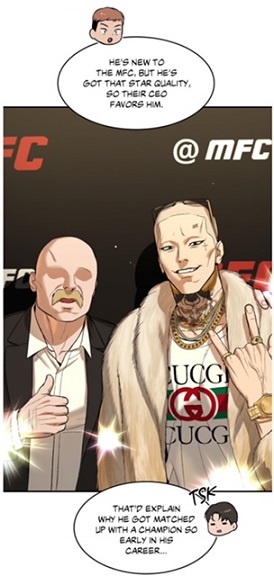 (chapter 47) and favored by MFC’s CEO, Baek Junmin has now been discarded, his relevance extinguished the moment he ceased to serve the organization’s agenda.
 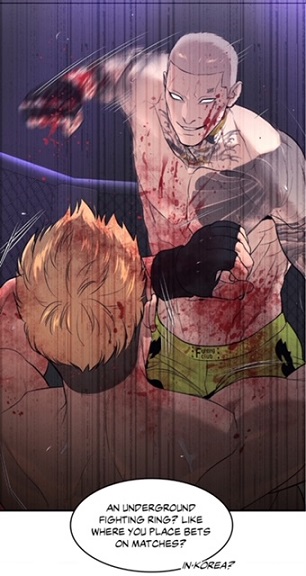 (chapter 47) His background, combined with his visible association with MFC’s CEO, positions him as a key figure who could potentially expose the organization’s darker practices.
 (chapter 49), his ultimate fate now reflects the broader cruelty and exploitation perpetuated by those in power. That’s how I realized the other signification of the cross below his left eye. The latter symbolizes his blindness in the end. The cross signifies his inability to see beyond the role he played within the system—a symbol of his naivety and misplaced confidence. Baek Junmin believed he understood the brutal reality of the fighting world, given his background in underground rings and illegal gambling. He thought his experience and cunning gave him an edge, making him untouchable or indispensable. However, his taunts to Joo Jaekyung
 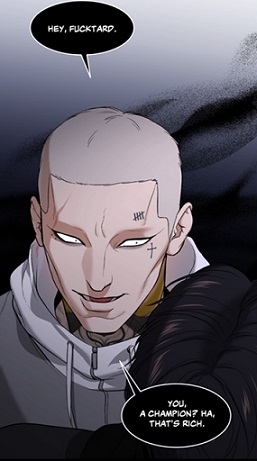 (chapter 49) reveal a man who overestimated his position within the organization.
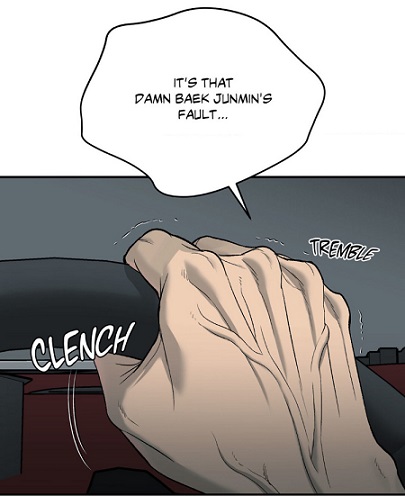 (chapter 54), it shows the athlete’s lack of reflection and insight. He hasn’t been able to discern the truth, the corruption of his “world”. This means that he needs to travel and experience a whole new world. The contrast would serve as an eye-opener for the athlete.
 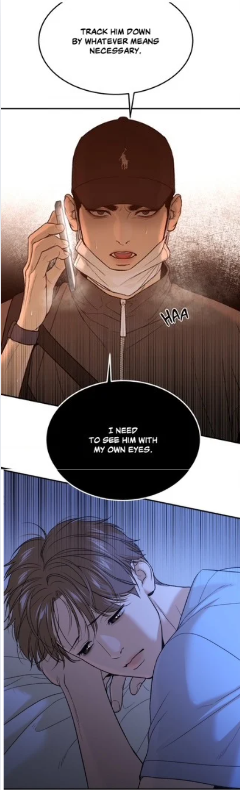 (chapter 56) released shortly after the champion’s urgent request to locate him. This timing is no coincidence. Instead, it reflects a calculated effort to manipulate both the public narrative and Kim Dan’s own perception of his role and value. By introducing the anonymous person as “one of his close associates”, it implies that the champion has already moved on from the protagonist. He is not missing him at all. At the same time, it implies that within a short time, the person was able to get the athlete’s trust which stands in opposition to this scene:
  (chapter 57): his regret was not merely about using the spray but about his failure to assert himself professionally.
  (chapter 49) By complying unquestioningly with the champion’s requests, he had diminished his role, acting more like a servant than a competent physical therapist. The interview, though painful,
  (chapter 57) serves as a harsh wake-up call, forcing him to confront his own shortcomings and reevaluate his behavior.
 (chapter 41), drawn boundaries, and made his expertise known. I would even add that he never felt responsible for the champion’s reputation in the media
  (chapter 41) In addition, while many Jinx-Philes are blaming the champion for his outburst,
  (chapter 50) rejection and
 (chapter 50) accusations,
 (chapter 51), the main lead is not blaming his fated partner at all. Why? It is because none of this would have happened, if he had acted as PT and trusted his own hands. He was too passive, standing by the sideline. He never became proactive.
 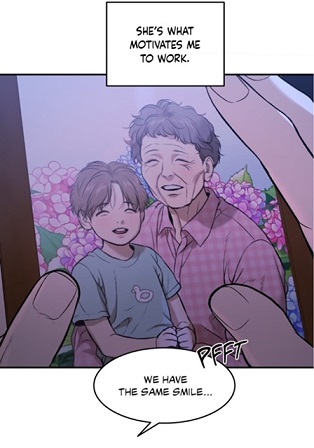 (chapter 47) his indifference and lack of professionalism. In the end, the grandmother is the reason for his lack of professionalism and neglect.
  (chapter 54) Unlike the newly hired PT, who likely has the backing of a hospital or organization, Kim Dan operates independently. This independence, while offering a degree of freedom, also makes him vulnerable. He lacks the institutional support that could shield him from the manipulative tactics of MFC. Moreover, his independence places him in direct contrast to the systemic corruption that permeates MFC and its associated entities. As someone who has already been victimized by two major deceptions—the drugged nutrition shake
  (chapter 37) and the switched spray
 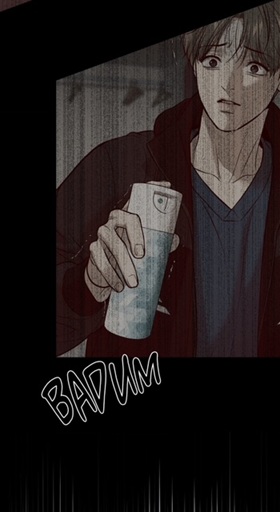 (chapter 57) —Kim Dan stands as a figure who threatens to expose the cracks in MFC’s carefully constructed facade. Let’s not forget that the incident with the poisoned beverage was swept under the rug by framing haters.


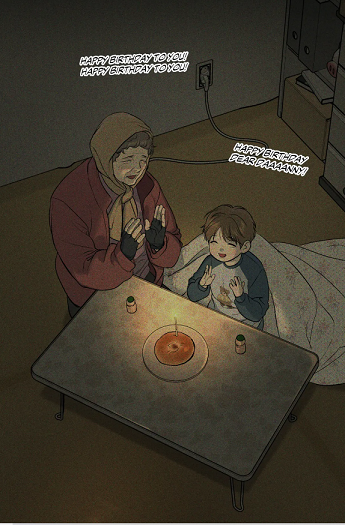 (chapter 11) Here, she offered him a sweet bread as present, but since it was his birthday cake, he had to share his “own present” with his grandmother. The little he possessed was given to his grandmother, a new form of this scene
 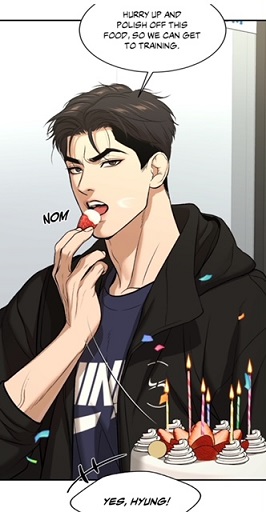 (chapter 43) In other words, he was the one sharing his food with her. But there exist more conclusive evidences.
  (chapter 5) When he visited her in episode 5, the main lead was the first one to bring up the topic “dinner”. How did the grandmother respond to his question? “You know your granny never skipped a meal”. Her statement is implying that someone else skipped his meals before. That can only be the doctor. So she knows that he has not been eating on a regular basis. And what is the opposite of “never”? ALWAYS! Yet, observe that she is smiling, when she is saying this. It exposes that she never saw the doctor’s skipping meals as worrisome. She must have probably thought that her grandson was a picky eater.
 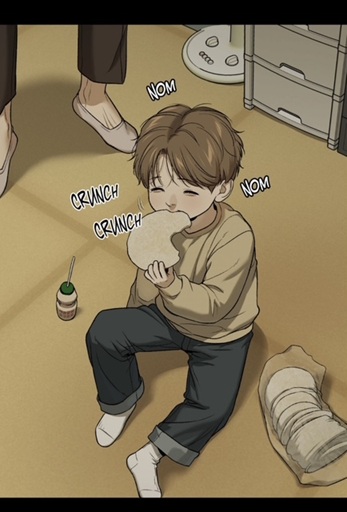 (chapter 57) So she was not sitting down to a meal with her grandchild literally. In addition, when she suggested snacks to console him, she didn’t realize the terrible consequences of her decision. Once it was dinner time, Kim Dan would no longer feel hungry. With the introduction of such a ritual (eating became the synonym for repressing negative emotions), it is normal that the little boy would stop eating with his grandmother. That’s how the routine of eating on a regular basis got dropped, as it was strongly intertwined with his negative emotions and terrible incidents.
 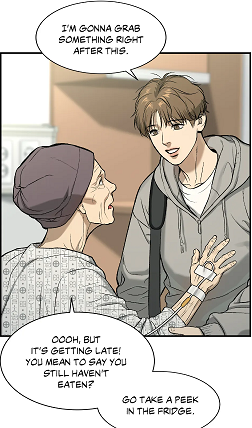 (chapter 5) Thus she offered him two sweet yogurts.
  (chapter 5) Her words “You used to love these when you were little” are alluding that she perceives the main lead as a picky eater. As a child, he would never refuse the drinks. So when she offers them to him, she is sure that he will eat these. Finally, when she saw the celebrity, she indirectly put the blame on her grandson. He is thin and weak, because he didn’t eat properly.
 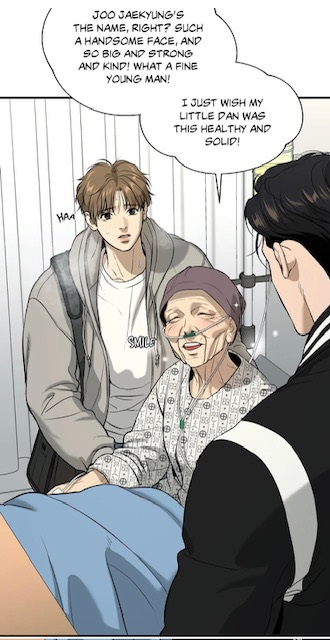 (chapter 21) In her eyes, Kim Dan’s habit for skipping meals was the expression of an avoidance of certain foods. It was because he was a picky eater. This shows that she never questioned herself and her past decisions. Then in the latest episode, she is seen eating her lunch,
 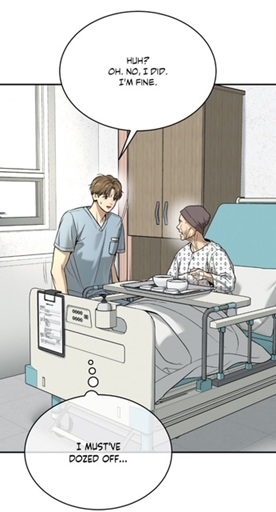 (chapter 57) yet at no moment she shares her food or questions him if he has already eaten. For me, this scene exposes her neglect. Her focus lies elsewhere:
 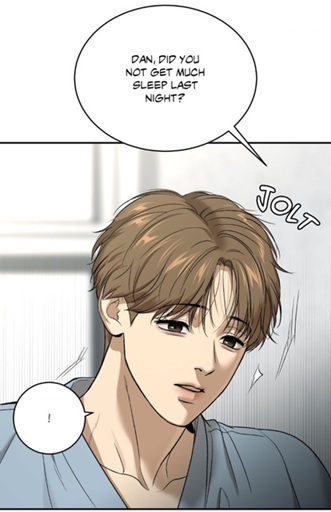 (chapter 57) She asks this question, because she has already witnessed him sleeping next to her. She associates tiredness with lack of sleep, but she is not making the connection between malnutrition and his exhaustion.
  (chapter 57) On the other hand, the expression “wasting away” displays her realization. She is seeing how Kim Dan is losing weight!! To conclude, she is not totally blind. Her grandson is not eating properly. But why is she not questioning her grandson about his meals? It is because he is working at the hospice where lunches are provided to the staff.
  (chapter 56) In other words, she is relying on the hospice, while the staff is too busy and overwhelmed with work to notice that Kim Dan has been working too much and even avoiding lunches.
 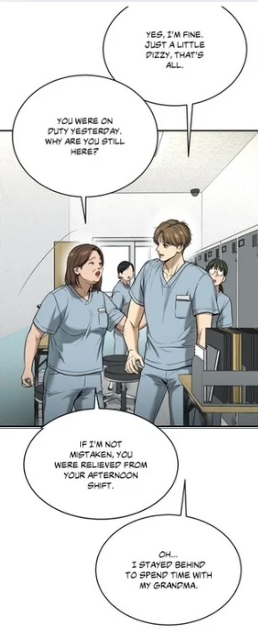 (chapter 57) It took them days before the nurse noticed that he shouldn’t be there. Interesting is that the nurse “Mind” is starting to put the blame on the physical therapist
  (chapter 57) This shows that Kim Dan had become a ghost at the hospice for the last few days, and no one paid attention to him. He was invisible because it was his way to be “accepted” and not stigmatized as “bun” or “orphan”. People only noticed him, until he created some ruckus at the institution. However, this means that the man must have spent the night with his grandmother. Yet, at no moment she sent him away or even shared her meals with him. This shows her indifference and egoism. She contrasts so much to the protagonist’s landlord.
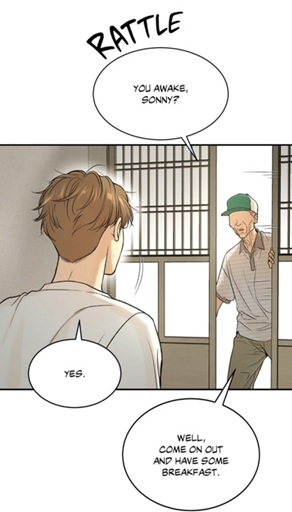 (chapter 57) This scene represents the man’s new routine. He would go to Kim Dan’s bedroom and ask the protagonist to eat breakfast with him. On the other hand, though he noticed the doctor’s absence, he jumped to a false conclusion. He imagined that his new room mate had returned to Seoul. This raises the following question. Why is this caring man assuming that Kim Dan moved to that small and insignificant town just for a short moment?
  (chapter 57) And why did he think that Kim Dan had left for good? First, I can imagine that the doctor looked for a place without deposit.
 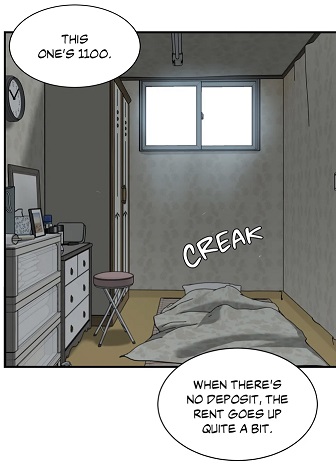 (chapter 16) But more important, it is because the physical therapist only arrived on the West Coast with two small bags.
 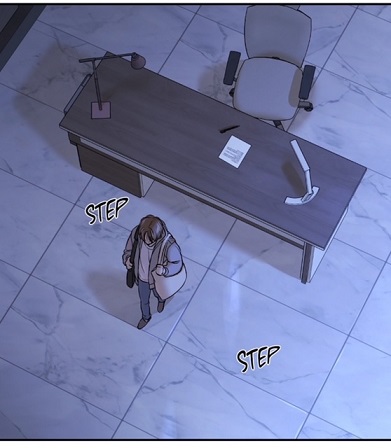 (chapter 53) And now pay attention to the PT’s departure on the day he was sent back:
 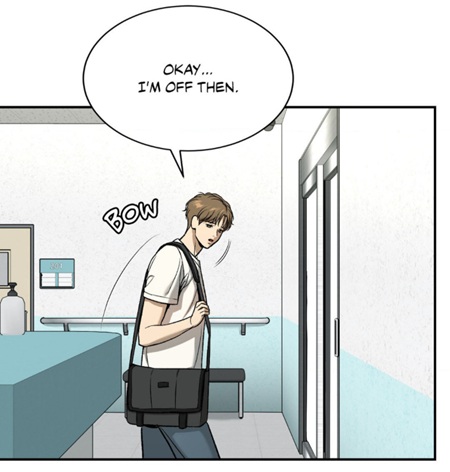 (chapter 57) He had gone to the hospice with all his belongings, a sign that he had planned to stay with his grandmother until his “death”. In other words, his “workplace” would have become his tomb. This means that the landlord already noticed that the main lead only had a few belongings, and the moment he didn’t see the black bag with the halmoni’s picture, he assumed that Kim Dan had returned to the city. Thanks to the introduction of the new landlord, my interpretation about the champion’s biased judgment got confirmed.
 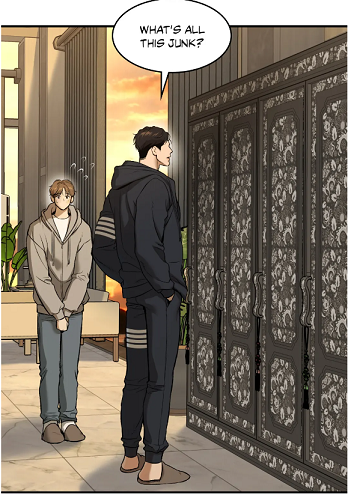 (chapter 19) When Joo Jaekyung saw the huge Wedding Cabinet, he thought that Kim Dan had many clothes. Thus he saw it as a sign of “greed”, Kim Dan was poor, because he was not able to save money. And this observation brings me back to the landlord:
  (chapter 57; here he used guilt and shame to incite Kim Dan not to drink), he is attempting to be close to his new room mate, to understand him. The problem is that the protagonist is keeping everything to himself. He is not speaking about himself and his past. This is quite understandable, as the grandmother keeps telling him that he has no roots here.
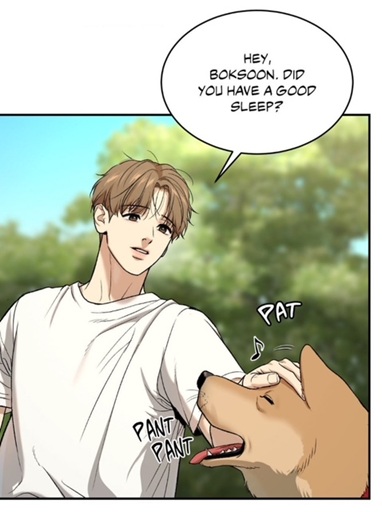
  (chapter 57) Care, curiosity and responsibility. Here he is asking for help as well. Nevertheless the nature of his request is different, for it is not about himself, but about Boksoon and her puppies. As you can see, he is making sure that she gets the best environment to raise her puppies. On the other side, Shin Okja used to prioritize herself and her own suffering. Notice that the doctor was resting under a tree in the yard
  (chapter 57), until the owner appeared. Thus I couldn’t restrain myself thinking that this man is strongly associated with the sun (fatherly figure) and life, whereas the grandmother stands for darkness
 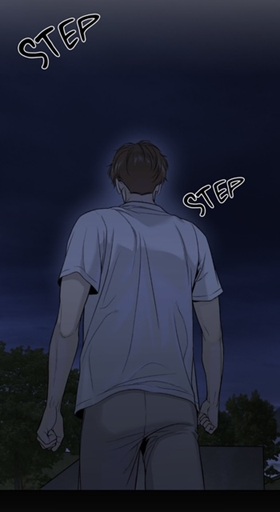 (chapter 57), night and death.
  (chapter 43) No, his avoidance of eating increased. Park Namwook and the others assumed like many readers that it was related to his overwork and exhaustion, but it is only partially true. Sleeping was also his way to avoid food in the end. And this brings me back to the incident with the switched spray:
  (chapter 57) That’s the reason why I don’t think that Kim Dan’s ARFID can be suddenly cured, the moment Potato reveals the truth about the incident. He has to develop a routine around eating. Someone has to put food right into his mouth, to feed him literally. On the other hand, I can imagine that a change will take place, when he sees his fighter totally diminished. He would serve as a reminder and reflection to himself.
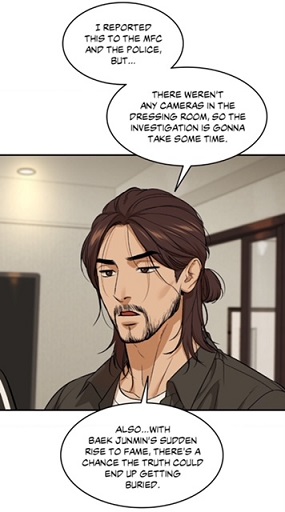 (chapter 52) He was the only target and victim. Therefore it was reduced to the work of a hater and rival. Nevertheless, they didn’t interrogate the real victim of the crime correctly. Either he was about to get framed or his involvement was totally denied. It was, as if he had not been present. By not taking the physical therapist’s psychological damages into consideration, they actually expose their true nature. They don’t care about mental health at all. This explicates why the athlete had to prove his worth constantly. We should see these comments as a new form of bullying
 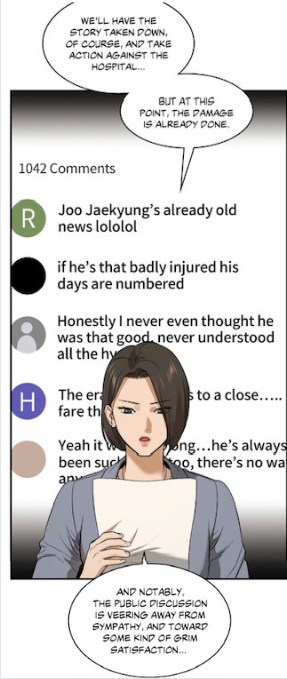 (chapter 36), which were supported by MFC, the Entertainment agency and Park Namwook. Joo Jaekyung had to prove them wrong: his career is not finished yet. So when the couple meets again, they should quickly realize the importance of mental health, as both are definitely at their lowest point in their life. In other words, the mental issues from Kim Dan serve a purpose in this story: people close to him should come to the realization that mental health is essential in life, something they neglected before. Either they didn’t feel concerned or they were biased or simply ignorant. Thus the athlete in the illustration for season 2 is looking at his fated partner’s face :
  He is now paying attention to his facial expressions and trying to discover his thoughts. Moreover, note that he is also grabbing his wrist, which could be interpreted like this. On the one hand, he is attempting to stop Kim Dan from working, as the symbol of a PT is the helping hand. He should relax and rely on the fighter’s care and protection. He is his shelter and home. On the other hand, it could be seen as his attempt to stop Kim Dan from using his wrist against the sinners and criminals: Kim Miseon who used her halmoni as guinea pig, Choi Gilseok who tricked him etc… Yes, I have the impression that at some point, the physical therapist could end up feeling like his fated partner:
  (chapter 41) Kim Dan is looking for light, because he has been trapped for too long in that darkness: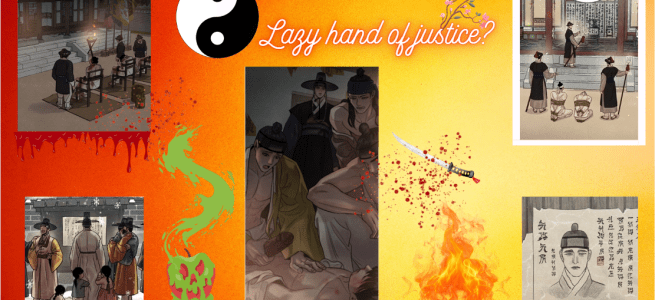

 (chapter 131) Hence the police officers found the governor’s seat deserted.
 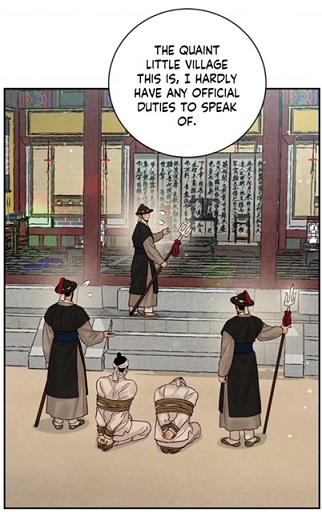 (chapter 131) By contrasting the statement from the governor and the panel, the readers could easily catch his lie. He was a lazy governor, preferring to keep his lover company rather than attend to his official duties. On the one hand, it exposes the main lead’s true mind-set. He is not longing for power or glory. To conclude, he has no ambition. This implies that he is not determined to gain attention either. One might add that he selected this region on purpose. No one would willingly go to that place. The norm was that officials would go there, because they were demoted.
 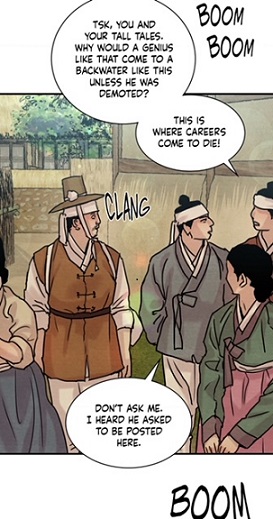 (episode 129) Thus I deduce that Yoon Seungho made the opposite choice to his father. The latter longed for a high position at the government so that the family’s reputation would become famous and powerful again.
  (chapter 86) It is because Yoon Chang-Hyeon was thinking of getting the attention or support from noble families. What he truly wanted was to get recognition from people among his own social class. But with such a decision (join the painter’s side), Yoon Seungho seems to have turned the former patriarch’s nightmare into a reality. Yoon Seungho is about to ruin the family. The name “Yoon” is destined to become forgotten, right? However, I believe that this interpretation is not correct. How so? Let me ask you this.
 (chapter 127) No one has such a wealth! That’s the reason why no official would select such a place. Yes, Jung In-Hun’s words from chapter 6
  (chapter 6)
  (chapter 37). It is about a crime, treason. In season 4, we know that the plot was true and there was an evidence, the paper with the signatures from lord Yoon and lord Song. Since in season 1 the wrongdoing was true and heavy, I deduce that it is not the case in the final chapter. Because there is an evidence of the crime in the past, I can’t help myself thinking that in the final chapter, there was no evidence. Additionally, I feel the need to expose my other interpretation about this man:
 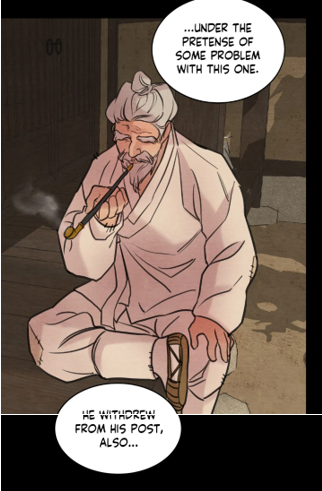 (chapter 37) I have always stated that this man couldn’t be a servant, for he was smoking a pipe and we saw a glimpse of his memory. No commoner would be allowed to enter the courtyard, when three noblemen are tortured and interrogated. Moreover, notice that in both scenes (37 and 131), the magistrate is absent. That’s how it dawned on me that this nameless man could have been a former “governor” who lost his position.
 (chapter 94) Here, the officers went to the mansion before visiting him at the gibang.
  (chapter 97) Back then, it was about the death of a commoner, a servant. If there’s an urgency, they would look for him. The comparison exposes that the “wrongdoing” from the peasants in the final chapter was no huge deal. Yet, many readers already condemned them due to the guards and the protagonist’s behavior. Funny is that the lord was portrayed as a huge liar, but not “the officers”.
  (chapter 101) His statement displays another aspect: the governor and the guards are not working together. Jihwa would have been sent to jail without being able to talk to the superior, similar to this scene:
  (chapter 126) The guards’ own interests are not necessarily aligned with the governor’s. And now, take a closer look at this scene:
 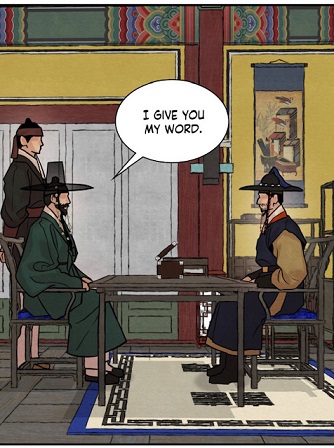 (chapter 127) The official received the patriarch in his office alone. The reason is simple. That way, he wouldn’t have to share the money with others.
 (chapter 129). He was not sitting on a horse with a few musicians contrary to Jung In-Hun. He was carried by four men, and other people were announcing his arrival with flags and music.
  (chapter 111) Moreover, Yoon Seungho had a inauguration banquet organized, where the local inhabitants could join.
 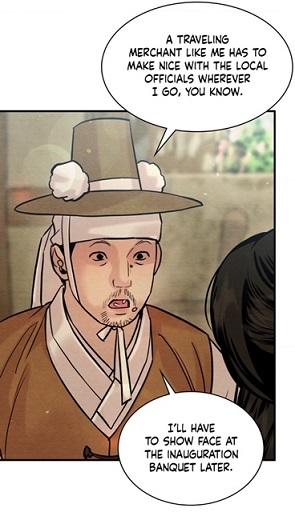 (chapter 129) There was no social exclusion at all. This stands in such opposition to the lord’s statement in season 1, where he distinguished between nobles and commoners.
 (chapter 129) This signifies that the arrest could lead to trouble to the guards too. So was the lord lazy in the end?
  (chapter 131) Yes and no… By acting that way, he put an end to the abuse of authority in that place!! Thus I deduce that the governor is destined to gain recognition and admiration from the local inhabitants. He is generous (inauguration banquet where anyone could join), humble, loyal (he is not forgetting his lover)
  (chapter 131), but also well organized! He had planned to join this place a long time ago. The peach trees were planted about 3 years ago. He is no longer making any distinction between nobles and commoners, and that’s how he will get the respect from the peasants. As a conclusion, we should envision that the lord will become famous. Therefore the son didn’t turn the father’s nightmare into a reality. He didn’t contribute to the family’s ruin at all. Yet, there exists a huge divergence. Yoon Seungho is about to make a name on his own. It is not about the Yoons. On the one hand, the father’s dream was illusory and superficial, especially due to the treason
 (chapter 86). Since Lord Song had been forced to resign, there’s no doubt that the man would resent the Yoons to become successful again. This explicates why lord Song saw Yoon Seungwon as a problem
  (chapter 107) and tried to tarnish the younger son’s reputation. But let’s return our attention to the patriarch. His vision was based on Confucianism. However, he had a very narrow-minded perception of it.
 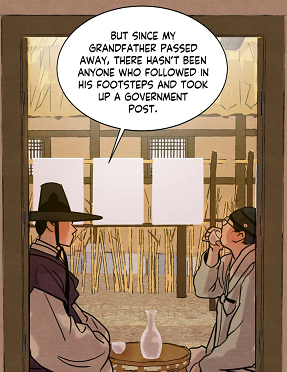 (chapter 7) This shows that the tradition was to “vanish behind the family name, the Yoons”. Under this new light, my avid readers can grasp why the main lead was destined to suffer immensely
  (chapter 57). His reputation was already outshining his father’s. Secondly, by being stigmatized as a homosexual, he was endangering this principle. His role was to continue the lineage and as such produce a heir.
  (chapter 116) or even Min could commit crimes in the open. They felt safe, for they knew that the authorities belonged to the same social class than them. However, this could only work, as long as the nobles would cover for each other. Should a yanbang denunciate a noble family, it was a different story. Therefore I assume that lord Lee was the one who reported the treason to the authorities (the painting in the bedroom was the evidence). But such a painting couldn’t represent a proof. However, since human justice was corrupted, the gods decided to give justice to the protagonists. That’s how Yoon Seungho became the hand of justice. Everyone involved in the protagonists’ suffering had to pay for their crimes.
  (chapter 102) That’s the reason why Baek Na-Kyum’s martyrdom was strongly intertwined with the young master’s. Yoon Seungho only received this power through Baek Na-Kyum, the character embodying fairness, sincerity, hard work, home and equity. This was particularly perceptible in this scene:
  (chapter 27) The lord couldn’t kill anyone randomly.
  (chapter 102) However, I consider it as a first step to the lord’s emancipation and life lesson. The latter is indirectly learning not to pay attention to status and power. That’s why the author portrayed him as blind and deaf to their plea and special status. While his behavior in the shrine was rather impulsive and influenced by deeply rooted fears, we should consider lord Song’s execution as a true act of justice.
  (chapter 123)
  (chapter 123) The latter had confessed all his crimes: the ones from the past (the lies in order to fool the father)
 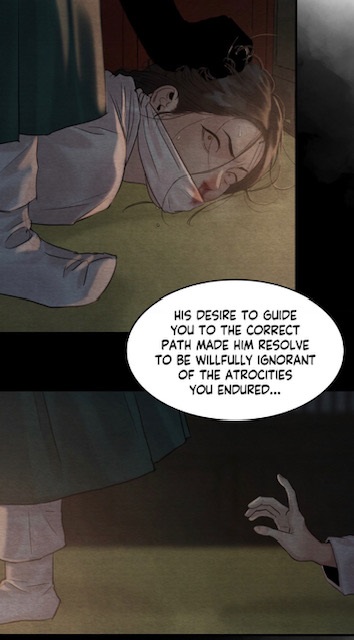 (chapter 123) and the painter’s murder. Funny is that lord Song didn’t feel threatened by the young master at all despite the sword.
 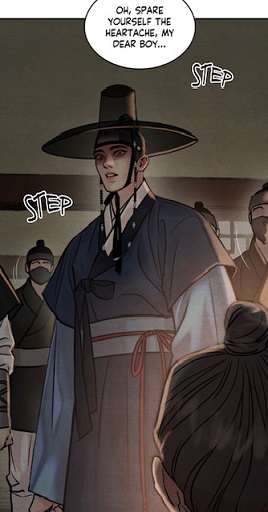 (chapter 123) Why? It is because he feels, he is the one with the upper hand. First, he has the petition, hence he is already projecting himself in the future (he can get a high position again). Secondly, he thinks, Yoon Seungho is outnumbered. He is surrounded by 4 guards. But more importantly, he views himself superior to the main character due to his age. He is an elder. That’s the reason why he calls “my dear boy”. This implies that he is underestimating the main figure. The latter would never dare to raise his hand against a senior!! However, true justice is also blind to age.
 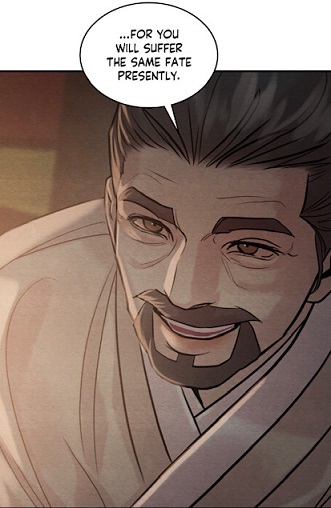 (chapter 123) His smile at the end of the episode should be perceived as a reflection from Min’s vanishing.
  (chapter 103) One might even add that the lord’s action could have been seen as self-defense. However, don’t forget that we are here in Joseon, where a commoner’s life means nothing. Because of this new association, I came to the following deduction: lord Song was the one behind lord Shin’s death.
  (chapter 103) The latter couldn’t imagine that an elderly yanbang, an official, would raise the sword against another noble. After this new realization, it dawned on me why Yoon Seungho had to get separated from his loved one.
 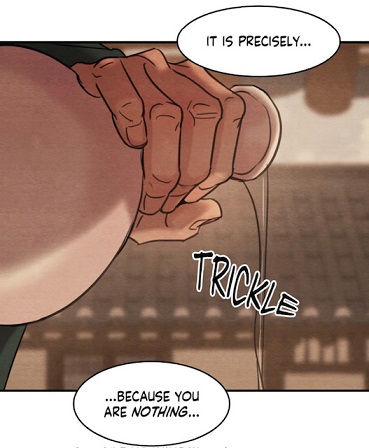 (chapter 126) This humiliation made Yoon Seungho realize that he needed to have his power on his own. He learned through the hard way that he was not just a Yoon, but Seungho. Yes, this helped him to differentiate himself from his father and to become stronger mentally. His religion was now his lover, Baek Na-Kyum, whom he needed to protect. But he could only do it, if he had himself a powerful position. But he needed to witness the corruption of the authorities to realize that in Joseon, there exists no justice.
  (chapter 6): neglect and indifference towards the commoners. And this new observation brings me to my other topic, Jung In-Hun.
 (chapter 129), therefore he couldn’t select one position contrary to the main lead. This means that when he celebrated his “victory” in episode 111, it was not official. He had no post. I would even add, his name had not been announced on the official board, like we could witness it in this scene.
 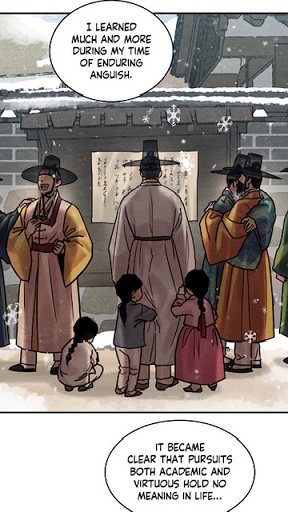 (chapter 121) Here, he is informed that he didn’t pass the exam, for his name was not written there. We can detect this, because people are congratulating each other. His name was left out due to the intervention from lord Song. This means that when Yoon Seungho made him this offer
 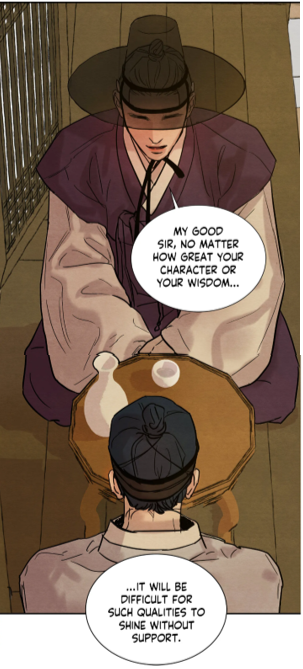 (chapter 7), these were not empty words. He did help the learned sir to pass the civil service exam. But the scholar didn’t succeed like anticipated. The absence of his success explicates why Jung In-Hun received such an offer from lord Song later.
 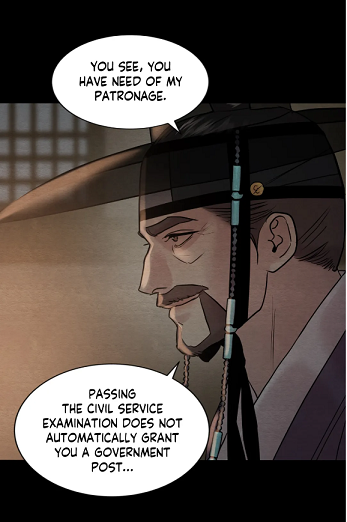 (chapter 117) He had no post, he couldn’t choose it, for he was not the best. Thus I deduce that the scholar had just proven his mediocrity. He was just an average man. That’s how it dawned on me that the ceremony in the street was more a simulacre!
 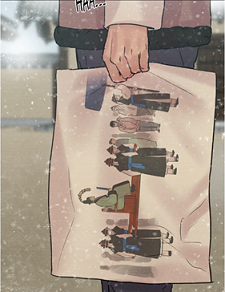 (chapter 44) Only one thing was real: Jung In-Hun was wearing an official uniform, that way no one would doubt his “victory”. Moreover, observe that lord Song only approached the learned sir after the parade. So he was not behind the parade. Besides, keep in mind that the main couple was informed about the parade through the tailor
 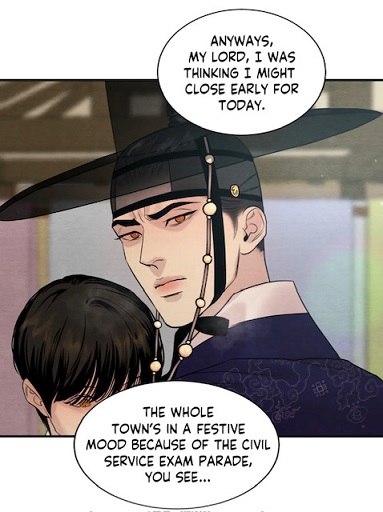 (chapter 111) and not from the official board. His reaction shows not only his displeasure, but also his ignorance. If he had known about the cortege, he would have avoided the place in the first place. Thus I suspect that the tailor had been encouraged to leak this information in front of the couple. Let’s not forget, as a tailor, he was definitely involved in the cortege. It is no coincidence that he informed Yoon Seungho about this “sudden parade”. At the same time, I come to the following deduction: someone must have paid for this spectacle, and it was not Yoon Seungho, for he had been kept in the dark until the last moment. I doubt that the learned sir had the connections and money for this. This new perception corroborates my previous interpretation: the show was sponsored by someone, and it was definitely inspired by the drawing (the hat and the green uniform).
  (chapter 111). Yet this was just a cheap trick, for the person didn’t send a sedan chair with carriers. Under this new light, I realized why Jung In-Hun ended up stigmatized as a criminal.
 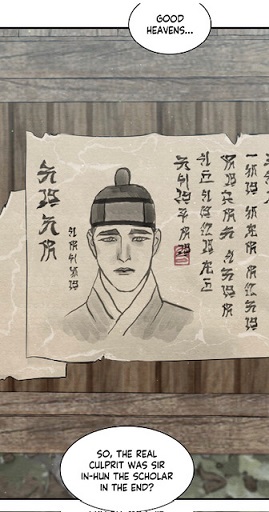 (chapter 127) It was his karma, for he had deceived the painter with his lies. His success was not his own.
 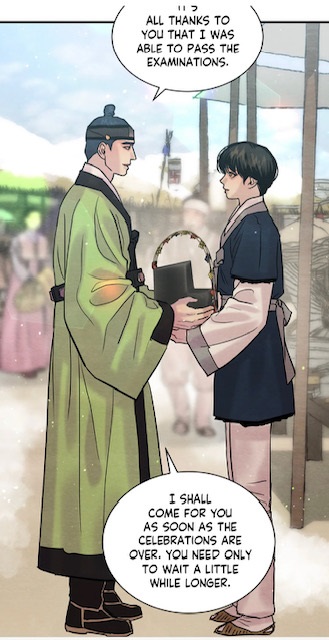 (chapter 111) He realized that even after passing the exam, he needed the assistance of people, a sponsor for the spectacle, a noble with connections. Besides, when in season 1, the painter was accused of a crime (ruining the picture), the learned sir did nothing at all. He didn’t protect his student, for he desired to keep his sponsor. When the latter was sick, he neglected him as well. He wouldn’t have sent a doctor for him. Hence in season 4, the sponsor Na-Kyum decides to end his “sponsorship” for the learned sir. We could say that the former teacher is confronted with a similar situation. He ends up being abandoned and framed for a crime, which he didn’t commit. Yet, contrary to his pupil, he is not entirely blameless, for he played a huge role in the death of the nobles lord Song, lord Shin, lord Min and others. Because Baek Na-Kyum embodies hard work, justice, equity, love and honesty, I deduce that his surrogate father embodies the negative notions: laziness, corruption, partiality, hierarchy, ambition and hypocrisy. That’s why his face ended up on the official board, while the painter’s accusation just remained rumors.
  : (chapter 125) versus
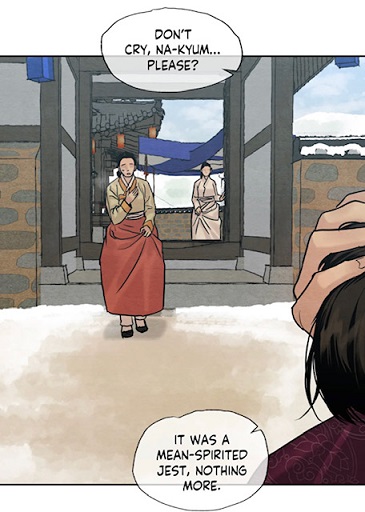 (chapter 105) IMO, she had to use another mean in order to achieve her goal: the scholar. Let’s not forget that the artist had confided to her this:
  (chapter 68) He was simply waiting for the learned sir’s return. And she was present during the cortege.
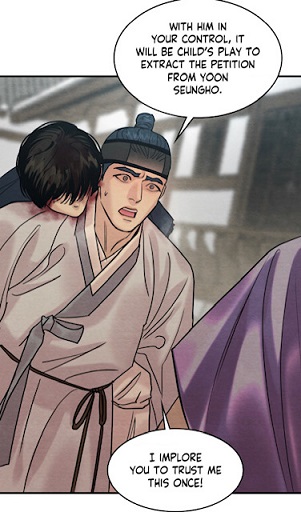 (chapter 121), he put the painter in a position which led him to take for the fall for his loved one. It was like framing an innocent. Exactly like in season 3
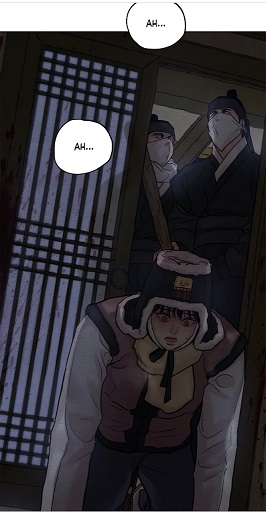 (chapter 99), Yoon Seungho had been forced to take the sword because of the scholar. And the trigger for the massacre
 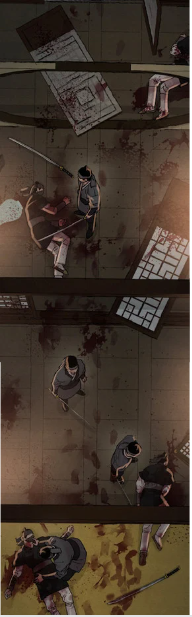 (chapter 124) was always Jung In-Hun. And now, you comprehend why Jung In-Hun became the scapegoat for the last incident. But there’s more to it.
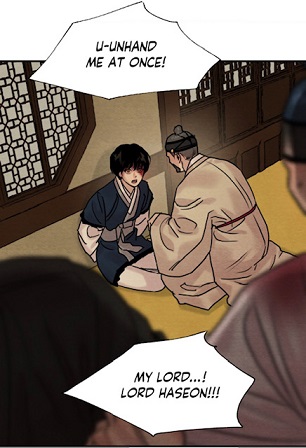 (chapter 121) His final lesson was to learn that he was exactly like the others: he is just a human despite his education. All humans are equal in front of death. In fact, during his confrontation with lord Song, he came to give up on his integrity. His true face came to the surface: he was just an opportunist, a lazy scholar who relied on fate and his arrogance.
  (chapter 6) This brings me to my next interpretation. Jung In-Hun learned through the hard way that there is nothing like fate (“right time”), but life is the result of decisions. However, because the scholar always regretted all his past choices, he decided to blame others for his wrong choices. That’s the reason why he ends up to take the whole crime. We should see this paper
 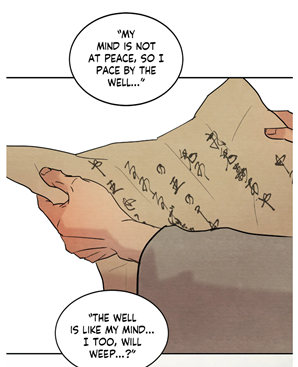 The author from this sijo was the poet and official Wang Bang-Yeon who is said to have lived in the time of Joseon’s sixth king Danjong (1441-1457) and his successor king Sejo (1417-1468). As the official of the state tribunal, he followed the young king Danjong into his exile and gave him poison to drink by royal command. Yes, both are symbols of power, corruption, partiality and injustice. Yet, there exists one divergence. While Wang Bang-Yeon left a poem revealing his yearning for the king, the learned sir had no deep attachment towards the artist. Hence it is no wonder why the paper “Wanted” is not connected to affection. It really reflects the emotions and thoughts of Baek Na-Kyum. Due to the last incident, the latter no longer cares for this man.
 (chapter 6) He couldn’t enjoy it at all. It is no coincidence that the synonyms for ambitious person are “busy person” and “workhorse”. Yes, this mirrors the expression “laziness”. A true ambitious person is actually proactive and not really relying on sponsors and bribes. So when we see the learned sir on the horse
  (chapter 107) Though he passed the civil service exam too, he is not able to fulfil his father’s wish either.
  (chapter 118) His intention was to protect not only his brother, but also their family. It was to ensure that lord Song would get blackmailed. That’s how this investigation
  (chapter 118) It is because he knows that with the petition in his brother’s hands, lord Song represents a hindrance to his own career. The latter can only see the Yoons as a threat. Besides, he can only resent the family, if they are able to gain reputation and power, while he can not return to Hanyang and occupy a high position. As you can see, the young master’s success can only irritate lord Song. You can sense a rivalry between Seungwon and lord Song Haseon
  (chapter 116) in this scene:
  (chapter 116) The latter has already sensed that the traitor is sitting next to them, thus he raised this question. That’s why I come to the following conclusion that the young master must have realized that he also needed his brother’s assistance. First, if Yoon Seungho returns the petition to the father, the investigation about the traitor in the mansion would be no longer necessary. Secondly, Yoon Seungwon needs to create new connections in Hanyang, but he can only achieve it with his elder brother. Under this new light, you comprehend why Seungwon asked his relative to move on from the past and as such “forgive their father”
 . (chapter 118) In other words, the young man embodies the notion of “fake forgiveness, fake promise, fake understanding”. He is an opportunist, exactly like the scholar. Yet, there exists a huge divergence between them. His affection for Yoon Seungho was not fake. He is feeling sympathy for his brother. But that’s it. This explains why he didn’t help his brother before. In my eyes, Seungwon represents a different notion of family: bloodline. In my eyes, he embodies traditions and Confucianism. His goal is to turn his father’s dream and life motto into a reality: glory and power for the Yoons. Besides, he must have experienced himself the downfall for the family. And this observation leads to my next interpretation. This means that Yoon Seungwon must have lied to his father by omission as well.
  (chapter 128) What about Yoon Seungwon then? Though he succeeded too, there is no mention about engagement or marriage proposals. However, it is clear that this achievement is connected with adulthood and marriage, therefore the elder Song Haseon brought up the topic sex!
 What was the reason for Yoon Seungwon’s embarrassment? First, it is because his brother selected the backward place, though he had passed the exam with flying colors. Yoon Seungwon imagined that once his brother had passed the exam, he would get married and establish new connections. That way, Seungwon would be able to get married with a properous and famous family. In other words, Yoon Seungho would turn the father’s dream into a reality: the return of the Yoons’ glory and power. And Seungwon would benefit a lot from this. So in the gibang, his advices might have sounded well meant,
 (chapter 126), his karma is not only to end up alone, but also not to receive any support from his brother.
 (chapter 117), because his career was still insecure due to lord Song’s influence. He needed his brother’s help in the end. At the same time, Seungwon had already long internalized the values from his father: Yoons’ honor and reputation were top priorities. In other words, the younger brother stands for social norms and fake righteousness. He desires to maintain his perfect image (loyalty, filial piety),
 (chapter 118), hence he left the document at the mansion. He wanted his brother to return the papers on his own so that his past action would remain undetected. Returning the paper was like an admission that he had stolen it in the first place. Yet he still barged in his brother’s house twice.
  (chapter 117) Here, he exposed the existence of the “petition” to Baek Na-Kyum for one reason. The latter should be used as a way to pressure the main lead to give up on the paper. Notice that this topic was brought up in the gibang:
  (chapter 119) However, the reality is that Seungwon is not just trying to fulfil his father’s dream, but also he has his own ambition. He wants to make a name on his own. That’s why he confessed this to his brother:
  (chapter 119) He doesn’t associate himself with the father and his sins. In his eyes, he is blameless. The reality is that he is guilty like his father, for he failed to care for Yoon Seungho. He failed to listen to him and his suffering. He didn’t try to understand him. Like mentioned above, he only sympathized with him and that’s it. Thus he condemned him for his debauchery in the gibang, but this was no longer the case.
 (chapter 127)
 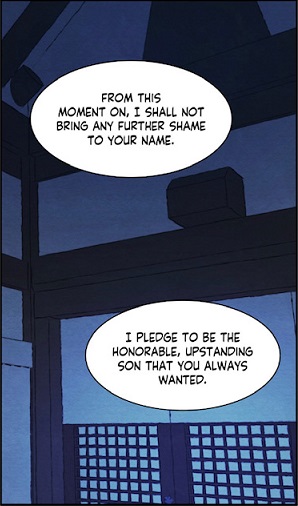 (chapter 127) the former only made a promise to his father and not to the brother. With his death, Yoon Seungho is no longer bound by a promise. Since the main lead had been living properly for 3 years and even passed the civil service exam, it is clear that for the brother, Yoon Seungho must have forgotten his past lover. He must have judged his brother based on appearances, just like he was behaving himself. However, this was just a subterfuge. He was waiting for the right time too. He had no change of heart, he had just been copying his brother’s behavior.
  (chapter 78) Let’s not forget that at the gibang, Yoon Seungwon never revealed his true intentions towards his brother. The latter always said that his advices were for his best interests. He should become involved in the government. But everything was for the Yoons, or better said, for Yoon Seungwon’s sake. And there exists another reason why the sibling must have been embarrassed: This marriage!
 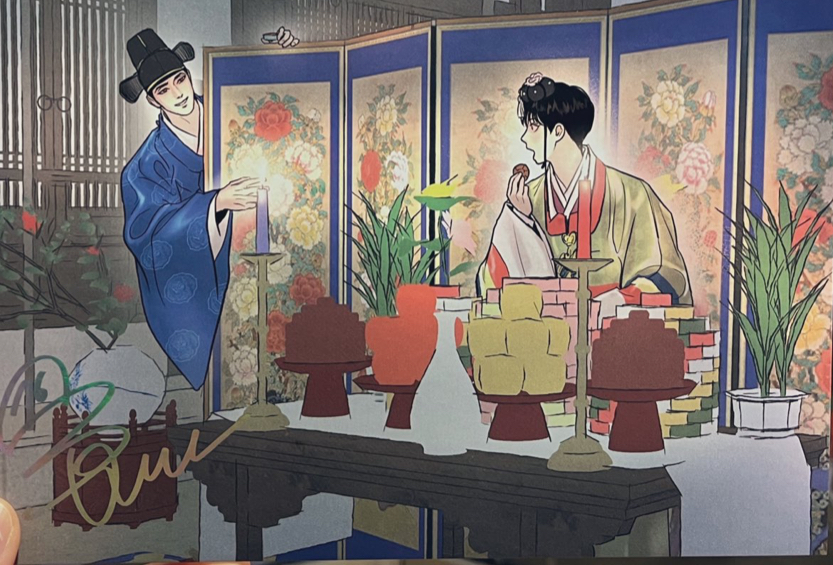 To conclude, Yoon Seungwon embodies the opposite values of Baek Na-Kyum and Yoon Seungho: ambition, corruption, forgetfulness, hierarchy/social norms, traditions and reality versus understanding, forgiveness, simplicity, closeness, modern family and happiness. Selfishness versus Selflessness. This explicates why the main lead gave up his success for the artist. However, though it looks like an exile, the reality is that he will gain popularity and admiration among the inhabitants. Why? It is because he is no longer making distinctions between nobles and commoners, he doesn’t see this place as a punishment, but as a heaven and as such he has a better perception of humans in general. In my eyes, he is bringing progress and change in the region. Baek Na-Kyum is already teaching the kids how to draw… so it is only a matter of time, until his lover takes care of the education for these children. This means that these words will become a reality:
  (chapter 6) He will think of the futures of those children because of his lover.


 (chapter 140)
  (chapter 149) Both were suffering from survivor guilt. To conclude, Joo Jaekyung and Kim Dan represent the bitter medicine for their scars. I mentioned “bitter”, because through their loved one, they are forced to face painful moments. That’s how they can overcome their past and discover happiness. However, while looking for a new title, I rediscovered the first illustration
  , and it suddenly made click in my head. To conclude, I had another revelation concerning episode 50.
 Consequently, while many saw this question as a “factual information” and as such as an accusation, the reality is that it gave us an insight about the sender too. The sportsman was not using the personal pronoun “I” or “me” in his inquiry. As you can see, the absence of the personal pronoun is indicating that Joo Jaekyung was in reality not referring to him and his wounds. He is not prioritizing himself, rather the doctor and his action. So this question could be prompted by curiosity or a desire to understand the person’s recent activities. Thus I deduce that the champion was asking his lover to tell him the truth. He should come clean. He desired a honest explanation. His attitude reminded me of an adult confronting his child.
 (chapter 51) But note that he never accused Kim Dan of assault, but of leaking information. That’s the reason why I don’t think that this inquiry “What have you done” was about seeking accountability. In that case, he wouldn’t have rejected the doctor’s offer. By letting him treat his wound, Kim Dan would have become responsible for the injury.
  (chapter 51) This means, the main lead recognized his responsibility. He should have checked the spray more carefully. The champion could perceive this excuse as a confession of his complicity. Hence he asked his lover if he was the spy.
 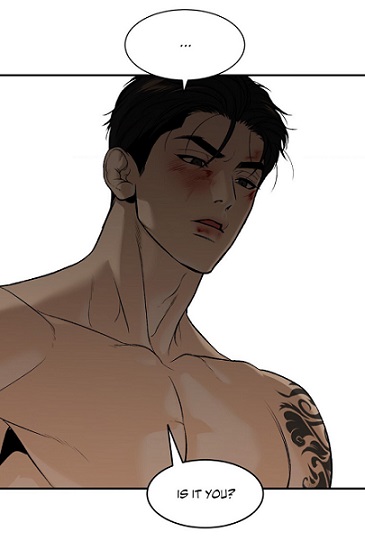 (chapter 51) This signifies that in episode 51, he dared to question his physical therapist’s loyalty. Yes, we have another “Truth or Dare” in episode 51.
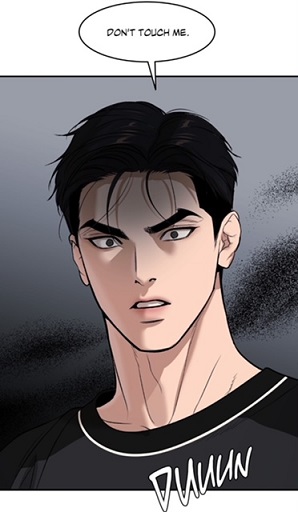 (chapter 50) This is the face of a scarred man. Yet, contrary to the past, he is not expressing his fear through rage. That’s the reason why his emotions were controlled. Under this new light, Manhwaworms grasp why the athlete asked such a question from his soulmate:
  (chapter 51) Interesting is that he was more pained by the idea of a betrayal from Kim Dan than the tie, if you compare these two panels: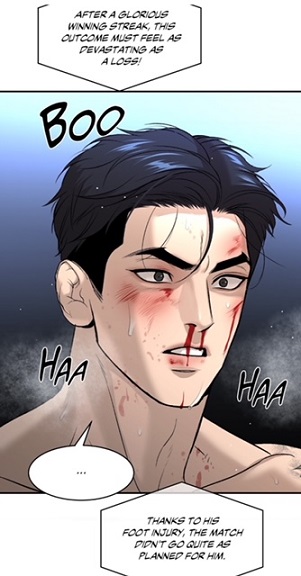
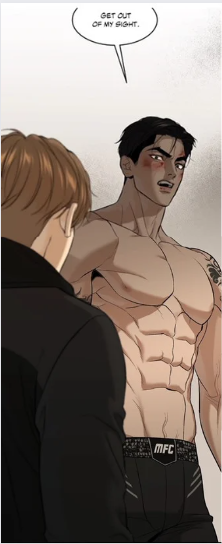 (chapter 51) On the other hand, don’t let yourself get fooled by this rude request. The reality is that the alpha didn’t chase away the doctor, in truth he was the one running away.
 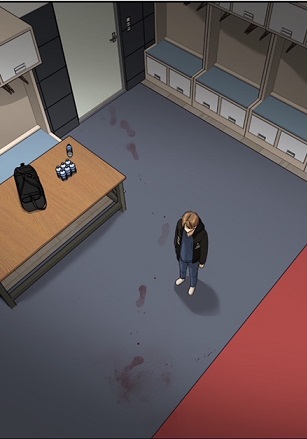 (chapter 51) Thus Kim Dan could overcome this shocking but terrible discovery: he hadn’t earned the full trust from Joo Jaekyung yet.
  (chapter 51) As my avid readers can see, my perception about chapter 50 was confirmed with episode 51. The arguments in the locker room were reflecting the quarrel in the penthouse with Choi Heesung. What is the common denominator between these two scenes? The lack of trust from Joo Jaekyung, but his private PT failed to realize it in the penthouse. Why? It’s because he chose to trust his destined partner.
 I believe you = I trust you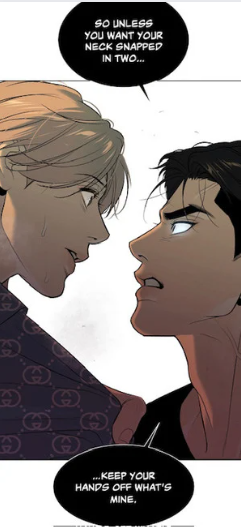


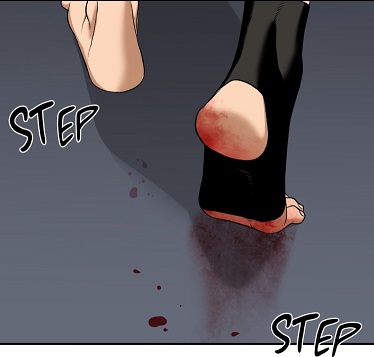
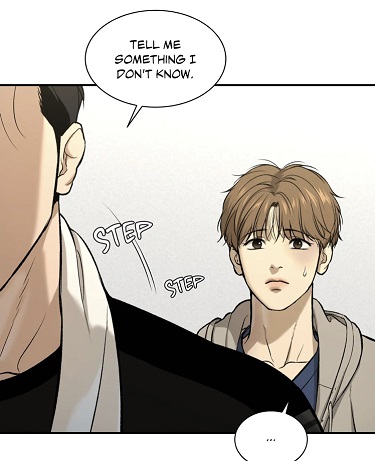 (chapter 15) He told him something that he didn’t know. Note that after the terrible meeting with the actor, Joo Jaekyung couldn’t even find the answer himself:
 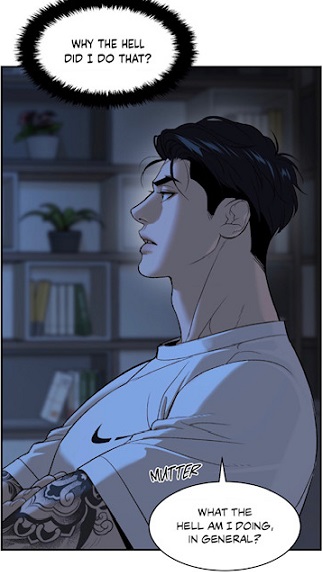 (chapter 35) He was still clueless about the trigger for his behavior. With this inquiry “You don’t trust me”, the hamster pushed his destined partner to face his biggest fear: trust someone and in particular him. This conversation can only incite him to meditate about their relationship. So while in episode 15, he behaved like a pouting child
  (chapter 15), in the latest episode, Jinx-philes can perceive his growth and maturity.
 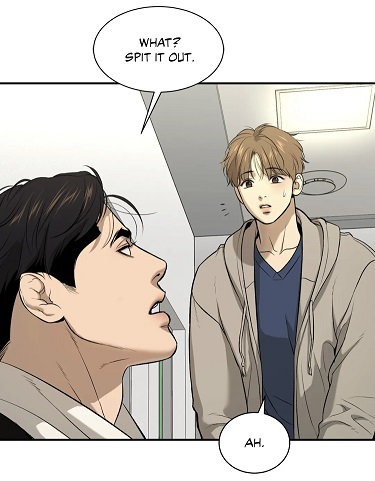 (chapter 15) This painful incident was a wake-up call Thus I come to the following deduction. Kim Dan will try to earn the champion’s trust, whereas the champion will be forced to take a leap of faith towards Kim Dan. Contrary to episode 34, the champion could see the truth directly through the doctor’s gaze and voice:
 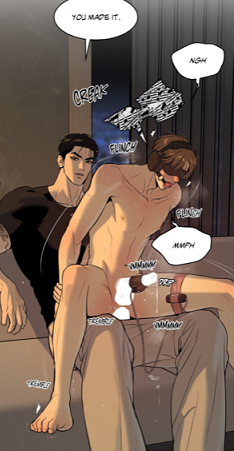 (chapter 34) As a conclusion, while the champion thought that his loved one had dared to cross the line, he was confronted with truth. He was biased and mistrusting his room mate and PT. This shows that though dare was the opposite choice of truth, the fighter ended up to be confronted with verity.
 (chapter 34) These questions were all rhetorical:
  (chapter 34) This signifies that in the sauna, truth was not standing in opposition to daring. The sauna reminded me of the cavern where an imugi hides, until the latter leaves its hidden place and find his star, his yeouiju. Only then, he can turn into a dragon. To conclude, because of Heesung’s pressure, the imugi had to select between daring or lie. In other words, telling the truth became the challenge itself. Heesung knew that Joo Jaekyung would never confess.
  (Chapter 34) What Heesung wanted was actually a lie by omission or commission which would have been presented as the truth. Through this game, the actor thought that he could impose his will onto the celebrity. He anticipated the athlete’s silence. This signifies that he knew about the star’s denial and turned it against him. Besides, that way Heesung could maintain his good image: he had not stolen his partner and as such there was no cheating. No one was betraying him.
 (chapter 34), but also his hand.
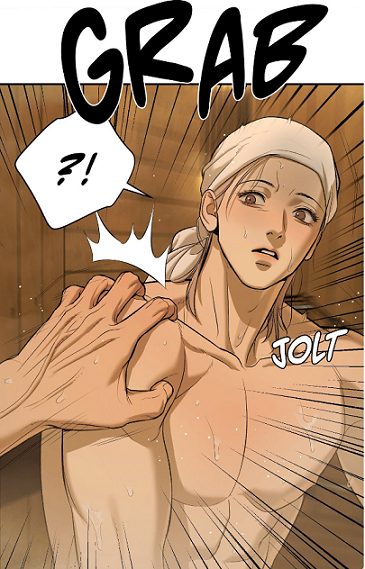 (chapter 34) He caught the actor by surprise, the latter never thought that the celebrity would become violent. The redness on his face was displaying that he was barely controlling his annoyance and impatience.
 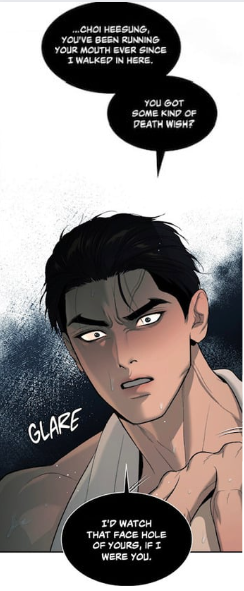 (chapter 34) However, they were in a public place, the hotel’s sauna, and the actor is a celebrity. Hence he is protected by his fame and social status. That’s the reason why the champion didn’t hit his frenemy, he had learned his lesson at the gym.
  (chapter 34) Despite his words, the gumiho still got scared. The racing of his heart is an indication of his fright. Therefore he ran away more or less after ordering his trainer not to meddle in his love life.
 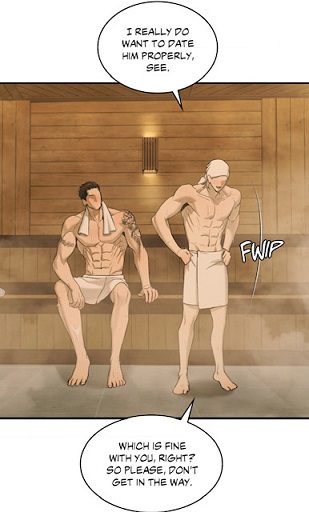 (chapter 34) Note that when he did this, he avoided his counterpart’s gaze. Deep down, he knew that he shouldn’t provoke his frenemy too much. Only when he was at the door, he turned around and LIED!
  (chapter 34) Yes, after that incident, he chose to give him a fake excuse for his departure. As you can see, this conversation was strongly intertwined with the notion “truth or dare”, but both ended up lying. Whereas the champion didn’t admit any feelings, the other acted, as if there was nothing wrong and he was not scared. The gumiho thought that if he were to remove the champion from the doctor’s side, the latter would be able to open up to the actor.
  (chapter 34) What does it reveal? The actor had been projecting his own thoughts onto the future dragon too. He was the one who didn’t dare to become more honest with the physical therapist. He used work to spend time with Kim Dan. One might say that Heesung failed terribly. Yet, this is just an illusion, because his “failure” pushed him to become more honest with Kim Dan. Thereby he asked to meet the doctor again.
  (chapter 34) Yet, the message is exposing that Heesung was still lying, as he kept using work as an excuse. Hence Joo Jaekyung had to intervene again:
  (chapter 34) The champion dared to challenge his rival.
  (chapter 35) Yes, by challenging the athlete because of Kim Dan, the comedian ended up telling the truth.
  (chapter 34), but his anxiety reached a new peak, the fear that he might be abandoned. Hence he used the sandbag to vent his temper. And what did the cute puppy do during that incident? He dared to offer his help to his idol:
  (chapter 34), yet he was in total denial about the reality: it was dangerous. Deep down, the champion knew that it was impossible for him to control his lover’s time, but also his body. Besides, the other problem is that the athlete is rejecting the notion of love. By denying the existence of his own feelings, he can not claim the doctor’s heart. That’s the reason why the champion got so mad and frustrated.
  (chapter 34) He was not telling the truth, when he stated that Kim Dan was his “possession”. This explicates why he couldn’t stay by the doctor’s side
  (chapter 34) in the end. He manipulated the main lead by letting him think that he had no other choice. Yet the last panel displays his trick. It was up to the doctor to decide how he should spend his free time. Nevertheless, while people were mad at the champion for his deception, many failed to realize that the champion was actually deceiving himself. So all the tricks (episode 33 and 34) were manifestations of avoidance, the fear to face the truth: his affection for Kim Dan and this due to a past betrayal. Hence these chapters stand under the sign of silence hidden by “pranks”.
 (chapter 35) On the other hand, the artist could only tell one part of the truth: the presence of feelings. However, the deceptions in the penthouse exposed something else:
  (chapter 45) or left the doctor in the locker room in episode 51.
  (chapter 50) First, the schemers’ MO corresponds to the game Truth or Dare. Choi Gilseok asked his minion to cross the line. This explicates why they are trying to use tricks and manipulations. Daring means no truth, thus someone will be framed: Kim Dan. Yet, the plotters are not aware that thanks to the cute hamster, the alpha is turned into a mirror of truth. Hence he couldn’t get deceived by the MFC security guys:
 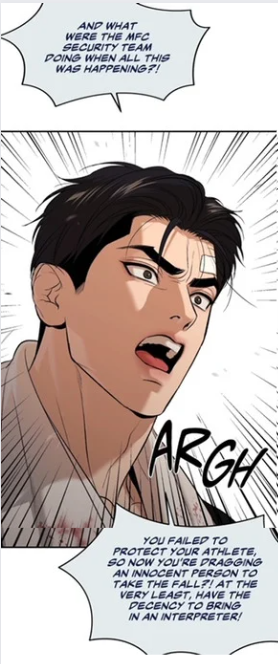 (chapter 40)
  (chapter 36) The lawyer, the journalist and the manager pushed him to choose “dare” and not truth! That’s why there was no interview and the leak was not investigated. He had to prove his strength.
  (chapter 37) This mysterious man dared to act as a MFC manager, though my intuition is telling me that he works for MFC. The irony is that by challenging constantly the champion, the plotters are not realizing that through their game, the truth is slowly coming to the surface. How so? In the last panel, the doctor noticed his origins: He is Korean indicating that the conspiracy started in South Korea. As you can see, Kim Dan was able to perceive a glimpse of the truth. Then at the café, Choi Gilseok confessed many things to the doctor: he owns the café, he has connections to the company F Pharmaceutical. Moreover, through this game, the champion is confronted with his fears and past. That’s how he can overcome his traumas. The doctor is the mirror revealing the monsters. Hence I come to the following deduction: the succession of new characters mirrors the champion’s past and traumas. The following characters are involved in the champion’s suffering, though the order of the appearance is exposing the gravity of the involvement: Heesung,
 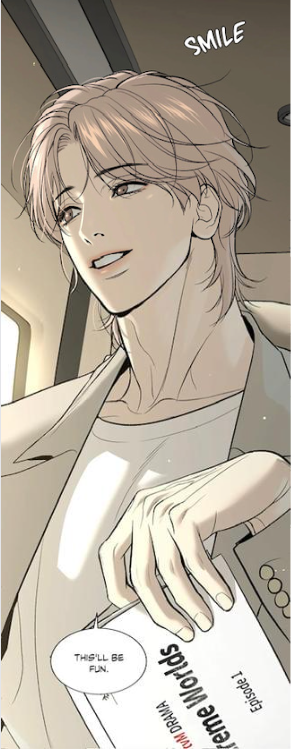 (chapter 29), the journalist without a face
  (chapter 35), the “fake” MFC agent
 (chapter 42), Baek Junmin whom the champion couldn’t truly identify
 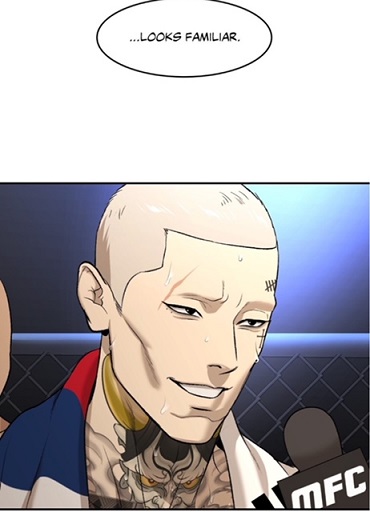 (chapter 47), then he recognized the director without naming him,
 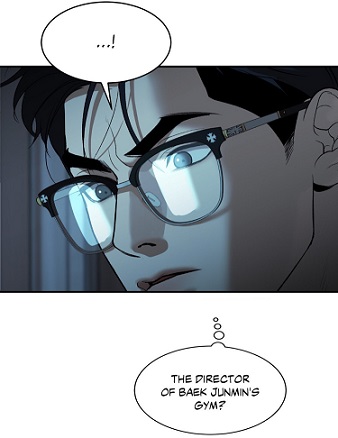 (chapter 48) and finally the ghost from the past
  (chapter 54). These characters are all connected to “Truth or Dare”.
  (chapter 50) This scene exposed that the champion repressed a certain incident which is rather common among victims of a trauma, especially people suffering from PTSD. This shows that some traumatic event took place for quite some time, but the champion acted, as if nothing had happened.
  (Doctor Frost, chapter 140 ) That’s how the champion became a zombie, he couldn’t live properly due to his untreated scars.
 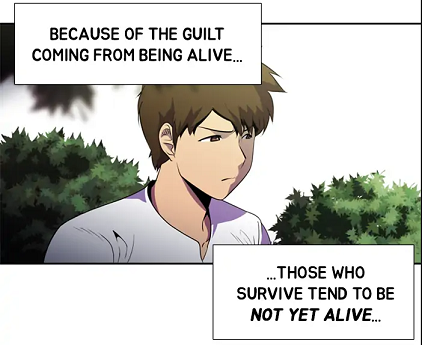 (doctor Frost, chapter 139) But thanks to his fated partner, the traumatic past is slowly coming to the surface.
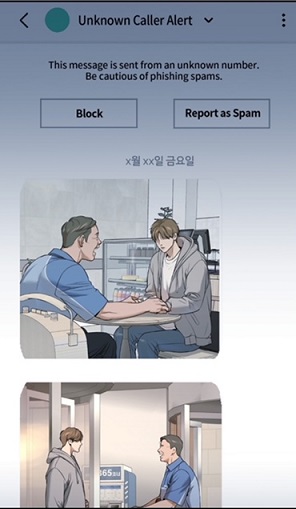 (chapter 48) The director created a stage for the betrayal. That should represent the truth, while in reality it was a lie! Nevertheless, Joo Jaekyung could perceive the truth: Kim Dan had met the director from the rival gym.
  (chapter 48) Yes, he didn’t dare to tell him what had happened. No truth… no daring which reflects the games in the sauna and the living room of the penthouse. Kim Dan could have come clean the next morning, but no. This panel explains his silence. He also mistrusted his VIP patient. He had a negative perception of his lover’s mental state. On the other hand, the champion’s attitude reminded me of a parent who has not the time to listen to his child’s problem due to work.
 (chapter 48) Should the athlete remember this night, he will realize that he was the one dismissing his physical therapist, although the doctor could have come clean later. At the same time, Joo Jaekyung’s attitude could be mirroring the parent or guardian’s in the past. They didn’t have the time or the inclination to listen to their son, hence the traumatic incident got buried.
  (chapter 27), hence truth comes to the surface! Kim Dan and Joo Jaekyung feel attracted to each other and have come to love each other. When they speak their mind, they feel comfortable around each other. Truth is strongly connected to communication. Hence the painful conversation in the locker room was necessary. “You don’t trust me?” also reflected the doctor’s attitude. He never tried to approach his room mate
 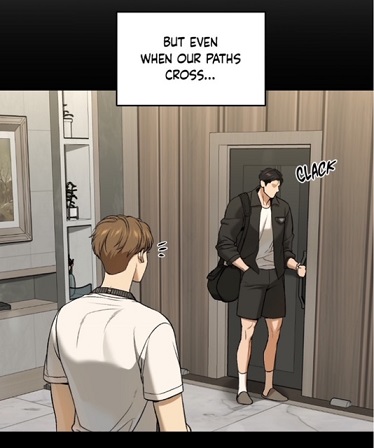 (chapter 47) and voice his true thoughts and emotions:
 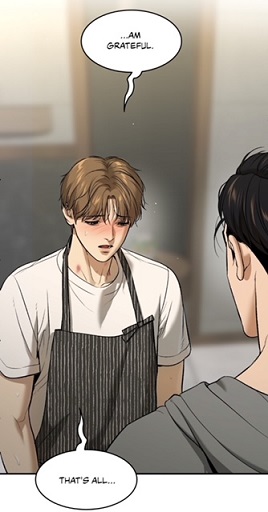 (chapter 45) He lied, when he portrayed himself as grateful. He was avoiding his gaze either. No wonder why the fighter got even more mad and threatened to fire him. Such an attitude could only increase the celebrity’s mistrust, as the latter could discern a certain dishonesty.
  (chapter 49) The latter didn’t even greet the director or acted, as if they didn’t know each other. He exposed the existence of a secret, an uncomfortable secret. Consequently, I believe that the champion could only jump to the conclusion that Kim Dan had been indeed acting behind his back, even coerced to do something.
  (chapter 51) Note that the star never came clean with the truth either.
  (Chapter 35) Through the doctor, the champion is encouraged to become honest to himself.
 (chapter 33) Simultaneously, it exposes that the champion has a secret, which is strongly intertwined with betrayal, love, money and deceptions. I couldn’t help myself thinking of “blackmail”. Kim Dan had been coerced to do something, as the director was holding something against him. Hence we have the question: “what have you done?”. Remember how the actor chose to approach the angel.
  (chapter 31) He tricked his boss by faking an injury. He put the gym under pressure, as this incident could be leaked to the outside. The whole situation reminded me of blackmail. If he did not follow his request, there could be a scandal. That’s the reason why I believe that the champion’s past is linked to blackmail as well. How is it possible? It is because of the game “truth or dare”! The latter is strongly intertwined with divulging information and crossing the line!! To sum up, this game embodies trauma, secret, leaking information, trust and overstepping a boundary or rule. This observation brings me to my next point.
 (chapter 9) And what did happen after they left the restaurant? The champion discovered the truth:
  (chapter 10)
 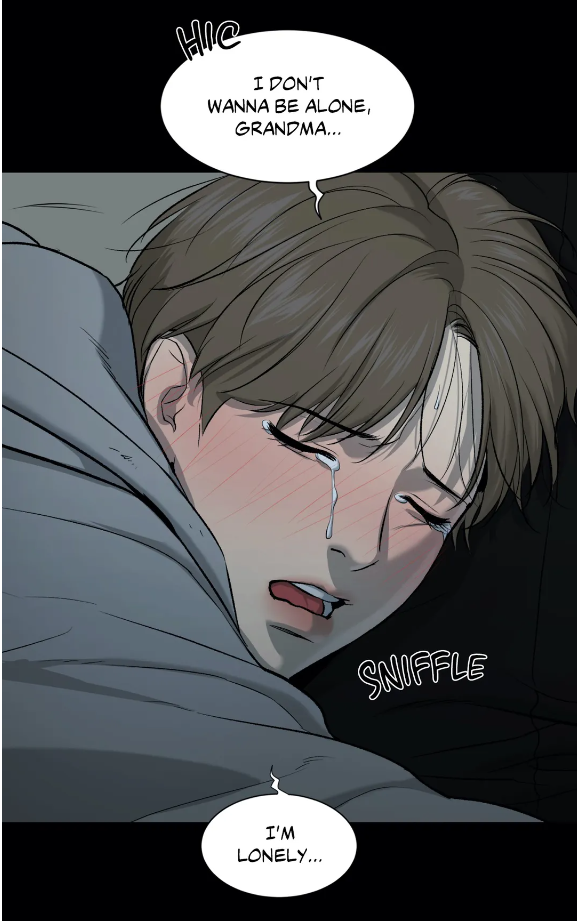 (chapter 10) Kim Dan was terribly poor, but he was also on his own, missing his grandmother.
 (chapter 34) “Are you drunk?” With this question, the protagonist revealed something about himself. He associates dating and love confession with drunkenness. He implies the existence of a lie. But a confession is strongly associated with verity and sincerity. On the other hand, for the sportsman, no one in his right mind would admit to be in love and in our case to love another man. For me, one part of the problem is that the champion is afraid of admitting his homosexuality. The latter is still a stigma in South Korean society. But there’s more to the game Truth or Dare. If you paid attention to the origin of the last quote, you will realize that this fun is linked to bullying and even hazing.
 (chapter 49) Furthermore, bullying is never done alone, but in groups.
  (chapter 37) Finally, note that the schemers are working in teams exactly like the bullying students. Therefore I judge Park Namwook’s attitude as the teacher’s who is closing the eye to the truth. He is rather passive and puts the whole responsibility on his “boy”.
  (chapter 41) It is the champion’s choice to refuse or not the matches. The moment I associated the game with parties, peer groups and bullying, I had many revelations.
 (chapter 37) Interesting is the athlete described this night as a party which made me think of a students’ party. Therefore I couldn’t help myself wondering if the champion didn’t go to college, but due to an incident, he was forced to drop out. And the latter could be related to a party organized by students. The latter chose to cover up the incident by remaining silent. I would like to outline that the doctor got fired, though he was actually sexually harassed by his superior. The nurse never testified in his favor, she chose to close an eye to the crime.
 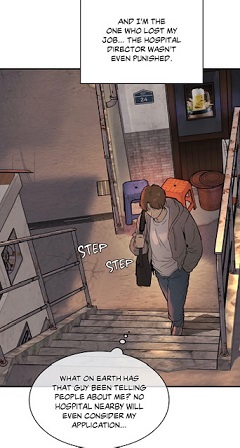 (chapter 1) He put the whole blame on the hospital director himself. He is a liar. Furthermore, through these pictures
  (chapter 47)
 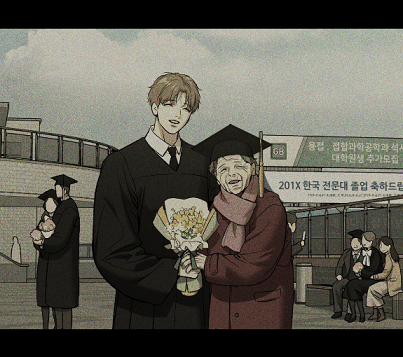 (chapter 47), Manhwalovers can see that Kim Dan was a loner. Therefore I doubt that he had friends during his college years. The only person he knew from his school was his mentor:
  (chapter 1) It is important, because it implies that Kim Dan avoided to socialize and participate in gatherings. Interesting is that in season 2, Jinx-philes discover that Kim Dan had been bullied in the past.


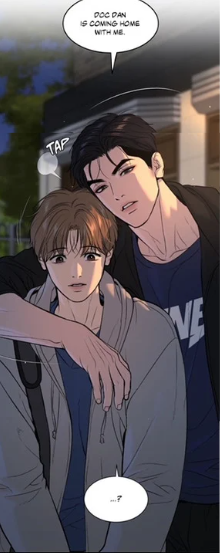

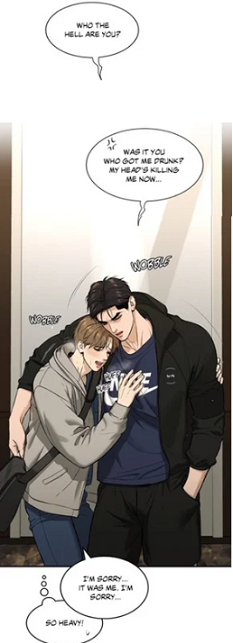
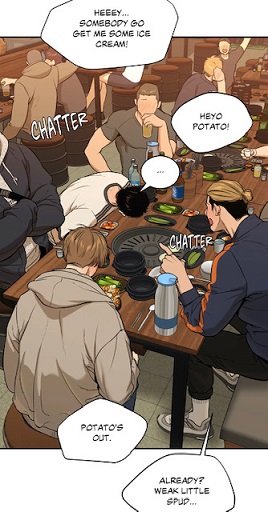 (chapter 9), yet Park Namwook made sure that the physical therapist wouldn’t be abandoned drunk. Thus he tasked his boss to bring him home. And as for Potato, it is clear that Oh Daehyun would take care of him, as he was sleeping in the dormitory next to him. In other words, no one was left behind drunk. But this scene contrasts so much to episode 43. First, no one was missing Potato. No one asked about his absence. Secondly, pay attention that the fighters invited Kim Dan to join them for another round, while they were neglecting their boss, though it was his birthday party.
 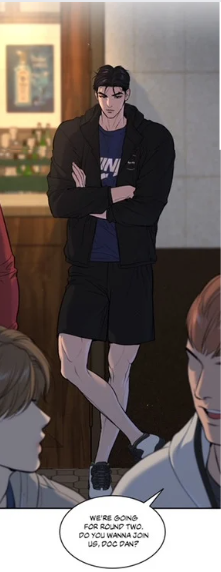 (chapter 43) Moreover, they never wondered about his physical condition. Was he drunk or not? Funny is that the intoxicated character was the one who forced Kim Dan to go home.
 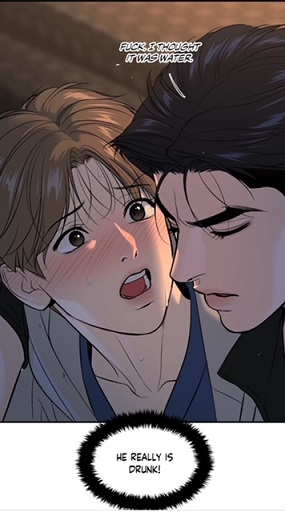 (chapter 43) That’s what a friend is supposed to do.
 (chapter 35) So the auntie could keep an eye on the judo fighter, and it was only a matter of time, until his friend would return. Nevertheless, this scene is implying a certain problem: a drunken person shouldn’t be left unguarded. Thus imagine that during a party, an unconscious person is brought to a room and left there unguarded, as the friend desires to keep partying, similar to this scene:
  (chapter 37) The person could get sexually assaulted, and no one would notice it. Secondly, I would like to outline that the hazing party from the article reminded me a lot to bullying. These freshmen were humiliated, and the perpetrator excused her behavior behind traditions and social norms. So the champion could have been betrayed by a friend, as the latter would have justified his action similarly. So instead of admitting his mistake, he could have justified the incident like this: the victim was responsible for his misery, because he was at the wrong place at the wrong time. It was just his misfortune or better said his jinx. Yes, for me, the jinx is indicating that people responsible for the champion’s traumas were denying their wrongdoings.
 (chapter 3) Neither Kim Dan nor the protagonist were seen both naked in the shower room.
  (chapter 8)
  (chapter 20)
  (chapter 30) Therefore I perceive the champion’s last comment as relevant. In my opinion, Kim Dan’s gesture reflected the champion’s mind-set. So by saying this, Joo Jaekyung was forced to admit the absurdity of such an attitude. Therefore Manhwalovers can understand Joo Jaekyung’s annoyance at the sauna. He imagined that he would be alone there.
  (chapter 34) He feels uncomfortable naked around people… As soon as you connect this place to a wound, my avid readers can finally better interpret the champion’s irritation in episode 36:
  (chapter 36) Kim Dan’s entrance could be perceived as a violation, for the champion was naked. This intrusion caught him off-guard. But since his gaze was covered, his anxiety masked behind his anger was diminished. On the other hand, this led him to leave the bathtub undressed and have sex in the kitchen.
  (chapter 36) For me, everything is pointing out that one of the champion’s fears is intimacy with water. He has long internalized this association. Don’t forget that the sexual encounter in the swimming pool started with clothes, before they got completely removed.
 (chapter 27) Under this new perspective, I don’t think that it is a coincidence that the champion felt the need to take a shower after meeting Baek Junmin and recalling the past.
  (chapter 49) This helped him to overcome his trauma and past wound.
  (chapter 49) Yet, keep in mind that the athlete’s wounded soul is not the result of one traumatic incident, but of many anguishes.
  (chapter 8) they dared to have sex next to Oh Daehyun and the other fighter. However, note that in all these scenes, neither the doctor nor the champion were honest. They were both lying… not only to their counter-part, but also to themselves.
  (chapter 19) That’s the reason why the argument in the locker room
  (chapter 51) doesn’t represent the final moment where both main leads opened up their heart and mind to each other. They were not truly honest to themselves and to each other. There was no water… and according to me, the spray was a pepper spray, so the champion’s ankle should have been cleaned and not simply covered. For me, both characters need to prove their trust and loyalty to each other. But they are moving in the right direction, for Joo Jaekyung divulged a huge information to Kim Dan.
  (chapter 7)
  (chapter 70) His sexual orientation was exposed in high school, his friends were behind the rumor
  (chapter 70), although we have to envision that his crush played a huge part in it. Why? It is because he didn’t want to be associated with homosexuality.
  (chapter 70) Not only he cut off ties with him, but also he made sure to isolate the main lead from other students. The worst is that this person acted, as if this ostracizing had never occurred.
  (chapter 69), as if he had done nothing wrong. For me, it shows that the traitor never grasped the significance of his actions. Hence Park Sung-Woong could forget Dong-Gyun, while the latter could never forget him at all. The result from this huge betrayal was that the cute uke decided to keep his distance from people.
  (chapter 70) He could no longer trust people, he avoided meetings. In order to outline how severe betrayal trauma can be, the Webtoonist showed us the immediate effects of betrayal trauma: physical and emotional reactions
  (chapter 70)
  (chapter 70) and the long term effects:
  (chapter 69) he is trembling so much, he can not look at his former friend. Readers shouldn’t underestimate the issue. Betrayal trauma is so severe that it is comparable to being hit by a white truck. The pain is so great that it affects the brain functioning and as such personality.
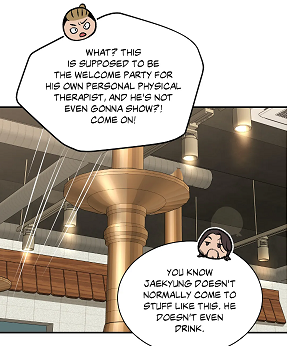 (chapter 9), trust issues
 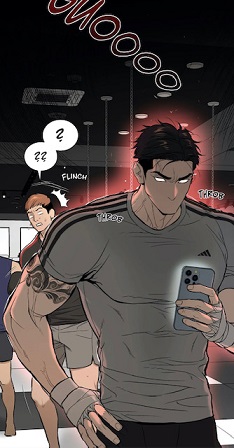 (chapter 05) Then when he stayed at home,
 (chapter 32), it was clear that the doctor’s actions were constantly on his mind. He was so bothered that he had to bring him to Heesung. He made sure that Kim Dan would forget Choi Heesung in the car.
  (chapter 33) Interesting is that this trauma resembles a lot to PTSD.
 (chapter 49), the latter was not loved, as he didn’t reach the first place like his older brother. Then we have Interpersonal with Nam Dong-Gyun and his high school friend. However, since the rumor circulated at school, and no adults intervened, we could see it as a reference to Institutional betrayal. Finally, Mingwa presented the last type (partner) with Hweemin.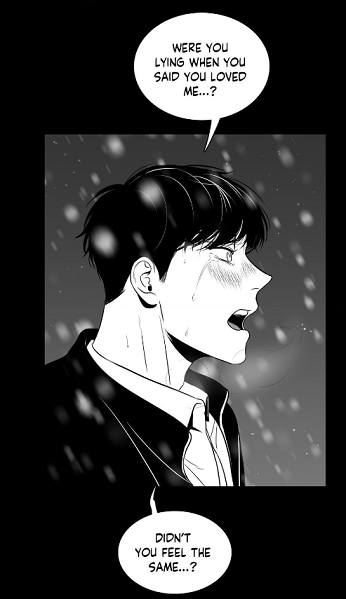
 (chapter 51) But why is betrayal trauma so severe? It is because everything appears as a lie, as an illusion. All the memories become tainted. The victim can only question his own senses and judgment. How could he not detect the lies? Since PTSD and betrayal trauma share some common points, it is not surprising that such persons come to blame themselves and develop huge self-loathing.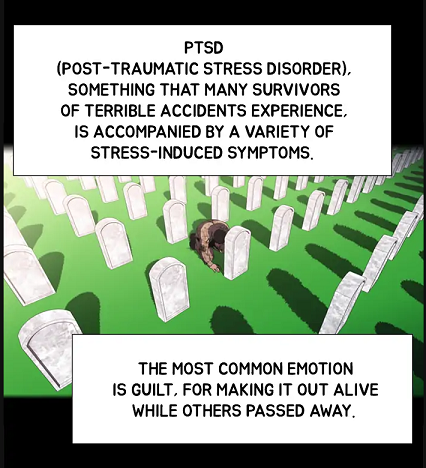
 (doctor Frost, chapter 139). And now, it is time to expose my latest observation:
 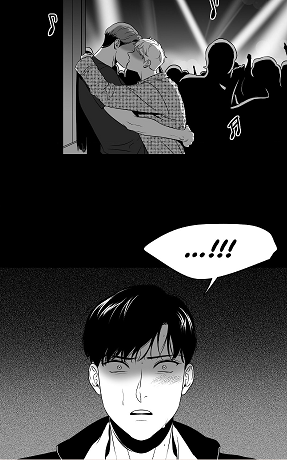 (BJ Alex, chapter 51) Ahn Jiwon caught his first lover cheating on him at a club. Interesting is that the new lover resembles a lot to Joo Jaekyung! Mingwa said that characters from BJ Alex will only appear, but Jinx is not connected to her previous work. Note that they were kissing in a public place. Moreover, the club is a location where students not only meet, but also drink alcohol together. However, once Jiwon saw Hweemin, he dragged him outside so that they could talk. In other words, the “new lover” was left behind. Thus I come to the following conclusion. Joo Jaekyung has been suffering from betrayal trauma exactly like Ahn Jiwon. He was betrayed by his guardian
 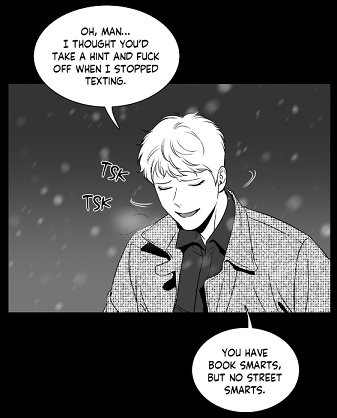 (BJ Alex, chapter 51). If this theory is true, then Mingwa would finally outline the devastating effects of Betrayal trauma on people, something she barely touched in her previous work.
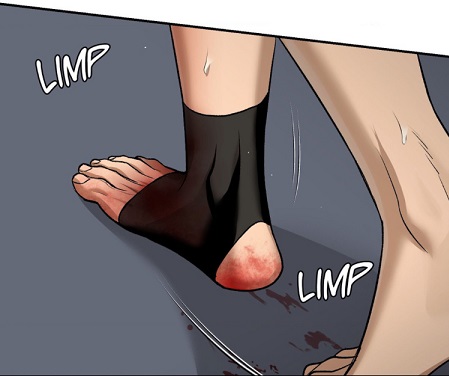 (chapter 51)

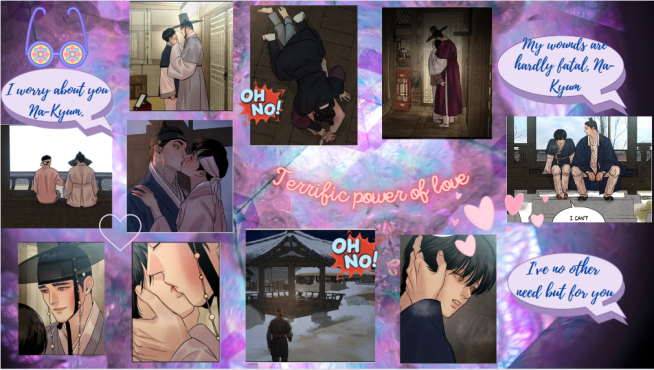
 (chapter 117) I am quite certain that many were outraged and disgusted by the scholar’s smooching. First of all, why did the learned sir do it? One might say that it is related to the petition which is in Yoon Seungho’s possession.
  (chapter 117) The learned sir was tasked by the mysterious noble wearing a purple hanbok to retrieve the document. I would like to call my avid readers’ attention that we never saw the man introducing himself to the former teacher. He could have definitely impersonated someone, for this trick has often been used in this story. Anyway, in exchange for this favor, Jung In-Hun got promised a high position in the government.
  (chapter 115) Thus Jung In-Hun has only one option left. He needs to utilize a spy and traitor in order to get the document. Because Jung In-Hun has known the painter since his childhood, it is not surprising that he chose to approach Baek Na-Kyum. As you can imagine, episode 117 is a new version of episode 24
 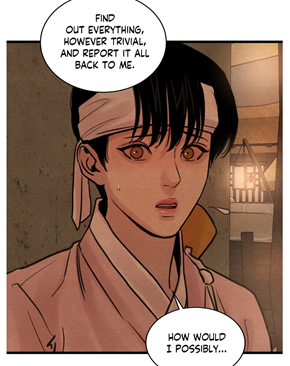 (chapter 24), where the angry learned sir asked the naive artist to spy on their benefactor and episode 35
  (chapter 35). In the latter, the scholar gave the same task to the main lead, but his attitude was totally different. He was acting like a gentle and concerned man, hence he stroke Baek Na-Kyum’s head and cheek.
  (chapter 35) He had two reasons for that. First, the painter was still recovering from his long illness. So he couldn’t act so coldy, for his selfishness and heartlessness would have become obvious. The learned sir had to justify his egoism and indifference. During his illness, he had at no moment visited him, but he had his reasons.
 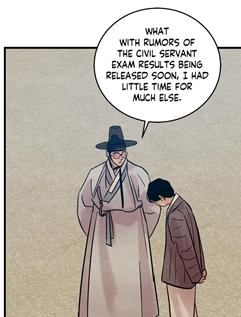 (chapter 35) He hoped for the painter’s understanding. All this because he needed the low-born more than ever. He had not renounced on discovering Yoon Seungho’s weakness yet. However, in season 1, he failed to achieve his goal, because after the night spent with the main lead, Baek Na-Kyum refused to divulge any information about the meeting between the host and his brother Yoon Seungwon.
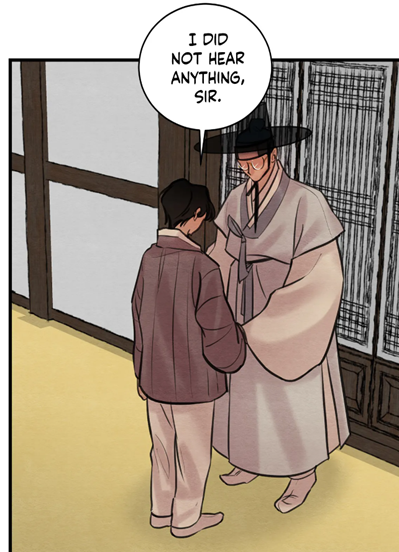 (chapter 38)
  (chapter 117) Hence we should consider the scholar’s kiss as the kiss of Judas. The latter, known as the Betrayal of Christ, is the act with which Judas identified Jesus to the multitude with swords and clubs who had come from the chief priests and elders of the people to arrest him. Thus I am expecting an arrest of the painter in the future. Since he is the love interest of Yoon Seungho, he has once again become the target of the next plot.
 (Chapter 118) While he had faked his pity and empathy for the painter, when the latter was exposed to gangrape
  (chapter 118), the ending of the episode is showing him as a monster, acting like Min and his friends.
 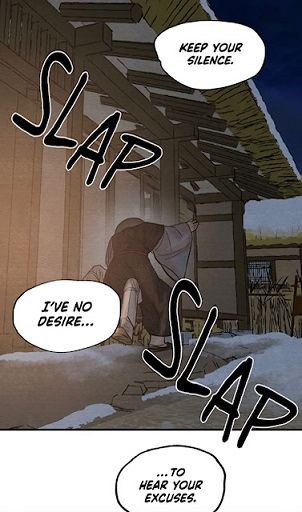 (chapter 115) However, this is impossible. Time is the proof for the lord’s innocence. 7 days have already passed since Yoon Seungho’s violent outburst in front of the learned sir’s home. Don’t forget that it took Yoon Seungho 6 days to regain consciousness.
  (chapter 116) And the manhwaphiles saw that the painter spent the night with his lover after their conversation at the pavilion.
 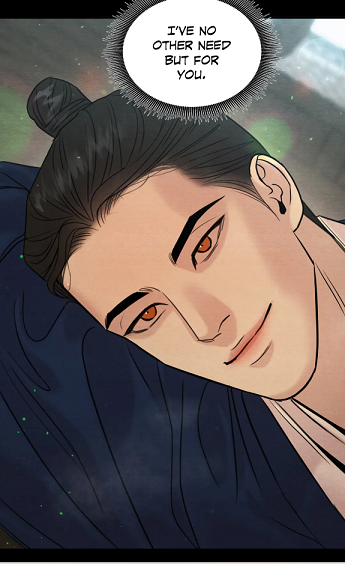 (chapter 117) This means that Na-Kyum’s visit to the gibang could only take place after that night. That’s how I came to the conclusion that the meeting took place after 1 week (6 days+ 1 night). However, the swollen cheek will easily vanish within one week contrary to the stabbing.
 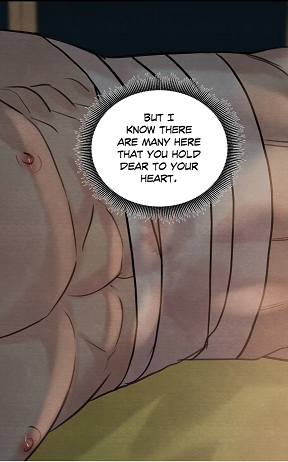 (chapter 117) Therefore after the release of episode 117, I had imagined that the wound from the learned sir was faked with the rouge from the noonas. Yet in episode 118, I detected the busted lip which can not be faked. The scratch is the evidence that the wound is real. Jung In-Hun knew too well that he couldn’t frame his previous sponsor for this. Hence he avoided to reply to the painter’s interrogation.
  (chapter 118) Furthermore, his cheek was perfectly fine, when he left his home.
  (Chapter 117) This must have happened on his way to the gibang or in the gibang itself! So who would do this? Yoon Chang-Hyeon? The noble with the purple hanbok? I will answer to this question further below.
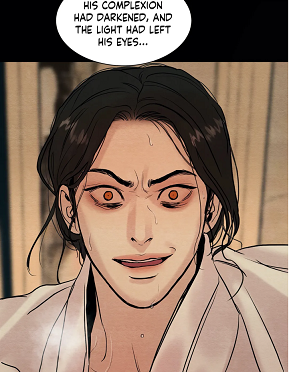 (chapter 57) It is less pronounced, for Jung In-hun only met this mysterious man once contrary to the main lead. Even Baek Na-Kyum noticed the transformation, hence he got scared.
  (Chapter 118) He couldn’t recognize his former teacher. The learned sir had become like a violent beast. But why would he be so frantic and hopeless that he became violent in his gestures and words? It is because he had been threatened again. The wounded lip and cheek are the evidences that he has been coerced to convince the painter that the latter should return to his side.
  (Chapter 118) His grabbing and yelling ooze urgency. One might think that the mysterious aristocrat with the purple hanbok is behind this, for he once voiced a menace towards the villain.
 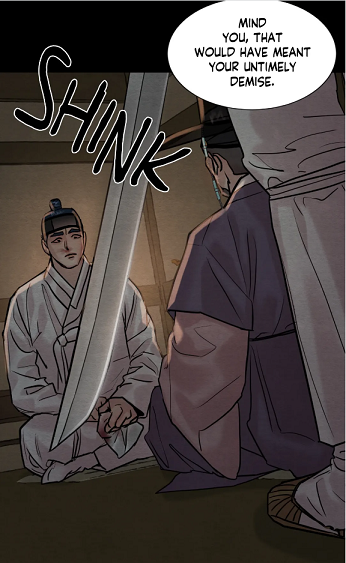 (chapter 117) However, observe that in their meeting, Jung In-Hun spoke about affection
 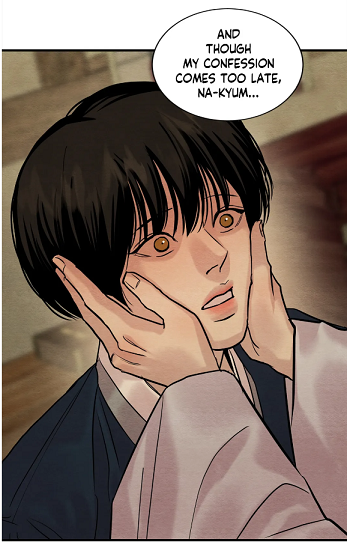 (Chapter 118) and this doesn’t belong to this man’s world (power, lineage, yin/yang, education). And it is the same for Yoon Chang-Hyeon. The latter embodies hatred and rejection for sodomy!
  (chapter 86) He was even willing to kill his own son, moreover he threatened Yoon Seungho to have the painter killed.
  (chapter 116) That’s how I deduced that the person behind this intervention is actually longing and hoping for love from Yoon Seungho. Thus he requested from the learned sir to take back the painter.
 (chapter 94), then the kiss
  (chapter 95) The artist had kissed the main lead for two reasons. He desired to convey the sincerity of his attachment and to prove that this was real. Yoon Seungho shouldn’t imagine that this was just an illusion, as he often questioned his own senses and sanity. In the gibang, the learned sir changed the chronology: first the smooching, then the confession. Why? It is because he thought that the painter still loved him, when Baek Na-Kyum showed concern for him.
  (Chapter 118) Due to his arrogance and vanity (the negative aspects of self-love), he jumped to the conclusion that nothing had changed. The painter seemed to be still naive.
  (chapter 118) Hence his surrogate father smirked. The irony is that there exist different kind of love: friendship, family… At the beginning, the artist was still viewing Jung In-Hun as a friend. Thus he got worried about his wounds. Yet observe that he had no intention to bid farewell to the former teacher.
  (Chapter 118) He is no longer considering him as a father figure, let alone a close one. Imagine the irony! In reality, the low-born was announcing to his former role model that he was abandoning him. Yes, it is the positive reflection of the scene in the library:
  (chapter 40) Jung In-Hun’s words came back to bite him. He is the one acting like a prostitute, like a man consumed by lust!
 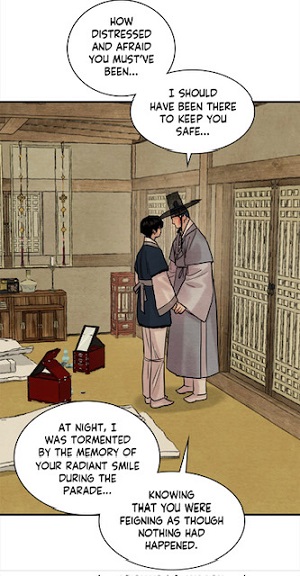 (chapter 118) Baek Na-Kyum, as the mirror of truth, is not only confronting the scholar with his bigotry and dishonesty, but also the mastermind behind this encounter. This explicates why the learned sir spoke about love:
  (chapter 118) This was the same for Yoon Seungho. The sexual abuser had only been obsessed with his own reflection and desires to the point that he never paid attention to his sex partner’s gaze… the loss of light in the gaze, the absence of tears … Besides, there was no agreement, everything was based on coercion and Kim knows that. That’s the reason why Jung In-Hun had tears in his eyes! It is because the main lead used to cry as well… asking for his pity and mercy. Since the scholar never cried before, I believe that the latter had asked to shed some tears in order to move the heart of the counterpart.
  (chapter 118) Baek Na-Kyum was never his young protégé, only his student. Why? It is he never protected him, he just consoled him!
 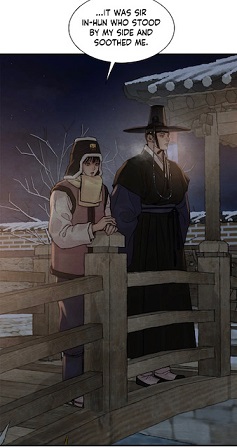 (chapter 94) However, like I had already outlined, Yoon Seungho was offered “protection” in exchange for his favors. That’s how the main lead got rewarded with the mansion and the proprieties. But now, Yoon Seungho is willing to give up on everything for Baek Na-Kyum.
  (Chapter 11) Back then, the painter had the burst lip and the glowing cheek too.
  (Chapter 11) He had protected Jung In-Hun, when the latter was suspected of ruining the painting. And how had Yoon Seungho acted in that scene? He had spoken like a powerful person, like a ruler!
 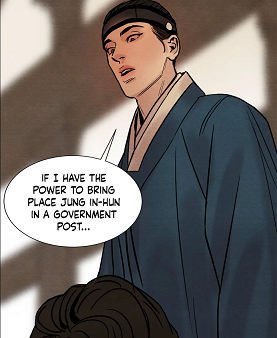 (Chapter 11) As you all know, my theory is that behind the name “lord Song” is hiding the king. But since I made a connection between episode 11 and 118, I deduce that Jung In-Hun has been put in the same position than the painter. His karma… for feigning ignorance and letting Baek Na-Kyum take the fall. He is paying for his wrongdoings all at once (11, 29, 35, 40). And what had Yoon Seungho said to his future lover?
  (Chapter 11)
  (Chapter 11) Yes, so far no one has been talking or thinking about the king as someone involved in the main lead’s suffering. Yet, I would like to outline that the gibang belongs to the state and as such to the king. Only a rich and influential person could hire the kisaengs for the day
  (chapter 118) Not even “lord Song” or lord Haseon from episode 107 couldn’t pull such a trick.
  (Chapter 107) He had announced his visit and the kisaengs had to gather next to the gate. There, the mysterious man selected only one woman.
  (Chapter 107) However, in episode 118, the kisaeng talking to Baek Na-Kyum expressed that there were different parties. Each kisaeng was participating in a different festivity (“It’s not usually this busy”). She would have mentioned it, if there was a huge party in the gibang. But there is another clue for the king’s intervention: the pipe is no longer visible in the noonas’ room
  (chapter 96: it’s on the table), just like there are now two mirrors and the number of rouge has also increased.
 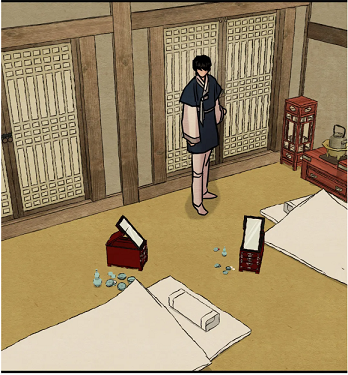 (Chapter 118) Finally, this painting, Hokjado, is actually mocking the monarch.
  (chapter 105) The tiger in the painting usually represents the ruling elite, and its ridiculous expression is a satirical commentary on their behavior. He is here portrayed as a lazy man focused on smoking and pondering.
  (chapter 116) It signifies that this panel is a new version of this scene:
  (chapter 103) And what is the common denominator between these two scenes? Both protagonists rejected the help from the staff, especially from butler Kim.
 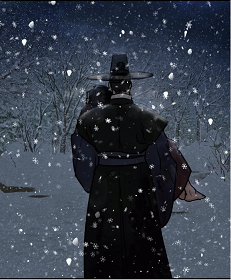 (chapter 102) He was already giving up on everything, even his own life, if he had not the artist by his side. Under this new light, it becomes comprehensible why killing the painter is not the first option for the pedophile.
  (chapter 118) except his promise:
  (chapter 118) It was, as if they had two different fathers. Note that despite the father’s cruel action, the young noble still calls Yoon Chang-Hyeon as “father”. To conclude, Yoon Seungwon doesn’t consider the protagonist as his brother despite his words. The younger master is the reflection of the learned sir, the one faking “love, honesty and concern” for a close one, whereas in reality these persons are more worried about their own future and comfort.
  (chapter 107), whereas the main lead had decided to protect his family despite their betrayal and abandonment. Under this new light, it becomes comprehensible why Yoon Seungwon has no interest to expose the petition contrary to the past.
 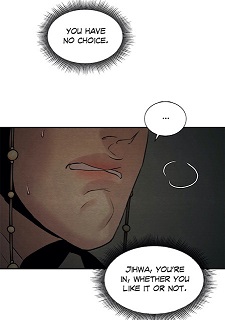 (chapter 76)
  (chapter 118) For this winning hand, Yoon Seungho had to suffer a martyrdom. Hence it becomes comprehensible why he is envisaging to renounce on everything.
  (chapter 117) He was only happy by the painter’s side.
 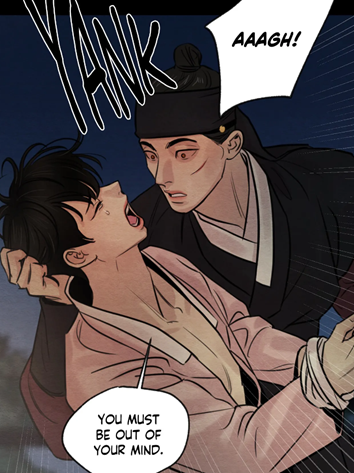 (chapter 25) On the other hand, I had made this connection, even before the release of episode 118. Why? It is because through deductions, I had already come to the conclusion that this was a stolen kiss.
 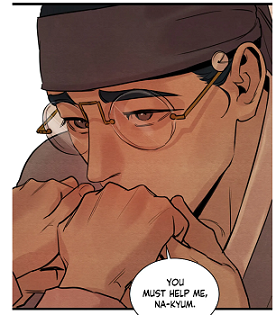 (chapter 24), then he hugged him
  (chapter 29). While the first embrace took place in a deserted area (close to the port), the second hug was witnessed by many people. It was in the open, moreover the so-called “hero” had jumped off the horse during the parade which could only catch the attention from the crowd.
  (chapter 111) Between the two embraces, we shouldn’t overlook the caresses on the head and cheeks which I mentioned above. As you can imagine, the kiss of Jung In-Hun represents the climax of their intimacy. Striking is that the affectionate gestures always took place in public (street twice and the courtyard).
 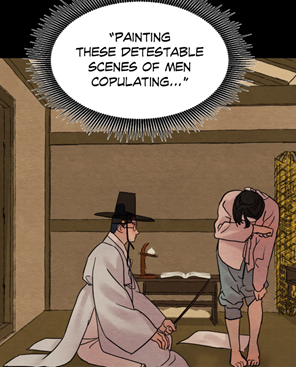 (chapter 34) His kiss is displaying his hypocrisy, which the artist could only feel. Hence he didn’t reciprocate the smooching. His lips remained immobile.
  (chapter 19) Therefore I come to the conclusion that this kiss is like the embrace from episode 29: fake! It is because the learned sir needs him! This statement stands in opposition to the protagonist’s love confession.
 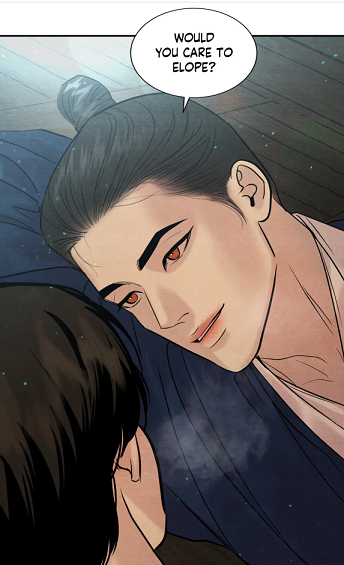 (chapter 117) His presence and affection represent the biggest treasure for Yoon Seungho. Baek Na-Kyum is his only source of joy and happiness. However, for the learned sir, the “need” has a different foundation. He can lose everything, if the painter doesn’t choose him. And if he were successful, he would even get power! As you can sense, for the learned sir, Baek Na-Kyum is just a tool, while for the Black Knight, he is a necessity! Without him, he has no reason to continue living. Jung In-Hun is desperate to survive, while Yoon Seungho is pushed to give up on his suicidal thoughts THANKS TO His father:
  (chapter 111) His gaze oozed not only arrogance, but also blindness. Imagine that he was smirking in front of the painter while looking at the wealthy aristocrat. It was, as though he thought that the artist wouldn’t notice his disdain and vanity. He imagined that the artist was still naive and ignorant like in season 1. This explains why the painter expressed his disapproval about the learned sir with a smile later:
  (chapter 111)
 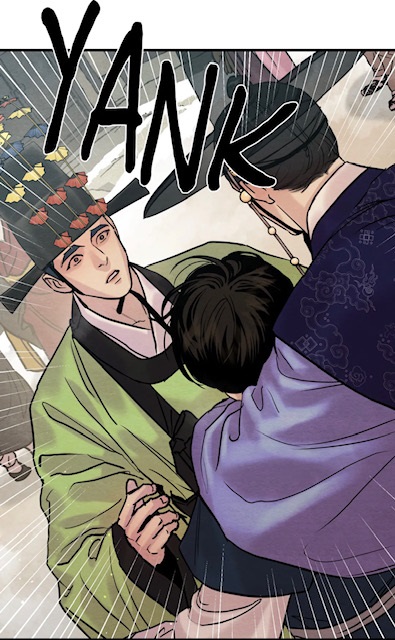 (chapter 111), for Baek Na-Kyum is always accompanied by his soul mate (chapter 40, 45, 74-75, 91-97, 104-105) In addition, people would have recognized him due to the previous parade and noticed his interaction with the artist. Nevertheless, the villain needed privacy, as he was inciting the main lead to commit a wrongdoing: betrayal towards Yoon Seungho. So their meeting could never be mere coincidence and happen in the open. Their reunion had to be planned properly and in secrecy. Thus it signifies that it had to happen behind the dark knight’s back. I would even add that the beloved couple needed to be separated! And now, you comprehend why their meeting had to take place in the gibang! In season 3 and 4, the kisaeng house is the place where the main leads got separated from each other, though the intervention from the noonas didn’t always work like expected.
  – first separation, for Yoon Seungho had to take care of the noona Heena
  Here we witnessed his return. However, the kisaengs badmouthed Yoon Seungho
  (chapter 93) Their attempt was to create a riff between the couple.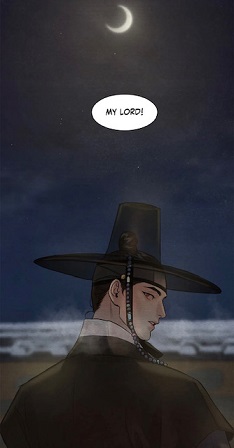
 (chapter 94), when the painter thought that they would go to the pond.
 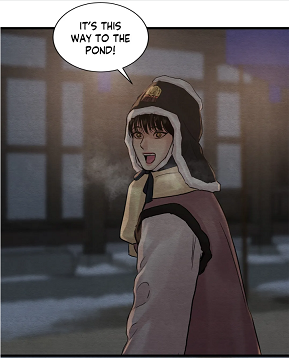 (chapter 94) Why didn’t the artist follow his partner right away?
  (chapter 96) She intervened too late, and her brother didn’t notice her presence.
 (chapter 99) Yet, we never saw the face carrying the light
 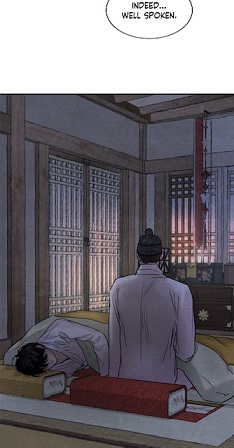 (chapter 97) But it can not be the officers, for they were carrying torches.
  (chapter 19) We have two possibilities left: the kisaeng Heena or the butler.
  (chapter 98) This confrontation didn’t occur in episode 93, for the kisaeng’s back was illuminated by the candle light, whereas the room was darker in episode 93.
  (chapter 93) The light was standing further away from her in this picture. Hence I deduce that the lord must have revisited the kisaeng during that night. Because she was not holding the candle light, I can only deduce that the person witnessing this second conversation was butler Kim! Besides, we have another allusion to him through the reflection of episode 19 and the first Wedding night. Then later, Heena tried to convince her brother to leave Yoon Seungho’s side
 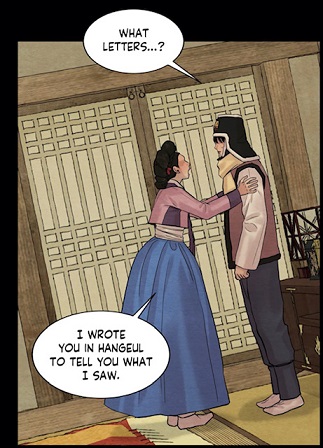 (chapter 97) by blaming him for Jung In-Hun’s murder, but her intervention failed. In reality, the separation could only take place thanks to the intervention of Yoon Seungho’s staff. In episode 97, the servants were definitely manipulating the painter with this corpse
  (chapter 97), whereas in episode 98, the maids had to play their role as well: badmouthing their master
  (chapter 98). He was a cruel and violent lord!
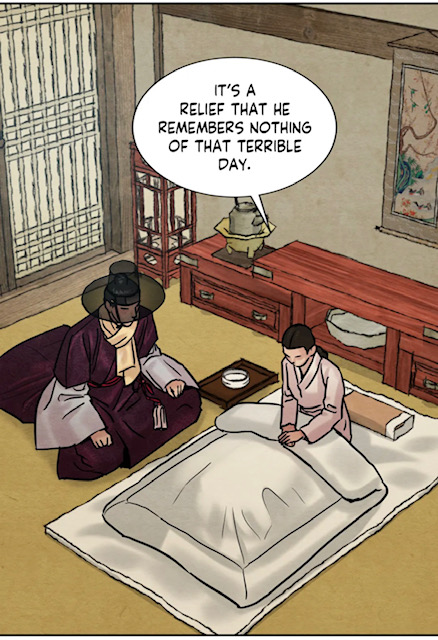 (chapter 105: Heena was strong enough to follow her brother to the door, and this quite quickly, for she witnessed their argument), the other cast doubts in Baek Na-Kyum
 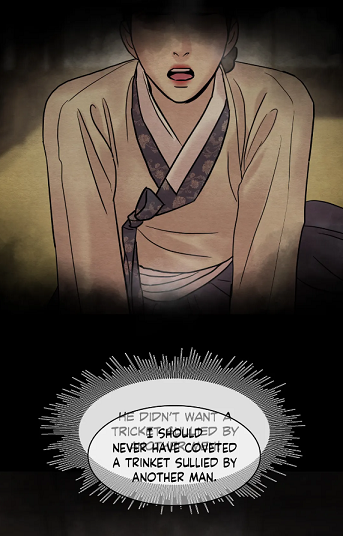 (chapter 109) and finally the third one lied to her donsaeng.
  (chapter 105) Yoon Seungho had mentioned that he would return to the kisaeng house in order to fetch his lover.
  (chapter 105) Yoon Seungho was just thinking of a momentary separation, whereas the kisaeng implied that his departure was definitive. This shows that they had hidden the main lead’s true intention from the painter. This was no coincidence in my eyes.
  (chapter 118) However, I believe that Jung In-Hun was lying, for his visit could be leaked to the owner of the mansion. He has no idea that no one is siding with the main lead. But by saying this, he was covering up for the gibang, and as such Heena. She was definitely her source of information.
 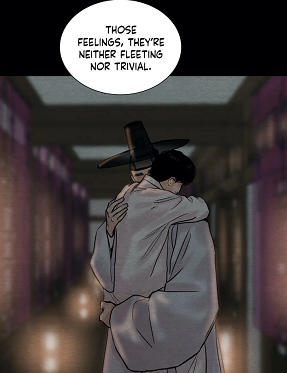 (chapter 68) Why? It is because she has always loved the learned sir and projected her own thoughts and emotions onto the artist. In my eyes, this encounter is to prove the kisaeng wrong, to confront her with reality and her prejudices. What caught my attention is that each time, the painter couldn’t meet Heena, her absence was justified that she was serving a nobleman outside.
 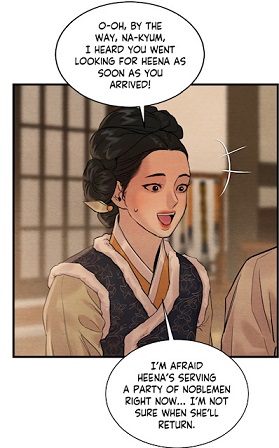 (chapter 93)
 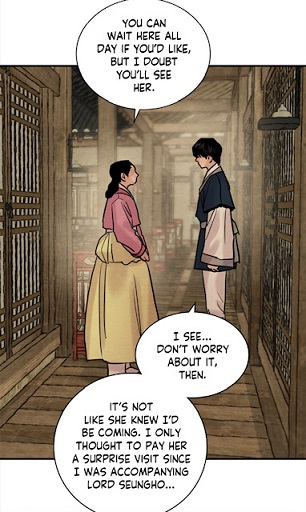 (chapter 118) Notice that the painter is already thinking that she was not expecting him. Yet, it is clear that he would come to the kisaeng house, for Yoon Seungho had been invited by his brother. The invitation had already been proceeded the day before:
 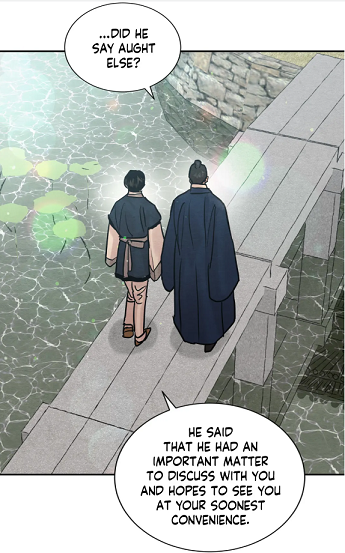 (chapter 117) So if something were to happen, Heena could feign ignorance and as such innocence. After their last argument, the noble has learnt that he shouldn’t keep his distance from the artist and he should confide to him, hence he talked about elopment at the pavilion.
  (chapter 25)
  (chapter 77) in a previous analysis. However, I will only focus on the comparison between episode 19 and 118, for both represent a first kiss!
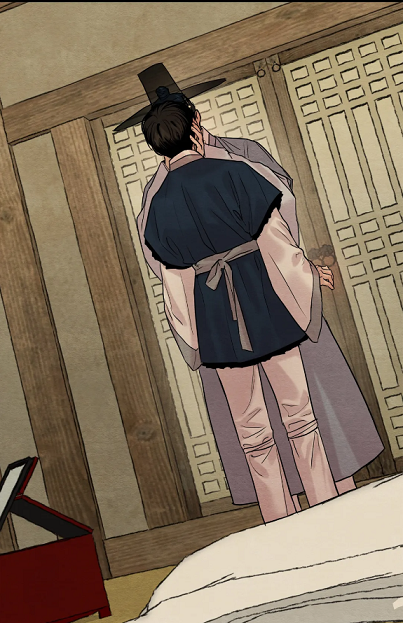 (chapter 118) And remember that in episode 19, the painter had caught the main lead by surprise, when he entered the room.
 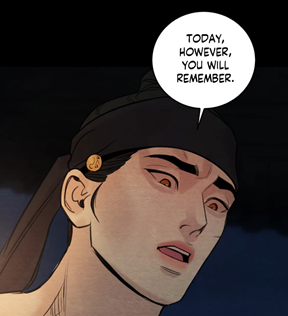 (chapter 25) Thus I am deducing that this scene
  (chapter 96), this means that he has finally accepted his homosexuality. Consequently, the sexual abuser could have the impression that he just needs to remove the painter from the main lead’s side and that’s it. He can replace the artist… impersonation once again!
 (chapter 96) These notions are all reflected in the confrontation between Baek Na-Kyum and Jung In-Hun:
  (chapter 105) Hence I came to the conclusion that the stolen kiss from Jung In-Hun represents a farewell, though the learned sir has no idea of this signification. Thus I thought of Judas’ kiss. The learned sir failed to achieve his goal exactly like in season 1. Even back then, he was distressed and under pressure, for he had recognized that he needed to pass the civil service examination first.
  (chapter 115) In my opinion, he will be framed for the incident in the shaman’s house.
  (chapter 115) Hence I have the impression that this stolen kiss will have huge repercussions not only for the learned sir, but also for Heena.
  (chapter 118) Observe that the painter wanted to ignore the words from the fake teacher. So he could have a change of heart and report the incident to the authorities. He doesn’t know that his lover killed Black Heart and his friends. The learned sir was admitting that his nightmare had truly happened.
  (chapter 83)
  (chapter 88) From my point of view, the schemers are projecting their own thoughts and emotions on Yoon Seungho. Moreover I am quite certain that they have already calculated the possibility of a rejection. The painter’s so-called wrongdoings from season 1 (chapter 11: the ruined painting, chapter 29: desertion) and season 2 (chapter 61: the desertion) were all perceived as rejections. If he is caught with Jung In-Hun alone, they anticipate that Yoon Seungho will react like his father. He won’t be able to discern the truth. Baek Na-Kyum is not faithful and is now tainted. Or even worse… Yoon Seungho might commit a crime. This thought seems to contradict my previous statement: Jung In-Hun is acting on the pedophile’s order. Nonetheless, my theory is that there exist two conspiracies:
 (chapter 115)
 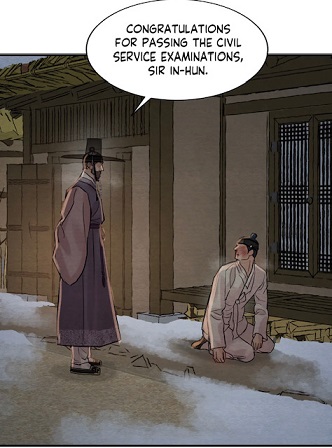 (chapter 115: flower pattern and no sleeve, the beard covers the jaw )
  (chapter 117: no pattern, the lips are covered by the moustasch, straight)
 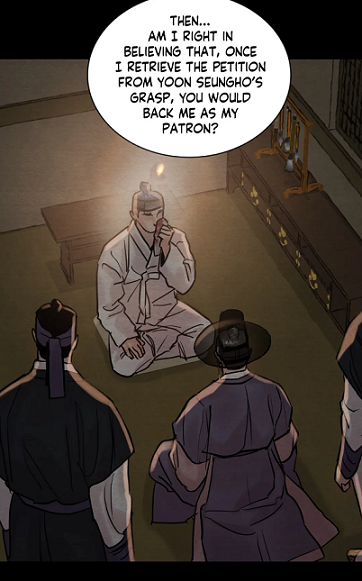 (chapter 117) There are simply too many divergences to say that it is a mistake from the author. This would actually mean that she is quite sloppy. Furthermore, I decided to rely on my eyes and not a belief: there is only one lord Song. Thus you comprehend why I never called the man talking to Jung In-Hun lord Song. So if my theory is true, this would signify that these men represent the previous gang “dogs of Joseon”, the older version of this:
  (chapter 101) And No-Name was treated exactly like Lee Jihwa, but he got framed and sentenced. Finally, I would like to point out that there were 3 black men involved in the first fake sexual education:
  (chapter 86) A coincidence? I don’t believe this. Besides, I discovered a relevant detail about petition and government.
  (chapter 107) Far away from the protagonist, he had to rely on his helping hands and his advisors. He trusted their words. Finally, we have the vision from Lee Jihwa:
  (chapter 101) That’s the moment when the truth will come to light. Someone will get angry, because he got confronted with the painful reality: he was a man consumed by lust, he was selfish, cruel, abusive, ignorant, coward, and even naive. He was never destined to be the protagonist’s life companion.
  , I detected a strong connection between chapter 10 and 117. The common denominator was the pavilion. The learned sir brought the artist under the pretense for a walk in order to seek seclusion and privacy. While he faked his worries
  (chapter 10), he wanted the painter to stop working for Yoon Seungho. He desired him to leave the propriety, for he saw Baek Na-Kyum as a rival. Unlike the painter, the scholar had not been invited to join the party the night before. Hence he had to portray Yoon Seungho in such a bad light!
 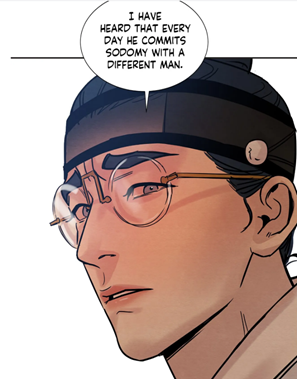 (chapter 10) Back then, the vain and stupid man thought that the main lead had truly liked his poem. Thus he imagined that he could get the attention from the protagonist, once he got rid of his competitor.
 (chapter 10) This is not surprising that the author employed a panel from that chapter.
  (chapter 118) Back then, the artist had not detected the manipulation. Hence he had protected his former teacher, when the latter got accused of ruining the painting. This confession from the scholar
 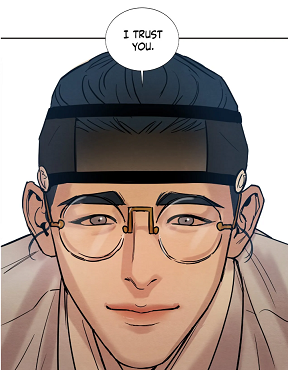 (chapter 10) stands in opposition to Yoon Seungho’s. The latter has no expectation from the artist.
  (chapter 117) The latter is the one deciding about the lord’s fate. But why did he go to the pavilion with the painter? For privacy and intimacy! They needed to discuss the matter about the brother and the petition, a dangerous matter.
 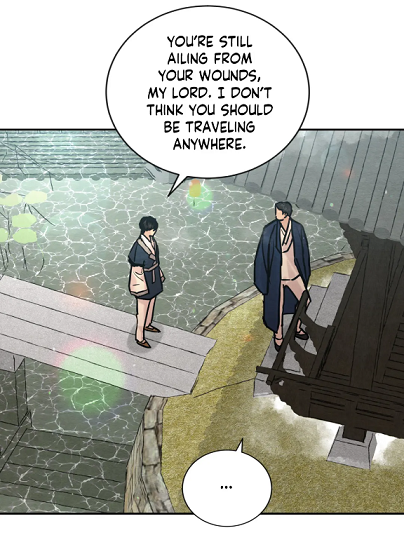 (chapter 117) Here, the painter was acting as the main lead’s right-hand and advisor. He is taking over the butler’s function. He was full of concern for his loved one asking him to postpone the reunion (chapter 117) And the moment the artist voiced his fears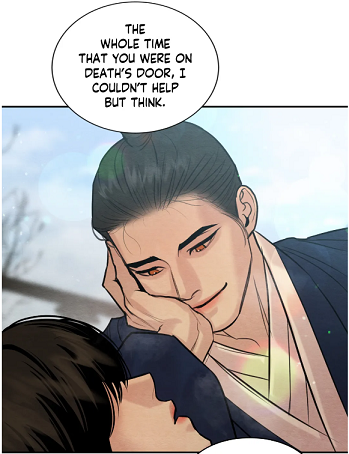
 (chapter 117), the noble suggested to leave everything behind.
  (chapter 117) And what would people see from far away? 2 people showing closeness and attachment, they wouldn’t expect a desertion, an abandonment!! And now you comprehend why Yoon Chang-Hyeon was sitting in the pavilion in town
 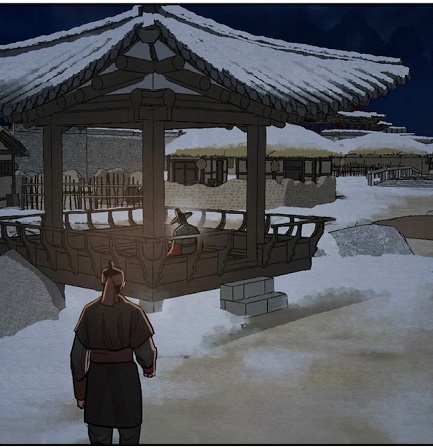 (chapter 116) It was, as if he was trying to get an alibi for his crime: he had planned to have his son killed, but it didn’t happen as expected. Thus he was forced to join his son.
  (chapter 116) This means that he was exposing his crime to people in town. Furthermore, he even confessed his hatred for his own son. He yelled this:
  (chapter 116) Yet, by stating this, he was admitting that he was violating social norms (Confucianism). That’s how I realized that the pavilion is not only the place where Yoon Seungho’s emancipation takes place, it is also the symbol for betrayal and abandonment.
 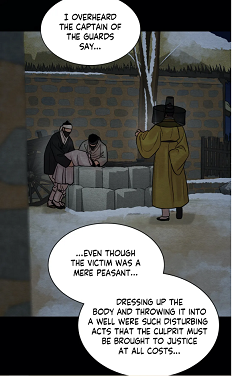 (chapter 101) Finally, a long time ago, I had developed the theory that the pavilion was the place where Yoon Seungho got abused.
 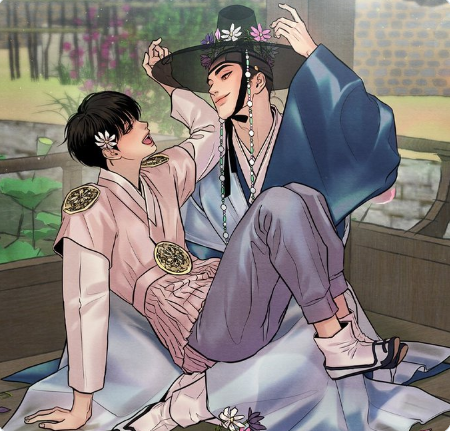 It is the same pavilion than Yoon Chang-Hyeon’s. This means that the couple will purify this place. At some point, the lord and his knight will come to admire the pond with the lotus flowers:
  (chapter 117) Byeonduck let us see a glimpse of their future.
 (chapter 106) How could he abandon his lover like that? For some readers, he acted like a fool. Nevertheless, his reaction was normal, because the man with the purple hanbok represents the cause for Yoon Seungho’s martyrdom. This means that the ghost with the purple hanbok symbolizes danger for the protagonist. And if he gets targeted, his lover will suffer too. Striking is that during the same day and night, there is another person wearing a purple hanbok: Yoon Seungho!
  (chapter 107) Therefore it is no coincidence that in chapter 107, he was portrayed as a source of danger for the elder master Yoon and the mysterious “lord Song”.
  (chapter 107) In other words, in episode 107, the manhwalovers are witnessing a fight between 2 men wearing a purple hanbok!! In this story, purple is the symbol for violence and peril. This explicates why Byeonduck employed this color, when Yoon Seungho was portrayed as a ruthless lord:
  (chapter 10) Under this new approach, it becomes comprehensible why the artist was wearing a purple hanbok after the bloodbath.
  (chapter 107) They had the impression that he was abandoning the artist one more time. And that’s how the painter felt the situation either! That’s the reason why Baek Na-Kyum was upset.
  (chapter 107) It was, as if the main lead was acting like the patriarch Yoon. This perception got reinforced, because the lord had a poker face and didn’t talk to his lover.
  (chapter 107) Yoon Seungho didn’t side with the old bearded man in front of the painter. He thanked the man and sent away him with respect.
 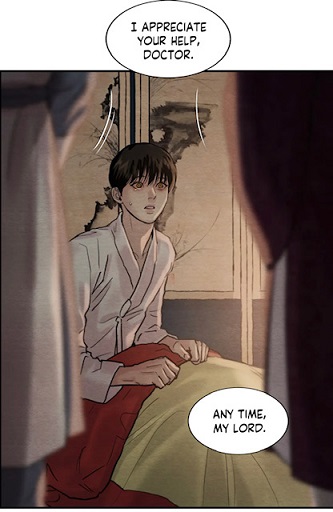 (chapter 107) So he gave the impression that he was listening to the painter. However, the reality was that at the end, he still listened to the doctor thinking that it was for the painter’s best interest. Since Baek Na-Kyum was traumatized from the sexual assault, the main lead thought that he was hiding his illness or he was in denial. What caught my attention is that Yoon Seungho followed the doctor leaving the artist in the bedchamber alone. On the one hand, this could be perceived as a prison, yet I judge his gesture as the opposite. It is to protect Baek Na-Kyum! In Yoon Seungho’s mind, behind the closed door, his lover won’t see or hear what is happening in the courtyard. He will be protected from cruel reality.
 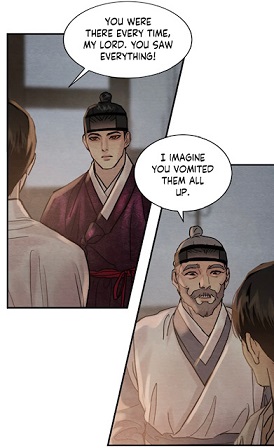 (chapter 107) He showed no real empathy for Baek Na-Kyum. It was, as if he was showing Schadenfreude. But this doesn’t end here. Kim brought a different doctor. It is not the same physician who assisted Baek Na-Kyum a month ago!!
 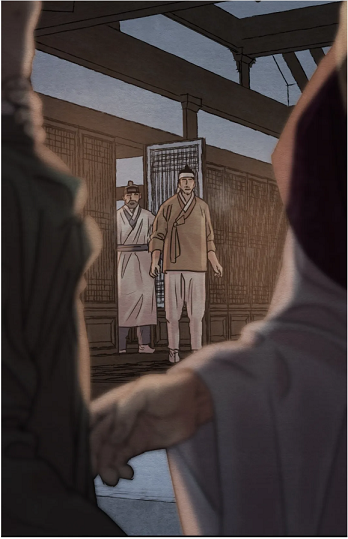 (chapter 107) First, the clothes diverge. The belt is blue, his sleeves are covered with some white protections.
  (chapter 107)
  (chapter 103) Finally, the white hanbok is much longer, and his pants are blue, while the other had white trousers. In my essay
  (chapter 107) How could he say that his health had deteriorated since a month ago? This is how the artist looked like a month ago:
 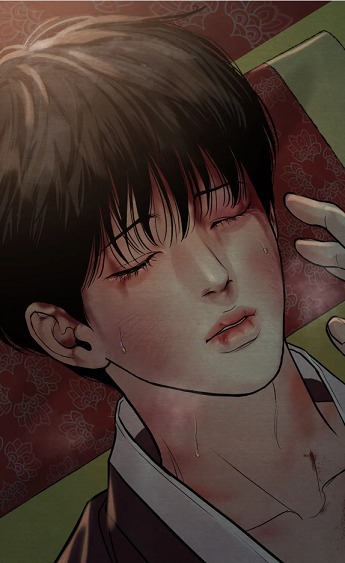 (chapter 103)
  (chapter 103) He was under the influence of the aphrodisiac, and he could have died of an overdose.
  (chapter 103) His face and his body were covered with bruises. How could the doctor say that his condition had worsened? This means that he had not seen the patient a month ago. To sum up, the doctor was impersonating his fellow. Note that he claimed to have prescribed the drug himself.
  (chapter 106) However, this image displays the betrayal from the physician, for I believe that this represents his view The latter had seen the artist in the restroom, but he had not intervened!! Besides, just because the artist had disgorged once, this doesn’t signify that he had done it all the time for one month. This is how the artist looked like, while he was walking through the street:
  (chapter 104) He looked healthy and happy. The reason for his nervousness was the lord’s actions during that day. Moreover, the painter’s hand had been scratched… yet you see no bandage around his hand.
 (Chapter 107) As you can see, the doctor was exaggerating, as he was generalizing the regurgitation!
 (chapter 107) Yoon Seungho was slowly realizing that his butler has not been telling the truth. He was gritting his teeth exposing his discomfort! This gesture indicates that someone has to endure something unpleasant, has to control himself and persevere. However, he was telling the opposite to his master: he had nothing to worry!! He should do nothing and simply lie low. The authorities had no suspicion about him. That’s the reason why the main lead desired to talk to the valet
 (chapter 107), and he got angry, for his servant was talking back and not answering him properly.
  (chapter 107) We could say that the latter was not obeying his lord. Striking is that the domestic was also lying, for he feigned ignorance first, before giving a more precise answer.
  (chapter 107) It looks like valet Kim and the physician got away with their tricks, for neither the doctor nor the the butler got admonished in the bedchamber. But what caught my attention is that after hearing the words from his lover, he replied that way:
  (chapter 107) This expression (“I see”) is important, because it could be the indication that the noble could discern the truth with his mind’s eye, like this
  (chapter 107) or the opposite, though I am still optimistic. We will see in the next chapter.
  (chapter 106), but we shouldn’t overlook that later the painter had yelled in order to voice his opinion which had caught his companion by surprise.
  (chapter 57) The father was convinced that his son had been ill for a long time. And from the mysterious “lord Song”, the manhwalovers discovered that the main lead was fed with an aphrodisiac:
  (chapter 107)
  (chapter 57) Therefore the doctor’s statement in episode 57 appears in a different light: he knew what he was prescribing! He knew what Yoon Chang-Hyeon desired thanks to the idiom “the wayward yang energies”. It was to provoke an erection. I would like to expose that the physician deceived the painter,
  (chapter 57) for at the end, the physician admitted that he had given the “solution” to the father. The father had received the medicine!! [For more read the essay “
 (chapter 106) He was supposed to get a drink from the physician. So the lord could remember the artist’s words and perceive the doctor as a traitor and liar. He could jump to the conclusion that the man had given his lover a drug. Under this new light, it dawned on me that the artist could have been telling the truth to his lover there:
  (chapter 106) That way, the “doctor” would not be suspected of a crime. Besides, according to me, the couple was actually sitting in the courtyard where the medicine store was!!
  (chapter 33)
  (chapter 65) Furthermore, in season 1, the artist had been forced to drink an aphrodisiac. So far, the main lead has never threatened or suspected a doctor. As you can see, there is a strong connection between the doctor and death! To sum up, we are witnessing the start of the storm… and when the painter was recovering, this represented the calm before the storm!!
  (chapter 107) It is related to the rumors he heard in the street.
  (chapter 106) The woman announced that the sacred tree had burned to the ground!! That’s the reason why it was gone… However, her words were just lies, for the tree is still standing there.
  (chapter 107) But note that she connected the incident to misfortune! In other words, she was denying the intervention of humans!! However, the lord had visited the place of his crime before.
  (chapter 104) This is what he had been told: the intervention of ghosts or spirits!! On the other hand, the unknown speaker had never mentioned the tree! Only the house had burned down. Nonetheless, even this statement was a lie, for the house was still standing too.
 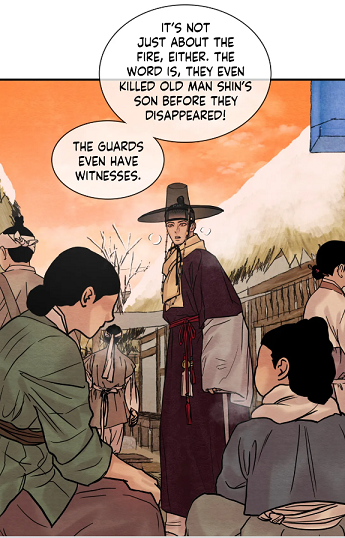 (chapter 106) Since the schemers are mixing a lie with the truth, the lord heard that lord Shin had been killed during that night! However, when the lord had assassinated Black Heart and his friends, the young noble had never met lord Shin! Hence the gossips in town made the lord recognize that something huge is about to happen: a manhunt, and he could get into trouble. Besides, the grapevines are revealing the existence of witnesses and the main lead is aware that the noona is an important « witness ». But the problem is that by mixing each time a lie with a fact, the schemers are not realizing that the truth is coming to the surface, as minus and minus make plus.
  (chapter 50) Here, the butler had tattled on the painter so that the noble would distance himself from his sex partner. And in episode 104, we have a similar situation: through suggestions, the main lead was encouraged to send back the painter to the kisaeng house. Secondly, why would the lord think of the butler, when he saw the sacred tree?
  (chapter 88) During that night, he discovered warmth, loyalty and tenderness! In the darkness, the lord could detect the presence of the light: the painter! During that night, they vowed fidelity to each other. And in the garden next to the shrine, Yoon Seungho made the opposite experience: it was dawning on him that people from his own family, Kim and Yoon Chang-Hyeon,
 (chapter 88) are lying to him and even betraying him, especially if his life is threatened. Let’s not forget that this time, the lord did commit a crime and he is aware of this. In the bedchamber, the lord had criticized his own father, nonetheless he still thought that his father had just made a bad decision.
 (Chapter 86) His words implied that the elder master Yoon had never intended to wound him. It was just because of his stupid believes:
  (Chapter 82) Preserving the continuity of the lineage and ensuring that the Yoons remain powerful and wealthy. However, in front of the tree, the lord is slowly recognizing that his father is about to ruin him for his own sake.
  (chapter 107), and abandon his own son. This
  (chapter 107) This image is the negative reflection from the night of the revelation in season 2. Despite the betrayal and agony,
  (chapter 62) the main lead chose not to punish his lover
 (chapter 63), he even swore that he would never let him go.
 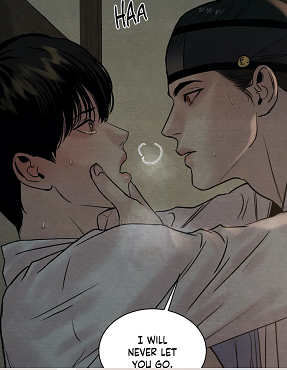 (chapter 63) As the manhwalovers can detect, the main lead was always able not to get swallowed by the darkness, thanks to the artist, he could still see the light. However, his father is making the opposite decision, unaware that he is “doomed” to fail! Karma is already waiting for him. And because the patriarch is now living in the darkness, he can not recognize the manipulations, as he is forced to use others to guide him.
  (chapter 107) the branch on the ground is the evidence that someone set fire to the shaman’s shrine and the tree! Secondly, the black guard deceived the patriarch:
  (chapter 107) Lord Shin was murdered afterwards and not before Black Heart and his friend!! The word “later” is relevant, for it implies that the young yangban was killed close to the place where the nobles Min and his friends were sentenced. But his body is lying elsewhere!
  (chapter 103) This signifies that Yoon Chang-Hyeon is innocent! He never murdered Lord Shin in the woods, for he relied on the assistance of the helping hands. He never visited himself the scene of the crime.
 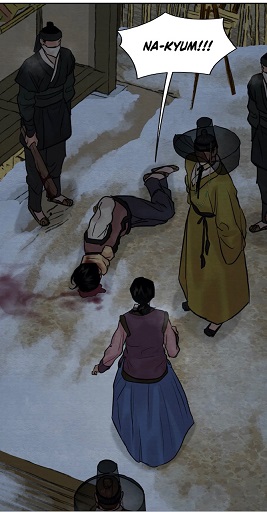 These two men are different, for their mask is white and not black. Besides, their clothes are black and not brown. Finally, the belt diverges as well: a huge purple strip with a different color in the middle, while the other guard is only wearing a simple ribbon. Thus I am inclined to think that the black guard is not only manipulating Yoon Chang-Hyeon, but he is also in truth working for someone else. Moreover, why would the man cover his face in the room, if he is truly working for the patriarch?
  (chapter 86) And this observation leads me to the following question: when was lord Yoon informed about the protagonist’s crime and lord Shin’s death?
 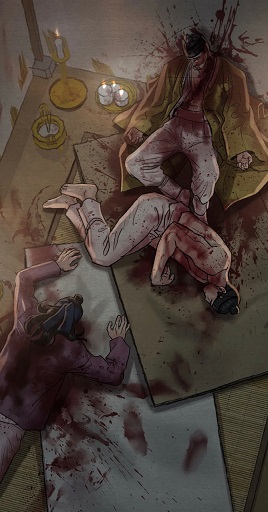 (chapter 102) From my point of view, it is related to Lee Jihwa. My theory is that the elder Lee can frame the main lead for assassinating his son, because during that night, Black Heart was dressed like Lee Jihwa. They needed the corpses to be decomposed so that father Lee could claim that Yoon Seungho had killed his son!! And the hanbok would serve to identify the corpse. In addition, he would use the incident with the sword as an evidence for his lunacy.
  (Chapter 67) It is important that the red-haired master is not perceived as traitor, rather as a victim. Moreover, since some time passed on, people have already forgotten the friend’s confession in the inn. However, the elder master Lee will never report Yoon Seungho to the authorities, it has to come from the father himself. That way, his involvement will never be detected. From my point of view, the schemers are trying to turn father and son against each other so that the Yoons get destructed. One might reject my theory about the implication of father Lee, but let me ask you this… What are “Lord Song”
  (chapter 107) and Lee Jihwa’s colors?
 (chapter 12) Purple and yellow, right? Observe that the lord is wearing the same colors during that night: a purple hanbok with a yellow scarf!
  (chapter 67) Under this new perspective, it becomes comprehensible why I am suspecting that this guard
  (chapter 107) Furthermore, he could be recognized with the purple hanbok.
  (chapter 83) Besides, another divergence is that the faceless lord Song has a rebellious strand in the neck which is not the same with “lord Song” from episode 107. As you can see, I deduce that we are dealing with two different “lord Song”. But this doesn’t end here. Secondly, according to father Lee, the man lost his home!
  (chapter 82) So how can he be wearing a purple hanbok, if he lost his position and home? This color is reserved for important people. In addition, when he entered the kisaeng house, the artist’s noona called him differently:
  (chapter 107) She called him “lord Haseon” and not “lord Song”! Interesting is that neither the Korean nor the Spanish version utilizes such a name! I don’t think that the translator took the liberty to create a fictional name. Hence I am deducing that the author is trying to leave different clues in each version!! Naturally, Haseon could be his first name, yet there is no ambiguity that this man has a bad reputation among the kisaeng house. He was called “lecher” and in the Spanish version, he was described as sexual maniac.
  (chapter 107) Hence I doubt that the noona would feel so close to such a man and address him with his “first name”. On the other hand, the kisaeng has a drop of sweat on her face, which is a sign for a lie and deception.
 (Chapter 107) This signifies that « lord Haseon » is true, while « out of the blue » is the lie.
 (chapter 107) Besides, Yoon Chang-Hyeon’s vision of the world is based on the words from lord Song and others. Who informed him about the whereabouts of « lord Song » in the gibang? The man had not come to the kisaeng house for a long time. Because of this information, the patriarch is led to think that he is meeting « lord Song ». His perception of the world and his eldest son is embossed by lord Song. Thus he repeats the same expression from his counterpart: “lowly beast”.
  (Chapter 107)
  (chapter 107) Finally, like outlined above, the main lead imagined that he was meeting the same doctor, while in truth it was not the case. So « old friend » could be deceiving:.
  (Chapter 107) He could be one of the three men! The real « lord Song » who brought pain to Yoon Seungho is someone else. Let’s not forget that Kim fears the man,
  (chapter 56) and his statement implies that Yoon Seungho is usually not allowed to ignore the man’s request:
  (Chapter 56). « At this time » stands in opposition to « always » which means that he can reject the invitation only because he is sick. To conclude, for me, this is not the lord Song Yoon Seungho hates and fears!
  (Chapter 107) Hence they judge him as a pervert. And since the head-kisaeng received him at the gate, this signifies that this man has been in contact with the kisaeng house and in particular with the kisaeng leading him to the room.
 (chapter 37) The fake servant NEVER mentioned the retirement of lord Song. As you already know, for me, No-Name is the real lord Song who took the blame for everything, for he let people use his “name”. The most terrible thing is that “lord Song” puts the blame on Yoon Chang-Hyeon, when he explains his failure about the sexual education.
  (Chapter 33) Secondly, how does the lord know about the master’s illness, when his fever was only discovered after the straw mat beating?
 (Chapter 77) Besides, no physician had been fetched back then. Finally, how can lord Song remember the lord’s condition so well after 10 years? It is because he is using the diagnosis on the painter from the previous doctor:
  (chapter 103) Here, the man with the purple hanbok was utilizing the painter’s illness to hide his own crime. Under the pretense to help « Yoon Seungho » to become a man, the man abused him not only physically, but also sexually. There is no doubt that this reconversion was fake!
  (chapter 107) However, the trick doesn’t work, exactly like No-Name’s prediction:
  (chapter 76) But there is another reason why Yoon Chang-Hyeon doesn’t get fooled a second time.
  (Chapter 77) Thus I come to the following deduction: Yoon Seungho was sentenced to the straw mat beating, because after 2 nights, he had not been able to « have an erection ». They mixed a truth with a lie:
  (chapter 52) And what had Black Heart thought during that night? He had wished to taste the artist, while before he had desired his death. This is not random at all. There is a strong connection between death and sex which is also present in the conversation between lord Song and his « old friend ». The former reproached the elder master Yoon to have protected his son for too long.
  (chapter 107) Hence I am now assuming that this night is a reflection from chapter 67 and 69!! Min’s plan!
  (chapter 69) He had gone to the kisaeng house with the hope that the artist would return with his noona, and back then he had impersonated Lee Jihwa for the first time.
  (chapter 69) As the manhwalovers can detect, the sudden return of lord Haseon is intentional. So who is he targeting here?
  (chapter 86) He was the keeper of his secret!! This explicates why the fake lord Song mentions « lad » and not the main lead. He gaslighted his counterpart, and created a false reality, while for me, it is clear that the real source of threat is Baek Na-Kyum. And who wanted him to be removed from the main lead’s side? Father Lee!
  (Chapter 82) In fact, both schemers have one goal in common: the couple is the victim and witness of their « crimes ».
 (Chapter 83) However, since I have been examining Painter Of The Night so closely, I learned to pay attention to details. Consequently, I recognized very quickly that Yoon Seungho was not chasing one ghost, but he was running after 3 different people
  (chapter 106) impersonating „lord Song“
 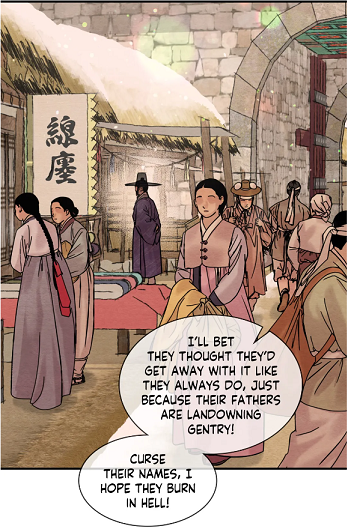 (chapter 106) If you look very attentively at the hanboks, you will realize the slight differences. First, the shade of the cloth diverges, then one cloth has a pattern, the other hanbok none. The form of the gat is also a little different, just like the color of the hair diverges. Besides, the readers should keep in their mind that in season 3, we had at least 3 bodies, though I am suspecting 4 corpses:
  (chapter 94)
 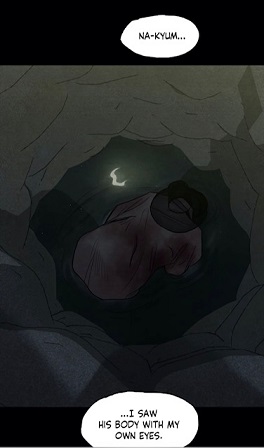 (chapter 97) and
  (chapter 37) The empty street was the indication that the monarch was present in the city. And now pay attention to the situation in episode 105:
  (chapter 105) Why is the street empty, when it was not the case during the night in episode 69?
 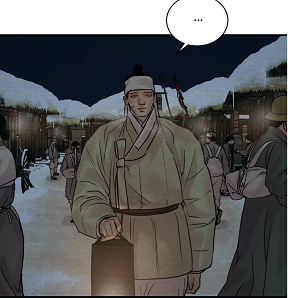 (chapter 69) For me, the pedophile was in the kisaeng house. But let’s return our attention to episode 37.
  (chapter 106) To sum up, for me, the 4th “lord Song” was present in this scene, but the protagonist couldn’t detect his presence, for the other “shadows” were there to divert his attention.
 (Chapter 106) As you can see, they used a prank to wound the artist. Their goal was to incite the painter to return to the kisaeng house. He should cut ties with the main lead, as the latter is a man with a fickle nature. Yes, episode 106 was the negative version of chapter 75.
 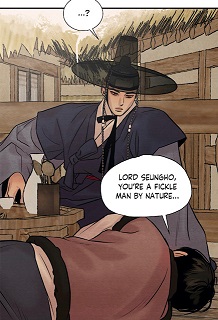 (chapter 75) That’s the reason why the couple was sent to the same inn. However, I don’t think that they had expected the painter’s fainting.
 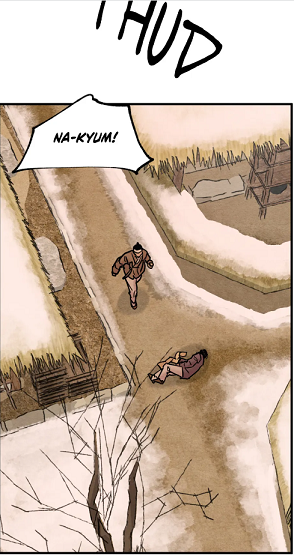 (chapter 106) For me, this is a blessing in disguise.
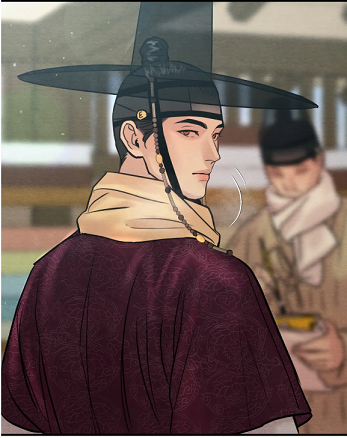 (Chapter 106) The latter had to be informed not to send the new clothes to the kisaeng house, but to his own mansion. That’s the reason why Baek Na-Kyum asked this question to the butler.
  (chapter 106) That’s how the schemer and his accomplices knew for sure that their original plan had not worked out. And if you read my previous analyses, you are aware that I had discovered the existence of two tailors!!
  (chapter 45) and 74
 (chapter 74) This tailor is wearing the scarf the same way than the artist‘s. Finally, in episode 64, the manhwalovers could see the face of the second tailor. :
  (chapter 64) In the past, I had already outlined the divergences in the body shape and the clothes, but the most visible evidence is the scarf!! Finally, I would like my avid readers to detect that the tailor from chapter 64 has been calling the main lead master Yoon, and not lord Yoon Seungho. This shows that this man is involved not only in the recent prank, but also in the main lead‘s suffering. He is not recognizing Yoon Seungho as a real lord. The usage of different hanboks is the proof that the tailor is an accomplice in the latest trick. But this also explicates why the tricksters had not planned the artist’s fainting. First, he had been able to run after his lover.
  (chapter 105) Besides, this is how Baek Na-Kyum acted, when he saw his lord looking at him:
  (chapter 106) The fake smile from Baek Na-Kyum was hiding his true condition, he was still suffering from PTSD. Nonetheless, for the tailor and the other witnesses, it looked like the artist was strong. Nonetheless, since the main lead had learned in the past to fake his smile, he could detect that his lover was far from feeling well.
  (chapter 106) But there is another reason why they had not predicted such an outcome: the doctor!! They had to ensure that the lord’s path never crosses the physician’s! That’s the reason why the manhwaphiles never saw him in episode 106. He was like a ghost. But there is more to it.
  (chapter 57) Yes in the kitchen of the physician! Then in a different image, you can the kitchen with the stool and the circle with the shamanism drawing right behind the lord’s back.
  (chapter 106) We assumed that the couple was eating in an inn, but it is true? Finally, in the shelves, the manhwalovers can see small packages hanging around,
  (chapter 106), they look exactly like the medicine Kim fetched in episode 55.
  (chapter 55) Because of these parallels, I started wondering if the couple and the readers had not been fooled in the end. They were actually sitting in the medicine store, but due to the butler’s words and episode 75, the manhwalovers had the impression that the couple was in an inn. And the Spanish version seems to confirm my suspicion. I had already outlined that the furniture and shelves in the library had been switched. So it could be the same with the doctor’s office. Besides, the form of the building reminded me a lot of the house from the physician’s.
  (chapter 106)
  (chapter 74) Once you remove the cupboard from the side, you have a patio where you can eat. Under this new light, it explains why Yoon Seungho would say this to the butler:
  (chapter 59) To conclude, there was another ghost in episode 106, the invisible doctor. No matter what, the couple was not supposed to see the physician. Why? It is because he would have noticed the existence of two different doctors. That’s the reason why Kim acted as a mediator!
  (chapter 106) This was not to help his master and the painter at all. Quite the opposite. He had to cover up his own wrongdoings and help the schemer. Therefore it is not surprising that the valet was confronted with the artist’s fainting!
  (chapter 106) The latter had played a mean prank on Baek Na-Kyum!! Yes, you are reading it correctly. Now, you are wondering when the valet fooled the pure painter. Observe that Kim had joined his master
  (chapter 106) He had barely moved… maybe run for 4 meters! How could he be out of breath? Besides, why would he scream like that, when the lord was standing next to him?
  (chapter 106) It is because he needed Baek Na-Kyum to hear his lover’s departure!! Because we see this panel, we assume that the valet was left in the dark, especially after witnessing such a scene.
  (chapter 106) Our brain is trying to fill the blanks. But the moment you realize that Kim didn’t run such a long distance to be out of breath, you will realize that this “abandonment” was staged. This was the reflection of chapter 85, another fake run!
  (chapter 85)
  (chapter 86) Thus the butler got punished for his acting. He has now to take care of an unconscious painter.
  (chapter 106) Besides, I have another evidence that the painter got fooled by the valet. According to my observation, there is always a reflection within the same episode. Since the lord got fooled and was incited to follow the man with the purple hanbok, the artist had to experience the same. However, while the one got scared out of abandonment issues, the other got worried because of “lord Song”‘s obsession! Besides, because neither the butler nor the physician got punished for their crimes (passivity, silence, lies and disobedience), both need to receive their “punishment”. Let’s not forget what Yoon Seungho had said to the artist back then:
  (chapter 58) Kim had usurped his authority, he had made a decision without his master’s permission.
  (chapter 24) The gate serves as the indication.
  (chapter 24) And in that episode, the artist got dragged twice.
  (chapter 24) First, it was the scholar, then the butler. However, in that scene, the butler had lied to the artist, for the noble had never requested to meet the artist in the pavilion. From my point of view, he was still hunting in the woods. As you can see, episode 24 contained all the elements of an abduction, though it was not perceptible. That’s the reason why I am suspecting that Yoon Seungho might think that his lover has been kidnapped again, especially after hearing such horrible gossips. Nonetheless, since the painter fainted, the valet will be forced to take care of Baek Na-Kyum. In addition, observe that the butler brought back the unconscious painter to the mansion, though the doctor was right next to them! This shows that Kim and the physician had not the artist‘s best interests in heart. He should have been treated right away.
  (Chapter 76) Coincidence versus trick! They wished to scare Yoon Seungho, to let him think that „lord Song“ knew about his crime and was about to denunciate him. Yes, in my eyes, the man with the purple hanbok embodies treason and was the reason why Yoon Seungho got arrested and tortured in the past!! Under this new light, it becomes comprehensible why the lord would get so mad at his childhood friend.
 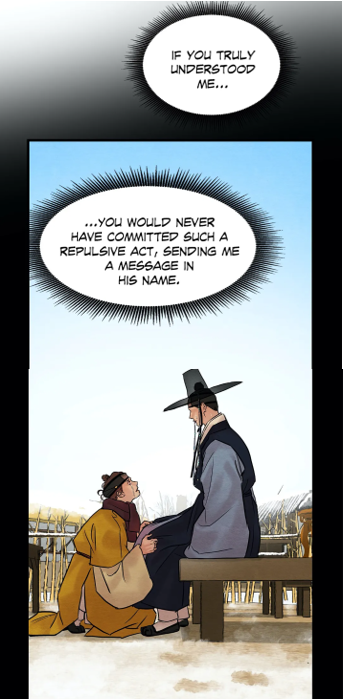 (Chapter 59) But the moment Yoon Seungho’s mother killed herself, it became clear that her son had been unfairly arrested and tormented. So someone had to take the fall for the injustice, the real lord Song.
  (chapter 1) The latter is the witness of Yoon Seungho’s sexual abuse. And what did the women say in the street?
  (chapter 102), Lee Jihwa was behind the scheme… and what had Lee Jihwa done in the past? He had sent a letter in his name.
  (chapter 59) Back then, Yoon Seungho assumed that his childhood friend knew nothing… but now, he is seeing the ghost lord Song circulating in town. So he could jump to the conclusion that the Lees have been helping lord Song. Finally, the manhwaworms will certainly recall the red-haired master’s confession, he knew everything!!.
  (chapter 57)
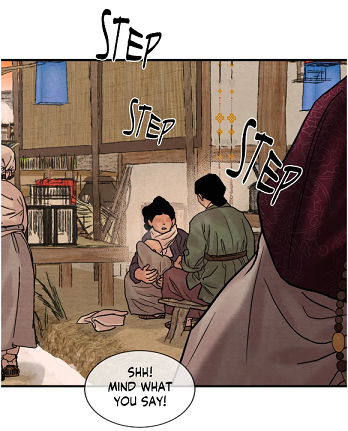 (chapter 106) And this scene is a reflection of episode 64, where the two women were ignorant about the incident of the previous night.
 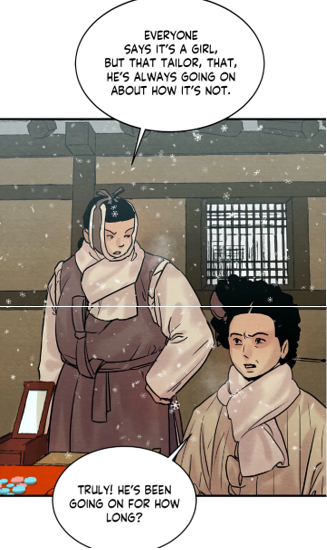 (chapter 64) Once again, this proves that the tailor is involved in the scheme.
 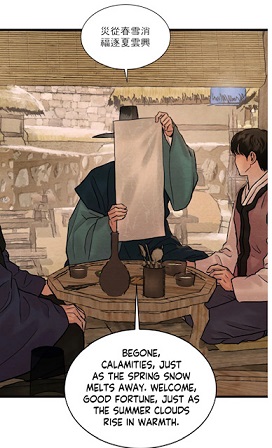 (chapter 106) The Spring Poem is actually reflected in this scenery:
 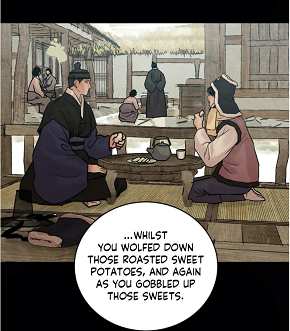 (chapter 92) Yet this doesn’t end here. Episode 92
  (chapter 92) is the positive reflection of episode 106:
  (chapter 106), she contradicted her statement right after.
  (chapter 103) As you can see, the schemers are no longer able to control Yoon Seungho and his lover, for both are supported by the gods. Chance stands on their side!
 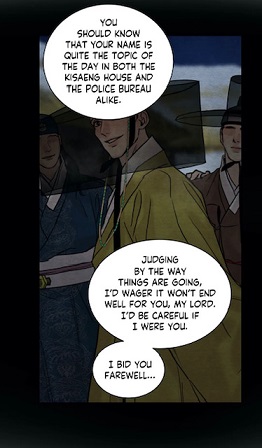 (chapter 100)
  (chapter 104) Though there is a manhunt, where is he?
  (chapter 106)
  (chapter 98) To conclude, while the schemers thought that due to his crime, Yoon Seungho would lie low and cut ties with his lover, due to their meddling, they achieved the opposite. The lord will request an investigation… something he has never done before. He could even denunciate Lee Jihwa
  (chapter 67), that way he can escape punishment. This means that Black Heart’s last confession (and lie) could help the lord to protect himself and his lover. Finally, if Yoon Seungho were to mention the purple hanbok to his lover, the latter’s memory could get triggered and he could remember this night:
 (chapter 105) He desired to spare his heart. To conclude, “that awful matter” is referring to the whole prank and its consequences.
 (Chapter 97) At the same time, the idiom includes the staff‘s tricks as well: the corpse in front of the gate and the maids‘ badmouthing
  (Chapter 104) However, he had been silenced by his lover, when the latter suggested to him to view everything as a nightmare. The lord made the mistake not to listen to the victim and witness.
  (chapter 105) With such a contrast, the manhwalovers can detect the link between ignorance and absence of memories. To conclude, in both versions, the main lead is “lying” out of ignorance. This is the positive version of “ignorance is a blessing”. Hence the noona thinks herself safe.
 (Chapter 99) It was clear that her brother would meet the noble, as their meeting didn’t surprise her. She was more upset that Baek Na-Kyum was unconscious.
  (chapter 99) However, her question „What’s wrong with Na-Kyum?“ divulges her hypocrisy and acting. How could she not realize that her sibling had been beaten?
  (chapter 105) Thus I deduce that Heena thinks, the painter could not witness her acting in front of the scholar’s house, for his head was turned around and he was not moving. She feels secure concerning that night, while I am expecting the opposite. Nonetheless, her past behavior in the kisaeng house represents a source of danger for her. That’s the reason why she has to hide the “attempted murder” from her brother. The moment Heena mentions that she has been hurt, the painter won’t believe her. Why? It is because in the kisaeng house, he has not forgotten her words:
  (chapter 97) Even if she was “fooled”, the artist can only reproach her stupidity. Remember her harsh words, she had called him stupid:
  (chapter 97) She had helped Min, and she can not claim ignorance. As you can see, Yoon Seungho was encouraged to hide the “attempted murder” from Baek Na-Kyum for selfish reasons. Therefore it is no coincidence that when the lord visited Heena, he made sure that his lover wouldn‘t see Heena in bed.
  (Chapter 104) This explicates why later the lord was hugging his lover under the cover.
  (Chapter 104) Hence I conclude that Heena must have thought the same way about Yoon Seungho. „Thank god, he didn’t see or hear a thing about that awful matter“. He has no idea about her altercations with her brother in the kisaeng house. It is important, because our beloved seme has the impression that the noona has her brother’s best interests at heart, but actually he is wrong. In my opinion, the relationship between Heena and his lover serves as a mirror to his relationship with Yoon Seungwon. So far, the young noble doesn’t suspect his brother to have betrayed him. Note that he blames his father more than his younger sibling.
  (chapter 105) Yet, this incident was presented as Yoon Seungho’s memory. This panel could be used as an evidence that my theory, Heena was present next to the shaman’s shrine during the bloodbath, was wrong. Nonetheless, this image didn’t make me change my mind. Why? I paid attention to details and judged this rescue as “fake” again. The servants had a drop of sweat on their face, the symbol for deception. Secondly, the kisaeng was wet, while the staff’s clothes weren’t damp. How did they save her then? Besides, where are the foot prints? Moreover, where was the head cover?
  (chapter 99) Finally, her hands and feet were not tied. So where did the items go? Since we saw her “execution”, we are the witnesses, and as such we know the truth about that “awful matter”, but it is not the case for the lord. This image contains so many errors, hence it can not reflect reality.
  (chapter 103) Hence he could have never been outside the mansion. That’s how I realized that the author was presenting us a false memory. This means that the manhwalovers are facing an implanted memory. But how could this happen? First, false memory is quite normal and is often of no consequence. But a false memory relayed during criminal testimony might lead to the conviction of an innocent person. As the manhwalovers can detect, it represents a serious problem.
  (chapter 58), it makes him particularly vulnerable to false memories.
  (chapter 104), the lord and even the readers imagined to see medicine in the white bowl!
  (chapter 105) Besides, the author had always connected the drug with the tray.
  (chapter 23) As you can see, the readers interpreted this scene due to associations. Nonetheless, like mentioned in the previous analysis, the different color and the traces on the edge were the evidences that it was ink.
  (chapter 36) Besides, Heena was in bed indicating that she was still weak. The circumstances led people to have a different perception of “verity”!! Only through the mind’s eye, the manhwalovers can detect that this scene was staged.
  (chapter 103) The protagonist projected his own thoughts and emotions onto one servant: shock!
  (chapter 61) This was interference by excellence. Besides, emotions can affect your memories. Since the lord was so under shock after witnessing the painter’s unconsciousness, it is not surprising that he imagined to have witnessed this scene. At the same time, when he left the shrine in trance, he could have overlooked the presence of a third person… similar to Lee Jihwa next to the shed. That’s how he doesn’t recall anything from that night except his crime. He didn’t see and hear the person by his side. Where is the sword? Where did he get the hanbok from?
 (chapter 102) Therefore it is not astonishing that he imagined a similar scenery.
  (chapter 1) This shows that the artist had only heard his name without seeing his face before. This explicates why the main lead’s gaze and facial expressions were similar
  (chapter 1)
  (chapter 1)
  (chapter 103)
  (chapter 104) My avid readers can certainly recall the rule I had detected: each chapter will be reflected in the next!
  (chapter 94) Furthermore, the painter is associating the learned sir to the moon and as such the night.
  (chapter 94) Thus I am now suspecting that this image
  is a false memory. But I have another reason to think that the painter’s idolization was more the result of “brainwashing” and as such “false memories”.
  (chapter 105) How can she date this incident so precisely? The moment I read her testimony, I discovered that in episode 94 the author had never shown us the painter crying!
 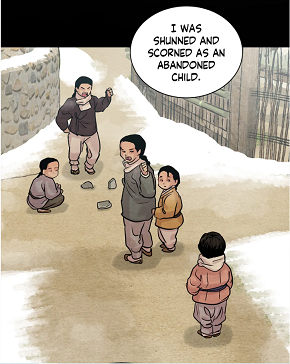 (chapter 94)
 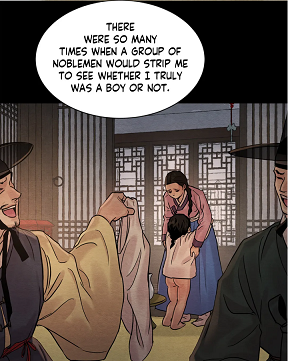 (chapter 94)
 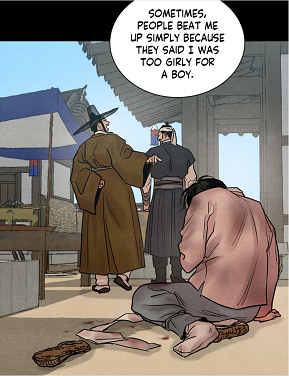 (chapter 94) It was, as if the noonas had never been informed about the painter’s suffering and tears. This shows that Heena has been hiding many things from her colleagues. But there is more to it! The manhwaphiles saw the artist’s tears in his childhood.
 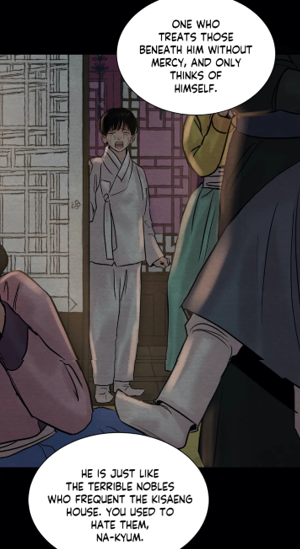 (chapter 68) But here he was much older!! Under this new perspective, I realized that the following image could have been a false memory:
  (chapter 68) Heena was misremembering that night, and she was misattributing the painter’s tears. In other words, she was confusing two incidents.
 (chapter 105) It is the same facial expression, though the redness around the eyes is more pronounced. This observation confirms that the noona’s memories in the kisaeng
  (chapter 105) He had run after his lover in socks. While in “Baek Na-Kyum’s foot”, I thought that this memory was true, I come now to a different signification. It was a false memory in order to hide a crime related to Heena. I would like to outline that in the kisaeng’s comment, we have the notion of “shame” and as such “guilt”. First, I thought of rape, but then it could be much simpler. The painter could have witnessed his noona having sex with the learned sir. But because he was too young, he misjudged the situation… as a virgin, she had to bleed. Because he saw blood, he imagined that the learned sir had hurt Heena. This would explain why the artist was afterwards anxious around the teacher. One might think that this is not terrible. But let’s not forget that as a kisaeng, she can not have sex like that.
  (chapter 105)
  (chapter 46) A change of heart versus “eternity”. This shows that the painter’s decision to go to the learned sir’s house was never his choice. He had simply followed Heena’s suggestion. She was definitely distorting his past. Furthermore I detected a strong connection between love and memory.
  (chapter 94) If it is a loved one, then it can only be a good memory. Therefore it is not surprising that by saying constantly saying that the painter likes the scholar, he is repressing the bad memories with the scholar (the beating in episode 34, the betrayal in chapter 29, his words in the library and his reproach about his job). So far, he only mentioned one negative incident.
  (chapter 76) So while the painter was following his lover, the latter turned around and hugged him. Afterwards, he asked him to go to his noonas, for he needed to talk to Heena. Moreover, contrary to Yoon Seungho, Baek Na-Kyum paid attention to time. He was not lost in thoughts or had lost the sense of time
 (chapter 105) But the latter acted, as if his hand was not wounded.
  (chapter 105) He ignored his physical pain and heartache.
 (chapter 105) This is important, because the stumbling symbolizes the intervention of the gods… We have the perfect example at the end of season 3. The lord fell on his knees in front of the scholar’s house, hence there is a hand print on the snow.
  (chapter 100) That’s how he refused to view Lee Jihwa as the murderer of his lover, Baek Na-Kyum”. YES, the falling is the real manifestation of CHANCE! How so? I would like the manhwaphiles to keep in mind that chance is the antonym of trick and scheme! The latter are connected to plan and organization. Thus I come to the conclusion that the noble will decide to go to the doctor’s office in order to treat his lover’s hand.
  (chapter 57) he was feverish so that he couldn’t pay attention to the physician. Besides, the man never remained by his side. Finally, in episode 74, the man never left the office!!
  (chapter 74) I conclude that Yoon Seungho never saw the physician for commoners! Besides, I doubt that he remembers him from his childhood. But this is not the same, when Baek Na-Kyum was ill. He met the other doctor twice.
  (chapter 33)
  (chapter 103) On the other hand, the artist assumes that the man in the office is Yoon Seungho’s doctor!! He heard his confession:
  (chapter 103) The staff… I would like to outline that in this panel, Kim was no longer seen next to the couple.
  (chapter 105) So where did he vanish? Probably to the mansion, for he had to warn the domestics that the artist would be returning! But if he left the couple behind, this means that he can’t witness what Yoon Seungho and Baek Na-Kyum will do next. And if they don’t go to the doctor, there is no ambiguity that the main lead will send for the doctor again. But according to me, the man disappeared.
  (chapter 105) Imagine that despite his rush, he was clear-minded enough to take the yellow scarf, a present that the noble had just bought him before. 😢 The item had more value than the mituri (shoes). Thus he was running in socks. His gesture displayed how much the lord means to the painter. He cherishes everything the lord does for him. At the same time, it indicates his heartache. He was so desperate and scared, for he felt that he was about to get abandoned one more time.
  (chapter 105) According to my follower @katamins, in the Korean version, this is what Baek Na-Kyum yells:
  (chapter 105) it works like a spell or a prayer. The artist is clinching onto this phrase hoping that the noble is remembering his promise. The irony is that the low-born was smiling like a fool,
  (chapter 83)
 (chapter 85) This means that Baek Na-Kyum was put in the same situation than his lover who wished to keep the artist by his side, but feared to open up to him out of self-hatred and guilt. The painter could get burdened or horrified by his revelations. Hence the painter’s reaction at the end mirrors the yangban’s in the study. Both were or are pleading the partner to stay by their side,.
  (chapter 85)
  (chapter 105) Nevertheless, their behavior diverges so much. The aristocrat couldn’t raise his voice or become violent by using his hand, because he could scare the artist and as such break his previous promise. Finally, by destroying the music box, he had already witnessed that he had pushed his lover further away.
  (chapter 85) At the same time, since he had been taught that no noble should lower himself in front of commoners, it is normal that he couldn’t beg Baek Na-Kyum on his knees. To sum up, the noble had to restrain himself extremely, his face and words were the only way to show his emotions and despair. And the artist sensed it, though the lord was not weeping. The proof is that when the father appeared, the artist changed his mind. He was no longer willing to leave, in fact he chose to look for his lover.
  (chapter 87) This shows that through communication, the lord had been able to affect the painter‘s mind and heart. On the other hand, we shouldn’t underestimate the lord’s flashback and Na-Kyum’s conversation with the butler which played a huge part in the artist‘s decision to vow loyalty to Yoon Seungho despite the secret.
 (chapter 105) Then I noticed that contrary to his lover, the artist asked the reasons for his decision.
  (chapter 105) Why did he change his mind? Is he responsible for this? As you can see, the painter came to voice his guilt and the remains of his deeply rooted self-hatred.
  (chapter 105) He must have committed a wrongdoing, he is responsible for the situation. He feels like a burden, for the lord had to take care of him each night.
  (chapter 104) They are no longer sharing the same bed, the lord is sitting by his side comforting him, when the young man has a nightmare. Under this new light, it becomes comprehensible that the artist was working in the backyard.
  (chapter 104) He wished to help, that way he wouldn’t be seen as a spoiled child. He has to justify his presence in the mansion. Who is he exactly that he is sleeping in the lord’s bed? I am suspecting that there is a rumor circulating within the propriety, a new version of this scene:
  (chapter 38) which I will explain more in details below. Thus the artist is making sure to cause no trouble to Yoon Seungho and the staff, especially the maids. Hence he folds the cover and clean the bedroom.
  (chapter 104) Then he washes clothes. He makes sure that he is no burden to anyone. Yet, my impression is that the staff is taking advantage of the artist’s goodness. That’s how they fuel his guilt and shame.
  (chapter 104) This intention was again verbalized in the gibang.
  (chapter 104) He was told not to question what he had heard… he should simply consider everything like a nightmare. However, this method is actually wrong.
  (chapter 07)
  (chapter 104) Not only he knows about the lord’s traumatic past, but it is the same for the painter. In addition, we have another explanation for Yoon Seungho’s insomnia and dissociative state.
  (chapter 104) Naturally, Kim, because he is now the only one in the mansion who knows his past. Besides, why do you think that the lord’s past is coming to the surface as a nightmare? It is because he was incited to repress everything. But since the painter is going through the same experiences, this is not surprising that the noble’s memory is triggered and the past emerges again.
 (chapter 27) Put yourself in the young man’s shoes. You suddenly witness how the whole family is moving houses and leaving you behind! This must have been terrible for Yoon Seungho. One might argue that Kim stayed by his side, so he was not alone. But it is false for 2 reasons. The white bearded servant had been working in the mansion
 (chapter 27), when the other domestics left the propriety. This was his memory. Besides, like the servant confessed to Jung In-Hun, a huge part of the staff got replaced. This means that the lord was suddenly surrounded by people he didn’t know. Because my theory is that the young man was treated as a male kisaeng, this signifies that the new staff could never view the main lead as a noble. Besides, despite the betrayal, the elder master and Yoon Seungwon were his real family. Finally, Yoon Seungho had no saying in this, and I can imagine that the reason for this decision was not explained immediately. This must have been a huge blow for him as well. He must have felt lost and homeless. The result was that from that moment on, he became more dependent on the butler. And we have to question ourselves what the butler did with this huge responsibility, when the elder master moved to the second house.
 Since this phrase appears in connection with the staff (maids and servants) in the courtyard, I come to the conclusion that the authors of this gossip are in the domain. “Fellows” indicate that they are speaking among themselves. But I have two more clues proving that the traitors are the domestics. First, observe how they call the protagonist: Young Master Yoon.
  So far, people in town only calls the protagonist lord Yoon
  (chapter 45)
  (chapter 45) or lord Yoon Seungho
  (chapter 39) or my lord.
  (chapter 76) Only the staff addresses him as “young master”.
 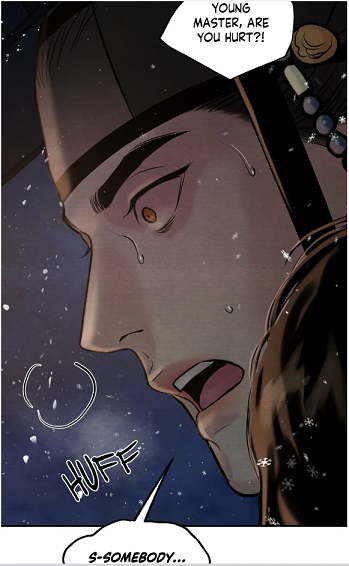 (chapter 103), and this since season 3. This coincides with the meddling of the Yoons. The servants treat him, as if he was not an adult, no real lord. But they are wrong, because he is wearing the topknot with the gat. Hence he is a lord. Finally, only people close to the couple could know about the painter’s tragedy.
  , because in the village and town, there exists another gossip:
 He is responsible for the lord’s lunacy. Under this new perspective, it explains why the painter is leaving the bed and working. He wishes to prove the words wrong. On the other hand, I think that Yoon Seungho also heard a grapevine in the domain, but a different one:
  (trailer). “He has many enemies”. How did I come to this idea? It is because he is addressed as Yoon Seungho! By underlining the painter as his weakness, the author of this rumor wishes to separate the couple. If he were to place the painter elsewhere, not only the latter would no longer be targeted, but also the lord would have no longer any weakness. Since there is always a reflection within the same chapter, I conclude that a second grapevine was spread in episode 104. This happened, while the lord was away. Thus the painter smiled like a “fool”, when he saw the lord:
 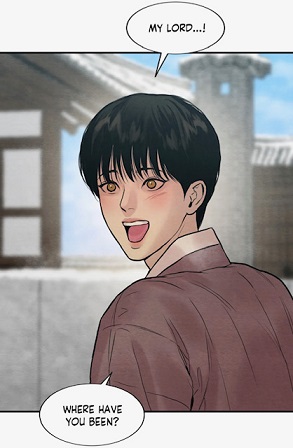 (chapter 104) As you can imagine, for me the maids were the perpetrators, a new version of episode 79
 (here, the woman implied that the artist was responsible for Yoon Seungho’s insomnia, thus the painter has a drop of sweat on his face, a sign for shame) and chapter 98
 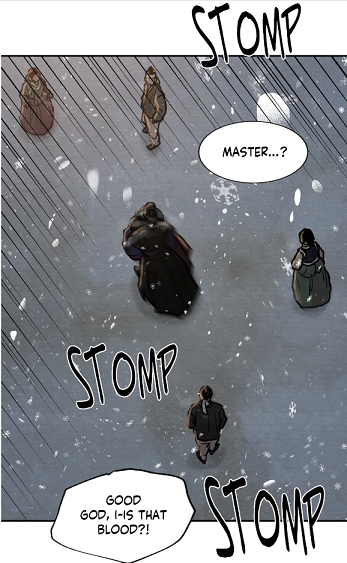 (chapter 103) Finally, the staff has every reason to get rid of the artist, for he is the witness of their wrongdoings. They definitely played a major role in the “prank”. They didn’t learn their lesson.
 (chapter 29) This time, the one smiling like a fool
  (chapter 29) was Jung In-Hun who acted, as if he knew nothing and had seen nothing.
  (chapter 29) However, I have already pointed out that he was present, when the rape took place, for he knew where Yoon Seungho would meet the artist: the pavilion. And what have all these episodes in common? The first thought would be to say: abandonment and betrayal. The painter in front of the gibang felt “betrayed” and abandoned, but what shocked the lord so much was when the artist started blaming himself:
  (chapter 105) “I had known, I would have never confessed” Nonetheless, he never finished his phrase, for in reality, he had no regret!! He was sure that he had made the right decision. It is because he had pondered a long time about this. He had observed his lover. That’s the reason why he mentioned their mutual love confession and as such their promise to stay together. And this brings me to the next observation. All these scenes have another common denominator: BAD DECISIONS!! The lord had made the wrong decision to entrust the painter to the kisaengs. Thus he came to regret this. He had made his lover cry, and even wounded him, though he desired to do the opposite. Therefore it is not surprising that he apologized to his lover.
  (chapter 105) This shows that the painter is showing him what true love and loyalty are. Moreover, he is teaching to make good decisions.
 (chapter 246), I realized why Yoon Seungho suffered so much. Self-made decision implies a conscious choice. It is made deliberately and thoughtfully, considers and includes all relevant factors, is consistent with the individual’s philosophy and values. As you can see, it implies knowledge. This definition exposes that making a choice for the sake of another person without his consent or knowledge can never be a good decision. One might argue about this, because children are too young to make decisions. In Doctor Frost, this man
  (Doctor Frost 246) decided to support a terror attack, and justified this by saying that this was for his daughter’s sake. But like the counterpart pointed out, he questioned his decision. Was it truly his choice, or was he simply following the leader’s suggestion? As you can see, the daughter was used as an excuse, it was never for her sake. This shows that children are the exception, besides they are often raised by two parents. Thus they are making deliberations together. But like the author revealed in Twitter, Yoon Seungho’s mother hated her husband so much that she neglected her eldest son. The patriarch made decisions on his own, but observe that it was always for the Yoons’ sake. This means that the father never took his son’s well-being into consideration, he never asked him about his opinion. He imposed his will, but he listened to others, like we could see in different occasions.
  (chapter 82) Here, the red-haired bearded man was encouraging the elder master Yoon to return to the mansion and claim his rights. Finally, the young master admitted this to the messenger:
  (chapter 80) If someone stroke his ego, he would follow their advice and never doubt their words.
  (chapter 77) Since it backfired, then the protagonist was responsible for everything. And this is what Kim has always been preaching in season 1, 2 and 3: it was the best for Yoon Seungho, or Baek Na-Kyum etc. Nonetheless, since he let others make the decision, he was able to escape “responsibility”, thus the elder master Yoon was blamed for everything.
  (chapter 104) But he simply employed reverse psychology.
  (Chapter 85) Yoon Seungho was coerced to open up. If he did not, he wouldn’t be forgiven. Naturally, the painter meant it well, yet the main lead was pressured to reveal his „bad action“. The main lead feared his negative judgement and rejection. We could say that the artist had made this request for the lord’s sake, however this was not a conscious and long deliberated decision. And now, you comprehend why the main leads suffered both so much!! Yoon Seungho’s mother neglected her eldest son, but she kept her distance from her husband. They never talked to each other, and as such never made decisions together. And it was the same for the painter. The kisaeng Heena was the one who made the decision without the noonas’ consent and her brother‘s opinion.
 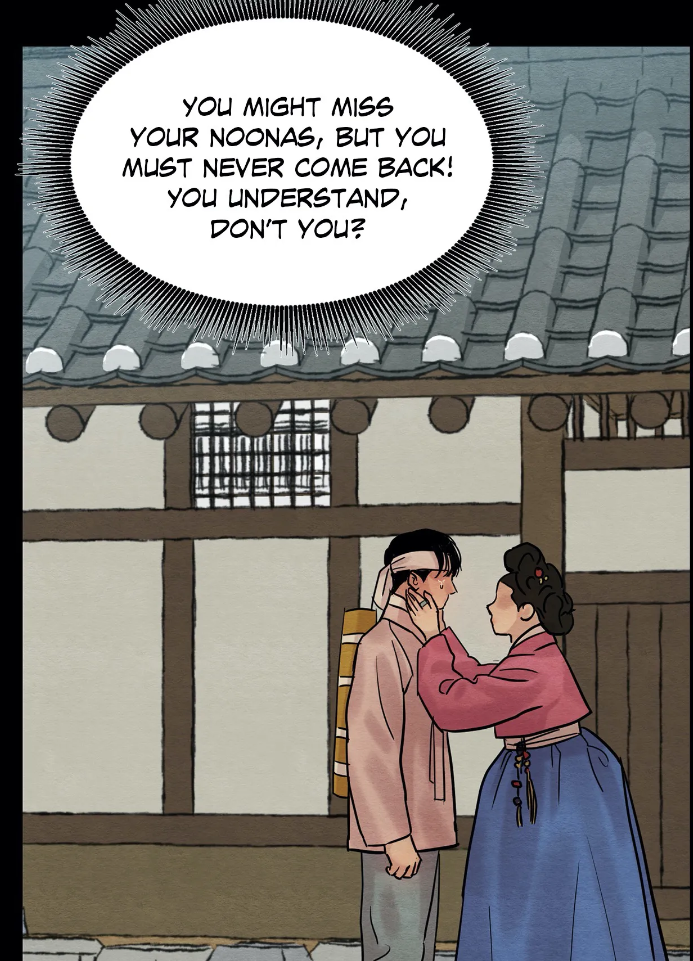 (chapter46) Even in season 4, she has not changed her mind-set entirely.
  (chapter 105) She is still viewing the painter’s decision as a bad choice. But she is simply wrong, for the painter listened to her advice and after deliberations, he chose to open his heart. His confession was not made in the heat of the moment.
  (chapter 62) The lord’s vision
  (chapter 62) became a reality
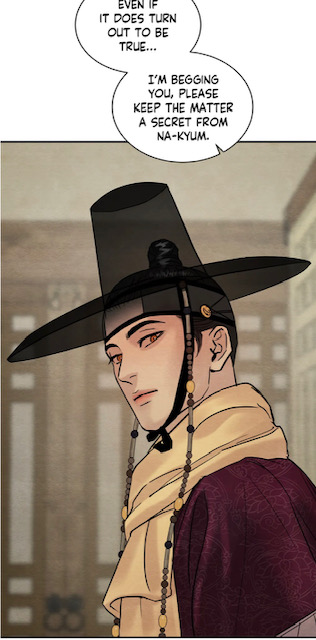 (chapter 105) This signifies that the noble will decide not to follow the noona’s advice:
  (chapter 105) But by learning about the learned sir’s past, the protagonist will realize that he only knew a side about Jung In-Hun.
 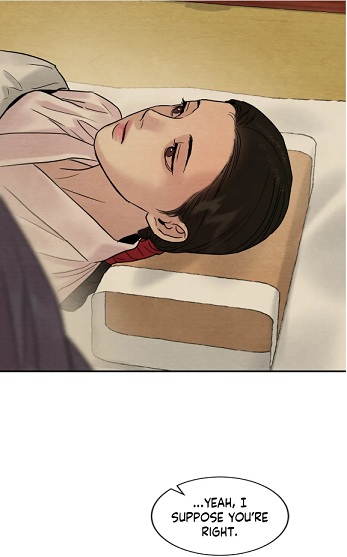 (chapter 105) with the noona’s statement, the painter looks happy with Yoon Seungho despite the tears, it looks like the noona is slowly coming to terms with her brother’s relationship. But I have to admit that I believe that her “decision” is just short-lived. First, in season 2, the noona had accepted to let her brother stay at the Yoons’
  (chapter 69) But then she had changed her mind after hearing the menace from the servant. However, I have three other reasons to expect a change of heart from the head-kisaeng. First, Heena is the younger reflection of the butler. The manhwaphiles shouldn’t forget that the valet had almost come to terms with the painter’s presence
 (chapter 65), but the ruckus caused by the kisaeng had provoked a change of heart in the valet. Then, the lord had made the following condition to the kisaeng:
 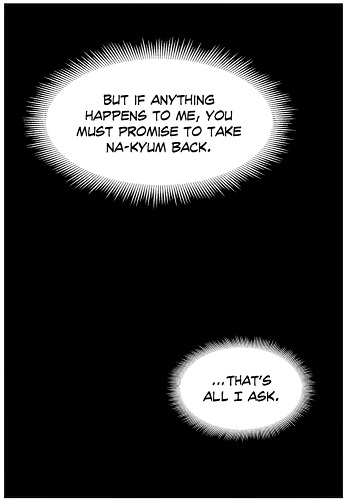 (chapter 105) The lord is keeping his lover by his side, as long as nothing happens to him. So if he gets into trouble… she could achieve her goal, the painter is returned to her. But the most important clue is for me the bowl!
  (chapter 36)
 (chapter 77) Besides, it never leaves traces on the edge.
  (chapter 36) The painter used white bowls while painting. On the other hand, the lord wrote a letter during that time. As you can see, in episode 36, we have the combination of painting, seduction (touching) and medicine… exactly like in episode 105. The artist tried to paint a lucky charm, a tiger, but he didn’t finish it. He got interrupted… which is very similar than in chapter 36. So the letter should represent another common denominator.
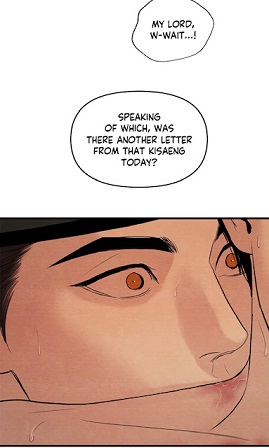
 (chapter 105) onto Yoon Seungho. Will she come to regret her action or not? One thing is sure, the painter accepted the sincere apology from his lover. How could he not forgive him after calling „Nakyumah“ and embracing him!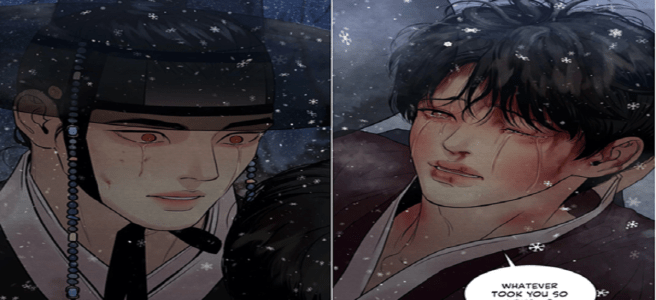
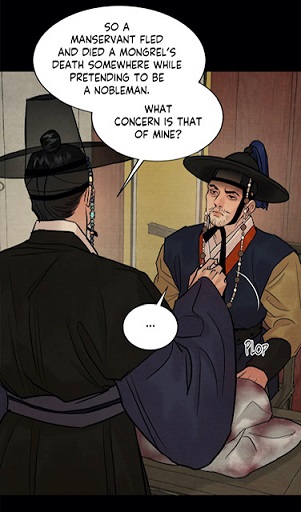 (chapter 98), although he was wearing clothes similar to the learned sir’s. What caught my attention is the expression Yoon Seungho employed: “pretending”. With such an idiom, he was implying that the servant had not only violated social norms, but also he had been acting. As you can sense, these two situations have one common denominator: playing a role and the clothes served as a disguise. It was, as if both victims of a murder had been playing in a theater play. This explicates why in the fanart, the author is portraying Baek Na-Kyum and Yoon Seungho as actors who are working in a sageuk.
 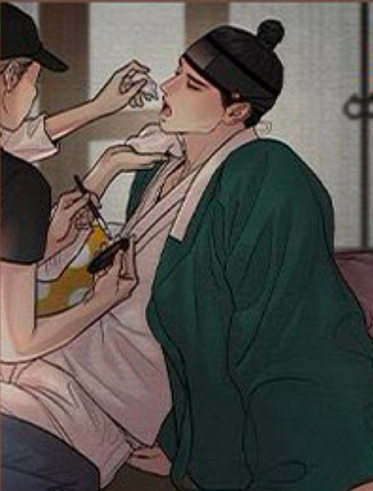 And this made me think of the famous poem from Shakespeare who describes life as a stage, where a person plays different roles all along his life: an infant, a school boy, a lover, a soldier, etc., until he dies, which is symbolized by an eternal sleep.
  (chapter 98) Why? From my point of view, they were trying to scare the main lead, to remind him that he could never replace Jung In-Hun in the painter’s heart, to shake his belief. But the problem is that the schemers had missed the right timing, for the artist had already confessed his love for Yoon Seungho and this twice. Therefore the latter couldn’t doubt his lover’s words, and mistake it for an illusion. As a conclusion, the clothes were used tools to trick the couple, they had become costumes!! However, because the author is using karma as poetic justice, this signifies that the hanboks and shirts can serve as a clue to perceive the truth too. The ones who tried to deceive the protagonists with clothes and words, should be fooled by their own manipulations.
  were different from the head-maid and her colleague?
 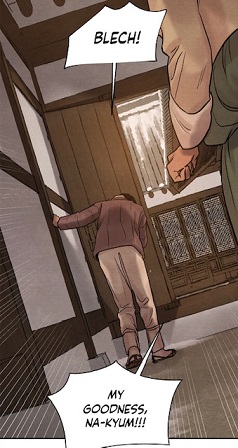 (chapter 98) What was the painter wearing on his way to the bedchamber? White pants with his Mountbatten pink jacket. But how did he show up at the learned sir’s home?
  (chapter 98) He was dressed differently. 😮 He had changed his pants, put on his scarf and hat. But when he went to the lord’s study, he was not carrying them!! How do we explain the difference? The answer is quite simple. He had returned to his room in order to fetch his clothes. And since Baek Na-Kyum took the lord’s clothes, this signifies that he had the intention to return to the domain. The readers will certainly recall the artist’s behavior, when he had threatened the main lead to leave Yoon Seungho. He had switched his clothes, and put on his old clothes.
  (chapter 98) Thus if the lord had gone to the study, he would had realized that the painter had not deserted the propriety, for he had not taken his belongings with him. The hat and scarf were signalizing that Baek Na-Kyum considered himself as a member of the Yoons‘ household.
 (rule 3) If only Yoon Seungho had left a word… The servants served as his messenger. Hence I am convinced that Baek Na-Kyum must have talked to the maids and told them where he was going!! He copied his lover, yet contrary to him, he must have given a precise information. (Rule 5) This means that he had informed the staff about his departure!! Moreover, in chapter 98, the maids acted, as if they had not detected the painter’s presence while badmouthing Yoon Seungho.
  (chapter 98) Hence they were portrayed without eyes and with a drop of sweat on their face, a sign for deception. So the negative reflection would be that Baek Na-Kyum had informed the maids, and he had gone to the kitchen for that reason. From my point of view, when he met them, he was already wearing his hat and scarf. To sum up, the artist had never left the maids in the dark. And the clothes are the evidence of the staff’s lie.
 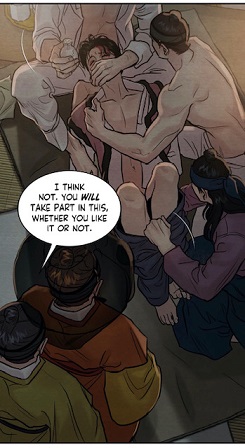 (chapter 100) And now observe that after Lee Jihwa’s departure, the artist’s clothes except the white shirt vanished too.
  (chapter 102) Where did they go? The readers saw Black Heart leaving the building, but we should question this: WHY? He never went there to fetch lord Shin, since he abandoned him outside. We all imagined that he left the room empty-handed. But it is true? Now, I don‘t think so. He had to get rid of the clothes in order to mislead the main lead!! A new version of chapter 61
  and
and (chapter 101) Because the readers could detect the presence of a shadow in episode 102
  , I am now envisioning that Min was not alone outside during that night. In fact, someone had misled Black Heart telling him that lord Jihwa had ran away. However, the unconscious lord Shin should have made him think that Lee Jihwa had fought back… Hence he had not fled, rather betrayed them. Moreover, he was not looking at the direction of the entrance and gate. In fact, he was turning his gaze in the direction to the shrine.
  (chapter 98) They were waiting for his return to fake their anger and search. And now, you comprehend why the servants mentioned the kisaeng in front of Yoon Seungho. It was to stop him from going to the study… to divert his attention. Under this new approach, the artist’s last words get a new meaning.
  (chapter 102) Since he had informed Yoon Seungho through the maids about his whereabouts, Baek Na-Kyum was expecting that he would come to his side. I would like the manhwalovers to keep in their mind that the artist was not conscious, when he moved to the shaman’s house. So in his mind, he was not far away from the learned sir’s house. Finally, since he had informed the maids, he could anticipate that the lord wouldn’t get mad at him, and wouldn‘t imagine that he had abandoned him
  (chapter 101) He trusted his lover’s heart in the end. That’s the reason why Black Heart’s superficial promise had no effect on Baek Na-Kyum. The latter truly believed that Yoon Seungho had been informed. But how could they play such a trick on the couple?
 This is an indication of their involvement, though we need to discern the head-maid from the women in chapter 98. That’s the reason why the moment the maid appears, observe her clothes and try to discern her identity. Is this the head-maid or one maid from season 3? The preview displayed the arrival of the doctor.
 (chapter 103)
  The form of the beard is also similar. But now, I have another evidence that this doctor from season 4 is not the physician from season 2!!!
 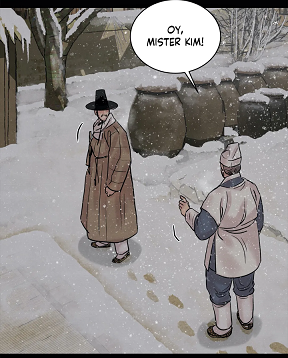 (chapter 63) The shoes are also different! That’s the reason why in the trailer, the beholders are seeing the physician’s shoes!!
  He doesn’t possess mituri like the other. Moreover, he is wearing a hanbok under his apron
  , while the other is dressed more like a commoner, a shirt with pants. And note that in chapter 33, we had the following combination: Min’s party, the visit of the doctor, Baek Na-Kyum’s illness, the maids and Yoon Seungho who “ran away” after his mistake. (rule 1 and 4)
 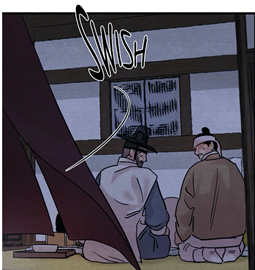 (chapter 33) And what had Kim done during his examination? He had not only threatened the physician
  (chapter 33) However, here the butler had simply lied to hide his own wrongdoings: his passivity and silence. And note the doctor’s words addressed to the “beholder”:
  (chapter 57) The latter was introduced to Yoon Chang-Hyeon through the butler. The protagonist must have had a doctor in the past. Can you imagine a life without a doctor for 13 years? And this assumption was proven correct after the release. But let’s return our attention to the physician from season 4.
  (chapter 33) (rule 1-2-3) But why would he do such a thing? Simply, because he had been helping Min. He needed the protection of a powerful lord, since Kim had abused his position by threatening him. After seeing the new pictures from chapter 103, I had this sudden revelation. What did Min do after getting beaten by Yoon Seungho?
  (chapter 54) He certainly didn’t let his wounds untreated. Thus the next morning his face
  (chapter 56) looked much better. He had no swelling and the redness was already vanishing. From my point of view, he asked for the doctor’s assistance and that’s how the both came to an understanding. But since Min is now dead, the physician could get into trouble, for he helped the lord and now he is dead. But why am I so sure that the physician is about to run away? Look at all these images:
  (chapter 44)
  (chapter 44)
  (chapter 45)
 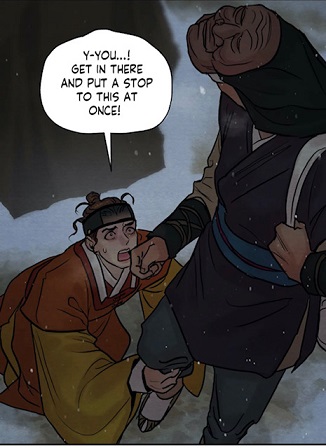 (chapter 100)
 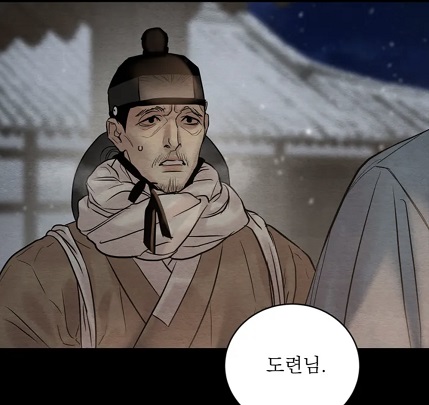 They are all carrying the white bag on their back… and they are about to depart! Kim wished to leave the propriety with his master under the pretense that he was bringing misfortune to the painter. All this proves that the doctor is far from being innocent. Hence he wishes to run away. However, if he does this, this means that he exits the “play”. So he could die. Moreover, how did he know that the lord would return to the mansion with the wounded painter? I can not answer to this question with certainty. However, I would like to point out that since Min talked to someone in the shadow, it is very likely that this person had long planned Black Heart and his friend’s demise. Nonetheless, the schemers had not foreseen two three elements:
  (chapter 61) [For more read the essay “No matter what… Baek Na-Kyum must vanish”]
 (chapter 59) Lord Jang had disguised himself as Black Heart’s friend, the hanboks looked very similar.
  (chapter 99)
 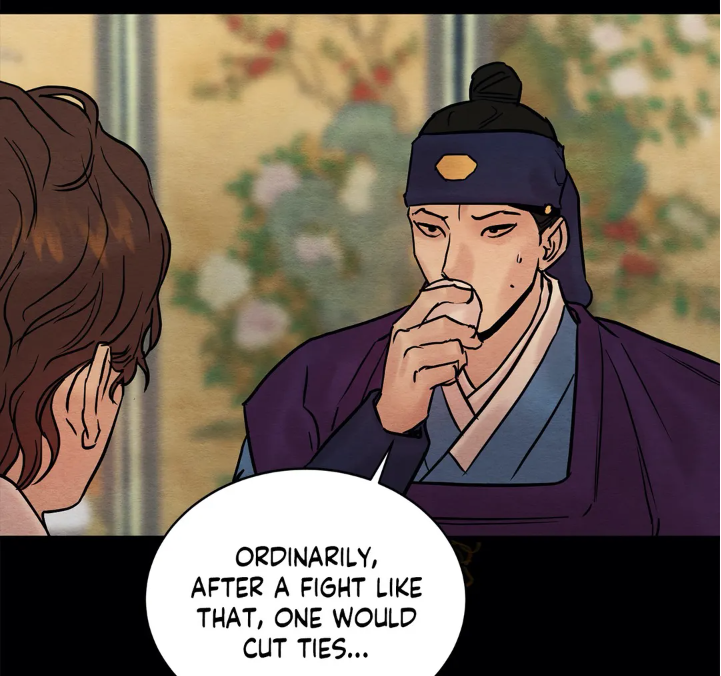 (chapter 59) The schemers mistook him for the noble with the mole.
 (chapter 61), for the colors grey-white off are only seen at the Lee’s.
  (chapter 9)
  (chapter 18, Lee Jihwa’s spy)
  (chapter 41)
  (chapter 50)
 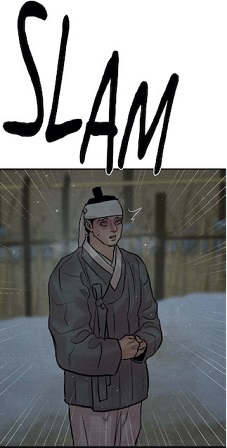 (chapter 100) And now compare these servants to the staff from chapter 97:
  (chapter 33) Yet, the painter survived, hence the doctor has every reason to run away. His complicity could come to light… on the other hand, the moment he leaves Yoon Seungho’s side, he is no longer protected. The reason is simple. He owns a part of the truth, and what the schemers are attempting to do is the exact opposite: burying the truth so that their act is not discovered. And now who participated in this huge “drama”? The list of the suspects is quite long… Father Lee
  (chapter 82), lord Yoon Chang-Hyeon
 (chapter 86), the other physician
  (chapter 74), “lord Song”
 He is on the ground, his face bruised and bloody, while he is asking an anonymous man for help. He is mentioning the shrine. As he is wearing the same hanbok, we can definitely assume that this scene takes place during the same night. The irony is that each time Byeonduck offers a new piece of a puzzle, she also creates a new riddle or mystery. How did the young master get wounded in the first place? And who is the person facing lord Shin?
  (Chapter 59)
 (chapter 66) The size and length of the protections and the cords around the pants were different. Besides, the masks were also different due to the form of the mouth..
  (Chapter 61)
  (chapter 61) Finally, I had also detected his presence next to the barn because of a time jump. First, the manhwaphiles saw Lee Jihwa sitting on the floor,
  (Chapter 60), then shortly after he was standing at the entrance of the storage room holding a fireplace poker!
  (chapter 60) His position indicated that the young master had shortly left the building. However, the readers had not witnessed his move, for the author had diverted their attention by exposing the character‘s inner thoughts. He was recollecting the past, while talking to himself.
 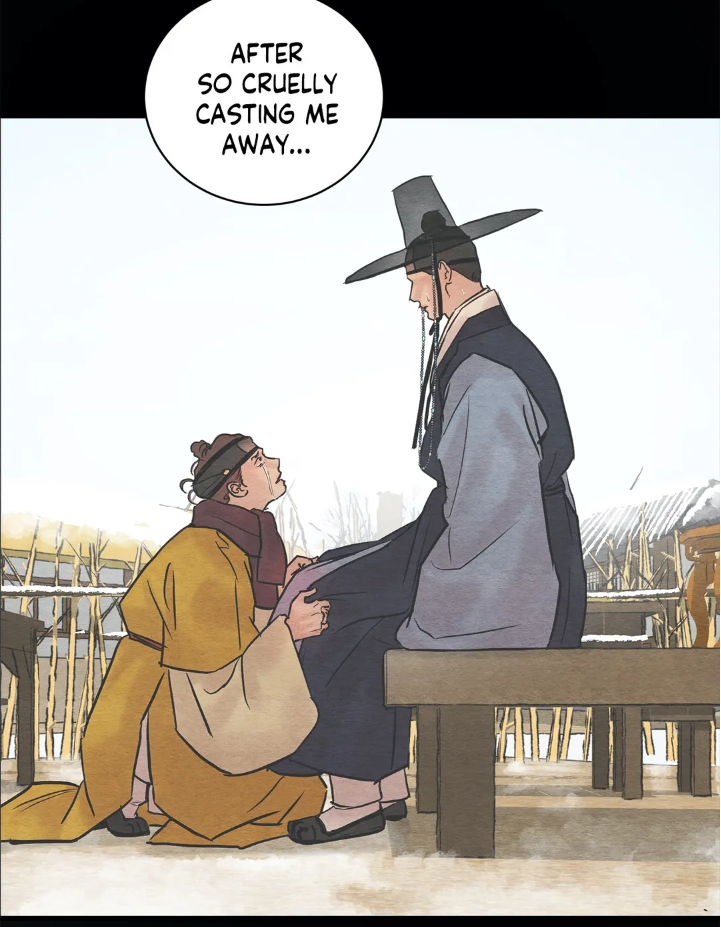 (chapter 60) However, how did the fire poker end up in his own hand? The last time this tool was seen, it was in the kitchen.
  (chapter 60) As you can see, each image has its importance! However, I doubt that the upset aristocrat had this sudden idea and returned to the kitchen and take the fire iron. His mind and heart were definitely elsewhere, while such an action exposes the intention of hurting someone. Jihwa was acting, as if he was in trance, the moment he saw the hickey and heard the painter’s scream. His long lasting stupor was visible in this image.
  (chapter 60) That’s the reason why I had developed the theory that someone was hiding in the shadow, next to the barn and observing the evolution of the event. [For more read the essay “
 (chapter 57) It is because they serve as a clue for unveiling the truth.
  (chapter 62) It is the same furnace! 😨We all assume that the lord prepared the fireplace, because he put his clothes on his lover. But is it true? We were all jumping to this conclusion, but actually we never saw it. Our brain was led to fill the blanks.
  (chapter 61) Finally, the readers were all assuming that the butler had never entered the storage room due to this image and his action before.
 (chapter 61) But is it true? He could have opened the door before, and go to the lord in order to explain his intervention. Faking his concerns for the painter. Why would he place the fireplace there? He wished that the warmth from the fire would wake up the painter. Hence he remained close to the gate of the storage room. That way, he had a reason to visit his master. Moreover, the author exposed that the valet had been keeping an eye on his master for a while too.
  (chapter 62) Because the valet went to his master, we got the impression that the valet had followed his master’s instructions.
  (chapter 61) In fact, this request could be perceived differently. The lord had seen the butler’s intervention, hence he expressed this wish. From my point of view, the butler must have brought the fireplace to the barn, and he left the poker there on purpose. I am quite certain that some people will think that I am again exaggerating. But why did the butler put a fireplace with a fire iron in the lord’s room, when the coal was not properly lit?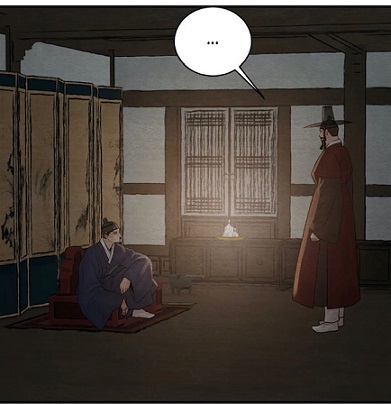
 (chapter 86) Compare the fire to this one:
 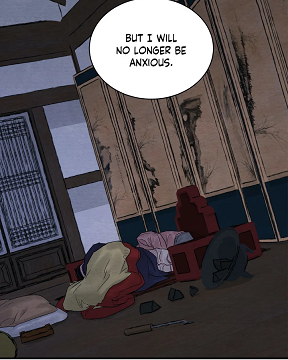 (chapter 88) Consequently, I am suspecting that Kim had expected an outburst from Yoon Seungho. The latter could hurt his father with the fire iron. But none of this happened, for the lord preferred playing a comedy.
 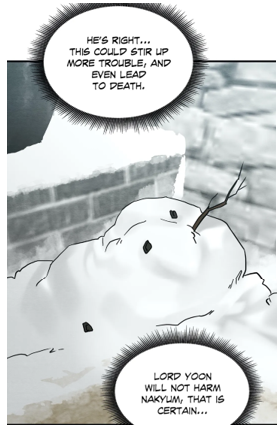 (chapter 65) He had expected that the lord would hurt the main lead. But how was he supposed to harm Baek Na-Kyum in the end? With the fire iron… This signifies that he had been present in the barn during the abduction, and even knew the place of the sequestration. Thus he took the furnace and the fire iron to the shed.
  Compare his face to the painter’s who got wounded by wooden sticks.
  (chapter 99) Besides, this theory also explains why the shrine is set on fire.
  (chapter 103) The fire iron is connected to a stove. Finally, I would like to outline the absence of the furnace in the shrine, though it was very cold outside.
 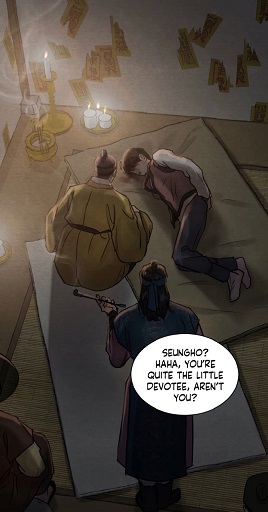 (chapter 99) So when the lord said this to his lover
 (chapter 60)
  (chapter 60) At no moment, he was told that his childhood friend had been brought to the physician’s. He just heard him leaving. Moreover, the joker never mentioned the place where the couple was fooling around.
  (chapter 60) He didn’t even admit that he had seen them himself. These were memories from someone else! One might assume that these could represent the criminal’s recollection, but I don’t think so. He arrived much later to the physician’s house. If he had been present right from the start, he could have kidnapped Baek Na-Kyum on his way to the restroom.
 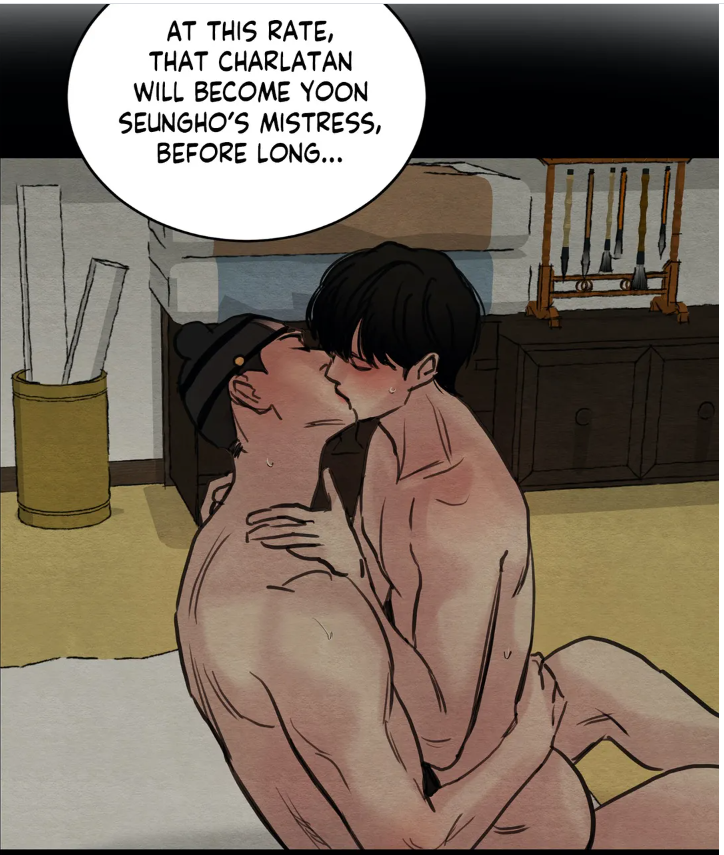 (chapter 43) Here, he had visited the place, hence he could imagine what had happened, though he never saw their encounter according to me. [For more read the essay “
 (chapter 58) He had left the bucket of water in the patio! But note that when the painter left the room, the item had simply vanished.
  (chapter 59) The painter was not supposed to detect his presence.
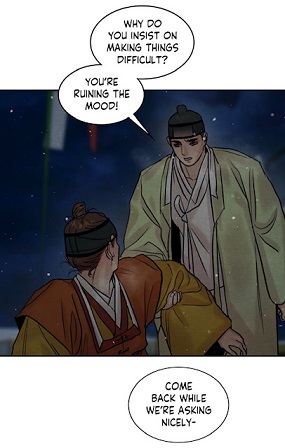 (chapter 100) The manhwaworms can grasp the similarities. Back then, the lord had refused to help Baek Na-Kyum, thus he was even encouraging Lee Jihwa to return to the shrine. Hence he had acted as a willing accomplice and perpetrator. Thus his karma is to be denied any assistance, he is punished the same way than his friends, Min and the other nobles. Finally, observe that the red-haired master
  (chapter 66)
 (chapter 60) hence in episode 102 they had to mask his escape, for this would have exposed the involvement of other people, like Lee Jihwa, the doctor with the drugs and Heena. And now, you have the explanation why the shadow hidden behind the tree had put mattresses on the soil. The desertion and survival from lord Shin should not be detected. But who is this person facing the weak lord?
  (chapter 7),
  (chapter 65) or boots
  (chapter 13)
  (chapter 77) As you can see, the wooden stocks were present during the first straw mat beating.
  (chapter 83) As you can detect, I see a strong connection between the new panel and the hunt from chapter 83. And here we have 3 people again.
  (chapter 66) Finally, when her brother was on the verge of getting abducted, she saw him lying unconscious with a bloody face. However, she never considered it as an abduction, for his hands and feet were not tied up.
  (chapter 99) and bothered her, could only be perceived as real at the end. But this means that while Yoon Seungho had murdered the nobles, there was someone hiding in the shadow
 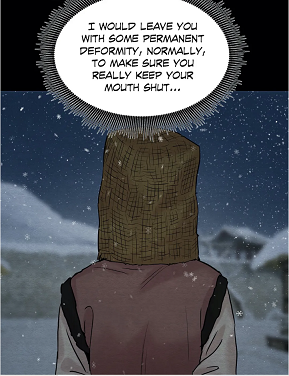 (chapter 66) However, his new attempt to have the painter vanished failed again.
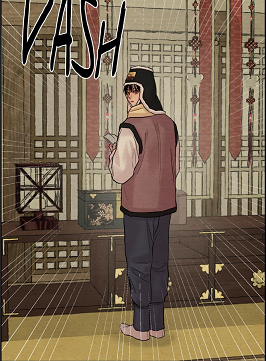 (chapter 97) It could be the same, though I have my doubts. Secondly, I suddenly got aware that the painter had 3 different grey pants at least.
  (chapter 4) This one had a cut just below the knees, though the color is much brighter.
  (chapter 84) This is the third one I detected, as the shape of the pants diverge once again. This explicates why Baek Na-Kyum chose to change his clothes before leaving the mansion.
  (chapter 97)
  (chapter 83) What did the lord see back then? Three shadows, two men wearing a gat and one caught in the middle with a topknot. Since I consider Yoon Seungho as a shaman, I believe that this vision was not only referring to the past and the incident in the shrine. It exposes the immutable truth, the involvement of three people, either. This is no coincidence. Thus imagine one moment that this illusion was referring to lord Shin’s murder. He is about to get murdered because of a new conspiracy. From my point of view, the man is disguising himself. However, I doubt that he is wearing the lord’s boots. The latter could be “couple boots”, just like the lord and the painter had couple hats.
  (chapter 91) And note during that day, Baek Na-Kyum was called sir due to his hat and clothes.
  (chapter 91) However, if the woman had paid attention to his shoes (mituri), she would have realized that our beloved painter is just a low-born. One might think that I view Kim as the one facing lord Shin.
  (chapter 54) But the readers should question themselves this: why did Kim dress like this in the first place? From my point of view, the schemers have already planned to frame Baek Na-Kyum for the murder of the nobles and even of Jung In-Hun. Kim is trying to separate the couple so that the artist can be arrested easily and sentenced immediately. By burning the place, the evidence that Baek Na-Kyum was a victim vanished. That’s how they can manage to turn a victim into a perpetrator. They wanted to erase every trace of the crimes, but then the return of the painter will force them to change their plan. The fire can help them to turn Baek Na-Kyum into a scapegoat. That’s the reason why the anonymous shadow is wearing clothes similar to the painter’s. No one should recognize him. Later, Baek Na-Kyum can be “identified” as the culprit. And any blood trace on his clothes could serve to incriminate the painter. They could use the resemblance of the clothes as a proof for his crime. That’s the reason why lord Shin had to die in the end. And if lord Shin never doubted this person, I am suspecting that the latter is working with the authorities. Kim is not the only suspect, for according to me, there always exist a conspiracy of 3 and even 5 people. This observation leads me to create a list of suspects. First of all, Yoon Seungho’s confession to the learned sir should help us to determine the schemers and culprits.
  (chapter 44). A synonym for old bearded men is “elders”. The latter are supposed to serve as role models. That’s the reason why the young man didn’t suspect the man. With his beard, he must have oozed “responsibility” and even “selflessness”. But who are the suspects?
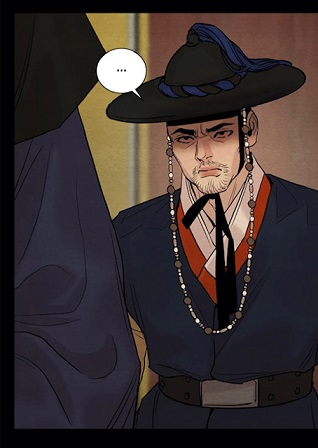 from the bureau investigation is definitely involved. Thus he misled Yoon Seungho. Besides, observe that the officers are connected to fire!
  (chapter 94) Secondly, his explanation implied the involvement of a physician.
  (chapter 75) Finally, why was the doctor never brought to the mansion again after his last visit in chapter 57? And it looks like he was not there to treat Baek Na-Kyum.
  The latter is suffering from PTSD. Thus the painter had a nightmare. Hence I have the impression that the butler’s intervention and suggestion to Yoon Seungho will fail. The lord won’t be able to leave his side. Moreover, I would like the readers to recall that when Baek Na-Kyum got sick, a different physician was fetched.
  (chapter 33) Different clothes displays a different identity. From my point of view, the doctor doesn‘t want to be connected to Yoon Seungho. Finally, don‘t you find it weird that he was not by his side in chapter 57? He literally abandoned the young master in the room with the painter
 (chapter 57), though the latter was a patient too. He had a wounded wrist. The physician should have controlled Yoon Seungho’s fever, brought him water and even an infusion. His absence and passivity caught my attention. So what was he doing in the kitchen? Finally, the doctor is also connected to the shaman. Not only he mentioned him, but also there is the symbol of shamanism in his kitchen. Why did the gods want our couple to have their first “true” love session at the physician’s office? Somehow, it was to confront him with the truth. Finally, don’t you find it weird how Kim reacted
 (chapter 82), when the new version of Deok-Jae made the following suggestion to Kim:
  (chapter 82) Hence the doctor is not off the hook, quite the opposite.
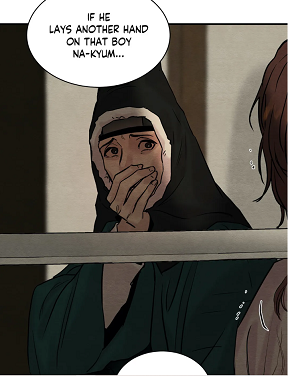 (chapter 67), and discovered Lee Jihwa’s sodomy which was supposed to be a secret. The father is well aware that the main lead’s suffering is linked to the young master’s sexual orientation, which the father had always denied. His involvement could be detected, when he allowed one of his servants to be dragged to the gibang.
 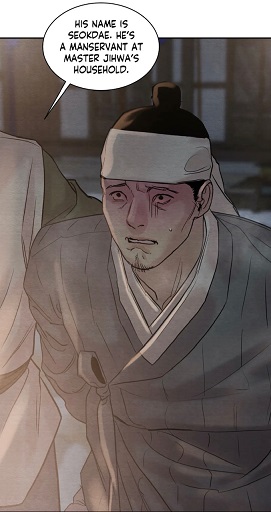 (chapter 99) Finally, The Joker also heard father Lee’s humiliation and powerlessness.
 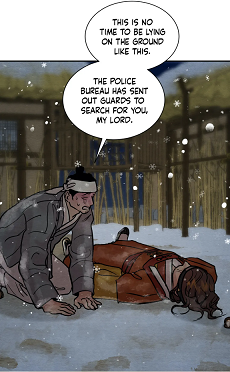 (chapter 101) Thus the fire could be seen as a desperate measure to cover the Lees’ culpability.
 The manhwalovers could barely see Yoon Seungho’s face, for he was surrounded by darkness. When I saw it, my first thought was to associate the protagonist to “Sleeping beauty”. He had the same expression than in the bedchamber, when he was sleeping totally relaxed.
 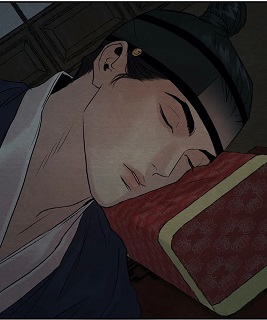 (chapter 87) He was not tormented by a nightmare, like the painter discovered it in chapter 38:
  And the darkness reminded me of the forest of thorns and as such of the curse put on the princess. The darkness, the metaphor for the forest of thorns, is the reason why the lord felt trapped and suffocating in his torment.
  (chapter 86) This contrasts to the princess’ situation, for the latter had no idea about the existence of the prison. It only appeared, when she fell asleep. Moreover, in this picture
 (chapter 94) I would like to point out that the artist has always associated this satellite to a source of joy and love, like we can detect it here.
  (chapter 94) Finally, Talia could get liberated from her curse thanks to her children. The splinter of flax got removed from her finger, the moment the babies were sucking on them. This signifies that she got revived thanks to love and life. Moreover, she woke up, the moment the source of her pain was removed. This observation leads me to the following conclusion: the noble can only be completely freed from this darkness, the moment his suffering is removed and as such revealed!! This means that Yoon Seungho will be able to voice his misery and denunciate the crimes he was exposed to. He will be able to identify the persons responsible for his suffering. He might know a name, lord Song, but he has no idea about his true identity. That’s how his burden will be erased. Like mentioned above, the noble’s physical and sexual assault will be brought up to light. That’s the reason why the new image announcing season 4 is so dark. They represent a reflection from Yoon Seungho’s past and torment.
  (chapter 38) I thought that the couple would share the bed, thus the lord could relax. He felt protected by his lover. In other words, I was already envisioning that this scene is a reflection from chapter 97/98, for the couple had not been able to sleep together.
 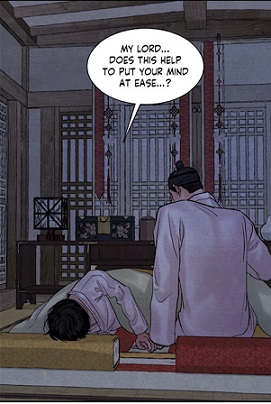 (chapter 97) However, the moment Lezhin published the second panel
 , I realized that this illustration was referring to a different element in the same scene: separation. Thus I deduce that the embrace during the sleep must have happened before, for the noble’s eye has no dark circle. He looks rested and relaxed.
  (chapter 83) In Painter Of The Night, the hunts were always used to provoke a quarrel and as such a separation, but it never worked. This is important, because this shows that the couple from the Italian story had to separate. It is now time to reveal the whole quote from Milner:
  (chapter 97) Back then, the lord was scared, for he still doubted the artist’s love confession. It was too beautiful to be true! However, back then, the artist never doubted his own resolution, thus he gave comfort to his lover by giving him his hand.
  (chapter 97)
  (chapter 97) In other words, he desired that the painter would follow his requests and as such he should vow him loyalty and trust one more time. The irony is that the lord was actually the one breaking his vow, for he left his lover without saying goodbye. Thus I conclude that in this scene,
  (chapter 78) This means that the lord is smelling his partner’s hair helping him to remain strong and calm. He is now trying to memorize his lover’s odor so that he can forget this stench, a remain from the past:
 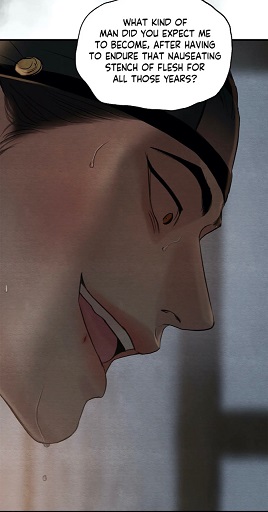 (chapter 86) This can only help him to defeat his “opponents”. Finally, in different analyses, I had already interpreted that Baek Na-Kyum was embodying memory, whereas the lord stands for truth. The image is actually a reference to recollection and as such honesty. There is no ambiguity that both men are trusting each other, but the painter is crying, for he fears for his lover’s life either. Yoon Seungho is leaving him in order to protect him in my eyes. And this leads me to the following deduction. When the lord is about to leave, Baek Na-Kyum is not left in the dark contrary to episode 97. He knows the whole truth, for the lord must have confessed to him. We could say that he is not leaving without a word
  (chapter 23)
 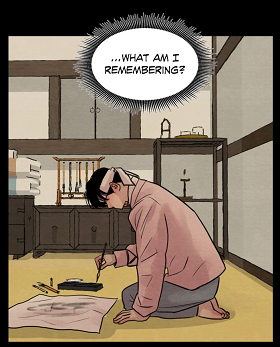 (chapter 24) In other words, this announces the return of Yoon Seungho’s passion for painting! And it is the same for the painter. The erotic picture should reflect their love for each other, created based on memories. At the same time, this can only push the noble to demonstrate his talents to others refuting all the negative rumors about him: he is intelligent and possessing his whole mind. Furthermore, this can help him to reminisce his tragic past, what led him to his downfall and suffering. This signifies that he will be able to confront his past and his memories. He will be able to identify the rape, and Kim already exposed the truth to Yoon Seungho, when the former suggested him to ensure the painter’s consent. This shows that Kim was well aware of the sexual abuse, but he chose to never divulge the verity. On the other hand, the pedophile thought in the past that the young master would never forget him due to his position, thus he had no problem to leave Yoon Seungho behind and make no real promise. Departure was never painful for him… hence this quote (“Promise me you’ll never forget me because if I thought you would, I’d never leave.”) will become a reality for the mysterious lord Song, but it is already too late. In fact, the gods punished him by making Yoon Seungho suffering from amnesia. He is not attached by loyalty to the pervert.
  (chapter 57) That’s the reason why I believe that when an incident occurred during that night
 (chapter 11) However, there is no ambiguity that the painter can only fear for his lover’s life. The closed eye contradicts the haunted gaze in the shaman’s house.
  (chapter 21) This gesture symbolizes the epitome of the noble’s affection and the desire to give “happiness”. Then in the bedchamber, he did it in order to console his partner.
  (chapter 82) With his kiss, he was asking for his forgiveness. This means that the kiss on the eye serves as reassurance and comfort either. Thus we had this scene in the study:
  (chapter 84) The lord had kissed his lover there, because he was voicing his attachment and desire to redeem himself and to comfort the artist. As you can see, it was a combination of all the previous significations. Yet, the lord had not grasped the “gravity” of his “wrongdoing”. Thus the kiss was associated a certain playfulness in the study. As a conclusion, this image
 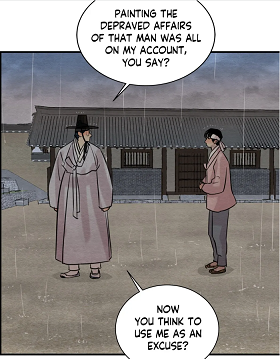 (chapter 19) He came to feel more safe during the night, until he met Yoon Seungho in season 1. From that moment on, his night life got slowly affected. That’s how he discovered that night could be associated to pain and agony too. Yet, deep down, he still felt safe by the noble’s side. As you can see, the new illustration
  (chapter 51). Hence the butler could perceive this promise as a betrayal from Yoon Seungho. The latter is slowly forgetting the valet, he is no longer seeking his assistance and his side.
  Bebebisous33s' analyses in K-Dramaland and Manhwas