

Please support the authors by reading Manhwas on the official websites. This is where you can read the Manhwa: Jinx But be aware that the Manhwa is a mature Yaoi, which means, it is about homosexuality with explicit scenes. Here is the link of the table of contents about Jinx. Here is the link where you can find the table of contents of analyzed Manhwas. Here are the links, if you are interested in the first work from Mingwa, BJ Alex, and the 2 previous essays about Jinx The Sweetest Downfall Ever and Hot 🔥Sparks ⚡, Feverish 🌡️Reality (part 1)
It would be great if you could make some donations/sponsoring: Ko-fi.com/bebebisous33 That way, you can support me with “coffee” so that I have the energy to keep examining Manhwas. Besides, I need to cover up the expenses for this blog.

After the Spark: What Changes Once the Circuit Is Closed?
When episode 86 ends 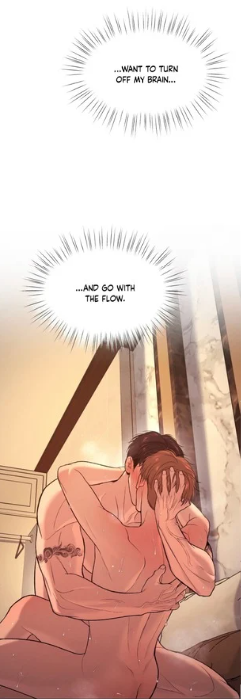 (chapter 86), it does not close the night through narrative resolution. There is no statement, no promise, no verbal seal. And yet, for many Jinx-philes, the final panel refuses to let the scene dissolve. What remains is not heat, not tension, not even tenderness — but circulation.
What caught my attention, on rereading the episode with some distance, is precisely this ending. In the final embrace and kiss, bodies are not merely touching; they are aligned. Kim Dan is neither collapsed nor clinging. Joo Jaekyung is neither looming nor enclosing. Their torsos meet without compression, their heads incline toward each other, and the kiss does not interrupt movement — it completes it. The image does not suggest release, but continuity. Not dispersal, but return. In other words, the final embrace functions as a closed electric circuit, while the kiss operates as the activating spark — not a release, but the moment the current begins to flow.
This detail matters because it reframes the entire night. Earlier nights in Jinx burned intensely and then vanished. This one does not. Heat exhausts itself. Electricity does not. It remains as potential — stored, latent, waiting to be activated. When readers feel that “something has shifted,” they are not sensing emotional climax, but a closed circuit. The night ends, yet nothing needs to be said, because something has already been set.
Under this new light, my perception of relationships in Jinx changed. What had long been read through the language of excess — desire, domination, sacrifice, endurance — began to appear instead through the logic of current: circulation, interruption 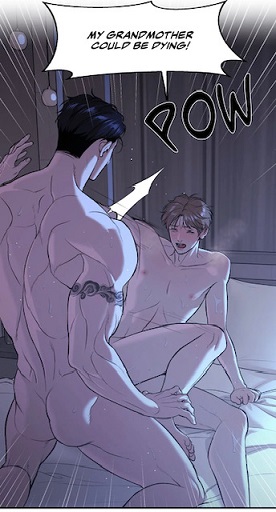 (chapter 21), overload
  (chapter 33), short circuit
  (chapter 51),
 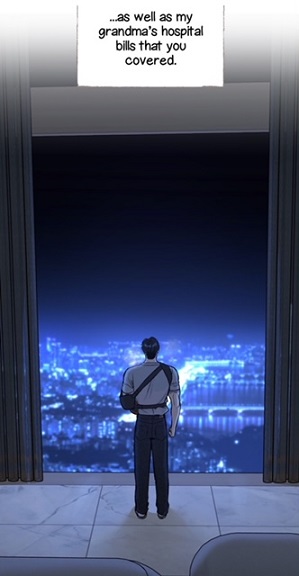 (chapter 53) reset. And once that lens is adopted, it becomes impossible to limit the consequences of episode 86 to the couple alone. Because a closed circuit does not only affect those directly connected to it. It alters the surrounding system.
In the first part of Hot Sparks, Feverish Reality, the focus lay on how this night functions in itself: how electricity replaces fire, how illusion gives way to continuity, how silence becomes embodied communication. That analysis allowed us to rethink the nature of the moment. But once the circuit is closed, another question inevitably arises — quieter, but far more consequential: What changes once the night is over?
If the Paris night is not a dream, not a relapse, and not a miracle, then it must be understood as a reconfiguration of conditions. Memory begins to behave differently. Surprise no longer carries the same meaning. The past can no longer be invoked automatically as justification. And responsibility — long deferred — becomes unavoidable.
This second part of the essay therefore turns toward repercussions. To approach them, the analysis will move through four interlinked angles. First, it will examine surprise, returning to the sudden kiss in episode 86. By placing this gesture alongside earlier moments where surprise meant threat or emotional risk, the essay will show how the same structure acquires a different meaning once agency is restored — and why this matters. Second, it will address recognition without erasure, focusing on the line 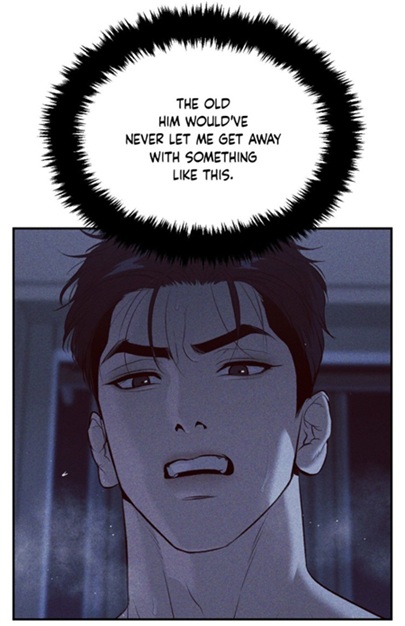 (chapter 86). This section will explore how acknowledging change without denying past harm opens a new ethical position — one that prevents memory from being weaponized, while still preserving responsibility. Third, the analysis will turn to conversion, revisiting earlier nights marked by failure, asymmetry, and isolation. Rather than cancelling them, episode 86 absorbs and transforms them. This is where forgiveness, reflection, and the first true encounter with consequence quietly enter the narrative. Finally, a new section will widen the lens further by examining shared experience and memory
  (chapter 53), particularly through Kim Dan’s relationship with his grandmother. Here, the focus will not be accusation, but contrast: between memories carried alone and memories held together; between cycles of repetition and moments of presence; between a worldview structured around endurance and one shaped by circulation. The Paris night does not only affect how Kim Dan sees Joo Jaekyung (chapter 86) — it changes how he may begin to situate himself within inherited bonds and unspoken expectations.
The Paris night did not resolve the story. It changed the system in which the story must now continue. And like electricity itself, its importance will only become fully visible when something — or someone — can no longer function as before.
Surprise Reversed: From Threat to Agency
To understand why the kiss in episode 86 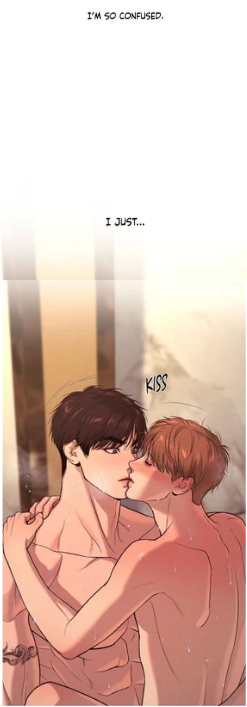 (chapter 86) carries such weight, we must return to the origin of kissing itself in Jinx. Because surprise, in this story, is not an abstract theme. It has a history. And that history begins with a body being caught off guard.
The first time Kim Dan is kissed by Joo Jaekyung, it is sudden. 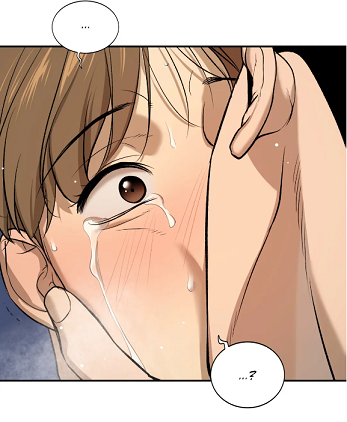 (chapter 14) There is no warning, no verbal cue, no time to prepare. The kiss arrives as interruption. It is not negotiated; it is imposed. Hence the author focused on the champion’s hand just before the smooch.
 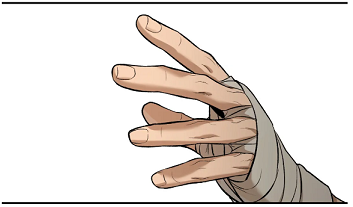 This moment matters far more than it initially appears, because it establishes the template through which Kim Dan first encounters intimacy.
 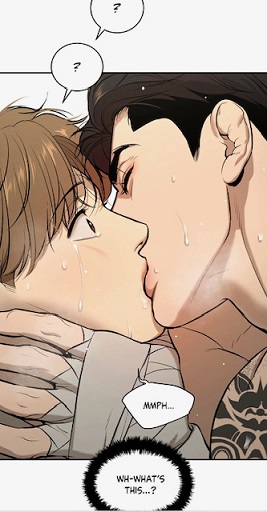 (chapter 15) Affection does not emerge gradually. It breaks in.
Kim Dan reacts accordingly. Shortly afterward, he articulates a need that is easy to overlook but fundamentally revealing: he asks Joo Jaekyung to tell him before kissing him.  (chapter 15) He needs preparation. He needs time to brace himself emotionally. This request reveals two aspects. First, he connects a kiss with love. On the other hand, the request is not really about romance; it is rather about survival. Surprise, for Kim Dan, has already been coded as something that overwhelms the body before the mind can intervene.
And yet, what follows is one of the most striking contradictions in the narrative. Every time Kim Dan initiates a kiss himself  (chapter 39), he violates his own request.
His kisses arrive suddenly. 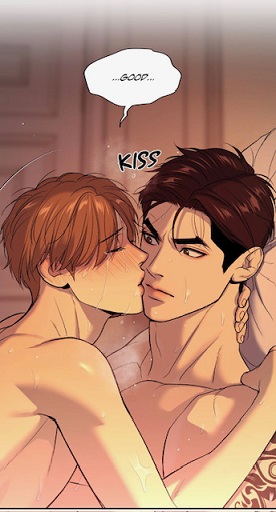 (chapter 39) They are unannounced, often landing on unusual places (cheek or ear) (chapter 39)
  (chapter 44). They often take place under asymmetrical conditions — when one of them is intoxicated, confused, or emotionally exposed. Sometimes they occur without full consent, sometimes without clarity. In chapters 39 and 44, kisses surface precisely when language fails or consciousness fractures. It is as if Kim Dan has internalized a rule he never chose: a kiss must be sudden. Observe how the champion replies to the doctor’s smile and laugh: he kissed him, as if he was jealous of his happiness.
 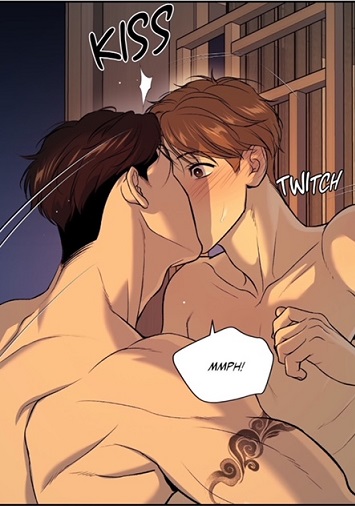 (chapter 44) That’s how I came to realize that the kiss in the Manhwa is strongly intertwined with “surprise”. This is the missing link.
Kim Dan does not merely endure surprise; he learns it. Because intimacy entered his life through interruption  (chapter 2), he comes to reproduce interruption as intimacy. He knows that surprise destabilizes him — that is why he asked for warning — but he has no other model. What overwhelms him also becomes what he reaches for. Surprise is both threat and language.
This paradox explains much of Season 1. Surprise is repeatedly associated with danger  (chapter 3): the sudden call from the athlete,
  (chapter 1), the offer of sex in exchange for money (chapter 3), the contract that turns availability into obligation
 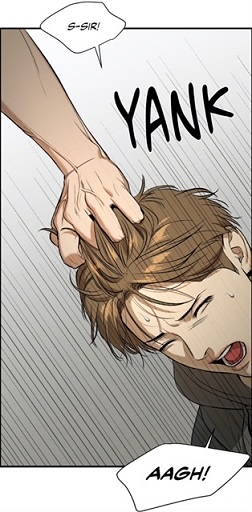 (chapter 6), the switched spray
  (chapter 49), the sudden changes in rules. These moments strip Kim Dan of anticipation and agency. His body reacts before his will can engage. Surprise equals exposure.
And yet — this is where the narrative becomes uncomfortable — these same surprises also pull him out of ghosthood.
Before Joo Jaekyung, Kim Dan lives in a state defined by repetition and duty.  (chapter 1) His life is governed by “always”: always working, always returning, always responsible. He lives for his grandmother. Nothing unexpected is allowed to happen, because nothing unexpected can be afforded. This is safety through stasis. Presence without experience.
But this does not mean that surprise was absent from his past. On the contrary, when unpredictability did enter Kim Dan’s life earlier, it came in its most destructive form: through the loan shark, Heo Manwook and his minions. His appearances were sudden, intrusive, violent.  (chapter 5)
  (chapter 1) They shattered routine rather than enriching it. Surprise, in that context, did not open possibility; it threatened survival. It meant debt, coercion, fear. And precisely because of that, it could not be integrated into memory as experience — only repressed as trauma.
This distinction matters. When Kim Dan’s grandmother is hospitalized and removed from the house, the loan shark also disappears from daily life. His violence becomes something that can be pushed aside, denied, or avoided 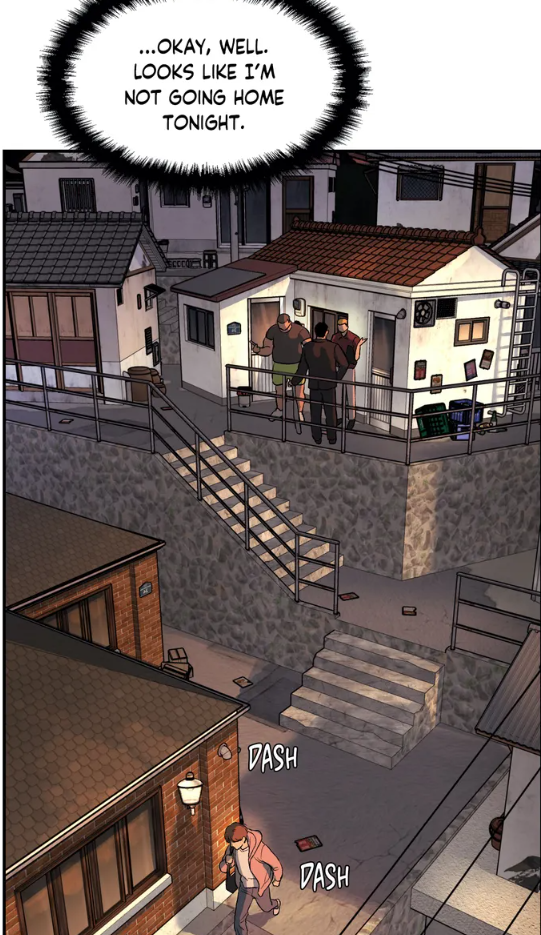 (chapter 1), if he doesn’t return home. Surprise, in its earlier form, is excised from the household. What remains is a world of repetition and endurance — safer, but lifeless.
Seen from this angle, Joo Jaekyung does not introduce unpredictability into Kim Dan’s life from nothing. He replaces it. 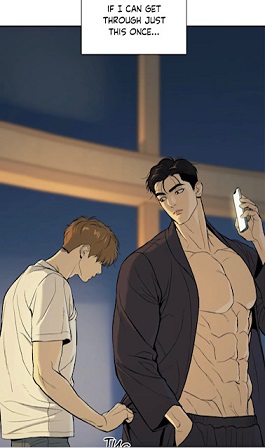 (chapter 2) but in a fundamentally different form.
The loan shark embodies surprise without negotiation.  (chapter 11)
 (chapter 11) His appearances are sudden, his demands non-discussable, his violence immediate. He does not ask; he enforces. Surprise, under his rule, eliminates speech. It leaves no space for argument, no room for clarification, no possibility of consent. One endures, or one is punished.
Joo Jaekyung, by contrast, introduces unpredictability through contracts and negotiation. 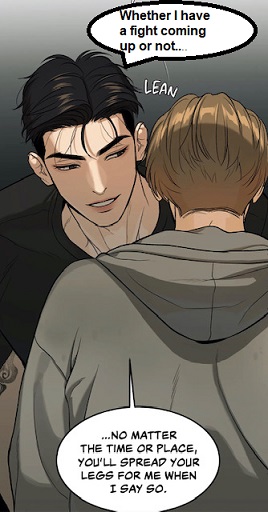 (chapter 6) Even when power is asymmetrical, even when the terms are coercive, speech is required. Conditions are stated. Rules are articulated. Kim Dan is forced to listen, to answer, to argue, to object. He must speak.
This difference is decisive. Surprise no longer arrives solely as terror; it arrives as confrontation. Kim Dan is not merely acted upon — he is compelled into dialogue. The body is still exposed, but language re-enters the scene. Where the loan shark silenced, the athlete imposes discussion.
This is why Joo Jaekyung can occupy the same structural position as the loan shark — and yet not replicate him. Both disrupt repetition. Both break the closed circuit of endurance. But only one does so in a way that keeps Kim Dan within the realm of human interaction. Even coercive negotiation presupposes a subject who can respond.
This also explains the later confrontation in the house.  (chapter 17) The two figures cannot coexist because they represent mutually exclusive regimes of surprise: one that annihilates speech, and one that forces it into being. In other words, only one allows experience to be lived rather than survived.
Surprise enters Kim Dan’s life violently, but it does not remain mere rupture. (chapter 2) It functions as negative charge — an abrupt influx of energy into a system that had been closed for too long. Fear, anger, desire, attachment appear not as orderly developments, but as shocks. These experiences are unstable, often painful, sometimes destructive  (chapter 51) — yet they are unmistakably his. They mark the moment when something begins to circulate. (chapter 51)
This distinction is crucial. Before Joo Jaekyung, Kim Dan’s life operated in a static loop, governed by repetition, sacrifice, and gratitude. Energy was expended, but never transformed. Surprise, in its first incarnation, is therefore pure threat: uncontained, overwhelming, incapable of integration. It breaks the system without yet allowing current to flow.
What changes with Joo Jaekyung is not the presence of danger, but its conductivity. Surprise becomes ambivalent — still risky, still destabilizing — but now capable of generating movement and as such meditation. Negative charge no longer annihilates the circuit; it begins to activate it.  (chapter 27) Experiences accumulate instead of disappearing. They demand response, speech, negotiation. Life no longer consists in enduring impact, but in processing it.
This is why these experiences cannot be shared with Kim Dan’s grandmother. Her moral economy is built on infantilization  (chapter 65) and as such neutralization: suffering must be absorbed, pain must be justified, disruption must be folded back into endurance. There is no place for charge there — only for dissipation. What Kim Dan lives through with Joo Jaekyung follows a different logic altogether: not sacrifice, but circulation; not repetition, but conversion.
Surprise thus becomes the hinge not between danger and safety, but between static survival (–) and relational movement (+). And once that conversion begins, the past can no longer be returned unchanged — nor can it be shared without transformation.
This is why Kim Dan falls in love  (chapter 41) not despite surprise, but through it. Not because dominance is romanticized, but because surprise is the first force that treats him as someone to whom things can happen. And don’t forget that for him, a kiss symbolizes affection. Even negative experiences generate subjectivity. They prove that he exists beyond function.
Seen through this lens, Kim Dan’s habit of surprising Joo Jaekyung with kisses (chapter 39) — on the ear or the cheek — is no longer random or contradictory. It is learned behavior. He has absorbed surprise as a mode of relation. What was once done to him becomes something he does, imperfectly and often prematurely. These kisses are not about dominance. They do not corner or silence. They test connection. They ask, without words: Are you still here?
But until episode 86, this structure remains unresolved. Surprise exists, but it is never fully safe.  (chapter 85) Kim Dan either endures it or reproduces it under unstable conditions. Agency is partial. Meaning collapses afterward.
This is what makes the doctor’s kiss in Paris categorically different. (chapter 86)
Formally, it is still sudden. Kim Dan does not announce it. He does not negotiate it verbally. But structurally, everything has changed. For the first time, surprise is not imposed on him — and it is not enacted from confusion or imbalance. It is chosen. Kim Dan is clear-minded enough to recognize both his desire and his uncertainty. He is not dissociating. He is not reacting. He is deciding to remain present despite risk. And the response confirms the shift.
Joo Jaekyung does not neutralize the kiss with passivity  (chapter 39), irony
 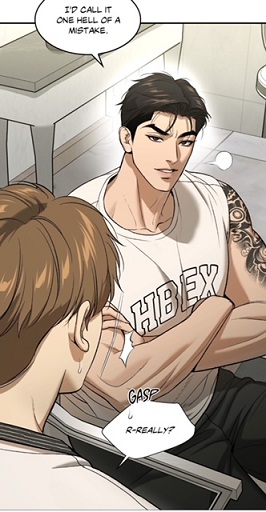 (chapter 41) or rejection
 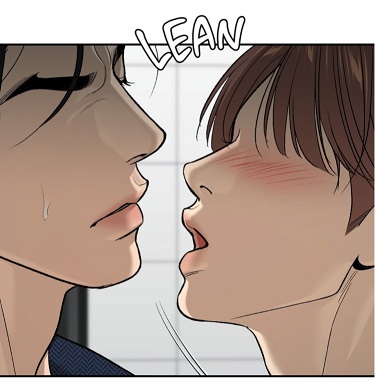 (chapter 55). He does not retreat into his habitual “it’s nothing” or “never mind.” He does not reinterpret the gesture as convenience or reflex.
  (chapter 86) He kisses back while looking tenderly at his partner. He holds Kim Dan’s head gently. He can only see such a gesture as a positive answer to his request: acceptance and even desire. Surprise is not punished. It is received.
This is the moment where the meaning of surprise reverses. Surprise no longer equals threat. Surprise becomes agency. And that’s how I could discover a link between the kiss and the doctor’s birthday present, the key chain.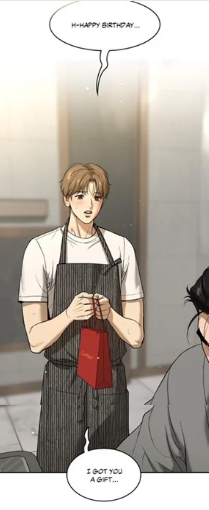 (Chapter 45) This time, the athlete not only accepts the present (the kiss), but but also expresses “gratitude” by kissing back actively. (Chapter 86) This means that the athlete is recognizing the existence of feelings.
The kiss does not erase the past. (Chapter 86) It does not retroactively justify earlier violations. But it establishes a new condition: surprise can now occur without annihilation. Intimacy can arrive without silencing reflection. Experience no longer collapses into shame or disappearance. IT symbolizes a positive and enjoyable moment.
This is why the kiss matters more than any spoken line in the episode. It is not simply romantic. It is structural evidence that the logic governing their interactions has changed. Surprise now operates within a closed circuit of consent and presence.
Kim Dan is no longer a ghost enduring interruptions. He is a subject capable of initiating them. He has learned surprise — and now, for the first time, he reclaims it. Under this new condition, the question is no longer whether surprise will hurt. It is whether life can proceed without it. And once that question is raised, the story cannot return to repetition or silence.
Recognition Without Erasure: When Memory Changes Function
What struck me next was how subtly episode 86 reorganizes the role of the past. Once surprise ceases to function purely as threat and begins to circulate, memory itself starts behaving differently. Electricity does not only move bodies; it redistributes charge. And it is precisely at this level — the level of memory and recognition — that something decisive occurs.
The line is brief, almost casual: (chapter 86) And yet it performs an extraordinary operation. Kim Dan does not deny the past. He does not soften it. He does not excuse it. Instead, he repositions it. For the first time, the past is no longer invoked as an absolute reference point, but as a differentiated state — one phase among others. Such a confession contradicts the grandmother’s philosophy: ALWAYS (chapter 65) In her eyes, she has never changed, just like her grandson. (chapter 65) If there were changes, they were associated with trouble and worries.
This distinction is crucial, because in Jinx, the past has long functioned like a blunt instrument. It has been used to fix identities  (chapter 52), justify behavior
  (chapter 57), and foreclose change. The champion’s violence is explained through reputation.
  (chapter 1) Kim Dan’s endurance is explained through obedience and debt. The grandmother’s authority is explained through sacrifice. In every case, the same logic applies: this is how it has always been; therefore this is how it must remain.
That logic is static. Electrically speaking, it is a circuit without polarity — no – and +, no tension, no movement. The past becomes a dead weight, not a source of information. It does not inform the present; it dominates it.
What episode 86 introduces is not forgiveness in the sentimental sense, but recognition without erasure. (chapter 86) Recognition means the charge of the past remains. Erasure would mean grounding it, neutralizing it, pretending it never existed. Kim Dan does neither. He keeps the – while allowing the + to emerge.
A World Without Polarity: When the Past Becomes a Weapon
This is where the electrical metaphor becomes indispensable. In a functioning circuit, negative and positive do not cancel each other out. They coexist. They create potential difference. And it is that difference — not harmony — that allows current to flow. (chapter 86) In the final panels, Kim Dan does not embrace an idealized version of the champion, nor a redeemed figure cleansed of history. He embraces Joo Jaekyung as he is now, with the knowledge of who he was before. This distinction matters. Acceptance here is not absolution. It is contact without denial.
Electric current does not pass between identical charges. It requires tension. Polarity. Resistance. The − and the + must remain distinct, or nothing moves. In this sense, Kim Dan’s embrace is not a gesture of harmony but of recognition. He acknowledges the champion’s flaws and mistakes — not to excuse them, but to stop pretending they never existed or to stop pretending to be better. What he accepts is not the past itself, but the reality that the past does not exhaust the present. That’s why he is able to stop ruminating and to follow his heart.
Furthermore when Kim Dan recognizes that “the old him” (chapter 86) existed, he does not collapse the timeline. He does not say: he was never that person. Nor does he say: he is forever that person. Instead, he introduces temporal polarity. Then and now. Before and after. – and +.
This move has immediate consequences. First, it disarms the past as a weapon.  (chapter 65) If the past is absolute, it can be endlessly invoked to invalidate the present. We have a perfect example on the beach. (chapter 65) Kim Dan is here compared to the past. (chapter 65) When Shin Okja speaks of Kim Dan as a heavy smoker, she is not recounting a neutral habit. She is anchoring him to a past version of himself — one defined through worry, decline, and deviation from the “good boy” image.
What follows is telling. She does not ask why he smoked. She does not ask what changed. She does not ask how he lived. The only question that matters to her is: “Does he still smoke?” (chapter 65)
The present is interrogated exclusively through the past. In this logic, the past functions as a fixed reference point. If the habit persists, the present confirms her narrative. If it does not, the absence is not read as growth but as an anomaly — something provisional, something that could always return. This is not concern. It is classification.
Shin Okja does not relate to Kim Dan as someone moving through phases, but as someone who must remain legible within a stable moral category. Change is not interpreted as development, but as risk. When Shin Okja repeatedly frames Kim Dan’s smoking and drinking as failures (chapter 65), she is not simply expressing concern about health. She is doing something more consequential: she is disqualifying the legitimacy of his decisions. In her discourse, Kim Dan’s actions are never treated as choices made under pressure, pain, or circumstance. 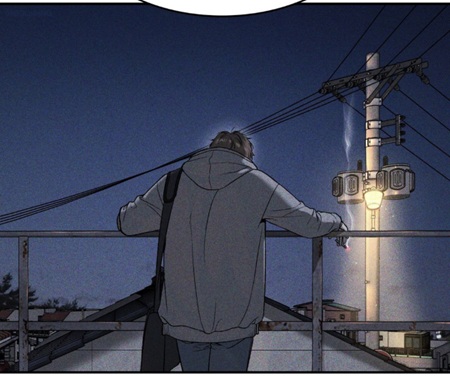 (chapter 65) They are evaluated exclusively through a moral lens. Smoking and drinking are not responses; they are flaws. And because they are framed as flaws, they retroactively define his character rather than his situation. This is where agency collapses.
Care and Choice
If every decision Kim Dan makes is already interpreted as “bad,” then decision-making itself becomes suspect. Choice is no longer a neutral capacity; it is something he is assumed to misuse. In other words, he is not someone who chooses poorly — he is someone who should not be choosing at all. Under this new light, my avid readers can grasp why the grandmother approached the champion and asked for this favor: 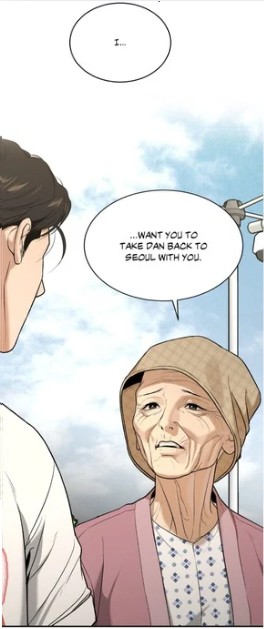 (chapter 65) Her behavior does not contradict her claim that she wants Kim Dan to “live his own life.”
  (chapter 65) It reveals how she understands such a life should be arranged. She sees herself as superior, as if she had never done any mistake, as if she had lived as a saint.
If she had truly accepted Kim Dan as a subject capable of self-direction, she would have spoken to him directly. Conversation presupposes agency; it allows disagreement, hesitation, and refusal. Instead, she chose a different route: influencing his fate behind his back. This move preserves her moral position while bypassing the risk of confrontation. It allows her to believe she is acting in his interest without ever having to acknowledge his will. That’s why she is entrusting her grandson to the athlete. 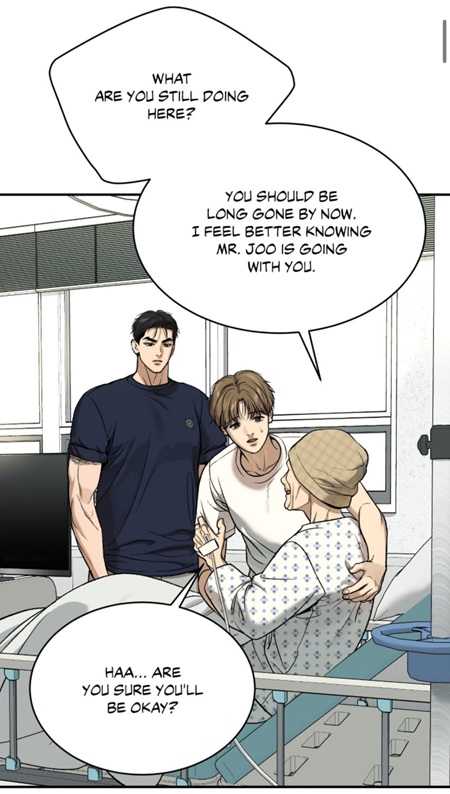 (chapter 78)
In other words, she does not imagine Kim Dan living freely through his own choices, but being placed into a better configuration by others — preferably by someone stronger, more decisive, and more visible than himself. The request to the champion thus follows the same logic that governs her judgment of Kim Dan’s habits: she does not trust him to choose, only to comply.
And this is precisely why her worldview stands in quiet opposition to what unfolds in episode 86. The physical therapist’s desires are not only acknowledged, but also respected.  (chapter 86) Once again, the “hamster” is given the opportunity not only to decide, but also to follow his heart. Where the Paris night allows difference to coexist with memory, Shin Okja’s framework collapses difference back into judgment. Where electricity requires polarity, her logic insists on sameness. Under this new light, it becomes comprehensible how doc Dan came to neglect himself. Self-care is inseparable from choice — from the belief that one’s decisions can meaningfully alter the present. If change is denied, care loses its purpose. Attending to oneself becomes optional, even suspect, because it implies a future different from the one already prescribed.
Recognition without erasure breaks that pattern. It allows Kim Dan to say, implicitly: what happened matters — but it does not get to decide everything.
Second, this recognition introduces responsibility where there was previously only fatalism. If change is possible, then it can be acknowledged. And if it can be acknowledged, it can be responded to. The past no longer excuses inaction. It no longer absolves neglect. It becomes a reference, not a refuge.
Two Versions, One Person: Temporal Polarity and Ethical Clarity
By acknowledging that there is an “old him” (chapter 86) and a present one, Kim Dan implicitly accepts that change has causes. And this is where his position shifts in a way that is easy to miss. If Joo Jaekyung has changed, then Kim Dan is not obligated to assume that he is the reason. He does not interpret the change as something he must earn or preserve through obedience.
Instead, a question becomes possible: what happened in between? And this question matters, because Kim Dan does not know. He does not know about the incident at the health center. He does not know about the slap at the hospital (chapter 52). He does not know that no one stood by the champion afterward — not even Potato.
By recognizing two versions of Joo Jaekyung, Kim Dan opens a space for inquiry rather than self-accusation. The change no longer needs to be attributed to his own sacrifice. It can be understood as something that also happened to the champion. This is not naivety. It is ethical clarity. Consequently, I perceive the night in Paris as the end of doc Dan’s low self-esteem and shame.
It also means that if anyone were to invoke the champion’s past against him — a manager, a coach (chapter 57), the system — Kim Dan can now side with him without denying what came before. The past stops being a weapon. It becomes context. This move has immediate consequences.
This shift is subtle, but it radiates outward.
Until now, Kim Dan has often carried memory alone. He remembers nights that others forget. He remembers moments that were dismissed. This asymmetry has turned memory into burden.  (chapter 44) The one who remembers bears the – alone, while the other continues forward unmarked. That imbalance is corrosive. It distorts perception. It turns even good memories sour.
Episode 86 begins to redistribute that charge. Not by forcing confession, but by establishing shared presence. Once current circulates between two points, no single node carries the full load. Recognition does not mean recounting every wound; it means no longer isolating the wound in silence.
This is why the line about “the old him” matters more than it appears. It is not merely observational. It is infrastructural. It signals that memory is no longer trapped in a single body.
And this logic does not stop with the champion. It extends, inevitably, to Kim Dan’s relationship with his grandmother, like mentioned above.
Her worldview has long been organized around moral continuity. She remembers suffering  (chapter 65), but she remembers it in a way that flattens time. Pain becomes proof of virtue. Sacrifice becomes identity.
  (chapter 65) Change is allowed only insofar as it returns to the same point. Electrically speaking, her system is grounded — all charge dissipates into endurance. There is no polarity, only repetition.
This is why the past, in her discourse, often appears as reproach. Not necessarily spoken harshly, but structurally unavoidable. You used to drink. You used to smoke. You used to be helpless. The past is not cited to understand, but to fix position. It anchors Kim Dan to a role: the one who must be protected, managed, or sent away “for his own good.”
Recognition without erasure offers Kim Dan a way out of this bind. If the past is no longer absolute, then it can be questioned. Not denied — questioned. The statement “you don’t know me and my life” becomes thinkable. Not as rebellion, but as differentiation. Kim Dan can hold the memory of his past while refusing to let it define his present. He can acknowledge the grandmother’s suffering without allowing it to dictate his future.
This is where forgiveness enters the narrative — quietly, without ceremony. (chapter 86) Forgiveness here is not reconciliation. It is not forgetting. It is not moral absolution. It is the decision not to collapse polarity. To allow – and + to coexist without forcing resolution. Forgiveness becomes a form of electrical insulation: it prevents overload, not by cutting the circuit, but by stabilizing it.
Seen this way, forgiveness is not weakness. It is structural maturity. And it has consequences. For Kim Dan, it means the past no longer monopolizes his self-understanding. He is not bound to prove gratitude through self-erasure. He can recognize care without submitting to control. He can accept gifts and help without dissolving into debt.
From Spark to Current: Why the Jinx Loses Its Power
For Joo Jaekyung, it means the jinx can no longer function as fatal explanation.  (chapter 65) Even though the word jinx is never spoken during the Paris night, its logic quietly collapses there. (chapter 86)
Until now, sex operated as discharge. 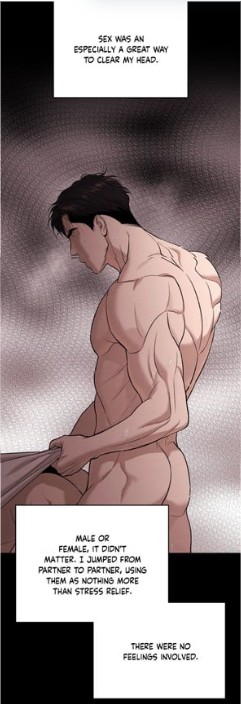 (chapter 75) In chapter 75, it is explicitly framed as a way to “clear the head”: an act designed to release pressure and return the system to zero. Partners were interchangeable. Feelings were excluded. Electricity existed only as a spark — brief, violent, and self-extinguishing. Energy was expelled, not circulated. That is the true mechanics of the jinx: power without continuity, intensity without consequence.
Paris introduces a different configuration. Sex is no longer oriented toward erasure or reset. It is no longer about escaping thought or silencing memory. Instead, it becomes a mode of presence.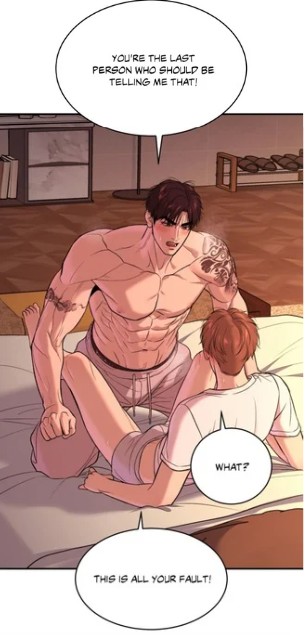 (chapter 85) Desires matter, not the match the next morning. Besides, the identity of the partner matters — not just romantically, but also structurally. Current requires two poles. It requires response. It cannot flow through an object, only between 2 subjects.
This is why the jinx does not need to be confronted explicitly to be undone. A system built on discharge cannot survive circulation. Once energy is no longer expelled but sustained, once tension is held rather than neutralized, fatalism loses its grip. The spark does not burn out; it becomes current.
And with current comes consequence. Sex no longer clears the mind; it sharpens awareness. It no longer abolishes the future; it implies one. What happens in Paris does not redeem the past — it renders repetition impossible. Reflection becomes unavoidable, not because someone demands it, but because the system no longer resets cleanly.
The jinx dissolves not through force, but through continuity. Recognition without erasure thus prepares the ground for the final transformation: conversion. Thus the story can move forward.
– and – = + : Conversion and the End of Ghosthood
Two nights once marked by failure — chapter 39 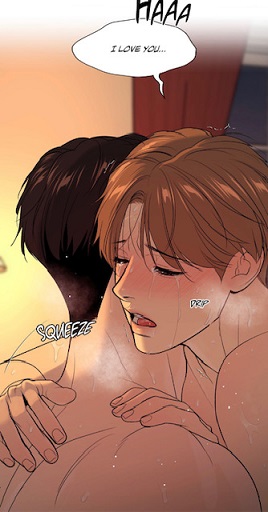 (chapter 39) and chapter 44 (chapter 44) — converge in episode 86. This convergence is not coincidental, nor is it nostalgic. It is a conversion.
Both earlier nights shared the same fatal structure: only one person remembered. In chapter 39, Kim Dan’s confession existed without continuity; his body spoke, but his memory did not follow. In chapter 44, the reverse occurred: Kim Dan remembered everything, while Joo Jaekyung attempted to forget. In both cases, memory became asymmetrical. One carried meaning; the other escaped it. And meaning, when carried alone, curdles. What might have been tenderness transformed into obsession, shame, or bitterness. Memory became burden.
Episode 86 breaks this curse through a gesture that is deceptively simple: both remember. (chapter 86) Both made surprising experiences: dry orgasm and a gentle and caring sex partner.
This is why simultaneity matters so profoundly. Sparks appear on both bodies. Confusion is mutual. Questions circulate rather than collapse inward. Neither consciousness outruns the other. Time, which had previously fractured under intoxication, coercion, or denial, resumes its flow. Not because the past is resolved, but because it is finally shared. Shared experience.
Here, memory begins to function differently — no longer as fixation or haunting, but as integration.
This shift allows us to recognize a much older pattern in Kim Dan’s inner life. His relationship to memory has always been selective, but not arbitrarily so. When it comes to his grandmother, Kim Dan remembers each interaction with his grandmother in a positive light: the warmth 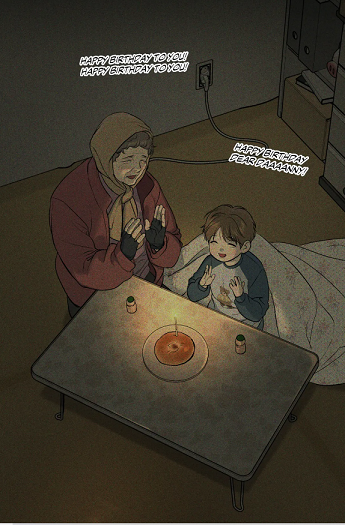 (chapter 11), the care – even if he had hurt himself –
 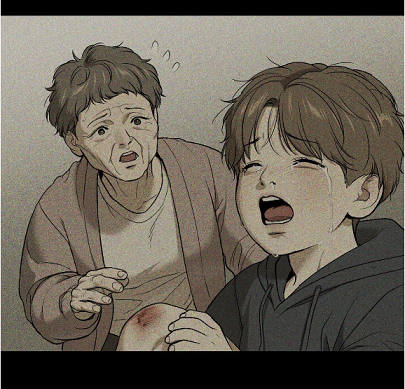 (chapter 47), the shared smiles
 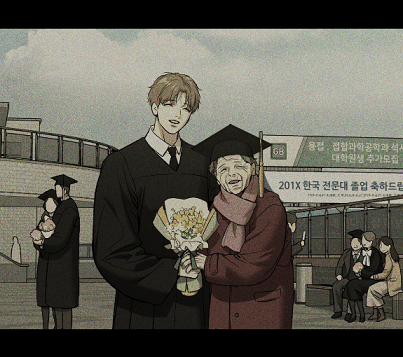 (chapter 47). Thus this photograph
  (chapter 65) becomes a talisman — not a record of reality, but a distilled image of safety. Painful dimensions are filtered out. Conflict, coercion, and silent pressure recede into the background. Memory protects him by idealizing. Because of this picture, he projected himself in the future, making unrealistic plans.
 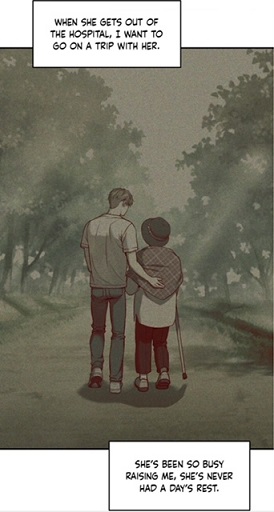 (chapter 47) It was, as if he only had good times with his grandmother.
Shin Okja, by contrast, remembers the same past through a radically different lens. (chapter 65) Her recollection is saturated with pity, loss, fear (chapter 65), and blame (chapter 65). The vanishing of the parents becomes the gravitational center around which all other memories orbit. Where Kim Dan remembers warmth, she remembers danger. Where he remembers protection, she remembers failure. One memory soothes; the other hardens. One preserves life; the other polices it. Kim Dan must remain the “good boy,” unchanged, because acknowledging his growth would mean acknowledging that the past did not remain intact.
The graduation photos make this painfully clear. They immortalize achievements, (chapter 47) not shared experiences. They resemble press photos of the champion more than lived moments. The work, the strain, the cost are absent. And tellingly, Kim Dan does not keep these pictures. They do not anchor memory; they flatten it. They freeze time rather than allowing it to move.
This asymmetry is crucial. It reveals that the relationship between Kim Dan and his grandmother has always mirrored the structure of those failed nights: one person remembers in a way that helps to keep working, the other remembers in a way that poisons (infantilizing doc Dan). One idealizes; the other condemns. And because the tragedy at the center of their past was never fully spoken, memory could not be synchronized. Kim Dan was pushed — silently, indirectly — to carry an idealized version of their shared life, while Shin Okja carried the unresolved catastrophe alone. (chapter 65) Toxic positivity emerges precisely here: not as cheerfulness, but as enforced idealization that denies the legitimacy of pain, anger, or differentiation.
And it is precisely here that the connection with the grandmother crystallizes. The latter is often connected to sleep 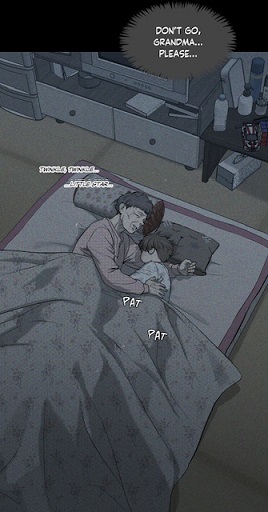 (chapter 21)
  (chapter 47) and memories.
 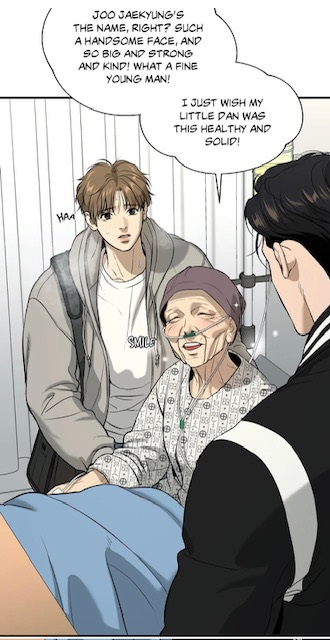 (chapter 21)
 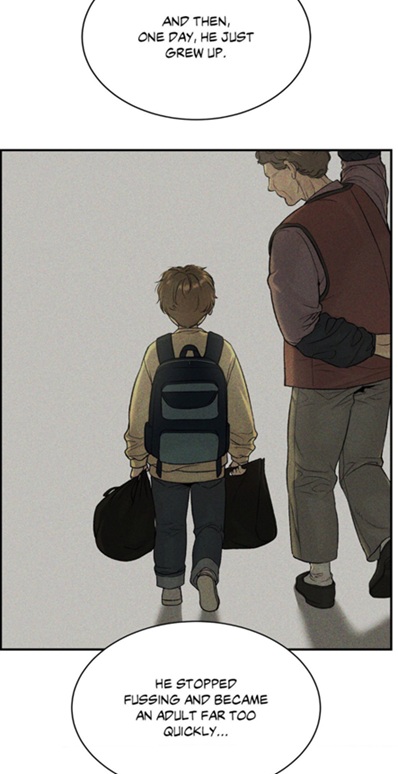 (chapter 65). While sleeping, memories come to the surface.
Only at this point did something else catch my attention — something that, retrospectively, had been present all along. The painting in the living room: 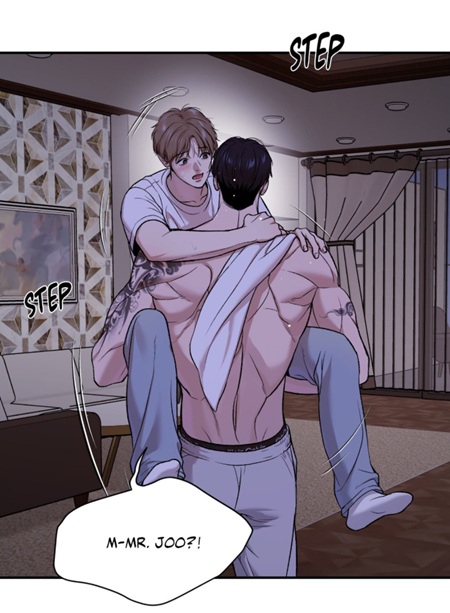
 (chapter 85) I believe that its appearance does not function as decoration. Its imagery — figures suspended among clouds, bodies neither falling nor grounded — introduces a different register of time. Not urgency. Not performance. Not spectacle. Stillness. Interval. A space where movement pauses without collapsing. Under this new light, the reference is Morpheus.
Morpheus is not the god of illusion. He is the one who allows rest, who brings form to dreams so the body can sleep. His presence signals not escape from reality, but the possibility of restorative sleep. This matters, because insomnia has haunted Joo Jaekyung from the beginning. 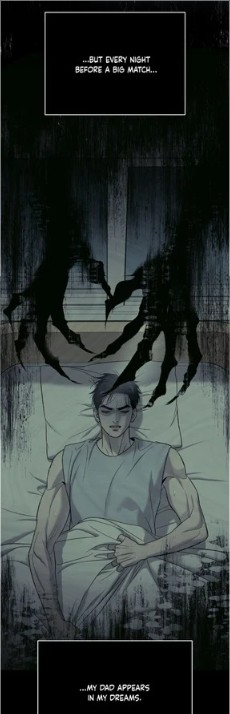 (chapter 75) Until now, rest had been replaced by discharge: sex as erasure, violence as exhaustion, ritual as compulsion. The Paris night does not abolish wakefulness through collapse; it introduces the conditions under which sleep might finally be possible.
Episode 86 introduces a third possibility: the kiss of Morpheus or the famous goodnight kiss. (Chapter 86) What caught my attention is that the athlete was irritated, when the doctor simply wished him a good night. 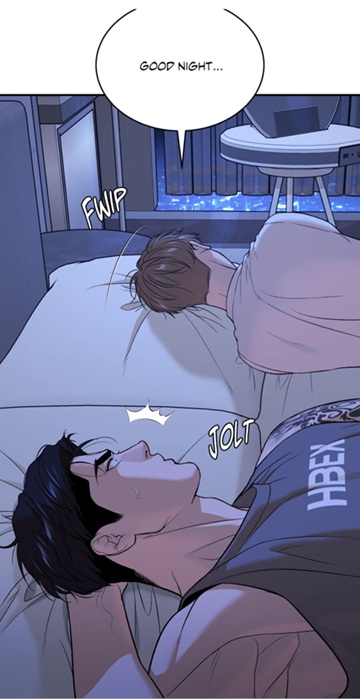 (Chapter 78) Here, he reduced it to the absence of sex, but I am sure that deep down, he would have been satisfied, if the “hamster” had given him a good night kiss.
The Paris night does not ask either character to idealize or to condemn. (chapter 86) It does not demand that the past be redeemed, nor that it be endlessly rehearsed. (chapter 86) Instead, it contextualizes. Memory is no longer absolute; it becomes temporal. Then and now. (chapter 86) Before and after. – and +.
This is why the electrical metaphor reaches its full force here. Two negatives do not annihilate each other. They convert. The shared remembering of two previously failed nights produces not cancellation, but potential. 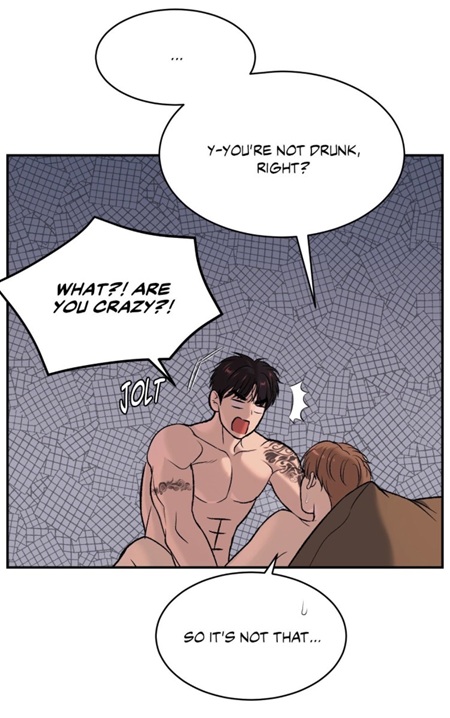 (chapter 86) The charge redistributes. Memory ceases to isolate and begins to circulate. Hence it creates a new memory.
It is at this point that Prometheus quietly enters the scene — not as explicit mythological references, but as symbolic functions. Electricity, like fire stolen from the gods, marks a return to humanity. It is the end of purely divine punishment and purely mechanical survival. At the same time, illusion dissolves. Sleep, dream, and dissociation lose their grip. The characters are no longer ghosts moving through each other’s lives, nor zombies repeating ritualized behaviors. They become human again — vulnerable, reflective, embodied. And once human, reflection becomes inevitable.
The night itself remains carpe diem. It is presence without calculation, sensation without projection, intimacy without bargaining. For those hours, the future does not intrude. But this does not mean consequence is erased. On the contrary: because the night is no longer an illusion, its aftermath must be faced. The jinx has not disappeared because its existence was not mentioned or danger is gone. Corruption, rigged matches, replacement, and blacklisting still await. What has changed is not the external threat, but the internal configuration.
The Paris night did not save the protagonists. It returned them to themselves. And this return has consequences beyond the couple. It destabilizes the grandmother’s moral economy. This new observation reinforces my previous interpretation: this position  (chapter 86) was a reflection of the picture. (chapter 65) Shin Okja is no longer doc Dan’s center of gravitation. That’s the real revolution. There is no longer interruption or triangulation. I am even inclined to think, that’s the night where the main leads became a true team.
Moreover, if memory can be shared without collapsing into blame, then her version of the past can no longer function as unquestionable authority. (chapter 65) If Kim Dan no longer needs to idealize in order to survive, then he can finally see the cost of that idealization — for himself and for her. The tragedy she alone has been carrying can surface, but without demanding that he sacrifices his present to it. The past stops being a sealed vault and becomes a shared, albeit painful, terrain.
This is the true end of ghosthood. That’s why doc Dan is feeling feverish during that night.  (chapter 86) No one is erased or reduced to an object. Nothing is overlooked or forgotten. But repetition loses its hold. And from here, the story can no longer proceed as before.
Feel free to comment. If you have any suggestion for topics or Manhwa, feel free to ask. If you enjoyed reading it, retweet it or push the button like. My Reddit-Instagram-Twitter-Tumblr account is: @bebebisous33. Thanks for reading and for the support, particularly, I would like to thank all the new followers and people recommending my blog.


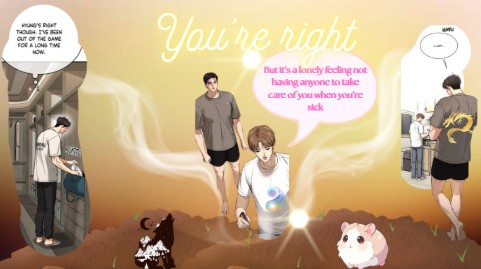
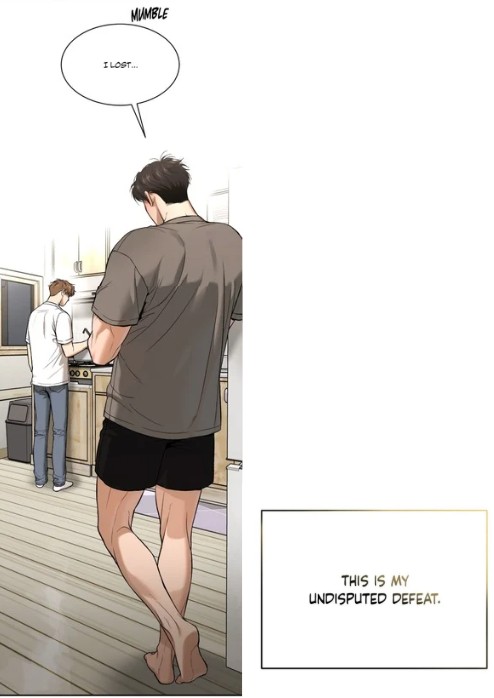 (chapter 76) This admission is no mere reversal of pride. It gestures toward something Jaekyung has never known: an exchange that does not end in domination or silence, but in dialogue. For Kim Dan, too, it marks a turning point.
 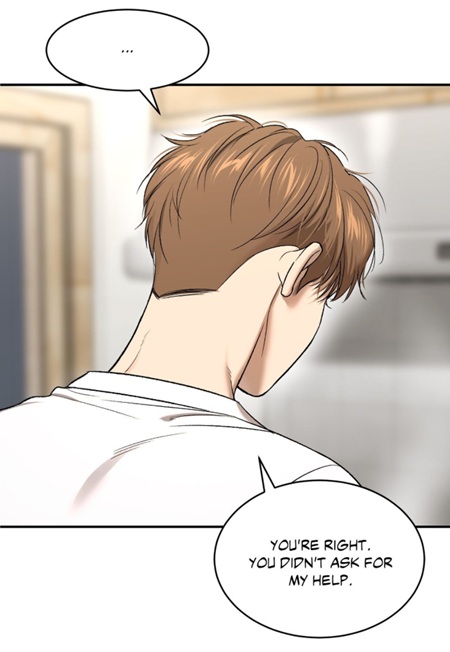 (chapter 76) For the first time, he uses the expression you’re right in front of his fated partner. He seems to concede with this idiom. Yet this apparent submission hides a deeper reversal. By admitting Jaekyung never asked for his help, he redirects the exchange toward his own truth: the loneliness of having no one to care for you.
 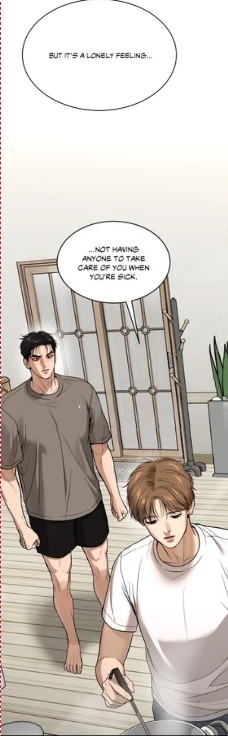 (chapter 76) What unfolds in the kitchen is not a quarrel about porridge but a fragile recognition. Dan’s “You’re right” acknowledges Jaekyung’s perspective without bitterness, while Jaekyung’s “I lost”
  (chapter 9)
 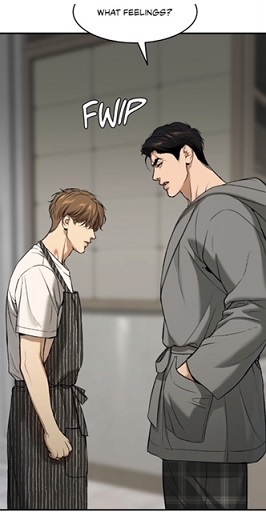 (chapter 45)
  (chapter 76) The kitchen scene closes one cycle and announces another.
  (Chapter 76) In this view, his fixation would be the product of ambition, pride, or ego: the expected cost of survival in a cage where only victory pays.
  (chapter 76), because the adults in his life cut them off before they could exist. Winning became his only mode of survival because every formative argument in his youth ended in defeat, and not the kind decided by a referee. With his father, mother, coach, and manager, words never led to recognition — only to insult, silence, utility, or obedience. He learned early that dialogue could not protect him; only victory could. His victories were not chosen freely, but forced into being by guardians who made him feel like a burden, until relationships themselves became burdens.
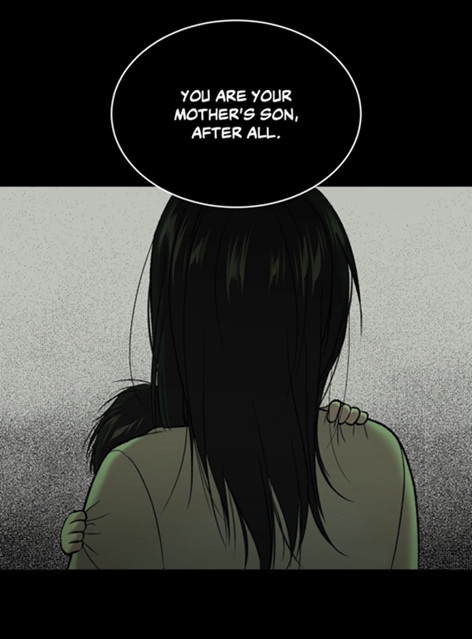 (chapter 73) He was a loser because of his mother. To lose meant humiliation and rejection; to speak at all meant to invite contempt. The only possible rebuttal was victory — to prove through strength that he was not the pathetic, worthless child his father saw in him. Winning became his sole argument against a man who would never listen, the only way to resist being branded a loser.
  “(chapter 73). It was not just defiance; it was a vow that victory would silence abuse once and for all. When he returned with the trophy, he shouted triumphantly,
 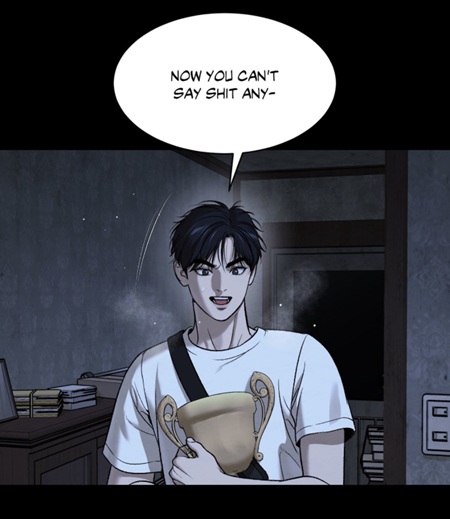 (chapter 73) ready at last to claim, “I was right.” Yet reality betrayed him. His father’s death denied him the only acknowledgment he had sought.
 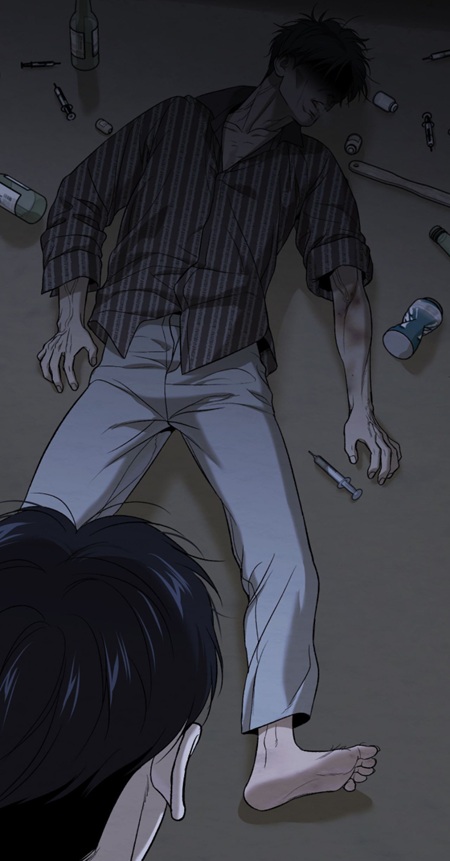 (chapter 73) The words “I was right” died in his throat. He had proved himself, yet there was no one left to recognize it. His own prediction — that his father’s death would mean nothing — proved false. The absence cut deeper than the insults had, leaving Jaekyung not with triumph but with the bitter aftertaste of self-loathing. Victory had silenced his father, but it also silenced the son. He had proved himself, yet there was no one left to hear it.
  (chapter 74) At the funeral he remained dry-eyed, his face locked in shame (ch. 74). No one saw his guilt, but it consumed him: the one man he needed to hear “I was right” from could no longer answer. At the same time, his smile and laugh were also linked to misery. For Jaekyung, laughter was never the sound of joy, but the echo of mockery and rejection due to the father. Just as tears became tied to betrayal and abandonment through his mother, so too did his father twist laughter into a weapon
 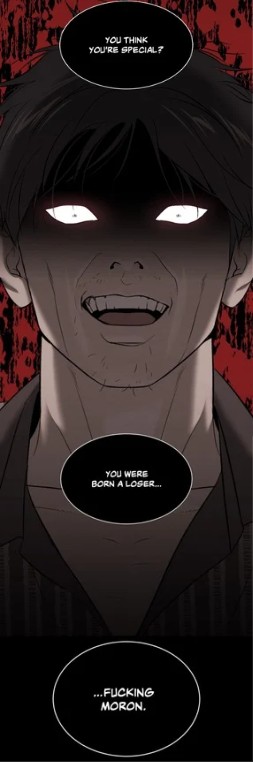 (chapter 73) — every laugh at his expense reinforcing the verdict that he was weak, pathetic, a loser. In Jaekyung’s childhood vocabulary, neither laughter nor tears could carry warmth. Both were stripped of comfort and redefined as signs of humiliation and pain.
 (chapter 72) To the boy, she was not silent at first: she must have definitely told him to become strong, to endure, to wait. She gave him her number, leaving the illusion that her departure was not abandonment but necessity. Victory and wealth became her conditions for love. That is why he swore over the payphone to work hard
 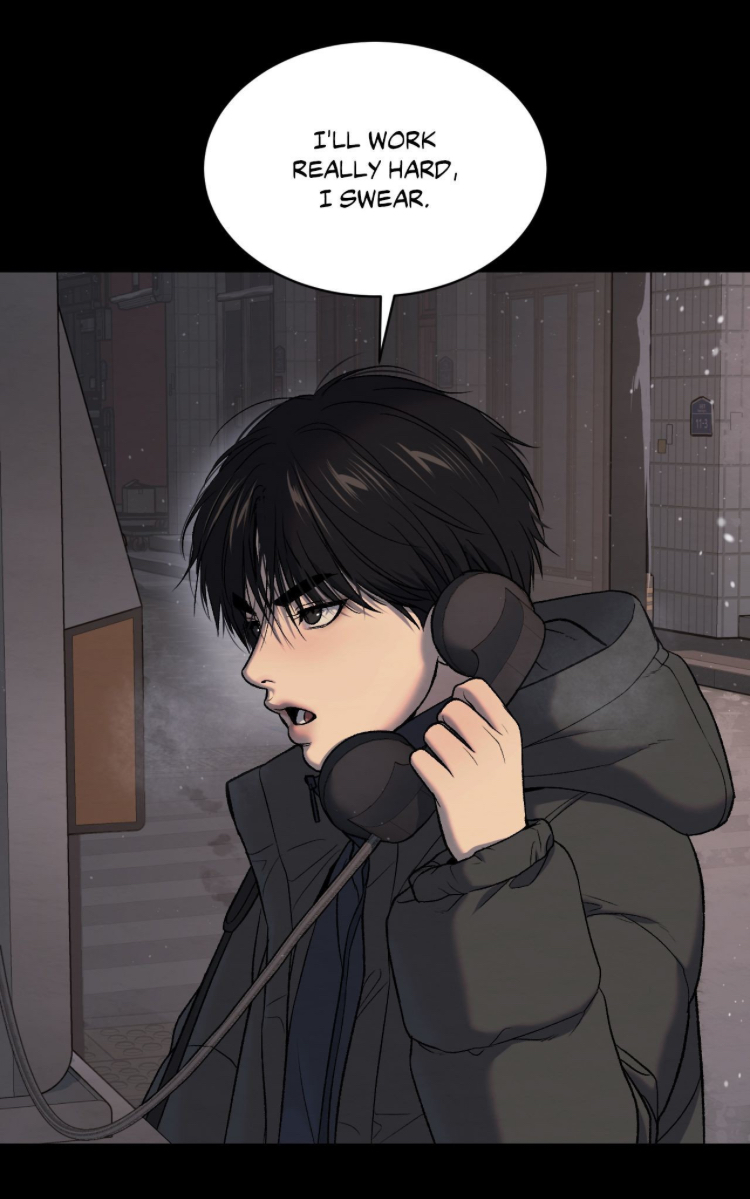 (chapter 72) and “make money” so she could return, and why after his father’s death he still hoped for her homecoming.
  (chapter 74) But when the calls went unanswered, her silence became the sharpest weapon of all. Her eventual reply
 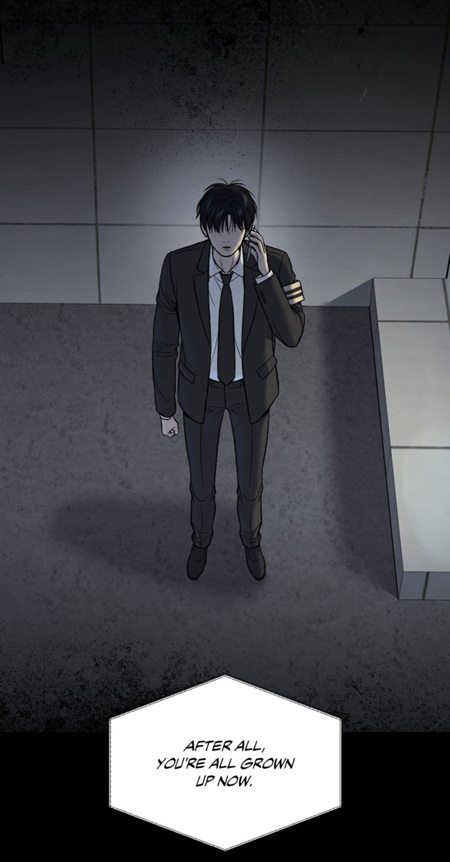 (chapter 74) confirmed that his effort had never mattered. For the first time, he cried
 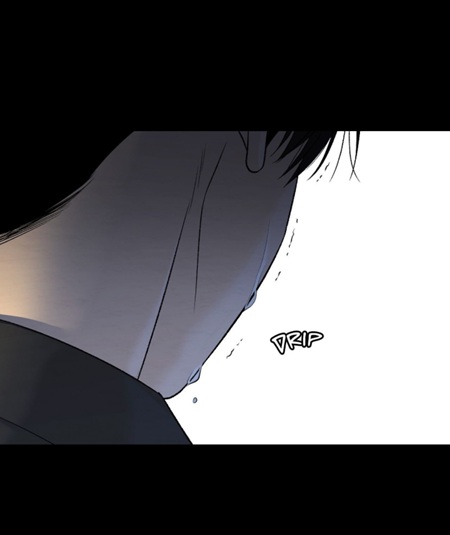 (chapter 74), his tears expressed not just grief but the recognition of betrayal. From then on, tears themselves became equated with loss, weakness, and abandonment. This is why, in the wolf’s nightmare, Dan’s crying form
  (chapter 76) appears: the sight of tears recalls the moment he unconsciously realized that even his mother’s “you’re right” was a lie. At the same time, those tears function as a mirror. The champion projects onto Dan the very weakness he has always forbidden himself to show.
 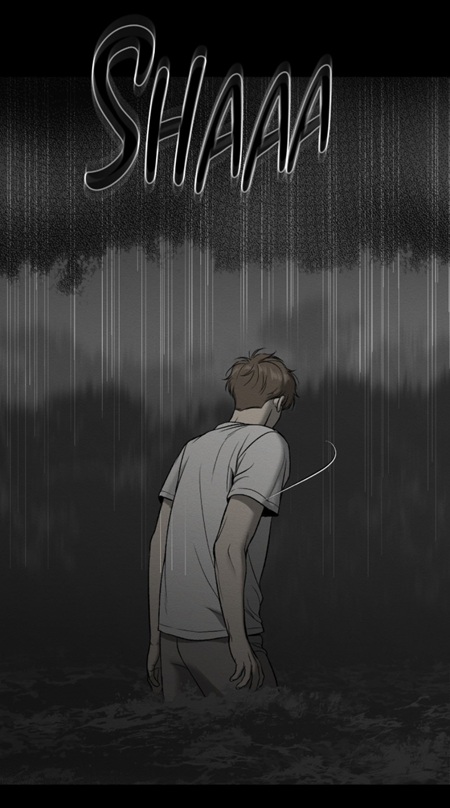 (chapter 76), the boy he once was who longed to weep but had to swallow it down. At the same time, Jaekyung himself occupies the place of the “adult” —
  (chapter 74) Hence the wolf’s tears were quickly replaced by rage and violence.
 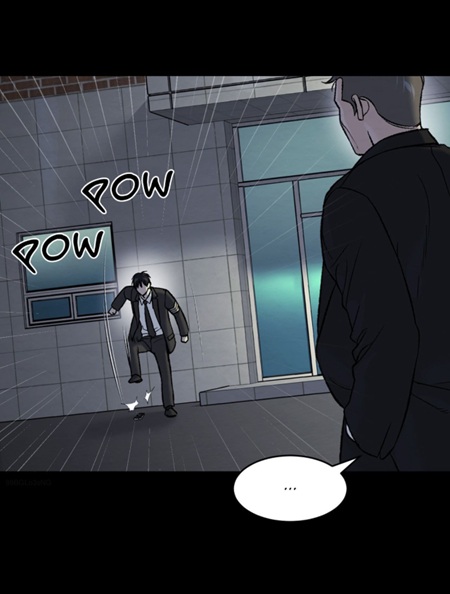 (chapter 74)
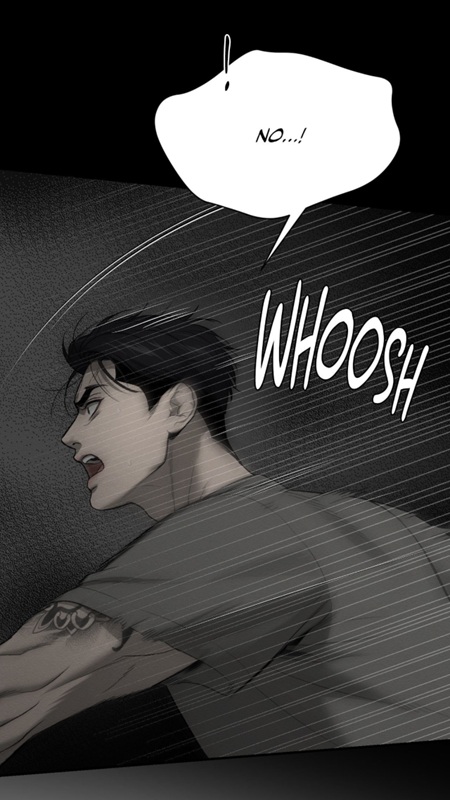 (chapter 76) His trembling hand upon waking
 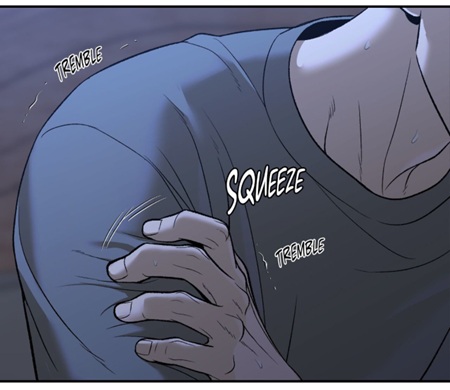 (chapter 76) shows the yearning to be held, comforted, reassured — something he never received from either parent. He is not entirely responsible for the physical therapist’s suffering. And here lies the difference: Dan’s tears are not manipulative or hypocritical , like the ones Jaekyung suspects from his mother, but unfiltered honesty. He expressed his emotions, not just through tears, but also through body language!
  (chapter 1) He was shaking, he was bowing and asking for forgiveness! Dan embodies a form of vulnerability that is real, legible, and forgiving contrary to the mother. When the teenager heard his mother’s voice after such a long time, the latter never brought up her past action. She never asked him for forgiveness.
  (chapter 74), whose quiet devotion and silence kept the gym alive, nor Jaekyung’s, whose absence he accepted without challenge.
 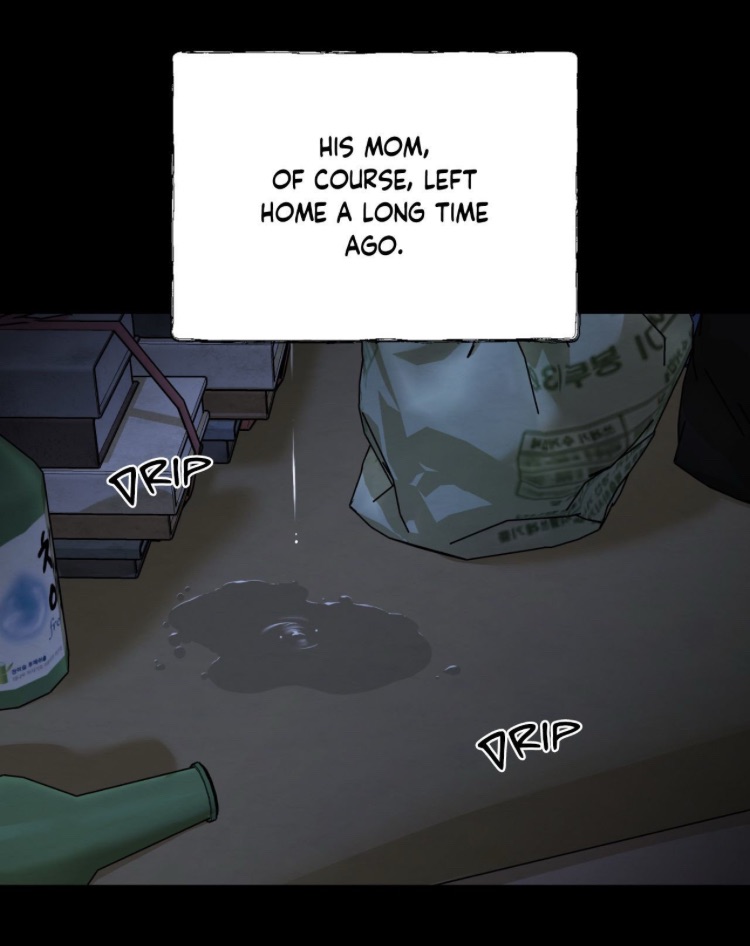 (chapter 72) In fact, his own mother’s submission reinforced this flaw: her blind trust in her son, her refusal to question his choices and the boxing world, taught him that authority need not be examined, only endured or seen as trustworthy. For him, hierarchy was unquestionable, and so he perpetuated it. Thus he stands for lack of critical thinking. This is why, with Hwang, the vocabulary of “right” and “wrong” was never about dialogue but about obedience. No wonder why he became so violent at the police station.
  (chapter 74) Unlike Jaewoon’s domination or the mother’s evasive silence, Hwang cloaked his authority in the language of advice — yet beneath it lay a black-and-white dualism: winners and losers, villains and victims. Thus Joo Jaewoon was blamed for becoming a thug
  (chapter 74), while the wolf’s mother was a victim. He viewed her as a selfless and caring mother:
  (chapter 74)And observe how he provoked the main lead.
  (chapter 74) When Hwang sneers, “What, am I wrong? Come on, answer me!” he is not inviting dialogue — he is staging a trap. The question is rhetorical, a demand for submission. Let’s not forget that he had witnessed the phone call in front of the funeral hall, but back then he had done nothing. And when the boy hesitates
  (chapter 74), unable to answer, Hwang strikes him in the chest.
  (chapter 74)and justifies his action behind social norms.
 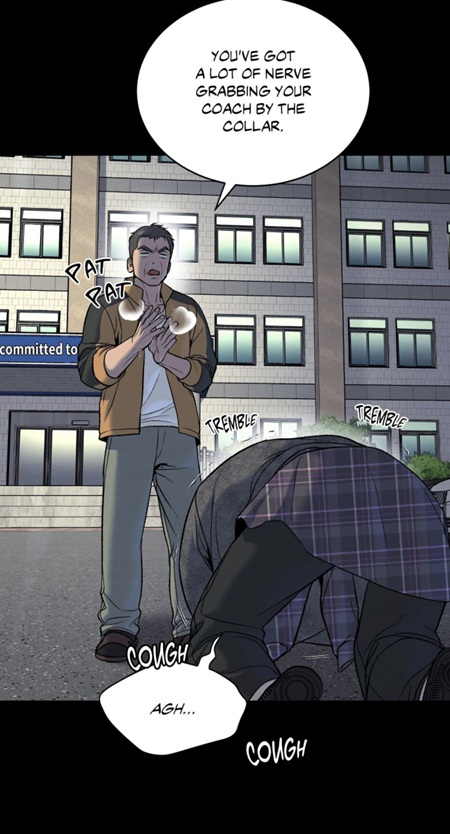 (chapter 74) In that instant, he takes the role of judge, referee, and executioner, collapsing “argument” into violence. The very words “Am I wrong?” contain the irony: the coach is less interested in truth than in reasserting his own authority. Silence is treated as guilt, hesitation as defeat.
 (chapter 74), he effectively admitted “you’re right” to the coach. Yet this wasn’t simply genuine agreement — it was submission, respect mixed with survival. The director misread it as validation of his worldview. This only reinforced his certainty, encouraging him never to reconsider his role.
  (chapter 74) When the protagonist finally left, the director could declare with satisfaction:
  t(chapter 74).
 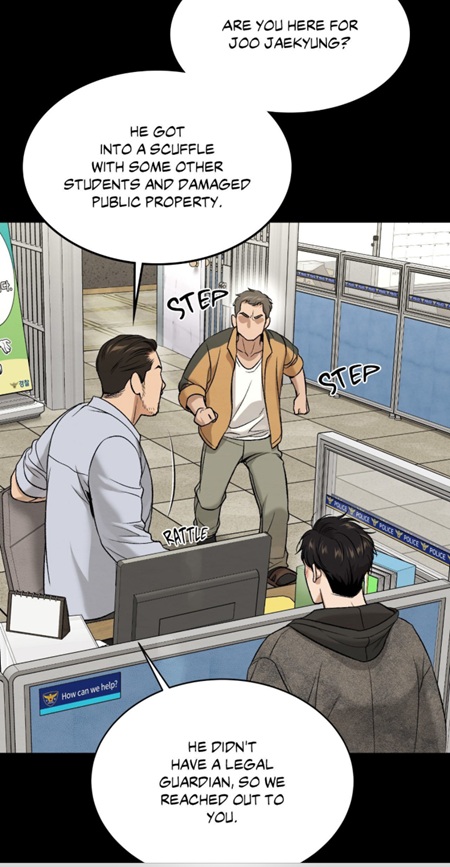 (chapter 74) The reality was that the old man had never truly become the star’s home and family, which explains why he constantly leaned on other adults, the mother or the father, to provide the guidance he himself refused to give. At the same time, I come to the following deduction: he must have lost his boxing studio, and with its vanishing, the elder was forced to face “reality”: loneliness, sickness and absence of happiness in his life!
 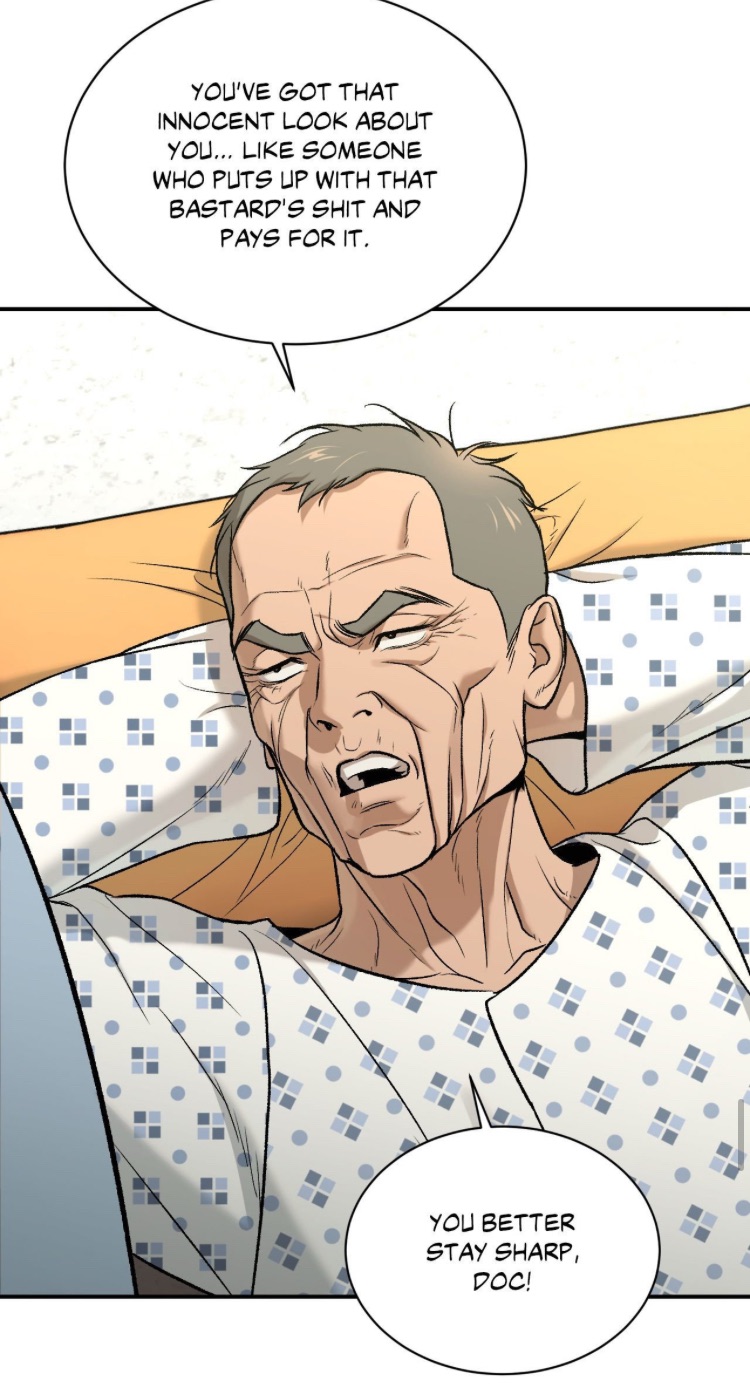 (chapter 70) Once again, Jaekyung is reduced to “that bastard” — a label, not a person — while Dan is framed as the pitiable victim. The old coot remains the righteous observer, untouched by guilt, protected by a rhetoric that always shifts responsibility elsewhere.
 (chapter 75) He was happy again, though he initially tried to hide it. We have to envision that before the wolf’s visit, the elder had to face what his own life outside the gym looked like: sickness, solitude, the collapse of the studio that had sustained him and came to resent the main lead. Yet, Joo Jaekyung’s behavior changed everything:
 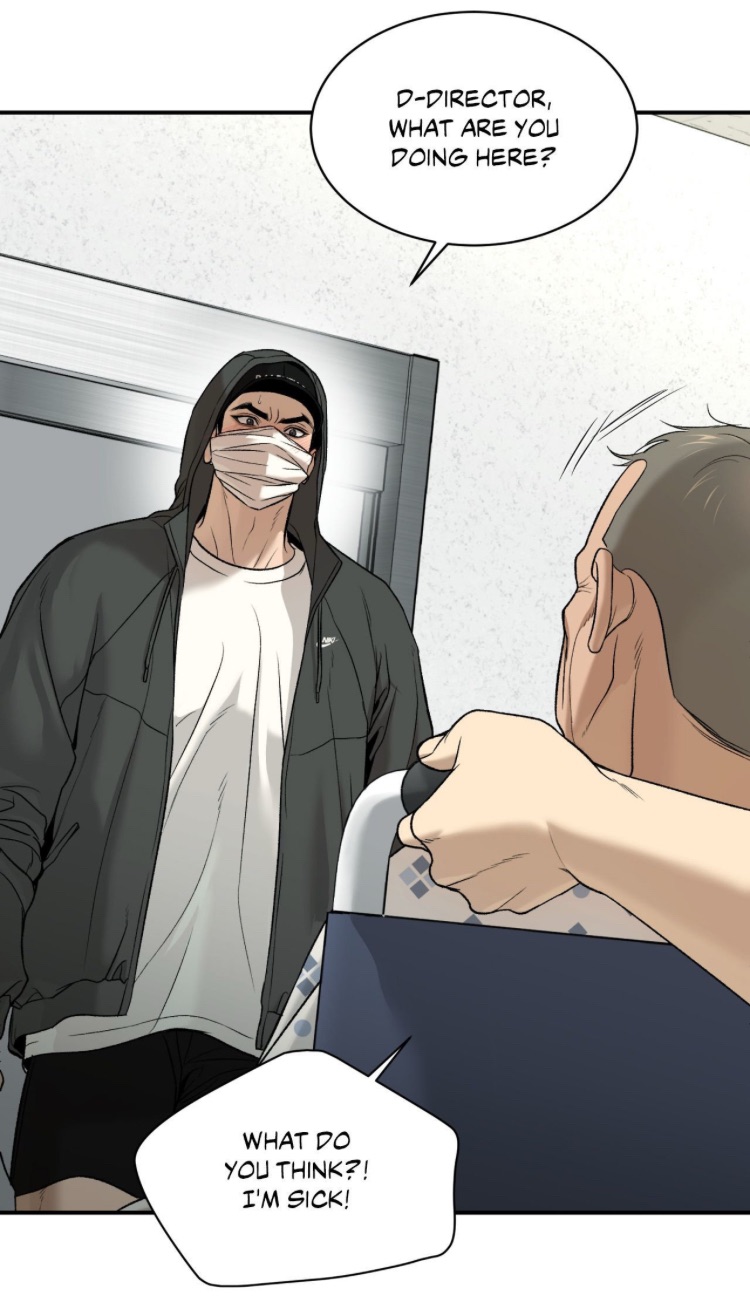 (chapter 71)
 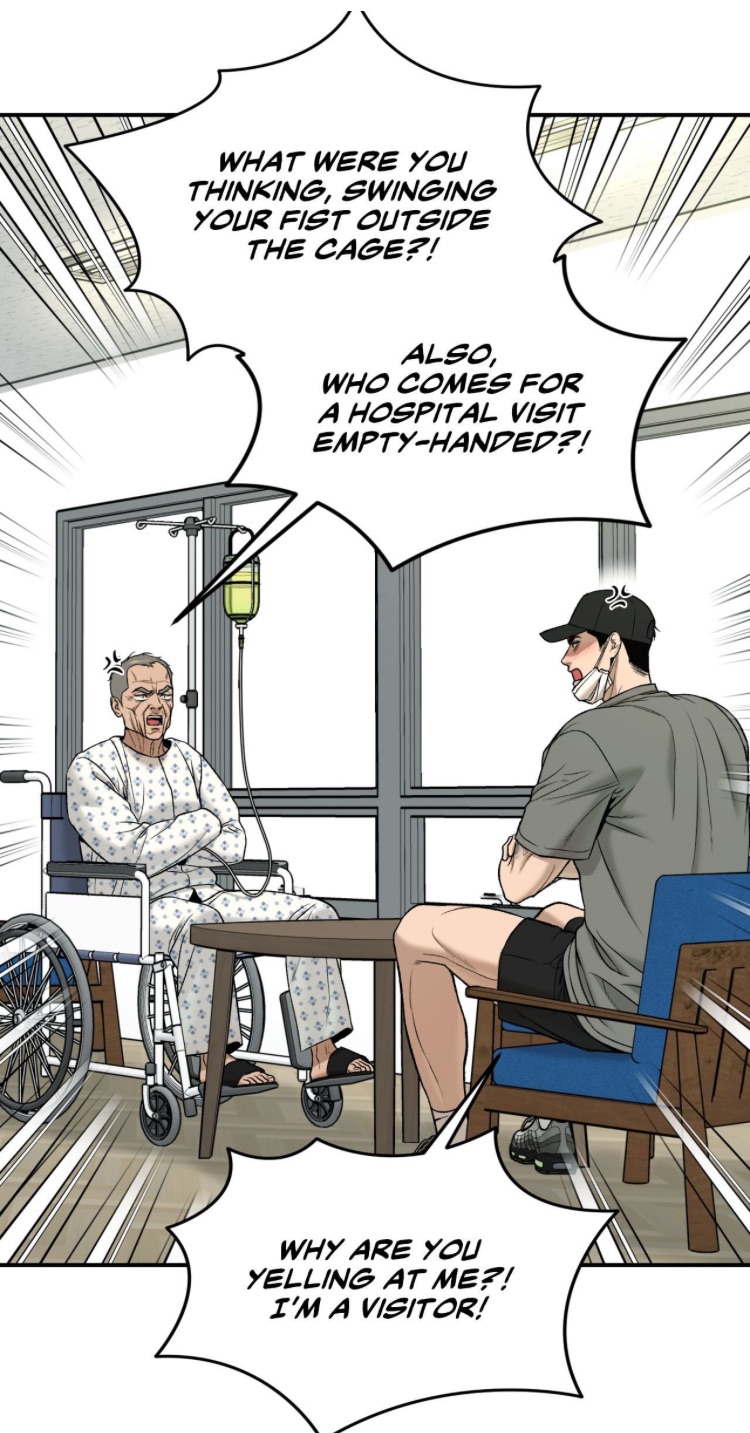 (chapter 71) Only during the champion’s visit, did his words alter.On the rooftop of the hospice, he finally tells Jaekyung:
 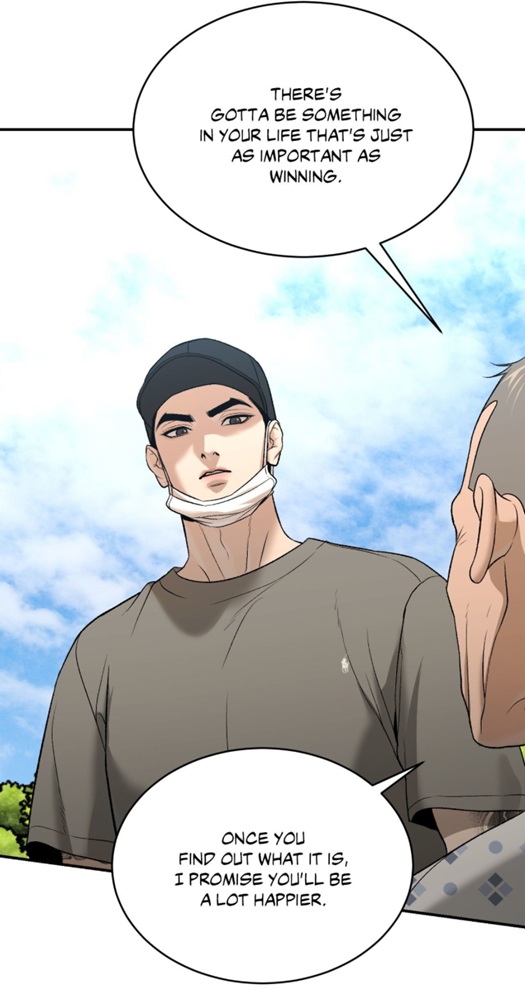 (chapter 75) This shift did not come from wisdom gained in the ring but from loss — the loss of health, the loss of the gym, the loss of illusions — and from Jaekyung’s loyalty, which pierced through his blindness. Interesting is that this time, he doesn’t give the answer to the athlete. He stops thinking “I’m right, you’re wrong”. He treats him as an adult, as a mature and thoughtful person. Through that fidelity, Hwang glimpsed at last what he had denied both himself and Jaekyung for decades: that victory alone cannot sustain a life.
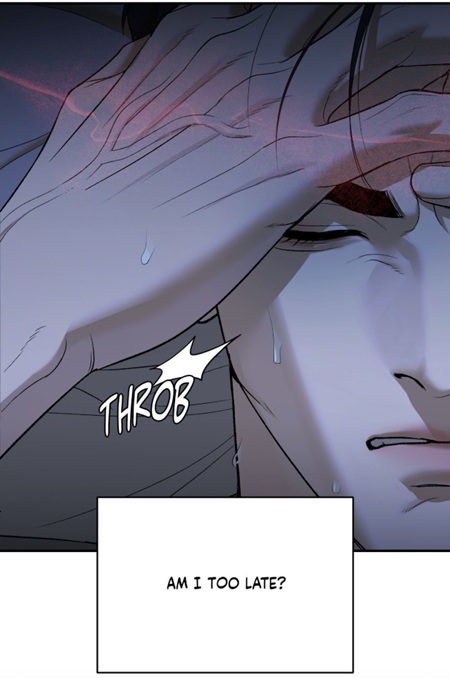 (chapter 76) It is not too late. The question “Am I too late?” is the consequence of Hwang byungchul’s words and it gradually indicates the switch in the champion’s mentality. It is no longer about being right or wrong. However, the nightmare reveals another aspect: the world is not black and white, but grey.
 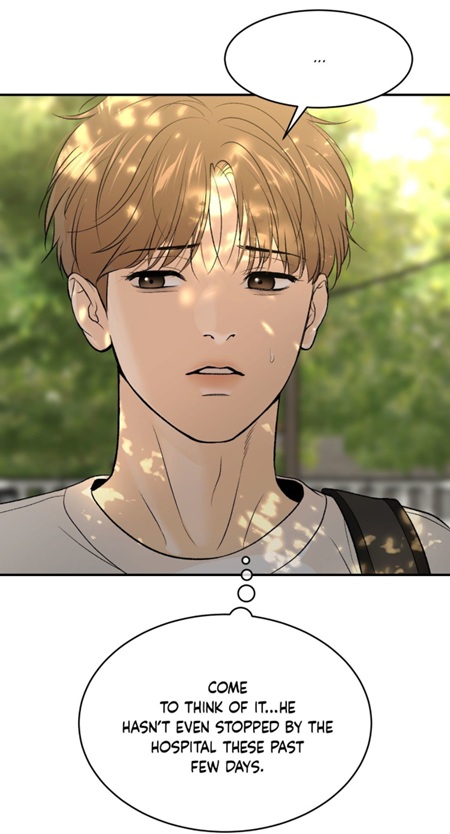 (chapter 76) Hence he remained silent and avoided his gaze. But like the director showed it, it is never too late:
  (chapter 76)
 (chapter 69) Thus my avid readers might jump to the conclusion that his biggest flaw is blindness, similar to the director. Besides, I had often criticized him for his blindness and ignorance. However, this is just a deception. The manager’s real defect is actually his deafness. How so? He does not hear Jaekyung’s words
  (chapter 17) at all. The verity is that he refuses to listen to his thoughts and emotions
 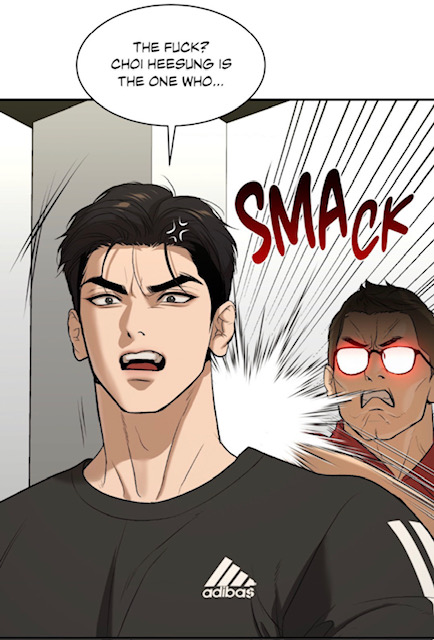 (chapter 31) in good
 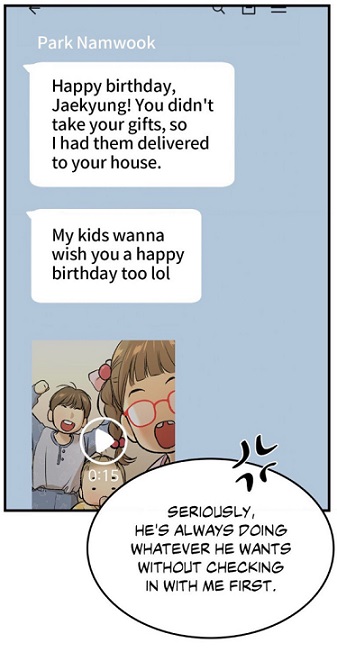 (chapter 45) or in bad times. It goes so far, he does not take his silences seriously, and does not register his pain. This explicates why the manager saw in the champion’s silence at the restaurant as an agreement for a new fight!
  (chapter 69) His role is not to guide or protect, but to extract: money, victories, publicity.
 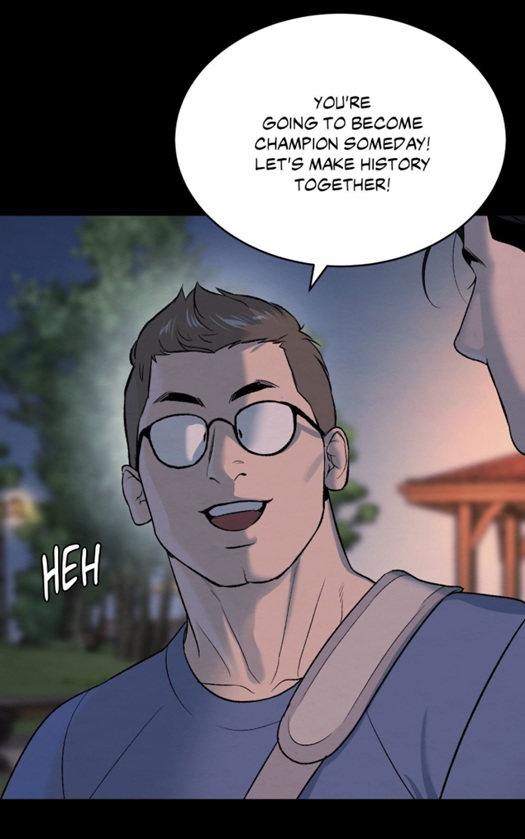 (chapter 75) In my opinion, he is fighting against oblivion through the star. This hidden disability explains why the coach can never truly connect with the champion. He listens instead to other voices – the CEO of MFC
  (chapter 69), the rumors among the directors
  (chapter 46), the media
  (chapter 52), the sponsors
  (chapter 41), the spectators or “authorities”
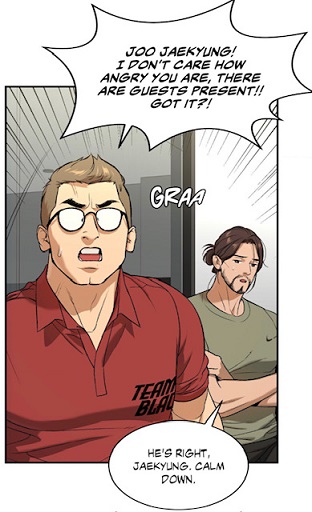 (chapter 36) — and reacts to them, even violently, as in chapter 52, when public criticism painted Jaekyung in a negative light.
 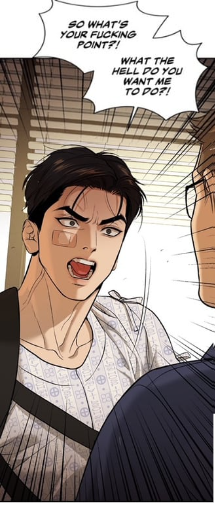 (chapter 52) His question is not mere anger. It is a confession of position — an inadvertent acknowledgment that he knows he is the true backbone of the gym. He is the one responsible, the one carrying the burden that Namwook refuses to admit. These words crack the illusion: the fighter is not subordinate, but owner. The gym lives because of him.
 (chapter 52) He acted as a child, faked “tears” in order to use empathy to his advantage.
 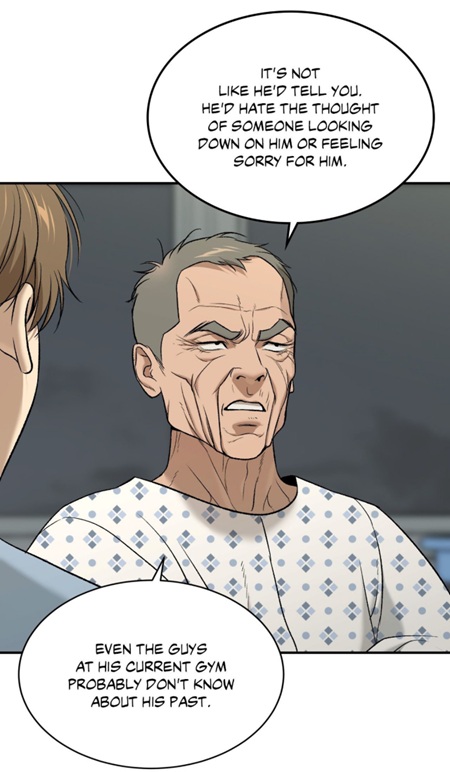 (chapter 71), hence he tried to help in his own way. On the other hand, Park Namwook shows clearly no sign to be interested in the private life of his boss. He is preferring ignorance over “knowledge and connection”.
  (chapter 66) Despite the incident, the manager hasn’t changed yet. He clinched onto the past, thinking that everything will be like before, as soon as the athlete enters the ring. He images a return to normality with the next match.
 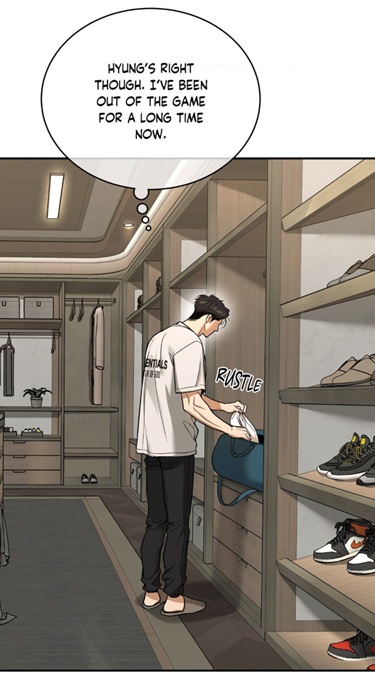 (chapter 66) For years, he had accepted his manager’s judgments out of habit, mistaking silence for consent. But here, for the first time, the repetition feels deliberate — not resignation, but reflection (“though”). The phrase becomes a question more than an agreement: is he truly right? He is admitting this out of habit.
  (chapter 69) His silence has shifted from obedience to suffocation. The weight of Namwook’s deaf authority is no longer bearable. And yet, even here, his confession is muted, confined to the private space of his car. He is not yet ready to speak the words aloud — not until someone appears who will listen.
  (chapter 48) This scene was observed by Kwak Junbeom, so the latter could have reported it to the coach. If it truly happened, this would expose the coach’s deafness and cowardice. He chose passivity instead of confronting the doctor or the champion. That way, he avoided responsibility. And this brings me to my final conclusion concerning the deaf manager. His main way to contact the celebrity is the cellphone:
  (chapter 66) It is both his mask and his crutch — a tool for barking orders, never for dialogue. The moment the line goes dead, his authority collapses, for he has no other means of contact. His power depends on Jaekyung’s reception, not his own strength. In truth, the manager’s disability is exposed here: deaf to Jaekyung’s voice, he has trained himself to hear only the ring of a phone. A fragile authority built on silence, ready to crumble the instant Jaekyung decides to switch it off.
 (chapter 76) must be read not as pride, but as a desperate shield against annihilation. In other words, in episode 76, the athlete is too harsh on himself, though I am not saying that he is innocent either. He only thought of himself because he had taught to behave that way. He was just mirroring the adults surrounding him who hid their weaknesses and wrongdoings behind “lies, social norms and hierarchy”.
 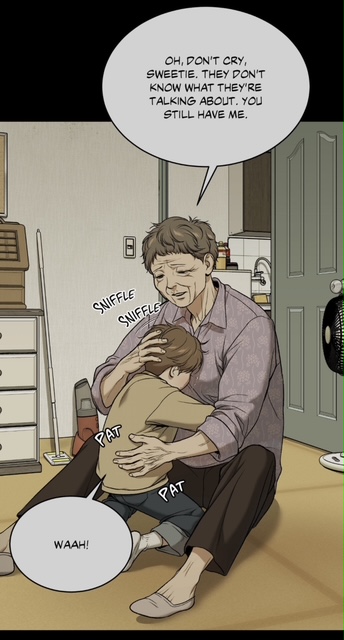 (chapter 57) With his grandmother and with every authority he encountered — doctors, employers, even predators — he believed unquestioningly that others were right and he was wrong. Hence he trusted others blindly. He was trained to accept decisions made for him or against him.
  (chapter 70) Thus he accepts criticism with defending his own interest. He was not taught how to fight back or resist or even argue.
 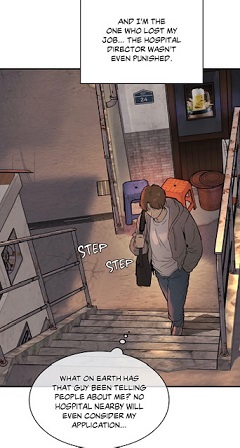 (chapter 1) He never tried to seek justice. His “you’re right” was not recognition but submission, the language of someone who could not afford to resist. In season one, this made their relationship combustible: Jaekyung spoke only in victory and as such submission, while Dan accepted every loss as natural. He also adopted this mind-set. On the other hand, because their initial interaction was based on a contract,
  (chapter 6), both were forced to discuss with each other about the “content of the agreement”. That’s where the champion was trained to communciate with the physical therapist. Thanks to the champion, because of this victory/loss mentality, the doctor learned gradually to argue and “reply” with his “boss. However, due to his childhood, he couldn’t totally drop his old principles like for example “saying no”.
 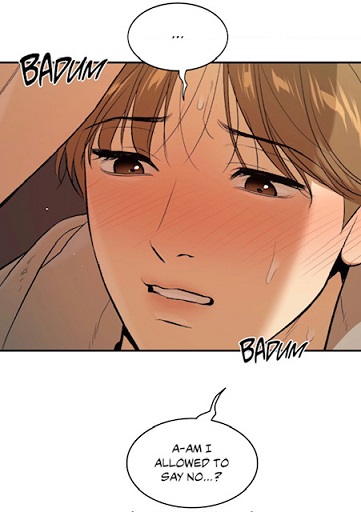 (chapter 34) To conclude, before their fateful meeting, neither man had learned how to argue as equals. But in the kitchen in front of the stove, this changed: both are right and wrong!
 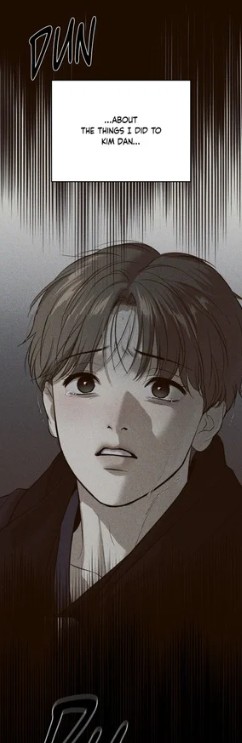 (chapter 76) He speaks like someone expecting rejection. Hence he keeps his distance. Yet the very fact that he says it at all signals change. Where once he would have doubled down — by barking an order, by firing Dan, by retreating into silence — he now admits defeat. The vocabulary of winning and losing, inherited from his father and reinforced by every adult in his life, collapses in the presence of Dan’s quiet honesty.
 (chapter 76) — an acknowledgment that he can no longer keep his walls intact. He is now willing to rely on doc Dan exclusively.
 (chapter 76). His confession reveals not strength but guilt. Kim Dan’s suffering was the price of his victories, and he knows it. “On the other hand, his mea culpa should be relativized, for both were the targets of a plot!
 (chapter 76) These words expose both responsibility and shame: he had prioritized survival over connection, career over compassion. What boils under his skin is not pride but remorse.
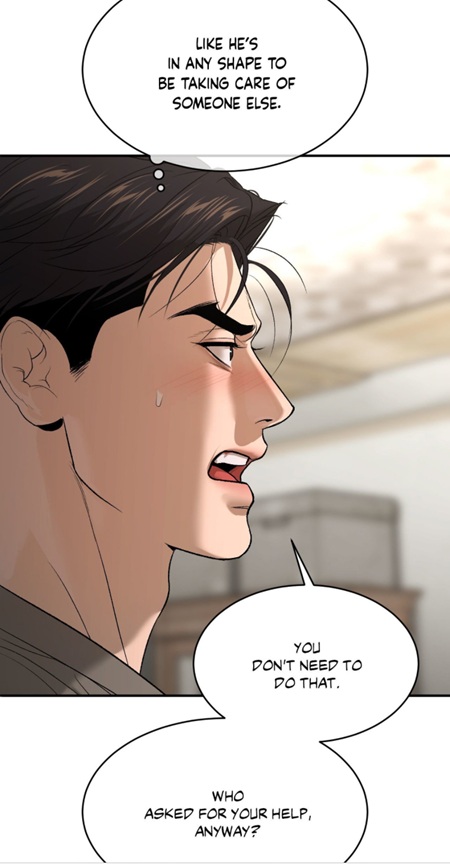 (chapter 76) The star’s thoughts in the kitchen are actually mirroring the ones in the bathroom:
 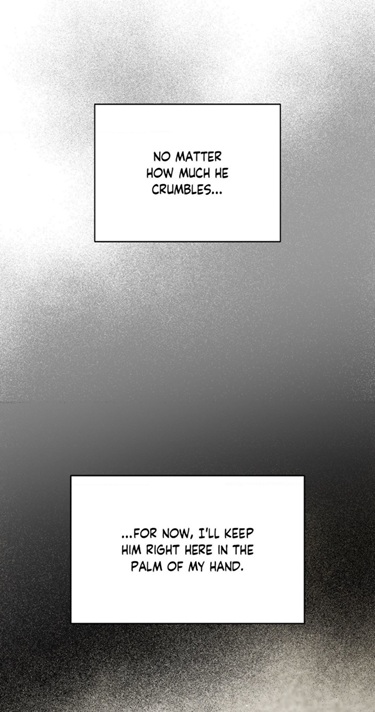 (chapter 68) In the bathtub, he still saw himself as the one in control, with the upper hand… but this is no longer the case in the kitchen. Through the physical therapist, the wolf is learning that even being in a vulnerable state doesn’t mean that this person is powerless. It is just that his “strength” lies elsewhere. In other words, someone struggling can also give comfort to another person in pain.
  (chapter 72) a place of solitary consumption rather than shared meals, the bed was the place where the little boy would drink his milk.
  (chapter 72) It is interesting that actually, Doc Dan wanted to bring the porridge to Joo Jaekyung to his bed during that full moon night, thus the latter made the following request:
  (chapter 76) But the wolf didn’t understand the hamster’s intention and followed his “hyung” to the kitchen. That’s how a misunderstanding was born which is also reflected in this interaction:
 (chapter 76) However, doc Dan agreed to this, he remained calm.
  (chapter 41) The latter actually represented a hindrance between them, it marked their relationship: boss and “employee” (servant). Moreover, since the table in the champion’s childhood was linked to one person (the father), it is clear that the champion has never shared a table with someone. And this aspect brings me to my other observation.
  (chapter 22) Whether in meetings, weigh-ins, or dinners with the CEO
  (chapter 46) It was a place where others dictated terms, while Jaekyung’s silence was mistaken for consent. And now, you comprehend why the two main leads could get closer in front of the stove in the kitchen. This place stands for warmth, care and family.
  (chapter 13) a meal after his collapse. He refused to bring a meal to the bed, he asked him to join in the dining room and sit at the table. And what did they do there? The champion talked about his career, his fight etc…
  (chapter 13) the champion has long associated the table to business and not “care”. That’s why it is important for him to remember the significance of the bed in his childhood. It was the place where he could feel comfortable and safe, where he would eat!

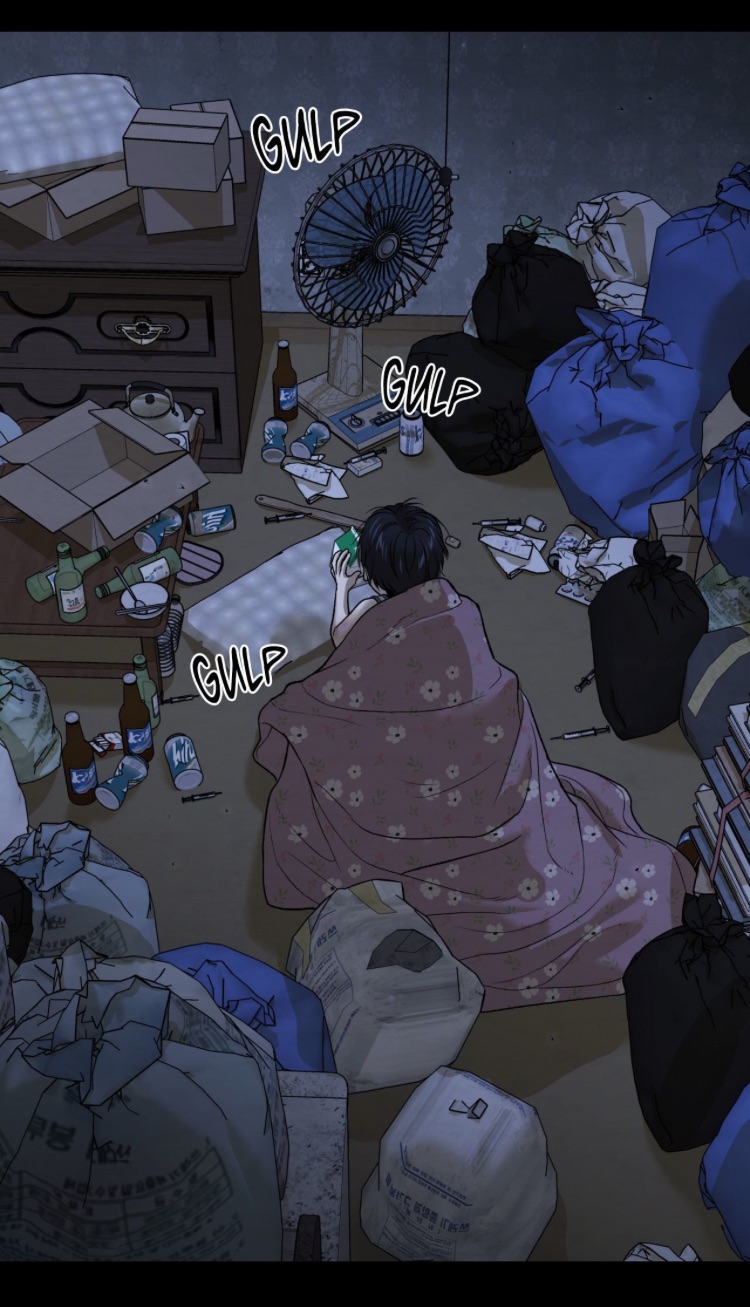
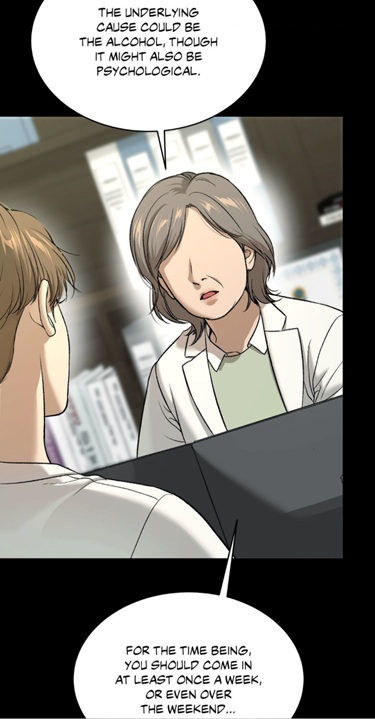 (chapter 67): the brief diagnosis, the recommendation for weekly visits, the specialist’s tentative attribution of Kim Dan’s condition to either alcohol or a possible psychological cause, emphasizing the need for continued observation and weekly visits before offering a definitive diagnosis —all standard responses. For her, this was a doctor following routine procedure without overstepping professional boundaries. However, I perceived her behavior very differently. I saw someone who remained emotionally detached and almost absent, reducing the complexity of Kim Dan’s condition to simplistic surface-level causes without genuine inquiry.
 (chapter 67) Rather than forming an independent assessment, she accepts the narrative of a third party, which introduces bias and limits her understanding. One might argue about that, because she is looking at a paper, probably result of a blood test which seems to corroborate the guardian’s statement. Hence the sleep specialist concludes that Kim Dan is suffering from insomnia, alcohol addiction and sleepwalking. The problem is that his statement is based on external observations (halmoni and the landlord) and their limited knowledge. Moreover, Jinx-philes should keep in mind two important aspects:
  (chapter 61) The champion had been himself suffering from similar symptoms which could be seen as a projection on his loved one. Additionally, based on previous observations, I have interpreted Kim Dan’s nightly walks not merely as sleepwalking, but as dissociative episodes—likely triggered by overwhelming guilt, unresolved trauma, and a chronic sense of disconnection from his body and surroundings. But how could the champion know about this? He’s not a doctor himself. In order to have a more accurate picture of the whole situation, she should have talked to the patient himself. But by relying on papers and the guardian’s testimony, she not only distances herself from the patient physically and emotionally, but also delegates the responsibility of interpretation. She is using the eyes of others.
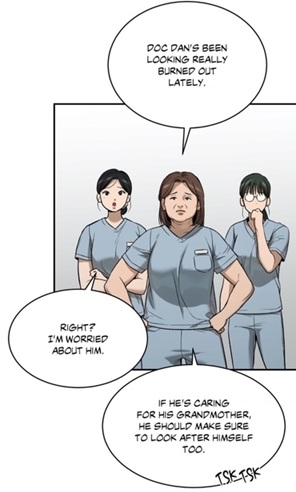 (chapter 57) Perhaps the doctor’s detachment is not indifference, but a survival mechanism in a healthcare system that demands efficiency over intimacy.
 (chapter 67) indicating that his alcohol addiction is not the real reason for his insomnia. Then she fails to examine Kim Dan physically, the desk is between them. Therefore she can not detect his visible malnourishment.
 (chapter 62) Moreover, both the landlord and the grandmother never brought up this aspect, though Shin Okja had observed this terrible transformation:
  (chapter 57)
 (chapter 66) It is because the physical therapist is just a number (2) and as such a file. Therefore the doctor is not seeing the patient as a human. I can not blame the woman either, for she has so many patients to treat during the day. And now look at the building of the hospital:
  (chapter 66). It is huge reminding me of a factory. This “modern hospital” with its sleek architecture, expansive buildings, and impressive specialization exudes a sense of advancement and trustworthiness. Yet beneath this polished surface lies a business-oriented structure, one that prizes efficiency, reputation, and patient turnover over genuine patient connection. This “modern hospital”
 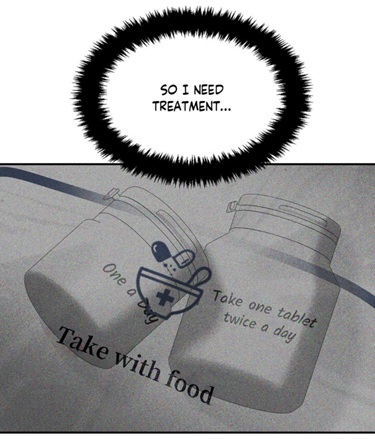 (chapter 67) She is doing exactly what Shin Okja wanted:
 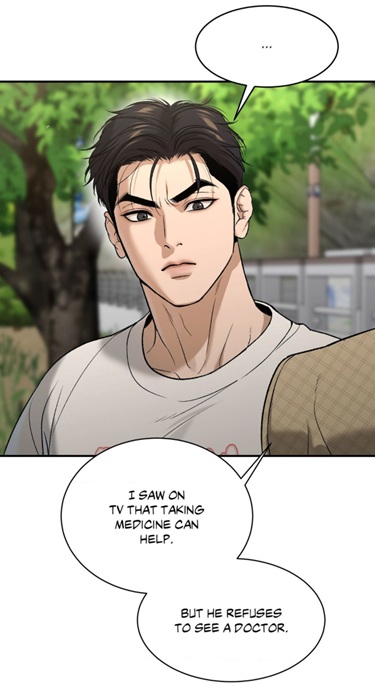 (chapter 65)
 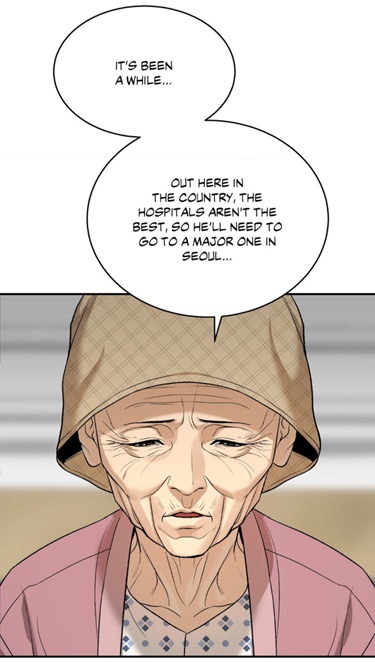 (chapter 65) It is as though thanks to the drug, the odd behavior from Kim Dan would simply vanish.
  (chapter 5) with the new medicine. On the other hand, it implies that the light-brown haired woman is doing her job for her paycheck which reminds me of Cheolmin’s statement:
  (chapter 13): “Oh no, no. That won’t do. My precious paycheck!”.
 (chapter 27)
  (chapter 49) as mere service providers. Whether it was brushing off medical advice with “Don’t push it, I know my body better than anyone else” (chapter 27) or demanding instant pain relief to continue training (chapter 49), the champion positioned himself as the ultimate authority over his own treatment. Since his attitude echoed the confession of my osteopath, it is understandable why my osteopath-orthopedist began to select his patients carefully. This mirrors Kim Dan’s evolution, when the latter chose to reject the champion’s offer. Indirectly, he is “learning” to select his job and not take them by opportunism. He is also learning to select his “patients”. Striking is that Shin Okja has a similar attitude than the athlete.
  (chapter 7) She desired to have a treatment with less side effects and less painful. And the moment she was confronted with reality, this painful new treatment only brought pain and nothing more, she chose to leave this institution and move elsewhere.
 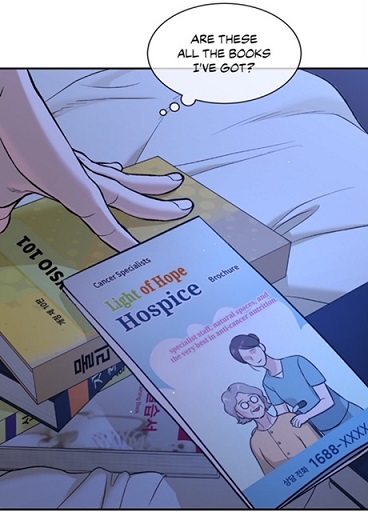 (chapter 53) Therefore it is not surprising that she is treating the protagonist the same way: she knows what is the best for him.
  (chapter 57) She is treating him like a service-provider, she is now rejecting that he has lost his “usefulness”. His pay here is not high, …
  (chapter 67) and not even following her recommendation.
 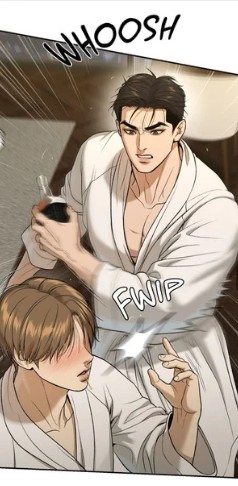 (chapter 67) He felt misjudged and misunderstood; reduced to a file number, not seen as a complex human being.
 (chapter 67) and second, what Kim Dan actually received as treatment:
  (chapter 13), in contrast, enters the story with no white coat at all. He carries only a doctor’s bag, dressed in a green pullover and a beige checkered shirt.
  (chapter 13) Despite this informal attire, he immediately recognizes Kim Dan’s symptoms and engages both the guardian and the patient. He doesn’t need institutional support to assert authority; his presence and diagnostic clarity define him. While his clothes might elsewhere be read as conservative or emotionally restrained, here they highlight that care can come outside rigid systems.
  (chapter 13) Quite the opposite. He doesn’t hide behind his distance; he manages it. His approach is practical and grounded, but never cold. He doesn’t wear a white coat, yet he brings with him a doctor’s case and an unshakable sense of responsibility. His tools are simple (his own body),
  (chapter 13) It bridges the gap between roles, making the patient feel seen rather than categorized.
 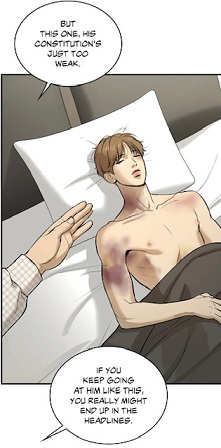 There’s no judgement in their relationship. The eyeless doctor may appear neutral, but in truth, she is hollow. Cheolmin appears reserved, yet his actions speak with empathy. Where she recites guidelines, he initiates dialogue.
  (chapter 13) Where she avoids involvement, he offers engagement.
  (chapter 61)
  (chapter 67), the Light of Hope hospice
  (chapter 61), the sleek University hospital dedicated to research
  (chapter 5), and more intimate yet modern facilities like this one.
 (Chapter 27) Each medical setting not only has its own architecture but also its own moral blueprint. In the essay “
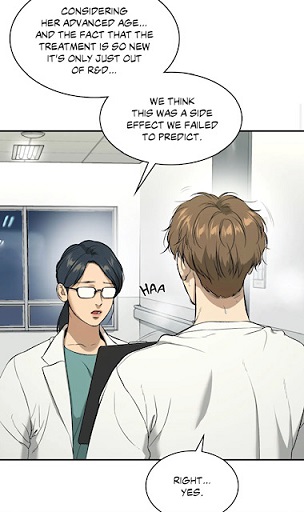 (chapter 21) Then the treatment’s failure is attributed either to the grandmother’s frailty or Kim Dan’s late arrival and absence, subtly shifting blame.
 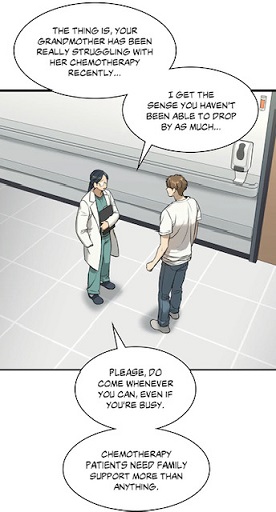 (chapter 21) Like mentioned before, this treatment wasn’t even properly recorded in the patient file raising the suspicion of deliberate concealment.
  (chapter 56) It appears as “pain killers”. Her open white coat
 (chapter 48) got aware of Shin Okja’s conditions, implying that patient confidentiality had been breached.
  (Chapter 61): In contrast, Park Junmin
  (chapter 61) represents the polished face of a business-oriented clinic. While his office projects sleekness and personalized care, his comments betray his priorities. He praises Joo Jaekyung’s fame and urges a return to the ring—not out of medical concern, but because it would guarantee the champion’s return as a paying patient. He wants to retain a high-profile client. His friendliness is strategic.
  (chapter 61), highlighting that the athlete has become aware of what genuine care should look like. When the champion calmly declares, “I’ll be receiving rehabilitation services in another hospital,” Junmin answers with a stunned “Sorry?”. But this is not confusion. It’s a reflexive mask for shock. He did not expect to lose control of the situation. Beneath that one-word response lies disbelief, disappointment, and veiled panic. He’s losing a lucrative patient—and more importantly, a public endorsement. The moment exposes how fragile his authority truly is when faced with a patient asserting autonomy. Let’s not forget that when the champion was facing a mental and emotional breakdown, the latter offered no other support than “rest”. He even avoided his gaze.
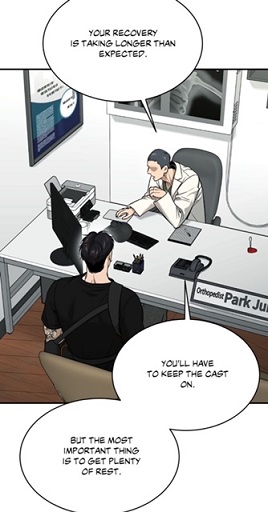 (chapter 54) The athlete was left on his own.
 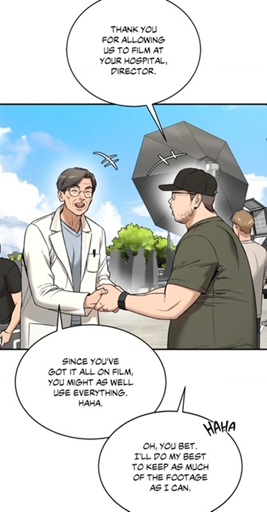 (Chapter 59): At first glance, the hospice appears to be underfunded and outdated.
  (chapter 61) However, its director breaks expectations. Unlike the smooth-talking or indifferent doctors at larger institutions, he is directly involved in patient care.
  (chapter 60), criticizes people for their rude behavior
  (chapter 59) or actively disciplines staff
 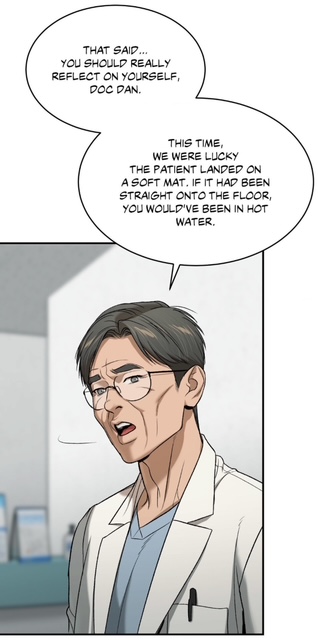 (chapter 59) when mistakes are made. Though he also flatters the champion
  (chapter 61) and sees promotional potential, he never exploits patients.
  (chapter 61) The juxtaposition of humility and responsibility in his demeanor, combined with his stunned reactions to sudden events, suggests an overworked and understaffed environment—but not one without moral grounding. His white coat and blue medical uniform echo the nurses’ attire, subtly promoting a sense of equity among staff. Despite being a director, he doesn’t separate himself from frontline caregivers. His uniform also contrasts with the green worn by Kim Miseon or Park Miseon, suggesting a focus on practical responsibility over prestige. By blending in with the team, he fosters a culture of shared accountability, not rigid hierarchy. Among all institutional figures, he comes closest to balancing authority with integrity.
  (Chapter 6): While this figure appears authoritative
 (chapter 1), the details of his attire tell another story. Wearing a suit beneath his coat implies professionalism, but here it also suggests a business-driven mindset. The coat becomes a sleek outer layer masking deeper intentions. His charming demeanor conceals a more sinister reality—he weaponizes authority for personal gain. His use of professional attire isn’t about respectability but manipulation. Beneath the surface, profit, control, and coercion drive his actions.
  (chapter 1) The white coat, in his case, is not a symbol of healing but a façade for exploitation. drives his authority. The coat becomes a literal cover for abuse—harassment disguised under professionalism. His entire persona is a façade: calculated, charming on the surface, but predatory and morally bankrupt beneath.
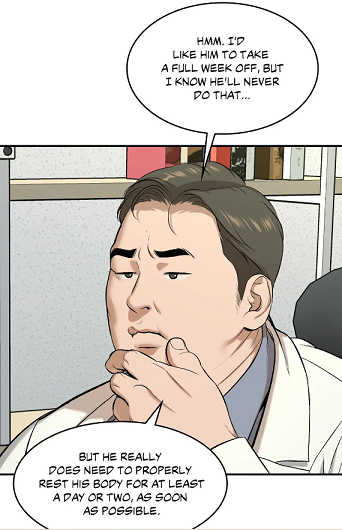 (chapter 27) His gray shirt signals a more relaxed approach,
 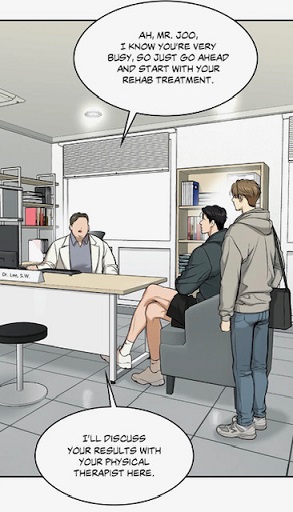 (chapter 27) and his facial expression conveys a certain empathy—though his words also betray resignation. He sits beside the patient, not opposite, visually erasing the typical hierarchical divide between doctor and athlete. His recommendation that Joo Jaekyung rest is gently delivered, but he knows it will likely be ignored. He represents the tension between medical idealism and the pressures of athletic performance. He is trying his best to protect Joo Jaekyung’s career.
  (chapter 27) Notably, he doesn’t chase fame or loyalty—he’s realistic, yet still rooted in care.
 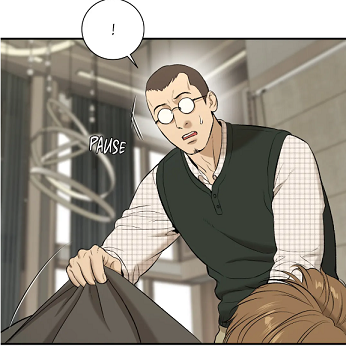 (chapter 13) Finally, Cheolmin exists outside the hospital system. He wears no white coat, but his behavior mirrors a true physician’s. He diagnoses accurately, gives immediate advice, and engages both patient and guardian. His attire—a shirt layered under another—might suggest emotional restraint, but it doesn’t interfere with his actions. He jokes and teases, breaking through tension and inviting trust. He acts not because protocol demands it, but because someone needs help. That’s enough.
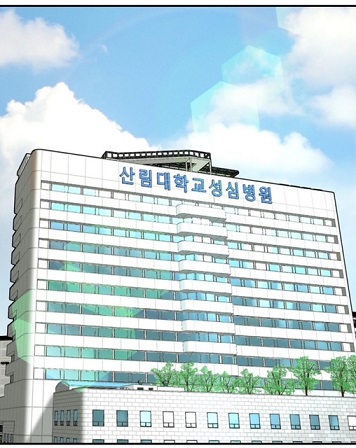 (chapter 41) nature is neatly confined. Rooftop gardens and structured greenery exist, but more as visual accessories than lived environments. The hospital is a towering research center, representing scientific advancement—but also bureaucratic coldness. Here, nature exists to impress, not to comfort. This artificial balance between concrete and green reflects a clinical detachment: nature is curated, not embraced. It aligns perfectly with Kim Miseon’s demeanor—professional, pristine, but ultimately distant and ambition-driven.the environment feels controlled.
 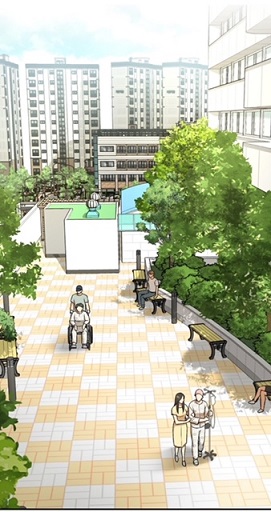 (chapter 41)
  (chapter 54) where Joo Jaekyung receives treatment, the rooftop greenery appears remote and ornamental, disconnected from patient care.
  (chapter 18) modern, and set among scattered trees.
  (chapter 18) Large windows suggest openness and transparency—the very qualities Dr. Lee brings to his interaction. This is a space that, while modest, is genuinely attentive. Here, nature doesn’t impress, it is integrated in the landscape. The park is not surrounded by huge buildings.
 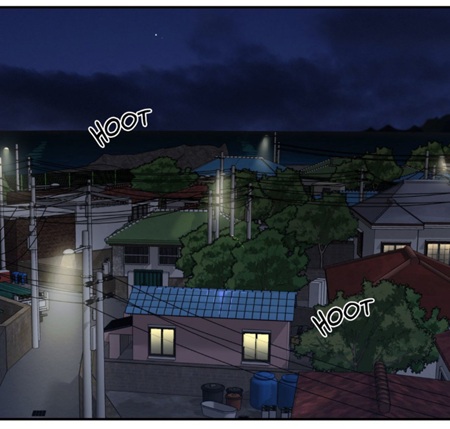 (chapter 65) nestled in the countryside and far from institutional rigidity, emerges as a space of true potential. In returning there, Joo Jaekyung and Kim Dan are not just escaping their past—they are moving toward a form of healing that modern hospitals imitate but rarely achieve. Closer to nature, they are closer to themselves. If hospitals imitate forests, the village becomes the forest. And in that simplicity, Jinx suggests, real happiness might grow.
 (chapter 62) surrounded by greenery, animals, and people who don’t treat him as a product—his health improves. His muscles may still ache, but mentally and emotionally, he is lighter.
  (chapter 57) It lives where no one is watching and no one is billing. In Jinx, the real medicine lies outside the chart—in the dirt on borrowed floral pants, in sweat earned under open skies. Nature becomes the unspoken vow that systems forgot.

 (chapter 36), his tendency to retreat rather than challenge his own doubts
  (chapter 36), and his overwhelming fear of disappointing others
  (chapter 54) suggests he too is haunted by such internalized voices. Under this new light, you comprehend why I wrote in the introduction that the broken mirror was mostly alluding to the doctor. Both protagonists are suffering from mental hurdles, trapped in a psychological prison. The significant difference is that while Kim Dan is consciously recognizing his self-doubt
  (chapter 62), Joo Jaekyung does not. The evidence for this interpretation is the champion’s nightmare:
  (chapter 18) the doctor
 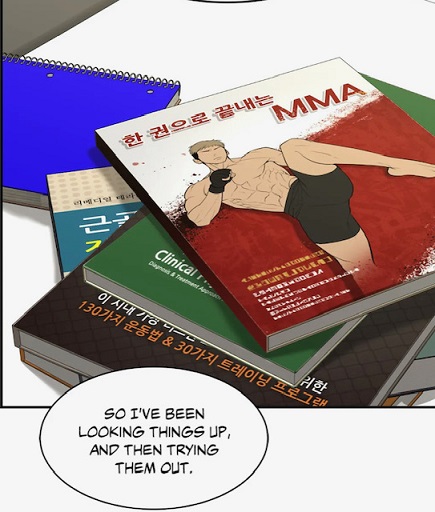 (chapter 25) Therefore the physical therapist bought books. Moreover, we should consider this argument
  (chapter 45) as a revocation of the star’s statement in episode 18. Kim Dan was no longer perceived as a tool, but as a real physical therapist. On the one hand, this request boosted the “angel’s ego”, on the other hand, he was put under immense pressure, for he was compared to his colleagues.
 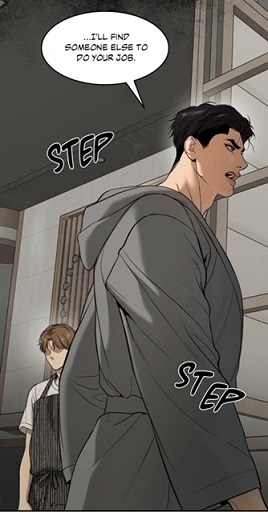 (chapter 45) Since in Seoul, Kim Dan has only been hired because of sex (Joo Jaekyung, the perverted hospital director)
 (chapter 62) Due to his bad past experiences, he concluded deep down that his CV was not reflecting the truth.
 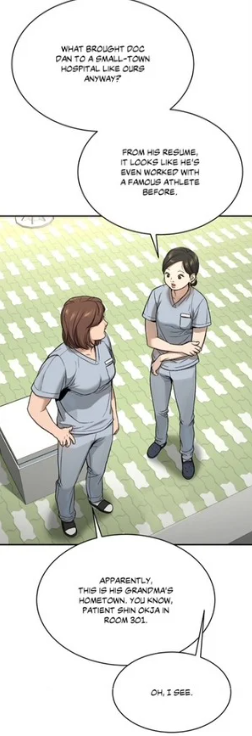 (chapter 56) That’s the reason why he was devaluing himself and as such not looking for a high position.
 (chapter 48) exemplifies this pattern:
  (chapter 48) It was not the right time. He assumed his voice held no weight, reflecting years of learned helplessness. It shows how Kim Dan internalizes responsibility for things beyond his control. He thinks that withholding information is an act of protection rather than avoidance. Yet in doing so, he denies himself agency in his own life.
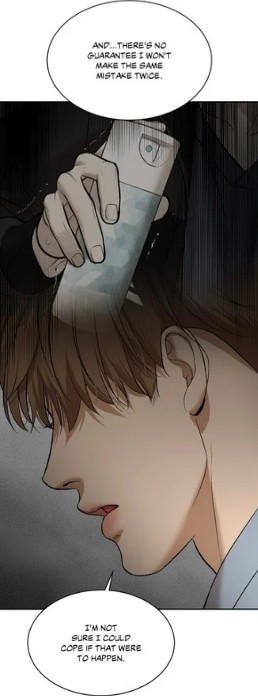 (chapter 62) completely devastated Kim Dan’s already fragile self-esteem.
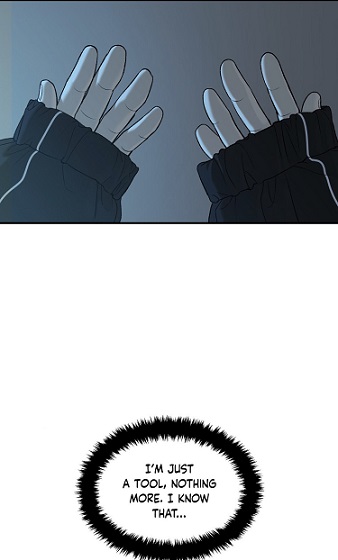
 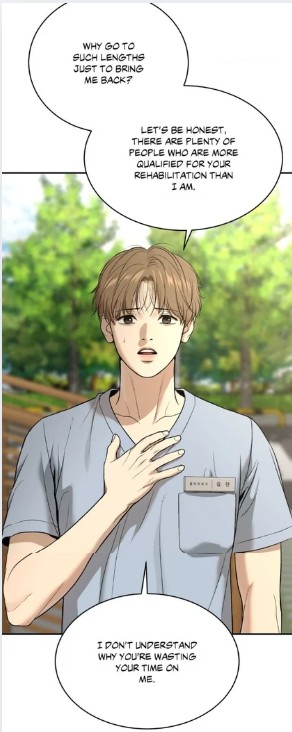 (chapter 62) First, he considers himself as waste. While in the past, he was at least a tool, he is now garbage. Hence his feelings are “trash”.
  (chapter 62) This means that in episode 62, he felt worse than in episode 18! The idioms “trash” and “waste” revealed the doctor’s own self-perception in episode 62: he saw himself as totally useless. He belonged to the “wastebasket”, just like the golden key chain.
  (chapter 46) Thus I deduce that the fate of this item echoes the doctor’s.
 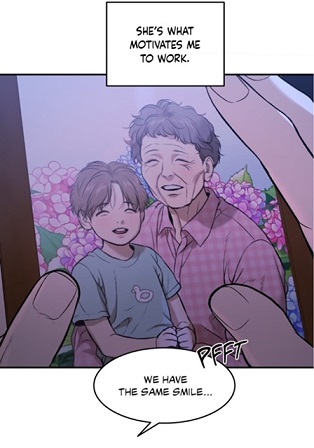 (chapter 47) He had selected this profession because of her. This shows that until now, he has never developed any ambition on his own. The loss of faith from someone he relied on for motivation made him feel completely worthless. This reinforces that his confidence and sense of direction were never self-sustained: they depended on others’ recognition. This pattern suggests that Kim Dan has never truly asked himself what he wants. His entire existence has revolved around meeting expectations, whether from his grandmother, Joo Jaekyung, or even his profession. His current crisis—feeling like waste—stems from the realization that without someone to validate his worth, he sees himself as nothing.
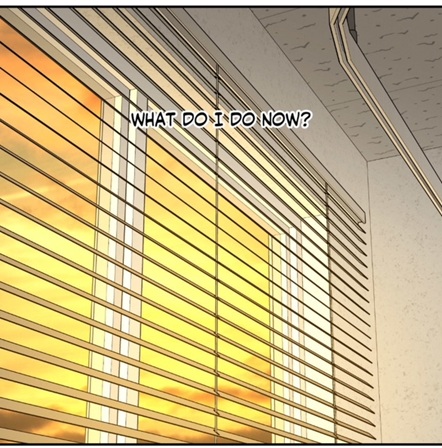 (chapter 59) However, observe that he is using the expressions “do” and “now”. This has nothing to do with the future and dreams. It is not a reflection on his own desires but rather an immediate reaction to his circumstances. His mindset is still trapped in survival mode, seeking a course of action rather than contemplating what he truly wants. His words reflect an urgency to act rather than an opportunity to dream. This highlights that he has spent his entire life making decisions based on necessity rather than personal fulfillment. Even when faced with uncertainty, he does not ask himself what he wants—only what he must do next. His transformation will only be complete when he begins to question not just how to survive, but how to live on his own terms. That’s how I realized why Mingwa put this question in front of the window covered with Venetian blinds [which made me think of this scene
  (chapter 39 – Venice, a travel to Italy]. The window with the Venetian blinds represents a metaphor for the doctor’s trapped dreams. This interpretation made me recognize another aspect. Kim Dan is pushed to meditate, when he is front of a window or better said close to the sky! Hence the hamster started thinking about his own future in the penthouse
 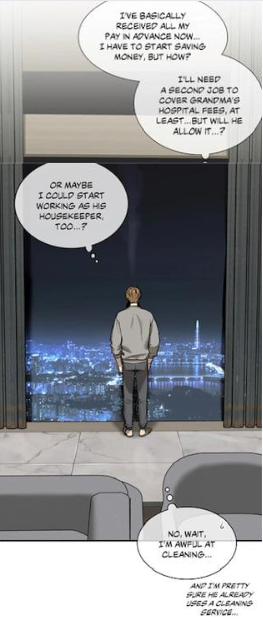 (chapter 19) or when he looked at the sun and sky:
 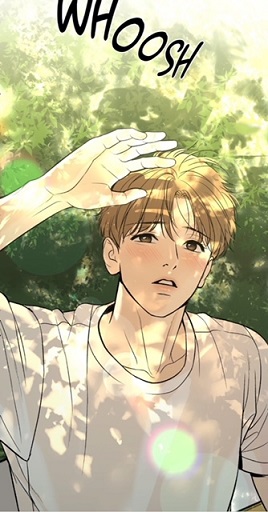 (chapter 41)
 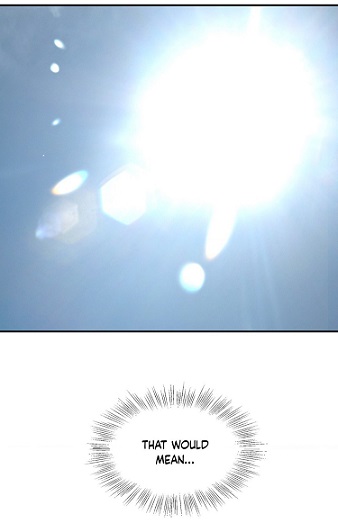 (chapter 41) And the best evidence for this interpretation and expectation is doc Dan’s cellphone screen display.
  (chapter 38) My avid readers will certainly recall that clouds embody dreams! Why? It is because in verity, doc Dan is a dreamer, an ambitious man. What caught my attention is that his contact Joo Jaekyung was not saved with a picture!! And what had motivated Kim Dan in the past?
 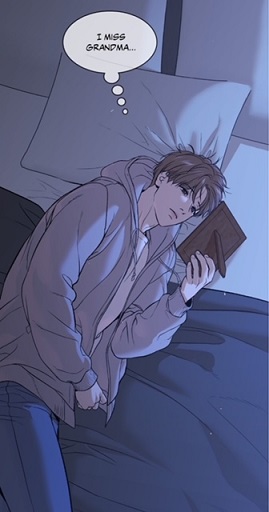 (chapter 47) The picture from his childhood: himself with his grandmother.
  (chapter 66) But the latter was not related to work, but to fun and nature. Striking is that Joo Jaekyung has an empty phone screen display indicating that he has no real dream on his own either:
  (chapter 38) No wonder why he questioned the meaning of his champion title:
  (chapter 54). He saw the belt as something rather “meaningless”.
  (chapter 43) This would boost the doctor’s self-esteem. He is not trash, but an acknowledged fan and friend. The picture would encourage the physical therapist to develop his own ambitions. As soon as I made this discovery, another detail caught my notice:
  (chapter 66) The celebrity has no picture of Park Namwook in his contacts divulging the superficiality of their relationship.
  (chapter 42) The problem is that the athlete took this recommendation personally. He felt as if his job as fighter was questioned.
  (chapter 42) As you can see, the doctor’s hesitations were exposing his mental obstacles, which was reflected in the champion’s attitude. No wonder why doc Dan chose to become a courier as a second job instead of finding a new VIP client. While the interaction between the athlete and Kim Dan in front of the hospice display the return of doc Dan’s past mental hurdles:
 (chapter 62) According to the main lead, the champion is “wasting his time here”.
  (chapter 62)
 (chapter 57) Hence it is clear that in the future, the physical therapist would refuse to use any kind of spray. On the other hand, it is important to recall that back then, Joo Jaekyung had made the request himself:
 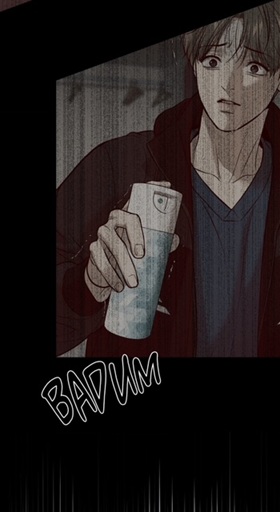 (chapter 57)
  (chapter 1) with a previous PT like the spray? No wonder why he called himself “trash” in the end.
  , people might wonder why I selected dandelions as a frame for the selected.. It’s clear that the dandelions aren’t just there for aesthetic balance. Their symbolism is profound. Dandelions are often associated with childhood innocence, wishes, and fleeting moments of beauty, yet they also wither quickly, easily scattered by the wind. In the context of Jinx, they represent a transitory force—something that struggles to take root, much like the intangible and fleeting elements in Kim Dan’s life. But there’s more to it. Before delving into deeper analysis, consider this: what is the common denominator in all these scenes?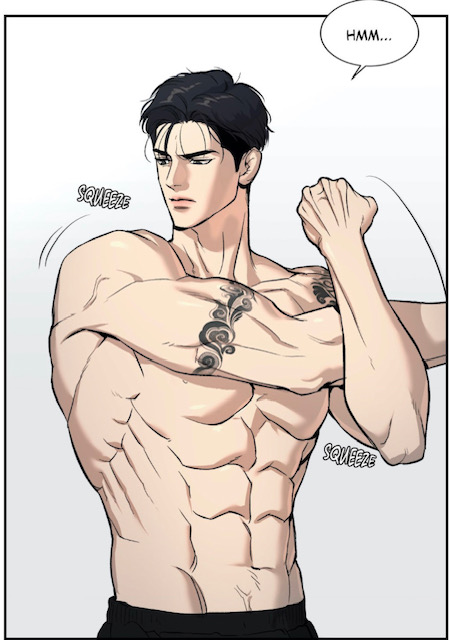


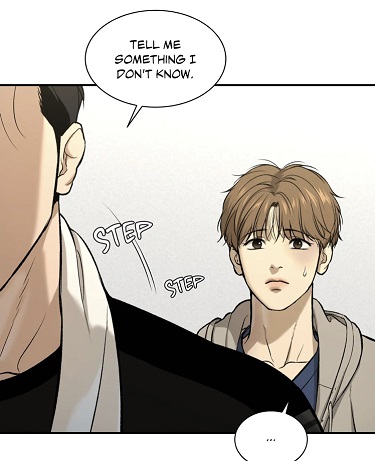
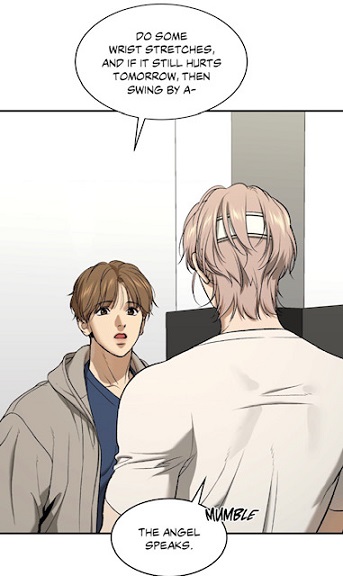

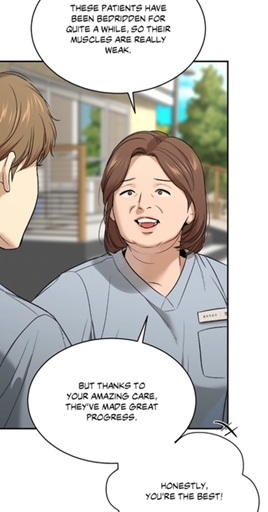


 (chapter 37) Therefore it is not surprising that the main lead couldn’t view the members as friends in the end.
  (chapter 41) And now, you comprehend why Joo Jaekyung has always disliked his birthday and the “congratulations” from people in general. The gifts and words were like poisoned praises to his soul. They were pushing him to live like a “god”.
  (chapter 59) While this photography was not a personal and intimate picture, it also symbolizes his first root in the little community: Light of Hope Hospice. He is part of the staff and as such of the little town. On the other side, we could say, he is gradually entering the scene as a PT. Note the contrast to the food truck:
 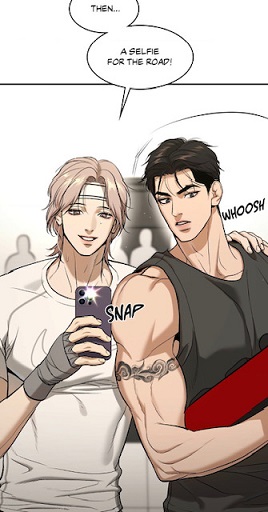 (chapter 30) In other words, it exposes the actor’s hypocrisy and wrongdoings. And now, you understand why I wrote genuine in parentheses above [proof of (genuine) human connection]. Photography in Jinx also represents the evidence of wrongdoing
 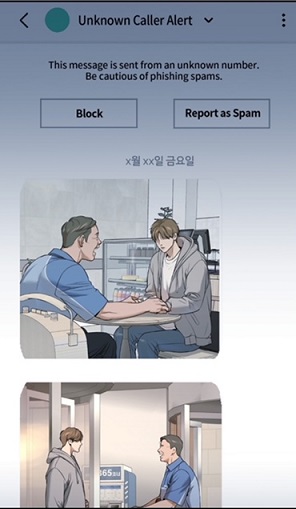 (chapter 48) and deception:
 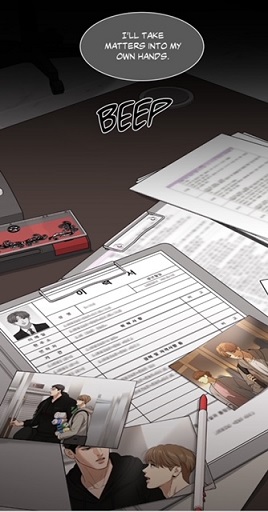 (chapter 46) The exact opposite of the dandelions.
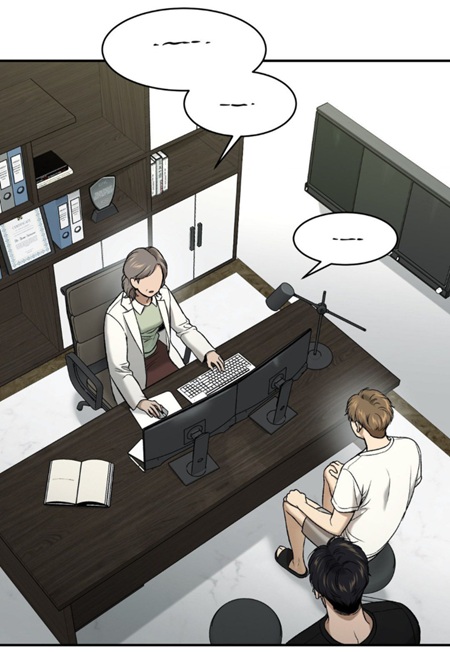 (chapter 66) It is a direct contradiction to the hollow praise doc Dan has received all his life.
 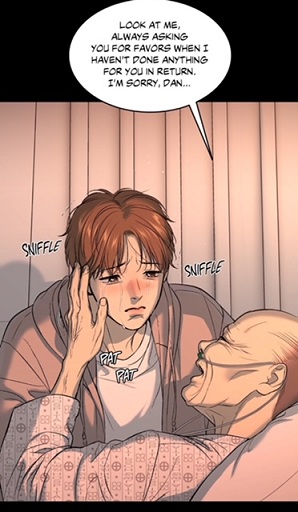 (chapter 53) He was treasurable, for he did favors to his grandmother all the time. Instead of simply saying that Kim Dan matters, the champion proves it. He challenges the physical therapist’s own perception of himself, demonstrating that he is not just useful—he is precious. Secondly by justifying his action for the doctor’s sake,
 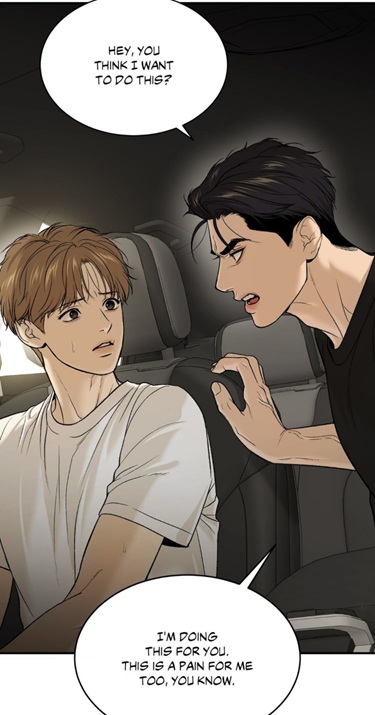 (chapter 66) he contradicts not only Kim Dan’s self-perception, but also his past accusations:
  (chapter 66) that he was merely a tool for Joo Jaekyung’s success. By taking him to the sleep specialist, the champion proves something that Kim Dan had refused to see: he matters beyond his utility. This moment mirrors Joo Jaekyung’s past words—
 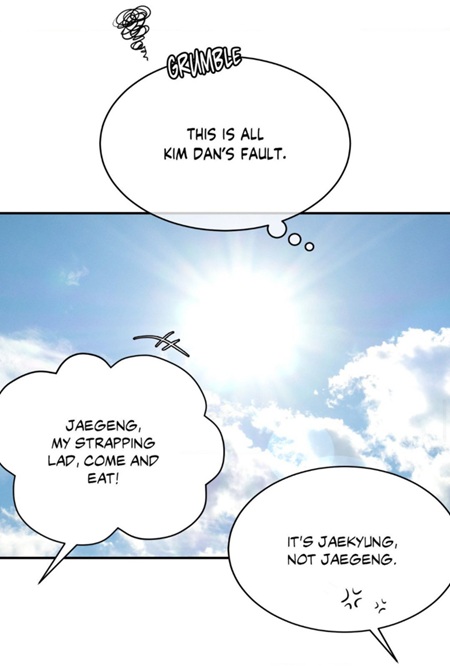 (chapter 62) This shows that deep down, he desires to obtain doc Dan’s gratitude. No wonder why he got so upset after hearing the displeased comment from Kim Dan.
 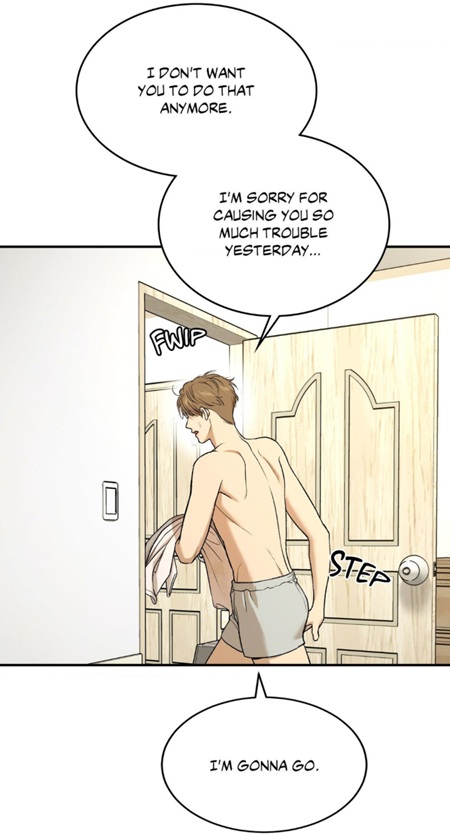 (chapter 66)
 (chapter 66) reveals Kim Dan’s elevation in the champion’s life. The dressing room symbolizes privacy and closeness. No longer seen as a mere tool, Kim Dan has become an integral part of Joo Jaekyung’s world, not because of what he can do but because of who he is.
 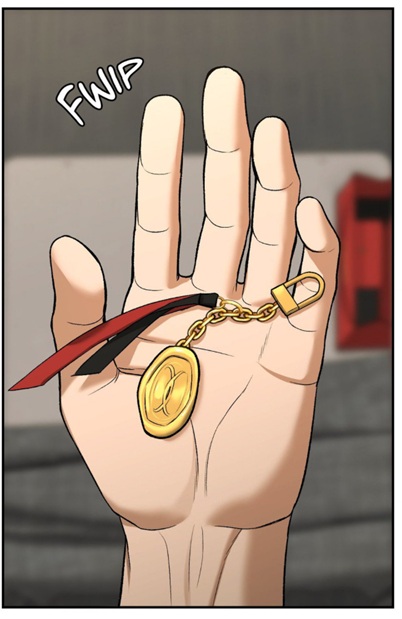 (chapter 66) Therefore the champion is holding the expensive gift with his whole hand contrary to the past:
  (chapter 55) As a conclusion, by bringing him to the sleep specialist, the star proved doc Dan’s words wrong! He told him something that doc Dan didn’t know: he is precious. He needs to pay attention to his health and body.
 (chapter 32) And now, you comprehend why the athlete didn’t fall for Park Namwook’s manipulations afterwards.
 (chapter 7)
 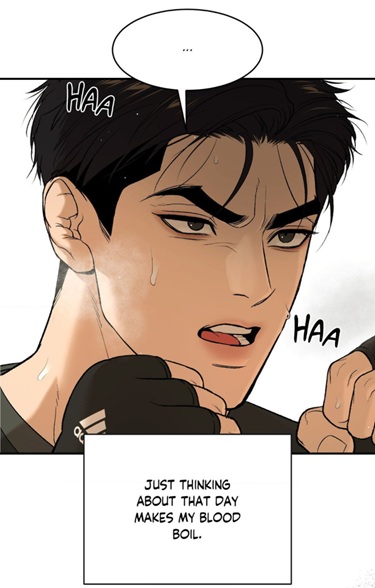 (chapter 65) At the same time, such a disapproval
 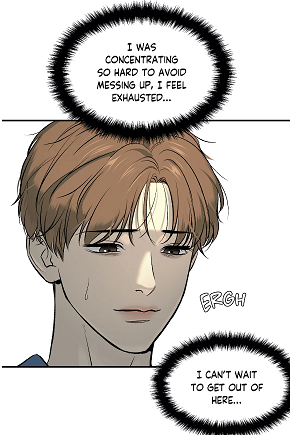 (chapter 1), hence his true desire was to run away from that place. For praise to be effective, the recipient must be open to receiving it, either by looking forward to feedback or having expectations of validation. Since Kim Dan was in a state of distress, he was unable to internalize the champion’s words, reinforcing his long-standing belief that he was invisible or unworthy of acknowledgment. That’s how the champion’s praise became a dandelion seed in the end.
 (chapter 36), or to meet expectations. None of these affirmations recognize him as a person, only as a professional fulfilling a role.
 (chapter 18)
  (chapter 45)
  (chapter 64)
  (chapter 66) Is this a joke?
  (chapter 40) However, Kim Dan has never realized it. Either he was sleeping or totally out of it (fear of sex)
 (chapter 27) It is important to recall the importance of the receiver’s mind-set. The latter has to perceive the sincerity from the speaker. Hence I come to the following deduction: The moment Kim Dan notices Joo Jaekyung’s smile and laugh, then he should come to the conclusion that he matters to the protagonist. I would even say, the two protagonists are destined to make each other laugh and smile:
  (chapter 44) This would be the best “compliment” for both of them. With Kim Dan by his side, Joo Jaekyung desires to make “jokes”.
  (chapter 58) The friends ignored the main lead’s emotions and struggles. In order to be able to have fun, both main leads must be freed from their past and low self-esteem.

 (Chapter 63) The presence—or absence—of clothing during their encounters symbolized the gradual dismantling of their emotional walls. Now, shifting the perspective to the champion, another layer of complexity emerges. Joo Jaekyung’s evolving approach to intimacy is not just a reflection of his growing feelings but also a silent, deeply ingrained struggle with dependence and control.
 (chapter 63) Why does he hesitate to strip entirely, even as he succumbs to desire? Notice that he released his erected phallus before removing his cloth.
  (chapter 63) To answer this, a comparative analysis of earlier sex scenes is necessary, unraveling the hidden dialogue between physical exposure and emotional vulnerability.
 (chapter 30) The doctor instinctively tried to cover his gray boxer shorts with his t-shirt, prompting the champion to question his reaction:
  (chapter 30) In Episode 63, this dynamic appears subtly reversed.
  (chapter 63) The champion, despite holding the dominant role, is now the one retaining a piece of clothing. This suggests an unconscious act of concealment—not of shame in the traditional sense, but of a growing dependency on Kim Dan.
 (chapter 62) The “hamster” could sense with his leg the excitement. On the other hand, these pants were only removed once he entered the bedroom and was on the bed
  (chapter 63), reinforcing the idea that vulnerability, for him, is confined to this private space. Moreover, the choice of attire in Episode 62
  (chapter 63) Thus I deduce that exactly like the presence of the black underwear, the athlete’s low self-esteem hasn’t been removed completely. He still expects fear and rejection.
 (chapter 63), dominates without seeking connection
  (chapter 55), and ensures that every encounter follows his carefully constructed narrative. However, in Episode 63, a subtle but undeniable shift occurs. For the first time, Jaekyung’s actions reflect something deeper than mere desire or dominance. They reveal his growing emotional investment in Kim Dan, exposing a side of him that even he does not fully comprehend.
  (chapter 63)
 (chapter 12) In the earlier encounter, Jaekyung presented himself as a generous partner, offering Kim Dan a so-called privilege—an opportunity to enter a whole new world, thanks to him. However, his so-called generosity was nothing more than a facade, a way to conceal his inexperience in genuine intimacy. The tool he used was not just an object of pleasure but a mask for his own shortcomings as a lover. He did not know how to pleasure Kim Dan, nor did he care to learn. His focus was not on Kim Dan’s enjoyment but on reinforcing his own power and dominance.
 (chapter 63) Here, he no longer portrays himself as the benevolent provider of an experience.
  (chapter 12) – seeking both to display dominance and to elicit validation
  (chapter 12) —this time, in Episode 63, he prioritizes Kim Dan’s pleasure without explicitly expecting anything in return.
  (chapter 63) Up until this point, Jaekyung has never truly faced rejection.
  (chapter 63) His wealth, power, and physical prowess have ensured that people comply with his desires. However, in Episode 63, Kim Dan does not simply comply—he resists on an emotional level. While he consents to sex, he actively rejects any deeper connection. He avoids eye contact, creates physical distance, and refuses to acknowledge Jaekyung beyond the act itself. This rejection unsettles Jaekyung because, for the first time, his usual methods of control no longer work. He cannot use money to bridge the emotional gap, nor can he rely on his dominance to make Kim Dan want him.
  (chapter 63) This moment forces him to confront an uncomfortable truth: power and status cannot buy emotional intimacy.
 (chapter 03) or passive-aggressive remarks.
  (chapter 63) While he does voice his frustration, he does so without force, showing an unprecedented level of emotional regulation. Instead of demanding compliance, he chooses a different approach—he focuses on Kim Dan’s pleasure, attempting to bridge the emotional gap through physical intimacy
  (chapter 63) rather than control. This decision is not merely about sex; it is an unconscious attempt to regain Kim Dan’s attention, to re-establish a connection that he does not yet fully understand but deeply craves.
 (chapter 29) This remark exemplified his detachment, his refusal to acknowledge Kim Dan as a person rather than just a body. Once again, the intercourse was linked to achievement and work. However, in Episode 63, he actively seeks Kim Dan’s gaze, subtly pleading for recognition.
  (chapter 63) This reversal is crucial because it indicates that he no longer sees Kim Dan as just a means to an end. However, his desire for recognition still lingers beneath the surface—just as he once sought validation through dominance, he now seeks it through Kim Dan’s acknowledgment. He wants something more, though he cannot yet articulate what that is, and his actions reflect a subconscious craving for emotional reassurance.
  (chapter 13)
 (chapter 62) the sportsman welcomes the physical therapist in blue pajamas and a robe—an overt attempt to maintain distance and control. Even as the encounter begins, he leaves his pajamas on
  (chapter 3), removing them only
  (chapter 3) – this image marks the change) when the doctor’s back is turned. Then in Episode 8, during the shower, he continues wearing shorts and underwear
  (chapter 8), and his choice of the doggy style further reinforces his desire to avoid direct, face-to-face vulnerability.
  (chapter 12) before removing it and adding the pink sex toy.
  (chapter 12) Their bodies might have been close, but their minds remained divided. That’s why he couldn’t detect the huge bruises on his companion’s body.
  (chapter 12) This guarded approach is further underlined in Episode 20
  (chapter 20), where even in the midst of nakedness, the athlete deliberately positions the doctor in the dog stance. At the same time, he uses another MO: the darkness of the room to hide himself. This calculated arrangement maintains an emotional buffer, allowing him to remain physically exposed yet emotionally detached—a recurring theme in his behavior.
 (chapter 29) while still cloaked in his familiar blue robe and pajamas. Interesting is that the room is not totally dark like in episode 20, the bedroom is illuminated by the huge TV screen. Importantly, this episode marks the first time they face each other in the bedroom, signaling a significant shift in their dynamic and announcing a switch in position. This newfound mutual visibility lays the groundwork for later developments.
 (chapter 33) —a deliberate act imbued with symbolism. Unlike earlier encounters, the champion remains fully clothed throughout this episode,
  (chapter 33) contrasting sharply with previous moments of exposure. The car scene, where they are now facing each other, reinforces the announced switch in intimacy; the light not only illuminates the scene but also serves as a metaphorical spotlight on his desire to see the doctor’s face and body
  (chapter 33) —a silent assertion that only he can truly satisfy the physical therapist. Let’s not forget that before having sex together, the fighter resorted to a dildo
  (chapter 33) rather direct physical intimacy, because he felt insecure after witnessing the actor’s advances toward Kim Dan. His goal? To reaffirm his dominance and make Kim Dan admit that he needed him for pleasure. It is important because it exposes that deep down, the champion views himself as a bad lover. There is no doubt that Heesung‘s criticism resonated with him.
  (chapter 33)
 (chapter 39) Maintaining the doggy style during this phase, he uses such intimate acts to mask his true longing and attraction—an effort to control the encounter while keeping his emotions under wraps. Then I noticed that they switched positions, when doc Dan asked for a break.
  (chapter 39) The wolf chose to lie down on the bed:
  (chapter 39) As you can see, through the different intercourses, we can see the different methods the star used to conceal himself, to hide his “weakness”, his growing feelings for the doctor.
 (chapter 61) The physical therapist remembers an encounter bathed in bright light, where they stood before a couch: the doctor had removed his pants while the champion remained fully clothed, positioned behind him.
  (chapter 61) After both reached climax, the sportsman swiftly departed—a stark demonstration of his habitual retreat into distance and fear, even as he ensures the doctor’s pleasure.
  (chapter 61) This calculated “running away” underscores the return of old insecurities and the persistent need to assert control. Since the doctor was still living in the penthouse and as such was still working as the star’s physical therapist, it becomes comprehensible why the athlete could only resort to strength to keep his fated companion by his side. He had rejected his “gratitude” and “emotions” before.
  (chapter 63) Now lying on the bed facing each other, the pair’s physical closeness appears more genuine. Yet, even in this seemingly intimate configuration, they avoid locking eyes during penetration.
  (chapter 4), we do not see whether he is wearing anything the morning after. After their “magic night” in the United States (Episode 39), the next morning, he is only shown taking a shower
  (chapter 40) —meaning the audience never sees him leaving the bed. However, in Episode 45, the author deliberately includes a shot of Jaekyung leaving the bed while still wearing his black boxer briefs.
  (chapter 45)
  (chapter 45). This is just a rhetorical question, as he clearly remembers the night.
  (chapter 45) In reality, he was wondering why he had acted this way. This contradiction—pretending to forget while consciously recalling their time together—reflects his internal denial. His next thought,
  (chapter 45) is a transparent excuse to avoid confronting his emotions. The presence of the black underwear in this scene confirms that he had not fully lowered his guard; he still maintained a psychological barrier between himself and Kim Dan.
 (chapter 54) If he was not good enough, if he did not win, he was nothing.
 (chapter 54) The specter that haunts him—an unnamed figure whose words still echo in his nightmares—was the architect of his relentless pursuit of strength. Striking is that in his nightmare, he is facing the mysterious ghost, a sign that he saw hatred and rejection in his counterpart’s eyes. While Kim Dan’s halmoni took his hand and provided warmth
  (chapter 22), Jaekyung’s guardian likely did the opposite.
 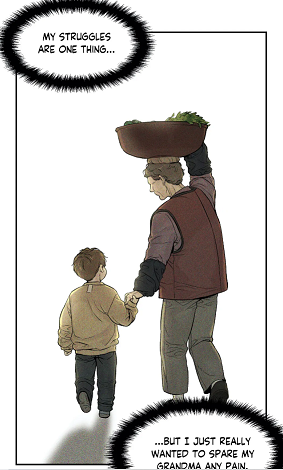 (chapter 5) This represented a source of support for the elderly woman. Secondly, during the intercourse in the lavender-tinted bedroom, neither the champion nor the doctor are trying to take each other’s hand:
  (chapter 63) In the beginning, the champion grabbed doc Dan’s wrist. This shows that the athlete was not used to touch Kim Dan’s hand. And notice how the “hamster” reacted
  (chapter 63) He pushed it away. This means that taking the doctor’s hand represents the biggest challenge for Joo Jaekyung right now. In addition, the last panel indicates the champion’s transformation, he is now willing to seek the doctor’s closeness. It also implies the vanishing influence from his past guardian.
 (chapter 27) Under this new light, it could explain why the fighter forgot his passion. They made sure that he would train restlessly. In this environment, vulnerability was a defect to be eradicated, not a human trait to be acknowledged. This description reminded me think of Park Namwook and his family. The manager is a former national wrestler who is married to an athlete too.
  (chapter 5) At the same time, it would highlight the potential danger of Park Namwook’s vision for the gym: an institution that might perpetuate the same cycle of control, shame, and expectation rather than fostering true passion and individuality in young athletes. That’s how I realized why the manager slapped his “boy” after the funny sparring:
  (chapter 26) He explained that the main lead was just a doctor. However, I am quite certain, underneath, the manager thought that doc Dan was not fit to spare: so small and weak. He doesn’t fit the criteria to become a sparring partner. Look at his reaction, when Seonho faced the champion:
 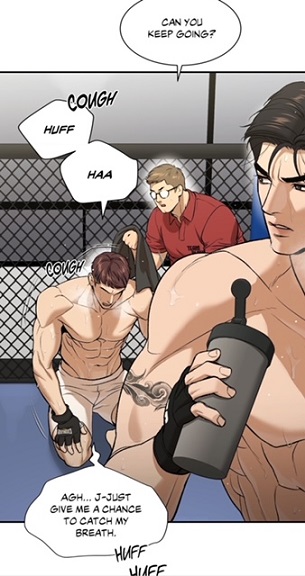 (chapter 46) Under this new light, it becomes comprehensible why Potato was also neglected by the manager. The young maknae belongs to a different weight category. There is this invisible rule that only strong people can become member from the gym. However, the purpose of such an institution shouldn’t be reduced to titles, strong and muscular men or boys. The gym should be opened to anyone who desires to have fun and improve their health.
 (chapter 1), until he received the doctor’s massage in chapter 1. His attitude toward sex mirrors his training in the gym—focused on endurance, performance, and control. His body is a tool, a machine honed for efficiency.
  (chapter 63) Pleasure is secondary; the real goal is lasting, enduring, proving his stamina. Even in his most intimate moments, he is competing against an invisible opponent—his own ingrained fear of inadequacy.
 (chapter 63), why he keeps barriers between himself and Kim Dan, even when his body betrays his true desires.
 (chapter 62)
 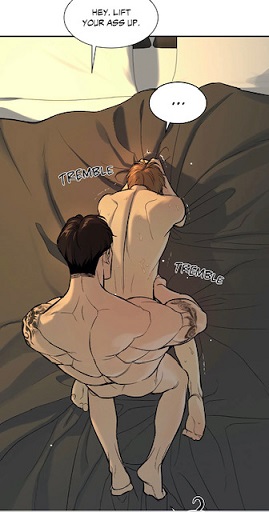 (chapter 4) nudity was a tool of dominance, a means of asserting control. Now, it has become a sign of submission—not in the physical sense, but in the way he is slowly relinquishing the emotional armor he has always relied upon.
  (chapter 44) His decision to keep his underwear on for as long as possible in Episode 63 is not a sign of detachment
  (chapter 63), but of his silent battle against the vulnerability he is beginning to feel.

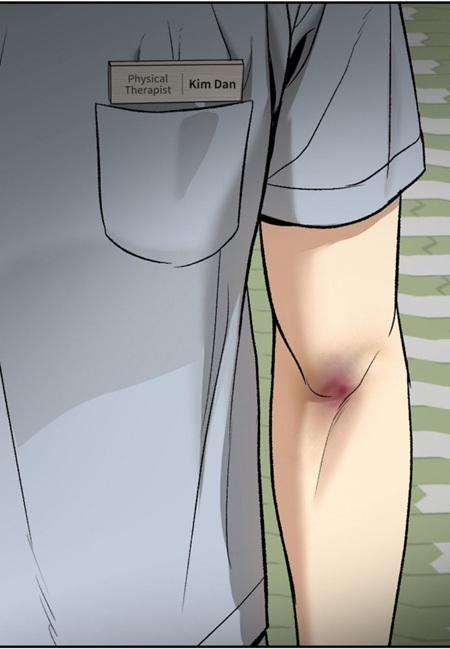 (Chapter 61) However, this moment is not isolated—it reflects patterns in his personality that have appeared throughout the series.
  (Chapter 11)
  (chapter 18) This essay delves into the significance of Kim Dan’s physical and emotional bruises, examining how they symbolize his suffering, internal conflict and transformation. I will examine Kim Dan’s conflicted emotions surrounding gratitude and debt, contrasting his interactions with Joo Jaekyung and his grandmother, Shin Okja. Additionally, I will explore how Kim Dan’s conditioned identity as a caregiver drives his choices, even in his current living situation with the landlord, where he unconsciously replicates past dynamics. Ultimately, I will elaborate how Kim Dan’s newfound awareness could reshape his identity and relationships moving forward.
 (Chapter 61) His unexpected reaction catches Kim Dan off guard, further emphasizing how disconnected the doctor has become from his own well-being. However, contrary to the past
  (chapter 11), Kim Dan is truly responsible for the contusion. He caused the injury by removing the needle from the drip.
  (chapter 60) By taking this action, he absolved Joo Jaekyung of any responsibility for the injury, but this is merely a superficial conclusion.
 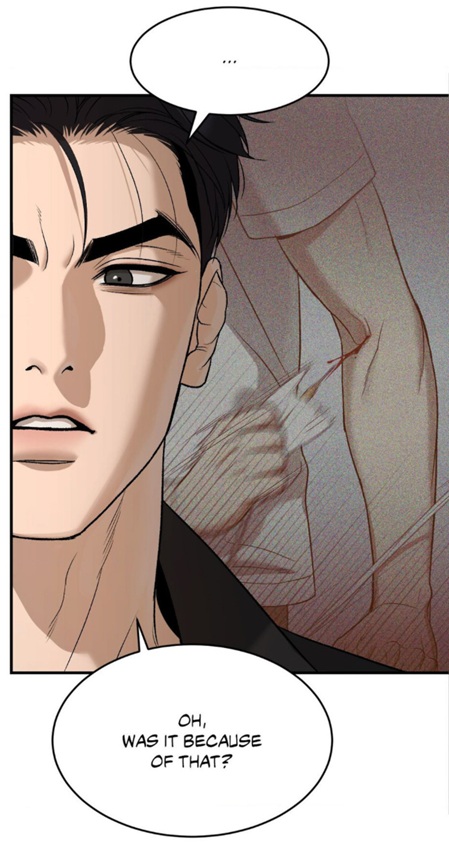 (Chapter 61) On the hand the circumstances surrounding the bruise, where Kim Dan removed the needle on his own, provide insight into his psyche. The deeper cause of the bruise lies in Kim Dan’s declining health, which is intrinsically connected to his malnutrition and the neglect he faces from those around him. It is important to recall that Joo Jaekyung was explicitly informed that Kim Dan needed rest
  (chapter 60). Yet, with his insistence,
 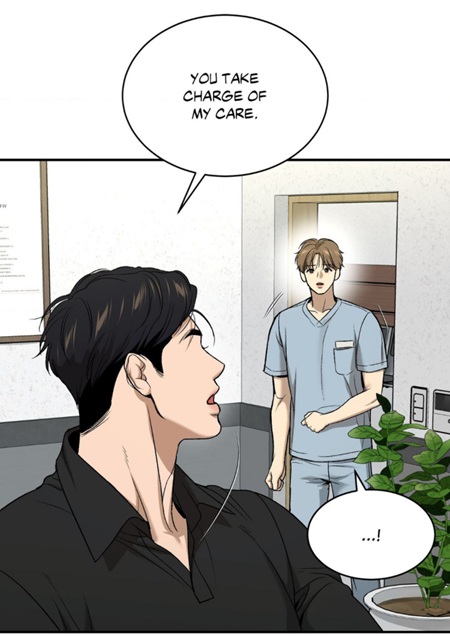 (chapter 61), he forced the physical therapist to keep working, adding even more strain than before. Though the physical therapist attempted to voice his disapproval,
 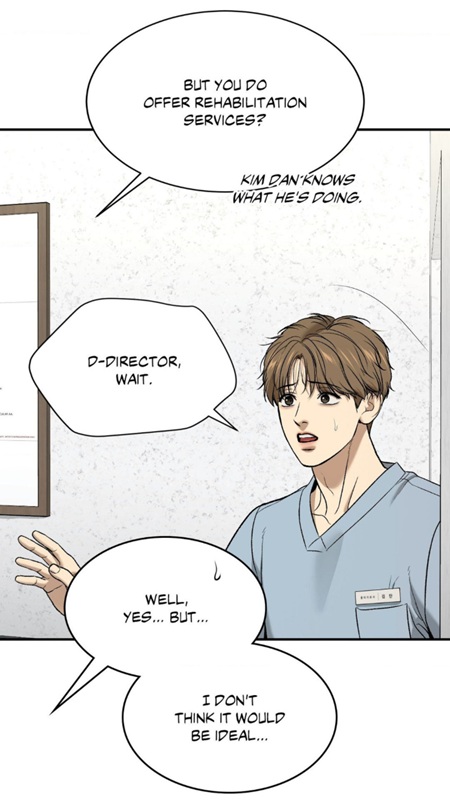 (chapter 61), he ultimately had no choice but to comply, as his order came from the hospice director.
  (Chapter 61) And why did the director override Kim Dan’s need for rest? Money and free PR. Joo Jaekyung’s influence secured the director’s approval, disregarding the doctor’s well-being in favor of business interests. This conversation at the director’s office makes one thing clear: words hold no power against profit. An d that realization led me to another connection—every one of Kim Dan’s bruises is linked to exploitation, whether by authority, obligation, or financial influence.


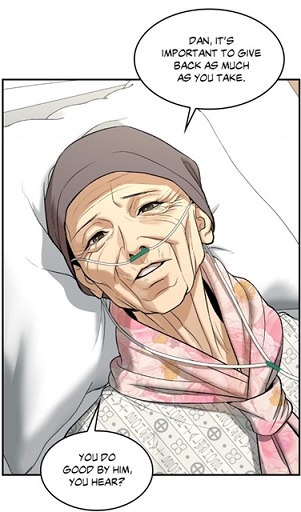 (Chapter 41) It is clear that she was inciting him to work harder than before. This displays that Kim Dan was not allowed to rest. During this encounter, she didn’t ask him about his well-being either. And what is the link between these 3 episodes? The grandmother and her poverty. The latter was responsible for the loan.
  (chapter 18) and took Kim Dan along, ensuring he was seen as an emergency patient. However, this visit was brief and lacked any comprehensive medical examination—no blood samples were taken, and his underlying health concerns remained undiagnosed. This omission further underscores the neglect Kim Dan has suffered, as even in a medical setting, his long-term health issues were overlooked.
 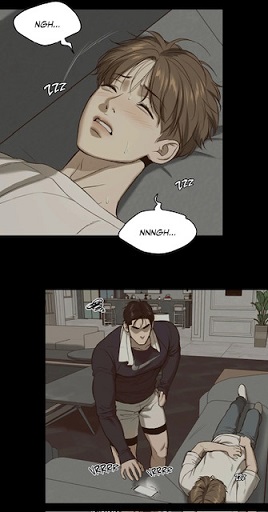 (chapter 21) But back then, the champion didn’t pay too much attention to it. In my opinion, her response will likely reflect her established pattern of emotional detachment and deflection of responsibility. Rather than admitting her lack of concern for his well-being, she may shift blame onto the staff or Kim Dan himself
  (chapter 5), or his general reluctance to ask for help. He rejected the athlete’s help and concern.
  (chapter 61) He only remained at the door. However, observe that there was a cut between this image
  (chapter 61) and the conversation between the main couple in front of the hospice.
 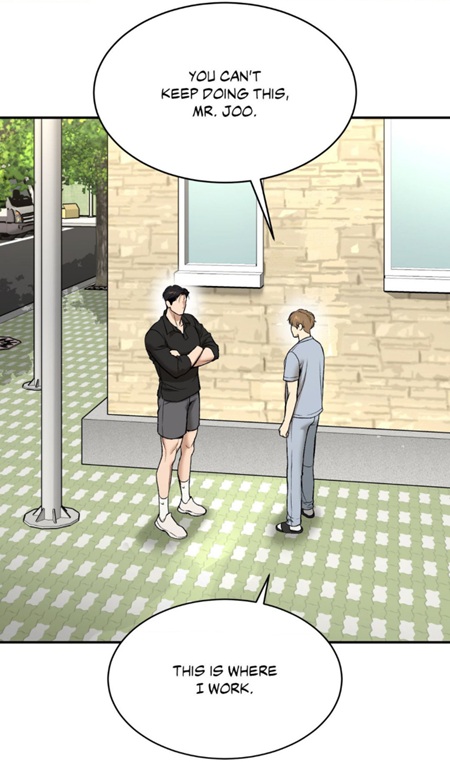 (chapter 61) So he could have made his presence known to his relative before asking Joo Jaekyung to follow him because of his treatment. To conclude, I believe that she had the time and occasion to see her grandchild and his bruise.
 (chapter 13) He is the only doctor who has ever examined the protagonist so closely and even paid attention to his fingernails!
  (chapter 13) At the same time, the chingu from the club was the first one pointing out that his wounds were never treated!! Furthermore, I realized that the doctor’s lies from episode 11
 (chapter 59) He would space out and even fall asleep at any moment.
 (chapter 43) He thought, it was related to the massage, yet the reality was that this incident showed that he had coagulation issues. To conclude, all the bruises could have always been noticed by people due to their locations (eyes, hands, arm)!
  (chapter 61) and his relationship with Joo Jaekyung.
  (chapter 61) That’s how I recognized why these women’s warm welcome and curiosity about Kim Dan were rather superficial.
  (chapter 56) His arrival stands for novelty and a breath of fresh air at the institution. However, with this change, the female staff is forgetting their original duty: they need to pay attention to their colleagues. They are behaving like the grandmother
 (chapter 61): fangirling over the handsome guys visiting their little town. That’s why Mingwa drew flowers in the last two images. No wonder why no one around Kim Dan is observing the bruise and his deteriorating condition. Moreover, since the physical therapist has a relative at the hospice, the staff is envisioning that Shin Okja is doing “her work”, she is paying attention to Kim Dan’s mental and physical conditions. On the other hand, there is no doubt that the grandmother has already delegated her own responsibility onto others, Kim Dan and the hospice. It is a medical institution, therefore they should pay attention to his working conditions. In other words, since no one feels responsible for the protagonist’s health, no one is worried about Kim Dan at all. At the end of episode 61, he is even so pale and breathless
  (chapter 61) that I am anticipating a terrible incident leading to a rude awakening for everyone.
 (chapter 57) By declaring that Kim Dan is now responsible for his own life, she emotionally detaches herself, absolving herself of any accountability for his deteriorating condition. However, she is forgetting
  (chapter 56) that she is still relying on him, as he is the one paying her hospice bills. Besides, she still doesn’t know that the loan is no longer existent. It was, as if he had to clean up her mess before her death. At no moment, she asks about the loan or the doctor’s future. She is not thinking about his future at all.
 (chapter 57) — reinforces her conviction that she has fulfilled her role. In her mind, his rejection of her advice places the burden of care entirely on him, allowing her to dismiss any further involvement. This emotional withdrawal directly connects to the symbolism of the bruise:
  (chapter 18) In episode 18, when Joo Jaekyung confronts Kim Dan about the loan, the doctor has a bruise on his left eye, symbolizing his entrapment and helplessness. This earlier injury highlights how Kim Dan has been conditioned to view himself as responsible for burdens that are not his own, perpetuating a cycle of sacrifice and self-neglect. And a new bruise appeared just after the athlete reminded the physical therapist of his past promise:
  (chapter 61) His grandmother’s disregard for his well-being amplifies the injustice of this situation; she allowed him to shoulder the debt despite knowing it was never truly his to bear. The bruise becomes a recurring motif, a visual representation of how others have imposed their responsibilities on Kim Dan, leaving him physically and emotionally scarred.
  (chapter 60). The juxtaposition of the vibrant environment with Kim Dan’s deteriorating health underscores the neglect he faces. The hospice is meant to be a sanctuary, yet it becomes a space where Kim Dan is further burdened by the champion and his grandmother’s expectations
 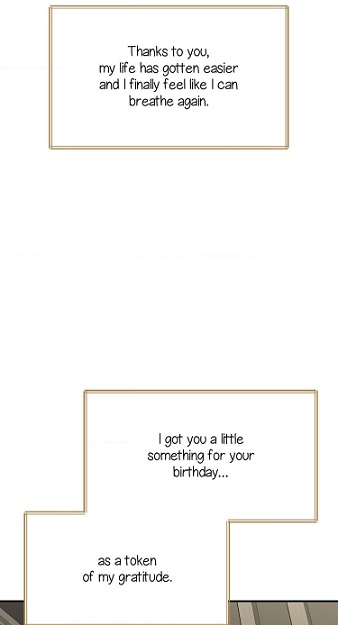 (chapter 55) This line “I finally feel like I can breathe again”, written by Kim Dan, reveals a subconscious acknowledgment that his relationship with the champion represents a breath of fresh air, a chance to escape the suffocating expectations and burdens he has carried for so long. The bruise, a physical manifestation of his struggle, signals the breaking point of his role as a selfless caregiver. It challenges the illusion of invulnerability that Kim Dan has maintained and forces those around him to confront his vulnerability.
 (chapter 60) The beach, with its open and untamed expanse, symbolizes freedom and a return to the self. It foreshadows that Kim Dan’s true journey toward healing will require him to step outside the roles and confines imposed upon him, finding solace not in what is expected but in what feels authentic and liberating.
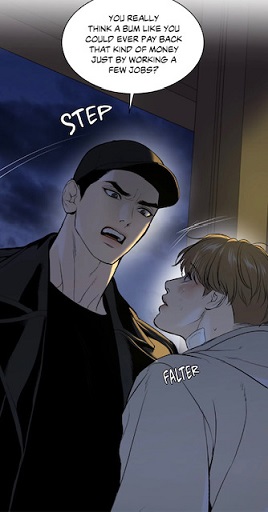 (chapter 18) His grandmother, Shin Okja, played a significant role in this mindset by fostering the illusion that hard work and sacrifice would erase the debts. However, as revealed in episode 18, this was a lie. Shin Okja made the choice to take on the loan and not to seek help
 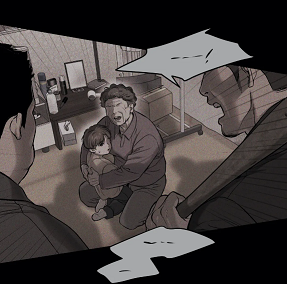 (chapter 5), yet she burdened Kim Dan with it, using his sense of duty and gratitude against him. Her statement in episode 57
  (chapter 18) —or, more accurately, the lack thereof. The champion’s actions were motivated by a desire to help
  (chapter 18), hence the star was waiting for a smile from Kim Dan. Yet the latter perceived it as meddling. His immediate response
  (chapter 53), leaving a note when he moved out that promises to settle the debt. However, by Episode 61, Kim Dan is no longer mentioning the debt, signaling a shift in his priorities and a possible breaking point in his adherence to his grandmother’s expectations.
  (chapter 59) Death can take away anyone and at any moment. In my eyes, if Joo Jaekyung uses his own body to save the doctor again (like for example blood transfusion and CPR), this time Kim Dan would feel truly grateful towards the champion. So far, the doctor has not recognized the star as his savior yet. By removing the needle, he denied the protagonist’s intervention on the beach:
  (chapter 60) Hence his arm got bruised. The contusion was a reminder that something had happened during that night, but Kim Dan chose to ignore the incident. He never questioned why he was on the beach, he acted, as if Joo JAekyung had lied.
  (chapter 60)
 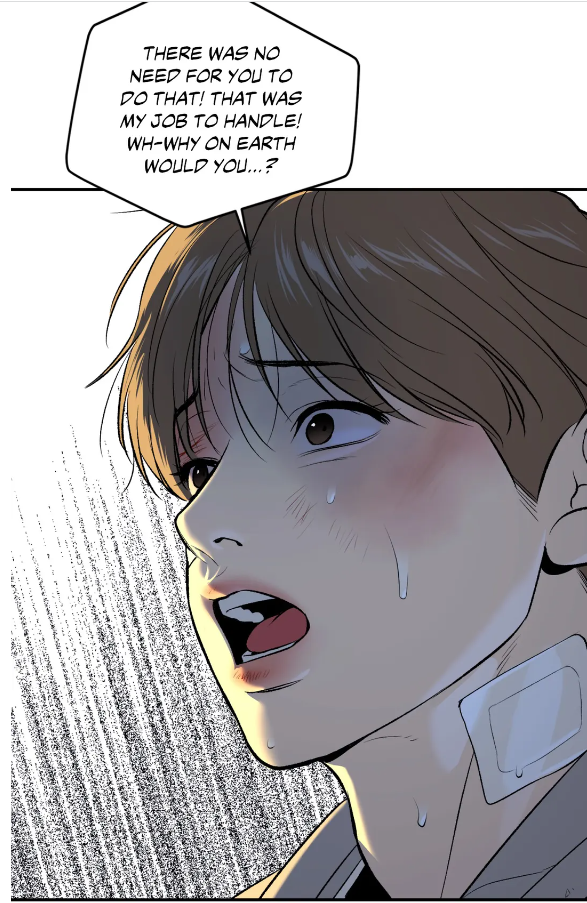 (chapter 18) Deep down, Kim Dan knows that the debt was never truly his responsibility, making it difficult for him to view the champion’s actions as a genuine act of kindness. This inner conflict is compounded by his suicidal disposition, which renders the concept of repaying the debt meaningless.
 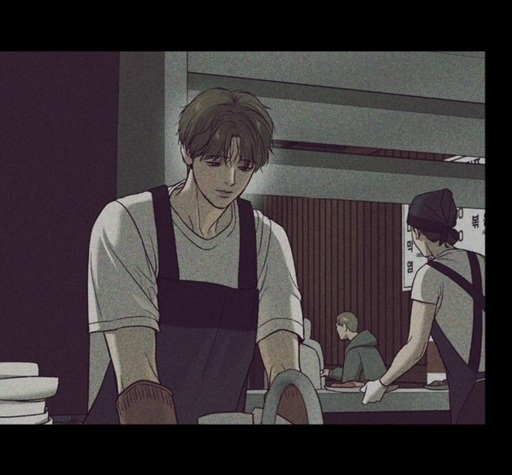 (chapter 59) He worked so hard, was even beaten, but he could never voice his torment.
  (chapter 59) Why? It is because the grandmother was no longer by his side and she never talked to him either. The absence of communication indicates her lack of interest in Kim Dan. And it becomes comprehensible why during that night, he felt the need to go to the ocean and drown himself. It is because he was gradually realizing his loneliness. With his relative’s death, he would only keep living a terrible life determined by work and nothing else.
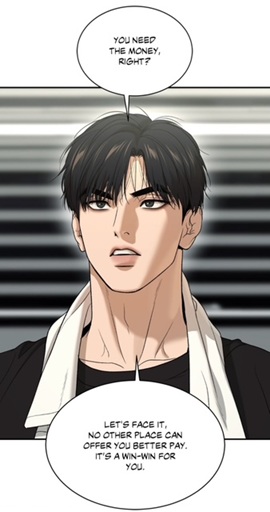 (chapter 60)
  (chapter 11) and even uses his own words against him:
  (chapter 22) The loan was the result of his grandmother’s decision. He never helped him, rather his grandmother.
  (chapter 11) However, he never explained his circumstances to the generous athlete. By keeping him in the dark, he reinforced his negative disposition about the doctor. And chapter 61 exposes this reality. His suffering was the result of his own decision.
 (chapter 61) Do you recognize the room? That was the doctor’s
  (chapter 19)
  (chapter 53) His decision to allow Joo Jaekyung into his bedroom in episode 61 demonstrates that he consented to the relationship, even if begrudgingly.
 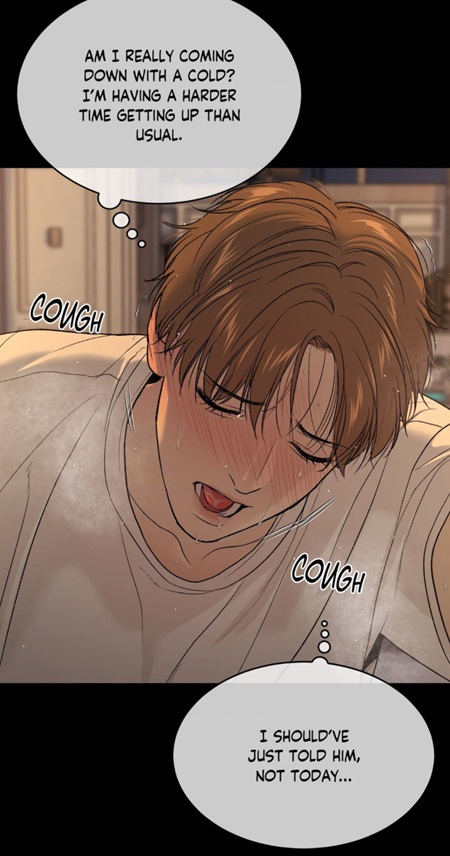 (chapter 61) However, his reaction afterward (regret) suggests that he struggles to take ownership of his choices. The fact that he recalled this sex scene in the restroom divulges a certain resent towards the athlete. The latter abandoned him right after their interaction. Hence I come to the following deduction. In reality, he is projecting his frustrations onto Joo Jaekyung, masking his true feelings about his grandmother, who is the root cause of his conditioned self-sacrifice. And this observation brings to my next remark. People wondered when this intercourse took place. One might think that this took place rather early in the story because of the way Joo Jaekyung acted. He didn’t remove his pants
  (chapter 6) or 8
  (chapter 8) where he would abandon the protagonist right after the climax and not care about his partner’s conditions and feelings:
 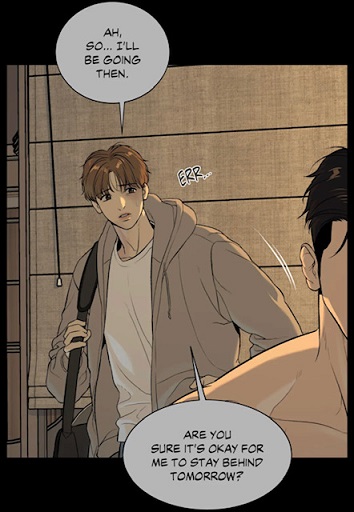 (chapter 13) Since the doctor mentioned that a match was right around the corner
  (chapter 61) It leaves us four possibilities. Randy Booker, Dominic Hill, Alfredo
  (chapter 47) and Baek Junmin. However, for the intercourse took place in the doctor’s bedroom (he wished to be carried to his own bed)
  (chapter 36), for they had sex every day. However, in episode 53, we discover their night before the match against the Shotgun
 (chapter 53) So this scene can only have taken place in chapter 47, when the match with Angelo got canceled and Kim Dan had been confronted with the terrible news about his terminally ill grandmother.
  (chapter 47) In the previous part of this essay, my avid readers could see the strong parallels between 61 and 47. But there exists another reason why I am inclining to think that the sex scene took place later in the story. It is because during that “magical night” (44), Kim Dan learned the notion of “consent”.
 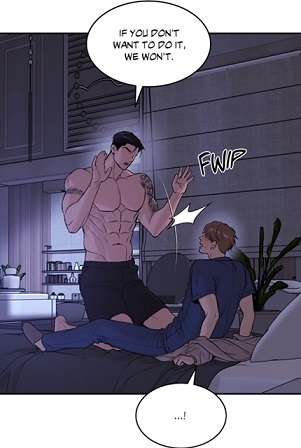 (chapter 44) During that blue hour, Kim Dan discovered that he could say no! And notice that in his memory, he clearly thought that he could have rejected the athlete’s advances.
  (chapter 46) He should mistrust the members from the gym and keep his distance from people. So during that time, Joo Jaekyung did follow his hyung’s advice
  (chapter 47), yet I can’t imagine that this man could become abstinent like in episode 19. Hence at some point, he must have felt the urge to possess Kim Dan, a mixture of fear and dominance. He imagined that way that he could impose his will onto the doctor and control his “loyalty”. With this submission, he would force the doctor to remain by his side. But naturally, this sex as “power play” could increase the gap between the main leads.
 (chapter 53) doc Dan was copying the champion’s behavior from episode 61. Right after the sex, he would leave the bed and return to his bedroom. How did Joo Jaekyung recall this night?
 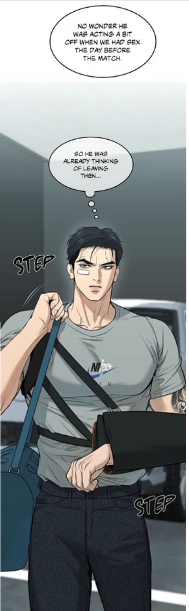 (chapter 53) He saw his attitude as a sign of disloyalty and “abandonment”. And that’s how Kim Dan is feeling in the restroom:
  (chapter 61) The darkness around the eyes is a metaphor for his resent and anger. And the moment you contrast the two memories (53 and 61), you can detect the hypocrisy of the two main leads. They only recall scenes where they were hurt and felt betrayed. However, in reality, they were both victims and perpetrators, because none of them chose to open up and talk to each other. Why? It is because both chose to listen to their “guardian” and their “favor”. Like mentioned before, in a quarrel, no one is right and wrong. The purpose of an argument is to listen to the counterpart and view incidents from their perspective. Finally, the physical therapist’s recollection serves as an important evidence that he had never been powerless and helpless. He could have refused all the time because their deal was never official.He could have used the contract as a shield. But the best evidence of Kim Dan’s power is this rejection:
  (chapter 61) I had already pointed out the increasing resistance and resilience from Kim Dan in episode 60:
 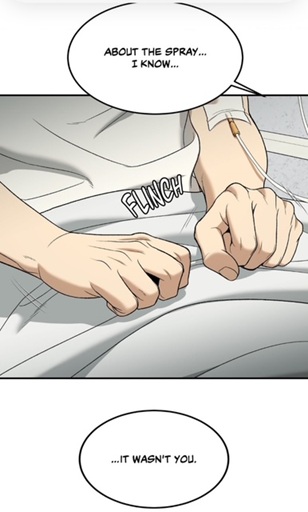 (chapter 61) My prediction came true. In the past, he could have denied the existence of the deal, Joo Jaekyung was free to seek another physical therapist. He never realized that he had some leverage. Yet he still followed the athlete’s requests. He saw himself bound by obligations. However, this was just an illusion. Hence in episode 61, we see him legitimating his consent that there was an imminent fight.
  (chapter 61) He is expected to work despite his declining health, his suffering dismissed by those around him.
  (chapter 40) He is paid to receive bruises, to push his body past its limits
 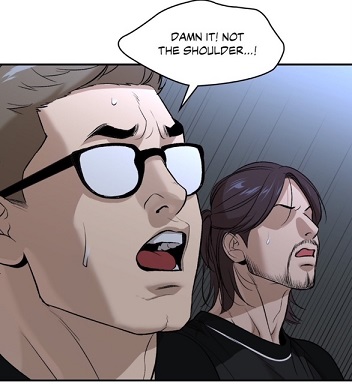 (chapter 50), to endure pain while the public watches and profits are made. His suffering is entertainment, a spectacle that fuels the business of MMA. Though he is a champion, he is still a commodity, expected to perform regardless of his condition.
 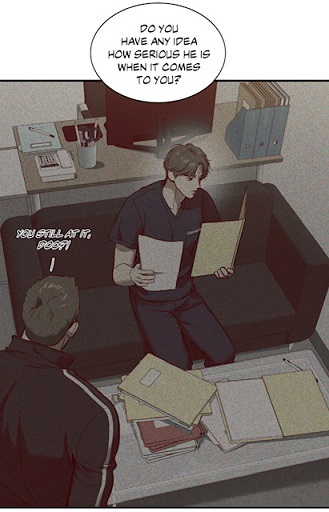 (chapter 17) I doubt that Park Namwook studied them, and notice that the recently hired PT didn’t ask for the champion’s files first:
  (chapter 54) Thus I deduce that the champion’s files are in reality a subterfuge. They give the impression that the doctors and Park Namwook truly care for his well-being, but it is not correct. They are only interested in his body because of wealth and reputation. But let’s return our attention to episode 61 and the champion’s attitude towards Kim Dan.
 (chapter 54) It is clear that the manager wants Joo Jaekyung to return to the ring as soon as possible to erase the last “debacle”. In my opinion, the doctor’s illness could serve Joo Jaekyung as an excuse to delay his return to the ring and even not to accept the next challenge.
  (chapter 57) is another manifestation of his conditioned role as a caregiver. By living with an older man, he creates the illusion of a familial bond, mirroring the dynamic he shared with his grandmother. This decision highlights his struggle to break free from the identity imposed on him—one defined by servitude and selflessness. He assumes that he should take care of the landlord, offering to cook and expressing guilt for not fulfilling this perceived duty. Yet, the landlord subtly challenges this narrative. By inviting Kim Dan to eat breakfast
 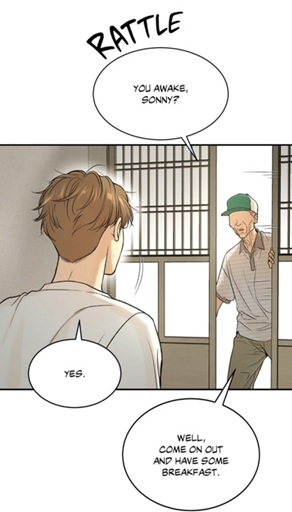 (chapter 57) and dismissing his apologies, the landlord treats him as an equal rather than a caretaker. This dynamic forces Kim Dan to confront his false perception of himself.
 (chapter 57) Despite this, Kim Dan rejects the advice, demonstrating his resistance to being cared for. This moment underscores his internal conflict—he craves independence yet clings to the role of the selfless provider. The landlord’s actions expose the fallacy of Kim Dan’s identity, revealing that his caregiving is not always necessary or effective.
 (chapter 61) is indicating the increasing resent and anger towards the star. Joo Jaekyung is no longer seen as a celebrity and idol, but as a inconsiderate man. This transformation is subtle but meaningful, as it reflects his burgeoning awareness of his own worth and the unjust treatment he has endured. For the first time, Kim Dan acknowledges himself as pitiful
 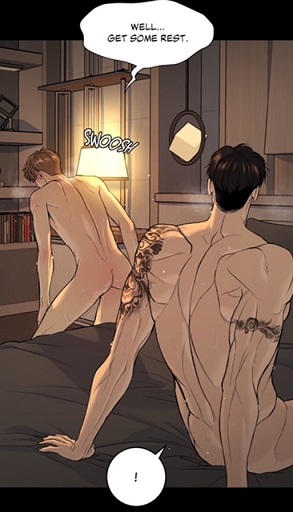 (chapter 53)
  (chapter 61), no longer bound by the roles others have imposed on him but shaped by his own choices and growing self-respect.

 (chapter 61) to the champion’s expensive car
  (chapter 61) marks a pivotal moment: his journey reaches its destination at the hospice. This “final stop” symbolizes his decision to live closer to Kim Dan and find a sense of rest and belonging. However, the screeching wheel also represents an unconscious choice by the fighter. At this stage, he perceives his visit as temporary, limited to his rehabilitation.
  (chapter 61) This explains why, later, the athlete is shown honking at Kim Dan while driving in the opposite direction, illustrating that his mindset had not yet shifted fully.
  (chapter 61) In the final scene, the car is no longer present, symbolizing the completion of his journey, as he settles near Kim Dan and redefines his purpose. By settling near Kim Dan
 (chapter 61), Joo Jaekyung shifts his focus from external accomplishments to internal growth and emotional connection.
 (chapter 61) and superficial assumptions
  (chapter 49) And what is the other common denominator between these three characters?
  (chapter 56), the lawyer, and the manager from the entertainment agency, who all used similar tactics.
  (chapter 36) They all had expectations on him.
 (chapter 6), where he recognized how Kim Dan like the others were exploiting him for his money and reputation. However, this time, his awareness reflects growth: thanks to the doctor’s polite refusal
  (chapter 60), Joo Jaekyung now knows about the sincerity and humility of Kim Dan in contrast to those who treat him like a commodity. Thanks to Kim Dan, he is able to reject the pseudo-suggestion and instead prioritize a more genuine and respectful dynamic. He instinctively rejects the offer by stating that he will receive treatment elsewhere, a decision that catches the surgeon off guard and further showcases Joo Jaekyung’s resistance to being controlled. Turning away from the hospital, Joo Jaekyung unknowingly embarks on a journey shaped by his emotional needs, though he remains unaware of the full implications of this decision.
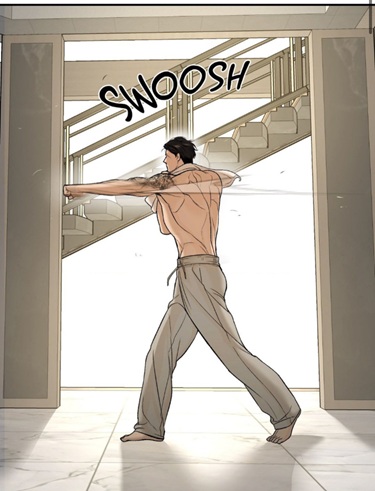 (chapter 61) marks a period of superficial introspection
 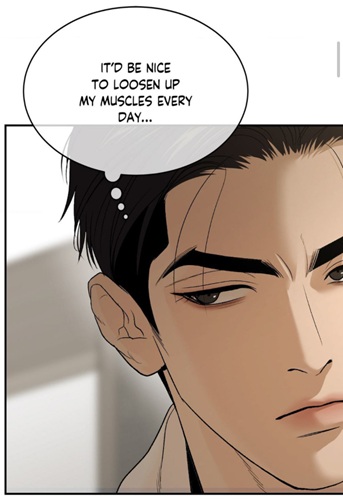 (chapter 61) where he begins to rationalize his actions.
 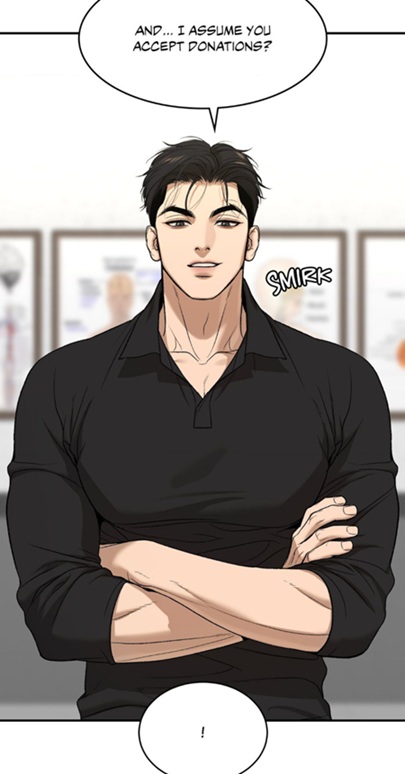 (chapter 61), much like he has done countless times before in other contexts. However, this rationalization obscures a critical difference: he is no longer in control of the dynamic.
 (chapter 61) That’s why Kim Dan can leave his side right away after the treatment. Moreover, the main lead feels no longer obliged to talk to his fated partner. He interacts as little as possible with the MMA fighter.
  (chapter 61) The champion is confronted with silence and emotional distance revealing that Joo Jaekyung is looking for something else. I would even add that he needed to experience this new approach as failure in order to force himself to change his MO and mind-set. This loss of status as a VIP underscores a larger theme in the narrative: the futility of relying on external markers of success to navigate personal relationships.
 (chapter 32)
  (chapter 32), the “hamster” learned to be cautious about such “generous offers”. 😂 That’s why the physical therapist is rejecting any assistance from the athlete. Because of this reminder
  (chapter 61), it reinforces Joo Jaekyung’s subconscious pursuit. The honking scene represents reality—Joo Jaekyung knows what he wants (here his attention) and continues to follow Kim Dan, yet he does not recognize the emotional dependency forming through these actions.
 (chapter 61) This transition is not just physical but deeply symbolic, contrasting his former life of isolation and detachment in the penthouse with a new environment characterized by community and connection.
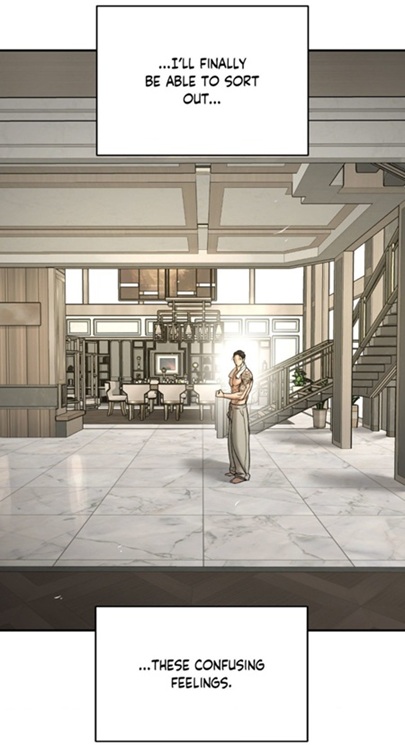 (chapter 61) Its luxurious yet cold atmosphere symbolizes his exclusion and lack of roots. It is a sterile world.
  (chapter 35) Living above everyone else, like a god, further emphasizes his disconnection from the world around him. Seoul itself, as a city of anonymity, amplifies this isolation. The penthouse’s grandeur and emptiness serve as a stark reminder of his solitary existence, where material success failed to provide fulfillment.
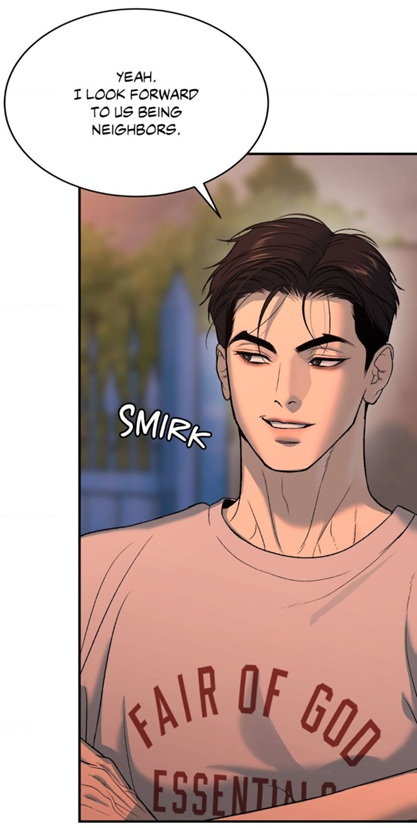 (chapter 61) The T-shirt he wears, emblazoned with “Fair of God Essentials,” subtly reflects his evolving mindset. The phrase evokes themes of humility and essentialism, aligning with his journey from a life defined by material excess to one centered on genuine connection and simplicity. The notion of “being neighbors” further emphasizes his integration into the community—a stark contrast to his isolated existence in the penthouse. The house is no longer just a space but a reflection of his evolving priorities.
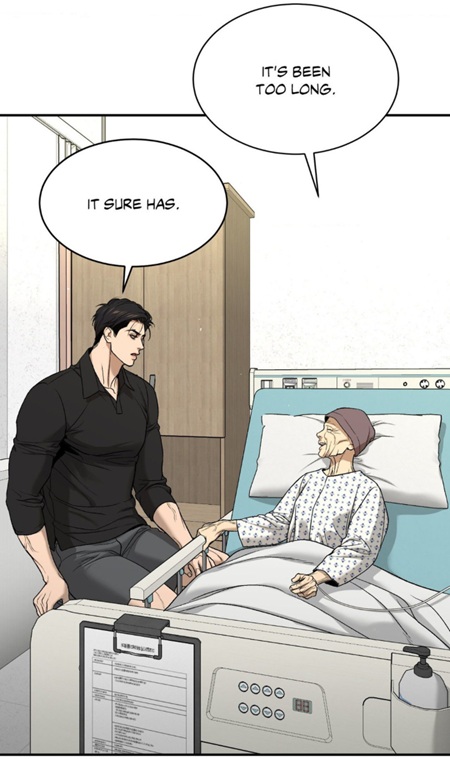 (chapter 61) Drawing from past experiences, the champion believed that treating Shin Okja well would win Kim Dan’s favor. In earlier episodes, Kim Dan expressed gratitude with a gentle smile
  (chapter 22) when Joo Jaekyung made efforts to bring a smile to his grandmother’s face, even going so far as to cook him breakfast afterward.
  (chapter 22) Having missed Kim Dan’s meals and the intimacy they symbolized, Joo Jaekyung unconsciously imagines that this approach will recreate that connection.
  (chapter 61) which gives the impression that she is including Kim Dan in her sense of community. However, in Episode 57 she had expressed the exact opposite. For her, home is deeply tied to family and childhood, while Kim Dan, who spent most of his time in Seoul, represents a disconnection from that shared history. So when she utilized this idiom, she was referring to the community in general.
  (chapter 60), unaware of the rejection Kim Dan experiences from his grandmother. Joo Jaekyung may even believe that the old man in the town is a relative of Kim Dan, further solidifying his misunderstanding. Note that he doesn’t investigate Kim Dan’s life, he judges him based on impressions and appearances, especially since he can no longer talk to him. These interactions underline a crucial misalignment: while Joo Jaekyung interprets Shin Okja’s words as inclusive and warm, Kim Dan can only be reminded of his exclusion and estrangement. Shin Okja’s conversation with Joo Jaekyung will undoubtedly play a significant role in the future: a point of no return.
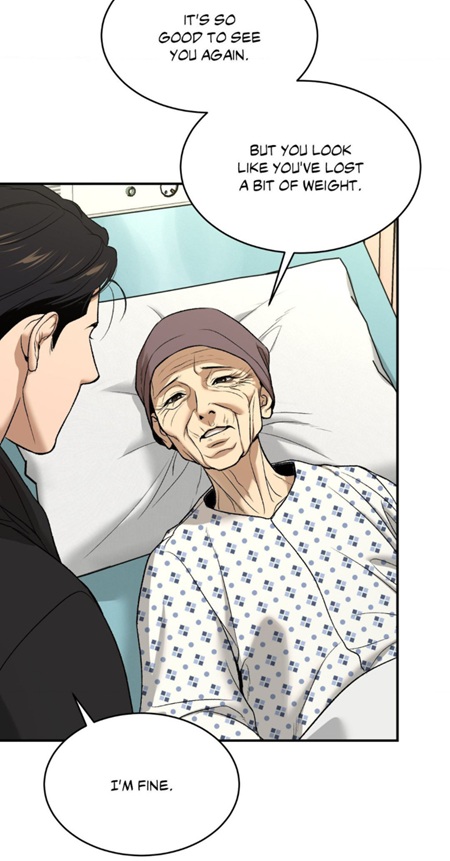 (chapter 61), but seems to have forgotten that Kim Dan is in a similar situation.
  (chapter 61), the reality is far more complex. Kim Dan’s insistence on maintaining professional boundaries forces Joo Jaekyung to confront the limitations of his influence and the necessity of respecting Kim Dan’s autonomy. The daily routine of seeking treatment
  (chapter 61) This means that his move announces a change in their relationship: privacy. They are neighbors and as such acquaintances.
  (chapter 61) Joo Jaekyung’s sincere concern, however, is short-lived for two reasons.
 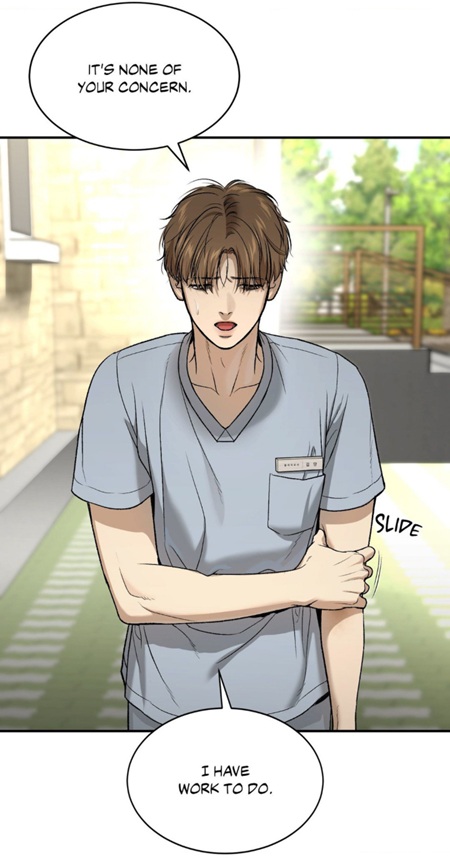 (chapter 61), even if begrudgingly. Secondly, Joo Jaekyung quickly connects the bruise to the removal of a needle
  (chapter 61) who serves as a symbol of motherhood and nature. Boksoon’s own experiences, including the loss of a puppy
  (chapter 59), highlight the impact of nurturing and loss, shaping her behavior toward both her puppies and humans. She should become more attentive and reliant on humans, notifying them if something is wrong. Her heightened sensitivity positions her as a potential bridge between Kim Dan and Joo Jaekyung, subtly training the champion’s nurturing instincts. Hence in front of the house, she stands between the main couple.
  (chapter 57) This missed opportunity underscores the consequences of neglect, in contrast to Boksoon’s increased attentiveness. On the other side, the old man paid attention to Kim Dan’s odd behavior (his alcoholism
 – chapter 57 ) Hence I am assuming that he will be a source of information for the champion. And now pay attention to their position in front of the house:
  (chapter 37), Joo Jaekyung now operates within a framework where he must respect boundaries and take responsibility for his actions. This transition signifies his understanding that money cannot shield him from the realities of interpersonal relationships and the consequences of his past behavior. To conclude, he can no longer cross the line and return to his old self.

 (chapter 60) — challenges this notion. The photographs from episode 60 subtly introduce the fifth puppy’s death as a poignant symbol of Kim Dan’s precarious fate.
  (chapter 60) The puppy’s appearance in only one photo (the second one from left) among many mirrors Kim Dan’s fragile existence,
  (chapter 60) deepening the parallel between them. This connection becomes even more striking when recalling that the grandmother once likened Kim Dan to a puppy
 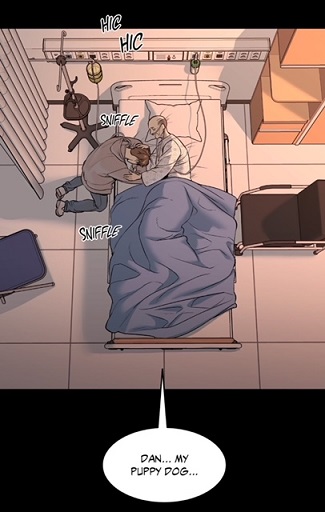 (chapter 53), emphasizing his vulnerability and dependence on others.
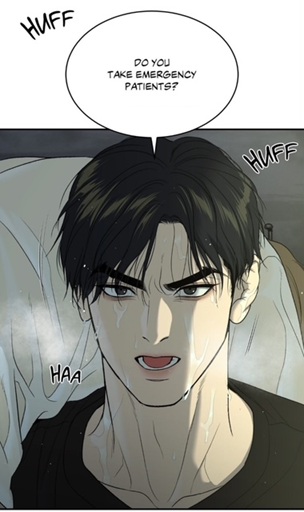 (chapter 60) reflected not only his uncertainty about whether the hospice could offer assistance but also the sheer urgency of his actions. This moment underscores the physical and emotional toll of his determination to save Kim Dan. Jaekyung risked worsening his own physical condition, driven by the hope that help would be available Yet the irony of this moment lies in the true purpose of the hospice: it is not a place for treatment or healing but a program dedicated to end-of-life care.
  (chapter 57)
 (chapter 58), such as two older women
  (chapter 58). Yes, there were two small details, yet full of meaning. Even the landlord
  (chapter 58) nicknamed “old man”
 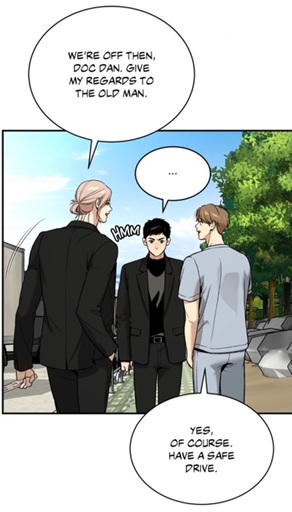 (chapter 59) by Heesung, symbolizes this demographic trend. The hospice’s focus on senior care reflects a broader societal issue in South Korea: a declining birth rate coupled with an increasing elderly population.
 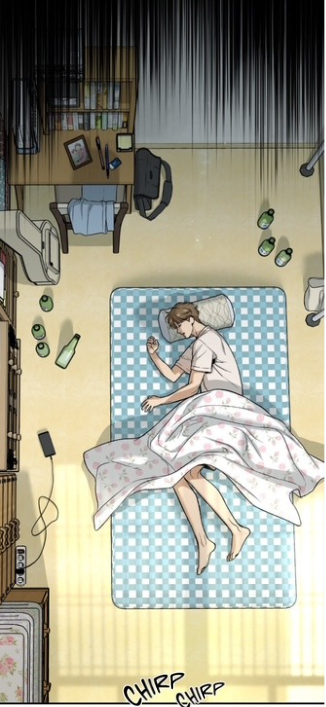 (chapter 57) In addition, the empty bedroom where Kim Dan is staying—with its untouched guitar, furniture, and books—suggests it once belonged to a teenager who left home and never returned. The unchanged state of the room symbolizes the stagnation and loss felt in these regions, further highlighting the broader societal issues at play. This shows that Jinx is not merely a classic love story; it also paints a nuanced portrait of South Korean society and its challenges. By prioritizing elder care without addressing the needs of the youth, the hospice embodies a false promise of hope—one that may ultimately exacerbate the very demographic crisis it seeks to alleviate.
 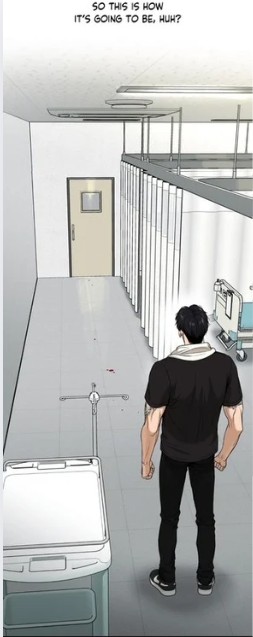 (chapter 60) —a consequence of removing his IV needle—symbolizes his quiet surrender and deteriorating health. When Kim Dan arrived at the hospice, he carried the faint hope of finding solace
  (chapter 56), particularly from his grandmother, who had promised to go to the beach with him.
 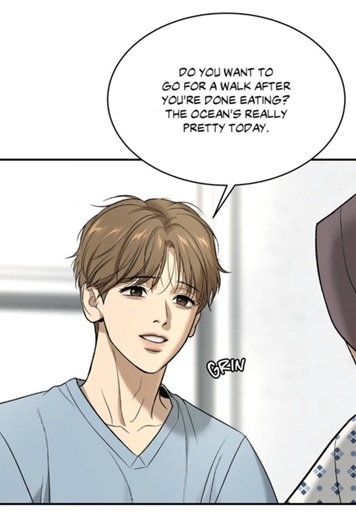 (chapter 57) – which he never expressed -, reflecting the deceptive promise of the hospice itself. Kim Dan’s fate seems to mirror not only the unnoticed death of the fifth puppy
  (chapter 59) but also his grandmother’s diminishing expectations of him.
  (chapter 57), easy bruising
  (chapter 13), excessive bleeding and slow wound healing—all of which align with Kim Dan’s deteriorating condition and the trail of blood he left after removing his IV needle.
  (Chapter 54) Like mentioned before, this logo could be referring to a pharmaceutical company.
 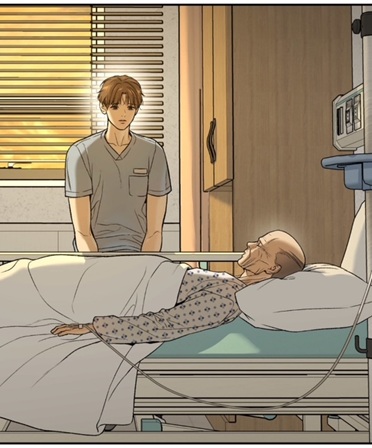 – episode 59), suggesting a temporary space for patients nearing the end of life. Moreover, observe that the colors of the curtains in the patients’ room is orange
  (chapter 56)
 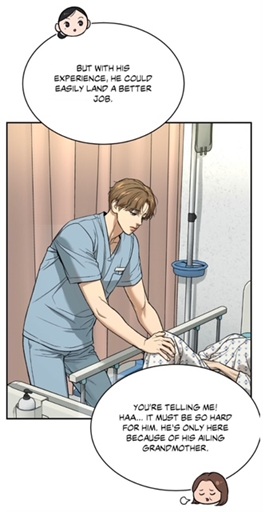 (chapter 56) and not white. This observation aligns with the assumption that this room is reserved for those on the verge of dying, shielding terminally ill patients from witnessing another’s death. 😨
  In the drama, a character searches for his CEO and friend Kang by pulling back closed curtains in an emergency room,
  discovering different patients behind each one until finding the right person.
  This reinforces the notion that closed curtains signify the presence of others, even if their identities remain hidden. In addition, when the doctor treated the patient Park Jinchul, the curtains were closed.
 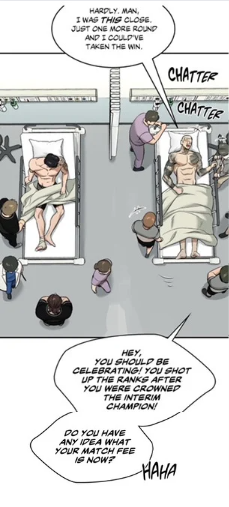 (chapter 52) to signify absence of confidentiality, contrasting with the closed-off nature of this space. This comparison not only exposes the manipulation of the staff at the health center, but also reinforces my interpretation that the emergency room at the hospice stands for danger and challenge. This detail underscores Joo Jaekyung’s assumption that he and Kim Dan are alone, but it also raises the possibility that their conversation could have been overheard by someone lying behind the curtains, such as the patient from Episode 57.
  (chapter 56)
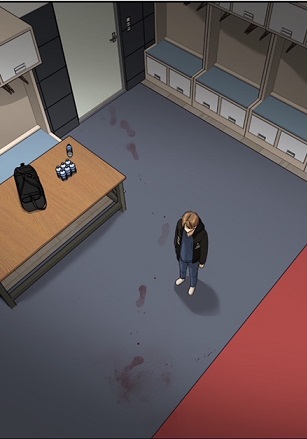 (chapter 51), they should remember that people were listening to their conversation behind the closed door, but they chose not to intervene.
  (chapter 53) That’s the reason why I am inclined to think that someone was /is present behind the curtain, but chose to remain silent. However, contrary to Team Black, such a person should intervene, if my theory is correct. And there is another evidence for this hypothesis. Since in episode 60 Joo Jaekyung offers a new contract
  (chapter 60), it signifies that it is a reflection from chapter 6:
 (chapter 21) which would push him to have a change of heart and show his vulnerability. What can he fear from a dying or terminally ill person? Nothing… hence he can only listen to the confidence and advice from such a patient.
  Their conversation begins with Kim Dan’s simple yet loaded question about how Jaekyung discovered his whereabouts. This moment, better captured in the Japanese, and Spanish translations, underscores Kim Dan’s curiosity and underlying desire for clarity. In the Japanese version, Kim Dan asks, “どうしてここがわかったんですか?” (“How did you find out about this place?”), while the Spanish translation reads, “¿Cómo es que usted acabó aquí?” (“How did you end up here?”). Both translations emphasize Kim Dan’s direct inquiry about how Jaekyung discovered his whereabouts, making Jaekyung’s evasive response even more significant. It is clear that he is trying to protect Potato here. However, Jaekyung’s response
  (chapter 60) immediately sets the tone for their interaction. His refusal to answer and his deliberate avoidance of Kim Dan’s gaze reflect a lie by omission. This evasive behavior not only highlights Jaekyung’s reluctance to reveal his vulnerability but also creates a significant divide between them, making it clear that they are not functioning as a unified team.
 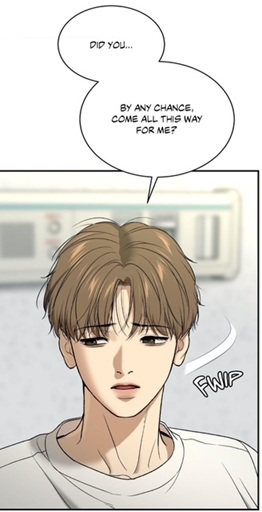 (chapter 60) Initially, he avoids Jaekyung’s gaze, signaling his own fear and insecurity. This avoidance reveals his worry about rejection and his deeper emotional vulnerability. On the one hand, he hopes deep down that the athlete would admit that he came looking for him, yet their last two interactions were arguments and rejections which the doctor didn’t forget.
 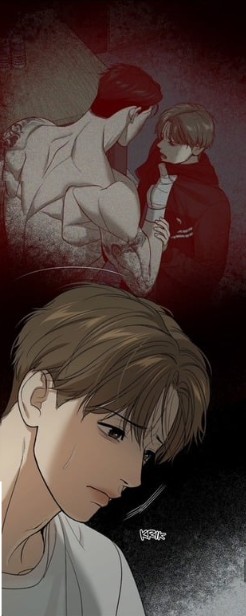 (chapter 60) Moreover, the idiom “by any chance” is exposing his low self-esteem. His words are exposing his internal struggles: between hope and despair. Later, his subtle act of turning his head away—a gesture often linked to dishonesty—indicates an effort to conceal his true feelings.
 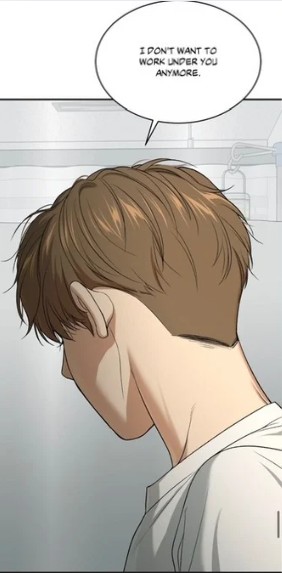 (chapter 60) He is still in love with Joo Jaekyung, but he is no longer hoping for any attachment and feelings from the fighter. On the other hand, his words are reflecting a different opinion: he is no longer trusting the athlete. This means that when the champion admitted his mistake indirectly, it was already too late.
 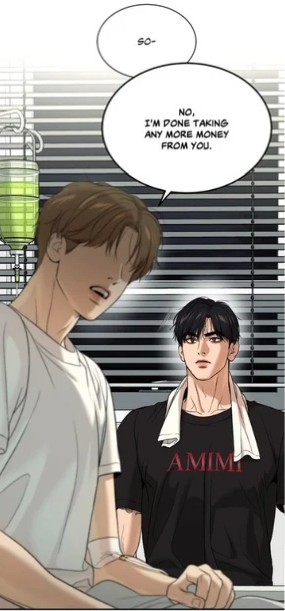 (chapter 60) He doesn’t want this fake generosity, since the athlete is reminding him of his “debts” towards him:
 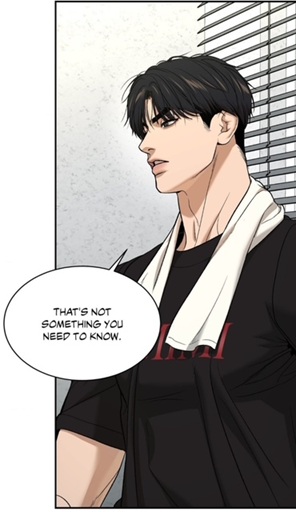 (chapter 60) This evasive remark suggests that Jaekyung believes keeping Kim Dan ignorant of his intentions is for the best. By withholding the truth, he feels he is protecting himself and Kim Dan from unnecessary burdens or complexities, reinforcing his perception that their relationship is better managed with clear boundaries. However, this attempt at concealment only deepens the divide between them, as it denies Kim Dan the clarity and emotional connection he seeks. In fact, he is not realizing that he is even afflicting more pain on his fated partner.
  (chapter 6), with Kim Dan ending up on the floor—a physical manifestation of his subservience. Later, in the locker room, both were shown facing each other
  (chapter 60) Kim Dan in bed and Jaekyung on a chair. Yet, this apparent parity hides a reversal of dependency. While Kim Dan is physically and mentally weaker, neglecting his own health to leave the bed,
  (chapter 42) Despite the appearances, such relationships could only deepen his wounds and reinforce his anxieties. Thirdly, let’s not forget that the athlete read the doctor’s birthday card where the latter expressed the hope to work for him for a long time:
 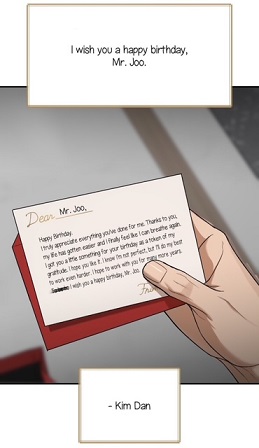 (chapter 55) That’s why he imagined that once he made his offer, the other would agree immediately. However, what he failed to realize is that he read the note too late. Besides, there were these erased words which left the fighter in the ignorance. Finally, he continues to misunderstand Kim Dan’s motivations
  (chapter 60) I would even add, he believes to know Kim Dan so well, hence he mentions his grandmother:
 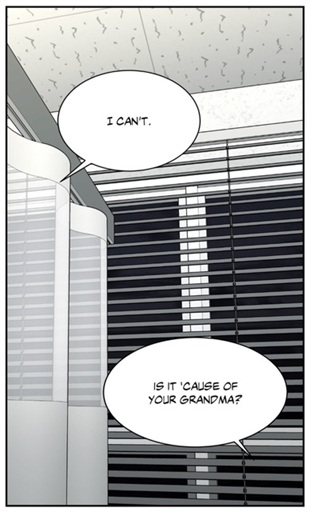 (chapter 60) However, Jaekyung is terribly wrong because he never talked to his lover. His interest and curiosity were quite superficial. Therefore he fails to grasp that Kim Dan’s longing is not for material wealth or familial obligation, but for genuine companionship and a place to call home. Kim Dan’s rejection of a boss-employee dynamic
  (chapter 60). Moreover he got to hear from the doctor that Kim Dan needed rest:
  (chapter 35) for his own “happiness”. Through Potato, the author is criticizing the attitude of fans who are only projecting their own emotions onto their idols. Their wish for happiness is quite rather superficial. This subtle oversight reflects Potato’s growing detachment, as his focus shifted to capturing moments for posterity rather than addressing the realities in front of him. The absence of the fifth puppy becomes a poignant symbol of unnoticed fragility and foreshadows Kim Dan’s own vulnerability. And how did Kim Dan react to the death of the small dog?
 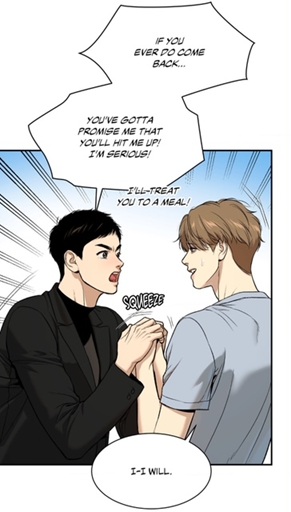 (chapter 59) Deep down, Potato does not expect Kim Dan to come back, reflecting his resignation to their fading relationship. Notably, Potato only asked for a picture of Kim Dan at the very end, never taking photos of him during their time together.
  (chapter 60) When he got caught with his silence, Mingwa never showed us Potato’s justification. Yet, it becomes clear that the young fighter decided to give the following explanation: he respected Kim Dan’s wish to remain undiscovered
  (chapter 58) The reason for this interpretation is the champion’s reaction, when he was asked how he knew about his whereabouts
  (chapter 59) and Joo Jaekyung’s rescue of Kim Dan.
  (chapter 60) Though he is the one left behind, he is not realizing that by not following him, he is failing to protect Kim Dan.
  (chapter 57) Cheolmin already warned his friend in episode 13:
  (chapter 13) But the man refused to listen to his advice, and now Kim Dan is leaving a trail of blood on the floor

 (chapter 55) One might think that the causes for his throbbing head are his depression and insomnia. On the other hand, I am quite certain that many readers had a different explanation for his migraine. He is missing his lover, Kim Dan, as the color red symbolizes the headache and the physical therapist’s name is strongly intertwined with this pigment which was once again confirmed in episoe 56.
  (chapter 56) So it is true that his migraine are caused by the doctor’s absence. It was, as if the main lead was suffering from withdrawal symptoms. The fighter has a love addiction, but he is not aware of the existence of this “sweet poison”. But there’s more to it.

 Thus I consider this image, where the champion is seen
 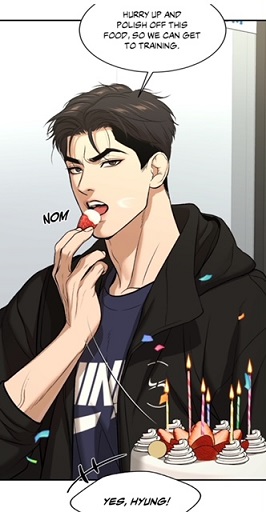 (chapter 43) eating a strawberry with cream as the announcement of the magical night between Kim Dan and his fated partner. The fruit with the cream represented a violation to his strict diet.
  (chapter 55) or the medicine against migraine.
 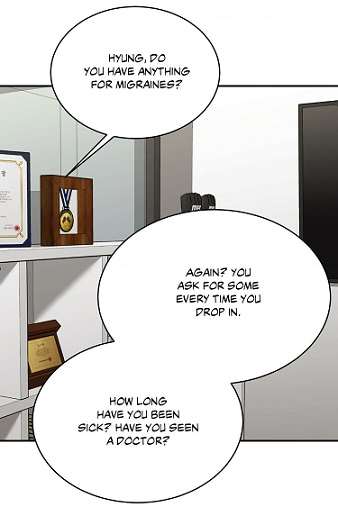 (chapter 54) However, in episode 55, we can observe a huge change in the champion.
  (chapter 55) The latter is finally admitting the inefficiency of the medicine. In other words, in this scene, he was giving up on them. This represents an important step on his way to enlightenment. For me, it signifies that he is stopping relying on pharmaceutical products. Let’s not forget that in the past, he rejected the PT and even neglected them. Why? It is because he trusted more sprays and other medicines than people.
  (chapter 49) Therefore the switch of the spray had to occur. He needed to question his prejudices and attitude. But let’s return our attention to the champion and his throbbing head. One detail in this panel caught my notice.
 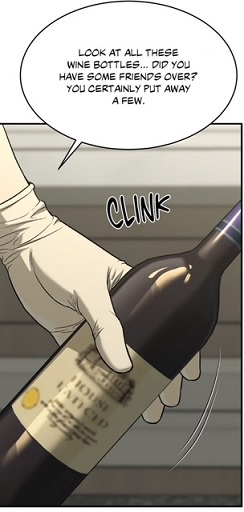 (chapter 55). This means that she had not seen the mess in the master room before:
  (chapter 55) And now, pay attention to the number of the bottles in his room:
 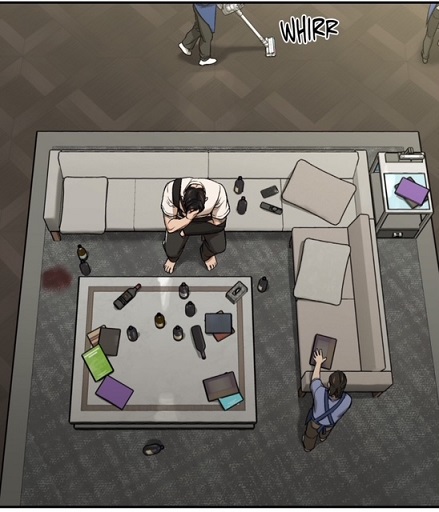 (chapter 55) I count 12 bottles of wine exactly like in the last image from chapter 54. Thus I came to the following deductions:
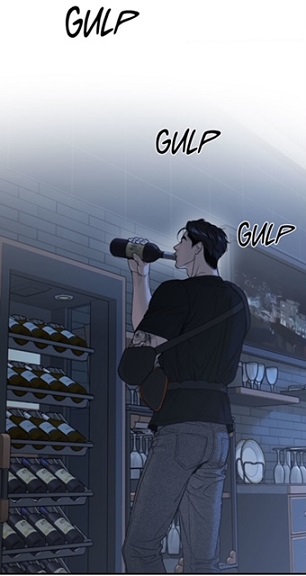 (chapter 54) and the appearance of the staff in chapter 55. It indicates that Jinx-philes can witness time deceleration in season 2. From one month in one chapter, then a week in the next episode, finally we have a reference to a day: Monday. Thus I deduce that in episode 56, only 2 or 3 days elapsed. I have already announced that the couple should meet each other around 25th:
  (chapter 56), for the day Kim Dan wired his money to his “loved one” took place after 10th of the month: XX = two digits.
  (chapter 55)
 (chapter 55) Consequently, I judge the cleaning lady as the positive version of Park Namwook. Though she uses social norms, she doesn’t use them against her employee. She didn’t condemn him, it is a mixture of teasing and reminder. At the same time, her intervention implies that she must have noticed changes in her boss after the arrival of Kim Dan in the flat and his departure. That’s the reason why I have the impression that this image is announcing another turning point in the champion’s life either:
  (chapter 55) He won’t drink like before. However, I don’t think that he will behave like in the past: reject any alcohol entirely.
 (chapter 55), his migraine vanished. Though he is holding his head the next morning and hiding his gaze
  (chapter 55), the Webtoonist didn’t add any red or “throb” as an indication for a migraine. As you can see, his headache is strongly intertwined with repressing the physical therapist and as such locking away memories. However, there exists another cause. What had the doctor done in the past?
  (chapter 44) Yes, the main lead had patted his lover’s head, while the champion had his eyes close. In my opinion, his unconscious had registered this gesture and loved it. However, the champion had not seen it himself. He was drunk and had his eyes closed. This stroke on the head symbolizes appreciation, affection and recognition.
  (chapter 23) That’s how little kids are admired and loved. This stands in opposition to the abuser’s behavior:
 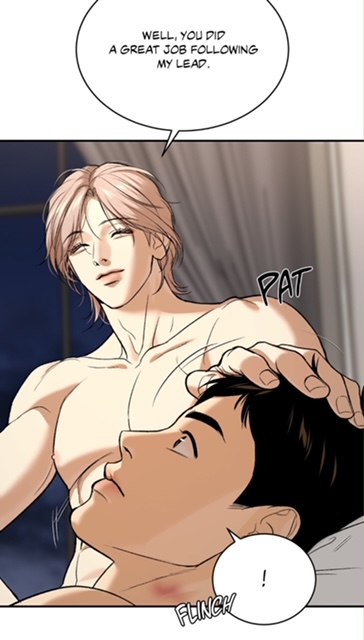 (chapter special 2) The same way than Kim Dan with the patting! In other words, the champion is deep down longing for such a gesture, but he has not realized it yet. Nevertheless, I believe that he just needs a trigger.
 (chapter 55) With his left opened eye!! The exact opposite from this picture:
 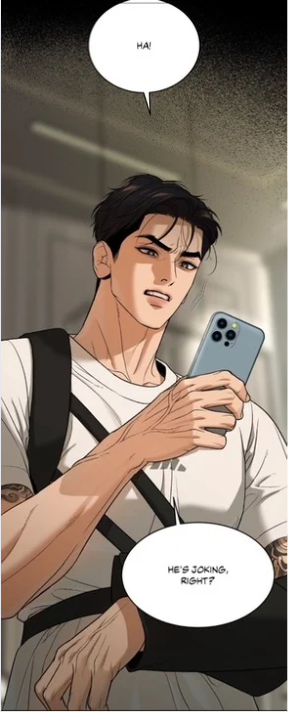 (chapter 55) This observation got confirmed in episode 56, though I couldn’t expose it before the release of the new chapter.
  (chapter 56) As long as the fighter thinks of his fated partner, he is not plagued with a throbbing head. This shows that it has something to do with repressing memories. However, his physical condition is still not improving:
 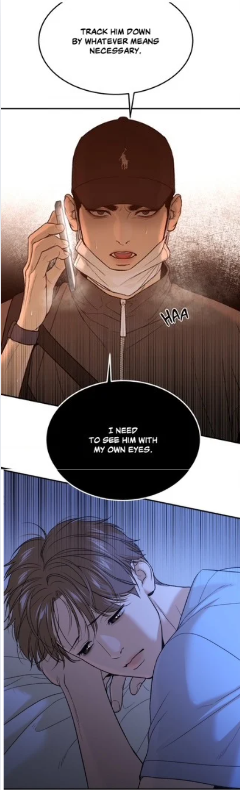 (chapter 56) He even looks worse than before: exhausted and malnourished. There is no one by his side taking care of him: his only interaction with his manager is through the phone. At no moment, the guy felt the need to pay a visit to his boss and champion.
  (chapter 55) This signifies that in reality, the uke is the one benefiting more from this relationship, while the “Gucgi guy” is a placebo for Joo Jaekyung. He can not replace the true medicine: Dan’s love. But Joo Jaekyung chose to close an eye to the truth forgetting his “insight” from chapter 2:
  (chapter 2) However, back then, he had just stated it in order to get rid of the mint-goblin. He needed a justification for switching his partner. In other words, this was reflecting more the protagonist’s corrupted mind and heart. Therefore he is designed eyeless, the symbol for ignorance, lies and blindness.
  (chapter 55) And where did he have his migraine exactly?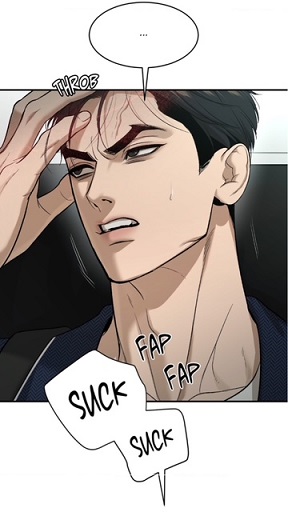
 (chapter 55) It was on the right side and eye! It truly exposes that Joo Jaekyung was getting punished for his attitude. He is not allowed to bury and forget Kim Dan. The star’s open eyes in this episode symbolize denial, lack of self-awareness and as such the absence of insight. He is also punished for his lies in episode 2. His words might have reflected the truth, but his words didn’t expose a change of heart. He was taking advantage of this situation as well. So when the pain intensified pushing him to close his right eye, we should consider this image as a short moment of reflection and realization. In the restroom, he was forced to admit that only Kim Dan could kiss him. Is it a coincidence that just before Mingwa presented this image
  (chapter 55) He was just standing there and avoiding his gaze.
 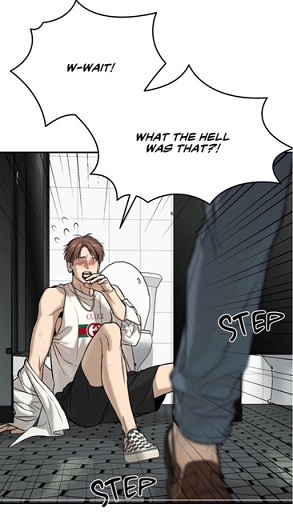 (chapter 55) How can the MMA fighter reject him? This displays his huge confidence or arrogance. There’s no doubt that he will put the blame on Joo Jaekyung. At the same time, I believe that his blindness was also caused by his greed.
 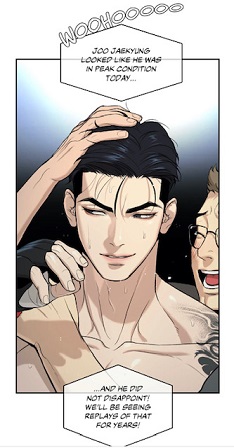 (chapter 5) Therefore he was in a happy mood after that match. A simple gesture with a lot of power! He has been missing this hand or better said this gesture. This action was the main lead’s true motivation.
  (chapter 40) No wonder why he felt so lost and empty after the last fight.
 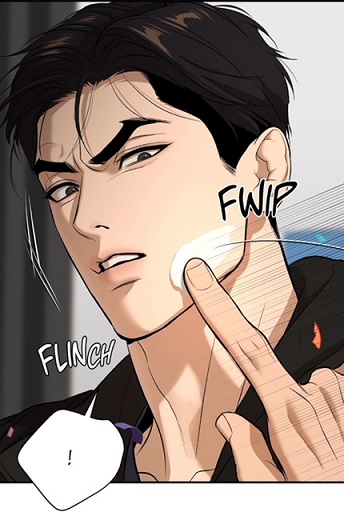 (chapter 43) this was the coach’s hand. In other words, the athlete felt more close to the coach than to the manager. This would explain why he would listen to the coach and even entrust him with huge tasks like the charity event. Strangely, in season 1, we can observe how more or more he is distancing himself from the fighter. Probably related to his secret relationship with Kim Dan. According to my theory, the coach is aware of their relationship. They are more than just boss and employee. As you can see, I don’t think that the champion is right now just missing the doctor’s sweet lips. Deep down, he would like to be patted by his loved one, exactly like Potato.
 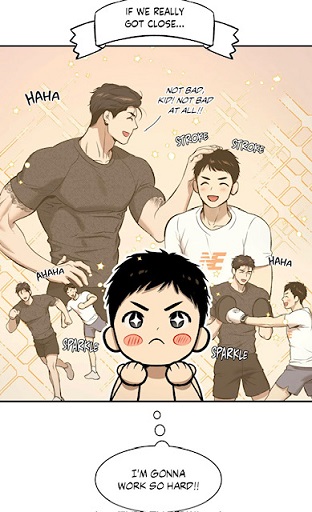 (chapter 23)
  (special episode 2) But this is what he received after the last match:
  (chapter 2) The champion’s reaction is quite telling. He is not easily swayed. But we have another bigger evidence that his intercourses were replacement for “fights”. In The States, the fighter asked Kim Dan to join him at 11:00.
  (chapter 38) Therefore it is not surprising that he rejected Kim Dan’s request first.
  (chapter 39) He didn’t feel like it, because he was not aroused at all. Imagine that he needed two hours for that erection, a sign that during that night, Kim Dan was in reality a replacement for the American fighter.
  (chapter 39) Even when the doctor rubbed his hand against his sex, he had no reaction.
  (chapter 38) In fact, he needed a fellatio to get an erection, and he only started getting excited, when he saw the doctor’s gaze. That’s the reason why he remembered this image under the shower:
  (chapter 55) However, the more time the champion spent time with his physical therapist, the more he came to violate his own rules and principles: It started with their first meeting, when he crossed the line by mixing private and professional life together:
  (chapter 4)
  (chapter 53) Pay attention to the behavior from the fighter during their last night together. He is looking away, he is not paying attention to his fated companion. His mind was elsewhere, focused on Baek Junmin! In my opinion, during that night, the champion had been able to differentiate between the physical therapist and his opponent. Fighting was more important than sex and as such his sex partner. To conclude, the physical therapist had been able to win Joo Jaekyung’s belief and heart. He was no longer a replacement at all. He had become a person close the fighter.
 (chapter 49) he wanted to screw Baek Junmin for real. In this image, the athlete oozes confidence and strength. This means that he was no longer dependent on the good fuck before the match.
  (chapter 53) However, the main lead never realized this huge change, he kept his old belief as a tradition out of habit. This explicates why the fighter tried to replace with a new uke
  (chapter 55), but here the sex was longer connected to a match, rather to fun. Finally, observe how the champion is now blaming his PT for his ruined match:
  (chapter 56). I don’t think, he was referring to the spray incident, rather to their night before the match. The doctor had not behaved like a real opponent, he had admitted his “defeat” quite easily. He had left the ring before procuring him a good fuck. He was blaming his partner for violating his rule:
 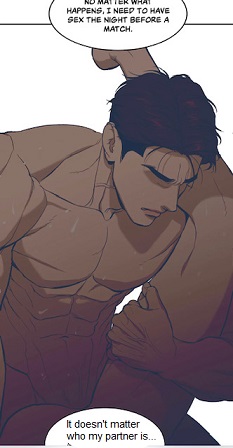 (chapter 2) But here is the thing. Kim Dan had just accepted the deal because of his grandmother. Secondly, he learned an important lesson during that magical night: consent!
  (chapter 44) Sex is a synonym for love and as such it is about giving pleasure and affection to his partner. It is a two-way street. And this is something that the champion has to admit and accept. Thus I deduce that the fighter still has a long way to go before dropping all his fake principles. Like mentioned before, he needs to ponder on the following question: what matters to him the most? His championship or his happiness? Or what is sex to him? Why does he think that he is jinxed? He needs to face his own painful past and remember the face of his tormentor.
 (chapter 54) But the masturbation had taken place before. So who did he have in mind, when he was jerking off? I might shock my avid readers, but I would say: Baek Junmin.
 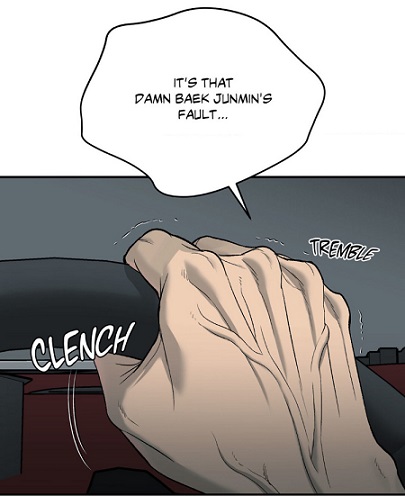 (chapter 54) However, this gesture had the opposite signification: rage, resent… but also sweet revenge! He must have recalled the Shotgun’s face.
 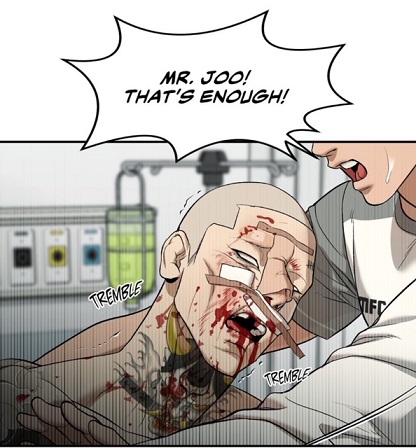 (chapter 52) There’s no doubt that thanks to the doctor, the champion will learn that he can get “justice” and satisfaction through other means. He can defeat the ghosts from the past, not just thanks to his fists and hard work, but also thanks to his surroundings and knowledge. Lawsuit and media!
 (chapter 1) The physical therapist is not only his reward and price, but also his “second shoulder” and as such his pillar. The new PT won’t be able to replace him. Joo Jaekyung is not just a champion, but also a team: Kim Dan as his PT and his lover. As for Kim Dan, the celebrity is his “energy drink”, his source of comfort and joy. He is also his home, for he is the first one who invited him to stay with him! Yes, the grandmother didn’t invite her grandson to live with her, he was just dumped at her place. And because the celebrity is like a home and family, it explicates why the doctor is once again “living like a ghost”.


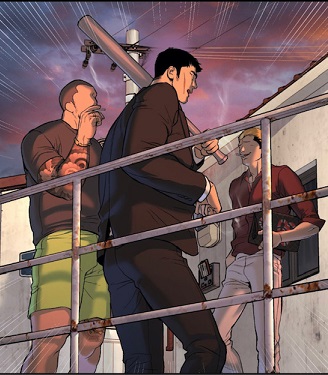
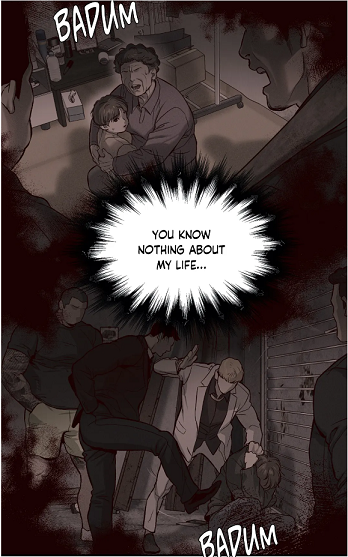


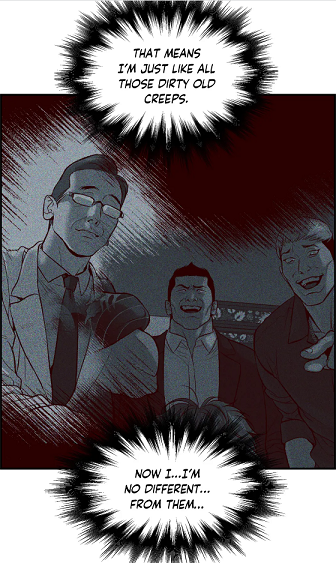

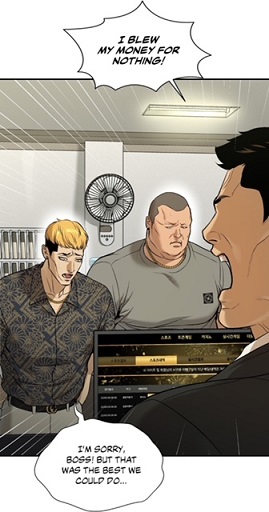

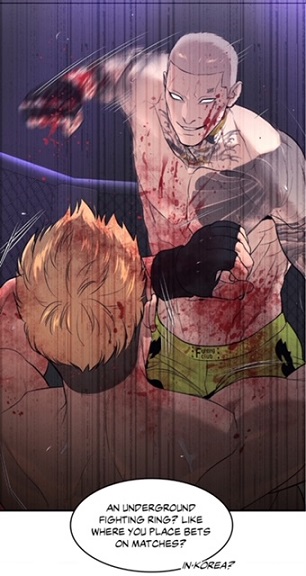

 (chapter 49) These 3 men and The Shotgun have to be seen as a team. Moreover, 4 is a synonym for death. Then, observe that the image from episode 20 contains two villains, the loan shark and the perverted hospital director. 1 +1 = 2. So when we see the number 10, 11, 16, 17 and 18, we could perceive it as an allusion to Heo Namwook, the villain.
 (chapter 11) and indirectly the persons involved in the redevelopment. However, I have to admit that I have a different explanation.
 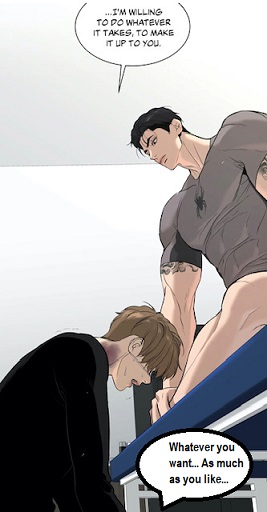 (chapter 11) Let’s not forget that in Jinx-Fandom, many Jinx-addicts calls him a “red flag”. Here, he was abusing his position. Furthermore, this theory could be seen as validated with the first episode with this image:
 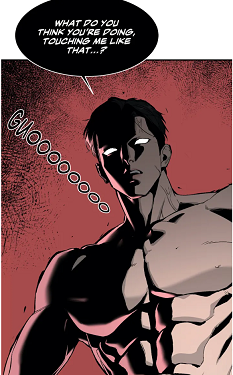 (chapter 1) The main lead appears as a beast, triggering the doctor’s fears. He seems to be like an antagonist. However, I believe that it is just a deception. First, Mingwa has clearly stated that the champion is the protagonist of Jinx. As such, he can be neither a villain nor an antagonist. Secondly, though he seems to serve as a barrier, the reality is that Kim Dan is incited to mature and overcome his own fears. In fact, the celebrity represents the opposite notions of “conformity” and “immobility”. He embodies verity, maturity, transformation and progression. The evidence of this perception is the gradual transformation of Kim Dan as an inexperienced PT to a very professional and performant physical therapist. According to my interpretation, the Emperor works as the mirror of truth. He confronts the delusional physical therapist with his mental and emotional issues, like here:
 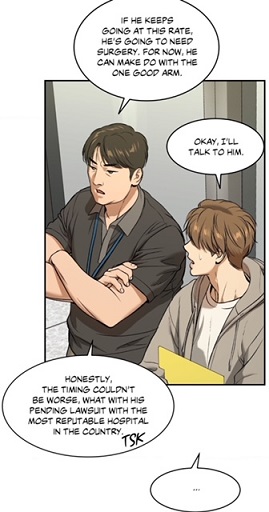 (chapter 42) He only relied on his hands. He was forced to become a serious and confident PT!!
 (chapter 1) The star was just waiting, and not threatening the doctor. As you can see, Joo Jaekyung doesn’t appear like a threat or a monster. But this doesn’t end here. One detail caught my interest. The champion is associated with blue. It is his true color, whereas Kim Dan is “red”, like a sweet strawberry. So why does this young man ooze a red aura, when his true shade is blue like water
 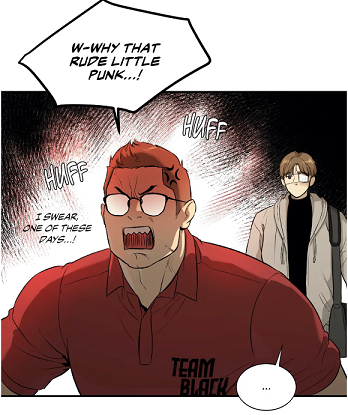 (chapter 11) The coach is yelling for Joo Jaekyung’s comment, yet the reality is that the manager didn’t treat Kim Dan at all. In fact, he feigned ignorance. Moreover, look at the champion’s t-shirt:
  (chapter 26) In this composition, I compared the MMA star with a leopard and Park Namwook to a spider:
  (chapter 46) He represents regression or the hurdle to overcome.
  (chapter 11)
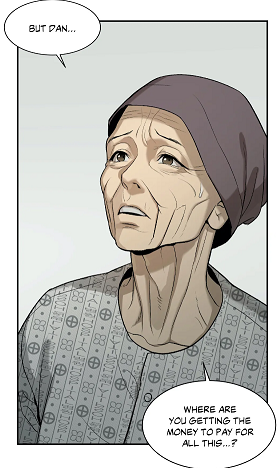
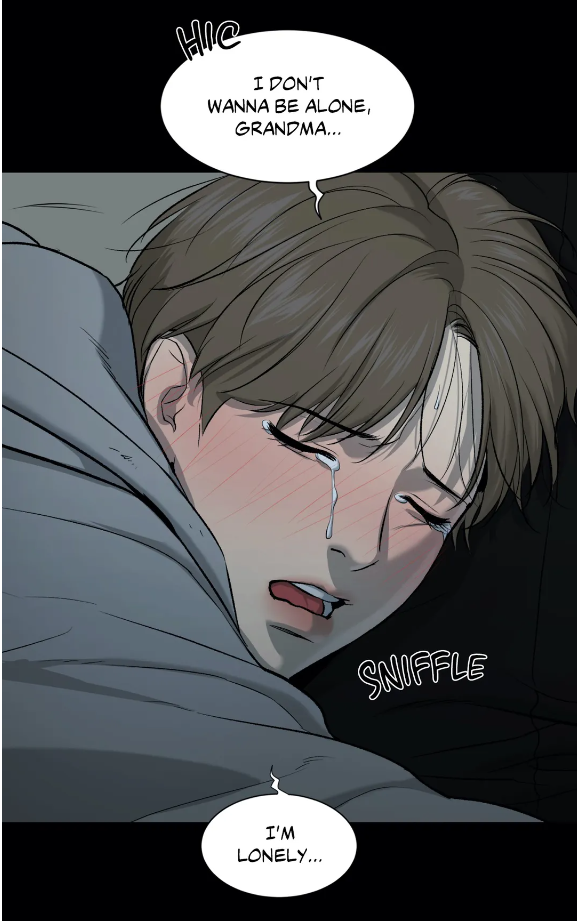

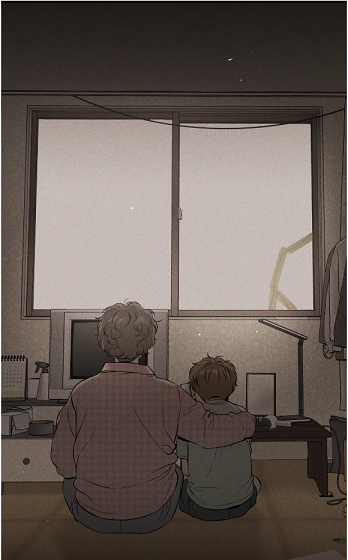

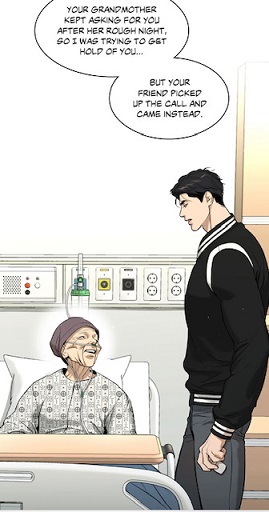

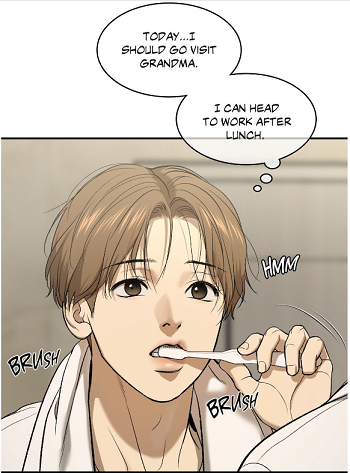
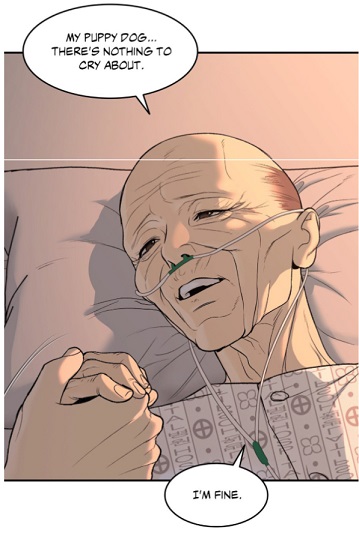


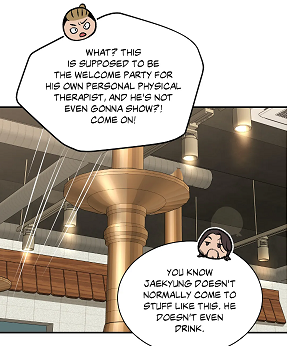 (chapter 9) or other events like this one:
 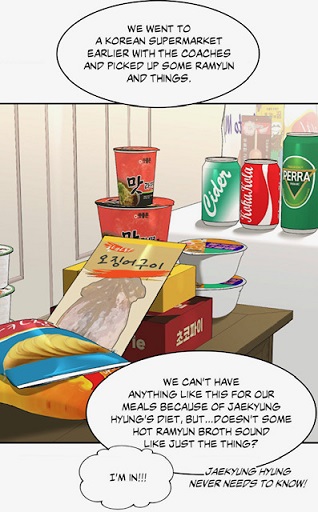 (chapter 37) Buying in secret junk food.
 (chapter 1)
 I came to this revelation thanks to this article:
 (chapter 29) As for the halmoni, she embodies the last type of emotional vampire:
 (chapter 21) and Kim Miseon’s reproach to Kim Dan could be seen as an indirect allusion. And if my interpretation about her number is correct, then we would have a good explanation why Kim Dan was unable to perceive her true nature, but also why she is so selfish.
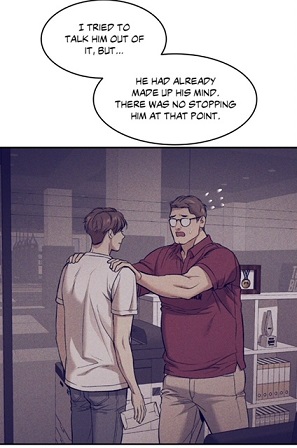 (chapter 53) Only the logo is red.
 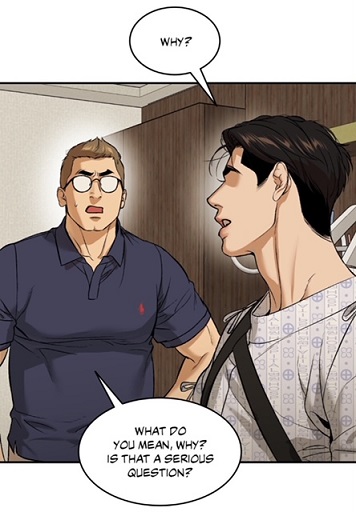 (chapter 53) It is important, because it announces the manager’s resignation. He doesn’t want to become responsible for the mess. Unconsciously, he is no longer claiming to be the owner of the gym. Furthermore, notice that the grandmother desires to return to the West Coast in order to see an ocean of “fire”.
 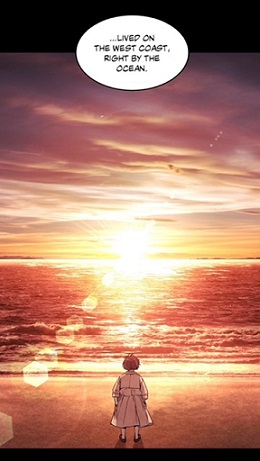 (chapter 53) This shows that she is longing for warmth and red colors. Yet, the color of the sea is rather green or blue. As you can see, everything is pointing out that the couple had to overcome the antagonists from season 1, the emotional vampires, who were so close to them than none of them realized that they were the origins of their suffering. And now, if you look at my table again: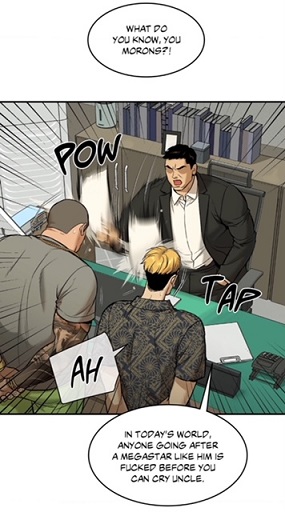
 (chapter 35) In episode 16 and 17, the presence of the sun is a reference to the MMA fighter, it is announcing his arrival. This corresponds to the color I had detected with the first scheme:
 MFC with the blue “ring” embodies this pigment, just like the ocean. In other words, blue should be the dominant color in season 2, and in Taoism blue stands for YIN! On the other hand, Kim Dan also represents red with his name. Moreover, if you look at the numbers of the quoted episodes again, you will realize that the villains are strongly connected to the number 10 and as such one and zero. Thus Director Choi Gilseokf’s phone number is 010-1….
 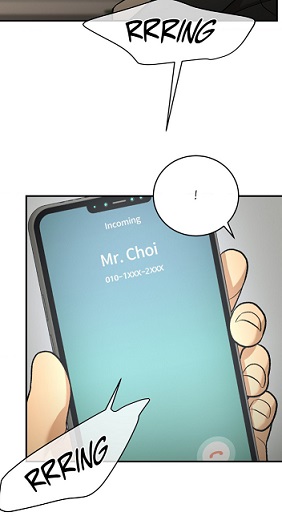 (chapter 46)
  (chapter 37) He never complimented him for his hard work at all.
 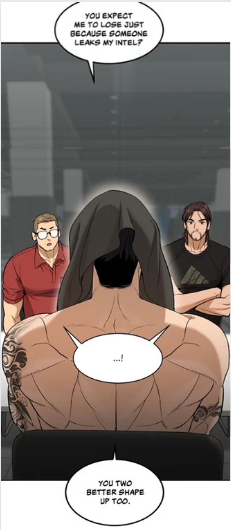 (chapter 46), however Park Namwook refused to accept such a behavior from his boss. Therefore he put his pupil under pressure.
 (chapter 46) He avoided a confrontation. This number symbolizes how the lead feels burdened by obligations imposed by his oppressor, who positions himself as provider of “stability” while actually fostering dependence and draining his victim. And naturally, in the same chapter, we have a similar interaction between Heo Manwook, the minion and his hyung, the real boss:
 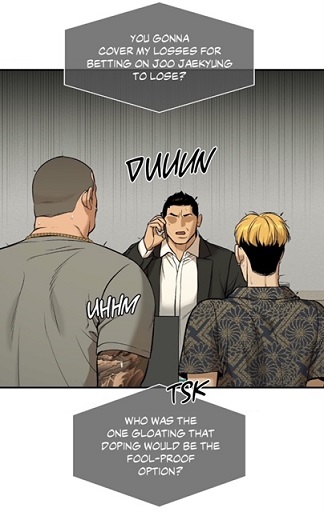 (chapter 46) Here, the director was reminding him of his mistakes and obligations. However, this time the boss chose to become proactive and responsible.
  (chapter 9) The leopard agreed and that’s how they came to argue about his home the next morning:
  (chapter 10)- So from 9 to 18, the story is focusing on the doctor’s home. In episode 18, Joo Jaekyung invites the poor physical therapist to his home.
  (chapter 18) Then in episode 19, Joo JAekyung is not asking for his “help”, until he calls him. But even here, he is refusing to prepare his partner:
 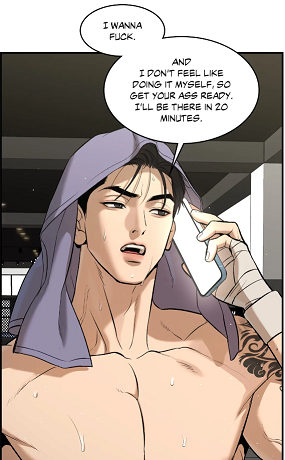 (chapter 19) As for Kim Dan, the latter doesn’t feel truly needed as PT, hence he is already thinking about taking another job:
 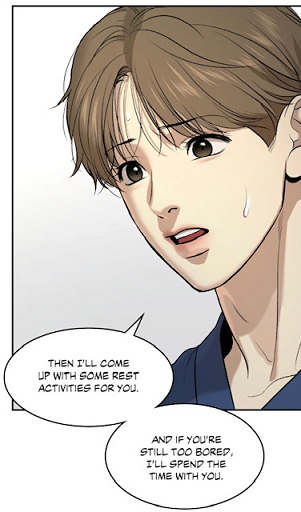 (chapter 27) He encourages his VIP client to take a break by remaining by his side. However, this attempt fails, as in episode 29
 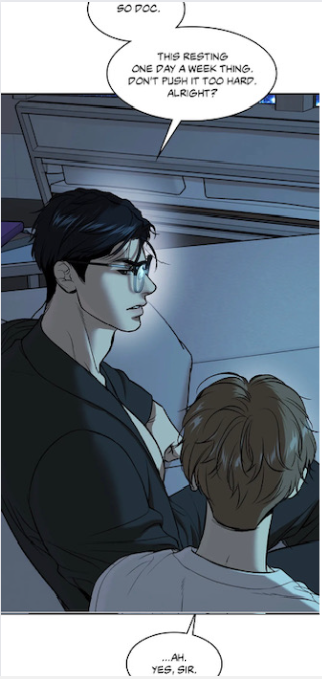 , (chapter 29) the champion rejects the idea of resting for a day. Then after the incident with the article, at no moment Kim Dan offers his assistance to help the champion. He remains totally passive,
  (chapter 39) The problem is that it is related to a drug and sex. This has nothing to do with his job or career. Interesting is that in episode 45, for the first time, Joo Jaekyung voiced his needs to have him as a PT:
  The end of Joo Jaekyung’s torment. He doesn’t need to chase after him.



 (chapter 131) Hence the police officers found the governor’s seat deserted.
  (chapter 131) By contrasting the statement from the governor and the panel, the readers could easily catch his lie. He was a lazy governor, preferring to keep his lover company rather than attend to his official duties. On the one hand, it exposes the main lead’s true mind-set. He is not longing for power or glory. To conclude, he has no ambition. This implies that he is not determined to gain attention either. One might add that he selected this region on purpose. No one would willingly go to that place. The norm was that officials would go there, because they were demoted.
  (episode 129) Thus I deduce that Yoon Seungho made the opposite choice to his father. The latter longed for a high position at the government so that the family’s reputation would become famous and powerful again.
  (chapter 86) It is because Yoon Chang-Hyeon was thinking of getting the attention or support from noble families. What he truly wanted was to get recognition from people among his own social class. But with such a decision (join the painter’s side), Yoon Seungho seems to have turned the former patriarch’s nightmare into a reality. Yoon Seungho is about to ruin the family. The name “Yoon” is destined to become forgotten, right? However, I believe that this interpretation is not correct. How so? Let me ask you this.
 (chapter 127) No one has such a wealth! That’s the reason why no official would select such a place. Yes, Jung In-Hun’s words from chapter 6
  (chapter 6)
  (chapter 37). It is about a crime, treason. In season 4, we know that the plot was true and there was an evidence, the paper with the signatures from lord Yoon and lord Song. Since in season 1 the wrongdoing was true and heavy, I deduce that it is not the case in the final chapter. Because there is an evidence of the crime in the past, I can’t help myself thinking that in the final chapter, there was no evidence. Additionally, I feel the need to expose my other interpretation about this man:
  (chapter 37) I have always stated that this man couldn’t be a servant, for he was smoking a pipe and we saw a glimpse of his memory. No commoner would be allowed to enter the courtyard, when three noblemen are tortured and interrogated. Moreover, notice that in both scenes (37 and 131), the magistrate is absent. That’s how it dawned on me that this nameless man could have been a former “governor” who lost his position.
 (chapter 94) Here, the officers went to the mansion before visiting him at the gibang.
  (chapter 97) Back then, it was about the death of a commoner, a servant. If there’s an urgency, they would look for him. The comparison exposes that the “wrongdoing” from the peasants in the final chapter was no huge deal. Yet, many readers already condemned them due to the guards and the protagonist’s behavior. Funny is that the lord was portrayed as a huge liar, but not “the officers”.
  (chapter 101) His statement displays another aspect: the governor and the guards are not working together. Jihwa would have been sent to jail without being able to talk to the superior, similar to this scene:
  (chapter 126) The guards’ own interests are not necessarily aligned with the governor’s. And now, take a closer look at this scene:
  (chapter 127) The official received the patriarch in his office alone. The reason is simple. That way, he wouldn’t have to share the money with others.
 (chapter 129). He was not sitting on a horse with a few musicians contrary to Jung In-Hun. He was carried by four men, and other people were announcing his arrival with flags and music.
  (chapter 111) Moreover, Yoon Seungho had a inauguration banquet organized, where the local inhabitants could join.
  (chapter 129) There was no social exclusion at all. This stands in such opposition to the lord’s statement in season 1, where he distinguished between nobles and commoners.
 (chapter 129) This signifies that the arrest could lead to trouble to the guards too. So was the lord lazy in the end?
  (chapter 131) Yes and no… By acting that way, he put an end to the abuse of authority in that place!! Thus I deduce that the governor is destined to gain recognition and admiration from the local inhabitants. He is generous (inauguration banquet where anyone could join), humble, loyal (he is not forgetting his lover)
  (chapter 131), but also well organized! He had planned to join this place a long time ago. The peach trees were planted about 3 years ago. He is no longer making any distinction between nobles and commoners, and that’s how he will get the respect from the peasants. As a conclusion, we should envision that the lord will become famous. Therefore the son didn’t turn the father’s nightmare into a reality. He didn’t contribute to the family’s ruin at all. Yet, there exists a huge divergence. Yoon Seungho is about to make a name on his own. It is not about the Yoons. On the one hand, the father’s dream was illusory and superficial, especially due to the treason
 (chapter 86). Since Lord Song had been forced to resign, there’s no doubt that the man would resent the Yoons to become successful again. This explicates why lord Song saw Yoon Seungwon as a problem
  (chapter 107) and tried to tarnish the younger son’s reputation. But let’s return our attention to the patriarch. His vision was based on Confucianism. However, he had a very narrow-minded perception of it.
  (chapter 7) This shows that the tradition was to “vanish behind the family name, the Yoons”. Under this new light, my avid readers can grasp why the main lead was destined to suffer immensely
  (chapter 57). His reputation was already outshining his father’s. Secondly, by being stigmatized as a homosexual, he was endangering this principle. His role was to continue the lineage and as such produce a heir.
  (chapter 116) or even Min could commit crimes in the open. They felt safe, for they knew that the authorities belonged to the same social class than them. However, this could only work, as long as the nobles would cover for each other. Should a yanbang denunciate a noble family, it was a different story. Therefore I assume that lord Lee was the one who reported the treason to the authorities (the painting in the bedroom was the evidence). But such a painting couldn’t represent a proof. However, since human justice was corrupted, the gods decided to give justice to the protagonists. That’s how Yoon Seungho became the hand of justice. Everyone involved in the protagonists’ suffering had to pay for their crimes.
  (chapter 102) That’s the reason why Baek Na-Kyum’s martyrdom was strongly intertwined with the young master’s. Yoon Seungho only received this power through Baek Na-Kyum, the character embodying fairness, sincerity, hard work, home and equity. This was particularly perceptible in this scene:
  (chapter 27) The lord couldn’t kill anyone randomly.
  (chapter 102) However, I consider it as a first step to the lord’s emancipation and life lesson. The latter is indirectly learning not to pay attention to status and power. That’s why the author portrayed him as blind and deaf to their plea and special status. While his behavior in the shrine was rather impulsive and influenced by deeply rooted fears, we should consider lord Song’s execution as a true act of justice.
  (chapter 123)
  (chapter 123) The latter had confessed all his crimes: the ones from the past (the lies in order to fool the father)
  (chapter 123) and the painter’s murder. Funny is that lord Song didn’t feel threatened by the young master at all despite the sword.
  (chapter 123) Why? It is because he feels, he is the one with the upper hand. First, he has the petition, hence he is already projecting himself in the future (he can get a high position again). Secondly, he thinks, Yoon Seungho is outnumbered. He is surrounded by 4 guards. But more importantly, he views himself superior to the main character due to his age. He is an elder. That’s the reason why he calls “my dear boy”. This implies that he is underestimating the main figure. The latter would never dare to raise his hand against a senior!! However, true justice is also blind to age.
  (chapter 123) His smile at the end of the episode should be perceived as a reflection from Min’s vanishing.
  (chapter 103) One might even add that the lord’s action could have been seen as self-defense. However, don’t forget that we are here in Joseon, where a commoner’s life means nothing. Because of this new association, I came to the following deduction: lord Song was the one behind lord Shin’s death.
  (chapter 103) The latter couldn’t imagine that an elderly yanbang, an official, would raise the sword against another noble. After this new realization, it dawned on me why Yoon Seungho had to get separated from his loved one.
  (chapter 126) This humiliation made Yoon Seungho realize that he needed to have his power on his own. He learned through the hard way that he was not just a Yoon, but Seungho. Yes, this helped him to differentiate himself from his father and to become stronger mentally. His religion was now his lover, Baek Na-Kyum, whom he needed to protect. But he could only do it, if he had himself a powerful position. But he needed to witness the corruption of the authorities to realize that in Joseon, there exists no justice.
  (chapter 6): neglect and indifference towards the commoners. And this new observation brings me to my other topic, Jung In-Hun.
 (chapter 129), therefore he couldn’t select one position contrary to the main lead. This means that when he celebrated his “victory” in episode 111, it was not official. He had no post. I would even add, his name had not been announced on the official board, like we could witness it in this scene.
  (chapter 121) Here, he is informed that he didn’t pass the exam, for his name was not written there. We can detect this, because people are congratulating each other. His name was left out due to the intervention from lord Song. This means that when Yoon Seungho made him this offer
  (chapter 7), these were not empty words. He did help the learned sir to pass the civil service exam. But the scholar didn’t succeed like anticipated. The absence of his success explicates why Jung In-Hun received such an offer from lord Song later.
  (chapter 117) He had no post, he couldn’t choose it, for he was not the best. Thus I deduce that the scholar had just proven his mediocrity. He was just an average man. That’s how it dawned on me that the ceremony in the street was more a simulacre!
  (chapter 44) Only one thing was real: Jung In-Hun was wearing an official uniform, that way no one would doubt his “victory”. Moreover, observe that lord Song only approached the learned sir after the parade. So he was not behind the parade. Besides, keep in mind that the main couple was informed about the parade through the tailor
  (chapter 111) and not from the official board. His reaction shows not only his displeasure, but also his ignorance. If he had known about the cortege, he would have avoided the place in the first place. Thus I suspect that the tailor had been encouraged to leak this information in front of the couple. Let’s not forget, as a tailor, he was definitely involved in the cortege. It is no coincidence that he informed Yoon Seungho about this “sudden parade”. At the same time, I come to the following deduction: someone must have paid for this spectacle, and it was not Yoon Seungho, for he had been kept in the dark until the last moment. I doubt that the learned sir had the connections and money for this. This new perception corroborates my previous interpretation: the show was sponsored by someone, and it was definitely inspired by the drawing (the hat and the green uniform).
  (chapter 111). Yet this was just a cheap trick, for the person didn’t send a sedan chair with carriers. Under this new light, I realized why Jung In-Hun ended up stigmatized as a criminal.
  (chapter 127) It was his karma, for he had deceived the painter with his lies. His success was not his own.
  (chapter 111) He realized that even after passing the exam, he needed the assistance of people, a sponsor for the spectacle, a noble with connections. Besides, when in season 1, the painter was accused of a crime (ruining the picture), the learned sir did nothing at all. He didn’t protect his student, for he desired to keep his sponsor. When the latter was sick, he neglected him as well. He wouldn’t have sent a doctor for him. Hence in season 4, the sponsor Na-Kyum decides to end his “sponsorship” for the learned sir. We could say that the former teacher is confronted with a similar situation. He ends up being abandoned and framed for a crime, which he didn’t commit. Yet, contrary to his pupil, he is not entirely blameless, for he played a huge role in the death of the nobles lord Song, lord Shin, lord Min and others. Because Baek Na-Kyum embodies hard work, justice, equity, love and honesty, I deduce that his surrogate father embodies the negative notions: laziness, corruption, partiality, hierarchy, ambition and hypocrisy. That’s why his face ended up on the official board, while the painter’s accusation just remained rumors.
  : (chapter 125) versus
 (chapter 105) IMO, she had to use another mean in order to achieve her goal: the scholar. Let’s not forget that the artist had confided to her this:
  (chapter 68) He was simply waiting for the learned sir’s return. And she was present during the cortege.
 (chapter 121), he put the painter in a position which led him to take for the fall for his loved one. It was like framing an innocent. Exactly like in season 3
 (chapter 99), Yoon Seungho had been forced to take the sword because of the scholar. And the trigger for the massacre
  (chapter 124) was always Jung In-Hun. And now, you comprehend why Jung In-Hun became the scapegoat for the last incident. But there’s more to it.
 (chapter 121) His final lesson was to learn that he was exactly like the others: he is just a human despite his education. All humans are equal in front of death. In fact, during his confrontation with lord Song, he came to give up on his integrity. His true face came to the surface: he was just an opportunist, a lazy scholar who relied on fate and his arrogance.
  (chapter 6) This brings me to my next interpretation. Jung In-Hun learned through the hard way that there is nothing like fate (“right time”), but life is the result of decisions. However, because the scholar always regretted all his past choices, he decided to blame others for his wrong choices. That’s the reason why he ends up to take the whole crime. We should see this paper
  The author from this sijo was the poet and official Wang Bang-Yeon who is said to have lived in the time of Joseon’s sixth king Danjong (1441-1457) and his successor king Sejo (1417-1468). As the official of the state tribunal, he followed the young king Danjong into his exile and gave him poison to drink by royal command. Yes, both are symbols of power, corruption, partiality and injustice. Yet, there exists one divergence. While Wang Bang-Yeon left a poem revealing his yearning for the king, the learned sir had no deep attachment towards the artist. Hence it is no wonder why the paper “Wanted” is not connected to affection. It really reflects the emotions and thoughts of Baek Na-Kyum. Due to the last incident, the latter no longer cares for this man.
 (chapter 6) He couldn’t enjoy it at all. It is no coincidence that the synonyms for ambitious person are “busy person” and “workhorse”. Yes, this mirrors the expression “laziness”. A true ambitious person is actually proactive and not really relying on sponsors and bribes. So when we see the learned sir on the horse
  (chapter 107) Though he passed the civil service exam too, he is not able to fulfil his father’s wish either.
  (chapter 118) His intention was to protect not only his brother, but also their family. It was to ensure that lord Song would get blackmailed. That’s how this investigation
  (chapter 118) It is because he knows that with the petition in his brother’s hands, lord Song represents a hindrance to his own career. The latter can only see the Yoons as a threat. Besides, he can only resent the family, if they are able to gain reputation and power, while he can not return to Hanyang and occupy a high position. As you can see, the young master’s success can only irritate lord Song. You can sense a rivalry between Seungwon and lord Song Haseon
  (chapter 116) in this scene:
  (chapter 116) The latter has already sensed that the traitor is sitting next to them, thus he raised this question. That’s why I come to the following conclusion that the young master must have realized that he also needed his brother’s assistance. First, if Yoon Seungho returns the petition to the father, the investigation about the traitor in the mansion would be no longer necessary. Secondly, Yoon Seungwon needs to create new connections in Hanyang, but he can only achieve it with his elder brother. Under this new light, you comprehend why Seungwon asked his relative to move on from the past and as such “forgive their father”
 . (chapter 118) In other words, the young man embodies the notion of “fake forgiveness, fake promise, fake understanding”. He is an opportunist, exactly like the scholar. Yet, there exists a huge divergence between them. His affection for Yoon Seungho was not fake. He is feeling sympathy for his brother. But that’s it. This explains why he didn’t help his brother before. In my eyes, Seungwon represents a different notion of family: bloodline. In my eyes, he embodies traditions and Confucianism. His goal is to turn his father’s dream and life motto into a reality: glory and power for the Yoons. Besides, he must have experienced himself the downfall for the family. And this observation leads to my next interpretation. This means that Yoon Seungwon must have lied to his father by omission as well.
  (chapter 128) What about Yoon Seungwon then? Though he succeeded too, there is no mention about engagement or marriage proposals. However, it is clear that this achievement is connected with adulthood and marriage, therefore the elder Song Haseon brought up the topic sex!
 What was the reason for Yoon Seungwon’s embarrassment? First, it is because his brother selected the backward place, though he had passed the exam with flying colors. Yoon Seungwon imagined that once his brother had passed the exam, he would get married and establish new connections. That way, Seungwon would be able to get married with a properous and famous family. In other words, Yoon Seungho would turn the father’s dream into a reality: the return of the Yoons’ glory and power. And Seungwon would benefit a lot from this. So in the gibang, his advices might have sounded well meant,
 (chapter 126), his karma is not only to end up alone, but also not to receive any support from his brother.
 (chapter 117), because his career was still insecure due to lord Song’s influence. He needed his brother’s help in the end. At the same time, Seungwon had already long internalized the values from his father: Yoons’ honor and reputation were top priorities. In other words, the younger brother stands for social norms and fake righteousness. He desires to maintain his perfect image (loyalty, filial piety),
 (chapter 118), hence he left the document at the mansion. He wanted his brother to return the papers on his own so that his past action would remain undetected. Returning the paper was like an admission that he had stolen it in the first place. Yet he still barged in his brother’s house twice.
  (chapter 117) Here, he exposed the existence of the “petition” to Baek Na-Kyum for one reason. The latter should be used as a way to pressure the main lead to give up on the paper. Notice that this topic was brought up in the gibang:
 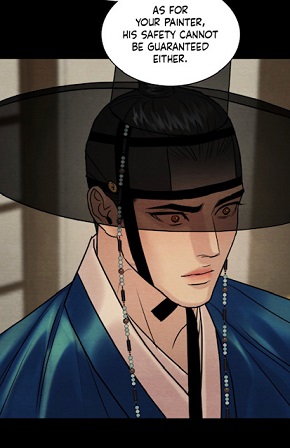 (chapter 119) However, the reality is that Seungwon is not just trying to fulfil his father’s dream, but also he has his own ambition. He wants to make a name on his own. That’s why he confessed this to his brother:
  (chapter 119) He doesn’t associate himself with the father and his sins. In his eyes, he is blameless. The reality is that he is guilty like his father, for he failed to care for Yoon Seungho. He failed to listen to him and his suffering. He didn’t try to understand him. Like mentioned above, he only sympathized with him and that’s it. Thus he condemned him for his debauchery in the gibang, but this was no longer the case.
 (chapter 127)
  (chapter 127) the former only made a promise to his father and not to the brother. With his death, Yoon Seungho is no longer bound by a promise. Since the main lead had been living properly for 3 years and even passed the civil service exam, it is clear that for the brother, Yoon Seungho must have forgotten his past lover. He must have judged his brother based on appearances, just like he was behaving himself. However, this was just a subterfuge. He was waiting for the right time too. He had no change of heart, he had just been copying his brother’s behavior.
  (chapter 78) Let’s not forget that at the gibang, Yoon Seungwon never revealed his true intentions towards his brother. The latter always said that his advices were for his best interests. He should become involved in the government. But everything was for the Yoons, or better said, for Yoon Seungwon’s sake. And there exists another reason why the sibling must have been embarrassed: This marriage!
  To conclude, Yoon Seungwon embodies the opposite values of Baek Na-Kyum and Yoon Seungho: ambition, corruption, forgetfulness, hierarchy/social norms, traditions and reality versus understanding, forgiveness, simplicity, closeness, modern family and happiness. Selfishness versus Selflessness. This explicates why the main lead gave up his success for the artist. However, though it looks like an exile, the reality is that he will gain popularity and admiration among the inhabitants. Why? It is because he is no longer making distinctions between nobles and commoners, he doesn’t see this place as a punishment, but as a heaven and as such he has a better perception of humans in general. In my eyes, he is bringing progress and change in the region. Baek Na-Kyum is already teaching the kids how to draw… so it is only a matter of time, until his lover takes care of the education for these children. This means that these words will become a reality:
  (chapter 6) He will think of the futures of those children because of his lover.

 (chapter 22) Back then, I came to realize that both ukes were associated with the number 2. Shortly after, while making a first portrait of Cheolmin, I noticed that this cute doctor was linked to numbers 1, 3, 4.
  At the same time, I connected him to the sky, an angel. As you can observe it, my observations led me little by little to planets and numerology. But the major turning point was, when I perceived Kim Dan as a representative of Saturn
  . From that moment on, I came to associate Jinx-characters with gods and as such planets. Hence in the essay
  , I made the following connections. Potato was Venus, and his soulmate Choi Heesung is Mercury. Then Joo Jaekyung is Jupiter and the Sun, whereas Kim Dan was Saturn and the Moon.

 That’s how I discovered that Kim Dan was associated with the number 8. Thus in the composition
  HEALING! That’s the night Kim Dan got healed.
  (chapter 44) During that night, he realized that time was flowing. It helped him to reconnect with the present and forget his abandonment issues. How so? This revelation was necessary to make him realize that his promise with his halmoni was impossible. She was a mortal, exactly like him. This lovely night gave him the strength to face reality
  (chapter 47) and digest the terrible news.
 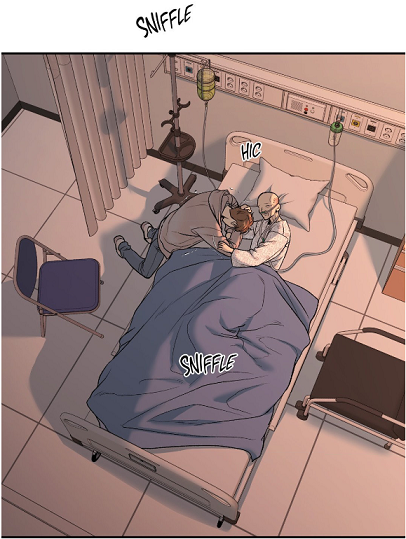 (chapter 47) Thanks to the champion, Kim Dan discovered that he could receive warmth and love from someone else. And now, you can grasp why he was strong enough to give the present to Joo Jaekyung despite his fear, why he could confront his boss in the locker room in episode 51. Thanks to this magical night, he learned that he could stand on his own. He is an adult now. But wait… people might question this interpretation, for there was no teamwork in episode 11.
  (chapter 11) He treated him as an important member of his team, he needed his assistance. Secondly, who helped Kim Dan with his struggles? Joo Jaekyung.
 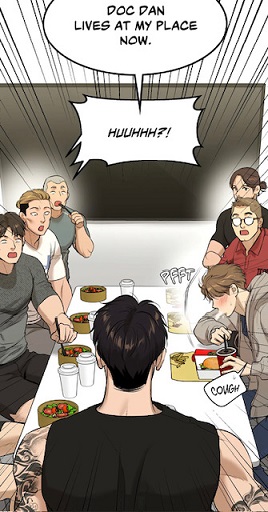 (chapter 22) Secondly, notice that he showed his true power in the break room. He is the true owner of the gym
  (chapter 22) It is important, because it indicates that little by little, Joo Jaekyung is taking over the gym. From that chapter on, he was building his world from the ground”.
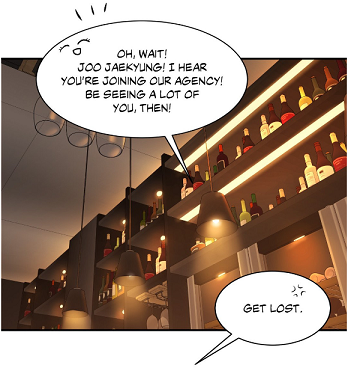 (chapter 33), we could see Joo Jaekyung’s success reached its peak, as he had just signed a contract with the Entertainment agency. “Reaching the pinnacles of success” was also reflected in another situation. The champion was allowed to touch his lover’s phallus
  (chapter 33), something he had been denied before (chapter 24). Moreover, he was able to get a confession from Kim Dan.
  (chapter 33) The latter would react to him, only him could make him cum. Moreover, observe that in the heat of the moment, Kim Dan embraced his lover which surprised both.
  (chapter 33) The cute doctor was unconsciously accepting to be intimate with his boss. Thus he whispered to the sportsman.


 They are no longer avoiding discomfort, a sign that they are getting closer to each other.
 I selected pictures from episode 6, 33 and 51! They are all connected to the same number. This signifies that we should examine the following chapters 6, 15, 24, 33, 42, and 51 as a continuation or better said as reflections. Hence they stand for love, but don’t forget that Venus also embodies fertility, prosperity and victory. How so? She was the ancestor of the Roman people through her son, Aeneas, who survived the fall of Troy and fled to Italy. That’s why she came to symbolize Rome’s imperial power. Yes, these chapters are mirroring a battle, who has the upper hand in the couple.
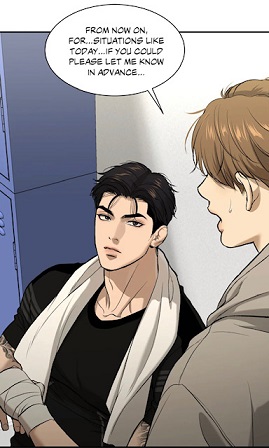


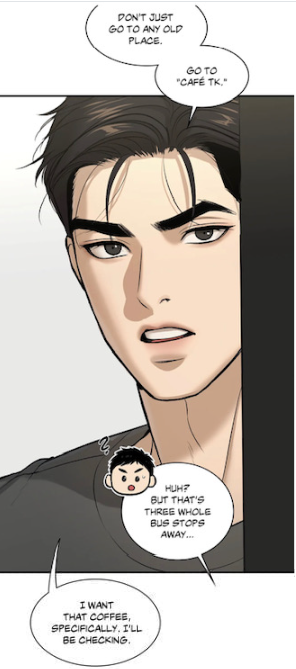


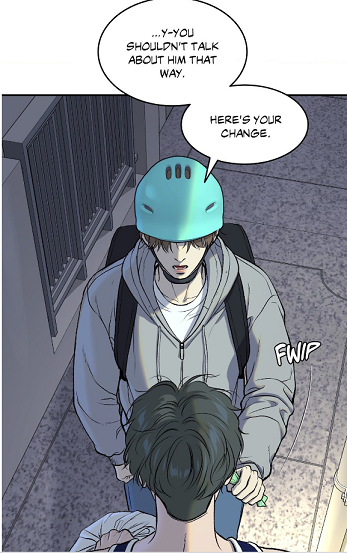

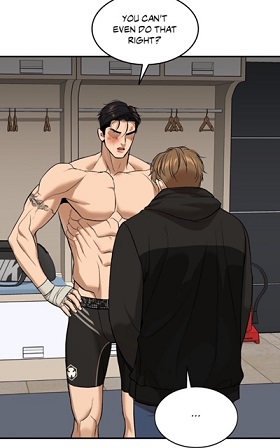
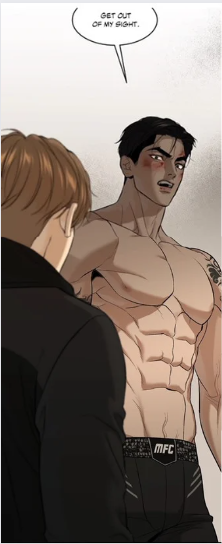
 (chapter 15) But there’s more to it. It was also a first for the champion. He invited Kim Dan to watch the show. Imagine that he had never invited any sex partner before. Then in episode 24, he listened to the doctor’s request without any complain. Then in episode 33, for the first time, Joo Jaekyung focused on giving Kim Dan’s anal pleasure. It was, as if the star wanted to trigger desires in Kim Dan. Then in episode 42, Joo Jaekyung witnessed that Kim Dan was doing the breakfasts out of “routine” and not out of pleasure. Thus he always fell asleep. On the other hand, the physical therapist got confronted with a rival for the first time. Finally, in episode 51, Joo Jaekyung is now acknowledging Kim Dan as his final doctor. He is voicing his expectation: meticulousity.
  (chapter 51) By bringing the topic money
  (chapter 51), the champion could finally voice his biggest fear. Deep down, he knew that their relationship was based on money. But with one sentence, the doctor could remove his doubts and insecurities.
 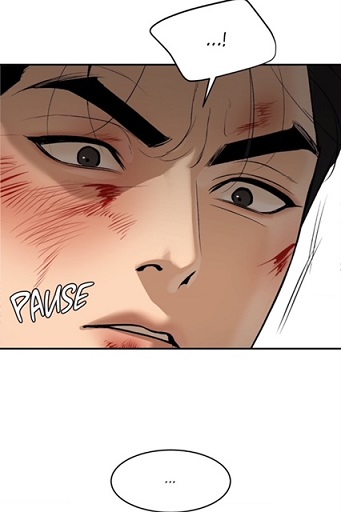 (chapter 51) He was more than caught by surprise, in my opinion, it must have dawned on him that he might have been wrong about the doctor. Hence he got upset. Seeing the physical therapist’s face was like a reminder that he had made a mistake, he had not trusted Kim Dan, while the latter had not.
 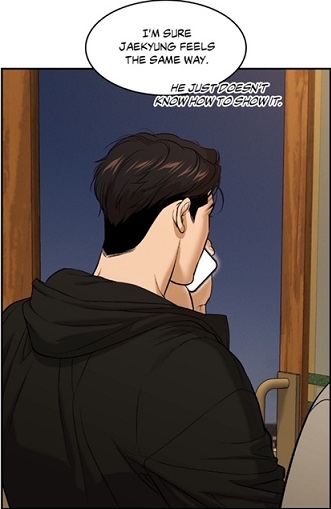 (chapter 43) On the other hand, you are probably wondering how I came to this new theory. It’s simple. It’s because of his name. Alfredo is connected to the number 7. In addition, his name signifies wise counselor.
 , (chapter 39) In chapter 53, we discover that it was the halmoni’s dream to see the ocean, like we could observe it in his old house.
 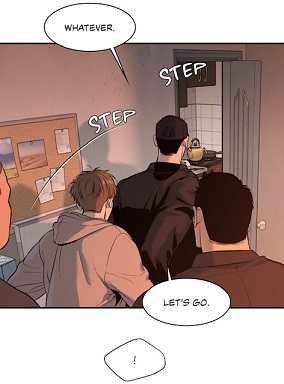 (chapter 17) However, in the last panel, Joo Jaekyung was leading his loved one, symbolizing that he would bring him to different places. Thus the doctor had to follow him to Busan (city next to the sea) and to the USA. At the end of season 1, it becomes clear that the champion will follow the doctor’s footsteps. He will got to the West Coast. Yet, in reality, the fighter is actually following the grandmother’s trail. Moreover, note that the doctor’s dream was to travel too. However, this desire is strongly connected to his relative.
  (chapter 27) Yet according to my previous interpretation, the PT’s totem is the duck:
 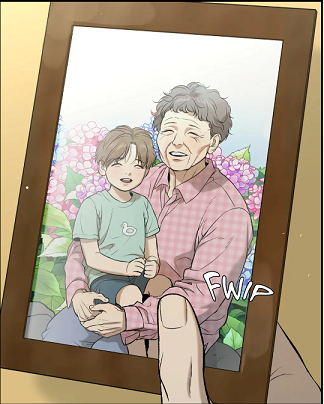 (chapter 19) A bird that is associated with water. And what is the common denominator between these last three panels?
  (chapter 7)
  (chapter 37)
 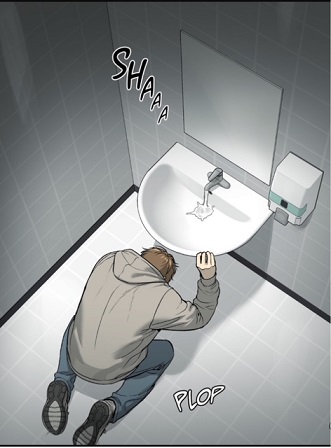 (chapter 47) The bridge from San Francisco is a place where people often commit suicide. My idea is that after they vanished, the halmoni never discussed their death with him. Since the grandmother was harassed by the loan shark, I can only assume that they killed themselves due to the debts, and suicide is a huge taboo in South Korea. Notice that his first trip led him to Busan which is a town next to the sea. However, back then, he had not the time to go to the beach. But when he went to the States, it was far from the coast, as UFC/MFC is located in Las Vegas. Hence he came to enjoy his trip. In fact, it inspired him to travel.
  (chapter 35) We have a 5, but 3+5= 8, the double of 4. Besides, his favorable numbers are 1, 7, 4. Then we would have the explanation why he became more important in episode 22
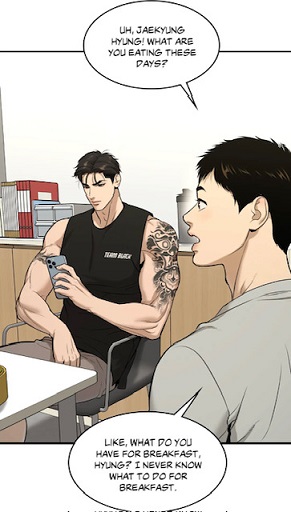 (chapter 22), why he protected the doctor from Heesung in episode 31
 (chapter 31), why he asked for Kim Dan in episode 40
  and why he reappeared in episode 47.
  (chapter 47) and helped him in the locker room.
 (chapter 49) Under this new light, my inquisitive readers can understand the title of this composition. My focus will be the infamous sportsman and his interactions with the main lead, in the past and present. Consequently, the composition will contain theories about the champion’s past. Nevertheless, since I am examining the present, it signifies that I will explain Baek Junmin’s role in the new scheme too. So who is Baek Junmin in the end? In the essay “
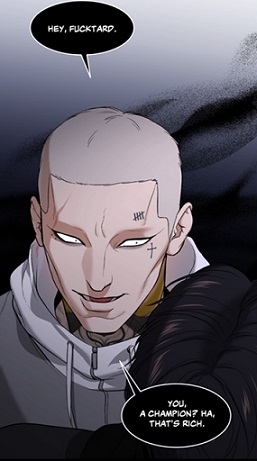 (chapter 49) Yet I couldn’t help myself seeing in the following image glimpses of purple (around the eyes).
 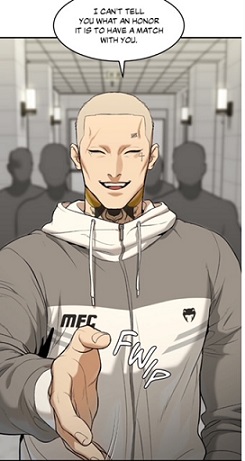 (chapter 49) It exposes his duplicity. Because of his sobriquet and his color, I assume that the schemers consider the boxer as a weapon. His role is to kill the Emperor, and probably in one blow. He is the executioner of the invincible legend. It should be a quick, merciless “death”. From that fight, Baek Junmin has to ensure that Joo Jaekyung can never come back to the ring. How is it possible?
  (chapter 49) It is because they know about his injured shoulder. That’s the reason why Baek Junmin is patting him on his left shoulder. Remember what the sports doctor told to the physical therapist:
 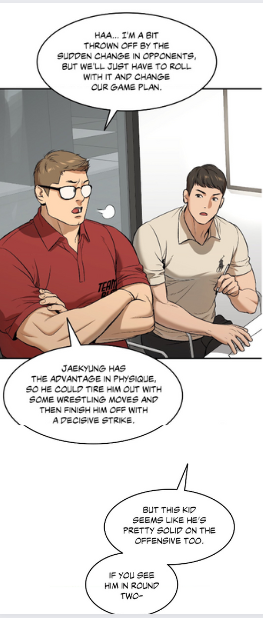 (chapter 47) He should make the fight last in order to tire his opponent out. So the plotters thought that during the fight, Joo Jaekyung would ask for a relief spray on his injured shoulder. That would be the end for him. Kim Dan would even deliver him the victory on a silver plate. He would be framed as an anti-fan. The irony is that Kim Dan could heal his VIP client within a short time. Here, the champion looks relaxed and not concerned with his shoulder.
 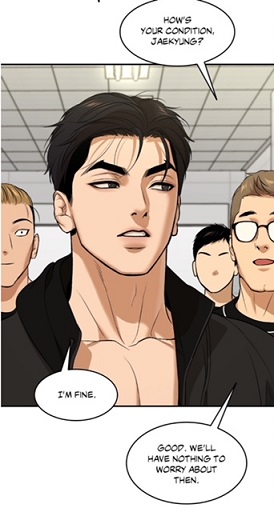 (chapter 49) Here, he is almost smiling. He was telling the truth, when he said that he was fine contrary to the States.
 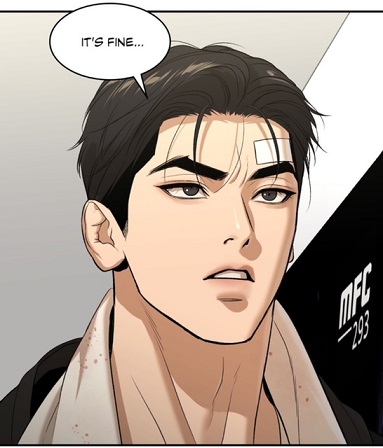 (chapter 40) I would like the difference between the two statements. He is now utilizing the personal pronoun “I” and not “it’s”. It indicates that the champion’s condition is good. But now let’s return our attention to The Shotgun”
 (chapter 49) He has now taken over the manager’s place. This reflects the doctor’s rising within Team Black. At the same time, this expression lets us perceive the role of Baek Junmin at King Of MMA gym. He is the protector of Choi Gilseok, the “old man”. On the other hand, his position also insinuates his passivity, as he is not the driver, like here.
  (chapter 49) The director had to suffer a great humiliation for this trick, while a helping hand had to switch the spray. For me, the expression “The Shotgun” displays the inaction from Baek Junmin. He was catapulted to the top thanks to the assistance of others: Mr Choi thanks to his money and connections with the media and with the CEO of MFC. Then the members from his gym had to gathered intel about his opponents. This was truly palpable in the description from the moderator.
  (chapter 47) Where did I find the evidence for this? It is because Seok (from Gilseok) can signify “brass”! As you can see, thanks to two different notions “shotgun”, I could give a better portrait of the fake star. But this is far from being finished. Funny is that “Shotgun ” can also refer to a position in American football.
 (chapter 49) And what is the common denominator between the meaning “firearm” and “American football position”? Attack! But there’s more to it. As adjective, “shotgun” is indicating coercion and duress. And this corresponds to Choi Gilseok and Baek Junmin’s tactics. The director tried to put the physical therapist under pressure, when he met him in the café:
  (chapter 48) For that, he utilized the grandmother. I feel the need to add here that this scene confirmed my previous interpretation about Baek Junmin and Shin Okja. [For more read
  (chapter 49) By meeting Kim Dan there,
  (chapter 49) he tried to sow seeds of doubt and even discord between the couple. It was to give the impression, they were working together. But the champion didn’t fall for it. The reason is that his fated partner was able to heal his injured shoulder. As a hypocrite and arrogant fighter, he utilized his small talk to threaten Joo Jaekyung.
  (chapter 49) Interesting is that “shotgun” can also refer to a flat.
  (chapter 10)
 (chapter 10) And what was the couple’s reaction during that night? While Kim Dan wept, as he was longing for his grandma
  (chapter 10) before he had a change of heart. Kim Dan’s plea had moved his heart.
  (chapter 10) The problem is that the doctor couldn’t remember this scene due to his drunkenness. This scene leads us to another meaning of Shotgun.
 (chapter 31) And this leads me to the following theory that Baek Junmin’s sin towards Joo Jaekyung was linked to drugs. Don’t forget that Mr. Choi is himself symbolizing “drug” due this image:
  (chapter 48) And both are working together. My hypothesis is that Baek Junmin was involved in drugging the athlete. The sportsman admitted that The Shotgun had schemed against him.
  (chapter 49) This would explain why Joo Jaekyung would never join the team’s dinner and why he reacted that way, when he drank a glass of soju:
  (chapter 43) He could recognize the alcohol, a sign that he must have tasted it before. His threat and anger were masking his fears. For me, he had a terrible experience with alcohol. And this brings me to the last signification of “Shotgun”: SEX! This was already brought up with the quote above, but I am quite sure that people have already heard the expression “Shotgun wedding”. Then I also found this description “Shotgun Sex”:
 (chapter 6), when Kim Dan had accepted the deal from the main lead. The erected phallus looks like a weapon and Kim Dan also made the connection, when he saw his huge anaconda with the sex toy:
  (Chapter 12) The idiom “shotgun sex” suggests a situation where sexual intercourse occurs hastily and impulsively. It has nothing to do with love and warmth. It is something done quickly or without much forethought, which corresponds to the scene in chapter 6.
  (chapter 17) Don’t forget that during that night, the soju was present as well.
  (chapter 17) Because of his nickname and the reflections from episode 10 and 17, I deduce that Baek Junmin was present, but he didn’t help the athlete. He turned a blind eye to the situation.
  (chapter 49) In other words, he didn’t behave like a hero contrary to Joo Jaekyung. I can’t help myself thinking of this scene:
 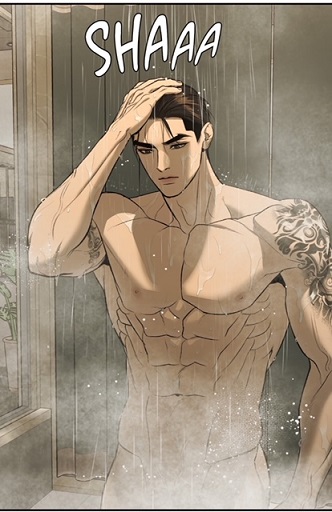 (chapter 49) He usually takes a shower in the morning, however this scene took place in the evening. Under this new light, it becomes comprehensible as well why Joo Jaekyung couldn’t remember the criminal
 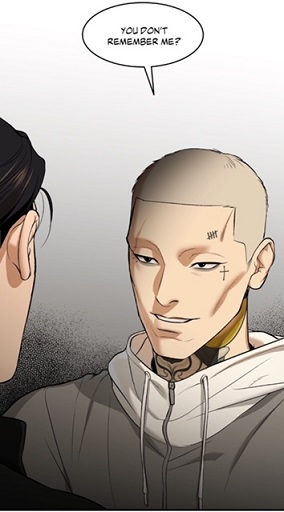 (chapter 49). It is related to a painful but short experience which scarred the athlete’s heart and soul.
 (chapter 49) It is because the latter had repressed his traumatic past. The other reason he didn’t remember him is that the latter had betrayed him. He was not worthy of being remembered and being noticed. Would you remember a poser and coward? No, not really. In my opinion, Baek Junmin stands for immaturity, betrayal, irresponsibility and false manhood.
 (chapter 18) and why both have no notion of “rape”. Joo Jaekyung must have been told that he was “responsible” for his misery, just like in this scene: “You did this”.
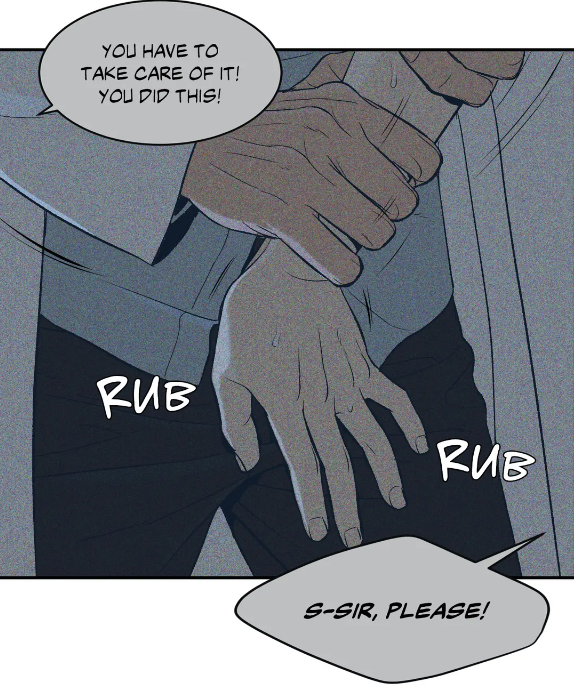 (chapter 6) He brought him upon himself. He shouldn’t have drunk or taken drugs, he shouldn’t have been weak, he shouldn’t have been there that night… I see his statement there as an evidence for manipulations
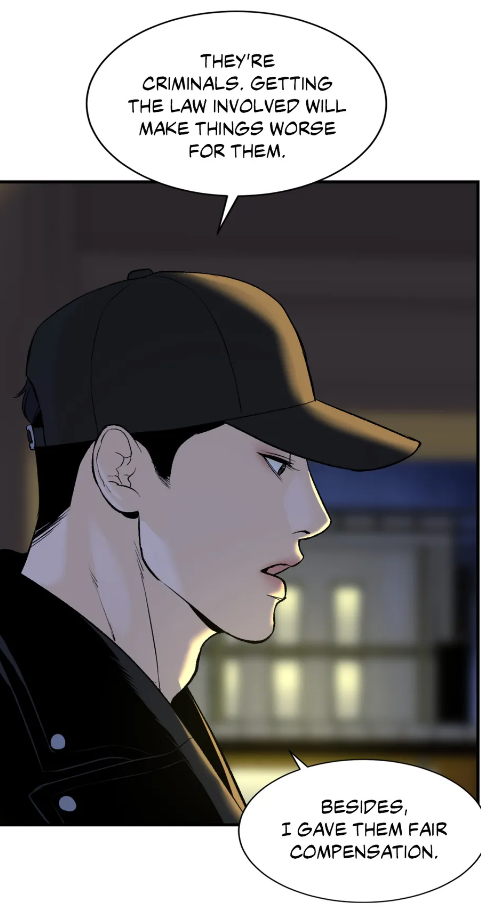 (chapter 18) If they are criminals, then the authorities should be informed, because the latter need to stop them, to make things worse for them. It was, as if he was advocating loansharking, though it is illegal. One might argue about this theory, for I deduced it simply from the name The Shotgun and its different reflections. However, Mingwa left us two other clues for this hypothesis.
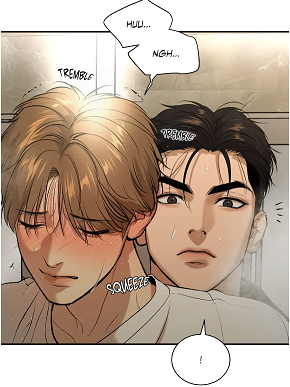 (chapter 20) But contrary to the physical therapist, the champion had never denied the existence of his body. He didn’t need to look at his reflection to see any change. The pondering was triggered by The Shotgun’s words. Baek Junmin saw the protagonist in a different light: weak and pitiful.
  (chapter 49) and not looking at his own reflection. Here we were witnessing the birth of the champion’s third eye. In addition, this scene corresponds to the one in episode 3:
  (chapter 3) As you can see, the moment you connect these two scenes, it becomes clear that there was no sex. In episode 3, the doctor was fetched and had to have sex, while in episode 49, the PT waited for a signal from his boss, but it never came. Furthermore, the bathroom is the only place where the athlete doesn’t bring his cellphone! And the latter represents a huge hindrance to his meditation, like Jin-philes could observe it in chapter 35:
  (chapter 35) But there is more to it. The departure from the restroom corresponds to the doctor’s realization at the hospital.
 Gradually, Kim Dan came to accept the truth: his grandmother couldn’t keep her promise, as she would never recover from her illness. He went on his knees, too devastated by the terrible news. However, he didn’t question the doctor’s action and behavior. Nonetheless, he was able to move on. He was forced to mature and become more independent.
  (chapter 49) without getting disturbed. But don’t misunderstand me. I am not saying that the athlete was weeping. What I meant is that he was admitting the existence of his pain and suffering. This represents an important step to treat his own body with kindness.
  (chapter 43) He used his hand to protect his gaze, a sign of vulnerability. His shower in episode 49 is full of symbolism. He is cleansing himself, moving on from the past. Hence I deduce that this scene
  (chapter 28) Because of this special day and night, Kim Dan came to accept sex and sensuality in his life.
 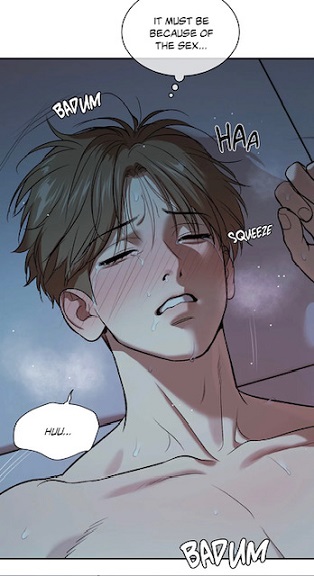 (chapter 29)
  (chapter 36) As you can see, all the scenes reflecting the bathroom scene in episode 49 contain SEX. Hence I see it as another evidence that the sex during that night had a different meaning: it was more a habit than a real need. And don’t forget that in the States, he had already complained about the timing.
  The star is gradually dropping his old belief. He is one step closer to realize that he is not jinxed, he is strong enough to win the next fight. My avid readers should keep in their mind that when the couple argued on his birthday
 (chapter 49) which was used for the sex session at the gym.
  (chapter 24) Moreover, he even took an ointment in case his anus would tear, for they didn’t have sex for a long time.
  (chapter 49) But Baek Junmin was not alone in this. Due to his traumatic past, Joo Jaekyung came to resent and mistrust humans, for he never got the chance to get justice from his tormentors. That’s the reason why he rejected social norms. As time passed on, he repressed the incident and buried the identity of the persons responsible for his wounds, whereas his pain couldn’t vanish. Hence he was still boiling inside and his anger was directed at anyone. It would come to the surface at the slightest provocation or rejection. That’s why he was still trapped in the past. He had the impression, he could get assaulted at any time. Therefore he needed to prove his strength. And this brings me back to the whispered confession:
  (chapter 37) When the athlete saw the doctor’s reaction, the latter was looking away,
  (chapter 37) the VIP client got so angry that he sent Kim Dan away. And now, take a closer look to this image.
  (chapter 49) The characters are placed in the same position. The comparison between these two scenes reinforces my hypothesis that Baek Junmin mocked Joo Jaekyung, resented him and refused to help the younger fighter back then, as Kim Dan was looking away. On the other hand, by using the expression “baby” in English, Jinx-philes could sense parallels with the fight with Randy Booker.
  (chapter 14) Interesting is that this image represented a distorted memory from the main lead, and it happened again after meeting his old “acquaintance”.
  (Chapter 47) The names are in the middle indicating that they won’t be able to switch places. The line represents the boundary which the fighters can not cross. In addition, the color was already implying anger, but also energy and action.. In my previous analysis about the poster
  (chapter 49) On the other side, this match has another signification for The Shotgun. How so? It is because he needs to win. He claimed that he would take away his belt. He believes that since Choi Gilseok paid a lot of money, he bet on his victory. Besides, the director of the gym even got humiliated himself. However, he is deluding himself, for he was just a tool to ruin the Emperor. A shotgun is an firearm and as such it is dispensable. Furthermore, this panel displays Junmin’s jealousy towards the celebrity.
  (chapter 49), whereas The Shotgun was relegated to fight in the shadow! He was fighting in the underground fighting ring, but since it was illegal, he couldn’t become famous and rich. He couldn’t be exposed to the spotlight. This shows that deep down, Baek Junmin was also trapped in the past. He came to resent the protagonist, for the latter had been able to rise the ranks. That’s why he couldn’t forget him contrary to the celebrity. The latter was not only successful professionally, but also admired as a hero. It looked like he had been able to move on from the past, whereas for The Shotgun, it was the exact opposite. He became more and more involved in crimes. Don’t forget that he is helping the director from the King of MMA gym to launder money. Thus I deduce that Baek Junmin is underestimating his opponent.
  (chapter 51) they had never planned to turn the new comer into a champion, people would have questioned the outcome. The real intention was to tarnish the champion’s reputation, to isolate him, to make him lose his stans. And they almost achieved it. Baek Junmin never realized his true position. He was just a middle-man, a hit-man that they would discard right after his “victory”. Hence he is no longer in the media, because his name is now linked with the incident with the switched spray.


 (chapter 46) On the other hand, chapter 47 exposes that the doctor didn’t lose his interest and attention towards his boss.
  (chapter 31) It is because when the psychologist met the patient with her boyfriend for the first time, he paid attention to his micro-expressions, and more particularly to his mouth. He saw his smirk. Here, I feel the need to give an explanation how these micro-expressions were discovered.
 (chapter 30) As my avid readers can detect, the expression from the boyfriend’s mouth displeased the white-haired psychologist. He could recognize his emotion, though such facial expressions are very short-lived
 .(chapter 30) So what was the “jerk” feeling, when he was conversing with Sihyun? Cynicism.
  (chapter 31) And the reason why he stated that as soon as cynicism or scorn was present in a relationship, the couple would end up breaking up is because of John Gottham’s observations and conclusions.
 (chapter 45) We could sense it in different scenes, though I would say that his cynicism was slowly vanishing:
  (chapter 3)
 (chapter 43) but what happened afterwards? Yosep spoke in the name of the gym’s owner: the latter would pay for the dinner (beef restaurant)
  (chapter 43) So technically, they offered a cheap cake and got in exchange a super expensive dinner. One might say that this was just a joke. But cynical people are taking things very seriously. This is what the champion learned from this experience, the cake in exchange for a super expensive meal … and now imagine that the next morning, he received an „expensive“ present from Kim Dan which was similar to the gifts from fans (exchange of favors). It is normal that he doubted the genuineness from his doctor, not only because of his past experiences, but also because of the parties before. But there exists another reason why he had to refuse the gift: Cynicism… the end of relationship. Thus dating for the athlete was impossible.
  (chapter 8), in the office, in the car, in front of a mirror, in front of Heesung in the living room… Don’t forget that Diogenes would even masturbate in public.
  (chapter 46)
  (chapter 46) Consequently, he never tried to get close to his members either. In fact, he is expecting from the staff to follow his lead. Potato could only get rejected with such a request.
  (chapter 23) The latter had to act like a true disciple and follow the champion’s recommendation.
  (chapter 23) The gym is like his sacred temple. Yet, the gym is just a simulacre of “nature”, as it is in the middle of Seoul. Therefore I realized why after their argument, Joo Jaekyung avoided the penthouse and Kim Dan in the end.
  (chapter 47) It is because deep down, the champion sensed that his flat had become a home. He wanted to ensure that the penthouse was still a workplace or a hotel room. Thus he refused to eat the breakfasts prepared from his PT. In his eyes, these meals must have appeared as a violation of his self-imposed discipline. It was more than self-sufficiency. Under this new light, Jinx-philes can grasp why he rejects presents and prefers donating money.
 (chapter 45) It symbolized everything he hates: a reminder of wealth, superficiality, attachment, secrecy and silence. It also exposed the huge difference in their mind-set. Kim Dan is not his disciple! He imagined that he had found a kindred spirit, especially after that night:
  (chapter 10) He is not resigning on designer clothes.
  (chapter 42) His dress room is the evidence of his hypocrisy. He might have encouraged Kim Dan to have sex in “public places”, yet he is still hiding his sexual orientation. Furthermore, his jinx is the evidence of his dishonesty.
  (chapter 45) He might advocate autonomy and self-sufficiency, the reality is that he likes luxury. Hence he is unable to live in harmony with nature. This shows that the fighter is in denial and is living in an illusion. Thus he can not find true happiness, for his freedom is not real. He is attached to the gym which is also strongly connected to his career as the Emperor.
  (chapter 47) Even Potato announcing the gradual Coming-Of-Age from his admirer. However, like Dr. Frost mentioned it, humans are social beings.
  No one can survive on his own. This explicates why Cynics had disciples in the end. And now, you comprehend the role of Kim Dan in Joo Jaekyung’s life. It is to remind him of his true nature. He is a human and not a dog-wolf. Thus the champion recommended his PT to live elsewhere, a sign that he was indeed a human.
  (chapter 10)
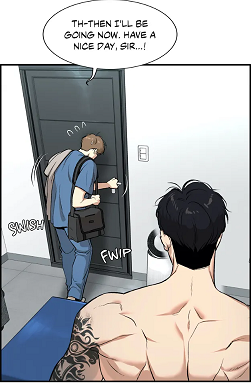 (chapter 1) Then the micro-expressions from Kim Dan exposed his lie
 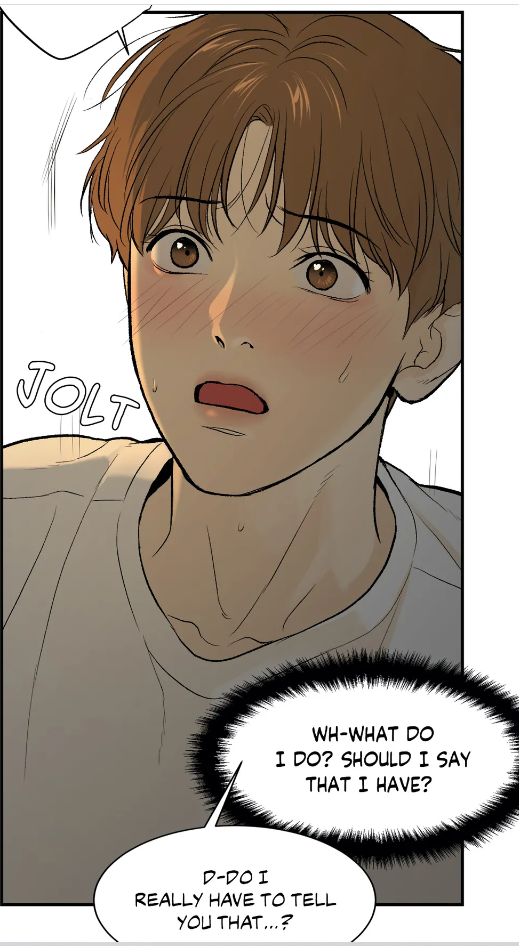 (chapter 3) On the one hand, the champion’s worldview about humans got reinforced, on the other hand the doctor’s deception symbolized his purity. He was a virgin, which was contradicting his “theory” too.
 (chapter 11) He even looked like a ruler abusing his authority.
  (chapter 33) or even the idea of friendship
 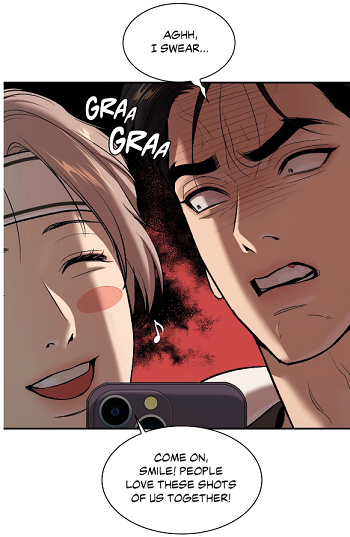 (chapter 30) Heesung was not just taking advantage of his reputation, he was also teasing the sportsman. Joo Jaekyung has such a negative perception of humans.
  (chapter 36)
 (chapter 45) was showing the doctor’s golden heart. He was just judging his lover based on his past experiences and his negative worldview. And this brings me to list the cause for Cynicism:
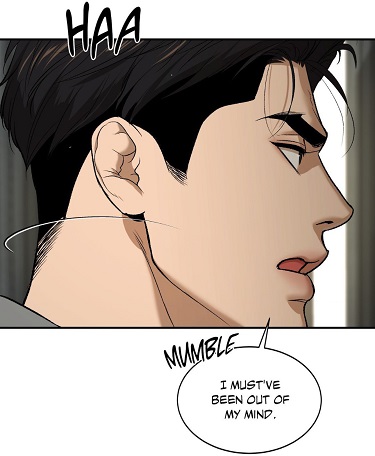 (chapter 45) He fears to be taken advantage. There is no ambiguity that his negative mind-set is definitely influenced by his childhood and family. I would even say that he must have been exposed to emotional blackmail. I came to this hypothesis, because I detected that the champion had been using “blackmail” as MO in order to control Kim Dan.
  (chapter 26)
  (chapter 2) He learned through Cheolmin that he could kill him. This shows his good nature in verity. Hence he resorted to such gestures, when his cynical depression resurfaced:
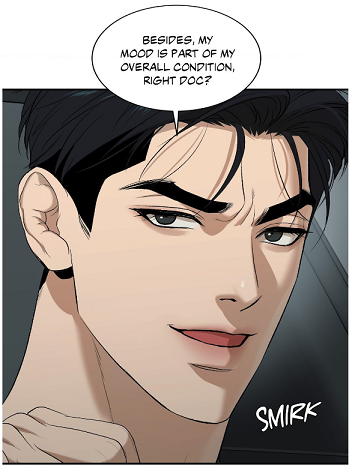 (chapter 32)
  (chapter 45) As you can see, little by little, the champion is learning to control his rage and “cynicism”. During the last argument, he didn’t touch the physical therapist at all. He still allows him to stay at his place and he is shown as caring later.
 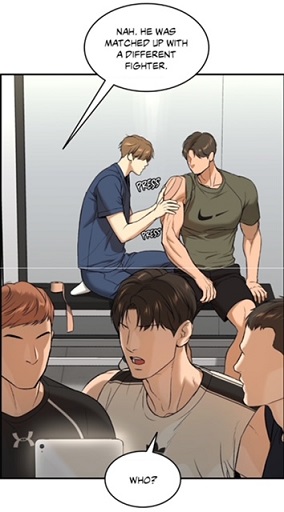 (chapter 47) It shows a certain trust. One might argue about this interpretation. This could be seen as indifference. However, I believe that his altercation with Seonho must have been quite an eye-opening for the champion.
 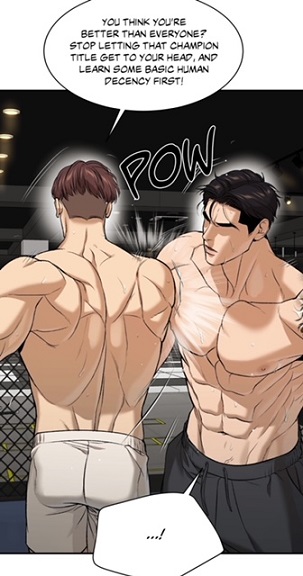 (chapter 46) It is because Kim Dan had not talked back to Joo Jaekyung during their argument. He had accepted his criticism silently contrary to Seonho. Right now, he has the impression that he still has the upper hand, but he couldn’t be more wrong.
  (chapter 26) He has the impression that he can control people, since he is wealthy. Yet, he is not realizing that he can get stabbed because of money as well. We have two perfect examples. Because of the drug incident, the MFC security guys betrayed him, as they protected the organization
  (chapter 40) Then in episode 47, the emperor got manipulated by his so-called loyal advisors.
  (chapter 47) First, I would like to outline that neither the manager from the Entertainment agency nor his acolyte brought up the underground fighting ring and Baek Junmin’s dubious success.
  (chapter 47) Observe the divergence between the advisors’ words and the members’ from Team Black.
  (chapter 47) The latter portrayed Baek Junmin as dangerous, for he would use any mean to win the fight. He doesn’t stand for fairness and responsibility. The champion didn’t get to hear anything about these rumors.
 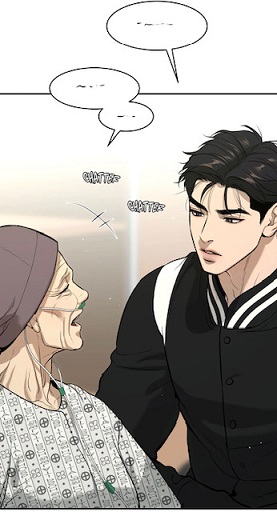 (chapter 21) Moreover, the grandmother’s mortality could serve as a reminder for the champion that he is also a human… just like the others he condemns. Besides, she embodies true selflessness and gratitude. Hence she took the champion’s hand to thank him
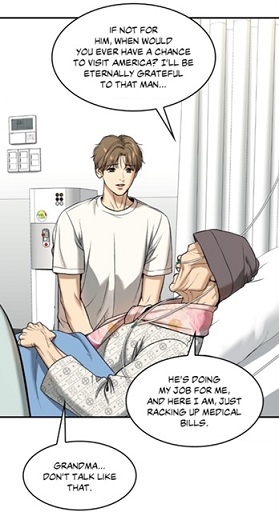 (chapter 41) He never heard her recognition. In addition, until now, Kim Dan spoke in the name of others or didn’t defend his own point. Team Black’s loyalty would be the evidence that it is dangerous to judge people based on prejudices and past experiences. He needs to reflect on his own actions as well. If the Emperor heard “his members”, he would realize that MFC as an organization is corrupted and is even involved with criminality. He is already sensing something, but he can not identify the problem.
 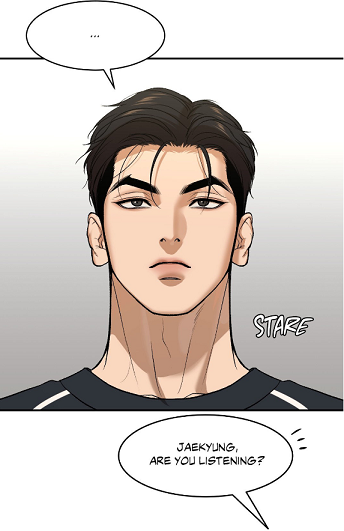 (chapter 47) Should Kim Dan divulge Baek Junmin’s connections to the underground fighting ring or simply show him the message,
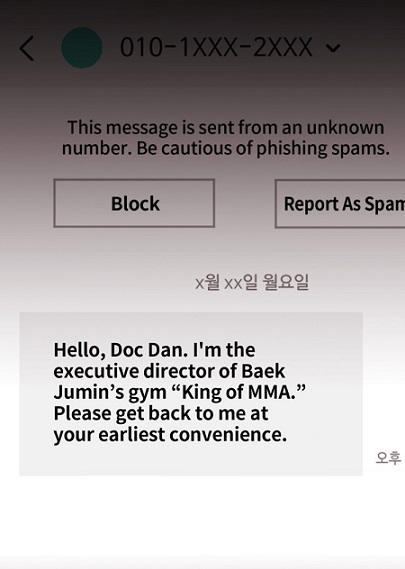 (chapter 47), he would prove his faithfulness and sincerity to the fighter. And the vicious circle would be broken. Though he is broke, he would give up on an opportunity to earn some money easily. To conclude, as long as the champion is still a cynical character, he can not enter a relationship with Kim Dan. For that, he needs to open up his heart and third eye so that he can recognize his partner’s selflessness and honesty. Finally, he will realize that he needs the assistance of others in order to be able to keep his reputation intact (witnesses, supporters). There is no doubt that the Emperor will be badmouthed again.

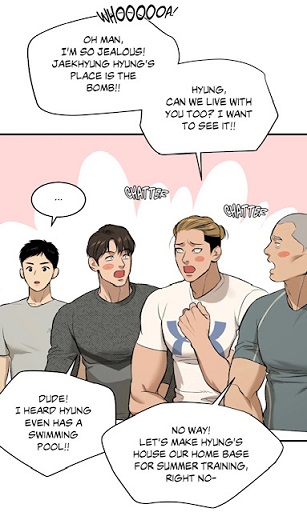 (chapter 22) It shows that ring does not necessarily possess a negative connotation. To conclude, ring is a reference to marriage (Kim Dan will become the champion’s official partner), to the MMA arena, to Team Black, but also to Mafia. We had an allusion to criminality during the sparring
  (chapter 26) and when the champion discovered the loan shark and his minions on the verge of raping Kim Dan.
  Why? It is because the characters are acting like fighters. At bottom left, the doctor’s embrace resembles a lot to the one he used during the sparring (see the image in the middle). Their gestures are sudden and quite abrupt, which contrasts to the image on the right bottom. The kiss from the doctor holding Joo Jaekyung’s face represents the exception from all the selected panels. This shows that this Summer Night’s Dream indicates a huge transition in the sex sessions. But let’s return our attention to the images illustrating roughness. Right from the start I detected a strong connection between fighting and sex. [For more read
  (chapter 14)
  (chapter 36)
 (chapter 29)
 (chapter 15) This means that if the fighter is on his own. He can not rely on others. If he is not able to return without the assistance of spectators or his seconds, he is declared as defeated. So we could say that any interruption is condemned, as it is ruining the flow of the fight.
 (chapter 15) Funny is that conversation is permitted, yet mouth gear hinders the fighters to talk. Should they remove it constantly, the referee can judge it as a violation (“Timidity”), for the fighters can not fight, as long as they don’t wear the mouthpiece. This signifies that the sportsmen are encouraged to express their thoughts through the hands.
  (chapter 15)
  (chapter 41) To conclude, while MMA fighting is a work, it is strongly intertwined with pleasure and entertainment. Their fight is witnessed by spectators in the arena or on TV.
  (chapter 41) That’s the reason why Mixed Martial fighters are called artists, a synonym for actor.
  (chapter 5) Their gestures were seductive, a sign that they were not fearing the champion. The challenge was here the difference of weight. On the other hand, by approaching Joo Jaekyung, they looked confident about their skills. That’s the reason why he would have sex with them, until they passed out.
  (chapter 1)
  (chapter 4)
  (chapter 8)
  (chapter 34)
  (chapter 2) The champion’s ecstasy served as a measurement to view himself as victorious. This statement implies that he was not only the fighter, but also the arbiter. This corroborates my previous statement. During sex, he was the fighter and the referee. He acted as the MFC matchmaker.
 (chapter 43) In my opinion, during that night
  (chapter 2) The goblin might have not voiced his thoughts to the celebrity before, but Joo Jaekyung could perceive his soul through the gaze and facial expressions. Hence the star’s domination was quite superficial. In fact, as time passed on, the athlete could only get bored of the goblin.
  (chapter 42) It is because there was no challenge. The guy was accustomed to the champion’s roughness. Hence he never feared the star. He could only judge him as weak. Because Joo Jaekyung was missing the thrill, he came to look for the “wimp”! On the one hand, the latter would treat him with respect
 (chapter 1), on the other hand, he would cry and tremble in his presence. Then right after the session, he left the room in a hurry.
  (chapter 1) It is because the “hamster” had not only feared him
  (chapter 1) He had grabbed his anaconda!! But this represents a breach of rules in MMA! That’s how I realized that the doctor’s action pushed the fighter to violate many of his own rules: interruption of the flow!
  (chapter 21) Then after facing Heesung, he stopped the intercourse too,
  (chapter 35) indicating that little by little, the champion’s mind-set was changing. At the same time, it exposes his hypocrisy. But why is he forced to accept the change of flow? It is because life is trying to teach the champion that he is not god, he is not the owner of time. This explicates why the star couldn’t determine the start of their “Wedding Night”, the doctor’s suggestion represented a new challenge.
  (chapter 3) He was defying the champion’s authority.
  (chapter 3) Despite his fear, the hamster wouldn’t become submissive like the others. While the green-haired uke faked submission and the others got defeated by KO, Kim Dan remained true to himself. He embodies honesty and modesty, the opposite values of the “goblin”.
 (chapter 2) Let’s not forget that during a match, they are supposed wear a sex gear. Interesting is that he grabbed the doctor by the hair
  (chapter 4). It is important, as it represents a real transgression of MMA rules indicating how powerful the doctor was. The champion needed to break rules in order to get him. Funny is that he thought that after such a long night, he had been able to submit the cute hamster, but he was totally wrong. The latter chose to ignore him.
  (chapter 5) It was, as if he was hiding from him. What caught my attention is that while he tried to get in touch with the physical therapist, he called MFC Match Manager at some point. Why? I believe that he had planned that after his huge success to organize another match very soon. As you can see, the intervention of Saturn, the god of time, taught the champion through the hard way, he was no real MFC Matchmaker. By refusing to answer his calls, Kim Dan was the one determining the time.
  (chapter 6) Under this new light, it becomes comprehensible why the athlete offered this deal to the physical therapist:
  (chapter 7), while he kept his distance from the champion. This scene made him realize that he was still powerless.
  (chapter 7) Under this new light, it becomes comprehensible why in the States, the goddess Mingwa chose to send the doctor to his room much earlier. Both protagonists were fighting against each other concerning time.
  (chapter 12) or having sex in front of a mirror
  (chapter 20) or anal masturbation in a car
  (chapter 24). Then we have this bet concerning the doctor’s sensitivity.
  (chapter 29), thus the champion tried an experiment:
  (chapter 29) Furthermore, notice that each time they had sex, the doctor was pressured to have sex with the champion. Kim Dan felt that he could never refuse.
  (chapter 12) On the other hand, the athlete always met some resistance
 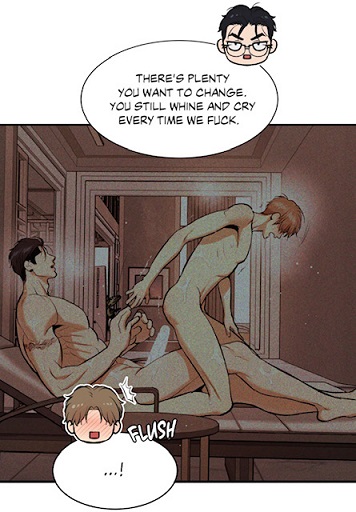 (chapter 27) Kim Dan would never agree to the champion’s requests immediately. They would fight about the time, location and position. Furthermore, note that Kim Dan went so far to punch the protagonist:
 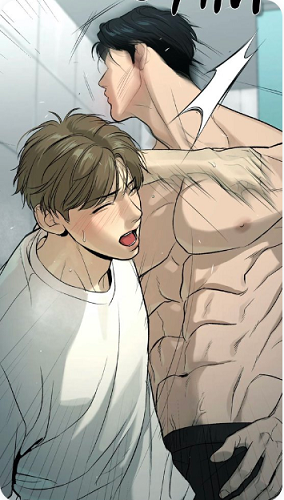 (chapter 7) This could only increase the athlete’s interest and obsession for the physical therapist. Although he was getting paid, the latter would never admit submission. He thought, he had achieved his goal in that scene
  (chapter 12) With his words, he was telling the sportsman that he was a terrible lover. He denied any admiration for him. And since sex is a synonym for wrestling in Joo Jaekyung’s eyes, doc Dan’s declaration signified that his title as champion was questioned. Though the champion came to enjoy their intercourse
  (chapter 12), it was short-lived, as the doctor fainted after one round.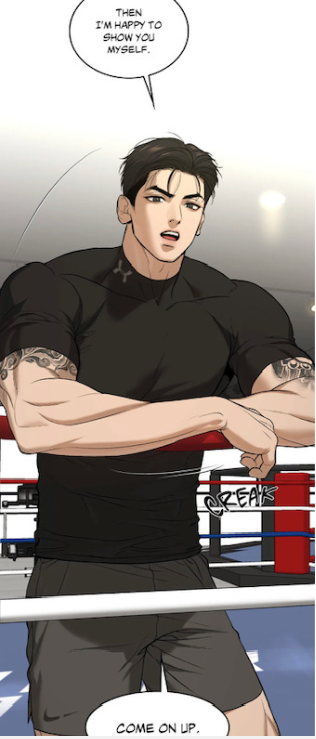
 (chapter 26) Observe how the doctor reacted after the sparring took place. .
  (chapter 27) He rejected the suggestion from the champion. As Jinx-philes can detect, the sparring affected their relationship. However, the notion of consent represented more an exception than a habit. Thus I consider the scene in chapter 44 as a real turning point in their relationship.
  (chapter 41) He is treated like a doll, but he is not realizing the manipulation. How can he, when Park Namwook is not detecting it either? Under this new light, Jinx-philes can grasp the real root of the argument in the car.
  (grabbing the groins is forbidden). To conclude, the doctor is there to teach the champion to distinguish between love and fighting. This explicates why the physical therapist embodies violation of MMA rules. We have the perfect example in this scene:
  (chapter 25) Potato made a mistake which could have made the doctor unconscious. That way, he can expose the corruption within MFC and its implication with the mob. That’s the reason why I am more than ever convinced that Kim Dan is destined to become a MMA fighter in the end. Why? It is because he is the champion’s reflection. The moment Joo Jaekyung is no longer the fighter in the ring, but the spectator or assistant, he is forced to witness how his loved one is risking his life. So far, he never showed any interest in the fights of other members. He needs to understand why Doc Dan would advise him not to fight. And this brings me to the next remark: Kim Dan is a strong believer, like we could observe it in this scene.
 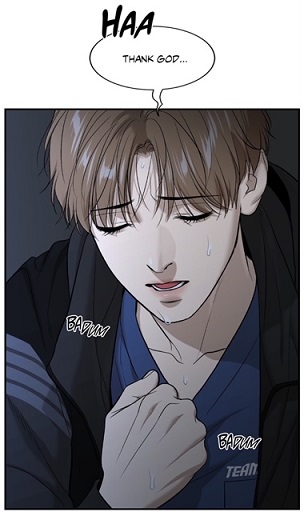 (chapter 40) This explicates why he was willing to risk his life for his sick grandmother.
 (chapter 44) By taking the initiative, the physical therapist is teaching his “mentor” how to express love. Interesting is that during that scene, the athlete remained passive. It displays his consent and trust towards the doctor. He knows that the latter won’t hurt him. That’s how I realized that the kisses are strongly connected to consent. Let’s not forget that when Joo Jaekyung smooched the hamster for the first time, he took him by surprise. Because the latter felt uncomfortable, he made the following request:
 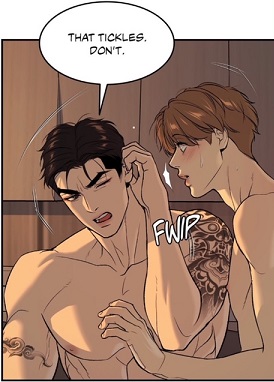 (chapter 44) Hence the physical therapist stopped. Consequently, I come to the deduction that the more they will kiss, the closer and the more respectful the protagonists will become, for the kiss symbolizes consent.
 (chapter 14) Then it was out of desire
  (chapter 24) and out of excitement and attraction.
  (chapter 15) In chapter 24, first it was from behind, but then it changed, as the star desired to see the hamster‘s erected phallus.
  (chapter 24) He wanted to make sure that the doctor would enjoy this break. Yet, what caught my attention is that in chapter 39, Kim Dan initiated the kisses and embraces, because this is what he likes.
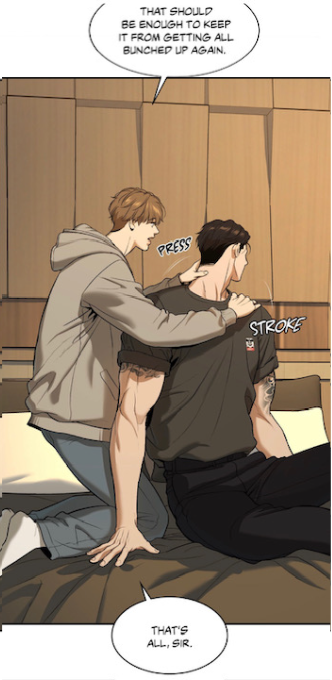 (chapter 32) Joo Jaekyung entrusted his neck to the doctor. The latter stroke it for a long time. And now, you comprehend the initial hesitation from Joo Jaekyung in the hotel room:
  (chapter 44) He felt safe. This explicates why he could fall asleep so easily.
 (chapter 44) as the positive reflection from the sex session in the living room:
 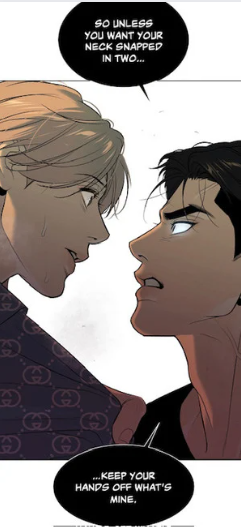 (chapter 34) Yes, the meeting with the artist was a challenge, he was showing to Heesung that if he tried to take away his “fighter”, he would have to fight for real. And what did the actor do during that night? He ran away, he refused to take the defy. This position
  (chapter 44) contrasts so much to this one:
 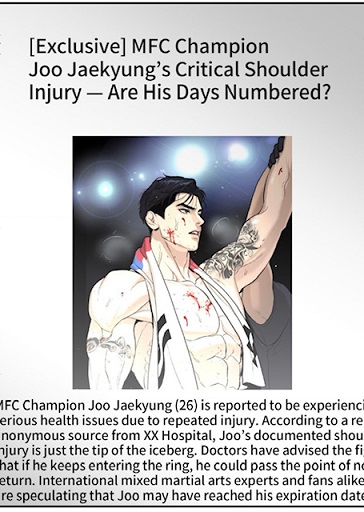 (chapter 35) The gods were punishing him for not respecting the physical therapist.
 (chapter 44), though the doctor had not sex in mind at all. He brought him there to rest. However, the presence of fighting has not vanished totally in episode 44:
  (chapter 44). Joo Jaekyung still provoked his lover
 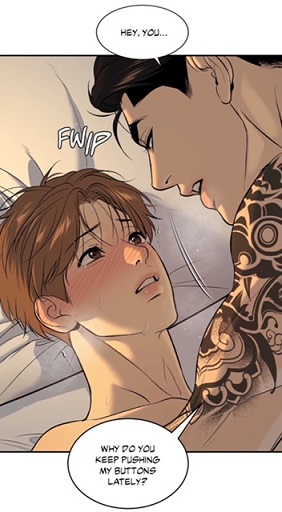 (chapter 44), but the latter was able to reject his defy by asking a question. One might think that he did that out of habit. On the other hand, I believe that Joo Jaekyung doesn’t know his partner that well, hence he is bothered. He can never predict his actions and decisions. He was definitely worried about his recent change of behavior too. Moreover, note that Kim Dan was the one leading the intercourse, for he determined the time flow:
  (Chapter 44)
  (chapter 44) It shows that the power is shifting, Kim Dan is slwoly getting the upper hand in their relationship. He can control time and place.
  (chapter 29) The celebrity refused to have sex every day, for he considered it as work. Why? It is because he is associating it with fighting. This is what he had in his mind:
  (chapter 27) But he got rejected by Kim Dan back then, because the physical therapist considered sexuality as shameful. As you can see, the doctor’s actions are changing the champion’s perception of sex. It is no longer fighting, but resting. On the other hand, the doctor can seize the occasion to express his love through his caresses and kisses. At the same time, he could use it as a treatment for his insomnia.
 (chapter 42)
  (chapter 42) Interesting is that the champion was also thinking a lot about the main lead, as the latter was worried by his exhaustion and his lack of appetite.
  (chapter 43), just like none of the coaches were wondering about the whereabouts of Kim Dan in the States.
  (chapter 44) See the contrast to the night on the couch:
  (chapter 29) Contrary to the past
  (chapter 4) Joo Jaekyung is not hiding his pleasure. He is moaning loudly, as he has his mouth wide open. It exposes once again the increasing trust in Kim Dan. He no longer mistrusts him, in his eyes, he is no longer a prostitute. That’s how the doctor won the champion’ s heart. Now, his heart is truly beating for the doctor. Little by little, the hamster is taming the wolf. The latter needs to recognize that by loving the doctor, he will become powerful.
 Bebebisous33s' analyses in K-Dramaland and Manhwas