Protected: Painter Of The Night: Baek Na-Kyum’s orgasms (second version)
Bebebisous33s' analyses in K-Dramaland and Manhwas
Analyses of K-dramas and Manhwas (for the most part Yaoi)

This is where you can read the manhwa. https://www.lezhinus.com/en/comic/painter But be aware that this manhwa is a mature Yaoi, which means, it is about homosexuality with explicit scenes. If you want to read more essays, here is the link to the table of contents: https://bebebisous33analyses.wordpress.com/2020/07/04/table-of-contents-painter-of-the-night/
It would be great if you could make some donations/sponsoring: Ko-fi.com/bebebisous33 That way, you can support me with “coffee” so that I have the energy to keep examining manhwas. Besides, I need to cover up the expenses for this blog.
In my last analysis entitled “The Light in the Heart”, I had portrayed Baek Na-Kyum as someone whose recovery and transformation were completed due to the number of white candles next to the painter’s head. 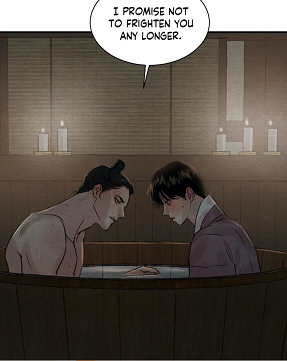 (chapter 70) 3 symbolizes perfection and completion. But I have not entirely explained how the artist could overcome his traumatic past and even find closure. So far, I elaborated that the missing farewells played a huge role in the painter’s trauma, as they triggered his abandonment issues. Thanks to Yoon Seungho’s decision, the artist was allowed for the first time to bid farewell to his noona properly.
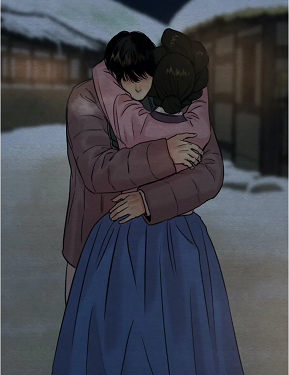 (chapter 69) But there’s more to it. In my opinion, the physical touch, in the form of caress and embrace, played a huge role in the painter’s traumatic past too. However, before starting to explain this element, I need to elaborate how it came to this.
First, I have to admit that I had problem to discern the true nature of the relationship between the painter and Heena. She is acting like a mother, although the protagonist describes her as his older sister.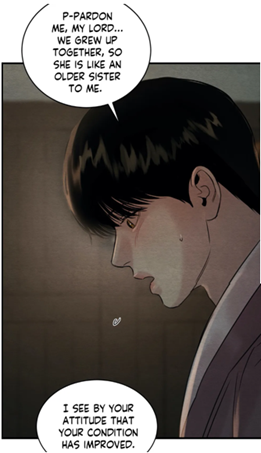 (chapter 70) Then thanks to my readers @_Winnie_L_ and @AkaiHikariChan who pointed out, the kisaeng is definitely too young to be the mother, I got a new revelation. Since Baek Na-Kyum is a reflection of Lee Jihwa, it means that the commoner was raised by an absent parent too. That’s why we don’t see the head-kisaeng at all. She is also like a ghost, the female version of father Lee.
  (chapter 67) Thus we have two possibilities. Either the head-kisaeng is someone else and Heena noona took over her role, or Heena noona became the head-kisaeng, but she never claimed Baek Na-Kyum as her son. Thus the painter ended up with a ghost mother. On the one hand, Heena noona acted like a sister in front of him and she requested from him to be called “noona”, on the other hand, she behaved like a mother towards Baek Na-Kyum. Observe that Heena is the only one with a name. The only difference is that the head-kisaeng relied on the kisaengs to raise the low-born, whereas the noble Lee employed his domestics. This explicates why Heena noona started acting like a mother. But this caused her to struggle due to her young age. She was so overwhelmed with this task, that she had to rely on the scholar. And there is a reason why the kisaeng trusted the low noble so much. She was not just blinded by her own feelings
 (chapter 68). Her decision was influenced by her past experiences and fears. The head-kisaeng judged the learned sir as a good and responsible man. And how could he win her trust? Since the story is constructed like a kaleidoscope, this means, we must have a new version of this during the first season. In my opinion, the scene with the worker is the repetition from the past.
 (chapter 29) First, observe that the young girl is sitting on the teacher’s lap and the learned sir is holding a book. So if someone saw this from far away, the beholder would think that the scholar is reading the book to the child. It even gives the impression that he is actually teaching the young girl to read. But note that in this scene, the low noble is in reality talking to the commoner. For the young girl, it means that she is forced to sit and do nothing. That’s why she turns her her head to the learned sir wondering what he is expecting from her.
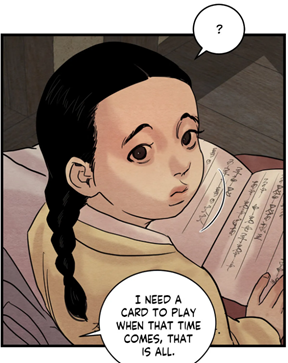 (chapter 29) What is she supposed to do? Observe that he replies to her interrogating expression with a smile, yet he doesn’t give her any instruction. I would say, he treats her like a doll. And now, replace the young girl with Baek Na-Kyum, and the latter has to sit there for a while. You can easily grasp why the painter could only fall asleep.
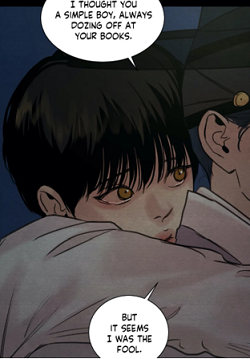 (chapter 70) In front of the kisaengs, the scholar created the illusion that he was teaching, while in truth he just saw it as a diversion. This explicates why he utilized this idiom to Yoon Seungho.
 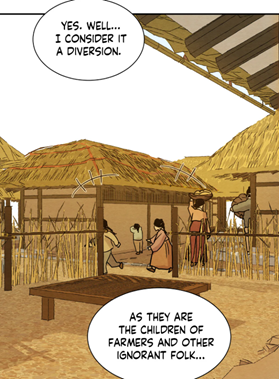 (chapter 6) Diversion has two meanings:
- something that takes your attention away from something else: Shoplifters often work in pairs, with one creating a diversion to distract the staff while the other steals the goods.
- an activity you do for entertainment: Reading is a pleasant diversion. quoted from https://dictionary.cambridge.org/dictionary/english/diversion
This outlines that this expression is far from anodyne. While we all associated “diversion” to the second significance, the low noble meant the first meaning. In the past, I used to think that the scholar was hoping for the artist to doze off so that he would spy on the guests at the kisaeng house. He was talking to the noonas with the boy on his lap in the hope to discover “secrets”. However, since I realized that Jung In-Hun was the one who brought the baby to the gibang, he had many reasons to go to the kisaeng house. He could hope to get connection to powerful nobles and even get information. However, from my point of view, since he had entrusted the artist to the noonas, he knew that the gibang was the perfect place to hide secrets as well. Remember that the conversation in this precise chapter was about “secret and protection”.  (chapter 29) And now the scene at the kisaeng house can only be perceived in a new light.
 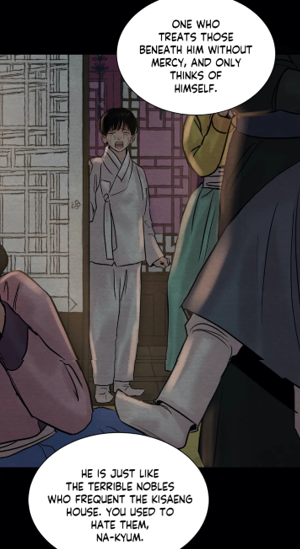 (chapter 68) Jung In-Hun must have come to an agreement with a rich noble and made a deal with him. The presence of the painter was no coincidence, and it diverted attention from the real target of abuse: Yoon Seungho, who got dragged away. The painter and the other noona thought that Heena had been the victim of violence from a noble, but she was not. She served as diversion. Too blinded by her prejudices and own fears, the young woman wasn’t able to perceive the true nature of the learned sir. While she saw the scholar as a hero, because he hugged the painter and took him away from this terrible place, she never questioned the scholar’s attitude. If he had been a true hero, he would have rescued her and not abandoned her. She never got aware of his betrayal. In other words, the scholar helped to create a secret. This explicates why the learned sir is well aware of the nobles’ fear. In his eyes, they all have something to hide.
But let’s return to our first observation: the head-kisaeng neglected her adopted son, for she was too overwhelmed with the huge responsibility. The manhwaphiles should remember that neglect is a form of abuse and it can lead to the loss of senses. That’s why I described Lee Jihwa as blind and deaf. With this new interpretation, I come to the conclusion that Baek Na-Kyum had the same fate. Moreover, his mind’s eye couldn’t get developed. Due to his abandonment issues, he desired to grant Heena’s wishes. That way, he wouldn’t be rejected. However, this couldn’t fill the void. That’s the reason why Baek Na-Kyum drew a lot of paintings as a child.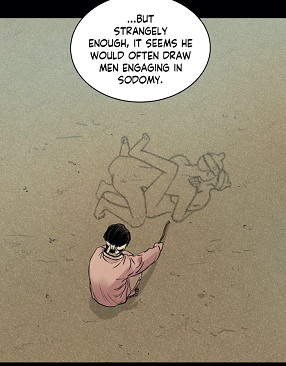 (chapter 1) Here, the witness was lying, as he was distorting the past, the painter wouldn’t draw erotic pictures constantly. The head-kisaeng didn’t take care of her son and during the day, the noonas were all resting so that the painter was on his own. This panel illustrates the painter’s isolation and loneliness. At the same time, I envision that the scholar visited the kisaeng house during the night so that he could approach the noonas, explicating why the boy would doze off too. Moreover, painting was a way for the painter to cope his loneliness and his loss of senses. As a conclusion, the painter was not only suffering from abandonment issues, but also from neglect which made him more and more dependable on Heena noona and the learned sir.
Yet, this doesn’t end here. Each time, Heena noona was confronted to violence, she sent away the painter. He was not just forced to leave his noona’s side, he had to leave the house as well. He ended up in the countryside (chapter 70) , in the middle of nowhere, surrounded by water and rice fields. While some might view these panels as quite idyllic, I interpret these as the opposite: Baek Na-Kyum had no roots and no roof over his head. He couldn’t even find a refuge, which reminds us of the scene in the first chapter:
 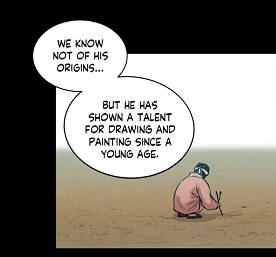 (chapter 1) This picture exposes the painter’s lack of attachment. He has no home, no wall to protect him… there’s only emptiness surrounding him, which contrasts so much to Yoon Seungho’s situation, who lived in a prison. Hence I understand now why Baek Na-Kyum is determined to remain by Yoon Seungho’s side.
  (chapter 68) For the first time, he has a room for himself, and even if he is pushed away, he can express his sadness and seek comfort in his room:
  (chapter 41) and
  (chapter 52). Note that each time, he was unhappy, he was requested not to cry
  (chapter 26)
 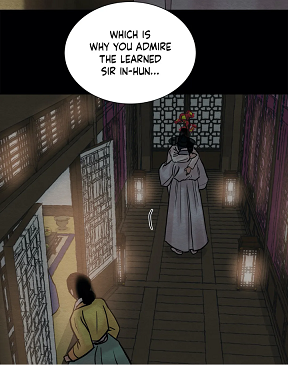 (chapter 68: he is sent away due to his tears)
  (chapter 70) If you pay attention, you’ll notice the only one allowing the painter to voice his wound and to shed his tears is indeed Yoon Seungho. Each time, he desires to know the cause for Baek Na-Kyum’s tears.
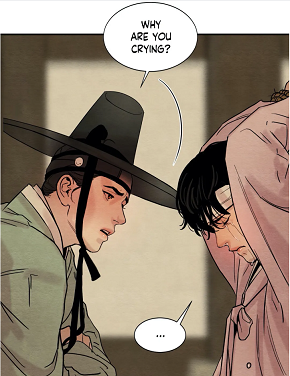 (chapter 1) The difference is even palpable in chapter 26:
 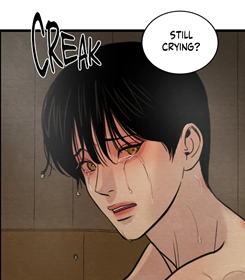 He left him some space and time to cry, hence when he returned, he didn’t say: don’t cry. He just makes this comment
 (chapter 26). And like I underlined it before, the lord is always focused on the reason for the artist’s tears. This led to the confrontation: who is responsible for his heartache?
  (chapter 26) Sure, in the bathroom, Yoon Seungho is still very rude, however he never employs the negation. Nonetheless, the low-born could never perceive this divergence, as the nuance is not so obvious. This explicates why in chapter 41, the artist misjudged the noble’s intervention. When the latter wanted to see his face and as such his tears
 , (chapter 41) the former refused to do so, because he anticipated that the lord would ask the same thing: stop crying. However, the master wanted to know the cause for his agony, which is totally different. This scene is really important, because it shows another issue. Baek Na-Kyum was never allowed to cry. His tears were associated to annoyance and burden. That’s why he desired to be left alone in the end. He feared that if the lord saw his tears, he would be requested to stop crying. And this fear of letting his tears coming up explains why the painter hid his eyes with his arm during the physical abuse.
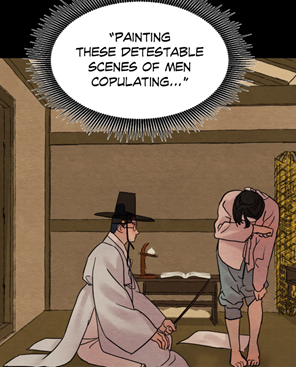 (chapter 34) Under this new approach, we understand better
  (chapter 68) why the lord chose to retreat. Here, the master saw the commoner’s tears with his mind’s eye and realized that he needed to give him some space and time again. But more importantly, he never entered the room, giving him some privacy. He learnt an important lesson here: solitude doesn’t stand in opposition to distance and abandonment. In this scene, Heena noona never requests from the painter to stop crying, she just wipes his tears with her hand and caresses her brother’s cheeks.
 (chapter 68) In my opinion, she hoped that if he voiced his emotions, he would follow her. She had an interest in this, that way she could express her disapproval and use her authority to force the painter to obey her.
 (chapter 68) What the noona didn’t realize is that the main lead’s decision to respect the low-born’s needs (crying and not entering his room) was the reason why Baek Na-Kyum selected him in the end. There’s no doubt that the lord was associated to home for good, because he is the first one who allowed him to cry and to have a room, where he could seek refuge after getting hurt. Under this new light, the readers can better grasp why Baek Na-Kyum is healed now.
However, my examination is still not finished. I had portrayed the commoner as suffering from the loss of sight and hearing due to his neglecting mother/noona. But this doesn’t mean that he had lost his body too. Since he was deprived of these two senses, he had to rely on the physical touch in order to compensate his isolation. And now, you understand why the learned sir and Heena noona had such power over him and why the young boy was so submissive. They used the caress and the embrace as a way to impose their will. That’s how they got so close to Baek Na-Kyum, explaining why the commoner would lose his voice after all (speech ability). He became submissive in his desire to please his loved ones. He saw in their caresses and embraces a sign of affection. He was not wrong, but their attachment was linked to their own interests. Thus their love was rather superficial.
What caught my attention is that the kisaeng stroke the painter’s cheeks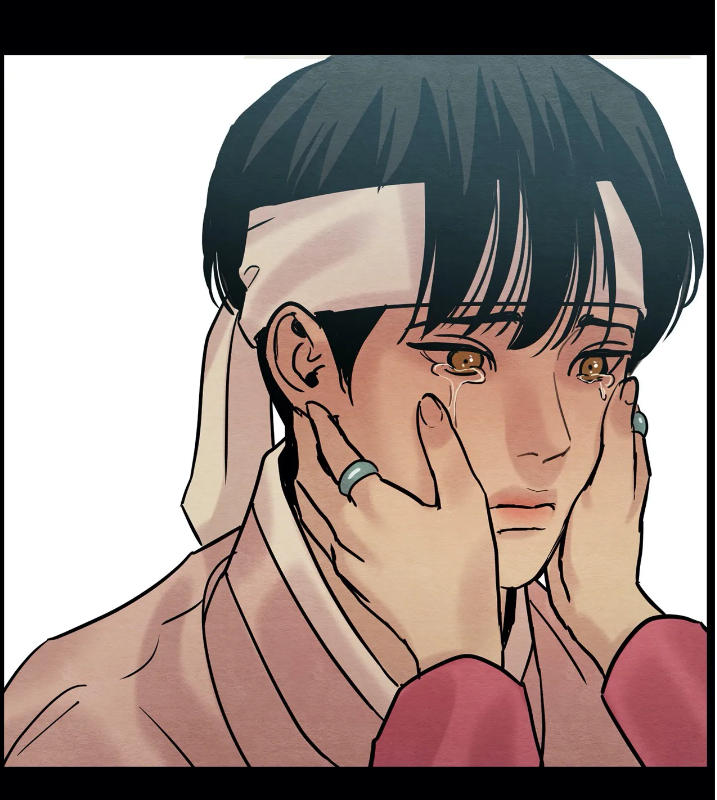 , (chapter 46) when the latter was sent away, But she didn’t hug her brother. Why? It was to stop him from protesting.
 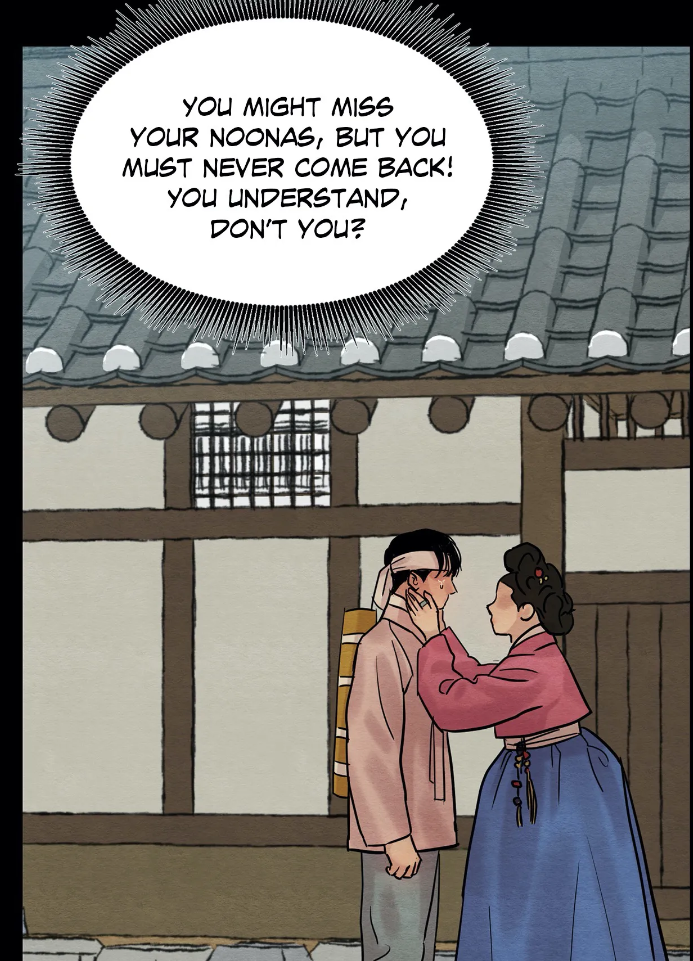 (chapter 46) But I would even go further. I don’t think that Heena noona used to embrace her brother. This perception was somehow confirmed in season 3.
 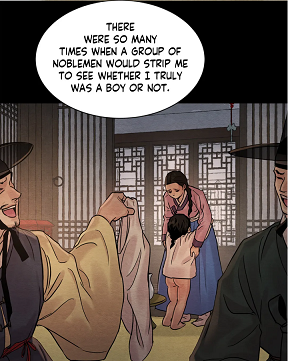 (chapter 94) Here, the infant hugged his noona, but she didn’t return his gesture. Moreover, she hadn’t stopped the laughing nobles as well. Furthermore, (chapter 66) note the huge distance between the two characters in the last panel. This is no coincidence, therefore I perceive the embrace in chapter 66 in a new light.
 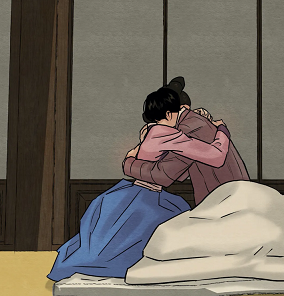 (chapter 66) It was the first time that Baek Na-Kyum got embraced by his noona. And all this, thanks to Yoon Seungho. In my opinion, the kisaeng got really scared and concerned for her brother. And there’s a reason for this lack of worry. She relied too much on Jung In-Hun. Her false perception is particularly visible, when she claims
 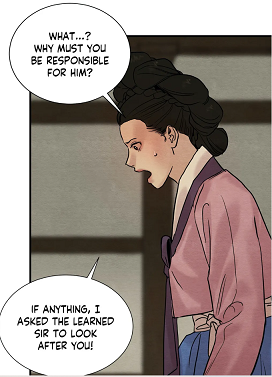 . (chapter 68) Why does she expect this? From my point of view, her words imply, she must have helped the learned sir in the past: one thing is sure. She was not entirely honest with her donsaeng here, as the manhwaphiles can detect the drop of sweat. But more importantly, we have to question ourselves if the gibang was not used in the past to spread rumors about the Yoons again, and Jung In-Hun could heard something. I am even envisioning that she must have reported conversations to him, a new version of chapter 24:
 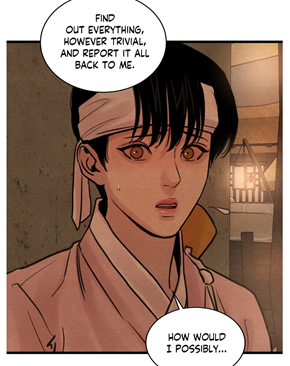 Remember that in that scene the painter doesn’t comprehend the meaning behind this order. If this theory is true, then she never saw the consequences of her action, similar to her brother in chapter 24. If she truly did it, she must have justified this, because the learned sir needed it, she was responsible for him. This would explicate why she is surprised that the artist is responsible for the learned sir. Anyway, due to her assistance, she expected from Jung In-Hun that he would take care of the painter. There’s no doubt that she loved the scholar, and since the boy had entered the kisaeng house due to the learned sir, there is a high possibility that Heena noona got close to Baek Na-Kyum for that reason too. That way, she hoped to earn the scholar’s acceptance and admiration. Since the painter was left alone and longed for love, the latter could only rely more and more on Heena noona, especially due to the incidents where Baek Na-Kyum was wounded. (chapter 94) She created a dependency, while simultaneously, she would delegate her responsibilities on the other noonas. Heena noona became the painter’s mother, yet she was never one officially. Consequently, I believe that her bond was not entirely selfless, which became truly visible in season 3. Let’s not forget that the kisaeng was portrayed as quite rude and selfish in certain scenes. The way she hugged her brother was not tender in my eyes.
 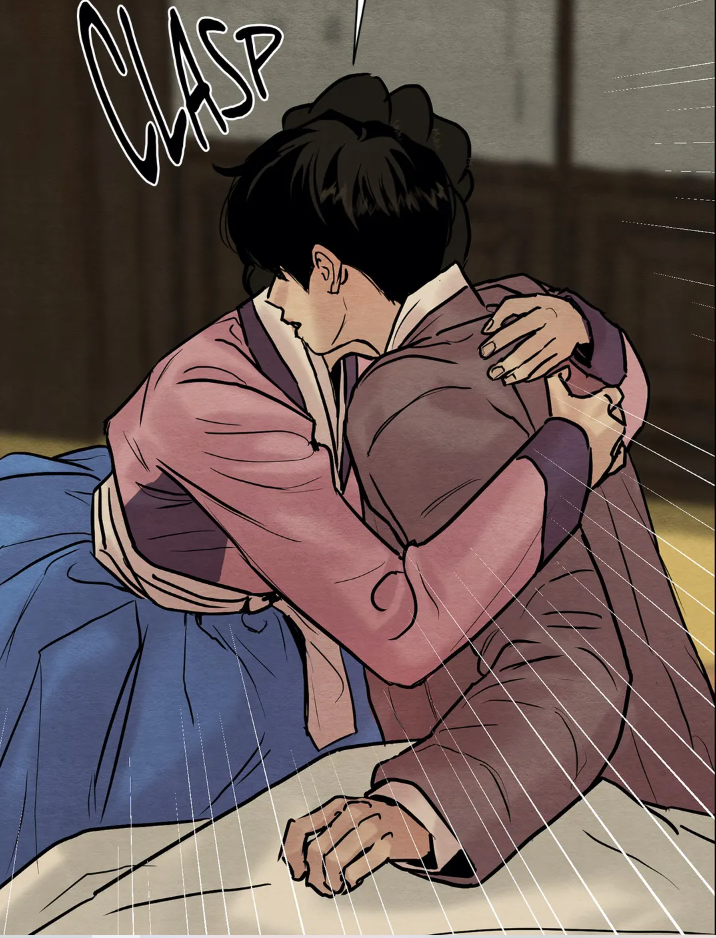 (chapter 68) For me, her real “admiration” was for the learned sir, therefore it becomes understandable why she wasn’t bothered, if Jung In-Hun asked for her help in exchange for taking care of Baek Na-Kyum. According to my theory, the learned sir had brought himself the baby to the gibang, this means that in chapter 46, he could only accept the kisaeng’s request. He had no other choice, for in Heena’s eyes, they were somehow related. From my point of view, Heena noona hoped that Jung In-Hun would even assist her and help her to leave the gibang. But this never happened. In my opinion, there exists another reason why the painter was sent to the learned sir. And it is related to Yoon Seungho, the erotic paintings and the pedophile.
The kisaeng helped the scholar, while the latter assisted her with her burden: raising a boy. From that moment, a toxic relationship started, which could only affect the young boy. This would explicate why she accepted that Jung In-Hun would leave her behind while getting beaten. For this kind of incident recurred, we have to imagine that the low noble and the kisaeng contributed to add another artist’s trauma: the abandonment issues and the loss of home.
From that moment, he was forced to roam around with the scholar during the night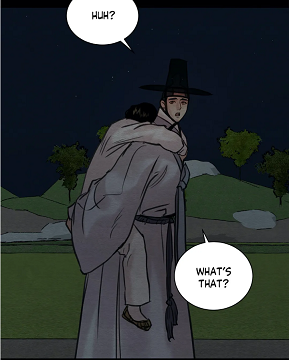 . (chapter 70) And now, we have to question ourselves why the kisaeng chose to send away the painter in the end. From my point of view, it wasn’t really to protect him… since Baek Na-Kyum was now an adult, the role of the scholar was no longer necessary. First, the artist was supposed to be literate. At the same time, the low noble couldn’t take him any longer, when the kisaeng got hurt again. This kind of diversion was no longer possible. The man was old enough to intervene, hence not only he could have defended his sister, but also he could have investigated what was happening in the gibang. That’s why Heena sent him away to the scholar and observe that the noonas were not even informed. (chapter 46) Why? Because she knew that they would have questioned her. Moreover, the noonas might have convinced the donsaeng to stay in the gibang. In my eyes, the noona thought that she was doing it for her son’s best interest, while in reality she had other motives to ask the painter to leave the gibang. Unconsciously, she desired to leave that place too. From my point of view, she dreamed that the learned sir would take her away at some point. This interpretation was proven correct in season 3.
  (chapter 97) In exchange for her services, she had to bring Baek Na-Kyum to Min, the noona would be able to escape the gibang.
Therefore it is time to focus on the learned sir again. Exactly like I had anticipated, the low noble blamed the painter for his inability to read: he would doze off , while in reality the low noble made sure that the artist would fall asleep. Besides, if the painter was awake during the night, this signifies that he had to sleep during the day. And in order to obtain the painter’s assistance, he noticed that the low-born was sensitive to physical touch: the scholar chose the hug. That’s why we see him embracing the young boy in chapter 68 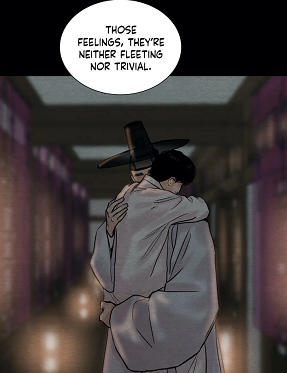 or piggybacking in chapter 70. We have to envision that first he embraced him in front of the kisaeng, then once they had left the town, the noble would change the position. Yet, I believe that Heena had here romanticized this embrace. It represents a distorted memory mixed with fantasy. What caught my attention is that in both hugs, the noble could hide his face and in particular his eyes. At the same time, the learned sir wasn’t faced with the commoner’s tears and sadness. He could feign ignorance. (chapter 70) But this could only work, until the painter entered adulthood. After that, he could no longer use the boy as tool and diversion. Even if the learned sir’s affection was genuine in the beginning, the nature of their relationship could only change, for the learned sir had kept using him in the past. It had become a habit.
Envision this: his ties with the kisaeng house were cut off. And since he had never taught the painter to write and read properly, Jung In-Hun was cornered. Moreover, there is no ambiguity that the learned sir started viewing Baek Na-Kyum as a burden, this means that at some point Jung In-Hun must have felt the exact opposite of this: (chapter 44)
And since the scholar has always disdained the commoners, he could only abhor the idea to keep hugging the artist. The latter was now a grown-up. Hence he used the erotic painting as an excuse to abuse Baek Na-Kyum physically. That way, the noble was no longer obliged to caress or embrace the painter. However, because of this method, he destroyed the painter’s body symbolically. (chapter 34) And this leads me to the following conclusion: the painter ended up in the same state than Yoon Seungho’s. Both lost their senses and their own body. And now, you can comprehend why the main lead can’t cry yet. The return of his tears will mark the end of the transformation and his recovery.
Nonetheless, let’s return our attention to the scholar and his relationship with the painter. If the manhwaphiles pay attention to the progression of the first season, they will notice the increasing intimacy between Baek Na-Kyum and Jung In-Hun. First, it started with a stroke 
 (chapter 10), then in chapter 24 he touches his shoulder and kisses his hands.
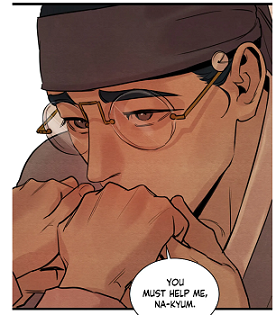 (chapter 24) With my new interpretation, you can comprehend why he did this. He tried to use the same method from the past: he knew that physical touch would make the artist submissive. And the climax was reached in chapter 29 with the fake embrace and the betrayal:
  (chapter 29) From that moment, it went down again. We returned to patting
 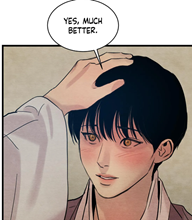 (chapter 35) and strokes
  (chapter 35) and finish with this final touch of the painter’s cheek:
 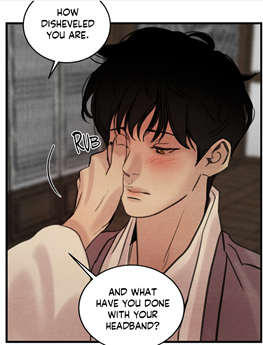 (chapter 38) And the physical interaction reflects the learned sir’s loss of power. Despite his attempts, he was not able to obtain the artist’s submission like in the past. That’s the reason why he could only resent the artist. We have to remember that the low noble really detested this physical intimacy, hence he would tighten his jaw or grind his teeth.
  (chapter 24) Note that in many panels, we never see the scholar’s facial expressions, but there is no ambiguity that he could never truly hide his disdain. But the painter was still blinded by his “admiration” for Jung In-Hun. However, after the argument at the library, the painter lost his sight and hearing again. He was too wounded by the final blow.
And now, you understand why Yoon Seungho’s actions (seeking intimacy) could only help the painter to recover. First, he had been able to remove the poison from the artist’s mind before the backstab in the library. The lord had encouraged Baek Na-Kyum’s critical thinking. This explicates why after the scholar’s betrayal, the painter’s independent mind resurfaced first.  (chapter 46) Then the readers witness the return of the artist’s 5th sense (touching) in chapter 49.
  That’s the reason why the noble could finally get the painter’s attention afterwards. For me, the touching has always been the most important sense in his life, which explains why Heena and Jung In-Hun had such control over the low-born. Then in chapter 52, we assist to the revival of the artist’s sight:
  (chapter 52) And now you comprehend why Heena and Jung In-Hun were defeated. The hug in chapter 66 helped him to satisfy an important need: he was truly embraced while getting comforted. Simultaneously, the hug is not entirely related to the kisaeng, but to the study. Remember that we never saw her hugging him before. At the kisaeng house, he didn’t feel like he truly belonged there, and Heena would always send him away due to his cry. While Heena anticipated with this embrace, the painter would follow her like in the past, she experienced a shock. Now, the painter was no longer blindly listening to her suggestion. And now, you understand why she kept touching the artist. She was trying to influence the painter through the physical touch. Under this new light, I understand why she said this after all: (chapter 68) Yoon Seungho is famous for intimacy, then this would signify that she would lose control over the painter forever. This explicates why Heena noona is not respecting her brother’s wish in the end. And if you compare the two farewells between the kisaeng and the main lead, you will detect a huge progression: (chapter 69) They hug each other here, the painter can get closure, because this is just a goodbye. The noona asks him to send letters, this means that she is telling him that he is not abandoned. This night was important, because the painter’s abandonment issues got treated. Hence it is no wonder why the painter could move on from the past during the same night.
And now, it is time to come to the final part, the significance of the painter’s memory in chapter 70. From my point of view, we should perceive as a new version of chapter 34: 
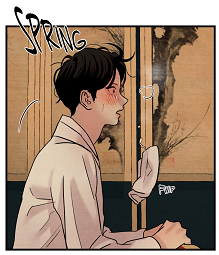 Back then, he recalled the repressed physical abuse. However, his conscious dismissed it again. However, this time it is different. The painter in possession of his whole body is reminded of the scholar due to Heena noona’s farewell. The closure he got by bidding her farewell triggered a long repressed memory too. The learned sir was the one who consoled him in the past. And while he recalls that night, the adult Baek Na-Kyum realizes that the scholar’s care was not fake in the past. He would keep him company and talk to him, he was his companion of the night. However, for me, this scene outlines his superficiality and indifference. He diverts his attention so that he wouldn’t feel sad any longer. But it was, as if he was ignoring his sadness, for he wouldn’t talk about the incident. (chapter 70), He would even smile making him look indifferent.
  (chapter 70 Then he makes the following reproach: he was lazy. (chapter 70). For me, during that night the artist realizes that despite the huge blow in the library, Jung In-Hun had not been bad to him all this time. He had good memories. This means that he was able to take his distance and look back at his childhood under a new perspective. The learned sir had been there for him in the past. In this moment, when he saw the moon, he was reminded of the learned sir. It might not follow him specially, but it is always there.
 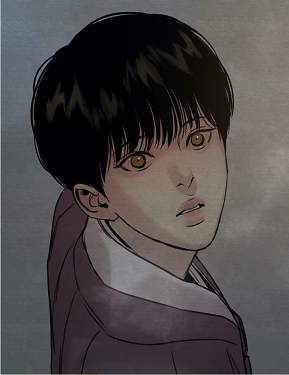 (chapter 70) The learned sir will always be a part of his life, as he belongs to the past. As you can see, in this scene, Baek Na-Kyum was moving on. Therefore I interpret this scene as a real breakthrough. The painter is no longer under the influence of the scholar. The latter can not longer manipulate him like in the past [though now I believe that he is dead], and this revelation was triggered by Heena noona and her embraces. But at the same time, he is not rejecting or resenting the man. And this interpretation becomes even more visible in season 3:
 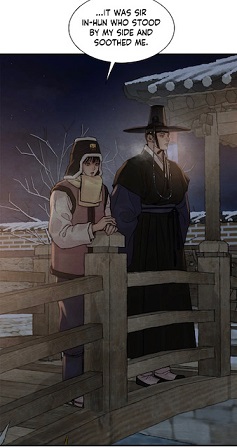 (chapter 94) His heart and mind are now in peace. He is no longer suffering from a guilty conscience. And this truly exposes that the artist’s abandonment issues were created by Heena.
Under this new interpretation, the scene at the bathroom becomes another significance. The lord decided to let the painter feel and see his affection. He chose a different approach: caressing the finger and the hand tenderly , then the chin
 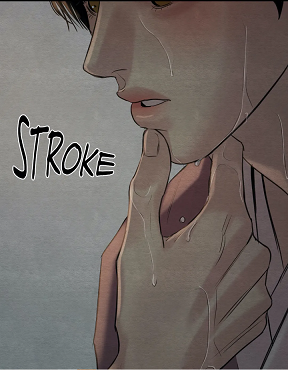 before kissing him.
 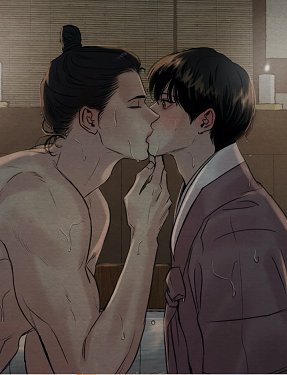 (chapter 70) However, what caught my attention is that his touch is never to shut the artist’s mouth. Observe that he lets the mouth open, while he caresses the hands, the chin and even after kissing the painter.
  (chapter 70) He has the right to speak, while Heena noona and Jung In-Hun used the embrace and caress as a way to render Baek Na-Kyum mute. And since the affection through physical touch was a way to win the painter’s heart, there is no doubt that Yoon Seungho is on his way to win his heart. Now, the painter is finally looking at him and the scholar’s influence has been finally erased. Baek Na-Kyum is now totally over Jung In-Hun, as he has now only view him as a companion and friend, and nothing more. He is no longer his idol. In other words, the low-born has finally found closure. In episode 70, his heart is free.
Feel free to comment. If you have any suggestion for topics or manhwas, feel free to ask. If you enjoyed reading it, retweet it or push the button like. My reddit-instagram-tumblr-twitter account is: @bebebisous33. Thanks for reading and for the support, particularly, I would like to thank all the new followers and people recommending my blog.
This is where you can read the manhwa. https://www.lezhinus.com/en/comic/painter But be aware that this manhwa is a mature Yaoi, which means, it is about homosexuality with explicit scenes. If you want to read more essays, here is the link to the table of contents: https://bebebisous33analyses.wordpress.com/2020/07/04/table-of-contents-painter-of-the-night/
It would be great if you could make some donations/sponsoring: Ko-fi.com/bebebisous33 That way, you can support me with “coffee” so that I have the energy to keep examining manhwas. Besides, I need to cover up the expenses for this blog.
In the essay “Respect and love” I demonstrate that both protagonists aren’t honest to themselves, exposing their lack of self-respect. This is one of the reasons why they keep disregarding each other. While they are hurting each other, they force each other to question their own action and words simultaneously. Hence the readers are witnessing their transformation. Little by little, the protagonists mature and turn into adults. They become more responsible. Their growth coincides with the development of attachment and the realization of their affection. At the same time, this evolution is strongly intertwined with the painter’s sexuality. The latter is making his first sexual experiences, which leads him to slowly accept his homosexuality. Yet he still fears his own strong libido and as such his love for the noble. Therefore till chapter 68, the artist is still dishonest with himself. As the manhwaphiles can see, the painter’s honesty is linked to respect and love. Striking is that both values are dependent on communication.
- “Love without communication is impossible”. from Mortimer Adler
- “Much unhappiness has come into the world because of bewilderment and things left unsaid.” from Fyodor Dostoevsky
With these quotes, it becomes obvious that communication represents the foundation of a good relationship, where there exist respect, love and trust. Silence or lies stand in opposition to communication, because they create a false perception or an illusion. Since manipulators employ lies by commission or omission, the latter can be judged as weapons. Moreover, unsaid things and deceptions display a lack of trust. That’s why the relationship between the noble and the low-born can only stabilize, the moment they talk to each other properly. Once Yoon Seungho and Baek Na-Kyum reveal their true thoughts and emotions to each other, they not only show trust, but also can discover the true personality of their lover. However, if you pay attention to the evolution of the story, you’ll observe two details:
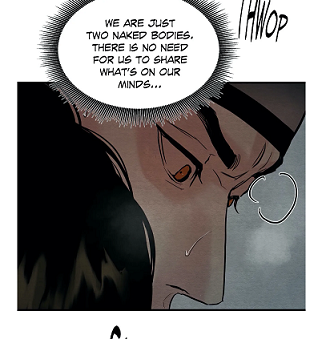 He wanted to communicate (“share what’s on our mind”) with the low-born, but the latter refused, because he just considered the noble as a sex toy to procure him pleasure out of fear to get hurt and deceived again.
 Now, I would like to elaborate more these observations, hence I will start with the first chapter as illustration. The manhwaphiles should remember that at the tavern, Yoon Seungho was very talkative.  (Chapter 1) He expressed his genuine admiration for Baek Na-Kyum’s talent and creations. Yet, at no moment the painter noticed the compliments. He had been forced to touch the loins, which shocked him, and then he remembered the lord’s bad notoriety. Therefore all the lord’s good words fell on deaf ears. The painter was more concerned with appearances and rumors than anything else. That’s why the conversation failed. Since Baek Na-Kyum was not interested in the main lead’s feelings, he feigned ignorance first, and lied at the end.
  Striking is that their first conversation was connected to books and sex, therefore this already limited their exchange. Moreover, this first chapter clearly reveals the lord’s interest in the low-born. He not only sent a domestic for the investigation about the mysterious creator, but also asked about his recent whereabouts. And curiosity usually initiates a conversation. But there’s more to it. From my perspective, the main lead felt no longer satisfied with the erotic pictures. He wanted to share his emotions and thoughts, when he looked at them. However, he had no one to talk to, so in his mind, if he met the artist, he could come into a conversation with the creator. That’s why he wanted to invite him in the end. The painting of sex sessions would give him the perfect occasion to discuss with someone.
And observe, when the first session starts, he can’t help himself talking to the artist, while Jihwa remains silent, as he doesn’t pay attention to him. If you read the story again, you’ll sense the master’s strong desire to communicate. When the painter arrives in the bedchamber in chapter 8, the lord welcomes him warmly with a huge smile and speech.  (Chapter 8) Observe the contrast. The main lead doesn’t reveal his anger towards the noble with the mole, it is not worthy for Yoon Seungho of giving him an explanation for the humiliation. He just smiles
 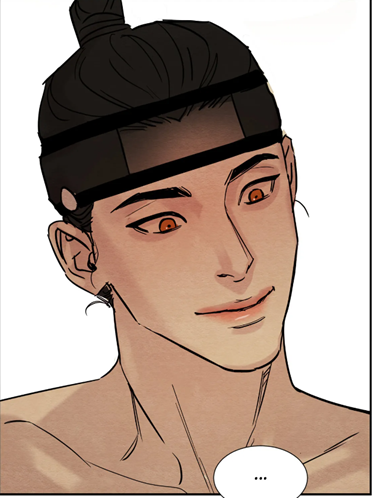 (Chapter 8) before grabbing him by the topknot. His words and behavior truly display a huge respect and a desire to exchange thoughts and observation.
Moreover, when the master is not talking during the sex sessions, then he is in a locked gaze with the artist. (Chapter 8) This mirrors the noble’s need to talk and now, you understand why the main lead had to evict the aristocrat with the mole in the end. By requesting to send away the commoner,
 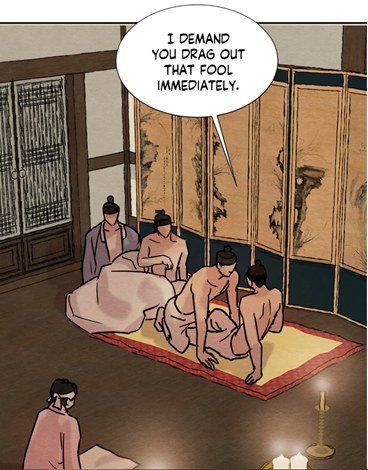 (Chapter 8) he was more or less asking from the host to remain silent.
 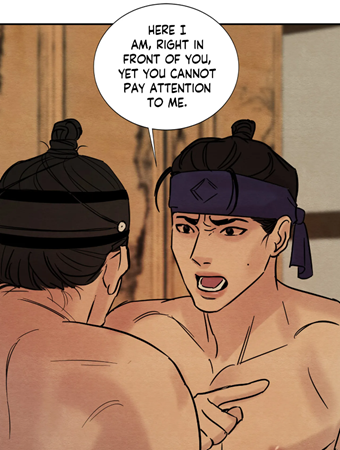 (Chapter 8) The latter just had to focus on the guest’s sexual desires which confirms my interpretation that the main lead is treated like a head-kisaeng. Since the noble showed him no respect, then the main character didn’t need to respect him either. But more importantly, the protagonist made sure that he would be treated the same way. He also wouldn’t listen to his words, because the noble with the mole didn’t want to hear him speaking either. Therefore the door is closed, before the man can protest. As a conclusion, the aristocrats only visited him for sex or other pleasures and nothing more, while the noble had to remain quiet. Hence we have a silent main lead in his relapse:
  (chapter 52) However, even here the manhwaphiles can notice the transformation. The guests are no longer here for sex, just for smoking opium and drink wine. That way, the noble doesn’t feel lonely.
And Jihwa was not different from the others. Like Yoon Seungho described it to father Lee, 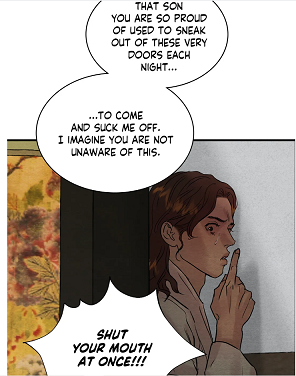 (chapter 67) the childhood friend would only visit him during the night (“used to”). However, it changed the moment the main lead paid a visit to the red-haired noble early in the morning (chapter 3). After that, Jihwa realized that he could also go to his friend during the day (chapter 5
  and 12
  ). And now, you comprehend why the lord questioned his presence in the morning and why he assumed that his visit was related to sex in the end. It looks like Jihwa never showed an interest in the lord’s thoughts and emotions too. And there exist two reasons for that. First, he had the impression he knew everything about his lover.
 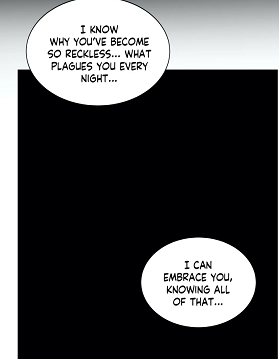 (Chapter 57) Secondly, there was a risk that the main character could talk about the past and as such mention Jihwa’s betrayal. The lord’s emotions (sadness, anger, pain) represented a huge burden to the red-haired master.
 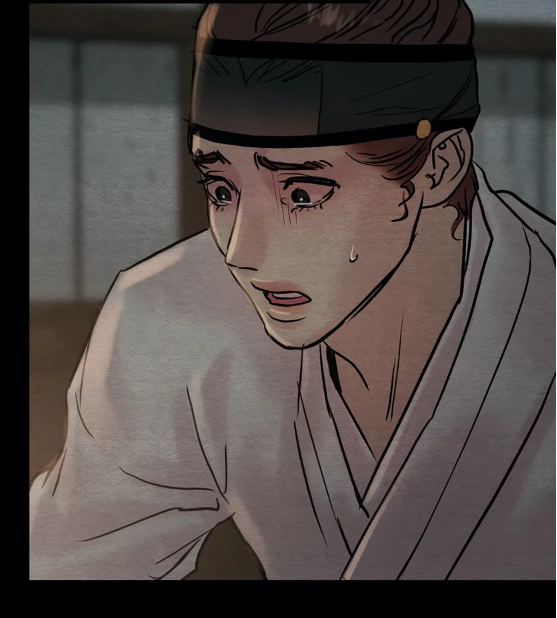 (Chapter 59)
This illustrates that the lord was never allowed to express his thoughts and emotions, until the artist arrived at the property. And now the readers can comprehend why Yoon Seungho said this in chapter 18:  (chapter 18) Thanks to the artist’s presence, Yoon Seungho had been able to talk and people would actually pay attention to his presence and words. They started listening to his words. Imagine, one word and the straw mat beating was stopped:
 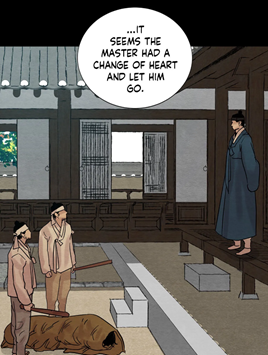 (Chapter 13) No wonder, why he thanked the painter in chapter 18. He could only be happy, when he confronted his childhood friend, as there was a real exchange for the first time.
  (Chapter 13) Argument is also a form of communication, and it happens between people in a relationship. Not only his words were finally noticed, but also he was able to draw lines to Jihwa.
  By influencing the host with the hope, Yoon Seungho would send away the painter, the childhood friend didn’t recognize that he was attempting to turn the protagonist into a puppet, therefore he could only fail. Moreover, Jihwa had no idea that Yoon Seungho’s true desire was to get close to someone, to engage a honest conversation. Therefore the main lead could only reject the friend’s words and proposition. As a conclusion, with the painter’s arrival, the lord’s words were little by little listened, he was able to communicate more with others: Jihwa, the nobles and the staff. After scolding the maids in the kitchen
  (chapter 38), the head-maid started showing her respect to her lord. But more importantly, he gave her the order personally to bring the painter’s lunch to his study.
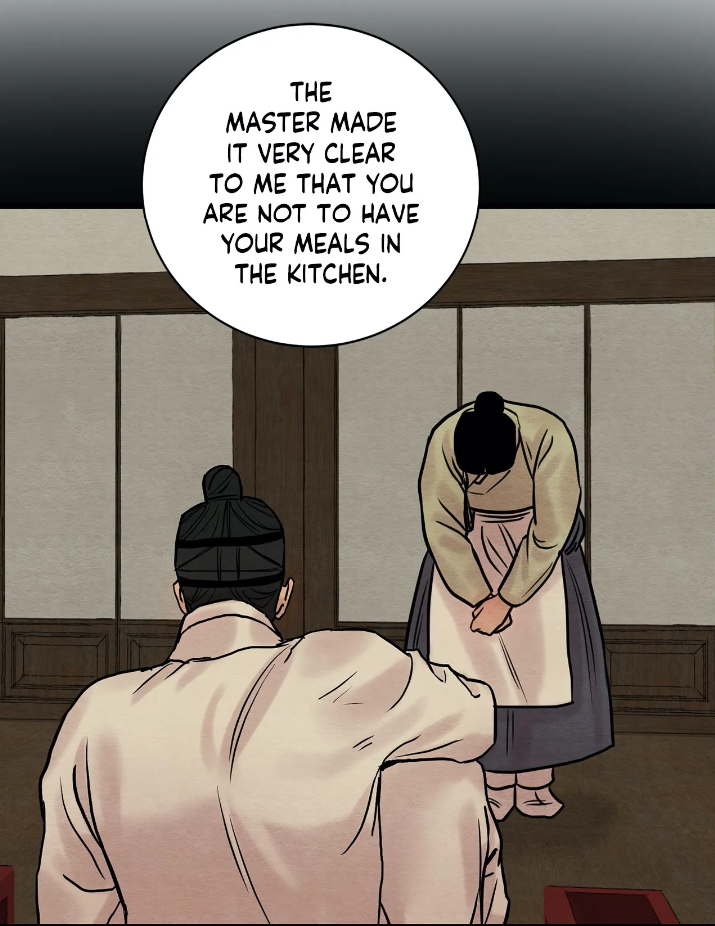 (Chapter 46) He could finally voice his thoughts, everything happened thanks to the painter. This explicates why Yoon Seungho kept seeking the artist’s proximity, although the latter kept rejecting him (his escape, his lies, his refusal to paint for him etc…). He had realized that his living conditions had improved despite the struggling with the low-born.
His strong desire to communicate exposes that he had no companion by his side. In my opinion, Yoon Seungho justified his existence as a free spirit in order to hide his loneliness and emptiness. It was his explication why the nobles and Jihwa wouldn’t listen to him and disrespect him. Yet, the real cause for this situation was his traumatic past, where he had been forced to silence. Moreover this explains why he never paid attention to intruders in the end. He didn’t have the impression, he would truly live in that mansion. Besides, because people were supposed to visit him during the night for sex, then he was never expecting visitors during the day. Hence he spent his days smoking in front of the window.  (Chapter 5) This outlines the main lead’s isolation and loneliness. Simultaneously, with this new approach, the readers grasp why Yoon Seungho couldn’t anticipate to become Min’s target in the end. He noticed Black Heart’s envious gaze
 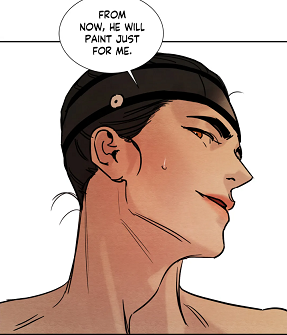 , (chapter 8) but he didn’t envision what jealousy and greed would provoke. In my eyes, he couldn‘t identify these emotions properly.
The problem is that Baek Na-Kyum refused to converse with the lord. In chapter 4, the artist didn’t allow the main lead to express his opinion about the plagiarized poem. 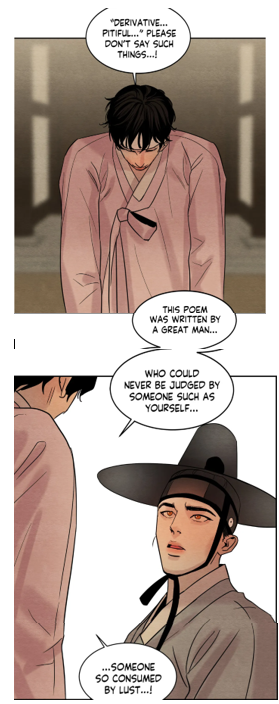 (Chapter 4) He was not worthy to comment this poetry, as he was just a man consumed by lust. However, the commoner never asked why the noble would judge the poem so poorly. He already assumed that he was just making fun in order to humiliate the scholar, while in reality the noble wanted to reveal the author’s true personality: Jung In-Hun was just a deceiver. And since he had been hurt by the painter’s comment, he retaliated too: since he was just a commoner, he had no right to criticize the lord.
And now, it is time to focus on the second aspect: Yoon Seungho and Baek Na-Kyum only started communicating properly through sex. The reason is simple: the painter was only honest, when his unconscious revealed his true desires. Right from the start, the artist was sexually attracted by the lord, but he kept denying it. However, the aristocrat did notice the painter’s genuineness in the sex sessions, which could only reinforce his strong attraction towards the low-born. He loved his art, and now he saw that someone was truly perceiving him.  (Chapter 2) Baek Na-Kyum was the first who made the main lead realize the existence of his body. For the first time, he felt attraction through the gaze and saw something beautiful in himself. And what was the lord‘s immediate reaction? He started talking about his thoughts, though this was more a monologue than a discussion.
 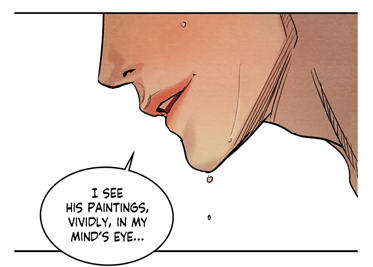 (Chapter 3)
 (chapter 3) Exactly like the painter, Yoon Seungho began talking while having sex. He even formulated his first desire in front of his childhood friend:
  (chapter 3) And now, you comprehend why his relationship with Lee Jihwa was doomed to fail. The red-haired master was more focused on sex and his own sexual emancipation than his lover‘s well-being.
 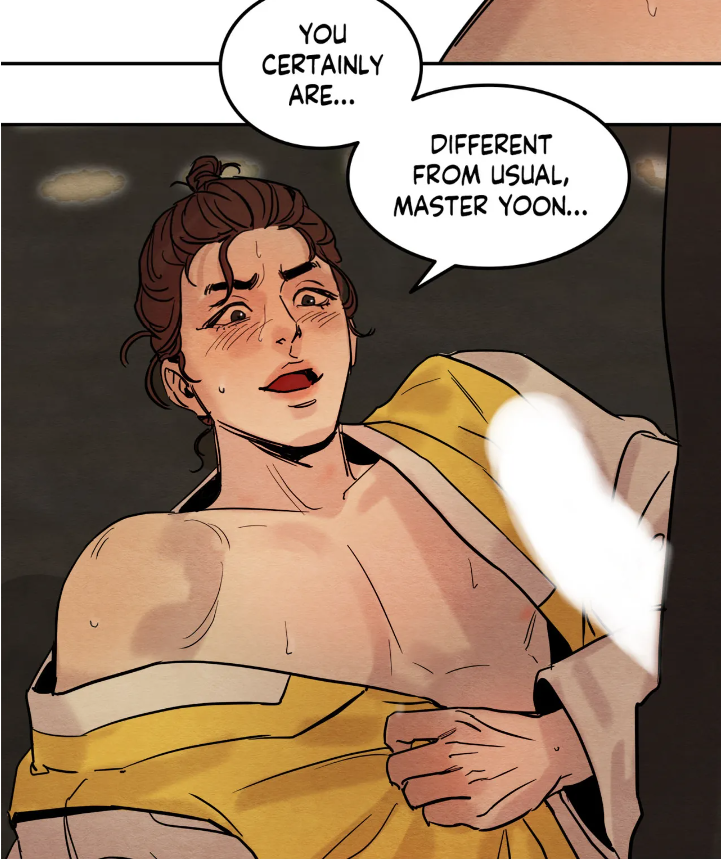 (Chapter 3) He never asked him why he was behaving so differently. He didn‘t notice that the lord was more communicative.
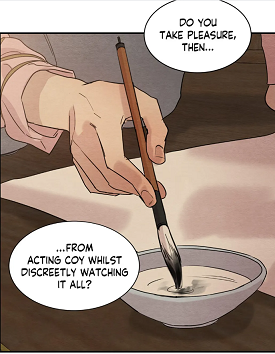
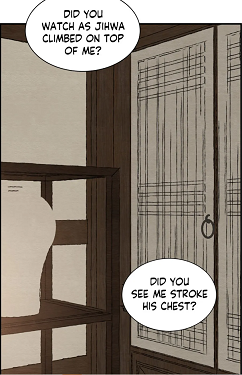
But let’s return our attention to the main couple. The real conversation between Yoon Seungho and Baek Na-Kyum only starts in chapter 16. Nonetheless, the only one talking is Yoon Seungho. He keeps asking questions about Baek Na-Kyum’s sexuality, waiting an answer from the artist:
1. 
2. 
3. 
4. 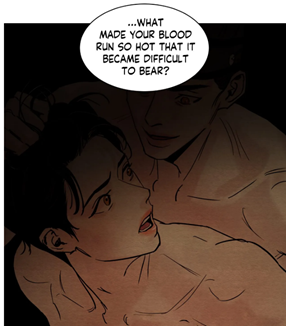
Here I only selected a few inquiries from the main lead, however what caught my attention is that with his behavior, the noble was putting the artist under pressure. The latter remained silent, but the beholder detect how these questions affect the artist. They actually excite him in reality. Why? It is because the lord’s words incite the painter’s imagination. Note that in the second panel above, he is describing the sex session. And the painter gets really excited, when the noble says this: 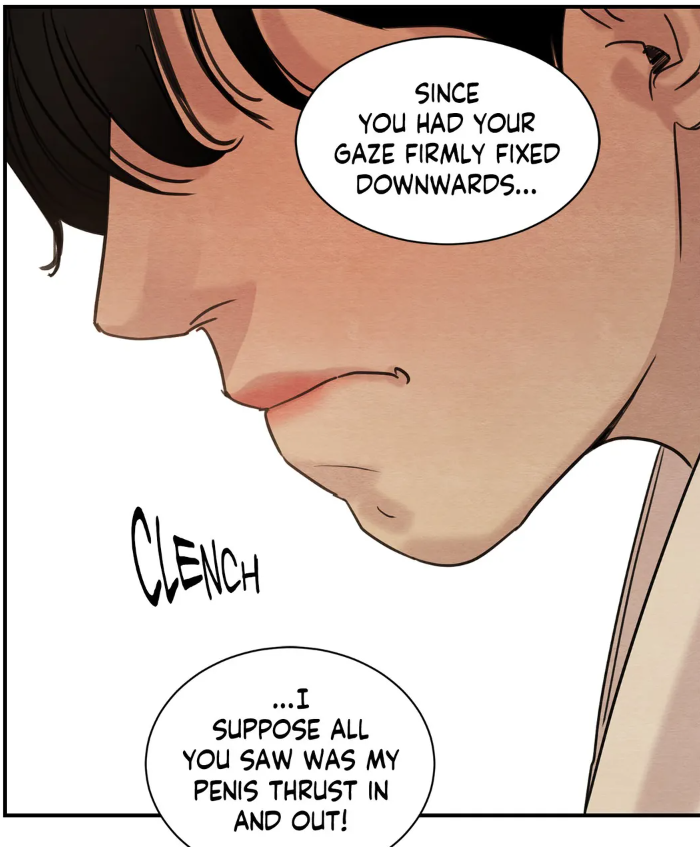 (chapter 16) On the surface, it looks like he is sulking, the reality is that he is already fighting against his urges. The hand is trembling due the arousal.
 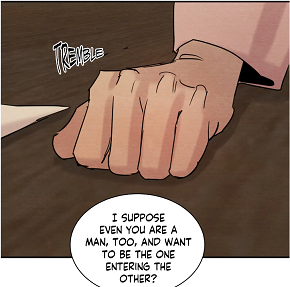 While you have the impression, he is bothered by Yoon Seungho, the truth is that the artist is getting more and more excited due the lord’s picturesque questions. Funny is that in this scene, the aristocrat is the more innocent one. He plays with the head-band
 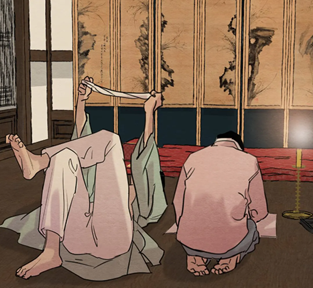 and his “innocence” is truly visible through his facial expressions too:
 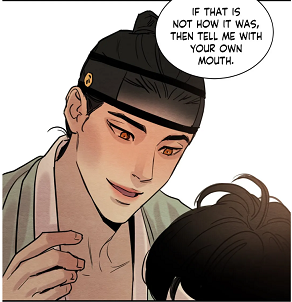 . What is the painter’s real sexual desire? We have the answer in this panel: Getting violated by a stranger! In the wet dream in chapter 6,
 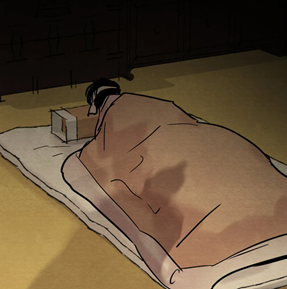 (chapter 6) a stranger in form of a shadow enters the artist’s room. The lord’s identity is only discovered at the end. But in his fantasy, the main lead was even grabbing him by the hair. It was definitely not a tender gesture.
 He was even caressing him against his will. And note that when Yoon Seungho questions when he got the most excited to the point that he had difficulties to breath, the commoner remembers this image and not the strokes. (Chapter 16) As a conclusion, the artist is actually a person who likes BDSM. This explicates why the painter’s trembling hand was grabbing the shirt in chapter 12 while facing the lord. He was hiding his erection
 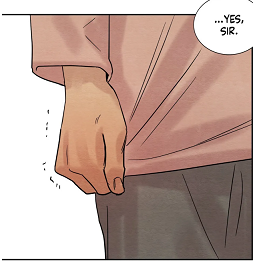 (chapter 12) triggered by fear. This new interpretation explains why the artist painted the sex at the pavilion in the end.
  (Chapter 41) If the forced sex had truly traumatized him, he wouldn’t have been able to do so. Furthermore, he questioned the authenticity of the lord’s affection, when he recalled the moment, he was offered to the other nobles. He was upset and offended.
  (Chapter 55) Yet he didn’t even think about the scene at the pavilion for one minute. This means that Baek Na-Kyum only accepts the main lead as his lover. Fear and pain are not perceived as something negative, they can evoke pleasure.
In chapter 16, Yoon Seungho got the painter so excited that he felt the need to run away in order to hide his erection. Striking is that when the lord starts masturbating him, the commoner starts blushing and crying. But these tears and reddening are not the expression of pain, they express the opposite: pleasure.  (Chapter 16) Moreover, he didn’t get angry at Yoon Seungho for touching his phallus. He got more scared that someone had seen him enjoying the masturbation and I would even say, getting grabbed by force. Therefore the lord got an erection and was so happy at the kisaeng house. Finally, he had been able to talk to the painter. He even got to receive a honest answer for the first time, where he was even called “my lord”:
  (chapter 16) To sum up, Baek Na-Kyum showed a certain respect to the main lead in this chapter. But more importantly, the master was in a good mood, because he kept thinking how he could procure pleasure to the commoner.
However, he felt a little insecure at the same time, because the commoner had kept saying “no”. That’s why during their first Wedding night, the lord asked him about his first sexual experience: 
 (Chapter 21) The painter reveals the truth by replying that he enjoyed it very much, it felt like a dream. As you can see, chapter 21 was a reflection of the episode 16: we had a discussion, where the lord tried to initiate a conversation, tears of joy connected with pleasure, the lord asking to be called “my lord” and the realization of a dream. But we have another evidence that despite his words, he wanted the main lead to continue:
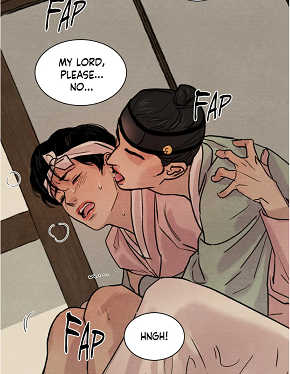 (chapter 16) The commoner’s hand is placed on the shoulder indicating that he is pushing Yoon Seungho to his side. He could have tried to remove the lord’s hand on his phallus, but he didn’t. The hand was even trembling from pleasure. That’s why the second sex marathon shouldn’t be judged as a rape in my opinion, although the painter kept saying no too. First, the painter makes the exact same expression than in chapter 16:
 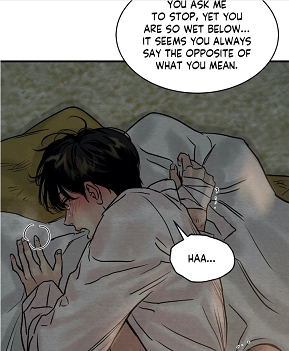 (Chapter 63) And even the lord notices that the painter is getting more and more excited by the roughness. He keeps describing how the painter is reacting below
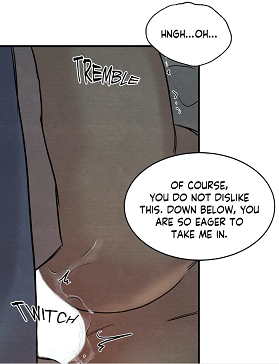 (chapter 63) which can only increase Baek Na-Kyum’s arousal, as his words are again very graphic. Note that the lord’s pictorial “filthy” expressions affect the painter deeply, exactly like in his second wet dream:
  (Chapter 63) Therefore I come to the conclusion that in chapter 63, the painter is not crying, because he is really hurt and angry at the main lead. These are tears of pleasure mixed with pain, which is linked to BDSM. That’s why he keeps blushing the whole time.
  (Chapter 63) This explicates why he kept ejaculating, despite saying “no” or recognizing that there was a witness. He felt no longer scared or embarrassed, like in chapter 16, where he ran away to hide. With this new version of the sex marathon, the painter truly discovered his sexual preferences. Therefore, when we see this
 (chapter 63), we shouldn’t project our own emotions into the artist: pain and disgust. Remember this: the painter felt his blood running hot, when the lord grabbed his hair violently in his wet dream. (Chapter 6)
And now, you understand why the artist is scared to admit his affection to the main lead. (Chapter 68) He is still scared and embarrassed of his own sexuality. It must have felt strange in that historical period. What caught my attention is that we have two chapters where tears are mixed with pleasure and happiness (chapter 16-21), while we have two chapters where the tears are associated to pain and sadness (25-26; 41-42). Besides, in the last sex session from the first season, the painter was the one asking the lord to be quite rough! 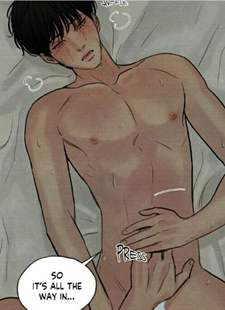 (Chapter 42) Yet, the noble couldn’t help himself showing tenderness and affection at the end with the passionate kiss. As a conclusion, the second sex marathon contains all these elements: sadness, pain, pleasure, anger and happiness.
And it is the same for Yoon Seungho. He likes BDSM and cosplay. That’s why he plays with the head-band  (chapter 16), and in chapter 35 he accepts to be a servant or in chapter 49 a sex toy. Due their different sex sessions, he discovered that he likes being rough too. Therefore he couldn’t enjoy, when the painter was so passive. He recognized that he took pleasure, when the painter was showing resistance too.
 (Chapter 63) This explicates why he couldn’t stand the expression “I like it”. This was too insipid. So when he became rough in chapter 48, he truly hoped to provoke tears of happiness caused by the sensation of pleasure.
 (Chapter 48) However, since the painter ended up crying and criticizing the lord, he had the impression, he had failed. As you can see, the lord might have had a lot of sexual experiences, yet with the painter, he entered a totally new world: full of warmth and love, yet there was pain connected to pleasure as well. This explicates why he could open up and reveal that his real dream was to make the painter smile
 (chapter 63), which contrasts so much to Baek Na-Kyum’s dream: cry of happiness.
I deduce that Yoon Seungho discovered BDSM through the painter, and we should see this as a treatment for the sexual abuse. First, he is put in the same position than lord Song. Thus he learned that sex could only be enjoyable, if there was consent.  (Chapter 79) Hence people saw the sex session in the shed as rape. Nonetheless, the manhwaphiles shouldn’t forget that Baek Na-Kyum was living in the mansion as a servant. Hence according to Joseon’s social norms, he was in no position to reject the main lead. However, for Yoon Seungho, it was different, for he was a young master. He had a title that was supposed to protect him. Consequently, the main lead can reproach the mysterious lord Song that he never asked for his consent and he would even treat him like a male kisaeng!
However, we shouldn’t forget that right from the start, the lord was seeking for a companion to share his thoughts and emotions. Due to the sex sessions, their honest conversations were limited to sex. First, they started arguing, because their couple had started on the wrong premise. Both were not honest to themselves in reality. Through their discussion, they were forced to listen to each other: chapter 25-26. Yet without any confrontation, they were not able to converse properly. Both of them were hiding something out of fear and pain, that’s why the conversation in chapter 47 failed too. As you can sense, their physical connection was never satisfying for the lord, he always hoped for more and tried to initiate conversations (chapter 35, 39-40, 41, 42). Both needed to learn to trust each other, but it was not possible because of their lack of self-respect.
Remember that the aristocrat desires to talk to the painter right from the start, and later he wants to share his meals with him. And each time, Kim intervenes. First, he manipulates the lord to visit the artist in his study, well aware what Jihwa has already done. Then in chapter 50, he finally reveals the content of the conversation between Baek Na-Kyum and his scholar. And this conversation happens right after the lord asked to take his meal with the artist. He made sure that their interactions would only be limited to sex. In my opinion, Kim started meddling between the two protagonists, because that way he could refrain them to communicate directly to each other.
“There is only one rule for being a good talker – learn to listen” from Christopher Morley
That way, the butler hindered the painter to discover Yoon Seungho’s true personality. If they didn’t have an opportunity to talk, then the artist couldn’t learn through listening. That’s why the use of aphrodisiac in chapter 36 was actually an act of sabotage. The manhwaphiles shouldn’t forget that in chapter 35 the lord tried to discover the painter’s likes and offered the latter to join him to his room. But in order to ensure that there would be no conversation, Kim warned the artist about the lord’s bad mood. 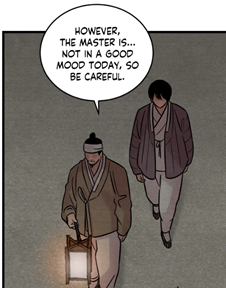 (Chapter 36) While, it looked like he was protecting the painter, he was undermining their relationship. He was actually using triangulation.
Triangulation is an approach used by many different people who share one thing in common: insecurity. As a result, they’re willing to manipulate others in harmful ways to get what they want or feel a sense of security in a relationship. Quoted from https://www.verywellmind.com/what-is-triangulation-in-psychology-5120617
I had described the protagonists as insecure, and Kim could sense these anxieties and took advantage of it. And this is no coincidence that the painter’s love confession took place in the gibang. Kim was not present, and he could only join them much later. As a conclusion, Kim made sure that there would only be sex between them and nothing more. But when he realized that sex would bring them closer, as they started communicating, he separated the couple. They should no longer have sex together. First the valet used the conversation in the library as a justification,  (chapter 50) Then he utilized the lord’s misconduct in the storage room. He should wait for the painter’s visit in his bedchamber.
 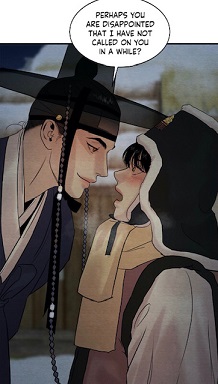 (Chapter 75) However, the valet could never stop the progression. The irony is that their first deep conversation took place outside the mansion.
 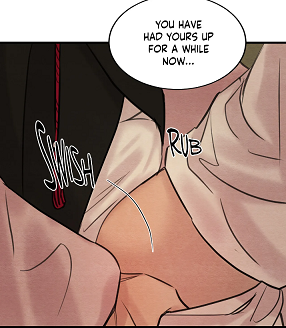 (Chapter 39) Once again, the lord had a teasing attitude, yet he was gentle and considerate. This is not surprising that due to their interaction, Baek Na-Kyum started listening to the lord. He took his questions and advices very seriously (chapter 40). Thus he confronted the learned sir about his future. As the painterofthenightphiles can detect, by communicating they began trusting each other more, and as such showing more curiosity and understanding to their counterpart.
After the kidnapping, the butler imagined that the lord would kill the artist for his abandonment, yet it didn’t happen. In reality, the lord prepared himself the painter’s bed. Then when he went to the barn in order to see what was happening, he heard and saw a painter saying “no”, while the lord was quite rough. So in his mind, after this sex session, the painter would be scared of the lord and would run away. What he saw was violence because of the past. Note when he tried to manipulate the master, he mentioned the main lead’s rape at the barn. 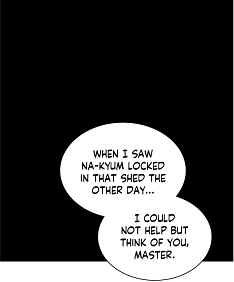 (Chapter 68) With these words, he was implying that the low-born suffered the same fate than Yoon Seungho, because it looks like that on the surface. He imagined that he would achieve his goal (sending away Baek Na-Kyum) by using his knowledge, but in my opinion the opposite happened, like I had expected. What caught my attention is that the butler only mentioned Yoon Chang-Hyeon
 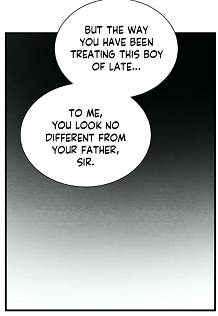 (chapter 68), as he had sent the painter to the storage room like his father. Yet, at no moment he made an allusion about lord Song, though he saw the sex in the barn as sexual abuse. He was thinking of the pedophile’s crime. He couldn‘t bring up the pedophile for two reasons: As a domestic, he can‘t badmouth the king. Secondly, he has to blame the father, as his own responsibility in Yoon Seungho‘s suffering would come to the surface. Remember my theory: Kim was the one brought the young master to the king thinking that the latter would protect Yoon Seungho.
Yet the problem with BDSM is that the couple needs to set the rules first, and these are strongly intertwined with “respect and love”. They have to communicate. That’s why the moment the painter accepts his affection, he is forced to recognize his own sexual preferences. This is no coincidence that in the bedchamber, Baek Na-Kyum voiced his desires after vowing loyalty to his lover.  (Chapter 88) Furthermore, the chronology is important. The painter communicated first his thoughts and wishes, before they initiated the love session.
 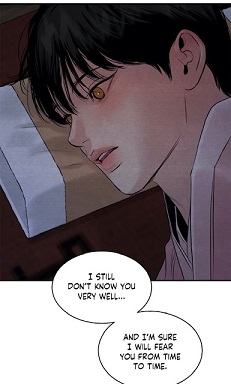 (Chapter 88) This contrasts to the sex session in chapter 48/49. The lord had used sex in order to force the painter to share what was on his mind. Finally, in the gibang, the painter had talked a lot about his childhood to his lover before kissing his lover.
  (Chapter 94) They had a long conversation, where the lord could ask questions. This conversation ended with a love confession.
  (Chapter 94) This is important, because sex had now a different function. Sex was now a real form of communication, they would share what was on their heart. With their bodies, they would convey emotions. They would use the hand
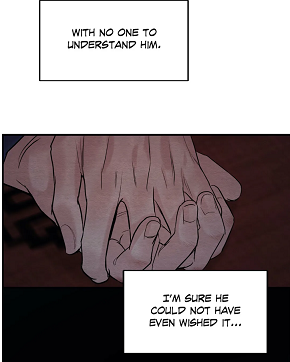 (chapter 88) or the kiss
  (Chapter 95) so that no misunderstanding would be created. Therefore it is not surprising that even during their love session, they would keep talking, and even express their desires: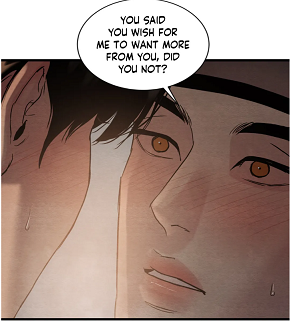
 (Chapter 96) And observe that even after the love session, they continued sharing what was on their mind and heart:
 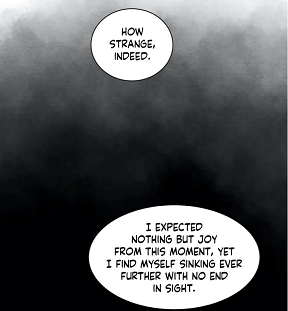 (chapter 97) And now, you comprehend why the schemers had to separate the couple! From this moment on, they would communicate constantly, and this outside sex. Thus when they are in the mountain, they can speak freely.
  (Chapter 102) They are no longer a noble and a commoner walking together, but a real couple. They are equals sharing their happiness and pain.
However, this doesn’t mean that their love story ends here. This marks only the beginning, because the lord has so much more to show to the painter. Their love will keep growing and affecting other aspects in their life. Moreover, they are now paying attention to what is happening around them  (chapter 102) Here, the painter wished to understand why they were separated for so long. This means that Yoon Seungho has to discover the circumstances which led to this tragedy. That‘s how they will realize that the enemies are close to them. The lord has to recognize that he needs to share everything, like for example the discovery of Deok-Jae’s corpse.
  (Chapter 97) As you can see, the topics of their conversation will diverge more and more. I do think that he was incited to let the painter sleep in order to „protect“ him. Yoon Seungho needs to recognize that warning and drawing lines are not enough to protect the loved one. He will have to take real measures to turn his statement (taking responsibility for the painter) into a reality: he will have to fight for his right to happiness.
 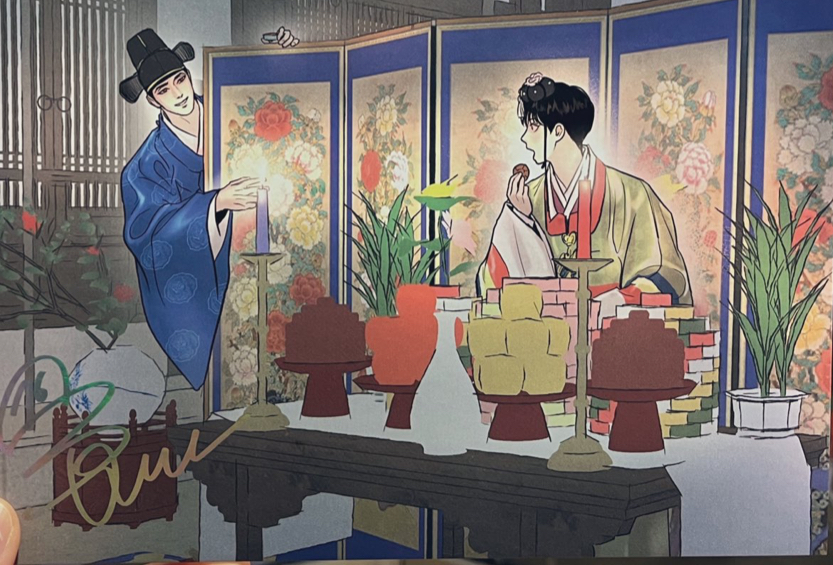 Taking the civil service examination only represents one step. Furthermore, appearances can be deceiving. The pure artist is not so “innocent” in the end. He has definitely met his match in Yoon Seungho, though I believe that his role is to heal Yoon Seungho from his PTSD and give him closure. And this can only happen, when the victim of sexual abuse confronts his perpetrators, the old bearded men!
Feel free to comment. If you have any suggestion for topics or manhwas, feel free to ask. If you enjoyed reading it, retweet it or push the button like. My Tumblr-Reddit-Instagram-Twitter account is: @bebebisous33. Thanks for reading and the support.


This is where you can read the manhwa. https://www.lezhinus.com/en/comic/painter But be aware that this manhwa is a mature Yaoi, which means, it is about homosexuality with explicit scenes. If you want to read more essays, here is the link to the table of contents: https://bebebisous33analyses.wordpress.com/2020/07/04/table-of-contents-painter-of-the-night/
It would be great if you could make some donations/sponsoring: Ko-fi.com/bebebisous33 That way, you can support me with “coffee” so that I have the energy to keep examining manhwas. Besides, I need to cover up the expenses for this blog.
I was really pleasantly surprised with the alternative universe of Painter Of The night, because it wasn’t at all what I had been expecting. I had imagined that Byeonduck would give us a modern version due to her drawing with Yoon Seungho wearing a mask. So what is her alternative universe? It’s the same period, but the social status have been switched. On the left, I selected pictures from the original story and on the right from the alternative universe.
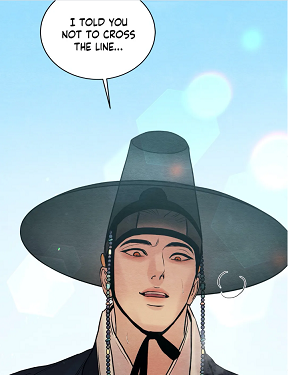
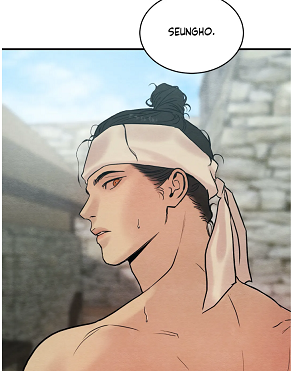

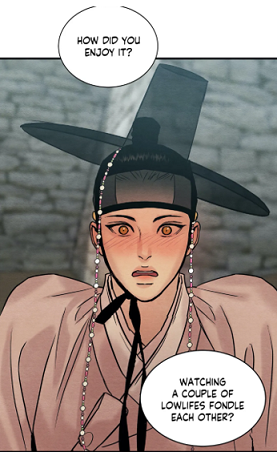
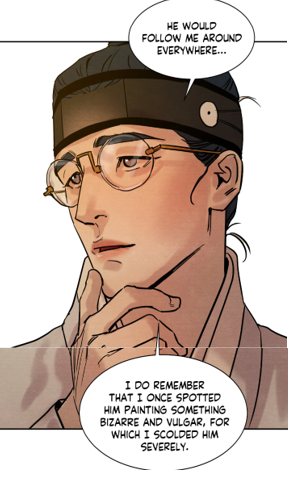
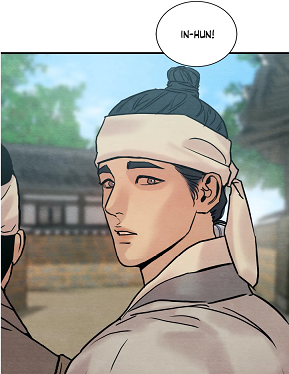
Now, it is Yoon Seungho and Jung In-Hun’s turn to be commoners, while Baek Na-Kyum is now the only son of a noble family which means the pressure and expectations from his family must be high. By switching the positions but at the same time, keeping certain elements from the original story (f. ex. Baek Na-Kyum likes painting sodomy), Byeonduck gives us clues about the original story as well, which were never directly revealed. Consequently, this version made me realize two things. First, thanks to this episode, I gained more insight about the original story which I’ll explain in another essay. Secondly, Byeonduck gives us a new dimension of the relationship between Yoon Seungho and Baek Na-Kyum. The author is showing us that not only Baek Na-Kyum and Yoon Seungho are fated to fall in love with each other but also their love story is supposed to be an example that love knows no boundaries. Their affection is the result of nature and society will never been able to stop it. This special episode reinforces her original message: homosexuality is no disease but a natural phenomenon. Besides, by switching their roles, the author outlines that the social gap between them will always be present in their relationship no matter where they live but they will overlook it in the end. Their affection is strongly intertwined to scandal, yet it won’t matter. By using the idea of destiny, the special episode with the alternative universe reveal that their choices are not free in reality, their decisions are all influenced by their disposition and environment. While reading the special episode, I couldn’t help myself connecting this story to philosophy and different currents in philosophy: Free will versus Determinism.
This is the second time that I am referring to philosophy. In another analysis, I had explained that Yoon Seungho was a libertine and represented the ideas from Enlightenment where reason and critical thinking were in the center of this movement. In other words, the powerful protagonist belongs to the libertarians (“free will”). By guiding the low-born, he liberated him from traditions and social norms. That’s why at the end, the painter makes his own decisions. He chooses to remain by his lord’s side despite the terrible night in chapter 53 and the first brutal confession. That’s why we could say that the original version advocates free will, whereas the special episode represents the other current: determinism, where there exists no real freedom. Interesting is that the moment the first episode from the alternative episode was released, many fans realized the similarities between the original Painter Of The Night and the alternative one. Let me give you an example: (Chapter 55) As you can observe, the drawings and the character’s actions resemble each other a lot. It was as if the protagonists had no choice but to turn their heads. It was already planned and designed, just like Oedipus who couldn’t escape his fate. By drawing similar panels, Byeonduck gives us the impression that their destiny and actions have already been predetermined. Baek Na-Kyum will run away or blush or have a crush on Jung In-Hun. They have to accept and embrace their destiny which will be full of pain but also full of love and tenderness. And now, let’s take a closer look at the special episode.
Here, fate appears in two forms. They first meet by coincidence 
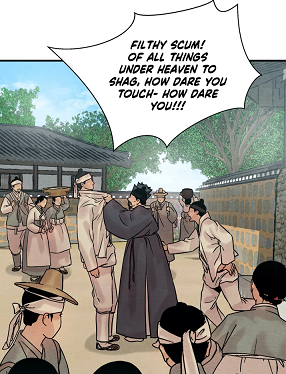 and secondly thanks to the intervention of the cat. Coincidence is a proof that they have no control over their life and love life. It was, as if the invisible hand of gods had decided to have them met. Yet, determinism doesn’t use the idea of gods or of an exterior force leading the characters to encounter each other. If you pay attention to the way they meet, you’ll realize that their decisions, influenced by their liking and living conditions, were the reasons why they met in the street. The noble Baek Na-Kyum was strolling in that part of the town because he wanted to sell his erotic paintings. So because of his hidden hobby, he is led to go to a part of the town where commoners live. In other words, the protagonist enters Yoon Seungho’s world. On the other hand, Yoon Seungho as a low-born catches Baek Na-Kyum’s attention due to his unusual attitude. He shows neither remorse nor fear in front of the angry aristocrat. He is very defiant. That’s love at first sight. However, this is true love as sexuality is immediately included, while his affection towards Jung In-Hun was more related to the innocent and pure love of a child. Striking is that Yoon Seungho is exposed for his scandalous relationship with the son of a noble family showing that he doesn’t care about social status and distinction between nobility and commoner. It is also the same for the painter who sells his erotic paintings in order to buy glasses for his servant.
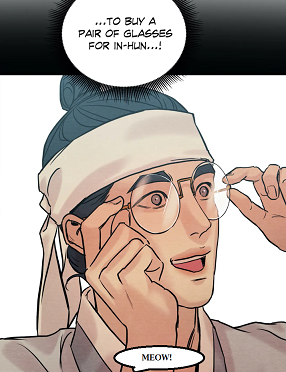 This shows that right from the start, Baek Na-Kyum has not truly internalized the hierarchical society and it is the same with the strong-willed commoner. They might not belong to the same social class but their mentality is in reality similar. Besides, they have both a strong libido and a certain sexual fantasy. Yoon Seungho is willing to have sex anywhere (f. ex. in the woodshed)
 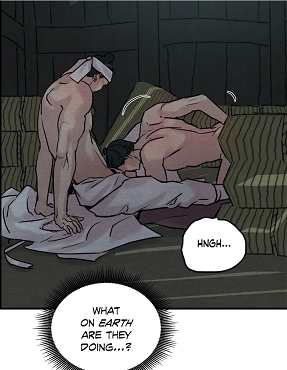 and after meeting the impressive and attractive seme, Baek Na-Kyum becomes so inspired that he creates a threesome.
  The painting could be seen as another evidence that the painter had to create such a work. There’s no real free will in the end. However, the idea of a threesome indicates that the innocent noble has indeed a kinky side which was triggered the moment he met Yoon Seungho’s eyes. And now, it explains why Yoon Seungho was destined to meet Baek Na-Kyum outside his mansion in the original manhwa.
 He had to meet him at the tavern because it was the commoner’s world and since the noble was interested in the painter, he couldn’t just send for him. The latter could refuse but in his presence, Yoon Seungho imagined that the artist would never dare to reject the offer.
However, unlike the seme who doesn’t fear the rumors about his reputation, the noble prefers hiding his true thoughts hence he repeats exactly what his crush says about homosexuals.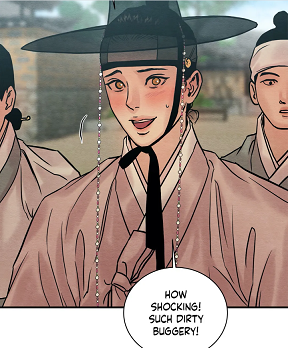
 In other words, Baek Na-Kyum seems to have a predisposition to follow social norms, although in his heart, he doesn’t acknowledge societal hierarchy. He lives in his own bubble in my opinion. That’s why I come to the conclusion that Baek Na-Kyum’s inner conflicts will always represent one of their problems in the evolution of their love story. The noble will suffer pressure from his family and his servant Jung In-Hun who will betray him, making the main lead discover what love truly is. But because of their affinities, they were destined to be together.
This determinism is also visible with the appearance of the cat.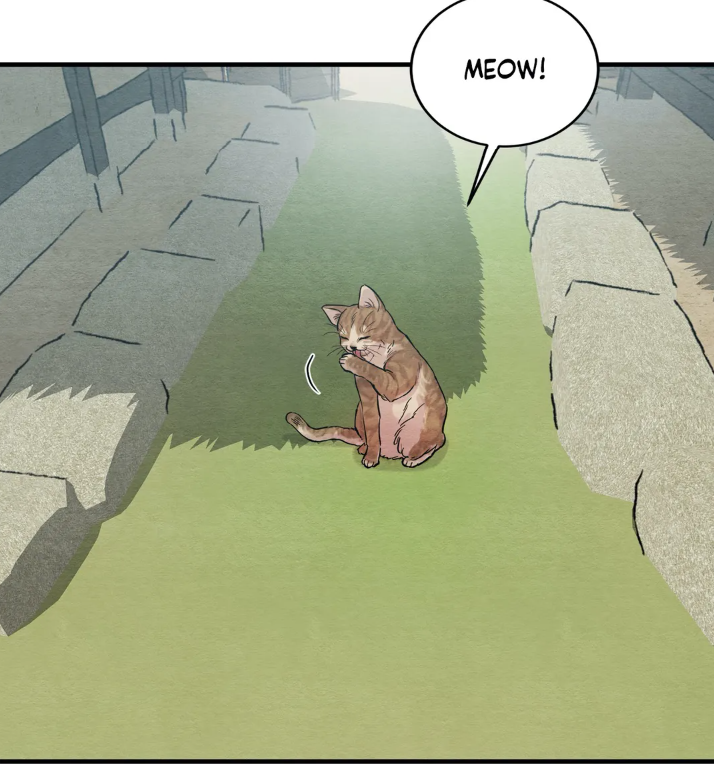 Due to his love for cats, the noble is led to a woodshed where he witnesses Yoon Seungho having sex with someone else. Note that the cat is the reason why he feels pleasure for the first time
 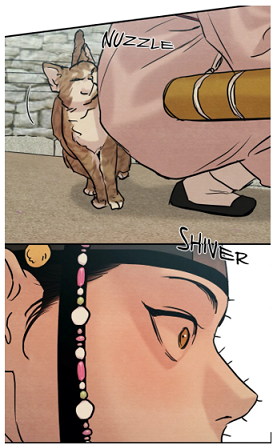 and why he gets caught in the end. If the cat had not appeared, then he would have never discovered the sexual intercourse. If he had never liked cats, he wouldn’t have played with him.
 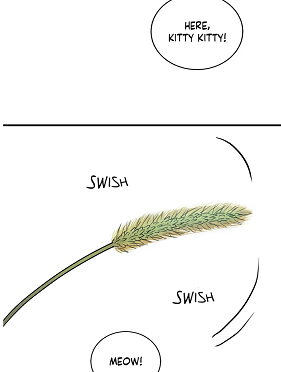 Furthermore, he was strolling through the district where commoners live as he was on his way to sell his new painting. His so-called choices could only lead him to the place where the attractive seme was. This was no real coincidence again. Now, why a cat?
In my opinion, the cat with the herb symbolizes nature which stands in opposition to society and its social norms. That’s why nature leads the protagonist to awake his sexuality and discover his sexual attraction for the seme. While in the original version, we had a fight between unconscious (dream) versus conscious (reality), we have a fight between nature versus society which is actually the same. Freud called the unconscious (“Es”) which is strongly linked to naturality. Baek Na-Kyum’s fight will be to accept that he has always been attracted to men and he has fallen in love with Yoon Seungho due to his charisma. By interacting more with him, he will discover that they share many affinities in the end. Like I demonstrated above, their mindset is quite similar. Furthermore, this new version confirms my interpretation: the seme will be or is Baek Na-Kyum’s real muse. And since it is their destiny to be together, then the commoner will come up with a thread again. Due to the painting and the tools he left behind , Yoon Seungho will be able to discover Baek Na-Kyum’s identity and the latter will be blackmailed. Notice that the merchant knows his true identity.
 The painter will have to work for Yoon Seungho, yet the reason will diverge. The commoner has already set his eyes on the artist, since he hasn’t really forgotten him.
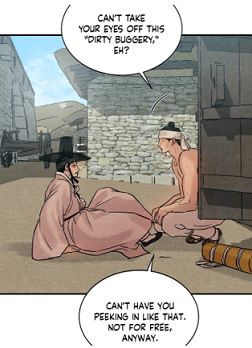 He remembers his face (“your eyes off”) and his words (“dirty buggery”). Their attraction was mutual and he needs to create a reason. As a conclusion, the introduction of the alternative universe makes us realize the dimension of determinism which is strongly linked to Nature (sex, cat). Baek Na-Kyum’s choice will be to acknowledge that his love for the seme is stronger than social norms, so that we can say, even if there exists determinism, there’s a certain liberty. Yet it is much more limited than it looks like as our decisions are influenced by our environment, experiences and past.
Feel free to comment. If you have any suggestion for topics or manhwas, feel free to ask. If you enjoyed reading it, retweet it or push the button like. My tumblr-twitter account is: @bebebisous33. Thanks for reading and the support.


This is where you can read the manhwa. https://www.lezhinus.com/en/comic/painter But be aware that this manhwa is a mature Yaoi, which means, it is about homosexuality with explicit scenes. If you want to read more essays, here is the link to the table of contents: https://bebebisous33analyses.wordpress.com/2020/07/04/table-of-contents-painter-of-the-night/
It would be great if you could make some donations/sponsoring: Ko-fi.com/bebebisous33 That way, you can support me with “coffee” so that I have the energy to keep examining manhwas. Besides, I need to cover up the expenses for this blog.
In the first part, I demonstrated that the night in the episode 49 marked a pivotal moment in the painter’s life, for he was abandoning Jung In-Hun’s doctrines and cutting ties with the scholar for good. First, he had asked the valet Kim to get rid of the painting about Jung In-Hun’s inauguration, which showed that he was taking his distance from his former admired sir. 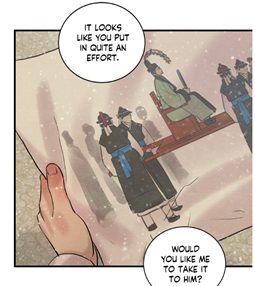 (chapter 44) He saw it as a confirmation that the teacher had truly abandoned him, for he never bid goodbye to him. However, now I believe that Kim never informed the artist of the scholar’s departure.
 (chapter 44) He just delivered it in delay so that the artist would feel even worse than before. Without the farewell, he could only come to the conclusion that he had been truly abandoned by Jung In-Hun. Yes, the artist didn’t react like the butler had expected. He remained in the mansion despite the gate had been left wide opened. By getting rid of the painting, he was cutting ties with the learned sir. Yet this was a baby step compared to the scene in the chapter 49. Here, he has finally become the master of his own life and fate therefore he’ll live his life the way he wants. He is accepting his homosexuality and as such his sensuality. He views sex as a part of his life. He rejects abstinence and doesn’t view sex as an addiction.
 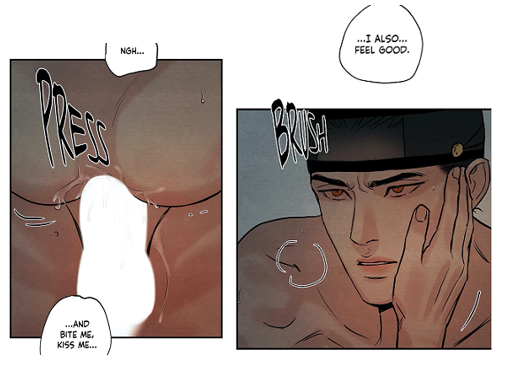 (chapter 49)
Furthermore I explained that he became a full-pledged person again, as he regained his own identity. We could even say that he had lost his identity as a painter. In the first chapter, the aristocrat was looking for the painter hiding behind a pseudonym and not for Baek Na-Kyum himself. Their first wedding night changed everything: from that moment on, Yoon Seungho wanted the man Baek Na-Kyum and not the painter- Hence the creation of new drawings became obsolete. For Yoon Seungho, only an image about their first night mattered, as he perceived as a validation of their marriage. But back then he was not realizing the signification of this wish. Yet as you can imagine, it is impossible to separate Baek Na-Kyum from his true vocation. That’s a part of his identity. So when he explained his reason for the “why”, he revealed many things. First, he accepted his homosexuality and his physical attraction to Yoon Seungho and indirectly that he was a painter, although he didn’t verbalize it loudy. Many readers were upset because they thought that Baek Na-Kyum was still acting as a prostitute at the end. The reason for their interpretation was the following picture:  The lord’s thoughts were reflecting the artist’s mind-set. Yet, observe that in this scene, the real “prostitute” was more the lord. Why? It is because the painter had stipulated that it was the noble’s duty to lick him and as such make the painter feel good. Yet, there was a slight difference. A prostitute’s duty is to focus on the client’s pleasure and not on her/his own sensuality. Yet, observe that the noble’s thoughts are revealing that he will make sure that he enjoys their sex/love session too. Since he said that he would let his body lead him and his life, they thought that he was selling his body. But no, here he was saying that he would also pay attention to his own needs too. In other words, he was becoming a libertine, exactly like the painter. Both chose to live as libertines during that night. People would call it: a relationship with no string attached. However, what these readers failed to realize (in my perspective) is that Yoon Seungho and Baek Na-Kyum never mentioned any remuneration in exchange for sex, while it was different in the past (chapter 46).
  In fact, in this image, he was acknowledging his other part: he was a painter.
I regard this expression “my body take the lead” from Yoon Seungho as a reflection of the artist’s true and original belief, before he was brainwashed and almost destroyed by the teacher. It is strongly connected to his painting. Remember that when he was a child, he painted an erotic image of sodomy. 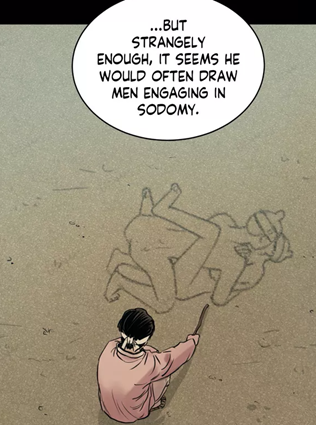 (chapter 1) I perceive this image as an indication that the artist had dreamed about this love session. Note that all dreams about the painter were linked to sex and love. For me, this picture is a proof that the brothel had nothing to do with it. He was drawing outside and he had no model for such a scene right in front of him. In other words, the child allowed his body (his arm, hand, eye and brain) to take the lead, hence he was able to create such a sensual picture. Even Yoon Seungho wondered how a virgin could produce such beautiful drawings.
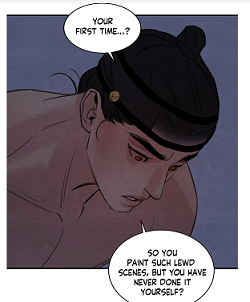 (chapter 20) I have always pointed out that Baek Na-Kyum was a homosexual right from the start, which he accepted as something natural. He was also encouraged by his noonas.
  (chapter 87) He saw no crime in it, rather as something lovely and beautiful, hence he never felt the need to hide it. Notice that in this picture, he was creating such a lewd painting (chapter 1) where people can behold it, he feels neither shame nor embarrassment. He had no idea that he was violating social norms. That’s why I came to the following interpretation, when the painter said
 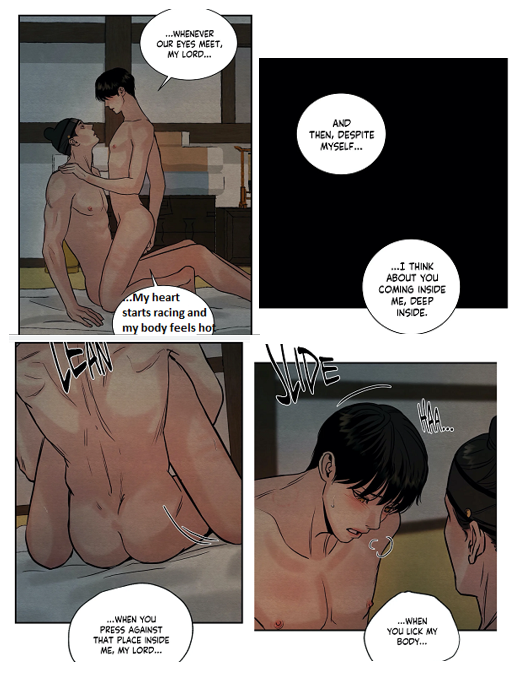 (chapter 49), he was rediscovering his old belief, he wouldn’t feel flustered if someone calls him a sodomite or whore due to his paintings. Notice that he didn’t blush, when he heard Min’s comment or when he saw the sudden kiss.
 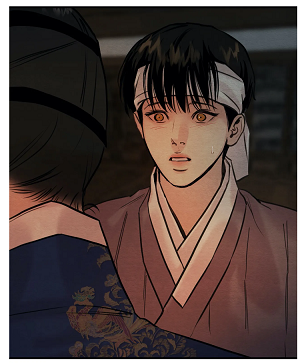 (chapter 49) Now, you understand why I was really happy with this chapter. Baek Na-Kyum was slowly returning to the person he was in the past before the teacher and his noona Heena transformed him into a shadow of himself. He was accepting every part of himself: his sexual desires, his sexual orientation and more importantly his work as painter.
The commoner was already an empty shell, when he met the main lead for the first time. Let’s not forget that he was living as a drunk, since he had vowed to never paint again.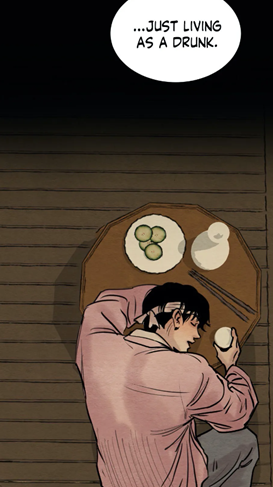 By forcing him to drop painting, Jung In-Hun had already ruined the low-born’s life, as painting was a part of his soul. We could say that the low-born was already withering. However, back then Yoon Seungho was not interested in why the painter suddenly dropped his true vocation and why he lied to him too. The lord was more obsessed with the erotic drawings. The cause for this long explication is necessary as with this interpretation, I am predicting what is going to happen in the future.
This signifies that after this episode, Baek Na-Kyum’s talents will return with full forces and Yoon Seungho will even be his source of inspiration. The lord will become the artist’s new muse.
In order to understand this, we need to go back to the chapter 46. There, the beholder could sense that Baek Na-Kyum had lost his passion for painting despite his claim.
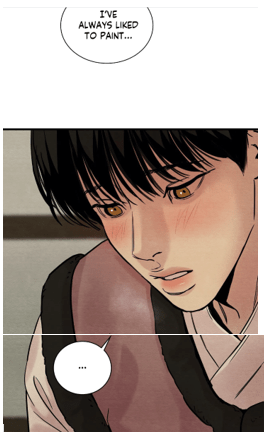
His head was down, his cheeks were red as if he was feeling ashamed. Furthermore there was no real passion in his eyes, when he conceded it to the head-maid. His confession about liking to paint was indeed meek. The lord’s observation made later was correct, although he never got to hear this revelation. Here, this drawing illustrated the frozen state of the painter, the loss of his soul and talent.
The artist was only able to produce a new painting because initially he masturbated. Striking is that this scene was a clue about the artist’s original belief.  Here again, he allowed his body to take the lead, but it was once again behind closed doors and nobody was present. He was hiding again, indicating that he still wouldn’t admit his own sexual desires and his homosexuality. Until now, he had only asked for comfort and love from his counterpart (chapter 20/21 and 41/42). Remember that in the chapter 41, he just asked to be hold and as such, he only wanted to be embraced initially. However, due to his inexperience and pain, he confused love with sex. As you can see, the belief “the body taking the lead” had resurfaced indicating that little by little, the painter was changing. More importantly is that he hadn’t been triggered by an immediate sex session, unlike in the past (chapter 8/9). For the first time, Baek Na-Kyum’s sexual desires had come back to life. Unlike in the past, he didn’t judge the cum as something dirty and filthy. Moreover, Baek Na-Kyum could only ejaculate due to Yoon Seungho’s warmth and love. He had these flashbacks where the lord made love to him.
 Thanks to these two elements (the body taking the lead and Yoon Seungho), he could paint again, however he could just create an unfinished and unrefined drawing because of the image he had of himself: a prostitute. His talents were diminished, even the lord’s influence couldn’t remove the false reflection about his identity caused by the scholar’s punishment. In this scene, we had another confession: Baek Na-Kyum was no longer hating the noble indicating that in the end, he had forgiven him for his wrongdoings:
Sure, he was only talking to himself but in the retrospective, I interpret this scene as the prelude of Baek Na-Kyum’s real transformation. By forgiving the protagonist, the painter has already started valuing the lord differently. The chapter 46 revealed the growing influence of the noble in the painter’s mind and body. He had already started being an inspiration for the artist’s new work. One might argue that this had already happened in the past, yet I have a different perception. In the first part of the first season, Yoon Seungho was forcing the commoner to paint, the latter had no choice to have the master as his model. Then Yoon Seungho was hopelessly waiting for the drawing of their “wedding night” which never occurred. The painter chose to ignore this night and to repress his memories. Then in the chapter 41, he painted so many images in order to ease his pain. That’s why his paintings lacked passion and warmth. He was working like a robot. As a conclusion, until the chapter 46, Baek Na-Kyum never considered his “husband” (I am well aware this is not how Baek Na-Kyum perceives Seungho) as his muse. He just used him as his model as he had been forced to or he wanted to smooth his agony.
In the past, I used to belive that Jung In-Hun was Baek Na-Kyum’s first love and he became his muse. However, later on I realized that the artist started painting for a different reason: survival.  (chapter 1) He had no choice. He had to paint erotic paintings. Thus I conclude that the artist couldn’t fully show his true talent and express his passion for painting totally. Yet, his publications were still beautiful, since the lord’s heart and gaze were moved. On the other hand, the noona Heena sent her adopted son to Jung In-Hun, because she feared for her brother. (chapter 46) However, I believe that she was acting on the learned sir’s request. She justified her decision to send him away to the teacher, because she knew that by the learned sir’s side, the artist would never outlive his homosexuality. She imagined that the low noble was her son’s source of inspiration
 (chapter 46), whereas the artist had other motivation. Therefore she thought that it was for the best, if he was by the teacher’s side. I assume that the teacher wished the low-born by his side for two reasons: money and the prospect to benefit from Baek Na-Kyum’s talent. It is very likely that out of greed, the learned sir desired to sell the painter’s works for his own benefit. But for the artist had been requested to paint these erotic paintings for survival, I come to the conclusion that he had been asked twice to paint erotic pictures. The first time, it was for a precise client, and the second time it got sold among the commoners, which explains why the tailor knew about the identity of the painter.
  (chapter 64) There’s no ambiguity that the scholar’s prospect got ruined, hence he unleashed his jealousy and resent onto the painter, until the man vowed to follow the scholar’s doctrine. The poor man could never tell Heena about the physical and mental abuse, as he had already been abandoned. (chapter 34) He had to keep his promise to never return to the kisaeng house. I believe that the kisaeng must have used this incident
 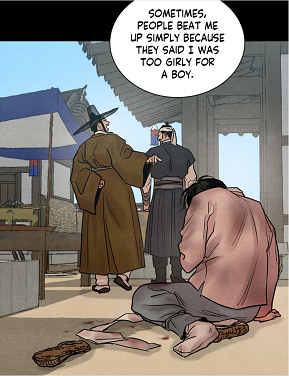 (chapter 94) to send her brother away and exactly like in chapter 44, she made sure that the noonas wouldn’t be informed. That way, she could deceive her colleagues. It had been the painter’s choice.
  (chapter 93) For the man was his guardian, the low-born had to accept his situation. But since he was just a low-born, I doubt that he could sleep in the same room than the scholar. From my point of view, he had to sleep outside on the wooden planks, the older version of this scene.
  (chapter 1) Therefore it is not surprising why he didn’t leave the mansion in the end and why he said this to the head-maid. (chapter 46) He could live a normal life again. Besides, since the coercive persuasion, Baek Na-Kyum had been unable to paint, not just because of the vow in my opinion. Jung In-Hun had trained his body and mind to disregard his impulses. His body was not allowed to take the lead, hence he had to drink in order to numb his soul.
 (chapter 75) Painting was his passion, and the childhood drawings kept by the noonas clearly indicate that he didn’t paint erotic paintings, since he was a child.
 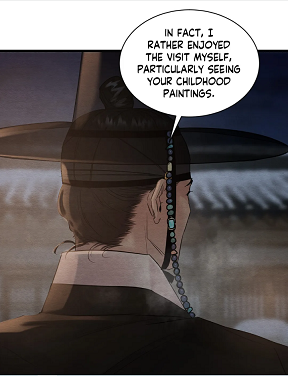 (chapter 94) He painted animals and as such nature.
This changes the moment the painter meets the protagonist Yoon Seungho. The noble is able to trigger his unconscious, therefore he is able to create a terrific painting,  (chapter 2) although he hadn’t created anything for almost one year. From my point of view, this is the return of the painter’s passion. That’s why he paints under trance. Even the master was expecting that the painter wouldn’t be able to produce such a good work right from the start. However, he was proven wrong. Now, I am wondering if this gesture wasn’t the light igniting his repressed sexual desires and as such his dormant talents:
 (chapter 1) Sure, the painter’s mind was reminding him that this is filthy and vulgar, yet I sense that this affected the artist’s unconscious a lot. All the wet dreams Baek Na-Kyum had, the seme’s phallus played a huge part. Thus we have such drawings in the fantasies, where the protagonist’s sex is in the center of the painter’s imagination:
 (chapter 2)
  (chapter 6)
 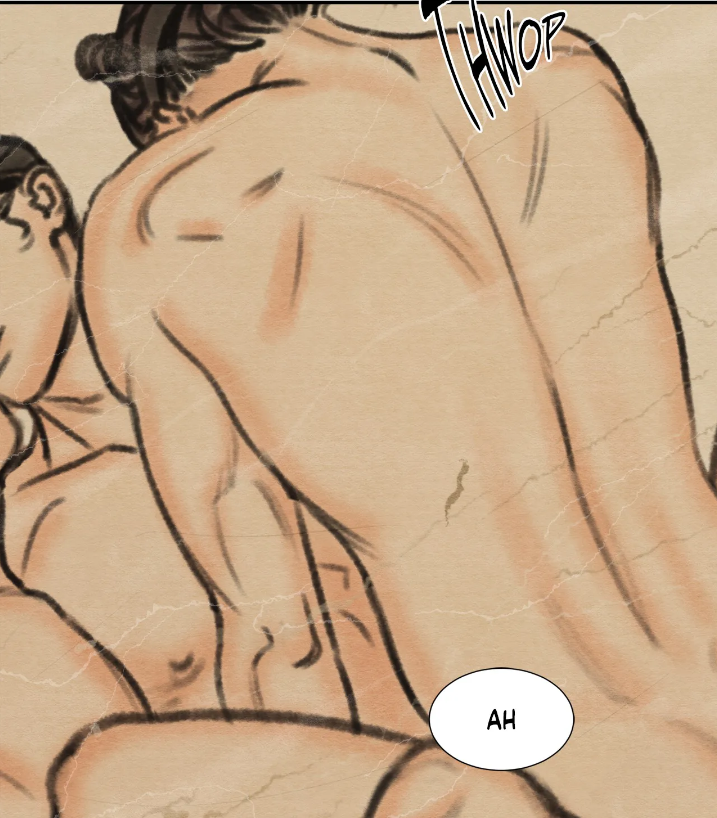 (chapter 8)
Since in the chapter 49 he confesses to his “husband” that his body is affected by him, (chapter 49), it becomes obvious what this confession means. In front of his partner, the artist is declaring that he will use their sex session as a source for his creativity. On the surface, it looked like the painter was using the noble as his sex toy, since the latter is the one kissing, licking him so that he feels good. Hence the latter got upset while hearing this admission. However, the real message is that his interaction with Yoon Seungho will help him to create new paintings. As you can sense, Yoon Seungho is getting closer to his ultimate goal each time. From my point of view, this was only a matter of time, until the painter realized his true feelings for the noble. It would have come much sooner, if people like Kim, Jihwa and Heena hadn’t meddled in his life. From my point of view, when Yoon Seungho was thinking this , the painter had the exact same mind-set. Since he would follow where his body would lead him, then this meant that he would follow his heart. Thus we have this confession in the kisaeng house: (chapter 94) The painter followed his heart. Observe that the numbers have been switched: 49-94. The mirror effect and in the study we had a reflection too. Both main leads reflected each other’s minds: acceptance of a sexual relationship, but rejection at the same time, no strings attached.
The heart is a part of a body and soul. This means that the lord has already become the painter’s source of inspiration.  (chapter 94)
  (chapter 94) So the lord is now associated to the moon and as such to nature. Thus I conclude that the noble will discover the painter’s true talent. From my point of view, his new paintings won’t be just erotic pictures about himself with the uke, but also about nature (animals, plants). The diversity of the topics will increase, yet I am sensing that the pictures will definitely reflect the painter’s love and admiration for the seme.
  (chapter 92) Yes, it is very likely that Baek Na-Kyum decides to recreate this scene, because we could see that Baek Na-Kyum’s heart and soul was moved. A new version of this scene:
 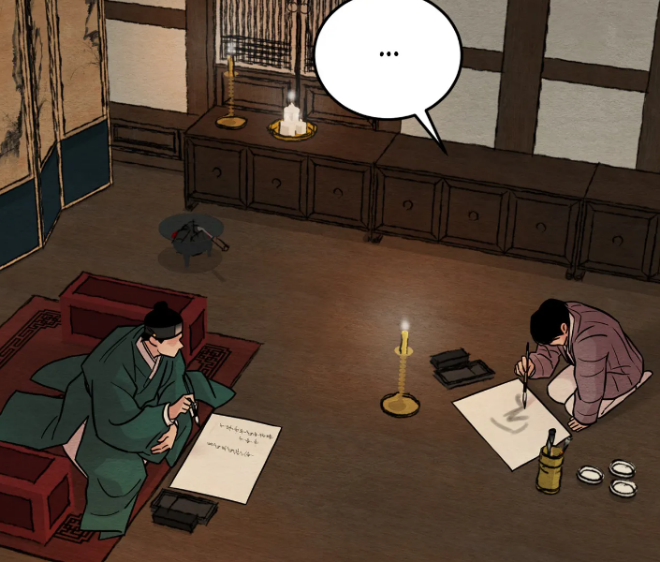 (chapter 36) Besides, the painter’s works will reveal what the protagonists feel and think about each other: love.
But let’s return our attention to episode 49. In my opinion, the last thoughts in this chapter illustrate the protagonists’ innocence. Both were deceiving themselves in order to protect themselves from pain. These confessions reflected their similar philosophy: “to let my body take the lead” and as such the acknowledgement of sexual pleasure.
First,  the ” I feel good” symbolizes the climax of his disclosure. Note that “I” and the body “feel good” are what matter to the painter. The noble comprehends the low-born’s philosophy, hence he is annoyed.
 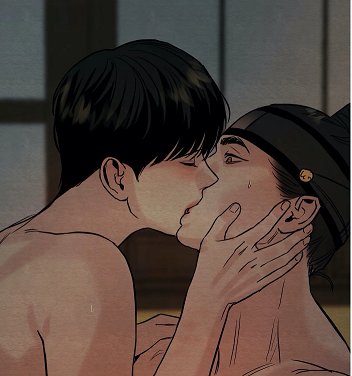 (chapter 49) But the kiss and the caress catch the powerful noble by surprise. These gestures stop him from complaining, because he is surprised by the painter’s initiative. Simultaneously, the kiss reminds him of the first Wedding night. This time, the artist is kissing him and not the scholar, so it is an improvement. He is recognized as his sexual partner.
Striking is that we see the lord making love to Baek Na-Kyum, for he is hugging the painter’s body  . He is even protecting his head. He has never been so close to him before. Despite the hurt, the noble accepts his new situation, unaware that he has come one step closer to his goal. The tragedy was Yoon Seungho had no idea about his real wish. Unconsciously, he desired to be loved by Baek Na-Kyum. This explicates why it took so long for the protagonists to become a real couple. The lord had not recognized the existence of his affection. He thought, he was motivated by his mind, which is here reflected in the study. The reality was that he was motivated by his wounded heart. However, deep down he was lowering his expectations, for he had been hurt.
Feel free to comment. If you have any suggestion for topics or manhwas, feel free to ask. If you enjoyed reading it, retweet it or push the button like. My Reddit-Instagram-Tumblr-Twitter account is: @bebebisous33. Thanks for reading and for the support, particularly, I would like to thank all the new followers and people recommending my blog.

This is where you can read these manhwas. https://www.lezhinus.com/en/comic/painter https://www.lezhinus.com/en/comic/legsthatwontwalk But be aware that these manhwas are mature Yaoi, which means, it is about homosexuality with explicit scenes. Here is the link, if you are interested in more analyses about manhwas https://bebebisous33analyses.com/2021/06/06/table-of-contents-of-analyzed-mentioned-manhwas/
It would be great if you could make some donations/sponsoring: Ko-fi.com/bebebisous33 That way, you can support me with “coffee” so that I have the energy to keep examining manhwas. Besides, I need to cover up the expenses for this blog.
During the first season of the manhwa Painter Of The Night, we have many scenes where illusion and reality are mixed or where reality differs from the appearances.
In the first case, I could mention the daydream in the chapter 2  (chapter 2) or the wet dream in the chapter 6 where the painter’s repressed natural desires resurface. The readers are a little confused because initially they have no idea how to judge these drawings. Are they reality or fiction? This is in particular visible in the following picture: On the surface, it looks so real, while in reality this image was a vision in Baek Na-Kyum’s dream which marked the start of his unleashed unconscious. In the wet dream, we had a similar question. The beholder wondered if these images were true memories or fantasies.
 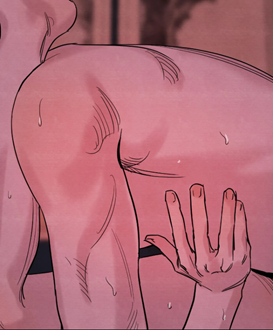 (Chapter 2) These were a mixture of both, although the more pictures we got, the more it became an illusion, a phantasm. As you can observe, the boundaries between seem and real were sometimes not clearly defined. The beholder had to distinguish this.
In the second case, I could refer to the chapter 42 and 43. While the reader witnesses Seungho embracing wholeheartedly the painter and detects the longing for affection and warmth from the noble as much as he is expressing his love for the low-born, Jihwa imagines to see something else. Baek Na-Kyum is the one who seduces the powerful lord hence he believes to detect a cunning smile on the artist’s face.
  (Chapter 43) The red-haired man is too biased towards the young low-born because he has so many prejudices against commoners. He believes that each low-born has no principle and virtue and will do anything in exchange for power, money in order to improve his life. However, the reality is different from the illusion Jihwa experienced.
Baek Na-Kyum is so pure and innocent, he has strong principles. When he made the vow to never paint any erotic pictures, he was willing to suffer which underlines his determination and strength. He might have shed some tears but he never regretted any decision. What Jihwa failed to see is that he was projecting his own mentality into the painter’s mind. In fact, the one who is somehow corrupted and influenced by power and money is our red-haired man. Let’s not forget that Jihwa claims in the chapter 18 that he has been using his friend all this time.

Sure, he did it in order to maintain a certain dignity and out of pride, yet I suspect that there was some truth in his words. He might have loved Yoon Seungho but not to the point to have his reputation ruined as sodomite. His intimate interactions with Yoon Seungho occurred behind the curtain under the excuse that they were childhood friends.
Let’s not forget that Jihwa did cover his body so that the servant wouldn’t see the hickeys left by the seme. (chapter 3) Furthermore, it seems that each time Yoon Seungho had a sex session with Jihwa, he had no other sex partners.
  (chapter 13). Notice that Jihwa wasn’t present at the sex orgy in the chapter 33 hence he trusted Min’s words when the latter told him that the seme was hopping from one bedchamber to the other. From my point of view, Jihwa never participated in that kind of events that’s why he was able to have a clean reputation.
And in that instant you know why, for the other nobles like Min, it was visible that Jihwa was pinning for Yoon Seungho. My suspicion is that he only had our alpha seme as sex partner. Now, you can imagine why Jihwa must have resented the low-born so much after the chapter 18. The nature of his relationship with the protagonist was revealed, when he was dragged by the topknot in front of the servants. Here through their yelling, Jihwa tried to force his childhood friend to give up on the commoner. 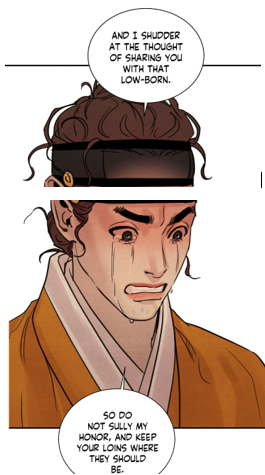 (Chapter 18) With these words, the red-haired noble implied that his friend had to choose between him or Baek Na-Kyum as Jihwa had no intention to share him with the artist.
This reinforces my impression that Jihwa had always perceived himself as Seungho’s lover who was willing to share him with other nobles. He had been expecting all along that at some point, the protagonist would realize that Jihwa loved him. Striking is that after that topknot incident, Jihwa could no longer keep this honorable image and started acting like a spoiled child and paid no attention to his reputation as a noble. 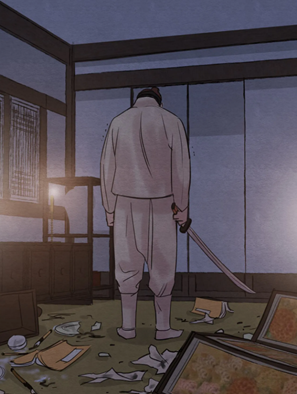 His servants have to clean his mess here. He became himself a drunk.
  (chapter 36)
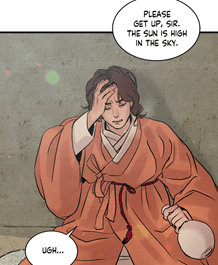
Imagine that in the picture above the depressed noble slept on the street and his servant had to wake him up so that we can assume that the servants must have gossiped about his drunkenness and lack of dignity. The aristocrat doesn’t pay attention to his own image as a honorable noble any longer. He is too affected by the riff between him and Yoon Seungho.
But the illusion in the chapter 43 is just the result of his misinterpretation of the scene in the chapter 12 and the sex session in the chapters 14 and 15. We know that he has no info about Baek Na-Kyum hence he is unaware of his past and the vow. Yet I have to object that the friend never tried to get any info about the painter. He just saw him as a commoner hence as someone below his social status. That’s the reason why he became the victim of an illusion so easily, although in reality he might have already perceived some truth behind the appearances.
Now, let’s examine the scene in the chapter 12 where the boundaries between seem and real were mixed, just like in the first case. 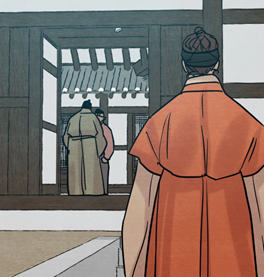 (Chapter 12) Nevertheless, it contrasts to the first case as in this scene every action is real, it just depends on the interpretation of the participants. Here, the red-haired uke is observing from far away how Yoon Seungho is treating the low-born. We have to remember that his perception of the reality is limited because the lord is turning his back to him and is in front of the painter. Secondly he stands too far away to be able to hear their conversation. In other words, he can’t see Yoon Seungho’s facial expression nor the painter’s face as the master’s shoulder is covering his face. Based on these parameters, I selected all the pictures Jihwa could witness due to the movement of Seungho’s arm and hand:
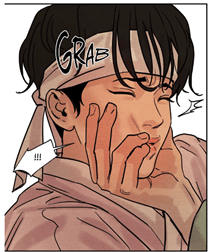


All the lord’s gestures displays care and gentleness. It was as if the lord was caressing the artist’s face and the hair. We have to remember that while Jihwa observed these gestures, he had already caught that Yoon Seungho would show more respect towards the low-born than himself. 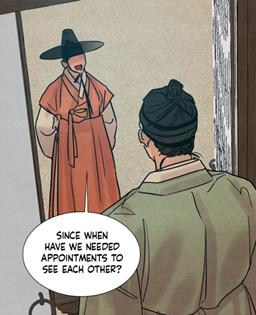 (Chapter 12)

While the noble hadn’t left his room to receive his guest, he made the effort to come towards the artist the moment he appeared. Besides, we shouldn’t forget that he had been warned by his aristocratic friend that Seungho was somehow fascinated by the painter’s gaze.  (Chapter 14) All this led the jealous man to the conclusion that there was something going on between the commoner and his childhood friend. However, we have to remind to the readers what Jihwa couldn’t see in the pictures above. The uke was avoiding the master’s gaze. Either he closed his eyes or looked down. If he had witnessed it, Jihwa would have realized that the fascination was coming more from his childhood friend than the reverse and as such, Baek Na-Kyum didn’t seduce the lord in this chapter. For him, the reality was that the low-born was using his position and influenced the lord in a bad way. He was already showing some favoritism. This perception of the reality was definitely influenced by his biased view about commoners.
What he couldn’t view or hear is the following:
– a smiling master making a ironical remark 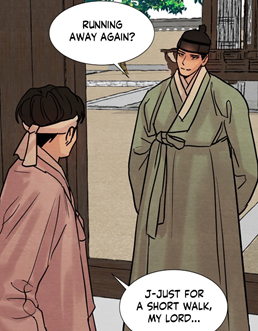
– The content of the whispering 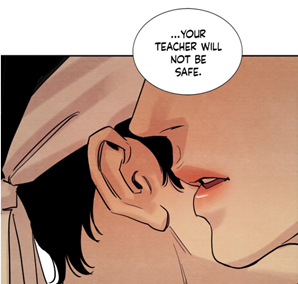 (Chapter 12) Here, the master is actually threatening the commoner. So his words stands in opposition to his gentle demeanor.
– What looked like a caress from far away was actually a scratch.  (Chapter 12)
For Baek Na-Kyum, there was nothing like a caress and a nice comment. Behind the appearances, he was hurt and threatened. For him, this was the reality. The gentle smile with the ironical remark was just a mockery and a simulacrum. He was hiding his true personality behind his caring manners. Now, you can understand why Baek Na-Kyum can not perceive the affection from the protagonist’s due to his past actions. From his perspective, the master was disguising his true nature. He had already witnessed his ruthlessness and violence therefore he took the menaces very seriously. In other words, Yoon Seungho appeared to be fake, his gentle manners were just an act. The gentleness was just an illusion. That’s why Seungho will suffer so much later, as he has to pay for the consequences of this behavior. Baek Na-Kyum could no longer distinguish reality and illusion. Even if the master asked for a doctor, in the low-born’s mind, it was possible that this care was linked to a new thread.
Now, if we look this scene from Yoon Seungho’s perspective, we have a different reality. His threads are real, just like his tenderness and smile are genuine as well, so this huge contradiction mirrors the noble’s personality. He hurts the boy by using his finger nails but not to injure him for real. In my opinion, the scratching has a different signification. He is already targeting the painter as his next prey. Deep down, he has already fallen for the artist but he is under the illusion that he has everything under control, he just needs to use his position as lord, his sexy body and charisma so that the uke will fall for him as well. The lord makes the mistake not to realize the true meaning behind his own actions what Jihwa could observe from a distance. He has already fallen under the spell from the painter. He behaves under the illusion that this is just a matter of time until he can taste the commoner. While he perceives himself as the one with the upper hand, he is not aware of Baek Na-Kyum’s strong will and strength. As you observe, being and appearances are much more difficult to discern. I believe that here, the lord’s unconscious was visible. Besides, we have to remember that these values are highly affected by the perception and interpretation of the participants or observers. In Seungho’s case, we could say that his unconscious was somehow triggered by the painter’s gaze which brought to light a new side of the lord and the latter was not aware of it… only Jihwa and his loyal valet could detect the true meaning behind his unusual behavior.
That’s the reason why it is important to pay attention to details and not judge too quickly. Like I wrote above, the boundary between seem and real is not clearly distinguished. Now, I will take an example from another manhwa in order to sensibilise the readers to question being and seem to be. The manhwa in question, called “Legs that won’t walk”, is written by Black apricot which has just been released on Lezhin.
Striking is that this manhwa is in black and white, as if there was only darkness in the protagonist’s life. The choice of colors underlines the depressing and violent atmosphere oozing from his manhwa reminding me of a Roman noir, “a subgenre of crime fiction where right and wrong are not clearly defined, while the protagonists are seriously and often tragically flawed” (Definition from wikipedia). In other words, there is no superhero here, only dangerous and flawed characters indicating that this story will be quite heavy.
The main character is Kwon Soo-Young, a former boxer who became handicapped after a match. On the surface, he looks pitiful and weak hence the passerby often excuse themselves, when they shove him by accident or see him walking.
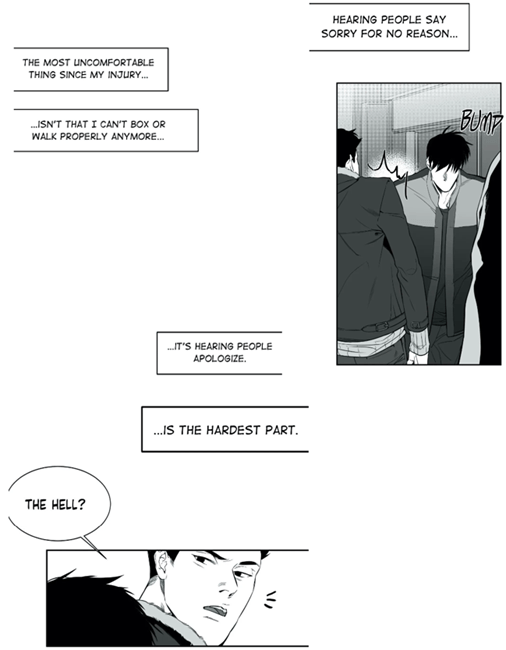
This infuriates him but he doesn’t express his anger and fury in front of them. Yet his personality stands so much in contrast to his physical condition: he is resilient, brave and quite strong-willed. Even at the lowest point of his life, he has been beaten up by the boss from a gang,

the loan shark Park Tae-Seung, he fights back

and is able to punch the gang leader.
This resistance and perseverance catch the boss by surprise. He never expected this reaction from someone like him, with so many bruises and a handicap. He thought that the man would beg for leniency and ask for time to repay the debt. Kwon Soo-Young has to reimburse the debt from his abusive father. The former has already cut ties with him and the reason for his rage and fighting spirit is definitely linked to his tragic and terrible childhood. Therefore we learn through Soo-Young that reality and appearance can be really deceiving. The exterior doesn’t really reflect what we truly are. Impressions can mislead to false conclusions and interpretations. But this is not the only case where appearance and being can differ so much. The other character is the ex-boyfriend Song Si-Jung. Here, the exterior doesn’t contrast to the interior, rather it was as if he had two personalities, as if he was Mr. Hyde
and Doctor Jekyll.

He is very difficult to discern and only after rereading the chapters, I could discern the darkness in this character which Soo-Young has already sensed but not really understood. Behind his smiles and gentle demeanor, he is a very violent and manipulative person. In the following scene, you’ll observe again his double personality. When another boxer enters his father’s club, Ji Sung is smiling and polite.
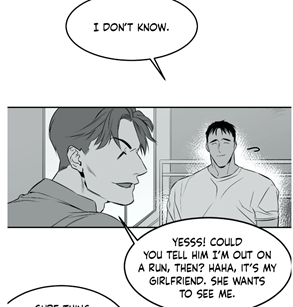
However, the moment the friend reveals that someone with a crutch was standing in front of the club, his facial expression changes so abruptly.

He looks really scary and you can sense his possessiveness and obsession about Soo-Young. So first impressions can have tragic consequences, for Soo-Young it was the case. He saw a smiling and nice Si-Jung showing some concern and inviting to join his boxing club. However, his relationship with him was the reason why he lost his leg.
Just like in the manhwa Painter Of The Night, there is a scene where the boundary between illusion and reality is unclear, so confusing that the reader has some difficulty to judge the situation.
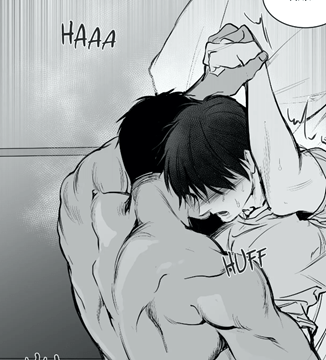
Is it a rape or not? This is quite difficult to judge at first and this mirrors the reality. A verdict in a rape case is not easy to sentence, especially if the involved parties were or are in a relationship.
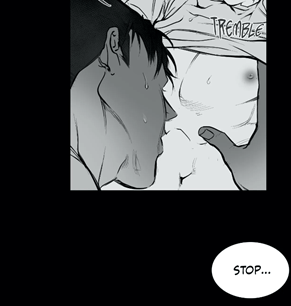
Despite the endearing name, he asks the man to stop which means he is not willing to have sex. In that moment, the boyfriend looks at Soo-Young with a scary expression. Here, the uke can perceive the violent side of his “boyfriend”, he won’t accept a refusal.
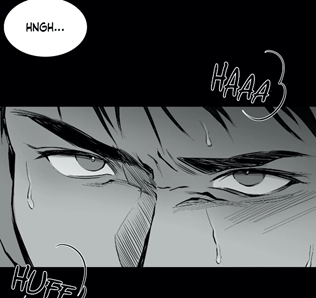
The frightening gaze deeply affects Soo-Young, he gets scared, thus he doesn’t really fight against Si-Jung.

From my perspective, Soo-Young is actually raped, but the latter doesn’t seem to realize the true nature of this sex session. Si-Jung is using his “charisma” and “Mr. Hyde”‘s personality to submit the uke. Fact is that after this sex session, Soo-Young never pressed charges against the boyfriend. Strangely, the uke appears defenseless and vulnerable, which is actually reflecting the real nature of his relationship with Si-Jung. The latter is physically and mentally abusing the uke, yet the man with the crutch has not realized it yet. The climax of this sex session is the following situation:

It looks like the top wants to help Soo-Young. He is willing to pay for the surgery bills so that Soo-Young can walk normally again. At first, the reader has some difficulty to understand the main character. Why would he refuse help? Is he emotionally unstable or does he do it out of pride? Fact is that Si-Jung wants to bind him forever so that Soo-Young can never escape from his claws.
Soo-Young has already sensed the terrible truth behind these words, besides the threatening tone in the voice made it clear that Si-Jung wouldn’t accept a rejection. Notice that Si-Jung used sex to coerce the protagonist. That’s why the latter only fights back soon after and pushes the boyfriend away.

The moment he is able to run away, the gentle side of Si-Jung resurfaces.  It was, as if the protagonist would awake the beastly instincts living inside the boyfriend. However, this rape doesn’t change the fact that Soo-Young has some love and affection for Si-Jung. He confesses to himself that he would like the boyfriend to find him and support him.
That’s why he stood in front of the boxing club, but didn’t dare to enter. Unconsciously, he has already detected the double personality of his hyung and still loves him, because he is the only one who showed concern and affection so far in his life. Yet, he doesn’t want to live in another abusive household like in his childhood. Now, you can understand why this manhwa is quite interesting. The relationship between Soo-Young and Si-Jung is quite complex, just like the characters. Impressions are quite deceiving and the bad boy can be the next-door neighbor with a huge smile.
Soo-Young fell for the illusion, but has already detected a part of the reality. Furthermore, the uke is quite strong… at the end of the sex session, he was able to free himself from a manipulative and brutal man despite his handicap.
As a conclusion, appearance and reality are two important aspects, because they serve to question the true nature of actions and gestures. What we saw or felt can in reality totally different. Consequently, it becomes clear why we shouldn’t judge people too quickly. People need to question people’s actions and words.
Feel free to comment. If you have any suggestion for a topic and a manhwa worth an analysis, feel free to ask. If you enjoyed reading it, retweet it or push the button like. Thanks for reading.

This is where you can read the manhwas. https://www.lezhin.com/en/comic/painter https://www.tappytoon.com/comics/painter-behind-curtainm. But be aware that these manhwas are mature Yaoi, which means, it is about homosexuality with explicit scenes, although there is a softer version for “A Painter Behind The Curtain”. Here is the link, if you are interested in more analyses about this manhwa and others https://bebebisous33analyses.com/2021/06/06/table-of-contents-of-analyzed-mentioned-manhwas/
If you have already read the analysis about “Traces of “Dangerous liaisons” and “Justine: The Misfortunes of Virtue”, you know why I am now using the other manhwa “A Painter Behind The Curtain” created by Munamu. Both works have a lot in common, not only the historical setting but also the story as such. Both stories have a painter as a protagonist and the latter share a similar fate: a lot of suffering.
Since many are not familiar about A Painter behind the Curtain, I’ll just give a short summary. The story has 70 chapters but only 26 have been released in English. The main character is Ian Sconel, a talented painter who was sold as a child by his father to the Bardis, as soon as Mr. Bardi recognized his talents.

Since The Bardis have a long tradition of painters in their family, the father wanted to use the young boy’s talents in order to maintain the family’s reputation and their high lifestyle as renowned painters for the aristocracy. Mr. Bardi let his buyers think that his second son Jeremy was the genius one, whereas Ian Scornel was the one who created all the masterpieces. That’s why the author chose the title “behind the curtain”, as he painted the whole time hidden from the eyes of the others. The title is also referring to the meeting of Ian Sconel and the other protagonist, Mr. Raymond.

If we compare the two artists, we will notice that despite the different location (Italy-Joseon) both come from the bottom of the society. That’s the reason why the two men are illiterate.
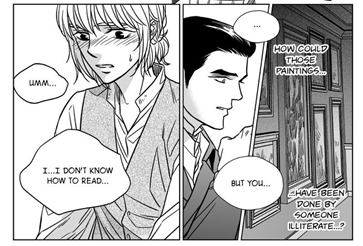
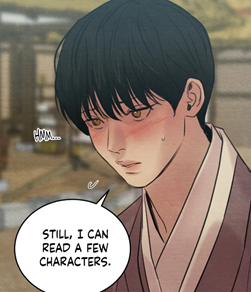 (chapter 40)
Moreover the two felt the need to paint all the time as children.
chapter 1

Although they were both passionate about painting, Baek Na-Kyum’s drawings were limited to one subject: erotic pictures of sodomy. The difference is quite easy to understand: Baek Na-Kyum was raised at a gisaeng house, where sex was a common thing. Besides, this also outlines that the korean boy knew right from the start about his sexual orientation. For Ian, we discover that Mr. Bardi is sexually abusing him. So his homosexuality wasn’t determined right from the start. Little by little, Ian falls in love with Mr. Raymond because the latter treats him so well. But since servants confessing their love to Mr. Raymond are immediately fired, Ian has to hide his feelings for him. Baek Na-Kyum has also to hide his feelings in front of the lord, or better said, he has to fight against his repressed sexual desires (chapter 6), as he has been manipulated by the teacher Jung In-Hun that homosexuality is something filthy and immoral. (chapter 34)
The other common denominator is that the two men became victims of rape,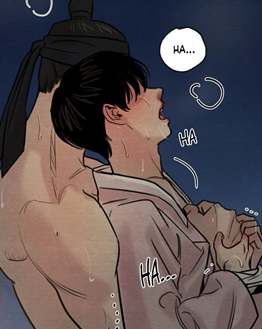 (chapter 26) even if Ian was sexually abused quite often as he spent many years at the Bardis before getting “rescued” by Mr. Raymond.
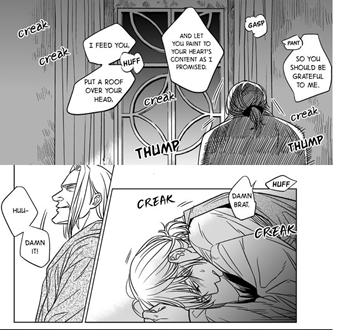
Notice that during the rape, Ian has to listen to Mr. Bardi’s words that the latter is his benefactor, since he gives him the opportunity to paint and he has a roof over his head. All this leaves deep scars in the painter’s mind which explains why later he refuses to paint any longer.

The blond haired man vows not to paint any longer as he saw it as the cause for his misery and suffering, while Baek Na-Kyum was coerced by Jung In-Hun to abandon paintings due to the sodomy. The two painters have at some point kept their distance from their passion.
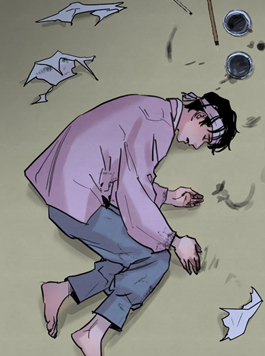
But let’s go back to Ian’s paintings. Ian is forced to paint what Bardi wants so he is limited in his creativity. Whereas Yoon Seungho also restraints the low-born in his creativity, since he has to paint sex scenes, Ian has to create religious paintings or scenes with nobles.
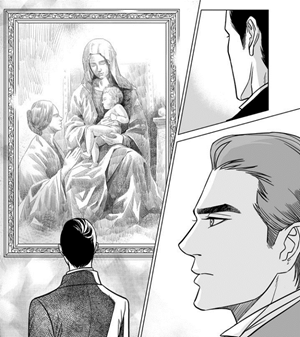
Both sponsors use their position to impose their will. The painters have no right to refuse and to choose their subjects based on their inclination or inspiration. This outlines their precarious situation as they are dependent on the sponsor. Yoon Seungho’s attitude does resemble Mr. Bardi’s behavior, yet there is another huge contrast too. Ian is kept captive in his room, can only get food if the picture is finished. That’s why he is often hungry and very skinny.


On the other hand, Yoon Seungho shows a certain favoritism because he placed Baek Na-Kyum right next to his bedroom and the former is even willing to eat his lunch with him.
 (chapter 11) Despite the difference, they both have to please their sponsor with their work. If there is disobedience, then there is also punishment:
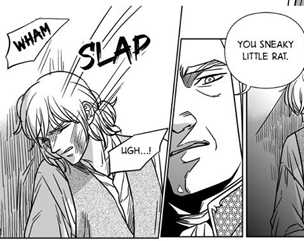
(chapter 13) The low-born was about to get the straw mat beating, until the lord changed his mind. However, just like Ian, the young man had been slapped and even pushed by his “sponsor” before. Ian’s suffering lasts much longer because he arrived at the house as a child and he was already a young man, when he was able to leave this hell created by Bardi.
All these aspects are here dramatized, however this was the reality for painters in the past. Even Vincent Van Gogh couldn’t live properly as he had no real sponsor outside his family. Many painters had to adapt themselves to the taste of their “clients” in order to earn money that’s why many artists chose to paint following the trend and the rules. In other words, the painters’ creativity and curiosity for experiment were bounded, just like in the two fictions.
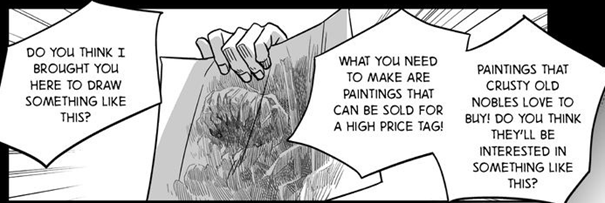
Baek Na-Kyum became a successful painter because he published many erotic books which the nobility was fond of.

Sure, he had to publish them under a pseudonym, nevertheless his books were quite famous as he was able to survive as a drunk without painting any longer. So even if the topic was taboo, aristocrats were quite interested in such drawings. In order to get attention from the nobility, Ian is also reminded by Henry, a noble, that he should paint based on the trend but this time, Ian refuses. Unlike Bardi and Yoon Seungho, Mr. Raymond gave him the freedom to paint based on his inclination.
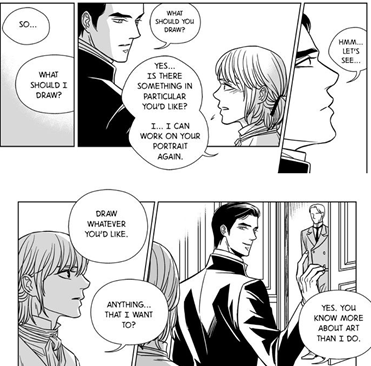
The other disparity is that Yoon Seungho wanted to keep the paintings to himself, he never wanted to let people see Baek Na-Kyum’s talents or to earn money with it. It was as if he was determined to own the painter so that he could keep him hidden from people’s attention, as if he wanted to put him behind the curtain. And notice that the noble is not interested in encouraging the artist to develop his talents.  (chapter 41) He was jealous and annoyed, when he saw the picture of Jung In-Hun’s inauguration so that he failed to see the talent and dedication in this different type of drawing. So there is a certain selfishness in the seme here but I am expecting that this will change. He could have noticed that the low-born’s talent is not just defined by sex and sodomy but his insecurities made him blind in that moment. Yet, this painting has been given to the loyal valet Kim so that it can get destroyed. But I feel that Kim might give it to his master or keep it. I have the feeling that this painting will play a bigger role in Baek Na-Kyum’s career later.
Now, people who haven’t read “A painter behind the curtain” might think that Yoon Seungho is the Joseon version of Bardi, however they are wrong. Actually, he is a mixture of Bardi (due to his selfish and violent side) and Mr. Raymond. If you look at the image where Mr. Raymond is looking at the painting, you’ll notice his fascination and admiration for the work created by Ian.
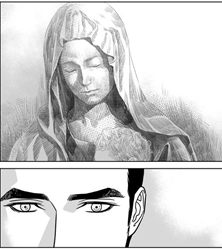
The so-called merchant is definitely moved by the creation and the gaze is again revealing the affects caused by the painting. He keeps starring at it, there is a certain calmness and relaxation oozing from his eyes. Just like Yoon Seungho, the bourgeois falls in love with Ian’s pictures. And little by little, he falls in love with the artist himself. As you can see, the paintings serve as a bridge between the two men, Yoon Seungho wants to find the man with the talented hands and at some point Mr. Raymond will realize Mr. Bardi’s fraud and the origin of the paintings: Ian.
However, Mr. Raymond’s kindness and gentleness is not selfless in reality. He needs the artist’s talents in order to get closer to the nobility and as such to power. Art and paintings are linked to power because rulers and even the Church used art in order to legitimate their authority.

At the same time, only painters working for the Church or the King had a rather comfortable life. Yet they had to paint what they were told to. Just like Yoon Seungho, the bourgeois is motivated by revenge but uses art as his tool and not sex. Mr. Raymond has a different approach therefore he needs Ian’s talent and help.

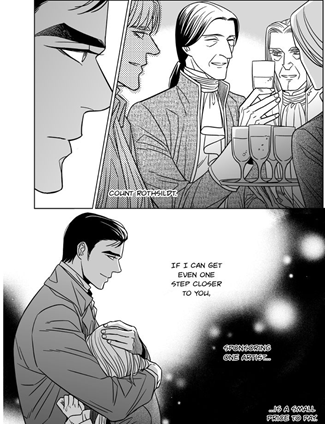
Mr. Raymond is not powerful like the lord from Joseon, since the merchant only belongs to the third state, the commoners. He wants to obtain power as he suffered injustice in his childhood.
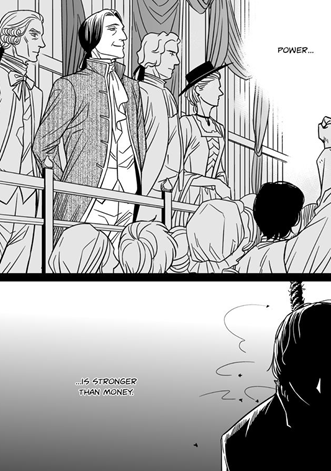
His father was executed due to a scheme perpetrated by count Rothsildt. So far, he has internalized that only in a powerful position he can get revenge and protect himself and his family from any injustice. Since he is just a bourgeois, he is despised by the aristocrats, at the same time they seek his company as many nobles are facing financial issues which is historically correct. Just before the French Revolution, many bourgeois were even richer than nobles, especially many low nobles were impoverished… which reminds us of Jung In-Hun at the same time. So his role as a sponsor for a talented painter represents his way to get access to power. Like I have mentioned above, for kings talented painters are a tool for the securing their own power.
Since Mr. Raymond has to rely on Ian’s talent, he can’t behave like Yoon Seungho. He needs to win the painter’s trust hence he teaches him reading and writing. Striking is that Ian is compared to a cat,
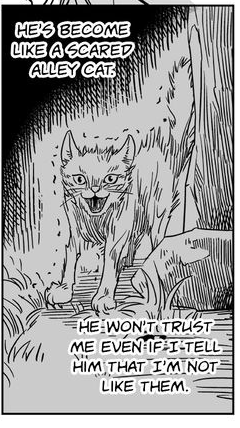
whereas Baek Na-Kyum’s behavior reminded me more of a lamb. That’s why their position contrasts so much. Ian has the upper hand right from the start with Mr. Raymond and in Painter Of The Night, it is the opposite. Seungho can use his position as lord to force the man to paint, yet as time passes on, the situation reverses. At the end of the first season, Baek Na-Kyum has the upper hand in their relationship. Seungho wants to have the artist’s consent, when it comes to sex. He no longer uses his position as lord.  (chapter 41)
This explains why Ian is given so much freedom by the bourgeois. As time passes on, Ian’s PTSD disappears and the artist can develop his own interest and change his techniques. Thanks to Mr. Raymond’s support, he can choose the topic of his paintings and the methods which announces a huge change and innovation in the art. Ian shows an interest for commoners or for landscapes.

The way he paints as well, reminds me a lot of the Impressionism, an art current characterized by relatively small, thin, yet visible brush strokes, open composition, emphasis on accurate depiction of light in its changing qualities (often accentuating the effects of the passage of time), ordinary subject matter, inclusion of movement as a crucial element of human perception and experience, and unusual visual angles.
Impressionism originates with a group of artists living around Paris whose independent exhibitions created a wave of scandal and attention at the end of the 19th Century. Famous painters from the impressionism are f. ex. Monet, Pissarro, Renoir, Sisley, Morisot. But Van Gogh and Cézanne were highly influenced by this art movement until they developed their own style. These painters decided not to follow the rules by the Art Academy which explains why many painters from that current struggled a lot. Only Renoir and Monet could become rich and successful before their death. And now, if you look at Ian’s paintings, you observe that Ian has the same thinking and approach as he paints on his impressions. Now, I am adding a picture where the beholder can view the paintings that the nobility liked.

The beholder observes the huge contrast as Ian no longer paints religious scenes or mythology, his focus is more or less on daily situations: they have less pathos and ooze more humbleness. But thanks to Raymond, Ian Sconel is able to catch the attention of a famous court painter. However, we shouldn’t forget that this young man wouldn’t have been able to develop his skills any further if Raymond had not entirely supported him.
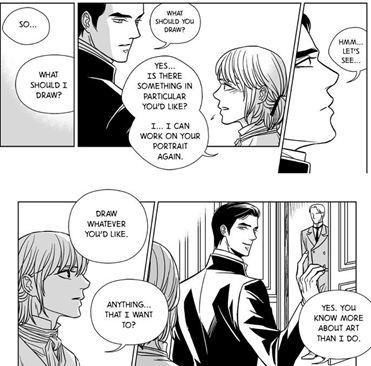
That’s why the attitude of a sponsor is really important, he can brake or improve the artist’s talents.
Now, if we return our attention to Painter Of The Night, the reader notices that Yoon Seungho was only focused on getting new paintings for his own pleasure. The interest of the low-born never mattered. However, I sense that the lord might come to change his attitude and even help him to develop his talents. Just like in “A Painter Behind The Curtain”, I am expecting that the master will teach Baek Na-Kyum to write and read. Secondly, we know for sure that he has connection to the Royal Academy

and Baek Na-Kyum has for the first time painted on another topic: the inauguration of the low noble Jung In-Hun. (chapter 44) The drawing was detailed and totally different from the erotic pictures. So I am expecting that Yoon Seungho turns into a real sponsor and becomes more and more like Mr. Raymond. However, the latter will have to choose at some point between power or love. By taking care of Ian so well, he wanted him to open up but at the end, Raymond fell in love with the genius too. While one artist could incite arousal with his creations, the other could calm the resentful merchant. Strictly speaking, their art had a huge impact on the life of the two semes.
Despite the suffering and their tragic past, both artists have the chance to meet someone who will help them to get recognition for their talents and to become more independent. But just like I have been showing all along, the painter’s life in the past relied a lot of sponsoring. The French novelist Emile Zola wrote a novel called “L’Oeuvre” (The work) where he described the struggling of an impressionist. The latter was determined to create a masterpiece with innovations and to get recognition but failed at the end. Zola, a close friend of Cézanne, was inspired by his friend’s life and the impressionism, yet this book became the reason why Cézanne cut ties with his childhood friend as the painter Claude Lantier was portrayed in a rather negative way: he was obsessed and neglected everything else including his family. The reasons why I am mentioning this work are the following. First, it outlines the importance of a sponsor and confirmed what the manhwas are telling in their fiction. Then it reveals the difficulties the avant-garde painters had in order to get accepted. Finally here comes the biggest reason. I had to read this book when I was a high school student and through this work, I came to understand the significance of paintings. That’s how I discovered the impressionism and fell in love with their works. Because of this novel, I could finally understand better why innovations in art movement were related to a fight against Academy and rules. Painters are indeed fighters because what they do can go against social norms and etiquette. That’s why their life is so difficult. The rape, the exploitation might be fiction in the manhwas, yet they symbolize the struggles painters from unknown origins had in order to make a breakthrough.
Feel free to comment. If you have any suggestion for topics or manhwas, feel free to ask. If you enjoyed reading it, retweet it or push the button like. My Reddit-Instagram-Tumblr-Twitter account is: @bebebisous33. Thanks for reading and for the support, particularly, I would like to thank all the new followers and people recommending my blog.
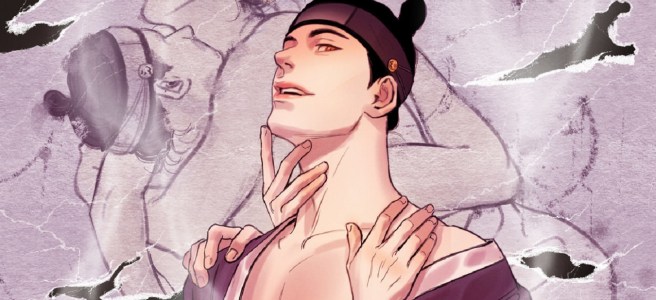

This is where you can read the manhwa. https://www.lezhinus.com/en/comic/painter But be aware that this manhwa is a mature Yaoi, which means, it is about homosexuality with explicit scenes. If you want to read more essays, here is the link to the table of contents: https://bebebisous33analyses.wordpress.com/2020/07/04/table-of-contents-painter-of-the-night/
It would be great if you could make some donations/sponsoring: Ko-fi.com/bebebisous33 That way, you can support me with “coffee” so that I have the energy to keep examining manhwas. Besides, I need to cover up the expenses for this blog
If you have already read my former analyses, you know that our protagonist Yoon Seungho is associated to the window, because he spends so much time in a room looking at his courtyard through the window.  (chapter 35). But what does the window symbolize?
In order to answer this question, let us take a look at the definition of the window:
It’s an opening in the wall or roof of a building or vehicle, fitted with glass in a frame to admit light or air and allow people to see out.
Since our story takes place in Joseon, there is no glass, only thin paper or an open frame, yet it doesn’t change the definition. It’s an opening… that admits air and light and allows people to see out. Striking is that the window is connected to fresh air and sun therefore we can say that through the view, people can definitely broaden their horizon as they are able to witness what it happening outside.
However, let us not forget that their view is limited. Yoon Seungho can only see what is happening in the courtyard, but not in the servants’ room or in the painter’s room. Therefore we come to the next conclusion, the window can represent a barrier, a hindrance. That’s the reason why f. ex. writer Emily Bronte used the window in that aspect in her novel Wuthering Heights.
The window can even symbolize the boundary between the inner world of a character (room) and the outside. Therefore the room could be seen as the personification of the protagonist embodying his inner thoughts and feelings trapped in his darkness. Hence he is seeking light and air through the window. Consequently, I interpret that Yoon Seungho sitting or standing in front of the window like the following. The room seems to be a prison, it is suffocating for Yoon Seungho, hence he looks out of the window in order to be able to breathe and survive. He is caught in his darkness, yet the window allows him to escape from his dungeon, from his past. His passivity reflects his resignation, he is already thinking that nothing exciting in his life will ever happen, until he met the painter. That’s why he said in the chapter 18:
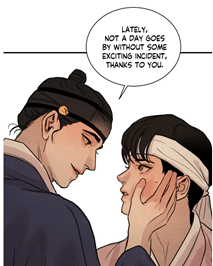
From the moment he met the low-born, he started acting differently. First he kept touching the painter and then he even started leaving the room behind and came to the door. It is interesting that in chapter 7, Yoon Seungho even followed the younger painter, after the latter had heard about the arrival of his admired teacher. Notice how the lord stands in the courtyard and looks at the welcome of the low noble.
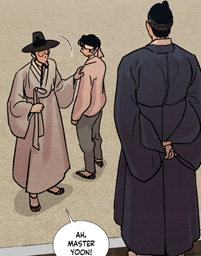
This picture reflects the social hierarchy. Yoon Seungho stands at the top, and the teacher is closer to him. However, if you pay attention to Jung In-Hun’s gesture, he is turning his body in order to face the powerful noble. It was as if he was pushing away the young artist. Now, you realize that such a single picture can contain so much symbolism. But now let’s return to our main topic, the meaning of the room and the window.
So the room with the window represented the situation of the powerful lord at the beginning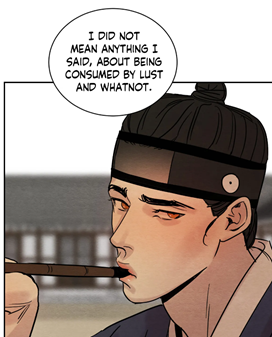 (chapter 5) and it is still there at the end of season 1.
 (chapter 44). It looks like there wasn’t much progression, yet this time, the painter walks towards his mansion and remains by his side.
 This is important, because I realized that with the vanishing of the learned sir, Yoon Seungho chose to remain in the lord‘s bedchamber. What caught my attention is that the lord always went to the courtyard because of the admired sir. We have two chapters for this interpretation: chapter 7 and chapter 35
 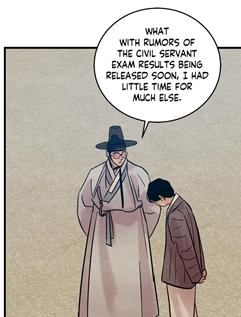 . What caught my attention is that when the lord visited the scholar for the first time, both were sitting in front of a door which looked like a window at the same time.
 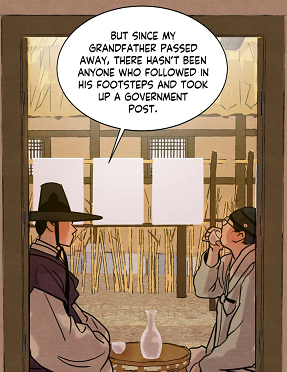 (Chapter 7) This is not random at all, as from my perspective, it introduces the role played by Jung In-Hun in the main lead‘s life. He will be the one forcing the lord to move away from the window so that he can leave the bedchamber. Thus we had this scene: Yoon Seungho is observing the learned sir and his student from far away.
  (Chapter 19) This explicates too why the noble remained so passive in season 2 in the end. Baek Na-Kyum was the lord‘s love interest, hence his „place“ is the bedchamber. So how can the lord move away from the window and as such from the bedroom? Jung In-Hun is the trigger. And note that only in season 2, we discovered how the learned sir used walks through the countryside to console the painter. (Chapter 70) Finally, the main lead organized a hunt for the first time because of his honored guest.
 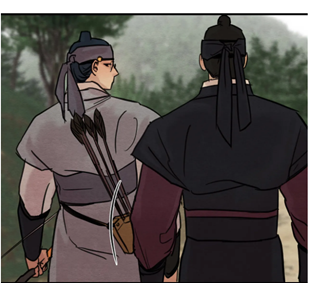 (Chapter 22) And if you recall the lord‘s behavior, you will notice that he left the city for the first time, when he wanted to meet the scholar.
 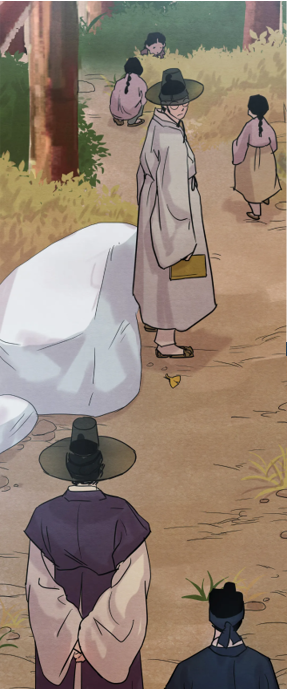 (Chapter 6) He encountered him in the woods. Under this new light, it reinforces my conviction that the learned sir‘s death will be the lord‘s motivation to become proactive and leave his past behind. Why? It is because of the painter‘s words. (Chapter 94) The painter still respects the scholar, but he already loves Yoon Seungho. He is not disloyal towards his former teacher despite falling in love with the protagonist. With the last incident, Yoon Seungho got aware how much the painter means to him, but at the same time, he realized the importance of the learned sir in Baek Na-Kyum‘s life. He needs to answer his question: (Chapter 102) And this question is strongly connected to the scholar, for the main lead was first sent to Jung In-Hun‘s home.
 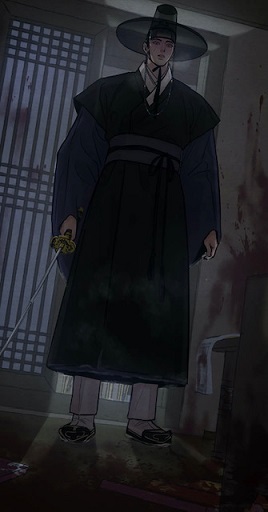 ( 100) Don‘t forget that the main lead saw the room covered in blood, though the latter had already dried. To conclude, the main lead was encouraged to walk thanks to the scholar, and as such to leave his window!
  (Chapter 100)
Therefore it is not surprising why Yoon Seungho remained in front of the window at the end of season 1. He no longer needed to seek him out and bid him farewell.  (Chapter 44) It was the painter’s role. This signified that he was still trapped by his past and trauma, something that he hadn’t revealed to anyone. Since Yoon Seungho is still inside the room smoking in front of the window, it reveals that the lord had not really let go of his past at all, he had not expressed himself in front of Baek Na-Kyum yet. If he reveals his inner feelings and thoughts, this means he will disclose his secret and unveil his vulnerability. This explains why there was no confession from the noble’s side for instance [there were other reasons why he hadn’t confessed anything too], why he was still not sharing his inner thoughts and emotions to his partner.
First, he has never opened up to anyone before. Trust is needed and the artist needs to win that trust, because so far, Baek Na-Kyum had always pushed the noble away. There was still a gap between Baek Na-Kyum and the lord, hence the former didn‘t go to his room, but to his own study. My prediction was that Baek Na-Kyum had to open up first so that the lord could learn from him. And it became a reality. The reason was that the seme was very inexperienced, for no one had ever confided to him. Moreover, he had long internalized that weaknesses must be hidden. Unconsciously, he had already claimed Baek Na-Kyum as his bride, nonetheless this indicated that there was still this distance, this invisible wall between them. We have to understand that Yoon Seungho had never learnt how to share pain and express emotions verbally to others. He had to hide his secret, his past and trauma.  (Chapter 37)
The shaking hand with the fist embodies his repressed inner feelings and thoughts. He had learned to keep everything to himself. Now, you are probably thinking that all this is not entirely new because I already mentioned his passivity. And now, you can grasp the origins of Yoon Seungho‘s silence and inactivity. This stroll through the mountain corresponds to his true revival. 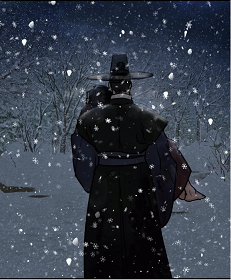 (Chapter 102) This signifies that Yoon Seungho will act differently in season 4: he will be proactive. Like I mentioned in the essay „Scandal(s) in Jemulpo“, he will become the scholar’s disciple and follow his footsteps: ruthless, but also caring and gentle. The only difference is that his affection for the painter is genuine.
However, I needed to describe this again in order to contrast Yoon Seungho’s position with the painter’s situation. What caught my attention is that Baek Na-Kyum is connected to the door, unlike the main lead. We have so many scenes where the low-born is seen close to a door or stands on the doorstep. This is what I could gather so far (I still might have missed some):
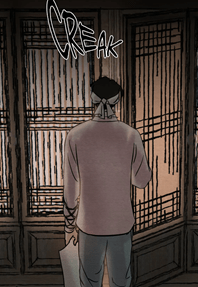

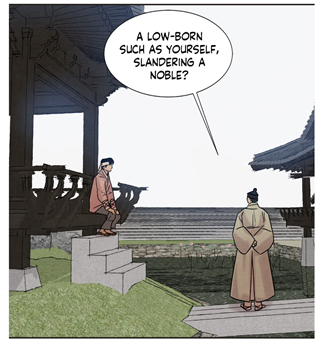 (chapter 10),
(chapter 12)


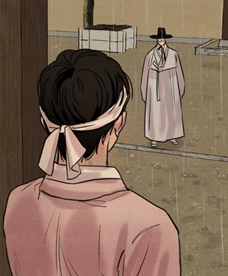
 (chapter 20)
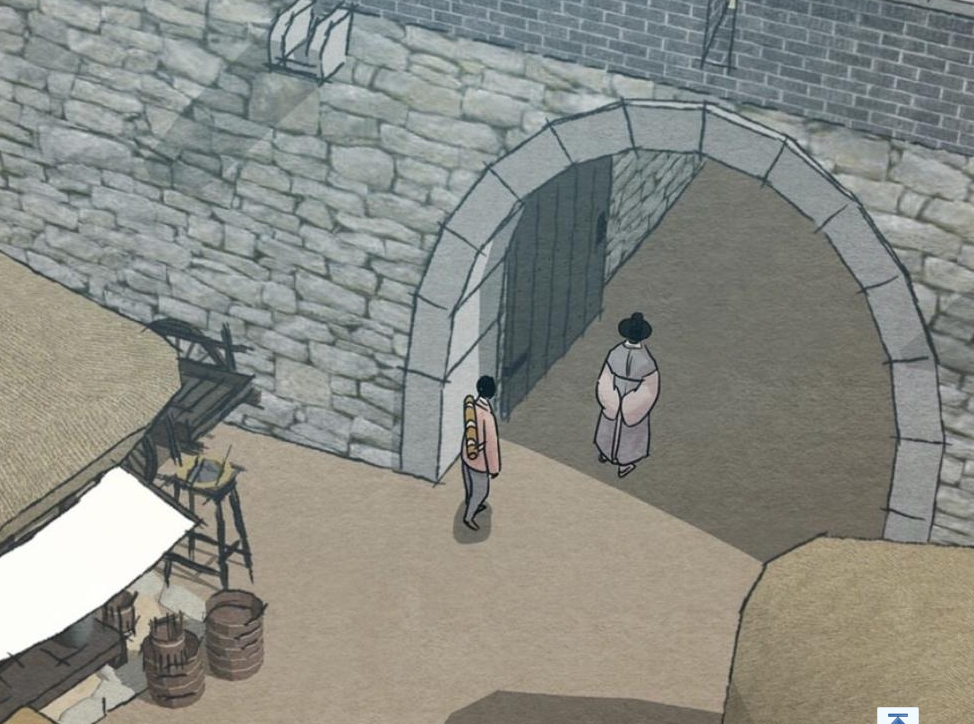 (chapter 29)


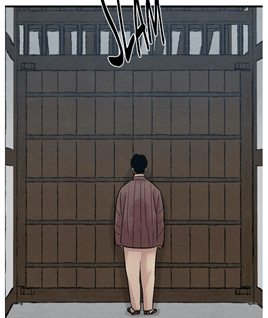


Now, you realize the importance of the door. But what does it mean? Why is Baek Na-Kyum related to the door? First, the window and the door have two common denominators: the room and the limited view to the outside world. However, since a door connects the outside with the inside, it allows to move. The person can leave the room behind, the painter has more possibilities, while with the window the person inside must feel more trapped.
Since I already pointed out that the room embodies the lord’s inner world, we have to imagine that for Baek Na-Kyum it is the same. However, the room represents something else: his unconscious, his hidden true personality and desires and not his past and trauma, like Yoon Seungho. That’s the reason why the room is not a prison like in Yoon Seungho’s case but rather a secret. The painter is hiding his secret behind the door. And now, you can understand the true signification of the door for the artist. The door embodies the doorstep where Baek Na-Kyum has to admit his homosexuality. Now, if we look back at the different situations where the door was seen. Byeondock even drew many pictures of the door in the same chapter underlining the significance and the true meaning of the door.
Now, I’ll interpret different scenes with the door which caught my eye. Little by little I am adding more and more images with the door. And this is what I found so far. I examined the following scenes: 8, 9, 10, 16, 20, 29, 35, 41 and 44.
When we look at the chapter 8, we have this situation. The young man is about to enter the lord’s chamber standing in front of the door. He has been asked by the lord to go there so that he can paint another erotic picture.
Here, the artist is opening the door. It was as if he was entering a forbidden world, where sex and homosexuality are indulged, where people enjoy their sexuality to the fullest. By entering this room, Baek Na-Kyum is reminded of his own repressed and natural desires. Then in chapter 9,
he leaves the lord’s chamber in a hurry after witnessing a sex session. Right behind the door, he can’t help himself and starts masturbating. Hidden behind the door, he feels his sexual urge growing and starts right away with his masturbation. Since he is touching himself so close to the door separating his room from Yoon Seungho’s room, it outlines that he has trouble to control his repressed sexual desires. His unconscious is urging him to become sexually active again. On the other hand, he ensures that the lord doesn’t see his erection demonstrating that he is still denying his own sexual orientation and attraction. On the other hand, the lord heard him which led him to the following conclusions: Baek Na-Kyum is somehow attracted to him and he has some experience with men as he shows no hesitation to masturbate very quickly. So the door served as a protection, he wanted to keep his sexual desires hidden from the noble. Notice how horrible he feels after his ejaculation. He is burying his face as if he was avoiding reality and his own sexual desires. He still wants to deny these urges.
Then chapter 10, the pavilion could be perceived as the unconscious hidden behind the painter’s body. (Chapter 10) Since the pavilion is open aired, it looks like there is nothing there… it was as if the true sexual orientation of the low-born didn’t exist but since there is a roof with beams, we can conclude that Jung In-Hun’s attempt to eradicate his true sexuality has in reality failed. There are rest of it. In other words, the pavilion mirrors Baek Na-Kyum’s denial and brainwashing through Jung In-Hun. This also explicates why Jung In-Hun used here emotional and cognitive techniques as a warning here. He was coercing him to drop the painting.
Then in chapter 16,
Yoon Seungho catches the low-born, because he wants him to experience sex. He has noticed the reluctance hence he just masturbates the young man. Striking is that the door is opened at some point by a servant. This opening of the door by someone else embodies the fear of being discovered. Baek Na-Kyum is determined to never reveal his repressed sexual desires. Consequently he wants the door to stay closed. So if he is seen then, he fears that his sexual orientation will be discovered, yet he wants it to remain a secret. Now, you can understand the meaning of the door in chapter 37.  It is still the same. Despite getting a blowjob, he still wants to hide his homosexuality to the outside. Hence he still gets scared and would like the noble to stop from exciting him. So for the first time, he is experiencing sex with someone.
Here, the door is wide open and this coincides with the commoner’s confession. The young man was drunk, yet he was hiding behind the door until it got opened by the lord. So Baek Na-Kyum’s unconscious wanted to reveal his repressed sexual desires (homosexuality) and his love to the outside world.
In chapter 29, the low noble is bringing him back to the mansion. Striking is that the door is completely open too. This picture illustrates the role played by Jung In-Hun in the painter’s homosexuality. He is the one who “forces” to become an official sodomite, therefore he can no longer hide his sexual preference behind a closed door. I believe that this is related to this incident.  Note the opened door. The learned sir caught him by surprise. That’s how the learned sir was forced to repress and hide his homosexuality. This is no coincidence that in season 1, the scholar had the opposite attitude.
  By feigning ignorance, he actually encouraged the artist to become a sodomite. After their return to the mansion, the teacher showed leniency. He accepted that his student would paint erotic paintings, but he was well aware of their sexual encounter.
 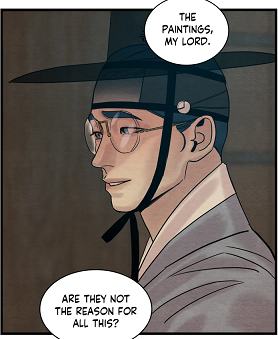 (Chapter 30) The moment he arrives back and the lord brings him back to his chamber, the nature of their relationship is no mystery any longer, though painting is used as a justification. (Chapter 29) Striking is the thickness of the wall. This symbolizes a long way for Baek Na-Kyum to admit his sexual orientation. Just because people know, this doesn’t mean that he is acknowledging his homosexuality immediately.
In chapter 34/35, there are three different scenes where the door plays a huge part. I have to say that the last scene was the one that caught my attention in the first place and that’s how I was able to connect the door to Baek Na-Kyum.
The first drawing shows the lord opening the door for Baek Na-Kyum. This signifies that the noble has somehow given up on forcing the painter to admit his homosexuality and his attraction to the lord. That’s the reason why Yoon Seungho spent the entire night thinking over how to convince the low-born to come to his side and become his partner.
However, the sex marathon has not left the young man unaffected. He hides behind the closed door, while his body is shaking and his heart is beating loudly. He eve feels butterflies. For the first time, we see Baek Na-Kyum confronting himself with his repressed feelings… for the first time there is a connection between his thinking and his unconscious. He is somehow admitting that the lord’s presence has left an impact on him. However, with his body he is making sure that no one will ever find out this secret. He is still denying his homosexuality to the outside world. He wants to keep it a secret, yet he is no longer denying the existence of these feelings.
Then in the same chapter, we see Jung In-Hun abandoning the low-born and he even closes the door in front of him.
This single action has so many significations. First, it visualizes the rejection of the teacher. He cuts ties with him. It also shows that Jung In-Hun is well aware of what happened 10 days before. It reveals his selfishness as he shows no concern. In fact, it was as if the low noble was pushing him back. It was as if Baek Na-Kyum was pressured to become a homosexual even without admitting it. The teacher is forcing him to accept his situation but at the same time, he is denying the responsibility. Imagine the hypocrisy of the lord’s action. In reality, he is the one who pushes the painter to sleep with the lord, since he needs a spy. But by closing the door, he ensures that Baek Na-Kyum doesn’t need to admit his own homosexuality. This scene symbolizes the prostitution Jung In-Hun referred later. The teacher wants to use the artist’s sexual orientation for his own needs and simultaneously he doesn’t need to require this from the painter. As a conclusion, Jung In-Hun is now pushing the low-born to become a homosexual without revealing it to the outside world. At the same time, he acts as if he has no idea what is happening to the commoner. That way, Baek Na-Kyum can never reproach him to have used him as a prostitute or to be a hypocrite.
Then in chapter 41, we see a certain progression. The door has been opened by Yoon Seungho but Baek Na-Kyum doesn’t care any longer. Since he is begging the lord to be held, he is finally admitting his true desires. He likes being embraced by a man. This marks a pivotal moment in Baek Na-Kyum’s life. And this explains why the door is wide opened at the end.
Baek Na-Kyum is no longer hiding his true sexual orientation. He is facing the world without being embarrassed. He waited for Jung In-Hun, hoping that the young man would still accept him, but he experienced rejection. He was literally left behind. However, his acceptance of his own sexual orientation doesn’t necessarily mean that he loves Yoon Seungho. In the beginning of season 2, he viewed himself as a prostitute.  (Chapter 45) He just accepted him as his sexual partner, hence he went to his room and not to the lord’s side in chapter 44. If we compare their respective situation. Yoon Seungho hadn’t progressed much compared to the painter at the end of season 1, because he needed to express his emotions and reveal his secrets and vulnerabilities to Baek Na-Kyum. It took him a long time to open up, as he had been coerced to view himself as a bird of misfortune. He didn’t dare to voice any wish out of fear that these wishes would get ruined. (Chapter 96) In his mind, he had no right to voice any desire, as they would be perceived as GREED!
  (Chapter 96)
But like I had written above, the low-born was in a better position right from the start. He had more freedom, while for Yoon Seungho the room is indeed a prison. Under this new approach, it becomes comprehensible how the main lead could leave the window and as such the darkness of his nightmare. Because of the painter, Yoon Seungho met Jung In-Hun, and the latter made him feel superior, but also jealous. That’s how his attention got diverted from the window making him discover the existence of the door! We could say that the painter as the butterfly led the poor protagonist to the door, and thanks to his mind, Yoon Seungho could release Baek Na-Kyum from his cage, as his mind was also trapped by social norms. And this sexual emancipation could only take place in the bedchamber. This explicates why the artist’s liberation was the first step for the lord’s liberation. But by opening the door for the painter, Yoon Seungho could free himself. Therefore it is not surprising that the painter‘s final confession took place in front of a closed door,  (chapter 96) and Heena could hear his words. Hence at the end, the door got broken:
  (chapter 96) This represented the final emancipation of the artist. He no longer cared, if he was seen. He was so moved that he didn‘t pay to his surroundings.
  (Chapter 96), while it was not the case for the noble. The latter knew about the artist‘s shyness. This truly shows that Heena was responsible for the sexual oppression of her brother. The painter was no longer hiding his affection for the main lead, when he decided to wait for his master‘s return in the bedchamber.
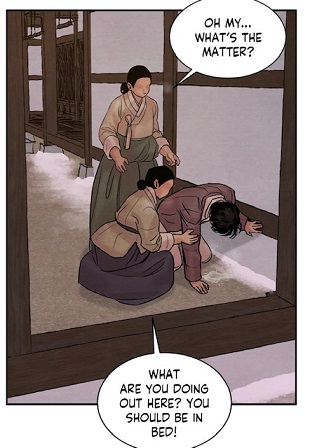 (Chapter 98) Observe that the artist was going there on his own will, and he was sharing his bed with his husband.
How did the scholar discover that Baek Na-Kyum was painting erotic paintings of sodomy? (Chapter 1) This memory was from the learned sir. Why was he approaching the painter during the day? Secondly, note that he only scolded the artist in his house! (Chapter 34) So he had discovered a secret, he imagined that the painter had assisted to an immoral love session. (chapter 6) In my opinion, the kisaeng was responsible for this incident. We have a clue for this interpretation: (Chapter 94) The noona is the one standing in front of the opened door with her donsaeng. Here, the artist was getting embarrassed and humiliated. That‘s how little by little, the artist associated the closed door to shame and safety. This is not surprising that the kisaeng is also standing behind the closed door, when she hears her brother making love to the main lead. 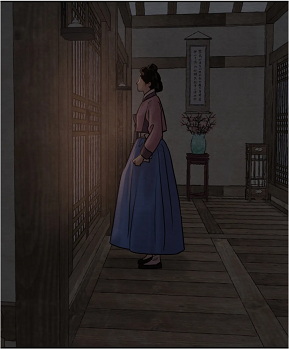 (Chapter 96) In addition, she is constantly seen in connection with an opened door, but this opened door is linked to anxieties, pain, shame and guilt: (chapter 68)
  (chapter 66)
 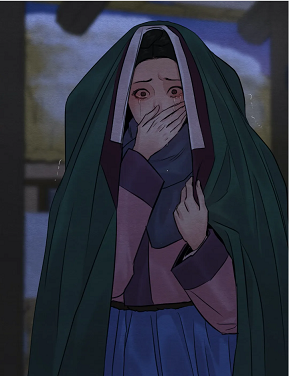 (chapter 88) I have the impression that she was acting out of jealousy, and she had intended to tarnish her brother‘s reputation.
And this leads to my final words. In my first version, I had expressed the following thoughts:
„Does it mean that the lord needs to leave the mansion behind in order to liberate himself from his suffering? If so, then we have two possibilities. Either he gives up his title and everything for the painter or he decides to move to the capital and helps the artist to develop his career and even starts meddling in politics.“
And look at the progression of the story. Yoon Seungho did leave the mansion behind and went to the mountain with the painter in his arms. (Chapter 102) This symbolized the final emancipation of Yoon Seungho. He could finally move on from his past, and as such leave the darkness of his mental prison. He no longer needs a window to view life. This scene announced that he was starting living again. Thus I am expecting to see Yoon Seungho becoming more proactive and funny in season 4. He will show his intelligence and strength in order to defeat his enemies because so far, he never revealed his qualities to others, only to the scholar. His past had left him somehow paralyzed, hence he has laid a low profile. In his past, he believed that his prison was his protection, for he could observe and remain quite wealthy and powerful. For me, Baek Na-Kyum is in reality his strength, the reason why he will be able to leave his cage and shows his true colors and skills.
But if the window symbolizes Yoon Seungho and Baek Na-Kyum the door, what is representing the teacher? In my opinion the open air. He is mostly seen outside.

 (chapter 7) (chapter 10)
 (chapter 19)
 (chapter 29)
  (Chapter 22) (chapter 35) He often strolls through the courtyard. Therefore I would say that the air embodies him so perfectly. He is seen with his nose in the air

which shows his arrogance. Simultaneously, he gives himself airs. How can he be touched by this low-born? The picture shows both aspects. Then in the chapter 6, he is just hot air (this expression means empty talk in order to impress) , when he says that he was the one who taught how to read to the painter. Here, he tries to present himself as a good teacher to Yoon Seungho. Furthermore, he is overestimating his own skills and he is definitely daydreaming  which is connected to the expression “castles in the air”. His aspirations are boundless, he is aiming at the highest position without being competent or even trying to improve himself. He also attempts to air dirty laundry, when he is hunting with Yoon Seungho. He wants to force the lord to admit his lie so that he can criticize him. But here he fails. As you can observe, many expressions with air reflect his personality. However, there is one scene that contrasts to this observation, that’s when he is in his library in the chapter 40. We actually see him at the library in two occasions:
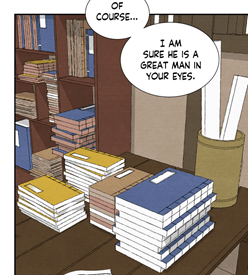

chapter 7 and 40. However only the scene in the chapter 40 is memorable. Therefore I would say that he is linked to two spaces: open air and closed room like the library. It seems strange that Jung In-Hun is linked to a world with no boundary and the opposite, a closed room. Actually, it is quite simple. The outside signifies that he is actually empty and superficial behind his smile. He is so fake hence he has no real personality. Besides, since there is no limit, then it can also signify that he has no conscience as he knows no boundary. Furthermore, it also illustrates that he has no past and no trauma too. Finally, it also indicates that he will never change, there will be no transformation and as such no progression. Air remains air. Yet he only shows his true thoughts in a closed door in the chapter 40.  His words there are suffocating the poor boy, that’s the reason why Baek Na-Kyum is left speechless.
  (Chapter 40) He can’t breathe properly. Since there is no view and no door to the outside visible in the drawing, we have to imagine this reflects his narrow-mindedness. He is surrounded by books (see the pictures from the chapter 7) therefore he lacks real experience and knowledge. He is literally buried behind his books, therefore his knowledge is superficial.
  (Chapter 27) Even in his bedroom there are books so his own bedchamber gives the readers a suffocating feeling. Since there is no window visible in his room and the library, there is no fresh air in the closed room which explains why it is asphyxiating. Usually, we say in a closed room that it smells musty. He only knows the world through his books and the moral standards. He is not even opened to the outside, only his words and thoughts count. Everything else has no value hence there is no life next to him. People living by his side will end up suffocated as he doesn’t allow them to breathe. He is stubborn and he will never change, a fake, empty and narrow-minded man with no conscience. Because of this connection, I realized that Jung In-Hun had no future in Hanyang. He would end up buried, and this became a reality. Because the moment he left for the capital, he ended up dead. And now, if you think carefully, you will recognize that the learned sir is associated to nature! Thus he was seen in the woods (chapter 6, 22) or in the countryside admiring the moon. (Chapter 70) Air means also breathing! Hence he represents the fresh air entering Yoon Seungho‘s bedroom, hence we had such a scene:
  (chapter 35) The lord witnessed the intimate interaction between the learned sir and the artist, thus he was incited to leave the bedroom. Strangely, we could say that he was the initiator for the lord‘s liberation. No wonder, why Kim wished to get rid of the learned sir in the end, and just viewed the artist as less annoying and evil!
So the moment he left the domain, the admired sir was confronted by reality. His stay in the mansion had made him dream 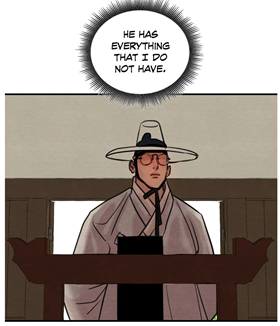 (Chapter 18) so that he ended up letting his guard down. He was not so competent and intelligent like Yoon Seungho, he relied more on the stupidity on others. He could deceive commoners, but not spies. In my first version, I had envisioned that the learned sir had many tricks up his sleeves so he would survive, but I had not realized that he had met a fake servant
 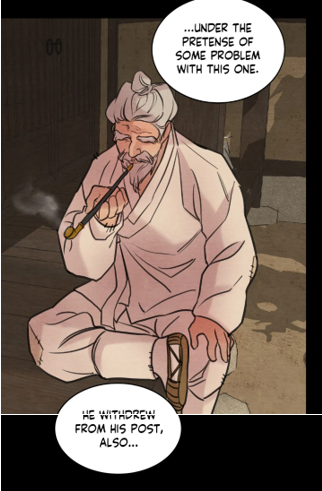 (chapter 37) definitely a noble who could see through him. For me, it was the pedophile himself. I had predicted that he would disappear into thin air, and it became a reality, especially if my theory about his assassination is correct. We could see the transformation of the scholar into a ghost,
  (chapter 50) who would come to haunt the couple because of his resent.
 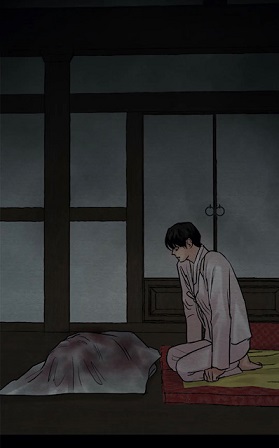 (Chapter 98) As the air, he became a spirit! And note that the lord was encouraged to stroll too!
Feel free to comment. If you have any suggestion for topics or manhwas, feel free to ask. If you enjoyed reading it, retweet it or push the button like. My Reddit-Instagram-Tumblr-Twitter account is: @bebebisous33. Thanks for reading and for the support, particularly, I would like to thank all the new followers and people recommending my blog

 Bebebisous33s' analyses in K-Dramaland and Manhwas