Protected: Jinx: The Director 🐺 🐐 and Me 🐺 (part 1)

Bebebisous33s' analyses in K-Dramaland and Manhwas
Analyses of K-dramas and Manhwas (for the most part Yaoi)

Please support the authors by reading Manhwas on the official websites. This is where you can read the Manhwa: Jinx But be aware that the Manhwa is a mature Yaoi, which means, it is about homosexuality with explicit scenes. Here is the link of the table of contents about Jinx. Here is the link where you can find the table of contents of analyzed Manhwas. Here are the links, if you are interested in the first work from Mingwa, BJ Alex, and the 2 previous essays about Jinx Illuminated 🌥️🌤️Silence and Lingering 🫶 Warmth 🔥 and The Other, Hidden Door to the Past
It would be great if you could make some donations/sponsoring: Ko-fi.com/bebebisous33 That way, you can support me with “coffee” so that I have the energy to keep examining Manhwas. Besides, I need to cover up the expenses for this blog.
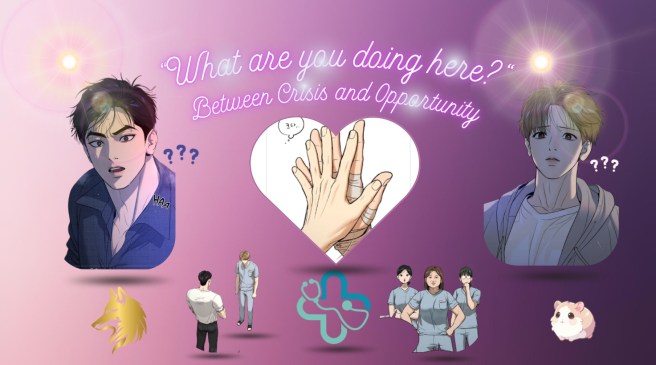
This essay won’t be a long one, as today two new episodes from Jinx will be released. However, I found three articles from Jennifer Delgado which let me perceive the protagonists’ metamorphosis and the progression of the story.
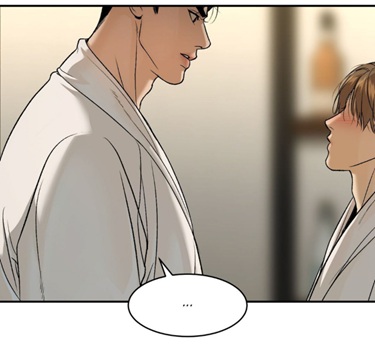
In episode 69 of Jinx, the question 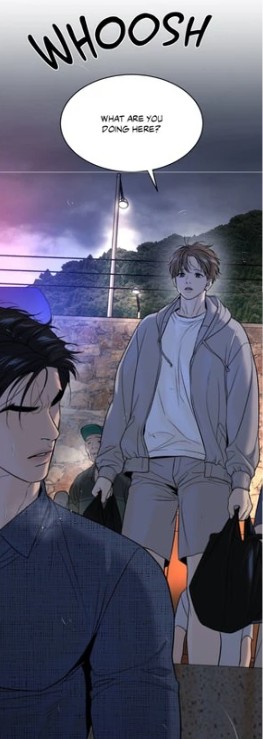 (Chapter 69) from the physical therapist is more than a startled greeting — it marks a critical shift in the psychological and emotional trajectory of both Kim Dan and Joo Jaekyung. Standing at the dock, doc Dan, still recovering from his depression and trauma of the switched spray incident, sees the champion not as an invincible athlete, but as someone equally unmoored. He is surprised and confused by such a behavior. Why would he act that way? Hence the author added right after this image:
  (chapter 69) Striking is that the champion has a similar reaction. He never expected that he had misjudged his fated partner. Both characters are forced to face their own prejudices and bias.
  (Chapter 69) This moment is less about resolution and more about recognition: two men, shaped by different paths of burnout, collide again — but this time not as patient and caregiver, predator and prey, but as human beings in crisis.
Symbolically, the dock represents more than just a location — it is a threshold between two domains: between land and sea, safety and uncertainty, solitude and reconnection. (Chapter 69) It is a liminal space, a bridge between their former roles and whatever comes next. The fact that this unusual encounter and subtle interrogation happens here underscores the narrative’s shift from repression to potential transformation. It is the space where isolation ends and vulnerability begins — the exact place where emotional disconnection gives way to tentative reattachment. This announces the premises for their true future collaboration. 
According to the article Growth Mindset in Healthcare: From Burnout to Breakthrough, burnout manifests not only through exhaustion but through rigid thinking: perfectionism, fear of failure, and fixed self-perception. The article points out that:
“Doctors, nurses, support staff, and other healthcare professionals face immense challenges every day: fast-paced environments, long shifts, relentless pressure, and high-stakes decisions. It’s no wonder burnout syndrome hits this field so hard.” Quoted from https://psychology-spot.com/growth-mindset-in-healthcare/
This line could describe Kim Dan’s reality perfectly. From taking double shifts 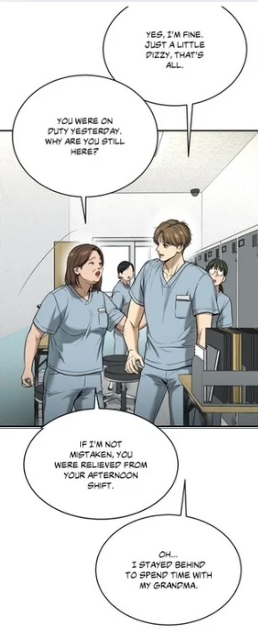 (chapter 57) that go unnoticed to dealing with the emotional numbness of detachment, Kim Dan begins to resemble the article’s description of someone silently breaking down.
  (Chapter 59) Although he didn’t face difficult patients at the hospice
 (chapter 57), he approaches his work like a robot, emotionally disconnected from those in his care. The burnout is not only shaped by the hospital environment — it’s also deeply tied to his role with Joo Jaekyung. The champion became, in many ways, his most demanding patient
 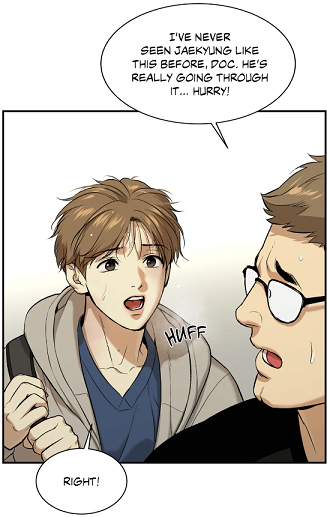 (Chapter 14), with unrealistic expectations
  – chapter 41 (such as pushing for a premature return to the ring), and an emotional climate of pressure and perfectionism
  f (chapter 45) rom superiors, he fits the article’s description of someone burdened by a toxic professional environment. More importantly, in episode 57, a nurse casually mentions that he might be suffering from burnout.
 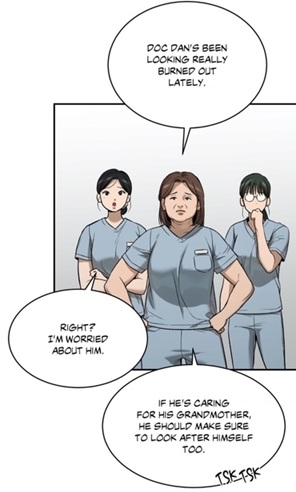 (Chapter 57) This offhand remark reveals that within the medical setting, the symptoms are visible to trained observers. And yet, the insight never reached the “hamster” or the “wolf.”
Dan internalizes his stress, rationalizes it as duty, 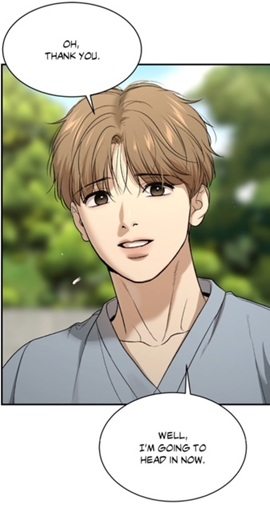 (chapter 56) and isolates himself emotionally. Therefore he doesn’t engage in a conversation with the nurses.
 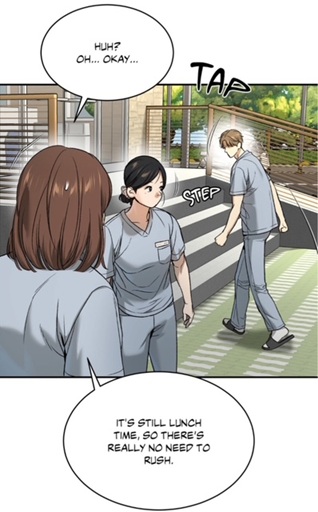 (Chapter 56) No wonder why the readers still don’t know the names of the three “angels in blue”’. Their presence is functional, but remains impersonal. They remain silent observants.
  (Chapter 57) Likewise, Jaekyung — despite not being in healthcare — he fits the article’s description of someone burdened by a toxic professional environment.
  (Chapter 27) He operates in an industry with crushing expectations, where performance is equated with survival.
  (Chapter 29) That’s why he doesn’t allow himself to rest.
Just as Kim Dan avoids emotional engagement with his peers — such as the nurses who sense his exhaustion — Jaekyung mirrors this relational withdrawal in the world of MMA. Other fighters are not allies but threats: in his own words, they are “hyenas”, always circling, waiting to take something from him. (Chapter 29) This worldview isolates him entirely. It’s no surprise, then, that his past with Baek Junmin remains shrouded in mystery  (chapter 49), or that in the aftermath of the suspicious match, he blames him
 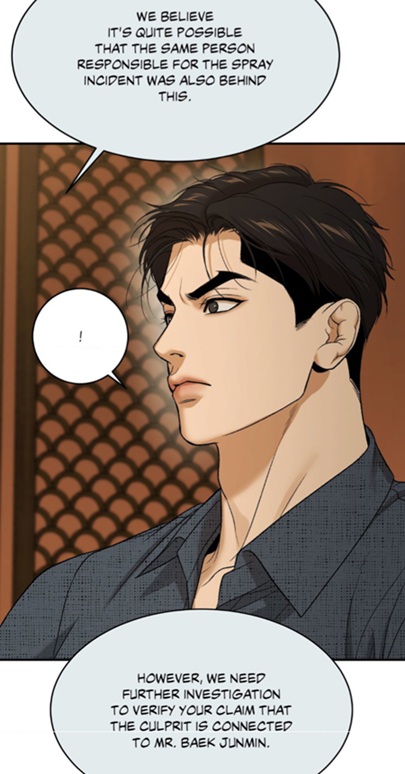 (chapter 69) and avoids speaking with Shotgun altogether. Instead of engaging in conversation, he contacts MFC — preferring institutional action over personal interaction.
This reinforces the parallel: both the hamster and the wolf have been conditioned to distrust their environment and the people in it. 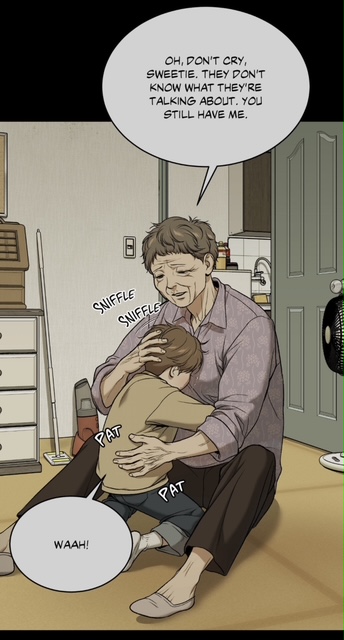 (Chapter 57) Since people don’t know them, they can not trust their judgement and perception. Both navigate high-stakes worlds that punish vulnerability and reward detachment. And both, when overwhelmed, retreat from human relationships rather than reaching out. They are, in different costumes, performing the same coping script — one that the article identifies as characteristic of fixed mindsets operating under systemic pressure and emotional isolation.
His perfectionism, his emotional suppression, the microstress accumulating from constant physical strain  (chapter 19) and relational isolation all echo the article’s diagnosis:
“This perfectionist culture often fuels a fixed mindset. It turns mistakes into personal failures, makes constructive feedback feel like harsh criticism, and sidelines personal growth in favor of immediate demands.” Quoted from https://psychology-spot.com/growth-mindset-in-healthcare/
Both men operate in systems where perfection is not just expected, it is demanded 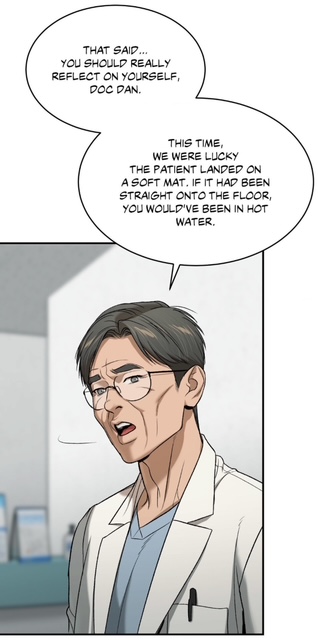 (chapter 59) — and any deviation from it is interpreted as personal failure. Here, it’s important that the hospice took advantage from the overworked protagonist. No one paid attention to the double shift. (Naturally, I am not saying that the main lead is blameless either). For Kim Dan, the patient’s fall in episode 59
  (chapter 59) and the sabotage incident destroyed his self-perception as “doctor” and “helper”.
 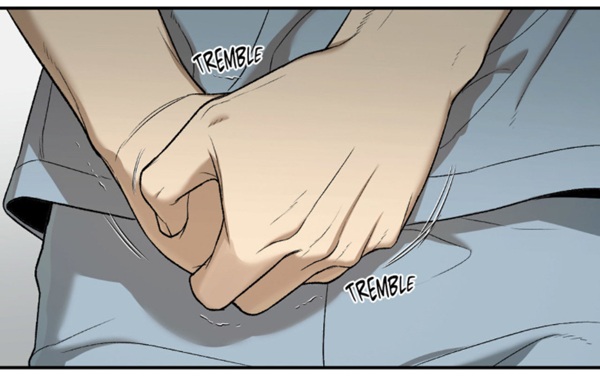 (Chapter 59) This is reflected in the image where the author zoomed on the “main lead’s” hands or when he is holding the dead puppy.
 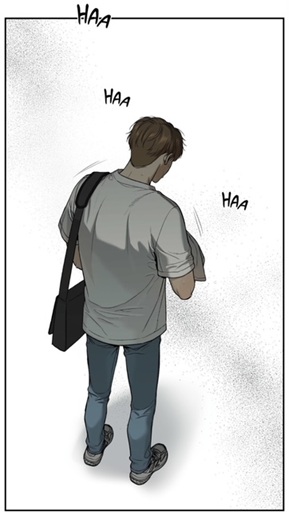 (Chapter 59) The hands have become the symbol of his powerlessness. For the wolf, the tie in his last match is perceived not as resilience, but as loss.
 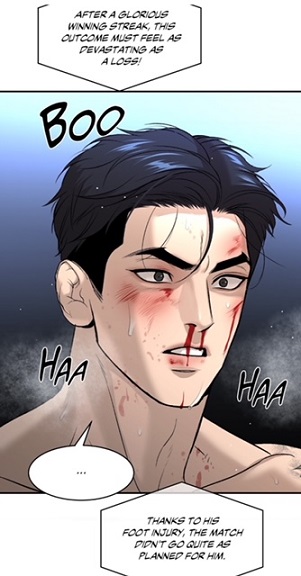 (Chapter 51) Neither of them has been taught to see difficulty as an invitation to adapt. They both cling to a fixed mindset — until crisis breaks the pattern.
Kim Dan’s depression and burnout are not caused solely by repressed traumas 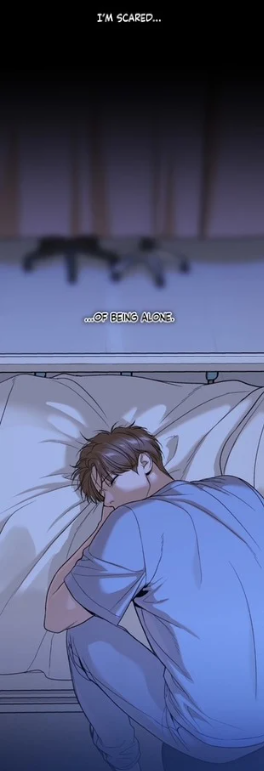 (Chapter 56) — they are also the result of two compounding forces: the champion’s perfectionism and the doctor’s own fixed mindset.
  (Chapter 64) This deeper entanglement explains why Dan ultimately rejects the celebrity.
 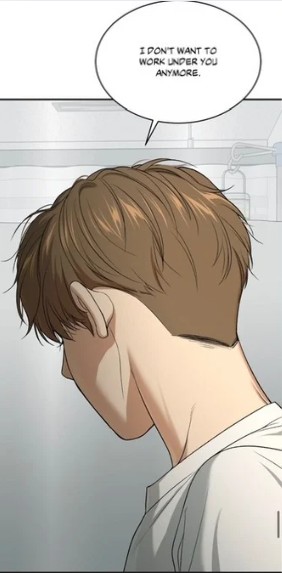 (Chapter 60) Though Dan has long suffered from low self-esteem, he has never questioned his sacrificial identity. It is as if he were destined — or conditioned — to care for others without regard for himself.
  (Chapter 29) He sees selflessness not as a virtue but as a default mode of survival. This explicates why he blames himself for the puppy’s death. Observe how Mingwa implied the relevance of the doctor’s hands while he was holding the poor puppy. (Chapter 59)
At the same time, his view of work has always been transactional. In episode 1, he sees his first assignment at the hospital as a means to earn money  (Chapter 1) — a way to repay debts. And it is the same, when he accepts his contract with the wolf.
  (Chapter 6) His grandmother reinforces this belief by reducing his worth to his earning capacity. This mindset is plainly illustrated in two key moments. In the first, she expresses her gratitude to the champion, because he gave him “a roof over his head and a salary.”
  (Chapter 65) These words reveal what truly matters to her: material provision and financial compensation. She does not seem to register the emotional toll the job may be taking on Dan, nor does she question the ethics of the contract or his living conditions. What she values is that her grandson is being paid and housed — signs of visible, quantifiable success.
In the second instance, she tells her “almost grandson” that  (chapter 65) Dan has “only lived for her” so far, and that he surely has a “ton of things he wants to accomplish” now. This comment, which at first sounds like encouragement, in fact exposes her own worldview: a life worth living is one centered on achievement, productivity, and external validation. The idea of simply resting, recovering, or living quietly does not even occur to her. When she urges that Dan should go back to Seoul to pursue his “best life,”
 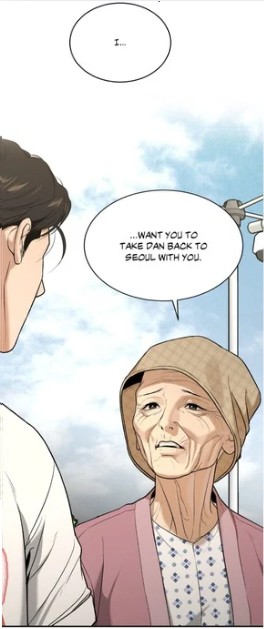 (Chapter 65) it becomes clear that for her, the capital is more than a location — it is a symbol of success, of competition, of visibility. She cannot imagine a fulfilling life outside that framework, and thus unknowingly erases Dan’s internal world: his trauma, exhaustion, and grief. To conclude, all her ideas are revolving around career, success and wealth. Work, in this logic, is not about pride, passion, or healing — it is about obligation. This began to shift when he started working with Jaekyung and discovers a different kind of validation:
 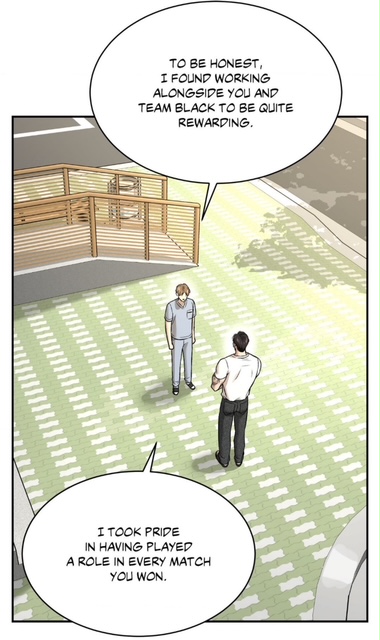 (chapter 62) the athlete’s success gave him a sense of purpose. No wonder why he took everything so personally.
But when the champion rejected him in the locker room, even blamed him (chapter 51), this fragile new identity got shattered. Dan loses not just a client or income source — he loses the first glimpse of professional dignity.
  (Chapter 51) The rejection didn’t just hurt emotionally; it disoriented him existentially. In that light, it is no coincidence that he ends up working at a hospice — a place symbolically linked to endings, quiet resignation, and the final stages of life.
 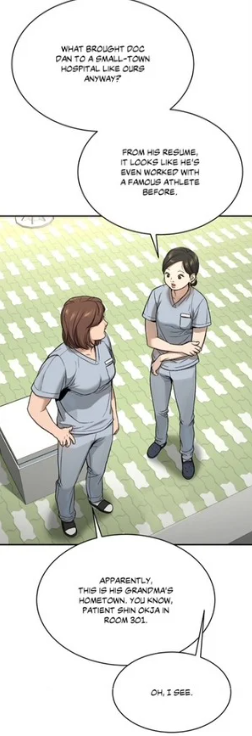 (Chapter 56) The hospice marks not just a physical retreat from his past, but a psychological one: a setting that echoes his emotional state. While his body continues to function, his inner life has entered a form of dormancy. His role in this environment reflects how deeply detached he has become — professionally, emotionally, and existentially. The job had become more than money, but now that it’s gone, he can no longer look forward. He feels lonely and rootless. (Chapter 56) His fears, his trauma, and his ingrained selflessness trap him in a state of emotional and professional paralysis.
The arrival of the champion in the seaside town, asking him to return 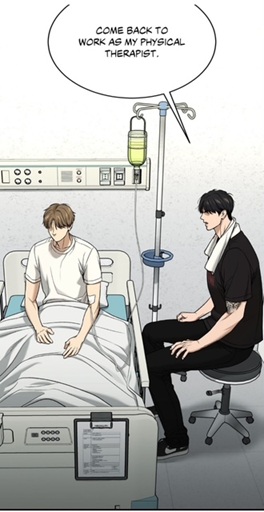 (chapter 60), functions as a form of emotional absolution, though doc Dan is not aware of it. This job offer is an indirect proof that he is still seen as competent and trustworthy.
 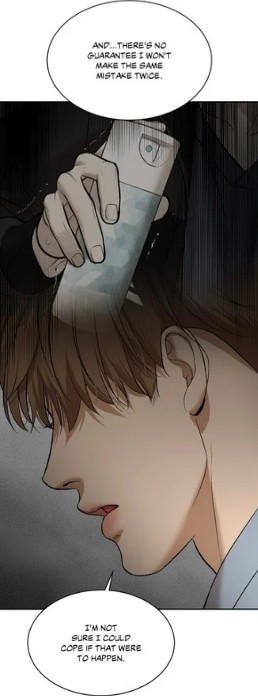 (Chapter 62) If Jaekyung had not come himself, it would have confirmed Dan’s worst fears: that he was to blame, that he was discarded. The first crack in his fixed mindset comes from this gesture — an external acknowledgment that the so-called “sin” may not have been his at all. This explicates why Kim Dan can give him the cold shoulder and even ignore him.
  (Chapter 61) It helps him to boost his strength and confidence. From that moment on, he is capable to express his own thoughts and as such criticize the star. (Chapter 64)
But transformation is not linear. By episode 69, Dan is still weighed down by unprocessed guilt and emotional avoidance.  (Chapter 69) His stunned reaction — “ (chapter 69) and the subsequent panel of him thinking “…?” (Chapter 69) reflect not openness, but bewilderment and curiosity. He cannot yet process why someone like Joo Jaekyung would show up so dramatically, defying his usual patterns of control and distance. This is not a confrontation, but a moment of interrogation and emotional inversion — Jaekyung is acting unusually, and Dan is quietly observing, almost uncertain whether to trust the shift. That moment marks a subtle but pivotal turn: Dan, no longer collapsed, is present and attentive. And Jaekyung, for the first time, shows emotional transparency rather than dominance. (Chapter 69) Their positions are shifting — slowly, hesitantly — toward mutual recognition.
Meanwhile, the champion is also unraveling — not due to a single catastrophic event, but from sustained microstress, as defined in the article Microstress: The Silent Stress That Accumulates.
- Microstress is characterized by:
- Frequent exposure. Unlike major stressful life events, everyday stressors are repeated continuously. They’re like a constant drip that eventually overflows the glass.
- Denial of impact. Microstresses are often minimized because they don’t seem “serious enough”: an irritating email, an awkward interaction, or a minor unforeseen event aren’t major crises. Since they aren’t legitimized, the usual response is “just suck it up” or “it’s not that big a deal,” which leaves us without the tools to manage them.
- Progressive burnout. Everyday stressors don’t set off our alarm bells because they aren’t an obvious threat. Therefore, we don’t mobilize our coping resources to counteract them. So we end up swallowing our anger, frustration, or exhaustion… until we explode.
- Recovery block. By the time we’re done dealing with one source of stress, another is already waiting. So we become like that overwhelmed waiter or nurse who hasn’t stopped working since 8:00 a.m. and, even though they haven’t suffered any catastrophe, comes home completely exhausted day after day. Quoted from https://psychology-spot.com/microstress-everyday-stress/
The athlete’s burnout stems from the relentless pressure of performance, the perfectionism and the obsession (chapter 69) with the title instilled by his hyung, the constant bodily strain, and his emotional isolation. Most crucially, he interprets his last match — a tie — as a personal failure. For someone with a fixed mindset, a tie is not balance; it’s inadequacy. Therefore it is not surprising that the athlete is not realizing that the outcome of his match has been changed from tie to loss.
At the dock, when the champion turns around and sees Kim Dan standing upright — not collapsed or fleeing — it destabilizes his expectations.  (Chapter 69) Dan’s very presence communicates something new: emotional steadiness, however tentative. And for the first time, Jaekyung doesn’t respond with control, but with vulnerability.
 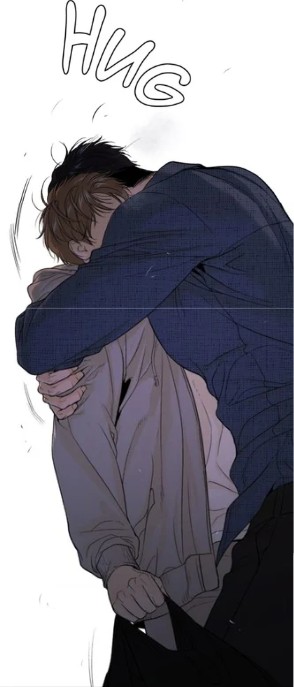 (Chapter 69) The hug becomes a form of speech — an action that acknowledges fear, relief and desire for connection.
This is where the article Talking About Emotions Is Not Enough becomes essential. It argues that simply talking about feelings is not transformation; catharsis without action becomes a trap:
“Talking isn’t changing. Knowing isn’t doing. And understanding isn’t transforming.” Quoted from https://psychology-spot.com/talking-about-emotions-is-not-enough/
Shin Okja illustrates this point vividly. She shares her emotions and fears with the “wolf”, appearing vulnerable and reflective  (Chapter 65) — yet she changes nothing. How so? She could have talked to the nurse, and the latter would have brought up the possibility of “burnout”. She frames her grandson as a victim
  (chapter 65) and herself as helpless, yet her only move is to push him away under the guise of concern (Chapter 65) She never confesses directly to Dan, nor does she take responsibility for her past actions.
  (Chapter 65) Instead, she subtly enlists the champion as a parental substitute, urging him to care for the “sick” Dan.
 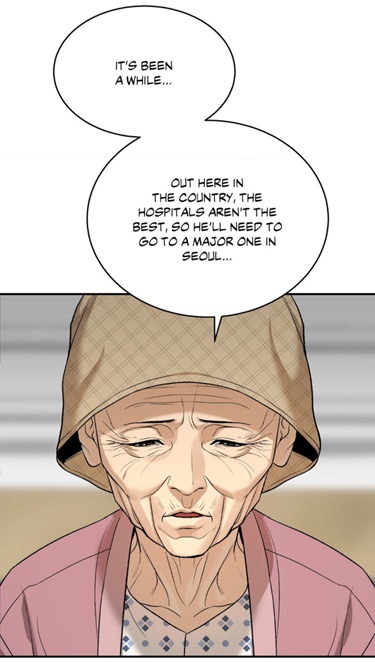 (Chapter 65) She imagines, pills will work their magic.
She sees in the champion an opportunity to unburden herself and outsource responsibility. But her strategy is not to help Dan become independent — rather, it is to have Jaekyung act as a caretaker, reinforcing the narrative that Dan is weak. Her emotional confession is not accompanied by a willingness to change or empower; it is yet another performance to ensure that others, not herself, do the hard work of care  (Chapter 65) and repair.
Her version of catharsis is hollow. She uses emotional language not to empower Dan, but to preserve her own comfort. She remains passive, speaking around Dan instead of to him. In contrast, the champion’s eventual confession to Dan is direct, emotionally honest, and followed by behavioral change. He doesn’t just reveal his emotions — he takes action. He questions his routines and believes, leaves Seoul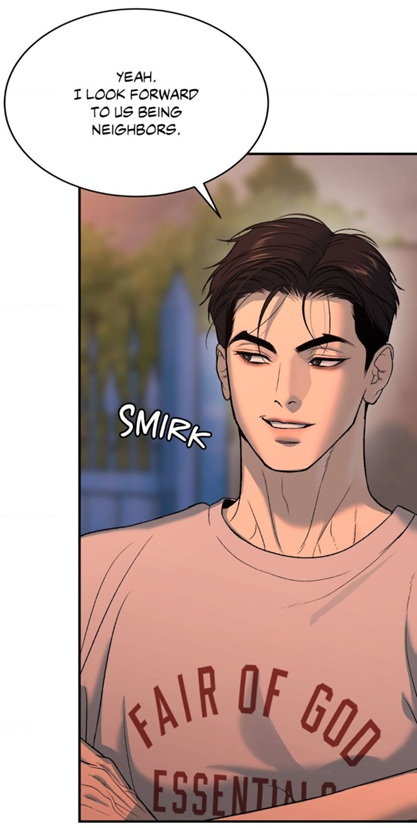 (chapter 61) , and approaches Dan not as a star reclaiming property, but as a person reaching out.
The article Growth Mindset in Healthcare: From Burnout to Breakthrough outlines five practical strategies that reflect a shift from fixed to growth mindset. Each of these aligns with key moments and changes in both Kim Dan and Joo Jaekyung — not as traits they naturally possess, but as difficult, earned responses that emerge through crisis.
“A growth mindset encourages genuine curiosity and lifelong learning.” Quoted from Growth Mindset in Healthcare: From Burnout to Breakthrough
This shift begins subtly in episode 69. Kim Dan’s reaction (Chapter 69) signals not disdain or reproach, but curiosity. He no longer responds with total avoidance. The champion’s behavior destabilizes his old script, and for the first time, Dan is asking questions rather than shutting down. Jaekyung, in turn, also shows curiosity by seeking out Dan in person rather than defaulting to control or silence.
“Perfection in this science, or rather art, takes longer to be mastered than human life affords.” Quoted from Growth Mindset in Healthcare: From Burnout to Breakthrough
Jaekyung begins to shed his perfectionist mindset when he acknowledges his own limitations and emotional needs over performance.  (Chapter 69) He no longer focuses only on the next fight or media appearance — instead, he chooses emotional repair. Dan also learns to value life over denial. Hence we see him holding bags, certainly containing food. During the episode 69, the incident in the courtyard served as a wake-up call that he could no longer deny his mental illness. After his collapse, he gets back up, and is seen wearing his sports shoes.
  (Chapter 69) These items indicate the transformation in the doctor’s life. From my point of view, it announces the arrival of sports in his life.
“Every tough moment is a chance to reflect, learn, and level up.” Quoted from Growth Mindset in Healthcare: From Burnout to Breakthrough
Both characters are forced to reframe challenges: Dan’s rejection and burnout become moments of reflection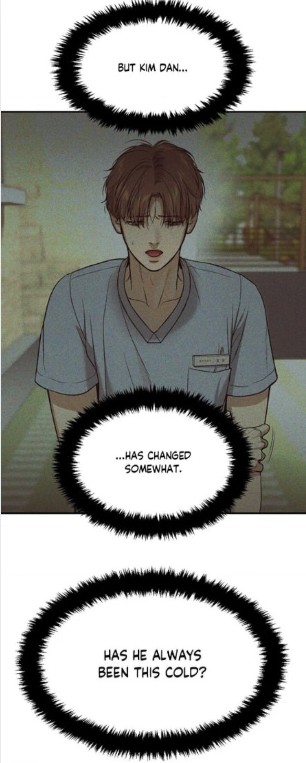 (chapter 62), not annihilation. Jaekyung’s emptiness and misery after the tie becomes the emotional opening that allows him to ask for connection, the more the hamster pushes him away.
“Shift your inner dialogue: ‘It’s hard, but I can manage.‘” Quoted from Growth Mindset in Healthcare: From Burnout to Breakthrough
We begin to see this shift subtly in Dan’s refusal to collapse into guilt. He begins to set boundaries (chapter 60), stops apologizing constantly, and even expresses irritation or his discomfort.  (Chapter 67) Meanwhile, Jaekyung drops his script of invincibility and openly acknowledges his need for Dan. Neither of them says the perfect thing — but they are no longer using self-talk to punish themselves.
“Growth thrives in kindness, not punishment.” Quoted from https://psychology-spot.com/microstress-everyday-stress/
This final dimension is visible most clearly in their embrace. The celebrity, who once saw human softness as weakness, now offers comfort.  (Chapter 68) For him, vulnerability and empathy are no longer rejected, rather embraced and accepted.
 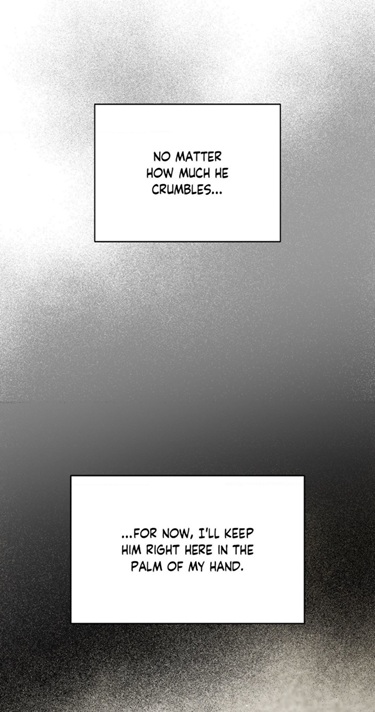 (Chapter 68) Dan, who once viewed care as something he must earn,
  (Chapter 69) begins to receive it. It is not a grand declaration, but a quiet shift: you can fail or cause a ruckus, and still be loved. Hence he doesn’t push away the wolf on the dock.
Thus, I deduce that Jaekyung is becoming what the grandmother could have been: someone who turns vulnerability into connection and growth. And importantly, his growing acceptance of Kim Dan’s vulnerability marks a turning point not only for their relationship, but for his own inner evolution. By caring for someone fragile (chapter 69), the star begins to extend that care inward. Each gesture of empathy toward Dan becomes a step closer to self-compassion. In learning to protect someone else without demanding perfection, the wolf is learning, perhaps for the first time, that he too deserves kindness — not just from others, but from himself. He models what the article calls a true “growth mindset” — one that sees failure not as final, but as a catalyst for relational and emotional evolution.
“Having a growth mindset helps you handle stress, bounce back from tough days, and stay motivated. It keeps you learning and evolving without burning out along the way.” Quoted from Growth Mindset in Healthcare: From Burnout to Breakthrough
In the end, the question “What are you doing here?” captures a shared moment of disorientation, but also potential. Neither of them expected such a meeting. But it is precisely in that space — between crisis and opportunity — that transformation begins.
Feel free to comment. If you have any suggestion for topics or Manhwa, feel free to ask. If you enjoyed reading it, retweet it or push the button like. My Reddit-Instagram-Twitter-Tumblr account is: @bebebisous33. Thanks for reading and for the support, particularly, I would like to thank all the new followers and people recommending my blog.

Please support the authors by reading Manhwas on the official websites. This is where you can read the Manhwa: Jinx But be aware that the Manhwa is a mature Yaoi, which means, it is about homosexuality with explicit scenes. Here is the link of the table of contents about Jinx. Here is the link where you can find the table of contents of analyzed Manhwas. Here are the links, if you are interested in the first work from Mingwa, BJ Alex, and the 2 previous essays about Jinx What about The Wolf’s 🐺First Kiss? 💋 and Illuminated 🌥️🌤️Silence and Lingering 🫶 Warmth 🔥
It would be great if you could make some donations/sponsoring: Ko-fi.com/bebebisous33 That way, you can support me with “coffee” so that I have the energy to keep examining Manhwas. Besides, I need to cover up the expenses for this blog.

The composition opens with a visual puzzle: a collage of doors, house numbers, and figures caught mid-motion. At first glance, the images appear disconnected, yet the arrangement and title invite my avid readers to look again. What connects the blue gate in the seaside town, a young man hesitating before a door, and two house number plaques: 7-12 and 33-3? One Jinx-phile on X, @Jaedan4ever, insightfully noted that “7-12”  (chapter 65) corresponds to the release of Jinx Chapter 70, which marked the series’ return after a three-month hiatus. This observation is more than clever numerology—it mirrors the manhwa’s deeper message: the past always haunts the present, and at times, it even foreshadows the future. And that’s exactly what I will do in this essay. I propose that the key to understanding the protagonists and characters’ evolving identities lies in the overlooked architectural and administrative details—especially the house numbers, door placements, and legal ownership of space. These seemingly minor visual cues are in fact loaded with meaning, offering insight into how home, memory, and identity are fragmented and reassigned across time and place.
While the reader focused on 7-12 and the publication of episode 70, something else caught my attention.  (chapter 57) The landlord’s house has the number 33-3. Why do two neighboring houses bear such disconnected numbers: 7-12 and 33-3?
  (chapter 61) For readers unfamiliar with Korea, this looks quite bizarre. In most European and American countries, street addresses follow a linear order; house number 12 would typically be located between 10 and 14. But in Korea, especially in rural areas, many towns use the older jibeon (지번) land-lot numbering system. Here, numbers are based not on street sequence but on the chronological order of land registration and subsequent subdivisions.
The older system, sometimes translated as the land-lot number address (지번 주소, 地番 住所, jibeon juso) resembles that used in North Korea and Japan. It is ordered from largest to smallest units and based on dividing by city (시, 市, si), then district (구, 區, gu), and neighborhood (동, 洞, dong). (To read more about district zoning and a detailed differentiation between dong, gu, si and others, click here.) Next the city block (번지, 番地, beonji) which could be several dozen to several thousand per neighborhood, then the building number is given (호, 戶, ho ). Often the markers 번지 and 호 were skipped and their numbers were separated by a hyphen. The floor (층, 層, cheung) and apartment or suite number (호, 號, ho) and receptient’s name were written last. It is worth noting that this address and a street address are not the same thing as no street name is mentioned. The old system was officially decommissioned on December 31, 2013 but is still widely used. Quoted from https://centers.ibs.re.kr/html/living_en/housing/addy.html
At first glance, parcel 7 appears to be registered earlier than parcel 33. Yet there is a twist: the subdivision number attached to 7—namely 12—implies that this plot has been split far more frequently than 33, which is only on its third subdivision. In rural Korea, early subdivisions often indicate inherited land, long-term residency, or family continuity. Later, higher subdivisions tend to signal commercial fragmentation, detachment from familial lineage, and transient habitation—often reflecting rental properties  (chapter 62), newer developments, or administrative restructuring rather than deep-rooted inheritance. In this context, a higher subdivision number implies not only later division, but also the erosion of legacy and the weakening of kinship-based territorial claims—an erosion especially poignant in the context of Confucian traditions that once emphasized multi-generational cohabitation and patrilineal inheritance. In classical Korean society, a home was not merely a shelter but a physical emblem of familial continuity, with ancestral rites often performed within the same household across generations. As addresses fragment and land parcels divide, so too does the symbolic structure of the family unit. The once-cohesive ideal of the extended household dissolves into isolated, rented spaces, reflecting not only economic realities but also the fraying of intergenerational bonds and filial authority.
This contrast is reflected in both setting and narrative. Kim Dan lives in house 33-3 with the elderly landlord—a man who is not just a neighbor but likely an old local landholder. (chapter 57) In contrast, the house numbered 7-12, which Jaekyung rents, (chapter 61) has been transformed into a tourist hostel.  (chapter 61) Though Jaekyung is a wealthy celebrity, he inhabits a parcel of land that speaks to impermanence and anonymity. Meanwhile, Dan shares space with someone who quietly represents legacy and transparency.
The spatial layout reinforces this: the landlord’s house opens directly onto the street—there is no gate. (chapter 57) This openness reflects a traditional mindset rooted in hospitality and community. By contrast, 7-12 is sealed by a blue metal gate, a clear symbol of privacy, control, and urban values. (chapter 65) But here’s the irony: the gate does not protect the landlord’s legacy from encroachment—it shields the outsider from the town. The presence of the blue gate enclosing 7-12 speaks volumes. In contrast to the landlord’s open home, this barrier reflects the mindset of its builder—the town chief (chapter 62) —who likely anticipated that visitors from the city would prefer privacy. But in attempting to accommodate their expectations, he inadvertently created a symbolic divide. The gate does not just offer seclusion; it enforces a boundary between the guests and the local community. This spatial arrangement, then, subtly underscored the champion’s outsider status. Despite his wealth and fame, he remained separated—literally and figuratively—from the rootedness and communal life that defines the town. This explicates why his direct neighbor didn’t reach out to him right away. He was the last to ask for a favor. 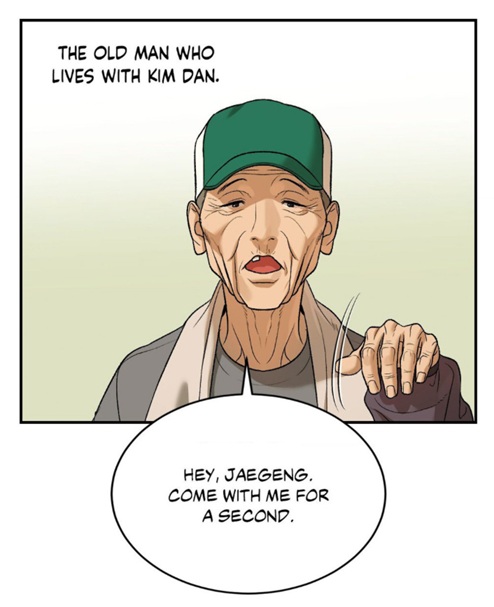 (chapter 62) However, this “dynamic” (distinction) began to shift the moment Jaekyung started working for the local residents.
  (chapter 62) No longer just a “guest” or a “tourist,” he earned their recognition and acceptance through acts of service and humility.
 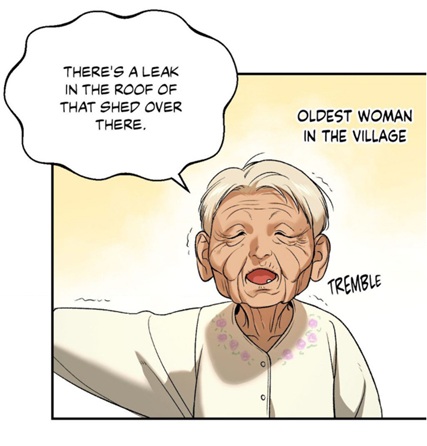 (chapter 62) As he helped them with manual tasks—such as lifting goods or assisting the elderly—they started seeing him not as an outsider, but as one of their own. However, it is important to note that these gestures of inclusion occurred while Jaekyung was outside the blue gate
  (chapter 62) —beyond the formal boundary of the rental property.
 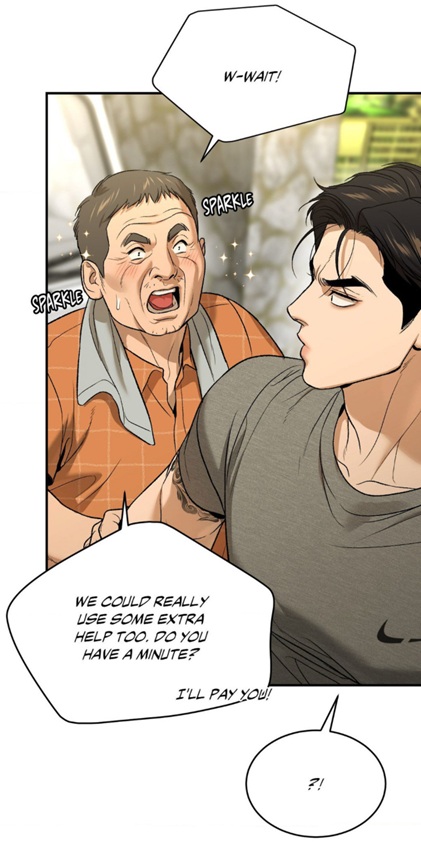 (chapter 62) In this way, the gate truly functioned as a symbolic threshold: only once he crossed it through action and humility, the community began to approach him. This change in perception was symbolized, when he received vegetables from the townspeople, a traditional gesture of inclusion and local acknowledgment.
  (chapter 62) Nevertheless, the best sign that he has been accepted by the community is when he received traditional welcome gifts: the toilet paper and detergent.
  (chapter 69) [For more read Unseen 👀 Savior🦸🏼♂️ : The Birth Of Jaegeng (locked)] His physical strength, once used for spectacle and entertainment, now becomes a bridge into the fabric of rural life, exposing his true personality: he is generous and modest. The closed blue gate of the hostel might have marked him as a city dweller at first, (chapter 65) but his actions gradually dissolved that boundary. Therefore it is no coincidence that after the wolf took care of doc Dan during that night
 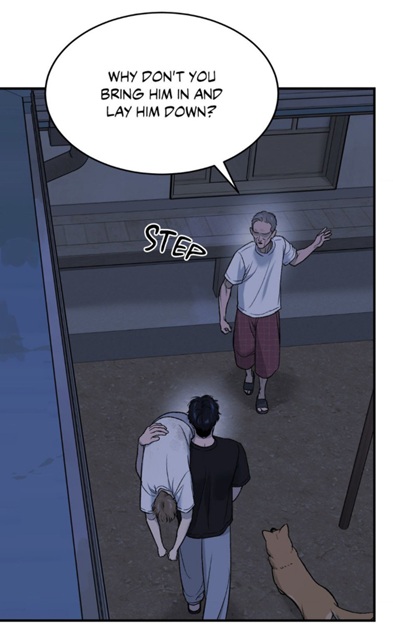 (chapter 65), the elderly neighbor chose to open the blue gate shortly after:
  (chapter 69) Thus I deduce that the blue gate lost its purpose. The champion definitely saw the advantages of the absence of a gate by his neighbor. He could arrive there at any moment
  (chapter 62) and the landlord never rejected him. In fact, he was always welcome.
 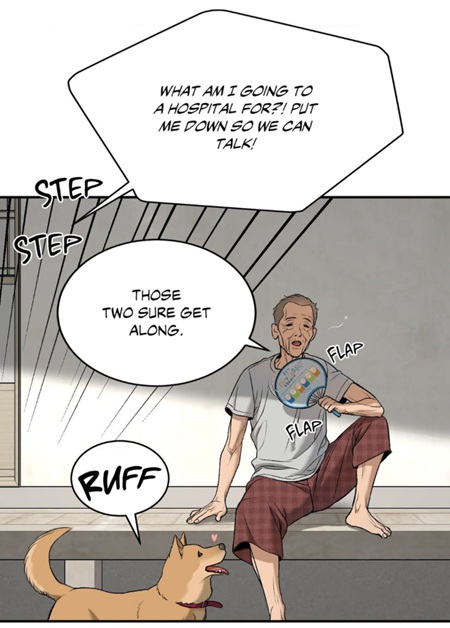 (chapter 66)
But let’s return to the house numbers and its signification. In this way, 33-3 stands at the crossroads of tradition and change: it is old, but not untouched by rupture. It represents a home that has endured change while maintaining its emotional and social value. This makes it an apt setting for the star and the physical therapist, two individuals who themselves come from fractured emotional lineages—both wounded by broken familial bonds, yet gradually learning to rebuild a form of kinship. That number becomes a silent metaphor for their coexistence: the wolf and the hamster, sharing not blood but space, trust, and now roots.
Numerologically, “33” itself can evoke multiple layers of meaning. In some interpretations, 33 is a master number, associated with healing, altruism, and emotional growth. It is also a number of spiritual maturity—hinting at a kind of “final trial” before enlightenment. That fits the evolution of both characters. And the number 3, repeated, might subtly allude to the Christianism (Father, Son and Holy Spirit) or Confucian triad—father, son, and ancestor—or more abstractly, to harmony among heaven, earth, and humanity. With Jaekyung and Dan forming a new domestic unit under the benevolent yet quiet watch of the elderly landlord, we can almost see 33-3 as a broken but reassembled version of the traditional multigenerational household—one not bound by blood, but by mutual recognition and earned care.
Thus, 33-3 becomes more than an address. It’s a compact expression of the characters’ trajectory: from scattered and rootless to housed and healing—not in a perfect family, but in a fragile, evolving one. The wolf’s integration is not based on lineage or history, but on community and contribution.
Another layer to the contrast is the identity of the landlord. While the owner of 7-12 is the town chief—someone with institutional power—he is not necessarily the town’s patriarch. His propriety, 7-12, suggests his roots are more administrative than ancestral. He is in charge, but he does not represent continuity. On the other hand, the landlord of 33-3 is mistaken by Choi Heesung for Dan’s grandfather 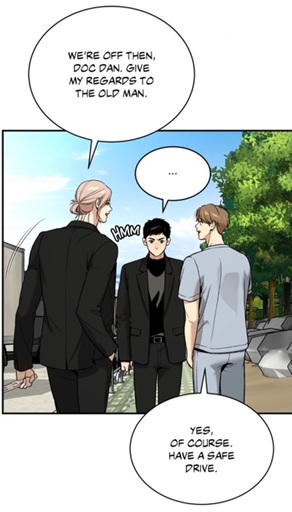 (chapter 59), and townspeople instinctively report Dan’s behavior to him. (chapter 69) I would like to point out that the kind man said “villagers” and not “villager”, a sign that he was contacted by many people. Such recognition is reserved for those woven into the community’s long memory.
This dynamic becomes even more intriguing when we consider how the wolf might have ended up in house 7-12 in the first place. (chapter 61) Given that the rural address system is based on the older jibeon model—and most GPS systems now rely on the newer road-based address format— it is unlikely that Jaekyung could have located Dan’s home through navigation alone. 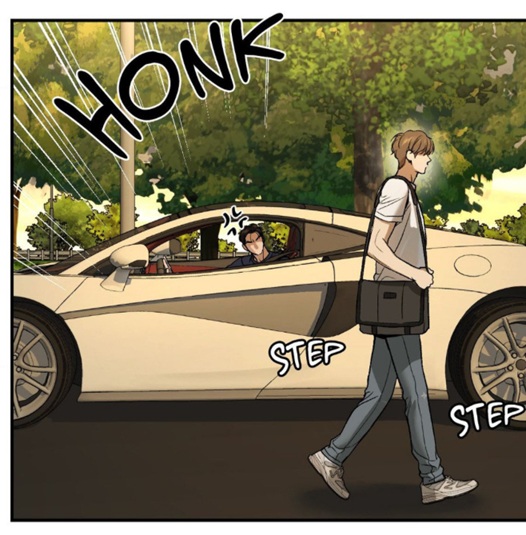 (chapter 61) That’s the reason why the author included this scene. Even if someone had disclosed Dan’s address, the GPS in Jaekyung’s luxury car would not have been able to guide him there. Like mentioned above, the streets have no names, and the numbering lacks logical sequence. Thus, we have to envision how the Emperor followed Dan on foot, observing where he went. In doing so, he not only located the general vicinity. Afterwards, he must have contacted a local and requested for a vacant house close to 33-3. That’s how he found the “hostel” right next door. (chapter 62) No wonder why the athlete stopped his training for his benefactor, the town chief. His act of renting that space was not just about proximity—it was a quiet, determined form of emotional pursuit, bypassing digital maps in favor of personal presence. Once again, this mirrors the emotional structure of the story: Jaekyung could only find the hamster by leaving behind his car (the older version of episode 69
  – chapter 69) and walking through the confusion himself.
Finally, this rural numbering system is placed in relief by an urban counterpart. In episode 1, 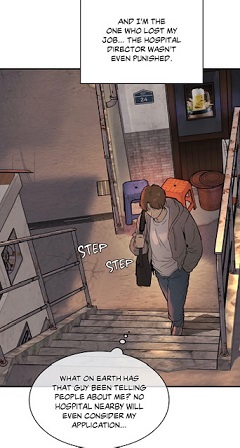 (chapter 1) we see Dan walking under a blue plaque labeled “24”—the newer, street-based system introduced after 2013. This number, part of Seoul’s revised address format, contrasts sharply with the rural jibeon model. Where 7-12 and 33-3 reflect layered histories and family division, “24” is precise, administrative, and arguably impersonal. The place is no longer connected to family and traditions, rather to migration and anonymity. The juxtaposition between systems emphasizes not only physical distance but emotional dislocation.
Yet among all these numbered spaces, one person remains strangely untethered: Shin Okja.  (chapter 65) Though she insists this seaside town is where she “grew up,” she never identifies a lot number, street, or ancestral parcel. In a rural system where numbers are more than logistical—they are signs of rootedness and intergenerational presence—her vagueness stands out. Everyone else is connected to a numbered gate, a registry, or a mailbox. She alone floats in narrative space, clinging to emotional claims without material proof: no concrete location is brought up.
 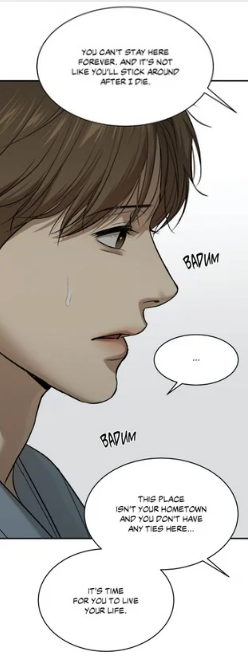 (chapter 57) The contrast becomes sharper when she refers to Seoul only in generic terms. She never mentions a district, (chapter 65), a person
  (chapter 56), a neighborhood, or specific location. This lack of detail, especially when juxtaposed with the specificity of the rural jibeon system (where even a subdivision number implies lineage and ownership), exposes her rootlessness. It reinforces the idea that her ties to place are performative rather than grounded. Even her nostalgia for Seoul is flattened (chapter 65) into a symbol of urban superiority—money, prestige, modernity—without anchoring it to a real “home.” In short, she idealizes Seoul the way she romanticizes the countryside—selectively, superficially. At the same time, she is giving the impression that she is erasing her stay in Seoul, as if her past there, too, is unmoored. Because of this observation, I realized why the nurse never questioned the senior’s statement. (chapter 56), though she expressed some doubt. By asking for more details, she imagined that she could touch a sensitive topic, like for example loss of her home etc. Shin Okja‘s inability—or refusal—to locate herself within a concrete building and specific numbered system of belonging hints at a deeper truth: Shin Okja may perform the role of native and guardian (chapter 57), but the land does not affirm her story. In Jinx, numbers are roots, and she is rootless. The more she talks about places, the less we see of her in them. She becomes a woman suspended between two worlds, belonging to neither.
Finally, the narrative suggests with the Emperor’s example, rootedness is not determined by a map or a deed, but by how much responsibility and memory one carries. And so far, the halmoni is not contributing much to the little town. She remains in the confines of the hospice. Hence no one among the inhabitants noticed her so-called return to her hometown.
But since the new system is used in Seoul, I wondered about her address and house number. So what was the house number of Shin Okja`s home in the capital?  (chapter 17) As Jinx-lovers can detect, next to the entrance of her apartment, there is no blue house number plate or street name. How is that possible in a metropolis where every residence should be digitally registered? And now, pay attention to the house where the “goddess” and her “puppy” lived.
 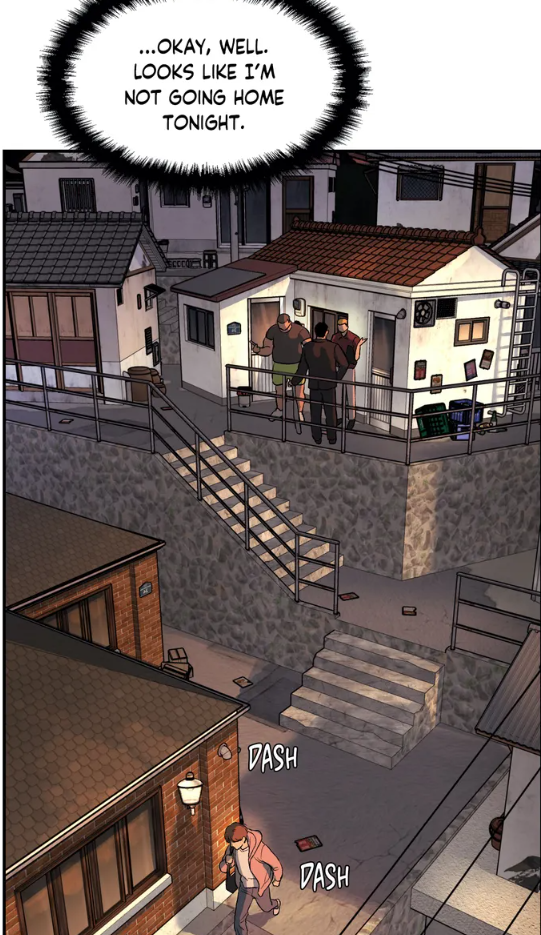 (chapter 1) The building had not only two doors, but also the plaque is placed next to the other door. It is also partially visible in this image:
 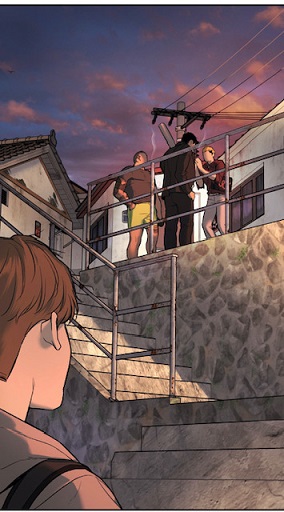 (chapter 1)
This raises a series of subtle but important questions. When we see Kim Dan standing in front of the darker, metal-framed door in episode 11  (chapter 11), we naturally assume he is returning home—entering the same shared space he and his grandmother inhabit. But is that actually the case? A closer look reveals he is using the other entrance. On his right side, we see the electricity meter, the mailbox, and the window—the signs of an inhabited and administratively recognized unit. This suggests that Kim Dan’s official residence is behind this second door. Once again, I am showing the view of the same building from a different perspective,
 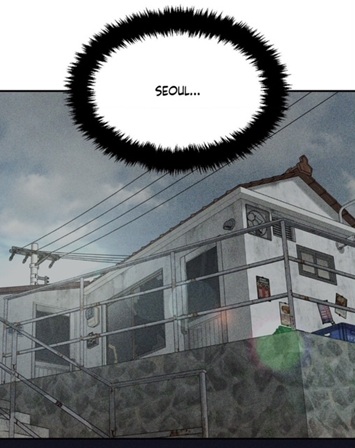 (chapter 57) where the mail box and the electricity meter are. But I have another evidence for this observation. During that night, the hamster got assaulted by Heo Manwook and his minions.
  (chapter 11) And keep in mind that after getting beaten by the Emperor, anyone could recognize the grandmother’s place from outside due to the broken window.
  (chapter 19) The moment I made this discovery, I couldn’t help myself wondering why doc Dan would go to the other door and not to the halmoni’s room.
And this thought led me to the following deduction. He had been triggered to go to that place because of the phone call from the redevelopment association.  (chapter 11) The voice on the phone reveals something legally crucial
 (chapter 11): Kim Dan is the last remaining resident in that building. That one line reframes everything. This suggests that Kim Dan’s official residence is behind this second door. 😮 In fact, the building features (chapter 57) only one house number plaque, one mailbox, and one electricity meter. These markers aren’t decorative—they are infrastructural indicators tied to administrative systems. In a city like Seoul, this configuration implies a single legally registered unit. So despite there being two entrances, only one household is formally recognized by the system. And since the resident registration system restricts each individual to a single verifiable address, this means only Kim Dan is recorded as the building’s legitimate occupant. The other door—the one associated with Shin Okja—exists outside the scope of legal recognition. She may live there physically (her belongings are still there), but bureaucratically, she doesn’t exist in that space.
Under the Korean Resident Registration System, every citizen must register their place of residence with the local government. Since 1994, this data has been digitized, allowing all state institutions to access and verify a person’s registered address electronically. This information is not symbolic—it is legally binding. Your registered address determines where you pay taxes, vote, access services, and claim benefits. Moreover, because so many government processes now rely on digital access to this central database, only one person can be officially tied to any residential unit at a time. Crucially, it is also a prerequisite for accessing financial credit. One cannot take out a bank loan or act as a legal guardian without a valid, registered place of residence.
This means that in the past, Shin Okja must have been officially registered at the address. 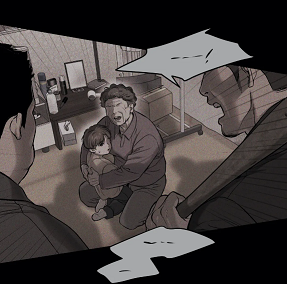 (chapter 5) When the loan shark came to collect the interest of the debts during Kim Dan’s childhood, he went straight to her door
  (chapter 5) —the door that, at the time, likely bore the blue house number plaque.
However, attentive readers will notice a striking detail: the door seen during this childhood memory opens outward toward the viewer and is positioned closed to the left corner,  (chapter 5) the door associated with Kim Dan in later episodes—particularly the one through which the champion entered during the confrontation with the thugs —opens inward and is placed in the corner of the right wall. The interior layouts and door directions don’t match, though the furniture is similar. This strongly suggests that these are two different units within the same building, exactly like I had observed before. The “goddess” and the hamster’s house had two doors and as such two units. (chapter 1)
These architectural clues support a subtle but significant shift: Shin Okja once resided in the main unit, the one connected to the official registration and legal address, in other words her initial flat was there. (chapter 11) At that time, Kim Dan, as a child, must have lived in the other unit, the one without number. She was probably taking care of him. However, at some point, she must have switched the place and moved to the other unit. This would explain why doc Dan  (chapter 19) had a recollection of this moment, when he was about to leave this humble dwelling.
  (chapter 19) His move to the penthouse triggered another “move” from the past. Consequently, I am deducing that this souvenir represents the moment of the grandmother’s arrival and the departure of the hamster’s parent(s) from the other unit. But there’s more to it.
Since people are obliged to get a residency number with 17, I am assuming that the halmoni ceded legal registration to him, once he reached his 17th year. Kim Dan took over the smaller, neighboring room officially, and with it, the burden of formal residency. When she relinquished her official role, the system would have required a transfer of household headship and residency—most likely to Kim Dan. In my opinion, she became listed as household members (세대원, saedaewon). They are fully registered, just not as the head. It is important, because in front of the champion, she acts, as if she is still the head of the household  (chapter 65) and Kim Dan the immature child, whereas according to my observations, she is legally dependent on the “hamster”. She is just a household member. As you can see, I detected a contradiction between her words and “hidden actions”, all this triggered because of the closed door. By transferring the address and registration to the physical therapist, she made it possible for him to inherit not just the space, but also the liability. That’s why he’s now the only registered person.
Thus, by the time we see Kim Dan revisiting the building (chapter 11), the name tied to the legal system, to the loan, and to the state’s digital records, is his—not hers. This administrative shift allowed Shin Okja to become legally invisible while Dan remained trapped in a place that was once hers, yet bore no official acknowledgment of her presence.
In short, the building’s physical structure masks a deeper displacement. (chapter 1) What appears to be a modest shared home conceals a painful history of passed-down burdens and reallocated responsibilities. The grandmother’s true door is off to the side, connected physically but separated in symbolic meaning. It has no number, no mailbox, no markers of legal presence. This hidden door is a perfect trompe-l’oeil: it masquerades as the heart of the home, but it’s actually a legally invisible annex. The framing invites the viewer to overlook it, just as the narrative invites us to overlook the grandmother’s evasions. And ironically, the one who stayed—the “last resident”—is also the one who was slowly pushed into the background, into the unnumbered space, into silence. And now, you comprehend why the grandmother asked from him this:  (chapter 11) When he says “home,” he is referring not just to a physical place, but also to a legal and emotional placeholder—a registration number that ties him to bureaucratic existence, familial duty, and emotional manipulation. With her promise to return in that home, Shin Okja is essentially demanding he remains the legal anchor—the one who stays behind, the one who remains registered, the one who continues to carry the official burdens, even as she herself fades into invisibility. That’s how she became a “carefree” ghost in the end. It wasn’t just a promise of care, but a submission to being tethered—not to belonging, but to obligation masked as love. The irony is that by remaining legally “present,” Dan was emotionally erased.
To conclude, Kim Dan was not just the last physical inhabitant—he is the last legal one. His mailbox, his electricity meter, his official records—all point to the metal-framed door. (chapter 11) That’s where his address was, until he moved to the penthouse. But that’s where the loan is linked. That’s where the city saw him. And because the resident registration is necessary for work and taxes, Kim Dan had to change his resident number, when he moved to the penthouse or to the seaside town. That’s how I came to the following conclusion: Shin Okja must have known about his stay with the champion in the end.The Korean Resident Registration System is the evidence. This shows how important this scene was in season 1. (chapter 11) (chapter 65) In this panel, her words in English were ambiguous, while in the Korean version, the grandmother exposes that she was well aware that her grandson and the emperor would live together.
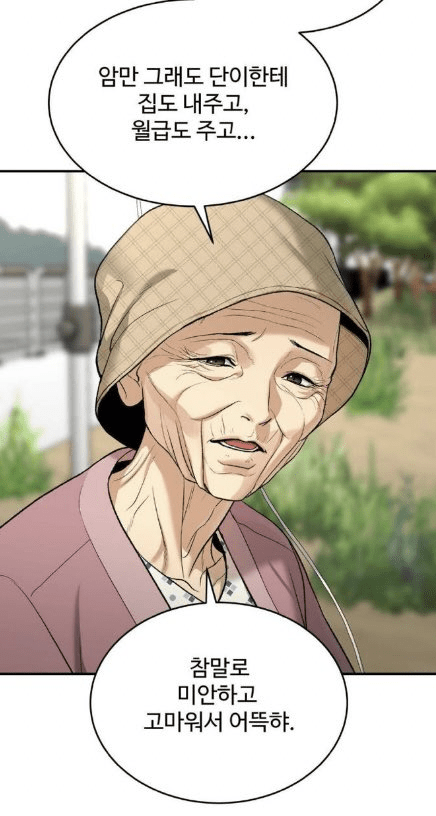
This means that the halmoni must be well aware where her grandson is staying in her “hometown” in the end!!
Don’t forget that in South Korea, when a person enters a hospice or hospital, they must provide a valid registered address for several reasons: Health insurance eligibility (National Health Insurance Service); Billing purposes; Coordination of long-term care or welfare benefits; Resident registration confirmation (especially in hospice care, where end-of-life planning intersects with legal identity). She is legally totally dependent on him, and not just financially. So when she suggests to doc Dan to return to Seoul, she is actually denying the existence of a relationship between the physical therapist (chapter 57) and the landlord from 33-3. In fact, she was indirectly expressing a lack of gratitude toward the elderly man.
This realization, the existence of two units within the same building, subtly destabilizes the commonly accepted idea that Shin Okja is his grandmother. I have to admit that while reading episode 57, doubts (chapter 57) about their parentage came to my mind, especially when she claimed that doc Dan had different roots as hers. However, so far, I could never find an evidence for such a theory and imagined that my mind was simply too creative. Yet, with this new insight her role begins to look less like that of a familial guardian, and more like that of a caretaker, a nanny, or even an intruder—someone who moved in but was never truly rooted in Dan’s legal or emotional household. This theory would explain why the grandmother is not talking about doc Dan’s parents, why she remained passive, when he got stigmatized as orphan. She had every reason to suggest that she was enough for him, he just needed her. (chapter 57) That way, he became attached to her. It’s a startling reversal: the woman who claims maternal authority is  (chapter 65), in the eyes of the system, merely lodging in his shadow. She is indeed a ghost.
 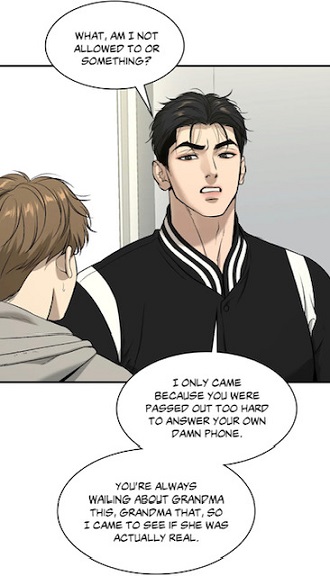 (chapter 22) This architectural division is deeply symbolic. Despite being the dependent, Dan is the one bearing responsibility—both financially and administratively. Shin Okja, on the other hand, manages to live without accountability.
And perhaps it’s no coincidence that the Seoul house (chapter 1) resembles the configuration in the small town. (chapter 57) In both cases, the boy lives next to someone who is older, legally distinct, and spatially close yet administratively separate. However, in the capital, the room with the second door is much smaller, as if doc Dan was the “servant”, though he was the main resident and the household head. In the countryside, this creates a healing bond with a benevolent elder. In the city, it sharpens a sense of entrapment. The echo between the two homes becomes a subtle commentary on the difference between chosen family and imposed family, between true guardianship and the performance of care.
And what did Shin Okja say to the Emperor? 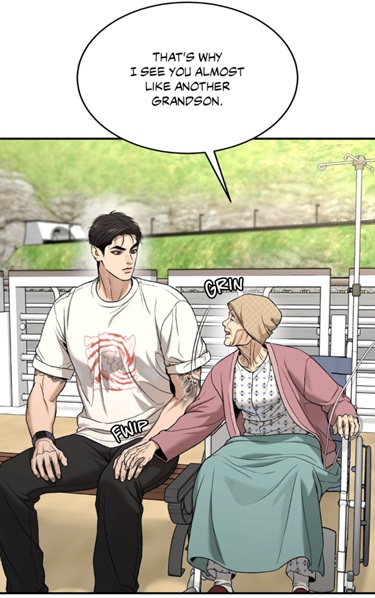 (chapter 65) Joo Jaekyung is almost her grandson!! It was, as if she was about to adopt him. Let’s not forget that he embodies all her ideals and dreams: strong, healthy, rich, famous, generous, polite and gentle! And according to my observations, she knows that the athlete owns a flat in Seoul, big enough to take a room mate.
The silent yet stark detail about the two units (chapter 1) also reshapes our perception of Shin Okja. This singular registration setup does more than highlight Dan’s bureaucratic burden—it reframes the nature of the doctor’s relationship with Shin Okja. (chapter 11) But why did she ask him to become the household of this unit in the past? For me, the answer is quite simple. She had already planned that the young boy would take over her debts. One might argue that the debts might have been related to the hamster’s family. Yet I can refute this point. How so?
First, according to my previous observation, Shin Okja was living in the other unit, and the thugs went straight to her flat, the one with the sign on the wall. (chapter 5) They were looking for her and not “doc Dan” or his family. Unfortunately, the little boy was present. Because they were seen together, people assumed that they were together, a family. But like mentioned before, there was a move within the same building. Moreover, as a child, Dan was exposed to violence from the loan sharks. He couldn’t have signed any documents at the time, for a resident registration number is required and the other place is not registered; the grandmother was the official borrower. But later, Heo Manwook declared that Kim Dan is the named debtor. 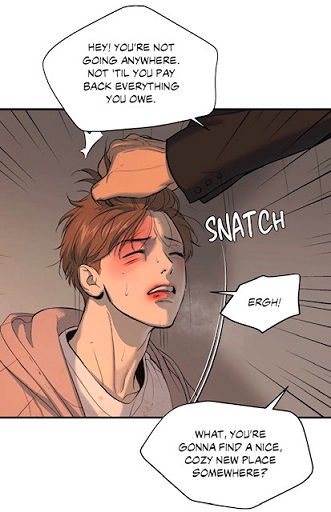 (chapter 16) He even showed the amount Kim Dan owned with his cellphone to the Emperor
 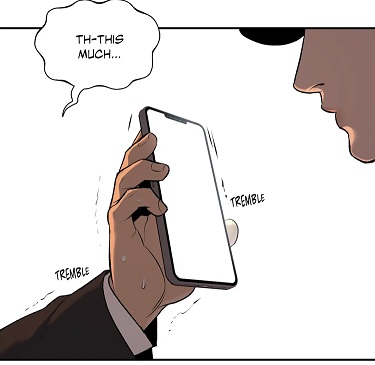 (chapter 17) That’s how the champion internalized that the hamster was the one with debts. This theory explicates why doc Dan is not blaming his grandmother for the debts in the end, as he signed himself loans. And now, you can imagine what happened in the past. Once he became 17 years old, she asked him to get a resident registration number. With this, he could apply for a loan in order to reimburse the grandmother’s debts. This must be one of her favors from the past:
 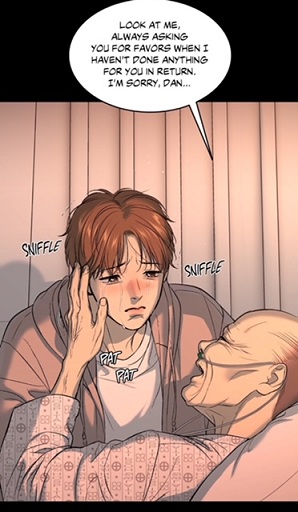 (chapter 53) So far, in season 1, she had made only one (chapter 41) before her request to visit the West Coast. The most plausible explanation is that Shin Okja persuaded him to take over the loan. She likely presented it as a necessary sacrifice, something he could manage given his income as a physical therapist. This explains why the elderly woman is no longer asking about the debts or loan. It is no longer her main concern, she is not the household head either. And don’t forget what the physical therapist thought, when he heard from Kim Miseon the bad prognostic about his grandma.
 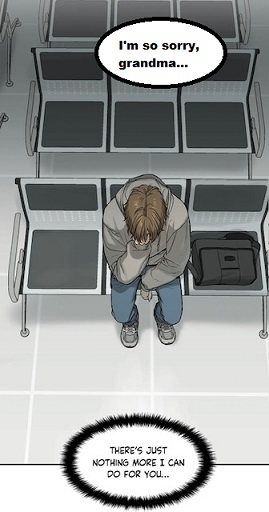 (chapter 5) His words imply that he had done something in the past for her. And that would be to become her guardian and take her debts. This hypothesis explicates why only in episode 11, Doc Dan was comparing the progression of the interests with a snowball system, something unstoppable.
  (chapter 11) His thoughts reflect a rather late realization that he is trapped in a system and he can not get out of it. In other words, this image oozes a certain innocence. This also explained why Joo Jaekyung had to confront him with reality in front of the hospital.
 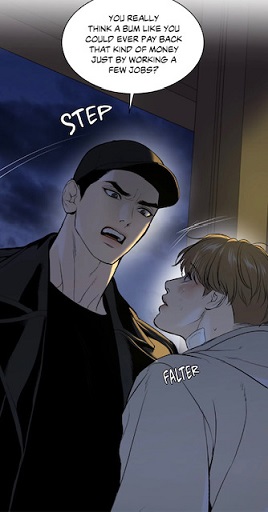 (chapter 18) The location is not random: for the halmoni, such a work place symbolizes respectability, power and money. The problem is that in the hospice, Doc Dan is not well-paid.
 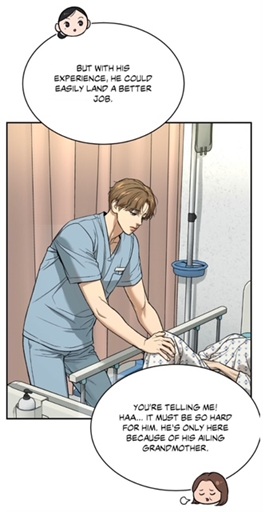 (chapter 56)
And so, when he returns to that door after the triggering phone call (chapter 11), it isn’t just a physical movement—it’s a re-entry into responsibility and also past. The metal door doesn’t lead into a shared home, but into a legal burden. It is the entrance not to comfort or care, but to debt, disrepair, and abandonment. No wonder why during that night, the hamster had to face Heo Manwook and his minions.  (chapter 11) And now, it is time to return our attention to my illustration for the essay:
  As my avid readers can observe, the panel with the champion facing the blue door comes from episode 69, while the one with doc Dan comes from chapter 11. These scenes are mirroring each other. It is about concern and danger! While in episode 69, the athlete got worried, as he imagined that doc Dan’s life was in danger, in episode 11, the hamster was about to face an old threat: Heo Manwook and his minions!
  (chapter 11) But back then, he was on his own and no one paid attention to his health. Not even Shin Okja… He was truly abandoned, while the episode 69 exposes the opposite. Society in this little town takes care of people in general.
Striking is that Heo Manwook does not even know about Dan’s profession. When he sees the influx of money 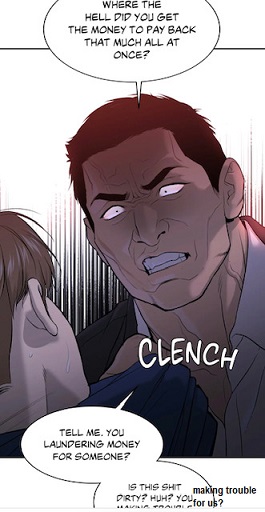 (chapter 11), he jumped to the conclusion that Dan was either prostituting himself or laundering funds. Why? It is because he had taken odd jobs, until he got hired by the dragon, Joo Jaekyung, and had such a huge income. Under this new light, it becomes comprehensible why Heo Manwook knew how to use the old lady in order to threaten doc Dan.
  (chapter 16) Like I wrote in a different analysis, I doubt that the grandma would have signed a loan by Heo Manwook. This reveals how Dan entered the contract in obscurity, without recognition or protection. He did it for Shin Okja’s sake to repay her for her support and “love”. (chapter 65) No wonder why Shin Okja never mentions the loans when speaking to Joo Jaekyung, thus erasing her responsibility. And imagine this: Doc Dan is now living with an elderly man who is a farmer. She might suspect that the senior is trying to take advantage from her “grandsons”. If this is true, then she would just be projecting her own thoughts and fears onto the landlord. Since she connects the city to success and money, I am quite certain that she doesn’t judge farmers in a positive light. For her, doctors or celebrities are much more recommendable persons.
In the following article, the paper’s data underline a social reality: farming in Korea is struggling, and its practitioners—despite their essential role—are economically marginalized. In 2022, average agricultural income per household dropped to just KRW 9.49 million (~US $7,300)—under the 10-million-won mark for the first time in 30 years. Farming households earn only about 20–27% of what they once made, a steep decline from over 50% in the 1990s. Structural issues—aging farmers, small-scale plots, high material costs, and price volatility—have trapped many in long-term economic strain. Far from being a supplement, farming is often no longer a primary income source, pushing many rural households into poverty, with younger generations fleeing to cities. This evolution is reflected in the Korean manhwa. The room of Doc Dan contains traces of a teenager who left the house. 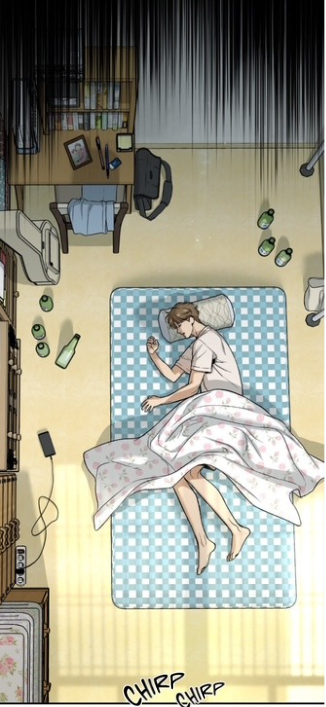 (chapter 57) Therefore I am expecting an argument between the halmoni and the inhabitants of 33-3. The landlord embodies the opposite values of Shin Okja.
This layered confusion about the flats extends to the objects within the home, especially the massive mother-of-pearl bridal wardrobe. 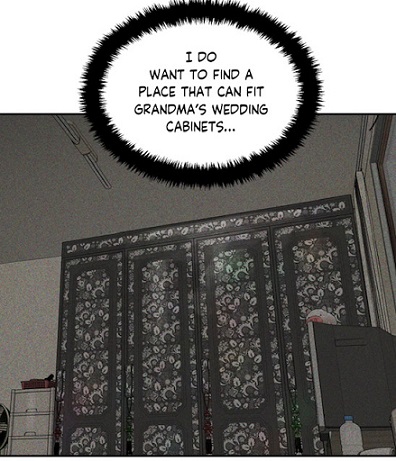 (chapter 16) Dan repeatedly calls it his grandmother’s and even dreamed of finding a new place that could house it—a gesture that underscores how much he believed she treasured the object, even though she herself never mentions it. But she never once references it, not even when returning from the hospital. The absence of interest is striking. What if the cabinet didn’t belong to her at all? Its size suggests that it predates the division of the house. Besides, according to my observation, she used to live in the other unit and I can not imagine, the halmeoni moving this furniture from one unit to the other. Perhaps it once belonged to Dan’s mother—a remnant of the original household, now misattributed to the woman who unofficially took over.
Dan’s reverence for the cabinet mirrors his longing for stable familial identity. He projects value  (chapter 19) onto the object just as he projects loyalty and gratitude onto his guardian. But the silence around the cabinet speaks volumes: it is not treasured by Shin Okja, only by Dan. Much like his name on the loan, or the house number on the door, it could be a misplaced inheritance. At the same time, such an item could serve to identify doc Dan’s true origins, if the Wedding Cabinet belonged to his true family.
In contrast, Jaekyung’s initial intention was to stay in the seaside town only temporarily. (chapter 61) He claimed the move was for recovery and recuperation—a short break from his life in Seoul. Yet Korean law requires anyone staying in a location longer than a month to officially change their resident registration. If he were to do so, this would not just signal a change of address but a severing of administrative ties with Seoul—and by extension, Park Namwook and MFC.  (chapter 66) Changing his registration would mean stepping outside of the institution’s control and surveillance.
However, I doubt that the star has ever officially registered his stay. Like Kim Dan before him, he exists in a limited legal space—present but not formally tied. This ambiguity mirrors his emotional state. His real return to Seoul was always conditional—it depended on Dan’s willingness to follow him. 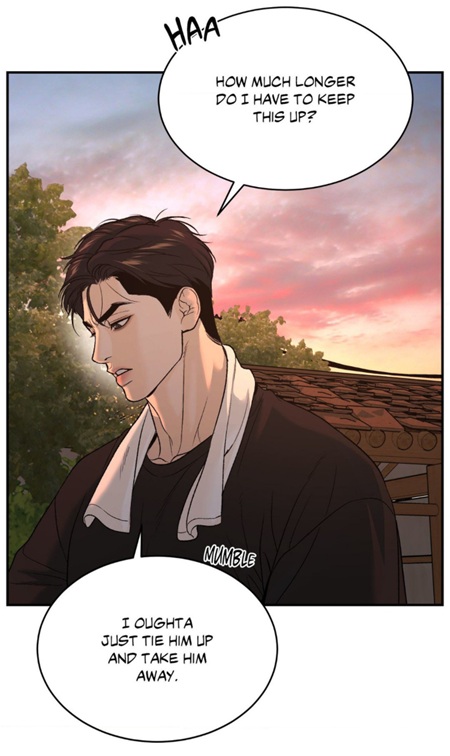 (chapter 62) Without Dan, Seoul held no meaning. But if he remains in the town past the statutory threshold, it would imply that he is ready to leave behind the world of contracts and competitions. It would mean he is now rooted—not by career, but by choice. Not by obligation, but by emotional truth.
In this way, the law becomes a mirror: resident registration, typically viewed as bureaucratic red tape, becomes a metaphor for chosen identity. The champion’s choice to return straight to the seaside town displays his psychological transition. He is no longer the man who moved through cities on training schedules. He is beginning to act like someone who stays—and stays for someone. And that someone is Kim Dan.
The titular “hidden door to the past” is not just a visual motif—it is the emotional architecture of Jinx. By attending to overlooked details—address numbers, cabinet placement, financial responsibility, and architectural sleight-of-hand—we can trace the emotional fault lines that run beneath Dan’s quiet suffering and the champion’s slow awakening. The question is no longer just where they live, but who gets to call it home. The essay began with an image collage, but what it truly offers is a blueprint: not of real estate, but of memory, grief, and quiet resilience.
Feel free to comment. If you have any suggestion for topics or Manhwa, feel free to ask. If you enjoyed reading it, retweet it or push the button like. My Reddit-Instagram-Twitter-Tumblr account is: @bebebisous33. Thanks for reading and for the support, particularly, I would like to thank all the new followers and people recommending my blog.
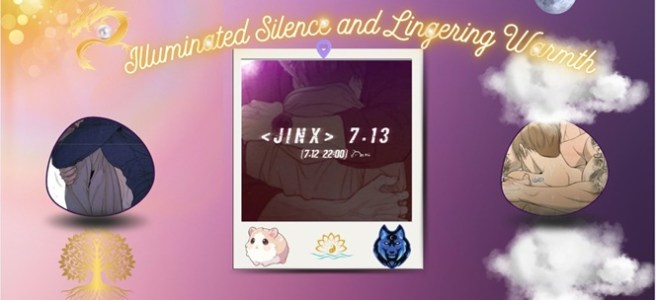
Please support the authors by reading Manhwas on the official websites. This is where you can read the Manhwa: Jinx But be aware that the Manhwa is a mature Yaoi, which means, it is about homosexuality with explicit scenes. Here is the link of the table of contents about Jinx. Here is the link where you can find the table of contents of analyzed Manhwas. Here are the links, if you are interested in the first work from Mingwa, BJ Alex, and the 2 previous essays about Jinx Flight 🚪 from Truth 👁️✨🧠, Fight🥊 for Fragile Peace☮️ and What about The Wolf’s 🐺First Kiss? 💋
It would be great if you could make some donations/sponsoring: Ko-fi.com/bebebisous33 That way, you can support me with “coffee” so that I have the energy to keep examining Manhwas. Besides, I need to cover up the expenses for this blog.
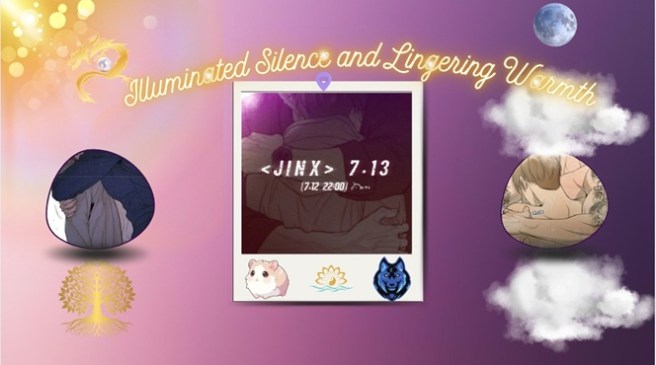
This image 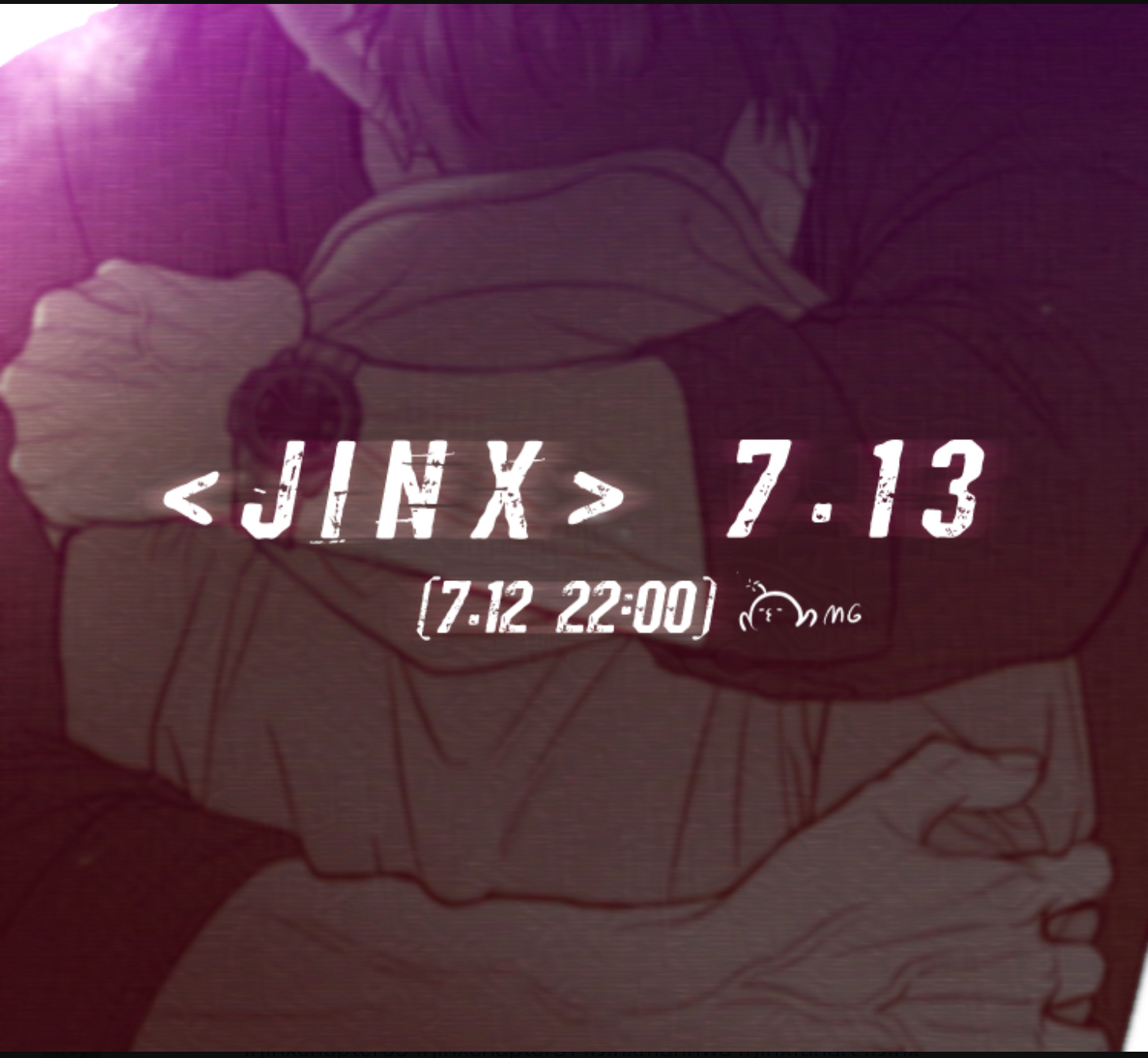 , released in anticipation of Chapter 70, is more than a promotional teaser. It is a moment frozen in time, yet brimming with motion—emotional, symbolic, and narrative. We see Joo Jaekyung embracing Kim Dan with both arms, pressing him tightly against his chest. There is no resistance, no distance, no tension in the frame. The palette moves from gray and brown fading into violet and pink, blooming into soft light. There is vapor, there is breath, an allusion to life. And most strikingly, there is stillness.
For my fellow Jinx-philes who have followed every bruise 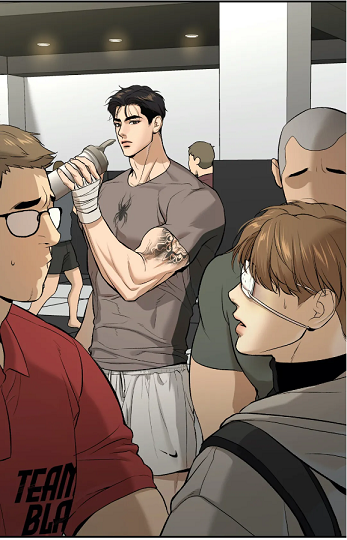 (chapter 11), every glare, and every awkward silence
  (chapter 67) between these two, this hug feels monumental. Why did the author choose this scene to announce the new chapter?
One might reply that it serves as a summary or visual recollection of the final moment in Chapter 69. And yes, it does that. But there’s more to it. The embrace is, in fact, a confession—one expressed not through speech but through touch. It may seem like a simple hug, yet it conveys something deeper and more vulnerable than any spoken admission. This is body language at its most honest: a quiet gesture that communicates all the things Jaekyung cannot articulate. Though words are absent, emotion is not. Silence, in this case, becomes a medium of connection rather than distance and lack of communication. Joo Jaekyung’s embrace reveals anxiety, tenderness, affection and the desire not to dominate, but to remain – to protect and to hold. And that is precisely why the author chose not to depict a kiss. A kiss would have shifted the tone toward romance, toward desire. But what Dan needs first is not romantic affection—he needs enduring, reliable friendship, a different form of love. Until now, he has only known fair-weather companions like Heesung or Potato.  (chapter 58)
This embrace gestures toward something deeper: a bond built not on conditions, but on presence. Hence in this illustration, we also glimpse the athlete’s watch strapped to his wrist—a detail that may seem minor, but resonates with meaning. It subtly grounds the scene in time, discipline, and routine, reminding us of his physical life as a fighter. Back then, the wolf was always preoccupied with the future (chapter 29) —the constant possibility of being challenged, of losing ground, of falling from his throne. Time meant pressure. It meant movement. But now, in this image, the presence of the watch highlights how far he has come. No longer ruled by future threats, he chooses to pause, to stay grounded in the present. But in this moment, time is suspended. The watch becomes not a symbol of training, but of waiting—of calling time, of taking a breath, of choosing to be fully present for someone else. It marks a shift: he is no longer racing the clock, nor following the flow and facing the pack of challengers. He is here, holding, breathing, staying while keeping doc Dan in his sight.
This embrace is not just a recap of Chapter 69. It is a culmination. A reversal. A reflection. And above all, a threshold.
The date itself whispers symbolism. July 12. Add the digits: 1 + 2 + 7 = 10. In numerological terms, 10 signals the end of a cycle and the quiet promise of a new beginning. The “1” stands for rebirth, while the “0” opens the door to uncharted emotional space. We are no longer in the territory of possessiveness or pain. We are stepping into breath, presence, and vulnerability. It is the start of a real friendship and healing.
But how do I see all this in a single image? Naturally through reflections and comparisons. This essay will trace how this embrace reverses earlier dynamics—from the grandmother’s false comfort to the star’s previous grip of control. We will revisit the broken sandbag, the Emperor’s red backlit inner thoughts and visions (chapter 29, 55), and even the slap that echoed too loudly in the hospital. Because when Jaekyung finally hugs Dan with this kind of fragile openness, it doesn’t come from nowhere.
It comes from loss. From growth. From choosing stillness when everything in him was taught to keep running.
To truly grasp the emotional weight of the teaser hug , it must be examined in contrast with two pivotal earlier moments: the bathroom embrace in Chapter 68  (chapter 68) and the public hug on the dock in Chapter 69. (chapter 69)
In Chapter 68, the setting is intimate and vulnerable—a dim, wet bathroom. Kim Dan is asleep in the champion’s arms. Jaekyung holds him tightly from behind, but his own posture reveals something unresolved.  (chapter 68) He rests his chin not on Dan, but on his own hand, his arm propped on the edge of the bathtub. This detail is telling: even in a moment of supposed closeness, Jaekyung relies on himself for support, not on Dan. He is physically near but emotionally braced—still holding himself apart. His thoughts are private, tender, and possessive. In a rare moment of introspection, he confesses that (chapter 68) This line (“I’ll keep him right here in the palm of my hand”) is deeply revealing. The champion frames care through the language of possession. The palm is open but hierarchical; it suggests that Dan is small, fragile, and dependent on Jaekyung’s will to hold or release. He does not yet see Dan as an equal. Even as he softens, his emotional vocabulary is shaped by superiority and containment. The hug is real, the sentiment sincere, but the dynamics remain unbalanced. And since Dan is asleep—unable to reciprocate, respond, or challenge—the embrace becomes more about the wolf’s soothing himself than forming a mutual bond. Furthermore, Dan is not even facing Jaekyung. (chapter 68) His head rests in the crook of the champion’s shoulder, turned away, a spatial choice that subtly reinforces the lingering emotional distance between them. They are close—but not yet connected. Initially, Dan’s profile is visible, resting gently against Jaekyung’s chest. However, as the moment progresses, Jaekyung subtly shifts Dan’s position. (chapter 68) In the next panel, we see Dan’s head from behind. This small but deliberate movement suggests a dynamic effort to hold onto him more firmly—to assert closeness, perhaps, but also to reposition him as something to protect and possess. The scene is filled with motion, both physical and psychological. And this motion, this shifting, stands in direct contrast to the stillness of the teaser image. In fact, the contrast goes deeper when considering the celebrity’s body language: (chapter 68) in the bathroom, we see only one of his hands holding Dan, while the other remains out of frame. Crucially, the watch he normally wears is missing. The absence of this item—one that often symbolizes the passage of time—hints at a suspended moment, an emotional pause where time no longer governs the champion’s thoughts. This subtle omission underscores how, in that quiet resolve to ‘keep him in the palm of my hand,’ Jaekyung momentarily abandons all concern for his career, his schedule, and the ticking clock of an MMA fighter’s short-lived prime. (chapter 68) It is no coincidence that the next morning he receives a new match offer: a test of that very resolution.
  (chapter 69) Yet, when faced with renewed pressure and stress, he falters—leaving Dan behind.
 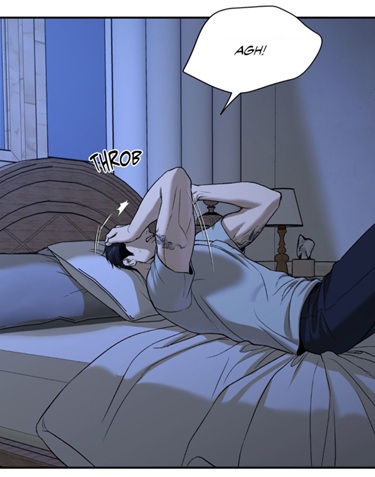 (chapter 69) The illusion of control dissipates, revealing that his earlier vow, however heartfelt, was not yet unshakable.
Under this new light, it becomes clear why Mingwa let Jaekyung make this silent resolution (chapter 68) without a witness. Had the athlete expressed his thoughts directly to Dan, they might have come off as arrogant, performative, or even hypocritical later. The quietness of his resolve shields it from judgment (chapter 68) —it’s neither a promise nor a performance, but a deeply personal moment of self-reflection. As such, it doesn’t demand perfection, only sincerity. And when Jaekyung breaks from it later, readers are invited to empathize rather than condemn. This unspoken vow belongs to him alone, and its failure stings not because of broken trust, but because we witnessed its honesty.
By Chapter 69, we see a notable progression. On a stormy night under a clouded sky, Jaekyung embraces Dan again—this time fully clothed, in public, and face-to-face. (chapter 69) The posture is protective, with Dan still clutching shopping bags. Much like the embrace in the bathroom, this one also unfolds under the moonlight and carries a strong sense of motion. Jaekyung acts on instinct and emotion, reaching out without hesitation. His gestures are protective, but still driven by impulse rather than reflection. This hug is no longer one-sided: Dan leans in, allows himself to be held. It marks a moment of shared emotional exposure. Still, it remains reactive, a response to emotional tension (chapter 69) rather than a moment of mutual resolution. Jaekyung offers no words, yet a silent gesture of care and vulnerability.
Notably, the watch is no longer visible in this embrace. Although we know from earlier panels 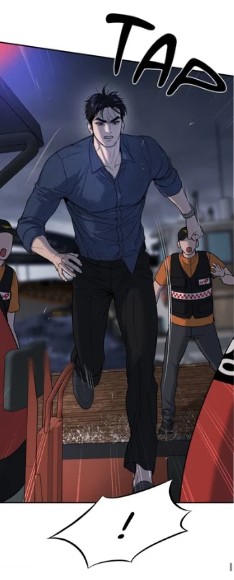 (chapter 69) that Jaekyung is wearing it, the change in angle—viewing the hug from behind—deliberately conceals it. (chapter 69) This compositional choice signals a subtle shift in perspective. Where the teaser centers the champion’s hands, the public embrace instead centers the environment, the setting, and the societal gaze. Dan’s face and back are hidden. Jaekyung’s back is turned to the viewer, signaling that this moment, while emotionally meaningful, remains partially opaque. Yet his vulnerability is visible—not through facial expression, but through posture. The tightness of his arms, the way he bends to reach Dan, the absence of hesitation—these all speak to a man laying down his guard. He is not posturing; he is clinging. And in doing so, he exposes his attachment and dependence.
By hiding Dan’s expression and placing him at the center of the frame, the author may be pointing to a new phase. Dan becomes the emotional axis, the silent center of Jaekyung’s emotional storm. As if to say: it is now Dan’s turn to interpret, to react, and eventually—to decide. The author thus repositions agency subtly but clearly in the teaser.
The embrace in episode 69 contrasts powerfully with the teaser image, which is defined by stillness. If the embraces in Chapters 68 and 69 are guided by nighttime instincts and lunar passivity, the teaser hints at something new—a quiet morning, or the symbolic arrival of sunlight. The glow on the left side of the illustration resembles the break of dawn, suggesting not only emotional warmth but also a conscious awakening. It is no longer about impulsive action in the dark; it is about holding on to someone in the light. The embrace is no longer a reaction—it is a decision.
The teaser embrace transcends both prior instances, not only in composition but in emotional clarity. The colors purple and pink respectively symbolize enlightenment, maturity and innocent love. Unlike the bathroom scene in Chapter 67, both men are now awake, and crucially, mutually present—not just physically, but emotionally. And unlike the last hug of Chapter 69, this embrace is not reactive; it is not prompted by surprise, fear, external danger, or a crisis. It emerges from stillness, from a shared decision to remain close. Yet within that stillness, it also oozes quiet determination (holding him tight)—a commitment not only to care, but to remain. The embrace becomes an embodiment of the unspoken motto: enjoy the present. It reflects a decision to prioritize presence over performance, commitment and connection over conquest.
Jaekyung’s posture is especially telling. His arms are wrapped tightly around Dan, but more than that, his entire body curves inward, as if folding into the space between them. His head rests against Dan’s neck or shoulder, a gesture that carries vulnerability, not dominance. This is not the body language of a man in control—it is that of someone seeking emotional grounding. He is not bracing Dan against the world; he is clinging to him, quietly, with all defenses down.
Dan’s body, too, speaks volumes. His back is visible, but this time, it is not a symbol of detachment. Compare it to the champion’s thoughts in the past. 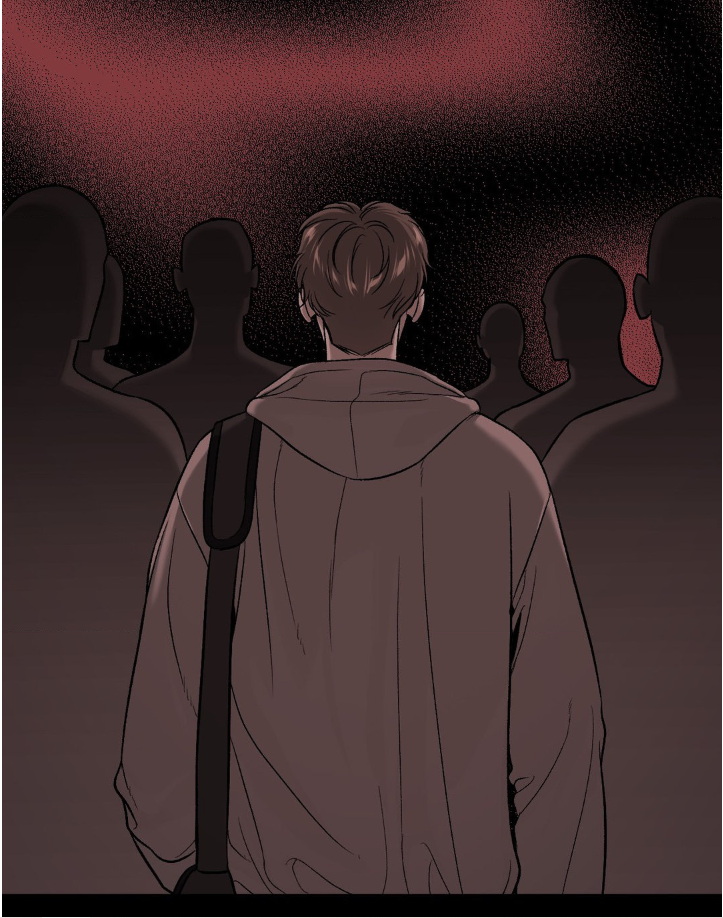 (chapter 55) In the new illustration, the hamster’s back is no longer representing anonymity and indifference, but visibility and care, for the champion is now facing his fated partner. In other words, doc Dan’s back in the teaser stands for uniqueness and high value. He can not be replaced. Moreover, doc Dan is not walking away, nor is he asleep. His hands are not visible—an intentional choice by the author. (chapter 69) By omitting them, the scene removes any external excuse for passivity, such as the black shopping bags seen in Chapter 69. Instead, it emphasizes Dan’s quiet agency. He is not weighed down or obstructed; he is simply there, choosing to stay. His stance is soft and grounded. He accepts the embrace—not out of resignation or shock, but through silent recognition. This marks a radical departure from earlier chapters where he either endured touch or froze under its weight. This time, he receives it—not as someone overwhelmed, but as an equal participant. That’s why I see the new illustration as the positive reflection of their argument in episode 45:
  (chapter 45) Back then, the champion refused the expensive key chain, symbolizing a missed opportunity for emotional connection. Both men yearned for attention and affection, but failed to express it. Here, in contrast, the champion offers something far more meaningful than a 14,000₩ and free lodging —his unguarded embrace. And Dan, by remaining still, appreciates the moment. His quiet presence, free of obligation or material offering, affirms that emotional closeness has replaced transactional gestures.
The setting amplifies this transformation. The pink and purple tones that bathe the scene suggest warmth, serenity, and renewal. These colors have replaced the earlier palettes of red (associated with lust and violence – chapter 29) and black (linked to isolation and fear – chapter 55). The two main leads are no longer alone. This is what transpires in the new drawing. The faint mist or vapor in the air suggests breath, life, and emotional release—it is as if they are finally exhaling together after holding so much in.
This embrace, centered in the teaser, is not just a gesture of reunion—it is a visual representation of mutual recognition and emotional rebirth. It marks a turning point where neither man seeks to overpower or please the other. Instead, they allow themselves to be seen and held. The result is not control, but reciprocity—a new balance where love is no longer a struggle for dominance but a shared space of refuge. This moment also represents the birth of a true team: both are relying on each other. Dan becomes Jaekyung’s anchor, the grounding force he never knew he needed, while Jaekyung stands as Dan’s shelter, his unwavering protection. They no longer orbit each other in isolation—they have become interdependent, attuned, and quietly united.
Dan’s stillness in the teaser illustration should not be mistaken for passivity. It is a deliberate act of emotional reception—something he was trained for from childhood. Raised by a grandmother who rarely expressed affection through words,  (chapter 21) Dan became fluent in a silent, physical language of care. She often asked him not to cry (chapter 57), unable or unwilling to face his vulnerability. To her, composure meant strength, and emotion—especially in the form of tears—was something to be managed or tucked away. Her love came in the form of caresses, pats
 (chapter 47) and composed embraces—gestures repeated with calm precision. These touches were predictable, rhythmic, and soothing, but they also suppressed genuine emotional exchange, the symbol of toxic positivity.
Dan learned early to interpret every small shift in touch: the rhythm of a pat, (chapter 57) the momentary pause of a hand (chapter 19), the direction of a gaze. Here, she was not looking at her grandchild who was talking on the phone. It was, as if she was excluding herself from the conversation. These gestures became his emotional compass—not because they were transparent, but because they were all he had.
Her hand was always in motion—patting, caressing  (chapter 5) never still—giving the impression of involvement, of care in action. But this motion avoided vulnerability and responsibility in reality. She never clung, never trembled. Her gestures conveyed comfort but not surrender, presence but not change, and not support either. They were not truly emotionally together. (chapter 57) Dan was never permitted to break down fully—he was urged to quiet his feelings rather than explore them. Thus it is no coincidence that the halmoni has no idea about the incident with the switched spray. Moreover, later the protagonist was often the one to reach for her,
  (chapter 47) to hold her hand, to initiate closeness
  (chapter 47) (chapter 56). This reversal of roles placed the burden of emotional stability on his young shoulders.
And layered into this physical restraint were her verbal reassurances—”You still have me,” “Grandma will always be there for you” (chapter 57); I’ll come back home, once I am all better” (chapter 11) —promises that sounded protective but masked emotional denial. Her words were spoken to soothe, not to reassure with truth. These assurances were emotional illusions—comforting on the surface, but hollow in substance. They created the illusion that she was always strong, ever-present, even immortal—an anchor that would never be lost. Over time, this illusion cemented itself in Dan’s mind. She became a fixed point of emotional gravity, (chapter 65) a mythic figure whose emotional distance he interpreted as noble sacrifice. Her constant reassurances and carefully controlled gestures fed into this perception, convincing Dan that love meant loyalty, restraint, and silent endurance.
This formative training becomes key to understanding why he doesn’t resist Jaekyung’s embrace. He does not shrink, flinch, or cling—he simply stays. Unlike in Chapter 69, where he clutched shopping bags that might serve as a pretext for his inertia (chapter 69), in the teaser his immobility is unburdened. The absence of his visible hands and possessions symbolically removes all excuses. Dan is no longer reacting out of confusion or fear. He is choosing to be held.
This emotional acuity is especially visible in Chapter 35, when Dan observes the aftermath of Jaekyung’s violent outburst at the sandbag.  (chapter 35) Instead of recoiling in fear or admiring his strength, Dan quietly states, “I think I really need to focus on Mr. Joo right now.” He does not focus on the strength or aggression, but on the pain beneath it. The burst sandbag, for him, is not a threat—it is a symbol of Jaekyung’s emotional unraveling. This silent recognition mirrors Dan’s interpretive skills developed in childhood. Just as he once learned to read a shift in his grandmother’s hand or the silence after a broken promise, he now interprets the damage to the sandbag as an unspoken plea for help. This sensitivity continues to define his bond with Jaekyung.
He recognizes the depth behind Jaekyung’s gesture —the trembling edge of desperation, the quiet need to be reassured. The celebrity’s grip is neither calculated nor repetitive. It is raw, clingy, and intense—each finger clutching as though Jaekyung fears losing him again. Unlike his grandmother’s composed movements, Jaekyung clings with both arms, as if to say: I need you to stay by my side. The absence of ritualized comfort, the lack of rehearsed gestures, tells Dan this is something radically different: not performance, but presence. There are no words exchanged—no hollow reassurances, no immortal promises. This is vulnerability in its purest form: exposed, messy, urgent.
For Dan, who was trained to perceive the emotional weight of silence and motion, the difference is staggering. The wolf’s embrace does not soothe from above—it clings from within. He doesn’t place himself above Dan like a guardian or caretaker. He reveals himself as someone who needs Dan’s presence, someone who trusts Dan with his own fragility.
This moment reshapes Dan’s emotional experience. In the past, stillness came from suppression. Now, it emerges from choice. In the past, he was the one to reach out 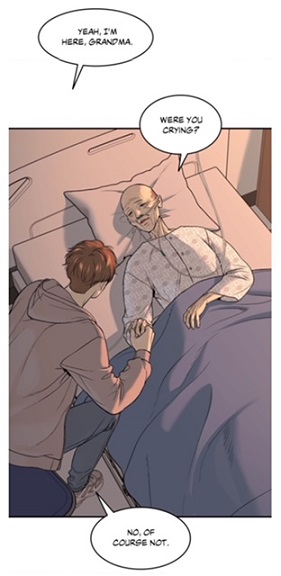 (chapter 47), to stabilize the person meant to support him. Now, he is receiving without shame or hesitation. The Emperor’s silent desperation, his refusal to hide behind ritual or false strength, creates the space for Dan to feel treasured—not pitied, but wanted.
Dan was conditioned to listen with his eyes, to decipher emotion from gesture. That gift has become the foundation of their bond. This time, silence is not loneliness—it is intimacy. Jaekyung’s embrace asks for nothing and gives everything. It is not a gesture of power or protection—it is a surrender. And the master, for the first time, accepts it as his own. Jaekyung and Dan do not need to pretend. They offer presence, not perfection. And Dan, trained to hear meaning in silence, receives the hug as something more profound than any spoken vow. It is not just a sign of Jaekyung’s attachment—it is an invitation, which Dan, for the first time, accepts freely.
The teaser leaves no room for misunderstanding: this embrace belongs to no one but them. There is no space for a third party to intervene, mediate, or translate. The intimacy captured in the image signals not only mutual acceptance, but also a decisive boundary—an exclusion of external authority. With this embrace, the narrative quietly removes the former guardians—Shin Okja and Park Namwook—from the emotional core. Their time as intermediaries 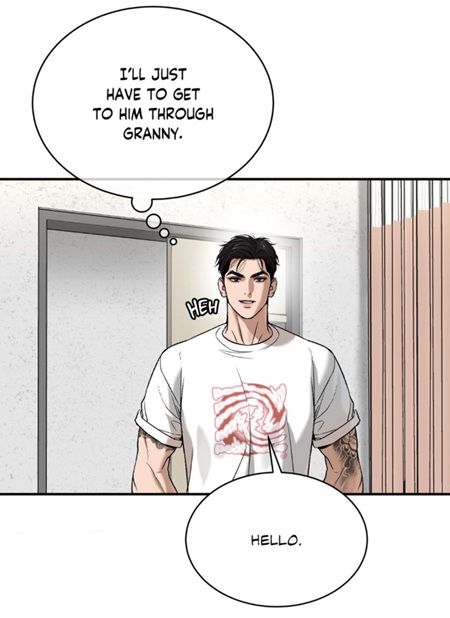 (chapter 65) or stand-ins
 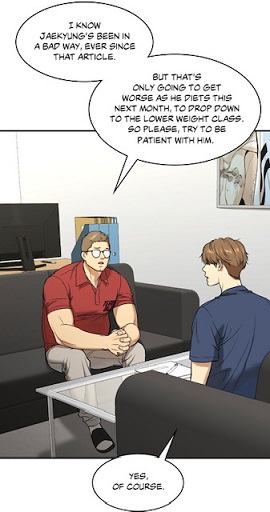 (chapter 36) for affection has ended. The spotlight now belongs solely to Jaekyung and Dan, who no longer require mediation to reach one another. This shift becomes particularly evident when contrasting the teaser with earlier moments of evasion, silence, and misplaced dominance—especially through the lens of Park Namwook’s slap and Jaekyung’s own past deflections.
In Chapter 29, Jaekyung is depicted as a hunted predator (chapter 29), constantly pursued by younger fighters—“a pack of hyenas” nipping at his heels. Yet beneath this portrayal of endless motion is a deeper emotional truth: Jaekyung is running not just from competitors, but from his own solitude. That night, he refused to rest 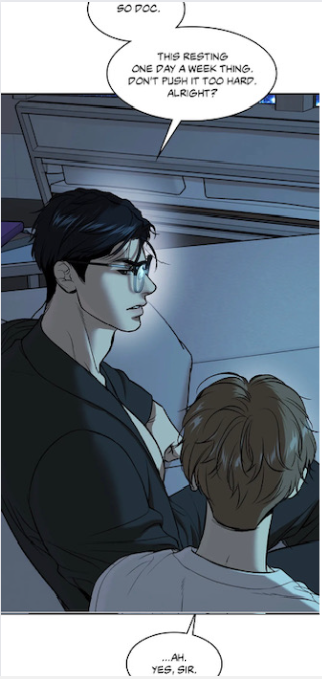 (chapter 29), ignoring Dan’s presence and concern. His rejection of the doctor’s offer of comfort or companionship underscores not only his emotional detachment but also the absence of true support from his supposed team. The manager, Park Namwook, is nowhere to be seen, (chapter 29) and Jaekyung operates in isolation—more fighter than partner, more machine than man. No man is watching his “back”. It is precisely this disconnection that prevents him from relaxing or recharging. He is trapped in a cycle of movement without relief, because he lacks the emotional foundation of trust and interdependence that the teaser illustration later comes to embody. In other words, behind this image of motion (chapter 29) lied an emotional stagnation. The champion was running from something internal, not just external. When Dan attempted to ask questions or reached out, Jaekyung frequently shut him down
 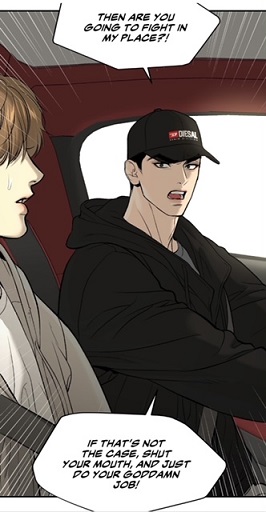 (chapter 42) or offered silence in return. He had no teamwork ability in the end contrary to the hamster who “assisted” his grandmother. But it is not surprising, since Park Namwook has always relied on his boy.
 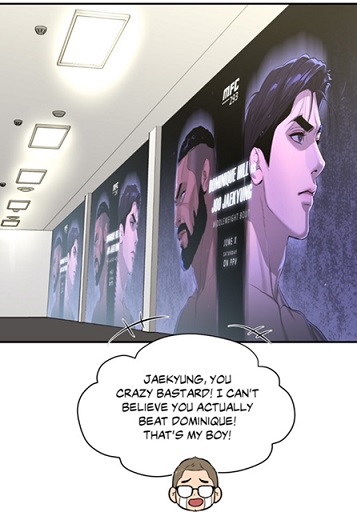 (chapter 40) Each time, they faced a problem, the athlete had to resolve it. He was the problem and the solution for everything.
  (chapter 17)
This emotional avoidance culminates in a pivotal rupture: Park Namwook’s slap in Chapter 52.  (chapter 52) Surrounded by others, the manager attempted to discipline Jaekyung not with understanding, but through force. The slap was not an act of care—it is an assertion of dominance. It reduced Jaekyung to a volatile asset and spoiled child, not a man in pain. Striking is that this gesture actually exposed the manager’s weakness and anxiety. He was the one reacting as a spoiled child, for he masked his wrongdoing with tears.
  (chapter 52) The reason is that he couldn’t face the terrible outcome and his own responsibility. He needed a scapegoat. Thus he blamed the champion for everything. But by doing so, he refused to share the burden and the athlete’s unwell-being. Striking is that this slap served as a wake-up for the athlete. From that moment on, he stopped relying entirely on his “hyung”. He was pushed to make decisions on his own. This harsh gesture mirrors Shin Okja’s attitude toward Kim Dan, (chapter 57) who was often comforted only when he concealed his distress. Both guardians acted as strong persons, while in reality they were hiding their own helplessness and anxiety. Both suppressed vulnerability
 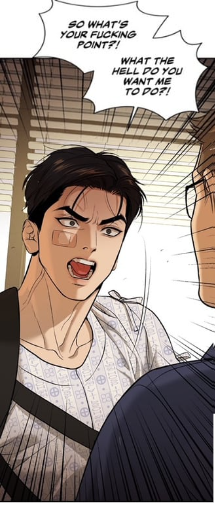 (chapter 52), seeing it as disruptive or shameful. Their guidance demanded emotional control, not emotional honesty.
Yet while the manager relied on open scolding and explosive gestures, Shin Okja’s strategy was the opposite: she smothered emotional crises with fake promises and quiet patting. Where Park Namwook used confrontation and order, Shin Okja relied on evasion and emotional sedative. Both mechanisms served the same purpose—denying the “boy” the freedom to feel and process complex emotions. Both were forced to deny the existence of “evil” in the end. “They don’t know” or “because of your temper”… Both guardians expected their wards to be functional rather than fragile. The reason is that they were expecting blind loyalty and submission. Naturally, since the grandmother was more gentle, her actions created an invisible chain between her “puppy” and her, while the slap from the manager caused an invisible riff between him and the Emperor. Park Namwook can no longer raise his voice 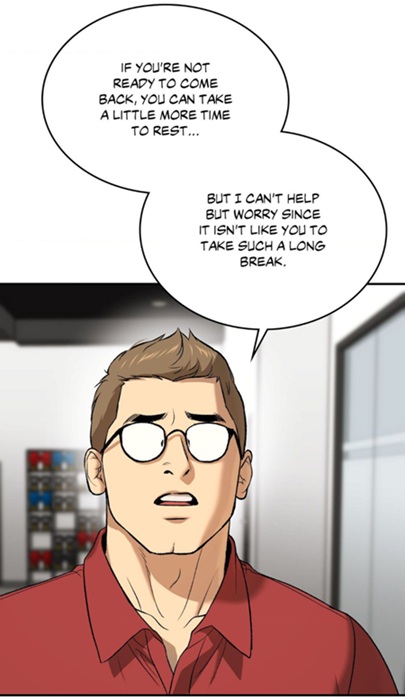 (chapter 66) or use violence to “tame the wolf”. That’s the reason why he is accepting the offer from the CEO of MFC. He is pushing the Emperor to return to the ring, but the problem is now that doc Dan was officially recognized as a member from Black Team.
 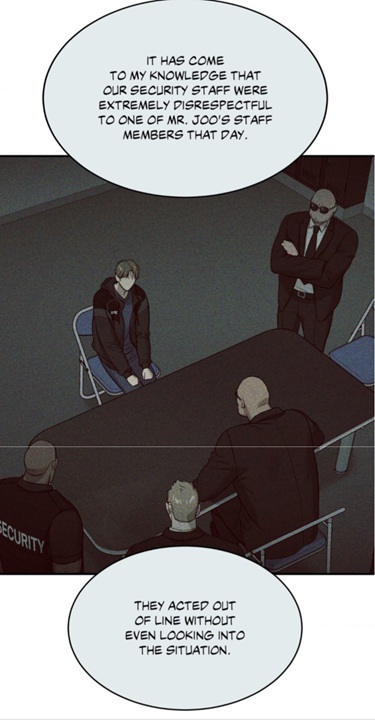 (chapter 69)
Herein lies the most profound contrast with the teaser embrace. The slap (chapter 52) is loud, performative, and corrective—a punishment wrapped in hierarchy. It takes place in a closed space—a hospital, ironically a place meant for healing. And yet, this act of violence is anything but restorative. Though members of Team Black are present, the moment remains confined, unspoken beyond its walls—a private humiliation masked as internal discipline. It does not foster intimacy or catharsis; instead, it isolates Jaekyung, stripping him of dignity both as an athlete and as a patient. In contrast, the embrace in Chapter 69 (chapter 69) occurs on a public street, before any audience. Its openness transforms what could have been a moment of embarrassment into a declaration. Jaekyung’s vulnerability becomes visible and valid—an indirect public confession that replaces the secrecy of the slap with the courage of connection. In fact, this scene displays the irrelevance of PArk Namwook in the “champion’s life”. He was never seen in the little town following his MMA fighter. So in the eyes of the inhabitants of this remote town, the doctor becomes a VIP. The embrace, by contrast, is quiet and egalitarian—a gesture of shared vulnerability and mutual respect. Where the slap severs emotional expression, the embrace enables it. Jaekyung does not mask his emotions or deflect responsibility with aggression; he leans into them, exposing his dependency and yearning without shame. This moment oozes closeness and intimacy, while indirectly their “secret” is exposed. They are important to each other.
This quiet exposure reverses the legacy of his guardians. Jaekyung does not slap, silence, or manage. He holds. And by doing so, he invites Dan to remain—no longer as a passive caretaker, but as someone who matters. The embrace thus becomes an answer to years of silencing: an offering of closeness where there was once only control.
By staging this gesture in full view—yet focused only on the pair—the teaser signals that no outsider can step in to define or distort their relationship anymore. Guardians are no longer needed. The embrace is their language now. Through the touch, both are feeling the warmth from each other. They are now friends and even family. Let’s not forget that the landlord saw them as “friends” (chapter 66) the moment the Emperor carried away doc Dan. This looks like an “embrace”.  (chapter 66)
Feel free to comment. If you have any suggestion for topics or Manhwa, feel free to ask. If you enjoyed reading it, retweet it or push the button like. My Reddit-Instagram-Twitter-Tumblr account is: @bebebisous33. Thanks for reading and for the support, particularly, I would like to thank all the new followers and people recommending my blog.

Please support the authors by reading Manhwas on the official websites. This is where you can read the Manhwa: Jinx But be aware that the Manhwa is a mature Yaoi, which means, it is about homosexuality with explicit scenes. Here is the link of the table of contents about Jinx. Here is the link where you can find the table of contents of analyzed Manhwas. Here are the links, if you are interested in the first work from Mingwa, BJ Alex, and the 2 previous essays about Jinx Where the Heart Heart💓 Spoke 💓🎶 and Flight 🚪 from Truth 👁️✨🧠, Fight🥊 for Fragile Peace☮️
It would be great if you could make some donations/sponsoring: Ko-fi.com/bebebisous33 That way, you can support me with “coffee” so that I have the energy to keep examining Manhwas. Besides, I need to cover up the expenses for this blog.

In episode 14, Joo Jaekyung and Kim Dan kissed each other for the first time. 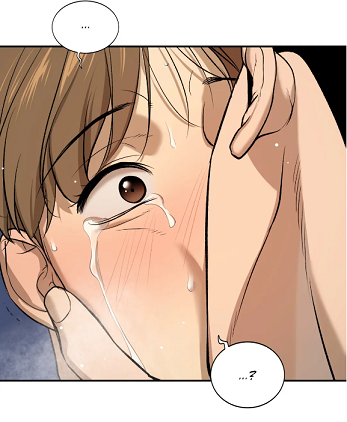 (chapter 14) For the physical therapist, this moment would later be confirmed.
 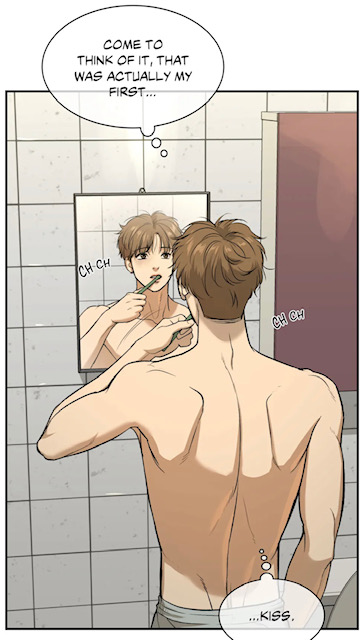 (chapter 16) —haltingly and with a trace of disbelief visible thanks to the points of suspension —as his first kiss ever. His stunned reaction and eventual admission offer a compelling lens through which to explore the symbolism of kissing in Jinx, but also the emotional landscape the two men must navigate.
Yet, the title of this essay refers not to Kim Dan, the hamster, but to the wolf. Could this have been the champion’s first kiss, too? The story never provides a definitive answer. While Jaekyung has had many sexual partners, he treated them as disposable— as toys and not as individuals.  (chapter 55) Still, some readers have theorized the existence of a “special lover” in his past
  (chapter 2), someone who might have earned a different kind of intimacy. One cause for this hypothesis is that in the champion’s first memory, he was facing his partner, which contrasts so much to the way he had sex with his partners (from behind). This possibility casts the locker room kiss in a new light.
  (chapter 14) If it was his first, the gesture carries a far deeper meaning than either man realizes in the moment. And if it wasn’t, then why does this kiss—with Kim Dan—resonate so differently?
Under this lens, the significance of a first kiss expands. It becomes a tool not only to uncover Jaekyung’s emotional history and his past, but to explore the shifting dynamics between the protagonists. The following analysis begins with Dan’s reaction, then gradually shifts its focus to Jaekyung—tracing how the act of kissing reveals hidden fears, prior wounds, and the potential for genuine transformation.
When Mingwa proposed a different perspective of the doctor’s first kiss in episode 15,  (chapter 15) she showed more than the physical therapist’s confusion with the interrogation marks, she added his inner thoughts. This question (“What’s this?”) already hinted that he had never experienced a kiss before. The ambiguity of his reaction suggested that the moment was unfamiliar, and not immediately recognizable as a kiss at all. (chapter 16) It was only later, while brushing his teeth in front of a mirror, that he consciously identified the event as his “first kiss.” Why didn’t he recognize it immediately? After all, a kiss—mouth-to-mouth contact—is common knowledge, even for someone emotionally inexperienced. I have different explanations for his confusion.
First, Dan’s delayed recognition reveals that this was no ordinary kiss: it was his first moment of unfiltered intimacy, so foreign to him that it couldn’t be labeled until later. (chapter 15) The emotional dissonance overwhelmed his ability to process what had just happened. His belated realization doesn’t just reveal how strange closeness is to him, but also how deeply isolated he is from ordinary social and cultural cues—whether through meaningful relationships or exposure to romantic norms in media. The fact that he did not immediately identify the kiss, despite its widely understood definition, underscores the emotional detachment and deprivation he has lived with. How could this happen?
To answer this question, we must consider more than just Dan’s personal trauma (the loss of his parents) —we have to examine his cultural upbringing and environment, especially his exposure to intimacy through media. This interpretive thread was triggered by a seemingly benign interaction in chapter 30, when Kim Dan meets actor Choi Heesung for the first time.  (chapter 30) Recognizing his face, Dan mentions that his grandmother used to watch the drama A Fine Line, and that he had seen it with her.
  (chapter 30) The author even includes a framed shot from the fictional show, depicting Heesung as the smiling son-in-law in a multigenerational family. This visual insert is subtle, but telling: it wasn’t the story that stayed with Dan, but the faces—the aesthetics of family structure and polite emotional decorum.
This detail matters. Korean weekend dramas, particularly those aimed at older or more conservative audiences, are known for avoiding overt depictions of romance or physical affection. Instead of kissing scenes or deep emotional vulnerability, these shows focus on family values, social respectability, and moral perseverance. Romantic affection is implied through service, duty, and self-sacrifice, while physical intimacy is portrayed sparingly—if at all. “Skinship,” as physical affection is commonly referred to in Korean culture, tends to be awkward and limited even in media (like for example grabbing the wrist instead of the hand). Public displays of affection are discouraged in real life, and this cultural restraint echoes onscreen. K-drama couples often struggle to express love openly; when they do kiss, it’s usually stylized, fleeting, or emotionally stilted.
When you realize that Dan’s only exposure to fictional romance came through watching these conservative shows with his grandmother, the implications grow clearer. His understanding of love was shaped by media that prized emotional self-control, emphasized propriety, and framed romance as something that only happens within marriage or bloodline ties. And more importantly, his access to even this narrow vision of love was filtered through Shin Okja, a woman whose own values prioritized appearances, self-reliance, and emotional suppression. Under her roof, affection was functional. Emotional expression was rather ignored.
This means that Dan grew up with no safe or meaningful model of romantic love—neither in life nor in fiction. He didn’t learn how to interpret touch, kisses, or expressions of desire. He may know intellectually what a kiss is—mouth-to-mouth contact—but that knowledge carries no emotional anchor. His surprised thought (“What’s this?”)(episode 15) in episode 15 reveals just how disconnected he is from the symbolic meaning of affection. Later, brushing his teeth and reflecting, he finally realizes: That was my first kiss. But even then, the memory doesn’t register as something tender or beautiful. Instead, it haunts him because  (chapter 16) it frightened him. The kiss broke an invisible boundary—one his upbringing had silently enforced. That’s the reason why he wasn’t sure if he could do it again.
From this, we can draw a larger conclusion: Shin Okja didn’t just isolate Dan emotionally. She installed in him a framework that made affection seem inaccessible—something reserved for “real” families or television characters, not for someone like him. Without a nuclear family of his own, he wasn’t allowed to love—only to obey, endure, and work. The media he consumed (he likes TV K-dramas) mirrored this unspoken rule. The love stories weren’t his to emulate, but to passively observe as if from behind glass. In fact, it was likely his grandmother who chose those dramas, reinforcing a narrow script: love was something that happened to others, while he remained the background figure—responsible, silent, useful.
This disconnect becomes even more apparent in chapter 30, when Dan observes Joo Jaekyung and Choi Heesung posing together.  (chapter 30) He blushes and wonders why.
  (chapter 30) It’s a telling moment: Dan isn’t used to feeling attraction and desire, let alone recognizing it. He never bought posters of celebrities, never fantasized. That world—the glamorous world of affection, attention, and beauty—was never his. (chapter 30) His grandmother may have been a fan of Heesung, but I doubt that Dan never allowed himself that luxury. So his reaction is a rupture: he is suddenly pulled out from behind the glass, facing emotions he was never taught to hold. But there’s more to it. Dan’s extreme shyness around nudity
 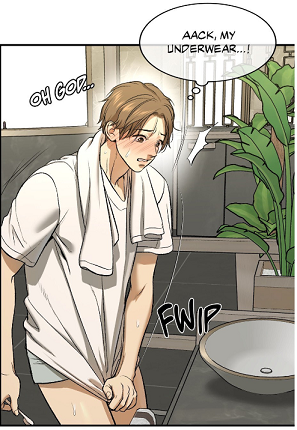 (chapter 30) —despite already having been seen naked by Jaekyung
  (chapter 30) —suggests something deeper than modesty. When he rushes to hide his underwear and blushes merely at brushing his teeth next to someone
 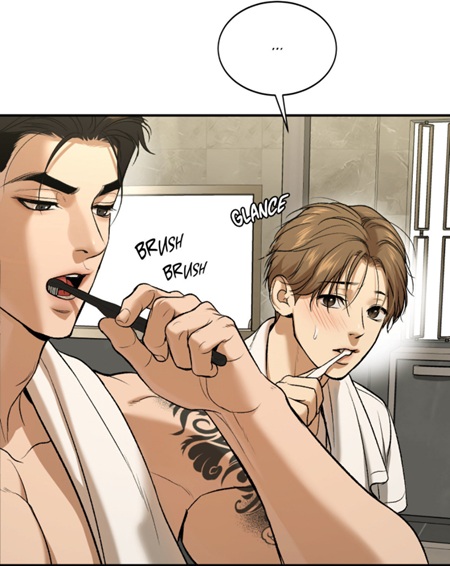 (chapter 30), it becomes evident: Dan is not accustomed to physical closeness or shared domestic spaces. These are not reactions of a man with just sexual trauma—they point to someone raised without the warmth of daily intimacy.
Thus I couldn’t help myself thinking that it is unlikely Shin Okja ever bathed him or dressed him as a child. Their emotional distance is reflected in the boundaries Dan maintains even in private. In this light, the scene where Dan wears a shirt with a visible clothing tag on his back takes on symbolic weight: 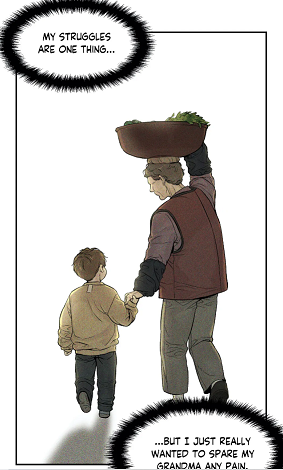 (chapter 5) He had to take care of himself, dressed on his own. He had to act like an adult, as his role was to assist his grandmother:
 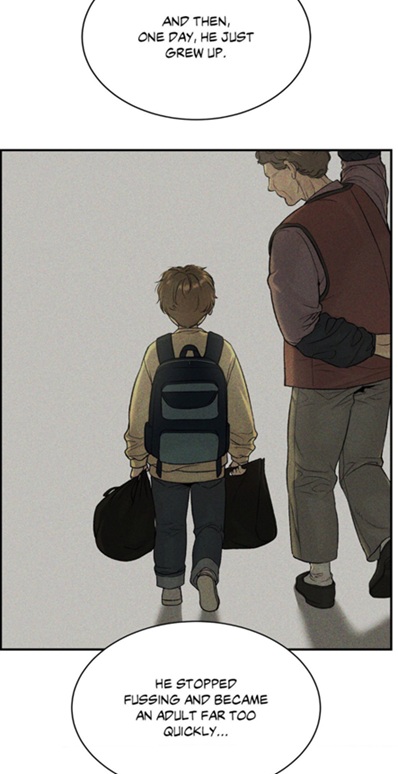 (chapter 65) This raises the possibility that someone else—most likely his mother—was his primary caregiver in early childhood. She would have changed his diapers, held him close, and kissed him gently. (chapter 65) This hypothesis and interpretation gets reinforced with the champion’s first kiss on his cheek
  (chapter 44) and ear
  (chapter 44) For me, without realizing it, Dan reproduced those gestures. These actions can not come from Shin Okja, as we only see her caressing or patting her grandson. The progression is striking. It moves away from eroticism (kiss from the lips)
  (chapter 44) and toward something far more intimate and protective. These are not the kisses of seduction, but of affection—almost maternal in their tone. Hence the MMA fighter got patted later:
  (chapter 44) They suggest care, comfort, and emotional presence. This is crucial, because it reveals that for Dan, a kiss is not about arousal or conquest. It is a language of love. They carry the flavor of instinct. These are the kinds of kisses a child might have once received, or given, in moments of safety and connection.
The way Dan moves through these kisses suggests something primal, tender, and exploratory. His gestures resemble those of animals—like a mother expressing affection to her cub. Such an attitude could only encourage his partner to reciprocate such closeness, like a cub seeking warmth. As noted in earlier analysis [For more read this essay], nuzzling  (chapter 44) is a behavior shared by felines and wolves alike: a subtle act of comfort, trust, and bonding. Wolves nuzzle to soothe and reassure. Leopards nudge to display affection without threatening dominance. Dan’s pecks (chapter 44) reflect this balance of caution and care, power and softness.
These gestures are not shaped by media, romance tropes, or societal expectations. They are shaped by something older than words—a kind of emotional muscle memory. His body remembers how to love, even if his mind has forgotten. And in that moment, Dan is free from the grandmother’s world of rules and repression. Shin Okja represents structure, duty, and emotional withholding—society. But Dan’s kisses are a return to nature. They are unmediated, sincere, and free from transactional logic. Think of how Boksoon treated her puppies  (chapter 57) (chapter 57)—licking them not out of instinct alone, but to reassure and bond.
  (chapter 57) During that summer night’s dream, Dan’s body mirrored this wordless care. That’s why he could laugh so genuinely like a child after witnessing his “pet’s reaction”.
  (chapter 44)
This contrast reveals why Shin Okja’s narrative of him being an orphan “from birth” is not just inaccurate (chapter 65) —it is ideological. She has never kissed him that way so far. It is her attempt to erase the past and shame. Therefore she removes whatever freedom or natural affection Dan once experienced, and to replace it with a world where love must be earned through sacrifice, duty and obedience, not given freely. The kiss becomes a reclaiming not just of emotional intimacy, but of a self that existed before control. His instincts speak louder than memory—and in that, Dan tells a truth that cannot be overwritten. And now, you comprehend why the doctor couldn’t identify the champion’s action as a kiss (chapter 15) It was not because he didn’t know what a kiss was, but because it didn’t align with what he unconsciously believed a kiss should be. In other words, the champion’s gesture triggered his memory which mirrors what the athlete was experiencing in the locker room.  (chapter 14) Therefore the physical therapist astonishment, “What’s this?” was not naïve; it was disoriented. Somewhere deep within, Dan had internalized a different model of kissing: one that reflected comfort, not conquest; affection, not arousal. The kiss he received was too strange, too fierce—it violated a definition he didn’t even know he had. His body knew how to kiss, but it remembered a different type of kiss altogether. The latter stands for love and as such emotions. Under this new light, my avid readers can comprehend why the physical therapist made the following request from his fated partner:
  (chapter 15) He needed to be “warned” in order to control his “heart”. As you can see, doc Dan had an innocent definition of the kiss. Therefore it is not astonishing that the wolf’s first kiss confused him so deeply: it shattered the only blueprint he had for intimacy.
This adds a tragic dimension to Dan’s unfamiliarity with touch. It’s not that he never had it—he once did. But it was taken from him, and what followed was not nurturing, but restriction through silence, erasure,money and work. His discomfort with nudity and closeness (chapter 65) is not just about sexual shame. It’s about lost comfort, severed memory, and the long silence of a child never told the truth, the vanishing of his parents. Under this new light, Jinx-philes can understand why the main lead could never discover sexuality and as such never went through puberty.
In this light, Shin Okja’s praise of hard work and her obsession (chapter 65) with success and fortune take on a new, darker meaning. Her restraint around love and sexuality wasn’t only generational—it was strategic. She reinforced a worldview in which success, debt repayment, and self-denial were Dan’s only legitimate currencies. For her, love, on the other hand, was frivolous, indulgent, even dangerous. She only treasures the relationship between the protagonists, as such a friendship is useful. It serves her interests, that way she can still control doc Dan’s fate. In other words, she only views relationship as transactional. The smiling family in A Fine Line (chapter 30) becomes a cruel illusion: a representation of the affection he was trained to uphold but never to receive. On the other hand, the kiss in the penthouse becomes testimony—not of desire, but of a forgotten lineage of tenderness. (chapter 44) It was not Dan’s first kiss with Jaekyung; it is his reclaiming of emotional truth.
And here, another crucial dimension enters the stage: consent. The kiss in the locker room was not only unexpected—it was uninvited. Note that in the locker room, the champion used his hand to touch his lover’s lips.  (chapter 14) Jaekyung repeated such a gesture, as seen in chapters 24
 (chapter 24), and again in 64
  (chapter 64). These gestures were not expressions of tenderness, but acts of dominance, mirroring how the celebrity was taught to treat intimacy: not as an exchange, but as an imposition. His behavior echoes Cheolmin’s earlier suggestion
  (chapter 13) where a little touch was functional. On the other hand, the suggestion framed “affection” as a form of fun and entertainment, meant to soften the experience and shift the focus toward the partner. While Cheolmin’s comment was not malicious—in fact, it encouraged Jaekyung to become gentler and more attentive—it still fell short of true emotional connection. Why? It was a medical suggestion, meant to protect Dan’s fragile state. The kisses in episodes 14 were to protect the physical therapist. They were initially functional, a mean to achieve a goal before becoming a habit.
This misunderstanding also illuminates Jaekyung’s mindset. The champion had never seen a kiss as something requiring consent, care, or emotional meaning. He had likely never received such a kiss himself—especially not from a maternal figure. The implication was that in his mind, kisses are tools for relaxation, not intimacy; strategies for pleasure, not signs of affection. Thus he asked doc Dan at the hostel:  (chapter 63) Fun is not the same as love, and this distinction matters deeply for someone like Kim Dan, who associates kissing with emotional safety and love, not performance or play. This explicates why he refused to be kissed in episode 63:
  (chapter 63)
And such actions (grabbing the doctor’s face for a kiss) shaped Dan’s reaction. During the “magical night” in chapter 44, the physical therapist copied Jaekyung’s earlier gesture —he grabs his partner’s face, too. (chapter 44) Yet, the intention behind this gesture is fundamentally different. While the wolf’s kisses were abrupt and consuming  (chapter 44), Dan’s were soft, exploratory, almost reverent. His lips touched not just his lover’s mouth, but his cheek and ear—tender sites that bypass eroticism in favor of emotional intimacy. These weren’t prolonged, devouring kisses. They were pecks, small and deliberate. They mirrored affection, not possession.
This mirrored gesture reveals something powerful: that Dan’s body had internalized the champion’s movement, but his heart translated it into a new language—one of consensual, innocent affection. Through this contrast, Jinx subtly rewrites the significance of a kiss: not as something to be taken, but something to be offered. It is precisely through Dan’s innocent and instinctive response that the reader is guided toward understanding the importance of consent, of emotional resonance, and of redefining touch as something more than just a prelude to sex. So should Jaekyung later discover that Dan had never kissed anyone before, the realization doesn’t just reveal a lie  (chapter 3) —it forces the wolf to ponder on the meaning of a kiss and his relationship with the physical therapist.
The cheek and the ear, (chapter 44) often overlooked in romantic tropes, Yet here, they become sacred sites of intimacy, echoing the symbolic restraint found in Gustav Klimt’s painting The Kiss. It is the painting in the middle of the illustration. 
 In that iconic artwork, the man does not kiss the woman on the mouth, the traditional locus of erotic desire. Instead, his lips are placed upon her cheek—a gesture that suggests reverence, not possession; vulnerability, not domination.
This parallel is not incidental. Klimt’s composition, saturated in gold and enveloping the lovers in a cocoon of ornament, gives the moment a sense of timelessness and sanctity. Likewise, in Jinx, Dan’s kiss bypasses lust and aims straight for emotional resonance. His kiss is not a prelude to sex; it is the articulation of emotional trust, maternal memory, and innocent longing. In this light, the cheek and ear become hallowed spaces where intimacy is not consumed, but offered. The problem is that during that night Joo Jaekyung was drunk, hence he couldn’t understand the meaning of such actions.
This moment reveals a stark contrast with the world that Jaekyung has known. For most of his life, touch was functional, performative, or controlling—something done to achieve a goal, to assert dominance, or to maintain emotional distance. (chapter 44) But Dan’s kiss disrupts that entire framework. It is small, almost imperceptible, but seismic in meaning. It asks nothing. It takes nothing. It simply is—and in that stillness, it unsettles the champion more than any act of aggression could. 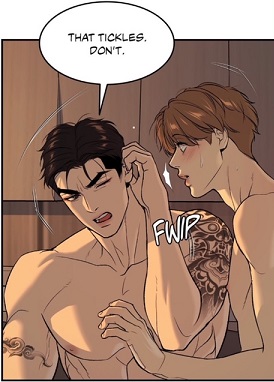 (chapter 44)
The symbolism deepens when we reflect on Jaekyung’s own evolution. He begins the story believing that conquest lies in performance—through physical power, sexual prowess, and unrelenting dominance. But as he stands before this soft, reverent kind of love, he encounters something far more disarming: gentleness. Vulnerability. A kiss that does not inflame the body (chapter 44) but stirs the soul. Therefore it is not surprising that later doc Dan is covered with bite marks.  (chapter 45)
The purer the kiss becomes, the more threatening it feels—because it exposes him. It demands no proof, no role, no mask. And that is perhaps why Jaekyung, despite all his experience with bodies, remains a novice when it comes to the heart. In bypassing the mouth, Dan bypasses Jaekyung’s defenses. He offers not seduction, but sacred contact. And for a man raised in conquest, that is the most intimate violation of all.
Like mentioned above, I could determine that the athlete had never been kissed before, especially by a “mother”. He didn’t even know that his ears were sensitive to the touch. (chapter 44) Moreover, I have already outlined that the athlete associates kissing to protection and pleasure which were suggested by his hyung Cheolmin. Therefore my avid readers can understand why I come to the following conclusion. It was indeed the champion’s first kiss in the locker room.
However, my theory is based on other points as well. One of the other reasons is related to his nightmare with the unknown ghost.  (chapter 54) When he was young, he had to face an abuser. Notice that the man’s face was very close to the champion’s
  (chapter 54). Thus I interpret that for the champion, the face represents not only his vulnerability, but also a source of danger. That’s the reason why he couldn’t hide his displeasure and frustration, when he faced this “lover”. (chapter 2) Thus I am assuming that in his eyes, a kiss could only be perceived as a threat. Besides, the anonymous abuser was even laughing in front of his face (chapter 54) , which means that the champion must have internalized “laugh” as mockery and contempt. That’s why he was so upset, when he was provoked by Randy Booker: the fighter’s words and actions had triggered his repressed memories. (chapter 14) Thus I interpret that for the main lead, the mouth is not a site of tenderness but a battlefield—one linked to mockery, humiliation, and violation. It evokes the memory of confrontations like the one with Randy Booker, which reignited repressed trauma rather than surface-level anger. This is why it’s so difficult for him to associate a kiss with affection or love. The gesture, meant to signify intimacy for most, is for him an unconscious echo of danger.”
And what did the doctor do during that wonderful night?  (chapter 44) He couldn’t hide his joy by the champion’s funny reaction and laughed. And how did the protagonist react to this? Not only his face expressed his dissatisfaction, but also he silenced his partner with a kiss right away: (chapter 44) This signifies that unconsciously, the athlete has long associated fun and laugh with humiliation, exposure, and powerlessness. Laughter—especially in close physical proximity—did not signal joy or affection in his past; it echoed mockery from a position of dominance. Thus, when Dan laughed innocently during their intimate moment, Jaekyung’s body reacted as if to shut down a threat. His abrupt kiss was not a romantic gesture but a reflex: a way to regain control, to interrupt the emergence of vulnerability, and to erase the echo of past humiliation. And now pay attention to the continuation of this sudden kiss:
  (chapter 44) Joo Jaekyung is leading the kiss, he is regaining control over their relationship. It reinforces the idea that the wolf’s kiss was not merely about passion, but about reclaiming dominance and halting a shift in power. Just moments earlier, Kim Dan’s laughter had opened a space of emotional intimacy and lightness, which the champion was not prepared to face. The kiss, now prolonged and intensified, becomes the sportsman’s way of reasserting control over a situation that was slipping into unfamiliar emotional territory.
Notice how Dan’s eyes remain open, gazing at Jaekyung. This contrast is striking: while the kiss is physically intimate, there’s a clear emotional imbalance. Dan is present and aware, while Jaekyung is almost consuming—driven by instinct and buried fear. The intensity of the kiss, paired with the previous silencing gesture, marks a moment where physical closeness masks emotional retreat. It’s not yet an act of mutual trust—it’s still shaped by Jaekyung’s attempt to neutralize discomfort, to steer the interaction back into territory he understands: dominance, silence, and physicality. Under this new light, it dawned on me why the champion could only reject this magical night the next morning.  (chapter 45) The marks on the doctor’s body were evidence that he was no longer in control. They weren’t just signs of a physical encounter—they were witnesses to something far more threatening: vulnerability, softness, and reciprocity. In the night, swept up by instinct and unspoken longing, the wolf had allowed himself to be touched—not just physically, but emotionally. But by morning, the spell was broken. His gaze didn’t linger on Kim Dan with affection—it darted instead to the bruises and scratches as though they were accusations.
What horrified him 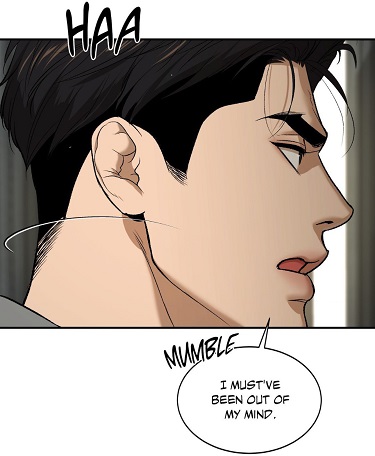 (chapter 45) wasn’t just the pain he might have inflicted—it was the realization that the balance of power had subtly shifted. The man who had always dictated the terms of their relationship had surrendered to something unfamiliar: tenderness, emotional closeness, and shared desire. The fact that Kim Dan initiated affection, even kissed him voluntarily, shattered Jaekyung’s script. For someone who conflated feelings with threat, and dominance with safety, this reversal was unbearable.
And so, the rejection wasn’t cold—it was defensive. He had to reclaim his distance before the emotional reality could catch up with him. Because to accept the night as mutual would be to recognize that he had been wanted, not used 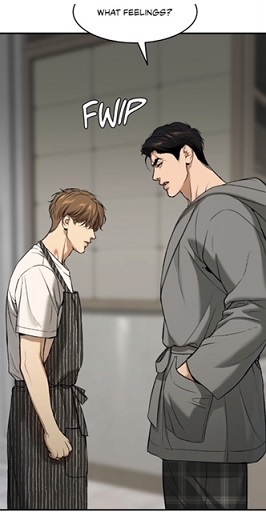 (chapter 45) —and that he, in turn, had wanted Dan back. This terrified him more than any bruise ever could.
But let’s return our attention to episode 44. (chapter 44) In this context, the kiss becomes a complex act of both silencing and self-protection. It was a mixture of unconscious attachment and learned defense—an attempt to rewrite a script that his body remembered all too vividly. This continuation corroborates my earlier observation—Jaekyung unconsciously connects laughter and joy with vulnerability and mockery  (chapter 37), and kissing becomes his emotional brake pedal. It’s not simply an act of love, but a means to regulate, or even drown out, what he cannot yet name or accept: that he is being loved. It is not random that I included the scene from episode 37: he heard laughs from the other room. For him, such a noise must have sounded like a disrespect and mockery, triggering his past trauma. And he was not entirely wrong in the sense that they were eating behind his back
  (chapter 37) It was, as if they were mocking him because of his forced “diet”. No wonder why the champion is barely seen laughing and prefers seriousness. At the same time, I can grasp why the athlete feels close to Park Namwook, as the latter stands for these exact notions: work, money and seriousness. Fun is not part of his world and vocabulary, therefore he punished Joo Jaekyung for sparring with doc Dan.
Another clue for this hypothesis is how the green-haired tried to “seduce” the athlete.  (chapter 2) Though his face was close to the star’s, he didn’t attempt to kiss him. In fact, he proposed him a fellatio, a sign that the champion had never allowed anyone to get close to his “face”. Finally, observe how he reacted, when the uke in episode 55 attempted to kiss him:
  (chapter 55) Not only he rejected him, but also he pushed him violently so that the latter was on the floor.
  (chapter 55) The celebrity even ran away: a sign that the allowing someone approaching his face is perceived as something uncomfortable and threatening. At the same time, that moment exposes the kiss as something sacred—one that cannot be duplicated without emotional violation. This shows that for the champion, the meaning of a smooch has evolved. It is no longer perceived as a source of fun and a mean to gain something.
There exists another evidence for this interpretation. Once Joo Jaekyung returned home, he had a recollection of the night in the States.  (chapter 55) He couldn’t forget doc Dan’s face, the latter excited him, a sign that for the champion, the face in general has been a source of pain, yet thanks to doc Dan, the latter has become a source of “comfort and joy”.
  (chapter 66) When he saw his face for the first time, he didn’t realize that he was already under the hamster’s spell. Striking is that he even focused on his chin and lips, a sign that he desired to kiss them. One thing is sure. The champion treasured the doctor’s face. After their separation, it is not surprising that the wolf felt the need to see his face.
That’s how I realized why the athlete initially rejected the doctor’s advances in the States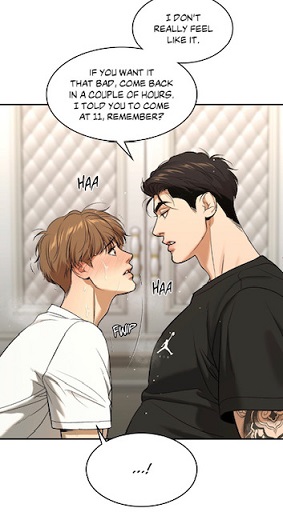 (chapter 39) before requesting a fellatio:
  (chapter 39) The main lead’s head was very close to the champion’s face, thus he must have felt uncomfortable. Secondly by acting this way, the doctor was gradually gaining power over their relationship. For the wolf, dominance is everything, an indication that in his past he felt defenseless and weak. His “opponent”, the mysterious ghost, had the upper hand. Moreover, the fellatio created a distance between them, where the fighter could expose his superiority. And note how doc Dan behaved under the influence of the drug:
  (chapter 39) He caught his fated partner by surprise, when he suddenly kissed him, mirroring the champion’s past behavior. This panel corroborates that for the doctor, a kiss is the symbol of love. The champion was not happy with this kiss too, for the latter meant that he was no longer controlling their relationship. Yet, after hearing the doctor’s confession during that night, the athlete no longer resisted his partner’s kisses.
  (chapter 39) For the first time, he accepted Dan’s initiative—both physically and emotionally. Compare it to his attitude before:
  (chapter 39) here, he still has his eyes wide open, a sign of vigilance. These kisses from doc Dan
  (chapter 39) mark a turning point in Jaekyung’s arc: he begins to lower his defenses, allowing Dan not only into his personal space but also into a position of gentle agency within their relationship. The kiss no longer represents a threat; it becomes an opening and a sign of trust.
However, it occurred to me that the star didn’t recollect those kisses from doc Dan, rather their intercourse in the States (chapter 55) and in the penthouse  (chapter 55) These memories represent the moment where the athlete felt strong and had the upper hand in their relationship. These images reveal that Joo Jaekyung hasn’t realized the signification of the kiss yet. For him, they don’t seem important. This exposes that the athlete has not associated kiss with love and affection yet. At the same time, we have to envision that a smooch is strongly intertwined with equity and trust.
  (chapter 28) And in episode 14, it was clear that the star still felt superior to his companion, therefore the kiss had no special meaning. As you can see, everything is pointing out that Joo Jaekyung had never been kissed before. And what does a kiss symbolize? Not only attachment, but also purity and innocence.
Finally, I would like Jinx-philes to recall the reminder from the green-haired uke:  (chapter 42) According to him, doc Dan was not different from him. However, he was wrong. It is because the champion had kissed him!! Moreover, the celebrity had allowed doc Dan to kiss him as well. Besides, how did the champion name his past lovers? They were toys… normally people don’t kiss playthings. And now, imagine that doc Dan were to discover that Joo Jaekyung had his first kiss with him. This revelation would not only make him realize that Joo Jaekyung loves him, but also he could be wondering why the athlete had never done such a thing before, though he had past lovers. YES, the “first kiss” could be the trigger for both characters to question their respective past and perceive their fated partner correctly.
To conclude, the absence of kissing reveals that those relationships were purely transactional. They could not be dating. In contrast, Dan is the only one Jaekyung ever kisses. Later, when Jaekyung tries to replicate that kiss with the new “uke”, he recoils. (chapter 55) He cannot bring himself to kiss someone else. That moment exposes the kiss as something sacred—one that cannot be duplicated without emotional violation. In other words, he was one step closer to the truth: the kiss is strongly intertwined with attachment and feelings.
So for me, the abuser is the reason why the champion kept people at arms length. He felt insecure and threatened…. He had not only be cornered, but also silenced and ridiculed which seems to reinforce my other hypothesis that the star was abused sexually by an adult in the past. [For more read Guilty Truth ⚖ Or Dare 🤥🤡- part 2 ( locked)]
From my perspective, it was his first kiss, yes, but it came tangled in past fear and trauma. (chapter 54) This nightmare reflecting his childhood imply the absence of kiss, but more importantly intimacy is strongly connected with dominance, bullying and destruction. No wonder why the champion rejected intimacy later. Only with time—and Dan’s persistent tenderness—can the wolf begin to untangle touch from threat, and laughter from scorn. Hence I conclude that for the champion, face to face was a very uncomfortable position. This would explain why he felt the need to punch people… unconsciously, the punch is directed at his past abuser. And each time, he was insulted and provoked by his opponents, look how he reacted later: he targeted their face, the eyes and mouth.  (chapter 15)
  (chapter 52) In that context, a kiss could never be affection, but vulnerability. A risk.
Both characters are wrapped in illusions about each other. Jaekyung likely assumes Dan has kissed others (chapter 3), based on Dan’s vague claim of prior partners. Yet Dan has never kissed anyone before. The kiss becomes his true moment of loss, a quiet confession through action. Conversely, Jaekyung’s own discomfort shows that he, too, is untouched in this particular way. When Dan tries to kiss Jaekyung again, and he instinctively rejects it, it reveals just how unprepared he is for affection. They are both unaware that the other is emotionally “pure” in this regard, and that makes the kiss a shared revelation.
Since Kim Dan internalized sex as a form of debt repayment and professional obligation  (chapter 67), Jaekyung must reinvent his approach. He cannot rely on dominance, strength, or sexual performance to win Dan’s heart. If he wants true connection, he must learn a new language—one built on gestures of affection, softness, and presence. This process also involves separating his public persona from his private longing. Joo Jaekyung, the champion, cannot seduce with spectacle. But Jaegeng, the man, might learn to express love through a simple touch, or a well-timed kiss. The redefinition of seduction is not just about Dan’s healing; it is about the wolf’s reclaiming his own right to feel and give love. And in my opinion, that process has already started: (chapter 69) That moment was devoid of lust, stripped of performance, and free from power dynamics. Jaekyung didn’t lean in for a kiss; he didn’t touch Dan’s lips or body with any sexual intent. Instead, he wrapped his arms around the physical therapist in silent reassurance, tucking his face against Dan’s shoulder as though hiding from the world. This was not a champion claiming a prize—it was a man expressing affection. The embrace exposes that doc Dan belongs to his “world” and he trusts him. In this light, the embrace becomes a prelude to a kiss—not a literal one, but an emotional kiss: a meeting place of vulnerability and longing.
The dock, surrounded by water, reinforces this symbolism. Water is traditionally associated with emotions, the unconscious, and transformation. By choosing this setting, the narrative invites us to see the wolf stepping into unfamiliar emotional territory—not with fists clenched, but arms open. Unlike the brutal kisses of season 1, this gesture is wordless but intimate. It communicates what he cannot yet articulate: “You matter. You’re safe with me. And I want to stay.”
In that stillness, without a single word or erotic touch, Jaekyung begins to kiss Dan in the truest sense—by offering presence, by being real. It is not seduction, but invitation. Not a test of loyalty, but a revelation of it.
Since neither Shin Okja (chapter 65) nor his past partners provided him with genuine and affectionate touch, Jaekyung must look elsewhere. (chapter 57) Boksoon and her puppies may become his new mirror. Boksoon leaks affection without condition. Her dogs kiss as instinct, not strategy. Here, Jaekyung might discover what he missed: that kisses are not weapons, nor rewards, but a language of trust. He will not mimic affection from film.  (chapter 29: note that he did not select this scene to rekindle with the doctor, but the other scene) He will learn it from life, from watching how the innocent express care without shame or purpose.
Jaekyung is not a man trained to love with softness, and yet this is exactly what Dan demands. Through subtle, non-erotic kisses, Dan teaches the wolf that it is not brute force that binds people, but longing and happiness. Not noise, but quiet. Not climax, but the pause. In parallel, Dan also begins to reshape another deeply ingrained association: laughter.  (chapter 27) In Jaekyung’s past, laughter had been a weapon—an expression of ridicule and cruelty from an abuser. (chapter 54) It echoed through his memory as a sound of danger, not joy. But Dan’s laughter is different. It is light, sincere, and warm. (chapter 44) Just as his kisses invite connection rather than conquest, his joy opens a new possibility: that laughter can be shared rather than endured. In learning to receive these signs of affection—and perhaps one day to return them—Jaekyung is not just falling in love. He is healing. He is discovering that love is not shown through domination or performance, but through trust, gentleness, and the courage to be vulnerable.
In Jinx, the first kiss is not just a threshold of romance—it is a psychological rupture. Jaekyung’s inability to process it, and Dan’s unconscious channeling of maternal tenderness, reveal how much has been buried under silence, shame, and trauma. The kiss destabilizes old roles: fighter, caretaker, orphan, predator. It marks the beginning of truth. Not just between two men, but within each of them. And that is why it matters who kissed whom, and why, and whether it has ever happened before.
PS: And now, you know why only the readers laughed, when they saw Jaegeng dressed like that.  (chapter 62) If someone had laughed in front of him and made fun of him, this would have reopened his old wounds.
Feel free to comment. If you have any suggestion for topics or Manhwa, feel free to ask. If you enjoyed reading it, retweet it or push the button like. My Reddit-Instagram-Twitter-Tumblr account is: @bebebisous33. Thanks for reading and for the support, particularly, I would like to thank all the new followers and people recommending my blog.
Please support the authors by reading Manhwas on the official websites. This is where you can read the Manhwa: Jinx and Doctor Frost But be aware that the Manhwa is a mature Yaoi, which means, it is about homosexuality with explicit scenes. Here is the link of the table of contents about Jinx. Here is the link where you can find the table of contents of analyzed Manhwas. Here are the links, if you are interested in the first work from Mingwa, BJ Alex, and the 2 previous essays about Jinx While They Embrace 🫂: The Western Coast 🌬️🍃🌊🐦 and Where the Heart Heart💓 Spoke 💓🎶
It would be great if you could make some donations/sponsoring: Ko-fi.com/bebebisous33 That way, you can support me with “coffee” so that I have the energy to keep examining Manhwas. Besides, I need to cover up the expenses for this blog.
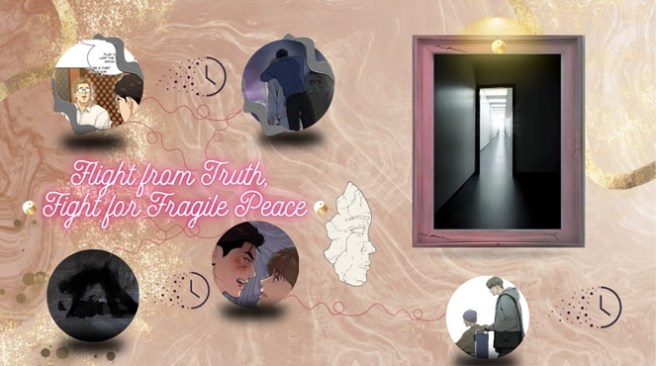
In the psychology article “How does confirmation bias push us to make bad decisions in life?”, author Jennifer Delgado analyzes how our minds instinctively defend core beliefs when confronted with contradictory evidence. This defense, she explains, stems from the discomfort of cognitive dissonance—a tension we feel when facts challenge our identity or worldview. To avoid this discomfort, people tend to seek psychological safety over factual accuracy. When destabilizing information arises—especially involving self-concept, loyalty, or trauma—they fall back on defense mechanisms: denial, deflection, aggression, or withdrawal.
“When the evidence threatens our core beliefs, we activate our psychological defenses to protect our identity.” Quoted from https://psychology-spot.com/confirmation-bias/
This behavior is not purely mental; confronting such dissonant facts activates brain regions linked to physical pain. As a result, the individual unconsciously opts for survival behaviors—either fight (blame, control, projection) or flight (avoidance, submission, denial)—instead of reasoned analysis.
We prefer to preserve our inner balance, even at the cost of truth. Quoted from https://psychology-spot.com/confirmation-bias/
This concept is deeply relevant to the world of Jinx, where characters often mistake emotional avoidance for peace  (chapter 47) and denial for strength (chapter 55). Joo Jaekyung, Kim Dan
  (chapter 61), Park Namwook (chapter 69), and Shin Okja
  (chapter 53) all operate within survival mechanisms shaped by trauma, guilt, and fear. They choose the illusion of control or calm over genuine healing. But as the story unfolds, these strategies begin to unravel. Each character must confront the truth behind their emotional habits, learning that happiness isn’t the absence of pain—it’s the result of confronting it with clarity and purpose.
In his recurring nightmare (chapter 54), Joo Jaekyung is cornered by a faceless, overpowering ghost. He is unable to fight or flee; only obedience and silence remain.  (chapter 54) He could only express his pain and resent through the hand. This moment encapsulates the core of his trauma: as a child, he learned to survive through silence and compliance, not resistance. Yet deep down, the resentment festered—toward himself, and toward the abuser. That psychological pain was redirected into becoming a fighter, as if to prove the abuser wrong.
  (chapter 26) (chapter 14) But ironically, he became exactly what the abuser desired: a powerful, obedient puppet. His fame, discipline, and aggression were not signs of freedom, but evidences of emotional and mental captivity. That’s why the past from the champion is surrounded by darkness and mystery.
This also explains why Jaekyung never learned how to speak to others or negotiate emotionally. 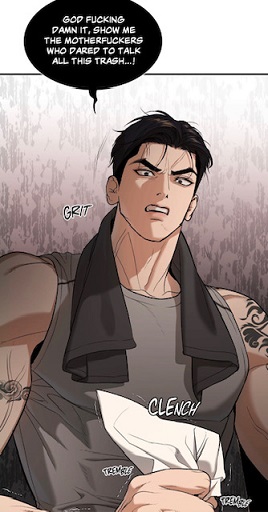 (chapter 36) His language was dominance, not dialogue. He didn’t process his emotions through words—he suppressed them, until they erupted in violence or withdrawal.
  (chapter 34)
But his dynamic with Kim Dan began to disrupt this cycle. Doc Dan, being physically weaker and more emotional, didn’t respond to force like the others. He didn’t fight back with fists. He showed his vulnerability and as such his tears.  (chapter 1) And crucially, he didn’t leave right away either despite his embarrassment and fears.
 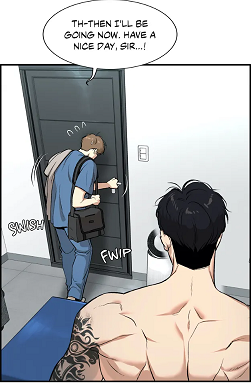 (chapter 1) Thus for the first time, Jaekyung had to develop a new strategy in order to meet him again: one that doesn’t rely on intimidation, but on communication. The problem is that since he saw the physical therapist running away after their first session
  (chapter 1), he knew that he needed to lure him with something: money
  (chapter 1). Under this new light, my avid readers can grasp why the athlete played a trick on the phone, though we have to envision that here the celebrity’s thoughts were strongly influenced by his bias and prejudices. He imagined that Doc Dan had made a move on him.
Dan has been teaching him, without lecturing, that flight can be strength. 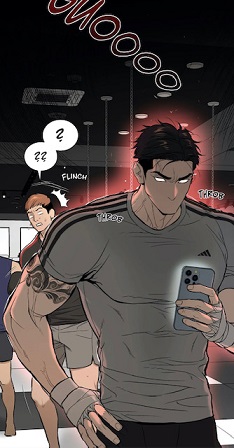 (chapter 5) That retreat doesn’t mean failure—it can be an act of self-preservation. However, the champion experienced that he needed to speak with doc Dan in order to keep him by his side. This lesson became a turning point. Jaekyung started to speak more.
  (chapter 18) Therefore it is no coincidence that in episode 18, right after the celebrity spoke, Kim Dan’s reply was strongly intertwined with flight:
  (chapter 18) The denial of kindness from the champion made the doctor uncomfortable, the latter felt the need to leave the penthouse as soon as possible. The lesson for the star was to realize that words are powerful and can affect people. But Joo Jaekyung didn’t grasp it, as he chose to use sex to „submit“ his fated partner.
  (Chapter 18) Nevertheless, as time passes on, the wolf asks more and more questions. He reacts to emotional discomfort not only with physicality but with hesitation, introspection. He is no longer reacting as the ghost once taught him; he is arguing and as such adapting, growing. Thus we could say, he is less passive.
On the other hand, I noticed that Joo Jaekyung displayed a clear behavioral pattern in season 1: he cornered Dan physically—pinning him onto the bed  (chapter 3) or table, in showers
  (chapter 7), against doors, or walls
  (chapter 34). On the surface, it may seem like a gesture of dominance or desire, but symbolically, it reflects silencing.
This repetition links back to Jaekyung’s trauma. In his youth, he was trapped between the abuser and a bed or a wall (chapter 54), unable to escape or speak. He was physically and emotionally silenced by someone more powerful. As a result, cornering became his unconscious language of control—a reenactment of power where he was once powerless. It’s not just about physical space; it’s about suppressing the other’s voice so he doesn’t have to face emotional exposure himself. In other words, he never learned how to flee, until he met his new mentor Doc Dan.
That’s why the locker room scene in episode 51 stands out. There, they are no longer pressed into corners.  (chapter 51) They stand in the middle of the room—an open space—symbolizing emotional emancipation. When Dan questions the celebrity (chapter 51), the words from doc Dan pierce the champion’s emotional defenses. Thus Joo Jaekyung is destabilized.
  (chapter 51). The latter tries to reassert control
 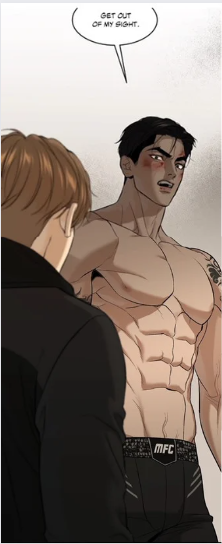 (chapter 51), but this time, when he lashes out, he is the one who leaves. This is cognitive dissonance at work: the fighter cannot reconcile his fear of vulnerability with his emerging need for connection and his perfectionism. So he defaults to a performance of control, even as he runs from it. And while one might mistake this for weakness or regression, it actually displays a progression. First, Jaekyung had finally revealed his thoughts and fears to Dan. (chapter 51) Secondly, he left the place which was a new MO for the fighter. His act of fleeing is no longer an escape from confrontation —it follows a moment of emotional vulnerability. It shows that he had finally dared to speak, even if he wasn’t yet ready to stay and endure the emotional aftermath.
Then in episode 69, Jinx-philes can detect a huge metamorphosis in the star. On the surface, he still appears obedient—he remains largely silent during the tense meeting with Park Namwook and the CEO.  (chapter 69) That silence could easily be mistaken for submission, for the same old performance of the compliant athlete.
  (chapter 69) But that would be a misreading. His silence is no longer a symptom of fear or control. It is a deliberate withholding—a sign that he no longer plays by their emotional rules. He is starting distancing himself from MFC, Park Namwook and the fight-centered identity they crafted for him.
His choice to return to the West Coast might look like a retreat to the schemers.  (chapter 69) After all, to those still invested in dominance hierarchies, leaving the capital after a public defeat seems like the behavior of someone who’s been defeated mentally as well. But the truth is the opposite. This “retreat” is actually an act of autonomy. For the first time, Jaekyung is giving himself space—not to run, but to reflect.
 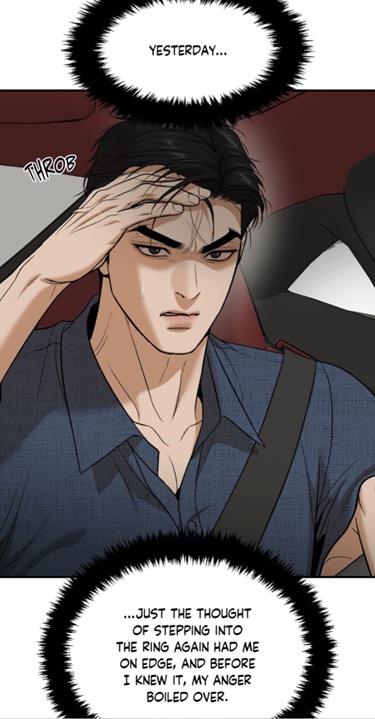 (chapter 69) He is no longer blindly performing the role of the fighter, nor desperately trying to maintain control over the narrative. (chapter 69) He is beginning to think critically about his past behavior, his future, and the systems that have defined his identity and life.
That’s what makes the embrace at the dock so powerful. It doesn’t take place in a ring, in a hallway, or in a cornered room. It happens in an open space, (chapter 69) with “no audience” (he ignores people), no pressure, no script. And in that openness, he lets go—not just physically, but psychologically. (chapter 69) The hug marks the collapse of his old beliefs: that emotions are weaknesses, that silence is protection, that strength means standing alone. He is no longer trying to dominate Dan or prove anything. He’s not cornering or fleeing. He’s simply staying—with someone, and with himself.
It’s a moment that doesn’t fit the binary of fight or flight. It is something more radical: connection.
It is vulnerability without fear. Stillness without paralysis. Silence without suppression.
In this context, the hug is not just affection—it is emotional rebellion. The sportsman reclaims his body not as a weapon, but as a vessel for intimacy. He reclaims silence not as submission, but as peace. And perhaps for the first time in his life, he doesn’t need to perform. He just is.
That’s why this hug is a fight. Not against Dan. Not against MFC. But against everything that taught him that love and respect must be earned through violence, that silence must come from fear, and that warmth and dependency are weaknesses.
This is the moment he stops surviving and starts living. When Jaekyung embraces Dan without shame, he does not speak—but for the first time, his silence is not imposed. It is chosen. He allows his body to express his emotions differently: longing and affection. He is not voiceless anymore—he simply no longer needs to explain or defend. The hug becomes his first true act of emotional agency. He is not reacting to fear. He is not controlling or escaping. He is staying. That is the fight.
And in this moment, he reclaims what “fight” really means. Not overpowering others. Not performing masculinity. Not obeying trauma. But overcoming his trauma, standing one’s ground for connection, for truth, for love. The hug is his first fight that isn’t about winning—it’s about not running away.
What begins as survival now becomes healing. And how are prejudices dismantled? Through communication. This means that from episode 70 on, the star will talk to doc Dan. Jaekyung, who once avoided words, who let others speak for him, who was branded and silenced by MFC, the entertainment agency and Park Namwook—is now ready to speak for himself. The hug is not the end of that journey (chapter 69), but the door finally opening. He is on his way to reconnect with his true self surrounded by nature and the people who truly respect and love him.
“I’m done surviving. Done being alone.
I want to live — and I want you to live with me.”
Park Namwook relies heavily on both fight  (chapter 7) and flight (chapter 52), often using blame as a shield. When crisis strikes, he blames the champion’s temper, relies on Doc Dan
  (chapter 36), or MFC’s decisions. (chapter 69) He surrounds himself with “assistants” like coach Yosep, Kim Dan or Joo Jaekyung
  (chapter 25: here the protagonist was replacing Yosep and Park Namwook), hires professionals to manage damage
  (chapter 47), and hides behind administrative actions. (chapter 66) But he never takes full responsibility. This blame-displacement strategy works—until the champion flees to the West Coast.
Now, Park has no one left to blame but himself. In fact, it was Joo Jaekyung’s very act of fleeing (chapter 66) that cornered the manager.  (chapter 66) As long as the champion was nearby, Park Namwook could project blame onto him, framing him as unstable, disobedient, or temperamental. But once „his boy“ vanished from Seoul, the hyung was left exposed. Striking is that he is not seen watching over the training of the remaining members.
  (chapter 60)
 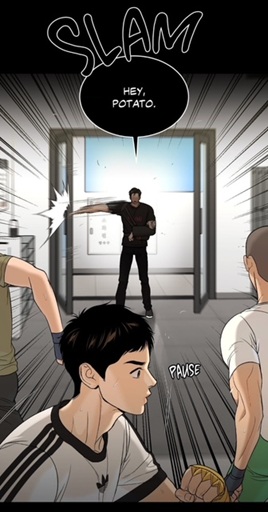 (chapter 60), a sign that he is neglecting the other members. The absence of his star fighter removed his most convenient scapegoat, forcing him to face the consequences of his own mismanagement—though he is not yet ready to truly question it and change his mindset, denial, and dependency. This was not just a geographical disappearance—it was a strategic psychological rupture, meant to destabilize Park’s illusion of authority.
And this is where the illusion breaks. He is forced to realize: he is not the real owner of the gym. He needs Joo Jaekyung’s signature for major decisions. He needs the champion’s public image to draw sponsors. When the fighter disappears, the manager’s relevance disappears too. That’s why he pushes for a new match (chapter 69) —not for the protagonist’s career and sake, but as a desperate attempt to re-anchor himself to glory, Joo Jaekyung and MFC. This means that he is choosing avoidance and as such flight. He lets his puppet fight for him.
But this can only backfire. In his mind, he is imagining that with a new fight, everything will return to normality and as such it will be like in the past. But he is overlooking two aspects: (chapter 69) The announcement that MFC will “line up a match” for Joo Jaekyung after the fall competition marks a pivotal moment — not of triumph, but of quiet exclusion. The phrasing itself is telling. The main lead is not invited to compete in the main event. He is not allowed to fight for the title. His role has been reduced to a postscript — a gesture, not a priority. For a fighter who once carried the brand’s identity, this is not simply a delay. It is a symbolic sidelining. In other words, the new champions and the CEO fear the star. (chapter 69) So with this new request, the manager ignores the reality that Jaekyung has been removed from the competitive spotlight. 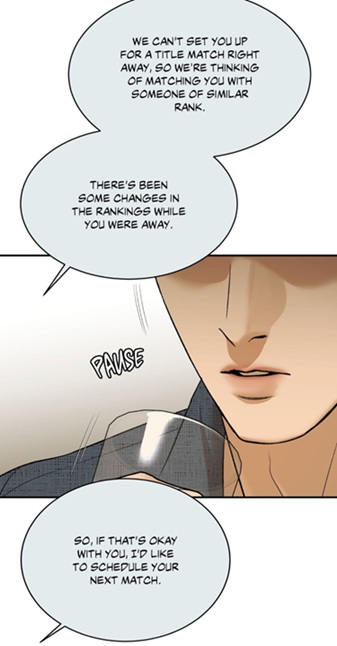 (chapter 69) He continues to speak as though the champion’s future is intact, as if the title is still within reach. But the organization’s actions speak louder: Jaekyung is no longer a contender — he is being gradually abandoned, not promoted. Secondly, Park Namwook assumes that Jaekyung will win the next fight, as if victory is still within his grasp. But this trust is misplaced — not only because the fighter is recovering from surgery, but because the schemers may have already designed this match as a final blow. Another fight right after a surgery, a staged defeat, or a quiet elimination would neatly push Jaekyung out without public controversy. By assigning him a marginal, delayed match, they are not offering redemption — they are orchestrating his exit.
MFC manipulates the manager’s selfishness and uses him as a tool to cover up the previous scandals. They feed him the illusion that he’s still in control, but the fall match is just a distraction—a public reset. I would even add that the manager seems to know that the ranking is not reflecting reality and even that the ranking is manipulated. . (chapter 69) The causal link here is suspect. Rankings in professional fighting aren’t determined solely by inactivity, especially when medical suspension is publicly known. So the manager tries to blame ranking drop on inactivity, but the inactivity isn’t prolonged enough to justify such a steep fall — from 1st to 3rd within 1 month and half. Besides, observe the drop of sweat on his face, a sign of discomfort and as such deception. Moreover, he is hesitating, visible with the points of suspension. indicating his awkwardness and lack of honesty. In addition, he is speaking exactly like MFC (he lost the last match, while it was just a tie) and finally he shouldn’t be employing the expression “it’s been a while”, as barely two months passed since his match with Baek Junmin. In other words, the man is delivering the message from MFC. He becomes a complicit agent, cloaking corporate strategy in soft euphemisms. This signifies, he is no longer acting as the owner of Team Black, though on the surface, it still looks like the man has the title of gym owner. The deeper irony lies in the fact that the true owner of Team Black is Joo Jaekyung. It is his money and name that built the gym’s reputation. It is his popularity, victories, and public image that attracted members, sponsors, and influence. Legally, financially, and symbolically, Jaekyung is the one holding the structure together.
That’s how it dawned on me that the schemers could be deceived too. I think, the CEO from MFC and Choi Gilseok still perceive Joo Jaekyung as “just a fighter” because of Park Namwook’s attitude: an asset, a brand face, a body to manage. (chapter 17) They don’t see him as someone with legal or institutional power. But that’s their fatal blind spot. Since Jaekyung co-owns or outright owns Team Black, this makes him: A partner (or even rival) in MFC’s talent pipeline; an employer and a stakeholder in fighter safety. He has the same position than Choi Gilseok. Therefore as the owner of Team Black, he can sue the gym King of MMA and Choi Gilseok. He can take action against the CEO for negligence, corruption or abuse of authority.  (chapter 47) Finally, he can testify not only as a fighter, but as a representative of the institution they tried to exploit. That elevates his voice: from a disposable athlete to a legal opponent with organizational standing.
Worse, if anything goes wrong, Park Namwook is now positioned as the scapegoat and spy. He didn’t reveal certain things to his boss, like for example how his members could never win. This character shows how fight (blame, control) and flight (denial, delegation. omission) are merely two faces of the same cowardice. His false peace rests on borrowed time and power—and it’s collapsing.
Kim Dan’s survival mechanism was silence as well. As a child, he learned that speaking up would change nothing. (chapter 57) Secondly, the vanishing of his parents were also swept under the carpet. That’s how he internalized powerlessness. Fleeing (chapter 1), deflecting, and disappearing became natural. With the grandmother, with doctors (chapter 1), with institutions—he obeyed. He accepted his fate as a fatality. But with Jaekyung, a new pattern emerged. Slowly, he began to resist: he set boundaries, raised his voice, argued with his boss, even used physical gestures to assert himself. 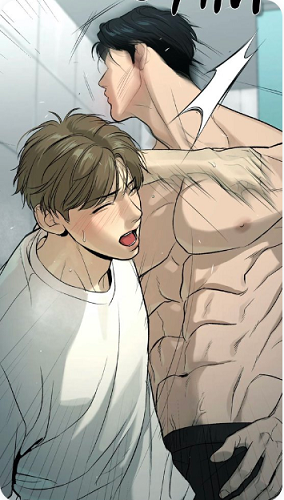 (chapter 7) For a moment, he was fighting.
But without mutual trust (chapter 51), this resistance could not hold. His boss and client never fully opened up, and so Dan, sensing instability, retreated again. (chapter 53) The brief flicker of agency collapsed. And this reflects a deeper psychological truth: resistance is not sustainable unless it is met with recognition. Otherwise, it begins to feel dangerous. Dan learned how to fight—but he never learned that he was allowed to win. Because deep down, Dan has internalized a belief shaped by trauma and lifelong submission:
Even if I speak, I will not be heard. Even if I resist, I will lose.
So why try to win?
Doc Dan has begun to resist, to speak, and even to walk away—but deep down, he still struggles to believe that success, safety, or love are things he’s truly entitled to. He acts, but with hesitation. He asserts himself, but doubts linger. He’s not powerless anymore—but the belief that he must always yield hasn’t fully let go of him either. That’s why he keeps mentioning the debts. (chapter 67) Moreover, in contrast to Season 1, Kim Dan is no longer the invisible caregiver or obedient grandson. Thanks to Joo Jaekyung’s presence—disruptive and painful as it was—he began to form an independent identity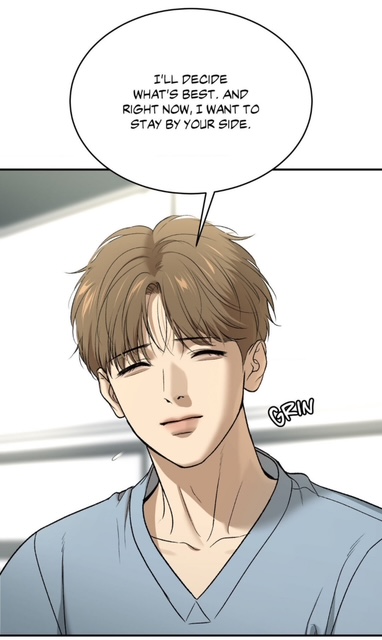 (chapter 57), one no longer shaped entirely by duty or guilt. The grandmother, however, is blind to this change. She continues to speak to him as if he’s the same self-sacrificing boy (chapter 65) who followed orders quietly and centered his life around pleasing others. Her suggestion that he “returns to Seoul” assumes he still views that as his place. But Dan refuses.
This refusal is significant. It is not only a rejection of her directive  (chapter 57) —it is a rejection of the belief that he exists only to serve. In Season 2, Dan says “no” repeatedly:
(chapter 60)  (chapter 67)
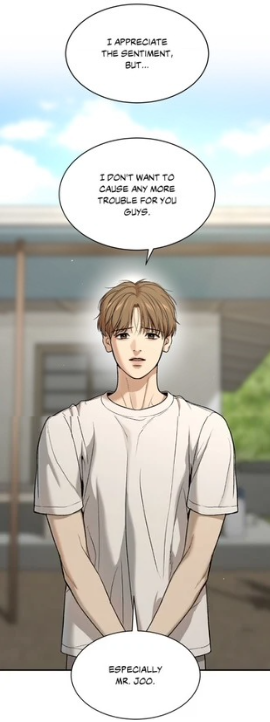 (chapter 58)
  (chapter 57)
Although he is clearly struggling emotionally, there is something new about his detachment: it is not just trauma withdrawal—it is the first fragile assertion of selfhood. For the first time, he is choosing himself, even if that choice leads him into making bad decisions and a quiet depression. He is not clinging to roles that once gave him safety—he is testing the silence between identities.
And this is precisely what the grandmother fails to understand: Dan is no longer a reflection of her expectations. He is trying to become someone who belongs to himself. And her ignorance can be perceived, when she brings up the past.  (chapter 65) She uses his past flaws to outline his immaturity and need of guidance. However, she is not taking into consideration the transformation in the doctor due to the recent incidents (switched spray). He is no longer the same than he was 6 months ago or 2 years old. He changed thanks to the athlete and because of unfortunate events (sexual harassment from the hospital director, switched spray). But the halmoni has no idea about such incidents.
And so he, too, begins to confuse avoidance (chapter 61) with peace. He gives in to silence in front of Shin Okja again, not because he believes it is right, but because he believes it is safer. So far, he has not confronted his grandmother’s decisions yet.
The grandmother represents the clearest embodiment of the flight response.  (chapter 53) Unlike Park Namwook who uses blame and delegation in professional settings, she applies emotional avoidance in private and familial spaces. Much like the manager, she outsources responsibility, asking others to step in (chapter 53) (chapter 65) rather than engaging directly. She avoids difficult conversations, never once asking doc Dan about the nature of his work or why he followed her to the West Coast. (chapter 65) Her silence is not protective—it is evasive.
As someone who is not a fighter by temperament or experience, she avoids confrontation and choices. Hence she asks for help from the champion behind her grandson’s back. This internalized passivity is mirrored in her body: she cannot fight back against cancer. (chapter 5) Her illness becomes a metaphor for her mindset. She relies on external systems: her grandson (chapter 53), doctors 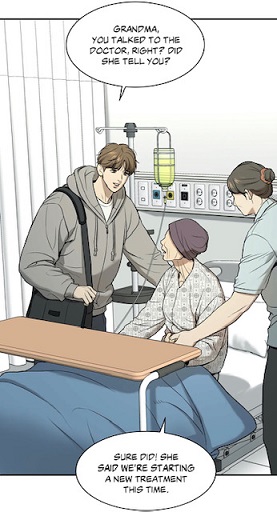 (chapter 7), medication, comfort
 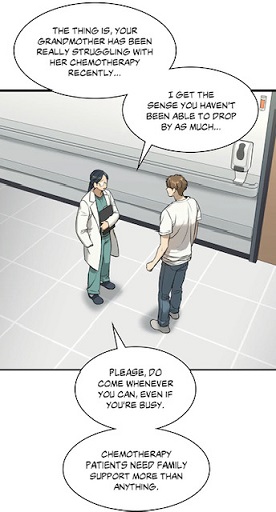 (chapter 21), and other people (nurse, Joo Jaekyung) —to maintain her emotional balance. But as doc Dan himself once observed, she is ultimately on her own in her battle. No system can fight it for her.
This mindset surfaces again when the oncologist, Dr. Kim Miseon, reproaches doc Dan for not visiting his grandmother. The implication is blame. However, this accusation is not entirely grounded: doc Dan had arranged for a nurse to provide care and companionship. 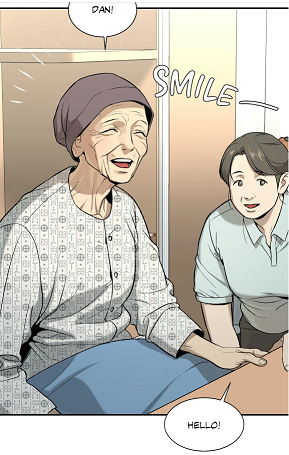 (chapter 7) His grandmother was not truly abandoned; she simply equated his physical absence with neglect, ignoring the emotional and financial burden he already carried. Like Park Namwook, she prefers others to carry the discomfort while maintaining a façade of suffering and sacrifice.
  (chapter 65)
Her passivity is cloaked in martyrdom—”I did everything for you”—yet it deprives doc Dan of emotional reciprocity. In her world, emotional closeness is conditional  (chapter 47) , and her narrative of selflessness becomes another form of emotional pressure. She does not yell, she does not accuse directly, but her avoidance is equally powerful in shaping Dan’s self-image as a burden. Doc Dan came to internalize that she suffered because of him. (chapter 5) Hence he made sure to shield her from any pain.
Her return to her hometown and her stay at the hospice reflect a deeper psychological strategy: she is not preparing to die, but attempting to escape death—to feel young again (chapter 65), protected, comforted. Surrounded by nurses, medication, and routine, she finds temporary peace in an environment that simulates safety. The hospice does not cure her illness, but it cushions it. This illusion allows her to smile again, to relax—but only up to a point. Kim Dan’s gradual deterioration  (chapter 57) —his visible exhaustion, disconnection, and quiet suffering—becomes a thorn in her eye, a reminder that her peace is not whole. As long as he suffers, she cannot entirely escape the shadow of her own regrets. Sending him away to Seoul represents a new of flight. Out of sight means out of mind. That way the grandmother wouldn‘t have to worry about doc Dan, as he has been entrusted to the athlete.
As explained in Dr. Frost 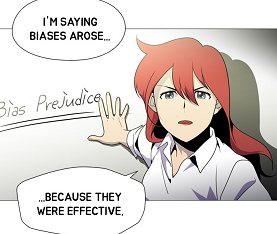
 (chapter 163) and supported by the article on confirmation bias, human survival was deeply dependent on mental shortcuts. Biases were not flaws, but adaptive tools — heuristics that helped our ancestors make quick decisions under threat. Faced with a potential predator, they could not afford the luxury of curiosity or debate. Run first, think later.
 (chapter 163) In this sense, biases were effective precisely because they increased the chance of survival.
This explains why all four characters in Jinx behave irrationally at times — not because they are inherently flawed, but because they are trapped in survival mode. Joo Jaekyung, Kim Dan, Park Namwook, and the grandmother all exhibit narrow thinking and emotional rigidity because their nervous systems are wired for defense, not reflection. They are biased — not out of malice, but because their minds are trying to protect them.
For example, Park Namwook began as a cheerful, strategic manager.  (chapter 9) But once Joo Jaekyung became the target of criticism and scandals, his fear response activated. (chapter 52) He grew rigid, controlling, and increasingly biased. The infamous slap in the hospital was not a calculated choice — it was the culmination of fear, the eruption of unresolved stress and repressed blame. His mind no longer could no longer hide behind fake understanding; it sought a target.
The article on selective laziness explains how people apply critical thinking unevenly, questioning what threatens them while blindly trusting what confirms their worldview.
A recent study conducted at Lund University showed that most people would reject their own arguments 60% of the time if they were presented by someone else. […] What happens is that when we search for arguments to support our ideas, we are driven by selective laziness; we don’t evaluate the pros and cons of that idea, but rather resort to intuitive responses. In short, we don’t become judges of our own reasoning. However, we are harsh judges of the reasoning of others. Quoted from https://psychology-spot.com/selective-laziness/
The result of this study is visible in Jinx. While, the manager thought that the next match was too soon in episode 41,  (chapter 41) he recommends the opposite at the restaurant because the idea comes from the CEO! (chapter 69)
In addition to the earlier exploration of confirmation bias, Jennifer Delgado’s article “5 cognitive biases limit our potential” offers another compelling extension. She explains how biases don’t just distort perception—they actively constrain personal growth. She introduces 5 different cognitive biases and one of them is “Hindsight bias”.
Hindsight bias is the tendency to look back on a decision and reinterpret it as better, wiser, or more inevitable than it actually was. To reduce discomfort or self-doubt, we modify our memory of past motives, downplay any hesitation or contradiction, and reframe our choice as the best one all along. This can be observed in this image: (chapter 65) The grandmother quietly rewrites the past to preserve her emotional comfort. Her statement — “I told him I wanted to see the ocean, but I never imagined he’d end up settling down here” — seems reflective on the surface, but it is a clear case of hindsight bias. She reframes her earlier decision as simple and innocent (as if it was a trip), downplaying the emotional pressure she placed on Kim Dan to follow her. By minimizing her role in shaping his circumstances, she subtly shifts responsibility onto him, as if his decision to stay was entirely his own, disconnected from her influence. This distortion allows her to avoid guilt and maintain the illusion of benevolence. However, if she truly meant, she desired to go on a trip (chapter 53), she should have voiced before that the doctor had misunderstood her. However, she claims that this place is her hometown, and with her request to the champion, she implies that she desires to stay in that little town: (chapter 65) It was her decision to settle down at the hospice.
Even more revealing is her next comment: “I really don’t know what that boy plans to do with his life.” This confession exposes her emotional detachment. Despite being the one who uprooted his life, she has made no effort to understand his goals, his work, or his emotional needs. Her words reflect not only a lack of curiosity, but also a passive disavowal of responsibility. She speaks as if Dan were a stranger, even though she has shaped his life through silent expectation and unspoken control. The peaceful ocean backdrop masks this deeper avoidance. Her worldview remains rooted in survival logic and emotional self-preservation — not genuine connection or growth.
By reinforcing outdated beliefs, we avoid novelty, risk, and the emotional labor required for change.
When we have deep-seated beliefs, we stop questioning them and simply assume they are true. This limits our ability to grow, learn, and discover new perspectives. This insight sheds further light on the characters’ emotional stagnation in Jinx. Park Namwook clings to obsolete narratives about leadership and discipline, failing to acknowledge how the landscape—and Jaekyung—have changed. His insistence on orchestrating a comeback fight is not strategic foresight, but cognitive rigidity disguised as professionalism.
The grandmother is likewise restricted by inherited beliefs: that safety, solitude, and hard work (chapter 65) are the cornerstones of survival. She only has friends, when she needs them (see for example the champion). These assumptions once protected her, but now they prevent her from evolving—from supporting Dan emotionally, from engaging in reciprocal dialogue, and from allowing herself to face death consciously rather than evade it.
Even Joo Jaekyung’s belief that strength equals stoicism prevented him from confronting the truth of his own vulnerability. Only through Kim Dan’s influence did he begin to question this inner script—and once he did, the false foundations began to crumble. He has just started healing emotionally; he is starting questioning the corrupt systems surrounding him, including MFC’s exploitation. This means, the existence of his jinx is vanishing.
This second article reinforces a deeper truth: that healing requires not only confronting pain, but also dismantling the faulty reasoning that keeps us blind. As long as the characters were clinging to biases, they remained paralyzed—unable to process what had happened to them, or recognize the larger forces at play. Hence they could never be happy. But the moment they begin to question themselves and speak honestly with one another, they also begin to see clearly—not just inwardly, but outwardly.
This explains why doc Dan ignored Jaekyung’s advice about medication and health.  (chapter 67) His survival bias told him: “Don’t trust a man who once treated you violently.” or “Doctors are ignorant, they don’t know me“. It was easier to discredit the source than to weigh the merit of the message. Likewise, in Season 1, the champion dismissed doc Dan’s medical opinions (chapter 41), trusting instead in MFC and his agency — despite the fact that those institutions are overtly motivated by money. His bias protected his ego, but at the cost of his health and relationships.
Park Namwook falls into the same trap: he considers Jaekyung a “spoiled child” (chapter 7) (chapter 40) who needs to fight to prove himself, yet likely doesn’t treat his own family this way.  (chapter 45) His double standard is not conscious hypocrisy — it’s a form of selective laziness. He does not challenge his beliefs because doing so would unravel the identity he’s built as a competent, authoritative manager.
The grandmother also embodies survival-driven bias. She believes that working hard and seeking fame are acts of love and stand for happiness— but she never questions the emotional cost. (chapter 65) She doesn’t help her grandson build friendships (chapter 57) 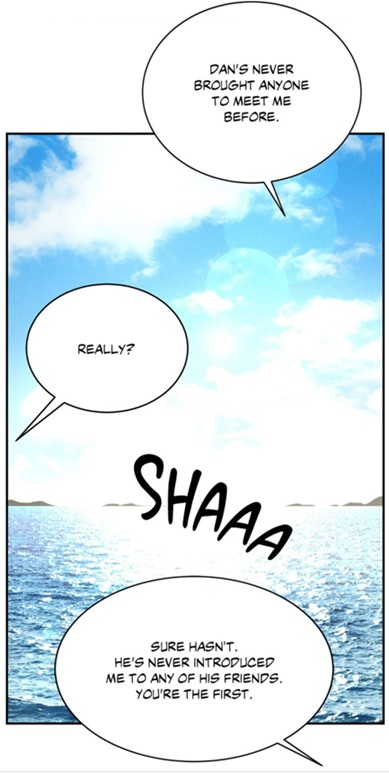 (chapter 65) or a support network. It is not her fault, if she never met doc Dan’s friends in the past while hiding the fact that he had been bullied by his peers. Her request for him to return to Seoul, a place he has no roots, only furthers his habit of isolation. Similarly, when she asked Jaekyung to bring him to Seoul and have him diagnosed, she implicitly discouraged any shared decision-making. Like Park Namwook, she bypassed dialogue in favor of directive control, reinforcing the habit of emotional withdrawal.
As the article states, “
“Selective laziness isn’t necessarily a negative thing. In fact, in group settings it can spark debate and enrich conversation.” https://psychology-spot.com/selective-laziness/
But her attitude blocks precisely that — there is no exchange of ideas, no real conversation. Only avoidance wrapped in concern and requests.
This is why neither Jaekyung nor Kim Dan were “thinking properly” earlier in the story. They were not free to. Their brains were in survival mode, stuck in flight or fight, not reflection. But once the champion saw Dan again — saw that he was still there, still himself — his anxiety softened. He began to press MFC for answers.  (chapter 67) That shift marks a turning point from survival to conscious thought. The mind cannot reflect when it believes it is under attack. The tragedy is not that these characters are irrational — it’s that they were taught fear before they were taught trust. Thus I come to the following conclusion. As soon as both are curious about each other (chapter 69), they are now free from their bias and prejudices. (chapter 69) They will be able to communicate which will help them to discover the truth about MFC. Yes, their ability to ponder will lead them to unmask the villains and defeat their opponents. By fighting for justice, both will discover true peace of mind. This hardship at the end of season 1 was necessary to reset their heart and mind: what is the true meaning of life? Money? Work? Duty? Sacrifice?… The answer is happiness which is strongly intertwined with love and selflessness.
The topic for the next essay is:
Feel free to comment. If you have any suggestion for topics or Manhwa, feel free to ask. If you enjoyed reading it, retweet it or push the button like. My Reddit-Instagram-Twitter-Tumblr account is: @bebebisous33. Thanks for reading and for the support, particularly, I would like to thank all the new followers and people recommending my blog.

Please support the authors by reading Manhwas on the official websites. This is where you can read the Manhwa: Jinx But be aware that the Manhwa is a mature Yaoi, which means, it is about homosexuality with explicit scenes. Here is the link of the table of contents about Jinx. Here is the link where you can find the table of contents of analyzed Manhwas. Here are the links, if you are interested in the first work from Mingwa, BJ Alex, and the 2 previous essays about Jinx While They Embrace🫂: The Mysterious Landlord 🏠🐕and While They Embrace 🫂: The Western Coast 🌬️🍃🌊🐦
It would be great if you could make some donations/sponsoring: Ko-fi.com/bebebisous33 That way, you can support me with “coffee” so that I have the energy to keep examining Manhwas. Besides, I need to cover up the expenses for this blog.

My avid readers might have been surprised that I didn’t publish any essay for almost a month. I had two reasons for this hiatus. First, the last publications didn’t receive much attention, while I had invested a lot of time in them. Secondly, I was myself under a lot of stress, just like our champion Joo Jaekyung and the Webtoonist Mingwa. I needed myself a break. On the other hand, this doesn’t mean that I stopped analyzing this terrific Manhwa, quite the opposite.
When I first read episode 69 of Jinx, one small, fragile detail caught me by surprise — the sudden appearance of the champion’s heartbeat: BADUM  (chapter 69). For the first time in this story, we as readers were allowed to hear Joo Jaekyung’s heart
  — not in battle, not in passion, not in rage — but in that suspended instant when he imagined Kim Dan missing, possibly forever. Since the author linked the BADUM with doc Dan
 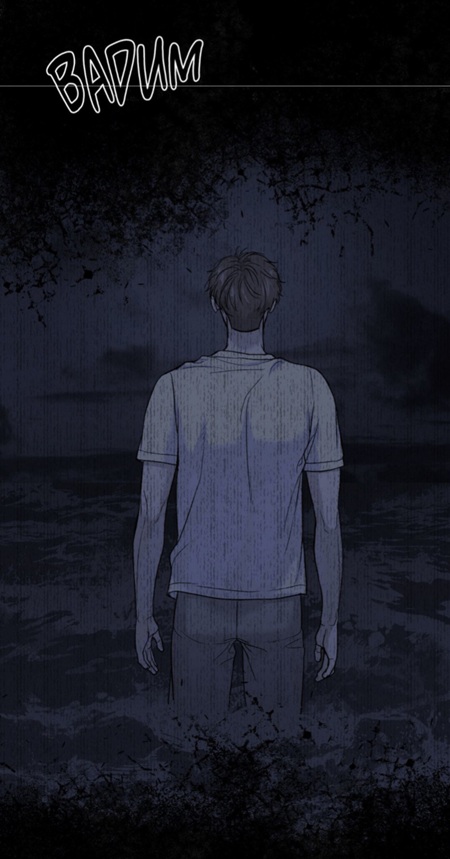 (chapter 69)
  (chapter 69), she created the illusion that the physical therapist was embodying the MMA fighter’s heart. This scene resonated with me long after I closed the chapter.
And then I came across a fascinating article: Resonance Theory: Vibrating with Music. It explained how sound activates deep biological responses — how rhythm, tone, and vibration connect us to life itself. According to this theory, when we hear sound — especially rhythmic or emotionally charged sound — it does not remain a surface experience. It triggers responses in our nervous system, heart rate, breath, and emotional centers. Sound can bypass the defenses of the thinking mind and speak directly to the body.
This is why music can make us weep, why a heartbeat can evoke terror or tenderness — and why a single human voice can call us back from fear or despair, like in this scene:  (chapter 69) Suddenly, the pieces clicked: the heartbeat in Jinx is not just a narrative sound effect. (chapter 69) It is a form of music — an embodied rhythm that signals life, love, and emotional awakening.
It was this article that first led me to reflect on why we so rarely hear heartbeat or music in the story — and why their presence or absence marks such a profound shift in the characters’ inner worlds.
As I began reflecting on this moment, I noticed how deliberately the manhwa had withheld the fighter’s heartbeats in earlier key scenes. Consider chapter 14: (chapter 14) Jaekyung, insulted and trapped in shameful memories, is wrapped in rage  (chapter 14)— yet no heartbeat is heard. One might think, the absence of the heart racing implies the lack of fear. His emotions are real, but they do not connect him to life or to others. Why?
Because at that time, there was no one to lose. His world was transactional: lovers came and went; gym relationships were shallow and competitive; even his manager was more functionary than family. Without meaningful attachment, there was no fear of loss — and thus no reason for the heart to speak.
This absence of heartbeat is mirrored in Joo Jaekyung’s actions in that scene. In episode 14, after the humiliating confrontation, we see him drive his fist into the locker 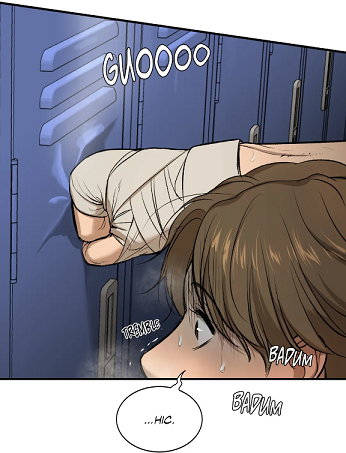 (chapter 14) — GUOOO, metal dented, yet no pain. Yet, Jinx-philes can see Badum Badum in that picture. Nevertheless it is connected to the physical therapist’s heart: he is scared of the athlete’s strength. On the surface, the champion’s gesture appears reckless — an act of a man who does not care for his body. But this is not pure “fearlessness.” In truth, the celebrity’s anger is masking deeper fear and suffering.
His mind, still trapped in past traumas, is locked onto an unseen enemy: the voice of his childhood abuser (chapter 54), who had called him trash, weak, pathetic, incapable. (chapter 54) The challenger, Randy Booker’s insult — calling him a “baby” 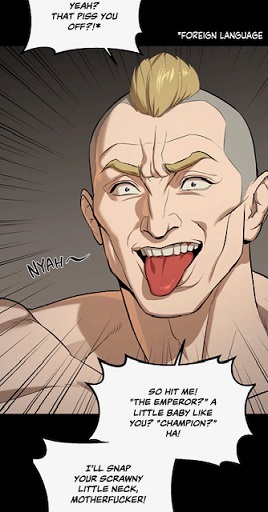 (chapter 14) — triggered this buried wound, igniting a desperate drive to disprove that old accusation.
Yet the protagonist is not consciously aware of this. He has repressed his childhood so deeply that he fights not the present opponent, but a shadow from the past. In this state, he acts on instinct, driven by the frustration, rage and pain he cannot name. (chapter 14) There is no conscious heartbeat — because he is not present with himself. He is moving as a zombie: reactive, destructive, unthinking. His body acts, but his heart remains silent.
As you can see, Jinx does show us heartbeat scenes earlier — not for the MMA fighter, but for the physical therapist and for other moments of crisis. These examples help us understand the emotional vocabulary of the heartbeat in the narrative:
In episode 44, we hear 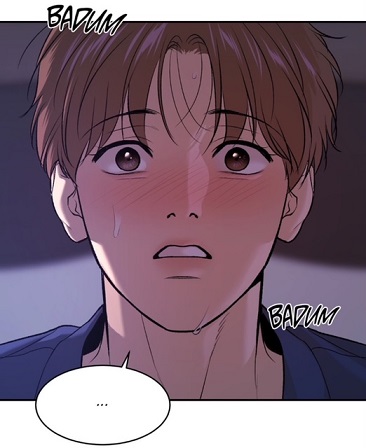 (chapter 44) BADUM BADUM from Kim Dan’s heart as Jaekyung makes a move on him. His blushing face, wide eyes, and parted lips all signal that this is not fear — it is love, excitement, and emerging attachment.
This is the positive heartbeat — the one that invites us to risk feeling, to follow the pull of connection.
Indeed, Dan did follow his heart that night, therefore he made requests  (chapter 44) and tried new things. He gave his lover pecks on his cheeks and ear (chapter 44). He chose intimacy, and chose to act from his own emotions. This gave him strength and courage. But by morning, he withdrew, the moment he met resistance and opposition. (chapter 45) He chose silence, unable yet to confess what that heartbeat had awakened.
By contrast, in episode 34, we witness a different kind of heartbeat — one driven not by love, but by survival panic.
When the protagonist first corners Choi Heesung and threatens him —  (chapter 34), we see the actor’s confidence gradually vanishing. His mask begins to crack. In that moment, he realizes that in the VIP spa his celebrity status offers no protection. No manager, no Park Namwook, no audience is present. He is utterly exposed to the raw force of the champion’s anger and fist — and the physical threat is real.
His body betrays him: the darkness around the gaze, the unmistakable BADUM BADUM of his racing heart. Here, the heartbeat does not speak of longing or love. It is a visceral alarm bell, signaling vulnerability and fear.
And yet — this makes the next moment all the more revealing. Later in the same episode, the actor faces the main lead again — but this time Dan is present. 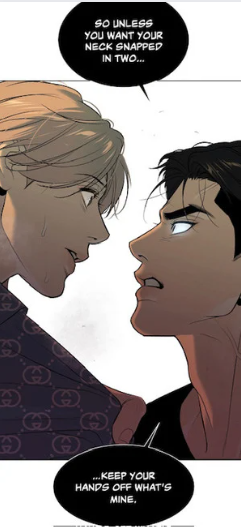 (chapter 34) The confrontation repeats — Jaekyung threatens once more. Yet, there is no visible BADUM, BADUM here. Why? Don’t forget that just before, the actor gulped and blushed
 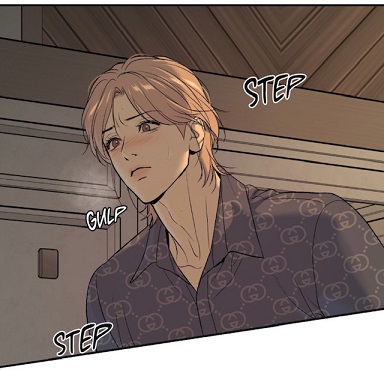 (chapter 34) — a clear sign of excitement, not fear. And still, his heart remains silent. This raises the question. Why was the actor not afraid of the MMA fighter? Because even if the words echo the previous threat, the perceived danger has changed. With doc Dan standing between them
  (chapter 34), the actor subconsciously knows: “He will not attack me here.” The champion made it clear that the physical therapist shouldn’t detect the actor’s presence. Doc Dan acts as an emotional shield, preventing true panic. The body no longer signals mortal danger — and so, no BADUM sounds.
In this, the manhwa subtly shows us:
Heartbeat is not simply about surface emotion. It reflects the perceived reality of threat, loss, or love.
When danger and loss feel real → the heart races.  (chapter 43) Here, the doctor feared the celebrity’s rejection. This scene was actually announcing that doc Dan was already in love with the “wolf”.
When one feels protected → the heart stays still, even if the mind recalls past fear.
There is another layer to this symbolism — and it lies in the rare appearances of actual music in Jinx. Music is introduced only twice:
1. Episode 21:
Kim Dan remembered his grandmother singing a lullaby 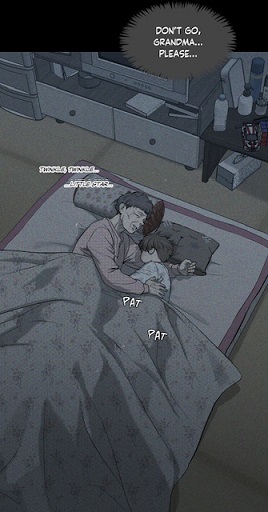 (chapter 21) — a sound of comfort and life. But it was a distant memory, not part of his adult world.
Crucially, Dan was asleep 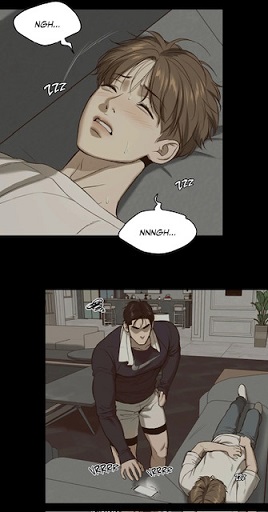 (chapter 21) — having a nightmare. It is only when the grandmother returned to the bed and began to sing that his body calmed. (chapter 21) Here, sound functions as both comfort and erasure. The lullaby soothes — but it also covers an earlier silence. It replaces what was absent: the voice of his parent(s). The melody fills the void — yet beneath it, the deeper wound remains untouched.
 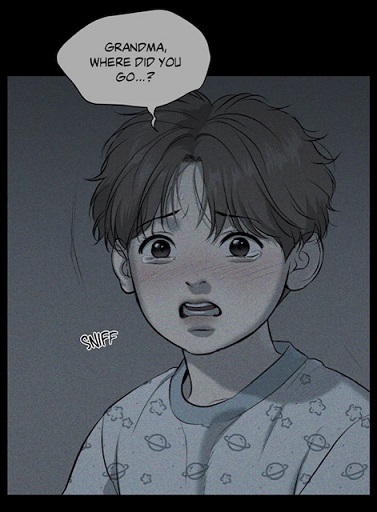 (chapter 21)
Thus the lullaby is not simply a token of love — it is also a symbol of emotional substitution. Dan carries this unresolved layer with him 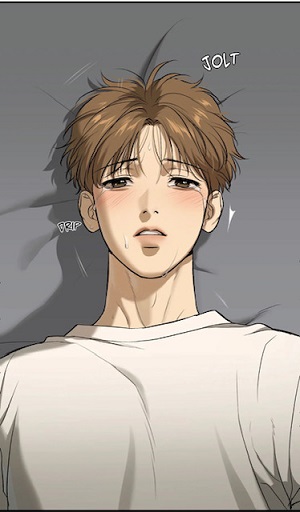 (chapter 21) — one that later echoes in his adult struggles with attachment and loss.
2. Episode 58 (season 2):
Outside, Heesung, Potato, and the landlord are singing and dancing (chapter 58) — vibrant, alive. But Dan sits apart. He is disconnected — his inner state does not resonate with the music. At that moment, he is preparing to abandon Jaekyung.
What struck me is this: Dan’s own heartbeat is absent in that scene. Though he thinks  (chapter 58) “I am happy and at ease, but… why does my heart feel so heavy?” — it is as if the external music has replaced his internal rhythm. The joyous sound outside contrasts painfully with his own muted emotions. The music underscores his emotional disconnection and the inner weight he carries.
And here, the parallel with childhood becomes clear.
The cheerful music provides surface warmth — but the root pain of emotional rupture (with Jaekyung) is untouched.
Just like the lullaby once offered comfort without healing, the music here offers temporary relief, not true resolution.
In both moments, we see how music without heart resonance leaves the deeper wounds unaddressed — and why it is the sound of the heart, not external melody, that must ultimately speak.
3. Boksoon and the champion
In Dan’s case, music never fully reconnected him to life — it was merely a temporary surface. But Joo Jaekyung, guided not by a melody but by the raw bark of a dog,  (chapter 65) finds his way back to the man he cares for.
Boksoon’s bark in episode 65  (chapter 65) is more than noise. It’s a resonant signal — not unlike the heartbeat. When she barks, it alerts Jaekyung to Dan’s trance.
  (Chapter 65) Moreover, the dog is capable of expressing her „worries and pain“. And for the first time, the champion follows a sound not of the crowd, not of a bell, but of life calling to life.
 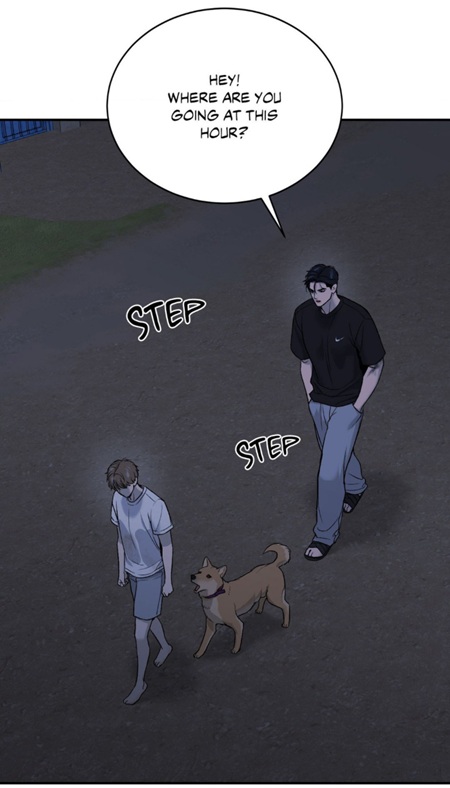 (Chapter 65) Her bark anchors him, just as Dan once did. And it marks the moment Jaekyung becomes emotionally receptive not only to Dan, but to care itself — puppies, vulnerability, connection. In other words, her presence foreshadows Jaekyung’s emotional readiness to care for others beyond the ring. Having rediscovered and embraced his own vulnerability, his heart is gradually open to softness — to animals, to dependency, to affection.
In this light, Boksoon’s bark becomes a canine echo of Jaekyung’s heartbeat: both signal that something fragile and important is alive. That life is worth protecting. And that Jaekyung — no longer the zombie fighter — is becoming someone who hears, feels, and chooses to respond.
We see this deepening in the very next beat.  (chapter 58) During the happy party with the actor and Potato, Dan remembers his past lover — and we see the champion’s image under a black-and-white veil. It was, as if the sun was vanishing from his life. In that moment, Dan decided to detach himself from Jaekyung, to forget him. The champion is emotionally “dead” — unreachable, lost to him.
This may explain why after the death of the puppy, doc Dan goes toward the sea. Though in his trance, he is thinking of his grandmother 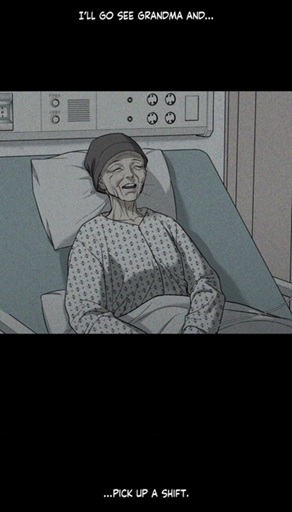 (chapter 59), the reality is that work has long lost its meaning. He has no goal in his life in the end. The emotional gravity of his loss regarding Jaekyung is palpable, though the physical therapist is not realizing it. Jinx-philes should keep in their mind that in season 1, the protagonist used his grandmother as a shield to justify his transactional relationship with the celebrity — and here, perhaps again, she becomes a cover for deeper pain.
And so we return to resonance theory. As the article explains, sound activates deep biological responses. It connects us to life, bypassing intellectual defenses. Rhythm, tone, and vibration speak first to the body — to the breath, to the heartbeat, to the reflexes — before they are processed by the conscious mind.
In Jinx, we see this principle embodied again and again — and nowhere more clearly than in the key moments of Jaekyung’s awakening. At first, the BADUM — the sound of the heart — announces the body’s recognition of fear and attachment. (chapter 69) But as his emotional state deepens, the manhwa subtly shows that the language of the heart is not always written — it is felt, seen, heard in breath and gaze.
This becomes especially clear when Jaekyung reaches the dock. 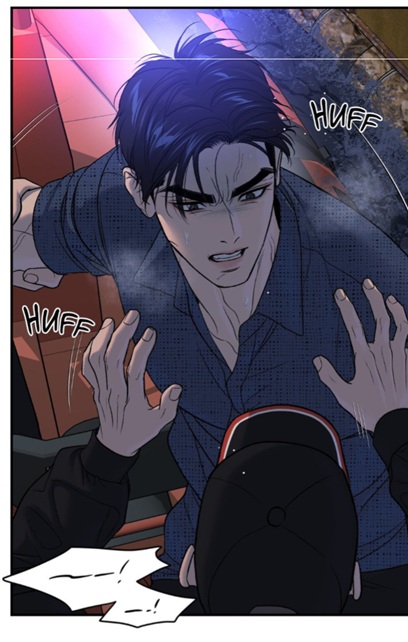 (chapter 69) There, as he sees a figure on the boat, his breath catches — for a moment, he believes it might be Dan. But as he draws closer, he recognizes his mistake. The man is not Dan.
 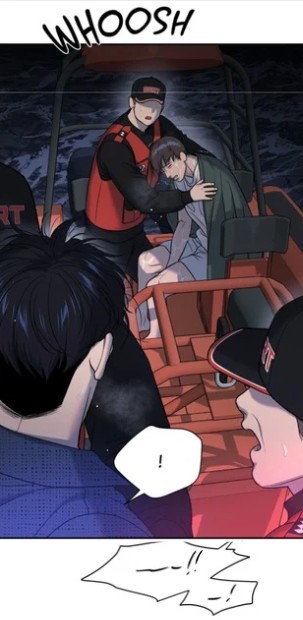 (chapter 69)
Now, on the dock, Jaekyung remains proactive — scanning for signs, seeking a solution. And when a small, fragile sound pierces the air (chapter 69) — “Umm” — we witness a subtle but profound shift.
Here, the heartbeat is no longer heard, but it is seen and felt: in the shallow breath (chapter 69), the audible HAA…, and in the dilated pupil. (chapter 69) His body speaks what the panel leaves unsaid — a visceral resonance of surprise, longing, and fragile hope.
And when his eyes finally meet Dan’s, we see it: relief floods through him. In that instant, his hardened facade dissolves. He appears young again — the boy beneath the champion’s armor emerges.
This marks not only the depth of his attachment, but also a profound shift in perception: he is no longer the “superior” in this bond. In that moment of relief, he begins to see Dan not as a child or subordinate, but as an emotional anchor, an authority figure — someone he can trust, someone to whom he can turn. (chapter 69) But before he moves, before he speaks, he just looks. Frozen in place, he engulfs Dan with his gaze (chapter 69) — eyes wide, breath caught. His pupil dilates, as if trying to capture and preserve the image of the person he feared lost. In that breathless instant, Dan becomes the apple of his eye — the one irreplaceable figure in his emotional world.
And then something even deeper shifts: the roles reverse. Dan is no longer the puppy. Jaekyung is. He becomes Jaegeng.
Why this transformation? Because despite everything — the pain, the fear, the trauma of the night before (chapter 69) — Dan does not scold him, reject him, or shrink away. He simply asks: (chapter 69) There is no accusation, no resentment, no judgment.
Unlike Baek Junmin or the mysterious ghost from Jaekyung’s past, who mocked 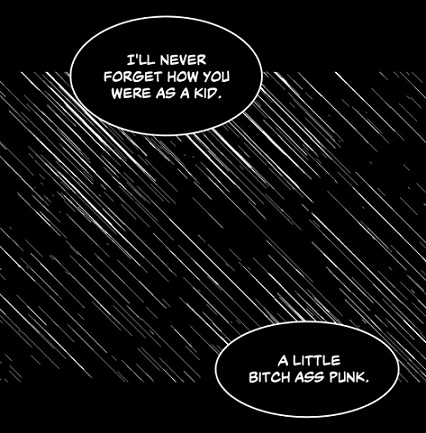 (chapter 49) the fighter’s vulnerability and punished his needs, (chapter 54) Dan sees the man, not the mistake.
And so, for the first time in his life, Jaekyung experiences unconditional regard — not the kind that is bought with talent or won through dominance, but the kind that says: you are worth caring for, even when you make mistake or falter. And that’s why he clings to Dan (chapter 69) — not as a fighter needing a medic, but as a person giving affection and seeking warmth. And in Dan’s quiet presence, he finally finds someone who doesn’t shame his vulnerability — someone who holds space for both the man and the boy he has always been.The inner child from the athlete awakens — and with it, the first true opening of his heart. He is now reborn.
Here we can look back and understand earlier scenes more deeply.
In episode 44,Jaekyung’s heart had already begun reacting — but he could not name it. This is visible, when he questioned Dan: 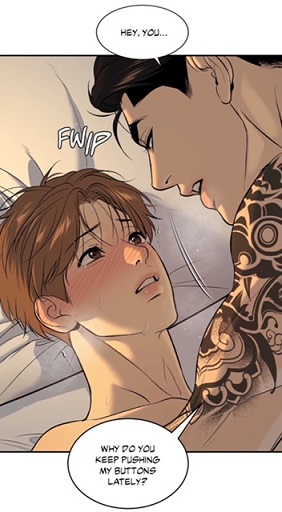 (chapter 44) What were those buttons? His heart. His breath. His body’s fear that Dan might vanish.
Every time he heard Dan leaving at night  (chapter 45), his heart raced. But he mistook this for irritation
 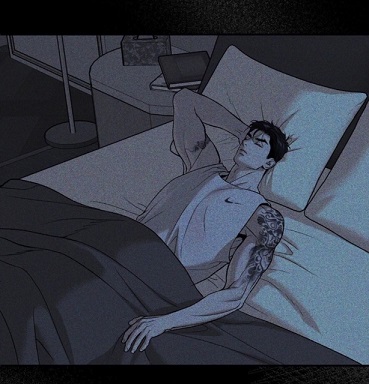 (chapter 45) — not attachment. That is why he threatened to hire another doctor the next morning: he feared dependency and as such vulnerability.
 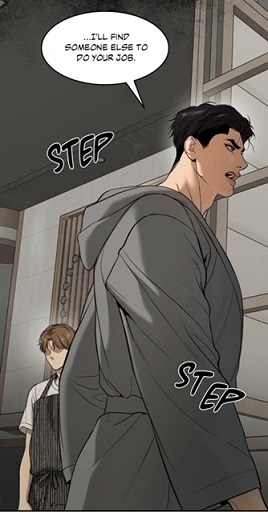 (chapter 45)
And there is one more layer. Before episode 69, even though Jaekyung feared Dan vanishing, he had never connected “vanishing” with death. (chapter 55) In his mind, people leave — they live elsewhere — life goes on. He never imagined irretrievable loss.
But now — seeing the empty house, the footprints on the ground, imagining Doc Dan bare feet while (chapter 69) walking into the sea (chapter 69): he has this revelation: Dan might not simply leave. He might disappear forever. This unbearable thought awakens his heart completely. (chapter 69) Under this new light, it becomes comprehensible why Mingwa connected his beating heart to his face. With this panel, she implied the huge awakening and the protagonist’s transformation. He is facing reality. He is accepting his mortality, his beating heart. He no longer views it as a discomfort.
And here, the lesson deepens. In episode 14, Jaekyung’s self-destructive punch had shown us a man trapped by past traumas, acting on raw instinct. There was no heartbeat — not because he was fearless, but because his mind was not free. He was still a zombie: (chapter 29) moving through the world, but without true inner life. Hence his eyes were “empty”.  (chapter 26)
But now, in episode 69, when the heart speaks (chapter 69), it teaches not only love — but emancipation. The BADUM announces the birth of a man who can finally think and feel for himself and for doc Dan. The resonance of the heart breaks the zombie trance. It awakens conscious presence.
And we can now see why this experience of fear was essential. (chapter 69) Until this moment, Jaekyung’s driving force had been to prove his mysterious childhood abuser wrong (chapter 54) — to erase the label of “weak, pathetic, incapable” that had haunted him.
This is why, in episode 67, when Dan asked him directly 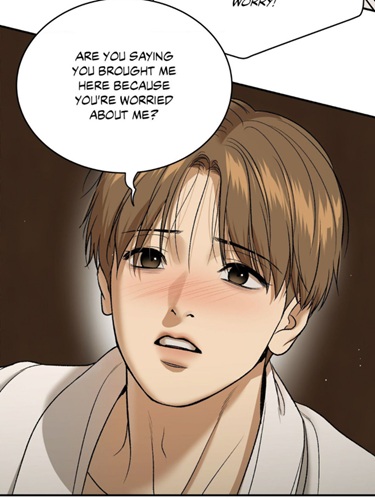 (chapter 67), Jaekyung could only remain silent. (chapter 67) He could not yet admit his worries, his vulnerabilities — not even to himself. To confess would be to risk blackmail, to risk being seen again as that helpless child.
Only by experiencing the true fear of losing Dan — a fear greater than his old shame — could he begin to open the sealed chamber of his heart.
And so, when the heartbeat came, it did not merely signal love. It marked the first break in the old defenses. The child within could finally begin to hope — not for victory, but for understanding, for acceptance. But there’s more to it.
But with that one heartbeat (chapter 69) — the BADUM that exploded in episode 69 — the jinx is broken. The undead becomes the living. His past, once the fuel of every punch, begins to fade. The rage that once drove him no longer holds its grip. He no longer needs to fight in order to prove that he isn’t weak — because someone has seen him at his most vulnerable and stayed. Under this light, my avid readers can grasp why the athlete hid his “growing attachment and dependency” behind the jinx.  (chapter 65)
In focusing on Dan (chapter 69) — not as a subordinate or tool, but as a source of emotional stability — Jaekyung finally turns his gaze forward. His reason for fighting is no longer rooted in resentment, but in attachment. His strength no longer has to scream; it can protect. Hence he desires to embrace his companion and lover in front of others. (chapter 69) The curse is lifted. The zombie breathes. The jinx dissolves — and in its place, a human being emerges. No longer driven by resentment or fear, he begins to choose connection over rage, presence over instinct. This means, he will be less vulnerable to schemes.
And that, at last, is the beginning of his humanity.
And we must also notice what happens just before the embrace. (chapter 69) When Dan speaks, Jaekyung remains utterly silent. He does not reply — not because he does not care, but because he is emotionally disarmed. In that moment, words fail him.
His silence is a form of submission — the instinctive response of a boy overwhelmed by fear, reaching for safety.
And the embrace that follows is not the act of a champion, or a lover. (chapter 69) It is the embrace of a child seeking a parent — of one who has never known how to ask for comfort, but who now surrenders to the need for it.
The boy hugs, because the heart has spoken — and in that moment, the first true human bond is formed.
Yet true liberation still lies ahead. For emancipation can only be complete when he begins to open his heart fully to Dan — to speak, to share, to trust.
When the heart spoke — life began.
But not yet the life of a man. First, the awakening of the child within — the boy who had never been allowed to feel, who now looks at Dan with open eyes.
And only through love, only through trust, will this child one day become a man — free, whole, alive.
Feel free to comment. If you have any suggestion for topics or Manhwas, feel free to ask. If you enjoyed reading it, retweet it or push the button like. My Reddit-Instagram-Twitter-Tumblr account is: @bebebisous33. Thanks for reading and for the support, particularly, I would like to thank all the new followers and people recommending my blog.

Please support the authors by reading Manhwas on the official websites. This is where you can read the Manhwa: Jinx But be aware that the Manhwa is a mature Yaoi, which means, it is about homosexuality with explicit scenes. Here is the link of the table of contents about Jinx. Here is the link where you can find the table of contents of analyzed Manhwas. Here are the links, if you are interested in the first work from Mingwa, BJ Alex, and the 2 previous essays about Jinx While They Embrace🫂: The Sparrows 🐦 and While They Embrace🫂: The Mysterious Landlord 🏠🐕
It would be great if you could make some donations/sponsoring: Ko-fi.com/bebebisous33 That way, you can support me with “coffee” so that I have the energy to keep examining Manhwas. Besides, I need to cover up the expenses for this blog.

In episode 69, the weather report is not just an ambient detail:  (chapter 69) it is a harbinger of disruption. A radio broadcast delivers the warning: skies turning cloudy, strong winds forecasted at 20 to 25 meters per second. This is no ordinary breeze. It signals the arrival of a whole gale—powerful enough to topple trees, strip rooftops, and fracture routines.
Its target is not random: the western front. On the other hand, the reporter used the expression “storm warning”, so the wind scale on the coast should be higher and as such bring more damages. Either it is a mistake from the author or a deliberate decision to imply that the tempest could be worse on the coast than predicted, this observation outlines that we should expect destruction in the grandmother’s hometown. To conclude, both geographically and symbolically, this setting becomes the stage for upheaval, emotional exposure, and irreversible transformation. Like an uninvited guest, the gale is not background—it is catalyst and character at once.
But even before Jinx-philes could hear this “terrible” news, Mingwa had already announced the arrival of the storm with this image, (chapter 69) as the champion’s sleek white car raced toward the tunnel, into a sky veiled by darkening clouds. This image foreshadowed the impending tempest not just in weather, but in fate. However, the celebrity didn’t pay too much attention to the warning, lost in thoughts, which is symbolized by the tunnel. The latter represents the protagonist’s ignorance, recklessness and “stubbornness” (he can not forget his loved one, he can not bear to leave his side). He races toward change, still shrouded in his old mindset, while nature prepares to strip away his last remaining believes and illusions.
Striking is that after his meeting with the CEO of MFC, Joo Jaekyung decided to return straight to the little town.  (chapter 69) Hence he is still wearing his dark blue shirt, pants and an expensive watch. But more importantly, he is now driving his white sports car. This means before meeting his hyung and the CEO, he went to the penthouse and changed not only his outfit but also his vehicle. He selected the white car,
  (chapter 69) Since the latter is a high-performance luxury model, it symbolizes wealth, speed, and prestige. That’s how he wanted to appear in front of the CEO. However, now he is going to the place where the storm will be the most violent. Because the star is still dressed in his dark blue shirt and expensive watch, I came to the following interpretation. This is not the champion in training clothes, but a man who now owns time (chapter 69) – it is the first time that we see the champion wearing a watch, marking a shift in his self-perception.
  (chapter 60)
  (chapter 61) No longer is he defined by his cellphone or his car, but by a reclaimed sense of agency. (chapter 69) The presence of the watch on his wrist becomes a subtle emblem of regained freedom—he is about to determine his own pace, away from the demands of MFC and Park Namwook. In other words, the western tempest represents a blessing for the athlete, as he is no longer dependent on his cellphone
  (chapter 38) or his car
  (chapter 69). Hence the manager can no longer be in touch with him.
  (chapter 66)
This shift mirrors the storm’s impact: external grandeur (like a fast car) will soon be challenged by a force that does not care for appearances. The car, left parked outdoors near the dock, (chapter 69) or in front of the house 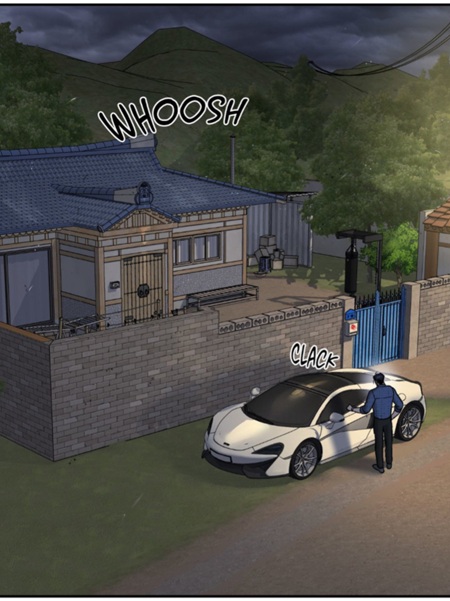 (chapter 69) might be damaged or lost to the tempest—a symbolic stripping away of status which reminded me of the way doc Dan treated the halmoni’s Wedding Cabinet.
  (chapter 53) Both instances symbolize a relinquishing of material attachments (he leaves his huge penthouse for a rented little “hostel”) and a profound shift toward emotional growth. For Jaekyung, the potential loss of his prized possession is not just about property—it marks the beginning of relying on others, accepting vulnerability, and letting go of his rigid, self-reliant identity. Similarly, the doctor’s decision to leave behind the Wedding Cabinet signals a break from the past and a readiness to build something new, no longer defined by inherited burdens or emotional debts. In both cases, possessions lose meaning. With nothing left to prove, the champion accepts vulnerability. He is no longer above asking for help, nor afraid of stillness. And that realization could only emerge under pressure. (chapter 69) He needs Doc Dan, the latter matters so much to him that he can not imagine a life without him. He enjoys this moment, therefore he keeps hugging his “friend and lover”. At the end of episode 69, he no longer pays attention to appearances and his image, therefore he doesn’t mind embracing the physical therapist in front of the crowd.
The Manhwa repeatedly emphasized the peacefulness of this seaside town.  (chapter 57) This initial depiction – of the sparkling blue sea, the gentle rhythm of waves (shaaa), the birds in the sky, the beautiful sunset
  (chapter 59) and
 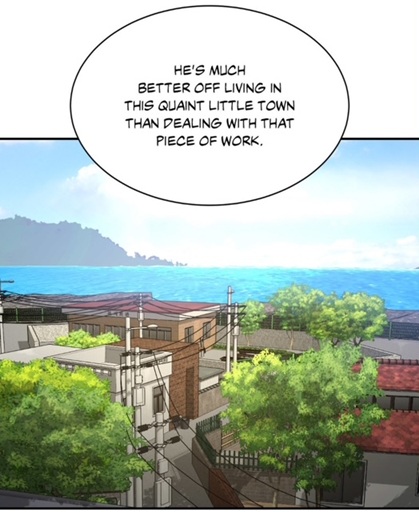 (chapter 58) daily life in slow motion—sets up a stark contrast to the approaching storm. All these images and including the elderly proclaiming
  , (chapter 65) “It’s a nice little town, isn’t it?”, lulled both the characters and readers into a false sense of permanence. But beauty is ephemeral. Storms, by nature, contradict stability. They sweep away trees, roofs—and with them, pipe dreams.
The grandmother, drawn to the town for its aesthetic charm and warm nostalgia, admired the landscape without realizing the presence of danger next to her. She confessed to Kim Dan her admiration for the ocean due its beauty, but ignored its dangers: the waves, the wind and storms.  (chapter 53) That’s why Mingwa zoomed on her gaze, but “cut” her ears, a symbol for her “deafness”. Hence she didn’t hear and feel the wind during her stroll with the champion. (chapter 65) The ocean can also represent a source of misery. Her wish to see the ocean again
 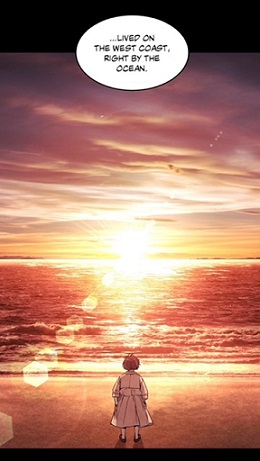 (chapter 53), bathed in the orange glow of a perfect sunset, reflected her toxic positivity—her tendency to ignore pain and erase any negative memories, including a life marked by hardship in Seoul. It encapsulated her attempt to embellish the past and project into the present (chapter 65) and future, disregarding reality, assuming the ocean/town’s beauty promised tranquility without acknowledging the lurking danger it could also bring. Her nostalgia operates as an emotional escape hatch—a curated fantasy where beauty masks regret. When she speaks of “seeing it one last time,” it is not a celebration of memory, but a quiet refusal to face her past failures and the reality of her present. For her, the coast is a postcard of serenity —a static image of peace and perfection she once clung to in her old home
 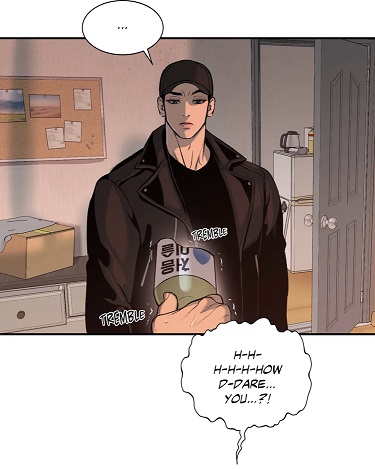 (chapter 17), where the walls were decorated with actual postcards of beaches she had never visited. These were not souvenirs, but illusions—windows into an idealized elsewhere that helped her ignore the hardship around her.
But the truth is harsher: this coastline is not a sanctuary, but a reckoning ground. (chapter 65) The ocean she admired in stillness now roars back with force, revealing that beauty without awareness is blindness. She never questioned the risks of living so close to the sea, nor imagined that its quietude could turn to devastation.
What she failed to grasp is now undeniable: nature has its own rhythm, one that does not bow to sentimentality. The storm, arriving with relentless gusts and shattering winds, becomes a physical embodiment of everything she tried to repress—her suffering, guilt, her dependency (chapter 56), her illusions of control. This is not poetic justice, but poetic truth. She cannot walk. (chapter 65) She cannot escape. The wind howling outside her window will no longer be ambient noise—it is a reminder that she has no dominion here.
Mingwa visually marked this shift in power through the evolving position of her bed. In Seoul, her bed stood far from the window  (chapter 47), symbolizing distance from reality. In the hospice, it is placed next to the window (chapter 56) —yet initially hidden by doc Dan and veiled by Venetian blinds, limiting her view and insulating her from the outside world. When the champion first visits, the blinds are gone
 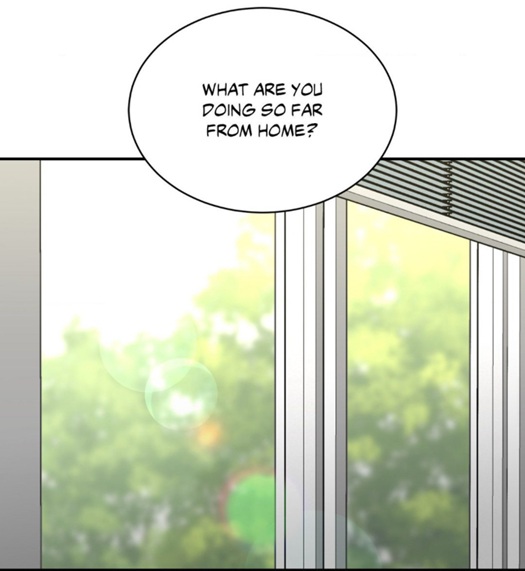 (chapter 61), revealing trees and the sky—nature encroaching. By her second stroll with Jaekyung, the image of the window reappears
 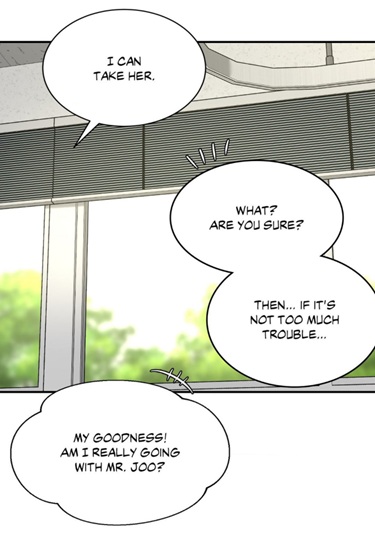 (chapter 65), subtly reminding readers of its fragility. Now, as the storm rolls in, the trees outside become potential hazards, and the window that once offered a view might shatter. Should this happen, then it will rupture her illusion of control and all her repressed fears should come to the surface.
This evolution of space is rich with symbolism. It recalls her former home , (chapter 19) where another window—damaged and offering no real view—served as a silent witness to a life steeped in avoidance. In that space, a young Kim Dan sat beside her, answering a phone call. The fact that someone talked to him, not to her, already suggested the grandmother’s emotional detachment—the parent reached out to the boy, not to her. That room, like her present one, was filled with silence—not peace, but repression. She masked that silence with superficial comforts: beach postcards, a television, the illusion of a serene life. Now, the storm returns not just with wind (SHAAA), but with sound—branches breaking, waves crashing, windows shuddering—forcing all she suppressed to the surface.
The tempest breaches the last barrier of her denial. Her nostalgia, her careful staging of death as beauty, her belief in sunsets and serenity—all are ripped open. She who relied on silence and routine is now assaulted by noise and unpredictability. And as nature surges against the thin pane separating her from its chaos, she may realize: the stories she told herself were never shelter. The storm was always coming. This visual evolution suggests that the very boundary between her illusion and reality will be violently breached. (chapter 65) The hospice doctor had predicted more time based on a perceived serenity in her condition, suggesting her body was at peace after halting chemotherapy.  (chapter 56) But he misjudged her case for two reasons. First, the file had been tampered: she had received a new treatment. Secondly, he did not know her. What he saw as acceptance was actually a mix of comfort, avoidance and unresolved fear. The gale will expose the limits of both clinical assumptions and self-deception. The woman who once believed she could choose the time and manner of her death now faces nature’s blunt reminder: she is not in control of life and time—nor of anything else.
Trapped by the tempest, she is finally forced into the present. No longer able to rely on routines, expectations, or her grandson’s immediate care, she faces the one thing she has evaded: herself. The illusion of being the caregiver, the elder with wisdom, disintegrates in the face of a reality where she must depend on others—or be left behind. And so, what the storm exposes is not just danger. It exposes that the comfort she claimed to have built (chapter 56) was never truly hers to begin with.
The little town in Jinx is not just a backdrop  (chapter 56) —it is a layered terrain of symbolism and vulnerability. Perched on what appears to be a peninsula
  (chapter 65) in a bay (chapter 57), the settlement is structured by elevation: the beach and ocean lie at level 0
  (chapter 60) ; the docks, roads, and shops follow at level 1
  (chapter 62)
  (chapter 69); and the town proper stretches up with retaining walls (chapter 58) to the hilltop, where the hospice
  (chapter 59) (Light of Hope) overlook the coast and the landlord’s house (chapter 57) almost stands on the top of the hills. These heights offer a commanding view—but they also expose the buildings to the full brunt of the western tempest.
The hospice, in particular, is framed as the most precarious point, as it is surrounded by trees and facing the ocean  (chapter 57). I came to this deduction, as the champion could see the building from the beach, when he rescued doc Dan. (chapter 60) Secondly, the nurses could see the ocean from the window of the hospice. Due to its location, the building becomes the most likely target for falling branches, gale-force winds, and perhaps even landslides. Notice that this town is built on retaining walls, like we can detect in the last image and the following panel: (chapter 69) This is why the hospice, perched high on a hill surrounded by woods, becomes both sanctuary and risk.
  (chapter 61) Like pointed out before, his name is misleading, for hope implies “rescue”. However, a stay in that place means that their “inhabitants” are all destined to die due to cancer. There’s no real cure there. In other words, the tempest will bring to light its true nature. The hope, just like its comfort, are illusory.
Though the landlord’s house is close to the top of the hills like the hospital, his house is not facing the ocean, (chapter 57) it is turning its back to it. That’s why I developed the theory that the town is built on a peninsula. This means, the storm should reach them first and at his highest peak. On the other hand, the hills could restrain the gusts and affect less the landlord’s house. On the other hand, it is nestled near trees 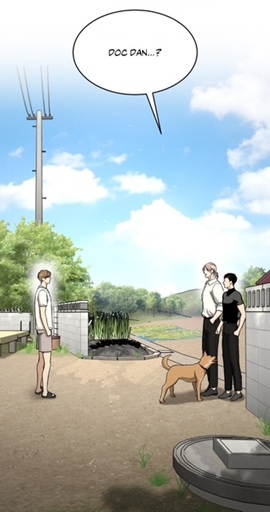 (chapter 57), fields and close to two power masts (chapter 61), so it is quite vulnerable as well. Therefore one might think that the champion’s hostel is similarly exposed to potential outages or structural damage. (chapter 65) Nevertheless, the house is slightly shielded by a high fence and secondly the form of the roof and the absence of high trees and power masts imply that his home is better “prepared” to face such a weather. Moreover, observe that his house (chapter 69) is so built that you don’t need to leave the building in order to “enter” a different room (kitchen, bathroom) contrary to the landlord’s. (chapter 57) The landlord’s hanok, traditional and open in its architecture, offers comfort and warmth under normal conditions—but becomes deeply vulnerable in a storm. Built around a central courtyard, it requires residents to step outside to move between rooms. Such exposure, so harmless in good weather, now turns hazardous. Even getting to the kitchen or another room could risk injury. The doctor, who has been staying there, may no longer be safe.
This architectural vulnerability sets the stage for an unexpected shift: Joo Jaekyung becomes the shelter once again.
Unlike the hanok, Jaekyung’s home is enclosed, protected, and perched farther from the treeline and power masts. It becomes the most stable haven in the storm. The champion—who once embodied force and solitude—now extends care and refuge. If he invites Kim Dan, the landlord, Boksoon and her puppies into his home, it signifies more than kindness. It signals growth. He is no longer just the “Emperor” who takes what he wants. He becomes a real guardian. At the same time, it would help doc Dan to review his perception about his loved one. The champion might have not seen him just as a tool this entire time.
This possibility starkly contrasts with an earlier scene where the celebrity’s home served as a quiet, solitary place while others—Potato, Heesung, and the landlord—danced joyfully under the stars in the hanok’s courtyard. (chapter 58) Back then, Jaekyung was still on the outside of that communal warmth. But with such a prediction, the roles would be reversed. His home would become the beacon of safety, and he would be the one providing it.
Even more, the landlord—observant and unbothered by status—might become the first to voice Jaekyung’s good personality and generosity. He would offer praise not based on fame, but on integrity. Perhaps he’ll simply say, “He’s the kind of man who protects others.” and relate to doc Dan what the champion did in the past (chapter 62) There’s no doubt that the dogs will be invited to his home, as her place is right under a tree and power mast. (chapter 57) The landlord may even encourage the fighter to adopt a puppy from Boksoon’s litter, as he can see the champion’s care and sense of responsibility—not just for himself, but for another life.
Thus, a storm not only destroys; it reconfigures. The champion’s house, once a private retreat, may become the very heart of healing. Though no one is truly safe in front of a tempest, the latter serves as a message from the gods. The geographical truth becomes a narrative truth. The further up they go in elevation, the more isolated they are—and the more their illusions of control and security are tested. While the ones spend time to share their past and worries to others, the other is on her own at the hospice. She has no one by her side to talk to. There’s no doubt that the staff will become more busy due to the storm. Traditions can be exposed as vulnerabilities, like the Korean Hanok, at the same time, the gale helps to create deep bonds. To conclude, the storm, in this light, becomes not just a force of nature, but a force of truth: stripping away façades, toppling routines, and confronting each character with the reality they tried to avoid.
Storms in literature are more than weather. They are moments of rupture, passion, and transformation. They can symbolize:
- Emotional turmoil
- Romantic or destructive passion
- Uncertainty and change
- Conflict between nature and civilization
- Negativity as such chaos, darkness and doom or turning points
- Power struggle and transformation (self-discovery) Quoted from https://www.firstediting.com/blogs/beyond-the-thunder-a-guide-to-storm-symbolism-in-literature/
In Jinx, the western tempest embodies all these layers. It peels back the narrative’s social and emotional veneers. Let me give you an example. Just before the gale hits the little town, the champion exposes his emotions toward his fated partner (chapter 69), when he hugs him. It announces the instant where the champion gave up on controlling his feelings. The gale announces the end of “internal turmoil”. So the moment they are together waiting for the storm to pass, they can do nothing except talking and cooking. Hence we should expect that Joo Jaekyung will expose his mental and emotional struggles to doc Dan (reference to point 1, 2,3,4 and 5), triggered by the offer from the CEO. (chapter 69) Such a confession would push the physical therapist to redefine his relationship with the celebrity: he is indeed his friend, even a close one. And if this takes place, then the doctor could start opening up as well. The tempest reveals fragility, forces new beginnings, and exposes fair-weather allies. (chapter 69) The moment the champion exposes his fears and doubts, doc Dan would prove to the champion that he is no fair-weather ally contrary to Park Namwook, who pushes him back to the ring. The grandmother, so proud of her roots (chapter 57) and wisdom, finds herself outmatched—not by age, but by wind. Her idea of safety is shattered. Like pointed out before, the storm embodies present. So if they come to enjoy this time of respite together, they will realize that this “tragedy” for others represented a “blessing” for them.
Meanwhile, the storm breaks Kim Dan’s dependency cycle. He doesn’t have to rush, to fix, to prove. He is where he needs to be. The champion, too, is cut off from old obligations. Park Namwook cannot track him. He has been “blocked”—not digitally, but karmically. Moreover, if he loses his car, he has to rely on the “old man”, his neighbor. His move will be limited. His immobility would push the manager to “move” which would expose the true nature of their relationship. the manager is in reality dependent on the celebrity. The roles have changed.The champion, like the grandmother, has used routine to mask his suffering: her toxic positivity versus his self-reliant pessimism. So thanks to the storm, the athlete’s perception about life would be switched. His reputation as a fighter would no longer seem relevant. I would even add, the tempest will remove the sportsman’s negativity
They are forced to stay indoors, isolated together, but they can not have sex, for according to my prediction, the two protagonists would be living with the landlord and the animals. The chaos outside contrasts their stillness inside. There’s no gym, no manager, no routines. The sandbag in the courtyard  (chapter 69) would be left outside, symbolizing that this “sport” has become less central and vital in the main lead’s life. This is the first true pause in their relationship. Jaekyung, used to immediate gratification and external control, must slow down. And for the first time, he will see what he always overlooked: that meals take effort, that conversation has value, as it can help to get closer to another person. He doesn’t need the grandmother to get “through Kim Dan”. (chapter 65) Finally, if my prediction is correct, then by living with different people in a small place, he will realize the benefits of relying on others. He will discover the joy of having a family, having found a home. The storm creates a space for redefinition.
And so this tempest arrives not as an arbitrary backdrop but as a settlement. It disrupts the emotional architecture of the story—a confrontation, not a solution. The storm demands serenity; it strips away distraction and busyness, leaving space only for meditation. Characters can no longer move as they did before—they must pause, reflect, and reckon with themselves. The power outages, closed roads, and uprooted trees reflect the characters’ inner disruptions, they can no longer avoid certain problems in their own life: death, grief, fear, past, vulnerability, and the need to change. The weather has no concern for hierarchy.
They are forced to remain indoors, potentially together. This is the first real pause in their story. Jaekyung, used to forward motion and clear roles, is confronted with the quiet. Here, he may begin to notice what he once ignored: the care behind every cooked meal, the invisible labor of the doctor, and the need to protect rather than possess. The wind howls outside, but inside, something tender brews.
The small shelter where Boksoon gave birth is near a tree. It is no longer safe. She and her pups must be relocated—an urgent reminder of how quickly new life can be endangered.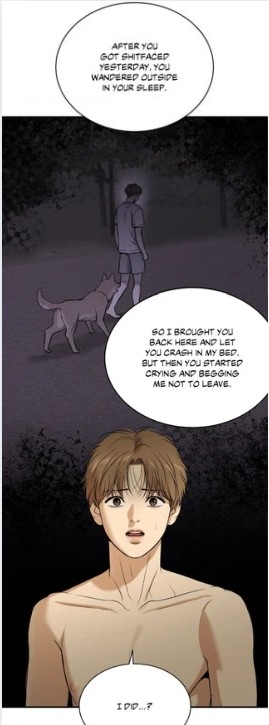 (chapter 66) Jaekyung, who has never seen the puppies, might discover them now. That discovery mirrors his gradual awareness of fragility and caretaking. For Kim Dan, nurturing the puppies symbolizes reclaiming his capacity for love and responsibility—free from obligation.
Her admiration for the ocean and the town has been steeped in toxic positivity. She longed for a perfect sunset, a beautiful memory to crown her life. But she ignored the storm warnings—both literal and emotional. When she finally faces the tempest, the comfort she clung to shatters.
In Season 1, she summoned Kim Dan whenever she feared death 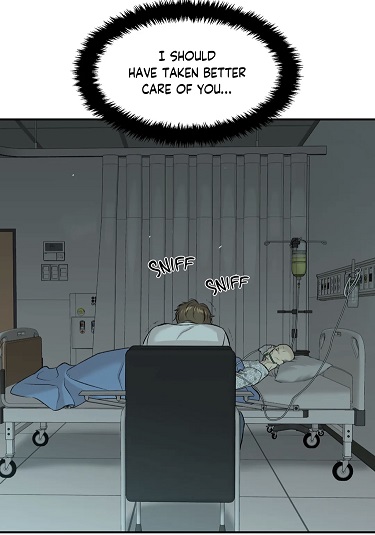 (chapter 21) and needed company.
  (chapter 21) The doctor would drop everything and rush to her side overlooking his own health. But now, with blocked roads and dangerous winds, Kim Dan cannot come—even if he wants to. He is no longer her servant or safety net. Nature has intervened where he could not set a boundary.
The grandmother must confront her own helplessness. Her seniority no longer grants her power. And if she calls out for her grandson and he does not come, she will be forced to realize: she is on her own. (chapter 5) Doc Dan can not assist her anyway, as he can do nothing against nature.
The storm isolates the manager. Without power, without a car, and without knowledge of Jaekyung’s location, he is rendered irrelevant. The champion’s phone may be off. The line has gone dead—literally and symbolically. The manager, always able to take advantage of the celebrity’s loyalty and sense of responsibility, finds himself “blocked.” 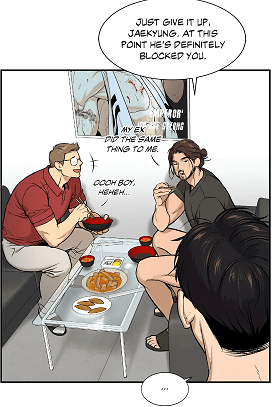 (chapter 5) Thus his anxieties should reach a new peak. His grip on the boy he used to control is gone. The storm draws a line between who remains—and who fades.
In Jinx, the western tempest is all of these. It tears through the “good-weather” relationships and reveals what’s real. Therefore it is no coincidence, when Choi Heesung and Potato met doc Dan again, (chapter 58) the ocean was calm and the sky very blue. Both embodied this notion: good-weather friends. Characters who stayed out of convenience or obligation vanish. Those who remain—like the landlord, Boksoon, and eventually Jaekyung (chapter 68)—stand firm.
The landlord, in particular, becomes the story’s quiet moral compass. His home, his fan, his calm attitude, and even his absence of curiosity about fame set the standard. When he welcomes Joo Jaekyung, it isn’t out of admiration. It’s decency and a longing for company. (chapter 61) Therefore I perceive him as the eye of the storm. (chapter 69) That’s why he looks at the horizon. From my perspective, he is used to such events, hence when the storm hits the coast, he will be prepared mentally. Thus he could share his experiences and thoughts to the two young men.
Finally, the western tempest stands in direct contrast to the grandmother’s sunset dream. (chapter 53) She imagined a final golden moment—warm, serene, and nostalgic before her death. But instead, she gets gusts and branches crashing down. In that sense, the tempest is her lesson: Humans are not superior to nature. They can not control time, nature and destinies. Moreover, nature does not serve our stories. It tells its own.
The storm, then, is not about destruction. It is about clarity. It forces all façades to fall. And when the winds calm, what remains is not who spoke loudest, but who stayed. In this story, the western tempest does not simply pass. It reshapes everything. Moreover, a storm is not “eternal”. So after the tempest, there’s sunshine—a sign that happiness may finally be within reach for the two protagonists.
Feel free to comment. If you have any suggestion for topics or Manhwas, feel free to ask. If you enjoyed reading it, retweet it or push the button like. My Reddit-Instagram-Twitter-Tumblr account is: @bebebisous33. Thanks for reading and for the support, particularly, I would like to thank all the new followers and people recommending my blog.

Please support the authors by reading Manhwas on the official websites. This is where you can read the Manhwa: Jinx But be aware that the Manhwa is a mature Yaoi, which means, it is about homosexuality with explicit scenes. Here is the link of the table of contents about Jinx. Here is the link where you can find the table of contents of analyzed Manhwas. Here are the links, if you are interested in the first work from Mingwa, BJ Alex, and the 2 previous essays about Jinx The Sweet 🧁 Curse of the Round Table 🍴 and While They Embrace🫂: The Sparrows 🐦
It would be great if you could make some donations/sponsoring: Ko-fi.com/bebebisous33 That way, you can support me with “coffee” so that I have the energy to keep examining Manhwas. Besides, I need to cover up the expenses for this blog.

As Kim Dan asks his fated partner (chapter 69) and the latter stands stunned in the late-summer breeze, the moment seems suspended in light and silence. The doctor’s words are accompanied by a subtle music: the wind. It whispers through the panel with an audible “WHOOSH,” not covering doc Dan’s voice but giving it resonance. The wind, like words, travels through the air and reaches the celebrity’s ear. It connects characters across distance, marking the invisible line of perception, reaction, and awakening. But behind this charged reunion lies a quiet figure—barely visible, yet unmistakably present: the landlord. In this image, the old man appears only for a second, dressed in a jacket and green cap, almost blending into the night. He does not speak. He does not move. And yet, everything in that scene bears his mark.
From the sneakers on Kim Dan’s feet to the jacket he wears (chapter 69), and the bags of groceries in his hands, traces of the landlord’s influence are everywhere. Whether it was Kim Dan who offered his help or the landlord who extended the invitation, the result was mutual: for the first time, they acted as a community—two individuals sharing the same roof and engaging in reciprocal care. I observed that through this interaction, the doctor was subtly encouraged to behave differently. He was not merely going shopping. That quiet moment served as a turning point—an invitation to rejoin life, to move on, to dress with care, to claim space. While others meddle, accuse, or abandon, the landlord quietly watches, nudges, and supports. He is not the star of the scene, but its breath. He is the breeze before the embrace. The hand behind the rescue.
From this new angle, I reached the insight: the landlord is not only present at pivotal narrative moments, but he actively shapes the emotional framework of season 2 without ever stepping into the spotlight. I observed that in Chapter 69, while readers may initially focus on the tense conversation between the champion, Park Namwook, and the CEO of MFC, there is another figure in the background—the landlord—who discreetly fades behind the couple:  (chapter 69) (chapter 69). His presence is easy to miss, but for attentive readers, it’s striking. He appears not as a passerby, but as the very person who guided Kim Dan toward that precise moment of vulnerability and strength. When contrasted with an earlier panel from the same episode, another layer of meaning emerges: in both scenes, the landlord is positioned in a way that suggests symbolic proximity. However, I made a striking observation: in the first panel, he is actually standing behind the champion and in front of Kim Dan. This creates a visual link between the two protagonists, as the landlord appears quite literally between them. I came to the following conclusion: he functions as a bridge or protective force—he does not slap or yell like the manager, but his stillness conveys safety. While he stands at the champion’s back, he faces Kim Dan, as if preparing the ground for their reunion.
 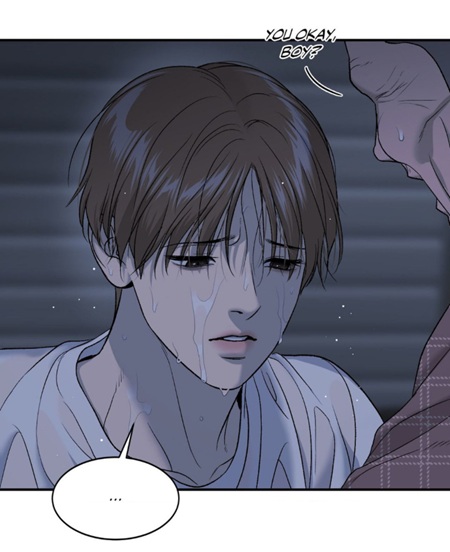 (chapter 69) These silent, parallel compositions reveal the landlord’s symbolic position as an enduring guardian: not static, but responsive. Therefore his position shifts constantly, either
  (chapter 65) in front of the couple, or behind Kim Dan in one scene, behind the champion in another.
Seen through the lens of the wind metaphor, I discerned something more: the landlord’s mobility reflects a deeper symbolism. (chapter 57) He is not fixed in place like house, wall or obstacle. This explicates why he is almost seen outdoors, even her. Opening the door means allowing the fresh air to enter the room. 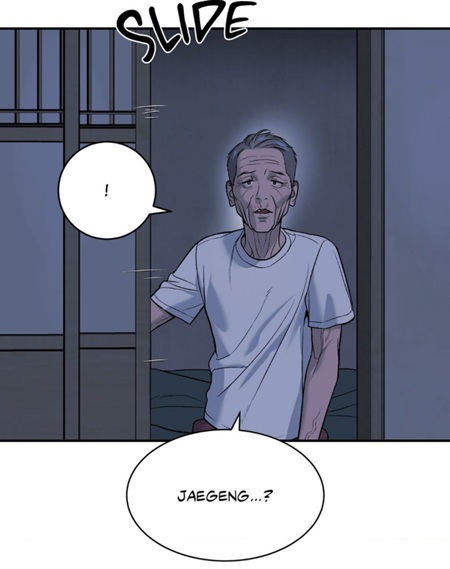 (chapter 65) He is like the wind, fluid and unobtrusive, adapting to the needs of the moment. His position is never rigid, therefore in the final panel he seems to have vanished. (chapter 69) At times behind Kim Dan, at others behind the champion, he realigns himself without fanfare. I realized this adaptability speaks to something elemental: the wind’s capacity to bend around others, to support without imposing. Unlike characters who plant themselves firmly in conflict
  (chapter 46) or authority
  (chapter 65), the landlord responds to what is needed, not what is expected. His flexibility does not stem from indecision—it is born from humility and care. Another aspect contributing to this perception is his ignorance. However, the latter should not be viewed negatively. Since he doesn’t know the champion’s profession or the doctor’s familial and financial situation, he is not projecting expectations or judgments onto them. Rather than acting out of assumption, he simply observes. This is precisely why he doesn’t come across as arrogant. His lack of knowledge becomes a quiet strength—it allows him to respond with presence, not prejudice. Just as the wind moves through open spaces without imposing form or judgment, his unknowing presence allows room for others to breathe and unfold, free from predefined roles or assumptions.
 (chapter 65) He does not try to define the protagonists by their past or their titles. He lets them define themselves. While he tried to encourage doc Dan to drink and work less, as time passed on, he came to notice his suffering and accept him with his illness. (chapter 69)
Just as the wind moves around structures and creates waves, his presence bends gently to support without overshadowing. This mirrors his role throughout Jinx season 2: he is a man who creates space rather than fills it, who enables others to find their footing by adjusting his own stance. In this way, his neutrality is not passivity, but grace in motion. In the embrace scene (chapter 65), when the waves rise audibly due to the wind, I observed that the landlord is no longer standing directly behind Kim Dan. And yet, a sandal, sock, and pant leg appear in the corner—suggesting he is still nearby. It seems to have stepped back deliberately, allowing privacy and intimacy to unfold. He remains part of the scene, like a breeze, felt but unseen. Another possibility is that he approached the coast guards and explained the champion’s reaction. If this is true, then In doing so, he would have acted not as an intervening outsider, but as a bridge—discreetly smoothing tensions without casting judgment. True to his role as the wind, he doesn’t speak to dominate, but to ease the air around others. Even in his ignorance, he responds not with assumption but with attentiveness—observing first, and acting only when necessary.
And yet, one detail caught my attention. In the panel at the dock, the landlord is not looking at the champion. (chapter 69) His gaze is directed straight ahead—detached, not reactive. Under this new light, I gathered that he may not be overlooking the scene but instead quietly attuned to something else entirely—the weather. Since the storm had been announced on the news (chapter 69), it is plausible that the landlord is calmly scanning the horizon, sensing the approach of the tempest. After all, he is a farmer (chapter 62) —his livelihood depends on observing the skies. (chapter 69) This attention to weather is not merely practical, but instinctual, shaping his rhythm of life and reinforcing his elemental bond with the air. As a man attuned to nature and grounded in routine, his awareness of such environmental shifts would come naturally. It is not panic or distraction—it is foresight. This reinforces his alignment with the air: he is always mindful of what is coming.
I initially assumed that the errand to the grocery store was directly tied to the storm forecast announced on the news. In such cases, villagers often prepare in advance, buying supplies before conditions worsen. Yet upon closer examination, the atmosphere among the townspeople doesn’t reflect growing panic or haste. (chapter 69) They are murmuring, yes, but their attention is absorbed by the incident at the shore. This led me to reconsider: perhaps the purchase was not consciously connected to the weather after all. And yet, one man quietly stood apart from the crowd—the landlord, his silence and gaze directed not toward the commotion, but toward the open horizon.
This single detail speaks volumes. Unlike others, the landlord does not rely on media reports or buzzing gossip. Notice that he was the last one hearing about the champion’s generosity in the town. (chapter 62) He is a farmer—a man who reads the sky, the wind, and the rhythm of the land. Hence I am inclined to think that his awareness of the approaching storm stems not from a broadcast but from instinct. The wind carries signs, and he is attuned to them. It is even possible that while talking with the coast guards, he learned more about the forecast—not through digital alerts, but through human connection.
In this light, his decision to bring Kim Dan along acquires a new depth. Whether or not the storm was their explicit concern, the moment becomes symbolic: an act of movement, preparation, and subtle care. Once again, he does not push Kim Dan forward but opens the way gently. He creates a path that the doctor can walk—if he chooses to. As with the wind, his influence is neither loud nor commanding. It is felt through presence, not pressure.
Moreover, because of his silent behavior, I could only come to the conclusion that he was not the one recognizing the celebrity’s car parked by the dock. Rather, it must have been Kim Dan himself who noticed the vehicle, then he paid attention to the crowd forming nearby, or the emergency headlights—much like the champion had earlier. This is significant, as it reinforces the landlord’s role as someone who does not act on behalf of others—he simply prepares the space for choice to unfold. And since the two nurses  (chapter 69) had already been shown earlier together in the crowd, I suspect that one of them might informed Kim Dan about the incident and the champion’s presence. This would align with the narrative’s kaleidoscopic structure, where certain scenes are reflected in different timelines.
And now, you are probably how I came to associate the landlord with the wind. Earlier in Chapter 66, we encounter one of the most symbolic moments involving the landlord: (chapter 66) the image of him gently fanning himself while sitting in his yard. I detected something immediately intimate and ancient in this gesture. A hand fan, in many East Asian cultures, denotes calm authority, self-discipline, and silence. I interpreted this scene as more than casual: the landlord becomes an embodiment of wind—present, refreshing, yet invisible. A man who can create movement without pressure. It is striking that in a story driven by action, fists, and fame, the one character who moves the plot forward with the least noise is this old man.
Upon closer inspection, I observed that the fan bears printed text and the number “365.”  (chapter 66) Under this new light, it dawned on me that the fan was most likely handed out by a local institution—perhaps even the hospice Light of Hope, during a public health campaign or examination event. This means that he is taking good care of himself. One might argue with this interpretation, yet there exists another evidence for this perception.
  (Chapter 62) He is constantly wearing the green cap, a sign that he knows about the danger of the sun. This stands in opposition to the grandmother who would sell her vegetables without any hat.
  (chapter 57) These types of fans are typically distributed by hospitals or clinics: practical items with subtle promotional intent. But once in the landlord’s hands, it takes on symbolic weight. The number “365” does not simply represent a calendar year; it represents consistency, time, and the daily rhythm of care.
Strikingly, this fan aligns with the landlord’s quiet guardianship. Just as the fan moderates air and temperature, the landlord moderates the emotional climate of the household.
What’s more, I noticed the fan (chapter 66) is visually divided into six colored columns—blue, green, and orange tones recurring in a harmonious pattern. These colors stand in sharp contrast to the dominant black-and-white or blue-and-red palette of the main couple’s visual identity. This exposes that the landlord is portrayed as a multicolored figure: layered, grounded, and richly nuanced in ways that neither protagonist yet fully embodies. This explains why he is often seen wearing different shades: beige, 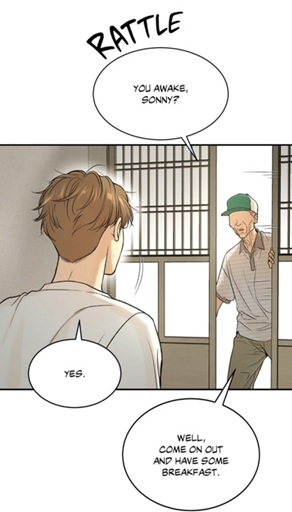 (chapter 57), white, (chapter 66) gray, (chapter 58), green, (chapter 62), orange (chapter 61) and brown. Yet, his clothes tend to lean toward brown hues, evoking earth and soil—symbols of rootedness and stability.
I came to an additional realization: the landlord doesn’t just enrich the emotional palette of Jinx—he restores the protagonists’ connection to Earth. His presence is grounding. He draws them out of sterile hospital rooms, detached penthouses, and fabricated spotlights, and into the soil-rich air of a small town. He is the one who invites breath, hunger, walking, sleeping—the ordinary rhythms of life that nourish the body and soul. By surrounding himself with the colors of the land—brown, orange, moss green—he reminds the doctor and the champion of a world that does not demand, but simply exists. A world where one can finally pause, take root, and rest.
Rather than simply standing apart, the landlord infuses the narrative with gentle warmth and vibrancy. His colorful presence offers more than emotional flexibility—it introduces a spectrum of life into the protagonists’ otherwise muted and high-contrast world. Previously dominated by blue and red, their visual universe begins to shift through his influence. Under this new light, I realized that he doesn’t just symbolize emotional depth—he brings light and color into their shadows, inviting them to rejoin the world of sensation and groundedness. Consequently, his quiet mission is to help them land back on Earth, to discover rest and a home. Like fresh air through a long-sealed room, his presence is not overwhelming—it simply makes it possible to breathe again.
 (chapter 62)
The six-part division also struck me as potentially symbolic. Since the fan appears for the first time in Episode 66, I came to the following conclusion: the six segments may represent his quiet integration into their bond. My idea is that he will not just remain a bystander, but emerge as a surrogate parent figure—not by blood, but by presence. Like a mother, he nourishes, guides, and trusts, yet without smothering or restraining. His care is rhythmical, like breath. His colors are inclusive. His fan—a calendar, a compass, a quiet lullaby. I deduced that he doesn’t simply carry the fan—he embodies what it represents: routine, protection, and the kind of stability Kim Dan has long been denied. The fan becomes an extension of his role: to circulate—not intervene, to cool—not confront.
Before moving further, a linguistic and symbolic insight struck me: (chapter 65) words and wind share the same pathway—the ear. We do not see them; we hear or feel them. Just like the wind, the landlord’s influence often goes unnoticed unless we attune ourselves. Interestingly, in the English version of Jinx, he refers to Joo Jaekyung as “son”  (chapter 69) and Kim Dan as “sonny” (chapter 57) or (chapter 69) “boy.” These terms of address, gentle and familial, contrast sharply with the control and emotional neglect shown by figures like the grandmother or Park Namwook. Because those characters views the main leads as “immature (chapter 65) and irresponsible (chapter 52), they use their “youth and seniority” to assert dominance or demand loyalty and obedience. On the other hand, the landlord positions himself as a silent guardian, perceiving the protagonists as children in need of warmth and care, not correction. (chapter 62) His words, like the breeze, are few and soft—but when spoken, they carry weight. This brings me to a broader observation. I detected that the hand fan becomes a symbol of breath itself (chapter 66) —the very thing Kim Dan is consistently deprived of.
  (chapter 59) Whether it’s due to panic, malnutrition, exhaustion, or psychological collapse, suffocation is one of the defining sensations of Kim Dan’s arc. In this context, the landlord, with his unassuming fan and grounded demeanor, emerges as a breath of fresh air—the very opposite of the heiße Luft, or “hot air,” surrounding the champion’s fabricated scandals and media distortions.
  (chapter 52)
Under this perspective, the fan’s soft FLAP (chapter 66) becomes almost therapeutic. It doesn’t try to rescue Kim Dan like the champion does. It doesn’t dramatize. It simply cools. It shifts the air around a suffocating figure, making room for recovery. Thus I deduce that the fan is not only a symbol of time, but also of space—space to breathe, space to reflect. The landlord does not speak of the past or demand a future; he offers 365 days of presence, through silence and small gestures.
Striking is the relationship between the wind and the storm, and how this elemental dynamic deepens the landlord’s symbolic role. When Joo Jaekyung hears at the dock in Chapter 69 about the incident with the drunk man, (chapter 69)  (chapter 69) the atmosphere grows heavier—not from external scandal, but from inner turmoil. Then Kim Dan’s puzzled reaction, (chapter 69) strikes like a gust. (chapter 69) The scene becomes emotionally charged, echoing classic storm symbolism: emotional intensity, uncertainty, and the prospect of sudden change.
Under this new light, I came to the following conclusion: what we witness is not chaos imposed by others, but a moment of crisis—of emotional confrontation and potential transformation. And yet, before this private storm could break, I observed that the landlord was quietly present. (chapter 69) He helped Kim Dan get dressed, leave the house, and carry groceries. He didn’t push him into the storm—he gave him the freedom to walk into it on his own terms.
That is the striking contrast. The storm represents the turning point, the fear of change, the weight of the past catching up. The landlord, as wind, offers the one thing Kim Dan lacked until now: air, movement, and choice. He doesn’t command. He prepares. He trusts. And in doing so, he gives Kim Dan room to decide—whether to run or stay, to speak or remain silent.
Following this exploration of wind and storm, I noticed another compelling pattern tied to sound and clarity. In the very panel where the champion realizes Kim Dan is safe (chapter 69) —his face filled with shock and disbelief—the Webtoonist added the sound effect “WHOOSH.” Under this new light, I interpreted this as more than background ambiance. It marks a pivotal turning point, as if the wind itself had cut through the fog in Joo Jaekyung’s mind, sweeping away his spiraling fear and clearing space for truth. This sudden shift in emotional atmosphere visually alters him too. Hence it is not surprising that he looks visibly younger. Not broken, but stripped of his burdens. As if the wind blew away the years of pressure, fears and rage.
Strikingly, this is not the first time the gust is heard. Earlier, when Kim Dan first spots the champion on the dock, the same onomatopoeia—“WHOOSH” (chapter 69) —carries the weight of their emotional storm! That very night, I noticed, both Kim Dan (chapter 69) and Joo Jaekyung experienced an emotional shift. The wind, though announcing the coming storm, swept through their minds and cleared away emotional fog. Thus, I deduced that the wind in these scenes becomes a narrative force of mental clarity, awakening, and emotional release. (chapter 69) While there is no sunlight or calm skies, it opened a path for both characters to see clearly. That’s how I realized that Kim Dan’s enlightenment was not recognition, but humility! His dawning awareness that he never truly knew the champion, captured poignantly in his question (chapter 69) and the visual emphasis on the punctuation mark in a separate panel. (chapter 69) This means that the moment the champion embraced him, the doctor must have sensed that the champion’s worries and care were genuine. (chapter 67) Doc Dan got finally his answer to this question. Joo JAekyung is more a man of action than of pretty words. So awakening and flourishing are not something that occurs behind glass or sealed doors. It is born in the open, amidst uncertainty and confrontation. And under this new light, I reached a final insight: growth in Jinx does not happen behind closed doors or sealed windows. It happens in the open, where storms rage and air can finally circulate.  (chapter 59) The landlord doesn’t shelter people from pain or storms. He makes sure they’re equipped to face them. And once they do, the wind is no longer a threat, but a form of grace. And now, you comprehend why the death of the puppy has not been discovered by the athlete yet. For the landlord, death is something natural and inevitable, and since doc Dan has been working at the hospice, I am quite certain that the old man imagined that doc Dan was well-equipped to deal with this situation. He must have been envisaging that Doc Dan was accustomed to it. The problem is that he doesn’t know the protagonist’s past and family.
Furthermore, linking this moment back to the storm and grace works thematically: the same wind that opens hearts also shakes foundations. The landlord’s silence and discretion, typically virtues, can now be understood as both protective and fallible, making him even more human. His trust, while generous, risks overlooking the complex layers of grief that Kim Dan carries. What is seen as strength might actually mask deep vulnerability. In this light, the landlord’s role as wind is also a lesson in perception—he adapts, but cannot always see the storms others keep within.
In a world where Kim Dan has long been deprived of agency—where he’s been pushed, controlled, bought, and silenced—the landlord brings something revolutionary in its simplicity: freedom and care without pressure. His wind does not knock doors down. It opens windows.
Even after the incident with the drunk doctor takes place —when others might rush to assign blame or cast doc Dan as victim—the landlord remains silent. As Joo Jaekyung walks away into the night (chapter 69), no words of condemnation are spoken. Unlike Heesung  (chapter 58), who plays the victim while hiding his own culpability, the landlord does not engage in gossip or vilification. His silence isn’t ignorance—it is grace. (chapter 52) He is the antithesis of the media’s “heiße Luft”—that German phrase meaning nothing but hot air. The landlord is not heat, not noise, but wind—cool, steady, and clear. He represents a rare truth in Jinx: the quiet man who watches, helps, and leaves judgment to the wind.
And perhaps most strikingly, I deduced that it is this elemental quality—his alignment with air—that makes him essential to the story. He is not the hero, nor the villain. He is just a human, someone who opens the door after someone else unlocks it. He is the one who tells Kim Dan to give Boksoon her food (chapter 57), who lets her roam, who trusts without demanding. He is not a rescuer by force; he is a current that carries the exhausted to shore. Though he is disconnected from the social media  (chapter 58) and from media (chapter 62) in general, he is actually the one who can connect to others the best. (chapter 58) No wonder why the actor asked doc Dan to greet the “old man”. (chapter 59) He felt so comfortable around him.
While others stir scandal or are obsessed with success and money, the landlord flaps a hand fan (chapter 66) and remains seated. Since he mentions it is the weekend, it is clear that he has no intention to work during the weekend. This explains why he is not wearing his usual green-and-white cap. This subtle detail reinforces his connection to nature’s rhythms—he is not a workaholic  (chapter 57), but someone who understands the balance between labor and rest. He may not have a name, but he has a function. And sometimes, in storytelling, function is identity enough.
Because the old man was seen behind doc Dan’s back on the dock (chapter 69), I noticed a striking visual parallel in Kim Dan’s story: the recurring image of his back. (chapter 56) In Episode 56, we see him resting in front of the window. This moment suggests not only emotional vulnerability but also isolation. There is no one behind him, no one shielding him from the coldness of the world. Later, when he watches the sunset, disconnected from his senses, unable to hear the waves or feel the breeze,  (chapter 59) there’s only one poor sun umbrella in front of him and a wall far behind him. His back is turned to the world, wrapped in solitude and silence. That’s how I was reminded of his childhood. There, the grandmother often stood beside him
  (chapter 47)
 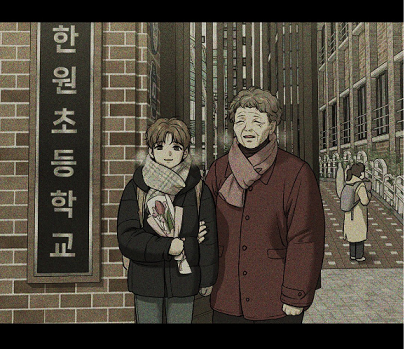 (chapter 47) (chapter 65) but not behind. Thus the landlord’s placement (chapter 69) speaks of quiet support. It implies that the old man has his back now. He neither pushes nor pulls—he simply follows, allowing Kim Dan to move forward at his own pace.
The absence of a visual of someone positioned behind Kim Dan  (chapter 49) explains why he got abandoned in the locker room. It gains even more poignancy when viewed against his past. In Episode 47, while the grandmother was carrying him on her back, Kim Dan’s back is left unprotected.
 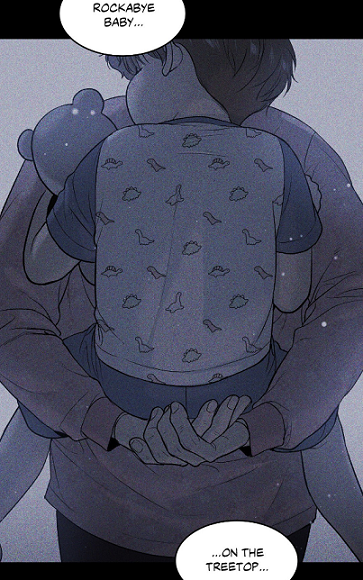 (chapter 47) Her proximity is visible, yet it lacks the symbolic protection associated with standing at someone’s back.
A particularly revealing moment occurs when young Kim Dan cries after being bullied at school. (chapter 57) The grandmother embraces him and taps his back gently while saying, “You still have me.” At first glance, this gesture may seem supportive. Yet, under this new light, I came to the following conclusion: her touch is more reflexive than instinctive. It soothes, but it doesn’t protect. It calms, but it does not empower. It is not a shield—it is a silencer. Her physical gestures, though present, lacked the emotional resonance necessary to foster true security. This interpretation gets validated, when you include her second “action”: 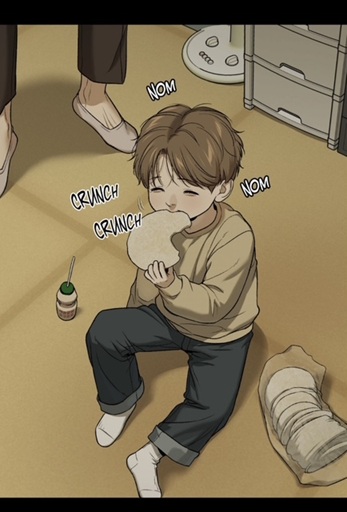 (chapter 57) The moment she offered him a snack, she distanced herself from him. Now, she is standing by his side.
That is why the photograph of young Kim Dan sitting on her lap is so striking.  (chapter 65) It becomes the exception—the rare moment where she appears to have his back. But photographs can be deceptive. They capture posed perfection, not lived reality. And as we trace Kim Dan’s emotional journey, we begin to understand that this illusion of maternal protection was not enough to sustain him.
By contrast, both the landlord and the champion now represent figures of genuine, if imperfect, support. They don’t just stand behind him (chapter 61) —they give him the air, time, and space to grow.  (chapter 62) Their presence—especially the landlord’s—is the embodiment of silent guardianship.
  (chapter 69) His consistent yet unobtrusive presence stands in opposition to the grandmother’s inconsistent gestures. One acted out care; the other lives it.
This distinction matters. It redefines what it means to have someone behind you—not merely as a backdrop, but as a source of strength. And this quiet, enduring presence is what finally begins to heal the fractures left behind by superficial affection.This moment echoes his childhood, marked by emotional distance and a lack of support, as seen in his memories with his grandmother. (chapter 19) 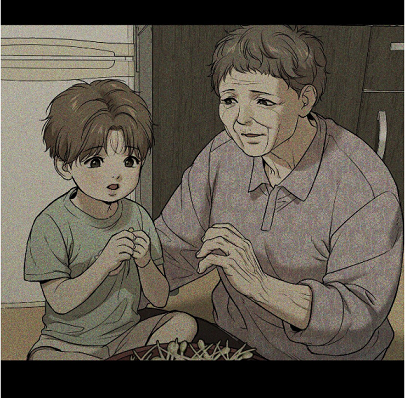 (chapter 47) (chapter 47)
 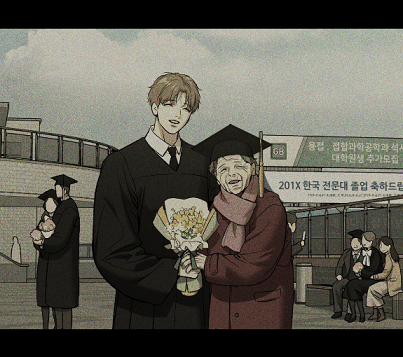 (chapter 47) Despite the rare instance of closeness captured in a photo, most scenes depict Kim Dan standing next to his grandmother, and he is the one supporting her.
I came to the following conclusion: the emphasis on his back is not random. It is a visual metaphor for abandonment and vulnerability. Therefore it is no coincidence that in the yard, doc Dan got hurt on his back, when the champion threw him onto the ground. 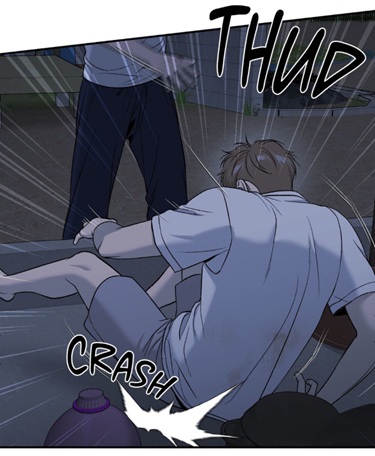 (chapter 69) This gesture, though seemingly violent, reveals something deeper—it forced Kim Dan to feel what he had been missing all along: there were people around him, he was not alone. I would even add, someone was finally standing behind him.
 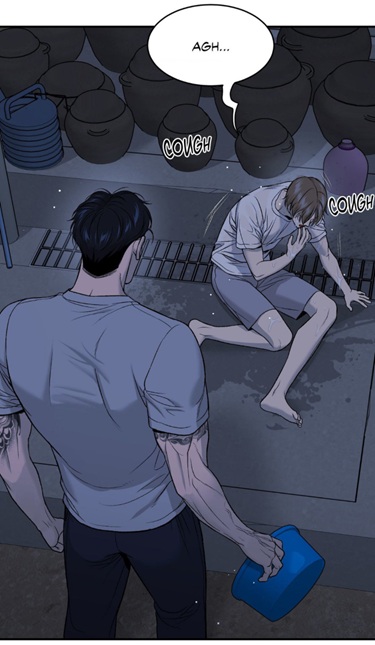 (chapter 69) In that brief moment, Kim Dan is no longer alone. The landlord, as a silent guardian, and Joo Jaekyung, as a fierce protector, are both behind him—symbolically and literally. (chapter 69) They are not towering over him or walking ahead; they are there, at his back, where no one had ever stood before. And that, perhaps, is the quiet miracle of Jinx—a boy once starved of love and breath, now flanked by the wind and the storm. This signifies that when the storm will hit the western coast, the main lead will strangely feel safe and comfortable, because he has company by his side.
Under this light, I noticed another contrast forming between the landlord and the grandmother. On one hand, we have a man who drives his own truck (chapter 69), tends his yard, walks to the fields, shares his meal with his tenant and guides him without uttering huge demands. On the other, we see a woman who claims independence (chapter 56) (chapter 65) while seated in a wheelchair or lying in a hospital bed—entirely dependent on others to move her. Her self-image as a strong and autonomous elder clashes sharply with her visible reliance on those around her.
The landlord symbolizes mobility and quiet agency. His freedom lies not only in movement, but in his capacity to give space to others. By contrast, the grandmother is fixed in place  (chapter 65), reliant on beds, wheels, and nurses to navigate the world. Under this new perspective, the wheelchair and the truck are no longer just modes of transportation—they are emblems of character. One rolls forward by another’s push, the other steers by its own will.
And what would happen if the storm did arrive? If shifts prevented hospice staff from returning? The illusion of her autonomy would crumble. While the landlord silently prepares for such contingencies, the grandmother clings to the fantasy that she needs no one. Storms reveal truths: who bends and adapts, and who remains trapped in the comfort of stillness, unprepared for change and misfortune. Since she has this beautiful memory of the ocean (chapter 53), I doubt that she anticipated the existence of dangers by living on the coast: storms and typhoons. So her beautiful town could get devastated, (chapter 65). Is it a coincidence that when she compliments the place, she is not listening to the wind and seeing the huge clouds in the sky? This stands in opposition to the silent landlord who is looking at the horizon turning his back to the little town: (chapter 69)
At the heart of this subtle narrative lies a trinity (chapter 69) —not loud or hierarchical, but quiet and balanced. The landlord, watchful and unobtrusive, takes on a godlike role: not in power, but in presence. Kim Dan, wounded and unsure, becomes the son figure seeking shelter and rediscovery. And Joo Jaekyung, long cast as the brute force or fallen star, now returns as a humbled spirit (chapter 69) —silent, alert, and transformed. Or we could say the reverse: Doc Dan becomes the dragon’s holly spirit (chapter 69), while the star becomes the son. This trio, for now, are merely neighbors. But with the storm approaching, I am expecting that their separation may dissolve, drawing them into shared space and daily life.
This potential cohabitation stands in stark contrast to the dysfunctional head of Team Black: 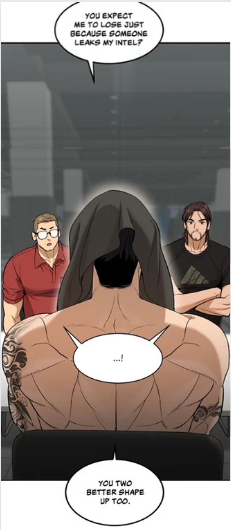 (chapter 46) Coach Yosep, Joo Jaekyung, and Park Namwook—a trio marked by authority without dialogue, control without care. In that group, the manager sowed distrust while avoiding accountability.
 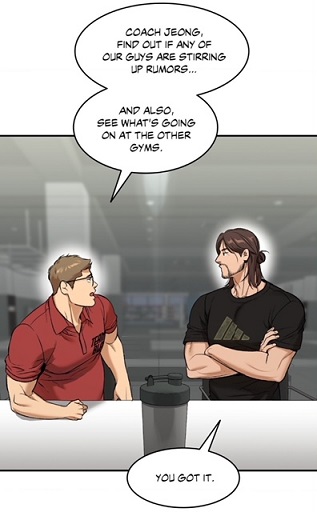 (chapter 46) In the new trio, no one holds dominion over the other. There are no contracts, no strings. The landlord has no financial stake in the fighter’s success. (chapter 61) Instead, he finds quiet satisfaction in their presence—a subtle joy in no longer eating alone, in hearing laughter in the yard, in offering a meal or a moment of guidance. His support is not selfless but unburdened by agendas. That’s precisely what makes his influence so restorative: his care is grounded, practical, and free of manipulation. However, as time passed on, the landlord discovered that by living close with the two young men, responsibilities couldn’t be avoided. Hence he is paying attention to Joo Jaekyung and Kim Dan. (chapter 66) Accountability, once optional, became natural. Without ever declaring himself their guardian, the landlord started noticing their silences, their movements, and their needs. He began to look after them—not because he had to, but because living with them made indifference impossible.
Here, in the modest shelter of shared presence, a new pattern emerges: a household of silent support and mutual growth. No one commands, yet all are transforming. It is a trinity not of power, but of breath, where healing flows like the wind—unseen but deeply felt. The champion and the doctor are no longer steered by duty or burden. For the first time, they seem ready to let the wind carry them—not as a force of chaos, but as a guide toward something lighter, freer, and true, like the two sparrows.  (chapter 66)
Feel free to comment. If you have any suggestion for topics or Manhwas, feel free to ask. If you enjoyed reading it, retweet it or push the button like. My Reddit-Instagram-Twitter-Tumblr account is: @bebebisous33. Thanks for reading and for the support, particularly, I would like to thank all the new followers and people recommending my blog.
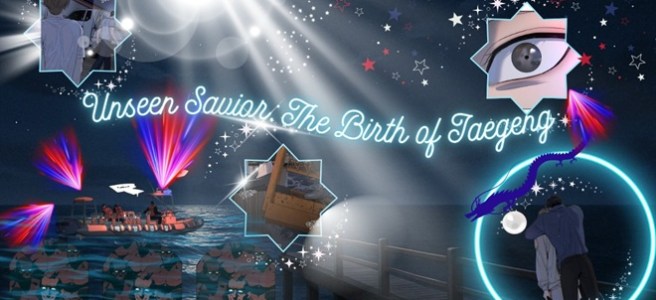



Please support the authors by reading Manhwas on the official websites. This is where you can read the Manhwa: Jinx But be aware that the Manhwa is a mature Yaoi, which means, it is about homosexuality with explicit scenes. Here is the link of the table of contents about Jinx. Here is the link where you can find the table of contents of analyzed Manhwas. Here are the links, if you are interested in the first work from Mingwa, BJ Alex, and the 2 previous essays about Jinx Perfect👼🏼 Defect and The Secret Doctor’s Jinx
It would be great if you could make some donations/sponsoring: Ko-fi.com/bebebisous33 That way, you can support me with “coffee” so that I have the energy to keep examining Manhwas. Besides, I need to cover up the expenses for this blog.

The Hippocratic Oath, one of the oldest binding documents in history, originates from Ancient Greece and has long been regarded as the ethical foundation of Western medicine. Traditionally attributed to Hippocrates, often called the ‘Father of Medicine’, the oath originally included commitments to treat the sick to the best of one’s ability, to preserve patient confidentiality, and to pass on medical knowledge without demanding payment.
The text of the Hippocratic Oath (c. 400 bc) provided below is a translation from Greek by Francis Adams (1849).
I swear by Apollo the physician, and Aesculapius, and Health, and All-heal, and all the gods and goddesses, that, according to my ability and judgment, I will keep this Oath and this stipulation—to reckon him who taught me this Art equally dear to me as my parents, to share my substance with him, and relieve his necessities if required; to look upon his offspring in the same footing as my own brothers, and to teach them this Art, if they shall wish to learn it, without fee or stipulation; and that by precept, lecture, and every other mode of instruction, I will impart a knowledge of the Art to my own sons, and those of my teachers, and to disciples bound by a stipulation and oath according to the law of medicine, but to none others. I will follow that system of regimen which, according to my ability and judgment, I consider for the benefit of my patients, and abstain from whatever is deleterious and mischievous. I will give no deadly medicine to any one if asked, nor suggest any such counsel; and in like manner I will not give to a woman a pessary to produce abortion. With purity and with holiness I will pass my life and practice my Art. I will not cut persons laboring under the stone, but will leave this to be done by men who are practitioners of this work. Into whatever houses I enter, I will go into them for the benefit of the sick, and will abstain from every voluntary act of mischief and corruption; and, further from the seduction of females or males, of freemen and slaves. Whatever, in connection with my professional practice or not, in connection with it, I see or hear, in the life of men, which ought not to be spoken of abroad, I will not divulge, as reckoning that all such should be kept secret. While I continue to keep this Oath unviolated, may it be granted to me to enjoy life and the practice of the art, respected by all men, in all times! But should I trespass and violate this Oath, may the reverse be my lot! Quoted from https://www.britannica.com/topic/Hippocratic-oath
Over centuries, this oath has undergone numerous revisions to reflect the changing nature of medicine and ethics in society. While its core values—non-maleficence, beneficence, and fidelity—remain intact, modern versions are more secular and inclusive, often omitting archaic references to gods or master-apprentice hierarchies. The intention behind the oath has always been clear: to put the well-being of the patient first and to uphold the dignity and responsibility of the medical profession. These noble intentions raise important questions in today’s context. To what extent are they still fulfilled? Do contemporary medical professionals act in the spirit of this oath? And can structural realities—limited time, profit-driven care, burnout—undermine a physician’s ability to live up to its promise?
These critical perspectives crystallized while reading Chapter 67 of Jinx, and triggered a thought-provoking exchange between my friend @Milliformemes2024 and me. Our diverging interpretations of the sleep specialist in chapter 67 helped to shed new light on the enduring relevance—but also the limitations—of the Hippocratic tradition. What began as a discussion about a single consultation evolved into a broader reflection on symbolic language, institutional care, and the ethical cost of modern medicine. In truth, both perspectives hold merit. Our conversation mirrored a larger dialogue between Idealism and Reality: one of us defending the emotional depth and symbolic resonance in care, the other grounded in the necessity of boundaries and pragmatism. This essay unfolds in three parts: first, a symbolic analysis of the sleep specialist and the contrasting figure of Cheolmin; second, a comparison of institutional care and how financial motives shape medical ethics; and third, a visual exploration of hospitals and their architectural relationship to nature.
Our discussion began with differing impressions of the sleep specialist in Chapter 67. My friend viewed her approach as textbook 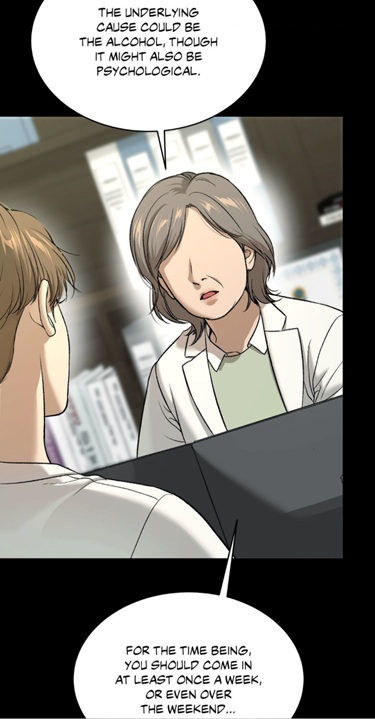 (chapter 67): the brief diagnosis, the recommendation for weekly visits, the specialist’s tentative attribution of Kim Dan’s condition to either alcohol or a possible psychological cause, emphasizing the need for continued observation and weekly visits before offering a definitive diagnosis —all standard responses. For her, this was a doctor following routine procedure without overstepping professional boundaries. However, I perceived her behavior very differently. I saw someone who remained emotionally detached and almost absent, reducing the complexity of Kim Dan’s condition to simplistic surface-level causes without genuine inquiry.
This divergence in opinion hinged on what each of us prioritized. My friend appreciated the clinical neutrality, interpreting it as a mark of competence. I, however, found it troubling—too minimal, the possible psychological cause was only mentioned. The symbolism in her appearance intensified my reaction. She is portrayed eyeless, a metaphor for her blindness—not in vision, but in perception. Her gaze is absent; her diagnostic process relies not on what she sees but on what others report, most notably, Joo Jaekyung.  (chapter 67) Rather than forming an independent assessment, she accepts the narrative of a third party, which introduces bias and limits her understanding. One might argue about that, because she is looking at a paper, probably result of a blood test which seems to corroborate the guardian’s statement. Hence the sleep specialist concludes that Kim Dan is suffering from insomnia, alcohol addiction and sleepwalking. The problem is that his statement is based on external observations (halmoni and the landlord) and their limited knowledge. Moreover, Jinx-philes should keep in mind two important aspects:
  (chapter 61) The champion had been himself suffering from similar symptoms which could be seen as a projection on his loved one. Additionally, based on previous observations, I have interpreted Kim Dan’s nightly walks not merely as sleepwalking, but as dissociative episodes—likely triggered by overwhelming guilt, unresolved trauma, and a chronic sense of disconnection from his body and surroundings. But how could the champion know about this? He’s not a doctor himself. In order to have a more accurate picture of the whole situation, she should have talked to the patient himself. But by relying on papers and the guardian’s testimony, she not only distances herself from the patient physically and emotionally, but also delegates the responsibility of interpretation. She is using the eyes of others.
She wears an open white coat, (chapter 67) revealing a light green pullover layered over a white shirt—clothing that clearly belongs to her private wardrobe. This visual detail suggests a separation between her personal identity and her professional role. It’s as if donning the coat is enough to signal her authority, without requiring emotional engagement. The coat becomes a badge, not a commitment.
Yet one could argue that this very distinction is essential. The boundary between self and profession is what prevents the physician from becoming emotionally overwhelmed. Without such a barrier, the practitioner might absorb too much of the patient’s pain—leading not only to fatigue but to burnout. (chapter 57) Perhaps the doctor’s detachment is not indifference, but a survival mechanism in a healthcare system that demands efficiency over intimacy.
The white coat in this scene does not function as a symbol of care (chapter 67): it becomes an emblem of role-playing. What caught my attention is that she doesn’t directly address the patient, she doesn’t ask him any question either. She is not curious at all. If she had, she would have heard this:  (chapter 67) indicating that his alcohol addiction is not the real reason for his insomnia. Then she fails to examine Kim Dan physically, the desk is between them. Therefore she can not detect his visible malnourishment.
Both insomnia and malnutrition are quite common and can cause similar negative consequences, such as falls, depression, and cognitive impairment in older adults, but there is no study investigating the relationship between the 2. The aims were to investigate relationships between insomnia/insomnia severity and Mini Nutritional Assessment (MNA) score and serum nutrient levels. […] There is a close relationship between MNA scores and insomnia or insomnia severity in older adults. Therefore, when evaluating an older patient with insomnia, malnutrition should be evaluated, or insomnia should also be questioned in an older patient with malnutrition. Thus, more effective management of the 2 can be possible. Quoted from https://pubmed.ncbi.nlm.nih.gov/31109907/
But she couldn’t see it, as she relied on second-hand testimony (Joo Jaekyung’s words). The irony is that the latter failed to notice it. Each time he saw the doctor’s body, he got aroused. 
 (chapter 62) Moreover, both the landlord and the grandmother never brought up this aspect, though Shin Okja had observed this terrible transformation: (chapter 57)
And this raises the following question. Why did the sleep specialist not question the main lead directly and relied on other sources?  (chapter 66) It is because the physical therapist is just a number (2) and as such a file. Therefore the doctor is not seeing the patient as a human. I can not blame the woman either, for she has so many patients to treat during the day. And now look at the building of the hospital:
  (chapter 66). It is huge reminding me of a factory. This “modern hospital” with its sleek architecture, expansive buildings, and impressive specialization exudes a sense of advancement and trustworthiness. Yet beneath this polished surface lies a business-oriented structure, one that prizes efficiency, reputation, and patient turnover over genuine patient connection. This “modern hospital” (chapter 67) functions like one factory: patients are numbers in a queue, doctors are overloaded, and individual care becomes secondary to systemic goals. The very design of the building reflects this: towering facades and compartmentalized departments, where nature and warmth are pushed to the background. In such an environment, the Hippocratic Oath—rooted in ideals of empathy, presence, and personal responsibility—is reduced to ritual, overshadowed by institutional pragmatism and economic demands. Hence she is simply treating his symptoms: insomnia and “sleepwalking”! She is prescribing him “sleeping pills”.
 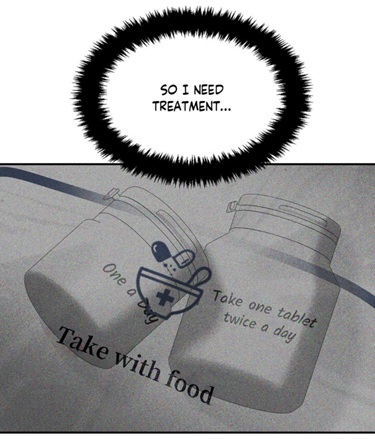 (chapter 67) She is doing exactly what Shin Okja wanted:
 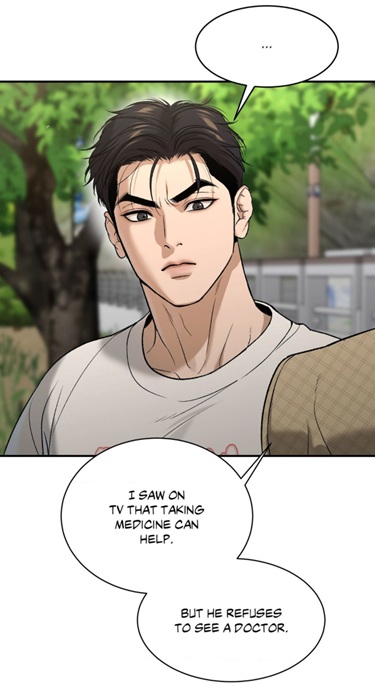 (chapter 65) (chapter 65) It is as though thanks to the drug, the odd behavior from Kim Dan would simply vanish. (chapter 67) That’s the reason why Mingwa didn’t give the doctor a name. She has become a soulless doctor, like a robot. On the one hand, the absence of her name implies that she is not trying to seek fame like Kim Miseon
  (chapter 5) with the new medicine. On the other hand, it implies that the light-brown haired woman is doing her job for her paycheck which reminds me of Cheolmin’s statement:
  (chapter 13): “Oh no, no. That won’t do. My precious paycheck!”.
This “namelessness” is not a coincidence. It mirrors how large hospitals treat their staff: as interchangeable parts of a system that prioritizes efficiency and profit over personalized care. (chapter 67) The sleep specialist becomes a faceless figure in an institution where doctors are overworked, underpaid, and pressured to diagnose quickly. Her task is not to heal, but to manage—preferably in under 10 minutes. This reminds me of a confession I received from my own osteopath-orthopedist-chiropractor. He once told me that in hospitals (Germany), proper care is nearly impossible. Due to pressure and time constraints, most doctors are given no more than two or three minutes per patient. As a result, many end up recommending surgery as the default solution—not necessarily because it’s the best, but because it’s fast and system-approved.
Disillusioned by this assembly-line approach, he eventually left the hospital and opened his own private practice. There, he devotes at least one full hour to each new patient—first to examine, then to diagnose, and finally to treat them himself. I remain deeply grateful to him, because he was the only one able to resolve my long-standing shoulder and neck pain. While others focused on symptoms—treating the neck in isolation—he identified the true origin: spinal blockages further down the column. What struck me even more is that he once recognized signs of depression in a patient—not through tests or charts, but simply by observing how the symptoms would worsen or improve. He talks to his patients while treating them, listening not only to their words, but also to their bodies. This interaction allows him to adjust the treatment in real-time and to notice subtle signs others might miss. That’s what makes him a true healer. He doesn’t rush; he takes his time and creates space for the patient to be seen and heard. In doing so, he provides something that modern hospitals often fail to offer: attention without judgment, and care without hurry.
On the other hand, he also confided in me that he has learned to select his patients. Some individuals came to him with fixed expectations, treating him like a service provider rather than a medical expert. They arrived with their own self-diagnoses and requests, expecting him to execute treatment plans they had already designed in their minds. In those cases, he had to draw a line—because healing, in his view, depends on trust and dialogue, not on fulfilling demands. A doctor, he reminded me, is not a technician carrying out orders, but someone who must observe, assess, and guide with discernment. This dynamic reminded me of Joo Jaekyung, who often treated both Dr. Lee and Kim Dan  (chapter 27)
  (chapter 49) as mere service providers. Whether it was brushing off medical advice with “Don’t push it, I know my body better than anyone else” (chapter 27) or demanding instant pain relief to continue training (chapter 49), the champion positioned himself as the ultimate authority over his own treatment. Since his attitude echoed the confession of my osteopath, it is understandable why my osteopath-orthopedist began to select his patients carefully. This mirrors Kim Dan’s evolution, when the latter chose to reject the champion’s offer. Indirectly, he is “learning” to select his job and not take them by opportunism. He is also learning to select his “patients”. Striking is that Shin Okja has a similar attitude than the athlete.
  (chapter 7) She desired to have a treatment with less side effects and less painful. And the moment she was confronted with reality, this painful new treatment only brought pain and nothing more, she chose to leave this institution and move elsewhere.
 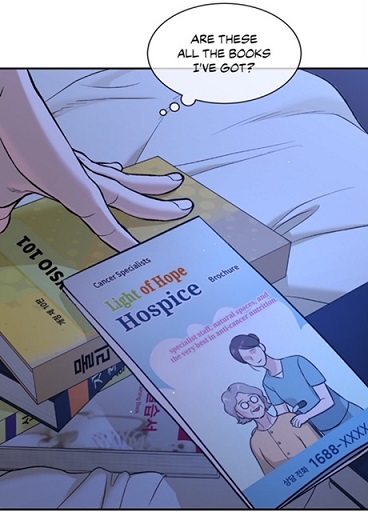 (chapter 53) Therefore it is not surprising that she is treating the protagonist the same way: she knows what is the best for him. (chapter 57) She is treating him like a service-provider, she is now rejecting that he has lost his “usefulness”. His pay here is not high, …
But let’s return our attention to the anonymous sleep specialist. The latter has just become a victim of this terrible health system. She is not engaging with Kim Dan’s trauma, nor investigating his psyche, for she doesn’t have the time for it. Her task is not to heal deeply, but to manage efficiently. Secondly, she is specialized in sleep medicine, so she is no psychologist or psychiatrist. Therefore it is not surprising that she is focusing on certain aspects. But sending him to a different department would mean that she would lose her „new patient“. If you have ever watched series about hospitals, you are aware of the competition between departments. Here I can recommend the K-drama LIFE. Since she is more treating him in such a short time, it is not astonishing that doc Dan is doubting her words, (chapter 67) and not even following her recommendation. 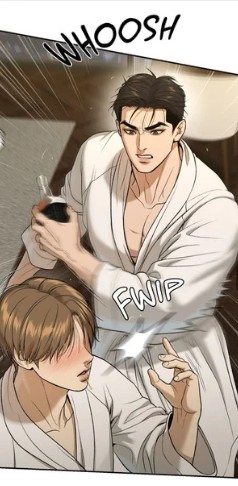 (chapter 67) He felt misjudged and misunderstood; reduced to a file number, not seen as a complex human being.
However, there’s more to it. Two details stood out to me in particular. First, consider what the anonymous doctor told Joo Jaekyung  (chapter 67) and second, what Kim Dan actually received as treatment: (chapter 67) pills in a plastic bag marked with a standard instruction: “Take with food”. These two panels capture more than a routine prescription, they reveal the institutional deflection of responsibility and the impersonal mechanics of care.
By printing the instruction on the packaging rather than saying it aloud, the doctor shields herself from accountability. If something goes wrong, she can point to the label. She doesn’t have to engage, explain, or ensure understanding. It’s a subtle but calculated transfer of responsibility—from physician to patient, and even more so, to the guardian. Now it’s not just Kim Dan who’s expected to monitor himself, but Joo Jaekyung as well. The burden of care is silently offloaded onto those least equipped to manage it.
What makes it worse is that Joo Jaekyung is never shown holding or reading the bag. The implication? He likely never noticed the fine print at all. No one is actively guiding the treatment. No one is watching over Kim Dan.
Her verbal emphasis is even more revealing. Instead of discussing the food requirement or giving Kim Dan any personal advice, she delivers a single, sweeping command: “Drinking is off-limits.” It’s not just vague—it’s scolding. The patient’s alcoholism isn’t treated; it’s sidelined. The system checks the boxes—and moves on. It frames her as an authority figure who cares more about issuing warnings than offering help. There’s no nuance, no tailored support, no effort to build trust. What Kim Dan hears is not empathy, but judgment. He’s treated as a risk to be managed, not a human being to be helped. She can only reinforce his low self-esteem: he‘s a burden.
This is what deepens his sense of being misdiagnosed, as if the doctor was painting his condition so negatively in order to scare him. He doesn’t receive insight or compassion—he receives protocol. And in a healthcare system ruled by efficiency and liability protection, the doctor’s priority becomes covering herself—not ensuring the well-being of her patient.
Cheolmin  (chapter 13), in contrast, enters the story with no white coat at all. He carries only a doctor’s bag, dressed in a green pullover and a beige checkered shirt.
  (chapter 13) Despite this informal attire, he immediately recognizes Kim Dan’s symptoms and engages both the guardian and the patient. He doesn’t need institutional support to assert authority; his presence and diagnostic clarity define him. While his clothes might elsewhere be read as conservative or emotionally restrained, here they highlight that care can come outside rigid systems.
Previously, we interpreted Cheolmin’s clothing as a reflection of a certain emotional reserve. The beige checkered shirt, covered by the green pullover, suggests a guarded personality; someone who perhaps maintains a protective layer between his professional and emotional worlds. And yet, this emotional caution doesn’t hinder his ability to act with warmth and competence. (chapter 13) Quite the opposite. He doesn’t hide behind his distance; he manages it. His approach is practical and grounded, but never cold. He doesn’t wear a white coat, yet he brings with him a doctor’s case and an unshakable sense of responsibility. His tools are simple (his own body), (chapter 13) his posture relaxed, and his tone—often sprinkled with humor—adds a human touch that the eyeless doctor sorely lacks. And what is the cause for this huge difference? It is because the “famous sleep specialist” is relying on her institution (nurses, blood tests, drugs). She is following a procedure, as the visit took place at the hospital.
Unlike Cheolmin, who uses his emotional detachment constructively, the sleep specialist disappears behind it. She neither touches nor addresses the patient directly. She offers no humor, no effort to ease the atmosphere—only sterile authority and detached warnings.
Ironically, while Cheolmin may seem less emotionally expressive at first glance, he is far more emotionally present. His humor isn’t just a personal trait—it’s a therapeutic tool.  (chapter 13) It bridges the gap between roles, making the patient feel seen rather than categorized.
 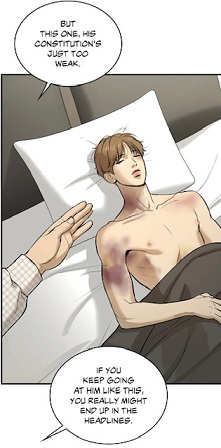 There’s no judgement in their relationship. The eyeless doctor may appear neutral, but in truth, she is hollow. Cheolmin appears reserved, yet his actions speak with empathy. Where she recites guidelines, he initiates dialogue.
  (chapter 13) Where she avoids involvement, he offers engagement.
In short, Cheolmin’s clothes reflect thoughtful distance—not absence. He remains attentive, responsive, and subtly warm. His restraint is a choice, not a flaw. And it is precisely this contrast that reveals what the Hippocratic Oath should still mean today: presence, humility, and care; and not money, drug and efficiency.
The positions between my friend and me reflect a core conflict between reality and idealism. She values adherence to clinical norms and sees the specialist’s behavior as a rational expression of professional boundaries. Emotional distance, she argued, is often necessary—not just to ensure objectivity, but also to protect healthcare professionals from burnout, especially in overburdened systems. I agreed in principle, but maintained that detachment becomes damaging to the patients and the doctors. It affects the relationship between them, because it prevents accurate diagnosis or erases the patient’s voice entirely or the patient starts seeing himself as a “client” and the doctor as his “service provider”. A middle ground must be found—where presence doesn’t equate to over-involvement, but where empathy still has space. My orthopedist found his solution: open a small office where he tries to help his patients to avoid surgeries. He told me: “The first surgery in his field is always an option, the second one will always be a necessity.”
Moreover, our analysis acknowledged the limitations the doctor faces. The specialist likely juggles a tight schedule. A queue of patients, like the one displayed before Kim Dan’s session, signals the industrial rhythm of care. In such a system, she may not have time for deeper engagement. But for patients like Kim Dan—vulnerable, undernourished, spiraling emotionally—this neglect can reinforce their invisibility. In contrast, Joo Jaekyung receives deferential treatment, because he is famous. The medical world depicted in Jinx bends toward prestige, not need.
This contrast reveals something vital: in medicine, presence matters. The specialist hides behind procedures. Cheolmin shows up. The white coat, then, becomes a mirror: does it reflect a vocation or disguise institutional distance?
In Jinx, medical care unfolds within a tapestry of institutions—anonymously vast hospitals  (chapter 61)
  (chapter 67), the Light of Hope hospice (chapter 61), the sleek University hospital dedicated to research
  (chapter 5), and more intimate yet modern facilities like this one.
 (Chapter 27) Each medical setting not only has its own architecture but also its own moral blueprint. In the essay “Doctor Romantic 3 (locked)“, I had already compared doctor Lee’s workplace and behavior to the “beautiful Kim Miseon” from the University Hospital. Season 2 introduced us to new institutions. Each place claims authority through professional codes and visual symbols, but the deeper narrative explores how care is either embodied or abandoned. Mingwa uses attire, body language, and structure to draw sharp distinctions between appearance and intent.
Kim Miseon (chapter 5) from Sallim University Seongshim Hospital: This research-driven university hospital is connected to Kim Miseon, the doctor who prescribed a new experimental treatment for the grandmother. (chapter 5) Despite the pristine exterior of the building and the promise of scientific advancement, her actions raise ethical concerns. She dilvuged information in the hallway. (chapter 21) Then the treatment’s failure is attributed either to the grandmother’s frailty or Kim Dan’s late arrival and absence, subtly shifting blame. (chapter 21) Like mentioned before, this treatment wasn’t even properly recorded in the patient file raising the suspicion of deliberate concealment. (chapter 56) It appears as “pain killers”. Her open white coat (chapter 21), worn over a green uniform resembling surgical scrubs, aligns her visually with institutional authority, while her eyeless portrayal emphasizes detachment. (chapter 21) Her motivation seems driven not by compassion but ambition: a pursuit of recognition and success through experimental medicine, regardless of consequence. It seems that this new therapy didn’t bring her the results she hoped, and strangely later director Choi Gilseok
  (chapter 48) got aware of Shin Okja’s conditions, implying that patient confidentiality had been breached.
Park Junmin  (Chapter 61): In contrast, Park Junmin
  (chapter 61) represents the polished face of a business-oriented clinic. While his office projects sleekness and personalized care, his comments betray his priorities. He praises Joo Jaekyung’s fame and urges a return to the ring—not out of medical concern, but because it would guarantee the champion’s return as a paying patient. He wants to retain a high-profile client. His friendliness is strategic. (chapter 61) He does not embody the Hippocratic Oath but rather a service model. The coat becomes a costume that sells recovery. It is clear that he is promoting his own hospital. Joo Jaekyung, however, surprises him by refusing
  (chapter 61), highlighting that the athlete has become aware of what genuine care should look like. When the champion calmly declares, “I’ll be receiving rehabilitation services in another hospital,” Junmin answers with a stunned “Sorry?”. But this is not confusion. It’s a reflexive mask for shock. He did not expect to lose control of the situation. Beneath that one-word response lies disbelief, disappointment, and veiled panic. He’s losing a lucrative patient—and more importantly, a public endorsement. The moment exposes how fragile his authority truly is when faced with a patient asserting autonomy. Let’s not forget that when the champion was facing a mental and emotional breakdown, the latter offered no other support than “rest”. He even avoided his gaze.
 (chapter 54) The athlete was left on his own.
Light of Hope Director  (Chapter 59): At first glance, the hospice appears to be underfunded and outdated.
  (chapter 61) However, its director breaks expectations. Unlike the smooth-talking or indifferent doctors at larger institutions, he is directly involved in patient care. (chapter 56) He informs the physical therapist about the grandmother’s condition, works late at night
  (chapter 60), criticizes people for their rude behavior
  (chapter 59) or actively disciplines staff (chapter 59) when mistakes are made. Though he also flatters the champion
  (chapter 61) and sees promotional potential, he never exploits patients.
  (chapter 61) The juxtaposition of humility and responsibility in his demeanor, combined with his stunned reactions to sudden events, suggests an overworked and understaffed environment—but not one without moral grounding. His white coat and blue medical uniform echo the nurses’ attire, subtly promoting a sense of equity among staff. Despite being a director, he doesn’t separate himself from frontline caregivers. His uniform also contrasts with the green worn by Kim Miseon or Park Miseon, suggesting a focus on practical responsibility over prestige. By blending in with the team, he fosters a culture of shared accountability, not rigid hierarchy. Among all institutional figures, he comes closest to balancing authority with integrity.
Hospital Director  (Chapter 6): While this figure appears authoritative (chapter 1), the details of his attire tell another story. Wearing a suit beneath his coat implies professionalism, but here it also suggests a business-driven mindset. The coat becomes a sleek outer layer masking deeper intentions. His charming demeanor conceals a more sinister reality—he weaponizes authority for personal gain. His use of professional attire isn’t about respectability but manipulation. Beneath the surface, profit, control, and coercion drive his actions.
  (chapter 1) The white coat, in his case, is not a symbol of healing but a façade for exploitation. drives his authority. The coat becomes a literal cover for abuse—harassment disguised under professionalism. His entire persona is a façade: calculated, charming on the surface, but predatory and morally bankrupt beneath.
The Sleep Specialist (Chapter 67): (chapter 67) Eyeless and detached, the sleep doctor treats Kim Dan without any emotional or physical engagement. Her absence of a name symbolizes depersonalization. She doesn’t speak directly to Kim Dan, doesn’t examine him, and only echoes what she heard from Joo Jaekyung. The prescription she offers is another layer of critique. The instruction “Take with food” appears only in print—never verbally stressed—thus shifting liability. If Kim Dan suffers side effects or mixes medication with alcohol, responsibility falls on him or his guardian. This is institutional medicine in its most risk-averse form: impersonal, quick, and shielded from consequence.
Dr. Lee (Chapter 27): Dr. Lee is the only named and truly visible doctor.  (chapter 27) His gray shirt signals a more relaxed approach,
 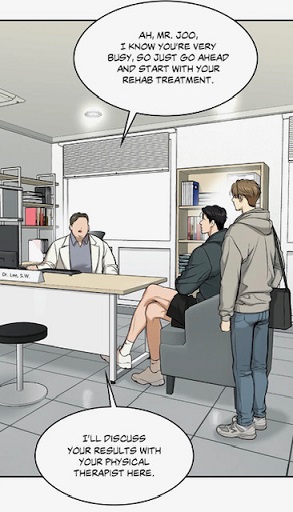 (chapter 27) and his facial expression conveys a certain empathy—though his words also betray resignation. He sits beside the patient, not opposite, visually erasing the typical hierarchical divide between doctor and athlete. His recommendation that Joo Jaekyung rest is gently delivered, but he knows it will likely be ignored. He represents the tension between medical idealism and the pressures of athletic performance. He is trying his best to protect Joo Jaekyung’s career. (chapter 27) Notably, he doesn’t chase fame or loyalty—he’s realistic, yet still rooted in care. (chapter 27) His clinic, with open blinds and wide windows, stands for transparency and modern ethics.
Cheolmin (Chapter 13): 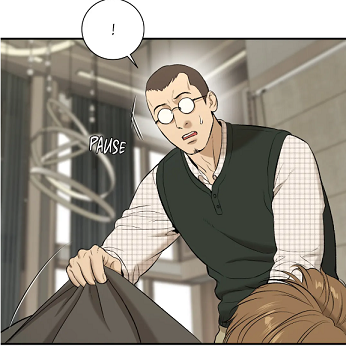 (chapter 13) Finally, Cheolmin exists outside the hospital system. He wears no white coat, but his behavior mirrors a true physician’s. He diagnoses accurately, gives immediate advice, and engages both patient and guardian. His attire—a shirt layered under another—might suggest emotional restraint, but it doesn’t interfere with his actions. He jokes and teases, breaking through tension and inviting trust. He acts not because protocol demands it, but because someone needs help. That’s enough.
This comparative tableau reveals that white coats do not guarantee compassion—and their absence doesn’t negate it. In Jinx, only those who break institutional molds offer real help. The rest follow protocols, serve systems, and sometimes cause harm through inaction or self-interest. It exposes that doctors are simply humans and not gods.
Furthermore, the financial aspect underpins all these interactions. Hospitals in Jinx are not purely charitable; they’re businesses. The emphasis on new medicine, fame, or facility branding often outweighs the patient’s actual condition. Misdiagnoses, evasions, and moral compromises follow from this reality.
Kim Dan’s journey through these institutions underscores how vulnerable patients are when medicine is transactional. Blame is subtly shifted. Responsibility is diffused. And yet, in emergencies, the expectation remains: doctors should act.
A striking feature in Jinx is the architectural integration of nature into hospital design. (chapter 67) Trees and greenery appear in every facility—but their placement and symbolism vary. These visual cues subtly reveal each institution’s philosophy of care.
At the university hospital where Kim Miseon works,  (chapter 41) nature is neatly confined. Rooftop gardens and structured greenery exist, but more as visual accessories than lived environments. The hospital is a towering research center, representing scientific advancement—but also bureaucratic coldness. Here, nature exists to impress, not to comfort. This artificial balance between concrete and green reflects a clinical detachment: nature is curated, not embraced. It aligns perfectly with Kim Miseon’s demeanor—professional, pristine, but ultimately distant and ambition-driven.the environment feels controlled.
  (chapter 41)
In the rain-drenched hospital  (chapter 54) where Joo Jaekyung receives treatment, the rooftop greenery appears remote and ornamental, disconnected from patient care. (chapter 61) Nature is present but removed, almost symbolic of lost ideals. The building is imposing, gray, and bureaucratic, which is quite similar to the university hospital.
In the sleep therapy hospital (chapter 67), the setting amplifies this detachment. Trees do appear, but they are overwhelmed by massive, impersonal structures. The greenery seems almost trapped, overshadowed by glass and steel. This mirrors the interaction with the sleep specialist, who issues warnings and prescriptions without genuine communication. In this environment, nature is not a partner in healing—it is background noise, a symbolic performance of care in a place that prioritizes liability and speed over connection.
By contrast, the Light of Hope hospice (chapters 61) is embedded in a hillside, its architecture low to the ground, surrounded by untamed, organic greenery. The trees are not ornamental—they embrace the building, echoing a kind of natural protection. Nature here is not only real, but alive. It reflects the ethos of the institution: flawed, underfunded, but grounded in human presence. The hospital director may wear a coat, but his modest blue uniform aligns him visually with the nurses, suggesting equity and participation rather than hierarchy. Just like the unpolished trees, he is there not to be admired but to serve.
A fourth setting appears with Dr. Lee’s clinic (chapter 27). The building is smaller,  (chapter 18) modern, and set among scattered trees.
  (chapter 18) Large windows suggest openness and transparency—the very qualities Dr. Lee brings to his interaction. This is a space that, while modest, is genuinely attentive. Here, nature doesn’t impress, it is integrated in the landscape. The park is not surrounded by huge buildings.
Through these varied landscapes, Jinx critiques the illusion of healing as something that can be staged through architecture. It exposes how hospitals, like people, can hide behind appearances. Trees and plants, like white coats and professional titles, can be used to mask indifference just as easily as they can accompany real care. Healing does not bloom in greenery alone—it flourishes through presence, attentiveness, and trust.
Yet these visual patterns also contain hope. The presence of even small parks and rooftop gardens within institutional designs reflects an underlying truth: nature matters. (chapter 41) These green spaces acknowledge, even if superficially, that human beings do not heal through medicine alone. They need sunlight, air, softness—a sense of rhythm beyond fluorescent lights and steel corridors. Nature grounds. It breathes.
The science of the healing power of nature
There are numerous studies that support the healing power of nature. A study of 20,000 people found that those who spend at least 120 minutes per week in nature, whether in a local park or other natural environment, were more likely to report better health and well-being.
The World Health Organization recently released a report called Green and Blue Spaces and Mental Health, which shows that time in nature, including urban areas, improves moods, mindsets and mental health. Furthermore, research suggests that exposure to forests, parks, gardens or coastlines can help mitigate the psychological impact of climate change, promote physical activity and provide opportunities for social interaction. Quoted from https://www.uc.edu/news/articles/2023/08/the-healing-power-of-nature.html
That is why the small town, 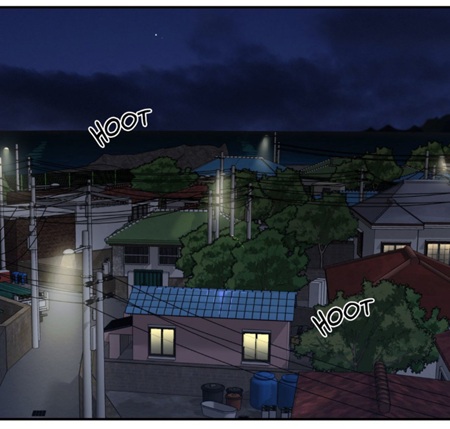 (chapter 65) nestled in the countryside and far from institutional rigidity, emerges as a space of true potential. In returning there, Joo Jaekyung and Kim Dan are not just escaping their past—they are moving toward a form of healing that modern hospitals imitate but rarely achieve. Closer to nature, they are closer to themselves. If hospitals imitate forests, the village becomes the forest. And in that simplicity, Jinx suggests, real happiness might grow.
From open to closed, from crisp to wrinkled, the white coat becomes a symbol of ideology. Some wear it like armor, others like a mask—and some not at all. But it is not just the coat that deceives. Buildings too wear their own uniforms. Grand glass hospitals draped in rooftop gardens and courtyard trees promise healing, yet often fail to deliver. Nature becomes another costume—just like the coat.
But Jinx reminds us: real care cannot be faked. It is revealed not through polished surfaces or institutional prestige, but in action—staying late, listening carefully, protecting the vulnerable. The doctors who truly heal are those who treat the person, not the file.
And why, then, do so few doctors recommend sunlight, trees, or quiet walks? The answer is simple: nature costs nothing. It cannot be patented or billed. And yet, its presence in every hospital design is a silent confession that healing lies outside the system. That, in the end, true recovery begins where profit ends. This is precisely what Jinx shows through Joo Jaekyung’s arc: once he leaves the sterile confines of the gym and begins spending time outdoors, (chapter 62) surrounded by greenery, animals, and people who don’t treat him as a product—his health improves. His muscles may still ache, but mentally and emotionally, he is lighter. Research confirms what the story suggests: sunlight and time in nature significantly boost mental health. In that way, his borrowed floral pants and farmwork reflect something deeper—a return to balance. Nature becomes not just a background, but a remedy.
The Hippocratic Oath promised to do no harm. But in a medical world where patients are reduced to symptoms, empathy is replaced by protocol, and care becomes a product, harm happens quietly—disguised in good intentions and sealed with institutional polish.
And yet, what the Oath once embodied still exists—just not in the systems that claim it. It lives in a shared meal, a walk under trees, a quiet moment in the sun.  (chapter 57) It lives where no one is watching and no one is billing. In Jinx, the real medicine lies outside the chart—in the dirt on borrowed floral pants, in sweat earned under open skies. Nature becomes the unspoken vow that systems forgot.
The coat may still be white. The walls may be green. But healing comes not from the symbols, but from the soil.
That’s the truth behind the Oath of Hippocrates.
Feel free to comment. If you have any suggestion for topics or manhwas, feel free to ask. If you enjoyed reading it, retweet it or push the button like. My Reddit-Instagram-Twitter-Tumblr account is: @bebebisous33. Thanks for reading and for the support, particularly, I would like to thank all the new followers and people recommending my blog.

Please support the authors by reading Manhwas on the official websites. This is where you can read the Manhwa: Jinx But be aware that the Manhwa is a mature Yaoi, which means, it is about homosexuality with explicit scenes. Here is the link of the table of contents about Jinx. Here is the link where you can find the table of contents of analyzed Manhwas. Here are the links, if you are interested in the first work from Mingwa, BJ Alex, and the 2 previous essays about Jinx 𓇢𓆸 Prove Me Wrong Again 💢😂 and Perfect👼🏼 Defect
It would be great if you could make some donations/sponsoring: Ko-fi.com/bebebisous33 That way, you can support me with “coffee” so that I have the energy to keep examining Manhwas. Besides, I need to cover up the expenses for this blog.

In the world of Jinx, superstition often masks deep psychological wounds. Readers are well aware of Joo Jaekyung’s belief in a hex: (chapter 2) his ritualistic sex before fights, his fear of losing control, 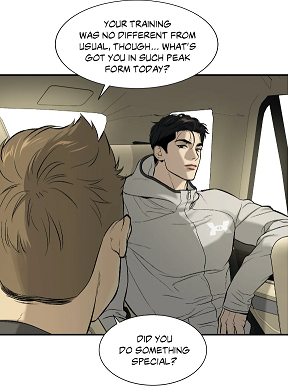 (chapter 5) his reliance on routine. Yet there is another jinx in this story, one far less visible and perhaps even more tragic: Kim Dan’s.
In earlier analyses—particularly in the essay “Jinxed: Behind The Scenes 🎬” I stated that Kim Dan, like Joo Jaekyung, might have perceived his life as cursed. This conclusion emerged from his grim familial and financial circumstances: his overwork, exploitation by the loan shark, and his identity eroded by relentless sacrifice. At that time, the interpretation leaned heavily on visible hardships and his devotion to his grandmother. His silent plea 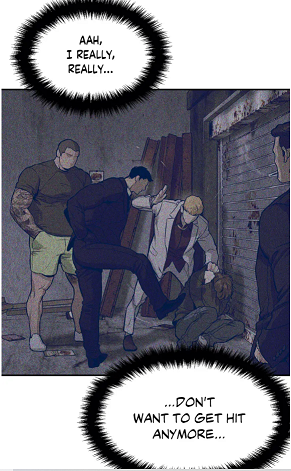 (chapter 1) was seen as the core expression of a man who believed he was doomed.
However, Season 2 invites a more nuanced reading. I came to realize that Kim Dan never consciously viewed himself as jinxed. (chapter 56) In Chapter 56, Kim Dan is seen curled up next to a bed, whispering: “I’m scared… of being alone.” What makes this moment especially revealing is that he is not physically alone, for he is resting next to his grandmother. The presence of the very person who raised him should, in theory, offer comfort. And yet, the fear persists.
This contrast underscores the depth of Kim Dan’s emotional wound. His fear isn’t simply about being left in the future — it’s the echo of a past abandonment so profound that even proximity can’t soothe it. His grandmother is alive, mere steps away, yet his body curls into itself, instinctively shielding against an absence that has already been internalized.
That he doesn’t say “I’m scared of being abandoned” or “of being jinxed” shows that this fear hasn’t been processed into words or reason. It’s not part of his conscious self-concept. Unlike the celebrity, who ritualizes his fear as a “jinx” and tries to control it through actions, Kim Dan’s trauma remains trapped in silence. He doesn’t believe he is cursed — not on the surface. But emotionally, he lives as if he were. The hex exists, not in his language, but in his body.
His whispered fear in the dark — “I’m scared… of being alone” — is the clearest window into his hidden jinx. And perhaps the most heartbreaking part is this: he voices it not, when he is abandoned, but when someone is still there. That’s how deep the fear runs.  (chapter 21) And this issue didn’t begin in adulthood. In Chapter 21, Kim Dan dreams of a night from his childhood: he wakes up alone, glances around the room in quiet confusion, and softly calls out for his grandmother. The room is dim, the bed beside him empty. This image carries more than just childhood anxiety: (chapter 21) It weaves together absence, silence, and the specter of loss. What’s striking is that the nightmare surfaces, not when he’s alone in the present, but after he has just returned from watching over his hospitalized grandmother. (chapter 21) He lies on the couch and dreams of a night when she vanished from their shared bed.
 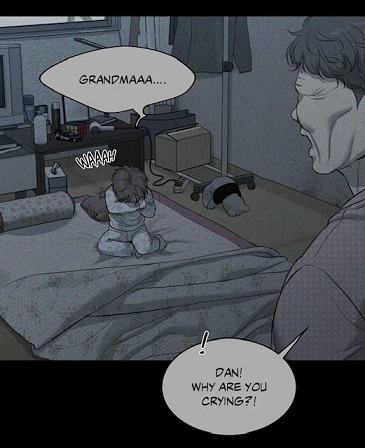 (chapter 21) This reveals how, in Kim Dan’s subconscious, the night and an empty bed have become synonymous with death. The trauma is deeply embedded, where even temporary absence is tied to the irreversibility of loss. For Kim Dan, solitude at night
  (chapter 67) is not mere loneliness—it is abandonment, it is death, it is the erasure of home. It is repressed, hidden beneath his quiet demeanor and years of survival-based behavior. Rather than a rational belief, it is a subconscious wound that only surfaces in moments of extreme vulnerability—especially at night.
So while Joo Jaekyung’s curse is shouted and choreographed  (chapter 2), the doctor’s is secret and involuntary. His actions—his fearful expressions
  (chapter 57), his pattern of emotional detachment
  (chapter 67), and his obsessive loyalty to his grandmother
 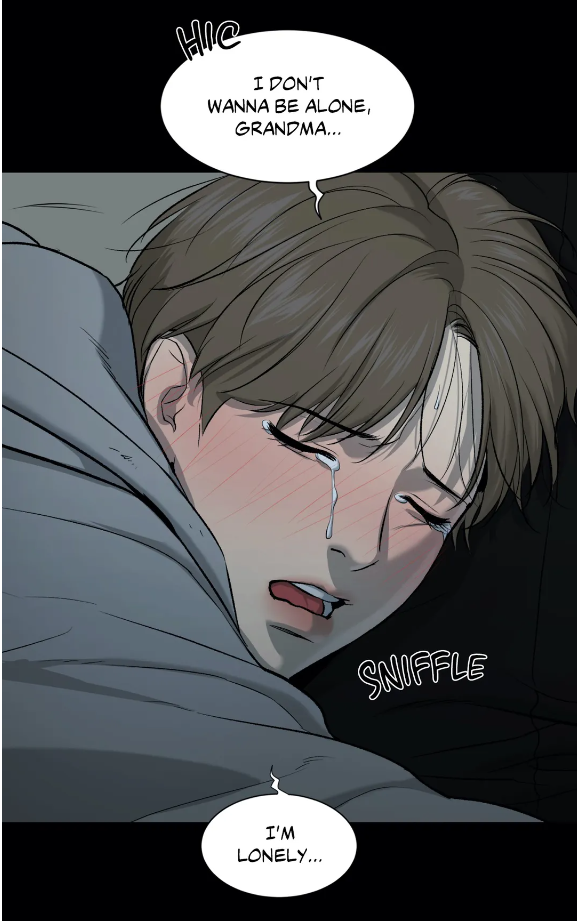 (chapter 10) signal a suppressed conviction: that he is destined to be left behind. What seemed like devotion now appears as coping; what appeared stoic was survival. And with the impending death of his grandmother, the anchor holding this hidden jinx in place is slipping away.
The key lies in the night. The most pivotal emotional regressions in Kim Dan’s life happen after dark. Whether it is the first night with Joo Jaekyung in Chapter 2 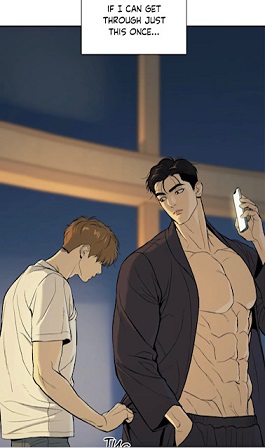 (chapter 2), the trembling kiss (chapter 44) and touch (chapter 44) in Chapter 44, the complete breakdown
 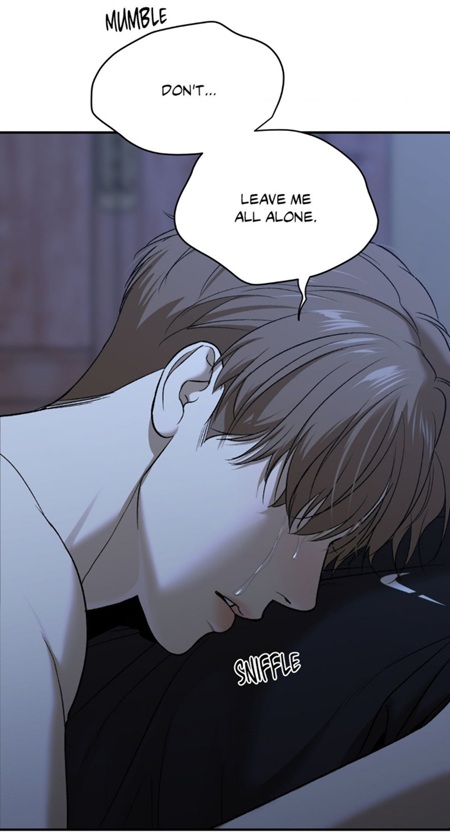 (chapter 66) in Chapter 66, or the transactional submission
 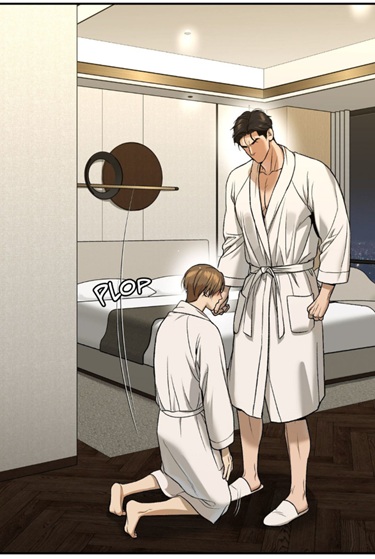 (chapter 67) in Chapter 67, nighttime becomes the stage for his unresolved trauma. These nights mirror one another and suggest an origin story that predates them all: a night when Kim Dan was abandoned by his mother.
This theory is supported by visual cues and character behavior. In Chapter 56, Kim Dan curls into himself in bed, unable to sleep. He admits silently, “I’m scared… of being alone.” That fear is not adult anxiety—it’s childhood terror. (chapter 56) The body language, the shadows, the loneliness—they evoke the image of a small child who once cried through the night, waiting for someone who never returned.
Kim Dan’s actions echo those of someone who was left too early—possibly around the age of six. Psychologists describe this stage as a turning point in emotional development. If a caregiver vanishes at that time, the child internalizes the absence as a personal fault. He grows up believing that love is conditional, that if he’s quiet, obedient, invisible—maybe no one else will leave.
Mingwa subtly ties this back to animal behavior through the inclusion of puppies. (chapter 57) A puppy needs at least eight weeks with its mother to grow emotionally secure. By drawing this parallel 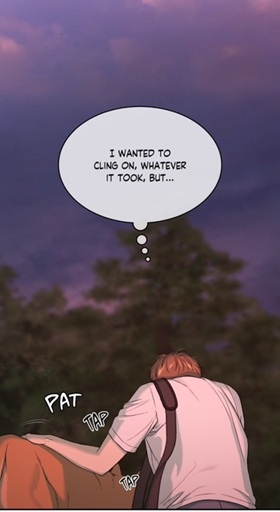 (chapter 59), the story tells us: Kim Dan was separated too soon. He was not ready.
Kim Dan’s grandmother became his emotional anchor: (chapter 47) the one person whose presence could keep the jinx at bay. As long as she was there, he could suppress the trauma, function, survive. She was his talisman. But she was never a healer, for she never spoke about his parents. She never addressed the core of his abandonment, like we could witness in the doctor’s nightmare: (chapter 57) And silence, when it comes to trauma, does not protect—it festers.
Her infantilization of him is also telling. 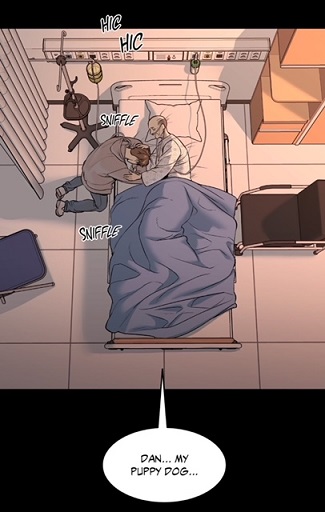 (chapter 53) (chapter 65) One might argue about this, for in this scene,
  (Chapter 56) he tucks her in. Their roles are reversed. He behaves like a parent, whereas in truth, he is reverting emotionally to a child terrified of being alone. This reversal highlights the internal dissonance between his outward behavior and emotional reality. Though he was forced to grow up quickly (chapter 65), he still carries the emotional wounds of a child. And from my point of view, the grandmother knows it, therefore she treats him as a child. And this observation led me to the following question: why does she still view him as a “boy”, though he has been working since his youth? It is because he can not sleep alone! What caught my attention is that she never stated, when the doctor started smoking or drinking. (chapter 65) Was it the moment, when she went to the hospital? The timing is crucial, as it can give clues about the main lead’s sleeping trouble. In episode 67, the protagonist finally exposed his cause: (chapter 67) This reinforces my hypothesis that his bad drinking habits are related to the absence of a loved one next to him.
In other words, he can not sleep alone and from my perspective, Shin Okja knows it, but is refusing to become responsible for this situation. (chapter 47) She witnessed this since he was a child, which explains why she never truly addressed his fear of being left behind. This would explain why the halmoni tried to send him away from the hospice in episode 56: (chapter 56) Imagine what it means for her: her grandson is already 29 years old and he can not sleep alone. Under this perspective, Jinx-philes can grasp the relative’s reasoning. The problem is that her knowledge is actually wrong! How so? It is because the protagonist was able to sleep so well alone in the penthouse, to the point that the athlete was envious of him.  (chapter 29) That’s how it dawned on me why Shin Okja was so determined to send back her grandson to Seoul.
The grandmother’s insistence on Kim Dan “living his life” (chapter 65) and going back to Seoul under the guise of freedom and career advancement takes on a deeper meaning when viewed through the lens of emotional avoidance. Her words may sound supportive, but they conceal a subtle attempt to sever the emotional tie without taking responsibility for its existence. Now, rather than confronting this vulnerability head-on, she shifts focus to the one thing she believes can replace human closeness: work. A busy man has no time to wallow, no time to drink, no time to remember the empty bed. A man with a career won’t ask for someone to hold his hand at night. In that sense, her vision of “a good life” is one of functionality, not emotional fulfillment. If he works, he won’t be a burden. If he’s successful, she doesn’t have to worry. Yet this approach doesn’t cure the root wound — it just redirects it. This situation mirrors the wolf’s: (chapter 19) The latter is obsessed with work, while he is suffering from insomnia.
The tragedy here is that in encouraging him to grow up through labor, she’s also denying him the right to be a child — something he never got to be in the first place. Her version of love is sacrifice and survival. (chapter 65) And the best evidence for her selfishness and neglect is her ignorance about her grandson’s plan for his future. She is not discussing with him about what he likes or dislikes. She is directing his life, like she did it in the past in the end. And while she may think she’s doing what’s best, her silence about his fears, her ignorance about his true conditions (no home, blacklisted in Seoul) and her refusal to discuss his emotional future reveal a lingering discomfort with the very idea of dependence — perhaps because it reminds her of her own failures or helplessness as a parent figure.
In the end, her encouragement to “live his life” isn’t truly about Kim Dan finding happiness or chasing dreams. It’s about the grandmother relinquishing responsibility — an emotional handoff wrapped in the language of care. (chapter 65) By urging him to return to Seoul and focus on work, she’s hoping that if he stays busy enough, he won’t have time to feel the crushing loneliness that has always shadowed him. She wants him to mature overnight, not because she believes he’s ready, but because she can no longer carry the weight of his dependency. One might say, he is already 29 years old, so she is right. In truth, this isn’t guidance — it’s guilt management. Notice that she is entrusting the main lead to the champion which is not pushing Kim Dan to become „independent“. Her attitude, summed up by the phrase “out of sight, out of mind,” unintentionally mirrors the same abandonment he experienced in the past. She is refusing to worry about him, her peace of mind matters more than his well-being and the champion’s. 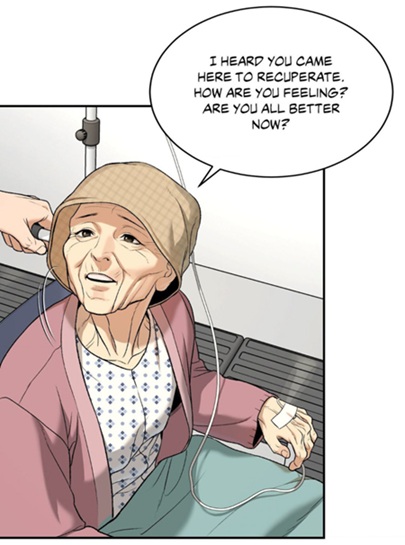 (chapter 65)
This connects directly to one of the most telling moments in Chapter 67, (chapter 67) when Kim Dan, eyes wide and voice trembling, asks Joo Jaekyung: “Are you saying you brought me here because you’re worried about me?” His expression reveals everything — a fragile hope for genuine concern. But the only response he gets is silence. (chapter 67) This unspoken answer reverberates with painful familiarity: from his vanished mother, from his halmoni who rarely expressed love (rather gratitude and pity), and from a world that reduced him to his usefulness. What he really wants to know is: “Do I matter to you as a person?” And just like his grandmother, the champion fails to offer direct emotional reassurance. Yet unlike her, Joo Jaekyung is still learning. His silence isn’t rejection, but emotional illiteracy — a work in progress.
The irony is that while Park Namwook represents over-control disguised as concern, Shin Okja represents detachment masked as selflessness. She doesn’t want to worry anymore, so she chooses to send Kim Dan away — to someone she thinks should take over. Nonetheless, in my eyes, this isn’t responsibility; it’s avoidance. And for someone like Kim Dan, who already associates nighttime with abandonment, silence with rejection, and empty beds with death, being handed off again only reinforces his unconscious belief: I’m jinxed to be left behind.
The grandmother may never have raised a hand against him, but her silence, her emotional evasiveness, and her idealized image of herself as a “sacrificing protector” created a one-sided bond rooted more in guilt than in love. Her presence was constant, but the emotional quality of her care — the nurturing, the honest affection — was lacking. Hence she still doesn’t know that Kim Dan has no home in Seoul. (chapter 65) And when we remember that Kim Dan tried to call her, she (chapter 65) replied with a silence. Here, she claims that he addressed her as “mom”, but it is possible that she was just projecting her own fears onto her grandson. Since she was by his side all the time, she feared to be seen as his mother. Like mentioned above, the mother might have been busy due to work (or sick) and asked her relative to take care of her grandchild.
Ultimately, what he longs for is simple: to be seen, talked, loved, and to be chosen — without conditions. But those around him have always expected him to be strong, quiet, grateful. So he became all of those things… at the cost of his own soul.
Shin Okja never kissed him like a mother. (chapter 57) Yet in Chapter 44, Kim Dan kisses Joo Jaekyung with soft, maternal gestures—on the cheek, on the ear. (chapter 44) These gestures suggest he had once received such kisses, most likely from his mother. It means he remembers love, even if he doesn’t know how to process its loss.
Her insinuation that Kim Dan owes her everything created a myth of self-sacrifice—one that replaced genuine emotional closeness. She demanded gratitude, not emotional connection. She lived in the mindset of having, not being. As a result, Kim Dan grew up confusing love with obligation, gratitude, and performance. His difficulty in expressing love isn’t due to coldness or immaturity—it’s the byproduct of a dysfunctional emotional education.
This is why, even though he once confessed “I love you” to Joo Jaekyung in the States 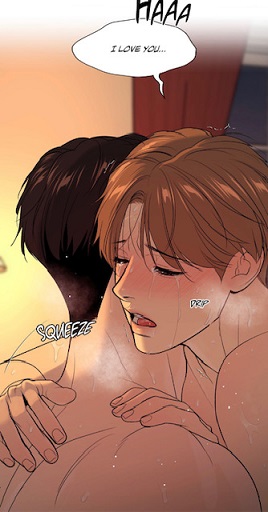 (Chapter 39), the moment is tainted. It occurred under the influence of an aphrodisiac, intertwining love with sex. Furthermore, he has never voiced this sentiment to his grandmother—perhaps because she never said it to him. It was never modeled. While others might judge Kim Dan’s emotional restraint, I desire to stay neutral. He is not an emotionally stunted adult by choice—he is a product of emotional neglect. That’s the reason why Mingwa has associated him with an angel.
 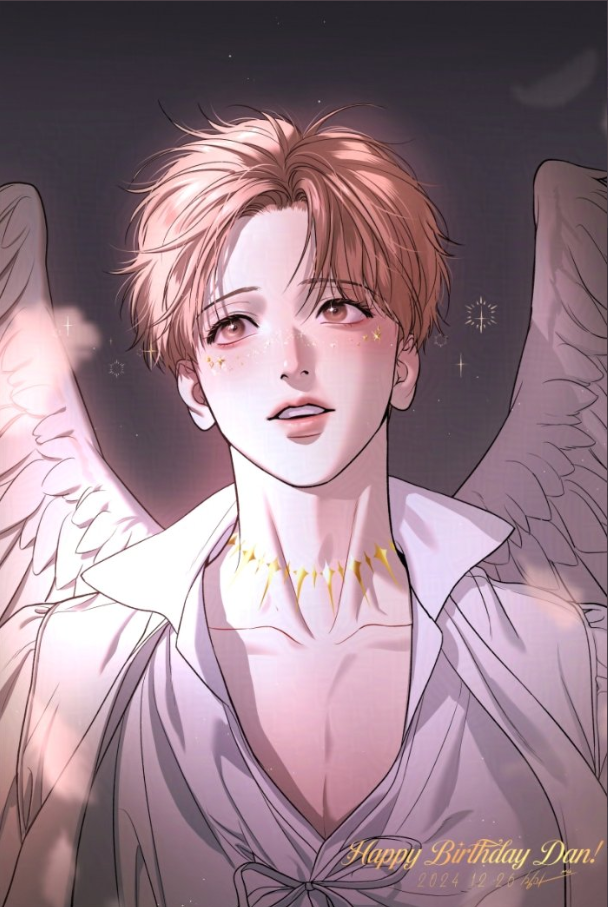 He is carrying the sins of “adults”. By likening him to an angel, Mingwa frames his pain not as weakness, but as unjust burden. He embodies purity, sacrifice, and resilience, not because he was allowed to thrive, but because he endured. The angel metaphor becomes even more striking when you think about traditional symbolism: angels don’t belong to Earth, yet they walk among the living, often suffering in silence and helping others. That’s exactly Kim Dan — out of place, bearing the consequences of others’ choices, carrying guilt, debt, and unspoken grief that were never his to begin with.
He’s carrying the sins of adults: – A school which allowed bullying
– A grandmother who turned emotional dependence into silent expectation.
– A mother who vanished, whether through death or abandonment.
– A society that reduced him to labor, debt, and obedience.
– And even a partner, at first, who used his body without recognizing his soul.
Interestingly, his emotional jinx is also spatial. When living in the penthouse, Kim Dan began to sleep peacefully  (chapter 29) —not because of physical intimacy with Joo Jaekyung, but because he felt safe. For a time, the place became his illusion of home. But when the champion showed mistrust, the illusion shattered. (chapter 51) The penthouse was never truly his. It was borrowed space. This explicates his refusal to spend the night there.
  (Chapter 67) Observe how Joo Jaekyung called the penthouse: not home, but his place. Due to the last altercation, the emotional safety collapsed. This experience reactivated his fear of abandonment and solidified the belief that he has no home.
  (chapter 65) Even the family photo (where and by whom it was taken is unclear) emphasizes the fragility and incompleteness of his sense of belonging.
Each major night scene—Chapters 2, 44, 66, and 67—reveals another layer of the doctor’s jinx. Chapter 2 introduces the concept of the jinx explicitly: Joo Jaekyung believes he must have sex before each match, regardless of partner. This idea of impersonal routine and bodily sacrifice mirrors Kim Dan’s own subconscious belief: 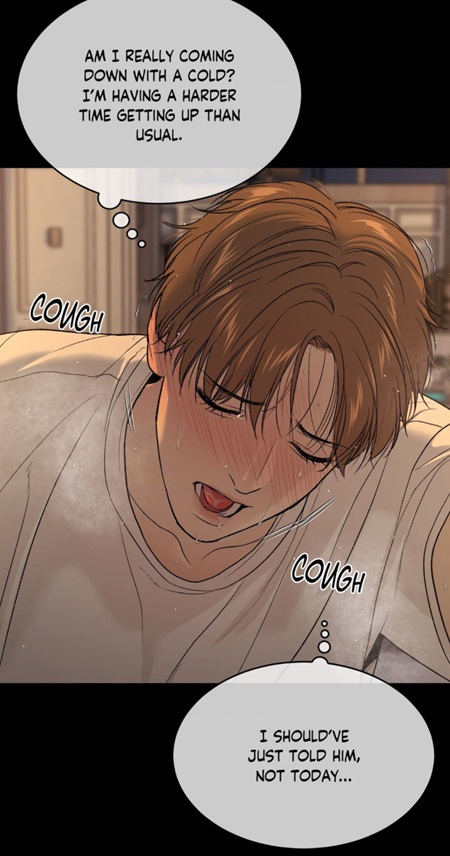 (chapter 61) that he must sacrifice his “needs” and identity to be accepted.
Yet in order to truly break Joo Jaekyung’s so-called “jinx”—which, as theorized, may stem from rigged matches and trauma masked by routine—the doctor’s hidden curse must be broken first. As long as Kim Dan sees himself as inherently unworthy and destined for abandonment, he will unconsciously reinforce a dynamic where emotional distance feels safe and predictable.
Chapter 44 shows the beginnings of intimacy (chapter 44), yet even then, it is expressed through regression. Kim Dan’s kisses are gentle, reminiscent of a child seeking comfort, not a lover expressing desire. (chapter 66) Therefore it is not surprising that he laughes like a little child during that night. (Chapter 44) Chapter 66 represents its negative reflection, the emotional climax of this regression: 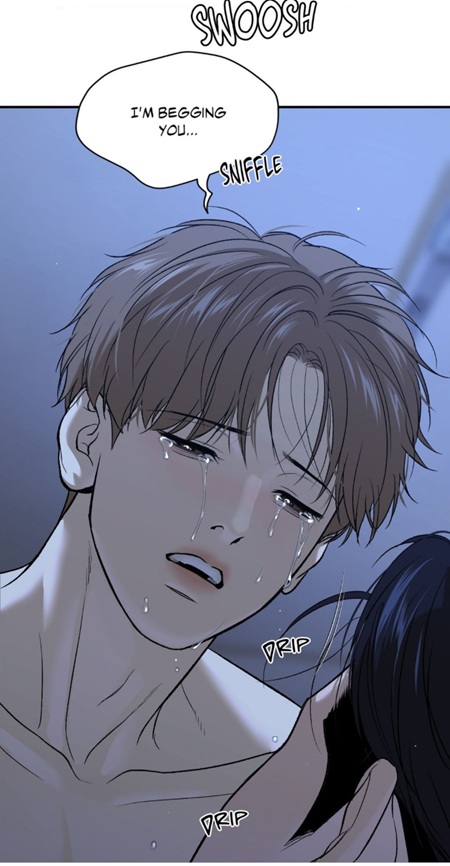 (chapter 66) he cries, begs,
 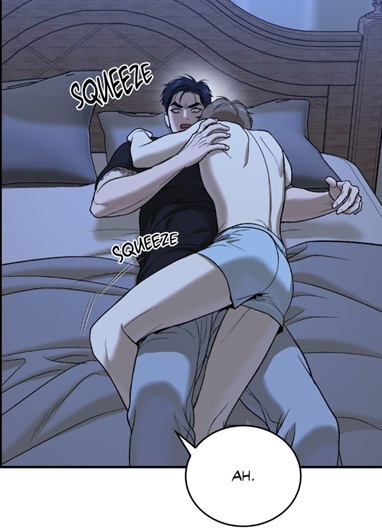 (chapter 66) holds on—“Don’t leave me.” (chapter 66) His squeezing fingers holding onto the athlete’s shirt
 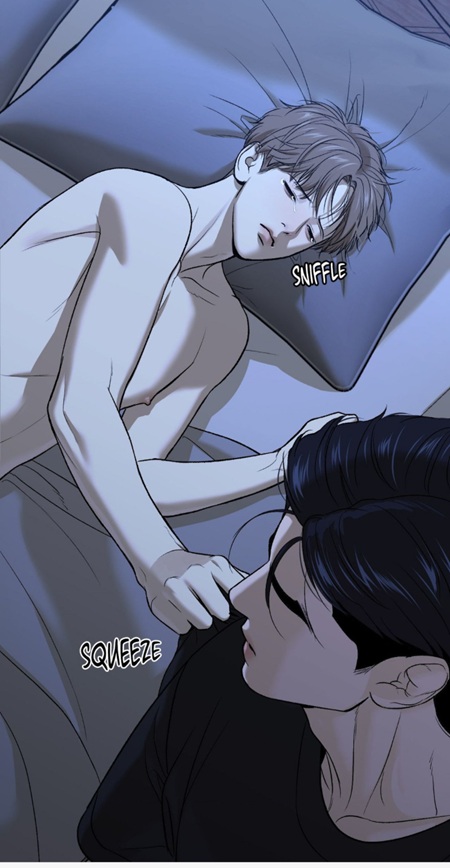 (chapter 66) and desperate pleas are not about romance—they’re about survival, longing and regret. Deep down, he wished, he had hold onto his “mother” in the past, stopped her from leaving him. Is it a coincidence that this gesture from that night mirrors the one during their first night? (chapter 2) And what had the protagonist said right after this gesture?
 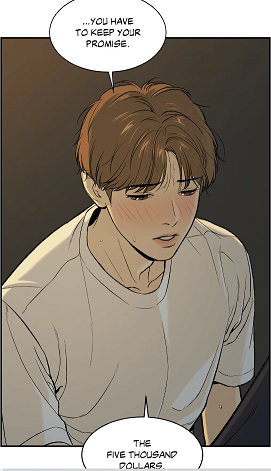 (chapter 2) He wanted the champion to keep his promise. From my point of view, the parent’s vanishing is strongly intertwined with a broken promise… And that’s exactly what the grandmother did to her own grandson: she didn’t keep her words either. (chapter 11) (chapter 53)
Then comes Chapter 67. Though no longer crying, he submits once more 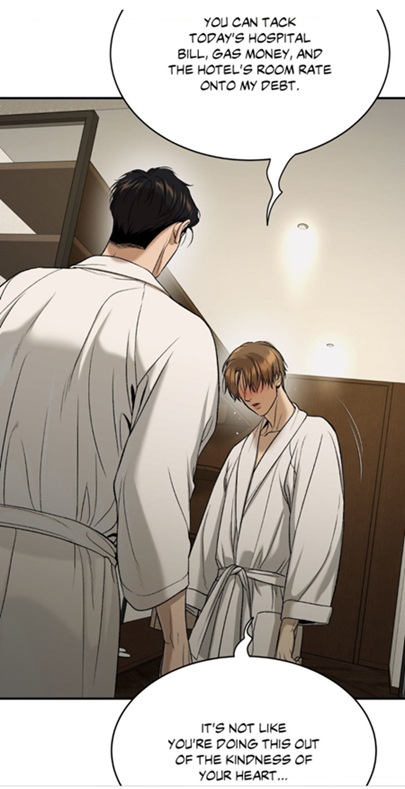 (chapter 67), but this time, with eerie detachment. He kneels before Joo Jaekyung like a servant, (chapter 67) asking for sex again. Yet the power dynamic is not as it seems. Though Kim Dan is physically lower, it is Joo Jaekyung who ultimately submits:
 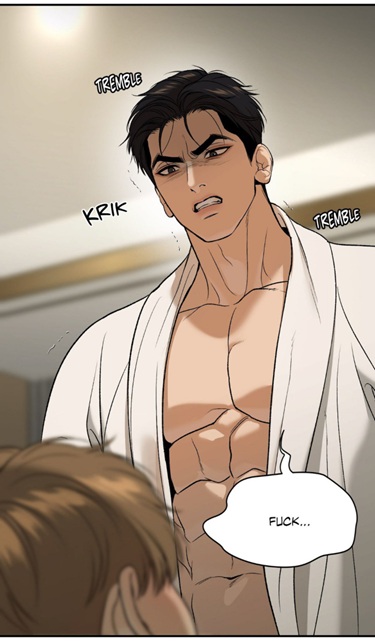 (chapter 67) his arousal betrays a loss of emotional control. Though he is on his knees, it is Joo Jaekyung who is emotionally yielding. His body betrays his composure, responding to Kim Dan’s touch and gaze. Kim Dan, watching the tremble in the fighter’s expression and the rising heat in his body, feels the shift. His soft blush is not simply one of affection or embarrassment—it’s a flicker of recognition.
  (chapter 67) He senses that the one usually in control is now unraveling. Appearances deceive: beneath this scene lies a quiet reversal of power. The blush on his cheeks is a trace of a brief moment of clarity: he sees that the person who once held all the control is now faltering.
Ultimately, this mirrors Chapter 2 once more. Back then, Kim Dan surrendered his body, believing it was his only tool for survival. But Chapter 66 reveals that even in moments of closeness  (chapter 66), his body is still a vessel for mourning. Hence there is no kiss during that blue night. Each night carries the residue of that first trauma: the night he was left alone. Whether his mother disappeared or passed away in the night, the result is the same—nighttime became synonymous with loss.
This is why he fears being alone after dark. This is why he clings to those who stay past midnight. And when Joo Jaekyung, the one person who broke that pattern, walked away, even briefly, it fractured him. 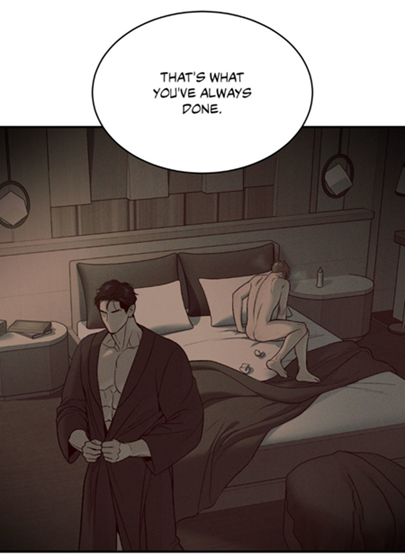 (chapter 63) His so-called jinx is not some irrational superstition. It’s a scar. It’s the quiet belief that the people he loves will vanish the moment he lets his guard down.
So while the champion’s jinx revolves around physical ritual and control, Kim Dan’s is rooted in emotional suppression and dread. Both stem from the same core wound: fear of abandonment.
But Chapter 67 deepens the tragedy: this time, he doesn’t just mourn: he gives in. The act is no longer about clinging to someone or begging them to stay. Instead, it is performed with emotional detachment, a mechanical reenactment of what once held meaning. His internal monologue (chapter 67) makes it clear: he isn’t trying to survive, he’s quietly unraveling. His decision to mix alcohol with medication is not rebellion  (chapter 67), it’s resignation. Hence he is not expecting to be cured with the pills. (chapter 67) Thus, chapter 67 reveals the darkest layer of his jinx: not fear of abandonment, but the numb certainty that love, safety, and home are illusions that always vanish with the night.
Observe the decoration on the wall: (chapter 67) It looks like the moon and Saturn are meeting each other. For me, the moon imagery in Chapter 67 is not accidental. Saturn, the planet of hardship and emotional lessons, casts its shadow over this night, mirroring the heavy atmosphere between them. When Kim Dan asks Joo Jaekyung if he brought him here out of concern, the champion remains silent—a silence louder than words. That silence is devastating. In that moment, Kim Dan’s deepest fear is realized: he is not loved, merely tolerated. And so, in an act of resignation rather than seduction, (chapter 67) he offers sex to “settle up,” citing his own preparations like a transaction. (chapter 67) The room’s muted lighting and circular wall decor even evoke the image of an eclipse—as if the moon (emotion) is being overshadowed by Saturn (cold logic and debt). This alignment encapsulates the heart of the scene: vulnerability eclipsed by duty, affection swallowed by silence. That’s the reason why I can’t help myself thinking that Kim Dan might end up in the emergency room later. Besides, we never saw him eating before taking his pills: (chapter 67) while he drank alcohol with the medicine. (Chapter 67) Until now, the champion has a blind faith in drugs, just like the grandmother.
One of the most striking revelations is the emotional split between the protagonists. Joo Jaekyung acts like a child during the day 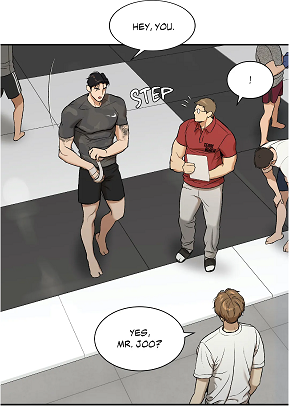 (chapter 7), while Kim Dan becomes a child during the night.
By day, Jaekyung seeks routine, praise, validation, and control. His outbursts, tantrums, and need for order mirror the emotional needs of a child. He’s the performer, the strongman, but behind that exterior lies someone seeking parental structure.
At night, Kim Dan’s walls crumble. His trauma surfaces. He cries, begs, trembles—not for pleasure, but out of fear. These breakdowns are not romantic; they’re regressive. And until these wounds are addressed, he can’t become the nurturing figure Jaekyung truly needs. This explicates why during the day, Kim Dan tries to act like an adult and rejected the champion‘s help.  (Chapter 66)
For their relationship to heal, Kim Dan’s nightmares must be addressed. Only then can he grow into the “motherly” role he’s beginning to fill during the day—someone who can offer stability, not just silent service. Until the end of season 1, his care was more rooted in duty, than real love and genuine concerns. He didn’t argue with the fighters 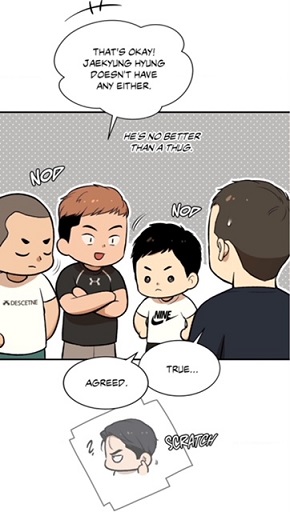 (chapter 47), when the “wolf” was portrayed as a thug, though the latter had assisted him on multiple occasions.
Now, the imminent death of the grandmother and the puppy bring everything back. Kim Dan isn’t just afraid of the future—he’s haunted by the past. Their death isn’t merely a loss—it’s a reawakening of everything he suppressed. The loneliness, the silence, the night—“It’s happening again.”
But this time, he’s not numb. He’s unraveling. His subconscious belief—the doctor’s secret jinx—is finally being revealed. He is destined to be abandoned… unless something breaks the cycle. It is clear that Joo Jaekyung will be that person, but this change is definitely linked to pain. In chapter 66, for the first time, the doctor’s jinx had a voice. And it sounds a lot like: “Please… don’t leave me.” The problem is that Joo Jaekyung chose to listen to Shin Okja, rather than talk to Kim Dan.
Feel free to comment. If you have any suggestion for topics or manhwas, feel free to ask. If you enjoyed reading it, retweet it or push the button like. My Reddit-Instagram-Twitter-Tumblr account is: @bebebisous33. Thanks for reading and for the support, particularly, I would like to thank all the new followers and people recommending my blog.
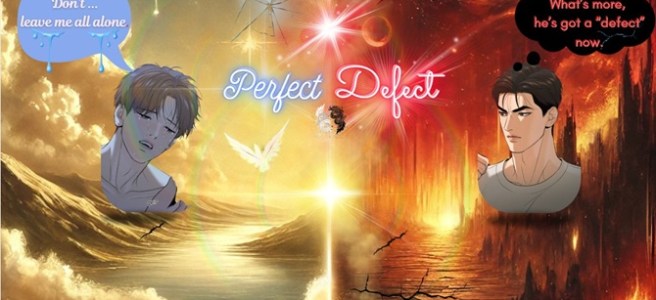
Please support the authors by reading Manhwas on the official websites. This is where you can read the Manhwa: Jinx But be aware that the Manhwa is a mature Yaoi, which means, it is about homosexuality with explicit scenes. Here is the link of the table of contents about Jinx. Here is the link where you can find the table of contents of analyzed Manhwas. Here are the links, if you are interested in the first work from Mingwa, BJ Alex, and the 2 previous essays about Jinx Wheels 🛞 and Waves 〰🌳 – p️art 2 (locked) and 𓇢𓆸 Prove Me Wrong Again 💢😂
It would be great if you could make some donations/sponsoring: Ko-fi.com/bebebisous33 That way, you can support me with “coffee” so that I have the energy to keep examining Manhwas. Besides, I need to cover up the expenses for this blog.

The recent developments in Jinx Chapters 65 and 66 provide a striking insight into the ongoing inner turmoil between Joo Jaekyung and Kim Dan. Many readers have long labeled Joo Jaekyung as a ‘red flag,’ and as such as a demon. Therefore when he used the idiom ‘defect,’  (chapter 66) they saw it as further confirmation of their perception—reinforcing the idea that he is terribly flawed. However, a deeper analysis suggests that this term reflects not just his character but also his evolving mindset and struggle with emotional vulnerability. This essay will explore the paradox at the heart of their dynamic—how both men refuse to acknowledge the emotional weight of their relationship, leading to a cycle of denial and misperception. It will examine how the concept of the jinx evolves, the continued influence of Park Namwook’s manipulations on Joo Jaekyung, and the role that mutual ingratitude plays in their emotional stagnation.
Initially, Joo Jaekyung’s jinx was a ritual designed to maintain control and secure victory. (chapter 2) This belief system dictated that, no matter what, he had to have sex with a man before every match—reinforcing the illusion that he could manipulate fate through repetition. The identity of his partner was irrelevant; what mattered was the act itself, which he perceived as a necessity rather than a choice. This routine provided him with a sense of control, but it also underscored a fundamental reliance on external factors rather than his own abilities. In Chapter 65, however, a subtle shift occurs. While the champion has not dropped his belief yet: (chapter 65), the nature of his principle has changed:  (chapter 65)The athlete is admitting his dependency on doc Dan. The jinx is now directly tied to Kim Dan, not just as a concept but as a tangible element of Joo Jaekyung’s career stability. The second switch is that sex is no longer a condition to ward off bad luck. In fact, the celebrity is recognizing the importance of his daily training and, as such, his hard work.
  (chapter 65) The inner thoughts of the sportsman reveal that the champion is feeling less powerless than before. His champion status is no longer reliant on superstition but on tangible efforts—his “old routine” and, crucially, Kim Dan’s expertise as a physical therapist. This marks a significant transformation in his perception of Kim Dan, whom he now values for his professional skills rather than as a mere tool for maintaining a ritual. Thus, Joo Jaekyung should be less inclined to request Doc Dan’s sexual services. Then, in episode 66, a new change became visible. (chapter 66) The term defect emerges in his inner monologue, marking a transition from viewing the jinx as a form of dependency to seeing Kim Dan as someone in need of repair. This linguistic change is crucial—jinx implies something external, uncontrollable, and tied to fate, whereas defect introduces the notion of something that can be fixed or even improved.
Joo Jaekyung’s use of the term ‘defect’ stems from his deeply ingrained perception of both himself and others as products rather than individuals with intrinsic worth. Instead of saying that Kim Dan is ‘sick’ or struggling, he labels him as ‘defective,’ mirroring his own self-perception. The champion has long seen himself as nothing more than an athlete, a machine built for fighting—functional when at peak performance, broken when failing. This perception is reinforced by his manager, Park Namwook, who treats him as nothing more than an ATM  (chapter 11), a tool to generate money and maintain the gym’s reputation. Hence he blames him, when members leave the gym.
  (chapter 46) The manager used the incident with Seonho to justify the desertion of the other athletes. However, it is clear that some left the gym because they didn’t become successful like Joo Jaekyung. However, their lack of success is explained by their lack of talent
  (chapter 46) exposing the lack of ambition and commitment from the two hyungs. It is clear that Joo Jaekyung’s wealth and fame was used to attract the sportsmen creating a myth that they could experience the same success. Nevertheless, as time passed on, the fighters were confronted with reality. It was, as if the athlete’s achievement had become a curse for Team Black. Nonetheless, neither the manager nor the coach can admit it, the champion’s bad temper is utilized to cover the mismanagement within the gym. Striking is that by portraying the protagonist as a person with a bad temper and personality , (chapter 9) the manager and his colleague described their boss as defective. The contrast between Joo Jaekyung’s perception of ‘defect’ and the coach’s view of him as a ‘maniac’ is particularly telling. When the protagonist refers to Kim Dan as having a defect, there is an implicit acknowledgment that something can be repaired or improved. In contrast, Park Namwook’s statement about ‘handling that maniac’ suggests that the star is beyond fixing—someone who must be tolerated and controlled rather than understood or helped. This fundamental difference in perspective reveals how deeply the manager has shaped the champion’s self-perception, reinforcing the idea that he is nothing more than a force to be managed rather than a person who can change or grow.
Ironically, (chapter 11) Joo Jaekyung once accused Kim Dan of seeing him as an ATM back in Chapter 11, but in reality, it is his manager who exploits him as a financial asset rather than recognizing his humanity. Hence he wants him to return to the ring as soon as possible.  (chapter 54)
Under this new light, Jinx-philes can grasp why the “demon” (chapter 66) refers to Kim Dan’s condition as a ‘defect’ rather than acknowledging that the doctor is unwell. In doing so, he mirrors how he has been conditioned to see himself—not as a person who can be sick or in need of help, but as something that must either function or be discarded. The paradox is that without him, the gym can no longer attract members, hence Team Black would be forced to close its doors. That’s the reason why the manager is inciting the athlete to return to the gym. (chapter 66) His presence is necessary to maintain the “myth” alive.
But let’s return our attention to the fighter. (chapter 66) Notice that the champion doesn’t say that Kim Dan is sick or suffering from sleeping problems. His words expose that Joo Jaekyung still views life through the lens of having rather than being, seeing both himself and others as assets to be maintained rather than individuals with intrinsic worth. Furthermore, this label is deeply connected to Kim Dan’s own sleeping problems, which mirror Joo Jaekyung’s insomnia.
By recognizing a flaw in Kim Dan, he unconsciously acknowledges his own suffering without explicitly confronting it. Therefore he is accompanying the protagonist to the sleep specialist. 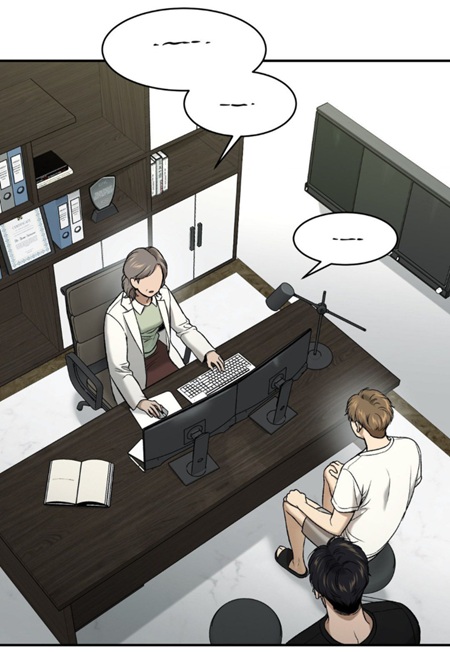 (chapter 66) In calling Kim Dan ‘defect,’ Joo Jaekyung is unknowingly projecting his own self-perception onto him. The term suggests something broken but also something that can be repaired, reflecting an unconscious shift in his perspective. Instead of simply using Kim Dan as part of a superstition, he is beginning to see his vulnerability, perhaps even recognizing a parallel to his own struggles. His choice of words also reveals his deeply ingrained belief in self-reliance. (chapter 66) Kim Dan’s nighttime distress contradicts this principle, as it suggests an inability to be alone. This mirrors Joo Jaekyung’s own realization in the garden (chapter 65), where he admitted to himself that he was no longer entirely self-reliant. By calling Kim Dan ‘defect,’ he not only acknowledges the therapist’s struggles but also his own growing dependency on him—though he remains unwilling to fully confront it.
This shift is significant because it alludes that Joo Jaekyung is beginning to see himself as capable of affecting change. For someone conditioned to endure suffering without seeking help, viewing another person as defective paradoxically offers him a sense of power and responsibility. (chapter 66) Hence it is no coincidence that he chose to bring himself the “hamster” to the hospital.  (chapter 66) Nevertheless, the idiom (“he’s got a defect”) reveal that Joo Jaekyung is still under the manager’s influence. This means that this shift is not immediate or conscious; it is restrained by his continued loyalty to Park Namwook and his ingrained avoidance of emotional vulnerability.
Striking is that in season 2, the champion is almost never seen with the other members from Team Black. (chapter 60) This scene represents the exception. For the most part of the time, the star only visited the gym because Park Namwook had contacted him. 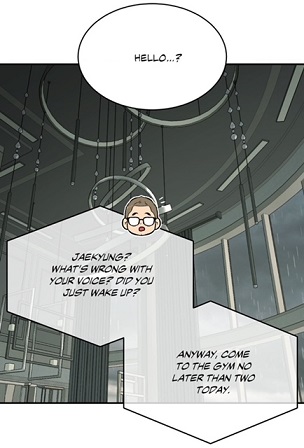 (chapter 54) (chapter 66) Striking is that by each meeting, the champion was alone with the manager. The latter was no longer followed by coach Yosep. It was, as if Park Namwook wanted to have some privacy with the celebrity. However, through this contrast, Jinx-lovers can detect a certain MO from the manager: he is isolating the champion, limiting his interactions with other members. This explicates why he remains a pivotal force in Joo Jaekyung’s stagnation.
A clear example of Park Namwook’s manipulative tendencies emerges in his interactions with Joo Jaekyung in Chapter 66. He subtly pressures the champion to return to the gym by implying that his current behavior—isolating himself—is not normal. (chapter 66) Yet, just moments later, he tells him that he can take more time to rest, as if feigning concern. This contradiction is striking because it exposes his underlying agenda: he wants Joo Jaekyung back in the gym but doesn’t want to appear forceful. Instead, he makes it seem like Joo Jaekyung is the one making the decision, fostering guilt by implying that his long absence is unnatural.
What makes this irony even more apparent is that Park Namwook has, in the past, dismissed Joo Jaekyung as a ‘spoiled child with a bad temper.’ (chapter 52) His sudden shift—acting as though the champion is no longer himself—reveals his inconsistency. When Joo Jaekyung was compliant, he was simply a reckless athlete with an attitude. Now that he is exhibiting autonomy, Park Namwook implies that something is wrong with him. It was, as though he was missing the old version of the champion. 😂 But this is what he complained about him in the past: he was a workaholic!  (chapter 27) This double standard highlights Park Namwook’s true role: he is not a supportive figure but a handler, ensuring that Joo Jaekyung remains under control and fulfilling his duties as a fighter. His words are not meant to provide genuine support but to keep Joo Jaekyung tethered to a system where his worth is defined solely by his success in the ring.
His subtle manipulations ensure that Joo Jaekyung remains dependent on his management, discouraging emotional entanglements that might threaten his control. This is evident in the way he frames Joo Jaekyung’s return to training in Chapter 66, focusing on ensuring compliance rather than addressing the champion’s personal struggles. (chapter 66) Park Namwook ensures that Joo Jaekyung remains confined within the narrow definition of an athlete whose sole purpose is to generate victories and revenue. By subtly invalidating the fighter’s autonomy, he fosters a cycle of dependency, discouraging any form of emotional connection or self-reflection that might lead Joo Jaekyung to question his control. The manager’s contradictions—both urging him to take his time yet implying his behavior is unnatural—serve to reinforce this conditioning, ensuring that the champion remains locked in a pattern of obligation rather than self-discovery. In doing so, Park Namwook not only suppresses Joo Jaekyung’s potential for growth but also reinforces the deeply ingrained perception that his worth is conditional and transactional.
His tactics extend beyond mere coaching—he controls information, as seen in his omission of lost sponsorships  (chapter 54) or (un)favorable interviews about the athlete.
  (chapter 54)
  (Chapter 57) As a manager, Park Namwook’s role involves overseeing Joo Jaekyung’s career, securing contracts, and ensuring his reputation remains intact. Yet, as seen in Chapter 66, his actual concerns seem remarkably narrow in scope. (chapter 66) When speaking to Joo Jaekyung, Park Namwook focuses exclusively on the gym—as if the athlete were merely a member rather than the actual owner. This detail is particularly ironic, as it reveals that the man with the glasses sees himself as the one in charge, entitled to dictate Joo Jaekyung’s movements and decisions. His fixation on the gym exposes why he shows no interest in other crucial aspects of the champion’s career, such as contracts, endorsements, or emotional and physical recovery. His management is driven not by genuine concern for the fighter’s well-being, but by a desire to uphold the gym’s operation and reinforce his perceived authority within it. To conclude, his true motivation lies in preserving the gym’s function and image, treating Joo Jaekyung as a means to that end rather than supporting him as a multidimensional individual with emotional and professional needs. That’s the reason why he shows no curiosity about his star’s private life: “I don’t know what you’ve been up to lately”. (chapter 66)
Because his failure to reveal lost sponsorships and unfavorable interviews in Season 2 suggests a pattern of withholding critical information, I couldn’t help myself thinking to see as another clue that his omission extends to the fateful meeting between Choi Gilseok and Kim Dan, which took place in front of “HIS” gym!  (chapter 48) Back then, there was a witness, Kwak Junbeom and the latter could have reported to the “hyung”. These incidents indicate a consistent effort to control what the champion knows, raising the critical question: why?? His silence on this matter suggests not only a strategic decision to keep the star uninformed, but also an attempt to avoid responsibility. The supervisor often hesitates to make decisive choices
 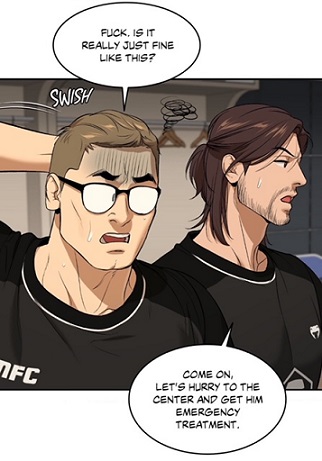 (chapter 50), preferring instead to remain passive so that any negative outcomes can be blamed on the champion. At the same time, this passivity helps him maintain control—as if Joo Jaekyung, without his guidance, would be left ‘alone’ and directionless. In this way, the man with the glasses sustains a dynamic in which the champion feels dependent on his presence, even as he is subtly undermined. By neglecting to inform him of these events, Park Namwook ensures that the champion remains unaware of external factors that could influence his choices. This pattern reinforces the possibility that Park Namwook was aware of the meeting with Choi Gilseok and deliberately ignored it, likely expecting that Joo Jaekyung would take care of it, while absolving himself of responsibility.
Park Namwook’s motivations become clearer when viewed through this lens. In his eyes, Joo Jaekyung is now physically perfect (chapter 66) —his shoulder has healed, and he should be able to return to the ring. However, at the same time, he regards him as defective (chapter 66) because he no longer displays the same single-minded devotion to fighting. Joo Jaekyung’s emotional distance from the gym and his growing attachment to Kim Dan mark a transformation that the manager interprets as a threat. Instead of embracing this evolution, the “supervisor” views it as a flaw—proof that the champion is no longer operating under the selfish, work-driven mindset he once encouraged. This contradiction reflects the “hyung”’s twisted priorities: he sees the gym as the center of value and promotes an ideology of workaholism, selfishness, and emotional suppression. Since he has no one by his side, he should come to the gym, as if he would nurture relationships there. To him, the ideal fighter is one who exists solely for the ring, forgoing connection or personal growth. In that sense, the protagonist becomes the Perfect Defect—flawless in form but, in Park Namwook’s eyes, failing in function by daring to become more human. The manager’s repeated emphasis on the gym reveals his narrow view of the champion’s purpose, treating him as a member rather than the rightful owner. This misperception reflects Park Namwook’s deeper worldview: he represents workaholism, selfishness, and greed, believing that the only acceptable behavior is unwavering devotion to the gym and career success.
Despite these moments of introspection (chapter 65), the “wolf” does not immediately alter his behavior. 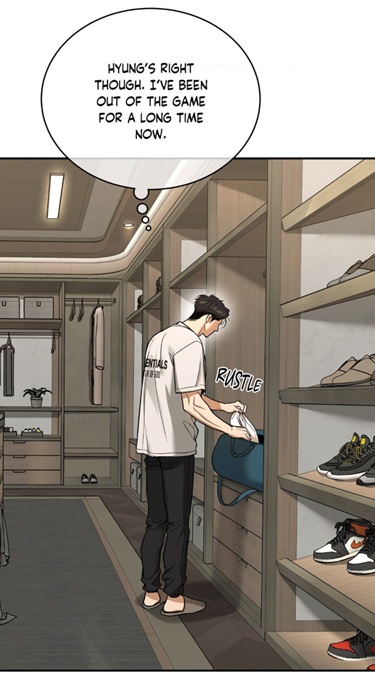 (chapter 66) This hesitation stems from deeply ingrained beliefs about relationships and fidelity. His loyalty to Park Namwook prevents him from fully confronting the possibility that his manager may not have his best interests at heart. Moreover, his own emotional repression makes it difficult for him to recognize his evolving dependency on Kim Dan as something beyond physical necessity.
But there exists another reason for his slow transformation, the influence of the location. Notice that he agreed to his hyung’s statement, when he was in the penthouse. The latter stands for civilization and as such “corruption”. Thus I came to the following interpretation. The penthouse represents the manager’s power over the champion, which explicates why Oh Daehyun and the other fighters spoke about that place in admiration in front of their coach.  (chapter 22) They had heard about his place, for the manager must have talked about it. The protagonist is not someone who will talk about his private life to others. The manager must have dangled promises in front of them, making them believe that if they’re lucky enough, they too could live like the champion. However, their reactions reveal something crucial—they are not motivated by greed but by genuine admiration. They simply want to experience the luxury once in a while, reinforcing that their bond with Joo Jaekyung is rooted in camaraderie rather than material envy. This further highlights the contrast between Park Namwook’s manipulation and the sincere regard his teammates have for him. This scene is important, because it exposes the manager’s prejudices and lack of discernment.
  (chapter 46) Not everyone is the same and more importantly like him! It is clear that the man is projecting his own principles onto others and in particular onto the champion.
His reluctance is further reinforced by the lack of validation from Kim Dan.  (chapter 66) Neither of them fully understands how to acknowledge care or support. Just as Joo Jaekyung struggles to recognize his actions as stemming from concern (chapter 66) rather than routine, Kim Dan fails to see Joo Jaekyung’s interventions as genuine help. This mutual misunderstanding deepens the emotional rift between them, ensuring that both remain trapped in their own perceptions of obligation rather than connection. In Chapter 66, he openly expresses frustration, stating,
 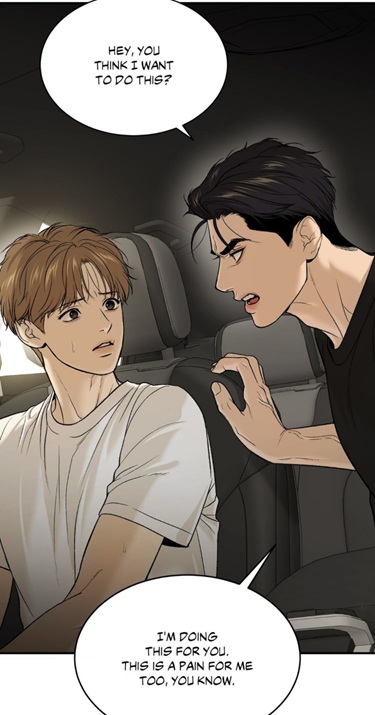 (chapter 66). This moment highlights a rare glimpse of honesty: he is not acting purely out of self-interest, but he frames it as an obligation rather than a choice. From my point of view, such a statement could only reach the physical therapist’s mind, for in the latter’s eyes, the champion has always been a “demon”: self-centered and inconsiderate. Observe the absence of reply from the “hamster”. He couldn’t contradict the star, as the latter was using this negative image: bad tempered and selfish.
Mingwa has long associated doc Dan with an angel. . The reason is simple. He was portrayed as someone who would do favors to people constantly: his grandmother (chapter 53), the manager (chapter 9), the fighters  (chapter 7) and even Choi Heesung. Hence the latter called him like that:
 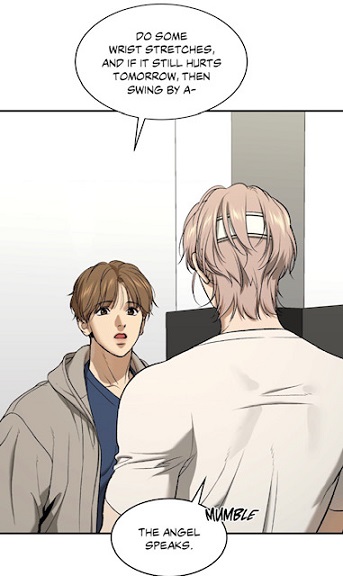 (chapter 30) Kim Dan’s perception of himself as an “angel” has long shaped the way he interprets his relationship with Joo Jaekyung. Reinforced by his upbringing and Park Namwook’s subtle manipulation (chapter 36), he has unconsciously placed himself in a position of moral superiority. He is the patient, understanding figure, while Joo Jaekyung, in contrast, is violent
  (chapter 1), selfish, and emotionally stunted. However, this self-perception is deeply flawed. By believing himself to be inherently better (chapter 64) than the champion, Kim Dan avoids confronting his own emotional repression, his weaknesses, and his own form of “defectiveness.” He fails to see that he is just as human—just as fragile—as the man he silently judges.
 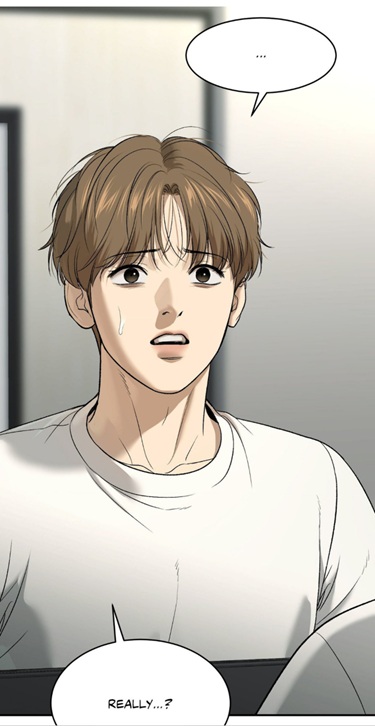 (chapter 66) The expression “Really…?” is not just about disbelief but also about a moment of confrontation with reality. Up until this point, Kim Dan has been dismissing his own suffering, suppressing his struggles, and functioning on autopilot. However, hearing a professional confirm that he is indeed sick forces him to acknowledge what he has been denying.
The word “really” acts as a bridge between doubt and acceptance, signaling that reality is crashing down on him. This corresponds to the downfall of an angel. He can no longer minimize or rationalize his exhaustion as something temporary—it’s a legitimate condition, one that requires attention. This realization is significant because it directly challenges his self-perception. He has always seen himself as someone who must endure, someone who cannot afford to be weak. But now, he is faced with undeniable evidence that he is not just tired—he is unwell.
This moment marks a turning point, where the truth of his condition is no longer something he can push aside. So far, he has always dismissed the champion’s remarks as “lies”:  (chapter 60) or exaggerations.
 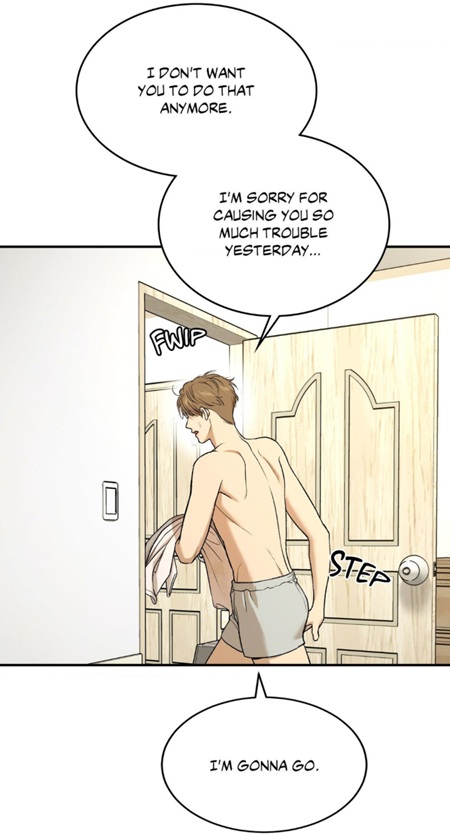 (chapter 66) It also forces him to consider that others—especially Joo Jaekyung—were right to be concerned, which in turn may lead to a shift in his perception of the champion’s actions.
Furthermore, Kim Dan grew up in an environment where repressing his desires was not just expected but necessary for survival. He was conditioned to associate sex 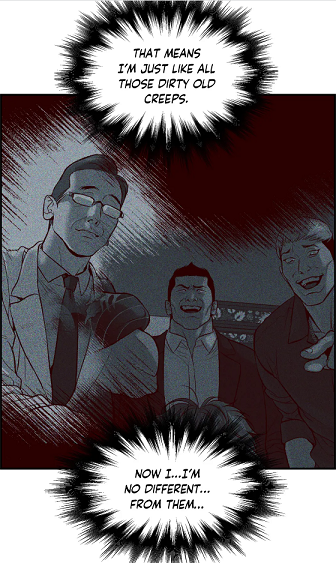 (chapter 20) with shame, something impure that should be avoided or hidden. This internalized belief made it difficult for him to separate his own experiences from moral judgment. When he encountered the champion —who treated sex as nothing more than a professional ritual (chapter 2)—this stark contrast reinforced his existing worldview. He saw the celebrity as reckless, immoral, and impulsive, someone who lacked restraint and viewed intimacy as just another means to an end. In contrast, Kim Dan unconsciously positioned himself as purer—someone who was above such base instincts.
However, this sense of superiority is deeply paradoxical. While he judged Joo Jaekyung for his behavior, he was also the one who allowed himself to be drawn into the transactional dynamic without resisting it. Instead of questioning or confronting the situation, he passively accepted it, reinforcing his own role within the dynamic. His moral disdain for Joo Jaekyung did not stop him from complying with the athlete’s demands. This contradiction highlights Kim Dan’s deeper struggle: he is caught between his ingrained judgment and his own passivity. He wants to believe he is different from Joo Jaekyung, yet his actions—or lack thereof—suggest otherwise. This explicates why he is projecting his own behavior onto the athlete’s: 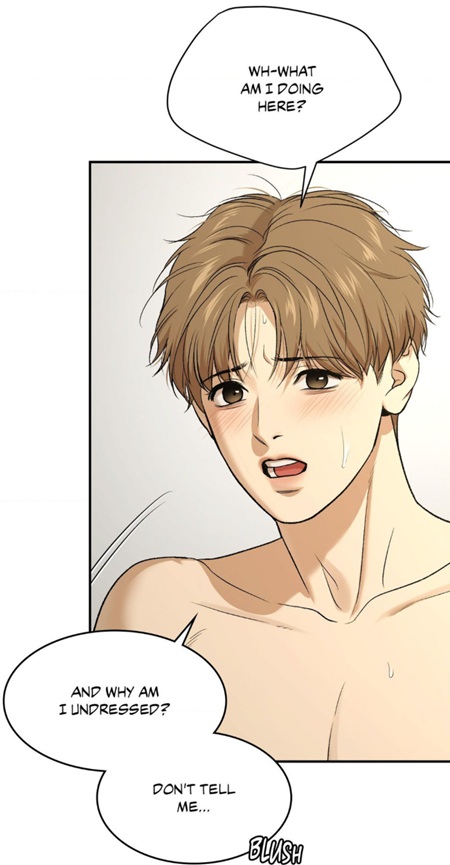 (chapter 66) He assumed once again that the star had taken advantage of his “drunkenness”, something Kim Dan had done himself in the past.
This internal conflict plays a crucial role in why he struggles to acknowledge the changes in Joo Jaekyung’s behavior. If he were to admit that the champion is not just a brute, that he is capable of genuine concern, it would force him to reconsider his own beliefs—not just about Joo Jaekyung, but about himself. To do so, however, means dismantling the rigid perception of morality and purity he has clung to for so long. Until Kim Dan comes to terms with his own contradictions, he will continue to misunderstand Joo Jaekyung’s intentions, keeping them both trapped in a cycle of mutual misperception.
Mingwa has frequently associated Kim Dan with angelic imagery, but this serves as a double-edged sword. While it elevates him in the eyes of others, it also creates a psychological barrier that prevents him from recognizing his own suffering. His insomnia, his malnutrition, his growing depression—these are all things he ignores or downplays (chapter 66), even as they take a visible toll on his body. If he were to acknowledge his own vulnerabilities, he would have to admit that he is not above needing help, something he has spent his entire life avoiding. Instead, he clings to the idea that he must endure in silence, reinforcing the very behaviors that keep him trapped in a cycle of self-neglect.
This ties directly into the slow transformation of both characters. The angel needs to be reminded of his own true nature: he is human, and like any human, he can get sick, he can struggle, and he can fail. On the other hand, the champion, who has long internalized to see people through the lens of function and utility, has to recognize that being “defective” can represent a source of strength. So far, for him defect meant being worthless. Their reluctance to break away from these ingrained perceptions of themselves is precisely what keeps them at odds. Kim Dan resents Joo Jaekyung for his supposed lack of morality, yet he does not realize that his own self-righteousness blinds him to the reality of their relationship. Likewise, Joo Jaekyung, having always been valued for his physicality rather than his emotions, fails to grasp that true strength lies in acknowledging weakness—not erasing it.
This is why their transformations are not immediate. Their beliefs have been deeply ingrained through years of conditioning, and it takes more than a few interactions to dismantle them. Imagine this: a demon speaking to an angel, it perfectly encapsulates why they struggle to find common ground. Their fundamental worldviews have been shaped by entirely different environments—Kim Dan, who has been conditioned to suppress his desires and associate sex with shame, and Joo Jaekyung, who treats it as a necessity detached from emotion. This contrast creates a deep chasm between them, where one views the other as morally inferior, while the other sees emotional attachment as unnecessary or even a weakness.
Yet, the only place they can truly meet is Earth—neutral ground where neither absolute morality (Heaven) nor pure instinct (Hell) dictates their actions. And that would be the little town on the coast. (chapter 65) Symbolically, this reflects their respective journeys. The demon (Joo Jaekyung) is slowly leaving the underworld of detachment and blind routine, stepping toward vulnerability. Meanwhile, the angel (Kim Dan) is descending from his idealized, self-righteous perception of himself, recognizing his own flaws, desires, and limitations. Both must step away from their extremes—Kim Dan from his unconscious moral superiority and passive victimhood, and Joo Jaekyung from his emotional repression and transactional mindset.
Until they meet in the middle—on Earth, where human connection, vulnerability, and compromise exist—they will continue to misunderstand each other. Their so-called defects are what ultimately bind them together, but until they acknowledge them, they will remain locked in their cycle of denial and emotional stagnation. Kim Dan must first recognize that his suffering is valid, that he is not above pain, and that needing help does not make him weak. Likewise, Joo Jaekyung must learn that genuine care is not a transaction, nor is vulnerability a flaw. Until both confront these truths, they will continue to misunderstand each other, pushing one another away even as they inch closer to genuine connection.
The absence of gratitude on both sides serves as the linchpin of their emotional stalemate. Joo Jaekyung, for all his power and success, has never been properly acknowledged outside of his career achievements (chapter 40) , while Kim Dan, conditioned by years of emotional neglect, sees gratitude as a transactional exchange rather than an expression of genuine appreciation. (chapter This creates a vicious cycle—Joo Jaekyung continues to view Kim Dan as a ‘defect’  (chapter 66) because Kim Dan does not recognize his efforts, while Kim Dan cannot see past his own survival instincts to notice that Joo Jaekyung’s actions are slowly shifting from obligation to care. Kim Dan, conditioned by years of neglect and survival-driven thinking, does not see Joo Jaekyung’s actions as genuine care. (chapter 66) He assumes everything comes with a price, failing to recognize moments where Joo Jaekyung acts beyond obligation.
Conversely, Joo Jaekyung, still in denial about his emotional investment, refuses to acknowledge any deeper attachment to Kim Dan. (chapter 66) And now, you comprehend why the champion employed the idiom “defect”. As long as Kim Dan does not express gratitude, Joo Jaekyung can continue convincing himself that his actions are dictated by habit or self-interest rather than care. Their inability to recognize and articulate their changing dynamic keeps them locked in a cycle of emotional detachment. Nevertheless, it becomes clear that this vicious cycle will stop, as now these two men are little by little influenced by the nice landlord: (chapter 66) And the latter can see beyond the appearances.
In the end, the irony is that both characters see the other as defective in some way—Kim Dan as someone who is broken and in need of fixing, and Joo Jaekyung as someone incapable of expressing genuine care. Yet, it is precisely their emotional shortcomings that make them a perfect mirror for each other. The evolution of the jinx into defect signals an impending shift, but until gratitude is exchanged—until one of them acknowledges the other’s role in their life—the cycle will persist. As long as Kim Dan remains emotionally detached, Joo Jaekyung will continue denying his own feelings, making them each other’s Perfect Defect.
Feel free to comment. If you have any suggestion for topics or manhwas, feel free to ask. If you enjoyed reading it, retweet it or push the button like. My Reddit-Instagram-Twitter-Tumblr account is: @bebebisous33. Thanks for reading and for the support, particularly, I would like to thank all the new followers and people recommending my blog.

Please support the authors by reading Manhwas on the official websites. This is where you can read the Manhwa: Jinx But be aware that the Manhwa is a mature Yaoi, which means, it is about homosexuality with explicit scenes. Here is the link of the table of contents about Jinx. Here is the link where you can find the table of contents of analyzed Manhwas. Here are the links, if you are interested in the first work from Mingwa, BJ Alex, and the 2 previous essays about Jinx ️The Clash 💥Of Flesh👄 and Will 🤯 and Prison of Glass 🪟, Key 🔑 Of Time ⏲
It would be great if you could make some donations/sponsoring: Ko-fi.com/bebebisous33 That way, you can support me with “coffee” so that I have the energy to keep examining Manhwas. Besides, I need to cover up the expenses for this blog.

The title Wheels and Waves – part 1 captures the tension between confinement and freedom, vulnerability and strength, appearances and hidden truths. Finally, readers could see the grandmother leaving the hospice for a stroll. The irony is that she was not accompanied by her grandson or a caretaker, but by the champion himself. (chapter 65) At first glance, the grandmother’s wheelchair and the ocean seem to represent opposing forces, yet they also reveal a complex relationship between power and vulnerability. Thus in this analysis, I will explore how these elements, rather than simply contradicting each other, might actually reflect a struggle to find balance between dependency and independence.
The grandmother’s conversation with Joo Jaekyung by the ocean raises unsettling questions. Her gentle words suggest concern for Kim Dan’s future (chapter 65), yet her portrayal of him seems unexpectedly harsh—emphasizing his flaws (smoking, drinking).  (chapter 65) This description stands in opposition to the gumiho’s statement: he was an angel. (chapter 30) It is because Kim Dan didn’t ask for money or recognition, this gesture was entirely selfless. Why would the lady badmouth the protagonist, when she requested from the champion that he brings the doctor back to Seoul? (chapter 65) Is she genuinely worried for him, or is there a hidden motive behind her request to send him back to Seoul? And why does Joo Jaekyung, usually so straightforward, respond with silence and hesitation
 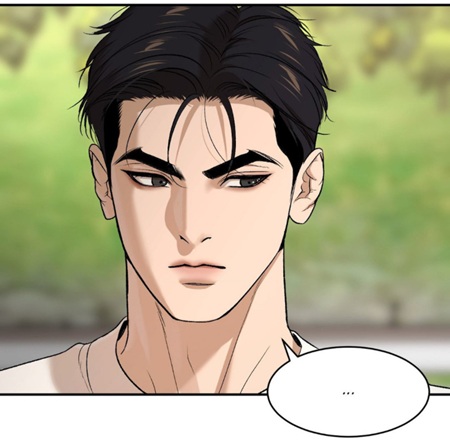 (chapter 65) or with shock?
 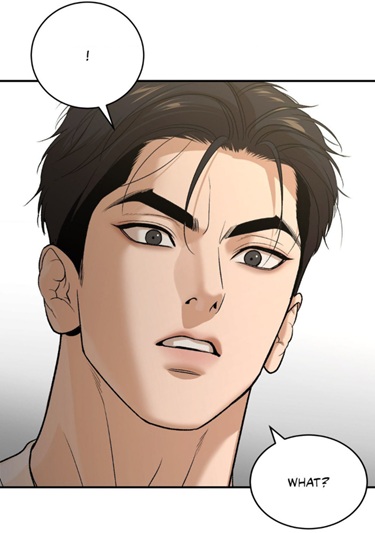 (chapter 65)
Meanwhile, Kim Dan’s nocturnal walks seem to oppose the grandmother’s immobility. 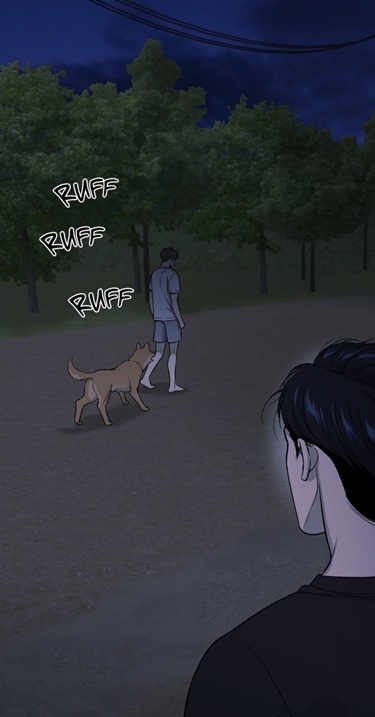 (chapter 65) His bare feet on the cold ground
  (chapter 65) suggest a longing for freedom, yet the direction of his steps remains uncertain. Whereas these walks reveal about his inner struggle, they don’t reveal the destination of his nightly strolls. Where was he going during that night? Was he going to the ocean—vast and untamed— like in episode 59,
 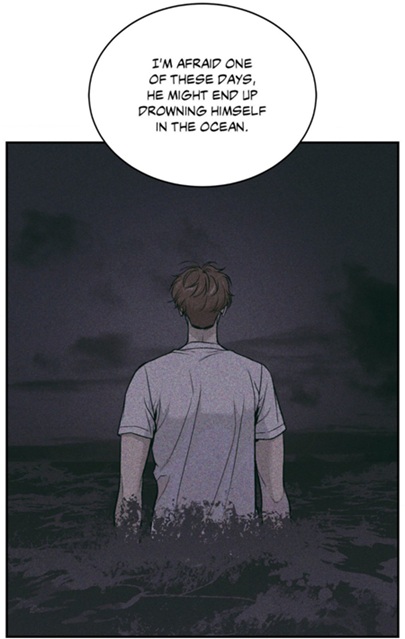 (chapter 65) or had his destination changed? These questions will be answered in the second part.
By examining the tension between appearances and reality, the contrast between confinement and escape, I hope to uncover the true nature of sacrifice and survival in the characters’ life. Wheels and Waves invites you to question what it really means to move forward—and at what cost. But let’s start with the interaction between Shin Okja and Joo Jaekyung.
First, it is important to realize that the champion was the one who chose the ocean as a destination. The nurse had only planned to walk around the hospice: 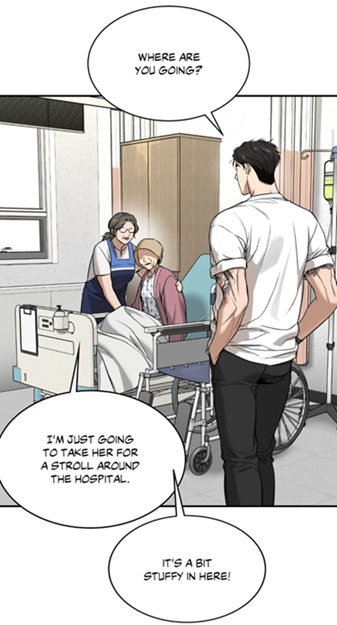 (chapter 65) This destination reflects the athlete’s desire and mind-set. He likes this place because it is quiet.
 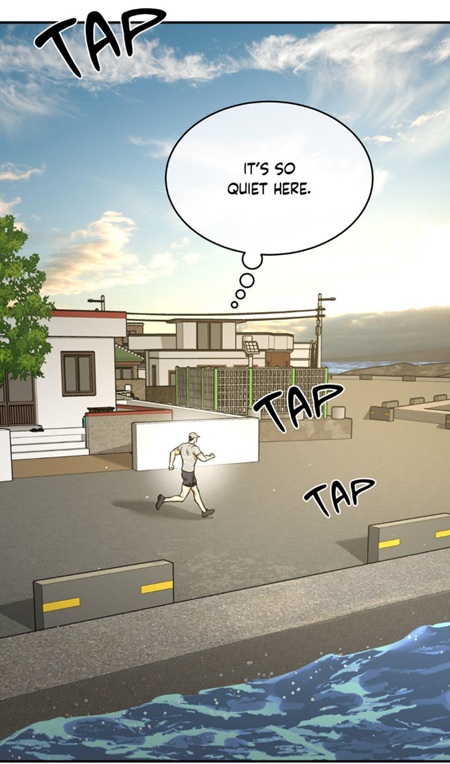 (chapter 62) From my perspective, the man has now internalized the beach to nature and privacy. Striking is the way Mingwa introduced the scenery. First, she focused on the wheel and Joo Jaekyung’s feet.
  (chapter 65) The contrast between the creaking wheels of the grandmother’s wheelchair and the steady steps of the champion immediately establishes the theme of control versus freedom. The wheelchair’s wheels represent civilization, immobility, passivity, and the grandmother’s obsession with control—over her own fate (chapter 65) and Kim Dan’s future. In contrast, Joo Jaekyung’s feet symbolize the potential for naturalness, movement and agency (chapter 65), emphasizing his ability to choose and act, even if he is currently unaware of the extent of the grandmother’s manipulation. I will explain further why I see the grandmother’s conversation as a deception. On the other hand, the rhythm of two steps per two creaks reflects how, despite his apparent strength and independence, the champion is unwittingly aligning himself with the grandmother’s pace and will. He is not realizing that he is actually slowing down, an indication that he will getting closer to rest for real this time. Note that he is no longer running and his steps are more “gentle”. We don’t have any TAP TAP TAP anymore, but STEP STEP.
The focus on the wheels and feet also serves as a prelude to the conflicting worldviews of the two characters. While the grandmother’s immobility reflects her fear of facing reality and her reliance on others to push her forward—both literally and metaphorically—Joo Jaekyung’s steps suggest a willingness not only to move forward, but also to impede. Little by little, he is getting closer to the ocean which means that he is about to confront the unknown represented by the ocean. Yet, the irony lies in the fact that despite his steady steps, the champion is the one being emotionally led by the grandmother’s words and direction.
Furthermore, the choice to highlight the wheels and steps before revealing the larger scenery suggests a gradual unveiling of the truth—both about the grandmother’s intentions and the emotional journey that awaits Joo Jaekyung.
By choosing the ocean, Joo Jaekyung subconsciously aligns himself with nature, emotions, and freedom—the very things the grandmother seeks to avoid by emphasizing the beauty of the town. (chapter 65) His choice of destination foreshadows a deeper conflict between confinement and escape, between facing the truth and continuing to live under the illusion of control that the grandmother represents. Another relevant detail is the moment Shin Okja praises the town. Observe the position of her head. We don’t see her gaze because of her hat. But since the town is on the right, this signifies that she isn’t truly looking at the town. (chapter 65) In fact, she is just looking ahead of her. The “nice little town” is reduced to the pathway next to the beach. This observation exposes her narrow-mindedness. Because she is not truly admiring the place, I feel like she is praising the town more based on her childhood memories. This explains why she mentions her youth afterwards. Moreover, the fact that she employed the expression “isn’t it” with her description, reveals her tendency to lead the conversation. It was, as if she pushed the young man to agree to her claim. The irony is that she didn’t even wait for his reply. She explained why she was so fond of the place: her childhood memories. In her eyes, because her companion didn‘t spend his youth here, he can not connect to this town, overlooking that people can create new memories anywhere. Moreover, they are not obliged to live in the same town their whole life or to live where they spent their childhood. In other words, this frail lady has no real notion of time as such. I would even say, her gaze is not truly directed in the present or the future, she is rather obsessed with the past.
But let’s return our attention to this panel. (chapter 65) Here, the ocean dominates the frame, uncontained and powerful, suggesting that the control and order symbolized by civilization are ultimately limited. The receding wharf becomes a metaphor for the boundaries of this control, emphasizing that beyond a certain point, civilization’s reach falters in the face of nature’s raw power. This shift in focus—from the orderly path along the shore to the turbulent waves beyond— accentuates the futility of the grandmother’s obsession with control, medicine, and structured living. But there’s more to it. Mingwa added the onomatopoeia “Whoosh” in order to indicate the presence of wind. The latter is responsible for the “waves”. Funny is that the halmoni is not paying attention to it at all. We could say that the absence of comments about the ocean and wind divulges her blindness and deafness, and the falsehood of her “wish” expressed in the hospital. In addition, this image is announcing the way the conversation will take place. There won’t be any real exchange of thoughts and as such active listening from her part. She will lead the conversation.
This image contrasts so much to the scene with Kim Dan on the beach:  (chapter 59) The contrast between these two images—one of the halmoni accompanied by Joo Jaekyung and the other of Kim Dan sitting alone by the ocean—exposes the stark difference in their emotional worlds and the dynamics of control and isolation that define their lives.
In the first image, (chapter 65) the halmoni’s presence with Joo Jaekyung creates an illusion of support and control. (chapter 65) The sunlight high in the sky bathes the scene in brightness, suggesting a façade of warmth and clarity. This lighting aligns with the halmoni’s belief that she can influence Kim Dan through the champion, using Joo Jaekyung as an intermediary to extend her authority. The fact that she is in a wheelchair, however, subtly contradicts this impression of power, revealing her true state of passivity and reliance on others to act on her behalf. The ocean, tamed by the pathway, symbolizes her attempt to domesticate nature— (chapter 65) just as she tries to domesticate Kim Dan’s emotions and decisions. At the same time, it exposes that the champion is still far away from his true self, but he is getting closer to become “reborn”.
In contrast, the second image of Kim Dan alone at sunset paints a completely different picture. (chapter 59) Here, the setting sun hints at the end of the halmoni’s control over his life, casting a melancholic glow that embodies both the beauty and isolation of freedom. Unlike Shin Okja, doc Dan faces the ocean directly, unprotected by railings or pathways, exposing his vulnerability and willingness to confront the unknown—his emotions, his trauma, and his desire for escape. The absence of others highlights his profound loneliness, a loneliness that even the vastness of the ocean cannot fill but seems to reflect. The parasol, standing solitary like Kim Dan, reinforces the sense of isolation amidst an open space. On the other hand, the walk with the grandmother exposes the superficiality of the champion’s connections. He might know many people, but they aren’t his friends or family.
The sound effects further emphasize this dichotomy. The “whoosh” accompanying the halmoni and Joo Jaekyung suggests the wind—a natural element that moves freely despite the artificial path, subtly mocking the halmoni’s illusion of control. Meanwhile, the “shaa” with Kim Dan reflects the waves, raw and untamed, symbolizing the overpowering emotions he battles alone.
Joo Jaekyung’s perception of the halmoni’s influence over Kim Dan is thus an illusion: (chapter 65) the same illusion that the high sun implies. The latter can not shine if there are clouds. (chapter 65) My avid readers know that the latter usually stand for danger. Thus I come to the following deduction: the clouds represent the doctor’s untreated wounds. The champion’s assumption that the halmoni can sway Kim Dan is a misunderstanding of the true nature of Kim Dan’s struggles. While Joo Jaekyung might see the halmoni’s appeals as genuine, I don’t think, he grasped entirely that her words are merely another form of control, one that Kim Dan subconsciously rejects as he continues to seek solace by the ocean, far from the halmoni’s reach. 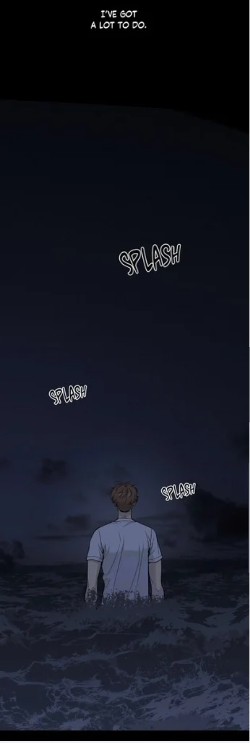 (chapter 59)
In essence, the halmoni’s daytime stroll represents a false clarity and a temporary illusion of control, while Kim Dan’s solitary sunset confrontation with the ocean was foreshadowing a breaking point—an inevitable dusk for the halmoni’s authority and a prelude to a night where Kim Dan chose escape and freedom but at his own life expense.
Another important detail is the way she initiated the conversation. It was about this pretty community and not her grandson. Why? (chapter 65) It is because she is trying to incite the athlete to return to Seoul. He doesn’t belong here. Her statement, “This is where I grew up. But you’re from Seoul, so you probably don’t see what the fuss is about,” dismisses Joo Jaekyung as an outsider while subtly reasserting her authority. Yes, she is using the same MO than with Kim Dan. (chapter 57) By telling him that he had no ties here, she effectively erased their shared past and portraying him as a stranger in the very place she calls home. Thus I deduce that she is aware that she is racing against time. The longer the athlete stays in that place, the lower are the chances that her grandson will leave this town. She has to ensure that Joo Jaekyung doesn’t feel like settling here. I don’t think, she heard about the athlete’s involvement in the little town, for her only source of information comes from the staff (chapter 65) and the residents from the hospice. She has no connection to the town chief and other inhabitants. This exposes how small her world is and little her knowledge is. However, her ignorance doesn’t make her an innocent “lady”, quite the opposite. – Don’t get me wrong, I don’t see her as a malicious person, just as a selfish person suffering from Peter Pan Syndrome.
Let me give you an example.  (chapter 65) Here, she claims that she only knows about the sportsman’s job thanks to the patient next door. However, she is lying, because she watched his match in the States.
  (chapter 41) The irony is that she is not realizing that she is showing her true colors.
  (chapter 21) In episode 21, the halmoni’s description of the champion as a “good friend” was, in hindsight, a superficial and self-serving characterization. At that time, she likely saw Joo Jaekyung as someone who could be beneficial for Kim Dan’s financial situation without truly caring about who he was as a person. Her interest in him was more about what he represented—a source of money and stability—rather than any genuine appreciation of his character or the impact of his presence in Kim Dan’s life. Thus she said this in front of the ocean: (chapter 65) If he was a good friend, then why didn’t she show more interest in him before? It is because she needs him now. Yes, this woman is a good-weather friend in the end. The term “good-weather friend” refers to someone who shows interest, support, or kindness only when it is convenient for them or when they stand to gain something. Hence she goes outside, when the sun shines. This perfectly encapsulates the grandmother’s attitude towards Joo Jaekyung. But it is the same with the champion. He only visited her,
  (chapter 61) when he thought, he needed her assistance. He used her to appear as a friend.
  (chapter 61) Yes, the conversation at the beach played an important role, for Shin Okja’s behavior serves as a distorted mirror to Joo Jaekyung’s actions and mindset, exposing the flaws and contradictions in both. When she voiced this wish (chapter 65), she exposed her belief: money and big hospital are the symbol for care. That’s exactly what the champion had done in the past.
In episode 22, when Joo Jaekyung paid the bills for the halmoni,  (chapter 22) he acted out of a simplistic view of good deeds—believing that financial support alone could resolve problems and fulfill his moral obligations. His subsequent failure to visit her again reflects his tendency to distance himself emotionally once he has performed what he sees as his duty. This is reminiscent of his behavior towards Kim Dan: helping him materially but avoiding deeper emotional involvement or responsibility.
Shin Okja’s current behavior mirrors this mindset but in a more manipulative and self-serving manner. Her sudden interest in Joo Jaekyung now that she needs him exposes how she, too, equates support with utility rather than genuine care. She projects a generous and sacrificial image (chapter 65), much like how Joo Jaekyung likely saw himself when paying her bills—believing that fulfilling a material need is equivalent to showing genuine concern. Park Namwook is a representative of this mind-set too.
(chapter 45) Both characters avoid deeper emotional connections, opting instead for transactional solutions—she with her manipulations and he with his money. (chapter 65) is a way to offload responsibility for doc Dan while maintaining an image of concern. Both display a form of care that lacks true depth. (chapter 65) reflects Joo Jaekyung’s reluctance to confront the emotional and mental consequences of the star towards Kim Dan. Besides, Jinx-lovers should keep in their mind that the champion is the owner of the gym. The incident with the switched spray was swept under the rug, just like the drugged beverage. Everyone involved acts, as if nothing had happened or by saying that the doctor was innocent, the witnesses believe that the damages has been repaired. 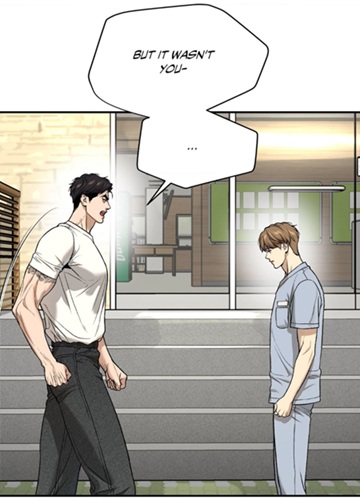 (chapter 62) Both avoid the emotional accountability that comes with their actions, preferring to distance themselves once a material obligation (debts)
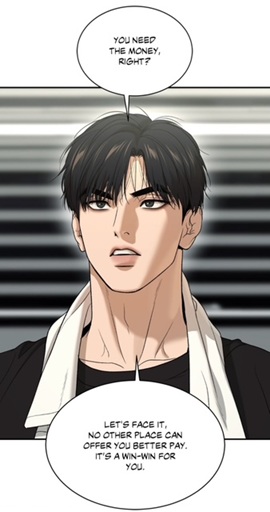 (chapter 60) is fulfilled. (chapter 65) which is merely a cover for her self-serving motives. This contrast highlights the theme of perception versus reality: both characters’ actions appear kind on the surface but conceal underlying self-interest or emotional avoidance. Yet, there is a difference between them. The champion had sacrificed his time for the doctor, he made sure to keep the elderly woman company so that Kim Dan could rest. Moreover, he had made her happy, that’s the reason why doc Dan was so grateful.
  (chapter 22)
In this sense, the halmoni serves as a mirror reflecting the champion’s own flaws back at him—his tendency to equate care with material support and his discomfort with emotional intimacy. The paradox here is that while Joo Jaekyung might see the halmoni’s behavior as genuine concern, it is actually a reflection of his own transactional approach to relationships. Recognizing this mirror might be a crucial part of his redemption arc, forcing him to confront the superficiality of his past actions and understand the difference between real care and transactional gestures. However, it is relevant to recall that the star’s past behavior was nurtured by his own surroundings. MFC and the members from Team Black also treated him as a tool for success and money.
So, the mirroring aspect adds a deeper layer to the conflict between civilization (control and superficial care) and nature (authentic emotions and freedom), reinforcing the idea that Joo Jaekyung must break away from this mindset, if he is to truly connect with Kim Dan.
One might think that they are both shallow and selfish. Yet, there exists a huge difference between them. Joo Jaekyung embodies action and he is now embracing changes. Thus he is willing to do anything to improve their relationship, whereas the grandmother is just waiting at the hospice for the “right time” and the “right person”. She is just reacting to an uncomfortable situation than becoming proactive like the champion. She sees the decline of her grandson’s health, but she is reducing it to insomnia which can be treated with pills and a stay at an expensive hospital. (chapter 65) She is not mentioning his loss of weight on the beach contrary to her comment at the hospice. (chapter 57) This displays that she is not entirely honest. She is not reaching out to Kim Dan in the end. Her excuse is that he refused to see a doctor(chapter 65), but so far we never saw her making such a suggestion. It is possible that she jumped to this conclusion because she heard about this incident:  (chapter 60) If my assumption is correct, the woman didn’t realize that this rejection was linked to Joo Jaekyung’s intervention. So if she had talked to her grandchild himself, she could have had an impact… But they are actually avoiding each other. One thing is sure: the absence of communication and avoidance between these two family members reinforced the doctor’s suffering. Imagine the consequences of her request: she is preferring locking him up in a hospital receiving drugs than giving what doc Dan has been longing: warmth, love and a home.
Another contradiction is that while she praised the “little town” in the beginning, she was looking down at this place, when she said: (chapter 65) It was, as if she was insulting the hospice where she is staying and as such the staff (which included Kim Dan).
The problem is that the grandmother has long forgotten this day, (chapter 65) where both were happily smiling. The picture is the evidence that she could make Kim Dan smile despite their poverty. Moreover, it is important to recall that she introduced Kim Dan as an orphan from birth: (chapter 65) According to my hypothesis, this image (chapter 19) is linked to the doctor’s abandonment and betrayal. I have to admit that her attitude and words reminded me a lot of the director Choi Gilseok’s offer.  (chapter 48). Both the halmoni and Choi Gilseok embody betrayal and the theme of acting behind the back
  (chapter 48), weaving a web of deception under the guise of care and concern. The halmoni’s betrayal is subtle but profound—she presents herself as a self-sacrificing guardian, but her true motives are revealed through her willingness to entrust Kim Dan to Joo Jaekyung without genuinely considering his well-being. Her criticisms of Kim Dan’s habits, her attempts to send him back to Seoul, and her selective truths paint a picture of a woman more interested in relieving herself of a burden than providing real support. Her actions behind Kim Dan’s back—discussing him negatively with Joo Jaekyung—further emphasize her betrayal, showing a willingness to manipulate perceptions for her own convenience.
Similarly, Choi Gilseok’s offers of lodging, financial help  (chapter 48) and superior medical care
  (chapter 48) mask a deeper betrayal. His real aim was never to assist but to control, using offers of support as bait to tie Kim Dan into a powerless position. The parallel between his proposition to Kim Dan—promising a better life in exchange for leaking information and compliance—and the halmoni’s push for Seoul’s hospitals underlines their shared strategy: make the target believe they have a choice, while the outcome is already decided. The fact that Heo Manwook, who collects Kim Dan’s debts, called Choi Gilseok “hyung” further hints at a deeper conspiracy, suggesting that the offer might have been a tool to ensnare Kim Dan from the start. He would have committed a crime (illegal drugs).
Both characters act behind the scenes, manipulating others to achieve their goals while maintaining an outward appearance of concern. This duplicity can only deepen the sense of betrayal felt by Kim Dan, whose struggle for freedom becomes not just a battle against overt control but also against the subtle, insidious influence of those who pretend to care. Moreover, she broke her promise, but chose to walk to the ocean with the star. It was, as if the grandmother had been ashamed of her own grandson. The halmoni’s and Choi Gilseok’s actions reveal the painful truth that sometimes, the worst betrayals come from those who claim to love and protect. I made this connection for another reason. The director of the gym is actually the one behind the debts and loan. I doubt that Shin Okja would have trusted Heo Manwook for example. It is important, because the loan is the reason why the champion became a target of schemes. But since the doctor refused to abandon his lover, I am convinced that the champion won’t follow Shin Okja’s suggestion.
Moreover, contrary to the grandmother, the star wants the doctor to agree on his own accord. (chapter 62) That’s the reason why he was seeking the grandmother’s support. He was hoping that she could influence him. But what he hears, shocks him: (chapter 65) She desires the same as him, but she is in the same position than him. She is powerless in front of the doctor’s will. It looks like this walk to the ocean was pointless for the champion. However, it is not true, as the athlete got to see a glimpse of the verity in front of the ocean. He is surprised by this request, because unconsciously he senses it as a “betrayal” and “abandonment”. And keep in mind that the ocean represents freedom, the unconscious mind, emotions, death, and the unknown. The wolf was encouraged to perceive the falsehood of his past believes. Moreover, he was incited to question his own past behavior.
Striking is the way both were placed on the beach. (chapter 65) Though they are next to each other, they are not sitting together. The wheelchair represents the invisible barrier between them. This scene contrasts with the conversation in the penthouse. And what had the athlete done during that night? He had not only shared his thoughts and issues to doc Dan, but he had asked for his wish and opinion.  (chapter 29) He had even advised to think of himself first. As you can see, the fact that the two characters were just sitting next to each other reinforces my previous interpretation about the conversation. The grandmother was the one who had been leading the conversation, there is no real exchange of thoughts. In episode 29, the champion refused to accept the doctor’s help and suggestion. That’s the reason why I am more than ever convinced that the star won’t listen to the grandmother.
In other words, she was acting like in the past. How so? (chapter 53) She was asking for a favor again, but this time, she was begging for someone else’s generosity. No wonder why she said that she was still the same! (chapter 65) 😉 And what is her MO? She uses pity and vulnerability to her advantage. Since she is so old and weak, she can not do much for her grandson. In other words, she is showing to the celebrity that vulnerability can be a source of strength, that’s how she could turn her grandson into an obedient puppy. However, this can only work, as long as the “target” is listening to his heart and has not developed his own identity and strength. The wheelchair is the symbol for her powerlessness and passivity. Hence she needs the involvement of a third person. The twist is that her wheelchair is the evidence of her dishonesty. How so? She could go to the beach (chapter 53) and watch the ocean with her grandson (chapter 53), but they never did it. Why? One might respond that she refused to do it. 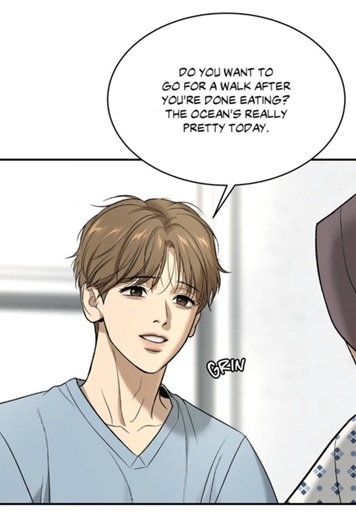 (chapter 57) But it is only partially correct. The doctor only suggested this walk to the ocean much later, when he was already suffering emotionally. This means that the grandmother would have not been able to enjoy this walk. Yes, the timing played a huge role. In fact, she confessed her crime to the star: (chapter 53) She never had any intention to spend some time with him. Notice the personal pronoun “we” vanished. It is only about her request: “I wanted to see the ocean”. This means that at the hospital, she never had any intention to keep Kim Dan by her side. She employed the “with you, we” in order to achieve her goal. She acted, as if they were a family. She used her illness for her own advantage. In my opinion, her request was an excuse to avoid to return to the old broken home. For her, home is a place and not a person. Therefore she couldn’t love Kim Dan properly. Her “I’m so sorry” was actually fake. She had only thought of herself… She never thought of her grandson’s future at all. This observation corroborates my previous statement: she is unable to plan for the future. What only matters to her is the past or the present. Why? It is because she doesn’t want to be plagued by remorse or regrets. And now, she is doing it again with the champion. Using emotions and fragility for her own benefits. The paradox is that this is something Joo Jaekyung has always feared his whole life. Nonetheless, he doesn’t react so violently like in the past: rejection or outburst. One might say the reason is that she is weak and terminally ill.
 (chapter 65) However, I believe that her words reached the champion’s third eye. The latter was not focusing on the grandmother, but on his fated companion. He was trying to understand why he had changed. This question was already on his mind before: (chapter 62) And notice that the words from the grandmother (chapter 65) in front of the water reflects the champion’s intentions:
  (chapter 62) Once he has achieved his goal (reclaim his champion title), they will depart from each other. He would treat the doctor the same way than the grandmother! No wonder why doc Dan is getting angry and rejecting the offers from his destined partner. IT is only about his own selfish desires and not about doc Dan’s future and desires. Both have a similar mind-set: they don’t know what doc Dan plans to do with his life and the future…. And it shows that Joo Jaekyung was imitating the grandmother, though this suggestion was born from the following thought. Since Doc Dan was no reluctant to work for him, he imagined that maybe he would still accept to work for him for a limited time. But that’s not what Kim Dan is looking. He is longing for a home and at the same time for freedom.
On the other hand, though Shin Okja tried to use the same MO with the celebrity, it is clear that she is destined to fail. Let’s not forget that his private conversation took place outside, in front of the ocean, and the latter represents reflection and unconscious. Hence Joo Jaekyung voiced his hesitation constantly: (chapter 65)  (chapter 65) The points of suspension are indicating that he is meditating on her words and suggestions. This stands in opposition to his past behavior where he got manipulated so easily. (chapter 36) The reason for this huge metamorphosis is that because of the lavender-tinted night, he learned to control his emotions.
 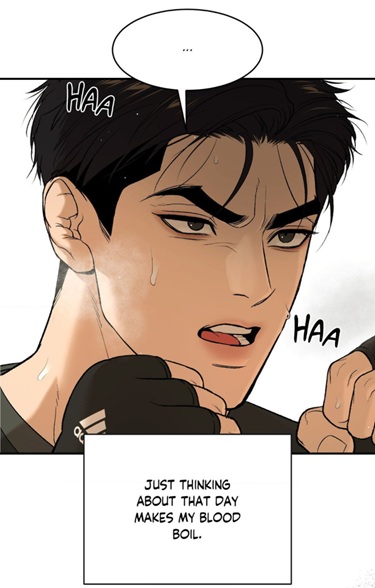 (chapter 65) He was forced to admit that he needed the “hamster”. He knew that if he reacted on these negative emotions, doc Dan would have another reason to put the blame on him. Consequently, his goal would be much further away. Secondly, though the conversation was private, their encounter was far from secretive. Both were visible, as it took place during the day. This means that the grandmother’s words in front of the ocean symbolize that they are in the open. (chapter 65) So they should reach the doctor’s ears. And this observation leads me to my next connection, the grandmother’s deceptions.
What caught my attention is this image combined with the grandmother’s claim (chapter 65) According to her, Kim Dan has never introduced her to any of his friends. The celebrity would be the exception! But she is lying here. How so? Joo Jaekyung introduced himself to her on his own. It is because he answered a call from the nurse. 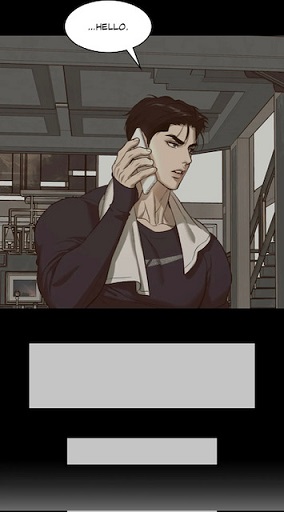 (chapter 21) It happened behind doc Dan’s back in the end. The latter was sick, but the old lady didn’t seem concerned. The second lie is this statement which is exposed with the memory: (chapter 65) The panel depicting the halmoni holding an infant Kim Dan offers a complex portrayal of her character—one that blends guilt, self-victimization, and manipulation. Her downcast eyes and the way she cradles the child suggest a mix of regret and weariness, but this expression lacks the warmth expected of a caring guardian. She is not smiling, only feeling pity for the “poor child”. Instead, the scene gives off a performative air, as if she is convincing herself (and, by extension, Joo Jaekyung) that she was indeed a dedicated guardian who did her best. The dark, muted background only deepens this impression, isolating her and the child in a way that hints at unresolved guilt and a lack of genuine affection.
Her words, “I tried my best to raise him, but it was never enough,” carry a double meaning. On one hand, they paint her as a martyr who struggled valiantly despite overwhelming odds. On the other, they imply a subtle judgment of Kim Dan, as if his troubles were a reflection of his own failings (greed) rather than a result of her negligence. The emphasis on “never enough” shifts the focus from Kim Dan’s suffering to her own perceived sacrifices, turning the conversation away from her shortcomings and towards her self-proclaimed burden. This choice of words aligns with her tendency to externalize blame, presenting herself as a victim of circumstances rather than acknowledging her role in Kim Dan’s suffering.
The portrayal of Kim Dan as an infant rather than as the grown man he is now exposes a deeper layer of control. By framing the memory this way, the halmoni preserves her position as the ultimate decision-maker in his life, reinforcing the notion that he is incapable of making his own choices. This imagery ties directly into the theme of Peter Pan Syndrome—the idea that Kim Dan, in her eyes, is perpetually a child who must be protected and guided, even if this means denying him the agency to confront his past and shape his own future. However, this is just a projection of herself. This infantilization serves her interests by keeping him emotionally dependent and by masking her own failings as a guardian.
Moreover, the halmoni’s repeated use of the word “never” (chapter 65) (chapter 65) (chapter 65) is not a mere slip of the tongue but a deliberate linguistic tool to control the narrative. In this context, “never enough” serves a dual purpose: it downplays her own responsibility while subtly casting Kim Dan as a source of endless trouble and dissatisfaction. This manipulation of language highlights a broader pattern in her behavior—her use of selective truths to paint herself as a victim of fate, rather than a participant in the decisions that led to Kim Dan’s suffering. Her words echo the myth she has carefully constructed of herself as the sacrificing grandmother who did everything she could, even as the dark atmosphere of the panel suggests otherwise.
The dark background, devoid of warmth or light, not only isolates the halmoni and Kim Dan but also symbolizes her repressed guilt and closed-off perspective. By presenting herself as the victim of an ungrateful or inherently troubled child (chapter 65), she avoids confronting the real roots of Kim Dan’s suffering—such as the bullying, the debts, and the truth about his parents. For her, it would have been better if he had been raised by his parents. This is what she implied: she could never replace them. (chapter 65) It is important because it exposes her traditional mind-set overlooking that certain parents are unfit guardians. Secondly, with her own words, she legitimated the kids’ bullying. This explicates why she didn’t intervene in the end. What I had interpreted in the past was confirmed in this episode. She represents civilization and as such social norms. Therefore she is a representative of herd mentality. She accepted the kids’ bullying as truth which led to Kim Dan’s isolation. And now, you comprehend why she is not mentioning the harassment from the past. (chapter 65) Here, note that the little boy is wearing the same clothes than in the doctor’s nightmare. 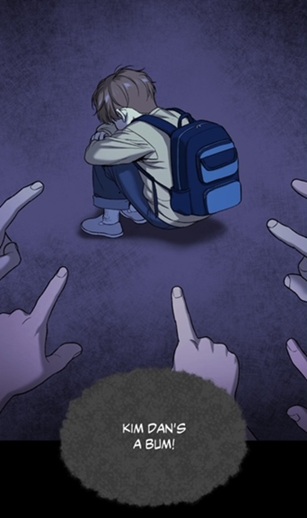 (chapter 57) She claims her ignorance why the little boy acted like an adult at such a young age. The reality is that she hasn’t forgotten the incident at all. This explicates why she confessed this to the “wolf”: (chapter 65) And who is to blame for her seclusion? Kim Dan who refused to introduce her to his friends. The irony is that Kim Dan mentioned her to the actor Choi Heesung, (chapter 30) a sign that she was never a source of embarrassment for him. (chapter 65) The truth is that she wanted him to mature quickly so that he could take her burden. (chapter 47) Her refusal to address these deeper issues reveals that her sacrifices were less about genuine care and more about maintaining her self-image as a righteous guardian. (chapter 65) The absence of any visible light or open space in the panel reinforces the idea that her perspective is narrow, unwilling to confront the broader context of Kim Dan’s pain and isolation.
In essence, this panel illustrates how the halmoni’s portrayal of herself as a sacrificing guardian is a carefully crafted narrative. Her use of language, the infantilization of Kim Dan, and the dark visual elements all work together to expose the underlying hypocrisy of her actions. She is not seeing Kim Dan as a man in the end (“sweet boy”). By framing herself as a victim of circumstances, she manages to absolve herself of guilt while keeping Kim Dan emotionally trapped in a narrative of helplessness and dependency. Far from being a scene of genuine regret or love, this moment reveals the true nature of her sacrifices—self-serving acts designed to control the narrative and shift the blame away from her own failures. That’s the reason why she is not bringing up the debts either. Under this light, you comprehend why she portrays Kim Dan in such a negative light: he is a drinker and smoker. (chapter 65) It is because of his personality: he was an orphan and had no real parents to guide him properly. Hence he didn’t listen to her nagging. The irony is that readers never saw her showing concerns about his drinking or smoking habits before. For me, it exposes her passivity and accountability. And what is her MO? She uses the past to justify her request. But the past is no longer valid, for the doctor has grown up. He is no longer smoking for example. She can only use the past, because she stopped living with him. Hence she has no idea how and where he is living right now. She is overlooking that she could have done something: refuse to let him carry the bags or take his hand (chapter 65), talk to him properly and listen to him. But she did not, she used food as a diversion. Walk silently by his side… Like expressed before, this senior stands for secrecy, shame and taboo.
As long as Kim Dan was working and paying off the debts, everything was fine. But now, she is noticing that he is showing signs of illness, but she doesn’t want to feel accountable for that. But there is more to it. In my eyes, Shin Okja never trusted the main lead. It is because of her own lies. She had told him, if he kept working, he would be able to pay off the debts. (chapter 18) What caught my attention in her revelation is her lack of enthusiasm for her own grandson.  (chapter 65) “Is he that good?” exposes a lack of faith in her grandchild, a remark which caught the athlete by surprise. For me, he unconsciously sensed this negative aspect.
  (chapter 65) While this image is actually humorous, the grandmother’s words don’t match her body language. She is not showing any joy or smile. Therefore I comprehend why Kim Dan was so hurt by the champion’s behavior: (chapter 51), the absence of trust because of MONEY! She knew, he was drinking and smoking. Yet according to her, she couldn’t stop him, as she was powerless. He wouldn’t listen to her nagging. But here is the thing. She never asked him why he would act this way. Drinking and smoking were the only things he could allow himself as “fun and diversion”. In her long confession, she is diverting the attention from the causes for this rebellious behavior. Indirectly, she is portraying him as a stubborn boy who can not live on his own. In reality, she is just projecting her own desires and thoughts onto her grandson. For her, the city stands for wealth, fame, success and power. (chapter 65) I am suspecting that deep down, she wants him to shine for her own peace of mind. (chapter 41) Don’t forget that she has been living through him. But Seoul is related to Kim Dan’s suffering: the debts, sexual assault, violence from the loan sharks, the bullying, ,, his “failures” (prostitution, the switched spray), mockery and rejection. So he has nothing there that would draw him back to the city so far. On the other hand, her words imply that the doctor can not lead a good life here (chapter 65), as if there was nothing good in this place. So is this little town nice or not? She is looking down on that place, though she doesn’t realize it.
Since the grandmother is suffering from Peter Pan Syndrome, it becomes clear that she views Kim Dan as a lost boy. But she considers the athlete the same way: (chapter 65) Observe that she employed the expression “almost” here. This idiom is even recurrent in her vocabulary (chapter 65) and it is not anodyne. It symbolizes her conditional love and support. That’s why the athlete is almost a grandson. The paradox is that the champion embodies adulthood and as such Captain Hook. That’s why he was racing against time in season 1. Hence he is responsible for the grandmother’s deteriorating health, as the expensive treatment was more an experiment. But here is the thing. Notice what the young man is wearing. (chapter 65) The T-shirt that Joo Jaekyung wears, emblazoned with the words “Peek a Boo” in a spiral pattern, is far from a random detail. Its presence in the scene with the halmoni adds a layer of irony and serves as a visual metaphor for the nature of deception and hidden truths. The game Peek a Boo is typically associated with infants— a playful way for parents to teach children about object permanence, the idea that things continue to exist even when they are out of sight. However, in the context of this scene, it takes on a darker significance, highlighting how the halmoni manipulates what is seen and unseen to maintain control over Kim Dan’s life and, now, over Joo Jaekyung’s perception of the situation.
The spiral arrangement of “Peek a Boo” mirrors the cyclical nature of the grandmother’s manipulation tactics. Much like the game itself, where the face reappears only to disappear again, the halmoni presents selective truths, allowing glimpses of her vulnerability and supposed selflessness while concealing the deeper reality of her motives. This back-and-forth between what is shown (chapter 65) and what is hidden keeps Joo Jaekyung—and even Kim Dan—in a state of uncertainty and guilt, making it difficult for them to see through her facade. The spiral could also represent a descent into deeper layers of deceit and emotional entanglement, suggesting that the more Joo Jaekyung becomes involved, the harder it will be to hide the truth.
On a symbolic level, Peek a Boo ties directly to the halmoni’s treatment of Kim Dan. As a child, Kim Dan was deprived of a real parental figure who could engage with him honestly and lovingly. When he talked the first time, she didn’t reply or smile. His words were met with silence. That’s how he created a negative perception of himself. The halmoni’s refusal to play simple games like Peek a Boo—games that help children develop a sense of identity and emotional security—suggests that Kim Dan’s early emotional needs were systematically neglected. The memories are revealing her passivity and negative thoughts. This absence of genuine interaction is paralleled by her current behavior: her reluctance to openly discuss his past, the bullying, and the truth about his parents. By avoiding such confrontations, she has effectively kept Kim Dan in a state of perpetual insecurity and self-doubt, much like a child who has not yet grasped the concept of object permanence.
Moreover, the game Peek a Boo also involves a degree of deception—the face that disappears and reappears, creating a mix of surprise and relief. This aligns with how the halmoni reveals just enough of the truth to seem trustworthy, while keeping the more damaging parts hidden. Her feigned helplessness and the way she strategically reveals information to Joo Jaekyung—such as her portrayal of Kim Dan’s drinking and smoking habits—are part of a calculated act to elicit sympathy and compliance. By making Kim Dan appear troubled and unreliable, she diverts attention from her own failures as a guardian. Her trust is conditional: (chapter 65) She wants him to follow her request. So what will she do, if he refuses? Moreover, she doesn’t know that the athlete has already created connections with the local inhabitants. The landlord and neighbor has an interest to keep these two young men in that place: he feels less lonely. (chapter 61) Finally, it is important that the athlete never agreed to her “demand” or suggestion. (chapter 65)
Ironically, Joo Jaekyung’s naive acceptance of her words shows that he, too, is caught in this game of Peek a Boo. He believes that by getting through to the halmoni, he can reach Kim Dan’s true feelings, not realizing that the halmoni is using this access to manipulate both of them. The T-shirt becomes a bitter reminder of the gap between appearances and reality—how the champion’s straightforwardness is no match for the halmoni’s subtle control of the narrative.
In essence, the Peek a Boo T-shirt encapsulates the main themes of deception, control, and the struggle to see past appearances. It reflects how the halmoni’s manipulations are not merely a means of survival but a way to maintain her dominance over both Kim Dan and Joo Jaekyung. Just as in the game, the truth is never fully revealed—only glimpsed in fleeting moments, distorted and reshaped to serve her ends.
This selective blindness extends to her treatment of Kim Dan. She speaks of his smoking and drinking habits with a judgmental tone, implying that his actions are signs of moral failure rather than coping mechanisms for his trauma. Her refusal to address the bullying incident—a pivotal moment in Kim Dan’s life—is part of this broader pattern of denial. If she cannot acknowledge the cause of his suffering, she can continue to frame herself as the sacrificing guardian who did her best. This evasion is also evident in her avoidance of the ocean, a symbol of emotions, danger, and the freedom that she refuses to confront. That’s why her request is doomed to fail. But there is another reason why Shin Okja’s favor won’t be fulfilled. (chapter 65) It is because she doesn’t care about the champion’s mental and emotional well-being. By making such a request, she is pushing him to return to work and as such disregard his mental and emotional issues. Just like Kim Dan, the wolf needs vacancy and rest. He needs to enjoy the present and make good memories so that he can finally sleep properly. Nevertheless, I do see a small change in her, because for the first time, she asked for someone else’s help. Moreover, she is mentioning her death (chapter 65), a sign that she is gradually accepting her mortality. On the other hand, her statement “I’ll go, when my time comes” is linking walk with death, But here, she is not walking, she is using the wheelchair! This means that as long as she is not walking, she won’t die. It is her effort to push away the inevitable. She is giving the impression that she has control over her life, but deep down, she knows that she is powerless. Therefore I perceive her final words as a deception as well. But there’s more to it. The fact that she is expressing her fear that her grandson might die before her is exposing her fear of responsibility. I would even say, her words imply that she has already witnessed the suicidal tendencies of a person in the past (that would be the parent). That’s why she suggested to the owner of Team Black to send him to a huge hospital and drugs (confinement).
Feel free to comment. If you have any suggestion for topics or Manhwas, feel free to ask. If you enjoyed reading it, retweet it or push the button like. My Reddit-Instagram-Tumblr-Twitter account is: @bebebisous33. Thanks for reading and for the support, particularly, I would like to thank all the new followers and people recommending my blog.
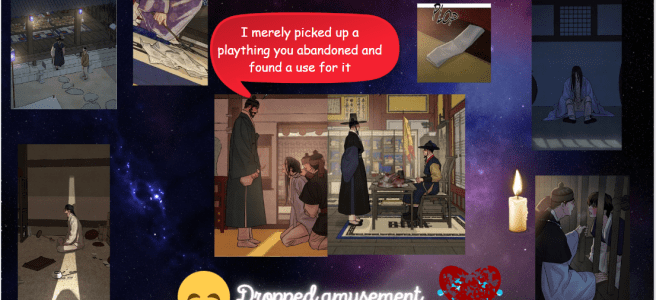
This is where you can read the manhwa. https://www.lezhinus.com/en/comic/painter But be aware that this manhwa is a mature Yaoi, which means, it is about homosexuality with explicit scenes. If you want to read more essays, here is the link to the table of contents: https://bebebisous33analyses.wordpress.com/2020/07/04/table-of-contents-painter-of-the-night/
It would be great if you could make some donations/sponsoring: Ko-fi.com/bebebisous33 That way, you can support me with “coffee” so that I have the energy to keep examining manhwas. Besides, I need to cover up the expenses for this blog.

I have to admit that when I read chapter 126 for the first time, I was disappointed. Why? It is because Yoon Seungho appeared so stupid and weak. He kept running from one place 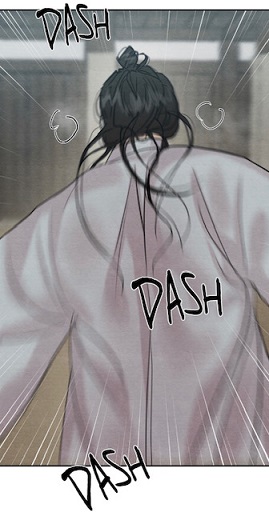 (chapter 126) to another
 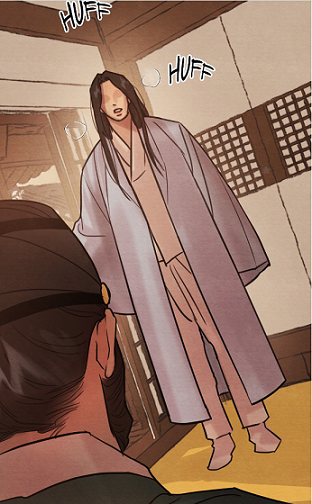 (chapter 126). He allowed his father to humiliate and abuse him
  (Chapter 126) once again. It was, as if the story was back to square one and the protagonist had learned nothing at all. Under this perception, my avid readers can comprehend why I selected such a title. However, instead of thinking that the author was a bad writer, I decided to ponder on the following question. Why did the author choose such an evolution?
First, since it is Baek Na-Kyum’s destiny to go through the same experiences than his loved one, I deduce that the main lead is now following Baek Na-Kyum’s path. In other words, they are switching their fate. This explicates why the lord is naïve, blinded by his love for the painter. Yes, Yoon Seungho is a fool in love too. 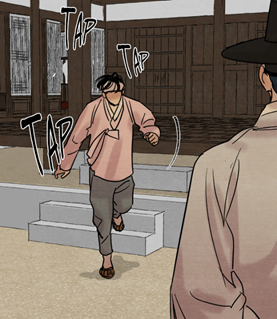 (chapter 7) Like Baek Na-Kyum, he rushed to his loved one’s side. However, he was first stopped
  (chapter 126), because it was not the right time. How so? Notice that his brother had fetched him at the port
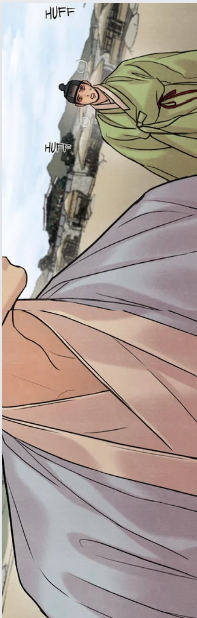 (chapter 125), but he never followed him to the bureau of investigation. And the same happened later. Why didn’t he go to his shed, when he was trapped there? Where was he, when the eldest son visited the father?
  (chapter 126) His absence exposed his passivity and betrayal. However, at no moment, Yoon Seungho noticed this. To conclude, Yoon Seungho was so worried for the painter that he didn’t pay attention to his surroundings, just like the painter didn’t see the learned sir’s disdain expressed through the cold gaze.
 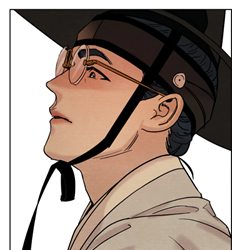 (chapter 07) Therefore Yoon Seungho didn’t notice the presence of a civilian next to the governor.
  (chapter 126). Striking is that the governor knew about Yoon Seungho’s whereabouts before his arrival: the coast. As you can see, I am detecting a link between the governor and the younger master Seungwon. Yet, it was disguised as a rumor behind the expression “I had heard”. My assumption is that Seungwon came from the bureau of investigation in order to inform his brother. Therefore it is not surprising that Seungho was invited by his brother to visit the prison during the night.
  (chapter 126) And the moment I perceived the protagonist as a fool in love, I realized that chapter 126 is a reflection of episode 7, 29
 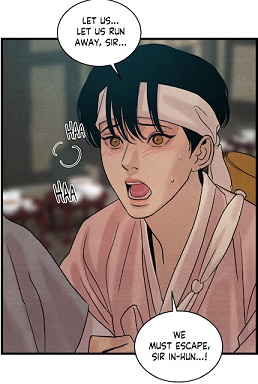 (chapter 29) and 40
  (chapter 40). Here, the painter was trying his best to protect Jung In-Hun’s interests (life, high position). Moreover, in episode 40, the painter had a dream, when he saw the announcement for the civil service examination. He smiled, for he was looking forward for the future.
 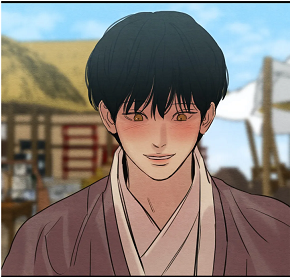 (chapter 40) And what have these episodes more in common? A betrayal, abandonment from a loved one and a paper (painting, poem). Hence I am more than ever convinced that the petition will resurface very soon and play a huge role in the downfall of the schemers and haters. Besides, chapter 40 represents the negative reflection of the conversation in the prison.
  (chapter 126) Though they are in a tough situation, Yoon Seungho is not leaving his side contrary to episode 40.
  (chapter 40) There is neither disdain nor mockery. The mentioned scenes are similar, for the present resembles the past. And this brings me to the second reason for the Webtoonist’s decision.
It is because Byeonduck is now mixing the past with the present indicating that the future will be different. Let me elaborate my thoughts more precisely through the relationship between the protagonist and his father. First, when the incident with the stolen kiss was reported,  (chapter 123), Yoon Chang-Hyeon considered Yoon Seungho as a human, for he employed the personal pronoun “he”. He was still his son. Then in episode 77, he judged him as a slave
  (chapter 77), hence he was submitted to the straw mat beating and was held captive. He even refused to send for a physician.
  (chapter 83) Here, the father is denying his humanity, he is just an animal. In their next confrontation, he describes him as a monster, hence he wished that he had never been born.
 (chapter 86) However, his words exposed that he was still viewing him as a living being. Therefore it is not surprising that he accepted lord Song’s request to order the murder of his son! In the gibang, he decided to no longer acknowledge Yoon Seungho as his son.
  (chapter 107) The tragedy is that the protagonist still viewed the Yoons as his family because of Yoon Seungwon, who keeps calling him “brother”. This explicates why Yoon Seungho sponsored his brother to have an official position.
  (chapter 115) Therefore it is not surprising that he followed Yoon Seungwon’s advice again.
  (chapter 120). He would bring the petition to his own father. This means that he is acting like the painter who listened to his noona Heena so well.
 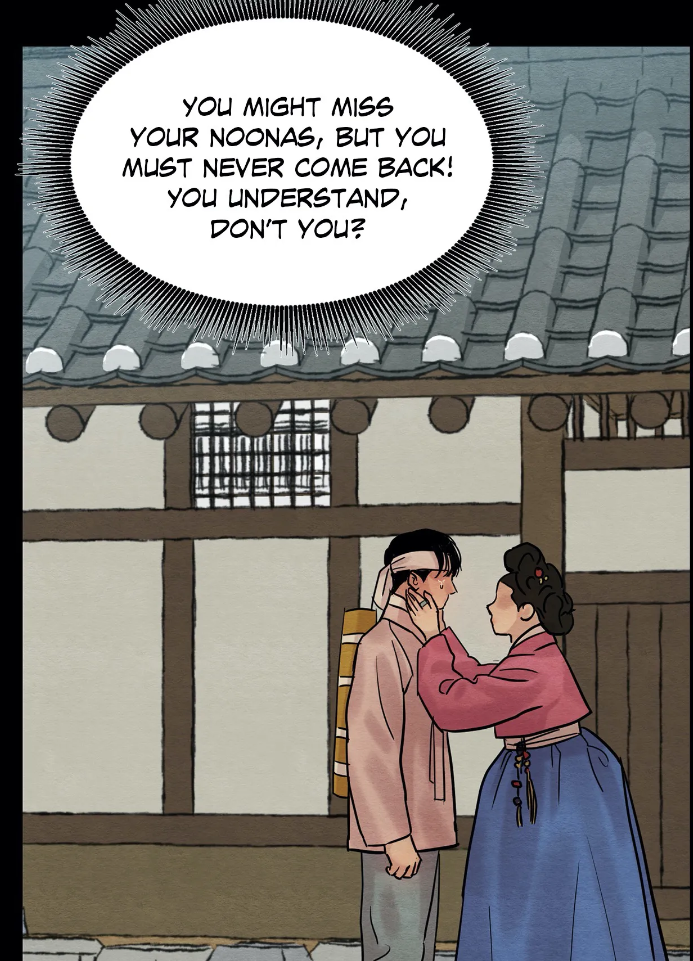 (chapter 46) But now, Yoon Chang-Hyeon believes to have the petition.
  (chapter 125) This explicates why the patriarch is now calling the main lead “nothing”.
  (chapter 126) He is not even a thing. This means that he is actually discarding him. This explicates why he sent him to the shed.
  (chapter 126) It was, as if he had become a merchandise. Or we could say that the elder master had been using him as a tool, which he can now abandon.
  (chapter 126) Interesting is that the idiom “plaything” has for antonyms tool, implement, instrument and utensil. And this brings me to the following remark. The father’s words are reflecting the last scheme. Yoon Seungho was used as the sword to get rid of an enemy, lord Song. It was, as if someone had decided to get rid of lord Song, for he represented a danger or threat. It also mirrors the trick in the shrine. Min and the others got killed, because Lee Jihwa went to his childhood friend. And who had seen the main lead using this sword, when he was enraged? Father Lee!
  (chapter 67) But let’s return our attention to the patriarch and his son. Yoon Seungho is no longer recognized as a Yoon member. Therefore I come to the conclusion that Yoon Seungho will make the following decision: to become an orphan. And this is symbolized by the loss of hair. I am expecting him to cut off his hair, something the painter has been doing for a long time. That’s why Byeonduck showed us the lord without a topknot.
  (chapter 126) This would coincide with my previous statement. The lord is going through the same experience than his loved one. However, people will come to the conclusion that this was done by the father. How so? Remember how each rumor became a reality.
  (chapter 1) I had already demonstrated that Yoon Seungho was not a fiend for sodomy with no regard for time and place, until he met Baek Na-Kyum. But once a deed is done, it can never be repeated.
  (chapter 101) So should Father Lee claim that he has long disowned Jihwa by cutting off his topknot, no one will believe him, for the young master was still seen with a topknot after confessing his feelings in public.
  (chapter 57) In other words, the topknot incident at the kisaeng would be brought up. It is impossible for 2 fathers to act the same way. Besides, the loss of the topknot has another signification: Yoon Seungho would cut off ties with valet Kim, for the latter was the one who gave him the topknot. And episode 126 reflected one more time his position:
  (chapter 126) He is the one dressing him. It was, as if he was the pope.
Because of my initial disappointment, I examined the chapter more closely. This sentence from the patriarch caught my attention (chapter 126) Why would he call Baek Na-Kyum a “plaything”, when before he viewed him as a servant?  (chapter 116) It is because someone had reported to him the conversation between lord Song and the painter.
  (chapter 122) There was a spy listening to their conversation. Since all the guards died
  (chapter 124)
  (chapter 125: I am assuming that the survivor got executed), I am suspecting the scholar. Moreover, why would Yoon Chang-Hyeon accuse his son to have abandoned Baek Na-Kyum? It is related to this departure of the staff and Yoon Seungho.
  (chapter 120) And who was present there? Jung In-Hun! But there is more to it. Since leaving Baek Na-Kyum behind is considered as an abandonment, it means that the patriarch abandoned his son too.
  (chapter 27) By speaking to Yoon Seungho, the elder master Yoon didn’t realize that he was admitting his own wrongdoings. Actually, he had abandoned him many times… like here for example
  (chapter 87) Therefore his words will come back to bite him. But these words are also exposing the valet’s betrayal and abandonment towards Yoon Seungho!! How so?
Where was he, when the protagonist was looking for Baek Na-Kyum? (chapter 125) Where was he, when the latter visited the patriarch’s home? Why did he only appear during the night? One might argue that he needed to wait the night in order not to be detected. But since Kim was supposed to be with Yoon Seungwon and the staff  (chapter 122), then he should have been at the patriarch’s house. The absence of the valet is the evidence of his treason. For me, he is now working for Jung In-Hun which explains why he never mentioned his presence in the mansion, only lord Song. Besides, keep in mind that once deed done can not be repeated. In episode 27, the lord was too angry and busy to notice the learned sir’s spying activities.
  (Chapter 27) Moreover, Kim didn’t report the interrogation to his master. This means that the butler covered up for the teacher’s wrongdoing. But here is the deal:
  (chapter 120) The library was ransacked, hence this crime is bound to be discovered. Finally, his intervention in the shed is exposing his deception. (chapter 126) He could do something in the past! He entered the shed, and even brought him clothes. This stands in opposition to this scene:
  (chapter 83) That’s why I am convinced that these words (chapter 126) are reflecting the butler’s actions. He treated Yoon Seungho like a tool which he could use. In verity, he could have helped his master in the past by telling the truth!
Because my theory is that the lord was the king’s male kisaeng, the noble could utilize this principle against the monarch. Since he always left him behind, he just treated him like a plaything and not like a loved one and allowed others to use him.
Finally, I believe that Byeonduck had another reason to turn the table so that Yoon Seungho would appear as powerless. It is to outline his desire to live.  (chapter 126) He is no longer suicidal, in fact he is full of hope! Though he was sent back to hell for a short moment, he came out of this as a winner. My evidence is that the lord has now become a believer.
  (chapter 126) Yes, episode 126 exposes the return of his faith! And where could we see the atheism of Yoon Seungho in the story? In chapter 92!
  (chapter 92) He didn’t believe in the spring poetry to ward off bad luck! That’s why he was sent back to the past. He needed to lose everything in order to find hope! In his darkest moment, he expressed a wish: to meet his loved one! And where did he pray to the gods? In the shed!
  (chapter 126) Observe how he is kneeling in direction of the bars. He is hoping to meet Baek Na-Kyum again. As you can see, though this scene (chapter 126) seems to be a repetition from the past, (chapter 83) it is not! The reality is that in episode 83, Yoon Seungho had lost all hope. This explains why he showed only resignation in front of his father. (chapter 83) However, the Painter Of The Night-philes certainly could observe how he had reacted, when he was put down by the guards.
  (chapter 126) He was showing resistance and anger towards his father. Moreover, he was no longer shaking in front of the patriarch or the guards.
  (chapter 86) Thus I deduce that though he was mistreated and insulted like in the past, he was no longer suffering from his traumas. He is healed. His will is now really strong, supported by his new found faith.
Under this new light, it becomes comprehensible why Yoon Seungho sent the painter to the shed after the so-called desertion!  (chapter 62) Even if they were hugging, they were not close emotionally and mentally. This stands in opposition to the scene in the jail. They might be separated by the bars, but they are touching each other tenderly.
  (chapter 126) They are able to see each other.
What to Do When You Feel You Are Losing Your Faith
Acknowledge and Accept What You Feel (…)
(chapter 126) Try Meditation
(chapter 126) or Prayer
Count Your Blessings
Talk It Out
Spend Time With Loved Ones
(chapter 126)
Consider Counseling
Take a Break
Take The Time to Reflect
(chapter 126) Quoted from https://www.verywellmind.com/losing-faith-definition-suggestions-and-take-away-5214137
As you can detect, Yoon Seungho did everything to revive his faith. He didn’t listen to his father’s words in the end. He chose love over hatred. He might be a sinner, but he is no longer self-destructive. But more importantly, he went to jail while carrying the light.  (chapter 126) It is relevant, because light represents knowledge and truth. He is now the bearer of the truth. And he got his blessing from Baek Na-Kyum, when he touched his hands.
  (chapter 126) Because he came with the candle, Kim had no reason to follow him. In other words, Yoon Seungho no longer needs the butler by his side. But why didn’t the domestic follow him to the prison cell? It is because he feared that if the painter were to see him, his memory could get triggered. The artist could ask him where he was, when the scholar came to the mansion?
  (chapter 120) Yes, chapter 126 mirrors 92! This somehow confirms my theory that the butler was the one hiding under the purple hanbok.
  (chapter 92) Moreover, we have another reference to this episode, the pouring of alcohol!
  (chapter 92)
  (chapter 126) It was, as if someone wanted the lord to pay for Min’s insult! That’s the reason why I come to the following conclusion: Yoon Seungho is now opening up to Baek Na-Kyum. He is confessing to the painter about his wishes. (chapter 126) Therefore I am suspecting that the lord will reveal his past to his loved one, something he never did before.
  (chapter 85) The manhwaphiles should keep in mind that the request from the artist in the study was strongly connected to forgiveness. And Baek Na-Kyum could also confess what happened in the past: his guilt and regret asking for the lord’s forgiveness. Right now, both are blaming themselves for the incidents, although they got fooled by many schemers. Because the lord proved his loyalty and blinded trust in the painter, I see the scene in the jail as a new version of this confession:
  (chapter 75) Thus I consider the prison cell as a sacred place, where both characters are about to be freed from their guilt! (chapter 126) That’s the reason why now I view the lord’s short torment as a necessity. His faith was and is tested through the trials which coincides with the upcoming trial. Through his love for the painter, he found support and strength. He is not resigned, though their situation looks terrible. He is now true to himself. This means that he chose to drop his life lie for good.
Life Lie : 1. the false conviction held by some individuals that their life plan is bound to fail due to other people or to circumstances beyond their control. This was postulated as a method of freeing oneself from personal responsibility. [defined by Alfred Adler]
2. any false belief around which an individual’s life is built. Quoted from https://dictionary.apa.org/life-lie
And what was his life lie? To be powerful… (chapter 11) thus he could escape justice!
  (Chapter 11) Simultaneously, the first definition of life lie corresponds to Yoon Chang-Hyeon. The latter blames his eldest son for the downfall of the Yoons.
  ! (Chapter 86) Secondly, he still thinks that he is powerful. But it is just an illusion. (Chapter 126) How so? The guards are able to manipulate him. He has become their puppet, for he follows their suggestions. Hence they make decisions on their own
 (chapter 125). They fail their duty, for they allowed the main lead to barge in the room.
  (Chapter 126) Finally, observe how they keep apologizing without giving any explication.
  (Chapter 125) Their apology is fake. As you can see, the patriarch is living in an allusion. He is powerless, and the best evidence is that he doesn’t have the petition. (Chapter 125) He took the paper full of blood, the evidence of his involvement. This means that in this scene, (chapter 126) the elder master Yoon chose to maintain his life lie. This explains why he blames Yoon Seungho one more time. And this coincides with his speech about hatred.
  (Chapter 126) He is actually encouraging his son to hate himself and indirectly his own father! However, the son made the exact opposite decision: love!! Hence I am more than certain that the elder master is about to experience a harsh awakening.
On the other hand, the Manhwa lovers can grasp why I selected the title “dropped amusement”. Faith is something serious which stands in opposition to the gangrape in the shrine. Here, the lords had made fun of the spirits and gods. (chapter 101) Thus they got punished. And now, the two main leads are about to face human justice.
  (chapter 65) But strangely, the painter is showing no fear at all.
  (chapter 126) He is ready to sacrifice himself. So why was Yoon Seungho dressed up in the end? One might say that with the topknot and the hanbok, the abuse from the patriarch got covered up. That way, Baek Na-Kyum wouldn’t detect Yoon Chang-Hyeon’s lies and abandonment!
 (chapter 125) The latter brainwashed him to take the fall for everything, implying that way, his loved one would be protected! However, I am suspecting that if the lord were to leave the prison, he could meet someone in the office. That way, this person is not confronted with the reality: the main lead was “abused”. According to the butler, he was supposed to meet his brother at the office. (chapter 126) If the noble encounters his brother there, then Seungwon would appear as hypocrite, for he would feign “ignorance”. He was not there, when he got insulted by their father. However, he could meet someone else.
  (Chapter 92) In episode 92, we have a mysterious man in the background dressed in black, but he is not wearing his gat. Besides, I would like my avid readers to remember this image from the trailer:
  which reminds us of the office:
  (chapter 98) This place symbolizes power and strength. And because episode 126 is a reflection of chapter 7, 11, 29 and 40, I think, Yoon Seungho is about to receive a deal, for these episodes are focusing on the deal between the painter and the protagonist: protection from the father and punishment in exchange for entertainment. He would appear as a fake savior in the end. Remember what in episode 11 the artist said in front of his fated partner:
 (chapter 11) He would do anything except painting!! He was not willing to give up on this principle, which reminds us of faith. So when Yoon Seungho faced his father, he experienced powerlessness for one reason. (Chapter 126) They wanted to corner him, to make him desperate so that he would look for a way to become powerful! Moreover, they desired him to resent his father more than before. To conclude, he was pressured on purpose. And this brings me to the following remark. Why did the father describe the painter as “Plaything”? It is to minimize Baek Na-Kyum’s value in the lord’s life. However, if this theory about a new deal comes true (pedophile rekindling with him), then I believe that exactly like in episode 11, the lord will choose to follow his conscience and integrity over power and torment. He will make the same decision than his partner which corresponds to a rejection. However, I don’t think that he would make it obvious. He could fake submission.
In fact, I have the impression that his memory could get triggered. What caught my attention is the absence of the pipe! According to me, the pedophile is a smoker, that’s how the main lead started smoking. But so far, the lord was not seen in connection with the pipe in season 4. This tool appeared on this drawing making fun of officials and the king (Chapter 105) Then in episode 122,
  we discover that lord Song employed the pipe to beat the painter. Moreover, I detected a progression. In season 2, Yoon Seungho was still smoking.
  (Chapter 74) But once the painter showed that he didn’t like smoking, Yoon Seungho stopped taking the drug. This explicates why in season 3, he was no longer seen with the item in his hand. Even under stress, he chose to hunt instead of smoking in front of the window. We have two scenes where the pipe is present. One is when the lord is throwing it out of anger,:
 (chapter 86) which reminded me of the incident with the music box.
 (Chapter 85) This shows that this item had no value to the protagonist. Then the pipe appeared in the gibang on the table.
  (Chapter 96) However, here the lord had only eyes for the painter or Heena. Hence I have the impression that the pipe could resurface and serve as an tool to identify the perpetrator, just like the glasses were used to recognize the scholar.
  (Chapter 102) Finally, since the pipe appeared in the gibang twice, it indicates that this hobby is linked to the kisaeng house!! And this brings me to my final observation: the pipe is connected to paper (chapter 121), just like in the erotic book of sodomy!
  (Chapter 1)
  (chapter 1) However, there exists two books!! And one has no PIPE! This coincides with the decision of the painter to stop drawing erotic pictures! Yes… dropped amusement! At the same time, Yoon Seungho has long lost his interest for erotic publications. He also dropped this hobby. On the other hand, the books were dropped in front of the painter.
  (Chapter 1) Finally, the petition was dropped in front of lord Song
 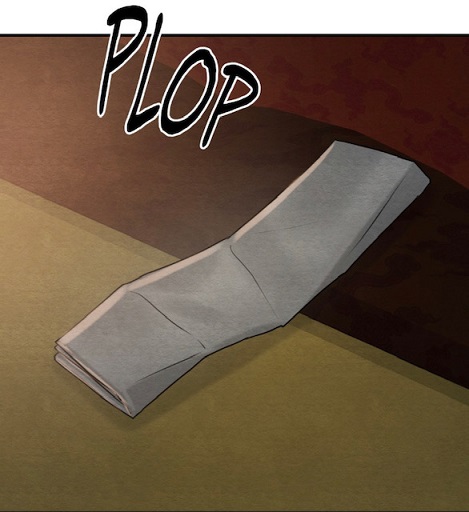 (chapter 123) which announced his death sentence. To conclude, the papers have a strong connection to punishment and death.
As you could see, Byeonduck had many reasons to create such a chapter in the end. We are definitely getting closer to the end. And before closing this essay, I would like to point out that the Yoons’ mansion had been left empty, yet neither his father nor his brother moved in!!  (Chapter 126) Yoon Seungho went to the father’s mansion, and it didn’t take him that long! As you can see, I consider this trip with Yoon Seungwon as a diversion.
 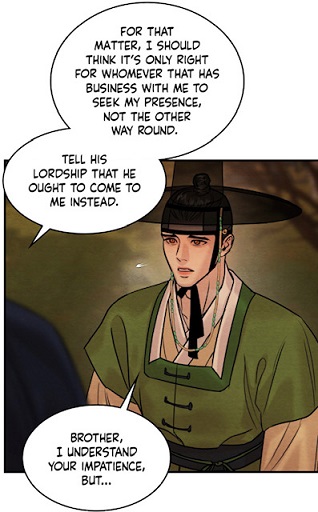 (Chapter 121) So why didn’t the elder master return to his old home? It is to drive the Yoons out of their propriety. In other words, the lies from the past are becoming a reality exposing the liars in the end. Their life lies will be ruined.
Feel free to comment. If you have any suggestion for topics or manhwas, feel free to ask. If you enjoyed reading it, retweet it or push the button like. My Reddit-Instagram-Tumblr-Twitter account is: @bebebisous33. Thanks for reading and for the support, particularly, I would like to thank all the new followers and people recommending my blog.
Please support the authors by reading the manhwas on the official websites. This is where you can read the manhwa. https://www.lezhinus.com/en/comic/painter But be aware that this manhwa is a mature Yaoi, which means, it is about homosexuality with explicit scenes. If you want to read more essays, here is the link to the table of contents: https://bebebisous33analyses.wordpress.com/2020/07/04/table-of-contents-painter-of-the-night
It would be great if you could make some donations/sponsoring: Ko-fi.com/bebebisous33 That way, you can support me with “coffee” so that I have the energy to keep examining manhwas. Besides, I need to cover up the expenses for this blog.
As you have already noticed, I am writing less about Painter Of The Night, though this manhwa remains my favorite story. The problem is that more and more people are moving away from the Korean webtoon for different reasons, like the absence of eroticism, or Lee Jihwa and No-Name are no longer included in the story. Another reason is that the author is focusing more and more on the mystery and as such on the lord’s past. This means that right now, the manhwaphiles are asked to read the manhwa like detectives looking for evidences and traces. Finally, I believe that the biggest reason for the loss of interest is that the manhwalovers hoped to witness more romance, yet Baek Na-Kyum keeps suffering and this partially because of Yoon Seungho’s “bad decisions”. Some readers couldn’t understand why Yoon Seungho would run after the man in the purple hanbok.  (chapter 106) How could he abandon his lover like that? For some readers, he acted like a fool. Nevertheless, his reaction was normal, because the man with the purple hanbok represents the cause for Yoon Seungho’s martyrdom. This means that the ghost with the purple hanbok symbolizes danger for the protagonist. And if he gets targeted, his lover will suffer too. Striking is that during the same day and night, there is another person wearing a purple hanbok: Yoon Seungho!
 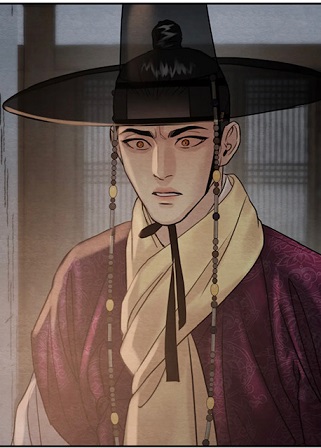 (chapter 107) Therefore it is no coincidence that in chapter 107, he was portrayed as a source of danger for the elder master Yoon and the mysterious “lord Song”.
  (chapter 107) According to “lord Song”, him and Yoon Chang-Hyeon were forced to renounce their position because of Yoon Seungho. In this image, the villain implies that the main lead is a blackmailer.
 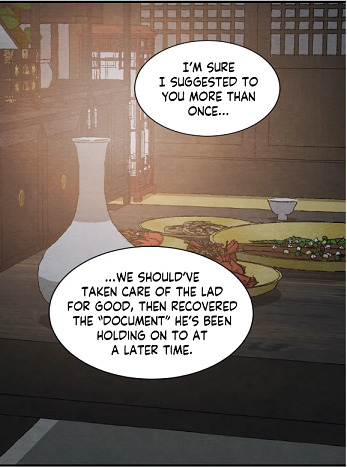 (chapter 107) In other words, in episode 107, the manhwalovers are witnessing a fight between 2 men wearing a purple hanbok!! In this story, purple is the symbol for violence and peril. This explicates why Byeonduck employed this color, when Yoon Seungho was portrayed as a ruthless lord:
  (chapter 10) Under this new approach, it becomes comprehensible why the artist was wearing a purple hanbok after the bloodbath.
 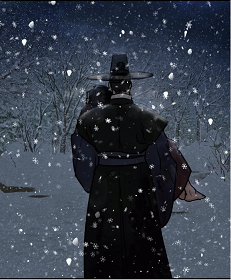 (chapter 102) He was the reason for the “purge”. From my perspective, the artist is cleaning the “place”, hence he is the target of the villains and antagonists. At the same time, this color represents Joseon’s royalty, hence it is no coincidence that the king was mentioned in this very episode.
  (chapter 107) Therefore my theory that Baek Na-Kyum is related to the ruler gets reinforced. However, in episode 107, only the main lead and the new villain were seen with the purple hanbok, therefore in this essay, I will examine not only the new character “lord Song”, but also Yoon Seungho!
In the latest episode, some manhwalovers were upset, when they saw Yoon Seungho turning his back on the painter.  (chapter 107) They had the impression that he was abandoning the artist one more time. And that’s how the painter felt the situation either! That’s the reason why Baek Na-Kyum was upset.
  (chapter 107) It was, as if the main lead was acting like the patriarch Yoon. This perception got reinforced, because the lord had a poker face and didn’t talk to his lover. (chapter 107) However, we could see before that the main lead was far from being detached, when it comes to Baek Na-Kyum. When he entered the study, his visage oozed shock and worries. (chapter 107) This truly divulges that the artist means everything to the lord! But there is more to it. I would like to point out that the noble did listen to Baek Na-Kyum who criticized the doctor’s diagnosis.
 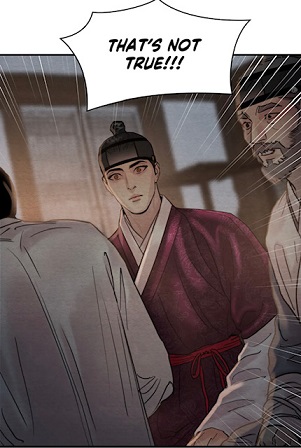 (chapter 107) Yoon Seungho didn’t side with the old bearded man in front of the painter. He thanked the man and sent away him with respect.
 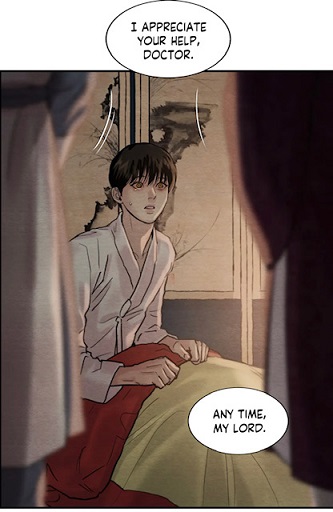 (chapter 107) So he gave the impression that he was listening to the painter. However, the reality was that at the end, he still listened to the doctor thinking that it was for the painter’s best interest. Since Baek Na-Kyum was traumatized from the sexual assault, the main lead thought that he was hiding his illness or he was in denial. What caught my attention is that Yoon Seungho followed the doctor leaving the artist in the bedchamber alone. On the one hand, this could be perceived as a prison, yet I judge his gesture as the opposite. It is to protect Baek Na-Kyum! In Yoon Seungho’s mind, behind the closed door, his lover won’t see or hear what is happening in the courtyard. He will be protected from cruel reality.
Since the main lead was very courteous towards the physician, it shows thatYoon Seungho valued the physician’s effort and talent. He trusted the man like his father did with the other physician. While Yoon Seungho appeared emotionless, the doctor had no poker face during his explanation, he was even caught smiling: 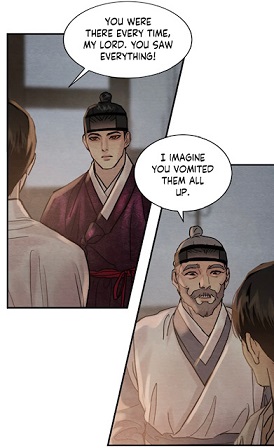 (chapter 107) He showed no real empathy for Baek Na-Kyum. It was, as if he was showing Schadenfreude. But this doesn’t end here. Kim brought a different doctor. It is not the same physician who assisted Baek Na-Kyum a month ago!!
 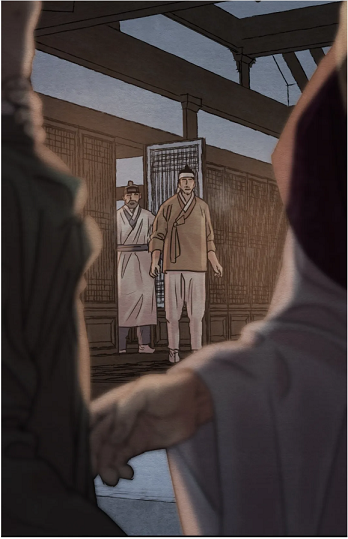 (chapter 107) First, the clothes diverge. The belt is blue, his sleeves are covered with some white protections.
  (chapter 107)
  (chapter 103) Finally, the white hanbok is much longer, and his pants are blue, while the other had white trousers. In my essay “The mysterious doctor”, I had already pointed out the existence of different physicians. But now, I have a definite proof for this interpretation.
  (chapter 107) How could he say that his health had deteriorated since a month ago? This is how the artist looked like a month ago:
 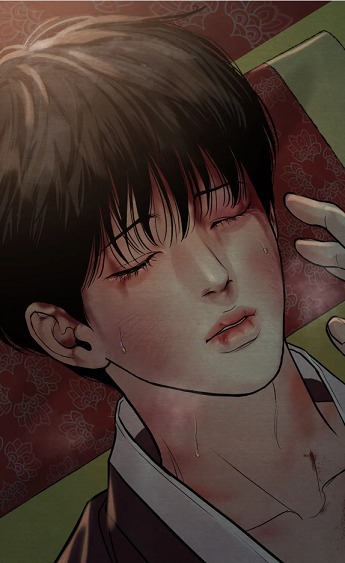 (chapter 103)
  (chapter 103) He was under the influence of the aphrodisiac, and he could have died of an overdose.
  (chapter 103) His face and his body were covered with bruises. How could the doctor say that his condition had worsened? This means that he had not seen the patient a month ago. To sum up, the doctor was impersonating his fellow. Note that he claimed to have prescribed the drug himself. (chapter 107) Striking is that the doctor is often utilizing the expression “seem” and “imagine”, yet a physician should use facts and as such symptoms. But he never did. The idioms exposed his manipulation, this was not a real examination. The author made sure to confuse the readers. They had seen the painter vomiting before, hence it looked that the physician was right.
  (chapter 106) However, this image displays the betrayal from the physician, for I believe that this represents his view The latter had seen the artist in the restroom, but he had not intervened!! Besides, just because the artist had disgorged once, this doesn’t signify that he had done it all the time for one month. This is how the artist looked like, while he was walking through the street:
 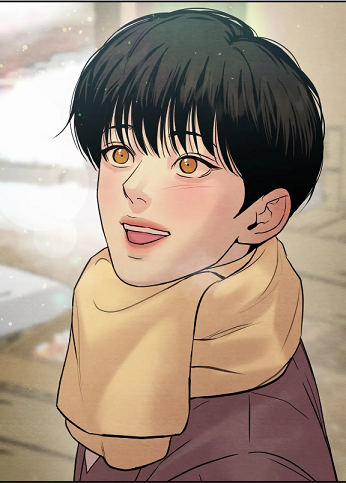 (chapter 104) He looked healthy and happy. The reason for his nervousness was the lord’s actions during that day. Moreover, the painter’s hand had been scratched… yet you see no bandage around his hand.
 (Chapter 107) As you can see, the doctor was exaggerating, as he was generalizing the regurgitation! (chapter 107) This means that the painter was telling the truth! To conclude, the physician was utilizing the butler’s MO: mixing a truth with a lie. And turning an incident into a generality, and as such into a prejudice.
Observe that during the same episode, Yoon Seungho had a sudden revelation, he had discovered that the form of the mouth was betraying the thoughts and emotions of the counterpart: 
 (chapter 107) Yoon Seungho was slowly realizing that his butler has not been telling the truth. He was gritting his teeth exposing his discomfort! This gesture indicates that someone has to endure something unpleasant, has to control himself and persevere. However, he was telling the opposite to his master: he had nothing to worry!! He should do nothing and simply lie low. The authorities had no suspicion about him. That’s the reason why the main lead desired to talk to the valet
 (chapter 107), and he got angry, for his servant was talking back and not answering him properly.
  (chapter 107) We could say that the latter was not obeying his lord. Striking is that the domestic was also lying, for he feigned ignorance first, before giving a more precise answer.
  (chapter 107) It looks like valet Kim and the physician got away with their tricks, for neither the doctor nor the the butler got admonished in the bedchamber. But what caught my attention is that after hearing the words from his lover, he replied that way:
  (chapter 107) This expression (“I see”) is important, because it could be the indication that the noble could discern the truth with his mind’s eye, like this
  (chapter 107) or the opposite, though I am still optimistic. We will see in the next chapter.
Nevertheless, after 3 seasons, the lord was taught that he should trust his lover. In season 4, he is hiding the truth from the painter, for he wished to spare his lover’s mind and heart. This has nothing to do with faith, but for Baek Na-Kyum it leaves a different impression. Yoon Seungho might have doubted his words here….  (chapter 106), but we shouldn’t overlook that later the painter had yelled in order to voice his opinion which had caught his companion by surprise. (chapter 107) Therefore I thought that the noble would believe Baek Na-Kyum, but in reality, the opposite happened. He acted exactly like his father, trusting the words from the doctor. Let’s not forget that Yoon Seungho was drugged since his youth because of Kim and the physician!!
  (chapter 57) The father was convinced that his son had been ill for a long time. And from the mysterious “lord Song”, the manhwalovers discovered that the main lead was fed with an aphrodisiac:
  (chapter 107)
  (chapter 57) Therefore the doctor’s statement in episode 57 appears in a different light: he knew what he was prescribing! He knew what Yoon Chang-Hyeon desired thanks to the idiom “the wayward yang energies”. It was to provoke an erection. I would like to expose that the physician deceived the painter,
  (chapter 57) for at the end, the physician admitted that he had given the “solution” to the father. The father had received the medicine!! [For more read the essay “Yoon Seungho and the puzzled physician”] That’s the reason why I am suspecting that the lord’s cold demeanor is not linked to the artist, rather to the physician who “smiled” 🙄 while accusing the painter of lying. (chapter 107) He was hiding his illness, he was in denial. Nonetheless, the form of his mouth was betraying him. Moreover, don’t forget what the painter had said to his lover before:
  (chapter 106) He was supposed to get a drink from the physician. So the lord could remember the artist’s words and perceive the doctor as a traitor and liar. He could jump to the conclusion that the man had given his lover a drug. Under this new light, it dawned on me that the artist could have been telling the truth to his lover there: (chapter 106) He could have eaten something at the kisaeng house, and as such been drugged there. This would explain why the couple got interrupted while eating.
 (chapter 106) That way, the “doctor” would not be suspected of a crime. Besides, according to me, the couple was actually sitting in the courtyard where the medicine store was!!
Finally, let’s not forget that the doctors often got threatened by Kim:  (chapter 33)
  (chapter 65) Furthermore, in season 1, the artist had been forced to drink an aphrodisiac. So far, the main lead has never threatened or suspected a doctor. As you can see, there is a strong connection between the doctor and death! To sum up, we are witnessing the start of the storm… and when the painter was recovering, this represented the calm before the storm!!
And now, it is important to explain why the main lead returned to the shaman’s shrine. He seemed to have forgotten his lover.  (chapter 107) It is related to the rumors he heard in the street.
  (chapter 106) The woman announced that the sacred tree had burned to the ground!! That’s the reason why it was gone… However, her words were just lies, for the tree is still standing there.
  (chapter 107) But note that she connected the incident to misfortune! In other words, she was denying the intervention of humans!! However, the lord had visited the place of his crime before.
  (chapter 104) This is what he had been told: the intervention of ghosts or spirits!! On the other hand, the unknown speaker had never mentioned the tree! Only the house had burned down. Nonetheless, even this statement was a lie, for the house was still standing too. (chapter 104) The anonymous tattler has been actually deforming the reality which Yoon Seungho had accepted as such back then!! But due to the grapevines, the lord noticed that he had been misinformed. There were differences between the declaration of the anonymous witness and the gossips which forced him to return to the scene of the crime. Because the tree was still standing, the lord recognized that he had been deceived: not only the tree was intact, but also the house despite the traces of a fire. That’s the reason why he looked in the direction of the building. (chapter 107) For the second time, he was using his own senses. This means that he was no longer relying on the informant’s eyes and ears! Nonetheless, this time, it is concerning his perception of his own surroundings, and no longer how to judge the artist. To conclude, he is now slowly using his own eyes and mind’s eye to perceive reality and as such the truth. For the house was not burned down, it implies that bodies were not turned into ashes.
  (chapter 106) Since the schemers are mixing a lie with the truth, the lord heard that lord Shin had been killed during that night! However, when the lord had assassinated Black Heart and his friends, the young noble had never met lord Shin! Hence the gossips in town made the lord recognize that something huge is about to happen: a manhunt, and he could get into trouble. Besides, the grapevines are revealing the existence of witnesses and the main lead is aware that the noona is an important « witness ». But the problem is that by mixing each time a lie with a fact, the schemers are not realizing that the truth is coming to the surface, as minus and minus make plus.
Striking is that the author never revealed the identity of the speaker (chapter 104) Why? It is to keep the mysterious vibe, to encourage the manhwalovers to ponder on the identity of the informant. One thing was sure, the lord was the listener due to the expression “I shudder to think”! Thus he didn’t use his mind’s eye in that scene. I am suspecting that the valet was the one who had informed his master. I have two reasons for suspecting him. First, this view is quite similar to this picture from chapter 50:  (chapter 50) Here, the butler had tattled on the painter so that the noble would distance himself from his sex partner. And in episode 104, we have a similar situation: through suggestions, the main lead was encouraged to send back the painter to the kisaeng house. Secondly, why would the lord think of the butler, when he saw the sacred tree? (chapter 107) It is because the valet is connected to this place. From my point of view, the noble discovered the truth: his father is involved in the plot, though Yoon Chang-Hyeon is just a tool to wound and weaken him. That’s the reason why he remembered his father’s mouth from that night: displeasure and hatred. (chapter 107) At the same time, I couldn’t help myself associating this image to this one:
  (chapter 88) During that night, he discovered warmth, loyalty and tenderness! In the darkness, the lord could detect the presence of the light: the painter! During that night, they vowed fidelity to each other. And in the garden next to the shrine, Yoon Seungho made the opposite experience: it was dawning on him that people from his own family, Kim and Yoon Chang-Hyeon,
 (chapter 88) are lying to him and even betraying him, especially if his life is threatened. Let’s not forget that this time, the lord did commit a crime and he is aware of this. In the bedchamber, the lord had criticized his own father, nonetheless he still thought that his father had just made a bad decision.
 (Chapter 86) His words implied that the elder master Yoon had never intended to wound him. It was just because of his stupid believes:
  (Chapter 82) Preserving the continuity of the lineage and ensuring that the Yoons remain powerful and wealthy. However, in front of the tree, the lord is slowly recognizing that his father is about to ruin him for his own sake.
That’s the reason why in the same chapter, the author put the elder master Yoon in the same situation, he is not using his own senses and as such his mind’s eye. Hence he is repeating the same mistake. He would still choose to trust lord Song and his black guards  (chapter 107), and abandon his own son. This (chapter 107) He listened to the reports of others. This signifies that he chose darkness over the truth. That’s the reason why his face is now covered by a shadow, he is turning his back on the light. (chapter 107) This image is the negative reflection from the night of the revelation in season 2. Despite the betrayal and agony,
  (chapter 62) the main lead chose not to punish his lover
 (chapter 63), he even swore that he would never let him go.
 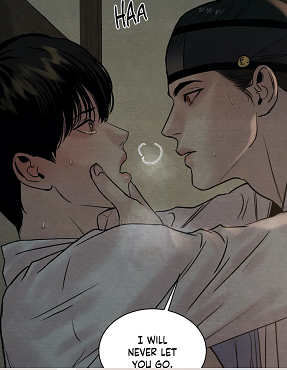 (chapter 63) As the manhwalovers can detect, the main lead was always able not to get swallowed by the darkness, thanks to the artist, he could still see the light. However, his father is making the opposite decision, unaware that he is “doomed” to fail! Karma is already waiting for him. And because the patriarch is now living in the darkness, he can not recognize the manipulations, as he is forced to use others to guide him.
This is particularly visible in episode 107. Yoon Chang-Hyeon never went to the shrine, thus he is unaware that there are traces to be found!! The house and the tree are not razed! Moreover,  (chapter 107) the branch on the ground is the evidence that someone set fire to the shaman’s shrine and the tree! Secondly, the black guard deceived the patriarch:
  (chapter 107) Lord Shin was murdered afterwards and not before Black Heart and his friend!! The word “later” is relevant, for it implies that the young yangban was killed close to the place where the nobles Min and his friends were sentenced. But his body is lying elsewhere!
 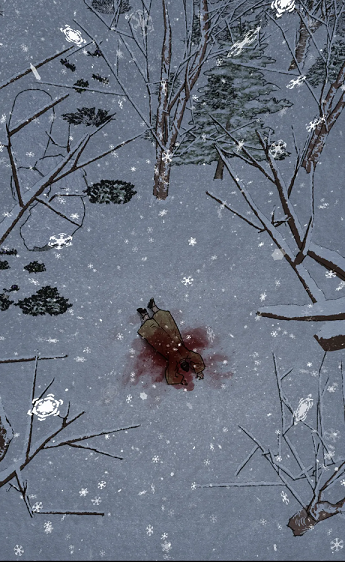 (chapter 103) This signifies that Yoon Chang-Hyeon is innocent! He never murdered Lord Shin in the woods, for he relied on the assistance of the helping hands. He never visited himself the scene of the crime.
  (chapter 103) At the same time, we can exclude that the black guard was the one killing the young scholar, for his pants are rather brown than grey. (chapter 107) Nevertheless, the helping hand is far from innocent, because he is deceiving the bearded man. And now take a closer look to the black guards from episode 99:
 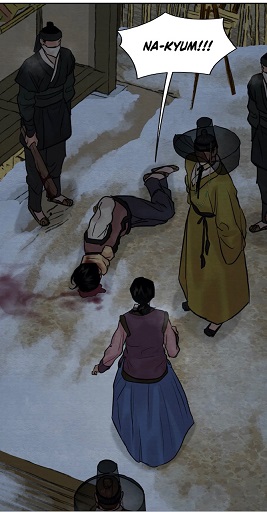 These two men are different, for their mask is white and not black. Besides, their clothes are black and not brown. Finally, the belt diverges as well: a huge purple strip with a different color in the middle, while the other guard is only wearing a simple ribbon. Thus I am inclined to think that the black guard is not only manipulating Yoon Chang-Hyeon, but he is also in truth working for someone else. Moreover, why would the man cover his face in the room, if he is truly working for the patriarch? (chapter 86) And this observation leads me to the following question: when was lord Yoon informed about the protagonist’s crime and lord Shin’s death? (chapter 107) As you can see, timing is essential. And how did the elder master Yoon know about lord Song’s visit at the gibang? Everything is pointing out that during this night, people are plotting against the couple. And the elder master Yoon took Lee Jihwa’s place.
But why would the schemers wait for a month before deciding to attack and frame Yoon Seungho? 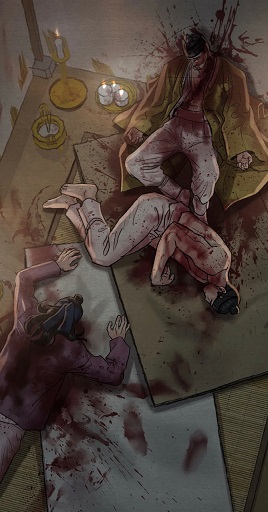 (chapter 102) From my point of view, it is related to Lee Jihwa. My theory is that the elder Lee can frame the main lead for assassinating his son, because during that night, Black Heart was dressed like Lee Jihwa. They needed the corpses to be decomposed so that father Lee could claim that Yoon Seungho had killed his son!! And the hanbok would serve to identify the corpse. In addition, he would use the incident with the sword as an evidence for his lunacy.
  (Chapter 67) It is important that the red-haired master is not perceived as traitor, rather as a victim. Moreover, since some time passed on, people have already forgotten the friend’s confession in the inn. However, the elder master Lee will never report Yoon Seungho to the authorities, it has to come from the father himself. That way, his involvement will never be detected. From my point of view, the schemers are trying to turn father and son against each other so that the Yoons get destructed. One might reject my theory about the implication of father Lee, but let me ask you this… What are “Lord Song”
  (chapter 107) and Lee Jihwa’s colors?
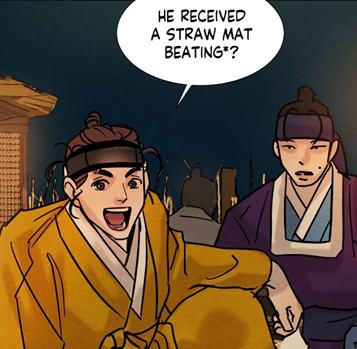 (chapter 12) Purple and yellow, right? Observe that the lord is wearing the same colors during that night: a purple hanbok with a yellow scarf! (chapter 107) This is no coincidence.
“Purple and yellow are complementary colors, which means they sit on opposite sides of the color wheel. Yellow and purple paint mixed together makes brown. The type of purple and yellow you choose can affect how light or dark the brown appears. The result is usually a lighter brown. ” Quoted from https://www.color-meanings.com/what-color-purple-yellow-make-mixed/
And what is the patriarch Lee’s color? BROWN! 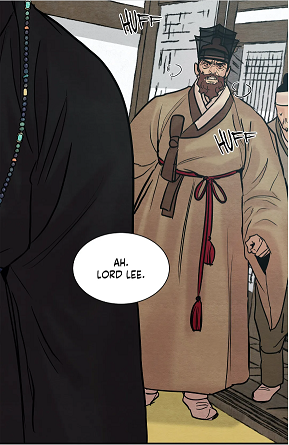 (chapter 67) Under this new perspective, it becomes comprehensible why I am suspecting that this guard (Chapter 107) is actually working for father Lee while faking to help Yoon Chang-Hyeon. He is wearing brown pants and his shirt is maintained with a purple ribbon! Besides, we need to question ourselves where the father is staying: And now, it is time to focus on the mysterious “lord Song”.
Finally, the author revealed the face of “lord Song”.  (chapter 107) Furthermore, he could be recognized with the purple hanbok.
  (chapter 107) However, if you compare the form of the beard and the nose, the manhwaphiles can quickly recognize that Lee Jihwa saw someone else in the past, although the hanbok seems to have the same pattern than in episode 83.
  (chapter 83) Besides, another divergence is that the faceless lord Song has a rebellious strand in the neck which is not the same with “lord Song” from episode 107. As you can see, I deduce that we are dealing with two different “lord Song”. But this doesn’t end here. Secondly, according to father Lee, the man lost his home!
  (chapter 82) So how can he be wearing a purple hanbok, if he lost his position and home? This color is reserved for important people. In addition, when he entered the kisaeng house, the artist’s noona called him differently:
 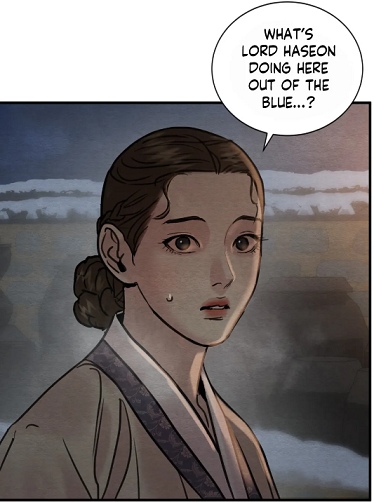 (chapter 107) She called him “lord Haseon” and not “lord Song”! Interesting is that neither the Korean nor the Spanish version utilizes such a name! I don’t think that the translator took the liberty to create a fictional name. Hence I am deducing that the author is trying to leave different clues in each version!! Naturally, Haseon could be his first name, yet there is no ambiguity that this man has a bad reputation among the kisaeng house. He was called “lecher” and in the Spanish version, he was described as sexual maniac.
 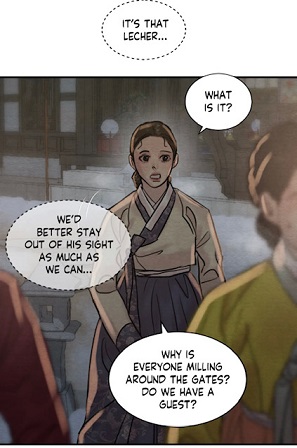 (chapter 107) Hence I doubt that the noona would feel so close to such a man and address him with his “first name”. On the other hand, the kisaeng has a drop of sweat on her face, which is a sign for a lie and deception. (Chapter 107) Nevertheless, here she was talking to herself. Thus I deduce that she was deceiving herself. But where did she lie? The important guest had announced his arrival, so his visit was never « Out of the blue…? » This explicates why many kisaengs were gathered next to the gate while waiting for the arrival of the « honorable » guest.
  (Chapter 107) This signifies that « lord Haseon » is true, while « out of the blue » is the lie.
Finally, let’s not forget that during the same day, we saw different “lord Song” strolling through the street!! According to me, 3 different enigmatic men wearing a purple hanbok. And now pay attention to this: 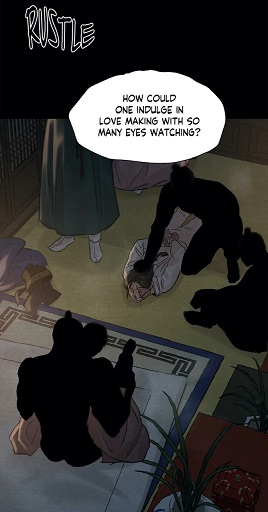 (chapter 86) We also have three men in this scene… For me, it becomes clear that the man facing Yoon Chang-Hyeon has been impersonating the real “lord Song”, and the stupid patriarch has never recognized the “prank”. Now, I am even questioning if Yoon Chang-Hyeon is even able to identify lord Song correctly!! I mean, due to the name and the color of the hanbok… he could be thinking that he is meeting lord Song again. Imagine that they have not seen each other for 10 years!!
  (chapter 107) Besides, Yoon Chang-Hyeon’s vision of the world is based on the words from lord Song and others. Who informed him about the whereabouts of « lord Song » in the gibang? The man had not come to the kisaeng house for a long time. Because of this information, the patriarch is led to think that he is meeting « lord Song ». His perception of the world and his eldest son is embossed by lord Song. Thus he repeats the same expression from his counterpart: “lowly beast”.
  (Chapter 107)
  (chapter 107) Finally, like outlined above, the main lead imagined that he was meeting the same doctor, while in truth it was not the case. So « old friend » could be deceiving:.
  (Chapter 107) He could be one of the three men! The real « lord Song » who brought pain to Yoon Seungho is someone else. Let’s not forget that Kim fears the man,
  (chapter 56) and his statement implies that Yoon Seungho is usually not allowed to ignore the man’s request:
 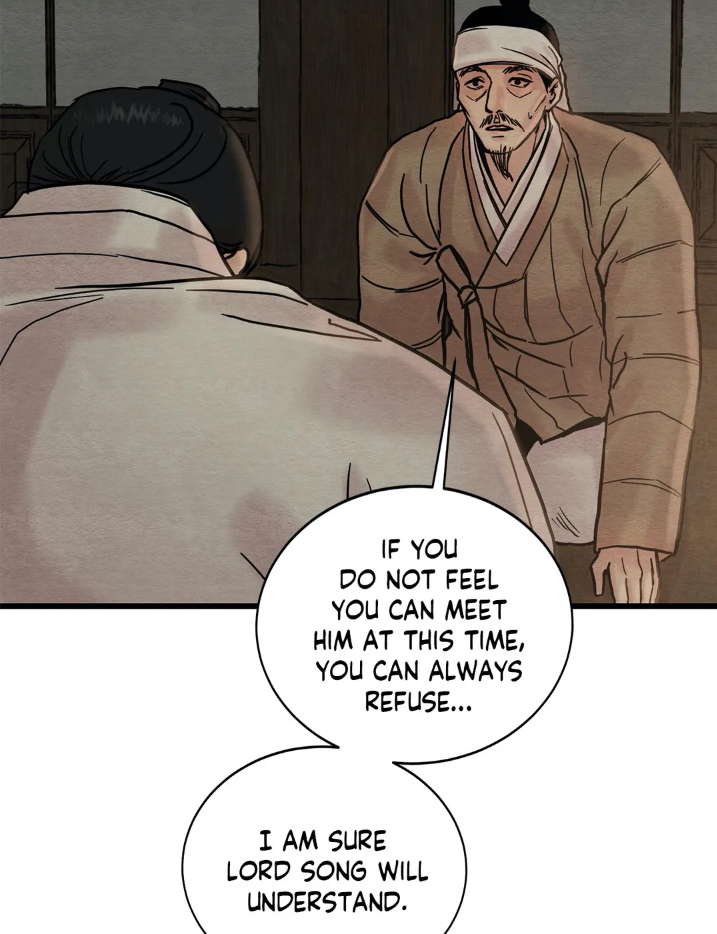 (Chapter 56). « At this time » stands in opposition to « always » which means that he can reject the invitation only because he is sick. To conclude, for me, this is not the lord Song Yoon Seungho hates and fears!
What caught my attention is that the mysterious and evil « lord Song » calls the young main lead « lowly beast » (chapter 107) which actually reflects the mind-set of the speaker. He is projecting his own thoughts and emotions onto the protagonist. In reality, he is the one licentious and we know that for sure, as the kisaengs are the witnesses of his perversion. Thus he is called « a lecher » and they wish to avoid him like the pest!  (Chapter 107) Moreover, he didn’t visit the kisaeng house for a long time, (Chapter 107) yet his recent short visits left such a negative impression on the noonas.
 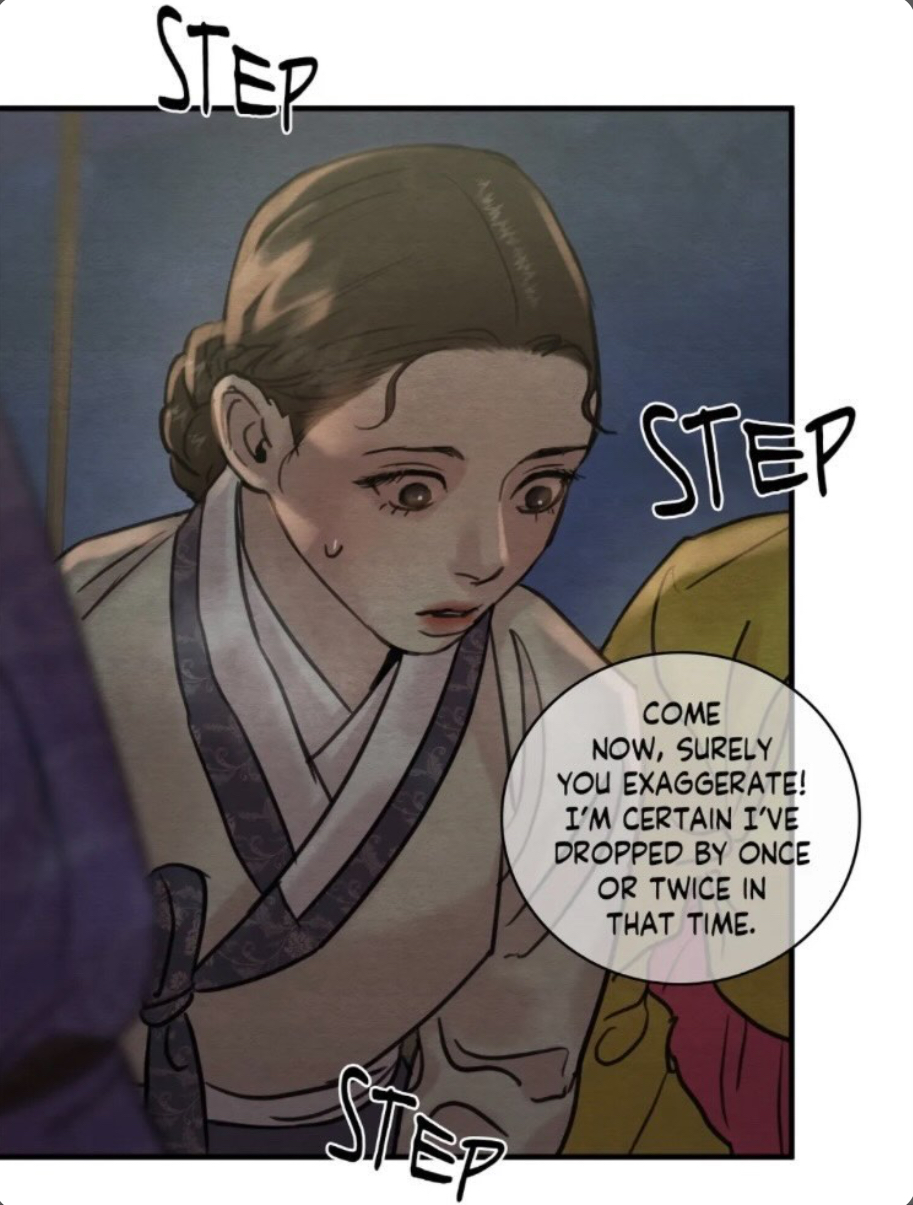 (Chapter 107) Hence they judge him as a pervert. And since the head-kisaeng received him at the gate, this signifies that this man has been in contact with the kisaeng house and in particular with the kisaeng leading him to the room.
The bearded man claims that he has been punished like the elder master Yoon (chapter 107), but note that his words are contradicting father Lee’s version! The former never mentions the loss of his home, in fact, only the elder master Yoon lost everything! (chapter 107) This statement confirms that the protagonist’s father is so stupid, because he is blinded by his hatred and resent. He is not detecting the contradictions. But we have another source confirming that this “lord Song” is actually fake!!  (chapter 37) The fake servant NEVER mentioned the retirement of lord Song. As you already know, for me, No-Name is the real lord Song who took the blame for everything, for he let people use his “name”. The most terrible thing is that “lord Song” puts the blame on Yoon Chang-Hyeon, when he explains his failure about the sexual education. (chapter 107) The main lead was too young back, and this was the father’s decision to let his son receive such a sexual education and even to feed him with some drug. Remember that the patriarch is the one who procured the aphrodisiac, for he followed the suggestion from others. As you can see, lord Song is putting the responsibility onto the elder master Yoon. At the same time, he insinuates that the lord’s fever back then was the result of the abuse of aphrodisiac. But is it true? Why am I doubting his words? First, the painter had become ill due to the sex marathon.
 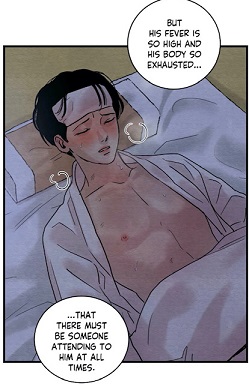 (Chapter 33) Secondly, how does the lord know about the master’s illness, when his fever was only discovered after the straw mat beating?
 (Chapter 77) Besides, no physician had been fetched back then. Finally, how can lord Song remember the lord’s condition so well after 10 years? It is because he is using the diagnosis on the painter from the previous doctor:
  (chapter 103) Here, the man with the purple hanbok was utilizing the painter’s illness to hide his own crime. Under the pretense to help « Yoon Seungho » to become a man, the man abused him not only physically, but also sexually. There is no doubt that this reconversion was fake!
And since his strategy worked in the past, he makes the same suggestion. He offers his assistance to educate his second son: 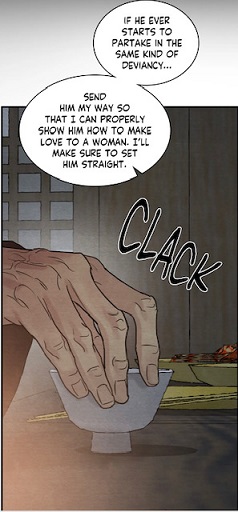 (chapter 107) However, the trick doesn’t work, exactly like No-Name’s prediction:
  (chapter 76) But there is another reason why Yoon Chang-Hyeon doesn’t get fooled a second time. (chapter 107) It is because he would be forced to question himself, if he is not the cause for this disposition: (chapter 107) That’s the reason why he puts the whole blame on his eldest son.
Furthermore, the manhwaphiles could detect that the « sexual education » didn’t last one night, but days! Compare the two following pictures: (Chapter 86)(chapter 107) In episode 86, there are two kisaengs and 3 men next to the main lead. I am excluding the father. The young master’s hands were tied with a white ribbon, and he still had his jacket on. However, in the second picture, the ties are now black and he is no longer in possession of his white jacket. How could they remove his shirt, when his hands were attached? This means that we are witnessing a different night. Striking is that it is raining, exactly like during the scene in episode 77.  (Chapter 77) Thus I come to the following deduction: Yoon Seungho was sentenced to the straw mat beating, because after 2 nights, he had not been able to « have an erection ». They mixed a truth with a lie: (chapter 107) They never let him have an erection, for he was always tied up!!
But what caught my attention is that the lecher (chapter 107) was sitting exactly like Min.  (chapter 52) And what had Black Heart thought during that night? He had wished to taste the artist, while before he had desired his death. This is not random at all. There is a strong connection between death and sex which is also present in the conversation between lord Song and his « old friend ». The former reproached the elder master Yoon to have protected his son for too long. (Chapter 107) Yet, the readers could witness that this was not the case, as the father had refused to send for a doctor, when Yoon Seungho had become ill. But who was protecting whom here? Naturally, Yoon Seungho is the one who has always helped his father. Note that despite being the real owner of the mansion, he never tried to dethrone his father. He still protected his father’s reputation.
  (Chapter 78)
Observe that the painter was supposed to be in the kisaeng house, if he had not detected his lover’s departure!  (chapter 107) Hence I am now assuming that this night is a reflection from chapter 67 and 69!! Min’s plan!
  (chapter 69) He had gone to the kisaeng house with the hope that the artist would return with his noona, and back then he had impersonated Lee Jihwa for the first time.
  (chapter 69) As the manhwalovers can detect, the sudden return of lord Haseon is intentional. So who is he targeting here? (Chapter 107) Here, the fake lord Song never named the protagonist specifically, he just employed the idiom « lad ». For me, the real schemers are after the painter, for the latter painted a picture which exposes the real lord Song’s crime: the sexual abuse. For me, the « document » is the erotic publication. Yet, the evil joker is gaslighting the patriarch by implying that he is now blackmailed by his own son. They need to remove the main lead in order to be able to target Baek Na-Kyum. Besides, I have already outlined that the artist is a witness and victim of Lee Jihwa’s crimes… just like he is a witness of the fake lord Song’s abuse. Thus the noona said this: (chapter 107) Her words indicate that these two characters know each other.
Note that the father is incited to kill his own son, for the latter represents a source of threat for his ambition. He could ruin Yoon Seungwon’s career. (Chapter 107) To conclude, the schemers are presenting the main lead as a hindrance to the patriarch’s dream. (chapter 107) Striking is that the man implied that Yoon Seungho would blackmail the father and lord Song because of a document. But this statement is wrong! The main lead never threatened his own father… First, he only reminded him of the past and the accusation for “treason”.  (chapter 86)
  (chapter 86) He was the keeper of his secret!! This explicates why the fake lord Song mentions « lad » and not the main lead. He gaslighted his counterpart, and created a false reality, while for me, it is clear that the real source of threat is Baek Na-Kyum. And who wanted him to be removed from the main lead’s side? Father Lee!
  (Chapter 82) In fact, both schemers have one goal in common: the couple is the victim and witness of their « crimes ».
To conclude, while Yoon Seungho stands for love, sanity, truth and reality, the other man with the purple hanbok symbolizes abuse, perversion, deception and illusions. Whereas the father is about to get deceived a second time, I believe that the opposite is happening to Yoon Seungho. Since the latter saw the ghost in town during that day, he can only deduce that « lord Song » is assisting his father again, exactly like in the past.
PS: I still have so much to tell, especially about the kisaengs and the abuse in the gibang. However, I can only write a new one, when this analysis reaches at least 100 views.
Feel free to comment. If you have any suggestion for topics or manhwas, feel free to ask. If you enjoyed reading it, retweet it or push the button like. My Reddit-Instagram-Tumblr-Twitter account is: @bebebisous33. Thanks for reading and for the support, particularly, I would like to thank all the new followers and people recommending my blog.

Please support the authors by reading the manhwas on the official websites. This is where you can read the manhwa. https://www.lezhinus.com/en/comic/painter But be aware that this manhwa is a mature Yaoi, which means, it is about homosexuality with explicit scenes. If you want to read more essays, here is the link to the table of contents: https://bebebisous33analyses.wordpress.com/2020/07/04/table-of-contents-painter-of-the-night I am also using doctor Frost as reference again. https://www.webtoons.com/en/mystery/dr-frost/list?title_no=371
It would be great if you could make some donations/sponsoring: Ko-fi.com/bebebisous33 That way, you can support me with “coffee” so that I have the energy to keep examining manhwas. Besides, I need to cover up the expenses for this blog.
Many manhwalovers were heartbroken, when they witness how the painter ran after Yoon Seungho in order to remain by his side. 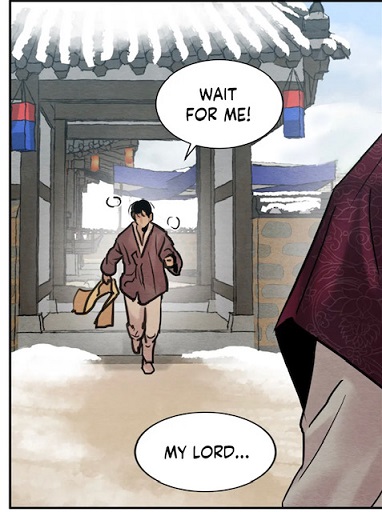 (chapter 105) Imagine that despite his rush, he was clear-minded enough to take the yellow scarf, a present that the noble had just bought him before. 😢 The item had more value than the mituri (shoes). Thus he was running in socks. His gesture displayed how much the lord means to the painter. He cherishes everything the lord does for him. At the same time, it indicates his heartache. He was so desperate and scared, for he felt that he was about to get abandoned one more time.
  (chapter 105) According to my follower @katamins, in the Korean version, this is what Baek Na-Kyum yells:
“My lord, let’s go together…you left me behind…let’s go toge-..“
One might argue that the meaning is the same, yet in the Korean version, the artist is emphasizing the “we” by employing the expressions “us” (let’s = let us) and “together”. He considers the lord as his family. Moreover, by repeating the same sentence,  (chapter 105) it works like a spell or a prayer. The artist is clinching onto this phrase hoping that the noble is remembering his promise. The irony is that the low-born was smiling like a fool, (chapter 105)
  (chapter 105) masking his anxieties and huge pain… out of fear that Yoon Seungho would still reject him. He acted, as if nothing had happened: he had not hurt his hand, and the lord had done nothing wrong. The smile became the symbol of his agony which reminds us of Yoon Seungho’s.
  (chapter 83)
As you can sense, this scene was a reflection from episode 85.  (chapter 85) This means that Baek Na-Kyum was put in the same situation than his lover who wished to keep the artist by his side, but feared to open up to him out of self-hatred and guilt. The painter could get burdened or horrified by his revelations. Hence the painter’s reaction at the end mirrors the yangban’s in the study. Both were or are pleading the partner to stay by their side,.
  (chapter 85)
  (chapter 105) Nevertheless, their behavior diverges so much. The aristocrat couldn’t raise his voice or become violent by using his hand, because he could scare the artist and as such break his previous promise. Finally, by destroying the music box, he had already witnessed that he had pushed his lover further away.
 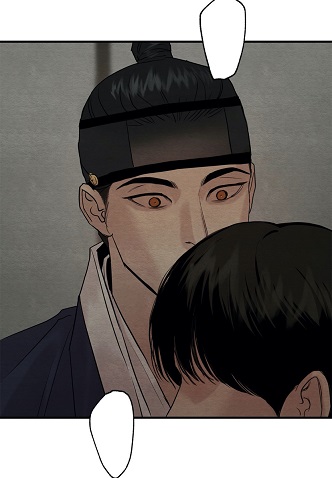 (chapter 85) At the same time, since he had been taught that no noble should lower himself in front of commoners, it is normal that he couldn’t beg Baek Na-Kyum on his knees. To sum up, the noble had to restrain himself extremely, his face and words were the only way to show his emotions and despair. And the artist sensed it, though the lord was not weeping. The proof is that when the father appeared, the artist changed his mind. He was no longer willing to leave, in fact he chose to look for his lover.
  (chapter 87) This shows that through communication, the lord had been able to affect the painter‘s mind and heart. On the other hand, we shouldn’t underestimate the lord’s flashback and Na-Kyum’s conversation with the butler which played a huge part in the artist‘s decision to vow loyalty to Yoon Seungho despite the secret.
And this is the same with the painter. The first visible difference is that the artist leashed out his anger mixed with agony, thus he started punching his partner. 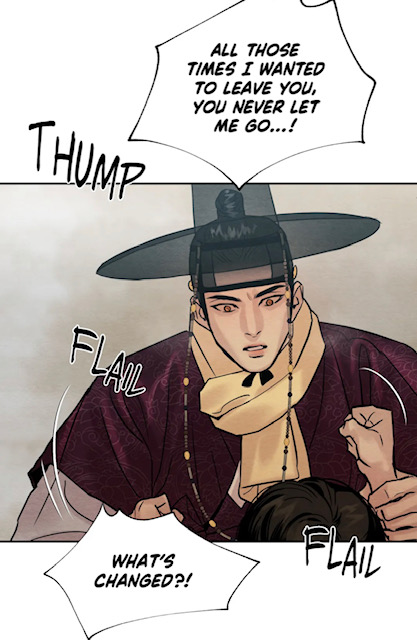 (chapter 105) Then I noticed that contrary to his lover, the artist asked the reasons for his decision.
  (chapter 105) Why did he change his mind? Is he responsible for this? As you can see, the painter came to voice his guilt and the remains of his deeply rooted self-hatred.
  (chapter 105) He must have committed a wrongdoing, he is responsible for the situation. He feels like a burden, for the lord had to take care of him each night.
  (chapter 104) They are no longer sharing the same bed, the lord is sitting by his side comforting him, when the young man has a nightmare. Under this new light, it becomes comprehensible that the artist was working in the backyard.
  (chapter 104) He wished to help, that way he wouldn’t be seen as a spoiled child. He has to justify his presence in the mansion. Who is he exactly that he is sleeping in the lord’s bed? I am suspecting that there is a rumor circulating within the propriety, a new version of this scene:
  (chapter 38) which I will explain more in details below. Thus the artist is making sure to cause no trouble to Yoon Seungho and the staff, especially the maids. Hence he folds the cover and clean the bedroom.
  (chapter 104) Then he washes clothes. He makes sure that he is no burden to anyone. Yet, my impression is that the staff is taking advantage of the artist’s goodness. That’s how they fuel his guilt and shame.
The irony is that the main lead was keeping the artist in the dark about his crime for this exact reason: GUILT. He didn’t desire him to feel responsible.  (chapter 104) This intention was again verbalized in the gibang.
 (chapter 105) In the Korean version, this is what Heena says:
Heena: “So Nakyum doesn’t know a thing? Thank god he didn’t see nor hear a thing about that awful matter”
The painter is left in the dark about the massacre in the shaman’s shrine. The kisaeng and the noble are both following the principle from Kim: Ignorance is a blessing. They imagine that by choosing secrecy, they are able to protect the artist. But the silence and secrecy are the exact reasons why Baek Na-Kyum feels like a burden! He was not allowed to talk about the circumstances of his misery.  (chapter 104) He was told not to question what he had heard… he should simply consider everything like a nightmare. However, this method is actually wrong.
“Keeping secrets limits responsiveness by preventing people from acting naturally and sharing freely. […] People who have studied the psychology of secrecy explain that secrets create “motivational conflict,” where the goal to avoid the social costs of the information being revealed conflicts with the goal to connect with others and maintain intimacy by sharing the information. Because keeping secrets can undermine social relationships, secrecy can lead to isolation and feelings of loneliness in extreme cases. Holding secrets also takes energy. It’s tiring, and sometimes impossible, to keep a secret. The exercise of will and vigilance in being careful with what one says uses emotional and cognitive resources and can leave a residue of negative feelings, like guilt.” Quoted from https://medium.com/s/story/how-does-keeping-secrets-harm-us-91978aefed77
Under this new perspective, it explains why Kim aged so much within 10 months!!  (chapter 07)
 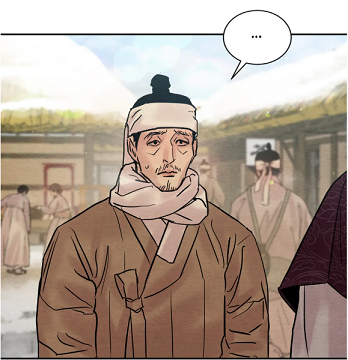 (chapter 104) Not only he knows about the lord’s traumatic past, but it is the same for the painter. In addition, we have another explanation for Yoon Seungho’s insomnia and dissociative state.
 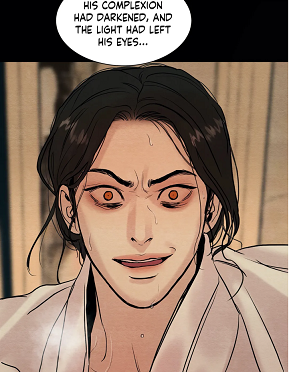 (chapter 57) Not only the latter was turned into the scapegoat for the downfall of the Yoons, but also he was not allowed to reveal the incident, the so-called treason. Why? It is because if he had spoken, the truth would have come to the surface. He was simply a victim. And now, the schemers and accomplices are repeating the same MO. Who suggested to Yoon Seungho to say this to his lover?
  (chapter 104) Naturally, Kim, because he is now the only one in the mansion who knows his past. Besides, why do you think that the lord’s past is coming to the surface as a nightmare? It is because he was incited to repress everything. But since the painter is going through the same experiences, this is not surprising that the noble’s memory is triggered and the past emerges again.
Thus when I saw this image (chapter 105), I couldn’t restrain myself thinking of the lord and his past martyrdom. Keep in your mind that the artist share the same destiny with his lover. This means that a similar scene must have occurred in his youth: (chapter 27) Put yourself in the young man’s shoes. You suddenly witness how the whole family is moving houses and leaving you behind! This must have been terrible for Yoon Seungho. One might argue that Kim stayed by his side, so he was not alone. But it is false for 2 reasons. The white bearded servant had been working in the mansion (chapter 27), when the other domestics left the propriety. This was his memory. Besides, like the servant confessed to Jung In-Hun, a huge part of the staff got replaced. This means that the lord was suddenly surrounded by people he didn’t know. Because my theory is that the young man was treated as a male kisaeng, this signifies that the new staff could never view the main lead as a noble. Besides, despite the betrayal, the elder master and Yoon Seungwon were his real family. Finally, Yoon Seungho had no saying in this, and I can imagine that the reason for this decision was not explained immediately. This must have been a huge blow for him as well. He must have felt lost and homeless. The result was that from that moment on, he became more dependent on the butler. And we have to question ourselves what the butler did with this huge responsibility, when the elder master moved to the second house.
The lord and Heena assume that the painter has been able to repress this terrible night, and he knows nothing about the lord’s crime. But the moment whispers reach the painter’s ears, he can only feel terrible. (chapter 104) He is treated like a noble, while his lover is acting like a servant. Besides, is it true that the painter knows nothing? Let’s not forget that in the trailer, the manhwalovers discover the existence of a rumor circulating. But who is spreading the rumor and where? Since this phrase appears in connection with the staff (maids and servants) in the courtyard, I come to the conclusion that the authors of this gossip are in the domain. “Fellows” indicate that they are speaking among themselves. But I have two more clues proving that the traitors are the domestics. First, observe how they call the protagonist: Young Master Yoon.
  So far, people in town only calls the protagonist lord Yoon
 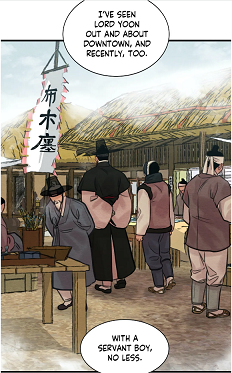 (chapter 45)
  (chapter 45) or lord Yoon Seungho
  (chapter 39) or my lord.
 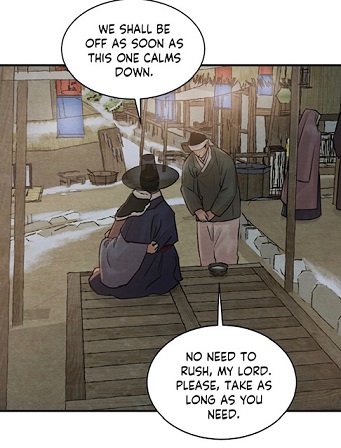 (chapter 76) Only the staff addresses him as “young master”.
  (chapter 103)
 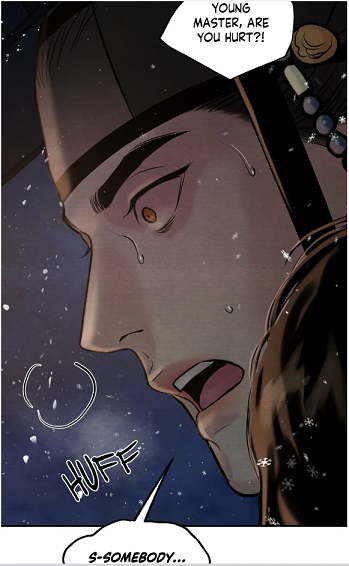 (chapter 103), and this since season 3. This coincides with the meddling of the Yoons. The servants treat him, as if he was not an adult, no real lord. But they are wrong, because he is wearing the topknot with the gat. Hence he is a lord. Finally, only people close to the couple could know about the painter’s tragedy.
  , because in the village and town, there exists another gossip:
  (chapter 104) Thus I conclude that the gossip from the trailer is spread among the staff on purpose. They wished Baek Na-Kyum to hear it so that he will feel responsible, especially after hearing this.
  He is responsible for the lord’s lunacy. Under this new perspective, it explains why the painter is leaving the bed and working. He wishes to prove the words wrong. On the other hand, I think that Yoon Seungho also heard a grapevine in the domain, but a different one:
  (trailer). “He has many enemies”. How did I come to this idea? It is because he is addressed as Yoon Seungho! By underlining the painter as his weakness, the author of this rumor wishes to separate the couple. If he were to place the painter elsewhere, not only the latter would no longer be targeted, but also the lord would have no longer any weakness. Since there is always a reflection within the same chapter, I conclude that a second grapevine was spread in episode 104. This happened, while the lord was away. Thus the painter smiled like a “fool”, when he saw the lord:
 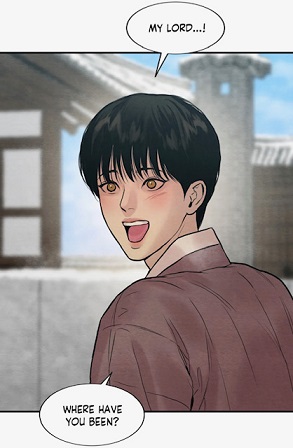 (chapter 104) As you can imagine, for me the maids were the perpetrators, a new version of episode 79
 (here, the woman implied that the artist was responsible for Yoon Seungho’s insomnia, thus the painter has a drop of sweat on his face, a sign for shame) and chapter 98
  . To conclude, I don’t believe that the artist is ignorant. Besides, it is possible that he saw the trace of blood on his lover’s face, then remember what the servants told their master in the courtyard:
 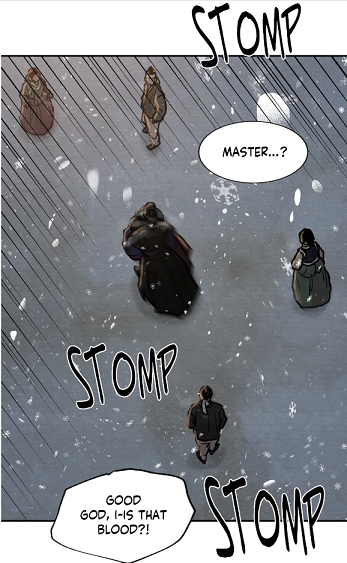 (chapter 103) Finally, the staff has every reason to get rid of the artist, for he is the witness of their wrongdoings. They definitely played a major role in the “prank”. They didn’t learn their lesson.
But let’s return our attention to the comparison between 85 and 105. Both are also a reflection of episode 29, the scholar’s betrayal. The latter brought back the painter for his own selfish interests.  (chapter 29) This time, the one smiling like a fool
  (chapter 29) was Jung In-Hun who acted, as if he knew nothing and had seen nothing.
  (chapter 29) However, I have already pointed out that he was present, when the rape took place, for he knew where Yoon Seungho would meet the artist: the pavilion. And what have all these episodes in common? The first thought would be to say: abandonment and betrayal. The painter in front of the gibang felt “betrayed” and abandoned, but what shocked the lord so much was when the artist started blaming himself: (chapter 105) He never expected this from his lover, as he desired to get the exact opposite. As you can see, the prayer “let’s go home” didn’t work, but the self-blaming had a much stronger effect. On the other hand, what made the lord change his mind was the reminder from the painter: their mutual love confession.
  (chapter 105) We have to imagine that the painter wanted to say that he regretted to have opened his heart to the protagonist. Thus he said this:
  (chapter 105) “I had known, I would have never confessed” Nonetheless, he never finished his phrase, for in reality, he had no regret!! He was sure that he had made the right decision. It is because he had pondered a long time about this. He had observed his lover. That’s the reason why he mentioned their mutual love confession and as such their promise to stay together. And this brings me to the next observation. All these scenes have another common denominator: BAD DECISIONS!! The lord had made the wrong decision to entrust the painter to the kisaengs. Thus he came to regret this. He had made his lover cry, and even wounded him, though he desired to do the opposite. Therefore it is not surprising that he apologized to his lover.
  (chapter 105) This shows that the painter is showing him what true love and loyalty are. Moreover, he is teaching to make good decisions.
But what is a good decision?
I have to admit that the trigger for this essay was the new chapter from my beloved manhwa “Doctor Frost”. After reading the psychologist’s statement  (chapter 246), I realized why Yoon Seungho suffered so much. Self-made decision implies a conscious choice. It is made deliberately and thoughtfully, considers and includes all relevant factors, is consistent with the individual’s philosophy and values. As you can see, it implies knowledge. This definition exposes that making a choice for the sake of another person without his consent or knowledge can never be a good decision. One might argue about this, because children are too young to make decisions. In Doctor Frost, this man
  (Doctor Frost 246) decided to support a terror attack, and justified this by saying that this was for his daughter’s sake. But like the counterpart pointed out, he questioned his decision. Was it truly his choice, or was he simply following the leader’s suggestion? As you can see, the daughter was used as an excuse, it was never for her sake. This shows that children are the exception, besides they are often raised by two parents. Thus they are making deliberations together. But like the author revealed in Twitter, Yoon Seungho’s mother hated her husband so much that she neglected her eldest son. The patriarch made decisions on his own, but observe that it was always for the Yoons’ sake. This means that the father never took his son’s well-being into consideration, he never asked him about his opinion. He imposed his will, but he listened to others, like we could see in different occasions. (chapter 57) He fed his son with the drug prescribed by the physician, though the latter stated that he had no idea about the illness. Then he listened to father Lee’s complains and reproaches. He never questioned the intentions behind his actions and words.
  (chapter 82) Here, the red-haired bearded man was encouraging the elder master Yoon to return to the mansion and claim his rights. Finally, the young master admitted this to the messenger:
  (chapter 80) If someone stroke his ego, he would follow their advice and never doubt their words.
Under this perspective, it becomes comprehensible why Yoon Seungho became the bird of misfortune. He became the scapegoat, for neither Kim nor Yoon Chang-Hyeon accepted to take their responsibility. They had made this decision for Yoon Seungho’s sake!!  (chapter 77) Since it backfired, then the protagonist was responsible for everything. And this is what Kim has always been preaching in season 1, 2 and 3: it was the best for Yoon Seungho, or Baek Na-Kyum etc. Nonetheless, since he let others make the decision, he was able to escape “responsibility”, thus the elder master Yoon was blamed for everything. (chapter 86)
The butler’s interventions are based like this: It was for the painter’s sake, or for the lord’s sake, or for the elder master’s sake… One might argue that the valet questioned the lord’s decision to send the painter back to the gibang.  (chapter 104) But he simply employed reverse psychology.
“Reverse psychology is a manipulation technique that involves getting people to do something by prompting them to do the opposite. Reverse psychology can take various forms, such as forbidding the target behavior, questioning the person’s ability to perform the target behavior, and encouraging the opposite of the target behavior.” Quoted from https://effectiviology.com/reverse-psychology/
And this is what father Lee was doing too, when he visited Yoon Chang-Hyeon. Besides, we shouldn’t forget the power of the grapevines in the mansion. To conclude, making decisions for the sake of others can never be a good decision!! Therefore it becomes understandable why the painter’s request in the study was a bad choice in the end. 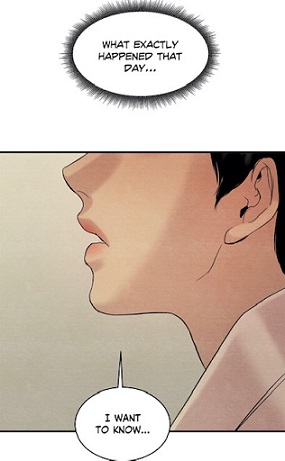 (Chapter 85) Yoon Seungho was coerced to open up. If he did not, he wouldn’t be forgiven. Naturally, the painter meant it well, yet the main lead was pressured to reveal his „bad action“. The main lead feared his negative judgement and rejection. We could say that the artist had made this request for the lord’s sake, however this was not a conscious and long deliberated decision. And now, you comprehend why the main leads suffered both so much!! Yoon Seungho’s mother neglected her eldest son, but she kept her distance from her husband. They never talked to each other, and as such never made decisions together. And it was the same for the painter. The kisaeng Heena was the one who made the decision without the noonas’ consent and her brother‘s opinion.
Secondly, making decisions because you were manipulated, can not be considered a self-made decision. And what did Heena do? She made decisions for Baek Na-Kyum, but she never asked for her brother’s opinion or her colleagues. She made her decision based on her impressions and belief! (chapter46) Even in season 4, she has not changed her mind-set entirely.  (chapter 105) She is still viewing the painter’s decision as a bad choice. But she is simply wrong, for the painter listened to her advice and after deliberations, he chose to open his heart. His confession was not made in the heat of the moment.
  (chapter 62) The lord’s vision
  (chapter 62) became a reality (chapter 105), though he never expected to be like that: a gaze full of pain and anxiety. To conclude, this night in the barn embodies “bad decisions”. Everything the lord did was under the influence of his unconscious. His abandonment issues clouded his judgement. Yet, despite everything, the noble made one good decision during that fateful night: he chose to never let the artist go!! (chapter 63) Because the painter has always been betrayed and abandoned himself too, such words could only move the artist. There was someone willing to be by his side and to give him a home. Therefore it is no coincidence that the artist brought up these words from that night. (chapter 105) They left a deep impression on Baek Na-Kyum.
But let’s return our attention to the head-kisaeng. (chapter 105) Note that she employed the expression “believe”. This is no coincidence, for it displays her narrow-mindedness. Finally, note that in episode 97, her conversation with her brother was truly a bad choice. She lied to Baek Na-Kyum, she was extremely stressed, scared and angry.  (chapter 97) And why did she act like that? She justified that it was for the painter’s sake, and she knew more than her brother. The reality was that it was for her own sake. She was definitely cornered, for she feared repercussions. Moreover, she pushed her brother to follow her advice. And now look at what the noona said in front of Yoon Seungho:
Heena: “So Nakyum doesn’t know a thing? Thank god he didn’t see nor hear a thing about that awful matter”
She is glad that her brother didn’t witness her conversation with Min 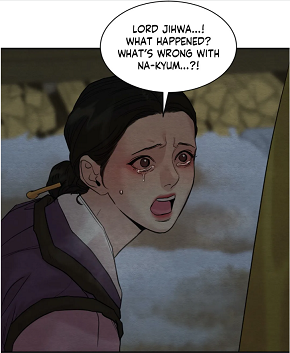 (chapter 99) and her “fake death”, but as you already know, I think, he heard her during that night. Note that the painter didn’t meet his noona Heena during that day. Since Heena and the staff played tricks so that Baek Na-Kyum ended up going to the scholar’s house, it is not surprising why the staff is putting the whole blame on the painter. However, who is responsible for this? Naturally, the staff, Kim and Heena. The latter made bad choices blinded by her arrogance and prejudices. Thus I deduce that Yoon Seungho learned a good lesson in front of the gibang. He should never make a decision without consulting his partner.
  (chapter 105) From my point of view, both need to learn to make decisions TOGETHER!! But in order to do so, the two main leads need to listen to each other and communicate. And this is what truly happened in episode 105. The young noble discovered the painter’s low self-esteem and his guilt. That’s the reason why I believe that Yoon Seungho will decide to talk about the scholar. The lord suspects the learned sir, for he thinks that he is still alive.
  (chapter 105) This signifies that the noble will decide not to follow the noona’s advice:
  (chapter 105) But by learning about the learned sir’s past, the protagonist will realize that he only knew a side about Jung In-Hun.
On the other hand, since the head-kisaeng agreed  (chapter 105) with the noona’s statement, the painter looks happy with Yoon Seungho despite the tears, it looks like the noona is slowly coming to terms with her brother’s relationship. But I have to admit that I believe that her “decision” is just short-lived. First, in season 2, the noona had accepted to let her brother stay at the Yoons’
  (chapter 69) But then she had changed her mind after hearing the menace from the servant. However, I have three other reasons to expect a change of heart from the head-kisaeng. First, Heena is the younger reflection of the butler. The manhwaphiles shouldn’t forget that the valet had almost come to terms with the painter’s presence
 (chapter 65), but the ruckus caused by the kisaeng had provoked a change of heart in the valet. Then, the lord had made the following condition to the kisaeng:
  (chapter 105) The lord is keeping his lover by his side, as long as nothing happens to him. So if he gets into trouble… she could achieve her goal, the painter is returned to her. But the most important clue is for me the bowl!
  (chapter 105) While many jumped to the conclusion that this was the medicine sent by the physician, I had a totally different impression. For me, this bowl was used to write a letter!! First, the color is different from the normal “medicine”.
  (chapter 23) Most of them look dark brown and not black.
  (chapter 36)
 (chapter 77) Besides, it never leaves traces on the edge.
  (chapter 36) The points on the border are the traces left by the brush. She wrote a letter. And I have another evidence for this:
  (chapter 36) The painter used white bowls while painting. On the other hand, the lord wrote a letter during that time. As you can see, in episode 36, we have the combination of painting, seduction (touching) and medicine… exactly like in episode 105. The artist tried to paint a lucky charm, a tiger, but he didn’t finish it. He got interrupted… which is very similar than in chapter 36. So the letter should represent another common denominator.
This means that Heena made the decision to write a letter before meeting Yoon Seungho and witnessing their interaction in front of the gibang. Finally, let’s not forget that the kisaeng was always brought up in connection with letters:

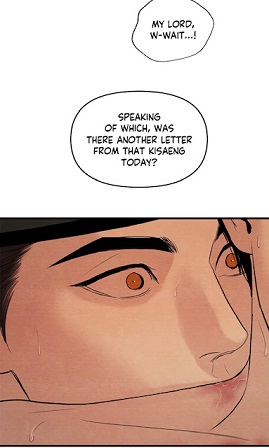
Naturally, I can not guarantee 100% this theory… besides, I can not tell the content and the recipient of this message. And if this theory is correct, the head-kisaeng did something which will have repercussions about her „decision“: let the painter live with Yoon Seungho. This means that she will be forced to question her past decision. Was it made deliberately and thoughtfully, did she consider and include all relevant factors, or did she act based on her instincts? In my eyes, Heena has always made such decisions. Every choice was based on hunch, but more precisely influenced by her prejudices and fears. Thus she is projecting her MO (chapter 105) onto Yoon Seungho. Will she come to regret her action or not? One thing is sure, the painter accepted the sincere apology from his lover. How could he not forgive him after calling „Nakyumah“ and embracing him! (Chapter 105)
  (chapter 105) Both left the gibang together, while the artist was removing his tears. And this leads me to the final observation.
By forcing the painter to remain silent about the last incident, the schemers and accomplices are not realizing that their actions will bring light to Yoon Seungho‘s suffering and its origins. In other words, by burying one truth, they are digging another grave… the secrets from the first past!! (Chapter 76) By making the same decisions, it is not surprising that the same deed can never succeed. It was not a real self-made decision. They simply followed a pattern.
Feel free to comment. If you have any suggestion for topics or manhwas, feel free to ask. If you enjoyed reading it, retweet it or push the button like. My Reddit-Instagram-Tumblr-Twitter account is: @bebebisous33. Thanks for reading and for the support, particularly, I would like to thank all the new followers and people recommending my blog.

 Bebebisous33s' analyses in K-Dramaland and Manhwas