Protected: Painter Of The Night: 💋 Stolen kisses 💋
Bebebisous33s' analyses in K-Dramaland and Manhwas
Analyses of K-dramas and Manhwas (for the most part Yaoi)


This is where you can read the manhwa. https://www.lezhinus.com/en/comic/painter But be aware that this manhwa is a mature Yaoi, which means, it is about homosexuality with explicit scenes. If you want to read more essays, here is the link to the table of contents: https://bebebisous33analyses.wordpress.com/2020/07/04/table-of-contents-painter-of-the-night/
It would be great if you could make some donations/sponsoring: Ko-fi.com/bebebisous33 That way, you can support me with “coffee” so that I have the energy to keep examining manhwas. Besides, I need to cover up the expenses for this blog.
The starting point of this analysis was this quote from Lee Jihwa. 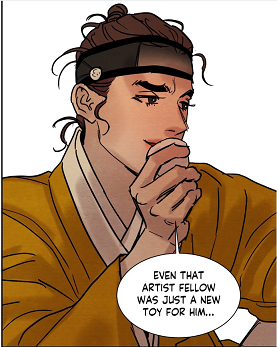 (chapter 12) The mention of a new toy implied the existence of an old plaything. But we know for sure that Yoon Seungho has never possessed anything. He was treated like a male kisaeng himself, for he was not allowed to refuse advances from anyone.
 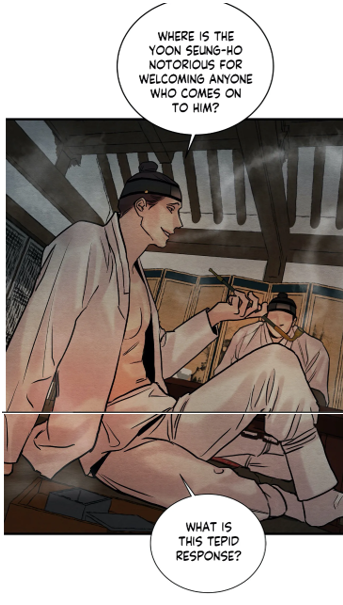 (chapter 52) Finally, he was forced to share anything he owned to others.
 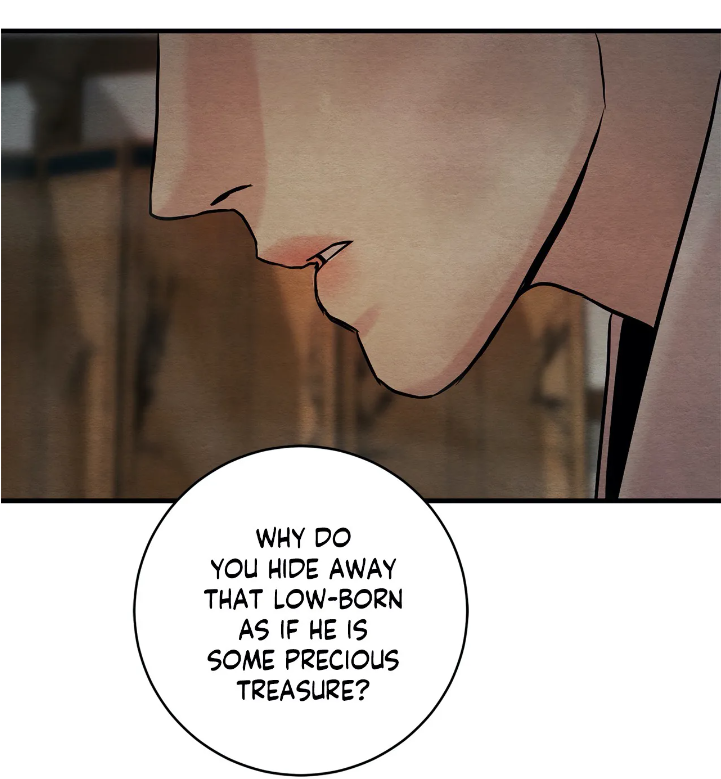 (chapter 52) That’s how I realized that the inner thought from Lee Jihwa was exposing his knowledge. The latter knew about Yoon Seungho’s true conditions. The latter had been treated like a plaything by the pedophile. As the red-haired noble had been raised as an filial son respecting elders, Lee Jihwa saw no reason to change the way Yoon Seungho was “trained”.
  (chapter 57) Besides, he could only benefit from it. Now, he could have sex to his heart content. He only started playing tricks, the moment he felt that his childhood friend was escaping from his claws.
On the other hand, the author recently explained on a live session that Yoon Seungho’s mother committed suicide, for her son was tormented. However, my problem is that I only heard about this through others. Some stans were saying that Yoon Seungho was getting abused, others would even say, he got tortured. So was it abuse or torture? There’s a slight difference between these two notions. For I was a little unsure about this, I preferred to leave it at “abuse”. But then I realized this. If he had been truly tortured, then he should have traces on his body, they used to break bones… so that they ended up crippled. The readers could witness the way the Joseon authorities tortured people in order to obtain confession.  (Chapter 37) On the other hand, since the lord went to the authorities in season 3, I deduce that he must have gone there in the past too, yet not as a victim/plaintiff, but as an accused. Because of this new revelation, I made a new connection: sex and torture.
Striking is that in the father‘s eyes, he was not even a slave, he was like an animal. 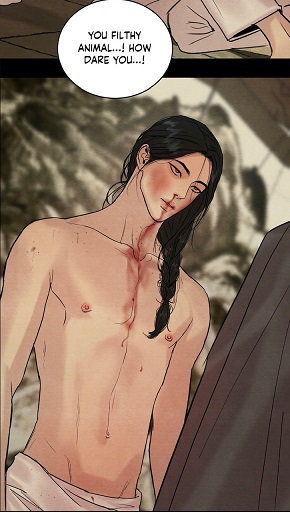 (Chapter 83) Why? He viewed him like a dog, for he was living in the shed. He even had no proper hanbok and no real hair dress, and the manhwaphiles can certainly remember the idiom: clothes make the man! If he was no man, then he was an animal, a dog. Even his food reminded me of dog food. But why was he living there?
  (Chapter 83) In this essay, I will answer to this question. As a first conclusion, the lord was not even treated like a male kisaeng in the past, but more like a dog. Consequently, I deduce that when Baek Na-Kyum met the lord in the inn (chapter 1), his status had already changed. He was slowly experiencing emancipation. He was living like a male kisaeng. Thus I conclude that Lee Jihwa contributed to his recovery to a certain extent.
  (chapter 59) However, don’t get me wrong. I believe that the change occurred thanks to Baek Na-Kyum’s intervention, the new version of this scene.
 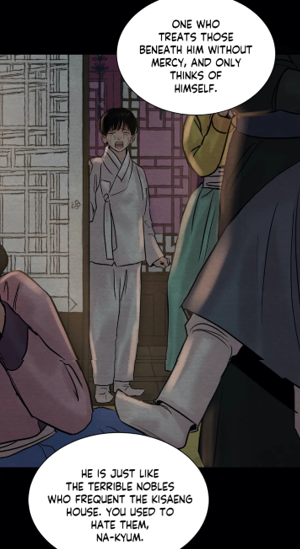 (chapter 68) Their path crossed a second time in the gibang which led to the painter’s expulsion which affected the lord‘s living condition. But let’s return our attention to the lord’s long suffering.
In the past, while reading season 2, I started getting confused about the identity of the abuser. When in the shed (chapter 62) the lord turned into a shadow or ghost from the past, certain gestures were similar to the patriarch‘s.  (chapter 57)
 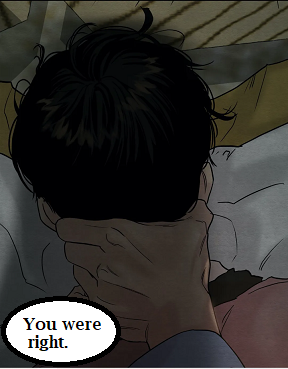 (chapter 62) This explicates why after reading episode 62 for the first time, I had suspected the father to have raped his own son. Yet this thought was dropped shortly after. Then when episode 77 was released, I realized that in the shed the lord was also reminded of Kim’s betrayal, for the latter would always drag him to the shed. Observe the way he was “carried away“. It was like an “embrace“.
 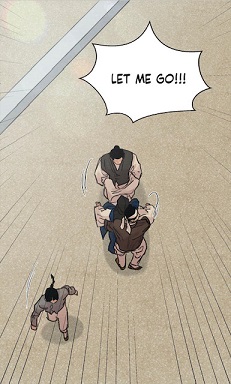 (Chapter 77) In episode 77, the readers can witness 2 incidents how the lord was brought to the storage house.
 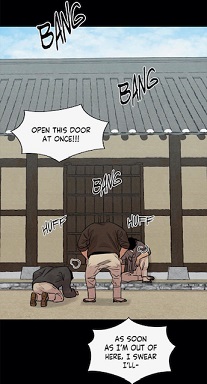 (Chapter 77, this is a different situation, for we have different servants except Kim) Therefore in the barn, Yoon Seungho behaved like his surrogate father Kim as well. This explicates why we have the fake embrace and the insincere apology.
 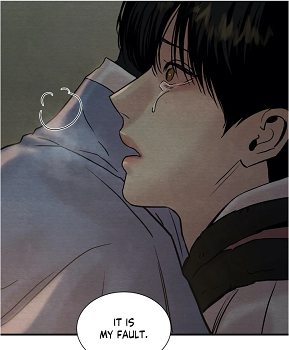 (chapter 62)
  (chapter 62) As you can see, the hug from the past was the symbol of violence and hypocrisy. It served to drag the lord to the storage room. And this new observation led me to the following conclusion: Yoon Seungho was copying the behavior from all his abusers from the past: his brutal father, the hypocrite butler and naturally the pedophile.
  (chapter 62) Hence the protagonist grabbed the painter by the hair. For me, the “mysterious lord Song“ used to hurt the main lead by the hair, when he got angry. How did I come to this interpretation? Note that at no moment we never saw Yoon Chang-Hyeon taking his son’s hair. First, the lord’s head was covered with a hat. (Chapter 57) Even in the bedchamber, he would either slap his son or grab him by the throat.
  (Chapter 83)
 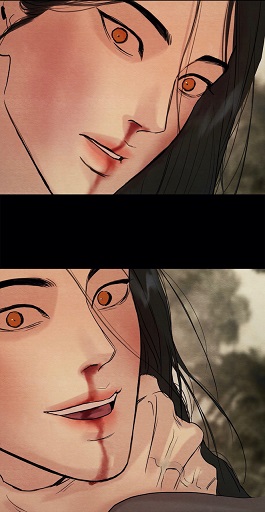 (chapter 83) As for Kim, the latter would always restrain the main lead by the shoulders, the fake embrace.
  (Chapter 57) And now, you comprehend why the lord dragged the two nobles by the topknot.
 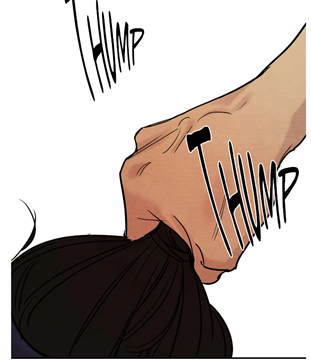 (chapter 8) For a long time, I have demonstrated that this gesture represented one of Yoon Seungho’s biggest traumas. But why would the pedophile do that? One might say that it is because of Yoon Seungho’s resistance and struggling. He needed to punish him for his disobedience. Note that the noble with the mole and Lee Jihwa got humiliated as sanctions.
 (Chapter 18) However, in my eyes there exists another explanation which I will elaborate in this analysis either. From my point of view, the shed and the humiliation are strongly intertwined. This was particularly visible, when the lord forced Baek Na-Kyum to have sex in the courtyard.
  (Chapter 64) But why would he do that in the end? It was to train him, to make him obedient.
  (Chapter 64) Remember how he had declared that the painter was now his sex toy. He should listen to his master or owner. That’s how I came to this deduction. The infamous lord Song is a sadomasochist. In the worse case, he is simply a pure sadist. I am inclined to believe more in the first view. With this, we would have the link between sex and torment. And the picture from the erotic book where you see the bearded man having a braided man on his lap outside indicates that Yoon Seungho was here getting punished. The pedophile loved seeing Yoon Seungho humiliated and in tears.
 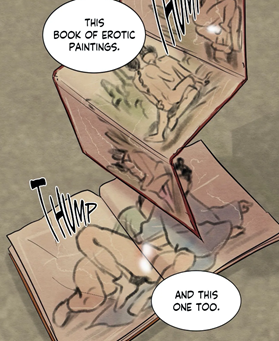 (chapter 01) And now, we have the explanation why the lord could no longer cry and how he came to hate “fake apology”. This was the result of the exposure to the sexual assaults under the form of BDSM.
But what is BDSM exactly?
It’s an abbreviation for bondage, discipline (or domination), sadism (or submission), masochism: sexual activity that involves, for example, tying a partner up, games in which one partner controls another, or giving and receiving pain for pleasure quoted from https://dictionary.cambridge.org/dictionary/english/bdsm
This means that BDSM is a role play, where one acts as a dominant and the other as submissive. However, in order to become an act, there must exist consent and agreement. A contract is necessary, for the dominant has to ensure the submissive’s safety. He needs to know the limit between real and fake, and as such when the pain becomes too much to bear and is no longer a synonym for pleasure. The dominant needs to know boundaries. Thus the couple has to have a safety word. Once this word is said, the “punishment or humiliation“ has to stop. This truly shows that BDSM is strongly regulated. Therefore on different websites, you can see many recommendations. One stipulated 10 rules so that BDSM would be enjoyable for the couple: 1. be patient, 2. be humble, 3. be open, 4. be honest, 5. be realistic, 6. be sensitive, 7. be genuine, 8. be healthy, 9. Communicate, 10. have fun. (https://modemworld.me/ds-essays/the-ten-rules-of-ds/) Striking is that during their last love session, the couple was already following these principles, though there was no real punishment. Don’t forget that the painter had sex in front of people behind the doors. 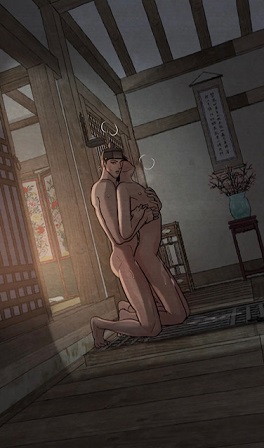 (chapter 96) They ended up in the hallway, anyone could see them. Then in another website, I found the following principles:
„What Daddy should do for his little Prince:
1. Help me brush my hair if you’re with me.
2. Help me pick out clothes and food.
3. Take bathies with me sometimes, and showers with me most of the time if you’re here.
4. Hold my hand as often as possible.
5. Call me my preferred words: little, sweetie, prince, puppy etc.
6. Give me treats when I’m good.
7. Punish me when I’m bad.
8. Praise me when I do good. No matter how small the good thing is.
11. Don’t make threats. Punish me if I’m bad, but don’t take things away or hurt me when you’re mad.
12. Never lose your temper because your day is going bad.
13. Always go to bed and get enough rest as much as possible.
16. If I’m sad I like hugs and kisses and pets and nice words.
17. Littles need to know they are loved.
18. Always be honest with me.
19. If I’m being a brat, I want attention.”
20. Don’t ever break promises, ever.” quoted from https://www.wattpad.com/amp/492636426
After reading the second list of rules, the manhwaphiles will realize two important aspects. First, the main lead was slowly developing a manual of BDSM without realizing it. Note that after the coerced sex in the pavilion, he desired to take care of the painter personally. He took the horse, and if he had not met the butler on his way to the pavilion, he would have done it himself. 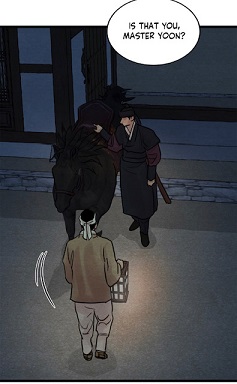 (chapter 25) He even brought the hanbok himself.
 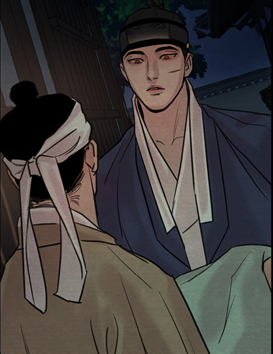 (chapter 26) The lord went so far to take his bath with his lover to clean him.
  (chapter 59) He made sure that his partner wouldn’t suffer.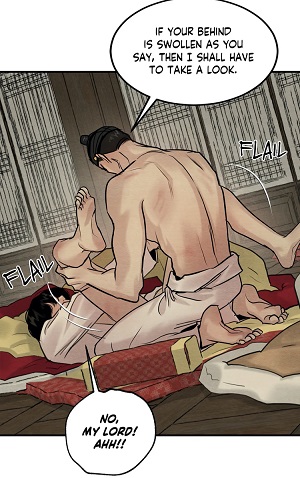
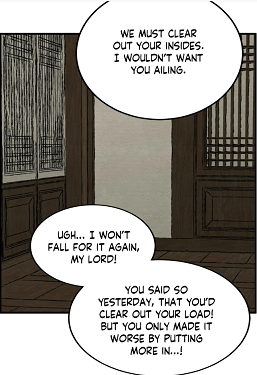 (chapter 89) Yoon Seungho knew by experience that the rest of semen in the stomach would cause him ailing.
 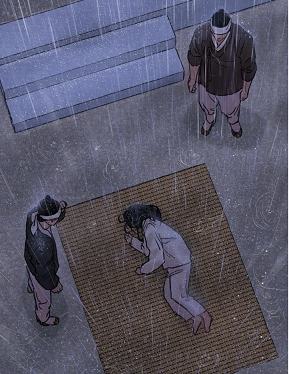 (chapter 77) This was the reason why Yoon Seungho had a fever afterwards. Don’t forget that the pedophile used Taoist sexual practices, this means the young boy had a sex marathon each time, he met the pedophile. Thus I interpret the bruise on Yoon Seungho’s eye not only as an indication of resistance, but also as a source of joy for the sexual predator. We have the reaction from lord Jang as the perfect example.
  (Chapter 101) He blushed, though he could see that Baek Na-Kyum was in pain, the face covered with blood. Remember what the painter did in the pavilion to the main lead: he scratched his face.
 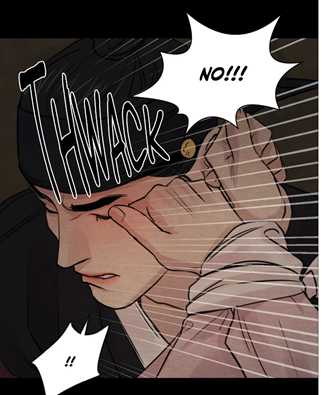 (Chapter 25) Thus we have to envision that the lord must have reacted the same way and wounded his abuser. And imagine the consequence if he had wounded the king on the face. This could be seen as a reason for a punishment.
 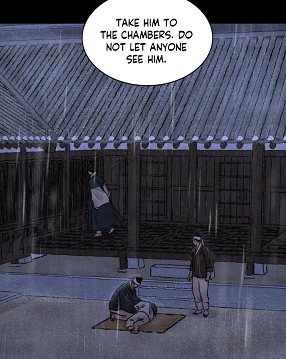 (Chapter 77) Remember Black Heart‘s warning in the shaman‘s house:
  (chapter 102)
Under this new light, the readers can comprehend what happened. Because he was the ruler, he expected acceptance. In addition, the king never took care of his “lover” properly, for in the palace, the staff was supposed to take care of everything for him: he would receive the assistance from maids and eunuchs in order to get dressed. This signifies, he must have had the same expectations in the Yoons’ mansion. He always relied on Yoon Chang-Hyeon and the so-called loyal valet. But the father could only resent his own son, for he rejected homosexuality, as it stands in opposition to lineage. As for the valet, the latter was too much plagued by his own guilt that he resented the nobles for his own wrongdoings. He never realized that he was abandoning the young master.
Yoon Seungho learned through the hard way to take care of himself. However, because the protagonist had been traumatized by the sexual fake lesson, I doubt that he could have an erection. Thus the valet went to the physician again in order to get replenishing medicine. 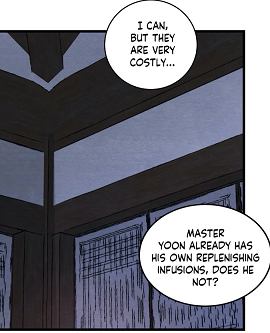 (chapter 33) This is an euphemism for aphrodisiac. Thus we had this confession from the physician.
  (chapter 57) Why did the butler visit the doctor without Yoon Chang-Hyeon? It is because he had been ordered to fetch the aphrodisiac. By feeding him with the drug, they wanted to force Yoon Seungho to accept the advances from the king, and as such to admit his sexual orientation. He was a sodomite.
 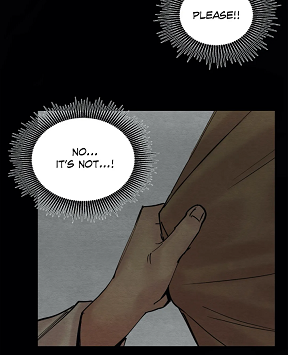 (chapter 65) They faked his “pleasure“ making him feel guity and dirty. That’s how he got tricked. This explicates why the main lead still has no idea of the use of the aphrodisiac.
And now, you have the answer why the king failed to “tame” Yoon Seungho. He did the exact opposite what he should have done. He never followed such rules: respect, health, etc… Lord Song never became responsible for the young boy, thus he never confessed as well. He never apologized for his mistakes or his brutality. 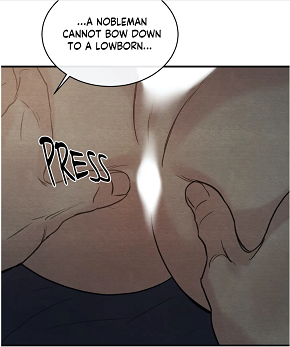 (chapter 71) As a king, he couldn’t bow down to a noble. Observe that the roles of “dominant” and “submissive” are not clearly defined between Yoon Seungho and Baek Na-Kyum. The lord is the dominant sexually speaking, but note the vocabulary:
 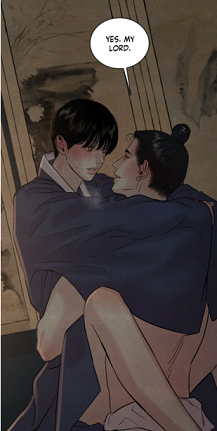 (chapter 72)
  (chapter 89) If you pay attention to their interaction, the lord acts like the servant. The reason is simple. If you take into consideration the second list of recommendations, you will recognize that the roles are switched. Outside a sex session, the submissive becomes the “king“, and the dominant has to act like his servant. That way, a certain balance is created. But this was never the case between the pedophile and the teenager. The latter was always reduced to a plaything and at the end to an animal. The pedophile never called the protagonist by his name.
 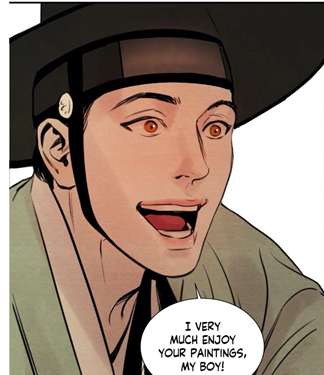 (Chapter 1) He was just called “my boy“. And that was it. He never created a real bound with the main lead. Therefore trust was totally inexistent. And because the young noble could only fear the man, he came to hate him to the point he could die. The latter made promises which he never kept!!
  (Chapter 101) How could he vow to “protect or help“ Yoon Seungho, when the latter was tormented constantly and exposed to violence against his will? And this could only escalate to Yoon Seungho‘s attempt to commit suicide. (Chapter 57) What caught my attention is that Kim needed the help from the other servant to keep Yoon Seungho on the bed. This is relevant, because this reveals that Yoon Seungho had reached an age, when the bearded man was no longer strong enough to restrain the main lead. It is very likely that before killing himself, the protagonist had even tried to hurt the ruler.
  (Chapter 55) I had this idea, for the story is going in circle, meaning that the lord must have done it before, just like he did in season 3. The possible death from the main lead and probably his own pain must have brought the mysterious lord Song back to reality. That‘s the reason why he sent for the physician‘s assistance. He was encouraged to keep his distance from the young man, just like the latter was incited to stay away from the painter in season 1 (sickness, Min), in season 2 (the scholar‘s insult) and in season 3 (the rough sex session in chapter 81-82). Thus I deduce that the pedophile has always kept an eye on Yoon Seungho and his recovery. In my opinion, the man has not forgotten the main lead at all. Why do I think so? It is because he kept the painting…
 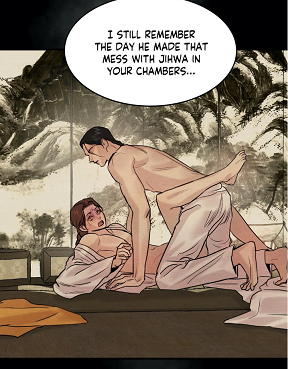 (chapter 82) a souvenir from their time together, just like Min who stole the painting in the study.
Thanks to the painter, the more time passes on, the more Yoon Seungho changed. Not only he returned to his original personality, but he slowly developed the rules how to play BDSM. He discovered the importance of “consent” after the second sex marathon. Striking is that he got reprimanded by his butler after the love session. This explicates why the main lead never requested the painter in his bedchamber, and only visited him during the night, when he was asleep.  (chapter 74) Thus I am deducing that Seungho-Ya will become the safe word between the two protagonists.
  (Chapter 72)
While Yoon Seungho dresses the painter personally, or he cleans him with his own hands, the king imagined that the butler would take care of everything. Thus I come to the deduction that the king will discover the real reason why his relationship with Yoon Seungho was doomed, and why he could never obtain his heart. Kim had also betrayed him, for he had never revealed his knowledge at the right time. He used paltering to escape punishment. However, I would like not to be misunderstood here. Naturally, lord Song is as much responsible as the other abusers. Why? The king only focused on his own pleasure, and never paid attention to the counterpart, he was totally in denial that he was using violence. Deep down, he knew that this was wrong, for the main lead was just a boy, like the “nickname“ was revealing it. He thought, as the ruler, he could overlook social norms. However, here he had definitely crossed the line. So imagine what BDSM means for a teenager. It is indeed a torture. He must have been definitely scared. And the king must have threatened him too not to share his sexual habits to others. I am quite sure that the ruler was not willing to admit his own sexual habits to others, hence he did it in the shed. It is also possible that he didn‘t mind of Yoon Seungho being described as a licentious man. That way, the king‘s behavior wouldn‘t be criticized. But because Yoon Seungho was sent to the shed, and punished there, the “fathers“ misjudged the real “value“ of the main lead. They truly thought that the king only viewed the main lead as an animal. They took the punishments in the shed as face-value reinforcing their disregard for the protagonist.
Thus I come to the conclusion that the shed was the place where the main lead was exposed to BDSM. This explicates why Byeonduck revealed such an image in a tweet.  The noble with the mole is trapped in a shed, and the color purple, a symbol for royalty, is dominant. From my point of view, the author revealed everything in this tweet. On the other hand, I would like to point out that here the man doesn’t look scared or rejecting the use of the bondage or the dildo.
This explicates why Yoon Seungho was so rough in the storage room. 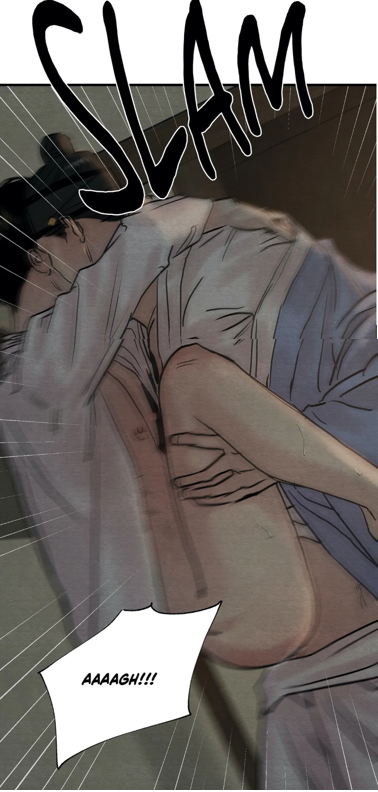 (Chapter 63) He was reliving his biggest trauma. Yet, he never went overboard in the shed. Note that the moment the painter called his lover “lord Seungho”, there was a switch.
  (chapter 63) That’s the reason why the lord changed the painter’s position and faced him.
 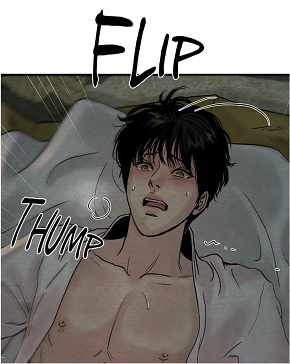 (chapter 63) The lord communicated his feelings and thoughts, and he even made a promise.
 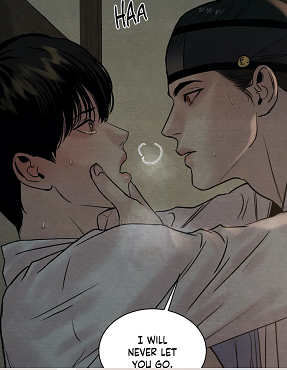 (Chapter 63) This new perception reinforces my impression that there was no rape in the storage room. The painter kept saying “no“, because he was actually scared about his own reactions. Strangely he felt pleasure, thus he kept having climaxes. He was simply in denial. The irony is that the noble attempted himself to be cruel during the night of the revelation (episode 62, 63, 64), but he failed, because the night at the doctor’s house was still fresh in his memory. He couldn‘t forget the tender embrace from the painter.
 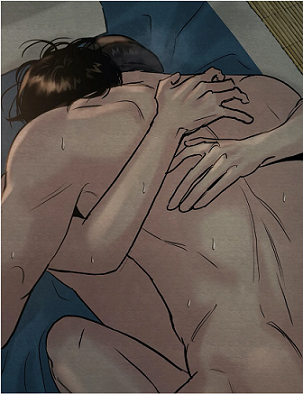 (Chapter 62) This explicates why he stood up during the penetration, he was forcing the artist to hug him, to clinch onto him. He wanted to relive it again.
As you can imagine, the infamous lord Song knew no boundary. He was simply the worst kind of sado-masochiste. First, this was never an act, the submission and as such violence were real. Why? It was because of his social position. He was the king, yet BDSM is a role play. Moreover, I would like to add the Marquis de Sade as the best illustration. The French philosopher from the 18th Century was arrested due to sexual crimes: rape, sodomy, sex with teenagers, abuses (bondage). We don’t know for sure how far he went, yet there’s no ambiguity that the libertine had definitely crossed the line. I doubt that the man knew about the necessity of rules in BDSM as well. Striking is that his „victims“ were prostitutes and people from the lower social class, while he belonged himself to the old nobility. I am suspecting that the man didn’t truly outlive his sexual fantasies with women from the same social status. Thus I came to the following conclusion: the necessity to distinguish fantasy and reality. My faithful readers will certainly recall that the protagonists had to learn to make this distinction. Consequently, I have the impression that the king didn’t make the difference in the beginning. He thought that he was finally able to outlive his sexual fantasies, not comprehending that this was just an illusion, for the “violence“ was real to Yoon Seungho. Under this new approach, we have the explanation why Yoon Seungho never paid attention to the marks left by the ties on his wrists.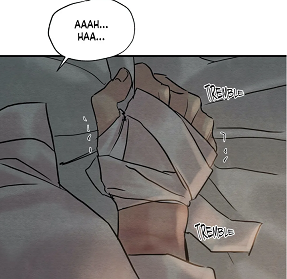 (Chapter 63) He had internalized the marks left by the bondage. This is no coincidence that the artist‘s wrist was covered by the bandage, the reflection from the torment in his youth. Under this new aspect, the presence of the bed in the shed was like a magical tool, which helped the lord to not turn into his tormentor. He was just a ghost from the past, and the word “lord Seungho“ worked like a magic spell, which stopped Yoon Seungho from becoming as vicious and cruel as lord Song. Moreover Lord Song sounds very similar to lord Seungho. And this new discovery confirms my interpretation that Kim was the helping hand of the king. He had to provide him with the white bands for the bondage, just like he had helped for the young master’s kidnapping in the gibang.
 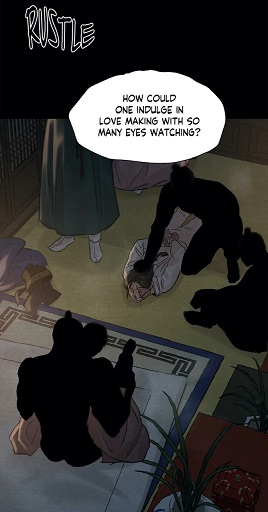 (chapter 86) But don‘t get me wrong. The king sent the main lead to the shed, when he wished to punish him. Yes, he repeated the same actions than Yoon Chang-Hyeon. And what is the common denominator between these two circles? The valet…
Besides, he didn’t treat Yoon Seungho like a slave, but like an animal. One might say that it was not his fault, for he was not aware of the physical and emotional torment from the other abusers. However, the moment he “claimed“ Yoon Seungho as his „partner“ or “plaything“, it was his duty to ensure his safety. Besides, if he truly cared for him, he should have showed more interest in the young master. Thus he became responsible for Yoon Seungho’s suffering. Note that so far, no servant was treated like that in the mansion. Even Soongap from Bongchon Bride was treated much better, until he received his terrible punishment. Soongap was never forced to live in the shed.  Under this new light, I see it as another evidence that the infamous lord Song could only be the king! He is the only person who has absolute power in Joseon, and as such knows no “real boundaries“. Furthermore, as the ruler, he is expecting no rejection from his subjects. Anyone watching sageuks (historical Korean dramas), is aware that the Joseon king was never an absolute monarch, for he was always controlled by the officials, ministers, the Queen dowager and the Queen. There were also protocols which he was forced to follow. And we have an indication about the king‘s lack of power and wealth.
 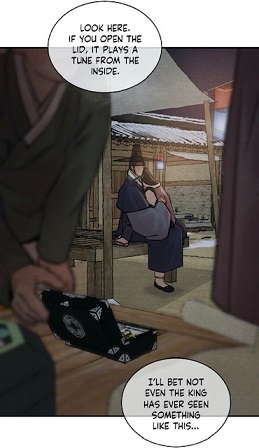 (Chapter 76) Thus I am assuming that the lord Song must have been frustrated about this contradiction. On the one hand, he was supposed to be the most powerful man in Joseon, on the other hand, he had to rely on the aristocracy. Hence I have the impression that the ruler vented his anger and frustration on Yoon Seungho unconsciously. That way, he could outlive his sexual fantasies, where he was powerful. But because of these terrible sexual habits, the young master could never get treated by a physician. Anyone would have recognized the sign of abuse.
But imagine what it meant for Yoon Seungho, a teenager who discovered sex through the most horrible way! He had been traumatized by the penetration between the kisaeng and the fake teacher. Striking is that the perpetrator and the other adults all reduced sex to penetration, like my friend Luzyla pointed out to me. The dildo and the comments from the nobles  (chapter 92)
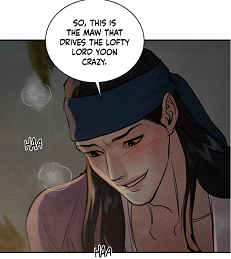 (Chapter 101) are a proof that they never discovered the importance of kisses, embraces, caresses and words during sex. They never recognized that they were denying the existence of love, too obsessed with their heritage and their reputation. The manhwalovers will remember my previous observation. The pedophile had never kissed the main lead. The king like all the nobles had disconnected sex from love. Why? It is because sex was a duty… to continue the lineage. And now, you have the explanation why the pedophile and all the others reduced sex to penetration.
Under this new perspective, it becomes comprehensible why Heena got scared in the annex.  (Chapter 96) When she heard the noise (PLOP), she was brought back to the past, when she had witnessed a scene of BDSM, though the violence was real. A similar situation to this scene:
 (chapter 73) The pictures from the erotic publication are the evidence for this theory. After hearing the description from the butler about the events in the shed, the noona Heena believed to know what had happened in the shed.
 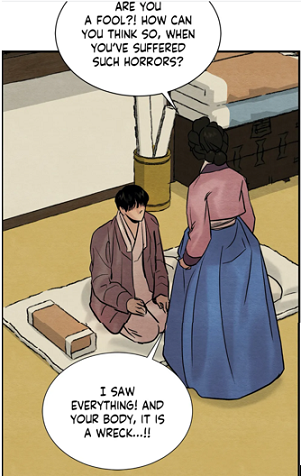 (Chapter 68) She could see the traces on the painter’s body, and conclude that the valet was telling the truth. However, the butler had been misled himself, for his perception was biased by his past experience.
 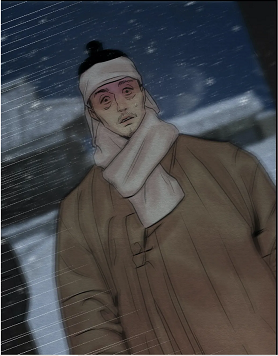 (Chapter 64) The butler thought that the “no“ from the painter was truly real, while the latter was just dishonest. It was the result from the “indoctrination“ from Heena and Jung In-Hun. The valet had been deceived in the end. The humiliation and punishment were not real, for the painter did ejaculate, and back then he was not under the influence of the aphrodisiac.
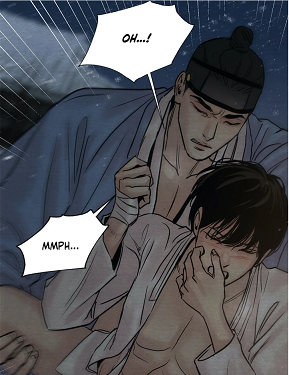 (Chapter 64) This was not like in the past, when the brutality was real. And now, you comprehend why Heena‘s resent towards her brother became more visible after witnessing the love session between the noble and Baek Na-Kyum.
 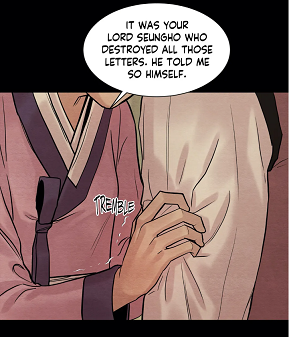 (Chapter 97) From my point of view, she had already internalized that the painter would never change, he was already too “damaged“ to change. However, since he was close to Yoon Seungho, he could become in danger, for she knew the connection between the ruler and the main lead.
And now, you are probably wondering why I selected such a title, when so far, I didn’t mention the pants. Nevertheless, my faithful readers will certainly recall my previous analysis “Who is wearing the pants?“ , where I had pointed out about the lord’s habit who kept his trousers for the most part of the time.  (Chapter 72) He was copying the habit from the pedophile in my eyes. The latter would never remove all his clothes on his own. As the king, he was used to get undressed by his own staff. Only the teenager as the uke was undressed, unless the lord was accompanied by the other nobles, like in this scene.
 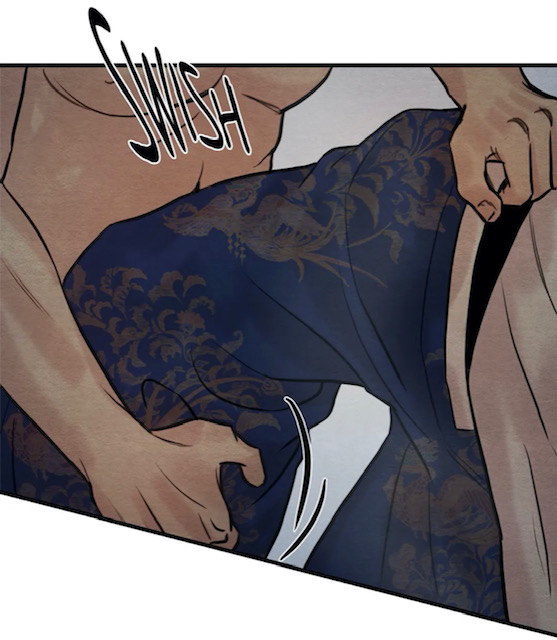 (Chapter 54) And because the ruler was too focused on his own pleasure, he never got to know the young noble. He only realized too late that he had made huge mistakes. (chapter 37) Because he couldn‘t accept his responsibility, he preferred blaming others: Yoon Seungho, Yoon Chang-Hyeon, the real lord Song, the 3 nobles who got tortured, etc. Thus everyone got punished. He had definitely developed feelings for Yoon Seungho, but he would never admit it, for love was not accepted among nobility and even less between 2 men. However, I don‘t think that the man should be romanticized, for he abused a young boy for almost a decade. He has to be judged as a sexual predator, who hunted down Yoon Seungho to get him.
  (Chapter 72) Yoon Seungho was his prey.
After reading my whole explanation, the manhwaworms can comprehend why Yoon Seungho said this to his childhood friend. 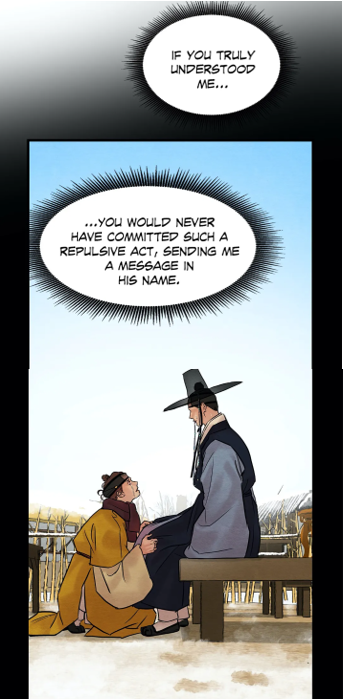 (Chapter 59) The main lead was supposed to meet his tormentor in a public place. Yet their relationship was based on “humiliation“! The “king“ loved to punish Yoon Seungho through humiliation and violence. This explicates why Yoon Seungho reacted that way.
  (Chapter 56)
  (chapter 57) This is what he experienced himself in the past. And observe that the childhood friend’s biggest punishment was actually his public humiliation, when he confessed and got rejected.
  (Chapter 59) In my eyes, the king sought to obtain Yoon Seungho’s affection, but he never realized this. He definitely confused it with submission. He definitely imagined that once the teenager would become submissive, he would have achieved his goal. But he was doomed to fail. In his mind, as the ruler no one could ever reject him. Besides, as the ruler, he was allowed to use his power and as such his strength to obtain what he desires. Don’t forget that in Joseon, people viewed all the monarchs als representatives of the gods. The latter would support them. However, since his youth Yoon Seungho had a strong opinion and mind. Therefore he had caused trouble to his father, as the latter viewed his critical thinking as a synonym for a lack of respect for traditions and the elders, the so-called illness from his childhood. Besides, I am suspecting that the lord must have had visions as well, which would contradict the father‘s dreams and expectations.
 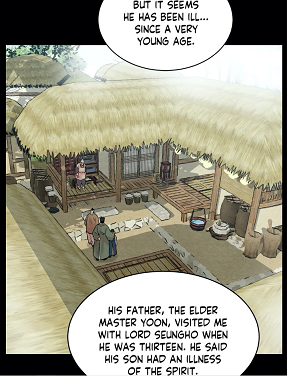 (Chapter 57) Yoon Chang-Hyeon looked down on his son’s critical thinking and came to doubt his words. The author left many clues for this interpretation:
  (chapter 101) Lord Jang got aroused, when he saw the bloodied lips from the painter. Moreover, Black Heart had brought a huge dildo.
 (Chapter 101) The item was huge, therefore it could only injure the artist’s anus.
 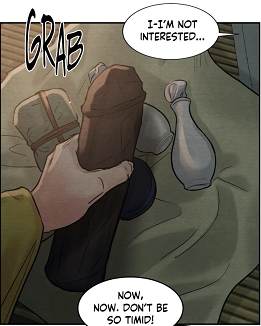 (Chapter 100)
 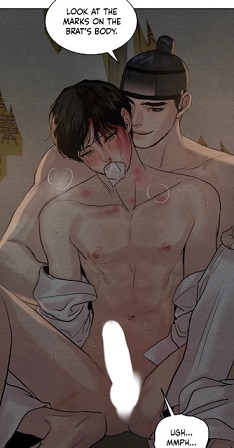 (chapter 101) Even the noble said that this must have hurt. The painter disliked being bitten in the neck.
  (Chapter 88) Furthermore, the lord said this to the painter in the study:
  (chapter 85) These were the words from the pedophile. He was repeating his sexual abuser‘s words. And this proves to me again that the lord was abused in the study, but if he rejected the man, he would be sent to the shed where he would receive his punishment. In other words, Yoon Seungho was punished with sex and violence. And now, you have the explanation why he got gangraped in the end. But the readers should keep in their mind that this was no real BDSM, for the brutality was real. The king couldn’t distinguish between reality and illusion. And this coincides with all my previous interpretations.
Naturally, the king is the biggest hypocrite in the end. He raped the boy, and he knew that. But he could always legitimate his actions with the following excuse. The young boy was a sodomite anyway, for he couldn’t do the deed with a kisaeng. He had brought him upon himself, since he had accepted his offer in the first place. He definitely used religion and philosophy (Taoism) to hide his crimes. By maintaining the harmony between the Yin and Yang, he would live healthy and live longer. But exactly like Lee Jihwa, he was attempting to fool himself and the main lead. And because he made no distinction between real and fake submission, neither father Yoon nor Kim felt obliged to view Yoon Seungho as the king’s official wife or concubine. How could they know that the man viewed the main lead more than just a plaything or a dog? This explicates why Kim had such a memory in the end.  (Chapter 65) Kim had brought him to the barn, because Yoon Seungho was punished there. This could only be suggested by the butler, as I don’t think that the king would ask for the owner of the mansion for permission. This room was definitely taboo, no one was allowed to approach the study or the shed. Yoon Seungho was exposed to rough sex, and Kim knew this, like mentioned above. But he never witnessed it himself, he only discovered the aftermath. From my point of view, this scene occurred after the lord’s loss of virginity. (Chapter 65) And now, you have the explanation why he got gangraped in the end. I had always sensed that this was a punishment for Yoon Seungho.
I will stop here, for the essay is already very long. But before ending this, I would add two more aspects. I was still unable to comment about this panel, 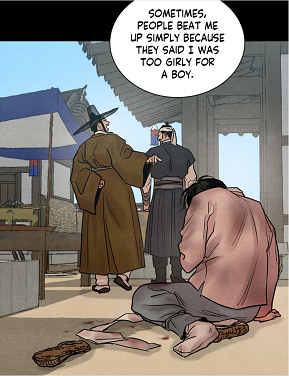 (chapter 94). Notice that violence was used against the painter to mask attraction. The “girly features“ were definitely perceived as something tantalizing. Thus I perceive this incident as a reflection from the BDSM. It was to push the artist away, to incite him to leave the gibang. Heena feared that he might catch the attention of the pedophile, and it is very likely that she was manipulated by the scholar, her idol.
As a conclusion, this new approach gave me new insight about the pedophile‘s personality. Either he will come to the city very soon or he is already in town and this for two reasons. It is related to Yoon Seungho and Black Heart. There’s no ambiguity that the death of Min who was definitely close to him will force him to intervene directly. In the past, I had developed the theory that Black Heart and his friend with the mole were the king’s new companions. In truth, he will use this incident to reenter the main lead‘s life. First, Yoon Seungho was supposed to have committed suicide. He will ask about Yoon Seungho‘s whereabouts and about the incident leading to his disappearance: the rumor about the protagonist‘s crimes (the death of the scholar and the servants)…. And that‘s how he will discover that Baek Na-Kyum is considered as the main lead‘s bride! From my point of view, he knew about the existence of the painter, yet he must have explained his “bride“‘s behavior like this:  (chapter 18)
Feel free to comment. If you have any suggestion for topics or manhwas, feel free to ask. If you enjoyed reading it, retweet it or push the button like. My Reddit-Instagram-Tumblr-Twitter account is: @bebebisous33. Thanks for reading and for the support, particularly, I would like to thank all the new followers and people recommending my blog.

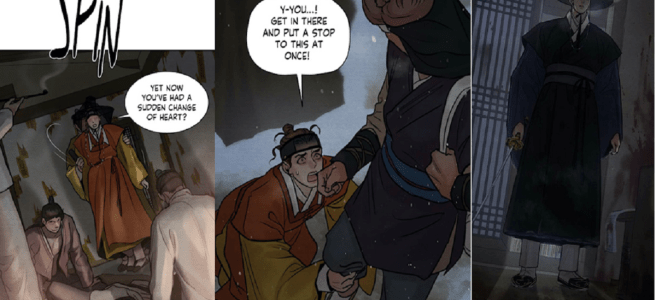


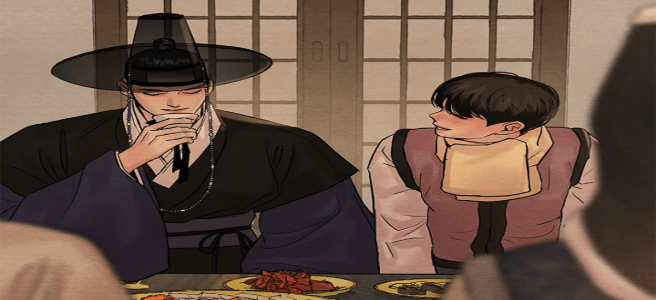
This is where you can read the manhwa. https://www.lezhinus.com/en/comic/painter But be aware that this manhwa is a mature Yaoi, which means, it is about homosexuality with explicit scenes. If you want to read more essays, here is the link to the table of contents: https://bebebisous33analyses.wordpress.com/2020/07/04/table-of-contents-painter-of-the-night/ I am also using doctor Frost as reference again. https://www.webtoons.com/en/mystery/dr-frost/list?title_no=371 I am also mentioning the K-drama “Bad and crazy”
It would be great if you could make some donations/sponsoring: Ko-fi.com/bebebisous33 That way, you can support me with “coffee” so that I have the energy to keep examining manhwas. Besides, I need to cover up the expenses for this blog.
You are probably wondering why I selected such a title, when the story in episode 93 took place in the kisaeng house. I was inspired by the new episode from Doctor Frost again. Right now, doctor Frost and his former student are fighting against a terror organization using brainwashing. Here, the author explains the birth of terror which can lead to war and even to a genocide. 
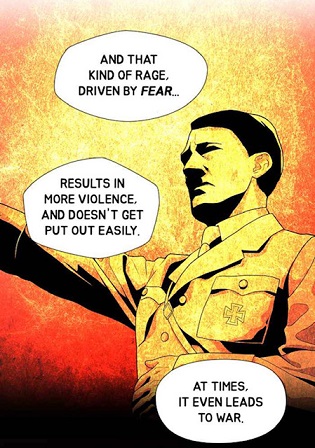 (Doctor Frost, chapter 180) As you can observe, fear and hatred are the main components for unleashing agitation and violence. But this can only work if the medias are amplifying these emotions. Yes, I am talking again about propaganda. And today in the newest episode, the commissar used the fire as a metaphor to describe the evolution of terror.
  (Doctor Frost, episode 183) This means that you can stop the fire from spreading, if you observe the fire path. In other words, if you pay attention to the evolution of the hate crimes, you can slowly put an end to the climate of terror. Important is to find its origin. Then she added this. The fire becomes the most effective in the winter forest.
  (Doctor Frost, chapter 183) Here the manhwaphiles should see the forest as a symbol for society and humans.
  (Doctor Frost, chapter 183) This signifies that the people will get easily influenced by their fear and rage, if there exists a cold climate. A society without compassion and affection. And with only one spark, the forest can get destroyed. This signifies, the absence of love and understanding play a huge role in creating an environment full of hatred and violence. This is not surprising that because of the Coronavirus, intolerance and violence are on the rising, since people are getting more and more isolated and scared. And now, here is the next question: What symbolizes the winter forest in Painter Of The Night and more precisely in episode 93?
When people read the episode 93, they had mixed feelings. On the one hand, they were moved by the way Baek Na-Kyum was treated by his noonas. It was such a warm welcome that it made the painter so happy. He was literally glowing out of delight. 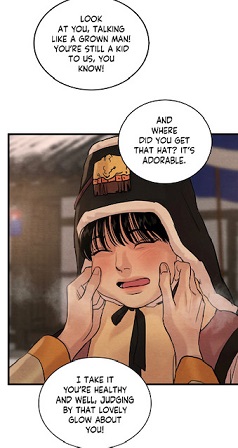 (chapter 93) On the other hand, many readers were greatly disappointed by Yoon Seungho’s behavior. He had prevented Heena from meeting her brother, and the painter was left in the dark. But the lord had also sentenced her to seclusion.
 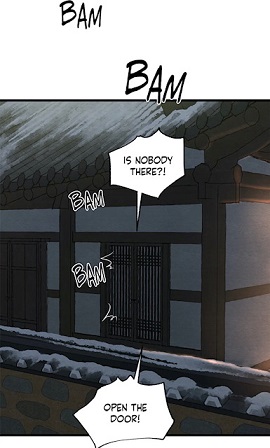 (chapter 93) In their eyes, he was indeed a hoodlum or a bastard. According to the blogger theprocrastinatingredkitty, in the Korean version Yoon Seungho was called a bastard
  (chapter 93) Yes, he had done it again… he hadn’t trusted Baek Na-Kyum and had become violent or ruthless again. But after reading my introduction, you can already anticipate what I am about to say. The winter forest was in fact Baek Na-Kyum’s family. The noonas and the painter had been missing each other so much, but because of Heena’s belief and intervention, she had destroyed this family. Yes, I see her as a religious fanatic who unfortunately got brainwashed by Jung In-Hun and now by Kim. This is no coincidence why Heena is sent to a cold and dark room
 (chapter 93), while the noonas and the artist are sitting in a comfortable room. Hatred versus love… even the colors in the picture reflect the true emotions of the characters. Now, it is time to elaborate my interpretation.
When the painter arrived in the courtyard of the kisaeng house, he was alone. 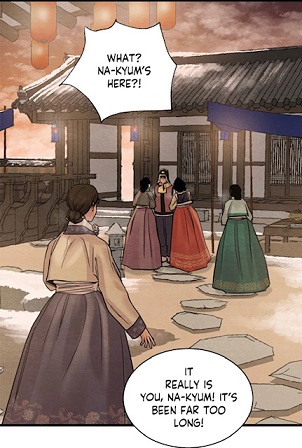 (chapter 93) So where was the lord? I will give you the answer below. Striking is that during the whole time, the artist didn’t notice his absence, until his lovely sister asked him about his whereabouts:
  (chapter 93) Her question reminded him of Yoon Seungho, therefore the artist looked for him, and got surprised, because he didn’t see his husband by his side.
  (chapter 93) This scene is important for two reasons. First, the behavior of the kisaeng clearly showed that she had been left in the dark as well. She was not lying, as there was no drop of sweat on her face. While she had no idea where her brother had been this entire time, Heena knew this the entire time!! 😬 But she kept silent and as such, she hindered her sisters to meet the painter as well. But this doesn’t end here.
  (chapter 93) The kisaeng had not only been left in the dark, but she had also been lied. How did I come to this interpretation? The caring noona employed the expression “you’ve flown the nest already”. With this idiom, she implied that Baek Na-Kyum had willingly left the kisaeng house. He had made this decision on his own, for he felt the need to leave the gibang, whereas the readers already know that this was the opposite. He had been forced to leave by Heena.
 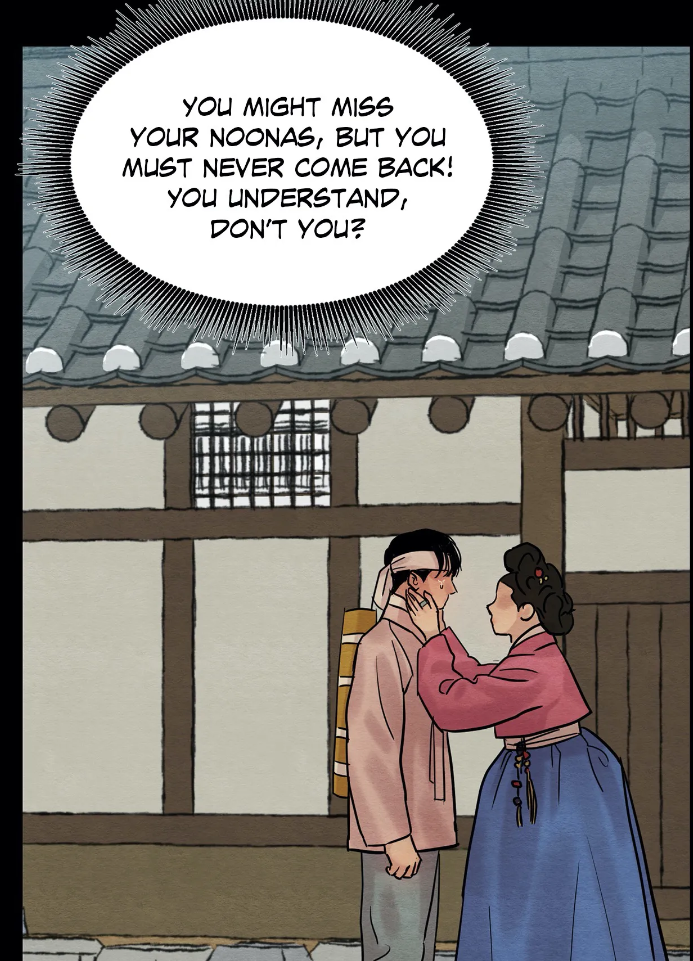 (chapter 46) Like I had already pointed out, the kisaeng had made sure that Baek Na-Kyum didn’t bid goodbye to his noonas. Heena had lied to them saying that this was the boy’s desire and he was now old enough to leave the mansion. This explains why the nice noona employed the idiom “I know”. This is a signal that she had been told by her sister!! But the most infuriating is that Heena left her colleagues in the ignorance for 18 months. None of them knew where the painter was exactly. In the beginning, they had actually no idea that he first lived with the scholar. Besides, notice that the kisaeng complained to the artist. Why didn’t he visit them once in a while? The older sister had given him an order not to!! The most astonishing is that the gentle noona showed great understanding. She accepted the painter’s white lie. (chapter 93) I couldn’t help myself smiling, when I read his excuse: “I was caught up in something important” (sex? spring poetry?😂). At the same time, it broke my heart, for he reduced his long suffering with a single sentence. The noonas had no idea how he got brainwashed and abandoned by the kisaeng and the scholar. The latter even abused him. Note the huge contrast between the noona’s attitude and Heena’s:
  (chapter 68) Heena put the whole blame on the painter, though the latter had been following her orders. She showed no understanding contrary to her sister. Besides, since she knew where he was, why didn’t she contact him in the end?
To conclude, Heena was the reason for the separation between the painter and his noonas. This means that she was responsible for the painter’s agony and trust issues. He had never been abandoned in reality. Hence we could say that she was paying for her sins. She was not allowed to participate in the family reunion. Striking is that when the kisaeng showered her brother with love (I would like to know her name!!), Yoon Seungho walked past them. (chapter 93) You can detect his presence on the left. This means that so far, he had been standing in the background observing the reunion attentively. I couldn’t help myself connecting this scene to this one panel: 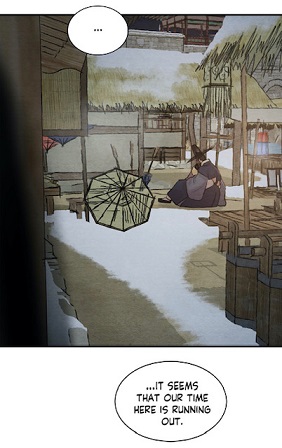 (chapter 76) Back then, Nameless had been confronted with reality: the protagonists were just two men in love and their affection was deep and genuine. So imagine what it meant for the lord, when he saw this scene in the shadow: (chapter 93) He could see what a real family was! This is not surprising that he spoke nicely to them later, and even didn’t take the seat of honor later. In fact, he showed humbleness, for he took the seat next to the door, the lowest in the rank.
 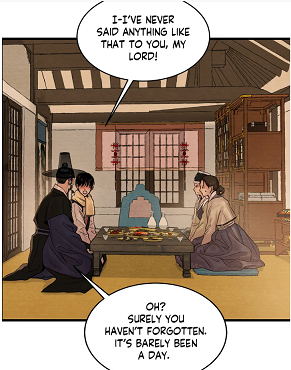 (chapter 93) There’s no doubt that he was seeking for their approval. To conclude, he remained in the background in order to judge the kisaengs correctly. Would they behave like Heena or not? In fact, Yoon Seungho had made a jump of faith. He had trusted the painter’s heart. However, he couldn’t let Heena ruin this happy reunion. Therefore she got excluded. She could have made a ruckus.
More striking is that when the lord walked past them, none of the kisaengs got shocked or condemned him. They couldn’t identify him right away. This means, they only knew him by his name, lord Seungho. Even one of them said this:  (chapter 93) In her eyes, he was a handsome man. Another fell under his spell as well:
  (chapter 93) This is important, because this shows that the kisaengs are not thinking like Heena at all. They don’t resent him, because he is a noble.
  (chapter 65) I would even add that they couldn’t recognize him, and I am now assuming that they had not heard about Yoon Seungho yet. They couldn’t put a name on him, he was just a fancy companion. (Chapter 93) They were not shocked or surprised. They had no reaction at all. This means that the smear campaign started much later: hate speech! The spark of the fire in the winter forest!
 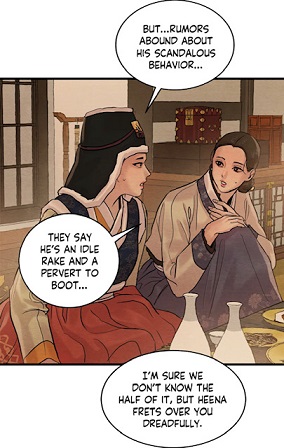 (chapter 93) In the first version, I had blamed Heena, yet I have to admit that I made a mistake, because I had paid too much attention to this image.
 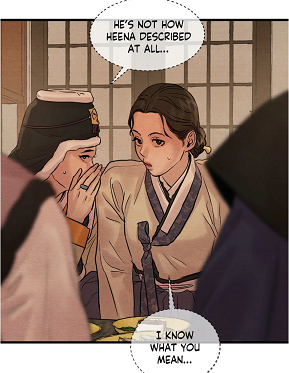 (Chapter 93) Here, they whispered quite loudly and actually blamed the noona for her negative description. But this declaration contradicts the previous one. (Chapter 93) Observe here that none of the kisaengs clearly said that Heena had been spreading rumors about the protagonist. The two women employed the following expressions: „They say“/„I am sure we don’t know the half of it“. The kisaeng with the purple hanbok was pointing out that these rumors were actually upsetting their colleague. This means that in the gibang, someone made sure to call him many names similar to this situation: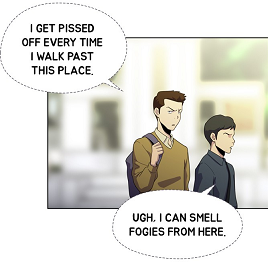
 (Doctor Frost, chapter 175) It created the illusion that Heena had been badmouthing Yoon Seungho and desired to obtain the support from her eonnies. But who had called him a rake and a pervert? The noona herself! (Chapter 93) We could say that they were spreading the rumors herself. Therefore their karma was to get caught!
  (Chapter 93) However, they were just repeating what they had been told. Hence it didn’t work. Why? First, it is, because the painter appeared alone. They could see with their own eyes how well he was doing. (chapter 93) In that scene, the kisaengs were pure and innocent. The other reason is that the noonas aren’t brainwashed, hence they are still selfless and compassionate. In other words, the winter forest was just sleeping, and as soon as the sun appeared, the forest was being reborn. Love and affection never disappeared despite the long separation. That‘s the reason why the fire couldn‘t spread in the end. But who described the main lead like that?
  (Chapter 93) Naturally Min!! How do I come to this conclusion? Simply by recollecting his words in the tavern: (chapter 93) He was actually portraying himself as an immoral person lacking in sexual restraint. He would not know fidelity. But the moment the kisaengs got caught, the lord proved their words wrong. He remained calm and treated them well despite the insult.
 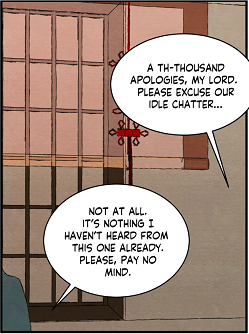 (Chapter 93) He made no fuss and accepted their apology. The most striking is that he ended up apologizing to the noonas.
  (Chapter 93)
And this leads me to the following conclusion. Heena was now under the spell of Kim, hence she insulted the main lead as a murderer, whereas the other kisaengs were under the influence of Black Heart, though it is very possible that they could have been influenced by another colleague, who was acting on Min‘s order.  (Chapter 95) The manhwaphiles should recall the following rule: a scene will be reflected in the next episode. There is no doubt that the valet was the one who ruined the Yoons in the end by causing mistrust and jealousy. He destroyed the family. Therefore Kim sent the ruined painting to the father, and even refused to give the letters from the brother. He made sure to create misunderstandings, silence and tensions between the Yoons, portraying each of them like a monster or a selfish and common brute. This is not surprising that for the father, the son is a monster:
 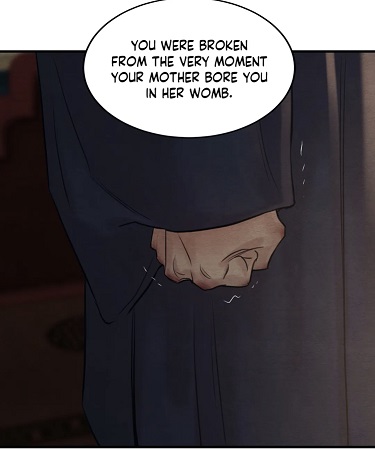 (chapter 86) Kim was successful, for he could change their personality entirely. He used social norms, people’s superstitions, fears and flaws to his advantage. Why? It is because he had to hide his own wrongdoings and betrayals. That’s the reason why the lord’s mansion could be considered as a winter forest as well. But since Heena resents powerful nobles, her negative emotions and her bias made her the perfect tool for the next scheme. But Min and Kim failed. Why? It is because they had two different approaches: The valet preferred using the scholar‘s death for the smear campaign, whereas Black Heart wished to destroy the affection and trust between our beloved couple. Moreover, since the noonas had stopped Heena from approaching her brother with their warm welcome, the kisaengs‘ attempts to ruin the relationship between Yoon Seungho and Baek Na-Kyum were rather half-hearted. The noonas were lacking determination and stubbornness.
First, it is important to examine why the lord even agreed to the painter’s request. What caught my attention is this panel:  (chapter 92) The lord saw that the painter was looking elsewhere and his gaze was full of longing. Secondly, he had promised his lover to fulfil all his wishes.
  (Chapter 91) He didn’t want to break his promise. I am wondering if this idea was not suggested by the butler, because the meeting in the inn was no coincidence. The noble Min made sure to trigger the painter’s memory with the presence of the kisaeng and the blue-lavender hanbok. As you can see, Yoon Seungho didn’t have much choice in the end,
What caught my attention is that Yoon Seungho went in direction of the party where Heena was participating. 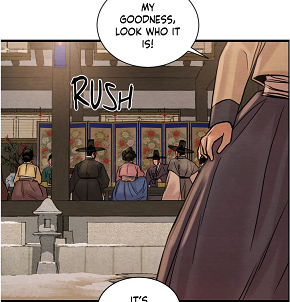 (chapter 93) First, I thought that the man with the green hanbok was Black Heart, since the kisaeng facing the man in green resembles to one who followed him to the tavern, the one under the purple jacket. The color of the skirt is the same.
 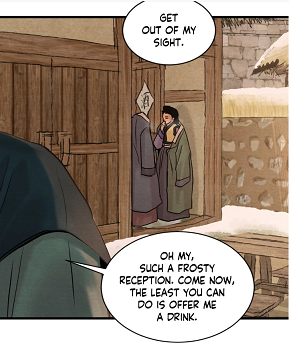 (chapter 92) However, at some point I began doubting this, for for the green shade is a little different. Moreover, I was reminded of this panel:
  (chapter 87) Yes, the same colors, the green hanbok and the kisaeng’s clothes are the same. On the other hand, since Min had wet clothes, it is also possible that once in the gibang, Min received a new hanbok from the host, similar to the scene in chapter 59, when Lee Jihwa was asked if he had played in the snow.
 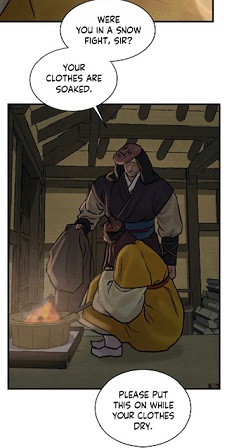 (Chapter 59) On the other hand, Min appeared later as the doppelgaenger of Lee Jihwa.
  (Chapter 96) So we have to wonder if Min switched clothes three times during the same evening. But it is definitely possible, for each episode is reflected in the next.
Another possibility is that Yoon Seungho met his former abuser, but I have my doubts about it, since the man kept his distance from the main figure for quite some time. In my eyes, he needed a reason for his return. Consequently, my theory is that the main lead met Black Heart again, and talked to him about Heena. Don‘t forget that the main lead was present, when the kisaeng had made a ruckus in his mansion.  (Chapter 66) The Joker could serve as a witness, and Black Heart couldn‘t lie at all, as he needed to keep his trust. Besides, it is possible that he must have noticed the disappearance of the Spring poem. Don’t forget that it had vanished in the inn, and Min was the last one seen with it.
 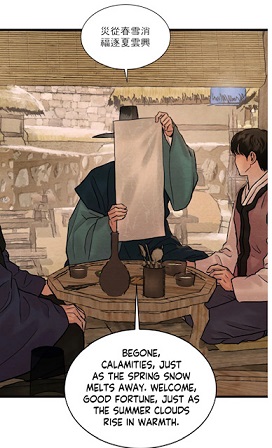 (Chapter 92). Their sudden meeting could be the reason why he disappeared. (Chapter 93) He didn’t wish to create a ruckus because of the painter, and Min had no interest to become involved so openly, as his image would have been ruined. The kisaeng could have caused a scandal. In my opinion, Yoon Seungho picked Heena there, and the man with the green hanbok didn‘t hinder him. Hence Heena was forced to follow the protagonist. So by going directly to the party, he put an end to the fire. The kisaeng couldn’t cause a ruckus or describe the main lead as a criminal or brutal murderer. Therefore there was no fire in the winter forest. If she had come close to her brother, she would have tried to make him feel dirty and have made him many reproaches. I have to admit that this episode was difficult to read, for they were a lot of blanks. We never saw what Yoon Seungho did, before he entered the room, just like there is a time jump between the moment the painter wants to leave the courtyard, and the moment he is sitting in the room. Furthermore, notice that the kisaeng with the green jacket disappeared as well. In fact, 2 noonas disappeared from 4! So where did they go?
What caught my attention is the contradiction between these two panels: (chapter 93)  (chapter 93) Now, they know that the young painter lived with the scholar. How come? Baek Na-Kyum didn’t tell them, because the noona asked him this question. This means that she wanted a confirmation. And now, we have to question ourselves this: who told them about the painter’s past? One possibility is that it was Yoon Seungho, but I doubt it, for the noona didn’t recognize him outside. From my point of view, the noona had left her brother’s side. There was a time jump, because the kisaeng was now wearing a different skirt, khaki!! This means that now, she was acting on the order of someone. Like mentioned above, it could be Min via the other kisaeng. But there exists another eventuality: the Yoons! Don’t forget that khaki is the color of Yoon Chang-Hyeon.
 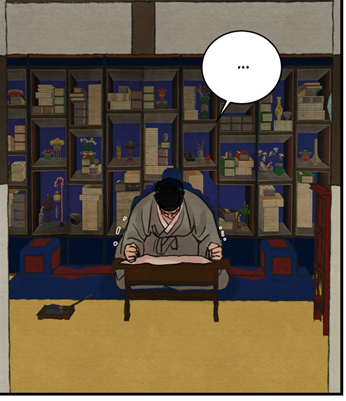 (Chapter 44)
 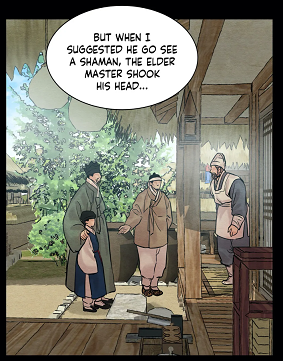 (chapter 57) Besides, just a few episodes ago, he had mentioned the scholar and the civil service examinations, and the story is following this rule: the next chapters will reflect the previous ones. Moreover, in season 2 and 3, the father was seen in the kisaeng house. Finally, in front of the learned sir‘s home, the manhwaworms could identify the guards from the patriarch.
 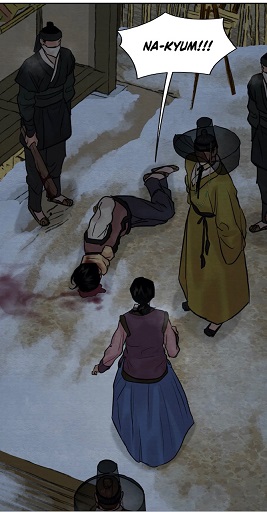 (Chapter 99) This scene outlined that Black Heart and Yoon Chang Hyeon were working together, and they had planned to blame the Lees. But the irony is that the father was doomed to fail, because he was using the noonas‘ goodness and innocence. So the scholar was mentioned for one reason. The kisaeng desired to push Baek Na-Kyum to question his sponsor about the learned sir‘s well-being and whereabouts. The purpose was to generate a quarrel. Note that the other helped her colleague. As you can see, the hat and the change of the color of the noona’s skirt was an indication that there was a time jump. Thus I am deducing that the kisaeng was not present the entire time. Remember that the magician Byeonduck is always creating a fake continuity.
First, the noona had the hat with the orange skirt:  (chapter 93) When she mentioned the learned sir, Yoon Seungho entered the room. (Chapter 93) But observe that the woman had a green skirt with the hat. This means that in the meantime, she must have left the room!! Striking is that he only opened the door, when Jung In-Hun was mentioned. This was no coincidence! He was putting an end to the fire by replying this:
 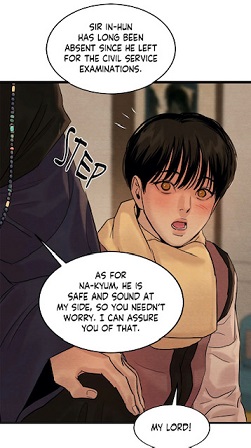 (chapter 93) What could the noonas say to this answer? They couldn‘t call the main lead a liar! And note how he introduced himself: (chapter 93) This means that he had heard their conversation for quite some time. He also must have seen the kisaeng leaving and entering the room too. She was still wearing the green skirt with the hat! (Chapter 93) So here we had no time jump! And now, you comprehend why the author made us hear the conversation from the hallway. (Chapter 93) This corresponds to the main lead‘s arrival. In my eyes, from that moment on, he was spying on the family. But contrary to the past, he had no outburst of rage because of their badmouthing and lie. Why? It is because he had seen their genuine affection in the courtyard. The lord had witnessed the artist‘s happiness and joy! Thus I am deducing that Yoon Seungho had been manipulated in the past. Heena had provoked our beloved protagonist with a deception (Chapter 68) which I had already sensed in the past. This chapter reinforces my previous interpretation. But why did the noona change her skirt? It is because it was wet! I had observed that the lit of the well had been removed. (Chapter 93)
  (chapter 94) That‘s the reason why Yoon Seungho went to the well later. My explanation is that he had been suggested to go there by the noonas, while the latter had proposed a different idea to their brother: the walk to the pond. But why? In reality, the schemers envisioned that Yoon Seungho would behave like a hoodlum, he would kill the kisaeng Heena. Remember the threat expressed to the noona: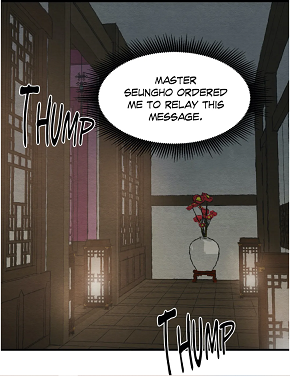
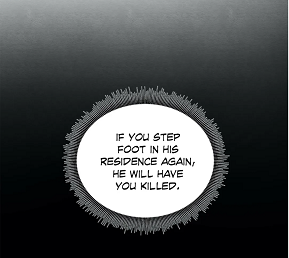 (Chapter 69) But like I had explained, this menace was voiced by Kim, which was only validated by Yoon Seungho afterwards. And naturally, this threat had been revealed to the schemers: Min and the patriarch. They all imagined that the main lead would punish Heena for her accusations. Kim had experienced this scene in the courtyard
 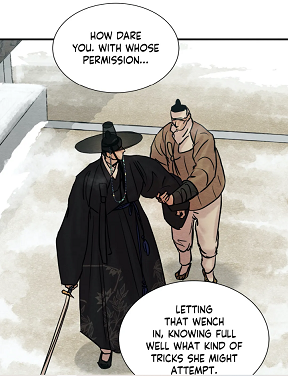 (chapter 68) He had taken these words as face-value. But he never recognized that the main lead would never use violence against Baek Na-Kyum‘s family, and this was already perceptible in chapter 68. He never barged in the study, when the noona called him a bird of misfortune.
  (Chapter 68) He respected their privacy, the opposite of the butler.
  (Chapter 85) This explicates why the kisaengs blamed Heena for the rumors. (Chapter 93) They were trying to fuel resent towards their colleague. But for a benevolent listener, their words reflected a different reality: the kisaengs’ open-mindedness. They were perceiving the main lead in a better light. That’s the reason why their „smear campaign“ failed.
Hence I come to the following conclusion. During that night in the gibang, Min and Yoon Chang-Hyeon had expected that Yoon Seungho would kill the kisaeng. And her body would have been thrown into the well. That way, the elder master could have used his messenger‘s death as another evidence for the lord‘s criminal activity. And now, under this new light, I believe that the silence and resignation from the noona (chapter 93) in the kitchen created the illusion that the main lead had silenced her. Besides, observe that the light from the room had vanished. It is visible, if you contrast the last two panels.  (Chapter 93) This gesture (blowing the candle) outlines that he was indeed trying to stop the fire, a symbol for hatred and fear, from spreading.
But let‘s return our attention to the conversation between the kisaengs and the couple. What caught my attention is that while the noble lost in his thoughts by recalling his conversation with Heena, he didn‘t realize that something had changed. 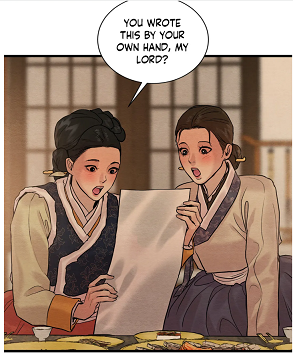 (Chapter 93) This time, the noona had no longer the hat, but she was wearing the orange skirt again. The only explanation is that she had left the room. Since the kisaengs had no drop of sweat on their face, their admiration and surprise were genuine. But now take a look at this
  (chapter 93) We have the return of the hat! Moreover, another detail caught my attention: the paper is blank! Where are the calligraphes? One might argue that it was too difficult for the author to draw them, but I can only refute this point by using this scene.
 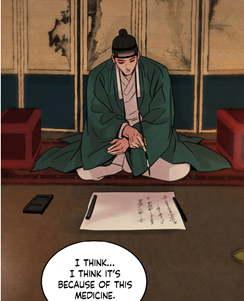 (Chapter 36) Here, the handwriting was even smaller compare to this calligraphy:
 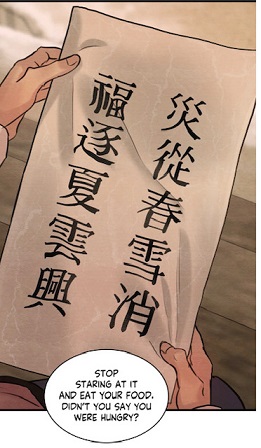 (chapter 92) From my point of view, the Spring poem got switched and was returned to the schemers. Another evidence for this theory is the length of the piece of paper. (Chapter 93) It is much longer here, as the end disappears under the table. But not here: (chapter 93) This was the famous blank piece of paper, a new version of this scene:
  (chapter 65) First, the noona couldn‘t see her brother‘s painting, until Kim showed her the picture with Jung In-Hun which he had kept!
  (Chapter 65) Kim was embarrassed in that scene, like the drop of sweat indicates it.This was the negative version of chapter 93. Don’t forget that Heena had been manipulated by Kim, when she visited the lord’s mansion. The latter had shown her the painting from the painter and then he must have told about the flashback in the bedchamber and the second marathon session in the shed. (chapter 68)
For chapter 93 represents the positive reflection from the noona’s stay in the mansion, I think that first, the noonas saw the original Spring poem, then they gave it to someone else and the woman returned with a blank page. Like I had already explained, they needed to remove the evidence that Yoon Seungho was highly educated. (Chapter 93) Striking is that neither Baek Na-Kyum nor his lover had eyes in this panel, a sign that they were blind to the noona‘s tricks. Nonetheless, I would like the manhwaphiles to keep in their mind that these women were just naive, and got manipulated too. They were definitely acting for their sibling’s best interests: Baek Na-Kyum. At the same time, we could say that this was Yoon Seungho’s karma! Don’t forget that he had stolen a poem from the painter too  (chapter 4) and he had never returned it. He had replaced it with another sijo, according to me with the original sijo.
  (Chapter 7) It doesn‘t matter, if the scholar had deceived the painter. The latter viewed the paper as a treasure, a memory from his learned sir.
So during the family dinner, the noonas had an ambiguous attitude towards the main lead, which I explained with their social status. How could they disregard a noble, especially an elder! From my point of view, Yoon Chang-Hyeon must have listened to their conversation, for we have to remember that there is always a reflection within the same chapter. So imagine how the patriarch must have felt, when he heard the lord‘s rejection: 
 (Chapter 93) The father was mocked for his dream!! He was portraying the elder master as a poor and weak noble! He was even compared to the learned sir. We have two proofs for this signification:
  (chapter 86) This was the father‘s karma. He had insulted his own son, made him feel little and even jealous
  (chapter 86) Remember that karma will always retaliate shortly, and the punishment will be even worse. The irony is that the lord was actually repeating the butler‘s words! (Chapter 93) This is what he had been told, when the lord had let transpire that he was thinking about taking the civil service examination. There’s no ambiguity that the noble was talked out of it, for if he went to the court, he would meet the pedophile and recognize the identity of his abuser.
What caught my notice is that here, the noona had no longer the hat again!  (Chapter 93) This symbolizes that she was not acting here. The drop of sweat on their face showed their embarrassment. They could not deny his statement, for the learned sir was indeed poor and with no connection. They anticipated that the lord would boost about his talent, but no he was showing humbleness. On the other hand, he outlined his wealth and power, which the noonas couldn’t contradict. His words were indeed reflecting a certain reality. Another important detail is their reply to the lord‘s statement: the points of suspension which I connect to the butler. Since chapter 77, the latter had switched loyalty and was now serving the elder master Yoon.
But let’s return our attention to the noona who tried to divert attention from their shame and guilt: 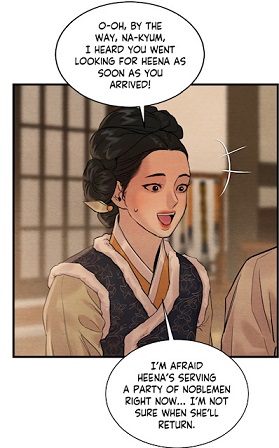 (chapter 93) “I heard” indicates that she wasn’t the entire time with Baek Na-Kyum. This proves my previous statement that the woman must have left the room leaving her siblings inside at some point. Secondly, the drop of sweat on the cheek is a signal for a lie. This means that the kisaeng was well aware of Heena’s arrest. She was actually covering up. It was, as if she was working for Yoon Seungho, while in reality she was acting on someone else’s behalf.
Heena was in the kisaeng house and there’s no ambiguity that she knew where her sister was. This means that she was deceiving her brother. This truly shows that she didn’t feel upset about the situation. I have the impression that the schemers must have discovered that Heena had kept hidden from her co-workers that she knew where her brother had been. They must have discovered her deception. For me, Heena was just receiving the punishment she had deserved. Don’t forget that she had barged in his mansion with guards 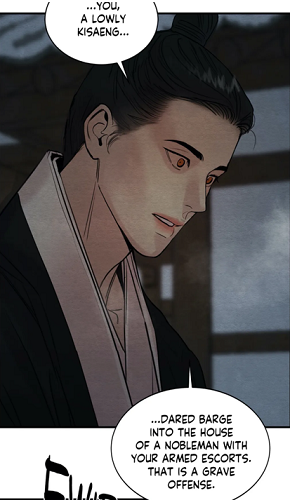 (chapter 69), and back then the lord had showed leniency. However, Heena didn’t want to acknowledge his benevolence. Thus she sent letters to her brother, in which she called Yoon Seungho many names: a rake, a hoodlum, a bastard and finally a murderer…
  (chapter 93) One might bring up the freedom of speech, but there’s a reason why in Germany total freedom of expression is not allowed. During the Republic of Weimar, parties were authorized to announce their hatred for democracy and republic. The result was that right-extremist parties as such the NSDAP led by Hitler became more and more powerful. This is no coincidence that this republic vanished. The NSDAP could spread fear and hate against democrats, Jews and other minorities. Hate speech encourages hate crimes. Yes, this is the consequence of the butler’s philosophy: “don’t take it to heart”. This saying symbolizes indifference and as such passivity and silence which contributes to create the perfect climate for hatred and fear.
But let us return to the letters. From my point of view, Yoon Seungho never gave the order to hide the letters, but once he discovered their existence, he didn’t decide to ignore them. I have the impression that he read them, when the painter took a nap first.  (chapter 91) They didn‘t go to the calligrapher right away. One week had passed, since the elder master Yoon had visited the mansion. This signifies that Heena is forced to face the consequences of her past actions.
 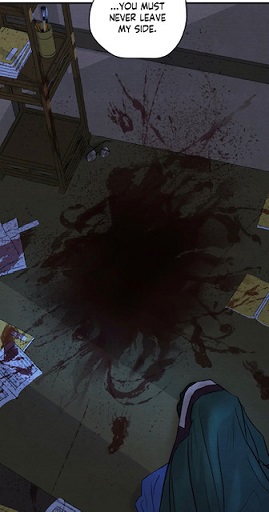 (chapter 88) This is no coincidence that she was sitting the same way in the “jail”, than when she discovered the blood. However, this time she was facing the door. (chapter 93) She was forced to face her isolation. One might say that these were just letters… The lord was just too harsh with her. But remember what I wrote above: calling names is the start of discrimination and terror. That‘s how the lord‘s downfall started too. People shouldn’t underestimate the power of words in the letters. Baek Na-Kyum already went through this terrible experience. Just because Yoon Seungho is used to this, he shouldn’t accept this. Besides, by acting so, she is tarnishing her brother’s honor. If the artist lives with him, he becomes guilty by association. Her goal is to make the painter leave the mansion. She could have confronted the main lead like in the past, but she didn‘t. She never went to the authorities either.
In addition, I would like to bring up the K-drama Bad and Crazy. In this story, teenagers got brainwashed by a so-called therapist who pushed them to commit crimes. He used their low self-esteem and lack of confidence to gaslight them. Striking is that in episode 9, the main lead Soo Yul discovered that a man got sentenced instead of the real culprit. However, when he met the convict, Soo Yul asked him why he didn’t ask for a retrial. The innocent man confessed his guilt immediately. He started explaining everything which confused Soo Yul. Until he saw this:  (episode 9) The real culprit had sent him letters each day for years… The content of the correspondence was always the same:
  (episode 9) That’s how he got brainwashed and convinced that he had indeed committed a crime. In jail, he was isolated and due to the suffered injustice, the prisoner definitely suffered from an emotional and mental breakdown, explaining why he was receptive to manipulations. That’s why you see the mouth and the letter together. So imagine that Baek Na-Kyum had read all the letters and all of them were saying the same thing over and over again. Since the painter is someone with a low self-esteem, he would have started doubting his own judgement. This is gaslighting. Naturally, Kim never intended him to read them. The whole purpose was to create a quarrel in the couple. I am quite certain that Heena never asked about her brother’s well-being. She was already convinced that the lord was a rake and a bastard. Her letters were full of contempt and hatred, something Yoon Seungho could sense in the correspondence.
  The reflection of this scene.
  (chapter 87) But note that Yoon Seungho never used any violence at all. He just asked her to remain quiet and cause no trouble. (chapter 93) We could see that once rumors about Yoon Seungho started spreading in the kisaeng house, Heena didn’t stop them, she heard them, and believed in them. The start of the smear campaign began in the gibang:
 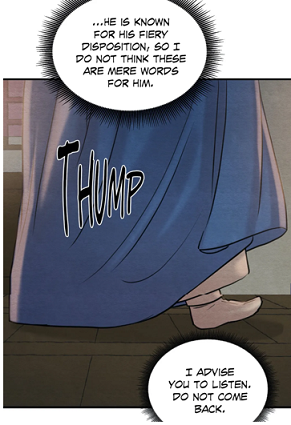 (Chapter 69) And who was there during that night? Black Heart. This is important, because in the first episode, the noona had badmouthed the main lead, but she was well aware of the truth.
 (Chapter 1) It was, as if the kisaeng was now paying for her past sin. She had become a victim of her own trick. (chapter 93) In her eyes, the main lead was just a man consumed by sex, hence he is a “rake” and a “pervert”.
But “rake,” when used in the context of a regency romance, has nothing to do with chores. A shortened version of the word “rakehell,” this category of carefree, libertine aristocratic men became popular in stage plays written during the Restoration period in 17th century England. […] He’s definitely someone who’s not interested in marriage. Celibacy is off the table. No serious relationships of any kind. Often, rakes really adore women of all shapes and sizes. They have an innate sense of how sexy they are, and how to use that sexiness to get what they want from anybody around them. Essentially, the rake is the bad boy with the heart of gold. quoted from https://www.oprahdaily.com/entertainment/tv-movies/a35034695/what-is-a-rake-person-romance-novels/
This means that her job was to deny the existence of the marriage between the painter and the noble  (chapter 87), since the rumors of his union in town were already spreading. The purpose of this smear campaign was to portray the lord as someone who was not interested in monogamy and fidelity. And who had an interest to oppose this union? The father!! As you could detect, through these comparisons I could connect Yoon Chang-Hyeon, Kim, Heena and Black Heart together. In the end, this badmouthing couldn’t succeed, for her eonnies were different. They were more innocent and less selfish, they had been left in the dark concerning the lord’s past. They never admired the learned sir in detriment of Baek Na-Kyum. They certainly don’t reject sexuality and they have less prejudices. As you can see, I detected a war of rumors, reminding me of the war of the waves during World War II.
Here, I would like to bring up the manhwa Doctor Frost again. 

 (chapter 175) Because of this comparison, I couldn’t help myself thinking of the water vapor as the grapevines in Painter Of The Night. They’re everywhere and no one can stop them. And now, you comprehend how the noble’s reputation got ruined.
  (chapter 175) That’s how hatred and contempt were spread. And Lee Jihwa listened to them, this is no coincidence why his mind and heart got poisoned. As long as he remained by Kim and Min’s side, his heart and mind would always be clouded. This means that Yoon Seungho was able to stop a fire, before it ruined the winter forest. People were upset, for he had such a cold gaze, when he remembered his interaction with Heena.
  (chapter 93) But he was just mirroring the schemers‘ thoughts and gaze. He had to remain cold. So what does Heena’s isolation mean? Yoon Seungho has no idea, but he is clearing her mind from the brainwashing.
  (Doctor Frost, chapter 183) There exists two methods. First,
  (Doctor Frost, chapter 183) And we could clearly detect this in the confrontation between Heena and Yoon Seungho:
  (chapter 93: In the Korean version: Your little brother will be with me now) For Heena, the painter should live with the scholar. This was her faith:
  (chapter 46), though I am quite sure that it was in truth her biggest wish. She was in love with the learned sir herself. By looking him in the eyes, she could detect the lord’s determination and frankness. This was his choice. The problem is with deprogramming is
  (Doctor Frost, chapter 183) That’s the reason why nowadays, psychologists prefer the other method
  (Doctor Frost, chapter 183) And now, you comprehend what happened. The deprogramming didn‘t work out, for Heena was approached by the schemers again. They used another noona to deceive the sibling, for they could no longer use the women close to Baek Na-Kyum. Thus Heena was still under the influence of the haters.
  (Chapter 98) Since she resents nobles, I deduce that the so-called witness was a commoner. In my eyes, it can only be Kim who justified his silence by saying that he could do nothing. He was the only one who knew, because the other had been already killed.
Since the other kisaengs were not involved in the lord’s suffering, they were more innocent. This is the reason why it was important for the main leads to have some good time with the noonas first. The latter could see with their own eyes that the couple was happy.  (chapter 93). Hence their punishment for their deceptions couldn‘t be so harsh.
  (Chapter 99) The symbol of their dinner and reunion was pushed away. In my eyes, this ruckus put them in a bad light. However, I believe that these deceptions were necessary, for the bond between Heena and the other noonas
 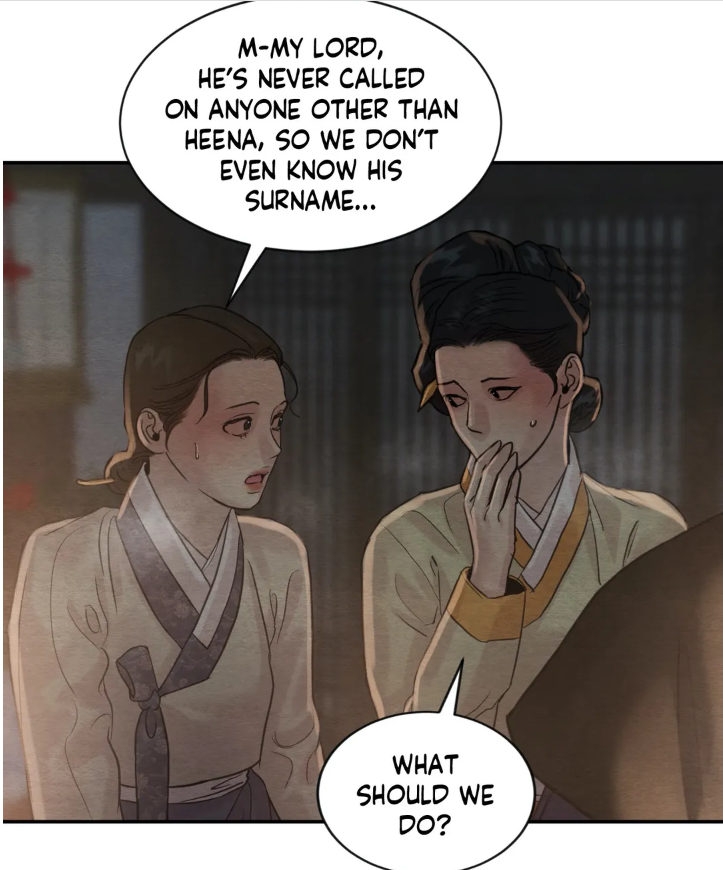 (Chapter 99) was quite strong. In this scene, they had sided with the kisaeng again, hiding the fact that they had seen leaving Heena with Lee Jihwa. They knew that the kisaeng was running away from the gibang, for she was not dressed up.
  (Chapter 99) Hence the moment the kisaengs see how the brother was hurt by Min, they will realize the deception from Heena who abused their affection and loyalty. They will definitely blame themselves for their lies, and since I discovered connections between Yoon Chang-Hyeon and the noonas, I have the impression that Yoon Seungho will discover the backstabbing coming from his own father. According to me, the schemers had planned to frame the main lead for Heena‘s death (well), but the puppet masters‘ karma is to receive the sentence that they had planned for the main lead: accusation of violence and murder. The more I am analysing, the more I am sensing that Yoon Chang-Hyeon will be judged as an accomplice of Lee Jihwa’s crime in the nobles‘ bloodbath. He had helped Lee Jihwa and deceived Black Heart. And if the kisaeng is alive, the survivor will recognize the deception from the guards.
Besides, I would like to point out how gentle the lord was, when he forced Heena to look him in the eyes. (chapter 93) Don’t forget how he grabbed the servant’s face:  (chapter 80) Heena could have pushed away his hand, her movements were not restrained contrary to the lord in the kisaeng house (chapter 86).
People have the impression that this reunion was too beautiful to be true, but the reality is that we are witnessing a war!! But each time, the main lead was able to defeat his opponent, for he was no longer avoiding the problems. He faced them head on. But he didn’t work alone. His wife assisted him. He already started by defending his husband’s honor.  (chapter 93) Secondly, he introduced his partner to his family properly.
 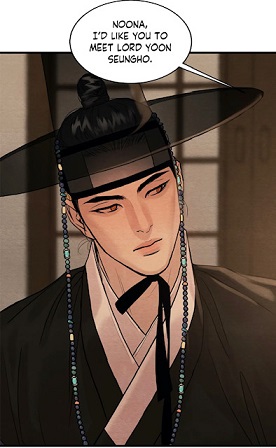 (chapter 93) It is here necessary to contrast this introduction with this one:
  (chapter 01) In the beginning of the story, the protagonist was not presented as a lord, but as a master!! This means, he belonged to the Yoons. However, Baek Na-Kyum is now viewing the protagonist as the real lord of the mansion. He is independent, which means that the artist is not truly acknowledging Yoon Chang-Hyeon and Yoon Seung-Won as his family. And if you compare the first episode with chapter 93, you’ll realize the similarities. Back then, Heena had mentioned the main lead in order to scare the painter, she had used rumors… (chapter 01) But exactly like in episode 10, where the grapevine was created to target the painter and Jung In-Hun, the “rumor” in episode 1 never reached the noonas’ ears. They only heard about the black sheep of the family recently. (chapter 93) In the last panel, we can detect Heena’s hypocrisy. She got worried the moment she heard her brother was living with the main lead. I would even say that her mind was in peace until the scandal in town, this explicates why she could enjoy buying clothes.
  (chapter 64) But she started worrying for her brother, when she realized that he wasn’t living according to her belief: abstinence. And now, we have to question ourselves this: why did Yoon Seungho encourage his bride to sleep in the kisaeng house?
 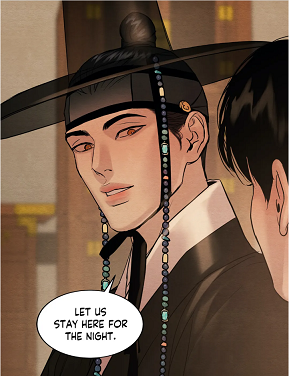 (chapter 93) Naturally, he had many reasons to do so. First, he wished to keep his promise. Secondly, he had sensed the painter’s sadness.
  (Chapter 93) But Yoon Seungho never imagined that he was himself the cause for this heartache. The painter could detect the lord’s agony and low self-esteem. He knew how hurtful it is to be called names like rake or bastard or hoodlum. And the lord’s selflessness got rewarded: his biggest wish came true during that night. There was someone who loved him despite his flaws and wrongdoings. We could say that their stay was to confirm his marriage with the painter to the noonas. At the same time, season 3 exposed the slow transformation of Yoon Seungho. Little by little, he was showing an interest to his own past and no longer accepting the justification that he was just a bird of misfortune. Don’t forget the master’s previous statement:
  (chapter 86) He was already pondering on the question why the family name was sullied. This shows that Yoon Seungho is slowly uncovering the truth, and he is now using Kim’s MO: deliver the information in delay, feign ignorance and act, listening to conversations behind the doors. This is no coincidence that he is recovering his memories as well. This is important, because he is less manipulable and as such no longer weak to brainwashing.
And here I would like to thank my follower @Spppeedy who made me discover another aspect. Yoon Seungho’s real emancipation didn’t occur just with the hug, but also with the whisper:  (chapter 88) When the lord got embraced, the painter whispered this to his ear:
“I like to hold you close.”
This explicates why he said this later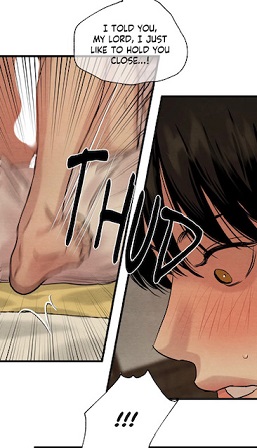 (chapter 91) This represented Baek Na-Kyum’s first mini-love confession. His action was supported by his words. Therefore the lord could realize the honesty and genuineness of the painter. He could be embraced and as such accepted, he was no monster. Yes, it was the opposite of the love session in the physician’s office. Back then, the painter had remained silent.
  (chapter 62) And this made me realize the signification of whispers in the manhwa. They stand in opposition to the hate speech and brainwashing!! This is no coincidence that the noonas whispered, when they noticed that Yoon Seungho was totally different from the description which Heena was supposed to have spread. (chapter 93) The whispers symbolize secrets, trust and intimacy. They embody love, honesty and truth, though here they blamed their noona. This means that the louder a character in the manhwa is, the more dishonest and insensitive he or she is. (chapter 18) The whisper contrasts so much to the rumors, anonymity versus personal. Thus I conclude that the whisper represents a weapon against the brainwashing and terror. This is not something that a spy can hear from the window or the door! Hence you have Yoon Seungho whispering this to Lee Jihwa
 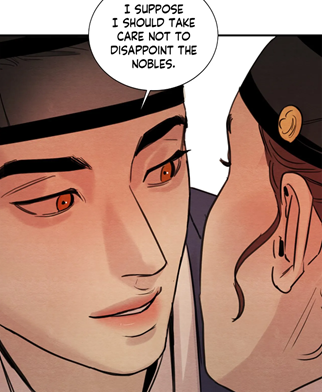 (chapter 18) or Yoon Seungho saying this to Heena: (chapter 93) Due to the closeness, the lord incited them to face reality. He confided to them his wish and goal, though after 6 months, the master’s dream changed. He views Baek Na-Kyum as his wife. That’s why I believe that the lord’s whisper
  (chapter 92) reflects the nature of their relationship: Love and closeness. Even outside and in front of the calligrapher, the lord felt the need to know his lover’s thoughts, the positive version of this rumor: An aficionado for the painter with no regard for time and place. 😉
So when you read this (doctor Frost, chapter 83), you should just replace the name Juhwan Park by Heena. She was just manipulated by the butler and Min’s trick. They used her strong belief and prejudices. However, I had the feeling that Heena could come to her senses, because she remained silent and her gaze was different.
  (chapter 83) Besides, what caught my attention is that she never replied to Yoon Seungho. She never fought back like in episode 65:
  Why was she so passive? It is because the exclusion from the reunion represented the biggest punishment for Heena. She has always seen herself as a knight in shining armor. Imagine all the noonas could see the little brother and enjoy his company, while she couldn’t. I was hoping that she would start regretting her actions. As you can see, I really viewed Heena more as a victim, blinded by her faith and her own suffering than as a big perpetrator. There’s no doubt that she rejects sex because of a traumatic experience. Yet, due to her blindness and selfishness, she was an accomplice to her brother‘s suffering in the past, and unfortunately, she made the same decision.
  (Chapter 97) Seeing the corpse in the well was the trigger for her to believe everything she saw and heard without questioning the coincidences and appearances. She didn‘t doubt the testimony of the so-called witness. (Chapter 98) This image illustrates perfectly her fanaticism, her vision full of prejudices, for the author drew her without eyes. She shares some common denominators with the persons in this picture: (Dr. Frost, chapter 180) Fear, rage and the absence of eyes!! She chose the scholar over her brother.
And now, you comprehend why Byeonduck decided to let this season take place before the spring. The lord and painter needed to put an end to the terror and terrible rumors circulating about Yoon Seungho. They had to find and remove the source of the hatred and fear leading to violence. Once the winter ends, the climate of hatred and terror will vanish. The forest will come to life again… just like Yoon Seungho’s new home and family. Thus I am expecting that the noonas will come to accept the aristocrat. Hence the marriage takes place in the gibang  replacing these three fake feasts:
  (chapter 87) (chapter 93)
  (chapter 99) No scandal in the past and in chapter 93, but now it can no longer be contained!!
 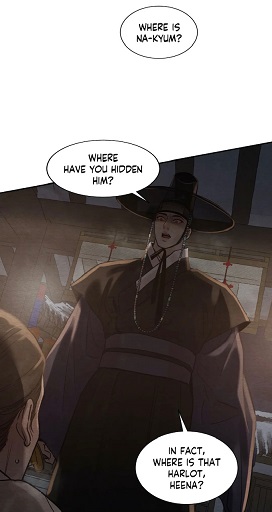 (Chapter 99) On the other hand, the resent for Heena didn‘t turn Yoon Seungho into a fool or a person full of prejudices! He still trusted the noonas, as he believed in his lover‘s heart and his genuine confession! The fire couldn‘t spread in the gibang! The lord showed mercy towards the kisaengs and the domestic Seok-Dae! Hence no one will ever come to believe that Yoon Seungho is a murderer. In their eyes, he makes nothing but hot air!! 😉
Feel free to comment. If you have any suggestion for topics or manhwas, feel free to ask. If you enjoyed reading it, retweet it or push the button like. My Reddit-Instagram-Tumblr-Twitter account is: @bebebisous33. Thanks for reading and for the support, particularly, I would like to thank all the new followers and people recommending my blog.
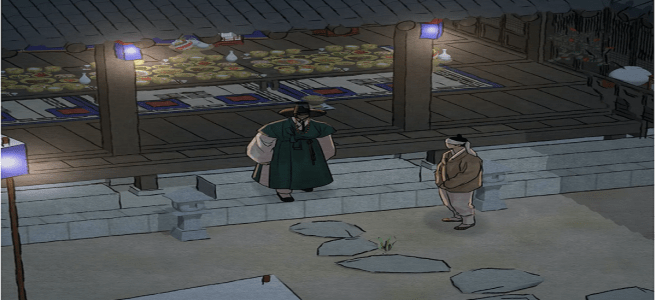


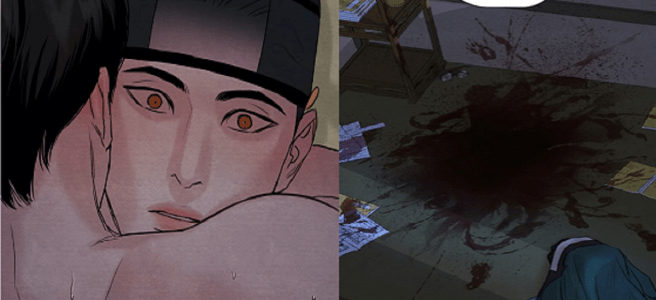

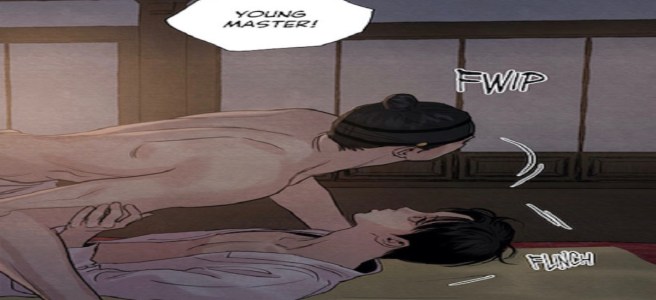
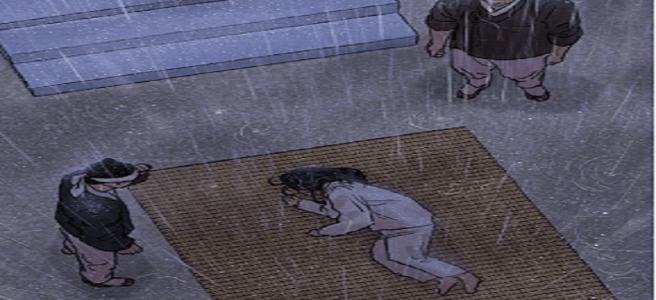
This is where you can read the manhwa. https://www.lezhinus.com/en/comic/painter But be aware that this manhwa is a mature Yaoi, which means, it is about homosexuality with explicit scenes. If you want to read more essays, here is the link to the table of contents: https://bebebisous33analyses.wordpress.com/2020/07/04/table-of-contents-painter-of-the-night/
This won‘t be a long analysis like “The end of the vicious circle”, for my main purpose here is to try to reconstruct Yoon Seungho’s terrible past, and as such its chronology.
We know now for sure that the starting point of Yoon Seungho‘s downward spiral was the incident with Jihwa.
Chapter 77:  The young boy was caught doing something immoral, though like I elaborated it in my previous analysis, there‘s no doubt, the main lead was drugged, and Jihwa had been somehow manipulated. While some might see two teenagers fooling around, I have a different perspective. Then I came to realize why the perception from the manhwaphiles diverges so much. It is, because the readers are actually projecting their own thoughts and expectations. Hence this is normal that certain readers are still expecting something innocent and pure. Yet, since I believe, Yoon Seungho was never a sodomite from the start, but was turned into one, for me the smile and gaze from Yoon Seungho in that scene seemed so fake and artificial, especially if you compare it to this one:
 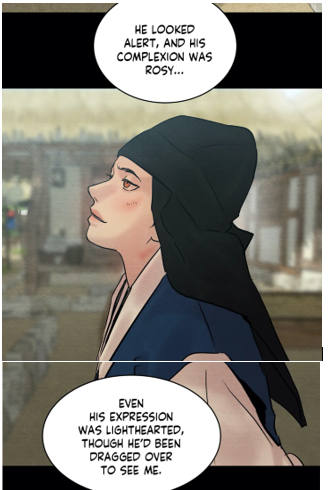 (chapter 57) versus
  (chapter 77) In the first one he oozes innocence and affection, in the other he’s in ecstasy, roofied. However, we have to envision that this smile could have just been a projection of the butler, which means that this represents a distorted memory. Like I explained in my previous essay, the noble has the same gaze than the painter under the influence of opium and alcohol.
“Date rape drugs make a sexual assault, including rape easier in one or more ways, such as:
And if you pay attention to Yoon Seungho, he was not active at all. He was behaving like the painter in chapter 54.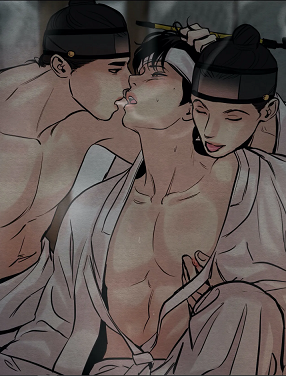
Observe the butler‘s actions. He opens the door without announcing himself. But remember the butler’s MO, it is to delay to deliver the information. We could observe this on different occasions like chapter 44 or 50. He never told the painter about the scholar’s departure (chapter 44), just like he only reported the conversation between Jung In-Hun and Baek Na-Kyum many weeks later.
 (chapter 50) That’s why I come to the conclusion that he never ran immediately to father Yoon in order to report the incident. The butler just needed to inform him later. While in the past, I used to think that he had used rumors again as an excuse, I have now a different perception. For me, it was someone else badmouthing the main lead, well aware that father Yoon feared gossips the most,
  (chapter 50) an older version of this image. This explicates why Yoon Seungho had regained consciousness and could fight back against the servants, when he got dragged to the shed. (chapter 77) Besides, observe that the main lead was sequestrated in the storage room on two occasions at least.
Hence Yoon Chang-Hyeon ordered to drag the young boy to the barn. (chapter 77) However, since it happened twice, I am deducing that this was not the case for the second time. But if you pay attention to Yoon Seungho‘s bedroom, you will notice that he was living in the actual painter‘s study. 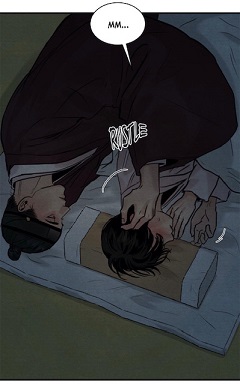 (chapter 77) And this means that the intelligent noble was in a privileged situation. Remember Jihwa’s words:
  (chapter 05) With this remark, the noble expressed a certain annoyance, for he would live next to Yoon Seungho. This truly shows that the painter’s room was a sign of Yoon Seungho‘s favoritism towards the low-born. So if the main lead had such a good reputation and was even favored by the eldest master, this signifies that he could only attract people‘s gaze. Thus some persons definitely envied or resented him, like Yoon Seung-Won and father Lee. And it occurred to me that the younger master had every reason to feel jealous of his elder brother. He might have had the impression that his father had no eyes for him. In other words, he could only benefit from such an incident. If his brother lost his father‘s favor, then he imagined that he would get noticed by his father. As you can imagine, I believe that someone must have poisoned Yoon Seung-Won‘s mind. From my point of view, only a grown-up could have access to the drug. I can‘t shake the butler‘s philosophy from my mind: „Ignorance is a blessing“! The person behind the plot knew about the children‘s weaknesses (innocence, longing for love and recognition, desire) and decided to use them to his advantage.
But then suddenly it occurred to me that chapter 77 is a reflection of episode 5. Note the resemblance. Jihwa talked here about virginity by opening the commoner’s shirt. The manhwaphiles will certainly remember that during that night, the noble got rejected, for the lord’s mind was elsewhere! 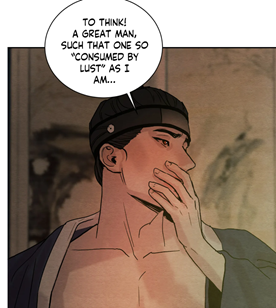 And here we have a proof that Yoon Seungho acted differently in the past. His mind was elsewhere due to the drug, but he didn’t stop his friend. Observe the similarity between the gestures:
  (chapter 5) (chapter 77) The young boy’s head stood above his childhood friend, exactly like with the painter. Jihwa also removed the shirt, but since the low-born stopped him, this signifies that Yoon Seungho had the opposite reaction. He was allowing his friend to kiss and touch him. However, the young noble couldn’t enjoy this moment, as the butler arrived so that the red-haired aristocrat ran away and abandoned him. Very early on, I had elaborated that Jihwa must have done something to his friend and ran away in order not to get caught. I had come to this deduction due to the incident with the door and the painter’s worries. He feared to have been seen.
That’s how I recognized a certain pattern in this story, the final proof that the story is built like a kaleidoscope:

 Here, the artist was imitating the red-haired aristocrat’s actions in the past. The only difference is that he was the passive one!! Striking is that both chapters have something in common: one is always seducing the other, and the latter isn’t accepting the advances. In addition, the masturbation was not disclosed to anyone, yet someone notified Jihwa about the painter’s late return.
  , but he’s avoiding the lord’s chamber. At no moment, he reports Jihwa’s trespassing, his master only discovers the assault, for he hears the commotion. The artist wouldn’t have been slapped, if the staff had immediately announced Jihwa’s visit. Striking is the aristocrat’s confession:
 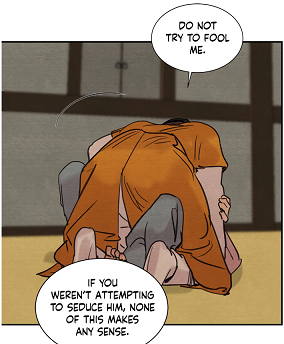 (chapter 17) Other common points with chapter 77: “seduction”, the violence of the noble, his rage because he feels that the painter is lying and had lost his virginity with Yoon Seungho. Besides, I would like to point out that the lord only discovered Jihwa’s assault through the gossip. He came too late, hence he couldn’t stop Jihwa from insulting and slapping the low-born.
  that he needed alcohol, an indication that in the past he must have struggled as well. We have to imagine that back then, he feared that his father Lee would hear about this incident, but father Yoon never let transpire the incident to the outside world. From my point of view, father Lee must have denied his son’s actions, but the aristocrat with dragon’s eyes was no fool. And remember that I used the same chapter to outline that Kim communicated the information to his master in delay. Note that in this episode, time was essential. Both figures were struggling. While the one hoped, the murder would be done soon to put an end to his suffering, the other had the impression that he was running out of time. He couldn’t change the artist’s heart and mind, too wounded. , but he was still looking fine. More importantly, he still trusted his butler. Father Yoon requested some medicine, for he believed that his son was not right in his mind.
  The physician presented the box full of drug which Kim has been giving to his master since his youth.
  the delayed disclosure about the crime, the servants not doing their job and gossiping, the passivity of the butler.
 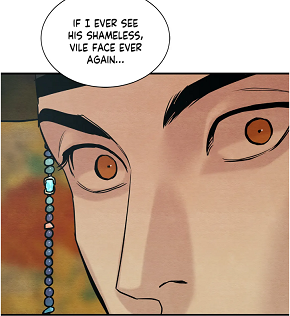 and the delayed arrival of father Lee putting the blame on Yoon Seungho.
 And now pay attention to the number of the episodes: 05 – 16 (1+6 = 7) – 17 (1/ 1+6) – 50 – 57 (50+ 1+6) – 66 ( 5+1/ 5+1) – 67 (6 / 6 + 1) – 77 (1+6 /6+1) Here we have the kaleidoscope. For me this is no coincidence. But more importantly, all these chapters contain seduction, but also rejection, resistance and the presence of drug.
And by putting these chapters together, we get finally the evidence that Jihwa was the boy in the protagonist’s room. Then it came to my mind why the red-haired master was still unhappy in his relationship with Yoon Seungho. When he was wooing his friend in his youth, he saw the friend’s smile and gaze and imagined that he had been accepted. (chapter 77) I also believed that he had to envision this smile from Yoon Seungho to justify his action. An older version from this chapter: 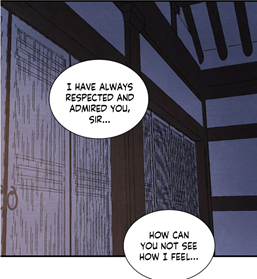 (chapter 19) That’s why Jihwa was blushing the whole time. His dream seemed to have come true!! But unfortunately, they got interrupted. But he didn’t realize that this “dream” was just an illusion, and he had been played. Because he had opened the friend’s shirt, he noticed his virginity. That’s why he had an eye for that.
 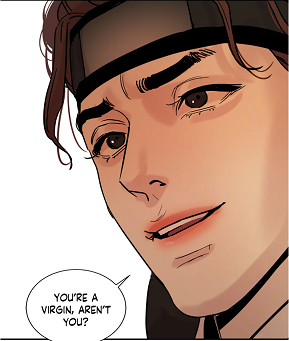 (chapter 5) He had gained this experience with his friend. Since I see some parallels between chapter 77 and the first Wedding Night, which stands for illusion and dream, it becomes even more evident that Yoon Seungho had been drugged and both young boys got played. During all these years of separation, the second lead kept his virginity intact for his friend. Once the main lead got betrayed and abandoned, Jihwa saw finally that his dream could come true. Since Yoon Seungho’s gaze had haunted him for so long, he hoped to obtain the same gaze, as in his mind it was the symbol of love and affection. Besides, he had another reason for approaching his friend. Since he had caused his downfall, deep down he imagined that if they became a real couple, then he could do as if the time of their separation had never happened. They would live, as if nothing had happened.
And now, you comprehend why Jihwa was so sure that his friend would never purse and seduce another man! (chapter 17) Yoon Seungho had never done it to him. Remember my observation: the main lead had been totally passive in the study due to the drug. In fact, he had never rejected anyone, (chapter 52) because he had been trained as a kisaeng. And these observations made me recognize another important aspect: Jihwa, exactly like Baek Na-Kyum, has never discovered that sex could be a form of violence. From my point of view, the chapter 77 shows us that sexual assaults can take many different forms. Using a KO-drug is definitely a crime, but due to Jihwa’s lack of experience, he couldn’t recognize the true nature of the situation.
That’s why I believe that Jihwa will still help Min, because he feels bound to him by secrecy. He is acting like the butler, he wants to survive and not get caught, that’s his driven motivation. However, he will be cornered and forced to make a decision: save his own skin or help someone. In my first version, I had written that the moment he discovered Min’s actions, he would be able to judge the situation correctly this time. And this expectation became a reality.  (chapter 100) Black Heart taught Lee Jihwa an important lesson, the importance of consent. Someone can be forced to sex, which the second lead never truly grasped. He had to pay a huge price for the stolen kiss and his betrayal 10 years later. Interesting is that Lee Jihwa ran away, because he rejected to be responsible for the painter’s death, a synonym for Yoon Seungho’s curtains.
  (chapter 100) This is what I had also written in the first version.
However, as you can imagine, I am expecting a growth from the second lead. He will make the opposite choice than Kim, save the painter, while I am more than ever convinced that the butler won’t change his bad habit.
But let’ s return our attention to chapter 77. When the butler opened the door, the second lead ran away leaving his friend behind. But Kim didn’t report the incident right away, he started spreading some rumor. Why? It is because we have the presence of rumors in chapter 17, 50, 57, 66 and 67. And notice that 17, 57, 66 and 67, he never stopped people from gossiping, while in chapter 50 he revealed the intel as rumor.
Since all the episodes involve the unannounced visit of a noble (17, 50: here Seungho barged in the scholar’s room, 57, 66, 67), I could only come to the conclusion that father Lee was the one who paid a visit to father Yoon, and revealed the incident by naturally putting the whole blame onto Yoon Seungho. But unlike in chapter 67, father Lee visited discreetly the mansion, as he feared gossips. That’s why the physician mentions that Jihwa was supposed to have the illness (chapter 57), but he could never identify the issue. And now, you comprehend why father Lee was red, totally embarrassed
 (chapter 67), for he was well aware of the truth. We have many possibilities here. Either someone leaked the info to the father secretly, or the son must have confided to him about the incident. Remember that in chapter 68, the painter confided to her his deepest fears and struggles. Let’s not forget that the son had hired an amateur spy in order to be updated about the events occurring in Yoon Seungho’s mansion. Consequently, I am inclined that the incident must have reached father Lee’s ears, and in order to maintain his respectability, he preferred covering up the commotion by blaming the elder son Yoon.
Since father Lee had intervened and Kim chose to reveal the “truth”, father Yoon could only perceive the incident as a truth. Consequently, father Yoon ordered his servants to drag Yoon Seungho and to confront his son. From my point of view, father Lee was questioned as well, but as you can imagine, he covered up his own son’s action. Since everyone was pointing the finger at the main lead, no one sided with the young boy. In other words, he got not only blamed, but also framed.
Right after he asked his staff to drag him to the shed as a punishment. But as you can imagine, Yoon Seungho couldn’t have any idea why his father reacted like that, for he had been drugged. He had no recollection, hence he denied the existence of the incident. However, the father chose to believe Kim, as he had the crowd. Imagine his reactions: the main lead had to hear from him what he had supposedly done. I would like to point out that victims of rape due to KO-drug suffer from immense guilt, as they showed no resistance or even seemed to “enjoy” the incident.
The valet gaslighted the poor boy by making him feel guilty (chapter 77), but despite his harsh and cruel words, the young protagonist chose to continue trusting him and his words. Let’s not forget that Kim claimed that his father would fix his “problems”.
  (chapter 77) From my point of view, the young master was determined to show good will and to listen to Kim’s advice.
Because he was sent to the shed and we see the straw mat beating right after, we have the impression that this was the punishment he received for this incident. But this was an illusion created by the author. Why? First, when the father visited the doctor, the young boy was still looking fine. He had such a rosy complexion, and still admired and trusted the butler. However, the main lead’s gaze changed after the straw mat beating. He recognized that he had been betrayed and abandoned by Kim.  Observe the slight movement of the iris. First, the iris is directed at Kim, then it moves in the opposite direction.
  By looking away, he clearly unveils his inner thoughts and emotions: he has been betrayed and abandoned by his butler. He resents him, yet until that moment he was still willing to trust despite the multiple betrayals. He is disillusioned.
But there’s another indication that the straw mat beating didn’t occur right away. It is, because of the following panel:  (chapter 55) First, there’s no rain. Secondly, Yoon Seungho was feverish and his eyes were so bruised after the harsh punishment that I doubt he could still see clearly the boy’s gesture so from faraway. So for me, that’s the moment when he is dragged into the courtyard and not during the straw mat beating. In the past, I used to think, it was Yoon Seung-Won, but then after the latest episode I started doubting it. However, like one of my followers reminded me that Byeonduck had confirmed about Yoon Seung-Won’s identity. Yet, observe that the lord and the boy have no face. Why? It is because the two persons embody not only Yoon Chang-Hyeon and Yoon Seung-Won, but also father Lee and Lee Jihwa. The scholar Lee was the one who had asked for the flogging! That’s the reason why he said this to the lord years later:
  (chapter 82) This statement proves that he had done it before! Furthermore, the red-haired master is connected to the straw mat beating.
 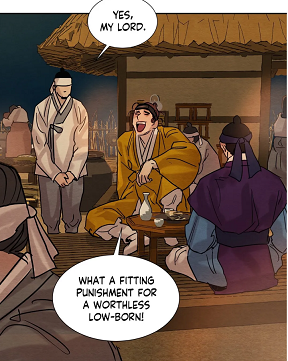 (chapter 12) This explicates why Lee Jihwa resented the brother and the father, for in his eyes they were responsible for his childhood friend’s suffering. And since the father had done it once, then he had no problem to order a second flogging or straw mat beating, just like the king Yeonjo who punished the Crown Prince Sado so brutally. So because the eldest master next to Seung-Won is dressed differently in chapter 77: (chapter 77) I could only come to the conclusion that these two panels are not referring to the same incident.
From my point of view, Yoon Seungho received the second straw mat beating after the rape!! And this means that Kim had been present, but he had not intervened. (chapter 65) Here, he had been brought back to the past. Remember the past mirrors the present. In my eyes, the rape of the main lead occurred at the same time than the painter’s. It took place in fall. So when did Baek Na-Kyum get sick?
It was after the first sex marathon! He was dragged to the bedchamber and due to the long sex session, he got sick. Notice the parallels:
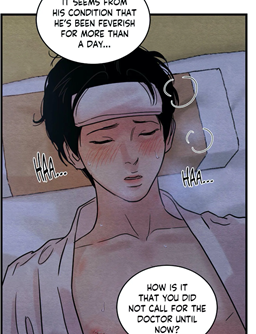 (chapter 33)
 (chapter 33) Note that Yoon Seungho called for a doctor, he even carried himself to the study and waited there, until the doctor had given his prescription.
 And now, the manhwaphiles comprehend why I came to this interpretation.
What happened is the following. Once he had been abandoned by the father, the rapist could approach him and have sex with him. Kim heard the boy’s resistance, but he chose to remain outside, until the man was finished. (chapter 65) I am quite sure that the butler’s passivity was justified that it was done for the main lead’s sake. However, once it was over, the butler was forced to see the consequences of his bad choice. But the valet refused to become responsible and gaslighted the young master again. If he had not kissed Lee Jihwa, if he had put his prick in the hole etc… The main character had still acted like a dog and a cat, and this time he reported it to his master directly so that the latter came to the conclusion that Yoon Seungho was still useful for him. Or the eldest master knew about it anyway. But the main lead never got to discover that Kim had heard him outside the room, but had remained silent and passive.
And now, you comprehend why Yoon Seungho was so hurt and disappointed by Kim. Kim never protected him or even defended him at all. He made sure that the young boy would be blamed and should feel guilty or he remained paralyzed and speechless. He never rushed to his care. And since father Yoon speaks “chambers”, this means that the protagonist had already become the lord Song’s “favored servant.” But he had not reached the bottom, he needed to become a kisaeng. In my eyes, the young boy got punished, as he was still refusing his role as „favored servant“. And now, you comprehend why Kim threatened the doctor in chapter 33. The latter had reminded the butler of his own wrongdoings:  (chapter 33) Back then, he not only followed his master’s requests, but also he did nothing at all. He stayed immobile and shocked.
 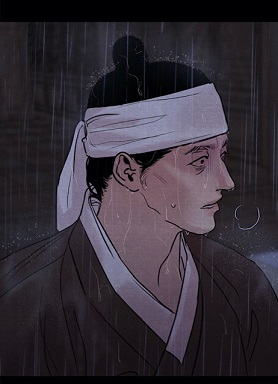 (chapter 77) I believe that when the valet looked at the young boy’s gaze and perceived his own true reflection (a disgusting and fake domestic), the man was surprised. He never imagined that he would be judged differently: (chapter 67) The main lead must have thought similarly. But due to the long exposure to abuse and to the drug, Yoon Seungho repressed these thoughts and emotions.
So if my theory is correct (Yoon Seungho was drugged), we have to question ourselves. Who benefitted the most from the protagonist’s downfall?
(chapter 68). Father Yoon imagined that if he had sex with a kisaeng house, he would be cured. However, something happened in the gibang. The young boy refused which forced the nobles to intervene. Yoon Seungho got dragged and tied up by the black guards. Naturally, father Yoon could only jump to the conclusion that with such a rejection, Yoon Seungho was admitting his homosexuality. This could only reinforce the prejudices the father had about his son. The irony is that with such an attempt, father Yoon exposed that he was a man obsessed with sex. He never understood that sex is strongly intertwined with love and warmth. Thus I deduce that father Yoon never associated sex to affection. For him, it was either a synonym for power, submission or duty as the noble has to make sure that he has sons to continue the legacy. With this new insight, I come to the conclusion that the man was totally fooled by his surroundings and most importantly by the rapist. Everyone lied out of selfishness and cowardice, and let the young boy take the whole burden. Hence the father truly believed in his son’s homosexuality and out of resent and contempt, when he saw an opportunity to use his son for his own career, he was trained as a kisaeng. In my eyes, this idea was definitely suggested by the pedophile, though I doubt that he was directly involved in the incident in the kisaeng house. And the man dreamed of bringing greatness to the Yoons with his “connections”. However, this was just a pyrrhic victory, as both Yoons lost more than they gained, for the rapist hadn’t kept his promise. That’s why I believe that the younger brother was indeed involved in the first incident misguided by the rapist, instilling his jealousy, an older version of Min and Jihwa. But the young son never imagined that his father would treat his brother like that. The panel from chapter 55 exposes Yoon Seung-Won’s guilt and silence. But as time passed on, he could still benefit from this. He finally got recognition from his father. (chapter 86) But it was in detriment of the Yoons’ power! The father lost everything, yet the younger master didn’t suffer much from it first, until he reached adulthood. Now, the father was putting his whole hope on him, and that’s how Yoon Seung-Won realized the existence of such a burden. That’s the reason why he contacted his brother again. He hoped to get an office through his brother’s connections and power. Remember that Baek Na-Kyum’s real torment started with the arrival of the learned sir to the mansion. Hence the moment “lord Song” came to the propriety, he started scheming to achieve his goal: he was bewitched by the young protagonist, he needed to taste him. However, from my point of view, the pedophile had sent the butler for this exact purpose. He must have definitely known how Kim would behave in there. I have already exposed that for me, the butler represents the poisoned gift from chapter 19. 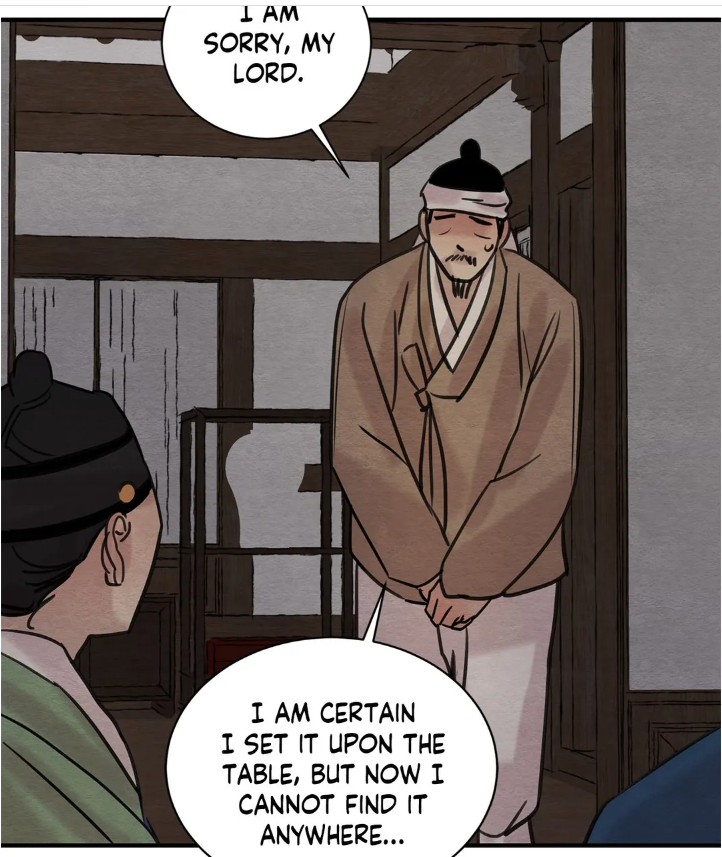 (chapter 19)
But since the whole tragedy was caused by delayed information, I deduce that timing is essential, especially when it comes to “justice”. Since the “accomplices” and “perpetratrors” never got punished, they imagined that they had escaped human justice. However, karma was waiting for them. Jihwa was never happy, though he had become the main lead’s lover. Why? It is because he had to live with his guilt. Moreover, he had wished to obtain Yoon Seungho’s love. In other words, he was living an illusion. The brother didn’t gain anything in the end, as his comfortable life and good reputation were based on Yoon Seungho’s suffering. Secondly, father Yoon almost lost everything. However, I doubt that all of them learned their lesson, just like the pedophile. This explicates why Yoon Chang-Hyeon schemed again in season 3.  (chapter 94) He hoped to appear as a good lord, while his son had mistreated his own messenger.
Feel free to comment. If you have any suggestion for topics or manhwas, feel free to ask. If you enjoyed reading it, retweet it or push the button like. My reddit-Instagram-tumblr-twitter account is: @bebebisous33. Thanks for reading and for the support, particularly, I would like to thank all the new followers and people recommending my blog.
 Bebebisous33s' analyses in K-Dramaland and Manhwas