

This is where you can read the manhwas. https://www.lezhinus.com/en/comic/sip_poison This manhwa is mature. https://www.lezhinus.com/en/comic/painter But be aware that this manhwa is a mature Yaoi, which means, it is about homosexuality with explicit scenes. If you want to read more essays, here is the link to the table of contents: https://bebebisous33analyses.wordpress.com/2020/07/04/table-of-contents-painter-of-the-night/ I also used briefly Doctor Frost again which I highly recommend to my readers. https://www.webtoons.com/en/mystery/dr-frost/list?title_no=371 If you want to read more essays about other manhwas, here is the link to the table of contents: https://bebebisous33analyses.com/2021/06/06/table-of-contents-of-analyzed-mentioned-manhwas/
It would be great if you could make some donations/sponsoring: Ko-fi.com/bebebisous33 That way, you can support me with “coffee” so that I have the energy to keep examining manhwas. Besides, I need to cover up the expenses for this blog.
1. Castration or abandonment?
Anyone reading my previous analyses about Painter Of The Night will certainly recall that I had perceived the loss of the topknot as a castration. Why? In Joseon, the topknot was given to men the moment they became adults and this Coming-Of-Age ceremony took place just before a marriage. [For more read the essay “Coming Of Age”] In other words, no topknot meant no marriage and as such no responsibility and maturity. However, this is important to recall that the loss of the topknot was brought up in a different context. It was mentioned for the first time in the painter’s statement.  (Chapter 1) When Baek Na-Kyum remembered his noona’s words about Yoon Seungho, he connected it to the loss of his future lover’s topknot. Here, the gesture had a different meaning. By cutting off his hair, the father was acting, as if he was abandoning his son. According to social norms, the hair was considered as a heritage from the parents. So if Yoon Chang-Hyeon had truly done it, the latter was showing that he was no longer considering the main lead as his son. While the rumor about the haircut gave the impression that the elder master Yoon was a honest and honorable noble, anyone can perceive the elder master’s action differently: the father is a coward, a selfish, ruthless and disloyal lord, especially the moment it is revealed that Yoon Seungho was abused sexually, physically and mentally. Let’s not forget that the protagonist used to live in the shed, for he was viewed as an animal. His situation reflected the father’s betrayal and abandonment. It doesn’t matter if he had been manipulated, because in the end, he made the decision to treat his son as a slave. He refused to send for a physician. To sum up, the loss of the topknot in this rumor would be judged as the epitome for cruelty and intolerance!! This shows that the loss of the hair in Painter Of The Night has actually many significations: castration, mercilessness and abandonment.
Then it occurred to me that the painter has been cutting off his hair all this time because of his noona. 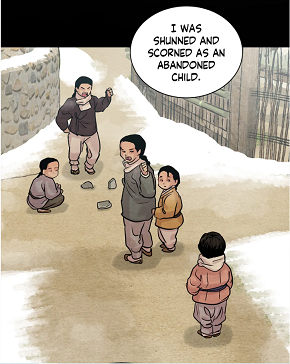 (Chapter 94) In this scene, the painter was rejected by the children, for he had no braid. Due to his hair dress, he was recognized as orphan immediately. The justification was that that way, the artist would appear more boyish. But by mentioning the loss of Yoon Seungho’s topknot, Heena was actually revealing that she knew the true signification of the haircut: abandonment and intolerance. Her words to her brother exposed her hypocrisy, though she attempted to portray the elder master as respectable. One might argue that when Na-Kyum was just a child, she had suggested the short hair, for she had good intentions. But after this experience with the children, the noona should have grasped the wrongness of her decision. She should have admitted her bad decision and stopped the painter from cutting his hair. Moreover, don’t forget that Na-Kyum was just a young boy, so the haircut must have been done by Heena herself. This shows that her gesture actually divulged her future behavior: she would betray and abandon the painter constantly (season 1, 2 and 3). At the same time, since the painter was seen with short hair in chapter 68
  , this indicates that Heena kept cutting Baek Na-Kyum’s hair. So even in the past, she was betraying her brother, though the latter never realized it. The loss of hair could never be viewed as a sign of love or empathy, for it contributed to the painter’s abandonment issues and his self-loathing. He was suffering as an outcast and due to his girly features. The men in the gibang could mistreat him, for he had no long hair or topknot. Why?
 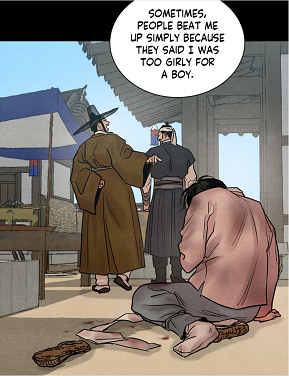 (Chapter 94) He had no parents or guardians protecting him which is true, for here he was exposed to violence. Heena, as the head-kisaeng, had not protected him at all, she must definitely have portrayed herself as powerless. Yet as a slave of the state, she was belonging to the king. So she had connections to officers and the court. In my eyes, the head-kisaeng made sure that the artist could never get a topknot, and as such he would never be able to become a “noble” or even a man. Hence Baek Na-Kyum was constantly called boy
  (Chapter 56)
 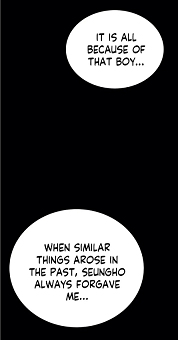 (Chapter 59)
  (chapter 66) and treated as one too. This observation made me realize that Heena’s belief could be used as an explanation for her action (cutting off his hair): she hates nobles so much that she didn’t allow her brother to have a topknot. But why would she do that? My idea is that deep down, she resented him, for he was a free man, while she was a slave. It went so far that he was encouraged to wear a white headband, the symbol for servitude, though he is no slave! To conclude, the loss of hair in Joseon should be perceived as a brutal and harsh punishment. Without a topknot, one is left unprotected, is not viewed as an adult. But this stands in opposition to Yoon Seungho’s action in front of Jung In-Hun’s home.
  (Chapter 101) Here, the lord had spared his friend’s life.
2. The loss of the topknot: Symbol for forgiveness?
As you may have noticed, I often use other manhwas as a source of inspiration for my interpretations concerning Painter Of The Night. In the story “A Sip of Poison”, the main lead, the prince Nan-Woo  (Chapter 23) cuts off the hair of the general Woo Jong Han, because he had committed crimes. First, he hid the fact that his sister had had a child before getting married to the emperor, which was actually a huge sin. The future Empress should have been a virgin. To sum up, he had committed treason, for he had allowed his sister to become Empress unrightfully. Then the field marshal had treated his niece as a slave violating social norms.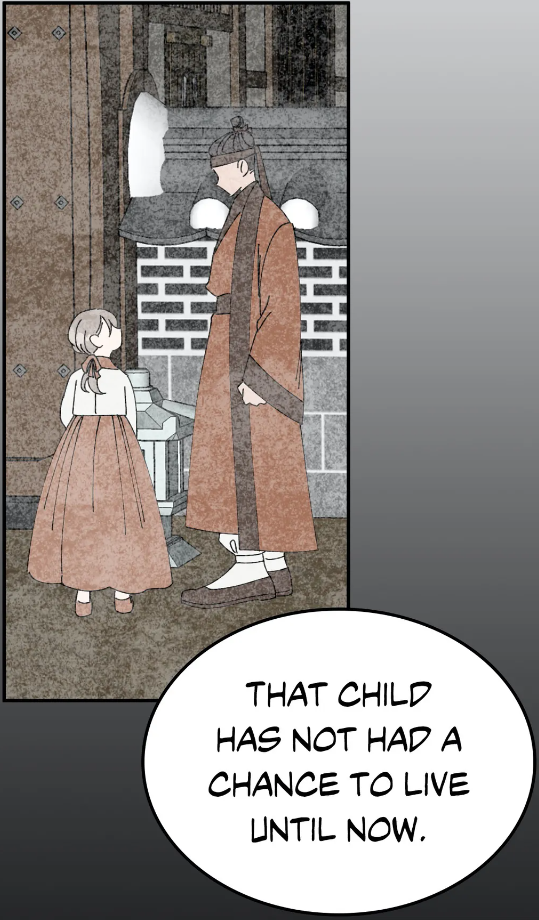
 (chapter 34) That way, he assisted his sister to become powerful by covering up for her crimes (silence and passivity). She had killed many people to hide her previous relationship and to increase her power. Striking is that the prince still spared Baek-Ha’s uncle, and this for many reasons. First, the latter had not only saved both protagonists, the empress’ illegitimate daughter Baek-Ha and the prince Nan-Woo, but also had admitted his sins. Secondly, he was thinking of his wife Baek-Ha who is kind-hearted. He knew that his death could upset his bride.
 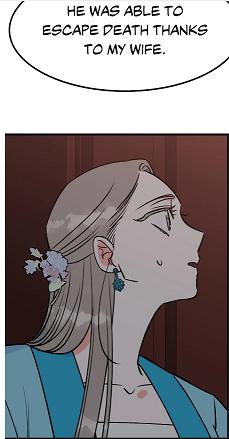 (chapter 26) But there is more to it. Nan-Woo didn’t spare the man out of benevolence.
 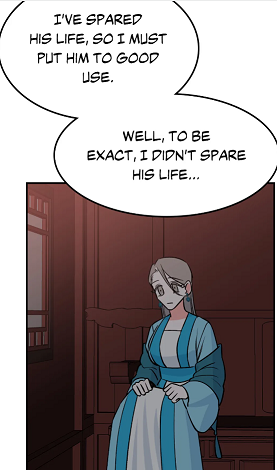 (chapter 26) He had a role to play. By cutting off his topknot, the general lost his “power”, he became the prince’s pawn! Nan-Woo wished to use the uncle in order to get rid of the Empress.
 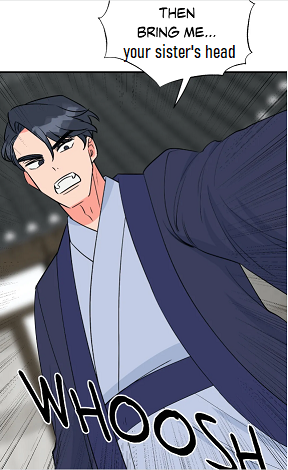 (chapter 23) That way, the protagonist wouldn’t even have to dirty his own hands. On the other hand, we could also say that Nan-Woo was forcing the Empress’ brother to undo his bad decision.
  (chapter 23) Since he had protected his sister Seo-Ha out of affection, it was normal that now he had to show no mercy towards her. By presenting Baek -Ha to Nan-Woo, the general was well aware that the future ruler would recognize the female lead’s origins due to her resemblance to her mother. Therefore, we could interpret that Nan-Woo had spared the general, for the latter had switched sides and expressed the wish to undo his wrongdoings.
As you can see, Woo Jong Han shows many similarities with the second lead from Painter Of The Night: he was an accomplice of the real culprit, as he never intervened. He is connected to the notion: pity, knowledge, silence and passivity. Because Seo-Ha was his sister, as a dutiful older brother, he felt obligated to protect her. He was not blinded by greed like his donsaeng. This explicates why on the one hand, he saved Baek Ha’s life, on the other hand he still treated her as a slave in order to hide his sister’s wrongdoing. He felt torn between his obligation towards his younger sister and his empathy for his niece, Baek-Ha. Consequently, it is no coincidence that he once warmed her feet with his hands after the young girl had complained about her cold feet. Moreover, she received an education contrary to all the other slaves. He was caught in the middle, exactly like Lee Jihwa who had an attachment towards the main lead, yet he was still bound by social norms to his father. He needed to protect the family’s reputation. So when I saw this scene, (chapter 23) I couldn’t help myself thinking of Lee Jihwa and Yoon Seungho. How could the latter view the loss of a topknot as a gesture of leniency?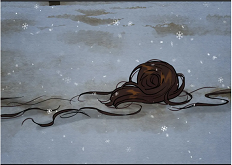 (Chapter 101) It is because he must have witnessed it himself in the past. I have already pointed out that Yoon Seungho would imitate people, especially his tormentors. So where did he learn from? I believe, Yoon Seungho copied it from someone… and this can only be “lord Song”. And now, the first loss of Lee Jihwa’s topknot can be perceived in a different perspective. The red-haired master was well aware that he had been spared, when he had lost his hair for the first time.
 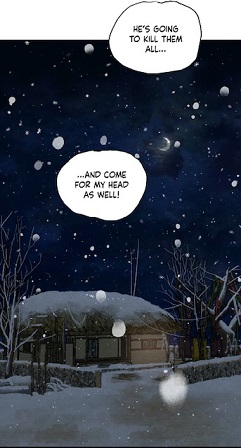 (Chapter 101) He knew deep down that thanks to his friend, he had been able to escape the worst. Since he had been spared once, he was well aware that this time, the ruler would show no leniency and would ask for his head, as the main lead was no longer protecting him. Remember what the lord had whispered to Baek Na-Kyum:
 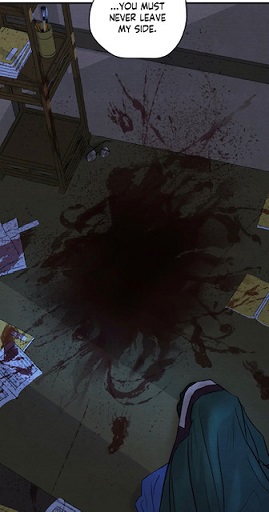 (chapter 88) (chapter 88) By cutting off the friend’s hair, he was showing that he was abandoning his friend. He was leaving him behind, and Lee Jihwa was forced to face lord Song alone.
  (Chapter 83) This time, he had not his father by his side either. The latter could not protect him too. I had already voiced this theory before, as it would explain why Lee Jihwa is masking the man’s face. And note that Nan-Woo from A Sip Of Poison cut off the topknot, as he is already acting as the future ruler. Another important detail caught my attention. Just before receiving his sentence, Woo Jong-Han made an oath,
  (chapter 23), he swore loyalty to the future emperor. This signifies that the topknot also symbolizes faithfulness, especially because it is connected to marriage. Thus I deduce that when Lee Jihwa lost his topknot for the first time, he was already judged as disloyal. Hence it is no coincidence when the antagonist screams that he would become the target of lord Song’s fury.
But the red-haired noble could never reveal the king’s meddling, as his relationship with Yoon Seungho was a secret. Hence he needed to blame someone: The Yoons! I had already exposed that the words from the noble with the mole were ambiguous and as such deceiving. 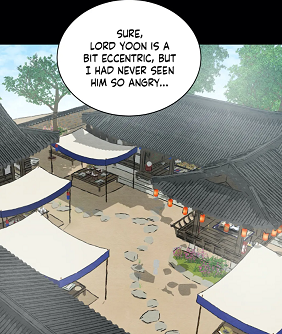 (Chapter 59) First, lord Yoon could be a reference to the father and not only the son. Secondly, he implied that he had witnessed the scene, yet in reality he could have been referring to the outcome: the friend’s hair cut, just like the noona had only seen the hickeys on her brother’s neck. She had never witnessed the sex session. The noble with the mole assumed the perpetrator’s behavior, rage, based on the hair loss. Moreover, he could have been telling the truth: he had never seen Yoon Seungho so angry before, as the latter used to be weak in the past due to his social status: he was a male kisaeng due to his braid. This explicates why the noble with the purple robe would give an order to the host
 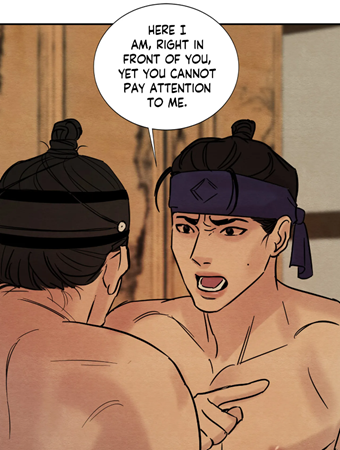 (chapter 8) He felt himself superior to Yoon Seungho, and never expected “disobedience” or “rage” from the protagonist. Striking is that the lord didn’t vent his anger onto him, he first smiled before grabbing him by the topknot.
 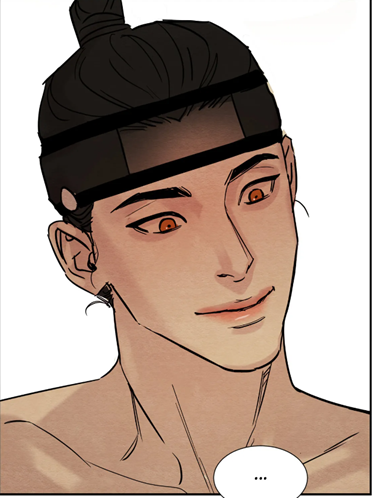 (Chapter 8) A simple change of hair dress had transformed the main lead. This exposes the gods’ intervention in this story. They let the man with the mole see the wrongness of his manipulations. Since he had stated that he had never seen the man so angry, his words became a reality in 3 occasions: chapter 8 like mentioned above, chapter 53
 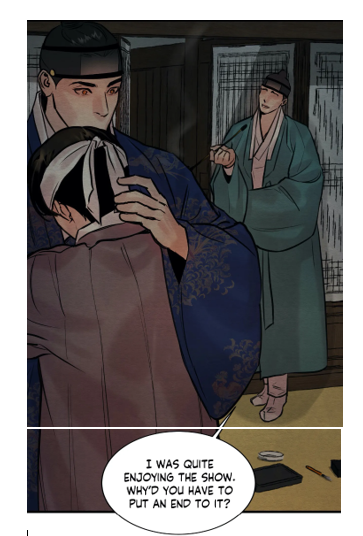 , for he was not present, chapter 57
  in the inn. Here, he chose to run away, yet despite everything he still helped his friend Black Heart, for he was present in the gibang.
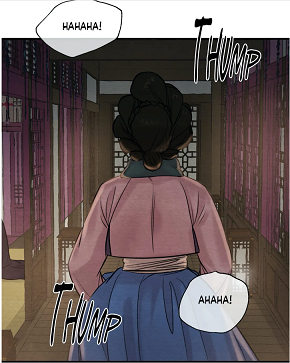 (Chapter 69) Under this new light, this panel from Twitter get a total new meaning:
  The aristocrat knew about the true identity of “lord Song”, and he had indeed never seen the man so angry that he would cut off the topknot of a noble!! This means that the fate of the noble with the mole should be to end up as the lord’s new plaything. In other words, he takes over the main lead’s previous status. He becomes the male kisaeng and ends up living in the shed like the protagonist in the past where the pedophile vents his rage and resent him for his tricks. But we will see.
Another important detail caught my attention: the noble with the mole judged the loss of the topknot as a harsh punishment 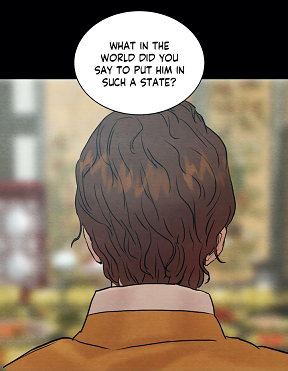 (chapter 59) Furthermore, he associated it to abandonment too.
 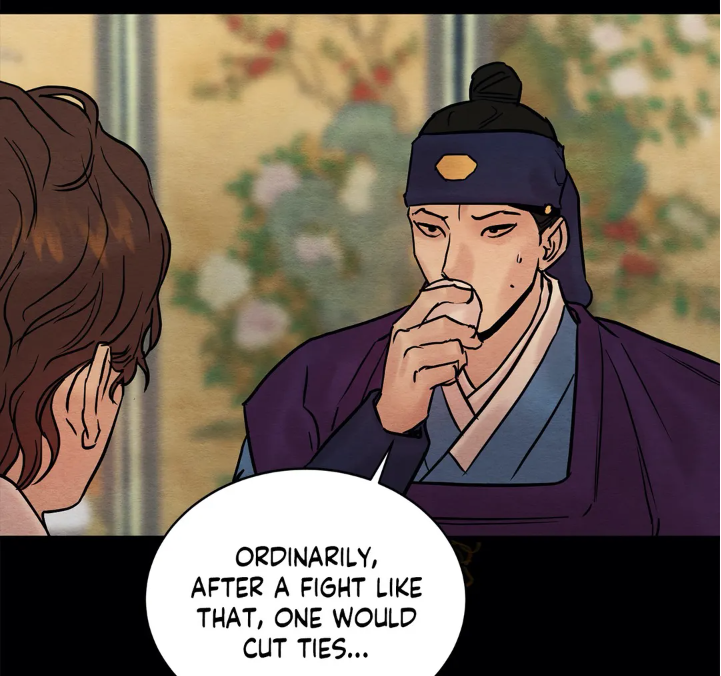 (Chapter 59) Yet, observe the drop of sweat. This exposes that neither Min nor the noble with the mole were expecting that Lee Jihwa would be spared!! They acted, as if the loss of the topknot couldn’t be a sign of mercy. But observe what Lee Jihwa was recalling, when the “friend” was talking about abandonment.
  (Chapter 59) He was by the protagonist’s side! This means that lord Song had spared Lee Jihwa’s life, for he had been present, when Yoon Seungho was suffering. Till the middle of season 2, no one was aware of the fallout between Lee Jihwa and the protagonist. None of the incidents in season 1 was leaked to the outside, hence the “pedophile” was not officially aware of the red-haired master’s wrongdoings. But the loss of hair in front of the learned sir’s house becomes the proof that the main lead has now left his friend’s side. He will be blamed for his suicide. Therefore it is not surprising that the young master chose to run away.
 (Chapter 101) He knew that the ruler would show no leniency or understanding. Thus the noble with the mole’s karma should be to keep his topknot. That way, he will realize that if he had lost his topknot like Jihwa, his torment would be short-lived and as such it was a sign of mercy. But in this image, it doesn’t look like it. He will suffer for hours and even days before even losing his life. Now, he will be able to see and experienced how enraged or lenient the culprit for the loss of Lee Jihwa’s topknot was towards the antagonist.
The manhwaphiles should keep in their mind the following two rules: the painter’s fate mirrors the lord’s, since the story is constructed like a kaleidoscope. And now, look at this:  (chapter 27) The painter had saved his teacher’s life, and later the lord had restrained himself from hurting the scholar in the courtyard despite Jung In-Hun’s lies and lack of respect (he had touched the man’s shoulder).
  (Chapter 30) Here again, the scholar had been spared. Then in episode 53, the painter had embraced the lord to stop him from killing Deok-Jae. This means that Yoon Seungho must have also saved people in the past by using his body, and this twice, for I had detected the presence of two circles: Yoon Chang-Hyeon and Lee Jihwa. That’s the reason why the father could survive the purge, and why Lee Jihwa only lost his topknot. And the heroine from A Sip Of Poison can serve as an example. (chapter 26) The red-haired noble was able to escape death thanks to Yoon Seungho. But Lee Jihwa had to hide from others that he had been punished by the king, hence Father Yoon and Yoon Seungho got blamed (chapter 1 and 59). And now, you have the explanation why father Lee accepted to receive the main lead in his mansion.
 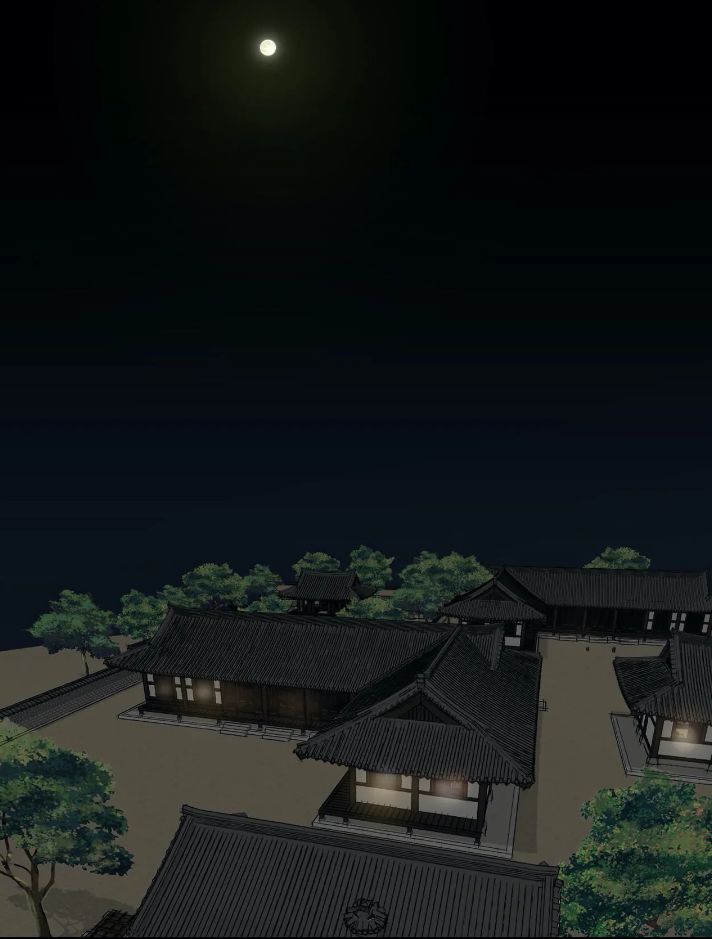 (Chapter 1) As long as the latter was living there, the Lees had nothing to worry. The main lead was protecting them from the king. However, the manhwalovers should keep in their mind that Nan-Woo had showed mercy to the general for his own interests. He should become his helping hand in order to obtain the throne. Hence I come to the following deduction: neither Nan-Woo nor the “perpetrator” had cut off the topknot out of real leniency. This shows that for these characters, the loss of the topknot is not the symbol for forgiveness which is not true for the last incident with Lee Jihwa. (chapter 101) Why? It is because the main lead had no intention to use his friend as a pawn. There was no pledge of loyalty… in truth, in this scene, Yoon Seungho was truly cutting ties with the second lead.
But if the pedophile chose to employ the young master after the loss of the topknot, what was his role? In my opinion, it was to keep Yoon Seungho by his side. The pedophile had slowly recognized that he could never separate these two boys, and without him by his side, Yoon Seungho would still reject him. In my eyes, the main lead had followed his friend. Under this new light, the manhwaworms can comprehend why father Lee accepted to let the main lead stay in his mansion. He could secure his position, yet pay attention that despite the topknot, he was still dressed so poorly. 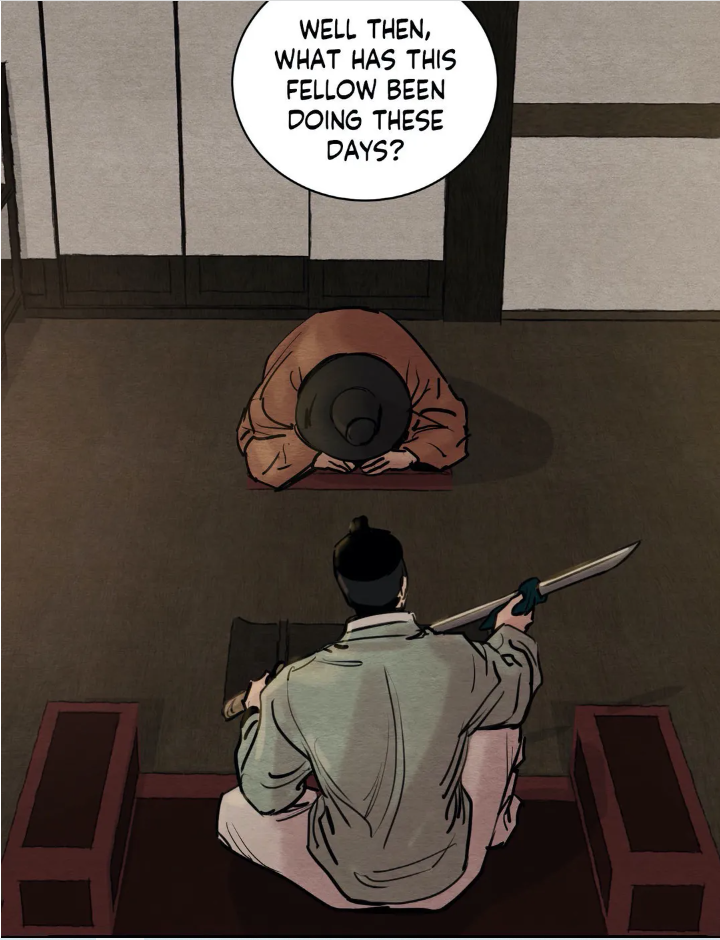 (chapter 1) Even the headband was different. This was no coincidence. He should never develop confidence and act as a lord. That’s how I recognized the following pattern. In front of the painter who looked like a minor, the main lead was forced to act like an adult. Thanks to the painter, he was encouraged to mature. Simultaneously this meant that at some point, while living with the Lees, the elder master Lee had to be confronted with the truth: his son’s sodomy.
Under this new light, it becomes understandable why Heena and Kim called the main lead a bird of misfortune. 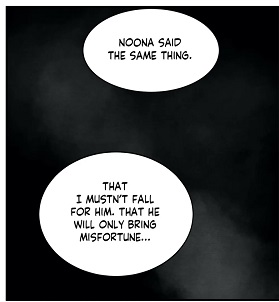 (Chapter 86) The reality was that the pedophile was the bad omen, but they couldn’t insult the king. Hence the young main lead became the scapegoat, people couldn’t separate the pedophile from Yoon Seungho. The “mysterious lord Song” would never give up on the protagonist. No matter what he would keep him by his side.
But like pointed out in an earlier analysis, Black Heart and his friend were definitely the reason why the red-haired master had to lose his topknot. From my point of view, this is related to this night, (chapter 1) and Lee Jihwa had no idea about it. Hence the painter got framed. On the other hand, Black Heart and his friend had to spy on Lee Jihwa in order to know about his ignorance concerning their “prank”. At the same time, they could only get intrigued, why the mysterious lord Song would behave that way, though he had been treating the main lead as a male kisaeng. Towards Yoon Seungho, he was quite selfish and cruel. The discrepancy in the treatment (mercy versus ruthlessness) could only surprise the young nobles. And this observation led me to the following question. Why would Heena mention the topknot to her brother in order to manipulate him? The kisaeng was well aware that he had witnessed the sex party in the kisaeng house, for this image represents a memory from the artist. It is to divert his attention: he should never connect Yoon Seungho to the braided man!! If he had a topknot, then he could never be the one doing the fellatio to the man with the purple hanbok!! But if the painter had pondered a little more, he should have realized his noona’s lies. She mentioned the loss of a topknot, but yet the smiling hell-raiser still had a topknot: 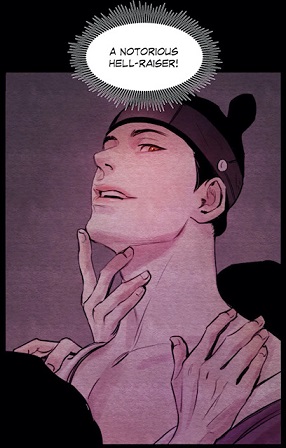 (chapter 1) Moreover, we shouldn’t overlook the publications with the braided man:
  (Chapter 1) Baek Na-Kyum was not supposed to recognize the identity of the man having sex with the bearded man. From my point of view, Heena made sure to confuse her brother. Lee Jihwa’s humiliation became Yoon Seungho’s stigma. He became the culprit. Since in the past, the main lead had been blamed for everything, the perpetrators and accomplices chose to follow this “tradition”, because so far, they had been able to cover up their crimes. But thanks to the painter, it is no longer possible. Why? It is because the painter’s hair dress will serve as a mirror of truth: the absence of a topknot due to the braid and the hair cut will be perceived as an evidence for abandonment, cruelty and huge wrongdoing. This won’t be seen as a gesture of mercy or leniency by the two protagonists, for they suffered because of it!! That’s the reason why I am thinking that the pedophile’s karma should be the loss of the topknot which he viewed as a gesture of mercy and tolerance. But without the topknot, he is actually “castrated”, and as such humiliated for he can not wear his golden sangtu.
  Yet, contrary to Lee Jihwa’s haircut, the loss of the topknot should not be judged as the symbol of mercy and forgiveness, in fact, the lord would officially cut ties with him. That’s how the mysterious Lord Song would be taught an important lesson: he was a huge hypocrite and a violent and ruthless pervert.
3. The tool for the loss of the topknot
Once again, A Sip Of Poison inspired me. The prince Nan-Woo asked his assistant Yoon 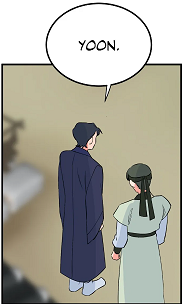 (chapter 23) to give him a knife:
 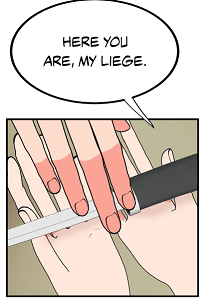 (chapter 23) before grabbing Woo Jang-Hon by his topknot
 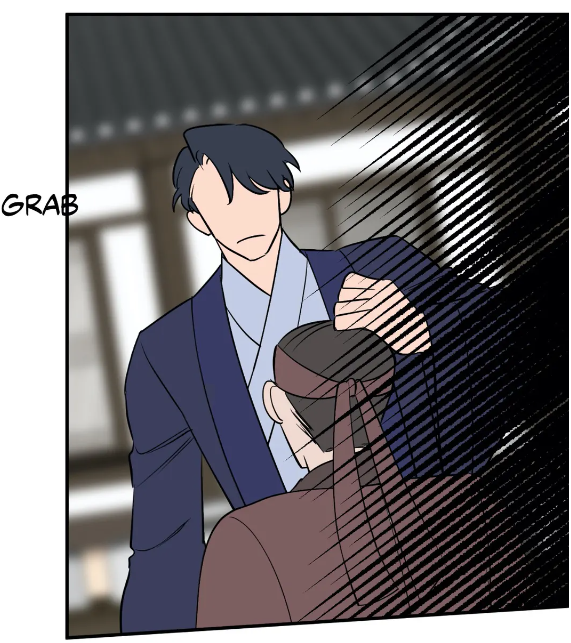 (chapter 23). Hence the hair fell between the men.
  (chapter 23) And now, let’s return our attention to Painter Of The Night. Compare the position of the aristocrat’s topknot after Yoon Seungho had punished his friend.
  (chapter 101) It was behind him!! Thus I deduce that he had used the sword, when Lee Jihwa had approached his friend. But wait… in season 1 and 2, Byeonduck drew scenes with a knife:
- Chapter 18:
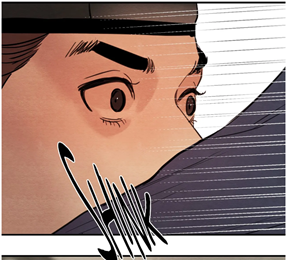
 And what had happened before? Yoon Seungho had dragged his friend by the topknot before stabbing the amateur spy. This is no coincidence.
 - Chapter 57:
 When this chapter had been released, I had assumed that this must have happened, when Yoon Seungho had lost his topknot! As you can see, I had already connected the knife to the loss of the topknot incident.
 - However, note that the weapon was used to threaten the painter
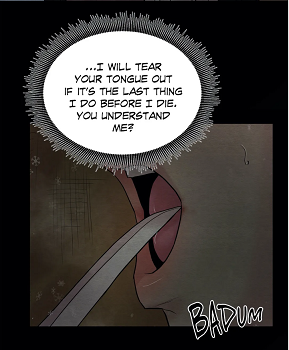 (chapter 66)
That’s the reason why I am assuming that when Lee Jihwa lost his topknot for the first time, the mysterious lord Song must have used a knife and cut off the young master’s hair. Hence Byeonduck created such a picture where Lee Jihwa was put in a similar situation: (chapter 18) It was to trigger his memory. I am even assuming that the butler must have given lord Song the knife before while remaining in the shadow. But I also think that after the incident with the loss of the topknot, the pedophile must have also threatened him. If he were to reveal anything about this incident and his identity, then he would lose his head. So imagine Lee Jihwa’s reactions in chapter 101. (chapter 101) He had now faced a sword and not a knife contrary to the past. Therefore it is not surprising that the young master got so scared and chose to flee. Lee Jihwa had betrayed lord Song by telling an anecdote from the past. He had more or less leaked the name “lord Song”. 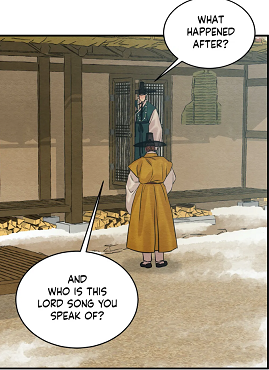 (chapter 83) (chapter 101) For the first time, he had been confronted alone with the sword directly. There was no one and nothing to protect him. When Yoon Seungho had barged in his bedroom, Lee Jihwa had fled behind the folding shield. Furthermore, his father and the domestic were also present.
 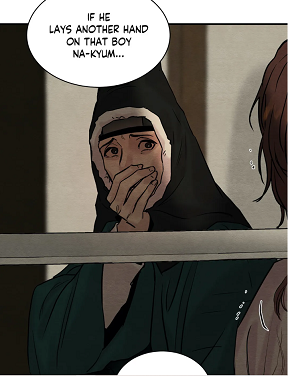 (chapter 67) This shows that till season 3, Lee Jihwa had never been exposed to real justice. There was always someone ready to intervene for him. And now, you comprehend why the red-haired master felt no remorse to blame his friend for his humiliation in the past. He must have thought that if he had not been in his bedchamber during that night (chapter 59), he wouldn’t have lost his topknot. Moreover, he could also use the other incident in the bedchamber as a justification. If Yoon Seungho had not dragged him there…
  (chapter 83) This explicates why Lee Jihwa said this to Black Heart and his friend:
  (chapter 59) The antagonist had witnessed his friend’s humiliation and suffering in the past, just like Yoon Seungho had been present, when the first topknot incident occurred. From my point of view, the lord must have even protected Lee Jihwa. But the problem is that Lee Jihwa was just receiving his punishment in delay for the stolen kiss and his lies
  (chapter 77) He had kissed him without his consent, thus he got “castrated”. Let’s not forget that the main lead was forced to become a male prostitute, an uke, for he had not been able to perform, to have an erected phallus. On the other hand, Lee Jihwa had done nothing wrong in the bedchamber (chapter 59), for he was consoling his friend, so the loss of the topknot appears as a harsh punishment. Moreover, it looks unfair, for the real perpetrators and accomplices got scot-free. Yet, this is just an illusion. Min and his friend were punished too. They got “castrated” too!! How so? It is because from that moment on, they were not allowed to treat Yoon Seungho as a uke, a male kisaeng. (Chapter 1) This means that the painter’s vision was turned into a reality. That’s the moment Yoon Seungho got turned into a seme. Now, Black Heart and the noble with the mole should become his “playthings”, which signifies that they had switched positions. In my opinion, the pedophile had decided to no longer share his “companion” to others. As you can see, they got punished too, but since this was not painful, they never realized that they were receiving their karma. This was a symbolic “castration”. Under this new approach, it becomes understandable why Min was so obsessed with Yoon Seungho, why he wished to “fuck” Yoon Seungho in a figurative way. This is what he had desired in the past, in the gibang, but he had failed. Thus we have this gesture from Black Heart in the woods.
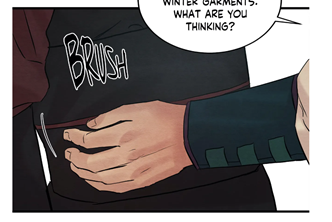 (Chapter 41) Due to the incident in the kisaeng house, Min had lost his privileged position with the king. Hence he got jealous. He could no longer screw” the protagonist, while he had to watch the lord’s slow ascension. To sum up, the loss of Jihwa’s topknot led to the “symbolic castration” of the infamous couple: Min and the noble with the mole.
But it is time to return our attention to the knife and the loss of the topknot. First, it is relevant to remember the following rule. Baek Na-Kyum will through the path than the main lead’s. Since the painter has been constantly cutting his hair, he never had the chance to get long hair and as such a topknot. And the lord was in a similar situation. He only got his topknot very late… but the only difference is that he had a long braid the entire time. This hair dress was the symbol of his servitude. (chapter 57) Hence the author drew slaves with braids constantly. 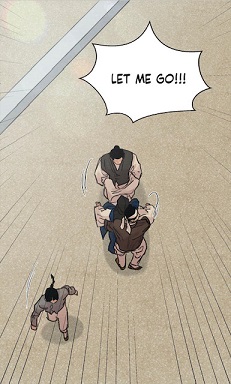 (chapter 77) And now, you comprehend why the pedophile cut off Lee Jihwa’s topknot! The latter had been blamed for the lord’s change of hair dress. (chapter 59) Because of this, Yoon Seungho had become a lord, a noble. That’s the reason why we are not able to distinguish the main lead’s hair dress properly, neither in the last picture and in this one:
 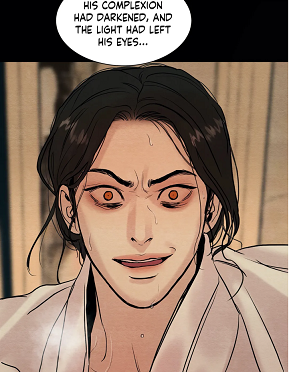 (chapter 57) The hair was short or not? Now, I don’t think so. The mystery of Yoon Seungho’s suffering is linked to the hair dress, yet the readers shouldn’t realize it too quickly. According to me, he still had the braid, until the doctor questioned why Yoon Seungho still had no topknot. (chapter 57) Don’t forget that in each visit of a physician, the latter would question the butler:
  (chapter 33)
 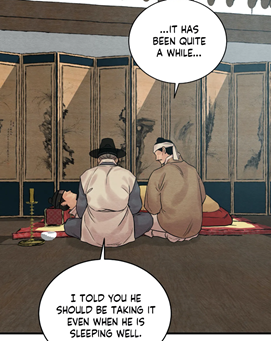 (chapter 55) And who had given him the topknot? Naturally… Kim! Because he didn’t want to be perceived as someone who was violating social norms. However, there is no ambiguity that he hid his responsibility. That’s how Lee Jihwa and his “servant” got framed. They were responsible for giving the main lead the new hair dress. On the other side, I still believe that Yoon Seungho must have lost his hair too, but only once to the difference of Baek Na-Kyum! My reason is simple. Since the painter and Lee Jihwa lost their hair, and Yoon Seungho’s destiny is mirroring his lover’s, it signifies that the lord’s hair must have been cut too. But who did it? Let’s not forget that when Yoon Seungho punished his friend in front of the scholar’s home, (chapter 101) the loss of the topknot had four significations: admission of a sin, mercy, forgiveness but also ABANDONMENT! He was cutting ties with his childhood friend. So he must have known the last meaning, but from a different source, as the first incident represented a sign of leniency. Consequently, I ended up with the following theory. Yoon Seungho must have cut off his own hair, yet he had been manipulated by Kim. Let’s not forget that the painter continues cutting his own hair and there is no sign of trauma linked to such an event. He had been encouraged to lose his hair by his noona. From my point of view, this must have happened between these two scenes:
 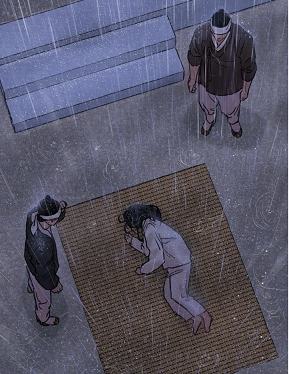 (chapter 77) and this one
 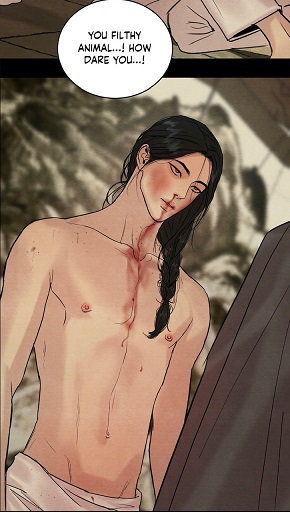 (chapter 83) The length was almost the same, yet 3 or 4 years had passed in the main time. Let’s not forget that this scene represents the patriarch’s abandonment
 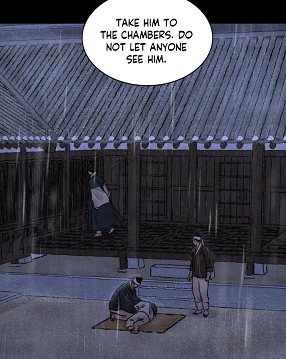 (chapter 77) and Kim had also experienced rejection from Yoon Seungho
  (chapter 77) in that scene. For the butler, this gaze could be judged as betrayal and abandonment. Under this new perspective, it becomes comprehensible why the main lead was encouraged to blame and resent his father. If this theory is true, Kim pushed the main lead to cut off his braid, he did it out hatred and anger towards the Yoons. This would mask his own manipulation and culpability too. At the same time, the pedophile could benefit from it. The main lead was now an orphan, thus the bearded man could use him like he wished. I have an evidence for this interpretation. This is what Baek Ha said to her husband:
  (chapter 23) Being slave meant being orphan. The pedophile could feign ignorance about the main lead’s true origins. If he truly cared for him, he just needed to ask this: papers!
 (chapter 24) This shows that in Painter Of The Night, all the elders were depraved and violent hypocrites. Like mentioned above, the pedophile had a huge interest to keep the main lead as his slave, thus he was turned into an orphan and asked to keep a braid. And Yoon Seungho’s mother could do nothing, for the son had cut off his own hair, a huge symbolic act. He was no longer considering her his mother. But because of his status as slave, the pedophile could never trust the main lead. Then the suicide from the mother put an end to this farce. Hence lord Song could tell his sex partner that he had become the head of the Yoons and let him “have” the properties, while it was never his intention to let him become responsible. If he had become a lord, he could escape from his claws. He needed him to remain in an infantile and dependable state.
Since I detected that rumors often become a reality, I deduce that after the lord’s vanishing, Heena’s words will come to the surface and become the verity: (chapter 1) While in the past the father could judge this grapevine as positive, for he was portrayed as a honest and respectable man, the town folks will perceive him as the opposite: cruel, depraved and selfish. And this because of the false accusation:  (chapter 94) By framing the elder master Yoon, Kim can deny any responsibility in the loss of hair of Yoon Seungho and in the messenger’s death. It was the father’s doing. The nobles like the Lees and Yoon Chang-Hyeon are now accountable for the corpses. In the gibang, Yoon Seungho never killed anyone and he even spared his friend, though the latter had kidnapped Baek Na-Kyum. Finally, the town folks are now aware of Lee Jihwa’s homosexuality and his relationship with the protagonist. So I believe that people will jump to the conclusion that father Yoon had turned his elder son into a sodomite and sold him him to the Lees which is not false too. The king has a reputation to maintain and he needs scapegoats in order to hide his involvement and his crimes from the past.
4. The reason behind the loss of the topknot
And before closing this essay, I would like to point out another similarity between A Sip Of Poison and Painter Of The Night. Though Baek -Ha is the daughter of Nan-Woo’s enemy, the prince couldn’t hurt her in the end, for she saved him:  (chapter 33)
  (chapter 33) She not only treated his wounds, but also helped him to overcome on his guilt. He felt responsible for his brother’s death, for Nan-Woo had attempted once to commit suicide on the battlefield, and his brother had sacrificed himself to protect him. He was definitely plagued with remorse, self-loathing and shame. And that’s exactly what Baek Na-Kyum has been doing too: by simply loving him so selflessly and purely. Finally, Baek-Ha’s fate made him realize the Empress’ immense culpability. She was so greedy and selfish that
 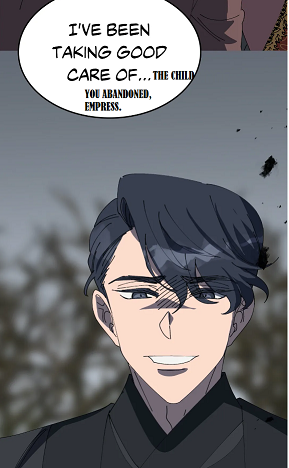 (chapter 34) she had abandoned her own child! Thus he was freed from his hatred and guilt. Nan-Woo was able to perceive the wrongness of this social norm which was common in Joseon: the child is responsible for the parents’ sins!
  (chapter 33) Being an orphan outlined her innocence. And since I have already connected Baek Na-Kyum to the mysterious lord Song, I am quite sure that the painter will have a similar attitude than Baek Ha:
  (chapter 33) He will feel responsible for Yoon Seungho’s martyrdom. And if he is truly his son, his abandonment can serve an evidence of his innocence. On the other hand, the readers shouldn’t forget that his surrogate parents, Jung In-Hun and Heena, played a role in lord Yoon’s torment as well. Thus he can only indebted towards his husband.
Chyomchyom and Byeonduck explained perfectly why the protagonists would suffer so much: ambition.  (Doctor Frost, chapter 225) With this picture, the manhwaphiles can detect the presence of the endless vicious circle, the ouroboros, which I had described as a kaleidoscope. The absence of empathy in both stories was the reason why no one stopped the main perpetrators. Woo Jang-Hon felt guilty, for he had raised his younger sister who had become a monster. Kim felt deep down guilty, but chose to reject his responsibility by putting the blame on others. Out of fear, he preferred hiding his wrong decisions and later wrongdoings. And now it has become his MO. This distinguishes him from the general who chose to put an end to his guilty conscience and paid for his crimes..
 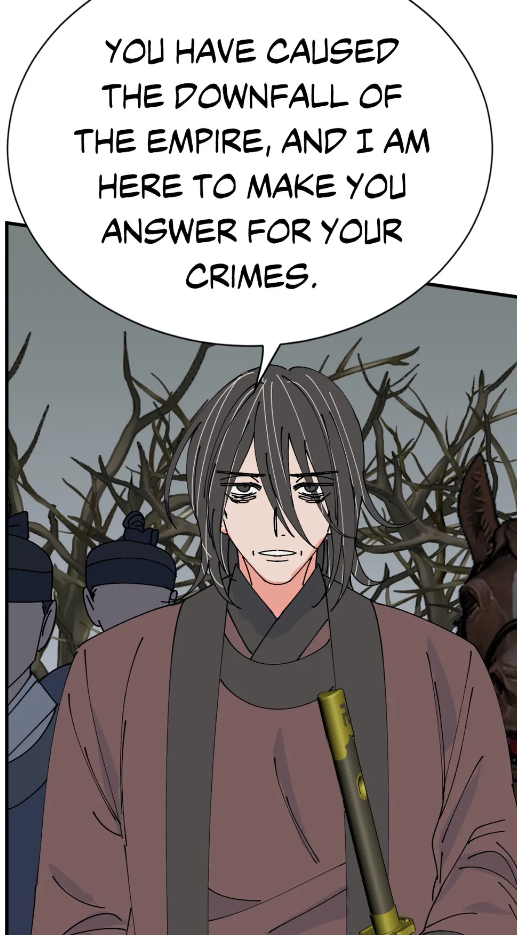 (chapter 34)
To conclude, the loss of the topknot has many significations: punishment, castration, loss of power, servitude, guilt, abandonment, absence of protection, cruelty, betrayal, but also freedom, loyalty, leniency and forgiveness. As you can see, the gesture is associated to opposite notions: servitude versus liberty, betrayal versus loyalty etc…. as it depends on the perspective.
Thanks to Yoon Seungho, Lee Jihwa was able to free himself from his guilt and he could liberate himself from social norms (peers pressure, his father’s expectations,) and his shame due to his sexual orientation. Before losing his topknot, he had admitted his sins to his friend and it also indicated his loyalty towards Yoon Seungho. And this was the same for the general. The latter could finally find peace in his mind and redeem himself. Yet, now, he is no longer a powerful general, he is just the puppet of the prince. However, the moment the red-haired aristocrat lost his topknot, he was no longer the king’s puppet. Therefore he was no longer useful for the mysterious lord Song. That’s the reason why the antagonist got aware that he shouldn’t expect any forgiveness or mercy from “Captain Hook”. No matter what he would say, he would be suspected of a crime (chapter 101) and this because of the first incident with the topknot!! Since Black Heart and the noble with the mole had been able to avoid punishment after this incident in the kisaeng house (chapter 1), he assumed that he could repeat his actions!! But he got proven wrong, for he ended up losing his life.
Feel free to comment. If you have any suggestion for topics or manhwas, feel free to ask. If you enjoyed reading it, retweet it or push the button like. My Reddit-Instagram-Tumblr-Twitter account is: @bebebisous33. Thanks for reading and for the support, particularly, I would like to thank all the new followers and people recommending my blog.
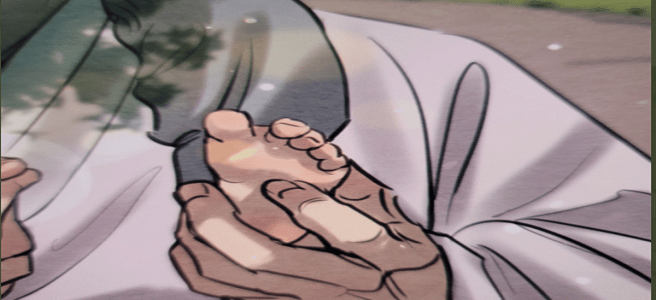
 on Twitter yesterday, and naturally this made many people happy, for Jung In-Hun was stroking Baek Na-Kyum’s foot gently. How could people identify the characters, though we don’t see their faces? Simply by the clothes! The manhwaphiles remember the painter’s grey pants and the learned sir’s favorite color, lavender,
 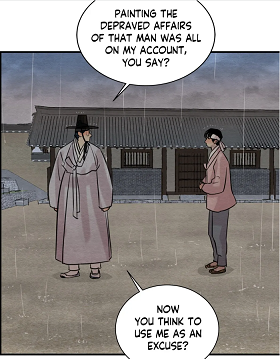 (chapter 19)
 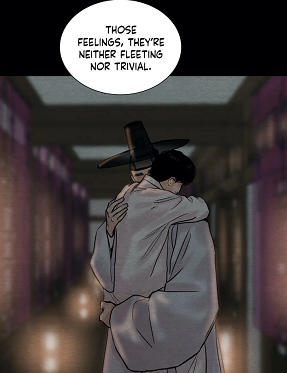 (chapter 68). While many manhwalovers found this image cute
  (chapter 70) The manhwalovers can immediately detect the contrasts: the visages of the protagonists versus the hand and the foot, day versus night, sun versus moon. That’s the reason why I came to the deduction that this image embodies a happy memory of the painter: sadness versus happiness.
 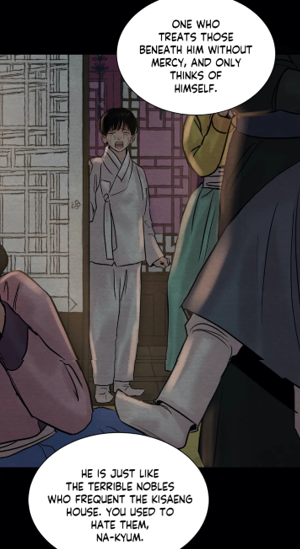 . (chapter 68) This means that Baek Na-Kyum was removed, because he was a witness and could generate a scandal. He is beloved by the kisaengs. However, back then, he got misled due to Heena’s indoctrination and false impressions. When he saw this, he was only looking at his noona, hence he didn’t pay attention to the actions of the black guard. Moreover, he had no idea why Heena and Yoon Seungho were behaving like that. So when the painter recalled Jung In-Hun from that night, he was no longer heartbroken, because the stroll with the scholar came to his mind.
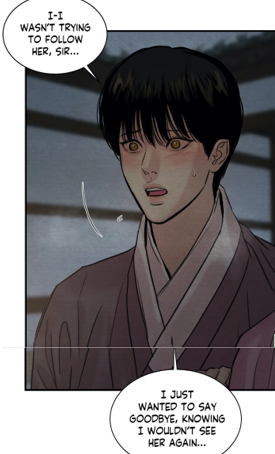
  (chapter 70). The trigger for this recollection was his farewell to Heena. This time, he could say goodbye to Heena properly by embracing her and giving her a scarf so that she would remember him. In the painter’s mind, after that night, he would never see her again.
  (chapter 69) In other words, this night represented a closure for Baek Na-Kyum, the end of his abandonment issues. In episode 70, Jung In-Hun had consoled him, he had tried to cheer him up. Thus the learned sir was smiling. Yet, this couldn’t cover the painter’s scar. He felt that he had betrayed Heena, for he had not been able to protect her. It was, as if he had run away. Nevertheless, when this incident occurred, the learned sir had not run away from the gibang, because you could see that Baek Na-Kyum was wearing socks and shoes.
 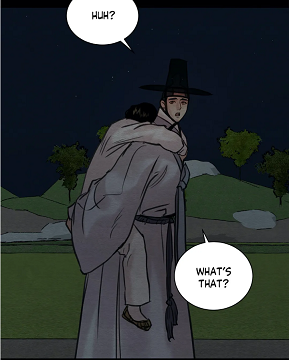 (chapter 70) The man had put the shoes on the child, as in the building, the painter only had his socks on. Because of the presence of the socks,
 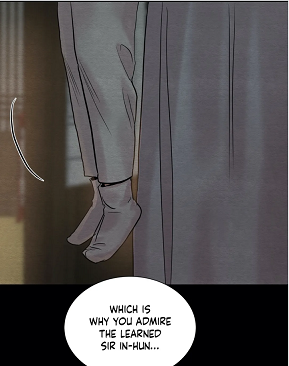 (chapter 68), I deduce that this walk must have taken place in a colder season (fall)
  while in this picture, Jung In-Hun was carrying the painter on his shoulders in the summer.
 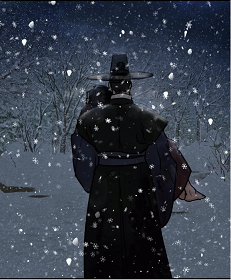 (chapter 102) In both scenes, the main lead is seen with bare feet. He is also carried by his loved one. But here, it is snowing, hence this signifies that it is winter. On the other hand, the manhwalovers can detect the presence of a purple flower on the right side. This signifies that Spring is on its way. That’s how I came to realize why Baek Na-Kyum is now recalling the learned sir’s gesture from the past.
  (chapter 102) where it is even colder than in the valley, secondly it is snowing and there is no sun, only the moonlight. So the moment Yoon Seungho witnessed that Baek Na-Kyum was alive, he must have recognized the seriousness of the situation. Since Baek Na-Kyum had only a hanbok on, he could die of hypothermia. What he had imagined for himself, death, had terrible consequences. He could be the reason for the painter’s curtains. So in my opinion, he must have warmed the painter’s feet with his hands, a new version of this scene:
 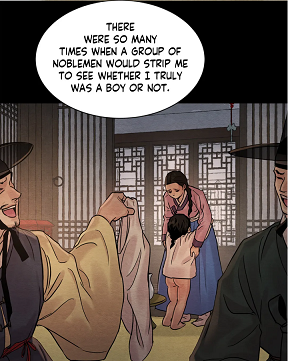 (chapter 94) His presence was to divert the attention from these men so that she wouldn’t be asked to have sex with them. And since I have already detected that each time, the painter suffered, karma would retaliate, the logical consequence is that Heena got punished for her wrong action. This signifies that while the painter was following the learned sir, his noona was abused in the kisaeng house. This would explicate why later she had no remorse to turn Yoon Seungho into a victim. And don’t forget that the painter was much younger than in this scene.
 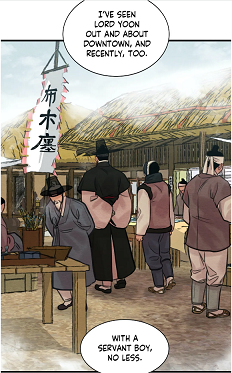 (chapter 45)
  (chapter 75) The latter would let his partner walk through town in order to please him. He would even follow the painter. In other words, it was always for the painter’s sake, and in the mountain, it was the same. But it was not the same for Jung In-Hun, it was for his own benefit. We have the best example in chapter 10:
  (chapter 10) Here, he desired to separate the couple. Baek Na-Kyum should refuse to paint erotic pictures.
  (chapter 29)
 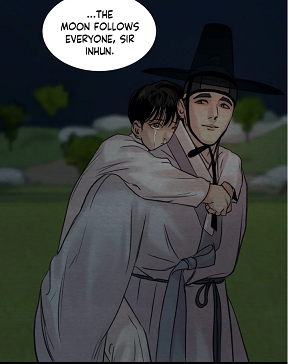 (chapter 70): The artist is dressed with good clothes, he looks more like a young master than a commoner, only the shoes are indicating that he is a commoner. That’s the reason why I believe that during that night, the learned sir was avoiding people. They could have wondered why the young boy was carried in his night clothes outside. From my point of view, this scene
 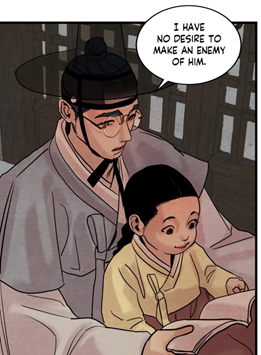 (chapter 29) He had already been seen with a girl before who seems to like him either.
  (chapter 6) Thus I couldn’t help myself wondering if the learned sir was not directly involved in prostitution, bringing girls to the gibang and even covering up for the sexual child abuse. We shouldn’t forget that the pedophile was portrayed as a man consumed by lust who would never pay attention to the time and the hour.
  (chapter 6)
 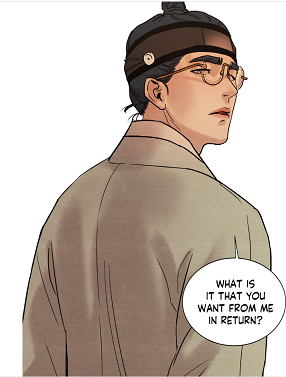 (chapter 7)
 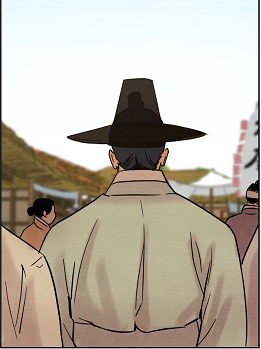 (chapter 7) This change is not random in my eyes. I had already associated the learned sir to a chameleon. This change of color seems to validate my theory that Jung In-Hun had been sponsored by Min, hence we have the light green. Black Heart is symbolized by green. However, the light pigment reflects that he had been abandoned and betrayed. Nonetheless, when he encountered Yoon Seungho, the latter was wearing a purple hanbok.
 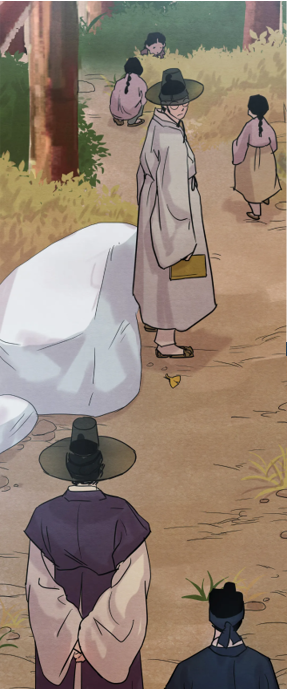 (chapter 6) That’s how the man got influenced and chose to wear his lavender hanboks again. But he never realized that behind the young noble, there was standing the pedophile, someone he had helped in the past. From my point of view, the change of the learned sir’s hanbok was the indication of his betrayal. According to me, the old bearded man
  (chapter 37) was not a former servant, but the pedophile. So he could have recognized the learned sir thanks to his hanbok… just like the readers did with this picture:
  (chapter 73) From my point of view, the intimacy in the bedchamber stands in opposition to the teacher’s gesture in the countryside. His caress was just a casual gesture with no real deep meaning in the end. This explicates why he could betray and abandon the artist on so many occasions in season 1 (chapter 11, 24, 25, 29, 35, 40). The learned sir had always prioritized his own interests.
  (chapter 102), the painter should realize the difference.
  (chapter 70) talk and ask questions before apologizing and hugging him. The lord never acted, as if nothing had happened,
  (chapter 102) This was true love and Baek Na-Kyum’s feet always reflect his emotions:
 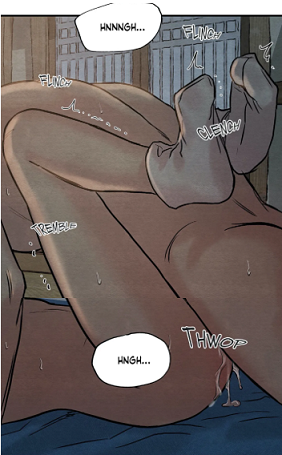 (chapter 58)
  (chapter 80) So now, imagine how the painter must feel if the lord took his feet in his hands! This is no coincidence that there is this saying:
  (chapter 100)
 (chapter 102) and the zooms on the feet:
  (chapter 53)
  The couple was following their heart!! But this was not the case with the scholar. Baek Na-Kyum had no other choice than to follow Jung In-Hun.
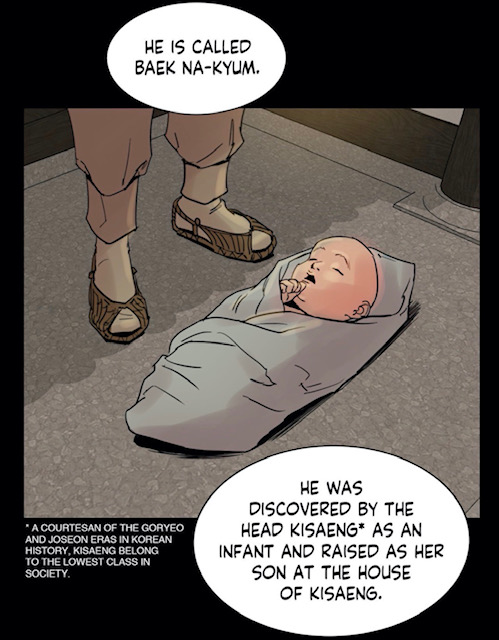 (chapter1) Or was she simply the noona?
 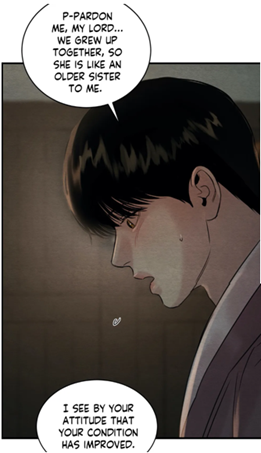 (chapter 70) At some point, I came to realize that Heena had acted as the surrogate mother, but she had never clearly stated that she was the painter’s mother. In other words, his adoption was never official, which explicates why the main lead only considered her as his older sister. This is important, because her ambiguous status can not only generate problems, but also expose her betrayal towards Baek Na-Kyum. Note that in chapter 97, the noona treated Baek Na-Kyum as her “child” who wouldn’t listen to her
  (Chapter 97), while later she implied that they were both equal, for she employed the personal pronoun “us”.
  (chapter 97) On the other hand, she used her seniority as status, when she called him a fool
  (Chapter 97). He lacked experiences, hence he was too naïve, and as such he would trust the protagonist too easily. As you can see, Heena herself had an ambiguous relationship with her brother. Nonetheless, thanks to chapter 93, I got finally a definitive answer about Heena’s true identity. She is indeed the head-kisaeng in the gibang. I realized that the protagonists were invited to stay in Heena’s personal room.
  (Chapter 93) That’s the reason why the seat of the host was empty and why Yoon Seungho didn’t go there. He would have violated social norms, if he had taken her seat.. Moreover, by doing so, he would have revealed that he knew where the woman was. This could have raised questions.
 (Chapter 93) This means that the figures were not sitting in the room shown in the last panel. On the other hand, their voices in the hallway exposed their location. The noonas and Heena were not far away from that door hidden by the veil. That’s how I got aware where Heena’s room was situated. In the last picture, the readers are turning their back from Heena’s study, which is right after the corner. Thus I could recognize the design of the building: ][ In the center, there is this huge hallway with the purple veils, but at its end, on each both sides, there exists a corridor perpendicular to the one with the purple curtains. What the beholder imagined as a door at the end of the hallway,
 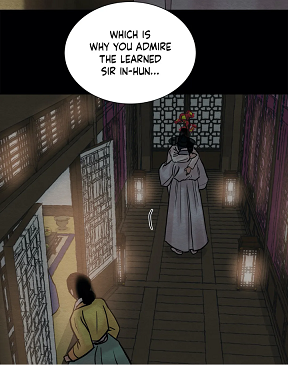 (Chapter 68) was in truth a huge window. How do I know this? First, in this scene, the scholar was hiding a huge white vase with red flowers. Hence I deduced that Jung In-Hun couldn’t have walked through that “gate”, it was just a window. Therefore I assumed that he had to walk past the flowers, either turn to the right or the left. Secondly, observe that next to the lantern on the left, there is a small white panel. This means that the view from chapter 93 was more or less taken from the right corner. Moreover, in the next chapter, Heena is not facing this “window”, when she is in the same building.
 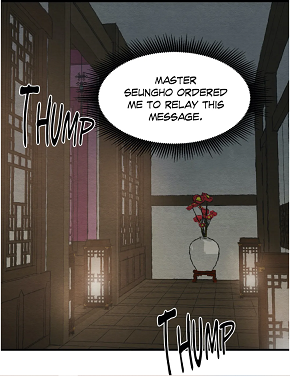 (Chapter 69) This time, the white vase with the flowers is standing in front of a wall. That’s how I deduced that Heena had to turn to the left in order to go to the hallway.
  (chapter 93) which is not present in episode 69.
  (chapter 93) Since I came to the conclusion that Heena’s private room was on the right side after the corner, I deduce that the kisaeng was not on her way to her room. Moreover, since the kisaeng was walking in the same direction than the scholar, I can only conclude that Heena was actually approaching the entrance of the building. I believe that she had turned around, but the author didn’t reveal this. One might argue that it is possible that in chapter 68, the learned sir could have gone with the painter to Heena’s bedroom. However, back then the latter was not the head-kisaeng. We know this due to the presence of a kisaeng standing right behind Yoon Chang-Hyeon during the sexual lesson.
 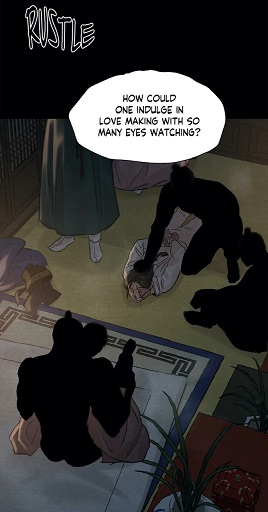 (chapter 86) She was the superior. Moreover, we saw the teacher walking through the countryside during the night.
 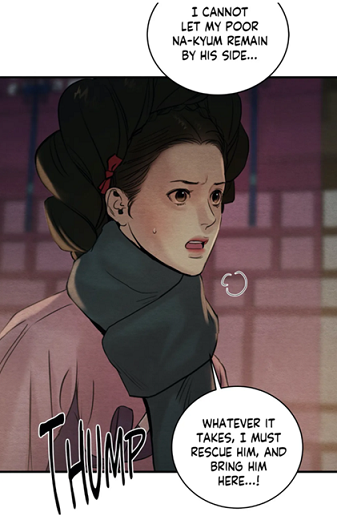 (chapter 69) It was done on purpose!! She wished that Min would take care of her brother. Under this new light, it becomes comprehensible why the noona has a drop of sweat on her cheek. She is faking ignorance, she is acting, as if she was very protective of her brother. She uses illusion to manipulate people. In reality, she was acting here. One might argue that I am overthinking again. This is not possible, for Heena didn’t know Min at all. Hence she couldn’t manipulate him. The latter had heard of her for the first time in Yoon Seungho’s mansion.
 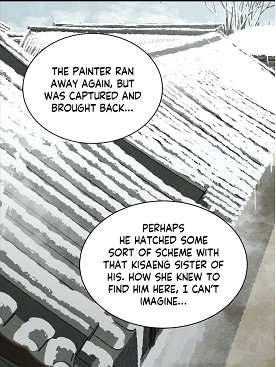 (chapter 66) But let me ask you this. How could Heena have never met Min, when she was the head-kisaeng? Secondly, just because the servant had never heard of the noona, this doesn’t mean that it was the case for Black Heart. The domestic assumed Black Heart’s ignorance, just like the readers. Moreover, recently I had detected that Heena had been standing in front of a mansion belonging to a noble.
 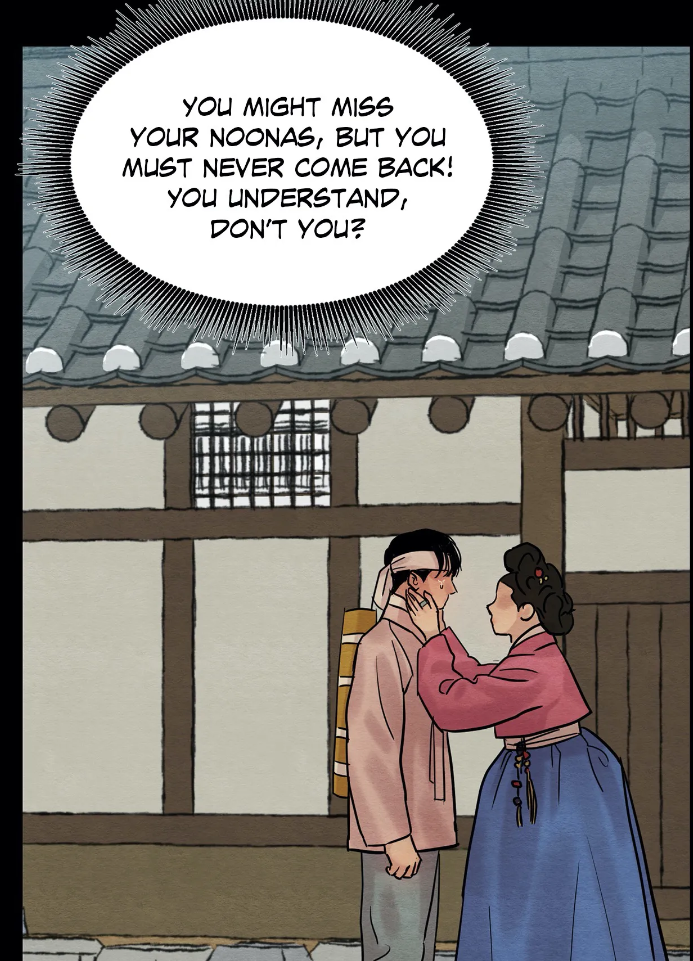 (chapter 46) This was not Yoon Seungho and Lee Jihwa’s mansion, for the gate and walls
 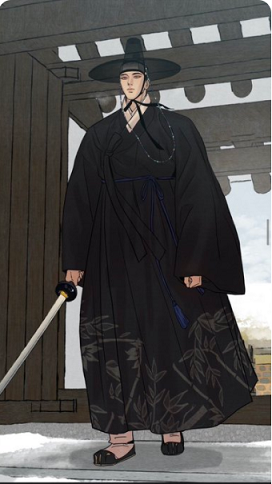 (chapter 67) diverge. Moreover, Min has been seen in the kisaeng house in so many chapters
  , (chapter 19)
  (chapter 59). Here, I would like to point out that in episode 59, Lee Jihwa had visited the kisaeng house on different occasions, for his hair was slowly growing.
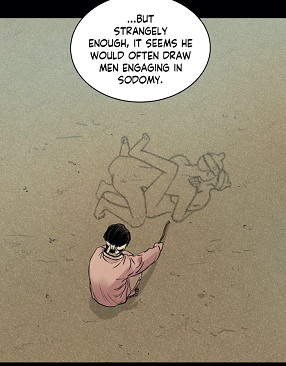 (chapter 1)
 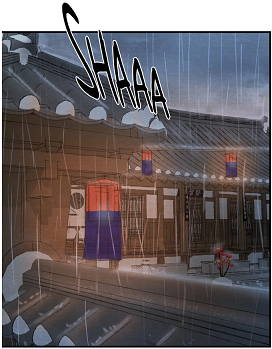 (chapter 19) This image was showing us that Yoon Seungho was visiting the gibang. However, pay attention to the pattern of the doors in the last picture and the next:
 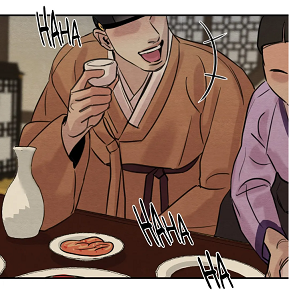 (chapter 19) The motive diverges, it looks like the one from the hallway with the purple veils. This means that the party was not taking place in the room shown in the former picture. What caught my notice is the presence of the white vase with the red flowers in front of the building. It was present in each scene taking place in the gibang.
  (chapter 93) For me, the red flowers symbolize Heena noona. This explicates why during the painter’s dream, the flowers were not present.
 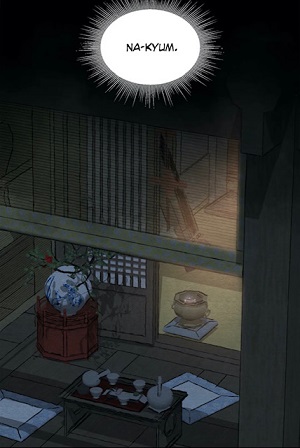 (chapter 87), as Heena was not included in his vision. And this image
  (chapter 44) Due to the similarities, I believe that in chapter 19, Byeonduck was actually exposing the ghost head-kisaeng. Exactly like the father, she was hiding. Why? It is because she is involved in Yoon Seungho’s suffering. And now, imagine her reaction, when she hears that Black Heart has organized a feast for the main lead’s honor. The woman could only avoid the main character. And now, you have the explication why Heena as the head-kisaeng was not present during that festivity. It was deliberate.
  (chapter 19) Striking is that the kisaeng had a similar hair dress than Heena, This is no coincidence. She was acting as the head-kisaeng. The manhwalovers will certainly remember that only two kisaengs had no braided bun or braids: this one
  and Heena. Look at all the others:
  (chapter 51)
  (chapter 93)
  (chapter 93)
  (chapter 95) The extravagant hair dress was exposing the kisaeng’s status. And now, you comprehend why the other noona explained the disappearance of Heena during that night.
  (chapter 19) But how could she sense that the noble was in a good mood? The latter was silent and not even smiling.
 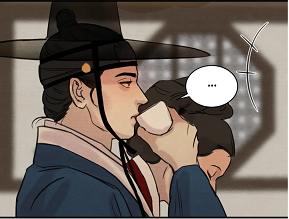 (chapter 19) How could she claim this? In reality she was actually spying on him. Heena had no idea why the lord would come to the gibang, especially after suffering there so much. The kisaeng’s task was to dig up information. This visitation must have bothered the head-kisaeng.
  (chapter 69) She was even turning her back to him. But actually, she could have detected his presence, exactly like I had recognized him: through his laugh!!
  (chapter 99) He was wearing a veiled hat, yet in chapter 69, this was not the case.
  (chapter 88)
  (chapter 99) Under this new light, Min’s words get a new signification:
  (chapter 99) He was implying that they knew each other for a long time! The irony is that the manhwaphiles had the impression that their relationship was recent, and his cynical tone contributed to it. Secondly, he called her Heena, a sign that they were close to each other. Note that Lee Jihwa never mentioned her name.
  (chapter 99) His words even insinuate that Black Heart had just given the following order. The red-haired master should just fetch a kisaeng and in my opinion, Heena was waiting for Lee Jihwa’s arrival to leave the gibang. According to his words, he had no idea about the kisaeng’s identity. But is it true? I have my doubts now, and this for two reasons. Why would he ask about her identity, when he already knows that she is a kisaeng? The drop of sweat on his face is an indication that he is lying. But the problem is to determine if the deception is only referring to “I heard not a word” and to all the questions. Let’s not forget that he knew about Min’s initial intention. The moment Lee Jihwa arrived in the gibang, she just followed him. That way, they would avoid to attract attention, and with her new hair dress
  (chapter 93), the gibang had lost its “leader”. This explains why this noona as her right-hand had to explain the absence of the owner.
  (chapter 86) The latter had been eyeing the throne in the family mansion, but he failed to take over the mansion. This was the negative reflection of Heena. Whereas the kisaeng had a powerful position in the gibang, it was the opposite for the patriarch. He was no longer recognized as the head of the Yoons. Yet, both have something in common. Both lost their position for good, for Heena and Yoon Chang-Hyeon couldn’t take or keep the seat. We could say that both got defeated by Yoon Seungho. In chapter 93, the main lead acted as a respectful and calm master, whereas in the bedchamber he showed no respect to his own father. He talked back and even made fun of him.
  (chapter 87) This picture stands in opposition to this one:
  (chapter 93) To conclude, the surrogate mother and the patriarch made a similar experience in season 3. Both got deceived by manipulations and in both cases, letters played a huge role.
 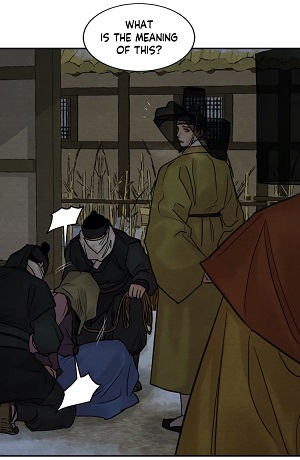 (chapter 99) No one would be looking for her. The problem is that the witnesses of her curtains all vanished. Lee Jihwa ran away, Black Heart got killed with his friends, and the only survivor, lord Jang, was confronted with real corpses in the shaman’s house.
  (chapter 102) That’s why I come to the deduction that her murder will be questioned. Why? There is no blood contrary to the bloodbath in the shaman’s house and there is no corpse!! Since Black Heart used different corpses in order to deceive Heena and the couple, there is no ambiguity that the head-kisaeng’s curtains will be doubted. Striking is that Heena staged her death out of cowardice and selfishness, while Yoon Seungho made the opposite decision. He was resolute to commit suicide in order to follow his lover in his death. During that night, Heena and Yoon Seungho lost their “home”, but at the end, he found his true home: the painters embrace.
 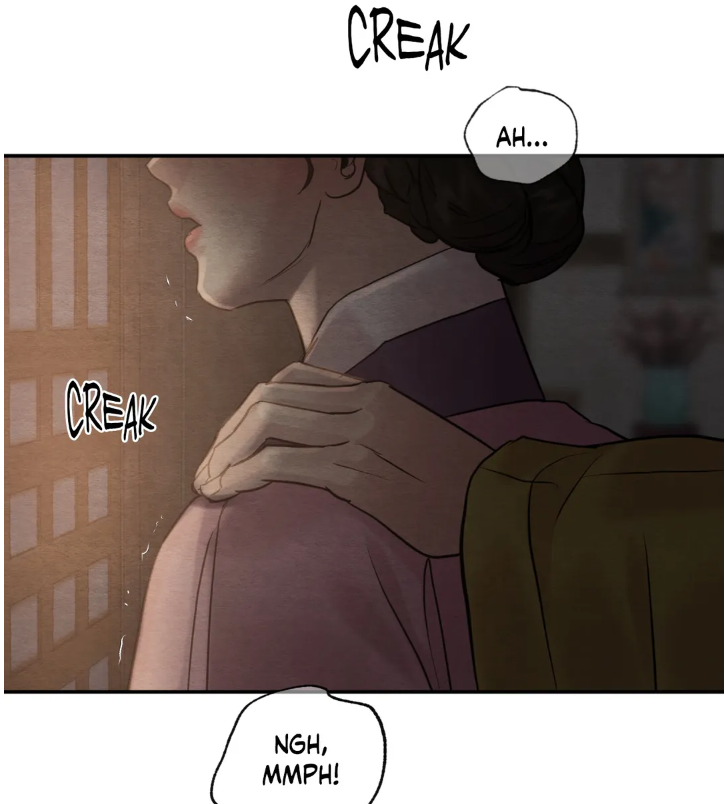 (chapter 96)
  (chapter 96), though he is a noble. Besides, I am suspecting her of suffering from genophobia (fear of sex and intimacy) Their behavior exposes closeness and a certain trust. But how is this possible? It is because she knows that Min is a sodomite, and he is not looking for sexual favors. That’s the reason why she trusted Black Heart in my opinion. Moreover, he is smiling like Jung In-Hun. Therefore it is not surprising that she was speaking like the Joker in chapter 97. Here, the man had actually projected his own thoughts onto Yoon Seungho, and due to her own belief, Heena was more than willing to believe Black Heart.
 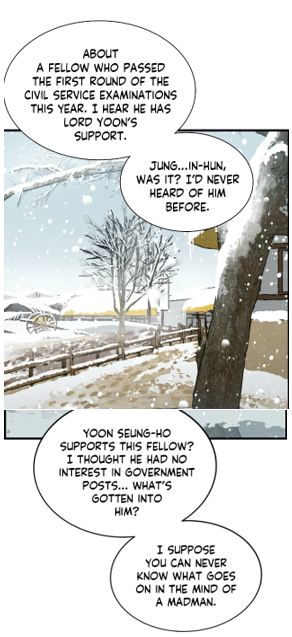 (chapter 52) It is because Black Heart knew Heena! I even believe that he had already met the scholar. Note that the man with the black hanbok was repeating the rumors about the learned sir. And the other questioned the main lead’s action exposing that he had never heard about this grapevine before. Hence I am deducing that the one spreading this rumor could only be MIN!! That’s the reason why he just said this
 (chapter 52) That means that the noble knew the teacher in the end. Therefore it is no coincidence that Min was aware where the learned sir lived!!
 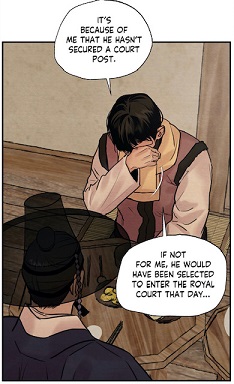 (chapter 52). Why? It is because there was an incident in the gibang!!
 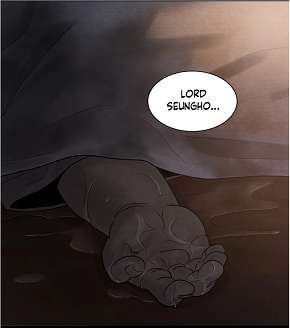 (chapter 94)
  (chapter 97)
 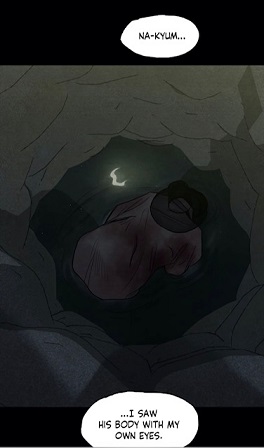 (chapter 97)
 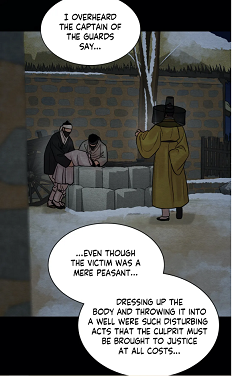 (chapter 101), and even Kim hid his face under a hanbok.
  (chapter 92) That’s the reason why I believe that in season 4, the visage will play a major role! The couple will recognize people due to the face!! In my eyes, the former head-kisaeng knows the identities of all the persons involved in Yoon Seungho’s suffering.
 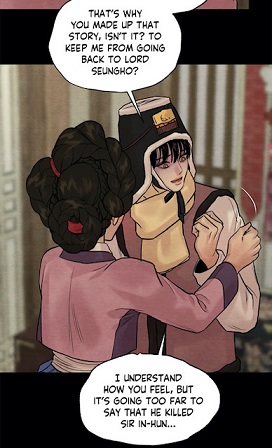 (chapter 97) her brother is detecting her deception.
 (Chapter 5) Baek Na-Kyum was apologizing for his past behavior. He had insulted the main lead because of the poem. And his words sounded really similar to the butler’s in the library, for they both employed the same expressions: “That day” and “I spoke out of”.
  (Chapter 77) Striking is that the painter employed the expression “hand”, while the valet talked about “turn”. Why did they do that? It is because when Kim was caught committing a crime, he turned his head!
 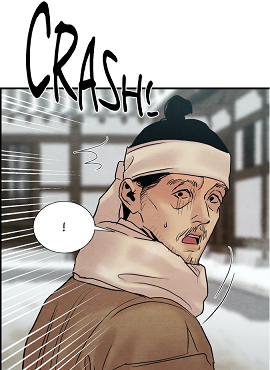 (chapter 68) Thus in the library, the butler excused himself in front of the lord by using the following expression: “spoke out of turn”!! On the other hand, the painter had used his hand,
 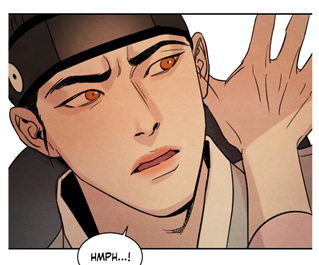 (chapter 4), therefore he described his wrongdoing with the following expression “out of hand”. In my eyes, his words indicate the interference of the butler. Furthermore, the two men had a drop of sweat, a sign that they were not truly honest.
  (chapter 77) Both were apologizing, as they had wronged the noble. As you can imagine, the similarity in the excuse is no coincidence. The proof that both incidents are reflections is that they have another point in common. The wrongdoings of the low-borns had taken place in front of a gate. The butler had disobeyed his master
  (chapter 68), and the painter had assaulted the lord by trying to retrieve the poetry.
 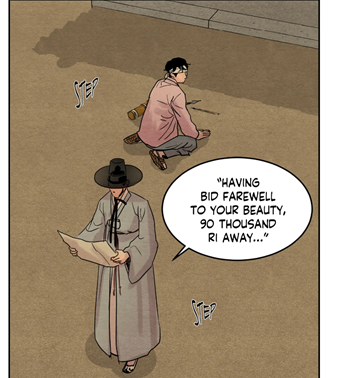 (Chapter 4) Because both characters had violated social norms, showing disrespect towards a noble,
 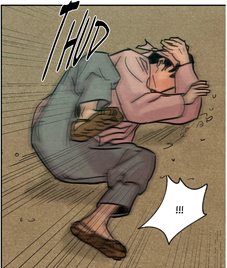 (Chapter 4) In other words, since Yoon Seungho had punished the butler due to the incidents in episode 67/68, I deduce that episodes 67/68 were reflections of episode 4/5 as well!! This corresponds to the rule 2 and 3.
  (chapter 4) Let’s not forget that just before the great entrance of Black Heart and the protagonist in chapter 67, this was what the author showed us:
  (chapter 67) And now compare the building to this one from chapter 1:
  (Chapter 12) (For more read the essay “Lee Jihwa’s special relationship with Yoon Seungho”) Then in season 2, the main lead forced the elder Lee to hear what he had been denying all this time
  (Chapter 67), while in chapter 3, he could only witness it from the patio. On the other hand, Yoon Seungho had been proactive during their sexual encounter, hence the father could only blame the main lead for his son’s debauchery. The intimacy in the pavilion was in verity hiding Yoon Seungho’s huge traumas. But due to Lee Jihwa’s confession in the inn, the red-haired master’s reputation got ruined in town and this must have definitely reached the father’s ears. Striking is that when Yoon Seungho confronted Lee Jihwa with his crime (abduction of a person from his household), the red-haired master ran away and hid behind the folding shield. Thus he never apologized to his friend. And it was the same with the elder Lee. The latter knew about his son’s wrongdoing, for he accused the intruder immediately.
  (Chapter 67) As you can see, the absence of the excuse from the uke and his father outlines that chapter 67 is a reflection of episode 5 and 77. I detect a pattern, chapter 5 contains a superficial apology, chapter 67 no apology and chapter 77 a fake excuse again. Furthermore the manhwalovers can recognize that in the same episode (episode 5), the antagonist Jihwa had indeed wounded the painter with his insult too, a reflection of episode 4.
  (Chapter 5) This confirms that chapter 5 is connected not only to episode 77, but also to chapter 67/68. We have the same elements: an incident linked to a door
  (chapter 67), a punishment, but also the absence or presence of an apology. But all of these episodes have other similarities: hypocrisy and arrogance. The Lees were looking down on Baek Na-Kyum and Yoon Seungho (chapter 5-67), while in episode 77, it was the butler who yelled and criticized the noble.
 (chapter 77) By detecting a reflection between these chapters, I had a new revelation.
  (chapter 5), while it was not the case. As you can see, anyone seeing the black guard leaving the owner’s study could have had the impression that the lord had written a letter. This means that this mistake must have taken place later again due to the rule 2! The manhwalovers could discover the deception in chapter 37/38!!
  (chapter 38) That’s how Jung In-Hun got misled.
  (chapter 38) Yoon Seung-Won had never received a letter, but the ruined painting. The readers only discovered the trick in the final episode, when the father was looking at the picture. And this connection between a letter and a painting was reflected in season 2. While Min stole the painter’s last creation
 (chapter 56), Jihwa sent a forged letter
  (chapter 56). Striking is that the butler was the one who received the paper before delivering it to his sick master. These two scenes (38-56) indicate that the valet is related to the correspondence. Moreover, he was seen delivering the message to Yoon Seungho in the courtyard.
  (chapter 35)
 (chapter 5) It was, as if he was not allowed to write any letter. So where did the table go? To the study!! What caught my attention is that after the first painting
 (chapter 2), the table had been removed from the study, just like the papers.
  (chapter 4) This was no coincidence. It had been sent to the lord’s bedroom, but after the lord had tasked the black guard, it was no longer there. This is the indication that someone was interfering with Yoon Seungho’s habit to take a brush. And this can only be Kim. As you can see, the appearance and the vanishing of the small table is the element which was reflected in chapter 1, 2,
  3, 4 and 5. And now, look at the scene where Lee Jihwa met Min.
  (chapter 67) The table had also disappeared. And when did it happen?
 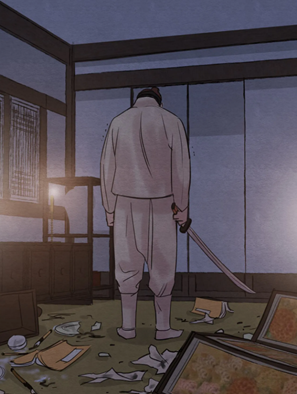 (chapter 21) The noble had ransacked his own room with his sword. And what did we see in that episode? A paper folded in a book.
  (chapter 21) In other words, the First Wedding night is also a reflection from these chapters (4/5, 67/68, 77), for it contains the same elements:
  (chapter 20) an incident with a door, someone is pushed down, a wrongdoing committed against Yoon Seungho (theft), an apology
  (episode 19) and the importance of the table. According to me, the valet had put the expensive wine on the painter’s table on purpose. To conclude, I see a connection between episode 4/5, 19/20/21, 67/68 and 77.
  (chapter 77) He can not trust his words, especially since he views the nobles as violent liars. Why? It is because there was this huge table. This is no coincidence that right after the valet betrayed the main lead and wrote a message to the patriarch. That’s how I had another revelation. The butler is symbolized by the table! Thus he was often seen with this small table
  (chapter 11)
  (chapter 17) To conclude, when the butler saw the black guard leaving the mansion, he believed that his master had sent words to someone! That’s the reason why he removed the table and returned it to the painter’s study.
 (chapter 97) written by Yoon Seungho, but he envisioned that this was the Spring poem!
 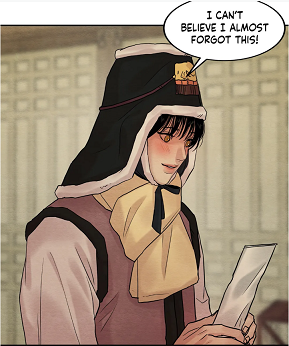 (chapter 97) We had the same situation. Black Heart had stolen the Spring poem, and the noonas had deceived the protagonists by faking admiration in front of an empty paper.
  (chapter 93) Since the paper in episode 93 was empty, I could only come to the deduction that this paper contained words!!
  (chapter 92) The latter’s work was a copy of Yoon Seungho’s poetry, the repetition from chapter 4. Hence you comprehend why I deduce that the paper in the annex was different from the Spring poem. So during that night, Yoon Seungho left a note to his lover, and that’s how the butler discovered that the artist could not read Chinese, for he saw his master writing in hangeul. But there exists another evidence for this interpretation. Baek Na-Kyum had wished this:
  (chapter 97) The goddess was actually fulfilling his wish, when she reminded him of the Spring poem.
  (chapter 97) If the lord had mentioned in the letter that they had found the corpse of Deok-Jae, the painter would have believed him. However, as you can envision it, the butler and Min were determined to generate a misunderstanding, to create the illusion that the scholar had died. Consequently, the servants deceived the main lead by omitting the existence of the paper. They had not delivered the message properly.
  (chapter 4) His own poetry got stolen. But let’s return our attention to episode 5. Since the lord had given the poem to the black guard, this signifies that the lord no longer had the sijo. Therefore he had to write the poem again in order to mask the disappearance. In my opinion, he must have copied the original poetry for the artist in order to prove that he had not been lying. Hence the paper looked different. And this brings me back to the painter’s apology in the patio.
  (chapter 04) That’s the reason why he had taken it in the first place.
 (chapter 7) But where is the sijo now?
  (chapter 65) Moreover, I believe that in chapter 65, he had collaborated with the noona. He had shown her the painting of Baek Na-Kyum, while in the study there was a blank paper. As you can see, in season 2, we had again this connection between a painting and blank paper. But let’s return our attention to chapter 5. The black guard was acting on the order of someone else, Yoon Seungho was not the one hiring him. The butler hates ruckus, his MO is to lie low and act in the shadow. If he had retrieved the paper, the man could report it to the master of the black guard. On the other hand, he could have asked the warden about his master’s request. He just needed to say that he desired to assist him, similar to this situation.
 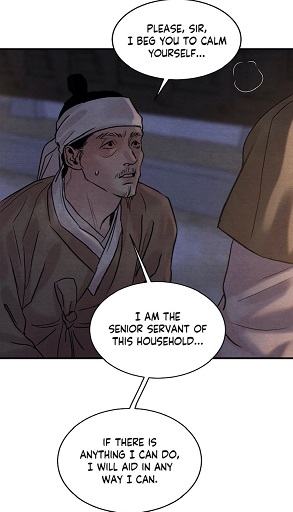 (chapter 82) Thus I conclude that when the lord returned the paper to Baek Na-Kyum
  (chapter 7), Kim must have realized his error. He had mistaken the poem for a letter!! This explains why he repeated the trick with the younger master Seung-Won. But unfortunately for him, he was caught by the teacher who asked the painter about the letter the next morning.
  (chapter 38) Baek Na-Kyum could have realized that the butler had acted behind his master’s back. The problem is that during that evening, the lord had indeed written a letter to his brother
 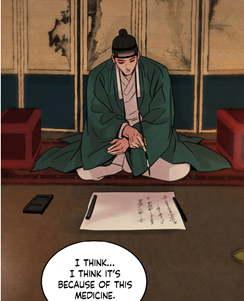 (chapter 36), but the moment the latter interrupted the couple
 (chapter 37), Yoon Seungho chose to hide it. But why is it important? It is because if the painter had mentioned the paper given to the younger master to Yoon Seungho, the latter could have noticed the valet’s meddling and wrongdoing. On the surface, it looked like Kim had written himself a letter to the younger master. In other words, in episode 37/38, the butler gave the impression that he was a spy, for he was acting without his master’s permission. He had even left the propriety, as he was standing outside in front of the gate. Don’t forget that during the meeting, the brother had mentioned that he had sent him many letters
 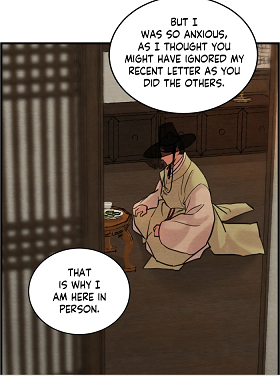 (chapter 37), and there is no ambiguity that Kim had intervened. Here, the lord had said nothing, for he imagined that Kim had done it to protect him from his family.
 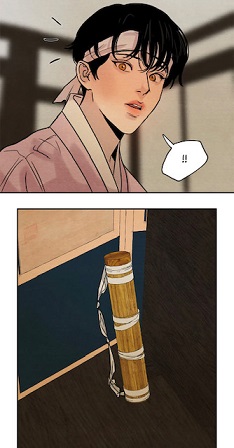 (Chapter 4) But on his way out, he met Yoon Seungho who had just missed the painter’s departure. But there, he discovered that the main lead had stolen his poetry.
  (chapter 5) He was looking at the gate and as such making sure that the artist’s departure would be noticed. By sending the low-born to the Lees’ mansion, Kim was encouraging the painter to commit a crime: trespassing! But the artist was fortunate, for he was not caught by the lord of the mansion, who preferred hiding due to the ruckus caused by his own son. 😉 As for Yoon Seungho, he came back to the mansion and saw the empty study. Kim just needed to say that the low-born had left to the Lees’ mansion. This is important, because this indicates that in chapter 4, the couple missed each other first! And this situation was repeated in season 3, precisely in chapter 98, when the lord returned from the bureau of investigation
 (chapter 98)! The lord arrived just after the painter’s departure. And who was with the main lead? Kim. As you can see, the lord’s luck seems not to be on his side, for Baek Na-Kyum had just left the propriety. Once again… the lord was standing in front of the gate!! As for season 2, this time, it was Kim’s fate to miss his master.
 (chapter 56) The reason for this punishment is simple. He had sent away the artist to the study just before Yoon Seungho regained consciousness. The latter didn’t see that the artist had taken care of him during that night. Thus the butler’s karma was not to notice his master’s departure which stands in opposition to chapter 4 and 98. And note that all these chapters have the paper as common denominator. So imagine the butler’s surprise in episode 4, when he witnessed the artist’s return to the mansion followed by his master. He had sent away Baek Na-Kyum with the hope that the artist would desert the town for good, but no…
 (chapter 23) The first similarity is the allusion to his bag. The butler was actually thinking that during the hunt, the painter would decide to run away. That’s the reason why he asked about his belonging, for in the past, he only wished to vanish after retrieving his tools. Naturally, the artist saw no harm in the butler’s question and answered truthfully. He must have narrated the argument in the courtyard about the poem. Yoon Seungho had kept the sijo, consequently the painter had used his hand to take it back and had by mistake removed the lord’s hat. Thus Kim must have told him that he just needed to apologize. But one might say that this is just a story imagined by me. The manhwaphiles never saw such a scene. But don’t forget the existence of the reflections. I have definitely an evidence for this theory. Since the butler had manipulated the painter in chapter 4 in order to get rid of this uninvited guest, his karma was to receive a new guest!!
  (chapter 7) This is not what the valet truly desired at all. He wanted to live in peace. But now, he had three new people he had to serve: Jung In-Hun, the painter and his own master Yoon Seungho who had lived for quite some time in the Lees’ mansion. He had to work!! And note that in this episode 7, we have the following elements:
 (chapter 93) It was a futile dream. When I had analyzed episode 93, I had explained that the speech from the main lead was influenced by the butler. As you can see, the lord’s narration
  (chapter 93) This time, Heena is the one standing behind closed doors, while it was Yoon Seungho in chapter 77

 (chapter 93) In chapter 99, the noonas still lied to him.
 (chapter 93), which was also present in chapter 4/5, 7 and 67
 /68 and finally 77
  (chapter 55) Who was lord Song’s contact person then? In the past, I used to think that he was the one receiving the letters. But now, I have a different opinion. I believe, it is Heena! Why? It is because Kim couldn’t identify lord Song’s writing. According to me, Yoon Seungho was sent to the gibang in order to entertain the mysterious “lord Song”. Thereby I am assuming that the kisaeng would receive a word from lord Song and have the main lead fetched from the mansion by the black guards. Heena and Yoon Chang-Hyeon are the only ones seen with black guards, I am excluding the main lead, as he was always more or less their prisoner. As you can see, there is a connection between the noona and the Yoons.
 (chapter 68)
 (chapter 69) and in season 3, the noona sent messages to her brother herself. In two different chapters
 (chapter 91), she is related to papers.
  (chapter 97) Logically, the noona in connection with the letter should be present in season 1. Secondly, when the woman appeared for the first time
  (chapter 64), she was accompanied with 2 guards, which is quite similar to the lord’s situation in chapter 1. That’s the reason why I believe that she didn’t keep the learned sir’s poem. Her betrayal could have been noticed and this was the first time that Yoon Seungho was making such a request.
 (chapter 56) This would follow rule 3. Then according to rule 2 of the kaleidoscope, elements from one episode will be constantly mirrored in the next chapters. And what did we have in episode 19? A larceny… the bottle of wine vanished. Then in episode 20, the lord stole the scholar’s identity, while he stole the painter’s virginity. Hence the lord apologized to the painter for his wrongdoings.
  (chapter 21) And above I had already demonstrated the connection between the First Wedding Night and chapter 5 and 77! Here the lord was imitating the pedophile’s behavior, hence you comprehend why I think that lord Song was the recipient of the poem. I would like my readers to keep in their mind that the learned sir’s sijo was referring to a painful departure, the loss of a loved one and despair! The beholder could have the impression that the author was suicidal due to the mention of the well and the torment of the mind. Thus I am now assuming that the “mysterious lord Song” will consider the sijo as a farewell, the lord chose to commit suicide and his death was related to Jung In-Hun’s curtains. Why? It is because Heena wrote letters to her brother where she accused the main lead of killing the learned sir. Moreover, Yoon Seung-Won had definitely mistaken the painter for the learned sir.
  (chapter 37) His position revealed that the main lead trusted the artist. It was, as if he was treating him like his wife.
  (chapter 34), and shortly after the painter was sent to the tailor. But during that night, the pedophile and Yoon Seungho had missed each other due to Baek Na-Kyum. He was not dead. So when the painter received new clothes, it was the same for Yoon Seungho. Yet, the pedophile was gravely mistaken. Why? The sijo had been stolen, and as such it was never addressed to the pedophile. Furthermore, it is because the lord was suffering from memory loss. Moreover, I believe that the main lead is not aware of the true identity of his sexual abuser. In his mind, it is just lord Song. But this doesn’t end here.
  (chapter 94) In episode 4, the lord had laughed about the sijo, but it was no longer the case in the kisaeng house. In my eyes, the pedophile will go through the same experience. Yes, the effect of the kaleidoscope. He will perceive the learned sir’s poetry under a different perspective. Only in that moment, he will realize the suicidal tone in the sijo. He will question how Yoon Seungho could become so desperate and suicidal so suddenly. And now, you comprehend why Heena was trembling in front of her brother
 , and why she had planned to leave the gibang that night!! She was aware of the arrival of “lord Song”. She knows how cruel and ruthless he can be.
 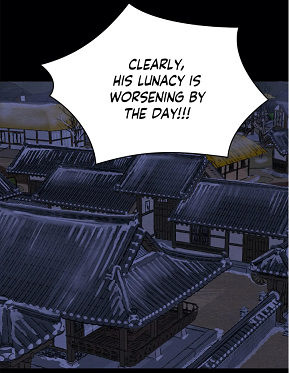 (chapter 82)
 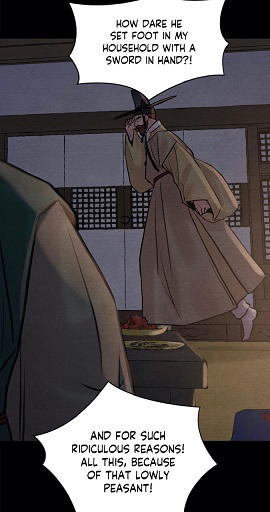 (chapter 82) It is because he didn’t want to leave any evidence of his intervention. No one should notice that he had paid a visit to the patriarch either. His visit should remain a secret. He was actually afraid of getting detected. The reason is simple. He was fearing the person standing behind Yoon Seungho, lord Song. He had two reasons for this. First, he could see that Yoon Seungho was no longer treated like an animal or male kisaeng.
  (chapter 67) Here, the lord had just insinuated that if something like that happened again, he would go to the authorities. However, since this threat was rather ambiguous, the patriarch Lee could only interpret it that way. The main lead would report the incident to the “mysterious lord Song”, alias the king. And father Lee knew that he could get into trouble. Furthermore, since these elders are all hypocrites and liars, there is no doubt that father Lee feared that the protagonist wouldn’t keep his words. That’s the reason why he approached the father. He hoped that Yoon Chang-Hyeon would intervene and impose his will onto his son. He would tame the main character. In other words, episode 82 is a reflection of chapter 4/5, 19/20/21, 67/68 and 77. The first common denominator is the allusion to letters. The messenger’s words revealed that Kim had contacted the elder Yoon, for he already knew his name, though the latter had never met the domestic. Secondly, the “letters” were delivered orally:
  (chapter 82), and even in person: Father Lee and the emissary. Third, the elder Lee badmouthed Yoon Seungho by mentioning the incident from chapter 67, and refused the invitation of his host
 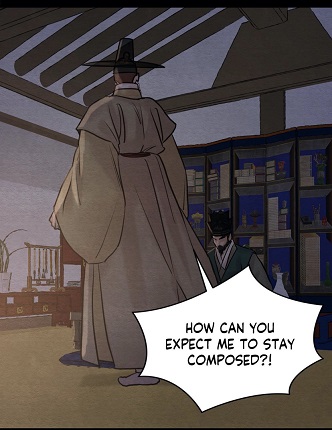 (chapter 82). Finally, he called Baek Na-Kyum a peasant exactly like the main lead in front of the gate:
  (chapter 82). But more important, the old bearded man expressed this fear: the loss of his family home!
 (chapter 82) And remember that I had detected the presence of the Lees’ mansion in episode 4 and it was also present in chapter 21 and 67! And what had the butler done during these chapters? He had tried to chase away the painter and as such Yoon Seungho. The latter was not supposed to live in the Yoons’ domain. And this will be the Lees’ karma to be driven out of their own house!
  (chapter 83) It vanished, and as such it was stolen. Did the mysterious lord Song take it away in order to force Yoon Seungho to paint? The older version of this scene: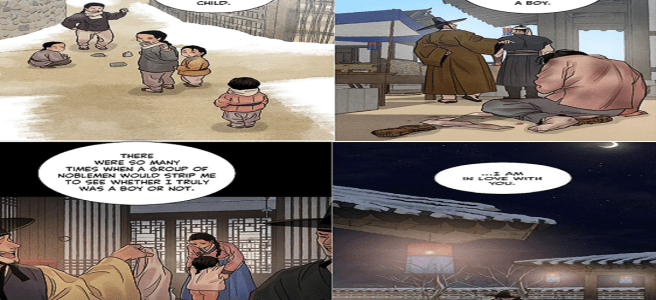
 (chapter 94) Yoon Seungho had two reasons to expect such an outcome. First, it was related to Yoon Seungho’s offer to Baek Na-Kyum.
  (chapter 44) Secondly, Baek Na-Kyum had already showed to the main lead that he could leave him at any moment.
  (chapter 85) Finally, what mattered to the artist the most was the lord’s love and trust.
  (chapter 85) He believed in his affection while thinking that Yoon Seungho would keep his promises. But if there was a slight doubt about him, in Yoon Seungho’s mind, the painter would choose his noona over him, like he had experienced it in the study. To sum up, in the gibang, the lord was fearing the artist’s departure. Moreover, when the painter confessed his love to the noble, he was also leaving the scholar’s side. His path was no longer following the teacher’s. Thus when he said this
  (chapter 94), he was actually biding farewell to Jung In-Hun. He was moving on. Finally, if you include these panels from chapter 94,
 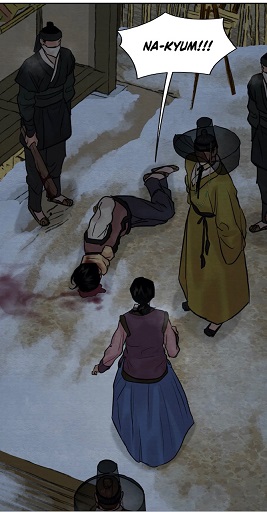 (chapter 99) In these two scenes, the painter got so hurt that he was bleeding. In addition, the painter’s hair was free. In front of Jung In-Hun’s house, the perpetrators had removed his headgear, while in the gibang, the white head-band was on the ground. To conclude, the painter’s short hair was visible. Don’t forget that the short hair was indicating that the artist was an orphan. So by removing the headgear for noblewomen, Min and the black guards made sure to expose that the victim was just a low-born without any family. But let’s return to our comparison. Min was wearing a similar hanbok than the noble in the gibang. Furthermore, the black guard resembles a lot to the aristocrat with the hunting outfit in the kisaeng house house. The painter’s white headband is now serving as a cover for masking the black guards’ identity. As you can see, due to these similarities, I came to the conclusion that this scene
 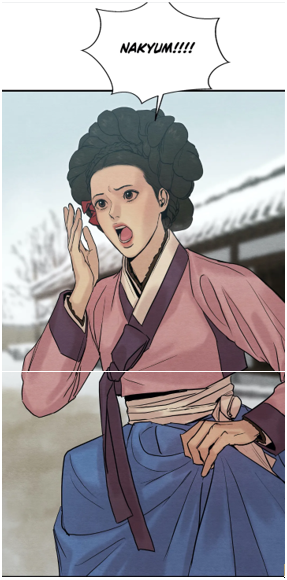 (chapter 65). Thus she gave more the impression of being righteous and truly concerned.
  (chapter 44) However, there exists a difference between the painter and the lord’s association for beards in my opinion. The latter suffered due to old men wearing a long moustache beard with whiskers.
 (chapter 82)
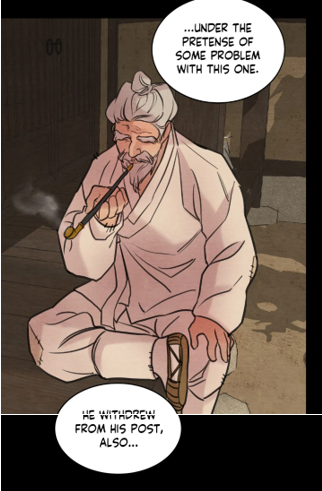 (chapter 37)
  But there exists another style of moustache beard.
 Striking is that Kim is also wearing such a moustache beard.
 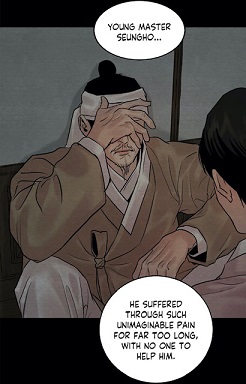 (chapter 87) However, so far in the story, this type of moustache beard was only present among commoners and not nobles!!
  (chapter 39)
 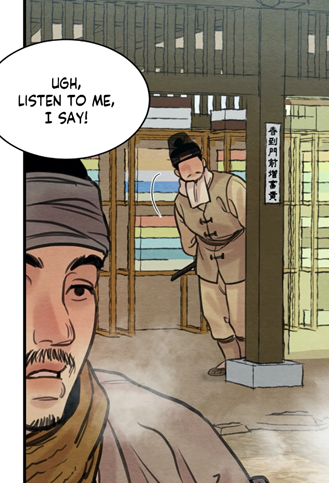 (chapter 45)
 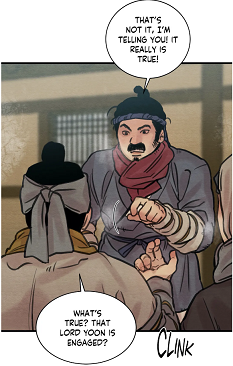 (chapter 45)
 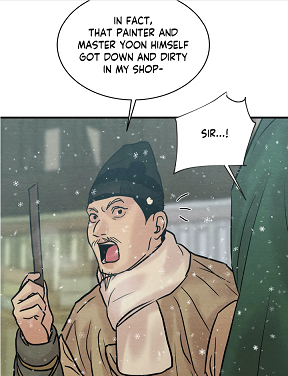 (chapter 64)
 (chapter 78) Hence I started suspecting if these two persons were truly nobles in the end.
 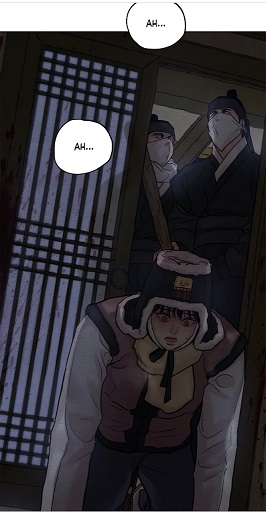 (chapter 99) so that he had been mistaken for a young master.
  (chapter 91). Therefore I came to the conclusion that the painter has repressed the link between the moustache beard and nobles. Since the noona kept saying nobles, what made Baek Na-Kyum shudder in the past were nobles. But the connection between the beard and nobility is existent in the painter’s subconscious. This explicates why Baek Na-Kyum would show such a respect to valet Kim, he would call him sir and listen to him.
 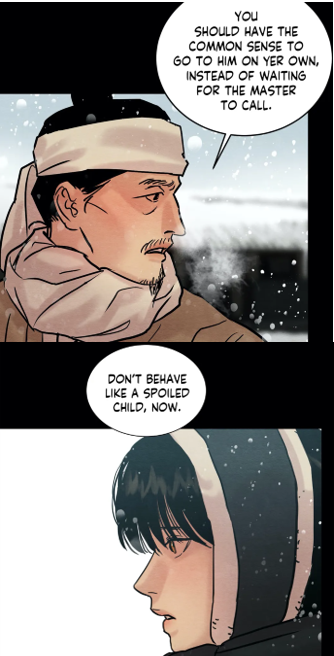 (chapter 52) However, the more time passed on, the more the butler kept pointing out that he was just a servant, so that this moustache beard is losing its meaning, the symbol for power and nobility. At the same time, the painter met more and more people with beards, like for example the tailor
 (chapter 74), the physician
 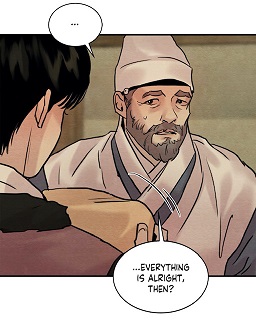 (chapter 74), Bongyong
  (chapter 78) and finally Yoon Chang-Hyeon
  (chapter 87). However, note that when the patriarch left, the main character only paid attention to his gaze and not his beard.
  (chapter 87) This explicates why Baek Na-Kyum is not mentioning the beard concerning nobility, while Yoon Seungho never made the connection between the old bearded men and Kim, though the latter has now a moustache beard! To conclude, I don’t think that this physical assault
  (chapter 99). That’s the reason why I came to the following theory. These persons wounded the painter on purpose and in my eyes, it was suggested by Heena.
 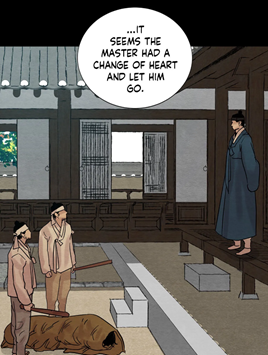 (chapter 13), the maid (though not intended)
  (chapter 36, here the painter is drugged against his will), Deok-Jae
  , Nameless,
 (chapter 60), Kim
  (chapter 66) [As you already know, for me Kim was the one who tried to kill the painter during the abduction], Bongyong
  (chapter 78), the calligrapher with his insults
  (chapter 91), the maids with their reproaches
 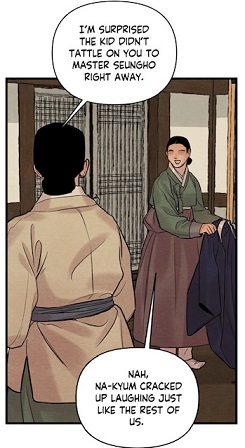 (chapter 91)
  (chapter 98) and the black guards from Min.
 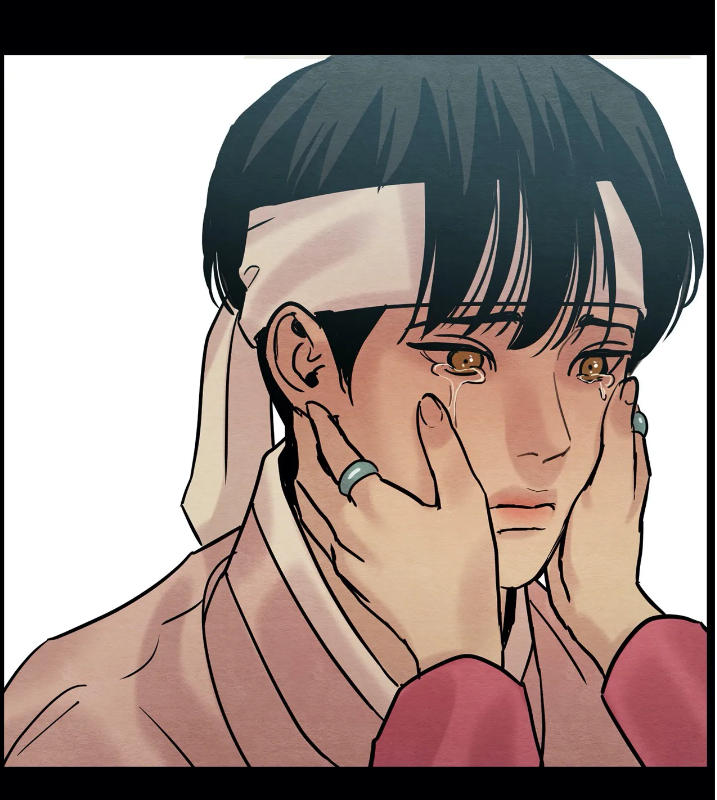 (chapter 46) This was the “positive” reflection of this scene:
  (chapter 46) Moreover, I am now doubting that Baek Na-Kyum and Heena were seen in front of the gibang.
 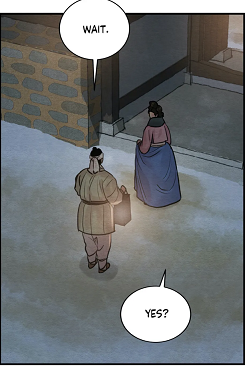 (chapter 69)
  (chapter 93) He had suddenly vanished without voicing such a desire before. And note that in chapter 97, she was already acting on Min’s orders, a sign that in the past, it was different. She had done it on her own accord. In the annex, the kisaeng was definitely scared, hence she was trembling.
  (chapter 64) This would explain why she never looked for her brother afterwards. This shows that unconsciously, the painter had judged her betrayal and abandonment correctly, but he had been deceived by her argumentation and attitude. In other words, he was in denial.
 (chapter 87) So in this scene,
 (chapter 68) The blue skirt is revealing her presence. She is next to the door and observe that there is a table to her right!! Exactly like in chapter 94!
 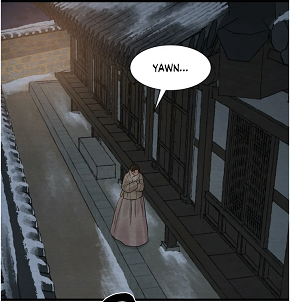 (chapter 95) But there exist two other evidences why Heena is associated to the kitchen. Remember the painter’s thoughts in the inn:
 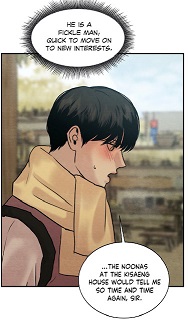 (chapter 75) They let see that he was thinking of Heena, though he spoke of his noonas. However, the presence of religion was introduced with food.
  (chapter 75) This truly exposes that Heena preferred working in the kitchen. That way, she could avoid sex with the clients. Another interesting aspect is that when she was sitting at the table with nobles, she was not talking to her neighbors.
  . (chapter 93) She was not even serving the noble next to her.
  (chapter 93) Once again, she was passive and immobile. Since she was doing nothing, she could hear her brother’s name and turn her head.
  (chapter 46) This was reflecting his past relationship with Heena. And now, you comprehend why Heena never paid attention to the painter’s education. She had not the time and the motivation to do so. She was busy in the kitchen during the evening and night, yet keep in mind that the painter was her excuse to keep her distance from the nobles in the beginning. This explicates why Yoon Seungho crashed the table in the gibang:
  (chapter 99) This was Heena’s karma. She could no longer use the table as an excuse to betray and abandon a young boy. Moreover, we could see this gesture as a compensation for the past incident.
  . (chapter 47). That’s the reason why I am connecting the kisaeng to the food. And I had already demonstrated that there exists a link between the gibang and the lord’s kitchen.
  (chapter 60) And now, we know for sure that the chicken blood was used to stage the crime scene in the scholar’s house.
  (chapter 101) For me, Nameless was behind this prank. It sounded so harmless, but the reality is totally different. Consequently, Heena can become the prime suspect in the scholar’s disappearance. Remember that according to me, Yoon Seung-Won went to the gibang after leaving his brother’s mansion and discovered that he had been deceived. For me, there is no ambiguity that Yoon Seung-Won and lord Song are behind the learned sir’s murder, for both had a huge interest for his vanishing. But in my eyes, Heena is the link between the nobles, lord Song and No-Name, because the kisaeng house is frequented by all kind of people. I have already mentioned that the learned sir must have gone to the kisaeng house after meeting the fake servant.
  (chapter 83) Then I had already demonstrated that the kisaeng had already visited the mansion, for she knew where the painter’s room was.
  (chapter 65) So she could have worked in the kitchen… helping the other maids. To conclude, the kisaeng had committed the following wrongdoings. She had manipulated her brother with a mixture of belief and prejudices to cover up her own fears and wrongdoings. While in chapter 94, she stopped the painter from leaving the room unconsciously, it was no longer the case with Yoon Seungho, as she was standing in front of the door.
 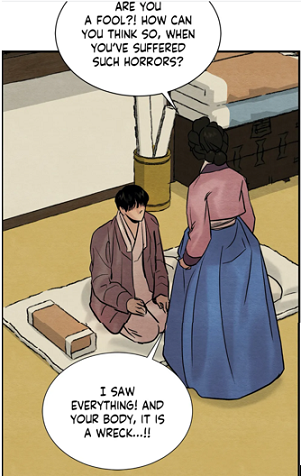 (chapter 68) For her, sex had become a synonym for torture and death. Her wrong choices reinforced her fears about sex in my eyes. Every time, she decided not to face the truth, she preferred being blind. Thus the goddess chose to punish her by letting her deceived by impressions.
  (chapter 66) Here, she couldn’t help her brother, though the “sequestration” was nothing compared to what Yoon Seungho had experienced at such a young age. She had deceived her brother in the past, and now she was put in the same position. She was the fool one. In addition, she was forced to be confronted with reality, because she needed to admit her wrongdoings. Since she was behind this assault
  . (chapter 96) She even got sequestered herself.
  (chapter 99), this means that her punishment will be that she will never see her colleagues again. Since she faked her death
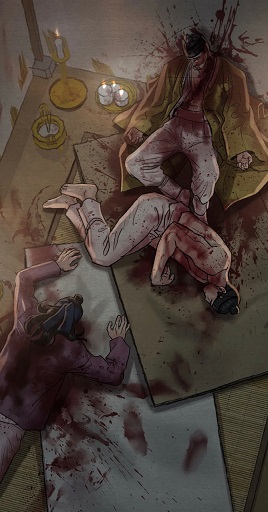 .(chapter 102) She is a Christian, hence she could be accused of sacrilege too. In my eyes, Heena will never be able to bid farewell to her brother again. His words in the mansion will become a reality.
 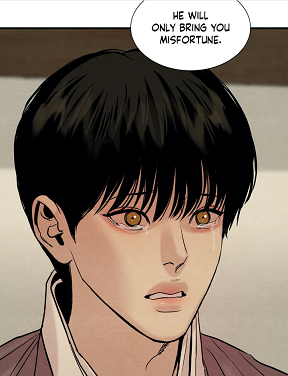 (chapter 68) Remember her metaphor concerning the gibang, it was viewed as a nest. She was already comparing her brother to a bird.
 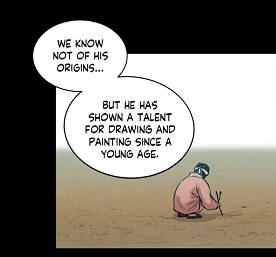 (chapter 01)
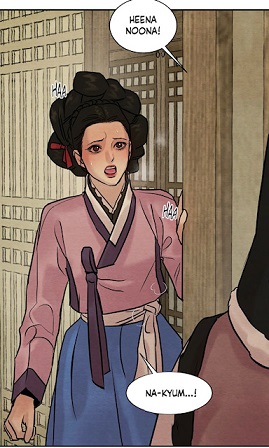 (chapter 97) Fake concern versus anger and resent
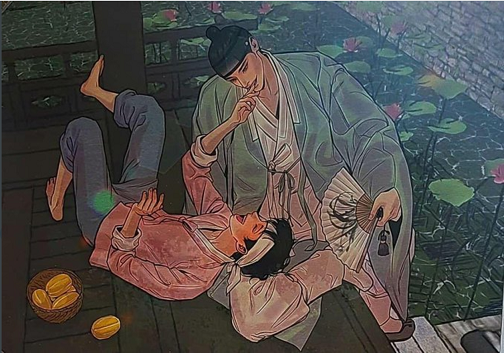

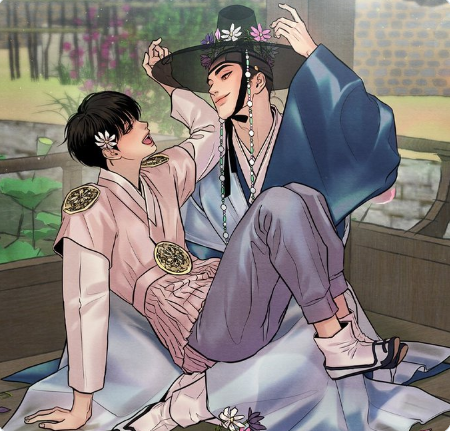

 The painter’s mouth is wide open. This implies that the painter is laughing! In other words, these pictures are showing a happy Baek Na-Kyum. The laughter is not just a symbol for joy, but also an indicator for social bonding, cooperation and as such social acceptance. Note that in all these scenes, the painter is not laughing alone. He is either facing his lover and the “witnesses” of his marriage.
  (chapter 87) Naturally, this vision reflected the past due to the presence of the noonas. But if you read my previous analysis, you are aware that the painter’s nocturne visions are always composed of three elements: memory, nightmare and desires which will come true at some point. The readers will certainly recall the painter’s wish in the bedchamber:
  (chapter 81) However, here again, this was not real, for he was imagining it. He had restrained himself, for he felt that his actual life was like an illusion. It was too good to be true. Thus I conclude that in both visions, the painter wished to laugh and as such to be happy. And this observation led me to the following deduction. In season 4, the manhwalovers will witness Baek Na-Kyum’s laughter. But this doesn’t end here. All the quoted pictures share another similarity which is the absence of the sound!! There is no HA, HA, HA…. Thus I deduce that in season 4, the readers will even hear Baek Na-Kyum’s laugh!! 🤣
 (chapter 1). His mouth was exposing his emotions: happiness. It was, as if he was laughing internally out of joy. Then in the pavilion, the author let us hear Yoon Seungho’s laugh, while we couldn’t see his face.
  (chapter 25) As you can see, Yoon Seungho was not truly seen “laughing”. This is what we saw right after:
  (chapter 25) Either the sound was missing, or the readers couldn’t see his open mouth. Then in chapter 51, Byeonduck created an ambiguous situation.
 (chapter 51) Who was laughing here? The main lead or Min recognizable with his green hanbok? This confusion was deliberate. It was to give the impression that the lord had moved on, he was not missing his partner. This image served to divulge the reality: this happiness was fake. Another interesting aspect is that we couldn’t see the lord’s mouth, for it was too far away. It was more or less drawn from the painter’s perspective who was walking in the courtyard.
  (chapter 51) The purpose of this trick was to deceive the painter, Yoon Seungho would no longer care for him. However, this trick didn’t work out like imagined due to the maid’s words. She wished that he would remain in the mansion. But let’s return our attention to the laugher in this panel. I would even add that there was no real social bounding, for Black Heart was enjoying about Yoon Seungho’s misery and loss. He believed that the painter had died. And if it was Yoon Seungho who laughed, then this was to mask his pain. Then in chapter 70, he was caught laughing. And observe that the author separated the sound from the face:
  (chapter 70) Yoon Seungho would even hide his face from the painter, as he was looking down. His laugh was barely perceptible, and when the author revealed his face, Yoon Seungho used his hand to mask his smile.
  (chapter 70) It was, as if Yoon Seungho was not allowed to smile or to laugh at all. I would even go so far to say that laughers were actually forbidden in the mansion. Striking is that in season 3, for the first time, we could see and hear the lord’s laughter contrary to season 1 and 2..
  (chapter 78) This illustrates the progression of the lord’s healing. He was getting happier, and he would interact more and more with people. Yet, in this scene, the lord’s laughter was not loud contrary to the one in the pavilion. Then in the gibang, his laugh was also fake, for he was masking his pain.
  (chapter 93) Thus the author didn’t let us see his mouth once again. But the painter could see the difference between a sincere laughter and a fake one, as he had already heard and see the lord’s true laugher! Because the lord laughed in all 3 seasons, I could only assume the painter’s laughing in season 4. But I have another proof for this prediction. In season 3, the painter’s laughter was shown in visions (chapter 81, 87) or through the testimony of the maid.
  (chapter 91) As a conclusion, expect a picture with Baek Na-Kyum ‘s laughter reflecting his happiness and sincerity. And this is definitely related to his marriage:
 (chapter 102) There is no HAHA, this shows that this situation is not funny. Yet, Black Heart is still smiling, he is even explaining that they were just playing. However, this smile is totally fake, for he is already scared. Hence he is stuttering. Moreover, he is trying to downplay the whole situation, as he describes it as a game. But the closer Yoon Seungho got to him, the more the villain got scared.
  (chapter 102) On the other hand, Black Heart’s mouth remained wide open, but it slowly exposed his true emotions. As the manhwalovers can detect, the sound “Haa,” is not expressing joy or happiness, but huge anxieties. Thus I couldn’t help myself thinking that in season 4, the painter’s laughter will be reflected with the heavy breathing from fear and pain. Someone will have a mouth wide open out of fear!! And this connection was already present in chapter 1:
  (chapter 1) Baek Na-Kyum and Yoon Seungho had both flashbacks
  (chapter 66), while Min was smiling. He was internally laughing, for it found it entertaining. [For more read the essay HAHA Flashbacks”] And this fear was exposed by the sound: HAA
  (chapter 99) But this doesn’t end here.
  (chapter 84), but in the gibang, he dropped this habit for good:
 (chapter 96) This connection between pain, pleasure and laughter appeared in chapter 91, as the story is based on the following rule: there is always a reflection within the same episode. I would like the manhwaphiles to observe this image:
  (chapter 91) Here, the lord had changed position provoking pleasure to the artist. Before, the maid had laughed so loudly in order to get the painter’s attention.
 (chapter 91) According to my interpretation, she hoped that Baek Na-Kyum would discover the existence of the kisaeng’s letters so that the painter would feel betrayed by Yoon Seungho. He had ordered to hide the correspondence. But for that, she needed to explain the reason for her loud laughter. Hence she revealed the incident with the pervert. The irony is that due to his pleasure and embarrassment, Baek Na-Kyum didn’t pay attention to her words. He already felt ashamed, after the servant had exposed the situation in the bathroom.
  (chapter 91) Thus he avoided his lover’s gaze. And note that in chapter 25, the lord laughed, before he raped the painter.
 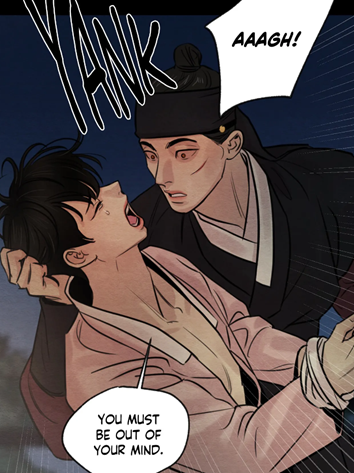 (chapter 25) This episode exposes the connection between laugh and pain. Here, you can see that the painter is also screaming out of pain, the negative reflection of Yoon Seungho’s laugh. Baek Na-Kyum’s mouth was wide open. When people are tortured, they will usually scream their pain and fear.
 (chapter 37) and the one from Dong-Yi. The absence of the sound. Moreover, the manhwalovers can not see the mouths from the victims either. The torture was already finished, for they had removed the tools and the „suspects“ were covered with blood. And this leads me to the following observation. The author selected a perspective from far away, and didn’t add the sound on purpose. This shows that the pedophile was not present, when the torture took place. He only arrived afterwards. This exposes his cowardice. Secondly, since I had outlined that the author had separated the sound (HA HA) from the lord’s mouth concerning the laughter, I am quite certain that she will use a similar processes for the torture. Naturally, I am also assuming that torture from the past could be slowly revealed. Consequently, my prediction is that the negative reflection of the painter’s laughter will be the yelling combined with fear and pain. This signifies that people will suffer in season 4 and probably die. Another evidence for this prediction is that the author often focused on the characters’ mouth. And this is what we have:
  (chapter 77)
  (chapter 86)
  (chapter 98) In the last scene, Heena was sort of “punished”, when she confessed to the main lead. That’s the reason why I believe that in season 4, we will see people screaming out of pain and fear. It can be in the present or in the past. The interrogation and torture should be exposed in my eyes contrary to chapter 37.
 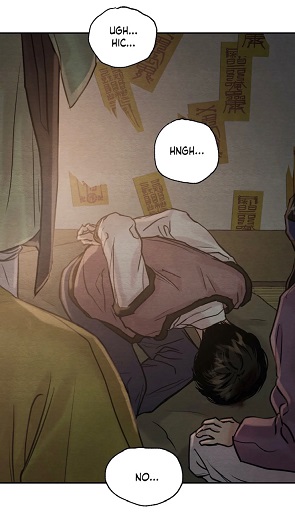 (chapter 99) Despite the “torture”, he still claimed that Yoon Seungho was no murderer. Thus I conclude that in the next season, it should be the reverse. Yoon Seungho has to make a new leap of faith believing in the painter’s innocence and purity. Hence I am expecting an arrest in season 4. Finally, we shouldn’t overlook that each word Yoon Seungho said became the truth, so when he stated this
  (chapter 65), he was already warning the sister. She could face human justice. However, this idiom suddenly caught my attention: “the wrath of humans”. It can be a reference to the authorities, but also to the inhabitants. The latter could get infuriated by the police work and put the officers under pressure or in the worst case, the inhabitants could decide to do their own justice: lynch mob. According to me, many commoners died in season 3. Hence this could upset the town folks who would ask for real justice. And if Yoon Seungho’s fiancée is acknowledged by them, then it will be impossible for the pedophile to use the authorities to achieve his goal, separate the couple and hide his own crimes. Thus his last puppets will have to take the fall. Another important aspect is that when Yoon Seungho warned the kisaeng, Kim was also present, though he still remained in the background.
  On the other hand, when these persons got tortured, they closed their eyes out of agony,
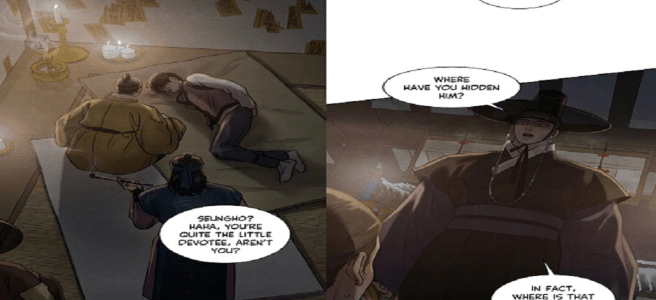
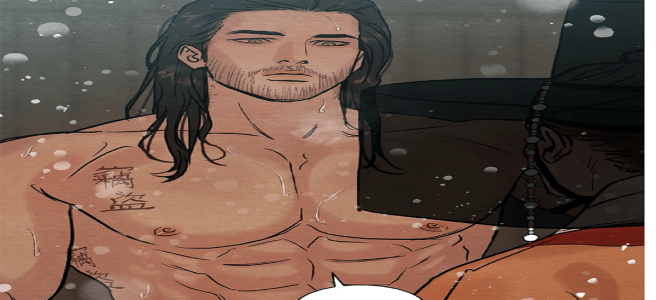
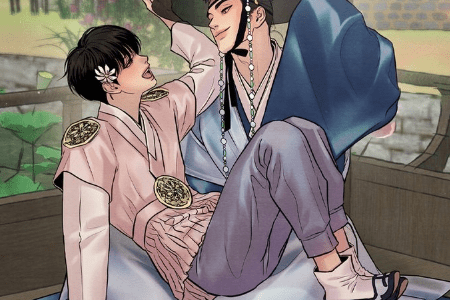
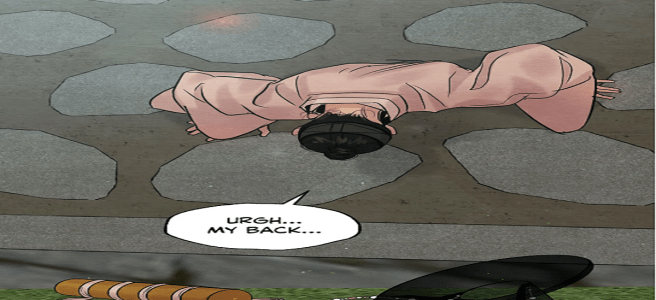

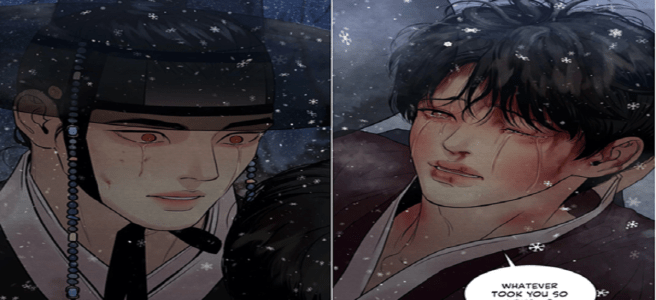

 (chapter 57) He was admired which created a source of jealousy. While the painter discovered sexuality and his homosexuality very early on, Yoon Seungho was pure, but through incidents he was forced to become a sodomite. While Heena and the scholar tried to repress Baek Na-Kyum’s sexuality, the father pushed his son to have sex out of fear and high expectation.
 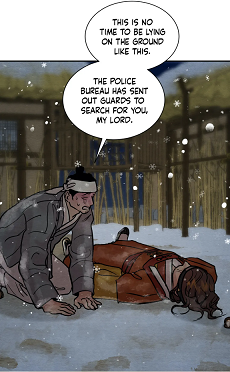 (chapter 101) Striking is that the author used the same method to introduce the memories. First, we see the servant talking before viewing the memories.
  (chapter 101) And now, compare it to chapter 1:
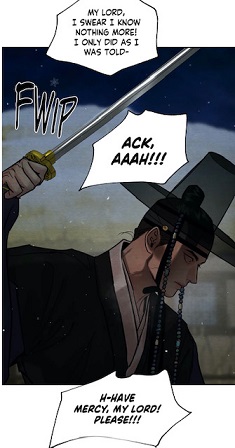 (Chapter 100) He denied his responsibility by putting the blame on someone else („I was told“), yet once facing the young master Jihwa, his declaration exposed his lie.
 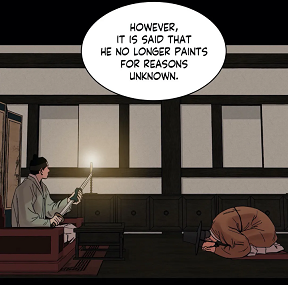 (chapter 1) So in episode 1, the servant was not aware that he was lying to the protagonist, when it comes to the painter’s past. However, the domestic with the brown hanbok lied in one aspect, the publication of the book.
 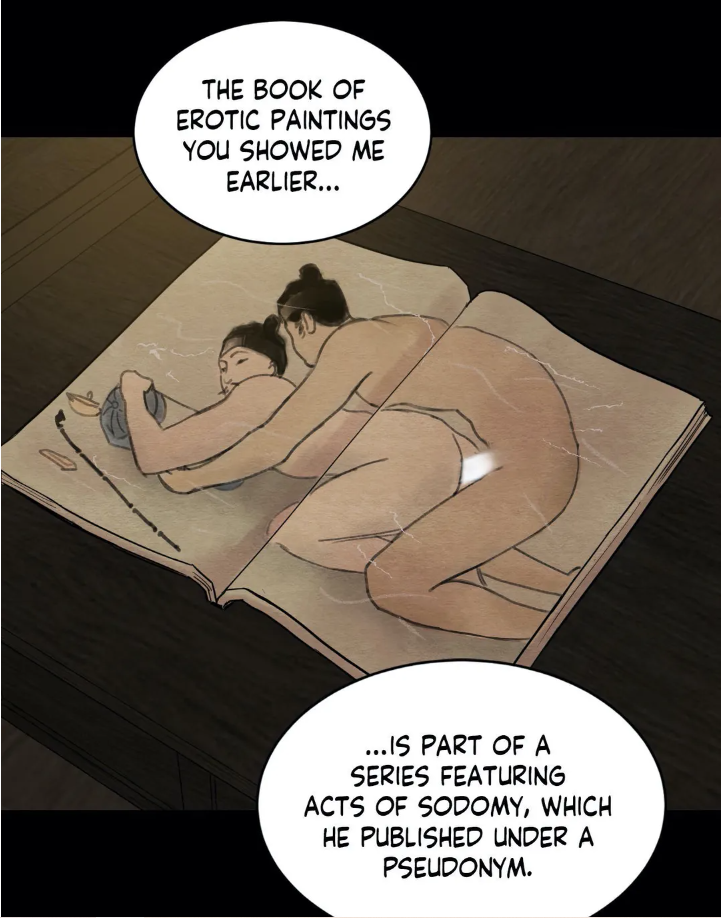 (chapter 1) One might have the impression that I am digressing from the main topic. Yet the manhwalovers should keep in their mind that the servant from episode 1 served one purpose: to show us the memories of an important witness, someone who watched Baek Na-Kyum growing up. Thus we have three different pictures. First, he is a baby, then a young infant
 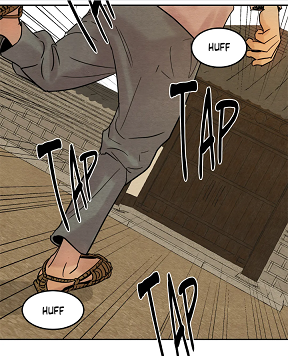 (chapter 4) This is the door! You can recognize it thanks to the pillar on the side.
  (chapter 4) Pay attention to the background in this picture. And now, you are probably thinking that the owners of that mansion are the Yoons, as we observed the main lead living there. Nevertheless, I had already pointed out that this was not Yoon Seungho’s mansion. This is the Yoons’ domain:
  (chapter 51) The courtyard is different. According to me, this is the mansion of the Lees. [For more read the essay 360: Lee Jihwa’s special relationship with Yoon Seungho] And since episode 1 and 101 reflect each other, this can only reinforce my interpretation that the Lees are involved in Baek Na-Kyum’s past, for we have Lee Jihwa present in chapter 101. Baek Na-Kyum was brought to the Lees, thus the scholar Lee keeps calling Baek Na-Kyum a peasant! He knows about his true origins. I had always said that the man was revealing his knowledge with his insult. But does it mean that this was the vision from Lee Jihwa’s father?
 (chapter 38). Besides, father Lee views him as a peasant and not a servant. This observation gets reinforced, when you look at the memories from the painter. In his childhood, he was never wearing a white head-band.
  (chapter 18), he was repeating his admired sir’s idioms. Besides, “hell-raiser” is also an indication that the learned sir was a Christian who converted Heena. Thus I deduce that when father Lee received Baek Na-Kyum as a baby, he entrusted him to the learned sir Jung In-Hun who had no connection and no wealth so far. So when the lord described him as such in episode 7, it was not entirely correct. The reality was that the man had been working for the Lees, but he had been “abandoned” at some point. The scholar was his helping hand explaining why he would appear in this scene.
  (Chapter 10) So a lord is following social norms, when he sentences a slave to death.
 (chapter 6) The painter was never destined to become a farmer. The neglect was done intentionally. And when you recall his words in the library, you can only view his words as pure lies again:
  (chapter 40) He was never born to be a prostitute, but he was sent there on purpose. Under this new perspective, it becomes more comprehensible why Heena sent Baek Na-Kyum to the learned sir. He was the one who had brought the artist to the gibang, and now he was getting older. One might refute this point, for she declared this:
  (chapter 68) Nonetheless, the beholder can detect the presence of a drop of sweat on Heena’s cheek. So she was deceiving the artist here. Why? Yes, in her mind, the painter was Jung In-Hun’s son and as such the learned sir should become responsible for the painter, for he was his father. But she had to lie in order to persuade him to leave the mansion. There’s no ambiguity that the head-kisaeng had no idea about the deal between the Lees and Jung In-Hun in the past, I believe that she must have discovered the truth at some point..
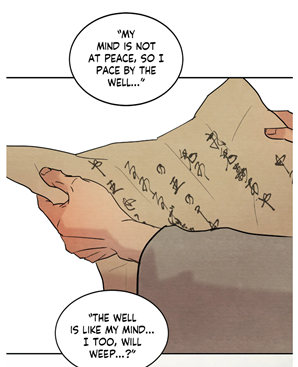 (chapter 4) This was inspired by the poetry from Wang Bang-Yeon!
  (chapter 4) In this poem, the famous author was referring to the death of the young king Danjong who had been killed by his uncle Sejo. Danjong was just a teenager, when he died! As you can see, the text is actually an allusion to royalty and exile. Under this new light, it dawned on me that the scholar Lee had been entrusted to take care of Baek Na-Kyum, but the latter chose to delegate this to the learned sir. There was a reason behind this. For me, he was eyeing at the mansion himself! One might refute this point, for the elder Lee said this:
  (chapter 82) But note that the man never said that this was his house, just the household of the Lee. Since the artist is related to the king, this signifies that he is related to the elder Lee too, as the family ruling over Joseon belongs to the Lee clan. Hence I am suspecting that Baek Na-Kyum could be the true owner of this mansion.
  (chapter 53) How does he know it? In my opinion, it is because Baek Na-Kyum resembles to the king. The only difference is that he has no beard. This would explain why Yoon Seungho said this:
 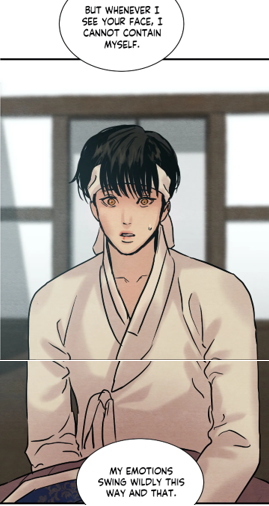 (chapter 55) Why would he get upset? Why would the painter’s face evoke such emotions? He is reminded of his abuser. This is no coincidence that the main lead had such a flashbulb right after, where you could see Lee Jihwa and his father, as they looked like Yoon Seungwon and his father.
  (chapter 55) They are all related. And now, you comprehend why the author wouldn’t reveal the face of the mysterious lord Song in chapter 83
 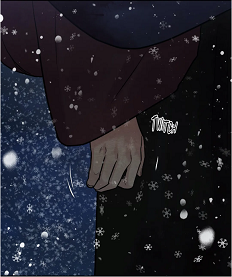 (chapter 102) The colors are already insinuating that the artist belongs to the royalty.
 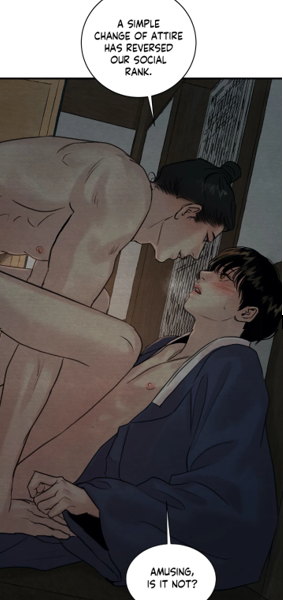 (chapter 71) If the pedophile came to the gibang and crossed the main lead’s path, he couldn’t recognize his relative (son or nephew) due to the hair and the clothes. Besides, I am certain that my avid readers can recall my other theory: the painter was stolen as a child. This new interpretation would corroborate this theory. The painter has been robbed of his true identity, he had been kidnapped, when he was brought to the kisaeng house!! Besides, if he is the true owner of the mansion, then this signifies that Father Lee succeeded in his coup d’Etat (rule 1, rule 3). In season 3, we have an attempted “coup d’Etat” with Yoon Chang-Hyeon eyeing at the seat.
  (Chapter 37) They had lost their heir. So far, we still have no idea about the cause for the treason: Coup d’Etat or attempt of assassination on the king or spying or murder of a royal member (here Baek Na-Kyum)? But this purge is associated to inheritance and the loss of a heir. There’s no ambiguity that the painting in Yoon Chang-Hyeon’s bedchamber was used as an evidence that the elder master Yoon was eyeing at the throne
  (chapter 102), I am assuming that his visage won’t be bruised again, so that his foot could get hurt, for the lord and the butler had a broken foot in chapter 77. (rule 3)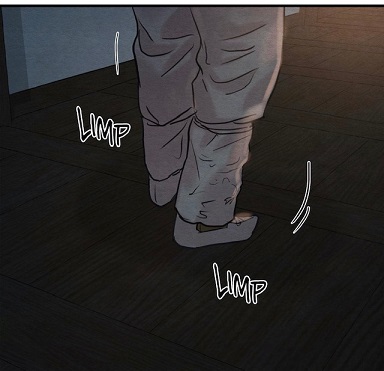
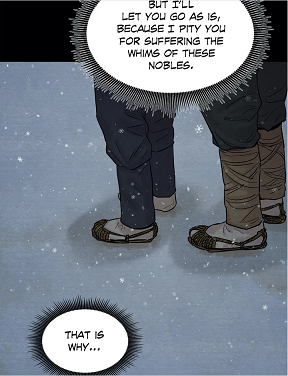 (chapter 66: According to me, this is Kim and not No-Name)
 (chapter 17)
 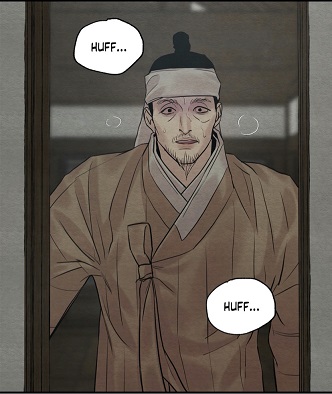 (chapter 85) Here he had faked running. Since he had been introduced with his feet in chapter 1, she needed to create reflections later. Finally, I would like to point out this:
 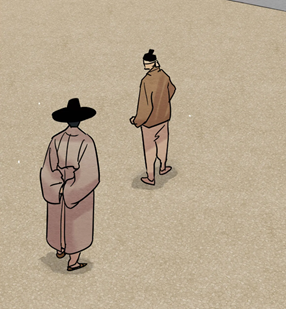 (chapter 7) Their meeting here is an indication that their past must have crossed before because of rule 1!! Since the painter was so devoted to the learned sir, the valet could only jump to the conclusion that the man had truly taken care of Baek Na-Kyum properly.
 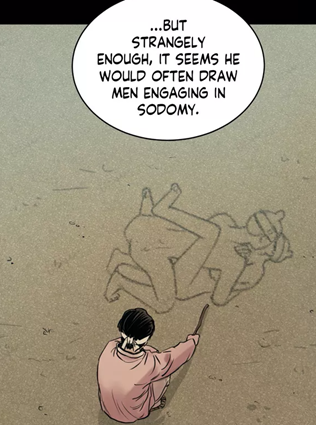 (chapter 1) He had actually painted animals and nature in his childhood, thus the noonas kept his drawings.
 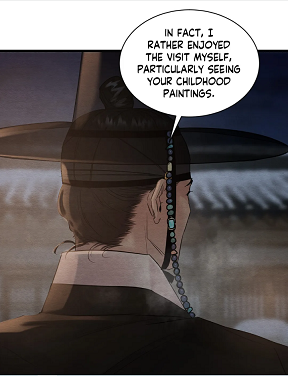 (chapter 94) The man had trusted the learned sir’s testimony without verifying the facts. He had not detected the presence of a blackmail!
  (chapter 1) This truly shows that ignorance is indeed no blessing, and people shouldn’t trust others according to their appearances or social status. At the same time, the servant had forgotten that Yoon Seungho was a noble, though he was dressed like a peasant in the bedchamber.
 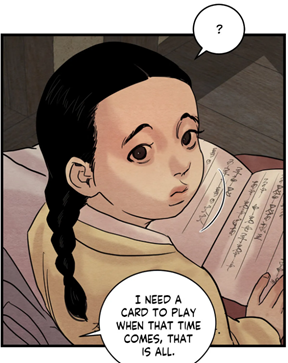 (chapter 29) and Baek Na-Kyum
 Bebebisous33s' analyses in K-Dramaland and Manhwas