

This is where you can read the manhwas. https://www.lezhinus.com/en/comic/sip_poison This manhwa is mature. https://www.lezhinus.com/en/comic/painter But be aware that this manhwa is a mature Yaoi, which means, it is about homosexuality with explicit scenes. If you want to read more essays, here is the link to the table of contents: https://bebebisous33analyses.wordpress.com/2020/07/04/table-of-contents-painter-of-the-night/ I also used briefly Doctor Frost again which I highly recommend to my readers. https://www.webtoons.com/en/mystery/dr-frost/list?title_no=371 If you want to read more essays about other manhwas, here is the link to the table of contents: https://bebebisous33analyses.com/2021/06/06/table-of-contents-of-analyzed-mentioned-manhwas/
It would be great if you could make some donations/sponsoring: Ko-fi.com/bebebisous33 That way, you can support me with “coffee” so that I have the energy to keep examining manhwas. Besides, I need to cover up the expenses for this blog.
1. Castration or abandonment?
Anyone reading my previous analyses about Painter Of The Night will certainly recall that I had perceived the loss of the topknot as a castration. Why? In Joseon, the topknot was given to men the moment they became adults and this Coming-Of-Age ceremony took place just before a marriage. [For more read the essay “Coming Of Age”] In other words, no topknot meant no marriage and as such no responsibility and maturity. However, this is important to recall that the loss of the topknot was brought up in a different context. It was mentioned for the first time in the painter’s statement.  (Chapter 1) When Baek Na-Kyum remembered his noona’s words about Yoon Seungho, he connected it to the loss of his future lover’s topknot. Here, the gesture had a different meaning. By cutting off his hair, the father was acting, as if he was abandoning his son. According to social norms, the hair was considered as a heritage from the parents. So if Yoon Chang-Hyeon had truly done it, the latter was showing that he was no longer considering the main lead as his son. While the rumor about the haircut gave the impression that the elder master Yoon was a honest and honorable noble, anyone can perceive the elder master’s action differently: the father is a coward, a selfish, ruthless and disloyal lord, especially the moment it is revealed that Yoon Seungho was abused sexually, physically and mentally. Let’s not forget that the protagonist used to live in the shed, for he was viewed as an animal. His situation reflected the father’s betrayal and abandonment. It doesn’t matter if he had been manipulated, because in the end, he made the decision to treat his son as a slave. He refused to send for a physician. To sum up, the loss of the topknot in this rumor would be judged as the epitome for cruelty and intolerance!! This shows that the loss of the hair in Painter Of The Night has actually many significations: castration, mercilessness and abandonment.
Then it occurred to me that the painter has been cutting off his hair all this time because of his noona. 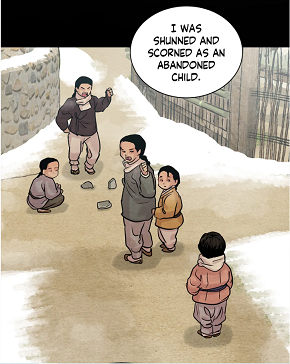 (Chapter 94) In this scene, the painter was rejected by the children, for he had no braid. Due to his hair dress, he was recognized as orphan immediately. The justification was that that way, the artist would appear more boyish. But by mentioning the loss of Yoon Seungho’s topknot, Heena was actually revealing that she knew the true signification of the haircut: abandonment and intolerance. Her words to her brother exposed her hypocrisy, though she attempted to portray the elder master as respectable. One might argue that when Na-Kyum was just a child, she had suggested the short hair, for she had good intentions. But after this experience with the children, the noona should have grasped the wrongness of her decision. She should have admitted her bad decision and stopped the painter from cutting his hair. Moreover, don’t forget that Na-Kyum was just a young boy, so the haircut must have been done by Heena herself. This shows that her gesture actually divulged her future behavior: she would betray and abandon the painter constantly (season 1, 2 and 3). At the same time, since the painter was seen with short hair in chapter 68
  , this indicates that Heena kept cutting Baek Na-Kyum’s hair. So even in the past, she was betraying her brother, though the latter never realized it. The loss of hair could never be viewed as a sign of love or empathy, for it contributed to the painter’s abandonment issues and his self-loathing. He was suffering as an outcast and due to his girly features. The men in the gibang could mistreat him, for he had no long hair or topknot. Why?
 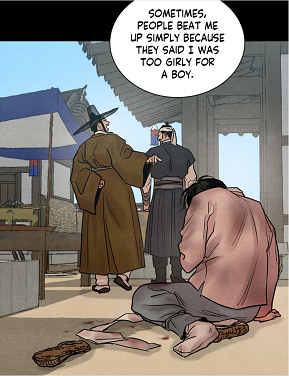 (Chapter 94) He had no parents or guardians protecting him which is true, for here he was exposed to violence. Heena, as the head-kisaeng, had not protected him at all, she must definitely have portrayed herself as powerless. Yet as a slave of the state, she was belonging to the king. So she had connections to officers and the court. In my eyes, the head-kisaeng made sure that the artist could never get a topknot, and as such he would never be able to become a “noble” or even a man. Hence Baek Na-Kyum was constantly called boy
  (Chapter 56)
 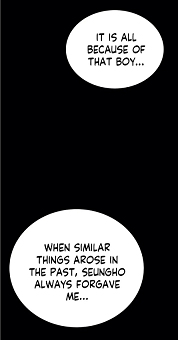 (Chapter 59)
  (chapter 66) and treated as one too. This observation made me realize that Heena’s belief could be used as an explanation for her action (cutting off his hair): she hates nobles so much that she didn’t allow her brother to have a topknot. But why would she do that? My idea is that deep down, she resented him, for he was a free man, while she was a slave. It went so far that he was encouraged to wear a white headband, the symbol for servitude, though he is no slave! To conclude, the loss of hair in Joseon should be perceived as a brutal and harsh punishment. Without a topknot, one is left unprotected, is not viewed as an adult. But this stands in opposition to Yoon Seungho’s action in front of Jung In-Hun’s home.
  (Chapter 101) Here, the lord had spared his friend’s life.
2. The loss of the topknot: Symbol for forgiveness?
As you may have noticed, I often use other manhwas as a source of inspiration for my interpretations concerning Painter Of The Night. In the story “A Sip of Poison”, the main lead, the prince Nan-Woo  (Chapter 23) cuts off the hair of the general Woo Jong Han, because he had committed crimes. First, he hid the fact that his sister had had a child before getting married to the emperor, which was actually a huge sin. The future Empress should have been a virgin. To sum up, he had committed treason, for he had allowed his sister to become Empress unrightfully. Then the field marshal had treated his niece as a slave violating social norms.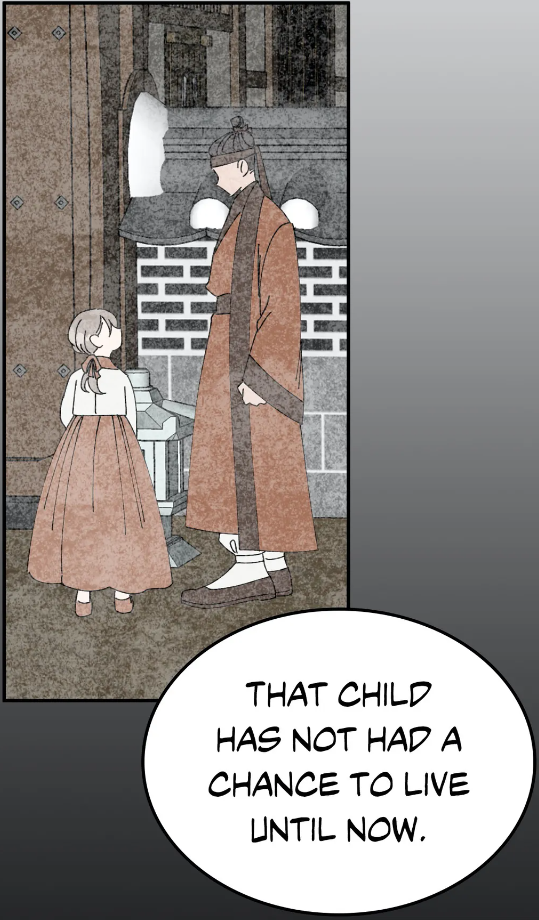
 (chapter 34) That way, he assisted his sister to become powerful by covering up for her crimes (silence and passivity). She had killed many people to hide her previous relationship and to increase her power. Striking is that the prince still spared Baek-Ha’s uncle, and this for many reasons. First, the latter had not only saved both protagonists, the empress’ illegitimate daughter Baek-Ha and the prince Nan-Woo, but also had admitted his sins. Secondly, he was thinking of his wife Baek-Ha who is kind-hearted. He knew that his death could upset his bride.
 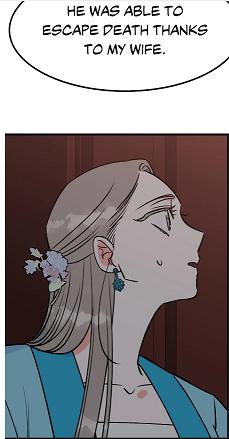 (chapter 26) But there is more to it. Nan-Woo didn’t spare the man out of benevolence.
 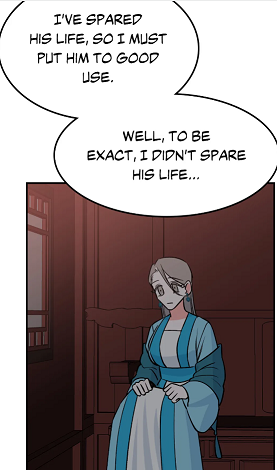 (chapter 26) He had a role to play. By cutting off his topknot, the general lost his “power”, he became the prince’s pawn! Nan-Woo wished to use the uncle in order to get rid of the Empress.
 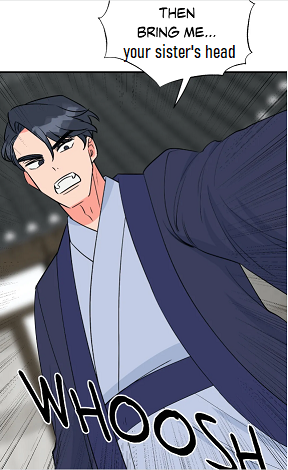 (chapter 23) That way, the protagonist wouldn’t even have to dirty his own hands. On the other hand, we could also say that Nan-Woo was forcing the Empress’ brother to undo his bad decision.
  (chapter 23) Since he had protected his sister Seo-Ha out of affection, it was normal that now he had to show no mercy towards her. By presenting Baek -Ha to Nan-Woo, the general was well aware that the future ruler would recognize the female lead’s origins due to her resemblance to her mother. Therefore, we could interpret that Nan-Woo had spared the general, for the latter had switched sides and expressed the wish to undo his wrongdoings.
As you can see, Woo Jong Han shows many similarities with the second lead from Painter Of The Night: he was an accomplice of the real culprit, as he never intervened. He is connected to the notion: pity, knowledge, silence and passivity. Because Seo-Ha was his sister, as a dutiful older brother, he felt obligated to protect her. He was not blinded by greed like his donsaeng. This explicates why on the one hand, he saved Baek Ha’s life, on the other hand he still treated her as a slave in order to hide his sister’s wrongdoing. He felt torn between his obligation towards his younger sister and his empathy for his niece, Baek-Ha. Consequently, it is no coincidence that he once warmed her feet with his hands after the young girl had complained about her cold feet. Moreover, she received an education contrary to all the other slaves. He was caught in the middle, exactly like Lee Jihwa who had an attachment towards the main lead, yet he was still bound by social norms to his father. He needed to protect the family’s reputation. So when I saw this scene, (chapter 23) I couldn’t help myself thinking of Lee Jihwa and Yoon Seungho. How could the latter view the loss of a topknot as a gesture of leniency?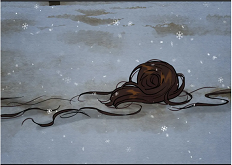 (Chapter 101) It is because he must have witnessed it himself in the past. I have already pointed out that Yoon Seungho would imitate people, especially his tormentors. So where did he learn from? I believe, Yoon Seungho copied it from someone… and this can only be “lord Song”. And now, the first loss of Lee Jihwa’s topknot can be perceived in a different perspective. The red-haired master was well aware that he had been spared, when he had lost his hair for the first time.
 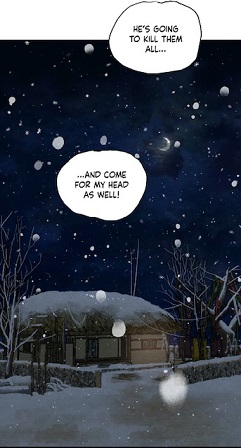 (Chapter 101) He knew deep down that thanks to his friend, he had been able to escape the worst. Since he had been spared once, he was well aware that this time, the ruler would show no leniency and would ask for his head, as the main lead was no longer protecting him. Remember what the lord had whispered to Baek Na-Kyum:
 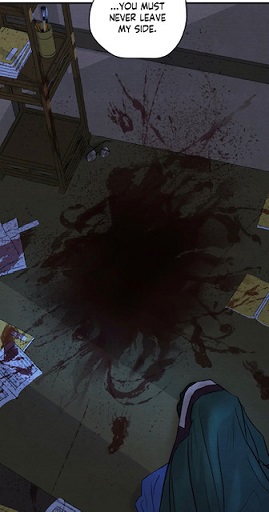 (chapter 88) (chapter 88) By cutting off the friend’s hair, he was showing that he was abandoning his friend. He was leaving him behind, and Lee Jihwa was forced to face lord Song alone.
  (Chapter 83) This time, he had not his father by his side either. The latter could not protect him too. I had already voiced this theory before, as it would explain why Lee Jihwa is masking the man’s face. And note that Nan-Woo from A Sip Of Poison cut off the topknot, as he is already acting as the future ruler. Another important detail caught my attention. Just before receiving his sentence, Woo Jong-Han made an oath,
  (chapter 23), he swore loyalty to the future emperor. This signifies that the topknot also symbolizes faithfulness, especially because it is connected to marriage. Thus I deduce that when Lee Jihwa lost his topknot for the first time, he was already judged as disloyal. Hence it is no coincidence when the antagonist screams that he would become the target of lord Song’s fury.
But the red-haired noble could never reveal the king’s meddling, as his relationship with Yoon Seungho was a secret. Hence he needed to blame someone: The Yoons! I had already exposed that the words from the noble with the mole were ambiguous and as such deceiving. 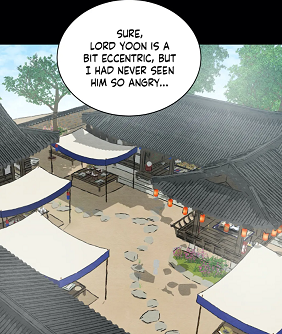 (Chapter 59) First, lord Yoon could be a reference to the father and not only the son. Secondly, he implied that he had witnessed the scene, yet in reality he could have been referring to the outcome: the friend’s hair cut, just like the noona had only seen the hickeys on her brother’s neck. She had never witnessed the sex session. The noble with the mole assumed the perpetrator’s behavior, rage, based on the hair loss. Moreover, he could have been telling the truth: he had never seen Yoon Seungho so angry before, as the latter used to be weak in the past due to his social status: he was a male kisaeng due to his braid. This explicates why the noble with the purple robe would give an order to the host
 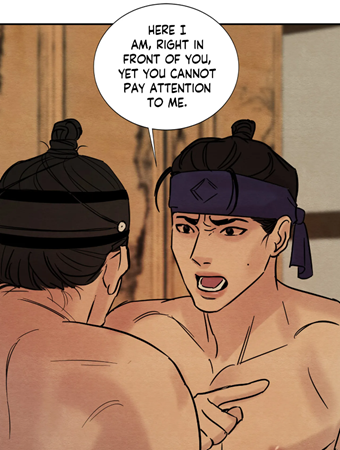 (chapter 8) He felt himself superior to Yoon Seungho, and never expected “disobedience” or “rage” from the protagonist. Striking is that the lord didn’t vent his anger onto him, he first smiled before grabbing him by the topknot.
 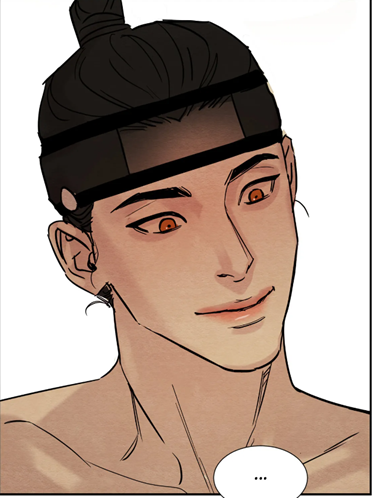 (Chapter 8) A simple change of hair dress had transformed the main lead. This exposes the gods’ intervention in this story. They let the man with the mole see the wrongness of his manipulations. Since he had stated that he had never seen the man so angry, his words became a reality in 3 occasions: chapter 8 like mentioned above, chapter 53
 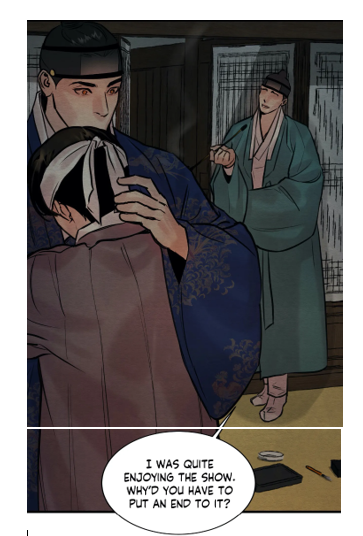 , for he was not present, chapter 57
  in the inn. Here, he chose to run away, yet despite everything he still helped his friend Black Heart, for he was present in the gibang.
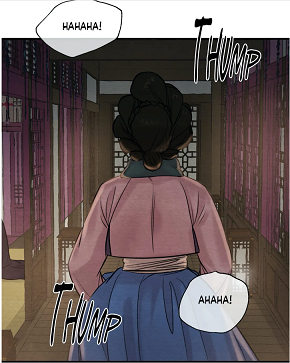 (Chapter 69) Under this new light, this panel from Twitter get a total new meaning:
  The aristocrat knew about the true identity of “lord Song”, and he had indeed never seen the man so angry that he would cut off the topknot of a noble!! This means that the fate of the noble with the mole should be to end up as the lord’s new plaything. In other words, he takes over the main lead’s previous status. He becomes the male kisaeng and ends up living in the shed like the protagonist in the past where the pedophile vents his rage and resent him for his tricks. But we will see.
Another important detail caught my attention: the noble with the mole judged the loss of the topknot as a harsh punishment 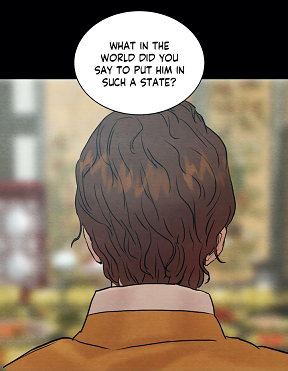 (chapter 59) Furthermore, he associated it to abandonment too.
 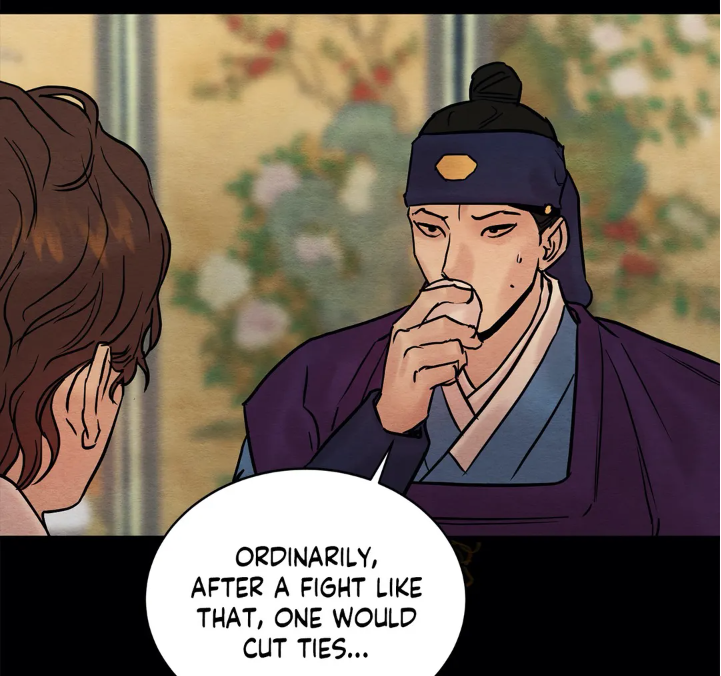 (Chapter 59) Yet, observe the drop of sweat. This exposes that neither Min nor the noble with the mole were expecting that Lee Jihwa would be spared!! They acted, as if the loss of the topknot couldn’t be a sign of mercy. But observe what Lee Jihwa was recalling, when the “friend” was talking about abandonment.
  (Chapter 59) He was by the protagonist’s side! This means that lord Song had spared Lee Jihwa’s life, for he had been present, when Yoon Seungho was suffering. Till the middle of season 2, no one was aware of the fallout between Lee Jihwa and the protagonist. None of the incidents in season 1 was leaked to the outside, hence the “pedophile” was not officially aware of the red-haired master’s wrongdoings. But the loss of hair in front of the learned sir’s house becomes the proof that the main lead has now left his friend’s side. He will be blamed for his suicide. Therefore it is not surprising that the young master chose to run away.
 (Chapter 101) He knew that the ruler would show no leniency or understanding. Thus the noble with the mole’s karma should be to keep his topknot. That way, he will realize that if he had lost his topknot like Jihwa, his torment would be short-lived and as such it was a sign of mercy. But in this image, it doesn’t look like it. He will suffer for hours and even days before even losing his life. Now, he will be able to see and experienced how enraged or lenient the culprit for the loss of Lee Jihwa’s topknot was towards the antagonist.
The manhwaphiles should keep in their mind the following two rules: the painter’s fate mirrors the lord’s, since the story is constructed like a kaleidoscope. And now, look at this:  (chapter 27) The painter had saved his teacher’s life, and later the lord had restrained himself from hurting the scholar in the courtyard despite Jung In-Hun’s lies and lack of respect (he had touched the man’s shoulder).
  (Chapter 30) Here again, the scholar had been spared. Then in episode 53, the painter had embraced the lord to stop him from killing Deok-Jae. This means that Yoon Seungho must have also saved people in the past by using his body, and this twice, for I had detected the presence of two circles: Yoon Chang-Hyeon and Lee Jihwa. That’s the reason why the father could survive the purge, and why Lee Jihwa only lost his topknot. And the heroine from A Sip Of Poison can serve as an example. (chapter 26) The red-haired noble was able to escape death thanks to Yoon Seungho. But Lee Jihwa had to hide from others that he had been punished by the king, hence Father Yoon and Yoon Seungho got blamed (chapter 1 and 59). And now, you have the explanation why father Lee accepted to receive the main lead in his mansion.
 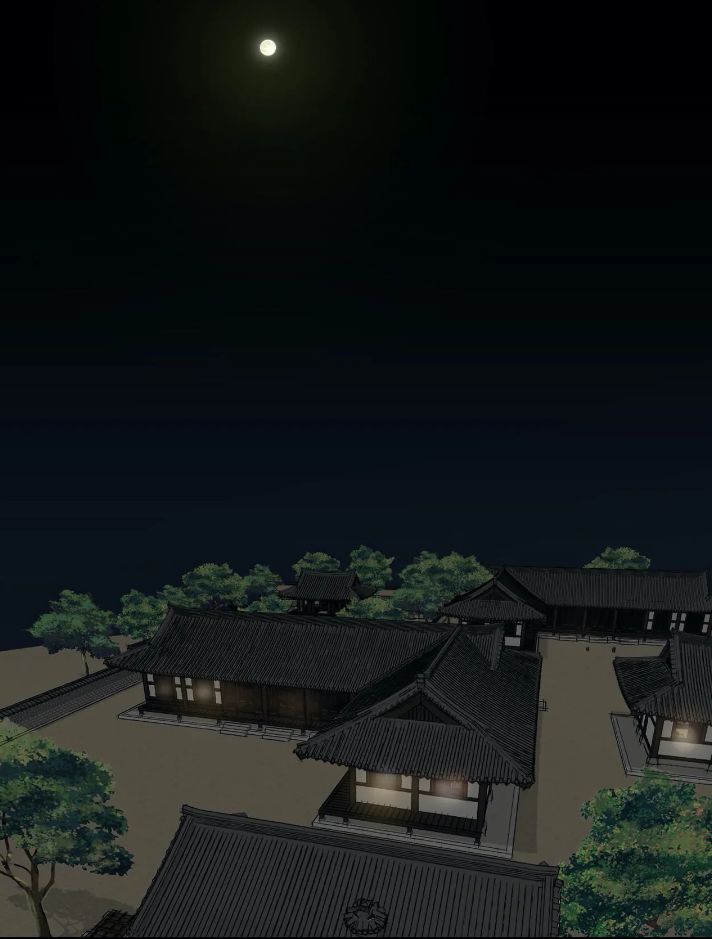 (Chapter 1) As long as the latter was living there, the Lees had nothing to worry. The main lead was protecting them from the king. However, the manhwalovers should keep in their mind that Nan-Woo had showed mercy to the general for his own interests. He should become his helping hand in order to obtain the throne. Hence I come to the following deduction: neither Nan-Woo nor the “perpetrator” had cut off the topknot out of real leniency. This shows that for these characters, the loss of the topknot is not the symbol for forgiveness which is not true for the last incident with Lee Jihwa. (chapter 101) Why? It is because the main lead had no intention to use his friend as a pawn. There was no pledge of loyalty… in truth, in this scene, Yoon Seungho was truly cutting ties with the second lead.
But if the pedophile chose to employ the young master after the loss of the topknot, what was his role? In my opinion, it was to keep Yoon Seungho by his side. The pedophile had slowly recognized that he could never separate these two boys, and without him by his side, Yoon Seungho would still reject him. In my eyes, the main lead had followed his friend. Under this new light, the manhwaworms can comprehend why father Lee accepted to let the main lead stay in his mansion. He could secure his position, yet pay attention that despite the topknot, he was still dressed so poorly. 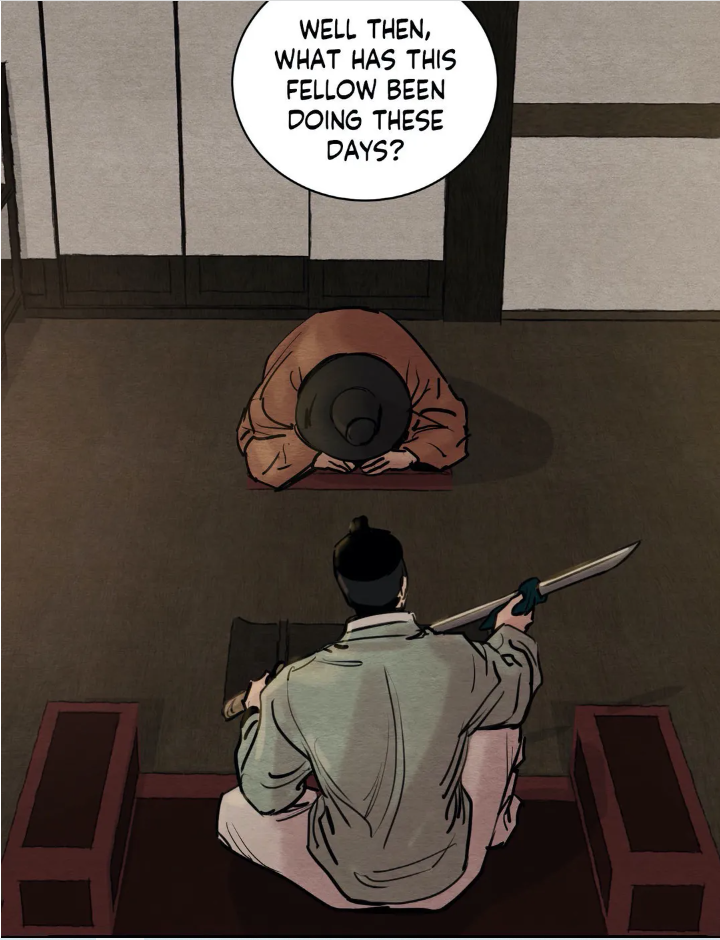 (chapter 1) Even the headband was different. This was no coincidence. He should never develop confidence and act as a lord. That’s how I recognized the following pattern. In front of the painter who looked like a minor, the main lead was forced to act like an adult. Thanks to the painter, he was encouraged to mature. Simultaneously this meant that at some point, while living with the Lees, the elder master Lee had to be confronted with the truth: his son’s sodomy.
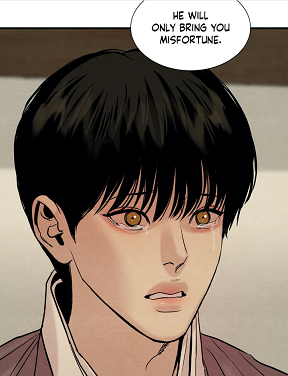
Under this new light, it becomes understandable why Heena and Kim called the main lead a bird of misfortune. 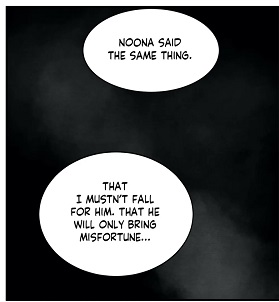 (Chapter 86) The reality was that the pedophile was the bad omen, but they couldn’t insult the king. Hence the young main lead became the scapegoat, people couldn’t separate the pedophile from Yoon Seungho. The “mysterious lord Song” would never give up on the protagonist. No matter what he would keep him by his side.
But like pointed out in an earlier analysis, Black Heart and his friend were definitely the reason why the red-haired master had to lose his topknot. From my point of view, this is related to this night, (chapter 1) and Lee Jihwa had no idea about it. Hence the painter got framed. On the other hand, Black Heart and his friend had to spy on Lee Jihwa in order to know about his ignorance concerning their “prank”. At the same time, they could only get intrigued, why the mysterious lord Song would behave that way, though he had been treating the main lead as a male kisaeng. Towards Yoon Seungho, he was quite selfish and cruel. The discrepancy in the treatment (mercy versus ruthlessness) could only surprise the young nobles. And this observation led me to the following question. Why would Heena mention the topknot to her brother in order to manipulate him? The kisaeng was well aware that he had witnessed the sex party in the kisaeng house, for this image represents a memory from the artist. It is to divert his attention: he should never connect Yoon Seungho to the braided man!! If he had a topknot, then he could never be the one doing the fellatio to the man with the purple hanbok!! But if the painter had pondered a little more, he should have realized his noona’s lies. She mentioned the loss of a topknot, but yet the smiling hell-raiser still had a topknot: 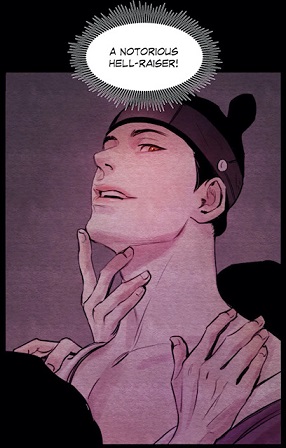 (chapter 1) Moreover, we shouldn’t overlook the publications with the braided man:
  (Chapter 1) Baek Na-Kyum was not supposed to recognize the identity of the man having sex with the bearded man. From my point of view, Heena made sure to confuse her brother. Lee Jihwa’s humiliation became Yoon Seungho’s stigma. He became the culprit. Since in the past, the main lead had been blamed for everything, the perpetrators and accomplices chose to follow this “tradition”, because so far, they had been able to cover up their crimes. But thanks to the painter, it is no longer possible. Why? It is because the painter’s hair dress will serve as a mirror of truth: the absence of a topknot due to the braid and the hair cut will be perceived as an evidence for abandonment, cruelty and huge wrongdoing. This won’t be seen as a gesture of mercy or leniency by the two protagonists, for they suffered because of it!! That’s the reason why I am thinking that the pedophile’s karma should be the loss of the topknot which he viewed as a gesture of mercy and tolerance. But without the topknot, he is actually “castrated”, and as such humiliated for he can not wear his golden sangtu.
  Yet, contrary to Lee Jihwa’s haircut, the loss of the topknot should not be judged as the symbol of mercy and forgiveness, in fact, the lord would officially cut ties with him. That’s how the mysterious Lord Song would be taught an important lesson: he was a huge hypocrite and a violent and ruthless pervert.
3. The tool for the loss of the topknot
Once again, A Sip Of Poison inspired me. The prince Nan-Woo asked his assistant Yoon 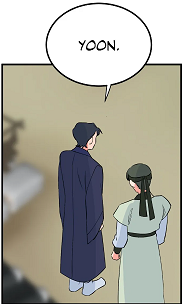 (chapter 23) to give him a knife:
 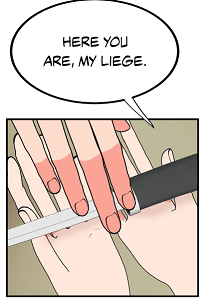 (chapter 23) before grabbing Woo Jang-Hon by his topknot
 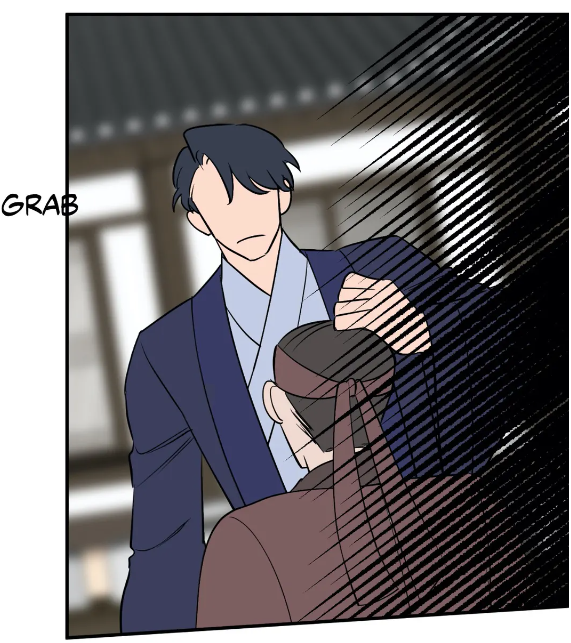 (chapter 23). Hence the hair fell between the men.
  (chapter 23) And now, let’s return our attention to Painter Of The Night. Compare the position of the aristocrat’s topknot after Yoon Seungho had punished his friend.
  (chapter 101) It was behind him!! Thus I deduce that he had used the sword, when Lee Jihwa had approached his friend. But wait… in season 1 and 2, Byeonduck drew scenes with a knife:
- Chapter 18:
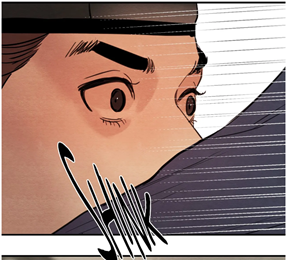
 And what had happened before? Yoon Seungho had dragged his friend by the topknot before stabbing the amateur spy. This is no coincidence.
 - Chapter 57:
 When this chapter had been released, I had assumed that this must have happened, when Yoon Seungho had lost his topknot! As you can see, I had already connected the knife to the loss of the topknot incident.
 - However, note that the weapon was used to threaten the painter
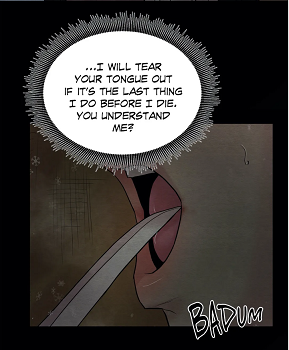 (chapter 66)
That’s the reason why I am assuming that when Lee Jihwa lost his topknot for the first time, the mysterious lord Song must have used a knife and cut off the young master’s hair. Hence Byeonduck created such a picture where Lee Jihwa was put in a similar situation: (chapter 18) It was to trigger his memory. I am even assuming that the butler must have given lord Song the knife before while remaining in the shadow. But I also think that after the incident with the loss of the topknot, the pedophile must have also threatened him. If he were to reveal anything about this incident and his identity, then he would lose his head. So imagine Lee Jihwa’s reactions in chapter 101. (chapter 101) He had now faced a sword and not a knife contrary to the past. Therefore it is not surprising that the young master got so scared and chose to flee. Lee Jihwa had betrayed lord Song by telling an anecdote from the past. He had more or less leaked the name “lord Song”. 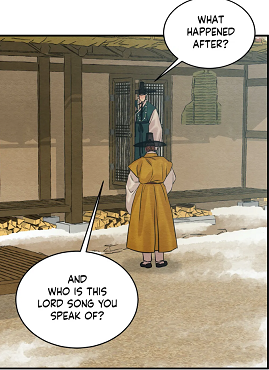 (chapter 83) (chapter 101) For the first time, he had been confronted alone with the sword directly. There was no one and nothing to protect him. When Yoon Seungho had barged in his bedroom, Lee Jihwa had fled behind the folding shield. Furthermore, his father and the domestic were also present.
 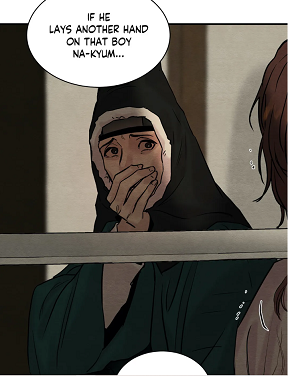 (chapter 67) This shows that till season 3, Lee Jihwa had never been exposed to real justice. There was always someone ready to intervene for him. And now, you comprehend why the red-haired master felt no remorse to blame his friend for his humiliation in the past. He must have thought that if he had not been in his bedchamber during that night (chapter 59), he wouldn’t have lost his topknot. Moreover, he could also use the other incident in the bedchamber as a justification. If Yoon Seungho had not dragged him there…
  (chapter 83) This explicates why Lee Jihwa said this to Black Heart and his friend:
  (chapter 59) The antagonist had witnessed his friend’s humiliation and suffering in the past, just like Yoon Seungho had been present, when the first topknot incident occurred. From my point of view, the lord must have even protected Lee Jihwa. But the problem is that Lee Jihwa was just receiving his punishment in delay for the stolen kiss and his lies
  (chapter 77) He had kissed him without his consent, thus he got “castrated”. Let’s not forget that the main lead was forced to become a male prostitute, an uke, for he had not been able to perform, to have an erected phallus. On the other hand, Lee Jihwa had done nothing wrong in the bedchamber (chapter 59), for he was consoling his friend, so the loss of the topknot appears as a harsh punishment. Moreover, it looks unfair, for the real perpetrators and accomplices got scot-free. Yet, this is just an illusion. Min and his friend were punished too. They got “castrated” too!! How so? It is because from that moment on, they were not allowed to treat Yoon Seungho as a uke, a male kisaeng. (Chapter 1) This means that the painter’s vision was turned into a reality. That’s the moment Yoon Seungho got turned into a seme. Now, Black Heart and the noble with the mole should become his “playthings”, which signifies that they had switched positions. In my opinion, the pedophile had decided to no longer share his “companion” to others. As you can see, they got punished too, but since this was not painful, they never realized that they were receiving their karma. This was a symbolic “castration”. Under this new approach, it becomes understandable why Min was so obsessed with Yoon Seungho, why he wished to “fuck” Yoon Seungho in a figurative way. This is what he had desired in the past, in the gibang, but he had failed. Thus we have this gesture from Black Heart in the woods.
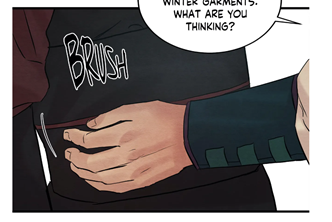 (Chapter 41) Due to the incident in the kisaeng house, Min had lost his privileged position with the king. Hence he got jealous. He could no longer screw” the protagonist, while he had to watch the lord’s slow ascension. To sum up, the loss of Jihwa’s topknot led to the “symbolic castration” of the infamous couple: Min and the noble with the mole.
But it is time to return our attention to the knife and the loss of the topknot. First, it is relevant to remember the following rule. Baek Na-Kyum will through the path than the main lead’s. Since the painter has been constantly cutting his hair, he never had the chance to get long hair and as such a topknot. And the lord was in a similar situation. He only got his topknot very late… but the only difference is that he had a long braid the entire time. This hair dress was the symbol of his servitude. (chapter 57) Hence the author drew slaves with braids constantly. 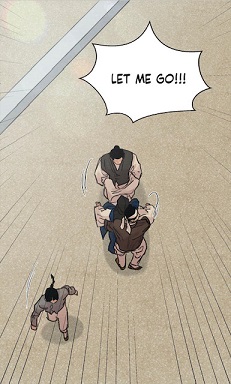 (chapter 77) And now, you comprehend why the pedophile cut off Lee Jihwa’s topknot! The latter had been blamed for the lord’s change of hair dress. (chapter 59) Because of this, Yoon Seungho had become a lord, a noble. That’s the reason why we are not able to distinguish the main lead’s hair dress properly, neither in the last picture and in this one:
 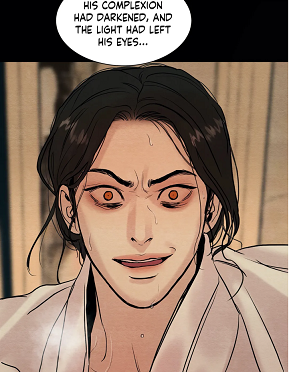 (chapter 57) The hair was short or not? Now, I don’t think so. The mystery of Yoon Seungho’s suffering is linked to the hair dress, yet the readers shouldn’t realize it too quickly. According to me, he still had the braid, until the doctor questioned why Yoon Seungho still had no topknot. (chapter 57) Don’t forget that in each visit of a physician, the latter would question the butler:
  (chapter 33)
 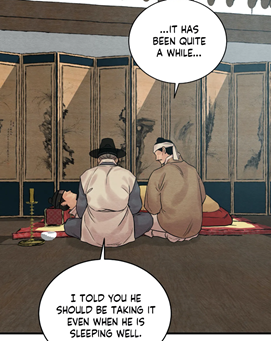 (chapter 55) And who had given him the topknot? Naturally… Kim! Because he didn’t want to be perceived as someone who was violating social norms. However, there is no ambiguity that he hid his responsibility. That’s how Lee Jihwa and his “servant” got framed. They were responsible for giving the main lead the new hair dress. On the other side, I still believe that Yoon Seungho must have lost his hair too, but only once to the difference of Baek Na-Kyum! My reason is simple. Since the painter and Lee Jihwa lost their hair, and Yoon Seungho’s destiny is mirroring his lover’s, it signifies that the lord’s hair must have been cut too. But who did it? Let’s not forget that when Yoon Seungho punished his friend in front of the scholar’s home, (chapter 101) the loss of the topknot had four significations: admission of a sin, mercy, forgiveness but also ABANDONMENT! He was cutting ties with his childhood friend. So he must have known the last meaning, but from a different source, as the first incident represented a sign of leniency. Consequently, I ended up with the following theory. Yoon Seungho must have cut off his own hair, yet he had been manipulated by Kim. Let’s not forget that the painter continues cutting his own hair and there is no sign of trauma linked to such an event. He had been encouraged to lose his hair by his noona. From my point of view, this must have happened between these two scenes:
 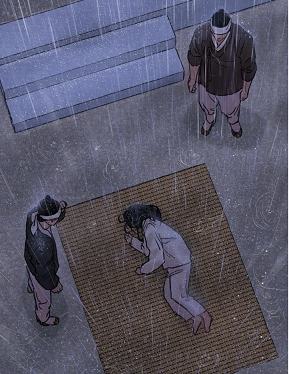 (chapter 77) and this one
 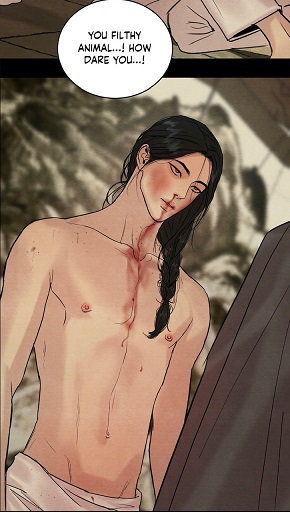 (chapter 83) The length was almost the same, yet 3 or 4 years had passed in the main time. Let’s not forget that this scene represents the patriarch’s abandonment
 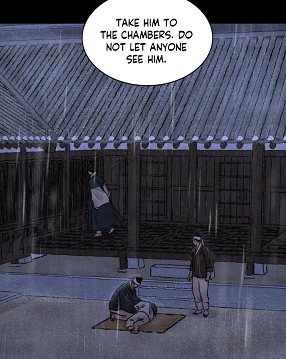 (chapter 77) and Kim had also experienced rejection from Yoon Seungho
  (chapter 77) in that scene. For the butler, this gaze could be judged as betrayal and abandonment. Under this new perspective, it becomes comprehensible why the main lead was encouraged to blame and resent his father. If this theory is true, Kim pushed the main lead to cut off his braid, he did it out hatred and anger towards the Yoons. This would mask his own manipulation and culpability too. At the same time, the pedophile could benefit from it. The main lead was now an orphan, thus the bearded man could use him like he wished. I have an evidence for this interpretation. This is what Baek Ha said to her husband:
  (chapter 23) Being slave meant being orphan. The pedophile could feign ignorance about the main lead’s true origins. If he truly cared for him, he just needed to ask this: papers!
 (chapter 24) This shows that in Painter Of The Night, all the elders were depraved and violent hypocrites. Like mentioned above, the pedophile had a huge interest to keep the main lead as his slave, thus he was turned into an orphan and asked to keep a braid. And Yoon Seungho’s mother could do nothing, for the son had cut off his own hair, a huge symbolic act. He was no longer considering her his mother. But because of his status as slave, the pedophile could never trust the main lead. Then the suicide from the mother put an end to this farce. Hence lord Song could tell his sex partner that he had become the head of the Yoons and let him “have” the properties, while it was never his intention to let him become responsible. If he had become a lord, he could escape from his claws. He needed him to remain in an infantile and dependable state.
Since I detected that rumors often become a reality, I deduce that after the lord’s vanishing, Heena’s words will come to the surface and become the verity: (chapter 1) While in the past the father could judge this grapevine as positive, for he was portrayed as a honest and respectable man, the town folks will perceive him as the opposite: cruel, depraved and selfish. And this because of the false accusation:  (chapter 94) By framing the elder master Yoon, Kim can deny any responsibility in the loss of hair of Yoon Seungho and in the messenger’s death. It was the father’s doing. The nobles like the Lees and Yoon Chang-Hyeon are now accountable for the corpses. In the gibang, Yoon Seungho never killed anyone and he even spared his friend, though the latter had kidnapped Baek Na-Kyum. Finally, the town folks are now aware of Lee Jihwa’s homosexuality and his relationship with the protagonist. So I believe that people will jump to the conclusion that father Yoon had turned his elder son into a sodomite and sold him him to the Lees which is not false too. The king has a reputation to maintain and he needs scapegoats in order to hide his involvement and his crimes from the past.
4. The reason behind the loss of the topknot
And before closing this essay, I would like to point out another similarity between A Sip Of Poison and Painter Of The Night. Though Baek -Ha is the daughter of Nan-Woo’s enemy, the prince couldn’t hurt her in the end, for she saved him:  (chapter 33)
  (chapter 33) She not only treated his wounds, but also helped him to overcome on his guilt. He felt responsible for his brother’s death, for Nan-Woo had attempted once to commit suicide on the battlefield, and his brother had sacrificed himself to protect him. He was definitely plagued with remorse, self-loathing and shame. And that’s exactly what Baek Na-Kyum has been doing too: by simply loving him so selflessly and purely. Finally, Baek-Ha’s fate made him realize the Empress’ immense culpability. She was so greedy and selfish that
 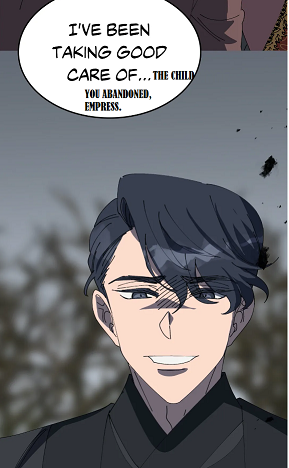 (chapter 34) she had abandoned her own child! Thus he was freed from his hatred and guilt. Nan-Woo was able to perceive the wrongness of this social norm which was common in Joseon: the child is responsible for the parents’ sins!
  (chapter 33) Being an orphan outlined her innocence. And since I have already connected Baek Na-Kyum to the mysterious lord Song, I am quite sure that the painter will have a similar attitude than Baek Ha:
  (chapter 33) He will feel responsible for Yoon Seungho’s martyrdom. And if he is truly his son, his abandonment can serve an evidence of his innocence. On the other hand, the readers shouldn’t forget that his surrogate parents, Jung In-Hun and Heena, played a role in lord Yoon’s torment as well. Thus he can only indebted towards his husband.
Chyomchyom and Byeonduck explained perfectly why the protagonists would suffer so much: ambition.  (Doctor Frost, chapter 225) With this picture, the manhwaphiles can detect the presence of the endless vicious circle, the ouroboros, which I had described as a kaleidoscope. The absence of empathy in both stories was the reason why no one stopped the main perpetrators. Woo Jang-Hon felt guilty, for he had raised his younger sister who had become a monster. Kim felt deep down guilty, but chose to reject his responsibility by putting the blame on others. Out of fear, he preferred hiding his wrong decisions and later wrongdoings. And now it has become his MO. This distinguishes him from the general who chose to put an end to his guilty conscience and paid for his crimes..
 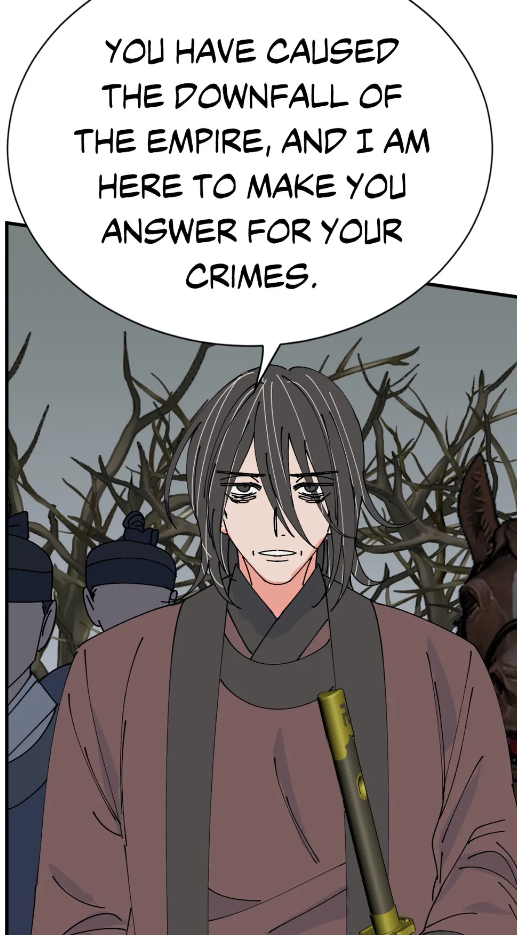 (chapter 34)
To conclude, the loss of the topknot has many significations: punishment, castration, loss of power, servitude, guilt, abandonment, absence of protection, cruelty, betrayal, but also freedom, loyalty, leniency and forgiveness. As you can see, the gesture is associated to opposite notions: servitude versus liberty, betrayal versus loyalty etc…. as it depends on the perspective.
Thanks to Yoon Seungho, Lee Jihwa was able to free himself from his guilt and he could liberate himself from social norms (peers pressure, his father’s expectations,) and his shame due to his sexual orientation. Before losing his topknot, he had admitted his sins to his friend and it also indicated his loyalty towards Yoon Seungho. And this was the same for the general. The latter could finally find peace in his mind and redeem himself. Yet, now, he is no longer a powerful general, he is just the puppet of the prince. However, the moment the red-haired aristocrat lost his topknot, he was no longer the king’s puppet. Therefore he was no longer useful for the mysterious lord Song. That’s the reason why the antagonist got aware that he shouldn’t expect any forgiveness or mercy from “Captain Hook”. No matter what he would say, he would be suspected of a crime (chapter 101) and this because of the first incident with the topknot!! Since Black Heart and the noble with the mole had been able to avoid punishment after this incident in the kisaeng house (chapter 1), he assumed that he could repeat his actions!! But he got proven wrong, for he ended up losing his life.
Feel free to comment. If you have any suggestion for topics or manhwas, feel free to ask. If you enjoyed reading it, retweet it or push the button like. My Reddit-Instagram-Tumblr-Twitter account is: @bebebisous33. Thanks for reading and for the support, particularly, I would like to thank all the new followers and people recommending my blog.
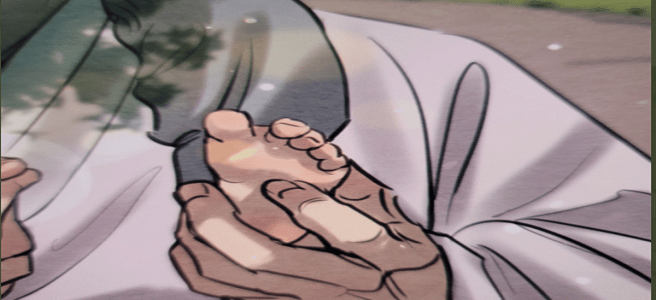
 on Twitter yesterday, and naturally this made many people happy, for Jung In-Hun was stroking Baek Na-Kyum’s foot gently. How could people identify the characters, though we don’t see their faces? Simply by the clothes! The manhwaphiles remember the painter’s grey pants and the learned sir’s favorite color, lavender,
 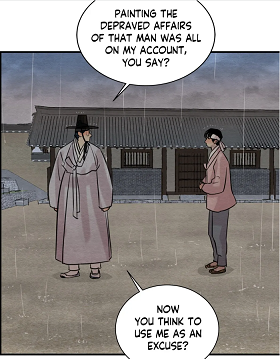 (chapter 19)
 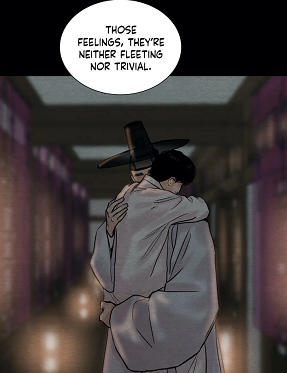 (chapter 68). While many manhwalovers found this image cute
  (chapter 70) The manhwalovers can immediately detect the contrasts: the visages of the protagonists versus the hand and the foot, day versus night, sun versus moon. That’s the reason why I came to the deduction that this image embodies a happy memory of the painter: sadness versus happiness.
  . (chapter 68) This means that Baek Na-Kyum was removed, because he was a witness and could generate a scandal. He is beloved by the kisaengs. However, back then, he got misled due to Heena’s indoctrination and false impressions. When he saw this, he was only looking at his noona, hence he didn’t pay attention to the actions of the black guard. Moreover, he had no idea why Heena and Yoon Seungho were behaving like that. So when the painter recalled Jung In-Hun from that night, he was no longer heartbroken, because the stroll with the scholar came to his mind.
  (chapter 70). The trigger for this recollection was his farewell to Heena. This time, he could say goodbye to Heena properly by embracing her and giving her a scarf so that she would remember him. In the painter’s mind, after that night, he would never see her again.
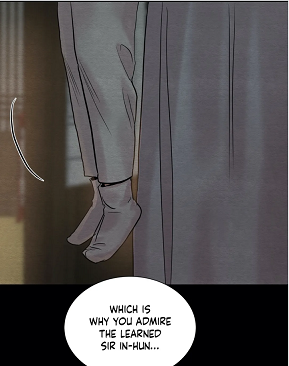
  (chapter 69) In other words, this night represented a closure for Baek Na-Kyum, the end of his abandonment issues. In episode 70, Jung In-Hun had consoled him, he had tried to cheer him up. Thus the learned sir was smiling. Yet, this couldn’t cover the painter’s scar. He felt that he had betrayed Heena, for he had not been able to protect her. It was, as if he had run away. Nevertheless, when this incident occurred, the learned sir had not run away from the gibang, because you could see that Baek Na-Kyum was wearing socks and shoes.
  (chapter 70) The man had put the shoes on the child, as in the building, the painter only had his socks on. Because of the presence of the socks,
  (chapter 68), I deduce that this walk must have taken place in a colder season (fall)
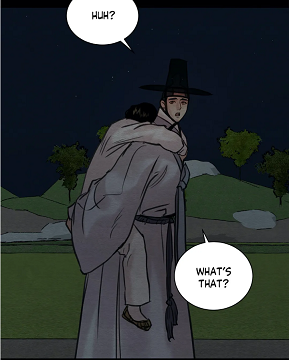
  while in this picture, Jung In-Hun was carrying the painter on his shoulders in the summer.
 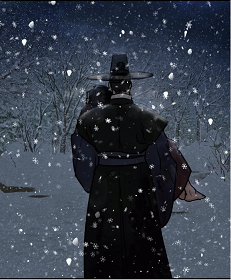 (chapter 102) In both scenes, the main lead is seen with bare feet. He is also carried by his loved one. But here, it is snowing, hence this signifies that it is winter. On the other hand, the manhwalovers can detect the presence of a purple flower on the right side. This signifies that Spring is on its way. That’s how I came to realize why Baek Na-Kyum is now recalling the learned sir’s gesture from the past.
  (chapter 102) where it is even colder than in the valley, secondly it is snowing and there is no sun, only the moonlight. So the moment Yoon Seungho witnessed that Baek Na-Kyum was alive, he must have recognized the seriousness of the situation. Since Baek Na-Kyum had only a hanbok on, he could die of hypothermia. What he had imagined for himself, death, had terrible consequences. He could be the reason for the painter’s curtains. So in my opinion, he must have warmed the painter’s feet with his hands, a new version of this scene:
 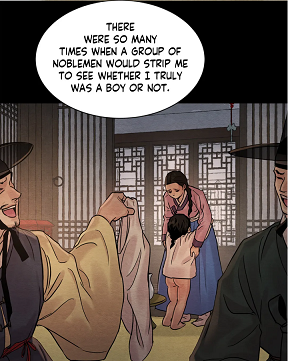 (chapter 94) His presence was to divert the attention from these men so that she wouldn’t be asked to have sex with them. And since I have already detected that each time, the painter suffered, karma would retaliate, the logical consequence is that Heena got punished for her wrong action. This signifies that while the painter was following the learned sir, his noona was abused in the kisaeng house. This would explicate why later she had no remorse to turn Yoon Seungho into a victim. And don’t forget that the painter was much younger than in this scene.
 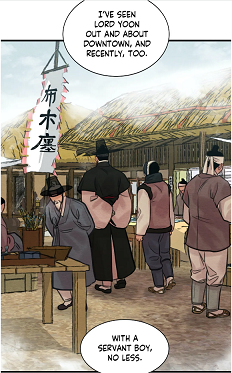 (chapter 45)
  (chapter 75) The latter would let his partner walk through town in order to please him. He would even follow the painter. In other words, it was always for the painter’s sake, and in the mountain, it was the same. But it was not the same for Jung In-Hun, it was for his own benefit. We have the best example in chapter 10:
  (chapter 10) Here, he desired to separate the couple. Baek Na-Kyum should refuse to paint erotic pictures.
  (chapter 29)
 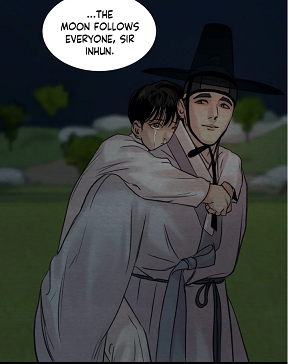 (chapter 70): The artist is dressed with good clothes, he looks more like a young master than a commoner, only the shoes are indicating that he is a commoner. That’s the reason why I believe that during that night, the learned sir was avoiding people. They could have wondered why the young boy was carried in his night clothes outside. From my point of view, this scene
 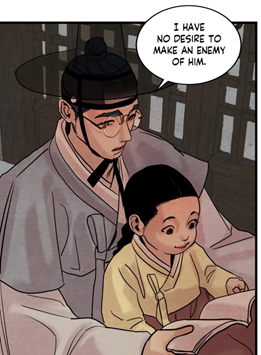 (chapter 29) He had already been seen with a girl before who seems to like him either.
  (chapter 6) Thus I couldn’t help myself wondering if the learned sir was not directly involved in prostitution, bringing girls to the gibang and even covering up for the sexual child abuse. We shouldn’t forget that the pedophile was portrayed as a man consumed by lust who would never pay attention to the time and the hour.
  (chapter 6)
 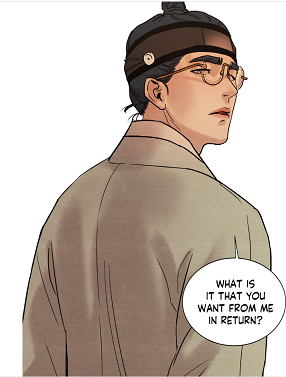 (chapter 7)
 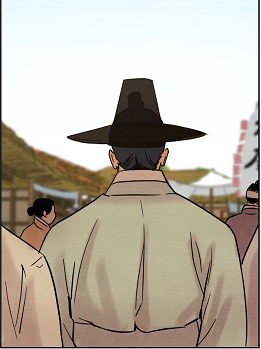 (chapter 7) This change is not random in my eyes. I had already associated the learned sir to a chameleon. This change of color seems to validate my theory that Jung In-Hun had been sponsored by Min, hence we have the light green. Black Heart is symbolized by green. However, the light pigment reflects that he had been abandoned and betrayed. Nonetheless, when he encountered Yoon Seungho, the latter was wearing a purple hanbok.
 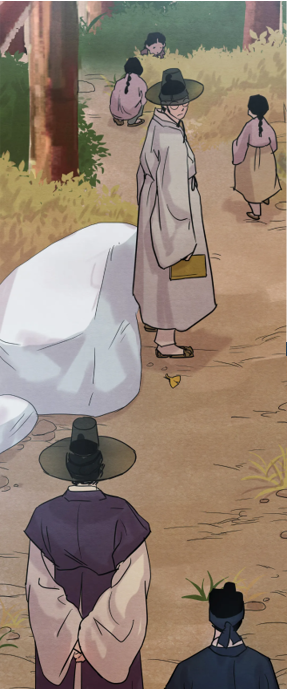 (chapter 6) That’s how the man got influenced and chose to wear his lavender hanboks again. But he never realized that behind the young noble, there was standing the pedophile, someone he had helped in the past. From my point of view, the change of the learned sir’s hanbok was the indication of his betrayal. According to me, the old bearded man
  (chapter 37) was not a former servant, but the pedophile. So he could have recognized the learned sir thanks to his hanbok… just like the readers did with this picture:
  (chapter 73) From my point of view, the intimacy in the bedchamber stands in opposition to the teacher’s gesture in the countryside. His caress was just a casual gesture with no real deep meaning in the end. This explicates why he could betray and abandon the artist on so many occasions in season 1 (chapter 11, 24, 25, 29, 35, 40). The learned sir had always prioritized his own interests.
  (chapter 102), the painter should realize the difference.
  (chapter 70) talk and ask questions before apologizing and hugging him. The lord never acted, as if nothing had happened,
  (chapter 102) This was true love and Baek Na-Kyum’s feet always reflect his emotions:
 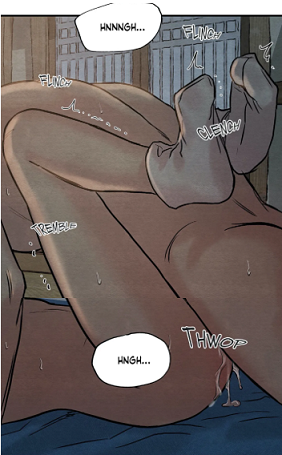 (chapter 58)
  (chapter 80) So now, imagine how the painter must feel if the lord took his feet in his hands! This is no coincidence that there is this saying:
  (chapter 100)
 (chapter 102) and the zooms on the feet:
  (chapter 53)
  The couple was following their heart!! But this was not the case with the scholar. Baek Na-Kyum had no other choice than to follow Jung In-Hun.
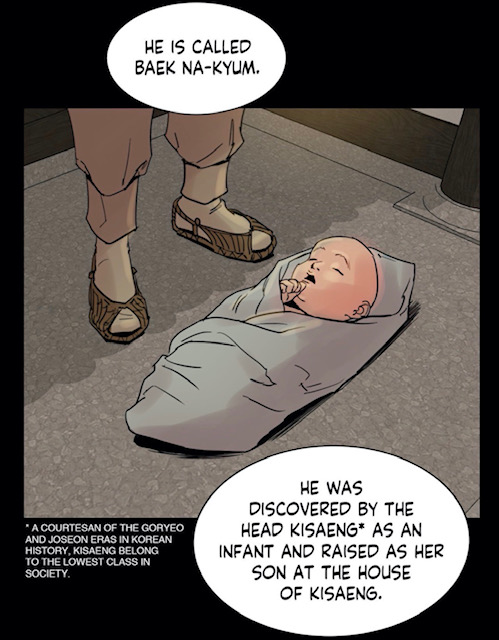 (chapter1) Or was she simply the noona?
 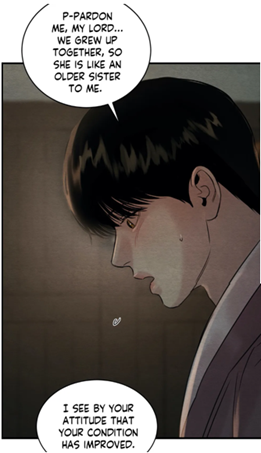 (chapter 70) At some point, I came to realize that Heena had acted as the surrogate mother, but she had never clearly stated that she was the painter’s mother. In other words, his adoption was never official, which explicates why the main lead only considered her as his older sister. This is important, because her ambiguous status can not only generate problems, but also expose her betrayal towards Baek Na-Kyum. Note that in chapter 97, the noona treated Baek Na-Kyum as her “child” who wouldn’t listen to her
  (Chapter 97), while later she implied that they were both equal, for she employed the personal pronoun “us”.
  (chapter 97) On the other hand, she used her seniority as status, when she called him a fool
  (Chapter 97). He lacked experiences, hence he was too naïve, and as such he would trust the protagonist too easily. As you can see, Heena herself had an ambiguous relationship with her brother. Nonetheless, thanks to chapter 93, I got finally a definitive answer about Heena’s true identity. She is indeed the head-kisaeng in the gibang. I realized that the protagonists were invited to stay in Heena’s personal room.
  (Chapter 93) That’s the reason why the seat of the host was empty and why Yoon Seungho didn’t go there. He would have violated social norms, if he had taken her seat.. Moreover, by doing so, he would have revealed that he knew where the woman was. This could have raised questions.
 (Chapter 93) This means that the figures were not sitting in the room shown in the last panel. On the other hand, their voices in the hallway exposed their location. The noonas and Heena were not far away from that door hidden by the veil. That’s how I got aware where Heena’s room was situated. In the last picture, the readers are turning their back from Heena’s study, which is right after the corner. Thus I could recognize the design of the building: ][ In the center, there is this huge hallway with the purple veils, but at its end, on each both sides, there exists a corridor perpendicular to the one with the purple curtains. What the beholder imagined as a door at the end of the hallway,
 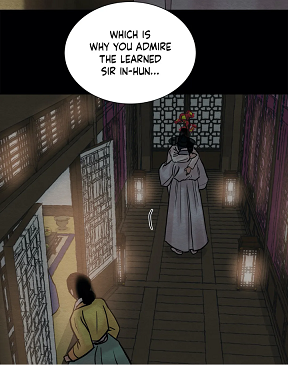 (Chapter 68) was in truth a huge window. How do I know this? First, in this scene, the scholar was hiding a huge white vase with red flowers. Hence I deduced that Jung In-Hun couldn’t have walked through that “gate”, it was just a window. Therefore I assumed that he had to walk past the flowers, either turn to the right or the left. Secondly, observe that next to the lantern on the left, there is a small white panel. This means that the view from chapter 93 was more or less taken from the right corner. Moreover, in the next chapter, Heena is not facing this “window”, when she is in the same building.
 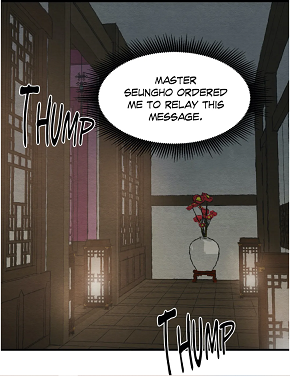 (Chapter 69) This time, the white vase with the flowers is standing in front of a wall. That’s how I deduced that Heena had to turn to the left in order to go to the hallway.
  (chapter 93) which is not present in episode 69.
  (chapter 93) Since I came to the conclusion that Heena’s private room was on the right side after the corner, I deduce that the kisaeng was not on her way to her room. Moreover, since the kisaeng was walking in the same direction than the scholar, I can only conclude that Heena was actually approaching the entrance of the building. I believe that she had turned around, but the author didn’t reveal this. One might argue that it is possible that in chapter 68, the learned sir could have gone with the painter to Heena’s bedroom. However, back then the latter was not the head-kisaeng. We know this due to the presence of a kisaeng standing right behind Yoon Chang-Hyeon during the sexual lesson.
 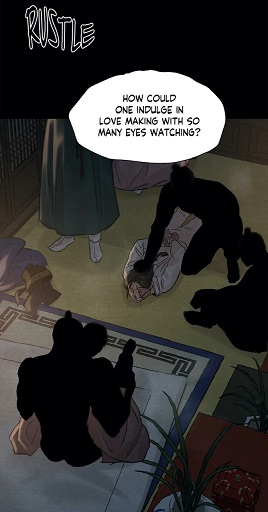 (chapter 86) She was the superior. Moreover, we saw the teacher walking through the countryside during the night.
 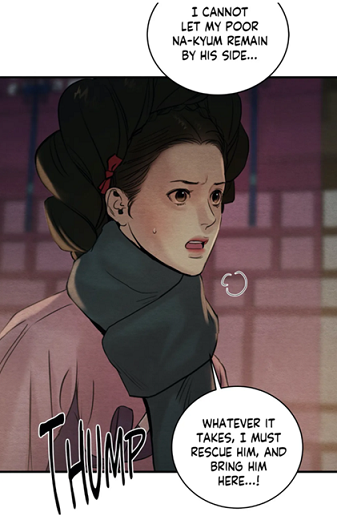 (chapter 69) It was done on purpose!! She wished that Min would take care of her brother. Under this new light, it becomes comprehensible why the noona has a drop of sweat on her cheek. She is faking ignorance, she is acting, as if she was very protective of her brother. She uses illusion to manipulate people. In reality, she was acting here. One might argue that I am overthinking again. This is not possible, for Heena didn’t know Min at all. Hence she couldn’t manipulate him. The latter had heard of her for the first time in Yoon Seungho’s mansion.
 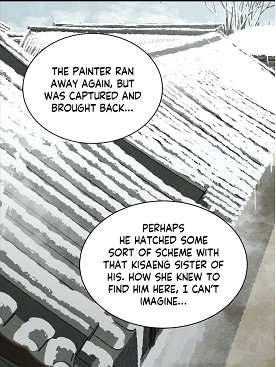 (chapter 66) But let me ask you this. How could Heena have never met Min, when she was the head-kisaeng? Secondly, just because the servant had never heard of the noona, this doesn’t mean that it was the case for Black Heart. The domestic assumed Black Heart’s ignorance, just like the readers. Moreover, recently I had detected that Heena had been standing in front of a mansion belonging to a noble.
 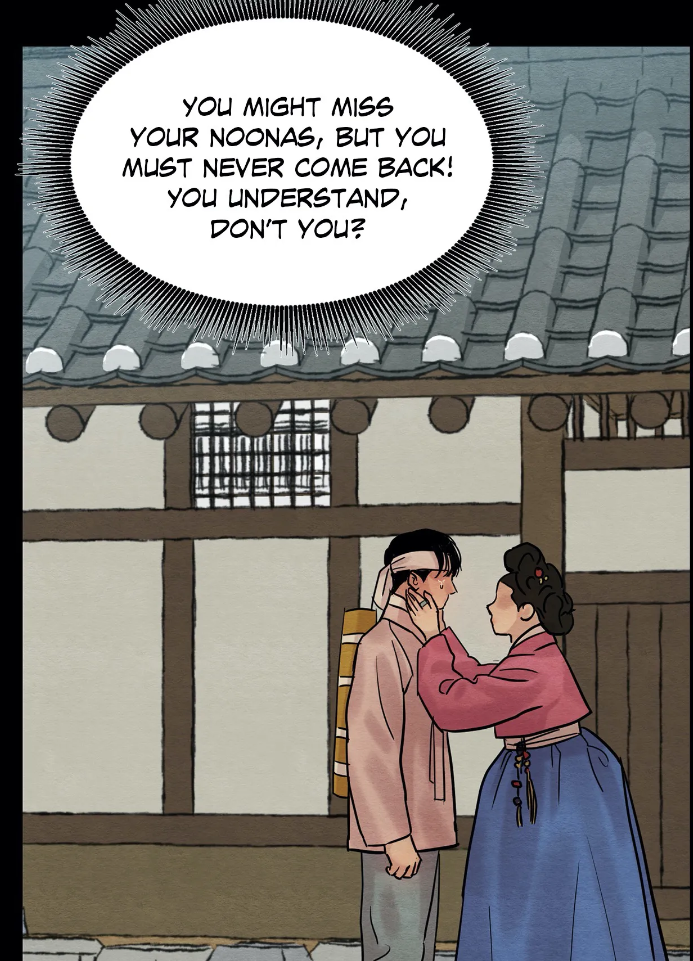 (chapter 46) This was not Yoon Seungho and Lee Jihwa’s mansion, for the gate and walls
 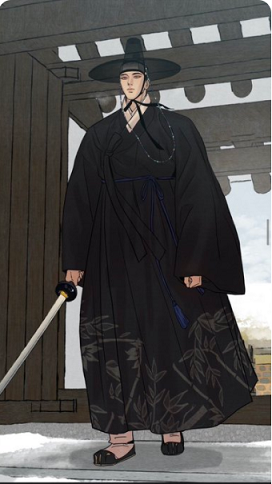 (chapter 67) diverge. Moreover, Min has been seen in the kisaeng house in so many chapters
  , (chapter 19)
  (chapter 59). Here, I would like to point out that in episode 59, Lee Jihwa had visited the kisaeng house on different occasions, for his hair was slowly growing.
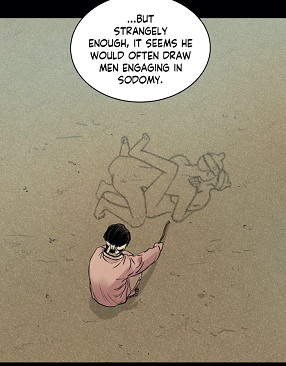 (chapter 1)
 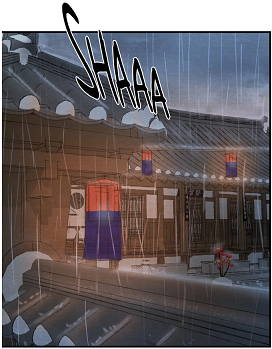 (chapter 19) This image was showing us that Yoon Seungho was visiting the gibang. However, pay attention to the pattern of the doors in the last picture and the next:
 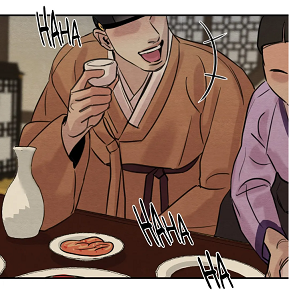 (chapter 19) The motive diverges, it looks like the one from the hallway with the purple veils. This means that the party was not taking place in the room shown in the former picture. What caught my notice is the presence of the white vase with the red flowers in front of the building. It was present in each scene taking place in the gibang.
  (chapter 93) For me, the red flowers symbolize Heena noona. This explicates why during the painter’s dream, the flowers were not present.
 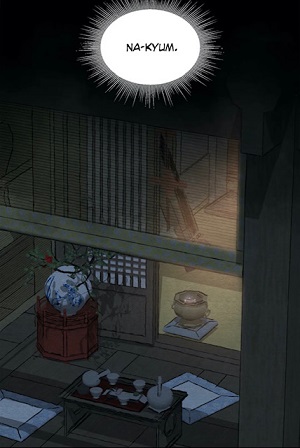 (chapter 87), as Heena was not included in his vision. And this image
  (chapter 44) Due to the similarities, I believe that in chapter 19, Byeonduck was actually exposing the ghost head-kisaeng. Exactly like the father, she was hiding. Why? It is because she is involved in Yoon Seungho’s suffering. And now, imagine her reaction, when she hears that Black Heart has organized a feast for the main lead’s honor. The woman could only avoid the main character. And now, you have the explication why Heena as the head-kisaeng was not present during that festivity. It was deliberate.
  (chapter 19) Striking is that the kisaeng had a similar hair dress than Heena, This is no coincidence. She was acting as the head-kisaeng. The manhwalovers will certainly remember that only two kisaengs had no braided bun or braids: this one
  and Heena. Look at all the others:
  (chapter 51)
  (chapter 93)
  (chapter 93)
  (chapter 95) The extravagant hair dress was exposing the kisaeng’s status. And now, you comprehend why the other noona explained the disappearance of Heena during that night.
  (chapter 19) But how could she sense that the noble was in a good mood? The latter was silent and not even smiling.
 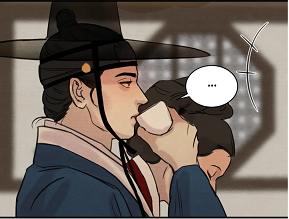 (chapter 19) How could she claim this? In reality she was actually spying on him. Heena had no idea why the lord would come to the gibang, especially after suffering there so much. The kisaeng’s task was to dig up information. This visitation must have bothered the head-kisaeng.
  (chapter 69) She was even turning her back to him. But actually, she could have detected his presence, exactly like I had recognized him: through his laugh!!
  (chapter 99) He was wearing a veiled hat, yet in chapter 69, this was not the case.
  (chapter 88)
 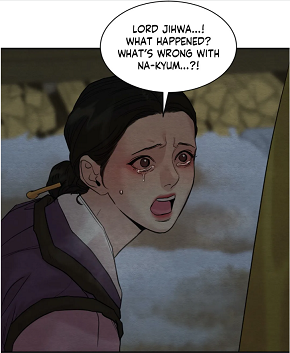 (chapter 99) Under this new light, Min’s words get a new signification:
  (chapter 99) He was implying that they knew each other for a long time! The irony is that the manhwaphiles had the impression that their relationship was recent, and his cynical tone contributed to it. Secondly, he called her Heena, a sign that they were close to each other. Note that Lee Jihwa never mentioned her name.
  (chapter 99) His words even insinuate that Black Heart had just given the following order. The red-haired master should just fetch a kisaeng and in my opinion, Heena was waiting for Lee Jihwa’s arrival to leave the gibang. According to his words, he had no idea about the kisaeng’s identity. But is it true? I have my doubts now, and this for two reasons. Why would he ask about her identity, when he already knows that she is a kisaeng? The drop of sweat on his face is an indication that he is lying. But the problem is to determine if the deception is only referring to “I heard not a word” and to all the questions. Let’s not forget that he knew about Min’s initial intention. The moment Lee Jihwa arrived in the gibang, she just followed him. That way, they would avoid to attract attention, and with her new hair dress
  (chapter 93), the gibang had lost its “leader”. This explains why this noona as her right-hand had to explain the absence of the owner.
 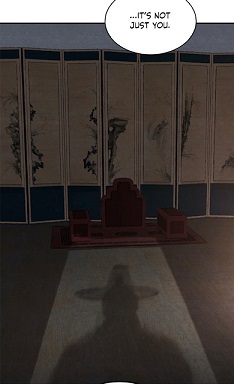 (chapter 86) The latter had been eyeing the throne in the family mansion, but he failed to take over the mansion. This was the negative reflection of Heena. Whereas the kisaeng had a powerful position in the gibang, it was the opposite for the patriarch. He was no longer recognized as the head of the Yoons. Yet, both have something in common. Both lost their position for good, for Heena and Yoon Chang-Hyeon couldn’t take or keep the seat. We could say that both got defeated by Yoon Seungho. In chapter 93, the main lead acted as a respectful and calm master, whereas in the bedchamber he showed no respect to his own father. He talked back and even made fun of him.
  (chapter 87) This picture stands in opposition to this one:
  (chapter 93) To conclude, the surrogate mother and the patriarch made a similar experience in season 3. Both got deceived by manipulations and in both cases, letters played a huge role.
 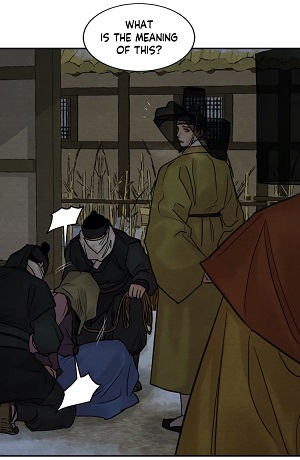 (chapter 99) No one would be looking for her. The problem is that the witnesses of her curtains all vanished. Lee Jihwa ran away, Black Heart got killed with his friends, and the only survivor, lord Jang, was confronted with real corpses in the shaman’s house.
  (chapter 102) That’s why I come to the deduction that her murder will be questioned. Why? There is no blood contrary to the bloodbath in the shaman’s house and there is no corpse!! Since Black Heart used different corpses in order to deceive Heena and the couple, there is no ambiguity that the head-kisaeng’s curtains will be doubted. Striking is that Heena staged her death out of cowardice and selfishness, while Yoon Seungho made the opposite decision. He was resolute to commit suicide in order to follow his lover in his death. During that night, Heena and Yoon Seungho lost their “home”, but at the end, he found his true home: the painters embrace.
 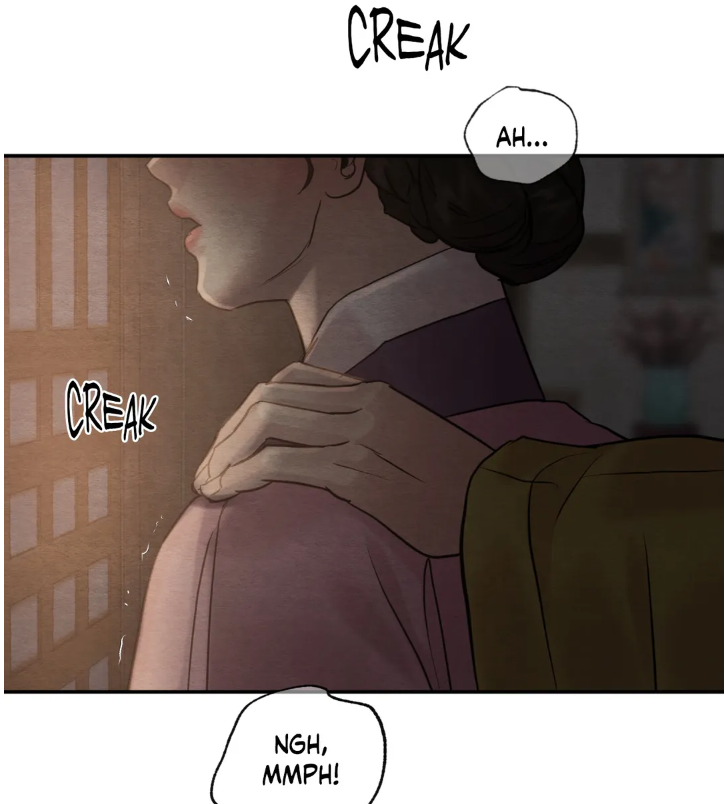 (chapter 96)
  (chapter 96), though he is a noble. Besides, I am suspecting her of suffering from genophobia (fear of sex and intimacy) Their behavior exposes closeness and a certain trust. But how is this possible? It is because she knows that Min is a sodomite, and he is not looking for sexual favors. That’s the reason why she trusted Black Heart in my opinion. Moreover, he is smiling like Jung In-Hun. Therefore it is not surprising that she was speaking like the Joker in chapter 97. Here, the man had actually projected his own thoughts onto Yoon Seungho, and due to her own belief, Heena was more than willing to believe Black Heart.
 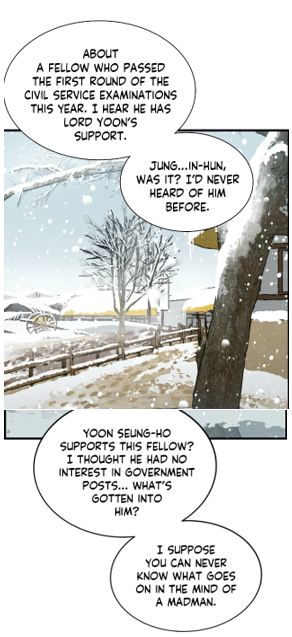 (chapter 52) It is because Black Heart knew Heena! I even believe that he had already met the scholar. Note that the man with the black hanbok was repeating the rumors about the learned sir. And the other questioned the main lead’s action exposing that he had never heard about this grapevine before. Hence I am deducing that the one spreading this rumor could only be MIN!! That’s the reason why he just said this
 (chapter 52) That means that the noble knew the teacher in the end. Therefore it is no coincidence that Min was aware where the learned sir lived!!
 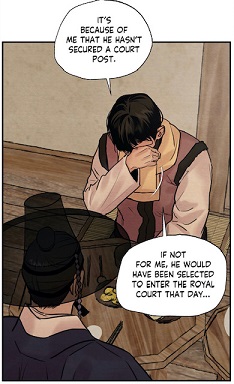 (chapter 52). Why? It is because there was an incident in the gibang!!
 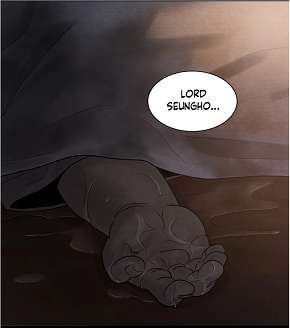 (chapter 94)
  (chapter 97)
 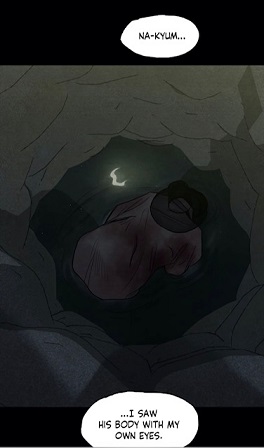 (chapter 97)
 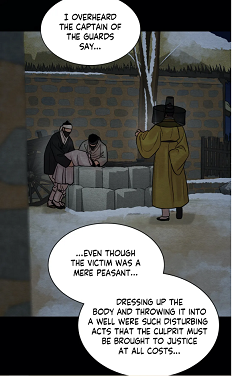 (chapter 101), and even Kim hid his face under a hanbok.
  (chapter 92) That’s the reason why I believe that in season 4, the visage will play a major role! The couple will recognize people due to the face!! In my eyes, the former head-kisaeng knows the identities of all the persons involved in Yoon Seungho’s suffering.
 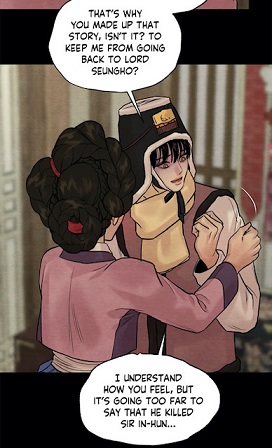 (chapter 97) her brother is detecting her deception.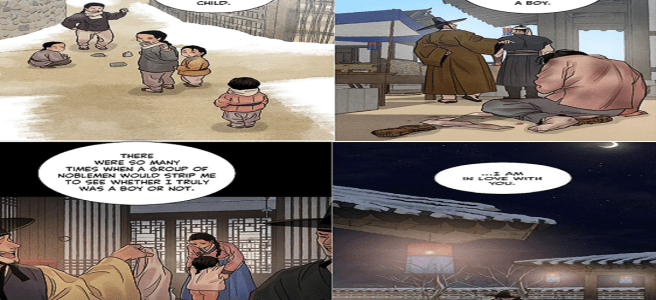
 The latter had given the poetry referring to exit to the painter as a farewell gift. Why was the lord thinking of Jung In-Hun in that moment? It is because he had read the letters from Heena and as such her accusation against him. He had killed the learned sir, hence in the lord’s mind, it was only a matter of time until Baek Na-Kyum would bring up the subject and decide to leave him. The letters are not destroyed, for he asked this to the painter:
  (chapter 94) Yoon Seungho had two reasons to expect such an outcome. First, it was related to Yoon Seungho’s offer to Baek Na-Kyum.
  (chapter 44) Secondly, Baek Na-Kyum had already showed to the main lead that he could leave him at any moment.
  (chapter 85) Finally, what mattered to the artist the most was the lord’s love and trust.
  (chapter 85) He believed in his affection while thinking that Yoon Seungho would keep his promises. But if there was a slight doubt about him, in Yoon Seungho’s mind, the painter would choose his noona over him, like he had experienced it in the study. To sum up, in the gibang, the lord was fearing the artist’s departure. Moreover, when the painter confessed his love to the noble, he was also leaving the scholar’s side. His path was no longer following the teacher’s. Thus when he said this
  (chapter 94), he was actually biding farewell to Jung In-Hun. He was moving on. Finally, if you include these panels from chapter 94,
 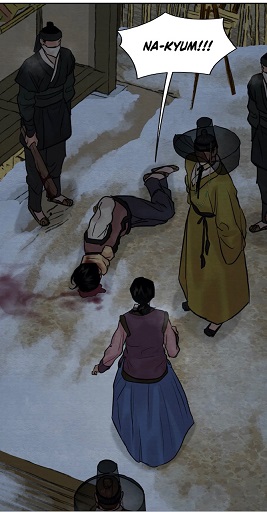 (chapter 99) In these two scenes, the painter got so hurt that he was bleeding. In addition, the painter’s hair was free. In front of Jung In-Hun’s house, the perpetrators had removed his headgear, while in the gibang, the white head-band was on the ground. To conclude, the painter’s short hair was visible. Don’t forget that the short hair was indicating that the artist was an orphan. So by removing the headgear for noblewomen, Min and the black guards made sure to expose that the victim was just a low-born without any family. But let’s return to our comparison. Min was wearing a similar hanbok than the noble in the gibang. Furthermore, the black guard resembles a lot to the aristocrat with the hunting outfit in the kisaeng house house. The painter’s white headband is now serving as a cover for masking the black guards’ identity. As you can see, due to these similarities, I came to the conclusion that this scene
 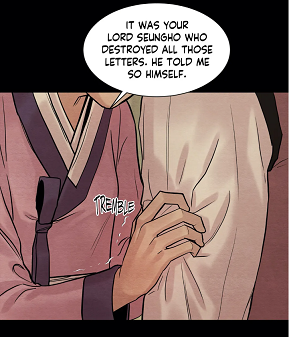 (chapter 97) Hence I deduce that this scene in the gibang (chapter 97) is a reflection of the incident in the painter’s youth.
 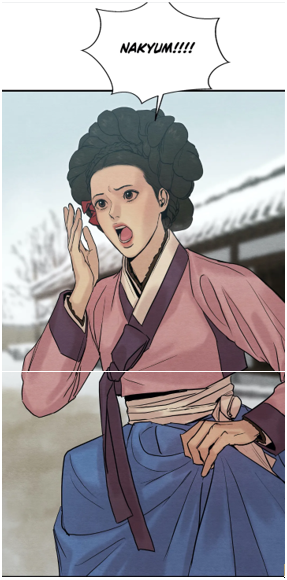 (chapter 65). Thus she gave more the impression of being righteous and truly concerned.
  (chapter 44) However, there exists a difference between the painter and the lord’s association for beards in my opinion. The latter suffered due to old men wearing a long moustache beard with whiskers.
 (chapter 82)
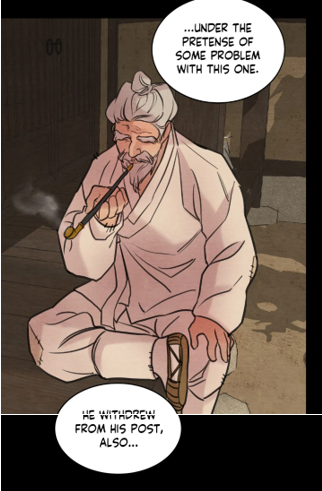 (chapter 37)
 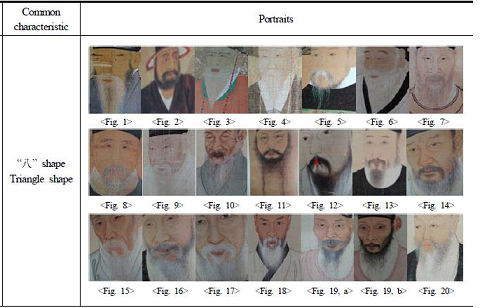 But there exists another style of moustache beard.
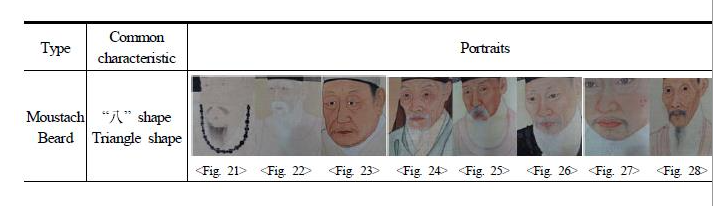 Striking is that Kim is also wearing such a moustache beard.
 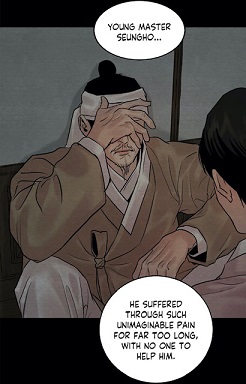 (chapter 87) However, so far in the story, this type of moustache beard was only present among commoners and not nobles!!
  (chapter 39)
 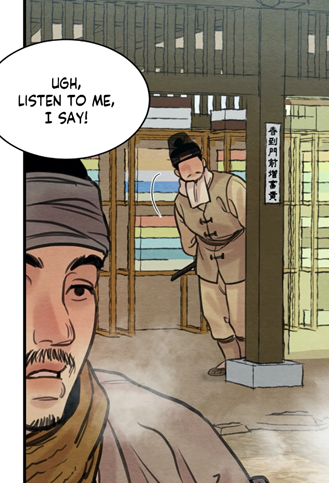 (chapter 45)
 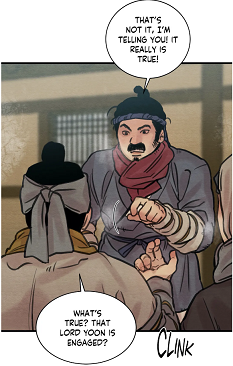 (chapter 45)
 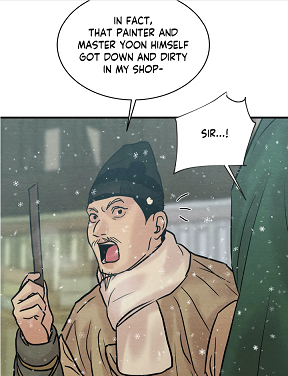 (chapter 64)
 (chapter 78) Hence I started suspecting if these two persons were truly nobles in the end.
 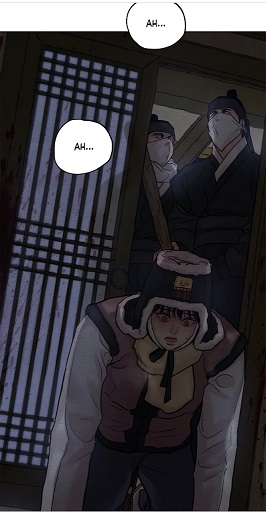 (chapter 99) so that he had been mistaken for a young master.
  (chapter 91). Therefore I came to the conclusion that the painter has repressed the link between the moustache beard and nobles. Since the noona kept saying nobles, what made Baek Na-Kyum shudder in the past were nobles. But the connection between the beard and nobility is existent in the painter’s subconscious. This explicates why Baek Na-Kyum would show such a respect to valet Kim, he would call him sir and listen to him.
  (chapter 52) However, the more time passed on, the more the butler kept pointing out that he was just a servant, so that this moustache beard is losing its meaning, the symbol for power and nobility. At the same time, the painter met more and more people with beards, like for example the tailor
 (chapter 74), the physician
  (chapter 74), Bongyong
  (chapter 78) and finally Yoon Chang-Hyeon
  (chapter 87). However, note that when the patriarch left, the main character only paid attention to his gaze and not his beard.
  (chapter 87) This explicates why Baek Na-Kyum is not mentioning the beard concerning nobility, while Yoon Seungho never made the connection between the old bearded men and Kim, though the latter has now a moustache beard! To conclude, I don’t think that this physical assault
  (chapter 99). That’s the reason why I came to the following theory. These persons wounded the painter on purpose and in my eyes, it was suggested by Heena.
  (chapter 13), the maid (though not intended)
  (chapter 36, here the painter is drugged against his will), Deok-Jae
  , Nameless,
 (chapter 60), Kim
  (chapter 66) [As you already know, for me Kim was the one who tried to kill the painter during the abduction], Bongyong
  (chapter 78), the calligrapher with his insults
  (chapter 91), the maids with their reproaches
  (chapter 91)
  (chapter 98) and the black guards from Min.
  (chapter 97), two commoners who neglected him totally. By the way, the one with the green shirt and white jacket vanished later. He was not seen in the mansion. Anyway, the two domestics wouldn’t even follow the lord’s orders properly, for they never stayed by the painter’s side. And since it is a reflection from chapter 94, I deduce that the two “nobles” acted the opposite. They played their role perfectly to the point that the painter was terribly wounded and he never doubted their identities. They were just nobles! And that’s the point. That way, no person was truly blamed for the incident.
 (chapter 46) This was the “positive” reflection of this scene:
  (chapter 46) Moreover, I am now doubting that Baek Na-Kyum and Heena were seen in front of the gibang.
  (chapter 69)
  (chapter 93) He had suddenly vanished without voicing such a desire before. And note that in chapter 97, she was already acting on Min’s orders, a sign that in the past, it was different. She had done it on her own accord. In the annex, the kisaeng was definitely scared, hence she was trembling.
  (chapter 97) She was totally unhappy which stands in opposition to chapter 46 in my eyes. Hence she was looking for new tissues at the tailor’s.
 (chapter 64) This would explain why she never looked for her brother afterwards. This shows that unconsciously, the painter had judged her betrayal and abandonment correctly, but he had been deceived by her argumentation and attitude. In other words, he was in denial.
 (chapter 87) So in this scene,
 (chapter 68) The blue skirt is revealing her presence. She is next to the door and observe that there is a table to her right!! Exactly like in chapter 94!
  (chapter 95) But there exist two other evidences why Heena is associated to the kitchen. Remember the painter’s thoughts in the inn:
  (chapter 75) They let see that he was thinking of Heena, though he spoke of his noonas. However, the presence of religion was introduced with food.
  (chapter 75) This truly exposes that Heena preferred working in the kitchen. That way, she could avoid sex with the clients. Another interesting aspect is that when she was sitting at the table with nobles, she was not talking to her neighbors.
  . (chapter 93) She was not even serving the noble next to her.
  (chapter 93) Once again, she was passive and immobile. Since she was doing nothing, she could hear her brother’s name and turn her head.
  (chapter 46) This was reflecting his past relationship with Heena. And now, you comprehend why Heena never paid attention to the painter’s education. She had not the time and the motivation to do so. She was busy in the kitchen during the evening and night, yet keep in mind that the painter was her excuse to keep her distance from the nobles in the beginning. This explicates why Yoon Seungho crashed the table in the gibang:
  (chapter 99) This was Heena’s karma. She could no longer use the table as an excuse to betray and abandon a young boy. Moreover, we could see this gesture as a compensation for the past incident.
  . (chapter 47). That’s the reason why I am connecting the kisaeng to the food. And I had already demonstrated that there exists a link between the gibang and the lord’s kitchen.
  (chapter 60) And now, we know for sure that the chicken blood was used to stage the crime scene in the scholar’s house.
  (chapter 101) For me, Nameless was behind this prank. It sounded so harmless, but the reality is totally different. Consequently, Heena can become the prime suspect in the scholar’s disappearance. Remember that according to me, Yoon Seung-Won went to the gibang after leaving his brother’s mansion and discovered that he had been deceived. For me, there is no ambiguity that Yoon Seung-Won and lord Song are behind the learned sir’s murder, for both had a huge interest for his vanishing. But in my eyes, Heena is the link between the nobles, lord Song and No-Name, because the kisaeng house is frequented by all kind of people. I have already mentioned that the learned sir must have gone to the kisaeng house after meeting the fake servant.
  (chapter 38) This encounter took place during the day, however he returned during the night. So he must have spent some time elsewhere. Because of the connection between Heena and the kitchen, I think, she will have to take the fall for No-Name’s crimes. Under this new light, I comprehend why Byeonduck declared that she had no longer planned Mumyeong and Lee Jihwa. Both were already receiving their punishment, when they fled. But since I detected a connection between Heena and No-Name, I am quite sure that she is also responsible for the downfall of No-Name. And don’t forget that during the incident in the bedchamber, we had a party!!
 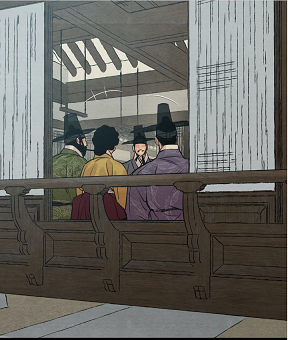 (chapter 83) Then I had already demonstrated that the kisaeng had already visited the mansion, for she knew where the painter’s room was.
 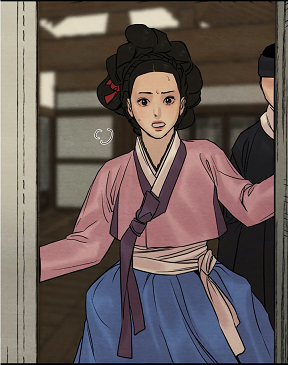 (chapter 65) So she could have worked in the kitchen… helping the other maids. To conclude, the kisaeng had committed the following wrongdoings. She had manipulated her brother with a mixture of belief and prejudices to cover up her own fears and wrongdoings. While in chapter 94, she stopped the painter from leaving the room unconsciously, it was no longer the case with Yoon Seungho, as she was standing in front of the door.
 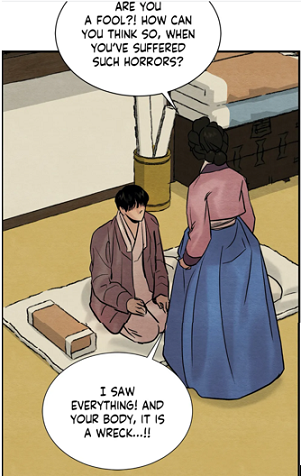 (chapter 68) For her, sex had become a synonym for torture and death. Her wrong choices reinforced her fears about sex in my eyes. Every time, she decided not to face the truth, she preferred being blind. Thus the goddess chose to punish her by letting her deceived by impressions.
  (chapter 66) Here, she couldn’t help her brother, though the “sequestration” was nothing compared to what Yoon Seungho had experienced at such a young age. She had deceived her brother in the past, and now she was put in the same position. She was the fool one. In addition, she was forced to be confronted with reality, because she needed to admit her wrongdoings. Since she was behind this assault
  . (chapter 96) She even got sequestered herself.
  (chapter 99), this means that her punishment will be that she will never see her colleagues again. Since she faked her death
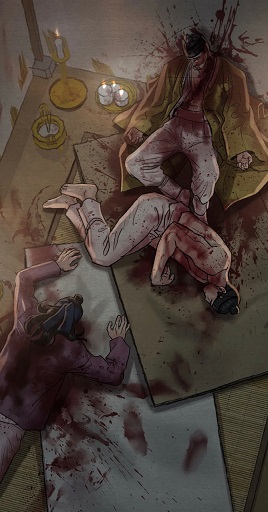 .(chapter 102) She is a Christian, hence she could be accused of sacrilege too. In my eyes, Heena will never be able to bid farewell to her brother again. His words in the mansion will become a reality.
  (chapter 68) Remember her metaphor concerning the gibang, it was viewed as a nest. She was already comparing her brother to a bird.
 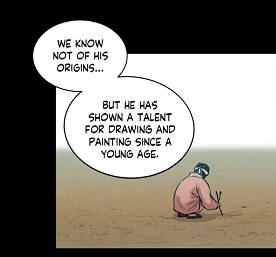 (chapter 01)
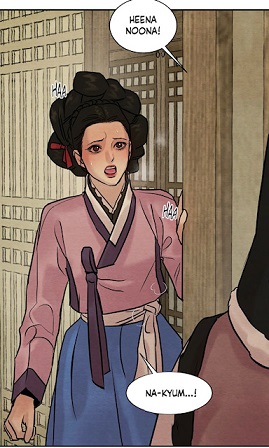 (chapter 97) Fake concern versus anger and resent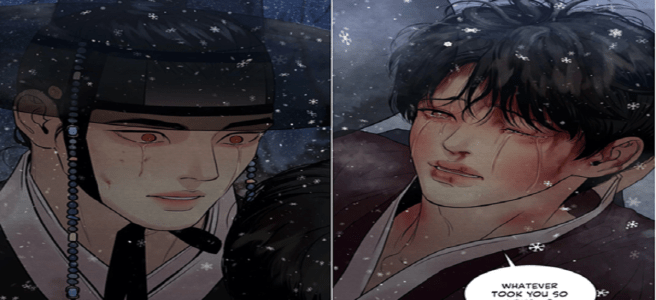


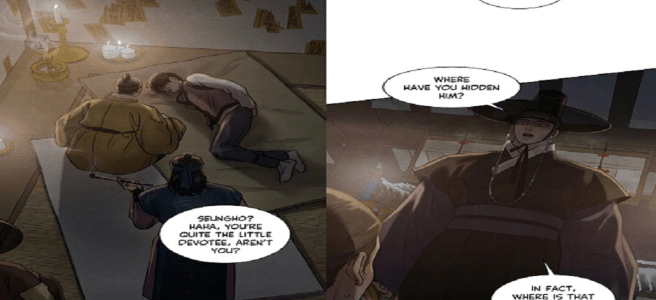
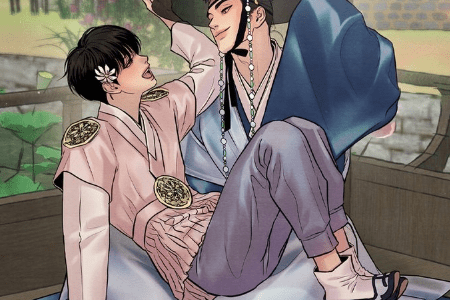
 (Chapter 83) But what was the vision telling to the main character? The problem with visions is that their message is never clear. It is up to the fortune-teller. The beholder can interpret the hallucination differently. Here, one might say that the blood let Yoon Seungho see that one servant, in our case Kim, was working against him with 2 nobles: Min and Jihwa. It was already predicting Min’s death, for the blood pond was touching the noble on the right, while the other nobleman with the hat is not connected to the blood. The red-haired master only lost his topknot a second time. This is no coincidence. The vision showed that Black Heart would die by the hand of 2 people, Yoon Seungho the child and Yoon Seungho the adult. Thus Byeonduck created such a panel:
  (Chapter 102) The lord was in a dissociative state. In his rage, the main lead was brought back to his own past, when he was a victim of gangrape.
 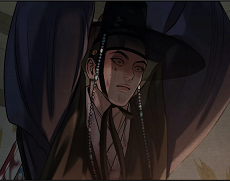 (Chapter 102) He was acting like in trance, the painter’s bloody face had opened the Pandora’s box.
 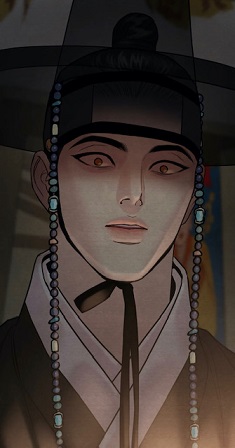 (Chapter 101) Remember his confession in the bedchamber:
  (chapter 55) Simultaneously, this vision
 (Chapter 100) But if so, this means that the domestic will die, after his master abandoned him and ran away. Remember that the blood spurt is linked to the person without a hat.
  (chapter 86) And if I consider that this vision is referring to Kim, then it already announces his doom. Another possibility of interpretation is to say that the boar embodies the king, which Yoon Seungho defeats by removing from his side Lee Jihwa and Min, both were used as tools to control and tame the main lead so that he would remain by the pedophile’s side. This means that the moment he executed Black Heart and cut off the friend’s topknot, he was finally able to escape from the ruler’s claws. And if the noblemen are referring to the elders, the message doesn’t change. The moment the main lead killed Min, he wounded the king so that the elders are affected, one more than the other. And Kim didn’t stop his young master, for the butler thought that with his suicide, he could finally free himself from his task of taking care of Yoon Seungho. With his suicide, Kim would be able to live in peace. He would no longer be tormented by the main lead’s suffering. In his mind, his suicide was the natural outcome of such a long suffering. As you can see, this hallucination can be interpreted so differently. And the more information we will get in season 4, the more precise the interpretation of this vision can become.
 (Chapter 28) As you can see, blood and a mirror were used as objects for “fortune-telling“, though the main characters had no idea about their signification. While the painter rejected this “hallucination“, Yoon Seungho had the impression that it was real. Thus he turned around. He imagined that the two nobles were approaching him.
  (Chapter 83) I have always said that Yoon Seungho and Baek Na-Kyum are shamans, but they have no idea about their true identity. This means, none of them considers himself as a fortune-teller, though both have this gift. They have no one telling them about their skills, they can predict the future and even repel evil spirits.
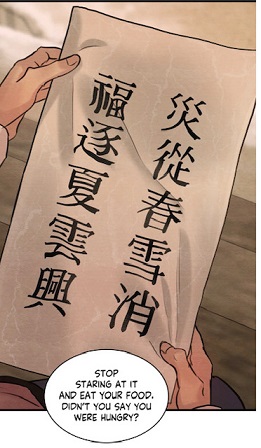 (Chapter 92). Keep in mind that since the lord wrote a poem in season 3, this means that he must have done it in the past too, but this twice. In season 1, he wrote one, when he switched the paper, yet it must have occurred before, for we had two circles, which corresponds to two full moons. My friend Luzyla brought my attention that in the whole story, Byeonduck only drew one full moon, and this in chapter 1. This announced the beginning of a new circle!! The third one and observe that the moon was far away, very high up in the sky, while the night sky was very dark.
  (chapter 102). Their trust and love had been tested, thus I am assuming that season 4 will be the beginning of the 4th circle, where the protagonist will face the main culprit for his suffering: the mysterious lord Song, the king.
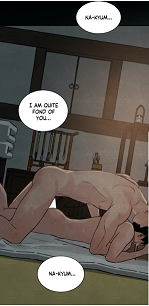 (chapter 56), and it became a reality.
 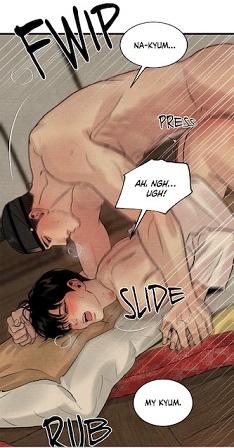 (Chapter 91) But the artist never accepted these visions, for he was rejecting sodomy and later he was in denial about his affection for the main lead. Yet this is no longer possible. The artist has already confessed and is determined to remain by the noble’s side, no matter what.
  (chapter 74) Here again, we have an allusion to the bloodbath in the shaman‘s house, for the position of the hands reminds us of Black Heart’s reaction before the main lead stabbed him.
  (chapter 50) and Baek Na-Kyum‘s nightmares in the bedchamber.
 (Chapter 34) and
 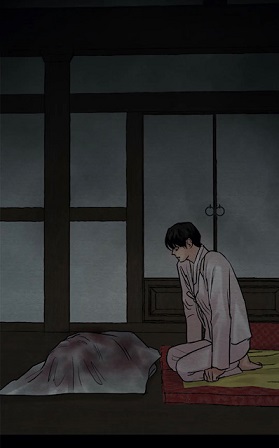 (Chapter 98) In the last one, he believed to see the scholar’s corpse. The artist had even an auditive hallucination.
  (Chapter 98) This means that a similar situation will occur. Someone will repeat Jung In-Hun’s words.
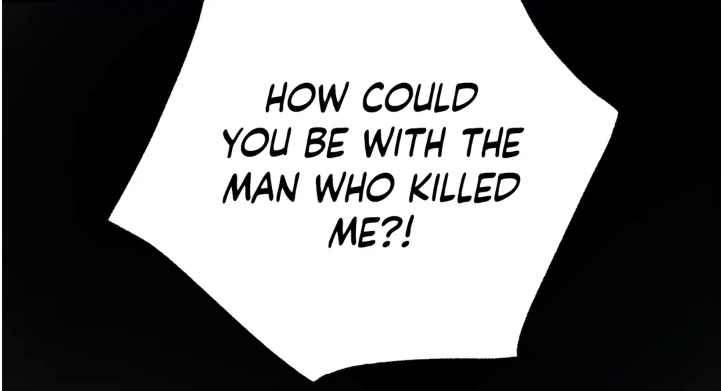 (chapter 98) How could he be with the man who killed his family (for example Heena)?
 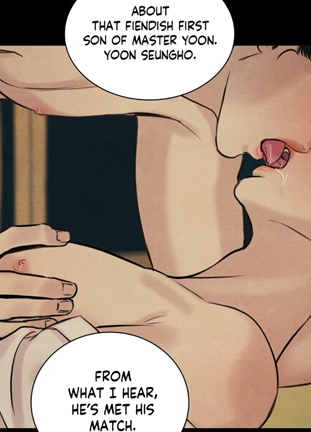 (chapter 45) Yes, in chapter 45!! How did I come to this conclusion? The first clue is the black frame.
  (chapter 45) Byeonduck always uses it in order to indicate that we are dealing with a memory or a dream. Secondly, in this scene we are supposed to see Baek Na-Kyum with his lover, both kissing tenderly, yet in the same chapter, the author let us see the reality of their interaction.
 (chapter 45) The painter was more acting like a robot, he was not able to procure pleasure to Yoon Seungho. He was not talented. As you can see, the introduction allowed us to see the dream of a fortune-teller concerning Yoon Seungho and the painter. But wait…
  (chapter 45) Who is who here? In this image, the artist is lying on the bed, he is recognizable by his slender and smooth leg and his thin foot. The lord is on the top, the beholder can identify him with his bigger and rounder butt. However, in the second picture, their position is switched.
  (chapter 45) But don’t forget that we are here dealing with a premonitory dream. In my opinion, the lock of hair is implying that Baek Na-Kyum will be wearing a topknot in the future, similar to this situation:
 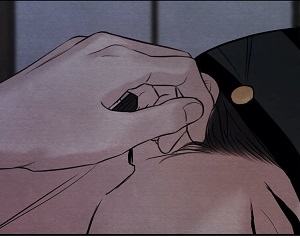 (chapter 87) This means that the person saw in this dream that Baek Na-Kyum would become the lord’s partner, and he would even be dressed like a noble (a topknot and white pants). Don’t forget that in season 2, he was still wearing grey pants and not white.
  (chapter 46) And this vision came true in season 3:
  (chapter 79) This is the same position, but from a different perspective.
  (chapter 45), a rumor started that Yoon Seungho had a fiancée. Thus Kim chose to spread rumors in the village to kill the grapevines about the existence of Yoon Seungho‘s fiancée with another gossip. He used Jihwa and the incidents in the past… One might argue that it is not possible, because it looks like the rumor about the existence of Yoon Seungho’s sodomy existed before than the presence of a fiancée.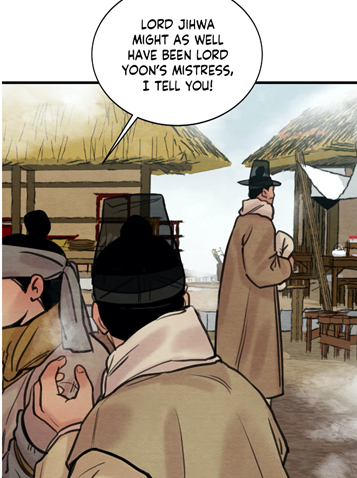

 (chapter 45) The owner of the stand is sitting and he has a white scarf, but in the next panel, the person is standing, and has a red scarf.
  (chapter 45) Moreover, the headcover on one player is much slightly darker. This is another indication that there could be a time jump between these two panels. But one might argue that the rumors about Yoon Seungho’s homosexuality were existing before the grapevines about the fiancée.
  (chapter 45) But not necessarily. Imagine, the butler had such a dream, and his memory got triggered, when he heard the commoner talking about the incident with Bongyong for the first time. But don’t forget that the man is a traveling merchant, so in the butler’s mind, the trader would leave the town and as such he wouldn’t be able to mention this to others. But he never imagined that the man would meet his friend.
  (chapter 45) In order to ensure that no one would take this rumor seriously, Kim made sure to spread the rumors about Lee Jihwa and Yoon Seungho’s sexuality.
 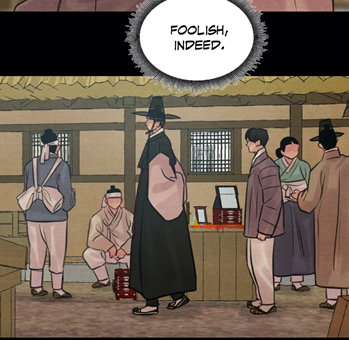 (chapter 40) His joke with the red dot was not even noticed by the woman and seller of the mirror!! Both were totally indifferent. Though he had made a joke, his action had caused no wave. Besides, we should question why the man would say that even dogs would know about his homosexuality. This implies the intensity of the grapevines. It displays that someone was deliberately leaking this information to the outside. Furthermore, one witness is saying that Yoon Seungho‘s affairs used to stir up the village… when did it happen?
  (chapter 45) Moreover, which affairs was he referring to? He has no idea about the masturbation in the tailor’s shop and the red dot on the painter’s face. As for Lee Jihwa’s humiliation, it was definitely not leaked to the outside as well. Besides, remember the comment from the red-haired master’s servant.
 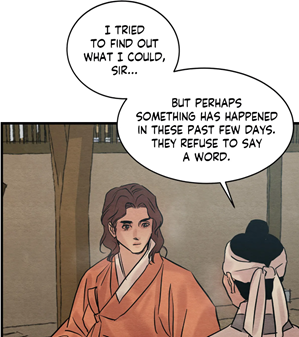 (chapter 41) Striking is that
 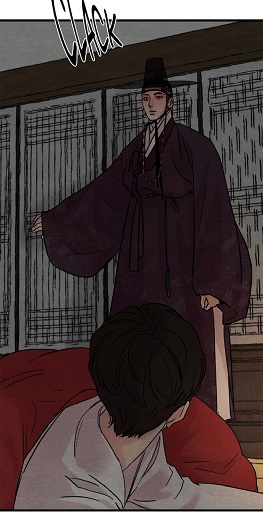 (chapter 34)
  (chapter 45) Here, Baek Na-Kyum had just returned to the mansion after his second desertion.
  (chapter 52) The lord had kept his distance from the artist for one week, though I believe that he still came to see him
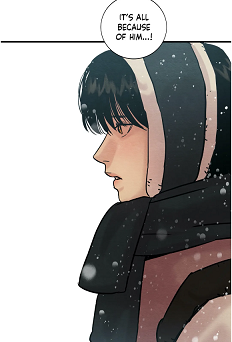 (chapter 51),
 (chapter 51) for the painter’s scarf was put on the way Yoon Seungho did in the courtyard in chapter 69.
  (chapter 69) And now, you comprehend why Kim criticized the painter in the courtyard. The lord would come to see him ensuring that he was well covered. The butler had every reason to view this dream
  (chapter 45) Now, I have the proof for this interpretation. The guardian was on his way back to the gate, so why did the valet ask him to bring the items to the painter’s study? Actually, Kim could have done it himself, it is not so that his master was waiting for him or had been requesting his presence.
  (chapter 45) Now, you are probably thinking that this essay has reached an end. But no… Why?
 (chapter 87) What if the butler had been saying the truth? He had no idea what was going on inside the room of the kisaeng house. But as an outsider, he observed this. Nobles were going to and from lord Yoon’s chambers. The readers had the impression that the young master was getting raped in the bedchamber. Yet, like I had pointed out, this is definitely not true, for the teenager was dressed.
 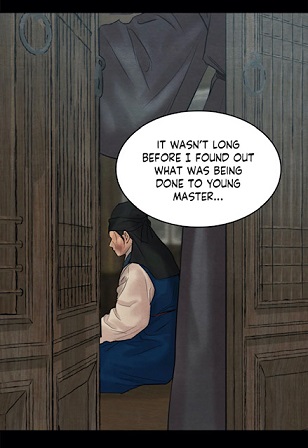 (chapter 87) We could detect the presence of a stock, this means that in the bedchamber, he was physically abused. And the butler could have jumped to the wrong conclusion, exactly like in this scene.
  (chapter 77) However, like mentioned before, the protagonist was under the influence of a drug. So in his eyes, it was, as if the young boy had been the one kissing Lee Jihwa. Because of this scene, he assumed that the two boys were fooling around. He jumped to the wrong conclusion that Yoon Seungho was a sodomite, something Kim truly abhors. So my idea was that the butler could have made the same mistake concerning the bedchamber: he made an assumption, and he jumped to the wrong conclusion that Yoon Chang-Hyeon was treating his son as a prostitute for his own greed and ambition. Because of these two expressions “assumptions” and “wrong conclusion”, I started researching for this. And this is what I found:
  (chapter 17) This is an expression that he would often use. We could witness this cognitive distortion (should statement) in front of the shed.
  (chapter 77) This explains too why Yoon Seungho is called a black sheep, a bird of misfortune.
  (chapter 68) But here, like I pointed out before, he was excluding himself from this incident. Let’s not forget that he had been the one dragging him to the shed.
  (chapter 57) He had been ill, since he was very young. But the physician mentioned the good notoriety about Yoon Seungho: he was intelligent. Striking is that Kim has never mentioned this. Either he is not aware of this, because he only met the protagonist after hearing the negative comment from the father, or as a person suffering from cognitive distortion, he is only remembering the negative aspects. I had already exposed that this was not related to sodomy, for sexuality was not relevant, when he was just a child. From my point of view, Yoon Chang-Hyeon saw in his son’s questioning and critical thinking a problem. He was not respecting the elders, and Kim is definitely a reinforcer of social norms. From my point of view, the drug administrated was not to treat him for sodomy, but in order to obtain his obedience. We were all assuming that the visit to the doctor must have occurred after the stolen kiss, but it could be the opposite. Why? It is because the physician revealed the valet’s second visit which occurred after the incident in the kisaeng house.
  (chapter 57) And now, imagine this. What if the purpose of the drug was to make Yoon Seungho submissive? Thus the young boy was smiling, and doesn’t remember the stolen kiss. Striking is that cognitive distortion has an impact on memory, it can create distorted memories. And this would confirm my previous assumption that here, the butler was mixing two memories together.
  (chapter 65) Since the butler has always been expecting the worst unconsciously, I am suspecting that he is the one who offered Yoon Seungho to the king! That way, he imagined that his master would be protected, unaware that he had never been forced to have sex before. There’s no ambiguity that his cognitive distortions led to Yoon Seungho’s suffering. Hence the father and the king will be quite surprised when they discover the verity. Kim badmouthed the main lead calling him a bird of misfortune, though lord Song views him differently, as he keeps sending him hanboks with cranes and phoenix, asymbol for good fortune.
  (chapter 87) He was talking about himself here. For the valet, there’s only one solution: “Out of sight, out of mind!” Hence he hoped that the father would take away Yoon Seungho from the mansion.


 (Doctor Frost, chapter 180) As you can observe, fear and hatred are the main components for unleashing agitation and violence. But this can only work if the medias are amplifying these emotions. Yes, I am talking again about propaganda. And today in the newest episode, the commissar used the fire as a metaphor to describe the evolution of terror.
  (Doctor Frost, episode 183) This means that you can stop the fire from spreading, if you observe the fire path. In other words, if you pay attention to the evolution of the hate crimes, you can slowly put an end to the climate of terror. Important is to find its origin. Then she added this. The fire becomes the most effective in the winter forest.
  (Doctor Frost, chapter 183) Here the manhwaphiles should see the forest as a symbol for society and humans.
  (Doctor Frost, chapter 183) This signifies that the people will get easily influenced by their fear and rage, if there exists a cold climate. A society without compassion and affection. And with only one spark, the forest can get destroyed. This signifies, the absence of love and understanding play a huge role in creating an environment full of hatred and violence. This is not surprising that because of the Coronavirus, intolerance and violence are on the rising, since people are getting more and more isolated and scared. And now, here is the next question: What symbolizes the winter forest in Painter Of The Night and more precisely in episode 93?
  (chapter 93) On the other hand, many readers were greatly disappointed by Yoon Seungho’s behavior. He had prevented Heena from meeting her brother, and the painter was left in the dark. But the lord had also sentenced her to seclusion.
  (chapter 93) In their eyes, he was indeed a hoodlum or a bastard. According to the blogger
  (chapter 93), while the noonas and the artist are sitting in a comfortable room. Hatred versus love… even the colors in the picture reflect the true emotions of the characters. Now, it is time to elaborate my interpretation.
  (chapter 93) Her question reminded him of Yoon Seungho, therefore the artist looked for him, and got surprised, because he didn’t see his husband by his side.
  (chapter 93) This scene is important for two reasons. First, the behavior of the kisaeng clearly showed that she had been left in the dark as well. She was not lying, as there was no drop of sweat on her face. While she had no idea where her brother had been this entire time, Heena knew this the entire time!! 😬 But she kept silent and as such, she hindered her sisters to meet the painter as well. But this doesn’t end here.
  (chapter 68) Heena put the whole blame on the painter, though the latter had been following her orders. She showed no understanding contrary to her sister. Besides, since she knew where he was, why didn’t she contact him in the end?
  (chapter 76) Back then, Nameless had been confronted with reality: the protagonists were just two men in love and their affection was deep and genuine. So imagine what it meant for the lord, when he saw this scene in the shadow:
  (chapter 93) There’s no doubt that he was seeking for their approval. To conclude, he remained in the background in order to judge the kisaengs correctly. Would they behave like Heena or not? In fact, Yoon Seungho had made a jump of faith. He had trusted the painter’s heart. However, he couldn’t let Heena ruin this happy reunion. Therefore she got excluded. She could have made a ruckus.
  (chapter 93) In her eyes, he was a handsome man. Another fell under his spell as well:
  (chapter 93) This is important, because this shows that the kisaengs are not thinking like Heena at all. They don’t resent him, because he is a noble.
  (chapter 65) I would even add that they couldn’t recognize him, and I am now assuming that they had not heard about Yoon Seungho yet. They couldn’t put a name on him, he was just a fancy companion.
  (chapter 93) In the first version, I had blamed Heena, yet I have to admit that I made a mistake, because I had paid too much attention to this image.
  (Chapter 93) Here, they whispered quite loudly and actually blamed the noona for her negative description. But this declaration contradicts the previous one.
 (Doctor Frost, chapter 175) It created the illusion that Heena had been badmouthing Yoon Seungho and desired to obtain the support from her eonnies. But who had called him a rake and a pervert? The noona herself!
  (Chapter 93) However, they were just repeating what they had been told. Hence it didn’t work. Why? First, it is, because the painter appeared alone. They could see with their own eyes how well he was doing.
  (Chapter 93) Naturally Min!! How do I come to this conclusion? Simply by recollecting his words in the tavern:
  (chapter 93) He was actually portraying himself as an immoral person lacking in sexual restraint. He would not know fidelity. But the moment the kisaengs got caught, the lord proved their words wrong. He remained calm and treated them well despite the insult.
  (Chapter 93) He made no fuss and accepted their apology. The most striking is that he ended up apologizing to the noonas.
  (Chapter 95) The manhwaphiles should recall the following rule: a scene will be reflected in the next episode. There is no doubt that the valet was the one who ruined the Yoons in the end by causing mistrust and jealousy. He destroyed the family. Therefore Kim sent the ruined painting to the father, and even refused to give the letters from the brother. He made sure to create misunderstandings, silence and tensions between the Yoons, portraying each of them like a monster or a selfish and common brute. This is not surprising that for the father, the son is a monster:
  (chapter 86) Kim was successful, for he could change their personality entirely. He used social norms, people’s superstitions, fears and flaws to his advantage. Why? It is because he had to hide his own wrongdoings and betrayals. That’s the reason why the lord’s mansion could be considered as a winter forest as well. But since Heena resents powerful nobles, her negative emotions and her bias made her the perfect tool for the next scheme. But Min and Kim failed. Why? It is because they had two different approaches: The valet preferred using the scholar‘s death for the smear campaign, whereas Black Heart wished to destroy the affection and trust between our beloved couple. Moreover, since the noonas had stopped Heena from approaching her brother with their warm welcome, the kisaengs‘ attempts to ruin the relationship between Yoon Seungho and Baek Na-Kyum were rather half-hearted. The noonas were lacking determination and stubbornness.
  (chapter 92) The lord saw that the painter was looking elsewhere and his gaze was full of longing. Secondly, he had promised his lover to fulfil all his wishes.
  (Chapter 91) He didn’t want to break his promise. I am wondering if this idea was not suggested by the butler, because the meeting in the inn was no coincidence. The noble Min made sure to trigger the painter’s memory with the presence of the kisaeng and the blue-lavender hanbok. As you can see, Yoon Seungho didn’t have much choice in the end,
  (chapter 92) However, at some point I began doubting this, for for the green shade is a little different. Moreover, I was reminded of this panel:
  (Chapter 59) On the other hand, Min appeared later as the doppelgaenger of Lee Jihwa.
  (Chapter 66) The Joker could serve as a witness, and Black Heart couldn‘t lie at all, as he needed to keep his trust. Besides, it is possible that he must have noticed the disappearance of the Spring poem. Don’t forget that it had vanished in the inn, and Min was the last one seen with it.
  (Chapter 92). Their sudden meeting could be the reason why he disappeared.
  (chapter 93) Now, they know that the young painter lived with the scholar. How come? Baek Na-Kyum didn’t tell them, because the noona asked him this question. This means that she wanted a confirmation. And now, we have to question ourselves this: who told them about the painter’s past? One possibility is that it was Yoon Seungho, but I doubt it, for the noona didn’t recognize him outside. From my point of view, the noona had left her brother’s side. There was a time jump, because the kisaeng was now wearing a different skirt, khaki!! This means that now, she was acting on the order of someone. Like mentioned above, it could be Min via the other kisaeng. But there exists another eventuality: the Yoons! Don’t forget that khaki is the color of Yoon Chang-Hyeon.
  (Chapter 44)
  (chapter 57) Besides, just a few episodes ago, he had mentioned the scholar and the civil service examinations, and the story is following this rule: the next chapters will reflect the previous ones. Moreover, in season 2 and 3, the father was seen in the kisaeng house. Finally, in front of the learned sir‘s home, the manhwaworms could identify the guards from the patriarch.
  (chapter 93) What could the noonas say to this answer? They couldn‘t call the main lead a liar! And note how he introduced himself:
  (Chapter 69) But like I had explained, this menace was voiced by Kim, which was only validated by Yoon Seungho afterwards. And naturally, this threat had been revealed to the schemers: Min and the patriarch. They all imagined that the main lead would punish Heena for her accusations. Kim had experienced this scene in the courtyard
 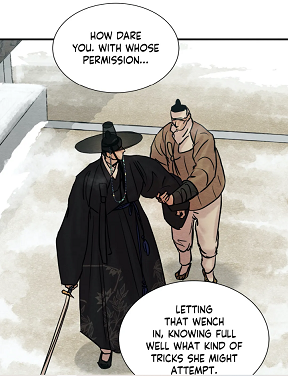 (chapter 68) He had taken these words as face-value. But he never recognized that the main lead would never use violence against Baek Na-Kyum‘s family, and this was already perceptible in chapter 68. He never barged in the study, when the noona called him a bird of misfortune.
  (Chapter 68) He respected their privacy, the opposite of the butler.
  (Chapter 85) This explicates why the kisaengs blamed Heena for the rumors.
  (Chapter 93) This gesture (blowing the candle) outlines that he was indeed trying to stop the fire, a symbol for hatred and fear, from spreading.
  (Chapter 93) This time, the noona had no longer the hat, but she was wearing the orange skirt again. The only explanation is that she had left the room. Since the kisaengs had no drop of sweat on their face, their admiration and surprise were genuine. But now take a look at this
  (chapter 93) We have the return of the hat! Moreover, another detail caught my attention: the paper is blank! Where are the calligraphes? One might argue that it was too difficult for the author to draw them, but I can only refute this point by using this scene.
  (Chapter 36) Here, the handwriting was even smaller compare to this calligraphy:
  (chapter 65) First, the noona couldn‘t see her brother‘s painting, until Kim showed her the picture with Jung In-Hun which he had kept!
  (Chapter 65) Kim was embarrassed in that scene, like the drop of sweat indicates it.This was the negative version of chapter 93. Don’t forget that Heena had been manipulated by Kim, when she visited the lord’s mansion. The latter had shown her the painting from the painter and then he must have told about the flashback in the bedchamber and the second marathon session in the shed.
  (chapter 4) and he had never returned it. He had replaced it with another sijo, according to me with the original sijo.
  (Chapter 7) It doesn‘t matter, if the scholar had deceived the painter. The latter viewed the paper as a treasure, a memory from his learned sir.
 (Chapter 93) The father was mocked for his dream!! He was portraying the elder master as a poor and weak noble! He was even compared to the learned sir. We have two proofs for this signification:
  (chapter 86) This was the father‘s karma. He had insulted his own son, made him feel little and even jealous
  (chapter 86) Remember that karma will always retaliate shortly, and the punishment will be even worse. The irony is that the lord was actually repeating the butler‘s words!
  (Chapter 93) This symbolizes that she was not acting here. The drop of sweat on their face showed their embarrassment. They could not deny his statement, for the learned sir was indeed poor and with no connection. They anticipated that the lord would boost about his talent, but no he was showing humbleness. On the other hand, he outlined his wealth and power, which the noonas couldn’t contradict. His words were indeed reflecting a certain reality. Another important detail is their reply to the lord‘s statement: the points of suspension which I connect to the butler. Since chapter 77, the latter had switched loyalty and was now serving the elder master Yoon.
 (chapter 69), and back then the lord had showed leniency. However, Heena didn’t want to acknowledge his benevolence. Thus she sent letters to her brother, in which she called Yoon Seungho many names: a rake, a hoodlum, a bastard and finally a murderer…
  (chapter 93) One might bring up the freedom of speech, but there’s a reason why in Germany total freedom of expression is not allowed. During the Republic of Weimar, parties were authorized to announce their hatred for democracy and republic. The result was that right-extremist parties as such the NSDAP led by Hitler became more and more powerful. This is no coincidence that this republic vanished. The NSDAP could spread fear and hate against democrats, Jews and other minorities. Hate speech encourages hate crimes. Yes, this is the consequence of the butler’s philosophy: “don’t take it to heart”. This saying symbolizes indifference and as such passivity and silence which contributes to create the perfect climate for hatred and fear.
  (chapter 91) They didn‘t go to the calligrapher right away. One week had passed, since the elder master Yoon had visited the mansion. This signifies that Heena is forced to face the consequences of her past actions.
  (episode 9) The real culprit had sent him letters each day for years… The content of the correspondence was always the same:
  (episode 9) That’s how he got brainwashed and convinced that he had indeed committed a crime. In jail, he was isolated and due to the suffered injustice, the prisoner definitely suffered from an emotional and mental breakdown, explaining why he was receptive to manipulations. That’s why you see the mouth and the letter together. So imagine that Baek Na-Kyum had read all the letters and all of them were saying the same thing over and over again. Since the painter is someone with a low self-esteem, he would have started doubting his own judgement. This is gaslighting. Naturally, Kim never intended him to read them. The whole purpose was to create a quarrel in the couple. I am quite certain that Heena never asked about her brother’s well-being. She was already convinced that the lord was a rake and a bastard. Her letters were full of contempt and hatred, something Yoon Seungho could sense in the correspondence.
  (Chapter 69) And who was there during that night? Black Heart. This is important, because in the first episode, the noona had badmouthed the main lead, but she was well aware of the truth.

 (chapter 175) Because of this comparison, I couldn’t help myself thinking of the water vapor as the grapevines in Painter Of The Night. They’re everywhere and no one can stop them. And now, you comprehend how the noble’s reputation got ruined.
  (chapter 175) That’s how hatred and contempt were spread. And Lee Jihwa listened to them, this is no coincidence why his mind and heart got poisoned. As long as he remained by Kim and Min’s side, his heart and mind would always be clouded. This means that Yoon Seungho was able to stop a fire, before it ruined the winter forest. People were upset, for he had such a cold gaze, when he remembered his interaction with Heena.
  (chapter 93) But he was just mirroring the schemers‘ thoughts and gaze. He had to remain cold. So what does Heena’s isolation mean? Yoon Seungho has no idea, but he is clearing her mind from the brainwashing.
  (Doctor Frost, chapter 183) There exists two methods. First,
  (Doctor Frost, chapter 183) And we could clearly detect this in the confrontation between Heena and Yoon Seungho:
  (chapter 93: In the Korean version: Your little brother will be with me now) For Heena, the painter should live with the scholar. This was her faith:
  (chapter 46), though I am quite sure that it was in truth her biggest wish. She was in love with the learned sir herself. By looking him in the eyes, she could detect the lord’s determination and frankness. This was his choice. The problem is with deprogramming is
  (Doctor Frost, chapter 183) That’s the reason why nowadays, psychologists prefer the other method
  (Doctor Frost, chapter 183) And now, you comprehend what happened. The deprogramming didn‘t work out, for Heena was approached by the schemers again. They used another noona to deceive the sibling, for they could no longer use the women close to Baek Na-Kyum. Thus Heena was still under the influence of the haters.
  (Chapter 98) Since she resents nobles, I deduce that the so-called witness was a commoner. In my eyes, it can only be Kim who justified his silence by saying that he could do nothing. He was the only one who knew, because the other had been already killed.
  (chapter 93). Hence their punishment for their deceptions couldn‘t be so harsh.
  (Chapter 99) was quite strong. In this scene, they had sided with the kisaeng again, hiding the fact that they had seen leaving Heena with Lee Jihwa. They knew that the kisaeng was running away from the gibang, for she was not dressed up.
  (chapter 80) Heena could have pushed away his hand, her movements were not restrained
  (chapter 93) Secondly, he introduced his partner to his family properly.
  (chapter 93) It is here necessary to contrast this introduction with this one:
  (chapter 01) In the beginning of the story, the protagonist was not presented as a lord, but as a master!! This means, he belonged to the Yoons. However, Baek Na-Kyum is now viewing the protagonist as the real lord of the mansion. He is independent, which means that the artist is not truly acknowledging Yoon Chang-Hyeon and Yoon Seung-Won as his family. And if you compare the first episode with chapter 93, you’ll realize the similarities. Back then, Heena had mentioned the main lead in order to scare the painter, she had used rumors…
 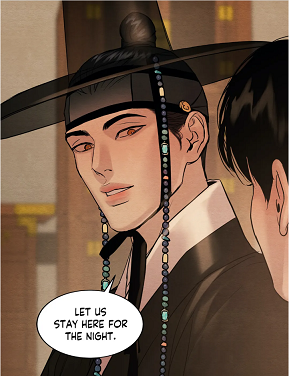 (chapter 93) Naturally, he had many reasons to do so. First, he wished to keep his promise. Secondly, he had sensed the painter’s sadness.
  (Chapter 93) But Yoon Seungho never imagined that he was himself the cause for this heartache. The painter could detect the lord’s agony and low self-esteem. He knew how hurtful it is to be called names like rake or bastard or hoodlum. And the lord’s selflessness got rewarded: his biggest wish came true during that night. There was someone who loved him despite his flaws and wrongdoings. We could say that their stay was to confirm his marriage with the painter to the noonas. At the same time, season 3 exposed the slow transformation of Yoon Seungho. Little by little, he was showing an interest to his own past and no longer accepting the justification that he was just a bird of misfortune. Don’t forget the master’s previous statement:
  (chapter 86) He was already pondering on the question why the family name was sullied. This shows that Yoon Seungho is slowly uncovering the truth, and he is now using Kim’s MO: deliver the information in delay, feign ignorance and act, listening to conversations behind the doors. This is no coincidence that he is recovering his memories as well. This is important, because he is less manipulable and as such no longer weak to brainwashing.
  (chapter 88) When the lord got embraced, the painter whispered this to his ear:
 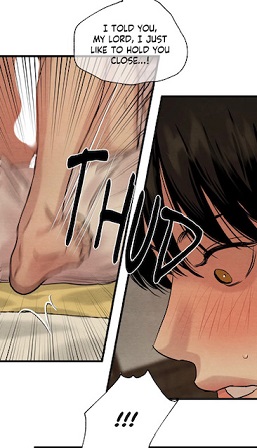 (chapter 91) This represented Baek Na-Kyum’s first mini-love confession. His action was supported by his words. Therefore the lord could realize the honesty and genuineness of the painter. He could be embraced and as such accepted, he was no monster. Yes, it was the opposite of the love session in the physician’s office. Back then, the painter had remained silent.
  (chapter 62) And this made me realize the signification of whispers in the manhwa. They stand in opposition to the hate speech and brainwashing!! This is no coincidence that the noonas whispered, when they noticed that Yoon Seungho was totally different from the description which Heena was supposed to have spread.
  (chapter 18) The whisper contrasts so much to the rumors, anonymity versus personal. Thus I conclude that the whisper represents a weapon against the brainwashing and terror. This is not something that a spy can hear from the window or the door! Hence you have Yoon Seungho whispering this to Lee Jihwa
 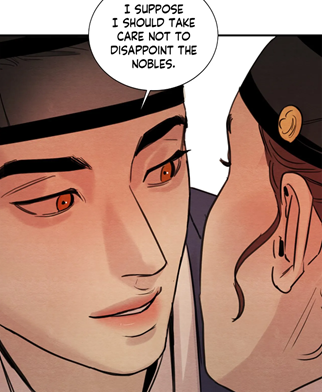 (chapter 18) or Yoon Seungho saying this to Heena:
  (chapter 92) reflects the nature of their relationship: Love and closeness. Even outside and in front of the calligrapher, the lord felt the need to know his lover’s thoughts, the positive version of this rumor:
  (doctor Frost, chapter 83), you should just replace the name Juhwan Park by Heena. She was just manipulated by the butler and Min’s trick. They used her strong belief and prejudices. However, I had the feeling that Heena could come to her senses, because she remained silent and her gaze was different.
  (chapter 83) Besides, what caught my attention is that she never replied to Yoon Seungho. She never fought back like in episode 65:
 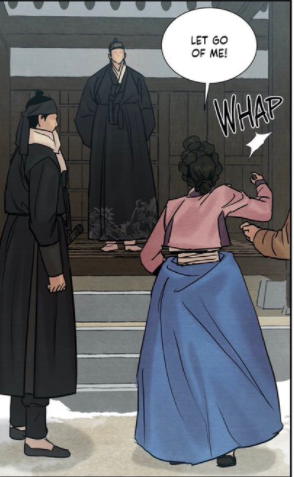 Why was she so passive? It is because the exclusion from the reunion represented the biggest punishment for Heena. She has always seen herself as a knight in shining armor. Imagine all the noonas could see the little brother and enjoy his company, while she couldn’t. I was hoping that she would start regretting her actions. As you can see, I really viewed Heena more as a victim, blinded by her faith and her own suffering than as a big perpetrator. There’s no doubt that she rejects sex because of a traumatic experience. Yet, due to her blindness and selfishness, she was an accomplice to her brother‘s suffering in the past, and unfortunately, she made the same decision.
  replacing these three fake feasts:
  (chapter 87)
  (chapter 99) No scandal in the past and in chapter 93, but now it can no longer be contained!!
 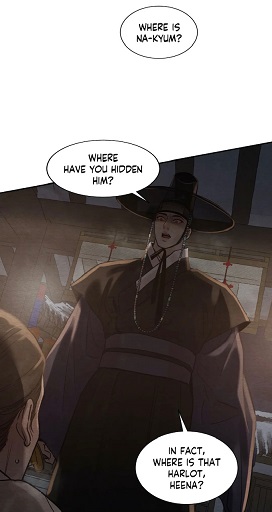 (Chapter 99) On the other hand, the resent for Heena didn‘t turn Yoon Seungho into a fool or a person full of prejudices! He still trusted the noonas, as he believed in his lover‘s heart and his genuine confession! The fire couldn‘t spread in the gibang! The lord showed mercy towards the kisaengs and the domestic Seok-Dae! Hence no one will ever come to believe that Yoon Seungho is a murderer. In their eyes, he makes nothing but hot air!! 😉

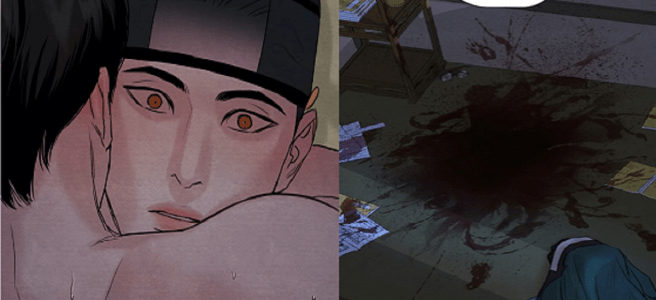
 Bebebisous33s' analyses in K-Dramaland and Manhwas