

This is where you can read the manhwa. https://www.lezhinus.com/en/comic/painter But be aware that this manhwa is a mature Yaoi, which means, it is about homosexuality with explicit scenes. If you want to read more essays, here is the link to the table of contents: https://bebebisous33analyses.wordpress.com/2020/07/04/table-of-contents-painter-of-the-night/
It would be great if you could make some donations/sponsoring: Ko-fi.com/bebebisous33 That way, you can support me with “coffee” so that I have the energy to keep examining manhwas. Besides, I need to cover up the expenses for this blog.
Announcement: The essay “The secret behind curry, apple and butter” has been updated.
Here, I would like to thank my friend Luzyla for her latest observations which made me realize the existence of a new connection!! Before elaborating my new discoveries, I would like to repeat the following principles on which the story was developed:
- There is always a reflection within the same chapter.
- The next episode is mirroring the previous one, naturally with slight changes.
- Each season is reflected in the previous and the future one.
- The author is working on positive and negative reflections.
- Thus the story is going in circle.
- Thus the lord’s destiny is reflected in the painter’s.
That’s the method I am using to unveil the mystery behind Yoon Seungho’s past and as such behind the painter’s.
1. Baek Na-Kyum’s apology
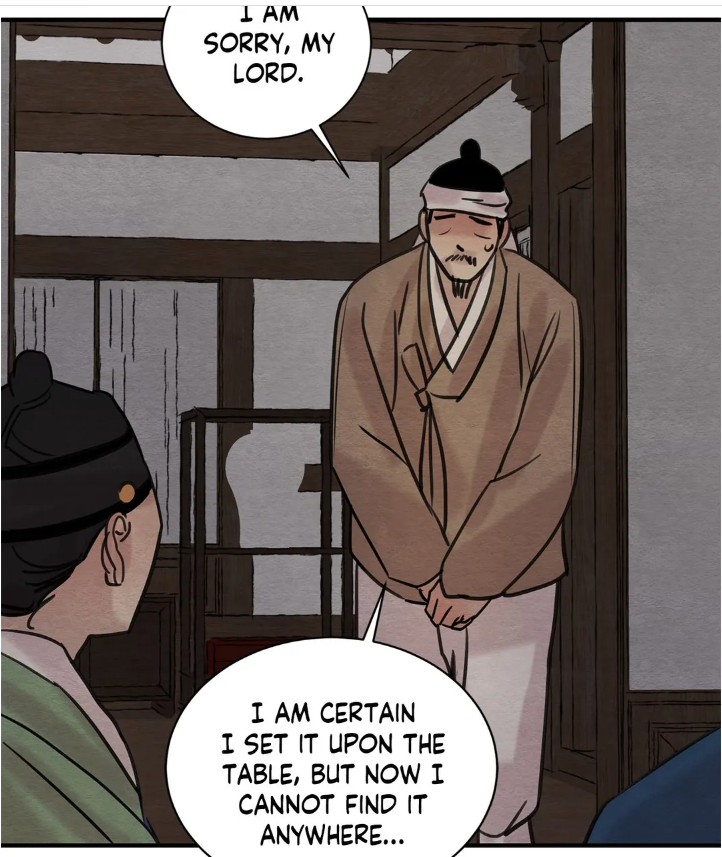
Everything started with this panel.  (Chapter 5) Baek Na-Kyum was apologizing for his past behavior. He had insulted the main lead because of the poem. And his words sounded really similar to the butler’s in the library, for they both employed the same expressions: “That day” and “I spoke out of”.
  (Chapter 77) Striking is that the painter employed the expression “hand”, while the valet talked about “turn”. Why did they do that? It is because when Kim was caught committing a crime, he turned his head!
 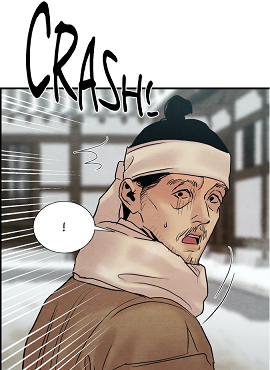 (chapter 68) Thus in the library, the butler excused himself in front of the lord by using the following expression: “spoke out of turn”!! On the other hand, the painter had used his hand,
 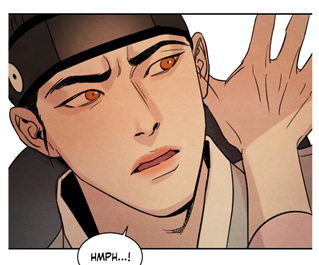 (chapter 4), therefore he described his wrongdoing with the following expression “out of hand”. In my eyes, his words indicate the interference of the butler. Furthermore, the two men had a drop of sweat, a sign that they were not truly honest.
  (chapter 77) Both were apologizing, as they had wronged the noble. As you can imagine, the similarity in the excuse is no coincidence. The proof that both incidents are reflections is that they have another point in common. The wrongdoings of the low-borns had taken place in front of a gate. The butler had disobeyed his master
  (chapter 68), and the painter had assaulted the lord by trying to retrieve the poetry.
 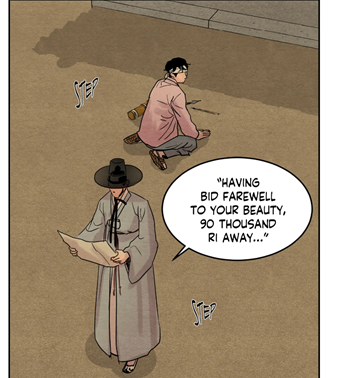 (Chapter 4) Because both characters had violated social norms, showing disrespect towards a noble, (chapter 04) the consequence was that two people were pushed down, the black guard and Baek Na-Kyum.
 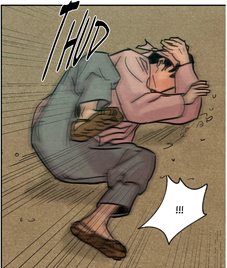 (Chapter 4) In other words, since Yoon Seungho had punished the butler due to the incidents in episode 67/68, I deduce that episodes 67/68 were reflections of episode 4/5 as well!! This corresponds to the rule 2 and 3.
1. 1. Yoon Seungho, the commoners and the Lees
But this doesn’t end here. When the lord caught Kim’s wrongdoing, he was returning from the Lees’ mansion (chapter 68). Since this is the positive reflection, I am deducing that in chapter 4, Yoon Seungho was actually returning to the domain of the Lees, as it should mirror the opposite.  (chapter 4) Let’s not forget that just before the great entrance of Black Heart and the protagonist in chapter 67, this was what the author showed us:
 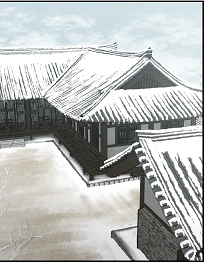 (chapter 67) And now compare the building to this one from chapter 1:
 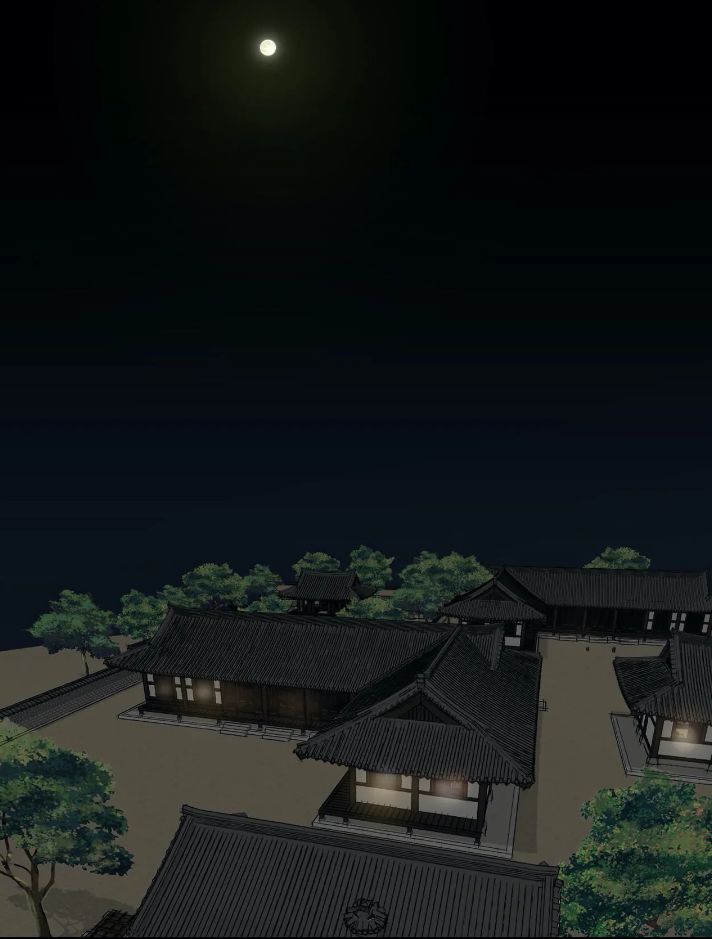 (chapter 1) Under this light, my theory that Yoon Seungho was living with the Lees in the beginning of the story gets reinforced and even validated. In season 1, Yoon Seungho had sex with his friend in the pavilion so that the father and the staff could see the truth: the young master Jihwa was a sodomite. But since we saw Yoon Seungho in that building in episode 1, we jumped to the wrong conclusion that this was his house. But actually, from chapter 12 on, the author was showing us that we had been deceived. This was the lord’s house, and note that there is no building in the big courtyard contrary to the domain from chapter 67 and 1.
 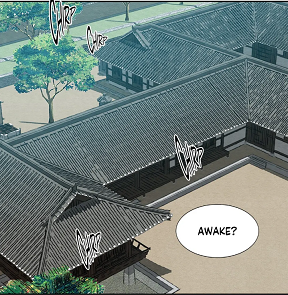 (Chapter 12) (For more read the essay “Lee Jihwa’s special relationship with Yoon Seungho”) Then in season 2, the main lead forced the elder Lee to hear what he had been denying all this time
 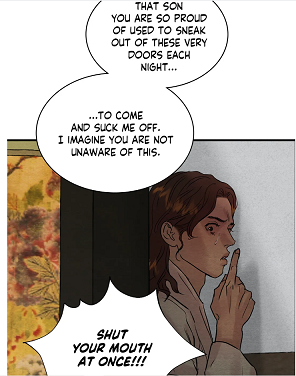 (Chapter 67), while in chapter 3, he could only witness it from the patio. On the other hand, Yoon Seungho had been proactive during their sexual encounter, hence the father could only blame the main lead for his son’s debauchery. The intimacy in the pavilion was in verity hiding Yoon Seungho’s huge traumas. But due to Lee Jihwa’s confession in the inn, the red-haired master’s reputation got ruined in town and this must have definitely reached the father’s ears. Striking is that when Yoon Seungho confronted Lee Jihwa with his crime (abduction of a person from his household), the red-haired master ran away and hid behind the folding shield. Thus he never apologized to his friend. And it was the same with the elder Lee. The latter knew about his son’s wrongdoing, for he accused the intruder immediately.
  (Chapter 67) As you can see, the absence of the excuse from the uke and his father outlines that chapter 67 is a reflection of episode 5 and 77. I detect a pattern, chapter 5 contains a superficial apology, chapter 67 no apology and chapter 77 a fake excuse again. Furthermore the manhwalovers can recognize that in the same episode (episode 5), the antagonist Jihwa had indeed wounded the painter with his insult too, a reflection of episode 4.
 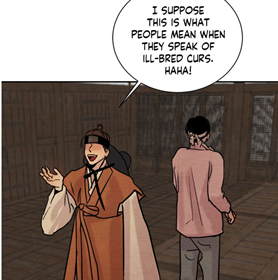 (Chapter 5) This confirms that chapter 5 is connected not only to episode 77, but also to chapter 67/68. We have the same elements: an incident linked to a door
 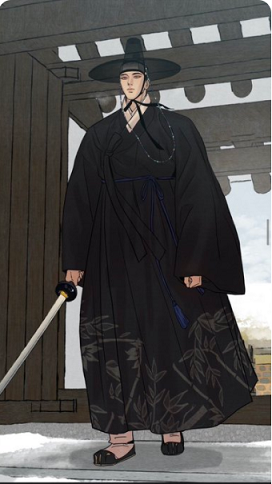 (chapter 67), insults towards the main leads, a wrongdoing, the allusion to love
  (chapter 67), a punishment, but also the absence or presence of an apology. But all of these episodes have other similarities: hypocrisy and arrogance. The Lees were looking down on Baek Na-Kyum and Yoon Seungho (chapter 5-67), while in episode 77, it was the butler who yelled and criticized the noble.
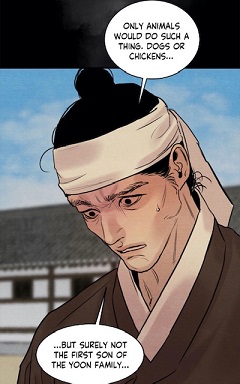 (chapter 77) By detecting a reflection between these chapters, I had a new revelation.
1. 2. The lord and the papers
In addition, if the manhwaphiles compare the scene with the painter’s excuse (chapter 5) to the scene with the butler’s (chapter 77), they can detect the fourth parallel: Yoon Seungho’s correspondence. 😮 How is it possible, as in episode 5, the noble never wrote a letter? In fact, he gave the poem to the black guard for the investigation. On the other hand, it looked, as though Yoon Seungho had written a letter  (chapter 5), while it was not the case. As you can see, anyone seeing the black guard leaving the owner’s study could have had the impression that the lord had written a letter. This means that this mistake must have taken place later again due to the rule 2! The manhwalovers could discover the deception in chapter 37/38!!
  (chapter 38) That’s how Jung In-Hun got misled.
 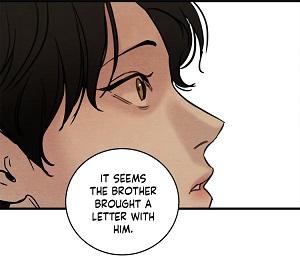 (chapter 38) Yoon Seung-Won had never received a letter, but the ruined painting. The readers only discovered the trick in the final episode, when the father was looking at the picture. And this connection between a letter and a painting was reflected in season 2. While Min stole the painter’s last creation
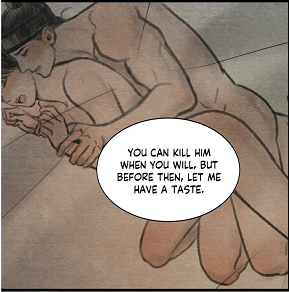 (chapter 56), Jihwa sent a forged letter
  (chapter 56). Striking is that the butler was the one who received the paper before delivering it to his sick master. These two scenes (38-56) indicate that the valet is related to the correspondence. Moreover, he was seen delivering the message to Yoon Seungho in the courtyard.
  (chapter 35)
All this proves that in chapter 5, the butler had seen the black guard departing from the study with the paper in the hand, and he had jumped to the wrong conclusion that his master had written a letter. Therefore right after this conversation, the lord’s table vanished.  (chapter 5) It was, as if he was not allowed to write any letter. So where did the table go? To the study!! What caught my attention is that after the first painting
 (chapter 2), the table had been removed from the study, just like the papers.
 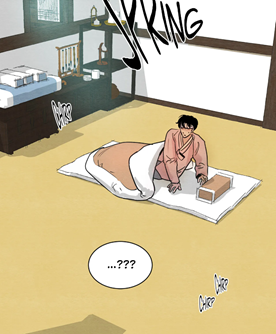 (chapter 4) This was no coincidence. It had been sent to the lord’s bedroom, but after the lord had tasked the black guard, it was no longer there. This is the indication that someone was interfering with Yoon Seungho’s habit to take a brush. And this can only be Kim. As you can see, the appearance and the vanishing of the small table is the element which was reflected in chapter 1, 2,
  3, 4 and 5. And now, look at the scene where Lee Jihwa met Min.
 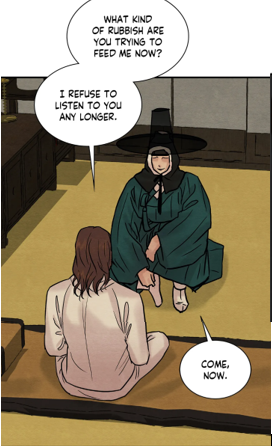 (chapter 67) The table had also disappeared. And when did it happen?
 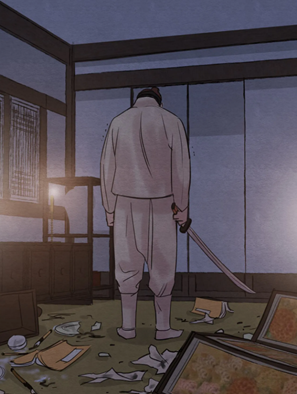 (chapter 21) The noble had ransacked his own room with his sword. And what did we see in that episode? A paper folded in a book.
  (chapter 21) In other words, the First Wedding night is also a reflection from these chapters (4/5, 67/68, 77), for it contains the same elements:
  (chapter 20) an incident with a door, someone is pushed down, a wrongdoing committed against Yoon Seungho (theft), an apology
  (episode 19) and the importance of the table. According to me, the valet had put the expensive wine on the painter’s table on purpose. To conclude, I see a connection between episode 4/5, 19/20/21, 67/68 and 77.
And now. you are wondering if I am not drifting away from my initial statement, the painter’s apology. However, I would like to remind the readers that in order to write a letter, a person usually needs to have a table in order to write properly. So imagine the butler’s reaction, when he hears from Yoon Seungho this: 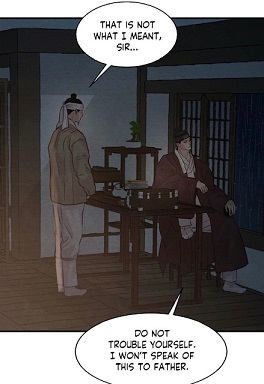 (chapter 77) He can not trust his words, especially since he views the nobles as violent liars. Why? It is because there was this huge table. This is no coincidence that right after the valet betrayed the main lead and wrote a message to the patriarch. That’s how I had another revelation. The butler is symbolized by the table! Thus he was often seen with this small table
  (chapter 11)
  (chapter 17) To conclude, when the butler saw the black guard leaving the mansion, he believed that his master had sent words to someone! That’s the reason why he removed the table and returned it to the painter’s study.
(chapter 5) However, this was just the poem!! This confusion between a letter and a poem should be reflected in season 3 according to rule 3. That’s how I came to the conclusion that when the painter returned to the annex and took the poem, he was actually taking a letter (chapter 97) written by Yoon Seungho, but he envisioned that this was the Spring poem!
 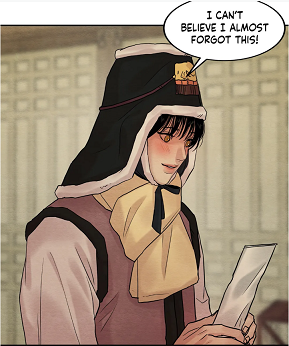 (chapter 97) We had the same situation. Black Heart had stolen the Spring poem, and the noonas had deceived the protagonists by faking admiration in front of an empty paper.
  (chapter 93) Since the paper in episode 93 was empty, I could only come to the deduction that this paper contained words!! (chapter 97) Another evidence for this theory is the color of the paper, for the second doesn’t have a shade of pink. Then I suddenly recalled that the artist had received two calligraphies, the one from his beloved and the other from the old bearded man.
  (chapter 92) The latter’s work was a copy of Yoon Seungho’s poetry, the repetition from chapter 4. Hence you comprehend why I deduce that the paper in the annex was different from the Spring poem. So during that night, Yoon Seungho left a note to his lover, and that’s how the butler discovered that the artist could not read Chinese, for he saw his master writing in hangeul. But there exists another evidence for this interpretation. Baek Na-Kyum had wished this:
  (chapter 97) The goddess was actually fulfilling his wish, when she reminded him of the Spring poem.
And that’s how I realized why Kim had suggested to his master that two servants should remain by Baek Na-Kyum’s side and bring him back to the mansion. The reason is simple. The two domestics were to divert the artist’s attention, that way the painter wouldn’t read the letter. If the domestics were present, they could give some information to the painter without revealing too much. (chapter 97) If the lord had mentioned in the letter that they had found the corpse of Deok-Jae, the painter would have believed him. However, as you can envision it, the butler and Min were determined to generate a misunderstanding, to create the illusion that the scholar had died. Consequently, the servants deceived the main lead by omitting the existence of the paper. They had not delivered the message properly.
In other words, the letter is connected to a painting and a poem, yet each time, the paper was stolen or misused. Striking is that none of the main characters noticed the switch or the vanishing. We could say that this was Yoon Seungho’s karma for stealing the painter’s belonging.  (chapter 4) His own poetry got stolen. But let’s return our attention to episode 5. Since the lord had given the poem to the black guard, this signifies that the lord no longer had the sijo. Therefore he had to write the poem again in order to mask the disappearance. In my opinion, he must have copied the original poetry for the artist in order to prove that he had not been lying. Hence the paper looked different. And this brings me back to the painter’s apology in the patio. (chapter 5) Why did the painter apologize to Yoon Seungho in the end? How did he come up with such an idea? It is because this had been suggested to the artist by Kim. This explicates why he was speaking like the butler. The latter had actually made a huge error, when he advised the artist. Why? It is because he was mixing cause and consequence. In the valet’s mind, the lord had kept the message, for the painter had offended him. So if he were to confess his wrongdoing, the lord would return the poem, and after that, it was just a matter of time, until the painter would desert the propriety. However, the lord had stated this:
  (chapter 04) That’s the reason why he had taken it in the first place.
Since Kim had been the one suggesting to the painter to beg for forgiveness with the hope that he would get back his poetry, it is normal that Kim was present, when the poetry was returned. 
 (chapter 7) But where is the sijo now?
In my eyes, Kim had witnessed how the paper had left the property in the past, and he had not intervened. Why? It is because of the black guard.  (chapter 65) Moreover, I believe that in chapter 65, he had collaborated with the noona. He had shown her the painting of Baek Na-Kyum, while in the study there was a blank paper. As you can see, in season 2, we had again this connection between a painting and blank paper. But let’s return our attention to chapter 5. The black guard was acting on the order of someone else, Yoon Seungho was not the one hiring him. The butler hates ruckus, his MO is to lie low and act in the shadow. If he had retrieved the paper, the man could report it to the master of the black guard. On the other hand, he could have asked the warden about his master’s request. He just needed to say that he desired to assist him, similar to this situation.
 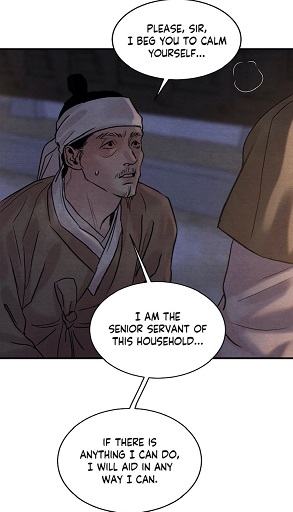 (chapter 82) Thus I conclude that when the lord returned the paper to Baek Na-Kyum
  (chapter 7), Kim must have realized his error. He had mistaken the poem for a letter!! This explains why he repeated the trick with the younger master Seung-Won. But unfortunately for him, he was caught by the teacher who asked the painter about the letter the next morning.
  (chapter 38) Baek Na-Kyum could have realized that the butler had acted behind his master’s back. The problem is that during that evening, the lord had indeed written a letter to his brother
 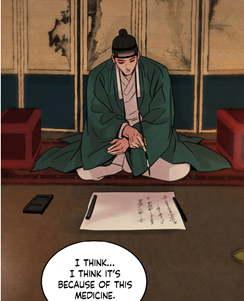 (chapter 36), but the moment the latter interrupted the couple
 (chapter 37), Yoon Seungho chose to hide it. But why is it important? It is because if the painter had mentioned the paper given to the younger master to Yoon Seungho, the latter could have noticed the valet’s meddling and wrongdoing. On the surface, it looked like Kim had written himself a letter to the younger master. In other words, in episode 37/38, the butler gave the impression that he was a spy, for he was acting without his master’s permission. He had even left the propriety, as he was standing outside in front of the gate. Don’t forget that during the meeting, the brother had mentioned that he had sent him many letters
 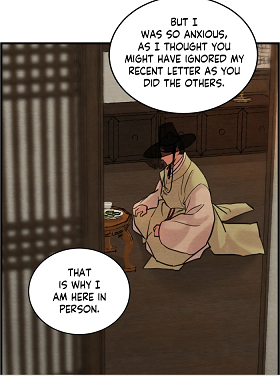 (chapter 37), and there is no ambiguity that Kim had intervened. Here, the lord had said nothing, for he imagined that Kim had done it to protect him from his family.
According to my theory, Yoon Seungho was living with the Lees, and as such Baek Na-Kyum had to trespass the propriety in order to retrieve his tools and vanish!! 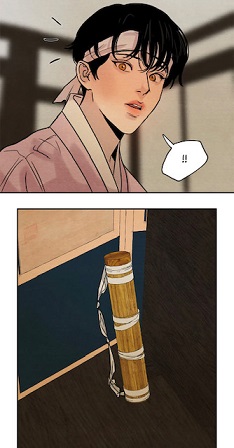 (Chapter 4) But on his way out, he met Yoon Seungho who had just missed the painter’s departure. But there, he discovered that the main lead had stolen his poetry. (Chapter 04) Therefore he was forced to return to the mansion. At the same time, Yoon Seungho was encouraged to come back to the propriety too. He had to keep an eye on the painter. He couldn’t be so sure that the poem was strong enough to keep Baek Na-Kyum by his side. Therefore it is not surprising that in episode 5, Yoon Seungho was seen sitting in front of the window smoking.
  (chapter 5) He was looking at the gate and as such making sure that the artist’s departure would be noticed. By sending the low-born to the Lees’ mansion, Kim was encouraging the painter to commit a crime: trespassing! But the artist was fortunate, for he was not caught by the lord of the mansion, who preferred hiding due to the ruckus caused by his own son. 😉 As for Yoon Seungho, he came back to the mansion and saw the empty study. Kim just needed to say that the low-born had left to the Lees’ mansion. This is important, because this indicates that in chapter 4, the couple missed each other first! And this situation was repeated in season 3, precisely in chapter 98, when the lord returned from the bureau of investigation
 (chapter 98)! The lord arrived just after the painter’s departure. And who was with the main lead? Kim. As you can see, the lord’s luck seems not to be on his side, for Baek Na-Kyum had just left the propriety. Once again… the lord was standing in front of the gate!! As for season 2, this time, it was Kim’s fate to miss his master.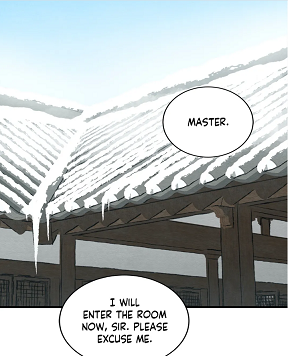
 (chapter 56) The reason for this punishment is simple. He had sent away the artist to the study just before Yoon Seungho regained consciousness. The latter didn’t see that the artist had taken care of him during that night. Thus the butler’s karma was not to notice his master’s departure which stands in opposition to chapter 4 and 98. And note that all these chapters have the paper as common denominator. So imagine the butler’s surprise in episode 4, when he witnessed the artist’s return to the mansion followed by his master. He had sent away Baek Na-Kyum with the hope that the artist would desert the town for good, but no…
2. Kim’s hidden action
Kim must have been intrigued. Why did Baek Na-Kyum come back? He had witnessed the execution of a servant, then he had been abducted before getting imprisoned in the storage room. Finally, he had been threatened and forced to paint an erotic picture. Hence Kim felt the urge to discover the reasons for the painter’s behavior. In other words, he must have interrogated him, the older version of this scene:  (chapter 23) The first similarity is the allusion to his bag. The butler was actually thinking that during the hunt, the painter would decide to run away. That’s the reason why he asked about his belonging, for in the past, he only wished to vanish after retrieving his tools. Naturally, the artist saw no harm in the butler’s question and answered truthfully. He must have narrated the argument in the courtyard about the poem. Yoon Seungho had kept the sijo, consequently the painter had used his hand to take it back and had by mistake removed the lord’s hat. Thus Kim must have told him that he just needed to apologize. But one might say that this is just a story imagined by me. The manhwaphiles never saw such a scene. But don’t forget the existence of the reflections. I have definitely an evidence for this theory. Since the butler had manipulated the painter in chapter 4 in order to get rid of this uninvited guest, his karma was to receive a new guest!!
  (chapter 7) This is not what the valet truly desired at all. He wanted to live in peace. But now, he had three new people he had to serve: Jung In-Hun, the painter and his own master Yoon Seungho who had lived for quite some time in the Lees’ mansion. He had to work!! And note that in this episode 7, we have the following elements:
- The arrival of a guest, exactly like in episode 4-5; 67/68 and 77.
- a paper

- the library
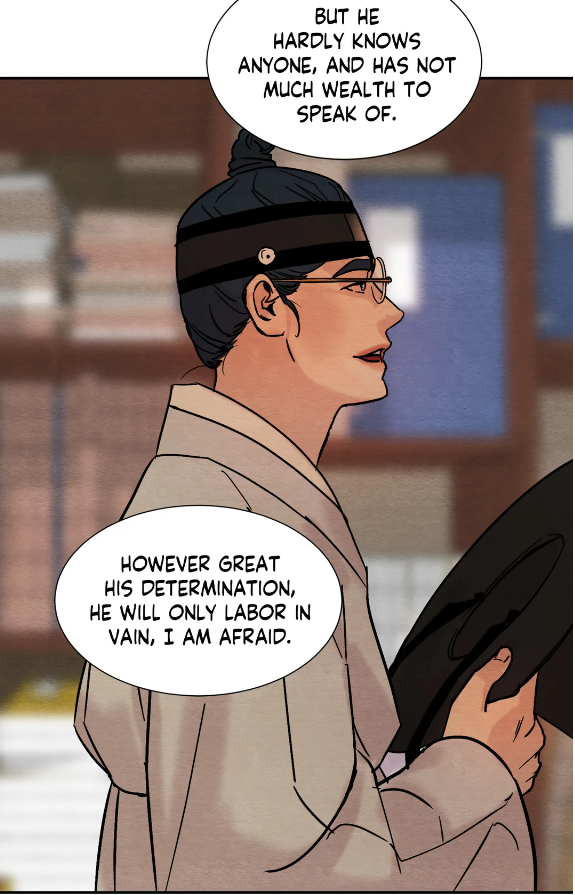
- a reference to “love”
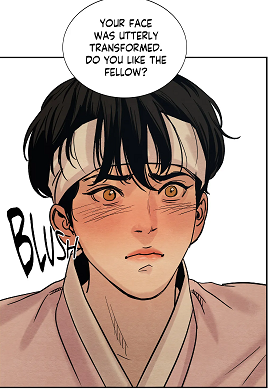
- the first appearance of Kim
- The existence of a deal which is also present in chapter 4 and 77
- The connection between the letter and a poem (chapter 5-77)
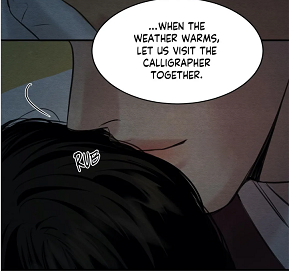
This truly shows that during that night (chapter 77), the valet chose to write a letter in order to denunciate the protagonist. As you already know, attack is the best defense. Exactly like in the courtyard, he badmouthed a noble, this time he must have compared Yoon Seungho to the younger brother Yoon Seung-Won. The latter would succeed with the civil service examination and bring glory to the Yoons, whereas the main lead would only live like an idle sodomite.
Through this contrast, another detail caught my attention. (chapter 7) How did Yoon Seungho know that the learned sir had no connection and was poor? Who had told him that? One might think that this can only be the butler. However, Yoon Seungho had tasked the black guard to investigate and not Kim. Yet, there is no ambiguity that the latter definitely played a role in this investigation. Why? It is because of the expressions the main lead was using: “hardly knows”, “determination”, “labor in vain” which resembles to the valet’s vocabulary, though he embodies the opposite: ignorance, hesitation and laziness. The aristocrat’s description about the teacher is actually questioning the main lead’s actions. If Jung In-Hun was portrayed as poor and powerless, why would he sponsor such a scholar? He would gain nothing. Moreover, with such a portrait, the speaker is implying that only through connections you can achieve greatness. These words are actually exposing the meaningless of the civil service examination. In other words, this description was already insinuating the existence of sodomy, sex in exchange of favors. And this negative depiction of the civil service examination was exposed once again in the gibang.  (chapter 93) It was a futile dream. When I had analyzed episode 93, I had explained that the speech from the main lead was influenced by the butler. As you can see, the lord’s narration (chapter 7) was mirroring the valet’s mentality and meddling. He had tried to stop his master from visiting the learned sir the day before. However, I don’t think that Kim is only responsible for this negative characterization of Jung In-Hun in episode 7! Why? First, we never saw the return of the black guard, but when the main lead visited the learned sir’s mansion, he was followed by another one!
 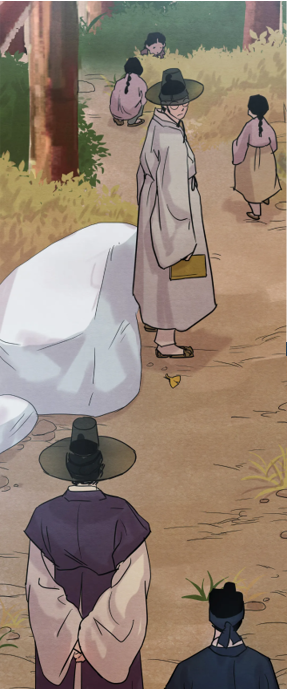 (chapter 6) There was a switch. That’s how I had this revelation. Heena is the missing link between the learned sir and the protagonist. And observe that in episode 93, we have the same elements again:
An empty paper which is confused with the poem
The incident with the door:  (chapter 93) This time, Heena is the one standing behind closed doors, while it was Yoon Seungho in chapter 77
The reference to the library: 
The allusion to Kim
The presence of love and affection: 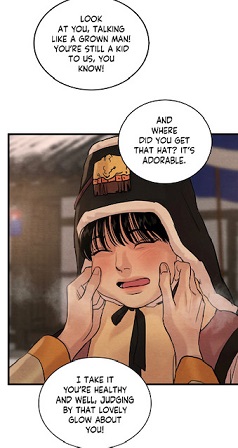

The lord got badmouthed 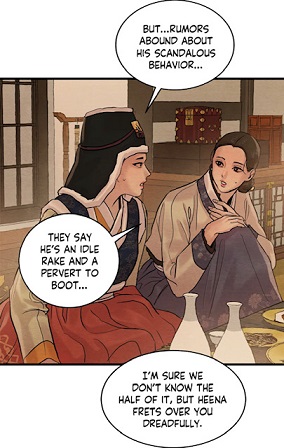
The fake apology: 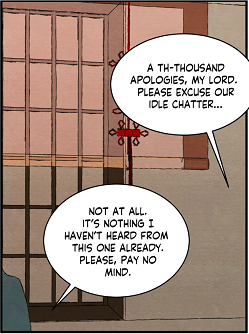 (chapter 93) In chapter 99, the noonas still lied to him.
An invitation  (chapter 93), which was also present in chapter 4/5, 7 and 67
 /68 and finally 77 ! Since episode 93 is a reflection of episode 7, I could only come to the conclusion that Heena was the one standing behind the black guard! Besides, I had already discovered that Heena was associated to the table as well (see chapter 94 and 68). She represents the link between the butler and Jung In-Hun. She had already collaborated with the valet in episode 65. So from my point of view, she must have received the scholar’s poem with Yoon Seungho’s request. But what could she do with it? Keep it? No… her interference would have been noticed. Hence I believe that the kisaeng was not acting on her own. She was following the orders from the mysterious “lord Song”. At the same time, I think that she is also connected to the Lees. This would explicate why the black guards would change between episode 1, 5 and 6. Finally, according to me, the learned sir had connections to elder Lee, for he had seen the baby Na-Kyum at the gate.
 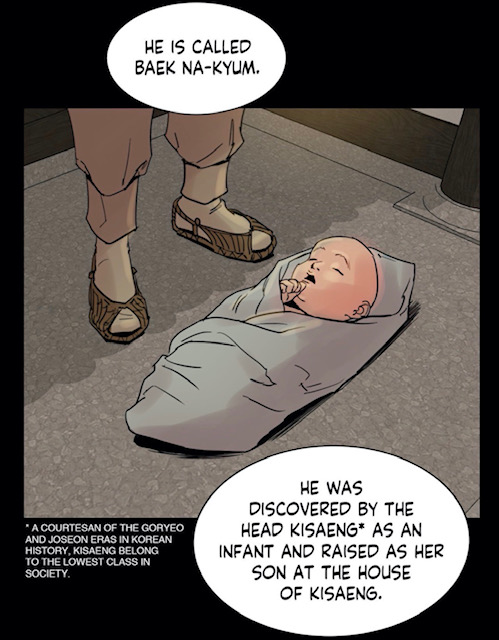 (chapter 1) [For more read the essay “Baek Na-Kyum’s origins”] There is no ambiguity that these words (chapter 7) were not reflecting the verity.
In other words, she had been working for two people, just like the butler was turning Yoon Chang-HYeon against the son and the reverse. Both stands for disloyalty. Therefore it is no coincidence that the kisaeng was seen with different black guards in chapter 64. On the other hand, the readers should keep in their mind that the black guard can be seen as a double-edged sword. They can serve as protectors, but also as “spies and as captors”. They could report Heena’s actions to the nobleman who had hired the black guards. Finally, the manhwaphiles will certainly recall the butler’s statement:  (chapter 55) Who was lord Song’s contact person then? In the past, I used to think that he was the one receiving the letters. But now, I have a different opinion. I believe, it is Heena! Why? It is because Kim couldn’t identify lord Song’s writing. According to me, Yoon Seungho was sent to the gibang in order to entertain the mysterious “lord Song”. Thereby I am assuming that the kisaeng would receive a word from lord Song and have the main lead fetched from the mansion by the black guards. Heena and Yoon Chang-Hyeon are the only ones seen with black guards, I am excluding the main lead, as he was always more or less their prisoner. As you can see, there is a connection between the noona and the Yoons.
3. Heena and the letters
First, I would like to point out that the kisaeng mentioned letters twice in season 2.  (chapter 68)
 (chapter 69) and in season 3, the noona sent messages to her brother herself. In two different chapters
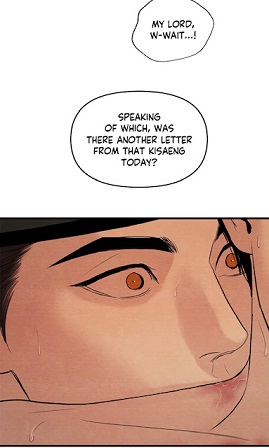 (chapter 91), she is related to papers.
  (chapter 97) Logically, the noona in connection with the letter should be present in season 1. Secondly, when the woman appeared for the first time
  (chapter 64), she was accompanied with 2 guards, which is quite similar to the lord’s situation in chapter 1. That’s the reason why I believe that she didn’t keep the learned sir’s poem. Her betrayal could have been noticed and this was the first time that Yoon Seungho was making such a request.
So where is the teacher’s sijo? It was received by the mysterious “lord Song”. That’s how he discovered that his ex-lover was showing an interest in the learned sir. This is important, because the poem will serve as the evidence to identify the murderer behind Jung In-Hun’s death. On the other hand, one might refute this idea, for the teacher was seen in his bedroom with the paper. (chapter 21) But if you look more closely at the paper, you will realize that it resembles a lot more to this one due to the marble effect. (chapter 7) Nevertheless, the paper looks damaged in the previous panel. But this could be the result of anger, like this.  (chapter 56) This would follow rule 3. Then according to rule 2 of the kaleidoscope, elements from one episode will be constantly mirrored in the next chapters. And what did we have in episode 19? A larceny… the bottle of wine vanished. Then in episode 20, the lord stole the scholar’s identity, while he stole the painter’s virginity. Hence the lord apologized to the painter for his wrongdoings.
 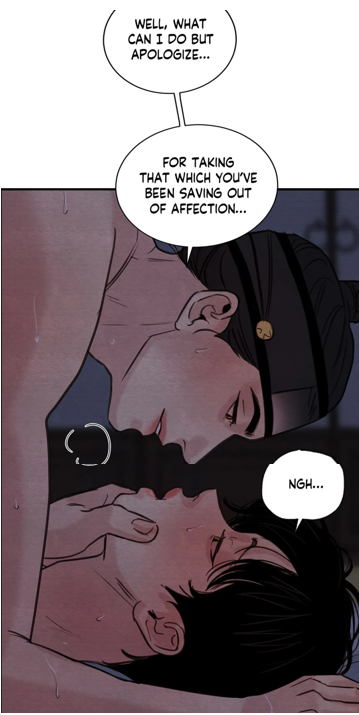 (chapter 21) And above I had already demonstrated the connection between the First Wedding Night and chapter 5 and 77! Here the lord was imitating the pedophile’s behavior, hence you comprehend why I think that lord Song was the recipient of the poem. I would like my readers to keep in their mind that the learned sir’s sijo was referring to a painful departure, the loss of a loved one and despair! The beholder could have the impression that the author was suicidal due to the mention of the well and the torment of the mind. Thus I am now assuming that the “mysterious lord Song” will consider the sijo as a farewell, the lord chose to commit suicide and his death was related to Jung In-Hun’s curtains. Why? It is because Heena wrote letters to her brother where she accused the main lead of killing the learned sir. Moreover, Yoon Seung-Won had definitely mistaken the painter for the learned sir.
  (chapter 37) His position revealed that the main lead trusted the artist. It was, as if he was treating him like his wife. (chapter 97) And from my point of view, these messages were never burned. That way, Kim can put the whole blame on the kisaeng and her brother!! The butler can even reveal how Yoon Chang-Hyeon had harassed the son and tried to frame him for the death of his messenger.
But since “lord Song” was behind the scholar’s murder, he can only retaliate against Lee Jihwa and Min’s friends. Why? Because he will deny his responsibility in the crime, though he was the one who ordered it! Exactly like in the past. He had never assumed any responsibility, he always let others take the accountability. He needs to find a culprit in order to vent his fury. If they had not brought up the learned sir’s assassination, then Yoon Seungho “could have lived” in peace. To conclude, when the lord gave the paper to the black guard, the pedophile had the impression that the main character was rekindling with him, for he was asking for his help. He was far away from him. In his eyes, he had contacted him, “lord Song” alias the king!! And now, it becomes understandable why lord Song sent hanboks and asked Min to organize parties for Yoon Seungho!! It is because the pedophile believed that the main lead was no longer pushing him away or had accepted him. This is not surprising that little by little, the main lead’s hanboks became more and more beautiful. Don’t forget the following rule, the painter’s situation will be mirrored in the lord’s. Thus in chapter 34, Yoon Seungho returned with a hanbok covered with cranes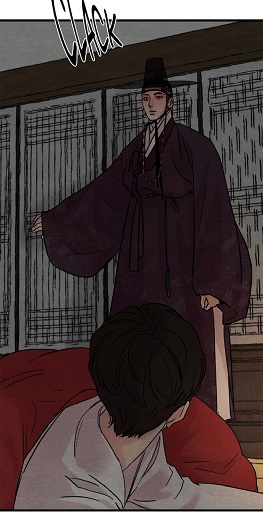 (chapter 34), and shortly after the painter was sent to the tailor. But during that night, the pedophile and Yoon Seungho had missed each other due to Baek Na-Kyum. He was not dead. So when the painter received new clothes, it was the same for Yoon Seungho. Yet, the pedophile was gravely mistaken. Why? The sijo had been stolen, and as such it was never addressed to the pedophile. Furthermore, it is because the lord was suffering from memory loss. Moreover, I believe that the main lead is not aware of the true identity of his sexual abuser. In his mind, it is just lord Song. But this doesn’t end here.
According to me, the main lead wrote a letter to his lover in the gibang. This signifies that someone else must have done the same due to rule 1 and 2. The reference of the Spring poem in chapter 97 indicates the presence of a letter in the previous episode or the next! From my point of view, Min must have asked the kisaeng to contact “lord Song”!! And don’t forget that in season 2, we had a forged letter.  (chapter 57) And who was behind this? Black Heart’s friend. But then it came to my mind that Black Heart had stolen the Spring poem… so he could have sent the paper to lord Song and the latter would have mistaken it as a letter from Yoon Seungho, the latter was reaching out to him. He was wishing him luck!! So imagine that when the man arrives in Jemulpo, he imagines that the main lead is waiting for him only to discover that Yoon Seungho vanished. He wished to die because of the loss of a loved one. And that’s how he will recall the poetry of the learned sir… the reflection of this night!!
  (chapter 94) In episode 4, the lord had laughed about the sijo, but it was no longer the case in the kisaeng house. In my eyes, the pedophile will go through the same experience. Yes, the effect of the kaleidoscope. He will perceive the learned sir’s poetry under a different perspective. Only in that moment, he will realize the suicidal tone in the sijo. He will question how Yoon Seungho could become so desperate and suicidal so suddenly. And now, you comprehend why Heena was trembling in front of her brother
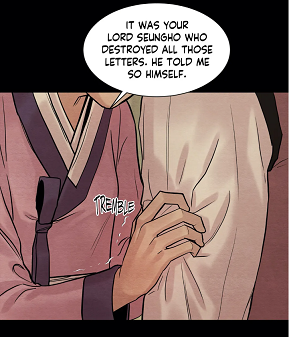 , and why she had planned to leave the gibang that night!! She was aware of the arrival of “lord Song”. She knows how cruel and ruthless he can be.
And Lee Jihwa’s words will become a reality.  (chapter 101) Blood will flow… The proof for this expectation is that chapter 67, 77, 82 and 93 are all referring to punishment. Kim had been beaten in episode 77, while the kisaeng was imprisoned in the storage room. Moreover, we have the use of the sword in episode 21 and 67… and during these nights, the protagonists had made love to each other.
4. Father Lee’s message
Since the Lees are connected to paper in the form of the paintings and the letter, (chapter 5, 10, 15, 17, 56), I had suddenly this question! Why didn’t Lee send a word to Yoon Chang-Hyeon? Why did he have to visit him during the night?  (chapter 82)
 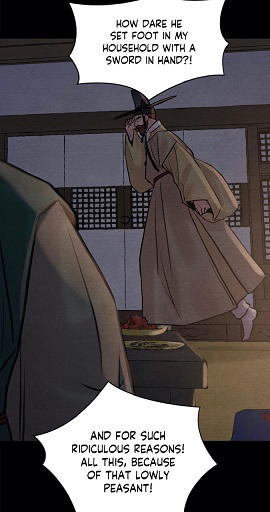 (chapter 82) It is because he didn’t want to leave any evidence of his intervention. No one should notice that he had paid a visit to the patriarch either. His visit should remain a secret. He was actually afraid of getting detected. The reason is simple. He was fearing the person standing behind Yoon Seungho, lord Song. He had two reasons for this. First, he could see that Yoon Seungho was no longer treated like an animal or male kisaeng. (chapter 67) He was even better dressed than his own son. The hanbok was exposing the support from the “pedophile”. Secondly, the main lead had threatened him.
  (chapter 67) Here, the lord had just insinuated that if something like that happened again, he would go to the authorities. However, since this threat was rather ambiguous, the patriarch Lee could only interpret it that way. The main lead would report the incident to the “mysterious lord Song”, alias the king. And father Lee knew that he could get into trouble. Furthermore, since these elders are all hypocrites and liars, there is no doubt that father Lee feared that the protagonist wouldn’t keep his words. That’s the reason why he approached the father. He hoped that Yoon Chang-Hyeon would intervene and impose his will onto his son. He would tame the main character. In other words, episode 82 is a reflection of chapter 4/5, 19/20/21, 67/68 and 77. The first common denominator is the allusion to letters. The messenger’s words revealed that Kim had contacted the elder Yoon, for he already knew his name, though the latter had never met the domestic. Secondly, the “letters” were delivered orally:
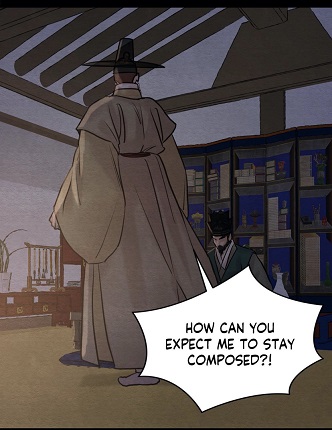
  (chapter 82), and even in person: Father Lee and the emissary. Third, the elder Lee badmouthed Yoon Seungho by mentioning the incident from chapter 67, and refused the invitation of his host
  (chapter 82). Finally, he called Baek Na-Kyum a peasant exactly like the main lead in front of the gate:
  (chapter 82). But more important, the old bearded man expressed this fear: the loss of his family home!
 (chapter 82) And remember that I had detected the presence of the Lees’ mansion in episode 4 and it was also present in chapter 21 and 67! And what had the butler done during these chapters? He had tried to chase away the painter and as such Yoon Seungho. The latter was not supposed to live in the Yoons’ domain. And this will be the Lees’ karma to be driven out of their own house!
5. Conclusions
And now, you comprehend why the sijo from season 1 has not appeared yet. The couple will be able to identify the culprits with the “letters”, the poems. Remember the kisaeng’s words: (chapter 97) The absence of the messages was the evidence of the main lead’s wrongdoing. However, the moment the letters resurface, they will expose the noona’s lies. It doesn’t matter, if she had been deceived. She chose to trust the butler, without verifying the facts. To conclude, the poems will serve as proof for the crimes and I would even go so far to say that the papers, mistaken for letters, are the tools to expose the truth. Yoon Seungho had never contacted lord Song, for he hates him to the core. He is connected to his suffering and martyrdom, therefore he can only view the man as the bird of misfortune, while the latter had the impression that he was now getting closer to the main lead. Consequently, he considered him as his crane! But this man is exactly like Min, totally dishonest and irresponsible. I couldn’t help myself thinking of this folding shield again:  (chapter 83) It vanished, and as such it was stolen. Did the mysterious lord Song take it away in order to force Yoon Seungho to paint? The older version of this scene: (chapter 4) And remember that the “paper” is also connected to paintings. However, since this is a reflection of episode 4, I am more inclined to think hat the real purpose was to take the picture and the man had never the intention to return it. Naturally, at some point, the man had a change of heart concerning the main lead, for thanks to him, he could outlive all his sexual fantasies. And this leads me to the following conclusion. The moment, Yoon Seungho sees this painting again, he will recognize the identity of the thief. To sum up, the paper is the proof of wrongdoings, thereby we have this publication:
  (chapter 1) The paintings were illustrating that the pedophile was having sex with a minor.
PS: I have still so much to say about the comparison between chapter 5 and 77 and the “paper” that I will write another analysis about this.
Feel free to comment. If you have any suggestion for topics or manhwas, feel free to ask. If you enjoyed reading it, retweet it or push the button like. My Reddit-Instagram-Tumblr-Twitter account is: @bebebisous33. Thanks for reading and for the support, particularly, I would like to thank all the new followers and people recommending my blog.
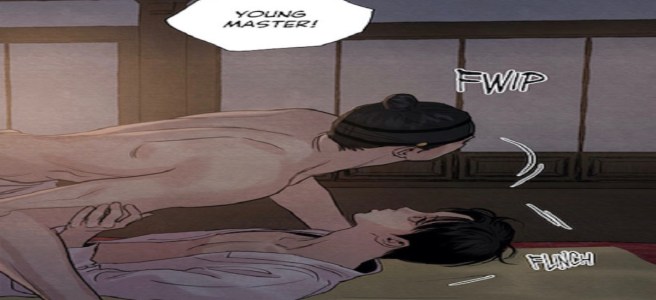
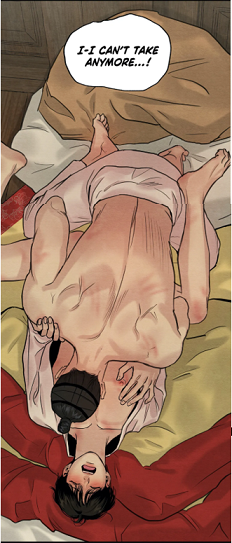 (chapter 89) The lord’s back is covered with marks. Yet, he was not brown-nosing here at all, for he was rejecting the lord’s advances. And now, it is time to take a closer look to season 1.
  (chapter 23) Baek Na-Kyum was seen holding an apple, here it looked like he was indeed polishing the fruit before eating it. Striking is that during that scene, valet Kim was interrogating him. He was acting, as if he was interested in him. It was, as if he was buttering up to Baek Na-Kyum. The purpose was to gain the artist’s trust so that at the end, he would listen to his advices.
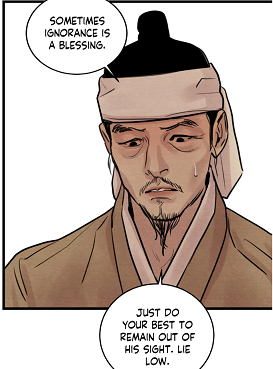 (chapter 23) However, the reality was that the valet was actually digging for information, spying on the main lead, so that he could create a new incident. As you can see, there were two apple-polishers in that scene, the painter and the butler. This was the reflection within the same episode. While Baek Na-Kyum was literally polishing the apple, the other was just cajoling Baek Na-Kyum in a figurative way. Yet, the former was not truly sweet-talking to the artist. He gave the impression that he was totally honest. And now, it is important to recall what happened to the painter in the next chapter. Jung In-Hun was kissing the painter’s hands.
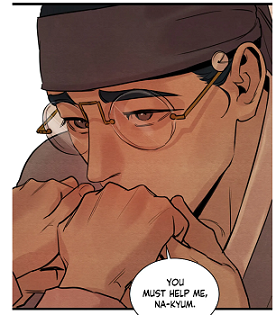 (chapter 24). He was flattering the painter with the hope that Baek Na-Kyum would spy on his account. But the scholar couldn’t succeed with his request. Why? It is because he only kissed the artist’s hands. He never licked his boot or his ass. We could even say that he did scratch his back, but in the wrong way:
  (chapter 24) In other words, he could never lower himself in front of the low-born. This was too much, explaining why the scholar failed with his request.
  (chapter 27) In exchange for saving Jung In-Hun’s life, Baek Na-Kyum was forced to do a fellatio. We could say that the artist was sucking up to the owner of the mansion. But the fellatio is not just an exchange of favors. It is also associated to forgiveness. At the tailor’s shop, the painter had blushed because of Yoon Seungho, The latter had embarrassed him. Thus the lord made the following suggestion:
 (Chapter 39) This was his way to apologize, though here he was teasing his lover. These were the principles he had been taught, therefore it is not surprising that he applied them for the painter. And now, you comprehend why in episode 71, Yoon Seungho sucked the painter’s phallus in the bathroom, he was also currying the artist’s favors. His goal was not to be pushed away, to be accepted.
 (chapter 71) He had wronged the painter so many times, that the blow-job was not enough. Thus he licked his ass in the bedchamber. He was hoping to seek his forgiveness.
 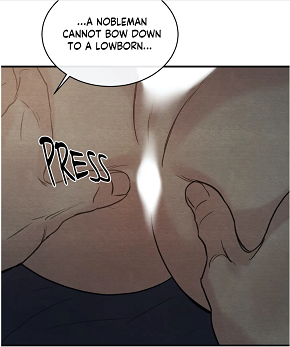 (chapter 71) It was, as if he was lowering his head, the kowtower. In this episode, the lord was on his knees in front of the painter, and this twice. One in the bathroom
 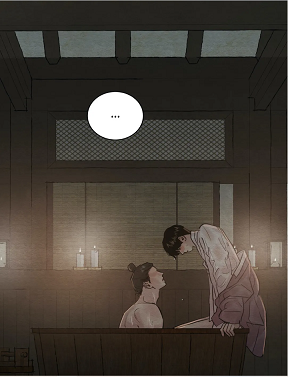 (chapter 71) and the other time in the bedchamber.
 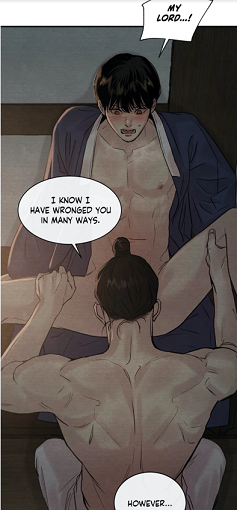 (chapter 71) However, his nose didn’t get brown, as the painter is a pure and innocent person. 😉 That’s how I realized why Baek Na-Kyum was sent to the bathroom. His role was to divert Yoon Seungho’s attention from Kim so that the master would forget to ask for the butler’s punishment. In other words, the valet used the low-born to seek his master’s favors. This shows that Yoon Seungho had been taught that the blow-job and the ass-kissing are the means to obtain forgiveness.
  (chapter 73) He was licking the painter’s foot so that he could keep thrusting. Don’t forget that during the whole night, he behaved like a servant… the one who was “sucking up to Baek Na-Kyum”.
 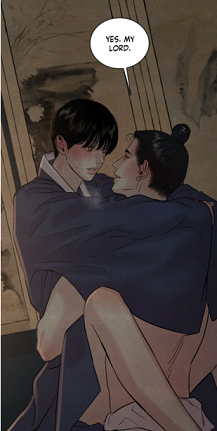 (chapter 72) On the other hand, the latter scratched the lord’s back for the first time during that night.
  (chapter 72) This was the reflection within the same episode, yet the “back-scratcher” was not doing it for his personal gain at all. We couldn’t say that he was currying favor or buttering up Yoon Seungho. He believed that he was just a servant and nothing more. From the outsider’s perspective, he was treated indeed like a favored servant, though in truth Yoon Seungho viewed him more like his new master and lord.
 (chapter 45) In this scene, the lord was acting like a teacher, and the painter was supposed to do a blow-job in exchange for a favor. But since the painter was heartbroken, he was doing it absent-mindedly. Thus the roles got switched. After the noble licked the painter’s ass,
  and masturbated him anal, the painter was able to confess his pleasure:
  (chapter 45) This shows that the lord was slowly “currying favors” to Baek Na-Kyum. And this is no coincidence that Kim brought the ink and brushes to the mansion.
  (chapter 45) Once again, he was acting, as if he was buttering up to Baek Na-Kyum and indirectly to the host. But the reality was that everything was done for Kim’s interest…. On the other hand, we could say that Yoon Seungho was not really different from his surrogate father, for in that scene, Yoon Seungho was more thinking about himself than the painter’s. Yet, there is a slight nuance, the lord was sensing that the painter was not himself. He was talking to him, so licking the painter’s ass was not just done in order to obtain the painter’s support. His true goal was to be noticed and looked by the painter. He desired to have a true exchange of thoughts. Interesting is that by licking briefly the painter’s ass, he indeed succeeded, Baek Na-Kyum started thinking about him afterwards. The irony is that Yoon Seungho was just applying what he had been taught. That’s how I discovered the other reason why the main lead is not suspecting the butler of treason. Contrary to Yoon Chang-Hyeon or the pedophile, Kim was never seen asking Yoon Seungho for sexual favors: no fellatio or no ass-kissing. But this is just a deception, for we could clearly see that the butler is connected to the sex parties:
  (chapter 33)
  (chapter 52) He was the one who separated the couple. Because of his intervention, the painter deserted the mansion and got sick afterwards. Then in chapter 50, he revealed the argument between Baek Na-Kyum and Jung In-Hun. Striking is that in that scene, he was standing on the lord’s left side!!
  (chapter 50) No wonder that Yoon Seungho got furious. Simultaneously, while Kim was acting, as if he was defending the painter’s interest and as such feeling sorry for the painter, this signifies that he was no longer sucking up to his own master. Therefore, it is not surprising that the lord scolded him.
  (chapter 50) In fact, he should have “buttered up” his master and not pitied the painter. And now, you comprehend why the main lead misinterpreted Kim’s behavior. In his mind, the valet was actually “apple-polishing” to the painter. He had somehow “witnessed” it in the woods. But he had misjudged the situation, in reality he had caught Kim spying.
 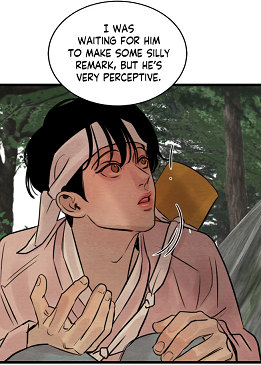 (chapter 23) Unfortunately, the lord was not perceptive at all.
 (chapter 80) He enjoyed seeing the painter’s facial expressions and reaction. He looked so shy and pure.
  (chapter 80) However, during that night, three people were trying to bootlick someone figuratively speaking: the new version of Deok-Jae, Kim and the messenger. Let’s not forget that before the arrival of the messenger, the painter made the following request to the butler:
 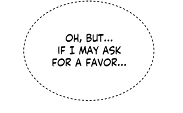 (chapter 79) One might say that he was currying favor to the butler, when he asked the butler about the music box. But what did Kim do? He brought the item to the bedchamber.
 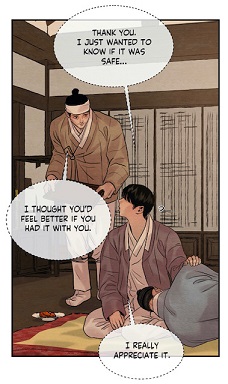 (chapter 79) But this is not what the painter had actually requested, since the butler said this “I thought”. He had taken the initiative on his own. In my opinion, the painter had just asked that the music box should be brought back to the study. However, Kim brought the expensive present to the bedchamber for one reason. He expected the arrival of the messenger. We could say that he was “ass-kissing” the painter in order to obtain his trust. Kim definitely imagined that Yoon Seungho was sleeping. As you can see, this scene was the reflection of Yoon Seungho’s action in chapter 80.
  (chapter 80) While Kim had asked the painter’s to clean his face himself, the lord was cleaning the painter’s ass himself. Or we could say that he was polishing the painter’s apples, for he has an apple-shaped buttock. 😂 This clearly indicates that Kim has never washed Yoon Seungho himself. In other words, while Yoon Seungho was totally selfless here, this was not the case for the valet. And this is no coincidence that right after, the new version of Deok-Jae appeared in front of the door calling his master. He was faking loyalty and dedication.
 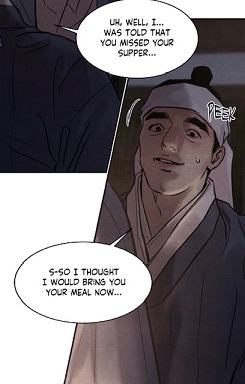 (chapter 80) Here, he was acting, as if he was sucking up to Yoon Seungho, but his gaze betrayed him. In my opinion, he had been deceived by the butler, for the latter expected that the painter would open the door. This situation was reflected within the same chapter. Notice what the messenger said to the young master in the study:
 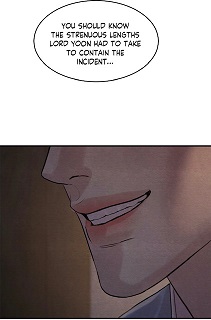 (chapter 80) He was implying that his father had to bootlick an official in order to hide the incident. And how did the lord react to this? He not only asked the servant to do him a fellatio, but also made an allusion to the sexual favor:
 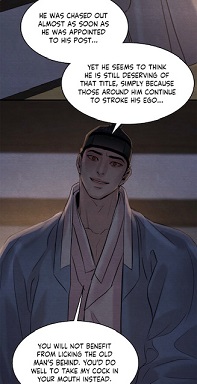 (chapter 80) His father must have kissed someone’s ass. But as you already know, Yoon Chang-HYeon is not someone who will do such a thing himself. And this shows that he has definitely used his son in order to obtain favors in such a way. Yoon Seungho had to do fellatios and let people lick his ass for his father’s sake, as he was a uke in the past. This is not surprising that the messenger received such a beating in the end.
 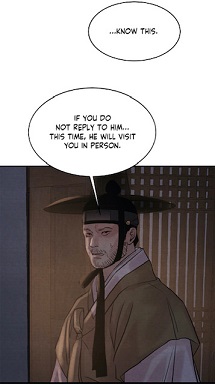 (chapter 80) He gave an order to the main lead, he threatened him. But actually, he was just a servant. He was not treating Yoon Seungho correctly. Interesting is that he showed more courtesy and respect to lord Lee than Yoon Seungho.
  (chapter 82) It was, as if the man was hoping to obtain father Lee’s support either. Another interesting aspect is that when the butler approached the wounded emissary, the former was definitely brown-nosing.
  (chapter 82) In my opinion, Yoon Chang-Hyeon had followed the butler’s suggestion. Since the painter would always sleep in the study alone, he envisioned that the messenger would suggest to the artist to meet Heena. The man could fake that he had been sent by his noona. He was dressed up for that reason!! Observe that the color of the hanbok is similar to this one:
 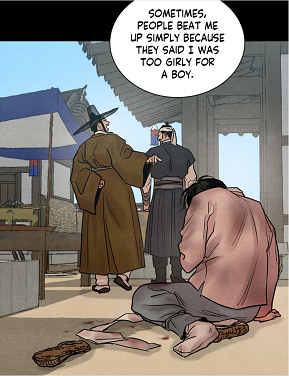 (chapter 94) Thus I had this sudden idea. What if the messenger was receiving his karma for beating the painter in the past? Remember how I had deducted that these two men could have been disguised as nobles!! And this new perception would fit my interpretation. But let’s return to our main topic. The courier refused the obsequious and submissive remarks from the butler. He was no fool, for he knew that because of his “plan”, he had become the biggest victim of Yoon Seungho’s wrath. This explicates why the author never revealed the father’s words, because the manhwaphiles would have discovered the valet’s plan and as such betrayal
  (chapter 82) This means that if father Lee or Yoon Chang-Hyeon are cornered, they could be forced to “ass-kiss” the king.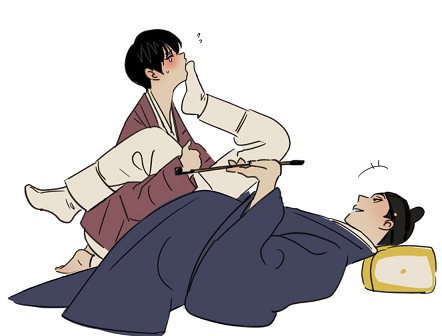
 Baek Na-Kyum is now imitating his lover. He is also licking the lord’s boot/foot. However, contrary to the signification, he is actually making love to his companion. This has nothing to do with selfishness and hypocrisy. We could even say that at the end of season 3, Yoon Seungho had become the teacher’s pet, the yes-man towards Baek Na-Kyum:
  (chapter 92) He could never refuse his lover’s requests. Thus in the gibang, he encouraged the painter to stay in the gibang.
 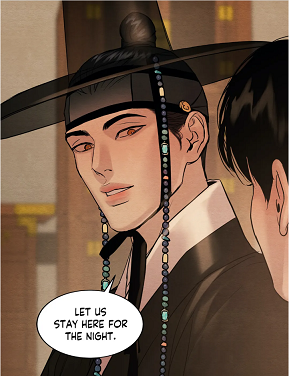 (chapter 93) It was, as if he was seeking the kisaengs’ support. Thus he chose leniency towards these women, though the latter had insulted him. At the same time, he was not hoping to receive any flattery from the noonas. He was the one “sitting on the painter’s right side”.
 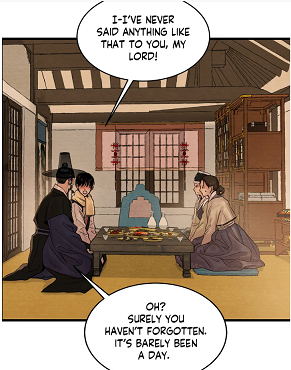 (chapter 93) To conclude, the lord had been “tamed”, he was apple-polishing Baek Na-Kyum, but not in a negative way. It is the positive reflection of Kim who will act behind people’s back, and definitely use sex for his own advantage. We have the perfect example with the 2 sex marathons. He always let the painter suffer in order to cover up his own wrongdoings. But by allowing the main lead to act this way indicates that he was not helping Yoon Seungho. What people thought as assistance was in truth “brown-nosing”.
 (Chapter 95) In his eyes, the lord didn’t need it, for he was already aroused. Remember in the beginning of the story, Lee Jihwa had to prepare his lover
 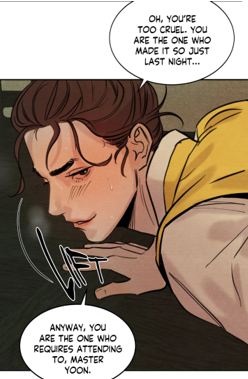 (Chapter 3) Secondly, the painter was in the position not to ask for favors, to suck up to Yoon Seungho. In their relationship, the low-born had the upper hand. Finally, Baek Na-Kyum had done nothing wrong before, so he didn’t have to beg for the main lead’s forgiveness. That’s the reason why the lord was actually rejecting the blow-job!!
  (Chapter 95) It is the expression of affection and love.
  (chapter 101) The painter had to do a fellatio to lord Jang in exchange for protection.
  (chapter 101) The artist was not acting like the teacher’s pet,
  (chapter 101), hence he needed to receive some lesson. In their eyes, Baek Na-Kyum should have licked their boot, sucked up to them… due to their power and social status. Therefore, it is not astonishing that at the end, they were executed. Why? It is because Min and the others could never “curry Yoon Seungho’s favor”.
  (chapter 102) Without the painter, the lord had no reason to continue living. Baek Na-Kyum was his source of joy and of strength. Without him, he was powerless. And this leads me to the following observation. Since we have a situation of brown-nosing concerning Black Heart in the shaman’s house, this signifies that we should have a reflection earlier in season 3. And now look at this:
  (chapter 92) In that scene, Min was indeed “flattering” his ex-sexual partner, while he was rather dismissing the painter.
  (chapter 92) He was also indirectly currying the lord’s favor. This was the reflection of the night in episode 52 either. However, contrary to season 2, Yoon Seungho had the upper-hand, as the painter had already sided with him. But one might say that this perception of “apple-polishing and buttering up” stands in opposition to my previous statement: sex is like a battle, a fight where there is only one winner. But that one doesn’t exclude the other, since Min had also tried to eliminate Baek Na-Kyum before changing his mind. This truly shows that we had two different philosophies, yet both were evolving around sex. This truly outlines that someone was “consumed by lust” in the end.
 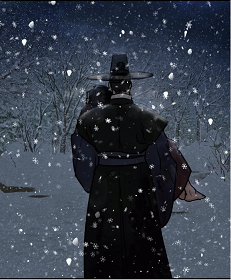 (chapter 102) On the other hand, Baek Na-Kyum is slowly sensing the valet’s disloyalty towards the aristocrat.
  (chapter 86) Since the lord could see through Jung In-hun’s true personality, I believe that it is the painter’s duty to grasp the valet’s treason. In my opinion, since he caught Kim having sex with the maid, it is only a matter of time, until he realizes his true personality. In chapter 77, valet Kim had thought that he could rekindle with the owner of the mansion, hence he brought him tea and the medicine. He envisioned that if he acted like a loyal and dedicated servant, he could regain Yoon Seungho’s support.
  (chapter 77) In other words, he was buttering up to the young master. But observe that in that scene, he never lowered himself in front of the young man. He didn’t go on his knees or he didn’t bow to him either. This attitude exposes the valet’s true personality. He considers himself better than Yoon Seungho and Baek Na-Kyum, refusing to admit any crime or mistake. In that scene, he never said YES! In fact, he kept contradicting his master.
 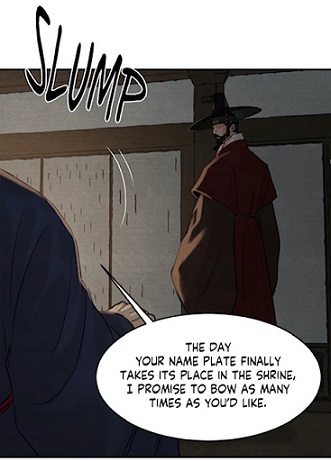 (chapter 86) He envisioned that his elder son would return him the seat and as such he would become the owner of the family mansion again. Why? It is because of the main lead’s words in the library. His so-called respect towards the father was just fake. That’s the reason why the father imagined that he just needed to show up and he would get the mansion back. However, in reality, he should have sought his son’s support, and as such kiss his ass in order to achieve his goal. But the man has never done it himself. He has always been used to being fawned and ass-kissed that it is not surprising that he barged in the mansion. And this is the same for Yoon Seung-Won. The latter might have sent letters in order to obtain his brother’s support, but we can’t say that he was sucking up to Yoon Seungho. Thus it is no coincidence that at the end, the latter advised his brother to follow the father’s principles.
  (chapter 37) Here, he was implying that Yoon Seung-Won should do fellatios and other things in exchange for favors.
  (chapter 40) Moreover, according to me, she used the young master Seungho and her brother to avoid sex. Furthermore, I would like to point out that when the kisaeng argued with her brother, this is what she said to her brother:
  (chapter 97) Here, she was referring to favors. Yet, shortly after she proposed this to her brother:
  (chapter 97) It is clear that the agreement was not selfless. No nobleman would spend money and energy for nothing. The noona was hiding the content of the deal to her brother, the negative reflection from season 1. And now, you comprehend why I am sensing that since her deal was to sell her brother in exchange of favors, her karma should be that she has no other mean than to sell herself in order to survive, as she is now on her own. And if this truly happen, this can only reinforce her resent and hatred towards the couple. But we will see, if Heena is the one “sucking up” in season 4.
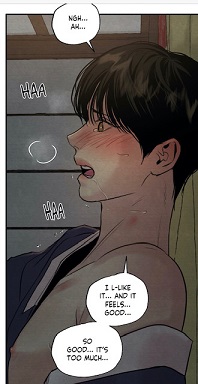 (chapter 73). But keep in mind, this is related to the painter’s education. He had been raised not only to hide his homosexuality, but also to reject sexuality as such. Naturally, in reality a no means no and nothing else.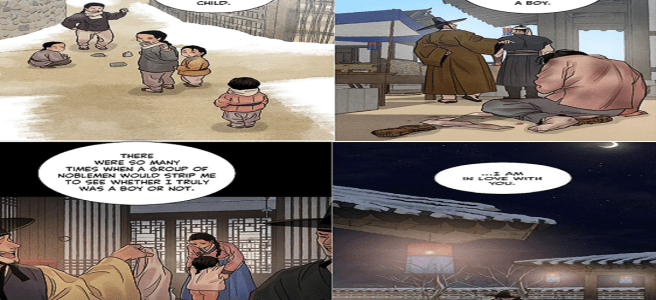
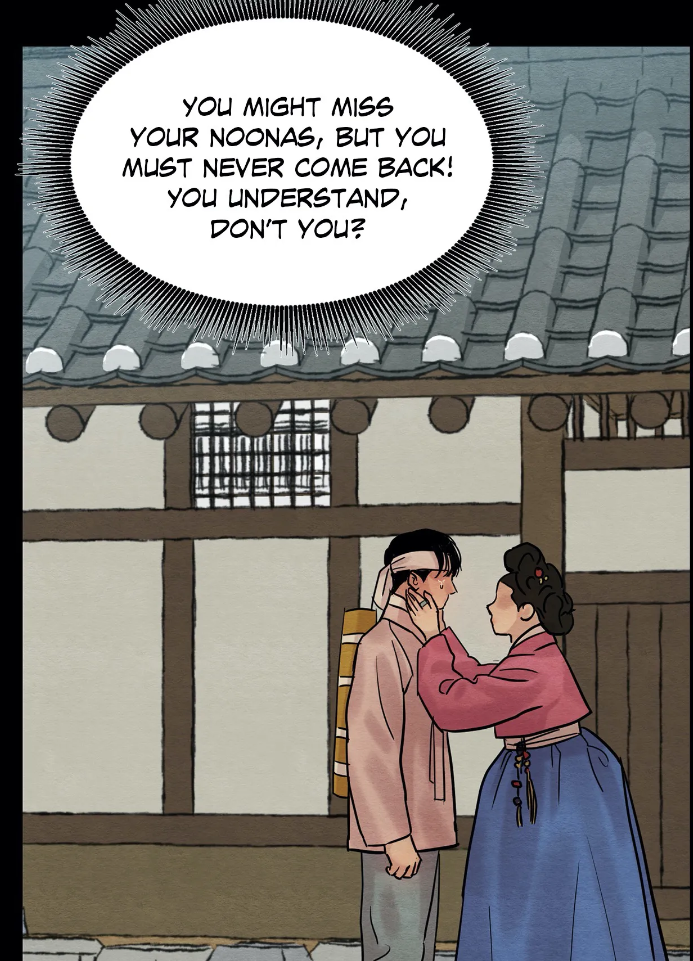 (chapter 46) This was actually implied by Heena’s words and gestures, yet I had already questioned this, for Heena appeared as dishonest. Now, it is time to expose my new interpretation concerning Baek Na-Kyum’s eviction from home.
 (chapter 94) Yoon Seungho had two reasons to expect such an outcome. First, it was related to Yoon Seungho’s offer to Baek Na-Kyum.
  (chapter 44) Secondly, Baek Na-Kyum had already showed to the main lead that he could leave him at any moment.
  (chapter 85) Finally, what mattered to the artist the most was the lord’s love and trust.
  (chapter 85) He believed in his affection while thinking that Yoon Seungho would keep his promises. But if there was a slight doubt about him, in Yoon Seungho’s mind, the painter would choose his noona over him, like he had experienced it in the study. To sum up, in the gibang, the lord was fearing the artist’s departure. Moreover, when the painter confessed his love to the noble, he was also leaving the scholar’s side. His path was no longer following the teacher’s. Thus when he said this
  (chapter 94), he was actually biding farewell to Jung In-Hun. He was moving on. Finally, if you include these panels from chapter 94,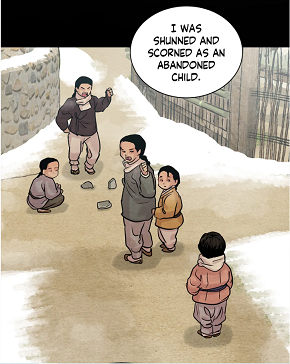
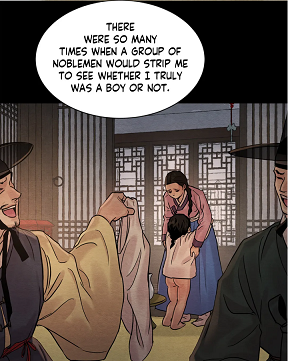
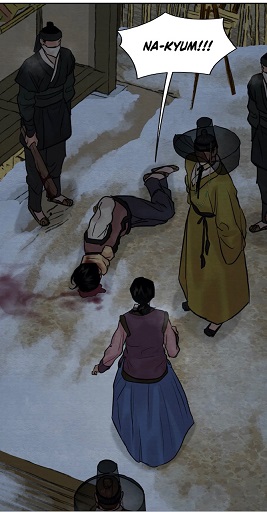 (chapter 99) In these two scenes, the painter got so hurt that he was bleeding. In addition, the painter’s hair was free. In front of Jung In-Hun’s house, the perpetrators had removed his headgear, while in the gibang, the white head-band was on the ground. To conclude, the painter’s short hair was visible. Don’t forget that the short hair was indicating that the artist was an orphan. So by removing the headgear for noblewomen, Min and the black guards made sure to expose that the victim was just a low-born without any family. But let’s return to our comparison. Min was wearing a similar hanbok than the noble in the gibang. Furthermore, the black guard resembles a lot to the aristocrat with the hunting outfit in the kisaeng house house. The painter’s white headband is now serving as a cover for masking the black guards’ identity. As you can see, due to these similarities, I came to the conclusion that this scene
 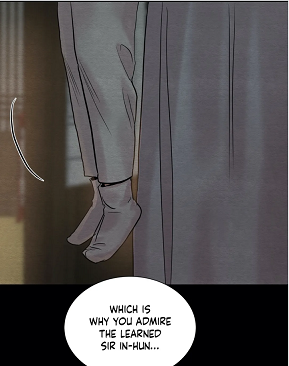 (chapter 68). She let her brother hear the laughs from the younger masters. It looks like she is consoling her brother, yet she is not, for she is not embracing him. She is grabbing him by the shirt which reminded me of this gesture: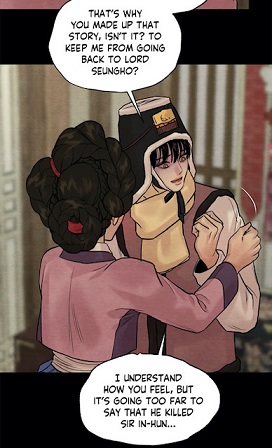
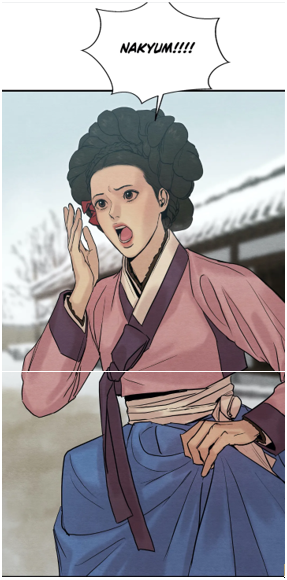 (chapter 65). Thus she gave more the impression of being righteous and truly concerned.
  (chapter 44) However, there exists a difference between the painter and the lord’s association for beards in my opinion. The latter suffered due to old men wearing a long moustache beard with whiskers.
 (chapter 82)
 (chapter 83)
 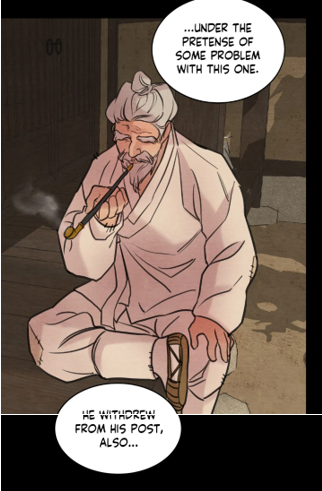 (chapter 37)
 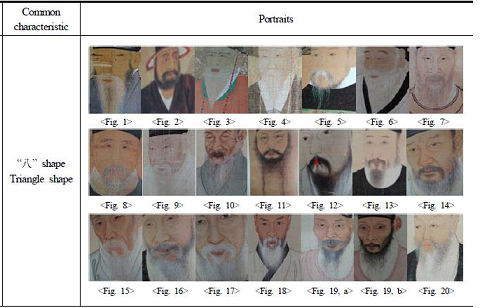 But there exists another style of moustache beard.
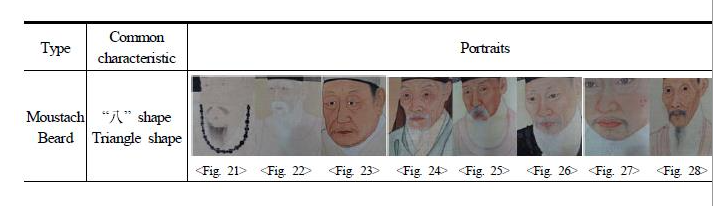 Striking is that Kim is also wearing such a moustache beard.
 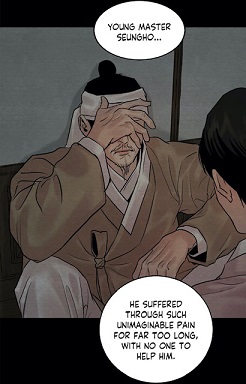 (chapter 87) However, so far in the story, this type of moustache beard was only present among commoners and not nobles!!
  (chapter 39)
 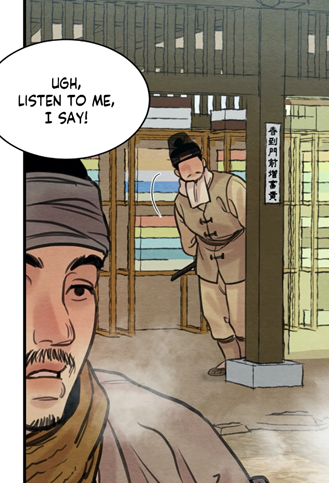 (chapter 45)
 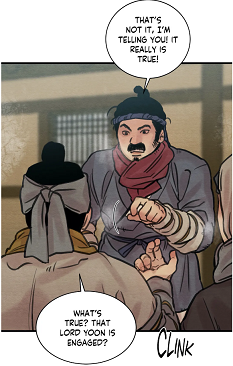 (chapter 45)
 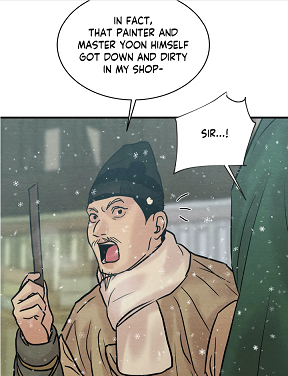 (chapter 64)
 (chapter 78) Hence I started suspecting if these two persons were truly nobles in the end.
  (chapter 99), Min was cosplaying Lee Jihwa, the guards were covering their mouths, Baek Na-Kyum had been wearing a expensive scarf and a headgear for noblewomen,
 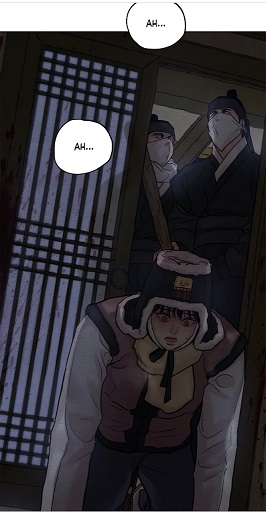 (chapter 99) so that he had been mistaken for a young master.
  (chapter 91). Therefore I came to the conclusion that the painter has repressed the link between the moustache beard and nobles. Since the noona kept saying nobles, what made Baek Na-Kyum shudder in the past were nobles. But the connection between the beard and nobility is existent in the painter’s subconscious. This explicates why Baek Na-Kyum would show such a respect to valet Kim, he would call him sir and listen to him.
 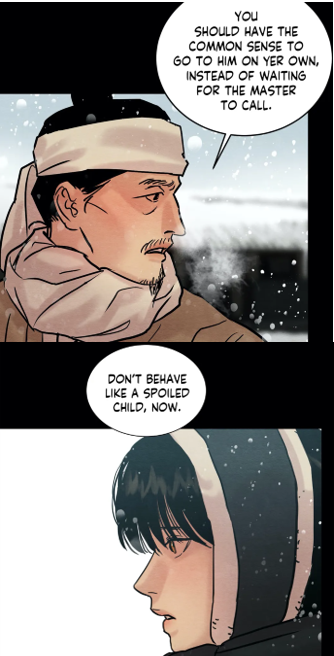 (chapter 52) However, the more time passed on, the more the butler kept pointing out that he was just a servant, so that this moustache beard is losing its meaning, the symbol for power and nobility. At the same time, the painter met more and more people with beards, like for example the tailor
 (chapter 74), the physician
 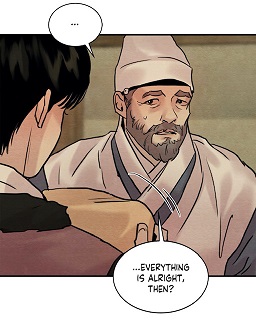 (chapter 74), Bongyong
  (chapter 78) and finally Yoon Chang-Hyeon
  (chapter 87). However, note that when the patriarch left, the main character only paid attention to his gaze and not his beard.
  (chapter 87) This explicates why Baek Na-Kyum is not mentioning the beard concerning nobility, while Yoon Seungho never made the connection between the old bearded men and Kim, though the latter has now a moustache beard! To conclude, I don’t think that this physical assault
  (chapter 99). That’s the reason why I came to the following theory. These persons wounded the painter on purpose and in my eyes, it was suggested by Heena.
 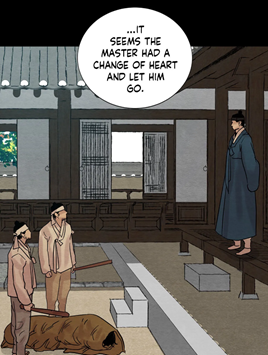 (chapter 13), the maid (though not intended)
  (chapter 36, here the painter is drugged against his will), Deok-Jae
 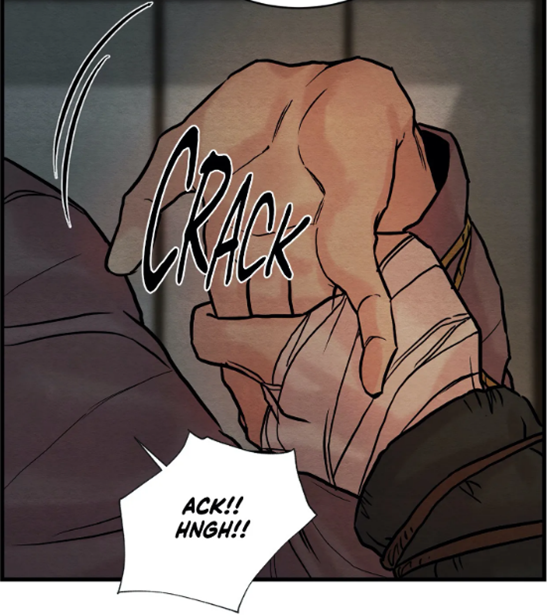 , Nameless,
 (chapter 60), Kim
  (chapter 66) [As you already know, for me Kim was the one who tried to kill the painter during the abduction], Bongyong
  (chapter 78), the calligrapher with his insults
  (chapter 91), the maids with their reproaches
 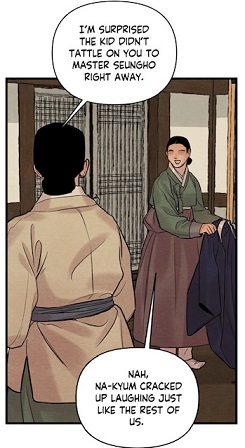 (chapter 91)
  (chapter 98) and the black guards from Min.
 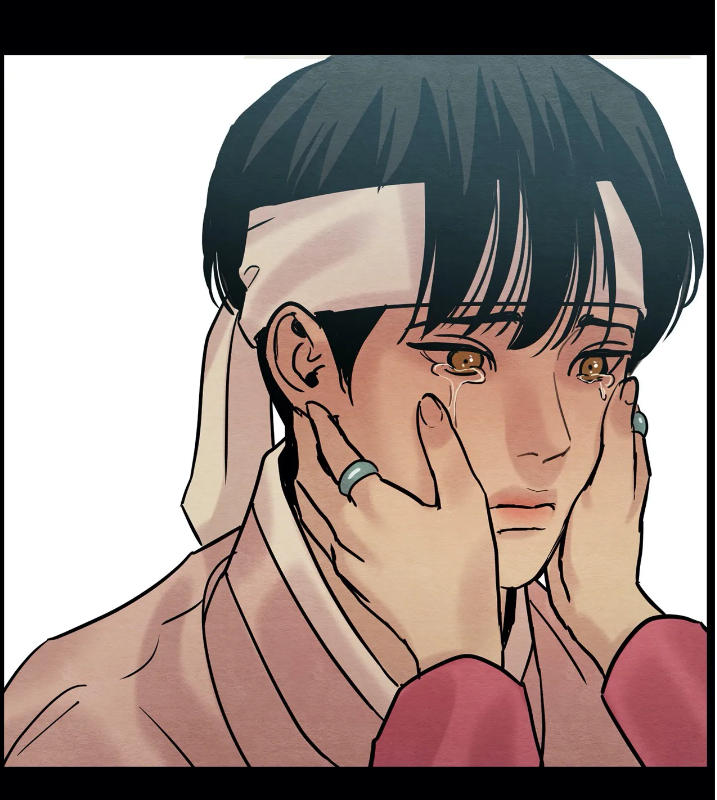 (chapter 46) This was the “positive” reflection of this scene:
 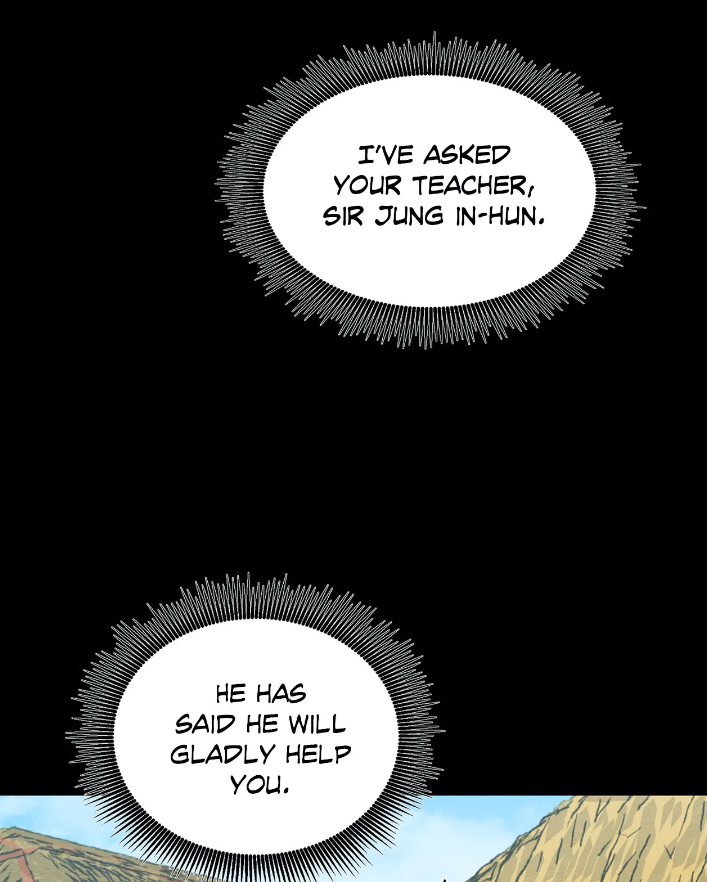 (chapter 46) Moreover, I am now doubting that Baek Na-Kyum and Heena were seen in front of the gibang.
 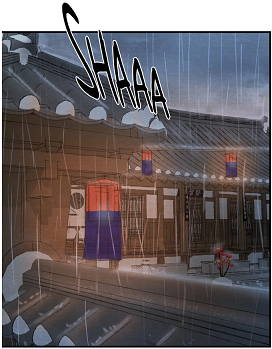 (chapter 19)
  (chapter 69)
  (chapter 93) Secondly, there is no window next to the entrance of the building contrary to the image from chapter 46. Consequently, I deduce that Heena had left the gibang with her brother saying that she was meeting a client, and just before entering the mansion, she sent away her brother. This explicates why he had only taken his tools and nothing more. Remember what the noonas said in chapter 93:
  (chapter 93) She implied that the noona was not present in the kisaeng house, while in reality she was punished, trapped in a storage room. And now, you comprehend why Heena said this to her brother:
  (chapter 93) He had suddenly vanished without voicing such a desire before. And note that in chapter 97, she was already acting on Min’s orders, a sign that in the past, it was different. She had done it on her own accord. In the annex, the kisaeng was definitely scared, hence she was trembling.
  (chapter 99) Finally, we have this execution in chapter 1. During that night, Baek Na-Kyum should have died. But let’s return to episode 97. Here, she was resenting her brother.
  (chapter 64) This would explain why she never looked for her brother afterwards. This shows that unconsciously, the painter had judged her betrayal and abandonment correctly, but he had been deceived by her argumentation and attitude. In other words, he was in denial.
 (chapter 87) So in this scene,
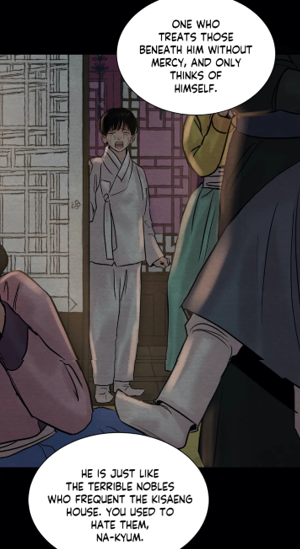 (chapter 68), Baek Na-Kyum had the impression that she was telling the truth. It looked like she was a victim of violence, while in reality, Yoon Seungho was the real victim. He got dragged and tied up! Today, I just discovered another evidence for this interpretation!
  (chapter 68) The blue skirt is revealing her presence. She is next to the door and observe that there is a table to her right!! Exactly like in chapter 94!
 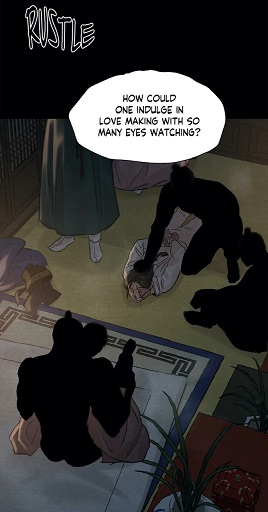 (chapter 86), I deduce that Heena explained her desertion by taking away the table so that she had the perfect excuse to leave this room and abandon Yoon Seungho. It was not her business. But if she left the room during that night, she could have followed her brother. But she never did it. She let her brother imagine that she was suffering.
  (chapter 70) Terrible, right? However, since the painter had been deceived by impressions, he came to believe her version and lies. But there is more to it. Because the artist was so young, he never realized that he could have detected her manipulations!! How? She should have become a wreck… have bruises on her body, but she never had any.
  (chapter 93) Since she excused her vanishing by saying that she had to remove the dishes and as such was busy in the kitchen, it is normal that she was imprisoned next to the kitchen 10 years later!! Here, we can recognize the kitchen by the door made of wooden planks:
 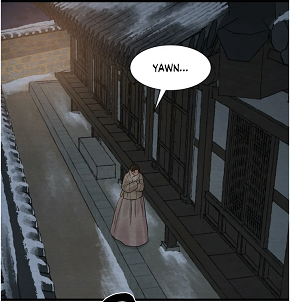 (chapter 95) But there exist two other evidences why Heena is associated to the kitchen. Remember the painter’s thoughts in the inn:
 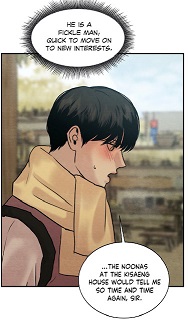 (chapter 75) They let see that he was thinking of Heena, though he spoke of his noonas. However, the presence of religion was introduced with food.
  (chapter 75) This truly exposes that Heena preferred working in the kitchen. That way, she could avoid sex with the clients. Another interesting aspect is that when she was sitting at the table with nobles, she was not talking to her neighbors.
 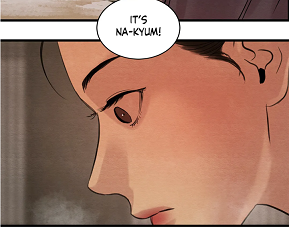 . (chapter 93) She was not even serving the noble next to her.
 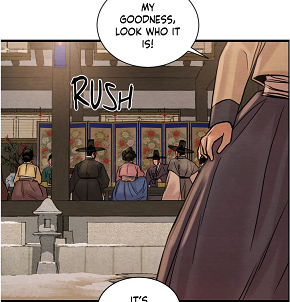 (chapter 93) Once again, she was passive and immobile. Since she was doing nothing, she could hear her brother’s name and turn her head.
  (chapter 93) Under this new light, it becomes understandable why Baek Na-Kyum didn’t detect her presence in the patio. It was not her usual place. At the same time, the readers can grasp why the artist didn’t mind eating in the kitchen with the maids and felt comfortable around the head-maid.
  (chapter 46) This was reflecting his past relationship with Heena. And now, you comprehend why Heena never paid attention to the painter’s education. She had not the time and the motivation to do so. She was busy in the kitchen during the evening and night, yet keep in mind that the painter was her excuse to keep her distance from the nobles in the beginning. This explicates why Yoon Seungho crashed the table in the gibang:
  (chapter 99) This was Heena’s karma. She could no longer use the table as an excuse to betray and abandon a young boy. Moreover, we could see this gesture as a compensation for the past incident.
 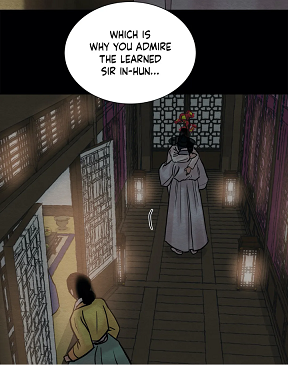 (chapter 68) How do I come to this idea? It is because there is a progression in the responsibility. But we will see, if the lord’s anger was caused by spoiled rice. One thing is sure: the butler is recreating events from the past. And shortly after the painter’s departure from his noona situated in chapter 46,
  . (chapter 47). That’s the reason why I am connecting the kisaeng to the food. And I had already demonstrated that there exists a link between the gibang and the lord’s kitchen.
  (chapter 60) And now, we know for sure that the chicken blood was used to stage the crime scene in the scholar’s house.
  (chapter 101) For me, Nameless was behind this prank. It sounded so harmless, but the reality is totally different. Consequently, Heena can become the prime suspect in the scholar’s disappearance. Remember that according to me, Yoon Seung-Won went to the gibang after leaving his brother’s mansion and discovered that he had been deceived. For me, there is no ambiguity that Yoon Seung-Won and lord Song are behind the learned sir’s murder, for both had a huge interest for his vanishing. But in my eyes, Heena is the link between the nobles, lord Song and No-Name, because the kisaeng house is frequented by all kind of people. I have already mentioned that the learned sir must have gone to the kisaeng house after meeting the fake servant.
 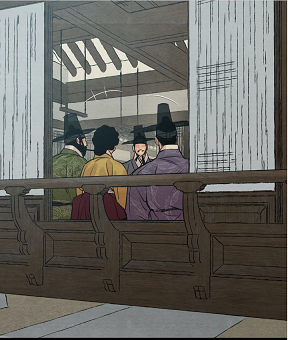 (chapter 83) Then I had already demonstrated that the kisaeng had already visited the mansion, for she knew where the painter’s room was.
 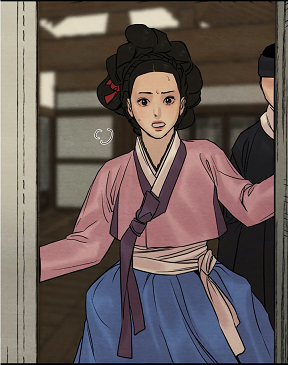 (chapter 65) So she could have worked in the kitchen… helping the other maids. To conclude, the kisaeng had committed the following wrongdoings. She had manipulated her brother with a mixture of belief and prejudices to cover up her own fears and wrongdoings. While in chapter 94, she stopped the painter from leaving the room unconsciously, it was no longer the case with Yoon Seungho, as she was standing in front of the door.
 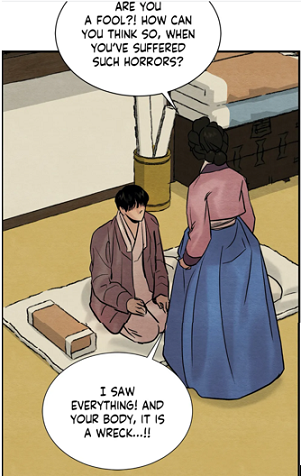 (chapter 68) For her, sex had become a synonym for torture and death. Her wrong choices reinforced her fears about sex in my eyes. Every time, she decided not to face the truth, she preferred being blind. Thus the goddess chose to punish her by letting her deceived by impressions.
 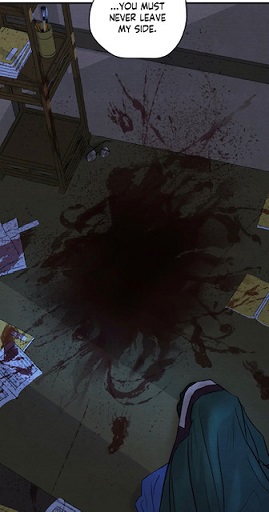 (chapter 88)
  (chapter 66) Here, she couldn’t help her brother, though the “sequestration” was nothing compared to what Yoon Seungho had experienced at such a young age. She had deceived her brother in the past, and now she was put in the same position. She was the fool one. In addition, she was forced to be confronted with reality, because she needed to admit her wrongdoings. Since she was behind this assault
 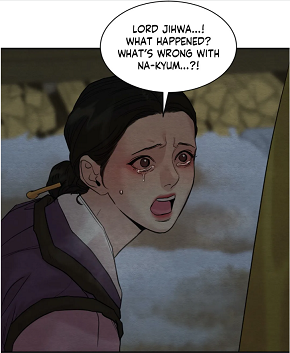 (chapter 99) She never pointed her finger to the black guards, for she knew that they could reply that she was responsible for her brother’s resistance. She had not been able to convince him to follow Min. She preferred blaming innocent people (Baek Na-Kyum, Yoon Seungho and “Jihwa”) than recognizing her own guilt and her bad choices. Since in the past, she stood in front of her door, her punishment was to remain outside. She could never enter the room
  . (chapter 96) She even got sequestered herself.
  (chapter 99), this means that her punishment will be that she will never see her colleagues again. Since she faked her death
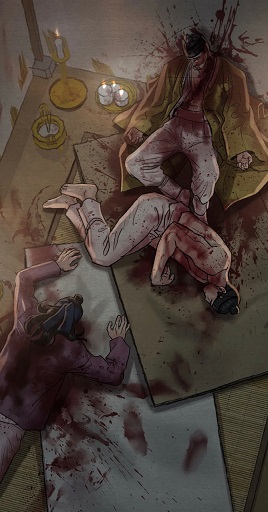 .(chapter 102) She is a Christian, hence she could be accused of sacrilege too. In my eyes, Heena will never be able to bid farewell to her brother again. His words in the mansion will become a reality.
 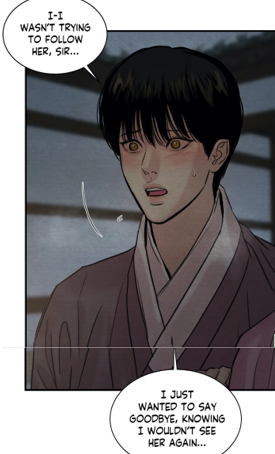 (chapter 69) As you can see, I am detecting a progression in her wrongdoings. She is getting more and more involved, though there is no ambiguity that she was deceived herself in season 3. But this doesn’t excuse her crimes, for she refused to listen to her brother and called him an idiot. At no moment, she pondered on the situation. Her decisions were strongly influenced by her emotions (fear, anger and hatred). That’s the reason why I am convinced that if she is not dead (my theory), her attitude towards her brother will worsen to the point that she will call her brother a bird of misfortune!
 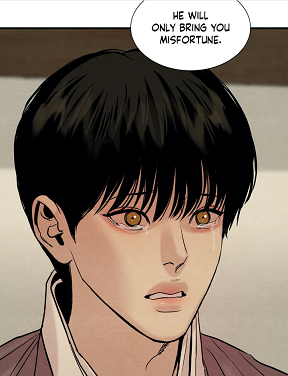 (chapter 68) Remember her metaphor concerning the gibang, it was viewed as a nest. She was already comparing her brother to a bird.
 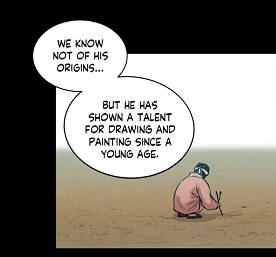 (chapter 01)
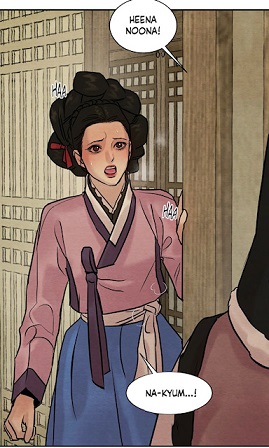 (chapter 97) Fake concern versus anger and resent
 (chapter 11) Secondly, I had associated the main lead to the eagle which is the symbol for the kings and emperors in Europe. He was seen here flying
  (chapter 30), and his fingers reminded me of the eagle’s claws.
  (chapter 18) And this perception got even reinforced, when I saw this panel:
  , I had another revelation. On the one hand, it actually confirmed that Yoon Seungho was somehow destined to become a king, yet he is not represented by the eagle or the phoenix, but by the dragon. Hence the moment I saw this image, one idiom came to my mind: Dragon king!
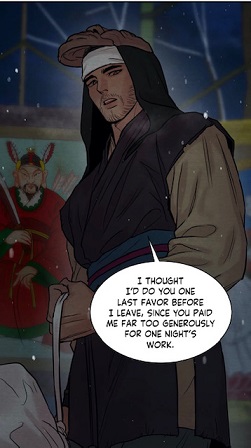 (chapter 100), though this deity is always accompanied with a dragon and in this picture, the readers couldn’t see one. However, it is possible that the author didn’t desire to reveal too much.
 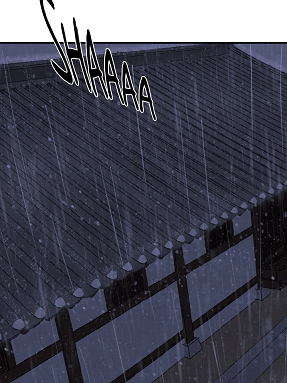 (chapter 21) Why? It is because the lord was happy. These were the tears of happiness, which Yoon Seungho couldn’t express contrary to the painter. And this is no coincidence that in chapter 58, it started snowing, when the couple was making love:
 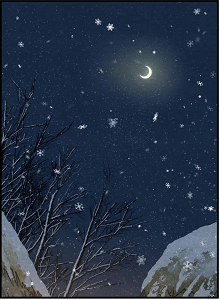 (chapter 58) And we had the same weather, when Yoon Seungho saved his lover.
 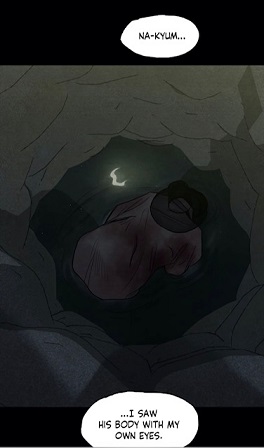 (chapter 97), and according to me, the messenger was drown there.
 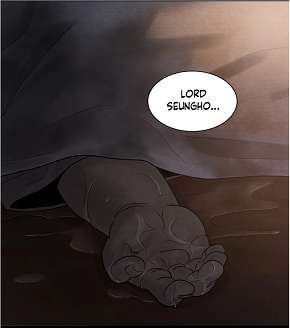 (chapter 94) In addition, my theory is that Deok-Jae and/or Jung In-Hun’s body were placed in a jar in order to hide the murders. For me, the jar plays a huge role in Painter Of The Night… thus Byeonduck created such a scene in season 2
  (chapter 46) and we have so many jars next to the pond:
 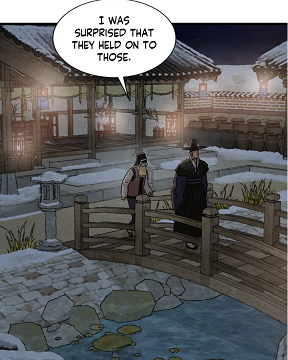 (chapter 94) [For more read the essay “The secret behind the library”]
 (chapter 91) This is no coincidence. To conclude, all these elements (rain, jar, well, soul of a deceased), connected to the dragon king, are present in Painter Of The Night. Thus I came to the conclusion that Yoon Seungho is like Dragon king. This reinforces my conviction that the main lead is not only connected to shamanism, but also embodies royalty. So he might not be the king of Joseon, but he is powerful in his own way, though he is not aware of this. And note that the moment he wished to commit suicide by drowning in the pond, he was brought back to life.
  (chapter 102) Water is his true element.
 (chapter 85) This means that in the Yoons’ mansion, people didn’t venerate this god. And since the aristocrat made such a statement to the elder Yoon Chang-Hyeon,
  (chapter 100) and this altar
 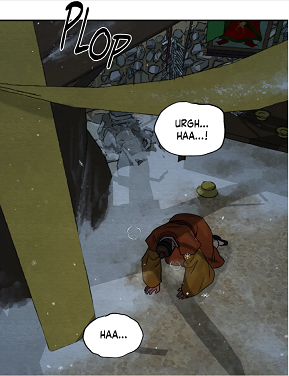 (chapter 100) were exposing the presence of a ritual. However, my problem was that I couldn’t determine exactly the nature of the ritual. But by making the connection between the dragon and good fortune, I had now more clues. I have to admit that I can not be 100% sure for this, but this is what I found: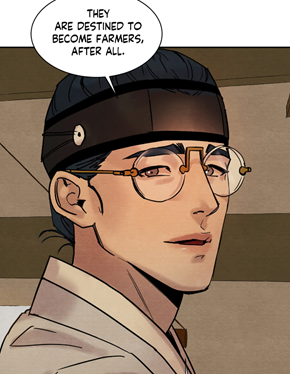
 (chapter 6)
  (chapter 83) and the deer
  (chapter 22). Then the lord compared Baek Na-Kyum’s eyes to a rabbit.
  (chapter 78) Since both resemble each other, I deduce that the main lead has the same eyes, the rabbit’s. Like mentioned above, he utilized his fingers similar to claws:
  (chapter 54) One might argue that this signification is totally impossible, for the lord doesn’t have the body of a snake. This point can be refuted very easily. What is the major characteristic of a snake is molting. A regularly recurrent event during the activity period of all snakes is the shedding of the skin. This coincides with the lord’s change of clothes. The latter reflected his downfall and rising. Furthermore, this animal is linked to death and rebirth. My avid readers are already aware that I had detected different scenes, where we could witness the lord’s spiritual death and rebirth, like for example in the shed:
  (chapter 62) When he discovered his misjudgment the next morning, he felt like dead. He no longer saw himself as a lord, but came to view the painter as his new lord :
 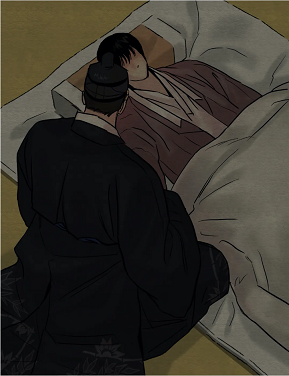 (chapter 66) As a conclusion, Yoon Seungho shares so many similarities with the dragon that I came to view him as one. This explicates why even after getting married, he will never wear a beard!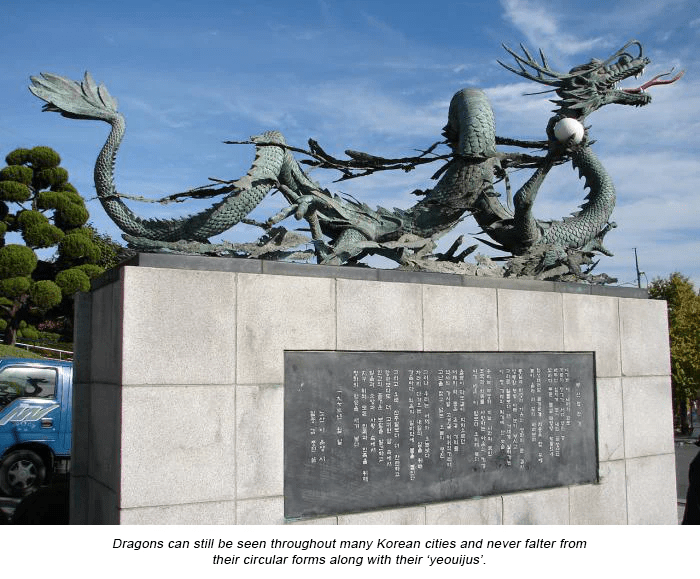
 (chapter 45)
 (chapter 55) and as such his heart and mind.
 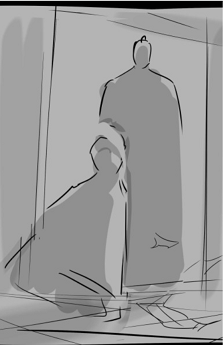 The painter is sitting inside a room, while Jung In-Hun is standing outside. Nonetheless, the position of the characters are very similar. This indicates that the author’s new alternative story is actually inspired by the main story!! This can only reinforce my perception that Yoon Seungho in the main story is associated to royalty. However, since it is a reflection, I deduce that this image
 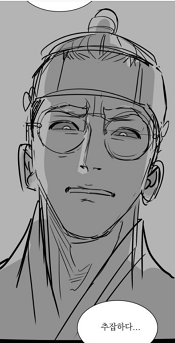 He criticized the painter by stating that this was “filthy”.
  In this scene, the characters are caught by surprise, but it becomes obvious that there is no disgust or expulsion. In fact, the fall of man took place before, for Baek Na-Kyum was sent to Joseon. In this encounter, I detect attraction and curiosity. Hence I come to the conclusion that in the original story, when this scene took place,
  (chapter 50)
  (chapter 52) This means that the mysterious lord Song was actually claiming the main lead as his wife in the last scene. Min and his friends were sent there in order to entertain the protagonist, but they failed. This explicates why the next day, Black Heart was seen with a hanbok of lower quality.
  (chapter 56) It was, as if Min had been compensated for his bruised face by the mysterious lord Song. However, for the pedophile, Black Heart was just a concubine, and not his main wife! Hence the hanbok had not such a detailed and expensive design. This would explain the villain’s jealousy. And now, if you look back at the hanboks from the main lead, you will recognize his ascent. First, he is wearing green, which is similar to Yoon Chang-Hyeon’s color. At the same time, his hat resembled a lot to Kim’s.
  (chapter 1) Then later, he is mostly wearing blue which is actually the color of the Crown prince.
  (chapter 11) Yet, his robes initially have no design. Slowly, the lord is wearing colors and designs that are actually reserved for a king: blue, red, black and purple. This constant change of hanboks symbolizes the “snake molting” and as such his transformation and rising. This is not astonishing that on the night of the bloodbath, he had such a hanbok:
  (chapter 102) Here, he was no longer acting like a noble, but as a ruler. Don’t forget that according to me, the mysterious lord Song had proclaimed the main lead as his unofficial Queen by giving him hanboks with phoenixes. However, naturally, this was never mentioned to Yoon Seungho directly. Why? It is because Kim usually selects his clothes. However, this rise was not natural, as the lord had no real saying in this matter. The real metamorphosis took place in the shaman’s house, when the lord was sent back to the past and as such the darkness.
 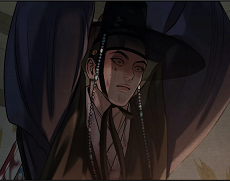 (chapter 102) The moment he left the “cave”, he went to the mountain and surrounded by the wind and water, he changed into a dragon. This expulsion corresponds to the final release, the lord’s mind is finally freed from the darkness, while I believe that this scene
  (chapter 44) It is because the main lead was thinking that the painter would actually run away. Thus the door was left opened, and he was wearing warm clothes. Yoon Seungho never imagined that Baek Na-Kyum would remain by his side. Yet, during the previous night, the lord had consoled his lover by embracing him.
  (chapter 71) But this can be refuted easily. First, don’t forget that during this love session, the lord was acting like a servant pleasing his new lord. So this had nothing to do with Yoon Seungho’s feelings like sadness or happiness. He was determined to keep the painter by his side, and ignoring his own feelings. He never expected the artist to reciprocate his feelings. Secondly, Yoon Seungho’s nocturne vision is not just a nightmare, but also a DREAM! Yes, you are reading this correctly. Only recently, I discovered that all the artist’s visions are a combination of 3 elements: memory, nightmare and dream! I will give you three examples as illustration, for I am slowly running out of time.
  This vision is a combination of these three elements: memory, nightmare and dream. This had happened during the First Wedding Night (memory)
 (chapter 21), then we have a similar situation in chapter 49: ,
 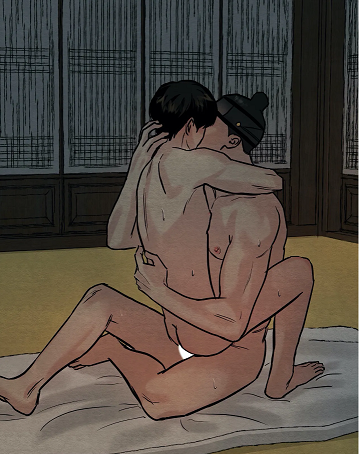 , but the painter was rejecting this future. Hence he considered it as a nightmare.
 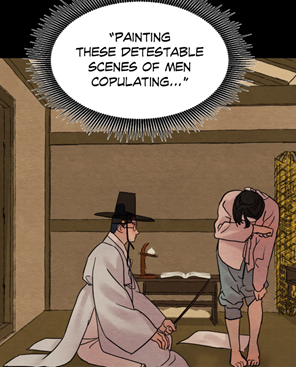 ; nightmare
  the lord becomes a ghost and confronts the painter with his biggest fears (admitting his attraction, passion for erotic paintings and homosexuality) and dream
 (The painter’s true desire was that the lord would kiss him, he was deeply longing for his lips, yet he was still in denial in this vision.
 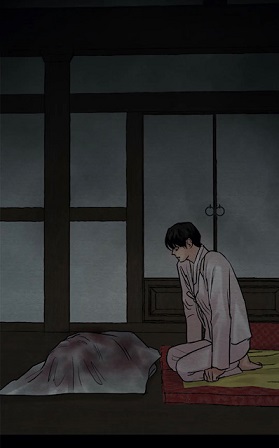 , for the painter was remembering the corpse in the courtyard, a dream, as he wished the return of his loved one
 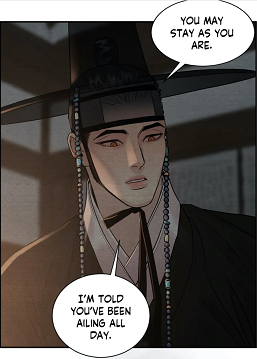 . He hoped that the lord would take care of him personally. Naturally, the “spirit” is the nightmare
  .
. 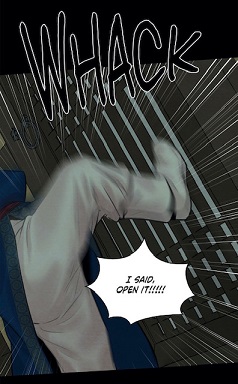 (chapter 74) This had already happened, but the lord had not grasped the significance.
 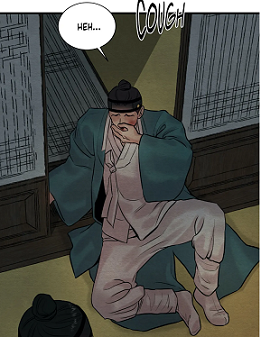 (chapter 53) Besides, he had not opened the door himself. Even when he went to the scholar Lee and opened the door with the his foot, the lord still felt trapped.
 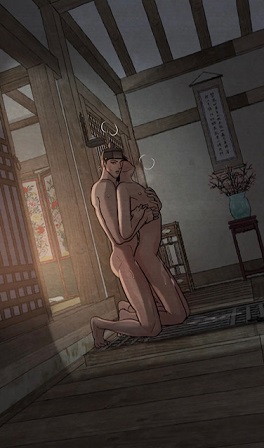 (chapter 96) This shows that the lord’s wish to get released had not been fulfilled so far. In my eyes, it is connected to the torture Yoon Seungho suffered and as such to the purge organized by the authorities. That’s the reason why I deduce that the lord will break a door in season 4, and this won’t be by accident and it will be witnessed by many people contrary to chapter 53, 67 and 96! The broken door will reflect the lord’s rise and power, and no one will be able to stop this. In my eyes, this wish is connected to the door in the servants’ quarter. That’s how his imprisonment started.
 (chapter 74) The “dragon” wished to see Kim and his father, and confront them! And this did take place in season 3. Yoon Seungho confronted the butler with his attitude and betrayal
 (chapter 77), but this argument was just short-lived. He still viewed the valet as a hard-working and trustworthy person. He had just made bad decisions. Then in the bedchamber, the lord could blame the father for his suffering:
 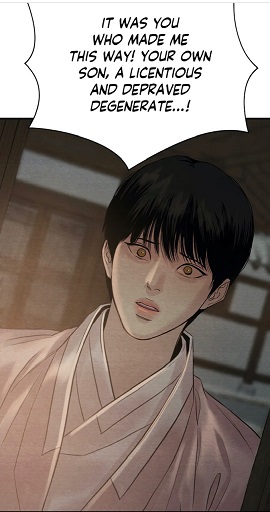 (chapter 86) As you can see, the lord’s wishes were granted, but the nocturne vision was so difficult to grasp that neither the readers nor the main lead could interpret the message correctly immediately. Besides, the nightmare was mostly silent. But this doesn’t end here.
  (chapter 74) In this image, he is floating in the air… a sign that his status is changing. At the same time, this shows that he is escaping from the hands. They are trying to drag the main lead down. Thus I come to the conclusion that the vision was announcing the lord’s transformation (into a dragon) and as such his “rise”. Note that in this image, he is still a teenager, but in the following panel the protagonist has already become an adult.
  (chapter 74) Simultaneously, the vision also displays the lord’s expulsion from “hell”, the sex orgies
 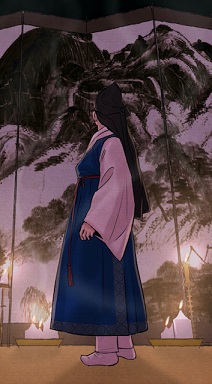 (chapter 74) Simultaneously, the dream showed that the lord wished to see this painting again, though deep down, he blames this image for his suffering. As you can see, the vision was revealing the tormented disposition of the lord. He was switching from nightmare to dream and the reverse… a mixture of anxieties and desires.
  (chapter 74) This signifies that he was approached by someone from behind, he had not noticed that the “door” had been opened. Thus he never expected his apparition. For me, this perception demonstrates that the painting is not the real cause for Yoon Seungho’s suffering. Since he had turned around, I came to recognize that this scene stands in opposition to the situation in the painter’s nightmare:
 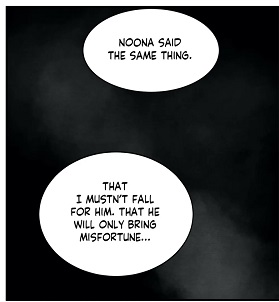 (chapter 86) In reality, he was a dragon, who could bring luck and fortune to the person who would cherish him. This is no coincidence that the pedophile sent hanboks with the crane
 (chapter 30), but much more brutal and violent!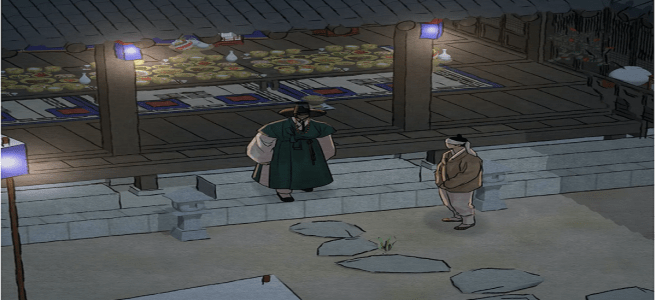

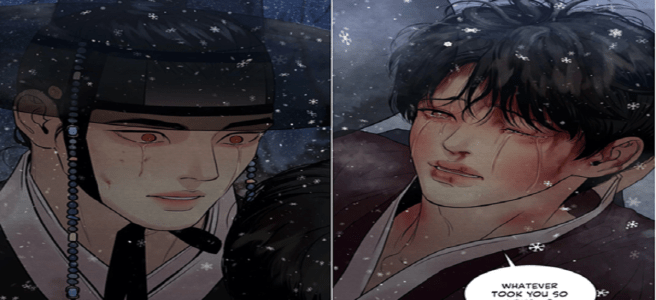
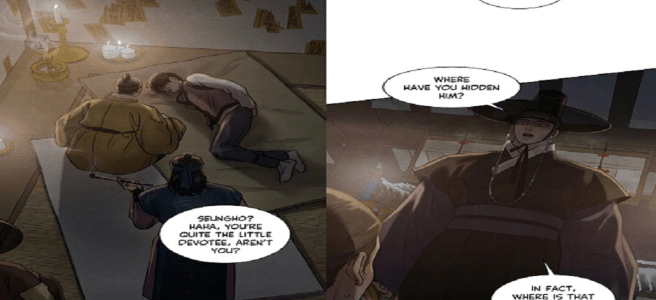

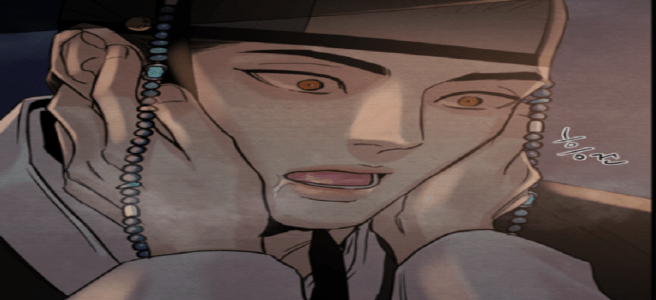


 (chapter 1), and he was no longer living with his single mother and brother Lee Hansoo. He described himself as a small but confident delinquent, as he used to work for a loan shark in order to earn money very easily.
  (chapter 1) And one day, his brother Lee Hansoo met him in order to ask him for money. Their mother was sick and they needed to pay the hospital bills. Lee Yohan agreed to help, thus under pressure, he chose to threaten a debtor’s son. Observe that the main lead chose to use a knife and take the child as hostage. He was walking on a thin line between legality and crime. As you can see, Lee Yohan was no saint. But it didn’t matter to him so far, for he had no faith at all. He refused to believe in karma.
  (chapter 1) He was definitely a disillusioned teenager, therefore he was not thinking about the future. However, the fact that he became totally reckless during that day indicates that he still valued his family. He might not have been close to them, but he still cared for them. That’s the reason why he agreed to accept the brother’s request. We can sense his worry here.
  (chapter 1) However, since he had given up on his dreams and had no hope, Yohan didn’t take the threat seriously, until he was confronted with reality.
  (chapter 1) The same man killed his brother Lee Hansoo in front of the main character. The man had acted like that, for he had lost everything: his home and as such his family. I would add that he had failed to protect his son. Out of despair and anger, he decided to retaliate, to make the young man suffer, like he had been hurt before. An eye for an eye, a tooth for a tooth. The assassination was like a wake-up call for Lee Yohan. From that moment on, he turned a new leaf.
  (chapter 1)Why? He considered himself as the murderer of his own brother.
  (chapter 2) In his eyes, it was, as if he had killed himself the brother and his own mother!
  (chapter 27) He recognized that his actions had been the trigger for the debtor’s crime! At no moment in the manhwa, the main lead blamed the real culprit, not even his own mother who had given up on him. He admitted that in the end, it had always been his own choice to live like a thug! Striking is that he considers himself as responsible for his mother’s death, as because of his terrible way of life, he had caused her worries. As you can see, Lee Yoohan could not be considered as guilty for his relatives’ death, but he had definitely his share of responsibility in his family’s suffering.
  (chapter 27) No, he didn’t cry, hence the owner of the club wept for him.
 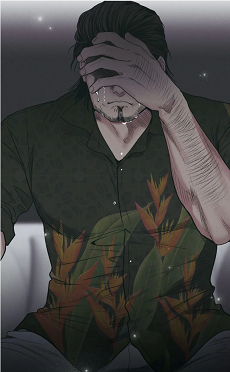 (chapter 27) He could sense Lee Yohan’s agony. He had lost his family at such a young age, he might have been a sinner, but anyone could sense his affection and conscience! He might have lived like a thug, but he was not a bad person per se. It is just that he had made wrong choices, just like the man who had stabbed his brother. In the main lead’s eyes, it was not karma, like the culprit said:
  (chapter 15) Thus he rejected the advances from Yoon Jae. In chapter 15, we could sense that the main character was preoccupied about the existence of god. Was there a divine punishment or not?
  (chapter 15) And Yoon Jae denied such a thing, but added then:
  (chapter 15) But is it not the same? Yes and no… For Yoon Jay, if someone acts badly towards another person, the former will be treated the same way. On the other hand, each kindness will be returned. But one might argue that the gods can interact through humans and use them as pawns to give people their karma. And this is what we are discovering in Payback. Lee Yohan helped Yoon Jae and even showed him a crying man. The famous director Yoon got moved by the main lead’s tears
  (chapter 15) proving that not all humans were cold and distant. They could express regret and admit their mistake. For the first time, Yoon Jae discovered warmth and sensitivity.
  (chapter 1) The most terrible thing is that the actor had been helped constantly by the protagonist. Since the former had a dream of becoming an actor, the “thug” was generous to help him financially and emotionally. The assassination worked for Song Myungshin, for he had planned to steal the money from Lee Yohan.
  (chapter 1) That’s the reason why he didn’t even call the police. The murder would divert the main lead’s attention from the theft. When Lee Yohan heard this confession, he got upset for two reasons. Song Myungshin showed no remorse and a total indifference towards Lee Hansoo and the main lead.
  (chapter 1) But most importantly, he never suffered any karma. In fact, he could benefit from his sins and crimes. This could only reinforce his impression that there was no god out there giving punishment to the sinners. The actor took pride of his bad action, as he decided to take Song Yohan as his stage name! Yohan was a reminder that thanks to him, he could enter the entertainment scene. As a conclusion, karma hasn’t punished the actor Song Myungshin yet. Therefore Lee Yohan was determined to take his revenge. What he didn’t realize is that his first encounter with the other main lead would help him to achieve his goal: to give “punishment” to Song Myunshin. So he didn’t know yet that the gods were aware of this injustice, thus they let him meet the famous director Yoon Jay.
  (chapter 15) On the other hand, the existence of Lee Yohan gave the director hope, he could smile again and as such find happiness. The rabbit announced the return of innocence in Yoon Jae’s life. In other words, the two main leads were quite similar in their disposition: both had been wounded by their past, and had no hope. And thanks to the famous and powerful director Yoon Jay, the main lead is slowly starting living again. Little by little, he is interacting with people again, helping others, though he never does it openly. The best example is the actor Lee Hansoo who has the same name than his own brother.
  (chapter 6) In this scene, he refused to be addressed as hyung, as in his eyes, he didn’t deserve such a title. He had not acted like a hyung to his true little brother.
  (chapter 14) I couldn’t myself thinking of the antagonist Lee Jihwa, for he was put in a similar situation.
 (chapter 101) Indirectly, he was claiming his innocence. Thus the servant suggested to the young master to go to the police bureau in order to clear his name, but the young master refused to do so. Why? The problem is that Lee Jihwa couldn’t prove his innocence. And deep down, the childhood friend knew this. How could he prove that he was not involved in the scheme, when Min visited him
  (chapter 100) on different occasions, and both went to the scholar’s home together? Yes, this time Min’s threat had become a reality.
 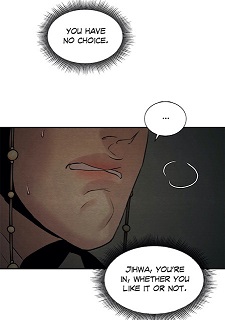 (chapter 76) He could no longer back out. He couldn’t put the whole blame on the Joker, because this means that he would have to admit his own complicity. Yes, Lee Jihwa was trapped. He could sense that he had been framed by Black Heart, but the former couldn’t claim his innocence because of his knowledge! That’s how I realize why the young man was punished this way. Remember how he had blamed his childhood friend for his misery, and had used his knowledge as a proof for his reproach!
 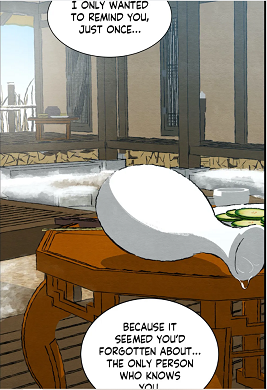 (chapter 57)
  (chapter 57) Thanks to his knowledge, he was above any reproach, while it was not the same for Yoon Seungho. The latter was indeed ignorant, for he had forgotten many things. Consequently, the gods chose to punish Lee Jihwa for his arrogance and passivity. Now, he knows, but this doesn’t help him at all. Hence he decided to forget! This means that he behaved like Yoon Seungho, who repressed everything. The only difference is that contrary to the childhood friend, the main lead had been a real victim the entire time. Thus the second lead imagines that once he forgets and runs away, he will be able to escape punishment. However, he is wrong, for by choosing oblivion and desertion, he has to give up on his name Lee and identity. He can still be addressed as Jihwa, like you could see above. Yet, we have to question this. Is Lee Jihwa truly innocent like he claims it?
  (chapter 99) But what did he do? Nothing. Secondly, he witnessed how the kisaeng was dragged away to get killed, though it was staged. Here again, he did nothing.
  (chapter 99) I would even say that he even faked ignorance, because he was lying. The drop of sweat is the clue for this interpretation, besides Min contradicted his testimony in the shaman’s house later.
 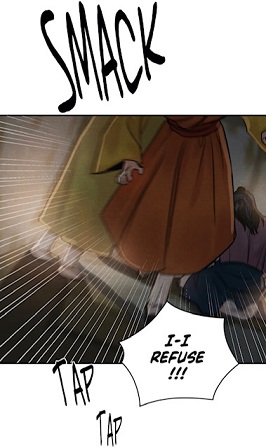 (chapter 100) He turned his back on Baek Na-Kyum. But that means that he abandoned the artist once more time. In three occasions, he was well aware what was happening and he could have intervened. Yet, he let it happen. Besides, he handed over the drugs and dildo to Min. As you can see, he was never an innocent person, but not just a sinner. He was an accomplice. And he knew this, thus he couldn’t go to the bureau of investigation. Min was well aware of this.
  (chapter 101) Naturally, his crime was nothing compared to Min’s.
  (chapter 101) He didn’t see why he should die, when in his eyes, he had done nothing! And the antagonist’s prophecy became a reality.
  (chapter 50) By fleeing, he didn’t stop his friend from committing a murder. Thus he is responsible for their deaths. And he knew that Min and the other nobles would die.
 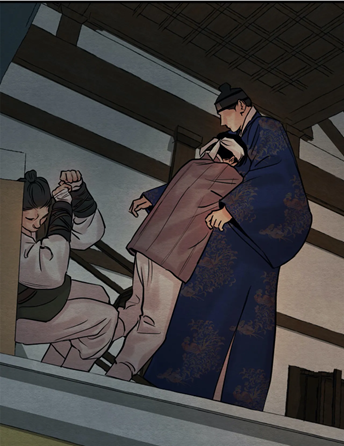 (chapter 53) and even follow his friend. And this distinguishes him from Lee Yohan so much. The latter recognized that each decision he made had consequences. And note that the idiom “choice” was connected to silence and assistance.
  (chapter 50) It was, as if he had murdered the nobles himself. The gods were teaching him a lesson: Knowledge and passivity are crimes. In other words, Lee Jihwa became a sinner and a criminal because of this night. And this because he refused to face reality.
 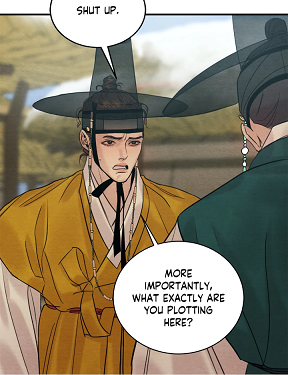 (chapter 83) But was he really ignorant here? I came to a different interpretation recently. How? First, why does the second lead have a drop of sweat in the last picture? This is an indication for a lie. But there exist stronger proofs. Don’t forget the following rules: there’s always a reflection within the same chapter, and each chapter is reflected in the next. In the antagonist’s memory, Lee Jihwa was portrayed as someone who would disobey his father!
  (chapter 83) He would trespass the house of the Yoons and enter the shed, even the lord’s bedchamber!
  (chapter 83) As you can see, Lee Jihwa was acting as a rebellious son in the past. He was not respecting social norms and the elders. This signifies that we have the exact opposite in the present. Observe the seasons: summer versus winter. Thus I come to the following deduction. He is following the order from his father, he is not dragged
 (chapter 83), but he brought Min there. Why would Min say this?
 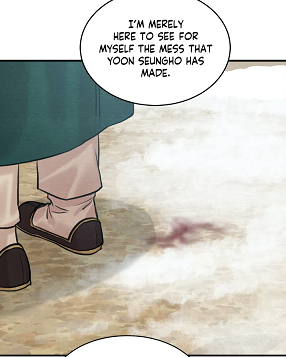 (chapter 83) Why would he come to see the mess? His words are indicating that someone must have told him about the scholar’s death. Since we saw this,
 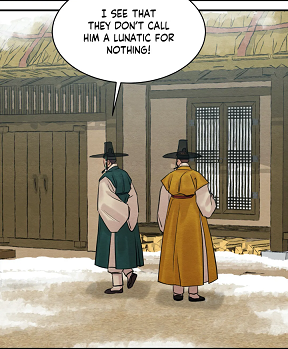 (chapter 83) we thought that when the plotters came, Min was leading the way. But if we take into consideration chapter 76, we realize that back then the childhood friend brought Min to Nameless’ barn.
  (chapter 76) Thus it could have been the same! Lee Jihwa had brought Min to the scholar’s house, then Min was the one giving the signal to leave the humble dwell, just like in chapter 76. The red-haired master let Min meet The Joker, before Min was the one asking Lee Jihwa to follow him, when he realized that Nameless refused to help him.
  (chapter 76) So when we view this,
 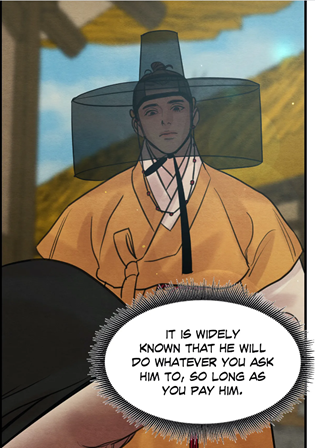 (chapter 43), so from my point of view, we could have a similar situation, someone had asked him to bring lord Min to that mansion! It can not be Min… From my point of view, Lee Jihwa was acting on his father’s orders. That’s the reason why Lee Jihwa never entered the mansion, and he told Min the story about the incident in the bedchamber. Father Lee had been the one who brought it up first.
  (chapter 82) Why would Lee Jihwa suddenly mention this story to Black Heart, when he had remained silent the entire time? Even Min wondered about this!
  (chapter 83) Another clue for this signification is the vocabulary of Black Heart. The latter is speaking like father Lee: lunacy
  (chapter 83) This shows that Black Heart stands for social norms: respecting the elders. But he never realized that in verity he was getting fooled by the Lees. We saw where the main lead was living in the shed, but did Lee Jihwa say this to Min? No, I don’t think, he mentioned it… he was left in the dark about this, just like the readers were not informed, when lord Song was mentioned by Lee Jihwa.
 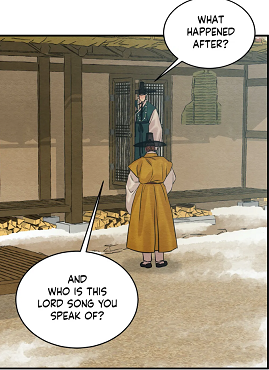 (chapter 83) But Min was not naive like Jihwa, he knew that once involved, someone had to pay for the subterfuge and crime.
 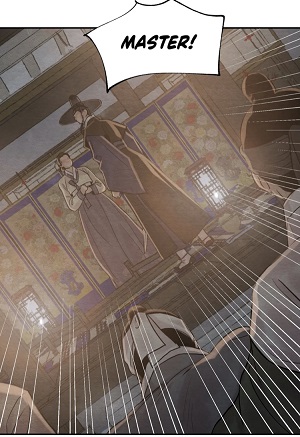 (chapter 99), the servant Seokdae or even his son Lee Jihwa. The loss of hair was the proof of his leniency.
 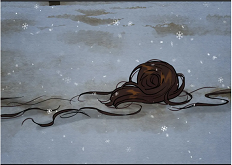 (chapter 101) Each time he spared them. How can father Lee claim that the main lead is behind the murder in the shaman’s house? Secondly, his own son vanished which will be considered as a sign of culpability. Finally, lord Shin is a survivor and his last image is that he got unconscious, when he spoke to Lee Jihwa. This means, Lee Jihwa will become a criminal! Because of this situation, I am hoping that the red-haired master will reflect on his own actions and decisions. He followed the elders’ advice blindly and paid a huge price for this. He would never get loved by the main lead. He came to lose everything: his home, family and title. He is now a commoner. From my point of view, father Lee will be forced to cut ties with his son in order to save his own skin, but it is also possible that he even loses the mansion.
 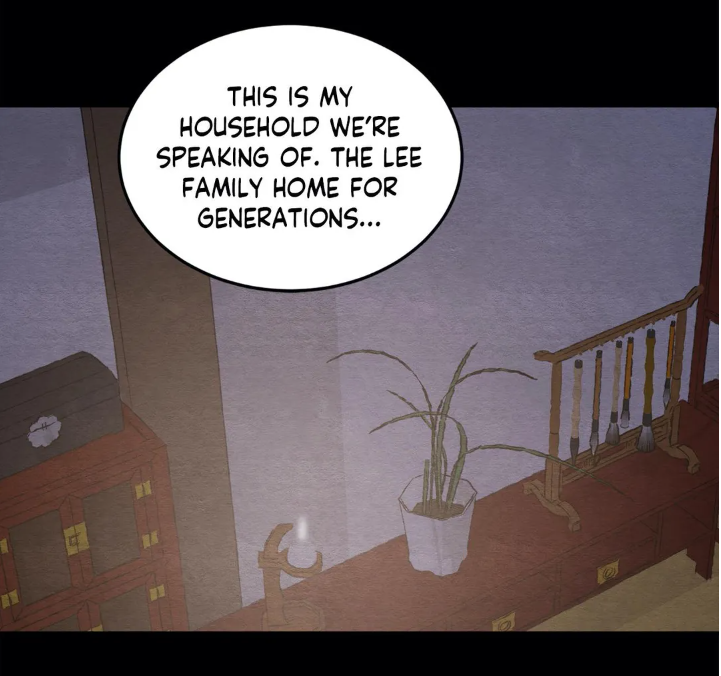 (chapter 82)
  (chapter 27) On the other hand, contrary to Lee Jihwa, he grew up in a poor environment, thus he had to work in order to live. He could never live carefree like the spoiled only son of the Lees. Finally, I would like my readers to question themselves this: Will Lee Jihwa come to admit his responsibility in the death of the nobles and in Yoon Seungho’s suffering? I have to admit that I am hoping for his return, for the two friends need to have a proper talk, and according to me, Lee Jihwa apologized or at least expressed regret in front of his friend, thus he got spared. Yet, I would like very much to see such an apology to the main lead. But before his departure, he still viewed himself as a poor victim who had been wrongly framed exposing that he had not grasped the true nature of his wrongdoings.
 (chapter 57) He was admired which created a source of jealousy. While the painter discovered sexuality and his homosexuality very early on, Yoon Seungho was pure, but through incidents he was forced to become a sodomite. While Heena and the scholar tried to repress Baek Na-Kyum’s sexuality, the father pushed his son to have sex out of fear and high expectation.
 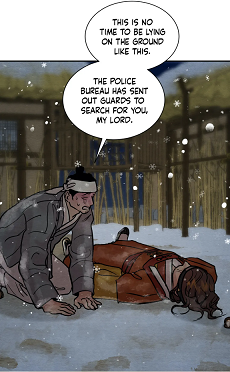 (chapter 101) Striking is that the author used the same method to introduce the memories. First, we see the servant talking before viewing the memories.
  (chapter 101) And now, compare it to chapter 1:
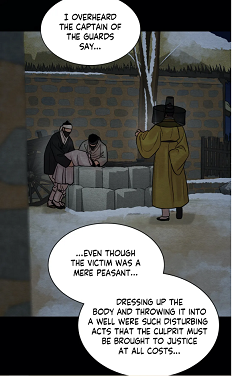 (chapter 101). She was implying that this panel symbolized the vision from the witness, the tailor. This explicates why you see the wall on the left side. The tailor was observing Min in the shadow. This is important, for these images are reflecting the truth, revealing that the servant from episode 101 was actually lying. Thus I deduce that the domestic from chapter 1 was also lying, but contrary to the episode 101, he thought, he was telling the truth. We could say that he was acting as the fake “mirror of truth“. How do I come to this deduction? Simply because the servant in chapter 101 was actually deceiving Lee Jihwa and Yoon Seungho. Note that in the beginning of episode 101, Seokdae tried to defend himself by feigning ignorance.
 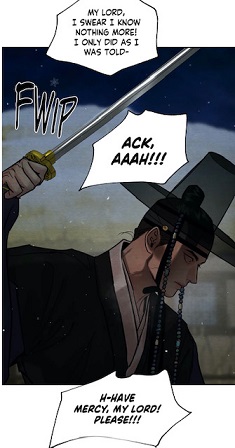 (Chapter 100) He denied his responsibility by putting the blame on someone else („I was told“), yet once facing the young master Jihwa, his declaration exposed his lie.
 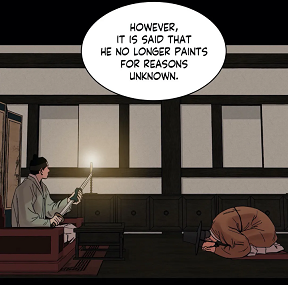 (chapter 1) So in episode 1, the servant was not aware that he was lying to the protagonist, when it comes to the painter’s past. However, the domestic with the brown hanbok lied in one aspect, the publication of the book.
 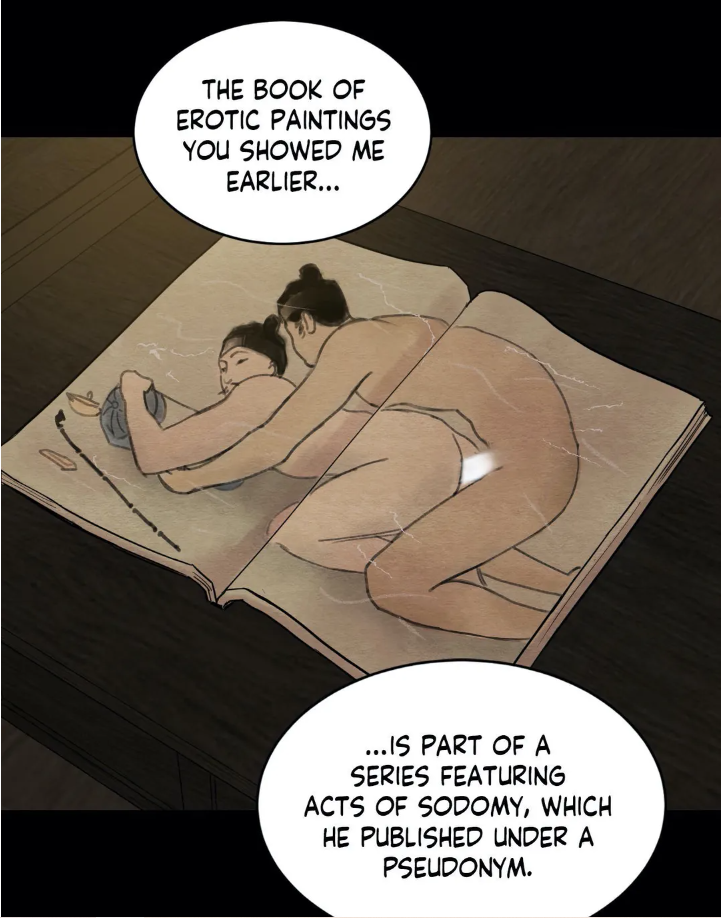 (chapter 1) One might have the impression that I am digressing from the main topic. Yet the manhwalovers should keep in their mind that the servant from episode 1 served one purpose: to show us the memories of an important witness, someone who watched Baek Na-Kyum growing up. Thus we have three different pictures. First, he is a baby, then a young infant
 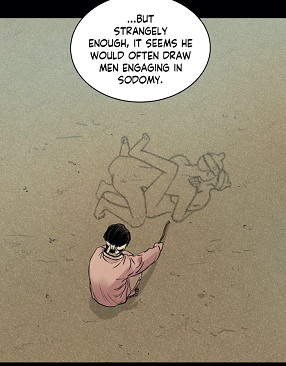 . (chapter 1) This signifies that the witness was close to Baek Na-Kyum which explains why the domestic trusted the source of his information. However, contrary to episode 101, she never divulged the identity of the witness. It is because the person wished to hide in the shadow.
 (chapter 1) It ends with the domestic’s death, while the incident with the topknot is mentioned in the middle. At the end, the painter is dragged to the mansion. As you can see, both chapters reflect each other. That’s how I had this revelation
  (chapter 4) This is the door! You can recognize it thanks to the pillar on the side.
  (chapter 4) Pay attention to the background in this picture. And now, you are probably thinking that the owners of that mansion are the Yoons, as we observed the main lead living there. Nevertheless, I had already pointed out that this was not Yoon Seungho’s mansion. This is the Yoons’ domain:
 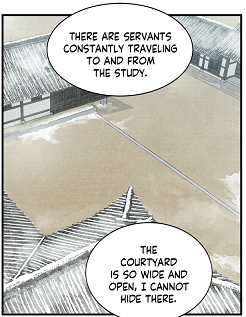 (chapter 51) The courtyard is different. According to me, this is the mansion of the Lees. [For more read the essay 360: Lee Jihwa’s special relationship with Yoon Seungho] And since episode 1 and 101 reflect each other, this can only reinforce my interpretation that the Lees are involved in Baek Na-Kyum’s past, for we have Lee Jihwa present in chapter 101. Baek Na-Kyum was brought to the Lees, thus the scholar Lee keeps calling Baek Na-Kyum a peasant! He knows about his true origins. I had always said that the man was revealing his knowledge with his insult. But does it mean that this was the vision from Lee Jihwa’s father?
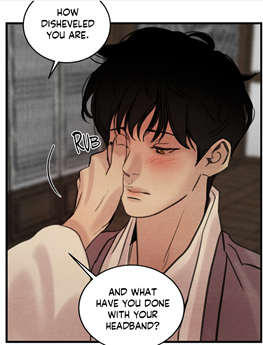 (chapter 38). Besides, father Lee views him as a peasant and not a servant. This observation gets reinforced, when you look at the memories from the painter. In his childhood, he was never wearing a white head-band.
 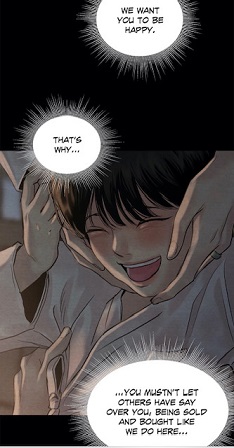 (chapter 87)
  (chapter 70) This means that this panel
  (chapter 101) Look where the red-haired master and the servant are! It is in front of the teacher’s home! In Painter Of The Night, there is never a coincidence. This is a sign that Jung In-Hun is related to Baek Na-Kyum’s past and knows his true origins. However, by treating him like a low-born, he came to view him as one. But this doesn’t end it. Remember the rule 2: the reflection within the same chapter. The painter remembered the words from the gibang:
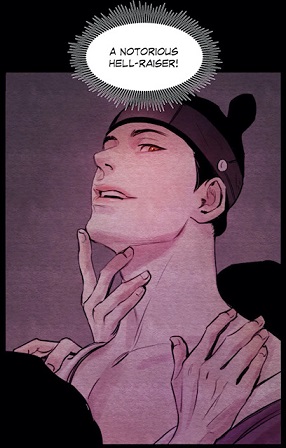 (chapter 1) Jung In-Hun would employ such expressions like fiend and sodomy
  (chapter 18), he was repeating his admired sir’s idioms. Besides, “hell-raiser” is also an indication that the learned sir was a Christian who converted Heena. Thus I deduce that when father Lee received Baek Na-Kyum as a baby, he entrusted him to the learned sir Jung In-Hun who had no connection and no wealth so far. So when the lord described him as such in episode 7, it was not entirely correct. The reality was that the man had been working for the Lees, but he had been “abandoned” at some point. The scholar was his helping hand explaining why he would appear in this scene.
 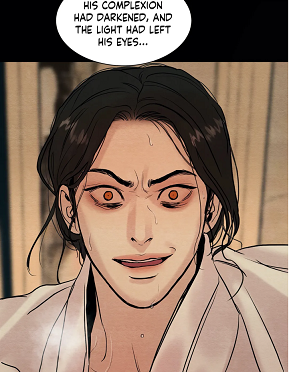 (chapter 57). However, there was a price to pay for the main lead’s emancipation. Lee Jihwa had to lose his topknot!!
  (chapter 59) Without a topknot, the red-haired master no longer looked like a real noble. He had lost his position. Hence I believe that the painter was forced to wear the headband. As you can detect, there was a chain reaction linked to the social status: lord or not, low-born or not.
  (Chapter 10) So a lord is following social norms, when he sentences a slave to death.
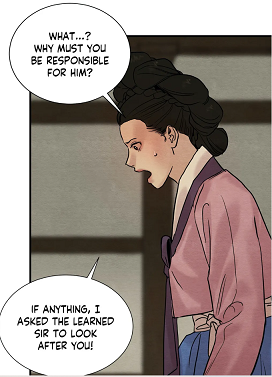 (chapter 68) Nonetheless, the beholder can detect the presence of a drop of sweat on Heena’s cheek. So she was deceiving the artist here. Why? Yes, in her mind, the painter was Jung In-Hun’s son and as such the learned sir should become responsible for the painter, for he was his father. But she had to lie in order to persuade him to leave the mansion. There’s no ambiguity that the head-kisaeng had no idea about the deal between the Lees and Jung In-Hun in the past, I believe that she must have discovered the truth at some point..
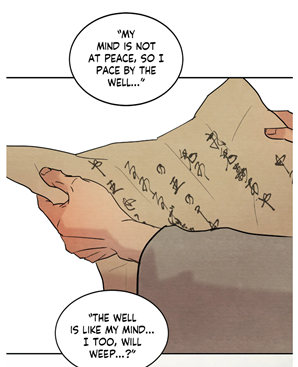 (chapter 4) This was inspired by the poetry from Wang Bang-Yeon!
  (chapter 4) In this poem, the famous author was referring to the death of the young king Danjong who had been killed by his uncle Sejo. Danjong was just a teenager, when he died! As you can see, the text is actually an allusion to royalty and exile. Under this new light, it dawned on me that the scholar Lee had been entrusted to take care of Baek Na-Kyum, but the latter chose to delegate this to the learned sir. There was a reason behind this. For me, he was eyeing at the mansion himself! One might refute this point, for the elder Lee said this:
 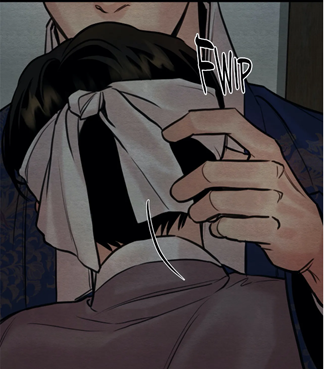 (chapter 53) How does he know it? In my opinion, it is because Baek Na-Kyum resembles to the king. The only difference is that he has no beard. This would explain why Yoon Seungho said this:
 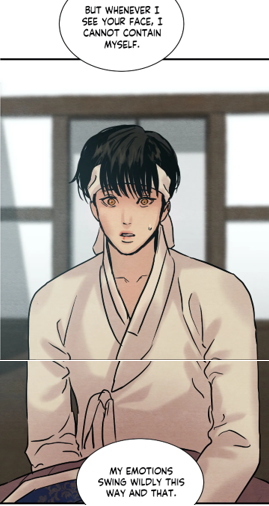 (chapter 55) Why would he get upset? Why would the painter’s face evoke such emotions? He is reminded of his abuser. This is no coincidence that the main lead had such a flashbulb right after, where you could see Lee Jihwa and his father, as they looked like Yoon Seungwon and his father.
  (chapter 55) They are all related. And now, you comprehend why the author wouldn’t reveal the face of the mysterious lord Song in chapter 83
 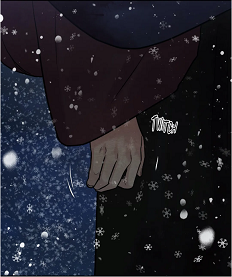 (chapter 102) The colors are already insinuating that the artist belongs to the royalty.
 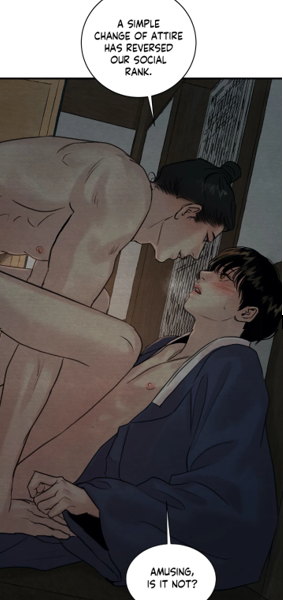 (chapter 71) If the pedophile came to the gibang and crossed the main lead’s path, he couldn’t recognize his relative (son or nephew) due to the hair and the clothes. Besides, I am certain that my avid readers can recall my other theory: the painter was stolen as a child. This new interpretation would corroborate this theory. The painter has been robbed of his true identity, he had been kidnapped, when he was brought to the kisaeng house!! Besides, if he is the true owner of the mansion, then this signifies that Father Lee succeeded in his coup d’Etat (rule 1, rule 3). In season 3, we have an attempted “coup d’Etat” with Yoon Chang-Hyeon eyeing at the seat.
 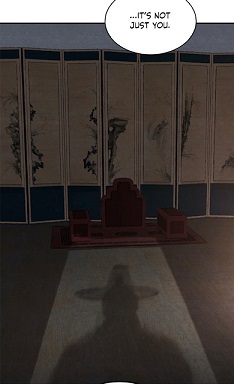 (chapter 86) Moreover, I would like to point out that we have the topic: siblings’ jealousy. This is definitely possible that father Lee is related to the artist, an uncle for example. Finally, if the painter is the king’s son, this is no coincidence that Baek Na-Kyum suffered so much. He was paying for his father’s sins (rule 5). At the same time, if Baek Na-Kyum has to face the infamous lord Song, as his son/nephew, he is put in a position where he can criticize his father/uncle. How could he abandon him and treat Yoon Seungho like that?
  (chapter 37) Notice that here only 3 men were arrested and tortured. It was, as if the sons had to pay the crime for their father. That‘s how the noble families close to the Yoons died out.
  (Chapter 37) They had lost their heir. So far, we still have no idea about the cause for the treason: Coup d’Etat or attempt of assassination on the king or spying or murder of a royal member (here Baek Na-Kyum)? But this purge is associated to inheritance and the loss of a heir. There’s no ambiguity that the painting in Yoon Chang-Hyeon’s bedchamber was used as an evidence that the elder master Yoon was eyeing at the throne
  (chapter 102), I am assuming that his visage won’t be bruised again, so that his foot could get hurt, for the lord and the butler had a broken foot in chapter 77. (rule 3)
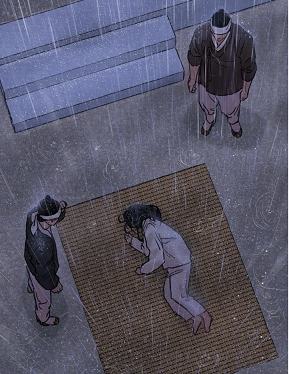 (chapter 77) And that’s how the ruler could discover the truth!! Therefore the culprits would be detected easily: father Lee and naturally Kim, as both knew the real identity of Baek Na-Kyum, but chose to remain silent. Yes, knowledge will become Kim’s downfall in the end. Why do I think so? For me, the feet in this panel are Kim’s
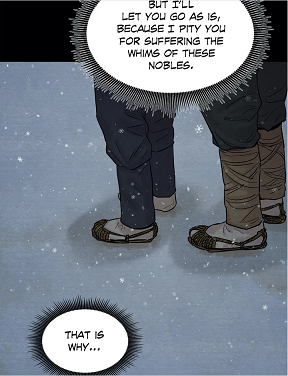 (chapter 66: According to me, this is Kim and not No-Name)
 (chapter 17)
 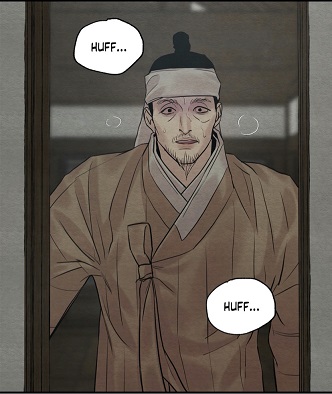 (chapter 85) Here he had faked running. Since he had been introduced with his feet in chapter 1, she needed to create reflections later. Finally, I would like to point out this:
  (chapter 7) Their meeting here is an indication that their past must have crossed before because of rule 1!! Since the painter was so devoted to the learned sir, the valet could only jump to the conclusion that the man had truly taken care of Baek Na-Kyum properly.
 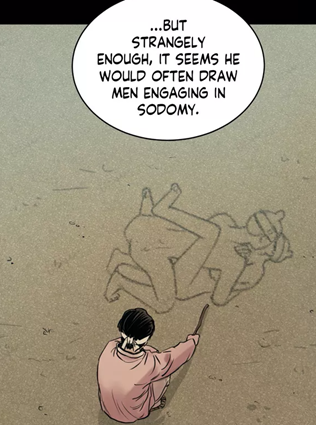 (chapter 1) He had actually painted animals and nature in his childhood, thus the noonas kept his drawings.
  (chapter 94) The man had trusted the learned sir’s testimony without verifying the facts. He had not detected the presence of a blackmail!
  (chapter 1) This truly shows that ignorance is indeed no blessing, and people shouldn’t trust others according to their appearances or social status. At the same time, the servant had forgotten that Yoon Seungho was a noble, though he was dressed like a peasant in the bedchamber.
  (chapter 1) He was not even wearing a hanbok here, and his head-band was different too. As you can see, both protagonists shared the same experience. They were not treated according to their social status. To sum up, my theory is that the valet Kim brought Baek Na-Kyum to the Lees, who decided to get rid of the painter by entrusting him to the scholar Jung. And Heena became his accomplice, the moment she became his surrogate mother. Let’s not forget that in season 1 and 2, the learned sir was the only one seen with children: girls.
  (chapter 6)
  (chapter 29) and Baek Na-Kyum

 Bebebisous33s' analyses in K-Dramaland and Manhwas