

Please support the authors by reading Manhwas on the official websites. This is where you can read the Manhwa: Jinx But be aware that the Manhwa is a mature Yaoi, which means, it is about homosexuality with explicit scenes. Here is the link of the table of contents about Jinx. Here is the link where you can find the table of contents of analyzed Manhwas. Here are the links, if you are interested in the first work from Mingwa, BJ Alex, and the 2 previous essays about Jinx Between A Squeeze And A Crack – part 1 and Between A Squeeze And A Crack – part 2
It would be great if you could make some donations/sponsoring: Ko-fi.com/bebebisous33 That way, you can support me with “coffee” so that I have the energy to keep examining Manhwas. Besides, I need to cover up the expenses for this blog.

Where is a Flower in Episode 88?
Episode 88 of Jinx immediately drew readers’ attention to two moments in particular: the training session between Kim Dan and Joo Jaekyung 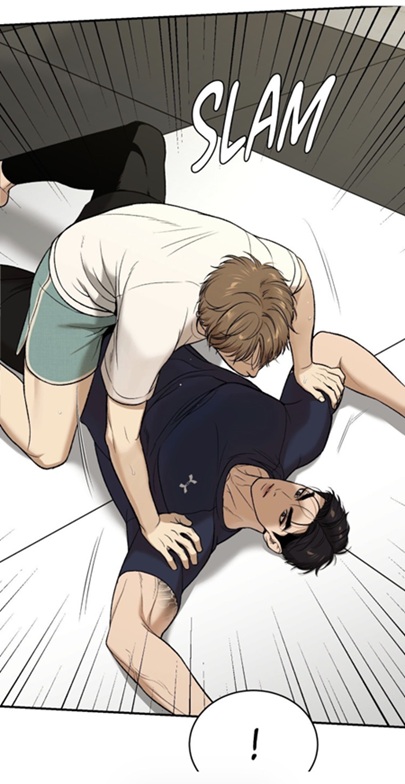 (chapter 88), and the final panel hinting at an imminent confrontation with Choi Heesung.
 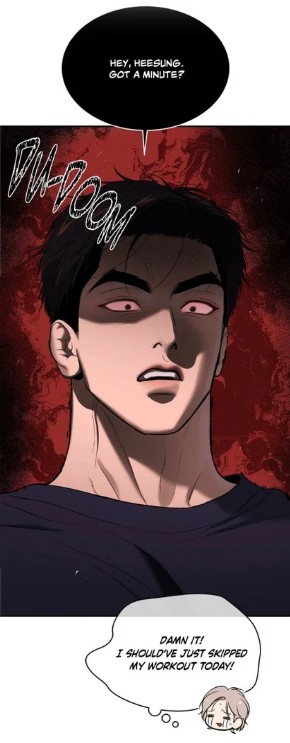 (chapter 88) Discussions largely revolved around physical proximity, discipline, and anticipation — around bodies in motion and the promise of conflict to come. At first glance, the episode seemed to oscillate between intimacy and tension
 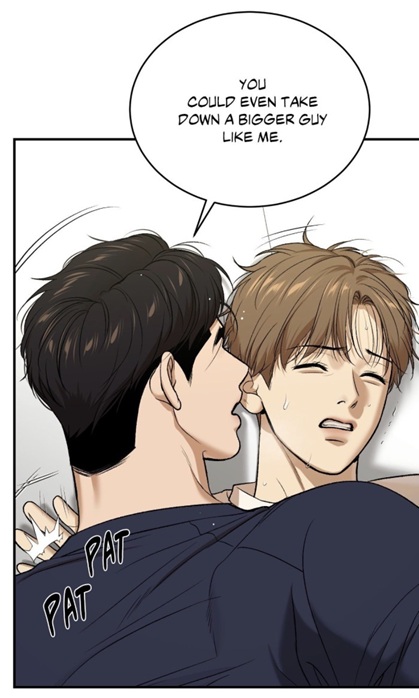 (chapter 88), between preparation
 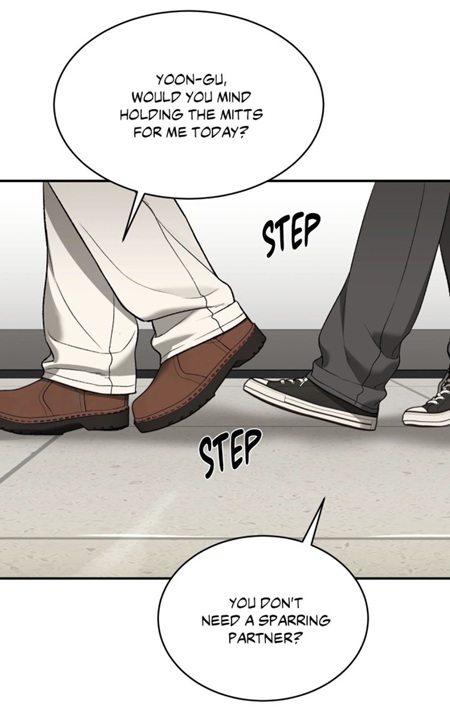 (chapter 88) and interruption
 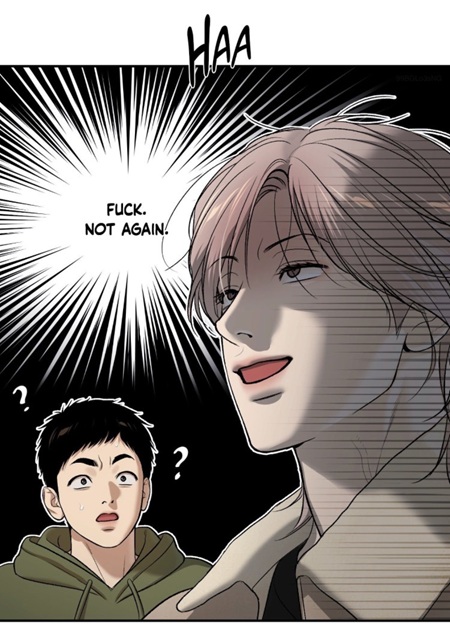 (chapter 88).
Only on closer reading does another layer emerge — one that does not oppose these moments, but reframes them. The training session is not merely about discipline or proximity, and the final panel is not only a promise of confrontation. Both scenes 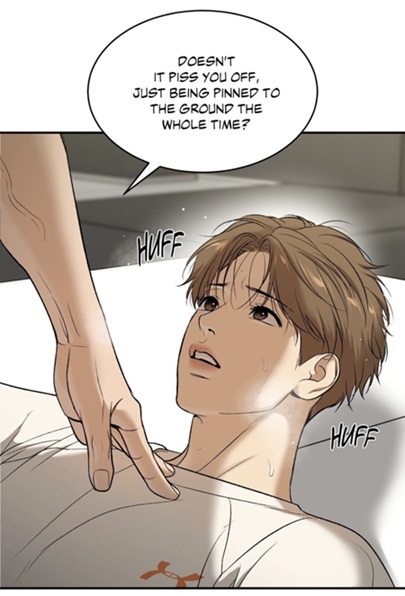 (chapter 88) are structured around restraint (chapter 88): what is held back
 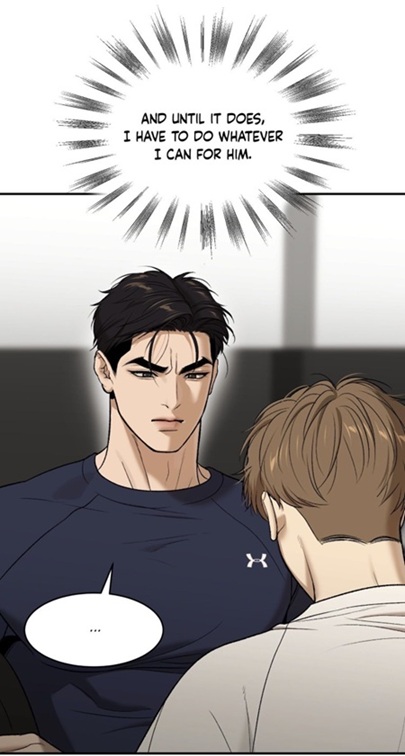 (chapter 88), delayed, or redirected. Words are measured, authority is redistributed, and decisions are deferred
 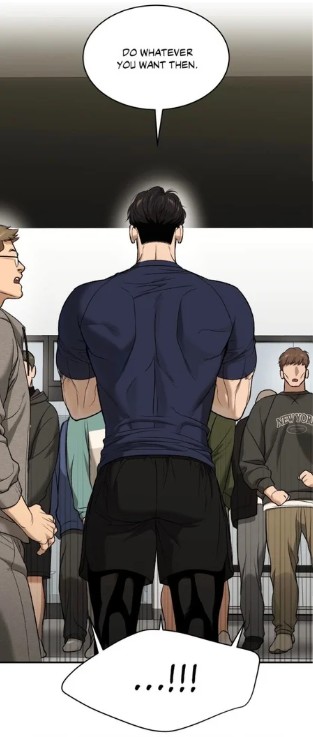 (chapter 88) rather than imposed. What initially appears as physical intensity and narrative suspense begins to reveal a deeper reconfiguration of roles, responsibility, and choice.
At first glance, the title may seem paradoxical. The episode takes place a few weeks after October  (chapter 70)—most likely in November— in late autumn.
 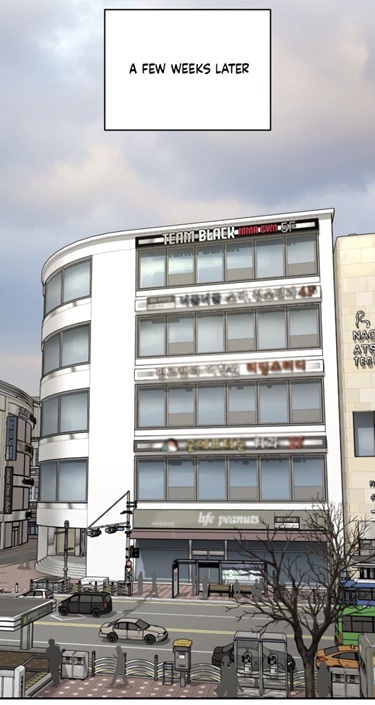 (chapter 88) This temporal setting is visually reinforced by the environment itself: in the opening sequence marked “a few weeks later,” the tree is already bare, its leaves gone. Nature offers no spontaneous image of growth or renewal. If a flower were to appear in this chapter, it couldn’t belong to the season. It must be cultivated, protected, and sustained in a green house—something that emerges not from natural abundance, but from deliberate care. So where does this idea of a flower come from?
Closed Circuits and the Logic of the Number Eight
The title emerged from a visual and structural observation. Chapter 88 is built around the number eight: a chapter defined by two closed circuits that finally cross. Remember how I described the relationship of the main couple in the essay  : a closed circuit which we could witness once again in the training room: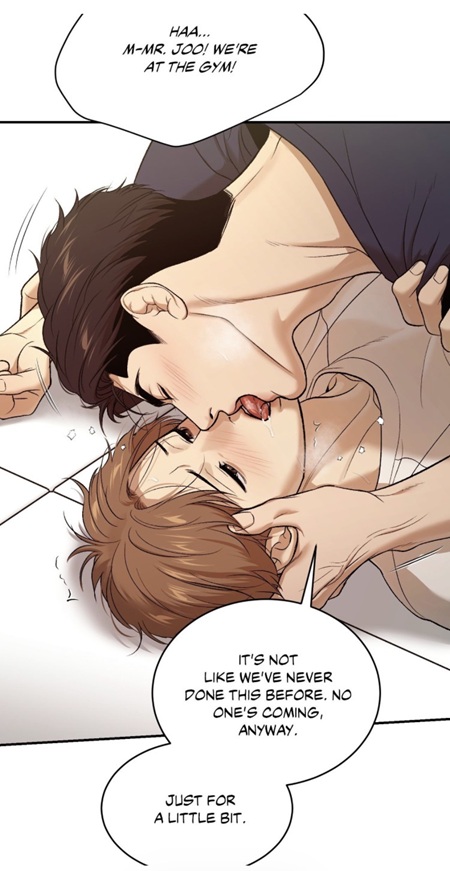
 (chapter 88) There are once again sparks between them. The number 8 is not just related to doc Dan [for more read The Magic Of Numbers ] and his relationship with the athlete, but also to the other couple: Heesung and Yoon-Gu. This means, the latter represent the other closed circuit. Hence the other couple appeared in episode 35 and 58.
  (chapter 58) Two trajectories —long separated, repeatedly missing one another—intersect at last. When two eights overlap, they form neither a loop nor a knot, but a new shape: a flower-like figure, suggestive of opening rather than closure. This crossing does not resolve everything; instead, it creates the conditions for growth for all the characters. We could say that each closed circuit forms two petals so that their interaction with each other will affect them positively.
Color as Emotional Structure
The flower, however, is not only numerical or temporal. It is also chromatic. A flower is never defined by form alone, but by shading—by gradients, transitions, and the coexistence of multiple tones within a single structure. Thus in French certain flowers serve to define pigments: rose for pink, violet for purple. In this sense, episode 88 does not merely contain colors; it behaves like a flower unfolding through shades. Episode 88 is saturated with color: pink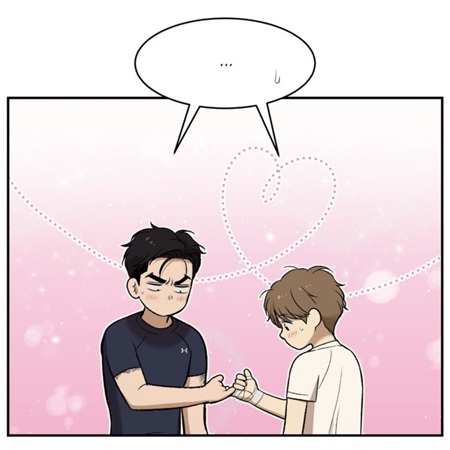 (chapter 88), white
 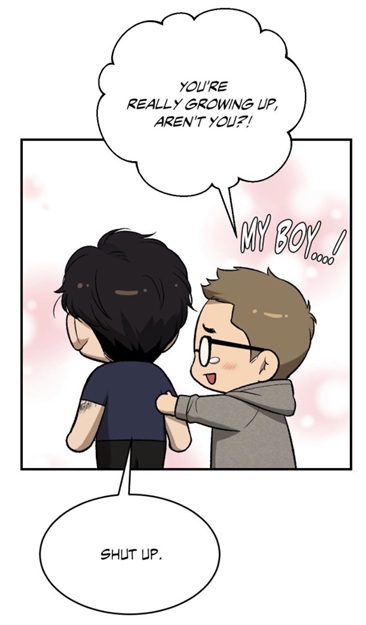 (chapter 88) purple
 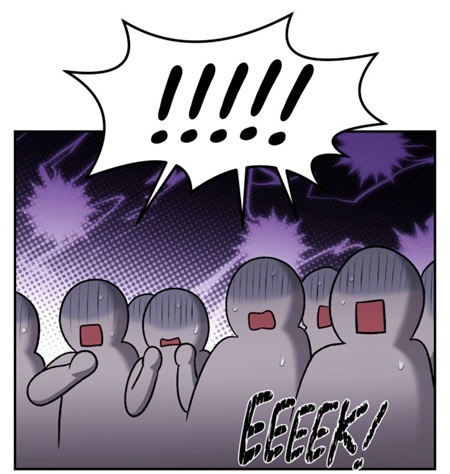 (chapter 88), blue, gray,
 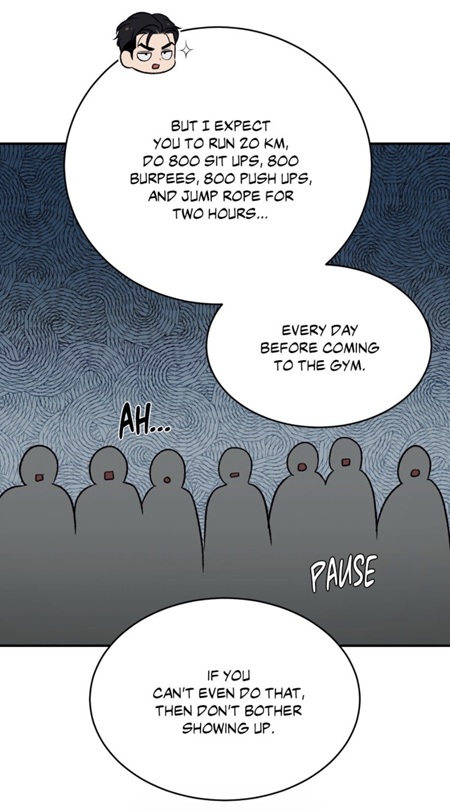 , (chapter 88) red (chapter 88) and black
 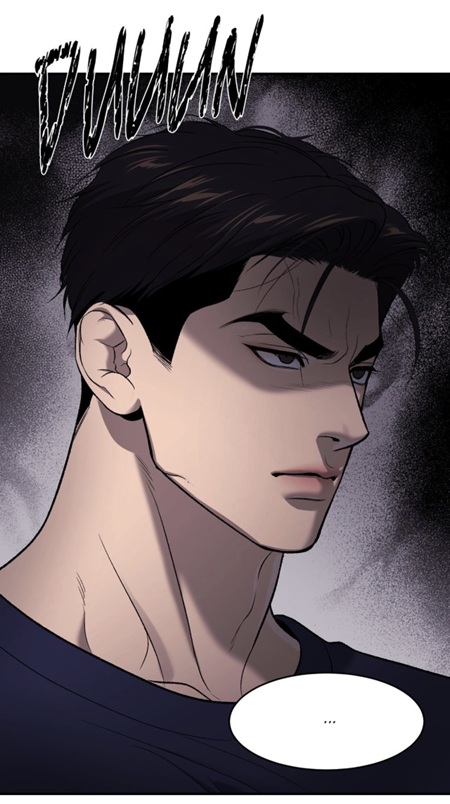 (chapter 88) Pink frames tenderness and mutual awkwardness; purple marks embarrassment and heightened awareness; red signals suppressed anger and looming confrontation; black absorbs fear, silence, and unresolved tension.
White, notably associated with Park Namwook, carries a more ambivalent meaning. (chapter 88) It evokes innocence on the surface, but also ignorance—an unexamined moral comfort that allows him to retreat from responsibility while claiming authority. His lightness contrasts sharply with the weight of the decision he refused to make: visually underlined by the black-lined spiral hovering near his head—an emblem of irritation without accountability.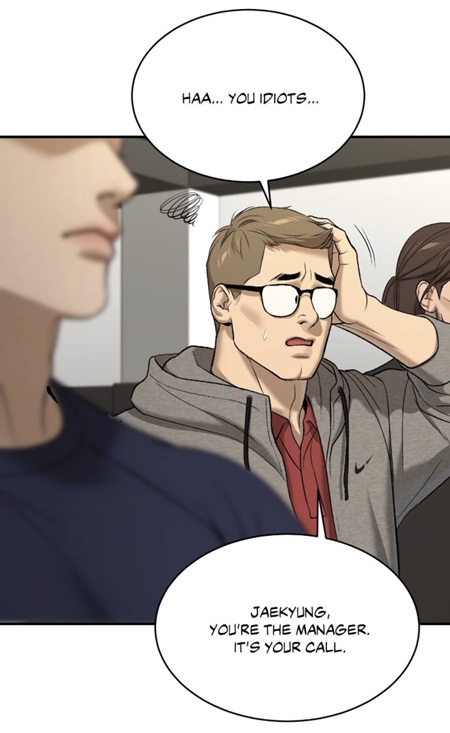
Blue and gray dominate the scene in which Joo Jaekyung announces his seemingly excessive training demands. (chapter 88) On the surface, the atmosphere feels cold and authoritarian. Yet the exaggeration itself reveals something else: the demand is deliberately absurd, almost teasing. Joo Jaekyung is testing resolve, not imposing punishment. The joke —visible thanks to the chibi and the brief spark within the athlete’s gaze— goes unnoticed. No one laughs. The room’s muted colors reflect this misrecognition—care and fun are present, but not yet legible to those receiving it.
At first glance, the setting itself seems to resist any floral reading. (chapter 88) The scene unfolds not in nature, but in a gym in Seoul—an urban, enclosed space associated with discipline, repetition, and control rather than growth or renewal. This tension may explain the readers’ initial surprise: a flower appears where one would expect only concrete, steel, and hierarchy. Yet in Jinx, the flower does not belong to nature as landscape, but to nature as process—to emergence, care, and relational change.
This process is not introduced through scenery, but through bodies marked by green. And the latter symbolizes nature. In episode 88, two characters 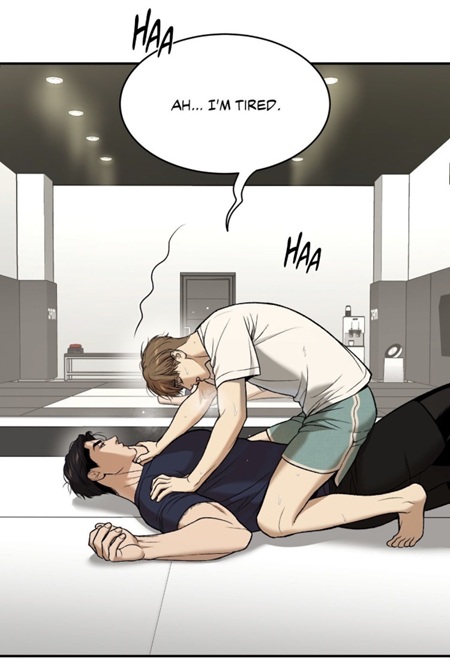 (chapter 88) are dressed in green (chapter 88), a choice that appears unobtrusive—almost practical—yet is unmistakable within Mingwa’s chromatic language. Green here does not function as pure nature or renewal, but as transition: a sign of growth that is still constrained, negotiated, and incomplete. It is not a vivid, liberating green, but a muted one—ranging from green sheen to subdued olive—closer to endurance than vitality, to steadiness rather than expansion. Growth is present, but it has not yet broken free; it remains embedded in effort, restraint, and adaptation.
Crucially, this shorts’ shade recalls the photograph of Kim Dan with his grandmother 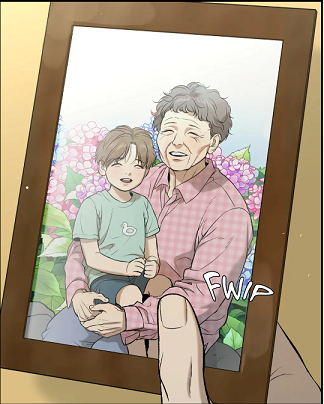 (chapter 19), where green and floral elements once functioned as a silent language of care and containment. The repetition is not accidental. By wearing a similar tone in the present, Kim Dan does not merely revisit the past; he carries it forward. (chapter 88) The color no longer signifies dependency or shelter alone, but continuity of self. It marks a return to an inner disposition that predates trauma—a self capable of care, persistence, and quiet resilience. This means that he is closer to his true self.
Placed within the gym’s dominant blues and grays, this green does not signal leisure or escape. It signals cultivation. Growth here is neither spontaneous nor decorative; it must be trained, maintained, and protected. The flower does not bloom despite the city—it blooms through care, discipline and recognition. What initially appears paradoxical becomes coherent: in Jinx, growth is not opposed to structure. It is shaped by it.
From Flower to Language: Communication Deferred
Crucially, the flower also functions as a metaphor for communication. (chapter 19) Flowers are not passive decorations; they carry meaning, intent, and symbolism. The background is composed of hydrangeas in blue, pink, and pale violet—colors traditionally associated with gratitude, tenderness, apology, and emotional nuance.
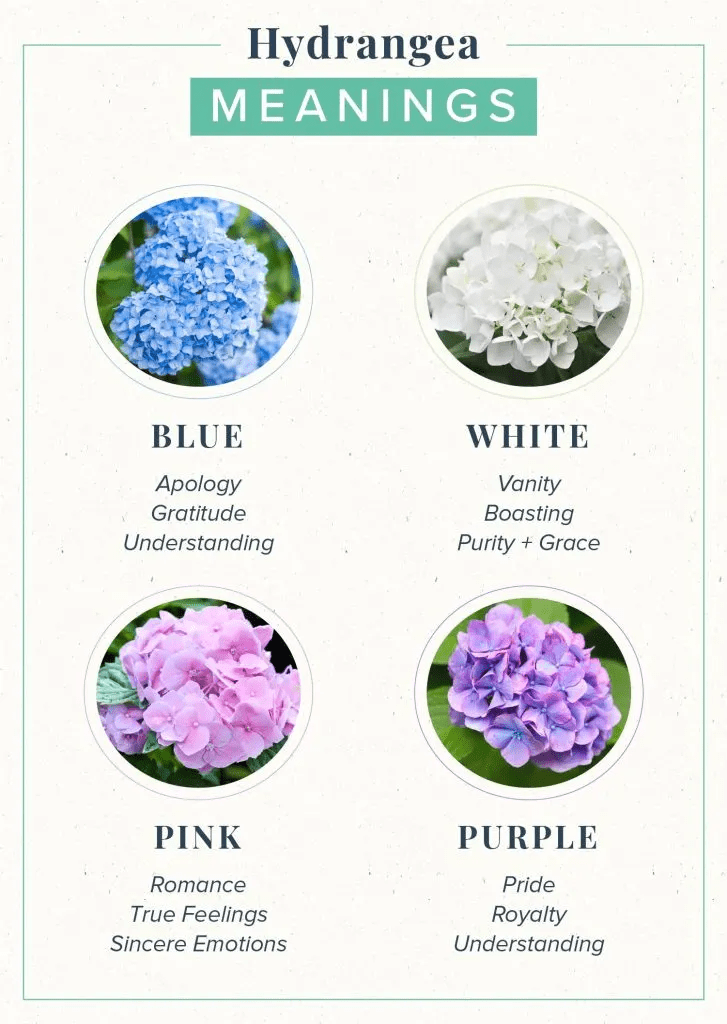
Unlike roses  (chapter 35), which tend to assert a singular message (love, passion, beauty), hydrangeas communicate multiplicity and emotional ambivalence; they speak in clusters rather than declarations. This visual language mirrors Kim Dan’s inner world at the time (chapter 19): affection entwined with dependency and sorrow, care mixed with silence, love present but unspoken.
This chromatic memory resurfaces later through a different floral gesture: the bouquet Choi Heesung offers Kim Dan —pink roses paired with baby’s breath 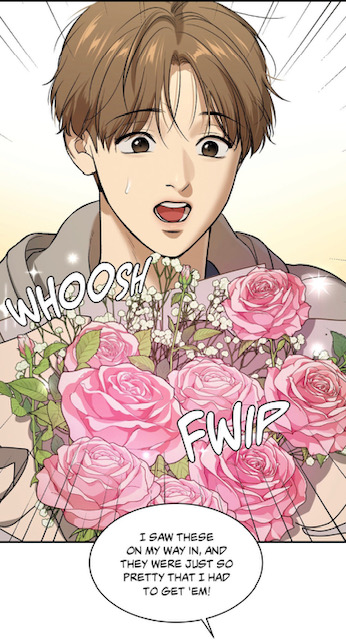 (chapter 31). Here, the symbolism shifts. Pink roses convey affection and admiration, while baby’s breath suggests innocence and fragility. Yet the arrangement is excessive, overwhelming, and mismatched to its recipient. The bouquet does not listen; it speaks at Kim Dan rather than with him. Significantly, Heesung comes to associate Kim Dan himself with the flower—something delicate, beautiful, and deserving of protection, but also something to be handled, displayed, and possessed.
Episode 88 reframes this logic entirely. The “birth of a flower” no longer refers to being perceived as fragile or decorative, but to a return to growth from within. 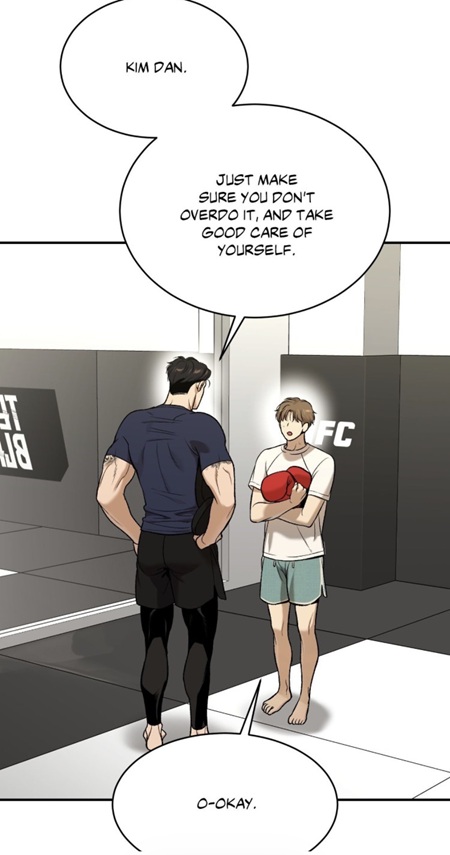 (chapter 88) Kim Dan’s green training clothes—visually echoing the green shirt he wore in the photograph with his grandmother—signal continuity rather than regression. This is not a retreat into childhood dependency, but the reappearance of an inner child now disentangled from obligation and fear. The flower that reemerges here is not gifted, not arranged, not imposed—it grows. In this sense, episode 88 introduces a missing element in the dynamic between the two protagonists: not desire, not care, but communication. And it is here that Choi Heesung becomes central—not as a rival or antagonist, but as a structural bridge, as in reality he represents the rose, “La vie en rose”
  . He embodies speech, playfulness, and visibility, yet also reveals their limits when they are severed from responsibility and respect. I will elaborate about this more below.
The illustration accompanying this essay includes a fifth, shadowed petal inspired by the Mugunghwa—the Rose of Sharon, a national symbol of Korea often associated with endurance, justice, and continuity. This fifth petal does not yet fully bloom. It signals something incomplete, something still forming: a question of justice, choice, and mutual recognition that the narrative has only begun to articulate.
Finally, this essay reads episode 88 through the lens of Erich Fromm’s definition of love—care, responsibility, respect, and knowledge. For me, these 4 notions are represented by the 4 petals. In this chapter, Joo Jaekyung visibly embodies care, responsibility, and a growing respect for others’ autonomy. What remains absent is knowledge: a true understanding of Kim Dan’s inner life, just as Kim Dan himself has yet to fully understand Jaekyung beyond his role and past. The flower, then, is not the endpoint. It is the beginning of a process in which these missing elements may finally emerge.
What follows is not an analysis of victory or defeat, but of growth—quiet, fragile, and cultivated under constraint. This is not the celebration of happiness already achieved 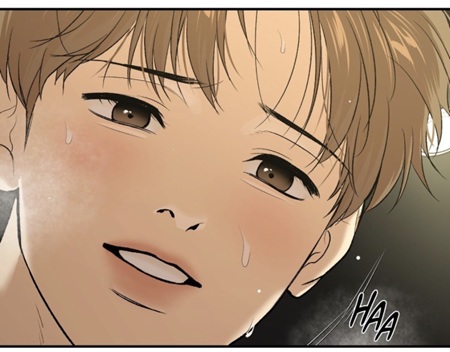 (chapter 88), but the moment in which the conditions for happiness are finally put into place. And now let me ask you this. What is the symbol of happiness? Smiles and laughs. During the training session, Kim Dan smiles. These moments are brief
 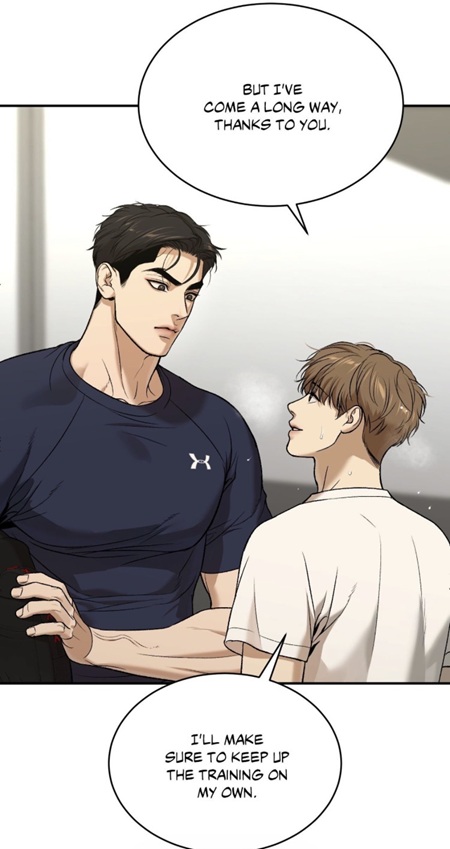 (chapter 88) and goes unnoticed by him (chapter 88) and his fated partner, yet it directly answers what Joo Jaekyung has repeatedly expressed as his desire: to be the source for Kim Dan’s smile and to smile together.
 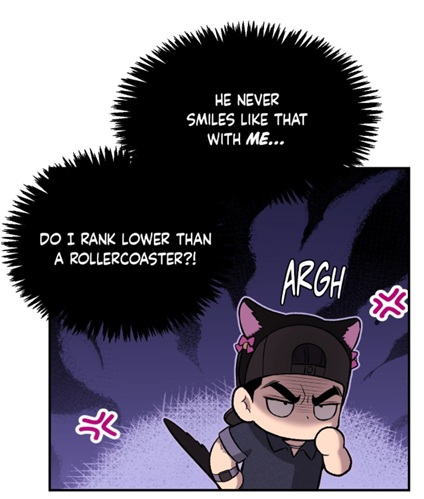 (chapter 83) What is striking is that neither of them recognizes this fulfillment. (chapter 88) Kim Dan does not register his own smile as happiness, and Joo Jaekyung does not realize that he is already producing what he seeks. As elsewhere in Jinx, happiness precedes awareness. It exists before it is acknowledged—by both sides.That’s why I selected the title: the flower embodies happiness, as its life is just as short as happiness.
  (chapter 31)
A. Joo Jaekyung × Kim Dan: The First two Petals
The training sequence in episode 88 cannot be read as a simple exercise scene, nor as a sudden moment of equality or mutual play. It is, instead, the continuation of a long-standing relational pattern in which care is expressed indirectly (chapter 88), asymmetrically, and through the only language both characters know how to use: work.  (chapter 88) What appears at first glance as coercion
 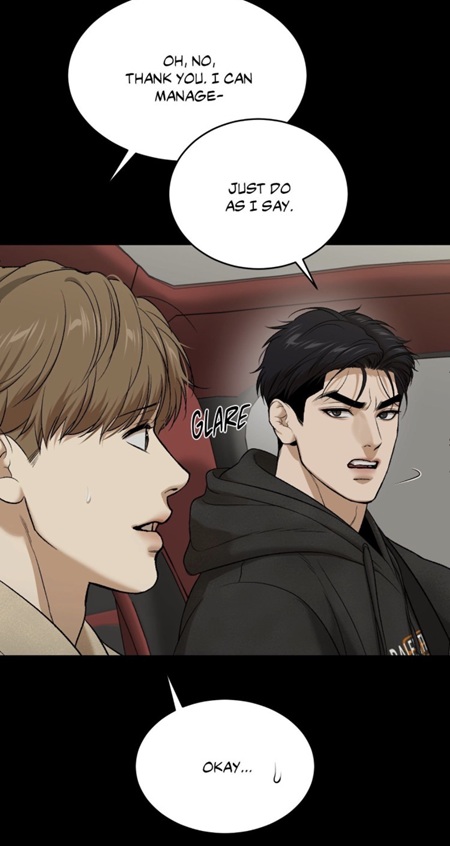 (chapter 88) or discipline is in fact a negotiation shaped by habit, fear of burdening the other, and an inability—on both sides—to articulate desire outside professional roles.
1. How the training is suggested: care disguised as necessity
Crucially, the idea of training does not emerge in the gym itself. It is first introduced in the car 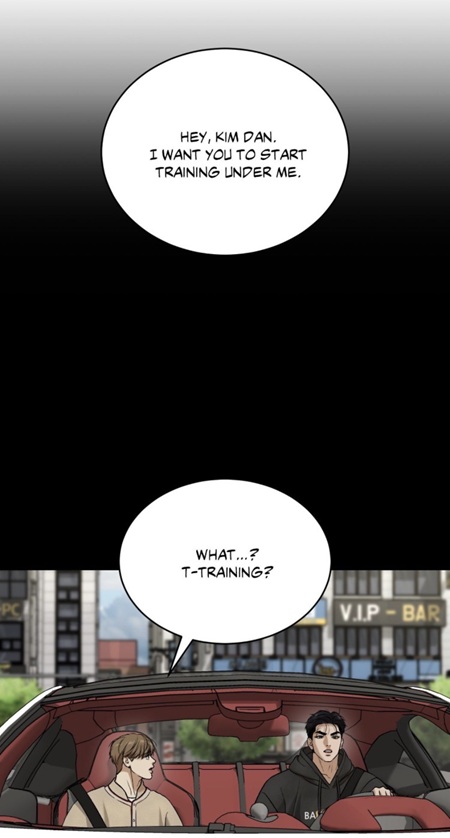 (chapter 88), a space that is never neutral in Jinx. A car has one driver, one direction, one authority. By placing the conversation there, Mingwa signals that the relationship is still structurally asymmetrical at this point: Joo Jaekyung leads, Kim Dan follows.
Joo Jaekyung frames the proposal as a matter of stamina and work. (chapter 88) Training will help him in his career. This framing is not accidental. Joo Jaekyung does not yet know how to say: “I want to spend time with you“, or “I’m afraid you won’t be safe, once you leave my side“. He knows only how to justify closeness through usefulness. Training becomes a rational excuse for proximity, a legitimate reason to demand time without admitting emotional dependence.
At the same time, this proposal is deeply protective. Joo Jaekyung has seen Kim Dan collapse from exhaustion in the past. He knows his physical limits better than Kim Dan himself. 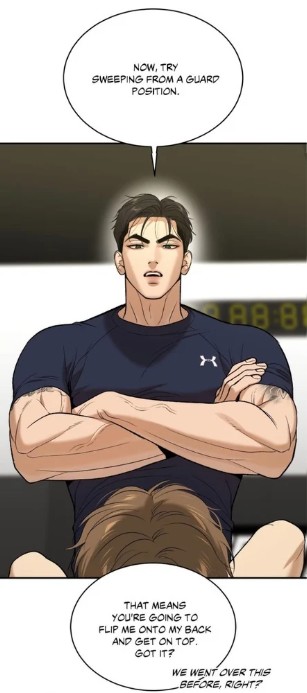 (chapter 88) Secondly, such a training suggests that the athlete is gradually remembering this scene of the almost-rape. (chapter 88) In his subconscious, he knows that this was not prostitution.
 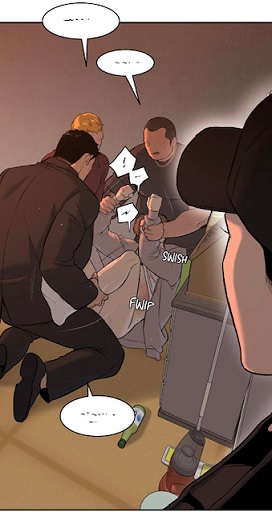 (chapter 17) Therefore it is not surprising that instead of asking permission or explaining concern, he imposes the idea—because that is how he has learned to act as a captain, a fighter, and later a manager. Authority precedes dialogue. (chapter 88)
2. The first refusal: self-neglect disguised as strength
Kim Dan’s first response is immediate: (chapter 88) He refuses. This is not politeness. It is not consideration for Joo Jaekyung’s fatigue. It is a reflex rooted in long-standing self-erasure. Kim Dan genuinely believes he is strong enough. More importantly, he believes that needing care is illegitimate.
This refusal is governed by habit:
- the habit of minimizing himself,
- the habit of overestimating endurance,
- the habit of believing that receiving attention makes him a burden.
At this stage, Kim Dan is not yet protecting Joo Jaekyung; he is protecting the structure that allows him to remain useful and unobtrusive. Accepting training would mean admitting vulnerability—and worse, accepting time, effort, and concern directed at him.
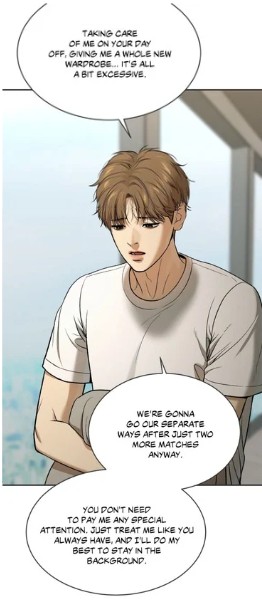
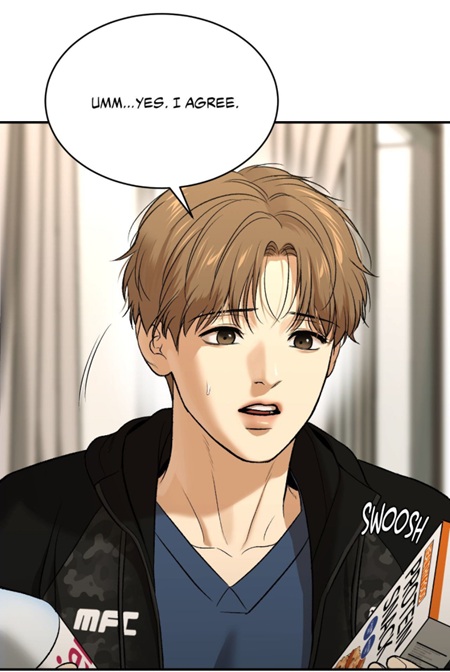
The sportsman ignores this refusal. This moment is important because it reveals both the problem and the intention. Joo Jaekyung acts like a parental figure, not a partner. He overrides consent not out of cruelty, but out of conviction that he knows better. His care still takes the form of command. This explicates why the physical therapist’s agreement is accompanied with a drop of a sweat. “Okay” indicates more discomfort than joy and gratitude. He doesn’t feel indebted toward the athlete, rather embarrassed.
Thus the asymmetry is intact. The training is not born out of his own desire.
3. The pause: time passing, resistance softening
Striking is that this conversation is revealed, after the champion asked doc Dan to get changed. 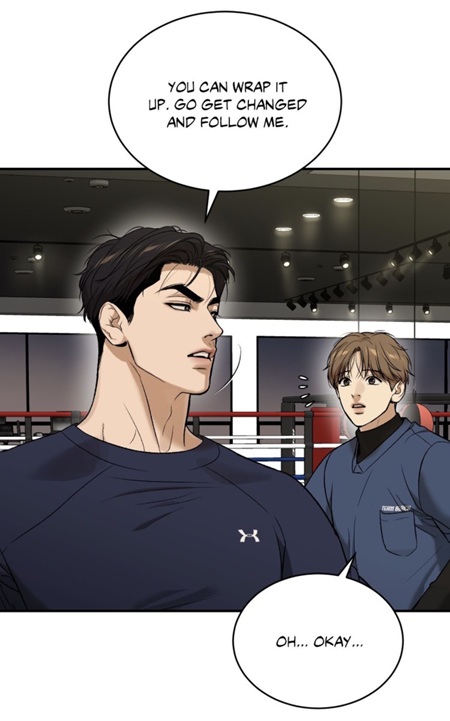 (chapter 88) In other words, the request from Joo Jaekyung appears as a memory from the physical therapist. Why?
 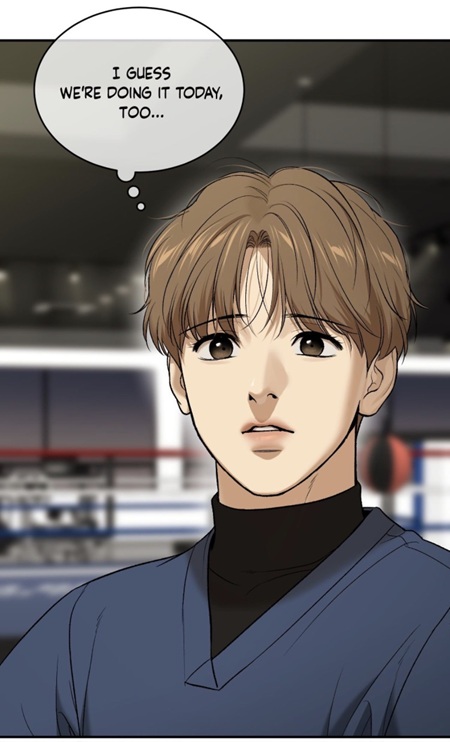 (chapter 88) Because Mingwa refuses the “clean” sequence in which an order is issued and immediately executed. The narration inserts a gap—an interval of off-panel time that we are forced to reconstruct from Kim Dan’s recall. (chapter 88) The narrative does not jump immediately into physical training, because the temporal gap is supposed to mirror the time jump as well. There were other training sessions. This temporal gap matters. The doctor’s inner thoughts (chapter 88) “I guess we’re doing it today, too…” implies routine without inner desire and daily regularity. This means that the training sessions only took place, when the champion asked doc Dan to change his clothes. Doc Dan was not looking forward for the training sessions or reminded the athlete of his promise or request.
That pause changes the meaning of consent and compliance. If the scene were immediate, Kim Dan’s earlier refusal (“Oh no, thank you, I can manage—”) would read as a clear boundary and Joo Jaekyung’s “Just do as I say” as a straightforward override. (chapter 88) But because the chapter returns to the topic through memory, the refusal is not portrayed as a decisive line—rather, it becomes the first phase of a negotiation Kim Dan does not yet know how to conduct. His resistance softens not because he suddenly “wants” the training, but because habit takes over: he is used to accommodating authority, used to re-framing his own limits as irrelevant, used to translating pressure into “normal.” The break between the command and the actual session is precisely where that old reflex does its quiet work.
By the time they appear in the practice room, Kim Dan is showing no hesitation. He is training eagerly. 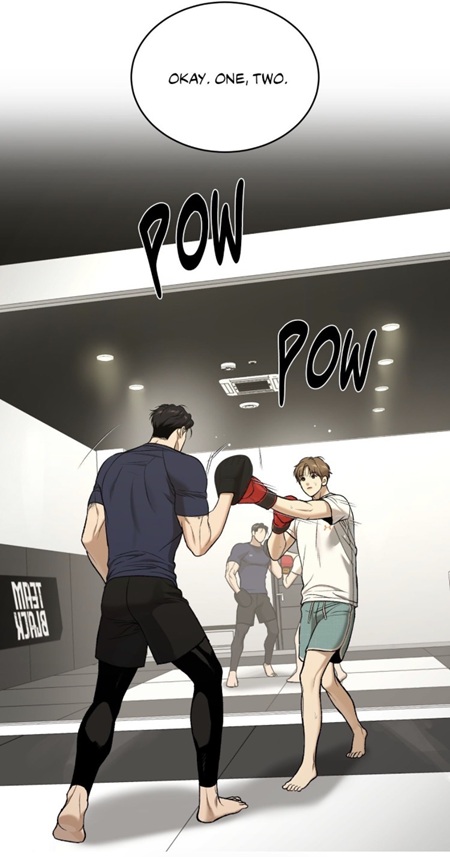 (chapter 88) Instead Kim Dan no longer insists on his own sufficiency. He no longer says “I can manage., but doc Dan admits not only his own lacking.
 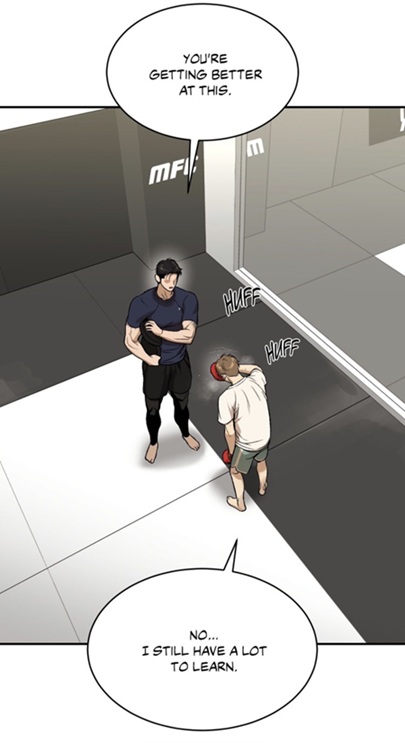 (chapter 88), but also his own desire. He finally expresses his desire to improve, to learn more.
This admission marks a decisive internal shift. In earlier chapters, “I can manage” functioned as a shield: a way to deny need and avoid dependence. Here, Kim Dan allows himself to recognize that improvement exists precisely because limits existed before. The champion’s explicit comparison with the past  (chapter 88) creates a temporal bridge that enables this recognition. Only once change is named from the outside can Kim Dan cautiously acknowledge it from within.
At the same time, this acknowledgment remains fragile. Kim Dan does not fully accept the implications of Joo Jaekyung’s praise. (chapter 88) His response — “I still have a lot to learn” — both accepts growth and reinscribes distance. He recognizes the fighter’s effort and dedication, yet still fears relying on the athlete’s benevolence. (chapter 88) This is why he immediately reframes the future in terms of independence: he will “keep up the training on [his] own.” Gratitude is present, but it remains incomplete, protective rather than connective. He still experiences himself as a potential burden. But why?
It’s because he tried to care for the athlete in his own way by suggesting a rest, but the champion denied it. 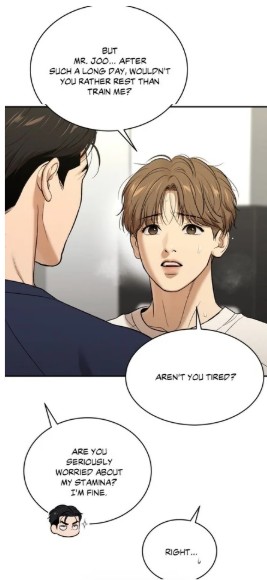 (chapter 88) The problem is that his form of care was influenced by his own mindset and emotions: his physical limitations.
This attempt at care fails not because it is insincere, but because it is misaligned. Kim Dan does not ask whether Joo Jaekyung wants to rest; he assumes that rest must be what is needed, because that is what he himself would need in the same situation. His concern is genuine, yet it is filtered through his own bodily limits and emotional economy. Fatigue, for him, is something that must be managed cautiously, avoided, negotiated. When he encounters a body that does not obey those rules — a body that still has stamina, that refuses the logic of depletion — his offer of care is quietly rejected.
This rejection is decisive. It reveals a gap Kim Dan cannot yet bridge: the realization that Joo Jaekyung’s needs do not mirror his own. (chapter 88) The athlete does not require rest in the same way, and more importantly, he does not articulate his needs through physical exhaustion at all. What Kim Dan fails to perceive is that the training itself is Joo Jaekyung’s way of staying regulated, present, and emotionally grounded. It is also his source of joy. By denying the necessity of rest, the champion is not dismissing care; he is refusing a form of care that does not correspond to him.
Confronted with this mismatch, Kim Dan retreats. If his attempt to care is ineffective, then the safest response is to minimize his demands. This is where gratitude hardens into distance. He thanks Joo Jaekyung for his help with a smile, acknowledges his progress, and immediately insists on autonomy: he will continue alone. The logic is protective. If he does not rely, he cannot burden. If he does not ask, he cannot be refused again.
What emerges here is not self-confidence, but a familiar defense. Kim Dan is not asserting independence from strength; he is withdrawing from uncertainty. His insistence on training alone does not signal rejection of connection, but fear of asymmetry — fear that he cannot offer something equivalent in return. Because he interprets care primarily through physical effort and endurance, he cannot yet recognize that his presence, attention, and willingness to engage already matter.
In this sense, the moment exposes the limits of projection. Kim Dan’s care is sincere, but it remains anchored in his own survival strategies. Until he can decouple care from exhaustion, and need from weakness, he will continue to misread situations where what is required is not restraint, but accompaniment. The training, then, is not only about building strength. It is the first site where Kim Dan begins to confront the possibility that care does not always flow from managing limits — but sometimes from staying, even when one feels unnecessary.
This is significant. It shows that Kim Dan is beginning to speak, but still cannot speak for himself. His old habit remains: if something feels wrong, it must be because the other person needs rest, not because he is tired, scared, or overwhelmed. In other words, care is emerging—but it is displaced.
This is precisely why the gesture that follows (chapter 88) carries such weight. For the first time in this exchange, care is directed back at Kim Dan without condition. It is not framed as instruction, correction, or evaluation. It is neither command nor test. It is a simple, protective statement that mirrors Kim Dan’s earlier concern — but without projection. Joo Jaekyung does not deny Kim Dan’s limits. He acknowledges them. There is no reproach, only concern. 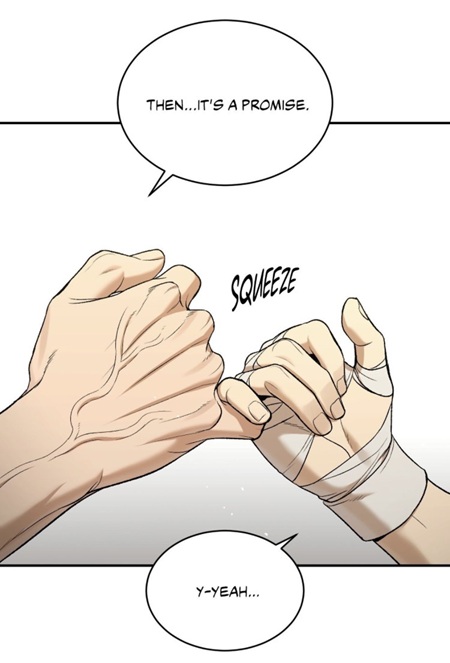 (chapter 88)
Here, the asymmetry softens without disappearing. Joo Jaekyung remains physically dominant, emotionally inarticulate, and structurally in control of the situation. Yet the direction of care shifts. He does not accept Kim Dan’s attempt to exit the dynamic under the guise of independence. Instead, he counters it with responsibility: you matter enough to be protected. The pinky promise that visually accompanies this exchange reinforces the meaning. Promises in Jinx have often functioned as burdens or traps — obligations that freeze people in place. This one is different. It does not demand performance. It does not extract sacrifice. It asks only for self-preservation. (chapter 88)
This is where the flower begins to appear — not as harmony, not as symmetry, but as mutual misrecognition slowly correcting itself. Kim Dan still does not fully grasp that Joo Jaekyung’s desire to train him is also a desire to spend time with him. Joo Jaekyung, in turn, still cannot articulate that desire outside the language of work. (chapter 88) Training becomes the only acceptable medium through which closeness can occur. Pleasure and intimacy surface unintentionally — in teasing, in competition, in shared breath — but remain unnamed.
Crucially, this is not rigidity. It is habit. Both men operate within deeply ingrained routines shaped by survival rather than joy. Rest, breaks, and leisure have only ever been framed in relation to the champion’s career: recovery after injury, distraction after stress, sanctioned release after pressure. They know how to stop working; they do not know how to share fun. There is no vocabulary yet for casual togetherness — no restaurant, no cinema, no idle wandering. Training fills the gap because it is the only space where proximity feels justified.
Thus, the training is neither purely imposed nor fully shared. It begins as Joo Jaekyung’s initiative, shaped by authority and concern, but it gradually becomes a site where Kim Dan starts to renegotiate his self-image. By acknowledging both his limits and his desire to improve, Kim Dan takes a first step away from the logic of endurance alone. He still retreats into self-sufficiency, but the retreat is no longer absolute. He speaks more. He hesitates less. He accepts care, even if he cannot yet rely on it.
The flower here is not bloom, but formation. It is the slow emergence of a relationship that must unlearn the equation between care and burden, strength and isolation, desire and duty. Nothing is resolved. But something has shifted: care is no longer one-directional, even when it remains uneven. And for the first time, both characters participate — imperfectly, awkwardly, but genuinely — in sustaining it.
4. Where pleasure enters—and why it is unspoken
As the training progresses, something shifts subtly. Joo Jaekyung smiles 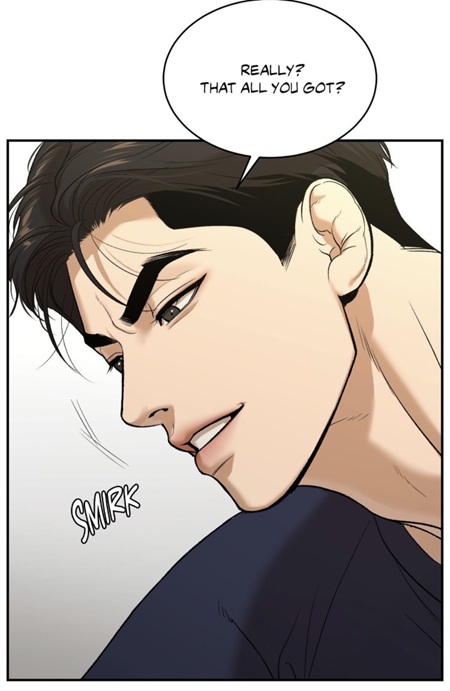 (chapter 88). He teases. (chapter 88) He challenges. He praises:
  (chapter 88)
These are not neutral compliments. They are moments where discipline slips into enjoyment. Joo Jaekyung is no longer training only to prepare Kim Dan for a future without him; he is enjoying the present interaction. And yet, he cannot name this enjoyment.
Pleasure appears within work, not alongside it. Intimacy emerges through exertion 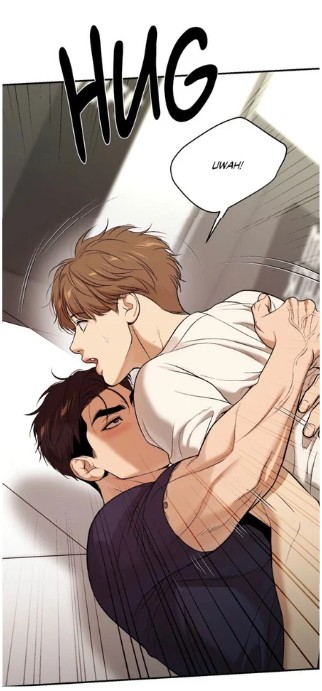 (chapter 88), not rest. Thus the doctor mistakes the embrace for a technique and not the expression of love.
 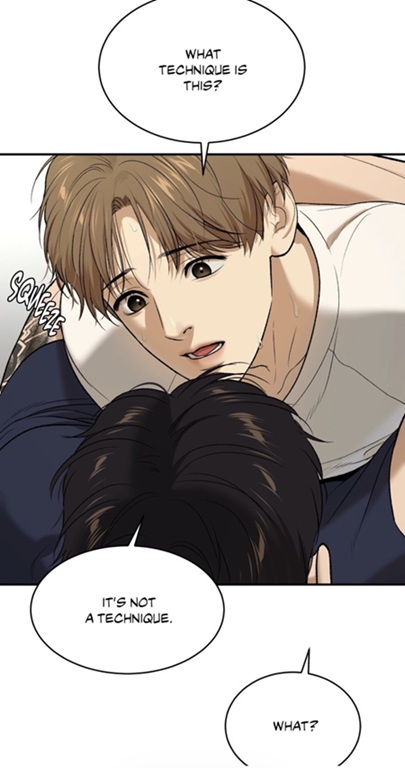 (chapter 88) And observe that the athlete still refuses to express the true meaning of his hug. His explanation still remains technical, defensive, and strategically framed:
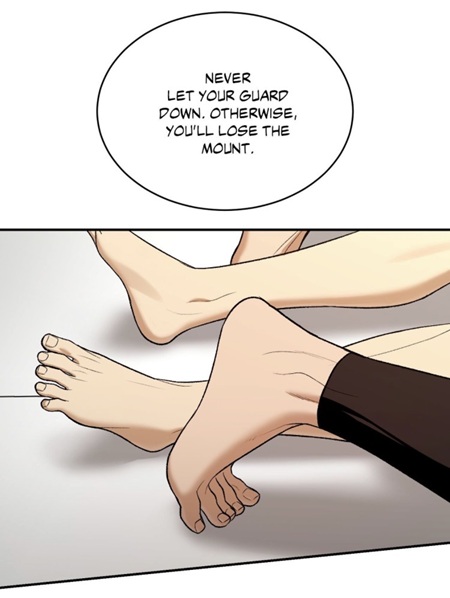 (chapter 88) This sentence is crucial. It reduces contact to function. The closeness of bodies, the pressure of weight, the proximity of breath are translated into instruction. What could be acknowledged as reassurance or care is instead displaced into pedagogy. Joo Jaekyung does not deny intimacy; he relabels it.
What the image reinforces is not distance, but deferral. The focus on bodies — on interlocked legs, grounded feet, balanced weight — emphasizes control and stability rather than vulnerability. Affection is allowed to exist only when it can be defended as functional. The mount is maintained not because Joo Jaekyung wants to keep Kim Dan close, but because losing it would constitute failure.
And yet, the sequence immediately preceding this moment shows both characters acutely aware of their racing hearts,
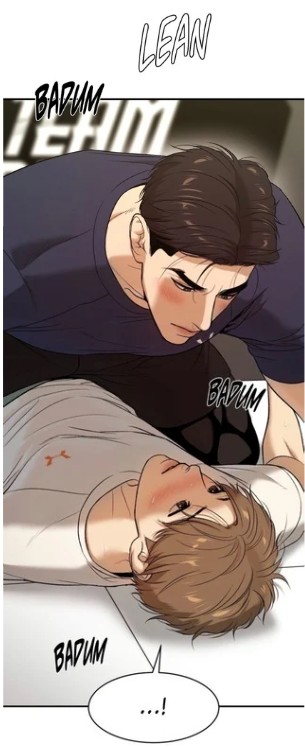 (chapter 88) of breath held too long, of proximity charged with something unnamed. The technical explanation arrives after that awareness, not before it. This confirms that the instructional language functions as a shield — not against intimacy itself, but against having to speak it.
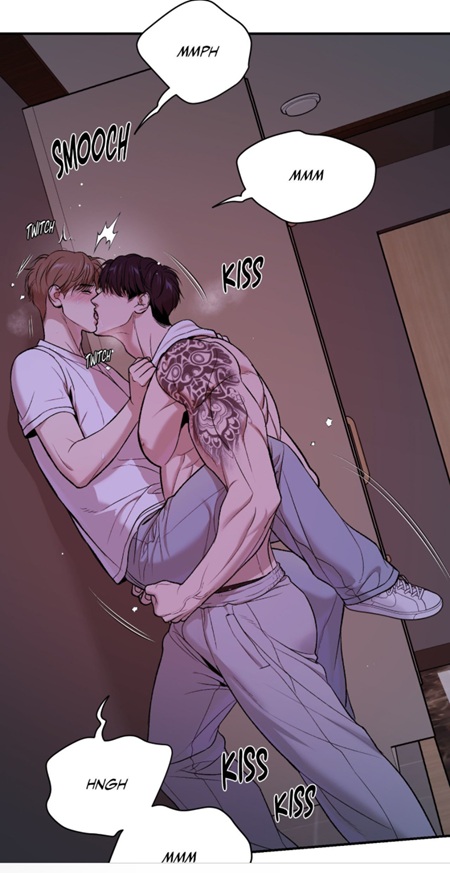
Yet the narrative immediately undermines this technical framing.  (chapter 88) Directly after warning against lowering one’s guard, Joo Jaekyung kisses him.
The kiss is not furtive, accidental, or one-sided. Both characters are fully present. They look at each other. Neither pulls away. The contradiction is deliberate: the body does what the language refuses to acknowledge. Vigilance and intimacy coexist in the same gesture. The warning about control does not prevent closeness; it becomes the pretext through which closeness is allowed.
This is the crucial correction: Joo Jaekyung is not simply disguising intimacy as technique. He is containing it. The kiss does not negate the instructional frame; it slips through it. Pleasure is permitted only insofar as it does not require verbal recognition. Love is enacted, but not named.
For Kim Dan, this ambiguity poses no immediate problem. He has been kissed before. Physical intimacy is not new to him, and he has learned — through prior encounters — not to interrogate its meaning unless forced to do so. He does not question whether the kiss signifies affection, reassurance, desire, or attachment. Instead, he relocates intimacy spatially rather than emotionally. His only objection is not that the kiss happens, but where: (chapter 88) This line is telling. Kim Dan does not resist closeness itself. He resists its placement. Intimacy, in his understanding, belongs elsewhere — to the penthouse, to private space, to moments already coded as sexual or domestic. What unsettles him is not the kiss, but the fact that it occurs inside the domain of work.
In other words, Kim Dan does not yet read intimacy as something that can coexist with discipline. He accepts affection when it appears in designated zones, but not when it disrupts functional categories. The gym is a place of training; therefore, what happens there must remain legible as training. Joo Jaekyung’s technical explanation gives him exactly that permission.
This is why Kim Dan accepts the justification without protest. He does not reinterpret the embrace as love because he does not yet need to. The structure remains intact: work is work, intimacy is intimacy, and when the two overlap, the overlap is attributed to technique rather than feeling.
In this sense, Joo Jaekyung’s restraint protects both of them. It protects Kim Dan from having to reinterpret the gesture emotionally, and it protects Joo Jaekyung from articulating feelings he has no vocabulary for outside the grammar of training. Care is real, but its meaning is postponed. Love is present, but encoded as vigilance.
This postponement explains why the “flower” has not yet opened. It exists, but inwardly folded. Growth is happening, but it is constrained by the only relational language both men currently share: effort, endurance, correction, control.
They know how to train together.
They know how to recover.
They know how to endure crisis.
They know obligation.
They do not yet know how to choose pleasure together — how to eat, rest, shop, watch a movie, or enjoy time without purpose. Even their earlier “break” at the amusement park existed because Joo Jaekyung needed rest, not because they mutually chose leisure. Fun, like intimacy, has always been instrumental.
What episode 88 reveals is not the absence of love, but its confinement. Pleasure appears — undeniably — yet remains untranslated. Sensation does not yet become knowledge. The flower is there, but it has not learned how to open outside the discipline that first allowed it to grow.
5. The slow reversal: from imposed care to accepted challenge
The most important moment comes when Kim Dan manages to reverse positions and pin Joo Jaekyung. (chapter 88) The shock and joy are mutual. Joo Jaekyung is genuinely surprised. Kim Dan is genuinely proud—though he barely allows himself to register it. (chapter 88) This is not equality yet. But it is the first time Kim Dan experiences himself as capable, not merely compliant. The training that began as imposed authority becomes a shared test and experience. Importantly, Kim Dan did not ask for this moment. It emerged because he stayed. This stands in opposition to the sparring in front of the fighters. 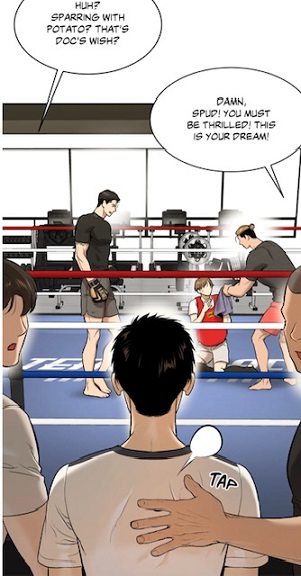 (chapter 26) Back then, Doc Dan had accepted the challenge due to Potato, though deep down he desired to have the champion as his teacher.
  (chapter 25) That’s how it dawned on me that doc Dan has gradually taken over Yoon-Gu’s previous place at the gym. He is an “unofficial member” of Team Black. Thus he mops the floor and Yoon-Gu is not there to stop him or reclaim this position.
 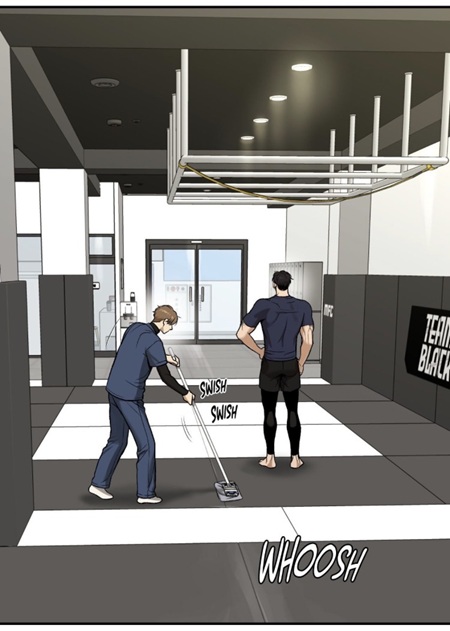 (chapter 88) Yoon-Gu’s position within the gym has improved. He is now considered as a real fighter.
6. Where the flower is
If the previous sections trace a movement, this final observation names its limit. To understand why the flower in episode 88 has only begun to appear, it is necessary to return to Erich Fromm’s definition of love, which rests on four inseparable elements: care, responsibility, respect, and knowledge. [For more read:“The Art Of Loving” (locked)] Love, in this framework, does not exist where only one or two of these are present. It requires all four to be active at once in order to become sustaining, conscious, and mutual.
Episode 88 makes one thing unmistakably clear: in the relationship between Joo Jaekyung and Kim Dan, three of these elements are already in place. One is not.
Care is not what this relationship lacks. (chapter 88) Joo Jaekyung’s care is visible throughout the episode, even when it is expressed awkwardly or through misdirection. His insistence on training, his attention to Kim Dan’s stamina, his refusal to let Kim Dan dismiss his own physical limits (chapter 88), and his final reminder to “take good care of yourself” all belong to the same logic. This care is protective and practical, but it is still delivered under the cover of training—phrased as guidance, risk-management, and performance maintenance rather than as attachment. He is capable of saying “take care,” but he still cannot say what the care ultimately means: I want you close; I worry about losing you; I don’t know how to keep you besides making you stronger. For someone like Jaekyung, whose life has been organized around performance and endurance, this is the only available language of concern. Kim Dan, too, expresses care, though in a displaced form. He worries about Jaekyung’s exhaustion, (chapter 88), minimizes his own needs and tries not to become a burden. Care moves in both directions, even if it rarely reaches its intended target.
Responsibility is equally present, and equally heavy. Jaekyung assumes responsibility for Kim Dan’s safety and future (chapter 88), particularly in light of his own awareness that their time together is limited. The training is not arbitrary; it is oriented toward what comes after him. Kim Dan, meanwhile, takes responsibility in another way: by insisting on self-sufficiency (chapter 88), by promising to continue training on his own, by framing improvement as something he must manage independently. What stands out is that responsibility exists on both sides, but it is carried separately. Each assumes it alone, without yet allowing it to become shared.
Respect, too, is not absent. Jaekyung respects Kim Dan’s capacity to grow. (chapter 88) He challenges him not because he sees him as weak, but because he believes resistance is possible. (chapter 88) His praise, rare and restrained, signals recognition rather than indulgence. Kim Dan, in turn, respects Jaekyung’s discipline and endurance, sometimes to the point of idealization. This respect remains asymmetrical, but it is real. It has begun to shift from hierarchy toward recognition.
What is missing, and what keeps the flower from fully appearing, is knowledge—not information, not memory, but Fromm’s sense of active understanding of the other as a subject with inner needs, fears, and desires. In The Art of Loving, knowledge means seeing the other as they are, which requires two things at once:
- Honesty toward oneself (recognizing one’s own needs, fears, and desires), and
- Articulation toward the other (making that inner reality available rather than acting it out indirectly).
This is why words matter so much. Without words, care can exist, responsibility can exist, and even respect can exist — but they remain opaque. Joo Jaekyung knows exactly what he wants: time, proximity, continuity. He is acutely aware that his time with Kim Dan is running out. 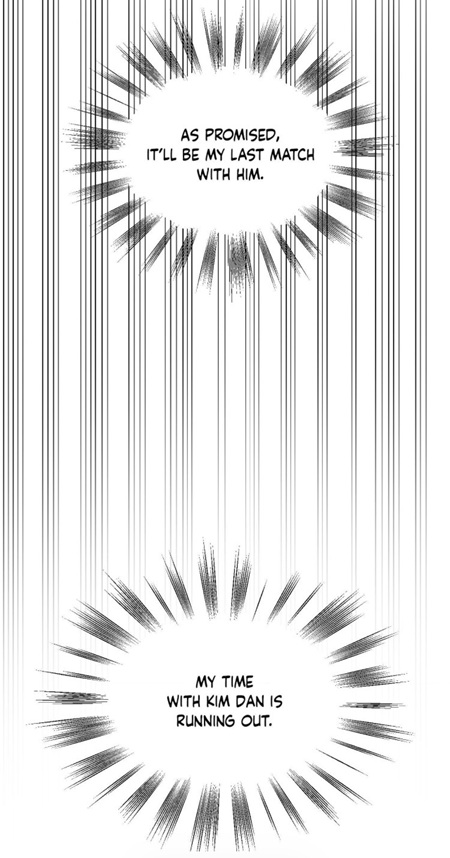 (chapter 88)
What he lacks is not intention, but translation and even courage. He does not know how to express his desire outside the vocabulary of work, discipline, and physical instruction. He can insist, challenge, and protect, but he cannot yet name why he does so. He still thinks, it is not possible to be loved due to his huge flaws and past wrongdoings. Kim Dan, on the other hand, does not yet know how to read care when it is not framed as sacrifice or obligation. He interprets insistence as burden, closeness as technique, affection as something that must be relocated elsewhere—into private space, into the penthouse, into moments that feel safer and more legible.
Their misunderstanding does not stem from a lack of feeling. It stems from a lack of confidence and shared language. Love is enacted rather than understood. Care, responsibility, and respect circulate between them, but knowledge—the capacity to see and articulate the other’s inner reality—has not yet entered the relationship. The reason is that both underestimate themselves. Thus both don’t speak the truth. This is why the flower in episode 88 is real but incomplete. It exists in the slow shift from refusal to engagement, from habit-driven self-denial to cautious participation. It exists in the fact that Kim Dan accepts the training not because he must, but because he begins to recognize the results from Jaekyung’s effort and insistence. He gradually accepts that Joo Jaekyung is genuinely concerned about him. He is gradually enjoying this, thus he voices his desire to learn more. Another problem is that both still think, they know each other. They have not recognized the importance of “words” and “honesty” yet. Nevertheless until knowledge emerges—until what is enacted can also be spoken—the flower remains folded inward. Not absent. Not broken. Simply unfinished.
Heesung × Potato: The Other Two Petals — Knowledge Without Responsibility
If the bond between Joo Jaekyung and Kim Dan exposes a surplus of care constrained by poor articulation, the dynamic between Heesung and Potato reveals the opposite imbalance:: knowledge without responsibility, and therefore without respect. The actor is able to express his thoughts and emotions all the time, yet he is not taking Potato’s feelings and thoughts into consideration. Thus he simply asks Yoon-Gu to hold the mitts and not be his sparring partner. (chapter 88) The way the “gumiho” speaks to the chow-chow is quite telling. He expects an agreement. Striking is that the young fighter doesn’t agree to the actor’s request, he answers with another question: “You don’t need a sparring partner?”. This question reveals that Yoon-Gu had already imagined himself differently. He had pictured a future moment in which he would not merely assist the actor’s training, but share it. In other words, he had already crossed an internal threshold: from helper to potential partner. The question exposes a private projection — a hope — that had not yet been verbalized until this moment.
That is why this exchange marks Yoon-Gu’s transformation. That’s why he is wearing a olive green sweater. (chapter 88) Olive green is not the vivid green of aspiration or idealization, nor the cold institutional green associated with discipline and hierarchy. It is a grounded, muted green — a color of transition. Symbolically, it sits between admiration and autonomy. By wearing it at this moment, Yoon-Gu visually signals a shift away from the champion’s gravitational pull. He is no longer oriented upward, toward an untouchable figure, but sideways, toward a peer relationship he is beginning to imagine. The green does not announce arrival; it marks movement. Growth here is not explosive but cautious, uneven, and still uncertain.
Crucially, this transformation does not stem from insecurity. Yoon-Gu is not suffering from low self-esteem. On the contrary, he speaks easily, moves freely, and voices his expectations without hesitation. What he lacks is not confidence, but self-awareness. He does not yet understand the structure he is entering, nor the asymmetry embedded in it. He mistakes proximity for reciprocity, access for acknowledgment. And the chow chow’s lack of self-awareness is also present, when he imagined that he could have followed to the amusement park. 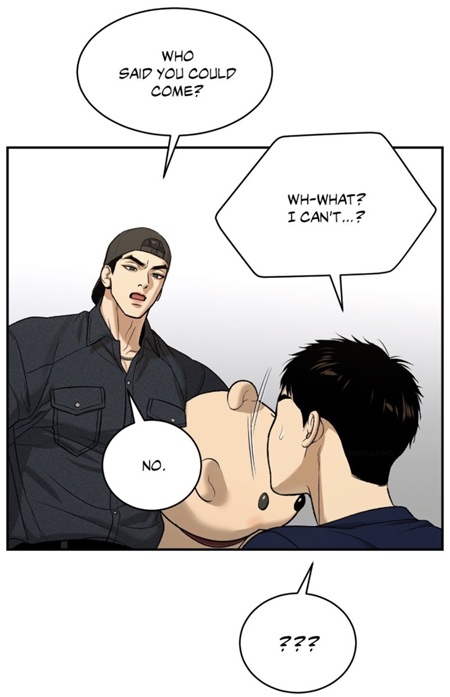 (chapter 87) For him, this trip was related to work, while in reality it was a date in disguise.
This becomes clearer when contrasted with the main couple. Between Kim Dan and Joo Jaekyung, communication is constrained, indirect, and often misaligned, as both are suffering from a low self-esteem and their past traumas. Desires are hidden behind habit, duty, or technical language. By contrast, the dialogue between Yoon-Gu and Choi Heesung is strikingly explicit. Both second leads speak readily. They articulate preferences, make requests, and voice dissatisfaction without visible hesitation. The only difference is that Heesung allows misunderstanding to persist. Joo Jaekyung abruptly corrects it. Neither approach is emotionally generous—but only one produces shock rather than slow erosion.
To conclude, this apparent fluency masks a deeper problem. What is missing here is not expression, but reflection.
Earlier, Yoon-Gu’s actions were shaped by obligation, imitation, or conditional promises (cleaning the floor, holding equipment or a bottle, proving usefulness). Here, the initiative is internal. He is no longer reacting to instructions; he is testing the possibility of recognition. (chapter 88) The desire precedes permission.
The tragedy of the moment lies not in the refusal itself, but in how it is answered. Heesung does not respond to the desire embedded in the question. He bypasses it with a technical explanation — size difference — which neutralizes the emotional risk Yoon-Gu has taken. 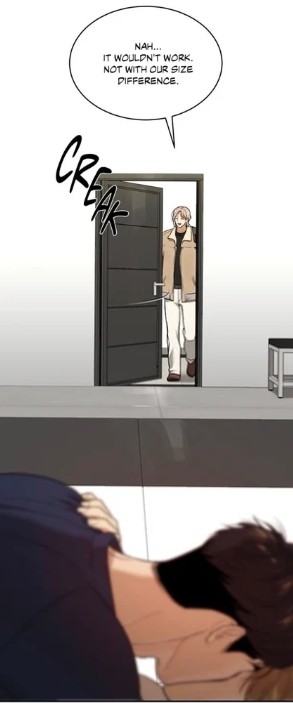 (Chapter 88) The answer restores hierarchy without acknowledging the transformation that has already occurred. Secondly, the answer closes the future by appealing to a supposedly objective limit. Yoon-Gu can never be his sparring partner. The best he can do is hold the mitts and nothing more. The fox is using his seniority and body to have the final say.
This is where Heesung’s pride in knowing turns into arrogance. His explanation contradicts the very logic that governs the gym itself. Joo Jaekyung has just demonstrated explicitly that technique outweighs physical size, that discipline and practice can reverse power relations. 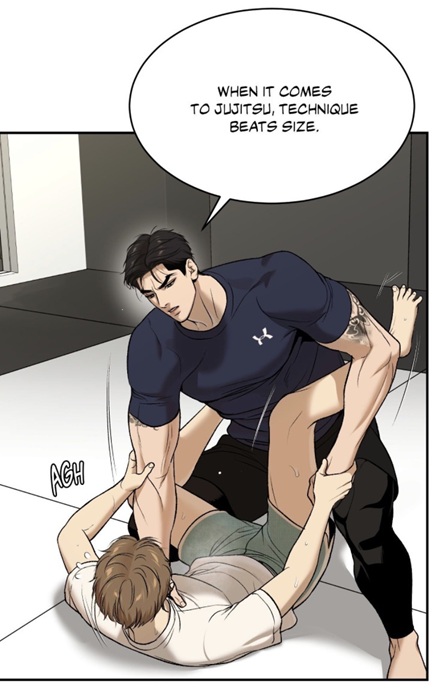 (chapter 88) Under that framework, Yoon-Gu is not disqualified; he is qualified. He has trained. He belongs. So technically, Yoon-Gu could indeed beat the actor, as the “puppy” has trained for a long time at Team Black.
Yet Heesung’s knowledge is not grounded in the present conditions of Team Black. It is grounded on his past experience: he received special training from Joo Jaekyung. In other words, he is biased. Heesung prides himself on knowing.  (special episode 1) He knows people’s patterns.
 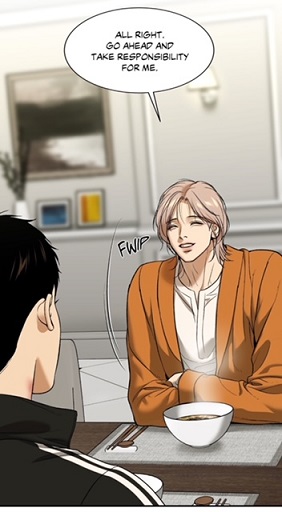 (special episode 1) He knows how relationships fail.
  (chapter 33)
 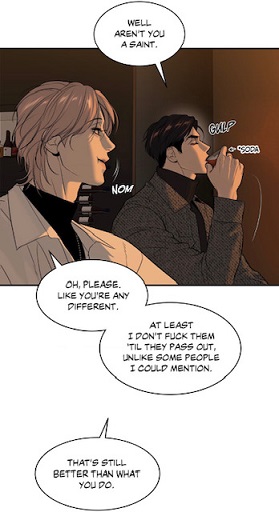 (chapter 33) He knows what he does not want. His language is saturated with judgment shaped by past experiences: lovers who become “too clingy,” attachments that turn inconvenient, people who should remain “better off” elsewhere
 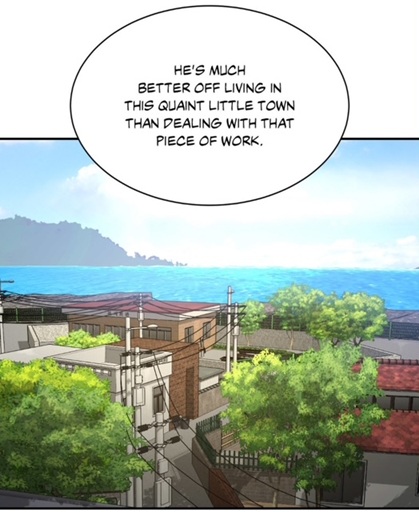 (chapter 58). This knowledge is not neutral; it is retrospective and comparative. It is built from what has disappointed him before, and it governs how he evaluates others in the present. He views himself as superior to the champion morally.
This is where the symbolism of the “grass being greener on the other side” becomes essential.  (chapter 33) Heesung’s orientation is never toward what is unfolding, but toward what might be better elsewhere—another partner, another configuration, another future. His repeated invocation of a “soulmate” is revealing: it displaces intimacy into a hypothetical horizon. By looking at the grass, he is overlooking the flower. Love, for him, is something to be found later, once the conditions are ideal. What exists now is always provisional, always lacking, always subject to replacement. He needs the “perfect” lover, and in his eyes, Potato doesn’t meet his conditions: too innocent and too young.
  (special episode 1) This explicates why the young fighter is only considered as “fuck buddy”.
 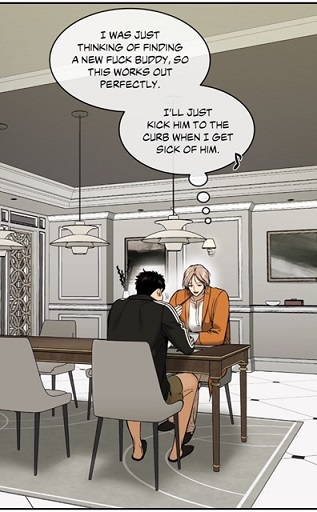 (special episode 1)
Potato exists precisely within this gap. Because he wanted to take responsibility.  (special episode 1), he is present, available, even emotionally invested—but he is never treated as sufficient. He is smaller (chapter 88), younger and as such less experienced, he is positioned as someone who does not yet qualify as a sparring partner, or even less as a boyfriend. Observe how he presented his relationship to doc Dan.
  (chapter 58) Heesung’s use of the pronoun “we” is, on the surface, inclusive. Linguistically, it frames his relationship with Potato as mutual, shared, and consensual. But pragmatically, it does the opposite. The “we” is spoken over Potato’s head, not with him. Thus Potato is physically present but discursively absent. He does not confirm, nuance, or reciprocate the statement verbally. The pronoun thus becomes a rhetorical appropriation rather than a sign of partnership.
What makes the remark particularly uncomfortable is the context: Heesung is not speaking to Potato, but to Kim Dan. The sentence is not meant to communicate within the relationship; it is meant to display the relationship to a third party. In that sense, “we” functions as a prop. It allows Heesung to stage intimacy without assuming responsibility for how that staging affects the person he claims to include. He is not saying that he is dating Yoon-Gu either. In other words, he is behaving like Joo Jaekyung in season 1.  (chapter 31) He denies the existence of feelings and attachment.
The embarrassment of Potato is not accidental. It is structurally produced by the asymmetry of the situation. Heesung controls the narrative, the tone, and the implication. By adding “in more ways than one,” he sexualizes the bond implicitly, while maintaining plausible deniability. Nothing explicit is said; everything is insinuated. This is knowledge without accountability. Heesung knows exactly how the line will land—on Kim Dan, and on Potato—but he does not take responsibility for either impact.
On the other hand, Heesung feels so comfortable around doc Dan, that he is willing to divulge more. He assumes Kim Dan will “understand” him. He is speaking in a coded register, relying on shared cultural assumptions: that closeness implies sexuality, that sexuality implies connection. In doing so, he treats Kim Dan as a potential ally in interpretation, not as a moral interlocutor. He expects recognition, perhaps even complicity, rather than reprimand or judgment.
This is where the contrast with Joo Jaekyung becomes sharp. Joo Jaekyung struggles to name intimacy and often hides it behind work or discipline—but he does not instrumentalize language to control  (special episode 1) or humiliate the other.
 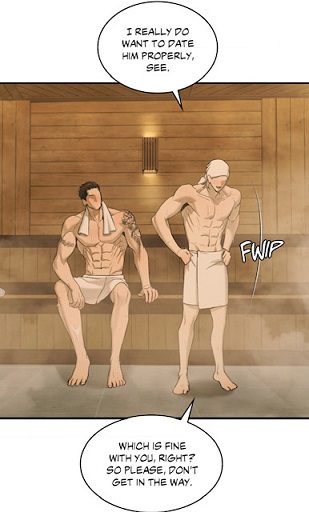 (chapter 34) Heesung, by contrast, is fluent. He can name, joke, insinuate. What he lacks is restraint and responsibility. His ease with words does not signal emotional intelligence; it signals control.
Heesung does not call Yoon-Gu weak outright, but the hierarchy is unmistakable: Potato is handled (chapter 88), redirected 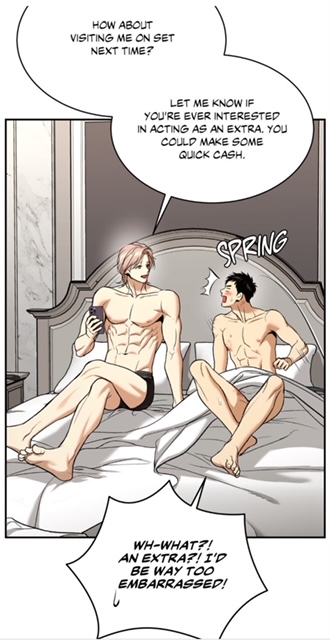 (special episode 2), corrected. (chapter 88) Even when Heesung intervenes on his behalf, it is not through shared responsibility but through dismissal—deciding what is best for him without asking what he truly wants.
This lack of responsibility is crucial. Responsibility, in Fromm’s sense, is not obligation imposed from above; it is the willingness to respond to the other as a subject whose needs and presence matter now. Heesung does not assume this stance. He neither commits nor withdraws cleanly. Instead, he hovers—knowing enough to judge, but refusing the burden of staying.
This explains why Heesung reacts so strongly to the relationship between Kim Dan and Joo Jaekyung. He does not simply misunderstand it; he rejects it (chapter 31) because it violates his model of love. Doc Dan is not introduced or claimed as his boyfriend. For him, it is simply related to the athlete’s jinx. 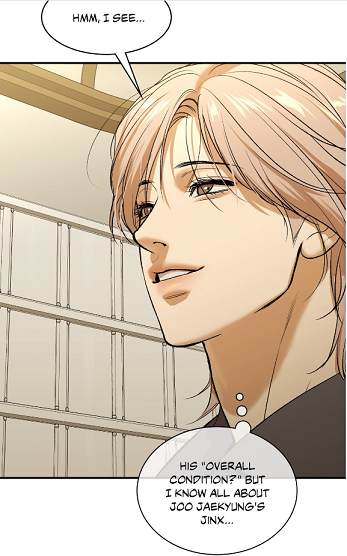 (chapter 32). It has no declared endpoint, no moral clarity (chapter 34), no soulmate label. Rather than engaging with what the relationship is doing —how it functions, how it transforms both participants—Heesung tries to name it away: a jinx, a mistake, a lack of feelings. Naming, here, becomes a defense against involvement.
The scene in the penthouse crystallizes this refusal.  (chapter 34) Heesung enters fully aware of what he is likely to witness. He is not naïve, nor totally surprised. Hence he doesn’t flee right away. Yet instead of acknowledging the reality before him, Doc Dan is not someone the fighter fucks, until he passes out, (chapter 33), he reframes the encounter as an accusation. The man is crazy.
  (chapter 34) Joo Jaekyung becomes the problem, the one who “deserves to suffer.”
 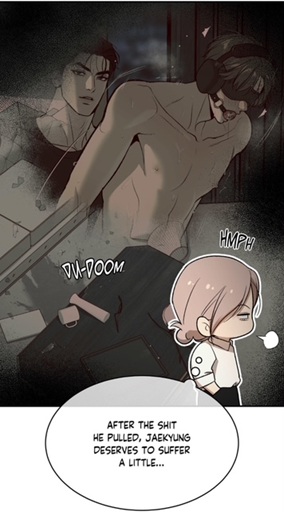 (chapter 58) This moral displacement allows Heesung to maintain distance: if Jaekyung is guilty, then no self-examination is required. Forgiveness—central to this arc (from 79 to 89)—is rendered impossible, because forgiveness would require recognizing shared vulnerability rather than assigning blame.
Potato, by contrast, is repeatedly asked to adapt. Earlier, he cleans, waits  (chapter 25), accepts deferral. Later, he is displaced entirely. Unlike Kim Dan, who gradually moves from imposed participation to earned agency, Potato is never given a space where effort leads to recognition.
  (chapter 85) However, this panel implies that the young man has already been able to enter competition. Striking is that his promise at the seaside sounds like commitment
 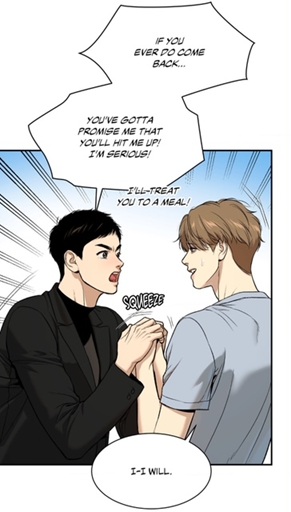 (chapter 59), but the reality diverges. It only binds doc Dan. If the latter returns to Seoul, he has to promise to train with Potato. The reason is simple. He is already committed to the actor, he is already at his beck and call. Potato’s promise echoes the earlier promise forced upon Kim Dan by his grandmother: a future-oriented vow that justifies present sacrifice while guaranteeing nothing in return.
  (chapter 11)
This is the structural tragedy of the Heesung–Potato dynamic. There is confidence and knowledge—sharp, observational, even insightful—but it is not paired with responsibility. And without responsibility, respect and care collapse into condescension. Potato is not met as an equal in becoming, but as someone perpetually not-yet-ready. While Yoon-Gu had been deeply affected by doc Dan’s departure. 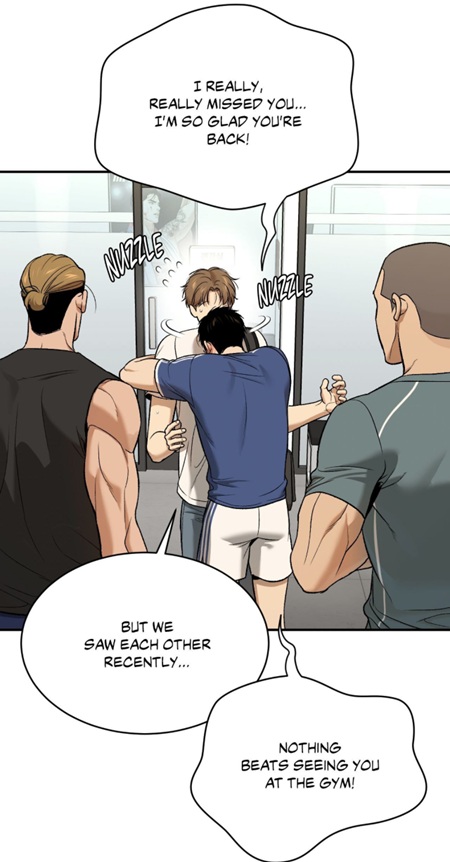 (chapter 78), he didn’t remind doc Dan of his promise. At the same time, observe that none of the fighters apologized or promised something. When they hugged the doctor, they didn’t pay attention to the physical therapist’s reaction: his passivity and silence. The “laugh” lacked genuineness and felt wrong at the time.
  (chapter 78)
But let’s return our attention to the petals Heesung and Potato. Placed beside Joo Jaekyung and Kim Dan, the contrast is stark. Jaekyung lacks fluency, but not commitment. He does not know how to speak love, yet he stays. Heesung knows how to speak about dating and love, hence he offers a bouquet of roses. But he does not remain when love demands endurance rather than evaluation.
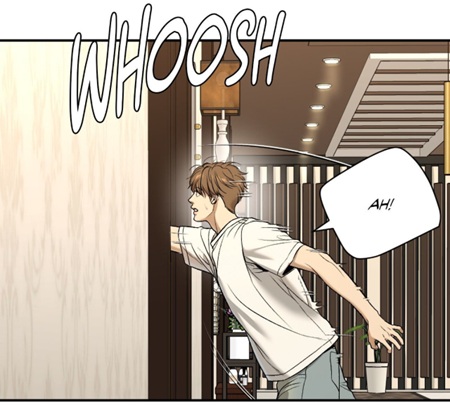
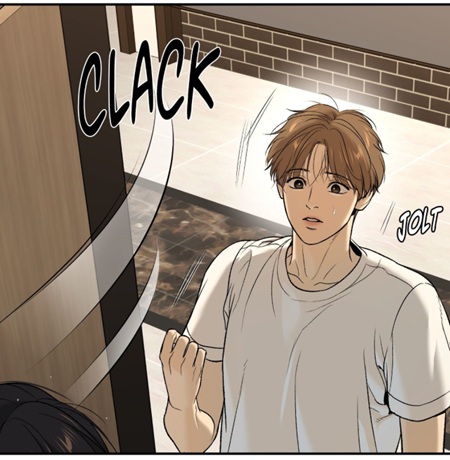
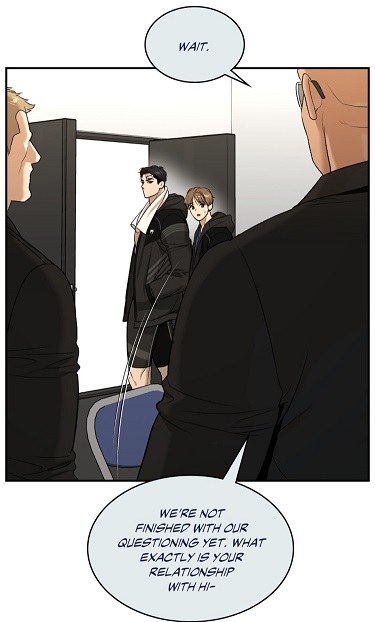
Secondly, Heesung embodies selfishness, which is also perceptible the way he appears at the gym. (Chapter 88) He had planned to use the gym without the champion’s consent and knowledge. And Potato was not expecting the presence of the main couple either. 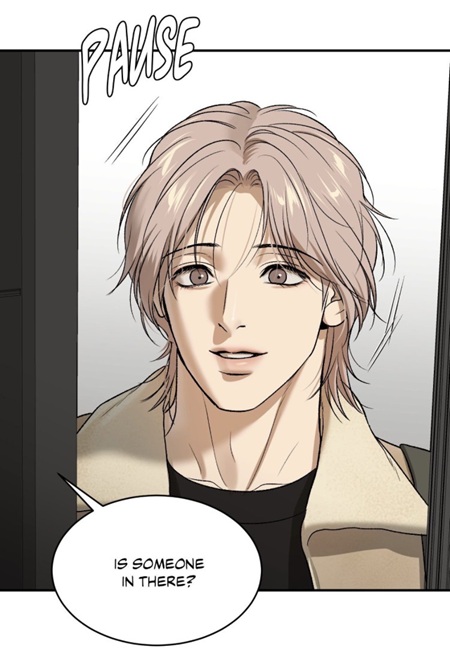 (Chapter 88) This is how it dawned on me why Mingwa recreated such a situation for Heesung. Observe his reaction, when he opened the door. He never answered the question to Potato. In fact, he slammed the door and kept his thoughts to himself. (chapter 88) As you can detect, he remained silent the whole time. It was, as though he was ignoring his lover.
What ultimately exposes the asymmetry in Heesung and Yoon-Gu’s relationship is not overt exploitation, but silence. Episode 88 stages this with remarkable precision. Heesung enters the gym without coordination (chapter 88), without consent from its owner, and without paying any visible cost. He does not announce himself as a guest, does not ask permission, and does not explain his presence. Instead, the intrusion is normalized through omission. Silence becomes the mechanism by which power circulates unnoticed.
Crucially, Yoon-Gu is excluded from the truth of the situation. Readers understand why Heesung is there; Yoon-Gu does not. The actor’s internal reaction (chapter 88) can be read as a moment of comic frustration. In fact, it reveals something far more consequential: this visit was never conceived as a shared activity with Yoon-Gu at all. The training session was not planned for him, nor with him. Yoon-Gu was not included as a subject in Heesung’s intention. He was a means.
This internal monologue exposes the logic of the intrusion. Heesung did not come to train with Yoon-Gu, nor to support him, nor to acknowledge his aspirations. He came to work off his own emotional agitation, to use the gym as a private outlet. Therefore it is not surprising that Yoon-Gu’s presence is reduced to him holding the mitts. His presence is incidental—useful, but not constitutive. When the situation threatens to escalate (chapter 88), Heesung does not think, What will happen to Yoon-Gu? He thinks only of himself: his inconvenience, his exposure, his embarrassment.
That omission is decisive. It confirms that Yoon-Gu is positioned not as a partner in training, but as an accessory to Heesung’s fitness and fun. He provides access, labor, and cover, yet remains excluded from knowledge and from choice. This mirrors an earlier pattern: just as Kim Dan once provided unpaid care under the guise of compensation (chapter 32), Yoon-Gu now provides unpaid labor and institutional access under the guise of familiarity and generosity
 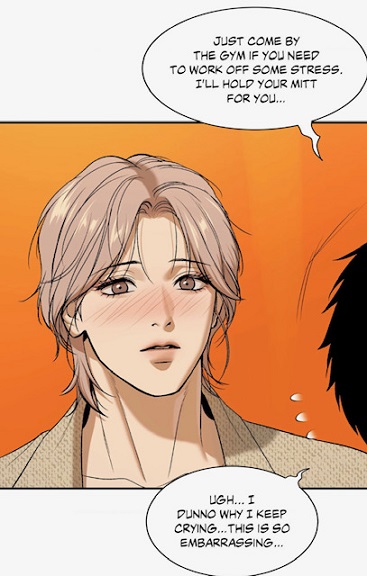 (chapter 35). In both cases, Heesung benefits from proximity without assuming responsibility for the other person’s risk. Silence, here, is not neutral—it is the mechanism by which that asymmetry is maintained.
At the same time, this regret (chapter 88) confirms that Heesung knows he has crossed a boundary. Yet this awareness produces no corrective action. He does not warn Yoon-Gu, does not acknowledge the risk he is creating for him, and does not assume responsibility for the consequences of being discovered. His concern remains entirely self-directed: embarrassment, inconvenience, exposure. Yoon-Gu’s position is not considered.
The irony is that this silence is beneficial for the chow chow . (chapter 88) It actively conceals Yoon-Gu’s complicity while simultaneously depending on it. Heesung could not have accessed the gym without Yoon-Gu. The most plausible inference is that Yoon-Gu provided entry—either by unlocking the space or by lending legitimacy to Heesung’s presence. Yet when the moment of confrontation approaches, Heesung does not speak. (chapter 88) He does not answer Yoon-Gu’s question—“Is there someone in there?”—because answering would reveal responsibility. Another important detail is that though Yoon-Gu provided the access, he simply followed the actor. The latter is the one opening the door to PT Room and not the member of Team Black. It exposes that the fox is really the one committing the wrongdoing, and he can not blame the chow chow for it.
Silence, here, is not absence of speech but a strategy of avoidance. (special episode 1) Heesung does not negotiate, explain, or repair. He doesn’t give any excuse. He moves through spaces as though access were guaranteed and consequences optional. However, this time, his silence is used against him. 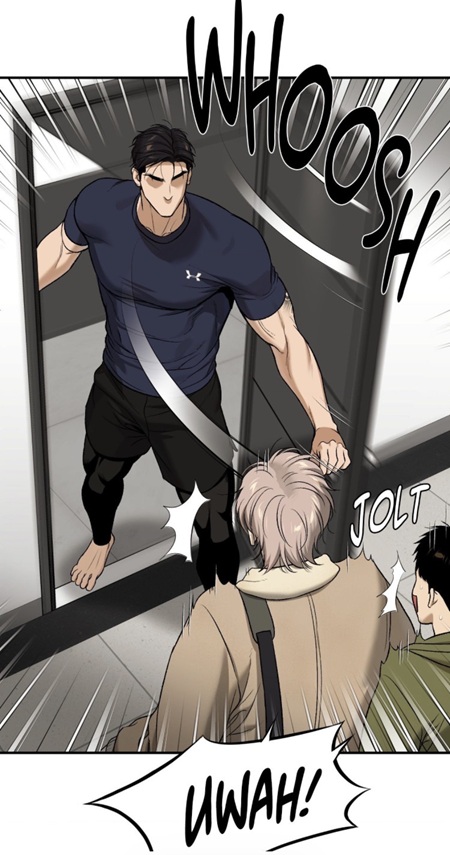 (chapter 88) Forgiveness, responsibility, and mutual recognition—central to the arc unfolding elsewhere—are entirely absent from his conduct. Where Joo Jaekyung begins to redistribute choice and accountability, Heesung consolidates control by refusing to speak.
This is why Heesung cannot embody forgiveness in this arc. Forgiveness requires acknowledgment; acknowledgment requires speech; speech requires responsibility. Heesung chooses none of these. Instead, he preserves his self-image by leaving others to absorb the impact of his actions. Yet, in episode 88, it is no longer possible.
In this sense, the flower associated with Heesung and Yoon-Gu never opens. Knowledge is present. While Heesung understands dynamics, motives, and outcomes, the chow chow heard all the information  (chapter 52) about the switched spray, but he only reported one thing: Kim Dan is innocent. So while insight is present, responsibility is systematically deferred. Without responsibility, respect cannot follow. And without respect, what appears as connection is merely use, quietly sustained by silence.
In the end, the other two petals do not fail because of ignorance. They fail because knowledge, when severed from responsibility, becomes a tool of avoidance. Love is postponed indefinitely—always imagined, never practiced. On the other hand, since he knows about the champion’s past sexual habits, it signifies that the actor became the witness of TRUE LOVE. Joo Jaekyung is kissing doc Dan. 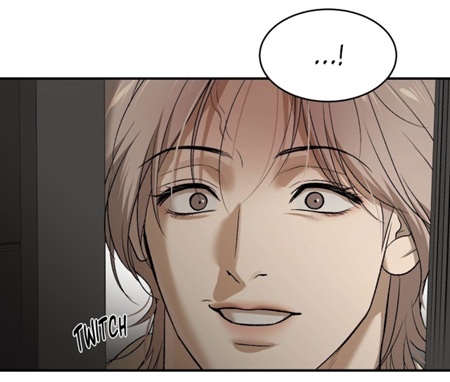 (chapter 88) The irony is that the actor didn’t realize this. He had the impression to be exposed to a similar scene than in the penthouse. (chapter 88) It is important because with this knowledge, he can expose the truth to doc Dan: the athlete loves him. In the past, he could say this without explaining his statement.
  (chapter 35) And now, pay attention to the logo on the doctor’s t- shirt.
  (chapter 88) First, it appears on the left side, positioned close to the hamster’s heart. Moreover, it looks like an orange eye. Orange is not only the color of Heesung the fox
  (chapter 34), but also of friendship and social communication and interaction.
Orange Represents
Adventure and risk taking: Orange promotes physical confidence and enthusiasm – sportsmen and adventure-seekers relate well to orange.
Social communication and interaction: Orange stimulates two-way conversation between people – in a dining room when entertaining it stimulates conversation as well as appetite. Friendship: Group socializing, parties, the community – wherever people get together to have fun and socialize orange is a good choice.
Divorce: The optimism of the color orange helps people move on – it is forward thinking and outward thinking. https://www.empower-yourself-with-color-psychology.com/color-orange.html
That means, doc Dan is on the verge of having true friends. Joo Jaekyung will stop demanding exclusivity by isolating doc Dan from the others.  (chapter 79) Besides, it is the same logo than when Yoon-Gu was spying behind the closed door.
 (chapter 23) That’s the moment Potato realized the truth about the couple: they were intimate. That’s the reason why I am convinced that Heesung will play the role of the messenger and mediator between the wolf and the hamster.
To conclude, I perceive the actor as the bridge between the two main leads. He embodies language, knowledge, love as feeling, but more importantly he stands for friendship and fun, notions which don’t exist in the main couple’s world yet.
That’s it for the first part. In the second part, I will examine the final panel and the significance of the fighters’ return.
Feel free to comment. If you have any suggestion for topics or Manhwa, feel free to ask. If you enjoyed reading it, retweet it or push the button like. My Reddit-Instagram-Twitter-Tumblr account is: @bebebisous33. Thanks for reading and for the support, particularly, I would like to thank all the new followers and people recommending my blog.

 (chapter 87)
  (chapter 87) The intimacy of the gesture
  (chapter 87) and an entire match took place, readers were largely talking about the introduction alone. 그나저나 이번화 나름 ㅂㅈㅁ도 나오고 경기도 했는데 다들 맨앞 도입부만 얘기하셔서 너무나 커엽군요,, (손잡았어 웅성웅성) Mimicking the collective reaction with a playful “They held hands!”, she described this selective focus as 커엽군요—not reproachful, but gently teasing.
 (chapter 84) and the progression of their relationship, attuning readers to intimacy
  (chapter 85), care, and emotional release. When the chapter opens with a tactile, reassuring gesture, it naturally confirms that reading mode. The squeeze feels like a culmination.
 (chapter 87), where a very different gesture unfolds.
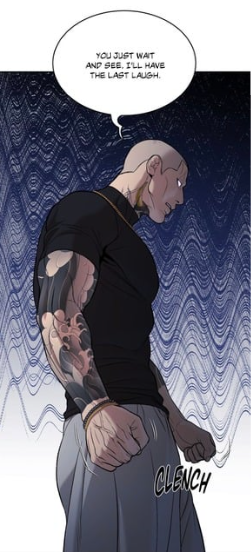
  (chapter 87) There, Baek Junmin rejects restraint, pushes away guidance, and verbalizes a resolve shaped not by trust or release, but by anger and revenge.
  (chapter 87) This sentence marks a limit. It is not indifference, but acceptance. The champion has just registered the doctor’s surprise
  (chapter 87) — the slight jolt, the hesitation—and he responds by stopping. The restraint is not automatic; it is chosen. He does not ask for more reassurance, more certainty, or more support, even though he clearly desires it. Instead, he recognizes sufficiency.
 (chapter 87) So the doctor’s support was indeed limited in time. So the stop of the champion ‘s squeeze
 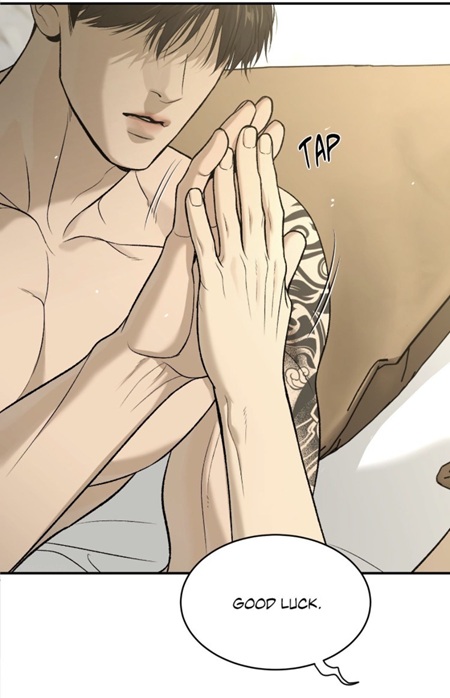 (chapter 87) Nothing mediates the gesture. There is no object, no talisman, no substitute. Meaning is produced entirely through contact.
 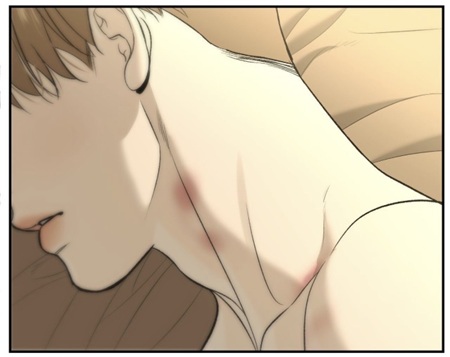 (chapter 87) The opening scene unfolds in a space that feels inhabited and shared, composed in softer shades that emphasize stillness and presence. The final scene is colder, darker, sharper.
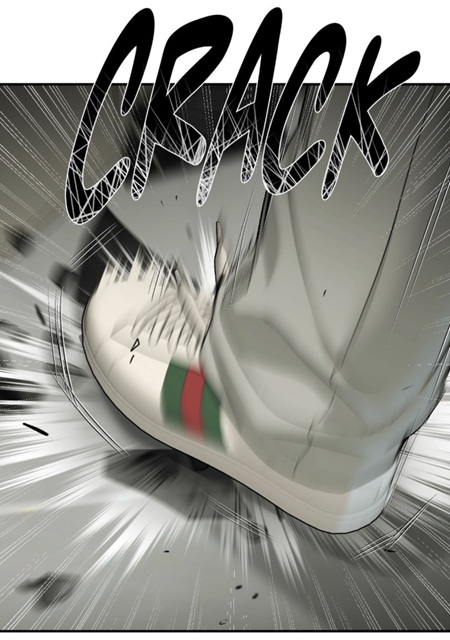
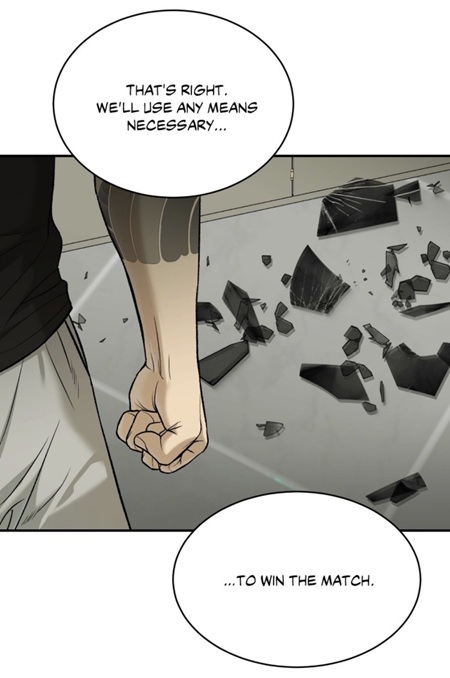
 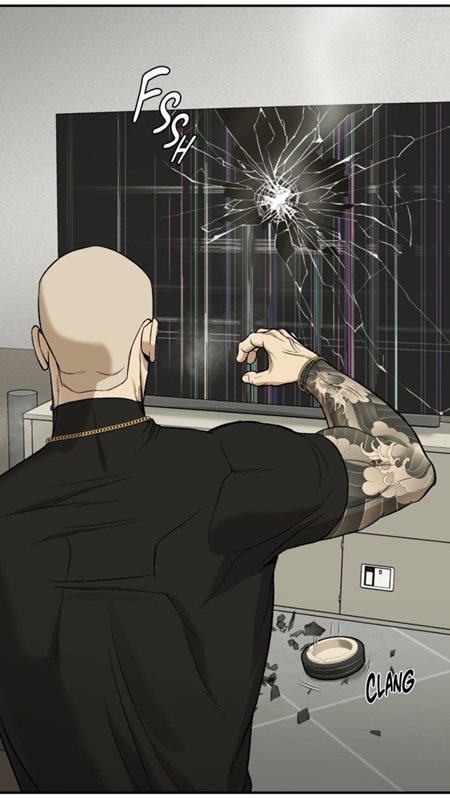 (chapter 87) Motion replaces quiet. An object enters the frame, absorbing force and redirecting it away from human contact. Where the first scene restores continuity—between bodies, between effort and outcome, between present and future
 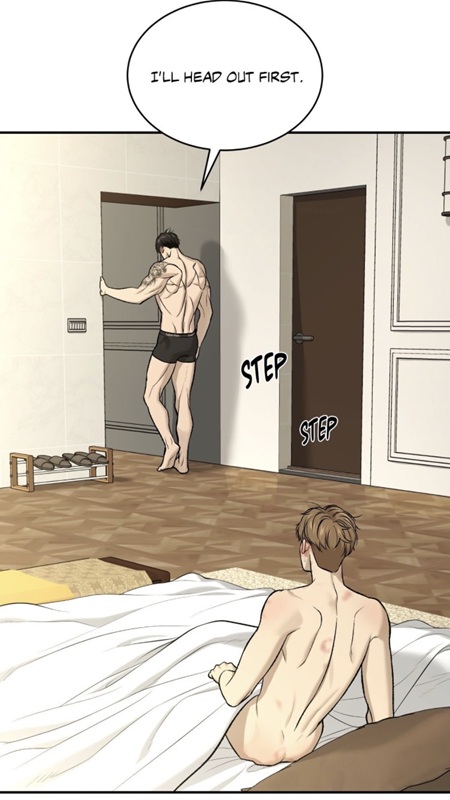 (chapter 87) —the second collapses time inward. Baek Junmin does not act toward what is coming; he reacts toward what has already been. His violence is not exploratory but recursive.
 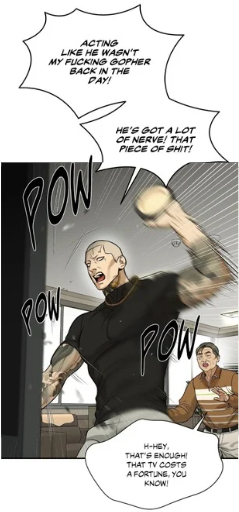 (chapter 87) It invokes the past as a template, attempting to reinstate an earlier hierarchy in which domination was secure and uncontested.
 (chapter 87)—the very surface on which images circulate, words are fixed, and visibility is regulated. The screen does not reveal truth; it organizes perception. It is where victories are staged, reputations stabilized
 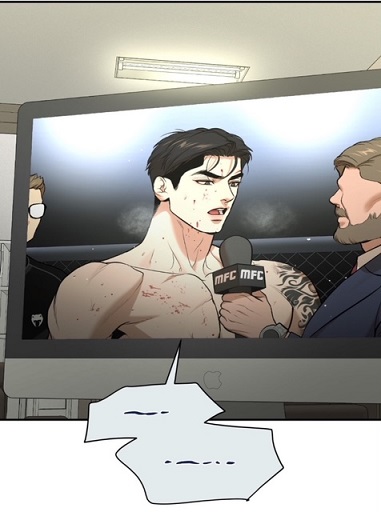 (chapter 46), and statements acquire permanence through broadcast.
 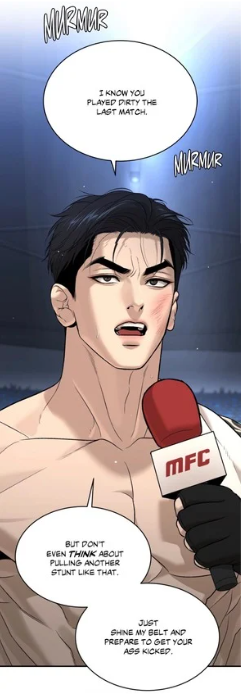 (chapter 87)
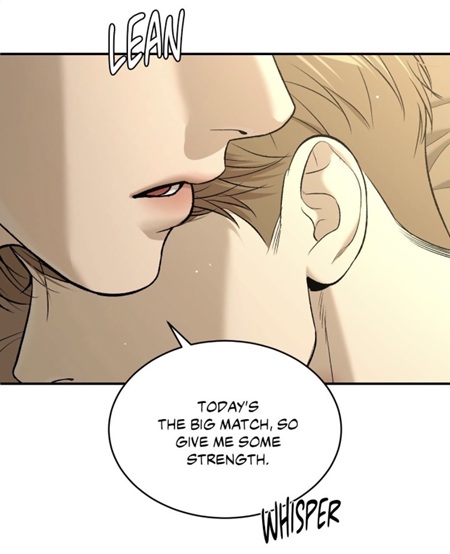 (chapter 87), then the pause; then Kim Dan’s tentative tap
 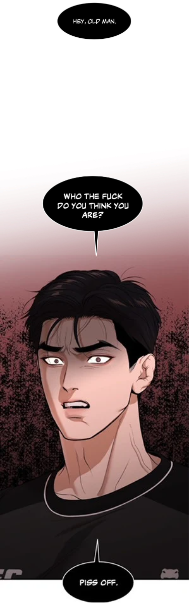 (chapter 49) When Joo Jaekyung addresses him with open disrespect, the breach of seniority provokes immediate outrage.
  (chapter 49) Intervention follows quickly. The insult is not tolerated
 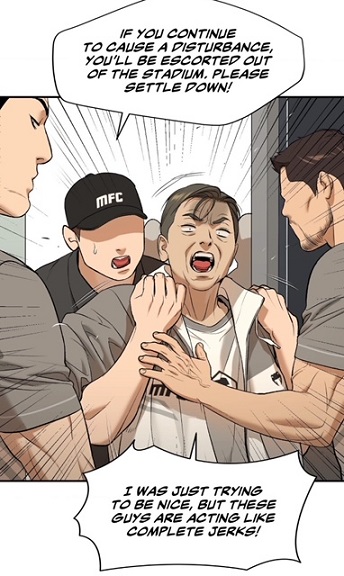 (chapter 49) because it threatens hierarchy itself. Choi’s anger is genuine in that moment and it reveals what he truly guards: status, order, and the visibility of respect.
 (chapter 87), and continues escalating without repercussion
  (chapter 78) Both continue to perceive Joo Jaekyung as nothing more than a fighter
  (chapter 87) This assumption governs how they speak to him, how they threaten him
 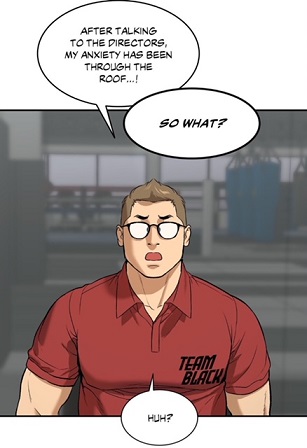 (chapter 46) His presence creates a convenient fiction: those around the table come to believe that he is the owner, or at least the one who truly governs the gym. Joo Jaekyung’s absence is interpreted not as autonomy, but as immaturity or dependence. Authority, once again, attaches itself to performance rather than reality.
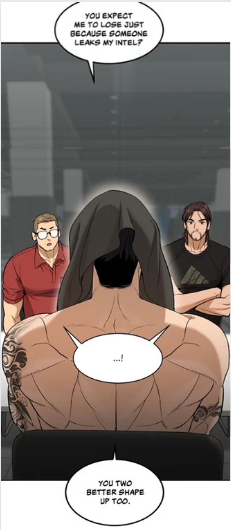 (chapter 46) Even after boundaries are formally stated, Park Namwook continues to rely on seniority to address the champion
  (chapter 46) as if he were a child or an employee—someone to be corrected, instructed, and disciplined. The warning does not alter behavior because it does not challenge the underlying assumption: that Joo Jaekyung’s place is below them.
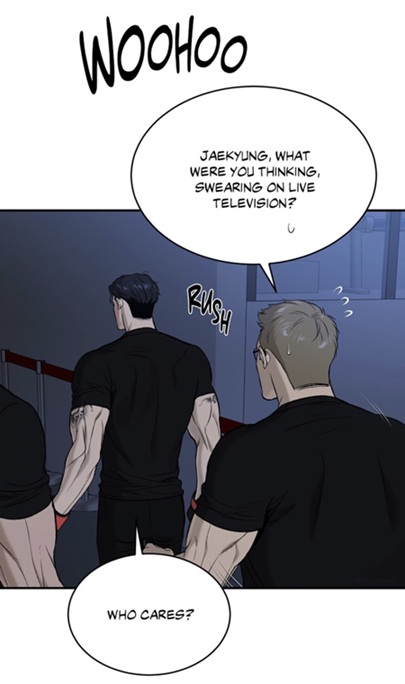 (chapter 87)
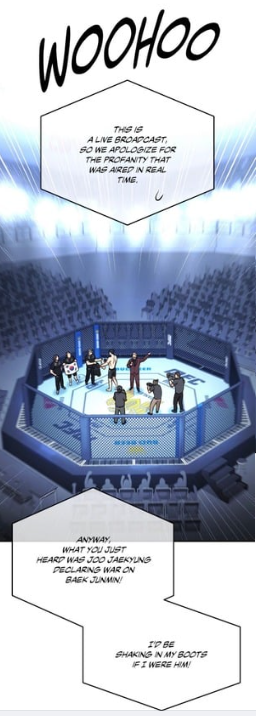 (chapter 87) What Baek attempts to destroy is not the object, but what it represents: the irreversibility of public speech, the collapse of secrecy, the loss of narrative control.
 (chapter 49), handshakes, and private humiliation
 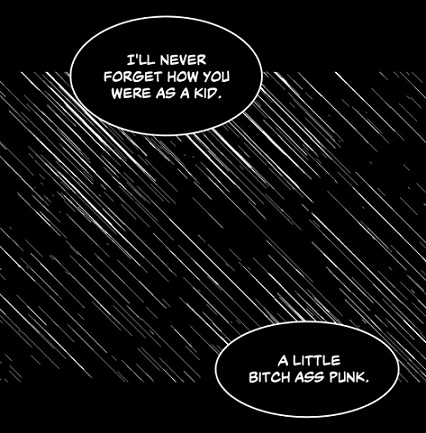 (chapter 49), the gesture becomes clearer still. He is accustomed to violence without witnesses, to domination shielded by proximity and secrecy. He was always the man in the shadow. The live broadcast deprives him of that refuge.
 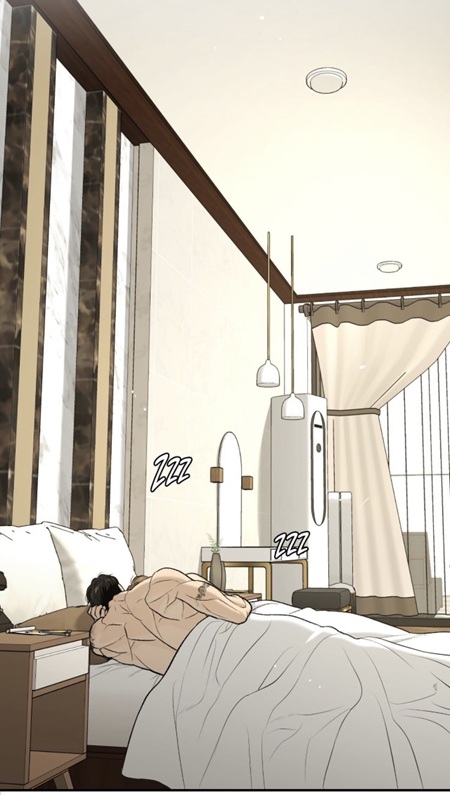 (chapter 87) also unfold under the sign of privacy.
 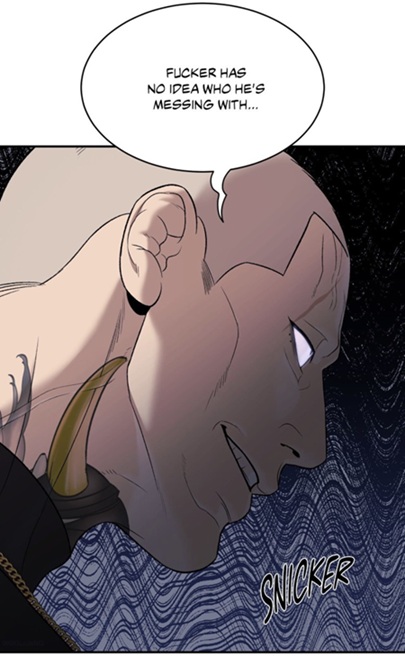 (chapter 87) He is announcing a shift of identity.
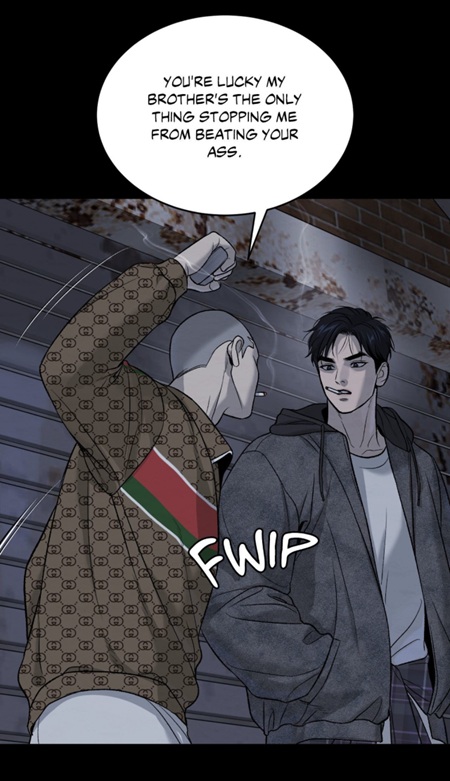 (chapter 74) seeking legitimacy, and the underground enforcer shaped by violence, order and debts
 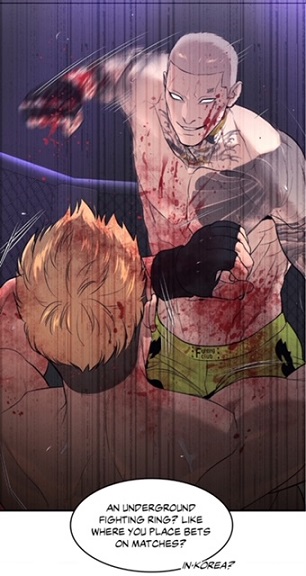 (chapter 47). The broken screen already signaled that he no longer cares about how he is seen.
 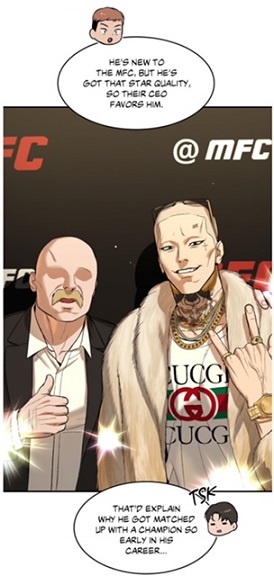 (chapter 47) By rejecting visibility and embracing excess, he also rejects the last requirement that tied him to that system.
 (chapter 48) And their collaboration is founded on money laundering!! The shooting star is in reality
 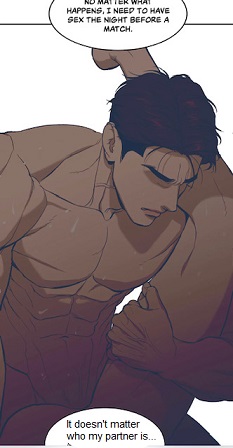 (Chapter 2). Here, strength is no longer something he takes. It is something he receives.
  (chapter 87) Kim Dan sleeping openly, showing his face, remaining there without fear—this is read by the champion as tacit trust. That trust becomes energy. In other words, this scene serves as the positive reflection of the argument in the locker room:
  (chapter 51)
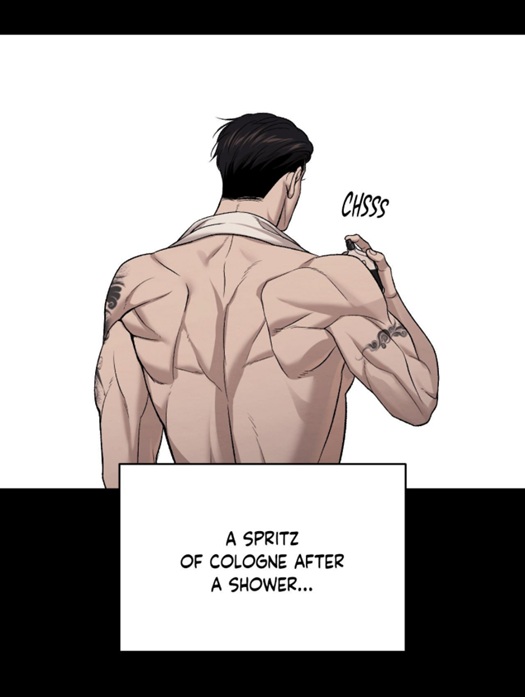 (chapter 75) —showering, cologne, self-regulation before a match. Here, that sequence is conspicuously absent.
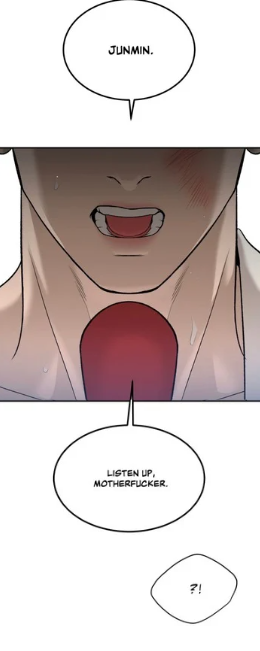 (chapter 87) The profanity is not recklessness—it is evidence that image management has lost its hold. The champion does not stop caring about how he is seen; he narrows the field of recognition. Public perception no longer governs him
 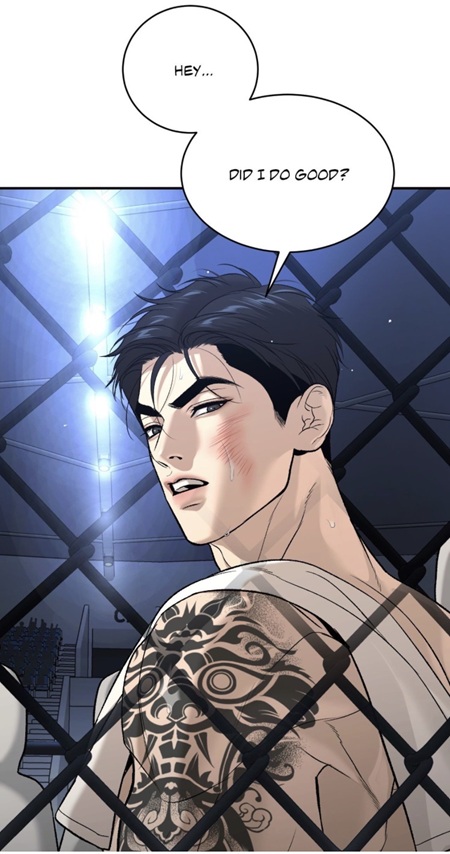 (chapter 87)
 (chapter 69), recognition, and above all visibility. Yet this visibility is curiously incomplete. Despite his victory, Baek Junmin is not immediately present as a public figure. He appears as a result
 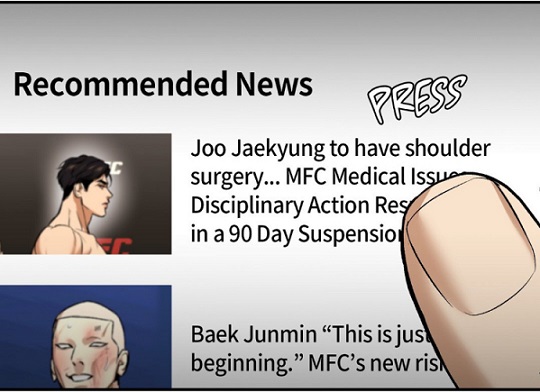 (chapter 52) —his name, his win—but not yet as a narrative subject.
 (chapter 77) does the story formally reveal his identity as champion. Until that moment, he remains strangely undefined, as if held back from full exposure. This delay is not incidental. It reflects a controlled form of recognition: Baek Junmin is allowed to win, but not yet to be seen. It already exposes that his success or victory is not clean.
 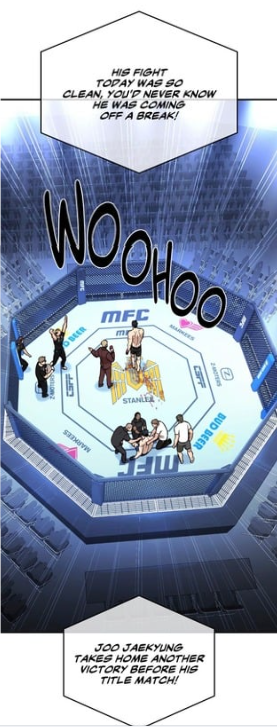 (chapter 87)
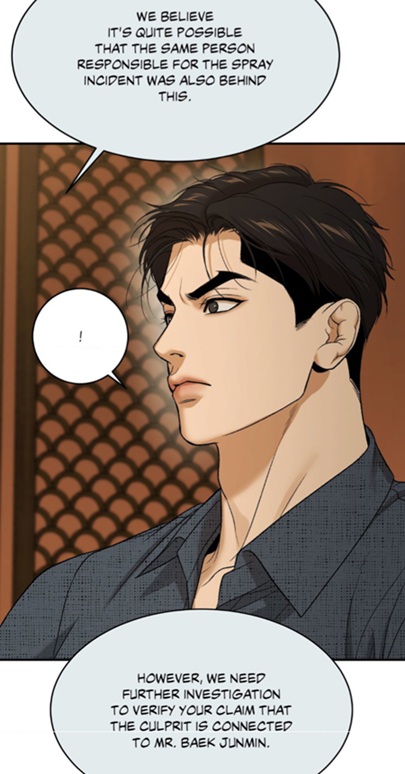 (chapter 69) to carry him forward: sanctioned fights, official narratives, public status. Crimes may occur along the way, but they remain hidden, delegated, or absorbed by others. Power, for him, is something that must appear legitimate, even when it is not.
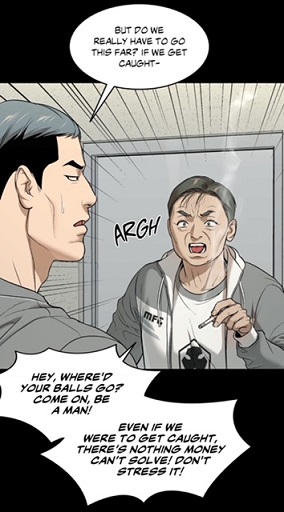 (chapter 50), they remain structurally hidden, absorbed by intermediaries, or misattributed.
  (chapter 69) Violence is laundered through legitimacy. The system continues to present him as a contender, even as it quietly tolerates sabotage and manipulation. Importantly, Baek Junmin does not need to know every detail for this economy to function; it protects him by design.
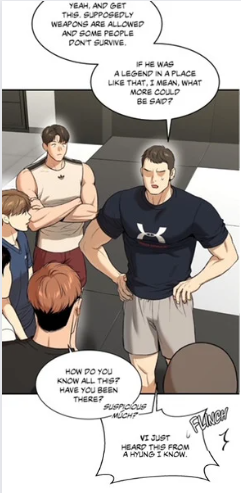 (chapter 47) Where the legal economy requires patience and exposure, the illicit one promises certainty and silence.
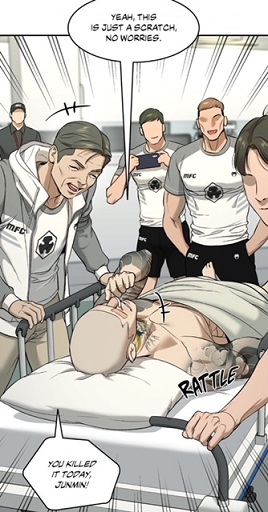 (chapter 52) In practice, hierarchy barely functions. Authority exists without discipline, protection without accountability. Baek Junmin is not positioned among other fighters, nor anchored in a collective. Thus he is not truly celebrated at the restaurant after the tie. Thus the fighters mentioned the director Choi Gilseok’s financial success or the odd behavior of Joo JAekyung.
  (chapter 52) Besides, he watches the match alone
  (chapter 51) where proximity forced acknowledgment and power was renegotiated face-to-face.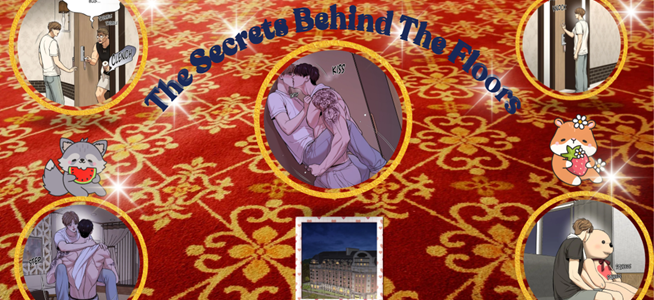

 🌶️😂
🌶️😂  (chapter 85) Why care about the color of a carpet or the direction a door opens
  (chapter 85), when the real story unfolds between Joo Jaekyung and Kim Dan?
 (chapter 82) Floors and patterns are not neutral decoration. They function as a parallel narrative system—one that tracks changes in status
  (chapter 85), exposes the actual situations in which the characters are placed
  (chapter 85), and helps us locate spaces and relationships within the hotel architecture itself. In other words, the floors do not merely frame the story; they add a spatial depth that sharpens our understanding of the “characters.”
 (chapter 82)
 (chapter 82)
  (chapter 82) One might think, the only information we get is that MFC had booked a conference room at the hotel where Team Black is staying. However, in the States, the carpet of the hallway at the hotel had a similar pattern.
 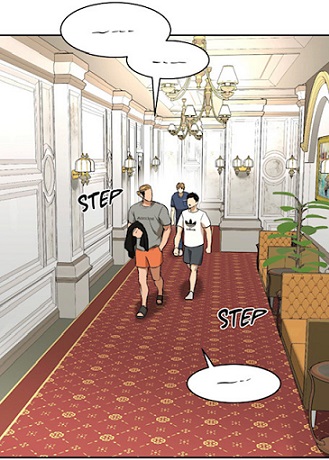 (chapter 37) This similarity and repetition caught my attention. It suggests continuity between public spectacle and private space, between what is shown and what is concealed. Following this thread led to a broader realization: the floors simultaneously signal elevation and confinement. They show who appears powerful—and who is, in fact, enclosed.
 (chapter 37)
 (chapter 37) It is in that hallway that Kim Dan collapses after drinking a drugged beverage. He literally falls onto the carpet, on his knees. The trap activates—but not on its intended target.
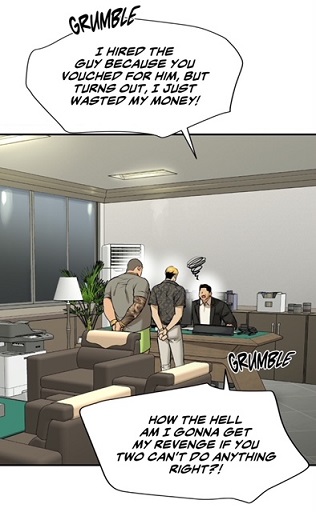 (chapter 46), not by MFC directly. The scheme exists, but it is imperfect. Joo Jaekyung is not truly “caught” in that moment, which explains why the plan ultimately fails.
 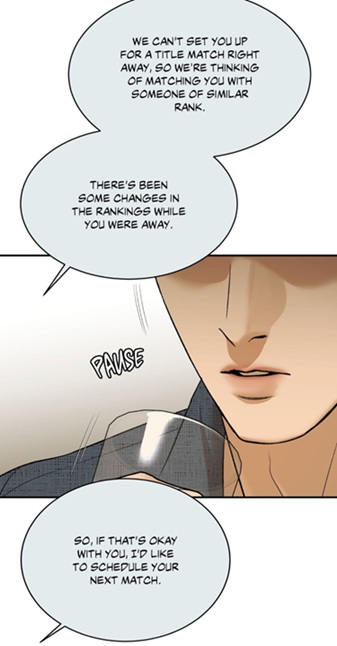 (chapter 69) As you can see, the pattern of the carpet could be seen as an evidence for a trap, and the “Emperor” is their target once again. Their plan is to end his career so that all the incidents and crimes from the past can be buried.
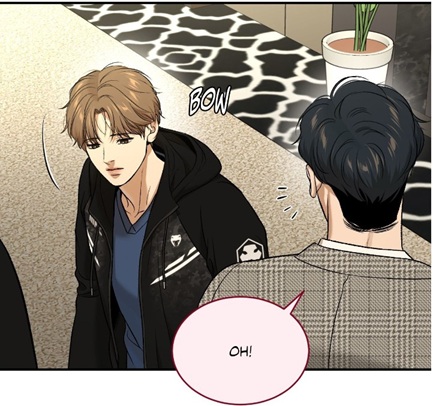 (chapter 82). The opponent stands on the surface that embodies order, hierarchy, and control, and behaves accordingly. He flirts, comments on the doctor’s eyes, and treats the moment as harmless. Then he turns his back.
  (chapter 82) He never steps onto, nor does he seem to register, the animal-patterned carpet nearby, as doc Dan was standing on a white-off carpet. In other words, Arnaud Gabriel interacts only with the space that reflects the institution’s worldview.
  (chapter 82) This is not the response of a neutralized Emperor, but the instinctive surge of a predator whose territory has been violated. The scene echoes an earlier, more intimate image from the bathroom in chapter 30,
 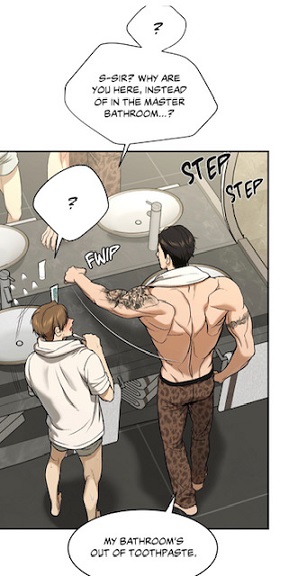 (chapter 30), where Joo Jaekyung appeared wearing leopard-patterned pajamas. The animal imagery was already present then, but dormant. Here, it reawakens.
 (chapter 85) The champion is not alone inside the cage. He is supported, grounded, and no longer isolated. What MFC fails to see is that this support does not weaken the predator—it stabilizes him. And a stabilized predator is far more dangerous than a cornered one. For years, Joo Jaekyung’s violence was reactive, triggered by threat, humiliation, or loss of control. Such a fighter is powerful, but predictable. He can be provoked, exhausted, and manipulated.
 (chapter 84) These visual cues distinguish floors, mark thresholds between zones, and separate different kinds of isolation. The hotel ceases to function as an abstract backdrop and instead reveals itself as a structured environment in which hierarchy is materially inscribed.
 (chapter 85)
  (chapter 84)
  (chapter 85) The corridor seems to have white linoleum covered a dark brown carpet, similar to the one in his bedroom. However, observe that the manager’s entrance has the same tiles than in the hallway.
 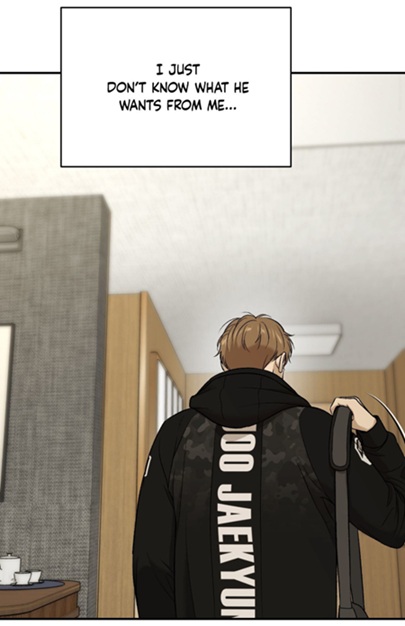 (chapter 85) reminds us of the champion’s living room in the hotel.
  (chapter 82) This clearly exposes that doc Dan’s room is not a normal room. It exceeds that basic category. It is larger, brighter, and arranged for comfort. The interior layout is particularly revealing: the bathroom is located close to the bedroom
 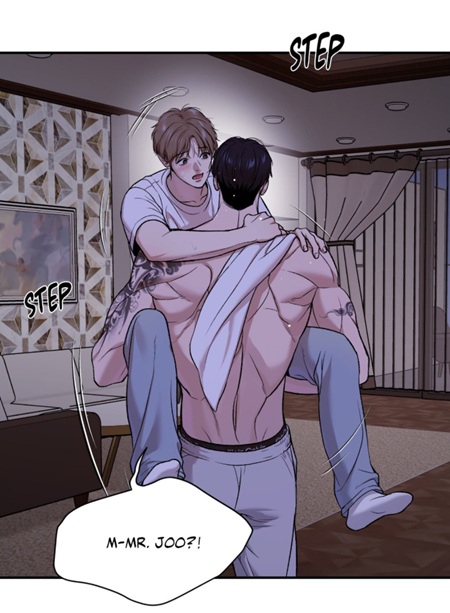 (chapter 85) clearly separating living space from bedroom
 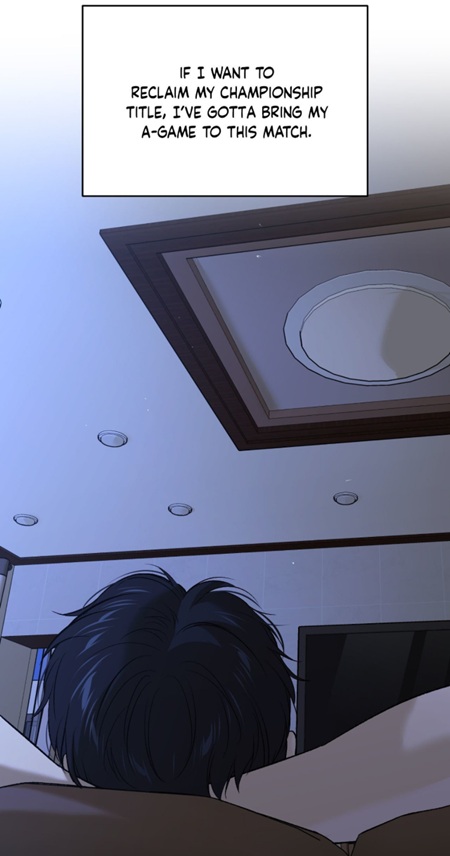 (chapter 82), and extending outward through more than one balcony.
  (chapter 82)
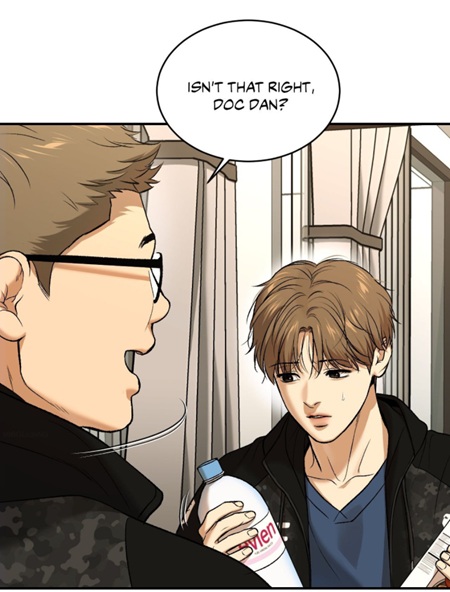 (chapter 82) And the moment I had this realization, architecture, once again, speaks first, my attention returned to the hotel in the States.
  (chapter 37)
 (chapter 37) This detail is crucial. It explains why he can hear their laughter and smell the food they are eating.
 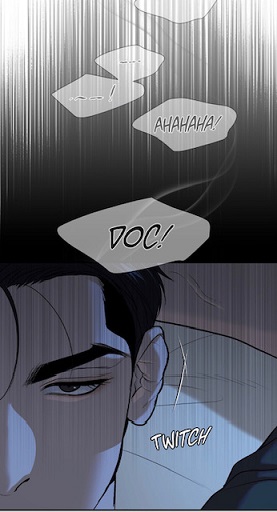 (chapter 37) Architecturally, he was not isolated. Despite his status, he remained embedded within the collective space of the team.
  (chapter 37) Besides, Episode 40 confirms that Joo Jaekyung did occupy an imperial suite: the interior layout includes a door separating the bedroom from another room
  (chapter 40), a feature characteristic of a suite rather than a standard hotel room. The issue, therefore, is not the absence of a suite, but how that suite was positioned and managed.
 (chapter 37) Because the suite was embedded within a shared corridor, an intruder could approach the champion’s room without attracting attention.
  (chapter 37) intended for weight-cutting and post–weight-cut recovery. This detail exposes a managerial failure rather than a hotel failure. The environment was not curated around the champion’s physical needs. Discipline was demanded of his body, but not enforced in his space. Meanwhile, fighters and coaches purchased junk food behind the champion’s and Kim Dan’s back, reinforcing the gap between stated goals and actual practice.
 (chapter 37) There is no visible keycard system, and no clear indication of an interior lock.
 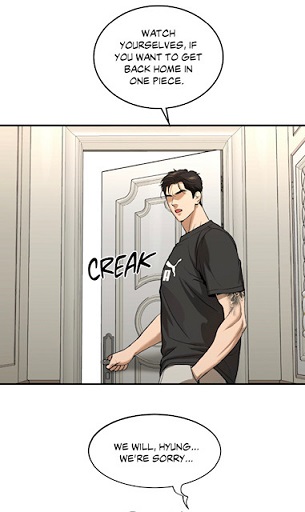 (chapter 37) This absence is striking, especially when contrasted with the Paris hotel
  (chapter 85), where doors are equipped with keycards and locks on both sides
 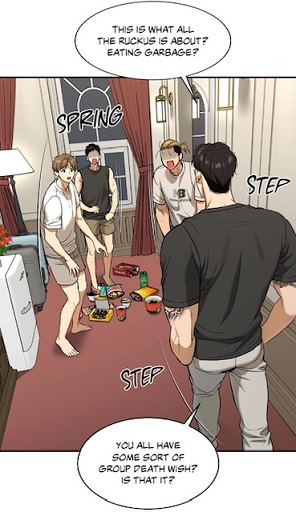 (chapter 37) Access was not negotiated; it was simply taken. The architecture allowed it. The space did not protect its occupants.
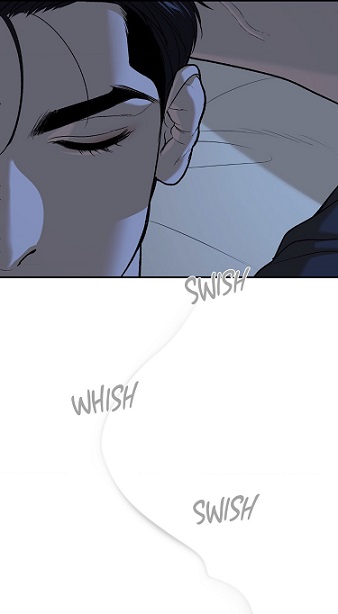 (chapter 37) At first glance, this appears implausible. A suite, by definition, should insulate its occupant from such disturbances. His bedroom is not situated next to the corridor.
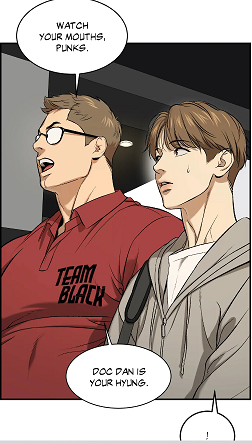 (chapter 7) Status was asserted rhetorically, but not enforced spatially, exactly with Joo Jaekyung.
 (chapter 37), negotiating access with local coaches and nearly getting into a physical altercation before being allowed to use their facilities
 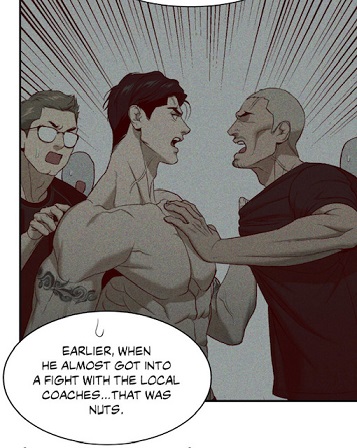 (chapter 37). Only after asserting himself does he gain permission to train. Even then, the gym he ultimately uses is unremarkable — functional, crowded, and indistinguishable from what any average fighter might access. There is nothing exceptional about it.
 (chapter 82) The infrastructure finally aligns with the demands placed on his body. This shift is not a luxury; it is a correction. It reveals retroactively how deficient the American setup was — and how little institutional care surrounded the champion at the time.
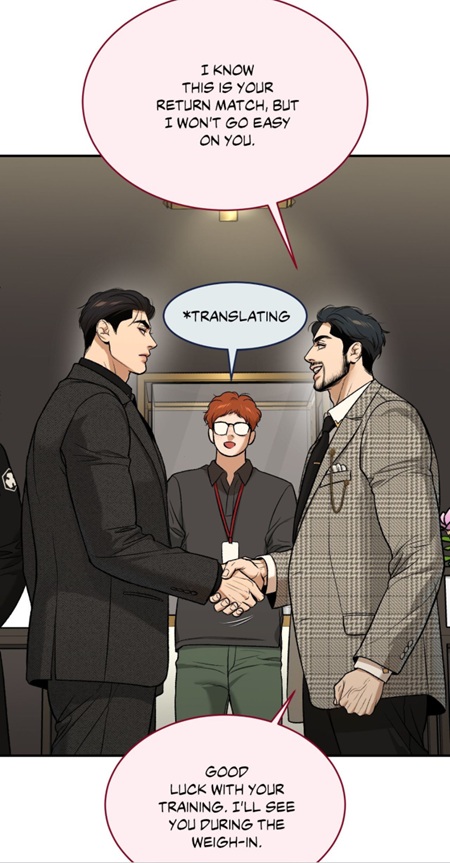 (chapter 82) The remark does not stem from arrogance alone; it is grounded in observation. The training space available to Joo Jaekyung at the hotel is not designed for an elite athlete, even less for MMA fighters.
  (chapter 82) It is a generic fitness room intended for ordinary guests. There are no heavy bags, no proper equipment, no environment suited to the demands of a reigning champion.
 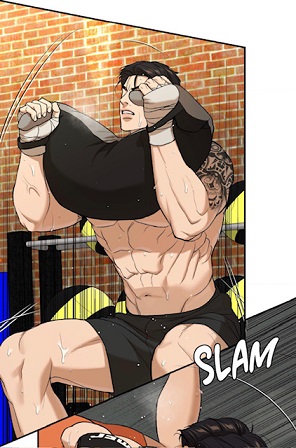 (chapter 37) This is precisely why his training must be adapted, restrained, and partially improvised.
 (chapter 5) MMA is not baseball or soccer
  (chapter 54); it does not benefit from the same institutional prestige or resources. Earlier in his career, the champion was more likely trained to endure damage than to prevent it. What we see now is not the continuation of an elite system, but its gradual construction — one in which Kim Dan plays a central role.
 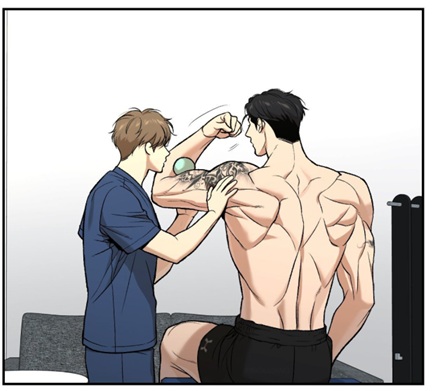 (chapter 81)
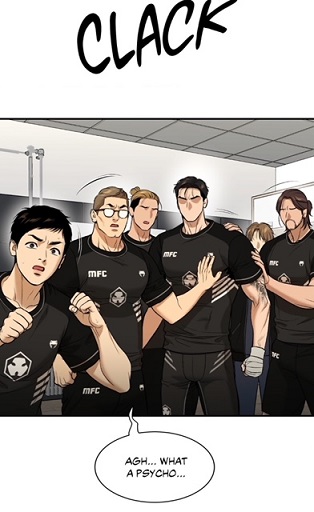 (chapter 49), rather restraining him and as such exposing him to danger.
 (chapter 37) and the post–weight-cut recovery.
 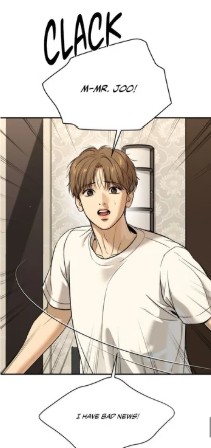 (chapter 82) Kim Dan may indeed possess a keycard to Joo Jaekyung’s suite. If so, this is not a minor convenience. It constitutes a symbolic transfer of access. The physical therapist is granted proximity not merely to the champion’s body, but to his private space. Hence the athlete is not caught by surprise, he doesn’t even mind this intrusion or interruption.
 (chapter 82) and support
 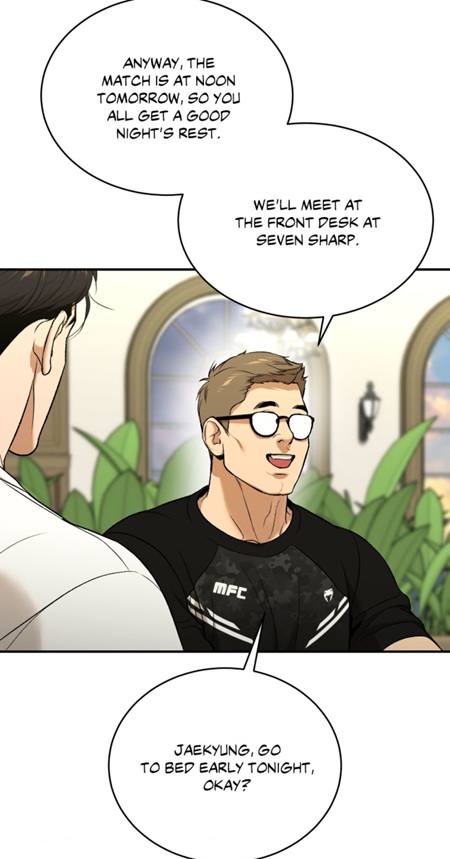 (chapter 85), he expects everyone to wake up on time and appear at seven sharp. He doesn’t see it as his “task” to wake up the champion. Once again, he is delegating responsibility onto others. However, it is clear that he expects Joo Jaekyung to be awake early like he did before. So if the champion doesn’t appear on time, the manager’s decision should be to call doc Dan or visit his room. In his eyes, he is the one responsible for the champion!!
  (chapter 80) for his contract is limited not only to Joo Jaekyung, but also in time. He was never a fighter, hence he is not part of MFC at all contrary to the other hyungs.
  (chapter 40)
  (chapter 82) These are managerial functions.
 (chapter 40) Doc Dan is not one among others, but the BEST physical therapist. He is also a champion
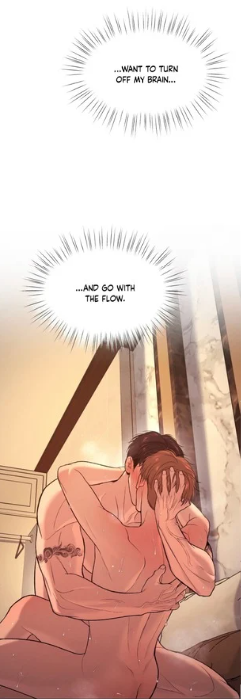 (chapter 86), it does not close the night through narrative resolution. There is no statement, no promise, no verbal seal. And yet, for many Jinx-philes, the final panel refuses to let the scene dissolve. What remains is not heat, not tension, not even tenderness — but circulation.
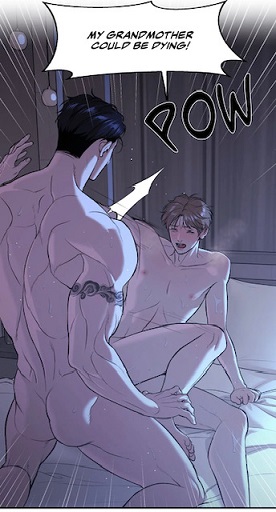 (chapter 21), overload
  (chapter 33), short circuit
 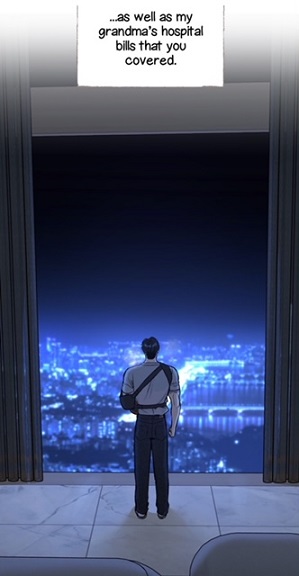 (chapter 53) reset. And once that lens is adopted, it becomes impossible to limit the consequences of episode 86 to the couple alone. Because a closed circuit does not only affect those directly connected to it. It alters the surrounding system.
 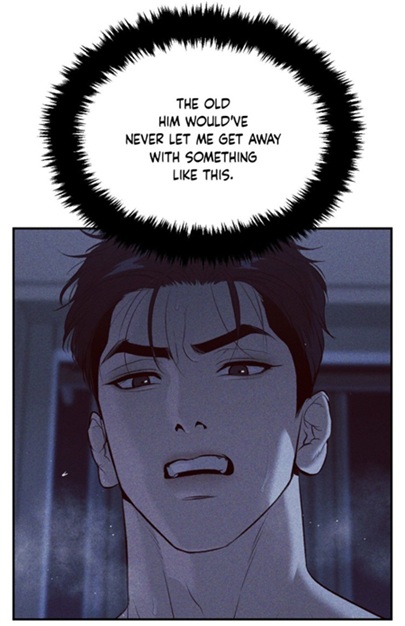 (chapter 86). This section will explore how acknowledging change without denying past harm opens a new ethical position — one that prevents memory from being weaponized, while still preserving responsibility. Third, the analysis will turn to conversion, revisiting earlier nights marked by failure, asymmetry, and isolation. Rather than cancelling them, episode 86 absorbs and transforms them. This is where forgiveness, reflection, and the first true encounter with consequence quietly enter the narrative. Finally, a new section will widen the lens further by examining shared experience and memory
  (chapter 53), particularly through Kim Dan’s relationship with his grandmother. Here, the focus will not be accusation, but contrast: between memories carried alone and memories held together; between cycles of repetition and moments of presence; between a worldview structured around endurance and one shaped by circulation. The Paris night does not only affect how Kim Dan sees Joo Jaekyung
 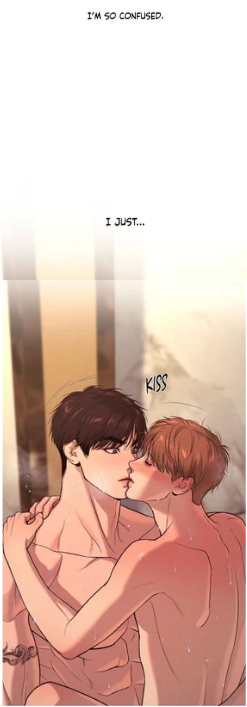 (chapter 86) carries such weight, we must return to the origin of kissing itself in Jinx. Because surprise, in this story, is not an abstract theme. It has a history. And that history begins with a body being caught off guard.
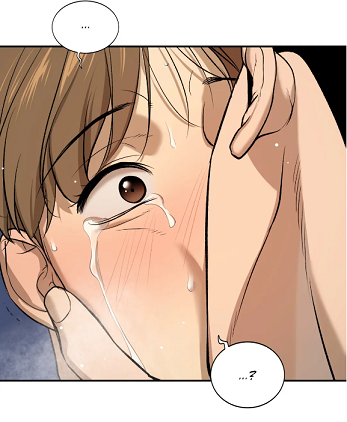 (chapter 14) There is no warning, no verbal cue, no time to prepare. The kiss arrives as interruption. It is not negotiated; it is imposed. Hence the author focused on the champion’s hand just before the smooch.
 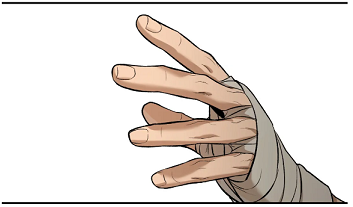 This moment matters far more than it initially appears, because it establishes the template through which Kim Dan first encounters intimacy.
 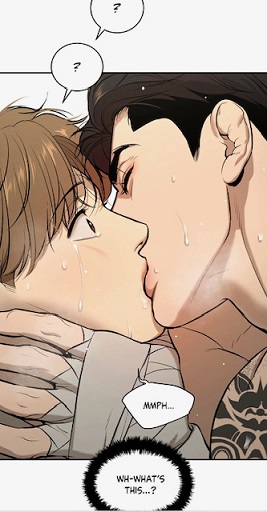 (chapter 15) Affection does not emerge gradually. It breaks in.
 (chapter 15) He needs preparation. He needs time to brace himself emotionally. This request reveals two aspects. First, he connects a kiss with love. On the other hand, the request is not really about romance; it is rather about survival. Surprise, for Kim Dan, has already been coded as something that overwhelms the body before the mind can intervene.
 (chapter 39), he violates his own request.
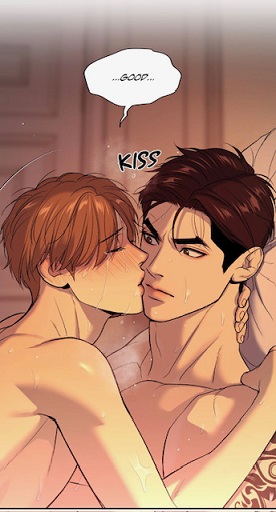 (chapter 39) They are unannounced, often landing on unusual places (cheek or ear)
  (chapter 44). They often take place under asymmetrical conditions — when one of them is intoxicated, confused, or emotionally exposed. Sometimes they occur without full consent, sometimes without clarity. In chapters 39 and 44, kisses surface precisely when language fails or consciousness fractures. It is as if Kim Dan has internalized a rule he never chose: a kiss must be sudden. Observe how the champion replies to the doctor’s smile and laugh: he kissed him, as if he was jealous of his happiness.
 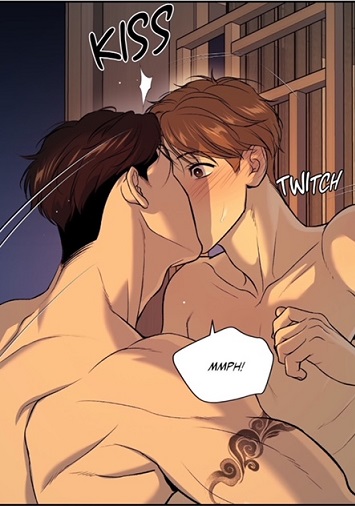 (chapter 44) That’s how I came to realize that the kiss in the Manhwa is strongly intertwined with “surprise”. This is the missing link.
 (chapter 2), he comes to reproduce interruption as intimacy. He knows that surprise destabilizes him — that is why he asked for warning — but he has no other model. What overwhelms him also becomes what he reaches for. Surprise is both threat and language.
 (chapter 3): the sudden call from the athlete,
  (chapter 1), the offer of sex in exchange for money
 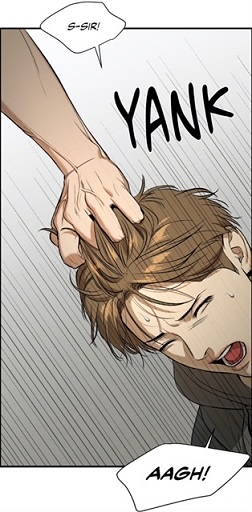 (chapter 6), the switched spray
  (chapter 49), the sudden changes in rules. These moments strip Kim Dan of anticipation and agency. His body reacts before his will can engage. Surprise equals exposure.
 (chapter 1) His life is governed by “always”: always working, always returning, always responsible. He lives for his grandmother. Nothing unexpected is allowed to happen, because nothing unexpected can be afforded. This is safety through stasis. Presence without experience.
 (chapter 5)
  (chapter 1) They shattered routine rather than enriching it. Surprise, in that context, did not open possibility; it threatened survival. It meant debt, coercion, fear. And precisely because of that, it could not be integrated into memory as experience — only repressed as trauma.
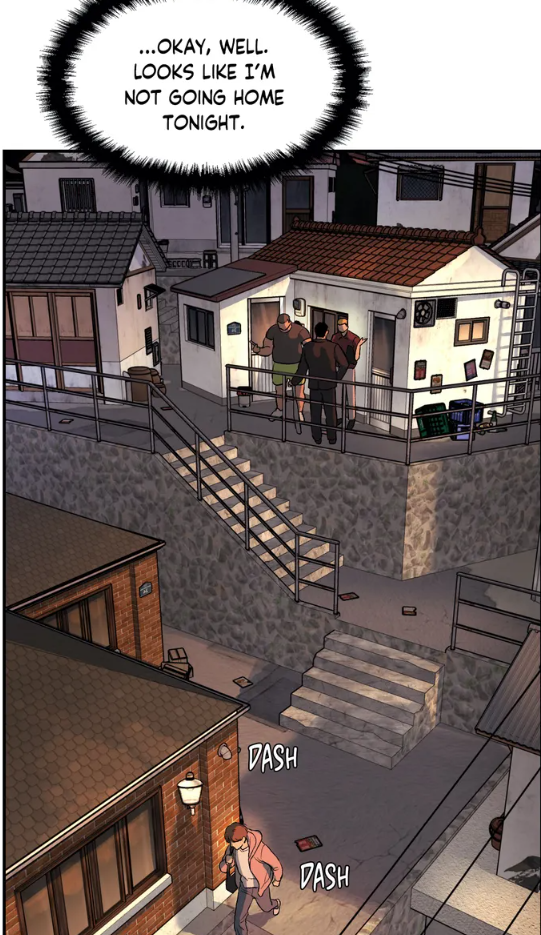 (chapter 1), if he doesn’t return home. Surprise, in its earlier form, is excised from the household. What remains is a world of repetition and endurance — safer, but lifeless.
 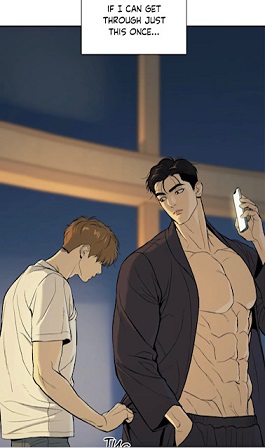 (chapter 2) but in a fundamentally different form.
 (chapter 11)
 (chapter 11) His appearances are sudden, his demands non-discussable, his violence immediate. He does not ask; he enforces. Surprise, under his rule, eliminates speech. It leaves no space for argument, no room for clarification, no possibility of consent. One endures, or one is punished.
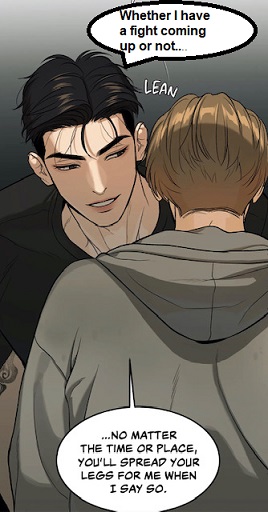 (chapter 6) Even when power is asymmetrical, even when the terms are coercive, speech is required. Conditions are stated. Rules are articulated. Kim Dan is forced to listen, to answer, to argue, to object. He must speak.
 (chapter 17) The two figures cannot coexist because they represent mutually exclusive regimes of surprise: one that annihilates speech, and one that forces it into being. In other words, only one allows experience to be lived rather than survived.
 (chapter 27) Experiences accumulate instead of disappearing. They demand response, speech, negotiation. Life no longer consists in enduring impact, but in processing it.
 (chapter 65) and as such neutralization: suffering must be absorbed, pain must be justified, disruption must be folded back into endurance. There is no place for charge there — only for dissipation. What Kim Dan lives through with Joo Jaekyung follows a different logic altogether: not sacrifice, but circulation; not repetition, but conversion.
 (chapter 41) not despite surprise, but through it. Not because dominance is romanticized, but because surprise is the first force that treats him as someone to whom things can happen. And don’t forget that for him, a kiss symbolizes affection. Even negative experiences generate subjectivity. They prove that he exists beyond function.
 (chapter 85) Kim Dan either endures it or reproduces it under unstable conditions. Agency is partial. Meaning collapses afterward.
 (chapter 39), irony
 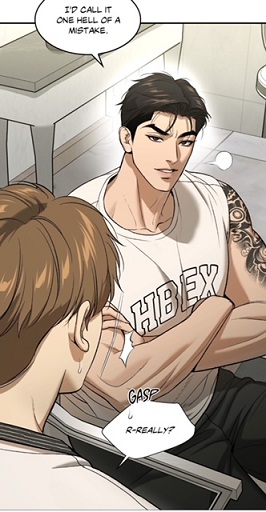 (chapter 41) or rejection
 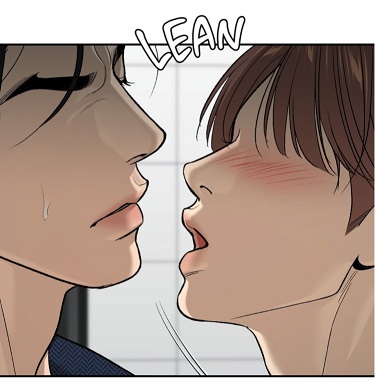 (chapter 55). He does not retreat into his habitual “it’s nothing” or “never mind.” He does not reinterpret the gesture as convenience or reflex.
  (chapter 86) He kisses back while looking tenderly at his partner. He holds Kim Dan’s head gently. He can only see such a gesture as a positive answer to his request: acceptance and even desire. Surprise is not punished. It is received.
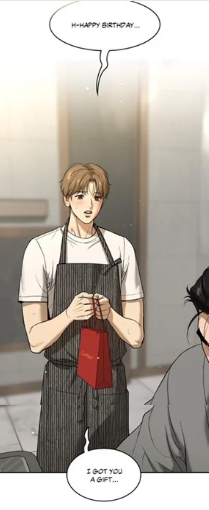 (Chapter 45) This time, the athlete not only accepts the present (the kiss), but but also expresses “gratitude” by kissing back actively.
  (chapter 65) In her eyes, she has never changed, just like her grandson.
  (chapter 52), justify behavior
  (chapter 57), and foreclose change. The champion’s violence is explained through reputation.
  (chapter 1) Kim Dan’s endurance is explained through obedience and debt. The grandmother’s authority is explained through sacrifice. In every case, the same logic applies: this is how it has always been; therefore this is how it must remain.
 (chapter 65) If the past is absolute, it can be endlessly invoked to invalidate the present. We have a perfect example on the beach.
  (chapter 65)
 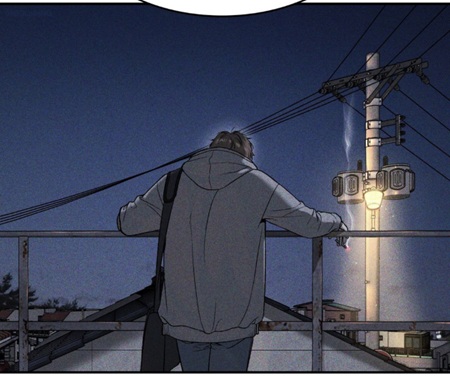 (chapter 65) They are evaluated exclusively through a moral lens. Smoking and drinking are not responses; they are flaws. And because they are framed as flaws, they retroactively define his character rather than his situation. This is where agency collapses.
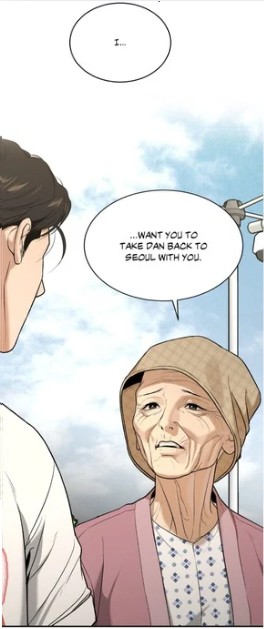 (chapter 65) Her behavior does not contradict her claim that she wants Kim Dan to “live his own life.”
  (chapter 65) It reveals how she understands such a life should be arranged. She sees herself as superior, as if she had never done any mistake, as if she had lived as a saint.
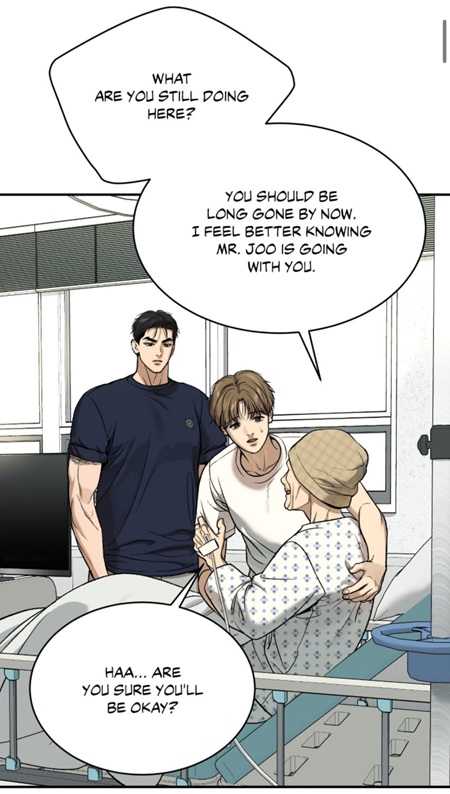 (chapter 78)
 (chapter 86) Once again, the “hamster” is given the opportunity not only to decide, but also to follow his heart. Where the Paris night allows difference to coexist with memory, Shin Okja’s framework collapses difference back into judgment. Where electricity requires polarity, her logic insists on sameness. Under this new light, it becomes comprehensible how doc Dan came to neglect himself. Self-care is inseparable from choice — from the belief that one’s decisions can meaningfully alter the present. If change is denied, care loses its purpose. Attending to oneself becomes optional, even suspect, because it implies a future different from the one already prescribed.
 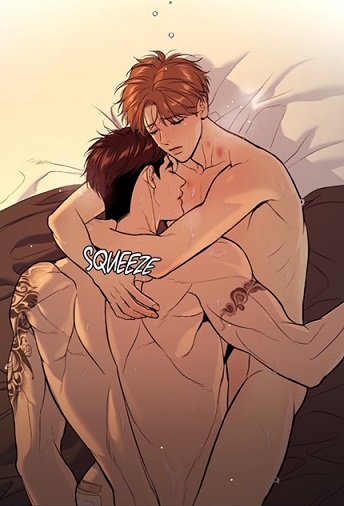 (chapter 44) The one who remembers bears the – alone, while the other continues forward unmarked. That imbalance is corrosive. It distorts perception. It turns even good memories sour.
 (chapter 65), but she remembers it in a way that flattens time. Pain becomes proof of virtue. Sacrifice becomes identity.
  (chapter 65) Change is allowed only insofar as it returns to the same point. Electrically speaking, her system is grounded — all charge dissipates into endurance. There is no polarity, only repetition.
 (chapter 65) Even though the word jinx is never spoken during the Paris night, its logic quietly collapses there.
 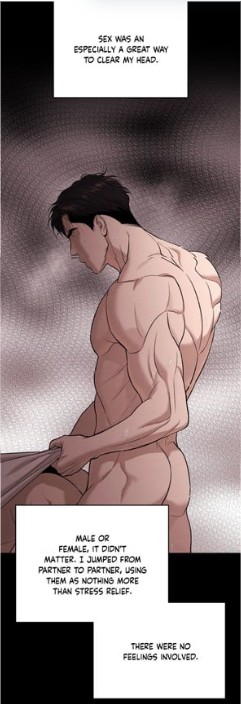 (chapter 75) In chapter 75, it is explicitly framed as a way to “clear the head”: an act designed to release pressure and return the system to zero. Partners were interchangeable. Feelings were excluded. Electricity existed only as a spark — brief, violent, and self-extinguishing. Energy was expelled, not circulated. That is the true mechanics of the jinx: power without continuity, intensity without consequence.
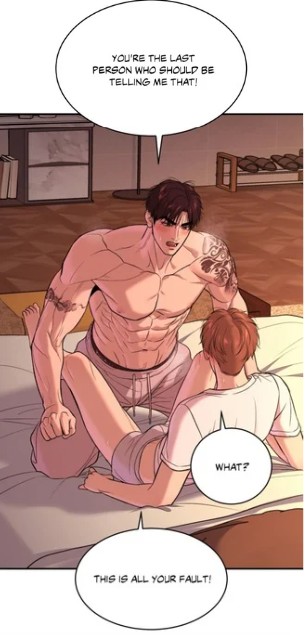 (chapter 85) Desires matter, not the match the next morning. Besides, the identity of the partner matters — not just romantically, but also structurally. Current requires two poles. It requires response. It cannot flow through an object, only between 2 subjects.
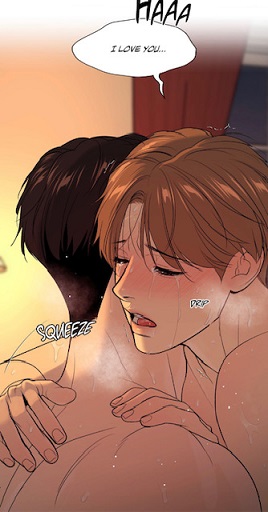 (chapter 39) and chapter 44
 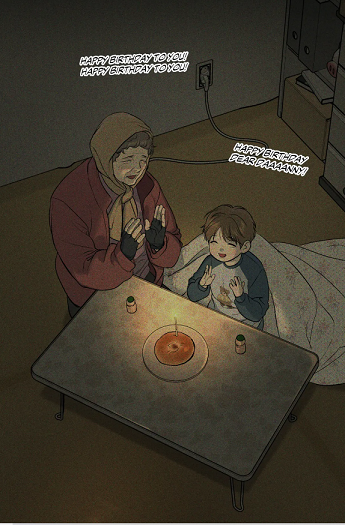 (chapter 11), the care – even if he had hurt himself –
 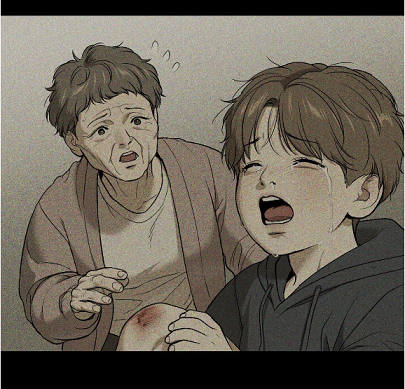 (chapter 47), the shared smiles
 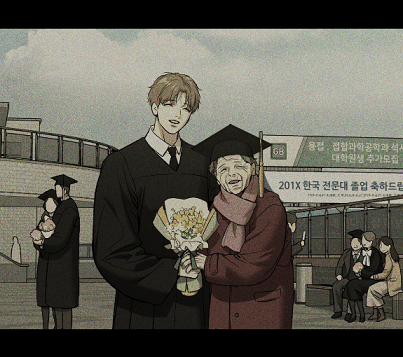 (chapter 47). Thus this photograph
  (chapter 65) becomes a talisman — not a record of reality, but a distilled image of safety. Painful dimensions are filtered out. Conflict, coercion, and silent pressure recede into the background. Memory protects him by idealizing. Because of this picture, he projected himself in the future, making unrealistic plans.
 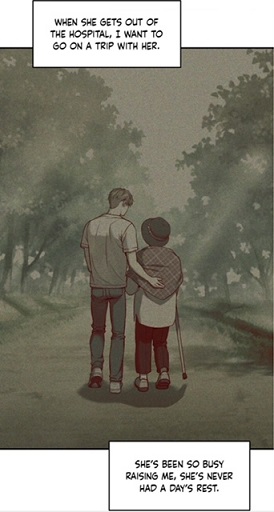 (chapter 47) It was, as if he only had good times with his grandmother.
 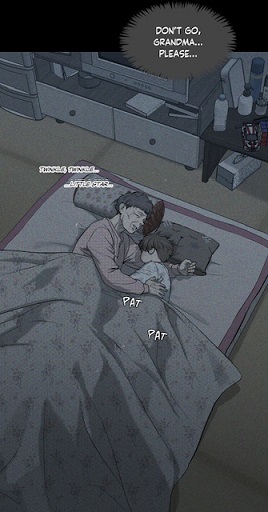 (chapter 21)
  (chapter 47) and memories.
 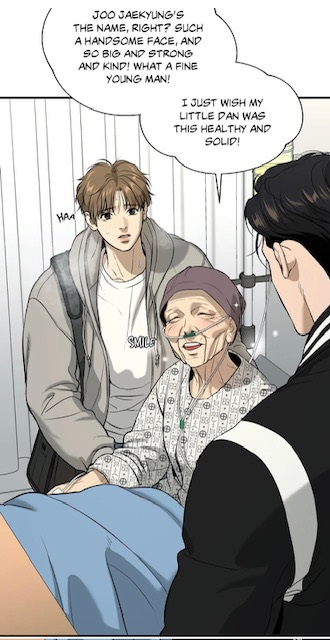 (chapter 21)
 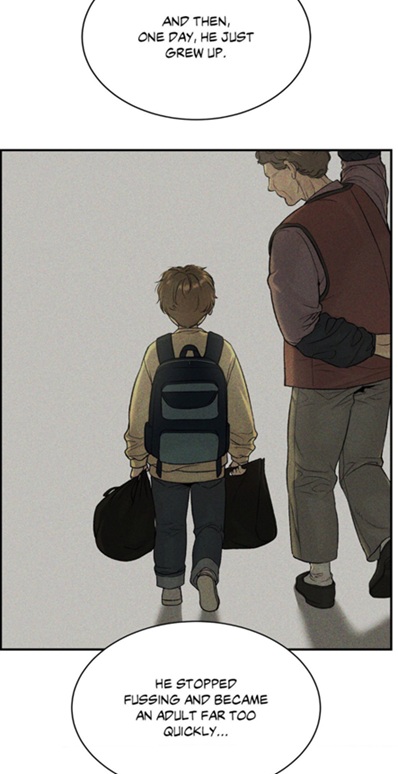 (chapter 65). While sleeping, memories come to the surface.
  (chapter 85) I believe that its appearance does not function as decoration. Its imagery — figures suspended among clouds, bodies neither falling nor grounded — introduces a different register of time. Not urgency. Not performance. Not spectacle. Stillness. Interval. A space where movement pauses without collapsing. Under this new light, the reference is Morpheus.
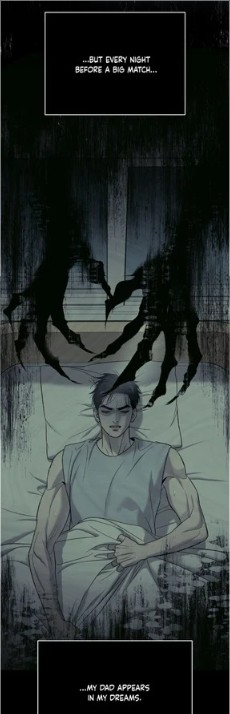 (chapter 75) Until now, rest had been replaced by discharge: sex as erasure, violence as exhaustion, ritual as compulsion. The Paris night does not abolish wakefulness through collapse; it introduces the conditions under which sleep might finally be possible.
 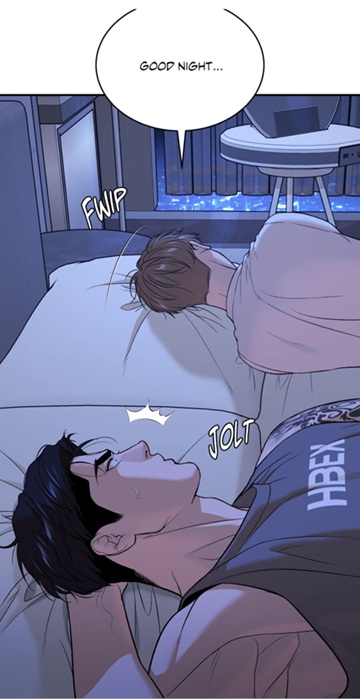 (Chapter 78) Here, he reduced it to the absence of sex, but I am sure that deep down, he would have been satisfied, if the “hamster” had given him a good night kiss.
 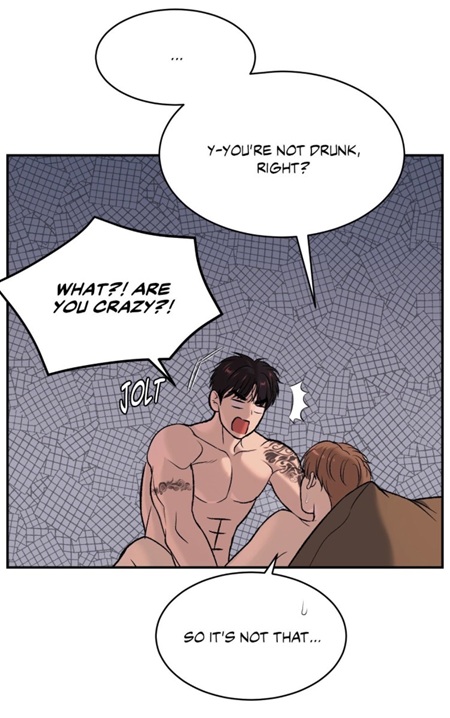 (chapter 86) The charge redistributes. Memory ceases to isolate and begins to circulate. Hence it creates a new memory.
  (chapter 86) was a reflection of the picture.
  (chapter 86) No one is erased or reduced to an object. Nothing is overlooked or forgotten. But repetition loses its hold. And from here, the story can no longer proceed as before.

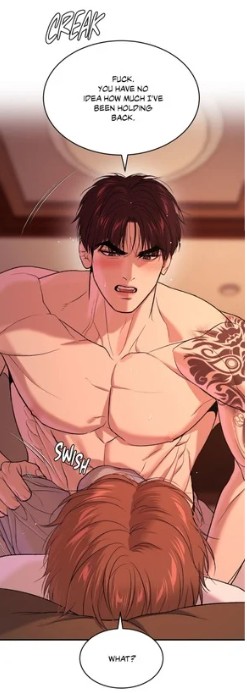 (chapter 85) represents the positive reflection of this night
  (chapter 58)
  (chapter 58), when the physical therapist chose to give up on the athlete and stop listening to his heart. Here, I am not only referring to the numerical symmetry but also to the doctor’s shifting vision of Joo Jaekyung.
 (chapter 85), Jaekyung appears with a towel around his neck. This simple object evokes water and sweat, but in Jinx, these elements are never neutral. They are tied to one of the champion’s earliest traumas: the humiliation of being called “dirty”
  (chapter 75) and “smelly” as a child. This is why Jaekyung learned to perfuse his body with cologne after every shower
  (chapter 40) It was, as if the fear of smelling “wrong,” of being perceived as contaminated, was still dictating his movements. Hence he could only claim doc Dan as one of his own, but not as his “physical therapist” or even “family”. And interesting is that doc Dan copied his attitude. In the hallway, he maintained a certain distance from the athlete.
 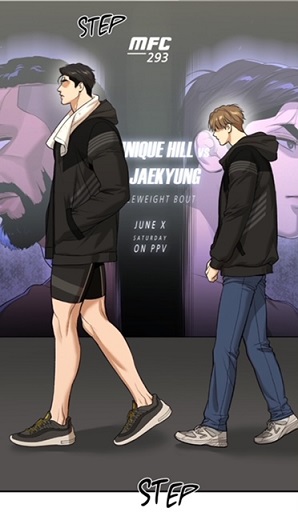 (chapter 40)
 (chapter 40) the moment he dried off
 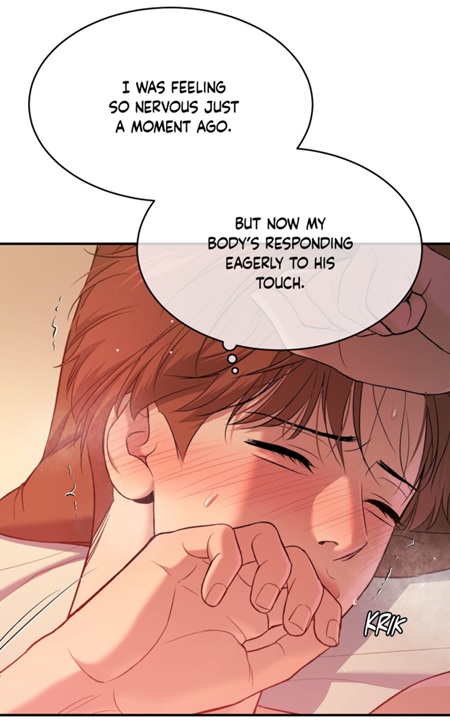 (chapter 85) and trust — and perhaps even the moment when Dan chooses, for the first time, to be honest with his own body and heart.
 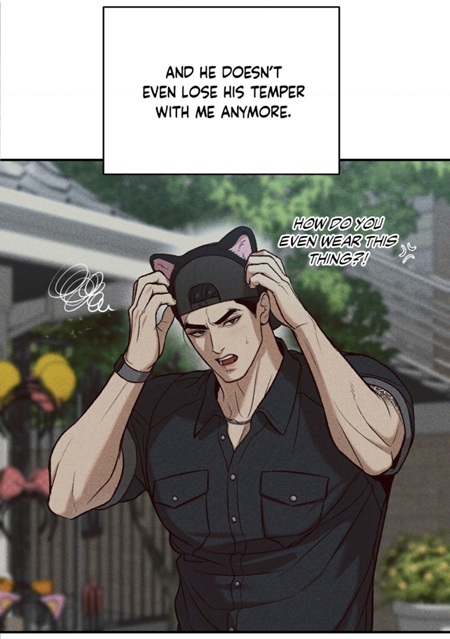 (chapter 85)
  (chapter 61) [I will elaborate it further later]. And perhaps this is why the moment feels so disarming: because the downfall is not tragic but tender, not humiliating but intimate. Sweet, even.
 (chapter 85) Dan is lost in his thoughts — anticipating the night ahead with the champion — and has barely touched his food. Park Namwook notices this. One might think, such a remark displays the manager’s concern for the main lead’s well-being. However, the manager adds that the other members of the team are all almost finished. With such a remark, it becomes clear that the manager is urging the protagonist to finish his plate. Although Park Namwook addresses Dan as if showing concern, the content of his remark betrays his true priority: not Dan’s well-being, but the team’s schedule. By pointing out that ‘the rest of us are almost finished,’ he urges Dan to keep pace, treating him as staff who had to follow the group rather than someone with personal needs. As you can sense, schedule is essential for the manager. However, because doc Dan couldn’t reveal the true reason behind his behavior, he gives an excuse for his lack of appetite.
 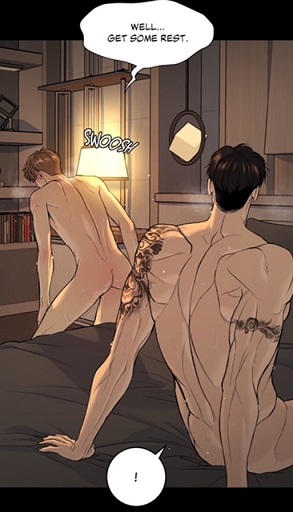 (chapter 53) The manager’s words bring Joo Jaekyung back to reality and its uncomfortable truth that Dan’s presence now is still bound to a contract — temporary, contingent, never fully his. In other words, with his remarks, Park Namwook is reopening old wounds which shows his total blindness and lack of finesse and of empathy. He treats the last match, as if nothing bad had happened. The incident with the switched spray is simply erased.
 (chapter 53) leaving without thinking; now, after Dan vanished from his life entirely, that earlier departure feels like a sign he failed to read. Park’s question brushes against this bruise, and Jaekyung’s lips reflect the discomfort.
 (chapter 85) The younger fighter suddenly bursts into panic, declaring how nervous he would be in Jaekyung’s place, how his heart would be pounding out of his chest. His outburst is sincere, naïve, and completely focused on the champion — he never once considers Dan’s feelings. Yet these words strike deeper than he intends. At the mention of a pounding heart, Jaekyung’s eyes lift upward in a brief, involuntary movement. It is the smallest gesture, but it exposes everything he wishes to hide. Because his heart is pounding — but not for the match. It is because of doc Dan!
 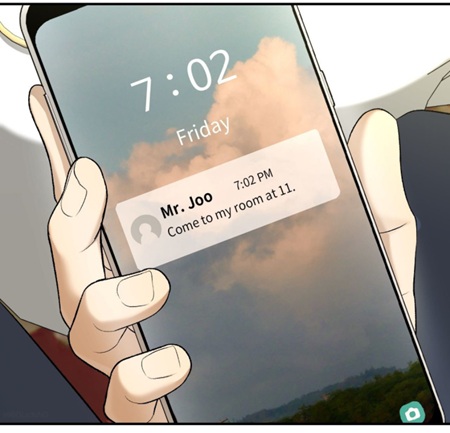 (chapter 85) the need for reassurance, the wish to rewrite the pattern of the past, the quiet hope that Dan will not leave him again — not tonight and not afterwards.
 (chapter 85), as soon as the athlete stands up right after his recommendation and announces he is now returning to his room.
  (chapter 54)
 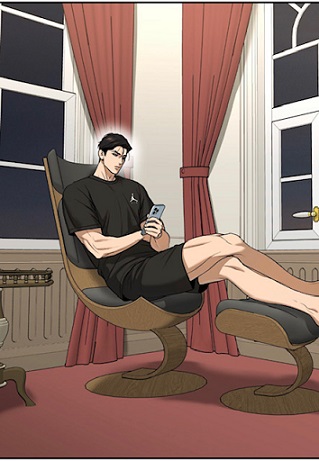 (chapter 38) and Korea
  (chapter 48) before a big fight: watch his opponent’s videos, study their habits, rehearse counters. If we only looked at the clock, we might assume he spent the evening thinking about Arnaud Gabriel.
 (chapter 85) He opens the door and immediately grabs him inside
  (chapter 85) This is not the controlled, casual emperor of old; it is someone who has been holding back for hours and refuses to risk even a second in which Dan might change his mind.
  (chapter 65) and the comment of the champion in front of this movie:
  (chapter 29) Moreover, I consider this scene
  (chapter 85) as a new version of Choi Heesung’s advice: Doc Dan just needs to sit back and enjoy!!
 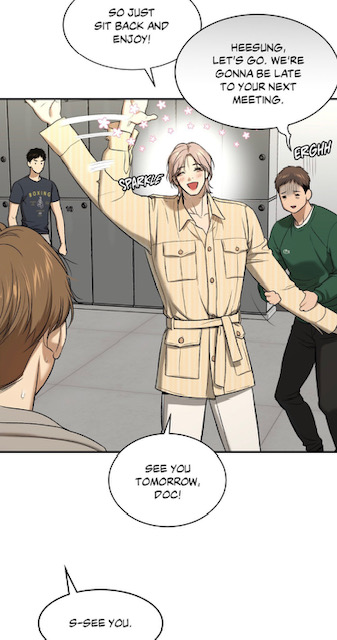 (chapter 31) Joo Jaekyung is now doing everything, as deep down he wants to become the perfect lover! And how had I described the night in the States?
  Back then, the hamster Dan had become the champion’s perfect lover, especially because he had kissed his face, hugged him and confessed to him.
  (chapter 38) One might reply that the athlete desired to maintain appearances and as such to hide his suffering and anxiety. In other words, he was hiding his emotions behind routine, Jinx-sex would always start at 11 pm. However, this idea is not entirely satisfying because once doc Dan was in his room, the fighter was no longer hiding his emotions and desires.
  (chapter 72), when the latter would return late from his “work” and the death of his father
  (chapter 73).
 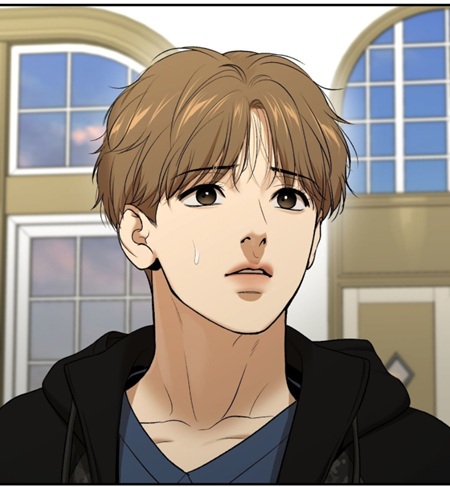 (chapter 85) This explains why his worried gaze followed his fated partner.
  (chapter 85) In other words, the text had a different meaning. It was not an order, but rather a wish…and it had nothing to do with his match against Arnaud Gabriel. During that night, Joo Jaekyung is not seeing a surrogate fighter in front of him or a sex toy, but his real partner, his future boyfriend. This means, this night stands in opposition to the one in the penthouse:
  (chapter 85) This is why he touches Dan’s face instead of flipping him over.
 (chapter 85) — something he has never done before. This does not come from instinct. It comes from intention. It comes from effort. It comes from learning. He is indeed showering doc Dan with love and tenderness, therefore it is not surprising that the “hamster” is moved sensually and emotionally. Exactly like during the Summer Night’s Dream, he is reaching nirvana, hence Jinx-philes are constantly seeing stars,.
  (chapter 85)
  (chapter 85) — or the emotional slip that comes with resurfacing feelings: the therapist losing distance, falling back into intimacy. All of these readings sound plausible at first glance.
  (chapter 85) Styled up, hardened with gel
  (chapter 30) , perfectly arranged — it is the crown of the Emperor, the symbol of his control, his discipline, and the myth that MFC sells:
 (chapter 85) — but not the way adults or professionals usually do.
  (chapter 71) So doc Dan could recognize the little boy in the athlete, the more he sees the protagonist with his hair down. Furthermore, I noticed that contrary to season 1, Doc Dan has now more memories of the “wolf” facing him.
  (chapter 85) In the past, he would more look at him from behind:
  (chapter 35)
  (chapter 35) Seeing his face reflects not only the increasing care for each other, but also the improving communication between them.
  (chapter 85) more mature, more “masculine” in the traditional sense. This explicates why the stylists had to dress him up.
  (chapter 82) Yet such an intervention did more than prepare him for the cameras — it tightened the restrictions around his own image, reducing the fighter’s rights over how he appears to the world. With the suit, he appeared older and more powerful. The French fighter leans into age, while the Korean champion leans into youth — a symbolic inversion that reinforces the central tension in the Paris arc: Gabriel performs adulthood; Jaekyung rediscovers the adolescence he never lived.
  (chapter 85) But just as Jaekyung begins to slip into these youthful, softer identities, MFC reasserts control.
 (chapter 85) hair up, face polished, a look engineered for posters and rankings. He becomes once again the Emperor — the man who must appear older, sharper, more intimidating, more manufactured.
 (chapter 79) This is the boy from the childhood photograph.
 In the rain, with his hair heavy and unstyled, his gaze dark and sensual, Jaekyung appears nothing like the commanding emperor. He looks free — freed by weather, freed by desire, freed from roles. It was foreshadowing, not just fanservice. It announces the end of the « jinx » in reality.
  (chapter 85) He is describing himself. His sweetness is the taste of freedom — freedom from performance, freedom from control, freedom from MFC, freedom from fear. He is enjoying this moment. Dan tastes sweet because Jaekyung is finally tasting the life he never allowed himself to want.
 (chapter 21) The image of winged rescue and divine protection hangs over the very piece of furniture that, throughout the series, has functioned as Dan’s private sanctuary. This is not incidental. In Jinx, the couch is tied to his deepest memories of care and abandonment, and Mingwa activates this symbolism each time Dan gravitates to it.
 (chapter 21) Why does he consistently feel safer on the couch than in a bed?
 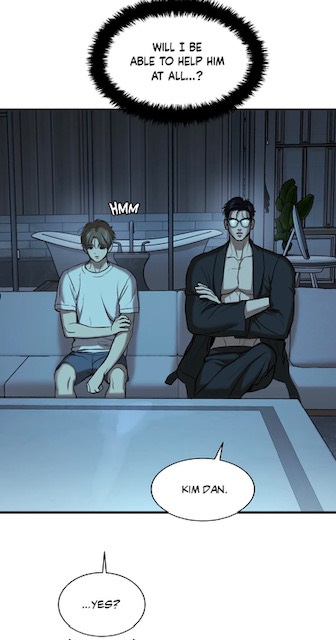 (chapter 29) Why, after the second swimming lesson, did he refuse to return to the bed
 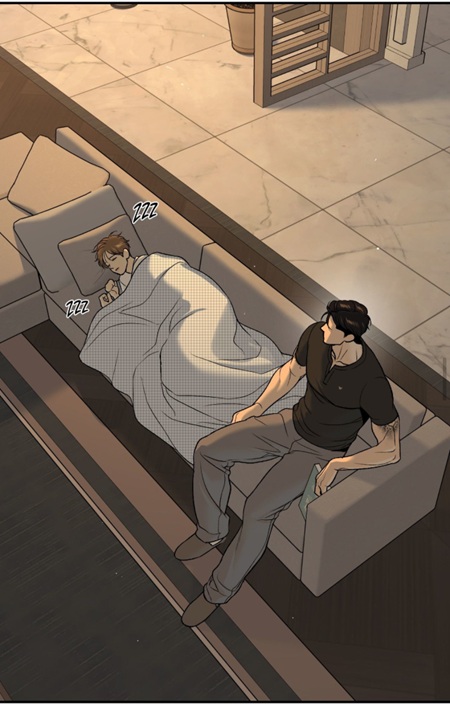 (chapter 81), even though he was exhausted? Why does he place the teddy bear
  (chapter 10) Secondly, at no moment, we ever witness the grandmother carrying the little boy to bed. Either she is rocking him to sleep outside the house
  (chapter 44),
  (chapter 44) traces from parents. And now, you comprehend why the hamster could never truly rest in the bed. The couch is therefore not an adult preference; it is a trauma imprint. Resting there feels safe because beds—large, empty, abandoned spaces—became reminders of whoever no longer carried him. Hence it is no longer surprising that he woke up, when he sensed the vanishing of warmth.
 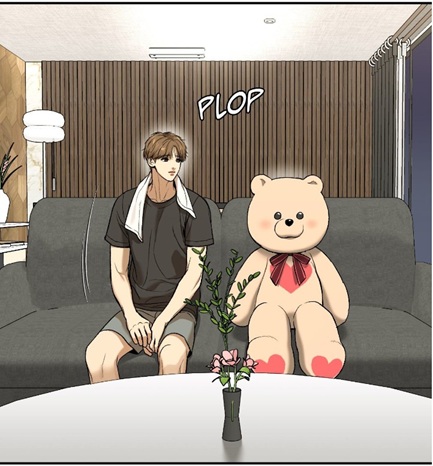 (chapter 84): the bear stands in for a lost comforting presence. It also represents the main lead, Joo Jaekyung. The latter is gradually reentering in the physical therapist’s heart and life. Therefore it is not surprising that there, he squeezes the hand of the toy. It is also why Doc Dan curls around it like a child who deep down hopes to be chosen, lifted, and held. And it is why, even as an adult, his body still whispers the same yearning: someone, please carry me to bed again.
 chapter 40, chapter 65, chapter 68, chapter 79)
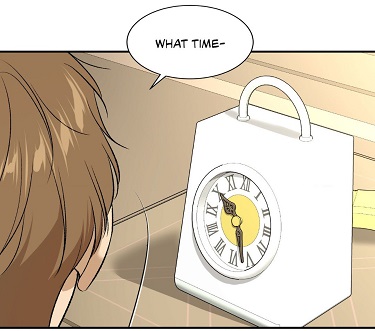 (chapter 85) and he was still able to arrive on time in the arena.
 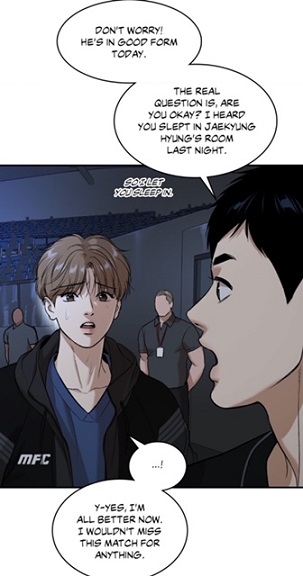 (chapter 40) For me, it is a clue that the manager would always request to meet around 7.00 am, when the match was at noon. But what should do the athlete do during all this time? He can only get nervous and feel pressured.
 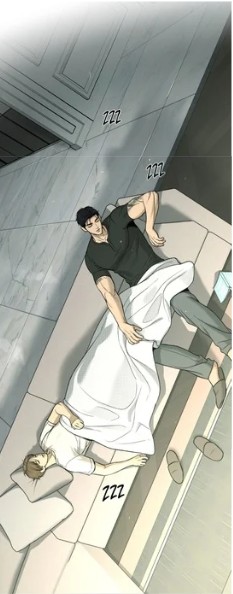 (chapter 81) I noticed that in different scenes from season 2, the athlete started waking up later and even after doc Dan.
  (chapter 66) But the manager’s rigid schedule threatens even that. An early morning summons drains the fighter’s cortisol reserves before the match has even begun, creating a long, empty corridor of waiting — a period where tension, anxiety, fatigue, and irritation ferment in the body. Instead of resting, centering, and preparing, the champion would spend hours fighting against the clock imposed on him.
 (chapter 54) , he might even jump to the wrong conclusion: that Jaekyung drank again — this time behind his back.

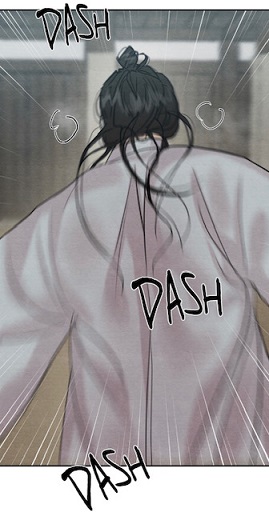 (chapter 126) to another
 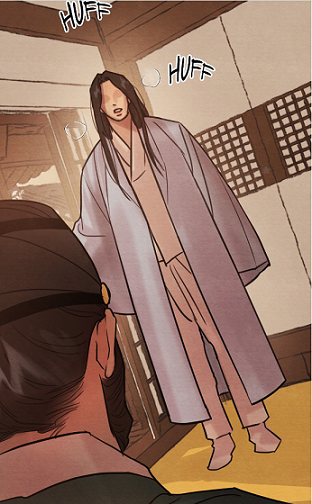 (chapter 126). He allowed his father to humiliate and abuse him
  (Chapter 126) once again. It was, as if the story was back to square one and the protagonist had learned nothing at all. Under this perception, my avid readers can comprehend why I selected such a title. However, instead of thinking that the author was a bad writer, I decided to ponder on the following question. Why did the author choose such an evolution?
 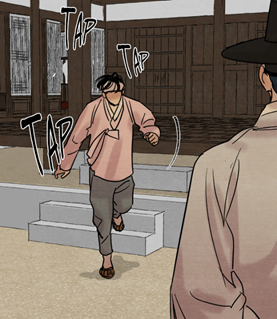 (chapter 7) Like Baek Na-Kyum, he rushed to his loved one’s side. However, he was first stopped
  (chapter 126), because it was not the right time. How so? Notice that his brother had fetched him at the port
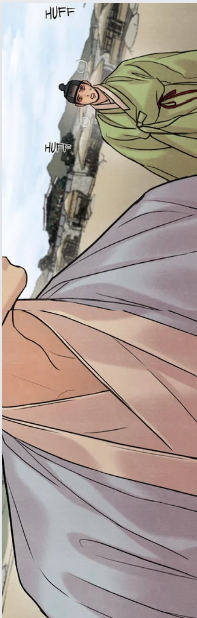 (chapter 125), but he never followed him to the bureau of investigation. And the same happened later. Why didn’t he go to his shed, when he was trapped there? Where was he, when the eldest son visited the father?
  (chapter 126) His absence exposed his passivity and betrayal. However, at no moment, Yoon Seungho noticed this. To conclude, Yoon Seungho was so worried for the painter that he didn’t pay attention to his surroundings, just like the painter didn’t see the learned sir’s disdain expressed through the cold gaze.
 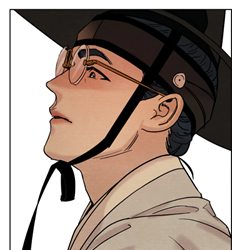 (chapter 07) Therefore Yoon Seungho didn’t notice the presence of a civilian next to the governor.
  (chapter 126). Striking is that the governor knew about Yoon Seungho’s whereabouts before his arrival: the coast. As you can see, I am detecting a link between the governor and the younger master Seungwon. Yet, it was disguised as a rumor behind the expression “I had heard”. My assumption is that Seungwon came from the bureau of investigation in order to inform his brother. Therefore it is not surprising that Seungho was invited by his brother to visit the prison during the night.
  (chapter 126) And the moment I perceived the protagonist as a fool in love, I realized that chapter 126 is a reflection of episode 7, 29
 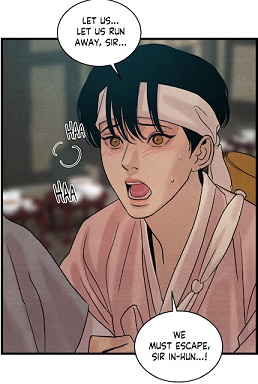 (chapter 29) and 40
  (chapter 40). Here, the painter was trying his best to protect Jung In-Hun’s interests (life, high position). Moreover, in episode 40, the painter had a dream, when he saw the announcement for the civil service examination. He smiled, for he was looking forward for the future.
 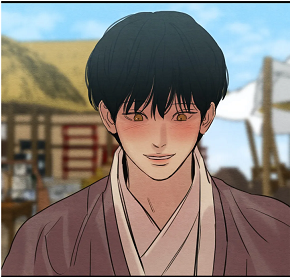 (chapter 40) And what have these episodes more in common? A betrayal, abandonment from a loved one and a paper (painting, poem). Hence I am more than ever convinced that the petition will resurface very soon and play a huge role in the downfall of the schemers and haters. Besides, chapter 40 represents the negative reflection of the conversation in the prison.
  (chapter 126) Though they are in a tough situation, Yoon Seungho is not leaving his side contrary to episode 40.
  (chapter 40) There is neither disdain nor mockery. The mentioned scenes are similar, for the present resembles the past. And this brings me to the second reason for the Webtoonist’s decision.
 (chapter 123), Yoon Chang-Hyeon considered Yoon Seungho as a human, for he employed the personal pronoun “he”. He was still his son. Then in episode 77, he judged him as a slave
  (chapter 77), hence he was submitted to the straw mat beating and was held captive. He even refused to send for a physician.
  (chapter 83) Here, the father is denying his humanity, he is just an animal. In their next confrontation, he describes him as a monster, hence he wished that he had never been born.
 (chapter 86) However, his words exposed that he was still viewing him as a living being. Therefore it is not surprising that he accepted lord Song’s request to order the murder of his son! In the gibang, he decided to no longer acknowledge Yoon Seungho as his son.
  (chapter 107) The tragedy is that the protagonist still viewed the Yoons as his family because of Yoon Seungwon, who keeps calling him “brother”. This explicates why Yoon Seungho sponsored his brother to have an official position.
  (chapter 115) Therefore it is not surprising that he followed Yoon Seungwon’s advice again.
  (chapter 120). He would bring the petition to his own father. This means that he is acting like the painter who listened to his noona Heena so well.
  (chapter 46) But now, Yoon Chang-Hyeon believes to have the petition.
  (chapter 125) This explicates why the patriarch is now calling the main lead “nothing”.
  (chapter 126) He is not even a thing. This means that he is actually discarding him. This explicates why he sent him to the shed.
  (chapter 126) It was, as if he had become a merchandise. Or we could say that the elder master had been using him as a tool, which he can now abandon.
  (chapter 126) Interesting is that the idiom “plaything” has for antonyms tool, implement, instrument and utensil. And this brings me to the following remark. The father’s words are reflecting the last scheme. Yoon Seungho was used as the sword to get rid of an enemy, lord Song. It was, as if someone had decided to get rid of lord Song, for he represented a danger or threat. It also mirrors the trick in the shrine. Min and the others got killed, because Lee Jihwa went to his childhood friend. And who had seen the main lead using this sword, when he was enraged? Father Lee!
  (chapter 67) But let’s return our attention to the patriarch and his son. Yoon Seungho is no longer recognized as a Yoon member. Therefore I come to the conclusion that Yoon Seungho will make the following decision: to become an orphan. And this is symbolized by the loss of hair. I am expecting him to cut off his hair, something the painter has been doing for a long time. That’s why Byeonduck showed us the lord without a topknot.
  (chapter 126) This would coincide with my previous statement. The lord is going through the same experience than his loved one. However, people will come to the conclusion that this was done by the father. How so? Remember how each rumor became a reality.
  (chapter 1) I had already demonstrated that Yoon Seungho was not a fiend for sodomy with no regard for time and place, until he met Baek Na-Kyum. But once a deed is done, it can never be repeated.
  (chapter 101) So should Father Lee claim that he has long disowned Jihwa by cutting off his topknot, no one will believe him, for the young master was still seen with a topknot after confessing his feelings in public.
  (chapter 57) In other words, the topknot incident at the kisaeng would be brought up. It is impossible for 2 fathers to act the same way. Besides, the loss of the topknot has another signification: Yoon Seungho would cut off ties with valet Kim, for the latter was the one who gave him the topknot. And episode 126 reflected one more time his position:
  (chapter 126) He is the one dressing him. It was, as if he was the pope.
 (chapter 116) It is because someone had reported to him the conversation between lord Song and the painter.
  (chapter 122) There was a spy listening to their conversation. Since all the guards died
  (chapter 124)
  (chapter 125: I am assuming that the survivor got executed), I am suspecting the scholar. Moreover, why would Yoon Chang-Hyeon accuse his son to have abandoned Baek Na-Kyum? It is related to this departure of the staff and Yoon Seungho.
  (chapter 120) And who was present there? Jung In-Hun! But there is more to it. Since leaving Baek Na-Kyum behind is considered as an abandonment, it means that the patriarch abandoned his son too.
  (chapter 27) By speaking to Yoon Seungho, the elder master Yoon didn’t realize that he was admitting his own wrongdoings. Actually, he had abandoned him many times… like here for example
  (chapter 87) Therefore his words will come back to bite him. But these words are also exposing the valet’s betrayal and abandonment towards Yoon Seungho!! How so?
 (chapter 122), then he should have been at the patriarch’s house. The absence of the valet is the evidence of his treason. For me, he is now working for Jung In-Hun which explains why he never mentioned his presence in the mansion, only lord Song. Besides, keep in mind that once deed done can not be repeated. In episode 27, the lord was too angry and busy to notice the learned sir’s spying activities.
  (Chapter 27) Moreover, Kim didn’t report the interrogation to his master. This means that the butler covered up for the teacher’s wrongdoing. But here is the deal:
 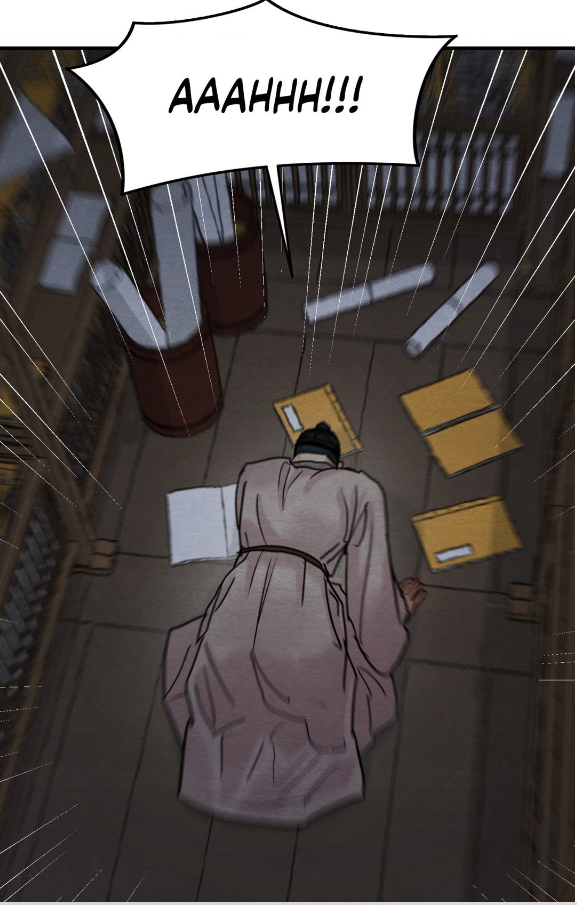 (chapter 120) The library was ransacked, hence this crime is bound to be discovered. Finally, his intervention in the shed is exposing his deception.
  (chapter 83) That’s why I am convinced that these words
 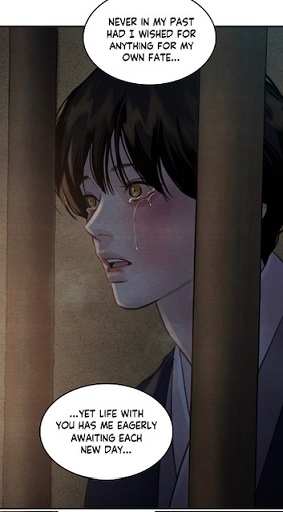 (chapter 126) He is no longer suicidal, in fact he is full of hope! Though he was sent back to hell for a short moment, he came out of this as a winner. My evidence is that the lord has now become a believer.
 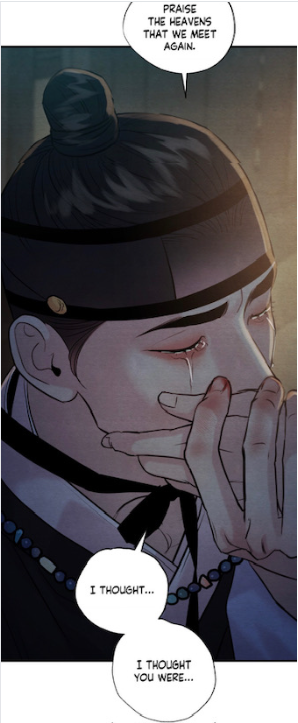 (chapter 126) Yes, episode 126 exposes the return of his faith! And where could we see the atheism of Yoon Seungho in the story? In chapter 92!
  (chapter 92) He didn’t believe in the spring poetry to ward off bad luck! That’s why he was sent back to the past. He needed to lose everything in order to find hope! In his darkest moment, he expressed a wish: to meet his loved one! And where did he pray to the gods? In the shed!
  (chapter 126) Observe how he is kneeling in direction of the bars. He is hoping to meet Baek Na-Kyum again. As you can see, though this scene
  (chapter 126) He was showing resistance and anger towards his father. Moreover, he was no longer shaking in front of the patriarch or the guards.
  (chapter 86) Thus I deduce that though he was mistreated and insulted like in the past, he was no longer suffering from his traumas. He is healed. His will is now really strong, supported by his new found faith.
  (chapter 62) Even if they were hugging, they were not close emotionally and mentally. This stands in opposition to the scene in the jail. They might be separated by the bars, but they are touching each other tenderly.
  (chapter 126) They are able to see each other.
  (chapter 126) Try Meditation
  (chapter 126) or Prayer
  (chapter 126)
 (chapter 126) Quoted from
  (chapter 126) It is relevant, because light represents knowledge and truth. He is now the bearer of the truth. And he got his blessing from Baek Na-Kyum, when he touched his hands.
  (chapter 120) Yes, chapter 126 mirrors 92! This somehow confirms my theory that the butler was the one hiding under the purple hanbok.
  (chapter 92) Moreover, we have another reference to this episode, the pouring of alcohol!
  (chapter 92)
  (chapter 126) It was, as if someone wanted the lord to pay for Min’s insult! That’s the reason why I come to the following conclusion: Yoon Seungho is now opening up to Baek Na-Kyum. He is confessing to the painter about his wishes.
  (chapter 85) The manhwaphiles should keep in mind that the request from the artist in the study was strongly connected to forgiveness. And Baek Na-Kyum could also confess what happened in the past: his guilt and regret asking for the lord’s forgiveness. Right now, both are blaming themselves for the incidents, although they got fooled by many schemers. Because the lord proved his loyalty and blinded trust in the painter, I see the scene in the jail as a new version of this confession:
  (chapter 75) Thus I consider the prison cell as a sacred place, where both characters are about to be freed from their guilt!
  (chapter 11) thus he could escape justice!
  (Chapter 11) Simultaneously, the first definition of life lie corresponds to Yoon Chang-Hyeon. The latter blames his eldest son for the downfall of the Yoons.
  ! (Chapter 86) Secondly, he still thinks that he is powerful. But it is just an illusion.
  (chapter 125). They fail their duty, for they allowed the main lead to barge in the room.
  (Chapter 126) Finally, observe how they keep apologizing without giving any explication.
  (Chapter 125) Their apology is fake. As you can see, the patriarch is living in an allusion. He is powerless, and the best evidence is that he doesn’t have the petition.
  (Chapter 126) He is actually encouraging his son to hate himself and indirectly his own father! However, the son made the exact opposite decision: love!! Hence I am more than certain that the elder master is about to experience a harsh awakening.
  (chapter 101) Thus they got punished. And now, the two main leads are about to face human justice.
  (chapter 65) But strangely, the painter is showing no fear at all.
  (chapter 126) He is ready to sacrifice himself. So why was Yoon Seungho dressed up in the end? One might say that with the topknot and the hanbok, the abuse from the patriarch got covered up. That way, Baek Na-Kyum wouldn’t detect Yoon Chang-Hyeon’s lies and abandonment!
 (chapter 125) The latter brainwashed him to take the fall for everything, implying that way, his loved one would be protected! However, I am suspecting that if the lord were to leave the prison, he could meet someone in the office. That way, this person is not confronted with the reality: the main lead was “abused”. According to the butler, he was supposed to meet his brother at the office.
  (Chapter 92) In episode 92, we have a mysterious man in the background dressed in black, but he is not wearing his gat. Besides, I would like my avid readers to remember this image from the trailer:
  which reminds us of the office:
 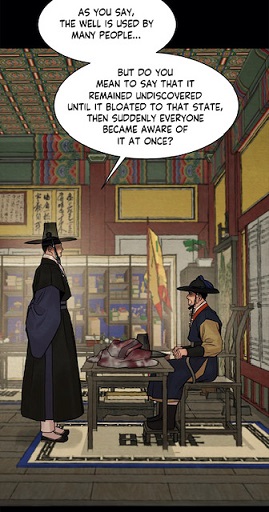 (chapter 98) This place symbolizes power and strength. And because episode 126 is a reflection of chapter 7, 11, 29 and 40, I think, Yoon Seungho is about to receive a deal, for these episodes are focusing on the deal between the painter and the protagonist: protection from the father and punishment in exchange for entertainment. He would appear as a fake savior in the end. Remember what in episode 11 the artist said in front of his fated partner:
 (chapter 11) He would do anything except painting!! He was not willing to give up on this principle, which reminds us of faith. So when Yoon Seungho faced his father, he experienced powerlessness for one reason.
  (Chapter 105) Then in episode 122,
  we discover that lord Song employed the pipe to beat the painter. Moreover, I detected a progression. In season 2, Yoon Seungho was still smoking.
 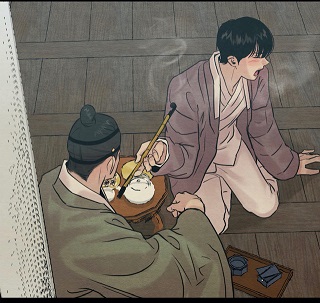 (Chapter 74) But once the painter showed that he didn’t like smoking, Yoon Seungho stopped taking the drug. This explicates why in season 3, he was no longer seen with the item in his hand. Even under stress, he chose to hunt instead of smoking in front of the window. We have two scenes where the pipe is present. One is when the lord is throwing it out of anger,:
 (chapter 86) which reminded me of the incident with the music box.
 (Chapter 85) This shows that this item had no value to the protagonist. Then the pipe appeared in the gibang on the table.
 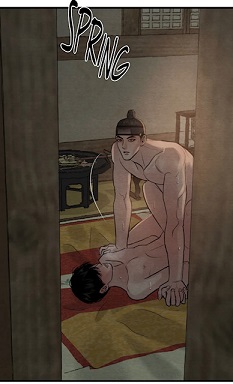 (Chapter 96) However, here the lord had only eyes for the painter or Heena. Hence I have the impression that the pipe could resurface and serve as an tool to identify the perpetrator, just like the glasses were used to recognize the scholar.
  (Chapter 102) Finally, since the pipe appeared in the gibang twice, it indicates that this hobby is linked to the kisaeng house!! And this brings me to my final observation: the pipe is connected to paper
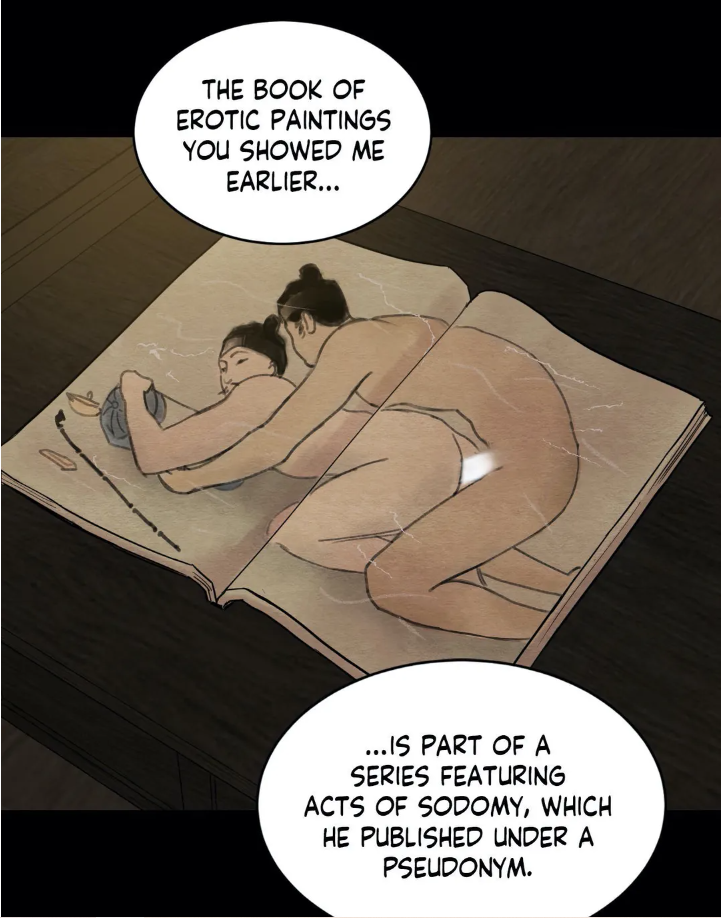 (Chapter 1)
  (chapter 1) However, there exists two books!! And one has no PIPE! This coincides with the decision of the painter to stop drawing erotic pictures! Yes… dropped amusement! At the same time, Yoon Seungho has long lost his interest for erotic publications. He also dropped this hobby. On the other hand, the books were dropped in front of the painter.
 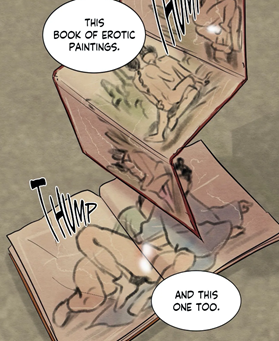 (Chapter 1) Finally, the petition was dropped in front of lord Song
  (chapter 123) which announced his death sentence. To conclude, the papers have a strong connection to punishment and death.
  (Chapter 126) Yoon Seungho went to the father’s mansion, and it didn’t take him that long! As you can see, I consider this trip with Yoon Seungwon as a diversion.
 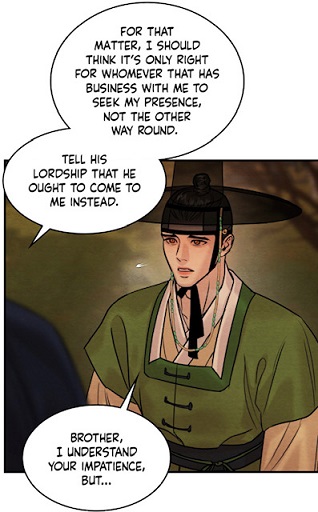 (Chapter 121) So why didn’t the elder master return to his old home? It is to drive the Yoons out of their propriety. In other words, the lies from the past are becoming a reality exposing the liars in the end. Their life lies will be ruined.
 (chapter 119), they got worried and nervous, as they considered the expression „as long as I live“ as a clue for a sad ending. Why? It is because the lord was referring to his own death. Under this light, it becomes comprehensible why I selected „heavenly“ in the title. I was naturally alluding to the afterlife. However, I perceived his words in a positive light. He expressed his desire to live. He is no longer suicidal, he wishes to live a long life next to the painter and treasure his moments with him. That’s the reason why the author included the refraction in the scene. A dream had come true, the lord was finally able to escape the darkness.
  (Chapter 119) He is now truly alive. This explicates either why he smiled and laughed at the end. But why was he so happy? It is because Baek Na-Kyum had just confessed that he loved him not for his wealth or power, but for himself.
  (Chapter 119) He even described him as a treasure. Yoon Seungho had finally achieved his goal: to win the painter’s heart. His presence and love bring happiness to Baek Na-Kyum which stands in opposition to his reputation as bird of misfortune. Moreover, this description contrasts so much to Jung In-Hun
  (Chapter 119) and Yoon Seungwon’s.
  (Chapter 118) where both portrayed the main lead as a man consumed by lust and revenge. In other words, he was presented as a huge sinner. This implies that he stands so far away from heaven. But all these words were erased the moment the painter confessed his love for Yoon Seungho once again. What Baek Na-Kyum didn’t realize is that his love confession is pushing the protagonist to fight for the painter.
 (chapter 102) In episode 102, he was renouncing on everything (life, mansion, wealth and connection), because he imagined that the artist had died. Consequently, I deduce that in episode 119, the painter’s life is attached to the lord’s for good. If the artist got into trouble, Yoon Seungho would side with him and the reverse. Thereby, I come to the conclusion that this moment in the kitchen represents their union, as they are no longer tied to the mansion. They are now a family no matter where they are. Let’s not forget that the painter expressed his wish to run away with his lover.
  (Chapter 119) It is important, because such a departure symbolizes that the bird “Yoon Seungho” is leaving the nest. He is now starting a family on his own.
 (chapter 85) and put a glass and that was it. This exposes the father’s hypocrisy, ignorance and greed. By acting on his own, he was exposing his true mindset. He views himself as the family. The sons are just the extension of himself, for they are his reflections.
  (Chapter 45) On the other hand, Yoon Seungwon is his golden child, for he represents his positive reflection.
  (chapter 86), whereas he put the other on a pedestal
 Under this new light, it becomes comprehensible why the father could only reject the offer from lord Song in the gibang. Doubting Yoon Seungwon’s sexuality meant to question about the father’s sexual orientation. At the same time, it is not surprising why the elder master would blame Yoon Seungho for everything, for he couldn’t admit his responsibility for the purge. Consequently, the Manhwaphiles can grasp why Yoon Chang-Hyeon came alone to the shrine. If he had brought Yoon Seungwon, the father would have been reminded of the elder son, as both can not be separated. This explicates why the younger master asked his elder brother to submit to his father.
 (Chapter 119) I couldn’t help myself smirking when the brother attempted to make him believe that.
 (Chapter 119) the protagonist could ever gain the father’s favor. Yoon Seungwon was definitely playing with his brother’s feelings, as if he could hope that their father would change.
  (Chapter 118) It is because as a golden child, he is also suffering, but it is naturally nothing compared to Yoon Seungho’s position who could have died.
  (Chapter 77)
 (Chapter 119) First, by returning the petition to the father, Yoon Seungho would become the culprit. He was not only a traitor, but also a blackmailer of the Yoons and lord Song.
 (Chapter 107), for he had stolen the petition. Yoon Seungwon would hide his wrongdoing, he betrayed their father.
  (Chapter 118) There is no doubt that Kim played a role in this as well. In other words, the brother and the valet would bury the truth by diverting the attention of the patriarch towards the main lead, if Yoon Seungho followed this suggestion.
  (Chapter 116) The elder master would no longer seek the truth, similar to the kidnapping in season 2 which was turned into a desertion and later Lee Jihwa’s abduction occulting the instigator and the helping hands. Simultaneously, Yoon Seungwon needs his brother as scapegoat, because the pressure coming from the patriarch and lord Song must have definitely increased.
  (Chapter 37) He is even implying that he needs to sacrifice himself in order to protect Baek Na-Kyum!! Moreover, he is distorting the reality, because he implies that his father is still powerful.
  (chapter 37) like the memories from episode 37 are exposing it. It becomes clear that if Yoon Seungho returned the petition, he would die.
  (Chapter 116) Thus I come to the conclusion that the meeting between the brothers in the gibang represents an offering. For the Yoons’ sake, Yoon Seungho should admit his wrongdoings
  (Chapter 55) People had played with his hopes and longing for acceptance and recognition. Interesting is that offerings is a synonym for atonement and sacrifice. But why is Yoon Seungwon so sure that he can repeat the same action from the past? It is because Kim and Yoon Seungwon have known for a long time that Yoon Seungho was longing for acceptance and love from his family, just like the scholar knew about the painter’s love for him.
  (Chapter 119) But everything changed, when the painter met the lord. So who is worse here? Jung In-Hun who tried to rape the painter or Yoon Seungwon who is sentencing his elder brother to death? Let’s say that the valet convinced the younger master to suggest this solution, this doesn’t diminish Seungwon’s responsibility at all. He knows that his father abused his elder brother. In my opinion, he is copying his father, like the former tried to diminish the responsibility of the patriarch.
  (Chapter 119) Yoon Seungho got hurt because of lord Song and not because of Yoon Chang-Hyeon. This means that the younger master was denying the existence of the patriarch’s choice and the helping hands. And if the brother listened to his advise and the father hurt or killed the main lead afterwards, the younger master could put the blame on the elder master, for the decision and responsibility belonged to the patriarch. Moreover, he heard from lord Song that killing Yoon Seungho was just a matter of time.
  (Chapter 119) So technically, this situation could have triggered the protagonist’s insecurities like in season 1
  (chapter 28), 2
 (chapter 60) and 3
  (chapter 98). However, through these constant exposures, Yoon Seungho came to learn not to jump to conclusions and to have faith in Baek Na-Kyum. He knew that he would return to the mansion. Hence he ran to the bedchamber first.
  (Chapter 119) Another important detail is that we don’t see any staff in the courtyard or in the kitchen. It was, as if the propriety had been deserted.
 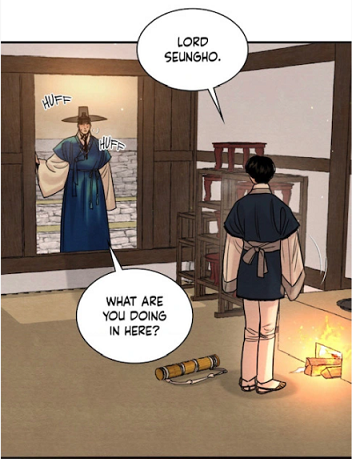 (Chapter 119) This implies that at no moment, he relied on the domestics’ testimonies which contrasts to the following scenes:
 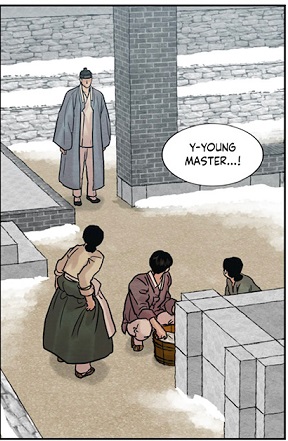 (chapter 104)
 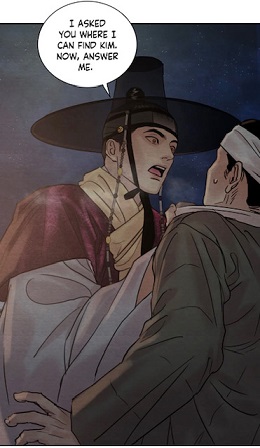 (chapter 107) and
 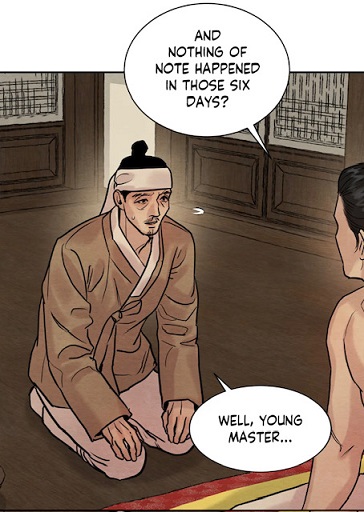 (chapter 116) However, observe that in episode 116, Yoon Seungho had witnessed how his lover had taken care of him, while he was unconscious. Furthermore, the petition had been handed over to the painter and not Kim, a sign that the artist had become the protagonist‘s confident. As you can see, as time passed on, the main protagonist learned the following lessons: he should stop relying on servants, he should only trust his partner. I would even add that he was taught the following principle: “If you want something done right, you have to do it yourself”. In my eyes,
 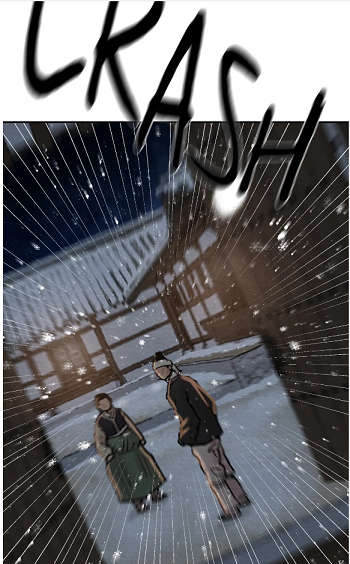 (Chapter 103) Here, they never expected the return of Yoon Seungho and the painter. The staff ‘s absence in episode 119 is the evidence of their desertion! Moreover, I consider Yoon Seungho’s search for his lover as a new version from episode 28/29/30:
 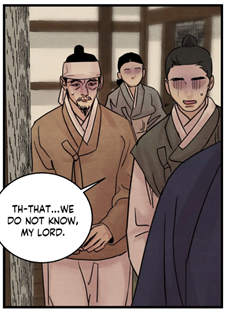 (chapter 28) Back then, they feigned ignorance, but they never anticipated a punishment from Yoon Seungho.
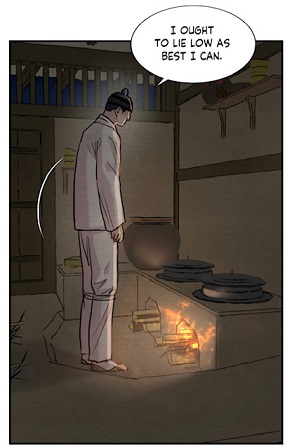 (chapter 115) And now you are wondering how the painter’s gesture can be considered as an offering. It is because the kitchen hearth is considered as sacred due to the fire. First, in shamanism, there exists the god of fire named Jowangshin.
  (Chapter 115)
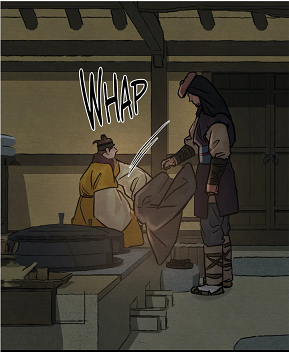 (Chapter 59)
 (Chapter 98)
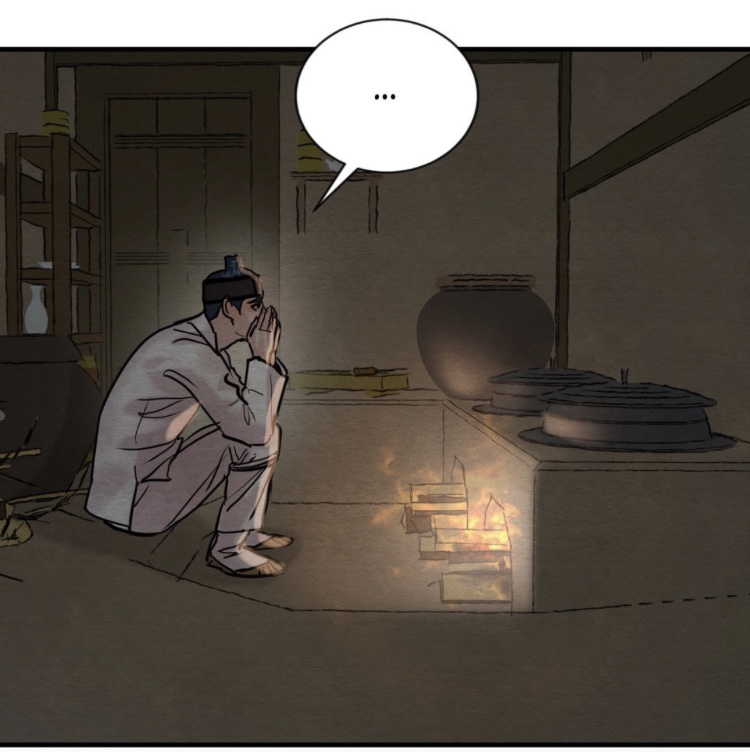 (Chapter 115)
 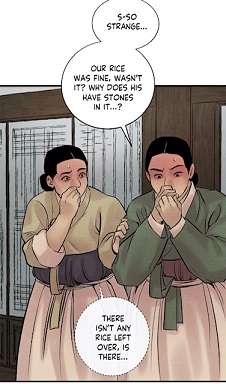 (Chapter 47)
 (chapter 102) who was a traitor, for he had tattled on Black Heart and his friends to Yoon Seungho. And now, you comprehend why I connected the shrine to the kitchen hearth. Both places are considered as sacred, for they are connected to gods and spirits.
  (Chapter 85) The absence of his sons and of food as offerings reveals that he was not showing true respect to his ancestors. He used religion and social norms to hide his true intentions. He wanted to take over the mansion. Hence the black guards were standing at the entrance of the sacred house. Their presence symbolizes violence. Therefore it is not surprising that the gods chose to punish the elder master through Yoon Seungho. The former was not received properly
 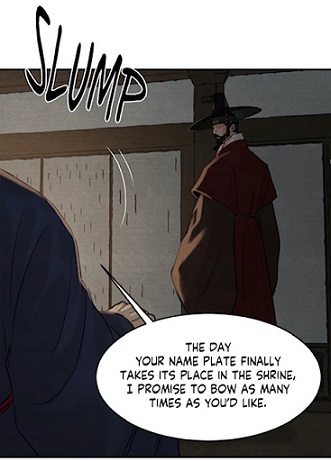 (chapter 86): no bow, no food and no seat.
 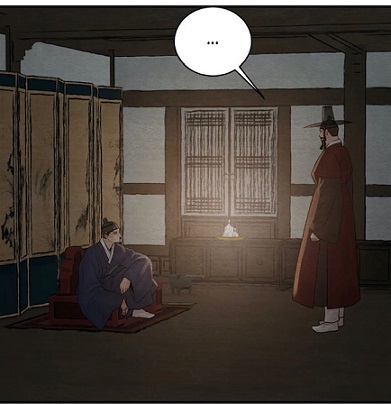 (Chapter 86) Let’s not forget that the elder master had entered the lord’s chambers without the permission of his owner. No wonder why he was left speechless. And now, you are wondering if I am not drifting away from the topic, as these chapters from season 3 don’t seem to be connected to episode 119. However, it is important to realize that these chapters have many common denominators
 Here, we could detect the suicidal tendencies of the protagonist. He wouldn’t fight back.
 The seat looks like a throne.

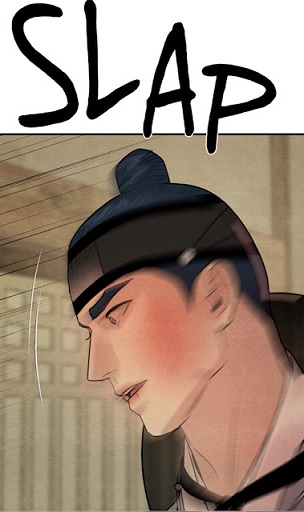
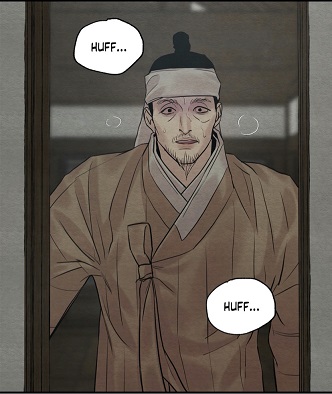






 Baek Na-Kyum freed himself.
  (Chapter 85) The study is even close to the gate.
  (Chapter 51) He could have reached the study before the father entered the shrine. Finally, observe that the patriarch even arrived to the bedchamber before Yoon Seungho,
  (Chapter 117) The painter wants to leave everything behind too.
  (Chapter 119) Thus I am deducing that the authorities will be involved very soon.
  (chapter 119) They are not expecting the lord‘s resistance, for he remained passive all this time (season 2 and 3). The scholar has now the means to do so, and the necessary motivation. Imagine that he got wounded and humiliated by the couple! Besides, we have this broken promise due to Yoon Seungwon
  (Chapter 94) The gibang is connected to money, power, pleasure, artificiality, sensuality and lack of privacy.
  (Chapter 96) I am sure that you can detect all the contrasts (night, door close, spies, confession outside and inside, no fire, only light). Thus I am deducing that the painter’s words in the kitchen were not heard by others. As you can see, this scene in the kitchen is full of symbolism. In my previous essay “The true face of family”, I had already pointed out that sharing meals represented a criteria to define a real family. Therefore I had demonstrated that Yoon Seungho and Baek Na-Kyum were excluded from the mansion, for they wouldn’t eat their meals in the kitchen like the staff.
  (Chapter 17) Moreover, the hearth doesn’t just provide warmth, but also light! The latter embodies knowledge and as such Enlightenment.
  (Chapter 119) Hence they were clueless about the wrongdoings from the staff. Only in the kitchen, the lord could finally grasp the depth of Baek Na-Kyum’s love for him. It is an unconditional love contrary to Yoon Seungwon’s. The latter would only recognize him, if he listened to him. And he only seeks his assistance, when he needs him. It shows that Yoon Seungho is only approached, when he has power.
  (Chapter 118)
 (Chapter 119) I would like to outline that during their conversation, Yoon Seungwon remained calm and indifferent, when he talked about the assassination attempt from Yoon Chang-Hyeon.
 (Chapter 116) But the biggest difference is the absence of fire in the kisaeng house.
  (chapter 78) Furthermore, he tried to leave before
  (Chapter 104)
  (chapter 105) Finally, we saw him in the courtyard standing next to a horse and a servant indicating that he had given him a task, and the latter needed to leave.
  (Chapter 108) Hence you comprehend why I am full of optimism in the end. Yoon Seungho has already made some preparations in my opinion. On the other hand, I am quite certain that their love will be tested. Can they face together trouble? Yes, because through their pain, they learned their lessons and changed.
  (Chapter 119) It is because in the past, he was never allowed to join the kitchen hearth. This place was either beneath him or he was not worthy of entering the place. Thus he employed the expression scullery boy to Yoon Seungho.
  (Chapter 47) Here, I would like to outline that when the protagonist was held in the shed, someone brought him food .
  The maid had just brought water to the couple.
 During that night, Baek Na-Kyum had been held captive in a shed.

 (chapter 38) Yoon Seungho remained outside on the door step. Consequently, I started comparing scenes where the kitchen hearth appeared and that’s how I discovered a pattern:
 (Chapter 46)
 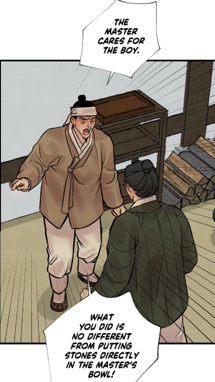 (chapter 47)
  (Chapter 110)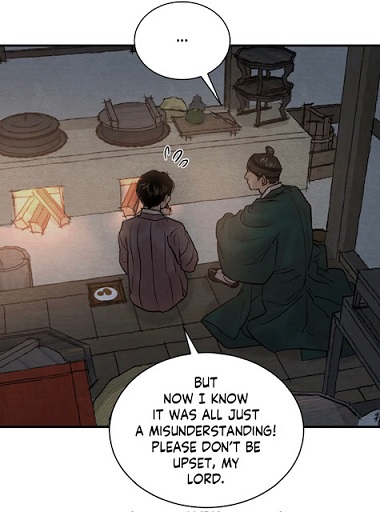
 (Chapter 77)
 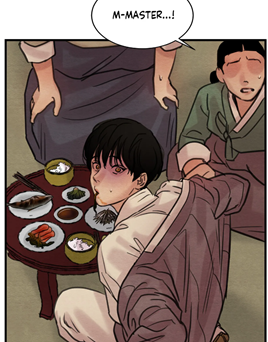 (chapter 38)
 (chapter 59)
  (chapter 119)
 (chapter 38)
  (chapter 47)
 (chapter 77)
  ( Chapter 110)
  (chapter 119)
  (chapter 47)
  (Chapter 77) For me, Kim must have looked down on the other domestics. I consider this scene as the best example what Kim should have done in the past.
  (Chapter 119)
  (Chapter 98) One door leads to the backyard and the other to the smaller courtyard. And this scene confirms my previous assumption
 (Chapter 87) Baek Na-Kyum is there to prove him wrong. He had other opportunities, like giving him a good meal.
  (Chapter 63) He should have sided with his master and even remained by his side. This signifies that this scene
  (chapter 7) the artist is not only cleansing the kitchen, but also cutting off ties with the scholar. The latter is no longer protected. The spirits will intervene through chance. As a conclusion, the hearth has a spiritual and healing power, for it is connected to „Heaven“. Yoon Seungho‘s paradise is to have a family.
 (chapter 108) He blames himself for everything. For me, these women were lying to their master. Why do I think so? The first proof is that the painter’s fate is to go through the same experiences than his lover. And what did the valet admit in the shed?
  (chapter 108) There was not a soul in this household who was standing by his side back then and now! This signifies that there is not a soul in the mansion truly standing on the painter’s side as well!! Back then (before the massacre) and even now… Moreover, while these maids’ attachment was sincere
  (chapter 51)
 (chapter 108) Yes, this woman is not the same than the one from chapter 51, for her clothes diverge despite the same pigments. She is wearing a white ribbon around her waist.
  (chapter 108), whereas the other wears the belt more around the hips, hence her skirt has a bump on her butt.
  (chapter 108) First, when the manhwalovers saw him in the kitchen, he was eating to his heart content and enjoying his breakfast.
  (chapter 46)
  (chapter 74) This explicates why the artist returned the table with the porridge to the kitchen himself.
  (chapter 62) The painter had been faking his “submission”, hence the “valet” got fooled. He had trusted the artist blindly. Thus the lord got angry, and resented the butler, for he wished the opposite. He didn’t want to admit that the artist had been acting. Yet, the seed of doubt was implanted in his mind. Consequently, in episode 108, we have the exact same situation, yet contrary to the past, the lord didn’t get angry at his lover. He never condemned the painter for his dishonesty, though he was not truly lying either. To conclude, chapter 108 is a reflection from episode 62. Thus it dawned on me that the valet could have attempted to fool his master once again. The artist was a hypocrite, for he was acting in front of the lord hoping that he wouldn‘t cut ties with him. It was for his best interests to send back to the kisaeng house. Yet, nothing like that happened.
  (chapter 104), a sign that he was recovering. But due to the two incidents during that day, Baek Na-Kyum had been feeling unwell and was hiding his discomfort out of fear of getting abandoned. This means that the deceivers were trying to portray the painter’s actual disposition as something unchanging. Since the painter had trouble with eating now, his eating disorder existed in the past. And this perception got reinforced, for the lord could notice afterwards that the maids’ statement had become a reality. What they had described, truly happened afterwards. Due to worries and anxieties, the artist lost his appetite. He would fake his “happiness”. The manhwalovers could witness how the painter had slimmed down
 (chapter 108), just like his “husband”
 (chapter 57) A single incident was turned into a generality, implying that it was the same in the past!! To conclude, the noble is put into the same situation than his own father, the only divergence is that Yoon Seungho has indeed the painter’s best interests in his heart. He is determined to provide him with the best!! Thus he blames himself contrary to the elder master Yoon.
  (chapter 104) This statement implies that the painter is responsible for the bloodbath, for he left the propriety. Yet, instead of confronting the painter, he was encouraged not to talk about the past. He was suggested that way, he would protect the artist’s mind and heart. Besides, his choice was influenced by his own anxieties. The lord fears argument, because the last time they had quarreled, the artist had threatened his lover to leave the place.
  (chapter 85) I would like my avid readers to keep in mind that the lord wished to keep the artist by his side, sending the artist back to the kisaeng house was just a temporary measure.
  (chapter 105) That’s how a misunderstanding was created, provoking the painter’s abandonment issues to resurface. The lord had selected secrecy and silence out of love for the artist. Therefore when the lord sensed Baek Na-Kyum’s agony, he could only jump to the conclusion that the painter was acting the same way than him. He was also hiding something from Yoon Seungho. That’s the reason why the lord didn’t argue with Baek Na-Kyum.
  (chapter 107) He imagined that the artist was doing it out of concern for the noble. He was projecting his own thoughts onto the artist.
  (chapter 68) According to this belief, the lord brings bad luck to others. This rule can only incite the main lead to doubt himself, to judge himself in a negative light, to doubt his own judgement. Moreover, the perfidy is that this principle pushes the protagonist to deny the existence of his own misery. It was, as though the lord had never suffered, only the others. This “faith” represents the biggest lie and hypocrisy. However, the main lead questioned this rule in front of Yoon Chang-Hyeon,
  (chapter 59) It was, as if Yoon Seungho feared to taint the painter by sleeping next to him. However, the artist’s biggest wish is to share the same bed than his lover.
  (chapter 97) To conclude, Yoon Seungho’s life is still influenced by a false cult, by propagandism. This faith is is based on Rene Girard’s theories about mimetic desire and scapegoat mechanism.
 (chapter 250) Hence the man created the following theory which is inspired by religion.
  (Doctor Frost, chapter 250). Under this new light, it becomes comprehensible why the author from Doctor Frost utilized the image of a black sheep as the future scapegoat. IT was selected, because it stood out. And you comprehend why Yoon Seungho became the target in the end. His good reputation attracted envy and jealousy.
 (chapter 57) Why? It is because each noble family aspires to the same: power and wealth!
  (chapter 107) This explicates why Yoon Seungwon was mentioned by the man with the purple hanbok. He implied that the son might have been well educated, yet he must be lacking elsewhere: his sexual education…. as his other task is to have a heir. This means that by standing out, Yoon Seungwon caught the jealousy and envy from other yangbans, though I have my doubts if he truly passed the civil service exam first. In other words, it is better not to stand out.
  (Doctor Frost, chapter 183) Since deprogramming is like brainwashing, it signifies that for the brainwashing, the victim needs to be isolated and even imprisoned too. And in order to be effective, the target of the brainwashing has to be exposed to stress and lack of sleep.
 (chapter 187) Fatigue and exhaustion are necessary in order to lower the target’s defense mechanisms. This explicates why it has to take place during the night, for the night is the time for humans to rest. Therefore the place of brainwashing is called “the fox’s hole” in Doctor Frost.
  (Doctor Frost, chapter 187).
 (chapter 187) The Ganzfeld effect happens when you undergo sensory deprivation for some time, and your brain tries to make sense of what is happening. Just 15 minutes of sensory deprivation can induce vivid hallucinations, according to researchers. This process involves muffling the ears and blindfolding, so people are unable to see or hear. And note what had happened to Baek Na-Kyum during the abduction. His head had been covered
  (chapter 66), and according to me, while his head was covered, he got strangled. Hence he had this nightmare.
  (chapter 61) But he lost notion of time and chronology, hence his nightmare is not coherent. One feature of altered states of consciousness during Ganzfeld exposure is an altered sense of time. In general, regardless of the induction method, altered states of consciousness can be characterized by changes in the sense of self and time. But this can only happen, when the brain is deprived of stimulations.
  (chapter 187) I had already outlined that Yoon Seungho had lost not only the notion of time, but also all his senses. And the nightmare is displaying the evidence of the Ganzfeld exposure. Hence the young master viewed himself flying
  (chapter 74), and at the end his eyes and ears got covered by hands and blood.
  (chapter 74) Besides, he was trapped in the dark room which looked like the servants’ quarters. Only thanks to the painter, the lord could recover his own senses, slowly he became the owner of his own body again. In addition, remember what he said to his own father:
  (chapter 62) Under this new light, it becomes comprehensible why the lord didn’t lose his whole sanity and as such didn’t fall completely into despair. The warmth and light served him as a guidance. Consequently, I deduce that in his childhood, he was trapped there in the dark for hours!! Because he was jailed in that room, he was exposed to the Ganzfeld effect. Therefore he relied on the valet’s words.
 (chapter 77) He trusted the butler, even after getting betrayed and abandoned each time. He developed blind faith in the butler. Why? It is because he was the only one “talking to him”. Though he wounded him so many times, he still remained by the lord’s side. That’s the reason why I come to the conclusion that the shed is not just a room for punishment, but also for “faith”, the place where the scapegoat was placed: “
 (chapter 77) That’s the reason why he got treated like an animal. This is no coincidence that in the storage room, the butler utilized such a religious vocabulary: “I do not believe”
  (chapter 62); “beg”, “trust” a synonym for faith,
  “soul”, ”
  (chapter 108) Moreover, I would like to outline that the main lead was seen sitting while looking up
  (doctor Frost, chapter 191). This description fits to the shed, the lord was not only cornered mentally, but also physically.
  (chapter 98) Consequently, I deduce that when the valet got punished in season 3, he portrayed the painter as a tattler for that reason. He didn’t want to become the scapegoat in the end.
  (Chapter 77) At the same time, receiving treatment from the physician, Kim could say that the lord regretted his decision. These new discoveries reinforce my prediction that the painter is doomed to become the next scapegoat!! Yet, chance is on the couple’s side. On the other hand, this signifies that someone will have to become sacrificed!
 (chapter 108) for his wrong choices, I come to the opposite interpretation. Naturally, if the manhwalovers compare the butler’s apology in the shed to the one in the library,
  (chapter 108) Nevertheless, for me, everything is an illusion, and you can only detect the manipulations, the moment you examine closely Kim’s words.
 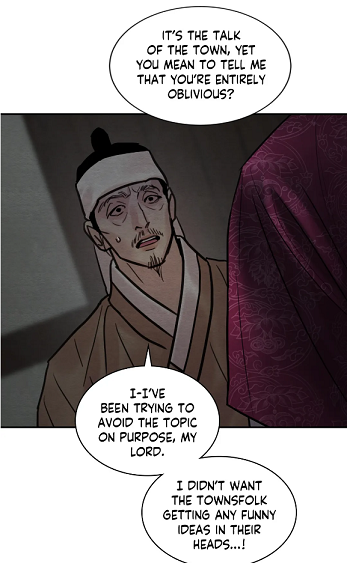 (chapter 108) He had not told him about the shaman’s house on purpose. He had hidden the truth by omission. He justified his decision by using the “townsfolk” and their liking of creating gossips. However his real task was to protect his lord’s interest and inform him about everything. He made a decision without his lord’s permission, and as such he usurped his authority. He acted, as if he knew what was the best for Yoon Seungho. But this doesn’t end. What infuriated me the most are these two declarations:
 (chapter 61) The red-haired master utilized the present perfect tense, which is a combination of the past and present!! This time reveals that the young man was about to move on. On the other hand, the butler is either referring to the past and to the future, but not to the now! This means, he has no regret right now. He is projecting himself in the future. He implies “regret”, but he is not truly admitting it. Finally, when the childhood friend came to regret his choice, he voiced it outside the barn!!
  (chapter 61) This contrast outlines that the storage room is the place of illusion or false faith.
  (chapter 108): Here, my blood was literally boiling, when I read his second “confession”, because here he was now omitting Yoon Seungho. It was, as if the protagonist was not existing. His words were actually reflecting a new betrayal towards the main lead. Here, he was vowing loyalty to Baek Na-Kyum and not to Yoon Seungho!! He insinuated that if he was taking care of the painter, he was protecting Yoon Seungho’s interests. However, the artist and the noble are two different persons. Imagine the following situation: The main lead gets arrested for “murder”, the butler could justify his vanishing, passivity and silence by saying that he needs to take away the painter from the mansion so that the latter avoids getting into trouble as well. As you can see, he would keep his promise, but he would sacrifice Yoon Seungho. With his words, he was insinuating that he only had two choices: the elder master Yoon or the painter. Besides, once the lord were to be removed, Kim could put the whole blame on the painter afterwards. If he had not left the house… That’s the reason why I viewed the last statement as the biggest treason. In reality, he was not vowing loyalty to the main lead. This scene was a reflection from episode 30, where the artist had pledged loyalty to the main lead
  (chapter 30) and this in front of people. This explicates why the butler got grabbed in the storage room
  (chapter 108) like the painter in the courtyard.
  (chapter 30) We could say that it was the butler’s karma for his past manipulation. He had been the one who had encouraged the painter to flee the mansion (chapter 29/30). But this doesn’t end here. When the artist vowed his loyalty to the protagonist in the courtyard, the latter was present, which is not the case here. The artist is left in the dark.
 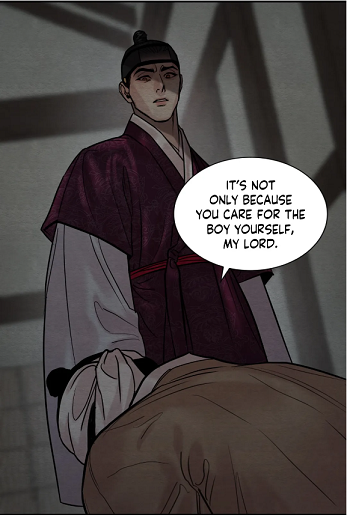 (chapter 108) Where is the personal pronoun “I” here? Nowhere. Only the lord cares for the painter, this was the butler’s declaration in the end. But what about the tears? How could he fake the crying?
  (chapter 81) When the lord had wounded his lover, when he was in a dissociative state, he had perspired so much that his sweat was falling like tears!! As you can see, fear could be the reason why drops of water were falling. Let’s not forget that the main lead had treated Kim very harshly and even threatened to have him killed, something he had never done before.
  (chapter 108) Kim had reasons to get scared and to sweat.
 , chapter 108, or my lord
  (chapter 108) However, the manhwalover should question this. Why did he regret that day? It is because he had revealed his true thoughts about Yoon Seungho to the painter, and he got reprimanded from the artist. Besides, according to me, he had hoped that the artist would leave the mansion due to the altercation. In addition, when he mentioned this scene, he wanted to appear as honest, because he had no idea if the artist had leaked this conversation to Yoon Seungho. Finally, just because he told the truth here, we shouldn’t judge the butler’s confession as verity. To conclude, for me, the valet was not really remorseful, he was more acting.
  (chapter 108) However, this is another illusion which can be easily refuted.
  (chapter 108) This memory is the same than the painter’s
  (chapter 108) In other words, the butler had acted on his own, and informed his master afterwards, when this information was necessary in order to protect himself. As you already know, for me, the butler had definitely acted on his own. But why does Kim need to deform reality so much? It is because he was present, when the young boy was abused sexually and he did nothing. He needs to erase the “traces” of the rape so that his culpability will not come to the surface. Just like the painter, Yoon Seungho has totally forgotten the sexual abuse. Besides, he never mentioned the incidents about the shed to the painter, only the bedchamber.
  (Chapter 87) Here, he was already hiding his guilt by turning Yoon Chang-HYeon into the main culprit. He is responsible for the lord’s suffering.
  (chapter 68), but he had heard a different story from the painter.
  (chapter 93) However, now I understand why Yoon Seungho was not able to discern the hypocrisy from the assistant.
  (chapter 188) It is related to the long brainwashing he was exposed for so many years and the lord’s low self-esteem. Thus I perceive this argument in the storage room as a new version of episode 40, a confrontation between the painter and the scholar. But who had been defeated in the shed? Yoon Seungho was still the loser, for he kept his distance from his lover afterwards.
  (chapter 108) He was making sure that no one would know that the painter was his weakness.
  (chapter 108) The new version of episode 50-51!! However, this was totally pointless, for the painter was living his bedchamber. His position was the proof that the painter was still favored, though the artist feared to be abandoned by the painter.
  (doctor Frost, chapter 187) This means that the couple has to communicate and the painter will interrogate his lover.
  (chapter 187) But this deprogramming is not pleasant, for the destruction of believes leads the victim to question everything afterwards. What caught my attention is that the painter went to the library, the symbol for “knowledge and education” which stands in opposition to the shed. This is no coincidence. Brainwashing is the antonym for insight.
  (chapter 108) In addition, the lord was dressed like in episode 36, he had the green hanbok.
 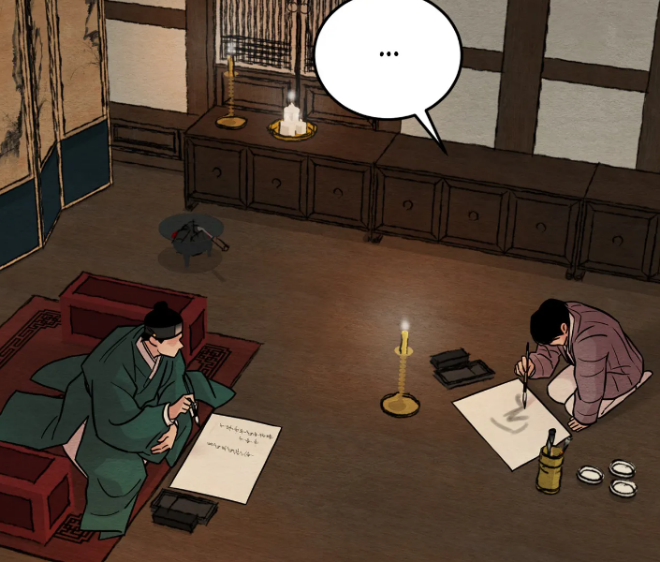 (chapter 36) Back then, the painter didn’t talk to the owner of the mansion. Finally, this episode is connected to the lord’s memories:
 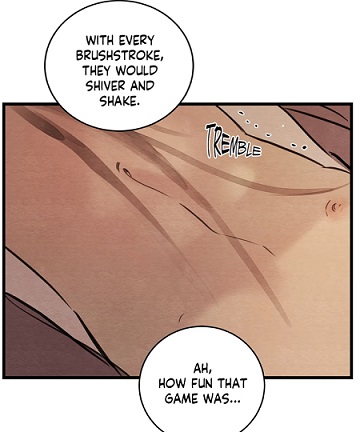 (chapter 36) That’s how I had this revelation. The lord’s suffering is also linked to the library. From my perspective, the young master was dragged from the library to the shed at some point.
 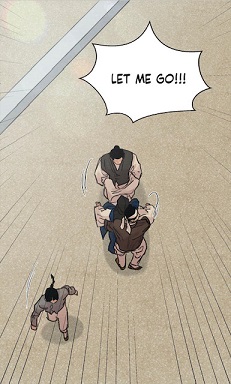 (chapter 77) I had already pointed out that in episode 77, the main lead had been dragged on multiple occasions, for he was dressed differently, and the servants would be different. Because I had described that the lord’s mind had been manipulated by indoctrination and the butler had confessed, I deduce that the next episode will contain elements from episode 48/49.
  (chapter 49) That’s the moment the painter dropped the last principle from the scholar and kisaeng. For me, something similar will take place, but such a deprogramming is painful. From my point of view, Jung In-Hun will be mentioned, as in the same place, the scholar had mentioned the painter’s past and future.
 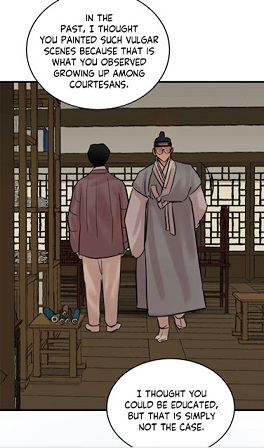 (chapter 40)
  (chapter 40) Since the shed embodies the valet’s betrayal, the lord voiced his abandonment issues there. On the other hand, the library symbolizes the teacher’s abandonment. This is not random. Baek Na-Kyum can not read, the symbol of the learned sir’s negligence. Hence I am expecting a new confession from the artist, like this scene:
  (Tweet) So far, the artist has never spoken ill of the teacher. To conclude, the library is the place where both protagonists will experience a new liberation! For me, episode 108 and 109 are focused on education, responsibility, memories and truth. That’s the reason why I am suspecting that the painter’s words will trigger the lord’s memories so that the verity about his own past will come to the surface.

 (chapter 105) Imagine that despite his rush, he was clear-minded enough to take the yellow scarf, a present that the noble had just bought him before. 😢 The item had more value than the mituri (shoes). Thus he was running in socks. His gesture displayed how much the lord means to the painter. He cherishes everything the lord does for him. At the same time, it indicates his heartache. He was so desperate and scared, for he felt that he was about to get abandoned one more time.
  (chapter 105) According to my follower @katamins, in the Korean version, this is what Baek Na-Kyum yells:
  (chapter 105) it works like a spell or a prayer. The artist is clinching onto this phrase hoping that the noble is remembering his promise. The irony is that the low-born was smiling like a fool,
  (chapter 105) masking his anxieties and huge pain… out of fear that Yoon Seungho would still reject him. He acted, as if nothing had happened: he had not hurt his hand, and the lord had done nothing wrong. The smile became the symbol of his agony which reminds us of Yoon Seungho’s.
  (chapter 83)
 (chapter 85) This means that Baek Na-Kyum was put in the same situation than his lover who wished to keep the artist by his side, but feared to open up to him out of self-hatred and guilt. The painter could get burdened or horrified by his revelations. Hence the painter’s reaction at the end mirrors the yangban’s in the study. Both were or are pleading the partner to stay by their side,.
  (chapter 85)
  (chapter 105) Nevertheless, their behavior diverges so much. The aristocrat couldn’t raise his voice or become violent by using his hand, because he could scare the artist and as such break his previous promise. Finally, by destroying the music box, he had already witnessed that he had pushed his lover further away.
  (chapter 85) At the same time, since he had been taught that no noble should lower himself in front of commoners, it is normal that he couldn’t beg Baek Na-Kyum on his knees. To sum up, the noble had to restrain himself extremely, his face and words were the only way to show his emotions and despair. And the artist sensed it, though the lord was not weeping. The proof is that when the father appeared, the artist changed his mind. He was no longer willing to leave, in fact he chose to look for his lover.
  (chapter 87) This shows that through communication, the lord had been able to affect the painter‘s mind and heart. On the other hand, we shouldn’t underestimate the lord’s flashback and Na-Kyum’s conversation with the butler which played a huge part in the artist‘s decision to vow loyalty to Yoon Seungho despite the secret.
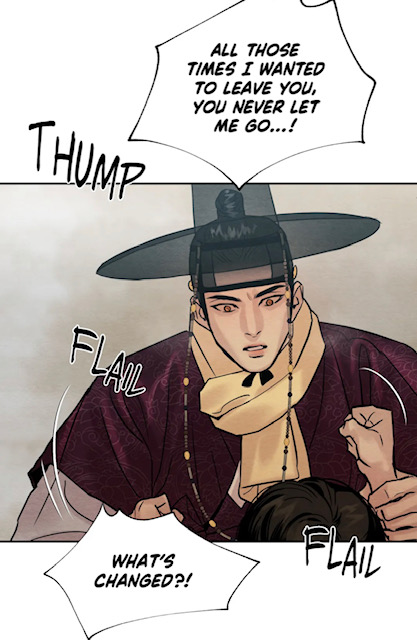 (chapter 105) Then I noticed that contrary to his lover, the artist asked the reasons for his decision.
  (chapter 105) Why did he change his mind? Is he responsible for this? As you can see, the painter came to voice his guilt and the remains of his deeply rooted self-hatred.
  (chapter 105) He must have committed a wrongdoing, he is responsible for the situation. He feels like a burden, for the lord had to take care of him each night.
  (chapter 104) He wished to help, that way he wouldn’t be seen as a spoiled child. He has to justify his presence in the mansion. Who is he exactly that he is sleeping in the lord’s bed? I am suspecting that there is a rumor circulating within the propriety, a new version of this scene:
  (chapter 38) which I will explain more in details below. Thus the artist is making sure to cause no trouble to Yoon Seungho and the staff, especially the maids. Hence he folds the cover and clean the bedroom.
  (chapter 104) Then he washes clothes. He makes sure that he is no burden to anyone. Yet, my impression is that the staff is taking advantage of the artist’s goodness. That’s how they fuel his guilt and shame.
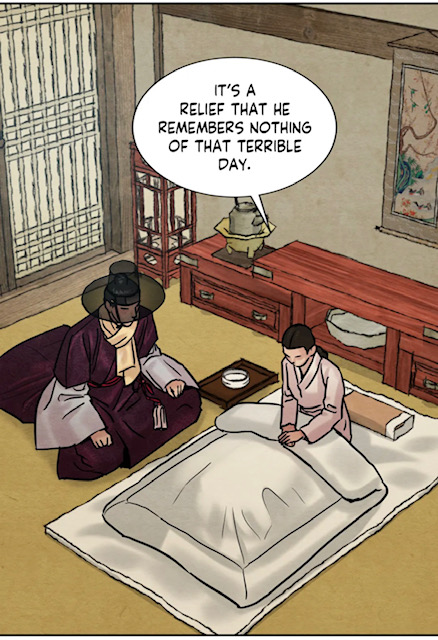 (chapter 105) In the Korean version, this is what Heena says:
  (chapter 104) He was told not to question what he had heard… he should simply consider everything like a nightmare. However, this method is actually wrong.
  (chapter 07)
 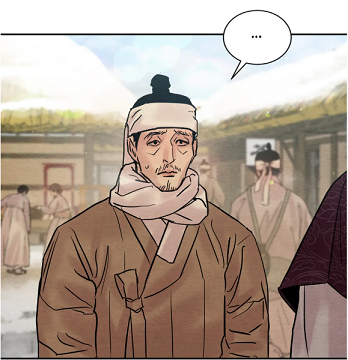 (chapter 104) Not only he knows about the lord’s traumatic past, but it is the same for the painter. In addition, we have another explanation for Yoon Seungho’s insomnia and dissociative state.
  (chapter 57) Not only the latter was turned into the scapegoat for the downfall of the Yoons, but also he was not allowed to reveal the incident, the so-called treason. Why? It is because if he had spoken, the truth would have come to the surface. He was simply a victim. And now, the schemers and accomplices are repeating the same MO. Who suggested to Yoon Seungho to say this to his lover?
  (chapter 104) Naturally, Kim, because he is now the only one in the mansion who knows his past. Besides, why do you think that the lord’s past is coming to the surface as a nightmare? It is because he was incited to repress everything. But since the painter is going through the same experiences, this is not surprising that the noble’s memory is triggered and the past emerges again.
 (chapter 27), when the other domestics left the propriety. This was his memory. Besides, like the servant confessed to Jung In-Hun, a huge part of the staff got replaced. This means that the lord was suddenly surrounded by people he didn’t know. Because my theory is that the young man was treated as a male kisaeng, this signifies that the new staff could never view the main lead as a noble. Besides, despite the betrayal, the elder master and Yoon Seungwon were his real family. Finally, Yoon Seungho had no saying in this, and I can imagine that the reason for this decision was not explained immediately. This must have been a huge blow for him as well. He must have felt lost and homeless. The result was that from that moment on, he became more dependent on the butler. And we have to question ourselves what the butler did with this huge responsibility, when the elder master moved to the second house.
 Since this phrase appears in connection with the staff (maids and servants) in the courtyard, I come to the conclusion that the authors of this gossip are in the domain. “Fellows” indicate that they are speaking among themselves. But I have two more clues proving that the traitors are the domestics. First, observe how they call the protagonist: Young Master Yoon.
  So far, people in town only calls the protagonist lord Yoon
  (chapter 45)
  (chapter 45) or lord Yoon Seungho
  (chapter 39) or my lord.
  (chapter 76) Only the staff addresses him as “young master”.
  (chapter 103)
  (chapter 103), and this since season 3. This coincides with the meddling of the Yoons. The servants treat him, as if he was not an adult, no real lord. But they are wrong, because he is wearing the topknot with the gat. Hence he is a lord. Finally, only people close to the couple could know about the painter’s tragedy.
  , because in the village and town, there exists another gossip:
 (chapter 104) Thus I conclude that the gossip from the trailer is spread among the staff on purpose. They wished Baek Na-Kyum to hear it so that he will feel responsible, especially after hearing this.
  He is responsible for the lord’s lunacy. Under this new perspective, it explains why the painter is leaving the bed and working. He wishes to prove the words wrong. On the other hand, I think that Yoon Seungho also heard a grapevine in the domain, but a different one:
  (trailer). “He has many enemies”. How did I come to this idea? It is because he is addressed as Yoon Seungho! By underlining the painter as his weakness, the author of this rumor wishes to separate the couple. If he were to place the painter elsewhere, not only the latter would no longer be targeted, but also the lord would have no longer any weakness. Since there is always a reflection within the same chapter, I conclude that a second grapevine was spread in episode 104. This happened, while the lord was away. Thus the painter smiled like a “fool”, when he saw the lord:
 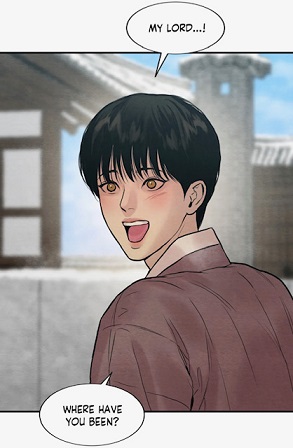 (chapter 104) As you can imagine, for me the maids were the perpetrators, a new version of episode 79
 (here, the woman implied that the artist was responsible for Yoon Seungho’s insomnia, thus the painter has a drop of sweat on his face, a sign for shame) and chapter 98
 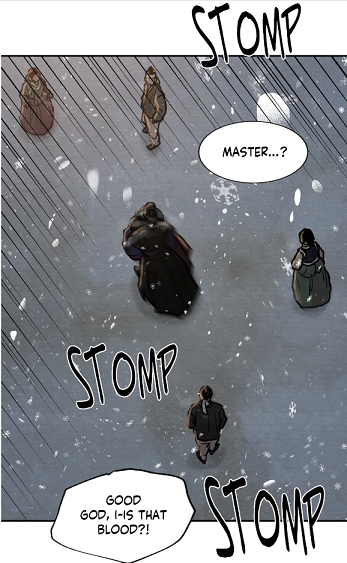 (chapter 103) Finally, the staff has every reason to get rid of the artist, for he is the witness of their wrongdoings. They definitely played a major role in the “prank”. They didn’t learn their lesson.
 (chapter 29) This time, the one smiling like a fool
  (chapter 29) was Jung In-Hun who acted, as if he knew nothing and had seen nothing.
 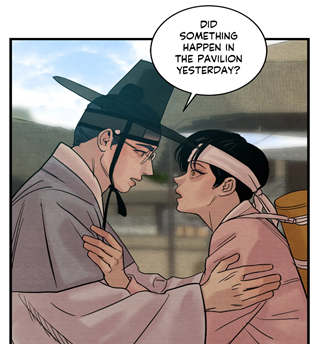 (chapter 29) However, I have already pointed out that he was present, when the rape took place, for he knew where Yoon Seungho would meet the artist: the pavilion. And what have all these episodes in common? The first thought would be to say: abandonment and betrayal. The painter in front of the gibang felt “betrayed” and abandoned, but what shocked the lord so much was when the artist started blaming himself:
  (chapter 105) We have to imagine that the painter wanted to say that he regretted to have opened his heart to the protagonist. Thus he said this:
  (chapter 105) “I had known, I would have never confessed” Nonetheless, he never finished his phrase, for in reality, he had no regret!! He was sure that he had made the right decision. It is because he had pondered a long time about this. He had observed his lover. That’s the reason why he mentioned their mutual love confession and as such their promise to stay together. And this brings me to the next observation. All these scenes have another common denominator: BAD DECISIONS!! The lord had made the wrong decision to entrust the painter to the kisaengs. Thus he came to regret this. He had made his lover cry, and even wounded him, though he desired to do the opposite. Therefore it is not surprising that he apologized to his lover.
  (chapter 105) This shows that the painter is showing him what true love and loyalty are. Moreover, he is teaching to make good decisions.
 (chapter 246), I realized why Yoon Seungho suffered so much. Self-made decision implies a conscious choice. It is made deliberately and thoughtfully, considers and includes all relevant factors, is consistent with the individual’s philosophy and values. As you can see, it implies knowledge. This definition exposes that making a choice for the sake of another person without his consent or knowledge can never be a good decision. One might argue about this, because children are too young to make decisions. In Doctor Frost, this man
  (Doctor Frost 246) decided to support a terror attack, and justified this by saying that this was for his daughter’s sake. But like the counterpart pointed out, he questioned his decision. Was it truly his choice, or was he simply following the leader’s suggestion? As you can see, the daughter was used as an excuse, it was never for her sake. This shows that children are the exception, besides they are often raised by two parents. Thus they are making deliberations together. But like the author revealed in Twitter, Yoon Seungho’s mother hated her husband so much that she neglected her eldest son. The patriarch made decisions on his own, but observe that it was always for the Yoons’ sake. This means that the father never took his son’s well-being into consideration, he never asked him about his opinion. He imposed his will, but he listened to others, like we could see in different occasions.
  (chapter 57) He fed his son with the drug prescribed by the physician, though the latter stated that he had no idea about the illness. Then he listened to father Lee’s complains and reproaches. He never questioned the intentions behind his actions and words.
  (chapter 82) Here, the red-haired bearded man was encouraging the elder master Yoon to return to the mansion and claim his rights. Finally, the young master admitted this to the messenger:
  (chapter 80) If someone stroke his ego, he would follow their advice and never doubt their words.
  (chapter 104) But he simply employed reverse psychology.
  (Chapter 85) Yoon Seungho was coerced to open up. If he did not, he wouldn’t be forgiven. Naturally, the painter meant it well, yet the main lead was pressured to reveal his „bad action“. The main lead feared his negative judgement and rejection. We could say that the artist had made this request for the lord’s sake, however this was not a conscious and long deliberated decision. And now, you comprehend why the main leads suffered both so much!! Yoon Seungho’s mother neglected her eldest son, but she kept her distance from her husband. They never talked to each other, and as such never made decisions together. And it was the same for the painter. The kisaeng Heena was the one who made the decision without the noonas’ consent and her brother‘s opinion.
  (chapter 105) She is still viewing the painter’s decision as a bad choice. But she is simply wrong, for the painter listened to her advice and after deliberations, he chose to open his heart. His confession was not made in the heat of the moment.
  (chapter 62) The lord’s vision
  (chapter 62) became a reality
 (chapter 63) Because the painter has always been betrayed and abandoned himself too, such words could only move the artist. There was someone willing to be by his side and to give him a home. Therefore it is no coincidence that the artist brought up these words from that night.
  (chapter 97) And why did she act like that? She justified that it was for the painter’s sake, and she knew more than her brother. The reality was that it was for her own sake. She was definitely cornered, for she feared repercussions. Moreover, she pushed her brother to follow her advice. And now look at what the noona said in front of Yoon Seungho:
  (chapter 99) and her “fake death”, but as you already know, I think, he heard her during that night. Note that the painter didn’t meet his noona Heena during that day. Since Heena and the staff played tricks so that Baek Na-Kyum ended up going to the scholar’s house, it is not surprising why the staff is putting the whole blame on the painter. However, who is responsible for this? Naturally, the staff, Kim and Heena. The latter made bad choices blinded by her arrogance and prejudices. Thus I deduce that Yoon Seungho learned a good lesson in front of the gibang. He should never make a decision without consulting his partner.
  (chapter 105) From my point of view, both need to learn to make decisions TOGETHER!! But in order to do so, the two main leads need to listen to each other and communicate. And this is what truly happened in episode 105. The young noble discovered the painter’s low self-esteem and his guilt. That’s the reason why I believe that Yoon Seungho will decide to talk about the scholar. The lord suspects the learned sir, for he thinks that he is still alive.
 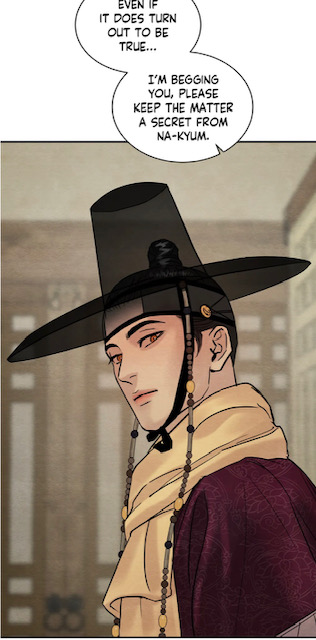 (chapter 105) This signifies that the noble will decide not to follow the noona’s advice:
  (chapter 105) But by learning about the learned sir’s past, the protagonist will realize that he only knew a side about Jung In-Hun.
 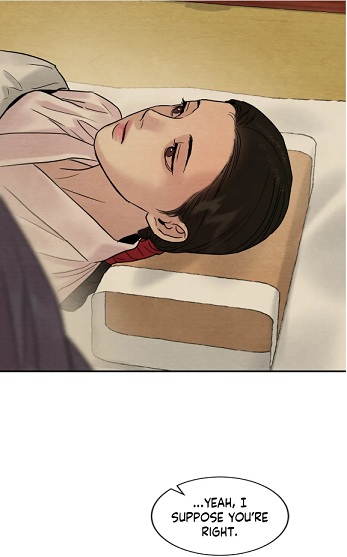 (chapter 105) with the noona’s statement, the painter looks happy with Yoon Seungho despite the tears, it looks like the noona is slowly coming to terms with her brother’s relationship. But I have to admit that I believe that her “decision” is just short-lived. First, in season 2, the noona had accepted to let her brother stay at the Yoons’
  (chapter 69) But then she had changed her mind after hearing the menace from the servant. However, I have three other reasons to expect a change of heart from the head-kisaeng. First, Heena is the younger reflection of the butler. The manhwaphiles shouldn’t forget that the valet had almost come to terms with the painter’s presence
 (chapter 65), but the ruckus caused by the kisaeng had provoked a change of heart in the valet. Then, the lord had made the following condition to the kisaeng:
  (chapter 105) The lord is keeping his lover by his side, as long as nothing happens to him. So if he gets into trouble… she could achieve her goal, the painter is returned to her. But the most important clue is for me the bowl!
  (chapter 105) While many jumped to the conclusion that this was the medicine sent by the physician, I had a totally different impression. For me, this bowl was used to write a letter!! First, the color is different from the normal “medicine”.
  (chapter 23) Most of them look dark brown and not black.
  (chapter 36)
 (chapter 77) Besides, it never leaves traces on the edge.
  (chapter 36) The points on the border are the traces left by the brush. She wrote a letter. And I have another evidence for this:
  (chapter 36) The painter used white bowls while painting. On the other hand, the lord wrote a letter during that time. As you can see, in episode 36, we have the combination of painting, seduction (touching) and medicine… exactly like in episode 105. The artist tried to paint a lucky charm, a tiger, but he didn’t finish it. He got interrupted… which is very similar than in chapter 36. So the letter should represent another common denominator.
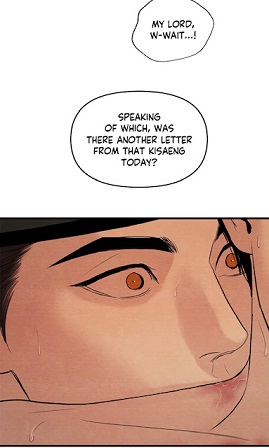
 (chapter 105) onto Yoon Seungho. Will she come to regret her action or not? One thing is sure, the painter accepted the sincere apology from his lover. How could he not forgive him after calling „Nakyumah“ and embracing him!
  (chapter 105) Both left the gibang together, while the artist was removing his tears. And this leads me to the final observation.
 (Chapter 76) By making the same decisions, it is not surprising that the same deed can never succeed. It was not a real self-made decision. They simply followed a pattern.
 (chapter 101) so that he could put the blame on his “friend”. But the problem is that he was caught red-handed. Hence he ended up executed. On the other side, the corpse in the well was supposed to be Deok-Jae
  (chapter 98), although he was wearing clothes similar to the learned sir’s. What caught my attention is the expression Yoon Seungho employed: “pretending”. With such an idiom, he was implying that the servant had not only violated social norms, but also he had been acting. As you can sense, these two situations have one common denominator: playing a role and the clothes served as a disguise. It was, as if both victims of a murder had been playing in a theater play. This explicates why in the fanart, the author is portraying Baek Na-Kyum and Yoon Seungho as actors who are working in a sageuk.
  And this made me think of the famous poem from Shakespeare who describes life as a stage, where a person plays different roles all along his life: an infant, a school boy, a lover, a soldier, etc., until he dies, which is symbolized by an eternal sleep.
  (chapter 98) Why? From my point of view, they were trying to scare the main lead, to remind him that he could never replace Jung In-Hun in the painter’s heart, to shake his belief. But the problem is that the schemers had missed the right timing, for the artist had already confessed his love for Yoon Seungho and this twice. Therefore the latter couldn’t doubt his lover’s words, and mistake it for an illusion. As a conclusion, the clothes were used tools to trick the couple, they had become costumes!! However, because the author is using karma as poetic justice, this signifies that the hanboks and shirts can serve as a clue to perceive the truth too. The ones who tried to deceive the protagonists with clothes and words, should be fooled by their own manipulations.
  were different from the head-maid and her colleague?
  (chapter 94) Their clothes were almost identical, yet their body shapes and the cut of the shirts diverged. That’s the reason why I deduced that in episode 98, the author had the intention to manipulate the manhwaphiles. But in order to escape the trap, the readers needed to look carefully at the characters’ clothes. This was the clue that Byeonduck had left for the readers to discern the truth. And now, look at this:
  (chapter 98) What was the painter wearing on his way to the bedchamber? White pants with his Mountbatten pink jacket. But how did he show up at the learned sir’s home?
  (chapter 98) He was dressed differently. 😮 He had changed his pants, put on his scarf and hat. But when he went to the lord’s study, he was not carrying them!! How do we explain the difference? The answer is quite simple. He had returned to his room in order to fetch his clothes. And since Baek Na-Kyum took the lord’s clothes, this signifies that he had the intention to return to the domain. The readers will certainly recall the artist’s behavior, when he had threatened the main lead to leave Yoon Seungho. He had switched his clothes, and put on his old clothes.
  (chapter 98) Thus if the lord had gone to the study, he would had realized that the painter had not deserted the propriety, for he had not taken his belongings with him. The hat and scarf were signalizing that Baek Na-Kyum considered himself as a member of the Yoons‘ household.
 (rule 3) If only Yoon Seungho had left a word… The servants served as his messenger. Hence I am convinced that Baek Na-Kyum must have talked to the maids and told them where he was going!! He copied his lover, yet contrary to him, he must have given a precise information. (Rule 5) This means that he had informed the staff about his departure!! Moreover, in chapter 98, the maids acted, as if they had not detected the painter’s presence while badmouthing Yoon Seungho.
  (chapter 99) Then the scarf was no longer present, when the painter woke up. Then the nobles removed his shirt, socks and pants in the shrine.
  (chapter 100) And now observe that after Lee Jihwa’s departure, the artist’s clothes except the white shirt vanished too.
  (chapter 102) Where did they go? The readers saw Black Heart leaving the building, but we should question this: WHY? He never went there to fetch lord Shin, since he abandoned him outside. We all imagined that he left the room empty-handed. But it is true? Now, I don‘t think so. He had to get rid of the clothes in order to mislead the main lead!! A new version of chapter 61
  and
and 97! Furthermore, was Min talking to himself, when he said this?
  (chapter 101) Because the readers could detect the presence of a shadow in episode 102
  , I am now envisioning that Min was not alone outside during that night. In fact, someone had misled Black Heart telling him that lord Jihwa had ran away. However, the unconscious lord Shin should have made him think that Lee Jihwa had fought back… Hence he had not fled, rather betrayed them. Moreover, he was not looking at the direction of the entrance and gate. In fact, he was turning his gaze in the direction to the shrine.
  (chapter 102) Since he had informed Yoon Seungho through the maids about his whereabouts, Baek Na-Kyum was expecting that he would come to his side. I would like the manhwalovers to keep in their mind that the artist was not conscious, when he moved to the shaman’s house. So in his mind, he was not far away from the learned sir’s house. Finally, since he had informed the maids, he could anticipate that the lord wouldn’t get mad at him, and wouldn‘t imagine that he had abandoned him
  (chapter 101) He trusted his lover’s heart in the end. That’s the reason why Black Heart’s superficial promise had no effect on Baek Na-Kyum. The latter truly believed that Yoon Seungho had been informed. But how could they play such a trick on the couple?
 This is an indication of their involvement, though we need to discern the head-maid from the women in chapter 98. That’s the reason why the moment the maid appears, observe her clothes and try to discern her identity. Is this the head-maid or one maid from season 3? The preview displayed the arrival of the doctor.
 (chapter 103)
  The form of the beard is also similar. But now, I have another evidence that this doctor from season 4 is not the physician from season 2!!!
 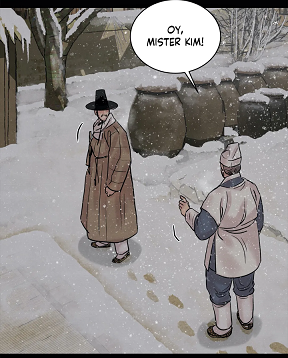 (chapter 63) The shoes are also different! That’s the reason why in the trailer, the beholders are seeing the physician’s shoes!!
  He doesn’t possess mituri like the other. Moreover, he is wearing a hanbok under his apron
  , while the other is dressed more like a commoner, a shirt with pants. And note that in chapter 33, we had the following combination: Min’s party, the visit of the doctor, Baek Na-Kyum’s illness, the maids and Yoon Seungho who “ran away” after his mistake. (rule 1 and 4)
 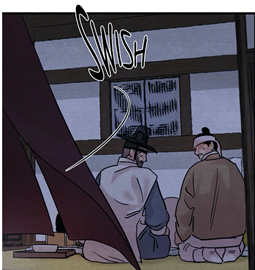 (chapter 33) And what had Kim done during his examination? He had not only threatened the physician
 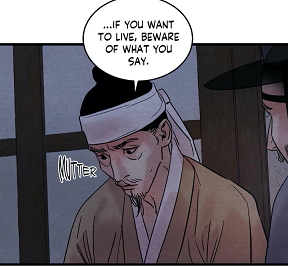 (chapter 33), afterwards he had even badmouthed him, for he had not given the correct diagnosis.
  (chapter 33) However, here the butler had simply lied to hide his own wrongdoings: his passivity and silence. And note the doctor’s words addressed to the “beholder”:
 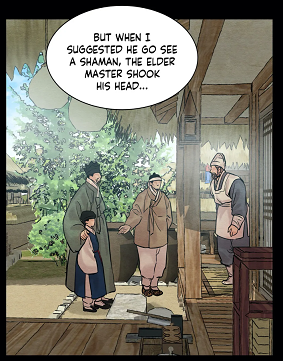 (chapter 57) The latter was introduced to Yoon Chang-Hyeon through the butler. The protagonist must have had a doctor in the past. Can you imagine a life without a doctor for 13 years? And this assumption was proven correct after the release. But let’s return our attention to the physician from season 4.
 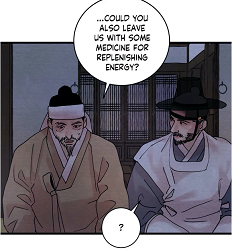 (chapter 33) (rule 1-2-3) But why would he do such a thing? Simply, because he had been helping Min. He needed the protection of a powerful lord, since Kim had abused his position by threatening him. After seeing the new pictures from chapter 103, I had this sudden revelation. What did Min do after getting beaten by Yoon Seungho?
 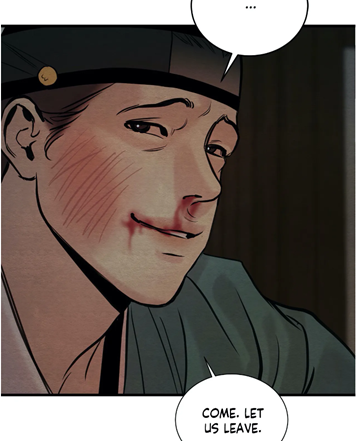 (chapter 54) He certainly didn’t let his wounds untreated. Thus the next morning his face
  (chapter 56) looked much better. He had no swelling and the redness was already vanishing. From my point of view, he asked for the doctor’s assistance and that’s how the both came to an understanding. But since Min is now dead, the physician could get into trouble, for he helped the lord and now he is dead. But why am I so sure that the physician is about to run away? Look at all these images:
  (chapter 44)
 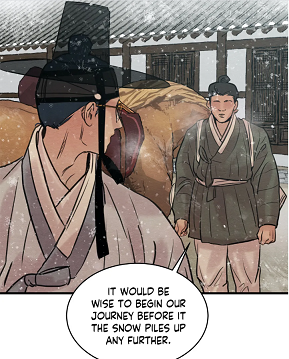 (chapter 44)
  (chapter 45)
 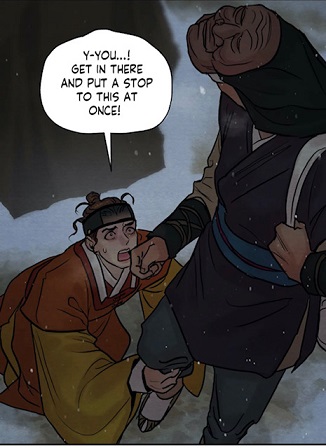 (chapter 100)
 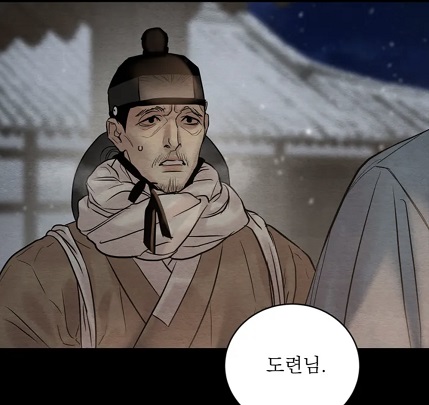 They are all carrying the white bag on their back… and they are about to depart! Kim wished to leave the propriety with his master under the pretense that he was bringing misfortune to the painter. All this proves that the doctor is far from being innocent. Hence he wishes to run away. However, if he does this, this means that he exits the “play”. So he could die. Moreover, how did he know that the lord would return to the mansion with the wounded painter? I can not answer to this question with certainty. However, I would like to point out that since Min talked to someone in the shadow, it is very likely that this person had long planned Black Heart and his friend’s demise. Nonetheless, the schemers had not foreseen two three elements:
  (chapter 61) [For more read the essay “No matter what… Baek Na-Kyum must vanish”]
 (chapter 59) Lord Jang had disguised himself as Black Heart’s friend, the hanboks looked very similar.
  (chapter 99)
 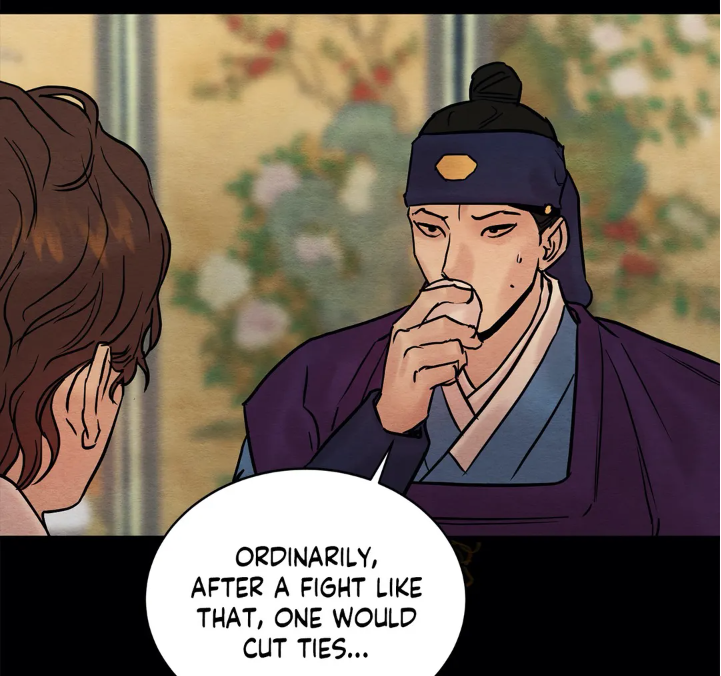 (chapter 59) The schemers mistook him for the noble with the mole.
 (chapter 61), for the colors grey-white off are only seen at the Lee’s.
  (chapter 9)
  (chapter 18, Lee Jihwa’s spy)
  (chapter 41)
  (chapter 50)
 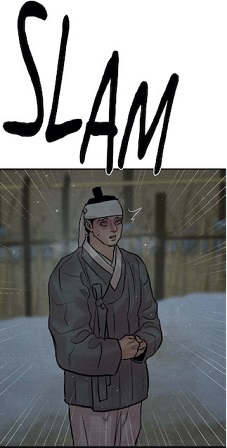 (chapter 100) And now compare these servants to the staff from chapter 97:
  Their colors are all different reflecting that Yoon Seungho has no control over his staff. But what did the staff do in episode 61, when they manipulated the lord by saying that the painter had run away? One of the domestics offered the scarf and headgear to the lord:
  (chapter 33) Yet, the painter survived, hence the doctor has every reason to run away. His complicity could come to light… on the other hand, the moment he leaves Yoon Seungho’s side, he is no longer protected. The reason is simple. He owns a part of the truth, and what the schemers are attempting to do is the exact opposite: burying the truth so that their act is not discovered. And now who participated in this huge “drama”? The list of the suspects is quite long… Father Lee
  (chapter 82), lord Yoon Chang-Hyeon
 (chapter 74), “lord Song”
  (chapter 83), the “fake servant” alias the king (for me)
  (chapter 37) There is no doubt that a tailor was involved, for he had to create similar clothes, the costumes …
 (chapter 64) All have one common denominator: the BEARD. They are OLD BEARDED MEN!
 He is on the ground, his face bruised and bloody, while he is asking an anonymous man for help. He is mentioning the shrine. As he is wearing the same hanbok, we can definitely assume that this scene takes place during the same night. The irony is that each time Byeonduck offers a new piece of a puzzle, she also creates a new riddle or mystery. How did the young master get wounded in the first place? And who is the person facing lord Shin?
  (Chapter 59)
 (chapter 66) The size and length of the protections and the cords around the pants were different. Besides, the masks were also different due to the form of the mouth..
  (Chapter 61)
  (chapter 61) Finally, I had also detected his presence next to the barn because of a time jump. First, the manhwaphiles saw Lee Jihwa sitting on the floor,
  (Chapter 60), then shortly after he was standing at the entrance of the storage room holding a fireplace poker!
  (chapter 60) His position indicated that the young master had shortly left the building. However, the readers had not witnessed his move, for the author had diverted their attention by exposing the character‘s inner thoughts. He was recollecting the past, while talking to himself.
  (chapter 60) However, how did the fire poker end up in his own hand? The last time this tool was seen, it was in the kitchen.
  (chapter 60) As you can see, each image has its importance! However, I doubt that the upset aristocrat had this sudden idea and returned to the kitchen and take the fire iron. His mind and heart were definitely elsewhere, while such an action exposes the intention of hurting someone. Jihwa was acting, as if he was in trance, the moment he saw the hickey and heard the painter’s scream. His long lasting stupor was visible in this image.
 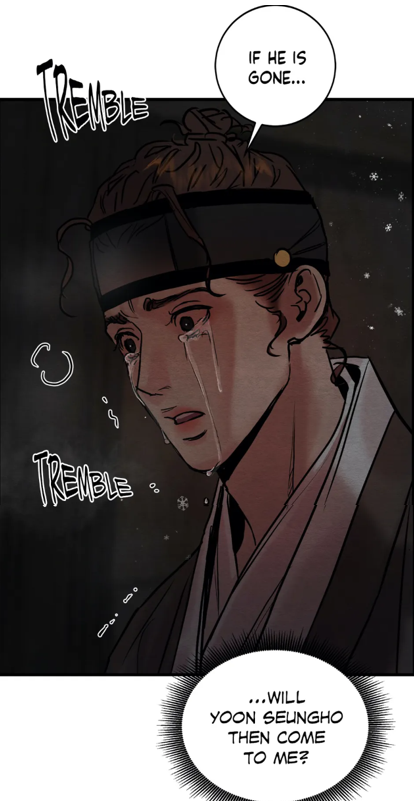 (chapter 60) That’s the reason why I had developed the theory that someone was hiding in the shadow, next to the barn and observing the evolution of the event. [For more read the essay “
 (chapter 57) It is because they serve as a clue for unveiling the truth.
  (chapter 62) It is the same furnace! 😨We all assume that the lord prepared the fireplace, because he put his clothes on his lover. But is it true? We were all jumping to this conclusion, but actually we never saw it. Our brain was led to fill the blanks.
  (chapter 61) Finally, the readers were all assuming that the butler had never entered the storage room due to this image and his action before.
 (chapter 61) But is it true? He could have opened the door before, and go to the lord in order to explain his intervention. Faking his concerns for the painter. Why would he place the fireplace there? He wished that the warmth from the fire would wake up the painter. Hence he remained close to the gate of the storage room. That way, he had a reason to visit his master. Moreover, the author exposed that the valet had been keeping an eye on his master for a while too.
  (chapter 62) Because the valet went to his master, we got the impression that the valet had followed his master’s instructions.
  (chapter 61) In fact, this request could be perceived differently. The lord had seen the butler’s intervention, hence he expressed this wish. From my point of view, the butler must have brought the fireplace to the barn, and he left the poker there on purpose. I am quite certain that some people will think that I am again exaggerating. But why did the butler put a fireplace with a fire iron in the lord’s room, when the coal was not properly lit?
  (chapter 88) Consequently, I am suspecting that Kim had expected an outburst from Yoon Seungho. The latter could hurt his father with the fire iron. But none of this happened, for the lord preferred playing a comedy.
 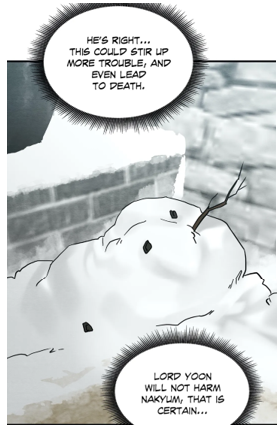 (chapter 65) He had expected that the lord would hurt the main lead. But how was he supposed to harm Baek Na-Kyum in the end? With the fire iron… This signifies that he had been present in the barn during the abduction, and even knew the place of the sequestration. Thus he took the furnace and the fire iron to the shed.
  Compare his face to the painter’s who got wounded by wooden sticks.
  (chapter 99) Besides, this theory also explains why the shrine is set on fire.
  (chapter 103) The fire iron is connected to a stove. Finally, I would like to outline the absence of the furnace in the shrine, though it was very cold outside.
 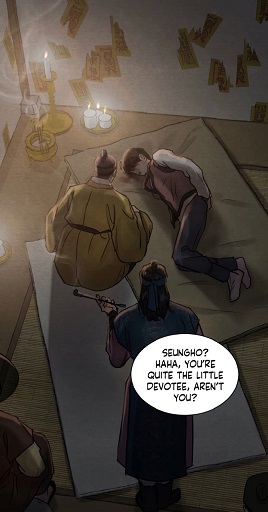 (chapter 99) So when the lord said this to his lover
 (chapter 88), we could interpret it the following way. It was once again a vision from the future, he was seeing from lord Shin’s perspective the betrayal.
  (chapter 60)
  (chapter 60) At no moment, he was told that his childhood friend had been brought to the physician’s. He just heard him leaving. Moreover, the joker never mentioned the place where the couple was fooling around.
  (chapter 60) He didn’t even admit that he had seen them himself. These were memories from someone else! One might assume that these could represent the criminal’s recollection, but I don’t think so. He arrived much later to the physician’s house. If he had been present right from the start, he could have kidnapped Baek Na-Kyum on his way to the restroom.
  (chapter 59) To conclude, the person with such memories
 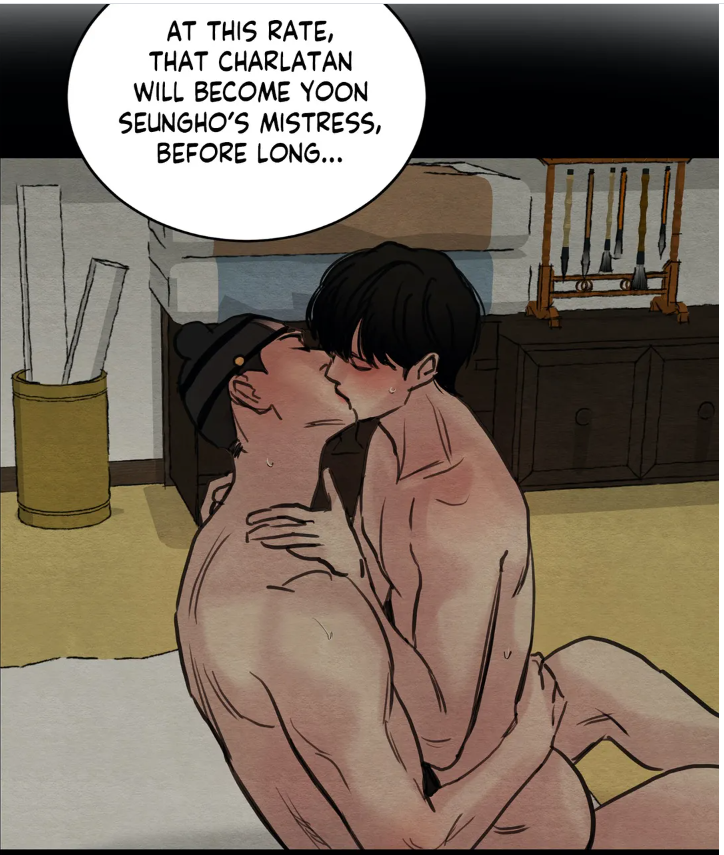 (chapter 43) Here, he had visited the place, hence he could imagine what had happened, though he never saw their encounter according to me. [For more read the essay “
 (chapter 58) He had left the bucket of water in the patio! But note that when the painter left the room, the item had simply vanished.
 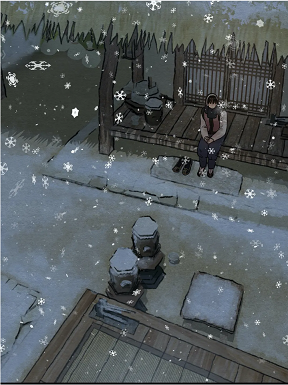 (chapter 59) The painter was not supposed to detect his presence.
 (chapter 100) The manhwaworms can grasp the similarities. Back then, the lord had refused to help Baek Na-Kyum, thus he was even encouraging Lee Jihwa to return to the shrine. Hence he had acted as a willing accomplice and perpetrator. Thus his karma is to be denied any assistance, he is punished the same way than his friends, Min and the other nobles. Finally, observe that the red-haired master
  (chapter 66)
 (chapter 99)
  (chapter 88) Abandonment and rejection versus embrace and acceptance. And what had Yoon Seungho said during that fateful night?
  (chapter 88)
 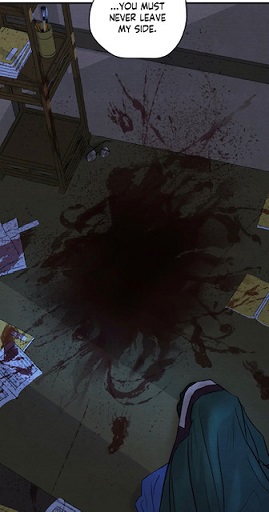 (chapter 88) But while the painter was exposed to sexual abuse, lord Shin had indeed left his friend’s side. In my eyes, lord Shin embodies treason. As you can see, I conclude that lord Shin is about to get assassinated and from the person he expected the least. Why? It is because no one has to realize that lord Shin ran away from the shaman’s shrine.
  (chapter 7),
  (chapter 65) or boots
  (chapter 13)
  (chapter 83) As you can detect, I see a strong connection between the new panel and the hunt from chapter 83. And here we have 3 people again.
  (chapter 68) She was again a witness, when her brother was tied up in the bedchamber.
  (chapter 66) Finally, when her brother was on the verge of getting abducted, she saw him lying unconscious with a bloody face. However, she never considered it as an abduction, for his hands and feet were not tied up.
  (chapter 99) That’s the reason why she blamed him with her questions. She implied that he shouldn’t have fought back. As you can see, I detect a common thread between Heena and her presence in different scenes: sequestration and a bloody face. But this doesn’t end here. When the young painter got beaten in the gibang, there was a furnace on the left side.
  (chapter 94) For me, this incident was to push the painter to leave the gibang and as such to listen to Heena’s suggestion. Furthermore, the man on the left side was wearing a white headband, though he was dressed like a noble in a hunting outfit! The hair dress and his moustache [for more read the analysis “Painful departures”] led me to the following assumption: He was just a commoner in the end, impersonating a noble.
 (chapter 102) This is the evidence that someone had manipulated the crime scene. The clothes from the painter could serve as evidence of her brother’s curtains. Heena could come to the conclusion that Min had gone back on his words, and her fake death, which had definitely shocked
  (chapter 99) and bothered her, could only be perceived as real at the end. But this means that while Yoon Seungho had murdered the nobles, there was someone hiding in the shadow
  (chapter 61) And according to me
 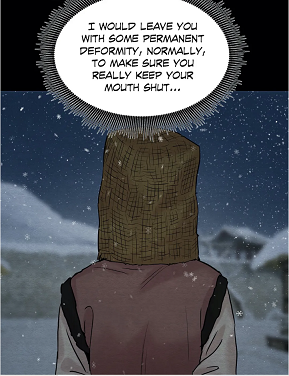 (chapter 66) However, his new attempt to have the painter vanished failed again.
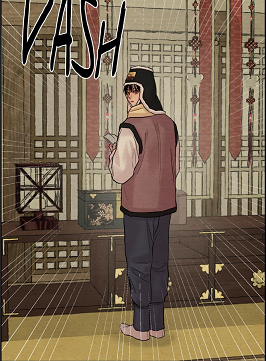 (chapter 97) It could be the same, though I have my doubts. Secondly, I suddenly got aware that the painter had 3 different grey pants at least.
  (chapter 4) This one had a cut just below the knees, though the color is much brighter.
  (chapter 84) This is the third one I detected, as the shape of the pants diverge once again. This explicates why Baek Na-Kyum chose to change his clothes before leaving the mansion.
  (chapter 97)
 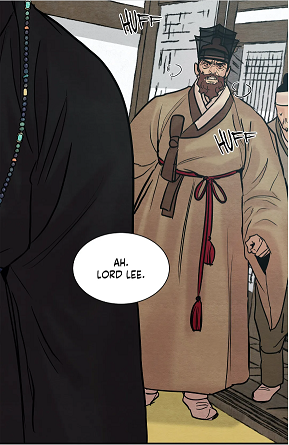 (chapter 67)
  (chapter 67) Their pants have either a different pigment (white, black, khaki, or light grey) or the shape is different. That’s the reason why I am assuming that the person was wearing these trousers on purpose. A new version of this scene:
  (chapter 83) What did the lord see back then? Three shadows, two men wearing a gat and one caught in the middle with a topknot. Since I consider Yoon Seungho as a shaman, I believe that this vision was not only referring to the past and the incident in the shrine. It exposes the immutable truth, the involvement of three people, either. This is no coincidence. Thus imagine one moment that this illusion was referring to lord Shin’s murder. He is about to get murdered because of a new conspiracy. From my point of view, the man is disguising himself. However, I doubt that he is wearing the lord’s boots. The latter could be “couple boots”, just like the lord and the painter had couple hats.
  (chapter 91) And note during that day, Baek Na-Kyum was called sir due to his hat and clothes.
  (chapter 91) However, if the woman had paid attention to his shoes (mituri), she would have realized that our beloved painter is just a low-born. One might think that I view Kim as the one facing lord Shin.
  (chapter 54) But the readers should question themselves this: why did Kim dress like this in the first place? From my point of view, the schemers have already planned to frame Baek Na-Kyum for the murder of the nobles and even of Jung In-Hun. Kim is trying to separate the couple so that the artist can be arrested easily and sentenced immediately. By burning the place, the evidence that Baek Na-Kyum was a victim vanished. That’s how they can manage to turn a victim into a perpetrator. They wanted to erase every trace of the crimes, but then the return of the painter will force them to change their plan. The fire can help them to turn Baek Na-Kyum into a scapegoat. That’s the reason why the anonymous shadow is wearing clothes similar to the painter’s. No one should recognize him. Later, Baek Na-Kyum can be “identified” as the culprit. And any blood trace on his clothes could serve to incriminate the painter. They could use the resemblance of the clothes as a proof for his crime. That’s the reason why lord Shin had to die in the end. And if lord Shin never doubted this person, I am suspecting that the latter is working with the authorities. Kim is not the only suspect, for according to me, there always exist a conspiracy of 3 and even 5 people. This observation leads me to create a list of suspects. First of all, Yoon Seungho’s confession to the learned sir should help us to determine the schemers and culprits.
  (chapter 44). A synonym for old bearded men is “elders”. The latter are supposed to serve as role models. That’s the reason why the young man didn’t suspect the man. With his beard, he must have oozed “responsibility” and even “selflessness”. But who are the suspects?
 from the bureau investigation is definitely involved. Thus he misled Yoon Seungho. Besides, observe that the officers are connected to fire!
  (chapter 94) Secondly, his explanation implied the involvement of a physician.
  (chapter 57) Finally, the painter met the Joker again on the same day he visited the physician.
 (chapter 75) Finally, why was the doctor never brought to the mansion again after his last visit in chapter 57? And it looks like he was not there to treat Baek Na-Kyum.
  The latter is suffering from PTSD. Thus the painter had a nightmare. Hence I have the impression that the butler’s intervention and suggestion to Yoon Seungho will fail. The lord won’t be able to leave his side. Moreover, I would like the readers to recall that when Baek Na-Kyum got sick, a different physician was fetched.
  (chapter 33) Different clothes displays a different identity. From my point of view, the doctor doesn‘t want to be connected to Yoon Seungho. Finally, don‘t you find it weird that he was not by his side in chapter 57? He literally abandoned the young master in the room with the painter
 (chapter 57), though the latter was a patient too. He had a wounded wrist. The physician should have controlled Yoon Seungho’s fever, brought him water and even an infusion. His absence and passivity caught my attention. So what was he doing in the kitchen? Finally, the doctor is also connected to the shaman. Not only he mentioned him, but also there is the symbol of shamanism in his kitchen. Why did the gods want our couple to have their first “true” love session at the physician’s office? Somehow, it was to confront him with the truth. Finally, don’t you find it weird how Kim reacted
 (chapter 82), when the new version of Deok-Jae made the following suggestion to Kim:
  (chapter 82) Hence the doctor is not off the hook, quite the opposite.
 (chapter 67), and discovered Lee Jihwa’s sodomy which was supposed to be a secret. The father is well aware that the main lead’s suffering is linked to the young master’s sexual orientation, which the father had always denied. His involvement could be detected, when he allowed one of his servants to be dragged to the gibang.
  (chapter 99) Finally, The Joker also heard father Lee’s humiliation and powerlessness.
  (chapter 101) Thus the fire could be seen as a desperate measure to cover the Lees’ culpability.
 Yes, when people read juicy deeds, they were already imagining that I would describe a love session like this one
  (chapter 96), because of the expression „to do the deed“:
  (chapter 87) However, the deed is not just related to intercourse, like the manhwaphiles could discover it in chapter 51.
  With „deed“, Deok-Jae was referring to murder and assassination. As you can see, deed has other meanings than sex. Thus it has for synonyms action, accomplishment and reality!! So when I selected this name for the essay, I was thinking of the relationship between action and word. And this connection came to my mind, when Byeonduck released the last picture, because the painter’s action symbolizes a conversation and as such words.
 (Chapter 88) By reaching his hand, the painter was letting him know that he was no longer alone in this world. He was not only joining his side, but he was willing to try to understand the main lead.
  (Chapter 88) This gesture stands in opposition to the situation with Yoon Chang-Hyeon.
 (Chapter 86) During that fateful night, the father neither talked to his son nor looked at him. He even turned his back to him, when the young master attempted to grab his father‘s hanbok. Both scenes from chapter 88 and 86 have two common denominators: an action accompanied with silence!! Yet, what distinguishes them from each other is the nature of the deed, the action. Alliance and empathy versus abandonment and estrangement! This is no coincidence that after reaching his hand, Baek Na-Kyum started confessing his thoughts and emotions to his lover:
 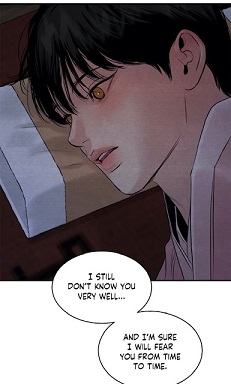 (Chapter 88) As you can sense, the hand gesture delivered a message, but the painter still felt the need to clarify the meaning of his hand. He was willing to remain by his side, but he was still afraid of him. He didn’t want to create a misunderstanding, like for example that he wouldn’t argue with him or that his loyalty was now unconditional or total. That way, Yoon Seungho wouldn’t come to view him as a hypocrite or as dishonest, if an argument would appear. Thus he needed words to explain his position. He would remain by his side and attempt to sympathize with him, but he still felt insecure and had doubts. In other words, his action (his hand gesture) was not truly reflecting his mind and heart.
  (Chapter 88) Later he even asked his lover not to leave his side no matter what.
  (Chapter 88) To conclude, the hand gesture in episode 88 was connected to insecurities and as such fear, yet the painter had shown no hesitation to take his hand. The anxiety was not visible.
 (Chapter 30) His fingers barely grabbed his hand, so when he made the following vow, he was not entirely sincere or better said, truly determined to keep his promise.
  (Chapter 30) The words were not truly in unison with the gesture either. Therefore he once tried to leave the mansion in season 2. When he pledged loyalty, his intention was to protect his teacher. To conclude, fear has always been present, when the painter took Yoon Seungho’s hand. Even in chapter 88, but contrary to the scene in the courtyard, his hand was not shaking.
  (Chapter 82) This explicates why the artist chose to remain by his side, though the lord had broken his promise.
 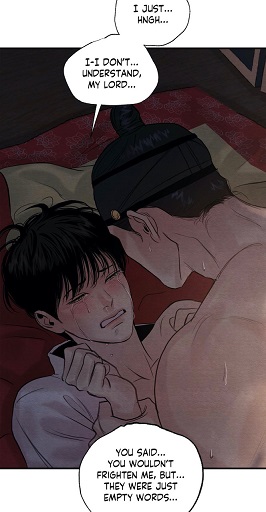 (Chapter 82) On the other hand, in this scene
  (chapter 82), the lord was grabbing his lover’s hand out of fear. He was recognizing his mistake and was trying to beg for his forgiveness, though he couldn’t express it directly. Striking is that during the lord’s flashback, his hand was trembling as well, grabbing onto his partner’s body.
 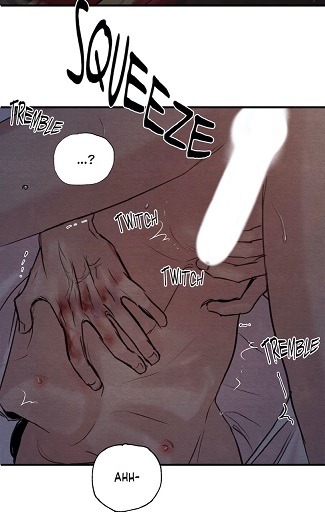 (Chapter 81) It was, as if Baek Na-Kyum was his rescue buoy, helping him not to be swallowed by the darkness. Thus I came to the conclusion that the protagonists’ hand gestures are all connected to anxiety and pain. 😲 Hence I am deducing that in this scene, Baek Na-Kyum is holding his lover’s hand,
  (Chapter 102). This would have definitely scared Baek Na-Kyum, especially Yoon Seungho’s haunted gaze. On the other hand, since the painter had been himself the victim of physical and sexual abuse, the artist can only grasp why the noble reacted that way: fear, anger, despair and heartache. The artist had also been desperate, in pain and scared in the shrine, though this time, he had not screamed for his help. Since the lord had not returned to the mansion, how could he expect him to come to his rescue?
 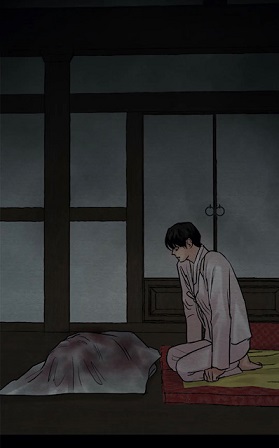 (Chapter 98) Back then, he had been waiting for his lover‘s return and explanations. He wanted to hear him and get his reassurance and comfort. .
 (Chapter 98) The latter couldn’t reassure the painter with his hand contrary to the previous night.
  (chapter 97) Exactly like mentioned above, the painter’s hand gesture is connected to fear and conversation.
 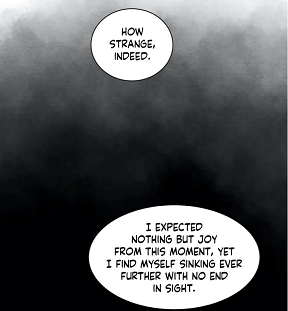 (chapter 97) Striking is that in the gibang, the lord confessed his biggest fear to his future “spouse”. He feared to lose him, though one of his biggest desires had been finally fulfilled. This means that Yoon Seungho felt even more insecure and frightened than before after receiving the artist’s love confession. That’s the reason why I believe that the new picture is standing in opposition to the scene in the gibang. The lord will feel relief after his admission. As a conclusion, the image is announcing
  (Chapter 89) While the painter was sitting on his partner’s lap
 (chapter 89), he was massaging the wounded fingers. It was, as if he was treating his companion’s wound. Note that after his terrible flashback, the painter had avoided to grab his hand out of fear that he might hurt Yoon Seungho even more.
  (Chapter 84) Therefore I conclude that the new panel is an allusion to treatment. While in episode 89, the painter was acting as a doctor, in the new image, the young man is working more like a counselor or psychologist. The aristocrat’s hand might not be wounded in that scene, but this is not the case for his heart and mind. So for me, this scene is connected to mental treatment.
  (Chapter 84) However, the lord had refused to open up. This is no coincidence that the author had not created such a picture during that chapter. As the manhwalovers can detect, I believe that in that scene,
  (chapter 75) And because I detected a discrepancy between words and gestures, I recognized the presence of another trick from Byeonduck.✨
 (chapter 91), the latter denied this with the following statement.
  (chapter 91) But when did the painter admit that he liked embracing him? In this panel!
  (chapter 88) That’s the reason why the lord got surprised and moved. As you can see, the author never revealed this whispering to the manhwalovers! The latter had the impression that the lord’s reaction was related to the loving embrace, but it was only partially correct.
  (chapter 62), when the lord had confessed to adore him.
 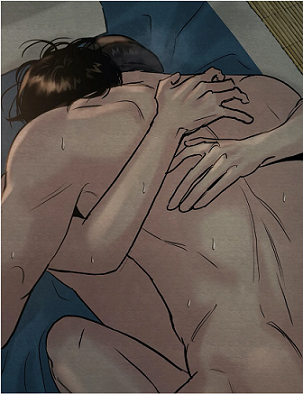 (chapter 62) This explicates why Yoon Seungho was so pained in season 2. He got embraced, but there were no words. Consequently, when the painter vanished during that night, the lord could only perceive the embrace as hypocrisy and fakeness. That’s how I realized that the story is developed on the contradiction between words and actions. But not only that, there exists a strong link between silence and passivity. Thus after the abduction in season 2, Baek Na-Kyum remained more or less silent
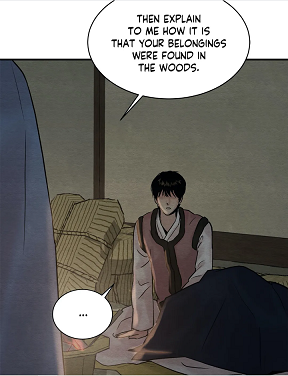 (chapter 62), and as such he was totally passive. He never stood up and begged the lord for his leniency. He stayed there on the bed giving the impression that he was indifferent. That’s the reason why Yoon Seungho got more enraged, for he felt fooled. This means that the absence of words represent inaction… This explains why Yoon Seungho had to corner the main lead in chapter 48
  (chapter 48) to say something, as he had sensed his passivity behind his „submissive attitude“. This is no coincidence that during this night, the painter felt extreme pleasure to the point that he peed. Therefore he could voice his wish to Yoon Seungho during the love session from season 2.
 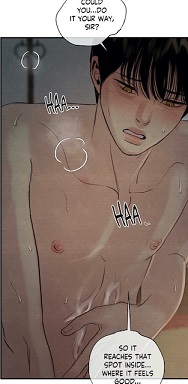 (chapter 73) That’s how the lord concluded that the painter liked riding him, while in reality such a climax had appeared for the first time, when both were facing each other!
  (chapter 49)
 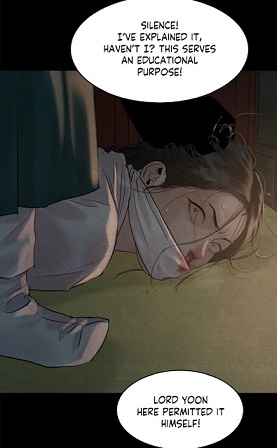 (chapter 86) Yoon Seungho had acted the opposite, he had tried to speak up, but he had been muted. I am also thinking that the young master must have attempted to converse to his father
  (chapter 77) Silence was considered as an admission. This is no hazard that the butler didn’t take care of his young master. This scene symbolizes the quote “Actions speak louder than words”
  (chapter 77) The butler had betrayed the young master’s trust, for he had not intervened. He should have defended Yoon Seungho, but no in fact he had sided with the elder master Yoon once again. Not only he had not reminded Yoon Chang-Hyeon of his promise, but also he had assisted the ruthless father by giving himself the straw mat beating!
  (chapter 77), but backstabbed him in the shadow. Besides, we shouldn’t forget that a narcissist’s words don’t match their action, because they are pathological liars. And so far, I had portrayed father Yoon (overt), Kim (covert) and even Jung In-Hun (overt) as people suffering from NPD. And I am assuming that the mysterious lord Song is not different from them, though I am suspecting that he must be a covert type.
  (chapter 102) He is no longer following social norms. This could only happen, because the lord had just committed a huge crime. What is the point to respect laws and tradition, when he became a murderer? Any other transgression can only appear as harmless. That’s the reason why I am expecting that Yoon Seungho decides to disregard social norms from that moment on and play a prank on the “villains” of this story.
  (chapter 76)
  (chapter 53)
  (chapter 87), while the same extremity symbolizes the opposite with the villains and antagonists: violence, silence, submission
  (chapter 83), hatred and resent
  (chapter 97) Here, Heena was hurting her brother, because she wanted him to face “reality”. What caught my attention is that we never saw the father’s hand in chapter 86!
 The latter had given the poetry referring to exit to the painter as a farewell gift. Why was the lord thinking of Jung In-Hun in that moment? It is because he had read the letters from Heena and as such her accusation against him. He had killed the learned sir, hence in the lord’s mind, it was only a matter of time until Baek Na-Kyum would bring up the subject and decide to leave him. The letters are not destroyed, for he asked this to the painter:
  (chapter 94) Yoon Seungho had two reasons to expect such an outcome. First, it was related to Yoon Seungho’s offer to Baek Na-Kyum.
  (chapter 44) Secondly, Baek Na-Kyum had already showed to the main lead that he could leave him at any moment.
  (chapter 85) He believed in his affection while thinking that Yoon Seungho would keep his promises. But if there was a slight doubt about him, in Yoon Seungho’s mind, the painter would choose his noona over him, like he had experienced it in the study. To sum up, in the gibang, the lord was fearing the artist’s departure. Moreover, when the painter confessed his love to the noble, he was also leaving the scholar’s side. His path was no longer following the teacher’s. Thus when he said this
  (chapter 94), he was actually biding farewell to Jung In-Hun. He was moving on. Finally, if you include these panels from chapter 94,
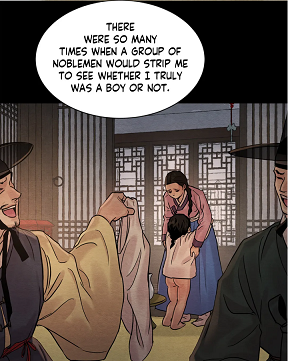
 (chapter 68). She let her brother hear the laughs from the younger masters. It looks like she is consoling her brother, yet she is not, for she is not embracing him. She is grabbing him by the shirt which reminded me of this gesture:
  (chapter 97) Hence I deduce that this scene in the gibang (chapter 97) is a reflection of the incident in the painter’s youth.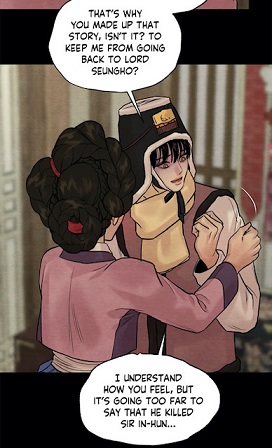
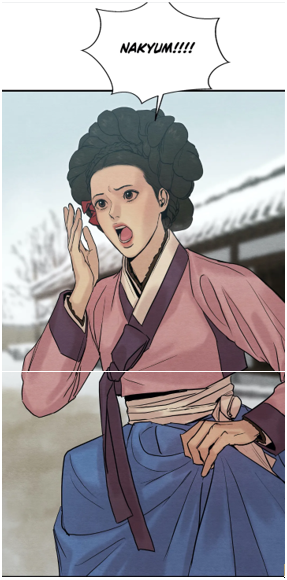 (chapter 65). Thus she gave more the impression of being righteous and truly concerned.
 But there exists another style of moustache beard.
 Striking is that Kim is also wearing such a moustache beard.
 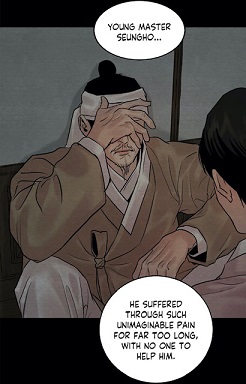 (chapter 87) However, so far in the story, this type of moustache beard was only present among commoners and not nobles!!
  (chapter 45)
  (chapter 45)
  (chapter 78) Hence I started suspecting if these two persons were truly nobles in the end.
  (chapter 99), Min was cosplaying Lee Jihwa, the guards were covering their mouths, Baek Na-Kyum had been wearing a expensive scarf and a headgear for noblewomen,
  (chapter 99) so that he had been mistaken for a young master.
  (chapter 52) However, the more time passed on, the more the butler kept pointing out that he was just a servant, so that this moustache beard is losing its meaning, the symbol for power and nobility. At the same time, the painter met more and more people with beards, like for example the tailor
 (chapter 74), the physician
  (chapter 78) and finally Yoon Chang-Hyeon
  (chapter 87). However, note that when the patriarch left, the main character only paid attention to his gaze and not his beard.
  (chapter 87) This explicates why Baek Na-Kyum is not mentioning the beard concerning nobility, while Yoon Seungho never made the connection between the old bearded men and Kim, though the latter has now a moustache beard! To conclude, I don’t think that this physical assault
  (chapter 99). That’s the reason why I came to the following theory. These persons wounded the painter on purpose and in my eyes, it was suggested by Heena.
 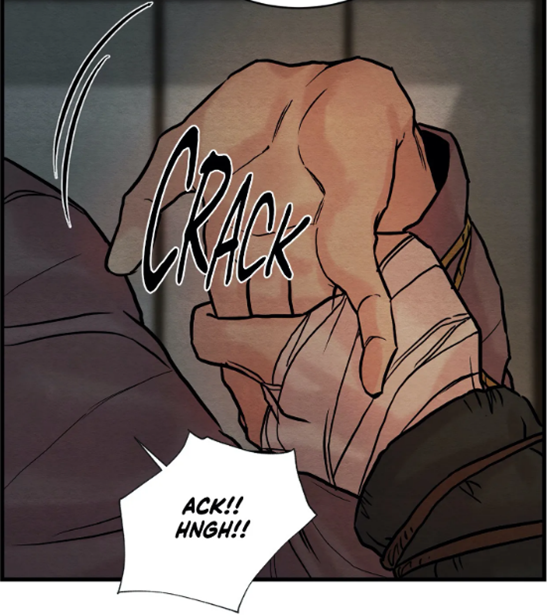 , Nameless,
 (chapter 60), Kim
  (chapter 78), the calligrapher with his insults
  (chapter 91), the maids with their reproaches
 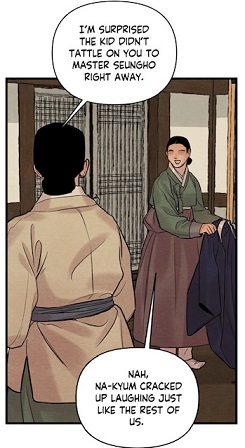 (chapter 91)
  (chapter 98) and the black guards from Min.
  (chapter 97), two commoners who neglected him totally. By the way, the one with the green shirt and white jacket vanished later. He was not seen in the mansion. Anyway, the two domestics wouldn’t even follow the lord’s orders properly, for they never stayed by the painter’s side. And since it is a reflection from chapter 94, I deduce that the two “nobles” acted the opposite. They played their role perfectly to the point that the painter was terribly wounded and he never doubted their identities. They were just nobles! And that’s the point. That way, no person was truly blamed for the incident.
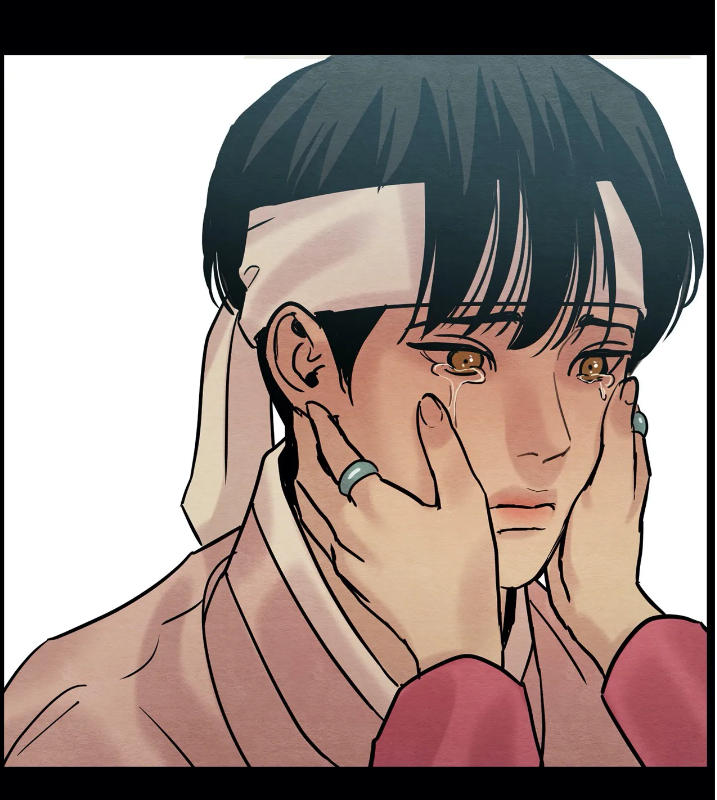 (chapter 46) This was the “positive” reflection of this scene:
  (chapter 46) Moreover, I am now doubting that Baek Na-Kyum and Heena were seen in front of the gibang.
  (chapter 19)
  (chapter 69)
  (chapter 93) Secondly, there is no window next to the entrance of the building contrary to the image from chapter 46. Consequently, I deduce that Heena had left the gibang with her brother saying that she was meeting a client, and just before entering the mansion, she sent away her brother. This explicates why he had only taken his tools and nothing more. Remember what the noonas said in chapter 93:
  (chapter 93) She implied that the noona was not present in the kisaeng house, while in reality she was punished, trapped in a storage room. And now, you comprehend why Heena said this to her brother:
  (chapter 93) He had suddenly vanished without voicing such a desire before. And note that in chapter 97, she was already acting on Min’s orders, a sign that in the past, it was different. She had done it on her own accord. In the annex, the kisaeng was definitely scared, hence she was trembling.
  (chapter 64) This would explain why she never looked for her brother afterwards. This shows that unconsciously, the painter had judged her betrayal and abandonment correctly, but he had been deceived by her argumentation and attitude. In other words, he was in denial.
 (chapter 87) So in this scene,
 (chapter 68) The blue skirt is revealing her presence. She is next to the door and observe that there is a table to her right!! Exactly like in chapter 94!
  (chapter 70) Terrible, right? However, since the painter had been deceived by impressions, he came to believe her version and lies. But there is more to it. Because the artist was so young, he never realized that he could have detected her manipulations!! How? She should have become a wreck… have bruises on her body, but she never had any.
  (chapter 93) Since she excused her vanishing by saying that she had to remove the dishes and as such was busy in the kitchen, it is normal that she was imprisoned next to the kitchen 10 years later!! Here, we can recognize the kitchen by the door made of wooden planks:
 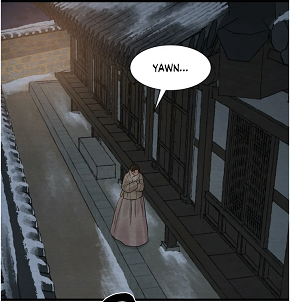 (chapter 95) But there exist two other evidences why Heena is associated to the kitchen. Remember the painter’s thoughts in the inn:
 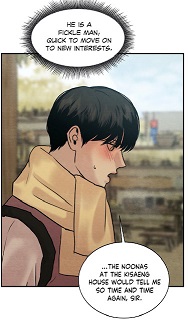 (chapter 75) They let see that he was thinking of Heena, though he spoke of his noonas. However, the presence of religion was introduced with food.
  (chapter 75) This truly exposes that Heena preferred working in the kitchen. That way, she could avoid sex with the clients. Another interesting aspect is that when she was sitting at the table with nobles, she was not talking to her neighbors.
  . (chapter 93) She was not even serving the noble next to her.
 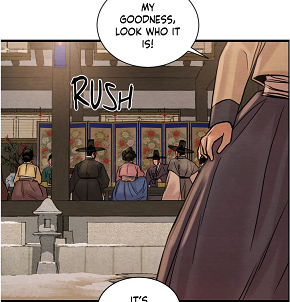 (chapter 93) Once again, she was passive and immobile. Since she was doing nothing, she could hear her brother’s name and turn her head.
  (chapter 93) Under this new light, it becomes understandable why Baek Na-Kyum didn’t detect her presence in the patio. It was not her usual place. At the same time, the readers can grasp why the artist didn’t mind eating in the kitchen with the maids and felt comfortable around the head-maid.
  (chapter 46) This was reflecting his past relationship with Heena. And now, you comprehend why Heena never paid attention to the painter’s education. She had not the time and the motivation to do so. She was busy in the kitchen during the evening and night, yet keep in mind that the painter was her excuse to keep her distance from the nobles in the beginning. This explicates why Yoon Seungho crashed the table in the gibang:
  (chapter 99) This was Heena’s karma. She could no longer use the table as an excuse to betray and abandon a young boy. Moreover, we could see this gesture as a compensation for the past incident.
 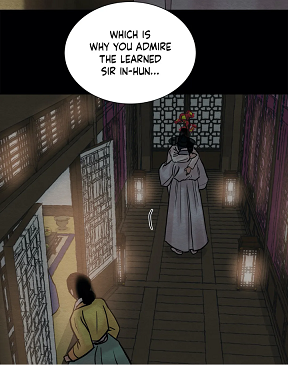 (chapter 68) How do I come to this idea? It is because there is a progression in the responsibility. But we will see, if the lord’s anger was caused by spoiled rice. One thing is sure: the butler is recreating events from the past. And shortly after the painter’s departure from his noona situated in chapter 46,
  . (chapter 47). That’s the reason why I am connecting the kisaeng to the food. And I had already demonstrated that there exists a link between the gibang and the lord’s kitchen.
  (chapter 60) And now, we know for sure that the chicken blood was used to stage the crime scene in the scholar’s house.
  (chapter 101) For me, Nameless was behind this prank. It sounded so harmless, but the reality is totally different. Consequently, Heena can become the prime suspect in the scholar’s disappearance. Remember that according to me, Yoon Seung-Won went to the gibang after leaving his brother’s mansion and discovered that he had been deceived. For me, there is no ambiguity that Yoon Seung-Won and lord Song are behind the learned sir’s murder, for both had a huge interest for his vanishing. But in my eyes, Heena is the link between the nobles, lord Song and No-Name, because the kisaeng house is frequented by all kind of people. I have already mentioned that the learned sir must have gone to the kisaeng house after meeting the fake servant.
  (chapter 38) This encounter took place during the day, however he returned during the night. So he must have spent some time elsewhere. Because of the connection between Heena and the kitchen, I think, she will have to take the fall for No-Name’s crimes. Under this new light, I comprehend why Byeonduck declared that she had no longer planned Mumyeong and Lee Jihwa. Both were already receiving their punishment, when they fled. But since I detected a connection between Heena and No-Name, I am quite sure that she is also responsible for the downfall of No-Name. And don’t forget that during the incident in the bedchamber, we had a party!!
  (chapter 83) Then I had already demonstrated that the kisaeng had already visited the mansion, for she knew where the painter’s room was.
 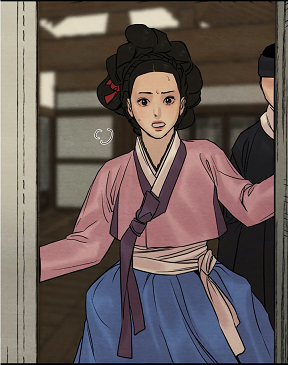 (chapter 65) So she could have worked in the kitchen… helping the other maids. To conclude, the kisaeng had committed the following wrongdoings. She had manipulated her brother with a mixture of belief and prejudices to cover up her own fears and wrongdoings. While in chapter 94, she stopped the painter from leaving the room unconsciously, it was no longer the case with Yoon Seungho, as she was standing in front of the door.
 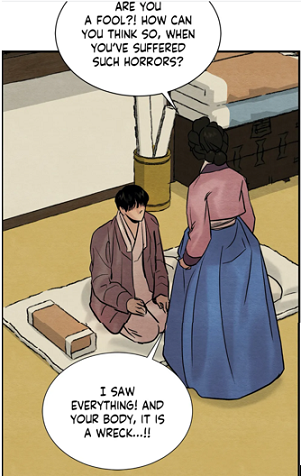 (chapter 68) For her, sex had become a synonym for torture and death. Her wrong choices reinforced her fears about sex in my eyes. Every time, she decided not to face the truth, she preferred being blind. Thus the goddess chose to punish her by letting her deceived by impressions.
  . (chapter 96) She even got sequestered herself.
  (chapter 99), this means that her punishment will be that she will never see her colleagues again. Since she faked her death
 (chapter 69) As you can see, I am detecting a progression in her wrongdoings. She is getting more and more involved, though there is no ambiguity that she was deceived herself in season 3. But this doesn’t excuse her crimes, for she refused to listen to her brother and called him an idiot. At no moment, she pondered on the situation. Her decisions were strongly influenced by her emotions (fear, anger and hatred). That’s the reason why I am convinced that if she is not dead (my theory), her attitude towards her brother will worsen to the point that she will call her brother a bird of misfortune!
  (chapter 97) which represented a betrayal of her own doctrines. But the result was that Min was killed, hence her situation can only deteriorate. If she can escape punishment concerning the nobles’ killing, she has then an opportunity to change her situation by putting the blame on her brother. Why? It is because Baek Na-Kyum will be perceived by Kim and the pedophile as the bird of misfortune. They will be reunited by this “belief”. This reinforces my conviction that the departures in season 4 will become very bloody and painful. The irony is that her metaphor with the bird revealed more about her own thoughts than she imagined. She just needed to give him some warmth, feed Baek Na-Kyum, and that was it. He had a bed and he could eat. A smile and a caress on the cheek were enough to motivate the painter. Her affection was fleeting and trivial in the end. However, while writing this essay, I realized why Baek Na-Kyum ended up drawing in the courtyard. It is because this was the only place where he could be in peace. In the room, he got assaulted by the nobles
  (chapter 01)
 (chapter 97) Fake concern versus anger and resent
 (chapter 30), and his fingers reminded me of the eagle’s claws.
 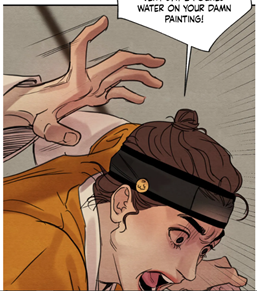 (chapter 18) And this perception got even reinforced, when I saw this panel:
  (chapter 52) In this scene, he was sitting like a king surrounded by his “court”. The hanbok had such a design that I couldn’t help myself associating it to Joseon’s monarchy.
  , I had another revelation. On the one hand, it actually confirmed that Yoon Seungho was somehow destined to become a king, yet he is not represented by the eagle or the phoenix, but by the dragon. Hence the moment I saw this image, one idiom came to my mind: Dragon king!
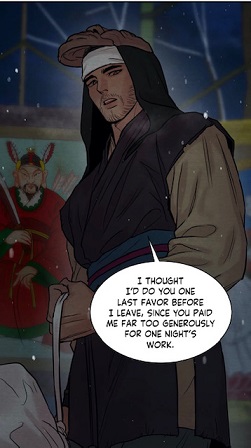 (chapter 100), though this deity is always accompanied with a dragon and in this picture, the readers couldn’t see one. However, it is possible that the author didn’t desire to reveal too much.
  (chapter 21) Why? It is because the lord was happy. These were the tears of happiness, which Yoon Seungho couldn’t express contrary to the painter. And this is no coincidence that in chapter 58, it started snowing, when the couple was making love:
  (chapter 58) And we had the same weather, when Yoon Seungho saved his lover.
 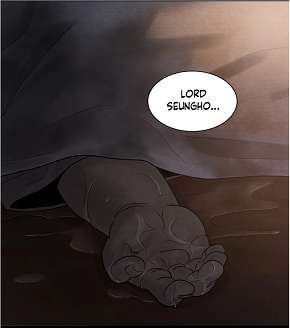 (chapter 94) In addition, my theory is that Deok-Jae and/or Jung In-Hun’s body were placed in a jar in order to hide the murders. For me, the jar plays a huge role in Painter Of The Night… thus Byeonduck created such a scene in season 2
  (chapter 46) and we have so many jars next to the pond:
 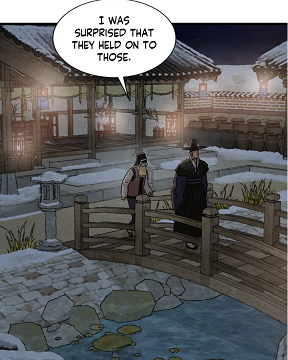 (chapter 94) [For more read the essay “The secret behind the library”]
 (chapter 91) This is no coincidence. To conclude, all these elements (rain, jar, well, soul of a deceased), connected to the dragon king, are present in Painter Of The Night. Thus I came to the conclusion that Yoon Seungho is like Dragon king. This reinforces my conviction that the main lead is not only connected to shamanism, but also embodies royalty. So he might not be the king of Joseon, but he is powerful in his own way, though he is not aware of this. And note that the moment he wished to commit suicide by drowning in the pond, he was brought back to life.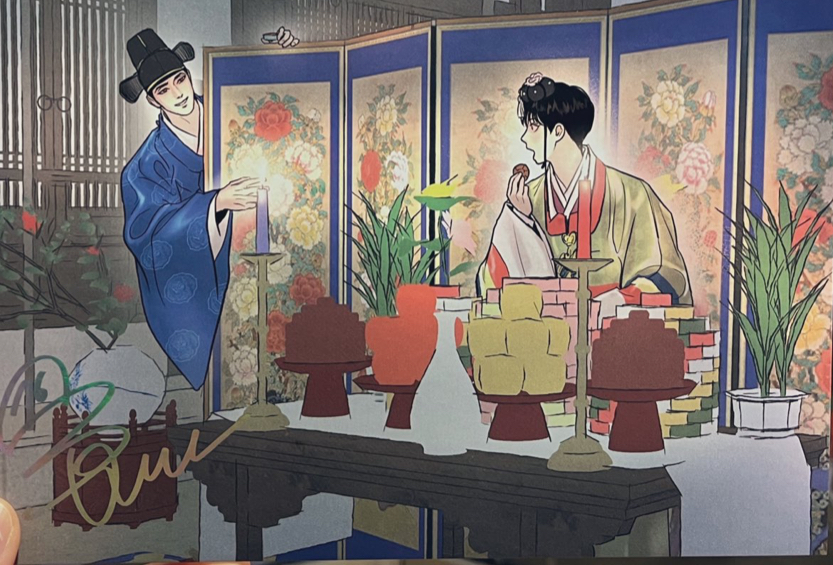
 (chapter 100) and this altar
 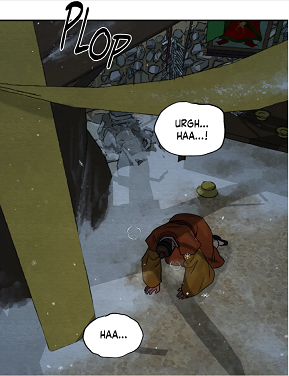 (chapter 100) were exposing the presence of a ritual. However, my problem was that I couldn’t determine exactly the nature of the ritual. But by making the connection between the dragon and good fortune, I had now more clues. I have to admit that I can not be 100% sure for this, but this is what I found:
  (chapter 4)
 (chapter 6)
  (chapter 82)
  (chapter 83) and the deer
  (chapter 22). Then the lord compared Baek Na-Kyum’s eyes to a rabbit.
  (chapter 78) Since both resemble each other, I deduce that the main lead has the same eyes, the rabbit’s. Like mentioned above, he utilized his fingers similar to claws:
  (chapter 54) One might argue that this signification is totally impossible, for the lord doesn’t have the body of a snake. This point can be refuted very easily. What is the major characteristic of a snake is molting. A regularly recurrent event during the activity period of all snakes is the shedding of the skin. This coincides with the lord’s change of clothes. The latter reflected his downfall and rising. Furthermore, this animal is linked to death and rebirth. My avid readers are already aware that I had detected different scenes, where we could witness the lord’s spiritual death and rebirth, like for example in the shed:
  (chapter 62) When he discovered his misjudgment the next morning, he felt like dead. He no longer saw himself as a lord, but came to view the painter as his new lord :
  (chapter 66) As a conclusion, Yoon Seungho shares so many similarities with the dragon that I came to view him as one. This explicates why even after getting married, he will never wear a beard!
 (chapter 45)
 (chapter 55) and as such his heart and mind.
 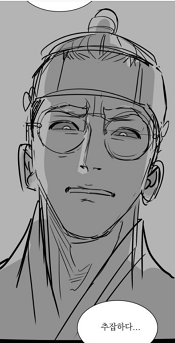 He criticized the painter by stating that this was “filthy”.
  In this scene, the characters are caught by surprise, but it becomes obvious that there is no disgust or expulsion. In fact, the fall of man took place before, for Baek Na-Kyum was sent to Joseon. In this encounter, I detect attraction and curiosity. Hence I come to the conclusion that in the original story, when this scene took place,
  (chapter 50)
  (chapter 52) This means that the mysterious lord Song was actually claiming the main lead as his wife in the last scene. Min and his friends were sent there in order to entertain the protagonist, but they failed. This explicates why the next day, Black Heart was seen with a hanbok of lower quality.
  (chapter 56) It was, as if Min had been compensated for his bruised face by the mysterious lord Song. However, for the pedophile, Black Heart was just a concubine, and not his main wife! Hence the hanbok had not such a detailed and expensive design. This would explain the villain’s jealousy. And now, if you look back at the hanboks from the main lead, you will recognize his ascent. First, he is wearing green, which is similar to Yoon Chang-Hyeon’s color. At the same time, his hat resembled a lot to Kim’s.
  (chapter 1) Then later, he is mostly wearing blue which is actually the color of the Crown prince.
  (chapter 11) Yet, his robes initially have no design. Slowly, the lord is wearing colors and designs that are actually reserved for a king: blue, red, black and purple. This constant change of hanboks symbolizes the “snake molting” and as such his transformation and rising. This is not astonishing that on the night of the bloodbath, he had such a hanbok:
  (chapter 102) Here, he was no longer acting like a noble, but as a ruler. Don’t forget that according to me, the mysterious lord Song had proclaimed the main lead as his unofficial Queen by giving him hanboks with phoenixes. However, naturally, this was never mentioned to Yoon Seungho directly. Why? It is because Kim usually selects his clothes. However, this rise was not natural, as the lord had no real saying in this matter. The real metamorphosis took place in the shaman’s house, when the lord was sent back to the past and as such the darkness.
  (chapter 44) It is because the main lead was thinking that the painter would actually run away. Thus the door was left opened, and he was wearing warm clothes. Yoon Seungho never imagined that Baek Na-Kyum would remain by his side. Yet, during the previous night, the lord had consoled his lover by embracing him.
  (chapter 71) But this can be refuted easily. First, don’t forget that during this love session, the lord was acting like a servant pleasing his new lord. So this had nothing to do with Yoon Seungho’s feelings like sadness or happiness. He was determined to keep the painter by his side, and ignoring his own feelings. He never expected the artist to reciprocate his feelings. Secondly, Yoon Seungho’s nocturne vision is not just a nightmare, but also a DREAM! Yes, you are reading this correctly. Only recently, I discovered that all the artist’s visions are a combination of 3 elements: memory, nightmare and dream! I will give you three examples as illustration, for I am slowly running out of time.
  This vision is a combination of these three elements: memory, nightmare and dream. This had happened during the First Wedding Night (memory)
 (chapter 21), then we have a similar situation in chapter 49: ,
 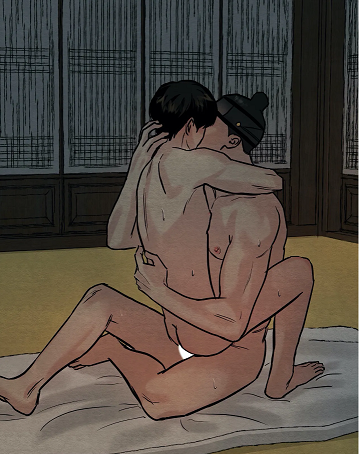 , but the painter was rejecting this future. Hence he considered it as a nightmare.
 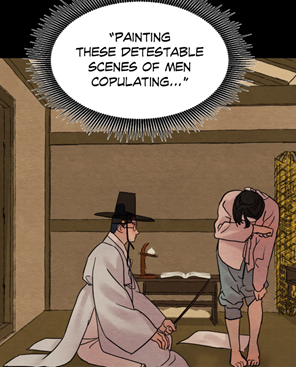 ; nightmare
  the lord becomes a ghost and confronts the painter with his biggest fears (admitting his attraction, passion for erotic paintings and homosexuality) and dream
 (The painter’s true desire was that the lord would kiss him, he was deeply longing for his lips, yet he was still in denial in this vision.
 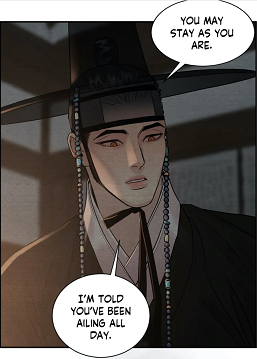 . He hoped that the lord would take care of him personally. Naturally, the “spirit” is the nightmare
  .
. 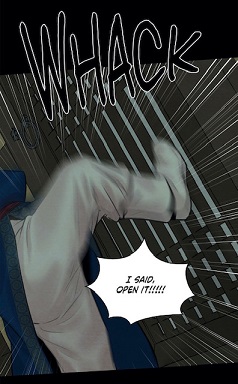 (chapter 74) This had already happened, but the lord had not grasped the significance.
 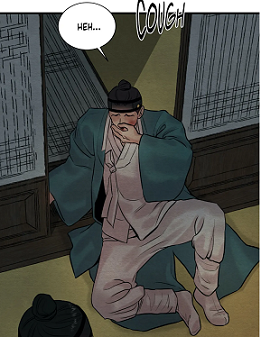 (chapter 53) Besides, he had not opened the door himself. Even when he went to the scholar Lee and opened the door with the his foot, the lord still felt trapped.
 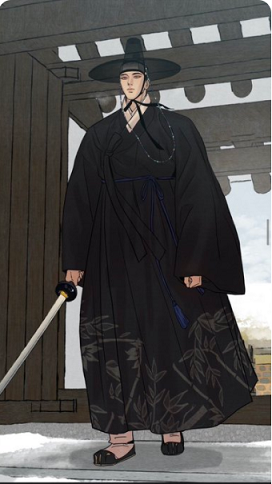 (chapter 67) Then in season 3, he could break a door, but it was thanks to the painter.
 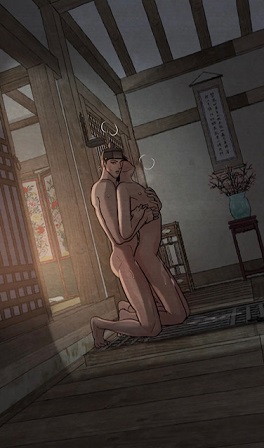 (chapter 96) This shows that the lord’s wish to get released had not been fulfilled so far. In my eyes, it is connected to the torture Yoon Seungho suffered and as such to the purge organized by the authorities. That’s the reason why I deduce that the lord will break a door in season 4, and this won’t be by accident and it will be witnessed by many people contrary to chapter 53, 67 and 96! The broken door will reflect the lord’s rise and power, and no one will be able to stop this. In my eyes, this wish is connected to the door in the servants’ quarter. That’s how his imprisonment started.
 (chapter 74) The “dragon” wished to see Kim and his father, and confront them! And this did take place in season 3. Yoon Seungho confronted the butler with his attitude and betrayal
 (chapter 77), but this argument was just short-lived. He still viewed the valet as a hard-working and trustworthy person. He had just made bad decisions. Then in the bedchamber, the lord could blame the father for his suffering:
  (chapter 74) Simultaneously, the vision also displays the lord’s expulsion from “hell”, the sex orgies
 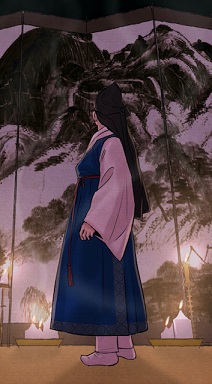 (chapter 74) Simultaneously, the dream showed that the lord wished to see this painting again, though deep down, he blames this image for his suffering. As you can see, the vision was revealing the tormented disposition of the lord. He was switching from nightmare to dream and the reverse… a mixture of anxieties and desires.
  (chapter 74) This signifies that he was approached by someone from behind, he had not noticed that the “door” had been opened. Thus he never expected his apparition. For me, this perception demonstrates that the painting is not the real cause for Yoon Seungho’s suffering. Since he had turned around, I came to recognize that this scene stands in opposition to the situation in the painter’s nightmare:
 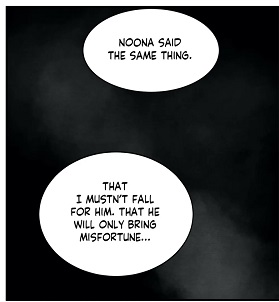 (chapter 86) In reality, he was a dragon, who could bring luck and fortune to the person who would cherish him. This is no coincidence that the pedophile sent hanboks with the crane
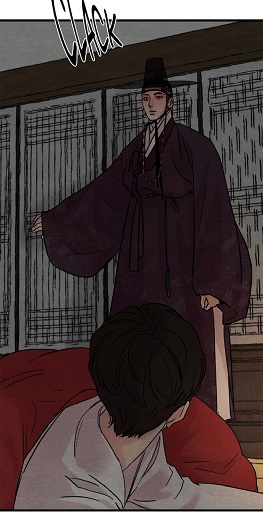 (chapter 34),
  (chapter 30), but much more brutal and violent!


 Bebebisous33s' analyses in K-Dramaland and Manhwas